WO2018195136A1 - Compositions and methods for regulated gene expression - Google Patents
Compositions and methods for regulated gene expression Download PDFInfo
- Publication number
- WO2018195136A1 WO2018195136A1 PCT/US2018/028056 US2018028056W WO2018195136A1 WO 2018195136 A1 WO2018195136 A1 WO 2018195136A1 US 2018028056 W US2018028056 W US 2018028056W WO 2018195136 A1 WO2018195136 A1 WO 2018195136A1
- Authority
- WO
- WIPO (PCT)
- Prior art keywords
- seq
- cell
- nucleic acid
- promoter
- expression
- Prior art date
- Legal status (The legal status is an assumption and is not a legal conclusion. Google has not performed a legal analysis and makes no representation as to the accuracy of the status listed.)
- Ceased
Links
Classifications
-
- C—CHEMISTRY; METALLURGY
- C12—BIOCHEMISTRY; BEER; SPIRITS; WINE; VINEGAR; MICROBIOLOGY; ENZYMOLOGY; MUTATION OR GENETIC ENGINEERING
- C12N—MICROORGANISMS OR ENZYMES; COMPOSITIONS THEREOF; PROPAGATING, PRESERVING, OR MAINTAINING MICROORGANISMS; MUTATION OR GENETIC ENGINEERING; CULTURE MEDIA
- C12N15/00—Mutation or genetic engineering; DNA or RNA concerning genetic engineering, vectors, e.g. plasmids, or their isolation, preparation or purification; Use of hosts therefor
- C12N15/09—Recombinant DNA-technology
- C12N15/63—Introduction of foreign genetic material using vectors; Vectors; Use of hosts therefor; Regulation of expression
- C12N15/635—Externally inducible repressor mediated regulation of gene expression, e.g. tetR inducible by tetracyline
-
- C—CHEMISTRY; METALLURGY
- C07—ORGANIC CHEMISTRY
- C07K—PEPTIDES
- C07K14/00—Peptides having more than 20 amino acids; Gastrins; Somatostatins; Melanotropins; Derivatives thereof
- C07K14/195—Peptides having more than 20 amino acids; Gastrins; Somatostatins; Melanotropins; Derivatives thereof from bacteria
-
- C—CHEMISTRY; METALLURGY
- C12—BIOCHEMISTRY; BEER; SPIRITS; WINE; VINEGAR; MICROBIOLOGY; ENZYMOLOGY; MUTATION OR GENETIC ENGINEERING
- C12N—MICROORGANISMS OR ENZYMES; COMPOSITIONS THEREOF; PROPAGATING, PRESERVING, OR MAINTAINING MICROORGANISMS; MUTATION OR GENETIC ENGINEERING; CULTURE MEDIA
- C12N15/00—Mutation or genetic engineering; DNA or RNA concerning genetic engineering, vectors, e.g. plasmids, or their isolation, preparation or purification; Use of hosts therefor
- C12N15/01—Preparation of mutants without inserting foreign genetic material therein; Screening processes therefor
-
- C—CHEMISTRY; METALLURGY
- C12—BIOCHEMISTRY; BEER; SPIRITS; WINE; VINEGAR; MICROBIOLOGY; ENZYMOLOGY; MUTATION OR GENETIC ENGINEERING
- C12N—MICROORGANISMS OR ENZYMES; COMPOSITIONS THEREOF; PROPAGATING, PRESERVING, OR MAINTAINING MICROORGANISMS; MUTATION OR GENETIC ENGINEERING; CULTURE MEDIA
- C12N15/00—Mutation or genetic engineering; DNA or RNA concerning genetic engineering, vectors, e.g. plasmids, or their isolation, preparation or purification; Use of hosts therefor
- C12N15/09—Recombinant DNA-technology
- C12N15/10—Processes for the isolation, preparation or purification of DNA or RNA
- C12N15/102—Mutagenizing nucleic acids
-
- C—CHEMISTRY; METALLURGY
- C12—BIOCHEMISTRY; BEER; SPIRITS; WINE; VINEGAR; MICROBIOLOGY; ENZYMOLOGY; MUTATION OR GENETIC ENGINEERING
- C12N—MICROORGANISMS OR ENZYMES; COMPOSITIONS THEREOF; PROPAGATING, PRESERVING, OR MAINTAINING MICROORGANISMS; MUTATION OR GENETIC ENGINEERING; CULTURE MEDIA
- C12N15/00—Mutation or genetic engineering; DNA or RNA concerning genetic engineering, vectors, e.g. plasmids, or their isolation, preparation or purification; Use of hosts therefor
- C12N15/09—Recombinant DNA-technology
- C12N15/63—Introduction of foreign genetic material using vectors; Vectors; Use of hosts therefor; Regulation of expression
- C12N15/74—Vectors or expression systems specially adapted for prokaryotic hosts other than E. coli, e.g. Lactobacillus, Micromonospora
Definitions
- the human gut is populated with enormous bacterial populations that impact many aspects of host physiology. While the ability to describe these communities by high-throughput sequencing has expanded dramatically, parallel tools to manipulate or engineer the microbiota have significantly lagged behind. Such tools are critical for experimental dissection of these poorly understood microbial consortia in the short term, and for future efforts to leverage the microbiota to predict, report on, and ameliorate disease.
- Escherichia coli are typically nonfunctional in Bacteroidetes or Firmicutes, which together account for -90% of the microbiota in most individuals (The Human
- Microbiome Project Consortium 2012, Nature, 486:207-214.
- Bacteroides The Human Microbiome Project Consortium, 2012, Nature, 486:207-214; Faith, J.J., et al., 2013, Science, 341 : 1237439-1237439, are typical in this regard.
- RNA polymerase (RNAP) ⁇ 70 holoenzyme recognizes a unique -33/-7 consensus sequence, TTTG (Ni9-2i)TANNTTTG (SEQ ID NO: 96), in promoter DNA (Bayley, D P. et al., 2000, FEMS Microbiol. Lett., 193 : 149-154; Mastropaolo, M.D. et al., 2009, Microbiology, 155:2683-2693).
- standard reporters of gene expression such as green fluorescent protein or ⁇ -galactosides do not work well due to the oxygen requirement or high background from native enzymes.
- ribosome binding site (RBS) strength is correlated with a complex set of features and not with the presence of a canonical Shine-Dalgarno sequence (Wegmann, U. et al., 2013, Appl. Environ.
- the present invention provides an isolated nucleic acid molecule comprising an inducible synthetic promoter variant of the Bacteroides 16S rDNA promoter.
- the inducible synthetic promoter comprises one or more repressor response elements.
- the repressor response element comprises tet02.
- the inducible synthetic promoter comprises a ribosomal binding site (RBS).
- the RBS is selected from the group consisting of GH023, A21, Bl, rpiL, B41, B40, and C56.
- the inducible synthetic promoter comprises a nucleic acid sequence selected from the group consisting of SEQ ID NO: 12, SEQ ID NO: 13, SEQ ID NO: 14, SEQ ID NO: 15, SEQ ID NO: 24, SEQ ID NO: 25, SEQ ID NO: 26, SEQ ID NO: 27, SEQ ID NO: 28, and SEQ ID NO: 29.
- the inducible synthetic promoter is operably linked to a coding region.
- the coding region encodes a therapeutic RNA or peptide. In one embodiment, the coding region encodes a toxic protein or peptide.
- the present invention provides an expression cassette comprising an inducible synthetic promoter variant of the Bacteroides 16S rDNA promoter.
- the inducible synthetic promoter comprises one or more repressor response elements.
- the repressor response element comprises tet02.
- the inducible synthetic promoter comprises a ribosomal binding site (RBS).
- the RBS is selected from the group consisting of GH023, A21, Bl, rpiL, B41, B40, and C56.
- the inducible synthetic promoter comprises a nucleic acid sequence selected from the group consisting of SEQ ID NO: 12, SEQ ID NO: 13, SEQ ID NO: 14, SEQ ID NO: 15, SEQ ID NO: 24, SEQ ID NO: 25, SEQ ID NO: 26, SEQ ID NO: 27, SEQ ID NO: 28, and
- the inducible synthetic promoter is operably linked to a coding region.
- the coding region encodes a therapeutic RNA or peptide.
- the expression cassette further comprises a nucleotide sequence encoding a repressor.
- the repressor comprises tetR or a variant thereof.
- the present invention provides a cell modified for inducible gene expression comprising a nucleic acid molecule comprising an inducible synthetic promoter variant of the Bacteroides 16S rDNA promoter.
- the inducible synthetic promoter comprises one or more repressor response elements.
- the repressor response element comprises tet02.
- the inducible synthetic promoter comprises a ribosomal binding site (RBS).
- the RBS is selected from the group consisting of GH023, A21, B l, rpiL, B41, B40, and C56.
- the inducible synthetic promoter comprises a nucleic acid sequence selected from the group consisting of SEQ ID NO: 12, SEQ ID NO: 13, SEQ ID NO: 14, SEQ ID NO: 15, SEQ ID NO: 24, SEQ ID NO: 25, SEQ ID NO: 26, SEQ ID NO: 27, SEQ ID NO: 28, and SEQ ID NO: 29.
- the inducible synthetic promoter is operably linked to a coding region.
- the coding region encodes a therapeutic RNA or peptide.
- the cell is modified to express a repressor.
- the repressor comprises tetR.
- the cell is a bacterial cell. In one embodiment, the cell is of the genus Bacteroides.
- the present invention provides a method of inducing gene expression in a cell comprising: providing a cell comprising a nucleic acid molecule comprising an inducible synthetic promoter variant of the Bacteroides 16S rDNA promoter operably linked to a coding region; and contacting the cell with an inducer.
- the inducible synthetic promoter comprises one or more repressor response elements.
- the cell is modified to express a repressor, thereby inhibiting expression of the coding region.
- the inducer inhibits the activity of the repressor, thereby inducing expression of the coding region.
- the inducible synthetic promoter comprises a nucleic acid sequence selected from the group consisting of SEQ ID NO: 12, SEQ ID NO: 13, SEQ ID NO: 14, SEQ ID NO: 15, SEQ ID NO: 24, SEQ ID NO: 25, SEQ ID NO: 26, SEQ ID NO: 27, SEQ ID NO: 28, and SEQ ID NO: 29.
- the present invention provides a method of inducing gene expression in a cell comprising: providing a cell comprising a nucleic acid molecule comprising an inducible synthetic promoter variant of the Bacteroides 16S rDNA promoter operably linked to a coding region encoding at least one protein or peptide that is toxic to the cell; and contacting the cell with an inducer.
- the inducible synthetic promoter comprises one or more repressor response elements.
- the nucleic acid molecule further comprises a nucleotide sequence for expression of a repressor protein under the control of a constitutive promoter, thereby inhibiting expression of the at least one protein or peptide that is toxic to the cell.
- the inducer inhibits the activity of the repressor, thereby inducing expression of the at least one protein or peptide that is toxic to the cell.
- the inducible synthetic promoter comprises a nucleic acid sequence of SEQ ID NO: 12, SEQ ID NO: 13, SEQ ID NO: 14, SEQ ID NO: 15, SEQ ID NO: 24, SEQ ID NO: 25, SEQ ID NO: 26, SEQ ID NO: 27, SEQ ID NO: 28, or SEQ ID NO: 29.
- the inducible synthetic promoter is operably linked to at least one nucleotide sequence encoding Btel or Bfel .
- the nucleic acid molecule comprises a nucleotide sequence of SEQ ID NO:99 or SEQ ID NO: 100.
- the nucleic acid molecule further comprises at least one nucleotide sequence homologous to a target nucleotide sequence.
- Figure 1 depicts results from example experiments showing the genetic architecture and construction of regulatable expression platforms in Bacteroides.
- Figure 1A Sequence conservation across 182 RNAP binding sites from 16S rRNA promoter regions from 19 Bacteroides genomes. Areas of conservation reflecting -33 and -7 RNAP binding sites (black bars) and the transcription-activating UP-element (blue bar) are indicated above the sequence logo. Tet02 sequences were placed and oriented as shown below the sequence logo.
- Figure IB Schematic of the PI and P2 constitutive promoters and engineered PI promoters containing tet02 elements.
- the predicted UP-element, -33/-7 sites, and tet02 operator sequences are designated as blue, black, and red boxes, respectively.
- the dashed line designates the transcription start site (+1), and the green semicircle indicates the GH023 RBS.
- Figure 1C Activity of native PI, native P2, and tetO2-containing PI promoters in B. thetaiotaomicron measured using the NanoLuc luciferase reporter and expressed as relative light units/colony forming unit (RLU/CFU). Luminescence from B.
- Figure 2 depicts results from example experiments showing the regulation of Bacteroides gene expression via a synthetic inducer.
- Figure 2A Strain design.
- Figure 2B Activity of engineered, tet02- containing promoters measured by luminescence (RLU/CFU) of NanoLuc-promoter fusions.
- Figure 2C Addition of aTC restores lpxF-dependent polymixin B resistance to Bt::tet IpxF carrying IpxF -promoter fusions. The dashed line indicates the PMB MIC for wildtype B. thetaiotaomicron (> 1024 ⁇ g/mL).
- asterisks indicate significant differences in gene expression in response to aTC (p ⁇ 0.0001).
- ⁇ indicates no significant difference as compared to vector control (p > 0.1).
- Figure 3 depicts results from example experiments showing the attainment of regulatory control of endogenous loci and highly toxic gene products.
- Figure 3 A and Figure 3B Promoter design and aTC- dependent growth of Bt: :tetR P1TDP GH023 -BT1754 in fructose and glucose. Error bars (for Figure3 A and Figure3B) represent the standard deviation of three biological replicates on separate days.
- Figure3C Bt: :tetR encoding either of two highly toxic antibacterial effectors from B. fragilis under the control of P1TDP GH023 grow at wildtype rates unless expression is induced with aTC. Error bars represent the standard deviation of two biological replicates on separate days; asterisks indicate the earliest timepoint with significant (p ⁇ 0.001) differences compared to uninduced controls.
- Figure 4 depicts results from example experiments showing that a panel of ribosome binding sites extends the dynamic range of PI TDP to over 105-fold, spanning the complete range of native gene expression in B. thetaiotaomicron.
- Figure 4 A Promoter activity of the P I TDP promoter fused to various RBSs (Mimee, M. et al., 2015, Cell Systems, 1 :62-71.) was measured using the NanoLuc reporter in wildtype B. thetaiotaomicron (grey) and Bt: :tetR in the absence (red) or presence (green) of aTC. Luminescence from B.
- Luminescence from NanoLuc fusions to three engineered promoters can be modulated by aTC to span the entire expression range of the 18 native promoters selected to span the B.
- Figure 5 depicts results from example experiments showing that a self- contained, inducible expression cassette functions across diverse Bacteroides species. Strains are sorted by 16S rDNA phylogeny, with type strains (Table 3) underlined and novel isolates (isolated directly from human donors) noted with superscript indicating donor number. Activity of TetR-PlTDP GH023 -NanoLuc in each strain is shown. Error bars represent the standard deviation of three biological replicates on separate days.
- Figure 6 depicts results from example experiments showing exogenous control of Bacteroides gene expression in mice via a synthetic inducer.
- FIG. 6B Dose response of the P1TDP GH023 promoter to varying aTC concentrations in mice.
- Figure 7 depicts results from example experiments showing that modulating commensal sialidase expression in mice reveals that sialic acid persists in the gut after microbial enzyme activity is repressed and uncovers a non-linear relationship between enzyme activity and luminal sialic acid.
- FIG. 7A aTC concentrations, ( Figure 7B) sialidase activity, and (Figure 7C) free sialic acid levels in fecal samples collected over time from gnotobiotic mice monocolonized with 5t: :3xtetR (green line), 5t: :3xtetR BT0455 (red line), or Bt RS (black line).
- Figure 8 comprising Figure 8A though Figure 8D, depicts results from example experiments showing the regulation of Bacteroides gene expression via a synthetic inducer, and attaining regulatory control of endogenous loci and highly toxic gene products.
- Figure 8A Bacteroides grow at wildtype rates in aTC concentrations typically used to control gene expression from tetracycline-regulated promoters.
- Figure 8B, and Figure 8C P I TDP expression can be tuned over a 100-fold range in aTC concentration and induces in response to aTC within one round of cell division.
- Figure 8D Expression of ss-Btel or ss-Bfel in B.
- thetaiotaomicron is highly toxic, because addition of aTC results in immediate decreases in viability and culture density; In the OFF state (without aTC), growth of strains carrying PlTDP-ss-btel, PlTDP-ss-bfel, and the B . etK parental strain is equivalent.
- Figure 9 depicts results from example experiments showing that a panel of ribosome binding sites extends the dynamic range of PI TDP to over 105-fold, spanning the complete range of native gene expression in B. thetaiotaomicron.
- Figure 9A and Figure 9B The 6 RBSs modulate P I TDP promoter expression by three orders of magnitude, in a pattern generally similar to that previously reported for a native B. thetaiotaomicron promoter (Mimee, M. et al., 2015, Cell
- Figure 10 depicts results from example experiments showing that a self-contained, inducible expression cassette functions to induce PMB resistance to be entirely dependent on aTC.
- Figure 10A The lpxF homolog in B. ovatus (BACOVA 04598) was identified, and the 62 base pairs upstream of this gene were replaced with the TetR-PlTDP B1 cassette.
- Figure 10B With this one-step promoter replacement, PMB resistance becomes entirely dependent on aTC.
- FIG 11 depicts results from example experiments showing that the inducer is undetectable prior to exogenous addition.
- Liquid chromatography-mass spectrometry (LC-MS)-based quantification of aTC in fecal pellets reveals that the inducer is undetectable prior to exogenous addition, is readily detected within 24 hours of its addition to drinking water, and is again undetectable 6 days after its removal from the water, exhibiting a half-life of 19 hours in vivo.
- LC-MS liquid chromatography-mass spectrometry
- Figure 12 depicts results from example experiments showing that the engineered system and aTC exposure do not impact B. thetaiotaomicron stability in the gut.
- Figure 12A This engineered system and aTC exposure do not impact B. thetaiotaomicron stability in the gut, and additionally, CFU measurements of B . etK PlTDP GH023 -NanoLuc were unchanged throughout the experiment.
- Figure 12B, and Figure 12C Modulation of gene expression by varying aTC concentrations is recapitulated in the distal small intestine, cecum and throughout the large intestine.
- Figure 13 depicts results from example experiments showing that modulating commensal sialidase expression in mice reveals that sialic acid persists in the gut after microbial enzyme activity is repressed and uncovers a non-linear relationship between enzyme activity and luminal sialic acid.
- Figure 13A As previously reported (Ng, K.M., et al., 2013, Nature, 502:96- 99), B. thetaiotaomicron efficiently liberates sialic acid from the gut mucosa of monoassociated gnotobiotic mice; this activity is dependent on the B. thetaiotaomicron sialidase BT0455.
- FIG. 13B To understand how commensal sialidase activity modifies the gut environment, BT0455 was placed under the control of the P1TDP GH023 promoter (5i: :3xtetR BT0455 P1TDP GH023 -BT0455, abbreviated Bt RS for regulated sialidase).
- Figure 13C To measure sialidase enzyme activity, cell-free lysates from fecal samples were incubated with the artificial substrate 2-0-(p-Nitrophenyl)- tropheacetylneuraminic acid (p P-SA), which is hydrolyzed by sialidases, and the subsequent release of the pNP moiety was monitored over time by LC-MS.
- p P-SA 2-0-(p-Nitrophenyl)- tropheacetylneuraminic acid
- Figure 13D Fecal samples from control mice monocolonized with wildtype or BT0455 B. thetaiotaomicron strains exhibit constitutive or no sialidase activity, respectively.
- Figure 13E Prior to aTC administration, fecal samples from mice carrying Bt RS show no detectable sialidase activity, indicating tight repression of the enzyme and the absence of pNP in the gut.
- Figure 13F Exogenous sialic acid delivered by oral gavage to gnotobiotic mice monocolonized with B. thetaiotaomicron BT0455 exhibits a half-life of ⁇ 9 hours.
- Figure 14 depicts a diagram of the regulated expression platform, which was designed using general principles that apply across the microbiome.
- Figure 15 depicts a diagram of the regulated expression platform in Bacteroides. This system can be utilized to have an impact on host physiology, including nutrient utilization, responses to inflammation, and other applications.
- FIG 16 depicts diagrams of pNABl and pNAB2.
- pNABl and pNAB2 include a constitutive promoter (promC) driving expression of the repressor tetR and an engineered promoter (P1TDP) driving expression of either one toxic effector (pNAB l utilizing Btel) or two toxic effectors (pNAB2 utilizing Btel and Bfel). These toxic effectors can be readily substituted for any effector secreted by the Type VI secretion system in Bacteroides or other organisms, bacteriocins, or other toxic proteins.
- the RBS for the engineered promoter (P1TDP) can be substituted for any of the ones described in this invention to control the promoter strength.
- the constitutive promoter (promC) is interchangeable with other constitutive promoters.
- Figure 17 depicts the results from example experiments demonstrating PCR confirmation of deletions of two independent genes in WT Bacteroides vulgatus ATCC 8482 using pNAB2 deletion system. Primers were located outside of the regions used for the allelic exchange. Presence of ArnT gene (Bvu_1068) produces an amplicon of 3533 bp, while the deletion mutant (ABvu_1068) amplicon size is 1808 bp reflecting deletion of ArnT gene size 1725 bp. Presence of lpxF gene (Bvu_3293) produces an amplicon of 2615 bp, while the deletion mutant (ABvu_3293) amplicon size is 1907 bp reflecting deletion of lpxF gene size 708 bp.
- the present invention relates to compositions and methods for regulated gene expression of one or more proteins of interest.
- the present invention provides for regulated gene expression in a bacterial cell.
- the invention is based in part upon the development of several synthetic promoters that couple gene expression to a synthetic inducer.
- the invention provides compositions comprising an inducible synthetic promoter variant of the Bacteroides 16S rDNA promoter.
- the synthetic promoters described herein demonstrate over 10 5 fold dynamic range in protein expression.
- the present invention provides for regulated gene expression in bacterial cells of the gut microbiome.
- the gut microbiota is implicated in numerous aspects of health and disease, but tools for dissecting the relationship between microbial activities and host physiology are limited.
- the synthetic promoters described herein may be used for controlled gene expression in bacteria of the gut microbiota to investigate the molecular and temporal features of the host-microbiome interaction.
- these engineered promoters can individually modulate gene expression up to 9,000-fold, spanning 5 orders of magnitude across the panel.
- aTC concentrations provided to mice carrying responsive strains, commensal gene expression inside the gut can be modulated across 3 orders of magnitude and can be fully repressed in vivo.
- This system may be used to measure the dynamic relationship between commensal sialidase expression and liberation of mucosal sialic acid, which serves as a receptor and nutrient for numerous viral and bacterial pathogens.
- These engineered systems function across diverse human gut Bacteroides and provide general design principles that are applicable across the microbiome.
- the invention relates to the use of the regulated gene expression system for genetic engineering of human gut commensal and other bacteria.
- This new method allows for direct modification of wildtype strains without working in a genetic mutant background. This has broad implications for genetic modification of human gut microbes that are directly isolated from humans or other animals.
- an element means one element or more than one element.
- the terms “cells” and “population of cells” are used interchangeably and refer to a plurality of cells, i.e., more than one cell.
- the population may be a pure population comprising one cell type. Alternatively, the population may comprise more than one cell type. In the present invention, there is no limit on the number of cell types that a cell population may comprise.
- “Expression vector” refers to a vector comprising a recombinant polynucleotide comprising expression control sequences operatively linked to a nucleotide sequence to be expressed.
- An expression vector comprises sufficient cis-acting elements for expression; other elements for expression can be supplied by the host cell or in an in vitro expression system.
- microbiota refers to the population of microorganisms present within or upon a subject.
- the microbiota of a subject includes commensal microorganisms found in the absence of disease and may also include pathobionts and disease-causing microorganisms found in subjects with or without a di sease or di sorder .
- an "instructional material” includes a publication, a recording, a diagram, or any other medium of expression which can be used to communicate the usefulness of a compound, composition, or method of the invention in a kit.
- the instructional material of the kit of the invention can, for example, be affixed to a container which contains the identified compound, composition, or method of the invention or be shipped together with a container which contains the identified compound, composition, or method of the invention.
- the instructional material can be shipped separately from the container with the intention that the instructional material and the compound, composition, or method of the invention be used cooperatively by the recipient.
- patient refers to any animal, or cells thereof whether in vitro or in vivo, amenable to the methods described herein.
- patient, subject or individual is, by way of non-limiting examples, a human, a dog, a cat, a cow, a pig, a chicken, a horse, or other domestic mammal.
- a "coding region" of a gene consists of the nucleotide residues of the coding strand of the gene and the nucleotides of the non-coding strand of the gene which are homologous with or complementary to, respectively, the coding region of an mRNA molecule which is produced by transcription of the gene.
- a "coding region" of a mRNA molecule also consists of the nucleotide residues of the mRNA molecule which are matched with an anti-codon region of a transfer RNA molecule during translation of the mRNA molecule or which encode a stop codon.
- the coding region may thus include nucleotide residues comprising codons for amino acid residues which are not present in the mature protein encoded by the mRNA molecule (e.g., amino acid residues in a protein export signal sequence).
- Encoding refers to the inherent property of specific sequences of nucleotides in a polynucleotide, such as a gene, a cDNA, or an mRNA, to serve as templates for synthesis of other polymers and macromolecules in biological processes having either a defined sequence of nucleotides (i.e., rRNA, tRNA and mRNA) or a defined sequence of amino acids and the biological properties resulting therefrom.
- a gene encodes a protein if transcription and translation of mRNA corresponding to that gene produces the protein in a cell or other biological system.
- Both the coding strand the nucleotide sequence of which is identical to the mRNA sequence and is usually provided in sequence listings, and the non-coding strand, used as the template for transcription of a gene or cDNA, can be referred to as encoding the protein or other product of that gene or cDNA.
- A refers to adenosine
- C refers to cytosine
- G refers to guanosine
- T refers to thymidine
- U refers to uridine.
- nucleotide as used herein is defined as a chain of nucleotides.
- nucleic acids are polymers of nucleotides.
- nucleic acids and polynucleotides as used herein are interchangeable.
- nucleic acids are polynucleotides, which can be hydrolyzed into the monomeric “nucleotides.” The monomeric nucleotides can be hydrolyzed into nucleosides.
- polynucleotides include, but are not limited to, all nucleic acid sequences which are obtained by any means available in the art, including, without limitation, recombinant means, i.e., the cloning of nucleic acid sequences from a recombinant library or a cell genome, using ordinary cloning technology and PCR, and the like, and by synthetic means.
- recombinant means i.e., the cloning of nucleic acid sequences from a recombinant library or a cell genome, using ordinary cloning technology and PCR, and the like, and by synthetic means.
- nucleotide sequence encoding an amino acid sequence includes all nucleotide sequences that are degenerate versions of each other and that encode the same amino acid sequence.
- the phrase nucleotide sequence that encodes a protein or an RNA may also include introns to the extent that the nucleotide sequence encoding the protein may in some version contain an intron(s).
- polypeptide As used herein, the terms “peptide,” “polypeptide,” and “protein” are used interchangeably, and refer to a compound comprised of amino acid residues covalently linked by peptide bonds.
- a protein or peptide must contain at least two amino acids, and no limitation is placed on the maximum number of amino acids that can comprise a protein's or peptide's sequence.
- Polypeptides include any peptide or protein comprising two or more amino acids joined to each other by peptide bonds. As used herein, the term refers to both short chains, which also commonly are referred to in the art as peptides, oligopeptides and oligomers, for example, and to longer chains, which generally are referred to in the art as proteins, of which there are many types.
- Polypeptides include, for example, biologically active fragments, substantially homologous polypeptides, oligopeptides, homodimers, heterodimers, variants of polypeptides, modified
- polypeptides derivatives, analogs, fusion proteins, among others.
- the polypeptides include natural peptides, recombinant peptides, synthetic peptides, or a combination thereof.
- probiotic refers to one or more bacteria that can be administered to a subject.
- promoter as used herein is defined as a DNA sequence recognized by the machinery of the cell, or introduced synthetic machinery, required to initiate the specific transcription of a polynucleotide sequence.
- promoter/regulatory sequence means a nucleic acid sequence which is required for expression of a gene product operably linked to the promoter/regulatory sequence.
- this sequence may be the core promoter sequence and in other instances, this sequence may also include an enhancer sequence and other regulatory elements which are required for expression of the gene product.
- a “constitutive" promoter is a nucleotide sequence which, when operably linked with a polynucleotide which encodes or specifies a gene product, causes the gene product to be produced in a cell under most or all physiological conditions of the cell.
- an “inducible" promoter is a nucleotide sequence which, when operably linked with a polynucleotide which encodes or specifies a gene product, causes the gene product to be produced in a cell substantially only when an inducer which corresponds to the promoter is present in the cell.
- Variant is a nucleic acid sequence or a peptide sequence that differs in sequence from a reference nucleic acid sequence or peptide sequence respectively. Changes in the sequence of a nucleic acid variant may not alter the amino acid sequence of a peptide encoded by the reference nucleic acid, or may result in amino acid substitutions, additions, deletions, fusions and truncations.
- a variant of a nucleic acid or peptide can be a naturally occurring such as an allelic variant, or can be a variant that is not known to occur naturally. Non-naturally occurring variants of nucleic acids and peptides may be made by mutagenesis techniques or by direct synthesis.
- a "vector,” as used herein, comprises an isolated nucleic acid and which can be used to deliver a nucleic acid to the interior of a cell.
- vectors are known in the art including, but not limited to, linear polynucleotides, polynucleotides associated with ionic or amphiphilic compounds, plasmids, and viruses.
- the term “vector” includes an autonomously replicating plasmid or a virus.
- the term should also be construed to include non-plasmid and non-viral compounds which facilitate transfer of nucleic acid into cells, such as, for example, polylysine compounds, liposomes, and the like.
- ranges throughout this disclosure, various aspects of the invention can be presented in a range format. It should be understood that the description in range format is merely for convenience and brevity and should not be construed as an inflexible limitation on the scope of the invention. Accordingly, the description of a range should be considered to have specifically disclosed all the possible subranges as well as individual numerical values within that range. For example, description of a range such as from 1 to 6 should be considered to have specifically disclosed subranges such as from 1 to 3, from 1 to 4, from 1 to 5, from 2 to 4, from 2 to 6, from 3 to 6 etc., as well as individual numbers within that range, for example, 1, 2, 2.7, 3, 4, 5, 5.3, and 6. This applies regardless of the breadth of the range.
- the present invention relates to compositions and methods for regulated gene expression of one or more proteins of interest.
- the present invention provides for regulated gene expression in a bacterial cell.
- the invention provides compositions comprising an inducible synthetic promoter variant of the Bacteroides 16S rDNA promoter.
- the synthetic promoter comprises a repressor response element.
- the composition comprises the synthetic promoter operably linked to a coding region of interest.
- the composition comprises a bacterial cell comprising a nucleic acid molecule comprising the synthetic promoter operably linked to a coding region of interest.
- the bacterial cell further comprises a nucleic acid molecule that expresses the repressor, which binds to the repressor binding element and thereby inhibits protein expression from the coding region of interest.
- inducible expression from the coding region of interest is provided by administering an inducer to the bacterial cell.
- the inducer inhibits repressor activity, thereby inducing protein expression from the coding region of interest.
- the present invention provides a method for inducible expression of a RNA or protein of interest.
- the method provides for inducible expression of a bacterial protein of interest in a bacterial cell.
- the method comprises providing a cell comprising a nucleic acid molecule comprising a synthetic promoter operably linked to a coding region of interest, where the synthetic promoter comprises a repressor response element.
- the cell comprises a repressor that binds to the repressor response element and thereby prevents protein expression from the coding region of interest.
- the method comprises administering an inducer to the cell, thereby inducing RNA or protein expression from the coding region of interest.
- the method provides for in vivo inducible expression of the RNA or protein, by inoculating a subject with the cell and administering to the cell a repressor inhibitor.
- the level of gene expression is a function of the concentration of inducer administered, thereby providing further control over gene expression.
- a bacterial cell is modified to comprise a nucleic acid molecule comprising a synthetic promoter operably linked to a nucleotide sequence encoding a therapeutic RNA, peptide or polypeptide.
- the invention provides a method comprising administering to a subject a bacterial cell comprising a nucleic acid molecule comprising a synthetic promoter operably linked to a nucleotide sequence encoding a therapeutic RNA, peptide or polypeptide, and administering an inducer to the cell to induce expression of the therapeutic RNA or peptide.
- the synthetic promoters described herein may also be used for genetic engineering including, in methods of generating mutations in a target nucleic acid molecule, or for methods of selecting or counter-selecting cells.
- a bacterial cell is modified to comprise a nucleic acid molecule comprising a synthetic promoter operably linked to a nucleotide sequence encoding a molecule that is toxic to the cell, and administering an inducer to the cell to induce expression of the toxic molecule.
- expression of the toxic molecule results in loss of viability of a cell that does not generate an additional mutation that results in disruption or deletion of the sequence encoding the toxic protein, however cells that generate an additional mutation that results in disruption or deletion of the sequence encoding the toxic protein remain viable.
- an expression cassette comprising a synthetic promoter operably linked to a nucleotide sequence encoding a molecule that is toxic to the cell is integrated into a target nucleic acid molecule at a target locus.
- an additional mutation that results in disruption or deletion of the sequence encoding the toxic protein also results in disruption or deletion of one or more proximal nucleotide sequences. Therefore, in one embodiment, the methods of the invention can be used to generate cells having a disruption or deletion of one or more target genes.
- the synthetic promoters of the invention can be used in a method of generating a mutation or deletion of an essential gene in a cell.
- the coding synthetic promoter of the invention is operably linked to a coding region that encodes an essential gene. In such an embodiment, induction of expression of the coding region from the synthetic promoter of the invention can provide expression of the essential gene, allowing for the endogenous copy of the gene to be mutated or deleted.
- the composition comprises a nucleic acid molecule comprising a synthetic promoter.
- the synthetic promoters of the invention provide for an inducible gene expression of one or more genes of interest.
- the synthetic promoter is operably linked to a coding region of interest, and provides for inducing gene expression of the coding region of interest.
- the synthetic promoter comprises one or more repressor response elements.
- the one or more repressor response elements comprise a nucleotide sequence that binds to a repressor, and inhibits or prevents gene expression.
- Exemplary repressor response elements include, but are not limited to, tetracycline response elements and lactose response elements.
- Exemplary tetracycline response elements include, but are not limited to, tetOl and tet02, and variants thereof.
- Exemplary lactose response elements include lac02 and variants thereof.
- the synthetic promoter comprises one or more copies of tet02. In one embodiment, the synthetic promoter comprises at least one copy of tet02 comprising the nucleotide sequence of SEQ ID NO: 11. In one embodiment, the synthetic promoter comprises at least two copies of tet02. In one embodiment, the synthetic promoter comprises at least two copies of tet02 comprising the nucleotide sequence of SEQ ID NO : 11. In some embodiments, the synthetic promoter comprises variant PI or P2 promoters of Bacteroides 16S rDNA. The native PI promoter comprises the nucleotide sequence of SEQ ID NO: 8. The native P2 promoter comprises the nucleotide sequence of SEQ ID NO: 16.
- the synthetic promoter of the invention comprises the highly conserved -33 (TTTG (SEQ ID NO: 97)) and -7 (TAnnTTTG (SEQ ID NO: 98)) RNA binding sites of the native PI promoter and the native P2 promoter.
- the synthetic promoter comprises a ribosomal binding site (RBS).
- RBSs include, but are not limited to GH023, A21, Bl, rpiL, B41, B40, and C56.
- Other RBSs that may be used in the present invention include those listed in Mimee et al. (2015, Cell Systems, 1 : 62-71). In some
- the promoter comprises a variant of an RBS described herein, or RBSs discovered the future.
- the synthetic promoter comprises an RBS GH023 comprising the nucleotide sequence of SEQ ID NO: 9.
- the synthetic promoter comprises an RBS A21 comprising the nucleotide sequence of SEQ ID NO: 18.
- the synthetic promoter comprises an RBS B l comprising the nucleotide sequence of SEQ ID NO: 19.
- the synthetic promoter comprises an RBS rpiL comprising the nucleotide sequence of SEQ ID NO: 20.
- the synthetic promoter comprises an RBS B41 comprising the nucleotide sequence of SEQ ID NO: 21.
- the synthetic promoter comprises an RBS B40 comprising the nucleotide sequence of SEQ ID NO: 22.
- the synthetic promoter comprises an RBS C56 comprising the nucleotide sequence of SEQ ID NO: 23.
- the synthetic promoter comprises the nucleotide sequence of SEQ ID NO: 12, which is referred to herein as P1TD. In one embodiment, the synthetic promoter comprises the nucleotide sequence of SEQ ID NO: 13, which is referred to herein as P1TC. In one embodiment, the synthetic promoter comprises the nucleotide sequence of SEQ ID NO: 14, which is referred to herein as P1TP. In one embodiment, the synthetic promoter comprises the nucleotide sequence of SEQ ID NO: 15, which is referred to herein as P1TDP. In one embodiment, the synthetic promoter comprises the nucleotide sequence of SEQ ID NO: 24, which is referred to herein as P1TDP-A21.
- the synthetic promoter comprises the nucleotide sequence of SEQ ID NO: 25, which is referred to herein as P1TDP-B 1.
- the synthetic promoter comprises the nucleotide sequence of SEQ ID NO: 26, which is referred to herein as PITDP-ripL.
- the synthetic promoter comprises the nucleotide sequence of SEQ ID NO: 27, which is referred to herein as P1TDP-B41.
- the synthetic promoter comprises the nucleotide sequence of SEQ ID NO: 28, which is referred to herein as P1TDP-B40.
- the synthetic promoter comprises the nucleotide sequence of SEQ ID NO: 29, which is referred to herein as P1TDP-C56.
- the present synthetic promoters can be used to construct chimeric genes, expression cassettes, and expression vectors as well as host cells comprising the constructs.
- the composition comprises a nucleic acid molecule comprising: i) a synthetic promoter described herein and ii) a coding region of interest operably linked to the synthetic promoter.
- the composition comprises an expression cassette comprising the nucleic acid molecule of the invention.
- the expression cassette comprises a nucleic acid sequence comprising: i) a synthetic promoter described herein and ii) a coding region of interest operably linked to the synthetic promoter.
- the expression cassette further comprises a second nucleic acid sequence encoding a repressor that binds to the synthetic promoter and inhibits expression of the coding region of interest.
- the expression cassette comprises a second nucleic acid sequence comprising a constitutive promoter linked to a nucleic acid sequence encoding the repressor.
- Exemplary constitutive promoters include, but is not limited to, PI, P2, and P2-A21.
- the expression cassette comprises a nucleic acid sequence encoding the repressor operably linked to the PI constitutive promoter comprising the nucleotide sequence of SEQ ID NO: 8. In one embodiment, the expression cassette comprises a nucleic acid sequence encoding the repressor operably linked to the P2 constitutive promoter comprising the nucleotide sequence of SEQ ID NO: 10. In one embodiment, the expression cassette comprises a nucleic acid sequence encoding the repressor operably linked to the P2-A21 constitutive promoter comprising the nucleotide sequence of SEQ ID NO: 30. In some embodiments, the repressor encoded by the expression cassette is tetR. In one embodiment, the expression cassette comprises a nucleic acid sequence encoding tetR operably linked to the P2-A21 constitutive promoter.
- the expression cassette comprises a) a nucleic acid sequence encoding tetR operably linked to the P2-A21 constitutive promoter; and b) the P1TDP synthetic promoter operably linked to a coding region of interest.
- the P2-A21-tetR; P1TDP expression cassette comprises the nucleotide sequence of SEQ ID NO: 31.
- the expression cassette comprises a) a nucleic acid molecule encoding a repressor molecule operably linked to a constitutive promoter; and b) at least one synthetic or engineered promoter of the invention operably linked to a nucleic acid molecule encoding at least one protein or peptide that can be used in a method of selection or counter-selection of cells.
- the expression cassette comprises a) a nucleic acid molecule encoding tetR operably linked to a constitutive promoter; and b) one synthetic or engineered promoter of the invention operably linked to a nucleic acid molecule encoding at least one protein or peptide that can be used in a method of selection or counter-selection of bacterial cells.
- the expression cassette comprises a) a nucleic acid molecule encoding tetR operably linked to a constitutive promoter; and b) two synthetic or engineered promoters of the invention, each independently operably linked to a nucleic acid molecule encoding at least one protein or peptide that can be used in a method of selection or counter- selection of bacterial cells.
- the at least two synthetic or engineered promoters are inducible by the same inducer.
- the at least two synthetic or engineered promoters are inducible by different inducers.
- a vector comprising the nucleic acid molecule or expression cassette may be provided.
- Vectors useful for the transformation of a bacterial cell are common and described in the literature.
- the vector contains a selectable marker and sequences allowing autonomous replication or chromosomal integration in the desired cell.
- suitable vectors may comprise a promoter region, including a synthetic promoter described herein, which harbors transcriptional initiation controls and a transcriptional termination control region, between which a coding region DNA fragment may be inserted, to provide expression of the inserted coding region.
- Both control regions may be derived from genes homologous to the transformed cell, although it is to be understood that such control regions may also be derived from genes that are not native to the specific cell. Termination control regions may also be derived from various genes, typically from genes native to the cell.
- Non-limiting examples of suitable vectors include ⁇ and derivatives thereof (Renault et al., Gene 183 : 175-182 (1996); and O'Sullivan et al., Gene 137:227- 231 (1993)); pMBBl and pHW800, a derivative of pMBB l (Wyckoff et al. Appl.
- Vectors may be introduced into a host cell using methods known in the art, such as electroporation (Cruz-Rodz et al. Molecular Genetics and Genomics 224: 1252- 154 (1990), Bringel, et al. Appl. Microbiol. Biotechnol. 33 : 664-670 (1990), Alegre et al., FEMS Microbiology letters 241 :73-77 (2004)), and conjugation (Shrago et al., Appl. Environ. Microbiol. 52:574-576 (1986)).
- the nucleic acid molecule comprising the synthetic promoter can also be integrated into the chromosome of a cell using integration vectors (Hols et al., Appl. Environ.
- An exemplary integration vector is pNBU2 (Koropatkin, N.M. et al., 2008, Structure, 16: 1105-1115; Larsbrink, J. et al., 2014, Nature, 506:498-502; Martens, E.C. et al., 2008, Cell Host and Microbe, 4:447-457).
- Other exemplary vectors that may be used include pLYLOl (Li et al. 1995, Journal of Bacteriology, 177(17):
- the vector comprises an expression cassette comprising a) a nucleic acid molecule encoding a repressor operably linked to a constitutive promoter; and b) at least one synthetic or engineered promoter of the invention operably linked to a nucleotide sequence encoding at least one protein or peptide that can be used in a method of selection or counter- selection of a cell.
- the vector comprises an expression cassette comprising a) a nucleic acid molecule encoding tetR operably linked to a constitutive promoter; and b) one synthetic or engineered promoter of the invention operably linked to a nucleotide sequence encoding at least one protein or peptide that can be used in a method of selection or counter- selection of a cell.
- the vector comprises pNABl, having a nucleotide sequence of SEQ ID NO:99, comprising an engineered promoter operably linked to Btel .
- the vector comprises an expression cassette comprising a) a nucleic acid molecule encoding tetR operably linked to a constitutive promoter; and b) two synthetic or engineered promoters of the invention each
- the vector comprises pNAB2, having a nucleotide sequence of SEQ ID NO: 100, comprising a first engineered promoter operably linked to Btel and a second engineered promoter operably linked to Bfel .
- the vector comprising an expression cassette of the invention further comprises a nucleotide sequence having at least 80%, at least 85%, at least 90%, at least 91%, at least 92%, at least 93%, at least 94%, at least 95%, at least 96%, at least 97%, at least 98%, at least 99%, or 100% homology to a target nucleotide sequence of a host cell.
- the nucleotide sequence having homology to a target nucleotide sequence of a host cell allows recombination between the vector of the invention and the target nucleotide sequence such that the expression cassette of the invention is integrated into a nucleic acid molecule comprising the target nucleotide sequence.
- a nucleic acid molecule comprising the target nucleotide sequence is a genomic nucleic acid molecule of the host cell.
- the composition comprises a cell comprising a nucleic acid molecule comprising a synthetic promoter described herein.
- the composition comprises a cell that is modified to comprise a nucleic acid molecule comprising a synthetic promoter described herein operably linked to a coding region of interest.
- the coding region of interest may be a coding region endogenous to the cell, or alternatively may be any exogenous coding region of interest expressing a desired peptide or polypeptide.
- the cell is further modified to comprise a nucleic acid molecule encoding a repressor. For example, in some
- the cell is modified with one or more expression vectors comprising a) a synthetic promoter described herein operably linked to a coding region of interest; and b) a nucleic acid sequence encoding a repressor.
- the cell may be of any suitable cell type.
- the cell is a bacterial cell.
- the cell is of phylum Bacteroidetes.
- the cell is of a bacterial genus including but not limited to, Bacteroides, Parabacteroides, and Flavobacteria.
- the cell is of a Bacteroides species including but not limited to, Bacteroides caccae, Bacteroides cellulosilyticus, Bacteroides dorei,
- Bacteroides thetaiotaomicron Bacteroides uniformis, Bacteroides vulgatus, Bacteroides xylanisolvens, Bacteroides acidifaciens, Bacteroides gracilis, Bacteroides oris,
- Bacteroides putredinis Bacteroides pyrogenes, and Bacteroides suis.
- the cell comprising the present expression system uses an effective amount of intracellular repressor to act as a transcriptional regulator.
- exemplary repressors include, but is not limited to, tetR, lacR, or variants thereof.
- the cell expresses a TetR variants that bind to DNA only when tetracycline is present.
- the cell expresses a tetR variant that binds to DNA only when tetracycline is absent. Variations in TetR-regulated promoters expand the versatility, range, and regulatory properties of this system (Bertram and
- the cell expresses a tetR variant that specifically bind to a modified tet02 or tetOl sequences. Therefore, multiple different tetR proteins in the cell can carry out regulation differently based on the repressor elements and the presence of tetracycline. In some embodiments, the cell expresses a tetR variant that binds to tetracycline analogs at different affinities.
- the repressor can be provided by an expressible copy of the repressor anywhere within the cell.
- the cell comprises an expressible copy of the repressor gene as part of a vector.
- the expressible copy of the repressor gene is located on the same vector as the nucleic acid sequence comprising the synthetic promoter operably linked to the coding region of interest.
- the repressor gene may be located on the same expression vector and transcribed in opposite orientation relative to the nucleic acid sequence comprising the synthetic promoter operably linked to the coding region of interest.
- the cell is a member of bacterial family able to grows over a wide range of temperatures, pH values, and solvent tolerances. It is contemplated that any bacteria can be modified for expression of the present nucleic acid molecules comprising the synthetic promoter. Transcription, translation, and the protein biosynthetic apparatus are universal genetic processes. Because of this, large-scale microbial growth and functional gene expression may utilize a wide range of simple or complex carbohydrates, organic acids and alcohols, i.e., methanol, saturated
- the functional gene expression may be regulated, repressed or depressed by specific growth conditions, which may include the form and amount of nitrogen, phosphorous, sulfur, oxygen, carbon or any trace mineral or nutrient including small inorganic ions.
- specific growth conditions may include the form and amount of nitrogen, phosphorous, sulfur, oxygen, carbon or any trace mineral or nutrient including small inorganic ions.
- the regulation of functional gene expression may be achieved by the presence or absence of specific regulatory molecules added to the culture and not typically considered a nutrient or energy source.
- growth rate is also an important regulatory factor in functional gene expression and can be modified to alter functional gene expression.
- Fermentation media must contain suitable carbon substrates.
- suitable substrates include, but are not limited to, monosaccharides such as glucose and fructose, oligosaccharides such as lactose or sucrose, polysaccharides such as starch or cellulose or mixtures thereof and unpurified mixtures from renewable feedstocks such as cheese whey permeate, cornsteep liquor, sugar beet molasses, and barley malt. It is contemplated that the source of carbon utilized in the present invention may encompass a wide variety of carbon containing substrates and will only be limited by the choice of organism.
- Preferred carbon substrates include glucose, fructose, and sucrose.
- fermentation media in addition to a carbon source, contains other components suitable and/or necessary for the growth of the cultures and promotion of the expression of the present fusion peptides. These are known to those skilled in the art and include minerals, salts, cofactors, buffers, etc.
- the inducer is added to the fermentation media to induce gene expression from the coding region of interest.
- suitable culture conditions vary and depend on the chosen production host and are generally known in the art.
- cells are grown at a temperature in the range of about 25° C to about 40° C in an appropriate medium.
- Suitable growth media in the present invention include common commercially prepared media such as Luria Bertani (LB) broth, Sabouraud Dextrose (SD) broth or Yeast medium (YM) broth.
- LB Luria Bertani
- SD Sabouraud Dextrose
- YM Yeast medium
- Other defined or synthetic growth media may also be used and the appropriate medium for growth of the particular microorganism will be known by one skilled in the art of microbiology or fermentation science.
- agents known to modulate catabolite repression directly or indirectly e.g., cyclic adenosine 2':3'- monophosphate, may also be incorporated into the fermentation medium.
- Suitable pH ranges for the fermentation are typically between pH 5.0 to pH 9.0, where pH 6.0 to pH 8.0 is preferred. Fermentation may be performed under either aerobic or anaerobic conditions whereas aerobic conditions are generally preferred. Coding Region
- the nucleic acid molecule comprises a coding region of interest which encodes for an RNA, peptide or polypeptide of interest.
- the encoded RNA is a non-coding RNA, coding RNA, mRNA, miRNA, siRNA, and the like.
- the encoded peptide or polypeptide of interest may be any peptide, protein, enzyme, fusion protein, chimeric protein, or the like.
- the encoded peptide or polypeptide of interest is an endogenous protein of the cell to which the nucleic acid molecule is administered. In some
- the endogenous gene encoding the endogenous protein in the cell is replaced by the nucleic acid molecule described herein by integrating the nucleic acid molecule into the genome of the cell.
- the encoded RNA or peptide of interest is foreign to the cell to which the nucleic acid molecule is administered, thereby providing for regulated expression of an exogenous gene.
- the coding region expresses a bacterial protein, thereby providing regulated or controlled expression of the bacterial protein.
- regulated expression of a bacterial protein allows for investigation of the role of the bacterial protein in bacterial growth, bacterial-host interaction, host health or host pathology.
- regulated expression of a bacterial protein allows for genetic modification of a cell.
- the coding region expresses a therapeutic RNA, peptide or polypeptide.
- the therapeutic RNA, peptide or polypeptide may be any suitable RNA, peptide or polypeptide that can be expressed by the cell and delivered to the host organism harboring the cell.
- An exemplary therapeutic peptide includes AmuclOO, an outer membrane protein from Akkermansia muciniphila, which interacts with the Tolllike receptor 2, and has been shown to improve the gut barrier and metabolism in obese and diabetic mice (Plovier et al., 2017, Nature Medicine, 23 : 107-113).
- Another exemplary therapeutic peptide is indole-3 -propionic acid (IP A), which is a
- IPA neuroprotective antioxidant that might have therapeutic use in Alzheimer's disease.
- IPA is produced by intestinal microbes, one of them being Clostridium sporogenes.
- the coding region expresses at least one protein or peptide that can be used in a method of selection or counter- selection of bacterial cells.
- a protein or peptide that can be used in a method of selection or counter-selection of bacterial cells is a bacterial toxin of a toxin/anti -toxin system, a bacterial effector protein, a contact dependent growth inhibitor, a ribonuclease (e.g., Barnase from Bacillus amyloliquefaciens), a bacteriocin or a bacteriocin-like effector peptide.
- the coding region expresses an effector protein from a bacterial secretion system.
- Exemplary bacterial secretion systems include, but are not limited to, type I (TI SS), type II (T2SS), type III (T3SS), type IV (T4SS), type V (T5SS), type VI (T6SS), and type VII (T7SS).
- the coding region expresses at least one of Btel and Bfel .
- the synthetic promoters of the invention can be used in a method of generating a mutation or deletion of an essential gene in a cell.
- the coding synthetic promoter of the invention is operably linked to a coding region that encodes an essential gene.
- induction of expression of the coding region from the synthetic promoter of the invention can provide expression of the essential gene, allowing for the endogenous copy of the gene to be mutated or deleted.
- the present invention provides for regulated gene expression in a cell through the use of a synthetic promoter described herein.
- the method comprises administering to a cell a nucleic acid molecule comprising a synthetic promoter described herein operably linked to a coding region of interest.
- the method comprises administering to the cell a repressor, which prevents expression from the coding region of interest.
- the cell expresses a repressor, which prevents expression from the coding region of interest.
- the method comprises administering to the cell a nucleic acid molecule that expresses the repressor.
- the method comprises administering to the cell a vector comprising a) a synthetic promoter operably linked to a coding region of interest; and b) a nucleic acid encoding a repressor.
- the synthetic promoter operably linked to the coding region of interest and the nucleic acid encoding the repressor are on the same nucleic acid molecule.
- the synthetic promoter operably linked to the coding region of interest and the nucleic acid encoding the repressor are on different nucleic acid molecules.
- the method comprises administering an inducer to the cell to induce expression from the coding region of interest.
- the inducer is an inhibitor of the repressor.
- the inducer is any suitable inhibitor of the repressor, including but not limited to, a nucleic acid molecule, siRNA, protein, antibody, small molecule, or the like, which inhibits the expression or activity of the repressor.
- the inducer binds to the repressor and prevents the repressor from binding the repressor response element of the synthetic promoter.
- the inducer is anhydrotetracycline (aTC), which binds to tetR and decreases tetR affinity for the tet02 response element.
- aTC anhydrotetracycline
- the level of expression of the coding region of interest is dependent upon the amount or concentration of the inducer that is administered to the cell. For example, as described elsewhere herein, about a 3-fold range in expression of the coding region can be achieved by varying the amount or concentration of the inducer.
- the method provides for in vitro or ex vivo expression of the coding region of interest.
- the cell is induced to express an RNA, peptide or polypeptide from the coding region of interest in an in vitro or ex vivo environment. Induced expression can be used to investigate the role of the encoded RNA, peptide or polypeptide in cell function, including but not limited to cell growth, cell differentiation, host health, host pathology, or interaction of the cell with another cell or type of cell.
- the cell is cultured together with intestinal epithelial cells to investigate the role of the encoded RNA, peptide or polypeptide in the interaction between the cell and intestinal epithelial cells.
- the cell which has been induced to express a RNA, peptide or polypeptide from the coding region of interest is administered to a subject.
- the method provides for in vivo expression of the coding region of interest.
- a cell can be modified in vitro and then administered to a subject, where expression of an RNA, peptide or polypeptide from the coding region of interest is then induced in vivo.
- the cell is modified in vivo and expression of an RNA, peptide or polypeptide from the coding region of interest is induced in vivo.
- the intestinal mucosal surface of a subject is contacted with the cell.
- the cell is administered to a subject so that the cell contacts the intestinal mucosal surface of the subject.
- the cell may be
- any suitable route including, but not limited to, oral, rectal, or topical administration.
- the cell may administered to any subject, including but not limited to a mammal, such as a mouse, rat, hamster, guinea pig, rabbit, cat, sheep, dog, pig, horse, cattle, primate, and human.
- a mammal such as a mouse, rat, hamster, guinea pig, rabbit, cat, sheep, dog, pig, horse, cattle, primate, and human.
- the controlled gene expression of the present invention allows for the in vitro, ex vivo, or in vivo investigation of the biological activity of the encoded RNA or peptide.
- the method allows for controlled expression of an RNA, peptide or polypeptide in the gastrointestinal tract of the subject, including the intestine of the subject, to investigate the role of the RNA, peptide or polypeptide in bacterial growth and activity, bacteria-host interaction, host health, host inflammation, and the like.
- the controlled gene expression of the present invention allows for the in vivo delivery of a therapeutic RNA, peptide or polypeptide to a subject to which the cell was administered.
- the method provides for in vivo production and delivery of a therapeutic RNA or peptide from a bacterial cell to the gastrointestinal tract of the subject, including the intestine of the subject.
- the method comprises administering a bacterial cell comprising a nucleic acid molecule comprising a synthetic promoter operably linked to a coding region of interest to a subject.
- the method comprises administering to the subject an amount of a probiotic composition comprising an amount of at least one type of bacteria, or a combination of several types of bacteria, where at least one of the bacteria comprises a nucleic acid molecule comprising a synthetic promoter operably linked to a coding region of interest to a subject.
- the bacteria administered according to the methods of the invention are live bacteria.
- One or several different types of bacteria can be administered concurrently or sequentially.
- Such bacteria can be obtained from any source, including being isolated from a microbiota and grown in culture using known techniques.
- the administered bacteria used in the methods of the invention further comprise a buffering agent.
- buffering agents include sodium bicarbonate, milk, yogurt, infant formula, and other dairy products.
- Administration of a bacterium can be accomplished by any method suitable for introducing the organisms into the desired location.
- the bacteria can be mixed with a carrier and (for easier delivery to the gastrointestinal tract) applied to a liquid or to food.
- the carrier material should be non-toxic to the bacteria as well as to the subject.
- the carrier contains an ingredient that promotes viability of the bacteria during storage.
- the formulation also includes additional ingredients to improve palatability, improve shelf-life, impart nutritional benefits, and the like.
- the dosage of the administered bacteria will vary widely, depending upon the frequency of administration, the manner of administration, the clearance of the bacteria from the host, and the like.
- the initial dose may be larger, followed by smaller maintenance doses.
- the dose may be administered as infrequently as weekly or biweekly, or fractionated into smaller doses and administered multiple times daily, daily, semi-weekly, etc., to maintain an effective dosage level. It is contemplated that a variety of doses will be effective to achieve colonization of the gastrointestinal tract with the administered bacteria.
- the dose ranges from about 10 6 to about 10 10 CFU per administration. In other embodiments, the dose ranges from about 10 4 to about 10 6 CFU per administration.
- a bacteria for therapy While it is possible to administer a bacteria for therapy as is, it may be desirable to administer it in a pharmaceutical formulation, e.g., in admixture with a suitable pharmaceutical excipient, diluent or carrier selected with regard to the intended route of administration and standard pharmaceutical practice.
- a suitable pharmaceutical excipient, diluent or carrier selected with regard to the intended route of administration and standard pharmaceutical practice.
- the excipient, diluent and/or carrier must be "acceptable” in the sense of being compatible with the other ingredients of the formulation and not deleterious to the subject. Acceptable excipients, diluents, and carriers for therapeutic use are well known in the pharmaceutical arts, and are described, for example, in Remington: The Science and Practice of Pharmacy.
- oral delivery is preferred for delivery to the gastrointestinal tract because of its ease and convenience, and because oral formulations readily accommodate additional mixtures, such as milk, yogurt, and infant formula.
- the bacteria can be administered rectally or by enema.
- the in vivo induction of gene expression comprises administering the inducer to the subject.
- the inducer may be administered to the subject by any suitable means, including, but not limited to oral, rectal, topical, or parenteral administration.
- the dosage of the inducer will vary widely, depending upon the frequency of administration, the manner of administration, the clearance of the inducer from the subject, and the like.
- the present invention provides for regulated expression of a protein or peptide that is toxic in a cell through the use of a synthetic promoter described herein.
- the method comprises administering to a cell a nucleic acid molecule comprising a synthetic promoter described herein operably linked to at least one protein or peptide that can be used in a method of selection or counter- selection of a host cell.
- the method comprises administering to the cell a repressor, which prevents expression from the coding region of interest.
- the cell expresses a repressor, which prevents expression from the coding region of interest.
- the method comprises administering to the cell a nucleic acid molecule that expresses the repressor.
- the method comprises administering to the cell a vector comprising a) a synthetic promoter operably linked to a protein or peptide that is toxic to the cell; and b) a nucleic acid encoding a repressor.
- the synthetic promoter operably linked to a protein or peptide that is toxic to the cell and the nucleic acid encoding the repressor are on the same nucleic acid molecule.
- the synthetic promoter operably linked to the coding region of interest and the nucleic acid encoding the repressor are on different nucleic acid molecules.
- the method comprises administering an inducer to the cell to induce expression of the protein or peptide that is toxic to the cell.
- the inducer is an inhibitor of the repressor.
- the inducer is any suitable inhibitor of the repressor, including but not limited to, a nucleic acid molecule, siRNA, protein, antibody, small molecule, or the like, which inhibits the expression or activity of the repressor.
- the inducer binds to the repressor and prevents the repressor from binding the repressor response element of the synthetic promoter.
- the inducer is anhydrotetracycline (aTC), which binds to tetR and decreases tetR affinity for the tet02 response element.
- aTC anhydrotetracycline
- the level of expression of the coding region of interest is dependent upon the amount or concentration of the inducer that is administered to the cell. For example, as described elsewhere herein, about a 3-fold range in expression of the coding region can be achieved by varying the amount or concentration of the inducer.
- expression of the protein or peptide that is toxic to the cell results in cell death of the cell that has been modified to contain the expression cassette or vector of the invention.
- the expression cassette comprising at least one protein or peptide that is toxic to the host cell under the inducible promoter of the invention is incorporated into the genome of the host cell, for example through recombination of a nucleotide sequence cloned into a multiple cloning site of a vector of the invention with a target genomic nucleotide sequence.
- a nucleotide sequence cloned into a multiple cloning site of a vector of the invention with a target genomic nucleotide sequence.
- Such an embodiment can be used for selecting cells in which the target genomic nucleotide sequence has undergone an additional mutational event such that the expression cassette is eliminated from the host cell's genome or alternatively silenced.
- This method can be used, for example to generate deletions in a host cells genome that results in deletion or mutation of a target gene in the host cell.
- the invention provides methods of genetic engineering to generate deletions, mutations or variations in a target nucleic acid molecule comprising the steps of: administering to a host cell a vector comprising a) a synthetic promoter operably linked to a protein or peptide that is toxic to the cell; and b) a nucleic acid encoding a repressor, wherein the vector further comprises a nucleotide sequence having at least 80% homology to a target nucleotide sequence of the host cell, such that the expression cassette is integrated into the host cell's genome, c) administering an inducer to the cell to induce expression of the protein or peptide that is toxic to the cell.
- cells that have generated a mutation or have undergone a recombination event to remove the expression cassette are viable whereas cells that have not have reduced viability.
- Bacteroides strains were cultured anaerobically at 37°C in liquid TYG media (lOg/L tryptone, 5g/L yeast extract, lOmM glucose, lOOmM potassium phosphate buffer (pH 7.2), 20mg/L MgS04-7H 2 0, 400mg/L NaHC0 3 , 80mg/L NaCl, 0.0008% CaCl 2 , and 4 ⁇ g/mL FeSO 4 -7H 2 0, lOmg/L hemin (Sigma), 0.5g/L cysteine and lmg/L vitamin K3), Gut Microbiota Medium (for Figure 5) (10 g/L tryptone, 5g/L yeast extract, 2.2 mM glucose, 2.9 mM cellobiose, 2.8 mM maltose, 2.2 mM fructose, 5g/L meat extract, 100 mM potassium phosphate buffer (pH 7.2), 20mg/L MgS0 4 -7
- E. coli strains ECIOOD pir-116 and S17-1 lambda pir were used for propagation and transfer, respectively, of R6K pir plasmids.
- E. coli strains were grown aerobically in LB medium at 37°C. When required, antibiotics were added to the medium as follows: carbenicillin 100 ⁇ g/mL, gentamicin 200 ⁇ g/mL, and erythromycin 25 ⁇ g/mL.
- Anhydrotetracycline (aTC; Cayman Chemicals) was dissolved in 100%) ethanol at 2 mg/mL as a master stock.
- Working stock solutions of aTC were made at 1,000X in 100% ethanol.
- Germ-free Swiss Webster mice were maintained in flexible plastic gnotobiotic isolators with a 12-hour light/dark cycle and provided a standard, autoclaved mouse chow (5K67 LabDiet, Purina) ad libitum and autoclaved water for the duration of the experiment.
- Filter-sterilized aTC was added to drinking water stored in red-tinted bottles (Ancare, #PC9RH8.5RD) to inhibit degradation by light. Mice were co-housed for the duration of the experiments. Cage changes were always carried out when aTC was withdrawn from drinking water.
- Fecal and luminal samples were collected and processed in 2.0 mL screw cap tubes (Axygen Scientific; #SCT-200-C). Germ free status was monitored by 16S rDNA-targeted PCR of fecal DNA and anaerobic and aerobic culture of fecal samples.
- the fifth nucleotide downstream of the -7 element is a conserved cytosine residue and shown to be the transcription start site (Mastropaolo, M.D., et al., 2009, Microbiology, 155:2683-2693).
- This cytosine residue and the upstream 67 nucleotides were designated as a 16S rRNA promoter. In total, 182 promoters were identified and frequency logos generated for each nucleotide position using WebLogo3 (Crooks, G.E. et al., 2004, Genome Research, 14: 1188-1190).
- RBSs strength correlates with a complex set of features, including enrichment in adenine and thymine, secondary structure, and potential interactions with the ribosomal protein SI (Accetto, T. et al., 2011, PLoS ONE, 6:e22914-e22919; Mimee, M. et al., 2015, Cell Syst, 1 :62-71;
- the plasmids used in this study are listed in Table 3.
- the template PI and P2 promoters containing the ribosome binding site GH023 were synthesized by
- Integrated DNA Technologies IDT. DNA amplification for cloning procedures were carried out using Q5 High Fidelity DNA Polymerase (New England Biolabs), and colony PCR was carried out using OneTaq DNA Polymerase (New England Biolabs). Splicing by Overlap Extension (SOE) PCR (Bryksin, A.V. et al., 2010, Biotech., 48:463-465) was utilized to insert or replace genetic parts (tet02 or RBSs) of the parental PI and P2 promoters, followed by Gibson cloning (HiFi DNA Assembly Master Mix, New England Biolabs).
- SOE Overlap Extension
- Vox Bacteroides type strains overnight cultures of E. coli SI 7-1 donor strains were diluted 1,000-fold in LB medium containing carbenicillin and Bacteroides recipients diluted 250-fold in TYG medium and each grown to early exponential phase (OD600 0.2-0.3). Donor and recipient strains were combined at a 1 : 10 dononrecipient culture volume ratio, centrifuged at 4,000 rpm for 20 minutes, resuspended in 100 ⁇ _, of BHI liquid medium and plated as a dime-sized puddle on non-selective BHI-blood agar plates for 20 hours at 37°C under aerobic conditions to allow for conjugation.
- PlTDP GH023 -NanoLuc PlTDP GH023 -NanoLuc
- recipient overnight cultures were combined and 100 ⁇ _, plated on BHI-blood agar plates for the conjugation step. After 20 hours of aerobic incubation at 37°C, transconjugants were selected on gentamicin and erythromycin as above. For each human isolate, 4 separate clones were colony purified on the same media and directly inoculated into Gut Microbiota Medium to test the performance of the P 1 TDP platform.
- a constitutively-expressing tetR construct was built by splicing 300 base pairs of the BT1311 (rpoD; ⁇ 70 ) promoter (Table 2) to the tetR gene.
- rpoD rpoD
- ⁇ 70 ⁇ 70 promoter
- an intergenic region was searched for between the 3' ends of two genes, where disruption of either gene or the intergenic region itself by transposon insertion confers no fitness defect or benefit in rich or minimal medium, or in gnotobiotic mice mono-associated with B. thetaiotaomicron or colonized with multi-species communities (Goodman, A.L. et al., 2009, Cell Host and Microbe, 6:279-289). Constructs were integrated into the B.
- the tetR cassette was placed between genomic position 4861701 and 4861702 (between BT3743 and BT3744).
- strain Bt RS For strain Bt RS , repression of sialidase activity likely confers a fitness cost to the organism (Ng, K M. et al., 2013, Nature, 502:96-99). Consequently, three constitutive tetR constructs were placed in the chromosome to reduce the risk of selecting spontaneous mutants in tetR. In addition to the construct located between BT3743 and BT3744, two additional exact copies of the construct were placed between genomic position 2660693 and 2660694 (between BT2113 and BT2114), and between genomic position 6193956 and 6193957 (between BT4719 and BT4720), generating strain 5i::3xtetR.
- BACOVA 04598 promoter with TetR-PlTDP B1 were generated using a counterselectable allelic exchange procedure (Koropatkin, N.M. et al., 2008, Structure, 16: 1105-1115). Approximately 1,000-basepair regions flanking the genomic region to be modified were amplified by PCR, joined using Gibson cloning or SOE PCR, and cloned into
- pExchange-tdfc Sequence-verified plasmids were introduced into Bacteroides as above, except a 1 : 1 dononrecipient culture volume ratio was used for conjugation.
- Bacteroides transconjugants (merodiploids) were selected after conjugation by dilution plating on BHI-blood agar plates containing gentamicin and erythromycin. Insertion of the pExchange-tdfc vector upstream or downstream of the genomic region of interest was verified by colony PCR.
- Merodiploids harboring appropriate integration of the pExchange-tdfc vector were grown in liquid TYG overnight, and plated onto BHI-blood agar containing 200 ⁇ g/mL 5-fluoro-2-deoxy-uridine (FUdR) (Abeam) to select for the loss of the pExchange-tdfc vector. Individual clones were further verified for
- erythromycin sensitivity and FUdR resistance Erythromycin-sensitive, FUdR-resistant clones were screened for the appropriate genetic manipulation by PCR and verified by sequencing.
- NanoLuc luciferase assay was performed as described (Mimee, M. et al., 2015, Cell Syst, 1 :62-71), with the following modifications. All strains were first grown for 18 hours in TYG medium or Gut Microbiota Medium and diluted 250-fold into fresh medium in appropriate conditions (with or without aTC). Cultures were grown to mid exponential phase (OD 6 oo 0.3-0.4) and colony forming units (CFU) were measured by dilution plating.
- Luminescence values were normalized to colony forming units (CFUs) because experimental conditions (e.g., growth medium, antibiotics, aTC, heterologous gene expression) affect the correlation between CFUs and OD 6 oo in Bacteroides.
- CFUs colony forming units
- MICs Minimum inhibitory concentrations were determined on solid medium using E-test strips (Biomerieux) as previously described (Cullen, T.W. et al., 2015, Science, 347: 170-175), except that cultures were initially grown for 18 hours in liquid medium. Cultures were adjusted to OD 6 oo -1.0 and 100 ⁇ of cell suspension was then spread onto BHI-blood agar plates. Surface liquid was allowed to dry in a fume hood for 10 minutes, followed by application of the E-test strip to the agar surface. Plates were incubated anaerobically at 37°C for 24 hours before scoring the MIC.
- Bacteroides isolates were enriched by plating dilutions of the fecal material on Brucella Laked Blood Agar containing Kanamycin and Vancomycin (BD #297840). After 48 hours anaerobic incubation at 37°C, candidate Bacteroides isolates were selected and cultured in Gut Microbiota Medium for DNA isolation by the cetyltrimethylammonium bromide (CTAB) method (Wilson, K., 2001, Curr. Protoc. Mol. Biol., Chapter 2:2.4.1-2.4.5) and -80°C storage in cryoprotectant. 16S rDNA was amplified and sequenced from each isolate using primers 8F and 1492Rm (Table 3).
- CTAB cetyltrimethylammonium bromide
- the taxonomy of the isolate was identified by BLAST (Altschul, S.F. et al., 1990, Journal of Molecular Biology, 215:403-410) using the sequenced 16S rDNA and designated as the most closely related species. In each case, isolate 16S sequences were within 97% identity of a known species.
- a phylogenetic tree of sequenced 16S rDNA from the isolates and type strains was generated using Phlogeny.fr (Dereeper, A. et al., 2008, Nucleic Acids Research, 36:W465-W469; Dereeper, A. et al., 2010, BMC Evol. Biol., 10:8).
- Minimal media was made as previously described (Martens, E.C. et al., 2008, Cell Host and Microbe, 4:447-457), but with the addition of 1 g/L Na 2 C0 3 , 10 mg/L MnCl 2 -4H 2 0, and 10 mg/L C0CI2-6H2O.
- Glucose or fructose was added as the sole carbon source at a final concentration of 0.5%. Cultures were grown in minimal medium containing glucose for 18 hours and diluted 1 : 1000 in minimal medium containing either glucose or fructose with or without 100 ng/mL aTC. Cultures were incubated
- the genes encoding each effector were first PCR amplified from genomic DNA purified from B. fragilis NCTC 9343 and B. fragilis 638R, respectively, using the CTAB method.
- a periplasmic localization signal was searched for that would be cleaved after translocation to prevent steric hindrance of the effector.
- proteins that encode N-terminal B. thetaiotaomicron periplasmic localization signals that are post-translationally cleaved after protein translocation the proteome of the
- BT4676 which encodes a hypothetical protein, gave the highest confidence value in predicting both a periplasmic-localized signal peptide and the position of cleavage (between amino acid 20 and 21) according to SignalP (Petersen, T.N. et al., 2011, Nat. Meth., 8:785-786). Therefore, the B. fragilis effectors were fused at the 5' end (minus the ATG start codon) to the first 63 base pairs (encoding the first 21 amino acids) of the BT4676 open reading frame (see Table 2 for sequence) in order to localize them to the periplasm after expression in B. thetaiotaomicron.
- Germ-free Swiss Webster mice were orally gavaged with 1 x 10 9 CFU of Btr. tetR P l TDP GH023 -NanoLuc and colonization was allowed to stabilize for at least 7 days prior to the start of the experiment.
- Fecal pellets were collected every day, and groups of mice were given aTC in the drinking water at various concentrations for 48 hours after stool collection on Day 3 and Day 17. Mice belonging to the same treatment group were co-housed for the duration of the experiment.
- fecal pellets and intestinal lumen were homogenized in 1 mL of IX PBS with a single 5 mm stainless steel bead using a bead beater (BioSpec
- Germ-free Swiss Webster mice were orally gavaged with a mixture of 1 x 10 8 CFU of each of 14 human gut microbes shown in Figure 12D and Table 3. With the exception of the reporter strain, all species are sensitive to gentamicin and/or
- erythromycin (data not shown). Colonization was allowed to stabilize for at least 7 days prior to the start of the experiment. Fecal pellets were collected daily, and mice were given aTC (100 ⁇ g/mL) in the drinking water for 48 hours after stool collection on Day 3. Fecal samples were homogenized, and fibrous/insoluble matter removed as described above. From the supernatant, 200 ⁇ ⁇ was stored for DNA purification as previously described (Goodman, A.L. et al., 2011, Nat.
- the 500 iL collected from the resuspended fecal supernatant was centrifuged at 21,130 x g for 3 minutes to pellet bacterial cells, which were then resuspended in 50 iL IX BugBuster (Novagen) in IX PBS and lysed by one round of freeze-thaw and 10 minutes of nutation at 26°C. Samples were centrifuged at 21, 130 x for 10 minutes at 4°C, and 10 ⁇ L ⁇ of the supernatant was mixed with an equal volume of NanoLuc Reaction Buffer to induce luminescence production.
- Luminescence was measured after a 5 minute incubation at 26°C on a plate reader (BioTek Synergy HI) with an integration time of 1 second at a gain setting of 100. Luminescence values were normalized to colony forming units (CFUs) determined by dilution plating of the resuspended fecal supernatant on BHI-blood agar plates containing gentamicin and erythromycin.
- CFUs colony forming units
- mice Groups of 6 germ-free Swiss Webster mice were orally gavaged with 1 x
- Fecal samples (-100-200 mg) were collected daily for 12 days.
- aTC 100 ⁇ g/mL was administered in drinking water for 12 hours after fecal collection on day 1.
- Fecal samples were homogenized in 1 mL of IX tris-buffered saline (TBS) with a single 5 mm stainless steel bead using a bead beater (BioSpec Products) at 26°C for 1 minute on the high setting, followed by vortexing at top speed for 8 minutes. Samples were then centrifuged at 500 x g for 1 minute to pellet fibrous and insoluble matter.
- TBS IX tris-buffered saline
- BioSpec Products BioSpec Products
- Quantification of the enzyme reaction product, p-nitrophenol (p P), was identical to the LC-MS analysis of aTC described above, but with reduced injection volume (5 ⁇ .) and methanol replacing acetonitrile as solvent B for the reversed phase chromatography. Retention time of pNP was 2.1 min and a commercially available standard was used for the calibration curve. Linear fits of pNP were performed for at least the first 10 min of the enzyme reaction using the 'polyfit' function of Matlab R2016a (Mathworks). Linear fit values were normalized to amount of protein in the cellular lysates added to each reaction, which was determined by Bradford.
- Example 2 Engineered fetO2-containing promoters maintain high levels of gene expression
- thetaiotaomicron RNA-seq experiments indicate that 16S rDNA promoter activity can produce 20-30% of total cellular RNA, consistent with other bacteria (Dennis, P.P. et al., 2008, EcoSal Plus, 3 : 1-49; Rey, F.E. et al., 2010, J. Biol. Chem., 285:22082-22090). Because the PI promoter sequence upstream of the B. thetaiotaomicron 16S rDNA gene BT_r09 is known to function in other Bacteroides (Wegmann, U. et al., 2013, Appl. Environ. Microbiol., 79: 1980-1989), this sequence provides an ideal template for a regulated gene expression platform in this genus.
- Intergenic regions upstream of Bacteroides 16S rDNAs generally contain two RNAP binding regions capable of initiating transcription, designated PI (located farthest upstream of the 16S rDNA coding region) and P2 (Mastropaolo, M.D. et al., 2009, Microbiology, 155:2683-2693).
- PI located farthest upstream of the 16S rDNA coding region
- P2 Mostropaolo, M.D. et al., 2009, Microbiology, 155:2683-2693.
- the 16S rDNA promoters encode strongly conserved -33 (TTTG) and -7 (TAnnTTTG) RNAP binding sites (Bayley, D P. et al., 2000, FEMS Microbiol. Lett., 193 : 149-154; Mastropaolo, M.D. et al., 2009, Microbiology, 155:2683-2693).
- TTTG TTTG
- -7 TAnnTTTG
- the inducer should not be toxic to Bacteroides at concentrations that permit maximal promoter activation nor be consumed as a carbon source or other nutrient.
- the regulatory elements should be capable of repressing strong promoters, allowing deletion mutant phenotypes to be recapitulated when regulated gene(s) are repressed and permitting a wide range of expression levels in response to varying inducer concentration.
- the aTC-regulated control elements from the E. coli TnlO transposon fit these three criteria (Bertram, R. et al. 2008, Microbial Biotechnology, 1 :2-16).
- PI promoters were first created containing the tet02 operator in each of three locations: upstream of the -33 (distal; P1TD), within the spacer region between the -33 and -7 (core; P1TC), or downstream of the transcription start site (proximal; P1TP) ( Figure IB and Table 2).
- tet02 sequences were engineered as sequence insertions, partial substitutions, or complete substitutions in the orientation that best preserves the consensus promoter sequence ( Figure 1 A).
- An additional promoter containing the tet02 operator in both the distal and proximal regions was created.
- ATCTGAAGTGGATGCTGGTGCTGTTTGGT reporter for TTAATCGGGATGACGGCTTGCCGGCAGG growth in ATACACCCCATTTTCGTATTGGGGTGGCT fructose CAATGCAGCGATGATTCATGGCGACATA
- T6SS CCGGCGGTAAGGAAATAGAAATAAAGAA effector ATTGCCAGAGTTCGAGGCTATGGTGAAT from B.
- NCTC 9343 AACAGAAACCCTATATTTTATCCGCACTA
- P1TDP Synthetic TTTTGCACCCGCTTTCCAAGAGAAGAAA aTC- GCCTTGTTAAATTGACTTAGTGTAAAAGC inducible GCAGTACTGCTTGACCATAAGAACAAAA promoter AAATCTCTATCACTGATAGGGATAAAGTT
- PBT131 1 Constitutive TGATCTGGAAGAAGCAATGAAAGCTGCT promoter of GTTAAGTCTCCGAATCAGGTATTGTTCCT BT1311 GACAGGTGTATTCCCATCCGGTAAACGC (upstream GGATACTTTGCAGTTGATCTGACTCAGGA 300 base ATAAATTATAAATTAAGGTAAGAAGATT pairs) GT AGGAT A AGC T A ATGA A AT AGA A A AG
- GH023 tet02 study pNBU2 erm PIT P- P1-GH023 RBS, This GH023 proximal tet02 study pNBU2 erm PIT DP- P1-GH023 RBS, distal This GH023 and proximal tet02 study pNBU2 erm P2- P2-GH023 RBS This GH023 study pNBU2 erm Pl- P1-GH023 RBS NanoLuc This GH023-NanoLuc study pNBU2 erm PIT D- P1-GH023 RBS, distal NanoLuc This GH023-NanoLuc tet02 study pNBU2 erm PIT C- P1-GH023 RBS, core NanoLuc This GH023-NanoLuc tet02 study pNBU2 erm PIT P- P1-GH023 RBS, NanoLuc This GH023-NanoLuc
- the NanoLuc reporter was replaced with BT1854 (IpxF).
- LpxF is a phospholipid phosphatase that determines resistance to cationic antimicrobial peptides (including polymixin B; PMB) in Bacteroides, and deletion of IpxF in B. thetaiotaomicron reduces PMB resistance by four orders of magnitude (Cullen, T.W. et al., 2015, Science, 347: 170-175).
- Expression of IpxF under the control of the native PI, native P2, P I TD, P I TP, and P I TDP promoters in a B. thetaiotaomicron IpxF mutant increases PMB resistance to wildtype levels, while the PlTC-lpxF fusion does not ( Figure ID).
- Example 3 A synthetic inducer modulates gene expression over a broad dynamic range
- a constitutive tetR cassette was integrated in a neutral (not required for fitness) location in the B. thetaiotaomicron genome to create Bt: :tetR ( Figure 2A).
- Introduction of the panel of promoter-NanoLuc fusions (Figure IB) into Bt: :tetR revealed that while TetR has no effect on the activity of the native PI promoter, all of the tet02- containing promoters exhibit a significant decrease in activity in the presence of TetR ( Figure 2B, red bars).
- PI TDP shows the greatest repression by TetR, with reporter expression 6,800-fold above background in the absence of TetR (Figure 1C) and decreasing to within 4-fold of background levels when TetR is present ( Figure 2B, red bars).
- a gene or locus can be acquired by deleting gene(s) of interest and then returning the gene(s) under the control of an engineered promoter as shown for IpxF above.
- direct replacement of the native promoter provides an important one-step alternative, especially if there are complications in creating a gene deletion (e.g. essential genes; deletions that impact the regulation of neighboring genes) and/or complementation (e.g. long, multiple, or undefined operons; repeating or low- complexity sequences recalcitrant to amplification).
- the hybrid two-component sensor BT 1754 regulates a multi-gene polysaccharide utilization locus required for growth on fructose.
- the 200 base pairs upstream of BT 1754 was replaced with the 200 base pair P I TDP promoter (Figure 3 A) in ⁇ tetR (designated £t: :tetR P1 TDP GH023 -BT1754).
- Example 5 Gene expression is tightly repressed in the absence of inducer Tight control in the OFF state is a critical goal for engineered gene regulatory platforms. In theory, genes that encode highly deleterious proteins should be nonlethal under repressing conditions if tight control is achieved.
- T6SS Type VI secretion system
- Toxicity resulting from aTC-induced effector expression is likely a consequence of their underlying mechanism of action and not from
- Example 6 An RBS panel extends the dynamic range of the Bacteroides inducible promoter to capture promoter activity levels observed across the i?. thetaiotaomicron transcriptome
- Ribosome binding site (RBS) variation provides an additional layer of gene expression control to engineered promoters.
- the original RBS (GH023) in P I TDP was replaced with 6 alternate RBSs (designated P I TDPTM 8 ) (Mimee, M. et al., 2015, Cell Systems, 1 :62-71).
- the 6 RBSs modulate P I TDP promoter expression by three orders of magnitude, in a pattern generally similar to that previously reported for a native B.
- the NanoLuc reporter was fused to the promoters of 18 B.
- the P I TDP platform fully spans the range of native promoter activities, producing luminescence levels ranging from 14-fold higher than the strongest native promoter tested (P1TDPA21, ON state) to 6.7-fold lower than the weakest native promoter tested (P1TDP C56 , OFF state) ( Figure 4C).
- the expression range of P1TDP GH023 alone captures -86% of the 18 native B. thetaiotaomicron promoters tested, which corresponds to -97% of the transcriptome ( Figure 4C).
- Example 7 Evaluation and performance of the P I TDP platform in different Bacteroides species
- TetR-PlTop a self-contained, -lkb inducible expression cassette in which tetR is expressed from the P2 A21 promoter and oriented in the opposite direction from
- TetR-PlTDP - NanoLuc reporter fusions displayed robust induction over 3 orders of magnitude in an aTC-dependent manner in 6 different Bacteroides type strains representing 5 species ( Figure 5, underlined).
- the cassette was also introduced into 15 additional Bacteroides isolates (representing 11 different species) cultured directly from 4 unrelated human donors. These isolates encode diverse 16S rRNA gene sequences and exhibit doubling times ranging from 38 to 137 minutes in rich medium, consistent with a broad range of phylogeny and physiology (Figure 5).
- the TetR-PlTDP GH023 -NanoLuc cassette could be readily introduced into all isolates, and each exhibited robust induction of luminescence in an aTC-dependent manner ( Figure 5).
- P I TDP regulatory system - comprising the P I and P2 promoters, tet02 operator sequences, TetR repressor, and responsiveness to aTC - are widely functional across this genus, in both type strains and novel isolates.
- Example 8 Control of B. thetaiotaomicron gene expression in the mouse gut
- a central design element of the PI TDP platform is the use of a synthetic inducer that should be absent from mammalian intestinal tissue and diet.
- aTC was first introduced at a concentration that does not adversely affect mouse health (100 ⁇ g/mL) (Kotula, J.W. et al., 2014, Proceedings of the National
- mice were colonized with a community consisting of Bt .tetK P1TDP GH023 -NanoLuc and 13 additional microbial species representative of the 3 dominant phyla found in the human gut.
- Bt: :tetR P1TDP GH023 - NanoLuc represented ⁇ 11% of the total community ( ⁇ 3xl0 u CFU/mL) based on strain- and species-specific qPCR analysis on DNA isolated from fecal pellets and selective culturing ( Figure 12A, and Figure 12D).
- fecal pellets Prior to aTC addition (days 1-3), fecal pellets exhibited no induction of luminescence (compared to luminescence measurements from mice monocolonized with wildtype B. thetaiotaomicron; Figure 6C, grey dashed line and shading), indicating that this human community does not produce compounds that activate P I TDP.
- luminescence in fecal pellets Within 24 hours of administering 100 ⁇ g/mL aTC (day 4), luminescence in fecal pellets increased -4,500-fold, and was stable throughout aTC administration (days 4-5). Fecal luminescence returned to baseline levels after removing the inducer, with complete repression 7-9 days after removal.
- Luminescence in fecal pellets prior to aTC administration was similar to that observed in fecal pellets before Bt: :tetR Pl TDP GH023 -NanoLuc was introduced, demonstrating tight repression in the absence of aTC ( Figure 6D, grey dashed line and shading).
- Addition of aTC to the drinking water resulted in a -4,800-fold increase in fecal luminescence which was sustained for the duration of aTC administration and returned to baseline levels 3 days after aTC removal, suggesting that a complete murine microbiota does not produce any inducing molecules, degrade aTC, nor inhibit the ability of the P I TDP platform to activate and repress optimally.
- sialic acid N-acetylneuraminic acid
- a sugar liberated from the gut mucosa by sialidases expressed by certain commensal bacteria lacking the necessary enzymes for sialic acid catabolism was focused on.
- Free sialic acid is a nutrient source for the antibiotic-associated enteric pathogens Clostridium difficile and Salmonella typhimurium, and can determine pathogen burden in mouse models (McDonald, N.D. et al., 2016, mBio, 7:e02237-15; Ng, K.M., et al., 2013, Nature, 502:96-99).
- Mucosal glycoproteins carrying sialic acid also serve as viral receptors (Wasik, B.R. et al., 2016, Trends in Microbiology, 24:991-1001). Despite this broad importance, how commensal sialidase activity determines sialic acid levels in the gut lumen is unexplored. While a healthy microbiota has been reported to produce low levels of free sialic acid, at least one antibiotic formulation alters the community to increase luminal sialic acid concentrations, creating a pathogen-sensitive state (Ng, K.M., et al., 2013, Nature, 502:96-99). It is unknown whether antibiotic-induced sialic acid release reflects a specific reconfiguration of the microbiota dependent on the initial community composition and antibiotics used, or instead is a result of fundamental properties of this microbiome-host interaction.
- B. thetaiotaomicron efficiently liberates sialic acid from the gut mucosa of monoassociated gnotobiotic mice; this activity is dependent on the B. thetaiotaomicron sialidase BT0455 ( Figure 13 A). To understand how commensal sialidase activity modifies the gut environment, BT0455 was placed under the control of the P1TDP GH023 promoter
- Germfree mice were colonized with Bt RS (or 5t::3xtetR or 5t::3xtetR BT0455 controls) and fecal samples collected daily before and after 12 hours of aTC induction via drinking water. Quantification of aTC in fecal pellets by LC-MS revealed that inducer levels spike within 12 hours of administration and become undetectable 24 hours later (Figure 7A).
- pNP-SA p-Nitrophenyl-tropheacetylneuraminic acid
- mice colonized with Bt RS had low levels of fecal sialic acid, equivalent to germfree animals or those colonized with the BT0455 deletion mutant ( Figure 7C, Figure 13 A, and Figure 13E).
- fecal sialic acid levels in Bt RS mice were equivalent to mice colonized with wildtype B. thetaiotaomicron ( Figure 7C, Figure 13 A, and Figure 13E).
- Bt RS dynamically modulates sialidase expression in response to changing inducer levels, providing the opportunity to compare sialidase activity and fecal sialic acid concentration in vivo as aTC is eliminated from the gut and sialidase gene expression changes accordingly (Figure 7D).
- fecal sialic acid scales in proportion to enzyme activity.
- this relationship becomes non-linear once sialidase activity exceeds 25% of the maximum: regardless of sialidase levels, free sialic acid concentration remains constant (Figure 7D). This suggests that in microbial communities exhibiting at least 25% of the enzyme activity of B.
- substrate availability i.e., the host
- community enzyme activity is the limiting factor that determines free sialic acid levels. Indeed, activity measured in fecal samples from wildtype SPF (conventional) mice reveals high levels of sialidase activity and
- Inducible promoters are particularly valuable, because the ability to activate or prevent the expression of target genes over one or more time intervals allows real-time analysis of the contribution of these genes over the course of microbiome establishment, host development, or disease progression (Rogers, J.K. et al., 2015, Nucleic Acids Research, 43 :7648-7660). Tightly regulated, highly inducible expression platforms also provide the basis for more complex synthetic architectures.
- TetR-regulated promoters expand the versatility, range, and regulatory properties of this system (Bertram, R. et al., 2008, Microbial Biotechnology, 1 :2-16; Hillen, W. et al., 1994, Annu. Rev. Microbiol., 48:345-369).
- modifications of TetR have been identified that alter its specificity for tetracycline analogs (Henssler, E.-M. et al., 2004, Biochemistry, 43 :9512-9518; Scholz, O. et al., 2003, Journal of Molecular Biology, 329:217-227), change its allosteric interactions so that aTC acts as a corepressor (Kamionka, A.
- mice The absence of aTC or related molecules in mice, their diets, or the microbial community allows precise control of Bacteroides gene expression in vivo, potentially enabling on-demand delivery of therapeutic compounds.
- the tetracycline analog doxycycline is highly stable and binds tightly to TetR, and has been administered to mice for several months at a time (Bohl, D. et al., 1998, Blood, 92: 1512-1517;
- This regulated expression platform was designed using general principles that should apply across the microbiome (Figure 14), and provides a route for regulated gene expression in other prominent genera from the human gut microbiome and in microbes that inhabit other body regions or habitats.
- These genetic platforms could potentially be combined with important recent developments (Kotula, J.W. et al., 2014, Proceedings of the National Academy of Sciences, 111 :4838-4843; Mimee, M. et al., 2015, Cell Systems, 1 :62-71) and will enable progress in understanding the biochemical and ecological processes that contribute to the homeostasis of the intestinal microbiome and its impact on host health and disease.
- Example 10 Inducible expression platforms reveal new dynamics of host-microbiome interactions
- This invention also enables a novel approach for genome engineering.
- This novel approach allows precise, markerless genome editing of wildtype bacteria directly isolated from humans, and unlike currently available methods, does not require any prior genetic manipulation.
- Another strategy shown to be an option for counterselection in Bacteroides fragilis and Bacteroides thetaiotaomicron utilizes a mutated pheS* (the a-subunit of phenylalanyl tRNA synthase) which causes toxicity in the presence of p-chloro-phenylalanine (p-Cl-phe).
- pheS* the a-subunit of phenylalanyl tRNA synthase
- production of pheS* has not worked in rich media, requiring that the species be culturable in minimal defined media.
- limitations to this approach include host strain susceptibility to mutant pheS*, and limited growth media conditions.
- the tunable expression platform described in this invention allows for strictly controlled gene expression of Bacteroides species in the presence of a synthetic inducer aTC. It was shown that this expression platform can be coupled to expression of toxic effectors from the Bacteroides Type VI secretion system (or other toxic proteins). These effectors are highly toxic to bacterial species that do not express immunity genes to combat the effector toxicity. It was shown that expression of two of these effectors (Btel and Bfel), both encoded by B. fragilis strains NCTC 9343 and 638R, respectively, remain tightly controlled in the engineered expression system. In the absence of the inducer, aTC, these lethal genes are not expressed allowing normal growth of Bacteroides sp. containing a plasmid with the inducible promoter driving expression of these effectors. In the presence of aTC, toxicity is apparent through immediate decrease in cell viability.
- non-replicating (suicide) plasmids were built with the following components: one or two toxic effectors under the control of the aTC inducible promoter system; a constitutively expressed gene encoding the TetR repressor; a multiple cloning site for introduction of target alleles (for deletion, insertion, or modification of nucleotide sequences); selectable markers for E. coli and Bacteroides.
- the number and choice of effectors can be readily substituted as part of the invention.
- plasmids pNABl and pNAB2 are capable of inserting into a target genetic site by homologous recombination with the target allele in the plasmid. Because aTC is absent, no toxicity is observed. Upon introduction of the inducer, aTC, these plasmids express the toxic effectors and only those cells that have undergone a second homologous recombination (to create a mutant or revertant) remain.
- the host Bacteroides strain does not need to be modified in any way (e.g., the strain does not need to a tdk or other mutant)
- the toxic effectors are highly potent toxins that show broad toxicity across species
- the suicide plasmid is highly modular and with multiple effectors available in the Type VI secretion system different effectors could be substituted based on their effectiveness in the target bacteria of interest.
- the presence of 2 effectors in pNAB2 circumvents mutations to disrupt their toxicity. Plasmid maps of pNABl and pNAB2 are shown in Figure 16.
- This system provides a much needed tool in Bacteroides genetics.
- the field has been very limited in its ability to perform genetics with wild type species due to limitations in deletion strategies.
- This deletion strategy provides a broadly applicable, tightly controlled system that would allow for genetic deletions in Bacteroides sp., including direct isolates from humans or other animals, that previously had no method for obtaining such mutants.
- the ability to work in wild type species instead of a mutant host bacteria eliminates any consequences known or unknown to having the host previously modified.
- the TDK and other systems require the use of a genetically modified parent strain, which adds a difficult engineering step; further, studies of the modified parent strain are compromised by the TDK or other deletion that impacts other aspects of bacterial biology.
Landscapes
- Health & Medical Sciences (AREA)
- Genetics & Genomics (AREA)
- Life Sciences & Earth Sciences (AREA)
- Engineering & Computer Science (AREA)
- Chemical & Material Sciences (AREA)
- Organic Chemistry (AREA)
- Biomedical Technology (AREA)
- Zoology (AREA)
- Biotechnology (AREA)
- General Engineering & Computer Science (AREA)
- Bioinformatics & Cheminformatics (AREA)
- Wood Science & Technology (AREA)
- Molecular Biology (AREA)
- General Health & Medical Sciences (AREA)
- Biophysics (AREA)
- Biochemistry (AREA)
- Microbiology (AREA)
- Plant Pathology (AREA)
- Physics & Mathematics (AREA)
- Crystallography & Structural Chemistry (AREA)
- Gastroenterology & Hepatology (AREA)
- Medicinal Chemistry (AREA)
- Proteomics, Peptides & Aminoacids (AREA)
- Micro-Organisms Or Cultivation Processes Thereof (AREA)
Abstract
The present invention provides compositions and methods for regulated gene expression. In certain aspects, the invention relates to an inducible synthetic promoter that can be used for regulated gene expression or to generate mutations in one or more bacterial cells of the gut microbiota.
Description
TITLE OF THE INVENTION
Compositions and Methods for Regulated Gene Expression
CROSS REFERENCE TO RELATED APPLICATIONS
This application claims priority to U.S. Provisional Application No.
62/486,526, filed April 18, 2017 which is hereby incorporated by reference herein in its entirety.
STATEMENT REGARDING FEDERALLY SPONSORED RESEARCH OR
DEVELOPMENT
This invention was made with government support under GM105456 and GM118159 awarded by National Institutes of Health. The government has certain rights in the invention.
BACKGROUND OF THE INVENTION
The human gut is populated with enormous bacterial populations that impact many aspects of host physiology. While the ability to describe these communities by high-throughput sequencing has expanded dramatically, parallel tools to manipulate or engineer the microbiota have significantly lagged behind. Such tools are critical for experimental dissection of these poorly understood microbial consortia in the short term, and for future efforts to leverage the microbiota to predict, report on, and ameliorate disease.
Synthetic biology approaches provide an attractive means to address these obstacles, but genetic parts developed and validated in model organisms such as
Escherichia coli are typically nonfunctional in Bacteroidetes or Firmicutes, which together account for -90% of the microbiota in most individuals (The Human
Microbiome Project Consortium, 2012, Nature, 486:207-214). Members of the most abundant and stable genus in healthy U.S. humans, Bacteroides (The Human Microbiome Project Consortium, 2012, Nature, 486:207-214; Faith, J.J., et al., 2013, Science, 341 : 1237439-1237439), are typical in this regard. These gram-negative, obligate anaerobes are associated with a range of host phenotypes in mouse models, from
modulating normal physiological processes (mucus production, villus development, immune maturation) to shaping interactions with invading pathogens and even behavior (Hsiao, E.Y., et al., 2013, Cell, 155: 1451-1463; Ng, K.M., et al., 2013, Nature, 502:96- 99; Wexler, H.M., 2007, Clinical Microbiology Reviews, 20:593-621). However, several features of Bacteroides preclude the use of standard synthetic biology tools. First, the RNA polymerase (RNAP) σ70 holoenzyme recognizes a unique -33/-7 consensus sequence, TTTG (Ni9-2i)TANNTTTG (SEQ ID NO: 96), in promoter DNA (Bayley, D P. et al., 2000, FEMS Microbiol. Lett., 193 : 149-154; Mastropaolo, M.D. et al., 2009, Microbiology, 155:2683-2693). Second, standard reporters of gene expression such as green fluorescent protein or β-galactosides do not work well due to the oxygen requirement or high background from native enzymes. Third, ribosome binding site (RBS) strength is correlated with a complex set of features and not with the presence of a canonical Shine-Dalgarno sequence (Wegmann, U. et al., 2013, Appl. Environ.
Microbiol., 79: 1980-1989).
Native Bacteroides promoters that respond to plant-, fungal-, or mammal- derived polysaccharides or sugars can provide approximately 102-fold range of activity and have been employed for regulated gene expression in B. thetaiotaomicron, B. fragilis, andB. ovatus (Hamady, Z.Z.R. et al., 2008, Microbiology, 154:3165-3174; Horn, N. et al., 2016, Front Microbiol., 7:207-209; Mimee, M. et al., 2015, Cell Syst, 1 :62-71; Parker, A.C. et al., 2012, Plasmid, 68:86-92). However, even in the absence of inducer, these promoters are significantly activated in mouse models, possibly because of background from the host or its diet (Horn, N. et al., 2016, Front Microbiol., 7:207-209; Mimee, M. et al., 2015, Cell Syst., 1 :62-71). Further, plant-, fungal- and mammal- derived polysaccharides are known to be actively consumed by the microbiota and have a large impact on microbiome composition and gene expression (Sonnenburg, J.L. et al., 2005, Science, 307: 1955-1959). Lastly, the performance of these native promoters in heterologous species is not known.
Therefore, there is a need in the art for improved, functional synthetic biology components that are operable within the microbiota. The present invention addresses this unmet need.
SUMMARY OF THE INVENTION
In one aspect, the present invention provides an isolated nucleic acid molecule comprising an inducible synthetic promoter variant of the Bacteroides 16S rDNA promoter. In one embodiment, the inducible synthetic promoter comprises one or more repressor response elements. In one embodiment, the repressor response element comprises tet02. In one embodiment, the inducible synthetic promoter comprises a ribosomal binding site (RBS). In some embodiments, the RBS is selected from the group consisting of GH023, A21, Bl, rpiL, B41, B40, and C56.
In some embodiments, the inducible synthetic promoter comprises a nucleic acid sequence selected from the group consisting of SEQ ID NO: 12, SEQ ID NO: 13, SEQ ID NO: 14, SEQ ID NO: 15, SEQ ID NO: 24, SEQ ID NO: 25, SEQ ID NO: 26, SEQ ID NO: 27, SEQ ID NO: 28, and SEQ ID NO: 29.
In one embodiment, the inducible synthetic promoter is operably linked to a coding region. In one embodiment, the coding region encodes a therapeutic RNA or peptide. In one embodiment, the coding region encodes a toxic protein or peptide.
In one aspect, the present invention provides an expression cassette comprising an inducible synthetic promoter variant of the Bacteroides 16S rDNA promoter. In one embodiment, the inducible synthetic promoter comprises one or more repressor response elements. In one embodiment, the repressor response element comprises tet02. In one embodiment, the inducible synthetic promoter comprises a ribosomal binding site (RBS). In some embodiments, the RBS is selected from the group consisting of GH023, A21, Bl, rpiL, B41, B40, and C56. In some embodiments, the inducible synthetic promoter comprises a nucleic acid sequence selected from the group consisting of SEQ ID NO: 12, SEQ ID NO: 13, SEQ ID NO: 14, SEQ ID NO: 15, SEQ ID NO: 24, SEQ ID NO: 25, SEQ ID NO: 26, SEQ ID NO: 27, SEQ ID NO: 28, and
SEQ ID NO: 29. In one embodiment, the inducible synthetic promoter is operably linked to a coding region. In one embodiment, the coding region encodes a therapeutic RNA or peptide.
In one embodiment, the expression cassette further comprises a nucleotide sequence encoding a repressor. In one embodiment, the repressor comprises tetR or a variant thereof.
In one aspect, the present invention provides a cell modified for inducible gene expression comprising a nucleic acid molecule comprising an inducible synthetic promoter variant of the Bacteroides 16S rDNA promoter. In one embodiment, the inducible synthetic promoter comprises one or more repressor response elements. In one embodiment, the repressor response element comprises tet02. In one embodiment, the inducible synthetic promoter comprises a ribosomal binding site (RBS). In some embodiments, the RBS is selected from the group consisting of GH023, A21, B l, rpiL, B41, B40, and C56. In some embodiments, the inducible synthetic promoter comprises a nucleic acid sequence selected from the group consisting of SEQ ID NO: 12, SEQ ID NO: 13, SEQ ID NO: 14, SEQ ID NO: 15, SEQ ID NO: 24, SEQ ID NO: 25, SEQ ID NO: 26, SEQ ID NO: 27, SEQ ID NO: 28, and SEQ ID NO: 29. In one embodiment, the inducible synthetic promoter is operably linked to a coding region. In one embodiment, the coding region encodes a therapeutic RNA or peptide.
In one embodiment, the cell is modified to express a repressor. In one embodiment, the repressor comprises tetR.
In one embodiment, the cell is a bacterial cell. In one embodiment, the cell is of the genus Bacteroides.
In one aspect, the present invention provides a method of inducing gene expression in a cell comprising: providing a cell comprising a nucleic acid molecule comprising an inducible synthetic promoter variant of the Bacteroides 16S rDNA promoter operably linked to a coding region; and contacting the cell with an inducer.
In one embodiment, the inducible synthetic promoter comprises one or more repressor response elements. In one embodiment, the cell is modified to express a repressor, thereby inhibiting expression of the coding region. In one embodiment, the inducer inhibits the activity of the repressor, thereby inducing expression of the coding region.
In some embodiments, the inducible synthetic promoter comprises a nucleic acid sequence selected from the group consisting of SEQ ID NO: 12, SEQ ID NO: 13, SEQ ID NO: 14, SEQ ID NO: 15, SEQ ID NO: 24, SEQ ID NO: 25, SEQ ID NO: 26, SEQ ID NO: 27, SEQ ID NO: 28, and SEQ ID NO: 29.
In one aspect, the present invention provides a method of inducing gene expression in a cell comprising: providing a cell comprising a nucleic acid molecule comprising an inducible synthetic promoter variant of the Bacteroides 16S rDNA promoter operably linked to a coding region encoding at least one protein or peptide that is toxic to the cell; and contacting the cell with an inducer.
In one embodiment, the inducible synthetic promoter comprises one or more repressor response elements. In one embodiment, the nucleic acid molecule further comprises a nucleotide sequence for expression of a repressor protein under the control of a constitutive promoter, thereby inhibiting expression of the at least one protein or peptide that is toxic to the cell. In one embodiment, the inducer inhibits the activity of the repressor, thereby inducing expression of the at least one protein or peptide that is toxic to the cell.
In some embodiments, the inducible synthetic promoter comprises a nucleic acid sequence of SEQ ID NO: 12, SEQ ID NO: 13, SEQ ID NO: 14, SEQ ID NO: 15, SEQ ID NO: 24, SEQ ID NO: 25, SEQ ID NO: 26, SEQ ID NO: 27, SEQ ID NO: 28, or SEQ ID NO: 29. In one embodiment, the inducible synthetic promoter is operably linked to at least one nucleotide sequence encoding Btel or Bfel . In one embodiment, the nucleic acid molecule comprises a nucleotide sequence of SEQ ID NO:99 or SEQ ID NO: 100. In one embodiment, the nucleic acid molecule further comprises at least one nucleotide sequence homologous to a target nucleotide sequence.
BRIEF DESCRIPTION OF THE DRAWINGS
The following detailed description of embodiments of the invention will be better understood when read in conjunction with the appended drawings. It should be understood that the invention is not limited to the precise arrangements and
instrumentalities of the embodiments shown in the drawings.
Figure 1, comprising Figure 1 A through Figure ID, depicts results from example experiments showing the genetic architecture and construction of regulatable expression platforms in Bacteroides. (Figure 1A) Sequence conservation across 182 RNAP binding sites from 16S rRNA promoter regions from 19 Bacteroides genomes. Areas of conservation reflecting -33 and -7 RNAP binding sites (black bars) and the
transcription-activating UP-element (blue bar) are indicated above the sequence logo. Tet02 sequences were placed and oriented as shown below the sequence logo. (Figure IB) Schematic of the PI and P2 constitutive promoters and engineered PI promoters containing tet02 elements. The predicted UP-element, -33/-7 sites, and tet02 operator sequences are designated as blue, black, and red boxes, respectively. The dashed line designates the transcription start site (+1), and the green semicircle indicates the GH023 RBS. (Figure 1C) Activity of native PI, native P2, and tetO2-containing PI promoters in B. thetaiotaomicron measured using the NanoLuc luciferase reporter and expressed as relative light units/colony forming unit (RLU/CFU). Luminescence from B.
thetaiotaomicron carrying NanoLuc with no promoter is marked as "Vector". (Figure ID) Polymixin B minimal inhibitory concentrations (MIC) for B. thetaiotaomicron IpxF strains expressing IpxF from each promoter. The dashed line indicates the MIC for polymixin B in wildtype B. thetaiotaomicron. In Figure 1C and Figure ID, values represent three biological replicates performed on separate days; letters indicate significantly different groups (p < lxlO"6).
Figure 2, comprising Figure 2A through Figure 2C, depicts results from example experiments showing the regulation of Bacteroides gene expression via a synthetic inducer. (Figure 2A) Strain design. (Figure 2B) Activity of engineered, tet02- containing promoters measured by luminescence (RLU/CFU) of NanoLuc-promoter fusions. (Figure 2C) Addition of aTC restores lpxF-dependent polymixin B resistance to Bt::tet IpxF carrying IpxF -promoter fusions. The dashed line indicates the PMB MIC for wildtype B. thetaiotaomicron (> 1024 μg/mL). In Figure 2B and Figure 2C, asterisks indicate significant differences in gene expression in response to aTC (p < 0.0001). § indicates no significant difference as compared to vector control (p > 0.1).
Figure 3, comprising Figure 3 A through Figure 3C, depicts results from example experiments showing the attainment of regulatory control of endogenous loci and highly toxic gene products. (Figure 3 A and Figure 3B) Promoter design and aTC- dependent growth of Bt: :tetR P1TDPGH023-BT1754 in fructose and glucose. Error bars (for Figure3 A and Figure3B) represent the standard deviation of three biological replicates on separate days. (Figure3C) Bt: :tetR encoding either of two highly toxic antibacterial effectors from B. fragilis under the control of P1TDPGH023 grow at wildtype rates unless
expression is induced with aTC. Error bars represent the standard deviation of two biological replicates on separate days; asterisks indicate the earliest timepoint with significant (p < 0.001) differences compared to uninduced controls.
Figure 4, comprising Figure 4A through Figure 4C, depicts results from example experiments showing that a panel of ribosome binding sites extends the dynamic range of PI TDP to over 105-fold, spanning the complete range of native gene expression in B. thetaiotaomicron. (Figure 4 A) Promoter activity of the P I TDP promoter fused to various RBSs (Mimee, M. et al., 2015, Cell Systems, 1 :62-71.) was measured using the NanoLuc reporter in wildtype B. thetaiotaomicron (grey) and Bt: :tetR in the absence (red) or presence (green) of aTC. Luminescence from B. thetaiotaomicron carrying NanoLuc with no promoter is marked as "Vector". Error bars represent the standard deviation of three biological replicates on separate days. Asterisks above red bars indicate significant (p < 0.02) reduction in activity compared to P1TDPGH023 in the OFF state; asterisks above green bars indicate significant (p < lxlO"5) increase in activity compared to P1TDPGH023 in the ON state. (Figure 4B) B. thetaiotaomicron gene expression levels as previously measured by genome-wide transcriptional profiling (Sonnenburg, J.L. et al., 2005, Science, 307: 1955-1959) are marked with grey lines. Promoters tested were selected from the designated genes labeled as black lines. (Figure 4C) Luminescence from NanoLuc fusions to three engineered promoters can be modulated by aTC to span the entire expression range of the 18 native promoters selected to span the B.
thetaiotaomicron transcriptome .
Figure 5 depicts results from example experiments showing that a self- contained, inducible expression cassette functions across diverse Bacteroides species. Strains are sorted by 16S rDNA phylogeny, with type strains (Table 3) underlined and novel isolates (isolated directly from human donors) noted with superscript indicating donor number. Activity of TetR-PlTDPGH023-NanoLuc in each strain is shown. Error bars represent the standard deviation of three biological replicates on separate days.
Figure 6, comprising Figure 6A through Figure 6D, depicts results from example experiments showing exogenous control of Bacteroides gene expression in mice via a synthetic inducer. (Figure 6A) Groups of germfree mice were colonized with Bt: Xe\K carrying the PlTDPGH023-NanoLuc, and promoter activity measured in feces over
time. Mice were provided aTC as indicated. The grey dashed line and shading represent the average and standard deviation of fecal luminescence measured over time from mice colonized with wildtype B. thetaiotaomicron under the same regime of aTC exposure (n = 6 mice for groups treated with 100 μg/mL aTC; n = 2 mice for groups administered lower aTC concentrations). (Figure 6B) Dose response of the P1TDPGH023 promoter to varying aTC concentrations in mice. (Figure 6C) Luminescence production from Bt: :tetR P l TDPGH023-NanoLuc in mice co-colonized with 13 other prominent human gut microbes (Figure 12D). Mice (n = 6) were given aTC as indicated. The grey dashed line and shading represents the average and standard deviation of fecal luminescence measured over time from mice colonized with wildtype B. thetaiotaomicron from Figure 6 A.
(Figure 6D) Inducer-dependent fecal luminescence production by Bt: :tetR P1TDPGH023- NanoLuc in specific pathogen-free Rag_/" mice carrying a complete microbiota. The grey dashed line and shading represents the average and standard deviation of fecal luminescence on day -1; n = 7 mice.
Figure 7, comprising Figure 7A through Figure 7D, depicts results from example experiments showing that modulating commensal sialidase expression in mice reveals that sialic acid persists in the gut after microbial enzyme activity is repressed and uncovers a non-linear relationship between enzyme activity and luminal sialic acid.
(Figure 7A) aTC concentrations, (Figure 7B) sialidase activity, and (Figure 7C) free sialic acid levels in fecal samples collected over time from gnotobiotic mice monocolonized with 5t: :3xtetR (green line), 5t: :3xtetR BT0455 (red line), or BtRS (black line). Mice were given aTC as indicated (n = 6 mice per group in panels Figure 7A and Figure 7C; n = 4 per group in panel Figure 7B). In Figure 7B and Figure 7C, green and red dashed lines and shadings represent the average and standard deviation of sialidase activity (from the first 4 days; shown in Figure 13D) and free sialic acid (from the full experiment; shown in Figure 13E) in mice carrying Bt: :3xtet and ?t: :3xtetR BT0455, respectively. The grey shading represents the time window when sialidase activity is no longer detected in mice carrying BtRS yet free sialic acid remains. (Figure 7D) Sialic acid levels are positively correlated with sialidase activity at low levels of enzyme activity but remain constant at higher levels of enzyme activity, suggesting that the reaction is
substrate-limited. A best fit line based on Michaelis-Menten kinetics is shown in black. Conventional mice are shown in blue (n = 4 mice).
Figure 8, comprising Figure 8A though Figure 8D, depicts results from example experiments showing the regulation of Bacteroides gene expression via a synthetic inducer, and attaining regulatory control of endogenous loci and highly toxic gene products. (Figure 8A) Bacteroides grow at wildtype rates in aTC concentrations typically used to control gene expression from tetracycline-regulated promoters. (Figure 8B, and Figure 8C) P I TDP expression can be tuned over a 100-fold range in aTC concentration and induces in response to aTC within one round of cell division. (Figure 8D) Expression of ss-Btel or ss-Bfel in B. thetaiotaomicron is highly toxic, because addition of aTC results in immediate decreases in viability and culture density; In the OFF state (without aTC), growth of strains carrying PlTDP-ss-btel, PlTDP-ss-bfel, and the B . etK parental strain is equivalent.
Figure 9, comprising Figure 9A through Figure 9C, depicts results from example experiments showing that a panel of ribosome binding sites extends the dynamic range of PI TDP to over 105-fold, spanning the complete range of native gene expression in B. thetaiotaomicron. (Figure 9A and Figure 9B) The 6 RBSs modulate P I TDP promoter expression by three orders of magnitude, in a pattern generally similar to that previously reported for a native B. thetaiotaomicron promoter (Mimee, M. et al., 2015, Cell
Systems, 1 :62-71). (Figure 9C) Luminescence production from these 18 promoter fusions is largely proportional to the previously reported mRNA levels of the
corresponding ORFs.
Figure 10, comprising Figure 10A and Figure 10B, depicts results from example experiments showing that a self-contained, inducible expression cassette functions to induce PMB resistance to be entirely dependent on aTC. (Figure 10A) The lpxF homolog in B. ovatus (BACOVA 04598) was identified, and the 62 base pairs upstream of this gene were replaced with the TetR-PlTDPB1 cassette. (Figure 10B) With this one-step promoter replacement, PMB resistance becomes entirely dependent on aTC.
Figure 11 depicts results from example experiments showing that the inducer is undetectable prior to exogenous addition. Liquid chromatography-mass spectrometry (LC-MS)-based quantification of aTC in fecal pellets reveals that the
inducer is undetectable prior to exogenous addition, is readily detected within 24 hours of its addition to drinking water, and is again undetectable 6 days after its removal from the water, exhibiting a half-life of 19 hours in vivo.
Figure 12, comprising Figure 12A though Figure 12F, depicts results from example experiments showing that the engineered system and aTC exposure do not impact B. thetaiotaomicron stability in the gut. (Figure 12A) This engineered system and aTC exposure do not impact B. thetaiotaomicron stability in the gut, and additionally, CFU measurements of B . etK PlTDPGH023-NanoLuc were unchanged throughout the experiment. (Figure 12B, and Figure 12C) Modulation of gene expression by varying aTC concentrations is recapitulated in the distal small intestine, cecum and throughout the large intestine. (Figure 12 A, and Figure 12D) To test the function of P I TDP platform in the context of a complex microbiota, germ-free mice were first colonized with a community consisting of B . etK PlTDPGH023-NanoLuc and 13 additional microbial species representative of the 3 dominant phyla found in the human gut. In this community context, Bt: :tetR P 1 TDPGH023-NanoLuc represented -11% of the total community
(~3xl0u CFU/mL) based on strain- and species-specific qPCR analysis on DNA isolated from fecal pellets and selective culturing. (Figure 12D, Figure 12E, Figure 12F) Fecal luminescence returned to baseline levels after removing the inducer, with complete repression 7-9 days after removal. Alpha and beta diversity analyses of these
communities over the 19-day experiment indicate that the presence of aTC did not impact community structure.
Figure 13, comprising Figure 13A through Figure 13F, depicts results from example experiments showing that modulating commensal sialidase expression in mice reveals that sialic acid persists in the gut after microbial enzyme activity is repressed and uncovers a non-linear relationship between enzyme activity and luminal sialic acid. (Figure 13A) As previously reported (Ng, K.M., et al., 2013, Nature, 502:96- 99), B. thetaiotaomicron efficiently liberates sialic acid from the gut mucosa of monoassociated gnotobiotic mice; this activity is dependent on the B. thetaiotaomicron sialidase BT0455. (Figure 13B) To understand how commensal sialidase activity modifies the gut environment, BT0455 was placed under the control of the P1TDPGH023 promoter (5i: :3xtetR BT0455 P1TDPGH023-BT0455, abbreviated BtRS for regulated
sialidase). (Figure 13C) To measure sialidase enzyme activity, cell-free lysates from fecal samples were incubated with the artificial substrate 2-0-(p-Nitrophenyl)- tropheacetylneuraminic acid (p P-SA), which is hydrolyzed by sialidases, and the subsequent release of the pNP moiety was monitored over time by LC-MS. pNP-SA was provided in 10-fold molar excess to its Km (Km = 0.11 mM) (Park, K.H. et al., 2013, BBA - Proteins and Proteomics, 1834: 1510-1519) in order to ensure direct proportionality between the calculated initial reaction velocity and the sialidase concentration in each sample. (Figure 13D) Fecal samples from control mice monocolonized with wildtype or BT0455 B. thetaiotaomicron strains exhibit constitutive or no sialidase activity, respectively. (Figure 13E) Prior to aTC administration, fecal samples from mice carrying BtRS show no detectable sialidase activity, indicating tight repression of the enzyme and the absence of pNP in the gut. (Figure 13F) Exogenous sialic acid delivered by oral gavage to gnotobiotic mice monocolonized with B. thetaiotaomicron BT0455 exhibits a half-life of ~ 9 hours.
Figure 14 depicts a diagram of the regulated expression platform, which was designed using general principles that apply across the microbiome.
Figure 15 depicts a diagram of the regulated expression platform in Bacteroides. This system can be utilized to have an impact on host physiology, including nutrient utilization, responses to inflammation, and other applications.
Figure 16 depicts diagrams of pNABl and pNAB2. pNABl and pNAB2 include a constitutive promoter (promC) driving expression of the repressor tetR and an engineered promoter (P1TDP) driving expression of either one toxic effector (pNAB l utilizing Btel) or two toxic effectors (pNAB2 utilizing Btel and Bfel). These toxic effectors can be readily substituted for any effector secreted by the Type VI secretion system in Bacteroides or other organisms, bacteriocins, or other toxic proteins. The RBS for the engineered promoter (P1TDP) can be substituted for any of the ones described in this invention to control the promoter strength. The constitutive promoter (promC) is interchangeable with other constitutive promoters.
Figure 17 depicts the results from example experiments demonstrating PCR confirmation of deletions of two independent genes in WT Bacteroides vulgatus ATCC 8482 using pNAB2 deletion system. Primers were located outside of the regions
used for the allelic exchange. Presence of ArnT gene (Bvu_1068) produces an amplicon of 3533 bp, while the deletion mutant (ABvu_1068) amplicon size is 1808 bp reflecting deletion of ArnT gene size 1725 bp. Presence of lpxF gene (Bvu_3293) produces an amplicon of 2615 bp, while the deletion mutant (ABvu_3293) amplicon size is 1907 bp reflecting deletion of lpxF gene size 708 bp.
DETAILED DESCRIPTION
The present invention relates to compositions and methods for regulated gene expression of one or more proteins of interest. In certain aspects, the present invention provides for regulated gene expression in a bacterial cell. The invention is based in part upon the development of several synthetic promoters that couple gene expression to a synthetic inducer. In various embodiments, the invention provides compositions comprising an inducible synthetic promoter variant of the Bacteroides 16S rDNA promoter. For example, in various embodiments, the synthetic promoters described herein demonstrate over 105 fold dynamic range in protein expression.
In some aspects, the present invention provides for regulated gene expression in bacterial cells of the gut microbiome. The gut microbiota is implicated in numerous aspects of health and disease, but tools for dissecting the relationship between microbial activities and host physiology are limited. In certain aspects, the synthetic promoters described herein may be used for controlled gene expression in bacteria of the gut microbiota to investigate the molecular and temporal features of the host-microbiome interaction.
While many genetic parts will likely contribute to understanding the interactions between Bacteroides and their host, highly inducible yet tightly controlled gene expression systems are among the most useful. These regulated platforms provide several features absent from constitutive expression systems. First, gene expression can be modulated with time in the same strain or experiment, permitting kinetic studies of the bacterial or host response to production, depletion, or repeated exposures of a gene product. Second, inducible systems allow mechanistic study of essential or toxic gene products. Third, precise modulation of gene expression is the foundation for many more complex devices in synthetic biology.
Herein, a panel of tunable gene expression platforms for diverse human gut bacteria of the genus Bacteroides are described. In the OFF state, these systems recapitulate the phenotypes of mutants that lack the target gene entirely. Upon aTC induction, these engineered promoters can individually modulate gene expression up to 9,000-fold, spanning 5 orders of magnitude across the panel. By varying the aTC concentrations provided to mice carrying responsive strains, commensal gene expression inside the gut can be modulated across 3 orders of magnitude and can be fully repressed in vivo. This system may be used to measure the dynamic relationship between commensal sialidase expression and liberation of mucosal sialic acid, which serves as a receptor and nutrient for numerous viral and bacterial pathogens. These engineered systems function across diverse human gut Bacteroides and provide general design principles that are applicable across the microbiome.
In one embodiment, the invention relates to the use of the regulated gene expression system for genetic engineering of human gut commensal and other bacteria. This new method allows for direct modification of wildtype strains without working in a genetic mutant background. This has broad implications for genetic modification of human gut microbes that are directly isolated from humans or other animals.
Definitions
Unless defined otherwise, all technical and scientific terms used herein have the same meaning as commonly understood by one of ordinary skill in the art to which this invention belongs.
As used herein, each of the following terms has the meaning associated with it in this section.
The articles "a" and "an" are used herein to refer to one or to more than one {i.e., to at least one) of the grammatical object of the article. By way of example, "an element" means one element or more than one element.
"About" as used herein when referring to a measurable value such as an amount, a temporal duration, and the like, is meant to encompass variations of ±20%, ±10%), ±5%), ±1%), or ±0.1% from the specified value, as such variations are appropriate to perform the disclosed methods.
The terms "cells" and "population of cells" are used interchangeably and refer to a plurality of cells, i.e., more than one cell. The population may be a pure population comprising one cell type. Alternatively, the population may comprise more than one cell type. In the present invention, there is no limit on the number of cell types that a cell population may comprise.
"Expression vector" refers to a vector comprising a recombinant polynucleotide comprising expression control sequences operatively linked to a nucleotide sequence to be expressed. An expression vector comprises sufficient cis-acting elements for expression; other elements for expression can be supplied by the host cell or in an in vitro expression system.
The term "microbiota," as used herein, refers to the population of microorganisms present within or upon a subject. The microbiota of a subject includes commensal microorganisms found in the absence of disease and may also include pathobionts and disease-causing microorganisms found in subjects with or without a di sease or di sorder .
As used herein, an "instructional material" includes a publication, a recording, a diagram, or any other medium of expression which can be used to communicate the usefulness of a compound, composition, or method of the invention in a kit. The instructional material of the kit of the invention can, for example, be affixed to a container which contains the identified compound, composition, or method of the invention or be shipped together with a container which contains the identified compound, composition, or method of the invention. Alternatively, the instructional material can be shipped separately from the container with the intention that the instructional material and the compound, composition, or method of the invention be used cooperatively by the recipient.
The terms "patient," "subject," "individual," and the like are used interchangeably herein, and refer to any animal, or cells thereof whether in vitro or in vivo, amenable to the methods described herein. In some non-limiting embodiments, the patient, subject or individual is, by way of non-limiting examples, a human, a dog, a cat, a cow, a pig, a chicken, a horse, or other domestic mammal.
A "coding region" of a gene consists of the nucleotide residues of the coding strand of the gene and the nucleotides of the non-coding strand of the gene which are homologous with or complementary to, respectively, the coding region of an mRNA molecule which is produced by transcription of the gene.
A "coding region" of a mRNA molecule also consists of the nucleotide residues of the mRNA molecule which are matched with an anti-codon region of a transfer RNA molecule during translation of the mRNA molecule or which encode a stop codon. The coding region may thus include nucleotide residues comprising codons for amino acid residues which are not present in the mature protein encoded by the mRNA molecule (e.g., amino acid residues in a protein export signal sequence).
"Encoding" refers to the inherent property of specific sequences of nucleotides in a polynucleotide, such as a gene, a cDNA, or an mRNA, to serve as templates for synthesis of other polymers and macromolecules in biological processes having either a defined sequence of nucleotides (i.e., rRNA, tRNA and mRNA) or a defined sequence of amino acids and the biological properties resulting therefrom. Thus, a gene encodes a protein if transcription and translation of mRNA corresponding to that gene produces the protein in a cell or other biological system. Both the coding strand, the nucleotide sequence of which is identical to the mRNA sequence and is usually provided in sequence listings, and the non-coding strand, used as the template for transcription of a gene or cDNA, can be referred to as encoding the protein or other product of that gene or cDNA.
In the context of the present invention, the following abbreviations for the commonly occurring nucleic acid bases are used. "A" refers to adenosine, "C" refers to cytosine, "G" refers to guanosine, "T" refers to thymidine, and "U" refers to uridine.
The term "polynucleotide" as used herein is defined as a chain of nucleotides. Furthermore, nucleic acids are polymers of nucleotides. Thus, nucleic acids and polynucleotides as used herein are interchangeable. One skilled in the art has the general knowledge that nucleic acids are polynucleotides, which can be hydrolyzed into the monomeric "nucleotides." The monomeric nucleotides can be hydrolyzed into nucleosides. As used herein polynucleotides include, but are not limited to, all nucleic acid sequences which are obtained by any means available in the art, including, without
limitation, recombinant means, i.e., the cloning of nucleic acid sequences from a recombinant library or a cell genome, using ordinary cloning technology and PCR, and the like, and by synthetic means.
Unless otherwise specified, a "nucleotide sequence encoding an amino acid sequence" includes all nucleotide sequences that are degenerate versions of each other and that encode the same amino acid sequence. The phrase nucleotide sequence that encodes a protein or an RNA may also include introns to the extent that the nucleotide sequence encoding the protein may in some version contain an intron(s).
As used herein, the terms "peptide," "polypeptide," and "protein" are used interchangeably, and refer to a compound comprised of amino acid residues covalently linked by peptide bonds. A protein or peptide must contain at least two amino acids, and no limitation is placed on the maximum number of amino acids that can comprise a protein's or peptide's sequence. Polypeptides include any peptide or protein comprising two or more amino acids joined to each other by peptide bonds. As used herein, the term refers to both short chains, which also commonly are referred to in the art as peptides, oligopeptides and oligomers, for example, and to longer chains, which generally are referred to in the art as proteins, of which there are many types. "Polypeptides" include, for example, biologically active fragments, substantially homologous polypeptides, oligopeptides, homodimers, heterodimers, variants of polypeptides, modified
polypeptides, derivatives, analogs, fusion proteins, among others. The polypeptides include natural peptides, recombinant peptides, synthetic peptides, or a combination thereof.
The term "probiotic" refers to one or more bacteria that can be administered to a subject.
The term "promoter" as used herein is defined as a DNA sequence recognized by the machinery of the cell, or introduced synthetic machinery, required to initiate the specific transcription of a polynucleotide sequence.
As used herein, the term "promoter/regulatory sequence" means a nucleic acid sequence which is required for expression of a gene product operably linked to the promoter/regulatory sequence. In some instances, this sequence may be the core promoter
sequence and in other instances, this sequence may also include an enhancer sequence and other regulatory elements which are required for expression of the gene product.
A "constitutive" promoter is a nucleotide sequence which, when operably linked with a polynucleotide which encodes or specifies a gene product, causes the gene product to be produced in a cell under most or all physiological conditions of the cell.
An "inducible" promoter is a nucleotide sequence which, when operably linked with a polynucleotide which encodes or specifies a gene product, causes the gene product to be produced in a cell substantially only when an inducer which corresponds to the promoter is present in the cell.
"Variant" as the term is used herein, is a nucleic acid sequence or a peptide sequence that differs in sequence from a reference nucleic acid sequence or peptide sequence respectively. Changes in the sequence of a nucleic acid variant may not alter the amino acid sequence of a peptide encoded by the reference nucleic acid, or may result in amino acid substitutions, additions, deletions, fusions and truncations. A variant of a nucleic acid or peptide can be a naturally occurring such as an allelic variant, or can be a variant that is not known to occur naturally. Non-naturally occurring variants of nucleic acids and peptides may be made by mutagenesis techniques or by direct synthesis.
A "vector," as used herein, comprises an isolated nucleic acid and which can be used to deliver a nucleic acid to the interior of a cell. Numerous vectors are known in the art including, but not limited to, linear polynucleotides, polynucleotides associated with ionic or amphiphilic compounds, plasmids, and viruses. Thus, the term "vector" includes an autonomously replicating plasmid or a virus. The term should also be construed to include non-plasmid and non-viral compounds which facilitate transfer of nucleic acid into cells, such as, for example, polylysine compounds, liposomes, and the like.
Ranges: throughout this disclosure, various aspects of the invention can be presented in a range format. It should be understood that the description in range format is merely for convenience and brevity and should not be construed as an inflexible limitation on the scope of the invention. Accordingly, the description of a range should be considered to have specifically disclosed all the possible subranges as well as individual
numerical values within that range. For example, description of a range such as from 1 to 6 should be considered to have specifically disclosed subranges such as from 1 to 3, from 1 to 4, from 1 to 5, from 2 to 4, from 2 to 6, from 3 to 6 etc., as well as individual numbers within that range, for example, 1, 2, 2.7, 3, 4, 5, 5.3, and 6. This applies regardless of the breadth of the range.
Description
The present invention relates to compositions and methods for regulated gene expression of one or more proteins of interest. In some aspects, the present invention provides for regulated gene expression in a bacterial cell. In various embodiments, the invention provides compositions comprising an inducible synthetic promoter variant of the Bacteroides 16S rDNA promoter. In one embodiment, the synthetic promoter comprises a repressor response element. In one embodiment, the composition comprises the synthetic promoter operably linked to a coding region of interest.
In one embodiment, the composition comprises a bacterial cell comprising a nucleic acid molecule comprising the synthetic promoter operably linked to a coding region of interest. In some embodiments, the bacterial cell further comprises a nucleic acid molecule that expresses the repressor, which binds to the repressor binding element and thereby inhibits protein expression from the coding region of interest. In some embodiments, inducible expression from the coding region of interest is provided by administering an inducer to the bacterial cell. In one embodiment, the inducer inhibits repressor activity, thereby inducing protein expression from the coding region of interest.
In one aspect, the present invention provides a method for inducible expression of a RNA or protein of interest. In some embodiments, the method provides for inducible expression of a bacterial protein of interest in a bacterial cell. In one embodiment, the method comprises providing a cell comprising a nucleic acid molecule comprising a synthetic promoter operably linked to a coding region of interest, where the synthetic promoter comprises a repressor response element. In one embodiment, the cell comprises a repressor that binds to the repressor response element and thereby prevents protein expression from the coding region of interest. In one embodiment, the method
comprises administering an inducer to the cell, thereby inducing RNA or protein expression from the coding region of interest. In some embodiments, the method provides for in vivo inducible expression of the RNA or protein, by inoculating a subject with the cell and administering to the cell a repressor inhibitor. In some embodiments, the level of gene expression is a function of the concentration of inducer administered, thereby providing further control over gene expression.
The synthetic promoters described herein may also be used for controlled expression of a therapeutic molecule, produced and secreted by the gut microbiota. For example, in some embodiments, a bacterial cell is modified to comprise a nucleic acid molecule comprising a synthetic promoter operably linked to a nucleotide sequence encoding a therapeutic RNA, peptide or polypeptide. In one embodiment, the invention provides a method comprising administering to a subject a bacterial cell comprising a nucleic acid molecule comprising a synthetic promoter operably linked to a nucleotide sequence encoding a therapeutic RNA, peptide or polypeptide, and administering an inducer to the cell to induce expression of the therapeutic RNA or peptide.
In one embodiment, the synthetic promoters described herein may also be used for genetic engineering including, in methods of generating mutations in a target nucleic acid molecule, or for methods of selecting or counter-selecting cells. For example, in some embodiments, a bacterial cell is modified to comprise a nucleic acid molecule comprising a synthetic promoter operably linked to a nucleotide sequence encoding a molecule that is toxic to the cell, and administering an inducer to the cell to induce expression of the toxic molecule. In such an embodiment, expression of the toxic molecule results in loss of viability of a cell that does not generate an additional mutation that results in disruption or deletion of the sequence encoding the toxic protein, however cells that generate an additional mutation that results in disruption or deletion of the sequence encoding the toxic protein remain viable. In some embodiments, an expression cassette comprising a synthetic promoter operably linked to a nucleotide sequence encoding a molecule that is toxic to the cell is integrated into a target nucleic acid molecule at a target locus. In some embodiments, an additional mutation that results in disruption or deletion of the sequence encoding the toxic protein also results in disruption or deletion of one or more proximal nucleotide sequences. Therefore, in one embodiment,
the methods of the invention can be used to generate cells having a disruption or deletion of one or more target genes.
In some embodiments, the synthetic promoters of the invention can be used in a method of generating a mutation or deletion of an essential gene in a cell. In various embodiments, the coding synthetic promoter of the invention is operably linked to a coding region that encodes an essential gene. In such an embodiment, induction of expression of the coding region from the synthetic promoter of the invention can provide expression of the essential gene, allowing for the endogenous copy of the gene to be mutated or deleted.
Synthetic Promoter
In some embodiments, the composition comprises a nucleic acid molecule comprising a synthetic promoter. As described herein, the synthetic promoters of the invention provide for an inducible gene expression of one or more genes of interest. For example, in some embodiments, the synthetic promoter is operably linked to a coding region of interest, and provides for inducing gene expression of the coding region of interest.
In one embodiment, the synthetic promoter comprises one or more repressor response elements. The one or more repressor response elements comprise a nucleotide sequence that binds to a repressor, and inhibits or prevents gene expression. Exemplary repressor response elements include, but are not limited to, tetracycline response elements and lactose response elements. Exemplary tetracycline response elements include, but are not limited to, tetOl and tet02, and variants thereof. Exemplary lactose response elements include lac02 and variants thereof.
In some embodiments, the synthetic promoter comprises one or more copies of tet02. In one embodiment, the synthetic promoter comprises at least one copy of tet02 comprising the nucleotide sequence of SEQ ID NO: 11. In one embodiment, the synthetic promoter comprises at least two copies of tet02. In one embodiment, the synthetic promoter comprises at least two copies of tet02 comprising the nucleotide sequence of SEQ ID NO : 11.
In some embodiments, the synthetic promoter comprises variant PI or P2 promoters of Bacteroides 16S rDNA. The native PI promoter comprises the nucleotide sequence of SEQ ID NO: 8. The native P2 promoter comprises the nucleotide sequence of SEQ ID NO: 16. In one embodiment, the synthetic promoter of the invention comprises the highly conserved -33 (TTTG (SEQ ID NO: 97)) and -7 (TAnnTTTG (SEQ ID NO: 98)) RNA binding sites of the native PI promoter and the native P2 promoter.
In some promoters of the invention, the synthetic promoter comprises a ribosomal binding site (RBS). Exemplary RBSs include, but are not limited to GH023, A21, Bl, rpiL, B41, B40, and C56. Other RBSs that may be used in the present invention include those listed in Mimee et al. (2015, Cell Systems, 1 : 62-71). In some
embodiments, the promoter comprises a variant of an RBS described herein, or RBSs discovered the future. In one embodiment, the synthetic promoter comprises an RBS GH023 comprising the nucleotide sequence of SEQ ID NO: 9. In one embodiment, the synthetic promoter comprises an RBS A21 comprising the nucleotide sequence of SEQ ID NO: 18. In one embodiment, the synthetic promoter comprises an RBS B l comprising the nucleotide sequence of SEQ ID NO: 19. In one embodiment, the synthetic promoter comprises an RBS rpiL comprising the nucleotide sequence of SEQ ID NO: 20. In one embodiment, the synthetic promoter comprises an RBS B41 comprising the nucleotide sequence of SEQ ID NO: 21. In one embodiment, the synthetic promoter comprises an RBS B40 comprising the nucleotide sequence of SEQ ID NO: 22. In one embodiment, the synthetic promoter comprises an RBS C56 comprising the nucleotide sequence of SEQ ID NO: 23.
In one embodiment, the synthetic promoter comprises the nucleotide sequence of SEQ ID NO: 12, which is referred to herein as P1TD. In one embodiment, the synthetic promoter comprises the nucleotide sequence of SEQ ID NO: 13, which is referred to herein as P1TC. In one embodiment, the synthetic promoter comprises the nucleotide sequence of SEQ ID NO: 14, which is referred to herein as P1TP. In one embodiment, the synthetic promoter comprises the nucleotide sequence of SEQ ID NO: 15, which is referred to herein as P1TDP. In one embodiment, the synthetic promoter comprises the nucleotide sequence of SEQ ID NO: 24, which is referred to herein as P1TDP-A21. In one embodiment, the synthetic promoter comprises the nucleotide
sequence of SEQ ID NO: 25, which is referred to herein as P1TDP-B 1. In one embodiment, the synthetic promoter comprises the nucleotide sequence of SEQ ID NO: 26, which is referred to herein as PITDP-ripL. In one embodiment, the synthetic promoter comprises the nucleotide sequence of SEQ ID NO: 27, which is referred to herein as P1TDP-B41. In one embodiment, the synthetic promoter comprises the nucleotide sequence of SEQ ID NO: 28, which is referred to herein as P1TDP-B40. In one embodiment, the synthetic promoter comprises the nucleotide sequence of SEQ ID NO: 29, which is referred to herein as P1TDP-C56.
The present synthetic promoters can be used to construct chimeric genes, expression cassettes, and expression vectors as well as host cells comprising the constructs. For example, in one embodiment, the composition comprises a nucleic acid molecule comprising: i) a synthetic promoter described herein and ii) a coding region of interest operably linked to the synthetic promoter.
In one embodiment, the composition comprises an expression cassette comprising the nucleic acid molecule of the invention. For example, in one embodiment, the expression cassette comprises a nucleic acid sequence comprising: i) a synthetic promoter described herein and ii) a coding region of interest operably linked to the synthetic promoter. In one embodiment, the expression cassette further comprises a second nucleic acid sequence encoding a repressor that binds to the synthetic promoter and inhibits expression of the coding region of interest. In one embodiment, the expression cassette comprises a second nucleic acid sequence comprising a constitutive promoter linked to a nucleic acid sequence encoding the repressor. Exemplary constitutive promoters include, but is not limited to, PI, P2, and P2-A21. In one embodiment, the expression cassette comprises a nucleic acid sequence encoding the repressor operably linked to the PI constitutive promoter comprising the nucleotide sequence of SEQ ID NO: 8. In one embodiment, the expression cassette comprises a nucleic acid sequence encoding the repressor operably linked to the P2 constitutive promoter comprising the nucleotide sequence of SEQ ID NO: 10. In one embodiment, the expression cassette comprises a nucleic acid sequence encoding the repressor operably linked to the P2-A21 constitutive promoter comprising the nucleotide sequence of SEQ ID NO: 30. In some embodiments, the repressor encoded by the expression cassette is
tetR. In one embodiment, the expression cassette comprises a nucleic acid sequence encoding tetR operably linked to the P2-A21 constitutive promoter.
In one embodiment, the expression cassette comprises a) a nucleic acid sequence encoding tetR operably linked to the P2-A21 constitutive promoter; and b) the P1TDP synthetic promoter operably linked to a coding region of interest. In one embodiment, the P2-A21-tetR; P1TDP expression cassette comprises the nucleotide sequence of SEQ ID NO: 31.
In one embodiment, the expression cassette comprises a) a nucleic acid molecule encoding a repressor molecule operably linked to a constitutive promoter; and b) at least one synthetic or engineered promoter of the invention operably linked to a nucleic acid molecule encoding at least one protein or peptide that can be used in a method of selection or counter-selection of cells. In one embodiment, the expression cassette comprises a) a nucleic acid molecule encoding tetR operably linked to a constitutive promoter; and b) one synthetic or engineered promoter of the invention operably linked to a nucleic acid molecule encoding at least one protein or peptide that can be used in a method of selection or counter-selection of bacterial cells. In one embodiment, the expression cassette comprises a) a nucleic acid molecule encoding tetR operably linked to a constitutive promoter; and b) two synthetic or engineered promoters of the invention, each independently operably linked to a nucleic acid molecule encoding at least one protein or peptide that can be used in a method of selection or counter- selection of bacterial cells. In one embodiment, the at least two synthetic or engineered promoters are inducible by the same inducer. In one embodiment, the at least two synthetic or engineered promoters are inducible by different inducers.
In addition, a vector comprising the nucleic acid molecule or expression cassette may be provided. Vectors useful for the transformation of a bacterial cell are common and described in the literature. Typically the vector contains a selectable marker and sequences allowing autonomous replication or chromosomal integration in the desired cell. In addition, suitable vectors may comprise a promoter region, including a synthetic promoter described herein, which harbors transcriptional initiation controls and a transcriptional termination control region, between which a coding region DNA fragment may be inserted, to provide expression of the inserted coding region. Both
control regions may be derived from genes homologous to the transformed cell, although it is to be understood that such control regions may also be derived from genes that are not native to the specific cell. Termination control regions may also be derived from various genes, typically from genes native to the cell.
Non-limiting examples of suitable vectors include ρΑΜβΙ and derivatives thereof (Renault et al., Gene 183 : 175-182 (1996); and O'Sullivan et al., Gene 137:227- 231 (1993)); pMBBl and pHW800, a derivative of pMBB l (Wyckoff et al. Appl.
Environ. Microbiol. 62: 1481-1486 (1996)); pMGl, a conjugative plasmid (Tanimoto et al., J. Bacteriol. 184:5800-5804 (2002)); pNZ9520 (Kleerebezem et al., Appl. Environ. Microbiol. 63 :4581-4584 (1997)); pAM401 (Fujimoto et al., Appl. Environ. Microbiol. 67: 1262-1267 (2001)); and pAT392 (Arthur et al., Antimicrob. Agents Chemother.
38: 1899-1903 (1994)).
Vectors may be introduced into a host cell using methods known in the art, such as electroporation (Cruz-Rodz et al. Molecular Genetics and Genomics 224: 1252- 154 (1990), Bringel, et al. Appl. Microbiol. Biotechnol. 33 : 664-670 (1990), Alegre et al., FEMS Microbiology letters 241 :73-77 (2004)), and conjugation (Shrago et al., Appl. Environ. Microbiol. 52:574-576 (1986)). The nucleic acid molecule comprising the synthetic promoter can also be integrated into the chromosome of a cell using integration vectors (Hols et al., Appl. Environ. Microbiol. 60: 1401-1403 (1990), Jang et al., Micro. Lett. 24: 191-195 (2003). An exemplary integration vector is pNBU2 (Koropatkin, N.M. et al., 2008, Structure, 16: 1105-1115; Larsbrink, J. et al., 2014, Nature, 506:498-502; Martens, E.C. et al., 2008, Cell Host and Microbe, 4:447-457). Other exemplary vectors that may be used include pLYLOl (Li et al. 1995, Journal of Bacteriology, 177(17):
4992-4999) and pFD340 (Smith et al. 1992, Plasmid, 27: 141-154).
In one embodiment, the vector comprises an expression cassette comprising a) a nucleic acid molecule encoding a repressor operably linked to a constitutive promoter; and b) at least one synthetic or engineered promoter of the invention operably linked to a nucleotide sequence encoding at least one protein or peptide that can be used in a method of selection or counter- selection of a cell. In one embodiment, the vector comprises an expression cassette comprising a) a nucleic acid molecule encoding tetR operably linked to a constitutive promoter; and b) one synthetic
or engineered promoter of the invention operably linked to a nucleotide sequence encoding at least one protein or peptide that can be used in a method of selection or counter- selection of a cell. In one embodiment, the vector comprises pNABl, having a nucleotide sequence of SEQ ID NO:99, comprising an engineered promoter operably linked to Btel . In one embodiment, the vector comprises an expression cassette comprising a) a nucleic acid molecule encoding tetR operably linked to a constitutive promoter; and b) two synthetic or engineered promoters of the invention each
independently operably linked to a nucleotide sequence encoding at least one protein or peptide that can be used in a method of selection or counter- selection of bacterial cells. In one embodiment, the at least two synthetic or engineered promoters are inducible by the same inducer. In one embodiment, the at least two synthetic or engineered promoters are inducible by different inducers. In one embodiment, the vector comprises pNAB2, having a nucleotide sequence of SEQ ID NO: 100, comprising a first engineered promoter operably linked to Btel and a second engineered promoter operably linked to Bfel .
In various embodiments, the vector comprising an expression cassette of the invention further comprises a nucleotide sequence having at least 80%, at least 85%, at least 90%, at least 91%, at least 92%, at least 93%, at least 94%, at least 95%, at least 96%, at least 97%, at least 98%, at least 99%, or 100% homology to a target nucleotide sequence of a host cell. In one embodiment, the nucleotide sequence having homology to a target nucleotide sequence of a host cell allows recombination between the vector of the invention and the target nucleotide sequence such that the expression cassette of the invention is integrated into a nucleic acid molecule comprising the target nucleotide sequence. In one embodiment, a nucleic acid molecule comprising the target nucleotide sequence is a genomic nucleic acid molecule of the host cell.
Cells
In one embodiment, the composition comprises a cell comprising a nucleic acid molecule comprising a synthetic promoter described herein. For example, in one embodiment, the composition comprises a cell that is modified to comprise a nucleic acid molecule comprising a synthetic promoter described herein operably linked to a coding region of interest. The coding region of interest may be a coding region endogenous to
the cell, or alternatively may be any exogenous coding region of interest expressing a desired peptide or polypeptide. In one embodiment, the cell is further modified to comprise a nucleic acid molecule encoding a repressor. For example, in some
embodiments, the cell is modified with one or more expression vectors comprising a) a synthetic promoter described herein operably linked to a coding region of interest; and b) a nucleic acid sequence encoding a repressor.
The cell may be of any suitable cell type. In one embodiment, the cell is a bacterial cell. In some embodiments, the cell is of phylum Bacteroidetes. In some embodiments, the cell is of a bacterial genus including but not limited to, Bacteroides, Parabacteroides, and Flavobacteria.
In one embodiment, the cell is of a Bacteroides species including but not limited to, Bacteroides caccae, Bacteroides cellulosilyticus, Bacteroides dorei,
Bacteroides eggerthii, Bacteroides faecis, Bacteroides finegoldii, Bacteroides fragilis, Bacteroides intestinalis, Bacteroides oleiciplenus. Bacteroides ovatus, Bacteroides plebeius, Bacteroides salanitronis. Bacteroides salyersiae, Bacteroides stercoris,
Bacteroides thetaiotaomicron, Bacteroides uniformis, Bacteroides vulgatus, Bacteroides xylanisolvens, Bacteroides acidifaciens, Bacteroides gracilis, Bacteroides oris,
Bacteroides putredinis, Bacteroides pyrogenes, and Bacteroides suis.
In various embodiments, the cell comprising the present expression system uses an effective amount of intracellular repressor to act as a transcriptional regulator. Exemplary repressors include, but is not limited to, tetR, lacR, or variants thereof. For example, in some embodiments, the cell expresses a TetR variants that bind to DNA only when tetracycline is present. In some embodiments, the cell expresses a tetR variant that binds to DNA only when tetracycline is absent. Variations in TetR-regulated promoters expand the versatility, range, and regulatory properties of this system (Bertram and
Hillen, 2008, Microb Biotechnol, 1 : 2016; Hillen and Berens, 1994, Annu Rev Microbiol, 48: 345-369). For example, modifications of TetR have been identified that alter its specificity for tetracycline analogs (Henssler et al., 2004, Biochemistry, 43 : 9512-9518; Scholz et al., 2003, Journal of Microbiology, 329: 217-227), change its allosteric interactions so that aTC acts as a corepressor (Kamionka et al., 2004, Nucleic Acids Research, 32: 842-847; Scholz et al., 2004, Mol Microbiol, 53 : 777-789), or change its
operator specificity to selectively recognize distinct tetO variants (Helbl and Hillen, 1998, Journal of Molecular Biology, 276: 313-318; Helbl et al., 1998, Journal of
Microbiology, 276: 319-324; Krueger et al., 2007, Gene, 404: 93-100). These
modifications considerably expand the range of conceivable applications of TetR- regulated systems and increase the possibilities for multi-gene regulation within
Bacteroides. In some embodiments, the cell expresses a tetR variant that specifically bind to a modified tet02 or tetOl sequences. Therefore, multiple different tetR proteins in the cell can carry out regulation differently based on the repressor elements and the presence of tetracycline. In some embodiments, the cell expresses a tetR variant that binds to tetracycline analogs at different affinities.
The repressor can be provided by an expressible copy of the repressor anywhere within the cell. In one embodiment, the cell comprises an expressible copy of the repressor gene as part of a vector. In one embodiment, the expressible copy of the repressor gene is located on the same vector as the nucleic acid sequence comprising the synthetic promoter operably linked to the coding region of interest. In some
embodiments, the repressor gene may be located on the same expression vector and transcribed in opposite orientation relative to the nucleic acid sequence comprising the synthetic promoter operably linked to the coding region of interest.
In some embodiments, the cell is a member of bacterial family able to grows over a wide range of temperatures, pH values, and solvent tolerances. It is contemplated that any bacteria can be modified for expression of the present nucleic acid molecules comprising the synthetic promoter. Transcription, translation, and the protein biosynthetic apparatus are universal genetic processes. Because of this, large-scale microbial growth and functional gene expression may utilize a wide range of simple or complex carbohydrates, organic acids and alcohols, i.e., methanol, saturated
hydrocarbons such as methane or carbon dioxide in the case of photosynthetic or chemoautotrophic hosts. However, the functional gene expression may be regulated, repressed or depressed by specific growth conditions, which may include the form and amount of nitrogen, phosphorous, sulfur, oxygen, carbon or any trace mineral or nutrient including small inorganic ions. In addition, the regulation of functional gene expression may be achieved by the presence or absence of specific regulatory molecules added to the
culture and not typically considered a nutrient or energy source. In some embodiments, growth rate is also an important regulatory factor in functional gene expression and can be modified to alter functional gene expression.
Fermentation media must contain suitable carbon substrates. In various embodiments, suitable substrates include, but are not limited to, monosaccharides such as glucose and fructose, oligosaccharides such as lactose or sucrose, polysaccharides such as starch or cellulose or mixtures thereof and unpurified mixtures from renewable feedstocks such as cheese whey permeate, cornsteep liquor, sugar beet molasses, and barley malt. It is contemplated that the source of carbon utilized in the present invention may encompass a wide variety of carbon containing substrates and will only be limited by the choice of organism. Preferred carbon substrates include glucose, fructose, and sucrose.
In various embodiments, in addition to a carbon source, fermentation media contains other components suitable and/or necessary for the growth of the cultures and promotion of the expression of the present fusion peptides. These are known to those skilled in the art and include minerals, salts, cofactors, buffers, etc.
In some embodiments, the inducer is added to the fermentation media to induce gene expression from the coding region of interest.
In various embodiments, suitable culture conditions vary and depend on the chosen production host and are generally known in the art. Typically, cells are grown at a temperature in the range of about 25° C to about 40° C in an appropriate medium. Suitable growth media in the present invention include common commercially prepared media such as Luria Bertani (LB) broth, Sabouraud Dextrose (SD) broth or Yeast medium (YM) broth. Other defined or synthetic growth media may also be used and the appropriate medium for growth of the particular microorganism will be known by one skilled in the art of microbiology or fermentation science. The use of agents known to modulate catabolite repression directly or indirectly, e.g., cyclic adenosine 2':3'- monophosphate, may also be incorporated into the fermentation medium.
Suitable pH ranges for the fermentation are typically between pH 5.0 to pH 9.0, where pH 6.0 to pH 8.0 is preferred. Fermentation may be performed under either aerobic or anaerobic conditions whereas aerobic conditions are generally preferred.
Coding Region
In some embodiments, the nucleic acid molecule comprises a coding region of interest which encodes for an RNA, peptide or polypeptide of interest. In some embodiments, the encoded RNA is a non-coding RNA, coding RNA, mRNA, miRNA, siRNA, and the like. In some embodiments, the encoded peptide or polypeptide of interest may be any peptide, protein, enzyme, fusion protein, chimeric protein, or the like. In some embodiments, the encoded peptide or polypeptide of interest is an endogenous protein of the cell to which the nucleic acid molecule is administered. In some
embodiments, the endogenous gene encoding the endogenous protein in the cell is replaced by the nucleic acid molecule described herein by integrating the nucleic acid molecule into the genome of the cell. In some embodiments, the encoded RNA or peptide of interest is foreign to the cell to which the nucleic acid molecule is administered, thereby providing for regulated expression of an exogenous gene.
In some embodiments, the coding region expresses a bacterial protein, thereby providing regulated or controlled expression of the bacterial protein. In one embodiment, regulated expression of a bacterial protein allows for investigation of the role of the bacterial protein in bacterial growth, bacterial-host interaction, host health or host pathology. In one embodiment, regulated expression of a bacterial protein allows for genetic modification of a cell.
In some embodiments, the coding region expresses a therapeutic RNA, peptide or polypeptide. The therapeutic RNA, peptide or polypeptide may be any suitable RNA, peptide or polypeptide that can be expressed by the cell and delivered to the host organism harboring the cell. An exemplary therapeutic peptide includes AmuclOO, an outer membrane protein from Akkermansia muciniphila, which interacts with the Tolllike receptor 2, and has been shown to improve the gut barrier and metabolism in obese and diabetic mice (Plovier et al., 2017, Nature Medicine, 23 : 107-113). Another exemplary therapeutic peptide is indole-3 -propionic acid (IP A), which is a
neuroprotective antioxidant that might have therapeutic use in Alzheimer's disease. IPA is produced by intestinal microbes, one of them being Clostridium sporogenes.
In some embodiments, the coding region expresses at least one protein or peptide that can be used in a method of selection or counter- selection of bacterial cells. In various embodiments, a protein or peptide that can be used in a method of selection or counter-selection of bacterial cells is a bacterial toxin of a toxin/anti -toxin system, a bacterial effector protein, a contact dependent growth inhibitor, a ribonuclease (e.g., Barnase from Bacillus amyloliquefaciens), a bacteriocin or a bacteriocin-like effector peptide. In one embodiment, the coding region expresses an effector protein from a bacterial secretion system. Exemplary bacterial secretion systems include, but are not limited to, type I (TI SS), type II (T2SS), type III (T3SS), type IV (T4SS), type V (T5SS), type VI (T6SS), and type VII (T7SS). In one embodiment, the coding region expresses at least one of Btel and Bfel .
In some embodiments, the synthetic promoters of the invention can be used in a method of generating a mutation or deletion of an essential gene in a cell. In various embodiments, the coding synthetic promoter of the invention is operably linked to a coding region that encodes an essential gene. In such an embodiment, induction of expression of the coding region from the synthetic promoter of the invention can provide expression of the essential gene, allowing for the endogenous copy of the gene to be mutated or deleted. Methods
In one embodiment, the present invention provides for regulated gene expression in a cell through the use of a synthetic promoter described herein. In some embodiments, the method comprises administering to a cell a nucleic acid molecule comprising a synthetic promoter described herein operably linked to a coding region of interest. In one embodiment, the method comprises administering to the cell a repressor, which prevents expression from the coding region of interest. In one embodiment, the cell expresses a repressor, which prevents expression from the coding region of interest. In one embodiment, the method comprises administering to the cell a nucleic acid molecule that expresses the repressor. For example, in one embodiment, the method comprises administering to the cell a vector comprising a) a synthetic promoter operably linked to a coding region of interest; and b) a nucleic acid encoding a repressor. In some
embodiments, the synthetic promoter operably linked to the coding region of interest and the nucleic acid encoding the repressor are on the same nucleic acid molecule. In other embodiments, the synthetic promoter operably linked to the coding region of interest and the nucleic acid encoding the repressor are on different nucleic acid molecules.
In some embodiments, the method comprises administering an inducer to the cell to induce expression from the coding region of interest. In some embodiments, the inducer is an inhibitor of the repressor. In various embodiments, the inducer is any suitable inhibitor of the repressor, including but not limited to, a nucleic acid molecule, siRNA, protein, antibody, small molecule, or the like, which inhibits the expression or activity of the repressor. In some embodiments, the inducer binds to the repressor and prevents the repressor from binding the repressor response element of the synthetic promoter.
In one embodiment, the inducer is anhydrotetracycline (aTC), which binds to tetR and decreases tetR affinity for the tet02 response element. In certain aspects, the level of expression of the coding region of interest is dependent upon the amount or concentration of the inducer that is administered to the cell. For example, as described elsewhere herein, about a 3-fold range in expression of the coding region can be achieved by varying the amount or concentration of the inducer.
In some embodiments, the method provides for in vitro or ex vivo expression of the coding region of interest. For example, in some embodiments, the cell is induced to express an RNA, peptide or polypeptide from the coding region of interest in an in vitro or ex vivo environment. Induced expression can be used to investigate the role of the encoded RNA, peptide or polypeptide in cell function, including but not limited to cell growth, cell differentiation, host health, host pathology, or interaction of the cell with another cell or type of cell. For example, in some embodiments, the cell is cultured together with intestinal epithelial cells to investigate the role of the encoded RNA, peptide or polypeptide in the interaction between the cell and intestinal epithelial cells.
In some embodiments, the cell which has been induced to express a RNA, peptide or polypeptide from the coding region of interest is administered to a subject.
In some embodiments, the method provides for in vivo expression of the coding region of interest. In some embodiments a cell can be modified in vitro and then administered to a subject, where expression of an RNA, peptide or polypeptide from the coding region of interest is then induced in vivo. In one embodiment, the cell is modified in vivo and expression of an RNA, peptide or polypeptide from the coding region of interest is induced in vivo.
In some embodiments, the intestinal mucosal surface of a subject is contacted with the cell. In some embodiments, the cell is administered to a subject so that the cell contacts the intestinal mucosal surface of the subject. The cell may be
administered to the subject via any suitable route, including, but not limited to, oral, rectal, or topical administration.
The cell may administered to any subject, including but not limited to a mammal, such as a mouse, rat, hamster, guinea pig, rabbit, cat, sheep, dog, pig, horse, cattle, primate, and human. In some embodiments, the controlled gene expression of the present invention allows for the in vitro, ex vivo, or in vivo investigation of the biological activity of the encoded RNA or peptide. For example, in one embodiment the method allows for controlled expression of an RNA, peptide or polypeptide in the gastrointestinal tract of the subject, including the intestine of the subject, to investigate the role of the RNA, peptide or polypeptide in bacterial growth and activity, bacteria-host interaction, host health, host inflammation, and the like. In some embodiments, the controlled gene expression of the present invention allows for the in vivo delivery of a therapeutic RNA, peptide or polypeptide to a subject to which the cell was administered. For example, in one embodiment, the method provides for in vivo production and delivery of a therapeutic RNA or peptide from a bacterial cell to the gastrointestinal tract of the subject, including the intestine of the subject.
In some embodiments, the method comprises administering a bacterial cell comprising a nucleic acid molecule comprising a synthetic promoter operably linked to a coding region of interest to a subject. For example, in some embodiments, the method comprises administering to the subject an amount of a probiotic composition comprising an amount of at least one type of bacteria, or a combination of several types of bacteria,
where at least one of the bacteria comprises a nucleic acid molecule comprising a synthetic promoter operably linked to a coding region of interest to a subject.
In some embodiments, the bacteria administered according to the methods of the invention are live bacteria. One or several different types of bacteria can be administered concurrently or sequentially. Such bacteria can be obtained from any source, including being isolated from a microbiota and grown in culture using known techniques.
In some embodiments, the administered bacteria used in the methods of the invention further comprise a buffering agent. Examples of useful buffering agents include sodium bicarbonate, milk, yogurt, infant formula, and other dairy products.
Administration of a bacterium can be accomplished by any method suitable for introducing the organisms into the desired location. The bacteria can be mixed with a carrier and (for easier delivery to the gastrointestinal tract) applied to a liquid or to food. The carrier material should be non-toxic to the bacteria as well as to the subject. Preferably, the carrier contains an ingredient that promotes viability of the bacteria during storage. In various embodiments, the formulation also includes additional ingredients to improve palatability, improve shelf-life, impart nutritional benefits, and the like.
The dosage of the administered bacteria will vary widely, depending upon the frequency of administration, the manner of administration, the clearance of the bacteria from the host, and the like. In some embodiments, the initial dose may be larger, followed by smaller maintenance doses. The dose may be administered as infrequently as weekly or biweekly, or fractionated into smaller doses and administered multiple times daily, daily, semi-weekly, etc., to maintain an effective dosage level. It is contemplated that a variety of doses will be effective to achieve colonization of the gastrointestinal tract with the administered bacteria. In some embodiments, the dose ranges from about 106 to about 1010 CFU per administration. In other embodiments, the dose ranges from about 104 to about 106 CFU per administration.
While it is possible to administer a bacteria for therapy as is, it may be desirable to administer it in a pharmaceutical formulation, e.g., in admixture with a suitable pharmaceutical excipient, diluent or carrier selected with regard to the intended
route of administration and standard pharmaceutical practice. The excipient, diluent and/or carrier must be "acceptable" in the sense of being compatible with the other ingredients of the formulation and not deleterious to the subject. Acceptable excipients, diluents, and carriers for therapeutic use are well known in the pharmaceutical arts, and are described, for example, in Remington: The Science and Practice of Pharmacy.
Lippincott Williams & Wilkins (A. R. Gennaro edit. 2005). The choice of pharmaceutical excipient, diluent, and carrier can be selected with regard to the intended route of administration and standard pharmaceutical practice.
Although there are no physical limitations to delivery of the formulations of the present invention, oral delivery is preferred for delivery to the gastrointestinal tract because of its ease and convenience, and because oral formulations readily accommodate additional mixtures, such as milk, yogurt, and infant formula. For delivery to lower gastrointestinal tract, the bacteria can be administered rectally or by enema.
In some embodiments, the in vivo induction of gene expression comprises administering the inducer to the subject. The inducer may be administered to the subject by any suitable means, including, but not limited to oral, rectal, topical, or parenteral administration. The dosage of the inducer will vary widely, depending upon the frequency of administration, the manner of administration, the clearance of the inducer from the subject, and the like.
Methods of Generating Mutations
In one embodiment, the present invention provides for regulated expression of a protein or peptide that is toxic in a cell through the use of a synthetic promoter described herein. In some embodiments, the method comprises administering to a cell a nucleic acid molecule comprising a synthetic promoter described herein operably linked to at least one protein or peptide that can be used in a method of selection or counter- selection of a host cell. In one embodiment, the method comprises administering to the cell a repressor, which prevents expression from the coding region of interest. In one embodiment, the cell expresses a repressor, which prevents expression from the coding region of interest. In one embodiment, the method comprises administering to the cell a nucleic acid molecule that expresses the repressor. For example, in one
embodiment, the method comprises administering to the cell a vector comprising a) a synthetic promoter operably linked to a protein or peptide that is toxic to the cell; and b) a nucleic acid encoding a repressor. In some embodiments, the synthetic promoter operably linked to a protein or peptide that is toxic to the cell and the nucleic acid encoding the repressor are on the same nucleic acid molecule. In other embodiments, the synthetic promoter operably linked to the coding region of interest and the nucleic acid encoding the repressor are on different nucleic acid molecules.
In some embodiments, the method comprises administering an inducer to the cell to induce expression of the protein or peptide that is toxic to the cell. In some embodiments, the inducer is an inhibitor of the repressor. In various embodiments, the inducer is any suitable inhibitor of the repressor, including but not limited to, a nucleic acid molecule, siRNA, protein, antibody, small molecule, or the like, which inhibits the expression or activity of the repressor. In some embodiments, the inducer binds to the repressor and prevents the repressor from binding the repressor response element of the synthetic promoter.
In one embodiment, the inducer is anhydrotetracycline (aTC), which binds to tetR and decreases tetR affinity for the tet02 response element. In certain aspects, the level of expression of the coding region of interest is dependent upon the amount or concentration of the inducer that is administered to the cell. For example, as described elsewhere herein, about a 3-fold range in expression of the coding region can be achieved by varying the amount or concentration of the inducer.
In one embodiment, expression of the protein or peptide that is toxic to the cell results in cell death of the cell that has been modified to contain the expression cassette or vector of the invention.
In one embodiment, the expression cassette comprising at least one protein or peptide that is toxic to the host cell under the inducible promoter of the invention is incorporated into the genome of the host cell, for example through recombination of a nucleotide sequence cloned into a multiple cloning site of a vector of the invention with a target genomic nucleotide sequence. Such an embodiment, can be used for selecting cells in which the target genomic nucleotide sequence has undergone an additional mutational event such that the expression cassette is eliminated from the host cell's genome or
alternatively silenced. This method can be used, for example to generate deletions in a host cells genome that results in deletion or mutation of a target gene in the host cell. Therefore, in one embodiment, the invention provides methods of genetic engineering to generate deletions, mutations or variations in a target nucleic acid molecule comprising the steps of: administering to a host cell a vector comprising a) a synthetic promoter operably linked to a protein or peptide that is toxic to the cell; and b) a nucleic acid encoding a repressor, wherein the vector further comprises a nucleotide sequence having at least 80% homology to a target nucleotide sequence of the host cell, such that the expression cassette is integrated into the host cell's genome, c) administering an inducer to the cell to induce expression of the protein or peptide that is toxic to the cell. In this method, cells that have generated a mutation or have undergone a recombination event to remove the expression cassette are viable whereas cells that have not have reduced viability. EXPERIMENTAL EXAMPLES
The invention is further described in detail by reference to the following experimental examples. These examples are provided for purposes of illustration only, and are not intended to be limiting unless otherwise specified. Thus, the invention should in no way be construed as being limited to the following examples, but rather, should be construed to encompass any and all variations which become evident as a result of the teaching provided herein.
Without further description, it is believed that one of ordinary skill in the art can, using the preceding description and the following illustrative examples, make and utilize the present invention and practice the claimed methods. The following working examples therefore are not to be construed as limiting in any way the remainder of the disclosure.
Example 1 : Materials and Methods
Microbial Strains and Growth Conditions
All strains used are listed in Table 3 (below). All Bacteroides
thetaiotaomicron and Bacteroides ovatus strains used were derivatives of B.
thetaiotaomicron VPI-5482 or B. ovatus ATCC 8483 (NCBI Taxonomy ID: 411476), respectively, carrying a deletion in the tdk gene (Larsbrink, J. et al., 2014, Nature, 506:498-502; Martens, E.C. et al., 2008, Cell Host and Microbe, 4:447-457), except for the date depicted in Figure 5, which used wildtype strains. Bacteroides strains were cultured anaerobically at 37°C in liquid TYG media (lOg/L tryptone, 5g/L yeast extract, lOmM glucose, lOOmM potassium phosphate buffer (pH 7.2), 20mg/L MgS04-7H20, 400mg/L NaHC03, 80mg/L NaCl, 0.0008% CaCl2, and 4 μg/mL FeSO4-7H20, lOmg/L hemin (Sigma), 0.5g/L cysteine and lmg/L vitamin K3), Gut Microbiota Medium (for Figure 5) (10 g/L tryptone, 5g/L yeast extract, 2.2 mM glucose, 2.9 mM cellobiose, 2.8 mM maltose, 2.2 mM fructose, 5g/L meat extract, 100 mM potassium phosphate buffer (pH 7.2), 20mg/L MgS04-7H20, 400mg/L NaHC03, 80mg/L NaCl, 0.0008% CaCl2, and 4 μg/mL FeSO4-7H20, lOmg/L hemin (Sigma), 0.5g/L cysteine and lmg/L vitamin K3, 0.05% Tween 80, 10 mL/L ATCC Vitamin Mix, lOmL/L ATCC Trace Mineral Mix, 30 mM acetic acid, 1 mM isovaleric acid, 8 mM propionic acid, 4 mM butyric acid) (Goodman et al., 201 la), or on brain heart infusion (BHI; Becton Dickinson) agar supplemented with 10% horse blood (Quad Five). Cultures were grown and manipulated in an anaerobic chamber (Coy Laboratory Products) with an atmosphere of 20% C02, 10% H2, and 70% N2 at 37°C. E. coli strains ECIOOD pir-116 and S17-1 lambda pir were used for propagation and transfer, respectively, of R6K pir plasmids. E. coli strains were grown aerobically in LB medium at 37°C. When required, antibiotics were added to the medium as follows: carbenicillin 100 μg/mL, gentamicin 200 μg/mL, and erythromycin 25 μg/mL. Anhydrotetracycline (aTC; Cayman Chemicals) was dissolved in 100%) ethanol at 2 mg/mL as a master stock. Working stock solutions of aTC were made at 1,000X in 100% ethanol.
Human Studies
Recruitment of healthy human volunteers, sample collection, anaerobic processing, and -80°C storage of fecal samples in cryoprotectant under anaerobic conditions was previously described (Cullen, T.W. et al., 2015, Science, 347: 170-175).
Animal Experiments
Germ-free Swiss Webster mice were maintained in flexible plastic gnotobiotic isolators with a 12-hour light/dark cycle and provided a standard, autoclaved mouse chow (5K67 LabDiet, Purina) ad libitum and autoclaved water for the duration of the experiment. Filter-sterilized aTC was added to drinking water stored in red-tinted bottles (Ancare, #PC9RH8.5RD) to inhibit degradation by light. Mice were co-housed for the duration of the experiments. Cage changes were always carried out when aTC was withdrawn from drinking water. Fecal and luminal samples were collected and processed in 2.0 mL screw cap tubes (Axygen Scientific; #SCT-200-C). Germ free status was monitored by 16S rDNA-targeted PCR of fecal DNA and anaerobic and aerobic culture of fecal samples.
Sequence Conservation in 16S Promoters
Genomic sequences of 19 different Bacteroides strains (Table 1) were searched using BLAST (Altschul, S.F. et al., 1990, Journal of Molecular Biology
215:403-410) for 16S rRNA loci using the B. thetaiotaomicron VPI-5482 ( BCI Taxonomy ID: 226186) 16S rRNA sequence as a query. For each 16S rRNA locus identified, upstream regions (up to 1000 base pairs) were manually searched for the RNA polymerase recognition sequence, TTTG(Ni9-2i)TANNTTTG (SEQ ID NO:96)
(Mastropaolo, M.D., et al., 2009, Microbiology, 155:2683-2693). The fifth nucleotide downstream of the -7 element is a conserved cytosine residue and shown to be the transcription start site (Mastropaolo, M.D., et al., 2009, Microbiology, 155:2683-2693). This cytosine residue and the upstream 67 nucleotides were designated as a 16S rRNA promoter. In total, 182 promoters were identified and frequency logos generated for each nucleotide position using WebLogo3 (Crooks, G.E. et al., 2004, Genome Research, 14: 1188-1190).
Genetic Parts
Genetic parts (promoters, ribosome binding sites (RBSs), localization signal) developed in this study are listed in Table 2. RBSs strength correlates with a
complex set of features, including enrichment in adenine and thymine, secondary structure, and potential interactions with the ribosomal protein SI (Accetto, T. et al., 2011, PLoS ONE, 6:e22914-e22919; Mimee, M. et al., 2015, Cell Syst, 1 :62-71;
Wegmann, U. et al., 2013, Appl. Environ. Microbiol., 79: 1980-1989). Alternate RBSs of varying strengths (Mimee, M. et al., 2015, Cell Syst., 1 :62-71; Wegmann, U. et al., 2013, Appl. Environ. Microbiol., 79: 1980-1989), were used in this study.
Molecular Cloning
The plasmids used in this study are listed in Table 3. The template PI and P2 promoters containing the ribosome binding site GH023 were synthesized by
Integrated DNA Technologies (IDT). DNA amplification for cloning procedures were carried out using Q5 High Fidelity DNA Polymerase (New England Biolabs), and colony PCR was carried out using OneTaq DNA Polymerase (New England Biolabs). Splicing by Overlap Extension (SOE) PCR (Bryksin, A.V. et al., 2010, Biotech., 48:463-465) was utilized to insert or replace genetic parts (tet02 or RBSs) of the parental PI and P2 promoters, followed by Gibson cloning (HiFi DNA Assembly Master Mix, New England Biolabs). All vectors containing PI and P2 promoters and their derivatives were built to contain an Ncol restriction site at the ATG site and a Sail restriction site further downstream. For insertion of reporters downstream of the variant promoters, vectors were digested with both Ncol and Sail, and reporters were inserted using Gibson cloning. Genetic modifications generated on plasmids and Bacteroides strains were verified by sequencing.
Integration of pNBU2 Vectors into Bacteroides
Single-copy introduction of pNBU2 vectors into Bacteroides sp. genomes and determination of genomic insertion site location was carried out as previously described (Koropatkin, N.M. et al., 2008, Structure, 16: 1105-1115; Larsbrink, J. et al., 2014, Nature, 506:498-502; Martens, E.C. et al., 2008, Cell Host and Microbe, 4:447- 457), with minor modifications described below.
Vox Bacteroides type strains, overnight cultures of E. coli SI 7-1 donor strains were diluted 1,000-fold in LB medium containing carbenicillin and Bacteroides
recipients diluted 250-fold in TYG medium and each grown to early exponential phase (OD600 0.2-0.3). Donor and recipient strains were combined at a 1 : 10 dononrecipient culture volume ratio, centrifuged at 4,000 rpm for 20 minutes, resuspended in 100 μΙ_, of BHI liquid medium and plated as a dime-sized puddle on non-selective BHI-blood agar plates for 20 hours at 37°C under aerobic conditions to allow for conjugation. Mating lawns were resuspended in lmL IX phosphate buffered saline (PBS) and transconjugants selected by plating serial dilutions on BHI-blood agar plates containing gentamicin and erythromycin. Insertion site location was verified by PCR (primers provided in Table 3).
F 'or Bacteroides isolates cultured directly from humans, the same procedure was used except equal volumes of donor (E. coli SI 7-1 pNBU2[Erm]TetR-
PlTDPGH023-NanoLuc) and recipient overnight cultures were combined and 100 μΙ_, plated on BHI-blood agar plates for the conjugation step. After 20 hours of aerobic incubation at 37°C, transconjugants were selected on gentamicin and erythromycin as above. For each human isolate, 4 separate clones were colony purified on the same media and directly inoculated into Gut Microbiota Medium to test the performance of the P 1 TDP platform.
Construction of Bf .tetR and BtRS
A constitutively-expressing tetR construct was built by splicing 300 base pairs of the BT1311 (rpoD; σ70) promoter (Table 2) to the tetR gene. To identify a neutral location in the B. thetaiotaomicron genome for stable integration of the tetR cassette, an intergenic region was searched for between the 3' ends of two genes, where disruption of either gene or the intergenic region itself by transposon insertion confers no fitness defect or benefit in rich or minimal medium, or in gnotobiotic mice mono-associated with B. thetaiotaomicron or colonized with multi-species communities (Goodman, A.L. et al., 2009, Cell Host and Microbe, 6:279-289). Constructs were integrated into the B.
thetaiotaomicron genome by conjugation as described below. For strain Bt: :tetR, the tetR cassette was placed between genomic position 4861701 and 4861702 (between BT3743 and BT3744).
For strain BtRS, repression of sialidase activity likely confers a fitness cost to the organism (Ng, K M. et al., 2013, Nature, 502:96-99). Consequently, three constitutive tetR constructs were placed in the chromosome to reduce the risk of selecting
spontaneous mutants in tetR. In addition to the construct located between BT3743 and BT3744, two additional exact copies of the construct were placed between genomic position 2660693 and 2660694 (between BT2113 and BT2114), and between genomic position 6193956 and 6193957 (between BT4719 and BT4720), generating strain 5i::3xtetR.
Unmarked Chromosomal Modifications
Unmarked chromosomal modifications, including the insertion of the constitutively-expressing tetR cassette(s), in-frame deletions of BT1754 and BT0455, replacement of the BT1754 promoter with P1TDPGH023, and replacement of the
BACOVA 04598 promoter with TetR-PlTDPB1, were generated using a counterselectable allelic exchange procedure (Koropatkin, N.M. et al., 2008, Structure, 16: 1105-1115). Approximately 1,000-basepair regions flanking the genomic region to be modified were amplified by PCR, joined using Gibson cloning or SOE PCR, and cloned into
pExchange-tdfc. Sequence-verified plasmids were introduced into Bacteroides as above, except a 1 : 1 dononrecipient culture volume ratio was used for conjugation. Bacteroides transconjugants (merodiploids) were selected after conjugation by dilution plating on BHI-blood agar plates containing gentamicin and erythromycin. Insertion of the pExchange-tdfc vector upstream or downstream of the genomic region of interest was verified by colony PCR. Merodiploids harboring appropriate integration of the pExchange-tdfc vector were grown in liquid TYG overnight, and plated onto BHI-blood agar containing 200 μg/mL 5-fluoro-2-deoxy-uridine (FUdR) (Abeam) to select for the loss of the pExchange-tdfc vector. Individual clones were further verified for
erythromycin sensitivity and FUdR resistance. Erythromycin-sensitive, FUdR-resistant clones were screened for the appropriate genetic manipulation by PCR and verified by sequencing.
Luciferase Assay from In Vitro Samples
The NanoLuc luciferase assay was performed as described (Mimee, M. et al., 2015, Cell Syst, 1 :62-71), with the following modifications. All strains were first grown for 18 hours in TYG medium or Gut Microbiota Medium and diluted 250-fold into
fresh medium in appropriate conditions (with or without aTC). Cultures were grown to mid exponential phase (OD6oo 0.3-0.4) and colony forming units (CFU) were measured by dilution plating. 500 μΐ^ of the culture was centrifuged at 21, 130 x g for 3 minutes, resuspended in 50 μΐ^ IX BugBuster (Novagen) in IX PBS and lysed by one cycle of freeze-thaw and nutation at 26°C for 10 minutes. Lysates were cleared of cellular debris by centrifugation at 21, 130 x g for 10 minutes at 4°C. 10 μΐ^ of the supernatant was mixed with an equal volume of NanoLuc Reaction Buffer using the Nano-Glo Luciferase Assay System (Promega) and incubated for 5 minutes at 26°C to induce luminescence production. Relative Light Units (RLU) were measured using a fluorescence plate reader (BioTek Synergy HI) with an integration time of 1 second at a gain setting of 100.
Luminescence values were normalized to colony forming units (CFUs) because experimental conditions (e.g., growth medium, antibiotics, aTC, heterologous gene expression) affect the correlation between CFUs and OD6oo in Bacteroides. Polymyxin B Susceptibility
Minimum inhibitory concentrations (MICs) were determined on solid medium using E-test strips (Biomerieux) as previously described (Cullen, T.W. et al., 2015, Science, 347: 170-175), except that cultures were initially grown for 18 hours in liquid medium. Cultures were adjusted to OD6oo -1.0 and 100 μΕ of cell suspension was then spread onto BHI-blood agar plates. Surface liquid was allowed to dry in a fume hood for 10 minutes, followed by application of the E-test strip to the agar surface. Plates were incubated anaerobically at 37°C for 24 hours before scoring the MIC.
Isolation of Bacteroides from Humans
Bacteroides isolates were enriched by plating dilutions of the fecal material on Brucella Laked Blood Agar containing Kanamycin and Vancomycin (BD #297840). After 48 hours anaerobic incubation at 37°C, candidate Bacteroides isolates were selected and cultured in Gut Microbiota Medium for DNA isolation by the cetyltrimethylammonium bromide (CTAB) method (Wilson, K., 2001, Curr. Protoc. Mol. Biol., Chapter 2:2.4.1-2.4.5) and -80°C storage in cryoprotectant. 16S rDNA was amplified and sequenced from each isolate using primers 8F and 1492Rm (Table 3). The
taxonomy of the isolate was identified by BLAST (Altschul, S.F. et al., 1990, Journal of Molecular Biology, 215:403-410) using the sequenced 16S rDNA and designated as the most closely related species. In each case, isolate 16S sequences were within 97% identity of a known species. A phylogenetic tree of sequenced 16S rDNA from the isolates and type strains was generated using Phlogeny.fr (Dereeper, A. et al., 2008, Nucleic Acids Research, 36:W465-W469; Dereeper, A. et al., 2010, BMC Evol. Biol., 10:8).
BT1754-Dependent Growth Assay
Minimal media was made as previously described (Martens, E.C. et al., 2008, Cell Host and Microbe, 4:447-457), but with the addition of 1 g/L Na2C03, 10 mg/L MnCl2-4H20, and 10 mg/L C0CI2-6H2O. Glucose or fructose was added as the sole carbon source at a final concentration of 0.5%. Cultures were grown in minimal medium containing glucose for 18 hours and diluted 1 : 1000 in minimal medium containing either glucose or fructose with or without 100 ng/mL aTC. Cultures were incubated
anaerobically at 37°C in clear flat bottom 96-well plates (Costar #3595) and growth was monitored (OD6oo) every 15 minutes in a plate reader (BioTek Eon). Cell doublings per hour were calculated as (log(ODeoofinal) - log(ODeooinitia1)) / (duration x log(2)) from cultures during exponential phase of growth (OD6oo -0.15 to -0.4).
Periplasmic Targeting of T6SS Effectors
To direct Btel and Bfel to the periplasm upon expression in B.
thetaiotaomicron, the genes encoding each effector were first PCR amplified from genomic DNA purified from B. fragilis NCTC 9343 and B. fragilis 638R, respectively, using the CTAB method. A periplasmic localization signal was searched for that would be cleaved after translocation to prevent steric hindrance of the effector. To identify proteins that encode N-terminal B. thetaiotaomicron periplasmic localization signals that are post-translationally cleaved after protein translocation, the proteome of the
Bacteroides thetaiotaomicron VPI-5482 chromosome was searched for signal peptides (PTM/Processing; Molecule Processing, Signal Peptide) using UniProt (UniProt Consortium, 2015, Nucleic Acids Research, 43 :D204-D212). To exclude membrane
proteins that potentially encode an uncleaved signal peptide, the search was refined by an additional query for the term "periplasmic" under Protein name. To identify a short periplasmic signal, the maximum length for the signal peptide was set at 20 amino acids. BT4676, which encodes a hypothetical protein, gave the highest confidence value in predicting both a periplasmic-localized signal peptide and the position of cleavage (between amino acid 20 and 21) according to SignalP (Petersen, T.N. et al., 2011, Nat. Meth., 8:785-786). Therefore, the B. fragilis effectors were fused at the 5' end (minus the ATG start codon) to the first 63 base pairs (encoding the first 21 amino acids) of the BT4676 open reading frame (see Table 2 for sequence) in order to localize them to the periplasm after expression in B. thetaiotaomicron.
Monocolonized Gnotobiotic Mice
Germ-free Swiss Webster mice were orally gavaged with 1 x 10⁹ CFU of Btr. tetR P l TDPGH023-NanoLuc and colonization was allowed to stabilize for at least 7 days prior to the start of the experiment. Fecal pellets were collected every day, and groups of mice were given aTC in the drinking water at various concentrations for 48 hours after stool collection on Day 3 and Day 17. Mice belonging to the same treatment group were co-housed for the duration of the experiment. To obtain samples for luminescence production, fecal pellets and intestinal lumen (-100-200 mg) were homogenized in 1 mL of IX PBS with a single 5 mm stainless steel bead using a bead beater (BioSpec
Products) at 26°C for 1 minute on the high setting, followed by vortexing at top speed for 8 minutes. Samples were centrifuged at 500 x g for 1 minute to pellet fibrous and insoluble matter. The supernatant was used for CFU determination by plating dilutions on BHI-blood agar plates containing gentamicin and erythromycin, and 500 μΙ_, was used for luminescence measurements (described below).
Defined Human Gut Microbiota Gnotobiotic Mice
Germ-free Swiss Webster mice were orally gavaged with a mixture of 1 x 10⁸ CFU of each of 14 human gut microbes shown in Figure 12D and Table 3. With the exception of the reporter strain, all species are sensitive to gentamicin and/or
erythromycin (data not shown). Colonization was allowed to stabilize for at least 7 days
prior to the start of the experiment. Fecal pellets were collected daily, and mice were given aTC (100 μg/mL) in the drinking water for 48 hours after stool collection on Day 3. Fecal samples were homogenized, and fibrous/insoluble matter removed as described above. From the supernatant, 200 μΐ^ was stored for DNA purification as previously described (Goodman, A.L. et al., 2011, Nat. Protoc, 6: 1969-1980) and subsequent qPCR analysis (described below), 10 μΐ^ was used for CFU determination of the reporter strain by plating dilutions on BHI-blood agar plates containing gentamicin and erythromycin, and 500 μΐ^ was used for luminescence measurements (described below).
At each time point, abundance of each species was assessed by qPCR from fecal DNA using strain specific primers described previously (Cullen, T.W. et al., 2015, Science, 347: 170-175). qPCR was performed as described (Goodman, A.L. et al., 2009, Cell Host and Microbe, 6:279-289; Martens, E.C. et al., 2008, Cell Host and Microbe, 4:447-457) using a CFX96 instrument (BioRad) and SYBR FAST universal master mix (KAPA Biosystems). Mean strain quantities were calculated using a standard curve.
SPF Rag' ' Conventional Mice
8-10 week old SPF Rag~ - mice (Jackson Laboratories) (n = 7) were colonized by oral gavage with 1 x 10⁹ CFU of B. thetaiotaomicron TetR-Pl TDPGH023- NanoLuc. Fecal pellets were collected daily after gavage and processed as described above. The supernatant was used for CFU determination by plating dilutions on BHI- blood agar plates containing gentamicin and erythromycin, and 500 iL was used for luminescence measurements (described below). Culturing of bacteria from fecal pellets obtained from these animals prior to gavage confirms that they do not harbor native species resistant to gentamicin and erythromycin (data not shown).
Luciferase Assay from Murine Samples
The 500 iL collected from the resuspended fecal supernatant was centrifuged at 21,130 x g for 3 minutes to pellet bacterial cells, which were then resuspended in 50 iL IX BugBuster (Novagen) in IX PBS and lysed by one round of freeze-thaw and 10 minutes of nutation at 26°C. Samples were centrifuged at 21, 130 x
for 10 minutes at 4°C, and 10 μL· of the supernatant was mixed with an equal volume of NanoLuc Reaction Buffer to induce luminescence production. Luminescence was measured after a 5 minute incubation at 26°C on a plate reader (BioTek Synergy HI) with an integration time of 1 second at a gain setting of 100. Luminescence values were normalized to colony forming units (CFUs) determined by dilution plating of the resuspended fecal supernatant on BHI-blood agar plates containing gentamicin and erythromycin.
Sialic Acid and aTC in Murine Samples
Groups of 6 germ-free Swiss Webster mice were orally gavaged with 1 x
109 CFU of the desired B. thetaiotaomicron strain. Fecal samples (-100-200 mg) were collected daily for 12 days. aTC (100 μg/mL) was administered in drinking water for 12 hours after fecal collection on day 1. Fecal samples were homogenized in 1 mL of IX tris-buffered saline (TBS) with a single 5 mm stainless steel bead using a bead beater (BioSpec Products) at 26°C for 1 minute on the high setting, followed by vortexing at top speed for 8 minutes. Samples were then centrifuged at 500 x g for 1 minute to pellet fibrous and insoluble matter. Bacterial cells from 600 μL of the supernatant was isolated through centrifugation at 21,130 x g for 3 minutes, resuspended in 50 μL of Sialidase Reaction buffer (50 mM Tris-HCl pH 7.0, 5 mM EDTA) containing IX BugBuster, and stored at -80°C for ex vivo sialidase measurements (described below).
To the remaining material, 400 mg of 0.1 mm glass beads was added and further homogenized by bead beating for 2 minutes. Insoluble material was pelleted by centrifuging the sample for 3 minutes at 21, 130 x g, and 20 iL of the supernatant was used for mass spectrometry measurements of sialic acid and aTC by liquid
chromatography coupled tandem mass spectrometry (QqQ) and mass spectrometry (qTOF), respectively.
For sialic acid measurements, 5 iL of internal standard solution (50 μΜ 1,2,3-13C3 sialic acid in H2O) were added to each sample (20 iL) and proteins were precipitated through addition of 100 iL organic solvents at -20°C (acetonitrile :
methanol, 1 : 1). After incubation at -20°C for 1 h, samples were centrifuged at 4,000 x g
for 15 min and 100 μL· supernatant was collected, dried under vacuum at 22°C, and re- suspended in 32 μΐ^ H20. LC-MS/MS analysis was carried out using an Agilent 1290 UHPLC system coupled to an Agilent 6490A QqQ mass spectrometer. Chromatographic separation was performed on a BEH Amide column (Waters, 150 mm x 2.1 mm, 1.7 μιη particle size) using mobile phase A: H20, 0.1% formic acid and B: acetonitrile, 0.1% formic acid at 45°C. 2 μΐ. of processed sample were injected at 99% B and 0.4 mL/min flow followed by a linear gradient to 70% B over 10 min and 0.4 mL/min flow, leading to sialic acid elution at 6.5 min. The column was re-equilibrated at starting conditions for 8 min. The QqQ was operated in negative ionization mode using dynamic MRM scans with the following source parameters: VCap: 3500 V, nozzle voltage: 2000 V, gas temp:
275°C; drying gas 12 L/min; nebulizer: 35 psig; sheath gas temp 275°C; sheath gas flow 12 L/min. MRM parameters were optimized following the manufacturer's
recommendation: Sialic acid 308.1 m/z to 58.8, 87, 97,9, 118.9, and 169.9 m/z with respective collision energies 33, 13, 29, 9, 13 (au). Corresponding settings were used for the 1,2,3-13C3 sialic acid standard. The MassHunter Quantitative Analysis Software
(Agilent, version 7.0) was used for peak integration with the most abundant ion fragment as quantifier and the others as qualifiers of the peak. Quantification was based on calibration curves using commercially available sialic acid and the signal intensity of the internal standard spiked into each sample.
For aTC measurements, 5 μΕ of internal standard solution (0.25 μΜ sulfamethoxazole and caffeine in H20) were added to each sample (20 μΕ) and further processed as described above. Dried samples were re-suspended in 4 μΕ methanol and diluted in 12 μΐ. H20. Chromatographic separation was performed on a C18 Kinetex Evo column (Phenomenex, 100 mm x 2.1 mm, 1.7 μπι particle size) using mobile phase A: H20, 0.1%) formic acid and B: methanol, 0.1%> formic acid at 45°C. 10 μΐ. of sample were injected at 100%> A and 0.4 mL/min flow followed by a linear gradient to 95%> B over 5.5 min and 0.4 mL/min flow leading to aTC, caffeine and sulfamethoxazole elution at 3.0, 1.9, 2.1 min, respectively. The qTOF was operated in positive scanning mode (50 - 1000 m/z) and the following source parameters: VCap: 3500 V, nozzle voltage: 2000 V, gas temp: 225°C; drying gas 13 L/min; nebulizer: 20 psig; sheath gas temp 225°C; sheath gas flow 12 L/min. Online mass calibration was performed using a second ionization
source and a constant flow (5 μΐ. /min) of reference solution (121.0509 and 922.0098 m/z). Compounds were identified based on the retention time of chemical standards and their accurate mass (tolerance 20 ppm). The MassHunter Quantitative Analysis Software (Agilent, version 7.0) was used for peak integration and quantification was based on calibration curves using chemical standards and the signal intensity of the internal standard spiked into each sample.
Sialidase Activity in Murine Samples
Bacterial cells (collected and stored as described above) were lysed through one round of freeze-thaw followed by nutation for 10 minutes at 26°C. Cell lysates, which contained sialidase activity, were obtained from the supernatant after centrifugation at 21,130 x g for 10 minutes at 4°C. The reaction to determine sialidase activity was performed in a total volume of 100 μΐ. consisting of 72 μΐ. Sialidase Reaction Buffer, 10 μΐ. of 100 mM of substrate 2-0-(p-Nitrophenyl)-t-D-N- acetylneuraminic acid (p P-SA; Sigma-Aldrich) resuspended in Sialidase Reaction
Buffer, and 18 μΐ. of cell lysate. The reaction mixture was incubated at 37°C and 10 μΐ. of the reaction was transferred to an equal volume of ice-cold acetonitrile at 0, 5, 10, 15, 20, 25, 30, and 60 minutes to stop the reaction. 5 μΐ. of internal standard solution (1 μΜ sulfamethoxazole and caffeine in H2O) were added to each sample (20 μΐ.) and further processed as described above. Dried samples were re-suspended in 6 μΐ. methanol followed by the addition of 26 μΐ. H20 and further dilution (1 :4) in H2O. Quantification of the enzyme reaction product, p-nitrophenol (p P), was identical to the LC-MS analysis of aTC described above, but with reduced injection volume (5 μΐ.) and methanol replacing acetonitrile as solvent B for the reversed phase chromatography. Retention time of pNP was 2.1 min and a commercially available standard was used for the calibration curve. Linear fits of pNP were performed for at least the first 10 min of the enzyme reaction using the 'polyfit' function of Matlab R2016a (Mathworks). Linear fit values were normalized to amount of protein in the cellular lysates added to each reaction, which was determined by Bradford.
A best fit line (Figure 7D) based on Michaelis-Menten kinetics was created (Prism 6) on data plotting sialic acid levels (Figure 7C) against fecal sialidase
activity (Figure 7B) from fecal pellets collected daily between Day 0 (prior to aTC administration) and Day 6 (when sialidase activity becomes undetectable) from mice carrying the BtRS strain (n = 4 mice). Quantification and Statistical Analysis
Datasets were analyzed within the GraphPad Prism 6 software. Pairwise comparisons were generated with two-tailed t tests. P values and n values are indicated.
Analysis of Defined Microbial Communities
Relative abundance calculations based on qPCR were used to construct an OTU table for alpha and beta diversity analyses in QIIME vl .8 (Caporaso, J.G. et al., 2010, Nat. Meth., 7:335-336). Alpha diversity (Simpson, Shannon, and Simpson_e metrics) was compared between day 3 (immediately prior to aTC administration) and each other day using a paired Student's t-test and a p-value cutoff of 0.05; no significant differences were found regardless of multiple hypothesis testing correction. Beta diversity analysis was conducted using Hellinger distances.
Example 2: Engineered fetO2-containing promoters maintain high levels of gene expression
Highly active, broadly conserved Bacteroides promoters provide an ideal template for a regulated gene expression platform for these organisms. B.
thetaiotaomicron RNA-seq experiments indicate that 16S rDNA promoter activity can produce 20-30% of total cellular RNA, consistent with other bacteria (Dennis, P.P. et al., 2008, EcoSal Plus, 3 : 1-49; Rey, F.E. et al., 2010, J. Biol. Chem., 285:22082-22090). Because the PI promoter sequence upstream of the B. thetaiotaomicron 16S rDNA gene BT_r09 is known to function in other Bacteroides (Wegmann, U. et al., 2013, Appl. Environ. Microbiol., 79: 1980-1989), this sequence provides an ideal template for a regulated gene expression platform in this genus.
Intergenic regions upstream of Bacteroides 16S rDNAs generally contain two RNAP binding regions capable of initiating transcription, designated PI (located farthest upstream of the 16S rDNA coding region) and P2 (Mastropaolo, M.D. et al.,
2009, Microbiology, 155:2683-2693). Frequency logos generated from 182 16S rDNA promoters representing 74 different 16S rDNA loci across 19 genome-sequenced
Bacteroides species reveal several highly conserved sequence elements (Figure 1 A, Table 1).
Table 1. Name and strain IDs of species used for identifying promoter regions upstream of 16S rRNA

Consistent with other constitutive Bacteroides promoters, the 16S rDNA promoters encode strongly conserved -33 (TTTG) and -7 (TAnnTTTG) RNAP binding sites (Bayley, D P. et al., 2000, FEMS Microbiol. Lett., 193 : 149-154; Mastropaolo, M.D. et al., 2009, Microbiology, 155:2683-2693). Upstream of the -33 element, repeated A- rich tracts are spaced 12-13 base pairs apart, consistent with these conserved sequences representing an UP-element which in E. coli stimulates transcription initiation (Gourse, R.L. et al., 2000, Mol. Microbiol., 37:687-695). Finally, conserved A/T-rich regions between the -33 and -7 elements may play an important role in RNAP binding and/or transcription activation. This analysis suggests permissive and restricted regions for manipulation of the promoter sequence.
To transform the constitutive BT_r09 PI promoter into an inducible system, control elements that meet three key criteria were searched for. Most importantly, the inducer should not be present in undefined growth medium used to culture
Bacteroides and other human gut anaerobes, nor in the gut or tissue of mice and other mammals, and not in standard animal diets (i.e., not a poly- or monosaccharide or analogue). Second, the inducer should not be toxic to Bacteroides at concentrations that permit maximal promoter activation nor be consumed as a carbon source or other nutrient. Third, the regulatory elements should be capable of repressing strong promoters, allowing deletion mutant phenotypes to be recapitulated when regulated gene(s) are repressed and permitting a wide range of expression levels in response to varying inducer concentration. The aTC-regulated control elements from the E. coli TnlO transposon fit these three criteria (Bertram, R. et al. 2008, Microbial Biotechnology, 1 :2-16).
Bacteroides grow at wildtype rates in aTC concentrations typically used to control gene expression from tetracycline-regulated promoters (Figure 8A) (Lutz, R. et al., 1997, Nucleic Acids Research, 25: 1203-1210).
Several variant PI promoters were first created containing the tet02 operator in each of three locations: upstream of the -33 (distal; P1TD), within the spacer region between the -33 and -7 (core; P1TC), or downstream of the transcription start site (proximal; P1TP) (Figure IB and Table 2). In each location, tet02 sequences were engineered as sequence insertions, partial substitutions, or complete substitutions in the orientation that best preserves the consensus promoter sequence (Figure 1 A). An additional promoter containing the tet02 operator in both the distal and proximal regions (PI TDP) was created.
Table 2. Genetic parts

AAAATTTTTAAGGTGGTGTACCCTGTGGA
TGATCATCACTTTAAGGTGATCCTGCACT
ATGGCACACTGGTAATCGACGGGGTTAC
GCCGAACATGATCGACTATTTCGGACGG
CCGTATGAAGGCATCGCCGTGTTCGACG
GCAAAAAGATCACTGTAACAGGGACCCT
GTGGAACGGCAACAAAATTATCGACGAG
CGCCTGATCAACCCCGACGGCTCCCTGCT
GTTCCGAGTAACCATCAACGGAGTGACC
GGCTGGCGGCTGTGCGAACGCATTCTGG
CGTAA
lpxF Gene ATGATAGAATTTCTTTCGGATATAGACAC
BT1854; CCAACTGCTTTTGTTCTTCAATGGAATAC reporter for ATTCGCCTTTCTGGGATTACTTCATGAGT growth on GCATTCACAGGTAAAGTTATATGGGTCCC polymyxin GATGTATGCCAGTATCTTATATATACTGC B TCAAGAATTTTCATTGGAAAGTGGCTTTG
TGCTATGTGGTAGCGATCGCCCTCACTAT
CACGTTTGCCGATCAGATGTGCAATAGTT
TTCTTCGTCCGCTGGTAGGTCGCCTGCGT
CCCTCCAATCCGGAAAATCCGATAGCGG
ATTTGGTCTATATTGTGAATGGAAGACGA
GGAGGAGGATTCGGTTTCCCTTCCTGTCA
TGCTGCCAATTCTTTCGGACTTGCCATAT
TTCTGATTTGCCTGTTCCGTAAACGCTGG
TTAAGCATATTTATCGTACTTTGGGCATT
TACCAACTCTTATACACGCCTGTACCTGG
GATTGCATTATCCCGGTGATTTAGTAGCA
GGAGCCATTATCGGTGGATTCGGAGGTT
GGCTGTTCTACTTTATCGCCCACAAGTTA
ACGGCACGACTTCAGTCAGACACTCCTGT
TCCTGGAAAGGGTGCCGGAATGAAACAA
ACAGAAGTTATGATCTATACCGGATTGCT
GACTTTAGCAGGCATTATCATCTATTCCA
TCGTGCAAAGTTAG
BT1754 HTCS gene ATGATGAGATGGATGAAGACGATGAGAT
BT1754; ATCTGAAGTGGATGCTGGTGCTGTTTGGT reporter for TTAATCGGGATGACGGCTTGCCGGCAGG growth in ATACACCCCATTTTCGTATTGGGGTGGCT fructose CAATGCAGCGATGATTCATGGCGACATA
AGATGAATGATGAGATTCTTCGGGAAGC
AATGTTTTATAATGGCGTTTCGGTGGAAA
TCCGTTCGGCAGGAGATGATAACAGTAA
GCAGGCGGAAGATGTCCATTATTTTATGG
ACGAAGGAGTCGATCTGCTGATTATTTCC
GCTAACGAAGCTGCTCCTATGACTCCGAT
TGTAGAAGAAGCTTATCAGAAAGGCATC
CCCGTTATTCTTGTAGACCGGAAGATTCT
TTCGGATAAATATACTGCCTATATCGGAG
CCGATAATTATGAAATCGGTCGTTCGGTA
GGAAACTATATTGCCTCCAGTCTGAAAG
GGAAGGGAAATATAGTAGAACTGACAGG
ATTGAGCGGTTCGACTCCTGCAATGGAA
CGGCATCAGGGATTTATGGCTGCCATCA
GTAAATTCCCGGATATAAAGCTGATTGAT
A A AGCGGATGC TGC GTGGGA AC GTGGTC
CGGCAGAGATAGAAATGGATAGTATGCT
TCGGAGGCATCCTAAGATTGATGCTGTGT
ATGCCCATAATGACCGTATCGCTCCGGGT
GCCTATCAGGCAGCAAAGATGGCAGGGC
GGGAGAAGGAAATGATTTTTGTCGGCAT
AGATGCCTTGCCGGGTAAGGGAAACGGA
CTGGAACTGGTTTTGGACAGTGTGCTGGA
TGCCACCTTTATCTATCCGACCAATGGCG
ATAAGGTACTGCAACTGGCTATGGACAT
TCTGGAGAAGAAACCCTATCCCAAAGAA
ACGGTGATGAATACCGCTGTTGTGGACC
GTACCAACGCACACGTCATGCAGTTGCA
GACTACACACATCTCCGAACTCGATAAA
AAGATTGAAACGCTCAACGGACGTATCG
GTGGATACCTCTCTCAGGTAGCTACACAA
CAGGTCGTTTTATACGGCAGTCTGATTAT
CCTTTTATTGGTAGCCGGCTTATTATTGG
TCGTTTATAAATCACTCCGCTCTAAGAAT
CGCTTGAATAAAGAGCTTTTTAAGCAGA
AGCAGCAATTGGAAGAGCAGCGTGACAA
ACTGGAAGAACAGCGTGACCAATTGATA
CAGCTCTCTCATCAACTGGAAGAAGCTA
CCCATGCCAAGCTGGTCTTTTTCACCAAT
ATTTCTCACGACTTCCGTACTCCGTTGAC
ATTGGTTGCCGACCCGGTAGAACATTTAT
TGGCGGACAAGACATTGAGTGGAGATCA
GCACCGGATGCTCATGCTGATTCAGCGA
AATGTGAATATCCTTTTGCGCCTGGTCAA
TCAGATTTTGGATTTCCGTAAATATGAAA
ACGGCAAGATGGAATATACTCCGGTTAC
GGTGGATGTCCTTTCTTCTTTCGAAGGAT
GGAATGAGTCTTTTCAGGCGGCAGCCCG
TAAGAAGCATATCCATTTTTCTTTTGATA
GTATGCCGGATACGGATTATCATACACTG
GCAGACATGGAGAAGCTGGAACGTATTT
ATTTCAATCTCCTGTCCAATGCCTTTAAG
TTTACACCGGAAAACGGGAAAATAGCCA
TCCGTCTGTCTTCCCTTAGTAAAGAGGAC
AAGCGATGGATACGTTTCACGGTGGCAA
ATACCGGTTCCATGATTTCTGCCGAACAT
ATCCGCAATGTATTCGACCGTTTCTATAA
GATTGATATGCACCATACCGGTTCGGGA
ATCGGACTGGCATTGGTAAAAGCCTTCGT
AGAAATGCACGGTGGTATGATCTCCGTA
GAGAGCGATGAGAAACAGGGCACGGTCT
TTACCGTTGAACTGCCTGTACAGTCTTGT
GAGGCTGTTGCTGCCGAACCGGATACCA
CCCTTGTTTCTGCGGATTCCCGTACAACA
GATGTTCTATTGGCAGAAGAGGAAGAAC
TGGAAAAAGGATATGACTCTTCCAAACC
GTCCGTACTGATTATTGATGATAATGAGG
ATATCCGTTCGTATGTCCATACGCTGTTG
CATACAGACTATACGGTGATTGAAGCGG
CAGACGGCTCCGAAGGAATCCGTAAGGC
TATGAAGTATGTTCCGGACCTGATCATTT
CTGATGTGATGATGCCGGGCATTGATGG
CATTGAATGTTGCCGCCGGCTGAAAAGT
GAGTTACAGACCTGTCATATTCCGGTTAT
TCTGCTGACAGCGTGTTCACTGGACGAAC
AGCGTATTCAGGGATATGACGGTGGTGC
GGATTCTTATATTTCAAAGCCGTTCAGTT
CACAGCTGTTGCTGGCACGTGTCCGCAAT
CTGATCGATTCTCACCGTCGTCTGAAACA
GTTCTTTGGTGACGGGCAGACATTGGCA
AAAGAAGATGTCTGCGATATGGACAAGG
ATTTTGTAGAAAGATTCAAGTCATTGATT
GAAGAGAAAATGGGAGACTCCGGTTTGA
ATGTGGAGGACTTGGGCAAAGACATGGG
ACTAAGCCGTGTGCAGCTTTATCGCAAG
ATTAAATCATTGACTAACTACTCTCCGAA
TGAATTGCTCCGTATCGCCCGTTTGAAGA
AGGCAGCTTCTTTGCTTGCTTCTTCGGAC
ATGACCGTAGCGGAGATTGGTTATGAAG
TCGGTTTCAGTTCACCTTCTTATTTCGCCA
AGTGCTATAAAGAGCAGTTTGGAGAGAG
CCCGACAGATTTCCTGAAAAGGAAAGGA
TGA
4 ss Periplasmic ATGAAGAAAATTTTATCTTTGCTTGTGAT localization GGCTATTGTAGCTATACAGTTCTCATTTG signal from CCGGC
BT4676
ss-btel Periplasmic- ATGAAGAAAATTTTATCTTTGCTTGTGAT localized GGCTATTGTAGCTATACAGTTCTCATTTG
T6SS CCGGCGGTAAGGAAATAGAAATAAAGAA effector ATTGCCAGAGTTCGAGGCTATGGTGAAT from B. GCCGGTAATACGACCTATACGGGATTGG fragilis TAGAAGGCATCGGGTATGTGTATTGGAC
NCTC 9343 AACAGAAACCCTATATTTTATCCGCACTA
ATCCAGAACAATTATGGGCGATTCCAAA
ATATCAGCAAATACCTTTCCCCTATTTTC
AAAGGAAAGATGCAATCATTGAGACCAA
AACATTACATACACTCCATGTCTTGTCAA
AAGATGAACTGTTGAAATTGGATTACGA
TGCCTATTATGCATTTTATGGTATCGTGG
AGGAGATGCTAAAATTTATTCATCGGGC
GGATGCTATTAAAAGTTATTGTGAAATAC
CTCTTCCCATAATAAAATCCAAAGGAGC
ACTAAAGGGAAATGACGCAAGAAATGGG
ATACTATCATTAGGTAGTCAAATAAATG
ACCAAATCGGAGCTCCCCTTGATGCAGC
GAATATGCTAATGGATAATAAACATATA
GGCAAAATTGGAGATGGATTGTCGCTTA
TTTCTATTATAGATGAGGTAGGTAATGGT
GAATATTGGTCAGCTGCCGGAGACATTTT
ACTGTTTGCAGCCGGAAAAACAAAATTA
AGTCCCTATATGACTGTCATAAGTTTAGG
CACATGGATGTATGAGACGGACTTGATG
CAATGGAGATTAGCATGTATAAATTATA
GCGATTACAAAAAAACACTAATAAAATA
TCGAGAATTACAAAAAAAATTTGAAAGT
GGAGACAAATCTGTAGAGGAAAAGATGA
ATGAATGTCACAAAATACTGAATTCACA
TTATATAGAGATGCAAAAAAATTTAGGT
AATCTAGGAGTTAAATTCTAA
ss-bfel Periplasmic- ATGAAGAAAATTTTATCTTTGCTTGTGAT localized GGCTATTGTAGCTATACAGTTCTCATTTG
T6SS CCGGCGCTTATAGAAATGAATATAAAAC effector GCAAAGTGAATTTAATGTCATCTTGGAAC from B. GGGGGGATGACTATGAAGGATTTGTAGT fragilis TGGCTTGGGATATACTTGGATGAGTAGC
638R AAGGTAATTCTACCGGTAAATCAAAACG
GATGGAGTCCAATATCTCGGAATGTTTCG
GTGGACGAGAGTTTTCATACGATAGTCTC
AGAAAGGAAATACGATACCTCCCAATAT
GCCTATGAAAAAAGTCTGATGCAAGATC
CAACAAAAGTTTCCGAAAAGGTCCGTGA
CTTAATAGTTAAAAACAAAGGTAATAAT
ATC AC TGAG AT A A ATTT AGGC C A AGA A A
AGCAATATTTGCCCACGGATAATAGTCA
GATAAGTATTGTAATTACTGACACTGGCA
GTCGGTACGAAATTGTGATTAGTGCCAC
GGATAACTCAAATGGAAAGACTTATGAG
GCAAAGTATGAGAGTTTGACGGACTTGG
TGTCAGCGGTACGCGATTCTGGTAGCCTG
CCTGCTGTAAATAAGGAAGGACCCAATC
TGGAAGGACTGGCAGGGTTAGGATTCGG
AATTGCTGAAACAGCCGGAAATTGGGCT
GAGAAGATTATGGATAATCGAGGTGCGT
ACTTACCTAAGCAGATGCGTTTCTCGCCC
AAAACGCTTCCGCCGATTATAAGATTGCC
TTTAGGGAACTATCAAGTCCCCGCTAAA
GGTATGAGTAGAGTGCGTGGAGTAGGTA
AAGCTTTGGGATGGGCAGGAATGGTGCT
TACTGGCTATCAAGTTGTGCGTGATGTGC
AAAATGGTCGATTTGCCGTGGCAGGTAC
AAGAATTGCCGTAGCAGGTTTAGCTTATG
GCGTTACTTTTATTCCCTATGTCGGTTGG
GTCTTAGCTATCGGTATCGGAGTGGCTGA
TTATACTTGGGGTGACGAGTTCTATGACT
GGATAGACAATAGAGCTTCTGAATTGGA
AATGTGGTGGGACGGTGTAAGATTAGCA
TTATGA
tetR (E. Transcnptio ATGTCTAGATTAGATAAAAGTAAAGTGA coli) nal TTAACAGCGCATTAGAGCTGCTTAATGA
Repressor GGTCGGAATCGAAGGTTTAACAACCCGT
AAACTCGCCCAGAAGCTAGGTGTAGAGC
AGCCTACATTGTATTGGCATGTAAAAAAT
AAGCGGGCTTTGCTCGACGCCTTAGCCAT
TGAGATGTTAGATAGGCACCATACTCACT
TTTGCCCTTTAGAAGGGGAAAGCTGGCA
AGATTTTTTACGTAATAACGCTAAAAGTT
TTAGATGTGCTTTACTAAGTCATCGCGAT
GGAGCAAAAGTACATTTAGGTACACGGC
CTACAGAAAAACAGTATGAAACTCTCGA
AAATCAATTAGCCTTTTTATGCCAACAAG
GTTTTTCACTAGAGAATGCATTATATGCA
CTCAGCGCTGTGGGGCATTTTACTTTAGG
TTGCGTATTGGAAGATCAAGAGCATCAA
GTCGCTAAAGAAGAAAGGGAAACACCTA
CTACTGATAGTATGCCGCCATTATTACGA
CAAGCTATCGAATTATTTGATCACCAAGG
TGCAGAGCCAGCCTTCTTATTCGGCCTTG
AATTGATCATATGCGGATTAGAAAAACA ACTTAAATGTGAAAGTGGGTCTTAA
PI Constitutive TTTTGCACCCGCTTTCCAAGAGAAGAAA promoter GCCTTGTTAAATTGACTTAGTGTAAAAGC
(last GCAGTACTGCTTGACCATAAGAACAAAA nucleotide is AAACTTCCGATAAAGTTTGGAAGATAAA +1 TSS) GCTAAAAGTTCTTATCTTTGCAGTC
GH023 RBS GAAATAAAGACATATAAAA
Pl- Constitutive TTTTGCACCCGCTTTCCAAGAGAAGAAA
GH023 promoter+R GCCTTGTTAAATTGACTTAGTGTAAAAGC
BS GH023 GCAGTACTGCTTGACCATAAGAACAAAA
AAACTTCCGATAAAGTTTGGAAGATAAA
GCTAAAAGTTCTTATCTTTGCAGTCCGAA
ATAAAGACATATAAAAGAAAAGACACCA
TG
tet02 operator TCCCTATCAGTGATAGAGA
binding site
for TetR
P1TD Synthetic TTTGCACCCGCTTTCCAAGAGAAGAAAG aTC- CCTTGTTAAATTGACTTAGTGTAAAAGCG inducible CAGTACTGCTTGACCATAAGAACAAAAA promoter AATCTCTATCACTGATAGGGATAAAGTTT
(distal GGAAGATAAAGCTAAAAGTTCTTATCTTT tet02)+RBS GCAGTCCGAAATAAAGACATATAAAAGA GH023 AAAGACACCATG
P1TC Synthetic TTTTGCACCCGCTTTCCAAGAGAAGAAA aTC- GCCTTGTTAAATTGACTTAGTGTAAAAGC inducible GCAGTACTGCTTGACCATAAGAACAAAA promoter AAACTTCCGATAAAGTTTGGTCCCTATCA
(core GTGATAGAGATTATCTTTGCAGTCCGAAA tet02)+RBS TAAAGACATATAAAAGAAAAGACACCAT GH023 G
P1TP Synthetic TTTTGCACCCGCTTTCCAAGAGAAGAAA aTC- GCCTTGTTAAATTGACTTAGTGTAAAAGC inducible GCAGTACTGCTTGACCATAAGAACAAAA promoter AAACTTCCGATAAAGTTTGGAAGATAAA
(proximal GCTAAAAGTTCTTATCTTTGCAGTCTCCC tet02)+RBS TATCAGTGATAGAGACGAAATAAAGACA
GH023 TATAAAAGAAAAGACACCATG
P1TDP Synthetic TTTTGCACCCGCTTTCCAAGAGAAGAAA aTC- GCCTTGTTAAATTGACTTAGTGTAAAAGC inducible GCAGTACTGCTTGACCATAAGAACAAAA promoter AAATCTCTATCACTGATAGGGATAAAGTT
(distal and TGGAAGATAAAGCTAAAAGTTCTTATCTT promixal TGCAGTCTCCCTATCAGTGATAGAGACG
tet02)+RBS AAATAAAGACATATAAAAGAAAAGACAC GH023 CATG
P2 Constitutive AAGAAAAGGCGTTTTGTTTTTCTTCTTTA promoter CCTTCTTTCCCTTTCGCTAAGAGAGTCTG
(last AGAAACGATAGAAAAAGAAAAGCGAAA nucleotide is AAACTTCCGAAAACATTTGGTAGTTAAA +1 TSS) ATAAAACCTCTTACCTTTGCACCC
PBT131 1 Constitutive TGATCTGGAAGAAGCAATGAAAGCTGCT promoter of GTTAAGTCTCCGAATCAGGTATTGTTCCT BT1311 GACAGGTGTATTCCCATCCGGTAAACGC (upstream GGATACTTTGCAGTTGATCTGACTCAGGA 300 base ATAAATTATAAATTAAGGTAAGAAGATT pairs) GT AGGAT A AGC T A ATGA A AT AGA A A A AG
GATGCCGTCACACAACTTGTCGGCATTCT
TTTTTGTTTTATTAGTTGAAAATATAGTG
AAAAAGTTGCCTAAATATGTATGTTAAC
AAATTATTTGTCGTAACTTTGCACTCCAA
ATCTGTTTTTAAAGA
A21 RBS CGCATTTTAAAATAAAATAAATTATTTAT
GATATTAAACGAAT
Bl RBS CGCATTTTAAAATAAAATAAATAATTTAC
TTAATTAAACGAAT
rpiL* RBS CGCATTTTAAAATAAAATAAATTATTTAT
TTAATTAAACGAAT
B41 RBS CGCATTTTAAAATAAAATAAATCATATA
GTT A ATT A A AC GA AT
B40 RBS CGCATTTTAAAATAAAATAAATCATGTA
GTT A ATT A A AC GA AT
C56 RBS CGCATTTTAAAATAAAATAAATTATTCGT
TTAGTTAAACGAAT
P1TDP- Synthetic TTTGCACCCGCTTTCCAAGAGAAGAAAG A21 aTC- CCTTGTTAAATTGACTTAGTGTAAAAGCG inducible CAGTACTGCTTGACCATAAGAACAAAAA promoter AATCTCTATCACTGATAGGGATAAAGTTT
(distal and GGAAGATAAAGCTAAAAGTTCTTATCTTT promixal GCAGTCTCCCTATCAGTGATAGAGACGC tet02)+RBS ATTTTAAAATAAAATAAATTATTTATGAT
A21 ATTAAACGAATCCATG
P1TDP- Synthetic TTTGCACCCGCTTTCCAAGAGAAGAAAG Bl aTC- CCTTGTTAAATTGACTTAGTGTAAAAGCG inducible CAGTACTGCTTGACCATAAGAACAAAAA promoter AATCTCTATCACTGATAGGGATAAAGTTT
(distal and GGAAGATAAAGCTAAAAGTTCTTATCTTT promixal GCAGTCTCCCTATCAGTGATAGAGACGC tet02)+RBS ATTTTAAAATAAAATAAATAATTTACTTA
Bl ATTAAACGAATCCATG
P1TDP- Synthetic TTTGCACCCGCTTTCCAAGAGAAGAAAG rpiL* aTC- CCTTGTTAAATTGACTTAGTGTAAAAGCG inducible CAGTACTGCTTGACCATAAGAACAAAAA promoter AATCTCTATCACTGATAGGGATAAAGTTT
(distal and GGAAGATAAAGCTAAAAGTTCTTATCTTT promixal GCAGTCTCCCTATCAGTGATAGAGACGC tet02)+RBS ATTTTAAAATAAAATAAATTATTTATTTA rpiL* ATTAAACGAATCCATG
P1TDP- Synthetic TTTTGCACCCGCTTTCCAAGAGAAGAAA B41 aTC- GCCTTGTTAAATTGACTTAGTGTAAAAGC inducible GCAGTACTGCTTGACCATAAGAACAAAA promoter AAATCTCTATCACTGATAGGGATAAAGTT
(distal and TGGAAGATAAAGCTAAAAGTTCTTATCTT promixal TGCAGTCTCCCTATCAGTGATAGAGACGC tet02)+RBS ATTTTAAAATAAAATAAATCATATAGTTA
B41 ATTAAACGAATCCATG
P1TDP- Synthetic TTTGCACCCGCTTTCCAAGAGAAGAAAG B40 aTC- CCTTGTTAAATTGACTTAGTGTAAAAGCG inducible CAGTACTGCTTGACCATAAGAACAAAAA promoter AATCTCTATCACTGATAGGGATAAAGTTT
(distal and GGAAGATAAAGCTAAAAGTTCTTATCTTT promixal GCAGTCTCCCTATCAGTGATAGAGACGC tet02)+RBS ATTTTAAAATAAAATAAATCATGTAGTTA
B40 ATTAAACGAATCCATG
P1TDP- Synthetic TTTGCACCCGCTTTCCAAGAGAAGAAAG
C56 aTC- CCTTGTTAAATTGACTTAGTGTAAAAGCG inducible CAGTACTGCTTGACCATAAGAACAAAAA promoter AATCTCTATCACTGATAGGGATAAAGTTT
(distal and GGAAGATAAAGCTAAAAGTTCTTATCTTT promixal GCAGTCTCCCTATCAGTGATAGAGACGC tet02)+RBS ATTTTAAAATAAAATAAATTATTCGTTTA
C56 GTTAAACGAATCCATG
P2-A21 Constitutive AAGAAAAGGCGTTTTGTTTTTCTTCTTTA promoter+R CCTTCTTTCCCTTTCGCTAAGAGAGTCTG BS A21 AGAAACGATAGAAAAAGAAAAGCGAAA
AAACTTCCGAAAACATTTGGTAGTTAAA
ATAAAACCTCTTACCTTTGCACCCGCGCA
TTTTAAAATAAAATAAATTATTTATGATA
TTAAACGAAT
P2-A21- Single unit TTAAGACCCACTTTCACATTTAAGTTGTT tetR; tetracycline TTTCTAATCCGCATATGATCAATTCAAGG
P1TDP inducible CCGAATAAGAAGGCTGGCTCTGCACCTT cassette GGTGATCAAATAATTCGATAGCTTGTCGT
AATAATGGCGGCATACTATCAGTAGTAG
GTGTTTCCCTTTCTTCTTTAGCGACTTGAT
GCTCTTGATCTTCCAATACGCAACCTAAA
GTAAAATGCCCCACAGCGCTGAGTGCAT
ATAATGCATTCTCTAGTGAAAAACCTTGT
TGGCATAAAAAGGCTAATTGATTTTCGA
GAGTTTCATACTGTTTTTCTGTAGGCCGT
GTACCTAAATGTACTTTTGCTCCATCGCG
ATGACTTAGTAAAGCACATCTAAAACTTT
TAGCGTTATTACGTAAAAAATCTTGCCAG
CTTTCCCCTTCTAAAGGGCAAAAGTGAGT
ATGGTGCCTATCTAACATCTCAATGGCTA
AGGCGTCGAGCAAAGCCCGCTTATTTTTT
ACATGCCAATACAATGTAGGCTGCTCTAC
ACCTAGCTTCTGGGCGAGTTTACGGGTTG
TTAAACCTTCGATTCCGACCTCATTAAGC
AGCTCTAATGCGCTGTTAATCACTTTACT
TTTATCTAATCTAGACATATTCGTTTAAT
ATCATAAATAATTTATTTTATTTTAAAAT
GCGCGGGTGCAAAGGTAAGAGGTTTTAT
TTTAACTACCAAATGTTTTCGGAAGTTTT
TTCGCTTTTCTTTTTCTATCGTTTCTCAGA
CTC TC TT AGC GA A AGGGA A AG A AGGT A A
AGAAGAAAAACAAAACGCCTTTTCTTTTT
TGCACCCGCTTTCCAAGAGAAGAAAGCC
TTGTTAAATTGACTTAGTGTAAAAGCGCA
GTACTGCTTGACCATAAGAACAAAAAAA
TCTCTATCACTGATAGGGATAAAGTTTGG
AAGATAAAGCTAAAAGTTCTTATCTTTGC
AGTCTCCCTATCAGTGATAGAGACGAAA
TAAAGACATATAAAAGAAAAGACACCAT
G
Attorney Docket No.: 047162-5238-00-WO.607335
Table 3. Bacterial strains, plasmids, and primers used in this study
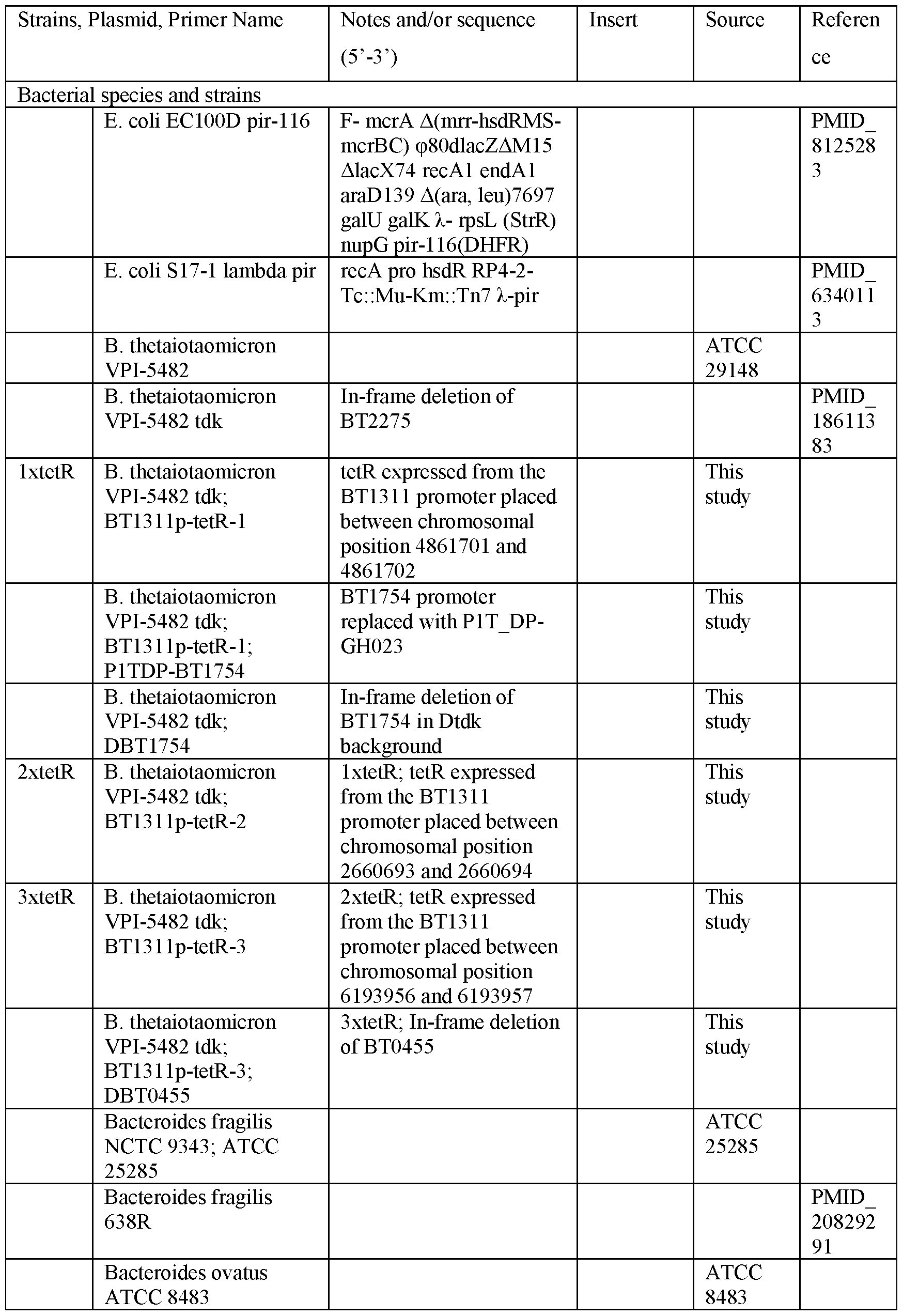 Bacteroides ovatus in-frame deletion of PMID ATCC 8483 tdk BACOVA 03071 244635
12
Bacteroides ovatus in-frame deletion of This
ATCC 8483 tdk; BACOVA 04598 (lpxF study
DBACOVA 04598 homologue)
Bacteroides ovatus BACOVA 04598 This
ATCC 8483 tdk; TetR- promoter replaced with study
P1T DP- TetR-PlT_DP-Bl
BACOVA 04598
Bacteroides uniformis ATCC
ATCC 8492 8492
Bacteroides vulgatus ATCC
ATCC 8482 8482
Bacteroides Isolate from human donor This PMID thetaiotaomicronl 1 study 214360
49
Bacteroides ovatus2 Isolate from human donor This PMID
2 study 214360
49
Bacteroides Isolate from human donor This PMID xylanisolvens3 3 study 214360
49
Bacteroides intestinalisl Isolate from human donor This PMID
1 study 214360
49
Bacteroides intestinalis3 Isolate from human donor This PMID
3 study 214360
49
Bacteroides intestinalis4 Isolate from human donor This PMID
4 study 214360
49
Bacteroides uniformis 1 Isolate from human donor This PMID
1 study 214360
49
Bacteroides uniformis3 Isolate from human donor This PMID
3 study 214360
49
Bacteroides uniformis4 Isolate from human donor This PMID
4 study 214360
49
Bacteroides fragilis4 Isolate from human donor This PMID
4 study 214360
49
Bacteroides dorei2 Isolate from human donor This PMID
2 study 214360
49
Bacteroides dorei3 Isolate from human donor This PMID
3 study 214360
49
Bacteroides vulgatus 1 Isolate from human donor This PMID
1 study 214360
49

GH023 tet02 study
pNBU2 erm PIT P- P1-GH023 RBS, This GH023 proximal tet02 study pNBU2 erm PIT DP- P1-GH023 RBS, distal This GH023 and proximal tet02 study pNBU2 erm P2- P2-GH023 RBS This GH023 study pNBU2 erm Pl- P1-GH023 RBS NanoLuc This GH023-NanoLuc study pNBU2 erm PIT D- P1-GH023 RBS, distal NanoLuc This GH023-NanoLuc tet02 study pNBU2 erm PIT C- P1-GH023 RBS, core NanoLuc This GH023-NanoLuc tet02 study pNBU2 erm PIT P- P1-GH023 RBS, NanoLuc This GH023-NanoLuc proximal tet02 study pNBU2 erm PIT DP- P1-GH023 RBS, distal NanoLuc This GH023-NanoLuc and proximal tet02 study pNBU2 erm P2- P2-GH023 RBS NanoLuc This GH023-NanoLuc study pNBU2 erm Pl- P1-GH023 RBS lpxF This GH023-lpxF study pNBU2 erm PIT D- P1-GH023 RBS, distal lpxF This GH023-lpxF tet02 study pNBU2 erm PIT C- P1-GH023 RBS, core lpxF This GH023-lpxF tet02 study pNBU2 erm PIT P- P1-GH023 RBS, lpxF This GH023-lpxF proximal tet02 study pNBU2 erm PIT DP- P1-GH023 RBS, distal lpxF This GH023-lpxF and proximal tet02 study pNBU2 erm P2- P2-GH023 RBS lpxF This GH023-lpxF study pNBU2 erm PIT DP- P1-GH023 RBS, distal Periplasmi This GH023-ss-btel and proximal tet02 c localized study btel under control of PIT DP
pNBU2 erm PIT DP- P1-GH023 RBS, distal Periplasmi This GH023-ss-bfel and proximal tet02 c localized study bfel under control of PIT DP
pNBU2 erm PIT DP- P1-A21 RBS, distal and This A21 proximal tet02 study pNBU2 erm PIT DP- P1-B1 RBS, distal and This Bl proximal tet02 study pNBU2_erm_PlT_DP- Pl^iL*_RBS, distal and This rpiL* proximal tet02 study pNBU2 erm PIT DP- P1-B41 RBS, distal and This B41 proximal tet02 study pNBU2 erm PIT DP- P1-B40 RBS, distal and This B40 proximal tet02 study pNBU2 erm PIT DP- P1-C56 RBS, distal and This C56 proximal tet02 study pNBU2_erm_PlT_DP- P1-A21 RBS, distal and NanoLuc This A21-NanoLuc proximal tet02 study


To first investigate the positional effects of the tet02 operators on basal gene expression in the absence of the TetR repressor, the native PI and P2 promoters, and each synthetic promoter, were fused to a standard Bacteroides RBS (GH023) (Wegmann, U. et al., 2013, Appl. Environ. Microbiol., 79: 1980-1989), followed by the NanoLuc luciferase gene as a reporter (Hall, M.P. et al., 2012, ACS Chem. Biol., 7: 1848- 1857). Integration of these constructs into the B. thetaiotaomicron genome in single copy at a standard location revealed luminescence approximately four orders of magnitude
higher than a control strain that lacks a promoter upstream of NanoLuc (Figure 1C). Placement of tet02 in the distal, core, and/or proximal regions of PI decreased promoter activity 1.8- to 6.8-fold (Figure 1C). Together, these results suggest that tet02 insertion affects promoter activity, but reporter activity remains 4,200-fold to 16,000-fold above background, depending on operator placement.
To test the function of native Bacteroides genes expressed under the control of these engineered promoters, the NanoLuc reporter was replaced with BT1854 (IpxF). LpxF is a phospholipid phosphatase that determines resistance to cationic antimicrobial peptides (including polymixin B; PMB) in Bacteroides, and deletion of IpxF in B. thetaiotaomicron reduces PMB resistance by four orders of magnitude (Cullen, T.W. et al., 2015, Science, 347: 170-175). Expression of IpxF under the control of the native PI, native P2, P I TD, P I TP, and P I TDP promoters in a B. thetaiotaomicron IpxF mutant increases PMB resistance to wildtype levels, while the PlTC-lpxF fusion does not (Figure ID).
Example 3 : A synthetic inducer modulates gene expression over a broad dynamic range
Next, a constitutive tetR cassette was integrated in a neutral (not required for fitness) location in the B. thetaiotaomicron genome to create Bt: :tetR (Figure 2A). Introduction of the panel of promoter-NanoLuc fusions (Figure IB) into Bt: :tetR revealed that while TetR has no effect on the activity of the native PI promoter, all of the tet02- containing promoters exhibit a significant decrease in activity in the presence of TetR (Figure 2B, red bars). Of these promoters, PI TDP shows the greatest repression by TetR, with reporter expression 6,800-fold above background in the absence of TetR (Figure 1C) and decreasing to within 4-fold of background levels when TetR is present (Figure 2B, red bars).
Addition of aTC (100 ng/mL) to strains constitutively expressing TetR derepresses each of the tetO2-containing promoters, producing reporter levels equivalent to those measured in strains lacking tetR (Figure 2B, green bars versus Figure 1C). This indicates that aTC readily reaches the Bacteroides cytoplasm. While the promoters with a single tet02 exhibit at most an 80-fold induction of reporter activity in the presence of aTC, promoter P I TDP increases luminescence over 2,000-fold in response to the inducer
(Figure 2B). Consistent with this result, introduction of the panel of promoter-lpxF fusions into an IpxF mutant constitutively expressing TetR {Bt: :tetR IpxF) revealed that TetR represses expression of the P I TDP-lpxF fusion to levels that reduce PMB MIC by over 10,000-fold, functionally equivalent to the absence of IpxF entirely (<0.064 μg/mL; Figure 2C). In strains carrying the other promoters, TetR expression also reduces PMB MIC, although some resistance remains (Figure 2C). Except for P1TC, addition of 100 ng/mL aTC restores PMB MIC to wildtype levels in each case (Figure 2C). Additional examination of the sensitivity and temporal dynamics of the system showed that P I TDP expression can be tuned over a 100-fold range in aTC concentration and induces in response to aTC within one round of cell division (Figure 8B and SIC). Together, these results highlight the utility of the PI TDP platform for stringent regulation of both exogenous and endogenous genes in B. thetaiotaomicron.
Example 4: Acquiring regulatory control of endogenous loci
Regulatory control of a gene or locus can be acquired by deleting gene(s) of interest and then returning the gene(s) under the control of an engineered promoter as shown for IpxF above. However, direct replacement of the native promoter provides an important one-step alternative, especially if there are complications in creating a gene deletion (e.g. essential genes; deletions that impact the regulation of neighboring genes) and/or complementation (e.g. long, multiple, or undefined operons; repeating or low- complexity sequences recalcitrant to amplification). The hybrid two-component sensor BT 1754 regulates a multi-gene polysaccharide utilization locus required for growth on fructose. The 200 base pairs upstream of BT 1754 was replaced with the 200 base pair P I TDP promoter (Figure 3 A) in ^tetR (designated £t: :tetR P1 TDPGH023-BT1754).
Growth of B X t P1 TDPGH023-BT1754 is entirely dependent on the addition of aTC in fructose but not glucose (Figure 3 A). Additionally, cell doubling rates in fructose can be readily tuned by varying aTC concentrations (Figure 3B). Together, these studies establish that the PI TDP system can be used to assume control of endogenous loci in Bacteroides.
Example 5 : Gene expression is tightly repressed in the absence of inducer
Tight control in the OFF state is a critical goal for engineered gene regulatory platforms. In theory, genes that encode highly deleterious proteins should be nonlethal under repressing conditions if tight control is achieved. The Type VI secretion system (T6SS)-delivered antibacterial effectors Btel and Bfel, encoded by B. fragilis strains NCTC 9343 and 638R, respectively, allow these strains to efficiently kill B.
thetaiotaomicron upon transient contact (Chatzidaki-Livanis, M. et al., 2016, Proceedings of the National Academy of Sciences, 113 :3627-3632; Wexler, A G. et al., 2016, Proceedings of the National Academy of Sciences, 113 :3639-3644). Translational fusions of each effector with an N-terminal periplasmic localization signal sequence ("ss") were constructed and placed these fusions under the control of P I TDP in Bt: :tetR (Figure 3C). Expression of ss-Btel or ss-Bfel in B. thetaiotaomicron is highly toxic, because addition of aTC results in immediate decreases in viability and culture density (Figure 3C and Figure 8D). Toxicity resulting from aTC-induced effector expression is likely a consequence of their underlying mechanism of action and not from
overproduction of a heterologous protein, as expression of either effector without a periplasmic signal sequence does not affect B. thetaiotaomicron viability (data not shown). In the OFF state (without aTC), growth of strains carrying PlTDP-ss-btel, PlTDP-ss-bfel, and the Bt: :tetR parental strain is equivalent (Figure 3C and Figure 8D). Together, these studies establish that the P I TDP platform provides strict repression of gene expression in the OFF state.
Example 6: An RBS panel extends the dynamic range of the Bacteroides inducible promoter to capture promoter activity levels observed across the i?. thetaiotaomicron transcriptome
Ribosome binding site (RBS) variation provides an additional layer of gene expression control to engineered promoters. The original RBS (GH023) in P I TDP was replaced with 6 alternate RBSs (designated P I TDP™8) (Mimee, M. et al., 2015, Cell Systems, 1 :62-71). The 6 RBSs modulate P I TDP promoter expression by three orders of magnitude, in a pattern generally similar to that previously reported for a native B.
thetaiotaomicron promoter (Figure 4A, Figure 9A, Figure 9B) (Mimee, M. et al., 2015, Cell Systems, 1 :62-71). RBS variation impacts expression in the induced and uninduced
state proportionally (Figure 9A and Figure 9B) and can extend the dynamic response to aTC: for example, P1TDPB40 provides negligible expression in the uninduced state (1.4- fold over background) which increases 9,100-fold when aTC is provided, a 3.3-fold increase over P1TDPGH023. Luminescence production from PI TDP-NanoLuc carrying each RBS is comparable between wildtype B. thetaiotaomicron and Bt: :tetR in the ON state, suggesting that varying the RBS does not disrupt promoter activation and that TetR repression is fully relieved in all RBS variants with the addition of aTC (Figure 4A; green bar vs grey bar). Together, this panel of RBS variants coupled to the P I TDP promoter further extends the range of expression to 320,000-fold (e.g., between P1TDPC56 in the OFF state and P 1 TDPA21 in the ON state).
To compare this range of expression to native promoter strengths in B. thetaiotaomicron, the NanoLuc reporter was fused to the promoters of 18 B.
thetaiotaomicron ORFs whose mRNA levels span the complete expression range of this organism in rich medium based on transcriptome studies (Sonnenburg, J.L. et al., 2005, Science, 307: 1955-1959) (Figure 4B). Luminescence production from these 18 promoter fusions is largely proportional to the previously reported mRNA levels of the
corresponding ORFs (Figure 9C). The P I TDP platform fully spans the range of native promoter activities, producing luminescence levels ranging from 14-fold higher than the strongest native promoter tested (P1TDPA21, ON state) to 6.7-fold lower than the weakest native promoter tested (P1TDPC56, OFF state) (Figure 4C). Notably, the expression range of P1TDPGH023 alone captures -86% of the 18 native B. thetaiotaomicron promoters tested, which corresponds to -97% of the transcriptome (Figure 4C). These results establish that the PI TDP platform provides the capacity to express Bacteroides proteins to their native levels.
Example 7: Evaluation and performance of the P I TDP platform in different Bacteroides species
To facilitate gene expression control across species, a self-contained, -lkb inducible expression cassette was built (designated TetR-PlTop) in which tetR is expressed from the P2A21 promoter and oriented in the opposite direction from
P1TDPGH023, thereby providing the ability to artificially regulate gene expression in
unmodified strains of multiple species in a single step (Figure 5). TetR-PlTDP - NanoLuc reporter fusions displayed robust induction over 3 orders of magnitude in an aTC-dependent manner in 6 different Bacteroides type strains representing 5 species (Figure 5, underlined). The cassette was also introduced into 15 additional Bacteroides isolates (representing 11 different species) cultured directly from 4 unrelated human donors. These isolates encode diverse 16S rRNA gene sequences and exhibit doubling times ranging from 38 to 137 minutes in rich medium, consistent with a broad range of phylogeny and physiology (Figure 5). The TetR-PlTDPGH023-NanoLuc cassette could be readily introduced into all isolates, and each exhibited robust induction of luminescence in an aTC-dependent manner (Figure 5).
To further test the cross-species performance of TetR-PlTDP, this platform was used to acquire regulatory control of an endogenous gene in wildtype B. ovatus. To this end, the lpxF homolog in B. ovatus was identified (BACOVA 04598) and the 62 base pairs upstream of this gene were replaced with the TetR-PlTDPB1 cassette (Figure 10A). With this one-step promoter replacement, PMB resistance becomes entirely dependent on aTC (Figure 10B). Together, these results indicate that the key
requirements of the P I TDP regulatory system - comprising the P I and P2 promoters, tet02 operator sequences, TetR repressor, and responsiveness to aTC - are widely functional across this genus, in both type strains and novel isolates.
Example 8: Control of B. thetaiotaomicron gene expression in the mouse gut
A central design element of the PI TDP platform is the use of a synthetic inducer that should be absent from mammalian intestinal tissue and diet. To test this system in vivo, aTC was first introduced at a concentration that does not adversely affect mouse health (100 μg/mL) (Kotula, J.W. et al., 2014, Proceedings of the National
Academy of Sciences, 111 :4838-4843) for 4 days into the drinking water of gnotobiotic mice carrying wildtype B. thetaioatomicron. Liquid chromatography -mass spectrometry (LC-MS)-based quantification of aTC in fecal pellets reveals that the inducer is undetectable prior to exogenous addition, is readily detected within 24 hours of its addition to drinking water, and is again undetectable 6 days after its removal from the water, exhibiting a half-life of 19 hours in vivo (Figure 11). Germfree mice given the
same regime of aTC administration rapidly show comparable aTC levels in fecal pellets (data not shown), indicating that B. thetaiotaomicron does not degrade aTC in vivo.
To directly test the function of the P I TDP platform in the context of the mammalian gut, groups of germfree mice were colonized with B . etK P1TDPGH023- NanoLuc. On days 3-5 and 17-19, aTC was added to the drinking water and promoter activity quantified by measuring luminescence in fecal pellets over time and along the length of the gut at day 19. Within 24 hours of aTC addition (the first timepoint after induction), luminescence in fecal pellets increased ~1, 000-fold (Figure 6A, red line). When aTC was removed, luminescence returned to levels observed in fecal pellets of mice colonized with wildtype B. thetaiotaomicron (Figure 6 A, grey dashed line and shading), indicating that the promoter returns to a tight OFF state upon inducer removal in vivo (NanoLuc half-life of 3-4 days; complete repression 9 days after aTC removal). The longer half-life of luminescence versus aTC is likely due to the high stability of the engineered Nanoluc protein (Hall, M.P. et al., 2012, ACS Chem. Biol., 7: 1848-1857). By contrast, mice colonized with Bt: :tetR P 1 TDPGH023 -NanoLuc and maintained for the same time period without aTC exhibit no induction of luminescence (Figure 6A, black line). This engineered system and aTC exposure do not impact B. thetaiotaomicron stability in the gut (Figure 12 A), and the kinetics and magnitude of induction are identical each time aTC is provided and are highly reproducible across mice (Figure 6A). Administration of lower aTC concentrations to mice carrying the reporter strain resulted in the induction of intermediate luminescence measurements within 24 hours, with detectable responses starting at 0.2-0.5 μg/mL aTC (Figure 6A). The response of PI TDP to aTC inside the gut can be accurately described using a sigmoidal function (R2 = 0.952) (Figure 6B), suggesting that 100 μg/mL aTC provides maximal gene induction in vivo. Modulation of gene expression by varying aTC concentrations is recapitulated in the distal small intestine, cecum and throughout the large intestine (Figure 12B, and Figure 12C).
To test the function of P I TDP platform in the context of a complex microbiota, germ-free mice were colonized with a community consisting of Bt .tetK P1TDPGH023 -NanoLuc and 13 additional microbial species representative of the 3 dominant phyla found in the human gut. In this community context, Bt: :tetR P1TDPGH023- NanoLuc represented ~11% of the total community (~3xl0u CFU/mL) based on strain-
and species-specific qPCR analysis on DNA isolated from fecal pellets and selective culturing (Figure 12A, and Figure 12D). Prior to aTC addition (days 1-3), fecal pellets exhibited no induction of luminescence (compared to luminescence measurements from mice monocolonized with wildtype B. thetaiotaomicron; Figure 6C, grey dashed line and shading), indicating that this human community does not produce compounds that activate P I TDP. Within 24 hours of administering 100 μg/mL aTC (day 4), luminescence in fecal pellets increased -4,500-fold, and was stable throughout aTC administration (days 4-5). Fecal luminescence returned to baseline levels after removing the inducer, with complete repression 7-9 days after removal. Alpha and beta diversity analyses of these communities over the 19-day experiment indicate that the presence of aTC did not impact community structure (Figure 12D, Figure 12E, Figure 12F). Additionally, CFU measurements of B . etK P l TDPGH023-NanoLuc were unchanged throughout the experiment (Figure 12 A), indicating that increases in luminescence are due to in vivo gene modulation in the target organism, not changes in the relative or absolute abundance of this species in the community.
The performance of the P I TDP platform was further interrogated within a complete microbiota. Like most human gut Bacteroides, B. thetaiotaomicron is rapidly outcompeted in conventional, specific pathogen-free (SPF) wildtype mice that harbor a native murine microbiota. However, this species stably colonizes conventional, SPF Rag" animals at -0.2-0.5% of the total community, similar to its natural abundance in humans (Cullen, T.W. et al., 2015, Science, 347: 170-175; Lee, S.M. et al., 2014, Nature, 501 :426-429). Conventional Rag_/" mice were gavaged with Bt: :tetR P1TDPGH023- NanoLuc and aTC administered for 48 hours beginning 3 days after gavage.
Luminescence in fecal pellets prior to aTC administration (days 1-3) was similar to that observed in fecal pellets before Bt: :tetR Pl TDPGH023-NanoLuc was introduced, demonstrating tight repression in the absence of aTC (Figure 6D, grey dashed line and shading). Addition of aTC to the drinking water resulted in a -4,800-fold increase in fecal luminescence which was sustained for the duration of aTC administration and returned to baseline levels 3 days after aTC removal, suggesting that a complete murine microbiota does not produce any inducing molecules, degrade aTC, nor inhibit the ability of the P I TDP platform to activate and repress optimally. Further, aTC does not affect the
stability of B. thetaiotaomicron in a complete murine microbiota (Figure 12A). These results demonstrate that the P I TDP platform enables predictable tuning of gene expression within the microbiota in vivo. Example 9: Inducible expression platforms reveal new dynamics of host-microbiome interactions
To demonstrate the utility of this system, sialic acid (N-acetylneuraminic acid), a sugar liberated from the gut mucosa by sialidases expressed by certain commensal bacteria lacking the necessary enzymes for sialic acid catabolism, was focused on. Free sialic acid is a nutrient source for the antibiotic-associated enteric pathogens Clostridium difficile and Salmonella typhimurium, and can determine pathogen burden in mouse models (McDonald, N.D. et al., 2016, mBio, 7:e02237-15; Ng, K.M., et al., 2013, Nature, 502:96-99). Mucosal glycoproteins carrying sialic acid also serve as viral receptors (Wasik, B.R. et al., 2016, Trends in Microbiology, 24:991-1001). Despite this broad importance, how commensal sialidase activity determines sialic acid levels in the gut lumen is unexplored. While a healthy microbiota has been reported to produce low levels of free sialic acid, at least one antibiotic formulation alters the community to increase luminal sialic acid concentrations, creating a pathogen-sensitive state (Ng, K.M., et al., 2013, Nature, 502:96-99). It is unknown whether antibiotic-induced sialic acid release reflects a specific reconfiguration of the microbiota dependent on the initial community composition and antibiotics used, or instead is a result of fundamental properties of this microbiome-host interaction.
As previously reported (Ng, K.M., et al., 2013, Nature, 502:96-99), B. thetaiotaomicron efficiently liberates sialic acid from the gut mucosa of monoassociated gnotobiotic mice; this activity is dependent on the B. thetaiotaomicron sialidase BT0455 (Figure 13 A). To understand how commensal sialidase activity modifies the gut environment, BT0455 was placed under the control of the P1TDPGH023 promoter
(Bt: :3xtetR BT0455 P1TDPGH023-BT0455, abbreviated BtRS for regulated sialidase; Figure 13B). Germfree mice were colonized with BtRS (or 5t::3xtetR or 5t::3xtetR BT0455 controls) and fecal samples collected daily before and after 12 hours of aTC induction via drinking water. Quantification of aTC in fecal pellets by LC-MS revealed that inducer
levels spike within 12 hours of administration and become undetectable 24 hours later (Figure 7A).
To measure sialidase enzyme activity, cell-free lysates from fecal samples were incubated with the artificial substrate 2-0-(p-Nitrophenyl)-tropheacetylneuraminic acid (pNP-SA), which is hydrolyzed by sialidases, and the subsequent release of the pNP moiety was monitored over time by LC-MS. pNP-SA was provided in 10-fold molar excess to its Km (Km = 0.11 mM) (Park, K.H. et al., 2013, BBA - Proteins and
Proteomics, 1834: 1510-1519) in order to ensure direct proportionality between the calculated initial reaction velocity and the sialidase concentration in each sample (Figure 13C). Prior to aTC administration, fecal samples from mice carrying BtRS show no detectable sialidase activity, indicating tight repression of the enzyme and the absence of pNP in the gut (Figure 7B and Figure 13E). After induction, sialidase activity of BtRS- associated mice became equivalent to the control strain expressing BT0455 from its native promoter, suggesting that the P I TDP platform expressed the gene to wildtype levels (Figure 7B). Sialidase activity was again undetectable 4 days after aTC removal (Figure 7B). By contrast, fecal samples from control mice monocolonized with wildtype or BT0455 B. thetaiotaomicron strains exhibit constitutive or no sialidase activity, respectively (Figure 13D).
LC-MS/MS was next used to quantify free sialic acid liberated from the host mucosa in the same fecal pellets. Consistent with the ex vivo sialidase activity results, prior to aTC treatment, mice colonized with BtRS had low levels of fecal sialic acid, equivalent to germfree animals or those colonized with the BT0455 deletion mutant (Figure 7C, Figure 13 A, and Figure 13E). After aTC was provided in drinking water, fecal sialic acid levels in BtRS mice were equivalent to mice colonized with wildtype B. thetaiotaomicron (Figure 7C, Figure 13 A, and Figure 13E). The inducer was not directly responsible for sialic acid release, because mice colonized with the BT0455 deletion mutant had no increase in fecal sialic acid upon aTC administration (Figure 13 A and Figure 13E). Strikingly, significant levels of sialic acid persisted in BtRS animals for multiple days after both inducer and sialidase activity were no longer detectable (Figure 7C, grey shading). Consistent with this result, exogenous sialic acid delivered by oral gavage to gnotobiotic mice monocolonized with B. thetaiotaomicron BT0455 exhibits a
half-life of ~ 9 hours (Figure 13F). Together, these results indicate that the levels of this microbiome-dependent metabolite reflect not only the current activity of the microbiota, but also its activity from days before.
BtRS dynamically modulates sialidase expression in response to changing inducer levels, providing the opportunity to compare sialidase activity and fecal sialic acid concentration in vivo as aTC is eliminated from the gut and sialidase gene expression changes accordingly (Figure 7D). At low levels of sialidase activity, fecal sialic acid scales in proportion to enzyme activity. However, this relationship becomes non-linear once sialidase activity exceeds 25% of the maximum: regardless of sialidase levels, free sialic acid concentration remains constant (Figure 7D). This suggests that in microbial communities exhibiting at least 25% of the enzyme activity of B. thetaiotaomicron, substrate availability (i.e., the host), not community enzyme activity, is the limiting factor that determines free sialic acid levels. Indeed, activity measured in fecal samples from wildtype SPF (conventional) mice reveals high levels of sialidase activity and
intermediate levels of free sialic acid, suggesting that the liberation of sialic acid from the mucosa of these animals is substrate (host)-limited and not enzyme-limited. By contrast, catabolism of free sialic acid is likely enzyme (microbe)-limited, as the substrate of this reaction (sialic acid) is readily detectable in SPF animals (Figure 7D). In this way, these results using precise modulation of a single microbiome-encoded activity in vivo suggest that it is not necessary for antibiotics to reconfigure the microbiota in any specific manner in order to increase free sialic acid levels: instead, even general antibacterial activity can reduce sialic acid catabolism without a proportional impact on the sialic liberation from the host, shifting the community into an increasingly pathogen-sensitive state.
The lack of genetic tools for gut anaerobes and the incompatibility of genetic parts from model organisms are significant obstacles in the microbiome field. Inducible promoters are particularly valuable, because the ability to activate or prevent the expression of target genes over one or more time intervals allows real-time analysis of the contribution of these genes over the course of microbiome establishment, host development, or disease progression (Rogers, J.K. et al., 2015, Nucleic Acids Research, 43 :7648-7660). Tightly regulated, highly inducible expression platforms also provide the basis for more complex synthetic architectures.
Herein, a panel of tunable expression platforms that allow Bacteroides gene expression to be strictly controlled by the presence of a synthetic inducer not found in bacterial growth media, mouse intestines or diets, or the human and mouse microbial communities tested in this study were developed. In the absence of inducer, gene expression is repressed to levels that recapitulate the phenotypes of strains lacking the target gene. When aTC is provided, individual promoters within this panel exhibit up to a
104- fold dynamic range of expression, and promoter activity across the panel ranges 3 x
105- fold. This dynamic control of gene repression and expression are recapitulated or even exceeded in mice, and investigation of sialic acid provides a first example of insights gained from manipulating a host-microbe interaction by tuning expression of a single gene in the microbiome.
Variations in TetR-regulated promoters expand the versatility, range, and regulatory properties of this system (Bertram, R. et al., 2008, Microbial Biotechnology, 1 :2-16; Hillen, W. et al., 1994, Annu. Rev. Microbiol., 48:345-369). For example, modifications of TetR have been identified that alter its specificity for tetracycline analogs (Henssler, E.-M. et al., 2004, Biochemistry, 43 :9512-9518; Scholz, O. et al., 2003, Journal of Molecular Biology, 329:217-227), change its allosteric interactions so that aTC acts as a corepressor (Kamionka, A. et al., 2004, Nucleic Acids Research, 32:842-847; Scholz, O. et al., 2004, Mol. Microbiol., 53 :777-789), or change its operator specificity to selectively recognize distinct tetO variants (Helbl, V. et al., 1998, Journal of Molecular Biology, 276:313-318; Helbl, V. et al., 1998, Journal of Molecular Biology, 276:319-324; Krueger, M. et al., 2007, Gene, 404:93-100). These modifications considerably expand the range of conceivable applications of TetR-regulated systems and increase the possibilities for multi-gene regulation within Bacteroides.
The absence of aTC or related molecules in mice, their diets, or the microbial community allows precise control of Bacteroides gene expression in vivo, potentially enabling on-demand delivery of therapeutic compounds. The tetracycline analog doxycycline is highly stable and binds tightly to TetR, and has been administered to mice for several months at a time (Bohl, D. et al., 1998, Blood, 92: 1512-1517;
Manfredsson, F.P. et al., 2009, Molecular Therapy, 17: 1857-1867). The use of tetracycline analogs that differ in stability and sensitivity to host metabolism,
bioavailability and excretion will increase the options for fine temporal control in microbiome studies. Additionally, administering inducers through different routes (orally via water, diet, or time- or pH-dependent delayed release capsules (Cetin, M. et al., 2011, Pharmaceutical Development and Technology, 18:570-576); via enema; or surgically through catheterization of specific locations in the GI tract) will allow additional means to precisely tune gene expression in a spatially restricted manner. Lastly, the use of a synthetic inducer to alter gene expression will enable functional and kinetic studies of the microbiome in a matter that does not itself perturb the dynamics of microbial metabolism, growth, and community composition as could be anticipated from the administration of dietary polysaccharides or sugars. Further, changes in host diet and its component polysaccharides are unlikely to impact reporter function.
This regulated expression platform was designed using general principles that should apply across the microbiome (Figure 14), and provides a route for regulated gene expression in other prominent genera from the human gut microbiome and in microbes that inhabit other body regions or habitats. These genetic platforms could potentially be combined with important recent developments (Kotula, J.W. et al., 2014, Proceedings of the National Academy of Sciences, 111 :4838-4843; Mimee, M. et al., 2015, Cell Systems, 1 :62-71) and will enable progress in understanding the biochemical and ecological processes that contribute to the homeostasis of the intestinal microbiome and its impact on host health and disease.
Example 10: Inducible expression platforms reveal new dynamics of host-microbiome interactions
This invention also enables a novel approach for genome engineering. This novel approach allows precise, markerless genome editing of wildtype bacteria directly isolated from humans, and unlike currently available methods, does not require any prior genetic manipulation.
Current methods for performing deletions in Bacteroides involve counterselection strategies that utilize genes that are lethal to the host strain under specific conditions. These include using the thymidine kinase gene (tdk) which is sensitive to 5-fluoro-2'-deoxyuridine (FUDR) or thymidylate synthetase gene (thy A) that
is sensitive to trimethoprim. Both of these strategies require the host to have mutations in either of the genes (tdk, thy A) used for counterselection and that these mutants show sensitivity to FUDR or trimethoprim. Another strategy shown to be an option for counterselection in Bacteroides fragilis and Bacteroides thetaiotaomicron utilizes a mutated pheS* (the a-subunit of phenylalanyl tRNA synthase) which causes toxicity in the presence of p-chloro-phenylalanine (p-Cl-phe). However, production of pheS* has not worked in rich media, requiring that the species be culturable in minimal defined media. Thus the limitations to this approach include host strain susceptibility to mutant pheS*, and limited growth media conditions. Out of all the reported strategies, there exists no method for genetic deletions in Bacteroides that allow for deletions in wild-type host strains with a broadly applicable counter-selection method that could be used in not only type strains but also wild or clinical isolates of Bacteroides sp.
The tunable expression platform described in this invention allows for strictly controlled gene expression of Bacteroides species in the presence of a synthetic inducer aTC. It was shown that this expression platform can be coupled to expression of toxic effectors from the Bacteroides Type VI secretion system (or other toxic proteins). These effectors are highly toxic to bacterial species that do not express immunity genes to combat the effector toxicity. It was shown that expression of two of these effectors (Btel and Bfel), both encoded by B. fragilis strains NCTC 9343 and 638R, respectively, remain tightly controlled in the engineered expression system. In the absence of the inducer, aTC, these lethal genes are not expressed allowing normal growth of Bacteroides sp. containing a plasmid with the inducible promoter driving expression of these effectors. In the presence of aTC, toxicity is apparent through immediate decrease in cell viability.
Taking advantage of the tightly controlled inducible promoter and the strength of these toxic effectors, non-replicating (suicide) plasmids were built with the following components: one or two toxic effectors under the control of the aTC inducible promoter system; a constitutively expressed gene encoding the TetR repressor; a multiple cloning site for introduction of target alleles (for deletion, insertion, or modification of nucleotide sequences); selectable markers for E. coli and Bacteroides. The number and choice of effectors (including any effector secreted by the Type VI secretion system in
Bacteroides or other organisms, bacteriocins, or other toxic proteins) can be readily substituted as part of the invention. These plasmids, pNABl and pNAB2, are capable of inserting into a target genetic site by homologous recombination with the target allele in the plasmid. Because aTC is absent, no toxicity is observed. Upon introduction of the inducer, aTC, these plasmids express the toxic effectors and only those cells that have undergone a second homologous recombination (to create a mutant or revertant) remain. In contrast to the TDK approach, (1) the host Bacteroides strain does not need to be modified in any way (e.g., the strain does not need to a tdk or other mutant), (2) the toxic effectors are highly potent toxins that show broad toxicity across species, (3) the suicide plasmid is highly modular and with multiple effectors available in the Type VI secretion system different effectors could be substituted based on their effectiveness in the target bacteria of interest. In addition, the presence of 2 effectors in pNAB2 circumvents mutations to disrupt their toxicity. Plasmid maps of pNABl and pNAB2 are shown in Figure 16.
The utility of this system is demonstrated in multiple proof-of-principle studies in wild-type strains of Bacteroides thetaiotaomicron and Bacteroides vulgatus. This is a novel strategy as markerless deletions in wild type Bacteroides sp. in rich media has not been done before and genetic modification of wild type Bacteroides vulgatus has never been reported. As a proof of principle, the gene lpxF which is responsible for resistance of Bacteroides thetaiotaomicron to the antimicrobial peptide Polymyxin B (PMB) was deleted from wildtype B. theta with both pNABl and pNAB2. Deletions were confirmed by PCR and mutants also exhibited loss of PMB resistance when grown on plates with PMB.
As a second proof of principle, the lpxF homolog was deleted and also the arnT homolog from Bacteroides vulgatus using pNAB2 (Figure 17). These experiments have shown deletions of two separate genes in two independent Bacteroides species using this invention.
This system provides a much needed tool in Bacteroides genetics. The field has been very limited in its ability to perform genetics with wild type species due to limitations in deletion strategies. This deletion strategy provides a broadly applicable, tightly controlled system that would allow for genetic deletions in Bacteroides sp.,
including direct isolates from humans or other animals, that previously had no method for obtaining such mutants. The ability to work in wild type species instead of a mutant host bacteria eliminates any consequences known or unknown to having the host previously modified. By contrast, the TDK and other systems require the use of a genetically modified parent strain, which adds a difficult engineering step; further, studies of the modified parent strain are compromised by the TDK or other deletion that impacts other aspects of bacterial biology. The future implications of this system include the ability to perform deletions in a wide variety of Bacteroides sp. but also the ability to study genetics in wild isolates or clinical isolates in which very little is known. It will help provide insight into properties of clinical isolates that are not able to be studied in lab adapted strains.
The disclosures of each and every patent, patent application, and publication cited herein are hereby incorporated herein by reference in their entirety. While this invention has been disclosed with reference to specific embodiments, it is apparent that other embodiments and variations of this invention may be devised by others skilled in the art without departing from the true spirit and scope of the invention. The appended claims are intended to be construed to include all such embodiments and equivalent variations.
Claims
1. An isolated nucleic acid molecule comprising an inducible synthetic promoter variant of the Bacteroides 16S rDNA promoter.
2. The isolated nucleic acid molecule of claim 1, wherein the inducible synthetic promoter comprises one or more repressor response elements.
3. The isolated nucleic acid molecule of claim 2, wherein the repressor response element comprises tet02.
4. The isolated nucleic acid molecule of claim 1, wherein the inducible synthetic promoter comprises a ribosomal binding site (RBS).
5. The isolated nucleic acid molecule of claim 4, wherein the RBS is selected from the group consisting of GH023, A21, B l, rpiL, B41, B40, and C56.
6. The isolated nucleic acid molecule of claim 1, wherein the inducible synthetic promoter comprises a nucleic acid sequence selected from the group consisting of SEQ ID NO: 12, SEQ ID NO: 13, SEQ ID NO: 14, SEQ ID NO: 15, SEQ ID NO: 24, SEQ ID NO: 25, SEQ ID NO: 26, SEQ ID NO: 27, SEQ ID NO: 28, and SEQ ID NO: 29.
7. The isolated nucleic acid molecule of claim 1, wherein the inducible synthetic promoter is operably linked to a coding region.
8. The isolated nucleic acid molecule of claim 7, wherein the coding region encodes a therapeutic RNA or peptide.
9. The isolated nucleic acid molecule of claim 7, wherein the coding region encodes a toxic protein or peptide.
10. An expression cassette comprising an inducible synthetic promoter variant of the Bacteroides 16S rDNA promoter.
11. The expression cassette of claim 10, wherein the inducible synthetic promoter comprises one or more repressor response elements.
12. The expression cassette of claim 10, further comprising a nucleotide sequence encoding a repressor.
13. The expression cassette of claim 12, wherein the repressor comprises tetR or a variant thereof.
14. A cell modified for inducible gene expression comprising a nucleic acid molecule comprising an inducible synthetic promoter variant of the Bacteroides 16S rDNA promoter.
15. The cell of claim 14, wherein the inducible synthetic promoter comprises one or more repressor response elements.
16. The cell of claim 14, wherein the cell is modified to express a repressor.
17 The cell of claim 16, wherein the repressor comprises tetR.
18 The cell of claim 14, where in the cell is a bacterial cell.
19. The cell of claim 18, wherein the bacterial cell is of the genus
Bacteroides.
20. A method of inducing gene expression in a cell comprising:
providing a cell comprising a nucleic acid molecule comprising an inducible synthetic promoter variant of the Bacteroides 16S rDNA promoter operably linked to a coding region; and
contacting the cell with an inducer.
21. The method of claim 20, wherein the inducible synthetic promoter comprises one or more repressor response elements.
22. The method of claim 21, wherein the cell is modified to express a repressor, thereby inhibiting expression of the coding region.
23. The method of claim 22, wherein the inducer inhibits the activity of the repressor, thereby inducing expression of the coding region.
24. The method of claim 20, wherein the inducible synthetic promoter comprises a nucleic acid sequence selected from the group consisting of SEQ ID NO: 12, SEQ ID NO: 13, SEQ ID NO: 14, SEQ ID NO: 15, SEQ ID NO: 24, SEQ ID NO: 25, SEQ ID NO: 26, SEQ ID NO: 27, SEQ ID NO: 28, and SEQ ID NO: 29.
25. A method of inducing at least one mutation in a cell comprising:
providing a cell comprising a nucleic acid molecule comprising an inducible synthetic promoter variant of the Bacteroides 16S rDNA promoter operably linked to a coding region encoding at least one protein or peptide that is toxic to the cell; and
contacting the cell with an inducer.
26. The method of claim 25, wherein the inducible synthetic promoter comprises one or more repressor response elements.
27. The method of claim 26, wherein the nucleic acid molecule further comprises a nucleotide sequence for expression of a repressor protein under the control of a constitutive promoter, thereby inhibiting expression of the at least one protein or peptide that is toxic to the cell.
28. The method of claim 27, wherein the inducer inhibits the activity of the repressor, thereby inducing expression of the at least one protein or peptide that is toxic to the cell.
29. The method of claim 25, wherein the inducible synthetic promoter comprises a nucleic acid sequence selected from the group consisting of SEQ ID NO: 12, SEQ ID NO: 13, SEQ ID NO: 14, SEQ ID NO: 15, SEQ ID NO: 24, SEQ ID NO: 25, SEQ ID NO: 26, SEQ ID NO: 27, SEQ ID NO: 28, and SEQ ID NO: 29.
30. The method of claim 25, wherein at least one protein or peptide that is toxic to the cell is selected from the group consisting of Btel and Bfel .
31. The method of claim 25, wherein the nucleic acid molecule comprises a nucleotide sequence selected from the group consisting of SEQ ID NO:99 and SEQ ID NO: 100.
32. The method of claim 25, wherein the nucleic acid molecule further comprises at least one nucleotide sequence homologous to a target nucleotide sequence.
Priority Applications (1)
| Application Number | Priority Date | Filing Date | Title |
|---|---|---|---|
| US16/606,278 US11549115B2 (en) | 2017-04-18 | 2018-04-18 | Compositions and methods for regulated gene expression |
Applications Claiming Priority (2)
| Application Number | Priority Date | Filing Date | Title |
|---|---|---|---|
| US201762486526P | 2017-04-18 | 2017-04-18 | |
| US62/486,526 | 2017-04-18 |
Publications (1)
| Publication Number | Publication Date |
|---|---|
| WO2018195136A1 true WO2018195136A1 (en) | 2018-10-25 |
Family
ID=63856928
Family Applications (1)
| Application Number | Title | Priority Date | Filing Date |
|---|---|---|---|
| PCT/US2018/028056 Ceased WO2018195136A1 (en) | 2017-04-18 | 2018-04-18 | Compositions and methods for regulated gene expression |
Country Status (2)
| Country | Link |
|---|---|
| US (1) | US11549115B2 (en) |
| WO (1) | WO2018195136A1 (en) |
Cited By (3)
| Publication number | Priority date | Publication date | Assignee | Title |
|---|---|---|---|---|
| CN111944808A (en) * | 2019-05-16 | 2020-11-17 | 武汉臻智生物科技有限公司 | Use of ribosomal RNA promoter for strong promotion of expression of non-RNA genes |
| WO2024085539A1 (en) * | 2022-10-17 | 2024-04-25 | 한국생명공학연구원 | Episomal vector operating in bacteroides spp. |
| US12421518B2 (en) | 2018-12-10 | 2025-09-23 | Tenza, Inc. | Methods and compositions for treating hyperoxaluria |
Families Citing this family (2)
| Publication number | Priority date | Publication date | Assignee | Title |
|---|---|---|---|---|
| WO2023107464A2 (en) * | 2021-12-07 | 2023-06-15 | Cornell University | Methods and compositions for genetically modifying human gut microbes |
| CN115369179A (en) * | 2022-10-08 | 2022-11-22 | 深圳盛源生物技术有限公司 | Kit and method for rapidly detecting KPC-2 |
Citations (1)
| Publication number | Priority date | Publication date | Assignee | Title |
|---|---|---|---|---|
| WO2016201174A2 (en) * | 2015-06-10 | 2016-12-15 | Massachusetts Institute Of Technology | Gene expression in bacteroides |
Family Cites Families (1)
| Publication number | Priority date | Publication date | Assignee | Title |
|---|---|---|---|---|
| EP4023750A1 (en) | 2013-07-01 | 2022-07-06 | Massachusetts Institute of Technology | Functionalization of endogenous bacteria |
-
2018
- 2018-04-18 US US16/606,278 patent/US11549115B2/en active Active
- 2018-04-18 WO PCT/US2018/028056 patent/WO2018195136A1/en not_active Ceased
Patent Citations (1)
| Publication number | Priority date | Publication date | Assignee | Title |
|---|---|---|---|---|
| WO2016201174A2 (en) * | 2015-06-10 | 2016-12-15 | Massachusetts Institute Of Technology | Gene expression in bacteroides |
Non-Patent Citations (3)
| Title |
|---|
| LIM, B ET AL.: "Engineered Regulatory Systems Modulate Gene Expression of Human Commensals in the Gut", CELL, vol. 169, 20 April 2017 (2017-04-20), pages 547 - 558, XP055541436 * |
| MASTROPAOLO, MD ET AL.: "Comparison of Bacteroides thetaiotaomicron and Escherichia coli 16S rRNA Gene Expression Signals", MICROBIOLOGY, vol. 155, 2009, pages 2683 - 2693, XP055432384 * |
| REY, FE ET AL.: "Dissecting the in Vivo Metabolic Potential of Two Human Gut Acetogens", THE JOURNAL OF BIOLOGICAL CHEMISTRY, vol. 285, no. 29, 5 May 2010 (2010-05-05), pages 22082 - 22090, XP055541432 * |
Cited By (3)
| Publication number | Priority date | Publication date | Assignee | Title |
|---|---|---|---|---|
| US12421518B2 (en) | 2018-12-10 | 2025-09-23 | Tenza, Inc. | Methods and compositions for treating hyperoxaluria |
| CN111944808A (en) * | 2019-05-16 | 2020-11-17 | 武汉臻智生物科技有限公司 | Use of ribosomal RNA promoter for strong promotion of expression of non-RNA genes |
| WO2024085539A1 (en) * | 2022-10-17 | 2024-04-25 | 한국생명공학연구원 | Episomal vector operating in bacteroides spp. |
Also Published As
| Publication number | Publication date |
|---|---|
| US11549115B2 (en) | 2023-01-10 |
| US20210115455A1 (en) | 2021-04-22 |
Similar Documents
| Publication | Publication Date | Title |
|---|---|---|
| Lim et al. | Engineered regulatory systems modulate gene expression of human commensals in the gut | |
| Liu et al. | SmpB down-regulates proton-motive force for the persister tolerance to aminoglycosides in Aeromonas veronii | |
| US11549115B2 (en) | Compositions and methods for regulated gene expression | |
| Girinathan et al. | Pleiotropic roles of Clostridium difficile sin locus | |
| KR20170121291A (en) | Engineered bacteria to treat diseases that benefit from reduced intestinal inflammation and / or enhanced intestinal mucosal barriers | |
| US20230287439A1 (en) | Pathway integration and expression in host cells | |
| Kakirde et al. | Gram negative shuttle BAC vector for heterologous expression of metagenomic libraries | |
| Vergara-Irigaray et al. | RNA-seq analysis of the influence of anaerobiosis and FNR on Shigella flexneri | |
| Mulder et al. | Construction of an artificial secYEG operon allowing high level secretion of α-amylase | |
| US10961513B2 (en) | Methods and compositions for recombinase-based genetic diversification | |
| JP2024028933A (en) | Auxotrophic strains of bacteria of the genus Staphylococcus | |
| Dokpikul et al. | Regulation of the cobalt/nickel efflux operon dmeRF in Agrobacterium tumefaciens and a link between the iron-sensing regulator RirA and cobalt/nickel resistance | |
| JP2021531039A (en) | Bacterial conjugation system and its therapeutic use | |
| Nácher-Vázquez et al. | Dextransucrase expression is concomitant with that of replication and maintenance functions of the pMN1 plasmid in Lactobacillus sakei MN1 | |
| Lo Sciuto et al. | Generation of stable and unmarked conditional mutants in Pseudomonas aeruginosa | |
| Xiong et al. | A comprehensive understanding of the influence and molecular mechanism of exeA on the pathogenicity in Aeromonas hydrophila | |
| Veselova et al. | Quorum sensing systems of regulation, synthesis of phenazine antibiotics, and antifungal activity in rhizospheric bacterium Pseudomonas chlororaphis 449 | |
| Zhang et al. | Role of plnB gene in the regulation of bacteriocin production in Lactobacillus paraplantarum L-XM1 | |
| Albicoro et al. | Comparative proteomic analysis revealing actJ-regulated proteins in Sinorhizobium meliloti | |
| Yuan et al. | Complex transcriptional regulation of citrate metabolism in Clostridium perfringens | |
| Rojas et al. | Infection-associated gene regulation of L-tartrate metabolism in Salmonella enterica serovar Typhimurium | |
| Bednarz et al. | The gamma-butyrolactone receptors ScbR and AtrA form a quorum sensing switch between coelimycin and actinorhodin synthesis in Streptomyces coelicolor A3 (2) | |
| Koomen et al. | Ribosomal mutations enable a switch between high fitness and high stress resistance in Listeria monocytogenes | |
| Zappa et al. | The HmrABCX pathway regulates the transition between motile and sessile lifestyles in Caulobacter crescentus by a HfiA-independent mechanism | |
| van Zyl et al. | Engineering resistance to phage GVE3 in Geobacillus thermoglucosidasius |
Legal Events
| Date | Code | Title | Description |
|---|---|---|---|
| 121 | Ep: the epo has been informed by wipo that ep was designated in this application |
Ref document number: 18788609 Country of ref document: EP Kind code of ref document: A1 |
|
| NENP | Non-entry into the national phase |
Ref country code: DE |
|
| 122 | Ep: pct application non-entry in european phase |
Ref document number: 18788609 Country of ref document: EP Kind code of ref document: A1 |