WO2018168915A1 - 生体機能についての医学的検査の得点判定装置、及びプログラム - Google Patents
生体機能についての医学的検査の得点判定装置、及びプログラム Download PDFInfo
- Publication number
- WO2018168915A1 WO2018168915A1 PCT/JP2018/009933 JP2018009933W WO2018168915A1 WO 2018168915 A1 WO2018168915 A1 WO 2018168915A1 JP 2018009933 W JP2018009933 W JP 2018009933W WO 2018168915 A1 WO2018168915 A1 WO 2018168915A1
- Authority
- WO
- WIPO (PCT)
- Prior art keywords
- data
- determination
- score
- weight
- subject
- Prior art date
- Legal status (The legal status is an assumption and is not a legal conclusion. Google has not performed a legal analysis and makes no representation as to the accuracy of the status listed.)
- Ceased
Links
Images


Classifications
-
- A—HUMAN NECESSITIES
- A61—MEDICAL OR VETERINARY SCIENCE; HYGIENE
- A61B—DIAGNOSIS; SURGERY; IDENTIFICATION
- A61B10/00—Instruments for taking body samples for diagnostic purposes; Other methods or instruments for diagnosis, e.g. for vaccination diagnosis, sex determination or ovulation-period determination; Throat striking implements
-
- A—HUMAN NECESSITIES
- A61—MEDICAL OR VETERINARY SCIENCE; HYGIENE
- A61B—DIAGNOSIS; SURGERY; IDENTIFICATION
- A61B5/00—Measuring for diagnostic purposes; Identification of persons
- A61B5/02—Detecting, measuring or recording for evaluating the cardiovascular system, e.g. pulse, heart rate, blood pressure or blood flow
- A61B5/026—Measuring blood flow
-
- A—HUMAN NECESSITIES
- A61—MEDICAL OR VETERINARY SCIENCE; HYGIENE
- A61B—DIAGNOSIS; SURGERY; IDENTIFICATION
- A61B5/00—Measuring for diagnostic purposes; Identification of persons
- A61B5/145—Measuring characteristics of blood in vivo, e.g. gas concentration or pH-value ; Measuring characteristics of body fluids or tissues, e.g. interstitial fluid or cerebral tissue
- A61B5/1455—Measuring characteristics of blood in vivo, e.g. gas concentration or pH-value ; Measuring characteristics of body fluids or tissues, e.g. interstitial fluid or cerebral tissue using optical sensors, e.g. spectral photometrical oximeters
Definitions
- the present invention relates to a medical examination score determination apparatus and program for biological functions.
- This application claims priority based on Japanese Patent Application No. 2017-048625 filed in Japan on March 14, 2017, the contents of which are incorporated herein by reference.
- MMSE Mini Mental State Examination
- a subject is asked a question, and the answer is scored to determine whether or not the subject has dementia and its degree.
- a diagnostic device such as an electroencephalogram measuring device, a nuclear magnetic resonance imaging device, or a CT scan device. It is disclosed (see, for example, Patent Document 1).
- the present invention has been made in view of the above points, and provides a medical examination score determination apparatus and program for a biological function capable of easily performing a medical examination determination based on self-reporting.
- the present invention has been made to solve the above-mentioned problems, and one aspect of the present invention includes a medical examination determination score based on self-report among data relating to a first subject, A weight calculating unit that calculates a weight based on first data including at least one of data representing an examination result of the examination and data representing physical characteristics; the weight calculated by the weight calculating unit; The determination score of the second subject is determined based on second data including at least one of data representing a medical examination result and data representing physical characteristics among data relating to two subjects. And a score determination unit for medical examination of a biological function.
- the determination score is a score of a test for dementia based on self-report.
- the weight calculation unit calculates the weight by machine learning based on the first data.
- the data indicating the test result of the medical test is the result of the general blood test of the first subject.
- the data includes at least blood test information to be shown.
- the data representing the examination result of the medical examination is the first subject by the noninvasive brain activity measurement apparatus.
- This data includes at least the measurement result of the brain activity.
- the computer includes data on the first test subject including the determination score of the medical examination based on the self-report, and the data representing the examination result of the medical examination, and the physical characteristics
- a weight calculation step for calculating a weight based on first data including at least one of the data representing the data, the weight calculated by the weight calculation step, and a medical examination of the data related to the second subject
- a program for executing a score determination step of determining the determination score of the second subject based on data representing a result and second data including at least one of data representing physical characteristics .
- FIG. 1 is a diagram illustrating an example of a functional configuration of a determination system 1 according to the present embodiment.
- the determination system 1 is based on medical data based on self-report on the subject's biological function based on the body data PD representing the physical characteristics of the subject and the examination result data MT representing the examination result of the medical examination on the biological function. Determine the test score.
- the medical examination based on the self-report on the biological function is, for example, a so-called “mini mental state examination” (MMSE) that is generally used for determination of dementia.
- MMSE mini mental state examination
- the mini-mental state test consists of eleven questions with a maximum score of 30 that cover orientation, memory, computation, linguistic ability, graphic ability, etc.
- the score of the test subject's answer to the question of the mini mental state test is determined to be normal when the score is 24 or higher, moderately degraded when the score is less than 20, and severely degraded when the score is less than 10.
- the mini mental state examination is an examination in which an examiner (such as a doctor) and a subject face each other and repeatedly ask and answer questions. Questions and answers in the mini-mental state examination take about 5 to 10 minutes.
- the determination system 1 refers to the physical data PD representing the physical characteristics of the subject and the examination result data MT representing the examination result of the medical examination, so that the mini-mental can be performed without performing the tasks such as questioning and answering in person.
- a determination score corresponding to the state inspection score is determined. Therefore, the determination system 1 can reduce labor and time due to the questions and answers being performed face-to-face.
- a functional configuration of the determination system 1 that realizes determination of a determination score without performing tasks such as questions and answers by face-to-face will be described with reference to FIG.
- the determination system 1 includes a teacher data supply unit 10, a determination device 20, a determination data supply unit 30, and a presentation unit 40.
- the determination device 20 calculates the weight W by a machine learning technique called deep learning. Deep learning is a machine learning technique using a multilayer neural network (a neural network having two or more hidden layers).
- the determination device 20 calculates the weight W based on the teacher data supplied from the teacher data supply unit 10.
- the determination device 20 determines a determination score based on the determination data supplied from the determination data supply unit 30 and the calculated weight W.
- the teacher data supply unit 10 supplies teacher data to the determination device 20.
- the teacher data is data in which a teacher determination score LSC, teacher test result data LMT, and teacher body data LPD are associated with each other.
- the output (teacher determination score LSC) with respect to the inputs (teacher test result data LMT and teacher body data LPD) is known in advance. Therefore, the determination apparatus 20 can use the teacher data to calculate a weight W that outputs a correct result with respect to the input.
- the user of the determination system 1 needs to collect a predetermined number or more of data used as teacher data in advance.
- the determination data supply unit 30 supplies determination data to the determination device 20.
- the determination data is data composed of a set of test result data MT and body data PD.
- the type of data included in the teacher test result data LMT corresponds to the type of data included in the test result data MT.
- the type of data included in the teacher physical data LPD corresponds to the type of data included in the physical data PD.
- the test result data MT and the body data PD may be collectively referred to as explanatory variables.
- the teacher data supply unit 10 and the determination data supply unit 30 may be human interface devices such as a keyboard, a tablet, and a scanner, or may be information storage devices such as a server.
- the teacher determination score LSC is a score of the answer of the subject of MMSE.
- the test result data MT is information indicating a test result of a medical test of the subject.
- the test result data MT includes, for example, blood test information GBT and brain activity measurement result information BA.
- the blood test information GBT is information indicating the test result of the subject's general blood test.
- the general blood test is a blood test in which test items are general, for example, a blood test performed in a general health checkup. An example of the items of the general blood test will be described with reference to FIG.
- the brain activity measurement result information BA is the result of the measurement result of the brain activity of the subject by the noninvasive brain activity measurement device.
- the body data PD is, for example, age information AG that is data indicating the age of the subject.
- FIG. 2 is a diagram illustrating an example of blood test information GBT included in the test result data MT supplied by the determination data supply unit 30 of the present embodiment.
- Blood test information GBT includes test items for general blood tests and test values for each test item.
- blood test information GBT includes white blood cell count (WBC), MCV, MCH, platelet count (PLT), total protein (TP), albumin (Alb), uric acid (UA), urea nitrogen (BUN), creatinine. (Crea), sodium (So), and crawl (Cl) are included as inspection items.
- WBC white blood cell count
- MCV platelet count
- TP total protein
- albumin Alb
- uric acid U
- BUN urea nitrogen
- Crea creatinine.
- So crawl
- crawl crawl
- the blood test information GBT has a white blood cell count (WBC) of a reference value of 4000 to 9000 [pieces / ⁇ L], a test value of 5000 [pieces / ⁇ L], and an MCV of Information of inspection value 90 [fl]... Is included for reference values 84 to 99 [fl].
- WBC white blood cell count
- a non-invasive brain activity measuring device measures the brain activity of a subject by measuring the blood flow of the brain using a non-invasive detection means such as a near infrared ray.
- This non-invasive brain activity measuring apparatus measures, for example, measurement target items such as hemoglobin concentration (Hb), oxygenated hemoglobin concentration (HbO2), deoxygenated hemoglobin concentration (HbDO2), and oxygen saturation (SO2).
- Hb hemoglobin concentration
- HbO2 oxygenated hemoglobin concentration
- HbDO2 deoxygenated hemoglobin concentration
- SO2 oxygen saturation
- the determination data supply unit 30 includes the left brain side hemoglobin concentration L_Hb, the right brain side hemoglobin concentration R_Hb, the left brain side oxygenated hemoglobin concentration L_HbO2, the right brain side oxygenated hemoglobin concentration R_HbO2, the left brain side deoxygenated hemoglobin concentration L_HbDO2, and the right brain.
- the side deoxygenated hemoglobin concentration R_HbDO2, the left brain side oxygen saturation L_SO2, and the right brain side oxygen saturation R_SO2 are supplied to the determination device 20 as a part of the test result data MT.
- the determination apparatus 20 includes a teacher determination score acquisition unit 210, a teacher examination result data acquisition unit 220, a teacher body data acquisition unit 230, a weight calculation unit 240, an examination result acquisition unit 250, a body data acquisition unit 260, A score determination unit 270.
- the teacher determination score acquisition unit 210 acquires the teacher determination score LSC supplied by the teacher data supply unit 10.
- the teacher determination score acquisition unit 210 supplies the acquired teacher determination score LSC to the weight calculation unit 240.
- the teacher examination result data acquisition unit 220 acquires the teacher examination result data LMT supplied by the teacher data supply unit 10.
- the teacher examination result data acquisition unit 220 supplies the acquired teacher examination result data LMT to the weight calculation unit 240.
- the teacher body data acquisition unit 230 acquires the teacher body data LPD supplied from the teacher data supply unit 10.
- the teacher body data acquisition unit 230 supplies the acquired teacher body data LPD to the weight calculation unit 240.
- the weight calculation unit 240 includes a teacher determination score LSC acquired by the teacher determination score acquisition unit 210, teacher test result data LMT acquired by the teacher test result data acquisition unit 220, and teacher body data acquired by the teacher body data acquisition unit 230.
- the weight W is calculated based on the LPD.
- the weight calculation unit 240 outputs the calculated weight W to the score determination unit 270.
- the inspection result acquisition unit 250 acquires inspection result data MT supplied from the determination data supply unit 30.
- the inspection result acquisition unit 250 supplies the acquired inspection result data MT to the score determination unit 270.
- the body data acquisition unit 260 acquires the body data PD supplied from the determination data supply unit 30.
- the body data acquisition unit 260 supplies the acquired body data PD to the score determination unit 270.
- the score determination unit 270 determines a determination score based on the test result data MT acquired by the test result acquisition unit 250, the body data PD acquired by the body data acquisition unit 260, and the weight W calculated by the weight calculation unit 240. .
- the score determination unit 270 outputs the determination result SC of the determination score to the presentation unit 40.
- the presentation unit 40 is, for example, a display or a printer, and presents the determination result SC supplied from the score determination unit 270 of the determination device 20 by a display unit such as display or printing.
- the presentation unit 40 may be a storage device such as a network server. In this case, the presentation unit 40 stores the determination result SC supplied from the score determination unit 270, and supplies the stored determination result SC to another device.
- FIG. 3 is a diagram illustrating an example of a learning process of the determination device 20 according to the present embodiment.
- the teacher determination score acquisition unit 210 acquires the teacher determination score LSC from the teacher data supply unit 10.
- the teacher examination result data acquisition unit 220 acquires the teacher examination result data LMT from the teacher data supply unit 10.
- the teacher body data acquisition unit 230 acquires the teacher body data LPD from the teacher data supply unit 10.
- the weight calculation unit 240 calculates the weight W based on the teacher determination score LSC acquired in Step S10, the teacher examination result data LMT acquired in Step S20, and the teacher body data LPD acquired in Step S30. To do. In deep learning, the degree of coupling between units in the network and the bias term are adjusted so that the desired prediction can be obtained.
- the inter-unit coupling degree is a weight W.
- the inter-unit coupling degree and the bias term may be collectively referred to as a weight W.
- calculating the weight W may be referred to as learning.
- the explanatory variables in the present embodiment are data included in the test result data MT and the body data PD, respectively.
- One advantage of using deep learning in the present embodiment is that the weight W is automatically selected by learning even if the explanatory variables increase.
- FIG. 4 is a diagram illustrating an example of the neural network NN of the present embodiment.
- the neural network NN includes an input layer IL, hidden layers HL1, HL2, HL3, and HL4, and an output layer OL.
- the input layer IL, the hidden layers HL1, HL2, HL3, and HL4, and the output layer OL are each composed of units arranged in a line.
- the neural network NN is a neural network called a feedforward network.
- a feedforward network is a neural network in which information propagates in one direction from an input layer to an output layer. In this embodiment, a feedforward network in which the number of hidden layers is four and the number of units in each hidden layer is two is used.
- the hidden layer HL1 includes a unit H1-1 and a unit H1-2.
- the hidden layer HL2 includes a unit H2-1 and a unit H2-2.
- the hidden layer HL3 includes a unit H3-1 and a unit H3-2.
- the hidden layer HL4 includes a unit H4-1 and a unit H4-2.
- the output layer OL is composed of a unit O-1 and a unit O-2.
- the number of units in the output layer OL being 2 corresponds to the determination device 20 performing determination for classifying the subject into two classes.
- the two classes are composed of a class having an MMSE answer score of 24 points or more (normal) and a class having a score of less than 24 points.
- the units constituting the hidden layers HL1, HL2, HL3, and HL4 and the output layer OL are coupled to the outputs from a plurality of units constituting the layer on the input layer IL side adjacent to the respective layers constituting the unit. Multiply by degree and add bias term as input.
- the inter-unit coupling degree (weight W) and the bias term are different for each set of the output unit and the input unit.
- FIG. 5 is a diagram illustrating an example of a determination process of the determination device 20 according to the present embodiment.
- Step S50 The inspection result acquisition unit 250 acquires the inspection result data MT from the determination data supply unit 30.
- Step S60 The body data acquisition unit 260 acquires the body data PD from the determination data supply unit 30.
- Step S70 The score determination unit 270 determines a determination score based on the test result data MT acquired in step S50, the body data PD acquired in step S60, and the weight W calculated in step S40 of FIG.
- the determination result SC indicates whether the score of the subject's MMSE answer is 24 points or more, or the score of the subject's MMSE answer is less than 24 points.
- Step S80 The score determination unit 270 outputs the determination result SC to the presentation unit 40 and ends the series of processes.
- the determination accuracy of the determination device 20 will be described.
- a sufficient number of determination data may not be available. Therefore, a part of the teacher data is extracted and used as determination data, and the remaining data is used for calculating the weight W to verify the determination accuracy.
- a technique called Leave-One-Out cross validation is used.
- the number of teacher data is N (N is a natural number).
- the determination device 20 extracts one piece of data from the teacher data and uses it as determination data, and calculates the weight W using the remaining N ⁇ 1 pieces of data.
- the determination device 20 determines a determination score based on the determination data and the calculated weight W.
- the determination device 20 determines whether the determination result SC is correct by comparing the determination result SC of the determination score with the teacher determination score LSC corresponding to the teacher data used as the determination data.
- the determination apparatus 20 repeats this process N times until all of the teacher data is used as determination data.
- the test results of 98 subjects over 40 years old, the results of the general blood test, the measurement results of the subject's brain activity by the non-invasive brain activity measuring device, the age, and the MMSE answer score are used as teacher data.
- the determination device 20 outputs a correct determination result SC for 96 pieces of determination data. That is, in the above case, it is verified that the determination accuracy of the determination device 20 is 98%.
- the determination device 20 is based on the weight W calculated by the weight calculation unit 240 and the determination data including the examination result data MT and the body data PD among the data related to the subject.
- the determination score of the subject is determined.
- the determination device 20 calculates the weight W based on the teacher determination score LSC, the teacher examination result data LMT, and the teacher body data LPD among the data regarding the subject. Therefore, according to the determination apparatus 20 of the present embodiment, it is possible to reduce the labor and time that have conventionally occurred due to the questions and answers being performed face-to-face in a medical examination based on self-reporting.
- FIG. 6 is a diagram illustrating an example of a procedure for calculating the weight W according to the present embodiment.
- the inter-unit coupling degree and the bias term are collectively referred to as a weight W.
- the weight calculator 240 performs learning of the neural network NN for each hidden layer as an example.
- the neural network NN includes an input layer, a first hidden layer, and an output layer.
- the weight calculation unit 240 calculates the weight W for the first hidden layer.
- the weight calculation unit 240 adds a second hidden layer between the first hidden layer and the output layer to the neural network NN.
- the weight calculation unit 240 calculates the weight W for the second hidden layer.
- the weight calculation unit 240 calculates the weight W for each hidden layer by repeating the above procedure.
- the weight calculation unit 240 ends the calculation of the weight W when the calculation of the weight W for the fourth hidden layer is completed.
- the weight calculation unit 240 may perform learning of the neural network NN for all hidden layers.
- this calculation procedure can be executed by a computer.
- the weight calculation unit 240 initializes the weight W and the bias B.
- an element of weight W is an element w ji
- an element of bias B is an element b ji .
- the element w ji and the element b ji are used when calculating an input to a unit constituting the (j + 1) th layer adjacent to the jth layer.
- the weight calculation unit 240 sets a random number distributed between 0 and 1 generated from the normal distribution as the value of w ji and sets 0 as the value of b ji .
- the weight calculation unit 240 rearranges the N teacher data at random.
- Step S401 The weight calculation unit 240 extracts B unused pieces (B is a natural number) in ascending order from the randomly rearranged teacher data. However, when there is no unused teacher data, the weight calculation unit 240 rearranges the teacher data at random again to obtain unused teacher data.
- the extracted B teacher data is called a mini batch.
- Step S402 The weight calculation unit 240 applies a dropout method to the neural network NN.
- Dropout is a technique for making overlearning less likely to occur.
- the weight calculation unit 240 invalidates the units constituting each layer with a certain probability p (p is a real number from 0 to 1).
- invalidating a unit means that the output from the unit is temporarily treated as zero.
- the value of p is set to 0.5, but the value of p is not limited to this.
- the probability p may be different for each layer.
- the score determination unit 270 multiplies the output of each of the input layer and the hidden layer of the neural network NN according to the invalidation probability p.
- the weight calculation unit 240 extracts one teacher data from the extracted mini-batch.
- x i is a vector having components of the number of types of data included in the teacher examination result data LMT and the teacher body data LPD.
- the Tanh function is used as the activation function.
- the activation function may be a function other than the Tanh function.
- the activation function may be, for example, a logistic function or a normalized linear function.
- the weight calculation unit 240 calculates the output from each unit of the second hidden layer by substituting the input into the activation function.
- the weight calculation unit 240 calculates an objective function.
- the objective function is a function of the weight W, and a smaller value is given as the matching degree between the output of the neural network NN and the teacher determination score LSC included in the teacher data is higher.
- the objective function is given by equation (1).
- the number N of teacher data in Expression (1) is equal to the number B of teacher data included in the mini-batch.
- the objective function is an average of the loss function l given for each teacher data.
- y i is a two-component vector.
- y i (1, 0) when the teacher determination score LSC is 24 points or more.
- y i (0, 1) is given.
- the loss function l uses a square error as an example, but is not limited thereto.
- the loss function l may be, for example, an entropy error.
- the weight calculation unit 240 updates the weight W using the gradient descent method.
- the gradient descent method is a method of calculating a parameter so that the parameter is changed in a gradient direction in which an error (objective function) is small.
- Performing learning using only a part of the teacher data by using a mini-batch as in the present embodiment is called a stochastic gradient descent (SGD).
- SGD stochastic gradient descent
- the weight calculation unit 240 updates the weight W according to Expression (2).
- Step S406 The weight calculation unit 240 determines whether or not the objective function has converged by updating the weight W in step S405. If the weight calculation unit 240 determines that the objective function has converged (YES), the weight W calculation process ends. On the other hand, if it is determined that the objective function has not converged (NO), the process of step S401 is performed.
- One of the reasons for learning using the stochastic gradient descent method is to prevent the weight W from falling into a local solution before the optimal solution where the objective function converges.
- the explanatory variables are age information AG, blood test information GBT, and brain activity measurement result information BA, but the explanatory variables are not limited thereto.
- the explanatory variables are not limited thereto.
- only some of age information AG, blood test information GBT, and brain activity measurement result information BA may be used as explanatory variables.
- the explanatory variable only a part of the test values for each test item included in the blood test information GBT may be used, or a part of the measurement values of the measurement target item included in the brain activity measurement result information BA. You may use only.
- age information AG albumin test value, uric acid test value, left brain side hemoglobin concentration L_Hb, right brain side hemoglobin concentration R_Hb, left brain side oxygen saturation L_SO2, and right brain side oxygen saturation Only R_SO2 may be used.
- age information AG left brain side hemoglobin concentration L_Hb, right brain side hemoglobin concentration R_Hb, left brain side oxygen saturation L_SO2, and right brain side oxygen saturation R_SO2 may be used as explanatory variables.
- age information AG albumin test value, uric acid test value
- left brain side hemoglobin concentration L_Hb left brain side hemoglobin concentration R_Hb
- left brain side oxygen saturation L_SO2 left brain side oxygen saturation L_SO2
- right brain side oxygen saturation R_SO2 may be used as explanatory variables.
- other information indicating the physical characteristics of the subject may be added to the body data PD, or other information indicating the physical characteristics of the subject may be used instead of the age information AG.
- Other information indicating the physical characteristics of the subject may be, for example, information indicating sex, information indicating height, information indicating weight, information indicating obesity, and the like.
- the information indicating the degree of obesity is, for example, a body mass index (BMI: Body Mass Index).
- other information indicating the test result of the medical test of the subject other than the blood test information GBT and the brain activity measurement result information BA may be added to the test result data MT, or the blood test information Instead of the GBT and the brain activity measurement result information BA, other information indicating the test result of the medical examination of the subject may be used.
- MMSE has been described as an example of a medical examination based on self-reporting.
- the medical examination based on self-reporting may be other than MMSE.
- the medical examination based on self-report may be, for example, a medical examination in which results are scored, such as a state-trait anxiety examination (STAI) or a personality examination.
- STAI state-trait anxiety examination
- the number of hidden layers of the neural network NN is four and the number of units of each hidden layer is two.
- the number of hidden layers and the number of units of each hidden layer are described here. Not exclusively.
- the case where the number of units in the output layer of the neural network NN is 2 has been described.
- the number of units in the output layer is not limited to this.
- the determination device 20 may have one unit in the output layer. In that case, the determination device 20 determines the determination score according to one value of the output of the output layer. Further, the determination device 20 may classify the determination score more finely by setting the number of units of the output layer of the neural network NN to 3 or more.
- the determination apparatus 20 based on the weight W calculated by the weight calculation unit 240 and the determination data including the test result data MT and the body data PD among the data related to the subject, Determine the test score of the subject.
- the determination device 20 calculates the weight W based on the teacher determination score LSC, the teacher examination result data LMT, and the teacher body data LPD among the data regarding the subject. Therefore, according to the determination apparatus 20, the medical examination based on the self-report can be easily determined.
- the determination score is the same as the score of the dementia test (MMSE) based on self-report. For this reason, according to the determination apparatus 20, the determinant who has determined the dementia state of the subject using the conventional MMSE can easily understand the dementia determination score.
- the weight W is calculated by machine learning. For this reason, according to the determination apparatus 20, the inspector is not subject to the preconception about the meaning of the physical data representing the physical characteristics of the subject or the examination result data representing the examination result of the medical examination.
- the determination of the medical examination that has been performed based on the self-report of the subject can be easily performed without being based on the self-report of the subject.
- the data indicating the test result of the medical test includes the blood test information GBT indicating the result of the general blood test of the subject.
- the determination apparatus 20 a special test
- the data representing the test result of the medical examination includes the brain activity measurement result information BA indicating the measurement result of the brain activity of the subject by the noninvasive brain activity measurement device. For this reason, according to the determination apparatus 20, a special test
- each part with which each apparatus in said embodiment is provided may be implement
- Each unit included in each device is configured by a memory and a CPU (central processing unit), and a program for realizing the function of each unit included in each device is loaded into the memory and executed to realize the function. It may be.
- a program for realizing the function of each unit included in each device is recorded on a computer-readable recording medium, and the program recorded on the recording medium is read into a computer system and executed, whereby the control unit You may perform the process by each part with which it is equipped.
- the “computer system” includes an OS and hardware such as peripheral devices.
- the “computer system” includes a homepage providing environment (or display environment) if a WWW system is used.
- the “computer-readable recording medium” refers to a storage device such as a flexible medium, a magneto-optical disk, a portable medium such as a ROM or a CD-ROM, and a hard disk incorporated in a computer system.
- the “computer-readable recording medium” dynamically holds a program for a short time like a communication line when transmitting a program via a network such as the Internet or a communication line such as a telephone line.
- a volatile memory in a computer system serving as a server or a client in that case, and a program that holds a program for a certain period of time are also included.
- the program may be a program for realizing a part of the functions described above, and may be a program capable of realizing the functions described above in combination with a program already recorded in a computer system.
Landscapes
- Health & Medical Sciences (AREA)
- Life Sciences & Earth Sciences (AREA)
- Physics & Mathematics (AREA)
- General Health & Medical Sciences (AREA)
- Veterinary Medicine (AREA)
- Heart & Thoracic Surgery (AREA)
- Medical Informatics (AREA)
- Molecular Biology (AREA)
- Surgery (AREA)
- Animal Behavior & Ethology (AREA)
- Engineering & Computer Science (AREA)
- Public Health (AREA)
- Biomedical Technology (AREA)
- Pathology (AREA)
- Biophysics (AREA)
- Spectroscopy & Molecular Physics (AREA)
- Optics & Photonics (AREA)
- Hematology (AREA)
- Cardiology (AREA)
- Physiology (AREA)
- Measuring Pulse, Heart Rate, Blood Pressure Or Blood Flow (AREA)
- Measurement Of The Respiration, Hearing Ability, Form, And Blood Characteristics Of Living Organisms (AREA)
- Medical Treatment And Welfare Office Work (AREA)
Abstract
生体機能についての医学的検査の得点判定装置は、第1被験者に関するデータのうち、自己申告に基づく医学的検査の判定得点を含み、医学的検査の検査結果を表すデータと、身体的特徴を表すデータとのうち少なくとも一方を含む第1データに基づいて重みを算出する重み算出部と、重み算出部により算出された重みと、第2被験者に関するデータのうち、医学的検査の検査結果を表すデータと、身体的特徴を表すデータとのうち少なくとも一方を含む第2データとに基づいて、第2被験者の判定得点を判定する得点判定部と、を備える。
Description
本発明は、生体機能についての医学的検査の得点判定装置、及びプログラムに関する。
本願は、2017年3月14日に、日本に出願された特願2017-048625号に基づき優先権を主張し、その内容をここに援用する。
本願は、2017年3月14日に、日本に出願された特願2017-048625号に基づき優先権を主張し、その内容をここに援用する。
従来、被験者の認知症の有無やその程度を簡便に判定する手法として、「ミニメンタルステート検査」(MMSE;Mini Mental State Examination)がある。このMMSEにおいては、被験者に質問を行い、その回答を点数化することによって、被験者の認知症の有無やその程度を判定する。しかしながら、ミニメンタルステート検査における質問及び回答の分析は人手を介するため、労力がかかっていた。そこで、近年、脳波測定装置や核磁気共鳴映像装置、またはCTスキャン装置などの診断装置を利用することにより、人手による質問及び回答の分析等を行わずに認知症の判定得点を算出する技術が開示されている(例えば、特許文献1を参照)。
しかしながら、上記のような従来技術においては、認知症判定得点を算出するために利用される診断装置が大掛かりになり、認知症の判定が簡便に行えないという問題があった。
本発明は上記の点に鑑みてなされたものであり、自己申告に基づく医学的検査の判定を簡便に行うことができる生体機能についての医学的検査の得点判定装置、及びプログラムを提供する。
(1)本発明は上記の課題を解決するためになされたものであり、本発明の一態様は、第1被験者に関するデータのうち、自己申告に基づく医学的検査の判定得点を含み、医学的検査の検査結果を表すデータと、身体的特徴を表すデータとのうち少なくとも一方を含む第1データに基づいて重みを算出する重み算出部と、前記重み算出部により算出された前記重みと、第2被験者に関するデータのうち、医学的検査の検査結果を表すデータと、身体的特徴を表すデータとのうち少なくとも一方を含む第2データとに基づいて、前記第2被験者の前記判定得点を判定する得点判定部と、を備える生体機能についての医学的検査の得点判定装置である。
(2)また、本発明の一態様は、上記の生体機能についての医学的検査の得点判定装置において、前記判定得点とは自己申告に基づく認知症の検査の得点である。
(3)また、本発明の一態様は、上記の生体機能についての医学的検査の得点判定装置において、前記重み算出部は、前記第1データに基づいて機械学習により前記重みを算出する。
(4)また、本発明の一態様は、上記の生体機能についての医学的検査の得点判定装置において、前記医学的検査の検査結果を表すデータは、前記第1被験者の一般血液検査の結果を示す血液検査情報を少なくとも含むデータである。
(5)また、本発明の一態様は、上記の生体機能についての医学的検査の得点判定装置において、前記医学的検査の検査結果を表すデータは、非侵襲脳活動測定装置による前記第1被験者の脳活動の測定結果を少なくとも含むデータである。
(6)また、本発明の一態様は、コンピュータに、第1被験者に関するデータのうち、自己申告に基づく医学的検査の判定得点を含み、医学的検査の検査結果を表すデータと、身体的特徴を表すデータとのうち少なくとも一方を含む第1データに基づいて重みを算出する重み算出ステップと、前記重み算出ステップにより算出された前記重みと、第2被験者に関するデータのうち、医学的検査の検査結果を表すデータと、身体的特徴を表すデータとのうち少なくとも一方を含む第2データとに基づいて、前記第2被験者の前記判定得点を判定する得点判定ステップとを実行させるためのプログラムである。
本発明によれば、自己申告に基づく医学的検査の判定を簡便に行うことができる。
(実施形態)
以下、図面を参照しながら本発明の実施形態について詳しく説明する。図1は本実施形態の判定システム1の機能構成の一例を示す図である。
判定システム1は、被験者の身体的特徴を表す身体データPDや、生体機能についての医学的検査の検査結果を表す検査結果データMTに基づいて、当該被験者の生体機能についての自己申告に基づく医学的検査の判定得点を判定する。
生体機能についての自己申告に基づく医学的検査とは、例えば、認知症の判定に一般的に用いられているいわゆる「ミニメンタルステート検査」(MMSE;Mini Mental State Examination)である。ミニメンタルステート検査は、見当識、記憶力、計算力、言語的能力、図形的能力などをカバーする30点満点の11の質問からなる。ミニメンタルステート検査の質問に対する被験者の回答の得点が、24点以上で正常、20点未満では中等度の知能低下、10点未満では高度な知能低下、などと判定される。
以下、図面を参照しながら本発明の実施形態について詳しく説明する。図1は本実施形態の判定システム1の機能構成の一例を示す図である。
判定システム1は、被験者の身体的特徴を表す身体データPDや、生体機能についての医学的検査の検査結果を表す検査結果データMTに基づいて、当該被験者の生体機能についての自己申告に基づく医学的検査の判定得点を判定する。
生体機能についての自己申告に基づく医学的検査とは、例えば、認知症の判定に一般的に用いられているいわゆる「ミニメンタルステート検査」(MMSE;Mini Mental State Examination)である。ミニメンタルステート検査は、見当識、記憶力、計算力、言語的能力、図形的能力などをカバーする30点満点の11の質問からなる。ミニメンタルステート検査の質問に対する被験者の回答の得点が、24点以上で正常、20点未満では中等度の知能低下、10点未満では高度な知能低下、などと判定される。
ミニメンタルステート検査は、検査者(医師など)と被験者とが対面して質問と回答とを繰り返し行う検査である。ミニメンタルステート検査における質問及び回答には、5分から10分程度の時間を要する。
判定システム1は、被験者の身体的特徴を表す身体データPDや医学的検査の検査結果を表す検査結果データMTを参照することにより、これら対面による質問及び回答等の作業を行うことなく、ミニメンタルステート検査の得点に相当する判定得点を判定する。
したがって、判定システム1は、質問及び回答が対面で行われることによる労力や時間を低減することができる。
以下、対面による質問及び回答等の作業を行わずに判定得点を判定することを実現する、判定システム1の機能構成について図1を参照して説明する。
判定システム1は、被験者の身体的特徴を表す身体データPDや医学的検査の検査結果を表す検査結果データMTを参照することにより、これら対面による質問及び回答等の作業を行うことなく、ミニメンタルステート検査の得点に相当する判定得点を判定する。
したがって、判定システム1は、質問及び回答が対面で行われることによる労力や時間を低減することができる。
以下、対面による質問及び回答等の作業を行わずに判定得点を判定することを実現する、判定システム1の機能構成について図1を参照して説明する。
[判定システム1の機能構成]
判定システム1は、教師データ供給部10、判定装置20、判定データ供給部30、及び、提示部40を含んで構成される。
判定装置20は、深層学習と呼ばれる機械学習の手法により重みWを算出する。深層学習は、多層ニューラルネットワーク(隠れ層の数が2以上であるニューラルネットワーク)を用いた機械学習の手法である。
判定装置20は、教師データ供給部10から供給される教師データに基づき重みWを算出する。判定装置20は、判定データ供給部30から供給される判定データと、算出した重みWとに基づき判定得点を判定する。
判定システム1は、教師データ供給部10、判定装置20、判定データ供給部30、及び、提示部40を含んで構成される。
判定装置20は、深層学習と呼ばれる機械学習の手法により重みWを算出する。深層学習は、多層ニューラルネットワーク(隠れ層の数が2以上であるニューラルネットワーク)を用いた機械学習の手法である。
判定装置20は、教師データ供給部10から供給される教師データに基づき重みWを算出する。判定装置20は、判定データ供給部30から供給される判定データと、算出した重みWとに基づき判定得点を判定する。
教師データ供給部10は、判定装置20に対して教師データを供給する。教師データとは、教師判定得点LSCと、教師検査結果データLMTと、教師身体データLPDとが互いに対応づけられたデータである。教師データでは、入力(教師検査結果データLMT、及び教師身体データLPD)に対する出力(教師判定得点LSC)が予めわかっている。
そのため、判定装置20は、教師データを、入力に対して正しい結果を出力する重みWを算出するために用いることができる。判定システム1の使用者は、教師データとして用いるデータを、予め所定の数以上収集する必要がある。
判定データ供給部30は、判定装置20に対して判定データを供給する。判定データとは、検査結果データMTと、身体データPDとの組からなるデータである。
教師検査結果データLMTに含まれるデータの種類と、検査結果データMTに含まれるデータの種類とは対応する。また、教師身体データLPDに含まれるデータの種類は、身体データPDに含まれるデータの種類と対応する。以下では、検査結果データMTと、身体データPDとを合わせて説明変数と呼ぶ場合がある。
教師データ供給部10、及び判定データ供給部30は、例えば、キーボードやタブレット、スキャナなどのヒューマンインタフェイス装置であってもよいし、サーバなどの情報記憶装置であってもよい。
そのため、判定装置20は、教師データを、入力に対して正しい結果を出力する重みWを算出するために用いることができる。判定システム1の使用者は、教師データとして用いるデータを、予め所定の数以上収集する必要がある。
判定データ供給部30は、判定装置20に対して判定データを供給する。判定データとは、検査結果データMTと、身体データPDとの組からなるデータである。
教師検査結果データLMTに含まれるデータの種類と、検査結果データMTに含まれるデータの種類とは対応する。また、教師身体データLPDに含まれるデータの種類は、身体データPDに含まれるデータの種類と対応する。以下では、検査結果データMTと、身体データPDとを合わせて説明変数と呼ぶ場合がある。
教師データ供給部10、及び判定データ供給部30は、例えば、キーボードやタブレット、スキャナなどのヒューマンインタフェイス装置であってもよいし、サーバなどの情報記憶装置であってもよい。
教師判定得点LSCとは、MMSEの被験者の回答の得点である。
検査結果データMTとは、被験者の医学的検査の検査結果を示す情報である。検査結果データMTには、例えば、血液検査情報GBTや、脳活動測定結果情報BAが含まれる。
ここで血液検査情報GBTとは、当該被験者の一般血液検査の検査結果を示す情報である。一般血液検査とは、検査項目が一般的である血液検査であり、例えば一般的な健康診断等において行われる血液検査である。一般血液検査の項目の一例について、図2を参照して説明する。脳活動測定結果情報BAとは、非侵襲脳活動測定装置による被験者の脳活動の測定結果の結果である。
身体データPDとは、例えば、被験者の年齢を示すデータである年齢情報AGである。
検査結果データMTとは、被験者の医学的検査の検査結果を示す情報である。検査結果データMTには、例えば、血液検査情報GBTや、脳活動測定結果情報BAが含まれる。
ここで血液検査情報GBTとは、当該被験者の一般血液検査の検査結果を示す情報である。一般血液検査とは、検査項目が一般的である血液検査であり、例えば一般的な健康診断等において行われる血液検査である。一般血液検査の項目の一例について、図2を参照して説明する。脳活動測定結果情報BAとは、非侵襲脳活動測定装置による被験者の脳活動の測定結果の結果である。
身体データPDとは、例えば、被験者の年齢を示すデータである年齢情報AGである。
図2は、本実施形態の判定データ供給部30が供給する検査結果データMTに含まれる血液検査情報GBTの一例を示す図である。血液検査情報GBTには、一般血液検査の検査項目及び検査項目毎の検査値が含まれる。この一例において、血液検査情報GBTには、白血球数(WBC)、MCV、MCH、血小板数(PLT)、総たんぱく(TP)、アルブミン(Alb)、尿酸(UA)、尿素窒素(BUN)、クレアチニン(Crea)、ソディウム(So)、及びクロール(Cl)が検査項目として含まれる。
血液検査情報GBTには、検査項目と、検査項目ごとの基準値と、検査値と、基準値及び検査値の単位とが、互いに対応づけられている。同図に示すある被験者についての具体例の場合、血液検査情報GBTには、白血球数(WBC)が基準値4000~9000[個/μL]に対して検査値5000[個/μL]、MCVが基準値84~99[fl]に対して検査値90[fl]…という情報が含まれている。
血液検査情報GBTには、検査項目と、検査項目ごとの基準値と、検査値と、基準値及び検査値の単位とが、互いに対応づけられている。同図に示すある被験者についての具体例の場合、血液検査情報GBTには、白血球数(WBC)が基準値4000~9000[個/μL]に対して検査値5000[個/μL]、MCVが基準値84~99[fl]に対して検査値90[fl]…という情報が含まれている。
脳活動測定結果情報BAについて説明する。
非侵襲脳活動測定装置(不図示)は、近赤外線などの人体に対して非侵襲的な検出手段を用いて、脳の血流などを測定することにより、被験者の脳活動を測定する。この非侵襲脳活動測定装置は、例えば、ヘモグロビン濃度(Hb)、酸素化ヘモグロビン濃度(HbO2)、脱酸素化ヘモグロビン濃度(HbDO2)、酸素飽和度(SO2)などの測定対象項目について測定する。この場合、非侵襲脳活動測定装置は、左脳側、右脳側について上述の測定対象項目をそれぞれ測定する。この一例の場合、判定データ供給部30は、左脳側ヘモグロビン濃度L_Hb、右脳側ヘモグロビン濃度R_Hb、左脳側酸素化ヘモグロビン濃度L_HbO2、右脳側酸素化ヘモグロビン濃度R_HbO2、左脳側脱酸素化ヘモグロビン濃度L_HbDO2、右脳側脱酸素化ヘモグロビン濃度R_HbDO2、左脳側酸素飽和度L_SO2及び右脳側酸素飽和度R_SO2を、検査結果データMTの一部として判定装置20に供給する。
非侵襲脳活動測定装置(不図示)は、近赤外線などの人体に対して非侵襲的な検出手段を用いて、脳の血流などを測定することにより、被験者の脳活動を測定する。この非侵襲脳活動測定装置は、例えば、ヘモグロビン濃度(Hb)、酸素化ヘモグロビン濃度(HbO2)、脱酸素化ヘモグロビン濃度(HbDO2)、酸素飽和度(SO2)などの測定対象項目について測定する。この場合、非侵襲脳活動測定装置は、左脳側、右脳側について上述の測定対象項目をそれぞれ測定する。この一例の場合、判定データ供給部30は、左脳側ヘモグロビン濃度L_Hb、右脳側ヘモグロビン濃度R_Hb、左脳側酸素化ヘモグロビン濃度L_HbO2、右脳側酸素化ヘモグロビン濃度R_HbO2、左脳側脱酸素化ヘモグロビン濃度L_HbDO2、右脳側脱酸素化ヘモグロビン濃度R_HbDO2、左脳側酸素飽和度L_SO2及び右脳側酸素飽和度R_SO2を、検査結果データMTの一部として判定装置20に供給する。
図1に戻り、判定システム1の機能構成の説明を続ける。判定装置20は、教師判定得点取得部210と、教師検査結果データ取得部220と、教師身体データ取得部230と、重み算出部240と、検査結果取得部250と、身体データ取得部260と、得点判定部270とを備える。
教師判定得点取得部210は、教師データ供給部10が供給する教師判定得点LSCを取得する。教師判定得点取得部210は、取得した教師判定得点LSCを重み算出部240に供給する。
教師検査結果データ取得部220は、教師データ供給部10が供給する教師検査結果データLMTを取得する。教師検査結果データ取得部220は、取得した教師検査結果データLMTを重み算出部240に供給する。
教師身体データ取得部230は、教師データ供給部10が供給する教師身体データLPDを取得する。教師身体データ取得部230は、取得した教師身体データLPDを重み算出部240に供給する。
教師検査結果データ取得部220は、教師データ供給部10が供給する教師検査結果データLMTを取得する。教師検査結果データ取得部220は、取得した教師検査結果データLMTを重み算出部240に供給する。
教師身体データ取得部230は、教師データ供給部10が供給する教師身体データLPDを取得する。教師身体データ取得部230は、取得した教師身体データLPDを重み算出部240に供給する。
重み算出部240は、教師判定得点取得部210が取得する教師判定得点LSCと、教師検査結果データ取得部220が取得する教師検査結果データLMTと、教師身体データ取得部230が取得する教師身体データLPDとに基づいて、重みWを算出する。重み算出部240は、算出した重みWを得点判定部270に出力する。
検査結果取得部250は、判定データ供給部30が供給する検査結果データMTを取得する。検査結果取得部250は、取得した検査結果データMTを得点判定部270に供給する。
身体データ取得部260は、判定データ供給部30が供給する身体データPDを取得する。身体データ取得部260は、取得した身体データPDを得点判定部270に供給する。
身体データ取得部260は、判定データ供給部30が供給する身体データPDを取得する。身体データ取得部260は、取得した身体データPDを得点判定部270に供給する。
得点判定部270は、検査結果取得部250が取得する検査結果データMTと、身体データ取得部260が取得する身体データPDと、重み算出部240が算出する重みWとに基づき判定得点を判定する。得点判定部270は、当該判定得点の判定結果SCを提示部40に出力する。
提示部40は、例えばディスプレイやプリンタであり、判定装置20の得点判定部270から供給される判定結果SCを、表示や印字などの提示手段により提示する。
なお、提示部40は、ネットワークサーバなどの記憶装置であってもよい。この場合には、提示部40は、得点判定部270から供給される判定結果SCを記憶し、記憶した判定結果SCを他の装置に供給する。
なお、提示部40は、ネットワークサーバなどの記憶装置であってもよい。この場合には、提示部40は、得点判定部270から供給される判定結果SCを記憶し、記憶した判定結果SCを他の装置に供給する。
[判定装置20の動作]
次に、図3を参照して判定装置20の学習工程の一例について説明する。
図3は、本実施形態に係る判定装置20の学習工程の一例を示す図である。
次に、図3を参照して判定装置20の学習工程の一例について説明する。
図3は、本実施形態に係る判定装置20の学習工程の一例を示す図である。
(ステップS10)教師判定得点取得部210は、教師データ供給部10から教師判定得点LSCを取得する。
(ステップS20)教師検査結果データ取得部220は、教師データ供給部10から教師検査結果データLMTを取得する。
(ステップS30)教師身体データ取得部230は、教師データ供給部10から教師身体データLPDを取得する。
(ステップS40)重み算出部240は、ステップS10において取得した教師判定得点LSCと、ステップS20において取得した教師検査結果データLMTと、ステップS30において取得した教師身体データLPDとに基づいて重みWを算出する。
深層学習では、目的とする予測が得られるように、ネットワークのユニット間結合度とバイアス項を調整する。ユニット間結合度とは、重みWのことである。以下では、ユニット間結合度とバイアス項とを合わせて重みWと呼ぶ場合がある。また、重みWを算出することを、学習を行うと呼ぶ場合がある。
機械学習の手法を用いる場合、一般には、余計な説明変数を使うことで、予測が劣化することが懸念される。ここで、本実施形態における説明変数とは、検査結果データMTと、身体データPDとに各々含まれるデータのことである。本実施形態で深層学習を用いる利点の1つは、説明変数が多くなったとしても、重みWは学習により自動的に選択されることである。
(ステップS20)教師検査結果データ取得部220は、教師データ供給部10から教師検査結果データLMTを取得する。
(ステップS30)教師身体データ取得部230は、教師データ供給部10から教師身体データLPDを取得する。
(ステップS40)重み算出部240は、ステップS10において取得した教師判定得点LSCと、ステップS20において取得した教師検査結果データLMTと、ステップS30において取得した教師身体データLPDとに基づいて重みWを算出する。
深層学習では、目的とする予測が得られるように、ネットワークのユニット間結合度とバイアス項を調整する。ユニット間結合度とは、重みWのことである。以下では、ユニット間結合度とバイアス項とを合わせて重みWと呼ぶ場合がある。また、重みWを算出することを、学習を行うと呼ぶ場合がある。
機械学習の手法を用いる場合、一般には、余計な説明変数を使うことで、予測が劣化することが懸念される。ここで、本実施形態における説明変数とは、検査結果データMTと、身体データPDとに各々含まれるデータのことである。本実施形態で深層学習を用いる利点の1つは、説明変数が多くなったとしても、重みWは学習により自動的に選択されることである。
ここで、図4を用いて本実施形態で用いるニューラルネットワークNNについて説明する。
図4は、本実施形態のニューラルネットワークNNの一例を示す図である。
ニューラルネットワークNNは、入力層ILと、隠れ層HL1、HL2、HL3、HL4と、出力層OLとから構成される。入力層ILと、隠れ層HL1、HL2、HL3、HL4と、出力層OLとは、各々一列に並んだユニットから構成される。
ニューラルネットワークNNは、フィードフォワードネットワークと呼ばれるニューラルネットワークである。フィードフォワードネットワークとは、情報が入力層から出力層へと一方向に伝搬するニューラルネットワークのことである。本実施形態では、隠れ層の数が4層、各隠れ層のユニット数が2であるフィードフォワードネットワークを用いる。
図4は、本実施形態のニューラルネットワークNNの一例を示す図である。
ニューラルネットワークNNは、入力層ILと、隠れ層HL1、HL2、HL3、HL4と、出力層OLとから構成される。入力層ILと、隠れ層HL1、HL2、HL3、HL4と、出力層OLとは、各々一列に並んだユニットから構成される。
ニューラルネットワークNNは、フィードフォワードネットワークと呼ばれるニューラルネットワークである。フィードフォワードネットワークとは、情報が入力層から出力層へと一方向に伝搬するニューラルネットワークのことである。本実施形態では、隠れ層の数が4層、各隠れ層のユニット数が2であるフィードフォワードネットワークを用いる。
入力層ILは、ユニットI-i(i=1、2、・・・、M:Mは説明変数の数)から構成される。ユニットI-i(i=1、2、・・・、M:Mは説明変数の数)は、各々説明変数と対応する。
隠れ層HL1は、ユニットH1-1と、ユニットH1-2とから構成される。隠れ層HL2は、ユニットH2-1と、ユニットH2-2とから構成される。隠れ層HL3は、ユニットH3-1と、ユニットH3-2とから構成される。隠れ層HL4は、ユニットH4-1と、ユニットH4-2とから構成される。
出力層OLは、ユニットO-1と、ユニットO-2とから構成される。出力層OLのユニット数が2であることは、判定装置20が、被験者を2つのクラスに分類するための判定を行うことに対応する。ここで2つのクラスは、MMSEの回答の得点が24点以上(正常)のクラスと、24点未満のクラスとからなる。
隠れ層HL1、HL2、HL3、HL4、及び出力層OLを構成する各ユニットは、自身が構成する各層と隣接する、入力層IL側の層を構成する複数のユニットからの出力に、ユニット間結合度を乗じバイアス項を加えたものを入力として受け取る。ここでユニット間結合度(重みW)、及びバイアス項は、出力するユニットと、入力されるユニットとの組毎に異なる。隠れ層HL1、HL2、HL3、HL4、及び出力層OLを構成する各ユニットは、入力を受け取ると、入力の値を活性化関数(後述する)に代入した値を、出力とする。
重み算出部240が重みWを算出する手順の詳細については後述する。
隠れ層HL1は、ユニットH1-1と、ユニットH1-2とから構成される。隠れ層HL2は、ユニットH2-1と、ユニットH2-2とから構成される。隠れ層HL3は、ユニットH3-1と、ユニットH3-2とから構成される。隠れ層HL4は、ユニットH4-1と、ユニットH4-2とから構成される。
出力層OLは、ユニットO-1と、ユニットO-2とから構成される。出力層OLのユニット数が2であることは、判定装置20が、被験者を2つのクラスに分類するための判定を行うことに対応する。ここで2つのクラスは、MMSEの回答の得点が24点以上(正常)のクラスと、24点未満のクラスとからなる。
隠れ層HL1、HL2、HL3、HL4、及び出力層OLを構成する各ユニットは、自身が構成する各層と隣接する、入力層IL側の層を構成する複数のユニットからの出力に、ユニット間結合度を乗じバイアス項を加えたものを入力として受け取る。ここでユニット間結合度(重みW)、及びバイアス項は、出力するユニットと、入力されるユニットとの組毎に異なる。隠れ層HL1、HL2、HL3、HL4、及び出力層OLを構成する各ユニットは、入力を受け取ると、入力の値を活性化関数(後述する)に代入した値を、出力とする。
重み算出部240が重みWを算出する手順の詳細については後述する。
次に、図5を参照して判定装置20の判定工程の一例について説明する。
図5は、本実施形態に係る判定装置20の判定工程の一例を示す図である。
図5は、本実施形態に係る判定装置20の判定工程の一例を示す図である。
(ステップS50)検査結果取得部250は、判定データ供給部30から検査結果データMTを取得する。
(ステップS60)身体データ取得部260は、判定データ供給部30から身体データPDを取得する。
(ステップS70)得点判定部270は、ステップS50において取得した検査結果データMTと、ステップS60において取得した身体データPDと、図3のステップS40において算出した重みWに基づいて判定得点を判定する。判定結果SCは、被験者のMMSEの回答の得点が24点以上であるか、被験者のMMSEの回答の得点が24点未満であるかのいずれかを示す。
(ステップS80)得点判定部270は、判定結果SCを提示部40に出力して、一連の処理を終了する。
(ステップS60)身体データ取得部260は、判定データ供給部30から身体データPDを取得する。
(ステップS70)得点判定部270は、ステップS50において取得した検査結果データMTと、ステップS60において取得した身体データPDと、図3のステップS40において算出した重みWに基づいて判定得点を判定する。判定結果SCは、被験者のMMSEの回答の得点が24点以上であるか、被験者のMMSEの回答の得点が24点未満であるかのいずれかを示す。
(ステップS80)得点判定部270は、判定結果SCを提示部40に出力して、一連の処理を終了する。
[判定装置20の判定精度]
判定装置20の判定精度について説明する。
判定装置20の判定精度を検証する際、十分な数の判定データが入手できない場合がある。そこで、教師データの一部のデータを取り出し判定データとして用い、残りのデータを重みWの算出に用いることで判定精度を検証する。本実施形態では、Leave-One-Out交差検証という手法を用いる。教師データのデータ数をN(Nは自然数)とする。
判定装置20は、教師データから1個のデータを取り出し判定データとして用い、残りのN-1個のデータを用いて重みWを算出する。判定装置20は、判定データと、算出した重みWとに基づいて判定得点を判定する。判定装置20は、当該判定得点の判定結果SCと、判定データとして用いた教師データに対応する教師判定得点LSCとを比較することで、判定結果SCが正しいか否かを判定する。
判定装置20は、この処理を、教師データの各々全てが判定データとして用いられるまでN回繰り返す。
本実施形態によれば、40歳以上の被験者98名の、一般血液検査の検査結果、非侵襲脳活動測定装置による被験者の脳活動の測定結果、年齢、及びMMSEの回答の得点を教師データとして用いたところ、判定装置20は、96個の判定データに対して正しい判定結果SCを出力することが検証されている。つまり、上記の場合に、判定装置20の判定精度が、98パーセントであることが検証されている。
判定装置20の判定精度について説明する。
判定装置20の判定精度を検証する際、十分な数の判定データが入手できない場合がある。そこで、教師データの一部のデータを取り出し判定データとして用い、残りのデータを重みWの算出に用いることで判定精度を検証する。本実施形態では、Leave-One-Out交差検証という手法を用いる。教師データのデータ数をN(Nは自然数)とする。
判定装置20は、教師データから1個のデータを取り出し判定データとして用い、残りのN-1個のデータを用いて重みWを算出する。判定装置20は、判定データと、算出した重みWとに基づいて判定得点を判定する。判定装置20は、当該判定得点の判定結果SCと、判定データとして用いた教師データに対応する教師判定得点LSCとを比較することで、判定結果SCが正しいか否かを判定する。
判定装置20は、この処理を、教師データの各々全てが判定データとして用いられるまでN回繰り返す。
本実施形態によれば、40歳以上の被験者98名の、一般血液検査の検査結果、非侵襲脳活動測定装置による被験者の脳活動の測定結果、年齢、及びMMSEの回答の得点を教師データとして用いたところ、判定装置20は、96個の判定データに対して正しい判定結果SCを出力することが検証されている。つまり、上記の場合に、判定装置20の判定精度が、98パーセントであることが検証されている。
以上説明したように、本実施形態の判定装置20は、重み算出部240により算出された重みWと、被験者に関するデータのうち、検査結果データMTと、身体データPDを含む判定データとに基づいて、当該被験者の判定得点を判定する。ここで判定装置20は、当該被験者に関するデータのうち、教師判定得点LSCと、教師検査結果データLMTと、教師身体データLPDとに基づいて、重みWを算出する。
したがって、本実施形態の判定装置20によれば、従来、自己申告に基づく医学的検査において質問及び回答が対面で行われることによって生じていた労力や時間を低減することができる。
したがって、本実施形態の判定装置20によれば、従来、自己申告に基づく医学的検査において質問及び回答が対面で行われることによって生じていた労力や時間を低減することができる。
[重みWの算出]
図6は、本実施形態の重みWを算出する手順の一例を示す図である。
ここでは、ユニット間結合度とバイアス項とを合わせて重みWと呼ぶ。
図6は、本実施形態の重みWを算出する手順の一例を示す図である。
ここでは、ユニット間結合度とバイアス項とを合わせて重みWと呼ぶ。
本実施形態の重みWの算出手順では、重み算出部240は、一例として、ニューラルネットワークNNの学習を隠れ層毎に行う。
重みWの算出手順の開始時には、ニューラルネットワークNNは、入力層と、第1の隠れ層、出力層から構成される。重み算出部240は、第1の隠れ層についての重みWの算出を行う。その後、重み算出部240は、ニューラルネットワークNNに第1の隠れ層と出力層との間に第2の隠れ層を追加する。重み算出部240は、第2の隠れ層についての重みWの算出を行う。重み算出部240は、以上の手順を繰り返すことで、各隠れ層毎に重みWの算出を行う。重み算出部240は、第4の隠れ層についての重みWの算出が完了した時点で、重みWの算出を終了する。
なお、重み算出部240は、ニューラルネットワークNNの学習を全ての隠れ層について行ってもよい。
以下、重みWの算出の具体的な手順について説明する。なお、この演算手順は、コンピュータによって実行可能である。
重みWの算出手順の開始時には、ニューラルネットワークNNは、入力層と、第1の隠れ層、出力層から構成される。重み算出部240は、第1の隠れ層についての重みWの算出を行う。その後、重み算出部240は、ニューラルネットワークNNに第1の隠れ層と出力層との間に第2の隠れ層を追加する。重み算出部240は、第2の隠れ層についての重みWの算出を行う。重み算出部240は、以上の手順を繰り返すことで、各隠れ層毎に重みWの算出を行う。重み算出部240は、第4の隠れ層についての重みWの算出が完了した時点で、重みWの算出を終了する。
なお、重み算出部240は、ニューラルネットワークNNの学習を全ての隠れ層について行ってもよい。
以下、重みWの算出の具体的な手順について説明する。なお、この演算手順は、コンピュータによって実行可能である。
(ステップS400)重み算出部240は、重みW、及びバイアスBの初期化を行う。ここで、重みWの要素を要素wji、バイアスBの要素を要素bjiとする。要素wji、及び要素bjiは、j番目の層に隣接する(j+1)番目の層を構成するユニットへの入力を算出する際に用いられる。重み算出部240は、wjiの値として、正規分布から生成された0から1の間に分布する乱数を設定し、bjiの値として0を設定する。
重み算出部240は、N個の教師データをランダムに並べ変える。
重み算出部240は、N個の教師データをランダムに並べ変える。
(ステップS401)重み算出部240は、ランダムに並べ変えた教師データの中から、未使用のものを、昇順にB個(Bは自然数)ずつ取り出す。ただし、未使用の教師データがない場合、重み算出部240は、教師データを再びランダムに並べ変え、未使用の教師データとする。取り出されたB個の教師データを、ミニバッチと呼ぶ。
(ステップS402)重み算出部240は、ニューラルネットワークNNにドロップアウトの手法を適用する。ドロップアウトとは、過学習が起こりにくくするための手法である。
重み算出部240は、入力層、及び隠れ層の各々について、各層を構成するユニットをある確率p(pは0から1までの実数)で無効化する。ここで、ユニットを無効化するとは、当該ユニットからの出力を一時的にゼロとして扱うという意味である。本実施形態では、一例として、pの値を0.5とするが、pの値はこれに限らない。なお、確率pは、各層毎に異なってもよい。
また、得点判定部270は、判定得点を判定する際、ニューラルネットワークNNの入力層、及び隠れ層の各々の出力を、無効化した確率pに応じてp倍する。
重み算出部240は、入力層、及び隠れ層の各々について、各層を構成するユニットをある確率p(pは0から1までの実数)で無効化する。ここで、ユニットを無効化するとは、当該ユニットからの出力を一時的にゼロとして扱うという意味である。本実施形態では、一例として、pの値を0.5とするが、pの値はこれに限らない。なお、確率pは、各層毎に異なってもよい。
また、得点判定部270は、判定得点を判定する際、ニューラルネットワークNNの入力層、及び隠れ層の各々の出力を、無効化した確率pに応じてp倍する。
(ステップS403)重み算出部240は、取り出したミニバッチの中から教師データを1つ取り出す。重み算出部240は、取り出した教師データの中から、教師検査結果データLMTと、教師身体データLPDとを、ニューラルネットワークNNへの入力xi(i=1、2、・・・、B:Bはミニバッチに含まれる教師データ数)とする。ここで、xiは、教師検査結果データLMTと、教師身体データLPDとに含まれるデータの種類の数の成分をもつベクトルである。
重み算出部240は、入力xiに各々重みwji(ここではj=1)を乗じ、バイアスbji(ここではj=1)を加えたものを、第1の隠れ層へのあるユニットへの入力とする。重み算出部240は、当該ユニットへの入力を活性化関数に代入した値を算出し、当該ユニットからの出力hk(k=1,2)とする。本実施形態では、一例として、Tanh関数を活性化関数に用いる。なお、活性化関数は、Tanh関数以外の関数であってもよい。活性化関数は、例えば、ロジスティック関数や正規化線形関数であってもよい。
重み算出部240は、第1の隠れ層の各ユニットからの出力hk(k=1,2)に各々重みwji(ここではj=2)を乗じ、バイアスbji(ここではj=2)を加えたものを第2の隠れ層への各ユニットへの入力とする。重み算出部240は、第1の隠れ層と同様に、当該入力を活性化関数に代入することで第2の隠れ層の各ユニットからの出力を算出する。
重み算出部240は、以上の処理を出力層まで繰り返し、出力層からの出力yk(k=1,2)を算出する。
重み算出部240は、入力xiに各々重みwji(ここではj=1)を乗じ、バイアスbji(ここではj=1)を加えたものを、第1の隠れ層へのあるユニットへの入力とする。重み算出部240は、当該ユニットへの入力を活性化関数に代入した値を算出し、当該ユニットからの出力hk(k=1,2)とする。本実施形態では、一例として、Tanh関数を活性化関数に用いる。なお、活性化関数は、Tanh関数以外の関数であってもよい。活性化関数は、例えば、ロジスティック関数や正規化線形関数であってもよい。
重み算出部240は、第1の隠れ層の各ユニットからの出力hk(k=1,2)に各々重みwji(ここではj=2)を乗じ、バイアスbji(ここではj=2)を加えたものを第2の隠れ層への各ユニットへの入力とする。重み算出部240は、第1の隠れ層と同様に、当該入力を活性化関数に代入することで第2の隠れ層の各ユニットからの出力を算出する。
重み算出部240は、以上の処理を出力層まで繰り返し、出力層からの出力yk(k=1,2)を算出する。
(ステップS404)重み算出部240は、目的関数を算出する。目的関数は、重みWの関数であり、ニューラルネットワークNNの出力と、教師データに含まれる教師判定得点LSCとの一致度が高いほど、小さい値を与える。ニューラルネットワークNNの出力と、教師判定得点LSCとの一致度は、高ければ高いほど、ニューラルネットワークNNが入力に対してより正しい結果を出力したということを意味する。
ここで目的関数は、式(1)で与えられる。
ここで目的関数は、式(1)で与えられる。

本実施形態においては、式(1)における教師データ数Nは、ミニバッチに含まれる教師データ数Bに等しい。
目的関数は、教師データ毎に与えられる損失関数lの平均である。ここで、損失関数lは、出力yと、教師データから得られるyi(i=1、2、・・・、N:Nは教師データのデータ数)との二乗誤差で与えられる。ここで、yiは、2成分のベクトルである。yiは、教師判定得点LSCが24点以上である場合、yi=(1、0)で与えられる。一方、教師判定得点LSCが24点未満である場合、yi=(0、1)で与えられる。
なお、損失関数lは、一例として二乗誤差を用いたが、これに限らない。損失関数lは、例えば、エントロピー誤差であってもよい。
目的関数は、教師データ毎に与えられる損失関数lの平均である。ここで、損失関数lは、出力yと、教師データから得られるyi(i=1、2、・・・、N:Nは教師データのデータ数)との二乗誤差で与えられる。ここで、yiは、2成分のベクトルである。yiは、教師判定得点LSCが24点以上である場合、yi=(1、0)で与えられる。一方、教師判定得点LSCが24点未満である場合、yi=(0、1)で与えられる。
なお、損失関数lは、一例として二乗誤差を用いたが、これに限らない。損失関数lは、例えば、エントロピー誤差であってもよい。
(ステップS405)重み算出部240は、勾配降下法を用いて重みWの更新を行う。勾配降下法とは、誤差(目的関数)が小さくなるような勾配の方向にパラメータを変化させるように、パラメータを算出する方法のことである。本実施形態のように、ミニバッチを利用することにより、教師データの一部のみを使用して学習を行うことを、確率的勾配降下法(SGD:Stochastic Gradient Descent)と呼ぶ。
具体的には、重み算出部240は、式(2)に従って重みWの更新を行う。
具体的には、重み算出部240は、式(2)に従って重みWの更新を行う。
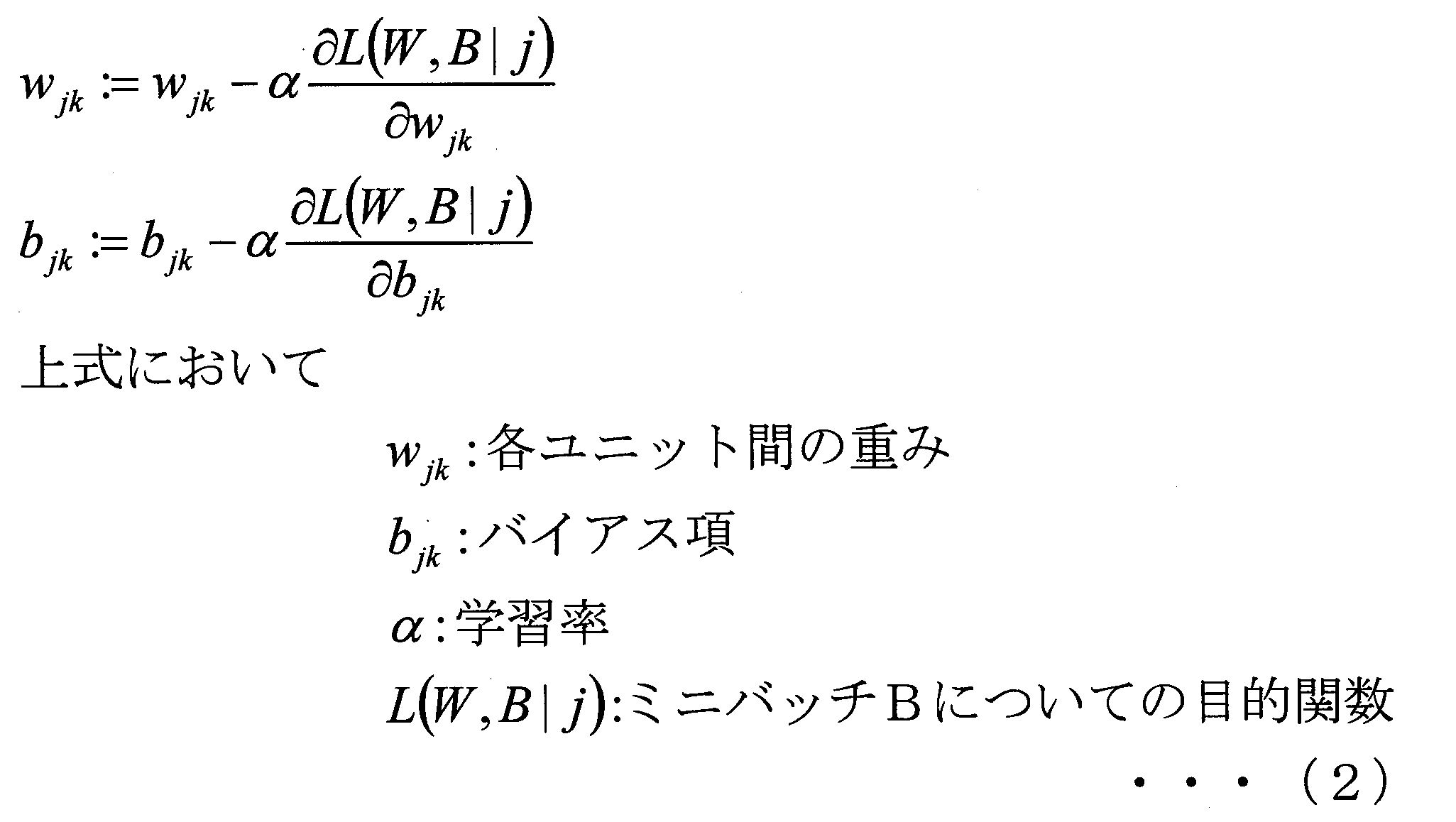
(ステップS406)重み算出部240は、ステップS405における重みWの更新により、目的関数が収束したか否かを判定する。重み算出部240は、目的関数が収束したと判定した場合(YES)、重みWの算出処理を終了する。一方、目的関数が収束していないと判定した場合(NO)、ステップS401の処理を行う。
確率的勾配降下法を使用して学習を行うことの理由の一つは、目的関数が収束する最適解より前に、重みWが局所解に陥ってしまうことを防ぐためである。
確率的勾配降下法を使用して学習を行うことの理由の一つは、目的関数が収束する最適解より前に、重みWが局所解に陥ってしまうことを防ぐためである。
なお、本実施形態においては、説明変数が、年齢情報AGと、血液検査情報GBTと、脳活動測定結果情報BAである場合を説明したが、説明変数はこれに限らない。例えば、説明変数として、年齢情報AGと、血液検査情報GBTと、脳活動測定結果情報BAとのうち一部のみを用いてもよい。また、説明変数として、血液検査情報GBTに含まれる検査項目毎の検査値のうち一部のみを用いてもよいし、脳活動測定結果情報BAに含まれる測定対象項目の測定値のうち一部のみを用いてもよい。
例えば、説明変数として、年齢情報AGと、アルブミンの検査値と、尿酸の検査値と、左脳側ヘモグロビン濃度L_Hbと、右脳側ヘモグロビン濃度R_Hbと、左脳側酸素飽和度L_SO2と、右脳側酸素飽和度R_SO2とのみを用いてもよい。
また、別の例として、説明変数として、年齢情報AGと、左脳側ヘモグロビン濃度L_Hbと、右脳側ヘモグロビン濃度R_Hbと、左脳側酸素飽和度L_SO2と、右脳側酸素飽和度R_SO2とのみを用いてもよい。
また、別の例として、説明変数として、年齢情報AGと、左脳側ヘモグロビン濃度L_Hbと、右脳側ヘモグロビン濃度R_Hbと、左脳側酸素飽和度L_SO2と、右脳側酸素飽和度R_SO2とのみを用いてもよい。
また、説明変数として、身体データPDに、被験者の身体的特徴を示す他の情報を加えてもよいし、年齢情報AGの代わりに被験者の身体的特徴を表す他の情報を用いてもよい。被験者の身体的特徴を表す他の情報は、例えば、性別を示す情報、身長を示す情報、体重を示す情報、肥満度を示す情報などでもよい。肥満度を示す情報とは、例えば、体格指数(BMI:Body Mass Index)である。
また、説明変数として、検査結果データMTに、血液検査情報GBTと、脳活動測定結果情報BAと以外の被験者の医学的検査の検査結果を示す他の情報を加えてもよいし、血液検査情報GBTと、脳活動測定結果情報BAとの代わりに、被験者の医学的検査の検査結果を示す他の情報を用いてもよい。
また、説明変数として、検査結果データMTに、血液検査情報GBTと、脳活動測定結果情報BAと以外の被験者の医学的検査の検査結果を示す他の情報を加えてもよいし、血液検査情報GBTと、脳活動測定結果情報BAとの代わりに、被験者の医学的検査の検査結果を示す他の情報を用いてもよい。
また、本実施形態においては、自己申告に基づく医学的検査の一例として、MMSEの場合を説明したが、自己申告に基づく医学的検査はMMSE以外であってもよい。自己申告に基づく医学的検査としては、例えば、状態・特性不安検査(STAI:State-Trait Anxiety Inventory)や性格検査などの、結果が得点化されている医学的検査でもよい。
また、本実施形態においては、ニューラルネットワークNNの隠れ層の数が4つ、各隠れ層のユニット数が2つの場合を説明したが、隠れ層の数、及び各隠れ層のユニット数はこれに限らない。
また、本実施形態においては、ニューラルネットワークNNの出力層のユニット数が2である場合を説明したが、出力層のユニット数はこれに限らない。判定装置20は、例えば、出力層のユニット数を1つにしてもよい。その場合、判定装置20は、出力層の出力の1つの値に応じて、判定得点を判定する。また、判定装置20は、ニューラルネットワークNNの出力層のユニット数を3以上にして、判定得点をより細かく分類してもよい。
また、本実施形態においては、ニューラルネットワークNNの出力層のユニット数が2である場合を説明したが、出力層のユニット数はこれに限らない。判定装置20は、例えば、出力層のユニット数を1つにしてもよい。その場合、判定装置20は、出力層の出力の1つの値に応じて、判定得点を判定する。また、判定装置20は、ニューラルネットワークNNの出力層のユニット数を3以上にして、判定得点をより細かく分類してもよい。
[まとめ]
上述した実施形態に係る判定装置20によれば、重み算出部240により算出された重みWと、被験者に関するデータのうち、検査結果データMTと、身体データPDを含む判定データとに基づいて、当該被験者の判定得点を判定する。ここで判定装置20は、当該被験者に関するデータのうち、教師判定得点LSCと、教師検査結果データLMTと、教師身体データLPDとに基づいて、重みWを算出する。したがって、判定装置20によれば、自己申告に基づく医学的検査の判定を簡便に行うことができる。
上述した実施形態に係る判定装置20によれば、重み算出部240により算出された重みWと、被験者に関するデータのうち、検査結果データMTと、身体データPDを含む判定データとに基づいて、当該被験者の判定得点を判定する。ここで判定装置20は、当該被験者に関するデータのうち、教師判定得点LSCと、教師検査結果データLMTと、教師身体データLPDとに基づいて、重みWを算出する。したがって、判定装置20によれば、自己申告に基づく医学的検査の判定を簡便に行うことができる。
また、上述した実施形態に係る判定装置20によれば、判定得点が自己申告に基づく認知症の検査(MMSE)の得点と同じである。このため、判定装置20によれば、従来のMMSEを利用して被験者の認知症の状態を判定していた判定者が、認知症判定得点を理解しやすい。
上述した実施形態に係る判定装置20によれば、重みWが機械学習によって算出されている。このため、判定装置20によれば、検査者は、被験者の身体的特徴を表す身体データや、医学的検査の検査結果を表す検査結果データの意味についての先入観にとらわれずに、従来は当該被験者の自己申告に基づいて行われていた医学的検査の判定を、当該被験者の自己申告に基づくことなく簡便に行うことができる。
上述した実施形態に係る判定装置20によれば、医学的検査の検査結果を表すデータは、被験者の一般血液検査の結果を示す血液検査情報GBTを含む。このため、判定装置20によれば、特殊な検査や問診が不要である。したがって、判定装置20によれば、従来は当該被験者の自己申告に基づいて行われていた医学的検査の判定を、当該被験者の自己申告に基づくことなく簡便に行うことができる。
上述した実施形態に係る判定装置20によれば、医学的検査の検査結果を表すデータは、非侵襲脳活動測定装置による被験者の脳活動の測定結果を示す脳活動測定結果情報BAを含む。このため、判定装置20によれば、特殊な検査や問診が不要である。したがって、判定装置20によれば、自己申告に基づく医学的検査の判定を簡便に行うことができる。
以上、本発明の実施形態を、図面を参照して詳述してきたが、具体的な構成はこの実施形態に限られるものではなく、本発明の趣旨を逸脱しない範囲で適宜変更を加えることができる。上述した各実施形態に記載の構成を組み合わせてもよい。
なお、上記の実施形態における各装置が備える各部は、専用のハードウェアにより実現されるものであってもよく、また、メモリおよびマイクロプロセッサにより実現させるものであってもよい。
なお、各装置が備える各部は、メモリおよびCPU(中央演算装置)により構成され、各装置が備える各部の機能を実現するためのプログラムをメモリにロードして実行することによりその機能を実現させるものであってもよい。
また、各装置が備える各部の機能を実現するためのプログラムをコンピュータ読み取り可能な記録媒体に記録して、この記録媒体に記録されたプログラムをコンピュータシステムに読み込ませ、実行することにより、制御部が備える各部による処理を行ってもよい。
なお、ここでいう「コンピュータシステム」とは、OSや周辺機器等のハードウェアを含むものとする。
なお、ここでいう「コンピュータシステム」とは、OSや周辺機器等のハードウェアを含むものとする。
また、「コンピュータシステム」は、WWWシステムを利用している場合であれば、ホームページ提供環境(あるいは表示環境)も含むものとする。
また、「コンピュータ読み取り可能な記録媒体」とは、フレキシブルディスク、光磁気ディスク、ROM、CD-ROM等の可搬媒体、コンピュータシステムに内蔵されるハードディスク等の記憶装置のことをいう。さらに「コンピュータ読み取り可能な記録媒体」とは、インターネット等のネットワークや電話回線等の通信回線を介してプログラムを送信する場合の通信線のように、短時間の間、動的にプログラムを保持するもの、その場合のサーバやクライアントとなるコンピュータシステム内部の揮発性メモリのように、一定時間プログラムを保持しているものも含むものとする。また上記プログラムは、前述した機能の一部を実現するためのものであってもよく、さらに前述した機能をコンピュータシステムにすでに記録されているプログラムとの組み合わせで実現できるものであってもよい。
また、「コンピュータ読み取り可能な記録媒体」とは、フレキシブルディスク、光磁気ディスク、ROM、CD-ROM等の可搬媒体、コンピュータシステムに内蔵されるハードディスク等の記憶装置のことをいう。さらに「コンピュータ読み取り可能な記録媒体」とは、インターネット等のネットワークや電話回線等の通信回線を介してプログラムを送信する場合の通信線のように、短時間の間、動的にプログラムを保持するもの、その場合のサーバやクライアントとなるコンピュータシステム内部の揮発性メモリのように、一定時間プログラムを保持しているものも含むものとする。また上記プログラムは、前述した機能の一部を実現するためのものであってもよく、さらに前述した機能をコンピュータシステムにすでに記録されているプログラムとの組み合わせで実現できるものであってもよい。
1…判定システム、10…教師データ供給部、20…判定装置、30…判定データ供給部、40…提示部、210…教師判定得点取得部、220…教師検査結果データ取得部、230…教師身体データ取得部、240…重み算出部、250…検査結果取得部、260…身体データ取得部、270…得点判定部
Claims (6)
- 第1被験者に関するデータのうち、自己申告に基づく医学的検査の判定得点を含み、医学的検査の検査結果を表すデータと、身体的特徴を表すデータとのうち少なくとも一方を含む第1データに基づいて重みを算出する重み算出部と、
前記重み算出部により算出された前記重みと、第2被験者に関するデータのうち、医学的検査の検査結果を表すデータと、身体的特徴を表すデータとのうち少なくとも一方を含む第2データとに基づいて、前記第2被験者の前記判定得点を判定する得点判定部と、を備える生体機能についての医学的検査の得点判定装置。 - 前記判定得点とは自己申告に基づく認知症の検査の得点である請求項1に記載の生体機能についての医学的検査の得点判定装置。
- 前記重み算出部は、前記第1データに基づいて機械学習により前記重みを算出する請求項1または請求項2に記載の生体機能についての医学的検査の得点判定装置。
- 前記医学的検査の検査結果を表すデータは、前記第1被験者の一般血液検査の結果を示す血液検査情報を少なくとも含むデータである請求項1から請求項3のいずれか一項に記載の生体機能についての医学的検査の得点判定装置。
- 前記医学的検査の検査結果を表すデータは、非侵襲脳活動測定装置による前記第1被験者の脳活動の測定結果を少なくとも含むデータである請求項1から請求項4のいずれか一項に記載の生体機能についての医学的検査の得点判定装置。
- コンピュータに、
第1被験者に関するデータのうち、自己申告に基づく医学的検査の判定得点を含み、医学的検査の検査結果を表すデータと、身体的特徴を表すデータとのうち少なくとも一方を含む第1データに基づいて重みを算出する重み算出ステップと、
前記重み算出ステップにより算出された前記重みと、第2被験者に関するデータのうち、医学的検査の検査結果を表すデータと、身体的特徴を表すデータとのうち少なくとも一方を含む第2データとに基づいて、前記第2被験者の前記判定得点を判定する得点判定ステップと
を実行させるためのプログラム。
Applications Claiming Priority (2)
| Application Number | Priority Date | Filing Date | Title |
|---|---|---|---|
| JP2017048625A JP6845716B2 (ja) | 2017-03-14 | 2017-03-14 | 生体機能についての医学的検査の得点判定装置、及びプログラム |
| JP2017-048625 | 2017-03-14 |
Publications (1)
| Publication Number | Publication Date |
|---|---|
| WO2018168915A1 true WO2018168915A1 (ja) | 2018-09-20 |
Family
ID=63522283
Family Applications (1)
| Application Number | Title | Priority Date | Filing Date |
|---|---|---|---|
| PCT/JP2018/009933 Ceased WO2018168915A1 (ja) | 2017-03-14 | 2018-03-14 | 生体機能についての医学的検査の得点判定装置、及びプログラム |
Country Status (2)
| Country | Link |
|---|---|
| JP (1) | JP6845716B2 (ja) |
| WO (1) | WO2018168915A1 (ja) |
Cited By (1)
| Publication number | Priority date | Publication date | Assignee | Title |
|---|---|---|---|---|
| CN115702402A (zh) * | 2020-06-16 | 2023-02-14 | 柯尼卡美能达株式会社 | 预测得分计算装置、预测得分计算方法、预测得分计算程序以及学习装置 |
Families Citing this family (2)
| Publication number | Priority date | Publication date | Assignee | Title |
|---|---|---|---|---|
| JP7508820B2 (ja) * | 2020-03-19 | 2024-07-02 | オムロンヘルスケア株式会社 | 生体情報取得装置及び生体情報取得方法 |
| EP4227956A4 (en) | 2020-10-09 | 2024-10-30 | The University of Tokyo | DISEASE DIAGNOSIS RESULT DETERMINATION DEVICE, DISEASE DIAGNOSIS RESULT DETERMINATION METHOD, AND PROGRAM |
Citations (4)
| Publication number | Priority date | Publication date | Assignee | Title |
|---|---|---|---|---|
| JP2012502279A (ja) * | 2008-09-04 | 2012-01-26 | レドックス−リアクティブ リエイジェンツ リミテッド ライアビリティー カンパニー | アルツハイマー病の診断、モニタリングおよび/または病期診断のための、バイオマーカー、キットおよび方法 |
| WO2012165602A1 (ja) * | 2011-05-31 | 2012-12-06 | 国立大学法人名古屋工業大学 | 認知機能障害判別装置、認知機能障害判別システム、およびプログラム |
| US20140226882A1 (en) * | 2011-09-16 | 2014-08-14 | Mcgill University | Simultaneous segmentation and grading of structures for state determination |
| WO2015037089A1 (ja) * | 2013-09-11 | 2015-03-19 | 日立コンシューマエレクトロニクス株式会社 | 脳機能障害評価方法、脳機能障害評価装置およびそのプログラム |
Family Cites Families (4)
| Publication number | Priority date | Publication date | Assignee | Title |
|---|---|---|---|---|
| JP4876207B2 (ja) * | 2010-06-11 | 2012-02-15 | 国立大学法人 名古屋工業大学 | 認知機能障害危険度算出装置、認知機能障害危険度算出システム、及びプログラム |
| US9367817B2 (en) * | 2010-12-20 | 2016-06-14 | Koninkijke Philips N.V. | Methods and systems for identifying patients with mild cognitive impairment at risk of converting to alzheimer's |
| US9474481B2 (en) * | 2013-10-22 | 2016-10-25 | Mindstrong, LLC | Method and system for assessment of cognitive function based on electronic device usage |
| JP6702836B2 (ja) * | 2016-09-28 | 2020-06-03 | ハルメク・ベンチャーズ株式会社 | 認知症判定得点算出装置及びそのプログラム |
-
2017
- 2017-03-14 JP JP2017048625A patent/JP6845716B2/ja active Active
-
2018
- 2018-03-14 WO PCT/JP2018/009933 patent/WO2018168915A1/ja not_active Ceased
Patent Citations (4)
| Publication number | Priority date | Publication date | Assignee | Title |
|---|---|---|---|---|
| JP2012502279A (ja) * | 2008-09-04 | 2012-01-26 | レドックス−リアクティブ リエイジェンツ リミテッド ライアビリティー カンパニー | アルツハイマー病の診断、モニタリングおよび/または病期診断のための、バイオマーカー、キットおよび方法 |
| WO2012165602A1 (ja) * | 2011-05-31 | 2012-12-06 | 国立大学法人名古屋工業大学 | 認知機能障害判別装置、認知機能障害判別システム、およびプログラム |
| US20140226882A1 (en) * | 2011-09-16 | 2014-08-14 | Mcgill University | Simultaneous segmentation and grading of structures for state determination |
| WO2015037089A1 (ja) * | 2013-09-11 | 2015-03-19 | 日立コンシューマエレクトロニクス株式会社 | 脳機能障害評価方法、脳機能障害評価装置およびそのプログラム |
Non-Patent Citations (1)
| Title |
|---|
| LIU, SIQI ET AL.: "Early diagnosis of Alzheimer's disease with deep learning", 2014 IEEE 11TH INTERNATIONAL SYMPOSIUM ON BIOMEDICAL IMAGING (ISBI), 31 July 2014 (2014-07-31), pages 1015 - 1018, XP032779241, ISBN: 978-1-4673-1961-4 * |
Cited By (1)
| Publication number | Priority date | Publication date | Assignee | Title |
|---|---|---|---|---|
| CN115702402A (zh) * | 2020-06-16 | 2023-02-14 | 柯尼卡美能达株式会社 | 预测得分计算装置、预测得分计算方法、预测得分计算程序以及学习装置 |
Also Published As
| Publication number | Publication date |
|---|---|
| JP6845716B2 (ja) | 2021-03-24 |
| JP2018149168A (ja) | 2018-09-27 |
Similar Documents
| Publication | Publication Date | Title |
|---|---|---|
| Rasmussen et al. | Association of neurocognitive and physical function with gait speed in midlife | |
| Lee et al. | Voice, silence, perceived impact, psychological safety, and burnout among nurses: A structural equation modeling analysis | |
| Crane et al. | Routine collection of patient-reported outcomes in an HIV clinic setting: the first 100 patients | |
| Yang et al. | Risk factors for work-related musculoskeletal disorders among intensive care unit nurses in China: a structural equation model approach | |
| Blackwood et al. | On the problems of mixing RCTs with qualitative research: the case of the MRC framework for the evaluation of complex healthcare interventions | |
| Hepping et al. | The influence of hand preference on grip strength in children and adolescents; a cross-sectional study of 2284 children and adolescents | |
| Dickson et al. | A mixed methods study describing the self-care practices in an older working population with cardiovascular disease (CVD): Balancing work, life and health | |
| Bergsma et al. | Quality of life: does measurement help? | |
| Mawar et al. | Sudarshan Kriya yoga improves quality of life in healthy people living with HIV (PLHIV): results from an open label randomized clinical trial | |
| WO2018168915A1 (ja) | 生体機能についての医学的検査の得点判定装置、及びプログラム | |
| Taniguchi et al. | Outpatient nursing support for self-monitoring in patients with chronic heart failure | |
| Stuart et al. | Reliability in measuring preinjury physical function in orthopaedic trauma | |
| JP6702836B2 (ja) | 認知症判定得点算出装置及びそのプログラム | |
| Silverman et al. | FEV1performance among patients with acute asthma: results from a multicenter clinical trial | |
| US12290379B2 (en) | Quantification and estimation based on digital twin output | |
| Kemmotsu et al. | Performance of older Japanese American adults on selected cognitive instruments | |
| Vick et al. | Living with lung fibrosis: knowledge is power | |
| Akbulut et al. | Support vector machines combined with feature selection for diabetes diagnosis | |
| Chirinos et al. | Patient hesitancy in perioperative clinical trial enrollment during the COVID-19 pandemic | |
| Nascimben et al. | Technical aspects and validation of custom digital algorithms for hand volumetry | |
| JP7109499B2 (ja) | 認知症判定得点算出装置及びそのプログラム | |
| Cosmi et al. | BES TEST™ accuracy evaluation by means of 3D-printed phantoms | |
| CN110709011A (zh) | 用于引导的操作的x射线系统 | |
| Aburub et al. | Measuring quality of life and identifying what is important to Jordanian living with multiple sclerosis using the Arabic version of the patient‐generated index | |
| CN116325016A (zh) | 疾病诊断结果判定装置、疾病诊断结果判定方法及程序 |
Legal Events
| Date | Code | Title | Description |
|---|---|---|---|
| 121 | Ep: the epo has been informed by wipo that ep was designated in this application |
Ref document number: 18767794 Country of ref document: EP Kind code of ref document: A1 |
|
| NENP | Non-entry into the national phase |
Ref country code: DE |
|
| 122 | Ep: pct application non-entry in european phase |
Ref document number: 18767794 Country of ref document: EP Kind code of ref document: A1 |