WO2018119348A1 - Herbicidal combinations and methods of controlling weeds - Google Patents
Herbicidal combinations and methods of controlling weeds Download PDFInfo
- Publication number
- WO2018119348A1 WO2018119348A1 PCT/US2017/068093 US2017068093W WO2018119348A1 WO 2018119348 A1 WO2018119348 A1 WO 2018119348A1 US 2017068093 W US2017068093 W US 2017068093W WO 2018119348 A1 WO2018119348 A1 WO 2018119348A1
- Authority
- WO
- WIPO (PCT)
- Prior art keywords
- herbicide
- compound
- vegetation
- formula
- herbicidal composition
- Prior art date
- Legal status (The legal status is an assumption and is not a legal conclusion. Google has not performed a legal analysis and makes no representation as to the accuracy of the status listed.)
- Ceased
Links
- 0 *C(CCC1)=C(C(C(C(*(C2=O)c3ccc(CC=C)cc3)=O)=C(*)*2S*)=O)C1=O Chemical compound *C(CCC1)=C(C(C(C(*(C2=O)c3ccc(CC=C)cc3)=O)=C(*)*2S*)=O)C1=O 0.000 description 1
Classifications
-
- A—HUMAN NECESSITIES
- A01—AGRICULTURE; FORESTRY; ANIMAL HUSBANDRY; HUNTING; TRAPPING; FISHING
- A01N—PRESERVATION OF BODIES OF HUMANS OR ANIMALS OR PLANTS OR PARTS THEREOF; BIOCIDES, e.g. AS DISINFECTANTS, AS PESTICIDES OR AS HERBICIDES; PEST REPELLANTS OR ATTRACTANTS; PLANT GROWTH REGULATORS
- A01N39/00—Biocides, pest repellants or attractants, or plant growth regulators containing aryloxy- or arylthio-aliphatic or cycloaliphatic compounds, containing the group or, e.g. phenoxyethylamine, phenylthio-acetonitrile, phenoxyacetone
- A01N39/02—Aryloxy-carboxylic acids; Derivatives thereof
-
- A—HUMAN NECESSITIES
- A01—AGRICULTURE; FORESTRY; ANIMAL HUSBANDRY; HUNTING; TRAPPING; FISHING
- A01N—PRESERVATION OF BODIES OF HUMANS OR ANIMALS OR PLANTS OR PARTS THEREOF; BIOCIDES, e.g. AS DISINFECTANTS, AS PESTICIDES OR AS HERBICIDES; PEST REPELLANTS OR ATTRACTANTS; PLANT GROWTH REGULATORS
- A01N47/00—Biocides, pest repellants or attractants, or plant growth regulators containing organic compounds containing a carbon atom not being member of a ring and having no bond to a carbon or hydrogen atom, e.g. derivatives of carbonic acid
- A01N47/08—Biocides, pest repellants or attractants, or plant growth regulators containing organic compounds containing a carbon atom not being member of a ring and having no bond to a carbon or hydrogen atom, e.g. derivatives of carbonic acid the carbon atom having one or more single bonds to nitrogen atoms
- A01N47/10—Carbamic acid derivatives, i.e. containing the group —O—CO—N<; Thio analogues thereof
- A01N47/12—Carbamic acid derivatives, i.e. containing the group —O—CO—N<; Thio analogues thereof containing a —O—CO—N< group, or a thio analogue thereof, neither directly attached to a ring nor the nitrogen atom being a member of a heterocyclic ring
-
- A—HUMAN NECESSITIES
- A01—AGRICULTURE; FORESTRY; ANIMAL HUSBANDRY; HUNTING; TRAPPING; FISHING
- A01N—PRESERVATION OF BODIES OF HUMANS OR ANIMALS OR PLANTS OR PARTS THEREOF; BIOCIDES, e.g. AS DISINFECTANTS, AS PESTICIDES OR AS HERBICIDES; PEST REPELLANTS OR ATTRACTANTS; PLANT GROWTH REGULATORS
- A01N37/00—Biocides, pest repellants or attractants, or plant growth regulators containing organic compounds containing a carbon atom having three bonds to hetero atoms with at the most two bonds to halogen, e.g. carboxylic acids
- A01N37/18—Biocides, pest repellants or attractants, or plant growth regulators containing organic compounds containing a carbon atom having three bonds to hetero atoms with at the most two bonds to halogen, e.g. carboxylic acids containing the group —CO—N<, e.g. carboxylic acid amides or imides; Thio analogues thereof
- A01N37/20—Biocides, pest repellants or attractants, or plant growth regulators containing organic compounds containing a carbon atom having three bonds to hetero atoms with at the most two bonds to halogen, e.g. carboxylic acids containing the group —CO—N<, e.g. carboxylic acid amides or imides; Thio analogues thereof containing the group, wherein Cn means a carbon skeleton not containing a ring; Thio analogues thereof
-
- A—HUMAN NECESSITIES
- A01—AGRICULTURE; FORESTRY; ANIMAL HUSBANDRY; HUNTING; TRAPPING; FISHING
- A01N—PRESERVATION OF BODIES OF HUMANS OR ANIMALS OR PLANTS OR PARTS THEREOF; BIOCIDES, e.g. AS DISINFECTANTS, AS PESTICIDES OR AS HERBICIDES; PEST REPELLANTS OR ATTRACTANTS; PLANT GROWTH REGULATORS
- A01N41/00—Biocides, pest repellants or attractants, or plant growth regulators containing organic compounds containing a sulfur atom bound to a hetero atom
- A01N41/02—Biocides, pest repellants or attractants, or plant growth regulators containing organic compounds containing a sulfur atom bound to a hetero atom containing a sulfur-to-oxygen double bond
- A01N41/04—Sulfonic acids; Derivatives thereof
- A01N41/06—Sulfonic acid amides
-
- A—HUMAN NECESSITIES
- A01—AGRICULTURE; FORESTRY; ANIMAL HUSBANDRY; HUNTING; TRAPPING; FISHING
- A01P—BIOCIDAL, PEST REPELLANT, PEST ATTRACTANT OR PLANT GROWTH REGULATORY ACTIVITY OF CHEMICAL COMPOUNDS OR PREPARATIONS
- A01P13/00—Herbicides; Algicides
-
- A—HUMAN NECESSITIES
- A01—AGRICULTURE; FORESTRY; ANIMAL HUSBANDRY; HUNTING; TRAPPING; FISHING
- A01N—PRESERVATION OF BODIES OF HUMANS OR ANIMALS OR PLANTS OR PARTS THEREOF; BIOCIDES, e.g. AS DISINFECTANTS, AS PESTICIDES OR AS HERBICIDES; PEST REPELLANTS OR ATTRACTANTS; PLANT GROWTH REGULATORS
- A01N33/00—Biocides, pest repellants or attractants, or plant growth regulators containing organic nitrogen compounds
- A01N33/16—Biocides, pest repellants or attractants, or plant growth regulators containing organic nitrogen compounds containing nitrogen-to-oxygen bonds
- A01N33/18—Nitro compounds
- A01N33/20—Nitro compounds containing oxygen or sulfur attached to the carbon skeleton containing the nitro group
- A01N33/22—Nitro compounds containing oxygen or sulfur attached to the carbon skeleton containing the nitro group having at least one oxygen or sulfur atom and at least one nitro group directly attached to the same aromatic ring system
-
- A—HUMAN NECESSITIES
- A01—AGRICULTURE; FORESTRY; ANIMAL HUSBANDRY; HUNTING; TRAPPING; FISHING
- A01N—PRESERVATION OF BODIES OF HUMANS OR ANIMALS OR PLANTS OR PARTS THEREOF; BIOCIDES, e.g. AS DISINFECTANTS, AS PESTICIDES OR AS HERBICIDES; PEST REPELLANTS OR ATTRACTANTS; PLANT GROWTH REGULATORS
- A01N35/00—Biocides, pest repellants or attractants, or plant growth regulators containing organic compounds containing a carbon atom having two bonds to hetero atoms with at the most one bond to halogen, e.g. aldehyde radical
- A01N35/08—Biocides, pest repellants or attractants, or plant growth regulators containing organic compounds containing a carbon atom having two bonds to hetero atoms with at the most one bond to halogen, e.g. aldehyde radical at least one of the bonds to hetero atoms is to nitrogen
- A01N35/10—Biocides, pest repellants or attractants, or plant growth regulators containing organic compounds containing a carbon atom having two bonds to hetero atoms with at the most one bond to halogen, e.g. aldehyde radical at least one of the bonds to hetero atoms is to nitrogen containing a carbon-to-nitrogen double bond
-
- A—HUMAN NECESSITIES
- A01—AGRICULTURE; FORESTRY; ANIMAL HUSBANDRY; HUNTING; TRAPPING; FISHING
- A01N—PRESERVATION OF BODIES OF HUMANS OR ANIMALS OR PLANTS OR PARTS THEREOF; BIOCIDES, e.g. AS DISINFECTANTS, AS PESTICIDES OR AS HERBICIDES; PEST REPELLANTS OR ATTRACTANTS; PLANT GROWTH REGULATORS
- A01N37/00—Biocides, pest repellants or attractants, or plant growth regulators containing organic compounds containing a carbon atom having three bonds to hetero atoms with at the most two bonds to halogen, e.g. carboxylic acids
- A01N37/18—Biocides, pest repellants or attractants, or plant growth regulators containing organic compounds containing a carbon atom having three bonds to hetero atoms with at the most two bonds to halogen, e.g. carboxylic acids containing the group —CO—N<, e.g. carboxylic acid amides or imides; Thio analogues thereof
- A01N37/22—Biocides, pest repellants or attractants, or plant growth regulators containing organic compounds containing a carbon atom having three bonds to hetero atoms with at the most two bonds to halogen, e.g. carboxylic acids containing the group —CO—N<, e.g. carboxylic acid amides or imides; Thio analogues thereof the nitrogen atom being directly attached to an aromatic ring system, e.g. anilides
-
- A—HUMAN NECESSITIES
- A01—AGRICULTURE; FORESTRY; ANIMAL HUSBANDRY; HUNTING; TRAPPING; FISHING
- A01N—PRESERVATION OF BODIES OF HUMANS OR ANIMALS OR PLANTS OR PARTS THEREOF; BIOCIDES, e.g. AS DISINFECTANTS, AS PESTICIDES OR AS HERBICIDES; PEST REPELLANTS OR ATTRACTANTS; PLANT GROWTH REGULATORS
- A01N37/00—Biocides, pest repellants or attractants, or plant growth regulators containing organic compounds containing a carbon atom having three bonds to hetero atoms with at the most two bonds to halogen, e.g. carboxylic acids
- A01N37/18—Biocides, pest repellants or attractants, or plant growth regulators containing organic compounds containing a carbon atom having three bonds to hetero atoms with at the most two bonds to halogen, e.g. carboxylic acids containing the group —CO—N<, e.g. carboxylic acid amides or imides; Thio analogues thereof
- A01N37/26—Biocides, pest repellants or attractants, or plant growth regulators containing organic compounds containing a carbon atom having three bonds to hetero atoms with at the most two bonds to halogen, e.g. carboxylic acids containing the group —CO—N<, e.g. carboxylic acid amides or imides; Thio analogues thereof containing the group; Thio analogues thereof
-
- A—HUMAN NECESSITIES
- A01—AGRICULTURE; FORESTRY; ANIMAL HUSBANDRY; HUNTING; TRAPPING; FISHING
- A01N—PRESERVATION OF BODIES OF HUMANS OR ANIMALS OR PLANTS OR PARTS THEREOF; BIOCIDES, e.g. AS DISINFECTANTS, AS PESTICIDES OR AS HERBICIDES; PEST REPELLANTS OR ATTRACTANTS; PLANT GROWTH REGULATORS
- A01N37/00—Biocides, pest repellants or attractants, or plant growth regulators containing organic compounds containing a carbon atom having three bonds to hetero atoms with at the most two bonds to halogen, e.g. carboxylic acids
- A01N37/36—Biocides, pest repellants or attractants, or plant growth regulators containing organic compounds containing a carbon atom having three bonds to hetero atoms with at the most two bonds to halogen, e.g. carboxylic acids containing at least one carboxylic group or a thio analogue, or a derivative thereof, and a singly bound oxygen or sulfur atom attached to the same carbon skeleton, this oxygen or sulfur atom not being a member of a carboxylic group or of a thio analogue, or of a derivative thereof, e.g. hydroxy-carboxylic acids
- A01N37/38—Biocides, pest repellants or attractants, or plant growth regulators containing organic compounds containing a carbon atom having three bonds to hetero atoms with at the most two bonds to halogen, e.g. carboxylic acids containing at least one carboxylic group or a thio analogue, or a derivative thereof, and a singly bound oxygen or sulfur atom attached to the same carbon skeleton, this oxygen or sulfur atom not being a member of a carboxylic group or of a thio analogue, or of a derivative thereof, e.g. hydroxy-carboxylic acids having at least one oxygen or sulfur atom attached to an aromatic ring system
- A01N37/40—Biocides, pest repellants or attractants, or plant growth regulators containing organic compounds containing a carbon atom having three bonds to hetero atoms with at the most two bonds to halogen, e.g. carboxylic acids containing at least one carboxylic group or a thio analogue, or a derivative thereof, and a singly bound oxygen or sulfur atom attached to the same carbon skeleton, this oxygen or sulfur atom not being a member of a carboxylic group or of a thio analogue, or of a derivative thereof, e.g. hydroxy-carboxylic acids having at least one oxygen or sulfur atom attached to an aromatic ring system having at least one carboxylic group or a thio analogue, or a derivative thereof, and one oxygen or sulfur atom attached to the same aromatic ring system
-
- A—HUMAN NECESSITIES
- A01—AGRICULTURE; FORESTRY; ANIMAL HUSBANDRY; HUNTING; TRAPPING; FISHING
- A01N—PRESERVATION OF BODIES OF HUMANS OR ANIMALS OR PLANTS OR PARTS THEREOF; BIOCIDES, e.g. AS DISINFECTANTS, AS PESTICIDES OR AS HERBICIDES; PEST REPELLANTS OR ATTRACTANTS; PLANT GROWTH REGULATORS
- A01N39/00—Biocides, pest repellants or attractants, or plant growth regulators containing aryloxy- or arylthio-aliphatic or cycloaliphatic compounds, containing the group or, e.g. phenoxyethylamine, phenylthio-acetonitrile, phenoxyacetone
- A01N39/02—Aryloxy-carboxylic acids; Derivatives thereof
- A01N39/04—Aryloxy-acetic acids; Derivatives thereof
-
- A—HUMAN NECESSITIES
- A01—AGRICULTURE; FORESTRY; ANIMAL HUSBANDRY; HUNTING; TRAPPING; FISHING
- A01N—PRESERVATION OF BODIES OF HUMANS OR ANIMALS OR PLANTS OR PARTS THEREOF; BIOCIDES, e.g. AS DISINFECTANTS, AS PESTICIDES OR AS HERBICIDES; PEST REPELLANTS OR ATTRACTANTS; PLANT GROWTH REGULATORS
- A01N41/00—Biocides, pest repellants or attractants, or plant growth regulators containing organic compounds containing a sulfur atom bound to a hetero atom
- A01N41/02—Biocides, pest repellants or attractants, or plant growth regulators containing organic compounds containing a sulfur atom bound to a hetero atom containing a sulfur-to-oxygen double bond
- A01N41/10—Sulfones; Sulfoxides
-
- A—HUMAN NECESSITIES
- A01—AGRICULTURE; FORESTRY; ANIMAL HUSBANDRY; HUNTING; TRAPPING; FISHING
- A01N—PRESERVATION OF BODIES OF HUMANS OR ANIMALS OR PLANTS OR PARTS THEREOF; BIOCIDES, e.g. AS DISINFECTANTS, AS PESTICIDES OR AS HERBICIDES; PEST REPELLANTS OR ATTRACTANTS; PLANT GROWTH REGULATORS
- A01N43/00—Biocides, pest repellants or attractants, or plant growth regulators containing heterocyclic compounds
- A01N43/02—Biocides, pest repellants or attractants, or plant growth regulators containing heterocyclic compounds having rings with one or more oxygen or sulfur atoms as the only ring hetero atoms
- A01N43/04—Biocides, pest repellants or attractants, or plant growth regulators containing heterocyclic compounds having rings with one or more oxygen or sulfur atoms as the only ring hetero atoms with one hetero atom
- A01N43/06—Biocides, pest repellants or attractants, or plant growth regulators containing heterocyclic compounds having rings with one or more oxygen or sulfur atoms as the only ring hetero atoms with one hetero atom five-membered rings
- A01N43/10—Biocides, pest repellants or attractants, or plant growth regulators containing heterocyclic compounds having rings with one or more oxygen or sulfur atoms as the only ring hetero atoms with one hetero atom five-membered rings with sulfur as the ring hetero atom
-
- A—HUMAN NECESSITIES
- A01—AGRICULTURE; FORESTRY; ANIMAL HUSBANDRY; HUNTING; TRAPPING; FISHING
- A01N—PRESERVATION OF BODIES OF HUMANS OR ANIMALS OR PLANTS OR PARTS THEREOF; BIOCIDES, e.g. AS DISINFECTANTS, AS PESTICIDES OR AS HERBICIDES; PEST REPELLANTS OR ATTRACTANTS; PLANT GROWTH REGULATORS
- A01N43/00—Biocides, pest repellants or attractants, or plant growth regulators containing heterocyclic compounds
- A01N43/34—Biocides, pest repellants or attractants, or plant growth regulators containing heterocyclic compounds having rings with one nitrogen atom as the only ring hetero atom
- A01N43/40—Biocides, pest repellants or attractants, or plant growth regulators containing heterocyclic compounds having rings with one nitrogen atom as the only ring hetero atom six-membered rings
-
- A—HUMAN NECESSITIES
- A01—AGRICULTURE; FORESTRY; ANIMAL HUSBANDRY; HUNTING; TRAPPING; FISHING
- A01N—PRESERVATION OF BODIES OF HUMANS OR ANIMALS OR PLANTS OR PARTS THEREOF; BIOCIDES, e.g. AS DISINFECTANTS, AS PESTICIDES OR AS HERBICIDES; PEST REPELLANTS OR ATTRACTANTS; PLANT GROWTH REGULATORS
- A01N43/00—Biocides, pest repellants or attractants, or plant growth regulators containing heterocyclic compounds
- A01N43/48—Biocides, pest repellants or attractants, or plant growth regulators containing heterocyclic compounds having rings with two nitrogen atoms as the only ring hetero atoms
- A01N43/54—1,3-Diazines; Hydrogenated 1,3-diazines
-
- A—HUMAN NECESSITIES
- A01—AGRICULTURE; FORESTRY; ANIMAL HUSBANDRY; HUNTING; TRAPPING; FISHING
- A01N—PRESERVATION OF BODIES OF HUMANS OR ANIMALS OR PLANTS OR PARTS THEREOF; BIOCIDES, e.g. AS DISINFECTANTS, AS PESTICIDES OR AS HERBICIDES; PEST REPELLANTS OR ATTRACTANTS; PLANT GROWTH REGULATORS
- A01N43/00—Biocides, pest repellants or attractants, or plant growth regulators containing heterocyclic compounds
- A01N43/64—Biocides, pest repellants or attractants, or plant growth regulators containing heterocyclic compounds having rings with three nitrogen atoms as the only ring hetero atoms
- A01N43/647—Triazoles; Hydrogenated triazoles
- A01N43/653—1,2,4-Triazoles; Hydrogenated 1,2,4-triazoles
-
- A—HUMAN NECESSITIES
- A01—AGRICULTURE; FORESTRY; ANIMAL HUSBANDRY; HUNTING; TRAPPING; FISHING
- A01N—PRESERVATION OF BODIES OF HUMANS OR ANIMALS OR PLANTS OR PARTS THEREOF; BIOCIDES, e.g. AS DISINFECTANTS, AS PESTICIDES OR AS HERBICIDES; PEST REPELLANTS OR ATTRACTANTS; PLANT GROWTH REGULATORS
- A01N43/00—Biocides, pest repellants or attractants, or plant growth regulators containing heterocyclic compounds
- A01N43/64—Biocides, pest repellants or attractants, or plant growth regulators containing heterocyclic compounds having rings with three nitrogen atoms as the only ring hetero atoms
- A01N43/66—1,3,5-Triazines, not hydrogenated and not substituted at the ring nitrogen atoms
- A01N43/68—1,3,5-Triazines, not hydrogenated and not substituted at the ring nitrogen atoms with two or three nitrogen atoms directly attached to ring carbon atoms
- A01N43/70—Diamino—1,3,5—triazines with only one oxygen, sulfur or halogen atom or only one cyano, thiocyano (—SCN), cyanato (—OCN) or azido (—N3) group directly attached to a ring carbon atom
-
- A—HUMAN NECESSITIES
- A01—AGRICULTURE; FORESTRY; ANIMAL HUSBANDRY; HUNTING; TRAPPING; FISHING
- A01N—PRESERVATION OF BODIES OF HUMANS OR ANIMALS OR PLANTS OR PARTS THEREOF; BIOCIDES, e.g. AS DISINFECTANTS, AS PESTICIDES OR AS HERBICIDES; PEST REPELLANTS OR ATTRACTANTS; PLANT GROWTH REGULATORS
- A01N43/00—Biocides, pest repellants or attractants, or plant growth regulators containing heterocyclic compounds
- A01N43/64—Biocides, pest repellants or attractants, or plant growth regulators containing heterocyclic compounds having rings with three nitrogen atoms as the only ring hetero atoms
- A01N43/707—1,2,3- or 1,2,4-triazines; Hydrogenated 1,2,3- or 1,2,4-triazines
-
- A—HUMAN NECESSITIES
- A01—AGRICULTURE; FORESTRY; ANIMAL HUSBANDRY; HUNTING; TRAPPING; FISHING
- A01N—PRESERVATION OF BODIES OF HUMANS OR ANIMALS OR PLANTS OR PARTS THEREOF; BIOCIDES, e.g. AS DISINFECTANTS, AS PESTICIDES OR AS HERBICIDES; PEST REPELLANTS OR ATTRACTANTS; PLANT GROWTH REGULATORS
- A01N43/00—Biocides, pest repellants or attractants, or plant growth regulators containing heterocyclic compounds
- A01N43/72—Biocides, pest repellants or attractants, or plant growth regulators containing heterocyclic compounds having rings with nitrogen atoms and oxygen or sulfur atoms as ring hetero atoms
- A01N43/74—Biocides, pest repellants or attractants, or plant growth regulators containing heterocyclic compounds having rings with nitrogen atoms and oxygen or sulfur atoms as ring hetero atoms five-membered rings with one nitrogen atom and either one oxygen atom or one sulfur atom in positions 1,3
- A01N43/76—1,3-Oxazoles; Hydrogenated 1,3-oxazoles
-
- A—HUMAN NECESSITIES
- A01—AGRICULTURE; FORESTRY; ANIMAL HUSBANDRY; HUNTING; TRAPPING; FISHING
- A01N—PRESERVATION OF BODIES OF HUMANS OR ANIMALS OR PLANTS OR PARTS THEREOF; BIOCIDES, e.g. AS DISINFECTANTS, AS PESTICIDES OR AS HERBICIDES; PEST REPELLANTS OR ATTRACTANTS; PLANT GROWTH REGULATORS
- A01N43/00—Biocides, pest repellants or attractants, or plant growth regulators containing heterocyclic compounds
- A01N43/72—Biocides, pest repellants or attractants, or plant growth regulators containing heterocyclic compounds having rings with nitrogen atoms and oxygen or sulfur atoms as ring hetero atoms
- A01N43/80—Biocides, pest repellants or attractants, or plant growth regulators containing heterocyclic compounds having rings with nitrogen atoms and oxygen or sulfur atoms as ring hetero atoms five-membered rings with one nitrogen atom and either one oxygen atom or one sulfur atom in positions 1,2
-
- A—HUMAN NECESSITIES
- A01—AGRICULTURE; FORESTRY; ANIMAL HUSBANDRY; HUNTING; TRAPPING; FISHING
- A01N—PRESERVATION OF BODIES OF HUMANS OR ANIMALS OR PLANTS OR PARTS THEREOF; BIOCIDES, e.g. AS DISINFECTANTS, AS PESTICIDES OR AS HERBICIDES; PEST REPELLANTS OR ATTRACTANTS; PLANT GROWTH REGULATORS
- A01N43/00—Biocides, pest repellants or attractants, or plant growth regulators containing heterocyclic compounds
- A01N43/72—Biocides, pest repellants or attractants, or plant growth regulators containing heterocyclic compounds having rings with nitrogen atoms and oxygen or sulfur atoms as ring hetero atoms
- A01N43/84—Biocides, pest repellants or attractants, or plant growth regulators containing heterocyclic compounds having rings with nitrogen atoms and oxygen or sulfur atoms as ring hetero atoms six-membered rings with one nitrogen atom and either one oxygen atom or one sulfur atom in positions 1,4
-
- A—HUMAN NECESSITIES
- A01—AGRICULTURE; FORESTRY; ANIMAL HUSBANDRY; HUNTING; TRAPPING; FISHING
- A01N—PRESERVATION OF BODIES OF HUMANS OR ANIMALS OR PLANTS OR PARTS THEREOF; BIOCIDES, e.g. AS DISINFECTANTS, AS PESTICIDES OR AS HERBICIDES; PEST REPELLANTS OR ATTRACTANTS; PLANT GROWTH REGULATORS
- A01N43/00—Biocides, pest repellants or attractants, or plant growth regulators containing heterocyclic compounds
- A01N43/90—Biocides, pest repellants or attractants, or plant growth regulators containing heterocyclic compounds having two or more relevant hetero rings, condensed among themselves or with a common carbocyclic ring system
-
- A—HUMAN NECESSITIES
- A01—AGRICULTURE; FORESTRY; ANIMAL HUSBANDRY; HUNTING; TRAPPING; FISHING
- A01N—PRESERVATION OF BODIES OF HUMANS OR ANIMALS OR PLANTS OR PARTS THEREOF; BIOCIDES, e.g. AS DISINFECTANTS, AS PESTICIDES OR AS HERBICIDES; PEST REPELLANTS OR ATTRACTANTS; PLANT GROWTH REGULATORS
- A01N47/00—Biocides, pest repellants or attractants, or plant growth regulators containing organic compounds containing a carbon atom not being member of a ring and having no bond to a carbon or hydrogen atom, e.g. derivatives of carbonic acid
- A01N47/08—Biocides, pest repellants or attractants, or plant growth regulators containing organic compounds containing a carbon atom not being member of a ring and having no bond to a carbon or hydrogen atom, e.g. derivatives of carbonic acid the carbon atom having one or more single bonds to nitrogen atoms
- A01N47/28—Ureas or thioureas containing the groups >N—CO—N< or >N—CS—N<
- A01N47/30—Derivatives containing the group >N—CO—N aryl or >N—CS—N—aryl
-
- A—HUMAN NECESSITIES
- A01—AGRICULTURE; FORESTRY; ANIMAL HUSBANDRY; HUNTING; TRAPPING; FISHING
- A01N—PRESERVATION OF BODIES OF HUMANS OR ANIMALS OR PLANTS OR PARTS THEREOF; BIOCIDES, e.g. AS DISINFECTANTS, AS PESTICIDES OR AS HERBICIDES; PEST REPELLANTS OR ATTRACTANTS; PLANT GROWTH REGULATORS
- A01N57/00—Biocides, pest repellants or attractants, or plant growth regulators containing organic phosphorus compounds
- A01N57/18—Biocides, pest repellants or attractants, or plant growth regulators containing organic phosphorus compounds having phosphorus-to-carbon bonds
- A01N57/20—Biocides, pest repellants or attractants, or plant growth regulators containing organic phosphorus compounds having phosphorus-to-carbon bonds containing acyclic or cycloaliphatic radicals
Definitions
- the present invention is directed to compositions and uses of at least one triazine herbicide of
- Formula I including combinations with a second herbicide.
- WO 2012/002096 Al discloses 6-acyl-l,2,4-triazine-3,5-dione derivatives as well as agrochemical compositions comprising the 6-acyl-l,2,4-triazine-3,5-dione derivatives in combination with additional agrochemically active components.
- WO 2013/080484 Al discloses 4-(4-halophenyl)-6-(2-hydroxy-6-oxo-l-cyclohexen-l- yl)carbonyl)-2-alkyl-l,2,4-triazine-3,5(2H,4H)-dione derivatives and combinations with other herbicides.
- the present invention addresses such need.
- the present invention discloses novel compositions for protecting crops from undesirable vegetation.
- One aspect of the invention is directed to a composition containing a compound of Formula I; and at least one second herbicide.
- the composition can contain at least one formulation component selected from formulation agents for n emulsifiable concentrate (EC) formulations, formulation agents for suspension concentrate
- SC formulations
- CS capsule suspension
- Another aspect of the invention is directed to the use of the composition in controlling undesirable vegetation which interfere with crop growth.
- the disclosed composition contains the compound of Formula I and at least a second herbicide in a ratio in the range of 1:0.1 to 1 : 100 by weight.
- the second herbicide is selected from dimethenamid-P, diphenamid, napropamide, napropamide-M, naptalam, propanil, acetochlor, alachlor, metolachlor, dimethachlor, pretilachlor, benzofluor, cambendichlor, chloramben, dicamba, bispyribac, pyrithiobac; mesotrione, sulcotrione, tefuryltrione, tembotrione, benfuresate, asulam, barban, alloxydim isoxaflutole, dinitramine, dipropalin, ethalfluralin, pendimethalin, trifluralm, acifluorfen, aclonifen, etnipromid, fluoro
- the second herbicide is a triazine herbicide or an amide herbicide.
- the second herbicide is selected from atrazine, bromoxynil, glufosinate, glyphosate, thifensulfuron, s-metolachlor, pethoxamid, and beflubutamid, agriculturally acceptable salts thereof, esters thereof and mixtures of two or more thereof.
- compositions that contains the compound of Formula I and at least one second herbicide selected from the group that includes dimethenamid-P, diphenamid, napropamide, napropamide-M, naptalam, propanil, acetochlor, alachlor, metolachlor, dimethachlor, pretilachlor, benzofluor, cambendichlor, chloramben, dicamba, bispyribac, pyrithiobac; mesotrione, sulcotrione, tefiiryltrione, tembotrione, benfuresate, asulam, barban, alloxydim isoxaflutole, dinitramine, dipropalin, ethalfluralin, pendimethalin, trifluralin, acifluorfen, aclonifen, etnipromid, fluoronitrofen, fomesafen, imazamethabenz, brom
- the second herbicide is selected from atrazine, bromoxynil, glufosinate, glyphosate, thifensulfuron, s-metolachlor, pethoxamid, and beflubutamid, agriculturally acceptable salts thereof, esters thereof and mixtures of two or more thereof.
- the crops are selected from potato, soybean, corn, wheat, rice, sorghum, oilseed rape, barley, rye, cowpea, and canola.
- the undesirable vegetation belongs to a weed family of Asteraceae, Caryophyllaceae, Convolvulaceae, Amaranthaceae, Chenopodiaceae, Cyperaceae, Poaceae, and Cyperaceae.
- the undesirable vegetation is a weed selected from horseweed, common chickweed, morningglory, cocklebur, kochia, Canada thistle, common ragweed, wild buckwheat, common ragweed, yellow nutsedge, Italian ryegrass, Jimsonweed, barnyardgrass, green foxtail, large crabgrass, Chinese sprangletop, and rice flatsedge.
- the weeds are resistant to an herbicide such as glyphosate or an HPPD inhibitor.
- herbicide product refers to a compositional mixture that is produced, sold, or used in a field in order to kill or otherwise inhibit the growth of unwanted plants such as, but not limited to, deleterious or annoying weeds, broadleaf plants, grasses, and sedges; and can be used for crop protection, edifice protection or turf protection.
- herbicide product includes the end-use herbicidal product. This composition can be a pure compound, a solution of chemical compounds, a mixture of chemical compounds, an emulsion, a suspension, a solid-liquid mixture, or a liquid- liquid mixture.
- herbicide product also refers to the product that passes through the commercial channels from the manufacturer to the ultimate end user who can either apply the herbicide product to the affected field as sold, or suspend, dissolve or dilute the herbicide product, and/or mix it with other excipients and/or other herbicide products.
- weed means and includes any plant which grows where not wanted.
- herbicidally effective amount means an amount necessary to produce an observable herbicidal effect on unwanted plant growth, including one or more of the effects of necrosis, death, growth inhibition, reproduction inhibition, inhibition of proliferation, and removal, destruction, or otherwise diminishing the occurrence and activity of unwanted plants.
- herbicidal composition refers to a herbicide product, and in addition, to any composition that comprises one or more herbicidally active ingredients. This composition can be a solution or a mixture like a suspension, dispersion, or powder. Further, the definition of the term “herbicidal composition” also refers to a product intended for use in manufacturing, or any product intended for formulation or repackaging into other agricultural products.
- herbicidally active ingredient means the active ingredient in the herbicidal composition that upon use thereof causes the herbicidal composition to prevent, destroy, repel or. mitigate any weed.
- Other ingredients of the herbicidal composition that are not herbicidally active ingredients are excipients that aid in forming, storing, or delivering the herbicidally active ingredient to the target. Examples of excipients in the present embodiment include, without limitation, an organic liquid in which the herbicidally active ingredient is dissolved, a polyurea shell, a water-soluble polymer, and one or more salts.
- pre-emergence is intended to mean application of the herbicide to the soil surface before the vegetation emergence from the soil surface (also referred to as BBCH 00-09).
- post-emergence is intended to mean application of the herbicide on the leaves after the vegetation emergence from the soil surface (also referred to as (.SiBCH 10).
- agriculturally acceptable salts is intended to mean any salt formed between the herbicide molecule and a salt forming compound, like sodium salts, potassium salts, ammonium salts, etc.
- the herbicidal compositions of the present disclosure can be in any conventional agriculturally useful form, for example, in the form of a twin pack, or in a ready-to-use formulation, or in the form of a tank mix.
- the active compounds can be supplied (either separately or pre- mixed) in any appropriate formulation type, for example an emulsifiable concentrate (EC), a suspension concentrate (SC), a suspo-emulsion (SE), a capsule suspension (CS), a water dispersible granule (WG), an emulsifiable granule (EG), a water in oil emulsion (EO), an oil in water emulsion (EW), a micro-emulsion (ME), an oil dispersion (OD), an oil miscible flowable (OF), an oil miscible liquid (OL), a soluble concentrate (SL), an ultra-low volume suspension (SU), an ultra-low volume liquid (UL), a dispersible concentrate (DC), or a wettable powder (WP).
- compositions of the present disclosure are supplied as an emulsifiable concentrate (EC), a suspension concentrate (SC) or a capsule suspension (CS).
- EC emulsifiable concentrate
- SC suspension concentrate
- CS capsule suspension
- the compound of Formula I is shown as follows, and is 4-(4-fluorophenyl)-6-(2-hydroxy-6-oxo- l-cyclohexen-l-yl)carbonyl)-2-methyl-l,2,4-triazine-3,5(2H,4H)-dione (CAS No. 1353870-34- 4).
- the compound of Formula I is also referred to simply as Compound 1.
- composition may contain additionally 1, 2 or 3 herbicides besides the compound of Formula I.
- the second herbicide, a third herbicide and fourth herbicide disclosed in connection with the present invention independently include, but are not limited to, the following:
- At least one aspect of the present invention employs the use of a second herbicide that provides enhanced safety and efficacy in controlling undesirable vegetation.
- the herbicide employed enhances the selectivity of the actions in the crops to be treated.
- the following provides a list of herbicides that are suitable for use as a second herbicide, and further as any further herbicides (in addition to the Compound 1 and the second herbicide) as the case may be:
- Acetyl-CoA carboxylase inhibitors for example cyclohexenone oxime ethers, such as alloxydim, clethodim, cloproxydim, cycloxydim, sethoxydim, tralkoxydim, butroxydim, clefoxydim or tepraloxydim; phenoxyphenoxypropionic esters, such as clodinafop-propargyl, cyhalofop-butyl, diclofop-methyl, fenoxaprop-ethyl, fenoxaprop-P-ethyl, fenthiapropethyl, fluazifop-butyl, fluazifop-P-butyl, haloxyfop-ethoxyethyl, haloxyfop-methyl, haloxyfop-P- methyl, isoxapyrifop, propaquizafop, quizal
- sulfonamides such as florasulam, flumetsulam or metosulam
- sulfonylureas such as amidosulfuron, azimsulfuron, bensulfuron-methyl, chlorimuron-ethyl, chlorsulfuron, cinosulfuron, cyclosulfamuron, ethametsulfuron-methyl, ethoxysulfuron, flazasulfuron, halosulfuron-methyl, imazosulfuron, metsulfuron-methyl, nicosulfuron, primisulfuron-methyl, prosulfuron, pyrazosulfuron-ethyl, rimsulfuron, sulfometuron-methyl, thifensulfuron-methyl, triasulfuron, tribenuron-methyl, triflusulfuron-methyl, tritosulfuron,
- the disclosed composition contains the compound of Formula I and a second herbicide in a ratio in the range of 1:0.1 to 1:100 by weight.
- the ratio between the compound of Formula I and a second herbicide is about 1:1, 1:2, 1:3, 1:4, 1:5, 1:6, 1:7, 1:8, 1:9, 1: 10, 1:11, 1:12, 1: 13, 1:14, 1:15, 1:17, 1:18, 1:19, or 1:20.
- the second herbicide is a chlorotriazine herbicide. In some embodiments, the second herbicide is atrazine. In embodiments hereof, the ratio between the compound of Formula I and the chlorotriazine herbicide, in particular atrazine, is in the range of 1:2 to 1:30, such as 1:3 to 1:15.
- the second herbicide is a nitrile herbicide.
- the second herbicide is bromoxynil.
- the ratio between the compound of Formula I and the nitrile herbicide, in particular bromoxynil is in the range of 1:1 to 1:20, such as 1:3 to 1:10.
- the second herbicide is an amide herbicide. In some embodiments, the second herbicide is pethoxamid or beflubutamid. In embodiments hereof, the ratio between the compound of Formula I and the amide herbicide, in particular pethoxamid, is in the range of 1:8 to 1:60, such as 1:10 to 1:50. In other embodiments hereof, the ratio between the compound of Formula I and the amide herbicide, in particular beflubutamid, is in the range of 1 : 1 to 1 : 12, such as 1:2 to 1:10.
- the second herbicide is an organophosphorous herbicide or phosphinic acid derived herbicide.
- the second herbicide is Glufosinate.
- the ratio between the compound of Formula I and the phosphinic acid derived herbicide, in particular glufosinate, is in the range of 1 :2 to 1 : 15, such as 1 :3 to 1 : 15.
- the second herbicide is an organophosphorous herbicide or phosphonate herbicide. In some embodiments, the second herbicide is glyphosate. In embodiments hereof, the ratio between the compound of Formula I and the phosphonate herbicide, in particular glyphosate, is in the range of 1:4 to 1:30, such as 1:5 to 1:25.
- the composition further contains a triazolone herbicide as a third herbicide.
- the third herbicide is amicarbazone, bencarbazone, carfentrazone, or carfentrazone ethyl.
- the second herbicide is a triazinylsulfonylurea herbicide. In some embodiments, the second herbicide is thifensulfuron. In embodiments hereof, the ratio between the compound of Formula I and the triazinylsulfonylurea herbicide, in particular thifensulfuron, is in the range of 1 :0.05 to 1 : 1.5, such as 1 :0.1 to 1 : 1. In some embodiments, the second herbicide is a chloroacetanilide herbicide. In some embodiments, the second herbicide is S-metolachlor. In embodiments hereof, the ratio between the compound of Formula I and the chloroacetanilide herbicide, in particular S-metolachlor, is in the range of 1:2 to 1:20 or 1:3 to 1:15, such as 1:3 to 1:10.
- the herbicidal compositions comprises a further herbicide in addition to Compound 1 and the second herbicide.
- the herbicidal compositions of the present invention may (and in particular with respect to the before-mentioned formulation types) further comprise one or more formulation agents, for example antimicrobial agents, surfactants, viscosity enhancing agents (like thickeners), antifoam agents, antifreeze agents, co-solvents, adjuvants and/or carriers.
- herbicidal active ingredients (the compound of formula I, the second herbicide and any further herbicides) are present a total amount of in the range of 0.01% to 95% by weight.
- agriculturally acceptable carriers constitute in the range of 4% to 98.5%.
- Surfactants, viscosity enhancing agents, and solvents respectively can constitute in the range of 1% to 15% of the final formulation by weight.
- the herbicidal compositions of the present invention are formulated as an emulsifiable concentrate (EC), a suspension concentrate (SC) or a capsule suspension (CS).
- the surfactant is selected from cationic surfactants, anionic surfactants, non-ionic surfactants, ionic surfactants, amphoteric surfactants and a combination thereof.
- the surfactant is a non-ionic surfactant selected from ethoxylated linear alcohol, ethoxylated alkyl phenol, alkyl EO/PO copolymer, polyalkylene glycol monobutyl ether, ethoxylated fatty acids/oils, sorbitan laurate, polysorbate, sorbitan oleate, ethoxylated fatty acid alcohols, or alkyl phenols.
- the composition contains an inactive component which is a thickener selected from rice, starch, gum arabic, gum tragacanth, guar flour, British gum, starch ethers and starch esters, gum resins, galactomannans, magnesium aluminum silicate, xanthan gum, carrageenan, cellulose derivatives, methyl cellulose, alginates and combinations thereof.
- a thickener selected from rice, starch, gum arabic, gum tragacanth, guar flour, British gum, starch ethers and starch esters, gum resins, galactomannans, magnesium aluminum silicate, xanthan gum, carrageenan, cellulose derivatives, methyl cellulose, alginates and combinations thereof.
- Other known commercial products may include Lattice NTC 50, Lattice NTC 60, methocel, clay, and veegum silica.
- compositions may contain an antifreeze agent such as ethylene glycol, propylene glycol, urea, calcium chloride sodium nitrate, magensiul chloride and ammonium sulfate.
- Other inactive agents may include an antimicrobial agents such as Proxel GXL, Bronopol, BHT, BHA, Dowcide A Kathon.
- Solvents may include aromatic and linear solvents.
- Aromatic solvents include aromatic 100, aromatic 150, aromatice 150 ND, aromatic 200 ND, isopar M, paraffinic oil, Sunspray 6 or 11 N, vegetable oil, methyl ester of fatty acid, Dimethyl caprylamide.
- Antifoam agents such as Xiameter AFE-100, Dow Coming AFs, Dow Corning 1520, 1530, or 1540 may also be used in the presently claimed formulations.
- compositions of the present invention are prepared by a process following the steps of combining the herbicidal active ingredient in effective amounts with suitable surface active agent, emulsifier desired amounts, viscosity enhancing agents, and suitable solvent.
- the mixture further undergoes a milling process until suitable particle size in the range of 1 to 250 microns are obtained.
- the mixture is milled until 90% of the particle size (D90) is less than 50 microns.
- Another aspect of the invention provides a method of controlling undesired vegetation in a crop comprising applying to the locus of such vegetation a herbicidally-effective amount of a composition described herein.
- the composition can be used for the protection for any of the following crop groups including, bananas, beans, beets, cassava, cereals, citrus, cocoas, coconuts, coffee, corn, cotton, fiber crops, flowers, forge corps, forestry, groundnuts, peanuts, hops, horticultures, non-land crops, oil palm, oilseed rape, peas, pomes, potato, rice, stonefruit, spices, sugar cane, Sunflower, tea, tobacco, tomatoes, tree nuts, turf, vegetable crops, vines, or grapes.
- the crops are potato, soybean, corn, rice, sorghum, oil seed rape, barley, rye, cowpea or canola.
- crops include bananas, plantains, beet: fodder, beets, sugar beets, cassava, barley, barley-spring, barley-winter, oats, oats+triticale-winter, oats-spring, oats-winter, rye, rye-winter, stubble, triticale, triticale+rye, wheat, wheat/barley, wheat-durum, wheat-spring, wheat-winter, citrus, grapefruit, lemons/limes, oranges, cocoa, coconuts, coffee, corn, corn: fodder, corn: grain, corn: sweet, corn+sorghum-spring, cotton, flax, carnation, chrysanthemum, flowers, gladioli, ornamentals: nursery, roses, alfalfa, brassicas: fodder, clover: seed, forage crops, grass-seed, pasture, rangeland, rye: seed, forestry, groundnuts, peanuts,
- Cucurbits include such crops as Melons: Benincasa spp., Citrullus spp., Cucumis spp., Momordica spp.; Watermelon: Citrullus lanatus; Pumpkin: Cucurbita pepo; Squash: Cucurbita argyrosperma, C. ficifolia, C. maxima, C. moschata; and Cucumber: Cucumis sativus.
- the crop includes wheat varieties such as Bloc, Kord, Wyalkatchem and Mace.
- the undesirable vegetation to be controlled belongs to various weed families, including for example, Asteraceae, Caryophyllaceae, Convolvulaceae, Amaranthaceae, Chenopodiaceae, Cyperaceae, Poaceae, and Cyperaceae.
- the undesirable vegetation is a weed selected from horseweed (marestail), common chickweed, morningglory, cocklebur, kochia, Canada thistle, common ragweed, wild buckwheat, common ragweed, yellow nutsedge, Italian ryegrass, Jimsonweed, barnyardgrass, green foxtail, large crabgrass, Chinese sprangletop, and rice flatsedge.
- the weeds are resistant to an herbicide such as glyphosate or an HPPD inhibitor.
- the resistant weeds are horseweed, and common ragweed.
- the weeds to be controlled include fleabane, sowthistle, grass weeds, broadleaf weeds, barnyardgrass (Echinochloa crus-galli), Jimsonweed (Datura stramonium), velvetleaf (Abutilon theophrasti), common cockelbur (Xanthium strumarium), hairy beggartickss (Bidens pilosa), Italian ryegrass (Lolium perenne.
- a weed of Asteraceae, Caryophyllaceae, or Convolvulaceae is controlled by a composition comprises a compound of Formula I and a chlorotriazine herbicide.
- the weed is horseweed (like glyphosate-susceptible horseweed and glyphosate- resistant horseweed), common duckweed, morningglory, or cocklebur.
- the chlorotriazine herbicide is atrazine.
- the composition is applied post- emergence of the vegetation.
- the crop to be protected is corn, wheat, or barley, e.g. corn.
- the weeds are resistant to a herbicide such as glyphosate or an HPPD inhibitor.
- the resistant weed is horseweed.
- atrazine is applied in an amount of 40-3400 g ai/ha, such as 60-2700 g ai/ha
- Compound 1 is applied in an amount of 2-120 g ai/ha or 10-100 g ai/ha, such as 3-80 g ai/ha, for example 5-60 g ai/ha.
- the ratio between the compound of Formula I and the chlorotriazine herbicide, in particular atrazine is in the range of 1 :2 to 1 :30, such as 1 :3 to 1 : 15.
- the invention relates to a method of controlling undesired vegetation in a crop (e.g. corn) comprising applying to the locus of such vegetation (preferably post- emergence of the vegetation) an herbicidally-effective amount of a herbicidal composition, wherein the composition comprises a compound of Formula I and a chlorotriazine herbicide, in particular atrazine, the ratio between the compound of Formula I and the chlorotriazine herbicide in the range of 1:2 to 1:30, such as 1:3 to 1:15, e.g.
- the vegetation belongs to a family selected from Asteraceae, Caryophyllaceae, and Convolvulaceae, for example vegetation that is glyphosate resistant, such as vegetation selected from glyphosate-susceptible horseweed, glyphosate-resistant horseweed, common chickweed, morningglory, and cocklebur.
- a weed of Asteraceae or Chenopodiaceae is controlled by a composition comprises a compound of Formula I and a nitrile herbicide.
- the weed is kochia or Canada thistle.
- the nitrile herbicide is bromoxynil.
- the composition is applied post-emergence of the vegetation.
- the crop to be protected is corn, wheat, or barley.
- bromoxynil is applied in an amount of 16-320 g ai/ha, such as 22-250 g ai/ha, for example 30- 200 g ai/ha
- Compound 1 is applied in an amount of 2-120 g ai/ha or 10-100 g ai/ha, such as 3-80 g ai/ha, for example 5-60 g ai/ha.
- the ratio between the compound of Formula I and the nitrile herbicide, in particular bromoxynil is in the range of 1 : 1 to 1 :20, such as 1 :3 to 1 : 10.
- the invention relates to a method of controlling undesired vegetation in a crop (e.g. corn, wheat or barley) comprising applying to the locus of such vegetation (preferably post-emergence of the vegetation) an herbicidally-effective amount of a herbicidal composition, wherein the composition comprises a compound of Formula I and a nitrile herbicide, in particular bromoxynil, the ratio between the compound of Formula I and the nitrile herbicide in the range of 1:1 to 1:20, such as 1:3 to 1:10, e.g. where the vegetation belongs to a family selected from Asteraceae and Chenopodiaceae, for example vegetation that is selected from kochia and Canada thistle.
- a herbicidal composition wherein the composition comprises a compound of Formula I and a nitrile herbicide, in particular bromoxynil, the ratio between the compound of Formula I and the nitrile herbicide in the range of 1:1 to 1:20, such as 1:3 to 1:10, e.g.
- a weed of Asteraceae is controlled by a composition comprises a compound of Formula I and a phosphinic acid derived herbicide.
- the weed is common ragweed.
- the phosphinic acid derived herbicide is glufosinate.
- the composition is applied post-emergence of the vegetation.
- the crop to be protected is corn, wheat, sugarcane, oats, or barley.
- glufosinate is applied in an amount of 25-1250 g ai/ha, such as 35-1000 g ai/ha, for example 50-800 g ai/ha, whereas Compound 1 is applied in an amount of 2-120 g ai/ha or 10-100 g ai/ha, such as 3-80 g ai/ha, for example 5-60 g ai/ha.
- the ratio between the compound of Formula I and the phosphinic acid derived herbicide, in particular glufosinate is in the range of 1:2 to 1: 15, such as 1:3 to 1: 15.
- the invention relates to a method of controlling undesired vegetation in a crop (e.g. corn, wheat, sugarcane, oats or barley) comprising applying to the locus of such vegetation (preferably post-emergence of the vegetation) an herbicidally-effective amount of a herbicidal composition, wherein the composition comprises a compound of Formula I and a phosphinic acid derived herbicide, preferably glufosinate, the ratio between the compound of Formula I and the phosphinic acid derived herbicide in the range of 1:2 to 1:15, such as 1:3 to 1: 15, e.g. where the vegetation belongs to Asteraceae, for example the vegetation is common ragweed.
- a crop e.g. corn, wheat, sugarcane, oats or barley
- the composition comprises a compound of Formula I and a phosphinic acid derived herbicide, preferably glufosinate, the ratio between the compound of Formula I and the phosphinic acid derived herbicide in the
- a weed of Chenopodiaceae, Asteraceae, Polygonaceae, or Cyperaceae is controlled by a composition comprises a compound of Formula I and a phosphonate herbicide.
- the weed is kochia, marestail (like glyphosate-susceptible marestail and glyphosate-resistant marestail), wild buckwheat, common ragweed (like glyphosate-susceptible ragweed and glyphosate-resistant ragweed), and yellow nutsedge.
- the phosphonate herbicide is glyphosate.
- the weeds are resistant to a herbicide such as glyphosate, a acetolactate synthase (ALS) inhibitor or an HPPD inhibitor.
- the resistant weeds are kochia, horseweed, and common ragweed.
- the weed is ALS resistant kochia.
- the weed is glyphosate- resistant maretail or glyphosate-resistant common ragweed.
- the composition is applied post-emergence of the vegetation.
- the crop to be protected is corn, wheat, sugarcane, oats, or barley, e.g. corn, wheat or barley.
- glyphosate is applied in an amount of 75-3000 g ai/ha, such as 100-2500 g ai/ha, for example 140-2000 g ai/ha, whereas Compound 1 is applied in an amount of 2-120 g ai/ha or 10-100 g ai/ha, such as 3-80 g ai/ha, for example 5-60 g ai/ha.
- the ratio between the compound of Formula I and the phosphonate herbicide, in particular glyphosate is in the range of 1:4 to 1:30, such as 1:5 to 1:25.
- the invention relates to a method of controlling undesired vegetation in a crop (e.g. corn, wheat or barley) comprising applying to the locus of such vegetation (preferably post-emergence of the vegetation) an herbicidally-effective amount of a herbicidal composition, wherein the composition comprises a compound of Formula I and a phosphonate herbicide, in particular glyphosate, the ratio between the compound of Formula I and the phosphonate herbicide in the range of 1:4 to 1:30, such as 1:5 to 1:25, e.g.
- the vegetation belongs to a family selected from Chenopodiaceae, Compositae, Polygonaceae, and Cyperaceae, for example the vegetation is selected from kochia, glyphosate-susceptible marestail, glyphosate- resistant marestail, wild buckwheat, glyphosate-susceptible common ragweed, glyphosate- resistant common ragweed, and yellow nutsedge.
- a weed of Chenopodiaceae is controlled by a composition comprises a compound of Formula I and a triazinylsulfonylurea herbicide.
- the weed is kochia.
- the triazinylsulfonylurea herbicide is thifensulfuron.
- the composition is applied post-emergence of the vegetation.
- the crop to be protected is corn, wheat, sugarcane, oats, or barley, e.g. corn, wheat or barley.
- thifensulfuron is applied in an amount of 1-75 g ai/ha, such as 1.5-60 g ai/ha, for example 2-50 g ai/ha
- Compound 1 is applied in an amount of 2-120 g ai/ha or 10-100 g ai/ha, such as 3-80 g ai/ha, for example 5-60 g ai/ha.
- the ratio between the compound of Formula I and the triazinylsulfonylurea herbicide, in particular thifensulfuron is in the range of 1:0.05 to 1:1.5, such as 1:0.1 to 1:1.
- the invention relates to a method of controlling undesired vegetation in a crop (e.g. corn, wheat or barley) comprising applying to the locus of such vegetation (preferably post-emergence of the vegetation) an herbicidally-effective amount .of a herbicidal composition, wherein the composition comprises a compound of Formula I and a triazinylsulfonylurea herbicide, in particular thifensulfuron, the ratio between the compound of Formula I and the triazinylsulfonylurea herbicide in the range of 1:0.05 to 1:1.5, such as 1:1 to 10: 1, e.g. where the vegetation belongs to Chenopodiaceae, for example where the vegetation is kochia.
- a herbicidal composition wherein the composition comprises a compound of Formula I and a triazinylsulfonylurea herbicide, in particular thifensulfuron, the ratio between the compound of Formula I and the triazinylsulfonylurea
- a weed of Chenopodiaceae or Poaceae is controlled by a composition comprises a compound of Formula I and a chloroacetanilide herbicide.
- the weed is kochia or Italian ryegrass.
- the chloroacetanilide herbicide is s-metolachlor.
- the composition is applied pre-emergence of the vegetation.
- the crop to be protected is corn, wheat, sugarcane, oats, or barley, e.g. corn, wheat or barley.
- S-metolachlor is applied in an amount of 25-1900 g ai/ha, such as 30-1500 g ai/ha, for example 400-1200 g ai/ha
- Compound 1 is applied in an amount of 2-120 g ai/ha or 10-100 g ai/ha, such as 3-80 g ai/ha or 10-50 g ai/ha, for example 5-60 g ai/ha.
- the ratio between the compound of Formula I and the chloroacetanilide herbicide, in particular S-metolachlor is in the range of 1:2 to 1:20 or 1:3 to 1:15, such as 1:3 to 1:10
- the invention relates to a method of controlling undesired vegetation in a crop (e.g. corn, wheat or barley) comprising applying to the locus of such vegetation (preferably pre-emergence of the vegetation) an herbicidally-effective amount of a herbicidal composition, wherein the composition comprises a compound of Formula I and a chloroacetanilide herbicide, in particular S-metolachlor, the ratio by weight between the compound of Formula I and the chloroacetanilide herbicide in the range of 1:2 to 1:20 or 1:3 to 1:15, such as 1:3 to 1:10, e.g. where the vegetation is selected from Kochia and Italian ryegrass.
- a herbicidal composition wherein the composition comprises a compound of Formula I and a chloroacetanilide herbicide, in particular S-metolachlor, the ratio by weight between the compound of Formula I and the chloroacetanilide herbicide in the range of 1:2 to 1:20 or 1:3 to 1:15, such as 1:3 to
- a weed of Chenopodiaceae and Solanaceae is controlled by a composition comprises a compound of Formula I and pethoxamid.
- the weed is kochia or Jimsonweed.
- the composition is applied pre-emergence of the vegetation.
- the crop to be protected is corn, wheat, sugarcane, oats, or barley, e.g. corn, wheat or barley.
- pethoxamid is applied in an amount of 220-1900 g ai/ha, such as 300-1500 g ai/ha, for example 400-1200 g ai/ha, whereas Compound 1 is applied in an amount of 2-120 g ai/ha or 10-100 g ai/ha, such as 3-80 g ai/ha, for example 5-60 g ai/ha.
- the ratio between the compound of Formula I and the amide herbicide, in particular pethoxamid is in the range of 1:8 to 1:60, such as 1:10 to 1:50.
- the invention relates to a method of controlling undesired vegetation in a crop (e.g. corn, wheat or barley) comprising applying to the locus of such vegetation (preferably pre-emergence of the vegetation) an herbicidally-effective amount of a herbicidal composition, wherein the composition comprises a compound of Formula I and pethoxamid, the ratio by weight between the compound of Formula I and the pethoxamid in the range of 1:8 to 1:60, such as 1:10 to 1:50, e.g. where the vegetation belongs to a family selected from Chenopodiaceae and Solanaceae, for example where the vegetation is selected from kochia and Jimsonweed.
- a crop e.g. corn, wheat or barley
- the composition comprises a compound of Formula I and pethoxamid, the ratio by weight between the compound of Formula I and the pethoxamid in the range of 1:8 to 1:60, such as 1:10 to 1:50, e.g. where the vegetation belongs to
- a weed of Caryophyllaceae, Poaceae, or Cyperaceae is controlled by a composition comprises a compound of Formula I and beflubutamid.
- the weed is common chickweed, barnyardgrass, green foxtail, large crabgrass, Chinese sprangletop, or rice flatsedge.
- the composition is applied pre-emergence of the vegetation.
- the composition is applied post-emergence of the vegetation.
- the crop to be protected is corn, wheat, sugarcane, oats, or barley, e.g. corn, wheat or barley.
- beflubutamid is applied in an amount of 30-400 g ai/ha, such as 45-320 g ai/ha, for example 60-250 g ai/ha, whereas Compound 1 is applied in an amount of 2-120 g ai/ha or 10-100 g ai/ha, such as 3-80 g ai/ha, for example 5-60 g ai/ha.
- the ratio between the compound of Formula I and the amide herbicide, in particular beflubutamid is in the range of 1 : 1 to 1 : 12, such as 1 :2 to 1 : 10.
- the invention relates to a A method of controlling undesired vegetation in a crop (e.g. corn, wheat or barley) comprising applying to the locus of such vegetation (either pre-emergence or post-emergence of the vegetation) an herbicidally-effective amount of a herbicidal composition, wherein the composition comprises a compound of Formula I and beflubutamid, the ratio by weight between the compound of Formula I and the amide herbicide in the range of 1:1 to 1:12, such as 1:2 to 1:10, e.g.
- the vegetation belongs to a family selected from Caryophyllaceae, Poaceae, and Cyperaceae, for example where the vegetation is selected from common chickweed, barnyardgrass, green foxtail, large crabgrass, Chinese sprangletop, and rice flatsedge.
- the amount constituting an effective amount is variable and generally depends on a number of factors such as the type of soil, the expected pattern of rainfall or irrigation, the plant species to be controlled and the susceptibility of the particular crop involved. However, the effective amounts are typically between 1 and 4000 grams of the herbicide active ingredient may need to be applied per hectare. In some embodiments, each herbicide in the composition can be applied at a rate of between 10 and 1500 grams active ingredient/hectare (ai/ha).
- COMPOUND 1 (20.6% SC) (CFI) and atrazine (Atrazine 4L, 42.6%) were applied at the following rates alone and as tank-mixes.
- COMPOUND 1 was applied at 25, 33, 42, or 50, g ai ha; atrazine was applied at 280, 420, or 560 g ai/ha.
- COMPOUND 1 was also applied alone at 100 g ai ha.
- Crop oil concentrate (COC) at 1% v/v was added to all treatments containing COMPOUND 1.
- Visual percent weed control was recorded at 7, 14, 21, and 28 days after treatment (DAT) using a scale of 0 (no control) to 100 (complete plant death).
- Visual percent corn injury was recorded at 7 and 14 DAT, using a scale of 0 (no injury) to 100 (complete corn death).
- Data were analyzed using Minitab statistical software at 95% confidence interval.
- weed control for the purposes of the present examples and the invention was directed to weed control of at least 85% or higher. When weeds have 85% or higher injury, they cannot compete with crops for water, nutrients, and physical space, and probability of significant reduction in crop yield is reduced to a minimum. Generally, weed control is assessed at 28 DAT inclusive, while crop safety was assessed at 7 or 14 DAT. Enhanced effect was calculated using the method of Colby. Accordingly, as used herein, the term “enhanced effect” refers to the in vivo interaction of two or more biologically active compounds.
- an enhanced effect may refer to the interaction between the COMPOUND 1 and a second herbicide, so that their combined effect when administered together is greater than the Minimum % Control for enhanced effect as calculated by Colby formula described in Colby, S.R., "Calculating Synergistic and Antagonistic Responses of Herbicide Combinations", Weeds 1967, 15, pg 20-22. That is, the herbicidal effect of administering the combination of for example a COMPOUND 1 and the second agent as disclosed above and exemplified herein. In this way the applied rate of the herbicidal combination can be lower than the registered use rates, thereby reducing the total chemical burden on the field to which such a combination is applied.
- ⁇ ' is the herbicidal activity in percentage control of the disclosed the COMPOUND 1 as a mixture at rate 'x'.
- the ⁇ ' term is the herbicidal activity of the second active applied as a mixture at rate 'y'.
- the equation calculates ⁇ ', the herbicidal activity of the mixture of 'X' at rate ' ' with 'Y' at rate 'y'.
- inventive combinations described herein provide enhanced weed control (and many achieve the minimum for commercially acceptable control of 85%) in at least 15 weed species.
- These species include kochia, glyphosate-susceptible marestail, glyphosate-resistant marestail, wild buckwheat, glyphosate-susceptible common ragweed, glyphosate-resistant common ragweed, yellow nutsedge, quackgrass, shepherd' s-purse, velvetleaf, wild buckwheat, wild mustard, wild oat, wild poinsettia. While enhanced efficacy is at least one unexpected observation, those of ordinary skill in the art can appreciate the improved safety profile of the same lending the instantly disclosed combination highly desirable in various stages of crop development.
- Crop Injury for the purposes of the present invention concerns the upper limit of acceptable crop injury (phytotoxicity) is 10% for most crops because injury higher than 10% may result in significant reduction in crop yield.
- Early crop safety is desirable (within 7 to 14 DAT) in order for the crop to be able to outcompete weeds for water, nutrients, and physical space.
- Corn was safe (r.30% injury) with all treatments of COMPOUND 1 or atrazine when rated 14 DAT. Due to lack of injury, size of corn, and space availability, corn was removed after 14 DAT rating (Table A-2). Applied alone, COMPOUND 1 controlled ( 85% injury) Canada thistle, dandelion, glyphosate susceptible, resistant Palmer amaranth, and common ragweed at all rates 28 DAT (Table A-4). Glyphosate susceptible and resistant horseweed was controlled by COMPOUND 1 alone at 33 g ai/ha, yellow nutsedge was controlled by 100 g.
- COMPOUND 1 plus atrazine provides unexpected enhanced control of a number of weeds, particularly those determined to be glyphosate resistant species.
- COMPOUND 1 was applied at 0, 25, 33, 42, or 50 g ai/ha, and bromoxynil (Maestro® 2EC, 33.4%) was applied at 0, 140, 190, 240, or 280 g ai/ha. Both herbicides were applied alone and as tank-mix partners at rates mentioned previously. Standards for comparison included a jug-mix of pyrasulfotole + bromoxynil (HuskieTM) at 271.4 g (41.4 g pyrasulfotole plus 230 g bromoxynil) and a tank-mix of clopyralid (Stinger®, 40.9%) at 105.2 g + fluroxypyr (Starane® Ultra, 45.52%) at 105.2 g.
- Applications were made POST to wild mustard (3"), kochia (3-4.5"), canola (2"), wild oat (6"), shepherd' s-purse (1"), wild buckwheat (6-7” runners), Italian ryegrass (4-6), Canada thistle (4.5-5.5”), wheat (6.5”), and barley (6" at heights given in parenthesis. Plants were grown in 3" plastic pots utilizing Metro-Mix 360 soil media.
- treated plants were placed in the greenhouse; foliage was allowed to dry for 24 hr prior to resumption of watering. Thereafter plants were watered and fertilized routinely. Treatments were applied using compressed air in a track spray chamber at 30 GPA using a TeeJet 8001E nozzle at 40 PSI. Visual percent weed control or crop injury was recorded at 7, 14, 21, and 28 days after treatment using a scale of 0 (no control/no injury) to 100 (complete plant death). Data were analyzed using Minitab statistical software at 95% confidence interval.
- COMPOUND 1 was applied at 18.75, 25, 37.5 and 50 g ai/ha and glyphosate was applied at 280, 560, and 1120 g ae/ha.
- Halex GT (s-metolachlor at 1052 g ai/ha + glyphosate at 1052 g ae/ha + mesotrione at 105.2 g ai/ha) was tested as standard against COMPOUND 1 + glyphosate tank- mixes. Crop oil concentrate at 1% V/V was added to all treatments containing COMPOUND 1; ammonium sulfate (AMS) at 8.5 lb /100 Gallons was added to all glyphosate treatments, and non-ionic surfactant at 0.25% and AMS were added to Halex GT.
- AMS ammonium sulfate
- Morningglory was not controlled by any tank-mix combination or standalone treatment of COMPOUND 1 or glyphosate.
- Field bindweed was controlled by 9 of 16 tank-mixes of COMPOUND 1 plus glyphosate, by COMPOUND 1 alone at 37.5 g ai/ha, and by glyphosate at 840 g.
- Bamyardgrass was controlled by 11 combinations of COMPOUND 1 and glyphosate, not by any treatment of COMPOUND 1 alone, and by glyphosate at 280 g.
- Italian ryegrass was controlled by 15 combinations, and all rates of glyphosate alone.
- Large kochia (4") was controlled by 12 combinations, COMPOUND 1 at 37.5 g and glyphosate at 1120 g.
- Glyphosate resistant Palmer amaranth was controlled by all combinations and all treatments of COMPOUND 1 alone and was not controlled at any rate of glyphosate applied alone.
- Annual bluegrass was controlled by 15 combinations and all rates of glyphosate alone, and was not controlled by any rate of COMPOUND 1 alone.
- Prickly sida was controlled by all combinations, by COMPOUND 1 at 18.75 g, and glyphosate at 280 g.
- Glyphosate resistant marestail was controlled by all combinations, by COMPOUND 1 at 37.5 g and not controlled by any treatment of glyphosate applied alone.
- Common chickweed was controlled by COMPOUND 1 at 50 g plus glyphosate at 280 or 560 g, and not controlled by either COMPOUND 1 alone or glyphosate when applied alone.
- Green foxtail was controlled by 4 combinations, and glyphosate at 840 g, and was not controlled by any rate of COMPOUND 1 applied alone.
- Small kochia (.5-1") was controlled by all combinations of COMPOUND 1 plus glyphosate, by all rates of COMPOUND 1 alone, and glyphosate at rates >560 g.
- COMPOUND 1-2 (20.94% SC) at 18.5, 25, 37.5, 50, and 100 g ai/ha and s-metolachlor (Dual II Magnum, 82.4%) at 175, 350, and 525 g ai/ha were applied together and alone PRE to yellow nutsedge, velvetleaf, Italian ryegrass, barnyardgrass, morningglory, common ragweed, kochia, Palmer amaranth, Pennsylvania smartweed, corn, and wheat.
- Mesotrione (Callisto 40%) at 100 g plus s-metolachlor at 525 g and mesotrione at 184 g plus s-metolachlor at 1870 g were included as reference standards.
- Plants were direct seeded into 10" x 6" fiber pots filled with Pennington soil. Treatments were applied using compressed air track spray chamber at 30 GPA using a TeeJet 800 IE nozzle at 40 PSI. After application flats were water lightly, thereafter, watered and fertilized routinely. Visual percent weed control and crop injury were recorded at 14, 21 and 28 days after treatment, using a scale of 0 (no control/no injury) to 100 (complete plant death). Data were analyzed using Minitab statistical software at 95% confidence interval.
- Palmer amaranth was controlled by all treatments; Pennsylvania smartweed was controlled by all treatment except s-metolachlor alone at the lowest rate; barnyardgrass was controlled by all treatments except with COMPOUND 1 alone at rates in the range of from 18.5 to 50 g. Morningglory was not controlled by any combination or stand alone treatment of COMPOUND 1 or s-metolachlor.
- Certain weed species were more susceptible to combinations of COMPOUND 1 + glufosinate than either herbicide alone at those same rates. For instance, yellow nutsedge was controlled 62% with COMPOUND 1 at 25 g alone (28 DAT), 43% with glufosinate alone at 225 g, and 87% with the combination. Likewise, at 7 DAT, susceptible common ragweed was controlled 98% with the combination, 64% with glufosinate alone, and
- COMPOUND 1 (20.94% SC) was applied at 18.5, 25, 37.5, 50, or 100 g ai/ha, and mifensulfuron was applied at 4.4, 8.8, or 17.5 g ai/ha. Both herbicides were applied alone and as tank-mix partners at those rates. A tank-mix of mesotrione at 100 g plus thifensulfiiron at 17.5 g was included as a standard for comparison. Crop oil concentrate (COC) at 1% v/v was added to all treatments.
- COC Crop oil concentrate
- Fiber flats (6X10") were filled with loam soil and planted with crops and weeds listed in tables found in section I. Prior to application flats were watered lightly. Treatments (listed in same tables) were applied PRE. After application flats were moved to the greenhouse, placed in a complete randomize design, blocked for species grouping, and watered lightly. Thereafter pots were watered and fertilized routinely. Each treatment was replicated 3 times. Treatments were applied using compressed air in a track spray chamber at 30 GPA using a TeeJet 800 IE nozzle at 40 PSI. Visual percent crop injury and weed control were recorded 14 and 28 days after treatment (DAT) using a scale of 0 (no injury/no control) to 100 (complete plant death).
- DAT Average percent crop injury and weed control
- This example illustrates weed control when beflubutamid was applied alone or in combination with Compound 1 Pre-emergent.
- Fiber flats (6X10") were filled with loam soil and planted with crops and weeds listed in tables found in section J, prior to herbicide application flats were watered lightly.
- Treatments (listed in same tables) were applied PRE. After application flats were moved to the greenhouse, placed in a complete randomize design, blocked for species grouping, and watered lightly. Thereafter pots were watered and fertilized routinely. Each treatment was replicated 3 times. Treatments were applied using compressed air in a track spray chamber at 30 GPA using a TeeJet 800 IE nozzle at 40 PSI.
- This example illustrates weed control when beflubutamid was applied alone or in combination with Compound 1 Post-emergent.
- a greenhouse study was conducted to determine post- emergence weed efficacy and crop safety with Compound 1 alone or in combination with beflubutamid.
- Beflubutamid (CHA3830, 43.9% SC) was applied alone at 94, 125, and 188 g ai/ha and as a tank-mix partner at 125 g.
- Compound 1 42.2% SC
- Crop oil concentrate (COC) was added to all treatments at 1% v/v. All crops and weeds were grown in 7.5 cm X 7.5 cm plastic pots for the duration of the trial. Treatments were applied to weed species at heights mentioned in table 4 reps per species.
Landscapes
- Life Sciences & Earth Sciences (AREA)
- Zoology (AREA)
- Wood Science & Technology (AREA)
- Plant Pathology (AREA)
- Environmental Sciences (AREA)
- Engineering & Computer Science (AREA)
- Pest Control & Pesticides (AREA)
- General Health & Medical Sciences (AREA)
- Dentistry (AREA)
- Agronomy & Crop Science (AREA)
- Health & Medical Sciences (AREA)
- Chemical & Material Sciences (AREA)
- Chemical Kinetics & Catalysis (AREA)
- General Chemical & Material Sciences (AREA)
- Agricultural Chemicals And Associated Chemicals (AREA)
Abstract
The present application discloses herbicidal compositions containing the compound of Formula I, and at least one second herbicide, e.g. selected from atrazine, bromoxynil, glufosinate, glyphosate, thifensulfuron, s-metolachlor, pethoxamid, and beflubutamid, agriculturally acceptable salts thereof, esters thereof and mixtures of two or more thereof. The application also discloses methods of controlling undesired vegetation in a crop comprising applying an herbicidally-effective amount of the specified compositions.
Description
HERBICIDAL COMBINATIONS AND METHODS OF CONTROLLING WEEDS
CROSS-REFERENCE TO RELATED APPLICATIONS
This application claims the benefit of U.S. Provisional Application No. 62/437,963, filed December 22, 2016, which is incorporated herein by reference in its entirety for all purposes. FIELD OF THE INVENTION
The present invention is directed to compositions and uses of at least one triazine herbicide of
Formula I, including combinations with a second herbicide.
BACKGROUND
The protection of crops from undesirable plants known as weeds which can interfere with crop growth and can reduce crop yield has long been a goal in agriculture. One approach which has been taken to achieve this goal is the development of selective herbicides which can control weeds without exhibiting unacceptable phytotoxicity to the crops sought to be protected. More recently, crops have been protected from weeds by genetically modifying the crop to be tolerant to a non-selective herbicide (such as glyphosate or glufosinate) and applying such herbicide over the top of such crops. Unfortunately, this latter approach has led to the evolution of herbicide- resistant weeds, with the result that there is still a need for a means of selectively controlling undesirable vegetation in crops.
WO 2012/002096 Al discloses 6-acyl-l,2,4-triazine-3,5-dione derivatives as well as agrochemical compositions comprising the 6-acyl-l,2,4-triazine-3,5-dione derivatives in combination with additional agrochemically active components.
WO 2013/080484 Al discloses 4-(4-halophenyl)-6-(2-hydroxy-6-oxo-l-cyclohexen-l- yl)carbonyl)-2-alkyl-l,2,4-triazine-3,5(2H,4H)-dione derivatives and combinations with other herbicides.
A need therefore exists for effective combinations of herbicides to reduce or nullify the injury of the crop plants by using selective formulations while not affecting the herbicidal action on the weeds to be controlled.
SUMMARY OF THE INVENTION
The present invention addresses such need. The present invention discloses novel compositions for protecting crops from undesirable vegetation. One aspect of the invention is directed to a composition containing a compound of Formula I; and at least one second herbicide. The composition can contain at least one formulation component selected from formulation agents for n emulsifiable concentrate (EC) formulations, formulation agents for suspension concentrate
1
(SC) formulations, and formulation agents for capsule suspension (CS) formulations; and optionally, one or more additional active ingredients. Another aspect of the invention is directed to the use of the composition in controlling undesirable vegetation which interfere with crop growth.
In at least one aspect of the present invention, the disclosed composition contains the compound of Formula I and at least a second herbicide in a ratio in the range of 1:0.1 to 1 : 100 by weight. In some embodiments, the second herbicide is selected from dimethenamid-P, diphenamid, napropamide, napropamide-M, naptalam, propanil, acetochlor, alachlor, metolachlor, dimethachlor, pretilachlor, benzofluor, cambendichlor, chloramben, dicamba, bispyribac, pyrithiobac; mesotrione, sulcotrione, tefuryltrione, tembotrione, benfuresate, asulam, barban, alloxydim isoxaflutole, dinitramine, dipropalin, ethalfluralin, pendimethalin, trifluralm, acifluorfen, aclonifen, etnipromid, fluoronitrofen, fomesafen, imazamethabenz, bromobonil, methiozolin, monisouron, pyroxasulfone, topramezone, bromofenoxim, clomeprop, 2,4-DEB, etnipromid, clacyfos, 4-CPA, 2,4-D, 2,4-DB, 3,4-DB, cloprop, 4-CPP, dichlorprop, chlorazifop, clodinafop, clofop, cyhalofop, kuicaoxi, metamifop, propaquizafop, quizalofop, difenzoquat, halosulfuron, metazachlor, fluazolate, brompyrazon, clopyralid, diflufenican, chlorazine, cyanazine, cyprazine, trietazine, indaziflam, ametryn, methoprotryne, simetryn, terbutryn, ethiozin, hexazinone, metribuzin, amicarbazone, bencarbazone, carfentrazone, carfentrazone ethyl, sulfentrazone, thiencarbazone, cloransulam, isoproturon, linuron, methiuron, metobromuron, metoxuron, tetrafluron, thidiazuron, amidosulfuron, cyclosulfamuron, ethoxysulfuron, flucetosulfuron, metsulfuron, prosulfuron, tebuthiuron, acrolein, flurtamone, fluthiacet-methyl, funaihecaoling, atrazine, bromoxynil, glufosinate, glyphosate, thifensulfuron, s-metolachlor, pethoxamid, beflubutamid, agriculturally acceptable salts thereof, esters thereof and mixtures of two or more thereof.
In some embodiments, the second herbicide is a triazine herbicide or an amide herbicide. In some embodiments, the second herbicide is selected from atrazine, bromoxynil, glufosinate, glyphosate, thifensulfuron, s-metolachlor, pethoxamid, and beflubutamid, agriculturally acceptable salts thereof, esters thereof and mixtures of two or more thereof.
In another aspect, methods of controlling undesirable vegetation and protecting a crop are described using a composition that contains the compound of Formula I and at least one second herbicide selected from the group that includes dimethenamid-P, diphenamid, napropamide, napropamide-M, naptalam, propanil, acetochlor, alachlor, metolachlor, dimethachlor,
pretilachlor, benzofluor, cambendichlor, chloramben, dicamba, bispyribac, pyrithiobac; mesotrione, sulcotrione, tefiiryltrione, tembotrione, benfuresate, asulam, barban, alloxydim isoxaflutole, dinitramine, dipropalin, ethalfluralin, pendimethalin, trifluralin, acifluorfen, aclonifen, etnipromid, fluoronitrofen, fomesafen, imazamethabenz, bromobonil, methiozolin, monisouron, pyroxasulfone, topramezone, bromofenoxim, clomeprop, 2,4-DEB, etnipromid, clacyfos, 4-CPA, 2,4-D, 2,4-DB, 3,4-DB, cloprop, 4-CPP, dichlorprop, chlorazifop, clodinafop, clofop, cyhalofop, kuicaoxi, metamifop, propaquizafop, quizalofop, difenzoquat, halosulfuron, metazachlor, fluazolate, brompyrazon, clopyralid, diflufenican, chlorazine, cyanazine, cyprazine, trietazine, indaziflam, ametryn, methoprotryne, simetryn, terbutryn, ethiozin, hexazinone, metribuzin, amicarbazone, bencarbazone, carfentrazone, carfentrazone ethyl, sulfentrazone, thiencarbazone, cloransulam, isoproturon, linuron, methiuron, metobromuron, metoxuron, tetrafluron, thidiazuron, amidosulfuron, cyclosulfamuron, ethoxysulfuron, flucetosulfuron, metsulfuron, prosulfuron, tebuthiuron, acrolein, flurtamone, fluthiacet-methyl, funaihecaoling, atrazine, bromoxynil, glufosinate, glyphosate, thifensulfuron, s-metolachlor, pethoxamid, beflubutamid, agriculturally acceptable salts thereof, esters thereof and mixtures of two or more thereof. In some embodiments, the second herbicide is selected from atrazine, bromoxynil, glufosinate, glyphosate, thifensulfuron, s-metolachlor, pethoxamid, and beflubutamid, agriculturally acceptable salts thereof, esters thereof and mixtures of two or more thereof.
In some embodiments, the crops are selected from potato, soybean, corn, wheat, rice, sorghum, oilseed rape, barley, rye, cowpea, and canola. In some embodiments, the undesirable vegetation belongs to a weed family of Asteraceae, Caryophyllaceae, Convolvulaceae, Amaranthaceae, Chenopodiaceae, Cyperaceae, Poaceae, and Cyperaceae. In some embodiments, the undesirable vegetation is a weed selected from horseweed, common chickweed, morningglory, cocklebur, kochia, Canada thistle, common ragweed, wild buckwheat, common ragweed, yellow nutsedge, Italian ryegrass, Jimsonweed, barnyardgrass, green foxtail, large crabgrass, Chinese sprangletop, and rice flatsedge. In some embodiments, the weeds are resistant to an herbicide such as glyphosate or an HPPD inhibitor.
DETAILED DESCRIPTION
Definitions
As used in this application and unless otherwise indicated the term "herbicide product" refers to a compositional mixture that is produced, sold, or used in a field in order to kill or otherwise inhibit the growth of unwanted plants such as, but not limited to, deleterious or annoying weeds, broadleaf plants, grasses, and sedges; and can be used for crop protection, edifice protection or turf protection. The term "herbicide product" includes the end-use herbicidal product. This composition can be a pure compound, a solution of chemical compounds, a mixture of chemical compounds, an emulsion, a suspension, a solid-liquid mixture, or a liquid- liquid mixture.
The term "herbicide product" also refers to the product that passes through the commercial channels from the manufacturer to the ultimate end user who can either apply the herbicide product to the affected field as sold, or suspend, dissolve or dilute the herbicide product, and/or mix it with other excipients and/or other herbicide products.
The term "weed" means and includes any plant which grows where not wanted.
The term "herbicidally effective amount" means an amount necessary to produce an observable herbicidal effect on unwanted plant growth, including one or more of the effects of necrosis, death, growth inhibition, reproduction inhibition, inhibition of proliferation, and removal, destruction, or otherwise diminishing the occurrence and activity of unwanted plants.
The definition of the term "herbicidal composition" refers to a herbicide product, and in addition, to any composition that comprises one or more herbicidally active ingredients. This composition can be a solution or a mixture like a suspension, dispersion, or powder. Further, the definition of the term "herbicidal composition" also refers to a product intended for use in manufacturing, or any product intended for formulation or repackaging into other agricultural products.
The term "herbicidally active ingredient" (or simply "herbicide") means the active ingredient in the herbicidal composition that upon use thereof causes the herbicidal composition to prevent, destroy, repel or. mitigate any weed. Other ingredients of the herbicidal composition that are not herbicidally active ingredients are excipients that aid in forming, storing, or delivering the herbicidally active ingredient to the target. Examples of excipients in the present embodiment include, without limitation, an organic liquid in which the herbicidally active ingredient is dissolved, a polyurea shell, a water-soluble polymer, and one or more salts.
The term "pre-emergence" is intended to mean application of the herbicide to the soil surface before the vegetation emergence from the soil surface (also referred to as BBCH 00-09).
The term "post-emergence" is intended to mean application of the herbicide on the leaves after the vegetation emergence from the soil surface (also referred to as (.SiBCH 10).
The term "esters" is intended to mean an ester derivative of the herbicide in question, wherein a residue is added to a carboxylic acid group of the herbicide molecule through an ester bond ( C(=0)-0-), and wherein the the residue is an alkyl (or cycloalkyl) typically having one to eight carbon atoms, like methyl, ethyl, 1 -propyl, 2-propyl, 1 -butyl, 1-methylheptyl (meptyl), etc.
The term "agriculturally acceptable salts" is intended to mean any salt formed between the herbicide molecule and a salt forming compound, like sodium salts, potassium salts, ammonium salts, etc.
The herbicidal compositions of the present disclosure can be in any conventional agriculturally useful form, for example, in the form of a twin pack, or in a ready-to-use formulation, or in the form of a tank mix. Additionally, the active compounds can be supplied (either separately or pre- mixed) in any appropriate formulation type, for example an emulsifiable concentrate (EC), a suspension concentrate (SC), a suspo-emulsion (SE), a capsule suspension (CS), a water dispersible granule (WG), an emulsifiable granule (EG), a water in oil emulsion (EO), an oil in water emulsion (EW), a micro-emulsion (ME), an oil dispersion (OD), an oil miscible flowable (OF), an oil miscible liquid (OL), a soluble concentrate (SL), an ultra-low volume suspension (SU), an ultra-low volume liquid (UL), a dispersible concentrate (DC), or a wettable powder (WP). Moreover, the formulations may include or be used in combination with any agriculturally acceptable adjuvants. In some embodiments, the compositions of the present disclosure are supplied as an emulsifiable concentrate (EC), a suspension concentrate (SC) or a capsule suspension (CS).
The compound of Formula I
The compound of Formula I is shown as follows, and is 4-(4-fluorophenyl)-6-(2-hydroxy-6-oxo- l-cyclohexen-l-yl)carbonyl)-2-methyl-l,2,4-triazine-3,5(2H,4H)-dione (CAS No. 1353870-34- 4). In various sections, the compound of Formula I is also referred to simply as Compound 1.

The composition may contain additionally 1, 2 or 3 herbicides besides the compound of Formula I. The second herbicide, a third herbicide and fourth herbicide disclosed in connection with the present invention independently include, but are not limited to, the following:
At least one aspect of the present invention employs the use of a second herbicide that provides enhanced safety and efficacy in controlling undesirable vegetation. In a more preferred embodiment, the herbicide employed enhances the selectivity of the actions in the crops to be treated. The following provides a list of herbicides that are suitable for use as a second herbicide, and further as any further herbicides (in addition to the Compound 1 and the second herbicide) as the case may be:
Acetyl-CoA carboxylase inhibitors (ACC), for example cyclohexenone oxime ethers, such as alloxydim, clethodim, cloproxydim, cycloxydim, sethoxydim, tralkoxydim, butroxydim, clefoxydim or tepraloxydim; phenoxyphenoxypropionic esters, such as clodinafop-propargyl, cyhalofop-butyl, diclofop-methyl, fenoxaprop-ethyl, fenoxaprop-P-ethyl, fenthiapropethyl, fluazifop-butyl, fluazifop-P-butyl, haloxyfop-ethoxyethyl, haloxyfop-methyl, haloxyfop-P- methyl, isoxapyrifop, propaquizafop, quizalofop-ethyl, quizalofop-P-ethyl or quizalofop-tefuryl; or arylaminopropionic acids, such as flamprop-methyl or flamprop-isopropyl; Acetolactate synthase inhibitors (ALS), for example imidazolinones, such as imazapyr, imazaquin, imazamethabenz-methyl (imazame), imazamox, imazapic or imazethapyr; pyrimidyl ethers, such as pyrithiobac-acid, pyrithiobac-sodium, bispyribac-sodium. KIH-6127 or pyribenzoxym; sulfonamides, such as florasulam, flumetsulam or metosulam; or sulfonylureas, such as amidosulfuron, azimsulfuron, bensulfuron-methyl, chlorimuron-ethyl, chlorsulfuron, cinosulfuron, cyclosulfamuron, ethametsulfuron-methyl, ethoxysulfuron, flazasulfuron, halosulfuron-methyl, imazosulfuron, metsulfuron-methyl, nicosulfuron, primisulfuron-methyl, prosulfuron, pyrazosulfuron-ethyl, rimsulfuron, sulfometuron-methyl, thifensulfuron-methyl, triasulfuron, tribenuron-methyl, triflusulfuron-methyl, tritosulfuron, sulfosulfuron, foramsulfuron or iodosulfuron; Amides, for example allidochlor (CDAA), benzoylprop-ethyl, bromobutide, chlorthiamid, diphenamid, etobenzanid, fluthiamide, fosamin or monalide; Amide herbicides, for example allidochlor, amicarbazone, beflubutamid, benzadox, benzipram, bromobutide, cafenstrole, CDEA, cyprazole, dimethenamid, dimethenamid-P, diphenamid, epronaz, etnipromid, fentrazamide, flucarbazone, flupoxam, fomesafen, halosafen, huangcaoling, isocarbamid, isoxaben, napropamide, napropamide-M, naptalam, pethoxamid, propyzamide,
quinonamid, saflufenacil, tebutam, and tiafenacil and agriculturally acceptable salts and esters thereof; Anilide herbicides, for example chloranocryl, cisanilide, clomeprop, cypromid, erlujixiancaoan, etobenzanid, fenasulam, flufenacet, flufenican, ipfencarbazone, mefenacet, mefluidide, metamifop, monalide, naproanilide, pentanochlor, picolinafen, propanil, and triafamone and agriculturally acceptable salts and esters thereof; Arylalanine herbicides, for example benzoylprop, flamprop, and flamprop-M and agriculturally acceptable salts and esters thereof; Chloroacetanilide herbicides, for example acetochlor, alachlor, butachlor, butenachlor, delachlor, diethatyl, dimethachlor, ethachlor, ethaprochlor, metazachlor, metolachlor, S- metolachlor, pretilachlor, propachlor, propisochlor, prynachlor, terbuchlor, thenylchlor, xylachlor sulfonanilide herbicides; benzofluor, cloransulam, diclosulam, fiorasulam, flumetsulam, metosulam, perfluidone, profluazol, and pyrimisulfan and agriculturally acceptable salts and esters thereof; Sulfonamide herbicides, for example asulam, carbasulam, fenasulam, oryzalin, penoxsulam, and pyroxsulam and agriculturally acceptable salts and esters thereof; Thioamide herbicides, for example bencarbazone, and chlorthiamid and agriculturally acceptable salts and esters thereof; Benzoic acid herbicides, for example cambendichlor, chloramben, dicamba, 2,3,6- TBA, tricamba, pyrimidinyloxybenzoic acid herbicides; bispyribac, and pyriminobac and agriculturally acceptable salts and esters thereof; Pyrimidinylthiobenzoic acid herbicides, for example pyrithiobac and agriculturally acceptable salts and esters thereof; Phthalic acid herbicides, for example chlorthal and agriculturally acceptable salts and esters thereof; Picolinic acid herbicides, for example aminopyralid, clopyralid, halauxifen, and picloram and agriculturally acceptable salts and esters thereof; Quinolinecarboxylic acid herbicides, for example quinclorac, and quinmerac and agriculturally acceptable salts and esters thereof; Arsenical herbicides, for example cacodylic acid, CMA, DSMA, hexaflurate, MAA, MAMA, MSMA, potassium arsenite, and sodium arsenite and agriculturally acceptable salts and esters thereof; Benzoylcyclohexanedione herbicides, for example fenquinotrione, ketospiradox, mesotrione, sulcotrione, tefuryltrione, and tembotrione; Benzofuranyl alkylsulfonate herbicides, for example benfuresate, and ethofumesate and agriculturally acceptable salts and esters thereof; Benzothiazole herbicides, for example benazolin, benzthiazuron, fenthiaprop, mefenacet, and methabenzthiazuron and agriculturally acceptable salts and esters thereof; Carbamate herbicides, for example asulam, carboxazole, chlorprocarb, dichlormate, fenasulam, karbutilate, terbucarb and agriculturally acceptable salts and esters thereof; Carbanilate herbicides, for example barban, BCPC, carbasulam, carbetamide, CEPC, chlorbufam, chlorpropham, CPPC, desmedipham,
phenisopham, phenmedipham, phenmedipham-ethyl, propham, and swep and agriculturally acceptable salts and esters thereof; Carbonate herbicides, for example bromobonil, dinofenate, and iodobonil and agriculturally acceptable salts and esters thereof; Cyclohexene oxime herbicides, for example alloxydim, butroxydim, clethodim, cloproxydim, cycloxydim, profoxydim, sethoxydim, tepraloxydim, and tralkoxydim; Cyclopropylisoxazole herbicides, for example isoxachlortole, and isoxaflutole and agriculturally acceptable salts and esters thereof; Dicarboximide herbicides, for example cinidon-ethyl, flumezin, flumiclorac, flumioxazin, and flumipropyn and agriculturally acceptable salts and esters thereof; Dinitroaniline herbicides, for example benfluralin, butralin, chlornidine, dinitramine, dipropalin, ethalfluralin, fluchloralin, isopropalin, methalpropalin, nitralin, oryzalin, pendimethalin, prodiamine, profluralin, and trifluralin and agriculturally acceptable salts and esters thereof; Dinitrophenol herbicides, for example dinofenate, dinoprop, dinosam, dinoseb, dinoterb, DNOC, etinofen, medinoterb and agriculturally acceptable salts and esters thereof; Diphenyl ether herbicides, for example ethoxyfen and agriculturally acceptable salts and esters thereof; Nitrophenyl ether herbicides, for example acifluorfen, aclonifen, bifenox, chlomethoxyfen, chlornitrofen, etnipromid, fiuorodifen, fluoroglycofen, fluoronitrofen, fomesafen, fucaomi, furyloxyfen, halosafen, lactofen, nitrofen, nitrofluorfen, and oxyfluorfen; Dithiocarbamate herbicides, for example dazomet, and metam and agriculturally acceptable salts and esters thereof; Halogenated aliphatic herbicides, for example alorac, chloropon, dalapon, flupropanate, hexachloroacetone, methyl bromide, methyl iodide, monochloroacetic acid, SMA, and TCA and agriculturally acceptable salts and esters thereof; Imidazolinone herbicides, for example imazamethabenz, imazamox, imazapic, imazapyr, imazaquin, imazethapyr and agriculturally acceptable salts and esters thereof; Inorganic herbicides, for example ammonium sulfamate, borax, calcium chlorate, copper sulfate, ferrous sulfate, potassium azide, potassium cyanate, sodium azide, sodium chlorate, and sulfuric acid and agriculturally acceptable salts and esters thereof; Nitrile herbicides, for example bromobonil, bromoxynil, chloroxynil, dichlobenil, iodobonil, and ioxynil pyraclonil and agriculturally acceptable salts and esters thereof; Organophosphorus herbicides, for example amiprofos-methyl, amiprophos, anilofos, bensulide, bilanafos, butamifos, clacyfos, 2,4-DEP, DMPA, EBEP, fosamine, glufosinate, glufosinate-P, glyphosate, huangcaoling, piperophos, and shuangjiaancaolin and agriculturally acceptable salts and esters thereof; Oxadiazolone herbicides, for example dimefuron, methazole, oxadiargyl, oxadiazon and agriculturally acceptable salts and esters thereof; Oxazole herbicides, for example carboxazole, fenoxasulfone, isouron, isoxaben,
isoxachlortole, isoxaflutole, methiozolin, monisouron, pyroxasulfone, and topramezone and agriculturally acceptable salts and esters thereof; Phenoxy herbicides, for example bromofenoxim, clomeprop, 2,4-DEB, difenopenten, disul, erbon, etnipromid, fenteracol, and trifopsime and agriculturally acceptable salts and esters thereof; Phenoxyacetic herbicides, for example clacyfos, 4-CPA, 2,4-D, 3,4-DA, MCPA, MCPA-thioethyl, 2,4,5-T and agriculturally acceptable salts and esters thereof; Phenoxybutyric herbicides, for example 4-CPB, 2,4-DB, 3,4- DB, MCPB, 2,4,5-TB and agriculturally acceptable salts and esters thereof; Phenoxypropionic herbicides, for example cloprop, 4-CPP, dichlorprop, dichlorprop-P, 3,4-DP, fenoprop, mecoprop, mecoprop-P and agriculturally acceptable salts and esters thereof; Aryloxyphenoxypropionic herbicides, for example chlorazifop,clodinafop, clofop, cyhalofop, diclofop, fenoxaprop, fenoxaprop-P, fenthiaprop, fluazifop, fluazifop-P, haloxyfop, haloxyfop-P, isoxapyrifop, kuicaoxi, metamifop, propaquizafop, quizalofop, quizalofop-P, and trifop and agriculturally acceptable salts and esters thereof; Phenylenediamine herbicides, for example dinitramine, and prodiamine and agriculturally acceptable salts and esters thereof; Pyrazole herbicides, for example azimsulfuron, difenzoquat, halosulfuron, metazachlor, metazosulfuron, pyrazosulfuron, pyroxasulfone and agriculturally acceptable salts and esters thereof; Benzoylpyrazole herbicides, for example benzofenap, pyrasulfotole, pyrazolynate, pyrazoxyfen, and topramezone and agriculturally acceptable salts and esters thereof; Phenylpyrazole herbicides, for example fluazolate, nipyraclofen, pinoxaden, and pyraflufen and agriculturally acceptable salts and esters thereof; Pyridazine herbicides, for example credazine, cyclopyrimorate, pyridafol, and pyridate and agriculturally acceptable salts and esters thereof; Pyridazinone herbicides, for example brompyrazon, chloridazon, dimidazon, flufenpyr, metflurazon, norflurazon, oxapyrazon, and pydanon and agriculturally acceptable salts and esters thereof; Pyridine herbicides, for example aminopyralid, cliodinate, clopyralid, diflufenican, dithiopyr, flufenican, fluroxypyr, halauxifen, haloxydine, picloram, picolinafen, pyriclor, pyroxsulam, thiazopyr, and triclopyr and agriculturally acceptable salts and esters thereof; Pyrimidinediamine herbicides, for example iprymidam, and tioclorim and agriculturally acceptable salts and esters thereof; Pyrimidinyloxybenzylamine herbicides, for example pyribambenz-isopropyl, pyribambenz-propyl quaternary ammonium herbicides; cyperquat, diethamquat, difenzoquat, diquat, morfamquat, paraquat and agriculturally acceptable salts and esters thereof; Thiocarbamate herbicides, for example butylate, cycloate, di-allate, EPTC, esprocarb, ethiolate, isopolinate, methiobencarb, molinate, orbencarb, pebulate, prosulfocarb,
pyributicarb, sulfallate, thiobencarb, tiocarbazil, tri-allate, vemolate and agriculturally acceptable salts and esters thereof; Thiocarbonate herbicides, for example dimexano, EXD, and proxan and agriculturally acceptable salts and esters thereof; Thiourea herbicides, for example methiuron and agriculturally acceptable salts and esters thereof; Triazine herbicides, for example dipropetryn, fucaojing, and trihydroxytriazine and agriculturally acceptable salts and esters thereof; Chlorotriazine herbicides, for example atrazine, chlorazine, cyanazine, cyprazine, eglinazine, ipazine, mesoprazine, procyazine, proglinazine, propazine, sebuthylazine, simazine, terbuthylazine, and trietazine and agriculturally acceptable salts and esters thereof; Fluoroalkyltriazine herbicides, for example indaziflam, and triaziflam and agriculturally acceptable salts and esters thereof; Methoxytriazine herbicides, for example atraton, methometon, prometon, secbumeton, simeton, and terbumeton and agriculturally acceptable salts and esters thereof; Methylthiotriazine herbicides, for example ametryn, aziprotryne, cyanatryn, desmetryn, dimethametryn, methoprotryne, prometryn, simetryn, and terbutryn and agriculturally acceptable salts and esters thereof; Triazinone herbicides, for example ametridione, amibuzin, ethiozin, hexazinone, isomethiozin, metamitron, and metribuzin and agriculturally acceptable salts and esters thereof; Triazole herbicides, for example amitrole, cafenstrole, epronaz, and flupoxam and agriculturally acceptable salts and esters thereof; Triazolone herbicides, for example amicarbazone, bencarbazone, carfentrazone, carfentrazone ethyl, flucarbazone, ipfencarbazone, propoxycarbazone, sulfentrazone, and thiencarbazone and agriculturally acceptable salts and esters thereof; Triazolopyrimidine herbicides, for example cloransulam, diclosulam, florasulam, flumetsulam, metosulam, penoxsulam, and pyroxsulam and agriculturally acceptable salts and esters thereof; Uracil herbicides, for example benzfendizone, bromacil, butafenacil, flupropacil, isocil, lenacil, saflufenacil, terbacil, and tiafenacil and agriculturally acceptable salts and esters thereof; Urea herbicides, for example benzthiazuron, cumyluron, cycluron, dichloralurea, diflufenzopyr, isonoruron, isouron, methabenzthiazuron, monisouron, and noruron and agriculturally acceptable salts and esters thereof; Phenylurea herbicides, for example anisuron, buturon, chlorbromuron, chloreturon, chlorotoluron, chloroxuron, daimuron, difenoxuron, dimefuron, diuron, fenuron, fluometuron, fluothiuron, isoproturon, linuron, methiuron, methyldymron, metobenzuron, metobromuron, metoxuron, monolinuron, monuron, neburon, parafluron, phenobenzuron, siduron, tetrafluron, and thidiazuron and agriculturally acceptable salts and esters thereof; Sulfonylurea herbicides, for example amidosulfuron, azimsulfuron, bensulfuron, chlorimuron, cyclosulfamuron,
ethoxysulfuron, flazasulfuron, flucetosulfuron, flupyrsulfuron, foramsulfuron, halosulfuron, imazosulfuron, mesosulfuron, metazosulfuron, methiopyrisulfiiron, monosulfuron, nicosulfuron, orthosulfamuron, oxasulfuron, primisulfuron, propyrisulfuron, pyrazosulfuron, rimsulfuron, sulfometuron, sulfosulfuron, trifloxysulfuron, and zuomihuanglong and agriculturally acceptable salts and esters thereof; Triazinylsulfonylurea herbicides, for example chlorsulfuron, cinosulfuron, ethametsulfuron, iodosulfuron, iofensulfuron, and metsulfuron, prosulfuron, thifensulfuron, triasulfuron, tribenuron, triflusulfuron, tritosulfuron and agriculturally acceptable salts and esters thereof; Thiadiazolylurea herbicides, for example buthiuron, ethidimuron, tebuthiuron, thiazafluron, and thidiazuron and agriculturally acceptable salts and esters thereof; Protoporphyrinogen Oxidase (PPO) inhibitors, for example carfentrazone, carfentrazone-ethyl, sulfentrazone, fluthiacet-methyl, saflufenacil, diphenyl ethers, oxadiazoles, cyclic imides and pyrazoles, like acifluorfen, acifluorfen-sodium, azafenidin, bifenox, butafenacil, chlomethoxyfen, chlornitrofen, ethoxyfen-ethyl, fluorodifen, fluoroglycofen-ethyl, fluoronitrofen, fluthiacet- methyl, fomesafen, furyloxyfen, halosafen, lactofen, nitrofen, nitrofluorfen, oxyfluorfen, flumiclorac-pentyl, flumioxazine, profluazol, pyrazogyl, oxadiargyl, oxadiazon, pentoxazone, fluazolate, pyraflufen-ethyl, benzfendizone, butafenacil, cinidon-ethyl, flumipropyn, flupropacil, fluthiacet-methyl, thidiazimin, azafenidin, carfentrazone, carfentrazone-ethyl, sulfentrazone, saflufenacil, flufenpyr-ethyl, ET-751, JV 485, nipyraclofen, or mixtures of two or more thereof, preferably selected from carfentrazone, sulfentrazone, fluthiacet-methyl, saflufenacil, and mixtures of two or more thereof; and Other herbicides, for example acrolein, allyl alcohol, aminocyclopyrachlor, azafenidin, bentazone, bentranil, benzobicyclon, bicyclopyrone, buthidazole, calcium cyanamide, chlorfenac, chlorfenprop, chlorflurazole, chlorflurenol, cinmethylin, clomazone, CPMF, cresol, cyanamide, ortho-dichlorobenzene, dimepiperate, dithioether, endothal, fluoromidine, fluridone, flurochloridone, flurtamone, funaihecaoling, herbimycin, huancaiwo, indanofan, methoxyphenone, methyl isothiocyanate, OCH, oxaziclomefone, pelargonic acid, pentachlorophenol, pentoxazone, phenylmercury acetate, prosulfalin, pyribenzoxim, pyriftalid, quinoclamine, rhodethanil, sulglycapin, tavron, thidiazimin, tridiphane, trimeturon, tripropindan, tritac, and agriculturally acceptable salts and esters thereof. Herbicidal compositions
The disclosed composition contains the compound of Formula I and a second herbicide in a ratio in the range of 1:0.1 to 1:100 by weight. In exemplary embodiments, the ratio between the
compound of Formula I and a second herbicide is about 1:1, 1:2, 1:3, 1:4, 1:5, 1:6, 1:7, 1:8, 1:9, 1: 10, 1:11, 1:12, 1: 13, 1:14, 1:15, 1:17, 1:18, 1:19, or 1:20.
In some embodiments, the second herbicide is a chlorotriazine herbicide. In some embodiments, the second herbicide is atrazine. In embodiments hereof, the ratio between the compound of Formula I and the chlorotriazine herbicide, in particular atrazine, is in the range of 1:2 to 1:30, such as 1:3 to 1:15.
In some embodiments, the second herbicide is a nitrile herbicide. In some embodiments, the second herbicide is bromoxynil. In embodiments hereof, the ratio between the compound of Formula I and the nitrile herbicide, in particular bromoxynil, is in the range of 1:1 to 1:20, such as 1:3 to 1:10.
In some embodiments, the second herbicide is an amide herbicide. In some embodiments, the second herbicide is pethoxamid or beflubutamid. In embodiments hereof, the ratio between the compound of Formula I and the amide herbicide, in particular pethoxamid, is in the range of 1:8 to 1:60, such as 1:10 to 1:50. In other embodiments hereof, the ratio between the compound of Formula I and the amide herbicide, in particular beflubutamid, is in the range of 1 : 1 to 1 : 12, such as 1:2 to 1:10.
In some embodiments, the second herbicide is an organophosphorous herbicide or phosphinic acid derived herbicide. In some embodiments, the second herbicide is Glufosinate. In embodiments hereof, the ratio between the compound of Formula I and the phosphinic acid derived herbicide, in particular glufosinate, is in the range of 1 :2 to 1 : 15, such as 1 :3 to 1 : 15.
In some embodiments, the second herbicide is an organophosphorous herbicide or phosphonate herbicide. In some embodiments, the second herbicide is glyphosate. In embodiments hereof, the ratio between the compound of Formula I and the phosphonate herbicide, in particular glyphosate, is in the range of 1:4 to 1:30, such as 1:5 to 1:25.
In some embodiments, the composition further contains a triazolone herbicide as a third herbicide. In some embodiments, the third herbicide is amicarbazone, bencarbazone, carfentrazone, or carfentrazone ethyl.
In some embodiments, the second herbicide is a triazinylsulfonylurea herbicide. In some embodiments, the second herbicide is thifensulfuron. In embodiments hereof, the ratio between the compound of Formula I and the triazinylsulfonylurea herbicide, in particular thifensulfuron, is in the range of 1 :0.05 to 1 : 1.5, such as 1 :0.1 to 1 : 1.
In some embodiments, the second herbicide is a chloroacetanilide herbicide. In some embodiments, the second herbicide is S-metolachlor. In embodiments hereof, the ratio between the compound of Formula I and the chloroacetanilide herbicide, in particular S-metolachlor, is in the range of 1:2 to 1:20 or 1:3 to 1:15, such as 1:3 to 1:10.
In some embodiments, the herbicidal compositions comprises a further herbicide in addition to Compound 1 and the second herbicide.
The herbicidal compositions of the present invention may (and in particular with respect to the before-mentioned formulation types) further comprise one or more formulation agents, for example antimicrobial agents, surfactants, viscosity enhancing agents (like thickeners), antifoam agents, antifreeze agents, co-solvents, adjuvants and/or carriers. In some embodiments, herbicidal active ingredients (the compound of formula I, the second herbicide and any further herbicides) are present a total amount of in the range of 0.01% to 95% by weight. In some embodiments, agriculturally acceptable carriers constitute in the range of 4% to 98.5%. Surfactants, viscosity enhancing agents, and solvents respectively can constitute in the range of 1% to 15% of the final formulation by weight. In some embodiments, the herbicidal compositions of the present invention are formulated as an emulsifiable concentrate (EC), a suspension concentrate (SC) or a capsule suspension (CS).
In some embodiments, the surfactant is selected from cationic surfactants, anionic surfactants, non-ionic surfactants, ionic surfactants, amphoteric surfactants and a combination thereof. In some embodiments, the surfactant is a non-ionic surfactant selected from ethoxylated linear alcohol, ethoxylated alkyl phenol, alkyl EO/PO copolymer, polyalkylene glycol monobutyl ether, ethoxylated fatty acids/oils, sorbitan laurate, polysorbate, sorbitan oleate, ethoxylated fatty acid alcohols, or alkyl phenols.
In some embodiments, the composition contains an inactive component which is a thickener selected from rice, starch, gum arabic, gum tragacanth, guar flour, British gum, starch ethers and starch esters, gum resins, galactomannans, magnesium aluminum silicate, xanthan gum, carrageenan, cellulose derivatives, methyl cellulose, alginates and combinations thereof. Other known commercial products may include Lattice NTC 50, Lattice NTC 60, methocel, clay, and veegum silica.
In another embodiment, the compositions may contain an antifreeze agent such as ethylene glycol, propylene glycol, urea, calcium chloride sodium nitrate, magensiul chloride and ammonium sulfate. Other inactive agents may include an antimicrobial agents such as Proxel
GXL, Bronopol, BHT, BHA, Dowcide A Kathon. Solvents may include aromatic and liniear solvents. Aromatic solvents include aromatic 100, aromatic 150, aromatice 150 ND, aromatic 200 ND, isopar M, paraffinic oil, Sunspray 6 or 11 N, vegetable oil, methyl ester of fatty acid, Dimethyl caprylamide. Antifoam agents such as Xiameter AFE-100, Dow Coming AFs, Dow Corning 1520, 1530, or 1540 may also be used in the presently claimed formulations.
In some embodiments, the compositions of the present invention are prepared by a process following the steps of combining the herbicidal active ingredient in effective amounts with suitable surface active agent, emulsifier desired amounts, viscosity enhancing agents, and suitable solvent. In some embodiments, the mixture further undergoes a milling process until suitable particle size in the range of 1 to 250 microns are obtained. In some embodiments, the mixture is milled until 90% of the particle size (D90) is less than 50 microns.
Methods for controlling undesired vegetation
Another aspect of the invention provides a method of controlling undesired vegetation in a crop comprising applying to the locus of such vegetation a herbicidally-effective amount of a composition described herein. The composition can be used for the protection for any of the following crop groups including, bananas, beans, beets, cassava, cereals, citrus, cocoas, coconuts, coffee, corn, cotton, fiber crops, flowers, forge corps, forestry, groundnuts, peanuts, hops, horticultures, non-land crops, oil palm, oilseed rape, peas, pomes, potato, rice, stonefruit, spices, sugar cane, Sunflower, tea, tobacco, tomatoes, tree nuts, turf, vegetable crops, vines, or grapes. In at least one embodiment, the crops are potato, soybean, corn, rice, sorghum, oil seed rape, barley, rye, cowpea or canola.
More specifically, such crops include bananas, plantains, beet: fodder, beets, sugar beets, cassava, barley, barley-spring, barley-winter, oats, oats+triticale-winter, oats-spring, oats-winter, rye, rye-winter, stubble, triticale, triticale+rye, wheat, wheat/barley, wheat-durum, wheat-spring, wheat-winter, citrus, grapefruit, lemons/limes, oranges, cocoa, coconuts, coffee, corn, corn: fodder, corn: grain, corn: sweet, corn+sorghum-spring, cotton, flax, carnation, chrysanthemum, flowers, gladioli, ornamentals: nursery, roses, alfalfa, brassicas: fodder, clover: seed, forage crops, grass-seed, pasture, rangeland, rye: seed, forestry, groundnuts, peanuts, hops, horticulture, industrial markets, aquatic weed control, fallow land, idle crop land, land reclamation, summer fallow, oil palm, canola, rapeseed, rapeseed-spring, rapeseed- winter, linseed, lupin, mustard, oil seeds, safflower seed, sesame seed, olives, berries, blackberries, cranberries, currants, durians, guavas, kiwifruit, lychees, mangoes, papayas, persimmon, pineapple, rambutans, strawberries,
tropical fruits, beans, chick-peas, lentils, mung beans, peas, pulses/gram, apples, apricots, avocados, cherries, fruit, peaches, nectarines, pears, plums, pome fruit, pome/stone fruit, tree crops: waxapples, potatoes, potatoes: seed, potatoes: sweet, rice, rice: paddy, rice: upland, rubber, millet, sm grain: other, sorghum, soybeans, cardamom, cloves, ginseng, pepper: black, spices, sugar cane, sunflower, tea, tobacco, tomatoes, field tomatoes, green tomatoes, red tomatoes, almonds, betel nuts, cashews, hazelnuts, macadamia nuts, pecans, pistachios, walnuts, turf/lawns, agave, asparagus, brassicas: vegetable, broccoli, cabbage, Chinese cabbage, carrots, chicory, cruciferae, cucumbers, cucurbits, eggplant, garlic, herbs, lettuce, melons, onions, onions/garlic, peppers/chillies, field peppers, Japanese radish, squash, vegetable crops, field vegetables, other vegetables, watermelons, and grapes. Cucurbits include such crops as Melons: Benincasa spp., Citrullus spp., Cucumis spp., Momordica spp.; Watermelon: Citrullus lanatus; Pumpkin: Cucurbita pepo; Squash: Cucurbita argyrosperma, C. ficifolia, C. maxima, C. moschata; and Cucumber: Cucumis sativus. In one embodiment, the crop includes wheat varieties such as Bloc, Kord, Wyalkatchem and Mace.
The undesirable vegetation to be controlled belongs to various weed families, including for example, Asteraceae, Caryophyllaceae, Convolvulaceae, Amaranthaceae, Chenopodiaceae, Cyperaceae, Poaceae, and Cyperaceae. In some embodiments, the undesirable vegetation is a weed selected from horseweed (marestail), common chickweed, morningglory, cocklebur, kochia, Canada thistle, common ragweed, wild buckwheat, common ragweed, yellow nutsedge, Italian ryegrass, Jimsonweed, barnyardgrass, green foxtail, large crabgrass, Chinese sprangletop, and rice flatsedge. In some embodiments, the weeds are resistant to an herbicide such as glyphosate or an HPPD inhibitor. In some embodiments, the resistant weeds are horseweed, and common ragweed.
In further embodiments, the weeds to be controlled include fleabane, sowthistle, grass weeds, broadleaf weeds, barnyardgrass (Echinochloa crus-galli), Jimsonweed (Datura stramonium), velvetleaf (Abutilon theophrasti), common cockelbur (Xanthium strumarium), hairy beggartickss (Bidens pilosa), Italian ryegrass (Lolium perenne. multiflorum), annual bluegrass (Poa annua), common lambsquarters (Chenopodium album), littleseed canarygrass (Phalaris minor), common chickweed (Stellaria media), corn poppy (Papaver rhoeas), Pennsylvania smartweed (Polygonum pennsylvanicum), Palmer amaranth (Amaranthus palmeri), green foxtail (Setaria viridis), morningglory (Ipomoea spp.), yellow nutsedge (Cyperus esculentus), purple nutsedge (Cyperus roiunrfws:),benghal dayflower (Commelina benghalensis), Atriplex prostrate, Capsella
bursa-pastoris, ccentrorubrum, Desuraina Sophia, Galium aparine, Lamium Purpurum, Matricaria recutita, solarium nigrum, and Viola arvensis.
In some embodiments, a weed of Asteraceae, Caryophyllaceae, or Convolvulaceae is controlled by a composition comprises a compound of Formula I and a chlorotriazine herbicide. In some embodiments, the weed is horseweed (like glyphosate-susceptible horseweed and glyphosate- resistant horseweed), common duckweed, morningglory, or cocklebur. In some embodiments, the chlorotriazine herbicide is atrazine. In some embodiments, the composition is applied post- emergence of the vegetation. In some embodiments, the crop to be protected is corn, wheat, or barley, e.g. corn. In some embodiments, the weeds are resistant to a herbicide such as glyphosate or an HPPD inhibitor. In some embodiments, the resistant weed is horseweed. In some embodiments, atrazine is applied in an amount of 40-3400 g ai/ha, such as 60-2700 g ai/ha, whereas Compound 1 is applied in an amount of 2-120 g ai/ha or 10-100 g ai/ha, such as 3-80 g ai/ha, for example 5-60 g ai/ha. In variants of the before-mentioned embodiments, the ratio between the compound of Formula I and the chlorotriazine herbicide, in particular atrazine, is in the range of 1 :2 to 1 :30, such as 1 :3 to 1 : 15.
In one embodiment hereof, the invention relates to a method of controlling undesired vegetation in a crop (e.g. corn) comprising applying to the locus of such vegetation (preferably post- emergence of the vegetation) an herbicidally-effective amount of a herbicidal composition, wherein the composition comprises a compound of Formula I and a chlorotriazine herbicide, in particular atrazine, the ratio between the compound of Formula I and the chlorotriazine herbicide in the range of 1:2 to 1:30, such as 1:3 to 1:15, e.g. where the vegetation belongs to a family selected from Asteraceae, Caryophyllaceae, and Convolvulaceae, for example vegetation that is glyphosate resistant, such as vegetation selected from glyphosate-susceptible horseweed, glyphosate-resistant horseweed, common chickweed, morningglory, and cocklebur.
In some embodiments, a weed of Asteraceae or Chenopodiaceae is controlled by a composition comprises a compound of Formula I and a nitrile herbicide. In some embodiments, the weed is kochia or Canada thistle. In some embodiments, the nitrile herbicide is bromoxynil. In some embodiments, the composition is applied post-emergence of the vegetation. In some embodiments, the crop to be protected is corn, wheat, or barley. In some embodiments, bromoxynil is applied in an amount of 16-320 g ai/ha, such as 22-250 g ai/ha, for example 30- 200 g ai/ha, whereas Compound 1 is applied in an amount of 2-120 g ai/ha or 10-100 g ai/ha, such as 3-80 g ai/ha, for example 5-60 g ai/ha. In variants of the before-mentioned embodiments,
the ratio between the compound of Formula I and the nitrile herbicide, in particular bromoxynil, is in the range of 1 : 1 to 1 :20, such as 1 :3 to 1 : 10.
In one embodiment hereof, the invention relates to a method of controlling undesired vegetation in a crop (e.g. corn, wheat or barley) comprising applying to the locus of such vegetation (preferably post-emergence of the vegetation) an herbicidally-effective amount of a herbicidal composition, wherein the composition comprises a compound of Formula I and a nitrile herbicide, in particular bromoxynil, the ratio between the compound of Formula I and the nitrile herbicide in the range of 1:1 to 1:20, such as 1:3 to 1:10, e.g. where the vegetation belongs to a family selected from Asteraceae and Chenopodiaceae, for example vegetation that is selected from kochia and Canada thistle.
In some embodiments, a weed of Asteraceae is controlled by a composition comprises a compound of Formula I and a phosphinic acid derived herbicide. In some embodiments, the weed is common ragweed. In some embodiments, the phosphinic acid derived herbicide is glufosinate. In some embodiments, the composition is applied post-emergence of the vegetation. In some embodiments, the crop to be protected is corn, wheat, sugarcane, oats, or barley. In some embodiments, glufosinate is applied in an amount of 25-1250 g ai/ha, such as 35-1000 g ai/ha, for example 50-800 g ai/ha, whereas Compound 1 is applied in an amount of 2-120 g ai/ha or 10-100 g ai/ha, such as 3-80 g ai/ha, for example 5-60 g ai/ha. In variants of the before- mentioned embodiments, the ratio between the compound of Formula I and the phosphinic acid derived herbicide, in particular glufosinate, is in the range of 1:2 to 1: 15, such as 1:3 to 1: 15. In one embodiment hereof, the invention relates to a method of controlling undesired vegetation in a crop (e.g. corn, wheat, sugarcane, oats or barley) comprising applying to the locus of such vegetation (preferably post-emergence of the vegetation) an herbicidally-effective amount of a herbicidal composition, wherein the composition comprises a compound of Formula I and a phosphinic acid derived herbicide, preferably glufosinate, the ratio between the compound of Formula I and the phosphinic acid derived herbicide in the range of 1:2 to 1:15, such as 1:3 to 1: 15, e.g. where the vegetation belongs to Asteraceae, for example the vegetation is common ragweed.
In some embodiments, a weed of Chenopodiaceae, Asteraceae, Polygonaceae, or Cyperaceae is controlled by a composition comprises a compound of Formula I and a phosphonate herbicide. In some embodiments, the weed is kochia, marestail (like glyphosate-susceptible marestail and glyphosate-resistant marestail), wild buckwheat, common ragweed (like glyphosate-susceptible
ragweed and glyphosate-resistant ragweed), and yellow nutsedge. In some embodiments, the phosphonate herbicide is glyphosate. In some embodiments, the weeds are resistant to a herbicide such as glyphosate, a acetolactate synthase (ALS) inhibitor or an HPPD inhibitor. In some embodiments, the resistant weeds are kochia, horseweed, and common ragweed. In some embodiment, the weed is ALS resistant kochia. In some embodiments, the weed is glyphosate- resistant maretail or glyphosate-resistant common ragweed. In some embodiments, the composition is applied post-emergence of the vegetation. In some embodiments, the crop to be protected is corn, wheat, sugarcane, oats, or barley, e.g. corn, wheat or barley. In some embodiments, glyphosate is applied in an amount of 75-3000 g ai/ha, such as 100-2500 g ai/ha, for example 140-2000 g ai/ha, whereas Compound 1 is applied in an amount of 2-120 g ai/ha or 10-100 g ai/ha, such as 3-80 g ai/ha, for example 5-60 g ai/ha. In variants of the before- mentioned embodiments, the ratio between the compound of Formula I and the phosphonate herbicide, in particular glyphosate, is in the range of 1:4 to 1:30, such as 1:5 to 1:25.
In one embodiment hereof, the invention relates to a method of controlling undesired vegetation in a crop (e.g. corn, wheat or barley) comprising applying to the locus of such vegetation (preferably post-emergence of the vegetation) an herbicidally-effective amount of a herbicidal composition, wherein the composition comprises a compound of Formula I and a phosphonate herbicide, in particular glyphosate, the ratio between the compound of Formula I and the phosphonate herbicide in the range of 1:4 to 1:30, such as 1:5 to 1:25, e.g. where the vegetation belongs to a family selected from Chenopodiaceae, Compositae, Polygonaceae, and Cyperaceae, for example the vegetation is selected from kochia, glyphosate-susceptible marestail, glyphosate- resistant marestail, wild buckwheat, glyphosate-susceptible common ragweed, glyphosate- resistant common ragweed, and yellow nutsedge.
In some embodiments, a weed of Chenopodiaceae is controlled by a composition comprises a compound of Formula I and a triazinylsulfonylurea herbicide. In some embodiments, the weed is kochia. In some embodiments, the triazinylsulfonylurea herbicide is thifensulfuron. In some embodiments, the composition is applied post-emergence of the vegetation. In some embodiments, the crop to be protected is corn, wheat, sugarcane, oats, or barley, e.g. corn, wheat or barley. In some embodiments, thifensulfuron is applied in an amount of 1-75 g ai/ha, such as 1.5-60 g ai/ha, for example 2-50 g ai/ha, whereas Compound 1 is applied in an amount of 2-120 g ai/ha or 10-100 g ai/ha, such as 3-80 g ai/ha, for example 5-60 g ai/ha. In variants of the before- mentioned embodiments, the ratio between the compound of Formula I and the
triazinylsulfonylurea herbicide, in particular thifensulfuron, is in the range of 1:0.05 to 1:1.5, such as 1:0.1 to 1:1.
In one embodiment hereof, the invention relates to a method of controlling undesired vegetation in a crop (e.g. corn, wheat or barley) comprising applying to the locus of such vegetation (preferably post-emergence of the vegetation) an herbicidally-effective amount .of a herbicidal composition, wherein the composition comprises a compound of Formula I and a triazinylsulfonylurea herbicide, in particular thifensulfuron, the ratio between the compound of Formula I and the triazinylsulfonylurea herbicide in the range of 1:0.05 to 1:1.5, such as 1:1 to 10: 1, e.g. where the vegetation belongs to Chenopodiaceae, for example where the vegetation is kochia.
In some embodiments, a weed of Chenopodiaceae or Poaceae is controlled by a composition comprises a compound of Formula I and a chloroacetanilide herbicide. In some embodiments, the weed is kochia or Italian ryegrass. In some embodiments, the chloroacetanilide herbicide is s-metolachlor. In some embodiments, the composition is applied pre-emergence of the vegetation. In some embodiments, the crop to be protected is corn, wheat, sugarcane, oats, or barley, e.g. corn, wheat or barley. In some embodiments, S-metolachlor is applied in an amount of 25-1900 g ai/ha, such as 30-1500 g ai/ha, for example 400-1200 g ai/ha, whereas Compound 1 is applied in an amount of 2-120 g ai/ha or 10-100 g ai/ha, such as 3-80 g ai/ha or 10-50 g ai/ha, for example 5-60 g ai/ha. In variants of the before-mentioned embodiments, the ratio between the compound of Formula I and the chloroacetanilide herbicide, in particular S-metolachlor, is in the range of 1:2 to 1:20 or 1:3 to 1:15, such as 1:3 to 1:10
In one embodiment, the invention relates to a method of controlling undesired vegetation in a crop (e.g. corn, wheat or barley) comprising applying to the locus of such vegetation (preferably pre-emergence of the vegetation) an herbicidally-effective amount of a herbicidal composition, wherein the composition comprises a compound of Formula I and a chloroacetanilide herbicide, in particular S-metolachlor, the ratio by weight between the compound of Formula I and the chloroacetanilide herbicide in the range of 1:2 to 1:20 or 1:3 to 1:15, such as 1:3 to 1:10, e.g. where the vegetation is selected from Kochia and Italian ryegrass.
In some embodiments, a weed of Chenopodiaceae and Solanaceae is controlled by a composition comprises a compound of Formula I and pethoxamid. In some embodiments, the weed is kochia or Jimsonweed. In some embodiments, the composition is applied pre-emergence of the vegetation. In some embodiments, the crop to be protected is corn, wheat, sugarcane, oats, or
barley, e.g. corn, wheat or barley. In some embodiments, pethoxamid is applied in an amount of 220-1900 g ai/ha, such as 300-1500 g ai/ha, for example 400-1200 g ai/ha, whereas Compound 1 is applied in an amount of 2-120 g ai/ha or 10-100 g ai/ha, such as 3-80 g ai/ha, for example 5-60 g ai/ha. In variants of the before-mentioned embodiments, the ratio between the compound of Formula I and the amide herbicide, in particular pethoxamid, is in the range of 1:8 to 1:60, such as 1:10 to 1:50.
In one embodiment hereof, the invention relates to a method of controlling undesired vegetation in a crop (e.g. corn, wheat or barley) comprising applying to the locus of such vegetation (preferably pre-emergence of the vegetation) an herbicidally-effective amount of a herbicidal composition, wherein the composition comprises a compound of Formula I and pethoxamid, the ratio by weight between the compound of Formula I and the pethoxamid in the range of 1:8 to 1:60, such as 1:10 to 1:50, e.g. where the vegetation belongs to a family selected from Chenopodiaceae and Solanaceae, for example where the vegetation is selected from kochia and Jimsonweed.
In some embodiments, a weed of Caryophyllaceae, Poaceae, or Cyperaceae is controlled by a composition comprises a compound of Formula I and beflubutamid. In some embodiments, the weed is common chickweed, barnyardgrass, green foxtail, large crabgrass, Chinese sprangletop, or rice flatsedge. In some embodiments, the composition is applied pre-emergence of the vegetation. In some embodiments, the composition is applied post-emergence of the vegetation. In some embodiments, the crop to be protected is corn, wheat, sugarcane, oats, or barley, e.g. corn, wheat or barley. In some embodiments, beflubutamid is applied in an amount of 30-400 g ai/ha, such as 45-320 g ai/ha, for example 60-250 g ai/ha, whereas Compound 1 is applied in an amount of 2-120 g ai/ha or 10-100 g ai/ha, such as 3-80 g ai/ha, for example 5-60 g ai/ha. In variants of the before-mentioned embodiments, the ratio between the compound of Formula I and the amide herbicide, in particular beflubutamid, is in the range of 1 : 1 to 1 : 12, such as 1 :2 to 1 : 10. In one embodiment hereof, the invention relates to a A method of controlling undesired vegetation in a crop (e.g. corn, wheat or barley) comprising applying to the locus of such vegetation (either pre-emergence or post-emergence of the vegetation) an herbicidally-effective amount of a herbicidal composition, wherein the composition comprises a compound of Formula I and beflubutamid, the ratio by weight between the compound of Formula I and the amide herbicide in the range of 1:1 to 1:12, such as 1:2 to 1:10, e.g. where the vegetation belongs to a family selected from Caryophyllaceae, Poaceae, and Cyperaceae, for example where the
vegetation is selected from common chickweed, barnyardgrass, green foxtail, large crabgrass, Chinese sprangletop, and rice flatsedge.
The amount constituting an effective amount is variable and generally depends on a number of factors such as the type of soil, the expected pattern of rainfall or irrigation, the plant species to be controlled and the susceptibility of the particular crop involved. However, the effective amounts are typically between 1 and 4000 grams of the herbicide active ingredient may need to be applied per hectare. In some embodiments, each herbicide in the composition can be applied at a rate of between 10 and 1500 grams active ingredient/hectare (ai/ha).
EXAMPLES
Example A
The COMPOUND 1 (20.6% SC) (CFI) and atrazine (Atrazine 4L, 42.6%) were applied at the following rates alone and as tank-mixes. COMPOUND 1 was applied at 25, 33, 42, or 50, g ai ha; atrazine was applied at 280, 420, or 560 g ai/ha. COMPOUND 1 was also applied alone at 100 g ai ha. Crop oil concentrate (COC) at 1% v/v was added to all treatments containing COMPOUND 1. Applications were made POST to chickweed (3" height), Canada thistle (4-7" spread) yellow nutsedge (2-3" height), dandelion (2-3" height), glyphosate susceptible and glyphosate resistant Palmer amaranth (1.5-2" height), common ragweed (1.5-2" height), glyphosate susceptible and glyphosate resistant horseweed (2-3" rosette), and corn, cv. Pioneer 33M53, (5-6" height). Plants were grown in 3" plastic pots utilizing Metro-Mix 360 soil media, watered and fertilized routinely. Treatments were applied using compressed air in a track spray chamber at 20 GPA using a Tee Jet 800 IE nozzle at 40 PSI. Visual percent weed control was recorded at 7, 14, 21, and 28 days after treatment (DAT) using a scale of 0 (no control) to 100 (complete plant death). Visual percent corn injury was recorded at 7 and 14 DAT, using a scale of 0 (no injury) to 100 (complete corn death). Data were analyzed using Minitab statistical software at 95% confidence interval.
Consideration of "Weed Control" for the purposes of the present examples and the invention was directed to weed control of at least 85% or higher. When weeds have 85% or higher injury, they cannot compete with crops for water, nutrients, and physical space, and probability of significant reduction in crop yield is reduced to a minimum. Generally, weed control is assessed at 28 DAT inclusive, while crop safety was assessed at 7 or 14 DAT. Enhanced effect was calculated using the method of Colby. Accordingly, as used herein, the term "enhanced effect" refers to the in vivo interaction of two or more biologically active compounds. In the context of the present invention, an enhanced effect may refer to the interaction between the COMPOUND 1 and a second herbicide, so that their combined effect when administered together is greater than the Minimum % Control for enhanced effect as calculated by Colby formula described in Colby, S.R., "Calculating Synergistic and Antagonistic Responses of Herbicide Combinations", Weeds 1967, 15, pg 20-22. That is, the herbicidal effect of administering the combination of for example a COMPOUND 1 and the second agent as disclosed above and exemplified herein. In this way the applied rate of the herbicidal combination can be lower than the registered use rates, thereby reducing the total chemical burden on the field to which such a combination is applied.
According to this methodology, the presence of an enhanced effect between the two active ingredients is established with the aid of the Colby equation: E=X+Y-(XY/100). Using the method of Colby, the presence of an enhanced interaction between two active ingredients is established by first calculating the expected activity, Έ', of the mixture based on activities of the two components applied alone. In the equation above, 'X' is the herbicidal activity in percentage control of the disclosed the COMPOUND 1 as a mixture at rate 'x'. The Ύ' term is the herbicidal activity of the second active applied as a mixture at rate 'y'. The equation calculates Έ', the herbicidal activity of the mixture of 'X' at rate ' ' with 'Y' at rate 'y'. If the calculated Έ' is lower than the observed activity, an enhanced effect is present. If the herbicidal effect is strictly additive and no interaction has occurred, Έ' will be equal to or higher than the observed activity. The Tables provided in the examples herein summarize the % control of tested weed and the expected value verses observed % control of mixtures of a COMPOUND 1 tested and the other actives in all greenhouse trials.
In at least one observation, those of ordinary skill in the art can appreciate that the inventive combinations described herein provide enhanced weed control (and many achieve the minimum for commercially acceptable control of 85%) in at least 15 weed species. These species include kochia, glyphosate-susceptible marestail, glyphosate-resistant marestail, wild buckwheat, glyphosate-susceptible common ragweed, glyphosate-resistant common ragweed, yellow nutsedge, quackgrass, shepherd' s-purse, velvetleaf, wild buckwheat, wild mustard, wild oat, wild poinsettia. While enhanced efficacy is at least one unexpected observation, those of ordinary skill in the art can appreciate the improved safety profile of the same lending the instantly disclosed combination highly desirable in various stages of crop development.
Consideration of "Crop Injury," for the purposes of the present invention concerns the upper limit of acceptable crop injury (phytotoxicity) is 10% for most crops because injury higher than 10% may result in significant reduction in crop yield. Early crop safety is desirable (within 7 to 14 DAT) in order for the crop to be able to outcompete weeds for water, nutrients, and physical space. The examples submitted herein are to further provide and highlight the findings of the biological tests in accordance to the present invention.
Table A- 1


Table A-2


Table A-3

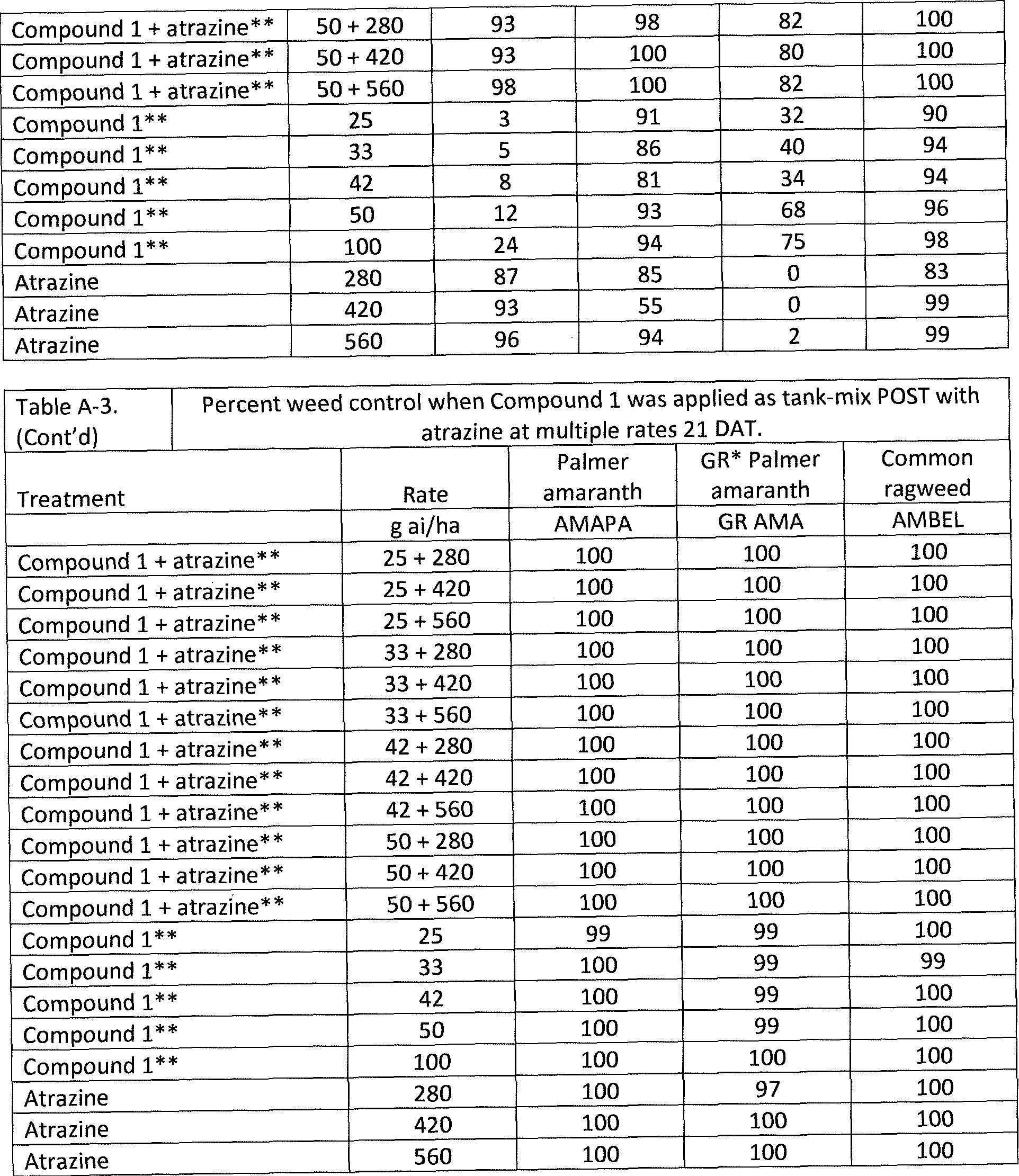


Table A-4


Corn was safe (r.30% injury) with all treatments of COMPOUND 1 or atrazine when rated 14 DAT. Due to lack of injury, size of corn, and space availability, corn was removed after 14 DAT rating (Table A-2). Applied alone, COMPOUND 1 controlled (=85% injury) Canada thistle, dandelion, glyphosate susceptible, resistant Palmer amaranth, and common ragweed at all rates 28 DAT (Table A-4). Glyphosate susceptible and resistant horseweed was controlled by COMPOUND 1 alone at 33 g ai/ha, yellow nutsedge was controlled by 100 g. COMPOUND 1 plus atrazine controlled Canada thistle, dandelion, susceptible and resistant Palmer amaranth, common ragweed, susceptible and resistant horseweed with all combinations, common chickweed with 7 of 12 combinations, and failed to control yellow nutsedge with any combination (Table A-4).
Further, the combination of COMPOUND 1 plus atrazine provides unexpected enhanced control of a number of weeds, particularly those determined to be glyphosate resistant species.
Table A-5


Column A= All weeds are susceptible unless identified with GR (Glyphosate resistant species) or ALSR (ALS resistance species)
Column B= Rating interval in DAT (days after treatment was made)
Column C=Compound 1 applied alone in g ai/ha (grams of active ingredient per hectare that the Compound 1 was applied)
Column D= % Efficacy (visual rating of weed control) of herbicide in column C
Column E= Tank-mix partner (herbicide) that was applied alone in g ai/ha (grams active ingredient per hectare of Atrazine was applied)
Column F= % Efficacy (visual rating of weed control) of herbicide in column F
Column G= Minimum percent control needed for enhanced effect (using Coby's equation) Column H= Actual % visual rating of weed control from tank-mixing herbicides in column C + E (number is greater than Column G= unexpected result)
Example B
To determine if the addition of atrazine (Atrazine 4L, 42.6%) as a tank-mix partner would increase the efficacy of COMPOUND 1 (20.94% SC) when applied POST. COMPOUND 1 and atrazine were applied at the following rates alone and as tank-mixes. COMPOUND 1 was applied at 18.5, 25, 37.5, 50, and 100 g ai/ha; atrazine was applied at 140, 280, and 560 g. Mesotrione (Callisto 40%) at 100 g plus atrazine at 560 g was compared as a standard against COMPOUND 1 + atrazine tank-mixes. Crop oil concentrate at 1% v/v was added to all treatments. Applications were made POST to morningglory (5" height at treatment), Palmer amaranth (5-7"), velvetleaf (2-2.5"), and common cocklebur (2-3"). Plants were grown in 3" plastic pots utilizing Metro-Mix 360 soil media, watered and fertilized routinely. Treatments were applied using compressed air in a track spray chamber at 30 GPA using a TeeJet 800 IE nozzle at 40 PSI. Visual percent weed control was recorded at 7, 14, 21, and 28 days after treatment using a scale of 0 (no control) to 100 (complete plant death). Data were analyzed using Minitab statistical software at 95% confidence interval.
Table B-1


All weeds were controlled by all tank-mix combinations of COMPOUND 1 plus atrazine. Morningglory control by the tank-mix of COMPOUND 1 at 18.5 g ai/ha plus atrazine at 140 g exhibited an enhanced effect coefficient of 2.8 (Colby formula) compared to COMPOUND 1 applied alone and atrazine applied alone at same rates 28 DAT (Table B-4). Mesotrione at 100 g plus atrazine at 560 g controlled all weeds in the assay (Table B-4).
The addition of atrazine to COMPOUND 1 resulted in faster weed response to herbicide treatment than COMPOUND 1 applied alone. For the lowest rate of COMPOUND 1, 18.5 g, morningglory, Palmer amaranth, velvetleaf and common cocklebur were controlled 6%, 87%, 87% and 60% respectively, the lowest rate of atrazine in the trial controlled the same weeds 58%, 82%, 21% and 79% respectively, while the tank-mix of COMPOUND 1 plus atrazine at those rates provided 98%» control of morningglory, 95% control of Palmer amaranth, 98% control of velvetleaf and 96% control of common cocklebur 7 DAT. Morningglory was not controlled by any stand alone treatment of COMPOUND 1 at any rating interval.
Unexpected enhanced control of a number of weeds were further observed at all rating intervals when COMPOUND 1 was applied in combination with atrazine.
Table B-5

Example C
COMPOUND 1 was applied at 0, 25, 33, 42, or 50 g ai/ha, and bromoxynil (Maestro® 2EC, 33.4%) was applied at 0, 140, 190, 240, or 280 g ai/ha. Both herbicides were applied alone and as tank-mix partners at rates mentioned previously. Standards for comparison included a jug-mix of pyrasulfotole + bromoxynil (Huskie™) at 271.4 g (41.4 g pyrasulfotole plus 230 g bromoxynil) and a tank-mix of clopyralid (Stinger®, 40.9%) at 105.2 g + fluroxypyr (Starane® Ultra, 45.52%) at 105.2 g. Crop oil concentrate (COC) at 1% v/v was added to all treatments containing COMPOUND 1, ammonium sulfate (AMS) at 2.8 kg/ha was added to the application of Huskie. Applications were made POST to wild mustard (3"), kochia (3-4.5"), canola (2"), wild oat (6"), shepherd' s-purse (1"), wild buckwheat (6-7" runners), Italian ryegrass (4"), Canada thistle (4.5-5.5"), wheat (6.5"), and barley (6") at heights given in parenthesis. Plants were grown in 3" plastic pots utilizing Metro-Mix 360 soil media. After application, treated plants were placed in the greenhouse; foliage was allowed to dry for 24 hr prior to resumption of watering. Thereafter plants were watered and fertilized routinely. Treatments were applied using compressed air in a track spray chamber at 30 GPA using a TeeJet 8001E nozzle at 40 PSI. Visual percent weed control or crop injury was recorded at 7, 14, 21, and 28 days after treatment using a scale of 0 (no control/no injury) to 100 (complete plant death). Data were analyzed using Minitab statistical software at 95% confidence interval.
Table C-l

Table C-2


Table C-3


Table C-4


Table C-6


Table C-7


COMPOUND 1 applied alone controlled (>85% injury) shepherd' s-purse and RR (Roundup Ready) volunteer volunteer canola at all rates and wild buckwheat at 50 g ai/ha, and was safe (-=10% injury) on both wheat and barley with all rates. Bromoxynil applied alone controlled RR canola at all rates, wild buckwheat at 190 g, Canada thistle at 240 g, shepherd' s-purse at 280 g, and was safe on both wheat and barley at all rates. Wild oat and Italian ryegrass were not controlled by any application of COMPOUND 1 alone or bromoxynil alone.
COMPOUND 1 plus bromoxynil controlled Canada thistle, wild mustard, wild buckwheat, kochia, shepherd' s-purse, and RR canola with all treatments, failed to control wild oat or Italian ryegrass with any treatment, and was safe on wheat and barley with all treatments.
Pyrasulfotole plus bromoxynil (Huskie) controlled Canada thistle, wild buckwheat, shepherd' s- purse, and RR canola while remaining safe on wheat and barley. Clopyralid plus fluroxypyr did not control any weed and was safe on both crops.
Unexpected enhanced control of a number of weeds were further observed at all rating intervals when COMPOUND 1 was applied in combination with bromoxynil.
Table C-9

Example D
To determine if the addition of glyphosate (Roundup WeatherMAX, 48.8%) as a tank-mix partner would alter the efficacy of COMPOUND 1-2 (20.94% SC) when applied POST, COMPOUND 1 and glyphosate were applied at the following rates alone and as tank-mixes. COMPOUND 1 was applied at 18.75, 25, 37.5 and 50 g ai/ha and glyphosate was applied at 280, 560, and 1120 g ae/ha. Halex GT (s-metolachlor at 1052 g ai/ha + glyphosate at 1052 g ae/ha + mesotrione at 105.2 g ai/ha) was tested as standard against COMPOUND 1 + glyphosate tank- mixes. Crop oil concentrate at 1% V/V was added to all treatments containing COMPOUND 1; ammonium sulfate (AMS) at 8.5 lb /100 Gallons was added to all glyphosate treatments, and non-ionic surfactant at 0.25% and AMS were added to Halex GT. Applications were made POST to RR corn (8" height at treatment), morningglory (3"), Italian ryegrass (5-6"), green foxtail (1.5-2"), field bindweed (4"), barnyardgrass (5"), GR horseweed (2-3" rosette), common chickweed (1"), GR Palmer amaranth (1-3"), kochia (0.5-1'·' and 4"), and prickly sida (1-2").
Plants were grown in 3" plastic pots utilizing Metro-Mix 360 soil media, watered and fertilized routinely. Treatments were applied using compressed air in a track spray chamber at 30 GPA using a Tee Jet 800 IE nozzle at 40 PSI. Visual percent weed control was recorded at 7, 14, 21 and 28 days after treatment, crop injury was recorded at 7 and 14 DAT, using a scale of 0 (no control/no crop injury) to 100 (complete plant death). Data were analyzed using Minitab statistical software at 95% confidence interval.
Table D-l



Table D-4
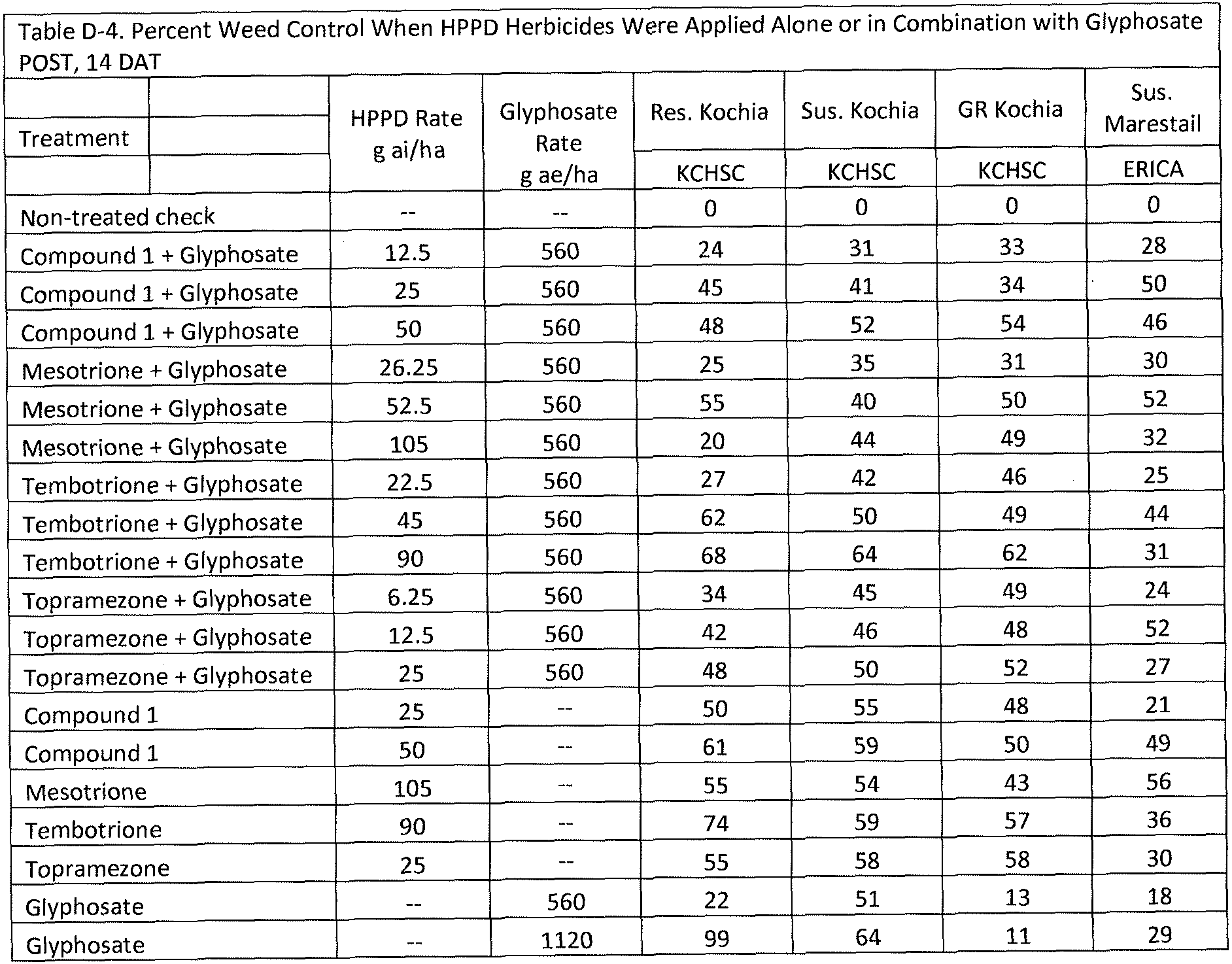
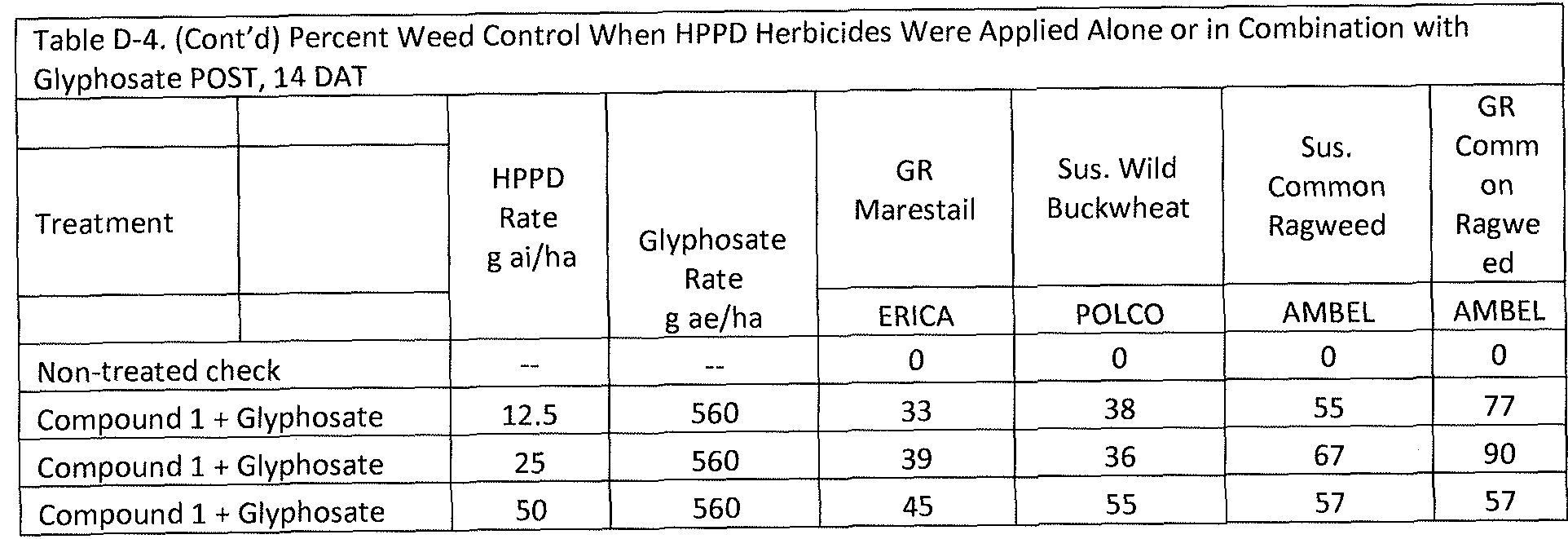

Table D-5

 Table D-6
D-6. Percent Weed Control when HPPD Herbicides were Applied Alone or in Combination with Glyphosate POST, 21 DAT
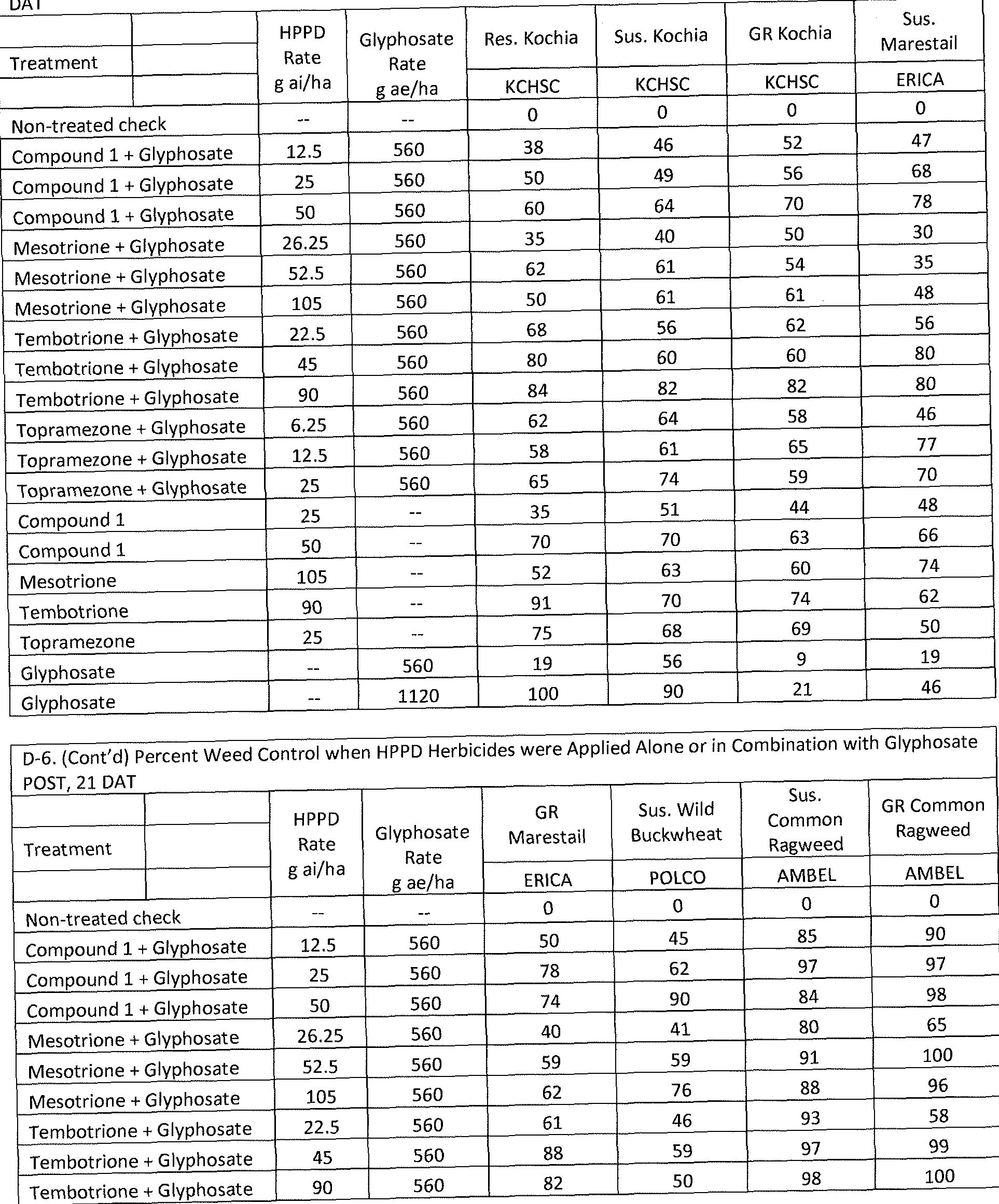


Unexpected enhanced control of a number of weeds were further observed at all rating intervals when COMPOUND 1 was applied in combination with glyphosate after 28 days.
Table D-5


Example E
COMPOUND 1-2 (20.94% SC) at 18.5, 25, 37.5, 50, and 100 g ai/ha and s-metolachlor (Dual II Magnum, 82.4%) at 175, 350, and 525 g ai/ha were applied together and alone PRE to yellow nutsedge, velvetleaf, Italian ryegrass, barnyardgrass, morningglory, common ragweed, kochia, Palmer amaranth, Pennsylvania smartweed, corn, and wheat. Mesotrione (Callisto 40%) at 100 g plus s-metolachlor at 525 g and mesotrione at 184 g plus s-metolachlor at 1870 g were included as reference standards. Plants were direct seeded into 10" x 6" fiber pots filled with Pennington soil. Treatments were applied using compressed air track spray chamber at 30 GPA using a TeeJet 800 IE nozzle at 40 PSI. After application flats were water lightly, thereafter, watered and fertilized routinely. Visual percent weed control and crop injury were recorded at 14, 21 and 28 days after treatment, using a scale of 0 (no control/no injury) to 100 (complete plant death). Data were analyzed using Minitab statistical software at 95% confidence interval.
Table E-l


Table E-2


Table E-3
Table E- Percent Weed Control and Crop Injury with Compound 1 and s-metolachlor PRE Tank-mix 3. Combinations 28 DAT


The tank-mix of COMPOUND 1 at 18.5 g plus s-metolachlor at 175 g applied PRE in most cases resulted in increased control compared to either product applied alone at the same rates. For example, at previously mentioned rates, yellow nutsedge control increased from 63% with COMPOUND 1 alone or 53% with s-metolachlor alone, to 82% with COMPOUND 1 + s- metolachlor; velvetleaf control increased, from 77% with COMPOUND 1 or 0% with s- metolachlor to 99% with tank-mix; Italian ryegrass increased from 3% with COMPOUND 1 or 77% with s-metolachlor to 93% with tank-mix; kochia control increased from 57% with COMPOUND 1 or 0% with s-metolachlor to 86% with tank-mix. However, control of common ragweed decreased from 84% with COMPOUND 1 or 23% with s-metolachlor to 57% for the tank-mix.
Palmer amaranth was controlled by all treatments; Pennsylvania smartweed was controlled by all treatment except s-metolachlor alone at the lowest rate; barnyardgrass was controlled by all
treatments except with COMPOUND 1 alone at rates in the range of from 18.5 to 50 g. Morningglory was not controlled by any combination or stand alone treatment of COMPOUND 1 or s-metolachlor.
Mesotrione at 100 g plus .s-metolachlor at 525 g or mesotrione at 184 g plus s-metolachlor at 1870 g controlled all weeds in the assay, while COMPOUND 1 at 100 g plus s-metolachlor at 525 g controlled all weeds except morningglory.
Corn was tolerant to nearly all combinations of COMPOUND 1 plus s-metolachlor at 21 DAT, and tolerant to 1 of 2 standards. Wheat was not tolerant to any treatment with s-metolachlor at 21 or 28 DAT.
Unexpected enhanced control of a number of weeds were further observed at all rating intervals when COMPOUND 1 was applied in combination with s-metolachlors.
Table E-4

Example F
Mesotrione (Callisto®, 40%), tembotrione (Laudis®, 34.5%) and topramezone (Impact®, 29.7%) were applied alone at labeled rate, or at ¼ and ½ of labeled rates in combinations with glufosinate (Ignite, 24.5%). COMPOUND 1 (SC, 42.1%) was applied alone at 25 or 50 g ai/ha, and at 12.5 or 25 g when tank-mixed with glufosinate. Glufosinate was applied as tank-mix at 225 g alone at 225 or 450 g. Details of treatments, including adjuvants can be found in the corresponding table. Applications were made POST to weeds listed in table plus corn. All plants were grown in 7.5 cm (3") square plastic pots utilizing Metro-Mix 360 soil media. After application, treated plants were placed in the greenhouse; foliage was allowed to dry for 24 hr prior to resumption of watering. Thereafter plants were watered and fertilized routinely. Treatments were applied using compressed air in a track spray chamber at 280 L/ha (30 GPA) using a TeeJet 8001E nozzle at 2.76 bar (40 PSI). Visual percent weed control and corn injury was recorded at 7, 14, 21, and 28 days after treatment (DAT) using a scale of 0 (no control/no
injury) to 100 (complete plant death). Data were analyzed using Minitab statistical software at 95% confidence interval. Certain weed species were more susceptible to combinations of COMPOUND 1 + glufosinate than either herbicide alone at those same rates. For instance, yellow nutsedge was controlled 62% with COMPOUND 1 at 25 g alone (28 DAT), 43% with glufosinate alone at 225 g, and 87% with the combination. Likewise, at 7 DAT, susceptible common ragweed was controlled 98% with the combination, 64% with glufosinate alone, and
22% with COMPOUND 1 alone.
Table F-l


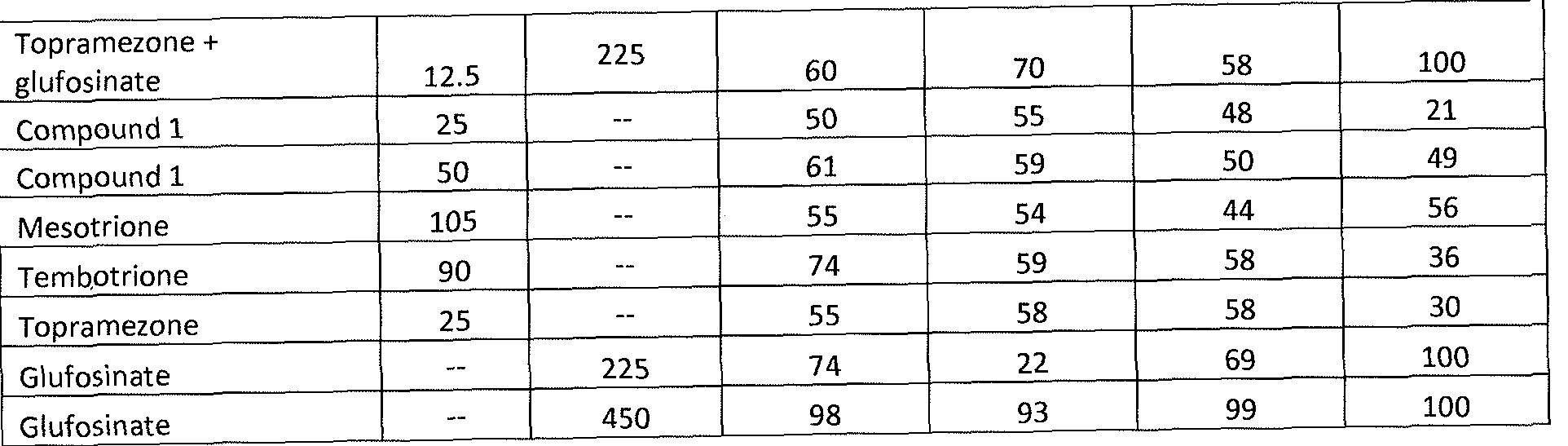


Table F-5

Example H
COMPOUND 1 (20.94% SC) was applied at 18.5, 25, 37.5, 50, or 100 g ai/ha, and mifensulfuron was applied at 4.4, 8.8, or 17.5 g ai/ha. Both herbicides were applied alone and as tank-mix partners at those rates. A tank-mix of mesotrione at 100 g plus thifensulfiiron at 17.5 g was included as a standard for comparison. Crop oil concentrate (COC) at 1% v/v was added to all treatments. Applications were made POST to common ragweed (I"), Canada thistle (2-3"), wild buckwheat at two sizes (noted as small 1", and large 3-4"), kochia (1-2"), wild mustard (2"), redroot pigweed (1-2"), and wheat (4") at heights given in parenthesis. Plants were grown in 3" plastic pots utilizing Metro-Mix 360 soil media. After application, treated plants were placed in the greenhouse; foliage was allowed to dry for 24 hr prior to resumption of watering. Thereafter plants were watered and fertilized routinely. Treatments were applied using compressed air in a track spray chamber at 30 GPA using a TeeJet 800 IE nozzle at 40 PSI. Visual percent weed control or crop injury was recorded at 7, 14, 21, and 28 days after treatment using a scale of 0 (no control/no injury) to 100 (complete plant death). Data were analyzed using Minitab statistical software at 95% confidence interval. At 28 DAT, COMPOUND 1 applied alone at 18.5 or 25 g failed to provide commercial control ( .=85%) of kochia, as did thifensulfiiron at all rates. All combinations of Compound 1 plus thifensulfiiron provided commercially expectable control. Certain combinations represented in Table H-5 demonstrate an enhanced effect as defined by Colby's formula.
Table H-l


Table H-2

 Table H-3


Unexpected enhanced control of a number of weeds were further observed at all rating intervals when COMPOUND 1 was applied in combination with thifensulfuron.
Table H-5
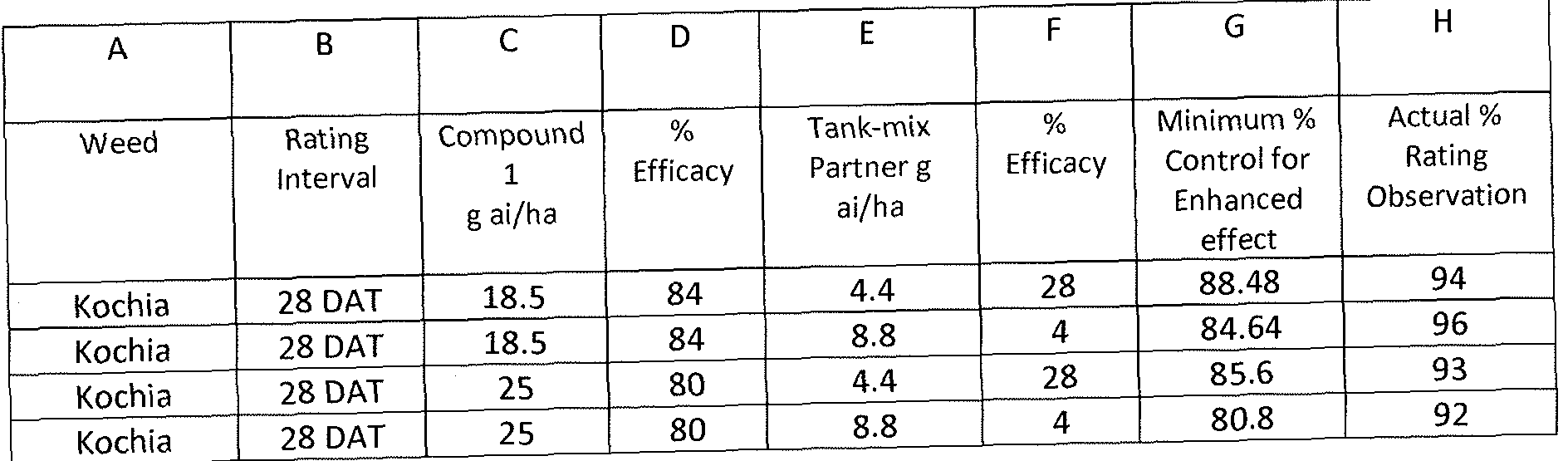
Example I
Fiber flats (6X10") were filled with loam soil and planted with crops and weeds listed in tables found in section I. Prior to application flats were watered lightly. Treatments (listed in same tables) were applied PRE. After application flats were moved to the greenhouse, placed in a complete randomize design, blocked for species grouping, and watered lightly. Thereafter pots were watered and fertilized routinely. Each treatment was replicated 3 times. Treatments were applied using compressed air in a track spray chamber at 30 GPA using a TeeJet 800 IE nozzle at 40 PSI. Visual percent crop injury and weed control were recorded 14 and 28 days after treatment (DAT) using a scale of 0 (no injury/no control) to 100 (complete plant death). Data were analyzed using Minitab statistical software at 95% confidence interval. At 28 DAT, 25 g ai/ha of Compound 1 provided 80% control of kochia, 890 g of pethoxamid provided only 3% control, while the combination of those herbicides at corresponding rates provided 97% control. Similar results were also observed for Jimson weed at 28 DAT.
Table 1-1


Table 1-2


Table 1-3


Unexpected enhanced control of a number of weeds were further observed at all rating intervals when COMPOUND 1 was applied in combination with pethoxamid.
Table 1-3

Example J
This example illustrates weed control when beflubutamid was applied alone or in combination with Compound 1 Pre-emergent. Fiber flats (6X10") were filled with loam soil and planted with crops and weeds listed in tables found in section J, prior to herbicide application flats were watered lightly. Treatments (listed in same tables) were applied PRE. After application flats were moved to the greenhouse, placed in a complete randomize design, blocked for species grouping, and watered lightly. Thereafter pots were watered and fertilized routinely. Each treatment was replicated 3 times. Treatments were applied using compressed air in a track spray chamber at 30 GPA using a TeeJet 800 IE nozzle at 40 PSI. Visual percent crop injury and weed control were recorded 14 and 28 days after treatment (DAT) using a scale of 0 (no injury/no control) to 100 (complete plant death). Data were analyzed using Minitab statistical software at
95% confidence interval. At 28 DAT, Compound 1 applied at 19 g ai/ha provided 27% control to barnyardgrass, and 60% to goosegrass. Beflubutamid at 94 g provided 52% and 82% respectively. The combination of Compound 1 at 19 g plus beflubutamid at 94 g yielded 100% control of barnyardgrass and 91% of goosegrass.
Table J-l


Unexpected enhanced control of a number of weeds were further observed at all rating intervals when COMPOUND 1 was applied in combination with beflubutamid.
Table J-4

Example K
This example illustrates weed control when beflubutamid was applied alone or in combination with Compound 1 Post-emergent. A greenhouse study was conducted to determine post- emergence weed efficacy and crop safety with Compound 1 alone or in combination with
beflubutamid. Beflubutamid (CHA3830, 43.9% SC) was applied alone at 94, 125, and 188 g ai/ha and as a tank-mix partner at 125 g. Compound 1 (42.2% SC) was applied alone at 37.5 g ai/ha and in combinations with beflubutamid at 25 and 37.5 g. Crop oil concentrate (COC) was added to all treatments at 1% v/v. All crops and weeds were grown in 7.5 cm X 7.5 cm plastic pots for the duration of the trial. Treatments were applied to weed species at heights mentioned in table 4 reps per species.

Treatments were applied using compressed air in a track spray chamber at 30 GPA (280 L/ha) using a TeeJet 800 IE nozzle at 40 PSI (2.76 bars). Visual percent weed control and crop injury were recorded at 7, 14, 21, and 28 days after treatment (DAT), using a scale of 0 (no control/no injury) to 100 (complete plant death). Data were analyzed using Minitab statistical software at 95% confidence interval. Compound 1 at 37.5 g ai/ha plus beflubutamid at 125 g ai/ha applied as tank-mix combination controlled ( Ξ.85%) barnyardgrass, Chinese sprangletop and large crabgrass where neither herbicide alone at those same rates provided control. Control of certain other weeds was increased with the combination compared to the mix partners alone (rice flatsedge and green foxtail).
Table K-1


Table K-2


Unexpected enhanced control of a number of weeds was further observed at all rating intervals when COMPOUND 1 was applied in combination with Beflubutamid.
Table K-5

All references cited herein are incorporated by reference in their entirety.
While this invention has been described with an emphasis upon preferred embodiments, it will be obvious to those of ordinary skill in the art that variations in the preferred compositions and methods can be used and that it is intended that the invention can be practiced otherwise than as specifically described herein. Accordingly, this invention includes all modifications encompassed within the spirit and scope of the invention as defined by the claims that follow.
Claims
1. A herbicidal composition comprising
a. a compound of Formula I; and

b. a second herbicide being a chlorotriazine herbicide, or an agriculturally acceptable salt and/or ester thereof;
wherein the ratio between the compound of Formula I and the chlorotriazine herbicide is in the range of from 1:3 to 1:15.
2. The herbicidal composition of claim 1, wherein the chlorotriazine herbicide is atrazine.
3. A method of controlling undesired vegetation in a crop comprising applying to the locus of such vegetation an herbicidally-effective amount of the herbicidal composition defined in any one of the claims 1-2.
4. The method of claim 3, wherein the vegetation belongs to a family selected from Asteraceae, Caryophyllaceae, and Convolvulaceae.
5. A herbicidal composition comprising
a. a compound of Formula I; and

b. a second herbicide being a nitrile herbicide, or an agriculturally acceptable salt and/or ester thereof;
wherein the ratio between the compound of Formula I and the nitrile herbicide is in the range of from 1:3 to 1:10.
6. The herbicidal composition of claim 5, wherein the nitrile herbicide is bromoxynil.
b. a second herbicide being a chloroacetanilide herbicide, or an agriculturally acceptable salt and/or ester thereof;
wherein the ratio between the compound of Formula I and the chloroacetanilide herbicide is in the range of from 1 :3 to 1: 15.
14. The herbicidal composition of claim 13, wherein the chloroacetanilide herbicide is S- metolachlor.
15. A method of controlling undesired vegetation in a crop comprising applying to the locus of such vegetation an herbicidally-effective amount of the herbicidal composition defined in any one of the claims 13-14.
16. The method of claim 15, wherein the vegetation belongs to the family Chenopodiaceae.
17. A herbicidal composition comprising
a. a compound of Formula I; and

b. a second herbicide being a phosphinic acid derived herbicide, or an agriculturally acceptable salt and/or ester thereof;;
wherein the ratio between the compound of Formula I and the phosphinic acid derived herbicide is in the range of from 1:3 to 1:15.
18. The herbicidal composition of claim 17, wherein the phosphinic acid derived herbicide is glufosinate, or an agriculturally acceptable salt and/or ester thereof.
19. A method of controlling undesired vegetation in a crop comprising applying to the locus of such vegetation an herbicidally-effective amount of the herbicidal composition defined in any one of claims 17-18.
20. The method according to claim 19, wherein the vegetation belongs to the family Asteraceae.
21. A herbicidal composition comprising
a. a compound of Formula I; and

b. a second herbicide being a triazinylsulfonylurea herbicide, or an agriculturally
acceptable salt and/or ester thereof;
wherein the ratio between the compound of Formula I and the triazinylsulfonylurea herbicide is in the range of from 1:0.1 to 1:1.
22. The herbicidal composition of claim 21, wherein the triazinylsulfonylurea herbicide is
thifensulfuron, or an agriculturally acceptable salt and/or ester thereof.
23. A method of controlling undesired vegetation in a crop comprising applying to the locus of such vegetation an herbicidally-effective amount of the herbicidal composition defined in any one of the claims 21-22.
24. The method according to claim 23, wherein the vegetation belongs to the family
Chenopodiaceae.
25. A herbicidal composition comprising
a. a compound of Formula I; and

b. a second herbicide being an amide herbicide, or an agriculturally acceptable salt and/or ester thereof;
wherein the ratio between the compound of Formula I and the amide herbicide is in the range of from 1 : 10 to 1 :50.
26. The herbicidal composition of Claim 1, wherein the amide herbicide is pethoxamid.
27. A method of controlling undesired vegetation in a crop comprising applying to the locus of such vegetation an herbicidally-effective amount of the composition defined in any one of the claims 25-26.
28. The method of claim 27, wherein the vegetation belongs to a family selected from
Chenopodiaceae and Solanaceae.
29. A herbicidal composition comprising
a. a compound of Formula I; and

b. a second herbicide being an amide herbicide, or an agriculturally acceptable salt and/or ester thereof;
wherein the ratio between the compound of Formula I and the amide herbicide is in the range of from 1 :2 to 1:10.
30. The herbicidal composition of claim 29, wherein the amide herbicide is beflubutamid.
31. A method of controlling undesired vegetation in a crop comprising applying to the locus of such vegetation an herbicidally-effective amount of the composition defined in any one of the claims 29-30.
32. The method of claim 31, wherein the vegetation belongs to a family selected from
Caryophyllaceae, Poaceae, and Cyperaceae.
33. The herbicidal composition according to any one of the claims 1-2, 5-6, 9-10, 13-14, 17-18, 21-22, 25-26 and 29-30, or a method according to any one of the claims 3-4, 7-8, 11-12, 15- 16, 19-20, 23-24, 27-28 and 31-32, wherein the herbicidal composition further comprises one or more further herbicides.
34. The herbicidal composition according to any one of the preceding claims 1-2, 5-6, 9-10, 13- 14, 17-18, 21-22, 25-26, 29-30 and 33, or a method according to any one of the claims 3-4, 7- 8, 11-12, 15-16, 19-20, 23-24 and 27-28, wherein the herbicidal composition is formulated as an emulsifiable concentrate (EC), as a suspension concentrate (SC) or as a capsule suspension
(CS).
Applications Claiming Priority (4)
| Application Number | Priority Date | Filing Date | Title |
|---|---|---|---|
| US201662437963P | 2016-12-22 | 2016-12-22 | |
| US62/437,963 | 2016-12-22 | ||
| US201762471444P | 2017-03-15 | 2017-03-15 | |
| US62/471,444 | 2017-03-15 |
Publications (2)
| Publication Number | Publication Date |
|---|---|
| WO2018119348A1 true WO2018119348A1 (en) | 2018-06-28 |
| WO2018119348A4 WO2018119348A4 (en) | 2018-09-20 |
Family
ID=62627503
Family Applications (2)
| Application Number | Title | Priority Date | Filing Date |
|---|---|---|---|
| PCT/US2017/068093 Ceased WO2018119348A1 (en) | 2016-12-22 | 2017-12-22 | Herbicidal combinations and methods of controlling weeds |
| PCT/US2017/068077 Ceased WO2018119338A1 (en) | 2016-12-22 | 2017-12-22 | Mixtures of beflubutamid or optically enriched forms thereof with a second herbicide |
Family Applications After (1)
| Application Number | Title | Priority Date | Filing Date |
|---|---|---|---|
| PCT/US2017/068077 Ceased WO2018119338A1 (en) | 2016-12-22 | 2017-12-22 | Mixtures of beflubutamid or optically enriched forms thereof with a second herbicide |
Country Status (16)
| Country | Link |
|---|---|
| US (2) | US11412737B2 (en) |
| EP (2) | EP3557997B1 (en) |
| JP (1) | JP7097366B2 (en) |
| KR (1) | KR102644635B1 (en) |
| CN (1) | CN110325038B (en) |
| AU (1) | AU2017382307B2 (en) |
| BR (1) | BR112019012730B1 (en) |
| CA (1) | CA3048003A1 (en) |
| ES (1) | ES3046549T3 (en) |
| MX (1) | MX2019007596A (en) |
| PL (1) | PL3557997T3 (en) |
| RS (1) | RS67462B1 (en) |
| RU (1) | RU2019122650A (en) |
| UA (1) | UA125723C2 (en) |
| WO (2) | WO2018119348A1 (en) |
| ZA (1) | ZA201903954B (en) |
Cited By (1)
| Publication number | Priority date | Publication date | Assignee | Title |
|---|---|---|---|---|
| CN115413668A (en) * | 2022-08-30 | 2022-12-02 | 安徽圣丰生化有限公司 | A herbicidal composition comprising fenfentrazone and glyphosate |
Families Citing this family (9)
| Publication number | Priority date | Publication date | Assignee | Title |
|---|---|---|---|---|
| WO2019243104A1 (en) | 2018-06-20 | 2019-12-26 | BASF Agro B.V. | Method for controlling herbicide resistant or tolerant weeds |
| MX2022004514A (en) * | 2019-10-24 | 2022-07-04 | Oms Invest Inc | HERBICIDAL COMPOSITIONS AND METHODS FOR FORMULATING AND USING SAME. |
| AU2021329912A1 (en) * | 2020-08-20 | 2023-03-02 | Monsanto Technology Llc | Microcapsule with acetamides and diflufenican |
| AU2021340583A1 (en) * | 2020-09-10 | 2023-03-16 | Bayer Aktiengesellschaft | Herbicidal combinations comprising diflufenican and mesotrione |
| TW202415291A (en) * | 2022-09-30 | 2024-04-16 | 美商富曼西公司 | Storage-stable compositions including bixlozone and beflubutamid |
| CN120265129A (en) * | 2022-11-15 | 2025-07-04 | 巴斯夫农业化学品有限公司 | Aqueous suspension concentrate formulations of agrochemical active substances |
| WO2024138004A1 (en) * | 2022-12-22 | 2024-06-27 | Syngenta Crop Protection Ag | Herbicidal compositions |
| WO2024261687A1 (en) * | 2023-06-23 | 2024-12-26 | Upl Mauritius Limited | A method for controlling weeds |
| CN118749515B (en) * | 2024-06-24 | 2025-10-03 | 侨昌现代农业有限公司 | A low-decomposability binary herbicidal suspension composition and its preparation method and application |
Citations (4)
| Publication number | Priority date | Publication date | Assignee | Title |
|---|---|---|---|---|
| WO2012002096A1 (en) * | 2010-06-29 | 2012-01-05 | Kumiai Chemical Industry Co., Ltd. | 6-acyl-1,2,4-triazine-3,5-dione derivative and herbicides |
| US20140106968A1 (en) * | 2012-10-15 | 2014-04-17 | E I Du Pont De Nemours And Company | Substituted 1,2,4-triazine-3,5-diones as herbicides |
| US20140323304A1 (en) * | 2008-03-25 | 2014-10-30 | Sds Biotech K.K. | Herbicide composition and weed control method |
| US9072297B2 (en) * | 2010-06-14 | 2015-07-07 | Ishihara Sangyo Kaisha, Ltd. | Herbicidal composition |
Family Cites Families (24)
| Publication number | Priority date | Publication date | Assignee | Title |
|---|---|---|---|---|
| JPH0657684B2 (en) | 1986-03-28 | 1994-08-03 | 宇部興産株式会社 | N-benzyl 2- (4-fluoro-3-trifluoromethylphenoxy) butanoic acid amide and herbicide containing the same |
| JPH0761924B2 (en) | 1988-07-28 | 1995-07-05 | 宇部興産株式会社 | Herbicide composition |
| JP3680440B2 (en) * | 1996-10-01 | 2005-08-10 | 宇部興産株式会社 | Herbicide composition |
| DE69728873T2 (en) | 1996-02-09 | 2005-03-31 | Ube Industries, Ltd., Ube | HERBICIDAL COMPOSITION |
| JPH10101504A (en) * | 1996-10-01 | 1998-04-21 | Ube Ind Ltd | Herbicide composition |
| JPH10324603A (en) * | 1997-05-23 | 1998-12-08 | Ube Ind Ltd | Herbicide composition |
| JPH1149609A (en) * | 1997-08-01 | 1999-02-23 | Ube Ind Ltd | Herbicide composition for paddy field |
| JP2003212704A (en) * | 2002-01-16 | 2003-07-30 | Ube Ind Ltd | Herbicide composition |
| AU2003288133A1 (en) * | 2002-11-21 | 2004-06-15 | Syngenta Participations Ag | Herbidical composition |
| CN101080173B (en) * | 2004-12-17 | 2010-04-07 | 辛根塔参与股份公司 | herbicidal composition |
| ITMI20060394A1 (en) | 2006-03-06 | 2007-09-07 | Isagro Ricerca Srl | NEW SYNERGIC HERBICIDE COMPOSITIONS |
| BRPI0816172B8 (en) | 2007-08-27 | 2022-06-28 | Dow Agrosciences Llc | SYNERGIC HERBICIDAL MIXTURE AND METHOD TO CONTROL UNDESIRABLE VEGETATION |
| PH12013500886A1 (en) | 2010-11-03 | 2019-07-03 | Dow Agrosciences Llc | Pesticidal compositions and processes related thereto |
| CN102283199A (en) * | 2011-06-28 | 2011-12-21 | 陕西美邦农药有限公司 | Weeding composition containing beflubutamid and bromoxynil |
| CN103719126B (en) * | 2011-07-01 | 2016-02-17 | 陕西美邦农药有限公司 | The Herbicidal combinations of a kind of containing beflubutamid and sulfonylurea |
| CN102302017B (en) | 2011-07-04 | 2013-11-27 | 陕西美邦农药有限公司 | Herbicidal composition containing beflubutamid and flumetsulam |
| CN102258028B (en) | 2011-07-06 | 2014-08-13 | 陕西美邦农药有限公司 | Weeding composition containing beflubutamid and pyraflufen-ethyl |
| CN102258021B (en) | 2011-07-08 | 2014-04-09 | 陕西美邦农药有限公司 | Beflubutamid-containing weeding composition |
| CN102326550B (en) | 2011-07-11 | 2014-08-13 | 陕西美邦农药有限公司 | Weeding composition containing beflubutamid and clopyralid |
| CN102326552A (en) * | 2011-07-12 | 2012-01-25 | 陕西美邦农药有限公司 | Weeding composition containing beflubutamid and diflufenican |
| CN102326565B (en) | 2011-07-14 | 2013-11-27 | 陕西美邦农药有限公司 | Weeding composition containing beflubutamid and pinoxaden |
| CN102334483B (en) * | 2011-07-19 | 2014-03-19 | 陕西美邦农药有限公司 | Weeding composition containing beflubutamid and terbutryn |
| PH12021553084A1 (en) * | 2014-02-23 | 2022-09-19 | Fmc Corp | Use of 3-isoxazolidinones compounds as selective herbicides |
| CN105519531A (en) | 2014-09-28 | 2016-04-27 | 南京华洲药业有限公司 | Clodinafop-propargyl and beflubutamid containing weeding composition and application thereof |
-
2017
- 2017-12-22 PL PL17835905.5T patent/PL3557997T3/en unknown
- 2017-12-22 BR BR112019012730-5A patent/BR112019012730B1/en active IP Right Grant
- 2017-12-22 WO PCT/US2017/068093 patent/WO2018119348A1/en not_active Ceased
- 2017-12-22 US US16/472,045 patent/US11412737B2/en active Active
- 2017-12-22 CA CA3048003A patent/CA3048003A1/en active Pending
- 2017-12-22 AU AU2017382307A patent/AU2017382307B2/en active Active
- 2017-12-22 WO PCT/US2017/068077 patent/WO2018119338A1/en not_active Ceased
- 2017-12-22 RS RS20251191A patent/RS67462B1/en unknown
- 2017-12-22 RU RU2019122650A patent/RU2019122650A/en unknown
- 2017-12-22 JP JP2019534364A patent/JP7097366B2/en active Active
- 2017-12-22 EP EP17835905.5A patent/EP3557997B1/en active Active
- 2017-12-22 UA UAA201908273A patent/UA125723C2/en unknown
- 2017-12-22 KR KR1020197020799A patent/KR102644635B1/en active Active
- 2017-12-22 ES ES17835905T patent/ES3046549T3/en active Active
- 2017-12-22 MX MX2019007596A patent/MX2019007596A/en unknown
- 2017-12-22 EP EP25191928.8A patent/EP4627922A3/en active Pending
- 2017-12-22 CN CN201780087323.0A patent/CN110325038B/en active Active
-
2019
- 2019-06-18 ZA ZA2019/03954A patent/ZA201903954B/en unknown
-
2022
- 2022-07-22 US US17/871,380 patent/US11950597B2/en active Active
Patent Citations (4)
| Publication number | Priority date | Publication date | Assignee | Title |
|---|---|---|---|---|
| US20140323304A1 (en) * | 2008-03-25 | 2014-10-30 | Sds Biotech K.K. | Herbicide composition and weed control method |
| US9072297B2 (en) * | 2010-06-14 | 2015-07-07 | Ishihara Sangyo Kaisha, Ltd. | Herbicidal composition |
| WO2012002096A1 (en) * | 2010-06-29 | 2012-01-05 | Kumiai Chemical Industry Co., Ltd. | 6-acyl-1,2,4-triazine-3,5-dione derivative and herbicides |
| US20140106968A1 (en) * | 2012-10-15 | 2014-04-17 | E I Du Pont De Nemours And Company | Substituted 1,2,4-triazine-3,5-diones as herbicides |
Cited By (1)
| Publication number | Priority date | Publication date | Assignee | Title |
|---|---|---|---|---|
| CN115413668A (en) * | 2022-08-30 | 2022-12-02 | 安徽圣丰生化有限公司 | A herbicidal composition comprising fenfentrazone and glyphosate |
Also Published As
| Publication number | Publication date |
|---|---|
| EP4627922A3 (en) | 2025-12-17 |
| RU2019122650A (en) | 2021-01-22 |
| JP7097366B2 (en) | 2022-07-07 |
| US20200093136A1 (en) | 2020-03-26 |
| US20230112154A1 (en) | 2023-04-13 |
| AU2017382307A1 (en) | 2019-07-04 |
| ZA201903954B (en) | 2022-12-21 |
| ES3046549T3 (en) | 2025-12-02 |
| RS67462B1 (en) | 2025-12-31 |
| EP3557997A1 (en) | 2019-10-30 |
| US11950597B2 (en) | 2024-04-09 |
| BR112019012730B1 (en) | 2024-01-23 |
| JP2020503317A (en) | 2020-01-30 |
| WO2018119348A4 (en) | 2018-09-20 |
| MX2019007596A (en) | 2019-09-09 |
| UA125723C2 (en) | 2022-05-25 |
| WO2018119338A1 (en) | 2018-06-28 |
| CA3048003A1 (en) | 2018-06-28 |
| KR20190100252A (en) | 2019-08-28 |
| CN110325038A (en) | 2019-10-11 |
| EP4627922A2 (en) | 2025-10-08 |
| AU2017382307B2 (en) | 2022-10-27 |
| US11412737B2 (en) | 2022-08-16 |
| PL3557997T3 (en) | 2026-01-19 |
| KR102644635B1 (en) | 2024-03-08 |
| EP3557997C0 (en) | 2025-08-27 |
| RU2019122650A3 (en) | 2021-05-17 |
| EP3557997B1 (en) | 2025-08-27 |
| CN110325038B (en) | 2022-10-04 |
| BR112019012730A2 (en) | 2019-11-26 |
Similar Documents
| Publication | Publication Date | Title |
|---|---|---|
| AU2021212008B2 (en) | Use of 3-isoxazolidinones compounds as selective herbicides | |
| US11950597B2 (en) | Mixtures of beflubutamid or optically enriched forms thereof with a second herbicide | |
| AU2019203141A1 (en) | Herbicidal combinations and methods of controlling weeds | |
| US12616203B2 (en) | Use of 3-isoxazolidinones compounds as selective herbicides | |
| NZ748706B2 (en) | Use of 3-isoxazolidinones compounds as selective herbicides | |
| NZ761902B2 (en) | Use of 3-isoxazolidinones compounds as selective herbicides | |
| HK1232072B (en) | Selective herbicidal compositions containing 2,4-dc |
Legal Events
| Date | Code | Title | Description |
|---|---|---|---|
| 121 | Ep: the epo has been informed by wipo that ep was designated in this application |
Ref document number: 17884185 Country of ref document: EP Kind code of ref document: A1 |
|
| NENP | Non-entry into the national phase |
Ref country code: DE |
|
| 122 | Ep: pct application non-entry in european phase |
Ref document number: 17884185 Country of ref document: EP Kind code of ref document: A1 |