WO2018080216A1 - Phenyl phthalazine derivative, method for the preparation thereof, and pharmaceutical composition comprising the same - Google Patents
Phenyl phthalazine derivative, method for the preparation thereof, and pharmaceutical composition comprising the same Download PDFInfo
- Publication number
- WO2018080216A1 WO2018080216A1 PCT/KR2017/011964 KR2017011964W WO2018080216A1 WO 2018080216 A1 WO2018080216 A1 WO 2018080216A1 KR 2017011964 W KR2017011964 W KR 2017011964W WO 2018080216 A1 WO2018080216 A1 WO 2018080216A1
- Authority
- WO
- WIPO (PCT)
- Prior art keywords
- phthalazin
- chlorophenyl
- piperazin
- amino
- methanone
- Prior art date
- Legal status (The legal status is an assumption and is not a legal conclusion. Google has not performed a legal analysis and makes no representation as to the accuracy of the status listed.)
- Ceased
Links
- 0 CCC(C1)*1(C(C)[C@@](C)CC**)C(C1)C(C)C(C2[C@@]3C22)C1C2C3C1C*CC1 Chemical compound CCC(C1)*1(C(C)[C@@](C)CC**)C(C1)C(C)C(C2[C@@]3C22)C1C2C3C1C*CC1 0.000 description 2
- ZLXVRHHOQJQURP-UHFFFAOYSA-N CC(C)(C(N(CC1)CCC1c1nnc(-c(cc2)ccc2Cl)c2c1cccc2)=O)N Chemical compound CC(C)(C(N(CC1)CCC1c1nnc(-c(cc2)ccc2Cl)c2c1cccc2)=O)N ZLXVRHHOQJQURP-UHFFFAOYSA-N 0.000 description 1
- XYGHNQSUCVCLER-UHFFFAOYSA-N CC(C)(C(N(CC1)CCN1c1nnc(-c2cc(C(O)=O)ccc2)c2c1cccc2)=O)N Chemical compound CC(C)(C(N(CC1)CCN1c1nnc(-c2cc(C(O)=O)ccc2)c2c1cccc2)=O)N XYGHNQSUCVCLER-UHFFFAOYSA-N 0.000 description 1
- UCNSURNMSGTXQF-UHFFFAOYSA-N CC(CC=C1)c2c1c(-c1ccccc1)cnc2N(CC1)CCN1C(C1CC1)O Chemical compound CC(CC=C1)c2c1c(-c1ccccc1)cnc2N(CC1)CCN1C(C1CC1)O UCNSURNMSGTXQF-UHFFFAOYSA-N 0.000 description 1
- SSOIYVKGGOKREM-KKSFZXQISA-N CC[C@H](C)[C@@H](C(N(CC1)CCN1c1c(cccc2)c2c(-c(cc2)ccc2Cl)nn1)=O)N Chemical compound CC[C@H](C)[C@@H](C(N(CC1)CCN1c1c(cccc2)c2c(-c(cc2)ccc2Cl)nn1)=O)N SSOIYVKGGOKREM-KKSFZXQISA-N 0.000 description 1
- ZGESOECQWNMPDG-UHFFFAOYSA-N CNCCN(C)c1nnc(-c(cc2)ccc2Cl)c2c1cccc2 Chemical compound CNCCN(C)c1nnc(-c(cc2)ccc2Cl)c2c1cccc2 ZGESOECQWNMPDG-UHFFFAOYSA-N 0.000 description 1
- OTNZGVFSEHEJDB-UHFFFAOYSA-N COc(cc1)ccc1-c(c1c2cccc1)cnc2N(CC1)CCN1C(C1CC1)=O Chemical compound COc(cc1)ccc1-c(c1c2cccc1)cnc2N(CC1)CCN1C(C1CC1)=O OTNZGVFSEHEJDB-UHFFFAOYSA-N 0.000 description 1
- NLOMFYCIRUICKQ-UHFFFAOYSA-N COc(cc1)ccc1-c1c(cccc2)c2c(N(CC2)CCN2C(C2CC2)=O)nn1 Chemical compound COc(cc1)ccc1-c1c(cccc2)c2c(N(CC2)CCN2C(C2CC2)=O)nn1 NLOMFYCIRUICKQ-UHFFFAOYSA-N 0.000 description 1
- YXFVVABEGXRONW-UHFFFAOYSA-N Cc1ccccc1 Chemical compound Cc1ccccc1 YXFVVABEGXRONW-UHFFFAOYSA-N 0.000 description 1
- IPGGBRDLOCZFCK-UHFFFAOYSA-N OCCN(CC1)CCN1c1nnc(-c2ccccc2)c2ccccc12 Chemical compound OCCN(CC1)CCN1c1nnc(-c2ccccc2)c2ccccc12 IPGGBRDLOCZFCK-UHFFFAOYSA-N 0.000 description 1
Classifications
-
- C—CHEMISTRY; METALLURGY
- C07—ORGANIC CHEMISTRY
- C07D—HETEROCYCLIC COMPOUNDS
- C07D403/00—Heterocyclic compounds containing two or more hetero rings, having nitrogen atoms as the only ring hetero atoms, not provided for by group C07D401/00
- C07D403/02—Heterocyclic compounds containing two or more hetero rings, having nitrogen atoms as the only ring hetero atoms, not provided for by group C07D401/00 containing two hetero rings
- C07D403/04—Heterocyclic compounds containing two or more hetero rings, having nitrogen atoms as the only ring hetero atoms, not provided for by group C07D401/00 containing two hetero rings directly linked by a ring-member-to-ring-member bond
-
- C—CHEMISTRY; METALLURGY
- C07—ORGANIC CHEMISTRY
- C07D—HETEROCYCLIC COMPOUNDS
- C07D487/00—Heterocyclic compounds containing nitrogen atoms as the only ring hetero atoms in the condensed system, not provided for by groups C07D451/00 - C07D477/00
- C07D487/02—Heterocyclic compounds containing nitrogen atoms as the only ring hetero atoms in the condensed system, not provided for by groups C07D451/00 - C07D477/00 in which the condensed system contains two hetero rings
- C07D487/04—Ortho-condensed systems
-
- A—HUMAN NECESSITIES
- A61—MEDICAL OR VETERINARY SCIENCE; HYGIENE
- A61K—PREPARATIONS FOR MEDICAL, DENTAL OR TOILETRY PURPOSES
- A61K31/00—Medicinal preparations containing organic active ingredients
- A61K31/33—Heterocyclic compounds
- A61K31/395—Heterocyclic compounds having nitrogen as a ring hetero atom, e.g. guanethidine or rifamycins
- A61K31/495—Heterocyclic compounds having nitrogen as a ring hetero atom, e.g. guanethidine or rifamycins having six-membered rings with two or more nitrogen atoms as the only ring heteroatoms, e.g. piperazine or tetrazines
- A61K31/496—Non-condensed piperazines containing further heterocyclic rings, e.g. rifampin, thiothixene or sparfloxacin
-
- A—HUMAN NECESSITIES
- A61—MEDICAL OR VETERINARY SCIENCE; HYGIENE
- A61K—PREPARATIONS FOR MEDICAL, DENTAL OR TOILETRY PURPOSES
- A61K31/00—Medicinal preparations containing organic active ingredients
- A61K31/33—Heterocyclic compounds
- A61K31/395—Heterocyclic compounds having nitrogen as a ring hetero atom, e.g. guanethidine or rifamycins
- A61K31/495—Heterocyclic compounds having nitrogen as a ring hetero atom, e.g. guanethidine or rifamycins having six-membered rings with two or more nitrogen atoms as the only ring heteroatoms, e.g. piperazine or tetrazines
- A61K31/50—Pyridazines; Hydrogenated pyridazines
- A61K31/502—Pyridazines; Hydrogenated pyridazines ortho- or peri-condensed with carbocyclic ring systems, e.g. cinnoline, phthalazine
-
- A—HUMAN NECESSITIES
- A61—MEDICAL OR VETERINARY SCIENCE; HYGIENE
- A61P—SPECIFIC THERAPEUTIC ACTIVITY OF CHEMICAL COMPOUNDS OR MEDICINAL PREPARATIONS
- A61P9/00—Drugs for disorders of the cardiovascular system
- A61P9/10—Drugs for disorders of the cardiovascular system for treating ischaemic or atherosclerotic diseases, e.g. antianginal drugs, coronary vasodilators, drugs for myocardial infarction, retinopathy, cerebrovascula insufficiency, renal arteriosclerosis
-
- A—HUMAN NECESSITIES
- A61—MEDICAL OR VETERINARY SCIENCE; HYGIENE
- A61P—SPECIFIC THERAPEUTIC ACTIVITY OF CHEMICAL COMPOUNDS OR MEDICINAL PREPARATIONS
- A61P9/00—Drugs for disorders of the cardiovascular system
- A61P9/12—Antihypertensives
-
- C—CHEMISTRY; METALLURGY
- C07—ORGANIC CHEMISTRY
- C07D—HETEROCYCLIC COMPOUNDS
- C07D217/00—Heterocyclic compounds containing isoquinoline or hydrogenated isoquinoline ring systems
- C07D217/22—Heterocyclic compounds containing isoquinoline or hydrogenated isoquinoline ring systems with hetero atoms or with carbon atoms having three bonds to hetero atoms with at the most one bond to halogen, e.g. ester or nitrile radicals, directly attached to carbon atoms of the nitrogen-containing ring
-
- C—CHEMISTRY; METALLURGY
- C07—ORGANIC CHEMISTRY
- C07D—HETEROCYCLIC COMPOUNDS
- C07D237/00—Heterocyclic compounds containing 1,2-diazine or hydrogenated 1,2-diazine rings
- C07D237/26—Heterocyclic compounds containing 1,2-diazine or hydrogenated 1,2-diazine rings condensed with carbocyclic rings or ring systems
-
- C—CHEMISTRY; METALLURGY
- C07—ORGANIC CHEMISTRY
- C07D—HETEROCYCLIC COMPOUNDS
- C07D237/00—Heterocyclic compounds containing 1,2-diazine or hydrogenated 1,2-diazine rings
- C07D237/26—Heterocyclic compounds containing 1,2-diazine or hydrogenated 1,2-diazine rings condensed with carbocyclic rings or ring systems
- C07D237/30—Phthalazines
- C07D237/34—Phthalazines with nitrogen atoms directly attached to carbon atoms of the nitrogen-containing ring, e.g. hydrazine radicals
-
- C—CHEMISTRY; METALLURGY
- C07—ORGANIC CHEMISTRY
- C07D—HETEROCYCLIC COMPOUNDS
- C07D401/00—Heterocyclic compounds containing two or more hetero rings, having nitrogen atoms as the only ring hetero atoms, at least one ring being a six-membered ring with only one nitrogen atom
- C07D401/02—Heterocyclic compounds containing two or more hetero rings, having nitrogen atoms as the only ring hetero atoms, at least one ring being a six-membered ring with only one nitrogen atom containing two hetero rings
- C07D401/04—Heterocyclic compounds containing two or more hetero rings, having nitrogen atoms as the only ring hetero atoms, at least one ring being a six-membered ring with only one nitrogen atom containing two hetero rings directly linked by a ring-member-to-ring-member bond
-
- C—CHEMISTRY; METALLURGY
- C07—ORGANIC CHEMISTRY
- C07D—HETEROCYCLIC COMPOUNDS
- C07D401/00—Heterocyclic compounds containing two or more hetero rings, having nitrogen atoms as the only ring hetero atoms, at least one ring being a six-membered ring with only one nitrogen atom
- C07D401/02—Heterocyclic compounds containing two or more hetero rings, having nitrogen atoms as the only ring hetero atoms, at least one ring being a six-membered ring with only one nitrogen atom containing two hetero rings
- C07D401/12—Heterocyclic compounds containing two or more hetero rings, having nitrogen atoms as the only ring hetero atoms, at least one ring being a six-membered ring with only one nitrogen atom containing two hetero rings linked by a chain containing hetero atoms as chain links
-
- C—CHEMISTRY; METALLURGY
- C07—ORGANIC CHEMISTRY
- C07D—HETEROCYCLIC COMPOUNDS
- C07D401/00—Heterocyclic compounds containing two or more hetero rings, having nitrogen atoms as the only ring hetero atoms, at least one ring being a six-membered ring with only one nitrogen atom
- C07D401/14—Heterocyclic compounds containing two or more hetero rings, having nitrogen atoms as the only ring hetero atoms, at least one ring being a six-membered ring with only one nitrogen atom containing three or more hetero rings
-
- C—CHEMISTRY; METALLURGY
- C07—ORGANIC CHEMISTRY
- C07D—HETEROCYCLIC COMPOUNDS
- C07D403/00—Heterocyclic compounds containing two or more hetero rings, having nitrogen atoms as the only ring hetero atoms, not provided for by group C07D401/00
- C07D403/02—Heterocyclic compounds containing two or more hetero rings, having nitrogen atoms as the only ring hetero atoms, not provided for by group C07D401/00 containing two hetero rings
- C07D403/12—Heterocyclic compounds containing two or more hetero rings, having nitrogen atoms as the only ring hetero atoms, not provided for by group C07D401/00 containing two hetero rings linked by a chain containing hetero atoms as chain links
-
- C—CHEMISTRY; METALLURGY
- C07—ORGANIC CHEMISTRY
- C07D—HETEROCYCLIC COMPOUNDS
- C07D403/00—Heterocyclic compounds containing two or more hetero rings, having nitrogen atoms as the only ring hetero atoms, not provided for by group C07D401/00
- C07D403/14—Heterocyclic compounds containing two or more hetero rings, having nitrogen atoms as the only ring hetero atoms, not provided for by group C07D401/00 containing three or more hetero rings
-
- C—CHEMISTRY; METALLURGY
- C07—ORGANIC CHEMISTRY
- C07D—HETEROCYCLIC COMPOUNDS
- C07D405/00—Heterocyclic compounds containing both one or more hetero rings having oxygen atoms as the only ring hetero atoms, and one or more rings having nitrogen as the only ring hetero atom
- C07D405/02—Heterocyclic compounds containing both one or more hetero rings having oxygen atoms as the only ring hetero atoms, and one or more rings having nitrogen as the only ring hetero atom containing two hetero rings
- C07D405/12—Heterocyclic compounds containing both one or more hetero rings having oxygen atoms as the only ring hetero atoms, and one or more rings having nitrogen as the only ring hetero atom containing two hetero rings linked by a chain containing hetero atoms as chain links
-
- C—CHEMISTRY; METALLURGY
- C07—ORGANIC CHEMISTRY
- C07D—HETEROCYCLIC COMPOUNDS
- C07D405/00—Heterocyclic compounds containing both one or more hetero rings having oxygen atoms as the only ring hetero atoms, and one or more rings having nitrogen as the only ring hetero atom
- C07D405/14—Heterocyclic compounds containing both one or more hetero rings having oxygen atoms as the only ring hetero atoms, and one or more rings having nitrogen as the only ring hetero atom containing three or more hetero rings
-
- C—CHEMISTRY; METALLURGY
- C07—ORGANIC CHEMISTRY
- C07D—HETEROCYCLIC COMPOUNDS
- C07D471/00—Heterocyclic compounds containing nitrogen atoms as the only ring hetero atoms in the condensed system, at least one ring being a six-membered ring with one nitrogen atom, not provided for by groups C07D451/00 - C07D463/00
- C07D471/02—Heterocyclic compounds containing nitrogen atoms as the only ring hetero atoms in the condensed system, at least one ring being a six-membered ring with one nitrogen atom, not provided for by groups C07D451/00 - C07D463/00 in which the condensed system contains two hetero rings
- C07D471/04—Ortho-condensed systems
Definitions
- the present invention relates to a novel phenyl phthalazine derivative which can be usefully used for the prevention or treatment of cardiovascular diseases, a method for the preparation thereof and a pharmaceutical composition comprising the same.
- adipokine a hormone secreted by fat, is known to play an important role in the occurrence of obesity-related complications in addition to known hematologic and metabolic factors, it is expected to be able to prevent or treat related diseases by adjusting its actions.
- the importance of adipokine has been proven that severe insulin resistance, hyperglycemia, hyperlipidemia, fatty liver and the like have been found in animal models or humans having a congenital deficiency of adipose tissue.
- adipokines which have been known to date include leptin, adiponectin, TNF-alpha, Resistin, interleukin-6, plasminogen activator inhibitor-!, TGF-beta and the like (Nat Rev Immunol, 2011, 11(2), 85- 97). Resistin was first discovered as a substance that mediates insulin resistance in obese mice.
- Rodent resistin is secreted from adipocytes, which is presumed to be associated with obesity-related insulin resistance and type 2 diabetes (Nature, 2001, 409, 307-312). However, human resistin is quite different from rodent resistin. Human resistin is a cytokine that is secreted from monocytes and induces chronic inflammations. These chronic inflammations can lead to diabetes, obesity, liver disease, arteriosclerosis, rheumatoid arthritis and other cardiovascular diseases (Diabetes Metab J, 2013, 37, 404-414).
- Resistin is a small protein of 12.5 KDa, and six monomers are linked to each other to form a hexamer (Science 2004, 304, 1154-1158).
- the receptor for human resistin is CAPl.
- Resistin increases cAMP via CAPl and induces the expression of inflammatory cytokines via PKA, NFkB signaling system
- human resistin directly binds to CAP 1 in monocytes, and involves in cAMP concentration, PKA activity and NF-kappaB-related transcription of inflammatory cytokines, and over-expression of CAPl enhanced resistin-induced increased activity of cAMP- dependent signaling pathway.
- transgenic mouse model has been shown that CAPl -over-expressed monocytes aggravated adipose tissue inflammation in transgenic mice.
- inhibition of CAPl expression abrogated the resistin-mediated inflammatory activity both in vitro and in vivo (Cell Metab, 2014, 19(3), 484-497).
- It is another object of the present invention to provide a pharmaceutical composition comprising the phenyl phthalazine derivative.
- the present invention provides a compound represented by the following Chemical Formula 1 , or a pharmaceutically acceptable salt thereof:
- X is CH, orN, Li is a single bond, C M alkylene, C 2-4 alkenylene, NH, O, or S0 2 ,
- L 2 is a single bond, C 1 - 4 alkylene, -0-(Ci-4 alkylene)-, -(C alkylene)-0-, CO, NH, NHCO, O, OCO, S0 2 , or COCHNH 2 ,
- L 3 is a single bond, or -0-
- A is N, or a 5- to 9-membered heterocycloalkane ring or heterobicycloalkane ring containing one or two nitrogen atoms,
- Ri is hydrogen, C alkyl, C 1 - 4 alkyl substituted with carboxy group, C haloalkyl, . 4 alkoxy, C M haloalkoxy, halogen, cyano, nitro, 4-methylpiperazin-l-carbonyl, carboxy, morpholino, (C M alkyl)sulfonyl, (piperidinyl)sulfonyl, or (piperazinyl)sulfonyl,
- R 2 is C 1 . 5 alkyl unsubstituted or substituted with amino, carboxy, -COO (C M alkyl), -
- R 3 is hydrogen, or C M alkyl
- R4 is hydrogen, or halogen
- n is 1 or 2, provided that when A is N, n is 1. ;;.
- L 2 is a single bond, -CH 2 -, -CH 2 CH 2 -, -CH 2 CH 2 CH 2 -, -0-(CH 2 )-, - (CH 2 CH 2 )-0-, CO, NH, NHCO, O, OCO, S0 2 , or COCHNH 2 .
- is hydrogen, methyl, ethyl substituted with carboxy group, trifluoromethyl, methoxy, trifluoromethoxy, fluoro, chloro, cyano, nitro, 4- methylpiperazine-1- carbonyl, carboxy, morpholino, methylsulfonyl, (piperidin-l-yl)sulfonyl, or (piperazin-1- yl)sulfonyl,
- R 2 is methyl, ethyl, propyl, isopropyl, butyl, isobutyl, pentyl, or isopentyl, unsubstituted or substituted with amino, carboxy, -COO(ethyl), -CONH 2 , benzyloxy, or imidazole; cyclopropyl, cyclobutyl, or cyclopentyl, unsubstituted or substituted with amino; amino; methylamino; dimethylamino; hydroxy; carboxy; -COO(ethyl); phenyl; morpholino; pyrrolidinyl; tetrahydro-2H-pyranyl; or pyridine.
- A is any one ring selected from the group consisting of pyrrolidine, piperazine, piperidine, 1,2,3,5-tetrahydropyridine, 1,4-diazepan, octahydro-lH-pyrrolo[2,3- cjpyridine, and octahydropyrrolo[3,4-b] pyrrolo.
- A is any one of the following:
- L 3 is a single bond
- A is represented by the following formula ⁇ :
- Y is N, is a single bond, or Y is C, and ' ⁇ is a double bond,
- Z is CH, orN
- nl is 1 or 2
- n2 is 1, 2 or 3.
- nl is 1, n2 is 1, 2 or 3; or nl is 2, and n2 is 3.
- Y is N, is a single bond, and Z is N.
- Li is a single bond
- L 2 is a single bond, C alkylene, -(CM alkylene)-0-, CO, NH, NHCO, or S0 2 ,
- Pvi is hydrogen, C ⁇ alkyl, or halogen
- R 2 is CM alkyl unsubstituted or substituted with amino; C 3 ⁇ cycloalkyl; amino;
- alkyl 2 ; hydroxy; mo holino; or pyrrolidinyl,
- nl is l
- n2 is l, or 2.
- the compounds of the present invention may exist in the form of salts, especially pharmaceutically acceptable salts.
- salts salts commonly used in the art, such as acid addition salts formed by pharmaceutically acceptable free acids can be used without limitation.
- pharmaceutically acceptable salt refers to any organic or inorganic addition salt of the compound represented by Chemical Formula 1, whose concentration is relatively non-toxic and harmless to a patient and activates effectively and whose side effects do not degrade the beneficial efficacy of the above compound.
- an organic acid and an inorganic acid can be used as the free acid.
- the inorganic acids include hydrochloric acid, phosphoric acid, sulfuric acid, nitric acid, tartaric acid and the like.
- organic acids examples include methanesulfonic acid, p-toluenesulfonic acid, acetic acid, trifluoroacetic acid, maleic acid, succinic acid, oxalic acid, benzoic acid, tartaric acid, fumaric acid, mandelic acid, propionic acid, citric acid, lactic acid, glycollic acid, gluconic acid, galacturonic acid, glutamic acid, glutaric acid, glucuronic acid, aspartic acid, ascorbic acid, carbonic acid, vanillic acid, hydroiodic acid and the like, but are not limited thereto.
- a pharmaceutically acceptable metal salt can be obtained by a conventional method using a base.
- a compound represented by Chemical Formula I is dissolved in an excessive amount of an alkali metal hydroxide or an alkaline earth metal hydroxide solution, the non-soluble salt is filtered, and the filtrate is evaporated and dried to obtain a pharmaceutically acceptable metal salt.
- a pharmaceutically unacceptable salt or solvate of the compound of Chemical Formula 1 may be used as an intermediate when preparing the compound of Chemical Formula 1 , or the pharmaceutically acceptable salt or the solvate thereof.
- the compound of Chemical Formula 1 according to the present invention includes not only pharmaceutically acceptable salts thereof, but also solvates such as hydrates that can be prepared therefrom, and includes all possible stereoisomers, but are not limited thereto.
- the solvate and the stereoisomer of the compound of Chemical Formula 1 may be prepared from the compound of Chemical Formula 1 using common methods known in the art.
- the compound of Chemical Formula 1 according to the present invention may be prepared either in a crystalline form or in a non-crystalline form, and when the compound of Chemical Formula 1 is prepared in a crystalline form, it may be optionally hydrated or solvated.
- the compound of Chemical Formula 1 may not only include a stoichiometric hydrate, but also include a compound containing various amounts of water.
- the solvate of the compound of Chemical Formula 1 according to the present invention includes both stoichiometric solvates and non-stoichiometric solvates.
- the present invention can produce, for example, the compound represented by Chemical Formula 1 by a preparation method as shown in Reaction Scheme 1 below.
- , R 2 , R 3 , R4 and n are as defined above and X 'is halogen. More preferably, X' is chloro.
- the reaction is carried out preferably in the presence of triethylamine. In addition, the reaction is carried out preferably at 70°C to 80°C.
- the solvent for the reaction is preferably n- butanol.
- L 3 is a single bond
- A is represented by
- Chemical Formula 1 ' when in Chemical Formula ⁇ , Y is N and is a single bond, as an example, the compound represented by Chemical Formula 1 can be produced through Reaction Scheme 2 below.
- , R 2 , nl and n2 are as previously defined, and X' is halogen. More preferably, X' is chloro.
- the reaction is preferably carried out in the presence of triethylamine. Also, the reaction is preferably carried out at 70°C to 80°C. Further, the solvent for the reaction is preferably n-butanol. Further, when in Chemical Formula 1 , L 3 is a single bond, A is represented by
- Chemical Formula 1 ' when in Chemical Formula , Y is C and is a double bond, as an example, the compound represented by Chemical Formula 1 can be produced through Reaction Scheme 3 below.
- , R 2 , n l and n2 are as previously defined, X' is halogen, and X" is B(OH) 2 . More preferably, X' is chloro.
- the reaction is preferably carried out in the presence of Pd(PPh 3 ) 4 and Na 2 C0 3 . Also, the reaction is preferably carried out at 100°C to 120°C. Further, the solvent for the reaction is preferably dioxane, dimethylformamide, water or a mixed solvent thereof.
- the preparation method of the compound represented by Chemical Formula 1 according to the present invention is not limited to the above-mentioned reaction schemes 1 and 2, and modification can be made thereto as necessary.
- a specific preparation method of the compound represented by Chemical Formula 1 according to the present invention can be further embodied through the following Examples.
- the present invention provides a pharmaceutical composition for preventing or treating cardiovascular diseases, comprising the compound represented by Chemical Formula 1, or a pharmaceutically acceptable salt, hydrate, solvate or isomer thereof as an active ingredient.
- the compound according to the present invention can be used for preventing or treating cardiovascular diseases by inhibiting the binding of resistin and CAPl and thereby inhibiting the expression of inflammatory cytokines.
- the cardiovascular disease includes arteriosclerosis; hypertension, angina pectoris, myocardial infarction, or stroke.
- prevention refers to any act to delay or inhibit occurrence, spread or recurrence of the above-mentioned diseases by administration of the composition of the present invention
- treatment refers to any act to improve or change the symptoms of ; the above diseases for the better by administration of the composition of the present invention.
- the pharmaceutical composition according to the present invention can be formulated in types for oral or parenteral administrations according to a standard pharmaceutical practice. These formulations may contain additives such as pharmaceutically acceptable carrier, adjuvant or diluent in addition to the active ingredient. Suitable carriers include, for example, physiological saline, polyethylene glycol, ethanol, vegetable oil, and isopropyl myristate and the like.
- Diluents include, for example, lactose, dextrose, sucrose, mannitol, sorbitol, cellulose and/or glycine and the like, but are not limited thereto.
- the compounds of the present invention can be dissolved in oils, propylene glycol or other solvents commonly used in the preparation of injection solutions.
- the compounds of the present invention can be formulated in ointments or creams for topical application.
- a preferred dose of the compound of the present invention may be varied according to the condition and weight of a patient, the severity of a disease, the type of a drug, and the route and duration of administration, but it may be suitably selected by those skilled in the art.
- the compound of the present invention may be administrated daily at a dose of 0.0001 to 100 mg/kg (body weight), and preferably 0.001 to 100 mg/kg (body weight).
- the administration may be performed once a day or in divided doses each day through an oral or parenteral route.
- the pharmaceutical composition may contain the compound of the present invention in an amount of 0.001 to 99% by weight, preferably 0.01 to 60% by weight.
- the pharmaceutical composition according to the present invention may be administered to mammals such as a rat, a mouse, a domestic animal, a human, or the like through various routes; The administration may be carried out through all possible methods, for example, oral, rectal, intravenous, intramuscular, subcutaneous, intra-endometrial, intracerebro ventricular injection.
- the compound represented by Chemical Formula 1 according to the present invention or a pharmaceutically acceptable salt, hydrate, solvate or isomer thereof can be usefully used for the prevention or treatment of cardiovascular diseases.
- 1,4-Dichlorophthalazine (1.0 g, 5.03 mmol) and piperazine (0.70 g, 10.06 mmol) were dissolved in n-butanol (10 mL). The mixture was stirred for 3 hours while maintaining an internal temperature at 70°C to 80°C, and the termination of the reaction was confirmed by TLC. The reaction solution was concentrated under reduced pressure, and then the obtained residue was dissolved in dichloromethane (10 mL) and then cooled to 0°C. Thereafter, cyclopropanecarbonyl chloride (0.55 mL, 6.04 mmol) and triethylamine (0.84 mL, 6.04 mmol) were added thereto, followed by stirring for 1 hour. After the termination of the reaction was confirmed by TLC, the reaction solution was washed with water and then concentrated under reduced pressure. The resulting residue was purified by column chromatography. Thereby, the desired intermediate (1.3 g, 81.7%) was obtained.
- Step 2 Preparation of cyclopropyl(4-(4-(4-fluorophenyl)phthalazin-l-yl)piperazin-l- yl)methanone
- Example 37 a compound of Example 37 was produced in the same manner as in Example 32, except that reactants corresponding to the chemical structure of the compound to be produced were used.
- Example 38 a compound of Example 38 was produced in the same manner as in Example 12, except that reactants corresponding to the chemical structure of the compound to be produced were used. At this time, when an amine group was present in the compound to be produced, a protective group (Boc) was introduced and finally an elimination reaction of the protective group was carried out as in the step 3 of Example 31.
- Example 47 a compound of Example 47 was produced in the same manner as in Example 31, except that reactants corresponding to the chemical structure of the compound to be produced were used.
- 1,4-Diclophthalazine (0.30 g, 0.97 mmol)
- Pd (PPh 3 ) 4 (0.05 g, 0.10 mmol)
- tert-butyl 4- (4,4,5,5-tetramethyl-l,3,2-dioxaborolan-2-yl)-3,6-dihydropyridin-l(2H)-carboxylate (0.37 g, 1.21 mmol) was dissolved in dioxane (6 mL) and 2N Na 2 C0 3 aqueous solution. The reaction solution was reacted at 120°C for 60 minutes using a microwave organic synthesizer.
- the intermediate (0.10 g, 0.24 mmol) obtained in the above step 2 was dissolved in dichloromethane (3 mL), and then trifluoroacetic acid (0.50 mL) was added thereto.
- the reaction solution was stirred at room temperature for 4 hours, and then the termination of the reaction was confirmed by TLC.
- the reaction mixture was washed with a saturated aqueous solution of NaHC0 3 , and then concentrated under reduced pressure. The resulting residue was washed with dichloromethane and n-hexane to obtain the desired compound (0.07 g, 91.8%).
- Example 53 the compounds of Examples 53 to 55 were each produced in the same manner as in Example 12, except that reactants corresponding to the chemical structure of the compound to be produced were used.
- the protective group Boc
- an elimination reaction of the protective group was performed as in Step 3 of Example 31.
- the desired compound (0.01 g, 50.5%) was prepared in the same manner as in the steps 3 and 4 of Example 48, except for using the intermediate (0.03 g, 0.07 mmol) obtained in the above step 1 as a starting material.
- Example 57 the compound of Example 57 was produced in the same manner as in Example 12, except that reactants corresponding to the chemical structure of the compound to be produced were used. At this time, when an amine group was present in the compound to be produced, a protecting group (Boc) was introduced and finally an elimination reaction of the protective group was performed as in the step 3 of Example 31.
- a protecting group Boc
- Example 61 to 64 were produced in the same manner as in Example 56, except that reactants corresponding to the chemical structure of the compound to be produced were each used. At this time, when an amine group was present in the compound to be produced, the protecting group (Boc) was introduced and finally an elimination reaction of protective group was performed as in Step 3 of Example 31.
- Examples 65 and 66 were each produced in the same manner as in Example 32, except that reactants corresponding to the chemical structure of the compound to be produced were used.
- Example 65 Preparation of ethyl 2-(4-(4 ⁇ (4-chlorophenyl)pht aIazin-l- yl)piperazin-l-yl)acetate
- Example 67 the compound of Example 67 was produced in the same manner as in Example 12, except that reactants corresponding to the chemical structure of the compound to be produced were used.
- Example 68 the compound of Example 68 was produced in the same manner as in Example 32, except that reactants corresponding to the chemical structure of the compound to be produced were used.
- Example 69 Preparation of (S)-2-amino-l-(4-(4-(4-chlorophenyl)phthalazin-l- yl)-2 ⁇ -dimethylpiperazin-l-yl)-3-methylbutan-l-one hydrochloride
- Example 70 Preparation of (R)-2-amino-l-(4-(4-(4-chlorophenyl)phthalazin-l- yl)-2-methylpiperazin-l-yl)-2-methylpropan-l-one hydrochloride
- Example 72 Preparation of (S)-2-amino-l-(4-(4-(4-chlorophenyl)phthalazin-l- yl)-2-methylpiperazin-l-yl)-2-methylpropan-l-one hydrochloride
- Example 78 Preparation of (4-(4-(4-chlorophenyl)phthalazin-l-yl)piperazin-l- yl)(piperidin-2-yl)methanone hydrochloride,
- Example 82 the compound of Example 82 was produced in the same manner as in Example 32, except that reactants corresponding to the chemical structure of the compound to be produced were used.
- Examples 83 to 86 were each produced in the same manner as in Example 31, except that reactants corresponding to the chemical structure of the compound to be produced were used.
- Example 84 Preparation of 4-amino-5-(4-(4-(4-chlorophenyl)phthalazin-l- yl)piperazin-l-yl)-5-oxopentanamide hydrochloride
- Example 87 to 91 were each produced in the same manner as in Example 12, except that reactants corresponding to the chemical structure of the compound to be produced were used. At this time, when an amine group was present in the compound to be produced, a protecting group (Boc) was introduced and finally an elimination reaction of the protective group was performed as in Step 3 of Example 31.
- 1,4-Dichlorophthalazine (0.10 g, 0.50 mmol) and tert-butylmethyl (pyrrolidin-3- yl)carbamate (0.11 g, 0.50 mmol) were dissolved in n-butanol (3 mL). The mixture was stirred for 3 hours while maintaining an internal temperature at 70°C to 80°C, and the tennination of the reaction was confirmed by TLC.
- the reaction solution was concentrated under reduced pressure, and then the obtained residue was dissolved in N,N-dimethylformamide (2.0 mL), and 4-chlorobenzenethiol (0.09 g, 1.2 eq.) and K 2 CO 3 (0.10 g, 1.5 eq.) were added at room temperature .
- Step 2 Preparation of tert-butyl (l-(4-((4-chlorophenyl)sulfonyl)phthalazin-l-yl) pyrrolidin-3-yl) (methyl)carbamate
- the intermediate (0.03 g, 1.0 eq.) obtained in the above step 1 was dissolved in dichloromethane (2.0 mL) and then 3-chloroperbenzoic acid (mCPBA) (0.03 g, 2.5 eq.) was added thereto.
- mCPBA 3-chloroperbenzoic acid
- the reaction solution was stirred at room temperature overnight, and then the disappearance of the starting material was confirmed by TLC.
- the intermediate was produced in the same manner as in the step 1 of Example 92 except that 4-chlorophenol was used instead of 4-chlorobenzenethiol.
- the desired compound was obtained in the same manner as in the step 3 of Example 92 except that the intermediate was used.
- Example 94 the compound of Example 94 was produced in the same manner as in Example 93, except that reactants corresponding to the chemical structure of the compound to be produced were used.
- 1,4-Dichlorophthalazine (0.10 g, 0.50 mmol) was dissolved in dichloromethane (3 mL), and then NaOH (0.03 g, 0:75 mmol), tetrabutylammonium bromide (0.05 g, 0.15 mmol) and tert-butyl 3-hydroxypyrrolidine-l-carboxylate (0.1 1 g, 0.60 mmol) were added thereto. The mixture was stirred overnight at room temperature and the termination of the reaction was confirmed by TLC. Dichloromethane (5 mL) was added to the reaction solution, followed by washing with water.
- Example 95 except that reactants corresponding to the chemical structure of the compound to be produced were used.
- 1,4-Dichlorophthalazine 1.0 g, 5.03 mmol
- tert-butylmethyl(pyrrolidin-3- yl)carbamate 1.11 g, 5.03 mmol
- n-butanol 10 mL
- reaction solution was concentrated under reduced pressure, and then the obtained residue was dissolved in 1,4-dioxane (3.0 mL), and then 4- chloroaniline (0.02 g, 1.2 eq.), rac-BINAP (0.22 g, 0.2 eq.), palladium(II) acetate (0.03 g, 0.1 eq.) and cesium carbonate (1.10 g, 2 eq.) were added thereto.
- the reaction solution was reacted at 120°C for 30 minutes under microwave. After confirming the disappearance of the starting material by TLC, the mixture was washed with ethyl acetate and filtered.
- the intermediate (0. I I g, 1.0 eq.) obtained in the above step 1 was dissolved in acetonitrile (2.0 mL), and then phosphoryl chloride (2.0 mL) and N,N-dimethylformamide (some drops) were added thereto.
- the reaction solution was heated to 100°C and allowed to react for 4 hours. After confirming the disappearance of the starting material by TLC, water and saturated sodium hydrogen carbonate aqueous solution were added. After confirming that a red ' solid was crystallized, it was filtered to obtain the desired intermediate 1 -chloro-4- (4- chlorobenzyl)phthalazme (0.08 g, yield 68.1 %).
- Example 100 Preparation of 2-amino-2-methyl-l-(4-(4-(4- mo holinophenyl)phthaIazin-l-yl)piperazin-l-yl)propan-l-one hydrochloride
- Example 101 Preparation of 2-amino-2-methyl-l-(4-(4-(4-(4- (methylsulfonyl)phenyl)phthalazin-l-yl)piperazin-l-yl)propan-l-one hydrochloride 1H NMR (500 MHz, MeOD) : 8.61(d, 1H), 8.27(m, 3H), 8.22(t, lH), 8.17(d, 1H), 8.03(d, 2H), 4.08-4.01 (m, 8H), 1.77(s, 6H)
- Example 104 Preparation of 3-(4-(4-(4-(2-amino-2-methylpropanoyl)piperazin- l-yl)phthalazin-l-yl)phenyl)propanoic acid hydrochloride
- Example 105 Preparation of 4-(4-(4-(2-amino-2-methylpropanoyl)piperazin-l- yl)phthalazin-l-yl)benzoic acid hydrochloride
- Example 106 Preparation of 2-amino-2-methyl-l-(4-(4-(4-(4-(4-methylpiperazine-l- carbonyl)phenyl)phthalazin-l-yl)piperazin-l-yl)propan-l-one dihydrochloride
- Example 107 Preparation of 2-amino-2-methyl-l-(4-(4-(4-(4-(piperidin-l- ylsulfonyl)phenyl)phthalazin-l-yl)piperazin-l-yl)propan-l-one hydrochloride
- Example 108 Preparation of 2-amino-2-methyl-l-(4-(4-(3-(piperazin-l ylsulfonyl)phenyl)phthalazin-l-yl)piperazin-l-yl)propan-l-one dihydrochloride
- THP-1 human monocyte
- ELIS A ELIS A system
- the cultured cells were spun down at 1,500 rpm for 2 minutes, the supernatant was removed and then the cells were re-suspended in 10 mL of complete RPMI- 1640 medium. After counting the number of cells using LunaTM Automated Cell Counter, cells were plated into 96-well assay plates at 50 ⁇ per well. The cells cultured for 24 hours were treated with the test substances in accordance with the concentration for 1 hour, and then the supernatant was collected and subjected to ELISA assay. In the ELISA assay, the absorbance at 450 nm (OD 4 o n m) was measured using Flexstation 3. The ability of each test substance to inhibit TNF-a secretion (IC 50 ) and its inhibition at a concentration of 5 uM are shown in Table 1 below.
Landscapes
- Chemical & Material Sciences (AREA)
- Organic Chemistry (AREA)
- Health & Medical Sciences (AREA)
- Medicinal Chemistry (AREA)
- Pharmacology & Pharmacy (AREA)
- Life Sciences & Earth Sciences (AREA)
- Animal Behavior & Ethology (AREA)
- General Health & Medical Sciences (AREA)
- Public Health (AREA)
- Veterinary Medicine (AREA)
- Bioinformatics & Cheminformatics (AREA)
- Engineering & Computer Science (AREA)
- Chemical Kinetics & Catalysis (AREA)
- Cardiology (AREA)
- Heart & Thoracic Surgery (AREA)
- General Chemical & Material Sciences (AREA)
- Nuclear Medicine, Radiotherapy & Molecular Imaging (AREA)
- Epidemiology (AREA)
- Urology & Nephrology (AREA)
- Vascular Medicine (AREA)
- Pharmaceuticals Containing Other Organic And Inorganic Compounds (AREA)
Abstract
The present invention relates to a compound represented by Chemical Formula 1, or a pharmaceutically acceptable salt thereof. The compound according to the present invention can be usefully used for the prevention or treatment of cardiovascular diseases.
Description
TITLE OF INVENTION
PHENYL PHTHALAZINE DERIVATIVE, METHOD FOR THE PREPARATION THEREOF, AND PHARMACEUTICAL COMPOSITION COMPRISING THE SAME TECHNICAL FIELD
The present invention relates to a novel phenyl phthalazine derivative which can be usefully used for the prevention or treatment of cardiovascular diseases, a method for the preparation thereof and a pharmaceutical composition comprising the same.
BACKGROUND OF ART
Recently, as adipokine, a hormone secreted by fat, is known to play an important role in the occurrence of obesity-related complications in addition to known hematologic and metabolic factors, it is expected to be able to prevent or treat related diseases by adjusting its actions. The importance of adipokine has been proven that severe insulin resistance, hyperglycemia, hyperlipidemia, fatty liver and the like have been found in animal models or humans having a congenital deficiency of adipose tissue. Representative types of the adipokines which have been known to date include leptin, adiponectin, TNF-alpha, Resistin, interleukin-6, plasminogen activator inhibitor-!, TGF-beta and the like (Nat Rev Immunol, 2011, 11(2), 85- 97). Resistin was first discovered as a substance that mediates insulin resistance in obese mice.
Rodent resistin is secreted from adipocytes, which is presumed to be associated with obesity-related insulin resistance and type 2 diabetes (Nature, 2001, 409, 307-312). However, human resistin is quite different from rodent resistin. Human resistin is a cytokine that is secreted from monocytes and induces chronic inflammations. These chronic inflammations can lead to diabetes, obesity, liver disease, arteriosclerosis, rheumatoid arthritis and other cardiovascular diseases (Diabetes Metab J, 2013, 37, 404-414).
Resistin is a small protein of 12.5 KDa, and six monomers are linked to each other to form a hexamer (Science 2004, 304, 1154-1158). In a recent research, it was first discovered in
the world that the receptor for human resistin is CAPl. Resistin increases cAMP via CAPl and induces the expression of inflammatory cytokines via PKA, NFkB signaling system, Further, the research has reported that human resistin directly binds to CAP 1 in monocytes, and involves in cAMP concentration, PKA activity and NF-kappaB-related transcription of inflammatory cytokines, and over-expression of CAPl enhanced resistin-induced increased activity of cAMP- dependent signaling pathway. In particular, the transgenic mouse model has been shown that CAPl -over-expressed monocytes aggravated adipose tissue inflammation in transgenic mice. In contrast, it has been shown that inhibition of CAPl expression abrogated the resistin-mediated inflammatory activity both in vitro and in vivo (Cell Metab, 2014, 19(3), 484-497).
Therefore, by developing a drug that effectively adjusts the action of resistin and CAPl, it is expected to be able to prevent and treat related diseases, especially cardiovascular diseases.
DETAILED DESCRIPTION OF THE INVENTION TECHNICAL PROBLEM
It is one object of the present invention to provide a novel phenyl phthalazine derivative which can be usefully used for the prevention or treatment of cardiovascular diseases, and a method for the preparation thereof.
It is another object of the present invention to provide a pharmaceutical composition comprising the phenyl phthalazine derivative.
TECHNICAL SOLUTION
In order to achieve the above objects, the present invention provides a compound represented by the following Chemical Formula 1 , or a pharmaceutically acceptable salt thereof:
[Chemical Formula 1]

in Chemical Formula 1
X is CH, orN,
Li is a single bond, CM alkylene, C2-4 alkenylene, NH, O, or S02,
L2 is a single bond, C1-4 alkylene, -0-(Ci-4 alkylene)-, -(C alkylene)-0-, CO, NH, NHCO, O, OCO, S02, or COCHNH2,
L3 is a single bond, or -0-,
A is N, or a 5- to 9-membered heterocycloalkane ring or heterobicycloalkane ring containing one or two nitrogen atoms,
Ri is hydrogen, C alkyl, C1-4 alkyl substituted with carboxy group, C haloalkyl, . 4 alkoxy, CM haloalkoxy, halogen, cyano, nitro, 4-methylpiperazin-l-carbonyl, carboxy, morpholino, (CM alkyl)sulfonyl, (piperidinyl)sulfonyl, or (piperazinyl)sulfonyl,
R2 is C 1.5 alkyl unsubstituted or substituted with amino, carboxy, -COO (CM alkyl), -
CONH2, benzyloxy, or imidazole; C3-6 cycloalkyl unsubstituted or substituted with amino; amino; NH(CM alkyl); N(CM alkyl)2; hydroxy; carboxy; -COO(CM alkyl); phenyl; or a 5- or 6- membered heterocyclic group containing 1 to 3 heteroatoms each independently selected from the group consisting of N, O and S,
R3 is hydrogen, or C M alkyl,
R4 is hydrogen, or halogen, and
n is 1 or 2, provided that when A is N, n is 1. ;;.
Preferably, L, is a single bond, -CH2-, -CH=CH-, -CH2-CH=CH-, NH, O, or S02.
Preferably, L2 is a single bond, -CH2-, -CH2CH2-, -CH2CH2CH2-, -0-(CH2)-, - (CH2CH2)-0-, CO, NH, NHCO, O, OCO, S02, or COCHNH2.
Preferably, R| is hydrogen, methyl, ethyl substituted with carboxy group, trifluoromethyl, methoxy, trifluoromethoxy, fluoro, chloro, cyano, nitro, 4- methylpiperazine-1- carbonyl, carboxy, morpholino, methylsulfonyl, (piperidin-l-yl)sulfonyl, or (piperazin-1- yl)sulfonyl,
Preferably, R2 is methyl, ethyl, propyl, isopropyl, butyl, isobutyl, pentyl, or isopentyl, unsubstituted or substituted with amino, carboxy, -COO(ethyl), -CONH2, benzyloxy, or
imidazole; cyclopropyl, cyclobutyl, or cyclopentyl, unsubstituted or substituted with amino; amino; methylamino; dimethylamino; hydroxy; carboxy; -COO(ethyl); phenyl; morpholino; pyrrolidinyl; tetrahydro-2H-pyranyl; or pyridine. Preferably, A is any one ring selected from the group consisting of pyrrolidine, piperazine, piperidine, 1,2,3,5-tetrahydropyridine, 1,4-diazepan, octahydro-lH-pyrrolo[2,3- cjpyridine, and octahydropyrrolo[3,4-b] pyrrolo.
Preferably, A is any one of the following:

Preferably, L3 is a single bond, and A is represented by the following formula Γ:
[Chemical Formula ]

in Chemical Formula 1 ',
/'' /''
Y is N, is a single bond, or Y is C, and '< is a double bond,
Z is CH, orN,
nl is 1 or 2,
n2 is 1, 2 or 3.
Preferably, nl is 1, n2 is 1, 2 or 3; or nl is 2, and n2 is 3.
Preferably, Y is N, is a single bond, and Z is N.
Preferably,
X is N,
Li is a single bond,
L2 is a single bond, C alkylene, -(CM alkylene)-0-, CO, NH, NHCO, or S02,
Pvi is hydrogen, C\ alkyl, or halogen,
R2is CM alkyl unsubstituted or substituted with amino; C3^ cycloalkyl; amino;
alkyl)2; hydroxy; mo holino; or pyrrolidinyl,
nl is l, and
n2 is l, or 2.
Representative examples of the compound represented by the Chemical Formula 1 are as follows:
1 ) 2-(4-(4-phenylphthalazin- 1 -yl)piperazin- 1 -yl)ethanol,
2) 1 -(4-(4-p-tolylphthalazin- 1 -yl)piperazin- 1 -yl)ethanone,
3) l-(4-m ethyl- l,4-diazepan-l-yl)-4-phenylphthalazine,
4) 2-( 1 -(4-(4-chlorophenyl)phthalazin- 1 -yl)piperidin-4-yl)ethanol,
5) 2-(4-(4-(4-chlorophenyl)phthalazin- 1 -yl)piperazin- 1 -yl)-N,N- dimethylethanamine,
6) 1 -(4-chlorophenyl)-4-(4-(pyridin-2-yl)piperazin- 1 -yl)phthalazine,
7) 1 -(4-chlorophenyl)-4-(4-(pyrrolidin- 1 -yl)piperidin- 1 -yl)phthalazine,
8) 4-( 1 -(4-(4-chlorophenyl)phthalazin- 1 -yl)piperidin-4-yl)mo holine,
9) 1 -(4-chlorophenyl)-4-(4-(2-methoxyethyl)piperazin- 1 -yl)phthalazine,
10) (4-(4-(4-chlorophenyl)phthalazin- 1 -yl)piperazin- 1 -yl)(cyclopropyl)methanone, 1 1) 2-(l-(6-(4-chlorophenyl)pyridazin-3-yl)piperidin-4-yl)ethanol,
12) cyclopropyl(4-(4-(4-fluorophenyl)phthalazin- 1 -yl)piperazin- 1 -yl)methanone,
13) cyclopropyl(4-(4-(2-fluorophenyl)phthalazin- 1 -yl)piperazin- 1 -yl)methanone,
14) cyclopropyl(4-(4-(3 -fluorophenyl)phthalazin- 1 -yl)piperazin- 1 -yl)methanone,
15) (4-(4-(3-chlorophenyl)phthalazin- 1 -yl)piperazin- 1 -yl)(cyclopropyl)methanone,
16) cyclopropyl(4-(4-(4-methoxyphenyl)phthalazin- 1 -yl)piperazin- 1 -yl)methanone,
17) 4-(4-(4-(cyclopropanecarbonyl)piperazin- 1 -yl)phthalazin- 1 -yl)benzonitrile,
18) cyclopropyl(4-(4-(4-nitrophenyl)phthalazin- 1 -yl)piperazin- 1 -yl)methanone,
19) cyclopropyl(4-(4-(2-fluoro-4-methoxyphenyl)phthalazin- 1 -yl)piperazin- 1 - yl)methanone,
20) cyclopropyl(4-(4-phenylisoquinolin- 1 -yl)piperazin- 1 -yl)methanone,
21) cyclopropyI(4-(4-(4-fluorophenyl)isoquinolin- 1 -yl)piperazin- 1 -yl)methanone,
22) (4-(4-(4-chlorophenyl)isoquinolin- 1 -yl)piperazin- 1 -yl)(cyclopropyl)methanone,
23) cyclopropyl(4-(4-(4-methoxyphenyl)isoquinolin- 1 -yl)piperazin- 1 - yl)methanone,
24) (E)-(4-(4-(4-chlorostyryl)phthalazin- 1 -yl)piperazin- 1 - yl)(cyclopropyl)methanone,
25) (E)-(4-(4-(4-chlorostyryl)isoquino)in-l-yl)piperazin-l- yl)(cyclopropyl)methanone,
26) (E)-cyclopropyl(4-(4-styrylisoquinolin- 1 -yl)piperazin- 1 -yl)methanone,
27) (E)-cyclopropyl(4-(4-(3 -phenylprop- 1 -enyl)phthalazin- 1 -yl)piperazin- 1 - yl)methanone,
28) (E)-cyclopropyl(4-(4-(3-phenylprop- 1 -enyl)isoquinolin- 1 -yl)piperazin- 1 - yl)methanone,
29) (4-(4-(4-chlorophenyl)phthalazin- 1 -yl)- 1 ,4-diazepan- 1 - yl)(cyclopropyl)methanone,
30) 1 -(4-chlorophenyl)-4-(4-(2-methoxyethyl)- 1 ,4-diazepan- 1 -yl)phthalazine,
31 ) 2-amino- 1 -(4-(4-(4-chlorophenyl)phthalazin- 1 -yl)piperazin- 1 -yl)ethanone hydrochloride,
32) 1 -(4-chlorophenyl)-4-(4-(methylsulfonyl)piperazin- 1 -yl)phthalazine,
33) 1 -(4-chlorophenyl)-4-(4-(tetrahydro-2H-pyran-4-ylsulfonyl)piperazin- 1 -
yl)phthalazine,
34) 1 -(4-chlorophenyl)-4-(4-(cyclopentylsulfonyl)piperazin- 1 -yl)phthalazine,
35) (1 -aminocyclobutyl)(4-(4-(4-chlorophenyl)phthaIazin- 1 -yl)piperazin- 1 - yl)methanone hydrochloride,
36) (R)-2-amino- 1 -(4-(4-(4-chlorophenyl)phthalazin- 1 -yl)piperazin- 1 -yl)propan- 1 one hydrochloride,
37) I -(4-chlorophenyl)-4-(4-(cyclopropylsulfonyl)piperazin- 1 -yl)phthalazine, 38) 2-(4-(4-(4-chlorophenyl)phthalazin- 1 -yl)piperazin- 1 -yl)ethanamine hydrochloride,
39) 1 -(4-chlorophenyl)-4-(4-methoxypiperidin- 1 -yl)phthalazine,
40) l-(4-chlorophenyl)-4-(4-ethoxypiperidin-l-yl)phthalazine,
41) 1 -(4-chlorophenyl)-4-(4-(cyclopropylmethoxy)piperidin- 1 -yl)phthalazine,
42) 1 -(4-(4-chlorophenyl)phthalazin- 1 -yl)piperidin-4-yl cyclopropanecarboxylate,
43) 2-amino- 1 -(4-(4-(4-chlorophenyl)phthalazin- 1 -yl)piperazin- 1 -yl)-2- methylpropan-l-one hydrochloride,
44) 2-amino- 1 -(4-(4-(4-chlorophenyl)phthalazin- 1 -yl)-5,6-dihydropyridin- 1 (2H)- yl)-2-methylpropan- 1 -one hydrochloride,
45) N-(l -(4-(4-chlorophenyl)phthalazin- 1 -yl)pyrrolidin-3-yl)acetamide,
46) 1 -(4-(4-chlorophenyl)phthalazin- 1 -yl)-N-methylpyrrolidin-3-amine hydrochloride,
47) (S)-2-amino- 1 -(4-(4-(4-chlorophenyl)phthalazin- 1 -yl)piperazin- 1 -yl)-3- methylbutan- 1 -one,
48) (4-(4-(4-chlorophenyl)phthalazin- 1 -yl)-5,6-dihydropyridin- 1 (2H)- yl)(cyclopropyl)methanone,
49) l-(4-chlorophenyl)-4-(l-(cyclopropylsulfonyl)-l,2,3,6-tetrahydropyridin-4- yl)phthalazine,
50) 1 -(4-chlorophenyl)-4-(4-(cyclopropylmethyl)piperazin- 1 -yl)phthalazine,
51 ) (R)-(4-(4-(4-chlorophenyl)phthalazin- 1 -yl)piperazin- 1 -yl)(pyrrolidin-2- yl)methanone,
52) (1 -aminocyclopropyl)(4-(4-(4-chlorophenyl)phthalazin- 1 -yl)piperazin- 1 -
yl)methanone,
53) N 1 -(4-(4-chlorophenyl)phthalazin- 1 -yl)-N 1 ,N2-dimethylethane- 1 ,2-diamine,
54) 1 -(4-(4-chlorophenyl)phthalazin- 1 -yl)-N-ethylpyrrolidin-3 -amine,
55) N 1 -(4-(4-chlorophenyl)phthalazin- 1 -yl)-N 1 ,N3-dimethylpropane-l ,3-diamine,
56) (4-(4-(4-chlorophenyl)phthalazin- 1 -yl)piperidin- 1 -yl)(cyclopropyl)methanone,
57) (R)- 1 -(4-(4-chlorophenyl)phthalazin- 1 -yl)-N-methylpiperidin-3-amine,
58) (1 -aminocyclopentyl)(4-(4-(4-chlorophenyl)phthalazin- 1 -yl)piperazin- 1 - yl)methanone,
59) (S)-(4-(4-(4-chlorophenyl)phthalazin- 1 -yl)piperazin- 1 -yl)(pyrrolidin-2- yl)methanone,
60) (2S,3 S)-2-amino- 1 -(4-(4-(4-chlorophenyl)phthalazin- 1 -yl)piperazin- 1 -yl)-3- methylpentan- 1 -one,
61 ) (S)-2-amino- 1 -(4-(4-(4-chlorophenyl)phthalazin- 1 -yl)piperidin- 1 -yl)-3 - methylbutan- 1 -one,
62) (S)-(4-(4-(4-chlorophenyl)phthalazin- 1 -yl)piperidin- 1 -yl)(pyrrolidin-2- yl)methanone,
63) (2S,3S)-2-amino- 1 -(4-(4-(4-chlorophenyl)phthalazin- 1 -yl)piperidin- 1 -yl)-3- methylpentan- 1 -one,
64) 2-amino- 1 -(4-(4-(4-chlorophenyl)phthalazin- 1 -yl)piperidin- 1 -yl)-2- methylpropan- 1 -one,
65) ethyl 2-(4-(4-(4-chlorophenyl)phthalazin- 1 -yl)piperazin- 1 -yl)acetate,
66) ethyl 2-(4-(4-(4-chlorophenyl)phthalazin- 1 -yl)piperazin- 1 -yl)-2- methylpropanoate,
67) 1 -(4-benzyl- 1 ,4-diazepan- 1 -yl)-4-(4-chlorophenyl)phthalazine,
68) 2-(4-(4-(4-chlorophenyl)phthalazin-l-yl)piperazin-l-yl)acetic acid,
69) (S)-2-amino- 1 -(4-(4-(4-chlorophenyl)phthalazin- 1 -yl)-2,2-dimethylpiperazin- 1 - yl)-3 -methylbutan- 1 -one,
70) (R)-2-amino- 1 -(4-(4-(4-chlorophenyl)phthalazin- 1 -yl)-2-methylpiperazin- 1 -yl)- 2-methylpropan- 1 -one,
71 ) (S)-2-amino- 1 -((R)-4-(4-(4-chlorophenyl)phthalazin- 1 -yl)-2-methylpiperazin-
1 -yl)-3 -methylbutan- 1 -one,
72) (S)-2-amino- 1 -(4-(4-(4-chlorophenyl)phthalazin- 1 -yl)-2-methylpiperazin- 1 -yl) 2-methylpropan- 1 -one,
73) (S)-2-amino- 1 -((S)-4-(4-(4-chlorophenyl)phthalazin- 1 -yl)-2-methylpiperazin- 1 yl)-3 -methylbutan- 1 -one,
74) (S)-2-amino- 1 -(4-(4-(4-chlorophenyl)phthalazin- 1 -yl)-3-methylpiperazin- 1 -yl) 2-methylpropan- 1 -one,
75) (S)-2-amino-l-((S)-4-(4-(4-chlorophenyl)phthalazin-l-yl)-3-methylpiperazin-l yl)-3-methylbutan- 1 -one,
76) (S)-2-amino- 1 -(4-(4-(4-chlorophenyl)phthalazin- 1 -yl)piperazin- 1 -yl)-3-( 1 H- imidazol-4-yl)propan- 1 -one,
77) 2-amino- 1 -(4-(4-(4-chlorophenyl)phthalazin- 1 -yl)piperazin- 1 -yl)-3 ,3 - dimethylbutan- 1 -one,
78) (4-(4-(4-chlorophenyl)phthalazin- 1 -yl)piperazin- 1 -yl)(piperidin-2- yl)methanone,
79) (S)-2-amino-3-(benzyloxy)-l-(4-(4-(4-chlorophenyl)phthalazin-l-yl)piperazin- 1 -yOpropan- 1 -one,
80) (S)-2-amino- 1 -(4-(4-(4-chlorophenyl)phthalazin- 1 -yl)piperazin- 1 -yl)-2- phenylethanone,
81 ) (S)-5-(4-(4-(4-chlorophenyl)phthalazin- 1 -yl)piperazine- 1 -carbonyl)piperazin-2 one,
82) 2-(4-(4-(4-chlorophenyl)phthalazin- 1 -yl)piperazin- 1 -yl)-2-methylpropanoic acid,
83) 3-amino-4-(4-(4-(4-chlorophenyl)phthalazin- 1 -yl)piperazin- 1 -yl)-4- oxobutanoic acid,
84) 4-amino-5-(4-(4-(4-chlorophenyl)phthalazin- 1 -yl)piperazin- 1 -yl)-5- oxopentanamide,
85) 3-amino-4-(4-(4-(4-chlorophenyl)phthalazin- 1 -yl)piperazin- 1 -yl)-4- oxobutanamide,
86) 4-amino-5-(4-(4-(4-chlorophenyl)phthalazin- 1 -yl)piperazin- 1 -yl)-5-
oxopentanoic acid,
87) l-(4-chlorophenyl)-4-(tetrahydro-lH-pyrrolo[2,3-c]pyridin-6(2H,7H,7aH)- yl)phthalazine,
88) l-(4-chlorophenyl)-4-(hexahydropyrrolo[3,4-b]pyrrol-5(lH)-yl)phthalazine,
89) I -(7-chloro-4-(4-chlorophenyl)phthalazin- 1 -yl)-N-methylpyrrolidin-3-amine,
90) 1 -(6-chloro-4-(4-chlorophenyl)phthalazin- 1 -yl)-N-methylpyrrolidin-3 -amine,
91) 1 -(4-(4-chlorophenyl)-6-fluorophthalazin- 1 -yl)-N-methylpyrrolidin-3-amine,
92) 1 -(4-(4-chlorophenylsulfonyl)phthalazin- 1 -yl)-N-methylpyrrolidin-3-amine,
93) 1 -(4-(4-chlorophenoxy)phthalazin- 1 -yl)-N-methylpyrrolidin-3-amine,
94) 2-amino- 1 -(4-(4-(4-chlorophenoxy)phthalazin- 1 -yl)piperazin- 1 -yl)-2- methylpropan- 1 -one,
95) (S)- 1 -(4-chlorophenyl)-4-(pyrrolidin-3-yloxy)phthalazine,
96) l -(4-chlorophenyl)-4-(piperidin-3-yloxy)phthalazine,
97) N-(4-chlorophenyl)-4-(3-(methylamino)pyrrolidin-l-yl)phthalazin-l -amine,
98) 1 -(4-(4-chlorobenzyl)phthalazin- 1 -yl)-N-methylpyrrolidin-3-amine,
99) 3-(4-(4-(2-amino-2-methylpropanoyl)piperazin- 1 -yl)phthalazin- 1 -yl)benzoic acid,
100) 2-amino-2-methyl- 1 -(4-(4-(4-moφholi ophenyl)phthalazin- 1 -yl)piperazin- 1 - yl)propan-l-one,
101) 2-amino-2-methyl- 1 -(4-(4-(4-(methylsulfonyl)phenyl)phthalazin- 1 - yl)piperazin- 1 -yl)propan- 1 -one,
102) 2-amino-2-methyl- 1 -(4-(4-(4-(trifluoromethyl)phenyl)phthalazin- 1 - yl)piperazin- 1 -yl)propan- 1 -one,
103) 2-amino-2-methyl- 1 -(4-(4-(4-(trifluoromethoxy)phenyl)phthalazin- 1 - yl)piperazin- 1 -yl)propan- 1 -one,
104) 3-(4-(4-(4-(2-amino-2-methylpropanoyl)piperazin- 1 -yl)phthalazin- 1 - yl)phenyl)propanoic acid,
105) 4-(4-(4-(2-amino-2-methylpropanoyl)piperazin- 1 -yl)phthalazin- 1 -yl)benzoic acid,
106) 2-amino-2-methyl- 1 -(4-(4-(4-(4-methylpiperazine- 1 -
carbonyl)phenyl)phthalazin- 1 -yl)piperazin- 1 -yl)propan- 1 -one,
107) 2-amino-2-methyl- 1 -(4-(4-(4-(piperidin- 1 -ylsulfonyl)phenyl)phthalazin- 1 - yl)piperazin-l-yl)propan-l-one, and
108) 2-amino-2 -methyl- 1 -(4-(4-(3-(piperazin- 1 -ylsulfonyl)phenyl)phthalazin- 1 - yl)piperazin-l-yl)propan-l-one.
In addition, the compounds of the present invention may exist in the form of salts, especially pharmaceutically acceptable salts. As salts, salts commonly used in the art, such as acid addition salts formed by pharmaceutically acceptable free acids can be used without limitation. The term "pharmaceutically acceptable salt" as used herein refers to any organic or inorganic addition salt of the compound represented by Chemical Formula 1, whose concentration is relatively non-toxic and harmless to a patient and activates effectively and whose side effects do not degrade the beneficial efficacy of the above compound. As the free acid, an organic acid and an inorganic acid can be used. Examples of the inorganic acids include hydrochloric acid, phosphoric acid, sulfuric acid, nitric acid, tartaric acid and the like. Examples of the organic acids include methanesulfonic acid, p-toluenesulfonic acid, acetic acid, trifluoroacetic acid, maleic acid, succinic acid, oxalic acid, benzoic acid, tartaric acid, fumaric acid, mandelic acid, propionic acid, citric acid, lactic acid, glycollic acid, gluconic acid, galacturonic acid, glutamic acid, glutaric acid, glucuronic acid, aspartic acid, ascorbic acid, carbonic acid, vanillic acid, hydroiodic acid and the like, but are not limited thereto.
In addition, a pharmaceutically acceptable metal salt can be obtained by a conventional method using a base. For example, a compound represented by Chemical Formula I is dissolved in an excessive amount of an alkali metal hydroxide or an alkaline earth metal hydroxide solution, the non-soluble salt is filtered, and the filtrate is evaporated and dried to obtain a pharmaceutically acceptable metal salt. At this time, it is particularly preferable to prepare a sodium salt, a potassium salt or a calcium salt as the metal salt.
A pharmaceutically unacceptable salt or solvate of the compound of Chemical
Formula 1 may be used as an intermediate when preparing the compound of Chemical Formula 1 , or the pharmaceutically acceptable salt or the solvate thereof.
Further, the compound of Chemical Formula 1 according to the present invention includes not only pharmaceutically acceptable salts thereof, but also solvates such as hydrates that can be prepared therefrom, and includes all possible stereoisomers, but are not limited thereto. The solvate and the stereoisomer of the compound of Chemical Formula 1 may be prepared from the compound of Chemical Formula 1 using common methods known in the art. In addition, the compound of Chemical Formula 1 according to the present invention may be prepared either in a crystalline form or in a non-crystalline form, and when the compound of Chemical Formula 1 is prepared in a crystalline form, it may be optionally hydrated or solvated. In the present invention, the compound of Chemical Formula 1 may not only include a stoichiometric hydrate, but also include a compound containing various amounts of water. The solvate of the compound of Chemical Formula 1 according to the present invention includes both stoichiometric solvates and non-stoichiometric solvates.
In addition, the present invention can produce, for example, the compound represented by Chemical Formula 1 by a preparation method as shown in Reaction Scheme 1 below.
[Reaction Scheme 1]

In Reaction Scheme 1, X, L|, L2, L3, A, R|, R2, R3, R4 and n are as defined above and X 'is halogen. More preferably, X' is chloro. The reaction is carried out preferably in the presence of triethylamine. In addition, the reaction is carried out preferably at 70°C to 80°C. The solvent for the reaction is preferably n- butanol.
Furthermore, when in Chemical Formula 1, L3 is a single bond, A is represented by
/'
Chemical Formula 1 ', and when in Chemical Formula Γ, Y is N and is a single bond, as an example, the compound represented by Chemical Formula 1 can be produced through Reaction Scheme 2 below.

in Reaction Scheme 2, X, Z, L\, L2, R|, R2, nl and n2 are as previously defined, and X' is halogen. More preferably, X' is chloro.
The reaction is preferably carried out in the presence of triethylamine. Also, the reaction is preferably carried out at 70°C to 80°C. Further, the solvent for the reaction is preferably n-butanol. Further, when in Chemical Formula 1 , L3 is a single bond, A is represented by
Chemical Formula 1 ', and when in Chemical Formula , Y is C and is a double bond, as an example, the compound represented by Chemical Formula 1 can be produced through Reaction Scheme 3 below.
[Reaction Scheme 3]

in Reaction Scheme 3, X, Z, L|, L2, R|, R2, n l and n2 are as previously defined, X' is halogen, and X" is B(OH)2. More preferably, X' is chloro.
The reaction is preferably carried out in the presence of Pd(PPh3)4 and Na2C03. Also, the reaction is preferably carried out at 100°C to 120°C. Further, the solvent for the reaction is preferably dioxane, dimethylformamide, water or a mixed solvent thereof.
The preparation method of the compound represented by Chemical Formula 1
according to the present invention is not limited to the above-mentioned reaction schemes 1 and 2, and modification can be made thereto as necessary. A specific preparation method of the compound represented by Chemical Formula 1 according to the present invention can be further embodied through the following Examples.
Further, the present invention provides a pharmaceutical composition for preventing or treating cardiovascular diseases, comprising the compound represented by Chemical Formula 1, or a pharmaceutically acceptable salt, hydrate, solvate or isomer thereof as an active ingredient. The compound according to the present invention can be used for preventing or treating cardiovascular diseases by inhibiting the binding of resistin and CAPl and thereby inhibiting the expression of inflammatory cytokines. The cardiovascular disease includes arteriosclerosis; hypertension, angina pectoris, myocardial infarction, or stroke. As used herein, the term "prevention" refers to any act to delay or inhibit occurrence, spread or recurrence of the above-mentioned diseases by administration of the composition of the present invention, and "treatment" refers to any act to improve or change the symptoms of ; the above diseases for the better by administration of the composition of the present invention. The pharmaceutical composition according to the present invention can be formulated in types for oral or parenteral administrations according to a standard pharmaceutical practice. These formulations may contain additives such as pharmaceutically acceptable carrier, adjuvant or diluent in addition to the active ingredient. Suitable carriers include, for example, physiological saline, polyethylene glycol, ethanol, vegetable oil, and isopropyl myristate and the like. Diluents include, for example, lactose, dextrose, sucrose, mannitol, sorbitol, cellulose and/or glycine and the like, but are not limited thereto. Further, the compounds of the present invention can be dissolved in oils, propylene glycol or other solvents commonly used in the preparation of injection solutions. Furthermore, the compounds of the present invention can be formulated in ointments or creams
for topical application.
A preferred dose of the compound of the present invention may be varied according to the condition and weight of a patient, the severity of a disease, the type of a drug, and the route and duration of administration, but it may be suitably selected by those skilled in the art. In order to achieve the desirable effects, however, the compound of the present invention may be administrated daily at a dose of 0.0001 to 100 mg/kg (body weight), and preferably 0.001 to 100 mg/kg (body weight). The administration may be performed once a day or in divided doses each day through an oral or parenteral route.
Depending on the method of administration, the pharmaceutical composition may contain the compound of the present invention in an amount of 0.001 to 99% by weight, preferably 0.01 to 60% by weight. The pharmaceutical composition according to the present invention may be administered to mammals such as a rat, a mouse, a domestic animal, a human, or the like through various routes; The administration may be carried out through all possible methods, for example, oral, rectal, intravenous, intramuscular, subcutaneous, intra-endometrial, intracerebro ventricular injection.
ADVANTAGEOUS EFFECTS
The compound represented by Chemical Formula 1 according to the present invention or a pharmaceutically acceptable salt, hydrate, solvate or isomer thereof can be usefully used for the prevention or treatment of cardiovascular diseases.
DETAILED DESCRIPTION OF THE EMBODIMENTS
Below, the present invention will be described in more detail by way of examples.
However, these examples are provided for illustrative purposes only, and should not be construed as limiting the scope of the present invention to these examples.
Example 1: Preparation of 2-(4-(4-phenylphthalazin-l-yl)piperazin-l-yl)ethanoI

l-Chloro-4-phenylphthalazine (0.1 g, 0.42 mmol) and 2-(piperazin-l-yl)ethan-l-ol (0.1 1 mL, 0.83 mmol) were dissolved in n-butanol (3 mL). The mixture was stirred for 3 hours while maintaining an internal temperature at 70°C to 80°C, and the termination of the reaction was confirmed by TLC. The reaction solution was concentrated under reduced pressure, and then the resulting residue was separated by column chromatography to obtain the title compound (0.12 g, 86.5%).
1H NMR (500 MHz, MeOD): 7.93(d, 1H), 7.62(d, 1H), 7.27(s, 1H), 7.21(m, 2H), 7.07(d, 1H), 6.69(d, 1H), 5.05(d, 2H), 3.76(s, 3H), 3.1 l(t, 2H), 2.81(t, 2H), 1.96(s, 4H)
Hereinafter, compounds of Examples 2 to 1 1 were each produced in the same manner as in Example 1, except that reactants corresponding to the chemical structure of the compound to be produced were used.
Example 2: Preparation of l-(4-(4-p-tolylphthalazin-l-yl)piperazin-l-yl)ethanone

1H NMR (500 MHz, MeOD) : 8.29(d, 1H), 8.00(t, 2H), 7.91(t, 1H), 7.54(d, 2H), 7.41(d, 2H), 3.91(t, 2H), 3.87(t, 2H), 3.58(t, 2H), 3.5 l(t, 2H), 2.47(s, 3H), 2.20(s, 3H)
Example 3: Preparation of l-(4-methyl-l,4-diazepan-l-yl)-4-phenylphthalazine

1H NMR (500 MHz, MeOD) : 8.24(d, 1H), 7.9 l(d, 2H), 7.85(d, 1H), 7.64(d, 2H), 7.56(m, 3H), 4.00(m, 2H), 3.95(t, 2H), 2.99(t, 2H), 2.82(t, 2H), 2.45(s, 3H), 2.17(t, 2H)
Example 4: Preparation of 2-(l-(4-(4-chlorophenyl)phthaIazin-l-yl)piperidin-4-
yl)ethanol

IH NMR (500 MHz, CDCI3) : 8.1 1 (d, IH), 7.95(d, IH), 7.83(t, IH), 7.78(t, IH), 7.68(d, 2H), 7.51(d, 2H), 4.02(d, 2H), 3.80(t, 2H), 3.17(t, 2H), 1.94(d, 2H), 1.79(m, IH), 1.64(m, 4H)
Example 5: Preparation of 2-(4-(4-(4-chlorophenyl)phthalazin-l-yl)piperazin-l- yl)-N,N-dimethylethanamine

IH NMR (500 MHz, CDC13) : 8.12(d, IH), Z96(d, IH), 7.83(t, IH), 7.78(t, IH), 7.68(d, 2H), 7.5 l(d, 2H), 3.70(m, 4H), 2.80(m, 4H), 2.77(m, 4H), 2.52(s, 6H)
Example 6: Preparation of l-(4-chlorophenyl)-4-(4-(pyridin-2-yl)piperazin-l- yl)phthalazine

IH NMR (500 MHz, CDC13) : 8.25(d, IH), 8.19(d, IH), 7.98(d, IH), 7.88(t, IH), 7.8 l(t, IH), 7.69(d, 2H), 7.53(m, 3H), 6.77(d, IH), 6.69(t, IH), 3.86(br, 4H), 3.73(br, 4H)
Example 7: Preparation of l-(4-cWorophenyl)-4-(4-^yrroUdm-l-yl)piperidin-l- yl)phthalazine

IH NMR (500 MHz, CDC13) : 8.13(d, IH), 7.97(d, IH), 7.97(t, IH), 7.80(t, IH), 7.67(d, 2H), 7.52(d, 2H), 4.07(d, 2H), 3.82(s, 2H), 3.16(t, 2H), 2.93(br, 2H), 2.49(br, 2H),
2.28(m, 3H), 2.08(br, 2H), 1.58(br, 2H)
Example 8: Preparation of 4-(l-(4-(4-chlorophenyl)phthalazin-l-yl)piperidin-4- yl)morpholine

1H NMR (500 MHz, CDC13) : 8.09(d, 1H), 7.95(d, IH), 7.83(t, 1H), 7.77(t, 1H), 7.68(d, 2H), 7.51(d, 2H), 4.06(d, 2H), 3.78(m, 3H), 3.15(t, 2H), 2.66(br, 3H), 2.50(br, 1H), 2.09(m, 2H), 1.88(m, 2H), 1.60(br, 2H)
Example 9: Preparation of l-(4-chlorophenyl)-4-(4-(2-methoxyethyl)piperazin-l- yl)phthalazine

1H NMR (500 MHz, MeOD) : 8.23(d, 1H), 7.98(t, IH), 7.92(m, 2H), 7.65(d, 2H), 7.60(d, 2H), 3.6 l(m, 6H), 3.38(s, 3H), 2.87(m, 4H), 2.74(t, 2H)
Example 10: Preparation of (4-(4-(4-chlorophenyl)phthalazin-l-yl)piperazin-l- yl)(cyclopropyl)methanone

IH NMR (500 MHz, CDC13) : 8.14(d, IH), 7.99(d, IH), 7.88(t, IH), 7.8 l(t, IH), 7.69(d, 2H), 7.53(d, 2H), 4.00(m, 4H), 3.70(br, 2H), 3.55(br, 2H), 1.83(m, IH), 1.06(m, 2H), 0.83(m, 2H)
Example 11: Preparation of 2-(l-(6-(4-chlorophenyl)pyridazin-3-yl)piperidin-4- yl)ethanol

1H NMR (500 MHz, MeOD) : 7.91(d, 2H), 7.8 l(d, 1H), 7.47(d, 2H), 7.3 l(d, 1H), 4.43(d, 2H), 3.65(t, 2H), 3.00(t, 2H), 1.85(d, 2H), 1.80(m, 1H), 1.52(m, 2H), 1.27(m, 2H) Example 12: Preparation of cyclopropyl(4-(4-(4-fluorophenyl)phthalazin-l- yl)piperazin-l-yl)methanone

Step 1) Preparation of (4-(4-chlorophthalazin-l-yl)piperazin-l- yl)(cyclopropyl)methanone
1,4-Dichlorophthalazine (1.0 g, 5.03 mmol) and piperazine (0.70 g, 10.06 mmol) were dissolved in n-butanol (10 mL). The mixture was stirred for 3 hours while maintaining an internal temperature at 70°C to 80°C, and the termination of the reaction was confirmed by TLC. The reaction solution was concentrated under reduced pressure, and then the obtained residue was dissolved in dichloromethane (10 mL) and then cooled to 0°C. Thereafter, cyclopropanecarbonyl chloride (0.55 mL, 6.04 mmol) and triethylamine (0.84 mL, 6.04 mmol) were added thereto, followed by stirring for 1 hour. After the termination of the reaction was confirmed by TLC, the reaction solution was washed with water and then concentrated under reduced pressure. The resulting residue was purified by column chromatography. Thereby, the desired intermediate (1.3 g, 81.7%) was obtained.
Step 2) Preparation of cyclopropyl(4-(4-(4-fluorophenyl)phthalazin-l-yl)piperazin-l- yl)methanone
(4-(4-chlorophthalazin-l-yl)piperazin-l-yl)(cyclopropyl)methanone (0.05 g, 0.16
mmol) prepared in the above, Pd(PPh3)4 (0.01 g, 0.02 mmol) and (4-fluorophenyl) boronic acid (0.02 g, 0.24 mmol) were dissolved in dioxane (2 mL) and 2N Na2C03 aqueous solution (1 mL). The reaction solution was reacted using a microwave organic synthesis at 120°C for 30 minutes. After the termination of the reaction was confirmed by TLC, water (5 mL) was added to the reaction and extracted twice with ethyl acetate (5 mL). The organic layer was dried over MgSC>4 and then concentrated under reduced pressure. The resulting residue was separated and purified by chromatography to obtain the desired title compound (0.02 g, 36.8%).
IH NMR (500 MHz, MeOD) : 8.32(d, IH), 8.00(dd, IH), 7.95(m, 2H), 7.70(dd, 2H), 7.34(t, 2H), 4.10(br, 2H), 3.92(br, 2H), 3.63(br, 2H), 3.53(br, 2H), 2.05(m, IH), 0.93(m, 2H), 0.87(m, 2H)
Hereinafter, compounds of Examples 13 to 30 were each produced in the same manner as in Example 12, except that reactants corresponding to the chemical structure of the compound to be produced were used.
Example 13: Preparation of cyclopropyl(4-(4-(2-fluorophenyl)phthalazin-l- yl)piperazin-l-yl)methanone

IH NMR (500 MHz, MeOD) : 8.33(d, IH), 8.01(t, IH), 7.93(t, IH), 7.71(d, IH), 7.63(m, IH), 7.58(m, IH), 7.41(t, IH), 7.35(t, IH), 4.1 1(br, 2H), 3.93(br, 2H), 3,66(br, 2H), 3.57(br, 2H), 2.05(m, IH), 0.94(m, 2H), 0.86(m, 2H)
Example 14: Preparation of cyclopropyl(4-(4-(3-fluorophenyl)phthalazin-l- yl)piperazin-l-yl)methanone

IH NMR (500 MHz, MeOD) : 8.34(d, IH), 8.03(t, IH), 7.96(m, 2Η), 7.62(dd, IH), 7.49(d, IH), 7.43(d, IH), 7.35(t, IH), 4.10(br, 2H), 3.93(br, 2H), 3.66(br, 2H), 3.56(br, 2H), 2.06(m, IH), 0.93(m, 2H), 0.87(m, 2H)
Example 15: Preparation of (4-(4-(3-chlorophenyl)phthalazin-l-yl)piperazin-l- yl)(cyclopropyl)methanone

IH NMR (500 MHz, MeOD) : 8.32(d, IH), 8.02(t, IH), 7.95(d, 2H), 7.70(s, I H), 7.60(s, 3H), 4.11(br, 2H), 3.93(br, 2H), 3.65(br, 2H), 3.55(br, 2H), 2.07(m, IH), 0.94(m, 2H), 0.87(m, 2H)
Example 16: Preparation of cyclopropyl(4-(4-(4-methoxyphenyl)phthalazin-l- yl)piperazin-l-yl)methanone

IH NMR (500 MHz, MeOD) : 8.32(d, IH), 8.04(d, IH), 8.03(t, IH), 7.99(t, IH), 7.60(d, 2H), 7.14(d, 2H), 4.10(br, 2H), 3.90(br, 2H), 3.61(br, 2H), 3.51(br, 2H), 2.05(m, IH),
0.94(m, 2H), 0.87(m, 2H)
Example 17: Preparation of 4-(4-(4-(cyclopropanecarbonyl)piperazin-l- yl)phthalazin-l-yI)benzonitrile

IH NMR (500 MHz, MeOD) : 8.35(d, IH), 8.03(t, IH), 7.96(m, 4H), 7.87(d, 2H), 4.1 l(br, 2H), 3.93(br, 2H), 3.66(br, 2H), 3.56(br, 2H), 2.06(m, IH), 0.94(m, 2H), 0.87(m, 2H)
Example 18: Preparation of cyclopropyl(4-(4-(4-nitrophenyl)phthalazin-l- yl)pip

IH NMR (500 MHz, MeOD) : 8.75(d, 2H), 8.34(d, IH), 8.04(t, IH), 7.96(m, 4H), 4.1 l(br, 2H), 3.93(br, 2H), 3.66(br, 2H), 3.58(br, 2H), 2.07(m, IH), 0.94(m, 2H), 0.87(m, 2H)
Example 19: Preparation of cyclopropyl(4-(4-(2-fluoro-4- methoxyphenyl)phthalazin-l-yl)piperazin-l-yl)methanone

IH NMR (500 MHz, MeOD) :8.27(d, IH), 7.97(t, IH), 7.89(t, IH), 7.74(d, IH),
7.47(t, 1H), 6.97(d, 1H), 6.90(d, 1H), 4.08(br, 2H), 3.90(m, 5H), 3.62(br, 2H), 3.52(br, 2H), 2.03(m, 1H), 0.93(m, 2H), 0.85(m, 2H)
Example 20: Preparation of cyclopropyl(4-(4^henyUsoquinolin-l-yl)piperazin-l- yl)meth

1H NMR (500 MHz, MeOD) : 8.27(d, 1H), 7.98(s, 1H), 7.80(d, 1H), 7.62(m, 2H), 7.48(m,2H), 7.42(m, 3H), 4.03(br, 2H), 3.87(br, 2H), 3.44(br, 2H), 3.34(br, 2H), 2.03(m, 1H), 0.92(m, 2H), 0.85(m, 2H)
Example 21: Preparation of cyclopropyl(4-(4-(4-fluorophenyl)isoquinolin-l- yl)piperazin-l-yl)methanone

1H NMR (500 MHz, MeOD) : 8.27(d, 1H), 7.96(s, 1H), 7.74(d, 1H), 7.62(m, 2H), 7.41(m, 2H), 7.21(m, 2H), 4.02(br, 2H), 3.86(br, 2H), 3.42(br, 2H), 3.33(br, 2H), 1.99(m, 1H), 0.92(m, 2H), 0.84(m, 2H)
Example 22: Preparation of (4-(4-(4-chlorophenyl)isoquinolin-l-yl)piperazin-l- yl)(cyclopropyl)methanone

IH NMR (500 MHz, MeOD) : 8.27(d, 1H), 7.97(s, IH), 7.75(d, 1H), 7.63(m, 2H), 7.47(d, 2H), 7.39(d, 2H), 4.03(br, 2H), 3.86(br, 2H), 3.44(br, 2H), 3.25(br, 2H), 2.00(m, 1H), 0.92(m, 2H), 0.85(m, 2H)
Example 23: Preparation of cyclopropyl(4-(4-(4-methoxyphenyl)isoquinolin-l- yl)piperazin-l-yl)methanone

1H NMR (500 MHz, MeOD) : 8.23(d, 1H), 7.94(s, 1H), 8.80(d, IH), 7.59(m, 2H), 7.30(d, 2H), 7.01(d, 2H), 4.00(br, 2H), 3.83(br, 2H), 3.40(br, 2H), 3.31(br, 2H), 2.00(m, IH), 0.92(m, 2H), 0.84(m, 2H)
Example 24: Preparation of (E)-(4-(4-(4-chlorostyryl)phthalazin-l-yl)piperazin- l-yl)(cyclopropyi)methanone

IH NMR (500 MHz, MeOD) : 8.47(d, IH), 8.27(d, IH), 8.00(m, 3H), 7.76(m, 3H), 7.46(d, 2H), 4.10(br, 2H), 3.91(br, 2H), 3.60(br, 2H), 3.50(br, 2H), 2.06(m, IH), 0.93(m, 2H), .88(m, 2H)
Example 25: Preparation of (E)-(4-(4-(4-c orosryi l)isoquinoIin-l-yl)piperazin- l-yl)(cycIopropyl)methanone

IH NMR (500 MHz, MeOD) : 8.33(s, IH), 8.26(d, IH), 8.22(d, IH), 7.77(m, 2H),
7.66(d, IH), 7.62(d, 2H), 7.36(d, 2H), 7.12(d, IH), 4.05(br, 2H), 3.88(br, 2H), 3.45(br, 2H), 3.36(br, 2H), 2.03(m, IH), 0.93(m, 2H), 0.86(m, 2H)
Example 26: Preparation of (E)-cyclopropyl(4-(4-styiyUsoquinolin-l- yl)piperazin-l-yl)methanone

IH NMR (500 MHz, MeOD) : 8.34(s, IH), 8.25(d, IH), 8.22(d, IH), 7.78(d, IH), 7.76(d, IH), 7.65(m, 3H), 7.38(m, 2H), 7.28(t, IH), 7.15(d, IH), 4.05(br, 2H), 3.88(br, 2H), 3.45(br, 2H), 3.36(br, 2H), 2.04(m, IH), 0.93(m, 2H), 0.86(m, 2H)
Example 27: Preparation of (E)-cyclopropyl(4-(4-(3-phenylprop-l- enyl)phthalazin-l-yl)piperazin-l-yl)methanone

IH NMR (500 MHz, MeOD) : 8.32(td, IH), 8.27(td, IH), 7.97(m, 2H), 7.33(d, 2H), 7.25(t, 2H), 7.17(t, IH), 6.56(m, 2H), 4.19(d, 2H), 4.08(br, 2H), 3.90(br, 2H), 3.55(br, 2H), 3.45(br, 2H), 2.05(m, IH), 0.93(m, 2H), 0.86(m, 2H)
Example 28: Preparation of (E)-cyclopropyl(4-(4-(3-phenylprop-l- enyI)isoqumolin-l-yl)piperazin-l-yl)methanone

IH NMR (500 MHz, MeOD) : 8.21(d, IH), 8.1 l(s, IH), 8.03(d, IH), 7.72(t, IH), 7.61(t, IH), 7.30(m, 3H), 7.21(m, IH), 6.95(d, IH), 6.34(td, IH), 4.01(br, 2H), 3.85(br, 2H), 3.63(d, 2H), 3.38(br, 2H), 3.30(br, 2H), 2.01(m, IH), 0.91(m, 2H), 0.84(m, 2H)
Example 29: Preparation of (4-(4-(4-chlorophenyl)phthalazin-l-yl)-l,4-diazepan- l-yl)(cyclopropyl)methanone

IH NMR (500 MHz, MeOD) : 8.13(d, IH), 7.97(t, IH), 7.83(m, 2H), 7.70(d, 2H), 7.52(d, 2H), 4.07(d, 2H), 3.92-3.60(m, 6H), 2.1 l(m, 2H), 1.8 l(m, IH), 1.00(m, 2H), 0.79(m, H)
Example 30: Preparation of l-(4-chlorophenyl)-4-(4-(2-methoxyethyl)-l,4- diazepan-l-yl)phthalazine

1H NMR (500 MHz, MeOD) : 8.26(d, 1H), 7.80(m, 3H), 7.65(d, 2H), 7.60(d, 2H), 4.06(m, 2H), 3.96(t, 2H), 3.66(m, 5H), 3.39(m, 4H), 3.20(m, 2H), 2.25(m, 2H)
Example 31: Preparation of 2-amino-l-(4-(4-(4-chlorophenyl)phthalazin-l- yl)piperazin-l-yl)ethanone hydrochloride

Step 1) Preparation of l-(4-chlorophenyl)-4-(piperazin-l-yl)phthalazine
Tert-butylpiperazine-l-carboxylate was used instead of piperazine in step 1 of Example 12, and subsequent additional acylation was not carried out, (4-chlorophenyl)boronic acid was used instead of (4-fluorophenyl)boronic acid in Step 2 to prepare an intermediate. The obtained intermediate tert-butyl 4-(4-(4-chlorophenyl)phthalazin-l-yl)piperazine-
1-carboxylate (1.0 g, 2.35 mmol) was dissolved in dichloromethane (8 mL), and then acetic acid (2 mL) was added thereto. The reaction solution was stirred at room temperature for 4 hours, and the termination of the reaction was confirmed by TLC. The reaction mixture was washed with a saturated aqueous solution of NaHC03, and then concentrated under reduced pressure. The resulting residue was separated and purified by column chromatography to obtain the title compound (0.55 g, 71.9%).
Step 2) Preparation of tert-butyl (2-(4-(4-(4-chlorophenyl)phthalazin-l-yl)piperazin-l- yl)-2-oxoethyl)carbamate
The obtained intermediate l-(4-chlorophenyl)-4-(piperazin-l-yl)phthalazine (0.03 g, 0.92 mmol), N-Boc-Gly (0.02 g, 1.35mmol), EDC-HCl (0.03 g, 1.35 mmol) and HOBt (0.02 g, 1.35 mmol) were dissolved in dichloromethane (1 mL), and then DIPEA (0.02 uL, 1.84 mmol) was added thereto. The reaction mixture was stirred overnight at room temperature, and the termination of the reaction was confirmed by TLC. Water (2 mL) was added to the reaction mixture, and the mixture was washed twice with dichloromethane (2 mL). The resulting residue was separated and purified by chromatography (PLC) to obtain the desired intermediate (0.02 g, 60.3%).
Step 3) Preparation of 2-amino-l-(4-(4-(4-chlorophenyl) phthalazin-l-yl)piperazin-l- yl)ethanone hydrochloride
The obtained intermediate tert-butyl (2-(4-(4-(4-chlorophenyl)phthalazin-l- yl)piperazin-l-yl)-2-oxoethyl)carbamate (0.02 g, 0.04 mmol) was dissolved in IN HQ ethyl acetate solution (1 mL), and then the mixture was stirred overnight at 50°C to 60°C. After confirming that a solid not soluble in the organic solvent was produced, the reaction solution was filtered. The obtained compound was dried under reduced pressure to obtain the desired compound (0.01 g, 57.5%).
1H NMR (500 MHz, MeOD) : 8.53(m, 1H), 8.30(m, 1H), 8.21(m, 2H), 7.77(m, 4H),
4.07(br, 2H), 3.99(br, 2H), 3.87(br, 2H), 3.83(br, 4H)
Example 32: Preparation of l-(4-chIorophenyl)-4-(4-(methylsulfonyl)piperazin-l- yl)phthalazine

Intermediate l-(4-chlorophenyl)-4-(piperazin-l-yl)phthalazine (0.03 g, 0.92 mmol) obtained in the step 1 of Example 31 and triethylamine (0.02 mL, 0.14 mmol) were dissolved in
dichloromethane (2 niL), and then methane sulfonyl chloride (0.01 mL, 0.11 mmol) was added thereto. The reaction mixture was stirred for 3 hours, and the termination of the reaction was confirmed by TLC. Water (2 mL) was added to the reaction mixture and the mixture was washed twice with dichloromethane (2 mL), and the resulting residue was crystallized using ethyl acetate and n-hexane. The obtained solid was filtered to obtain the desired compound
(0.02 g, 36.8%).
1H NMR (500 MHz, MeOD) : 8.09(d, 1H), 8.00(d, 1H), 7.88(t, 1H), 7.82(t, 1H), 7.68(d, 2H), 7.53(d, 2H), 3.77(t, 4H), 3.54(t, 4H), 2.86(s, 3H)
Hereinafter, compounds of Examples 33 and 34 were each produced in the same manner as in Example 32, except that reactants corresponding to the chemical structure of the compound to be produced were used.
Example 33: Preparation of l-(4-chlorophenyl)-4-(4-(tetrahydro-2H-pyran-4- ylsulfonyl)piperazin-l-yl)phthalazine

1H NMR (500 MHz, MeOD) : 8.13(d, 1H), 8.04(d, 1H), 7.95(t, 1H), 7.89(t, 1H),
7.70(d, 2H), 7.56(d, 2H), 4.10(dd, 2H), 3.77(br, 4H), 3.69(br, 4H), 3.40(t, 2H), 3.22(t, 1H),
2.0 l(m, 2H), 1.93(m, 2H)
Example 34: Preparation of l-(4-chlorophenyl)-4-(4-
(cyclopenrylsulfonyl)piperazin-l-yl)phthalazine
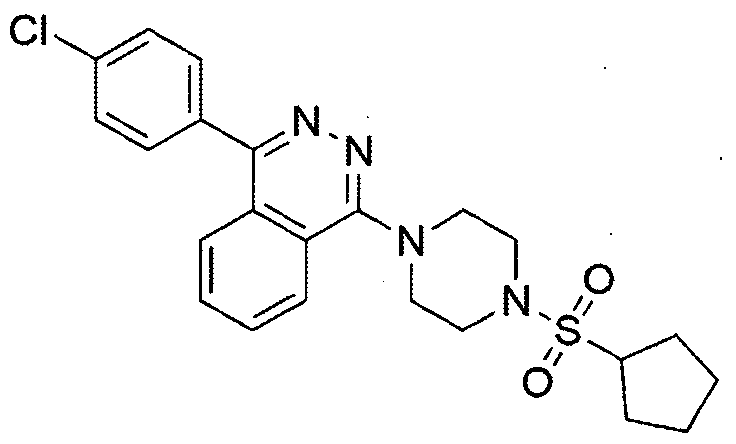
1H NMR (500 MHz, MeOD) : 8.09(d, 1H), 7.99(d, 1H), 7.88(t, 1H), 7.8 l(t, 1H), 7.67(d, 2H), 7.53(d, 2H), 3.69(br, 4H), 3.63(br, 4H), 3.51(m, 1H), 2.04(m, 4H), 1.82(m, 2H), 1.63(m, 2H)
Hereinafter, compounds of Examples 35 and 36 were each produced in the same manner as in Example 31, except that reactants corresponding to the chemical structure of the compound to be produced were used.
Example 35: Preparation of (l-aminocyclobutyl)(4-(4-(4- cWorophenyl)phthalazin-l-yl)piperazin-l-yl)methanone hydrochloride

1H NMR (500 MHz, MeOD) : 8.54(m, 1H), 8.35(m, 1H), 8.24(m, 2H), 7.79(m, 4H), 3.98(br, 4H), 3.60(br, 4H), 2.68(m, 2H), 2.41(m, 2H), 2.27(m, IH), 2.14(m, 1H)
Example 36: Preparation of (R)-2-amino-l-(4-(4-(4-chlorophenyl)phthalazin-l- yl)piperazin-l-yl)propan-l-one hydrochloride

Hereinafter, a compound of Example 37 was produced in the same manner as in Example 32, except that reactants corresponding to the chemical structure of the compound to be produced were used.
Example 37: Preparation of l-(4-chlorophenyl)-4-(4-
(cyclopropylsulfonyl)piperazin-l-yl)phthalazine

1H NMR (500 MHz, MeOD) : 8.28(d, 1H), 8.0 l(t, 1H), 7.95(m, 2H), 7.67(d, 2H), 7.6 l(d, 2H), 2.60(m, 1H), 1.09(m, 2H), 0.90(m, 2H)
Hereinafter, a compound of Example 38 was produced in the same manner as in Example 12, except that reactants corresponding to the chemical structure of the compound to be produced were used. At this time, when an amine group was present in the compound to be produced, a protective group (Boc) was introduced and finally an elimination reaction of the protective group was carried out as in the step 3 of Example 31.
Example 38: Preparation of 2-(4-(4-(4-chlorophenyl)phthalazin-l-yl)piperazin-l- yl)ethanamine hydrochloride

HCI
1H NMR (500 MHz, MeOD) : 8.30(d, 1H), 7.99(t, 1H), 7.94(m, 2H), 7.68(d, 2H),
7.37(d, 2H), 3.88(d, 2H), 3.65(t, 2H), 3.26(d, 2H), 2.46(t, 2H), 1.92(d, 2H)
. Hereinafter, compounds of Examples 39 to 42 were each produced in the same manner as in Example 32, except that reactants corresponding to the chemical structure of the compound to be produced were used.
Example 39: Preparation of l-(4-chlorophenyl)-4-(4-methoxypiperidin-l- yl)phthalazine

1H NMR (500 MHz, CDC13) : 8.10(d, 1H), 7.95(d, 1H), 7.84(t, 1H), 7.77(t, 1H), 7.68(d, 2H), 7.51(d, 2H), 4.80(d, 2H), 3.87(d, 2H), 3.52(m, 1H), 3.44(s, 3H), 3.31(t, 2H), 2.18(d, 2H), 1.88(m, 2H)
Example 40: Preparation of l-(4-c orophenyl)-4~(4-ethoxypiperidin-l- yl)phthalazine
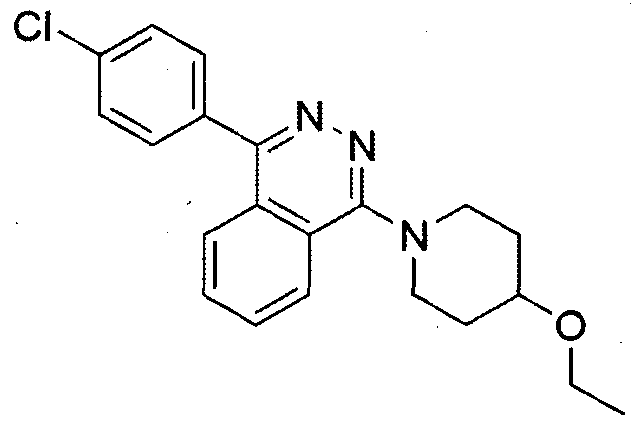
1H NMR (500 MHz, CDC13) : 8.09(d, IH), 7.94(d, 1H), 7.82(t, IH), 7.76(t, 1H), 7.68(d, 2H), 7.5 l(d, 2H), 3.89(d, 2H), 3.60(m, 2H), 3.3 l(m, 3H), 2.20(m, 2H), l.90(m, 2H), 1.34(t, 3H)
Example 41: Preparation of l-(4-chlorophenyl)-4-(4-
(cyclopropylmethoxy)piperidin-l-yl)phthalazine
CI

1H NMR (500 MHz, CDC13) : 8.09(d, 1H), 7.94(d, 1H), 7.83(t, 1H), 7.77(t, 1H), 7.67(d, 2H), 7.51(d, 2H), 3.88(d, 2H), 3.62(m, 1H), 3.38(d, 2H), 3.28(t, 2H), 2.17(d, 2H), 1.91(dd, 2H), 0.57(d, 2H), 0.24(d, 2H)
Example 42: Preparation of l-(4-(4-chlorophenyl)phthalazin-l-yl)piperidin-4-yl cyclop

1H NMR (500 MHz, CDC13) : 8.10(d, 1H), 7.96(d, 1H), 7.84(t, 1H), 7.78(t, IH), 7.67(d, 2H), 7.53(d, 2H), 5.10(m, 1H), 3.81(m, 2H), 3.48(m, 2H), 2.16(m, 2H), 2.01(m, 3H), 1.65(m, 1H), 1.03(m, 2H), 0.88(m, 2H)
Hereinafter, compounds of Examples 43 and 44 were each produced in the same manner as in Example 31, except that reactants corresponding to the chemical structure of the compound to be produced were used.
Example 43: Preparation of 2-amino-l-(4-(4-(4-chlorophenyl)phthalazin-l- yl)piperazin-l-yl)-2-methylpropan-l-one hydrochloride

1H NMR (500 MHz, MeOD) : 8.47(d, 1H), 8.21(d, 1H), 8.13(m, 2H), 7.72(d, 4H),
4.03(br, 4H), 3.78(br, 4H), 1.75(s, 6H)
Example 44: Preparation of 2-amino-l-(4-(4-(4-chlorophenyl)phthalazin-l-yl)-
5,6-dihydropyridin-l(2H)-yl)-2-methylpropan-l-one hydrochloride

1H NMR (500 MHz, MeOD) : 8.45(d, 1H), 8.23(d, 1H), 7.83(t, 2H), 7,79(d, 2H), 7.72(d, 2H), 6.40(s, 1H), 4.03(br, 4H), 3.78(br, 3H), 1.60(s, 6H)
Hereinafter, compounds of Examples 45 and 46 were each produced in the same manner as in Example 12, except that reactants corresponding to the chemical structure of the compound to be produced were used. At this time, when an amine group was present in the compound to be produced, a protective group (Boc) was introduced and finally an elimination reaction of the protective group was carried out as in Step 3 of Example 31.
Example 45: Preparation of N-(l-(4-(4-chlorophenyl)phthalazin-l-yl)pyrrolidin- 3-yl)a

1H NMR (500 MHz, MeOD) : 8.41(d, 1 H), 7.87(m, 3H), 7.62(d, 2H), 7.57(d, 2H), 4.52(t, lH), 4.21 (d, 1H), 4.1 l (m, 1H), 4.00(m, 1H), 3.80(m, 1H), 2.31(m, lH), 2.09(m, 1H), 1.96(s, 3H)
Example 46: Preparation of l-(4-(4-chlorophenyl)phthalazin-l-yl)-N- methylpyrrolidin-3-amine hydrochloride

Hereinafter, a compound of Example 47 was produced in the same manner as in Example 31, except that reactants corresponding to the chemical structure of the compound to be produced were used.
Example 47: Preparation of (S)-2-amino-l-(4-(4-(4-chlorophenyl)phthalazin-l- yl)piperazin-l-yl)-3-methylbutan-l-one hydrochloride

1H NMR (500 MHz, MeOD) : 8.53(d, 1H), 8.29(t, 1H), 8.20(m, 2H), 7.76(m, 4H), 4.43(d, 1H), 4.12(d, 1H), 3.99-3.88(m, 7H), 2.27(m, 1H), 1.16(d, 3H), 1.07(d, 3H)
Example 48: Preparation of (4-(4-(4-chlorophenyl)phthaIazin-l-yl)-5,6- dihydropyridin-l(2rI)-yl)(cyclopropyl)methanone

Step 1) Preparation of tert-butyl 4-(4-chlorophthalazin-l-yl)-5,6-dihydropyridin-l(2H)- carboxylate
1,4-Diclophthalazine (0.30 g, 0.97 mmol), Pd (PPh3)4 (0.05 g, 0.10 mmol), tert-butyl 4- (4,4,5,5-tetramethyl-l,3,2-dioxaborolan-2-yl)-3,6-dihydropyridin-l(2H)-carboxylate (0.37 g, 1.21 mmol) was dissolved in dioxane (6 mL) and 2N Na2C03 aqueous solution. The reaction solution was reacted at 120°C for 60 minutes using a microwave organic synthesizer. After the termination of the reaction was confirmed by TLC, water (5 mL) was added to the reaction and extracted twice with ethyl acetate (5 mL). The organic layer was dried over MgS04 and then
concentrated under reduced pressure. The resulting residue was separated and purified by chromatography to obtain the desired title compound (0.11 g, 18.7%).
Step 2) Preparation of tert-butyl 4-(4-(4-chlorophenyl)phthalazin-l-yl)-5,6- dihydropyridin-l(2H)-carboxylate
The intermediate (0.1 1 g, 0.32 mmol) obtained in the above step 1, Pd(PPh3)4(0.05 g, 0.03 mmol) and (4-chlorophenyl)boronic acid (0.06 g, 0.36 mmol) were dissolved in dioxane (5 mL) and 2N Na2C03 aqueous solution. The reaction solution was reacted at 120°C for 30 minutes using a microwave organic synthesizer. After the termination of the reaction was confirmed by TLC, water (5 mL) was added to the reaction and extracted twice with ethyl acetate (5 mL). The organic layer was dried over gS04 and then concentrated under reduced pressure. The resulting residue was separated and purified by chromatography to obtain the desired title compound (0.10 g, 74.5%). Step 3) Preparation of l-(4-chlorophenyl)-4-(l,2,3,6-tetrahydropyridin-4-yl) phthalazine
The intermediate (0.10 g, 0.24 mmol) obtained in the above step 2 was dissolved in dichloromethane (3 mL), and then trifluoroacetic acid (0.50 mL) was added thereto. The reaction solution was stirred at room temperature for 4 hours, and then the termination of the reaction was confirmed by TLC. The reaction mixture was washed with a saturated aqueous solution of NaHC03, and then concentrated under reduced pressure. The resulting residue was washed with dichloromethane and n-hexane to obtain the desired compound (0.07 g, 91.8%).
Step 4) Preparation of (4-(4-(4-cl lorophenyl)phthalazin-l-yl)-5,6-dihydropyridin-l (2H)-yl)(cyclopropyl)methanone
The intermediate (0.03 g, 0.09 mmol) obtained in the above step 3 and triethylamine (0.02 mL, 0.1 1 mmol) were dissolved in dichloromethane (2 mL), and then cyclopropanecarbonyl chloride (0.01 mL, 0.11 mmol) was added thereto. The reaction solution was stirred at room temperature for 1 hour, and the termination of the reaction was confirmed by TLC. Water (5 mL) was added to the reaction and extracted twice with dichloromethane (2
mL). The resulting residue was separated and purified by chromatography to obtain the desired title compound (0.02 g, 55.0%).
IH NMR (500 MHz, CDC13) : 8.30(d, IH), 8.06(d, IH), 7.90(t, 2Η), 7,72(d, 2H), 7.56(d, 2H), 6.20(s, IH), 4.54-4.44(m, 2H), 4.07-4.0 l(m, 2H), 3.02-2.85(m, 2H), 1.90-1.83(m, IH), 1.09(m, 2H), 0.85(m, 2H)
Hereinafter, compounds of Examples 49 and 50 were each produced in the same manner as in Example 12, except that reactants corresponding to the chemical structure of the compound to be produced were used.
Example 49: Preparation of l-(4-chiorophenyl)-4-(l-(cyclopropylsulfonyI)- l,2,3,6-tetrahydropyridin-4-yl)phthalazine

IH NMR (500 MHz, CDC13) : 8.27(d, IH), 8.06(d, IH), 7.92(t, IH), 7.88(t, IH), 7.72(d, 2H), 7.56(d, 2H), 6.17(s, IH), 4.20(d, 2H), 3.74(t, 2H), 3.00(d, 2H), 2.41(t, IH), 1.28(m, 2H), 1.07(m, 2H)
Example 50: Preparation of l-(4-chlorophi
(cyclopropylmethyl)piperazin-l-yl)phthalazine

IH NMR (500 MHz, MeOD) : 8.50(m, IH), 8.29(m, IH), 8.22(m, 2H), 7.78(m, 4H), 3.95(br, 4H), 3.74(br, 3H), 3.67(br, 2H), 3.66(br, 4H)
Hereinafter, compounds of Examples 51 and 52 were each produced in the same
manner as in Example 31, except that reactants corresponding to the chemical structure of the compound to be produced were used.
Example 51: Preparation of (R)-(4-(4-(4-chlorophenyl)phthalazin-l-yl)piperaziii- l-yI)(pyrrolidin-2-yl) methanone hydrochloride

1H NMR (500 MHz, MeOD) : 8.56(d, 1H), 8.33(t, 1H), 8.22(m, 2H), 7.79(m, 4H), 3.93(m, 7H), 3.46(m, 2H), 3.39(m, 2H), 2.59(m, 1H), 2.1 l(m, 3H), 1.17(t, 1H)
Example 52: Preparation of (l-aminocyclopropyl)(4-(4-(4- chlorophenyl)phthalazin-l-yl)piperazin-l-yl)methanone hydrochloride

1H NMR (500 MHz, MeOD) : 8.24(d, 1H), 7.93(m, 3Ή), 7.67(d, 2H), 7.60(d, 2H), 3.64(m, 4H), 2.98(m, 4H), 2.50(d, 2H), 0.67(m, 2H), 0.24(m, 2H)
Hereinafter, the compounds of Examples 53 to 55 were each produced in the same manner as in Example 12, except that reactants corresponding to the chemical structure of the compound to be produced were used. At this time, when an amine group was present in the compound to be produced, the protective group (Boc) was introduced and finally an elimination reaction of the protective group was performed as in Step 3 of Example 31.
Example 53: Preparation of Nl-(4-(4-chlorophenyl)phthalazin-l-yl)-Nl,N2- dimethylethane-l,2-diamine,

1H NMR (500 MHz, MeOD) : 8.67(d, 1 H), 8.30(t, 1H), 8.19(m, 2H), 7.78(m, 4H),
4.10(t, 2H), 3.57(s, 3H), 3.54(t, 2H), 2.82(s, 3H)
Example 54: Preparation of l-(4-(4-chlorophenyI)phthaIazin-l-yI)-N-

1H NMR (500 MHz, MeOD) : 8.77(d, IH), 8.22(m, 1H), 8.17(t, 1H), 8.13(m, 1H), 7.70(m, 4H), 4.52(br, 1H), 4.40(br, 1H), 4.27(m, 3H), 3.20(q, 2H), 2.70(m, 1H), 2.51(m, 1H), 1.42(t, 3H)
Example 55: Preparation of Nl-(4-(4-chlorophenyl)phthalazin-i-yl)-Nl,N3- dimethylpropane- 1 ,3-diamine hydrochloride

1H NMR (500 MHz, MeOD) : 8.62(d, 1H), 8.24(t, 1H), 8.14(m, 2H), 7.75(d, 2H). 7.72(d, 2H), 3.96(m, 2H), 3.59(s, 3H), 3.19(t, 2H), 2.76(s, 3H), 2.35(m, 2H)
Example 56: Preparation of (4-(4-(4-chlorophenyl)phthalazin-l-yl)piperidin-l- yl)(cyclopropyl)methanone

Step 1) Preparation of tert-butyl 4-(4-(4-chlorophenyl)phthalazin-l-yl)piperidine-l- carboxylate
The intermediate tert-butyl 4-(4-(4-chlorophenyl)phthalazin-l-yl)-5,6-dihydropyridin- 1 (2H)-carboxylate (0.07 g, 0.20 mmol) obtained in the step 2 of Example 48 was dissolved in methanol (1 mL) and then Pt02 (5 mg, cat.) was added thereto. Then, the atmosphere was replaced with hydrogen gas, followed by stirring at room temperature, and the termination of the
reaction was confirmed by TLC. The reaction product was separated by a PLC plate to obtain the desired compound (0.03 g, 42.5%).
Step 2) Preparation of (4-(4-(4-chlorophenyl)phthalazin-l-yl)piperidin-l- yl)(cyclopropyl)methanone
The desired compound (0.01 g, 50.5%) was prepared in the same manner as in the steps 3 and 4 of Example 48, except for using the intermediate (0.03 g, 0.07 mmol) obtained in the above step 1 as a starting material.
1H NMR (500 MHz, MeOD) : 8.54(d, 1H), 8.08(t, 1H), 8.05(d, 1H), 8.00(t, 1H), 7.69(d, 2H), 7.62(d, 2H), 4.70(d, 1H), 4.57(d, 1H), 4.09(m, 1H), 3.53(t, 1H), 3.03(t, 1H), 2.19(m, 2H), 2.06(m, 2H), 0.92(m, 2H), 0.85(m, 2H)
Hereinafter, the compound of Example 57 was produced in the same manner as in Example 12, except that reactants corresponding to the chemical structure of the compound to be produced were used. At this time, when an amine group was present in the compound to be produced, a protecting group (Boc) was introduced and finally an elimination reaction of the protective group was performed as in the step 3 of Example 31.
Example 57: Preparation of (R)-l-(4-(4-chlorophenyl)phthalazin-l-yl)-N- methylpiperidin-3-amine hydrochloride

1H NMR (500 MHz, MeOD) : 8.22(d, 1H), 7.97(t, 1H), 7.89(m, 2H), 7.62(d, 2H), 7.56(d, 2H), 4.00(m, 1H), 3.70(d, 1H), 3.15(m, 3H), 2.66(s, 3H), 2.19(m, 1H), 2.00(m, 1H), 1.90(m, 1H), 1.61(m, 1H)
Hereinafter, the compounds of Examples 58 to 60 were produced in the same manner as in Example 31, except that reactants corresponding to the chemical structure of the compound to be produced were each used.
Example 58: Preparation of = (l-aminocyclopentyl)(4-(4-(4- chlorophenyl)phthalazin-l-yl)piperazin-l-yl)methanone hydrochloride

HCI
1H NMR (500 MHz, MeOD) : 8.57(d, 1H), 8.33(m, 1H), 8.23(m, 2H), 7.80(d, 2H), 7.77(d, 2H), 3.94(m, 8H), 2.43(m, 2H), 2.07(m, 7H)
Example 59: Preparation of (S)-(4-(4-(4-chlorophenyl)phthalazin-l-yl)piperazin- l-yI)(pyrrolidin-2-yl)methanone hydrochloride

10 HCI
1H NMR (500 MHz, MeOD) : 8.59(d, 1H), 8.33(m, 1H), 8.23(m, 2H), 7.79(m, 4H), 4.08(m, 1H), 3.95(m, 7H), 3.40(m, 2H), 2.59(m, 1H), 2.10(m, 4H)
Example 60: Preparation of (2S 3S)-2-amino-l-(4-(4-(4-chlorophenyl)phthalazin-
15 l-yl)piperazin-l-yl)-3-methylpentan-l-one hydrochloride

1H NMR (500 MHz, MeOD) : 8.58(d, 1H), 8.34(m, 1H), 8.23(s, 2H), 7.80(d, 2H), 7.75(d, 2H), 4.49(m, IH), 4.16(m, 1H), 4.06(t, 1H), 3.96(m, 4H), 3.87(m, 2H), 2.00(m, 1H), 1.61(m, 1H), 1.29(m, 1H), 1.14(m, 3H), 1.01(m, 3H)
■20
Hereinafter, the compounds of Examples 61 to 64 were produced in the same manner as in Example 56, except that reactants corresponding to the chemical structure of the compound to be produced were each used. At this time, when an amine group was present in
the compound to be produced, the protecting group (Boc) was introduced and finally an elimination reaction of protective group was performed as in Step 3 of Example 31.
Example 61: Preparation of (S)-2-amino-l-(4-(4-(4-chlorophenyl)phthalazin-l- yl)piperidin-l-yl)-3-methylbutan-l-one hydrochloride

1H NMR (500 MHz, MeOD) : 8.96(d, 1H), 8.53(t, 1H), 8.41(d, 1H), 8.36(t, 1H), 7.90(d, 2H), 7.82(d, 2H), 4.80(m, 1H), 4.50(d, 1H), 4.42(d, 1H), 4.34(t, 1H), 4.23(t, 1H), 3.60(m, 2H), 3.17(m, 1H), 2.26(m, 3H), 2.10(m, 1H), 1.17(m, 3H), 1.06(m, 3H)
Example 62: Preparation of (S)-(4-(4-(4-chlorophenyl)phthalazin-l-yl)piperidin- l-yl)(pyrrolidin-2-yl)methanone hydrochloride

1H NMR (500 MHz, MeOD) : 8.95(d, 1H), 8.53(t, 1H), 8.41(d, 1H), 8.37(t, 1H), 7.79(d, 2H), 7.8 l(d, 2H), 4.75(m, 2H), 4.34(m, 1H), 4.14(m, 1H), 3.59(m, 1H), 3.45(m, 2H), 3.20(m, 1H), 2.6 l(m, 1H), 2.27-2.00(m, 7H)
Example 63: Preparation of (2S,3S)-2-amino-l-(4-(4-(4-clilorophenyl)phthalazin- l-yl)pip hloride

1H NMR (500 MHz, MeOD) : 8.96(d, 1H), 8.53(t, 1H), 8.41(d, 1H), 8.36(t, 1H), 7.90(d, 2H), 7.82(d, 2H), 4.78(m, 1H), 4.5 l(m, 1H), 4.44(m, 1H), 4.35(m, 1H), 4.2 l(m, 1H),
3.61(m, 1H), 3.19(m, 1H), 2.27(m, 3H), 1.98(m, 2H), 1.60(m, 1H), 1.27(m, 1H), 1.13(m, 3H), 1.01(m, 3H)
Example 64: Preparation of 2-amino-l-(4-(4-(4-chlorophenyl)phthalazin-l- yI)piperidin-l-yl)-2-methylpropan-l-one hydrochloride

HCI
1H NMR (500 MHz, MeOD) : 8.72(d, 1H), 8.33(t, 1H), 8.26(d, 1H), 8.20(t, 1H), 7.78(d, 2H), 7.75(d, 2H), 4.56(m, 1H), 4.23(t, 1H), 3.44(m, 3H), 2.23(d, 2H), 2.09(d, 2H), 1.74(s, 6H)
Hereinafter, the compounds of Examples 65 and 66 were each produced in the same manner as in Example 32, except that reactants corresponding to the chemical structure of the compound to be produced were used.
Example 65: Preparation of ethyl 2-(4-(4~(4-chlorophenyl)pht aIazin-l- yl)piperazin-l-yl)acetate

1H NMR (500 MHz, CDC13) : 8.1 l(d, 1H), 7.95(d, 1H), 7.82(t, 1H), 7.76(d, 1H), 7.68(d, 2H), 7.50(d, 2H), 4.22(q, 2H), 3.67(m, 4H), 3.36(m, 2H), 2.92(s, 4H), 1.31 (t, 3H)
Example 66: Preparation of 2-(4-(4-(4-chlorophenyl)phthalazin-l yl)piperazin-l-yl)-2-methylpropanoate

Hereinafter, the compound of Example 67 was produced in the same manner as in Example 12, except that reactants corresponding to the chemical structure of the compound to be produced were used.
Example 67: Preparation of l-(4-benzyI-l,4-diazepan-l-yl)-4-(4- chlorophenyl)phthalazine,

1H NMR (500 MHz, MeOD) : 8.23(d, 1H), 7.90(m, 2H), 7.86(d, 1H), 7.64(m, 5H), 7.37(d, 2H), 7.26(t, 2H), 3.96(m, 4H), 3.73(s, 2H), 2.98(m, 2H), 2.84(m, 2H), 2.15(m, 2H)
Hereinafter, the compound of Example 68 was produced in the same manner as in Example 32, except that reactants corresponding to the chemical structure of the compound to be produced were used.
Example 68: Preparation of 2-(4-(4-(4-chlorophenyl)phthalazin-l-yl)piperazin-l- yl)acetic acid

1H NMR (500 MHz, MeOD) : 8.28(d, 1H), 8.03(t, 1H), 7.98(m, 2H), 7.67(d, 2H), 7.61(d, 2H), 3.83(m, 4H), 3.68(m, 2H), 3.56(m, 4H)
Hereinafter, the compounds of Examples 69 to 81 were each produced in the same manner as in Example 31 , except that reactants corresponding to the chemical structure of the compound to be produced were used.
Example 69: Preparation of (S)-2-amino-l-(4-(4-(4-chlorophenyl)phthalazin-l- yl)-2^-dimethylpiperazin-l-yl)-3-methylbutan-l-one hydrochloride
IH NMR (500 MHz, MeOD) : 8.58(m, IH), 8.13-8.05(m, 3H), 7.71(m, 4H), 4.37(m,
2H), 4.06(m, 4H), 2.29(m, IH), 1.65(m, 6H), 1.16(d, 3H), 1.05(d, 3H), 0.95(t, IH)
Example 70: Preparation of (R)-2-amino-l-(4-(4-(4-chlorophenyl)phthalazin-l- yl)-2-methylpiperazin-l-yl)-2-methylpropan-l-one hydrochloride

IH NMR (500 MHz, MeOD) : 8.38(m, IH), 8.06(m, 3H), 7.68(m, 4H), 4.00(m, 3H), 3.44(m, 4H), 1.74(s, 6H), 1.56(m, 3H)
Example 71: Preparation of (S)-2-amino-l-((R)-4-(4-(4-chlorophenyl)phthalazin- l-yl)-2-methylpiperazin-l-yl)-3-methylbutan-l-one hydrochloride

IH NMR (500 MHz, MeOD) : 8.50(m, IH), 8.26(m, IH), 8.17(m, 2H), 7.74(m, 4H), 4.33(d, IH), 4.10(m, 2H), 3.56(m, 4H), 2.26(m, IH), 1.62(m, IH), 1.50(d, 2H), 1.15(d, 3H), 1.05(d, 3H)
Example 72: Preparation of (S)-2-amino-l-(4-(4-(4-chlorophenyl)phthalazin-l- yl)-2-methylpiperazin-l-yl)-2-methylpropan-l-one hydrochloride

IH NMR (500 MHz, MeOD) : 8.34(d, IH), 8.04(t, IH), 7.99(m, 2H), 7.66(d, 2H), 7.63(d, 2H), 3.98(d, IH), 3.85(d, IH), 3.36-3.32(m, 5H), 1.75(s, 6H), 1.58(m, 3H) Example 73: Preparation of (S)-2-amino-l-((S)-4-(4-(4-chlorophenyI)phthalazin- l-yl)-2-methylpiperazin-l-yl)-3-methylbutan-l-one hydrochloride

IH NMR (500 MHz, MeOD) : 8.53(d, IH), 8.29(d, IH), 8.19(m, 2H), 7.75(m, 4H), 4.51-4.34(m, IH), 4.20(m, IH), 4.09(m, 2H), 3.58(m, IH), 3.45(m, lh), 2.27(m, IH), 1.67(m, IH), 1.53(m, 2H), 1.16(d, 3H), 1.07(d, 3H)
Example 74: Preparation of (S)-2-amino-l-(4-(4-(4-chlorophenyl)phthalazin-l- yl)-3-methylpiperazin-l-yI)-2-methyIpropan-l-one hydrochloride

IH NMR (500 MHz, MeOD) : 8.45(d, IH), 8.13-8.05(m, 3H), 7.73(m, 4H), 4.26(m,
3H), 3.79(m, 4H), 1.78(d, 3H), 1.74(d, 3H), 1.35(m, 3H)
Example 75: Preparation of (S)-2-amino-l-((S)-4-(4-(4-chlorophenyl)phthalazin- l-yl)-3-methylpiperazin- l-yl)-3-methylbutan-l-one hydrochloride

IH NMR (500 MHz, MeOD) : 8.44(d, IH), 8.15(m, 3H), 7.74(m, 4H), 4.38(m, 2H), 4.04(m, IH), 3.78(m, 3H), 2.32(m, IH), 1.41-1.25(m, 3H), l. l5(d, 3H), 1.04(d, 3H)
Example 76: Preparation of (S)-2-amino-l-(4-(4-(4-chlorophenyl)phthalazin-l- yl)p ne dihydrochloride

IH NMR (500 MHz, MeOD) : 8.78(m, IH), 8.38(m, IH), 8.05(m, 3H), 7.68(m, 4H),
7.48(d, IH), 4.05-3.85(m, 4H), 3.64(m, 4H), 3.36(m, 2H)
Example 77: Preparation of 2-amino-l-(4-(4-(4-chlorophenyl)phthalazin-l- yl)piperazin-l-yl)-3,3-dimethylbutan-l-one hydrochloride

IH NMR (500 MHz, MeOD) : 8.52(d, IH), 8.26(t, IH), 8.17(m, 2H), 7.75(m, 4H), 4.43(s, lH), 4.21 (d, lH), 4.10(m, IH), 3.94(m, 3H), 3.74(m, 3H), 1.16(s, 9H)
Example 78: Preparation of (4-(4-(4-chlorophenyl)phthalazin-l-yl)piperazin-l- yl)(piperidin-2-yl)methanone hydrochloride,

IH NMR (500 MHz, MeOD) : 8.40(m, IH), 8.12-8.06(m, 3H), 7.70(m, 4H), 4.41(d, IH), 4.05(m, IH), 3.89-3.74(m, 7H), 3.44(m, 2H), 3.08(m, IH), 2.23(d, IH), 2.00-1.91(m, 2H), 1.75-1.73(m, 3H)
Example 79: Preparation of (S)-2-amino-3-(benzyloxy)-l-(4-(4-(4- chIorophenyI)phthaIazin-l-yI)piperazin-l-yI)propan-l-one hydrochloride

1H NMR (500 MHz, MeOD) : 8.44-8.40(m, 1H), 8.18-8.1 l(m, 3H), 7.72(m, 4H), 7.39(m, 4H), 4.68(4 1H), 4.61(d, 1H), 3.95(m, 1H), 3.85-3.77(m, 9H)
Example 80: Preparation of (S)-2-amino-l-(4-(4-(4-chlorophenyl)phthalazin-l- yl)piperazin-l-yl)-2-phenylethanone hydrochloride

1H NMR (500 MHz, MeOD) : 8.30(d, 1H), 8.05(m, 3H), 7.68(m, 4H), 7.54(m, 5H), 5.59(s, lH), 4.01(m, 2H), 3.80(m, 1H), 3.78(m, 1H), 3.67(m, 3H), 3.15(m, IH)
Example 81: Preparation of (S)-5-(4-(4-(4-chlorophenyl)phthalazin-l- yl)piperazine-l-carbonyl)piperazin-2-one hydrochloride

1H NMR (500 MHz, MeOD) : 8.5 l(d, 1H), 8.27(t, 1H), 8.18(m, 2H), 7.77(d, 2H), 7.75(d, 2H), 4.98(m, 1H), 4.09(m, 1H), 3.97-3.79(m, 1GH), 3.59(m, 1H)
Hereinafter, the compound of Example 82 was produced in the same manner as in Example 32, except that reactants corresponding to the chemical structure of the compound to be produced were used.
Example 82: Preparation of 2-(4-(4-(4-chlorophenyl)phthalazin-l-yl)piperazin-l- yl)-2-methylpropanoic acid

IH NMR (500 MHz, MeOD) : 8.3 l(d, IH), 8.03(t, IH), 7.97(m, 2H), 7.66(d, 2H), 7.63(d, 2H), 3.89(br, 4H), 3.57(br, 4H), 1.57(s, 6H)
Hereinafter, the compounds of Examples 83 to 86 were each produced in the same manner as in Example 31, except that reactants corresponding to the chemical structure of the compound to be produced were used.
Example 83: Preparation of 3-amino-4-(4-(4-(4-chlorophenyl)phthalazin-l- yl)piperazin-l-yl)-4-oxobutanoic acid hydrochloride

IH NMR (500 MHz, MeOD) : 8.59(d, IH), 8.33(t, IH), 8.21(m, 2H), 7.8 l(d, 2H), 7.65(d, 2H), 4.84(m, 2H), 4.06(m, 2H), 4.00-3.91(m, 6H), 3.02(m, IH), 2.87(m, IH)
Example 84: Preparation of 4-amino-5-(4-(4-(4-chlorophenyl)phthalazin-l- yl)piperazin-l-yl)-5-oxopentanamide hydrochloride

IH NMR (500 MHz, MeOD) : 8.58(d, IH), 8.33(m, IH), 8.23(m, 2H), 7.69(d, 2H), 7.74(d, 2H), 4.62(md, IH), 4.04-3.93(m, 8H), 2.53(m, 2H), 2.20(m, IH), 2.1 l(m, IH)
Example 85: Preparation of 3-amino-4-(4-(4-(4-chlorophenyl)phthalazin-l- yl)piperazin-l-yl)-4-oxobutanamide hydrochloride

1H NMR (500 MHz, MeOD) : 8.56(d, 1H), 8.32(m, 1H), 8.22(m, 2H), 7.8Q(d, 2H), 7.77(d, 2H), 4.82(m, 1H), 4.05(br, 1H), 3.97(m, 6H), 2.92(dd, 1H), 2.77(dd, 1H)
Example 86: Preparation of 4-amino-5-(4-(4-(4-chlorophenyl)phthalazin-l- yl)piperazin-l-yI)-5-oxopentanoic acid hydrochloride

1H NMR (500 MHz, MeOD) : 8.58(d, 1H), 8.33(m, 1H), 8.23(m, 2H), 7.76(m, 4H), 4.65(s, 1H), 4.05-3.93(m, 8H), 2.60(br, 2H), 2.23-2.13(m, 2H)
Hereinafter, the compounds of Examples 87 to 91 were each produced in the same manner as in Example 12, except that reactants corresponding to the chemical structure of the compound to be produced were used. At this time, when an amine group was present in the compound to be produced, a protecting group (Boc) was introduced and finally an elimination reaction of the protective group was performed as in Step 3 of Example 31.
Example 87: Preparation of l-(4-chlorophenyl)-4-(tetrahydro-lH-pyrrolo[2 3- c]pyridin-6(2H,7H,7aH)-yl)phthaIazine hydrochloride

1H NMR (500 MHz, MeOD) : 8.56(d, 1H), 8.28(t, 1H), 8.18(m, 2H), 7.78(d, 2H), 7.74(d, 2H), 4.1 l(m, 2H), 4.00(m, 2H), 3.81(t, 1H), 3.62(m, 1H), 3.45(m, 1H), 2.95(m, 1H), 2.43(m, 1H), 2.33(m, 2H), 2.16(m, 1H)
Example 88: Preparation of l-(4-chlorophenyl)-4-(hexahydropyrrolo[3,4- b]pyrrol-5(lH)-yl)phthalazine hydrochloride

1H NMR (500 MHz, MeOD) : 8.79(d, 1H), 8.21 (t, 1H), 8.16(t, 1H), 8.10(d, 1H), 7.72(d, 2H), 7.68(d, 2H), 4.64(m, 3H), 4.40(t, 1H), 4.15(m, 1H), 3.66(m, 1H), 3.53(m, 2H), 2.45(m, 1H), 2.29(m, 1H)
Example 89: Preparation of l-(7-chIoro-4-(4-chIorophenyI)phthaIazin-l-yI)-N- methylpyrrolidin-3-amine hydrochloride

1H NMR (500 MHz, MeOD) : 8.68(d, lH), 8.16(d, 1H), 8.l0(d, lH), 7.71 (m, 4H),
4.51(m, 1H), 4.36(m, 1H), 4.26(m, 1H), 4.18(m, 1H), 4.09(m, 1H), 2.87(s, 3H), 2.69(m, 1H), 2.554(m, 1H)
Example 90: Preparation of l-(6-chloro-4-(4-chlorophenyl)phthalazin-l-yl)-N- methylpyrrolidin-3-amine hydrochloride

1H NMR (500 MHz, MeOD) : 8.75(d, 1H), 8.18(d, 1Ή), 8.0 l(s, 1H), 7.70(m, 4H), r4.51(br, 1H), 4.38(m, 2H), 4.26-4.19(m, 2H), 2.88(s, 3H), 2.70(m, 1H), 2.51(m, 1H)
Example 91: Preparation of l-(4-(4-chlorophenyl)-6-fluorophthalazin-l-yl)-N-
methylpyrrolidin-3-amine hydrochloride
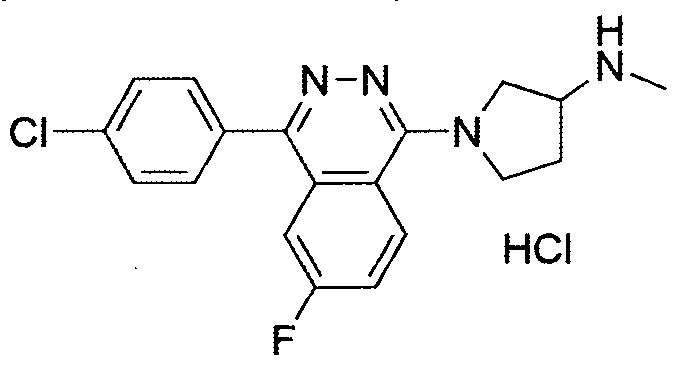
1H NMR (500 MHz, MeOD) : 8.85(dd, 1H), 7.98(t, 1H), 7.75-7.68(m, 5H), 4.53(m, 1H), 4.38(m, 2H), 4.25(m, 2H), 2.88(s, 3H), 2.70(m, 1H), 2.55(m, 1H)
Example 92: Preparation of l-(4-(4-chlorophenylsulfonyl)phthalazin-l-yl)-N- methylpyrrolidin-3-amine hydrochloride
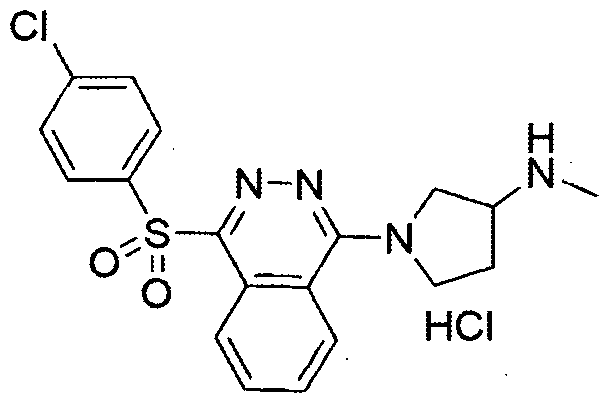
Step 1) Preparation of tert-butyl (l-(4-((4-chlorophenyl)thio)phthalazin-l-yl) pyrrolidin-3-yl)(methyl)carbamate
1,4-Dichlorophthalazine (0.10 g, 0.50 mmol) and tert-butylmethyl (pyrrolidin-3- yl)carbamate (0.11 g, 0.50 mmol) were dissolved in n-butanol (3 mL). The mixture was stirred for 3 hours while maintaining an internal temperature at 70°C to 80°C, and the tennination of the reaction was confirmed by TLC. The reaction solution was concentrated under reduced pressure, and then the obtained residue was dissolved in N,N-dimethylformamide (2.0 mL), and 4-chlorobenzenethiol (0.09 g, 1.2 eq.) and K2CO3(0.10 g, 1.5 eq.) were added at room temperature . The reaction was heated to 120°C and stirred overnight. After confirming the disappearance of the starting material by TLC, the mixture was washed with ethyl acetate and filtered. The filtrate was concentrated under reduced pressure, and the resulting residue was separated by column chromatography (Hex: EA = 3: 1) to obtain the desired compound (0.03 g, yield 12.9%).
Step 2) Preparation of tert-butyl (l-(4-((4-chlorophenyl)sulfonyl)phthalazin-l-yl) pyrrolidin-3-yl) (methyl)carbamate
The intermediate (0.03 g, 1.0 eq.) obtained in the above step 1 was dissolved in dichloromethane (2.0 mL) and then 3-chloroperbenzoic acid (mCPBA) (0.03 g, 2.5 eq.) was added thereto. The reaction solution was stirred at room temperature overnight, and then the disappearance of the starting material was confirmed by TLC. The reaction solution was concentrated under reduced pressure, and the resulting residue was separated and purified by preparative thin layer chromatography (Hex: EA = 1 : 1) to obtain the desired compound (0.02 g, yield 62.3%).
Step 3) Preparation of l-(4-(4-chlorophenylsulfonyl)phthalazin-l-yl)-N- methylpyrrolidin-3 -amine hydrochloride
To the intermediate (0.02 g, 1.0 eq.) obtained in the above step 2 was added IN HCI in ethyl acetate (1.0 mL), and the mixture was stirred at room temperature overnight. After confirming that a white solid was formed, it was filtered to obtain the desired compound (0.20 g, yield 90.0%).
1H NMR (500 MHz, MeOD) : 8.98(d, 1H), 8.67(m, 1H), 8.23(m, 2H), 8.07(d, 2H),
7.73(d, 2H), 4.46(m, 1H), 4.30(m, 2H), 4.15(m, 2H), 2.83(s, 3H), 2.63(m, 1H), 2.43(m, 1H)
Example 93: Preparation of l-(4-(4-chlorophenoxy)phthalazin-l-yl)-N- methylpyrrolidin-3-amine hydrochloride

The intermediate was produced in the same manner as in the step 1 of Example 92 except that 4-chlorophenol was used instead of 4-chlorobenzenethiol. The desired compound was obtained in the same manner as in the step 3 of Example 92 except that the intermediate was used.
1H NMR (500 MHz, MeOD) : 8.78(d, 1H), 8.75(d, 1H), 8.29(t, 1H), 8.23(t, 1H),
7.47(d, 2H), 7.38(d, 2H), 4.52(m, 1H), 4.35(m, 2H), 4.21(m, 2H), 2.88(s, 3H), 2.69(m, 1H), 2.57(m, 1H)
Hereinafter, the compound of Example 94 was produced in the same manner as in Example 93, except that reactants corresponding to the chemical structure of the compound to be produced were used.
Example 94: Preparation of 2-amino-l-(4-(4-(4-chlorophenoxy)phthalazin-l- yl)piperazin-l-yl)-2-methylpropan-l-one hydrochloride

1H NMR (500 MHz, MeOD) : 8.62(d, 1H), 8.56(d, 1H), 8.33(t, 1H), 8.25(t, 1H), 7.50(d, 2H), 7.37(d, 2H), 4.05(m, 4H), 3.96(m, 4H), 1.74(s, 6H)
Example 95: Preparation of (S)-l-(4-chlorophenyl)-4-(pyrrolidin-3- yloxy)phthalazine hydrochloride

1,4-Dichlorophthalazine (0.10 g, 0.50 mmol) was dissolved in dichloromethane (3 mL), and then NaOH (0.03 g, 0:75 mmol), tetrabutylammonium bromide (0.05 g, 0.15 mmol) and tert-butyl 3-hydroxypyrrolidine-l-carboxylate (0.1 1 g, 0.60 mmol) were added thereto. The mixture was stirred overnight at room temperature and the termination of the reaction was confirmed by TLC. Dichloromethane (5 mL) was added to the reaction solution, followed by washing with water. The organic layer was concentrated under reduced pressure and the resulting residue was separated by chromatography to obtain the desired intermediate (tert-butyl 3-(4-chlorophthalazin-l-yloxy) pyrrolidine- 1-carboxylate). Thereafter, an intermediate was prepared in a similar manner to the reaction of the step 2 of Example 12, except that the above intermediate was used as a starting material. Finally, an elimination reaction of protective group
was performed as in the step 3 of Example 31 to the desired compound.
lH NMR (500 MHz, MeOD) : 8.77(d, 1H), 8.46(m, 1H), 8.32(m, 2H), 7.90(d, 2H), 7.83(d, 2H), 3.95(d, 1H), 3.85(dd, 1H), 3.68(m, 2H), 3.30(m, 1H), 2.69(m, 1H), 2.63(m, 1H) Hereinafter, the compound of Example 96 was produced in the same manner as in
Example 95, except that reactants corresponding to the chemical structure of the compound to be produced were used.
Example 96: Preparation of l-(4-cMorophenyl)-4-(piperidin-3^yIoxy)phthalazine hydrochloride

1H NMR (500 MHz, MeOD) : 8.93(d, 1H), 8.47(m, 1H), 8.32(m, 2H), 7.89(d, 2H), 7.84(d, 2H), 3.83(d, 1H), 3.64(d, IH), 3.49(d, 1H), 3.28(m, 1H), 2.41(m, 1H), 2.20(m, 2H), 1.98(d, 1H)
Example 97: Preparation of N-(4-chlorophenyl)-4-(3-(methylamino)pyrrolidin-l- yl)phthalazin-l-amine

Step 1) Preparation of tert-butyl (l-(4-((4-chlorophenyl)amino) phthalazin-l-yl) pyrrolidin-3-yl) (methyl)carbamate
1,4-Dichlorophthalazine (1.0 g, 5.03 mmol) and tert-butylmethyl(pyrrolidin-3- yl)carbamate (1.11 g, 5.03 mmol) were dissolved in n-butanol (10 mL). The mixture was stirred for 3 hours while maintaining an internal temperature at 70°C to 80°C, and the termination of the reaction was confirmed by TLC. The reaction solution was concentrated under reduced
pressure, and then the obtained residue was dissolved in 1,4-dioxane (3.0 mL), and then 4- chloroaniline (0.02 g, 1.2 eq.), rac-BINAP (0.22 g, 0.2 eq.), palladium(II) acetate (0.03 g, 0.1 eq.) and cesium carbonate (1.10 g, 2 eq.) were added thereto. The reaction solution was reacted at 120°C for 30 minutes under microwave. After confirming the disappearance of the starting material by TLC, the mixture was washed with ethyl acetate and filtered. The filtrate was concentrated under reduced pressure, and the resulting residue was separated and purified by preparative thin layer chromathography (Hex: EA = 1 : 1) to obtain the desired intermediate tert- butyl (l-(4-(4-(chlorophenyl)amino)phthalazine-yl)pyrrolidin-3-yl) (methyl)carbamate (0.02 g, yield 32.2%).
Step 2) Preparation of N-(4-chlorophenyl)-4-(3-(methylamino)pyrrolidin-l-yl) phthalazin- 1 -amine
To the intermediate (0.02 g, 1.0 eq.) obtained in the above step 1 was added IN HC1 in ethyl acetate (1.0 mL), and the mixture was stirred at room temperature overnight. After confirming that a white solid was formed, it was filtered to obtain the desired compound (0.10 g, yield 58.2%).
lH NMR (500 MHz, MeOD) : 8.33(t, 2H), 7.94(d, 2H), 7.64(d, 2H), 7.28(d, 2H), 3.83(m, 2H), 3.69(m, 1H), 3.66(m, 2H), 2.63(s, 3H), 2.38(m, 1H), 2.03(m, 1H)
Example 98: Preparation of l-(4-(4-chlorobenzyl)phthalazin-l-yl)-N- methylpyrroUdm-3-amine hydrochloride

Step 1) Preparation of 4-(4-chlorobenzyl)phthalazin-l(2H)-one
Isobenzofuran-l(3H)-one (0.50 g, 1.0 eq.) was dissolved in methanol (2.0 mL) and ethyl acetate (10.0 mL) and then 4-chlorobenzaldehyde (0.52 g, 1.0 eq.) was added thereto. NaOH (0.60 g, 4.0 eq.) was dissolved in methanol (8.0 mL) and added to the reaction solution. The mixture was then stirred overnight at 80°C. After confirming the disappearance of the
starting material by TLC, the reaction solution was concentrated under reduced pressure. Water and ethyl acetate were added to the obtained residue, and the extracted organic layer was dried over anhydrous magnesium sulfate and concentrated under reduced pressure. Hydrazine hydrate (20.0 mL) was added to the obtained residue, followed by stirring overnight at 80°C. The reaction solution was cooled at room temperature and concentrated under reduced pressure. Ethanol (10.0 mL) was added to the obtained residue and cooled to 0°C using ice. After confirming that a transparent red solid was crystallized, it was filtered to obtain the desired intermediate 4- (4-chlorobenzyl)phthalazin-l(2H)-one (0.25 g, yield 24.8%). Step 2) Preparation of 1 -chloro-4- (4-chlorobenzyl)phthalazine
The intermediate (0. I I g, 1.0 eq.) obtained in the above step 1 was dissolved in acetonitrile (2.0 mL), and then phosphoryl chloride (2.0 mL) and N,N-dimethylformamide (some drops) were added thereto. The reaction solution was heated to 100°C and allowed to react for 4 hours. After confirming the disappearance of the starting material by TLC, water and saturated sodium hydrogen carbonate aqueous solution were added. After confirming that a red ' solid was crystallized, it was filtered to obtain the desired intermediate 1 -chloro-4- (4- chlorobenzyl)phthalazme (0.08 g, yield 68.1 %).
Step 3) Preparation of l-(4-(4-chlorobenzyl)phthalazin-l-yl)-N-methylpyrrolidin-3- amine hydrochloride
The intermediate (0.08 g, 0.28 mmol) obtained in the above step 2, triethylamine (0.08 mL, 0.56 mmol) and tert-butylmethyl (pyrrolidin-3-yl) carbamate (0.06 g, 0.28 mmol) were dissolved in n-butanol (5 mL). The mixture was stirred overnight while maintaining an internal temperature at 70°C to 80°C, and the termination of the reaction was confinned by TLC. The reaction solution was concentrated under reduced pressure, and then water and ethyl acetate were added to the obtained residue. The extracted organic layer was dried over anhydrous magnesium sulfate and then concentrated under reduced pressure. To the obtained residue was added IN HC1 in ethyl acetate (2.0 mL), and the mixture was stirred overnight at room temperature. After confirming that a white solid was formed, it was filtered to obtain the desired compound (0.10 g, yield 10.1 %, 2-step).
IH NMR (500 MHz, MeOD) : 8.64(br, IH), 8.29(d, IH), 8.09(m, 2H), 7.3 l(m, 4H), 4.59(s, 2H), 4.41(br, IH), 4.30(br, 2H), 4.13(br, 2H), 2.84(s, 3H), 2.63(m, IH), 2.47(m, IH), 2.15(s, 3H)
Hereinafter, the compounds of Examples 99 to 108 were each produced in the same manner as in Example 31, except that reactants corresponding to the chemical structure of the compound to be produced were used
Example 99: Preparation of 3-(4-(4-(2-amino-2-methylpropanoyl)piperazin-l- yl)phthalazin-l-yl)benzoic acid hydrochloride

IH NMR (500 MHz, MeOD) : 8.59(d, IH), 8.43(s, IH), 8.40(d, IH), 8.33(t, IH), 8.2 l(m, 2H), 8.02(d, IH), 7.86(d, IH), 4.06(m, 4H), 3.95(m, 4H), 1.77(s, 6H)
Example 100: Preparation of 2-amino-2-methyl-l-(4-(4-(4- mo holinophenyl)phthaIazin-l-yl)piperazin-l-yl)propan-l-one hydrochloride

IH NMR (500 MHz, MeOD) : 8.52(d, IH), 8.43(d, IH), 8.34(t, IH), 8.22(t, IH),
7.73(d, 2H), 7.29(d, 2H), 4.02(m, 4H), 3.88(m, 4H), 3.77(m, 4H), 3.42(m, 4H), 1.75(s, 6H)
Example 101: Preparation of 2-amino-2-methyl-l-(4-(4-(4- (methylsulfonyl)phenyl)phthalazin-l-yl)piperazin-l-yl)propan-l-one hydrochloride
 1H NMR (500 MHz, MeOD) : 8.61(d, 1H), 8.27(m, 3H), 8.22(t, lH), 8.17(d, 1H), 8.03(d, 2H), 4.08-4.01 (m, 8H), 1.77(s, 6H)
Example 102: Preparation of 2-amino-2-methyl-l-(4-(4-(4- (trifluoromethyl)phenyl)phthalazin-l-yl)piperazin-l-yl)propan-l-one hydrochloride

1H NMR (500 MHz, MeOD) : 8.61(d, 1H), 8.30(t, 1H), 8.21(t, 1H), 8.17(d, 1H), 8.01(m, 4H), 4.07^.01(m, 8H), 1.77(s, 6H) Example 103: Preparation of 2-amino-2-methyl-l-(4-(4-(4-
(trifluoromethoxy)phenyl)phthalazin-l-yl)piperazin-l-yl)propan-l-one hydrochloride

1H NMR (500 MHz, MeOD) : 8.60(d, 1H), 8.32(m, 1H), 8.22(m, 2H), 7.92(d, 2H), 7.63(d, 2H), 4.06(m, 4H), 3.95(m, 4H), 1.77(s, 6H)
Example 104: Preparation of 3-(4-(4-(4-(2-amino-2-methylpropanoyl)piperazin- l-yl)phthalazin-l-yl)phenyl)propanoic acid hydrochloride

1H NMR (500 MHz, MeOD) : 8.54(d, 1H), 8.29(t, 1H), 8.26(d, 1H), 8.2 l(t, 1H), 7.73(d, 2H), 7.65(d, 2H), 4.03(br, 4H), 3.83(br, 4H), 3.1 l(m, 2H), 2.75(m, 2H), 1.75(s, 6H)
Example 105: Preparation of 4-(4-(4-(2-amino-2-methylpropanoyl)piperazin-l- yl)phthalazin-l-yl)benzoic acid hydrochloride

1H NMR (500 MHz, MeOD) : 8.57(d, 1H), 8.34(d, 2H), 8.32(m, 1H), 8.22(m, 2H), 7.90(d, 2H), 4.05(br, 4H), 3.94(br, 4H), 1.76(s, 6H)
Example 106: Preparation of 2-amino-2-methyl-l-(4-(4-(4-(4-methylpiperazine-l- carbonyl)phenyl)phthalazin-l-yl)piperazin-l-yl)propan-l-one dihydrochloride

1H NMR (500 MHz, MeOD) : 8.59(d, 1H), 8.32(t, 1H), 8.23(m, 2H), 7.92(d, 2H), 7.83(d, 2H), 4.07(m, 4H), 3.96(m, 4H), 3.61(m, 4H), 2.99(s, 3H), 1.76(s, 6H)
Example 107: Preparation of 2-amino-2-methyl-l-(4-(4-(4-(piperidin-l- ylsulfonyl)phenyl)phthalazin-l-yl)piperazin-l-yl)propan-l-one hydrochloride

1H NMR (500 MHz, MeOD) : 8.56(d, 1H), 8.28(t, 1H), 8.19(m, 2H), 8.07(d, 2H), 8.00(d, 2H), 4.06(br, 4H), 3.95(br, 4H), 3.11(m, 4H), 1.76(s, 6H), 1.68(m, 4H), 1.50(m, 2H)
Example 108: Preparation of 2-amino-2-methyl-l-(4-(4-(3-(piperazin-l ylsulfonyl)phenyl)phthalazin-l-yl)piperazin-l-yl)propan-l-one dihydrochloride

IH NMR (500 MHz, MeOD) : 8.56(d, 1H), 8.27(t, 1H), 8.23(m, 2H), 8.17(m, 1H), 8.1 l(d, 2H)., 7.99(t, IH), 4,08(m, 4H), 3.97(m, 4H), 3.42(m, 4H), 3.36(m, 4H), 1.76(s, 6H)
Experimental Example: Evaluation of the ability to inhibit TNF-a secretion by hResistiii
Using THP-1 (human monocyte) cell line and ELIS A system, the abilities to inhibit TNF-a secretion by hResistin (IC50) were evaluated for the compounds prepared in the above examples. The compounds target hResistin, and the abilities of the compounds to inhibit TNF- a secretion by human recombinant Resistin in human monocyte (THP-1) were evaluated. The abilities to inhibit TNF-a secretion were assessed by ELIS A quantifying the amount of antibody with the enzyme as a marker using an antigen-antibody reaction.
Specifically, the cultured cells were spun down at 1,500 rpm for 2 minutes, the supernatant was removed and then the cells were re-suspended in 10 mL of complete RPMI- 1640 medium. After counting the number of cells using LunaTM Automated Cell Counter, cells were plated into 96-well assay plates at 50 μΕ per well. The cells cultured for 24 hours were treated with the test substances in accordance with the concentration for 1 hour, and then the supernatant was collected and subjected to ELISA assay. In the ELISA assay, the absorbance at 450 nm (OD4 o nm) was measured using Flexstation 3. The ability of each test substance to inhibit TNF-a secretion (IC50) and its inhibition at a concentration of 5 uM are shown in Table 1 below.
[Table 1]
Ex. iQo Inhibition Ex. IC50 Inhibition Ex. IC50 Inhibition
No. (μΜ) (5 μΜ, %) No. (μΜ) (5 μΜ, %) No. (μΜ) (5 μΜ, %)
1 1 - 57 1.0 92.8 80 - 69.9
2 5 - 58 2.9 77.3 81 - 48.1
4 1.6 40.4 59 - 60.3 82 - 50.0
8 - 54.4 60 1.9 91.2 84 - 12.6
9 3.7 - 61 - 21.2 85 5.4 45.3
10 1.2 - 62 - 24.8 86 18.0 -
34 3 64.9 63 - 53.6 87 1.7 -
36 2.5 75.8 64 - 23.9 88 0.9 -
37 - 52.9 65 - 2.4 89 1.8 77.9
38 7.9 69.5 67 - 38.9 90 0.9 86.7
43 1.3 84.4 69 - 16.1 91 0.6 76.6
44 - 50.5 70 - 61.4 93 1.9 67.6
45 1.6 77.6 71 - 42.2 94 - 29.9
46 0.3 97.8 72 - 72.2 95 2.3 64.0
47 0.7 87.1 73 - 53.6 96 - 58.9
50 - 54 74 - 38.7 97 - 26.9
51 0.8 88.2 75 - 30.9 98 - 3.9

Claims
1. A compound represented by the following Chemical Formula 1 , or a pharmaceutically acceptable salt thereof:
[Chemical Formula 1]

in Chemical Formula 1 ,
X is CH, or N,
Li is a single bond, CM alkylene, C2^ alkenylene, NH, O, or S02,
L2 is a single bond, CM alkylene, -0-(CM alkylene)-, -(C alkylene)-0-, CO, NH,
NHCO, O, OCO, S02, or COCHNH2,
L3 is a single bond, or -0-,
A is N, or a 5- to 9-membered heterocycloalkane ring or heterobicycloalkane ring containing one or two nitrogen atoms,
R| is hydrogen, CM alkyl, C1-4 alkyl substituted with carboxy group, C1-4 haloalkyl, Q.
4 alkoxy, CM haloalkoxy, halogen, cyano, nitro, 4-methylpiperazin-l-carbonyl, carboxy, morpholino, (CM alkyl)sulfonyl, (piperidinyl)sulfonyl, or (piperazinyl)sulfonyl,
R2 is Ci-5 alkyl unsubstituted or substituted with amino, carboxy, -COO (CM alkyl), - CONH2, benzyloxy, or imidazole; C3-6 cycloalkyl unsubstituted or substituted with amino; amino; NH(CM alkyl); N(CM alkyl)2; hydroxy; carboxy; -COO(CM alkyl); phenyl; or a 5- or 6- membered heterocyclic group containing 1 to 3 heteroatoms each independently selected from the group consisting of N, O and S,
R3 is hydrogen, or C M alkyl,
R4 is hydrogen, or halogen, and
n is 1 or 2, provided that when A is N, n is i .
2. The compound or a pharmaceutically acceptable salt thereof according to claim 1 ,
wherein L, is a single bond, -CH2-, -CH=CH-, -CH2-CH=CH-, NH, O, or S02.
3. The compound or a pharmaceutically acceptable salt thereof according to claim 1, wherein L2 is a single bond, -CH2-, -CH2CH2-, -CH2CH2CH2-, -0-(CH2)-, -(CH2CH2)-0-, CO, NH, NHCO, O, OCO, S02, or COCHNH2.
4. The compound or a pharmaceutically acceptable salt thereof according to claim 1, wherein Ri is hydrogen, methyl, ethyl substituted with carboxy group, trifluoromethyl, methoxy, trifluoromethoxy, fluoro, chloro, cyano, nitro, 4- methylpiperazine-l-carbonyl, carboxy, morpholino, methylsulfonyl, (piperidin- 1 -yl)sulfonyl, or (piperazin- 1 -yl)sulfonyl.
5. The compound or a pharmaceutically acceptable salt thereof according to claim 1, wherein R2 is methyl, ethyl, propyl, isopropyl, butyl, isobutyl, pentyl, or isopentyl, unsubstituted or substituted with amino, carboxy, -COO(ethyl), -CONH2, benzyloxy, or imidazole; cyclopropyl, cyclobutyl, or cyclopentyl, unsubstituted or substituted with amino; amino; methylamino; dimethylamino; hydroxy; carboxy; -COO(ethyl); phenyl; morpholino; pyrrolidinyl; tetrahydro-2H-pyranyl; or pyridine.
6. The compound or a pharmaceutically acceptable salt thereof according to claim 1, wherein A is any one ring selected from the group consisting of pyrrolidine, piperazine, piperidine, 1,2,3,5-tetrahydropyridine, 1,4-diazepan, octahydro-lH-pyrrolo[2,3-c]pyridine, and octahydropyrrolo[3,4-b] pyrrolo.
7. The compound or a pharmaceutically acceptable salt thereof according to claim 1, wherein A is any one of the following:

8. The compound or a pharmaceutically acceptable salt thereof according to claim 1, wherein L3 is a single bond, and
A is represented by the following formula :
[Chemical Formula ]

in Chemical Formula 1 ', Y is ' N, /'' is a single bond, or Y is C, and /'' is a double bond,
Z is CH, orN,
nl is 1 or 2,
n2 is 1, 2 or 3.
9. The compound or a pharmaceutically acceptable salt thereof according to claim 8, wherein
nl is 1, n2 is 1, 2 or 3; or
nl is 2, and n2 is 3.
10. The compound or a pharmaceutically acceptable salt thereof according to claim 8, wherein
Y is N, '· is a single bond, and
Z is N.
11. The compound or a pharmaceutically acceptable salt thereof according to claim 8, wherein
X is N,
Li is a single bond,
L2 is a single bond, C] alkylene, -(C alkylene)-0-, CO, NH, NHCO, or S02, Ri is hydrogen, alkyl, or halogen,
R2 is Ci_4 alkyl unsubstituted or substituted with amino; C3_6 cycloalkyl; amino; N(Ci_4 alkyl)2; hydroxy; morpholino; orpyrrolidinyl,
nl is 1, and
n2 is 1, or 2.
,12. The compound or a pharmaceutically acceptable salt thereof according to claim 1, wherein the compound represented by the Chemical Formula 1 is any one selected from the group consisting of:
1 ) 2-(4-(4-phenylphthalazin- 1 -yl)piperazin- 1 -yl)ethanol,
2) l-(4-(4-p-tolylphthalazin-l-yl)piperazin-l-yl)ethanone,
3) 1 -(4-methyl- 1 ,4-diazepan- 1 -yl)-4-phenylphthalazine,
4) 2-( 1 -(4-(4-chlorophenyl)phthalazin- 1 -yl)piperidin-4-yl)ethanol,
5) 2-(4-(4-(4-chlorophenyl)phthalazin- 1 -yl)piperazin- 1 -yl)-N,N- dimethylethanamine,
6) 1 -(4-chlorophenyl)-4-(4-(pyridin-2-yl)piperazin- 1 -yl)phthalazine,
7) 1 -(4-chlorophenyl)-4-(4-(pyrrolidin- 1 -yl)piperidin- 1 -yl)phthalazine,
8) 4-( 1 -(4-(4-chlorophenyl)phthalazin- 1 -yl)piperidin-4-yl)morpholine,
9) 1 -(4-chlorophenyl)-4-(4-(2-methoxyethyl)piperazin- 1 -yl)phthalazine,
10) (4-(4-(4-chlorophenyl)phthalazin- 1 -yl)piperazin- 1 -yl)(cyclopropyl)methanone,
11) 2-(l-(6-(4-chlorophenyl)pyridazin-3-yl)piperidin-4-yl)ethanol,
12) cyclopropyl(4-(4-(4-fluorophenyl)phthalazin- 1 -yl)piperazin- 1 -yl)methanone,
13) cyclopropyl(4-(4-(2-fluorophenyl)phthalazin- 1 -yl)piperazin- 1 -yl)methanone,
14) cyclopropyl(4-(4-(3-fluorophenyl)phthalazin- 1 -yl)piperazin- 1 -yl)methanone,
15) (4-(4-(3 -chlorophenyl)phthalazin- 1 -yl)piperazin- 1 -yl)(cyclopropyl)methanone,
16) cyclopropyl(4-(4-(4-methoxyphenyl)phthalazin- 1 -yl)piperazin- 1 -yl)methanone,
17) 4-(4-(4-(cyclopropanecarbonyl)piperazin- 1 -yl)phthalazin- 1 -yl)benzonitrile,
18) cyclopropyl(4-(4-(4-nitrophenyl)phthalazin- 1 -yl)piperazin- 1 -yl)methanone,
19) cyclopropyl(4-(4-(2-fluoro-4-methoxyphenyl)phthalazin- 1 -yl)piperazin- 1 - yl)methanone,
20) cyclopropyI(4-(4-phenylisoquinolin- 1 -yl)piperazin- 1 -yl)methanone,
21) cyclopropyl(4-(4-(4-fluorophenyl)isoquinolin- 1 -yl)piperazin- 1 -yl)methanone,
22) (4-(4-(4-chlorophenyl)isoquinolin- 1 -yl)piperazin- 1 -yl)(cyclopropyl)methanone,
23) cyclopropyl(4-(4-(4-methoxyphenyl)isoquinolin- 1 -yl)piperazin- 1 - yl)methanone,
24) (E)-(4-(4-(4-chlorostyryl)phthalazin-l-yl)piperazin-l- yl)(cyclopropyl)methanone,
25) (E)-(4-(4-(4-chlorostyryl)isoquinolin- 1 -yl)piperazin- 1 - yl)(cyclopropyl)methanone,
26) (E)-cyclopropyl(4-(4-styrylisoquinolin- 1 -yl)piperazin- 1 -yl)methanone,
27) (E)-cyclopropyl(4-(4-(3-phenylprop- 1 -enyl)phthalazin- 1 -yl)piperazin- 1 - yl)methanone,
28) (E)-cyclopropyl(4-(4-(3-phenylprop-l-enyl)isoquinolin-l-yl)piperazin-l- yl)methanone,
29) (4-(4-(4-chlorophenyl)p thalazin-l-yl)-l,4-diazepan-l- yl)(cyclopropyl)methanone,
30) 1 -(4-chlorophenyl)-4-(4-(2-methoxyethyl)- 1 ,4-diazepan- 1 -yl)phthalazine,
31 ) 2-amino- 1 -(4-(4-(4-chlorophenyl)phthalazin- 1 -yl)piperazin- 1 -yl)ethanone hydrochloride,
32) 1 -(4-chlorophenyl)-4-(4-(methylsulfonyl)piperazin- 1 -yl)phthalazine,
33) 1 -(4-chlorophenyl)-4-(4-(tetrahydro-2H-pyran-4-ylsulfonyl)piperazin- 1 - yl)phthalazine,
34) 1 -(4-chlorophenyl)-4-(4-(cyclopentylsulfonyl)piperazin- 1 -yl)phthalazine, .35) (1 -aminocyGlobutyl)(4-(4-(4-chlorophenyl)phthalazin- 1 -yl)piperazin- 1 - yl)methanone hydrochloride,
36) (R)-2 -amino- 1 -(4-(4-(4-chlorophenyl)phthalazin- 1 -yl)piperazin- 1 -yl)propan- 1 - one hydrochloride,
37) 1 -(4-chlorophenyl)-4-(4-(cyclopropylsulfonyl)piperazin- 1 -yl)phthalazine, 38) 2-(4-(4-(4-chlorophenyl)phthalazin- 1 -yl)piperazin- 1 -yl)ethanamine hydrochloride,
39) 1 -(4-chlorophenyl)-4-(4-methoxypiperidin- 1 -yl)phthalazine,
40) l-(4-chlorophenyl)-4-(4-ethoxypiperidin-l-yl)phthalazine,
41) 1 -(4-chlorophenyl)-4-(4-(cyclopropylmethoxy)piperidin- 1 -yl)phthalazine,
42) 1 -(4-(4-chlorophenyl)phthalazin- 1 -yl)piperidin-4-yl cyclopropanecarboxylate,
43) 2-amino- 1 -(4-(4-(4-chlorophenyl)phthalazin- 1 -yl)piperazin- 1 -yl)-2- methylpropan- 1 -one hydrochloride,
44) 2-amino- 1 -(4-(4-(4-chlorophenyl)phthalazin- 1 -yl)-5,6-dihydropyridin- 1 (2H)- yl)-2-methylpropan-l-one hydrochloride,
45) N-(l-(4-(4-chlorophenyl)phthalazin-l-yl)pyrrolidin-3-yl)acetamide,
46) 1 -(4-(4-chlorophenyl)phthalazin- 1 -yl)-N-methylpyrrolidin-3 -amine hydrochloride,
47) (S)-2-amino- 1 -(4-(4-(4-chlorophenyl)phthalazin- 1 -yl)piperazin- 1 -yl)-3- methylbutan- 1 -one,
48) (4-(4-(4-chlorophenyl)phthalazin- 1 -yl)-5,6-dihydropyridin- 1 (2H)- yl)(cyclopropyl)methanone,
49) l-(4-chlorophenyl)-4-(l-(cyclopropylsulfonyl)-l,2,3,6-tetrahydropyridin-4- yl)phthalazine,
50) 1 -(4-chlorophenyl)-4-(4-(cyclopropylmethyl)piperazin- 1 -yl)phthalazine,
51 ) (R)-(4-(4-(4-chlorophenyl)phthalazin- 1 -yl)piperazin- 1 -yl)(pyrrolidin-2- yl)methanone,
52) (1 -aminocyclopropyl)(4-(4-(4-chlorophenyl)phthalazin- 1 -yl)piperazin- 1 - yl)niethanone,
53) N 1 -(4-(4-chlorophenyl)phthalazin- 1 -yl)-N 1 ,N2-dimethylethane- 1 ,2-diamine,
54) 1 -(4-(4-chlorophenyl)phthalazin- 1 -yl)-N-ethylpyrrolidin-3-amine,
55) N 1 -(4-(4-chlorophenyl)phthalazin- 1 -yl)-N 1 ,N3-dimethylpropane- 1 ,3-diamine,
56) (4-(4-(4-chlorophenyl)phthalazin- 1 -yl)piperidin- 1 -yl)(cyclopropyl)methanone,
57) (R)- 1 -(4-(4-chlorophenyl)phthalazin- 1 -yl)-N-methylpiperidin-3-amine,
58) (1 -aminocyclopentyl)(4-(4-(4-cMorophenyl)phthalazin- l-yl)piperazin- 1 - yl)methanone,
59) (S)-(4-(4-(4-chlorophenyl)phthalazin- 1 -yl)piperazin- 1 -yl)(pyrrolidin-2- yl)methanone,
60) (2S,3 S)-2-amino- 1 -(4-(4-(4-chlorophenyl)phthalazin- 1 -yl)piperazin- 1 -yl)-3- methylpentan- 1 -one,
61 ) (S)-2-amino- 1 -(4-(4-(4-chlorophenyl)phthalazin- 1 -yl)piperidin- 1 -yl)-3 - methylbutan- 1 -one,
62) (S)-(4-(4-(4-chlorophenyl)phthalazin- 1 -yl)piperidin- 1 -yl)(pyrrolidin-2- yl)methanone, '·.,■ U
63) (2S,3S)-2-amino-l -(4-(4-(4-chlorophenyl)phthalazin- 1 -yl)piperidin- 1 -yl)-3- methylpentan- 1 -one,
64) 2-amino- 1 -(4-(4-(4-chlorophenyl)phthalazin- 1 -yl)piperidin- 1 -yl)-2- methylpropan- 1 -one,
65) ethyl 2-(4-(4-(4-chlorophenyl)phthalazin-l-yl)piperazin-l-yl)acetate,
66) ethyl 2-(4-(4-(4-chlorophenyl)phthalazin- 1 -yl)piperazin- 1 -yl)-2- methylpropanoate,
67) 1 -(4-benzyl- 1 ,4-diazepan- 1 -yl)-4-(4-chlorophenyl)phthalazine,
68) 2-(4-(4-(4-chlorophenyl)phthalazin- 1 -yl)piperazin- 1 -yl)acetic acid,
69) (S)-2-amino- 1 -(4-(4-(4-chlorophenyl)phthalazin- 1 -yl)-2,2-dimethylpiperazin- 1 - yl)-3 -methylbutan- 1 -one,
70) (R)-2-amino- 1 -(4-(4-(4-chlorophenyl)phthalazin- 1 -yl)-2-methylpiperazin- 1 -yl)- 2-methylpropan- 1 -one,
71 ) (S)-2-amino- 1 -((R)-4-(4-(4-chlorophenyl)phthalazin- 1 -yl)-2-methylpiperazin- 1 -yl)-3-niethylbutan- 1 -one,
72) (S)-2-amino- 1 -(4-(4-(4-chlorophenyl)phthalazin- 1 -yl)-2-methylpiperazin- 1 -yl) 2-methylpropan- 1 -one,
73) (S)-2-amino- 1 -((S)-4-(4-(4-chlorophenyl)phthalazin- 1 -yl)-2-methylpiperazin- 1 yl)-3 -methylbutan- 1 -one,
74) (S)-2-amino- 1 -(4-(4-(4-chlorophenyl)phthalazin- 1 -yl)-3-methylpiperazin- 1 -yl) 2-methylpropan- 1 -one,
75) (S)-2-amino-l-((S)-4-(4-(4-chlorophenyl)phthalazin-l-yl)-3-methylpiperazin-l yl)-3 -methylbutan- 1 -one,
76) (S)-2-amino- 1 -(4-(4-(4-chlorophenyl)phthalazin- 1 -yl)piperazin- 1 -yl)-3-( 1 H- irnidazol-4-yl)propan- 1 -one,
77) 2-amino- 1 -(4-(4-(4-chlorophenyl)phthalazin- 1 -yl)piperazin- 1 -yl)-3,3- dimethylbutan- 1 -one,
78) (4-(4-(4-chlorophenyl)phthalazin- 1 -yl)piperazin- 1 -yl)(piperidin-2- yl)methanone,
79) ;. (S)-2-amino-3-(benzyloxy)-l-(4-(4-(4-chlorophenyl)phthalazin-l-yl)piperazin- l-yl)propan-l-one,
80) (S)-2-amino- 1 -(4-(4-(4-chlorophenyl)phthalazin- 1 -yl)piperazin- 1 -yl)-2- phenylethanone,
81) (S)-5-(4-(4-(4-chlorophenyl)phthalazin- 1 -yl)piperazine- 1 -carbonyl)piperazin-2 one,
82) 2-(4-(4-(4-chlorophenyl)phthalazin- 1 -yl)piperazin- 1 -yl)-2-methylpropanoic acid,
83) 3-amino-4-(4-(4-(4-chlorophenyl)phthalazin- 1 -yl)piperazin- 1 -yl)-4- oxobutanoic acid,
84) 4-amino-5-(4-(4-(4-chlorophenyl)phthalazin- 1 -yl)piperazin- 1 -yl)-5- oxopentanamide,
85) 3-amino-4-(4-(4-(4-chlorophenyl)phthalazin- 1 -yl)piperazin- 1 -yl)-4- oxobutanamide,
86) 4-amino-5-(4-(4-(4-chlorophenyl)phthalazin- 1 -yl)piperazin- 1 -yl)-5- oxopentanoic acid,
87) 1 -(4-chlorophenyl)-4-(tetrahydro- 1 H-pyrrolo[2,3-c]pyridin-6(2H,7H,7aH)- yl)phthalazine,
88) 1 -(4-chlorophenyl)-4-(hexahydropyrrolo[3 ,4-b]pyrrol-5 ( 1 H)-yl)phthalazine,
89) 1 -(7-chloro-4-(4-chlorophenyl)phthalazin- 1 -yl)-N-methylpyrrolidin-3-amine,
90) 1 -(6-chloro-4-(4-chlorophenyl)phthalazin- 1 -yl)-N-methylpyrrolidin-3-amine,
91) 1 -(4-(4-chlorophenyl)-6-fluorophthalazin- 1 -yl)-N-methylpyrrolidin-3 -amine,
92) 1 -(4-(4-chlorophenylsulfonyl)phthalazin- 1 -yl)-N-methylpyrrolidin-3-amine,
93) 1 -(4-(4-chlorophenoxy)phthalazin- 1 -yl)-N-methylpyrrolidin-3-amine,
94) 2-amino- 1 -(4-(4-(4-chlorophenoxy)phthalazin- 1 -yl)piperazin- 1 -yl)-2- methylpropan- 1 -one,
95) (S)- 1 -(4-chlorophenyl)-4-(pyrrolidin-3-yloxy)phthalazine,
96) 1 -(4-chlorophenyl)-4-(piperidin-3-yloxy)phthalazine,
97) N-(4-chlorophenyl)-4-(3-(methylamino)pyrrolidin- 1 -yl)phthalazin-l -amine,
98) 1 -(4-(4-chlorobenzyl)phthalazin- 1 -yl)-N-methylpyrrolidin-3-arnine,
99) ·.::■; 3-(4-(4-(2-amino-2-methylpropanoyl)piperazin-l-yl)phthalazin-l-yl)benzoic acid,
100) 2-amino-2 -methyl- 1 -(4-(4-(4-moφholinophenyl)phthalazin- 1 -yl)piperazin- 1 - yl)propan-l-one,
101) 2-amino-2 -methyl- 1 -(4-(4-(4-(methylsulfonyl)phenyl)phthalazin- 1 - yl)piperazin- 1 -yl)propan- 1 -one,
102) 2-amino-2-methyl- 1 -(4-(4-(4-(trifluoromethyl)phenyl)phthalazin- 1 - yl)piperazin- 1 -yl)propan- 1 -one,
103) 2-amino-2-methyl- 1 -(4-(4-(4-(trifluoromethoxy)phenyl)phthalazin- 1 - yl)piperazin- 1 -yl)propan- 1 -one,
104) 3-(4-(4-(4-(2-amino-2-methylpropanoyl)piperazin- 1 -yl)phthalazin- 1 - yl)phenyl)propanoic acid,
105) 4-(4-(4-(2-amino-2-methylpropanoyl)piperazin- l-yl)phthalazin-l-yl)benzoic acid,
106) 2-amino-2-methyl-l-(4-(4-(4-(4-methylpiperazine-l- carbonyl)phenyl)phthalazin- 1 -yl)piperazin- 1 -yl)propan- 1 -one,
107) 2-amino-2-methyl- 1 -(4-(4-(4-(piperidin- 1 -ylsulfonyl)phenyl)phthalazin- 1 - yl)piperazin-l-yl)propan-l-one, and
108) 2-amino-2-methyl-l-(4-(4-(3-(piperazin-l-ylsulfonyl)phenyl)phthalazin-l- yl)piperazin- 1 -yl)propan- 1 -one.
13. A pharmaceutical composition for preventing or treating cardiovascular diseases, comprising the compound according to any one of claims 1 to 12 or a pharmaceutically acceptable salt thereof.
14. The pharmaceutical composition according to claim 13, wherein the cardiovascular disease is arteriosclerosis, hypertension, angina pectoris, myocardial infarction, or stroke.
Priority Applications (1)
| Application Number | Priority Date | Filing Date | Title |
|---|---|---|---|
| US16/344,080 US10947241B2 (en) | 2016-10-28 | 2017-10-27 | Phenyl phthalazine derivative, method for the preparation thereof, and pharmaceutical composition comprising the same |
Applications Claiming Priority (2)
| Application Number | Priority Date | Filing Date | Title |
|---|---|---|---|
| KR10-2016-0141765 | 2016-10-28 | ||
| KR20160141765 | 2016-10-28 |
Publications (1)
| Publication Number | Publication Date |
|---|---|
| WO2018080216A1 true WO2018080216A1 (en) | 2018-05-03 |
Family
ID=62023764
Family Applications (1)
| Application Number | Title | Priority Date | Filing Date |
|---|---|---|---|
| PCT/KR2017/011964 Ceased WO2018080216A1 (en) | 2016-10-28 | 2017-10-27 | Phenyl phthalazine derivative, method for the preparation thereof, and pharmaceutical composition comprising the same |
Country Status (3)
| Country | Link |
|---|---|
| US (1) | US10947241B2 (en) |
| KR (1) | KR102507847B1 (en) |
| WO (1) | WO2018080216A1 (en) |
Cited By (7)
| Publication number | Priority date | Publication date | Assignee | Title |
|---|---|---|---|---|
| WO2022216971A1 (en) * | 2021-04-07 | 2022-10-13 | Ventus Therapeutics U.S., Inc. | Pyridazine compounds for inhibiting nlrp3 |
| CN115417856A (en) * | 2021-09-30 | 2022-12-02 | 成都奥睿药业有限公司 | Pharmaceutical application of substituted heteroaraliphthalazine derivatives and preparation method thereof |
| WO2022253326A1 (en) * | 2021-06-05 | 2022-12-08 | 药捷安康(南京)科技股份有限公司 | Nlrp3 inflammasome inhibitor and application thereof |
| WO2023028534A1 (en) * | 2021-08-25 | 2023-03-02 | Ptc Therapeutics, Inc. | Inhibitors of nlrp3 |
| US11618751B1 (en) | 2022-03-25 | 2023-04-04 | Ventus Therapeutics U.S., Inc. | Pyrido-[3,4-d]pyridazine amine derivatives useful as NLRP3 derivatives |
| JP2025512651A (en) * | 2022-09-23 | 2025-04-22 | メルク・シャープ・アンド・ドーム・エルエルシー | Phthalazine derivatives useful as inhibitors of NOD-like receptor protein 3 |
| US12312351B2 (en) | 2022-10-31 | 2025-05-27 | Ventus Therapeutics U.S., Inc. | Pyrido-[3,4-d]pyridazine amine derivatives useful as NLRP3 inhibitors |
Citations (5)
| Publication number | Priority date | Publication date | Assignee | Title |
|---|---|---|---|---|
| US3753988A (en) * | 1969-05-03 | 1973-08-21 | Aspro Nicholas Ltd | Substituted phthalazines |
| US20070099895A1 (en) * | 2004-04-13 | 2007-05-03 | Sanofi-Aventis | 1-amino-phthalazine derivatives, the preparation and the therapeutic use thereof |
| WO2007118602A1 (en) * | 2006-04-15 | 2007-10-25 | Bayer Healthcare Ag | Compounds for treating pulmonary hypertension |
| US8338591B2 (en) * | 2004-05-08 | 2012-12-25 | Novartis International Pharmaceutical Ltd. | 3-aryl-5,6-disubstituted pyridazines |
| WO2013096820A1 (en) * | 2011-12-21 | 2013-06-27 | The Regents Of The University Of Colorado | Anti-cancer compounds targeting ral gtpases and methods of using the same |
Family Cites Families (2)
| Publication number | Priority date | Publication date | Assignee | Title |
|---|---|---|---|---|
| JPS5748972A (en) * | 1980-09-10 | 1982-03-20 | Mitsubishi Yuka Yakuhin Kk | 4-phenylphthalazine derivative |
| JPH107572A (en) * | 1996-06-17 | 1998-01-13 | Sumitomo Pharmaceut Co Ltd | Tumor necrosis factor production inhibitor |
-
2017
- 2017-10-27 US US16/344,080 patent/US10947241B2/en active Active
- 2017-10-27 WO PCT/KR2017/011964 patent/WO2018080216A1/en not_active Ceased
- 2017-10-27 KR KR1020170141503A patent/KR102507847B1/en active Active
Patent Citations (5)
| Publication number | Priority date | Publication date | Assignee | Title |
|---|---|---|---|---|
| US3753988A (en) * | 1969-05-03 | 1973-08-21 | Aspro Nicholas Ltd | Substituted phthalazines |
| US20070099895A1 (en) * | 2004-04-13 | 2007-05-03 | Sanofi-Aventis | 1-amino-phthalazine derivatives, the preparation and the therapeutic use thereof |
| US8338591B2 (en) * | 2004-05-08 | 2012-12-25 | Novartis International Pharmaceutical Ltd. | 3-aryl-5,6-disubstituted pyridazines |
| WO2007118602A1 (en) * | 2006-04-15 | 2007-10-25 | Bayer Healthcare Ag | Compounds for treating pulmonary hypertension |
| WO2013096820A1 (en) * | 2011-12-21 | 2013-06-27 | The Regents Of The University Of Colorado | Anti-cancer compounds targeting ral gtpases and methods of using the same |
Cited By (24)
| Publication number | Priority date | Publication date | Assignee | Title |
|---|---|---|---|---|
| US12312350B2 (en) | 2021-04-07 | 2025-05-27 | Ventus Therapeutics U.S., Inc. | Compounds for inhibiting NLRP3 and uses thereof |
| EP4331668A3 (en) * | 2021-04-07 | 2024-06-05 | Ventus Therapeutics U.S., Inc. | Compounds for inhibiting nlrp3 and uses thereof |
| US12441728B2 (en) | 2021-04-07 | 2025-10-14 | Ventus Therapeutics U.S., Inc. | Pyridazine compounds for inhibiting NLRP3 |
| US12410167B2 (en) | 2021-04-07 | 2025-09-09 | Ventus Therapeutics U.S., Inc. | Pyridazine compounds for inhibiting NLRP3 |
| EP4537900A3 (en) * | 2021-04-07 | 2025-07-16 | Ventus Therapeutics U.S., Inc. | Compounds for inhibiting nlrp3 and uses thereof |
| WO2022216971A1 (en) * | 2021-04-07 | 2022-10-13 | Ventus Therapeutics U.S., Inc. | Pyridazine compounds for inhibiting nlrp3 |
| US12281112B2 (en) | 2021-04-07 | 2025-04-22 | Ventus Therapeutics U.S., Inc. | Compounds for inhibiting NLRP3 and uses thereof |
| US12351578B2 (en) | 2021-04-07 | 2025-07-08 | Ventus Therapeutics U.S., Inc. | Compounds for inhibiting NLRP3 and uses thereof |
| WO2022253326A1 (en) * | 2021-06-05 | 2022-12-08 | 药捷安康(南京)科技股份有限公司 | Nlrp3 inflammasome inhibitor and application thereof |
| WO2023028534A1 (en) * | 2021-08-25 | 2023-03-02 | Ptc Therapeutics, Inc. | Inhibitors of nlrp3 |
| JP2024535475A (en) * | 2021-09-30 | 2024-09-30 | オリジアント ファーマシューティカル カンパニー リミテッド | Pharmaceutical uses of substituted heteroaryl phthalazine derivatives and methods for their preparation |
| CN115417856A (en) * | 2021-09-30 | 2022-12-02 | 成都奥睿药业有限公司 | Pharmaceutical application of substituted heteroaraliphthalazine derivatives and preparation method thereof |
| JP7849912B2 (en) | 2021-09-30 | 2026-04-22 | オリジアント ファーマシューティカル カンパニー リミテッド | Pharmaceutical use of substituted heteroarylphthalazine derivatives and methods for preparing them |
| AU2022355409B2 (en) * | 2021-09-30 | 2025-10-16 | Origiant Pharmaceutical Co., Ltd. | Pharmaceutical use and preparation method for substituted heteroaryl phthalazine derivative |
| CN115417856B (en) * | 2021-09-30 | 2025-06-27 | 成都奥睿药业有限公司 | Pharmaceutical use of a class of substituted heteroaromatic phthalazine derivatives and preparation method thereof |
| WO2023051761A1 (en) * | 2021-09-30 | 2023-04-06 | 成都奥睿药业有限公司 | Pharmaceutical use and preparation method for substituted heteroaryl phthalazine derivative |
| US12168657B2 (en) | 2022-03-25 | 2024-12-17 | Ventus Therapeutics U.S., Inc. | Pyrido-[3,4-d]pyridazine amine derivatives useful as NLRP3 derivatives |
| US11618751B1 (en) | 2022-03-25 | 2023-04-04 | Ventus Therapeutics U.S., Inc. | Pyrido-[3,4-d]pyridazine amine derivatives useful as NLRP3 derivatives |
| US12195460B2 (en) | 2022-03-25 | 2025-01-14 | Ventus Therapeutics U.S., Inc. | Pyrido-[3,4-d]pyridazine amine derivatives useful as NLRP3 inhibitors |
| JP2025512651A (en) * | 2022-09-23 | 2025-04-22 | メルク・シャープ・アンド・ドーム・エルエルシー | Phthalazine derivatives useful as inhibitors of NOD-like receptor protein 3 |
| JP7707451B2 (en) | 2022-09-23 | 2025-07-14 | メルク・シャープ・アンド・ドーム・エルエルシー | Phthalazine derivatives useful as inhibitors of NOD-like receptor protein 3 |
| US12331048B2 (en) | 2022-10-31 | 2025-06-17 | Ventus Therapeutics U.S., Inc. | Pyrido-[3,4-d]pyridazine amine derivatives useful as NLRP3 inhibitors |
| US12398136B2 (en) | 2022-10-31 | 2025-08-26 | Ventus Therapeutics U.S., Inc. | Pyrido-[3,4-d]pyridazine amine derivatives useful as NLRP3 inhibitors |
| US12312351B2 (en) | 2022-10-31 | 2025-05-27 | Ventus Therapeutics U.S., Inc. | Pyrido-[3,4-d]pyridazine amine derivatives useful as NLRP3 inhibitors |
Also Published As
| Publication number | Publication date |
|---|---|
| US20190241574A1 (en) | 2019-08-08 |
| US10947241B2 (en) | 2021-03-16 |
| KR102507847B1 (en) | 2023-03-08 |
| KR20180046904A (en) | 2018-05-09 |
Similar Documents
| Publication | Publication Date | Title |
|---|---|---|
| WO2018080216A1 (en) | Phenyl phthalazine derivative, method for the preparation thereof, and pharmaceutical composition comprising the same | |
| KR102218621B1 (en) | NOVEL N-ACYL-(3-SUBSTITUTED)-(8-SUBSTITUTED)-5,6-DIHYDRO-[1,2,4]TRIAZOLO[4,3-a]PYRAZINES AS SELECTIVE NK-3 RECEPTOR ANTAGONISTS, PHARMACEUTICAL COMPOSITION, METHODS FOR USE IN NK-3 RECEPTOR-MEDIATED DISORDERS | |
| CN104039784B (en) | Substituted cyclopyrimidines and uses thereof | |
| CN105814050B (en) | Pyrazolopyridine Derivatives Used as TNF Activity Modulators | |
| CN112552295A (en) | KRAS mutein inhibitors | |
| TW202115065A (en) | Kras mutant protein inhibitor | |
| US11370771B2 (en) | Inhibitors of TRPC6 | |
| US20030232832A1 (en) | Pyrrolotriazinone compounds and their use to teat diseases | |
| RU2672582C2 (en) | Bicyclic inhibitors | |
| JP2019530715A (en) | Compounds and methods for targeted degradation of androgen receptors | |
| JPWO2020045334A1 (en) | Optically active azabicyclo ring derivative | |
| TWI596095B (en) | Dihydropyridazine-3,5-dione derivatives | |
| EP2590981B1 (en) | Novel homopiperazine derivatives as protein tyrosine kinase inhibitors and pharmaceutical use thereof | |
| BG107750A (en) | PYRROLOTRIAZINE COMPOUNDS AND THEIR USE AS p38 KINASE INHIBITORS | |
| TW201242965A (en) | Ring-fused heterocyclic derivative | |
| HUE028858T2 (en) | Novel chiral n-acyl-5,6,7,(8-substituted)-tetrahydro-[1,2,4]triazolo[4,3-a]pyrazines as selective nk-3 receptor antagonists, pharmaceutical composition, and methods for use in nk-3 receptor mediated disorders | |
| WO2019081637A1 (en) | Pyridine carbonyl derivatives and therapeutic uses thereof as trpc6 inhibitors | |
| EA012926B1 (en) | Pyrrolopyrimidine aselective antagonist compounds, their synthesis and use | |
| CN111499634A (en) | A kind of quinazoline compound and its application in medicine | |
| EP4357339A1 (en) | Sulfoximide substituted indazole irak4 kinase inhibitor, preparation method therefor, and use thereof | |
| JP2021134218A (en) | Pharmaceuticals comprising optically active azabicyclo ring derivative | |
| KR20170047388A (en) | Pharmaceutical containing sodium-dependent phosphate transporter inhibitor | |
| CN106470995A (en) | Imidazo[1,2‑a]pyridines as stimulators of soluble guanylate cyclase for the treatment of cardiovascular disease | |
| CN112047957B (en) | Substituted pyrimidinediones and their use | |
| CN117304182A (en) | Compound with pyrimidohexa ring structure, pharmaceutical composition containing same and application of compound |
Legal Events
| Date | Code | Title | Description |
|---|---|---|---|
| 121 | Ep: the epo has been informed by wipo that ep was designated in this application |
Ref document number: 17864913 Country of ref document: EP Kind code of ref document: A1 |
|
| NENP | Non-entry into the national phase |
Ref country code: DE |
|
| 122 | Ep: pct application non-entry in european phase |
Ref document number: 17864913 Country of ref document: EP Kind code of ref document: A1 |