WO2018043603A1 - アルミニウム多孔質体の製造方法 - Google Patents
アルミニウム多孔質体の製造方法 Download PDFInfo
- Publication number
- WO2018043603A1 WO2018043603A1 PCT/JP2017/031262 JP2017031262W WO2018043603A1 WO 2018043603 A1 WO2018043603 A1 WO 2018043603A1 JP 2017031262 W JP2017031262 W JP 2017031262W WO 2018043603 A1 WO2018043603 A1 WO 2018043603A1
- Authority
- WO
- WIPO (PCT)
- Prior art keywords
- producing
- precursor
- phase
- aluminum
- capacitor
- Prior art date
- Legal status (The legal status is an assumption and is not a legal conclusion. Google has not performed a legal analysis and makes no representation as to the accuracy of the status listed.)
- Ceased
Links
Images
Classifications
-
- C—CHEMISTRY; METALLURGY
- C22—METALLURGY; FERROUS OR NON-FERROUS ALLOYS; TREATMENT OF ALLOYS OR NON-FERROUS METALS
- C22C—ALLOYS
- C22C1/00—Making non-ferrous alloys
- C22C1/08—Alloys with open or closed pores
Definitions
- the present invention relates to a method for producing an aluminum porous body suitably used as a material for an electrode material in, for example, an aluminum electrolytic capacitor or an aluminum solid electrolytic capacitor, and related technology.
- Aluminum electrolytic capacitors and aluminum solid electrolytic capacitors are widely used for home appliances such as personal computers and television sets and on-vehicle electrical products because they are relatively inexpensive and have a high capacity.
- An aluminum electrolytic capacitor is generally manufactured by winding an anode foil and a cathode foil with a separator interposed therebetween to form a capacitor element, impregnating the capacitor element with an electrolytic solution, storing the case in a case, and sealing. ing.
- an anode foil is subjected to a surface expansion treatment by chemical or electrochemical etching on a valve action metal foil such as aluminum, and an oxide film layer is formed by subjecting the surface of the surface expansion treatment to chemical conversion. Is formed.
- Patent Document 4 for the purpose of significantly increasing the capacity of an aluminum electrolytic capacitor, as shown in Patent Document 4, as shown in Patent Document 4, in order to arrange the etching positions regularly, the technique of injecting the powder of valve action metal onto the anode foil is shown in Patent Document 5.
- Patent Document 6 A technique using a printing method and a technique using lithography as shown in Patent Document 6 have been proposed.
- any of the techniques in Patent Documents 4 to 6 has a problem such as high cost. Not reached.
- An object of the present invention is to provide a method for producing a porous aluminum body and its related technology capable of greatly improving the capacitance when used as an anode body of a capacitor.
- an aluminum alloy cast body having a solidified structure having an ⁇ -Al phase and a second phase formed in a continuous manner with the ⁇ -Al phase is produced as a precursor.
- Process By contacting the precursor with an eluent that dissolves the second phase, the second phase of the solidified tissue in the precursor is eluted to produce an aluminum porous body having a large number of voids communicating from the surface to the inside.
- the aluminum alloy as a precursor is composed of an Al—X alloy in which “X” as an additive component is added to “Al” as a main component, “X” is an element that exhibits a eutectic reaction with respect to “Al”, and an Al—X alloy as a precursor has a hypoeutectic composition in which the amount of “X” added is less than the eutectic point on an Al basis.
- an aluminum alloy cast body having a solidified structure having an ⁇ -Al phase and a second phase formed in a continuous manner with the ⁇ -Al phase is produced as a precursor.
- Process By contacting the precursor with an eluent that dissolves the second phase, the second phase of the solidified tissue in the precursor is eluted to produce an aluminum porous body having a large number of voids communicating from the surface to the inside.
- the aluminum alloy as a precursor is composed of an Al—X alloy in which “X” as an additive component is added to “Al” as a main component, “X” is an element that exhibits a eutectic reaction with respect to “Al”, and an Al—X alloy as a precursor has a hypoeutectic composition in which the amount of “X” added is less than the eutectic point on an Al basis.
- Capacitor electrode material characterized in that a capacitor electrode material is manufactured by subjecting the porous aluminum body obtained by the manufacturing method according to any one of items 1 to 8 to a chemical conversion treatment. Manufacturing method.
- a method for manufacturing a capacitor characterized in that a capacitor is manufactured using the capacitor electrode material obtained by the manufacturing method according to any one of items 9 to 16.
- a method for manufacturing a capacitor characterized in that a capacitor is manufactured using the capacitor electrode material obtained by the manufacturing method according to item 17 above as an anode material.
- an aluminum porous body having a sufficient surface area can be obtained easily and at low cost.
- the porous body thus obtained is used as the anode body of an aluminum capacitor, the capacitance can be greatly improved.
- the residual amount in the porous body of the component added to aluminum when casting an aluminum alloy cast body as a precursor for obtaining the porous body can be reduced.
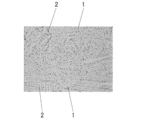
- FIG. 1 is an optical micrograph showing a cross section of a solidified structure in an aluminum porous body obtained in an example of the present invention.
- an aluminum electrolytic capacitor is formed by sandwiching a dielectric film made of aluminum oxide formed on an anode material made of aluminum between an anode and a cathode facing the anode.
- porous aluminum body of the present invention As an anode material, a dielectric film is formed on the anode material, and a separator infiltrated with an electrolyte solution serving as a cathode is placed on the dielectric film, whereby an aluminum electrolytic capacitor is obtained. Can be formed.
- the separator may not be used depending on the structure of the capacitor.
- a known separator such as a porous cellulose membrane can be used as the separator.
- the electrolytic solution generally comprises a cation component, an anion component, and a solvent.
- the anion component include weak acids such as boric acid and carboxylic acid
- examples of the cation component include organic bases such as ammonia and amines.
- examples of the solvent include ethylene glycol and ⁇ -butyrolactone.
- a conventional surface-expanded Al foil or the like can be used.
- the anode material obtained by the present invention is composed of an aluminum porous body (porous material).
- This aluminum porous body has an aluminum alloy cast body formed by casting solidification as a precursor. Then, by eluting (etching) a required portion of the precursor, an aluminum porous body having a large number of voids (pores) open to the surface and communicating from the surface to the inside is obtained.
- An aluminum alloy as a precursor is expressed as an Al—X alloy in which “X” as an additive component (additive element) is added to Al (aluminum) as a main component (main element) as described later. it can.
- the solidification structure of the precursor has an ⁇ phase composed of primary crystals (that is, an ⁇ -Al phase) and a second phase having a eutectic formed continuously with the ⁇ phase.
- the primary crystal refers to a crystal that is first formed from a molten metal during casting solidification.
- the second phase has a eutectic of Al and the additive element “X”. The second phase is virtually all connected. However, the isolated second phase may remain as long as the effects of the present invention are not impaired.
- the casting method for obtaining the precursor is not particularly limited, and may be casting into a mold or continuous casting method.
- a continuous casting method for example, a DC casting method, a horizontal continuous casting method, an electromagnetic field casting method, a roll type continuous casting method, a belt casting method, or the like can be applied.
- a directional solidification casting method can be suitably used as casting for obtaining a precursor.
- a precursor having a uniform structure can be obtained, and a porous body having a large surface area can be obtained by elution of the second phase of the precursor.
- the unidirectional solidification casting method it is preferable to apply the unidirectional solidification casting method.
- the porous body having a large surface area is more reliably obtained by leaving the ⁇ -Al phase of the precursor having a structure extending in one direction and dissolving the second phase with the eluent. Is obtained.
- the unidirectional solidification casting method is not particularly limited.
- continuous casting in which the ingot surface is solidified right outside the mold outlet end using a heating mold.
- Reference 2 a closed mold placed on a cooling plate is filled with molten metal without voids, and the molten metal is unidirectionally solidified by cooling from the cooling plate, Reference 3, a twin roll continuous casting method or the like can be applied.
- the content (mass%) of the additive component “X” in the second phase is the content in the ⁇ phase. More than
- the additive component “X” When the precursor is brought into contact with a solution that dissolves the additive component “X”, the additive component “X” is preferentially eluted, and as a result, the ⁇ phase remains and at least a part, preferably all, of the second phase remains.
- a large number of continuous voids (pores) are formed in the precursor from the surface to the inside, and the porous aluminum body of the present embodiment is obtained.
- Mg can be suitably used because it has a melting point close to that of Al.
- the additive component “X” is not limited to one type, and two or more types may be added.
- the Al—X-based alloy constituting the precursor can be regarded as having a hypoeutectic composition with an Al-based addition amount of “X” below the eutectic point.
- an Al-rich alloy phase is crystallized inside the solidification cell constituting the ⁇ phase, while being added to the final solidification portion of the solidification cell formed on the outer periphery of the ⁇ phase. Since the alloy phase (second phase) containing a large amount of the component “X” is crystallized, the second phase is preferentially eluted by the eluent. Therefore, a desired gap can be formed reliably.
- the ⁇ phase may also be eluted slightly, but this is not a problem as long as a continuous void is formed and the shape of the porous body is maintained.
- the precursor has a hypereutectic composition in which the addition amount of “X” exceeds the eutectic point, a crystallized product whose primary crystal is composed of the additive component “X” or an alloy containing a large amount of the additive component “X” Since it becomes a crystallized product of the phase, many parts of the primary crystal are eluted by the eluent. In this case, the voids are too large, and the surface area cannot be sufficiently expanded or the porous structure cannot be maintained.
- an element other than “X” may be added to the Al—X-based alloy as the precursor within the range of the eutectic composition as necessary or unavoidable.
- the general addition amount of “X” in the precursor is not more than the eutectic composition and is 1% by mass or more, desirably 5% by mass or more, and more desirably 10% by mass or more. That is, when “X” is added in this amount, as described above, an alloy phase containing a large amount of the additive component “X” crystallizes on the outer periphery of the ⁇ phase. When the preferential elution is performed and the second phase is eluted, a porous structure having a desired void can be formed.
- the eutectic composition in the present invention is 35% by mass with the smallest amount of Mg in the phase diagram in the case of an Al—Mg alloy, and 36% by mass in the case of an Al—Zn alloy.
- the surface area can be increased as the solidification cell composed of the ⁇ phase during casting is smaller. Therefore, it is preferable to reduce the solidification cell during casting solidification.
- the cooling rate in the vicinity of the freezing point may be adjusted to 1 ° C./sec or higher, preferably 5 ° C./sec or higher, more preferably 10 ° C./sec or higher.
- dendrites in at least a part of the ⁇ -phase solidification cell, and it is more preferable to form all of them into dendrites.
- the primary ⁇ phase 1 (the light gray portion in the figure) is composed of dendritic crystals, and between the ⁇ phases 1,
- the void 2 (the dark gray portion in the figure) formed by the elution of the second phase is continuously formed.
- the photograph in FIG. 1 is a porous body based on an aluminum alloy casting obtained by a continuous casting method using a heating mold, and an axial cross section of the aluminum alloy casting is observed. It is a thing.
- the precursor may be subjected to a drawing process or a rolling process for shaping the outer shape.
- the precursor is processed with a high deformation rate, the solidified structure collapses, and the crystallized product as the second phase is divided, and when the crystallized product is eluted, the porous material has a desired void. There is a possibility that the structure cannot be obtained.
- the surface of the precursor may be left as it is or may be cut to a size that facilitates the next process. Further, the cast solidified surface may be cut (deleted) so that the etching (elution) of the second phase can be performed quickly and uniformly.
- the additive component “X” in order to reduce the residual amount of “X” in the porous body, heat treatment is performed in a process after the aluminum alloy cast body is manufactured. By this heat treatment, “X” evaporates, and the residual amount of “X” in the porous body finally obtained can be reduced.
- the atmosphere of the heat treatment is preferably performed in a vacuum in order to promote evaporation of “X”.
- the degree of vacuum in the heat treatment in vacuum is preferably 0.1 Pa or less, more preferably 1 ⁇ 10 ⁇ 2 Pa or less, and particularly preferably 5 ⁇ 10 ⁇ 3 Pa or less.
- the heat treatment is a temperature at which “X” evaporates in the heat treatment atmosphere, and is preferably 550 ° C. or less. If the heat treatment temperature is too low, “X” does not evaporate, and if the heat treatment temperature is too high, the aluminum surface is oxidized inhomogeneously.
- the heat treatment temperature is preferably from 400 ° C. to 550 ° C., more preferably from 450 ° C. to 550 ° C.
- an acid aqueous solution can be exemplified as an eluent for dissolving the additive component “X” of the precursor.
- an acid contained in the acid aqueous solution hydrochloric acid, sulfuric acid, nitric acid and the like can be used.
- the heat treatment when the heat treatment is performed in a state where the additive component “X” is dissolved from the precursor and the area is expanded, evaporation of “X” is promoted. Therefore, the heat treatment is performed by contact with the eluate. It is preferable to carry out after dissolution of “X”.
- the precursor may be made into a porous body by performing at least one of contact with the eluate and heat treatment a plurality of times.
- the contact with the eluate is performed after the first contact with the eluate, heat treatment is performed, and then the second eluate is contacted. If it is possible, the second contact with the eluate may be performed in such a short time that the oxide film can be removed.
- An aluminum porous body obtained by treating the precursor with an eluent can be used as a capacitor electrode material.
- a dielectric coating is formed on the anode body.
- the method for forming the dielectric film is not particularly limited, but it is preferable to apply a chemical conversion treatment by anodic oxidation.
- Hydration treatment is generally performed in pure water as pre-chemical treatment.
- Other pretreatment methods include immersion in hydrogen peroxide, cleaning with an acid or alkaline treatment solution, vacuum or atmospheric heat treatment, dechlorination treatment, hydration treatment in an aqueous solution to which an amine is added, thermal oxide film It can be applied alone or in combination from known pretreatment methods including treatment with an acid or alkali solution after formation, and hydration treatment performed after electrolytic etching is applied to the aluminum foil.
- the chemical conversion treatment solution known ones can be used, and examples include aqueous solutions in which one or more of boric acid, ammonium borate, adipic acid, ammonium adipate, phosphoric acid and its salt, citric acid and its salt, etc. are mixed. it can.
- the EIAJ method can be exemplified, but is not limited thereto.
- the chemical conversion treatment may be performed a plurality of times, the chemical conversion liquid may be changed for each chemical conversion treatment according to a known method, and heat treatment or washing may be performed between the chemical conversion treatment and the chemical conversion treatment.
- the conversion voltage may be set to different values in a plurality of conversion processes.
- the precursor may be formed in any shape such as a columnar shape, a cylindrical shape, an elliptical columnar shape, an elliptical cylindrical shape, a prismatic shape, a rectangular cylindrical shape, a flat shape such as a plate shape, and the like.
- a columnar shape a cylindrical shape, an elliptical columnar shape, an elliptical cylindrical shape, a prismatic shape, a rectangular cylindrical shape, a flat shape such as a plate shape, and the like.
- a flat shape such as a plate shape, and the like.
- an aluminum electrolytic capacitor can be formed by sequentially laminating and placing a semiconductor layer and a conductor layer on the dielectric coating.
- the semiconductor layer can be formed of an inorganic semiconductor such as manganese dioxide or an organic semiconductor such as a conductive polymer, and these can be generally produced by a known method. In the case of forming with a conductive polymer, it can be formed using, for example, a chemical polymerization method and / or an electrolytic polymerization method.
- the solution for forming the semiconductor layer is not particularly limited as long as the solution can form a semiconductor by dipping and / or energization. For example, a solution containing aniline, thiophene, pyrrole, and substituted derivatives thereof (for example, 3,4-ethylenedioxythiophene) can be used. Further, a dopant may be added to this solution.
- arylsulfonic acid or its salt alkylsulfonic acid or its salt, various polymeric sulfonic acid or its salt, etc.
- conductive polymer for example, polyaniline, polythiophene, polypyrrole, polymethylpyrrole, and derivatives thereof
- a semiconductor layer can be formed.
- the conductor layer can be made of, for example, highly conductive carbon or silver, and can be produced by solidifying pasty carbon or silver. These may be laminated.
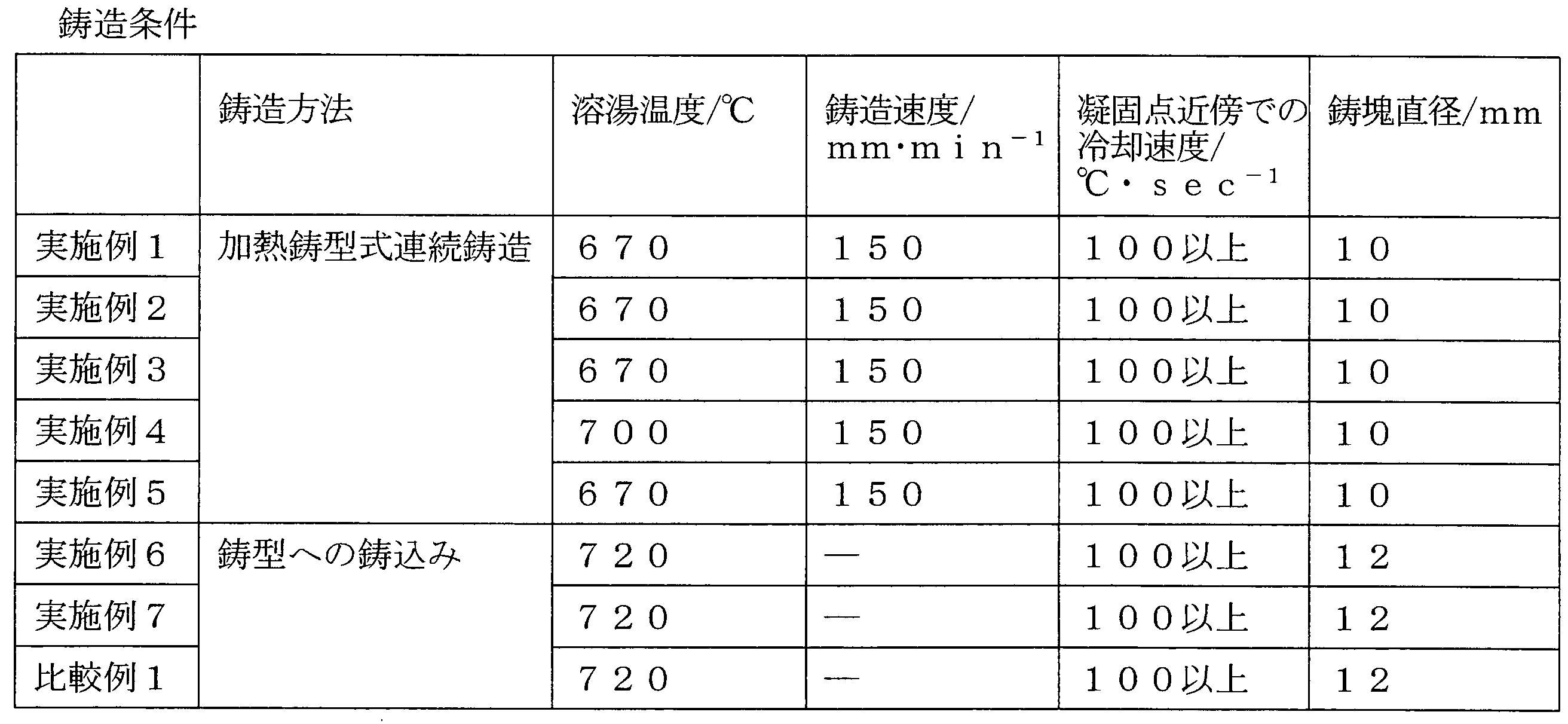
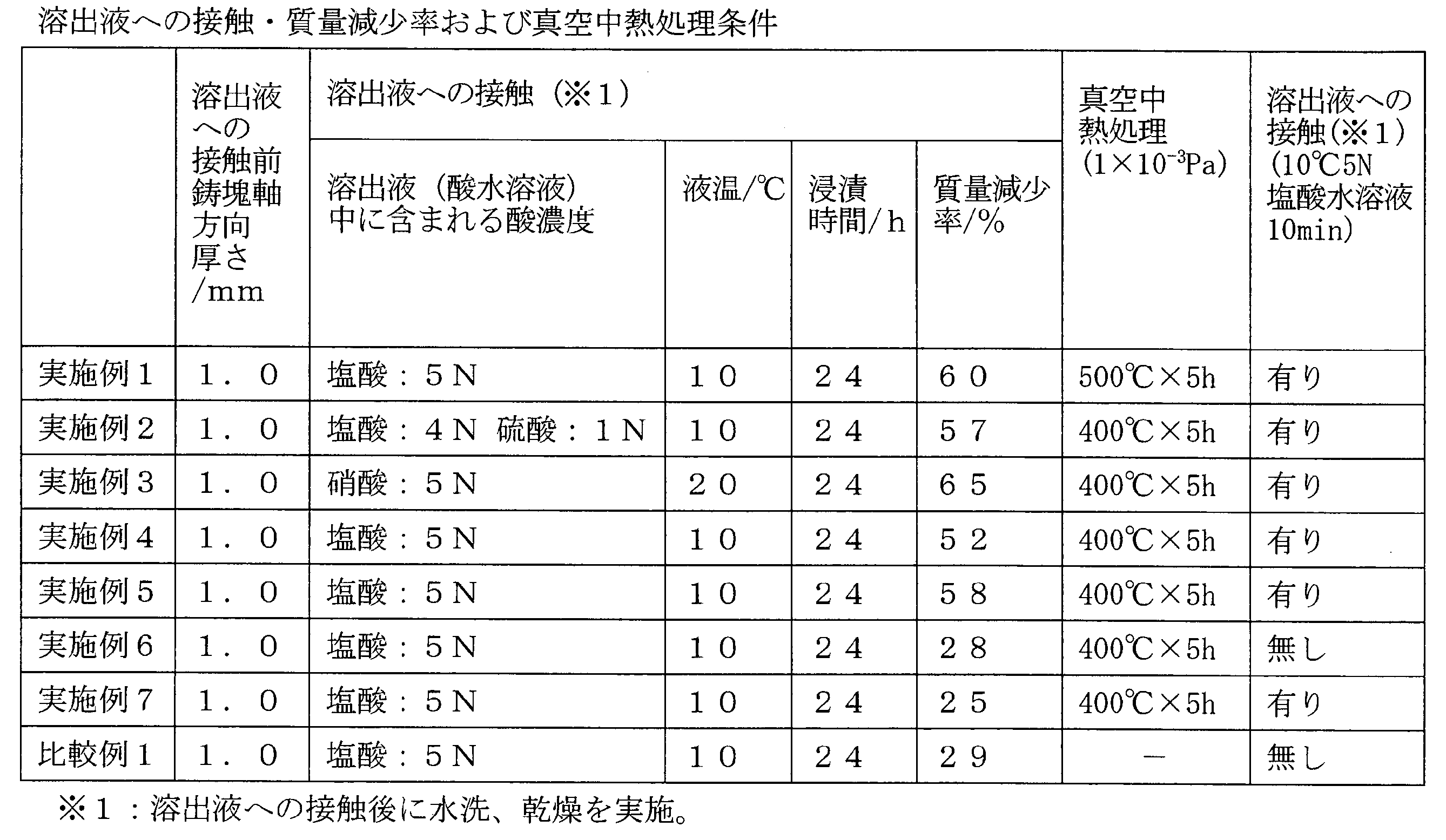
- Example 1 Using a molten 670 ° C. alloy having the composition shown in Table 1 and passing it through a heated mold as shown in Table 2 at a casting rate of 150 mm ⁇ min ⁇ 1 , cooling at a cooling rate of 100 ° C./sec or more, A cylindrical (round bar) aluminum alloy casting having a diameter of 12 mm was obtained. As shown in Table 3, the cast body was cut to a thickness of 1.0 mm perpendicularly in the axial direction, degreased with ethanol, immersed in a 5N hydrochloric acid solution at a liquid temperature of 10 ° C. for 24 hours, and in vacuum (1 Heat treatment at 500 ° C.
- Example 1 An aluminum porous body of Example 1.
- the mass reduction rate of the cast body by the first immersion in the eluate was 28%.
- the specific surface area was 0.50 m 2 / g, and the ratio of pores of 1 ⁇ m or more and 10 ⁇ m or less was 90% or more of all pores in terms of volume. It was.
- the obtained aluminum porous body was immersed in pure water in a boiling state for 5 minutes for chemical conversion pretreatment.
- the aluminum porous body subjected to the chemical conversion pretreatment was immersed in 11 L of pure water to which 1100 g of boric acid and 9.9 g of ammonium pentaborate octahydrate were added, and the initial current value was 500 mA / cm 2 at 90 ° C., constant voltage. Chemical conversion treatment was carried out by holding at 150 V for 10 minutes.
- the aluminum porous body subjected to chemical conversion treatment is immersed in 360 ml of pure water to which 28.8 g of ammonium pentaborate octahydrate is added, and below the surface of the stainless steel container (area: bottom diameter 60 mm ⁇ height 150 mm)
- As a counter electrode 30 ° C., measurement frequency 120 Hz, measurement voltage 0.5 Vr. m. s.
- the capacitance measurement was performed, it was 80 ⁇ F.
- Examples 2 to 7, Comparative Example 1 As shown in Table 2, the molten alloy of the composition shown in Table 1 is cast by the heating mold type continuous casting method in Examples 2 to 5, and in Examples 6 and 7 and Comparative Example 1, casting into the mold is performed. To obtain cylindrical (round bar) aluminum alloy castings. In addition, the temperature of the casting_mold
- FIG. 1 shows an optical micrograph of a cross-section of a solidified structure in the precursor of the porous aluminum body of Example 5.
- ⁇ -phase 1 of the primary crystal (light gray portion in the figure) is formed in dendritic crystals, and is formed by elution of the second phase between the ⁇ -phases 1.
- the void 2 (the dark gray portion in the figure) is continuously formed.
- the ratio of pores of 1 ⁇ m or more and 10 ⁇ m or less was 90% or more of the total pores in terms of volume. It was confirmed by blowing air into the porous body in water that the aluminum porous body penetrated in the axial direction.
- porous bodies of Examples 2 to 7 obtained by performing the heat treatment had less residual Mg than the porous body of Comparative Example 1 that was not subjected to the heat treatment.
- the ⁇ -Al phase and the ⁇ -Al phase are intricately and continuously formed by the directional solidification casting of the aluminum alloy.
- An aluminum alloy cast body with a solidified structure having a phase is manufactured as a precursor, and the cast body is brought into contact with the eluate to elute the second phase of the solidified structure, while heat treatment is performed in the process after the precursor is manufactured.
- an aluminum porous body having a large number of voids communicating from the surface to the inside can be formed, and it can be used as an electrode material having a high electrostatic capacity.
- the residual amount in the porous body of the component added to aluminum when casting an aluminum alloy casting as a precursor for obtaining a porous body can be reduced.
- the method for producing an aluminum porous body of the present invention can be suitably used when producing an anode material for an aluminum electrolytic capacitor or an aluminum solid electrolytic capacitor.
- phase 2 void
Landscapes
- Chemical & Material Sciences (AREA)
- Engineering & Computer Science (AREA)
- Materials Engineering (AREA)
- Mechanical Engineering (AREA)
- Metallurgy (AREA)
- Organic Chemistry (AREA)
- ing And Chemical Polishing (AREA)
Abstract
広い表面積を備えたアルミニウム多孔質体の製造方法を提供する。 本発明のアルミニウム多孔質体の製造方法は、アルミニウム合金の鋳造凝固によって、α-Al相1と、α-Al相と互いに入り組んでかつ連続して形成された第2相とを有する凝固組織のアルミニウム合金鋳造体を前駆体として作製する工程と、前記前駆体を第2相を溶解する溶出液と接触させることにより、前記前駆体における凝固組織の第2相を溶出して、表面から内部に連通する多数の空隙2を有するアルミニウム多孔質体を製造する工程と、前記前駆体を作製する工程以後に熱処理を実施する工程とを備える。
Description
この発明は、例えばアルミニウム電解コンデンサやアルミニウム固体電解コンデンサ等における電極材の材料として好適に用いられるアルミニウム多孔質体の製造方法およびその関連技術に関する。
アルミニウム電解コンデンサおよびアルミニウム固体電解コンデンサは比較的安価で高容量が得られるため、パーソナルコンピュータやテレビ等の家電製品や車載の電気製品用に広く使用されている。アルミニウム電解コンデンサは、一般的に陽極箔と陰極箔とをセパレータを介在させて卷回してコンデンサ素子とし、このコンデンサ素子に電解液を含浸してケース等に収納し、封孔することによって製造されている。例えば陽極箔には、アルミニウム等の弁作用金属の箔に化学的あるいは電気化学的にエッチングにより拡面処理が行われ、この拡面処理した箔の表面に化成処理をすることにより酸化被膜層が形成されている。
コンデンサにおいてはその最も重要な性能の一つである静電容量の向上を目的として、従来より、多数の技術が提案されている。例えば特許文献1、2に示すようにアルミニウム箔材料の開発に関する技術や、特許文献3に示すようにエッチング処理技術の開発に関する技術を基に、種々の拡面処理にアプローチして高容量化が進められてきた。
しかしながら、上記特許文献1~3の技術によるアルミニウム電解コンデンサの高容量化の延びは、近年鈍化しており、従来技術の延長では静電容量を大幅に向上させることは困難になってきている。
一方で、アルミニウム電解コンデンサにおいて大幅な高容量化を目的として、特許文献4に示すように陽極箔に弁作用金属の粉末を噴射する技術、エッチング位置を規則正しく配列させるために、特許文献5に示す印刷法を用いる技術や、特許文献6に示すようにリソグラフィーを用いる技術が提案されているが、特許文献4~6のいずれの技術もコストが高い等の課題を抱えており、実用化には至っていない。
本発明の好ましい実施形態は、関連技術における上述した及び/又は他の問題点に鑑みてなされたものである。本発明の好ましい実施形態は、既存の方法及び/又は装置を著しく向上させることができるものである。
本発明は、上記の課題に鑑みてなされたものであり、複雑な工程を必要とせずに低コストで製造でき、製造されたアルミニウム多孔質体は十分に広い表面積を備えることにより、例えばアルミニウム電解コンデンサの陽極体として用いた場合に、静電容量を大幅に向上させることができるアルミニウム多孔質体の製造方法およびその関連技術を提供することを目的とする。
本発明のその他の目的及び利点は、以下の好ましい実施形態から明らかであろう。
上記目的を達成するため、本発明は以下の構成を要旨とするものである。
[1]アルミニウム合金の鋳造凝固によって、α-Al相と、α-Al相と互いに入り組んでかつ連続して形成された第2相とを有する凝固組織のアルミニウム合金鋳造体を前駆体として作製する工程と、
前記前駆体を第2相を溶解する溶出液と接触させることにより、前記前駆体における凝固組織の第2相を溶出して、表面から内部に連通する多数の空隙を有するアルミニウム多孔質体を製造する工程と、
前記前駆体を作製する工程以後に熱処理を実施する工程とを備え、
前駆体としてのアルミニウム合金は、主体成分としての「Al」に添加成分としての「X」が添加されたAl-X系合金によって構成され、
「X」は「Al」に対して共晶反応を呈する元素であり、かつ前駆体としてのAl-X系合金は、Alベースで「X」の添加量が共晶点以下の亜共晶組成であることを特徴とするアルミニウム多孔質体の製造方法。
前記前駆体を第2相を溶解する溶出液と接触させることにより、前記前駆体における凝固組織の第2相を溶出して、表面から内部に連通する多数の空隙を有するアルミニウム多孔質体を製造する工程と、
前記前駆体を作製する工程以後に熱処理を実施する工程とを備え、
前駆体としてのアルミニウム合金は、主体成分としての「Al」に添加成分としての「X」が添加されたAl-X系合金によって構成され、
「X」は「Al」に対して共晶反応を呈する元素であり、かつ前駆体としてのAl-X系合金は、Alベースで「X」の添加量が共晶点以下の亜共晶組成であることを特徴とするアルミニウム多孔質体の製造方法。
[2]凝固組織の第2相を溶出させた前駆体に前記熱処理を実施するようにした前項1に記載のアルミニウム多孔質体の製造方法。
[3]凝固組織の第2相を溶出させた前駆体に前記熱処理を実施した後再度、溶出液に接触させるようにした前項1または2に記載のアルミニウム多孔質体の製造方法。
[4]前記熱処理を真空中で実施する前項1~3のいずれか1項に記載のアルミニウム多孔質体の製造方法。
[5]α-Al相には、樹枝状晶が含まれている前項1~4のいずれか1項に記載のアルミニウム多孔質体の製造方法。
[6]「X」はMgである前項1~5のいずれか1項に記載のアルミニウム多孔質体の製造方法。
[7]溶出液が酸性水溶液である前項1~6のいずれか1項に記載のアルミニウム多孔質体の製造方法。
[8]溶出液が塩酸、硫酸、硝酸の少なくとも1種を含有する酸性水溶液である前項7に記載のアルミニウム多孔質体の製造方法。
[9]アルミニウム合金の鋳造凝固によって、α-Al相と、α-Al相と互いに入り組んでかつ連続して形成された第2相とを有する凝固組織のアルミニウム合金鋳造体を前駆体として作製する工程と、
前記前駆体を第2相を溶解する溶出液と接触させることにより、前記前駆体における凝固組織の第2相を溶出して、表面から内部に連通する多数の空隙を有するアルミニウム多孔質体を製造する工程と、
前記前駆体を作製する工程以後に熱処理を実施する工程とを備え、
前駆体としてのアルミニウム合金は、主体成分としての「Al」に添加成分としての「X」が添加されたAl-X系合金によって構成され、
「X」は「Al」に対して共晶反応を呈する元素であり、かつ前駆体としてのAl-X系合金は、Alベースで「X」の添加量が共晶点以下の亜共晶組成であることを特徴とするコンデンサ用電極材の製造方法。
前記前駆体を第2相を溶解する溶出液と接触させることにより、前記前駆体における凝固組織の第2相を溶出して、表面から内部に連通する多数の空隙を有するアルミニウム多孔質体を製造する工程と、
前記前駆体を作製する工程以後に熱処理を実施する工程とを備え、
前駆体としてのアルミニウム合金は、主体成分としての「Al」に添加成分としての「X」が添加されたAl-X系合金によって構成され、
「X」は「Al」に対して共晶反応を呈する元素であり、かつ前駆体としてのAl-X系合金は、Alベースで「X」の添加量が共晶点以下の亜共晶組成であることを特徴とするコンデンサ用電極材の製造方法。
[10]凝固組織の第2相を溶出させた前駆体に前記熱処理を実施するようにした前項9に記載のコンデンサ用電極材の製造方法。
[11]凝固組織の第2相を溶出させた前駆体に前記熱処理を実施した後再度、溶出液に接触させるようにした前項9または10に記載のコンデンサ用電極材の製造方法。
[12]前記熱処理を真空中で実施する前項9~11のいずれか1項に記載のコンデンサ用電極材の製造方法。
[13]α-Al相には、樹枝状晶が含まれている前項9~12のいずれか1項に記載のコンデンサ用電極材の製造方法。
[14]「X」はMgである前項9~13のいずれか1項に記載のコンデンサ用電極材の製造方法。
[15]溶出液が酸性水溶液である前項9~14のいずれか1項に記載のコンデンサ用電極材の製造方法。
[16]溶出液が塩酸、硫酸、硝酸の少なくとも1種を含有する酸性水溶液である前項15に記載のコンデンサ用電極材の製造方法。
[17]前項1~8のいずれか1項に記載の製造方法により得られたアルミニウム多孔質体に化成処理を施してコンデンサ用電極材を製造するようにしたことを特徴とするコンデンサ用電極材の製造方法。
[18]前項9~16のいずれか1項に記載の製造方法により得られたコンデンサ用電極材を用いてコンデンサを製造するようにしたことを特徴とするコンデンサの製造方法。
[19]前項17に記載の製造方法により得られたコンデンサ用電極材を陽極材とするコンデンサを製造するようにしたことを特徴とするコンデンサの製造方法。
本発明の製造方法によれば、簡単かつ低コストで、十分な表面積を有するアルミニウム多孔質体を得ることができる。こうして得られた多孔質体をアルミニウムコンデンサの陽極体として用いた場合、静電容量を大幅に向上させることができる。さらに、本発明によれば、多孔質体を得るための前駆体としてアルミニウム合金鋳造体を鋳造する際にアルミニウムに添加する成分の多孔質体中における残留量を減少させることができる。
一般にアルミニウム電解コンデンサは、アルミニウムからなる陽極材上に形成された酸化アルミニウムからなる誘電体被膜を、陽極と、陽極と対向する陰極とで挟み込んで形成される。
本発明のアルミニウム多孔質体を陽極材として、陽極材上に誘電体被膜を形成し、陰極となる電解液の浸み込んだセパレータを誘電体被膜上に載置することにより、アルミニウム電解コンデンサを形成することができる。なお、セパレータはコンデンサの構造により用いない場合もある。
本発明において、セパレータは、セルロース多孔質膜をはじめとする公知のものを用いることができる。
本発明において、電解液は公知のものを用いることができる。電解液は、一般にカチオン成分と、アニオン成分と、溶媒とからなる。アニオン成分としては、例えばホウ酸やカルボン酸などの弱酸が挙げられ、カチオン成分としては、例えばアンモニアやアミンなどの有機塩基が挙げられる。溶媒としては、例えばエチレングリコールやγ-ブチロラクトンなどが挙げられる。陰極としては、従来の拡面処理されたAl箔等を用いることができる。
この発明により得られる陽極材は、アルミニウム多孔質体(ポーラス材料)によって構成されている。このアルミニウム多孔質体は、鋳造凝固によって成形されたアルミニウム合金鋳造体を前駆体としている。そしてその前駆体の所要部を溶出(エッチング)することによって、表面に開口し、かつ表面から内部にかけて連通する多数の空隙(気孔)を有するアルミニウム多孔質体を得るようにしている。
前駆体としてのアルミニウム合金は、後述するように主体成分(主体元素)としてのAl(アルミニウム)に、添加成分(添加元素)としての「X」が添加されたAl-X系合金として表すことができる。
前駆体の凝固組織は、初晶からなるα相(すなわちα-Al相)と、α相と互いに入り組んで連続して形成される共晶を有する第2相とを有している。初晶とは、鋳造凝固において溶湯から最初に生成する結晶をいう。第2相は、Alと添加元素「X」との共晶を有する。第2相は実質的に全てが繋がっている。ただし、孤立した第2相が、本発明の効果を損なわない範囲で残っていても構わない。
本発明において、前駆体を得るための鋳造方法は特に限定されず、鋳型への鋳込みであっても、連続鋳造法であっても良い。連続鋳造法としては、例えば、DC鋳造法、水平式連続鋳造法、電磁場鋳造法、ロール式連続鋳造法、ベルト鋳造法等が適用できる。
さらに本発明において、前駆体を得るための鋳造として指向性凝固鋳造法が好適に使用できる。指向性凝固鋳造法を適用することにより、組織が均一な前駆体が得られ、前駆体の第2相の溶出により、表面積が大きい多孔質体が得られる。
指向性凝固鋳造法の中でも、一方向凝固鋳造法を適用することが好ましい。すなわち一方向凝固鋳造法を用いた場合、一方向に伸びた組織を有する前駆体のα-Al相を残し、第2相を溶出液で溶解させることにより、表面積の広い多孔質体がより確実に得られる。
本発明において、一方向凝固鋳造法は特に限定されないが、例えば下記の参考文献1に記載されるように加熱鋳型を用いて鋳塊表面の凝固を鋳型出口端直外で行うようにした連続鋳造方法、参考文献2に記載されるように冷却板上に配置した閉塞性の鋳型内に金属溶湯を空隙なく充満させ、冷却板からの冷却で溶湯を一方向凝固させるようにした方法、参考文献3に記載されるように双ロール式連続鋳造法等を適用することができる。
参考文献1:大野篤美,日本金属学会会報告,23 [9],773-778,1984
参考文献2:特開平8-155627号公報
参考文献3:特開2007-268547号公報
本実施形態において、第2相における添加成分「X」の含有率(質量%)は、α相における含有率に比べて多い。
参考文献2:特開平8-155627号公報
参考文献3:特開2007-268547号公報
本実施形態において、第2相における添加成分「X」の含有率(質量%)は、α相における含有率に比べて多い。
前駆体を添加成分「X」を溶解する液に接触させると、添加成分「X」が優先的に溶出し、その結果α相が残存しつつ、第2相の少なくとも一部、好ましくは全部が溶出することによって、前駆体に、表面から内部に連通し、かつ連続する多数の空隙(気孔)が形成されて、本実施形態のアルミニウム多孔質体が得られる。
添加成分「X」としては、Alと融点が近く扱いやすいことからMgを好適に用いることができる。なお添加成分「X」は、1種類に限られず、2種類以上添加されていても良い。
前駆体を構成するAl-X系合金は、Alベースで「X」の添加量が共晶点以下の亜共晶組成であるとみることもできる。このように亜共晶組成の場合には、α相を構成する凝固セル内部にAlリッチの合金相が晶出する一方で、α相の外周に形成される凝固セルの最終凝固部には添加成分「X」を多く含む合金相(第2相)が晶出するため、第2相が溶出液によって優先溶出する。従って所望の空隙を確実に形成することができる。
α相もわずかに溶出することもあるが、連通した空隙が形成されるとともに多孔質体の形状が維持される範囲において問題とはならない。
なお前駆体が、「X」の添加量が共晶点を超える過共晶組成の場合には、初晶が添加成分「X」からなる晶出物、または添加成分「X」を多く含む合金相の晶出物となるので、その初晶の多くの部分が溶出液によって溶出されてしまう。そうすると空隙が大きすぎて表面積を十分に拡大することができなかったり、多孔質を維持できない場合があり、好ましくない。
また、前駆体としてのAl-X系合金には、必要に応じてまたは不可避的に、「X」以外の元素(第3の成分)が共晶組成の範囲内で添加されていてもよい。
前駆体中の「X」の一般的な添加量は、共晶組成以下であって1質量%以上、望ましくは5質量%以上、さらに望ましくは10質量%以上である。すなわちこの量で「X」を添加した場合には、既述した通り、添加成分「X」を多く含む合金相がα相の外周に多く晶出するため、溶出液によって添加成分「X」が優先溶出し、第2相を溶出した際に、所望の空隙を有する多孔質構造を形成することができる。本発明における共晶組成とは、Al-Mg合金の場合には、状態図の中の最もMg量の少ない35質量%であり、Al-Zn合金の場合には、36質量%である。
また、第2相を優先溶出させるため、鋳造時のα相からなる凝固セルが小さいほど、表面積を大きくすることができる。従って鋳造凝固時の凝固セルを小さくするのが良い。一般に添加成分「X」の添加量が多いほど、また凝固点近傍の温度での冷却速度が速いほど、凝固セルが小さくなるとともに、凝固セルが粒状(円形状や楕円形状)の晶出物から樹枝状晶へと複雑形状に変化するため、表面積を拡大させることができる。例えば凝固点近傍での冷却速度が1℃/sec以上、望ましくは5℃/sec以上、さらに望ましくは10℃/sec以上となるように調整するのが良い。
α相の凝固セルの少なくとも一部に樹枝状晶を形成するのが良く、より好ましくは全てを樹枝状晶に形成するのが良い。
例えば図1に示すように本発明に関連したアルミニウム多孔質体は、初晶α相1(同図の薄いグレーの部分)が樹枝状晶によって構成されており、そのα相1間には、第2相が溶出して形成された空隙2(同図の濃いグレーの部分)が連続して形成されている。後の実施例で詳述するが、図1の写真は、加熱鋳型を用いた連続鋳造法により得られたアルミニウム合金鋳造体に基づく多孔質体であり、アルミニウム合金鋳造体の軸方向断面を観察したものである。
前駆体としてのアルミニウム合金鋳造体に対し、鋳造凝固時の凝固組織が残存するのであれば、変形率の小さい軽度の加工を行っても良い。例えば前駆体に対し、外形を整形するための引抜加工や圧延加工等の加工を行うようにしても良い。
ただし前駆体に変形率の大きい加工を行うと、凝固組織が崩壊し、第2相としての晶出物が分断されてしまい、その晶出物を溶出した際に、所望の空隙を有する多孔質構造を得ることができないおそれがある。
前駆体の表面(鋳造凝固表面)は、そのままか、もしくは次工程が実施し易いサイズに切断してもよい。また、第2相のエッチング(溶出)を速く均一に行えるように、鋳造凝固表面を切削(削除)しておいてもよい。
本発明態において、多孔質体に添加成分「X」が多く残留すると、用途によっては酸化被膜の欠陥が問題になることや、多孔質体の不純物が多すぎることが懸念される。本発明においては、「X」の多孔質体中における残留量を減少させる為にアルミニウム合金鋳造体を作製した以後の工程で熱処理を実施する。この熱処理により「X」が蒸発し、最終的に得られる多孔質体中の「X」の残留量を低減することができる。
前記熱処理の雰囲気は「X」の蒸発を促進させる為に真空中で実施することが好ましい。真空中での熱処理における真空度は0.1Pa以下が好ましく、1×10⁻²Pa以下がさらに好ましく、特に5×10⁻³Pa以下が好ましい。
前記熱処理は、「X」が熱処理雰囲気中で蒸発する温度であって、550℃以下であることが好ましい。熱処理温度が低すぎると、「X」が蒸発せず、熱処理温度が高すぎるとアルミニウム表面が不均質に酸化される。「X」がMgの場合、熱処理温度は400℃以上550℃以下が好ましく、450℃以上550℃以下がさらに好ましい。
本実施形態において、前駆体の添加成分「X」を溶解するための溶出液としては、酸水溶液を例示できる。酸水溶液中に含まれる酸として、塩酸、硫酸、硝酸等を用いることができる。
本発明において、前駆体から添加成分「X」を溶解させて面積を拡大させた状態で、熱処理を行うと「X」の蒸発が促進されるため、前記熱処理は溶出液への接触による添加成分「X」の溶解後に実施することが好ましい。
本発明においては、前駆体に対し、溶出液への接触および熱処理の少なくともいずれかを複数回実施し、多孔質体とするようにしても良い。
また、一回目の溶出液への接触により多孔質化した後、熱処理を施し、二回目の溶出液への接触を実施する場合、一回目の溶出液への接触で十分に多孔質化させることが出来ていれば、二回目の溶出液への接触は酸化被膜を除去できる程度の短時間で実施してもよい。
上記前駆体を溶出液で処理して得られたアルミニウム多孔質体をコンデンサ用電極材として用いることができる。アルミニウム多孔質体をコンデンサ用陽極材として用いる場合には、陽極体上に誘電体被膜を形成する。誘電体被膜を形成する方法は特に限定されないが、陽極酸化による化成処理を適用することが好ましい。
化成前処理として一般的には純水中で水和処理を行う。その他、化成前処理の方法としては、過酸化水素水への浸漬、酸またはアルカリ性処理液による洗浄、真空もしくは雰囲気熱処理、脱塩素処理、アミンを添加した水溶液中での水和処理、熱酸化被膜形成後の酸またはアルカリ溶液での処理、アルミニウム箔に電解エッチングを施した後に行う水和処理も含めた公知の前処理方法の中から単独もしくは組み合わせて適用することができる。
化成処理液は公知のものを使用でき、ホウ酸、ホウ酸アンモニウム、アジピン酸、アジピン酸アンモニウム、リン酸およびその塩、クエン酸およびその塩等の中から1種もしくは複数種混合した水溶液を例示できる。
化成方法としては、EIAJ法を例示できるが、これに限定されるものではない。化成処理は複数回実施してもよく、公知の方法に従い、化成処理ごとに化成液を変えてもよく、化成処理と化成処理の間に熱処理若しくは洗浄を実施しても良い。また、複数回の化成処理においては化成電圧を異なる値としても良い。
本発明において前駆体は、円柱状、円筒状、楕円柱状、楕円筒状、角柱状、角筒状、板状等の扁平状等、どのような形状に形成しても良い。例えば前駆体の表面を有効に活用して、表面積を拡大するためには、楕円状や扁平状に形成するのが有利である。また、前駆体が筒状等のように内部が空洞となっている場合には、内周面からも優先溶出させることができるため、より高い表面積を得ることができる。
また、誘電体被膜上に半導体層及び導電体層を順次積層載置することにより、アルミニウム電解コンデンサを形成することもできる。
半導体層は、二酸化マンガンなどの無機半導体や導電性高分子などの有機半導体で形成でき、これらは一般に公知の方法で作製することができる。導電性高分子で形成する場合には、例えば、化学重合法及び/または電解重合法を用いて形成することができる。半導体層を形成するための溶液としては、浸漬及び/または通電等により半導体が形成され得る溶液であれば特に限定されない。例えば、アニリン、チオフェン、ピロール及びこれらの置換誘導体(例えば、3,4-エチレンジオキシチオフェン等)を含有する溶液などを用いることができる。またこの溶液にさらにドーパントを添加してもよい。ドーパントとしては、特に限定されるものではないが、例えば、アリールスルホン酸またはその塩、アルキルスルホン酸またはその塩、各種高分子スルホン酸またはその塩等を用いることができる。このような半導体層形成用溶液を用いて浸漬及び/または通電等を行うことによって誘電体層の上に、導電性高分子(例えばポリアニリン、ポリチオフェン、ポリピロール、ポリメチルピロール、これらの誘導体等)からなる半導体層を形成することができる。
導電体層は、例えば、導電性の高いカーボンや銀等を用いることができ、ペースト状のカーボンや銀を固化させることにより作製することができる。また、これらを積層しても良い。


<実施例1>
表1に示す組成の合金の670℃の溶湯を用いて、表2に示すように加熱した鋳型に鋳造速度150mm・min-1で通過させた後、冷却速度100℃/sec以上で冷却し、直径12mmの円柱状(丸棒)のアルミニウム合金鋳造体を得た。表3に示すようにこの鋳造体を軸方向垂直に1.0mmの厚さに切断した後、エタノールで脱脂して、液温10℃の5N塩酸水溶液への24時間の浸漬、真空中(1×10-3Pa)での500℃5時間の熱処理、液温10℃の5N塩酸水溶液への10分の浸漬を順次実施して、実施例1のアルミニウム多孔質体を得た。一回目の溶出液への浸漬による鋳造体の質量減少率は28%であった。
表1に示す組成の合金の670℃の溶湯を用いて、表2に示すように加熱した鋳型に鋳造速度150mm・min-1で通過させた後、冷却速度100℃/sec以上で冷却し、直径12mmの円柱状(丸棒)のアルミニウム合金鋳造体を得た。表3に示すようにこの鋳造体を軸方向垂直に1.0mmの厚さに切断した後、エタノールで脱脂して、液温10℃の5N塩酸水溶液への24時間の浸漬、真空中(1×10-3Pa)での500℃5時間の熱処理、液温10℃の5N塩酸水溶液への10分の浸漬を順次実施して、実施例1のアルミニウム多孔質体を得た。一回目の溶出液への浸漬による鋳造体の質量減少率は28%であった。
得られたアルミニウム多孔質体を水銀圧入法により評価したところ、比表面積は0.50m2/gであり、1μm以上10μm以下の細孔の比率は容積換算で全細孔の90%以上であった。
また、得られたアルミニウム多孔質体が軸方向に貫通していることを水中で空気を多孔質体に吹きこむことにより確認した。Mg残留量は0.18%であり鋳塊に含まれていた大半のMgが除去されていた。
次に、得られたアルミニウム多孔質体を沸騰状態の純水に5分浸漬して化成前処理を行った。
化成前処理を行ったアルミニウム多孔質体を、ホウ酸1100gと五ホウ酸アンモニウム八水和物9.9gを加えた純水11Lに浸漬して90℃で初期電流値500mA/cm2、定電圧150Vで10分間保持して化成処理を行った。
化成処理したアルミニウム多孔質体に対して、五ホウ酸アンモニウム八水和物28.8gを加えた純水360mlに浸漬してステンレス容器の液面下(面積:底面の直径60mm×高さ150mm)を対極として30℃、測定周波数120Hz、測定電圧0.5Vr.m.s.で静電容量測定を行ったところ、80μFであった。
<実施例2~7、比較例1>
表1に示す組成の合金の溶湯を、表2に示すように実施例2~5では、加熱鋳型式連続鋳造法によって鋳造するとともに、実施例6,7および比較例1では、鋳型への鋳込みによって鋳造して、円柱状(丸棒)のアルミニウム合金鋳造体をそれぞれ得た。なお、実施例6,7および比較例1の鋳型への鋳込みの際の鋳型の温度は、それぞれ100℃、120℃、90℃であった。こうして得られた各鋳造体を軸方向垂直に1.0mmの厚さで切断した後、表3の条件で処理しアルミニウム多孔質体を得た。
表1に示す組成の合金の溶湯を、表2に示すように実施例2~5では、加熱鋳型式連続鋳造法によって鋳造するとともに、実施例6,7および比較例1では、鋳型への鋳込みによって鋳造して、円柱状(丸棒)のアルミニウム合金鋳造体をそれぞれ得た。なお、実施例6,7および比較例1の鋳型への鋳込みの際の鋳型の温度は、それぞれ100℃、120℃、90℃であった。こうして得られた各鋳造体を軸方向垂直に1.0mmの厚さで切断した後、表3の条件で処理しアルミニウム多孔質体を得た。
図1に実施例5のアルミニウム多孔質体の前駆体における凝固組織の断面の光学顕微鏡写真を示す。同図に示すように、初晶のα相1(同図の薄いグレーの部分)が樹枝状晶に形成されており、そのα相1の各間に、第2相の溶出によって形成された空隙2(同図の濃いグレーの部分)が連続して形成されている。
また表4に示すように実施例2~7および比較例1のいずれの多孔質体においても1μm以上10μm以下の細孔の比率は容積換算で全細孔の90%以上であり、得られたアルミニウム多孔質体が軸方向に貫通していることを水中で空気を多孔質体に吹きこむことにより確認した。
また熱処理を実施して得られた実施例2~7の多孔質体は、熱処理を実施しなかった比較例1の多孔質体よりも残留しているMgが少なかった。
以上の実施例および比較例から明らかなように、本発明においては、アルミニウム合金の指向性凝固鋳造によって、α-Al相と、α-Al相と互いに入り組んでかつ連続して形成された第2相とを有する凝固組織のアルミニウム合金鋳造体を前駆体として製作し、その鋳造体を溶出液と接触させて、凝固組織の第2相を溶出する一方、前駆体作製以後の工程で熱処理を実施することにより、表面から内部に連通する多数の空隙を有するアルミニウム多孔質体を形成することができ、高い静電容量を有する電極材として用いることができる。さらに本発明においては、多孔質体を得るための前駆体としてアルミニウム合金鋳造体を鋳造する際にアルミニウムに添加する成分の多孔質体中における残留量を減少させることができる。
この発明のアルミニウム多孔質体の製造方法は、アルミニウム電解コンデンサやアルミニウム固体電解コンデンサの陽極材料を製作する際に好適に用いることができる。
本願は、2016年9月2日付で出願された日本国特許出願の特願2016-172146号の優先件主張を伴うものであり、その開示内容は、そのまま本願の一部を構成するものである。
ここに用いられた用語及び表現は、説明のために用いられたものであって限定的に解釈するために用いられたものではなく、ここに示され且つ述べられた特徴事項の如何なる均等物をも排除するものではなく、この発明のクレームされた範囲内における各種変形をも許容するものであると認識されなければならない。
本発明は、多くの異なった形態で具現化され得るものであるが、この開示は本発明の原理の実施例を提供するものと見なされるべきであって、それら実施例は、本発明をここに記載しかつ/または図示した好ましい実施形態に限定することを意図するものではないという了解のもとで、多くの図示実施形態がここに記載されている。
本発明の図示実施形態を幾つかここに記載したが、本発明は、ここに記載した各種の好ましい実施形態に限定されるものではなく、この開示に基づいていわゆる当業者によって認識され得る、均等な要素、修正、削除、組み合わせ(例えば、各種実施形態に跨る特徴の組み合わせ)、改良及び/又は変更を有するありとあらゆる実施形態をも包含するものである。クレームの限定事項はそのクレームで用いられた用語に基づいて広く解釈されるべきであり、本明細書あるいは本願のプロセキューション中に記載された実施例に限定されるべきではなく、そのような実施例は非排他的であると解釈されるべきである。
1:α相
2:空隙
2:空隙
Claims (19)
- アルミニウム合金の鋳造凝固によって、α-Al相と、α-Al相と互いに入り組んでかつ連続して形成された第2相とを有する凝固組織のアルミニウム合金鋳造体を前駆体として作製する工程と、
前記前駆体を第2相を溶解する溶出液と接触させることにより、前記前駆体における凝固組織の第2相を溶出して、表面から内部に連通する多数の空隙を有するアルミニウム多孔質体を製造する工程と、
前記前駆体を作製する工程以後に熱処理を実施する工程とを備え、
前駆体としてのアルミニウム合金は、主体成分としての「Al」に添加成分としての「X」が添加されたAl-X系合金によって構成され、
「X」は「Al」に対して共晶反応を呈する元素であり、かつ前駆体としてのAl-X系合金は、Alベースで「X」の添加量が共晶点以下の亜共晶組成であることを特徴とするアルミニウム多孔質体の製造方法。 - 凝固組織の第2相を溶出させた前駆体に前記熱処理を実施するようにした請求項1に記載のアルミニウム多孔質体の製造方法。
- 凝固組織の第2相を溶出させた前駆体に前記熱処理を実施した後再度、溶出液に接触させるようにした請求項1または2に記載のアルミニウム多孔質体の製造方法。
- 前記熱処理を真空中で実施する請求項1~3のいずれか1項に記載のアルミニウム多孔質体の製造方法。
- α-Al相には、樹枝状晶が含まれている請求項1~4のいずれか1項に記載のアルミニウム多孔質体の製造方法。
- 「X」はMgである請求項1~5のいずれか1項に記載のアルミニウム多孔質体の製造方法。
- 溶出液が酸性水溶液である請求項1~6のいずれか1項に記載のアルミニウム多孔質体の製造方法。
- 溶出液が塩酸、硫酸、硝酸の少なくとも1種を含有する酸性水溶液である請求項7に記載のアルミニウム多孔質体の製造方法。
- アルミニウム合金の鋳造凝固によって、α-Al相と、α-Al相と互いに入り組んでかつ連続して形成された第2相とを有する凝固組織のアルミニウム合金鋳造体を前駆体として作製する工程と、
前記前駆体を第2相を溶解する溶出液と接触させることにより、前記前駆体における凝固組織の第2相を溶出して、表面から内部に連通する多数の空隙を有するアルミニウム多孔質体を製造する工程と、
前記前駆体を作製する工程以後に熱処理を実施する工程とを備え、
前駆体としてのアルミニウム合金は、主体成分としての「Al」に添加成分としての「X」が添加されたAl-X系合金によって構成され、
「X」は「Al」に対して共晶反応を呈する元素であり、かつ前駆体としてのAl-X系合金は、Alベースで「X」の添加量が共晶点以下の亜共晶組成であることを特徴とするコンデンサ用電極材の製造方法。 - 凝固組織の第2相を溶出させた前駆体に前記熱処理を実施するようにした請求項9に記載のコンデンサ用電極材の製造方法。
- 凝固組織の第2相を溶出させた前駆体に前記熱処理を実施した後再度、溶出液に接触させるようにした請求項9または10に記載のコンデンサ用電極材の製造方法。
- 前記熱処理を真空中で実施する請求項9~11のいずれか1項に記載のコンデンサ用電極材の製造方法。
- α-Al相には、樹枝状晶が含まれている請求項9~12のいずれか1項に記載のコンデンサ用電極材の製造方法。
- 「X」はMgである請求項9~13のいずれか1項に記載のコンデンサ用電極材の製造方法。
- 溶出液が酸性水溶液である請求項9~14のいずれか1項に記載のコンデンサ用電極材の製造方法。
- 溶出液が塩酸、硫酸、硝酸の少なくとも1種を含有する酸性水溶液である請求項15に記載のコンデンサ用電極材の製造方法。
- 請求項1~8のいずれか1項に記載の製造方法により得られたアルミニウム多孔質体に化成処理を施してコンデンサ用電極材を製造するようにしたことを特徴とするコンデンサ用電極材の製造方法。
- 請求項9~16のいずれか1項に記載の製造方法により得られたコンデンサ用電極材を用いてコンデンサを製造するようにしたことを特徴とするコンデンサの製造方法。
- 請求項17に記載の製造方法により得られたコンデンサ用電極材を陽極材とするコンデンサを製造するようにしたことを特徴とするコンデンサの製造方法。
Applications Claiming Priority (2)
| Application Number | Priority Date | Filing Date | Title |
|---|---|---|---|
| JP2016172146A JP2018035432A (ja) | 2016-09-02 | 2016-09-02 | アルミニウム多孔質体の製造方法 |
| JP2016-172146 | 2016-09-02 |
Publications (1)
| Publication Number | Publication Date |
|---|---|
| WO2018043603A1 true WO2018043603A1 (ja) | 2018-03-08 |
Family
ID=61300918
Family Applications (1)
| Application Number | Title | Priority Date | Filing Date |
|---|---|---|---|
| PCT/JP2017/031262 Ceased WO2018043603A1 (ja) | 2016-09-02 | 2017-08-30 | アルミニウム多孔質体の製造方法 |
Country Status (2)
| Country | Link |
|---|---|
| JP (1) | JP2018035432A (ja) |
| WO (1) | WO2018043603A1 (ja) |
Citations (3)
| Publication number | Priority date | Publication date | Assignee | Title |
|---|---|---|---|---|
| JP2001006985A (ja) * | 1999-06-17 | 2001-01-12 | Showa Alum Corp | 電解コンデンサ電極用アルミニウム箔の製造方法 |
| JP2009170618A (ja) * | 2008-01-16 | 2009-07-30 | Sanyo Electric Co Ltd | コンデンサの製造方法及びコンデンサ |
| JP2011249175A (ja) * | 2010-05-28 | 2011-12-08 | Honda Foundry Co Ltd | マグネシウム電池用電極材料とその製造方法、および該電極材料を用いた電極を用いる電池 |
-
2016
- 2016-09-02 JP JP2016172146A patent/JP2018035432A/ja active Pending
-
2017
- 2017-08-30 WO PCT/JP2017/031262 patent/WO2018043603A1/ja not_active Ceased
Patent Citations (3)
| Publication number | Priority date | Publication date | Assignee | Title |
|---|---|---|---|---|
| JP2001006985A (ja) * | 1999-06-17 | 2001-01-12 | Showa Alum Corp | 電解コンデンサ電極用アルミニウム箔の製造方法 |
| JP2009170618A (ja) * | 2008-01-16 | 2009-07-30 | Sanyo Electric Co Ltd | コンデンサの製造方法及びコンデンサ |
| JP2011249175A (ja) * | 2010-05-28 | 2011-12-08 | Honda Foundry Co Ltd | マグネシウム電池用電極材料とその製造方法、および該電極材料を用いた電極を用いる電池 |
Also Published As
| Publication number | Publication date |
|---|---|
| JP2018035432A (ja) | 2018-03-08 |
Similar Documents
| Publication | Publication Date | Title |
|---|---|---|
| JP4983744B2 (ja) | 固体電解コンデンサの製造方法 | |
| US8513123B2 (en) | Method of manufacturing solid electrolytic capacitor | |
| WO2018043601A1 (ja) | アルミニウム多孔質体の製造方法 | |
| JP2000073198A (ja) | バルブ金属を陽極処理するための方法及び電解質 | |
| TWI273615B (en) | Electrode sheet for capacitors, method of manufacturing the same, and electrolytic capacitor | |
| WO2018043602A1 (ja) | アルミニウム多孔質体の製造方法 | |
| CN107406912B (zh) | 铝多孔质体的制造方法 | |
| WO2018043603A1 (ja) | アルミニウム多孔質体の製造方法 | |
| CN102473528B (zh) | 固体电解电容器的制造方法 | |
| WO2018043604A1 (ja) | アルミニウム多孔質体 | |
| JP2000068159A (ja) | 固体電解コンデンサ用電極箔、その製造方法及び固体電解コンデンサ | |
| JP2016166412A (ja) | アルミニウム多孔質体の製造方法 | |
| US9704652B2 (en) | Method for manufacturing tungsten-based capacitor element | |
| WO2016140261A1 (ja) | アルミニウム多孔質体の製造方法 | |
| JP2016166411A (ja) | アルミニウム多孔質体の製造方法 | |
| JP2017022281A (ja) | 電解コンデンサ | |
| JP3092512B2 (ja) | 固体電解コンデンサの製造方法 | |
| JP2001297950A (ja) | アルミ電解コンデンサ用陽極箔の製造方法 | |
| JPH02276215A (ja) | 固体電解コンデンサの製造方法 | |
| JP4308556B2 (ja) | 電解コンデンサ電極用アルミニウム材および電解コンデンサ電極材の製造方法並びに電解コンデンサ | |
| JP3750476B2 (ja) | 固体電解コンデンサの製造方法 | |
| JP2629241B2 (ja) | アルミ電解コンデンサ用電極箔の製造方法 | |
| JP3100411B2 (ja) | 固体電解コンデンサの製造方法 | |
| JPH047086B2 (ja) | ||
| JP3897634B2 (ja) | 窒化物を有するAl−Nb系合金薄板及びその製造方法並びに電解コンデンサ |
Legal Events
| Date | Code | Title | Description |
|---|---|---|---|
| 121 | Ep: the epo has been informed by wipo that ep was designated in this application |
Ref document number: 17846607 Country of ref document: EP Kind code of ref document: A1 |
|
| NENP | Non-entry into the national phase |
Ref country code: DE |
|
| 122 | Ep: pct application non-entry in european phase |
Ref document number: 17846607 Country of ref document: EP Kind code of ref document: A1 |