WO2018021653A1 - Il-7 발현 리포터 세포주 및 이를 이용한 면역결핍 질환 치료제 스크리닝 방법 - Google Patents
Il-7 발현 리포터 세포주 및 이를 이용한 면역결핍 질환 치료제 스크리닝 방법 Download PDFInfo
- Publication number
- WO2018021653A1 WO2018021653A1 PCT/KR2017/003213 KR2017003213W WO2018021653A1 WO 2018021653 A1 WO2018021653 A1 WO 2018021653A1 KR 2017003213 W KR2017003213 W KR 2017003213W WO 2018021653 A1 WO2018021653 A1 WO 2018021653A1
- Authority
- WO
- WIPO (PCT)
- Prior art keywords
- cell line
- fluorescent reporter
- immunodeficiency
- screening
- gene
- Prior art date
- Legal status (The legal status is an assumption and is not a legal conclusion. Google has not performed a legal analysis and makes no representation as to the accuracy of the status listed.)
- Ceased
Links
Images
Classifications
-
- C—CHEMISTRY; METALLURGY
- C12—BIOCHEMISTRY; BEER; SPIRITS; WINE; VINEGAR; MICROBIOLOGY; ENZYMOLOGY; MUTATION OR GENETIC ENGINEERING
- C12N—MICROORGANISMS OR ENZYMES; COMPOSITIONS THEREOF; PROPAGATING, PRESERVING, OR MAINTAINING MICROORGANISMS; MUTATION OR GENETIC ENGINEERING; CULTURE MEDIA
- C12N15/00—Mutation or genetic engineering; DNA or RNA concerning genetic engineering, vectors, e.g. plasmids, or their isolation, preparation or purification; Use of hosts therefor
- C12N15/09—Recombinant DNA-technology
- C12N15/63—Introduction of foreign genetic material using vectors; Vectors; Use of hosts therefor; Regulation of expression
- C12N15/79—Vectors or expression systems specially adapted for eukaryotic hosts
- C12N15/85—Vectors or expression systems specially adapted for eukaryotic hosts for animal cells
-
- C—CHEMISTRY; METALLURGY
- C07—ORGANIC CHEMISTRY
- C07K—PEPTIDES
- C07K14/00—Peptides having more than 20 amino acids; Gastrins; Somatostatins; Melanotropins; Derivatives thereof
- C07K14/435—Peptides having more than 20 amino acids; Gastrins; Somatostatins; Melanotropins; Derivatives thereof from animals; from humans
- C07K14/52—Cytokines; Lymphokines; Interferons
- C07K14/54—Interleukins [IL]
-
- C—CHEMISTRY; METALLURGY
- C07—ORGANIC CHEMISTRY
- C07K—PEPTIDES
- C07K14/00—Peptides having more than 20 amino acids; Gastrins; Somatostatins; Melanotropins; Derivatives thereof
- C07K14/435—Peptides having more than 20 amino acids; Gastrins; Somatostatins; Melanotropins; Derivatives thereof from animals; from humans
- C07K14/52—Cytokines; Lymphokines; Interferons
- C07K14/54—Interleukins [IL]
- C07K14/5418—IL-7
-
- C—CHEMISTRY; METALLURGY
- C12—BIOCHEMISTRY; BEER; SPIRITS; WINE; VINEGAR; MICROBIOLOGY; ENZYMOLOGY; MUTATION OR GENETIC ENGINEERING
- C12N—MICROORGANISMS OR ENZYMES; COMPOSITIONS THEREOF; PROPAGATING, PRESERVING, OR MAINTAINING MICROORGANISMS; MUTATION OR GENETIC ENGINEERING; CULTURE MEDIA
- C12N15/00—Mutation or genetic engineering; DNA or RNA concerning genetic engineering, vectors, e.g. plasmids, or their isolation, preparation or purification; Use of hosts therefor
- C12N15/09—Recombinant DNA-technology
- C12N15/63—Introduction of foreign genetic material using vectors; Vectors; Use of hosts therefor; Regulation of expression
- C12N15/65—Introduction of foreign genetic material using vectors; Vectors; Use of hosts therefor; Regulation of expression using markers
-
- G—PHYSICS
- G01—MEASURING; TESTING
- G01N—INVESTIGATING OR ANALYSING MATERIALS BY DETERMINING THEIR CHEMICAL OR PHYSICAL PROPERTIES
- G01N33/00—Investigating or analysing materials by specific methods not covered by groups G01N1/00 - G01N31/00
- G01N33/48—Biological material, e.g. blood, urine; Haemocytometers
- G01N33/50—Chemical analysis of biological material, e.g. blood, urine; Testing involving biospecific ligand binding methods; Immunological testing
-
- G—PHYSICS
- G01—MEASURING; TESTING
- G01N—INVESTIGATING OR ANALYSING MATERIALS BY DETERMINING THEIR CHEMICAL OR PHYSICAL PROPERTIES
- G01N33/00—Investigating or analysing materials by specific methods not covered by groups G01N1/00 - G01N31/00
- G01N33/48—Biological material, e.g. blood, urine; Haemocytometers
- G01N33/50—Chemical analysis of biological material, e.g. blood, urine; Testing involving biospecific ligand binding methods; Immunological testing
- G01N33/5005—Chemical analysis of biological material, e.g. blood, urine; Testing involving biospecific ligand binding methods; Immunological testing involving human or animal cells
- G01N33/5008—Chemical analysis of biological material, e.g. blood, urine; Testing involving biospecific ligand binding methods; Immunological testing involving human or animal cells for testing or evaluating the effect of chemical or biological compounds, e.g. drugs, cosmetics
- G01N33/5044—Chemical analysis of biological material, e.g. blood, urine; Testing involving biospecific ligand binding methods; Immunological testing involving human or animal cells for testing or evaluating the effect of chemical or biological compounds, e.g. drugs, cosmetics involving specific cell types
-
- G—PHYSICS
- G01—MEASURING; TESTING
- G01N—INVESTIGATING OR ANALYSING MATERIALS BY DETERMINING THEIR CHEMICAL OR PHYSICAL PROPERTIES
- G01N2500/00—Screening for compounds of potential therapeutic value
- G01N2500/10—Screening for compounds of potential therapeutic value involving cells
Definitions
- the present invention relates to an IL-7 expressing reporter cell line and a method for screening a therapeutic agent for immunodeficiency disease using the same.
- IL-7 is a cytokine essential for T cell development and peripheral T cell homeostasis and is expressed mainly in epithelial and stromal cells. IL-7 gene expression has been thought to be expressed at all times for a long time, but recent studies have shown that the expression of the gene can be regulated in various situations. However, except for IFNg-dependent IL-7 expression mediated by an interferon stimulated response element (ISRE) in the IL-7 promoter, its regulatory mechanism is not well known.
- ISRE interferon stimulated response element
- IL-7 Externally delivered IL-7 may enhance antiviral and antitumor defense mechanisms.
- IL-7 has potential potential in treating various immunodeficiency diseases.
- IL-7 is a protein and its production cost is very high, more than 10 times higher than standard chemical drugs for clinical use. Therefore, discovering effective IL-7 inducing compounds is of great medical value.
- IL-7 enhanced green fluorescent protein
- eYFP enhanced yellow fluorescent protein
- the mice were developed by the present inventors and other researchers, who were able to observe IL-7 gene transcription with eGFP or eYFP.
- the reporter mice can be very useful for identifying IL-7 expressing cell types, since IL-7 expressing cells are very rare in vivo, screening compounds in high-throughput screening (HTS) format It is impractical to be used for a purpose. Thus, there is a need to establish more practical systems such as the IL-7 reporter cell line.
- HTS high-throughput screening
- CRISPR / Cas9 CRISPR / Cas9 (Cas9) -mediated gene editing techniques are very useful for introducing foreign DNA into specific locations in the genome.
- Cas9 single guide RNA
- HDR homology-directed repair
- DSBs DNA double-strand breaks
- Still another object of the present invention is to provide a method for screening an IL-7 expression promoter using the IL-7 expressing fluorescent reporter cell line.
- Still another object of the present invention is ellipticine, clemastine fumarate, centrophenoxine hydrochloride and 7- (hydroxyimino) cyclopropa [b] chromen-1a.
- -A pharmaceutical composition for preventing or treating immunodeficiency diseases comprising at least one selected from the group consisting of 7- (hydroxyimino) cyclopropa [b] chromen-1a-carboxylate ethyl ester (CPCCOEt) as an active ingredient.
- CPCCOEt chromen-1a-carboxylate ethyl ester
- the present invention relates to left homology including the 5 'end of IL-7 gene exon 1, wherein the upstream ATGs (uATGs) are mutated in the 5' untranslated region (UTR) of IL-7 gene exon 1
- Right homologous arm (RHA) DNA including the left homologous arm (LHA) DNA, the fluorescent protein (FP) gene, the antibiotic selection marker gene, and the 3 'end of the IL-7 gene exon 1 Donor DNA cassettes are provided, which are linked in sequence.
- the present invention also provides a fluorescent reporter donor recombinant vector comprising the donor DNA cassette.
- the present invention also provides a recombinant IL-7 expressing fluorescent reporter cell line wherein the donor DNA cassette is inserted at the IL-7 gene exon 1 site in the chromosome of the host cell.
- the present invention comprises the steps of (1) contacting the test substance to the recombinant IL-7 expressing fluorescent reporter cell line of claim 6; (2) measuring the signal intensity of the fluorescent reporter in a recombinant IL-7 expressing fluorescent reporter cell line in contact with the test substance; And (3) provides a screening method for IL-7 expression promoter comprising the step of screening a test material with increased signal intensity of the fluorescent reporter compared to the control sample.
- the present invention comprises the steps of (1) contacting the test substance to the recombinant IL-7 expressing fluorescent reporter cell line of claim 6; (2) measuring the signal intensity of the fluorescent reporter in a recombinant IL-7 expressing fluorescent reporter cell line in contact with the test substance; And (3) provides a screening method for the treatment of immunodeficiency disorders comprising the step of selecting a test substance with an increased signal intensity of the fluorescent reporter compared to the control sample.
- the present invention provides ellipticine, clemastine fumarate, centrophenoxine hydrochloride and 7- (hydroxyimino) cyclopropa [b] chromen-1a-car It provides a pharmaceutical composition for the prevention or treatment of immunodeficiency disease comprising any one or more selected from the group consisting of 7- (hydroxyimino) cyclopropa [b] chromen-1a-carboxylate ethyl ester (CPCCOEt) as an active ingredient. .
- the present invention relates to an IL-7 expression reporter cell line and a method for screening for an immunodeficiency disease treatment using the same, and the present inventors use a Cas9 gene-targeting technique to report an endogenous IL-7 expression of transcription level in human cell lines.
- the system was developed.
- the IL-7 reporter system and IL-7 reporter cell line of the present invention can be very usefully used for screening IL-7 regulatory compounds in HTS format.
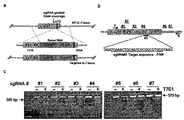
- IL-7 reporter gene targeting strategy shows IL-7 reporter gene targeting strategy and good single guide RNA (sgRNA) selection process.
- sgRNA single guide RNA
- (b) The sgRNA target in the IL-7 position is indicated by a red line, and the sequence for sgRNA # 5 and its associated PAM are shown in green and blue, respectively.
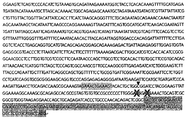
- ISREs Interferon-stimulated response elements
- CpG islands (identified in the UCSC genome browser) are present at the promoter site, on the 1 st intron covering 722 bp (start site is indicated by a black triangle).
- Upstream ATGs (uATGs) are shown in red letters and authentic ATG start sites are shown in red letters with green highlights.
- Mutated uATGs (T to G) are denoted by Xs and deleted portions of 5 'UTR are shaded in gray.
- the right homology arm extends from the actual ATG codon to the 1 st intron.
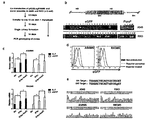
- FIG. 3 shows for establishment of IL-7 eGFP reporter cell line.
- eGFP in monoclonals of targeted A549 and RKO cells PCR genotyping results are shown to confirm that (left) and PuroR (right) are correctly inserted at the IL-7 position.
- Primers (green and purple arrows) for amplifying eGFP insertion (967 bp) and PuroR insertion (1423 bp) are shown on the diagram (top) and PCR products are shown on the gel (bottom).
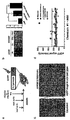
- FIG. 4 shows the results of pilot screening of compounds inducing IL-7 gene upregulation in HTS format.
- (a) The schematic for the screening of a compound is shown.
- (b) Representative eGFP images (left) and associated quantitative results (right) from A549, untreated A549 # 6 (No) and IFNg / AzaC-treated A549 # 6 in 96-well plates.
- (c) Representative eGFP images from A549 # 6 cells treated with 80 compounds in 96-well plates showed ellipticine peaks.
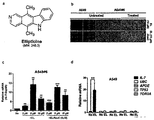
- Figure 5 shows the results of the compounds screened to upregulate IL-7 expression.
- (a) It shows the chemical structure of ellipticine.
- (bc) A549 or A549 # 6 cells were either untreated or A549 # 6 was treated alone with ellipsine (EL, 10 ⁇ M, b) for 16 hours or with AzaC (5 ⁇ M).
- (b) shows an eGFP image and
- (c) shows IL-7 mRNA expression quantified by qRT-PCR.
- A549 cells were treated with untreated (No) or ellipsine (EL, 5 ⁇ M), and mRNA expression levels including some known genes were measured. ** P ⁇ 0.01, *** P ⁇ 0.001.
- the present invention relates to a left homologous arm comprising the 5 'end of IL-7 gene exon 1 in which the upstream ATGs (uATGs) are mutated in the 5' untranslated region (UTR) of IL-7 gene exon 1.
- left homologous arm (LHA) DNA, fluorescent protein (FP) gene, antibiotic selection marker gene and IL-7 gene, including the 3 'end of the exon 1 right homologous arm (RHA) DNA Donor DNA cassettes linked in sequence are provided.
- the left homology arm DNA may be composed of the nucleotide sequence represented by SEQ ID NO: 1
- the right homology arm DNA may be composed of the nucleotide sequence represented by SEQ ID NO: 2, but is not limited thereto.
- the antibiotic selection marker gene may be puromycin, blasticidin, neomycin, ampicillin, kanamycin, G418, bleomycin, bleomycin, Antibiotic resistance genes, such as hygromycin and chloramphenicol, are not limited thereto and may be appropriately selected by those skilled in the art. In the present invention, it is most preferable to use a puromycin resistance marker gene.
- the present invention also provides a fluorescent reporter donor recombinant vector comprising the donor DNA cassette.
- vector refers to a DNA molecule that is a self-replicating molecule used to carry a clone gene (or another piece of clone DNA).
- the present invention also provides a recombinant IL-7 expressing fluorescent reporter cell line wherein the donor DNA cassette is inserted at the IL-7 gene exon 1 site in the chromosome of the host cell.
- the IL-7 gene exon 1 site may be a target sequence position represented by SEQ ID NO: 3, but is not limited thereto.
- the host cell may be a human A549 cell or a human RKO cell, but is not limited thereto.
- a conventionally known genetic manipulation method may be used, and in the present invention, the CRISPR / Cas9 gene-targeting technique is used.
- the "CRISPR / Cas9 system” used in the present invention is composed of RNA (gRNA) that specifically binds to a specific nucleotide sequence and Cas9 nuclease, which is a scissors to cut a specific nucleotide sequence.
- gRNA RNA
- Cas9 nuclease which is a scissors to cut a specific nucleotide sequence.
- Introducing into the cell gRNA and Cas9 produced complementary to the target genomic sequence is a system that cleaves DNA double helix in a position-specific manner.
- a fluorescent reporter donor recombinant vector comprising the donor DNA cassette of the present invention into a cell with a CRISPR / Cas9 system, the donor DNA cassette of the present invention can be inserted at a target location of the genome through homologous recombination. .
- the present invention comprises the steps of (1) contacting the test substance to the recombinant IL-7 expressing fluorescent reporter cell line; (2) measuring the signal intensity of the fluorescent reporter in a recombinant IL-7 expressing fluorescent reporter cell line in contact with the test substance; And (3) provides a screening method for IL-7 expression promoter comprising the step of screening a test material with increased signal intensity of the fluorescent reporter compared to the control sample.
- the present invention comprises the steps of (1) contacting the test substance to the recombinant IL-7 expressing fluorescent reporter cell line; (2) measuring the signal intensity of the fluorescent reporter in a recombinant IL-7 expressing fluorescent reporter cell line in contact with the test substance; And (3) provides a screening method for the treatment of immunodeficiency disorders comprising the step of selecting a test substance with an increased signal intensity of the fluorescent reporter compared to the control sample.
- test material refers to an unknown candidate used in screening to examine whether it affects the expression level of a gene or affects the expression or activity of a protein. do.
- samples include, but are not limited to, compounds, nucleotides, cDNA libraries, knock-out libraries, antisense-RNAs, small interference RNAs (siRNAs), and natural extracts.
- a "fluorescent protein” or “fluorescent reporter” is a protein or reporter that luminesces in vivo, and includes a green fluorescent protein (GFP), a yellow fluorescent protein (YFP), or a red fluorescent protein. (red fluorescent protein; RFP) and the like, and may preferably be, but are not limited to, the enhanced green fluorescent protein (eGFP) described in the Examples of the present invention.
- GFP green fluorescent protein
- YFP yellow fluorescent protein
- RFP red fluorescent protein
- eGFP enhanced green fluorescent protein
- the present invention provides ellipticine, clemastine fumarate, centrophenoxine hydrochloride and 7- (hydroxyimino) cyclopropa [b] chromen-1a-car It provides a pharmaceutical composition for the prevention or treatment of immunodeficiency disease comprising any one or more selected from the group consisting of 7- (hydroxyimino) cyclopropa [b] chromen-1a-carboxylate ethyl ester (CPCCOEt) as an active ingredient. .
- the compound is characterized by promoting IL-7 expression.
- immunodeficiency disease may be congenital immunodeficiency, cancer, chronic viral infection, immunodeficiency after bone marrow transplantation, bacterial sepsis or immunodeficiency after chemotherapy, but is not limited thereto, and should be treated by improving immunity. It includes all the diseases.
- the pharmaceutical composition of the present invention may include compounds, nucleotides, cDNA libraries, knock-out libraries, antisense-RNAs, siRNA oligonucleotides and natural extracts as active ingredients.
- the pharmaceutical compositions or complex preparations of the present invention may be prepared using pharmaceutically acceptable and physiologically acceptable auxiliaries in addition to the active ingredients, which may include excipients, disintegrants, sweeteners, binders, coatings, swelling agents, lubricants. Solubilizers such as lubricants and flavoring agents can be used.
- the pharmaceutical composition of the present invention may be preferably formulated into a pharmaceutical composition including one or more pharmaceutically acceptable carriers in addition to the active ingredient for administration.
- Acceptable pharmaceutical carriers in compositions formulated in liquid solutions are sterile and physiologically compatible, including saline, sterile water, Ringer's solution, buffered saline, albumin injectable solutions, dextrose solution, maltodextrin solution, glycerol, ethanol and One or more of these components may be mixed and used, and other conventional additives such as antioxidants, buffers and bacteriostatic agents may be added as necessary. Diluents, dispersants, surfactants, binders and lubricants may also be added in addition to formulate into injectable formulations, pills, capsules, granules or tablets such as aqueous solutions, suspensions, emulsions and the like.
- compositions of the present invention may be granules, powders, coated tablets, tablets, capsules, suppositories, syrups, juices, suspensions, emulsions, drops or injectable solutions and sustained release formulations of the active compounds, and the like.
- the pharmaceutical compositions of the present invention may be administered in a conventional manner via intravenous, intraarterial, intraperitoneal, intramuscular, intraarterial, intraperitoneal, sternum, transdermal, nasal, inhalation, topical, rectal, oral, intraocular or intradermal routes.
- An effective amount of the active ingredient of the pharmaceutical composition of the present invention means an amount required to prevent or treat a disease.
- the type of disease the severity of the disease, the type and amount of the active and other ingredients contained in the composition, the type of formulation and the age, body weight, general health, sex and diet of the patient, time of administration, route of administration and composition It can be adjusted according to various factors including the rate of secretion, the duration of treatment, and the drug used concurrently.
- the composition of the present invention is administered once or several times a day, when the compound is 0.1ng / kg to 10g / kg, a polypeptide,
- 0.1ng / kg ⁇ 10g / kg antisense nucleotides, siRNA, shRNAi, miRNA can be administered at a dose of 0.01ng / kg ⁇ 10g / kg.
- the right homology arm was PCR amplified using 293T gDNA (Phusion DNA polymerase, Thermo Scientific), and the modified left homology arm was amplified by a two step overlap PCR (XhoI_IL7-Left).
- first left part with arm F / IL7 uATG mut R primer first right part with IL7 uATG mut F / HindIII_IL7-Left arm R primer
- full arm with XhoI_IL7-Left arm F / HindIII_IL7-Left arm R primer full arm with XhoI_IL7-Left arm F / HindIII_IL7-Left arm R primer.
- the eGFP expression cassette (eGFP coding sequence (CDS) and SV40 polyA signal sequence) was PCR amplified from the pEGFPN1 plasmid (Clontech) and the puromycin resistance cassette (Puro R ) was amplified from the pMIR-report luciferase miRNA expression reporter (Ambion). Each PCR primer pair was constructed to contain restriction sites (Table 1).
- each fragment digested with enzyme was sequentially inserted into pBluescript II KS (pKS, Stratagene), through which the donor plasmid IL-7 Left arm / eGFP-SV40 polyA / Puro R / IL-7 right arm (pKS: IL-7 eGFP reporter donor) was constructed (FIG. 1A).
- F represents forward; R, reverse.
- sgRNA # 1-7 For each target site, a pair of binding oligos (20 bp target sequence; Table 1) was inserted into the pX330 plasmid (Addgene) using the BbsI (NEB) cloning site. It was.
- 293T cells were transfected with each pX330: sgRNA (0.5 ⁇ g). Two days after transfection, target sites were PCR amplified with targeting test primers (Table 1) using gDNA of the transfected cells. PCR product (200 ng) was denatured (95 ° C., 10 min) and recombined. Hybridized DNA digested with T7 endonuclease I (NEB) for 1 hour at 37 ° C. was analyzed on agarose gels (FIG. 1B, FIG. 1C).
- A549 and RKO cells were incubated in DMEM with 10% FBS.
- DMEM fetal bovine serum
- pX330 sgRNA # 5 plasmid (1 ⁇ g)
- pKS IL-7 eGFP reporter donor
- Direct co-transfection with plasmid (1 ⁇ g) was performed for 6 hours. After 2.5 days, each 6-well of cells was trypsinized and transferred to a 10 cm plate containing 0.5 ⁇ g / ml puromycin-containing culture medium.
- Selected clone cells were treated with IFNg (50 ng / ml) alone for 12 hours, or 12 days after 5-azacytidine (AzaC, 5 ⁇ M, Sigma) treatment with IFNg (50 ng / ml) for 12 hours.
- IFNg 50 ng / ml
- IL-7 or eGFP mRNA was analyzed by qRT-PCR as mentioned below, and eGFP fluorescence signal was analyzed by FACS analysis using FACSCalibur (BD Bioscineces).
- sgRNA # 5 was expected to have only one potential off-target (TGAAACTGCAGTtGtGGgGT) with 3-bp mismatches to the target sequence (TGAAACTGCAGTCGCGGCGT; SEQ ID NO: 3).
- off-target F / R primers Table 1 were used to PCR amplify and sequence off-target sites from gDNAs of the clones.
- Quantitative Reverse transcription PCR Quantitative reverse transcription PCR ; qRT - PCR RNA analysis
- the overall donor DNA structure includes a left homologous arm (LHA, 1083 bp; SEQ ID NO: 1), an eGFP coding sequence with poly A signal sequence (eGFP), puromycin selection cassette (Puro R ) and right homology arm (right homologous arm; RHA, 1072 bp; SEQ ID NO: 2) (FIG. 1A).
- LHA left homologous arm
- eGFP eGFP
- Puro R puromycin selection cassette
- right homology arm right homologous arm
- RHA, 1072 bp right homologous arm
- the optimal insertion position of the eGFP reporter may be the start codon of the IL-7 gene.
- the IL-7 5 'untranslated region contains several upstream ATGs (uATGs), which inhibit the translation of authentic ATG start codons of IL-7 and many other mRNAs. It is known. Thus, even if eGFP mRNA is present, eGFP protein production from eGFP mRNA with uATGs can be very weak. To overcome this potential problem, the inventors intentionally do not include a 5 'UTR portion and mutate the uATGs to remove uATGs while still reacting with IFNg, an IL-7 promoter such as an IS-7 promoter. LHA was designed to not affect the sequence, and RHA was designed to start from authentic ATG (FIG. 2).
- each sgRNA sequence was inserted into a pX330 plasmid capable of expressing Cas9 protein and single guide RNA.
- each Cas9: sgRNA plasmid was transfected with 293T cells and 293T genomic DNA (gDNA) was analyzed via T7 endonuclease I (T7E1) analysis.
- IL-7 was reported to be expressed in lung and visceral epithelial cells, we selected two cell lines, human cell line A549 (lung epithelial cell) and RKO (colonal epithelial cell), as receptor cells. Next, we transfected the selected pX330: sgRNA # 5 with the IL-7 eGFP reporter donor template and introduced it into the cells and selected puromycin-resistant monoclones (FIG. 3A).
- IL-7 inducer IFNg
- AzaC DNA methylation inhibitor
- the IL-7 promoter site contained CpG islands (FIG. 2), and methylated CpG inhibited transcription of the IL-7 gene and therefore included AzaC.
- IL-7 mRNA was induced by IFNg treatment and interestingly further by addition of AzaC (FIG. 3C).
- the A549 # 6 and RKO # 5 clones correlated well with the expression of eGFP and IL-7 mRNAs (FIG. 3C).
- IL-7 reporter clone A549 # 6 exhibits better adhesion and better adhesion of IL-7 than RKO cells
- reporter cells were first treated with AzaC in 96-well plates, then with IFNg and their eGFP signals were imaged (FIG. 4A).
- the eGFP signal in 96-wells was enhanced by this process (FIG. 4B).
- the compound showing the maximal eGFP signal was ellipticine, a multitarget drug precursor (Fig. 4C-D).
- FIG. 5A To test whether ellipticine, the highest selected compound (FIG. 5A), actually induces transcription of the IL-7 gene, we treated or untreated AzaC in IL-7 reporter cell A549 # 6, and ellipticine). As expected, ellipticine induced eGFP signals, even in the AzaC untreated group (FIG. 5B). It also actually induced IL-7 mRNA (FIG. 5C), indicating that ellipticine induces upregulation of the IL-7 gene. However, ellipticine did not induce the transcription of other genes tested (FIG. 5D). Clearly, the results indicate that A549 # 6 and the reporter strategy / system of the present invention can be very useful for screening compounds that upregulate IL-7 in HTS format.
Landscapes
- Health & Medical Sciences (AREA)
- Life Sciences & Earth Sciences (AREA)
- Engineering & Computer Science (AREA)
- Genetics & Genomics (AREA)
- Chemical & Material Sciences (AREA)
- Biomedical Technology (AREA)
- Organic Chemistry (AREA)
- Molecular Biology (AREA)
- Zoology (AREA)
- Biotechnology (AREA)
- Bioinformatics & Cheminformatics (AREA)
- General Engineering & Computer Science (AREA)
- Biochemistry (AREA)
- Wood Science & Technology (AREA)
- General Health & Medical Sciences (AREA)
- Biophysics (AREA)
- Physics & Mathematics (AREA)
- Microbiology (AREA)
- Immunology (AREA)
- Medicinal Chemistry (AREA)
- Plant Pathology (AREA)
- Hematology (AREA)
- Urology & Nephrology (AREA)
- Toxicology (AREA)
- Cell Biology (AREA)
- Gastroenterology & Hepatology (AREA)
- Pathology (AREA)
- Proteomics, Peptides & Aminoacids (AREA)
- General Physics & Mathematics (AREA)
- Analytical Chemistry (AREA)
- Food Science & Technology (AREA)
- Tropical Medicine & Parasitology (AREA)
- Measuring Or Testing Involving Enzymes Or Micro-Organisms (AREA)
- Micro-Organisms Or Cultivation Processes Thereof (AREA)
- Medicines That Contain Protein Lipid Enzymes And Other Medicines (AREA)
Abstract
본 발명은 IL-7 발현 리포터 세포주 및 이를 이용한 면역결핍 질환 치료제 스크리닝 방법에 관한 것으로서, 본 발명자들은 Cas9 유전자-표적화 기술을 이용하여, 인간 세포주에서 전사 수준의 내재적 IL-7 발현을 관측하기 위한 리포터 시스템을 개발하였다. 또한, 본 발명자들은 HTS 포맷에서 IL-7 상향 조절을 유도하는 화합물에 대한 파일럿-스크리닝을 수행하였고, IL-7 유전자 전사를 상향조절할 수 있는 화합물을 발굴하였다. 따라서, 본 발명의 IL-7 리포터 시스템 및 IL-7 리포터 세포주는 HTS 포맷에서 IL-7 조절 화합물을 스크리닝하는데 매우 유용하게 활용될 수 있다.
Description
본 발명은 IL-7 발현 리포터 세포주 및 이를 이용한 면역결핍 질환 치료제 스크리닝 방법에 관한 것이다.
IL-7은 T 세포 발달 및 말초 T 세포 항상성에 필수적인 사이토카인으로서, 상피 및 기질 세포에서 주로 발현된다. IL-7 유전자 발현은 오랫동안 상시적으로 발현된다고 생각되었으나, 최근 연구에서는 상기 유전자의 발현이 다양한 상황에 따라 조절될 수 있다는 것이 밝혀졌다. 하지만, IL-7 프로모터 내의 인터페론 촉진 반응 인자(interferon stimulated response element; ISRE)에 의해 매개되는 IFNg-의존적인 IL-7 발현을 제외하고는, 그 조절 기작이 잘 알려지지 않았다.
외부에서 전달되는 IL-7은 항바이러스 및 항종양 방어 기작을 향상시킬 수 있다. 이에, IL-7은 다양한 면역 결핍 질환들을 치료하는 데 있어, 잠재적인 가능성을 가지고 있다. 하지만, IL-7은 단백질이고, 임상적으로 사용하기 위해서는 그 생산 단가가 표준 화학 약물에 비해 10배 이상으로 매우 높다. 따라서, 효과적인 IL-7 유도 화합물을 발굴하는 것은 의학적으로 매우 가치있는 일이다.
생체 내에서(in vivo) IL-7 발현을 관측하기 위해서, IL-7의 발현을 향상된 녹색형광단백질(enhanced green fluorescent protein; eGFP) 또는 향상된 황색형광단백질(enhanced yellow fluorescent protein; eYFP)로 리포팅하는 마우스를 본 발명자와 다른 연구진들이 개발하였는데, 이는 eGFP 또는 eYFP로 IL-7 유전자 전사를 관측할 수 있었다. 비록 상기 리포터 마우스는 IL-7 발현 세포 종류를 확인하는데 매우 유용하게 사용할 수 있지만, IL-7 발현 세포가 생체에 매우 드물기 때문에, 고속 대량 스크리닝(high-throughput screening; HTS) 포맷으로 화합물을 스크리닝하는 용도에 사용되기에는 비실용적이다. 따라서, IL-7 리포터 세포주와 같은 더욱 실용적인 시스템을 수립할 필요성이 있다.
최근에, CRISPR/Cas9 (Cas9)-매개 유전자 편집 기술은 외부 DNA를 유전체 내 특정 위치로 도입하는데 매우 유용하게 사용된다. 표적 유전체 DNA(genomic DNA; gDNA) 서열에 염기-쌍 상보성을 갖는 단일 가이드 RNA(single guide RNA; sgRNA)의 유도에 따라, Cas9 단백질은 상동 의존적 복구과정(homology-directed repair; HDR)을 촉진할 수 있는, 위치-특이적 DNA 이중 나선 절단(DNA double-strand breaks; DSBs)을 유도할 수 있다. 이에, 적절한 길이의 상동성 팔이 측면에 연결되어 있는 어떤 공여체(donor) DNA라도, sgRNA 및 Cas9 단백질 복합체에 의해 원하는 표적 위치 내로 삽입시킬 수 있다.
본 발명의 목적은 IL-7 발현을 모니터링하기 위한 형광 리포터 공여체 DNA 카세트를 제공하는데 있다.
본 발명의 다른 목적은 상기 공여체 DNA 카세트가 숙주세포의 염색체 내에 삽입되어 세포주 수준에서 IL-7 발현을 모니터링할 수 있는 IL-7 발현 형광 리포터 세포주를 제공하는데 있다.
본 발명의 또 다른 목적은 상기 IL-7 발현 형광 리포터 세포주를 이용한 IL-7 발현 촉진제 스크리닝 방법을 제공하는데 있다.
본 발명의 또 다른 목적은 상기 IL-7 발현 형광 리포터 세포주를 이용한 면역결핍 질환 치료제 스크리닝 방법을 제공하는데 있다.
본 발명의 또 다른 목적은 엘립티신(ellipticine), 클레마스틴 퓨마레이트(clemastine fumarate), 센트로페녹신 하이드로클로라이드(centrophenoxine hydrochloride) 및 7-(하이드록시이미노)사이클로프로파[b]크로멘-1a-카르복실레이트 에틸 에스테르(7-(hydroxyimino)cyclopropa[b]chromen-1a-carboxylate ethyl ester; CPCCOEt)로 이루어진 군에서 선택된 어느 하나 이상을 유효성분으로 포함하는 면역결핍 질환 예방 또는 치료용 약학 조성물을 제공하는데 있다.
본 발명은 IL-7 유전자 엑손 1의 5' 비번역 부위(untranslated region; UTR)에서 상부 ATGs(upstream ATGs; uATGs)가 돌연변이된, IL-7 유전자 엑손 1의 5' 말단을 포함하는 왼쪽 상동성 팔(left homologous arm; LHA) DNA, 형광단백질(fluorescent protein, FP) 유전자, 항생제 선별 마커 유전자 및 IL-7 유전자 엑손 1의 3' 말단을 포함하는 오른쪽 상동성 팔(right homologous arm; RHA) DNA를 순서대로 연결한 공여체(donor) DNA 카세트를 제공한다.
또한, 본 발명은 상기 공여체 DNA 카세트를 포함하는 형광 리포터 공여체 재조합 벡터를 제공한다.
또한, 본 발명은 상기 공여체 DNA 카세트가 숙주세포의 염색체 내 IL-7 유전자 엑손 1 부위에 삽입되어 있는 재조합 IL-7 발현 형광 리포터 세포주를 제공한다.
또한, 본 발명은 (1) 제6항의 재조합 IL-7 발현 형광 리포터 세포주에 시험물질을 접촉시키는 단계; (2) 상기 시험물질을 접촉한 재조합 IL-7 발현 형광 리포터 세포주에서 형광 리포터의 신호 세기를 측정하는 단계; 및 (3) 대조구 시료와 비교하여 상기 형광 리포터의 신호 세기가 증가한 시험물질을 선별하는 단계를 포함하는 IL-7 발현 촉진제 스크리닝 방법을 제공한다.
또한, 본 발명은 (1) 제6항의 재조합 IL-7 발현 형광 리포터 세포주에 시험물질을 접촉시키는 단계; (2) 상기 시험물질을 접촉한 재조합 IL-7 발현 형광 리포터 세포주에서 형광 리포터의 신호 세기를 측정하는 단계; 및 (3) 대조구 시료와 비교하여 상기 형광 리포터의 신호 세기가 증가한 시험물질을 선별하는 단계를 포함하는 면역결핍 질환 치료제 스크리닝 방법을 제공한다.
또한, 본 발명은 엘립티신(ellipticine), 클레마스틴 퓨마레이트(clemastine fumarate), 센트로페녹신 하이드로클로라이드(centrophenoxine hydrochloride) 및 7-(하이드록시이미노)사이클로프로파[b]크로멘-1a-카르복실레이트 에틸 에스테르(7-(hydroxyimino)cyclopropa[b]chromen-1a-carboxylate ethyl ester; CPCCOEt)로 이루어진 군에서 선택된 어느 하나 이상을 유효성분으로 포함하는 면역결핍 질환 예방 또는 치료용 약학 조성물을 제공한다.
본 발명은 IL-7 발현 리포터 세포주 및 이를 이용한 면역결핍 질환 치료제 스크리닝 방법에 관한 것으로서, 본 발명자들은 Cas9 유전자-표적화 기술을 이용하여, 인간 세포주에서 전사 수준의 내재적 IL-7 발현을 관측하기 위한 리포터 시스템을 개발하였다. 또한, 본 발명자들은 HTS 포맷에서 IL-7 상향 조절을 유도하는 화합물에 대한 파일럿-스크리닝을 수행하였고, IL-7 유전자 전사를 상향조절할 수 있는 화합물을 발굴하였다. 따라서, 본 발명의 IL-7 리포터 시스템 및 IL-7 리포터 세포주는 HTS 포맷에서 IL-7 조절 화합물을 스크리닝하는데 매우 유용하게 활용될 수 있다.
도 1은 IL-7 리포터 유전자 표적화 전략 및 우수한 단일 가이드 RNA(single guide RNA; sgRNA) 선별 과정을 나타낸다. (a) Cas9-유도 상동 재조합(homologous recombination; HR)을 이용하여, IL-7 시작 코돈 부위로 eGFP 리포터 유전자를 삽입하기 위한 전략을 나타낸다. Ex1, 엑손 1; ATG, 실제(authentic) ATG; XX, uATG 돌연변이(도 2). (b) IL-7 위치 내의 sgRNA 표적을 붉은색 선으로 표시하였고, sgRNA#5에 대한 서열 및 이와 관련된 PAM은 각각 녹색 및 파란색으로 표시하였다. (c) 293T 세포 내의 IL-7 위치에서 T7E1 분석을 통한 sgRNAs의 표적화 효율 분석 결과를 나타낸다. +는 반응에 있어서 T7E1을 의미한다. 붉은색 화살표 머리는 예상되는 단편을 표시한다.
도 2는 왼쪽 상동성 팔 서열 및 특성을 나타낸다. 인터페론-자극 반응 요소(Interferon-stimulated response element; ISRE)는 노란색 하이라이트로 표시하였다. CpG 섬(UCSC 유전체 브라우저에서 확인)은 프로모터 부위에 존재하는데, 722bp를 커버하는 1st 인트론에 존재한다(시작 사이트는 검은색 삼각형으로 표시). 상부 ATGs(Upstream ATGs; uATGs)는 붉은색 글씨로 표시하였고, 실제(authentic) ATG 시작 사이트는 녹색 하이라이트 상 붉은색 글씨로 표시하였다. 돌연변이된 uATGs (T to G)는 Xs로 표시하였고, 5’ UTR의 삭제된 부분은 회색 음영으로 표시하였다. 오른쪽 상동성 팔은 실제 ATG 코돈으로부터 시작하여 1st 인트론으로 확장된다.
도 3은 IL-7 eGFP 리포터 세포주의 수립에 대해 나타낸다. (a) A549 및 RKO 세포로부터 IL-7 eGFP 리포터 클론들을 제작하는 과정을 나타낸다. (b) 표적화된 A549 및 RKO 세포의 단일 클론에서 eGFP
(좌) 및 PuroR (우)이 IL-7 위치에 정확하게 삽입되었는지 확인하기 위한 PCR 유전자형 분석 결과를 나타낸다. eGFP 삽입 (967 bp) 및 PuroR 삽입 (1423 bp)을 증폭하기 위한 프라이머들(녹색 및 보라색 화살표)은 다이어그램(위) 상에 표시하였고, PCR 산물은 젤 상에 나타냈다(아래). (c) 선택된 클론들(A549#6 and RKO#5)을 미처리(No), IFNg 단독 처리 또는 IFNg와 AzaC로 처리하였고, IL-7 및 eGFP
mRNA 발현은 qRT-PCR로 분석하였다. (d) 형질전환되지 않은 세포(A549 and RKO) 및 유전형 확인된 단일 클론(A549#6 and RKO#5)을 미처리(reporter untreated) 또는 IFNg/AzaC로 12시간 동안 처리하였고, 이의 eGFP 신호는 FACS로 분석하였다. (e) 선택된 클론들로부터 PCR 증폭된 오프-타겟 부위(536 bp)의 서열분석을 통해 잠재적인 오프-타겟 사이트를 분석하였다. *P < 0.05, **P < 0.01.
도 4는 HTS 포맷에서 IL-7 유전자 상향조절을 유도하는 화합물의 파일럿 스크리닝 결과를 나타낸다. (a) 화합물 스크리닝을 위한 모식도를 나타낸다. (b) 96-well plate에서 A549, 미처리된 A549#6 (No) 및 IFNg/AzaC-처리된 A549#6로부터 얻은 대표적인 eGFP 이미지(좌) 및 이와 관련된 정량적 결과(우)를 나타낸다. (c) 96-well plate에서 80개의 화합물들로 처리한 A549#6 세포로부터 얻은 대표적인 eGFP 이미지를 나타내며, 엘립티신(ellipticine)이 최고치를 나타냈다. (d) 96-well plate에서 400개의 화합물로 처리한 웰에 대한 정량적인 eGFP 신호 세기를 나타낸다. 가로선은 평균 신호 세기의 1.5배 증가된 것을 표시한다. *P < 0.05, **P < 0.01.
도 5는 IL-7 발현을 상향조절하는 것으로 스크리닝된 화합물의 확인 결과이다. (a) 엘립티신(ellipticine)의 화학구조를 나타낸다. (b-c) A549 또는 A549#6 세포를 미처리 또는 A549#6를 16시간 동안 엘립티신(EL, 10μM, b)으로 단독처리하거나, AzaC(5μM)와 함께 처리하였다. (b) eGFP 이미지를 나타내고, (c) qRT-PCR로 정량화된 IL-7 mRNA 발현을 나타낸다. (d) A549 세포는 미처리(No) 또는 엘립티신(EL, 5μM)으로 처리되었고, 몇몇 알려진 유전자를 포함한 mRNA 발현 수준을 측정하였다. **P < 0.01, ***P < 0.001.
상기 목적을 달성하기 위하여, 본 발명자들은 Cas9 유전자-표적화 기술을 이용하여, 인간 세포주에서 전사 수준의 내재적 IL-7 발현을 모니터링하기 위한 리포터 시스템을 개발하였다. 또한, 본 발명자들은 HTS 포맷에서 IL-7 상향 조절을 유도하는 화합물에 대한 파일럿-스크리닝을 수행하였고, IL-7 유전자 전사를 상향조절할 수 있는 화합물을 발굴하고 본 발명을 완성하였다.
본 발명은 IL-7 유전자 엑손 1의 5' 비번역 부위(untranslated region; UTR)에서 상부 ATGs(upstream ATGs; uATGs)가 돌연변이된 IL-7 유전자 엑손 1의 5' 말단을 포함하는 왼쪽 상동성 팔(left homologous arm; LHA) DNA, 형광단백질(fluorescent protein; FP) 유전자, 항생제 선별 마커 유전자 및 IL-7 유전자 엑손 1의 3' 말단을 포함하는 오른쪽 상동성 팔(right homologous arm; RHA) DNA를 순서대로 연결한 공여체(donor) DNA 카세트를 제공한다.
상세하게는, 상기 왼쪽 상동성 팔 DNA는 서열번호 1로 표시되는 염기서열로 이루어질 수 있으며, 상기 오른쪽 상동성 팔 DNA는 서열번호 2로 표시되는 염기서열로 이루어질 수 있으나, 이에 한정되는 것은 아니다.
상세하게는, 상기 항생제 선별 마커 유전자로는 퓨로마이신(puromycin), 블라스티시딘(blasticidin), 네오마이신(neomycin), 앰피실린(ampicilin), 카나마이신(kanamycin), G418, 블레오마이신(Bleomycin), 하이그로마이신(hygromycin), 클로람페니콜(chloramphenicol)과 같은 항생제 내성 유전자가 있으나, 이에 한정되는 것은 아니며, 당업자에 의해 적절히 선택 가능하다. 본 발명에서는 퓨로마이신(puromycin) 내성 마커 유전자를 사용하는 것이 가장 바람직하다.
또한, 본 발명은 상기 공여체 DNA 카세트를 포함하는 형광 리포터 공여체 재조합 벡터를 제공한다.
본 발명에 있어서, “벡터”는 클론유전자(또는 클론 DNA의 다른 조각)를 운반하는데 사용되는 스스로 복제되는 DNA분자를 의미한다.
또한, 본 발명은 상기 공여체 DNA 카세트가 숙주세포의 염색체 내 IL-7 유전자 엑손 1 부위에 삽입되어 있는 재조합 IL-7 발현 형광 리포터 세포주를 제공한다. 바람직하게는, 상기 IL-7 유전자 엑손 1 부위는 서열번호 3으로 표시되는 표적 염기서열 위치일 수 있으나, 이에 한정되는 것은 아니다. 바람직하게는, 상기 숙주세포는 인간 A549 세포 또는 인간 RKO 세포일 수 있으나, 이에 한정되는 것은 아니다.
본 발명에서 상기 공여체 DNA 카세트를 숙주세포의 염색체 상에 삽입하는 방법으로는 통상적으로 알려진 유전자조작방법을 사용할 수 있으며, 본 발명에서는 CRISPR/Cas9 유전자-표적화 기술을 사용하였다.
본 발명에서 사용한 "CRISPR/Cas9 시스템"은 특정 염기서열에 특이적으로 결합하는 RNA(gRNA)와 특정한 염기서열을 자르는 가위 역할인 Cas9 nuclease로 구성되어 있다. 표적으로 하는 유전체 염기서열에 상보적으로 제작된 gRNA 및 Cas9을 세포 내로 도입하면, 위치 특이적으로 DNA 이중 나선을 절단하는 시스템이다. 본 발명의 공여체 DNA 카세트를 포함하는 형광 리포터 공여체 재조합 벡터를 CRISPR/Cas9 시스템과 함께 세포 내로 도입하면, 상동 재조합(homologous recombination)을 통해 유전체의 표적 위치에 본 발명의 공여체 DNA 카세트를 삽입할 수 있다.
또한, 본 발명은 (1) 상기 재조합 IL-7 발현 형광 리포터 세포주에 시험물질을 접촉시키는 단계; (2) 상기 시험물질을 접촉한 재조합 IL-7 발현 형광 리포터 세포주에서 형광 리포터의 신호 세기를 측정하는 단계; 및 (3) 대조구 시료와 비교하여 상기 형광 리포터의 신호 세기가 증가한 시험물질을 선별하는 단계를 포함하는 IL-7 발현 촉진제 스크리닝 방법을 제공한다.
또한, 본 발명은 (1) 상기 재조합 IL-7 발현 형광 리포터 세포주에 시험물질을 접촉시키는 단계; (2) 상기 시험물질을 접촉한 재조합 IL-7 발현 형광 리포터 세포주에서 형광 리포터의 신호 세기를 측정하는 단계; 및 (3) 대조구 시료와 비교하여 상기 형광 리포터의 신호 세기가 증가한 시험물질을 선별하는 단계를 포함하는 면역결핍 질환 치료제 스크리닝 방법을 제공한다.
본 발명의 스크리닝 방법을 언급하면서 사용되는 용어 "시험물질"은 유전자의 발현량에 영향을 미치거나, 단백질의 발현 또는 활성에 영향을 미치는지 여부를 검사하기 위하여 스크리닝에서 이용되는 미지의 후보 물질을 의미한다. 상기 시료는 화합물, 뉴클레오타이드, cDNA 라이브러리, 넉아웃(knock-out) 라이브러리, 안티센스-RNA, siRNA(small interference RNA) 및 천연물 추출물을 포함하나, 이에 제한되는 것은 아니다.
본 명세서에 있어서, "형광 단백질" 또는 "형광 리포터"는 생체 안에서 빛을 내는 단백질 또는 리포터로서, 녹색 형광 단백질(green fluorescent protein; GFP), 황색 형광 단백질(yellow fluorescent protein; YFP) 또는 적색 형광 단백질(red fluorescent protein; RFP) 등을 포함하며, 바람직하게는 본 발명의 실시예에서 기재한 향상된 녹색형광단백질(enhanced green fluorescent protein; eGFP)일 수 있으나, 이에 제한되는 것은 아니다.
또한, 본 발명은 엘립티신(ellipticine), 클레마스틴 퓨마레이트(clemastine fumarate), 센트로페녹신 하이드로클로라이드(centrophenoxine hydrochloride) 및 7-(하이드록시이미노)사이클로프로파[b]크로멘-1a-카르복실레이트 에틸 에스테르(7-(hydroxyimino)cyclopropa[b]chromen-1a-carboxylate ethyl ester; CPCCOEt)로 이루어진 군에서 선택된 어느 하나 이상을 유효성분으로 포함하는 면역결핍 질환 예방 또는 치료용 약학 조성물을 제공한다. 상세하게는, 상기 화합물은 IL-7 발현을 촉진하는 것을 특징으로 한다.
본 명세서에 있어서, "면역결핍 질환"은 선천성 면역결핍증, 암, 만성바이러스 감염, 골수이식 후 면역결핍증, 박테리아 패혈증 또는 항암 치료 후 면역결핍증일 수 있으나, 이에 한정되는 것은 아니며 면역력을 향상시켜서 치료해야 하는 질환들을 모두 포함한다.
본 발명의 약학 조성물은 화합물, 뉴클레오타이드, cDNA 라이브러리, 넉아웃(knock-out) 라이브러리, 안티센스-RNA, siRNA 올리고뉴클레오타이드 및 천연물 추출물을 유효성분으로 포함할 수 있다. 본 발명의 약학 조성물 또는 복합 제제는 유효 성분 이외에 약제학적으로 적합하고 생리학적으로 허용되는 보조제를 사용하여 제조될 수 있으며, 상기 보조제로는 부형제, 붕해제, 감미제, 결합제, 피복제, 팽창제, 윤활제, 활택제 또는 향미제 등의 가용화제를 사용할 수 있다. 본 발명의 약학 조성물은 투여를 위해서 유효 성분 이외에 추가로 약제학적으로 허용 가능한 담체를 1 종 이상 포함하여 약학 조성물로 바람직하게 제제화할 수 있다. 액상 용액으로 제제화되는 조성물에 있어서 허용 가능한 약제학적 담체로는, 멸균 및 생체에 적합한 것으로서, 식염수, 멸균수, 링거액, 완충 식염수, 알부민 주사용액, 덱스트로즈 용액, 말토 덱스트린 용액, 글리세롤, 에탄올 및 이들 성분 중 1 성분 이상을 혼합하여 사용할 수 있으며, 필요에 따라 항산화제, 완충액, 정균제 등 다른 통상의 첨가제를 첨가할 수 있다. 또한 희석제, 분산제, 계면활성제, 결합제 및 윤활제를 부가적으로 첨가하여 수용액, 현탁액, 유탁액 등과 같은 주사용 제형, 환약, 캡슐, 과립 또는 정제로 제제화할 수 있다.
본 발명의 약학 조성물의 약제 제제 형태는 과립제, 산제, 피복정, 정제, 캡슐제, 좌제, 시럽, 즙, 현탁제, 유제, 점적제 또는 주사 가능한 액제 및 활성 화합물의 서방출형 제제 등이 될 수 있다. 본 발명의 약학 조성물은 정맥내, 동맥내, 복강내, 근육내, 동맥내, 복강내, 흉골내, 경피, 비측내, 흡입, 국소, 직장, 경구, 안구내 또는 피내 경로를 통해 통상적인 방식으로 투여할 수 있다. 본 발명의 약학 조성물의 유효성분의 유효량은 질환의 예방 또는 치료 요구되는 양을 의미한다. 따라서, 질환의 종류, 질환의 중증도, 조성물에 함유된 유효 성분 및 다른 성분의 종류 및 함량, 제형의 종류 및 환자의 연령, 체중, 일반 건강 상태, 성별 및 식이, 투여 시간, 투여 경로 및 조성물의 분비율, 치료 기간, 동시 사용되는 약물을 비롯한 다양한 인자에 따라 조절될 수 있다. 이에 제한되는 것은 아니나, 예컨대, 성인의 경우, 1일 1회 내지 수회 투여시, 본 발명의 조성물은 1일 1회 내지 수회 투여시, 화합물일 경우 0.1ng/kg~10g/kg, 폴리펩타이드, 단백질 또는 항체일 경우 0.1ng/kg~10g/kg, 안티센스 뉴클레오타이드, siRNA, shRNAi, miRNA일 경우 0.01ng/kg~10g/kg의 용량으로 투여할 수 있다.
이하, 본 발명의 이해를 돕기 위하여 실시예를 들어 상세하게 설명하기로 한다. 다만 하기의 실시예는 본 발명의 내용을 예시하는 것일 뿐 본 발명의 범위가 하기 실시예에 한정되는 것은 아니다. 본 발명의 실시예는 당업계에서 평균적인 지식을 가진 자에게 본 발명을 보다 완전하게 설명하기 위해 제공되는 것이다.
<
실험예
>
하기의 실험예들은 본 발명에 따른 각각의 실시예에 공통적으로 적용되는 실험예를 제공하기 위한 것이다.
1. IL-7 리포터 공여체(donor) DNA 구축
공여체 플라스미드를 제작하기 위해서(도 1a), 293T gDNA를 이용하여 오른쪽 상동성 팔은 PCR 증폭하였고(Phusion DNA polymerase, Thermo Scientific), 변형된 왼쪽 상동성 팔은 2 단계 오버랩 PCR 증폭하였다(XhoI_IL7-Left arm F/IL7 uATG mut R 프라이머로 첫번째 왼쪽 부분; IL7 uATG mut F/HindIII_IL7-Left arm R 프라이머로 첫번째 오른쪽 부분; XhoI_IL7-Left arm F/HindIII_IL7-Left arm R 프라이머로 전체 팔). eGFP 발현 카세트(eGFP 코딩 서열(CDS) 및 SV40 polyA 신호 서열)는 pEGFPN1 플라스미드 (Clontech)로부터 PCR 증폭되었고, 퓨로마이신 내성 카세트 (PuroR)는 pMIR-report luciferase miRNA expression reporter (Ambion)로부터 증폭되었다. 각각의 PCR 프라이머 쌍은 제한효소 사이트를 포함하도록 제작되었다(표 1). XhoI-HindIII, HindIII-EcoRI, EcoRI-BamHI 및 BamHI-NotI 사이트를 이용하여, 효소로 절단된 각각의 단편은 pBluescript II KS (pKS, Stratagene) 내로 순차적으로 삽입되었는데, 이를 통해 공여체 플라스미드인 IL-7-Left arm/eGFP-SV40 polyA/PuroR/IL-7 right arm (pKS:IL-7 eGFP reporter donor)을 제작하였다(도 1a).
| Name* | Sequence |
| Construction of IL-7 reporter donor DNA | |
| Modified left arm | |
| XhoI_IL7-Left arm F | CCGCTCGAGGGAAGTCTCAGTCCCCACATCTGT (서열번호 4) |
| HindIII_IL7-Left arm R | CCCAAGCTTGCCGAGTCTGTGTTGGGCAG (서열번호 5) |
| IL7 uATG mut F | CCCCTTGGGAGGGAGGAAACTGCAGTCGCG (서열번호 6) |
| IL7 uATG mut R | CGACTGCAGTTTCCTCCCTCCCAAGGGGGGC (서열번호 7) |
| HindIII_eGFP-SV40 polyA F | CCCAAGCTTGCCACCATGGTGAGCAAGGGCGAG (서열번호 8) |
| EcoRI_eGFP-SV40 polyA R | TTCGAATTCCATTGATGAGTTTGGACAAACCAC (서열번호 9) |
| EcoRI_PuroR F | TTCGAATTCGACGAAAGATTGGTGTGGAAAGTCC (서열번호 10) |
| BamHI_PuroR R | CGCGGATCCAGTGCCACCTGACGTCTAAGAAACC (서열번호 11) |
| BamHI_IL7-Right arm F | CGCGGATCCATGTTCCATGGTAAGCGCTCTTCTC (서열번호 12) |
| NotI_IL7-Right arm R | CCGGCGGCCGCTGAGCTGGCACTCCTTGGTTGTG (서열번호 13) |
| sgRNA oligo sequence | |
| sgRNA#1 F | CACCGAACTGAAAGTACACTGCTGG (서열번호 14) |
| sgRNA#1 R | AAACCCAGCAGTGTACTTTCAGTTC (서열번호 15) |
| sgRNA#2 F | CACCGGCGGATCCTACGGAAGTTA (서열번호 16) |
| sgRNA#2 R | AAACTAACTTCCGTAGGATCCGCC (서열번호 17) |
| sgRNA#3 F | CACCGGGCGGCACACACTACGGCG (서열번호 18) |
| sgRNA#3 R | AAACCGCCGTAGTGTGTGCCGCCC (서열번호 19) |
| sgRNA#4 F | CACCGATGGATGAAACTGCAGTCG (서열번호 20) |
| sgRNA#4 R | AAACCGACTGCAGTTTCATCCATC (서열번호 21) |
| sgRNA#5 F | CACCGTGAAACTGCAGTCGCGGCGT (서열번호 22) |
| sgRNA#5 R | AAACACGCCGCGACTGCAGTTTCAC (서열번호 23) |
| sgRNA#6 F | CACCGTGGGATTGCCCCGGCGCGTC (서열번호 24) |
| sgRNA#6 R | AAACGACGCGCCGGGGCAATCCCAC (서열번호 25) |
| sgRNA#7 F | CACCGAATAGCCCGGCCTTGCACTT (서열번호 26) |
| sgRNA#7 R | AAACAAGTGCAAGGCCGGGCTATTC (서열번호 27) |
| T7E1 assay | |
| sgRNA targeting test F | TCCTCTGGTCCTCATCCAGGTG (서열번호 28) |
| sgRNA targeting test R | GTGGCTATGTGCCAGGATACTCAG (서열번호 29) |
| PCR genotyping of knock-in clones | |
| Target GFP F | GCAAGTCTGTGTCTAAGCTCAGTTAGCT (서열번호 30) |
| Target GFP R | GCTTGTCGGCCATGATATAGACGT (서열번호 31) |
| Target Puro F | TCTACGAGCGGCTCGGCTTCAC (서열번호 32) |
| Target Puro R | GCAGAGGTGTTGCAAGGATTAGAACC (서열번호 33) |
| Off-target analysis for sgRNA#5 | |
| Offtarget F | CACTTTTCAAACAGCTGCTAAGACACAAG (서열번호 34) |
| Offtarget R | GGCTCACAGGGCTTCTGCTCT (서열번호 35) |
| qRT-PCR | |
| IL-7 F | CCTTGTTCTGTTGCCAGTAGC (서열번호 36) |
| IL-7 R | CCAATTTCTTTCATGCTGTCC (서열번호 37) |
| eGFP F | CTGCTGCCCGACAACCA (서열번호 38) |
| eGFP R | GAACTCCAGCAGGACCATGTG (서열번호 39) |
| UBC F | GGGTCGCAGTTCTTGTTTGT (서열번호 40) |
| UBC R | TCCAGCAAAGATCAGCCTCT (서열번호 41) |
| APOE F | GAGCAAGCGGTGGAGACAG (서열번호 42) |
| APOE R | CATCAGCGCCCTCAGTTCC (서열번호 43) |
| TP53 F | AGCTCCCAGAATGCCAGAGG (서열번호 44) |
| TP53 R | AAGCCCAGACGGAAACCGTA (서열번호 45) |
| TOR3A F | GTTCATCTTCGATGAAGCGGAGAAGCT (서열번호 46) |
| TOR3A R | CCTTGAGCAACTTTAGGACCACCTCA (서열번호 47) |
| GAPDH F | TGCACCACCAACTGCTTAGC (서열번호 48) |
| GAPDH R | GGCATGGACTGTGGTCATGAG (서열번호 49) |
*F represents forward; R, reverse.
2. sgRNA 설계 및 pX330:sgRNA 벡터 조립
sgRNA 표적 사이트를 설계하기 위해서, 인간 IL-7 시작 코돈 측면의 500 bp DNA 서열을 CRISPR sgRNA design tool DNA 2.0 and Genescript 프로그램에 도입하였고, 최소한의 오프-타겟(off-target) 효과를 가진 7개의 sgRNA 후보군을 선별하였다. pX330:sgRNA#1-7를 제작하기 위해서, 각각의 표적 사이트에 대해, 한 쌍의 결합 올리고(20 bp 표적 서열; 표 1)를 BbsI (NEB) 클로닝 사이트를 사용하여 pX330 plasmid (Addgene) 내로 삽입하였다.
3. T7E1 분석을 통한 sgRNA 표적 효율 검증
293T 세포를 각각의 pX330:sgRNA(0.5㎍)로 형질감염시켰다. 형질감염 2일 후, 형질감염된 세포의 gDNA를 사용하여 표적화 테스트 프라이머(표 1)로 표적 부위를 PCR 증폭하였다. PCR 산물(200 ng)은 변성되었고(95℃, 10분), 재결합되었다. 37℃에서 1시간 동안 T7 endonuclease I (NEB)으로 절단된 혼성화된 DNA를 아가로스 젤에서 분석하였다(도 1b, 도 1c).
4. IL-7 eGFP 리포터 세포 클론의 제작 및 유전형 분석
A549 및 RKO 세포 (ATCC)는 10% FBS가 포함된 DMEM에서 배양하였다. Lipofectamine® 2000 (Invitrogen)(4 ㎕)을 사용하여, 6 well에 접종된 각각의 세포들(106 cells/well)을 pX330:sgRNA#5 plasmid(1 ㎍) 및 pKS:IL-7 eGFP reporter donor plasmid(1 ㎍)로 6시간 동안 직접 동시-형질감염시켰다. 2.5일 후, 6-well의 각 세포를 트립신 처리하였고, 0.5㎍/ml 퓨로마이신 함유 배양 배지가 포함된 10 cm 플레이트로 옮겼다. 퓨로마이신 선별 후(10 일), 세포들은 96-well plate에 재접종하였고(0.5 cells/well), 그 후 표적 확인 프라이머(target confirmation primers)인, target GFP F/R 및 target Puro F/R 프라이머를 이용하여 선택된 단일 클론을 PCR-유전형 분석하였다(표 1 및 도 3).
5. 리포터 클론의 검증
선택된 클론 세포는 IFNg (50 ng/ml) 단독으로 12시간 동안 처리하거나, 5-아자사이티딘(5-azacytidine; AzaC, 5μM, Sigma) 처리 2일 후에 IFNg (50 ng/ml)로 12시간 동안 처리하였다. IL-7 또는 eGFP mRNA는 아래 언급한 바와 같이 qRT-PCR로 분석하였고, eGFP 형광 신호는 FACSCalibur (BD Bioscineces)를 이용한 FACS 분석을 통해 분석하였다. sgRNA #5는 표적 서열(TGAAACTGCAGTCGCGGCGT; 서열번호 3)에 대하여 3-bp mismatches를 가진 단지 1개의 잠재적인 오프-타겟(TGAAACTGCAGTtGtGGgGT)을 갖는 것으로 예측되었다. 선택된 클론들에서 잠재적인 오프-타겟 사이트가 돌연변이 되었는지 확인하기 위해서, offtarget F/R primers(표 1)를 이용하여 상기 클론들의 gDNAs로부터 오프-타겟 부위를 PCR 증폭하였고 서열분석하였다.
6. 96 well HTS 포맷에서 파일럿-화합물 스크리닝
CELLSTAR® 96-well black plate (Greiner Bio-One, Germany) 상에 접종된 A549#6 세포(1.2 x 10⁴ cells/well)는 AzaC (5㎍/ml)로 2일 동안 처리되었고, 그 후 LOPAC 1280 library (Sigma)에 포함된 화합물들(10 μM)로 16 시간 동안 처리하였다. Hoechst 33342 staining(DNA 염색 염료)을 HBSS buffer에서 수행하였다(37℃, 20분, 5% CO2). 살아있는 세포에서의 eGFP 신호는 Operetta high content imaging system (PerkinElmer)을 사용하여 이미지화하였고(20 x and Alexa488 channel), 웰 당 평균 eGFP 신호 세기는 harmony software analysis을 사용하여 정량화되었다.
7. 정량적
역전사
PCR
(quantitative reverse transcription
PCR
;
qRT
-
PCR
)을 통한 RNA 분석
CFX Connect Real-Time PCR detection system (Br185-5200, Bio-Rad)을 이용하여, 정량적 RT-PCR을 통해 개별적인 유전자들의 발현 수준을 측정하였다. 유전자-특이적 포워드(F) 및 리버스(R) 프라이머들을 사용하였다(표 1). 각 유전자의 mRNA 발현은 Gapdh로 표준화시켰다.
8. 통계
two-tailed unpaired Student's t test를 이용하여, 모든 통계 분석을 수행하였다. P < 0.05는 통계학적으로 유의성이 있는 것으로 판단하였다.
<실시예 1> IL-7 eGFP 리포터 공여체 DNA의 설계
본 발명자들은 우선 IL-7 위치 내 삽입된 eGFP 전사체의 번역을 향상시키기 위한 공여체 DNA 주형을 설계하였다. 전체적인 공여체 DNA 구조는 왼쪽 상동성 팔(left homologous arm; LHA, 1083 bp; 서열번호 1), poly A 신호 서열을 가진 eGFP 코딩 서열(eGFP), 퓨로마이신 선별 카세트 (PuroR) 및 오른쪽 상동성 팔(right homologous arm; RHA, 1072 bp; 서열번호 2)로 이루어져 있다(도 1a). eGFP 리포터의 최적의 삽입 위치는 IL-7 유전자의 시작 코돈일 수 있다. 하지만, IL-7 5' 비번역 부위(untranslated region; UTR)는 몇몇 상부 ATGs(upstream ATGs; uATGs)를 포함하는데, 이는 IL-7 및 많은 다른 mRNAs의 실제(authentic) ATG 시작 코돈의 번역을 저해하는 것으로 알려져 있다. 이에, eGFP mRNA가 존재하더라도, uATGs를 가진 eGFP mRNA로부터의 eGFP 단백질 생산은 매우 약할 수 있다. 상기와 같은 잠재적인 문제점을 극복하기 위해서, 본 발명자들은 의도적으로 5' UTR 일부분이 포함되지 않도록 하고, 상기 uATGs를 돌연변이 시켜, uATGs를 제거하면서도, IFNg에 반응할 수 있는 ISRE와 같은 IL-7 프로모터 서열에는 영향을 미치지 않도록 LHA를 설계하였고, RHA는 실제(authentic) ATG로부터 시작할 수 있도록 설계하였다(도 2).
<
실시예
2> IL-7 시작 코돈 부위로 IL-7 리포터 DNA 삽입을 위한
sgRNA의
선별
Cas9 단백질을 사용하여, 구축된 eGFP 리포터 공여체를 유전체의 특정 사이트에 도입하기 위해서, 본 발명자들은 IL-7 유전자의 시작 코돈 근처를 표적으로 하며 최소한의 오프-타켓 효과를 보이는 7개의 sgRNAs를 선택하였고(도 1b), Cas9 단백질 및 단일 가이드 RNA를 발현시킬 수 있는 pX330 플라스미드 내로 각 sgRNA 서열을 삽입하였다. sgRNAs의 표적화 효율을 시험하기 위해서, 각 Cas9:sgRNA 플라스미드를 293T 세포로 형질감염시켰고, 293T 유전체 DNA(gDNA)를 T7 endonuclease I (T7E1) 분석을 통하여 분석하였다. 분석 결과, sgRNA #3, #4 및 #5는 표적 위치에 상당히 효과적으로 돌연변이를 유도시킬 수 있는 것을 확인하였다(도 1c). 가능성 있는 오프-타겟 수(단지 1개의 가능성 있는 오프-타겟)를 고려하여, 본 발명자들은 최선의 sgRNA로서 sgRNA#5를 선택하였다.
<실시예 3> 인간 IL-7 리포터 세포주의 수립
IL-7은 폐 및 내장의 상피세포에서 발현되는 것으로 보고되었으므로, 본 발명자들은 인간 세포주 A549(폐 상피세포) 및 RKO(대장 상피세포)의 2개 세포주를 수용체 세포로서 선택하였다. 다음으로, 본 발명자들은 선택된 pX330:sgRNA#5를 IL-7 eGFP 리포터 공여체 주형과 함께 형질감염시켜 상기 세포 내로 도입하였고, 퓨로마이신-내성 단일 클론들을 선별하였다(도 3a).
유전자 표적화가 정확히 이루어졌는지 확인하기 위해서, eGFP 및 오른쪽 부분의 PuroR의 삽입을 검출하는 전략으로, 확장된 단일 클론들을 차례대로 PCR-유전형 분석하였다(도 3b). 정확하게 eGFP 표적화된 효율은 15~42% (A549; 15 %, RKO; 42 %)인데 비해, eGFP-표적화된 세포들 중에서 정확하게 PuroR 표적화된 효율은 60% 이상이었다(도 3b). 따라서, 본 발명자들은 한 번의 형질감염으로 정확하게 표적화된 A549 및 RKO 세포를 각각 4개 이상 얻을 수 있었다.
IL-7 발현을 리포트할 수 있는 최적의 클론들을 선별하기 위해서, 본 발명자들은 유전형이 확인된 클론 세포를 IFNg (IL-7 유도제로 알려짐) 단독 또는 AzaC(DNA 메틸화 억제제)와 함께 처리하였다. IL-7 프로모터 부위는 CpG 섬을 포함하고 있고(도 2), 메틸화된 CpG는 IL-7 유전자의 전사를 억제하기 때문에, AzaC를 포함시켰다. 예상대로, IL-7 mRNA는 IFNg 처리에 의해 유도되었고, 흥미롭게도 AzaC의 첨가로 인해 더 유도되었다(도 3c). A549#6 및 RKO#5 클론들은 eGFP 및 IL-7 mRNAs의 발현이 서로 상관성이 좋았다(도 3c). 또한, FACS 분석을 통한 판단 결과, eGFP 단백질 수준에 있어서, 상기 세포들은 IFNg 및 AzaC 동시 처리시 잘 반응하는 것으로 나타났다(도 3d). 또한, 본 발명자들은 상기 리포터 세포주가 Cas9 단백질에 의해 잠재적인 오프-타겟 위치에서는 돌연변이 되지 않은 것을 확인하였다(도 3e). 상기 결과는 본 발명이 IL-7 eGFP 리포터 세포주를 성공적으로 제작하였다는 것을 나타낸다.
<
실시예
4>
HTS
포맷에서의 IL-7 유전자 상향조절을 유도하는 화합물의 파일럿-스크리닝
IL-7 리포터 클론 A549#6은 RKO 세포보다 IL-7 전사를 더 잘 나타내고, 더 잘 부착하므로, 본 발명자들은 HTS 포맷에서 IL-7을 상향조절하는 화합물들을 스크리닝하기 위한 타당성을 시험하는데 상기 클론을 사용하였다. 96-well 포맷에서 시스템이 작동하는지 확인하기 위해서, 우선 96-well plate에서 리포터 세포를 AzaC로 처리한 후, IFNg로 처리하고, 이들의 eGFP 신호를 이미지화하였다(도 4a). 예상대로, 96-wells에서 eGFP 신호는 상기 처리로 인해 향상되었다(도 4b). 상기 방법대로, 본 발명자들은 96-well 포맷에서 400개의 화합물들을 파일럿-스크리닝하였고, 평균 1.5배 이상으로 eGFP 신호를 유도하는 4개의 화합물을 찾아냈다(도 4c-d). 이들 중에서, 최대 eGFP 신호를 보이는 화합물은 다중표적 약물전구체인 엘립티신(ellipticine)이었다(도 4c-d).
<실시예 5> IL-7 발현을 상향조절하는 것으로 선별된 화합물의 검증
최상위로 선택된 화합물인 엘립티신(ellipticine; 도 5a)이 실제로 IL-7 유전자의 전사를 유도하는지 시험하기 위해서, 본 발명자들은 IL-7 리포터 세포 A549#6에 AzaC를 처리 또는 미처리하고, 엘립티신(ellipticine)을 처리하였다. 예상대로, 엘립티신(ellipticine)은 eGFP 신호를 유도하였는데, 심지어 AzaC 미처리군에서도 eGFP 신호를 유도하였다(도 5b). 또한, 이는 실제로 IL-7 mRNA를 유도시켰는데(도 5c), 이는 엘립티신(ellipticine)이 IL-7 유전자의 상향조절을 유도한다는 것을 나타낸다. 하지만, 엘립티신(ellipticine)은 실험한 다른 유전자의 전사를 유도하지는 못했다(도 5d). 명확하게, 상기 결과는 A549#6 및 본 발명의 리포터 전략/시스템이 HTS 포맷에서 IL-7을 상향조절하는 화합물의 스크리닝에 매우 유용하게 사용될 수 있다는 것을 나타낸다.
Claims (14)
- IL-7 유전자 엑손 1의 5' 비번역 부위(untranslated region; UTR)에서 상부 ATGs(upstream ATGs; uATGs)가 돌연변이된 IL-7 유전자 엑손 1의 5' 말단을 포함하는 왼쪽 상동성 팔(left homologous arm; LHA) DNA, 형광단백질 유전자, 항생제 선별 마커 유전자 및 IL-7 유전자 엑손 1의 3' 말단을 포함하는 오른쪽 상동성 팔(right homologous arm; RHA) DNA를 순서대로 연결한 공여체(donor) DNA 카세트.
- 제1항에 있어서, 상기 왼쪽 상동성 팔 DNA는 서열번호 1로 표시되는 염기서열로 이루어진 것을 특징으로 하는 공여체 DNA 카세트.
- 제1항에 있어서, 상기 항생제 선별 마커 유전자는 퓨로마이신(puromycin) 내성 마커 유전자인 것을 특징으로 하는 공여체 DNA 카세트.
- 제1항에 있어서, 상기 오른쪽 상동성 팔 DNA는 서열번호 2로 표시되는 염기서열로 이루어진 것을 특징으로 하는 공여체 DNA 카세트.
- 제1항 내지 제4항 중 어느 한 항의 공여체 DNA 카세트를 포함하는 형광 리포터 공여체 재조합 벡터.
- 제1항 내지 제4항 중 어느 한 항의 공여체 DNA 카세트가 숙주세포의 염색체 내 IL-7 유전자 엑손 1 부위에 삽입되어 있는 재조합 IL-7 발현 형광 리포터 세포주.
- 제6항에 있어서, 상기 IL-7 유전자 엑손 1 부위는 서열번호 3으로 표시되는 표적 염기서열 위치인 것을 특징으로 하는 재조합 IL-7 발현 형광 리포터 세포주.
- 제6항에 있어서, 상기 숙주세포는 인간 A549 세포 또는 인간 RKO 세포인 것을 특징으로 하는 재조합 IL-7 발현 형광 리포터 세포주.
- (1) 제6항의 재조합 IL-7 발현 형광 리포터 세포주에 시험물질을 접촉시키는 단계;(2) 상기 시험물질을 접촉한 재조합 IL-7 발현 형광 리포터 세포주에서 형광 리포터의 신호 세기를 측정하는 단계; 및(3) 대조구 시료와 비교하여 상기 형광 리포터의 신호 세기가 증가한 시험물질을 선별하는 단계를 포함하는 IL-7 발현 촉진제 스크리닝 방법.
- (1) 제6항의 재조합 IL-7 발현 형광 리포터 세포주에 시험물질을 접촉시키는 단계;(2) 상기 시험물질을 접촉한 재조합 IL-7 발현 형광 리포터 세포주에서 형광 리포터의 신호 세기를 측정하는 단계; 및(3) 대조구 시료와 비교하여 상기 형광 리포터의 신호 세기가 증가한 시험물질을 선별하는 단계를 포함하는 면역결핍 질환 치료제 스크리닝 방법.
- 제10항에 있어서, 상기 면역결핍 질환은 선천성 면역결핍증, 암, 만성바이러스 감염, 골수이식 후 면역결핍증, 박테리아 패혈증 및 항암 치료 후 면역결핍증으로 이루어진 군에서 선택된 어느 하나인 것을 특징으로 하는 면역결핍 질환 치료제 스크리닝 방법.
- 엘립티신(ellipticine), 클레마스틴 퓨마레이트(clemastine fumarate), 센트로페녹신 하이드로클로라이드(centrophenoxine hydrochloride) 및 7-(하이드록시이미노)사이클로프로파[b]크로멘-1a-카르복실레이트 에틸 에스테르(7-(hydroxyimino)cyclopropa[b]chromen-1a-carboxylate ethyl ester; CPCCOEt)로 이루어진 군에서 선택된 어느 하나 이상의 화합물을 유효성분으로 포함하는 면역결핍 질환 예방 또는 치료용 약학 조성물.
- 제12항에 있어서, 상기 화합물은 IL-7 발현을 촉진하는 것을 특징으로 하는 면역결핍 질환 예방 또는 치료용 약학 조성물.
- 제12항 또는 제13항에 있어서, 상기 면역결핍 질환은 선천성 면역결핍증, 암, 만성바이러스 감염, 골수이식 후 면역결핍증, 박테리아 패혈증 및 항암 치료 후 면역결핍증으로 이루어진 군에서 선택된 어느 하나인 것을 특징으로 하는 면역결핍 질환 예방 또는 치료용 약학 조성물.
Applications Claiming Priority (2)
| Application Number | Priority Date | Filing Date | Title |
|---|---|---|---|
| KR10-2016-0094770 | 2016-07-26 | ||
| KR1020160094770A KR101849964B1 (ko) | 2016-07-26 | 2016-07-26 | Il-7 발현 리포터 세포주 및 이를 이용한 면역결핍 질환 치료제 스크리닝 방법 |
Publications (1)
| Publication Number | Publication Date |
|---|---|
| WO2018021653A1 true WO2018021653A1 (ko) | 2018-02-01 |
Family
ID=61017146
Family Applications (1)
| Application Number | Title | Priority Date | Filing Date |
|---|---|---|---|
| PCT/KR2017/003213 Ceased WO2018021653A1 (ko) | 2016-07-26 | 2017-03-24 | Il-7 발현 리포터 세포주 및 이를 이용한 면역결핍 질환 치료제 스크리닝 방법 |
Country Status (2)
| Country | Link |
|---|---|
| KR (1) | KR101849964B1 (ko) |
| WO (1) | WO2018021653A1 (ko) |
Citations (3)
| Publication number | Priority date | Publication date | Assignee | Title |
|---|---|---|---|---|
| KR20090023621A (ko) * | 2006-05-22 | 2009-03-05 | 비오알리앙스 파르마 | 9-하이드록시 엘립티신 유도체를 이용한 악성 표현형의 복구 |
| WO2014021705A1 (en) * | 2012-08-02 | 2014-02-06 | Universiti Putra Malaysia (U.P.M) | Hypoxia inducible factor (hif) activity reporter cell line |
| WO2014201111A1 (en) * | 2013-06-14 | 2014-12-18 | The Brigham And Women's Hospital, Inc. | Treatment of mtor hyperactive related diseases and disorders |
-
2016
- 2016-07-26 KR KR1020160094770A patent/KR101849964B1/ko not_active Expired - Fee Related
-
2017
- 2017-03-24 WO PCT/KR2017/003213 patent/WO2018021653A1/ko not_active Ceased
Patent Citations (3)
| Publication number | Priority date | Publication date | Assignee | Title |
|---|---|---|---|---|
| KR20090023621A (ko) * | 2006-05-22 | 2009-03-05 | 비오알리앙스 파르마 | 9-하이드록시 엘립티신 유도체를 이용한 악성 표현형의 복구 |
| WO2014021705A1 (en) * | 2012-08-02 | 2014-02-06 | Universiti Putra Malaysia (U.P.M) | Hypoxia inducible factor (hif) activity reporter cell line |
| WO2014201111A1 (en) * | 2013-06-14 | 2014-12-18 | The Brigham And Women's Hospital, Inc. | Treatment of mtor hyperactive related diseases and disorders |
Non-Patent Citations (3)
| Title |
|---|
| BOTTCHER: "Efficient chromosomal gene modification with CRISPR/cas9 and PCR-based homologous recombination donors in cultured Drosophila cells", NUCLEIC ACIDS RESEARCH, vol. 42, no. 11, e89, 2014, pages 1 - 16, XP055604702 * |
| CHO: "Establishment of IL -7 expression reporter human cell lines, and their feasibility for high-throughput screening of IL -7-upregulating chemicals", PLOS ONE, vol. 11, no. 9, 2 September 2016 (2016-09-02), pages 1 - 15 * |
| KIM: "Ellipticine induces apoptosis inhuman endometrial cancer cells: the potential involvement of reactive oxygen species and mitogen-activated protein kinases", TOXICOLOGY, vol. 289, 2011, pages 91 - 102, XP028288532, DOI: doi:10.1016/j.tox.2011.07.014 * |
Also Published As
| Publication number | Publication date |
|---|---|
| KR101849964B1 (ko) | 2018-04-19 |
| KR20180012036A (ko) | 2018-02-05 |
Similar Documents
| Publication | Publication Date | Title |
|---|---|---|
| Rodrigues et al. | Modeling PRPF31 retinitis pigmentosa using retinal pigment epithelium and organoids combined with gene augmentation rescue | |
| Patterson-Fortin et al. | Targeting DNA repair with combined inhibition of NHEJ and MMEJ induces synthetic lethality in TP53-mutant cancers | |
| Kim et al. | Regulation of the human telomerase gene TERT by telomere position effect—over long distances (TPE-OLD): implications for aging and cancer | |
| CN107130000B (zh) | 一种同时敲除KRAS基因和EGFR基因的CRISPR-Cas9系统及其应用 | |
| EP1458863B1 (en) | A system for stable expression of sirnas in mammalian cells | |
| US9051566B2 (en) | Post-transcriptional gene silencing using expressed double stranded RNA | |
| TW202028466A (zh) | 編輯RNAs的方法以及組成物 | |
| Gasperini et al. | Piwil2 (Mili) sustains neurogenesis and prevents cellular senescence in the postnatal hippocampus | |
| Teng et al. | Circular RMST cooperates with lineage-driving transcription factors to govern neuroendocrine transdifferentiation | |
| US20250188460A1 (en) | Chimeric rna-driven genomic rearrangement in mammalian cells | |
| Alkailani et al. | A genome-wide strategy to identify causes and consequences of retrotransposon expression finds activation by BRCA1 in ovarian cancer | |
| WO2018021653A1 (ko) | Il-7 발현 리포터 세포주 및 이를 이용한 면역결핍 질환 치료제 스크리닝 방법 | |
| Behrens et al. | Exploiting a rodent cell block for intrinsic resistance to HIV-1 gene expression in human T cells | |
| US20230183825A1 (en) | Gamma herpesvirus circular rna | |
| Bétemps et al. | TALEN-induced contraction of CTG trinucleotide repeats in myotonic dystrophy type 1 cells | |
| Tsotakos et al. | Regulation of translation by upstream translation initiation codons of surfactant protein A1 splice variants | |
| WO2018070850A1 (ko) | Kras 유전자에 상보적인 가이드 rna 및 이의 용도 | |
| Liu et al. | An Efficient and Safe Trans-complementation System of Mpox Virus Reproduces Authentic Viral Architecture and Infection | |
| Ashoti et al. | A genome-wide CRISPR/Cas phenotypic screen for modulators of DUX4 cytotoxicity reveals screen complications | |
| US20250213721A1 (en) | Compositions including ifne and uses thereof | |
| Clynes et al. | Induction of the ALT pathway requires loss of ATRX-DAXX in concert with genotoxic lesions at telomeres | |
| Liuzzi | FOXG1 modulates LINE1 activity in the developing embryonic neocortex | |
| Qi et al. | Identification of porcine PARP11 as a restricted factor for pseudorabies virus | |
| Segura-Bayona et al. | Distinct ATRX functions cooperate with 9-1-1 and CST complexes to safeguard replication and telomere integrity | |
| CN109718385B (zh) | Klotho-beta的功能与应用 |
Legal Events
| Date | Code | Title | Description |
|---|---|---|---|
| 121 | Ep: the epo has been informed by wipo that ep was designated in this application |
Ref document number: 17834598 Country of ref document: EP Kind code of ref document: A1 |
|
| NENP | Non-entry into the national phase |
Ref country code: DE |
|
| 122 | Ep: pct application non-entry in european phase |
Ref document number: 17834598 Country of ref document: EP Kind code of ref document: A1 |