WO2017188258A1 - 変性オレフィン系重合体及びその製造方法 - Google Patents
変性オレフィン系重合体及びその製造方法 Download PDFInfo
- Publication number
- WO2017188258A1 WO2017188258A1 PCT/JP2017/016391 JP2017016391W WO2017188258A1 WO 2017188258 A1 WO2017188258 A1 WO 2017188258A1 JP 2017016391 W JP2017016391 W JP 2017016391W WO 2017188258 A1 WO2017188258 A1 WO 2017188258A1
- Authority
- WO
- WIPO (PCT)
- Prior art keywords
- olefin polymer
- polymerization
- group
- modified olefin
- modified
- Prior art date
- Legal status (The legal status is an assumption and is not a legal conclusion. Google has not performed a legal analysis and makes no representation as to the accuracy of the status listed.)
- Ceased
Links
Classifications
-
- C—CHEMISTRY; METALLURGY
- C08—ORGANIC MACROMOLECULAR COMPOUNDS; THEIR PREPARATION OR CHEMICAL WORKING-UP; COMPOSITIONS BASED THEREON
- C08F—MACROMOLECULAR COMPOUNDS OBTAINED BY REACTIONS ONLY INVOLVING CARBON-TO-CARBON UNSATURATED BONDS
- C08F4/00—Polymerisation catalysts
- C08F4/42—Metals; Metal hydrides; Metallo-organic compounds; Use thereof as catalyst precursors
- C08F4/44—Metals; Metal hydrides; Metallo-organic compounds; Use thereof as catalyst precursors selected from light metals, zinc, cadmium, mercury, copper, silver, gold, boron, gallium, indium, thallium, rare earths or actinides
- C08F4/60—Metals; Metal hydrides; Metallo-organic compounds; Use thereof as catalyst precursors selected from light metals, zinc, cadmium, mercury, copper, silver, gold, boron, gallium, indium, thallium, rare earths or actinides together with refractory metals, iron group metals, platinum group metals, manganese, rhenium technetium or compounds thereof
- C08F4/62—Refractory metals or compounds thereof
- C08F4/64—Titanium, zirconium, hafnium or compounds thereof
- C08F4/659—Component covered by group C08F4/64 containing a transition metal-carbon bond
- C08F4/6592—Component covered by group C08F4/64 containing a transition metal-carbon bond containing at least one cyclopentadienyl ring, condensed or not, e.g. an indenyl or a fluorenyl ring
-
- C—CHEMISTRY; METALLURGY
- C08—ORGANIC MACROMOLECULAR COMPOUNDS; THEIR PREPARATION OR CHEMICAL WORKING-UP; COMPOSITIONS BASED THEREON
- C08F—MACROMOLECULAR COMPOUNDS OBTAINED BY REACTIONS ONLY INVOLVING CARBON-TO-CARBON UNSATURATED BONDS
- C08F10/00—Homopolymers and copolymers of unsaturated aliphatic hydrocarbons having only one carbon-to-carbon double bond
-
- C—CHEMISTRY; METALLURGY
- C08—ORGANIC MACROMOLECULAR COMPOUNDS; THEIR PREPARATION OR CHEMICAL WORKING-UP; COMPOSITIONS BASED THEREON
- C08F—MACROMOLECULAR COMPOUNDS OBTAINED BY REACTIONS ONLY INVOLVING CARBON-TO-CARBON UNSATURATED BONDS
- C08F8/00—Chemical modification by after-treatment
- C08F8/46—Reaction with unsaturated dicarboxylic acids or anhydrides thereof, e.g. maleinisation
-
- C—CHEMISTRY; METALLURGY
- C09—DYES; PAINTS; POLISHES; NATURAL RESINS; ADHESIVES; COMPOSITIONS NOT OTHERWISE PROVIDED FOR; APPLICATIONS OF MATERIALS NOT OTHERWISE PROVIDED FOR
- C09D—COATING COMPOSITIONS, e.g. PAINTS, VARNISHES OR LACQUERS; FILLING PASTES; CHEMICAL PAINT OR INK REMOVERS; INKS; CORRECTING FLUIDS; WOODSTAINS; PASTES OR SOLIDS FOR COLOURING OR PRINTING; USE OF MATERIALS THEREFOR
- C09D11/00—Inks
- C09D11/02—Printing inks
- C09D11/10—Printing inks based on artificial resins
-
- C—CHEMISTRY; METALLURGY
- C09—DYES; PAINTS; POLISHES; NATURAL RESINS; ADHESIVES; COMPOSITIONS NOT OTHERWISE PROVIDED FOR; APPLICATIONS OF MATERIALS NOT OTHERWISE PROVIDED FOR
- C09D—COATING COMPOSITIONS, e.g. PAINTS, VARNISHES OR LACQUERS; FILLING PASTES; CHEMICAL PAINT OR INK REMOVERS; INKS; CORRECTING FLUIDS; WOODSTAINS; PASTES OR SOLIDS FOR COLOURING OR PRINTING; USE OF MATERIALS THEREFOR
- C09D123/00—Coating compositions based on homopolymers or copolymers of unsaturated aliphatic hydrocarbons having only one carbon-to-carbon double bond; Coating compositions based on derivatives of such polymers
- C09D123/26—Coating compositions based on homopolymers or copolymers of unsaturated aliphatic hydrocarbons having only one carbon-to-carbon double bond; Coating compositions based on derivatives of such polymers modified by chemical after-treatment
-
- C—CHEMISTRY; METALLURGY
- C09—DYES; PAINTS; POLISHES; NATURAL RESINS; ADHESIVES; COMPOSITIONS NOT OTHERWISE PROVIDED FOR; APPLICATIONS OF MATERIALS NOT OTHERWISE PROVIDED FOR
- C09J—ADHESIVES; NON-MECHANICAL ASPECTS OF ADHESIVE PROCESSES IN GENERAL; ADHESIVE PROCESSES NOT PROVIDED FOR ELSEWHERE; USE OF MATERIALS AS ADHESIVES
- C09J123/00—Adhesives based on homopolymers or copolymers of unsaturated aliphatic hydrocarbons having only one carbon-to-carbon double bond; Adhesives based on derivatives of such polymers
- C09J123/26—Adhesives based on homopolymers or copolymers of unsaturated aliphatic hydrocarbons having only one carbon-to-carbon double bond; Adhesives based on derivatives of such polymers modified by chemical after-treatment
-
- C—CHEMISTRY; METALLURGY
- C09—DYES; PAINTS; POLISHES; NATURAL RESINS; ADHESIVES; COMPOSITIONS NOT OTHERWISE PROVIDED FOR; APPLICATIONS OF MATERIALS NOT OTHERWISE PROVIDED FOR
- C09K—MATERIALS FOR MISCELLANEOUS APPLICATIONS, NOT PROVIDED FOR ELSEWHERE
- C09K3/00—Materials not provided for elsewhere
- C09K3/10—Materials in mouldable or extrudable form for sealing or packing joints or covers
Definitions
- the present invention relates to a modified olefin polymer and a method for producing the same, and more particularly to a modified olefin polymer that can be suitably used for applications such as pressure-sensitive adhesives and adhesives, and a method for producing the same.
- polyolefin is an inexpensive material, it is used for various home appliances, packaging, automobile parts and the like. However, since there are various uses, it is necessary to adjust the hardness of the polymer and the affinity with other materials according to the use.
- a method for controlling the crystallinity and hardness of a polymer it is known to control the stereoregularity of the polymer in the copolymerization of propylene, ethylene, and butene or the homopolymerization of propylene and butene-1 (for example, Patent Document 1). And 2).
- a polymer is modified with maleic anhydride, acrylic acid ester, chlorine, or the like in order to give polyolefin an affinity for a polar material (see, for example, Patent Document 3).
- the problem to be solved by the present invention is to provide a modified olefin polymer which has good fluidity and can be suitably used for applications such as pressure-sensitive adhesives, adhesives and paints, and a method for producing the same.
- the present invention relates to the following modified olefin polymers and methods for producing the same.
- ⁇ 1> A modified olefin polymer satisfying the following (1) to (6).
- the intrinsic viscosity [ ⁇ ] measured at 135 ° C. in a tetralin solvent is 0.01 dL / g or more and 2.5 dL / g or less.
- DSC differential scanning calorimeter
- Tm-D defined as the peak top of the observed peak is not observed or is 0 ° C. or higher and 100 ° C. or lower.
- the half crystallization time measured with a differential scanning calorimeter (DSC) is 3 minutes or more, or the crystallization peak measured with a differential scanning calorimeter (DSC) is not observed.
- the amount of heat ( ⁇ HD) is 0 J / g or more and 80 J / g or less.
- the acid value is 10 mgKOH / g or more and 250 mgKOH / g or less.
- the molecular weight distribution Mw / Mn is 2.4 or more and 10.0 or less.
- ⁇ 2> 50 mol% or more of the monomer constituting the modified olefin polymer is at least one ⁇ -olefin monomer selected from the group consisting of propylene, 1-butene and ⁇ -olefin having 6 to 12 carbon atoms.
- (7) Mesopentad fraction [mmmm] is 42 to 90 mol%.
- a modified olefin system comprising a step of producing an olefin polymer by polymerizing an olefin monomer using a metallocene catalyst, and a step of modifying the obtained olefin polymer to obtain a modified olefin polymer.
- the metallocene catalyst is (I) a transition metal compound represented by the following general formula (I), and (ii) (ii-1) reacting with the transition metal compound of component (i) or a derivative thereof to form an ionic complex.
- (ii-2) the process for producing a modified olefin polymer according to the above ⁇ 4>, comprising at least one component selected from aluminoxane.
- M represents a metal element of the Periodic Table Group 3-10 or the lanthanide series
- E 1 and E 2 each represent a substituted cyclopentadienyl group, indenyl group, substituted indenyl group, a hetero cyclopentadienyl group
- X represents a sigma-binding ligand, and when there are a plurality of X, the plurality of X may be the same or different, and other X, E 1 , It may be cross-linked with E 2 or Y
- Y represents a Lewis base, and when there are a plurality of Y, the plurality of Y may be the same or different, and may be cross-linked with other Y, E 1 , E 2 or X, and A 1 and A 2 are A divalent bridging group that binds two ligands, a hydrocarbon group having 1 to 20 carbon atoms, a halogen-containing hydrocarbon group having 1 to 20 carbon atoms, a silicon-containing group, a germanium-containing group, a tin-containing group , -O -, - CO -, - S -, - SO 2 -, - Se -, - NR 1 -, - PR 1 -, - P (O) R 1 -, - BR 1 - or -AlR 1 - R 1 represents a hydrogen atom, a halogen atom, a hydrocarbon group having 1 to 20 carbon atoms or a halogen-containing hydrocarbon group having 1 to 20
- q is an integer of 1 to 5 and represents [(valence of M) -2], and r represents an integer of 0 to 3. ]
- the metallocene catalyst contains two or more transition metal compounds represented by the general formula (I).
- a temperature difference between a polymerization temperature at the start of polymerization and a polymerization temperature at a later stage of polymerization is 5 ° C. or more.
- ⁇ 8> In the step of producing the olefin polymer, hydrogen is added during polymerization, and a hydrogen concentration difference (partial pressure difference) between the hydrogen concentration at the start of polymerization and the hydrogen concentration at the late stage of polymerization is 0.01 MPa or more.
- the concentration ratio of the olefin monomer concentration at the late stage of polymerization to the olefin monomer concentration at the start of polymerization is 20 % Of the modified olefin polymer according to any one of the above items ⁇ 4> to ⁇ 8>.
- a paint comprising the modified olefin polymer according to any one of the above items ⁇ 1> to ⁇ 3>.
- a sealing material comprising the modified olefin polymer according to any one of the above items ⁇ 1> to ⁇ 3>.
- An ink composition comprising the modified olefin polymer according to any one of ⁇ 1> to ⁇ 3> above.
- the modified olefin polymer of the present invention has good fluidity and can be suitably used for applications such as pressure-sensitive adhesives, adhesives and paints.
- applications such as pressure-sensitive adhesives, adhesives and paints.
- various adhesives or pressure-sensitive adhesives such as urethane, modified silicone, acrylic, and hot melt, ink, paint, etc., it can be suitably used as a modifier for improving the affinity for polyolefin.
- the term “A to B” relating to the description of numerical values means “A to B or less” (when A ⁇ B) or “A or less to B or more” (when A> B). .
- the combination of a preferable aspect is a more preferable aspect.
- the modified olefin polymer of the present invention satisfies the following (1) to (6), and preferably satisfies the following (1) to (7).
- the intrinsic viscosity [ ⁇ ] measured at 135 ° C. in a tetralin solvent is 0.01 dL / g or more and 2.5 dL / g or less.
- DSC differential scanning calorimeter
- the half crystallization time measured with a differential scanning calorimeter (DSC) is 3 minutes or more, or the crystallization peak measured with a differential scanning calorimeter (DSC) is not observed.
- the amount of heat ( ⁇ HD) is 0 J / g or more and 80 J / g or less.
- the acid value is 10 mgKOH / g or more and 250 mgKOH / g or less.
- the molecular weight distribution Mw / Mn is 2.4 or more and 10.0 or less.
- Mesopentad fraction [mmmm] is 42 to 90 mol%.
- Intrinsic viscosity [ ⁇ ] For the modified olefin polymer, the intrinsic viscosity [ ⁇ ] measured at 135 ° C. in a tetralin solvent is 0.01 to 2.5 dL / g, preferably 0.10 to 2.0 dL / g, more preferably. It is 0.10 to 1.8 dL / g, more preferably 0.15 to 1.5 dL / g, still more preferably 0.3 to 1.0 dL / g. When the intrinsic viscosity of the modified polyolefin is in the above range, it is possible to prevent difficulty in handling due to excessive stickiness and poor fluidity.
- the intrinsic viscosity [ ⁇ ] is calculated by measuring the reduced viscosity ( ⁇ SP / c) in tetralin at 135 ° C. with an Ubbelohde viscometer and using the following formula (Huggins formula).
- the melting point (Tm-D) of the modified olefin polymer is not observed or is 0 to 100 ° C. from the viewpoint of fluidity.
- the melting point is preferably 50 to 100 ° C., more preferably 55 to 90 ° C., and further preferably 57 to 80 ° C.
- a differential scanning calorimeter manufactured by Perkin Elmer, trade name: “DSC-7” was used, and 10 mg of a sample was held at ⁇ 10 ° C.
- the melting point (Tm-D) can be controlled by appropriately adjusting the monomer concentration and reaction pressure.
- the semi-crystallization time measured with a differential scanning calorimeter (DSC) of the modified olefin polymer is 3 minutes or more from the viewpoint of slow crystallization speed, or the differential scanning calorific value.
- the crystallization peak measured with a meter (DSC) is not observed. Preferably it is 10 minutes or more, More preferably, it is 30 minutes or more. When the crystallization rate is so slow that the half crystallization time exceeds 60 minutes, a clear crystallization peak may not be observed.
- the “half crystallization time” in the present invention indicates that measured by the following measurement method.
- DSC-7 differential scanning calorimeter
- the melting endotherm ( ⁇ HD) of the modified olefin polymer is 0 to 80 J / g, preferably 10 to 70 J / g, more preferably 20 to 60 J / g, from the viewpoint of slow crystallization rate. Preferably, it is 30 to 50 J / g.
- the melting endotherm ( ⁇ HD) is determined by using a differential scanning calorimeter (DSC), holding the sample at ⁇ 10 ° C. for 5 minutes in a nitrogen atmosphere, and then increasing the temperature at 10 ° C./min.
- DSC differential scanning calorimeter
- the acid value of the modified olefin polymer is from 10 to 250 mgKOH / g, preferably from 10 to 200 mgKOH / g, more preferably from 10 to 100 mgKOH, from the viewpoint of expression of the modification effect and fluidity. / G, more preferably 10 to 50 mg KOH / g.
- the acid value is measured based on JIS K2501: 2003.
- the molecular weight distribution (Mw / Mn) of the modified olefin polymer is 2.4 to 10.0, preferably 2.4 to 7.0, more preferably 3.0 to 7.0. If the molecular weight distribution is less than 2.4, the fluidity is deteriorated, and if it exceeds 10.0, a very low molecular weight body or a very large molecular weight component is increased, resulting in a decrease in adhesive force or a gel. .
- the weight average molecular weight (Mw) of the modified olefin polymer is preferably 3,000 or more, more preferably 5,000 or more, and further preferably 7,000 or more, from the viewpoint of mechanical strength and processability. , Preferably 200,000 or less, more preferably 150,000 or less.
- the weight average molecular weight (Mw) and the number average molecular weight (Mn) are those in terms of polystyrene measured with the apparatus and conditions described in the examples, and the molecular weight distribution (Mw / Mn) is the weight average of these. It is a value calculated from the molecular weight (Mw) and the number average molecular weight (Mn).
- the mesopentad fraction [mmmm] is an index representing the stereoregularity of the olefin polymer, and the stereoregularity increases as the mesopentad fraction [mmmm] increases.
- the mesopentad fraction [mmmm] of the modified olefin polymer is preferably 42 to 90 mol%, more preferably 43 to 85 mol%.
- the mesopentad fraction [mmmm] is within the range, the adhesive strength and wear resistance are improved, and the solubility in the substrate is good.
- [rrrr] / (1- [mmmm]) The value of [rrrr] / (1- [mmmm]) is obtained from the mesopentad fraction [mmmm] and the racemic pentad fraction [rrrr] and is an index indicating the uniformity of the regular distribution of the olefin polymer. .
- the value of [rrrr] / (1- [mmmm]) of the modified olefin polymer is preferably 0.1 or less, more preferably It is 0.001 to 0.05, more preferably 0.001 to 0.04, and particularly preferably 0.01 to 0.04. When the value is within the range, low crystal components close to amorphous are suppressed, and stickiness after crystallization is suppressed.
- Racemic meso racemic meso pentad fraction [rmrm] is an index representing the randomness of the stereoregularity of the olefin polymer, and the greater the value, the greater the randomness of the olefin polymer.
- the racemic meso racemic meso pentad fraction [rmrm] of the modified olefin polymer is preferably more than 1.0 mol%, more preferably 1.3 mol% or more, still more preferably 1.5 mol% or more. .
- the upper limit is usually preferably about 10 mol%, more preferably 7 mol%, still more preferably 5 mol%, and particularly preferably 4 mol%. If the value is within this range, the randomness increases and the crystallinity of the modified olefin polymer decreases, and by adding to the adhesive, the wettability of the adhesive to the adherend is improved, and the adhesive strength Can be raised.
- the value of [mm] ⁇ [rr] / [mr] 2 is an index of randomness of the olefin polymer, and the closer to 1, the higher the randomness.
- the value of [mm] ⁇ [rr] / [mr] 2 of the modified olefin polymer is preferably 4.0 or less, more preferably 1.0 to 4.0. When the value is within this range, the crystallinity of the modified olefin polymer is lowered, and by adding to the adhesive, the wettability of the adhesive to the adherend is improved and the adhesive strength is increased.
- the unit of [mm], [rr], and [mr] in the above is mol%.
- the mesopentad fraction [mmmm], the racemic pentad fraction [rrrr], the racemic mesoracemi mesopentad fraction [rmrm], the mesotriad fraction [mm], the racemic triad fraction [rr], and the mesoracemi triad fraction The rate [mr] is measured using 13 C-NMR in accordance with the method proposed by A. Zambelli et al. In “Macromolecules, 6,925 (1973)”.
- the mesopentad fraction [mmmm] of the modified olefin polymer can be measured by the following method. .
- Apparatus JNM-EX400 type 13 C-NMR apparatus manufactured by JEOL Ltd.
- Method Proton complete decoupling method Concentration: 220 mg / mL
- Solvent 90:10 (volume ratio) mixed solvent of 1,2,4-trichlorobenzene and heavy benzene Temperature: 130 ° C Pulse width: 45 ° Pulse repetition time: 4 seconds Integration: 10,000 times
- the mesotriad fraction [mm], mesopentad fraction [mmmm] of the modified olefin polymer, racemic pen Tad fraction [rrrr] and racemic meso racemic meso pentad fraction [rmrm] are reported in “Polymer Journal, 16, 717 (1984)”, J. Asakura et al. “Macromol. Chem. Phys., C29, 201 (1989)” reported by Randall et al. It can be measured according to the method proposed in “Macromol. Chem.
- the mesopentad fraction in the poly (1-butene) molecule can be determined by measuring the signals of methylene group and methine group using 13 C-nuclear magnetic resonance spectrum.
- the 13 C-nuclear magnetic resonance spectrum can be measured using the above-mentioned apparatus and conditions.
- the olefin polymer before modification is a polyolefin mainly composed of an ⁇ -olefin having 6 to 28 carbon atoms
- the pentad fraction [rrrr] and the racemic meso racemic meso pentad fraction [rmrm] can be measured according to the method proposed by Asakura et al. In “Macromolecules, 24, 2334 (1991)”.
- the 13 C-nuclear magnetic resonance spectrum can be measured using the above-mentioned apparatus and conditions.
- the modified olefin polymer of the present invention is composed of an organic acid and an olefin monomer, which will be described later, and the olefin monomer is at least one monomer selected from ethylene and an ⁇ -olefin having 3 to 28 carbon atoms.
- Examples of the ⁇ -olefin having 3 to 28 carbon atoms include propylene, 1-butene, 1-pentene, 4-methyl-1-pentene, 1-hexene, 1-octene, 1-decene, 1-undecene, 1- Examples include dodecene, 1-tridecene, 1-tetradecene, 1-pentadecene, 1-hexadecene, 1-heptadecene, 1-octadecene, 1-nonadecene and 1-icocene.
- the ⁇ -olefin monomer is preferably an ⁇ -olefin having 3 to 24 carbon atoms, more preferably an ⁇ -olefin having 3 to 12 carbon atoms, particularly preferably an ⁇ -olefin having 3 carbon atoms (that is, propylene), 4 carbon atoms. At least one selected from the group consisting of ⁇ -olefins (ie, 1-butene) and ⁇ -olefins having 6 to 12 carbon atoms.
- the ⁇ -olefin structural unit in the modified olefin polymer is at least one ⁇ -olefin monomer selected from the group consisting of propylene, 1-butene and ⁇ -olefin having 6 to 12 carbon atoms. Is more preferable, more preferably 65 mol% or more, still more preferably 75 mol% or more, and still more preferably 80 mol% or more.
- the modified olefin polymer used in the present invention may contain a monomer other than an organic acid and an ⁇ -olefin as long as the effects of the present invention are not impaired.
- the modified olefin polymer of the present invention can be produced by modifying the olefin polymer by a modification treatment using a radical initiator and an organic acid.
- a method for producing a modified olefin polymer a process for producing an olefin polymer by polymerizing an olefin monomer using a metallocene catalyst, and a modification treatment of the obtained olefin polymer for modification.
- a method including a step of obtaining an olefin polymer is preferred.
- the olefin polymer is obtained by polymerizing one or more monomers selected from ethylene and an ⁇ -olefin having 3 to 28 carbon atoms. Specific examples of the ⁇ -olefin having 3 to 28 carbon atoms are as described above.
- the monomer of the olefin polymer used for the production of the modified olefin polymer is preferably an ⁇ -olefin having 3 to 24 carbon atoms, more preferably an ⁇ -olefin having 3 to 12 carbon atoms, still more preferably 3 carbon atoms.
- the olefin polymer used for the production of the modified olefin polymer can be produced, for example, using a metallocene catalyst as described in International Publication No. 2003/087172.
- a metallocene catalyst as described in International Publication No. 2003/087172.
- those using a transition metal compound in which a ligand forms a cross-linked structure via a cross-linking group are preferred, and in particular, a transition metal compound that forms a cross-linked structure via two cross-linking groups and Metallocene catalysts obtained by combining promoters are preferred.
- metallocene catalysts are: (I) a transition metal compound represented by the following general formula (I), and (ii) (ii-1) reacting with the transition metal compound of component (i) or a derivative thereof to form an ionic complex. And (ii-2) one or more components selected from aluminoxane.
- M represents a metal element of Groups 3 to 10 of the periodic table or a lanthanoid series
- E 1 and E 2 represent a substituted cyclopentadienyl group, an indenyl group, a substituted indenyl group, a heterocyclopentadienyl group, respectively.
- a ligand selected from a substituted heterocyclopentadienyl group, an amide group, a phosphide group, a hydrocarbon group, and a silicon-containing group, which forms a cross-linked structure through A 1 and A 2 They may be the same or different from each other, X represents a sigma-binding ligand, and when there are a plurality of X, the plurality of X may be the same or different, and other X, E 1 , It may be cross-linked with E 2 or Y.
- Y represents a Lewis base, and when there are a plurality of Y, the plurality of Y may be the same or different, and may be cross-linked with other Y, E 1 , E 2 or X, and A 1 and A 2 are A divalent bridging group that binds two ligands, a hydrocarbon group having 1 to 20 carbon atoms, a halogen-containing hydrocarbon group having 1 to 20 carbon atoms, a silicon-containing group, a germanium-containing group, a tin-containing group , -O -, - CO -, - S -, - SO 2 -, - Se -, - NR 1 -, - PR 1 -, - P (O) R 1 -, - BR 1 - or -AlR 1 - R 1 represents a hydrogen atom, a halogen atom, a hydrocarbon group having 1 to 20 carbon atoms or a halogen-containing hydrocarbon group having 1 to 20
- a ligand (1,2 ′) (2,1 ′) double-bridged transition metal compound is preferable.
- (1,2′-dimethylsilylene) 2,1'-dimethylsilylene) -bis (3-trimethylsilylmethylindenyl) zirconium dichloride
- the metallocene catalyst preferably contains two or more transition metal compounds of the above component (i), and a transition metal compound from which a high molecular weight polymer can be obtained.
- a transition metal compound capable of producing a low molecular weight polymer are preferably used in combination.
- the compound of component (ii-1) include triethylammonium tetraphenylborate, tri-n-butylammonium tetraphenylborate, trimethylammonium tetraphenylborate, tetraethylammonium tetraphenylborate, methyl tetraphenylborate (tri- n-butyl) ammonium, benzyl tetraphenylborate (tri-n-butyl) ammonium, dimethyldiphenylammonium tetraphenylborate, triphenyl (methyl) ammonium tetraphenylborate, trimethylanilinium tetraphenylborate, methylpyridinium tetraphenylborate, tetra Benzylpyridinium phenylborate, methyl tetraphenylborate (2-cyanopyridinium), tetrakis (p
- Examples of the aluminoxane as the component (ii-2) include known chain aluminoxanes and cyclic aluminoxanes.
- These organoaluminum compounds may be used in combination to produce a propylene polymer.
- the ratio of the catalyst to the reaction raw material is preferably 0.01 to 20 ⁇ mol, preferably 0.1 to 15 ⁇ mol, and more preferably 0.5 to 10 ⁇ mol in terms of organometallic complex per 100 g of the raw material monomer.
- the polymerization time is usually from 5 minutes to 10 hours, and the reaction pressure is preferably from atmospheric pressure to 20 MPa (G), particularly preferably from atmospheric pressure to 10 MPa (G).
- an olefin polymer having a wide molecular weight distribution can be obtained by controlling reaction conditions at the start of polymerization and reaction conditions at the latter stage of polymerization.
- the “late polymerization period” means the time point when the polymer production amount exceeds 50% by mass and the subsequent time when the total mass of the finally obtained polymer is 100% by mass.
- the polymer production amount can be measured by sampling the reaction solution during the polymerization as needed.
- the concentration ratio of the olefin monomer concentration at the late stage of polymerization to the olefin monomer concentration at the start of polymerization is preferably 20% or more, more preferably 30% or more, and still more preferably Is 40% or more.
- the concentration ratio of the olefin monomer at the late stage of polymerization with respect to the start of polymerization is 20% or more, an olefin polymer having a wide molecular weight distribution can be obtained.
- the olefin monomer concentration is the concentration of the olefin monomer relative to the total weight of the solvent, polymer, and olefin monomer added. In the case of batch polymerization, the monomer concentration decreases with time. The concentration in the latter stage of polymerization is the average concentration of each.
- the polymerization temperature is usually 0 to 200 ° C., preferably 20 to 150 ° C., more preferably 40 to 100 ° C.
- the temperature difference between the polymerization temperature at the start of polymerization and the polymerization temperature at the late stage of polymerization is preferably 5 ° C. or higher, more preferably 10 ° C. or higher, and still more preferably. Is 15 ° C. or higher. If the temperature difference between the polymerization temperature at the start of polymerization and the polymerization temperature at the later stage of polymerization is 5 ° C.
- the difference in molecular weight between the polymer produced at the start of polymerization and the later stage of polymerization will be large, and the olefin weight having a wide molecular weight distribution will be large. Coalescence can be obtained.
- the upper limit of a polymerization temperature difference is not specifically limited, For example, it is 30 degreeC.
- a polymerization solvent for example, aromatic hydrocarbons such as benzene, toluene, xylene and ethylbenzene, alicyclic hydrocarbons such as cyclopentane, cyclohexane and methylcyclohexane, aliphatic hydrocarbons such as pentane, hexane, heptane and octane , Halogenated hydrocarbons such as chloroform and dichloromethane can be used. These solvents may be used alone or in combination of two or more. A monomer such as ⁇ -olefin may be used as a solvent. Depending on the polymerization method, it can be carried out without solvent.
- aromatic hydrocarbons such as benzene, toluene, xylene and ethylbenzene
- alicyclic hydrocarbons such as cyclopentane, cyclohexane and methylcyclohexane
- the hydrogen concentration between the start of polymerization and the late stage of polymerization is preferably 0.01 MPa or more, more preferably 0.05 MPa or more, and still more preferably 0.10 MPa or more as partial pressure.
- the hydrogen concentration difference is 0.01 MPa or more, an olefin polymer having a wide molecular weight distribution can be obtained.
- the upper limit of a hydrogen concentration difference is not specifically limited, For example, it is 5 MPa.
- the modified olefin polymer of the present invention can be produced by modifying the olefin polymer.
- the modification treatment include a method of acid-modifying an olefin polymer using a radical initiator and an organic acid.
- the organic acid used for the modification treatment an unsaturated carboxylic acid or a derivative thereof can be used.
- polar groups can be imparted to the olefin polymer only by air oxidation without a radical initiator or organic acid.
- the presence of active hydrogen-free vinylamine or (meth) acrylic acid ester allows the compound to add or graft to the radical generated on the polyolefin together with the organic acid, so that only the polarity is obtained.
- the compatibility of the modified olefin polymer with the polyurethane or active hydrogen compound can be increased from the structural aspect.
- an ester polyol or polyurethane may have higher compatibility by adding an acrylic acid ester or a methacrylic acid ester.
- acrylic acid esters include methyl methacrylate, ethyl methacrylate, butyl methacrylate, cyclohexyl methacrylate; methyl acrylate, ethyl acrylate, n-butyl acrylate, i-butyl acrylate, 2-ethylhexyl acrylate Etc.
- unsaturated carboxylic acid examples include acrylic acid, methacrylic acid, maleic acid, fumaric acid, itaconic acid, crotonic acid, citraconic acid, sorbic acid, mesaconic acid, angelic acid and the like.
- maleic anhydride for example, maleic anhydride, itaconic anhydride, citraconic anhydride, methyl acrylate, methyl methacrylate, ethyl acrylate
- examples include butyl acrylate, 2-ethylhexyl acrylate, maleic acid monoethyl ester, acrylamide, maleic acid monoamide, maleimide, N-butylmaleimide, sodium acrylate, and sodium methacrylate.
- maleic anhydride and acrylic acid are particularly preferable.
- these may be used independently and may be used in combination of 2 or more types.
- the radical initiator is not particularly limited, and is appropriately selected from conventionally known radical initiators such as various organic peroxides, azo compounds such as azobisisobutyronitrile and azobisisovaleronitrile. Among these, organic peroxides are preferable.
- organic peroxide examples include dibenzoyl peroxide, di-8,5,5-trimethylhexanoyl peroxide, dilauroyl peroxide, didecanoyl peroxide, and di (2,4-dichlorobenzoyl) peroxide.
- Diacyl peroxides such as t-butyl hydroperoxide, cumene hydroperoxide, diisopropylbenzene hydroperoxide, 2,5-dimethylhexane-2,5-dihydroperoxide and the like; di-t- Butyl peroxide, dicumyl peroxide, 2,5-dimethyl-2,5-di (t-butylperoxy) hexane, 2,5-dimethyl-2,5-di (t-butylperoxy) hexyne-3 , ⁇ , ⁇ '-bis (t-butylperoxy) diisopropylbenzene Peroxides; peroxyketals such as 1,1-bis (t-butylperoxy) -3,3,5-trimethylcyclohexane, 2,2-bis (t-butylperoxy) butane; t-butylperoxy Alkyl peresters such as octoate, t-butyl peroxy
- organic peroxides include, for example, Perhexin 25B, Perbutyl D, Perbutyl C, Perhexa 25B, Park Mill D, Perbutyl P, Perbutyl H, Perhexyl H, Park Mill H manufactured by NOF Corporation.
- Perocta H Parkmill P, Permenta H, Perbutyl SM, Permec N, Peromer AC, Perhexa V, Perhexa 22, Perhexa CD, Perhexa A, Perhexa C, Perhexa 3M, Perhexa HC, Perhexa TMH, Perbutyl IF, Perbutyl Z, Perbutyl A, perhexyl Z, perhexa 25Z, perbutyl E, perbutyl L, perhexa 25MT, perbutyl I, perbutyl 355, perbutyl MA, perhexyl I, perbutyl IB, perbutyl O, perhexyl O, percyclo O Perhexa 250, Perocta O, Perbutyl PV, Perhexyl PV, Perbutyl ND, Perhexyl ND, Percyclo ND, Perocta ND, Park Mill ND, Dyper ND, Parroyl SOP, Parroyl
- the organic acid is usually used in the range of 0.1 to 50 parts by weight, preferably 0.1 to 30 parts by weight, while the radical initiator is usually 0.01 to 10 parts by weight, preferably 0.01 to 5 parts by weight. Used in the range of parts.
- the modification method with an organic acid there are no particular restrictions on the modification method with an organic acid, but for example, a propylene polymer, the organic acid and the radical initiator are used at 120 to 300 ° C., preferably using a roll mill, a Banbury mixer, an extruder, or the like. May be a method of reacting by melting and kneading at a temperature of about 140 to 250 ° C. for 0.01 to 0.5 hours. Further, the reaction may be carried out in an organic solvent or in the absence of a solvent at a temperature of about ⁇ 50 to 300 ° C., preferably about 40 to 180 ° C. for 0.1 to 2 hours.
- the organic solvent is not particularly limited, but hydrocarbon solvents such as butane, pentane, hexane, cyclohexane and toluene, halogenated hydrocarbon solvents such as chlorobenzene, dichlorobenzene and trichlorobenzene, and liquefied ⁇ -olefin are used. be able to.
- hydrocarbon solvents such as butane, pentane, hexane, cyclohexane and toluene
- halogenated hydrocarbon solvents such as chlorobenzene, dichlorobenzene and trichlorobenzene
- liquefied ⁇ -olefin liquefied ⁇ -olefin
- a styrene compound such as styrene or ⁇ -methylstyrene.
- the amount of use is usually in the range of 0.1 to 10 parts by mass, preferably 0.1 to 5 parts by mass with respect to 100 parts by mass of the olefin polymer.
- Styrenic compounds are more reactive with radicals than organic acids, so they easily react with radicals generated on polyolefins, and can react with organic acids efficiently by reacting with organic acids. It becomes possible.
- the amount of acid modification (modified amount with an organic acid) is preferably 0.1 to 50% by mass, more preferably 0.1 to 20% by mass, and still more preferably 0.5 to 10% by mass. If the amount of acid modification is within the range, the compatibility with polyol and polyurethane can be improved.
- modified olefin polymers can be suitably used as an adhesive, a pressure-sensitive adhesive, a paint, a sealing material, an ink composition and the like.
- Adhesives, pressure-sensitive adhesives, paints, sealants and ink compositions containing the modified olefin polymer of the present invention have good affinity for polyolefin substrates, and therefore have excellent adhesion to polyolefin substrates. Be expected.
- the adhesive, pressure-sensitive adhesive, paint, sealing material, ink composition and the like to which the modified olefin polymer of the present invention can be applied are not particularly limited.
- the modified olefin polymer of the present invention can be suitably used as a modifier for various urethane-based, modified silicone-based, acrylic-based, and hot-melt adhesives or pressure-sensitive adhesives.
- the content of the modified olefin polymer of the present invention in the adhesive, pressure-sensitive adhesive or sealing material is preferably 1 to 30% by mass, more preferably 1 to 20%, based on the total mass, from the viewpoint of adhesion and adhesion. % By mass, more preferably 1 to 10% by mass.
- the content of the modified olefin polymer of the present invention in the paint or ink composition is preferably 0.01 to 20% by mass, more preferably 0.8%, based on the total mass, from the viewpoints of adhesion and adhesion. It is 1 to 10% by mass, more preferably 0.5 to 5% by mass.
- ⁇ DSC measurement> (1) Melting point (Tm-D), glass transition temperature (Tg), and melting endotherm ( ⁇ HD) Using a differential scanning calorimeter (manufactured by Perkin Elmer, trade name: “DSC-7”), 10 mg of a sample was held at ⁇ 10 ° C. for 5 minutes in a nitrogen atmosphere, and then heated at 10 ° C./min. The melting endotherm ( ⁇ HD) was obtained from the obtained melting endotherm curve. Further, the melting point (Tm-D) was determined from the peak top of the peak observed on the highest temperature side of the obtained melting endotherm curve.
- the melting endotherm includes the peak of the melting endotherm curve obtained with the baseline connecting the low-temperature point with no heat change and the high-temperature point with no heat change as the baseline. It calculated by calculating
- the weight average molecular weight (Mw) and the number average molecular weight (Mn) were measured by gel permeation chromatography (GPC) method to determine the molecular weight distribution (Mw / Mn).
- GPC gel permeation chromatography
- Mw / Mn molecular weight distribution
- M m / S ⁇ 100
- signals of methylene group and methine group were measured using 13 C-NMR spectrum, and [mmmm], [rrrr], [rmrm] and [mm] in the butene polymer molecule were determined.
- the 13 C-NMR spectrum was measured using the same apparatus and conditions as those for NMR in the propylene polymer except that the concentration was changed to 230 mg / mL.
- the butene content when the olefin polymer was a propylene / butene copolymer was measured as follows.
- the butene content was calculated by the following method using a JNM-EX400 type NMR apparatus manufactured by JEOL Ltd. and measuring a 13 C-NMR spectrum under the following conditions.
- Sample concentration 220 mg / mL
- Solvent Mixed solvent of 1,2,4-trichlorobenzene / heavy benzene (volume ratio 90/10) Measurement temperature: 130 ° C
- Pulse width 45 °
- Pulse repetition time 10 seconds Integration number: 4,000 times Under the above conditions, PP, PB and BB chains are C.
- Production Example 3 (1-Butene batch polymerization) To a heat-dried 1 L autoclave, 180 mL of toluene and 0.4 mmol of triisobutylaluminum were added, cooled to 10 ° C., and 230 mL of liquid 1-butene was added. Thereafter, hydrogen was introduced at a partial pressure of 0.03 MPa, the temperature was raised to 55 ° C., and about 0.5 ⁇ mol (0.4 mL) of the catalyst solution produced in Production Example 2 was added in terms of organometallic complex to initiate polymerization. did. The point at which the total pressure decreased to 0.16 MPa relative to the initial pressure of 0.42 MPa was set as the polymerization end point.
- Table 1 shows the total pressure, the amount of 1-butene, the amount of poly (1-butene), and the concentration of 1-butene at the start of polymerization, at a polymer production amount of 50% by mass, and at the end of polymerization.
- the 1-butene concentration is a concentration based on the total weight of 1-butene, toluene and polymer.
- the resulting poly (1-butene) had an intrinsic viscosity [ ⁇ ] of 0.78 dL / g, a weight average molecular weight (Mw) of 53,700, a molecular weight distribution (Mw / Mn) of 2.43, and a mesopentad fraction [mmmm. ] Was 68.9 mol%, and melting point (Tm-D) was 71.5 ° C.
- Production Example 4 (Semi-batch polymerization of 1-butene) In a heat-dried 2 L autoclave, 600 mL of heptane, 0.6 mmol of triisobutylaluminum, (1,2′-dimethylsilylene) (2,1′-dimethylsilylene) bis (3-trimethylsilylmethylindenyl) obtained in Production Example 1 ) Zirconium dichloride (6.0 ⁇ mol) and dimethylanilinium tetrakis (pentafluorophenyl) borate (18.0 ⁇ mol) were added, and hydrogen was further introduced at a partial pressure of 0.02 MPa, and then the supply was stopped.
- the resulting poly (1-butene) has an intrinsic viscosity [ ⁇ ] of 0.69 dL / g, a weight average molecular weight (Mw) of 114,100, a molecular weight distribution (Mw / Mn) of 1.8, and a mesopentad fraction [mmmm. ] Was 68.8 mol%, and melting point (Tm-D) was 70.2 ° C.
- Example 1 (Production of maleic anhydride-modified poly (1-butene))
- a viscous uniform solution was obtained by heating in an oil bath. Thereafter, 0.9 g of maleic anhydride was added and dissolved, and then 0.6 g of “Perhexa 25B” (manufactured by NOF Corporation) was added. The oil bath was heated to 150 ° C. and stirred for 5 hours.
- the obtained reaction product was dried under heating and reduced pressure to obtain the desired product.
- the resulting maleic anhydride-modified poly (1-butene) has an intrinsic viscosity [ ⁇ ] of 0.60 dL / g, a weight average molecular weight (Mw) of 127,100, a molecular weight distribution (Mw / Mn) of 3.27, and mesopentad.
- the fraction [mmmm] is 68.9 mol%
- the mesotriad fraction [mm] is 82.5 mol%
- the melting point (Tm-D) is 70.5 ° C.
- the melting endotherm ( ⁇ HD) is 32 J / g
- the glass transition temperature (Tg) was ⁇ 35 ° C.
- the acid value was 25 mgKOH / g
- the half crystallization time was 65 minutes
- the 40 ° C. viscosity of a 5 mass% toluene solution was 14.0 mPa ⁇ s.
- Comparative Example 1 (Production of maleic anhydride-modified poly (1-butene)) The same procedure as in Example 1 was carried out except that, in Example 1, poly (1-butene) obtained in Production Example 4 was used instead of poly (1-butene) obtained in Production Example 3. Thus, the target product was obtained.
- the resulting maleic anhydride-modified poly (1-butene) has an intrinsic viscosity [ ⁇ ] of 0.63 dL / g, a weight average molecular weight (Mw) of 113,300, a molecular weight distribution (Mw / Mn) of 2.24, and mesopentad.
- the fraction [mmmm] is 68.8 mol%
- the mesotriad fraction [mm] is 82.3 mol%
- the melting point (Tm-D) is 69.5 ° C.
- the melting endotherm ( ⁇ HD) is 32 J / g
- the glass transition temperature (Tg) was ⁇ 35 ° C.
- the acid value was 22 mgKOH / g
- the half crystallization time was 72 minutes
- the 40 ° C. viscosity of a 5 mass% toluene solution was 62.6 mPa ⁇ s.
- Production Example 5 (Production of propylene homopolymer) (1) First-stage polymerization A 1 L stainless steel pressure-resistant autoclave with a stirrer was heated to 80 ° C. and sufficiently dried under reduced pressure, and then returned to atmospheric pressure with dry nitrogen and cooled to room temperature.
- the obtained polypropylene had an intrinsic viscosity [ ⁇ ] of 1.0 dL / g, a weight average molecular weight (Mw) of 165,700, a molecular weight distribution (Mw / Mn) of 6.1, and a mesopentad fraction [mmmm] of 46.9.
- the mol% and melting point (Tm-D) were 71.5 ° C.
- Production Example 6 (Production of propylene homopolymer) To a heat-dried 1 L autoclave, 400 mL of heptane, 0.5 mmol of triisobutylaluminum, 0.8 ⁇ mol of N, N-dimethylanilinium tetrakis (pentafluorophenyl) borate, (1,2′-dimethylsilylene) (2,1′- Polymerization is performed at 70 ° C. for 30 minutes by adding 0.2 ⁇ mol of dimethylsilylene) -bis (3-trimethylsilylmethylindenyl) zirconium dichloride, introducing 0.02 MPa of hydrogen, and introducing propylene to a total pressure of 0.8 MPa. did.
- polypropylene After completion of the polymerization reaction, 120 g of polypropylene was obtained by drying the reaction product under reduced pressure.
- the obtained polypropylene had an intrinsic viscosity [ ⁇ ] of 1.0 dL / g, a weight average molecular weight (Mw) of 123,000, a molecular weight distribution (Mw / Mn) of 1.9, and a mesopentad fraction [mmmm] of 47.6.
- the mol% and melting point (Tm-D) were 83 ° C.
- Example 2 In Example 1, in place of the poly (1-butene) obtained in Production Example 3, the same procedure as in Example 1 was used except that the polypropylene obtained in Production Example 5 was used. Obtained.
- the obtained maleic anhydride-modified polypropylene has an intrinsic viscosity [ ⁇ ] of 0.95 dL / g, a weight average molecular weight (Mw) of 104,500, a molecular weight distribution (Mw / Mn) of 6.9, and a mesopentad fraction [mmmm].
- Example 2 (Production of maleic anhydride-modified polypropylene)
- the same procedure as in Example 1 was carried out except that the polypropylene obtained in Production Example 6 was used. Obtained.
- the obtained maleic anhydride-modified polypropylene has an intrinsic viscosity [ ⁇ ] of 0.98 dL / g, a weight average molecular weight (Mw) of 103,000, a molecular weight distribution (Mw / Mn) of 2.3, and a mesopentad fraction [mmmm].
- the maleic anhydride-modified poly (1-butene) of Example 1 and Comparative Example 1 both have a glass transition temperature of ⁇ 35 ° C. and a weight average molecular weight of approximately the same. Therefore, when compared with the modified polyolefin having the same molecular weight from Example 1 and Comparative Example 1, the modified polyolefin of Comparative Example 1 having a narrow molecular weight distribution of less than 2.4 has high viscosity, whereas the molecular weight distribution is high. It can be seen that the modified polyolefin of Example 1 has a low viscosity and excellent fluidity.
- the maleic anhydride-modified polypropylenes of Example 2 and Comparative Example 2 both have a glass transition temperature of ⁇ 1 ° C. and generally the same weight average molecular weight. Therefore, when compared with the modified polyolefin having the same molecular weight from Example 2 and Comparative Example 2, the modified polyolefin of Comparative Example 2 having a narrow molecular weight distribution of less than 2.4 has high viscosity, whereas the molecular weight distribution is high. It can be seen that the modified polyolefin of Example 2 has a low viscosity and excellent fluidity.
- the modified olefin polymer of the present invention has good fluidity and can be suitably used for applications such as pressure-sensitive adhesives, adhesives and paints.
- applications such as pressure-sensitive adhesives, adhesives and paints.
- various adhesives or pressure-sensitive adhesives such as urethane, modified silicone, acrylic, and hot melt, ink, paint, etc., it can be suitably used as a modifier for improving the affinity for polyolefin.
Landscapes
- Chemical & Material Sciences (AREA)
- Organic Chemistry (AREA)
- Chemical Kinetics & Catalysis (AREA)
- Materials Engineering (AREA)
- Engineering & Computer Science (AREA)
- Health & Medical Sciences (AREA)
- General Chemical & Material Sciences (AREA)
- Medicinal Chemistry (AREA)
- Polymers & Plastics (AREA)
- Wood Science & Technology (AREA)
- Life Sciences & Earth Sciences (AREA)
- Crystallography & Structural Chemistry (AREA)
- Addition Polymer Or Copolymer, Post-Treatments, Or Chemical Modifications (AREA)
- Transition And Organic Metals Composition Catalysts For Addition Polymerization (AREA)
- Inks, Pencil-Leads, Or Crayons (AREA)
- Adhesives Or Adhesive Processes (AREA)
- Sealing Material Composition (AREA)
- Paints Or Removers (AREA)
Abstract
(1)極限粘度[η]が0.01~2.5dL/gであり、(2)融点(Tm-D)が観測されないか又は0~100℃であり、(3)半結晶化時間が3分以上であるか又は結晶化ピークが観測されず、(4)融解吸熱量(ΔH-D)が0~80J/gであり、(5)酸価が10~250mgKOH/gであり、(6)分子量分布Mw/Mnが2.4~10.0である、変性オレフィン系重合体。
Description
本発明は、変性オレフィン系重合体及びその製造方法に関し、詳しくは、粘着剤や接着剤等の用途に好適に使用できる変性オレフィン系重合体及びその製造方法に関する。
ポリオレフィンは安価な材料であることから、様々な家電、包装、自動車等の部品に用いられている。しかしながら、用途も多様であることから、その用途に合わせてポリマーの硬さや他材料との親和性を調整する必要がある。
ポリマーの結晶性や硬さの制御方法として、プロピレンやエチレン、ブテンの共重合や、プロピレンやブテン-1のホモ重合においてポリマーの立体規則性を制御することが知られている(例えば特許文献1及び2を参照)。また、ポリオレフィンに極性材料への親和性を付与するために、無水マレイン酸やアクリル酸エステル、塩素等でポリマーを変性することが知られている(例えば特許文献3を参照)。
ポリマーの結晶性や硬さの制御方法として、プロピレンやエチレン、ブテンの共重合や、プロピレンやブテン-1のホモ重合においてポリマーの立体規則性を制御することが知られている(例えば特許文献1及び2を参照)。また、ポリオレフィンに極性材料への親和性を付与するために、無水マレイン酸やアクリル酸エステル、塩素等でポリマーを変性することが知られている(例えば特許文献3を参照)。
また、ポリマーの流動性をよくして塗布性を向上させるために、ポリマーの分子量分布を広くすることが知られている。分子量分布については、チーグラー・ナッタ系触媒を用いると広くなり、均一系触媒(シングルサイト触媒)を用いると狭くなることが一般的に知られている。
しかしながら、チーグラー・ナッタ系触媒等の従来触媒を用いると、ポリマーの分子量分布は広がるものの、立体規則性の高いポリマーと非晶性のポリマーとの混合物のようにポリマーの立体規則性の分布も広がってしまう。そのようなポリマーを接着剤や塗料に添加すると、接着剤や塗料中に不溶となる成分が生成してしまい、接着強度や塗膜の均一性等に悪影響を与えてしまう問題があった。
本発明が解決しようとする課題は、流動性が良好であり、粘着剤や接着剤、塗料等の用途に好適に使用できる変性オレフィン系重合体及びその製造方法を提供することにある。
本発明は、以下の変性オレフィン系重合体及びその製造方法に関する。
<1>下記(1)~(6)を満たす変性オレフィン系重合体。
(1)テトラリン溶媒中135℃にて測定した極限粘度[η]が0.01dL/g以上2.5dL/g以下である。
(2)示差走査型熱量計(DSC)を用い、試料を窒素雰囲気下-10℃で5分間保持した後、10℃/分で昇温させることにより得られた融解吸熱カーブの最も高温側に観測されるピークのピークトップとして定義される融点(Tm-D)が観測されないかあるいは0℃以上100℃以下である。
(3)示差走査型熱量計(DSC)で測定される半結晶化時間が3分以上、又は示差走査型熱量計(DSC)で測定される結晶化ピークが観測されない。
(4)示差走査型熱量計(DSC)を用い、試料を窒素雰囲気下-10℃で5分間保持した後、10℃/分で昇温させることにより得られた融解吸熱カーブから得られる融解吸熱量(ΔH-D)が0J/g以上80J/g以下である。
(5)酸価が10mgKOH/g以上250mgKOH/g以下である。
(6)分子量分布Mw/Mnが2.4以上10.0以下である。
<2>前記変性オレフィン系重合体を構成するモノマーの50モル%以上が、プロピレン、1-ブテン及び炭素数6~12のα-オレフィンからなる群から選択される少なくとも一種のα-オレフィンモノマーである、上記<1>に記載の変性オレフィン系重合体。
<3>下記(7)を更に満たす、上記<1>又は<2>に記載の変性オレフィン系重合体。
(7)メソペンタッド分率[mmmm]が42~90モル%である。
<4>上記<1>~<3>のいずれか1つに記載の変性オレフィン系重合体を製造する方法であって、
メタロセン系触媒を使用してオレフィンモノマーを重合してオレフィン系重合体を製造する工程、及び
得られたオレフィン系重合体を改質処理して変性オレフィン系重合体を得る工程
を含む、変性オレフィン系重合体の製造方法。
<5>前記メタロセン系触媒が、
(i)下記一般式(I)で表される遷移金属化合物、並びに
(ii)(ii-1)該(i)成分の遷移金属化合物又はその派生物と反応してイオン性の錯体を形成しうる化合物、及び(ii-2)アルミノキサンから一種以上選ばれる成分
を含む、上記<4>に記載の変性オレフィン系重合体の製造方法。

〔式中、Mは周期律表第3~10族又はランタノイド系列の金属元素を示し、E1及びE2はそれぞれ置換シクロペンタジエニル基、インデニル基、置換インデニル基、ヘテロシクロペンタジエニル基、置換ヘテロシクロペンタジエニル基、アミド基、ホスフィド基、炭化水素基及び珪素含有基の中から選ばれた配位子であって、A1及びA2を介して架橋構造を形成しており、又それらは互いに同一でも異なっていてもよく、Xはσ結合性の配位子を示し、Xが複数ある場合、複数のXは同じでも異なっていてもよく、他のX、E1、E2又はYと架橋していてもよい。Yはルイス塩基を示し、Yが複数ある場合、複数のYは同じでも異なっていてもよく、他のY,E1、E2又はXと架橋していてもよく、A1及びA2は二つの配位子を結合する二価の架橋基であって、炭素数1~20の炭化水素基、炭素数1~20のハロゲン含有炭化水素基、珪素含有基、ゲルマニウム含有基、スズ含有基、-O-、-CO-、-S-、-SO2-、-Se-、-NR1-、-PR1-、-P(O)R1-、-BR1-又は-AlR1-を示し、R1は水素原子、ハロゲン原子、炭素数1~20の炭化水素基又は炭素数1~20のハロゲン含有炭化水素基を示し、それらは互いに同一でも異なっていてもよい。qは1~5の整数で〔(Mの原子価)-2〕を示し、rは0~3の整数を示す。〕
<6>前記メタロセン系触媒が、前記一般式(I)で表される遷移金属化合物を2種以上含む、上記<5>に記載の変性オレフィン系重合体の製造方法。
<7>前記のオレフィン系重合体を製造する工程において、重合開始時の重合温度と重合後期の重合温度との温度差が5℃以上である、上記<4>~<6>のいずれか1つに記載の変性オレフィン系重合体の製造方法。
<8>前記のオレフィン系重合体を製造する工程において、重合時に水素を添加し、重合開始時の水素濃度と重合後期の水素濃度との水素濃度差(分圧差)が0.01MPa以上である、上記<4>~<7>のいずれか1つに記載の変性オレフィン系重合体の製造方法。
<9>前記のオレフィン系重合体を製造する工程において、重合開始時のオレフィンモノマー濃度に対する重合後期のオレフィンモノマー濃度の濃度比率(重合後期のオレフィンモノマー濃度/重合開始時のオレフィンモノマー濃度)が20%以上である、上記<4>~<8>のいずれか1つに記載の変性オレフィン系重合体の製造方法。
<10>上記<1>~<3>のいずれか1つに記載の変性オレフィン系重合体を含む粘接着剤。
<11>上記<1>~<3>のいずれか1つに記載の変性オレフィン系重合体を含む塗料。
<12>上記<1>~<3>のいずれか1つに記載の変性オレフィン系重合体を含むシーリング材。
<13>上記<1>~<3>のいずれか1つに記載の変性オレフィン系重合体を含むインク組成物。
<1>下記(1)~(6)を満たす変性オレフィン系重合体。
(1)テトラリン溶媒中135℃にて測定した極限粘度[η]が0.01dL/g以上2.5dL/g以下である。
(2)示差走査型熱量計(DSC)を用い、試料を窒素雰囲気下-10℃で5分間保持した後、10℃/分で昇温させることにより得られた融解吸熱カーブの最も高温側に観測されるピークのピークトップとして定義される融点(Tm-D)が観測されないかあるいは0℃以上100℃以下である。
(3)示差走査型熱量計(DSC)で測定される半結晶化時間が3分以上、又は示差走査型熱量計(DSC)で測定される結晶化ピークが観測されない。
(4)示差走査型熱量計(DSC)を用い、試料を窒素雰囲気下-10℃で5分間保持した後、10℃/分で昇温させることにより得られた融解吸熱カーブから得られる融解吸熱量(ΔH-D)が0J/g以上80J/g以下である。
(5)酸価が10mgKOH/g以上250mgKOH/g以下である。
(6)分子量分布Mw/Mnが2.4以上10.0以下である。
<2>前記変性オレフィン系重合体を構成するモノマーの50モル%以上が、プロピレン、1-ブテン及び炭素数6~12のα-オレフィンからなる群から選択される少なくとも一種のα-オレフィンモノマーである、上記<1>に記載の変性オレフィン系重合体。
<3>下記(7)を更に満たす、上記<1>又は<2>に記載の変性オレフィン系重合体。
(7)メソペンタッド分率[mmmm]が42~90モル%である。
<4>上記<1>~<3>のいずれか1つに記載の変性オレフィン系重合体を製造する方法であって、
メタロセン系触媒を使用してオレフィンモノマーを重合してオレフィン系重合体を製造する工程、及び
得られたオレフィン系重合体を改質処理して変性オレフィン系重合体を得る工程
を含む、変性オレフィン系重合体の製造方法。
<5>前記メタロセン系触媒が、
(i)下記一般式(I)で表される遷移金属化合物、並びに
(ii)(ii-1)該(i)成分の遷移金属化合物又はその派生物と反応してイオン性の錯体を形成しうる化合物、及び(ii-2)アルミノキサンから一種以上選ばれる成分
を含む、上記<4>に記載の変性オレフィン系重合体の製造方法。
〔式中、Mは周期律表第3~10族又はランタノイド系列の金属元素を示し、E1及びE2はそれぞれ置換シクロペンタジエニル基、インデニル基、置換インデニル基、ヘテロシクロペンタジエニル基、置換ヘテロシクロペンタジエニル基、アミド基、ホスフィド基、炭化水素基及び珪素含有基の中から選ばれた配位子であって、A1及びA2を介して架橋構造を形成しており、又それらは互いに同一でも異なっていてもよく、Xはσ結合性の配位子を示し、Xが複数ある場合、複数のXは同じでも異なっていてもよく、他のX、E1、E2又はYと架橋していてもよい。Yはルイス塩基を示し、Yが複数ある場合、複数のYは同じでも異なっていてもよく、他のY,E1、E2又はXと架橋していてもよく、A1及びA2は二つの配位子を結合する二価の架橋基であって、炭素数1~20の炭化水素基、炭素数1~20のハロゲン含有炭化水素基、珪素含有基、ゲルマニウム含有基、スズ含有基、-O-、-CO-、-S-、-SO2-、-Se-、-NR1-、-PR1-、-P(O)R1-、-BR1-又は-AlR1-を示し、R1は水素原子、ハロゲン原子、炭素数1~20の炭化水素基又は炭素数1~20のハロゲン含有炭化水素基を示し、それらは互いに同一でも異なっていてもよい。qは1~5の整数で〔(Mの原子価)-2〕を示し、rは0~3の整数を示す。〕
<6>前記メタロセン系触媒が、前記一般式(I)で表される遷移金属化合物を2種以上含む、上記<5>に記載の変性オレフィン系重合体の製造方法。
<7>前記のオレフィン系重合体を製造する工程において、重合開始時の重合温度と重合後期の重合温度との温度差が5℃以上である、上記<4>~<6>のいずれか1つに記載の変性オレフィン系重合体の製造方法。
<8>前記のオレフィン系重合体を製造する工程において、重合時に水素を添加し、重合開始時の水素濃度と重合後期の水素濃度との水素濃度差(分圧差)が0.01MPa以上である、上記<4>~<7>のいずれか1つに記載の変性オレフィン系重合体の製造方法。
<9>前記のオレフィン系重合体を製造する工程において、重合開始時のオレフィンモノマー濃度に対する重合後期のオレフィンモノマー濃度の濃度比率(重合後期のオレフィンモノマー濃度/重合開始時のオレフィンモノマー濃度)が20%以上である、上記<4>~<8>のいずれか1つに記載の変性オレフィン系重合体の製造方法。
<10>上記<1>~<3>のいずれか1つに記載の変性オレフィン系重合体を含む粘接着剤。
<11>上記<1>~<3>のいずれか1つに記載の変性オレフィン系重合体を含む塗料。
<12>上記<1>~<3>のいずれか1つに記載の変性オレフィン系重合体を含むシーリング材。
<13>上記<1>~<3>のいずれか1つに記載の変性オレフィン系重合体を含むインク組成物。
本発明の変性オレフィン系重合体は、流動性が良好であり、粘着剤や接着剤、塗料等の用途に好適に使用できる。特に、ウレタン系、変性シリコーン系、アクリル系、ホットメルト系の各種接着剤又は粘着剤、インキ、塗料等において、ポリオレフィンへの親和性を向上させるための改質材として好適に使用できる。
以下、本発明について詳細に説明する。なお、本明細書において、数値の記載に関する「A~B」という用語は、「A以上B以下」(A<Bの場合)又は「A以下B以上」(A>Bの場合)を意味する。また、本発明において、好ましい態様の組み合わせは、より好ましい態様である。
[変性オレフィン系重合体]
本発明の変性オレフィン系重合体は、下記(1)~(6)を満たし、好ましくは下記(1)~(7)を満たす。
(1)テトラリン溶媒中135℃にて測定した極限粘度[η]が0.01dL/g以上2.5dL/g以下である。
(2)示差走査型熱量計(DSC)を用い、試料を窒素雰囲気下-10℃で5分間保持した後、10℃/分で昇温させることにより得られた融解吸熱カーブの最も高温側に観測されるピークのピークトップとして定義される融点(Tm-D)が観測されないかあるいは0℃以上100℃以下である。
(3)示差走査型熱量計(DSC)で測定される半結晶化時間が3分以上、又は示差走査型熱量計(DSC)で測定される結晶化ピークが観測されない。
(4)示差走査型熱量計(DSC)を用い、試料を窒素雰囲気下-10℃で5分間保持した後、10℃/分で昇温させることにより得られた融解吸熱カーブから得られる融解吸熱量(ΔH-D)が0J/g以上80J/g以下である。
(5)酸価が10mgKOH/g以上250mgKOH/g以下である。
(6)分子量分布Mw/Mnが2.4以上10.0以下である。
(7)メソペンタッド分率[mmmm]が42~90モル%である。
本発明の変性オレフィン系重合体は、下記(1)~(6)を満たし、好ましくは下記(1)~(7)を満たす。
(1)テトラリン溶媒中135℃にて測定した極限粘度[η]が0.01dL/g以上2.5dL/g以下である。
(2)示差走査型熱量計(DSC)を用い、試料を窒素雰囲気下-10℃で5分間保持した後、10℃/分で昇温させることにより得られた融解吸熱カーブの最も高温側に観測されるピークのピークトップとして定義される融点(Tm-D)が観測されないかあるいは0℃以上100℃以下である。
(3)示差走査型熱量計(DSC)で測定される半結晶化時間が3分以上、又は示差走査型熱量計(DSC)で測定される結晶化ピークが観測されない。
(4)示差走査型熱量計(DSC)を用い、試料を窒素雰囲気下-10℃で5分間保持した後、10℃/分で昇温させることにより得られた融解吸熱カーブから得られる融解吸熱量(ΔH-D)が0J/g以上80J/g以下である。
(5)酸価が10mgKOH/g以上250mgKOH/g以下である。
(6)分子量分布Mw/Mnが2.4以上10.0以下である。
(7)メソペンタッド分率[mmmm]が42~90モル%である。
(1)極限粘度[η]
変性オレフィン系重合体について、テトラリン溶媒中135℃にて測定した極限粘度[η]は、0.01~2.5dL/gであり、好ましくは0.10~2.0dL/g、更に好ましくは0.10~1.8dL/g、更に好ましくは0.15~1.5dL/g、更に好ましくは0.3~1.0dL/gである。変性ポリオレフィンの極限粘度が上記範囲にある場合、過度のべたつきや流動性の悪化による扱いにくさを防ぐことができる。
極限粘度[η]は、135℃のテトラリン中、ウベローデ型粘度計で還元粘度(ηSP/c)を測定し、下記式(ハギンスの式)を用いて算出される。
ηSP/c=[η]+K[η]2c
ηSP/c(dL/g):還元粘度
[η](dL/g):極限粘度
c(g/dL):ポリマー粘度
K=0.35(ハギンス定数)
変性オレフィン系重合体について、テトラリン溶媒中135℃にて測定した極限粘度[η]は、0.01~2.5dL/gであり、好ましくは0.10~2.0dL/g、更に好ましくは0.10~1.8dL/g、更に好ましくは0.15~1.5dL/g、更に好ましくは0.3~1.0dL/gである。変性ポリオレフィンの極限粘度が上記範囲にある場合、過度のべたつきや流動性の悪化による扱いにくさを防ぐことができる。
極限粘度[η]は、135℃のテトラリン中、ウベローデ型粘度計で還元粘度(ηSP/c)を測定し、下記式(ハギンスの式)を用いて算出される。
ηSP/c=[η]+K[η]2c
ηSP/c(dL/g):還元粘度
[η](dL/g):極限粘度
c(g/dL):ポリマー粘度
K=0.35(ハギンス定数)
(2)融点(Tm-D)
変性オレフィン系重合体の融点(Tm-D)は、流動性の観点から、観測されないか又は0~100℃である。融点が観測される場合には、同様の観点から、好ましくは50~100℃、より好ましくは55~90℃、更に好ましくは57~80℃である。
なお、本発明では、示差走査型熱量計(パーキン・エルマー社製、商品名:「DSC-7」)を用い、試料10mgを窒素雰囲気下-10℃で5分間保持した後、10℃/分で昇温させることにより得られた融解吸熱カーブの最も高温側に観測されるピークのピークトップを融点(Tm-D)として定義する。
融点(Tm-D)は、モノマー濃度や反応圧力を適宜調整することで制御可能である。
変性オレフィン系重合体の融点(Tm-D)は、流動性の観点から、観測されないか又は0~100℃である。融点が観測される場合には、同様の観点から、好ましくは50~100℃、より好ましくは55~90℃、更に好ましくは57~80℃である。
なお、本発明では、示差走査型熱量計(パーキン・エルマー社製、商品名:「DSC-7」)を用い、試料10mgを窒素雰囲気下-10℃で5分間保持した後、10℃/分で昇温させることにより得られた融解吸熱カーブの最も高温側に観測されるピークのピークトップを融点(Tm-D)として定義する。
融点(Tm-D)は、モノマー濃度や反応圧力を適宜調整することで制御可能である。
(3)半結晶化時間
変性オレフィン系重合体の示差走査型熱量計(DSC)で測定される半結晶化時間は、遅い結晶化速度の観点から、3分以上であるか又は示差走査型熱量計(DSC)で測定される結晶化ピークが観測されない。好ましくは10分以上、より好ましくは30分以上である。半結晶化時間が60分を超えるような結晶化速度が遅い場合、明確な結晶化ピークが観測されない場合がある。
なお、本発明における「半結晶化時間」とは、以下に示す測定方法により測定されるものを示す。
変性オレフィン系重合体の示差走査型熱量計(DSC)で測定される半結晶化時間は、遅い結晶化速度の観点から、3分以上であるか又は示差走査型熱量計(DSC)で測定される結晶化ピークが観測されない。好ましくは10分以上、より好ましくは30分以上である。半結晶化時間が60分を超えるような結晶化速度が遅い場合、明確な結晶化ピークが観測されない場合がある。
なお、本発明における「半結晶化時間」とは、以下に示す測定方法により測定されるものを示す。
<半結晶化時間の測定方法>
示差走査型熱量計(DSC)(パーキン・エルマー社製、商品名:「DSC-7」)を用い、下記方法にて測定する。
(1)試料10mgを25℃で5分間保持し、320℃/秒で220℃に昇温し5分間保持。320℃/秒で25℃に冷却し、300分間保持することにより、等温結晶化過程における、発熱量の時間変化を測定する。
(2)等温結晶化開始時から結晶化完了時までの発熱量の積分値を100%とした時、等温結晶化開始時から発熱量の積分値が50%となるまでの時間を半結晶化時間として定義する。
示差走査型熱量計(DSC)(パーキン・エルマー社製、商品名:「DSC-7」)を用い、下記方法にて測定する。
(1)試料10mgを25℃で5分間保持し、320℃/秒で220℃に昇温し5分間保持。320℃/秒で25℃に冷却し、300分間保持することにより、等温結晶化過程における、発熱量の時間変化を測定する。
(2)等温結晶化開始時から結晶化完了時までの発熱量の積分値を100%とした時、等温結晶化開始時から発熱量の積分値が50%となるまでの時間を半結晶化時間として定義する。
(4)融解吸熱量(ΔH-D)
変性オレフィン系重合体の融解吸熱量(ΔH-D)は、遅い結晶化速度の観点から、0~80J/gであり、好ましくは10~70J/g、より好ましくは20~60J/g、更に好ましくは30~50J/gである。
なお、本発明において、融解吸熱量(ΔH-D)は、示差走査型熱量計(DSC)を用い、試料を窒素雰囲気下-10℃で5分間保持した後、10℃/分で昇温させることにより得られた融解吸熱カーブのピークを含むラインと熱量変化の無い低温側の点と熱量変化の無い高温側の点とを結んだ線(ベースラインとする)とで囲まれる面積を求めることで算出される。
変性オレフィン系重合体の融解吸熱量(ΔH-D)は、遅い結晶化速度の観点から、0~80J/gであり、好ましくは10~70J/g、より好ましくは20~60J/g、更に好ましくは30~50J/gである。
なお、本発明において、融解吸熱量(ΔH-D)は、示差走査型熱量計(DSC)を用い、試料を窒素雰囲気下-10℃で5分間保持した後、10℃/分で昇温させることにより得られた融解吸熱カーブのピークを含むラインと熱量変化の無い低温側の点と熱量変化の無い高温側の点とを結んだ線(ベースラインとする)とで囲まれる面積を求めることで算出される。
(5)酸価
変性オレフィン系重合体の酸価は、変性の効果発現の観点及び流動性の観点から、10~250mgKOH/gであり、好ましくは10~200mgKOH/g、より好ましくは10~100mgKOH/g、更に好ましくは10~50mgKOH/gである。
なお、本発明において、酸価はJIS K2501:2003に基づいて測定される。
変性オレフィン系重合体の酸価は、変性の効果発現の観点及び流動性の観点から、10~250mgKOH/gであり、好ましくは10~200mgKOH/g、より好ましくは10~100mgKOH/g、更に好ましくは10~50mgKOH/gである。
なお、本発明において、酸価はJIS K2501:2003に基づいて測定される。
(6)分子量分布(Mw/Mn)
変性オレフィン系重合体の分子量分布(Mw/Mn)は、2.4~10.0であり、好ましくは2.4~7.0、より好ましくは3.0~7.0である。分子量分布が2.4未満だと流動性を悪化させ、10.0を超えると非常に低い分子量体や非常に大きい分子量成分が増加し、接着力を低下させたり、ゲルの原因となったりする。
変性オレフィン系重合体の分子量分布(Mw/Mn)は、2.4~10.0であり、好ましくは2.4~7.0、より好ましくは3.0~7.0である。分子量分布が2.4未満だと流動性を悪化させ、10.0を超えると非常に低い分子量体や非常に大きい分子量成分が増加し、接着力を低下させたり、ゲルの原因となったりする。
また、変性オレフィン系重合体の重量平均分子量(Mw)は、機械的強度及び加工性の観点から、好ましくは3,000以上、より好ましくは5,000以上、更に好ましくは7,000以上であり、好ましくは200,000以下、より好ましくは150,000以下である。
本発明において、重量平均分子量(Mw)及び数平均分子量(Mn)は、実施例に記載の装置及び条件で測定したポリスチレン換算のものであり、分子量分布(Mw/Mn)は、これらの重量平均分子量(Mw)及び数平均分子量(Mn)より算出した値である。
(7)メソペンタッド分率[mmmm]
メソペンタッド分率[mmmm]は、オレフィン系重合体の立体規則性を表す指標であり、メソペンタッド分率[mmmm]が大きくなると立体規則性が高くなる。
変性される前のオレフィン系重合体が単独重合体である場合、変性オレフィン系重合体のメソペンタッド分率[mmmm]は、好ましくは42~90モル%、より好ましくは43~85モル%である。メソペンタッド分率[mmmm]が当該範囲内であれば、接着強度や耐摩耗性が向上し、基材への溶解性が良好である。
メソペンタッド分率[mmmm]は、オレフィン系重合体の立体規則性を表す指標であり、メソペンタッド分率[mmmm]が大きくなると立体規則性が高くなる。
変性される前のオレフィン系重合体が単独重合体である場合、変性オレフィン系重合体のメソペンタッド分率[mmmm]は、好ましくは42~90モル%、より好ましくは43~85モル%である。メソペンタッド分率[mmmm]が当該範囲内であれば、接着強度や耐摩耗性が向上し、基材への溶解性が良好である。
また、本発明の変性オレフィン系重合体は、更に下記(8)~(11)を満たすことが好ましい。
(8)[rrrr]/(1-[mmmm])
[rrrr]/(1-[mmmm])の値は、メソペンタッド分率[mmmm]及びラセミペンタッド分率[rrrr]から求められ、オレフィン系重合体の規則性分布の均一さを示す指標である。
変性される前のオレフィン系重合体が単独重合体である場合、変性オレフィン系重合体の[rrrr]/(1-[mmmm])の値は、好ましくは0.1以下であり、より好ましくは0.001~0.05、更に好ましくは0.001~0.04、特に好ましくは0.01~0.04である。値が当該範囲内であると、非晶に近い低結晶成分が抑制され、結晶化後のべたつきが抑制される。
[rrrr]/(1-[mmmm])の値は、メソペンタッド分率[mmmm]及びラセミペンタッド分率[rrrr]から求められ、オレフィン系重合体の規則性分布の均一さを示す指標である。
変性される前のオレフィン系重合体が単独重合体である場合、変性オレフィン系重合体の[rrrr]/(1-[mmmm])の値は、好ましくは0.1以下であり、より好ましくは0.001~0.05、更に好ましくは0.001~0.04、特に好ましくは0.01~0.04である。値が当該範囲内であると、非晶に近い低結晶成分が抑制され、結晶化後のべたつきが抑制される。
(9)ラセミメソラセミメソペンタッド分率[rmrm]
ラセミメソラセミメソペンタッド分率[rmrm]は、オレフィン系重合体の立体規則性のランダム性を表す指標であり、値が大きいほどオレフィン系重合体のランダム性が増加する。
変性オレフィン系重合体のラセミメソラセミメソペンタッド分率[rmrm]は、好ましくは1.0モル%を超え、より好ましくは1.3モル%以上、更に好ましくは1.5モル%以上である。その上限は、通常、好ましくは10モル%程度であり、より好ましくは7モル%、更に好ましくは5モル%、特に好ましくは4モル%である。値が当該範囲内であると、ランダム性が増加して変性オレフィン系重合体の結晶性を低下させ、接着剤への添加により、接着剤の被着体への濡れ性を向上し、接着強度を上げることができる。
ラセミメソラセミメソペンタッド分率[rmrm]は、オレフィン系重合体の立体規則性のランダム性を表す指標であり、値が大きいほどオレフィン系重合体のランダム性が増加する。
変性オレフィン系重合体のラセミメソラセミメソペンタッド分率[rmrm]は、好ましくは1.0モル%を超え、より好ましくは1.3モル%以上、更に好ましくは1.5モル%以上である。その上限は、通常、好ましくは10モル%程度であり、より好ましくは7モル%、更に好ましくは5モル%、特に好ましくは4モル%である。値が当該範囲内であると、ランダム性が増加して変性オレフィン系重合体の結晶性を低下させ、接着剤への添加により、接着剤の被着体への濡れ性を向上し、接着強度を上げることができる。
(10)メソトリアッド分率[mm]
変性される前のオレフィン系重合体が単独重合体である場合、変性オレフィン系重合体のメソトリアッド分率[mm]は、好ましくは55~90モル%、より好ましくは60~88モル%、更に好ましくは65~85モル%である。メソトリアッド分率[mm]は、アイソタクティック性を表す立体規則性指標であり、メソトリアッド分率[mm]が当該範囲内であれば、ベタツキ等による取扱い性に劣ることなく、結晶化速度が低くなる。
変性される前のオレフィン系重合体が単独重合体である場合、変性オレフィン系重合体のメソトリアッド分率[mm]は、好ましくは55~90モル%、より好ましくは60~88モル%、更に好ましくは65~85モル%である。メソトリアッド分率[mm]は、アイソタクティック性を表す立体規則性指標であり、メソトリアッド分率[mm]が当該範囲内であれば、ベタツキ等による取扱い性に劣ることなく、結晶化速度が低くなる。
(11)[mm]×[rr]/[mr]2
[mm]×[rr]/[mr]2の値は、オレフィン系重合体のランダム性の指標を示し、1に近いほどランダム性が高くなる。変性オレフィン系重合体の[mm]×[rr]/[mr]2の値は、好ましくは4.0以下、より好ましくは1.0~4.0である。値が当該範囲内であると、変性オレフィン系重合体の結晶性を低下させ、接着剤への添加により、接着剤の被着体への濡れ性を向上し、接着強度を上げる。なお、上記における[mm]、[rr]及び[mr]の単位は、モル%である。
[mm]×[rr]/[mr]2の値は、オレフィン系重合体のランダム性の指標を示し、1に近いほどランダム性が高くなる。変性オレフィン系重合体の[mm]×[rr]/[mr]2の値は、好ましくは4.0以下、より好ましくは1.0~4.0である。値が当該範囲内であると、変性オレフィン系重合体の結晶性を低下させ、接着剤への添加により、接着剤の被着体への濡れ性を向上し、接着強度を上げる。なお、上記における[mm]、[rr]及び[mr]の単位は、モル%である。
ここで、メソペンタッド分率[mmmm]、ラセミペンタッド分率[rrrr]、ラセミメソラセミメソペンタッド分率[rmrm]、メソトリアッド分率[mm]、ラセミトリアッド分率[rr]及びメソラセミトリアッド分率[mr]は、エイ・ザンベリ(A.Zambelli)等により「Macromolecules,6,925(1973)」で提案された方法に準拠して13C-NMRを用いて測定される。
変性される前のオレフィン系重合体がポリプロピレンを主成分(プロピレン90質量%以上)とするポリオレフィンである場合、変性オレフィン系重合体のメソペンタッド分率[mmmm]は以下の方法により測定することができる。
装置:日本電子(株)製、JNM-EX400型13C-NMR装置
方法:プロトン完全デカップリング法
濃度:220mg/mL
溶媒:1,2,4-トリクロロベンゼンと重ベンゼンの90:10(容量比)混合溶媒
温度:130℃
パルス幅:45°
パルス繰り返し時間:4秒
積算:10,000回
方法:プロトン完全デカップリング法
濃度:220mg/mL
溶媒:1,2,4-トリクロロベンゼンと重ベンゼンの90:10(容量比)混合溶媒
温度:130℃
パルス幅:45°
パルス繰り返し時間:4秒
積算:10,000回
メソペンタッド分率Mの算出方法は以下の通りである。
M=(m/S)×100
R=(γ/S)×100
S=Pββ+Pαβ+Pαγ
S:全プロピレン単位の側鎖メチル炭素原子のシグナル強度
Pββ:19.8~22.5ppm
Pαβ:18.0~17.5ppm
Pαγ:17.5~17.1ppm
γ:ラセミペンタッド連鎖:20.7~20.3ppm
m:メソペンタッド連鎖 :21.7~22.5ppm
M=(m/S)×100
R=(γ/S)×100
S=Pββ+Pαβ+Pαγ
S:全プロピレン単位の側鎖メチル炭素原子のシグナル強度
Pββ:19.8~22.5ppm
Pαβ:18.0~17.5ppm
Pαγ:17.5~17.1ppm
γ:ラセミペンタッド連鎖:20.7~20.3ppm
m:メソペンタッド連鎖 :21.7~22.5ppm
変性される前のオレフィン系重合体がポリブテンを主成分(ブテン90質量%以上)とするポリオレフィンである場合、変性オレフィン系重合体のメソトリアッド分率[mm]、メソペンタッド分率[mmmm]、ラセミペンタッド分率[rrrr]、及びラセミメソラセミメソペンタッド分率[rmrm]は、朝倉らにより報告された「Polymer Journal,16,717(1984)」、J.Randallらにより報告された「Macromol.Chem.Phys.,C29,201(1989)」及びV.Busicoらにより報告された「Macromol.Chem.Phys.,198,1257(1997)」で提案された方法に準拠して測定することができる。
すなわち、13C-核磁気共鳴スペクトルを用いてメチレン基、メチン基のシグナルを測定することで、ポリ(1-ブテン)分子中のメソペンタッド分率を求めることができる。
13C-核磁気共鳴スペクトルの測定は、上記装置及び条件にて行うことができる。
すなわち、13C-核磁気共鳴スペクトルを用いてメチレン基、メチン基のシグナルを測定することで、ポリ(1-ブテン)分子中のメソペンタッド分率を求めることができる。
13C-核磁気共鳴スペクトルの測定は、上記装置及び条件にて行うことができる。
変性される前のオレフィン系重合体が炭素数6~28のα-オレフィンを主成分とするポリオレフィンである場合、変性オレフィン系重合体のメソトリアッド分率[mm]、メソペンタッド分率[mmmm]、ラセミペンタッド分率[rrrr]、及びラセミメソラセミメソペンタッド分率[rmrm]は、朝倉等により「Macromolecules,24,2334(1991)」で提案された方法に準拠して測定することができる。
13C-核磁気共鳴スペクトルの測定は、上記装置及び条件にて行うことができる。
13C-核磁気共鳴スペクトルの測定は、上記装置及び条件にて行うことができる。
本発明の変性オレフィン系重合体は、後述する有機酸及びオレフィンモノマーから構成され、オレフィンモノマーはエチレン及び炭素数3~28のα-オレフィンから選ばれる1種以上のモノマーである。炭素数3~28のα-オレフィンとしては、例えば、プロピレン、1-ブテン、1-ペンテン、4-メチル-1-ペンテン、1-ヘキセン、1-オクテン、1-デセン、1-ウンデセン、1-ドデセン、1-トリデセン、1-テトラデセン、1-ペンタデセン、1-ヘキサデセン、1-ヘプタデセン、1-オクタデセン、1-ノナデセン及び1-イコセン等が挙げられる。α-オレフィンモノマーとしては、好ましくは炭素数3~24のα-オレフィン、より好ましくは炭素数3~12のα-オレフィン、特に好ましくは炭素数3のα-オレフィン(すなわちプロピレン)、炭素数4のα-オレフィン(すなわち1-ブテン)及び炭素数6~12のα-オレフィンからなる群から選択される少なくとも一種である。
変性オレフィン系重合体におけるα-オレフィン構成単位の50モル%以上が、プロピレン、1-ブテン及び炭素数6~12のα-オレフィンからなる群から選択される少なくとも一種のα-オレフィンモノマーであることが好ましく、より好ましくは65モル%以上、更に好ましくは75モル%以上、更に好ましくは80モル%以上である。
なお、本発明に用いられる変性オレフィン系重合体は本発明の効果を阻害しない範囲で有機酸とα-オレフィン以外のモノマーを含んでもよい。
なお、本発明に用いられる変性オレフィン系重合体は本発明の効果を阻害しない範囲で有機酸とα-オレフィン以外のモノマーを含んでもよい。
[変性オレフィン系重合体の製造方法]
本発明の変性オレフィン系重合体は、ラジカル開始剤及び有機酸を用いた改質処理によりオレフィン系重合体を変性することで製造することができる。特に、変性オレフィン系重合体の製造方法としては、メタロセン系触媒を使用してオレフィンモノマーを重合してオレフィン系重合体を製造する工程、及び得られたオレフィン系重合体を改質処理して変性オレフィン系重合体を得る工程を含む方法が好ましい。
本発明の変性オレフィン系重合体は、ラジカル開始剤及び有機酸を用いた改質処理によりオレフィン系重合体を変性することで製造することができる。特に、変性オレフィン系重合体の製造方法としては、メタロセン系触媒を使用してオレフィンモノマーを重合してオレフィン系重合体を製造する工程、及び得られたオレフィン系重合体を改質処理して変性オレフィン系重合体を得る工程を含む方法が好ましい。
(オレフィン系重合体を製造する工程)
オレフィン系重合体は、エチレン及び炭素数3~28のα-オレフィンから選ばれる1種以上のモノマーを重合して得られる。炭素数3~28のα-オレフィンの具体例については上述の通りである。変性オレフィン系重合体の製造に用いられるオレフィン系重合体のモノマーとしては、好ましくは炭素数3~24のα-オレフィン、より好ましくは炭素数3~12のα-オレフィン、更に好ましくは炭素数3のα-オレフィン(すなわちプロピレン)、炭素数4のα-オレフィン(すなわち1-ブテン)及び炭素数6~12のα-オレフィンからなる群から選択される少なくとも一種である。
オレフィン系重合体は、エチレン及び炭素数3~28のα-オレフィンから選ばれる1種以上のモノマーを重合して得られる。炭素数3~28のα-オレフィンの具体例については上述の通りである。変性オレフィン系重合体の製造に用いられるオレフィン系重合体のモノマーとしては、好ましくは炭素数3~24のα-オレフィン、より好ましくは炭素数3~12のα-オレフィン、更に好ましくは炭素数3のα-オレフィン(すなわちプロピレン)、炭素数4のα-オレフィン(すなわち1-ブテン)及び炭素数6~12のα-オレフィンからなる群から選択される少なくとも一種である。
変性オレフィン系重合体の製造に用いられるオレフィン系重合体は、例えば、国際公開第2003/087172号に記載されているようなメタロセン系触媒を使用して製造することができる。特に、配位子が架橋基を介して架橋構造を形成している遷移金属化合物を用いたものが好ましく、なかでも、2個の架橋基を介して架橋構造を形成している遷移金属化合物と助触媒を組み合わせて得られるメタロセン系触媒が好ましい。
特に好ましいメタロセン系触媒は、
(i)下記一般式(I)で表される遷移金属化合物、並びに
(ii)(ii-1)該(i)成分の遷移金属化合物又はその派生物と反応してイオン性の錯体を形成しうる化合物、及び(ii-2)アルミノキサンから一種以上選ばれる成分
を含む。
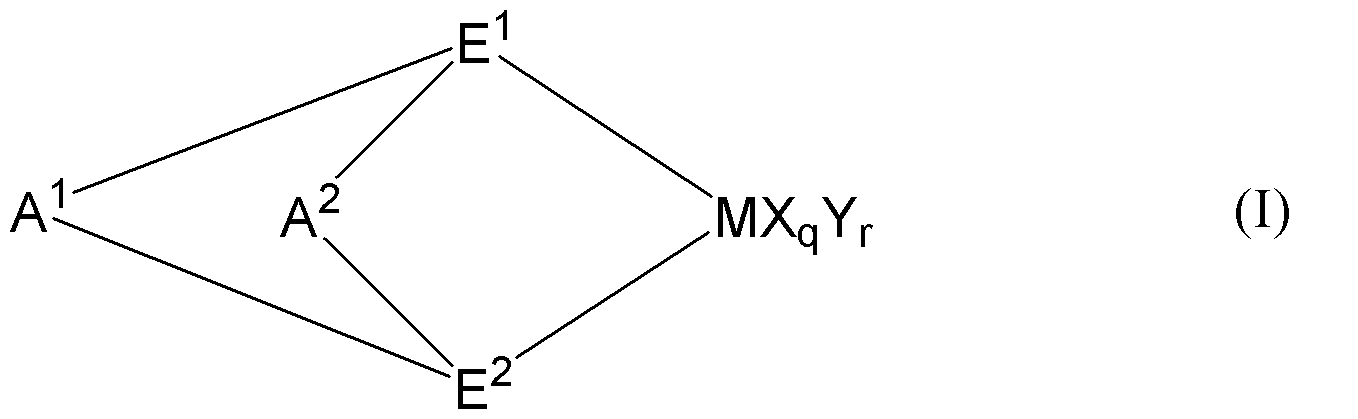
〔式中、Mは周期律表第3~10族又はランタノイド系列の金属元素を示し、E1及びE2はそれぞれ置換シクロペンタジエニル基、インデニル基、置換インデニル基、ヘテロシクロペンタジエニル基、置換ヘテロシクロペンタジエニル基、アミド基、ホスフィド基、炭化水素基及び珪素含有基の中から選ばれた配位子であって、A1及びA2を介して架橋構造を形成しており、又それらは互いに同一でも異なっていてもよく、Xはσ結合性の配位子を示し、Xが複数ある場合、複数のXは同じでも異なっていてもよく、他のX、E1、E2又はYと架橋していてもよい。Yはルイス塩基を示し、Yが複数ある場合、複数のYは同じでも異なっていてもよく、他のY,E1、E2又はXと架橋していてもよく、A1及びA2は二つの配位子を結合する二価の架橋基であって、炭素数1~20の炭化水素基、炭素数1~20のハロゲン含有炭化水素基、珪素含有基、ゲルマニウム含有基、スズ含有基、-O-、-CO-、-S-、-SO2-、-Se-、-NR1-、-PR1-、-P(O)R1-、-BR1-又は-AlR1-を示し、R1は水素原子、ハロゲン原子、炭素数1~20の炭化水素基又は炭素数1~20のハロゲン含有炭化水素基を示し、それらは互いに同一でも異なっていてもよい。qは1~5の整数で〔(Mの原子価)-2〕を示し、rは0~3の整数を示す。〕
(i)下記一般式(I)で表される遷移金属化合物、並びに
(ii)(ii-1)該(i)成分の遷移金属化合物又はその派生物と反応してイオン性の錯体を形成しうる化合物、及び(ii-2)アルミノキサンから一種以上選ばれる成分
を含む。
〔式中、Mは周期律表第3~10族又はランタノイド系列の金属元素を示し、E1及びE2はそれぞれ置換シクロペンタジエニル基、インデニル基、置換インデニル基、ヘテロシクロペンタジエニル基、置換ヘテロシクロペンタジエニル基、アミド基、ホスフィド基、炭化水素基及び珪素含有基の中から選ばれた配位子であって、A1及びA2を介して架橋構造を形成しており、又それらは互いに同一でも異なっていてもよく、Xはσ結合性の配位子を示し、Xが複数ある場合、複数のXは同じでも異なっていてもよく、他のX、E1、E2又はYと架橋していてもよい。Yはルイス塩基を示し、Yが複数ある場合、複数のYは同じでも異なっていてもよく、他のY,E1、E2又はXと架橋していてもよく、A1及びA2は二つの配位子を結合する二価の架橋基であって、炭素数1~20の炭化水素基、炭素数1~20のハロゲン含有炭化水素基、珪素含有基、ゲルマニウム含有基、スズ含有基、-O-、-CO-、-S-、-SO2-、-Se-、-NR1-、-PR1-、-P(O)R1-、-BR1-又は-AlR1-を示し、R1は水素原子、ハロゲン原子、炭素数1~20の炭化水素基又は炭素数1~20のハロゲン含有炭化水素基を示し、それらは互いに同一でも異なっていてもよい。qは1~5の整数で〔(Mの原子価)-2〕を示し、rは0~3の整数を示す。〕
上記(i)成分の遷移金属化合物としては、配位子が(1,2’)(2,1’)二重架橋型の遷移金属化合物が好ましく、例えば(1,2’-ジメチルシリレン)(2,1’-ジメチルシリレン)-ビス(3-トリメチルシリルメチルインデニル)ジルコニウムジクロリド、(1,2’-ジメチルシリレン)(2,1’-ジメチルシリレン)-ビス(3-n-ブチルインデニル)ジルコニウムジクロリド、(1,2’-ジメチルシリレン)(2,1’-ジメチルシリレン)-ビス(3-メチルインデニル)ジルコニウムジクロリド、(1,2’-ジメチルシリレン)(2,1’-ジメチルシリレン)-ビスインデニルジルコニウムジクロリドが挙げられる。
本発明では、分子量分布の広いオレフィン系重合体を得る観点から、メタロセン系触媒が上記(i)成分の遷移金属化合物を2種以上含むことが好ましく、高分子量の重合体が得られる遷移金属化合物と低分子量の重合体が得られる遷移金属化合物とを併用することが好ましい。例えば、インデニル基の3位に水素原子又はメチル基等の比較的小さな置換基が結合している遷移金属化合物と、インデニル基の3位にノルマルブチル基やトリメチルシリル基等の比較的大きな置換基が結合している遷移金属化合物とを併用することが好ましい。
上記(ii-1)成分の化合物の具体例としては、テトラフェニル硼酸トリエチルアンモニウム、テトラフェニル硼酸トリ-n-ブチルアンモニウム、テトラフェニル硼酸トリメチルアンモニウム、テトラフェニル硼酸テトラエチルアンモニウム、テトラフェニル硼酸メチル(トリ-n-ブチル)アンモニウム、テトラフェニル硼酸ベンジル(トリ-n-ブチル)アンモニウム、テトラフェニル硼酸ジメチルジフェニルアンモニウム、テトラフェニル硼酸トリフェニル(メチル)アンモニウム、テトラフェニル硼酸トリメチルアニリニウム、テトラフェニル硼酸メチルピリジニウム、テトラフェニル硼酸ベンジルピリジニウム、テトラフェニル硼酸メチル(2-シアノピリジニウム)、テトラキス(ペンタフルオロフェニル)硼酸トリエチルアンモニウム、テトラキス(ペンタフルオロフェニル)硼酸トリ-n-ブチルアンモニウム、テトラキス(ペンタフルオロフェニル)硼酸トリフェニルアンモニウム、テトラキス(ペンタフルオロフェニル)硼酸テトラ-n-ブチルアンモニウム、テトラキス(ペンタフルオロフェニル)硼酸テトラエチルアンモニウム、テトラキス(ペンタフルオロフェニル)硼酸ベンジル(トリ-n-ブチル)アンモニウム、テトラキス(ペンタフルオロフェニル)硼酸メチルジフェニルアンモニウム、テトラキス(ペンタフルオロフェニル)硼酸トリフェニル(メチル)アンモニウム、テトラキス(ペンタフルオロフェニル)硼酸メチルアニリニウム、テトラキス(ペンタフルオロフェニル)硼酸ジメチルアニリニウム、テトラキス(ペンタフルオロフェニル)硼酸トリメチルアニリニウム、テトラキス(ペンタフルオロフェニル)硼酸メチルピリジニウム、テトラキス(ペンタフルオロフェニル)硼酸ベンジルピリジニウム、テトラキス(ペンタフルオロフェニル)硼酸メチル(2-シアノピリジニウム)、テトラキス(ペンタフルオロフェニル)硼酸ベンジル(2-シアノピリジニウム)、テトラキス(ペンタフルオロフェニル)硼酸メチル(4-シアノピリジニウム)、テトラキス(ペンタフルオロフェニル)硼酸トリフェニルホスホニウム、テトラキス〔ビス(3,5-ジトリフルオロメチル)フェニル〕硼酸ジメチルアニリニウム、テトラフェニル硼酸フェロセニウム、テトラフェニル硼酸銀、テトラフェニル硼酸トリチル、テトラフェニル硼酸テトラフェニルポルフィリンマンガン、テトラキス(ペンタフルオロフェニル)硼酸フェロセニウム、テトラキス(ペンタフルオロフェニル)硼酸(1,1’-ジメチルフェロセニウム)、テトラキス(ペンタフルオロフェニル)硼酸デカメチルフェロセニウム、テトラキス(ペンタフルオロフェニル)硼酸銀、テトラキス(ペンタフルオロフェニル)硼酸トリチル,テトラキス(ペンタフルオロフェニル)硼酸リチウム、テトラキス(ペンタフルオロフェニル)硼酸ナトリウム、テトラキス(ペンタフルオロフェニル)硼酸テトラフェニルポルフィリンマンガン、テトラフルオロ硼酸銀,ヘキサフルオロ燐酸銀、ヘキサフルオロ砒素酸銀、過塩素酸銀、トリフルオロ酢酸銀、トリフルオロメタンスルホン酸銀等を挙げることができる。
上記(ii-2)成分のアルミノキサンとしては、公知の鎖状アルミノキサンや環状アルミノキサンが挙げられる。
また、トリメチルアルミニウム、トリエチルアルミニウム、トリイソプロピルアルミニウム、トリイソブチルアルミニウム、ジメチルアルミニウムクロリド、ジエチルアルミニウムクロリド、メチルアルミニウムジクロリド、エチルアルミニウムジクロリド、ジメチルアルミニウムフルオリド、ジイソブチルアルミニウムヒドリド、ジエチルアルミニウムヒドリド、エチルアルミニウムセスキクロリド等の有機アルミニウム化合物を併用して、プロピレン系重合体を製造してもよい。
反応原料に対する触媒の使用割合は、原料モノマー100gあたり、有機金属錯体換算で0.01~20μmol、好ましくは、0.1~15μmol、更に好ましくは0.5~10μmolとなることが好ましい。
更に、重合時間は通常5分~10時間、反応圧力は好ましくは常圧~20MPa(G)、特に好ましくは常圧~10MPa(G)である。
更に、重合時間は通常5分~10時間、反応圧力は好ましくは常圧~20MPa(G)、特に好ましくは常圧~10MPa(G)である。
重合体の分子量の調節方法としては、各触媒成分の種類、使用量、重合温度の選択、更には水素存在下での重合等がある。
本発明では、重合開始時の反応条件及び重合後期の反応条件を制御することで、分子量分布の広いオレフィン系重合体を得ることができる。ここで、本発明において、「重合後期」とは、最終的に得られるポリマーの全質量を100質量%としたときに、ポリマー生産量が50質量%を超えた時点及び以降を意味する。ポリマー生産量は、重合途中の反応液を随時サンプリングして測定することができる。
本発明では、分子量分布の広いオレフィン系重合体を得る観点から、モノマー濃度を重合開始時と重合後期とで変更することが好ましい。重合開始時のオレフィンモノマー濃度に対する重合後期のオレフィンモノマー濃度の濃度比率(重合後期のオレフィンモノマー濃度/重合開始時のオレフィンモノマー濃度)は、好ましくは20%以上、より好ましくは30%以上、更に好ましくは40%以上である。重合開始時に対する重合後期のオレフィンモノマーの濃度比率が20%以上であれば、分子量分布の広いオレフィン系重合体を得ることができる。なお、オレフィンモノマー濃度とは、溶媒及び重合体、オレフィンモノマーを加えた総重量に対するオレフィンモノマーの濃度であり、バッチ重合の場合には、モノマー濃度が時間とともに減少していくので、重合開始時と重合後期の濃度はそれぞれの平均濃度とする。
重合温度は通常0~200℃、好ましくは20~150℃、より好ましくは40~100℃である。本発明では、分子量分布の広いオレフィン系重合体を得る観点から、重合開始時の重合温度と重合後期の重合温度との温度差が、好ましくは5℃以上、より好ましくは10℃以上、更に好ましくは15℃以上である。重合開始時の重合温度と重合後期の重合温度との温度差が5℃以上であれば、重合開始時と重合後期で生成する重合体の分子量の差が大きくなり、分子量分布の広いオレフィン系重合体を得ることができる。重合温度差の上限は特に限定されないが、例えば30℃である。
重合溶媒を用いる場合、例えば、ベンゼン、トルエン、キシレン、エチルベンゼン等の芳香族炭化水素、シクロペンタン、シクロヘキサン、メチルシクロヘキサン等の脂環式炭化水素、ペンタン、ヘキサン、ヘプタン、オクタン等の脂肪族炭化水素、クロロホルム、ジクロロメタン等のハロゲン化炭化水素等を用いることができる。これらの溶媒は一種を単独で用いてもよく、二種以上のものを組み合わせてもよい。また、α-オレフィン等のモノマーを溶媒として用いてもよい。なお、重合方法によっては無溶媒で行うことができる。
水素存在下での重合を行う場合、本発明では、分子量分布の広いオレフィン系重合体を得る観点から、水素濃度を重合開始時と重合後期とで変更することが好ましい。重合開始時と重合後期との水素濃度の差は、分圧として好ましくは0.01MPa以上、より好ましくは0.05MPa以上、更に好ましくは0.10MPa以上である。水素濃度差が0.01MPa以上であれば、分子量分布の広いオレフィン系重合体を得ることができる。なお、水素濃度差の上限は特に限定されないが、例えば5MPaである。
(改質処理により変性オレフィン系重合体を得る工程)
本発明の変性オレフィン系重合体は、上記のオレフィン系重合体を改質処理することで製造することができる。改質処理としては、例えばラジカル開始剤及び有機酸を用いてオレフィン系重合体を酸変性する方法が挙げられる。この改質処理に用いられる有機酸としては、不飽和カルボン酸やその誘導体を用いることができる。また、オレフィン系重合体をラジカル開始剤や有機酸なしで、空気酸化だけで極性基を付与することもできる。
本発明の変性オレフィン系重合体は、上記のオレフィン系重合体を改質処理することで製造することができる。改質処理としては、例えばラジカル開始剤及び有機酸を用いてオレフィン系重合体を酸変性する方法が挙げられる。この改質処理に用いられる有機酸としては、不飽和カルボン酸やその誘導体を用いることができる。また、オレフィン系重合体をラジカル開始剤や有機酸なしで、空気酸化だけで極性基を付与することもできる。
有機酸によって酸変性を行う場合、活性水素不含有ビニルアミンや(メタ)アクリル酸エステルを共存させることで、それら化合物が有機酸とともに、ポリオレフィン上に発生したラジカルに付加やグラフトをして、極性だけでなく、変性オレフィン系重合体のポリウレタンや活性水素化合物との相溶性を構造面から上げることが可能となる。
例えば、エステル系ポリオールやポリウレタンとは、アクリル酸エステルやメタクリル酸エステルも付加させることで、相溶性がより高くなる場合がある。また、活性水素不含有ビニルアミンを共存することにより、副反応なしに、ウレタン結合やウレタンに多いウレア結合との相互作用を付与して、ウレタン化合物との相溶性をより高くできる場合がある。
(メタ)アクリル酸エステルとしては、メタクリル酸メチル、メタクリル酸エチル、メタクリル酸ブチル、メタクリル酸シクロヘキシル;アクリル酸メチル、アクリル酸エチル、アクリル酸n-ブチル、アクリル酸i-ブチル、アクリル酸2-エチルヘキシル等が挙げられる。
例えば、エステル系ポリオールやポリウレタンとは、アクリル酸エステルやメタクリル酸エステルも付加させることで、相溶性がより高くなる場合がある。また、活性水素不含有ビニルアミンを共存することにより、副反応なしに、ウレタン結合やウレタンに多いウレア結合との相互作用を付与して、ウレタン化合物との相溶性をより高くできる場合がある。
(メタ)アクリル酸エステルとしては、メタクリル酸メチル、メタクリル酸エチル、メタクリル酸ブチル、メタクリル酸シクロヘキシル;アクリル酸メチル、アクリル酸エチル、アクリル酸n-ブチル、アクリル酸i-ブチル、アクリル酸2-エチルヘキシル等が挙げられる。
不飽和カルボン酸の例としては、アクリル酸,メタクリル酸,マレイン酸,フマル酸,イタコン酸,クロトン酸,シトラコン酸,ソルビン酸,メサコン酸,アンゲリカ酸等が挙げられる。また、その誘導体としては、酸物水物,エステル,アミド,イミド,金属塩等があり、例えば、無水マレイン酸,無水イタコン酸,無水シトラコン酸,アクリル酸メチル,メタクリル酸メチル,アクリル酸エチル,アクリル酸ブチル,アクリル酸2-エチルヘキシル,マレイン酸モノエチルエステル,アクリルアミド,マレイン酸モノアミド,マレイミド,N-ブチルマレイミド,アクリル酸ナトリウム,メタクリル酸ナトリウム等を挙げることができる。これらの中で、特に無水マレイン酸、アクリル酸が好ましい。また、これらは単独で用いてもよく、二種以上を組み合わせて用いてもよい。
一方、ラジカル開始剤としては特に制限はなく、従来公知のラジカル開始剤、例えば各種有機過酸化物や、アゾビスイソブチロニトリル、アゾビスイソバレロニトリル等のアゾ系化合物等の中から、適宜選択して用いることができるが、これらの中で、有機過酸化物が好適である。
この有機過酸化物としては、例えば、ジベンゾイルパーオキシド、ジ-8,5,5-トリメチルヘキサノイルパーオキシド、ジラウロイルパーオキシド、ジデカノイルパーオキシド、ジ(2,4-ジクロロベンゾイル)パーオキシド等のジアシルパーオキシド類;t-ブチルヒドロパーオキシド、クメンヒドロパーオキシド、ジイソプロピルベンゼンヒドロパーオキシド、2,5-ジメチルヘキサン-2,5-ジヒドロパーオキシド等のヒドロパーオキシド類;ジ-t-ブチルパーオキシド、ジクミルパーオキシド、2,5-ジメチル-2,5-ジ(t-ブチルパーオキシ)ヘキサン、2,5-ジメチル-2,5-ジ(t-ブチルパーオキシ)ヘキシン-3、α,α’-ビス(t-ブチルパーオキシ)ジイソプロピルベンゼン等のジアルキルパーオキシド類;1,1-ビス(t-ブチルパーオキシ)-3,3,5-トリメチルシクロヘキサン、2,2-ビス(t-ブチルパーオキシ)ブタン等のパーオキシケタール類;t-ブチルパーオキシオクトエート、t-ブチルパーオキシピバレート、t-ブチルパーオキシネオデカノエート、t-ブチルパーオキシベンゾエート等のアルキルパーエステル類;ジ-2-エチルヘキシルパーオキシジカーボネート、ジイソプロピルパーオキシジカーボネート、ジ-sec-ブチルパーオキシジカーボネート、t-ブチルパーオキシイソプロピルカーボネート等のパーオキシカーボネート類等が挙げられる。これらの中では、ジアルキルパーオキシド類が好ましい。また、これらは一種を単独で用いてもよく、二種以上を組み合わせて用いてもよい。
これらの有機過酸化物の具体的な市販品としては、例えば、日油(株)製のパーヘキシン25B、パーブチルD、パーブチルC、パーヘキサ25B、パークミルD、パーブチルP、パーブチルH、パーヘキシルH、パークミルH、パーオクタH、パークミルP、パーメンタH、パーブチルSM、パーメックN、ペロマーAC、パーヘキサV、パーヘキサ22、パーヘキサCD、パーテトラA、パーヘキサC、パーヘキサ3M、パーヘキサHC、パーヘキサTMH、パーブチルIF、パーブチルZ、パーブチルA、パーヘキシルZ、パーヘキサ25Z、パーブチルE、パーブチルL、パーヘキサ25MT、パーブチルI、パーブチル355、パーブチルMA、パーヘキシルI、パーブチルIB、パーブチルO、パーヘキシルO、パーシクロO、パーヘキサ250、パーオクタO、パーブチルPV、パーヘキシルPV、パーブチルND、パーヘキシルND、パーシクロND、パーオクタND、パークミルND、ダイパーND、パーロイルSOP、パーロイルOPP、パーロイルMBP、パーロイルEEP、パーロイルIPP、パーロイルNPP、パーロイルTCP、パーロイルIB、パーロイルSA、パーロイルS、パーロイルO、パーロイルL、パーロイル355、ナイパーBW、ナイパーBMT、ナイパーCS等が挙げられる(いずれも商品名)。
前記の有機酸及びラジカル開始剤の使用量としては特に制限はなく、目的とする変性オレフィン系重合体の所望物性に応じて適宜選定されるが、使用するオレフィン系重合体100質量部に対し、有機酸は通常0.1~50質量部、好ましくは0.1~30質量部の範囲で用いられ、一方、ラジカル開始剤は通常0.01~10質量部、好ましくは0.01~5質量部の範囲で用いられる。
有機酸による変性方法としては特に制限はないが、例えば、プロピレン系重合体と、前記の有機酸及びラジカル開始剤とを、ロールミル、バンバリーミキサー、押出機等を用いて、120~300℃、好ましくは140~250℃程度の温度で、0.01~0.5時間溶融混練して反応させる方法が挙げられる。また、有機溶剤中において、あるいは無溶媒の条件で、-50~300℃、好ましくは40~180℃程度の温度で、0.1~2時間反応させてもよい。
有機溶剤としては特に制限はないが、ブタン、ペンタン、ヘキサン、シクロヘキサン、トルエン等の炭化水素系溶剤、クロロベンゼン、ジクロロベンゼン、トリクロロベンゼン等のハロゲン化炭化水素系溶剤、液化α-オレフィン等を使用することができる。
有機溶剤を使用する場合、その使用量は、変性剤の反応効率等の観点から、ポリマー濃度が50~95質量%となる量が好ましい。
有機溶剤を使用する場合、その使用量は、変性剤の反応効率等の観点から、ポリマー濃度が50~95質量%となる量が好ましい。
また、本発明においては、この有機酸変性の効率を上げるため、スチレンやα-メチルスチレン等のスチレン系化合物の存在下で行うことができる。また、その使用量は、オレフィン系重合体100質量部に対し、通常0.1~10質量部、好ましくは0.1~5質量部の範囲である。
スチレン系化合物は、ラジカルとの反応性が有機酸よりも高いため、ポリオレフィン上に発生したラジカルと反応しやすく、更に有機酸と反応することでポリオレフィンと有機酸とを効率的に反応させることが可能となる。
スチレン系化合物は、ラジカルとの反応性が有機酸よりも高いため、ポリオレフィン上に発生したラジカルと反応しやすく、更に有機酸と反応することでポリオレフィンと有機酸とを効率的に反応させることが可能となる。
酸変性量(有機酸による改質量)は、好ましくは0.1~50質量%、より好ましくは0.1~20質量%、更に好ましくは0.5~10質量%である。酸変性量が当該範囲内であれば、ポリオールやポリウレタンとの相溶性を向上させることができる。
[変性オレフィン系重合体の用途]
本発明の変性オレフィン系重合体は、接着剤、粘着剤、塗料、シーリング材、インク組成物等として好適に使用できる。本発明の変性オレフィン系重合体を含む接着剤、粘着剤、塗料、シーリング材及びインク組成物は、ポリオレフィン基材への親和性が良好であるので、ポリオレフィン基材との密着性に優れることが期待される。
本発明の変性オレフィン系重合体は、接着剤、粘着剤、塗料、シーリング材、インク組成物等として好適に使用できる。本発明の変性オレフィン系重合体を含む接着剤、粘着剤、塗料、シーリング材及びインク組成物は、ポリオレフィン基材への親和性が良好であるので、ポリオレフィン基材との密着性に優れることが期待される。
本発明の変性オレフィン系重合体を適用し得る接着剤、粘着剤、塗料、シーリング材、インク組成物等は特に限定されない。例えば、本発明の変性オレフィン系重合体は、ウレタン系、変性シリコーン系、アクリル系、ホットメルト系の各種接着剤又は粘着剤の改質材として好適に使用できる。
接着剤、粘着剤又はシーリング材における本発明の変性オレフィン系重合体の含有量は、接着性及び密着性の観点から、全質量に対して好ましくは1~30質量%、より好ましくは1~20質量%、更に好ましくは1~10質量%である。
また、塗料又はインク組成物における本発明の変性オレフィン系重合体の含有量は、接着性及び密着性の観点から、全質量に対して好ましくは0.01~20質量%、より好ましくは0.1~10質量%、更に好ましくは0.5~5質量%である。
また、塗料又はインク組成物における本発明の変性オレフィン系重合体の含有量は、接着性及び密着性の観点から、全質量に対して好ましくは0.01~20質量%、より好ましくは0.1~10質量%、更に好ましくは0.5~5質量%である。
次に、本発明を実施例により更に詳細に説明するが、本発明はこれらの例によって何ら限定されるものではない。
<極限粘度[η]>
粘度計((株)離合社製、商品名:「VMR-053U-PC・F01」)、ウベローデ型粘度管(測時球容積:2~3mL、毛細管直径:0.44~0.48mm)、溶媒としてテトラリンを用いて、0.02~0.16g/dLの溶液を135℃にて測定した。
粘度計((株)離合社製、商品名:「VMR-053U-PC・F01」)、ウベローデ型粘度管(測時球容積:2~3mL、毛細管直径:0.44~0.48mm)、溶媒としてテトラリンを用いて、0.02~0.16g/dLの溶液を135℃にて測定した。
<DSC測定>
(1)融点(Tm-D)、ガラス転移温度(Tg)及び融解吸熱量(ΔH-D)
示差走査型熱量計(パーキン・エルマー社製、商品名:「DSC-7」)を用い、試料10mgを窒素雰囲気下-10℃で5分間保持した後、10℃/分で昇温させることにより得られた融解吸熱カーブから融解吸熱量(ΔH-D)として求めた。また、得られた融解吸熱カーブの最も高温側に観測されるピークのピークトップから融点(Tm-D)を求めた。
なお、融解吸熱量(ΔH-D)は、熱量変化の無い低温側の点と熱量変化の無い高温側の点とを結んだ線をベースラインとして、より得られた融解吸熱カーブのピークを含むライン部分と当該ベースラインとで囲まれる面積を求めることで算出した。
(1)融点(Tm-D)、ガラス転移温度(Tg)及び融解吸熱量(ΔH-D)
示差走査型熱量計(パーキン・エルマー社製、商品名:「DSC-7」)を用い、試料10mgを窒素雰囲気下-10℃で5分間保持した後、10℃/分で昇温させることにより得られた融解吸熱カーブから融解吸熱量(ΔH-D)として求めた。また、得られた融解吸熱カーブの最も高温側に観測されるピークのピークトップから融点(Tm-D)を求めた。
なお、融解吸熱量(ΔH-D)は、熱量変化の無い低温側の点と熱量変化の無い高温側の点とを結んだ線をベースラインとして、より得られた融解吸熱カーブのピークを含むライン部分と当該ベースラインとで囲まれる面積を求めることで算出した。
(2)半結晶化時間
示差走査型熱量計(パーキン・エルマー社製、商品名:「DSC-7」)を用い、試料10mgを25℃で5分間保持し、320℃/秒で220℃に昇温し5分間保持した後、320℃/秒で25℃に冷却し、5時間保持することにより、等温結晶化過程における、発熱量の時間変化を測定した。等温結晶化開始時から結晶化完了時までの発熱量の積分値を100%とした時、等温結晶化開始時から発熱量の積分値が50%となるまでの時間を半結晶化時間として求めた。
示差走査型熱量計(パーキン・エルマー社製、商品名:「DSC-7」)を用い、試料10mgを25℃で5分間保持し、320℃/秒で220℃に昇温し5分間保持した後、320℃/秒で25℃に冷却し、5時間保持することにより、等温結晶化過程における、発熱量の時間変化を測定した。等温結晶化開始時から結晶化完了時までの発熱量の積分値を100%とした時、等温結晶化開始時から発熱量の積分値が50%となるまでの時間を半結晶化時間として求めた。
<酸価>
酸価は、JIS K2501:2003に基づいて測定した。
酸価は、JIS K2501:2003に基づいて測定した。
<GPC測定>
ゲルパーミエイションクロマトグラフィ(GPC)法により、重量平均分子量(Mw)及び数平均分子量(Mn)を測定し、分子量分布(Mw/Mn)を求めた。測定には、下記の装置及び条件を使用し、ポリスチレン換算の重量平均分子量及び数平均分子量を得た。分子量分布(Mw/Mn)は、これらの重量平均分子量(Mw)及び数平均分子量(Mn)より算出した値である。
(GPC測定装置)
カラム:東ソー(株)製「TOSO GMHHR-H(S)HT」
検出器:液体クロマトグラム用RI検出 ウォーターズ・コーポレーション製「WATERS 150C」
(測定条件)
溶媒:1,2,4-トリクロロベンゼン
測定温度:145℃
流速:1.0mL/分
試料濃度:2.2mg/mL
注入量:160μL
検量線:Universal Calibration
解析プログラム:HT-GPC(Ver.1.0)
ゲルパーミエイションクロマトグラフィ(GPC)法により、重量平均分子量(Mw)及び数平均分子量(Mn)を測定し、分子量分布(Mw/Mn)を求めた。測定には、下記の装置及び条件を使用し、ポリスチレン換算の重量平均分子量及び数平均分子量を得た。分子量分布(Mw/Mn)は、これらの重量平均分子量(Mw)及び数平均分子量(Mn)より算出した値である。
(GPC測定装置)
カラム:東ソー(株)製「TOSO GMHHR-H(S)HT」
検出器:液体クロマトグラム用RI検出 ウォーターズ・コーポレーション製「WATERS 150C」
(測定条件)
溶媒:1,2,4-トリクロロベンゼン
測定温度:145℃
流速:1.0mL/分
試料濃度:2.2mg/mL
注入量:160μL
検量線:Universal Calibration
解析プログラム:HT-GPC(Ver.1.0)
<NMR測定>
以下に示す装置及び条件で、13C-NMRスペクトルの測定を行い、[mmmm]、[rrrr]、[rmrm]、[mm]、[rr]及び[mr]を求めた。なお、ピークの帰属は、エイ・ザンベリ(A.Zambelli)等により「Macromolecules,8,687(1975)」で提案された方法に従った。
装置:日本電子(株)製、JNM-EX400型13C-NMR装置
方法:プロトン完全デカップリング法
濃度:220mg/mL
溶媒:1,2,4-トリクロロベンゼンと重ベンゼンの90:10(容量比)混合溶媒
温度:130℃
パルス幅:45°
パルス繰り返し時間:4秒
積算:10,000回
以下に示す装置及び条件で、13C-NMRスペクトルの測定を行い、[mmmm]、[rrrr]、[rmrm]、[mm]、[rr]及び[mr]を求めた。なお、ピークの帰属は、エイ・ザンベリ(A.Zambelli)等により「Macromolecules,8,687(1975)」で提案された方法に従った。
装置:日本電子(株)製、JNM-EX400型13C-NMR装置
方法:プロトン完全デカップリング法
濃度:220mg/mL
溶媒:1,2,4-トリクロロベンゼンと重ベンゼンの90:10(容量比)混合溶媒
温度:130℃
パルス幅:45°
パルス繰り返し時間:4秒
積算:10,000回
(計算式)
M=m/S×100
R=γ/S×100
S=Pββ+Pαβ+Pαγ
S:全プロピレン単位の側鎖メチル炭素原子のシグナル強度
Pββ:19.8~22.5ppm
Pαβ:18.0~17.5ppm
Pαγ:17.5~17.1ppm
γ:ラセミペンタッド連鎖:20.7~20.3ppm
m:メソペンタッド連鎖 :21.7~22.5ppm
M=m/S×100
R=γ/S×100
S=Pββ+Pαβ+Pαγ
S:全プロピレン単位の側鎖メチル炭素原子のシグナル強度
Pββ:19.8~22.5ppm
Pαβ:18.0~17.5ppm
Pαγ:17.5~17.1ppm
γ:ラセミペンタッド連鎖:20.7~20.3ppm
m:メソペンタッド連鎖 :21.7~22.5ppm
また、本発明のブテン系重合体において、以下に示す装置及び条件で、13C-NMRスペクトルの測定を行い、[mmmm]、[rrrr]、[rmrm]及び[mm]を求めた。ピークの帰属は、朝倉らにより報告された「Polymer Journal,16,717(1984)」、J.Randallらにより報告された「Macromol.Chem.Phys.,C29,201(1989)」及びV.Busicoらにより報告された「Macromol.Chem.Phys.,198,1257(1997)」で提案された方法に準拠して求めた。すなわち、13C-NMRスペクトルを用いてメチレン基、メチン基のシグナルを測定し、ブテン系重合体分子中の[mmmm]、[rrrr]、[rmrm]及び[mm]を求めた。
13C-NMRスペクトルの測定は、濃度を230mg/mLに変更したこと以外は上記のプロピレン系重合体におけるNMRと同様の装置及び条件にて行った。
13C-NMRスペクトルの測定は、濃度を230mg/mLに変更したこと以外は上記のプロピレン系重合体におけるNMRと同様の装置及び条件にて行った。
オレフィン系重合体がプロピレン/ブテン共重合体であった場合のブテン含有量は以下のようにして測定した。
ブテン含有量は、日本電子(株)製のJNM-EX400型NMR装置を用い、以下の条件で13C-NMRスペクトルを測定し、以下の方法により算出した。
試料濃度:220mg/mL
溶媒:1,2,4-トリクロロベンゼン/重ベンゼン(容量比90/10)混合溶媒
測定温度:130℃
パルス幅:45°
パルス繰り返し時間:10秒
積算回数:4,000回
上記条件で、PP、PB、BB連鎖は、J.C.Randall,Macromolecules,1978,11,592で提案された方法に準拠し、13C核磁気共鳴スペクトルのSαα炭素のシグナルを測定し、共重合体分子鎖中のPP、PB、BBダイアッド連鎖分率を求めた。得られた各ダイアッド連鎖分率(モル%)より、以下の式よりブテン含有量を求めた。
ブテン含有量(モル%)=([BB]+[PB])/2
([PP]はプロピレン-プロピレン連鎖分率、[BB]はブテン-ブテン連鎖分率、[PB]はプロピレン-ブテン連鎖分率を表す。)
ブテン含有量は、日本電子(株)製のJNM-EX400型NMR装置を用い、以下の条件で13C-NMRスペクトルを測定し、以下の方法により算出した。
試料濃度:220mg/mL
溶媒:1,2,4-トリクロロベンゼン/重ベンゼン(容量比90/10)混合溶媒
測定温度:130℃
パルス幅:45°
パルス繰り返し時間:10秒
積算回数:4,000回
上記条件で、PP、PB、BB連鎖は、J.C.Randall,Macromolecules,1978,11,592で提案された方法に準拠し、13C核磁気共鳴スペクトルのSαα炭素のシグナルを測定し、共重合体分子鎖中のPP、PB、BBダイアッド連鎖分率を求めた。得られた各ダイアッド連鎖分率(モル%)より、以下の式よりブテン含有量を求めた。
ブテン含有量(モル%)=([BB]+[PB])/2
([PP]はプロピレン-プロピレン連鎖分率、[BB]はブテン-ブテン連鎖分率、[PB]はプロピレン-ブテン連鎖分率を表す。)
<5質量%トルエン溶液の40℃粘度>
基質を濃度が5質量%になるようにトルエンに溶解し、単一円筒型回転式粘度計(B型)で測定した。
基質を濃度が5質量%になるようにトルエンに溶解し、単一円筒型回転式粘度計(B型)で測定した。
製造例1
〔(1,2’-ジメチルシリレン)(2,1’-ジメチルシリレン)ビス(3-トリメチルシリルメチルインデニル)ジルコニウムジクロリドの製造〕
窒素気流下、200mLのシュレンク瓶に(1,2’-ジメチルシリレン)(2,1’-ジメチルシリレン)ビス(インデン)2.5g(7.2mmol)とエーテル100mLを加えた。-78℃に冷却しn-ブチルリチウム(n-BuLi)のヘキサン溶液(1.6モル/L)を9.0mL(14.8mmol)加えた後、室温で12時間撹拌した。溶媒を留去し、得られた固体をヘキサン20mLで洗浄し減圧乾燥することによりリチウム塩を白色固体として定量的に得た。シュレンク瓶中、(1,2’-ジメチルシリレン)(2,1’-ジメチルシリレン)ビス(インデン)のリチウム塩6.97mmolをテトラヒドロフラン50mLに溶解し、室温でヨードメチルトリメチルシラン2.1mL(14.2mmol)をゆっくりと滴下し12時間撹拌した。溶媒を留去し、エーテル50mLを加えて飽和塩化アンモニウム溶液で洗浄した。分液後、有機相を乾燥し、溶媒を除去することにより、(1,2’-ジメチルシリレン)(2,1’-ジメチルシリレン)ビス(3-トリメチルシリルメチルインデン)3.04g(5.9mmol)を得た(収率84%)。
〔(1,2’-ジメチルシリレン)(2,1’-ジメチルシリレン)ビス(3-トリメチルシリルメチルインデニル)ジルコニウムジクロリドの製造〕
窒素気流下、200mLのシュレンク瓶に(1,2’-ジメチルシリレン)(2,1’-ジメチルシリレン)ビス(インデン)2.5g(7.2mmol)とエーテル100mLを加えた。-78℃に冷却しn-ブチルリチウム(n-BuLi)のヘキサン溶液(1.6モル/L)を9.0mL(14.8mmol)加えた後、室温で12時間撹拌した。溶媒を留去し、得られた固体をヘキサン20mLで洗浄し減圧乾燥することによりリチウム塩を白色固体として定量的に得た。シュレンク瓶中、(1,2’-ジメチルシリレン)(2,1’-ジメチルシリレン)ビス(インデン)のリチウム塩6.97mmolをテトラヒドロフラン50mLに溶解し、室温でヨードメチルトリメチルシラン2.1mL(14.2mmol)をゆっくりと滴下し12時間撹拌した。溶媒を留去し、エーテル50mLを加えて飽和塩化アンモニウム溶液で洗浄した。分液後、有機相を乾燥し、溶媒を除去することにより、(1,2’-ジメチルシリレン)(2,1’-ジメチルシリレン)ビス(3-トリメチルシリルメチルインデン)3.04g(5.9mmol)を得た(収率84%)。
次に、窒素気流下においてシュレンク瓶に、上記で得られた(1,2’-ジメチルシリレン)(2,1’-ジメチルシリレン)ビス(3-トリメチルシリルメチルインデン)3.04g(5.9mmol)とエーテル50mLを加えた。-78℃に冷却し、n-ブチルリチウム(n-BuLi)のヘキサン溶液(1.6モル/L)を7.4mL(11.8mmol)加えた後、室温で12時間撹拌した。溶媒を留去し、得られた固体をヘキサン40mLで洗浄することによりリチウム塩をエーテル付加体として3.06gを得た。
窒素気流下、上記で得られたリチウム塩3.06gをトルエン50mLに懸濁させた。これを-78℃に冷却し、ここへ予め-78℃に冷却した四塩化ジルコニウム1.2g(5.1mmol)のトルエン懸濁液20mLを滴下した。滴下後、室温で6時間撹拌した。この反応溶液の溶媒を留去後、得られた残渣をジクロロメタンにより再結晶化することにより、(1,2’-ジメチルシリレン)(2,1’-ジメチルシリレン)ビス(3-トリメチルシリルメチルインデニル)ジルコニウムジクロリドの黄色微結晶0.9g(1.33mmol)を得た(収率26%)。
上記で得られた黄色微結晶の1H-NMRを求めたところ、次の結果が得られた。
1H-NMR(90MHz,CDCl3):δ0.0(s,-SiMe3-,18H),1.02,1.12(s,-Me2Si-,12H),2.51(dd,-CH2-,4H),7.1-7.6(m,Ar-H,8H)
窒素気流下、上記で得られたリチウム塩3.06gをトルエン50mLに懸濁させた。これを-78℃に冷却し、ここへ予め-78℃に冷却した四塩化ジルコニウム1.2g(5.1mmol)のトルエン懸濁液20mLを滴下した。滴下後、室温で6時間撹拌した。この反応溶液の溶媒を留去後、得られた残渣をジクロロメタンにより再結晶化することにより、(1,2’-ジメチルシリレン)(2,1’-ジメチルシリレン)ビス(3-トリメチルシリルメチルインデニル)ジルコニウムジクロリドの黄色微結晶0.9g(1.33mmol)を得た(収率26%)。
上記で得られた黄色微結晶の1H-NMRを求めたところ、次の結果が得られた。
1H-NMR(90MHz,CDCl3):δ0.0(s,-SiMe3-,18H),1.02,1.12(s,-Me2Si-,12H),2.51(dd,-CH2-,4H),7.1-7.6(m,Ar-H,8H)
製造例2
(触媒溶液の調製)
20mLのシュレンク瓶に窒素気流下で、ジメチルアニリニウムテトラキス(ペンタフルオロフェニル)ボレートのトルエンスラリー(5μmol/mL、3.0mL、15.0μmol)を加えた。次に、撹拌しながら、トリイソブチルアルミニウムのヘプタン溶液(2mmol/mL、0.050mL、0.1mmol)、続けて、製造例1で得られた(1,2’-ジメチルシリレン)(2,1’-ジメチルシリレン)ビス(3-トリメチルシリルメチルインデニル)ジルコニウムジクロリドのヘプタンスラリー(5μmol/mL、1.0mL、5.0μmol)を加え、蓋をして窒素雰囲気下で30分以上撹拌することにより、触媒溶液(錯体濃度=約0.13μmol/mL)を得た。
(触媒溶液の調製)
20mLのシュレンク瓶に窒素気流下で、ジメチルアニリニウムテトラキス(ペンタフルオロフェニル)ボレートのトルエンスラリー(5μmol/mL、3.0mL、15.0μmol)を加えた。次に、撹拌しながら、トリイソブチルアルミニウムのヘプタン溶液(2mmol/mL、0.050mL、0.1mmol)、続けて、製造例1で得られた(1,2’-ジメチルシリレン)(2,1’-ジメチルシリレン)ビス(3-トリメチルシリルメチルインデニル)ジルコニウムジクロリドのヘプタンスラリー(5μmol/mL、1.0mL、5.0μmol)を加え、蓋をして窒素雰囲気下で30分以上撹拌することにより、触媒溶液(錯体濃度=約0.13μmol/mL)を得た。
製造例3
(1-ブテンのバッチ重合)
加熱乾燥した1Lオートクレーブに、トルエン180mL及びトリイソブチルアルミニウム0.4mmolを投入後、10℃に冷却し、液体1-ブテン230mLを投入した。その後、水素を0.03MPaの分圧で導入し、55℃に昇温し、製造例2で製造した触媒溶液を有機金属錯体換算として約0.5μmol(0.4mL)投入し、重合を開始した。なお、初期圧力0.42MPaに対し、0.16MPaまで全圧が低下したところを重合終了点と設定した。初期圧力からの圧力低下が、初期圧力と設定した重合終了点の圧力との差の50%まで低下した時点を、最終的に得られるポリマーの全質量を100質量%としたときのポリマー生産量50質量%とした。なお、圧力は重合の進行とともに低下する。
20分毎に触媒溶液を有機金属錯体換算として0.5μmol(0.4mL)を計3回投入した。最初の触媒投入から90分後、0.16MPaまで全圧が低下したことから、エタノール5mLを投入することにより、重合を停止した。脱圧後、重合溶液を回収、減圧乾燥することにより、ポリ(1-ブテン)106gを得た。重合開始時、ポリマー生産量50質量%時及び重合終了時における、全圧、1-ブテン量、ポリ(1-ブテン)量及び1-ブテン濃度を表1に示す。なお、1-ブテン濃度は、1-ブテン、トルエン及びポリマーの総重量に対する濃度である。
得られたポリ(1-ブテン)の極限粘度[η]は0.78dL/g、重量平均分子量(Mw)は53,700、分子量分布(Mw/Mn)は2.43、メソペンタッド分率[mmmm]は68.9モル%、融点(Tm-D)は71.5℃であった。
(1-ブテンのバッチ重合)
加熱乾燥した1Lオートクレーブに、トルエン180mL及びトリイソブチルアルミニウム0.4mmolを投入後、10℃に冷却し、液体1-ブテン230mLを投入した。その後、水素を0.03MPaの分圧で導入し、55℃に昇温し、製造例2で製造した触媒溶液を有機金属錯体換算として約0.5μmol(0.4mL)投入し、重合を開始した。なお、初期圧力0.42MPaに対し、0.16MPaまで全圧が低下したところを重合終了点と設定した。初期圧力からの圧力低下が、初期圧力と設定した重合終了点の圧力との差の50%まで低下した時点を、最終的に得られるポリマーの全質量を100質量%としたときのポリマー生産量50質量%とした。なお、圧力は重合の進行とともに低下する。
20分毎に触媒溶液を有機金属錯体換算として0.5μmol(0.4mL)を計3回投入した。最初の触媒投入から90分後、0.16MPaまで全圧が低下したことから、エタノール5mLを投入することにより、重合を停止した。脱圧後、重合溶液を回収、減圧乾燥することにより、ポリ(1-ブテン)106gを得た。重合開始時、ポリマー生産量50質量%時及び重合終了時における、全圧、1-ブテン量、ポリ(1-ブテン)量及び1-ブテン濃度を表1に示す。なお、1-ブテン濃度は、1-ブテン、トルエン及びポリマーの総重量に対する濃度である。
得られたポリ(1-ブテン)の極限粘度[η]は0.78dL/g、重量平均分子量(Mw)は53,700、分子量分布(Mw/Mn)は2.43、メソペンタッド分率[mmmm]は68.9モル%、融点(Tm-D)は71.5℃であった。

製造例4
(1-ブテンのセミバッチ重合)
加熱乾燥した2Lオートクレーブに、ヘプタン600mL、トリイソブチルアルミニウム0.6mmol、製造例1で得られた(1,2’-ジメチルシリレン)(2,1’-ジメチルシリレン)ビス(3-トリメチルシリルメチルインデニル)ジルコニウムジクロリド6.0μmol、ジメチルアニリニウムテトラキス(ペンタフルオロフェニル)ボレート18.0μmolを加え、更に水素を分圧0.02MPa導入後、供給を停止した。重合温度53℃に昇温しながら、1-ブテンを導入して全圧で0.24MPaまで昇圧し、そのまま0.24MPaを保持しながら、60分間重合した。エタノール5mLを触媒投入管より投入することにより、重合を停止した。重合反応終了後、脱圧し、反応物を減圧下で乾燥させることにより、ポリ(1-ブテン)240gを得た。
得られたポリ(1-ブテン)の極限粘度[η]は0.69dL/g、重量平均分子量(Mw)は114,100、分子量分布(Mw/Mn)は1.8、メソペンタッド分率[mmmm]は68.8モル%、融点(Tm-D)は70.2℃であった。
(1-ブテンのセミバッチ重合)
加熱乾燥した2Lオートクレーブに、ヘプタン600mL、トリイソブチルアルミニウム0.6mmol、製造例1で得られた(1,2’-ジメチルシリレン)(2,1’-ジメチルシリレン)ビス(3-トリメチルシリルメチルインデニル)ジルコニウムジクロリド6.0μmol、ジメチルアニリニウムテトラキス(ペンタフルオロフェニル)ボレート18.0μmolを加え、更に水素を分圧0.02MPa導入後、供給を停止した。重合温度53℃に昇温しながら、1-ブテンを導入して全圧で0.24MPaまで昇圧し、そのまま0.24MPaを保持しながら、60分間重合した。エタノール5mLを触媒投入管より投入することにより、重合を停止した。重合反応終了後、脱圧し、反応物を減圧下で乾燥させることにより、ポリ(1-ブテン)240gを得た。
得られたポリ(1-ブテン)の極限粘度[η]は0.69dL/g、重量平均分子量(Mw)は114,100、分子量分布(Mw/Mn)は1.8、メソペンタッド分率[mmmm]は68.8モル%、融点(Tm-D)は70.2℃であった。
実施例1
(無水マレイン酸変性ポリ(1-ブテン)の製造)
窒素導入管及びジムロート管、撹拌装置付の0.5Lセパラフラスコに、製造例3で得られたポリ(1-ブテン)30g及び窒素でバブリングしたトルエン20mLを投入し、窒素雰囲気下で140℃のオイルバスで加熱することで、粘調な均一溶液にした。その後、無水マレイン酸0.9gを加え溶解後、「パーヘキサ25B」(日油(株)製)0.6gを投入し、オイルバスを150℃に昇温後、5時間撹拌した。得られた反応物を加熱減圧下で乾燥することにより目的物を得た。
得られた無水マレイン酸変性ポリ(1-ブテン)の極限粘度[η]は0.60dL/g、重量平均分子量(Mw)は127,100、分子量分布(Mw/Mn)は3.27、メソペンタッド分率[mmmm]は68.9モル%、メソトリアッド分率[mm]は82.5モル%、融点(Tm-D)は70.5℃、融解吸熱量(ΔH-D)は32J/g,ガラス転移温度(Tg)は-35℃、酸価は25mgKOH/g、半結晶化時間は65分、5質量%トルエン溶液の40℃粘度は14.0mPa・sであった。
(無水マレイン酸変性ポリ(1-ブテン)の製造)
窒素導入管及びジムロート管、撹拌装置付の0.5Lセパラフラスコに、製造例3で得られたポリ(1-ブテン)30g及び窒素でバブリングしたトルエン20mLを投入し、窒素雰囲気下で140℃のオイルバスで加熱することで、粘調な均一溶液にした。その後、無水マレイン酸0.9gを加え溶解後、「パーヘキサ25B」(日油(株)製)0.6gを投入し、オイルバスを150℃に昇温後、5時間撹拌した。得られた反応物を加熱減圧下で乾燥することにより目的物を得た。
得られた無水マレイン酸変性ポリ(1-ブテン)の極限粘度[η]は0.60dL/g、重量平均分子量(Mw)は127,100、分子量分布(Mw/Mn)は3.27、メソペンタッド分率[mmmm]は68.9モル%、メソトリアッド分率[mm]は82.5モル%、融点(Tm-D)は70.5℃、融解吸熱量(ΔH-D)は32J/g,ガラス転移温度(Tg)は-35℃、酸価は25mgKOH/g、半結晶化時間は65分、5質量%トルエン溶液の40℃粘度は14.0mPa・sであった。
比較例1
(無水マレイン酸変性ポリ(1-ブテン)の製造)
実施例1において、製造例3で得られたポリ(1-ブテン)に代えて、製造例4で得られたポリ(1-ブテン)を用いた以外は、実施例1と同様に実施することにより、目的物を得た。
得られた無水マレイン酸変性ポリ(1-ブテン)の極限粘度[η]は0.63dL/g、重量平均分子量(Mw)は113,300、分子量分布(Mw/Mn)は2.24、メソペンタッド分率[mmmm]は68.8モル%、メソトリアッド分率[mm]は82.3モル%、融点(Tm-D)は69.5℃、融解吸熱量(ΔH-D)は32J/g,ガラス転移温度(Tg)は-35℃、酸価は22mgKOH/g、半結晶化時間は72分、5質量%トルエン溶液の40℃粘度は62.6mPa・sであった。
(無水マレイン酸変性ポリ(1-ブテン)の製造)
実施例1において、製造例3で得られたポリ(1-ブテン)に代えて、製造例4で得られたポリ(1-ブテン)を用いた以外は、実施例1と同様に実施することにより、目的物を得た。
得られた無水マレイン酸変性ポリ(1-ブテン)の極限粘度[η]は0.63dL/g、重量平均分子量(Mw)は113,300、分子量分布(Mw/Mn)は2.24、メソペンタッド分率[mmmm]は68.8モル%、メソトリアッド分率[mm]は82.3モル%、融点(Tm-D)は69.5℃、融解吸熱量(ΔH-D)は32J/g,ガラス転移温度(Tg)は-35℃、酸価は22mgKOH/g、半結晶化時間は72分、5質量%トルエン溶液の40℃粘度は62.6mPa・sであった。
製造例5
(プロピレン単独重合体の製造)
(1)1段目重合
撹拌装置付き1Lステンレス製耐圧オートクレーブを80℃に加熱し、充分減圧乾燥した後、乾燥窒素で大気圧に戻し室温まで冷却した。乾燥窒素気流下、乾燥脱酸素ヘプタン400mL、トリイソブチルアルミニウムのヘプタン溶液(2.0M)を0.5mL(1.0mmol)及びジメチルアニリニウムテトラキス(ペンタフルオロフェニル)ボレートのヘプタンスラリー(2μmol/mL、0.8mL、1.6μmol)を投入し、350rpmでしばらく撹拌した。その後、(1,2’-ジメチルシリレン)(2,1’-ジメチルシリレン)-ビス(3-トリメチルシリルインデニル)ジルコニウムジクロリドのヘプタンスラリー(5μmol/mL、0.08mL、0.4μmol)を加え、水素を0.01MPaまで投入した。
その後、400rpmで撹拌を開始し、プロピレンを導入して全圧0.8MPaまで5分程度かけて昇圧し、同時に5分程度かけて温度を70℃まで昇温した後、20分間重合を実施した。
(2)2段目重合
その後、5分間かけて温度を40℃まで降温し、更に35分間重合を実施した。反応終了後、未反応のプロピレンを脱圧により除去した。反応混合物を加熱減圧乾燥することによりポリプロピレンを得た。
収量125gに対し、1段目重合で全圧が0.8MPaになってから、20分後とその後の温度を40℃まで下げて重合が終了するまでのプロピレン流量積算値の比より、1段目重合と2段目重合との重合比(1段目重合:2段目重合)は75:25とした。
得られたポリプロピレンの極限粘度[η]は1.0dL/g、重量平均分子量(Mw)は165,700、分子量分布(Mw/Mn)は6.1、メソペンタッド分率[mmmm]は46.9モル%、融点(Tm-D)は71.5℃であった。
(プロピレン単独重合体の製造)
(1)1段目重合
撹拌装置付き1Lステンレス製耐圧オートクレーブを80℃に加熱し、充分減圧乾燥した後、乾燥窒素で大気圧に戻し室温まで冷却した。乾燥窒素気流下、乾燥脱酸素ヘプタン400mL、トリイソブチルアルミニウムのヘプタン溶液(2.0M)を0.5mL(1.0mmol)及びジメチルアニリニウムテトラキス(ペンタフルオロフェニル)ボレートのヘプタンスラリー(2μmol/mL、0.8mL、1.6μmol)を投入し、350rpmでしばらく撹拌した。その後、(1,2’-ジメチルシリレン)(2,1’-ジメチルシリレン)-ビス(3-トリメチルシリルインデニル)ジルコニウムジクロリドのヘプタンスラリー(5μmol/mL、0.08mL、0.4μmol)を加え、水素を0.01MPaまで投入した。
その後、400rpmで撹拌を開始し、プロピレンを導入して全圧0.8MPaまで5分程度かけて昇圧し、同時に5分程度かけて温度を70℃まで昇温した後、20分間重合を実施した。
(2)2段目重合
その後、5分間かけて温度を40℃まで降温し、更に35分間重合を実施した。反応終了後、未反応のプロピレンを脱圧により除去した。反応混合物を加熱減圧乾燥することによりポリプロピレンを得た。
収量125gに対し、1段目重合で全圧が0.8MPaになってから、20分後とその後の温度を40℃まで下げて重合が終了するまでのプロピレン流量積算値の比より、1段目重合と2段目重合との重合比(1段目重合:2段目重合)は75:25とした。
得られたポリプロピレンの極限粘度[η]は1.0dL/g、重量平均分子量(Mw)は165,700、分子量分布(Mw/Mn)は6.1、メソペンタッド分率[mmmm]は46.9モル%、融点(Tm-D)は71.5℃であった。
製造例6
(プロピレン単独重合体の製造)
加熱乾燥した1Lオートクレーブに、ヘプタン400mL、トリイソブチルアルミニウム0.5mmol、N,N-ジメチルアニリニウムテトラキス(ペンタフルオロフェニル)ボレート0.8μmol、(1,2’-ジメチルシリレン)(2,1’-ジメチルシリレン)-ビス(3-トリメチルシリルメチルインデニル)ジルコニウムジクロリド0.2μmolを加え、更に、水素0.02MPaを導入し、プロピレンを導入して全圧を0.8MPaとして、70℃で30分間重合した。重合反応終了後、反応物を減圧下で乾燥させることにより、ポリプロピレン120gを得た。
得られたポリプロピレンの極限粘度[η]は1.0dL/g、重量平均分子量(Mw)は123,000、分子量分布(Mw/Mn)は1.9、メソペンタッド分率[mmmm]は47.6モル%、融点(Tm-D)は83℃であった。
(プロピレン単独重合体の製造)
加熱乾燥した1Lオートクレーブに、ヘプタン400mL、トリイソブチルアルミニウム0.5mmol、N,N-ジメチルアニリニウムテトラキス(ペンタフルオロフェニル)ボレート0.8μmol、(1,2’-ジメチルシリレン)(2,1’-ジメチルシリレン)-ビス(3-トリメチルシリルメチルインデニル)ジルコニウムジクロリド0.2μmolを加え、更に、水素0.02MPaを導入し、プロピレンを導入して全圧を0.8MPaとして、70℃で30分間重合した。重合反応終了後、反応物を減圧下で乾燥させることにより、ポリプロピレン120gを得た。
得られたポリプロピレンの極限粘度[η]は1.0dL/g、重量平均分子量(Mw)は123,000、分子量分布(Mw/Mn)は1.9、メソペンタッド分率[mmmm]は47.6モル%、融点(Tm-D)は83℃であった。
実施例2
実施例1において、製造例3で得られたポリ(1-ブテン)に代えて、製造例5で得られたポリプロピレンを用いた以外は、実施例1と同様に実施することにより、目的物を得た。
得られた無水マレイン酸変性ポリプロピレンの極限粘度[η]は0.95dL/g、重量平均分子量(Mw)は104,500、分子量分布(Mw/Mn)は6.9、メソペンタッド分率[mmmm]は46.9モル%、メソトリアッド分率[mm]は68.3モル%、融点(Tm-D)は71.0℃、融解吸熱量(ΔH-D)は33J/g,ガラス転移温度(Tg)は-1℃、酸価は25mgKOH/g、半結晶化時間は35分、5質量%トルエン溶液の40℃粘度は18.5mPa・sであった。
実施例1において、製造例3で得られたポリ(1-ブテン)に代えて、製造例5で得られたポリプロピレンを用いた以外は、実施例1と同様に実施することにより、目的物を得た。
得られた無水マレイン酸変性ポリプロピレンの極限粘度[η]は0.95dL/g、重量平均分子量(Mw)は104,500、分子量分布(Mw/Mn)は6.9、メソペンタッド分率[mmmm]は46.9モル%、メソトリアッド分率[mm]は68.3モル%、融点(Tm-D)は71.0℃、融解吸熱量(ΔH-D)は33J/g,ガラス転移温度(Tg)は-1℃、酸価は25mgKOH/g、半結晶化時間は35分、5質量%トルエン溶液の40℃粘度は18.5mPa・sであった。
比較例2
(無水マレイン酸変性ポリプロピレンの製造)
実施例1において、製造例3で得られたポリ(1-ブテン)に代えて、製造例6で得られたポリプロピレンを用いた以外は、実施例1と同様に実施することにより、目的物を得た。
得られた無水マレイン酸変性ポリプロピレンの極限粘度[η]は0.98dL/g、重量平均分子量(Mw)は103,000、分子量分布(Mw/Mn)は2.3、メソペンタッド分率[mmmm]は47.6モル%、メソトリアッド分率[mm]は69.5モル%、融点(Tm-D)は70.0℃、融解吸熱量(ΔH-D)は32J/g、ガラス転移温度(Tg)は-1℃、酸価は28mgKOH/g、半結晶化時間は38分、5質量%トルエン溶液の40℃粘度は82.4mPa・sであった。
(無水マレイン酸変性ポリプロピレンの製造)
実施例1において、製造例3で得られたポリ(1-ブテン)に代えて、製造例6で得られたポリプロピレンを用いた以外は、実施例1と同様に実施することにより、目的物を得た。
得られた無水マレイン酸変性ポリプロピレンの極限粘度[η]は0.98dL/g、重量平均分子量(Mw)は103,000、分子量分布(Mw/Mn)は2.3、メソペンタッド分率[mmmm]は47.6モル%、メソトリアッド分率[mm]は69.5モル%、融点(Tm-D)は70.0℃、融解吸熱量(ΔH-D)は32J/g、ガラス転移温度(Tg)は-1℃、酸価は28mgKOH/g、半結晶化時間は38分、5質量%トルエン溶液の40℃粘度は82.4mPa・sであった。

実施例1及び比較例1の無水マレイン酸変性ポリ(1-ブテン)は、共にガラス転移温度が-35℃であり、重量平均分子量も概ね同じである。したがって、実施例1及び比較例1から、同程度の分子量の変性ポリオレフィンで比較した際に、2.4未満の狭い分子量分布を有する比較例1の変性ポリオレフィンでは粘度が高いのに対し、分子量分布が広い実施例1の変性ポリオレフィンでは粘度が低く、流動性に優れることが分かる。
同様に、実施例2及び比較例2の無水マレイン酸変性ポリプロピレンは、共にガラス転移温度が-1℃であり、重量平均分子量も概ね同じである。したがって、実施例2及び比較例2から、同程度の分子量の変性ポリオレフィンで比較した際に、2.4未満の狭い分子量分布を有する比較例2の変性ポリオレフィンでは粘度が高いのに対し、分子量分布が広い実施例2の変性ポリオレフィンでは粘度が低く、流動性に優れることが分かる。
同様に、実施例2及び比較例2の無水マレイン酸変性ポリプロピレンは、共にガラス転移温度が-1℃であり、重量平均分子量も概ね同じである。したがって、実施例2及び比較例2から、同程度の分子量の変性ポリオレフィンで比較した際に、2.4未満の狭い分子量分布を有する比較例2の変性ポリオレフィンでは粘度が高いのに対し、分子量分布が広い実施例2の変性ポリオレフィンでは粘度が低く、流動性に優れることが分かる。
本発明の変性オレフィン系重合体は、流動性が良好であり、粘着剤や接着剤、塗料等の用途に好適に使用できる。特に、ウレタン系、変性シリコーン系、アクリル系、ホットメルト系の各種接着剤又は粘着剤、インキ、塗料等において、ポリオレフィンへの親和性を向上させるための改質材として好適に使用できる。
Claims (13)
- 下記(1)~(6)を満たす変性オレフィン系重合体。
(1)テトラリン溶媒中135℃にて測定した極限粘度[η]が0.01dL/g以上2.5dL/g以下である。
(2)示差走査型熱量計(DSC)を用い、試料を窒素雰囲気下-10℃で5分間保持した後、10℃/分で昇温させることにより得られた融解吸熱カーブの最も高温側に観測されるピークのピークトップとして定義される融点(Tm-D)が観測されないかあるいは0℃以上100℃以下である。
(3)示差走査型熱量計(DSC)で測定される半結晶化時間が3分以上、又は示差走査型熱量計(DSC)で測定される結晶化ピークが観測されない。
(4)示差走査型熱量計(DSC)を用い、試料を窒素雰囲気下-10℃で5分間保持した後、10℃/分で昇温させることにより得られた融解吸熱カーブから得られる融解吸熱量(ΔH-D)が0J/g以上80J/g以下である。
(5)酸価が10mgKOH/g以上250mgKOH/g以下である。
(6)分子量分布Mw/Mnが2.4以上10.0以下である。 - 前記変性オレフィン系重合体を構成するモノマーの50モル%以上が、プロピレン、1-ブテン及び炭素数6~12のα-オレフィンからなる群から選択される少なくとも一種のα-オレフィンモノマーである、請求項1に記載の変性オレフィン系重合体。
- 下記(7)を更に満たす、請求項1又は2に記載の変性オレフィン系重合体。
(7)メソペンタッド分率[mmmm]が42~90モル%である。 - 請求項1~3のいずれか1つに記載の変性オレフィン系重合体を製造する方法であって、
メタロセン系触媒を使用してオレフィンモノマーを重合してオレフィン系重合体を製造する工程、及び
得られたオレフィン系重合体を改質処理して変性オレフィン系重合体を得る工程
を含む、変性オレフィン系重合体の製造方法。 - 前記メタロセン系触媒が、
(i)下記一般式(I)で表される遷移金属化合物、並びに
(ii)(ii-1)該(i)成分の遷移金属化合物又はその派生物と反応してイオン性の錯体を形成しうる化合物、及び(ii-2)アルミノキサンから一種以上選ばれる成分
を含む、請求項4に記載の変性オレフィン系重合体の製造方法。

〔式中、Mは周期律表第3~10族又はランタノイド系列の金属元素を示し、E1及びE2はそれぞれ置換シクロペンタジエニル基、インデニル基、置換インデニル基、ヘテロシクロペンタジエニル基、置換ヘテロシクロペンタジエニル基、アミド基、ホスフィド基、炭化水素基及び珪素含有基の中から選ばれた配位子であって、A1及びA2を介して架橋構造を形成しており、又それらは互いに同一でも異なっていてもよく、Xはσ結合性の配位子を示し、Xが複数ある場合、複数のXは同じでも異なっていてもよく、他のX、E1、E2又はYと架橋していてもよい。Yはルイス塩基を示し、Yが複数ある場合、複数のYは同じでも異なっていてもよく、他のY,E1、E2又はXと架橋していてもよく、A1及びA2は二つの配位子を結合する二価の架橋基であって、炭素数1~20の炭化水素基、炭素数1~20のハロゲン含有炭化水素基、珪素含有基、ゲルマニウム含有基、スズ含有基、-O-、-CO-、-S-、-SO2-、-Se-、-NR1-、-PR1-、-P(O)R1-、-BR1-又は-AlR1-を示し、R1は水素原子、ハロゲン原子、炭素数1~20の炭化水素基又は炭素数1~20のハロゲン含有炭化水素基を示し、それらは互いに同一でも異なっていてもよい。qは1~5の整数で〔(Mの原子価)-2〕を示し、rは0~3の整数を示す。〕 - 前記メタロセン系触媒が、前記一般式(I)で表される遷移金属化合物を2種以上含む、請求項5に記載の変性オレフィン系重合体の製造方法。
- 前記のオレフィン系重合体を製造する工程において、重合開始時の重合温度と重合後期の重合温度との温度差が5℃以上である、請求項4~6のいずれか1つに記載の変性オレフィン系重合体の製造方法。
- 前記のオレフィン系重合体を製造する工程において、重合時に水素を添加し、重合開始時の水素濃度と重合後期の水素濃度との分圧差が0.01MPa以上である、請求項4~7のいずれか1つに記載の変性オレフィン系重合体の製造方法。
- 前記のオレフィン系重合体を製造する工程において、重合開始時のオレフィンモノマー濃度に対する重合後期のオレフィンモノマー濃度の濃度比率(重合後期のオレフィンモノマー濃度/重合開始時のオレフィンモノマー濃度)が20%以上である、請求項4~8のいずれか1つに記載の変性オレフィン系重合体の製造方法。
- 請求項1~3のいずれか1つに記載の変性オレフィン系重合体を含む粘接着剤。
- 請求項1~3のいずれか1つに記載の変性オレフィン系重合体を含む塗料。
- 請求項1~3のいずれか1つに記載の変性オレフィン系重合体を含むシーリング材。
- 請求項1~3のいずれか1つに記載の変性オレフィン系重合体を含むインク組成物。
Applications Claiming Priority (2)
| Application Number | Priority Date | Filing Date | Title |
|---|---|---|---|
| JP2016-089285 | 2016-04-27 | ||
| JP2016089285A JP2017197651A (ja) | 2016-04-27 | 2016-04-27 | 変性オレフィン系重合体及びその製造方法 |
Publications (1)
| Publication Number | Publication Date |
|---|---|
| WO2017188258A1 true WO2017188258A1 (ja) | 2017-11-02 |
Family
ID=60159653
Family Applications (1)
| Application Number | Title | Priority Date | Filing Date |
|---|---|---|---|
| PCT/JP2017/016391 Ceased WO2017188258A1 (ja) | 2016-04-27 | 2017-04-25 | 変性オレフィン系重合体及びその製造方法 |
Country Status (2)
| Country | Link |
|---|---|
| JP (1) | JP2017197651A (ja) |
| WO (1) | WO2017188258A1 (ja) |
Families Citing this family (2)
| Publication number | Priority date | Publication date | Assignee | Title |
|---|---|---|---|---|
| CN113614122B (zh) * | 2019-03-26 | 2024-08-13 | 三洋化成工业株式会社 | 树脂改性剂 |
| EP4317332A4 (en) * | 2021-03-23 | 2025-04-30 | Riken Technos Corporation | COATING MATERIAL, COATING FILM, LAYER PRODUCT AND FLEXIBLE FLAT CABLE |
Citations (4)
| Publication number | Priority date | Publication date | Assignee | Title |
|---|---|---|---|---|
| JPS6210107A (ja) * | 1985-07-08 | 1987-01-19 | Mitsubishi Chem Ind Ltd | 変性ポリオレフイン樹脂およびその組成物 |
| WO2003070786A1 (en) * | 2002-02-20 | 2003-08-28 | Idemitsu Petrochemical Co., Ltd. | Process for producing modified butene-1 polymer and modified butene-1 polymer obtained by the process |
| JP2007204700A (ja) * | 2006-02-06 | 2007-08-16 | Idemitsu Kosan Co Ltd | 改質プロピレン系重合体の製造方法 |
| JP2010185084A (ja) * | 2006-03-10 | 2010-08-26 | Mitsubishi Chemicals Corp | 樹脂分散体、塗料、積層体及びその製造方法 |
-
2016
- 2016-04-27 JP JP2016089285A patent/JP2017197651A/ja active Pending
-
2017
- 2017-04-25 WO PCT/JP2017/016391 patent/WO2017188258A1/ja not_active Ceased
Patent Citations (4)
| Publication number | Priority date | Publication date | Assignee | Title |
|---|---|---|---|---|
| JPS6210107A (ja) * | 1985-07-08 | 1987-01-19 | Mitsubishi Chem Ind Ltd | 変性ポリオレフイン樹脂およびその組成物 |
| WO2003070786A1 (en) * | 2002-02-20 | 2003-08-28 | Idemitsu Petrochemical Co., Ltd. | Process for producing modified butene-1 polymer and modified butene-1 polymer obtained by the process |
| JP2007204700A (ja) * | 2006-02-06 | 2007-08-16 | Idemitsu Kosan Co Ltd | 改質プロピレン系重合体の製造方法 |
| JP2010185084A (ja) * | 2006-03-10 | 2010-08-26 | Mitsubishi Chemicals Corp | 樹脂分散体、塗料、積層体及びその製造方法 |
Also Published As
| Publication number | Publication date |
|---|---|
| JP2017197651A (ja) | 2017-11-02 |
Similar Documents
| Publication | Publication Date | Title |
|---|---|---|
| JP5555410B2 (ja) | ポリオレフィン系グラフト共重合体および接着剤組成物 | |
| JP5048694B2 (ja) | 改質プロピレン系重合体の製造方法及びその方法で得られた改質プロピレン系重合体 | |
| JP6263126B2 (ja) | プロピレン系重合体及びホットメルト接着剤 | |
| JP6357464B2 (ja) | プロピレン系重合体及びホットメルト接着剤 | |
| JP6687279B2 (ja) | 樹脂組成物 | |
| JP2005075908A (ja) | 高級α−オレフィン共重合体及びその製造方法 | |
| JP5064662B2 (ja) | α−オレフィン重合体変性物及びその架橋体の製造方法 | |
| WO2007091478A1 (ja) | 改質プロピレン系重合体の製造方法 | |
| JP2009249429A (ja) | ポリオレフィン系グラフト共重合体と付加重合ポリマーを配合してなる樹脂組成物 | |
| WO2017188258A1 (ja) | 変性オレフィン系重合体及びその製造方法 | |
| JP5231947B2 (ja) | 高級α−オレフィン共重合体及びその製造方法 | |
| WO2016084715A1 (ja) | 木工用ホットメルト接着剤 | |
| JP2015013920A (ja) | 酸変性α−オレフィン重合体、これを用いた粘接着剤組成物及び粘着テープ | |
| EP1674483B1 (en) | Higher olefin polymer having polar group and process for producing the same | |
| EP1810981A1 (en) | Crosslinked olefin polymers and process for production thereof | |
| JP4441222B2 (ja) | 塩素化プロピレン系重合体及びその製造方法、並びにその用途 | |
| JP2009138137A (ja) | ポリオレフィン系樹脂組成物 | |
| JP2015174884A (ja) | コーティング剤 | |
| US7763677B2 (en) | Water-dispersible resin composition and water-dispersible polyolefin resin composition | |
| JP5337401B2 (ja) | 架橋オレフィン重合体およびその製造方法 |
Legal Events
| Date | Code | Title | Description |
|---|---|---|---|
| NENP | Non-entry into the national phase |
Ref country code: DE |
|
| 121 | Ep: the epo has been informed by wipo that ep was designated in this application |
Ref document number: 17789540 Country of ref document: EP Kind code of ref document: A1 |
|
| 122 | Ep: pct application non-entry in european phase |
Ref document number: 17789540 Country of ref document: EP Kind code of ref document: A1 |