WO2017170569A1 - 球状ナノカプセルおよびその製造方法 - Google Patents
球状ナノカプセルおよびその製造方法 Download PDFInfo
- Publication number
- WO2017170569A1 WO2017170569A1 PCT/JP2017/012675 JP2017012675W WO2017170569A1 WO 2017170569 A1 WO2017170569 A1 WO 2017170569A1 JP 2017012675 W JP2017012675 W JP 2017012675W WO 2017170569 A1 WO2017170569 A1 WO 2017170569A1
- Authority
- WO
- WIPO (PCT)
- Prior art keywords
- spherical
- nanocapsule
- metal
- general formula
- nanocapsules
- Prior art date
- Legal status (The legal status is an assumption and is not a legal conclusion. Google has not performed a legal analysis and makes no representation as to the accuracy of the status listed.)
- Ceased
Links
Images






Classifications
-
- B—PERFORMING OPERATIONS; TRANSPORTING
- B01—PHYSICAL OR CHEMICAL PROCESSES OR APPARATUS IN GENERAL
- B01J—CHEMICAL OR PHYSICAL PROCESSES, e.g. CATALYSIS OR COLLOID CHEMISTRY; THEIR RELEVANT APPARATUS
- B01J13/00—Colloid chemistry, e.g. the production of colloidal materials or their solutions, not otherwise provided for; Making microcapsules or microballoons
- B01J13/02—Making microcapsules or microballoons
- B01J13/06—Making microcapsules or microballoons by phase separation
-
- B—PERFORMING OPERATIONS; TRANSPORTING
- B82—NANOTECHNOLOGY
- B82Y—SPECIFIC USES OR APPLICATIONS OF NANOSTRUCTURES; MEASUREMENT OR ANALYSIS OF NANOSTRUCTURES; MANUFACTURE OR TREATMENT OF NANOSTRUCTURES
- B82Y30/00—Nanotechnology for materials or surface science, e.g. nanocomposites
-
- B—PERFORMING OPERATIONS; TRANSPORTING
- B82—NANOTECHNOLOGY
- B82Y—SPECIFIC USES OR APPLICATIONS OF NANOSTRUCTURES; MEASUREMENT OR ANALYSIS OF NANOSTRUCTURES; MANUFACTURE OR TREATMENT OF NANOSTRUCTURES
- B82Y40/00—Manufacture or treatment of nanostructures
-
- A—HUMAN NECESSITIES
- A61—MEDICAL OR VETERINARY SCIENCE; HYGIENE
- A61K—PREPARATIONS FOR MEDICAL, DENTAL OR TOILETRY PURPOSES
- A61K47/00—Medicinal preparations characterised by the non-active ingredients used, e.g. carriers or inert additives; Targeting or modifying agents chemically bound to the active ingredient
- A61K47/06—Organic compounds, e.g. natural or synthetic hydrocarbons, polyolefins, mineral oil, petrolatum or ozokerite
- A61K47/16—Organic compounds, e.g. natural or synthetic hydrocarbons, polyolefins, mineral oil, petrolatum or ozokerite containing nitrogen, e.g. nitro-, nitroso-, azo-compounds, nitriles, cyanates
- A61K47/18—Amines; Amides; Ureas; Quaternary ammonium compounds; Amino acids; Oligopeptides having up to five amino acids
-
- A—HUMAN NECESSITIES
- A61—MEDICAL OR VETERINARY SCIENCE; HYGIENE
- A61K—PREPARATIONS FOR MEDICAL, DENTAL OR TOILETRY PURPOSES
- A61K9/00—Medicinal preparations characterised by special physical form
- A61K9/48—Preparations in capsules, e.g. of gelatin, of chocolate
- A61K9/50—Microcapsules having a gas, liquid or semi-solid filling; Solid microparticles or pellets surrounded by a distinct coating layer, e.g. coated microspheres, coated drug crystals
- A61K9/51—Nanocapsules; Nanoparticles
Definitions
- the present invention relates to a spherical nanocapsule for the purpose of gradual release of a substance taken into the interior used in the food, medical and material fields, and a method for producing the same.
- Known spherical nanocapsules formed mainly of organic substances are those that exist as emulsions widely used mainly in the fields of foods, cosmetics, pharmaceuticals, and the like (Patent Document 1).
- the organic substances that form these usually have a gel-liquid crystal transition point at room temperature or lower, and are stable in a dispersion, but cannot maintain a structure in a dry state.
- the capsule wall is fluid because it is in a liquid crystal state, and at the same time, the wall thickness is as thin as about one or two molecules, so that the internal substance can be released slowly by passing through the wall.
- it cannot be released gradually by changing the shape from a spherical shape to another structure such as a tube shape or a sheet shape.
- Patent Document 2 A manufacturing method in which a spherical capsule and a lipid nanotube are combined is known (Patent Document 2).
- the lipid membrane is constructed as a bilayer membrane of phospholipid, so the wall thickness is thin and external
- the mechanism of sustained release is the same as that of a normal emulsion, and is not always released due to a shape change. Similarly, it cannot be dried.
- spherical capsules that are mainly composed of proteins and polymers and are finally formed by binding metal ions are known (Patent Documents 3 and 4).
- Patent Document 5 reports that a nanotube structure is formed even when various metal species are used, but no example of forming a hollow spherical structure has been disclosed so far.
- Microcapsules are formed by mixing peptide lipids and alkali metal salts thereof, but cannot be formed from other metals.
- ⁇ -carotene dissolved in internal fats and oils is gradually decomposed by light in an O / W emulsion in which microcapsules are dispersed, but cannot be released.
- the present invention can be used in the field of materials often used in a dry state in addition to the fields of food, cosmetics, medicine, etc. in which spherical nanocapsules such as ordinary emulsions and liposomes are used. It is an object of the present invention to provide a spherical nanocapsule capable of sustained release of a substance incorporated therein due to a shape change to a structure and a method for producing the same.
- One embodiment of the present invention provides: [1] It relates to a spherical nanocapsule containing a metal complex of peptide lipid represented by the following general formula (1) and having a hollow structure (however, the metal forming the metal complex is not an alkali metal).
- R represents a hydrocarbon group having 6 to 24 carbon atoms
- R ′ represents an amino acid side chain
- m represents an integer of 1 to 5.
- the spherical nanocapsule of the present invention in one embodiment, [2] A functional substance is included in the hollow structure.
- the spherical nanocapsule of the present invention in one embodiment, [3] The wall thickness is 5 to 125 nm.
- RCO— is a myristoyl group or a palmitoyl group.
- the spherical nanocapsule of the present invention in one embodiment, [5] In the general formula (1), R ′ is a hydrogen atom. Moreover, the spherical nanocapsule of the present invention, in one embodiment, [6] In the general formula (1), m is 2. Moreover, the spherical nanocapsule of the present invention, in one embodiment, [7] The metal forming the metal complex is zinc or cobalt. Moreover, the spherical nanocapsule of the present invention, in one embodiment, [8] It is in a powder state or a dispersed state.
- the present invention provides: [9] The spherical nanocapsules according to any one of [1] to [8] above, wherein the spherical nanocapsules enclosing the functional substance in the hollow structure are dried to form powdery spherical nanocapsules A step of preparing And transferring the powdered spherical nanocapsules into a solvent, whereby the spherical nanocapsules release the functional substance gradually.
- the present invention provides: (A) a step of dispersing a peptide lipid represented by the following general formula (1) in an organic solvent; (In the general formula (1), R represents a hydrocarbon group having 6 to 24 carbon atoms, R ′ represents an amino acid side chain, and m represents an integer of 1 to 5.) (B) A method for producing spherical nanocapsules, wherein a metal salt is added to the solution obtained in step (A) to form a metal complex of the peptide lipid (however, the metal complex is formed) The metal is not an alkali metal).
- the organic solvent is ethanol or isopropanol, or a mixed solvent thereof and an organic solvent.
- the metal is zinc or cobalt.
- the shape change occurs in the spherical nanocapsules, and the internal The substance taken in can be released slowly.
- Spherical nanocapsules are stable as dry solids by filtration, but they can be converted into nanotube-like or sheet-like structures by being dispersed in various solvents, and the substances incorporated therein can be released.
- FIG. 1 shows image data obtained by imaging a spherical nanocapsule powder produced by the method described in Example 3 below using a scanning transmission electron microscope. Note that one section of the bar in FIG. 1 indicates 50 nm.
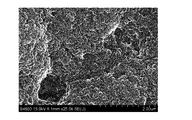
- FIG. 2 shows image data obtained by imaging a spherical nanocapsule powder produced by the method described in Example 4 below using a scanning electron microscope. Note that one section of the bar in FIG. 2 indicates 0.1 ⁇ m.
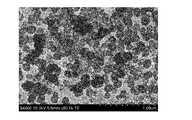
- FIG. 3 shows image data obtained by imaging a spherical nanocapsule powder produced by the method described in Example 5 below using a scanning transmission electron microscope. Note that one section of the bar in FIG. 3 indicates 0.1 ⁇ m.
- FIG. 1 shows image data obtained by imaging a spherical nanocapsule powder produced by the method described in Example 3 below using a scanning transmission electron microscope. Note that one section of the bar in FIG. 1 indicates 50 nm.
- FIG. 2 shows image data obtained by imaging a spherical nanocapsule powder produced by the method described in Example 4 below
- FIG. 4 shows image data obtained by imaging a spherical nanocapsule powder produced by the method described in Example 6 below with a scanning electron microscope. Note that one section of the bar in FIG. 4 indicates 0.2 ⁇ m.
- FIG. 5 shows image data obtained by imaging a spherical nanocapsule powder produced by the method described in Example 7 below using a scanning transmission electron microscope. Note that one section of the bar in FIG. 5 indicates 0.2 ⁇ m.
- FIG. 6 shows image data obtained by imaging a spherical nanocapsule powder produced by the method described in Example 8 below using a scanning transmission electron microscope. Note that one section of the bar in FIG. 6 indicates 0.1 ⁇ m.
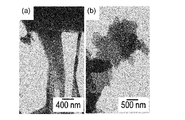
- FIG. 7 shows the powder after 7 hours after the spherical nanocapsule powder produced by the method described in Example 8 below was dispersed in 0.1 M hydrochloric acid and phosphate buffer by the method described in Example 9 below.
- the image data imaged with the scanning transmission electron microscope is shown.
- FIG. 7 (a) shows an image when dispersed in 0.1 molar hydrochloric acid
- FIG. 7 (b) shows an image when dispersed in a phosphate buffer.
- FIG. 8 shows image data taken with a scanning transmission electron microscope after spherical nanocapsules produced by the method described in Example 3 below were dispersed in toluene or acetone for 1 day.
- FIG. 8A shows an image when dispersed in toluene
- FIG. 8A shows an image when dispersed in toluene
- FIG. 8A shows an image when dispersed in toluene
- FIG. 8B shows an image when dispersed in acetone.
- FIG. 9 shows image data obtained by imaging a powder of spherical nanocapsules produced by the method described in Example 13 below with a scanning electron microscope. Note that one section of the bar in FIG. 9 indicates 0.1 ⁇ m.
- FIG. 10 shows image data obtained by imaging a spherical nanocapsule powder produced by the method described in Example 14 below with a scanning electron microscope. Note that one section of the bar in FIG. 10 indicates 0.1 ⁇ m.
- the spherical nanocapsule of the present invention has the following general formula (1) (Wherein R is a hydrocarbon group having 6 to 24 carbon atoms, R ′ is an amino acid side chain, and m is 1 to 5). is there.
- R represents a hydrocarbon group having 6 to 24 carbon atoms.
- the hydrocarbon group may be linear or branched, but is preferably linear. Further, the hydrocarbon group may be saturated or unsaturated, and when unsaturated, it preferably contains 3 or less double bonds.
- the number of carbon atoms of the hydrocarbon group is preferably 9 to 19, more preferably 11 to 17, and particularly preferably 13 and 15.
- hydrocarbon group used in the present invention examples include an alkyl group, a cycloalkyl group, an alkenyl group, a cycloalkenyl group, an alkynyl group, an aryl group, an aralkyl group, and a cycloalkylalkyl group.
- the hydrocarbon group is preferably an alkyl group.
- the hydrocarbon group may also be substituted with one or more suitable substituents.
- substituents include hydrocarbon groups having 6 or less carbon atoms (alkyl groups, alkenyl groups, alkynyl groups, etc.), halogens (chlorine atoms, fluorine atoms, iodine atoms, bromine atoms, etc.), hydroxyl groups, amino groups. , Carboxyl groups and the like, but are not limited thereto.
- the portion of “RCO—” in the general formula (1) can be a myristoyl group or a palmitoyl group.
- R ′ in the general formula (1) corresponds to an amino acid side chain, and 20 kinds of natural amino acids (glycine, alanine, leucine, isoleucine, valine, arginine, lysine, glutamic acid, glutamine, aspartic acid, asparagine) , Cysteine, methionine, histidine, proline, phenylalanine, tyrosine, threonine, serine, tryptophan), or modified amino acids or unnatural amino acids (eg ornithine, norvaline, norleucine, hydroxylysine, phenylglycine, ⁇ -alanine, etc.)
- the structure can be as follows. Of these, glycine in which R 'is hydrogen is particularly preferred in the present invention.
- m is the number of amino acid residues, preferably 1 to 5, more preferably 1 to 2, particularly preferably 2.
- a peptide lipid represented by the following formula (2) or (3) can be exemplified.
- the manufacturing method of the peptide lipid represented by the said General formula (1) is well-known, For example, it can manufacture by referring the method as described in patent document 5 and 6 grade
- the peptide lipid represented by the general formula (1) is dispersed in an organic solvent. While stirring this dispersion, the metal salt is added as a powder. A metal salt previously dissolved in a solvent may be used, but the powder is more efficient. Continue stirring the mixed dispersion as it is, and stop stirring after the time when the viscosity greatly drops.
- the nanocapsule of the present invention can be obtained as a dry powder by filtering the precipitate, washing with a solvent, and drying.
- organic solvent for dispersing the peptide lipid alcohols having a boiling point of 120 ° C. or less can be used, and ethanol or isopropanol is preferable. Moreover, it can also be set as the mixed solvent of either one or both of ethanol or isopropanol, and another organic solvent. Alcohols may be used alone or in combination of two or more. Furthermore, one or more of aromatic hydrocarbons, paraffins, chlorinated paraffins, chlorinated olefins, chlorinated aromatic hydrocarbons, ethers, ketones, esters and nitrogen-containing compounds were mixed with the alcohols. A mixed solvent may be used. The mixed solvent preferably contains at least 10% by volume of alcohols, more preferably at least 50% by volume.
- the amount of peptide lipid added to the organic solvent is not particularly limited as long as it is a concentration dispersible in the solvent.
- the concentration in the solution is usually 10 mM or more, preferably 100 mM or more. Can do.
- the concentration of the peptide lipid to be added is increased in that spherical nanocapsules can be stably produced.
- a metal complex of a peptide lipid is formed by adding a metal salt to the dispersion liquid in which the peptide lipid is dispersed.
- the metal salts that can be used for addition to the dispersion include alkaline earth metals, transition metals, rare earth metals, other metals (aluminum, germanium, indium, thallium, tin, lead, bismuth), semimetals All metal salts other than alkali metals such as (boron, silicon, germanium, arsenic, antimony, tellurium, polonium) can be used. Preferred are alkaline earth metals, transition metals, and rare earth metals, more preferred are transition metals, and particularly preferred is zinc or cobalt.
- the salt all salts such as acetate, acetylacetone salt, nitrate, sulfate, halide and the like can be used, but acetate and acetylacetone salt are preferable.
- the conditions for mixing the peptide lipid dispersed in the organic solvent and the metal salt to form the metal complex are not particularly limited.
- the temperature may be room temperature, and thus heating and cooling are not particularly required, and the stirring time is usually 10 times. Minutes to 12 hours are required, and preferably 30 minutes to 5 hours.
- the metal salt is previously dissolved in a solvent and mixed with the peptide lipid, it is preferably heated.
- the addition amount of the metal salt to the organic solvent in which the spherical nanocapsules are dispersed may be usually 0.5 mol% or more, assuming that the valence of the metal is 2, as a ratio to the peptide lipid of the present invention. When two or more metal salts are used, the total amount is used.
- the metal complex be formed on the entire wall of the spherical nanocapsule (that is, the entire peptide lipid constituting the spherical nanocapsule).
- the present invention is not limited to this form, and it is also possible to obtain a spherical nanocapsule in which a part of the total amount of the peptide lipid of the present invention is a metal complex and the ratio of both is adjusted in one step.
- a metal complex of a peptide lipid and a metal in an organic solvent in order to adjust the amount of both to an appropriate ratio, the amount of the metal salt to be reacted with the peptide lipid of the present invention is adjusted. That's fine.
- the method for producing the spherical nanopeptide of the present invention does not need to dissolve both the peptide lipid and the metal salt as raw materials in advance, and is obtained only by a stirring operation, 50 g or more per 1 liter of solvent in several hours.
- the spherical nanocapsules can be easily obtained.
- the outer diameter of the spherical nanocapsule of the present invention is usually 20 to 500 nm, preferably 50 to 200 nm.
- the inner diameter is usually 10 to 250 nm, preferably 25 to 100 nm.
- the wall thickness is usually 5 to 125 nm, preferably 10 to 50 nm.
- the wall of the spherical nanocapsule is formed by overlapping a plurality of layers composed of peptide lipids and metal complexes thereof existing in the space from the outer surface of the spherical nanocapsule to the hollow.
- the thickness of the wall is the thickness of the spherical nanocapsule.
- the diameter of the spherical nanocapsule of the present invention can be measured using an electron microscope after being dried and powdered.
- the functional substance can be dissolved or dispersed in the organic solvent in which the peptide lipid is dispersed.
- examples of such substances include, but are not limited to, functional foods such as vitamins, carotenes, amino acids, and fatty acids, and functional materials such as metal nanoparticles, inorganic nanoparticles, functional low molecules, and polymers. These substances may be used alone or in combination of two or more. In addition, the substance may be chemically synthesized or extracted from a natural product.
- the content of the functional substance is appropriately set depending on the type and purpose of use, but is usually 50% by weight or less, preferably 20% by weight or less in the organic solvent. When two or more substances are used, the total amount is used.
- the spherical nanocapsules of the present invention are separated, washed, and dried after production, and then redispersed in a solvent to change the form. Thereby, when enclosing a functional substance, it is possible to control the sustained release of the functional substance.
- the spherical nanocapsules of the present invention to 0.1 M hydrochloric acid, the spherical nanocapsules can be transformed into nanotubes within one day.
- a phosphate buffer having a pH of 7.4 the spherical nanocapsules can be changed into a plate shape within one day.
- the spherical nanocapsules of the present invention can release the functional substance encapsulated by changing the form by replacing the solvent in which the spherical nanocapsules are dispersed without separating and washing. it can.
- the substitution of the solvent can be performed, for example, by adding water to the solvent in which the spherical nanocapsules are dispersed. At this time, the spherical nanocapsules are functional substances that are encapsulated by changing the form into a tube shape. Release slowly.
- Example 1 [Synthesis of N- (glycylglycine) tridecane carboxamide] To 0.57 g (2.2 mmol) of glycylglycine benzyl ester hydrochloride was added 0.31 ml (2.2 mmol) of triethylamine and dissolved in 10 ml of ethanol. 50 ml of chloroform solution containing 0.46 g (2 mmol) of tridecanecarboxylic acid was added thereto.
- Example 2 [Synthesis of N- (glycylglycine) pentadecanecarboxamide] To 4.82 g (36.5 mmol) of glycylglycine was added 77.1 ml (36.5 mmol) of an aqueous sodium hydroxide solution, and 40 ml (36.5 mmol) of an aqueous sodium hydroxide solution and acetone of pentadecanecarboxylic acid chloride were added. 30 ml (36.5 mmol) of the solution was added dropwise simultaneously.
- reaction solution was added to 70 ml (73 mmol) of hydrochloric acid, the precipitate was filtered, and washed with 150 ml of water until the filtrate became neutral.
- the crude product was suspended in 60 ml of methanol and refluxed for several hours, and then the precipitate was filtered and washed with methanol to obtain 9.5 g of N- (glycylglycine) pentadecane carboxamide (yield 75%).
- Example 3 [Formation of spherical nanocapsules 1 powder addition zinc acetate + myristic acid type] 1.71 g of N- (glycylglycine) tridecane carboxamide was dispersed in 20 mL of ethanol, and 0.66 g of zinc acetate was added and stirred. After 1 hour, the reaction product was filtered and dried to obtain spherical nanocapsule powder. A scanning transmission electron microscope image is shown in FIG.
- Example 4 [Formation of spherical nanocapsules 2 powder addition zinc acetate + palmitic acid type] 1.84 g of N- (glycylglycine) pentadecane carboxamide was dispersed in 20 mL of ethanol, and 0.66 g of zinc acetate was added and stirred. After 1 hour, the reaction product was filtered and dried to obtain spherical nanocapsule powder. A scanning electron microscope image is shown in FIG.
- Example 5 [Formation of spherical nanocapsules 3 Powder addition Zinc acetylacetonate + Myristic acid type] 1.71 g of N- (glycylglycine) tridecane carboxamide was dispersed in 20 mL of ethanol, and 0.84 g of zinc acetylacetonate was added and stirred. After 1 hour, the reaction product was filtered and dried to obtain spherical nanocapsule powder. A scanning transmission electron microscope image is shown in FIG.
- Example 6 [Formation of spherical nanocapsules 4 Addition of solution] 0.66 g of zinc acetate is dissolved by heating in 30 mL of ethanol and cooled to near room temperature. 1.71 g of N- (glycylglycine) tridecane carboxamide was dispersed in 20 mL of ethanol, and the previously prepared zinc acetate ethanol solution was added and stirred. After 3 hours, the reaction product was filtered and dried to obtain spherical nanocapsule powder. A scanning electron microscope image is shown in FIG.
- Example 7 [Formation of spherical nanocapsules 5: Difference in solvent in Example 3] 1.71 g of N- (glycylglycine) tridecane carboxamide was dispersed in 20 mL of isopropanol, and 0.66 g of zinc acetate was added and stirred. After 1 hour, the reaction product was filtered and dried to obtain spherical nanocapsule powder. A scanning transmission electron microscope image is shown in FIG.
- Example 8 [Formation of spherical nanocapsules incorporating methylene blue] After dissolving 0.05 g of methylene blue in 20 mL of ethanol, 1.71 g of N- (glycylglycine) tridecane carboxamide was dispersed. 0.66 g of zinc acetate was added and stirred, and after 3 hours, the reaction product was filtered, washed with ethanol, and dried to obtain spherical nanocapsule powder incorporating methylene blue therein. A scanning transmission electron microscope image is shown in FIG.
- Example 9 [Experimental release of spherical nanocapsules incorporating methylene blue]
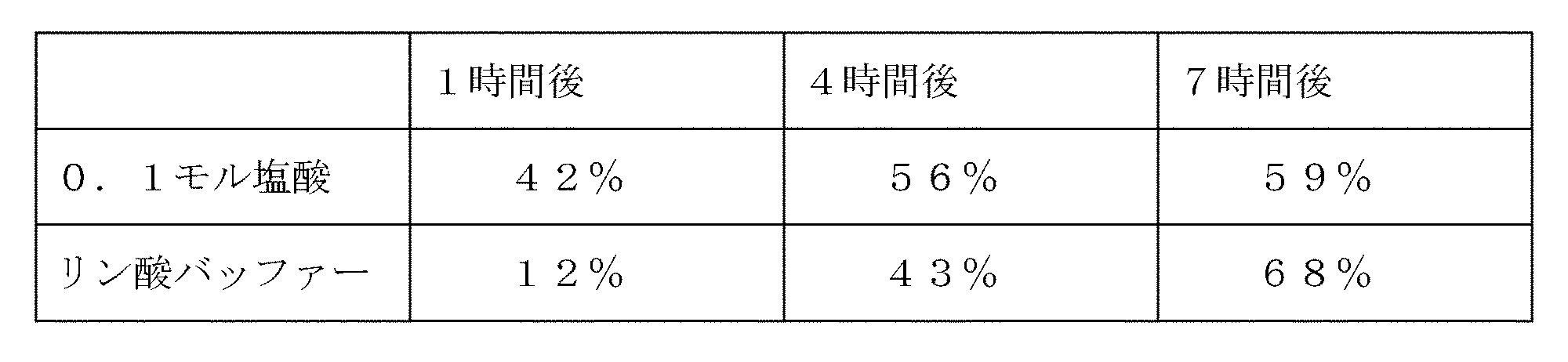
- the spherical nanocapsules obtained in Example 8 were dispersed in 0.1 molar hydrochloric acid and a phosphate buffer, respectively. After removing the spherical nanocapsules by filtration, the amount of released methylene blue was evaluated by an absorption spectrum. The release rates of methylene blue after 1 hour, 4 hours and 7 hours are summarized in Table 1. Scanning transmission electron microscope images after 7 hours of dispersion are shown in FIG.
- Example 10 [Dispersed in toluene or acetone]
- the spherical nanocapsules obtained in Example 3 were dispersed in toluene and acetone, respectively, and left for 1 day. Scanning transmission electron microscope images after one day of each dispersion are shown in FIG.
- Example 11 [Formation of spherical nanocapsules 6 Powder addition Cobalt acetate + Myristic acid type] 1.71 g of N- (glycylglycine) pentadecane carboxamide was dispersed in 20 mL of ethanol, and 0.66 g of cobalt acetate was added and stirred. After 1 hour, the reaction product was filtered and dried to obtain spherical nanocapsule powder. A scanning electron microscope image is shown in FIG.
- Example 12 [Formation of spherical nanocapsules 7: Solvent difference in Example 3] 1.71 g of N- (glycylglycine) tridecane carboxamide was dispersed in a mixed solvent of 10 mL of ethanol and 10 mL of toluene, and 0.66 g of zinc acetate was added and stirred. After 1 hour, the reaction product was filtered and dried to obtain spherical nanocapsule powder. A scanning transmission electron microscope image is shown in FIG.
Landscapes
- Chemical & Material Sciences (AREA)
- Engineering & Computer Science (AREA)
- Nanotechnology (AREA)
- Crystallography & Structural Chemistry (AREA)
- Physics & Mathematics (AREA)
- Condensed Matter Physics & Semiconductors (AREA)
- General Physics & Mathematics (AREA)
- Organic Chemistry (AREA)
- Chemical Kinetics & Catalysis (AREA)
- Manufacturing & Machinery (AREA)
- Dispersion Chemistry (AREA)
- Composite Materials (AREA)
- Materials Engineering (AREA)
- Manufacturing Of Micro-Capsules (AREA)
- Organic Low-Molecular-Weight Compounds And Preparation Thereof (AREA)
Abstract
本発明は、通常の乳化液やリポソームなどの球状ナノカプセルが用いられる食品、化粧品、医薬等の分野に加えて、乾燥状態で用いられることが多い材料分野でも使用可能であると共に、球状から他構造への形態変化により内部に取り込んだ物質を徐放可能な球状ナノカプセル及びその製造方法を提供することを課題とする。そして、下記一般式(1)で表されるペプチド脂質の金属錯体からなり、かつ、中空構造を有する球状ナノカプセル(ただし、前記金属錯体を形成する金属が、アルカリ金属ではない)およびその製造方法を提供する。 (なお、前記一般式(1)中、Rは、炭素数6~24の炭化水素基を示し、R'は、アミノ酸側鎖を示し、mは、1~5の整数を示す。)
Description
本発明は、食品、医療、材料分野で使用される内部に取り込んだ物質を徐放することを目的とする球状ナノカプセルとその製造方法に関するものである。
有機物を主成分として形成する球状ナノカプセルには、主に食品、化粧品、医薬品等の分野で広く使用される乳化物として存在するもの(特許文献1)が知られている。これらを形成する有機物は、通常、室温以下でゲル-液晶転移点を持つものがほとんどであり、分散液中で安定であるものの、乾燥状態で構造を保つことは出来ない。また、カプセルの壁が液晶状態であるため流動性があり、また、同時に壁の厚さが分子1~2層程度と薄いため、壁を通過することで内部の物質を徐放することが可能であるが、一方で、球状からチューブ状、シート状などの他構造への形態変換により徐放することは出来ない。
球状カプセルと脂質ナノチューブを複合化させる製造方法が知られている(特許文献2)。球状ナノカプセルと脂質ナノチューブが繋がることにより、両者の間で物質を輸送することが可能であるが、脂質膜はリン脂質の2分子膜として構成されていることから壁の厚さが薄く、外部に徐放するメカニズムは通常の乳化物同様であり、形態変化により徐放するわけではない。また、同様に乾燥することは出来ない。
また、タンパク質や高分子を主成分とし、最終的に金属イオンを結合して形成する球状カプセルが知られている(特許文献3,4)。通常のエマルションより壁の厚さを厚く出来るが、1マイクロメーター以下のカプセルを製造できない。また、この場合、乾燥することが可能であるが、球状から他構造への形態変換により徐放することは出来ない。
一方、発明者らは、特定の構造を有するペプチド脂質の金属錯体がナノチューブを形成することを報告している(特許文献5)。特許文献5は、様々な金属種を用いた際にもナノチューブ構造が形成することを報告しているが、これまでに中空の球状構造が形成した例は開示していない。
また、タンパク質や高分子を主成分とし、最終的に金属イオンを結合して形成する球状カプセルが知られている(特許文献3,4)。通常のエマルションより壁の厚さを厚く出来るが、1マイクロメーター以下のカプセルを製造できない。また、この場合、乾燥することが可能であるが、球状から他構造への形態変換により徐放することは出来ない。
一方、発明者らは、特定の構造を有するペプチド脂質の金属錯体がナノチューブを形成することを報告している(特許文献5)。特許文献5は、様々な金属種を用いた際にもナノチューブ構造が形成することを報告しているが、これまでに中空の球状構造が形成した例は開示していない。
また、発明者らは、特定の構造を有するペプチド脂質が乾燥可能なマイクロカプセルを形成することを報告している(特許文献6)。ペプチド脂質とそのアルカリ金属塩を混合することでマイクロカプセルが形成するが、その他の金属で形成することは出来ない。また、マイクロカプセルが分散したO/Wエマルション中で、内部の油脂に溶かしたβカロテンが光により徐々に分解されると報告しているが放出することはできない。
本発明は、通常の乳化液やリポソームなどの球状ナノカプセルが用いられる食品、化粧品、医薬等の分野に加えて、乾燥状態で用いられることが多い材料分野でも使用可能であると共に、球状から他構造への形態変化により内部に取り込んだ物質を徐放可能な球状ナノカプセル及びその製造方法を提供することを課題とする。
本発明者らは、上記課題を解決するため鋭意検討した結果、これまで金属錯体化によりナノチューブ構造を形成することが知られていたペプチド脂質を、これまでと異なる特定の条件下で金属錯体化した場合のみ、他構造へ形態変化可能な球状ナノカプセルが形成することを見出した。
すなわち、本発明は、以下の通りである。
本発明の一態様は、
〔1〕下記一般式(1)で表されるペプチド脂質の金属錯体を含み、かつ、中空構造を有する球状ナノカプセル(ただし、前記金属錯体を形成する金属は、アルカリ金属ではない)に関する。

(なお、前記一般式(1)中、Rは、炭素数6~24の炭化水素基を示し、R’は、アミノ酸側鎖を示し、mは、1~5の整数を示す。)
ここで、本発明の球状ナノカプセルは、一実施の形態において、
〔2〕前記中空構造内に機能性物質を内包することを特徴とする。
また、本発明の球状ナノカプセルは、一実施の形態において、
〔3〕壁の厚さが5~125nmであることを特徴とする。
また、本発明の球状ナノカプセルは、一実施の形態において、
〔4〕前記一般式(1)において、RCO-がミリストイル基またはパルミトイル基であることを特徴とする。
また、本発明の球状ナノカプセルは、一実施の形態において、
〔5〕前記一般式(1)において、R’が水素原子であることを特徴とする。
また、本発明の球状ナノカプセルは、一実施の形態において、
〔6〕前記一般式(1)において、mが2であることを特徴とする。
また、本発明の球状ナノカプセルは、一実施の形態において、
〔7〕前記金属錯体を形成する金属が亜鉛またはコバルトであることを特徴とする。
また、本発明の球状ナノカプセルは、一実施の形態において、
〔8〕粉末状態、または、分散状態にあることを特徴とする。
また、本発明は、別の態様において、
〔9〕上記〔1〕~〔8〕のいずれかに記載の球状ナノカプセルであって、かつ、前記中空構造内に機能性物質を内包する球状ナノカプセルを乾燥させて粉末状の球状ナノカプセルを調製する工程と、
前記粉末状の球状ナノカプセルを溶媒中に移す工程とを含み、これにより前記球状ナノカプセルが機能性物質を徐放する、方法に関する。
また、本発明は、別の態様において、
(A)下記一般式(1)で表されるペプチド脂質を有機溶媒に分散する工程と;

(なお、前記一般式(1)中、Rは、炭素数6~24の炭化水素基を示し、R’は、アミノ酸側鎖を示し、mは、1~5の整数を示す。)
(B)工程(A)により得られた溶液中に、金属塩を添加し、前記ペプチド脂質の金属錯体を形成する工程と
を含む、球状ナノカプセルの製造方法(ただし、前記金属錯体を形成する金属は、アルカリ金属ではない)に関する。
ここで、本発明の球状ナノカプセルの製造方法は、一実施の形態において、
前記有機溶媒がエタノールもしくはイソプロパノール、または、それらと有機溶媒の混合溶媒であることを特徴とする。
また、本発明の球状ナノカプセルの製造方法は、一実施の形態において、
前記金属が亜鉛またはコバルトであることを特徴とする。
すなわち、本発明は、以下の通りである。
本発明の一態様は、
〔1〕下記一般式(1)で表されるペプチド脂質の金属錯体を含み、かつ、中空構造を有する球状ナノカプセル(ただし、前記金属錯体を形成する金属は、アルカリ金属ではない)に関する。
ここで、本発明の球状ナノカプセルは、一実施の形態において、
〔2〕前記中空構造内に機能性物質を内包することを特徴とする。
また、本発明の球状ナノカプセルは、一実施の形態において、
〔3〕壁の厚さが5~125nmであることを特徴とする。
また、本発明の球状ナノカプセルは、一実施の形態において、
〔4〕前記一般式(1)において、RCO-がミリストイル基またはパルミトイル基であることを特徴とする。
また、本発明の球状ナノカプセルは、一実施の形態において、
〔5〕前記一般式(1)において、R’が水素原子であることを特徴とする。
また、本発明の球状ナノカプセルは、一実施の形態において、
〔6〕前記一般式(1)において、mが2であることを特徴とする。
また、本発明の球状ナノカプセルは、一実施の形態において、
〔7〕前記金属錯体を形成する金属が亜鉛またはコバルトであることを特徴とする。
また、本発明の球状ナノカプセルは、一実施の形態において、
〔8〕粉末状態、または、分散状態にあることを特徴とする。
また、本発明は、別の態様において、
〔9〕上記〔1〕~〔8〕のいずれかに記載の球状ナノカプセルであって、かつ、前記中空構造内に機能性物質を内包する球状ナノカプセルを乾燥させて粉末状の球状ナノカプセルを調製する工程と、
前記粉末状の球状ナノカプセルを溶媒中に移す工程とを含み、これにより前記球状ナノカプセルが機能性物質を徐放する、方法に関する。
また、本発明は、別の態様において、
(A)下記一般式(1)で表されるペプチド脂質を有機溶媒に分散する工程と;
(B)工程(A)により得られた溶液中に、金属塩を添加し、前記ペプチド脂質の金属錯体を形成する工程と
を含む、球状ナノカプセルの製造方法(ただし、前記金属錯体を形成する金属は、アルカリ金属ではない)に関する。
ここで、本発明の球状ナノカプセルの製造方法は、一実施の形態において、
前記有機溶媒がエタノールもしくはイソプロパノール、または、それらと有機溶媒の混合溶媒であることを特徴とする。
また、本発明の球状ナノカプセルの製造方法は、一実施の形態において、
前記金属が亜鉛またはコバルトであることを特徴とする。
本発明の球状ナノカプセルによれば、球状ナノカプセルが分散している溶媒を置換する、または、乾燥後の球状ナノカプセルを溶媒に再分散することで、球状ナノカプセルに形態変化が起こり、内部に取り込んだ物質を徐放することができる。球状ナノカプセルはろ過することで乾燥固体としても安定であるが、様々な溶媒に分散することでナノチューブ状やシート状構造へ変換し、内部に取り込んだ物質を放出可能である。
本発明の球状ナノカプセルは、下記一般式(1)

(式中、Rは炭素数6~24の炭化水素基、R’はアミノ酸側鎖、mは1~5)で表わされるペプチド脂質の金属錯体から形成されたことを特徴とする球状ナノカプセルである。
上記一般式(1)中、Rは炭素数6~24の炭化水素基を示す。炭化水素基は、直鎖状であっても分岐鎖状であってもよいが、好ましくは直鎖状である。また、炭化水素基は飽和であっても不飽和であってもよく、不飽和の場合には3個以下の二重結合を含むことが好ましい。炭化水素基の炭素数は、好ましくは9~19、より好ましくは11~17であり、特に好ましくは13および15である。
本発明で用いられる炭化水素基としては、例えば、アルキル基、シクロアルキル基、アルケニル基、シクロアルケニル基、アルキニル基、アリール基、アラルキル基、シクロアルキルアルキル基等が挙げられる。本発明においては、炭化水素基は好ましくはアルキル基である。
上記炭化水素基はまた、1又は2以上の適当な置換基で置換されていてもよい。このような置換基としては、例えば、炭素数6以下の炭化水素基(アルキル基、アルケニル基、アルキニル基等)、ハロゲン(塩素原子、フッ素原子、ヨウ素原子、臭素原子等)、水酸基、アミノ基、カルボキシル基等が挙げられるが、これらに限定されない。
なお、本発明に用いられるペプチド脂質は、一実施の形態において、一般式(1)の「RCO-」の部分は、ミリストイル基またはパルミトイル基とすることができる。
なお、本発明に用いられるペプチド脂質は、一実施の形態において、一般式(1)の「RCO-」の部分は、ミリストイル基またはパルミトイル基とすることができる。
上記一般式(1)中のR’はアミノ酸の側鎖に相当する物であり、20種類の天然アミノ酸(グリシン、アラニン、ロイシン、イソロイシン、バリン、アルギニン、リジン、グルタミン酸、グルタミン、アスパラギン酸、アスパラギン、システイン、メチオニン、ヒスチジン、プロリン、フェニルアラニン、チロシン、スレオニン、セリン、トリプトファン)、あるいは修飾アミノ酸若しくは非天然アミノ酸(例えば、オルニチン、ノルバリン、ノルロイシン、ヒドロキシリジン、フェニルグリシン、β-アラニン等)の側鎖の構造とすることができる。これらのうち、本発明ではR’が水素であるグリシンが特に好ましい。
上記一般式(1)中のmはアミノ酸残基数であり、好ましくは1~5、より好ましくは1~2、特に好ましくは2である。
上記一般式(1)で示されるペプチド脂質の好ましい一実施の形態としては、例えば、下記式(2)または(3)で示されるペプチド脂質を挙げることができる。


なお、上記一般式(1)で表されるペプチド脂質の製造方法は公知であり、例えば、特許文献5および6等に記載の方法を参照することにより製造することができる。
上記一般式(1)で示されるペプチド脂質の好ましい一実施の形態としては、例えば、下記式(2)または(3)で示されるペプチド脂質を挙げることができる。
次に、本発明の球状ナノカプセルを製造する方法について説明する。まず、一般式(1)で表されるペプチド脂質を有機溶媒に分散する。この分散液を撹拌しながら金属塩を粉末のまま加える。金属塩を予め溶媒に溶解したものを用いても良いが、粉末のままの方が効率が良い。そのまま混合分散液を撹拌し続け、粘度が大きく落ちた時間を見計らって撹拌を止める。 沈殿物をろ過し、溶媒で洗浄後、乾燥することで、本発明のナノカプセルを乾燥粉末として得ることが出来る。
なお、ペプチド脂質を分散させる有機溶媒としては、沸点が120℃以下であるアルコール類を用いることができるが、好ましくはエタノールあるいはイソプロパノールである。また、エタノールもしくはイソプロパノールのいずれかまたは両方と、他の有機溶媒との混合溶媒とすることもできる。アルコール類は単独でもよいし、2種以上の混合であってもよい。
更に、このアルコール類に、芳香族炭化水素類、パラフィン類、塩化パラフィン類、塩化オレフィン類、塩化芳香族炭化水素類、エーテル類、ケトン類、エステル類、含窒素化合物の1種以上を混合した混合溶媒を用いてもよい。この混合溶媒はアルコール類を好ましくは少なくとも10容積%、より好ましくは少なくとも50容積%含む。
このとき、有機溶媒に対して添加するペプチド脂質の量は、溶媒中に分散可能な濃度であれば特に限定されないが、例えば、溶液中の濃度として、通常10mM以上、好ましくは100mM以上とすることができる。なお、添加するペプチド脂質の濃度を高くすると、安定的に球状ナノカプセルを製造できる点において好ましい。
更に、このアルコール類に、芳香族炭化水素類、パラフィン類、塩化パラフィン類、塩化オレフィン類、塩化芳香族炭化水素類、エーテル類、ケトン類、エステル類、含窒素化合物の1種以上を混合した混合溶媒を用いてもよい。この混合溶媒はアルコール類を好ましくは少なくとも10容積%、より好ましくは少なくとも50容積%含む。
このとき、有機溶媒に対して添加するペプチド脂質の量は、溶媒中に分散可能な濃度であれば特に限定されないが、例えば、溶液中の濃度として、通常10mM以上、好ましくは100mM以上とすることができる。なお、添加するペプチド脂質の濃度を高くすると、安定的に球状ナノカプセルを製造できる点において好ましい。
上述のように、ペプチド脂質を分散させた分散液に対して、さらに金属塩を添加することでペプチド脂質の金属錯体を形成させる。ここで、当該分散液への添加に用いることのできる金属塩としては、アルカリ土類金属、遷移金属、希土類金属、その他金属(アルミニウム、ゲルマニウム、インジウム、タリウム、スズ、鉛、ビスマス)、半金属(ホウ素、ケイ素、ゲルマニウム、ヒ素、アンチモン、テルル、ポロニウム)など、アルカリ金属以外のすべての金属塩を用いることができる。好ましくはアルカリ土類金属、遷移金属、希土類金属であり、より好ましくは遷移金属、特に好ましくは亜鉛またはコバルトである。塩としては酢酸塩、アセチルアセトン塩、硝酸塩、硫酸塩、ハロゲン化物などすべての塩が利用可能であるが、好ましくは酢酸塩、アセチルアセトン塩である。
有機溶媒に分散したペプチド脂質と金属塩とを混合し、金属錯体を形成させる条件は、特に限定されないが、例えば、温度は常温で良いため、加熱冷却は特に必要がなく、撹拌時間は通常10分~12時間が必要であり、好ましくは30分~5時間である。なお、金属塩を予め溶媒に溶解させてペプチド脂質と混合する場合には、加熱することが好ましい。
また、球状ナノカプセルが分散した有機溶媒に対する金属塩の添加量としては、本発明のペプチド脂質に対する割合として、金属の価数を2とすると、通常0.5モル%以上であれば良い。使用される金属塩が2種以上である場合は、その合計量が用いられる。
ここで、好ましくは、球状ナノカプセルの壁全体(すなわち、球状ナノカプセルを構成するペプチド脂質全体)に金属錯体を形成する態様である。しかしながら、当該形態に限定されず、本発明のペプチド脂質の全体量のうちの一部を金属錯体とし、一度の工程で両者の割合が調整された球状ナノカプセルを得ることもできる。有機溶媒中においてペプチド脂質と金属との金属錯体を形成させる際に、両者の量を適当な割合に調整するためには、本発明のペプチド脂質に対して、反応させる金属塩の量を調整すればよい。
なお、本発明の球状ナノペプチドを製造する方法は、原料であるペプチド脂質及び金属塩の両者を予め溶解させておく必要がなく、撹拌操作のみで得られるため、数時間で溶媒1L辺り50g以上の球状ナノカプセルが容易に得られる。
ここで、好ましくは、球状ナノカプセルの壁全体(すなわち、球状ナノカプセルを構成するペプチド脂質全体)に金属錯体を形成する態様である。しかしながら、当該形態に限定されず、本発明のペプチド脂質の全体量のうちの一部を金属錯体とし、一度の工程で両者の割合が調整された球状ナノカプセルを得ることもできる。有機溶媒中においてペプチド脂質と金属との金属錯体を形成させる際に、両者の量を適当な割合に調整するためには、本発明のペプチド脂質に対して、反応させる金属塩の量を調整すればよい。
なお、本発明の球状ナノペプチドを製造する方法は、原料であるペプチド脂質及び金属塩の両者を予め溶解させておく必要がなく、撹拌操作のみで得られるため、数時間で溶媒1L辺り50g以上の球状ナノカプセルが容易に得られる。
本発明の球状ナノカプセルの外径は、通常20~500nmであり、好ましくは50~200nmである。また、内径は、通常10~250nmであり、好ましくは25~100nmである。また、壁の厚さは、通常5~125nmであり、好ましくは10~50nmである。なお、本明細書において、球状ナノカプセルの壁とは、球状ナノカプセルの外側表面より中空に至るまでの空間に存在する、ペプチド脂質およびその金属錯体により構成される層が複数重なって形成された膜をいい、壁の厚さとは球状ナノカプセルの膜の厚さである。本発明の球状ナノカプセルの直径は、乾燥して粉末状にした後、電子顕微鏡を用いて測定することができる。
上記ペプチド脂質を分散させる有機溶媒には、機能性物質を溶解あるいは分散させることができる。このような物質としては特に限定されないが、ビタミン、カロテン、アミノ酸、脂肪酸などの機能性食品や、金属ナノ粒子、無機ナノ粒子、機能性低分子、高分子などの機能性材料等が挙げられる。これらの物質は単独であってもよいし、2種以上の混合であってもよい。また、物質は化学合成されたものであってもよく、或いは天然物より抽出されたものであってもよい。
機能性物質の含有量は、その種類や使用目的等によって適宜設定されるが、通常、有機溶媒において50重量%以下、好ましくは20重量%以下である。使用される物質が2種以上である場合は、その合計量が用いられる。
また、本発明の球状ナノカプセルは、製造後に分離、洗浄、乾燥した後、溶媒に再分散することで、その形態を変化させる。これにより、機能性物質を内包する場合には、当該機能性物質の徐放を制御することが可能である。
例えば、本発明の球状ナノカプセルを0.1M塩酸に添加することにより1日以内に球状ナノカプセルを、ナノチューブ状に形態変化させることができる。また、本発明の球状ナノカプセルをpH7.4のリン酸バッファーに添加することにより球状ナノカプセルを、1日以内で板状に形態変化させることができる。また、本発明の球状ナノカプセルをトルエンあるいはアセトンに添加することにより1日で1~2%のみがナノチューブ状に形態変化させることができる。
なお、本発明の球状ナノカプセルを乾燥させた場合、乾燥後の粉末状のナノカプセル中に有機溶媒は残らず、機能性物質を濃縮することもできる。
または、本発明の球状ナノカプセルは、分離・洗浄をすることなく、球状ナノカプセルが分散している溶媒を置換することによっても、形態を変化させて内包する機能性物質を徐放することができる。溶媒の置換としては、例えば、球状ナノカプセルが分散している溶媒中に水を添加することにより行うことができ、このとき球状ナノカプセルは、チューブ状に形態を変化させて内包する機能性物質を徐放する。
例えば、本発明の球状ナノカプセルを0.1M塩酸に添加することにより1日以内に球状ナノカプセルを、ナノチューブ状に形態変化させることができる。また、本発明の球状ナノカプセルをpH7.4のリン酸バッファーに添加することにより球状ナノカプセルを、1日以内で板状に形態変化させることができる。また、本発明の球状ナノカプセルをトルエンあるいはアセトンに添加することにより1日で1~2%のみがナノチューブ状に形態変化させることができる。
なお、本発明の球状ナノカプセルを乾燥させた場合、乾燥後の粉末状のナノカプセル中に有機溶媒は残らず、機能性物質を濃縮することもできる。
または、本発明の球状ナノカプセルは、分離・洗浄をすることなく、球状ナノカプセルが分散している溶媒を置換することによっても、形態を変化させて内包する機能性物質を徐放することができる。溶媒の置換としては、例えば、球状ナノカプセルが分散している溶媒中に水を添加することにより行うことができ、このとき球状ナノカプセルは、チューブ状に形態を変化させて内包する機能性物質を徐放する。
次に、本発明を実施例によりさらに詳細に説明するが、本発明は、これらの例によって何ら限定されるものではない。
(実施例1)
[N-(グリシルグリシン)トリデカンカルボキサミドの合成]
グリシルグリシンベンジルエステル塩酸塩0.57g(2.2ミリモル)にトリエチルアミン0.31ml(2.2ミリモル)を加えエタノール10mlに溶解した。ここにトリデカンカルボン酸0.46g(2ミリモル)を含むクロロホルム溶液50mlを加えた。この混合溶液を-10℃で冷却しながら1-エチル-3-(3-ジメチルアミノプロピル)カルボジイミド塩酸塩0.42g(2.2ミリモル)を含むクロロホルム溶液20mlを加え、徐々に室温に戻しながら一昼夜撹拌した。反応溶液を10重量%クエン酸水溶液50ml、4重量%炭酸水素ナトリウム水溶液50ml、純水50mlで洗浄した後、減圧下で濃縮し白色固体(N-(グリシルグリシンベンジルエステル)トリデカンカルボキサミド)0.57g(収率65%)を得た。得られた化合物0.43g(1ミリモル)をジメチルホルムアミド100mlに溶解し、触媒として10重量%パラジウム/炭素を0.5g加え、接触水素還元を行った。6時間後、セライトろ過した後、減圧下で濃縮することにより、N-(グリシルグリシン)トリデカンカルボキサミド0.21g(収率60%)を得た。
(実施例1)
[N-(グリシルグリシン)トリデカンカルボキサミドの合成]
グリシルグリシンベンジルエステル塩酸塩0.57g(2.2ミリモル)にトリエチルアミン0.31ml(2.2ミリモル)を加えエタノール10mlに溶解した。ここにトリデカンカルボン酸0.46g(2ミリモル)を含むクロロホルム溶液50mlを加えた。この混合溶液を-10℃で冷却しながら1-エチル-3-(3-ジメチルアミノプロピル)カルボジイミド塩酸塩0.42g(2.2ミリモル)を含むクロロホルム溶液20mlを加え、徐々に室温に戻しながら一昼夜撹拌した。反応溶液を10重量%クエン酸水溶液50ml、4重量%炭酸水素ナトリウム水溶液50ml、純水50mlで洗浄した後、減圧下で濃縮し白色固体(N-(グリシルグリシンベンジルエステル)トリデカンカルボキサミド)0.57g(収率65%)を得た。得られた化合物0.43g(1ミリモル)をジメチルホルムアミド100mlに溶解し、触媒として10重量%パラジウム/炭素を0.5g加え、接触水素還元を行った。6時間後、セライトろ過した後、減圧下で濃縮することにより、N-(グリシルグリシン)トリデカンカルボキサミド0.21g(収率60%)を得た。
(実施例2)
[N-(グリシルグリシン)ペンタデカンカルボキサミドの合成]
グリシルグリシン4.82g(36.5ミリモル)に水酸化ナトリウム水溶液77.1ml(36.5ミリモル)を加え、これに水酸化ナトリウム水溶液40ml(36.5ミリモル)とペンタデカンカルボン酸塩化物のアセトン溶液30ml(36.5ミリモル)とを同時に滴下した。一日後、反応溶液を塩酸70ml(73ミリモル)に添加し、沈殿物をろ過した後、水150mlでろ液が中性になるまで洗浄した。粗生成物をメタノール60mlに懸濁して数時間還流させた後、沈殿物をろ過、メタノール洗浄して、N-(グリシルグリシン)ペンタデカンカルボキサミド9.5g(収率75%)を得た。
[N-(グリシルグリシン)ペンタデカンカルボキサミドの合成]
グリシルグリシン4.82g(36.5ミリモル)に水酸化ナトリウム水溶液77.1ml(36.5ミリモル)を加え、これに水酸化ナトリウム水溶液40ml(36.5ミリモル)とペンタデカンカルボン酸塩化物のアセトン溶液30ml(36.5ミリモル)とを同時に滴下した。一日後、反応溶液を塩酸70ml(73ミリモル)に添加し、沈殿物をろ過した後、水150mlでろ液が中性になるまで洗浄した。粗生成物をメタノール60mlに懸濁して数時間還流させた後、沈殿物をろ過、メタノール洗浄して、N-(グリシルグリシン)ペンタデカンカルボキサミド9.5g(収率75%)を得た。
(実施例3)
[球状ナノカプセルの形成1 粉末添加 酢酸亜鉛+ミリスチン酸タイプ]
N-(グリシルグリシン)トリデカンカルボキサミド1.71gをエタノール20mLに分散し、酢酸亜鉛0.66gを加え撹拌した。1時間後、反応物をろ過し、乾燥することで、球状ナノカプセルの粉末を得た。走査透過電子顕微鏡像を図1に示す。
[球状ナノカプセルの形成1 粉末添加 酢酸亜鉛+ミリスチン酸タイプ]
N-(グリシルグリシン)トリデカンカルボキサミド1.71gをエタノール20mLに分散し、酢酸亜鉛0.66gを加え撹拌した。1時間後、反応物をろ過し、乾燥することで、球状ナノカプセルの粉末を得た。走査透過電子顕微鏡像を図1に示す。
(実施例4)
[球状ナノカプセルの形成2 粉末添加 酢酸亜鉛+パルミチン酸タイプ]
N-(グリシルグリシン)ペンタデカンカルボキサミド1.84gをエタノール20mLに分散し、酢酸亜鉛0.66gを加え撹拌した。1時間後、反応物をろ過し、乾燥することで、球状ナノカプセルの粉末を得た。走査電子顕微鏡像を図2に示す。
[球状ナノカプセルの形成2 粉末添加 酢酸亜鉛+パルミチン酸タイプ]
N-(グリシルグリシン)ペンタデカンカルボキサミド1.84gをエタノール20mLに分散し、酢酸亜鉛0.66gを加え撹拌した。1時間後、反応物をろ過し、乾燥することで、球状ナノカプセルの粉末を得た。走査電子顕微鏡像を図2に示す。
(実施例5)
[球状ナノカプセルの形成3 粉末添加 亜鉛アセチルアセトナート+ミリスチン酸タイプ]
N-(グリシルグリシン)トリデカンカルボキサミド1.71gをエタノール20mLに分散し、亜鉛アセチルアセトナート0.84gを加え撹拌した。1時間後、反応物をろ過し、乾燥することで、球状ナノカプセルの粉末を得た。走査透過電子顕微鏡像を図3に示す。
[球状ナノカプセルの形成3 粉末添加 亜鉛アセチルアセトナート+ミリスチン酸タイプ]
N-(グリシルグリシン)トリデカンカルボキサミド1.71gをエタノール20mLに分散し、亜鉛アセチルアセトナート0.84gを加え撹拌した。1時間後、反応物をろ過し、乾燥することで、球状ナノカプセルの粉末を得た。走査透過電子顕微鏡像を図3に示す。
(実施例6)
[球状ナノカプセルの形成4 溶液添加]
酢酸亜鉛0.66gをエタノール30mLに加熱溶解し、室温付近まで冷却する。N-(グリシルグリシン)トリデカンカルボキサミド1.71gをエタノール20mLに分散し、先に調整した酢酸亜鉛エタノール溶液を加え撹拌した。3時間後、反応物をろ過し、乾燥することで、球状ナノカプセルの粉末を得た。走査電子顕微鏡像を図4に示す。
[球状ナノカプセルの形成4 溶液添加]
酢酸亜鉛0.66gをエタノール30mLに加熱溶解し、室温付近まで冷却する。N-(グリシルグリシン)トリデカンカルボキサミド1.71gをエタノール20mLに分散し、先に調整した酢酸亜鉛エタノール溶液を加え撹拌した。3時間後、反応物をろ過し、乾燥することで、球状ナノカプセルの粉末を得た。走査電子顕微鏡像を図4に示す。
(実施例7)
[球状ナノカプセルの形成5 実施例3の溶媒違い]
N-(グリシルグリシン)トリデカンカルボキサミド1.71gをイソプロパノール20mLに分散し、酢酸亜鉛0.66gを加え撹拌した。1時間後、反応物をろ過し、乾燥することで、球状ナノカプセルの粉末を得た。走査透過電子顕微鏡像を図5に示す。
[球状ナノカプセルの形成5 実施例3の溶媒違い]
N-(グリシルグリシン)トリデカンカルボキサミド1.71gをイソプロパノール20mLに分散し、酢酸亜鉛0.66gを加え撹拌した。1時間後、反応物をろ過し、乾燥することで、球状ナノカプセルの粉末を得た。走査透過電子顕微鏡像を図5に示す。
(実施例8)
[メチレンブルーを内部に取り込んだ球状ナノカプセルの形成]
エタノール20mLにメチレンブルー0.05gを溶解した後、N-(グリシルグリシン)トリデカンカルボキサミド1.71gを分散した。酢酸亜鉛0.66gを加え撹拌し、3時間後、反応物をろ過し、エタノールで洗浄し、乾燥することで、メチレンブルーを内部に取り込んだ球状ナノカプセルの粉末を得た。走査透過電子顕微鏡像を図6に示す。
[メチレンブルーを内部に取り込んだ球状ナノカプセルの形成]
エタノール20mLにメチレンブルー0.05gを溶解した後、N-(グリシルグリシン)トリデカンカルボキサミド1.71gを分散した。酢酸亜鉛0.66gを加え撹拌し、3時間後、反応物をろ過し、エタノールで洗浄し、乾燥することで、メチレンブルーを内部に取り込んだ球状ナノカプセルの粉末を得た。走査透過電子顕微鏡像を図6に示す。
(実施例9)
[メチレンブルーを内部に取り込んだ球状ナノカプセルの放出実験]
実施例8で得られた球状ナノカプセルを、それぞれ0.1モル塩酸、リン酸バッファーに分散し、球状ナノカプセルをろ過により取り除いた後、放出されたメチレンブルーの量を吸収スペクトルにより評価した。1時間後、4時間後、7時間後のメチレンブルーの放出率を表1にまとめる。それぞれ分散7時間後の走査透過電子顕微鏡像を図7に示す。
[メチレンブルーを内部に取り込んだ球状ナノカプセルの放出実験]
実施例8で得られた球状ナノカプセルを、それぞれ0.1モル塩酸、リン酸バッファーに分散し、球状ナノカプセルをろ過により取り除いた後、放出されたメチレンブルーの量を吸収スペクトルにより評価した。1時間後、4時間後、7時間後のメチレンブルーの放出率を表1にまとめる。それぞれ分散7時間後の走査透過電子顕微鏡像を図7に示す。
(実施例10)
[トルエンあるいはアセトンに分散]
実施例3で得られた球状ナノカプセルを、それぞれトルエン、アセトンに分散し、1日放置した。それぞれの分散1日後の走査透過電子顕微鏡像を図8に示す。
[トルエンあるいはアセトンに分散]
実施例3で得られた球状ナノカプセルを、それぞれトルエン、アセトンに分散し、1日放置した。それぞれの分散1日後の走査透過電子顕微鏡像を図8に示す。
(実施例11)
[球状ナノカプセルの形成6 粉末添加 酢酸コバルト+ミリスチン酸タイプ]
N-(グリシルグリシン)ペンタデカンカルボキサミド1.71gをエタノール20mLに分散し、酢酸コバルト0.66gを加え撹拌した。1時間後、反応物をろ過し、乾燥することで、球状ナノカプセルの粉末を得た。走査電子顕微鏡像を図9に示す。
[球状ナノカプセルの形成6 粉末添加 酢酸コバルト+ミリスチン酸タイプ]
N-(グリシルグリシン)ペンタデカンカルボキサミド1.71gをエタノール20mLに分散し、酢酸コバルト0.66gを加え撹拌した。1時間後、反応物をろ過し、乾燥することで、球状ナノカプセルの粉末を得た。走査電子顕微鏡像を図9に示す。
(実施例12)
[球状ナノカプセルの形成7 実施例3の溶媒違い]
N-(グリシルグリシン)トリデカンカルボキサミド1.71gをエタノール10mLとトルエン10mLの混合溶媒に分散し、酢酸亜鉛0.66gを加え撹拌した。1時間後、反応物をろ過し、乾燥することで、球状ナノカプセルの粉末を得た。走査透過電子顕微鏡像を図10に示す。
[球状ナノカプセルの形成7 実施例3の溶媒違い]
N-(グリシルグリシン)トリデカンカルボキサミド1.71gをエタノール10mLとトルエン10mLの混合溶媒に分散し、酢酸亜鉛0.66gを加え撹拌した。1時間後、反応物をろ過し、乾燥することで、球状ナノカプセルの粉末を得た。走査透過電子顕微鏡像を図10に示す。
Claims (12)
- 下記一般式(1)で表されるペプチド脂質の金属錯体を含み、かつ、中空構造を有する球状ナノカプセル(ただし、前記金属錯体を形成する金属は、アルカリ金属ではない)。

- 前記中空構造内に機能性物質を内包する請求項1に記載の球状ナノカプセル。
- 壁の厚さが5~125nmである、請求項1または2に記載の球状ナノカプセル。
- 前記一般式(1)において、RCO-がミリストイル基またはパルミトイル基である請求項1から3のいずれか一項に記載の球状ナノカプセル。
- 前記一般式(1)において、R’が水素原子である請求項1から4のいずれか一項に記載の球状ナノカプセル。
- 前記一般式(1)において、mが2である請求項1から5のいずれか一項に記載の球状ナノカプセル。
- 前記金属錯体を形成する金属が亜鉛またはコバルトである請求項1から6のいずれか一項に記載の球状ナノカプセル。
- 粉末状態または、分散状態にある請求項1~7のいずれか一項に記載の球状ナノカプセル。
- 請求項1~8のいずれか一項に記載の球状ナノカプセルであって、かつ、前記中空構造内に機能性物質を内包する球状ナノカプセルを乾燥させて粉末状の球状ナノカプセルを調製する工程と、
前記粉末状の球状ナノカプセルを溶媒中に移す工程とを含み、これにより前記球状ナノカプセルが機能性物質を徐放する、方法。 - (A)下記一般式(1)で表されるペプチド脂質を有機溶媒に分散する工程と;

(B)工程(A)により得られた溶液中に、金属塩を添加し、前記ペプチド脂質の金属錯体を形成する工程と
を含む、球状ナノカプセルの製造方法(ただし、前記金属錯体を形成する金属は、アルカリ金属ではない)。 - 前記有機溶媒がエタノールもしくはイソプロパノール、または、それらと有機溶媒との混合物である請求項10に記載の球状ナノカプセルの製造方法。
- 前記金属が亜鉛またはコバルトである請求項10または11に記載の球状ナノカプセルの製造方法。
Priority Applications (1)
| Application Number | Priority Date | Filing Date | Title |
|---|---|---|---|
| JP2018508082A JP6548283B2 (ja) | 2016-03-31 | 2017-03-28 | 球状ナノカプセルおよびその製造方法 |
Applications Claiming Priority (2)
| Application Number | Priority Date | Filing Date | Title |
|---|---|---|---|
| JP2016072368 | 2016-03-31 | ||
| JP2016-072368 | 2016-03-31 |
Publications (1)
| Publication Number | Publication Date |
|---|---|
| WO2017170569A1 true WO2017170569A1 (ja) | 2017-10-05 |
Family
ID=59964656
Family Applications (1)
| Application Number | Title | Priority Date | Filing Date |
|---|---|---|---|
| PCT/JP2017/012675 Ceased WO2017170569A1 (ja) | 2016-03-31 | 2017-03-28 | 球状ナノカプセルおよびその製造方法 |
Country Status (2)
| Country | Link |
|---|---|
| JP (1) | JP6548283B2 (ja) |
| WO (1) | WO2017170569A1 (ja) |
Citations (1)
| Publication number | Priority date | Publication date | Assignee | Title |
|---|---|---|---|---|
| JP2010006713A (ja) * | 2008-06-24 | 2010-01-14 | National Institute Of Advanced Industrial & Technology | チューブ状構造体が球状に凝集して形成する多孔性微細粒子とその製造方法 |
-
2017
- 2017-03-28 JP JP2018508082A patent/JP6548283B2/ja not_active Expired - Fee Related
- 2017-03-28 WO PCT/JP2017/012675 patent/WO2017170569A1/ja not_active Ceased
Patent Citations (1)
| Publication number | Priority date | Publication date | Assignee | Title |
|---|---|---|---|---|
| JP2010006713A (ja) * | 2008-06-24 | 2010-01-14 | National Institute Of Advanced Industrial & Technology | チューブ状構造体が球状に凝集して形成する多孔性微細粒子とその製造方法 |
Non-Patent Citations (4)
| Title |
|---|
| MASAKI KOGISO ET AL.: "Controlling Morphologicalies and Size Distribution of Metal-Complexed Lipid Nanotube Formed from Glycylglycine amphiphiles", DAI 84 KAI ANNUAL MEETING OF THE CHEMICAL SOCIETY OF JAPAN IN SPRING KOEN YOKOSHU I, 2004, pages 494 * |
| MASAKI KOGISO ET AL.: "Jiko Soshikika Nano Zairyo o Mochiita Zuihansui Shori Gijutsu no Kaihatsu", POLYMER PREPRINTS, vol. 64, no. 2, 2015, Japan * |
| SUKTHANKAR P. ET AL.: "Branched Oligopeptides Form Nanocapsules with Lipid Vesicle Characteristics", LANGMUIR, vol. 29, 2013, pages 14648 - 14654, XP055429498 * |
| WUXIAO DING ET AL.: "Encapsulation and release of drugs from organic nanotubes with distinctive inner and outer surfaces", PHARM TECH JAPAN, vol. 29, no. 11, 2013, pages 197 - 205 * |
Also Published As
| Publication number | Publication date |
|---|---|
| JP6548283B2 (ja) | 2019-07-24 |
| JPWO2017170569A1 (ja) | 2018-10-25 |
Similar Documents
| Publication | Publication Date | Title |
|---|---|---|
| Verma et al. | Physical stability of nanosuspensions: investigation of the role of stabilizers on Ostwald ripening | |
| Al Haydar et al. | Metal organic frameworks as a drug delivery system for flurbiprofen | |
| Kaur et al. | Self aggregating metal surfactant complexes: Precursors for nanostructures | |
| EP3250511B1 (en) | Totally-mesoporous zirconia nanoparticles, use and method for producing thereof | |
| Karn-Orachai et al. | The effect of surfactant composition on the chemical and structural properties of nanostructured lipid carriers | |
| Kumar et al. | Controlling the size and morphology of griseofulvin nanoparticles using polymeric stabilizers by evaporation-assisted solvent–antisolvent interaction method | |
| Yang et al. | Small nickel nanoparticle arrays from long chain imidazolium ionic liquids | |
| JP2005263550A (ja) | 高分散シリカナノ中空粒子及びそれを製造する方法 | |
| US8377469B2 (en) | Nano- and mesosized particles comprising an inorganic core, process and applications thereof | |
| CN104003404B (zh) | 一种多孔二氧化硅纳米粒子的制备方法及其用途 | |
| Banerjee et al. | Glucose-grafted gum arabic modified magnetic nanoparticles: preparation and specific interaction with concanavalin A | |
| CN108034419A (zh) | 一种水溶性全无机钙钛矿量子点及其制备方法 | |
| Seeta Rama Raju et al. | PEGylated α-Gd2 (MoO4) 3 mesoporous flowers: synthesis, characterization, and biological application | |
| KR20170112559A (ko) | 나노 입자의 합성 방법 | |
| Yan et al. | A tetraphenylethene luminogen-functionalized gemini surfactant for simple and controllable fabrication of hollow mesoporous silica nanorods with enhanced fluorescence | |
| Cha et al. | Thermal behavior of gold (I)− thiolate complexes and their transformation into gold nanoparticles under heat treatment process | |
| KR102424025B1 (ko) | 유기물 미립자의 제조 방법 및 유기물 미립자의 개질 방법 | |
| US20130011339A1 (en) | Nanoparticle compositions comprising a lipid bilayer and associated methods | |
| Hurtubise et al. | Multimetallic complexes and functionalized nanoparticles based on unsymmetrical dithiocarbamate ligands with allyl and propargyl functionality | |
| Adalder et al. | High-throughput crystal engineering based synthesis of supramolecular gels: blue-emitting fluorescent gold clusters synthesized and stabilized on the gel-bed | |
| Su et al. | Light-driven nanofiber and nanoring morphological transformations in organogels based on an azobenzene-bridged biscalix [4] arene | |
| JP2004183009A (ja) | 金属微粒子の製造方法 | |
| Silveira et al. | Synthesis and characterization of Fe 3 O 4-NH 2 and Fe 3 O 4-NH 2-chitosan nanoparticles | |
| JP6548283B2 (ja) | 球状ナノカプセルおよびその製造方法 | |
| Lomelí-Rosales et al. | Chiral imidazolium-functionalized Au nanoparticles: reversible aggregation and molecular recognition |
Legal Events
| Date | Code | Title | Description |
|---|---|---|---|
| ENP | Entry into the national phase |
Ref document number: 2018508082 Country of ref document: JP Kind code of ref document: A |
|
| NENP | Non-entry into the national phase |
Ref country code: DE |
|
| 121 | Ep: the epo has been informed by wipo that ep was designated in this application |
Ref document number: 17775106 Country of ref document: EP Kind code of ref document: A1 |
|
| 122 | Ep: pct application non-entry in european phase |
Ref document number: 17775106 Country of ref document: EP Kind code of ref document: A1 |