WO2017168476A1 - Anti-tritrichomonas agent - Google Patents
Anti-tritrichomonas agent Download PDFInfo
- Publication number
- WO2017168476A1 WO2017168476A1 PCT/JP2016/004550 JP2016004550W WO2017168476A1 WO 2017168476 A1 WO2017168476 A1 WO 2017168476A1 JP 2016004550 W JP2016004550 W JP 2016004550W WO 2017168476 A1 WO2017168476 A1 WO 2017168476A1
- Authority
- WO
- WIPO (PCT)
- Prior art keywords
- tritrichomonas
- luliconazole
- agent
- particle size
- protozoa
- Prior art date
- Legal status (The legal status is an assumption and is not a legal conclusion. Google has not performed a legal analysis and makes no representation as to the accuracy of the status listed.)
- Ceased
Links
- YTAOBBFIOAEMLL-REQDGWNSSA-N N#C/C(/[n]1cncc1)=C(/SC1)\S[C@@H]1c(c(Cl)c1)ccc1Cl Chemical compound N#C/C(/[n]1cncc1)=C(/SC1)\S[C@@H]1c(c(Cl)c1)ccc1Cl YTAOBBFIOAEMLL-REQDGWNSSA-N 0.000 description 1
Classifications
-
- A—HUMAN NECESSITIES
- A61—MEDICAL OR VETERINARY SCIENCE; HYGIENE
- A61K—PREPARATIONS FOR MEDICAL, DENTAL OR TOILETRY PURPOSES
- A61K31/00—Medicinal preparations containing organic active ingredients
- A61K31/33—Heterocyclic compounds
- A61K31/395—Heterocyclic compounds having nitrogen as a ring hetero atom, e.g. guanethidine or rifamycins
- A61K31/41—Heterocyclic compounds having nitrogen as a ring hetero atom, e.g. guanethidine or rifamycins having five-membered rings with two or more ring hetero atoms, at least one of which being nitrogen, e.g. tetrazole
- A61K31/4164—1,3-Diazoles
- A61K31/4178—1,3-Diazoles not condensed 1,3-diazoles and containing further heterocyclic rings, e.g. pilocarpine, nitrofurantoin
-
- A—HUMAN NECESSITIES
- A61—MEDICAL OR VETERINARY SCIENCE; HYGIENE
- A61K—PREPARATIONS FOR MEDICAL, DENTAL OR TOILETRY PURPOSES
- A61K9/00—Medicinal preparations characterised by special physical form
- A61K9/14—Particulate form, e.g. powders, Processes for size reducing of pure drugs or the resulting products, Pure drug nanoparticles
- A61K9/16—Agglomerates; Granulates; Microbeadlets ; Microspheres; Pellets; Solid products obtained by spray drying, spray freeze drying, spray congealing,(multiple) emulsion solvent evaporation or extraction
- A61K9/1605—Excipients; Inactive ingredients
- A61K9/1629—Organic macromolecular compounds
- A61K9/1652—Polysaccharides, e.g. alginate, cellulose derivatives; Cyclodextrin
-
- A—HUMAN NECESSITIES
- A61—MEDICAL OR VETERINARY SCIENCE; HYGIENE
- A61K—PREPARATIONS FOR MEDICAL, DENTAL OR TOILETRY PURPOSES
- A61K9/00—Medicinal preparations characterised by special physical form
- A61K9/20—Pills, tablets, discs, rods
- A61K9/2004—Excipients; Inactive ingredients
- A61K9/2022—Organic macromolecular compounds
- A61K9/205—Polysaccharides, e.g. alginate, gums; Cyclodextrin
- A61K9/2054—Cellulose; Cellulose derivatives, e.g. hydroxypropyl methylcellulose
-
- A—HUMAN NECESSITIES
- A61—MEDICAL OR VETERINARY SCIENCE; HYGIENE
- A61K—PREPARATIONS FOR MEDICAL, DENTAL OR TOILETRY PURPOSES
- A61K9/00—Medicinal preparations characterised by special physical form
- A61K9/48—Preparations in capsules, e.g. of gelatin, of chocolate
- A61K9/50—Microcapsules having a gas, liquid or semi-solid filling; Solid microparticles or pellets surrounded by a distinct coating layer, e.g. coated microspheres, coated drug crystals
- A61K9/5005—Wall or coating material
- A61K9/5021—Organic macromolecular compounds
- A61K9/5036—Polysaccharides, e.g. gums, alginate; Cyclodextrin
- A61K9/5042—Cellulose; Cellulose derivatives, e.g. phthalate or acetate succinate esters of hydroxypropyl methylcellulose
-
- A—HUMAN NECESSITIES
- A61—MEDICAL OR VETERINARY SCIENCE; HYGIENE
- A61P—SPECIFIC THERAPEUTIC ACTIVITY OF CHEMICAL COMPOUNDS OR MEDICINAL PREPARATIONS
- A61P33/00—Antiparasitic agents
- A61P33/02—Antiprotozoals, e.g. for leishmaniasis, trichomoniasis, toxoplasmosis
-
- A—HUMAN NECESSITIES
- A61—MEDICAL OR VETERINARY SCIENCE; HYGIENE
- A61K—PREPARATIONS FOR MEDICAL, DENTAL OR TOILETRY PURPOSES
- A61K9/00—Medicinal preparations characterised by special physical form
- A61K9/14—Particulate form, e.g. powders, Processes for size reducing of pure drugs or the resulting products, Pure drug nanoparticles
Definitions
- the present invention relates to an anti-Tritrichomonas agent and luliconazole as an active ingredient of the anti-Tritrichomonas agent.
- Protozoa of the genus Tritrichomonas are highly free-living protozoa which belong to flagellata.
- Protozoa of the genus Tritrichomonas include Tritrichomonas foetus, Tritrichomonas mobilensis and the like, and they are very similar in morphology.
- Tritrichomonas foetus is responsible for spontaneous abortion in cows and diarrhea in cats and pigs.
- Tritrichomonas mobilensis is known to cause an ulcer in a gastrointestinal tract due to coinfection, for example (see, for example, Non-Patent Documents 1 and 2).
- Tritrichomonas are also known to cause opportunistic infections in humans.
- the infection site is mainly a gastrointestinal tract, and the infection begins with symptoms of diarrhea and develops into a systemic infection as it gets severe (see, for example, Non-Patent Document 3).
- Trichomonas vaginaris of the genus Tetratrichomonas is a cause of vaginitis.
- a vaginal tablet or an injection of metronidazole is used as a therapeutic agent for Trichomonas vaginaris.
- metronidazole cannot be used for protozoa of the genus Tritrichomonas in the intestinal tract because metronidazole does not work against Trichomonas protozoa in the intestinal tract.
- the development of a drug that works effectively against protozoa of the genus Tritrichomonas in the intestinal tract has been desired (see, for example, Non-Patent Document 4).
- a drug has been demanded which reaches stably the inside of the intestinal tract and works effectively against protozoa of the genus Tritrichomonas.
- luliconazole is known to display antiprotozoal activity against highly parasitic protozoa of the genus Tetratrichomonas such as Trichomonas vaginaris (see, for example, Patent Document 1).
- highly parasitic protozoa of the genus Tetratrichomonas such as Trichomonas vaginaris
- Patent Document 1 no activity against highly free-living protozoa of the genus Tritrichomonas has been known.
- Patent Literature 1 JP 2016-504987 A
- Non Patent Literature 1 Midlej V. et. al. , Vet. Parasitol. 182: 171-180.
- Non Patent Literature 2 Doi, J. et. al. , 2012. J. Vet. Med. Sci. 74: 413-417.
- Non Patent Literature 3 Suzuki J. et. al. , J. Vet. Med. Sci. Article ID: 15-0644.
- Non Patent Literature 4 Schroeder MS. , Am Fam Physician. 71: 921-8 (2005).
- the present invention is provided under the condition as stated above and has an object of providing a drug that works effectively against Tritrichomonas protozoa.
- the inventors have made a dedicated effort in search of a drug that works effectively against Tritrichomonas protozoa, especially a drug that reaches stably the inside of the intestinal tract and works effectively against Tritrichomonas protozoa.
- a formulation which contains luliconazole as an active ingredient has such an effect and have completed the present invention.
- the present invention is described as follows.
- Luliconazole having an average particle size of not more than 100 ⁇ m.
- the luliconazole having, in the form of a solid, a growth inhibition rate of not less than 80% against Tritrichomonas protozoa.
- the luliconazole according to [11] which is for use an anti-Tritrichomonas agent for human or an animal.
- a method for producing an active ingredient for a pharmaceutical comprising luliconazole as the active ingredient comprising: recrystallizing luliconazole from a recrystallizing solvent comprising alcohols; and measuring an average particle size of luliconazole crystal, and selecting as the active ingredient when the average particle size of luliconazole crystal is not more than 100 ⁇ m.
- a novel drug can be provided which works effectively against Tritrichomonas protozoa.
- a drug can be provided which reaches stably the inside of an intestinal tract and works effectively against Tritrichomonas protozoa.
- Anti-Tritrichomonas agent of the present invention is characterized in that the agent contains luliconazole.
- Luliconazole has a structure as shown below, and has already been available on the market and utilized as an anti-fungal agent.
- Luliconazole as shown above can be synthesized according to a method disclosed in, for example, JP 60-218387 A. Particularly, luliconazole can be synthesized in a method described in the following formula. More specifically, a compound represented by the general formula (1) can be provided by reacting 1-cyanomethyl imidazole and carbon disulfide to obtain a compound (III), and then reacting the compound (III) with a compound of the general formula (II) having a leaving group. After the reaction, the resultant may be purified according to a conventional recrystallization method.
- R and X are a hydrogen atom or a halogen atom.
- leaving groups Y and Y’ suitably include, for example, methanesulfonyloxy group, benzensulfonyloxy group, p-toluenesulfonyloxy group and a halogen atom (see the following scheme).
- Luliconazole has excellent antiprotozoal activity against Tritrichomonas protozoa. Since luliconazole is insoluble in water, it is believed that luliconazole reaches the intestinal tract stably when administered orally (see Lulicon(registered trademark) Cream Pharmaceutical Product Interview Form 2006, revised edition, page 4). Furthermore, since luliconazole exhibits excellent antiprotozoal activity against Tritrichomonas protozoa not only in the form of a liquid but also in the form of a solid, when processed as a solid formulation and orally administered, luliconazole can reach the intestinal tract in an intact form and inhibit the growth of Tritrichomonas protozoa in the intestinal tract.
- the form of the solid luliconazole is, in terms of its anti-Tritrichomonas effect, preferably in the form of powder having an average particle size of not more than 100 ⁇ m, more preferably in the form of powder having an average particle size of 70 ⁇ m to 100 ⁇ m, and even more preferably in the form of powder having an average particle size of 75 ⁇ m to 100 ⁇ m.
- the powder may be crystalline or amorphous.
- the powder as described above can be obtained by, for example, grinding a luliconazole crystal. Examples of the grinding methods include, for example, a grinding machine equipped with an agate mortar, grinding with a medium mill such as a planetary ball mill or a dyno mill, and grinding by a jet mill.
- the resulting average particle size varies depending on the bulk to be used even under the same grinding conditions, and strict grinding conditions do not necessarily provide a fine average particle size. Thus, the average particle size cannot be replaced by grinding conditions. Therefore, it is desired that the average particle size is actually measured and then it is determined whether or not luliconazole having such average particle size is applied to an anti-Tritrichomonas agent.
- the average particle size of luliconazole can be obtained by measuring the number average particle size.
- the number average particle size can be measured as an average size of particles through analysis of an image from a microscope. For example, the average particle size is measured according to the following procedure.
- Diaphot inverted microscope manufactured by Nikon Corporation
- the powder of luliconazole is observed.
- Some particles are then selected arbitrarily and measured for particle size. It is noted that 100 particles or more are measured.
- the average particle size of luliconazole can be also obtained as an average particle size of the accumulated volume as measured and obtained by a laser diffraction particle size distribution analyzer.
- luliconazole of the present invention is luliconazole which shows the growth inhibition rate of not less than 80%, more preferably not less than 85%, even more preferably not less than 88% is. It is noted that the growth inhibition rate is calculated as follows: [(the number of viable cells of the control group - the number of viable cells of the sample group) / the number of viable cells of the control group] x 100. It is preferred that the anti-Tritrichomonas effect is determined 24 to 72 hours after the inoculation of 10, 000 cells of Tritrichomonas protozoa on 5 mL of liquid medium in which 5 mg of sample luliconazole is added. As the liquid medium, it is preferred to use Diamond's medium with 5% to 15% adult bovine serum added as desired.
- an anti-Tritrichomonas agent of the present invention can be processed into a variety of formulations and can be of practical use. Suitable forms of the formulations include dosage forms in which luliconazole powder having an average particle size of not more than 100 ⁇ m, more preferably an average particle size 70 ⁇ m to 100 ⁇ m, even more preferably an average particle size 75 ⁇ m to 100 ⁇ m, is provided in the intestinal tract.
- Suitable examples of such dosage forms include, for example, solid formulations such as tablets and granules obtained by processing powder having an average particle size of not more than 100 ⁇ m, more preferably powder having an average particle size 70 ⁇ m to 100 ⁇ m, or even more preferably powder having an average particle size 75 ⁇ m to 100 ⁇ m along with an excipient or a disintegrant.
- the suitable examples also include solid formulations such as capsules obtained by filling luliconazole powder in a capsule.
- the excipient suitably include, for example, lactose and croscarmellose
- examples of the disintegrant suitably include, for example, starch and microcrystalline cellulose.
- a binding agent such as hydroxypropylcellulose (HPC) and hydroxypropylmethylcellulose (HPMC) or a lubricant such as magnesium stearate can be appropriately added.
- the content of the anti-Tritrichomonas agent in a formulation is preferably 10% to 90% by mass, and more preferably 20% to 80% by mass.
- These ingredients can be treated according to a conventional method and processed into a formulation such as a granule, tablet or capsule.
- the agent can be also coated with a coating agent as appropriate.
- the anti-Tritrichomonas agent of the present invention is preferably administered orally because the agent targets Tritrichomonas protozoa in the intestinal tract.
- anti-Tritrichomonas agent of the present invention is preferably administered in an amount of approximately 100 mg to 10,000 mg per adult, at one time or several times dividedly.
- the oral administration of the formulation of the present invention allows the anti-Tritrichomonas agent of the present invention to reach the infection site in the intestinal tract and to exterminate the cause of diarrhea, or Tritrichomonas protozoa.
- Example 1 The activity of luliconazole against Tritrichomonas mobilensis of the genus Tritrichomonas (T. mobilensis: USA: M776 cl2) was studied. Luliconazole as synthesized according to the method disclosed in the above JP 60-218387 A was used as a sample. More specifically, Tritrichomonas protozoa were cultured on Diamond's medium with 10% adult bovine serum added. Luliconazole was dissolved in 100 ⁇ L of methanol to obtain solutions having a variety concentrations of luliconazole.
- the cultures were then inoculated on 5 mL of 10% adult bovine serum-added Diamond's media in which the solutions were added, cultured at 35 °C for 24 hours, and then measured for the number of viable Tritrichomonas protozoa by use of a Neubauer hemocytometer.
- MIC and IC 50 were obtained from the number of viable protozoa.
- MIC was 50 ⁇ g/mL and IC 50 was 10. 1 ⁇ g/mL. This result indicates that luliconazole exhibits an excellent antiprotozoal effect in a state of solution.
- Luliconazole was ground with a mortar to change the particle size, and the anti-Tritrichomonas activity of solid luliconazole was studied. More specifically, luliconazole having a variety of particle sizes was added in an amount of 5 mg to 5mL of Diamond's media supplemented with 10% adult bovine serum, and 10,000 cells of Tritrichomonas mobilensis were inoculated on the media, cultured at 35 °C for 24 hours, and then measured for the number of viable T. mobilensis cells by use of a Neubauer hemocytometer. Luliconazole was not added to the control group.
- the growth inhibition rate was calculated as follows: [(the number of viable cells of the control group - the number of viable cells of the sample group) / the number of viable cells of the control group] x 100.
- the results are shown in Table 1. The results indicate that, even in the form of a solid, luliconazole exhibits antiprotozoal activity and that a preferable particle size is not more than 100 ⁇ m. It is noted that the particle size was measured by a laser diffraction method (Microtrac MT3000, manufactured by NIKKISO CO., LTD; dispersion medium: water). These results show that luliconazole exhibits, even in the form of a solid, excellent anti-protozoal effect on Tritrichomonas protozoa. Therefore, it is believed that luliconazole reaches stably the inside of the intestinal tract and thus, luliconazole displays effectively anti-Tritrichomonas effect even in the intestinal tract.
- Example 3 In order to confirm the influence of luliconazole which was eluted in the solutions in Example 2, 7 minute-ground luliconazole was added in an amount of 5 mg to Diamond's medium with 10% adult bovine serum added, and stored at 35 °C for 24 hours, and the supernatant was obtained from the Diamond's medium. Tritrichomonas mobilensis was inoculated on the supernatant, cultured at 35 °C for 24 hours and measured for the number of viable cells by use of a Neubauer hemocytometer. Luliconazole was not added to the control group. The result from the control group was 973,333 ⁇ 23,094 while the result from the supernatant was 1,000,000 ⁇ 144,222.
- Example 4 A variety of ground luliconazole from Example 2 was used to prepare formulations. Specifically, a variety of ground luliconazole (5 minute-ground luliconazole, 6 minute-ground luliconazole, 7 minute-ground luliconazole, and 8 minute-ground luliconazole) was individually filled in a capsule of 100 mg and example formulations 1 to 4 were prepared.
- the present invention can be applied in a pharmaceutical, veterinary drug and the like.
Landscapes
- Health & Medical Sciences (AREA)
- Veterinary Medicine (AREA)
- General Health & Medical Sciences (AREA)
- Chemical & Material Sciences (AREA)
- Medicinal Chemistry (AREA)
- Public Health (AREA)
- Pharmacology & Pharmacy (AREA)
- Life Sciences & Earth Sciences (AREA)
- Animal Behavior & Ethology (AREA)
- Epidemiology (AREA)
- Bioinformatics & Cheminformatics (AREA)
- Engineering & Computer Science (AREA)
- Chemical Kinetics & Catalysis (AREA)
- Organic Chemistry (AREA)
- Nuclear Medicine, Radiotherapy & Molecular Imaging (AREA)
- General Chemical & Material Sciences (AREA)
- Tropical Medicine & Parasitology (AREA)
- Pharmaceuticals Containing Other Organic And Inorganic Compounds (AREA)
- Medicinal Preparation (AREA)
Abstract
An object of the present invention is to provide a novel anti-Tritrichomonas agent. Provided is an anti-Tritrichomonas agent containing luliconazole.
Description
The present invention relates to an anti-Tritrichomonas agent and luliconazole as an active ingredient of the anti-Tritrichomonas agent.
Protozoa of the genus Tritrichomonas (also referred to as Tritrichomonas protozoa hereinafter) are highly free-living protozoa which belong to flagellata. Protozoa of the genus Tritrichomonas include Tritrichomonas foetus, Tritrichomonas mobilensis and the like, and they are very similar in morphology. Tritrichomonas foetus is responsible for spontaneous abortion in cows and diarrhea in cats and pigs. In addition, although the causal relationship with diseases is not known very much, Tritrichomonas mobilensis is known to cause an ulcer in a gastrointestinal tract due to coinfection, for example (see, for example, Non-Patent Documents 1 and 2). Furthermore, these protozoa of the genus Tritrichomonas are also known to cause opportunistic infections in humans. In the opportunistic infection, the infection site is mainly a gastrointestinal tract, and the infection begins with symptoms of diarrhea and develops into a systemic infection as it gets severe (see, for example, Non-Patent Document 3).
Among Trichomonas protozoa, Trichomonas vaginaris of the genus Tetratrichomonas is a cause of vaginitis. Usually, a vaginal tablet or an injection of metronidazole is used as a therapeutic agent for Trichomonas vaginaris. However, metronidazole cannot be used for protozoa of the genus Tritrichomonas in the intestinal tract because metronidazole does not work against Trichomonas protozoa in the intestinal tract. In other words, the development of a drug that works effectively against protozoa of the genus Tritrichomonas in the intestinal tract has been desired (see, for example, Non-Patent Document 4). Specifically, a drug has been demanded which reaches stably the inside of the intestinal tract and works effectively against protozoa of the genus Tritrichomonas.
On the other hand, luliconazole is known to display antiprotozoal activity against highly parasitic protozoa of the genus Tetratrichomonas such as Trichomonas vaginaris (see, for example, Patent Document 1). However, no activity against highly free-living protozoa of the genus Tritrichomonas has been known.
Patent Literature 1: JP 2016-504987 A
Non Patent Literature 1: Midlej V. et. al. , Vet. Parasitol. 182: 171-180.
Non Patent Literature 2: Doi, J. et. al. , 2012. J. Vet. Med. Sci. 74: 413-417.
Non Patent Literature 3: Suzuki J. et. al. , J. Vet. Med. Sci. Article ID: 15-0644.
Non Patent Literature 4: Schroeder MS. , Am Fam Physician. 71: 921-8 (2005).
Non Patent Literature 2: Doi, J. et. al. , 2012. J. Vet. Med. Sci. 74: 413-417.
Non Patent Literature 3: Suzuki J. et. al. , J. Vet. Med. Sci. Article ID: 15-0644.
Non Patent Literature 4: Schroeder MS. , Am Fam Physician. 71: 921-8 (2005).
The present invention is provided under the condition as stated above and has an object of providing a drug that works effectively against Tritrichomonas protozoa.
Considering this situation, the inventors have made a dedicated effort in search of a drug that works effectively against Tritrichomonas protozoa, especially a drug that reaches stably the inside of the intestinal tract and works effectively against Tritrichomonas protozoa. In consequence, they have found that a formulation which contains luliconazole as an active ingredient has such an effect and have completed the present invention. The present invention is described as follows.
[1] An anti-Tritrichomonas agent containing luliconazole.
[2] The anti-Tritrichomonas agent according to [1], wherein Tritrichomonas protozoa are Tritrichomonas foetus or Tritrichomonas mobilensis.
[3] The anti-Tritrichomonas agent according to [1] or [2], wherein the agent is for intestinal trichomoniasis.
[4] The anti-Tritrichomonas agent according to any one of [1] to [3], wherein the luliconazole is present in the agent in the form of a solid.
[5] The anti-Tritrichomonas agent according to [4], wherein the luliconazole present in the agent has an average particle size of not more than 100 μm.
[6] The anti-Tritrichomonas agent according to [5], wherein the luliconazole present in the agent has an average particle size of from 70 μm to 100 μm.
[7] The anti-Tritrichomonas agent according to any one of [1] to [6], wherein the agent is for human or an animal.
[2] The anti-Tritrichomonas agent according to [1], wherein Tritrichomonas protozoa are Tritrichomonas foetus or Tritrichomonas mobilensis.
[3] The anti-Tritrichomonas agent according to [1] or [2], wherein the agent is for intestinal trichomoniasis.
[4] The anti-Tritrichomonas agent according to any one of [1] to [3], wherein the luliconazole is present in the agent in the form of a solid.
[5] The anti-Tritrichomonas agent according to [4], wherein the luliconazole present in the agent has an average particle size of not more than 100 μm.
[6] The anti-Tritrichomonas agent according to [5], wherein the luliconazole present in the agent has an average particle size of from 70 μm to 100 μm.
[7] The anti-Tritrichomonas agent according to any one of [1] to [6], wherein the agent is for human or an animal.
[8] Luliconazole having an average particle size of not more than 100 μm.
[9] The luliconazole according to [8], wherein the average particle size is from 70 μm to 100 μm.
[10] The luliconazole having, in the form of a solid, a growth inhibition rate of not less than 80% against Tritrichomonas protozoa.
[11] The luliconazole according to any one of [8] to [10], which is for use as an anti-Tritrichomonas agent.
[12] The luliconazole according to [11], which is for use an anti-Tritrichomonas agent for human or an animal.
[13] A method for producing an active ingredient for a pharmaceutical comprising luliconazole as the active ingredient, comprising:
recrystallizing luliconazole from a recrystallizing solvent comprising alcohols; and
measuring an average particle size of luliconazole crystal, and selecting as the active ingredient when the average particle size of luliconazole crystal is not more than 100 μm.
[9] The luliconazole according to [8], wherein the average particle size is from 70 μm to 100 μm.
[10] The luliconazole having, in the form of a solid, a growth inhibition rate of not less than 80% against Tritrichomonas protozoa.
[11] The luliconazole according to any one of [8] to [10], which is for use as an anti-Tritrichomonas agent.
[12] The luliconazole according to [11], which is for use an anti-Tritrichomonas agent for human or an animal.
[13] A method for producing an active ingredient for a pharmaceutical comprising luliconazole as the active ingredient, comprising:
recrystallizing luliconazole from a recrystallizing solvent comprising alcohols; and
measuring an average particle size of luliconazole crystal, and selecting as the active ingredient when the average particle size of luliconazole crystal is not more than 100 μm.
According to the present invention, a novel drug can be provided which works effectively against Tritrichomonas protozoa. Moreover, according to the present invention, a drug can be provided which reaches stably the inside of an intestinal tract and works effectively against Tritrichomonas protozoa.
<1> Anti-Tritrichomonas agent
The anti-Tritrichomonas agent of the present invention is characterized in that the agent contains luliconazole. Luliconazole has a structure as shown below, and has already been available on the market and utilized as an anti-fungal agent.
The anti-Tritrichomonas agent of the present invention is characterized in that the agent contains luliconazole. Luliconazole has a structure as shown below, and has already been available on the market and utilized as an anti-fungal agent.

Luliconazole as shown above can be synthesized according to a method disclosed in, for example, JP 60-218387 A. Particularly, luliconazole can be synthesized in a method described in the following formula. More specifically, a compound represented by the general formula (1) can be provided by reacting 1-cyanomethyl imidazole and carbon disulfide to obtain a compound (III), and then reacting the compound (III) with a compound of the general formula (II) having a leaving group. After the reaction, the resultant may be purified according to a conventional recrystallization method.
In the following formula, R and X are a hydrogen atom or a halogen atom. Among compounds represented by this general formula (1), the compound in which R = X = Cl is luliconazole. Examples of leaving groups Y and Y’ suitably include, for example, methanesulfonyloxy group, benzensulfonyloxy group, p-toluenesulfonyloxy group and a halogen atom (see the following scheme).
In the following formula, R and X are a hydrogen atom or a halogen atom. Among compounds represented by this general formula (1), the compound in which R = X = Cl is luliconazole. Examples of leaving groups Y and Y’ suitably include, for example, methanesulfonyloxy group, benzensulfonyloxy group, p-toluenesulfonyloxy group and a halogen atom (see the following scheme).
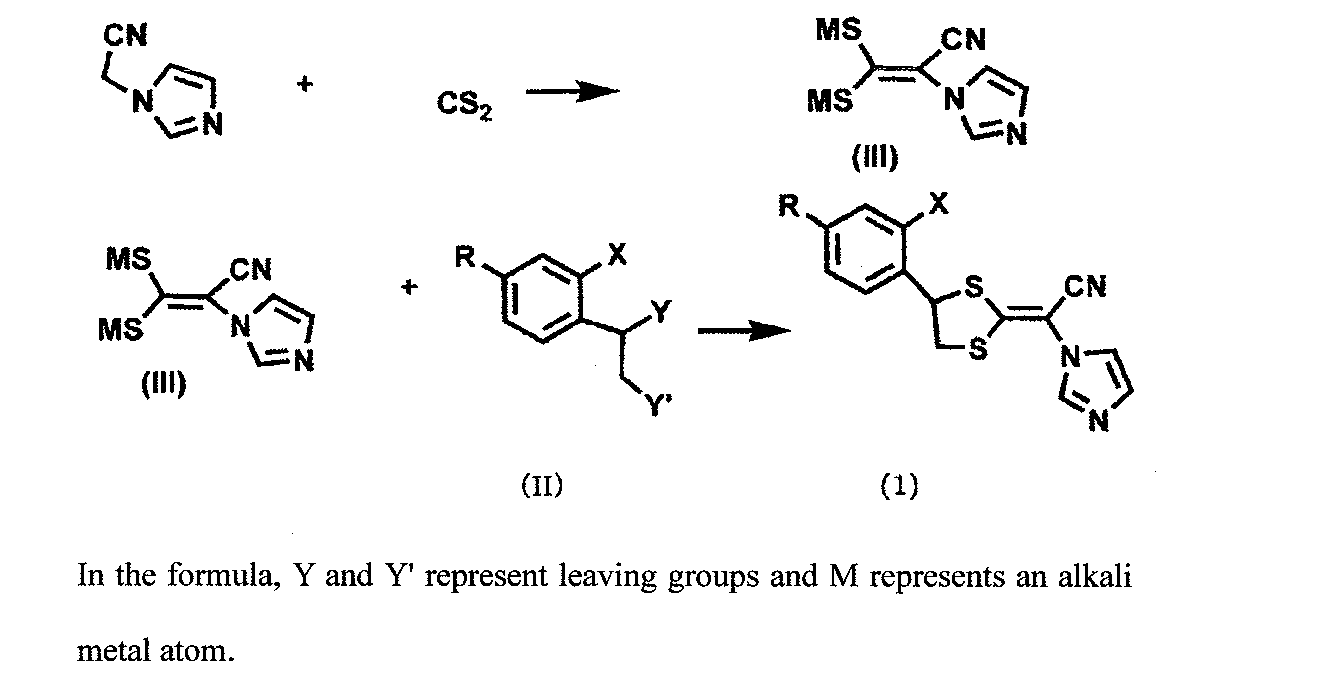
Luliconazole has excellent antiprotozoal activity against Tritrichomonas protozoa. Since luliconazole is insoluble in water, it is believed that luliconazole reaches the intestinal tract stably when administered orally (see Lulicon(registered trademark) Cream Pharmaceutical Product Interview Form 2006, revised edition, page 4). Furthermore, since luliconazole exhibits excellent antiprotozoal activity against Tritrichomonas protozoa not only in the form of a liquid but also in the form of a solid, when processed as a solid formulation and orally administered, luliconazole can reach the intestinal tract in an intact form and inhibit the growth of Tritrichomonas protozoa in the intestinal tract.
The form of the solid luliconazole is, in terms of its anti-Tritrichomonas effect, preferably in the form of powder having an average particle size of not more than 100 μm, more preferably in the form of powder having an average particle size of 70 μm to 100 μm, and even more preferably in the form of powder having an average particle size of 75 μm to 100 μm. The powder may be crystalline or amorphous.
The powder as described above can be obtained by, for example, grinding a luliconazole crystal. Examples of the grinding methods include, for example, a grinding machine equipped with an agate mortar, grinding with a medium mill such as a planetary ball mill or a dyno mill, and grinding by a jet mill. The resulting average particle size varies depending on the bulk to be used even under the same grinding conditions, and strict grinding conditions do not necessarily provide a fine average particle size. Thus, the average particle size cannot be replaced by grinding conditions. Therefore, it is desired that the average particle size is actually measured and then it is determined whether or not luliconazole having such average particle size is applied to an anti-Tritrichomonas agent. The average particle size of luliconazole can be obtained by measuring the number average particle size. The number average particle size can be measured as an average size of particles through analysis of an image from a microscope.
For example, the average particle size is measured according to the following procedure. First of all, as an inverted microscope, Diaphot inverted microscope (manufactured by Nikon Corporation) is used and the powder of luliconazole is observed. Some particles are then selected arbitrarily and measured for particle size. It is noted that 100 particles or more are measured.
Moreover, the average particle size of luliconazole can be also obtained as an average particle size of the accumulated volume as measured and obtained by a laser diffraction particle size distribution analyzer.
By employing such a mode as above, luliconazole which is an active ingredient of the present invention exhibits, in the form of a solid, not less than 80% of the growth inhibition rate against Tritrichomonas protozoa, in particular Tritrichomonas mobilensis. In other aspects, luliconazole of the present invention is luliconazole which shows the growth inhibition rate of not less than 80%, more preferably not less than 85%, even more preferably not less than 88% is. It is noted that the growth inhibition rate is calculated as follows: [(the number of viable cells of the control group - the number of viable cells of the sample group) / the number of viable cells of the control group] x 100. It is preferred that the anti-Tritrichomonas effect is determined 24 to 72 hours after the inoculation of 10, 000 cells of Tritrichomonas protozoa on 5 mL of liquid medium in which 5 mg of sample luliconazole is added. As the liquid medium, it is preferred to use Diamond's medium with 5% to 15% adult bovine serum added as desired.
The form of the solid luliconazole is, in terms of its anti-Tritrichomonas effect, preferably in the form of powder having an average particle size of not more than 100 μm, more preferably in the form of powder having an average particle size of 70 μm to 100 μm, and even more preferably in the form of powder having an average particle size of 75 μm to 100 μm. The powder may be crystalline or amorphous.
The powder as described above can be obtained by, for example, grinding a luliconazole crystal. Examples of the grinding methods include, for example, a grinding machine equipped with an agate mortar, grinding with a medium mill such as a planetary ball mill or a dyno mill, and grinding by a jet mill. The resulting average particle size varies depending on the bulk to be used even under the same grinding conditions, and strict grinding conditions do not necessarily provide a fine average particle size. Thus, the average particle size cannot be replaced by grinding conditions. Therefore, it is desired that the average particle size is actually measured and then it is determined whether or not luliconazole having such average particle size is applied to an anti-Tritrichomonas agent. The average particle size of luliconazole can be obtained by measuring the number average particle size. The number average particle size can be measured as an average size of particles through analysis of an image from a microscope.
For example, the average particle size is measured according to the following procedure. First of all, as an inverted microscope, Diaphot inverted microscope (manufactured by Nikon Corporation) is used and the powder of luliconazole is observed. Some particles are then selected arbitrarily and measured for particle size. It is noted that 100 particles or more are measured.
Moreover, the average particle size of luliconazole can be also obtained as an average particle size of the accumulated volume as measured and obtained by a laser diffraction particle size distribution analyzer.
By employing such a mode as above, luliconazole which is an active ingredient of the present invention exhibits, in the form of a solid, not less than 80% of the growth inhibition rate against Tritrichomonas protozoa, in particular Tritrichomonas mobilensis. In other aspects, luliconazole of the present invention is luliconazole which shows the growth inhibition rate of not less than 80%, more preferably not less than 85%, even more preferably not less than 88% is. It is noted that the growth inhibition rate is calculated as follows: [(the number of viable cells of the control group - the number of viable cells of the sample group) / the number of viable cells of the control group] x 100. It is preferred that the anti-Tritrichomonas effect is determined 24 to 72 hours after the inoculation of 10, 000 cells of Tritrichomonas protozoa on 5 mL of liquid medium in which 5 mg of sample luliconazole is added. As the liquid medium, it is preferred to use Diamond's medium with 5% to 15% adult bovine serum added as desired.
<2> Formulation of an anti-Tritrichomonas agent
The anti-Tritrichomonas agent of the present invention can be processed into a variety of formulations and can be of practical use. Suitable forms of the formulations include dosage forms in which luliconazole powder having an average particle size of not more than 100 μm, more preferably an average particle size 70 μm to 100 μm, even more preferably an average particle size 75 μm to 100 μm, is provided in the intestinal tract. Suitable examples of such dosage forms include, for example, solid formulations such as tablets and granules obtained by processing powder having an average particle size of not more than 100 μm, more preferably powder having an average particle size 70 μm to 100 μm, or even more preferably powder having an average particle size 75 μm to 100 μm along with an excipient or a disintegrant. In addition, the suitable examples also include solid formulations such as capsules obtained by filling luliconazole powder in a capsule.
Examples of the excipient suitably include, for example, lactose and croscarmellose; examples of the disintegrant suitably include, for example, starch and microcrystalline cellulose. A binding agent such as hydroxypropylcellulose (HPC) and hydroxypropylmethylcellulose (HPMC) or a lubricant such as magnesium stearate can be appropriately added. The content of the anti-Tritrichomonas agent in a formulation is preferably 10% to 90% by mass, and more preferably 20% to 80% by mass. These ingredients can be treated according to a conventional method and processed into a formulation such as a granule, tablet or capsule. The agent can be also coated with a coating agent as appropriate.
The anti-Tritrichomonas agent of the present invention is preferably administered orally because the agent targets Tritrichomonas protozoa in the intestinal tract. The dosage by oral administration varies depending on the symptoms and the like, but anti-Tritrichomonas agent of the present invention is preferably administered in an amount of approximately 100 mg to 10,000 mg per adult, at one time or several times dividedly. Thus, the oral administration of the formulation of the present invention allows the anti-Tritrichomonas agent of the present invention to reach the infection site in the intestinal tract and to exterminate the cause of diarrhea, or Tritrichomonas protozoa.
The anti-Tritrichomonas agent of the present invention can be processed into a variety of formulations and can be of practical use. Suitable forms of the formulations include dosage forms in which luliconazole powder having an average particle size of not more than 100 μm, more preferably an average particle size 70 μm to 100 μm, even more preferably an average particle size 75 μm to 100 μm, is provided in the intestinal tract. Suitable examples of such dosage forms include, for example, solid formulations such as tablets and granules obtained by processing powder having an average particle size of not more than 100 μm, more preferably powder having an average particle size 70 μm to 100 μm, or even more preferably powder having an average particle size 75 μm to 100 μm along with an excipient or a disintegrant. In addition, the suitable examples also include solid formulations such as capsules obtained by filling luliconazole powder in a capsule.
Examples of the excipient suitably include, for example, lactose and croscarmellose; examples of the disintegrant suitably include, for example, starch and microcrystalline cellulose. A binding agent such as hydroxypropylcellulose (HPC) and hydroxypropylmethylcellulose (HPMC) or a lubricant such as magnesium stearate can be appropriately added. The content of the anti-Tritrichomonas agent in a formulation is preferably 10% to 90% by mass, and more preferably 20% to 80% by mass. These ingredients can be treated according to a conventional method and processed into a formulation such as a granule, tablet or capsule. The agent can be also coated with a coating agent as appropriate.
The anti-Tritrichomonas agent of the present invention is preferably administered orally because the agent targets Tritrichomonas protozoa in the intestinal tract. The dosage by oral administration varies depending on the symptoms and the like, but anti-Tritrichomonas agent of the present invention is preferably administered in an amount of approximately 100 mg to 10,000 mg per adult, at one time or several times dividedly. Thus, the oral administration of the formulation of the present invention allows the anti-Tritrichomonas agent of the present invention to reach the infection site in the intestinal tract and to exterminate the cause of diarrhea, or Tritrichomonas protozoa.
The present invention will be further explained in detail below by way of examples; however, the present invention is not limited to these examples as long as they do not deviate the gist of the present invention.
<Example 1>
The activity of luliconazole against Tritrichomonas mobilensis of the genus Tritrichomonas (T. mobilensis: USA: M776 cl2) was studied. Luliconazole as synthesized according to the method disclosed in the above JP 60-218387 A was used as a sample. More specifically, Tritrichomonas protozoa were cultured on Diamond's medium with 10% adult bovine serum added. Luliconazole was dissolved in 100 μL of methanol to obtain solutions having a variety concentrations of luliconazole. The cultures were then inoculated on 5 mL of 10% adult bovine serum-added Diamond's media in which the solutions were added, cultured at 35 ℃ for 24 hours, and then measured for the number of viable Tritrichomonas protozoa by use of a Neubauer hemocytometer. MIC and IC50 were obtained from the number of viable protozoa. MIC was 50 μg/mL and IC50 was 10. 1 μg/mL. This result indicates that luliconazole exhibits an excellent antiprotozoal effect in a state of solution.
The activity of luliconazole against Tritrichomonas mobilensis of the genus Tritrichomonas (T. mobilensis: USA: M776 cl2) was studied. Luliconazole as synthesized according to the method disclosed in the above JP 60-218387 A was used as a sample. More specifically, Tritrichomonas protozoa were cultured on Diamond's medium with 10% adult bovine serum added. Luliconazole was dissolved in 100 μL of methanol to obtain solutions having a variety concentrations of luliconazole. The cultures were then inoculated on 5 mL of 10% adult bovine serum-added Diamond's media in which the solutions were added, cultured at 35 ℃ for 24 hours, and then measured for the number of viable Tritrichomonas protozoa by use of a Neubauer hemocytometer. MIC and IC50 were obtained from the number of viable protozoa. MIC was 50 μg/mL and IC50 was 10. 1 μg/mL. This result indicates that luliconazole exhibits an excellent antiprotozoal effect in a state of solution.
<Example 2>
Luliconazole was ground with a mortar to change the particle size, and the anti-Tritrichomonas activity of solid luliconazole was studied. More specifically, luliconazole having a variety of particle sizes was added in an amount of 5 mg to 5mL of Diamond's media supplemented with 10% adult bovine serum, and 10,000 cells of Tritrichomonas mobilensis were inoculated on the media, cultured at 35 ℃ for 24 hours, and then measured for the number of viable T. mobilensis cells by use of a Neubauer hemocytometer. Luliconazole was not added to the control group. The growth inhibition rate was calculated as follows: [(the number of viable cells of the control group - the number of viable cells of the sample group) / the number of viable cells of the control group] x 100. The results are shown in Table 1. The results indicate that, even in the form of a solid, luliconazole exhibits antiprotozoal activity and that a preferable particle size is not more than 100 μm. It is noted that the particle size was measured by a laser diffraction method (Microtrac MT3000, manufactured by NIKKISO CO., LTD; dispersion medium: water).
These results show that luliconazole exhibits, even in the form of a solid, excellent anti-protozoal effect on Tritrichomonas protozoa. Therefore, it is believed that luliconazole reaches stably the inside of the intestinal tract and thus, luliconazole displays effectively anti-Tritrichomonas effect even in the intestinal tract.
Luliconazole was ground with a mortar to change the particle size, and the anti-Tritrichomonas activity of solid luliconazole was studied. More specifically, luliconazole having a variety of particle sizes was added in an amount of 5 mg to 5mL of Diamond's media supplemented with 10% adult bovine serum, and 10,000 cells of Tritrichomonas mobilensis were inoculated on the media, cultured at 35 ℃ for 24 hours, and then measured for the number of viable T. mobilensis cells by use of a Neubauer hemocytometer. Luliconazole was not added to the control group. The growth inhibition rate was calculated as follows: [(the number of viable cells of the control group - the number of viable cells of the sample group) / the number of viable cells of the control group] x 100. The results are shown in Table 1. The results indicate that, even in the form of a solid, luliconazole exhibits antiprotozoal activity and that a preferable particle size is not more than 100 μm. It is noted that the particle size was measured by a laser diffraction method (Microtrac MT3000, manufactured by NIKKISO CO., LTD; dispersion medium: water).
These results show that luliconazole exhibits, even in the form of a solid, excellent anti-protozoal effect on Tritrichomonas protozoa. Therefore, it is believed that luliconazole reaches stably the inside of the intestinal tract and thus, luliconazole displays effectively anti-Tritrichomonas effect even in the intestinal tract.

<Example 3>
In order to confirm the influence of luliconazole which was eluted in the solutions in Example 2, 7 minute-ground luliconazole was added in an amount of 5 mg to Diamond's medium with 10% adult bovine serum added, and stored at 35 ℃ for 24 hours, and the supernatant was obtained from the Diamond's medium. Tritrichomonas mobilensis was inoculated on the supernatant, cultured at 35 ℃ for 24 hours and measured for the number of viable cells by use of a Neubauer hemocytometer. Luliconazole was not added to the control group. The result from the control group was 973,333 ± 23,094 while the result from the supernatant was 1,000,000 ± 144,222. It was obvious that the supernatant did not have anti-Tritrichomonas effect and that luliconazole worked in the form of a solid. In this regard as well, it is clear that luliconazole can control effectively Tritrichomonas protozoa in the intestinal tract.
In order to confirm the influence of luliconazole which was eluted in the solutions in Example 2, 7 minute-ground luliconazole was added in an amount of 5 mg to Diamond's medium with 10% adult bovine serum added, and stored at 35 ℃ for 24 hours, and the supernatant was obtained from the Diamond's medium. Tritrichomonas mobilensis was inoculated on the supernatant, cultured at 35 ℃ for 24 hours and measured for the number of viable cells by use of a Neubauer hemocytometer. Luliconazole was not added to the control group. The result from the control group was 973,333 ± 23,094 while the result from the supernatant was 1,000,000 ± 144,222. It was obvious that the supernatant did not have anti-Tritrichomonas effect and that luliconazole worked in the form of a solid. In this regard as well, it is clear that luliconazole can control effectively Tritrichomonas protozoa in the intestinal tract.
<Example 4>
A variety of ground luliconazole from Example 2 was used to prepare formulations. Specifically, a variety of ground luliconazole (5 minute-ground luliconazole, 6 minute-ground luliconazole, 7 minute-ground luliconazole, and 8 minute-ground luliconazole) was individually filled in a capsule of 100 mg and example formulations 1 to 4 were prepared.
A variety of ground luliconazole from Example 2 was used to prepare formulations. Specifically, a variety of ground luliconazole (5 minute-ground luliconazole, 6 minute-ground luliconazole, 7 minute-ground luliconazole, and 8 minute-ground luliconazole) was individually filled in a capsule of 100 mg and example formulations 1 to 4 were prepared.
The present invention can be applied in a pharmaceutical, veterinary drug and the like.
Claims (12)
- An anti-Tritrichomonas agent comprising luliconazole.
- The anti-Tritrichomonas agent according to claim 1, wherein Tritrichomonas protozoa are Tritrichomonas foetus or Tritrichomonas mobilensis.
- The anti-Tritrichomonas agent according to claim 1 or 2, wherein the agent is for intestinal trichomoniasis.
- The anti-Tritrichomonas agent according to any one of claims 1 to 3, wherein the luliconazole is present in the agent in the form of a solid.
- The anti-Tritrichomonas agent according to claim 4, wherein the luliconazole present in the agent has an average particle size of not more than 100 μm.
- The anti-Tritrichomonas agent according to claim 5, wherein the luliconazole present in the agent has an average particle size of from 70 μm to 100 μm.
- The anti-Tritrichomonas agent according to any one of claims 1 to 6, wherein the agent is for human or an animal.
- Luliconazole having an average particle size of not more than 100 μm.
- The luliconazole according to claim 8, wherein the average particle size is from 70 μm to 100 μm.
- Luliconazole having, in the form of a solid, a growth inhibition rate of not less than 80% against Tritrichomonas protozoa.
- Luliconazole according to any one of claims 8 to 10, which is for use as an anti-Tritrichomonas agent.
- Luliconazole according to claim 11, which is for use as an anti-Tritrichomonas agent for human or an animal.
Priority Applications (1)
| Application Number | Priority Date | Filing Date | Title |
|---|---|---|---|
| US16/090,129 US20190111026A1 (en) | 2016-03-31 | 2016-10-12 | Anti-tritrichomonas agent |
Applications Claiming Priority (2)
| Application Number | Priority Date | Filing Date | Title |
|---|---|---|---|
| JP2016070255A JP6085706B1 (en) | 2016-03-31 | 2016-03-31 | Anti-tritricomonas |
| JP2016-070255 | 2016-03-31 |
Publications (1)
| Publication Number | Publication Date |
|---|---|
| WO2017168476A1 true WO2017168476A1 (en) | 2017-10-05 |
Family
ID=56191284
Family Applications (1)
| Application Number | Title | Priority Date | Filing Date |
|---|---|---|---|
| PCT/JP2016/004550 Ceased WO2017168476A1 (en) | 2016-03-31 | 2016-10-12 | Anti-tritrichomonas agent |
Country Status (5)
| Country | Link |
|---|---|
| US (1) | US20190111026A1 (en) |
| JP (1) | JP6085706B1 (en) |
| KR (1) | KR20160067071A (en) |
| CN (1) | CN105902539A (en) |
| WO (1) | WO2017168476A1 (en) |
Families Citing this family (1)
| Publication number | Priority date | Publication date | Assignee | Title |
|---|---|---|---|---|
| JP6085706B1 (en) * | 2016-03-31 | 2017-02-22 | 株式会社ポーラファルマ | Anti-tritricomonas |
Citations (7)
| Publication number | Priority date | Publication date | Assignee | Title |
|---|---|---|---|---|
| JPS60218387A (en) | 1984-04-14 | 1985-11-01 | Nippon Nohyaku Co Ltd | Ketene s,s-acetal |
| WO2012147584A1 (en) * | 2011-04-27 | 2012-11-01 | マルホ株式会社 | Suspended lotion containing imidazole-type anti-fungal agent |
| WO2014115487A1 (en) * | 2013-01-28 | 2014-07-31 | Pola Pharma Inc. | Pharmaceutical composition for diseases caused by pathogenic microorganisms such as aspergillus |
| WO2014185542A1 (en) * | 2013-05-17 | 2014-11-20 | Pola Pharma Inc. | Pharmaceutical composition for treating vaginitis or pneumonia |
| WO2015033612A1 (en) * | 2013-09-06 | 2015-03-12 | Pola Pharma Inc. | Crystal having specific crystal habit and pharmaceutical composition containing the crystal as active ingredient |
| KR20160067071A (en) * | 2016-03-31 | 2016-06-13 | 가부시키가이샤 폴라 파마 | Anti-tritrichomonas agent |
| JP5951864B1 (en) * | 2015-06-05 | 2016-07-13 | 株式会社ポーラファルマ | Anti-giardia drugs |
Family Cites Families (5)
| Publication number | Priority date | Publication date | Assignee | Title |
|---|---|---|---|---|
| DE102008031283A1 (en) * | 2008-07-02 | 2010-01-07 | Bayer Schering Pharma Aktiengesellschaft | New possibility of combating diseases caused by trichomonadida |
| IN2015DN02376A (en) * | 2012-09-14 | 2015-09-04 | Pola Pharma Inc | |
| EP2948146A1 (en) * | 2013-01-28 | 2015-12-02 | Pola Pharma Inc. | Pharmaceutical composition for diseases caused by pathogenic microorganisms such as candida |
| JP5589110B1 (en) * | 2013-03-08 | 2014-09-10 | 株式会社ポーラファルマ | Crystal having crystal habit and pharmaceutical composition containing the crystal as an active ingredient |
| US20160058775A1 (en) * | 2013-04-12 | 2016-03-03 | Vyome Biosciences Pvt. Ltd. | Composition and formulation of antimicrobial agents, processes thereof and methods for treating microbial infections |
-
2016
- 2016-03-31 JP JP2016070255A patent/JP6085706B1/en active Active
- 2016-05-24 KR KR1020160063398A patent/KR20160067071A/en not_active Ceased
- 2016-05-30 CN CN201610367894.7A patent/CN105902539A/en active Pending
- 2016-10-12 US US16/090,129 patent/US20190111026A1/en not_active Abandoned
- 2016-10-12 WO PCT/JP2016/004550 patent/WO2017168476A1/en not_active Ceased
Patent Citations (9)
| Publication number | Priority date | Publication date | Assignee | Title |
|---|---|---|---|---|
| JPS60218387A (en) | 1984-04-14 | 1985-11-01 | Nippon Nohyaku Co Ltd | Ketene s,s-acetal |
| WO2012147584A1 (en) * | 2011-04-27 | 2012-11-01 | マルホ株式会社 | Suspended lotion containing imidazole-type anti-fungal agent |
| WO2014115487A1 (en) * | 2013-01-28 | 2014-07-31 | Pola Pharma Inc. | Pharmaceutical composition for diseases caused by pathogenic microorganisms such as aspergillus |
| JP2016504987A (en) | 2013-01-28 | 2016-02-18 | 株式会社ポーラファルマ | Pharmaceutical composition for diseases caused by pathogenic microorganisms such as Aspergillus |
| WO2014185542A1 (en) * | 2013-05-17 | 2014-11-20 | Pola Pharma Inc. | Pharmaceutical composition for treating vaginitis or pneumonia |
| WO2015033612A1 (en) * | 2013-09-06 | 2015-03-12 | Pola Pharma Inc. | Crystal having specific crystal habit and pharmaceutical composition containing the crystal as active ingredient |
| JP5951864B1 (en) * | 2015-06-05 | 2016-07-13 | 株式会社ポーラファルマ | Anti-giardia drugs |
| WO2016194024A1 (en) * | 2015-06-05 | 2016-12-08 | Pola Pharma Inc. | Antigiardial agent |
| KR20160067071A (en) * | 2016-03-31 | 2016-06-13 | 가부시키가이샤 폴라 파마 | Anti-tritrichomonas agent |
Non-Patent Citations (6)
| Title |
|---|
| CHAOQUN YAO ET AL: "Tritrichomonas foetus infection, a cause of chronic diarrhea in the domestic cat", VETERINARY RESEARCH, BIOMED CENTRAL LTD, LONDON, UK, vol. 46, no. 1, 19 March 2015 (2015-03-19), pages 35, XP021218673, ISSN: 1297-9716, DOI: 10.1186/S13567-015-0169-0 * |
| DOI, J., J. VET. MED. SCI., vol. 74, 2012, pages 413 - 417 |
| LULICON: "Cream Pharmaceutical Product Interview Form", 2006, pages: 4 |
| MIDLEJ V., VET. PARASITOL., vol. 182, pages 171 - 180 |
| SCHROEDER MS., AM FAM PHYSICIAN, vol. 71, 2005, pages 921 - 8 |
| SUZUKI J., J. VET. MED. SCI. |
Also Published As
| Publication number | Publication date |
|---|---|
| JP2017178873A (en) | 2017-10-05 |
| US20190111026A1 (en) | 2019-04-18 |
| JP6085706B1 (en) | 2017-02-22 |
| CN105902539A (en) | 2016-08-31 |
| KR20160067071A (en) | 2016-06-13 |
Similar Documents
| Publication | Publication Date | Title |
|---|---|---|
| US10214553B2 (en) | Solid state forms of sofosbuvir | |
| US20230190732A1 (en) | Pharmaceutical composition containing nitroxoline prodrug, and preparation method and application therefor | |
| EP3733666B1 (en) | Crystal form of valbenazine di-p-toluenesulfonate, preparation method thereof and use thereof | |
| US20210186994A1 (en) | Pharmaceutical formulations comprising 5-Chloro-N4-[2-(dimethylphosphoryl)phenyl]-N2-{2-methoxy-4-[4-(4-methylpiperazin-1-yl)piperidin-1-yl]phenyl}pyrimidine-2,4-diamine | |
| JP2020510027A5 (en) | ||
| WO2012140604A1 (en) | Stable formulations of pramipexole hydrochloride | |
| US20080113022A1 (en) | Pharmaceutical composition based on idazoxan, salts, hydrates or polymorphs thereof | |
| US10464915B2 (en) | Dapagliflozin crystal form and preparation method and use thereof | |
| WO2011101862A1 (en) | Stabilized fluconazole polymorph iii formulation | |
| KR20240152398A (en) | Therapeutic compounds, preparations and uses thereof | |
| WO2017168476A1 (en) | Anti-tritrichomonas agent | |
| WO2017125841A1 (en) | Pharmaceutical compositions of teriflunomide | |
| CN108440456B (en) | Co-crystal of orlistat and organic acid calcium and pharmaceutical composition containing co-crystal | |
| CN112741827B (en) | Vigabatrin solid preparation and preparation method thereof | |
| US11865215B2 (en) | Tablet compositions comprising abiraterone acetate | |
| EP3756653A1 (en) | Microparticulate varenicline citrate | |
| JP2017186299A (en) | Anti-tritrichomonas agent | |
| US20220267326A1 (en) | Crystalline form of valbenazine ditosylate, processes for preparation thereof and use thereof | |
| TWI920017B (en) | Compounds and methods for treating fungal infections | |
| KR20190090729A (en) | A Novel Tofacitinib Salt, Preparation Methods thereof and Pharmaceutical Compositions Comprising thereof | |
| TR2021009962A2 (en) | A COMPOSITION CONTAINING CANAGLIFLOSIN | |
| TW202404580A (en) | Plurality of granules | |
| TR202022612A2 (en) | PHARMACEUTICAL CAPSULE COMPOSITIONS OF ALOGLIPTINE | |
| CN1329379C (en) | Anti-anaerobe compounds | |
| US20180049989A1 (en) | Pharmaceutical composition of tizanidine and process for preparing the same |
Legal Events
| Date | Code | Title | Description |
|---|---|---|---|
| NENP | Non-entry into the national phase |
Ref country code: DE |
|
| 121 | Ep: the epo has been informed by wipo that ep was designated in this application |
Ref document number: 16788566 Country of ref document: EP Kind code of ref document: A1 |
|
| 122 | Ep: pct application non-entry in european phase |
Ref document number: 16788566 Country of ref document: EP Kind code of ref document: A1 |