WO2017154556A1 - Process for preparing phosphotartaric acid and salts thereof - Google Patents
Process for preparing phosphotartaric acid and salts thereof Download PDFInfo
- Publication number
- WO2017154556A1 WO2017154556A1 PCT/JP2017/006329 JP2017006329W WO2017154556A1 WO 2017154556 A1 WO2017154556 A1 WO 2017154556A1 JP 2017006329 W JP2017006329 W JP 2017006329W WO 2017154556 A1 WO2017154556 A1 WO 2017154556A1
- Authority
- WO
- WIPO (PCT)
- Prior art keywords
- acid
- salt
- water
- salts
- weight
- Prior art date
- Legal status (The legal status is an assumption and is not a legal conclusion. Google has not performed a legal analysis and makes no representation as to the accuracy of the status listed.)
- Ceased
Links
Images
Classifications
-
- C—CHEMISTRY; METALLURGY
- C07—ORGANIC CHEMISTRY
- C07F—ACYCLIC, CARBOCYCLIC OR HETEROCYCLIC COMPOUNDS CONTAINING ELEMENTS OTHER THAN CARBON, HYDROGEN, HALOGEN, OXYGEN, NITROGEN, SULFUR, SELENIUM OR TELLURIUM
- C07F9/00—Compounds containing elements of Groups 5 or 15 of the Periodic Table
- C07F9/02—Phosphorus compounds
- C07F9/06—Phosphorus compounds without P—C bonds
- C07F9/08—Esters of oxyacids of phosphorus
- C07F9/09—Esters of phosphoric acids
- C07F9/091—Esters of phosphoric acids with hydroxyalkyl compounds with further substituents on alkyl
-
- C—CHEMISTRY; METALLURGY
- C02—TREATMENT OF WATER, WASTE WATER, SEWAGE, OR SLUDGE
- C02F—TREATMENT OF WATER, WASTE WATER, SEWAGE, OR SLUDGE
- C02F5/00—Softening water; Preventing scale; Adding scale preventatives or scale removers to water, e.g. adding sequestering agents
- C02F5/08—Treatment of water with complexing chemicals or other solubilising agents for softening, scale prevention or scale removal, e.g. adding sequestering agents
- C02F5/10—Treatment of water with complexing chemicals or other solubilising agents for softening, scale prevention or scale removal, e.g. adding sequestering agents using organic substances
- C02F5/14—Treatment of water with complexing chemicals or other solubilising agents for softening, scale prevention or scale removal, e.g. adding sequestering agents using organic substances containing phosphorus
-
- C—CHEMISTRY; METALLURGY
- C23—COATING METALLIC MATERIAL; COATING MATERIAL WITH METALLIC MATERIAL; CHEMICAL SURFACE TREATMENT; DIFFUSION TREATMENT OF METALLIC MATERIAL; COATING BY VACUUM EVAPORATION, BY SPUTTERING, BY ION IMPLANTATION OR BY CHEMICAL VAPOUR DEPOSITION, IN GENERAL; INHIBITING CORROSION OF METALLIC MATERIAL OR INCRUSTATION IN GENERAL
- C23F—NON-MECHANICAL REMOVAL OF METALLIC MATERIAL FROM SURFACE; INHIBITING CORROSION OF METALLIC MATERIAL OR INCRUSTATION IN GENERAL; MULTI-STEP PROCESSES FOR SURFACE TREATMENT OF METALLIC MATERIAL INVOLVING AT LEAST ONE PROCESS PROVIDED FOR IN CLASS C23 AND AT LEAST ONE PROCESS COVERED BY SUBCLASS C21D OR C22F OR CLASS C25
- C23F11/00—Inhibiting corrosion of metallic material by applying inhibitors to the surface in danger of corrosion or adding them to the corrosive agent
- C23F11/08—Inhibiting corrosion of metallic material by applying inhibitors to the surface in danger of corrosion or adding them to the corrosive agent in other liquids
-
- C—CHEMISTRY; METALLURGY
- C23—COATING METALLIC MATERIAL; COATING MATERIAL WITH METALLIC MATERIAL; CHEMICAL SURFACE TREATMENT; DIFFUSION TREATMENT OF METALLIC MATERIAL; COATING BY VACUUM EVAPORATION, BY SPUTTERING, BY ION IMPLANTATION OR BY CHEMICAL VAPOUR DEPOSITION, IN GENERAL; INHIBITING CORROSION OF METALLIC MATERIAL OR INCRUSTATION IN GENERAL
- C23F—NON-MECHANICAL REMOVAL OF METALLIC MATERIAL FROM SURFACE; INHIBITING CORROSION OF METALLIC MATERIAL OR INCRUSTATION IN GENERAL; MULTI-STEP PROCESSES FOR SURFACE TREATMENT OF METALLIC MATERIAL INVOLVING AT LEAST ONE PROCESS PROVIDED FOR IN CLASS C23 AND AT LEAST ONE PROCESS COVERED BY SUBCLASS C21D OR C22F OR CLASS C25
- C23F11/00—Inhibiting corrosion of metallic material by applying inhibitors to the surface in danger of corrosion or adding them to the corrosive agent
- C23F11/08—Inhibiting corrosion of metallic material by applying inhibitors to the surface in danger of corrosion or adding them to the corrosive agent in other liquids
- C23F11/10—Inhibiting corrosion of metallic material by applying inhibitors to the surface in danger of corrosion or adding them to the corrosive agent in other liquids using organic inhibitors
- C23F11/167—Phosphorus-containing compounds
- C23F11/1673—Esters of phosphoric or thiophosphoric acids
-
- C—CHEMISTRY; METALLURGY
- C02—TREATMENT OF WATER, WASTE WATER, SEWAGE, OR SLUDGE
- C02F—TREATMENT OF WATER, WASTE WATER, SEWAGE, OR SLUDGE
- C02F2303/00—Specific treatment goals
- C02F2303/08—Corrosion inhibition
Definitions
- the present invention relates to a process for preparing phosphotartaric acid and salts thereof, to compositions obtainable by this process and to the use of such compositions for treating water in water-bearing systems, in particular as an additive for inhibition of formation of scale or inhibition of corrosion in water bearing systems.
- a frequent problem in water-bearing systems is the corrosion of internal surfaces of the building components or system parts of the water bearing system, which are in permanent contact with the water or steam.
- a further frequently occurring problem is the formation of scale on these internal surfaces.
- the causes of these problems originate largely from the composition of the water, in particular from pH, oxygen and solid components contained in the water. Accordingly, additives are used in water-bearing systems for inhibiting corrosion and scale formation.
- Oxygen binders such as hydrazine
- Oxygen binders are frequently used for inhibiting corrosion.
- Hydrazine for example, binds the oxygen present in the water or wet steam and is converted to nitrogen thereby inhibiting the corrosion of metal surfaces.
- the toxicity of hydrazine is a particular disadvantage.
- Further examples of corrosion inhibitors are long-chain aliphatic amines, for example octadecylamine or polyamines such as oleyldipropylenetriamine and other film-forming amines, phosphates, phosphonates and heavy metals, such as zinc, molybdates, tungstates and chromates.
- a disadvantage of further corrosion inhibitors known from the prior art is their mostly selective effect, i.e. the known corrosion inhibitors selectively show a good effect on corrosion only for one metal or type of alloy. Certain corrosion inhibitors, for example, act either on ferritic steels and alloys or on non-ferrous metals.
- Scaling is understood as an undesired deposition of solid materials, mostly salts such as water-insoluble oxides, hydroxides, carbonates, silicates, sulfates or phosphates, on surfaces of water-bearing systems, particularly on interfaces with heat transfer coefficients. These deposits and scales impair the function of water-bearing systems. In this case, this can lead in particular to the reduction of throughput in water-bearing systems caused by (in part) obstruction of pipelines, reduced heat/cooling transfer, local overheating of system parts and, hence, results in increased production stoppages due to required cleaning downtime.
- Water-bearing systems are predominantly operated in circuits due to cost, processing and/or energy considerations, which frequently leads to an accumulation of scale-forming components if no discharge of these components from the water-bearing system and/or regulation of the solubility equilibrium conditions in the water-bearing system takes place.
- concentration of these components in water-bearing systems may increase by evaporation processes, particularly at high process temperatures. If the concentration of the scale-forming elements rises above the saturation point, this will lead to precipitation of the scale forming elements, which may in turn form undesirable deposits.
- the sedimentation of undissolved solids, which are introduced into the water-bearing system by the water can lead to the formation of scale in the water-bearing system.
- a further example of fouling can be a settling out of bacterial plaques and/or algae which is also referred to as biological fouling. Both the elements which can cause encrustations and deposits and corrosion-triggering/corrosion-enhancing elements act as limiting factors for accumulation in water-bearing systems.
- Scale formation and corrosion in water-bearing systems is influenced by numerous parameters such as the oxygen concentration, electrolyte content, pH, temperature, flow rate of the medium, etc., in water-bearing systems.
- the carbonate hardness (deposit-forming) present in water-bearing systems and the chloride content present in water-bearing systems plays a role. While high carbonate hardness favours deposition of solids high chloride content causes or enhances corrosion.
- concentrations of, for example, magnesium and calcium ions are also often determined separately and then referred to as magnesium hardness or calcium hardness.
- Chemical water treatment methods for controlling carbonate and chloride content are known in the art. For example, carbonate and chloride contents can be reduced by means of ion exchangers or reverse osmosis. The formation of poorly-soluble precipitates of carbonate ions and polyvalent cations, such as magnesium or calcium ions, can also be suppressed by deposit-inhibiting compounds. In general, chemical fouling or scale inhibitors can reduce undesirable deposits in water-bearing systems, for example, by inhibition of the crystallization or else disrupting the deposition or consolidation stages of fouling processes.
- scale inhibitors in water-bearing systems are chelating agents, such as EDTA and classical scale inhibitors like organic phosphonic acids such as HEDP (1-hydroxy-ethane-(1,1-diphosphonic acid)) or polyelectrolytes such as polyacrylic acid, polymethacrylic acid or copolymers of acrylic acid and maleic acid having low molecular weights.
- organic phosphonic acids such as HEDP (1-hydroxy-ethane-(1,1-diphosphonic acid)
- polyelectrolytes such as polyacrylic acid, polymethacrylic acid or copolymers of acrylic acid and maleic acid having low molecular weights.
- Sulfates, phosphates, fluorides, oxalates and above all silicates may also be the cause of problems, depending on the technical design of the water-bearing systems.
- a disadvantage of the uses of corrosion inhibitors and scale inhibitors known from the prior art is that these additives can be used largely successfully either only for corrosion inhibition or only for scale inhibition in water-bearing systems.
- One exception here is the use of oligo- or polyphosphates and phosphonates, which, although acting as corrosion inhibitors and for preventing scale, have other disadvantages stated below. Oligophosphates and polyphosphates form calcium phosphate deposits after hydrolysis in hard water and many phosphonates are only poorly biologically degradable.
- WO2015/120871 describes the use of phosphotartaric acid (PTA) and its salts in water-bearing systems.
- PTA phosphotartaric acid
- the phosphotartaric acid used therein was prepared according to the method specification of Lynen and Bayer, Chemische Berichte 1952, 85, 905-912.
- PTA phosphotartaric acid
- the process comprises the reaction of epoxysuccinic acid or a salt thereof with an orthophosphoric acid source, the reaction being conducted in a mixture containing epoxysuccinic acid or a salt thereof, an orthophosphoric acid source and water as main constituents.
- the process provides good yields of phosphotartaric acid or salts thereof, based on starting material epoxysuccinate.
- the process primarily yields an aqueous composition containing a salt of phosphotartaric acid.
- the composition may also contain a salt of tartaric acid and/or a salt of orthophosphoric acid as by-products.
- phosphotartaric acid or a salt thereof can be isolated or purified by conventional means, such as ion-exchange and selective crystallization.
- orthophosphate may be selectively crystallized from the aqueous product mixture as a salt, in particular a sodium salt and removed by filtration.
- the final mixture also may contain minor amounts of salts of orthophosphoric acid and/or salts of tartaric acid, depending on the recipe and manufacturing process.
- the composition without further purification. Rather, such a composition may have beneficial effects with regard to the inhibition of scaling and/or corrosion. Apart from that, the use of such a composition for the above-mentioned purposes avoids tedious workup of the reaction mixture.
- the present invention also relates to an aqueous composition, which is obtainable by the process of the invention and the use of such an aqueous composition as a scale or corrosion inhibitor in water-bearing systems.
- phosphotartaric acid and the salts thereof obtained by the process of the present invention are effective and advantageous in corrosion inhibition combined with scale inhibition as described in WO 2015/120871. Moreover, phosphotartaric acid and the salts thereof, which are prepared according to the invention, show good biological degradability.
- toxic phosphorus compounds such as phosphorus oxychloride and the use of organic solvents can be completely dispensed with.
- compositions which contain PTA or salts thereof and which are obtained by the process of the invention, in combination with further scale- or corrosion-inhibiting constituents such as aliphatic di- and tricarboxylic acids, aliphatic mono- di- and/or polycarboxylic acids having at least one hydroxyl group, amino acids, salts and mixtures thereof, inorganic mono- and oligophosphates and water-soluble organic phosphonates, show the same synergistic effect, particularly in corrosion inhibition, as the phosphotartaric acid prepared according to the old literature method of Lynen and Bayer combined with the synergistic constituents mentioned above.
- scale- or corrosion-inhibiting constituents such as aliphatic di- and tricarboxylic acids, aliphatic mono- di- and/or polycarboxylic acids having at least one hydroxyl group, amino acids, salts and mixtures thereof, inorganic mono- and oligophosphates and water-soluble organic phosphonates
- composition according to the present invention comprising PTA and the salts thereof and tartaric acid and salts thereof and/or orthophosphoric acid and salts thereof is effective in corrosion and scale inhibition without further purification.
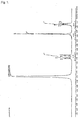
- Figure 1 shows the section between 4.0 ppm and 5.2 ppm of the 1 H-NMR spectrum (D 2 O, 300 MHz) of the reaction mixture obtained in Example 3.
- phosphotartaric acid is understood to mean a compound of the following formula A: where X is a hydrogen atom.
- Salts of phosphotartaric acid are those, wherein at least one of X, in particular at least two of X, are a metal atom, e.g. an alkalimetal atom, such as lithium sodium or potassium.
- X is preferably equal to hydrogen, sodium and/or potassium.
- Preferred products are those, where at least two X are an alkalimetal atom, especially sodium and/or potassium.
- orthophosphoric acid source means any phosphor(V) compound which under the reaction conditions is present or forms orthophosphate anions.
- halogen-containing orthophosphoric acid sources such as phosphoroxy halides, are preferably not used.
- the reaction is carried out in an aqueous reaction mixture, which initially contains epoxysuccinate, an orthophosphoric acid source and water as main constituents.
- the total amount of epoxysuccinate, orthophosphoric acid source and water is preferably at least 90 % by weight, based on the total weight of the reaction mixture.
- epoxysuccinate is meant to include epoxysuccinic acid and the salts thereof, in particular mono- and dialkali metal salts, such as epoxysuccinic acid monosodium salt, epoxysuccinic acid disodium salt, epoxysuccinic acid monopotassium salt and epoxysuccinic acid dipotassium salt and mixtures thereof.
- the epoxy succinate i.e. epoxysuccinic acid or a salt thereof, is preferably the cis-epoxysuccinate or a mixture of cis-epoxysuccinate and trans-epoxysuccinate, which predominately contains the cis-epoxysuccinate.
- epoxysuccinic acid or a salt thereof is used as a starting material, which mainly consists of cis-epoxysuccinate, more particular, where the cis/trans-ratio of the epoxysuccinate is at least 10:1.
- cis-epoxysuccinate is used as a starting material.
- orthophosphoric acid source and/or salt thereof means any phosphor(V) compound which under the reaction conditions is present as orthophosphate ions or forms orthophosphate ions in the aqueous reaction mixture.
- Halogen-containing phosphate sources are preferably not used.
- Suitable orthophosphoric acid sources are phosphoric acid (H 3 PO 4 ) and the salts of phosphoric acid (orthophosphates) in particular the alkali metal salts, such as monosodium orthophosphate, disodium orthophosphate, trisodium orthophosphate, monopotassium orthophosphate, dipotassium orthophosphate and tripotassium orthophosphate.
- orthophosphate sources are also possible, including phosphoric acid anhydrides and the salts thereof, such as metaphosphates or polyphosphates, in particular the alkalimetal salts of metaphosphate and polyphosphates, such as the sodium or potassium salts of metaphosphates or polyphosphates, for example, because metaphosphates and polyphosphates decompose via hydrolysis into phosphates (synonymous with orthophosphate).
- phosphorpentoxide may be used as an orthophosphate source.
- Preferred orthophosphate sources are phosphoric acid (H 3 PO 4 ) and in particular the salts of phosphoric acid (orthophosphates) especially the alkali metal salts of phosphoric acid.
- a preferred orthophosphoric acid source is an alkalimetal salt of phosphoric acid or a mixture of alkalimetals of phosphoric acids, where the overall composition of the orthoposphoric acid source can be described by the following formula OS where A represents an alkali metal ion, in particular sodium or potassium, and y is in the range from > 0 to 1, e.g. from 0.1 to 1, in particular in the range from 0.1 to 0.8 and especially in the range from 0.2 to 0.6.
- the overall composition described by formula OS can be achieved e.g. by mixing a triphosphate of formula A 3 PO 4 with phosphoric acid H 3 PO 4 or with a mono- or dialkalimetal phosphate AH 2 PO 4 or A 2 HPO 4 or by neutralizing H 3 PO 4 or a mono- or dialkalimetal phosphate AH 2 PO 4 or A 2 HPO 4 with an alkali metal hydroxide, e.g. with sodium or potassium hydroxide.
- A may be either Na or K or a combination of Na and K with arbitrary Na:K ratio.
- A is K or a combination of K and Na, wherein the molar ratio Na:K is preferably > 1.
- the reaction mixture has an initial pH of > pH 9.5, e.g. at least pH 9.6, in particular of at least pH 10, especially at least pH 11.
- the initial pH of the reaction mixture will generally not exceed pH 13.5, in particular pH 13 especially pH 12.5.
- the pH of reaction mixture is in the range from pH 9.6 to 13.5, in particular in the range from pH 10 to 13, in particular from pH 11 to 12.5.
- the pH of the initial reaction mixture is usually determined at 20°C, using a suitable pH measuring instrument, e.g. by using a pH-sensitive electrode.
- the pH of the reaction mixture may increase.
- the final pH will generally be higher than the initial pH and the final pH at the end of the reaction may be outside the range given above.
- the reaction is conducted in water, i.e. in an aqueous solution of the reactants.
- the reaction of epoxysuccinate with the orthophosphoric acid source is usually achieved by heating the reaction mixture.
- the reaction temperature will generally be at least 50°C, preferably at least 60°C, in particular at least 70°C and especially at least 80°C.
- the reaction temperature will generally not exceed 100°C or 95°C. However, it may also be possible to apply higher reaction temperatures in pressurized vessels.
- the orthophosphoric acid source and the epoxy succinate are preferably used in such amounts that the molar ratio of phosphor atoms in the orthophosphoric acid source to epoxysuccinate is in the range from 1:2 to 20:1, in particular from 1:2 to 5:1, more particularly from 1:1.5 to 3:1 and especially from 1:1.1 to 1.5:1.
- the reaction it is advantageous to carry out the reaction at high concentrations of the reactants, in particular at the highest possible concentration.
- High concentration means that the amount of water is low.
- the amount of water in the reaction mixture of the reaction of epoxysuccinate with the orthophosphoric acid source will not exceed 60% by weight, in particular 55% by weight, especially 50% by weight, based on the total weight of the reaction mixture.
- the concentration of water in the reaction mixture will be in the range from 10 to 60% by weight, preferably from 20 to 55% by weight and especially from 30 to 50% by weight, based on the total weight of the reaction mixture.
- High concentrations of the reactants can be achieved, for example, by providing dilute solutions of the reactants and removing water before or during the course of the reaction. It may also be possible to prepare epoxysuccinate in situ by epoxidation of maleic acid or fumaric acid, hereinafter also termed the first stage, at a high concentration or by processing the first stage such that some of the water is removed by distillation, or water is distilled off in the course of the reaction of the epoxysuccinate with the orthophosphoric acid source.
- the process also comprises the preparation of epoxysuccinic acid or the salt thereof, e.g. the sodium and/or potassium salt of epoxysuccinic acid, as an upstream stage, hereinafter also termed "first stage", followed by the reaction of the thus obtained epoxysuccinate in a subsequent (second) stage.
- the epoxysuccinate is preferably prepared by epoxidation of maleic acid or fumaric acid or salts thereof.
- the epoxysuccinate in particular the sodium or potassium salt of epoxysuccinic acid or a mixed sodium/potassium salt of epoxysuccinic acid with arbitrary Na/K-ratios can be prepared.
- Epoxidation can be simply achieved by reacting maleic acid or fumaric acid or a salt thereof with hydrogen peroxide, preferably in the presence of a transition metal compound, in particular a transition metal compound containing chromium, molybdenum or tungsten, where the transition metal is preferably in the oxidation state VI.
- the transition metal compound is a tungsten compound, in particular a tungsten compound, where tungsten is in the oxidation state VI. Examples include tungsten(VI)oxide, salts of tungstic acid, such as Na 2 WO 4 , including the hydrates thereof, or the corresponding ammonium salts of tungstic acid.
- the epoxidation can be performed by analogy to the methods described in K. A.
- the epoxidation is preferably performed in water.
- the epoxidation is performed in water with pH control, e.g. at pH in the range of pH 4 to 7, especially in the range of pH 5.5 to 6.
- pH control e.g. at pH in the range of pH 4 to 7, especially in the range of pH 5.5 to 6.
- pure potassium salts or mixed salts of sodium and potassium can also be prepared with any desired Na:K ratio. Preference is given to using an epoxidized maleic acid salt or fumaric acid salt (i.e.
- epoxysuccinic acid for preparing the phosphotartaric acid and their salts.
- maleic acid or a salt of maleic acid is epoxidized, which results in the cis-epoxysuccinic acid or the salt thereof.
- the salt of maleic acid can be prepared in situ by reacting maleic acid anhydride with water or an aqueous solution of an alkali metal hydroxide such as sodium or potassium hydroxide.
- tartaric acid or a salt of tartaric acid may be formed as a by-product.
- the reaction mixture may also contain orthophosphoric acid or a salt thereof.
- the reaction mixtures obtainable by the process of the invention may mainly consist of, except for water: a) one or more salts of phosphotartaric acid, and b) one or more salts of tartaric acid; or mainly consist of: a) one or more salts of phosphotartaric acid, b) one or more salts of tartaric acid, and c) one or more salts of orthophosphoric acid. or mainly consist of: a) one or more salts of phosphotartaric acid and b) one or more salts of orthophosphoric acid.
- composition contains at least 90% by weight, in particular at least 95% by weight or at least 98% by weight of component a) and at least one of components b) and/or c), based on the total weight of the composition, except for water.
- compositions may contain smaller amounts of one or more salts of maleic acid or fumaric acid as a component d).
- the amount of component d) will generally not exceed 10% by weight, in particular 5% by weight or 2% by weight, respectively.
- the reaction mixtures obtainable by the process of the invention may mainly consist of, except for water: a) 20 to 90% by weight, in particular 40 to 60% by weight, based on the total amount of components a), b) and c) one or more salts of phosphotartaric acid, b) if present, 5 to 60% by weight, in particular 20 to 30% by weight, based on the total amount of components a), b) and c) one or more salts of tartaric acid, and c) if present, 5 to 60% by weight, in particular 20 to 30% by weight, based on the total amount of components a), b) and c) one or more salts of orthophosphoric acid, d) 0 to 10% by weight, in particular 0 to 2% by weight, based on the total amount of components a), b) and c) one or more salts of maleic or fumaric acid.
- the total concentration of components a), b), c) and d) in the aqueous composition may be in the range from 5 to 85% by weight, in particular in the range from 40 to70% by weight, based on the total weight of the aqueous composition.
- isolation of phosphotartaric acid or their salts from the reaction mixture may be achieved by conventional methods, e.g. by a treatment of the reaction mixture with strongly acidic cation exchange resin and/or recrystallization.
- Figure 1 shows the section between 4.0 ppm and 5.2 ppm of the 1 H-NMR spectrum (D 2 O, 300 MHz) of the reaction mixture obtained in Example 3 (not shown in figure: maleate at ca. 5.95 ppm).
- the resulting solution was treated at 7°C with a 10% excess of a strongly acidic cation exchange resin Amberjet 1200 (Dow).
- the resin was removed and washed.
- the filtrate and water washings were combined and adjusted to pH 7 with 10% lithium hydroxide.
- the lithium salt mixture was concentrated to 235 g on a rotary evaporator at a bath temperature of at maximum 45°C, adjusted to a pH of 11.7 with 10% lithium hydroxide and left to crystallize overnight at 6°C.
- the precipitate was filtered off, and the filtrate was treated at 7°C with a ca. 20% excess of a strongly acidic cation exchange resin, Amberjet 1200.
- the resin was removed and washed.
- the free orthophosphate content is calculated from the difference of the phosphate used and the phosphotartrate content determined.
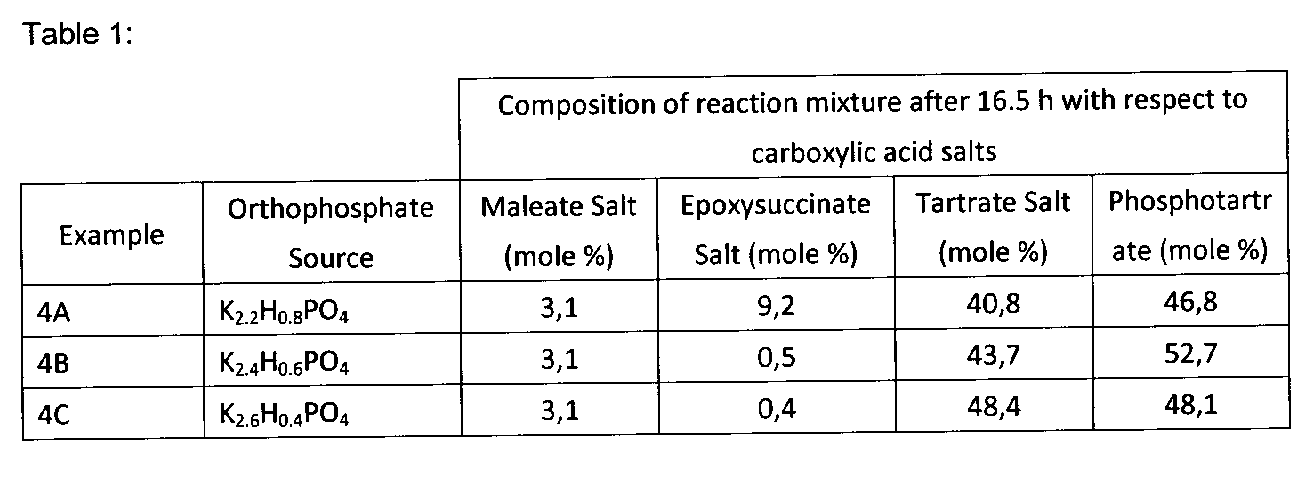
- Examples 4 A-C This set of experiments was conducted using different amounts of aqueous potassium hydroxide to adjust the alkalinity of the reaction mixture. From the amounts potassium hydroxide and dipotassium hydrogen phosphate added the overall composition of the orthophosphate source was calculated. The samples were analyzed with regard to their relative molar amount carboxylic acid salts present and yields were calculated therefrom. The results are summarized in table 1.
- Example 4B An aqueous solution (pH 7) of a mixed sodium/potassium salt of epoxysuccinic acid was prepared by the protocol of example 2. To 60 g of the thus obtained aqueous solution of epoxysuccinate 23.3 g of K 2 HPO 4 were added. By addition of 6.7 g of a 45% by weight aqueous solution of potassium hydroxide the pH was raised from 9.5 to 11.7. The mixture was heated to 92°C for 16.5 h to yield an aqueous solution which was then cooled to 22°C. This solution was freeze-dried and the solid residue was analyzed by 1 H-NMR with regard to the relative molar amounts of maleate salt, epoxysuccinate salt, tartrate salt and phosphotartrate salt. The results are summarized in table 1.
- Examples 4a and 4c were conducted by analogy to the procedure of example 4b, using different amounts of 45% by weight aqueous solution of potassium hydroxide.
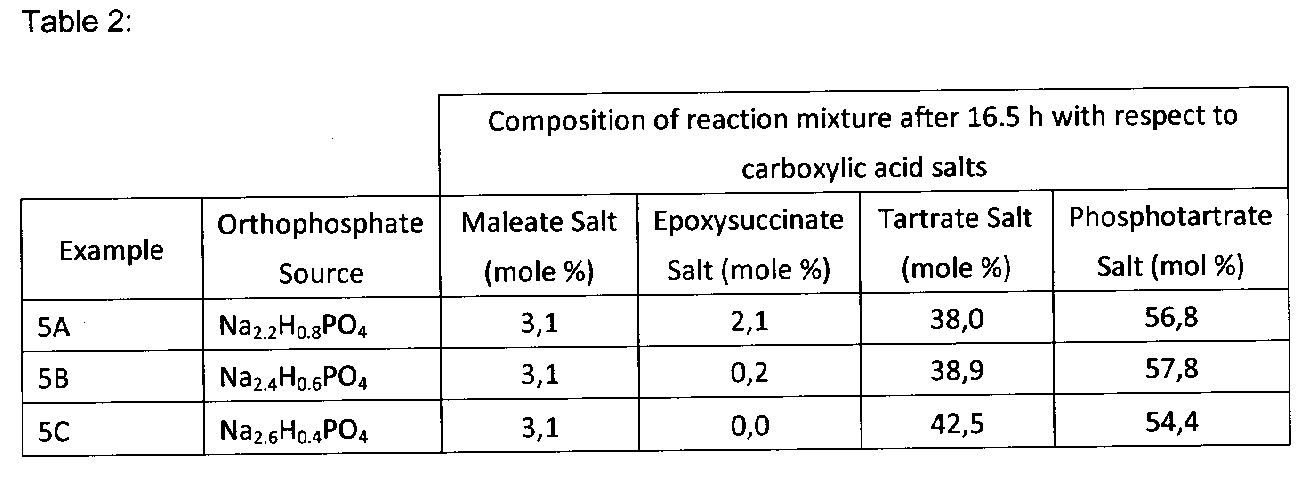
- Example 5 was conducted using disodium hydrogen phosphate and different amounts of aqueous caustic soda to adjust the initial alkalinity of the reaction mixture. From the amounts of caustic soda and disodium hydrogen phosphate added the overall composition of the orthophosphate source was calculated. The samples were analyzed with regard to their relative molar amount of carboxylic acid salts present and yields were calculated therefrom. The results are summarized in table 2.
- Example 5B An aqueous solution (pH 7) of a mixed sodium/potassium salt of epoxysuccinic acid was prepared by the protocol of example 2. To 75 g of the thus obtained aqueous solution of epoxysuccinate 23.6 g of Na 2 HPO 4 were added. By addition of 5.33 g of a 50% weight aqueous solution of caustic soda the pH was raised. The mixture was heated to 92°C for 16.5 h. Initially a thick paste formed, which could not be stirred any longer. When the reaction progressed, the viscosity of the reaction mixture decreased and a yellowish solution was obtained after 16.5 h and then cooled to 22°C. This solution was freeze-dried and the solid residue was analyzed by 1 H-NMR with regard to the relative molar amounts of maleate salt, epoxysuccinate salt, tartrate salt and phosphotartrate salt. The results are summarized in table 2.
- Examples 5a and 5c were conducted by analogy to the procedure of example 5b, using different amounts of 50% by weight aqueous solution of caustic soda.
Landscapes
- Chemical & Material Sciences (AREA)
- Organic Chemistry (AREA)
- Engineering & Computer Science (AREA)
- Metallurgy (AREA)
- Mechanical Engineering (AREA)
- Life Sciences & Earth Sciences (AREA)
- Materials Engineering (AREA)
- Hydrology & Water Resources (AREA)
- Water Supply & Treatment (AREA)
- Environmental & Geological Engineering (AREA)
- General Chemical & Material Sciences (AREA)
- Chemical Kinetics & Catalysis (AREA)
- Health & Medical Sciences (AREA)
- Biochemistry (AREA)
- General Health & Medical Sciences (AREA)
- Molecular Biology (AREA)
Abstract
The present invention relates to a process for preparing phosphotartaric acid and salts thereof, wherein a reaction mixture containing epoxysuccinic acid or a salt thereof, an orthophosphoric acid source and water as main constituents is reacted, to compositions obtainable by this process and to the use of such compositions for treating water in water-bearing systems, in particular as an additive for inhibition of formation of scale or inhibition of corrosion in water bearing systems.
Description
The present invention relates to a process for preparing phosphotartaric acid and salts thereof, to compositions obtainable by this process and to the use of such compositions for treating water in water-bearing systems, in particular as an additive for inhibition of formation of scale or inhibition of corrosion in water bearing systems.
The use of additives for water treatment in water-bearing systems is known from the prior art - see e.g. in Colin Frayne: Cooling Water Treatment, Chemical Publishing Co., New York 1999; Marie J. Alton: Chemical Treatment for cooling water, The Fairmont Press, Lilburn 1998; H.-D. Held, H., G. Schnell (editor): Kuhlwasser [Cooling water], Vulkan-Verlag, Essen 1994; G. Schmitt (ed.): Korrosion in Kuhlkreislaufen [Corrosion in cooling circuits], Verlag Irene Kuron, Bonn 1990; H.,G. Schnell, W.-D. Schnell: Kuhlwasser [Cooling water], Vulkan-Verlag, Essen 2012.
A frequent problem in water-bearing systems is the corrosion of internal surfaces of the building components or system parts of the water bearing system, which are in permanent contact with the water or steam. A further frequently occurring problem is the formation of scale on these internal surfaces. The causes of these problems originate largely from the composition of the water, in particular from pH, oxygen and solid components contained in the water. Accordingly, additives are used in water-bearing systems for inhibiting corrosion and scale formation.
Oxygen binders, such as hydrazine, are frequently used for inhibiting corrosion. Hydrazine, for example, binds the oxygen present in the water or wet steam and is converted to nitrogen thereby inhibiting the corrosion of metal surfaces. The toxicity of hydrazine, however, is a particular disadvantage. Further examples of corrosion inhibitors are long-chain aliphatic amines, for example octadecylamine or polyamines such as oleyldipropylenetriamine and other film-forming amines, phosphates, phosphonates and heavy metals, such as zinc, molybdates, tungstates and chromates. A disadvantage of further corrosion inhibitors known from the prior art is their mostly selective effect, i.e. the known corrosion inhibitors selectively show a good effect on corrosion only for one metal or type of alloy. Certain corrosion inhibitors, for example, act either on ferritic steels and alloys or on non-ferrous metals.
Another problem in water-bearing systems is formation of scale, also termed scaling, scale-up, incrustation or fouling. Scaling is understood as an undesired deposition of solid materials, mostly salts such as water-insoluble oxides, hydroxides, carbonates, silicates, sulfates or phosphates, on surfaces of water-bearing systems, particularly on interfaces with heat transfer coefficients. These deposits and scales impair the function of water-bearing systems. In this case, this can lead in particular to the reduction of throughput in water-bearing systems caused by (in part) obstruction of pipelines, reduced heat/cooling transfer, local overheating of system parts and, hence, results in increased production stoppages due to required cleaning downtime.
Water-bearing systems are predominantly operated in circuits due to cost, processing and/or energy considerations, which frequently leads to an accumulation of scale-forming components if no discharge of these components from the water-bearing system and/or regulation of the solubility equilibrium conditions in the water-bearing system takes place. In addition, the concentration of these components in water-bearing systems may increase by evaporation processes, particularly at high process temperatures. If the concentration of the scale-forming elements rises above the saturation point, this will lead to precipitation of the scale forming elements, which may in turn form undesirable deposits. Moreover, the sedimentation of undissolved solids, which are introduced into the water-bearing system by the water, can lead to the formation of scale in the water-bearing system. A further example of fouling can be a settling out of bacterial plaques and/or algae which is also referred to as biological fouling. Both the elements which can cause encrustations and deposits and corrosion-triggering/corrosion-enhancing elements act as limiting factors for accumulation in water-bearing systems.
Scale formation and corrosion in water-bearing systems is influenced by numerous parameters such as the oxygen concentration, electrolyte content, pH, temperature, flow rate of the medium, etc., in water-bearing systems.
In this context, the carbonate hardness (deposit-forming) present in water-bearing systems and the chloride content present in water-bearing systems plays a role. While high carbonate hardness favours deposition of solids high chloride content causes or enhances corrosion. The concentrations of, for example, magnesium and calcium ions are also often determined separately and then referred to as magnesium hardness or calcium hardness.
Chemical water treatment methods for controlling carbonate and chloride content are known in the art. For example, carbonate and chloride contents can be reduced by means of ion exchangers or reverse osmosis. The formation of poorly-soluble precipitates of carbonate ions and polyvalent cations, such as magnesium or calcium ions, can also be suppressed by deposit-inhibiting compounds. In general, chemical fouling or scale inhibitors can reduce undesirable deposits in water-bearing systems, for example, by inhibition of the crystallization or else disrupting the deposition or consolidation stages of fouling processes.
Examples of scale inhibitors in water-bearing systems are chelating agents, such as EDTA and classical scale inhibitors like organic phosphonic acids such as HEDP (1-hydroxy-ethane-(1,1-diphosphonic acid)) or polyelectrolytes such as polyacrylic acid, polymethacrylic acid or copolymers of acrylic acid and maleic acid having low molecular weights. Once carbonate and chloride contents in water-bearing systems are under control, other ingredients of the water often come into focus for chemical treatment of water-bearing systems, which can only be insufficiently controlled by the known compounds. Sulfates, phosphates, fluorides, oxalates and above all silicates may also be the cause of problems, depending on the technical design of the water-bearing systems.
A disadvantage of the uses of corrosion inhibitors and scale inhibitors known from the prior art is that these additives can be used largely successfully either only for corrosion inhibition or only for scale inhibition in water-bearing systems. One exception here is the use of oligo- or polyphosphates and phosphonates, which, although acting as corrosion inhibitors and for preventing scale, have other disadvantages stated below. Oligophosphates and polyphosphates form calcium phosphate deposits after hydrolysis in hard water and many phosphonates are only poorly biologically degradable.
WO2015/120871 describes the use of phosphotartaric acid (PTA) and its salts in water-bearing systems. The phosphotartaric acid used therein was prepared according to the method specification of Lynen and Bayer, Chemische Berichte 1952, 85, 905-912.
A method for preparing phosphotartaric acid (PTA) was described by C. Neuberg, W. Schuchardt in Enzymologia Volume 1 1936, pp. 39 - 47. This method is based on the reaction of phosphorus (oxy)halides, such as POCl3 with tartaric acid in aqueous media. Unfortunately this method is laborious, involves the use of corrosive phosphorus (oxy)halides and the yields of PTA are only low. Separation of PTA from non-reacted tartaric acid and polyphosphoric acid is hardly possible. Therefore, the process is uneconomic and not useful for preparing industrially relevant amounts of PTA
F. Lynen, H. Bayer (Chemische Berichte 1952, 85, 905 - 912) describe the synthesis of phosphotartaric acid according to a similar concept using dimethyl tartrate as starting material, which is reacted with phosphorus oxychloride followed by saponification of the obtained dimethyl ester.
C. Neuberg, W. Schuchardt in Enzymologia Volume 1 1936, pp. 39 - 47
F. Lynen, H. Bayer (Chemische Berichte 1952, 85, 905 - 912)
There is an urgent requirement to provide a process for preparing phosphotartaric acid, herein after PTA, or its salts, which does not require corrosive reagents, such as phosphorus (oxy)halides, and organic solvents, such as pyridine. Moreover, the process should provide phosphotartaric acid or its salts in a good yield and allow for the preparation of PTA or its salts on an economically acceptable industrial scale.
It has now been found, surprisingly, that this object is achieved by process for preparing phosphotartaric acid and/or salts thereof as described herein and in the claims. The process comprises the reaction of epoxysuccinic acid or a salt thereof with an orthophosphoric acid source, the reaction being conducted in a mixture containing epoxysuccinic acid or a salt thereof, an orthophosphoric acid source and water as main constituents.
The process provides good yields of phosphotartaric acid or salts thereof, based on starting material epoxysuccinate. The process primarily yields an aqueous composition containing a salt of phosphotartaric acid. The composition may also contain a salt of tartaric acid and/or a salt of orthophosphoric acid as by-products. From the thus obtained composition, phosphotartaric acid or a salt thereof can be isolated or purified by conventional means, such as ion-exchange and selective crystallization. For example, orthophosphate may be selectively crystallized from the aqueous product mixture as a salt, in particular a sodium salt and removed by filtration. The final mixture also may contain minor amounts of salts of orthophosphoric acid and/or salts of tartaric acid, depending on the recipe and manufacturing process. However, it is also possible to use the composition without further purification. Rather, such a composition may have beneficial effects with regard to the inhibition of scaling and/or corrosion. Apart from that, the use of such a composition for the above-mentioned purposes avoids tedious workup of the reaction mixture.
Therefore, the present invention also relates to an aqueous composition, which is obtainable by the process of the invention and the use of such an aqueous composition as a scale or corrosion inhibitor in water-bearing systems.
The phosphotartaric acid and the salts thereof obtained by the process of the present invention are effective and advantageous in corrosion inhibition combined with scale inhibition as described in WO 2015/120871. Moreover, phosphotartaric acid and the salts thereof, which are prepared according to the invention, show good biological degradability. In addition, in the process according to the invention, toxic phosphorus compounds such as phosphorus oxychloride and the use of organic solvents can be completely dispensed with.
Furthermore, the compositions which contain PTA or salts thereof and which are obtained by the process of the invention, in combination with further scale- or corrosion-inhibiting constituents, such as aliphatic di- and tricarboxylic acids, aliphatic mono- di- and/or polycarboxylic acids having at least one hydroxyl group, amino acids, salts and mixtures thereof, inorganic mono- and oligophosphates and water-soluble organic phosphonates, show the same synergistic effect, particularly in corrosion inhibition, as the phosphotartaric acid prepared according to the old literature method of Lynen and Bayer combined with the synergistic constituents mentioned above.
Moreover the composition according to the present invention, comprising PTA and the salts thereof and tartaric acid and salts thereof and/or orthophosphoric acid and salts thereof is effective in corrosion and scale inhibition without further purification.
Here and in the following, phosphotartaric acid is understood to mean a compound of the following formula A:
 where X is a hydrogen atom. Salts of phosphotartaric acid (phosphotartrates) are those, wherein at least one of X, in particular at least two of X, are a metal atom, e.g. an alkalimetal atom, such as lithium sodium or potassium. In formula A, X is preferably equal to hydrogen, sodium and/or potassium. Of course, X in formula A can be identical or different. Preferred products are those, where at least two X are an alkalimetal atom, especially sodium and/or potassium.
The term orthophosphoric acid source, as used herein, means any phosphor(V) compound which under the reaction conditions is present or forms orthophosphate anions. Halogen-containing orthophosphoric acid sources, such as phosphoroxy halides, are preferably not used.
According to the invention, the reaction is carried out in an aqueous reaction mixture, which initially contains epoxysuccinate, an orthophosphoric acid source and water as main constituents. The total amount of epoxysuccinate, orthophosphoric acid source and water is preferably at least 90 % by weight, based on the total weight of the reaction mixture.
Here and in the following, the term epoxysuccinate is meant to include epoxysuccinic acid and the salts thereof, in particular mono- and dialkali metal salts, such as epoxysuccinic acid monosodium salt, epoxysuccinic acid disodium salt, epoxysuccinic acid monopotassium salt and epoxysuccinic acid dipotassium salt and mixtures thereof. In the process of the invention, the epoxy succinate, i.e. epoxysuccinic acid or a salt thereof, is preferably the cis-epoxysuccinate or a mixture of cis-epoxysuccinate and trans-epoxysuccinate, which predominately contains the cis-epoxysuccinate. In particular epoxysuccinic acid or a salt thereof is used as a starting material, which mainly consists of cis-epoxysuccinate, more particular, where the cis/trans-ratio of the epoxysuccinate is at least 10:1. Especially, cis-epoxysuccinate is used as a starting material.
The term orthophosphoric acid source and/or salt thereof means any phosphor(V) compound which under the reaction conditions is present as orthophosphate ions or forms orthophosphate ions in the aqueous reaction mixture. Halogen-containing phosphate sources are preferably not used.
Suitable orthophosphoric acid sources are phosphoric acid (H3PO4) and the salts of phosphoric acid (orthophosphates) in particular the alkali metal salts, such as monosodium orthophosphate, disodium orthophosphate, trisodium orthophosphate, monopotassium orthophosphate, dipotassium orthophosphate and tripotassium orthophosphate.
Other orthophosphate sources are also possible, including phosphoric acid anhydrides and the salts thereof, such as metaphosphates or polyphosphates, in particular the alkalimetal salts of metaphosphate and polyphosphates, such as the sodium or potassium salts of metaphosphates or polyphosphates, for example, because metaphosphates and polyphosphates decompose via hydrolysis into phosphates (synonymous with orthophosphate). Furthermore, phosphorpentoxide may be used as an orthophosphate source. Preferred orthophosphate sources are phosphoric acid (H3PO4) and in particular the salts of phosphoric acid (orthophosphates) especially the alkali metal salts of phosphoric acid.
A preferred orthophosphoric acid source is an alkalimetal salt of phosphoric acid or a mixture of alkalimetals of phosphoric acids, where the overall composition of the orthoposphoric acid source can be described by the following formula OS
 where A represents an alkali metal ion, in particular sodium or potassium, and y is in the range from > 0 to 1, e.g. from 0.1 to 1, in particular in the range from 0.1 to 0.8 and especially in the range from 0.2 to 0.6.
The overall composition described by formula OS can be achieved e.g. by mixing a triphosphate of formula A3PO4 with phosphoric acid H3PO4 or with a mono- or dialkalimetal phosphate AH2PO4 or A2HPO4 or by neutralizing H3PO4 or a mono- or dialkalimetal phosphate AH2PO4 or A2HPO4 with an alkali metal hydroxide, e.g. with sodium or potassium hydroxide. It is apparent that y will affect the initial pH, i.e. the greater y is the higher the initial pH will be. In formula OS, A may be either Na or K or a combination of Na and K with arbitrary Na:K ratio. Particularly preferred, A is K or a combination of K and Na, wherein the molar ratio Na:K is preferably > 1.
Preferably, the reaction mixture has an initial pH of > pH 9.5, e.g. at least pH 9.6, in particular of at least pH 10, especially at least pH 11. The initial pH of the reaction mixture will generally not exceed pH 13.5, in particular pH 13 especially pH 12.5. In particular, the pH of reaction mixture is in the range from pH 9.6 to 13.5, in particular in the range from pH 10 to 13, in particular from pH 11 to 12.5. The pH of the initial reaction mixture is usually determined at 20°C, using a suitable pH measuring instrument, e.g. by using a pH-sensitive electrode.
During the reaction the pH of the reaction mixture may increase. The final pH will generally be higher than the initial pH and the final pH at the end of the reaction may be outside the range given above.
The reaction is conducted in water, i.e. in an aqueous solution of the reactants. The reaction of epoxysuccinate with the orthophosphoric acid source is usually achieved by heating the reaction mixture. The reaction temperature will generally be at least 50°C, preferably at least 60°C, in particular at least 70°C and especially at least 80°C. The reaction temperature will generally not exceed 100°C or 95°C. However, it may also be possible to apply higher reaction temperatures in pressurized vessels.
In the process of the invention, the orthophosphoric acid source and the epoxy succinate are preferably used in such amounts that the molar ratio of phosphor atoms in the orthophosphoric acid source to epoxysuccinate is in the range from 1:2 to 20:1, in particular from 1:2 to 5:1, more particularly from 1:1.5 to 3:1 and especially from 1:1.1 to 1.5:1.
To increase the yield of phosphotartaric acid and their salts and to reduce the formation of tartaric acid and their salts, it is advantageous to carry out the reaction at high concentrations of the reactants, in particular at the highest possible concentration. High concentration means that the amount of water is low. In particular the amount of water in the reaction mixture of the reaction of epoxysuccinate with the orthophosphoric acid source will not exceed 60% by weight, in particular 55% by weight, especially 50% by weight, based on the total weight of the reaction mixture. In particular the concentration of water in the reaction mixture will be in the range from 10 to 60% by weight, preferably from 20 to 55% by weight and especially from 30 to 50% by weight, based on the total weight of the reaction mixture. High concentrations of the reactants can be achieved, for example, by providing dilute solutions of the reactants and removing water before or during the course of the reaction. It may also be possible to prepare epoxysuccinate in situ by epoxidation of maleic acid or fumaric acid, hereinafter also termed the first stage, at a high concentration or by processing the first stage such that some of the water is removed by distillation, or water is distilled off in the course of the reaction of the epoxysuccinate with the orthophosphoric acid source.
In a preferred embodiment of the process according to the invention, the process also comprises the preparation of epoxysuccinic acid or the salt thereof, e.g. the sodium and/or potassium salt of epoxysuccinic acid, as an upstream stage, hereinafter also termed "first stage", followed by the reaction of the thus obtained epoxysuccinate in a subsequent (second) stage. In the first stage, the epoxysuccinate is preferably prepared by epoxidation of maleic acid or fumaric acid or salts thereof. Preferably, the epoxysuccinate, in particular the sodium or potassium salt of epoxysuccinic acid or a mixed sodium/potassium salt of epoxysuccinic acid with arbitrary Na/K-ratios can be prepared. There is no need to isolate the epoxysuccinate from the reaction mixture obtained in the epoxidation reaction. Rather, it is preferred to directly subject the thus obtained epoxysuccinate to the reaction with the orthophosphoric acid source by the process described herein without prior isolation of the epoxysuccinate. In particular, the reaction of the epoxysuccinate and the orthophosphoric acid source is performed in the reaction mixture obtained from the preparation of epoxysuccinic acid.
Epoxidation can be simply achieved by reacting maleic acid or fumaric acid or a salt thereof with hydrogen peroxide, preferably in the presence of a transition metal compound, in particular a transition metal compound containing chromium, molybdenum or tungsten, where the transition metal is preferably in the oxidation state VI. In a particular preferred embodiment, the transition metal compound is a tungsten compound, in particular a tungsten compound, where tungsten is in the oxidation state VI. Examples include tungsten(VI)oxide, salts of tungstic acid, such as Na2WO4, including the hydrates thereof, or the corresponding ammonium salts of tungstic acid. The epoxidation can be performed by analogy to the methods described in K. A. Jorgensen, Chem. Rev. 1989, 89, pp 431 - 458, and in the references cited therein, or in particular in analogy to the method of Payne and Williams, which is described in the Journal of Organic Chemistry 1959, 24, 54 - 55. The epoxidation is preferably performed in water. In particular, the epoxidation is performed in water with pH control, e.g. at pH in the range of pH 4 to 7, especially in the range of pH 5.5 to 6. Preferably, In addition to pure sodium salts, in a deviation from the method cited, pure potassium salts or mixed salts of sodium and potassium can also be prepared with any desired Na:K ratio. Preference is given to using an epoxidized maleic acid salt or fumaric acid salt (i.e. epoxysuccinic acid) for preparing the phosphotartaric acid and their salts. In particular, maleic acid or a salt of maleic acid is epoxidized, which results in the cis-epoxysuccinic acid or the salt thereof. The salt of maleic acid can be prepared in situ by reacting maleic acid anhydride with water or an aqueous solution of an alkali metal hydroxide such as sodium or potassium hydroxide.
As pointed out above, tartaric acid or a salt of tartaric acid may be formed as a by-product. Depending on the amount of orthophosphoric acid source, the reaction mixture may also contain orthophosphoric acid or a salt thereof. Although it is possible to isolate phosphotartaric acid or their salts from the reaction mixture, for most purposes, this will not be necessary. In particular for use in water conducting systems it may be useful to apply the reaction mixture without isolation of phosphotartaric acid or their salts. The reaction mixtures obtainable by the process of the invention may mainly consist of, except for water:
a) one or more salts of phosphotartaric acid, and
b) one or more salts of tartaric acid;
or mainly consist of:
a) one or more salts of phosphotartaric acid,
b) one or more salts of tartaric acid, and
c) one or more salts of orthophosphoric acid.
or mainly consist of:
a) one or more salts of phosphotartaric acid and
b) one or more salts of orthophosphoric acid.
a) one or more salts of phosphotartaric acid, and
b) one or more salts of tartaric acid;
or mainly consist of:
a) one or more salts of phosphotartaric acid,
b) one or more salts of tartaric acid, and
c) one or more salts of orthophosphoric acid.
or mainly consist of:
a) one or more salts of phosphotartaric acid and
b) one or more salts of orthophosphoric acid.
In this context, "mainly consists", means that the composition contains at least 90% by weight, in particular at least 95% by weight or at least 98% by weight of component a) and at least one of components b) and/or c), based on the total weight of the composition, except for water.
The compositions may contain smaller amounts of one or more salts of maleic acid or fumaric acid as a component d). The amount of component d) will generally not exceed 10% by weight, in particular 5% by weight or 2% by weight, respectively.
Based on the reaction conditions, the reaction mixtures obtainable by the process of the invention may mainly consist of, except for water:
a) 20 to 90% by weight, in particular 40 to 60% by weight, based on the total amount of components a), b) and c) one or more salts of phosphotartaric acid,
b) if present, 5 to 60% by weight, in particular 20 to 30% by weight, based on the total amount of components a), b) and c) one or more salts of tartaric acid, and
c) if present, 5 to 60% by weight, in particular 20 to 30% by weight, based on the total amount of components a), b) and c) one or more salts of orthophosphoric acid,
d) 0 to 10% by weight, in particular 0 to 2% by weight, based on the total amount of components a), b) and c) one or more salts of maleic or fumaric acid.
a) 20 to 90% by weight, in particular 40 to 60% by weight, based on the total amount of components a), b) and c) one or more salts of phosphotartaric acid,
b) if present, 5 to 60% by weight, in particular 20 to 30% by weight, based on the total amount of components a), b) and c) one or more salts of tartaric acid, and
c) if present, 5 to 60% by weight, in particular 20 to 30% by weight, based on the total amount of components a), b) and c) one or more salts of orthophosphoric acid,
d) 0 to 10% by weight, in particular 0 to 2% by weight, based on the total amount of components a), b) and c) one or more salts of maleic or fumaric acid.
The total concentration of components a), b), c) and d) in the aqueous composition may be in the range from 5 to 85% by weight, in particular in the range from 40 to70% by weight, based on the total weight of the aqueous composition.
If desired, isolation of phosphotartaric acid or their salts from the reaction mixture may be achieved by conventional methods, e.g. by a treatment of the reaction mixture with strongly acidic cation exchange resin and/or recrystallization.
The following examples illustrate the process according to the invention in more detail.
1H-NMR analysis data were recorded in D2O using a Bruker Avance DRX 300 spectrometer at 300 MHz. Relative amounts were determined by integration of the signals at 5.96 ppm (2H) (maleate), and 4.29 ppm(2H) (tartrate), and 4.15-4.20 (1H) and 4.50-4.60 ppm (1H) (posphotartrate) and 3.56 ppm (2H) (epoxy succinate) (all values are examples for measurement at a pH of approx. 10)
Figure 1 shows the section between 4.0 ppm and 5.2 ppm of the 1H-NMR spectrum (D2O, 300 MHz) of the reaction mixture obtained in Example 3 (not shown in figure: maleate at ca. 5.95 ppm).
Example 1: Preparation of pure potassium phosphotartrate
To prepare pure potassium phosphotartrate, 41.2 g of fully demineralized water and 64.2 g of 85% phosphoric acid were mixed in a 0.5 L double-jacketed reactor equipped with stirrer and reflux condenser. The mixture was adjusted to a pH of 11 with 156.0 g of 42.9% potassium hydroxide solution. 49.0 g of disodium epoxysuccinate were added to this solution, prepared according to the method of Payne/Williams, wherein the disodium salt was isolated after concentration of the reaction mixture and subsequent precipitation with acetone. The mixture was adjusted to a pH of 11 with 42.9% aqueous potassium hydroxide solution and stirred at 83°C for 20 h.
To purify the phosphotartaric acid, the resulting solution was treated at 7°C with a 10% excess of a strongly acidic cation exchange resin Amberjet 1200 (Dow). The resin was removed and washed. The filtrate and water washings were combined and adjusted to pH 7 with 10% lithium hydroxide. The lithium salt mixture was concentrated to 235 g on a rotary evaporator at a bath temperature of at maximum 45°C, adjusted to a pH of 11.7 with 10% lithium hydroxide and left to crystallize overnight at 6°C. The precipitate was filtered off, and the filtrate was treated at 7°C with a ca. 20% excess of a strongly acidic cation exchange resin, Amberjet 1200. The resin was removed and washed. The filtrate and water washings were combined, adjusted to pH 3.6 with 41.8% potassium hydroxide, concentrated to 106 g on a rotary evaporator at a bath temperature of at maximum 45°C and left to crystallize over-night at 6°C. The precipitate was separated by filtration. The purification was repeated once again with correspondingly lower amounts of ion exchange resin, lithium hydroxide and potassium hydroxide.
The filtrate from the latter purification step (potassium salt at pH 3.6) was adjusted to pH 8 with 41.8% potassium hydroxide and evaporated to dryness on a rotary evaporator at a bath temperature of at maximum 45°C. The isolated powder was dried under vacuum over phosphorus pentoxide.
The NMR spectrum of the purified phosphotartrate shows: 1H-NMR (D2O, 300 MHz) δ (ppm) = 4.19 (1H, d, -CH(OH)COO-Na+), 4.57 (1H, dd, ((-CH(OPO3 2-)COO-)x3 Na+).
The NMR spectrum of the purified phosphotartrate shows: 1H-NMR (D2O, 300 MHz) δ (ppm) = 4.19 (1H, d, -CH(OH)COO-Na+), 4.57 (1H, dd, ((-CH(OPO3 2-)COO-)x3 Na+).
Example 2: Preparation of a phosphotartrate solution of technical quality
68.0 g of fully demineralized water were charged in a 1L double-jacketed reactor equipped with stirrer and reflux condenser. 196.0 g of maleic anhydride were dispersed therein with stirring. 188.0 g of 44.8% KOH were added over 30 min with stirring and cooling, wherein the temperature was maintained below 25°C. 64 g of NaOH were subsequently added and the reaction mixture heated to 60°C. After addition of 6.8 g of Na2WO4 x 2H2O, 240.0 g of 30% H2O2 were added over 90 min at a pH of 5.5 to 6, adjusted with 50% NaOH, wherein the temperature was maintained at 60 - 65°C. After a reaction time of 1.5 h, the pH was adjusted to 6.8 with 44.8% KOH.
In the second stage of the synthesis, 348 g of dipotassium hydrogen phosphate were added to the resulting solution. The pH was adjusted to 11.7 with 103 g of 44.8% KOH. The resulting mixture was stirred at 92°C for 16.5 h and then cooled. The total weight was 1352 g. 1H-NMR analysis of the dried solution gives the following molar composition: Salts of phosphotartaric acid 50.1%, salts of tartaric acid 42.3%, salts of maleic acid 7.6%. The orthophosphate content is calculated from the difference of the amount of phosphate used and the phosphotartrate content determined.
Example 3: Preparation of a phosphotartrate solution of technical quality
276.33 g of fully demineralized water were charged in a 5L double-jacketed reactor equipped with stirrer and reflux condenser. 1089.75 g of maleic anhydride were dispersed therein with stirring. 1592.66 g of 45.2% KOH were added over 45 min with stirring and cooling, wherein the temperature was maintained below 70°C. The temperature of the reaction mixture was subsequently adjusted to 60°C. After addition of 37.81 g of Na2WO4 x 2H2O, 1448.35 g of a 30% hydrogen peroxide solution were added over 270 min at a pH of 5.0 to 5.6, adjusted with 50% NaOH, wherein the temperature was maintained at 60 - 65°C. Approximately 80% of the 700.56 g of 50% NaOH were added isocratically to the hydrogen peroxide solution over 210 min. The remaining 20% of the aqueous sodium hydroxide solution were added as needed over a post-reaction time of ca. 14 h in order to maintain the pH between 5.0 - 5.6. Finally, the pH was adjusted to 6.8 with a little 45.2% KOH.
The resulting solution was now cooled to ca. 40°C to start the second stage of the synthesis and 1936.87 g of dipotassium hydrogen phosphate were added over 30 min. During this time, excess peroxide slowly decomposed. The pH was raised from ca. 9.4 to 11.7 with 19.83 g of 45.2% KOH and 355.83 g of 50% NaOH. The resulting mixture was stirred for 22.5 h at 88° - 90°C and then cooled. The total weight was ca. 7300 g.
1H-NMR analysis of the dried solution recorded in D2O gives the following molar composition: Salts of phosphotartaric acid 53.5%, salts of tartaric acid 44.6%, salts of maleic acid 1.9%. Salts epoxysuccinic acid are below 0.1%.
The free orthophosphate content is calculated from the difference of the phosphate used and the phosphotartrate content determined.
Examples 4 A-C:
This set of experiments was conducted using different amounts of aqueous potassium hydroxide to adjust the alkalinity of the reaction mixture. From the amounts potassium hydroxide and dipotassium hydrogen phosphate added the overall composition of the orthophosphate source was calculated. The samples were analyzed with regard to their relative molar amount carboxylic acid salts present and yields were calculated therefrom. The results are summarized in table 1.
This set of experiments was conducted using different amounts of aqueous potassium hydroxide to adjust the alkalinity of the reaction mixture. From the amounts potassium hydroxide and dipotassium hydrogen phosphate added the overall composition of the orthophosphate source was calculated. The samples were analyzed with regard to their relative molar amount carboxylic acid salts present and yields were calculated therefrom. The results are summarized in table 1.
Example 4B:
An aqueous solution (pH 7) of a mixed sodium/potassium salt of epoxysuccinic acid was prepared by the protocol of example 2. To 60 g of the thus obtained aqueous solution of epoxysuccinate 23.3 g of K2HPO4 were added. By addition of 6.7 g of a 45% by weight aqueous solution of potassium hydroxide the pH was raised from 9.5 to 11.7. The mixture was heated to 92°C for 16.5 h to yield an aqueous solution which was then cooled to 22°C. This solution was freeze-dried and the solid residue was analyzed by 1H-NMR with regard to the relative molar amounts of maleate salt, epoxysuccinate salt, tartrate salt and phosphotartrate salt. The results are summarized in table 1.
An aqueous solution (pH 7) of a mixed sodium/potassium salt of epoxysuccinic acid was prepared by the protocol of example 2. To 60 g of the thus obtained aqueous solution of epoxysuccinate 23.3 g of K2HPO4 were added. By addition of 6.7 g of a 45% by weight aqueous solution of potassium hydroxide the pH was raised from 9.5 to 11.7. The mixture was heated to 92°C for 16.5 h to yield an aqueous solution which was then cooled to 22°C. This solution was freeze-dried and the solid residue was analyzed by 1H-NMR with regard to the relative molar amounts of maleate salt, epoxysuccinate salt, tartrate salt and phosphotartrate salt. The results are summarized in table 1.
Examples 4a and 4c were conducted by analogy to the procedure of example 4b, using different amounts of 45% by weight aqueous solution of potassium hydroxide.
Examples 5 A-C:
Example 5 was conducted using disodium hydrogen phosphate and different amounts of aqueous caustic soda to adjust the initial alkalinity of the reaction mixture. From the amounts of caustic soda and disodium hydrogen phosphate added the overall composition of the orthophosphate source was calculated. The samples were analyzed with regard to their relative molar amount of carboxylic acid salts present and yields were calculated therefrom. The results are summarized in table 2.
Example 5 was conducted using disodium hydrogen phosphate and different amounts of aqueous caustic soda to adjust the initial alkalinity of the reaction mixture. From the amounts of caustic soda and disodium hydrogen phosphate added the overall composition of the orthophosphate source was calculated. The samples were analyzed with regard to their relative molar amount of carboxylic acid salts present and yields were calculated therefrom. The results are summarized in table 2.
Example 5B:
An aqueous solution (pH 7) of a mixed sodium/potassium salt of epoxysuccinic acid was prepared by the protocol of example 2. To 75 g of the thus obtained aqueous solution of epoxysuccinate 23.6 g of Na2HPO4 were added. By addition of 5.33 g of a 50% weight aqueous solution of caustic soda the pH was raised. The mixture was heated to 92°C for 16.5 h. Initially a thick paste formed, which could not be stirred any longer. When the reaction progressed, the viscosity of the reaction mixture decreased and a yellowish solution was obtained after 16.5 h and then cooled to 22°C. This solution was freeze-dried and the solid residue was analyzed by 1H-NMR with regard to the relative molar amounts of maleate salt, epoxysuccinate salt, tartrate salt and phosphotartrate salt. The results are summarized in table 2.
An aqueous solution (pH 7) of a mixed sodium/potassium salt of epoxysuccinic acid was prepared by the protocol of example 2. To 75 g of the thus obtained aqueous solution of epoxysuccinate 23.6 g of Na2HPO4 were added. By addition of 5.33 g of a 50% weight aqueous solution of caustic soda the pH was raised. The mixture was heated to 92°C for 16.5 h. Initially a thick paste formed, which could not be stirred any longer. When the reaction progressed, the viscosity of the reaction mixture decreased and a yellowish solution was obtained after 16.5 h and then cooled to 22°C. This solution was freeze-dried and the solid residue was analyzed by 1H-NMR with regard to the relative molar amounts of maleate salt, epoxysuccinate salt, tartrate salt and phosphotartrate salt. The results are summarized in table 2.
Examples 5a and 5c were conducted by analogy to the procedure of example 5b, using different amounts of 50% by weight aqueous solution of caustic soda.
Claims (16)
- A process for preparing phosphotartaric acid or a salt thereof, wherein a reaction mixture containing epoxysuccinic acid or a salt thereof, an orthophosphoric acid source and water as main constituents is reacted.
- The process of claim 1, where the orthophosphoric acid source is an alkali metal salt of phosphoric acid or a mixture of alkali metals of phosphoric acids, where the overall composition of the orthoposphoric acid source can be described by the following formula OS:
where A represents an alkali metal ion and y is in the range from > 0 to 1.
- The process of claim 2, wherein y in formula OS is in the range from 0.1 to 0.8 and in particular in the range from 0.2 to 0.6.
- The process of any one of claims 2 or 3, where A in formula OS represents Na or K.
- The process of any one of the preceding claims, wherein the initial pH of reaction mixture is in the range from pH 9.6 to 13.5, in particular from pH 10 to 13 and especially from pH 11 to 12.5.
- The process of any one of the preceding claims, wherein the reaction is conducted at a temperature of at least 50°C, in particular at least 60°C, especially at least 80°C.
- The process of any one of the preceding claims, wherein the epoxysuccinic acid or a salt thereof mainly consists of cis-epoxysuccinic acid or a salt thereof.
- The process of any one of the preceding claims, wherein the concentration of water in the reaction mixture does not exceed 60% by weight and is in particular in the range from 10 to 60% by weight, based on the total weight of the reaction mixture.
- The process of any one of the preceding claims, wherein the molar ratio of the orthophosphoric acid source, calculated as P atoms to the epoxysuccinic acid is in the range from 1:2 to 20:1, in particular from 1:1.1 to 1.5:1.
- The process of any one of the preceding claims, additionally comprising the preparation of epoxysuccinic acid or the salt thereof by epoxidation of maleic acid or fumaric acid or salts thereof.
- The process of claim 10, where the orthophosphoric acid source and the reaction mixture of the epoxidation reaction are mixed and reacted without prior isolation of the epoxysuccinic acid.
- An aqueous composition, which is obtainable by the process of any one of the preceding claims.
- The composition of claim 12, which essentially consists of:
a) a salt of phosphotartaric acid,
b) a salt of tartaric acid,
c) optionally a salt of orthophosphoric acid,
d) optionally a salt of fumaric acid and/or maleic acid; and
e) water. - The composition of claim 13, which contains:
a) 20 to 90% by weight, based on the total amount of components a), b) and c) of the salt of phosphotartaric acid,
b) 5 to 60% by weight, based on the total amount of components a), b) and c) of the salt of tartaric acid
c) 5 to 60% by weight, based on the total amount of components a), b) and c) of the salt of orthophosphoric acid. - The composition of any one of claims 13 or 14, where the salts are alkali metal salts.
- The use of a composition of any one of claims 12 to 15 as a scale or corrosion inhibitor in water-bearing systems.
Applications Claiming Priority (2)
| Application Number | Priority Date | Filing Date | Title |
|---|---|---|---|
| EP16159909.7 | 2016-03-11 | ||
| EP16159909.7A EP3216895B1 (en) | 2016-03-11 | 2016-03-11 | Process for preparing phosphotartaric acid and salts thereof |
Publications (1)
| Publication Number | Publication Date |
|---|---|
| WO2017154556A1 true WO2017154556A1 (en) | 2017-09-14 |
Family
ID=55759453
Family Applications (1)
| Application Number | Title | Priority Date | Filing Date |
|---|---|---|---|
| PCT/JP2017/006329 Ceased WO2017154556A1 (en) | 2016-03-11 | 2017-02-21 | Process for preparing phosphotartaric acid and salts thereof |
Country Status (2)
| Country | Link |
|---|---|
| EP (1) | EP3216895B1 (en) |
| WO (1) | WO2017154556A1 (en) |
Cited By (1)
| Publication number | Priority date | Publication date | Assignee | Title |
|---|---|---|---|---|
| US12172954B2 (en) | 2017-11-10 | 2024-12-24 | Arkema France | Alkoxylated secondary alcohol |
Families Citing this family (2)
| Publication number | Priority date | Publication date | Assignee | Title |
|---|---|---|---|---|
| JP6566010B2 (en) * | 2017-11-24 | 2019-08-28 | 栗田工業株式会社 | Metal anticorrosive for cooling water and processing method of cooling water system |
| CN120174382B (en) * | 2025-05-20 | 2025-07-25 | 中核核电运行管理有限公司 | A method for treating metal materials for corrosion protection of cooling water system of nuclear power plant equipment |
Citations (5)
| Publication number | Priority date | Publication date | Assignee | Title |
|---|---|---|---|---|
| US5608089A (en) * | 1993-01-19 | 1997-03-04 | Mitsubishi Chemical Corporation | Process for producing cis-epoxysuccinates |
| US5905160A (en) * | 1995-10-31 | 1999-05-18 | Nippon Shokubai Co., Ltd. | Method for production of epoxy compound and hydroxy iminodisuccinic acid |
| US6649578B1 (en) * | 2000-01-28 | 2003-11-18 | Applied Carbo Chemicals Inc. | Di-carboxy alkyl phosphate esters in personal care applications |
| JP2007145744A (en) * | 2005-11-25 | 2007-06-14 | Nippon Shokubai Co Ltd | Method for producing epoxy compound |
| WO2015120871A1 (en) * | 2014-02-12 | 2015-08-20 | Kurita Water Industries Ltd. | Use of phospho-tartaric acid and the salts therof for the treatment of water in water-conducting systems |
-
2016
- 2016-03-11 EP EP16159909.7A patent/EP3216895B1/en active Active
-
2017
- 2017-02-21 WO PCT/JP2017/006329 patent/WO2017154556A1/en not_active Ceased
Patent Citations (5)
| Publication number | Priority date | Publication date | Assignee | Title |
|---|---|---|---|---|
| US5608089A (en) * | 1993-01-19 | 1997-03-04 | Mitsubishi Chemical Corporation | Process for producing cis-epoxysuccinates |
| US5905160A (en) * | 1995-10-31 | 1999-05-18 | Nippon Shokubai Co., Ltd. | Method for production of epoxy compound and hydroxy iminodisuccinic acid |
| US6649578B1 (en) * | 2000-01-28 | 2003-11-18 | Applied Carbo Chemicals Inc. | Di-carboxy alkyl phosphate esters in personal care applications |
| JP2007145744A (en) * | 2005-11-25 | 2007-06-14 | Nippon Shokubai Co Ltd | Method for producing epoxy compound |
| WO2015120871A1 (en) * | 2014-02-12 | 2015-08-20 | Kurita Water Industries Ltd. | Use of phospho-tartaric acid and the salts therof for the treatment of water in water-conducting systems |
Cited By (1)
| Publication number | Priority date | Publication date | Assignee | Title |
|---|---|---|---|---|
| US12172954B2 (en) | 2017-11-10 | 2024-12-24 | Arkema France | Alkoxylated secondary alcohol |
Also Published As
| Publication number | Publication date |
|---|---|
| EP3216895A1 (en) | 2017-09-13 |
| EP3216895B1 (en) | 2019-01-23 |
Similar Documents
| Publication | Publication Date | Title |
|---|---|---|
| CN101622199B (en) | Method of inhibiting scale formation and deposition in desalination systems | |
| US5604291A (en) | Telomers | |
| US5489666A (en) | Control of scale formation in aqueous systems | |
| EP2125844B1 (en) | Phosphonate compounds | |
| EP0360747B1 (en) | Telomeric compound | |
| WO2017154556A1 (en) | Process for preparing phosphotartaric acid and salts thereof | |
| JPH0691296A (en) | Method of controlling sedimentation of scale | |
| US5616278A (en) | Inhibition of scale and corrosion in aqueous systems | |
| WO2009148866A1 (en) | Inhibition of water formed scale in acid conditions | |
| WO2023122638A1 (en) | Calcite scale inhibitors for stressed process conditions | |
| US3855284A (en) | Process for the manufacture of phosphonic acids and phosphonates having at least two phosphorus atoms | |
| US5871691A (en) | Inhibition of corrosion in aqueous systems | |
| US4389324A (en) | Polymeric composition for preventing the formation of scale during evaporation of sugar juices | |
| KR100310169B1 (en) | Quaternary Ammonium Phosphate Compounds and Manufacturing Method Thereof | |
| US5593595A (en) | Method for controlling scale using a synergistic phosphonate combination | |
| DE3909075A1 (en) | Novel polymers | |
| AU2010213564A1 (en) | Scale inhibition in acid aqueous systems | |
| RU2747639C1 (en) | Method for synthesis of potassium monophosphate | |
| JP2002532506A (en) | 1-hydroxy-3-sulfonoalkane-1,1-diphosphonic acid | |
| US3157465A (en) | Process for the production of nu-alkali dialkali phosphoramidate | |
| NO149921B (en) | CARBOXYLIC ACID DERIVATIVES FOR USE AS SEQUESTRATING AGENT | |
| US3039844A (en) | O-tolidine salt of trimetaphosphimic acid corrosion inhibitor | |
| DE69419975T2 (en) | Polyepoxysuccinic acid derivatives and their use for scale prevention and corrosion control in aqueous systems | |
| US3018167A (en) | Method for producing trimetaphosphimic acid | |
| JPH054923B2 (en) |
Legal Events
| Date | Code | Title | Description |
|---|---|---|---|
| NENP | Non-entry into the national phase |
Ref country code: DE |
|
| 121 | Ep: the epo has been informed by wipo that ep was designated in this application |
Ref document number: 17762899 Country of ref document: EP Kind code of ref document: A1 |
|
| 122 | Ep: pct application non-entry in european phase |
Ref document number: 17762899 Country of ref document: EP Kind code of ref document: A1 |