WO2017147273A1 - Personalized messaging management system for enhanced user engagement in a subscribed network - Google Patents
Personalized messaging management system for enhanced user engagement in a subscribed network Download PDFInfo
- Publication number
- WO2017147273A1 WO2017147273A1 PCT/US2017/019091 US2017019091W WO2017147273A1 WO 2017147273 A1 WO2017147273 A1 WO 2017147273A1 US 2017019091 W US2017019091 W US 2017019091W WO 2017147273 A1 WO2017147273 A1 WO 2017147273A1
- Authority
- WO
- WIPO (PCT)
- Prior art keywords
- subscriber account
- processors
- multimedia message
- subscriber
- user
- Prior art date
- Legal status (The legal status is an assumption and is not a legal conclusion. Google has not performed a legal analysis and makes no representation as to the accuracy of the status listed.)
- Ceased
Links
Classifications
-
- H—ELECTRICITY
- H04—ELECTRIC COMMUNICATION TECHNIQUE
- H04N—PICTORIAL COMMUNICATION, e.g. TELEVISION
- H04N21/00—Selective content distribution, e.g. interactive television or video on demand [VOD]
- H04N21/20—Servers specifically adapted for the distribution of content, e.g. VOD servers; Operations thereof
- H04N21/25—Management operations performed by the server for facilitating the content distribution or administrating data related to end-users or client devices, e.g. end-user or client device authentication, learning user preferences for recommending movies
- H04N21/266—Channel or content management, e.g. generation and management of keys and entitlement messages in a conditional access system, merging a VOD unicast channel into a multicast channel
- H04N21/2668—Creating a channel for a dedicated end-user group, e.g. insertion of targeted commercials based on end-user profiles
-
- G—PHYSICS
- G06—COMPUTING OR CALCULATING; COUNTING
- G06Q—INFORMATION AND COMMUNICATION TECHNOLOGY [ICT] SPECIALLY ADAPTED FOR ADMINISTRATIVE, COMMERCIAL, FINANCIAL, MANAGERIAL OR SUPERVISORY PURPOSES; SYSTEMS OR METHODS SPECIALLY ADAPTED FOR ADMINISTRATIVE, COMMERCIAL, FINANCIAL, MANAGERIAL OR SUPERVISORY PURPOSES, NOT OTHERWISE PROVIDED FOR
- G06Q30/00—Commerce
- G06Q30/02—Marketing; Price estimation or determination; Fundraising
-
- H—ELECTRICITY
- H04—ELECTRIC COMMUNICATION TECHNIQUE
- H04N—PICTORIAL COMMUNICATION, e.g. TELEVISION
- H04N21/00—Selective content distribution, e.g. interactive television or video on demand [VOD]
- H04N21/20—Servers specifically adapted for the distribution of content, e.g. VOD servers; Operations thereof
- H04N21/21—Server components or server architectures
- H04N21/222—Secondary servers, e.g. proxy server, cable television Head-end
-
- H—ELECTRICITY
- H04—ELECTRIC COMMUNICATION TECHNIQUE
- H04N—PICTORIAL COMMUNICATION, e.g. TELEVISION
- H04N21/00—Selective content distribution, e.g. interactive television or video on demand [VOD]
- H04N21/20—Servers specifically adapted for the distribution of content, e.g. VOD servers; Operations thereof
- H04N21/25—Management operations performed by the server for facilitating the content distribution or administrating data related to end-users or client devices, e.g. end-user or client device authentication, learning user preferences for recommending movies
- H04N21/251—Learning process for intelligent management, e.g. learning user preferences for recommending movies
-
- H—ELECTRICITY
- H04—ELECTRIC COMMUNICATION TECHNIQUE
- H04N—PICTORIAL COMMUNICATION, e.g. TELEVISION
- H04N21/00—Selective content distribution, e.g. interactive television or video on demand [VOD]
- H04N21/20—Servers specifically adapted for the distribution of content, e.g. VOD servers; Operations thereof
- H04N21/25—Management operations performed by the server for facilitating the content distribution or administrating data related to end-users or client devices, e.g. end-user or client device authentication, learning user preferences for recommending movies
- H04N21/258—Client or end-user data management, e.g. managing client capabilities, user preferences or demographics, processing of multiple end-users preferences to derive collaborative data
- H04N21/25866—Management of end-user data
-
- H—ELECTRICITY
- H04—ELECTRIC COMMUNICATION TECHNIQUE
- H04N—PICTORIAL COMMUNICATION, e.g. TELEVISION
- H04N21/00—Selective content distribution, e.g. interactive television or video on demand [VOD]
- H04N21/20—Servers specifically adapted for the distribution of content, e.g. VOD servers; Operations thereof
- H04N21/25—Management operations performed by the server for facilitating the content distribution or administrating data related to end-users or client devices, e.g. end-user or client device authentication, learning user preferences for recommending movies
- H04N21/258—Client or end-user data management, e.g. managing client capabilities, user preferences or demographics, processing of multiple end-users preferences to derive collaborative data
- H04N21/25866—Management of end-user data
- H04N21/25883—Management of end-user data being end-user demographical data, e.g. age, family status or address
-
- H—ELECTRICITY
- H04—ELECTRIC COMMUNICATION TECHNIQUE
- H04N—PICTORIAL COMMUNICATION, e.g. TELEVISION
- H04N21/00—Selective content distribution, e.g. interactive television or video on demand [VOD]
- H04N21/40—Client devices specifically adapted for the reception of or interaction with content, e.g. set-top-box [STB]; Operations thereof
- H04N21/43—Processing of content or additional data, e.g. demultiplexing additional data from a digital video stream; Elementary client operations, e.g. monitoring of home network or synchronising decoder's clock; Client middleware
- H04N21/442—Monitoring of processes or resources, e.g. detecting the failure of a recording device, monitoring the downstream bandwidth, the number of times a movie has been viewed, the storage space available from the internal hard disk
- H04N21/44213—Monitoring of end-user related data
-
- H—ELECTRICITY
- H04—ELECTRIC COMMUNICATION TECHNIQUE
- H04N—PICTORIAL COMMUNICATION, e.g. TELEVISION
- H04N21/00—Selective content distribution, e.g. interactive television or video on demand [VOD]
- H04N21/40—Client devices specifically adapted for the reception of or interaction with content, e.g. set-top-box [STB]; Operations thereof
- H04N21/47—End-user applications
- H04N21/488—Data services, e.g. news ticker
- H04N21/4882—Data services, e.g. news ticker for displaying messages, e.g. warnings, reminders
Definitions
- Various embodiments of the disclosure relate to messaging management system. More specifically, various embodiments of the disclosure relate to a personalized messaging management system fo enhanced user engagement in a subscribed network.
- an advanced messaging management system may be required that is capable of accurately identifying an appropriate consumer at an appropriate time to provision a suitable type of personalized message in a subscribed network to enhance consumer engagement.
- a personalized messaging management system and method for enhanced user engagement in a subscribed network is provided substantially as shown in, and/or described in connection with, at least one of the figures* as set forth more completely in the claims.
- FIG, 1 is a block diagram that illustrates an exemplary network environment for a messaging management system for enhanced user engagement, in accordance with an embodiment of the disclosure.
- FiG- 2 is a block diagram that illustrates an exemplary messaging management system for enhanced user engagement, in accordance with an embodiment of the disclosure
- P'G- 3 is a block diagram that illustrates an exemplary consumer electronic device, in accordance with an embodiment of the disclosure .
- FIGs. 4A and 4B are biock diagrams that illustrate exemplary scenarios for implementation of the disclosed messaging management system and method for enhanced user engagement in a subscribed network, in accordance with an embodiment of the disclosure.
- FIG. S is a flowchart that illustrates exemplary operations for messaging management in the messaging management system of FIG. 2, to provision personalized multimedia messages for enhanced user engagement in a subscribed network, in accordance with an embodiment of the disclosure.
- Various implementations may be found in a personalized messaging management system and method for enhanced user engagement in a subscribed network.
- Various embodiments of the disclosure provide a system and a method that simplifies messaging management, and provides a service provider with an ability to accurately and proaciively identif a right consumer from thousands or millions of consumers to provision a right type of personalized message at a right tim in subscribed network to enhance consumer engagement, retention, and to increase appeal of their services or products in order to gain wider consumer base.
- Exemplary aspects of the disclosure may comprise a messaging management method implemented in messaging management systems that handles user-information and campaigns for a plurality of users associated with a plurality of subscriber accounts.
- the messaging management system includes one or more processors configured to generate, based on a plurality of segmentation parameters for th plurality of users * a personalized multimedia message specifically for a first consumer electronic (CE) device of a plurality of CE devices.
- the first CE device may be associated with a first subscriber account of the plurality of subscriber accounts.
- the messaging management system may be communicatively coupled to the plurality of CE devices.
- the one or more processors may be further configured to control display of the personalized multimedia message on the first CE device associated with the firs subscriber account.
- the plurality of segmentation parameters for the plurality of users may correspond to a geographical location, an age group, a language preference, a gender, a specified user-interest, a type of subscription account, and a device-type of the p!uraiity of CE devices associated with the plurality of subscriber accounts.
- the plurality of segmentation parameters may further correspond to a list of products or services owned by a user associated with the first subscriber account, a time period elapsed from a registration date for a trial of a product or a service associated with the first subscriber account, or a lifetime value of the user associated with the first subscriber account.
- the plurality of users associated with the plurality of CE devices and the plurality of subscriber accounts may be classified based on the plurality of segmentation parameters
- the personalized multimedia recommendation may be generated based on the device- type of the first CE device and at least the list of products or services owned by a user associated with the first subscriber accoun
- the personalized multimedia recommendation may be generated based on the device-type of the first CE device and a time period elapsed from the registration date for the trial of a product or a service associated with the first subscriber account
- the personalized multimedia recommendation may be generated based on the device- type of the first CE device and a lifetime value of the user associated with the first subscriber account
- a multimedia recommendation may be provisioned to a target group of CE devices among the plurality of CE devices in accordance with the plurality of segmentation parameters.
- the one or more processors may be configured to detec a change in a selection of a subscription feature associated with the first subscriber account in real time, near-real time, o a lag time. Thereafter, a personalized multimedia message may be generated and communicated in reai time, near-rea! time or a lag time to the first CE device associated with the first subscriber account based on the detected change in the selection of the subscription feature associated with the first subscriber account,
- the one or more processors are further configured to detect a change in a trend in viewing habits of one or more users associated with the first subscriber account. Thereafter, a personalized multimedia message may be generated and communicated in real time, near-real time or a lag time to th first CE device associated with the first subscriber account based on the detected change in the trend in viewing habits of the one or more users associated with the first subscriber account.
- a placement of different content types for display of the personalized multimedia message may be determined based on a selected layout, from a plurality of specified layouts, specified for a device-type of the first CE device,
- FIG. 1 is a block diagram that illustrates ah exemplary network environment for a messaging management system for enhanced user engagement, in accordance with an embodiment of the disclosure.
- the exemplary network environment 100 may include a messaging management system 102, a plurality of consumer electronic (CE) devices 104, such as a first CE device 104a, a second CE device 104b, and a third CE device 104c.
- CE consumer electronic
- the plurality of CE devices 104 may be communicatively coupled to the messaging management system 102, via the communication network 108.
- a plurality of users 108 may be associated wit the plurality of CE devices 104.
- a first user 108a, a second user 108 b, and a third use 108c of the plurality of users 108 may be associated with the first CE device 104a, the second GE device 104b, and the third CE device 104c, respectively, as shown.
- the plurality of CE devices 104 and the plurality of users 08 may also be associated with a plurality of subscriber accounts, A first subscriber account 110 a, a second subscriber account 1 10b, and a media distribution system 112 i also shown in the exemplary network environment 100.
- the messaging management system 102 may comprise suitable logic, circuitry, interfaces, and/or code that may be configured to communicate with the plurality of CE devices 104, via the communication network 108.
- the messaging management system 102 may be configured to classify the plurality of users 108 associated with the plurality of CE devices 104 and the plurality of subscriber accounts based on a plurality of segmentation parameters.
- the messaging management system 102 may be configured to accurately and efficiently identify an appropriate consumer at an appropriate time and provision a suitable personalized multimedia message to a CE device associated wit the identified consume in a subscribed network.
- An example of the messaging management system 102 may be a messaging management server operated b a service provider.
- Each of the plurality of CE devices 104 may comprise suitable logic, circuitry, interfaces, and/or code that may be configured to communicate with the messaging management system 102, via the communication network 06.
- Each of the plurality of CE devices 104 may communicate one or more requests to subscribe for a service, such as an aver-ihe-top content ⁇ OTT)-based television (TV) service or an online gaming service, to the messaging management system 102,
- the messaging management system 102 may be configured to seek user-information from the plurality of users 108 at the time of subscription account creation, such as the first subscriber account 10a operated by the service provider.
- Examples of the plurality of CE devices 104 may include, but are not limited to, a video game console, a mobile device, such as a smart phone, a tablet computer, a web-enabled device, a laptop, a
- SPTV internet Protocol television
- the communication network 106 may include a communication medium through which the messaging management system 102 may communicate with the plurality of CE devices 104.
- the communication network 106 may be a wired or wireiess communication network.
- Examples of the communication network 108 may include, but are not limited to, a Wireiess Fidelity (Wi-Fi) network, a Local Area Network (LAN), a wireless personal area network (WPAN), a Wireless Local Area Network (WLAN), a wireiess wide area network (WWAN), a cloud network, a Long Term Evolution (LTE) network, a plain old telephone service (POTS), a Metropolitan Area Network (MAN), and/or the Internet.
- Wi-Fi Wireiess Fidelity
- LAN Local Area Network
- WLAN wireless personal area network
- WLAN Wireless Local Area Network
- WWAN wireiess wide area network
- cloud network a cloud network
- LTE Long Term Evolution
- POTS plain old telephone service
- MAN Metropolitan Area Network
- Various devices in the exemplary network environment 100 may be configured to connect to the communication network 106, in accordance with various wired and wireless communication protocols.
- wired and wireless communication protocols may include, but are not limited to. Transmission Control Protocoi and Internet Protocol (TCP/IP), User Datagram Protocol (UDP), Hypertext Transfer Protocol (HTTP), File Transfer Protocoi (FTP), ZigBee, EDGE, infrared (!R), IEEE 802.1 , 802,16, Long Term Evolution (LTE), Light Fidelity (Li-Fs), and/o other cellular communication protocols including variants thereof,
- the media distribution system 112 may comprise suitable logic, circuitry, and interfaces that may be configured to distribute media content comprising audio, video, images, metadata, and/or other embedded or externally referenced data.
- the media distribution system 112 handles distribution, for example, streaming, for a plurality of channels to be viewed on one or more of the plurality of CE devices 104, In some embodiment, the media distribution system 112 may also b ⁇ configured to
- the media distribution system 112 may be the service provider and configured to receive media content from a plurality of broadcast providers or network operators and then further distribute, fo example, via internet (e.g. OTT) to the plurality of CE devices 104, In some. embodiments, the media distribution system: 112 may be operated by one of the plurality of broadcast providers or network operators.
- one or more of the plurality of CE devices 104 may be configured to communicate one or more requests to subscribe for a service to the messaging management system 102.
- the messaging management system 102 may be configured to render one or more user interfaces (Uis) or application interfaces to allow input of user-information from one or more of the plurality of CE devices 104 at the time of subscription account creation.
- the plurality of CE devices 104 and the pluralit of users 108 may also be associated with the plurality of subscriber accounts.
- a set of CE devices from the plurality of CE devices 104 may be associated with a common subscriber account.
- each of th plurality of CE devices 104 and the plurality of users 108 may be associated with different subscriber accounts.
- the first CE device 104a and the second CE device 04b may be associated with a common subscriber account, such as the first subscriber accoun 110a
- the messaging management system 102 may be configured to create a master profile for the first user 108a associated with the first CE device 104a and a sub-profile for the second user 108 associated with the second CE device 104b based on an input that corresponds to the user-information received from the first CE device 104a or the second CE device 104b.
- different family members may be registered to access the first subscriber account 1 10a using their own iogin profile.
- a user such as the first user 108a, may be considered the master use if the user made the buying decision for the fi st subscriber account 110a and was the first to create a profiie (referred to as the master profiie) at the time of subscription to the first subscriber account 110a, Any subsequent user, such as the second user 108b, registered in the same subscription account, such as the first subscriber account 110a, may be classified as sub-users (also referred to as child user) and their individual profile may be classified as sub-profiles of the master profiie.
- the third CE device 104c ma be associated with a different subscriber account such as the second subscriber account 110b.
- the messaging management system 102 may be configured to receive user-information for the third user 108c associated with the third CE device 104c based on the user-information provided to at the time of subscription for the second subscriber accoun 1 10b, Similar to the CE devices 104a, 104b, and 104c, the messaging management system 102 may be configured to receive user-information for the plurality of users 108 associated with the plurality of CE devices 104 and the plurality of subscriber accounts.
- the messaging management system 102 may be configured to check whether each of the plurality of users 108 associated with the plurality of subscriber accounts are new consumers or existing consumers for some other products or services provided by the servic provider.
- the first user 108a may also own other products, such as a gaming console, from the same or a related entity that provides the service associated with the first subscriber account 110a.
- a wealth of data such as user-interests, likes, dislikes, version of current products owned, type of other subscription accounts owned or previously discontinued, may be available for such users, such as the first user 108a, which may be utilized to generate insights.
- the messaging management system 102 may be configured to retrieve input parameters for the first user 108a associated with the first CE device 104a based the user-information provided at th time of subscription for the first subscriber account 110a. Similarly, the messaging management system 102 may be configured, to retrieve the input parameters for the piuraiity of users 108 associated with the plurality of CE devices 104, based on user- Information provided at the time of subscription for the plurality of subscriber accounts. An example of the input parameters is described in detail in FIG. 4A.
- the messaging management system 102 may be configured to classify the piuraiity of users 10S associated with the plurality of CE devices 104 and the plurality of subscriber accounts based on a plurality of segmentation parameters.
- the messaging management system 102 may be configured to utilize the retrieved input parameters for the plurality' of users 8 and the plurality of segmentation parameters for the classification.
- the plurality of segmentation parameters for the pluralit of users 108 may correspond to a geographical location, an age group, a language preference, a gender, and specified user-interests of each of th plurality of user 108.
- the plurality of segmentation parameters for the plurality of users 108 may further Include a type of subscription account and a device-type of the plurality of CE devices 104 owned by the piuraiity of users 108.
- the typ of subscription account refers to a level-of-use, access level, or a type of subscription package, such as a basic or a premium subscription package.
- the plurality of segmentation parameters may further correspond to a list of products or services owned by each of the piuraiity of users 108 associated with the plurality of subscriber accounts.
- the plurality of segmentation parameters may also include a time period elapsed from a registration date for a trial of a product or a service associated with each subscriber ⁇ account of the plurality of subscriber accounts.
- the plurality of segmentation parameters may also Include a lifetime value of each consumer s such as each of the plurality of users 108 associated with at least one of the plurality of subscriber accounts.
- the messaging management system 102 may be configured to generate, based on the plurality of segmentation parameters for the plurality of users 108, a personalized multimedia message specifically for each CE device of the plurality of CE devices 104.
- the messaging management system 102 may be configured to generate a personalized multimedia message specifically for the first CE device 104a of the plurality of CE devices 104, where the first CE device 104a is associated with at least one subscriber account, such as the first subscriber account 110a ; of the plurality of subscriber accounts.
- the messaging management system 102 may be configured to generate the personalized multimedia message based on the device-type of the first CE device 104a, suc as mobile, tablet, or a gaming device, and at least a list of products or services owned by a user, such as the first user 108a, associated with the first subscriber account 110a.
- the messaging management system 102 may be configured to generate the personalized multimedia message further based on the device-type of th first CE device 104 and a time period elapsed from a registration date for the trial of product or a service associated with the first subscriber account 110a.
- the messaging management system 102 may be configured to generate the personalized multimedia message based on the lifetime value of the first user 108a associated with the first subscriber account 10a.
- the messaging management system 102 may he configured to control display of th personalized multimedia, message on the first CE device 104a associated with the first subscriber account 110a.
- the messaging management system 102 may be configured to determine a placement of different content types for display of the personalized multimedia message.
- the placement of different content types such as an animation, a video, an audio, text, image, graphics, or the like, may be determined based on a layout specified for the device-type of the first CE device 104a.
- the layout may refer to a particular template that may be selected from a plurality of specified layouts in accordance to the device-type of the CE device where the personalized multimedia message is to be rendered.
- the messaging management system 102 may be configured to detect a change in a selection of a subscription feature associated with the first subscriber account 110a in real time, near-real time, or a lag time. For example, if a user discontinues a particular subscribed channel or decides to discontinue a trial service, the messaging management system 102 may detect such changes in reai time or near-real time.
- the messaging management system 102 may be configured to generate and communicate a personalize multimedia message in real time, near-real time or a lag time to the first CE device 104a associated with the first subscriber account 10a (or other CE devices associated with the defected changes) based on the defected change in the selection of the subscription feature associated with the first subscriber account 110a .
- the messaging management system 02 may be configured to detect a change in a trend in viewing habits of one or more users associated with the first subscriber account 110a. Thereafter, based on th detected change in the trend in viewing habits of the one or more users, such as the first user 108a and the second user 108b, the messaging management system 102 may be configured to generate a personalized multimedia messag for the first CE device 104a that is associated with the first subscriber account 110a. Th messaging management system 102 may be configured to communicate the generated personalized multimedia message to the first CE device 104a associated with th first subscriber account 1 10a in real time or near-real time based on the detected change.
- the messaging management system 102 may be configured to provision a multimedia message to a target group of CE devices among the plurality of CE devices 104 in accordance with the plurality of segmentation parameters.
- the subscribed users who belong to certain geographical locations, for example, New York and Philadelphia, and who view their service, such as an Internet-based TV service, associated with their subscriber accounts particularly from their gaming consoles, may be the target group of CE devices to which the multimedia recommendation may be communicated.
- the multimedia message may.be a multimedia recommendation, an upseii message, or a customized message.
- the multimedia recommendation may b a personalized multimedia message to promote TV programs or upcoming TV events to users associated with the target group of CE devices.
- the upseil message may refer to a personalized multimedia message to pitch for an upgrade in the existing subscription package, for example, from current basic to premium subscription type.
- the customized message may be a multimedia message personalized specifically for the target group of CE devices. For example, based on tracking of yiewing-habfts, likes, dislikes, and specified user-interests, certain TV programs or events may be identified as relevant to the users of the target group of CE devices. Thereafter, a customized message may be generated to promote those TV programs, events, or games, which are relevant to the users of the target group of CE devices. The generated customized messageCs) may then be provisioned to the identified target group of CE devices.
- real events such as an upcoming regional power outage, or events, such as a planned maintenance activity, may potentially affect servioe ⁇ s) of users associated with certain subscription accounts of the plurality of subscription accounts.
- the messaging management system 102 may be configured to communicate a customized message to the target group of CE devices associated with subscription accounts that are likel to be affected.
- one or more combination of the plurality of segmentation parameters may be used to provision the personalized multimedia message to a selected CE device, such as the first CE device 104a or the third CE device 104c, or to the target grou of CE devices of the plurality of CE devices 104.
- a selected CE device such as the first CE device 104a or the third CE device 104c
- the target grou of CE devices of the plurality of CE devices 104 For example, users who are In their Xth day, for example 6 ih Day, of their trial of a service ⁇ e.g. show-time trial) and who own a particular device-type or device version, such as a gaming console of version-Y , may be selected as the target users.
- a target user such as the first user 108a, who may login to the first subscriber account 110a on the first CE device 104a.
- Such personalized multimedia messag may be displayed on the first CE device 04a as a first view after the login screen.
- a view application ma be installed in the first CE device 104a.
- the personalized multimedia message(s) may be displayed on the first CE device 104a when the view application is launched on the first CE device 104a.
- the persona Sized multimedia messagefs) may be displayed on the first CE device 104a as a push notification without the need to launch the view application on the first CE device 104a.
- the personalized multimedia message(s) may be displayed on the first CE device 1G4a or a secondary personal device, such as a smartphone, of a target user, when the use is offline,
- FIG. 2 is a block diagram that illustrates an exemplary messaging management system for enhanced user engagement, in accordance with an embodiment of the disclosure.
- FIG. 2 is described in conjunction with elements from FIG. 1 .
- the messaging management system 102 may included one or more circuits, such as a processor 202, a memory 204, a target device (TD) detector 208, a personalized multimedia messaging (PMM) controller 208, and a network interface 210, There is also shown the communication network 10d (FIG. 1 ).
- TD target device
- PMM personalized multimedia messaging
- the processor 202 may be communicatively coupled to the memory 204, the TD detector 206, the PMM controiler 208, and the network interface 210.
- the network interface 210 may be configured to communicate with the plurality of CE devices 104 , via the communication network 106, under the control of the processor 202.
- f h® processor 202 may comprise suitable logic, circuitry, interfaces, and/or code that may be configured to execute a set of instructions stored in the memory 204,
- the processor 202 may be configured to render one or more user interfaces (Uls) or applicatio interfaces to allow input of user-information from the one or more of the pluralit of CE devices 104 at the time of subscription account creation.
- the processor 202 may be implemented based on a number of processor technologies, which are known in the art. Examples of the processor 202 may be an X86-based processor, a Reduced instruction Set Computing (RISC) processor, an Application-Specific integrated Circuit (ASIC) processor, a Complex Instruction Set Computing (CISC) processor, and/or other processors or control circuits,
- RISC Reduced instruction Set Computing
- ASIC Application-Specific integrated Circuit
- CISC Complex Instruction Set Computing
- the memory 204 may comprise suitable logic, circuitry, interfaces, and/or code that may be configured to store a machine code and/or a set of instructions executable by th processor 202, the TD detector 206, or the PSViM controller 208.
- the memory 204 may be configured to store one or more algorithms that are executed by the processor 202 to extract user-information of the plurality of users 108 associated with the plurality of CE devices 104.
- the memory 204 may be configured to store one or more algorithms that are executed by the TD detector 206 to identify a CE device or a target group of CE devices from the plurality of CE devices 104 to provision a personalized multimedia message to the identified CE device or the target group of CE devices.
- the memory 204 may be configured to store one or more algorithms thai are executed by the PMM controller 208 to generate and control provisioning of the personalized multimedia message(s) to the identified CE device or the target group of CE devices.
- the memory 204 may be further configured to store operating systems and associated applications of the messaging management system 102. Examples of implementation of the memory 204 may include, but are not limited to. Read Only Memory (ROM), Random Access Memory (RAM), Dynamic Random Access Memory (DRAM), Static Random Acces Memory (SRAM), Thyristor Random Access Memory (T-RA ), Zero-Capacitor Random Access Memory (2-RAM), cache memory, volatile memory, a flash memory, Hard Disk Drive (HDD), a SoBd-State Drive (SSD), and/or a removable media drive.
- ROM Read Only Memory
- RAM Random Access Memory
- DRAM Dynamic Random Access Memory
- SRAM Static Random Acces Memory
- T-RA Thyristor Random Access Memory
- Z-RAM Zero-Capacitor Random Access Memory
- the TD detector 206 may comprise suitable logic, circuitry, interfaces, and/or code that may be configured to analyze input parameters for the plurality of users 108 associated with the plurality of subscriber accounts and the plurality of CE devices 104,
- the TD detector 208 may be configured to identify a CE device, such as the first CE device 104a, or a target group of CE devices from the plurality of CE devices 104 based on the plurality of segmentation parameters.
- the TD detector 208 may be implemented as a separate processor or special-purpose circuitry in the messaging management system 102, In some embodiments, the TD detector 206 and the processor 202 may be implemented as an integrated processor or a cluster of processors thai perform the f nctions of the TD detector 206 and the processor 202,
- the PMM controller 208 may comprise suitable logic, circuitry, interfaces, and/or code that may be configured to generate personalized multimedia messages that may be different for different users and different subscriber accounts of the plurality of subscriber accounts. For example, the PMM controller 208 may generate and control display of a personalised multimedia message specifically for the first CE device 104a associated with the first subscriber account 110a based on the plurality of segmentation parameters.
- the PMM controller 208 may be implemented as a separate processor or circuitry in the messaging management system 102. In some embodiments, the PMM controller 208 and the processor 202 may be implemented as an integrated processor or a cluster of processors that perform the functions of the PMM controller 208 and the processor 202.
- the network interface 21 may comprise suitable logic, circuitry, interfaces, and/or code that may be configured to communicate with the messaging management system 102, via the communication network 108 (FIG. 1 ).
- the network interface 210 may be implemented by use of known technologies to support wired or wireless communication of the messaging management system 102 with the communicatio network 08.
- Components of the network interface 210 may include, but are not limited to, an antenna, a radio frequency ⁇ RFJ transceiver, one or more amplifiers, a tuner, one or more oscillators, a digital signal processor, a coder-decoder (CODEC) chipset, a subscriber identity module (SIM) card, and/or a local buffer.
- CDO coder-decoder
- the processo 202 may be configured to retrieve and/or compute the input parameters for the plurality of users 10S associated with the plurality of GE devices 104, based user-information provided at the time of subscription for the plurality of subscriber accounts.
- An example of the input parameters is described in FIG. 4A by use of tabl 1 and tabl 2.
- the TD detector 206 may be configured to classify the plurality of users 108 associated with the plurality of CE devices 104 and the plurality of subscriber accounts based on the plurality of segmentation parameters and the input parameters.
- the PMM controller 208 may be configure*, to generate, based on the plurality of segmentation parameters, a personalized multimedia message specifically for a GE device or a target group of CE devices of the plurality of CE devices 104.
- the PMM controller 208 may be configured to control display of the generated personalized multimedia message on the Identified CE device or the target group of CE devices.
- the TD detector 206 may be configured to detect a change i a selection of a subscription feature associated with one or more subscriber accounts in real time, near-real time, or a Sag time. Thereafter, the PMM controller 208 may be configured to concurrently generate and communicate personalized multimedia messages in real time or near-real time to one o more CE devices , such as the CE devices 104a, 104b. and 104c, based on the detected change in the selection of the subscription feature associated with the one or more subscriber accounts.
- 0042j in accordance with an embodiment, the ID detector 206 may be configured to detect a change in a trend in viewing habits of the plurality of users 108 associated with the piuraiity of subscriber accounts.
- the MM controller 208 may then be configured to concurrently generate a piuraiity of multimedia messages that may be personalized for those users and subscriber accounts for which the change was detected.
- the PMSVf controller 208 may be configured to communicate the generated personalized multimedia messages in real time or near-real time to the CE devices associated with those subscriber accounts for which the change was detected.
- the TD detector 206 may be configured to determine a churn rate for the piuraiity of users 108 associated with the piuraiity of subscriber accounts.
- the churn rate may be determined based on the detected change in the trend(s) in viewing habits of the piuraiity of users 108 associated with the piuraiity of subscriber accounts.
- the determined churn rate may indicate a propensity to churn and/or a likelihood to cancel subscription after a certain duration.
- the users that have high likelihood to cancel their subscription may be targeted differently from the users that are not likely to cancel their subscription .
- the users that have high likelihood to cancel their subscription may correspond to one of the plurality of segmentation parameters.
- the PSViM controiter 208 may be configured to generate and communicate the generated personalized multimedia messages to the CE devices associated with those subscriber accounts for which the likelihood to cancel their subscription is determined higher than a specified threshold.
- the functions and/or operations performed by the messaging management system 102, as described i FIG, 1 , may be performed by the processor 202, the TD detector 206, and th PM controller 208. Other operations by th processor 202, the ID detector 206, and the PMM controller 208, are further described, in FIGs. 3. 4A, 4B, and 5.
- FIG. 3 is a block diagram that illustrates an exemplary consume electronic device, in accordance with an embodiment of the disclosure, FIG, 3 is described in conjunction with elements from, for example, FIG. 1 and FIG. 2.
- the first CE devic 104a may include one or more circuits, such as a processor 302, a memory 304, an input output (i/O) device 306, a display screen 308, and a network interface 310.
- the I/O device 306 may include the display screen 3GS.
- the processor 302 may be communicatively coupled to the memor 304, th I/O device 306, the display screen 308, and the network interface 310.
- the network interface 310 may be configured to communicate to the messaging management system 102 and the media distribution system 112, via the communication network 108.
- the processor 302 may comprise suitable logic, circuitry, interfaces, and/or code that may be configured to execute a set of instructions stored in the memory 304.
- the processor 302 may be further configured to display one or more Uls received by the network interface 310 or th application interface of a view application stored in the memor 304. Examples of the implementatio of the processor 302 may be similar to that of the processor 202 (FIG. 2).
- the memory 304 may comprise suitable logic, circuitry, and/or interfaces that may be configured to store a machine code and/or a set of instructions executable by the processor 302.
- the memor 304 may be configured to store a view application to access a service, such as the internet-based TV service or a gaming service, associated with the first subscriber account 110a.
- the memory 304 may be further configured to store operating systems and associated applications of the first CE device 104a. Examples of implementation of the memory 304 may include, but are not limited to, Random Access Memory (RAM), Read Only Memory (ROM), Solid-state Drive (SSD), Hard Disk Drive (HDD), and/or a Flash memory.
- RAM Random Access Memory
- ROM Read Only Memory
- SSD Solid-state Drive
- HDD Hard Disk Drive
- the I/O device 308 may comprise suitable logic, circuitry, interfaces, and/or code that may be configured to receive an input from and provide an output to the first user 108a associated with the first OE device 104a.
- the input devices may include, but are not limited to, a camcorder, a touch screen, a joystick, a keyboard, a microphone, a motion sensor, a tight sensor, and/or a docking station.
- the output devices may include, but are not limited to, the display screen 308, a projector screen, and/or a speaker.
- the network interface 310 may comprise suitable logic, circuitry, interfaces, and/o code that may be configured to communicate with the messaging management system 102, via the communication network 108 (FIG. 1),
- the network interface 310 may be implemented by use of known technologies to support wired or wireless communication of the first CE device 104a with the communication network 106.
- the network interface 310 may include, but is not limited to, an antenna, a radio frequency (RF) transceiver, one or more amplifiers, a tuner, one or more oscillators, a digital signal processor, a coder-decoder (CODEC) chipset, a subscriber identity module (SIM) card, and/or a local buffer.
- RF radio frequency
- a user such as the first user 108a, may utilize the I/O device 306, to provide an input to communicate one or mor requests to subscribe for a service, such as the internet-based TV service, to the messaging management system 102.
- the processor 302 may be configured to render one or more Uls received from the messaging management system 102 to seek of user-information from the first user 108a at the time of subscription account creation, such as the first subscriber account 110a. in some embodiments, trie user-information may be provided by use of the view application.
- the first user 108a may utilize th I/O device 308, to provide an input to launch the view application stored in the memory 204. At the time of launch of the view application or?
- a personalized multimedia message may be rendered on the application interface of the view application that is displayed on the display screen 308,
- the personalized multimedia message may be received by the network interface 310, from the messaging management system 102, via the communicatio network 108,
- the received personalized multimedia messag may be a personalized multimedia recommendation, an upse l message, or other customized message.
- the personalized multimedia recommendation may be a promotion for a TV program, an upcoming TV event, an advertisement to upgrade existing subscription package, which is relevant to the first user 108a.
- the processor 302 may be configured to display a view that includes a plurality of icons to select a TV channel from a plurality of TV channels in accordance to the first subscriber account 1 10a.
- the network interface 310 may receive a stream of a TV channel based on the user-seiection of an icon from the plurality of icons, from the media distribution system 112. in some embodiments, the personalized multimedia message may be received and displayed on the application interface rendered on the display screen 308 while the first use 08a is viewing the TV channel
- the display of the personalized multimedia message may be controlled such that the personalized multimedia message is displayed in specified section of the application interface in accordance to instructions received from the messaging management system 102,
- the displayed personalized multimedia message within the appficaiion interface of the view appiicatiori may assist the first user 108a to decide to take a further action. For example, the first user 106a may get motivated to view the promoted TV program or upgrade the existing subscription package from basse to premium.
- FiGs. 4A and 48 are block diagrams that illustrate exemplary scenarios for implementation of the disclosed messaging management system and method for enhanced user engagement in a subscribed network, in accordance with an embodiment of the disclosure. FiGs. 4A and 4B are described in conjunction with elements from the FIGs. 1 , 2, and 3.
- a personalized multimedia message 404 on an exemplary application interface, such as a application interface 402.
- the personalized multimedia message 404 may be presented on the application interface 402 in a specified layout, which may include a text section 404a, an image section 404b, a first graphical icon 404c, and second graphical icon 404d.
- the TD detector 206 may be configured to analyz the input parameters for the plurality of users 108 associated with the plurality of subscriber accounts and the plurality of CE devices 104.
- An exampl of the input parameters are shown below in the table 1 and table 2.
- [GQ55J In table , there is shown subscription account identifier (ID) ("AccountJD") of each of the plurality of subscription accounts, the type of subscription account (Account_Type) as basic ⁇ B) ; premium or elite E), and a product code (Trial_.product_.code) of a service or a product that is currently on trial ("1 " may denote an ongoing trial whereas "0" may denote that no service or product are currently in trial period). With reference to table 1, there is also shown a tim period (Timeetapsedjdays) that is computed from a registration date for a trial of a product or a service associated with each subscriber account (AccountJO) of the plurality of subscriber accounts.
- ID subscription account identifier
- Account_Type the type of subscription account
- Trial_.product_.code Trial_.product_.code
- the input parameters also includes the product code (such as "Prod ⁇ Owned ⁇ l * and "Prod gripOwned supportive2") of each product or service ⁇ such as " ⁇ , ! 'P2",..,”PN°) owned by a user associated with each subscriber account.
- the input parameters may also include a lifetime value (Lifetime_vaiue) associated with each subscriber account
- the lifetime value may refer to a tola! monetary vaiue thai is spend by a user associated with a subscriber account ⁇ AccountJD).
- the lifetime value includes not only the monetary value spend on the service associated with the particula subscriber account (AccountJD) but also the monetar value spend on other products and services previously owned by the user.
- the first user 108a may also own other products, such as a gaming console (which may have a product code of ⁇ '), from the same service provider or a related entity that provides the Internet-based TV service associated with the first subscriber account 110a
- [O0S63 in table 2 there is shown the subscription account IDs ⁇ AccountJDs ⁇ of each of the plurality of subscription accounts, which are common to both the tabie 1 and table 2 so that an associative relationshi may be established between the table 1 and table 2 (a relational data structure).
- each subscriptio account ID there is shown one or more associated device IDs (DeviceJDs) of each CE device of the plurality of CE devices 104, a device-type ⁇ Deviee_type), a device version (DevieeA'er) of each CE device, a user ID (UserJD) of a user associated with each CE device, the user type, such as a master user ( ) or a child user (C), a geographical location ID (LGcationJD), an age group (Age bittergroup), and a gender (Gender) of the user associated with each CE device.
- the input parameters includes not only trie user-information of the pl urality of users 108 retrieved from the memor 204, but may also computed parameters, for example, the time period (Timee!apsed reliedays) from the registration date for a trial of product o service associated with each subscriber account and lifetime value (Lifetime__vaiue) associated with each subscriber account.
- the computed parameters may also be referred to as insights or derived input parameters.
- certain input parameters for the plurality of users 108 associated with the plurality of subscriber accounts and the plurality of CE devices 104 are shown in table 1 and table 2, There may be other input parameters, for example, user name, timestamp of subscription requests received from the plurality of CE devices 104, a registration date for a trial of a product o a service, a language preference, likes, dislikes, specified user-interests, version of the view application installed in each CE device of the plurality of CE devices 104, user-specified settings of each user related to a subscriber account of the plurality of subscriber accounts, a last change in viewing habits of a TV channel, a TV channel viewing (or a gamepiay) trend of each user, an average time spend by each user to access a subscribed service related to the subscriber account of the plurality of subscriber accounts, relationship between different users associated with same subscriber account; such as relation between the first user 108a (user ID: "U ⁇ OOI
- the TD detector 208 may be configured to classify the pluraliiy of users 108, for example, I >01 , UJ302,... ,,U relier accounts, for example, A001 , AQ02,.., , AGOn.
- the plurality of users 108 may be classified based on the plurality of segmentation parameters and the input parameters.
- one or more combination of the plurality of segmentation parameters may be used to filter the classified plurality of users 108, For example, users who are in their Xtb day, for example 8 !tl Day, of their trial of a service (e.g.
- Timeejapsed_ days ⁇ 6 days) and who own a particular product may be selected as th target users.
- the TD detector 206 may be configured to identify a CE device, suc as the first CE device 104a, or a target group of CE devices from the plurality of CE devices 104 based on the filtering and the plurality of segmentation parameters.
- the PMM controller 208 may be configured to generate, based on the plurality of segmentation parameters, the personalized multimedia message 404 specifically for identified CE device (such as the first CE device 104a) or the target group of CE devices of the plurality of CE devices 104.
- the PMM controller 208 may be configured to control display of the personalized multimedia message 404 on the first CE device 104a associated with the firs subscriber account 110a.
- a view application may be installed in the first CE device 104a.
- the personalized multimedia message 404 may be directly presented on the first CE device 104a when the view application is launched on the first CE device 104a.
- Such personalized multimedia message 404 may be displayed on the first CE device 104a without the need for the first user 108a to go through a home screen of the subscribed service or any of intermediary services, for example, a search, explore, a view of channel page, T programming page, programming guide, or the like.
- the personalized multimedia message 404 displayed on the application interface 402 is an example of a personalized recommendation to promote an ongoing TV show or a live event.
- the PMM controller 208 ma be configured to determine a placement of different conten types for display of the personalized multimedia message 404 based on a layout specified for h ⁇ device-type of the identified CE device, such as the first CE device 104a.
- the personalized multimedia message 404 is presented on the application interface 402 in a layout that specifies that the text section 404a, the image section 404b, the first graphical icon 404c, and the second graphieal icon 404d are to b included in the personalized multimedia message 404 in specified arrangement, as shown in the FIG. 4A in an example.
- the user such as the first user 108a, associated with the identified device, such as the first CE devic 104a, may press or click the first graphical icon 404c (e.g. "watch Now") to directly view the TV show or the live event that is recommended without the need to go through the home screen of the subscribed service associated with the first subscriber account 110a.
- the first user 108a presses or clicks the first graphical icon 404c (e.g. "Watch Now”)
- the media distribution system 112 may be configured to stream the TV show or the liv event to the first CE device 104a, thereby increasing the viewership for the promoted TV show or the live event.
- a option is also provided to the first user 108a to skip the recommended content, such as the personalized multimedia message 404 , and go through the home screen of the subscribed service by a press or click of the second graphical icon 4G4d,
- FIG. 48 there is shown another personalized multimedia message 406 on an exemplary application interface, such as an application interface 402.
- the personalized multimedia message 406 may be presented on the application interface 402 in another specified layout, as shown.
- Th personalized multimedia message 408 displayed on the application interface 402 is an example of a upselt message to suggest a user to upgrade existing subscription package, for example, from basic ⁇ 8 ⁇ to premium ⁇ £ ⁇ subscription type.
- the TD detector 206 may be configured to detect that the subscription account with account IDs "A001" and "A003 * have basic (8) subscription type, and both are in their first week of trial (Table 1 ). Thus , the CE devices associated with the account IDs "AOG * and "A0Q3", may be retrieved.
- the CE devices with device IDs may be retrieved.
- the CE device with the device ID "D2" may be excluded for provisioning of the personalized multimedia message 408 as the user type of the user associated with the device ID "D2" is identified as a child user (or a sub-user).
- the CE device with the device !D "D2" may not be suited to display the upseii message as buying decision for the first subscriber account 110a may be vested with the master user (UJ301 ) and not the child user (U perennial002) who is associated with the device ID "02", in reference to table 2.
- the PMSvl controller 208 may be configured to selectively provision the personalized multimedia message 406 to the target group of CE devices, such as the CE devices with device IDs, M D ', and "D4".
- the users associated with the target group of CE devices such as the CE devices with devic IDs, "Df, and "04", may press or click a third graphical icon 406a (e.g. "But it Now") to directly upgrade the subscription type from basic to premium subscription package without the need to go through the home screen of th subscribed service, such as th internet-based TV service.
- An option may also be provided to the first user 108a to ski the upseii message, such as the personalized multimedia message 408, and go through the home screen of the subscribed service by press or click of the second graphical icon 4Q d,
- FIG. 5 is a flowchart that illustrates exemplary operations for messaging management in the messaging management system of FIG. 2, to provision personalized multimedia messages for enhanced user engagement in a subscribed network, in accordance with an embodiment of the disclosure.
- RG 5
- the flow chart 500 is described in conjunction with FtGs, 1 , 2, 3, 4A, and 48. The method starts at 502 and proceeds to 504.
- input parameters for the plurality of users 108 associated with the plurality of subscriber accounts may be analyzed-
- the TD detector 208 may be configured to analyze the input parameter for the plurality of users 108 associated with the piurality of subscriber accounts and the plurality of CE device 104. Examples of the input parameters has been described in Fig. 4A,
- the piurality of users 108 associated with the piurality of CE devices 104 and the pluralit of subscriber accounts may be classified based on the plurality of segmentation parameters, !n accordartce with an embodiment, the plurality of segmentation parameters for the plurality of users may correspond to a geographical location, an age group, a language preference, a gender, specified user-interests, a type of subscription account, and a device-type of the plurality of CE devices associated with the plurality of subscriber accounts.
- the plurality of segmentation parameters may further correspond to a list of products or services owned by each user associated with the piurality of subscriber accounts, a time period elapsed from a registration date for a trial of a product or a servic associated with each of the pluralit of subscriber accounts, and a lifetime value of each user associated with each of the pluralit of subscribe accounts.
- the TD detector 206 may be configured to utilize the input parameters and the plurality of segmentation parameters for the classification of the pluralit of users 108.
- 0064j At 508, a CE device (such as the first CE device 104a) or a target group of CE devices from the plurality of CE devices 104 may be identified to provision a personalized multimedia message based on the plurality of segmentation parameters.
- the TD detector 208 may be configured fo utilize one or more combination of the plurality of segmentation parameters to identify the CE device, such as the first CE device 104a, or the target group of CE devices from the piuraiity of CE devices 104.
- Target users from the piuraiity of users 108 may be identified based on the filtering of the plurality of users 108 associated with the piuraiit of subscriber accounts in accordance with the piuraiity of segmentation parameters , in instances where a single CE device is identified to provision a personalized multimedia message, the control may pass to 510, else to 5 4.
- a personalised multimedia message may be generated specifically for the first CE device 104a (e.g.. the identified CE device) of the piuraiity of CE devices 104.
- the personalized multimedia message may be generated and provisioned based on the piuraiity of segmentation parameters for the plurality of users 1QS.
- the first CE device 104a may be associated with the first subscriber account 110a of the piuraiity of subscriber accounts.
- the personalized multimedia recommendation may be generated based on the device-type of the identified CE device and at least the list of products or services owned by a user associated with the subscriber account related to the identified CE device.
- the personalized multimedia recommendation may be generated based on the device- type of the identified CE device and a time period; elapsed from the registration date for the trial of a product or a service associated with the subscriber account related to the identified CE device, in some embodiments, the personalized multimedia recommendation may be generated based on the device-type of the identified CE device and a lifetime value of the user associated with the subscriber account related to the identified CE device,
- the TD detector 206 may be configured to detect a change in a selection of a subscription feature associated with the first subscriber account 110a in real time, near-real time, or a lag time. Thereafter, a personalized multimedia message may be generated and communicated in real time, near-real time or a lag time to the first CE device 104a associated with the first subscriber account 110a based on the detected change in the seiection of the subscription feature associated with the first subscriber account 110a.
- the ID detector 206 ma be configured to detect a change in a trend in viewing habits of one or more users associated with the first subscriber account 110a.
- a personalized multimedia message may be generated and communicated in real time, near-real time or a lag time to the first CE devic 104a associated with the first subscriber account 110a based on the detected change in the trend in viewing habits of the one or more users (such as the first user lQ8a and the second user 108b) associated with the first subscriber account 110a,
- display of the personalized multimedia message on the first CE device 104a associated with the first subscriber account 110a may be controiied .
- a placement of different content types for display of the personalized multimedia message may be determined based on a selected layout, from a plurality of specified layouts, specified for a device-type of the first CE device 104a.
- a personalized multimedia message ma he generated for a target group of CE devices from the plurality of CE devices 104 in accordance with the plurality of segmentation parameters. Th generated personalized multimedia message(s) may be provisioned to the target group of CE devices.
- display of the personalized multimedia message on the target group of CE devices may be controlled. Control may pass to end 518 or return to 504,
- a messaging management system such as the messaging management system 102 (shown in FIG. 1 ), may comprise one or more circuits, such as the processor 202, the TD detector 206, and the PMM controller 208 (shown in FIG. 2), that may be configured to generate, based on a plurality of segmentation parameters for the plurality of users 10 ⁇ , a personalized multimedia message specifically for the first CE device 104a of the plurality of CE devices 104,
- the first CE device 104a may be associated with the first subscriber account 110a of the plurality of subscriber accounts.
- the messaging management system 102 may be communicatively coupled to the plurality of CE devices 04.
- the PMM controller 208 may be configured to control display of the personalized multimedia message on the first CE device 104a associated with the first subscriber account 110a.
- Various embodiment of the disclosure may provide a non-transitory computer-readable medium and/or storage medium, wherein there is stored thereon, a machine code and/or a set of instructions executable by a machine and/or a computer to generate, based on a pluralit of segmentation parameters for the plurality of users 108, a personalized multimedia message specifically for the first CE device 104a of the plurality of CE devices 104,
- the first CE device 04a may be associated with the first subscriber account 1 0a of the plurality of subscriber accounts, Display of the personalized multimedia message may be controlled on the first CE device 104a that is associated with the first subscriber account 110a, [0071 j
- Based on the display of the personalized multimedia message it may be convenient for a user, such as the first user 108a, to decide whether to view the recommended TV program or live event, upgrade the existing subscription type, or be informed of the real events in advance.
- the display of the personalized multimedia message may provide a meliorated user experience and enhance user engagement.
- the iodividuaiizaiion or personalization of the displayed multimedia message may not only encourage the users to spend more time in the subscribed network but also emotionally tie the consumerfs ⁇ closer to the subscribed product or service.
- the operations performed by the processo 202, the TD detector 206, and/or the PMM controller 208, provides an ability to the messaging management system 102 to accurately and efficiently identify an appropriate consumer at an appropriate time and to provision a suitable type of personalized multimedia message In a subscribed network associated with a subscriber account.
- th TD detector 208 and the PMM controller 208 of the messaging management system 102 effectivel solves a particular technological problem of how to identify a target user from millions of users associated with millions of subscriber accounts, what content to generate to engage the identified user, and whe to provision the generated personalized content for enhanced user engagement
- the ability of the messaging management system 102 to personalize the multimedia content and the right timing of the provisioning of the multimedia content for each CE devices improves engagement and emotional attachment of the consumers ) to the subscribed product or service.
- the present disclosure may be realized in hardware, or a combination of hardware and software.
- the present disclosure may be realized in a centralized fashion, in at least one computer system, or in a distributed: fashion, where different elements may be spread across several interconnected computer systems.
- a computer system or other apparatus adapted to carry out the methods described herein may be suited.
- a combination of hardware and software may be a general- purpose computer system with a computer program that, when loaded and executed, may control the computer system such that si carries out the methods described herein.
- the present disclosure may be realized in hardware that comprises a portion of an integrated circuit that also performs other functions.
- the present disclosure may also foe embedded in a computer program product, which comprises all the features enabling the implementation of the methods described herein, and which when loaded in a computer system is able to carry out these methods.
- Computer program in the present context, means any expression, in any language, code or notation, of a set of instructions intended to cause a system having an information processing capability to perform a particular function either directly, or after eithe or both of the following: a) conversion to another language, code or notation; b) reproduction in a different material form.
Landscapes
- Engineering & Computer Science (AREA)
- Databases & Information Systems (AREA)
- Multimedia (AREA)
- Signal Processing (AREA)
- Business, Economics & Management (AREA)
- Strategic Management (AREA)
- Finance (AREA)
- Development Economics (AREA)
- Accounting & Taxation (AREA)
- Computer Graphics (AREA)
- Health & Medical Sciences (AREA)
- Economics (AREA)
- Social Psychology (AREA)
- Entrepreneurship & Innovation (AREA)
- General Health & Medical Sciences (AREA)
- Game Theory and Decision Science (AREA)
- Computing Systems (AREA)
- Computer Networks & Wireless Communication (AREA)
- Marketing (AREA)
- Physics & Mathematics (AREA)
- General Business, Economics & Management (AREA)
- General Physics & Mathematics (AREA)
- Theoretical Computer Science (AREA)
- Information Transfer Between Computers (AREA)
Abstract
A messaging management system and method for enhanced user engagement are disclosed, which includes generation of a personalized multimedia message for a first consumer electronic (CE) device of a plurality of CE devices. The first CE device is associated with a first subscriber account of a plurality of subscriber accounts. The personalized multimedia message is generated based on a plurality of segmentation parameters for a plurality of users. Display of the personalized multimedia message on the first CE device associated with the first subscriber account, is controlled to enhance user engagement.
Description
PERSONALIZED MESSAGING MANAGEMENT SYSTEM FOR ENHANCED USER ENGAGEMENT IN A SUBSCRIBED NETWORK
CROSS-REFERENCE TO RELATED APPLICATIONS/INCORPORATION BY
REFERENCE
100013 This application claims priority to U.S. Provisional Patent Application Ser. No. 82/298,791 filed on February 23, 2018, the entire content of which is hereby incorporated by reference.
FIELD
|QO02] Various embodiments of the disclosure relate to messaging management system. More specifically, various embodiments of the disclosure relate to a personalized messaging management system fo enhanced user engagement in a subscribed network.
BACKGROUND
[0003] With the advent of digital convergence in the field of messaging systems and consumer engagement technologies, it has become possible to interfac with consumers via various modes of communication. Traditionally, consumer engagement has been achieved through television, radio, outdoor advertising, and various other touch points. As a result of penetration of new technologies in the television, gaming, and media distribution sector, it is evident that the success of a ne product or service will be dependent on the ability of the product or service provider to gain access to the content that consumers demand, and to differentiate their offering from competitors by developing technologies for enhanced consumer experience, engagement and retention. As technology continues to evolve, many of the conventional consumer
engagement techniques and practices that supported the consumer engagement online or offline, suc as bulk messaging broadcast, static information or pfe-fiiled profiles based user targeting, and loyalty programs, have become less effective In recent years. Thus, an advanced messaging management system may be required that is capable of accurately identifying an appropriate consumer at an appropriate time to provision a suitable type of personalized message in a subscribed network to enhance consumer engagement.
[0004] Further limitations and disadvantages of conventional and traditional approaches wilt become apparent to one of skill in the art, through comparison of described systems wit some aspects of the present disclosure, as set forth in the remainder of the present application and with reference to the drawings.
SUMMARY
[0005] A personalized messaging management system and method for enhanced user engagement in a subscribed network is provided substantially as shown in, and/or described in connection with, at least one of the figures* as set forth more completely in the claims.
[0006] These and other features and advantages of the present disdosure may be appreciated from a review of the following detailed description of the present disclosure, along with the accompanying figures In which like reference numerals refer to like parts throughout.
BRIEF DESCRIPTION OF THE DRAWINGS
[0007] FIG, 1 is a block diagram that illustrates an exemplary network environment for a messaging management system for enhanced user engagement, in accordance with an embodiment of the disclosure.
[00083 FiG- 2 is a block diagram that illustrates an exemplary messaging management system for enhanced user engagement, in accordance with an embodiment of the disclosure,
[00003 P'G- 3 is a block diagram that illustrates an exemplary consumer electronic device, in accordance with an embodiment of the disclosure .
[0010] FIGs. 4A and 4B are biock diagrams that illustrate exemplary scenarios for implementation of the disclosed messaging management system and method for enhanced user engagement in a subscribed network, in accordance with an embodiment of the disclosure.
|00113 FIG. S is a flowchart that illustrates exemplary operations for messaging management in the messaging management system of FIG. 2, to provision personalized multimedia messages for enhanced user engagement in a subscribed network, in accordance with an embodiment of the disclosure.
DETAILED DESCRIPTION
[0012] Various implementations may be found in a personalized messaging management system and method for enhanced user engagement in a subscribed network. Various embodiments of the disclosure provide a system and a method that simplifies messaging management, and provides a service provider with an ability to accurately and proaciively identif a right consumer from thousands or millions of consumers to provision a right type of personalized message at a right tim in subscribed network to enhance consumer engagement, retention, and to increase appeal of their services or products in order to gain wider consumer base.
[0013] Exemplary aspects of the disclosure may comprise a messaging management method implemented in messaging management systems that handles user-information and campaigns for a plurality of users associated with a plurality of subscriber accounts. The messaging management system includes one or more processors configured to generate, based on a plurality of segmentation parameters for th plurality of users* a personalized multimedia message specifically for a first consumer electronic (CE) device of a plurality of CE devices. The first CE device may be associated with a first subscriber account of the plurality of subscriber accounts. The messaging management system may be communicatively coupled to the plurality of CE devices. The one or more processors may be further configured to control display of the personalized multimedia message on the first CE device associated with the firs subscriber account.
[0014J In accordance with an embodiment, the plurality of segmentation parameters for the plurality of users may correspond to a geographical location, an age group, a language preference, a gender, a specified user-interest, a type of
subscription account, and a device-type of the p!uraiity of CE devices associated with the plurality of subscriber accounts. The plurality of segmentation parameters may further correspond to a list of products or services owned by a user associated with the first subscriber account, a time period elapsed from a registration date for a trial of a product or a service associated with the first subscriber account, or a lifetime value of the user associated with the first subscriber account.
[001.5] In accordance with an embodiment, the plurality of users associated with the plurality of CE devices and the plurality of subscriber accounts may be classified based on the plurality of segmentation parameters, in some embodiments, the personalized multimedia recommendation may be generated based on the device- type of the first CE device and at least the list of products or services owned by a user associated with the first subscriber accoun In some embodiments, the personalized multimedia recommendation may be generated based on the device-type of the first CE device and a time period elapsed from the registration date for the trial of a product or a service associated with the first subscriber account in some embodiments, the personalized multimedia recommendation may be generated based on the device- type of the first CE device and a lifetime value of the user associated with the first subscriber account,
[0018J In accordance with an embodiment, a multimedia recommendation may be provisioned to a target group of CE devices among the plurality of CE devices in accordance with the plurality of segmentation parameters. The one or more processors may be configured to detec a change in a selection of a subscription feature associated with the first subscriber account in real time, near-real time, o a lag time. Thereafter, a personalized multimedia message may be generated and communicated in reai time, near-rea! time or a lag time to the first CE device
associated with the first subscriber account based on the detected change in the selection of the subscription feature associated with the first subscriber account,
[00173 in accordance with an embodiment, the one or more processors are further configured to detect a change in a trend in viewing habits of one or more users associated with the first subscriber account. Thereafter, a personalized multimedia message may be generated and communicated in real time, near-real time or a lag time to th first CE device associated with the first subscriber account based on the detected change in the trend in viewing habits of the one or more users associated with the first subscriber account. A placement of different content types for display of the personalized multimedia message may be determined based on a selected layout, from a plurality of specified layouts, specified for a device-type of the first CE device,
[00183 FIG. 1 is a block diagram that illustrates ah exemplary network environment for a messaging management system for enhanced user engagement, in accordance with an embodiment of the disclosure. With reference to FIG. 1, there is shown an exemplary network environment 100. The exemplary network environment 100 may include a messaging management system 102, a plurality of consumer electronic (CE) devices 104, such as a first CE device 104a, a second CE device 104b, and a third CE device 104c. There is also shown a communication network 108. The plurality of CE devices 104 may be communicatively coupled to the messaging management system 102, via the communication network 108. A plurality of users 108 may be associated wit the plurality of CE devices 104. For example, a first user 108a, a second user 108 b, and a third use 108c of the plurality of users 108 may be associated with the first CE device 104a, the second GE device 104b, and the third CE device 104c, respectively, as shown. The plurality of CE devices 104 and the plurality of users 08 may also be associated with a plurality of subscriber accounts,
A first subscriber account 110 a, a second subscriber account 1 10b, and a media distribution system 112 i also shown in the exemplary network environment 100.
[00193 The messaging management system 102 may comprise suitable logic, circuitry, interfaces, and/or code that may be configured to communicate with the plurality of CE devices 104, via the communication network 108. The messaging management system 102 may be configured to classify the plurality of users 108 associated with the plurality of CE devices 104 and the plurality of subscriber accounts based on a plurality of segmentation parameters. The messaging management system 102 may be configured to accurately and efficiently identify an appropriate consumer at an appropriate time and provision a suitable personalized multimedia message to a CE device associated wit the identified consume in a subscribed network. An example of the messaging management system 102 may be a messaging management server operated b a service provider.
[Q020J Each of the plurality of CE devices 104 may comprise suitable logic, circuitry, interfaces, and/or code that may be configured to communicate with the messaging management system 102, via the communication network 06. Each of the plurality of CE devices 104 may communicate one or more requests to subscribe for a service, such as an aver-ihe-top content {OTT)-based television (TV) service or an online gaming service, to the messaging management system 102, The messaging management system 102 may be configured to seek user-information from the plurality of users 108 at the time of subscription account creation, such as the first subscriber account 10a operated by the service provider. Examples of the plurality of CE devices 104 may include, but are not limited to, a video game console, a mobile device, such as a smart phone, a tablet computer, a web-enabled device, a laptop, a
a
wearable electronic device, internet Protocol television (SPTV), and/or other computing or display devices,
[00213 The communication network 106 may include a communication medium through which the messaging management system 102 may communicate with the plurality of CE devices 104. The communication network 106 may be a wired or wireiess communication network. Examples of the communication network 108 may include, but are not limited to, a Wireiess Fidelity (Wi-Fi) network, a Local Area Network (LAN), a wireless personal area network (WPAN), a Wireless Local Area Network (WLAN), a wireiess wide area network (WWAN), a cloud network, a Long Term Evolution (LTE) network, a plain old telephone service (POTS), a Metropolitan Area Network (MAN), and/or the Internet. Various devices in the exemplary network environment 100 may be configured to connect to the communication network 106, in accordance with various wired and wireless communication protocols. Examples of such wired and wireless communication protocols may include, but are not limited to. Transmission Control Protocoi and Internet Protocol (TCP/IP), User Datagram Protocol (UDP), Hypertext Transfer Protocol (HTTP), File Transfer Protocoi (FTP), ZigBee, EDGE, infrared (!R), IEEE 802.1 , 802,16, Long Term Evolution (LTE), Light Fidelity (Li-Fs), and/o other cellular communication protocols including variants thereof,
[00221 The media distribution system 112 may comprise suitable logic, circuitry, and interfaces that may be configured to distribute media content comprising audio, video, images, metadata, and/or other embedded or externally referenced data. The media distribution system 112 handles distribution, for example, streaming, for a plurality of channels to be viewed on one or more of the plurality of CE devices 104, In some embodiment, the media distribution system 112 may also b© configured to
Θ
stream online games or other media content to the plurality of CE devices 104. In some embodiments, the media distribution system 112 may be the service provider and configured to receive media content from a plurality of broadcast providers or network operators and then further distribute, fo example, via internet (e.g. OTT) to the plurality of CE devices 104, In some. embodiments, the media distribution system: 112 may be operated by one of the plurality of broadcast providers or network operators.
[0023] in operation, one or more of the plurality of CE devices 104 may be configured to communicate one or more requests to subscribe for a service to the messaging management system 102. The messaging management system 102 may be configured to render one or more user interfaces (Uis) or application interfaces to allow input of user-information from one or more of the plurality of CE devices 104 at the time of subscription account creation. The plurality of CE devices 104 and the pluralit of users 108 may also be associated with the plurality of subscriber accounts. In some embodiments, a set of CE devices from the plurality of CE devices 104 may be associated with a common subscriber account. In some embodiments, each of th plurality of CE devices 104 and the plurality of users 108 may be associated with different subscriber accounts. For example, the first CE device 104a and the second CE device 04b may be associated with a common subscriber account, such as the first subscriber accoun 110a, The messaging management system 102 ma be configured to create a master profile for the first user 108a associated with the first CE device 104a and a sub-profile for the second user 108 associated with the second CE device 104b based on an input that corresponds to the user-information received from the first CE device 104a or the second CE device 104b. For exam pie, different family members may be registered to access the first subscriber account 1 10a using
their own iogin profile. A user, such as the first user 108a, may be considered the master use if the user made the buying decision for the fi st subscriber account 110a and was the first to create a profiie (referred to as the master profiie) at the time of subscription to the first subscriber account 110a, Any subsequent user, such as the second user 108b, registered in the same subscription account, such as the first subscriber account 110a, may be classified as sub-users (also referred to as child user) and their individual profile may be classified as sub-profiles of the master profiie. The third CE device 104c ma be associated with a different subscriber account such as the second subscriber account 110b. The messaging management system 102 may be configured to receive user-information for the third user 108c associated with the third CE device 104c based on the user-information provided to at the time of subscription for the second subscriber accoun 1 10b, Similar to the CE devices 104a, 104b, and 104c, the messaging management system 102 may be configured to receive user-information for the plurality of users 108 associated with the plurality of CE devices 104 and the plurality of subscriber accounts. 002 ] Based on the received user-information for the plurality of users 108 associated with the pluralit of subscriber accounts, the messaging management system 102 may be configured to check whether each of the plurality of users 108 associated with the plurality of subscriber accounts are new consumers or existing consumers for some other products or services provided by the servic provider. For example, the first user 108a may also own other products, such as a gaming console, from the same or a related entity that provides the service associated with the first subscriber account 110a. Thus, a wealth of data, such as user-interests, likes, dislikes, version of current products owned, type of other subscription accounts owned or previously discontinued, may be available for such users, such as the first user 108a,
which may be utilized to generate insights. The messaging management system 102 may be configured to retrieve input parameters for the first user 108a associated with the first CE device 104a based the user-information provided at th time of subscription for the first subscriber account 110a. Similarly, the messaging management system 102 may be configured, to retrieve the input parameters for the piuraiity of users 108 associated with the plurality of CE devices 104, based on user- Information provided at the time of subscription for the plurality of subscriber accounts. An example of the input parameters is described in detail in FIG. 4A.
[002SJ The messaging management system 102 may be configured to classify the piuraiity of users 10S associated with the plurality of CE devices 104 and the plurality of subscriber accounts based on a plurality of segmentation parameters. The messaging management system 102 may be configured to utilize the retrieved input parameters for the plurality' of users 8 and the plurality of segmentation parameters for the classification. The plurality of segmentation parameters for the pluralit of users 108 may correspond to a geographical location, an age group, a language preference, a gender, and specified user-interests of each of th plurality of user 108. The plurality of segmentation parameters for the plurality of users 108 may further Include a type of subscription account and a device-type of the plurality of CE devices 104 owned by the piuraiity of users 108. The typ of subscription account refers to a level-of-use, access level, or a type of subscription package, such as a basic or a premium subscription package.
[0026J In accordance with an embodiment, the plurality of segmentation parameters may further correspond to a list of products or services owned by each of the piuraiity of users 108 associated with the plurality of subscriber accounts. The plurality of segmentation parameters may also include a time period elapsed from a
registration date for a trial of a product or a service associated with each subscriber ■account of the plurality of subscriber accounts. The plurality of segmentation parameters may also Include a lifetime value of each consumers such as each of the plurality of users 108 associated with at least one of the plurality of subscriber accounts.
[0027J In accordance with an embodiment, the messaging management system 102 may be configured to generate, based on the plurality of segmentation parameters for the plurality of users 108, a personalized multimedia message specifically for each CE device of the plurality of CE devices 104. For example, the messaging management system 102 may be configured to generate a personalized multimedia message specifically for the first CE device 104a of the plurality of CE devices 104, where the first CE device 104a is associated with at least one subscriber account, such as the first subscriber account 110a; of the plurality of subscriber accounts. In some embodiments, the messaging management system 102 may be configured to generate the personalized multimedia message based on the device-type of the first CE device 104a, suc as mobile, tablet, or a gaming device, and at least a list of products or services owned by a user, such as the first user 108a, associated with the first subscriber account 110a. The messaging management system 102 may be configured to generate the personalized multimedia message further based on the device-type of th first CE device 104 and a time period elapsed from a registration date for the trial of product or a service associated with the first subscriber account 110a. In some embodiments, the messaging management system 102 may be configured to generate the personalized multimedia message based on the lifetime value of the first user 108a associated with the first subscriber account 10a.
|002SJ The messaging management system 102 may he configured to control display of th personalized multimedia, message on the first CE device 104a associated with the first subscriber account 110a. The messaging management system 102 may be configured to determine a placement of different content types for display of the personalized multimedia message. The placement of different content types, such as an animation, a video, an audio, text, image, graphics, or the like, may be determined based on a layout specified for the device-type of the first CE device 104a. The layout ma refer to a particular template that may be selected from a plurality of specified layouts in accordance to the device-type of the CE device where the personalized multimedia message is to be rendered.
[0029] The messaging management system 102 may be configured to detect a change in a selection of a subscription feature associated with the first subscriber account 110a in real time, near-real time, or a lag time. For example, if a user discontinues a particular subscribed channel or decides to discontinue a trial service, the messaging management system 102 may detect such changes in reai time or near-real time. Thereafter, the messaging management system 102 may be configured to generate and communicate a personalize multimedia message in real time, near-real time or a lag time to the first CE device 104a associated with the first subscriber account 10a (or other CE devices associated with the defected changes) based on the defected change in the selection of the subscription feature associated with the first subscriber account 110a .
[00303 'n accordanc with an embodiment, the messaging management system 02 may be configured to detect a change in a trend in viewing habits of one or more users associated with the first subscriber account 110a. Thereafter, based on th detected change in the trend in viewing habits of the one or more users, such as the
first user 108a and the second user 108b, the messaging management system 102 may be configured to generate a personalized multimedia messag for the first CE device 104a that is associated with the first subscriber account 110a. Th messaging management system 102 may be configured to communicate the generated personalized multimedia message to the first CE device 104a associated with th first subscriber account 1 10a in real time or near-real time based on the detected change.
[0031 J In accordance with an embodiment, the messaging management system 102 may be configured to provision a multimedia message to a target group of CE devices among the plurality of CE devices 104 in accordance with the plurality of segmentation parameters. For example, the subscribed users who belong to certain geographical locations, for example, New York and Philadelphia, and who view their service, such as an Internet-based TV service, associated with their subscriber accounts particularly from their gaming consoles, may be the target group of CE devices to which the multimedia recommendation may be communicated. The multimedia message may.be a multimedia recommendation, an upseii message, or a customized message. For example, the multimedia recommendation may b a personalized multimedia message to promote TV programs or upcoming TV events to users associated with the target group of CE devices. The upseil message, for example, may refer to a personalized multimedia message to pitch for an upgrade in the existing subscription package, for example, from current basic to premium subscription type. The customized message may be a multimedia message personalized specifically for the target group of CE devices. For example, based on tracking of yiewing-habfts, likes, dislikes, and specified user-interests, certain TV programs or events may be identified as relevant to the users of the target group of CE devices. Thereafter, a customized message may be generated to promote those
TV programs, events, or games, which are relevant to the users of the target group of CE devices. The generated customized messageCs) may then be provisioned to the identified target group of CE devices. In certain scenarios, real events, such as an upcoming regional power outage, or events, such as a planned maintenance activity, may potentially affect servioe{s) of users associated with certain subscription accounts of the plurality of subscription accounts. In such scenarios, the messaging management system 102 may be configured to communicate a customized message to the target group of CE devices associated with subscription accounts that are likel to be affected.
[00323 to some embodiments, one or more combination of the plurality of segmentation parameters may be used to provision the personalized multimedia message to a selected CE device, such as the first CE device 104a or the third CE device 104c, or to the target grou of CE devices of the plurality of CE devices 104. For example, users who are In their Xth day, for example 6ih Day, of their trial of a service {e.g. show-time trial) and who own a particular device-type or device version, such as a gaming console of version-Y , may be selected as the target users. Consider a target user, such as the first user 108a, who may login to the first subscriber account 110a on the first CE device 104a. Such personalized multimedia messag may be displayed on the first CE device 04a as a first view after the login screen. In some embodiments, a view application ma be installed in the first CE device 104a. The personalized multimedia message(s) may be displayed on the first CE device 104a when the view application is launched on the first CE device 104a. in some embodiments, the persona Sized multimedia messagefs) may be displayed on the first CE device 104a as a push notification without the need to launch the view application on the first CE device 104a. In some embodiments, the personalized multimedia
message(s) may be displayed on the first CE device 1G4a or a secondary personal device, such as a smartphone, of a target user, when the use is offline,
[00333 FIG. 2 is a block diagram that illustrates an exemplary messaging management system for enhanced user engagement, in accordance with an embodiment of the disclosure. FIG. 2 is described in conjunction with elements from FIG. 1 , With reference to FIG. 2, there is shown a block diagram 200 of an exemplary messaging management system, such as the messaging management system 102. The messaging management system 102 may includ one or more circuits, such as a processor 202, a memory 204, a target device (TD) detector 208, a personalized multimedia messaging (PMM) controller 208, and a network interface 210, There is also shown the communication network 10d (FIG. 1 ).
[00343 In accordance with an embodiment, the processor 202 may be communicatively coupled to the memory 204, the TD detector 206, the PMM controiler 208, and the network interface 210. The network interface 210 may be configured to communicate with the plurality of CE devices 104 , via the communication network 106, under the control of the processor 202.
[00353 "f h® processor 202 may comprise suitable logic, circuitry, interfaces, and/or code that may be configured to execute a set of instructions stored in the memory 204, The processor 202 may be configured to render one or more user interfaces (Uls) or applicatio interfaces to allow input of user-information from the one or more of the pluralit of CE devices 104 at the time of subscription account creation. The processor 202 may be implemented based on a number of processor technologies, which are known in the art. Examples of the processor 202 may be an X86-based processor, a Reduced instruction Set Computing (RISC) processor, an Application-Specific
integrated Circuit (ASIC) processor, a Complex Instruction Set Computing (CISC) processor, and/or other processors or control circuits,
[00363 The memory 204 may comprise suitable logic, circuitry, interfaces, and/or code that may be configured to store a machine code and/or a set of instructions executable by th processor 202, the TD detector 206, or the PSViM controller 208. The memory 204 may be configured to store one or more algorithms that are executed by the processor 202 to extract user-information of the plurality of users 108 associated with the plurality of CE devices 104. The memory 204 may be configured to store one or more algorithms that are executed by the TD detector 206 to identify a CE device or a target group of CE devices from the plurality of CE devices 104 to provision a personalized multimedia message to the identified CE device or the target group of CE devices. The memory 204 may be configured to store one or more algorithms thai are executed by the PMM controller 208 to generate and control provisioning of the personalized multimedia message(s) to the identified CE device or the target group of CE devices. The memory 204 may be further configured to store operating systems and associated applications of the messaging management system 102. Examples of implementation of the memory 204 may include, but are not limited to. Read Only Memory (ROM), Random Access Memory (RAM), Dynamic Random Access Memory (DRAM), Static Random Acces Memory (SRAM), Thyristor Random Access Memory (T-RA ), Zero-Capacitor Random Access Memory (2-RAM), cache memory, volatile memory, a flash memory, Hard Disk Drive (HDD), a SoBd-State Drive (SSD), and/or a removable media drive.
[0037] The TD detector 206 may comprise suitable logic, circuitry, interfaces, and/or code that may be configured to analyze input parameters for the plurality of users 108 associated with the plurality of subscriber accounts and the plurality of CE
devices 104, The TD detector 208 may be configured to identify a CE device, such as the first CE device 104a, or a target group of CE devices from the plurality of CE devices 104 based on the plurality of segmentation parameters. The TD detector 208 may be implemented as a separate processor or special-purpose circuitry in the messaging management system 102, In some embodiments, the TD detector 206 and the processor 202 may be implemented as an integrated processor or a cluster of processors thai perform the f nctions of the TD detector 206 and the processor 202,
[0038] The PMM controller 208 may comprise suitable logic, circuitry, interfaces, and/or code that may be configured to generate personalized multimedia messages that may be different for different users and different subscriber accounts of the plurality of subscriber accounts. For example, the PMM controller 208 may generate and control display of a personalised multimedia message specifically for the first CE device 104a associated with the first subscriber account 110a based on the plurality of segmentation parameters. The PMM controller 208 may be implemented as a separate processor or circuitry in the messaging management system 102. In some embodiments, the PMM controller 208 and the processor 202 may be implemented as an integrated processor or a cluster of processors that perform the functions of the PMM controller 208 and the processor 202.
[0039J The network interface 21 may comprise suitable logic, circuitry, interfaces, and/or code that may be configured to communicate with the messaging management system 102, via the communication network 108 (FIG. 1 ). The network interface 210 may be implemented by use of known technologies to support wired or wireless communication of the messaging management system 102 with the communicatio network 08. Components of the network interface 210 may include, but are not limited to, an antenna, a radio frequency <RFJ transceiver, one or more amplifiers, a tuner,
one or more oscillators, a digital signal processor, a coder-decoder (CODEC) chipset, a subscriber identity module (SIM) card, and/or a local buffer.
[0040J In operation, the processo 202 may be configured to retrieve and/or compute the input parameters for the plurality of users 10S associated with the plurality of GE devices 104, based user-information provided at the time of subscription for the plurality of subscriber accounts. An example of the input parameters is described in FIG. 4A by use of tabl 1 and tabl 2. The TD detector 206 may be configured to classify the plurality of users 108 associated with the plurality of CE devices 104 and the plurality of subscriber accounts based on the plurality of segmentation parameters and the input parameters. The PMM controller 208 may be configure*, to generate, based on the plurality of segmentation parameters, a personalized multimedia message specifically for a GE device or a target group of CE devices of the plurality of CE devices 104. The PMM controller 208 may be configured to control display of the generated personalized multimedia message on the Identified CE device or the target group of CE devices.
£00413 i accordance with an embodiment, the TD detector 206 may be configured to detect a change i a selection of a subscription feature associated with one or more subscriber accounts in real time, near-real time, or a Sag time. Thereafter, the PMM controller 208 may be configured to concurrently generate and communicate personalized multimedia messages in real time or near-real time to one o more CE devices , such as the CE devices 104a, 104b. and 104c, based on the detected change in the selection of the subscription feature associated with the one or more subscriber accounts.
|0042j in accordance with an embodiment, the ID detector 206 may be configured to detect a change in a trend in viewing habits of the plurality of users 108 associated with the piuraiity of subscriber accounts. The MM controller 208 may then be configured to concurrently generate a piuraiity of multimedia messages that may be personalized for those users and subscriber accounts for which the change was detected. The PMSVf controller 208 may be configured to communicate the generated personalized multimedia messages in real time or near-real time to the CE devices associated with those subscriber accounts for which the change was detected.
[0043J tn accordance with an embodiment, the TD detector 206 may be configured to determine a churn rate for the piuraiity of users 108 associated with the piuraiity of subscriber accounts. The churn rate may be determined based on the detected change in the trend(s) in viewing habits of the piuraiity of users 108 associated with the piuraiity of subscriber accounts. The determined churn rate ma indicate a propensity to churn and/or a likelihood to cancel subscription after a certain duration. The users that have high likelihood to cancel their subscription may be targeted differently from the users that are not likely to cancel their subscription . The users that have high likelihood to cancel their subscription (or the determined churn rate) may correspond to one of the plurality of segmentation parameters. The PSViM controiter 208 may be configured to generate and communicate the generated personalized multimedia messages to the CE devices associated with those subscriber accounts for which the likelihood to cancel their subscription is determined higher than a specified threshold.
[0044] The functions and/or operations performed by the messaging management system 102, as described i FIG, 1 , may be performed by the processor 202, the TD detector 206, and th PM controller 208. Other operations by th processor 202, the
ID detector 206, and the PMM controller 208, are further described, in FIGs. 3. 4A, 4B, and 5.
[0Q4S] FIG. 3 is a block diagram that illustrates an exemplary consume electronic device, in accordance with an embodiment of the disclosure, FIG, 3 is described in conjunction with elements from, for example, FIG. 1 and FIG. 2. With reference to FIG, 3, there is shown a block diagram of an exemplary CE device, such as the first CE device 104a, The first CE devic 104a may include one or more circuits, such as a processor 302, a memory 304, an input output (i/O) device 306, a display screen 308, and a network interface 310. The I/O device 306 may include the display screen 3GS.
[0046] in accordance with an embodiment, the processor 302 may be communicatively coupled to the memor 304, th I/O device 306, the display screen 308, and the network interface 310. The network interface 310 may be configured to communicate to the messaging management system 102 and the media distribution system 112, via the communication network 108.
[0047] The processor 302 may comprise suitable logic, circuitry, interfaces, and/or code that may be configured to execute a set of instructions stored in the memory 304. The processor 302 may be further configured to display one or more Uls received by the network interface 310 or th application interface of a view application stored in the memor 304. Examples of the implementatio of the processor 302 may be similar to that of the processor 202 (FIG. 2).
[0048| The memory 304 may comprise suitable logic, circuitry, and/or interfaces that may be configured to store a machine code and/or a set of instructions executable by the processor 302. The memor 304 may be configured to store a view application to access a service, such as the internet-based TV service or a gaming service,
associated with the first subscriber account 110a. The memory 304 ma be further configured to store operating systems and associated applications of the first CE device 104a. Examples of implementation of the memory 304 may include, but are not limited to, Random Access Memory (RAM), Read Only Memory (ROM), Solid-state Drive (SSD), Hard Disk Drive (HDD), and/or a Flash memory.
[0049] The I/O device 308 may comprise suitable logic, circuitry, interfaces, and/or code that may be configured to receive an input from and provide an output to the first user 108a associated with the first OE device 104a. Examples of the input devices may include, but are not limited to, a camcorder, a touch screen, a joystick, a keyboard, a microphone, a motion sensor, a tight sensor, and/or a docking station. Examples of the output devices may include, but are not limited to, the display screen 308, a projector screen, and/or a speaker.
[QOSOJ The network interface 310 may comprise suitable logic, circuitry, interfaces, and/o code that may be configured to communicate with the messaging management system 102, via the communication network 108 (FIG. 1), The network interface 310 may be implemented by use of known technologies to support wired or wireless communication of the first CE device 104a with the communication network 106. The network interface 310 may include, but is not limited to, an antenna, a radio frequency (RF) transceiver, one or more amplifiers, a tuner, one or more oscillators, a digital signal processor, a coder-decoder (CODEC) chipset, a subscriber identity module (SIM) card, and/or a local buffer.
[00S1| In operation, a user, such as the first user 108a, may utilize the I/O device 306, to provide an input to communicate one or mor requests to subscribe for a service, such as the internet-based TV service, to the messaging management system
102. The processor 302 may be configured to render one or more Uls received from the messaging management system 102 to seek of user-information from the first user 108a at the time of subscription account creation, such as the first subscriber account 110a. in some embodiments, trie user-information may be provided by use of the view application. The first user 108a, may utilize th I/O device 308, to provide an input to launch the view application stored in the memory 204. At the time of launch of the view application or? the display screen 308, a personalized multimedia message may be rendered on the application interface of the view application that is displayed on the display screen 308, The personalized multimedia message may be received by the network interface 310, from the messaging management system 102, via the communicatio network 108, The received personalized multimedia messag may be a personalized multimedia recommendation, an upse l message, or other customized message. For example, the personalized multimedia recommendation may be a promotion for a TV program, an upcoming TV event, an advertisement to upgrade existing subscription package, which is relevant to the first user 108a. Thereafter, the processor 302 may be configured to display a view that includes a plurality of icons to select a TV channel from a plurality of TV channels in accordance to the first subscriber account 1 10a. The network interface 310 may receive a stream of a TV channel based on the user-seiection of an icon from the plurality of icons, from the media distribution system 112. in some embodiments, the personalized multimedia message may be received and displayed on the application interface rendered on the display screen 308 while the first use 08a is viewing the TV channel The display of the personalized multimedia message may be controlled such that the personalized multimedia message is displayed in specified section of the application interface in accordance to instructions received from the messaging management system 102, The displayed
personalized multimedia message within the appficaiion interface of the view appiicatiori may assist the first user 108a to decide to take a further action. For example, the first user 106a may get motivated to view the promoted TV program or upgrade the existing subscription package from basse to premium.
[00S2| FiGs. 4A and 48 are block diagrams that illustrate exemplary scenarios for implementation of the disclosed messaging management system and method for enhanced user engagement in a subscribed network, in accordance with an embodiment of the disclosure. FiGs. 4A and 4B are described in conjunction with elements from the FIGs. 1 , 2, and 3.
[0053] With reference to FIG, 4A, there is shown a personalized multimedia message 404 on an exemplary application interface, such as a application interface 402. The personalized multimedia message 404 may be presented on the application interface 402 in a specified layout, which may include a text section 404a, an image section 404b, a first graphical icon 404c, and second graphical icon 404d.
[0054] In accordance with the exemplary scenario, the TD detector 206 ma be configured to analyz the input parameters for the plurality of users 108 associated with the plurality of subscriber accounts and the plurality of CE devices 104. An exampl of the input parameters are shown below in the table 1 and table 2.


Table 1
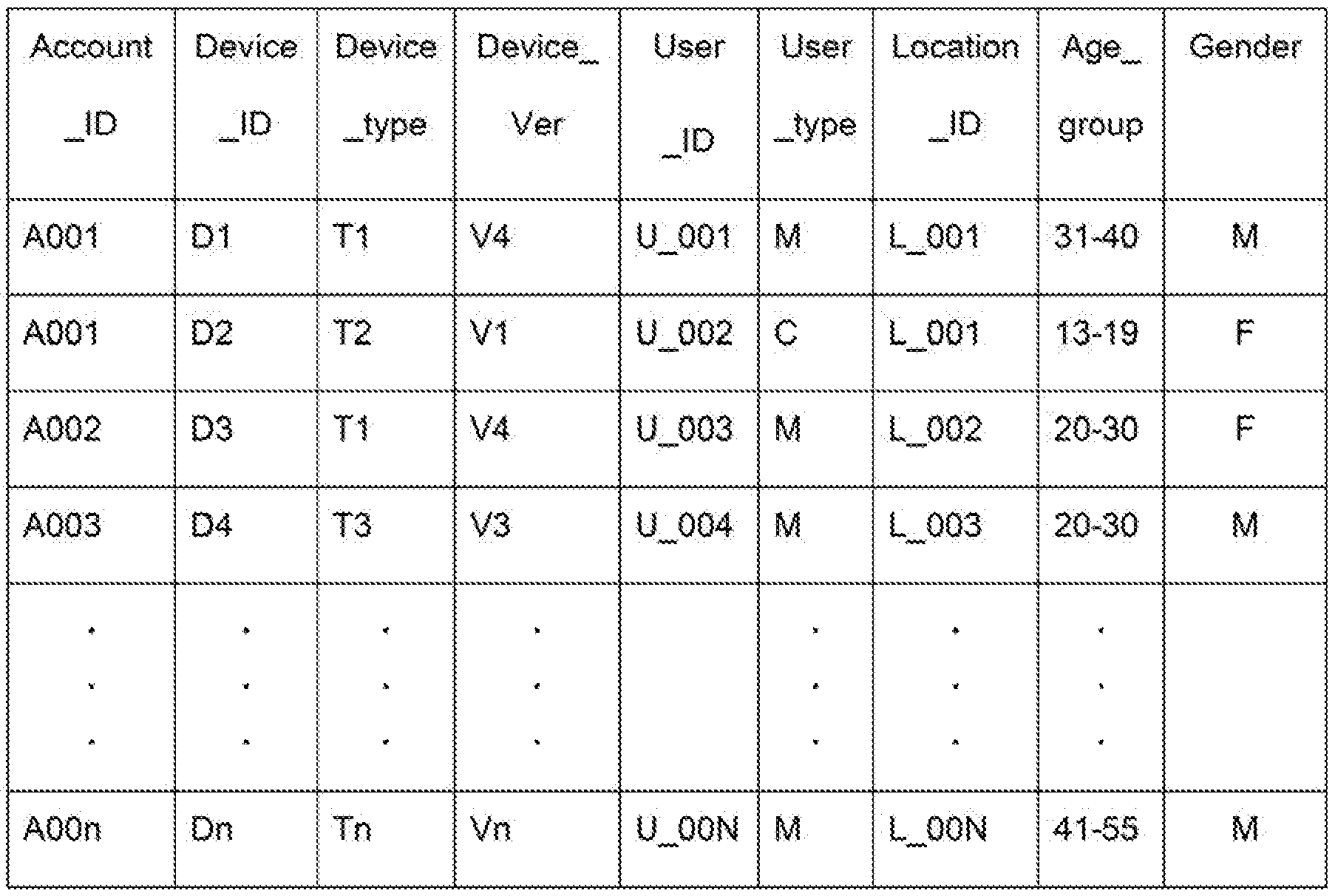
Table 2
[GQ55J In table , there is shown subscription account identifier (ID) ("AccountJD") of each of the plurality of subscription accounts, the type of subscription account (Account_Type) as basic {B); premium or elite E), and a product code (Trial_.product_.code) of a service or a product that is currently on trial ("1 " may denote
an ongoing trial whereas "0" may denote that no service or product are currently in trial period). With reference to table 1, there is also shown a tim period (Timeetapsedjdays) that is computed from a registration date for a trial of a product or a service associated with each subscriber account (AccountJO) of the plurality of subscriber accounts. The input parameters also includes the product code (such as "Prod^Owned^l* and "Prod„Owned„2") of each product or service {such as "Ρ , !'P2",..,"PN°) owned by a user associated with each subscriber account. The input parameters may also include a lifetime value (Lifetime_vaiue) associated with each subscriber account The lifetime value may refer to a tola! monetary vaiue thai is spend by a user associated with a subscriber account {AccountJD). The lifetime value includes not only the monetary value spend on the service associated with the particula subscriber account (AccountJD) but also the monetar value spend on other products and services previously owned by the user. For example, the first user 108a may also own other products, such as a gaming console (which may have a product code of Ψ '), from the same service provider or a related entity that provides the Internet-based TV service associated with the first subscriber account 110a,
[O0S63 in table 2, there is shown the subscription account IDs {AccountJDs} of each of the plurality of subscription accounts, which are common to both the tabie 1 and table 2 so that an associative relationshi may be established between the table 1 and table 2 (a relational data structure). With reference to table 2, for each subscriptio account ID, there is shown one or more associated device IDs (DeviceJDs) of each CE device of the plurality of CE devices 104, a device-type {Deviee_type), a device version (DevieeA'er) of each CE device, a user ID (UserJD) of a user associated with each CE device, the user type, such as a master user ( ) or a child user (C), a geographical location ID (LGcationJD), an age group (Age„group),
and a gender (Gender) of the user associated with each CE device. The input parameters includes not only trie user-information of the pl urality of users 108 retrieved from the memor 204, but may also computed parameters, for example, the time period (Timee!apsed„days) from the registration date for a trial of product o service associated with each subscriber account and lifetime value (Lifetime__vaiue) associated with each subscriber account. The computed parameters may also be referred to as insights or derived input parameters.
[005?] For the sake of brevity, certain input parameters for the plurality of users 108 associated with the plurality of subscriber accounts and the plurality of CE devices 104, are shown in table 1 and table 2, There may be other input parameters, for example, user name, timestamp of subscription requests received from the plurality of CE devices 104, a registration date for a trial of a product o a service, a language preference, likes, dislikes, specified user-interests, version of the view application installed in each CE device of the plurality of CE devices 104, user-specified settings of each user related to a subscriber account of the plurality of subscriber accounts, a last change in viewing habits of a TV channel, a TV channel viewing (or a gamepiay) trend of each user, an average time spend by each user to access a subscribed service related to the subscriber account of the plurality of subscriber accounts, relationship between different users associated with same subscriber account; such as relation between the first user 108a (user ID: "U^OOI") and the second user 108b (user ID: AU„0G2") of the first subscribe account 110a (Account JD: <fA001" )., It is to be understood that there may be other input parameters without limiiing the scope of the disclosure.
[O0S83 The TD detector 208 may be configured to classify the pluraliiy of users 108, for example, I >01 , UJ302,.. ,,U„00N, associated with the plurality of CE devices 104
and the plurality of subscriber accounts, for example, A001 , AQ02,.., , AGOn. The plurality of users 108 may be classified based on the plurality of segmentation parameters and the input parameters. In some embodiments, one or more combination of the plurality of segmentation parameters may be used to filter the classified plurality of users 108, For example, users who are in their Xtb day, for example 8!tl Day, of their trial of a service (e.g. Timeejapsed_ days ~ 6 days) and who own a particular product (e,g, a "P4" product), may be selected as th target users. The TD detector 206 may be configured to identify a CE device, suc as the first CE device 104a, or a target group of CE devices from the plurality of CE devices 104 based on the filtering and the plurality of segmentation parameters. The PMM controller 208 may be configured to generate, based on the plurality of segmentation parameters, the personalized multimedia message 404 specifically for identified CE device (such as the first CE device 104a) or the target group of CE devices of the plurality of CE devices 104.
[00S9J The PMM controller 208 may be configured to control display of the personalized multimedia message 404 on the first CE device 104a associated with the firs subscriber account 110a. in some embodiments, a view application may be installed in the first CE device 104a. The personalized multimedia message 404 may be directly presented on the first CE device 104a when the view application is launched on the first CE device 104a. Such personalized multimedia message 404 may be displayed on the first CE device 104a without the need for the first user 108a to go through a home screen of the subscribed service or any of intermediary services, for example, a search, explore, a view of channel page, T programming page, programming guide, or the like. The personalized multimedia message 404 displayed on the application interface 402 is an example of a personalized recommendation to
promote an ongoing TV show or a live event. The PMM controller 208 ma be configured to determine a placement of different conten types for display of the personalized multimedia message 404 based on a layout specified for h© device-type of the identified CE device, such as the first CE device 104a. For example, in this case, the personalized multimedia message 404 is presented on the application interface 402 in a layout that specifies that the text section 404a, the image section 404b, the first graphical icon 404c, and the second graphieal icon 404d are to b included in the personalized multimedia message 404 in specified arrangement, as shown in the FIG. 4A in an example. The user, such as the first user 108a, associated with the identified device, such as the first CE devic 104a, may press or click the first graphical icon 404c (e.g. "watch Now") to directly view the TV show or the live event that is recommended without the need to go through the home screen of the subscribed service associated with the first subscriber account 110a. When the first user 108a presses or clicks the first graphical icon 404c (e.g. "Watch Now"), a view request is transmitted to the media distribution system 112. The media distribution system 112 may be configured to stream the TV show or the liv event to the first CE device 104a, thereby increasing the viewership for the promoted TV show or the live event. A option is also provided to the first user 108a to skip the recommended content, such as the personalized multimedia message 404 , and go through the home screen of the subscribed service by a press or click of the second graphical icon 4G4d,
[0060] With reference to FIG. 48, there is shown another personalized multimedia message 406 on an exemplary application interface, such as an application interface 402. The personalized multimedia message 406 may be presented on the application interface 402 in another specified layout, as shown. Th personalized multimedia message 408 displayed on the application interface 402 is an example of a upselt
message to suggest a user to upgrade existing subscription package, for example, from basic {8} to premium {£} subscription type. The TD detector 206 may be configured to detect that the subscription account with account IDs "A001" and "A003* have basic (8) subscription type, and both are in their first week of trial (Table 1 ). Thus , the CE devices associated with the account IDs "AOG * and "A0Q3", may be retrieved. For example, the CE devices with device IDs, for example "Df , "02" « and "D4*, may be retrieved. However, the CE device with the device ID "D2" may be excluded for provisioning of the personalized multimedia message 408 as the user type of the user associated with the device ID "D2" is identified as a child user (or a sub-user). Thus, the CE device with the device !D "D2" may not be suited to display the upseii message as buying decision for the first subscriber account 110a may be vested with the master user (UJ301 ) and not the child user (U„002) who is associated with the device ID "02", in reference to table 2. The PMSvl controller 208 may be configured to selectively provision the personalized multimedia message 406 to the target group of CE devices, such as the CE devices with device IDs, MD ', and "D4". The users associated with the target group of CE devices, such as the CE devices with devic IDs, "Df, and "04", may press or click a third graphical icon 406a (e.g. "But it Now") to directly upgrade the subscription type from basic to premium subscription package without the need to go through the home screen of th subscribed service, such as th internet-based TV service. An option may also be provided to the first user 108a to ski the upseii message, such as the personalized multimedia message 408, and go through the home screen of the subscribed service by press or click of the second graphical icon 4Q d,
[00611 FIG. 5 is a flowchart that illustrates exemplary operations for messaging management in the messaging management system of FIG. 2, to provision
personalized multimedia messages for enhanced user engagement in a subscribed network, in accordance with an embodiment of the disclosure. With reference to RG, 5, there Is shown a flow chart 500. The flow chart 500 is described in conjunction with FtGs, 1 , 2, 3, 4A, and 48. The method starts at 502 and proceeds to 504.
[0062] At 504, input parameters for the plurality of users 108 associated with the plurality of subscriber accounts, may be analyzed- The TD detector 208 may be configured to analyze the input parameter for the plurality of users 108 associated with the piurality of subscriber accounts and the plurality of CE device 104. Examples of the input parameters has been described in Fig. 4A,
[0063] At 508, the piurality of users 108 associated with the piurality of CE devices 104 and the pluralit of subscriber accounts may be classified based on the plurality of segmentation parameters, !n accordartce with an embodiment, the plurality of segmentation parameters for the plurality of users may correspond to a geographical location, an age group, a language preference, a gender, specified user-interests, a type of subscription account, and a device-type of the plurality of CE devices associated with the plurality of subscriber accounts. The plurality of segmentation parameters may further correspond to a list of products or services owned by each user associated with the piurality of subscriber accounts, a time period elapsed from a registration date for a trial of a product or a servic associated with each of the pluralit of subscriber accounts, and a lifetime value of each user associated with each of the pluralit of subscribe accounts. The TD detector 206 may be configured to utilize the input parameters and the plurality of segmentation parameters for the classification of the pluralit of users 108.
|0064j At 508, a CE device (such as the first CE device 104a) or a target group of CE devices from the plurality of CE devices 104 may be identified to provision a personalized multimedia message based on the plurality of segmentation parameters. The TD detector 208 may be configured fo utilize one or more combination of the plurality of segmentation parameters to identify the CE device, such as the first CE device 104a, or the target group of CE devices from the piuraiity of CE devices 104. Target users from the piuraiity of users 108 may be identified based on the filtering of the plurality of users 108 associated with the piuraiit of subscriber accounts in accordance with the piuraiity of segmentation parameters , in instances where a single CE device is identified to provision a personalized multimedia message, the control may pass to 510, else to 5 4.
[006SJ At 510, a personalised multimedia message may be generated specifically for the first CE device 104a (e.g.. the identified CE device) of the piuraiity of CE devices 104. The personalized multimedia message ma be generated and provisioned based on the piuraiity of segmentation parameters for the plurality of users 1QS. The first CE device 104a may be associated with the first subscriber account 110a of the piuraiity of subscriber accounts. In some embodiments, the personalized multimedia recommendation may be generated based on the device-type of the identified CE device and at least the list of products or services owned by a user associated with the subscriber account related to the identified CE device. In some embodiments, the personalized multimedia recommendation may be generated based on the device- type of the identified CE device and a time period; elapsed from the registration date for the trial of a product or a service associated with the subscriber account related to the identified CE device, in some embodiments, the personalized multimedia recommendation may be generated based on the device-type of the identified CE
device and a lifetime value of the user associated with the subscriber account related to the identified CE device,
[00663 in accordance with an embodiment, the TD detector 206 may be configured to detect a change in a selection of a subscription feature associated with the first subscriber account 110a in real time, near-real time, or a lag time. Thereafter, a personalized multimedia message may be generated and communicated in real time, near-real time or a lag time to the first CE device 104a associated with the first subscriber account 110a based on the detected change in the seiection of the subscription feature associated with the first subscriber account 110a. In accordance with an embodiment, the ID detector 206 ma be configured to detect a change in a trend in viewing habits of one or more users associated with the first subscriber account 110a. Thereafter, a personalized multimedia message may be generated and communicated in real time, near-real time or a lag time to the first CE devic 104a associated with the first subscriber account 110a based on the detected change in the trend in viewing habits of the one or more users (such as the first user lQ8a and the second user 108b) associated with the first subscriber account 110a,
[0067] At 512, display of the personalized multimedia message on the first CE device 104a associated with the first subscriber account 110a, may be controiied . A placement of different content types for display of the personalized multimedia message may be determined based on a selected layout, from a plurality of specified layouts, specified for a device-type of the first CE device 104a.
[OQSSJ At 514, a personalized multimedia message ma he generated for a target group of CE devices from the plurality of CE devices 104 in accordance with the plurality of segmentation parameters. Th generated personalized multimedia
message(s) may be provisioned to the target group of CE devices. At 518, display of the personalized multimedia message on the target group of CE devices may be controlled. Control may pass to end 518 or return to 504,
[00§9] in accordance with an embodiment of the disclosure, a messaging management system is disclosed. The messaging management system, such as the messaging management system 102 (shown in FIG. 1 ), may comprise one or more circuits, such as the processor 202, the TD detector 206, and the PMM controller 208 (shown in FIG. 2), that may be configured to generate, based on a plurality of segmentation parameters for the plurality of users 10δ, a personalized multimedia message specifically for the first CE device 104a of the plurality of CE devices 104, The first CE device 104a may be associated with the first subscriber account 110a of the plurality of subscriber accounts. The messaging management system 102 may be communicatively coupled to the plurality of CE devices 04. The PMM controller 208 may be configured to control display of the personalized multimedia message on the first CE device 104a associated with the first subscriber account 110a.
|00?0J Various embodiment of the disclosure may provide a non-transitory computer-readable medium and/or storage medium, wherein there is stored thereon, a machine code and/or a set of instructions executable by a machine and/or a computer to generate, based on a pluralit of segmentation parameters for the plurality of users 108, a personalized multimedia message specifically for the first CE device 104a of the plurality of CE devices 104, The first CE device 04a may be associated with the first subscriber account 1 0a of the plurality of subscriber accounts, Display of the personalized multimedia message may be controlled on the first CE device 104a that is associated with the first subscriber account 110a,
[0071 j Based on the display of the personalized multimedia message, it may be convenient for a user, such as the first user 108a, to decide whether to view the recommended TV program or live event, upgrade the existing subscription type, or be informed of the real events in advance. The display of the personalized multimedia message ma provide a meliorated user experience and enhance user engagement. The iodividuaiizaiion or personalization of the displayed multimedia message may not only encourage the users to spend more time in the subscribed network but also emotionally tie the consumerfs} closer to the subscribed product or service.
[0072] Currently, conventional systems usually pre-process the user-information filied in user-profiles, such as in social network profiles or other profiles, for user segmentation and targeting. Due to Sack of accurate insights, many of the conventional consumer engagement techniques and practices that supported the consumer engagement online or offline, have become less effective in recent years. In contrast, the disclosed messaging management system 102 performs an effective and efficient extraction of input parameters for the plurality of users 108, and detects changes associated with the plurality of subscriber accounts in real time or near-real time. The operations performed by the processo 202, the TD detector 206, and/or the PMM controller 208, provides an ability to the messaging management system 102 to accurately and efficiently identify an appropriate consumer at an appropriate time and to provision a suitable type of personalized multimedia message In a subscribed network associated with a subscriber account. For example, th TD detector 208 and the PMM controller 208 of the messaging management system 102 effectivel solves a particular technological problem of how to identify a target user from millions of users associated with millions of subscriber accounts, what content to generate to engage the identified user, and whe to provision the generated personalized content for
enhanced user engagement The ability of the messaging management system 102 to personalize the multimedia content and the right timing of the provisioning of the multimedia content for each CE devices improves engagement and emotional attachment of the consumers ) to the subscribed product or service.
[QG73| The present disclosure may be realized in hardware, or a combination of hardware and software. The present disclosure may be realized in a centralized fashion, in at least one computer system, or in a distributed: fashion, where different elements may be spread across several interconnected computer systems. A computer system or other apparatus adapted to carry out the methods described herein may be suited. A combination of hardware and software may be a general- purpose computer system with a computer program that, when loaded and executed, may control the computer system such that si carries out the methods described herein. The present disclosure may be realized in hardware that comprises a portion of an integrated circuit that also performs other functions.
[00743 The present disclosure may also foe embedded in a computer program product, which comprises all the features enabling the implementation of the methods described herein, and which when loaded in a computer system is able to carry out these methods. Computer program, in the present context, means any expression, in any language, code or notation, of a set of instructions intended to cause a system having an information processing capability to perform a particular function either directly, or after eithe or both of the following: a) conversion to another language, code or notation; b) reproduction in a different material form.
[007SJ While the present disclosure has been described with reference to certain em odiments, it will be understood by those skilled in the art that various changes may
be made and equivalents may be substituted without departing from the scope of the present disclosure, in addition, many modifications may be made to adapt a particular situation or materia! to the teachings of the present disciosure without departing from its scope. Therefore, it is intended that the present disclosure not be limited to the particular embodiment disclosed, but that the present disciosure wit! include ail embodiments faffing within the scope of the appended claims.
Claims
What is claimed is:
1. A system, comprising: one or more processors in a messaging management system that handle user-information for a pluraiity of users associated with a plurality of subscriber accounts, said one or more processors are configured to:
generate, based on a plurality of segmentation parameters for said plurality of users, a personalized multimedia message for a first consumer electronic (CE) device of a plurality of CE devices, wherein said first CE device is associated with a first subscriber account of said plurality of subscriber accounts; and
control display of said personalized multimedia message on said first CE device associated with said first subscriber account.
2. The system according to claim 1, wherein said plurality of segmentation parameters for said plurality of users correspond to one or more of: a geographical location, an ag group, a languag preference, a gender, specified user-interests, a type of subscription account, and a device-type of said plurality of CE devices associated with said plurality of subscriber accounts.
3. The system according to claim 2, wherein said plurality of segmentation parameters further correspond to a list of products or services owned b a user associated with said first subscriber account, a time period elapsed from a
registration date for a trial of a product or a service associated with said first subscriber account, and a Sife-tim value of said user associated with said first subscriber account,
4, The system according to claim 1 , wherein said one or more processors are configured fo classif said plurality of users associated with said pluralit of CE devices and said plurality of subscriber accounts based on said plurality of segmentation parameters.
5. The system according to claim 1, wherein said one or more processors are further configured to generate said personalized multimedia message based on a device-type of said first CE device and at least a list of products or services owned by a user associated with said first subscriber account,
6. The syste according to clai 5, wherein said one or more processors are further configured to generate said personalized multimedia message based on said device-type of said first CE device and a time period elapsed from a registration date for a trial of a product or a service associated with said first subscriber account.
7, The sysiem according to claim 1 , wherein said one or more processors are further configured to generate said personalized multimedia message based on
a device-type of said first CE device and a Sife-time value of a user associated with said first subscriber account.
8. The system according to claim 1 , wherein said one or more processors are further configured to 'provision a multimedia recommendation to a target group of CE devices among said plurality of CE devices in accordance with said plurality of segmentation parameters.
9. The system according to claim 1 , wherein said one or more processors are further configured to detect a change in a selection of a subscription feature associated with said first subscriber account in real time, near-real time, or a lag time,
10. The system according to claim 9, wherein said one or more processors are further configured to generate and communicate said personalized multimedia message in real time, near-real time or a lag time to said first CE device associated with said first subscriber account based on said detected change in said selection of said subscription feature associated with said first subscriber account.
11. The system according to claim 1 , wherein said one or more processors are further configured to detect a change i a trend in viewing habits of one or more users associated with said first subscriber account,
12. The system according to claim 11 , wherein said one or more processors are further configured to generat and communicate said personalized multimedia message to said first CE device associated with said first subscriber account based on said detected change in said trend in viewing habits of said one or more users associated with said first subscriber account.
13. The system according to claim 1 , wherein said one or more processors are further configured to determine a placement of different content types for display of said personalized multimedia message based on a selected layout, from a plurality of specified layouts, specified for a device-type of said first CE device,
14. A method , comprising: in a messaging management system that handles user-information tor a plurality of users associated with a plurality of subscriber accounts:
generating, by one or more processors in said messaging management system, based on a plurality of segmentation parameters for said plurality of users, a personalized multimedia message for a first consumer electronic (CE) device of a pluralit of CE devices, wherein
said first CE device is associated with a first subscriber account of said piuraiity of subscriber accounts; and
controlling, by said one or more processors, displa of said personalized multimedia message on said first CE device associated with said first subscriber account,
15. The method according to claim 14, further comprising classifying, by said one or more processors, said piuraiity of users associated with said piuraiity of CE devices and said plurality of subscriber accounts based on said plurality of segmentation parameters.
16. The method according to claim 14, furthe comprising generating, by said one or more processors, said personalized multimedia message based on a device- type of said first CE device and at least a list of products or services owned by a user associated with said first subscriber account.
17. The method according to claim 14, further comprising generating, by said ne or more processors, said personalized multimedia message based on a device- type of said first CE device and a time period elapsed from a registration date for a trial of a product or a service associated with said first subscriber account.
18-. The method according to claim 14, further comprising generating, by said one or more processors, said personalized multimedia message based on a device*-
type of said first CE device and a life-time value of a user associated; with said first subscriber account. , The method according to claim 14, further comprising provisioning, fay said one or more processors, a multimedia message that includes at least one of a multimedia recommendation, an upsell message, or a customized message, to a target group of CE devices among said plurality of CE devices in accordance with said plurality of segmentation parameters. , The method according to ciaim 14, further comprising detecting, by said one or more processors, a change in a selection of a subscription feature associated with said first subscriber account in real time, near-real time, or a lag time. , The method according to claim 20, further comprising generating and communicating, by said one or more processors, said personalized multimedia message in real time, near-real time or a lag time to said first CE device associated with said first subscriber account based on said detected change in said selection of said subscription feature associated with said first subscriber account.
22. The meihod according io claim 14, further comprising detecting, by said one or more processors, a change in a trend in viewing habits of one or more users associated with said first subscriber account.
23. The method according to claim 22, further comprising generating and communicating, by said one or more processors, said personalized multimedia message to said first CE device associated with said first subscriber account based o said detected change in said trend in said viewing habits of said one or more users associated with said first subscriber account.
Priority Applications (1)
| Application Number | Priority Date | Filing Date | Title |
|---|---|---|---|
| US15/517,802 US20180352278A1 (en) | 2016-02-23 | 2017-02-23 | Personalized messaging management system for enhanced user engagement in a subscribed network |
Applications Claiming Priority (2)
| Application Number | Priority Date | Filing Date | Title |
|---|---|---|---|
| US201662298791P | 2016-02-23 | 2016-02-23 | |
| US62/298,791 | 2016-02-23 |
Publications (1)
| Publication Number | Publication Date |
|---|---|
| WO2017147273A1 true WO2017147273A1 (en) | 2017-08-31 |
Family
ID=59686523
Family Applications (1)
| Application Number | Title | Priority Date | Filing Date |
|---|---|---|---|
| PCT/US2017/019091 Ceased WO2017147273A1 (en) | 2016-02-23 | 2017-02-23 | Personalized messaging management system for enhanced user engagement in a subscribed network |
Country Status (2)
| Country | Link |
|---|---|
| US (1) | US20180352278A1 (en) |
| WO (1) | WO2017147273A1 (en) |
Families Citing this family (5)
| Publication number | Priority date | Publication date | Assignee | Title |
|---|---|---|---|---|
| US11006182B2 (en) | 2018-08-14 | 2021-05-11 | Home Box Office, Inc. | Surf mode for streamed content |
| US11153238B2 (en) * | 2019-01-08 | 2021-10-19 | Snap Inc. | Dynamic application configuration |
| CN113886609B (en) * | 2021-09-29 | 2025-01-21 | 北京达佳互联信息技术有限公司 | Multimedia resource recommendation method, device, electronic device and storage medium |
| US20230156296A1 (en) * | 2021-11-18 | 2023-05-18 | Sling TV L.L.C. | Systems and methods for temporally restricting access to multimedia |
| US12184934B2 (en) * | 2022-05-10 | 2024-12-31 | Adeia Guides Inc. | Methods and systems to improve control of content items, channels, accounts, subscriptions, and related information |
Citations (6)
| Publication number | Priority date | Publication date | Assignee | Title |
|---|---|---|---|---|
| US20040181459A1 (en) * | 2003-03-13 | 2004-09-16 | Wright Andrew C. | System and method for the distribution of software products |
| US20120174159A1 (en) * | 2010-12-30 | 2012-07-05 | Verizon Patent And Licensing Inc. | Method and apparatus for providing a personalized content channel |
| US20150106209A1 (en) * | 2004-12-27 | 2015-04-16 | Blue Calypso, Llc | System and method for distribution of targeted content between mobile communication devices |
| WO2015116533A1 (en) * | 2014-01-28 | 2015-08-06 | Aol Advertising Inc. | Systems and methods for ad-supported mobile data plans or in-app purchases |
| WO2015134990A1 (en) * | 2014-03-07 | 2015-09-11 | White Shoe Media, Inc. | Dynamic content and pricing |
| US20160044374A1 (en) * | 2014-08-05 | 2016-02-11 | Verizon Patent And Licensing Inc. | Commercial advertising platform |
Family Cites Families (1)
| Publication number | Priority date | Publication date | Assignee | Title |
|---|---|---|---|---|
| US9154826B2 (en) * | 2011-04-06 | 2015-10-06 | Headwater Partners Ii Llc | Distributing content and service launch objects to mobile devices |
-
2017
- 2017-02-23 WO PCT/US2017/019091 patent/WO2017147273A1/en not_active Ceased
- 2017-02-23 US US15/517,802 patent/US20180352278A1/en not_active Abandoned
Patent Citations (6)
| Publication number | Priority date | Publication date | Assignee | Title |
|---|---|---|---|---|
| US20040181459A1 (en) * | 2003-03-13 | 2004-09-16 | Wright Andrew C. | System and method for the distribution of software products |
| US20150106209A1 (en) * | 2004-12-27 | 2015-04-16 | Blue Calypso, Llc | System and method for distribution of targeted content between mobile communication devices |
| US20120174159A1 (en) * | 2010-12-30 | 2012-07-05 | Verizon Patent And Licensing Inc. | Method and apparatus for providing a personalized content channel |
| WO2015116533A1 (en) * | 2014-01-28 | 2015-08-06 | Aol Advertising Inc. | Systems and methods for ad-supported mobile data plans or in-app purchases |
| WO2015134990A1 (en) * | 2014-03-07 | 2015-09-11 | White Shoe Media, Inc. | Dynamic content and pricing |
| US20160044374A1 (en) * | 2014-08-05 | 2016-02-11 | Verizon Patent And Licensing Inc. | Commercial advertising platform |
Also Published As
| Publication number | Publication date |
|---|---|
| US20180352278A1 (en) | 2018-12-06 |
Similar Documents
| Publication | Publication Date | Title |
|---|---|---|
| US11223868B2 (en) | Promotion content push method and apparatus, and storage medium | |
| US9491496B2 (en) | Systems and methods for delivering content to a media content access device | |
| EP3512207B1 (en) | Coordinated effects in videos | |
| CN106385594A (en) | Method for optimizing video live broadcast services | |
| JP2014086087A (en) | Method and system for inserting advertisement into media stream | |
| US10255031B2 (en) | Music playback for affiliated services | |
| US20180352278A1 (en) | Personalized messaging management system for enhanced user engagement in a subscribed network | |
| US20190306211A1 (en) | Seamless social multimedia | |
| JP2016516379A (en) | Method and apparatus for dynamic content offloading | |
| US20220132184A1 (en) | Employing Automatic Content Recognition to Allow Resumption of Watching Interrupted Media Program From Television Broadcast | |
| US12096088B2 (en) | Allocating streaming content on a hybrid network | |
| US11106822B2 (en) | Privacy-aware content recommendations | |
| US11172262B2 (en) | Enabling interactive control of live television broadcast streams | |
| US9749197B2 (en) | Mobile user data collection | |
| US10298567B1 (en) | System for providing multi-device access to complementary content | |
| CA3071478C (en) | Rules-based just-in-time mobile content service | |
| KR101659420B1 (en) | Personalized video content consumption using shared video device and personal device | |
| CN115550184B (en) | A bandwidth control method and system | |
| US20230300416A1 (en) | Systems and methods to insert additional content | |
| US20180324472A1 (en) | Video streaming management system for enhanced user engagement in a subscribed network | |
| US11379111B2 (en) | Dynamic user interface based on input classifications | |
| CN115714870A (en) | Multimedia content publishing method, multimedia content interaction method and multimedia content publishing device | |
| CN115396316A (en) | Service processing method and device | |
| US10320882B2 (en) | Uniform resource locator discovery and tracking for managing sponsored data | |
| WO2018154354A1 (en) | Systems and methods for sharing media advertisements |
Legal Events
| Date | Code | Title | Description |
|---|---|---|---|
| NENP | Non-entry into the national phase |
Ref country code: DE |
|
| 121 | Ep: the epo has been informed by wipo that ep was designated in this application |
Ref document number: 17757193 Country of ref document: EP Kind code of ref document: A1 |
|
| 122 | Ep: pct application non-entry in european phase |
Ref document number: 17757193 Country of ref document: EP Kind code of ref document: A1 |