WO2017118651A1 - A squeezing member for washing shoes disposable in a washing machine - Google Patents
A squeezing member for washing shoes disposable in a washing machine Download PDFInfo
- Publication number
- WO2017118651A1 WO2017118651A1 PCT/EP2017/050124 EP2017050124W WO2017118651A1 WO 2017118651 A1 WO2017118651 A1 WO 2017118651A1 EP 2017050124 W EP2017050124 W EP 2017050124W WO 2017118651 A1 WO2017118651 A1 WO 2017118651A1
- Authority
- WO
- WIPO (PCT)
- Prior art keywords
- drum
- squeezing member
- rods
- washing machine
- washed
- Prior art date
- Legal status (The legal status is an assumption and is not a legal conclusion. Google has not performed a legal analysis and makes no representation as to the accuracy of the status listed.)
- Ceased
Links
Images



Classifications
-
- D—TEXTILES; PAPER
- D06—TREATMENT OF TEXTILES OR THE LIKE; LAUNDERING; FLEXIBLE MATERIALS NOT OTHERWISE PROVIDED FOR
- D06F—LAUNDERING, DRYING, IRONING, PRESSING OR FOLDING TEXTILE ARTICLES
- D06F37/00—Details specific to washing machines covered by groups D06F21/00 - D06F25/00
- D06F37/02—Rotary receptacles, e.g. drums
- D06F37/04—Rotary receptacles, e.g. drums adapted for rotation or oscillation about a horizontal or inclined axis
- D06F37/08—Partitions
Definitions
- the present invention relates to a washing machine wherein shoes can be placed to be washed into the tub wherein the laundry is washed.
- the articles to be washed in the washing machines are washed by being placed into a drum rotating around its own axis. While the articles to be washed are chemically cleaned by means of detergent, the articles are turned upside down by moving with the rotation of the drum and physically cleaned by being carried up to a height equal to the diameter of the drum by means of the baffles and then being dropped down. Moreover, the articles to be washed are enabled to be rubbed against each other. When articles that can be deformed such as delicate laundry, shoes, etc. are washed in the washing machines, the said articles to be washed are damaged with the rotation of the drum. These situations cause user dissatisfaction.
- a washing machine that comprises a container that is attached to the baffles of the drum, thus creating a drum with a smaller diameter and enabling the delicate laundry to be washed without being deformed.
- a laundry dryer that comprises a net that is fastened to the baffles of the drum and that enables the delicate textile items to be kept together while being dried.
- a washing machine that comprises a cavity that is disposed on the door providing access into the drum and that provides the washing of delicate laundry by being placed therein.
- the aim of the present invention is the realization of a washing machine wherein articles such as shoes, etc. that are placed into the tub are washed without being deformed.
- the washing machine realized in order to attain the aim of the present invention, explicated in the claims comprises a squeezing member that enables the articles to be washed to be squeezed between the squeezing member and the drum wherein the washing process is realized by expanding and enables the articles to be washed to be washed without moving.
- the washing machine of the present invention first the articles to be washed are placed into the drum, then the squeezing member is placed into the drum. As the squeezing member expands, the empty regions inside the drum are filled, and both the drum surface and the squeezing member apply pressure onto the articles to be washed.
- the articles to be washed remain immobile with respect to the drum during the rotation of the drum and are washed without being affected by the rotation of the drum.
- the squeezing member is shaped as a cylinder.
- the squeezing member is cylindrically produced similar to the form of the drum. The length of the squeezing member, as the same expands, does not change, but the diameter thereof gets wider. Thus, when placed into the drum, the squeezing member can secure the articles to be washed between the drum and the squeezing member.
- the squeezing member has a folding mechanism that enables the diameter thereof to be decreased/increased.
- the folding mechanism is preferably actuated by the user and with the intervention of the user the folding mechanism decreases/increases the diameter of the squeezing member.
- the folding mechanism is disposed at the inner part of the squeezing member.
- the folding mechanism comprises at least two rods that are oppositely fixed to the inner surface of the squeezing member and that are connected to each other from the other ends in a foldable manner.
- the diameter of the squeezing member increases.
- the diameter of the squeezing member decreases.
- the squeezing member is enabled to apply pressure onto the articles to be washed.
- the squeezing member is placed into the drum and then, with the spring pushing the rods outwards, the diameter of the squeezing member is enabled to increase.
- the angle between the rods can be held at 180 degrees by means of a holder that can slide over the rods.
- the squeezing member is in roller form and tends to expand continuously.
- the user rolls the squeezing member so that the latter has a smaller diameter and places the same into the drum.
- the squeezing member expands so as to fill the drum space and applies pressure onto the articles to be washed.
- the articles to be washed are squeezed in the drum and washed as attached to the inner surface of the drum.
- laundry and articles such as shoes that may be worn out or deformed with the rotation of the drum can be washed without being worn out or deformed.
- Figure 1 – is the perspective view of a washing machine.
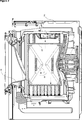
- Figure 2 - is the sideways cross-sectional view of the drum and the squeezing member related to an embodiment of the present invention.
- Figure 3 - is the perspective view of the sideways cross-section of the drum and the squeezing member related to another embodiment of the present invention.
- Figure 4 - is the sideways cross-sectional view of the drum and the squeezing member related to another embodiment of the present invention.
- the washing machine (1) comprises a body (2), a drum (3) that is disposed inside the body (2) and wherein the washing process is realized, and a door (4) that provides access into the drum (3).
- the articles to be washed are placed into the drum (4) by opening the door (4).
- the door (4) is closed, the user starts the washing process by pressing the start button.
- the drum (3) rotates and enables the laundry wet with the wash water therein to be mechanically washed.
- the user opens the door (4) and takes the washed laundry out of the drum (3).
- the washing machine (1) of the invention conventionally comprises a squeezing member (5) that is disposed into the drum (3), that expands so as to fill the drum (3) space and that enables the articles to be washed to be squeezed between the squeezing member (5) and the inner surface of the drum (3).
- the delicate laundry or the deformable articles such as shoes to be washed are placed into the drum (3) so as to contact the inner surface of the drum (3).
- the squeezing member (5) is inserted into the drum (3) through the door (4).
- the squeezing member (5) inserted into the drum (3) expands and fills the empty regions of the drum (3).
- the squeezing member (5) applies pressure onto the articles to be washed so as to enable the same to be squeezed between the squeezing member (5) and the inner surface of the drum (3), in order words, so as to enable the articles to remain immobile in the drum while the drum (3) rotates during the washing process or while the drum (3) rotates at high speeds during the spin-drying process.
- the delicate laundry or the deformable articles such as shoes, etc. can be washed without being worn out.
- the squeezing member (5) is cylindrical.
- the squeezing member (5) is produced in a cylindrical form matching the cylindrical form of the drum (3).
- the articles to be washed are placed into the drum (3) so as to contact the drum (3), in order words are placed into the drum (3) so as to form a cylinder with a diameter smaller than the diameter of the drum (3).
- the squeezing member (5) is placed into the central space of the drum (3) and forms a cylinder with a diameter smaller than the diameter of the drum (3) by expanding, thus enabling the articles to be washed to be squeezed within the drum (3).
- the squeezing member (5) has a folding mechanism that enables the diameter thereof to be changed and that is disposed therein.
- the folding mechanism (6) that is disposed in the squeezing member (5) enables the diameter of the squeezing member (5) to be increased after the latter is placed into the drum (3).
- the diameter of the former is decreased to a diameter smaller than the diameter of the door (4) by means of the folding mechanism (6) and the squeezing member (5) can be taken out of the drum (3).
- the lateral surface of the squeezing member (5) can be produced from a elastic material complying with the diameter changes or can be in a folding form.
- the folding mechanism (6) comprises at least two rods (7) that enable the diameter of the squeezing member (5) to be changed by changing the angle between the rods (7), one of the ends of the rods (7) being oppositely fixed onto the inner surface of the squeezing member (5) and the other ends connected to each other in a foldable manner.
- the rods (7) are oppositely fixed to the lateral surface of the squeezing member (5), in other words are fixed in the direction of the diameter passing through the center of the circle on the lateral surface.
- the rods (7) are movably connected to each other from the free ends thereof.
- the rods (7) enable the diameter of the squeezing member (5) to be increased, in other words enable the squeezing member (5) to expand.
- the articles to be washed are squeezed between the drum (3) and the squeezing member (5).
- the angle between the rods (7) is decreased, thus decreasing the diameter of the squeezing member (5) and the latter can be taken out of the drum (3).
- the folding mechanism (6) comprises a spring (8) that is connected to the central points of the two rods (7) connected to each other from the ends thereof and that enables the angle between the rods (7) to be increased.
- the spring (8) is connected to the rods (7) connected to each other from the central points thereof and enables the angle between the two rods (7) to be increased by pushing the rods (7).
- the squeezing member (5) applies pressure onto the articles to be washed and squeeze the same between the drum (3) and the squeezing member (5).
- the length of the rods (7) is preferably greater than the radius of the circle formed by the lateral surface cross-section of the squeezing member (5). Therefore, the angle between the rods (7) is enabled to be always smaller than 180 degrees and the spring (8) is enabled to push the rods (7) away from each other.
- the folding mechanism (6) comprises a holder (9) that can move over the rods (7) connected to each other from the ends thereof and that enables the angle between the rods (6) to be fixed at 180 degrees by being slid over both rods (7) when the angle between the rods (7) is 180 degrees.
- the maximum width that the squeezing member (5) can reach is determined and when the rods (7) form a straight line, in other words when the angle therebetween is 180 degrees, the holder (9) is slid over the rods (7) and enables the joint where the rods (7) are connected to each other to remain fixed.
- the holder (9) is wrapped around the rods (7) so as to slide over the rods (7).
- the squeezing member (5) is in form of a roller.
- the squeezing member (5) tends to expand by default, in order words in a continuous manner.
- the user places the squeezing member (5) into the drum (3) by wrapping the squeezing member (5) around itself, in other words so that the squeezing member (5) form a cylinder with a smaller diameter.
- the squeezing member (5) expands and fills the empty regions of the drum (3).
- the articles to be washed are enabled to be squeezed between the drum (3) and the squeezing member (5).
- the washing machine (1) of the present invention by means of the squeezing member (5), the articles that may be deformed or worn out when washed in the washing machine (1) are enabled to be washed so as to contact the inner surface of the drum (3). By preventing the articles to be washed from moving inside the drum (3), the washing process is realized without any wear and deformation.
Landscapes
- Engineering & Computer Science (AREA)
- Textile Engineering (AREA)
- Accessory Of Washing/Drying Machine, Commercial Washing/Drying Machine, Other Washing/Drying Machine (AREA)
Abstract
The present invention relates to a squeezing member (5) that can be placed inside a drum (3) disposed inside the body of a washing machine (1) wherein a washing process is realized, said washing machine having a door (4) that procides acces into the drum (3). The squeezing member has a variable diameter such that, when placed into the drum (3), it can expand to fill the empty regions of the drum (3), thereby applying pressure to delicate articles, such as shoes, to be washed and enabling them to be washed without moving inside the drum (3).
Description
The present invention relates to a washing machine wherein shoes can be placed to be washed into the tub wherein the laundry is washed.
The articles to be washed in the washing machines are washed by being placed into a drum rotating around its own axis. While the articles to be washed are chemically cleaned by means of detergent, the articles are turned upside down by moving with the rotation of the drum and physically cleaned by being carried up to a height equal to the diameter of the drum by means of the baffles and then being dropped down. Moreover, the articles to be washed are enabled to be rubbed against each other. When articles that can be deformed such as delicate laundry, shoes, etc. are washed in the washing machines, the said articles to be washed are damaged with the rotation of the drum. These situations cause user dissatisfaction.
In the state of the art International Patent Application No. WO2010029061, a washing machine is disclosed, that comprises a container that is attached to the baffles of the drum, thus creating a drum with a smaller diameter and enabling the delicate laundry to be washed without being deformed.
In the state of the art International Patent Application No. WO2008017560, a laundry dryer is disclosed, that comprises a net that is fastened to the baffles of the drum and that enables the delicate textile items to be kept together while being dried.
In the state of the art European Patent Application No. EP1233099, a washing machine is disclosed, wherein the delicate laundry is washed by means of an auxiliary basket that is disposed between the crosspieces and that contact the inner periphery of the drum.
In the state of the art European Patent Application No. EP2415921, a washing machine is disclosed, that comprises a cavity that is disposed on the door providing access into the drum and that provides the washing of delicate laundry by being placed therein.
The aim of the present invention is the realization of a washing machine wherein articles such as shoes, etc. that are placed into the tub are washed without being deformed.
The washing machine realized in order to attain the aim of the present invention, explicated in the claims comprises a squeezing member that enables the articles to be washed to be squeezed between the squeezing member and the drum wherein the washing process is realized by expanding and enables the articles to be washed to be washed without moving. In the washing machine of the present invention, first the articles to be washed are placed into the drum, then the squeezing member is placed into the drum. As the squeezing member expands, the empty regions inside the drum are filled, and both the drum surface and the squeezing member apply pressure onto the articles to be washed. Thus, the articles to be washed remain immobile with respect to the drum during the rotation of the drum and are washed without being affected by the rotation of the drum.
In an embodiment of the present invention, the squeezing member is shaped as a cylinder. In this embodiment, the squeezing member is cylindrically produced similar to the form of the drum. The length of the squeezing member, as the same expands, does not change, but the diameter thereof gets wider. Thus, when placed into the drum, the squeezing member can secure the articles to be washed between the drum and the squeezing member.
In another embodiment of the present invention, the squeezing member has a folding mechanism that enables the diameter thereof to be decreased/increased. The folding mechanism is preferably actuated by the user and with the intervention of the user the folding mechanism decreases/increases the diameter of the squeezing member. The folding mechanism is disposed at the inner part of the squeezing member.
In another embodiment of the present invention, the folding mechanism comprises at least two rods that are oppositely fixed to the inner surface of the squeezing member and that are connected to each other from the other ends in a foldable manner. In this embodiment, when the rods extend outwards so as to create a straight line, the diameter of the squeezing member increases. When the rods are folded onto each other, the diameter of the squeezing member decreases.
In a version of this embodiment, by means of a spring that is connected to the central points of the rods and that tries to push the rods away from each other, the squeezing member is enabled to apply pressure onto the articles to be washed. By folding the rods onto each other the squeezing member is placed into the drum and then, with the spring pushing the rods outwards, the diameter of the squeezing member is enabled to increase.
In another version of this embodiment, when the rods form a straight line, the angle between the rods can be held at 180 degrees by means of a holder that can slide over the rods.
In another embodiment of the present invention, the squeezing member is in roller form and tends to expand continuously. The user rolls the squeezing member so that the latter has a smaller diameter and places the same into the drum. When the user releases the squeezing member, the squeezing member expands so as to fill the drum space and applies pressure onto the articles to be washed.
In the washing machine of the present invention, the articles to be washed are squeezed in the drum and washed as attached to the inner surface of the drum. Thus, laundry and articles such as shoes that may be worn out or deformed with the rotation of the drum can be washed without being worn out or deformed.
The washing machine realized in order to attain the aim of the present invention is illustrated in the attached figures, where:
Figure 1 – is the perspective view of a washing machine.
Figure 2 - is the sideways cross-sectional view of the drum and the squeezing member related to an embodiment of the present invention.
Figure 3 - is the perspective view of the sideways cross-section of the drum and the squeezing member related to another embodiment of the present invention.
Figure 4 - is the sideways cross-sectional view of the drum and the squeezing member related to another embodiment of the present invention.
The elements and steps in the figures are numbered as follows:
- Washing machine
- Body
- Drum
- Door
- Squeezing member
- Folding mechanism
- Rod
- Spring
- Holder
The washing machine (1) comprises a body (2), a drum (3) that is disposed inside the body (2) and wherein the washing process is realized, and a door (4) that provides access into the drum (3).
In the dishwasher (1), the articles to be washed are placed into the drum (4) by opening the door (4). After the door (4) is closed, the user starts the washing process by pressing the start button. The drum (3) rotates and enables the laundry wet with the wash water therein to be mechanically washed. After the washing process is completed, the user opens the door (4) and takes the washed laundry out of the drum (3).
The washing machine (1) of the invention conventionally comprises a squeezing member (5) that is disposed into the drum (3), that expands so as to fill the drum (3) space and that enables the articles to be washed to be squeezed between the squeezing member (5) and the inner surface of the drum (3).
In the washing machine (1) of the present invention, the delicate laundry or the deformable articles such as shoes to be washed are placed into the drum (3) so as to contact the inner surface of the drum (3). The squeezing member (5) is inserted into the drum (3) through the door (4). The squeezing member (5) inserted into the drum (3) expands and fills the empty regions of the drum (3). The squeezing member (5) applies pressure onto the articles to be washed so as to enable the same to be squeezed between the squeezing member (5) and the inner surface of the drum (3), in order words, so as to enable the articles to remain immobile in the drum while the drum (3) rotates during the washing process or while the drum (3) rotates at high speeds during the spin-drying process. Thus, the delicate laundry or the deformable articles such as shoes, etc. can be washed without being worn out.
In an embodiment of the present invention, the squeezing member (5) is cylindrical. In this embodiment, the squeezing member (5) is produced in a cylindrical form matching the cylindrical form of the drum (3). The articles to be washed are placed into the drum (3) so as to contact the drum (3), in order words are placed into the drum (3) so as to form a cylinder with a diameter smaller than the diameter of the drum (3). While in a diameter smaller than the diameter of the door (4), the squeezing member (5) is placed into the central space of the drum (3) and forms a cylinder with a diameter smaller than the diameter of the drum (3) by expanding, thus enabling the articles to be washed to be squeezed within the drum (3).
In another embodiment of the present invention, the squeezing member (5) has a folding mechanism that enables the diameter thereof to be changed and that is disposed therein. The folding mechanism (6) that is disposed in the squeezing member (5) enables the diameter of the squeezing member (5) to be increased after the latter is placed into the drum (3). When the squeezing member (5) is desired to be taken out of the drum (3), the diameter of the former is decreased to a diameter smaller than the diameter of the door (4) by means of the folding mechanism (6) and the squeezing member (5) can be taken out of the drum (3). The lateral surface of the squeezing member (5) can be produced from a elastic material complying with the diameter changes or can be in a folding form.
In another embodiment of the present invention, the folding mechanism (6) comprises at least two rods (7) that enable the diameter of the squeezing member (5) to be changed by changing the angle between the rods (7), one of the ends of the rods (7) being oppositely fixed onto the inner surface of the squeezing member (5) and the other ends connected to each other in a foldable manner. The rods (7) are oppositely fixed to the lateral surface of the squeezing member (5), in other words are fixed in the direction of the diameter passing through the center of the circle on the lateral surface. The rods (7) are movably connected to each other from the free ends thereof. When the angle between the rods (7) is increased so as to form a straight line, the rods (7) enable the diameter of the squeezing member (5) to be increased, in other words enable the squeezing member (5) to expand. Thus, the articles to be washed are squeezed between the drum (3) and the squeezing member (5). When the squeezing member (5) is desired to be made smaller, the angle between the rods (7) is decreased, thus decreasing the diameter of the squeezing member (5) and the latter can be taken out of the drum (3).
In another embodiment of the present invention, the folding mechanism (6) comprises a spring (8) that is connected to the central points of the two rods (7) connected to each other from the ends thereof and that enables the angle between the rods (7) to be increased. The spring (8) is connected to the rods (7) connected to each other from the central points thereof and enables the angle between the two rods (7) to be increased by pushing the rods (7). Thus, the squeezing member (5) applies pressure onto the articles to be washed and squeeze the same between the drum (3) and the squeezing member (5). In this embodiment, the length of the rods (7) is preferably greater than the radius of the circle formed by the lateral surface cross-section of the squeezing member (5). Therefore, the angle between the rods (7) is enabled to be always smaller than 180 degrees and the spring (8) is enabled to push the rods (7) away from each other.
In another embodiment of the present invention, the folding mechanism (6) comprises a holder (9) that can move over the rods (7) connected to each other from the ends thereof and that enables the angle between the rods (6) to be fixed at 180 degrees by being slid over both rods (7) when the angle between the rods (7) is 180 degrees. In this embodiment, the maximum width that the squeezing member (5) can reach is determined and when the rods (7) form a straight line, in other words when the angle therebetween is 180 degrees, the holder (9) is slid over the rods (7) and enables the joint where the rods (7) are connected to each other to remain fixed. The holder (9) is wrapped around the rods (7) so as to slide over the rods (7).
In another embodiment of the present invention, the squeezing member (5) is in form of a roller. In this embodiment, the squeezing member (5) tends to expand by default, in order words in a continuous manner. The user places the squeezing member (5) into the drum (3) by wrapping the squeezing member (5) around itself, in other words so that the squeezing member (5) form a cylinder with a smaller diameter. As the squeezing member (5) is released after being inserted into the drum (3), the squeezing member (5) expands and fills the empty regions of the drum (3). Thus, the articles to be washed are enabled to be squeezed between the drum (3) and the squeezing member (5).
In the washing machine (1) of the present invention, by means of the squeezing member (5), the articles that may be deformed or worn out when washed in the washing machine (1) are enabled to be washed so as to contact the inner surface of the drum (3). By preventing the articles to be washed from moving inside the drum (3), the washing process is realized without any wear and deformation.
Claims (7)
- A washing machine (1) comprising a body (2), a drum (3) that is disposed inside the body (2) and wherein the washing process is realized, and a door (4) that provides access into the drum (3), characterized by a squeezing member (5) that is disposed into the drum (3), that expands so as to fill the drum (3) space and that enables the articles to be washed to be squeezed between the squeezing member (5) and the inner surface of the drum (3).
- A washing machine (1) as in Claim 1, characterized by the cylindrical squeezing member (5).
- A washing machine (1) as in Claim 2, characterized by the squeezing member (5) having a folding mechanism (6) that is disposed therein and that enables the diameter of the squeezing member (5) to be changed.
- A washing machine (1) as in Claim 3, characterized by the folding mechanism (6) having at least two rods (7) that enable the diameter of the squeezing member (5) to be changed by changing the angle between the rods (7), one of the ends of the rods (7) being oppositely fixed onto the inner surface of the squeezing member (5) and the other ends connected to each other in a foldable manner.
- A washing machine (1) as in Claim 4, characterized by the folding mechanism (6) having a spring (8) that is connected to the central points of the two rods (7) connected to each other from the ends thereof and that enables the angle between the rods (7) to be increased.
- A washing machine (1) as in Claim 4, characterized by the folding mechanism (6) having a holder (9) that can move over the rods (7) connected to each other from the ends thereof and that enables the angle between the rods (7) to be fixed at 180 degrees by being slid over both rods (7) when the angle between the rods (7) is 180 degrees.
- A washing machine (1) as in Claim 1 or 2, characterized by the squeezing member (5) that is in form of a roller.
Applications Claiming Priority (2)
| Application Number | Priority Date | Filing Date | Title |
|---|---|---|---|
| TRA2016/00110 | 2016-01-05 | ||
| TR2016/00110A TR201600110A2 (en) | 2016-01-05 | 2016-01-05 | A WASHING MACHINE WITHIN THE SHOE |
Publications (1)
| Publication Number | Publication Date |
|---|---|
| WO2017118651A1 true WO2017118651A1 (en) | 2017-07-13 |
Family
ID=57838350
Family Applications (1)
| Application Number | Title | Priority Date | Filing Date |
|---|---|---|---|
| PCT/EP2017/050124 Ceased WO2017118651A1 (en) | 2016-01-05 | 2017-01-04 | A squeezing member for washing shoes disposable in a washing machine |
Country Status (2)
| Country | Link |
|---|---|
| TR (1) | TR201600110A2 (en) |
| WO (1) | WO2017118651A1 (en) |
Citations (8)
| Publication number | Priority date | Publication date | Assignee | Title |
|---|---|---|---|---|
| FR1218891A (en) * | 1958-04-12 | 1960-05-13 | Pfenningsberg Gmbh Maschfab | Washing machine whose washing drum has an interchangeable seal |
| US6134810A (en) * | 1999-03-18 | 2000-10-24 | Stockley; Philip E. | Washing machine insert |
| EP1233099A1 (en) | 2001-02-15 | 2002-08-21 | Yoshitane Okazaki | A wet cleaning device having an auxiliary laundry basket |
| GB2403483A (en) * | 2003-07-03 | 2005-01-05 | John Hawkins | Spacer for washing or drying paired items |
| WO2008017560A1 (en) | 2006-08-09 | 2008-02-14 | BSH Bosch und Siemens Hausgeräte GmbH | Apparatus for drying a delicate textile item |
| WO2010029061A1 (en) | 2008-09-09 | 2010-03-18 | Arcelik Anonim Sirketi | A washer/dryer |
| EP2415921A1 (en) | 2010-08-06 | 2012-02-08 | Fagor, S. Coop. | Washing machine with a door comprising a cavity adapted to house a load |
| GB2524190A (en) * | 2015-06-18 | 2015-09-16 | Pengzhu Wang | A device and method for washing and spin-drying shoes safely and efficiently in washing machines |
-
2016
- 2016-01-05 TR TR2016/00110A patent/TR201600110A2/en unknown
-
2017
- 2017-01-04 WO PCT/EP2017/050124 patent/WO2017118651A1/en not_active Ceased
Patent Citations (8)
| Publication number | Priority date | Publication date | Assignee | Title |
|---|---|---|---|---|
| FR1218891A (en) * | 1958-04-12 | 1960-05-13 | Pfenningsberg Gmbh Maschfab | Washing machine whose washing drum has an interchangeable seal |
| US6134810A (en) * | 1999-03-18 | 2000-10-24 | Stockley; Philip E. | Washing machine insert |
| EP1233099A1 (en) | 2001-02-15 | 2002-08-21 | Yoshitane Okazaki | A wet cleaning device having an auxiliary laundry basket |
| GB2403483A (en) * | 2003-07-03 | 2005-01-05 | John Hawkins | Spacer for washing or drying paired items |
| WO2008017560A1 (en) | 2006-08-09 | 2008-02-14 | BSH Bosch und Siemens Hausgeräte GmbH | Apparatus for drying a delicate textile item |
| WO2010029061A1 (en) | 2008-09-09 | 2010-03-18 | Arcelik Anonim Sirketi | A washer/dryer |
| EP2415921A1 (en) | 2010-08-06 | 2012-02-08 | Fagor, S. Coop. | Washing machine with a door comprising a cavity adapted to house a load |
| GB2524190A (en) * | 2015-06-18 | 2015-09-16 | Pengzhu Wang | A device and method for washing and spin-drying shoes safely and efficiently in washing machines |
Also Published As
| Publication number | Publication date |
|---|---|
| TR201600110A2 (en) | 2017-07-21 |
Similar Documents
| Publication | Publication Date | Title |
|---|---|---|
| US6978556B1 (en) | Combination washing machine and dryer | |
| EP2488687B1 (en) | Laundry treating apparatus and method | |
| CN102471976B (en) | Control method of a laundry machine | |
| EP3489403B1 (en) | Washing machine | |
| US20090211313A1 (en) | Water-circulating household appliance with an embossed washing drum | |
| US11198966B2 (en) | Laundry treating appliance with an adjustable height lifter | |
| KR20080084363A (en) | Washing machine and its loosening control method | |
| EP2815016B1 (en) | Laundry treating apparatus | |
| EP2053152A1 (en) | Washing or drying machine with a drum provided with movable lifters | |
| JP2012529925A (en) | Laundry press apparatus and method | |
| CN109312516A (en) | Method for operating a laundry treatment appliance and laundry treatment appliance | |
| WO2017118651A1 (en) | A squeezing member for washing shoes disposable in a washing machine | |
| JP2012523937A (en) | A device that makes it possible to wash footwear inside a washing machine | |
| WO2018221259A1 (en) | Washing machine | |
| EP1852537B1 (en) | Method of optimising the operating cycle of a washing machine and washing machine using said method | |
| KR100813041B1 (en) | Preventing pinching of laundry between the drum of the drum washing machine and the drum | |
| US8209879B2 (en) | Method for removing chemistry buildup in a dispensing dryer | |
| WO2005106101A1 (en) | A washer / dryer with a baffle between the detergent box and the tub | |
| CN111394941B (en) | Laundry device with induction heater and control method thereof | |
| JPH08280978A (en) | Washing machine | |
| WO2017118654A1 (en) | A washing machine having a washing bag | |
| JP7610206B2 (en) | Drum washing machine | |
| JP7644689B2 (en) | washing machine | |
| RU2774542C1 (en) | Method for controlling a laundry processing device with a drying function (options) | |
| US1536560A (en) | Washing machine |
Legal Events
| Date | Code | Title | Description |
|---|---|---|---|
| 121 | Ep: the epo has been informed by wipo that ep was designated in this application |
Ref document number: 17700607 Country of ref document: EP Kind code of ref document: A1 |
|
| NENP | Non-entry into the national phase |
Ref country code: DE |
|
| 122 | Ep: pct application non-entry in european phase |
Ref document number: 17700607 Country of ref document: EP Kind code of ref document: A1 |