WO2017094052A1 - 携帯端末及びそれを用いたキーレスエントリシステムまたはセキュリティシステム及びその認証方法 - Google Patents
携帯端末及びそれを用いたキーレスエントリシステムまたはセキュリティシステム及びその認証方法 Download PDFInfo
- Publication number
- WO2017094052A1 WO2017094052A1 PCT/JP2015/083535 JP2015083535W WO2017094052A1 WO 2017094052 A1 WO2017094052 A1 WO 2017094052A1 JP 2015083535 W JP2015083535 W JP 2015083535W WO 2017094052 A1 WO2017094052 A1 WO 2017094052A1
- Authority
- WO
- WIPO (PCT)
- Prior art keywords
- authentication
- user
- fingerprint
- authentication device
- mobile terminal
- Prior art date
- Legal status (The legal status is an assumption and is not a legal conclusion. Google has not performed a legal analysis and makes no representation as to the accuracy of the status listed.)
- Ceased
Links
Images









Classifications
-
- G—PHYSICS
- G06—COMPUTING OR CALCULATING; COUNTING
- G06F—ELECTRIC DIGITAL DATA PROCESSING
- G06F21/00—Security arrangements for protecting computers, components thereof, programs or data against unauthorised activity
- G06F21/30—Authentication, i.e. establishing the identity or authorisation of security principals
- G06F21/31—User authentication
-
- G—PHYSICS
- G06—COMPUTING OR CALCULATING; COUNTING
- G06F—ELECTRIC DIGITAL DATA PROCESSING
- G06F21/00—Security arrangements for protecting computers, components thereof, programs or data against unauthorised activity
- G06F21/30—Authentication, i.e. establishing the identity or authorisation of security principals
- G06F21/31—User authentication
- G06F21/32—User authentication using biometric data, e.g. fingerprints, iris scans or voiceprints
Definitions
- the present invention is applied to a keyless entry system or a security system using a portable terminal having a personal authentication function and a predetermined communication function.
- Patent Document 1 discloses an example in which keyless entry is realized by transmitting biometric authentication information acquired by a portable terminal to a predetermined key device, performing personal authentication in the key device, and performing unlocking / locking based on the result. It is disclosed.
- the present invention is, as an example, a portable terminal provided with a personal authentication device, which detects a state in which a user continues to hold the portable terminal in hand.
- the authentication result of the authentication operation is kept while the user continues to detect the state of holding the portable terminal by the detection result of the holding detection device after the user performs the authentication operation by the personal authentication device.
- FIG. 6 is a schematic diagram for explaining the operation of the mobile terminal according to the first embodiment.
- 1 is a block diagram of a mobile terminal in Embodiment 1.
- FIG. 3 is a processing flowchart according to the first embodiment.
- FIG. 10 is a first schematic diagram for explaining the operation of the mobile terminal in the second embodiment.
- FIG. 10 is a second schematic diagram for explaining the operation state of the mobile terminal according to the second embodiment.
- 6 is a block diagram of a mobile terminal in Embodiment 2.
- FIG. 9 is a process flowchart in Embodiment 2.
- FIG. 10 is a first schematic diagram for explaining the operation of the mobile terminal in the third embodiment.
- FIG. 10 is a second schematic diagram for explaining the operation of the mobile terminal in the third embodiment.
- FIG. 10 is a block diagram of a mobile terminal in Example 3.
- 10 is a processing flowchart according to the third embodiment.
- FIG. 10 is a third schematic diagram for explaining the operation of the mobile terminal in the third embodiment.
- FIG. 10 is a fourth schematic diagram for explaining the operation of the mobile terminal in the third embodiment.
- FIG. 10 is a fifth schematic diagram for explaining the operation of the mobile terminal in the third embodiment.
- FIG. 10 is a sixth schematic diagram for explaining the operation of the mobile terminal in the third embodiment.
- FIG. 10 is a block diagram of a mobile terminal according to a fourth embodiment.
- FIG. 10 is a block diagram of a system in a fifth embodiment.
- FIG. 1 shows a portable terminal 1 and a user 10 holding it in this embodiment.
- a portable communication terminal device such as a smartphone will be described as an example of the portable terminal 1, but the present invention is not limited to this, and a wristwatch type communication terminal device or a tablet type wound around the wrist is naturally not limited thereto.
- a personal computer may be used.
- the mobile terminal 1 in this embodiment includes a predetermined biometric authentication device such as fingerprint authentication.
- a doorless automatic locking / unlocking function such as a front door of a home or hotel, a front door of a private car or a rental car, and a so-called keyless entry system having a door automatic opening / closing function, or a bank ATM A function for remotely operating a personal authentication security system or the like used through predetermined mutual communication is provided.
- a mutual communication system it is common to use a short-range wireless communication system represented by, for example, Bluetooth (registered trademark) or NFC, but this embodiment is not limited thereto.
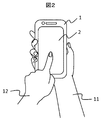
- FIG. 2 is an enlarged schematic view of the user 10 in order to show the usage state of the mobile terminal 1 in the present embodiment.
- the user 10 holds the mobile terminal 1 according to the present embodiment with the right hand 11 and touches the liquid crystal screen of the mobile terminal 1 with the index finger of the left hand 12.
- the portable terminal 1 in the present embodiment is predetermined from the fingerprint shape pattern of the touched finger. It is provided with a function of detecting a fingerprint feature point of the user, identifying a user, and performing personal authentication.
- a predetermined fingerprint pattern detection sensor (hereinafter abbreviated as a fingerprint sensor) is used to detect a fingerprint shape pattern of a finger that is in contact with the entire position of the information display screen 2 or an arbitrary position within a partial area thereof.
- this fingerprint sensor can detect the shape pattern of the fingerprint, including known devices such as a liquid crystal display panel device incorporating an optical sensor and a device that three-dimensionally detects a fingerprint pattern using ultrasonic waves. Any sensor may be used as long as it is a sensor.
- the portable terminal 1 in this embodiment includes a terminal holding sensor that detects a state in which the user 10 holds the portable terminal 1 at hand as in the example shown in FIG. 2 in addition to the above-described fingerprint authentication device. Yes.
- this terminal holding sensor for example, a sensor device that detects whether or not the user 10 is holding the mobile terminal 1 from a pressure sensor provided on the side surface of the mobile terminal 1, or provided in the mobile terminal 1.
- the vibration sensor what sensor device including a sensor device such as a known device by the portable terminal 1 by detecting the physiological minute vibrations detects whether holding state that occurs when a person holds the object by hand It does not matter.
- the portable terminal 1 If it is possible to detect whether or not the user 10 continues to hold the portable terminal 1 using the terminal holding sensor, for example, after the user 10 performs personal authentication by fingerprint authentication or the like, the portable terminal 1 is If the personal authentication result is kept valid for the period of holding, canceling the holding, that is, holding it in your hand, and storing it in your pocket or bag, or leaving it on your desk Can have a function of automatically canceling the personal authentication result and resetting it invalid.
- the mobile terminal 1 can be provided with a function for switching the validity / invalidity of the personal authentication result by detecting whether or not the mobile terminal 1 is in the holding continuation state, for example, the user 10 performs a keyless entry operation.
- a personal authentication operation such as fingerprint authentication is performed with a comfortable posture at a position away from the object on which the security release operation is performed, and then the object and the mobile terminal 1 are simply moved closer to the object while holding the authenticated mobile terminal 1.
- Mutual communication for security release is automatically performed between them, and a keyless entry operation or a security release operation can be automatically executed. Accordingly, it is possible to perform a keyless entry operation or a security release operation that is very convenient for the user 10 while maintaining high security performance such as prevention of unauthorized abuse.
- a certain authentication result valid state holding time is set in advance, and when the holding time elapses after the personal authentication by the fingerprint authentication or the like, the portable terminal 1 holds If the personal authentication result is reset from valid to invalid even in the continuous state, the illegal abuse prevention effect can be further improved.
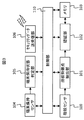
- FIG. 3 shows an example of a block diagram of a portable terminal for specifically realizing the present embodiment.
- fingerprint shape pattern information obtained by a fingerprint sensor 100 that detects a fingerprint shape pattern from a finger that has touched a predetermined position on the information display screen 2 is sent to a fingerprint feature point extraction unit 101, where a predetermined fingerprint is obtained.
- Feature point information is extracted and sent to the authentication unit 102.
- the authentication unit 102 collates the fingerprint feature point information of the contact finger obtained by the fingerprint feature point extraction unit 101 with the fingerprint feature point information of the individual person to be authenticated stored in the memory 103, thereby The personal authentication pass / fail determination of the contacted user 10 is executed.
- the result is “authentication permitted”, that is, the authentication result that the user 10 is a security release target person, or conversely, “authentication is not permitted”, that is, the authentication result that the security release non-target person is stored in the memory 103. Stored.
- the portable terminal in this embodiment is equipped with the terminal holding sensor 104 as described above, and predetermined terminal holding information detected by the terminal holding sensor 104 is sent to the terminal holding state determination unit 105. Then, the terminal holding state determination unit 105 determines whether or not the user 10 is holding the portable terminal 1 at hand.
- the security release signal is wirelessly transmitted from the security data transmission / reception unit 106 to the target external keyless entry system or security system.
- each of the blocks 100 to 106 is bi-directionally connected to the control unit 110, and its function and operation are appropriately controlled by the control unit 110.
- the fingerprint feature point information of each person who is permitted to be authenticated is stored in the memory 103 provided in the portable terminal 1, but this embodiment is not limited to this.
- the fingerprint feature point information of each person who is permitted to be authenticated is registered in an external data center or the like, and the fingerprint feature registered from the data center via the security data transmitting / receiving unit 106 every time a personal authentication operation is performed. Even if it is a mechanism for calling point information, it does not matter.
- fingerprint feature points are extracted from the fingerprint shape pattern information acquired in S203.
- the user's personal authentication pass / fail determination is executed by collating with the fingerprint feature point information of the person to be authenticated who is registered in the internal memory of the portable terminal or the external data center. If the determination is “Yes”, that is, the personal authentication has passed, the authentication permission information is stored in the internal memory in the next S205. On the other hand, if the determination is “No”, that is, the personal authentication fails, the authentication permission information stored in the internal memory is canceled (reset) in S209 and the flow ends.
- a mode for holding the authentication permission is selected.
- this selection result is “Yes”, that is, when the authentication permission holding mode is selected, it is determined whether or not the user 10 keeps holding the portable terminal 1 at the next S207, and further at S208 the previous time It is determined whether the elapsed time after the personal authentication pass / fail determination is within a predetermined authentication result holding time.
- both the determination results are “Yes”, that is, the portable terminal 1 is kept being held by the user 10 and the elapsed time is still within the authentication result holding time, it is stored in the internal memory. If one of the determination results is “No”, the authentication permission information is canceled (reset) in the next S209, and the flow ends. In the case of authentication NG after the retention time of the authentication result has elapsed, by notifying the user that the predetermined time has elapsed, it is possible to understand why the authentication has failed, and the user can perform authentication again. Can be achieved.
- the selection result in S206 is “No”, that is, if the authentication permission holding mode is not selected, it is determined in next S210 whether or not the finger is kept in contact with the fingerprint sensor. If “Yes”, that is, the finger continues to touch the fingerprint sensor, the authentication permission stored in the internal memory is held, and if the determination result is “No”, that is, if the finger leaves the fingerprint sensor, in S209 The flow ends after the authentication permission information is released (reset).
- the flow jumps to S211 and it is determined whether or not to shift to the security release (or keyless entry) mode.
- the determination to shift to the security release mode is made by a predetermined interrupt command input by the user 10 or a predetermined interrupt signal received by the portable terminal 1 itself from an external target keyless entry system or a security system. Therefore, even during the feedback loop in S210 and S208 or in S210, the flow is forcibly shifted to the security release mode by the interrupt signal.
- the determination result in S211 is “Yes”, that is, when the mode is shifted to the security release mode, the authentication result (the authentication permission information) stored in the internal memory is read in the next S212, and the authentication result is further displayed in the next S213. It is determined whether or not it is permitted. If the determination result is “Yes”, that is, if the authentication result is “authentication permitted”, a predetermined keyless entry permission signal or security release signal is transmitted to the target keyless entry system or security system in the next S214, and actually Keyless entry or security release is performed.
- the present embodiment is of course limited to this. It is not a thing.
- fingerprint authentication vein authentication for performing personal authentication from the finger pattern of the user's 10 finger or palm, or iris authentication for performing personal authentication by detecting the feature point of the iris of the user's 10 eye or facial recognition
- biometric authentication means installed in the mobile terminal 1 such as face authentication for performing personal authentication from the feature points of the feature.
- the present embodiment can be applied to any personal authentication means that can be installed in the portable terminal 1 such as password input.
- a first authentication mode in which user authentication is performed only by fingerprint authentication
- a second authentication mode in which user authentication is performed only by iris authentication or face authentication
- fingerprint authentication and iris authentication or face authentication may be provided, and the use authentication mode may be arbitrarily selected from a plurality of authentication modes according to the target security device.
- the present embodiment is a portable terminal equipped with a personal authentication device, and includes a holding detection device that detects a state in which the user keeps holding the portable terminal in his / her hand. After performing an authentication operation with the device, a function of continuing to hold the authentication result of the authentication operation while continuing to detect the state of holding the portable terminal by the detection result of the holding detection device.
- a method for authenticating a system using a portable terminal equipped with a personal authentication device and authenticating the authentication operation while the user continues to hold the portable terminal after performing the authentication operation with the personal authentication device.
- the system is configured to release the system by keeping the result and communicating the authentication result.
- the system is a keyless entry system or a security system.
- FIGS. 5 and FIG. 6 are schematic views in which the user 10 is enlarged to show the usage state of the mobile terminal 1 in the present embodiment, and the same components as the components described in FIG. The same number is attached. 5 and 6, the right hand 11 of the user 10 holding the mobile terminal is omitted.
- the portable terminal 1 also has a fingerprint shape of the contact finger when the finger is brought into contact with an arbitrary position within the entire surface of the information display screen 2 constituted by, for example, a liquid crystal screen or a partial area thereof. It has a function of detecting a predetermined fingerprint feature point from the pattern and authenticating the user using the detected information.
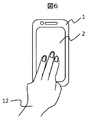
- the mobile terminal 1 in this embodiment has the following functions. That is, as shown in FIG. 5, a first fingerprint authentication mode in which one finger is brought into contact with the information display screen 2 and personal authentication of the user 10 is performed from the fingerprint feature point of the one finger, As shown in FIG. 6, at least two types of fingerprint authentication modes in which two or more fingers are simultaneously brought into contact with the information display screen 2 and personal authentication of the user is performed from the fingerprint feature points of all the fingers. A fingerprint authentication mode is provided, and the user 10 can select and execute an authentication mode freely from those fingerprint authentication modes.
- the second fingerprint authentication mode in which authentication is performed from all the fingerprint feature points of a plurality of fingers is obviously more effective than the first fingerprint authentication mode in which authentication is performed from the fingerprint feature points of one finger.
- Security performance such as the ability to identify individuals who are permitted to authenticate and the ability to exclude non-authenticated persons is significantly improved.
- the security performance can be further improved with respect to the first and second fingerprint authentication modes by causing the number and type of contact fingers to function as a kind of encryption or password.
- the user can freely select the authentication mode from the plurality of authentication modes according to the security level required for each system. If it can be used, a keyless entry system or a security system that is flexible and highly convenient for the user while maintaining high security performance for the user can be provided.
- the present embodiment is not limited thereto, and any finger is used. If the fingerprint feature points of the fingers are registered in advance, it can be used.
- the second fingerprint authentication mode shown in FIG. 6 a case is shown in which three fingers, that is, the index finger, the middle finger, and the ring finger of the left hand 12 are brought into contact with each other. There are no restrictions on the number of fingers or the types of fingers as long as they are two or more fingers.
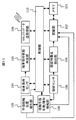
- FIG. 7 shows an example of a block diagram of a portable terminal for realizing the present embodiment.
- the fingerprint sensor 100 and the fingerprint feature point extraction unit 101 have a function of extracting all the fingerprint shape patterns and fingerprint feature points of each finger even when a plurality of fingers touch.
- a contact finger number / type detection unit 108 is newly provided.
- the contact finger number / type detection unit 108 has a function of detecting the number of contact fingers and the type of the fingers from the fingerprint shape patterns of a plurality of fingers detected by the fingerprint sensor 100.
- the number and type information of the contact fingers detected by the contact finger number / type detection unit 108 are sent to the authentication unit 102 together with the fingerprint feature point information regarding all the contact fingers extracted by the fingerprint feature point extraction unit 101.
- the personal authentication pass / fail determination of the user 10 who has touched his / her finger from the collation result of both pieces of information is performed.
- the present embodiment is a portable terminal equipped with a personal authentication device, and includes a holding detection device that detects a state in which the user keeps holding the portable terminal in his / her hand.
- the personal authentication device has a function to keep the authentication result of the authentication operation while detecting the state of holding the portable terminal in the hand by the detection result of the holding detection device after performing the authentication operation by the device.
- a biometric authentication device for identifying and authenticating an individual using biometric feature information, and the biometric authentication device is a fingerprint feature point from a user's finger that is brought into contact with an entire position of an information display screen of a portable terminal or a part of the information display screen.
- a fingerprint authentication device that detects a person and identifies the individual, and touches only one finger and makes the user's personal authentication from the fingerprint feature point, and two or more fingers touch Let all its hands It has at least two types of fingerprint authentication modes including a second fingerprint authentication mode for performing personal authentication of a user from the fingerprint feature points, and can arbitrarily select a use authentication mode from a plurality of fingerprint authentication modes according to the target security device With functionality.
- FIGS. are schematic views enlarging the hand of the user 10 in order to show the usage state of the mobile terminal 1 in the present embodiment, and are the same components as those described in FIGS. 2, 5, and 6. Are given the same number. 9 and 10 also omit the right hand 11 of the user 10 holding the portable terminal.
- the portable terminal 1 in the present embodiment also has a predetermined shape based on the fingerprint shape pattern of the touched finger when the finger is brought into contact with the entire surface of the information display screen 2 or an arbitrary position within the partial area thereof. It is equipped with a function for detecting and distinguishing individual user points by detecting feature points.
- the contact position information of the finger that is brought into contact with the mobile terminal 1 on the entire surface of the information display screen 2 or an arbitrary part of the information display screen 2 for example, relative coordinates with respect to the limitation defined in the information display screen
- FIG. 11 shows an example of a block diagram of a portable terminal for realizing the present embodiment.
- the same blocks as those in the block diagrams shown in FIGS. 3 and 7 are denoted by the same reference numerals.
- the description of the same block functions as those in FIGS. 3 and 7 is omitted.
- FIG. 11 in addition to the blocks shown in FIG. 7, a function of detecting contact position information of a finger that has newly touched a predetermined position on the information display screen 2, for example, relative coordinates on the information display screen 2, and the like.
- a provided finger contact position detection unit 109 is provided.
- the contact position information of the contact finger detected by the finger contact position detection unit 109 is sent to the authentication unit 102, and the authentication unit 102 extracts the fingerprint feature point information of the contact finger extracted by the fingerprint feature point extraction unit 101 and
- the user's 10 pass / fail of personal authentication is verified by collating the information with the number of types of contact fingers detected by the contact finger number / type detection unit 108 and the information of the person to be authenticated pre-registered in combination with the information. Judgment can be performed.
- each contact finger detected in S216 is displayed.
- the personal authentication pass / fail determination is also performed based on whether or not the contact position information matches the contact position information of the pre-registered person to be authenticated.
- the personal authentication function is further multiplexed by performing personal authentication using the finger contact position information in addition to the fingerprint feature point information and the number and type information of the touching fingers. It is possible to further improve the security performance such as the individual identification ability of the authorized person and the exclusion ability of the unauthenticated authorized person.
- the device for detecting the contact position information of the finger as described above when the device for detecting the contact position information of the finger as described above is provided, by contacting the finger with two or more areas in order, in addition to each contact position information, information on the contact order is also provided. By collating with the registration information, further multiplexed personal authentication can be performed.
- the user 10 first places the index finger of the left hand 12 in a predetermined area 21 surrounded by a broken line at the upper left corner of the information display screen 2 of the mobile terminal 1 as shown in FIG.
- the index finger is moved to come into contact with a predetermined area 22 surrounded by a broken line at the lower right corner of the information display screen 2.
- Pre-registered authentication for all of the contact order information, the contact position detection information, and the fingerprint feature point information of the contacted finger that first contacted the region 21 and then contacted the region 22 By verifying each piece of information on the person to be permitted, the personal authentication pass / fail determination of the user 10 can be performed. If such multiplexed personal authentication is used, the security performance can be further enhanced.
- the device for detecting the contact position information of the fingers as described above it is possible to further improve the security performance by bringing a plurality of fingers into contact with different predetermined areas.
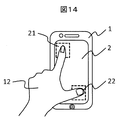
- the user 10 brings his / her index finger of the left hand 12 into contact with a predetermined area 21 surrounded by a broken line at the upper left corner of the information display screen 2 of the mobile terminal 1 and simultaneously displays the thumb on the information display.
- Contact is made within a predetermined area 22 surrounded by a broken line at the lower right corner of the screen 2.
- the person who is permitted to be authenticated in advance for all the position information of the index finger that has been brought into contact with the area 21, the position information of the thumb that has been brought into contact with the area 22, and the fingerprint feature point information of the index finger and thumb in each area It is also possible to carry out personal authentication pass / fail judgment of the user 10 by collating with each of the above information.
- a function of detecting a relative direction and orientation with respect to the information display screen 2 from a fingerprint pattern of the finger brought into contact with the information display screen 2 is provided. Can be further improved.
- the relative direction and orientation with respect to the information display screen 2 can be detected from the fingerprint pattern of the finger touched as described above, for example, as shown in FIG. As described above, the finger is brought into contact with the top and bottom of the portable terminal 1 in the reverse direction, so that both the detection information and the fingerprint feature point information relative to the information display screen 2 relative to the information display screen 2 are registered in advance. It is also possible to carry out personal authentication pass / fail determination of the user 10 by collating with each piece of information of the person to be authenticated.
- each of the embodiments shown in FIGS. 9 to 16 is merely an example, and of course, the present embodiment is not limited to these.
- the user may freely select the number and number of contact fingers, the position and number of contact areas, and the contact direction and orientation of the contact fingers in each embodiment.
- each of the embodiments shown in FIGS. 9 to 16 may be used alone or in combination with a plurality of types of personal authentication methods.
- the authentication method becomes complicated, it is necessary to take measures if the method is forgotten. Therefore, for example, the authentication method and procedure may be confirmed only at the first biometric authentication.
- the present embodiment is a portable terminal equipped with a personal authentication device, and includes a holding detection device that detects a state in which the user keeps holding the portable terminal in his / her hand.
- the personal authentication device has a function to keep the authentication result of the authentication operation while detecting the state of holding the portable terminal in the hand by the detection result of the holding detection device after performing the authentication operation by the device.
- a biometric authentication device for identifying and authenticating an individual using biometric feature information, and the biometric authentication device is a fingerprint feature point from a user's finger that is brought into contact with an entire position of an information display screen of a portable terminal or a part of the information display screen
- Fingerprint authentication device for detecting personal information and detecting contact position information in an information display screen of a finger contacted by a user, and the fingerprint authentication information obtained by the fingerprint authentication device and the contact position Both information Having a function of performing personal authentication of the al user.
- the portable terminal includes a personal authentication device, and includes a holding detection device that detects a state in which the user keeps holding the mobile terminal in his / her hand, and the user performs an authentication operation using the personal authentication device. While the detection result of the holding detection device continues to detect the state of holding the portable terminal in the hand, the personal authentication device has a function of holding the authentication result of the authentication operation.
- a biometric authentication device that identifies and authenticates a fingerprint
- the biometric authentication device detects a fingerprint feature point from a user's finger that is in contact with an arbitrary position within the entire surface of the information display screen of a portable terminal or a part thereof.
- a device for detecting the direction or orientation of the contact finger relative to the information display screen, and the user's direction is determined from both the fingerprint authentication information obtained by the fingerprint authentication device and the direction or orientation information of the contact finger. Equipped with a function to perform human authentication.
- a conventional portable terminal wirelessly communicates a predetermined security signal with a personal authentication unit that performs pass / fail determination of personal authentication through a predetermined biometric authentication device incorporated therein, or between an external keyless entry system or a security system.
- the power for driving the signal communication unit that remotely controls the keyless entry system or security system security, as well as the control unit that controls the functions and operations of each part related to personal authentication, is the same as all other terminal functions.
- the power is supplied from a main power source stored in the portable terminal. However, this causes a problem that when the power of the main power source is lost, the authentication function and the security signal communication function are not driven as with all other terminal functions.
- the personal authentication function 201, the security signal communication function 202, and the control unit 203 responsible for controlling these units, which are equipped in the portable terminal 1, are exclusively driven.
- the auxiliary power supply 301 separately from the main power supply 300 for the main function unit 200 that drives the main functions of the mobile terminal excluding the above-described parts, even if the power of the main power supply 300 is lost, the personal authentication function Only keyless entry or security release using the security signal communication function can be driven.
- auxiliary power supply 301 may be a button battery that is miniaturized so that it can be stored in a mobile terminal, or a solar battery panel that is installed at a predetermined position on the surface of the mobile terminal.
- the present embodiment is a portable terminal equipped with a personal authentication device, and includes a holding detection device that detects a state in which the user keeps holding the portable terminal in his / her hand.
- the personal authentication device has a function to keep the authentication result of the authentication operation while detecting the state of holding the portable terminal in the hand by the detection result of the holding detection device after performing the authentication operation by the device.
- a biometric authentication device that identifies and authenticates an individual using biometric feature information, and stores a power source for driving the biometric authentication device separately from a main power source for driving devices or functions other than the biometric authentication device.
- FIG. 18 shows a keyless entry system for performing a predetermined keyless entry or security release by wirelessly communicating predetermined security information between the portable terminal 1 described in the first to fourth embodiments and the portable terminal 1. It is the block diagram which showed the present Example of the security system to implement.
- a keyless entry system or security system 400 (hereinafter referred to as a system 400 for the sake of simplicity) includes a transmission / reception unit 401 for performing wireless mutual communication with the mobile terminal 1, and decryption or encryption of a communication signal. And a security driving unit 403 that executes keyless entry or security release for a predetermined object 405, and each of the functions and operations is sequentially controlled by the control unit 404. .
- the wireless mutual communication with the system 400 is automatically started, and a security release inquiry signal is transmitted to the mobile terminal 1 through the transmission / reception unit 401. Is done. At this time, if the authentication result in the portable terminal 1 is “authentication permitted”, a security release permission signal is transmitted from the portable terminal 1 to the system 400.
- the security cancellation inquiry signal and the security cancellation permission signal are preferably signals that have been subjected to predetermined encryption from the viewpoint of preventing unauthorized use and “spoofing”.
- the decryption / encryption unit 402 encrypts the security cancellation inquiry signal and the security cancellation permission signal or decrypts the encrypted signals.
- the security release permission signal received by the transmission / reception unit 401 in the system 400 is sent to the decryption / encryption unit 402, and the encrypted signal is decrypted and sent to the control unit 404.
- the control unit 404 sends a command signal to the security driving unit 403 to execute a predetermined driving operation.
- the security driving unit 403 that has received the command signal specifically performs the following driving operation. For example, when the system 400 is a keyless entry system for a front door of a home, a guest room door of a hotel, or a front door of a private car or a rental car, the door 405 that is the object is automatically unlocked / locked or automatically A series of keyless entry operations such as opening and closing are performed.
- system 400 is a security system such as an ATM
- a series of security release operations are performed in order to make the ATM 405 as a target object ready for cash deposit.
- the user can simply move closer to the system 400 while holding the portable terminal that has been permitted personal authentication.
- a series of keyless entry or security release is executed. Therefore, it is possible to realize a keyless entry system or security system that is highly convenient for the user while maintaining high security.
- the present invention is not limited to the above-described embodiments, and includes various modifications.
- the above-described embodiments have been described in detail for easy understanding of the present invention, and are not necessarily limited to those having all the configurations described. It is also possible to add the configuration of another embodiment to the configuration of one embodiment. Further, it is possible to add, delete, and replace other configurations for a part of each embodiment.
Landscapes
- Engineering & Computer Science (AREA)
- Computer Security & Cryptography (AREA)
- Theoretical Computer Science (AREA)
- Computer Hardware Design (AREA)
- Software Systems (AREA)
- Physics & Mathematics (AREA)
- General Engineering & Computer Science (AREA)
- General Physics & Mathematics (AREA)
- Telephone Function (AREA)
Abstract
従来の個人認証機能付き携帯端末やそれを用いたキーレスエントリシステムやセキュリティシステムでは、個々のセキュリティ解除操作を行う度にその直前に所定の生体認証操作を行う必要があるなど使用者の利便性等に多くの課題があった。 上記課題を解決するために、個人認証装置を備えた携帯端末であって、使用者が携帯端末を手に保持し続けている状態を検知する保持検知装置を備え、使用者が個人認証装置により認証操作を行ったのち保持検知装置の検知結果により携帯端末を手に保持している状態を検知し続けている間は認証操作の認証結果を保持し続ける機能を備えた。
Description
本発明は個人認証機能と所定の通信機能を備えた携帯端末によるキーレスエントリシステムまたはセキュリティシステムに適用されるものである。
近年、個人認証機能を備えたスマートフォン等の携帯端末が広く普及している。特に指紋認証や指静脈認証、あるいは眼の虹彩の特徴点を検出することで個人認証を行う虹彩認証などの生体認証による個人認証機能を備えた携帯端末が普及している。この生体認証機能と携帯端末の通信機能を利用して自宅玄関ドア等の自動開錠/施錠を実現するキーレスエントリシステムや、銀行の現金自動預け払い機(以下ATMと略す。)用セキュリティシステム等が実用化されつつある。
本技術分野の背景技術として、例えば、特開2003-253940号公報(特許文献1)がある。特許文献1では、携帯端末で取得した生体認証情報を所定の鍵装置に送信し、鍵装置内で個人認証を行いその結果に基づいて解錠/施錠を行うことでキーレスエントリを実現する例が開示されている。
特許文献1に開示されている従来のキーレスエントリシステムやセキュリティシステムでは、個々のセキュリティ解除操作を行う度に、その直前に所定の生体認証操作を行う必要があり、例えば前記ATMのセキュリティシステムの場合などでは、使用者が携帯端末をATM端末に近接させた不自然な体勢で生体認証作業を行う必要があるなど使用者の利便性の面で大きな課題がある。
上記課題を解決するため、本発明は、その一例を挙げるならば、個人認証装置を備えた携帯端末であって、使用者が携帯端末を手に保持し続けている状態を検知する保持検知装置を備え、使用者が個人認証装置により認証操作を行ったのち保持検知装置の検知結果により携帯端末を手に保持している状態を検知し続けている間は認証操作の認証結果を保持し続ける機能を備えた。
本発明によれば、高いセキュリティ性能と共に、使用者にとって高い利便性を備えたキーレスエントリシステムまたはセキュリティシステムを実現することができる。
以下、図面を用いて本発明の実施例について説明する。
図1は本実施例における携帯端末1とそれを保持する使用者10を示している。本実施例では携帯端末1として、例えばスマートフォンなどの携帯型通信端末装置を例に挙げて説明するが、当然これに限定されるものでは無く、手首に巻く腕時計型の通信端末装置やタブレット型のパーソナルコンピュータなどでも構わない。
本実施例における携帯端末1は、例えば指紋認証などの所定の生体認証装置を備えている。そして、例えば自宅やホテル等の玄関ドアあるいは自家用車やレンタカー等のフロントドア等のドアロック自動施錠/解錠機能、さらにはドアの自動開閉機能を備えたいわゆるキーレスエントリシステム、あるいは銀行ATM等に用いられる個人認証セキュリティシステム等を所定の相互通信を通じて遠隔操作する機能を備える。なお相互通信方式としては、例えばBluetooth(登録商標)あるいはNFCなどで代表される近距離無線通信方式を用いるのが一般的であるが、本実施例はそれに限定されるものでない。
図2は本実施例における携帯端末1の使用状態を示すため、使用者10の手元を拡大した概略図である。図2において、使用者10はその右手11で本実施例における携帯端末1を保持し、左手12の人差し指で携帯端末1の液晶画面に触れている状態を示している。
本実施例における携帯端末1は、例えば液晶画面などで構成される情報表示画面2の全面またはその一部領域内の任意の位置に指を接触させると、接触させた指の指紋形状パターンから所定の指紋特徴点を検知して、使用者を識別し個人認証を行なう機能を備えている。
前記のように情報表示画面2の全面またはその一部領域内の任意位置に接触させた手指の指紋形状パターンを検知するためには所定の指紋パターン検知センサ(以下、指紋センサと略す。)が必要であるが、この指紋センサとしては、例えば光センサを内蔵した液晶型表示パネル装置や超音波によって指紋パターンを3次元的に検知する装置など公知の装置を含め、指紋の形状パターンを検知できるセンサであればどのようなセンサであっても構わない。
さらに本実施例における携帯端末1は、前記の指紋認証装置に加えて使用者10が例えば図2に示す例の如く携帯端末1を手元に保持している状態を検知する端末保持センサも備えている。この端末保持センサの具体例としては、例えば携帯端末1の側面に設けた圧力センサから使用者10が携帯端末1を握り締めている状態か否かを検知するセンサ装置や、携帯端末1内に設けた振動センサにより、人が手で物を保持する時に生じる生理的な微小振動を検知することで携帯端末1が保持状態か否かを検知するセンサ装置等公知の装置を含めどのようなセンサ装置であっても構わない。
前記端末保持センサを用いて使用者10が携帯端末1を手元に保持し続けている状態か否かを検知できれば、例えば使用者10が指紋認証等により個人認証を行った後、携帯端末1を保持し続けている期間は個人認証結果を有効状態に保ち、保持を解除すなわち手に保持し続けている事を止めて、例えばポケットやカバンの中へ収納したりあるいは机上に放置したような場合は、自動的に個人認証結果が解除され無効にリセットされるような機能を持たせることが可能である。
このように、携帯端末1が保持継続状態か否かを検知することにより、個人認証結果の有効/無効を切替える機能を携帯端末1に備えさせることが出来れば、例えば使用者10がキーレスエントリ操作あるいはセキュリティ解除操作を行う対象物から離れた位置において楽な体勢で指紋認証等による個人認証操作を行い、その後認証済みの携帯端末1を保持したまま対象物に近づくだけで対象物と携帯端末1間で自動的にセキュリティ解除のための相互通信が行われ、自動的にキーレスエントリ操作あるいはセキュリティ解除操作が実行できる。これにより、不正乱用防止など高いセキュリティ性能を保持したまま使用者10にとって非常に利便性が高いキーレスエントリ操作あるいはセキュリティ解除操作を行うことができる。
さらに前記した携帯端末1の保持継続状態の検知に加え、予め一定の認証結果有効状態保持時間を設定しておき、前記指紋認証等による個人認証後に前記保持時間が経過すると、携帯端末1が保持継続状態であっても個人認証結果が有効から無効にリセットされるようにしておくと、さらに不正乱用防止効果を向上させることができる。
図3は、本実施例を具体的に実現するための携帯端末のブロック図の一例を示している。図3において、情報表示画面2の所定位置に接触した手指から指紋形状パターンを検知する指紋センサ100で得られた指紋形状パターン情報は、指紋特徴点抽出部101に送られ、ここで所定の指紋特徴点情報が抽出されて認証部102に送られる。
この認証部102では、指紋特徴点抽出部101で得られた接触手指の指紋特徴点情報とメモリ103に格納されている認証許可対象者個々人の指紋特徴点情報とを照合することにより、手指を接触させた使用者10の個人認証合否判定を実行する。そして、その結果が『認証許可』すなわち使用者10がセキュリティ解除対象者であるとの認証結果、あるいは逆に『認証不許可』、すなわちセキュリティ解除非対象者であるとの認証結果はメモリ103に格納される。
一方、本実施例における携帯端末には前記したような端末保持センサ104が装備されており、この端末保持センサ104で検知された所定の端末保持情報が端末保持状態判定部105に送られる。そして、この端末保持状態判定部105において、使用者10が携帯端末1を手元に保持し続けている状態か否かが判定される。
その上でメモリ103に格納された前記認証結果が『認証許可』で、かつ使用者10が携帯端末1を手元に保持し続けている状態と判定された場合、セキュリティ解除が許可され、所定のセキュリティ解除信号がセキュリティデータ送受信部106より対象となる外部のキーレスエントリシステムあるいはセキュリティシステムへ無線送信される。
また、前記100乃至106の各ブロックは制御部110と双方向に結ばれ、その機能や動作が制御部110によって適宜制御されるようになっている。
なお、図3に示した例では、認証許可対象者個々人の指紋特徴点情報は携帯端末1内に装備されたメモリ103に格納されているが、本実施例は勿論これに限定されるものではなく、例えば、認証許可対象者個々人の指紋特徴点情報を外部のデータセンタ等に登録しておき、個人認証操作を行う度にセキュリティデータ送受信部106を経由してデータセンタから登録済みの指紋特徴点情報を呼び出す仕組みであっても一向に構わない。
次に、図4のフローチャートを用いて、本実施例を実現するための処理フローの一例を示す。図4において、フローが開始されると、まずS201で個人認証モードを実行するか否かが選択される。選択結果が「Yes」すなわち個人認証モードを実行する場合は、次のS202で前記指紋センサに手指が接触した事を検知し接触手指から所定の指紋形状パターン情報が取得される。
次に、S203で取得された指紋形状パターン情報から指紋特徴点が抽出される。そして、次のS204において、携帯端末の内部メモリまたは外部のデータセンタに登録されている認証許可対象者の指紋特徴点情報と照合することで使用者の個人認証合否判定が実行される。判定が「Yes」すなわち個人認証が合格した場合は、次のS205で認証許可情報が内部メモリに格納される。逆に判定が「No」すなわち個人認証が不合格の場合は、S209で内部メモリに格納されている認証許可情報が解除(リセット)されてフローが終了する。
次にS206では前記認証許可を保持するモードが選択される。この選択結果が「Yes」すなわち認証許可保持モードを選択した場合は、次のS207で使用者10がこの携帯端末1を手元に保持し続けている状態か否かが判定され、さらにS208で前回個人認証合否判定後からの経過時間が予め定められた認証結果保持時間内か否かが判定される。
そしてこの両方の判定結果が「Yes」すなわち携帯端末1が使用者10の手元に保持され続けている状態でかつ前記経過時間がまだ前記認証結果保持時間内である場合は、内部メモリに格納されている認証許可を保持し、逆にどちらか一方の判定結果が「No」となった場合は、次のS209で前記認証許可情報が解除(リセット)されたうえでフローが終了する。なお、認証結果の保持時間経過後の認証NGの場合は、ユーザに所定時間経過した旨を知らせることで、なぜ認証NGになったかを理解することができ、ユーザは再度認証を行う等の対応を図ることができる。
一方、前記S206の選択結果が「No」すなわち認証許可保持モードを選択しなかった場合は、次のS210で前記指紋センサに手指が接触され続けている状態か否かを判定し、判定結果が「Yes」すなわち前記指紋センサに手指が接触し続けている間は内部メモリに格納されている認証許可を保持し続け、判定結果が「No」すなわち手指が前記指紋センサから離れると、S209で前記認証許可情報が解除(リセット)されたうえでフローが終了する。
なお、最初のS201での選択結果が「No」の場合は、フローはS211へ飛びここでセキュリティ解除(あるいはキーレスエントリ)モードに移行するか否かが判定される。なおこのセキュリティ解除モードへの移行判定は、使用者10自身が入力した所定の割り込み命令、あるいは携帯端末1自身が外部の対象キーレスエントリシステムまたはセキュリティシステム等から受信した所定の割り込み信号によってなされる。従って前記S207およびS208間あるいは前記S210におけるフィードバックループ中においても、前記割り込み信号によりフローは強制的にセキュリティ解除モードに移行する。
S211での判定結果が「Yes」すなわちセキュリティ解除モードに移行すると、次のS212で内部メモリに格納されている認証結果(前記の認証許可情報)が読み出され、さらに次のS213で認証結果が許可か否かが判定される。そして判定結果が「Yes」すなわち認証結果が『認証許可』である場合は、次のS214で前記の対象キーレスエントリシステムあるいはセキュリティシステムへ所定のキーレスエントリ許可信号あるいはセキュリティ解除信号が送信され、実際にキーレスエントリあるいはセキュリティ解除が実行される。
一方、前記S211またはS213での判定結果が「No」の場合は、一連のキーレスエントリあるいはセキュリティ解除は実行されないままフローが終了する。
ところで、以上図1乃至図4を用いて説明した実施例は、携帯端末1が装備している個人認証手段として指紋認証を例にあげて説明したが、勿論本実施例はこれに限定されるものではない。例えば指紋認証の代わりに使用者10の手指や手のひら内の静脈パターンから個人認証を行う静脈認証、あるいは使用者10の眼の虹彩の特徴点を検出することで個人認証を行う虹彩認証や顔の造作の特徴点から個人認証を行う顔認証など携帯端末1に装備される如何なる生体認証手段に対しても本実施例を適用することができる。さらにはパスワード入力など携帯端末1に装備できる個人認証手段であればどのようなものを対して本実施例を適用しても一向に構わない。
また、様々なセキュリティ解除対象物に対し、個々の対象物に要求されるセキュリティ度に応じて個人認証のセキュリティ性能を変えられるような機能が望ましいが、従来の認証機能付き携帯端末では、使用者に対して特に認証操作の煩わしさを増やすことなくそのようなセキュリティ性能を可変できる機能を備えたものは無かった。そこで、本実施例における携帯端末による個人認証機能を用いたキーレスエントリシステムやセキュリティシステムにおいて、そのシステムごとに要求されるセキュリティレベルに応じ、上記の指紋認証以外に、上記、静脈認証や虹彩認証、顔認証などを用いた複数種類の認証モードを選択して使用することが出来れば、使用者に対して高いセキュリティ性能を保持しつつ使用者にとって柔軟で高い利便性を持ったキーレスエントリシステムあるいはセキュリティシステムを提供できる。例えば、指紋認証のみで使用者の個人認証をおこなう第1の認証モードと、虹彩認証または顔認証のみで使用者の個人認証をおこなう第2の認証モードと、指紋認証と虹彩認証または顔認証の両方から使用者の個人認証をおこなう第3の認証モードを備え、対象セキュリティ機器に応じて複数の認証モードから使用認証モードを任意に選択できるようにしても良い。
以上のように、本実施例は、個人認証装置を備えた携帯端末であって、使用者が携帯端末を手に保持し続けている状態を検知する保持検知装置を備え、使用者が個人認証装置により認証操作を行ったのち保持検知装置の検知結果により携帯端末を手に保持している状態を検知し続けている間は認証操作の認証結果を保持し続ける機能を備えた。
また、個人認証装置を備えた携帯端末を用いたシステムの認証方法であって、使用者が個人認証装置により認証操作を行ったのち携帯端末を手に保持し続けている間は認証操作の認証結果を保持し続け、認証結果を通信することによりシステムの解除操作を行うように構成した。また、そのシステムは、キーレスエントリシステムやセキュリティシステムである。
これにより、使用者にとって高い利便性を備えたキーレスエントリシステムまたはセキュリティシステムを実現することができる。
次に、本発明の第2の実施例について図5および図6を用いて説明する。図5および図6は、本実施例における携帯端末1の使用状態を示すため使用者10の手元を拡大した概略図であり、実施例1の図2に記した構成要素と同じ構成要素には同じ番号を付している。また図5、図6においては、携帯端末を保持する使用者10の右手11は省略している。
本実施例における携帯端末1も実施例1と同様、例えば液晶画面などで構成される情報表示画面2の全面またはその一部領域内の任意位置に手指を接触させた場合、接触手指の指紋形状パターンから所定の指紋特徴点を検知し、その検知情報を用いて使用者個人の認証を行なう機能を備えている。
しかも本実施例における携帯端末1は、以下に示すような機能を備えている。すなわち、図5に示すように、情報表示画面2上に1本の手指を接触させ、その1本の手指の指紋特徴点から使用者10の個人認証を行う第1の指紋認証モードと、図6に示すように、情報表示画面2上に2本以上の手指を同時に接触させ、その全ての手指の指紋特徴点から使用者の個人認証を行う第2の指紋認証モードとの少なくとも2種類の指紋認証モードを備え、使用者10がそれらの指紋認証モードから自由に認証モードを選択して実行できるようになっている。
指紋認証においては、1本の手指の指紋特徴点から認証を行う第1の指紋認証モードよりも、複数の手指の指紋特徴点全てから認証を行う第2の指紋認証モードの方が、明らかに認証許可対象者の個人識別能力や非認証許可対象者の排除能力などのセキュリティ性能は格段に高くなる。
さらには、前記第2の指紋認証モードに加え、接触させた手指の本数やその手指の種別が事前登録された認証許可対象者の接触手指の本数、種別のデータと一致するか否かの照合結果も個人認証の合否判定に用いる第3の認証モードも可能である。つまりこの第3の指紋認証モードは、接触手指の本数や種別をある種の暗号もしくはパスワードとして機能させることで、前記第1および第2の指紋認証モードに対してさらにセキュリティ性能を向上できる。
そこで、本実施例における携帯端末による個人認証機能を用いたキーレスエントリシステムやセキュリティシステムにおいて、そのシステムごとに要求されるセキュリティレベルに応じ前記複数種類の認証モードから使用者が自由に認証モードを選択して使用することが出来れば、使用者に対して高いセキュリティ性能を保持しつつ使用者にとって柔軟で高い利便性を持ったキーレスエントリシステムあるいはセキュリティシステムを提供できる。
なお、図5に示した第1の指紋認証モードの例では、左手12の人指し指を接触させたケースを示しているが、当然本実施例はそれに限定されるものではなく、どの手指であっても事前にその手指の指紋特徴点を登録しておけば使用可能である。また同じく、図6に示した第2の指紋認証モードの例では、左手12の人指し指、中指、薬指の3本の手指を接触させた場合を示しているが、当然本実施例はそれに限定されるものではなく、2本以上の複数の手指であればその手指の本数や手指の種別に制限は無い。
図7は本実施例を実現するための携帯端末のブロック図の一例を示している。なお図7において、図3に示したブロック図と同じブロックには同じ番号を付している。また図3と同じブロックの機能については、その説明を省略する。図7において、指紋センサ100および指紋特徴点抽出部101は、複数の手指が接触した場合においても各手指の指紋形状パターンおよび指紋特徴点を全て抽出できる機能を備えている。また図7では、図3に示した各ブロックに加えて、新たに接触手指本数/種別検知部108が配備されている。この接触手指本数/種別検知部108は、指紋センサ100によって検知された複数の手指の指紋形状パターンからその接触手指の本数およびその手指の種別を検知する機能を備えている。
この接触手指本数/種別検知部108で検知された接触手指の本数および種別情報は、指紋特徴点抽出部101で抽出された全ての接触手指に関する指紋特徴点情報と共に認証部102に送られ、この認証部102において両情報の照合結果から手指を接触させた使用者10の個人認証合否判定が実施される。
次に図8のフローチャートを用いて、本実施例を実現するための処理フローの一例を示す。なお図8において、図4に示したフローチャートと同じ処理フローには同じ番号を付している。また図4と同じ処理フローについては、その説明を省略する。
図8において、S204において個人認証合否判定を行う際、S203で抽出された全ての接触手指の指紋特徴点と合わせて、S215で検知された接触手指の本数および種別情報が事前登録された認証許可対象者の接触手指本数や種別と一致するか否かによっても個人認証合否判定が実施される。
以上のように、本実施例は、個人認証装置を備えた携帯端末であって、使用者が携帯端末を手に保持し続けている状態を検知する保持検知装置を備え、使用者が個人認証装置により認証操作を行ったのち保持検知装置の検知結果により携帯端末を手に保持している状態を検知し続けている間は認証操作の認証結果を保持し続ける機能を備え、個人認証装置は、生体特徴情報を用いて個人を識別、認証する生体認証装置であり、生体認証装置は携帯端末の情報表示画面の全面もしくはその一部内の任意位置に接触させた使用者の手指から指紋特徴点を検知し個人識別する指紋認証装置であって、かつ1本の手指のみを接触させてその指紋特徴点から使用者の個人認証を行う第1の指紋認証モードと、2本以上の手指を接触させてその全ての手指の指紋特徴点から使用者の個人認証を行う第2の指紋認証モードとの少なくとも2種類の指紋認証モードを備え、対象セキュリティ機器に応じて複数の指紋認証モードから使用認証モードを任意に選択できる機能を備えた。
これにより、使用者にとって高い利便性を備え、かつ、セキュリティ性能を向上できるという効果がある。
次に本発明の第3の実施例について、図9および図10を用いて説明する。これらの図は、本実施例における携帯端末1の使用状態を示すため使用者10の手元を拡大した概略図であり、前記図2、図5および図6中に記した構成要素と同じ構成要素には同じ番号を付している。また、図9、図10においても携帯端末を保持する使用者10の右手11は省略している。
本実施例における携帯端末1も実施例1,2と同様、情報表示画面2の全面またはその一部領域内の任意の位置に手指を接触させた場合、接触させた手指の指紋形状パターンから所定の特徴点を検知して使用者個人の識別、認証を行なう機能を備えている。
しかも本実施例では、携帯端末1にその情報表示画面2の全面またはその一部領域内の任意の位置に接触させた手指の接触位置情報(例えば情報表示画面内に定めた限定に対する相対座標等)を検知する装置を備えている。
このような手指の接触位置情報を検知する装置を用いると、その接触位置検知情報と接触させた手指の指紋認証結果の両方から個人認証を実行させることができる。
すなわち図9の例に示すように、例えば前記情報表示画面2の左上隅にある破線で囲まれた所定領域21内に使用者の左手12の人指し指を接触させた場合には、その領域21内に接触させた人指し指の接触位置検知情報と該人指し指から得られる指紋特徴点情報の両方を、事前に登録されている認証許可対象者の接触位置検知情報と指紋特徴点情報と照合することで個人認証を行う。したがって例えば図10に示す例のように、前記領域21とは異なる領域22内に手指を接触させた場合には、たとえ指紋認証の結果が『有効』であっても、個人認証としては無効として排除することができる。
図11は本実施例を実現するための携帯端末のブロック図の一例を示している。なお図11において、図3および図7に示したブロック図と同じブロックには同じ番号を付している。また図3および図7と同じブロックの機能ついては、その説明を省略する。
図11において、図7に示した各ブロックに加えて、新たに情報表示画面2上の所定位置に接触した手指の接触位置情報、例えば情報表示画面2上の相対座標等、を検知する機能を備えた手指接触位置検知部109が配備されている。
この手指接触位置検知部109で検知された接触手指の接触位置情報は認証部102に送られ、この認証部102において、前記指紋特徴点抽出部101で抽出された接触手指の指紋特徴点情報および前記接触手指本数/種別検知部108で検知された接触手指の本数および種別の情報等と組合わせて事前登録された認証許可対象者の各情報と照合することで、使用者10の個人認証合否判定を実施することができる。
次に図12のフローチャートを用いて、本実施例を実現するための処理フローの一例を示す。なお図12において、図4および図8に示したフローチャートと同じ処理フローには同じ番号を付している。また図4および図8と同じ処理フローについては、その説明を省略する。
図12において、S204で個人認証合否判定を行う際、S203で抽出された指紋特徴点情報、およびS215で検知された接触手指の本数および種別情報と合わせて、S216において検知された各接触手指の接触位置情報が事前登録された認証許可対象者の接触位置情報と一致するか否かによっても個人認証合否判定が実施される。
以上述べたように、指紋特徴点情報や接触手指の本数および種別情報に加え、手指の接触位置情報も用いて個人認証を行うことで、個人認証機能がさらに多重化されることになり、認証許可対象者の個人識別能力や非認証許可対象者の排除能力などセキュリティ性能を更に向上させることができる。
ところで、前記のような手指の接触位置情報を検知する装置が備わっていると、手指を2箇所以上の領域に順番に接触させることで、各接触位置情報に加えさらにその接触順の情報についても登録情報と照合することで、さらに多重化された個人認証を行うことができる。
例えば図13に示す実施例では、まず使用者10はその左手12の人指し指を(a)図に示すように携帯端末1の情報表示画面2の左上隅にある破線で囲まれた所定領域21内に接触させ、次に(b)図に示すように人指し指を移動させて前記情報表示画面2の右下隅にある破線で囲まれた所定領域22内に接触させる。この最初に領域21内に接触させ、次に領域22内に接触させたという接触順情報とそれぞれの接触位置検知情報、そして接触させた手指の指紋特徴点情報の全てについて、事前登録された認証許可対象者の各情報と照合することで、使用者10の個人認証合否判定を実施することができる。このような多重化された個人認証を用いれば、セキュリティ性能を更に高くすることができる。
また同様に前記のような手指の接触位置情報を検知する装置が備わっていると、複数の手指をそれぞれ異なる所定領域に接触させることで、セキュリティ性能を更に高くすることも可能である。
例えば図14に示す例では、使用者10はその左手12の人指し指を携帯端末1の情報表示画面2の左上隅にある破線で囲まれた所定領域21内に接触させると同時に親指を前記情報表示画面2の右下隅にある破線で囲まれた所定領域22内に接触させている。この領域21内接触させたに人指し指の位置情報、領域22内に接触させた親指の位置情報、そしてそれぞれの領域における人指し指と親指の指紋特徴点情報の全てについて、事前登録された認証許可対象者の各情報と照合することで、使用者10の個人認証合否判定を実施することも可能である。
さらに前記のような手指の接触位置情報検知装置に加え、情報表示画面2に接触させた手指の指紋パターンから該情報表示画面2に対する相対的な方向や向きを検知する機能を備えると、セキュリティ性能はさらに向上させることができる。
前記のように接触させた手指の指紋パターンから該情報表示画面2に対する相対的な方向や向きを検知できれば、例えば図15のように携帯端末1を横向きして手指を接触させたり、図16のように携帯端末1の天地を逆向きにして手指を接触させることで、接触手指の前記情報表示画面2に対する相対的な方向や向きの検知情報と指紋特徴点情報の両方について、事前登録された認証許可対象者の各情報と照合することで、使用者10の個人認証合否判定を実施することも可能である。
なお図9乃至図16で示した各実施例はあくまで一例であって、当然のことながら本実施例はこれらに限定されるものではない。各実施例における接触手指の本数や数、接触領域の位置や数、接触手指の接触方向や向きは使用者が自由に選択して構わない。
また図9乃至図16で示した各実施例はそれぞれ単独で用いても構わないし、これら複数種類の個人認証方法を組み合わせて用いても一向に構わない。
なお、認証方法が複雑になると、その方法を忘れた場合の対策が必要となる。そこで、例えば、最初の生体認証時にのみ認証方法、手順が確認できるようにしても良い。
以上のように、本実施例は、個人認証装置を備えた携帯端末であって、使用者が携帯端末を手に保持し続けている状態を検知する保持検知装置を備え、使用者が個人認証装置により認証操作を行ったのち保持検知装置の検知結果により携帯端末を手に保持している状態を検知し続けている間は認証操作の認証結果を保持し続ける機能を備え、個人認証装置は、生体特徴情報を用いて個人を識別、認証する生体認証装置であり、生体認証装置は携帯端末の情報表示画面の全面もしくはその一部内の任意位置に接触させた使用者の手指から指紋特徴点を検知し個人識別する指紋認証装置であって、かつ使用者が接触させた手指の情報表示画面内の接触位置情報を検知する装置を備え、指紋認証装置で得られた指紋認証情報と接触位置情報の両方から使用者の個人認証をおこなう機能を備えた。
また、個人認証装置を備えた携帯端末であって、使用者が携帯端末を手に保持し続けている状態を検知する保持検知装置を備え、使用者が個人認証装置により認証操作を行ったのち保持検知装置の検知結果により携帯端末を手に保持している状態を検知し続けている間は認証操作の認証結果を保持し続ける機能を備え、個人認証装置は、生体特徴情報を用いて個人を識別、認証する生体認証装置であり、生体認証装置は携帯端末の情報表示画面の全面もしくはその一部内の任意位置に接触させた使用者の手指から指紋特徴点を検知し個人識別する指紋認証装置であって、かつ情報表示画面に対する接触手指の方向または向きを検知する装置を備え、指紋認証装置で得られた指紋認証情報と接触手指の方向または向き情報の両方から使用者の個人認証をおこなう機能を備えた。
これにより、使用者にとって高い利便性を備え、かつ、さらにセキュリティ性能を向上できるという効果がある。
従来の携帯端末では、その内部に組み込まれた所定の生体認証装置を通じて個人認証合否判定を行う個人認証部、あるいは外部のキーレスエントリシステムまたはセキュリティシステム間と所定のセキュリティ信号を無線相互通信することでキーレスエントリシステムまたはセキュリティシステムセキュリティを遠隔操作する信号通信部、さらにはこれら個人認証関連の各部の機能や動作を制御する制御部などを駆動するための電力は、他の全ての端末機能と同様に携帯端末内に収納された主電源から供給されるのが一般的であった。しかしながらこれでは、主電源の電力が喪失すると他の全ての端末機能と同様に認証機能やセキュリティ信号通信機能も駆動しなくなってしまうという問題が生じる。
そこで本実施例では、例えば図17に示すように、携帯端末1の内部に装備された個人認証機能201、セキュリティ信号通信機能202およびこれら各部の制御を担う制御部203を専用に駆動するための補助電源301を、前記各部を除いた携帯端末の主要機能を駆動する主要機能部200用の主電源300とは別に装備することにより、たとえ主電源300の電力が喪失しても、個人認証機能とセキュリティ信号通信機能を用いたキーレスエントリまたはセキュリティ解除だけは駆動させることができる。
なお補助電源301としては、携帯端末に収納できるように小型化されたボタン電池などでもよいし、携帯端末表面の所定位置に設置された太陽電池パネルなどでも構わない。
以上のように、本実施例は、個人認証装置を備えた携帯端末であって、使用者が携帯端末を手に保持し続けている状態を検知する保持検知装置を備え、使用者が個人認証装置により認証操作を行ったのち保持検知装置の検知結果により携帯端末を手に保持している状態を検知し続けている間は認証操作の認証結果を保持し続ける機能を備え、個人認証装置は、生体特徴情報を用いて個人を識別、認証する生体認証装置であり、生体認証装置以外の装置あるいは機能を駆動するための主電源とは別に生体認証装置を駆動するための電源を収納する。
これにより、たとえ主電源の電力が喪失しても、個人認証機能とセキュリティ信号通信機能を用いたキーレスエントリまたはセキュリティ解除だけは駆動させることができる。
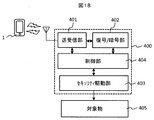
図18は、実施例1乃至4で説明した携帯端末1と、携帯端末1との間で所定のセキュリティ情報を無線相互通信することにより、所定のキーレスエントリを実施するキーレスエントリシステムまたはセキュリティ解除を実施するセキュリティシステムの本実施例を示したブロック図である。
図18において、キーレスエントリシステムまたはセキュリティシステム400(以下、簡単のためシステム400と記す。)は、携帯端末1との無線相互通信をおこなうための送受信部401と、通信信号の復号化あるいは暗号化を行う復号/暗号部402と、所定の対象物405に対してキーレスエントリまたはセキュリティ解除を実行するセキュリティ駆動部403が配備され、これらは制御部404によってそれぞれの機能や動作が逐次制御されている。
セキュリティ解除モードに設定されている携帯端末1がシステム400に所定距離まで近接すると、自動的にシステム400との無線相互通信が開始され、その送受信部401を通じてセキュリティ解除問い合わせ信号が携帯端末1に送信される。この時、携帯端末1での認証結果が『認証許可』である場合は、携帯端末1からセキュリティ解除許可信号がシステム400向けて送信される。
なおセキュリティ解除問い合わせ信号およびセキュリティ解除許可信号については、不正使用や「なりすまし」防止の観点から所定の暗号化を施された信号であることが望ましい。このセキュリティ解除問い合わせ信号やセキュリティ解除許可信号を暗号化したり暗号化されたこれら各信号を復号化するのが、復号/暗号部402である。
システム400内の送受信部401で受信されたセキュリティ解除許可信号は復号/暗号部402に送られ暗号化された信号が復号化され制御部404に送られる。制御部404はこの復号化されたセキュリティ解除許可信号を受けてセキュリティ駆動部403に所定の駆動動作を実行するよう指令信号を送る。
指令信号を受けたセキュリティ駆動部403は、具体的には以下のような駆動動作をおこなう。例えばシステム400が自宅の玄関ドアやホテルの客室ドアあるいは自家用車やレンタカー等のフロントドアなどに対するキーレスエントリシステムである場合は、その対象物であるドア405を自動的に開錠/施錠、あるいは自動的に開閉する等の一連のキーレスエントリ動作を実施する。
また、システム400が例えばATMなどのセキュリティシステムである場合は、対象物であるATM405に対して現金の預け払いが可能な状態にするための一連のセキュリティ解除動作を実施する。
このように、実施例1乃至4における携帯端末1と本実施例で示したようなシステム400を組み合わせることにより、使用者が個人認証許可済みの携帯端末を保持したままシステム400に近接するだけで、一連のキーレスエントリあるいはセキュリティ解除が実行される。このため高いセキュリティ性を保持しつつ使用者にとって高い利便性を備えたキーレスエントリシステムまたはセキュリティシステムを実現することができる。
本発明は上記した実施例に限定されるものではなく、様々な変形例が含まれる。例えば、上記した実施例は本発明を分かりやすく説明するために詳細に説明したものであって、必ずしも説明した全ての構成を備えるものに限定されるものではない。また、ある実施例の構成に他の実施例の構成を加えることも可能である。また、各実施例の一部について、他の構成の追加・削除・置換をすることが可能である。
1…携帯端末、2…情報表示画面、3…携帯端末使用者、11…携帯端末使用者の右手、12…携帯端末使用者の左手、200…携帯端末内の主要機能部、201…携帯端末内の生体認証部、300…携帯端末の主電源、301…携帯端末の補助電源
Claims (12)
- 個人認証装置を備えた携帯端末であって、
使用者が該携帯端末を手に保持し続けている状態を検知する保持検知装置を備え、
前記使用者が前記個人認証装置により認証操作を行ったのち前記保持検知装置の検知結果により前記携帯端末を手に保持している状態を検知し続けている間は前記認証操作の認証結果を保持し続ける機能を備えたことを特徴とする携帯端末。 - 請求項1に記載の携帯端末であって、
前記個人認証装置は、生体特徴情報を用いて個人を識別、認証する生体認証装置であり、
セキュリティ機器との間でセキュリティ情報を通信する装置を備え、
使用者が前記生体認証装置により認証操作を行ったのちに前記セキュリティ機器との通信操作が一定時間以上行われなかった場合に前記認証操作による認証結果が無効となる機能を備えたことを特徴とする携帯端末。 - 請求項1に記載の携帯端末であって、
前記個人認証装置は、生体特徴情報を用いて個人を識別、認証する生体認証装置であり、
前記生体認証装置は前記携帯端末の情報表示画面の全面もしくはその一部内の任意位置に接触させた使用者の手指から指紋特徴点を検知し個人識別する指紋認証装置であって、かつ1本の手指のみを接触させてその指紋特徴点から使用者の個人認証を行う第1の指紋認証モードと、2本以上の手指を接触させてその全ての手指の指紋特徴点から使用者の個人認証を行う第2の指紋認証モードとの少なくとも2種類の指紋認証モードを備え、対象セキュリティ機器に応じて前記複数の指紋認証モードから使用認証モードを任意に選択できる機能を備えたことを特徴とする携帯端末。 - 請求項1に記載の携帯端末であって、
前記個人認証装置は、生体特徴情報を用いて個人を識別、認証する生体認証装置であり、
前記生体認証装置は前記携帯端末の情報表示画面の全面もしくはその一部内の任意位置に接触させた使用者の手指から指紋特徴点を検知し個人識別する指紋認証装置であって、かつ使用者が接触させた手指の前記情報表示画面内の接触位置情報を検知する装置を備え、前記指紋認証装置で得られた指紋認証情報と前記接触位置情報の両方から使用者の個人認証をおこなう機能を備えたことを特徴とする携帯端末。 - 請求項1に記載の携帯端末であって、
前記個人認証装置は、生体特徴情報を用いて個人を識別、認証する生体認証装置であり、
前記生体認証装置は前記携帯端末の情報表示画面の全面もしくはその一部内の任意位置に接触させた使用者の手指から指紋特徴点を検知し個人識別する指紋認証装置であって、かつ前記情報表示画面に対する前記接触手指の方向または向きを検知する装置を備え、前記指紋認証装置で得られた指紋認証情報と前記接触手指の方向または向き情報の両方から使用者の個人認証をおこなう機能を備えたことを特徴とする携帯端末。 - 請求項1に記載の携帯端末であって、
前記個人認証装置は、生体特徴情報を用いて個人を識別、認証する生体認証装置であり、
前記生体認証装置として、使用者の手指から指紋特徴点を検知し個人識別する指紋認証装置と、使用者の眼の虹彩の特徴点を検知し個人識別する虹彩認証装置または使用者の顔面から特徴点を検知し個人識別する顔認証装置の両方を備え、前記指紋認証装置のみで使用者の個人認証をおこなう第1の認証モードと、前記虹彩認証装置または前記顔認証装置のみで使用者の個人認証をおこなう第2の認証モードと、前記指紋認証装置と前記虹彩認証装置または前記顔認証装置の両方から使用者の個人認証をおこなう第3の認証モードを備え、対象セキュリティ機器に応じて前記複数の認証モードから使用認証モードを任意に選択できる機能を備えたことを特徴とする携帯端末。 - 請求項1に記載の携帯端末であって、
前記個人認証装置は、生体特徴情報を用いて個人を識別、認証する生体認証装置であり、
前記生体認証装置以外の装置あるいは機能を駆動するための主電源とは別に前記生体認証装置を駆動するための電源を収納していることを特徴とする携帯端末。 - 請求項1から7の何れか1項に記載の携帯端末と、該携帯端末間で所定の個人認証情報またはセキュリティ情報を通信することにより所定の解錠/施錠操作をおこなう鍵装置と、からなることを特徴とするキーレスエントリシステム。
- 請求項1から7の何れか1項に記載の携帯端末と、該携帯端末間で所定の個人認証情報またはセキュリティ情報を通信することにより所定のセキュリティ解除操作をおこなうセキュリティ装置と、からなることを特徴とするセキュリティシステム。
- 個人認証装置を備えた携帯端末を用いたシステムの認証方法であって、
使用者が前記個人認証装置により認証操作を行ったのち前記携帯端末を手に保持し続けている間は前記認証操作の認証結果を保持し続け、
該認証結果を通信することにより前記システムの解除操作を行うことを特徴とする認証方法。 - 請求項10に記載の認証方法であって、
前記システムはキーレスエントリシステムであることを特徴とする認証方法。 - 請求項10に記載の認証方法であって、
前記システムはセキュリティシステムであることを特徴とする認証方法。
Priority Applications (1)
| Application Number | Priority Date | Filing Date | Title |
|---|---|---|---|
| PCT/JP2015/083535 WO2017094052A1 (ja) | 2015-11-30 | 2015-11-30 | 携帯端末及びそれを用いたキーレスエントリシステムまたはセキュリティシステム及びその認証方法 |
Applications Claiming Priority (1)
| Application Number | Priority Date | Filing Date | Title |
|---|---|---|---|
| PCT/JP2015/083535 WO2017094052A1 (ja) | 2015-11-30 | 2015-11-30 | 携帯端末及びそれを用いたキーレスエントリシステムまたはセキュリティシステム及びその認証方法 |
Publications (1)
| Publication Number | Publication Date |
|---|---|
| WO2017094052A1 true WO2017094052A1 (ja) | 2017-06-08 |
Family
ID=58796493
Family Applications (1)
| Application Number | Title | Priority Date | Filing Date |
|---|---|---|---|
| PCT/JP2015/083535 Ceased WO2017094052A1 (ja) | 2015-11-30 | 2015-11-30 | 携帯端末及びそれを用いたキーレスエントリシステムまたはセキュリティシステム及びその認証方法 |
Country Status (1)
| Country | Link |
|---|---|
| WO (1) | WO2017094052A1 (ja) |
Cited By (19)
| Publication number | Priority date | Publication date | Assignee | Title |
|---|---|---|---|---|
| JPWO2021140405A1 (ja) * | 2020-01-10 | 2021-07-15 | ||
| JP2021526263A (ja) * | 2018-06-03 | 2021-09-30 | アップル インコーポレイテッドApple Inc. | 生体認証の実施 |
| US11393258B2 (en) | 2017-09-09 | 2022-07-19 | Apple Inc. | Implementation of biometric authentication |
| US11468155B2 (en) | 2007-09-24 | 2022-10-11 | Apple Inc. | Embedded authentication systems in an electronic device |
| US11494046B2 (en) | 2013-09-09 | 2022-11-08 | Apple Inc. | Device, method, and graphical user interface for manipulating user interfaces based on unlock inputs |
| US11619991B2 (en) | 2018-09-28 | 2023-04-04 | Apple Inc. | Device control using gaze information |
| US11676373B2 (en) | 2008-01-03 | 2023-06-13 | Apple Inc. | Personal computing device control using face detection and recognition |
| US11755712B2 (en) | 2011-09-29 | 2023-09-12 | Apple Inc. | Authentication with secondary approver |
| US11809784B2 (en) | 2018-09-28 | 2023-11-07 | Apple Inc. | Audio assisted enrollment |
| US11836725B2 (en) | 2014-05-29 | 2023-12-05 | Apple Inc. | User interface for payments |
| US12079458B2 (en) | 2016-09-23 | 2024-09-03 | Apple Inc. | Image data for enhanced user interactions |
| US12100002B2 (en) | 2022-01-25 | 2024-09-24 | Apple Inc. | Managing information on a computer system |
| US12099586B2 (en) | 2021-01-25 | 2024-09-24 | Apple Inc. | Implementation of biometric authentication |
| US12210603B2 (en) | 2021-03-04 | 2025-01-28 | Apple Inc. | User interface for enrolling a biometric feature |
| US12216754B2 (en) | 2021-05-10 | 2025-02-04 | Apple Inc. | User interfaces for authenticating to perform secure operations |
| US12262111B2 (en) | 2011-06-05 | 2025-03-25 | Apple Inc. | Device, method, and graphical user interface for accessing an application in a locked device |
| US12450605B2 (en) | 2022-01-25 | 2025-10-21 | Apple Inc. | Managing information on a computer system |
| US12462005B2 (en) | 2017-09-09 | 2025-11-04 | Apple Inc. | Implementation of biometric authentication |
| US12619701B2 (en) | 2024-09-26 | 2026-05-05 | Apple Inc. | User interfaces for authenticating to perform secure operations |
Citations (6)
| Publication number | Priority date | Publication date | Assignee | Title |
|---|---|---|---|---|
| JP2001142849A (ja) * | 1999-11-16 | 2001-05-25 | Ntt Docomo Inc | 携帯情報端末及び個人認証方法 |
| JP2001241230A (ja) * | 2000-02-29 | 2001-09-04 | Matsushita Electric Works Ltd | データ通信装置およびデータ通信方法 |
| JP2003058269A (ja) * | 2001-08-09 | 2003-02-28 | Mitsubishi Heavy Ind Ltd | 個人認証システム |
| JP2003298733A (ja) * | 2002-03-29 | 2003-10-17 | Denso Corp | 携帯電話 |
| JP2003346133A (ja) * | 2002-05-24 | 2003-12-05 | Nec Infrontia Corp | 指紋認証装置 |
| JP2005071225A (ja) * | 2003-08-27 | 2005-03-17 | Sony Corp | 電子機器および認証方法 |
-
2015
- 2015-11-30 WO PCT/JP2015/083535 patent/WO2017094052A1/ja not_active Ceased
Patent Citations (6)
| Publication number | Priority date | Publication date | Assignee | Title |
|---|---|---|---|---|
| JP2001142849A (ja) * | 1999-11-16 | 2001-05-25 | Ntt Docomo Inc | 携帯情報端末及び個人認証方法 |
| JP2001241230A (ja) * | 2000-02-29 | 2001-09-04 | Matsushita Electric Works Ltd | データ通信装置およびデータ通信方法 |
| JP2003058269A (ja) * | 2001-08-09 | 2003-02-28 | Mitsubishi Heavy Ind Ltd | 個人認証システム |
| JP2003298733A (ja) * | 2002-03-29 | 2003-10-17 | Denso Corp | 携帯電話 |
| JP2003346133A (ja) * | 2002-05-24 | 2003-12-05 | Nec Infrontia Corp | 指紋認証装置 |
| JP2005071225A (ja) * | 2003-08-27 | 2005-03-17 | Sony Corp | 電子機器および認証方法 |
Cited By (33)
| Publication number | Priority date | Publication date | Assignee | Title |
|---|---|---|---|---|
| US11468155B2 (en) | 2007-09-24 | 2022-10-11 | Apple Inc. | Embedded authentication systems in an electronic device |
| US12406490B2 (en) | 2008-01-03 | 2025-09-02 | Apple Inc. | Personal computing device control using face detection and recognition |
| US11676373B2 (en) | 2008-01-03 | 2023-06-13 | Apple Inc. | Personal computing device control using face detection and recognition |
| US12262111B2 (en) | 2011-06-05 | 2025-03-25 | Apple Inc. | Device, method, and graphical user interface for accessing an application in a locked device |
| US11755712B2 (en) | 2011-09-29 | 2023-09-12 | Apple Inc. | Authentication with secondary approver |
| US12314527B2 (en) | 2013-09-09 | 2025-05-27 | Apple Inc. | Device, method, and graphical user interface for manipulating user interfaces based on unlock inputs |
| US11494046B2 (en) | 2013-09-09 | 2022-11-08 | Apple Inc. | Device, method, and graphical user interface for manipulating user interfaces based on unlock inputs |
| US11768575B2 (en) | 2013-09-09 | 2023-09-26 | Apple Inc. | Device, method, and graphical user interface for manipulating user interfaces based on unlock inputs |
| US11836725B2 (en) | 2014-05-29 | 2023-12-05 | Apple Inc. | User interface for payments |
| US12079458B2 (en) | 2016-09-23 | 2024-09-03 | Apple Inc. | Image data for enhanced user interactions |
| US11765163B2 (en) | 2017-09-09 | 2023-09-19 | Apple Inc. | Implementation of biometric authentication |
| US12462005B2 (en) | 2017-09-09 | 2025-11-04 | Apple Inc. | Implementation of biometric authentication |
| US11393258B2 (en) | 2017-09-09 | 2022-07-19 | Apple Inc. | Implementation of biometric authentication |
| JP2023139024A (ja) * | 2018-06-03 | 2023-10-03 | アップル インコーポレイテッド | 生体認証の実施 |
| US11928200B2 (en) | 2018-06-03 | 2024-03-12 | Apple Inc. | Implementation of biometric authentication |
| JP2021526263A (ja) * | 2018-06-03 | 2021-09-30 | アップル インコーポレイテッドApple Inc. | 生体認証の実施 |
| US12189748B2 (en) | 2018-06-03 | 2025-01-07 | Apple Inc. | Implementation of biometric authentication |
| JP7614258B2 (ja) | 2018-06-03 | 2025-01-15 | アップル インコーポレイテッド | 生体認証の実施 |
| US11619991B2 (en) | 2018-09-28 | 2023-04-04 | Apple Inc. | Device control using gaze information |
| US11809784B2 (en) | 2018-09-28 | 2023-11-07 | Apple Inc. | Audio assisted enrollment |
| US12105874B2 (en) | 2018-09-28 | 2024-10-01 | Apple Inc. | Device control using gaze information |
| US12124770B2 (en) | 2018-09-28 | 2024-10-22 | Apple Inc. | Audio assisted enrollment |
| JP2025100704A (ja) * | 2020-01-10 | 2025-07-03 | 株式会社半導体エネルギー研究所 | 電子機器 |
| JPWO2021140405A1 (ja) * | 2020-01-10 | 2021-07-15 | ||
| US12572636B2 (en) | 2020-01-10 | 2026-03-10 | Semiconductor Energy Laboratory Co., Ltd. | Electronic device and program |
| US12099586B2 (en) | 2021-01-25 | 2024-09-24 | Apple Inc. | Implementation of biometric authentication |
| US12210603B2 (en) | 2021-03-04 | 2025-01-28 | Apple Inc. | User interface for enrolling a biometric feature |
| US12216754B2 (en) | 2021-05-10 | 2025-02-04 | Apple Inc. | User interfaces for authenticating to perform secure operations |
| US12118548B2 (en) | 2022-01-25 | 2024-10-15 | Apple Inc. | Managing information on a computer system |
| US12100002B2 (en) | 2022-01-25 | 2024-09-24 | Apple Inc. | Managing information on a computer system |
| US12450605B2 (en) | 2022-01-25 | 2025-10-21 | Apple Inc. | Managing information on a computer system |
| US12619304B2 (en) | 2024-09-09 | 2026-05-05 | Apple Inc. | Device control using gaze information |
| US12619701B2 (en) | 2024-09-26 | 2026-05-05 | Apple Inc. | User interfaces for authenticating to perform secure operations |
Similar Documents
| Publication | Publication Date | Title |
|---|---|---|
| WO2017094052A1 (ja) | 携帯端末及びそれを用いたキーレスエントリシステムまたはセキュリティシステム及びその認証方法 | |
| US10621324B2 (en) | Fingerprint gestures | |
| EP2713298B1 (en) | Display apparatus and method for operating the same | |
| JP6063859B2 (ja) | 携帯鍵装置及び装置制御方法 | |
| US9286482B1 (en) | Privacy control based on user recognition | |
| WO2014083335A4 (en) | A method and system of providing authentication of user access to a computer resource via a mobile device using multiple separate security factors | |
| JP6160401B2 (ja) | 入退室管理装置、入退室管理方法及びプログラム | |
| JP7023139B2 (ja) | 解錠システム、解錠装置、解錠方法、端末装置及びプログラム | |
| Guerar et al. | CirclePIN: A novel authentication mechanism for smartwatches to prevent unauthorized access to IoT devices | |
| WO2014172161A1 (en) | Method and system for securing the entry of data to a device | |
| CN101796764A (zh) | 生物特征认证设备、生物特征认证系统和方法 | |
| WO2016106989A1 (zh) | 多系统安全验证方法、多系统安全验证装置和终端 | |
| WO2016068252A1 (ja) | 携帯端末および携帯端末のロック制御方法 | |
| Guerar et al. | Securing PIN‐based authentication in smartwatches with just two gestures | |
| CN105930078A (zh) | 结合力度与指纹识别的屏幕操控系统及其操控方式 | |
| WO2013123453A1 (en) | Data storage devices, systems, and methods | |
| Guerar et al. | 2GesturePIN: securing PIN-based authentication on smartwatches | |
| US20240028688A1 (en) | Unlocking method using augmented reality | |
| KR101052294B1 (ko) | 콘텐츠 보안 장치 및 콘텐츠 보안 방법 | |
| KR101219957B1 (ko) | 바이오메트릭스를 이용한 사용자 인증 방법, 장치 및 시스템, 이를 위한 기록 매체 | |
| CN202939674U (zh) | 多重安全管理保全装置与系统 | |
| JP2016184374A (ja) | 認証装置 | |
| TW201629838A (zh) | 一種具有保密性的輸入方法 | |
| KR20130117371A (ko) | 손가락 두드리기를 이용한 스크린 잠금 해제 및 비밀 작업 수행 방법 | |
| TWI452204B (zh) | 多重安全管制保全系統與保全訊息處理方法 |
Legal Events
| Date | Code | Title | Description |
|---|---|---|---|
| 121 | Ep: the epo has been informed by wipo that ep was designated in this application |
Ref document number: 15909682 Country of ref document: EP Kind code of ref document: A1 |
|
| NENP | Non-entry into the national phase |
Ref country code: DE |
|
| 122 | Ep: pct application non-entry in european phase |
Ref document number: 15909682 Country of ref document: EP Kind code of ref document: A1 |
|
| NENP | Non-entry into the national phase |
Ref country code: JP |