WO2017083501A1 - Biocontainment/biocontrol system and methods - Google Patents
Biocontainment/biocontrol system and methods Download PDFInfo
- Publication number
- WO2017083501A1 WO2017083501A1 PCT/US2016/061297 US2016061297W WO2017083501A1 WO 2017083501 A1 WO2017083501 A1 WO 2017083501A1 US 2016061297 W US2016061297 W US 2016061297W WO 2017083501 A1 WO2017083501 A1 WO 2017083501A1
- Authority
- WO
- WIPO (PCT)
- Prior art keywords
- cell
- polypeptide
- coding region
- organism
- growth
- Prior art date
- Legal status (The legal status is an assumption and is not a legal conclusion. Google has not performed a legal analysis and makes no representation as to the accuracy of the status listed.)
- Ceased
Links
Classifications
-
- C—CHEMISTRY; METALLURGY
- C12—BIOCHEMISTRY; BEER; SPIRITS; WINE; VINEGAR; MICROBIOLOGY; ENZYMOLOGY; MUTATION OR GENETIC ENGINEERING
- C12N—MICROORGANISMS OR ENZYMES; COMPOSITIONS THEREOF; PROPAGATING, PRESERVING, OR MAINTAINING MICROORGANISMS; MUTATION OR GENETIC ENGINEERING; CULTURE MEDIA
- C12N1/00—Microorganisms; Compositions thereof; Processes of propagating, maintaining or preserving microorganisms or compositions thereof; Processes of preparing or isolating a composition containing a microorganism; Culture media therefor
- C12N1/14—Fungi; Culture media therefor
-
- C—CHEMISTRY; METALLURGY
- C12—BIOCHEMISTRY; BEER; SPIRITS; WINE; VINEGAR; MICROBIOLOGY; ENZYMOLOGY; MUTATION OR GENETIC ENGINEERING
- C12N—MICROORGANISMS OR ENZYMES; COMPOSITIONS THEREOF; PROPAGATING, PRESERVING, OR MAINTAINING MICROORGANISMS; MUTATION OR GENETIC ENGINEERING; CULTURE MEDIA
- C12N15/00—Mutation or genetic engineering; DNA or RNA concerning genetic engineering, vectors, e.g. plasmids, or their isolation, preparation or purification; Use of hosts therefor
- C12N15/09—Recombinant DNA-technology
- C12N15/63—Introduction of foreign genetic material using vectors; Vectors; Use of hosts therefor; Regulation of expression
- C12N15/79—Vectors or expression systems specially adapted for eukaryotic hosts
- C12N15/82—Vectors or expression systems specially adapted for eukaryotic hosts for plant cells, e.g. plant artificial chromosomes (PACs)
- C12N15/8216—Methods for controlling, regulating or enhancing expression of transgenes in plant cells
- C12N15/8218—Antisense, co-suppression, viral induced gene silencing [VIGS], post-transcriptional induced gene silencing [PTGS]
-
- C—CHEMISTRY; METALLURGY
- C12—BIOCHEMISTRY; BEER; SPIRITS; WINE; VINEGAR; MICROBIOLOGY; ENZYMOLOGY; MUTATION OR GENETIC ENGINEERING
- C12N—MICROORGANISMS OR ENZYMES; COMPOSITIONS THEREOF; PROPAGATING, PRESERVING, OR MAINTAINING MICROORGANISMS; MUTATION OR GENETIC ENGINEERING; CULTURE MEDIA
- C12N1/00—Microorganisms; Compositions thereof; Processes of propagating, maintaining or preserving microorganisms or compositions thereof; Processes of preparing or isolating a composition containing a microorganism; Culture media therefor
- C12N1/14—Fungi; Culture media therefor
- C12N1/16—Yeasts; Culture media therefor
- C12N1/18—Baker's yeast; Brewer's yeast
-
- C—CHEMISTRY; METALLURGY
- C12—BIOCHEMISTRY; BEER; SPIRITS; WINE; VINEGAR; MICROBIOLOGY; ENZYMOLOGY; MUTATION OR GENETIC ENGINEERING
- C12N—MICROORGANISMS OR ENZYMES; COMPOSITIONS THEREOF; PROPAGATING, PRESERVING, OR MAINTAINING MICROORGANISMS; MUTATION OR GENETIC ENGINEERING; CULTURE MEDIA
- C12N15/00—Mutation or genetic engineering; DNA or RNA concerning genetic engineering, vectors, e.g. plasmids, or their isolation, preparation or purification; Use of hosts therefor
- C12N15/09—Recombinant DNA-technology
- C12N15/63—Introduction of foreign genetic material using vectors; Vectors; Use of hosts therefor; Regulation of expression
-
- C—CHEMISTRY; METALLURGY
- C12—BIOCHEMISTRY; BEER; SPIRITS; WINE; VINEGAR; MICROBIOLOGY; ENZYMOLOGY; MUTATION OR GENETIC ENGINEERING
- C12N—MICROORGANISMS OR ENZYMES; COMPOSITIONS THEREOF; PROPAGATING, PRESERVING, OR MAINTAINING MICROORGANISMS; MUTATION OR GENETIC ENGINEERING; CULTURE MEDIA
- C12N15/00—Mutation or genetic engineering; DNA or RNA concerning genetic engineering, vectors, e.g. plasmids, or their isolation, preparation or purification; Use of hosts therefor
- C12N15/09—Recombinant DNA-technology
- C12N15/63—Introduction of foreign genetic material using vectors; Vectors; Use of hosts therefor; Regulation of expression
- C12N15/79—Vectors or expression systems specially adapted for eukaryotic hosts
- C12N15/80—Vectors or expression systems specially adapted for eukaryotic hosts for fungi
-
- C—CHEMISTRY; METALLURGY
- C12—BIOCHEMISTRY; BEER; SPIRITS; WINE; VINEGAR; MICROBIOLOGY; ENZYMOLOGY; MUTATION OR GENETIC ENGINEERING
- C12N—MICROORGANISMS OR ENZYMES; COMPOSITIONS THEREOF; PROPAGATING, PRESERVING, OR MAINTAINING MICROORGANISMS; MUTATION OR GENETIC ENGINEERING; CULTURE MEDIA
- C12N15/00—Mutation or genetic engineering; DNA or RNA concerning genetic engineering, vectors, e.g. plasmids, or their isolation, preparation or purification; Use of hosts therefor
- C12N15/09—Recombinant DNA-technology
- C12N15/63—Introduction of foreign genetic material using vectors; Vectors; Use of hosts therefor; Regulation of expression
- C12N15/79—Vectors or expression systems specially adapted for eukaryotic hosts
- C12N15/80—Vectors or expression systems specially adapted for eukaryotic hosts for fungi
- C12N15/81—Vectors or expression systems specially adapted for eukaryotic hosts for fungi for yeasts
-
- C—CHEMISTRY; METALLURGY
- C12—BIOCHEMISTRY; BEER; SPIRITS; WINE; VINEGAR; MICROBIOLOGY; ENZYMOLOGY; MUTATION OR GENETIC ENGINEERING
- C12N—MICROORGANISMS OR ENZYMES; COMPOSITIONS THEREOF; PROPAGATING, PRESERVING, OR MAINTAINING MICROORGANISMS; MUTATION OR GENETIC ENGINEERING; CULTURE MEDIA
- C12N15/00—Mutation or genetic engineering; DNA or RNA concerning genetic engineering, vectors, e.g. plasmids, or their isolation, preparation or purification; Use of hosts therefor
- C12N15/09—Recombinant DNA-technology
- C12N15/63—Introduction of foreign genetic material using vectors; Vectors; Use of hosts therefor; Regulation of expression
- C12N15/79—Vectors or expression systems specially adapted for eukaryotic hosts
- C12N15/80—Vectors or expression systems specially adapted for eukaryotic hosts for fungi
- C12N15/81—Vectors or expression systems specially adapted for eukaryotic hosts for fungi for yeasts
- C12N15/815—Vectors or expression systems specially adapted for eukaryotic hosts for fungi for yeasts for yeasts other than Saccharomyces
-
- C—CHEMISTRY; METALLURGY
- C12—BIOCHEMISTRY; BEER; SPIRITS; WINE; VINEGAR; MICROBIOLOGY; ENZYMOLOGY; MUTATION OR GENETIC ENGINEERING
- C12N—MICROORGANISMS OR ENZYMES; COMPOSITIONS THEREOF; PROPAGATING, PRESERVING, OR MAINTAINING MICROORGANISMS; MUTATION OR GENETIC ENGINEERING; CULTURE MEDIA
- C12N15/00—Mutation or genetic engineering; DNA or RNA concerning genetic engineering, vectors, e.g. plasmids, or their isolation, preparation or purification; Use of hosts therefor
- C12N15/09—Recombinant DNA-technology
- C12N15/63—Introduction of foreign genetic material using vectors; Vectors; Use of hosts therefor; Regulation of expression
- C12N15/79—Vectors or expression systems specially adapted for eukaryotic hosts
- C12N15/82—Vectors or expression systems specially adapted for eukaryotic hosts for plant cells, e.g. plant artificial chromosomes (PACs)
- C12N15/8216—Methods for controlling, regulating or enhancing expression of transgenes in plant cells
-
- C—CHEMISTRY; METALLURGY
- C12—BIOCHEMISTRY; BEER; SPIRITS; WINE; VINEGAR; MICROBIOLOGY; ENZYMOLOGY; MUTATION OR GENETIC ENGINEERING
- C12N—MICROORGANISMS OR ENZYMES; COMPOSITIONS THEREOF; PROPAGATING, PRESERVING, OR MAINTAINING MICROORGANISMS; MUTATION OR GENETIC ENGINEERING; CULTURE MEDIA
- C12N15/00—Mutation or genetic engineering; DNA or RNA concerning genetic engineering, vectors, e.g. plasmids, or their isolation, preparation or purification; Use of hosts therefor
- C12N15/09—Recombinant DNA-technology
- C12N15/63—Introduction of foreign genetic material using vectors; Vectors; Use of hosts therefor; Regulation of expression
- C12N15/79—Vectors or expression systems specially adapted for eukaryotic hosts
- C12N15/82—Vectors or expression systems specially adapted for eukaryotic hosts for plant cells, e.g. plant artificial chromosomes (PACs)
- C12N15/8216—Methods for controlling, regulating or enhancing expression of transgenes in plant cells
- C12N15/8217—Gene switch
-
- C—CHEMISTRY; METALLURGY
- C12—BIOCHEMISTRY; BEER; SPIRITS; WINE; VINEGAR; MICROBIOLOGY; ENZYMOLOGY; MUTATION OR GENETIC ENGINEERING
- C12N—MICROORGANISMS OR ENZYMES; COMPOSITIONS THEREOF; PROPAGATING, PRESERVING, OR MAINTAINING MICROORGANISMS; MUTATION OR GENETIC ENGINEERING; CULTURE MEDIA
- C12N15/00—Mutation or genetic engineering; DNA or RNA concerning genetic engineering, vectors, e.g. plasmids, or their isolation, preparation or purification; Use of hosts therefor
- C12N15/09—Recombinant DNA-technology
- C12N15/63—Introduction of foreign genetic material using vectors; Vectors; Use of hosts therefor; Regulation of expression
- C12N15/79—Vectors or expression systems specially adapted for eukaryotic hosts
- C12N15/82—Vectors or expression systems specially adapted for eukaryotic hosts for plant cells, e.g. plant artificial chromosomes (PACs)
- C12N15/8241—Phenotypically and genetically modified plants via recombinant DNA technology
- C12N15/8261—Phenotypically and genetically modified plants via recombinant DNA technology with agronomic (input) traits, e.g. crop yield
- C12N15/8262—Phenotypically and genetically modified plants via recombinant DNA technology with agronomic (input) traits, e.g. crop yield involving plant development
- C12N15/8263—Ablation; Apoptosis
-
- C—CHEMISTRY; METALLURGY
- C12—BIOCHEMISTRY; BEER; SPIRITS; WINE; VINEGAR; MICROBIOLOGY; ENZYMOLOGY; MUTATION OR GENETIC ENGINEERING
- C12N—MICROORGANISMS OR ENZYMES; COMPOSITIONS THEREOF; PROPAGATING, PRESERVING, OR MAINTAINING MICROORGANISMS; MUTATION OR GENETIC ENGINEERING; CULTURE MEDIA
- C12N15/00—Mutation or genetic engineering; DNA or RNA concerning genetic engineering, vectors, e.g. plasmids, or their isolation, preparation or purification; Use of hosts therefor
- C12N15/09—Recombinant DNA-technology
- C12N15/63—Introduction of foreign genetic material using vectors; Vectors; Use of hosts therefor; Regulation of expression
- C12N15/79—Vectors or expression systems specially adapted for eukaryotic hosts
- C12N15/82—Vectors or expression systems specially adapted for eukaryotic hosts for plant cells, e.g. plant artificial chromosomes (PACs)
- C12N15/8241—Phenotypically and genetically modified plants via recombinant DNA technology
- C12N15/8261—Phenotypically and genetically modified plants via recombinant DNA technology with agronomic (input) traits, e.g. crop yield
- C12N15/8262—Phenotypically and genetically modified plants via recombinant DNA technology with agronomic (input) traits, e.g. crop yield involving plant development
- C12N15/8265—Transgene containment, e.g. gene dispersal
-
- C—CHEMISTRY; METALLURGY
- C12—BIOCHEMISTRY; BEER; SPIRITS; WINE; VINEGAR; MICROBIOLOGY; ENZYMOLOGY; MUTATION OR GENETIC ENGINEERING
- C12N—MICROORGANISMS OR ENZYMES; COMPOSITIONS THEREOF; PROPAGATING, PRESERVING, OR MAINTAINING MICROORGANISMS; MUTATION OR GENETIC ENGINEERING; CULTURE MEDIA
- C12N9/00—Enzymes; Proenzymes; Compositions thereof; Processes for preparing, activating, inhibiting, separating or purifying enzymes
- C12N9/14—Hydrolases (3)
- C12N9/16—Hydrolases (3) acting on ester bonds (3.1)
- C12N9/22—Ribonucleases [RNase]; Deoxyribonucleases [DNase]
-
- C—CHEMISTRY; METALLURGY
- C07—ORGANIC CHEMISTRY
- C07K—PEPTIDES
- C07K14/00—Peptides having more than 20 amino acids; Gastrins; Somatostatins; Melanotropins; Derivatives thereof
- C07K14/005—Peptides having more than 20 amino acids; Gastrins; Somatostatins; Melanotropins; Derivatives thereof from viruses
-
- C—CHEMISTRY; METALLURGY
- C07—ORGANIC CHEMISTRY
- C07K—PEPTIDES
- C07K2319/00—Fusion polypeptide
-
- C—CHEMISTRY; METALLURGY
- C12—BIOCHEMISTRY; BEER; SPIRITS; WINE; VINEGAR; MICROBIOLOGY; ENZYMOLOGY; MUTATION OR GENETIC ENGINEERING
- C12N—MICROORGANISMS OR ENZYMES; COMPOSITIONS THEREOF; PROPAGATING, PRESERVING, OR MAINTAINING MICROORGANISMS; MUTATION OR GENETIC ENGINEERING; CULTURE MEDIA
- C12N2510/00—Genetically modified cells
Definitions
- the biocontainment system includes a coding region whose overexpression decreases growth of the cell, a transcription regulatory region that includes a silent mutation and is operably linked upstream of the coding region, and a polynucleotide that encodes a
- the programmable transcription activator engineered to bind to the transcription regulatory region in the absence of the silent mutation.
- the programmable transcription activator induces overexpression of the coding region; in the presence of the silent mutation, the programmable transcription activator does not initiate overexpression of the coding region.
- an organism that is homozygous for the biocontainment system grows normally.
- an organism that becomes heterozygous for the biocontainment system whether as a result of sexual reproduction with another variety of the organism or by some spontaneous genetic event— exhibits retarded growth and/or death so that any hybrids can be efficiently culled from the population.
- the cell can be a single-celled organism. In other embodiments, the cell can be a germ cell of a multicellular organism. In some embodiments, the programmable transcription activator can include dCas9 fused to an activation domain.
- the coding region can encode a cytoskeletal polypeptide, an ER- Golgi vesicle polypeptide, an mRNA processing polypeptide, an electron transport polypeptide, a nuclear trafficking polypeptide, a chromosome segregation polypeptide, a spindle pole duplication polypeptide, or an oxidative stress polypeptide.
- overexpression of the coding region can be lethal to the cell.
- the cell can include a second biocontainment system.
- this disclosure describes a method of limiting hybridization of a genetically-modified organism with a genetically dissimilar variant.
- the method includes providing an organism genetically modified to include any embodiment of the biocontainment system summarized above so that a cross between the genetically-modified organism and the genetically dissimilar variant organism results in progeny that exhibit a phenotype that is distinct from the genetically-modified organism.
- the genetically dissimilar variant can include a wild-type organism. In other embodiments, the genetically dissimilar variants can include a different genetic modification compared to the genetically-modified organism having the biocontainment system.
- the phenotype exhibited by the progeny can include lethality.
- FIG. 1 Schematic diagram showing a general overview of synthetic incompatibility.
- Silent mutations are introduced upstream of expression-sensitive coding regions.
- a transcriptional activator is engineered to bind to the parental wild-type sequence.
- C A cross between a wild-type organism (one that contains the parental promoter sequence) and an organism engineered as shown in (A) and (B) will result in overexpression of the parental allele.
- FIG. 2. Schematic diagram showing illustrating synthetic incompatibility in detail.
- A Macromolecular components that constitute programmable transcription factors (above), and schematic illustration showing lethal expression from a wild-type promoter but not a refactored promoter (below).
- B Illustration of hybrid lethality upon mating of wild-type (right cell) and SI (left cell) parents. Macromolecular components are labeled in (A), dark DNA signifies WT promoter, and light DNA signifies refactored promoter. Skull and crossbones indicates a nonviable genotype as lethal expression is initiated from the wild-type promoter.
- C Possible applications for engineered speciation.
- FIG. 3 Targeting dCas9-VP64 with an MS2-VP64 co-activator, a system referred to as DVM, to Actl/g4 severely stunts growth. This image was taken 14 days post transformation. The top left plate shows colony growth from yeast transformed with a control vector that does not target dCas9 to any location. The top right shows a negative control were yeast were mock transformed with water. The bottom plate has colonies from yeast transformed with dCas9-VP64 targeting Actl/g4, a location upstream of the Actin transcriptional start site. Very small pin-point colonies can be seen which did not grow beyond this size.
- FIG. 4 Yeast were allowed to mate overnight in rich media and then plated on media lacking uracil and leucine to select for diploids.
- A The Mate A plate shows colonies from a cross between two strains which both have mutated Actl/g4 loci. dCas9-VP64 has no genomic target.
- B The Mate B plate demonstrates compatibility between one strain which has a mutated Actl/g4 locus and one with the wild type version. Neither expresses dCas9-VP64.
- the Mate C plate shows the results of a cross between a strain with a wt Actl/g4 locus and a strain with a mutated Actl/g4 locus expressing dCas9-VP64 targeting the wt Actl/g4.
- D The Mate D plate shows colonies from a cross between two strains with wt Actl/g4 loci.
- FIG. 5 Engineering speciation by synthetic incompatibility.
- C (Left) Schematic representation of SI components present in haploid strain crosses and (Right) the resulting diploid colonies.
- D Live cell imaging time lapse of diploid cells from crossing RFP + MATa with GFP + ato cells in a compatible (Top) and incompatible (Bottom) mating. Green arrows indicate cells which swell and lyse.
- FIG. 6 Plasmid maps of plasmids used herein.
- FIG. 7. PCR Verification of Genomic Modifications (A) Results from PCR analysis of
- Lys2 locus in YMM124 and CEN.PK wild-type control results from PCR analysis oiLys2 locus in YMM134, YMM155, and CEN.PK wild-type control.
- C Results from PCR analysis of Leu2 locus in YMM134, YMM155, and CEN.PK wild-type control.
- FIG. 8. Determining ACT1 mutation's effect on growth rate.
- B Comparison of doubling time between CEN.PK and YMM127 (p > .05, two tailed t-test).
- biocontainment/biocontrol system refers to a genetic system that decreases the likelihood and/or extent to which a genetically-modified organism can sexually reproduce with a genetically dissimilar variant— whether wild-type or genetically modified in another way.
- the system can decrease the likelihood and/or extent to which a genetic modification in, for example, a genetically-modified crop variety can spread into other variants.
- the system also can decrease the likelihood and/or extent to which a genetic modification can be diluted in a genetically-modified variety by the re-introduction of a wild- type genotype into a population of the genetically-modified variety.
- This disclosure describes a novel biocontainment approach in which a programmable transcriptional activator (e.g., dCas9-VP64) monitors for the presence of a binding site upstream of an expression-sensitive coding region— i.e., any portion of the genome whose overexpression results in death or a severely deleterious phenotype.
- a programmable transcriptional activator e.g., dCas9-VP64
- an expression-sensitive coding region i.e., any portion of the genome whose overexpression results in death or a severely deleterious phenotype.
- the upstream binding site is mutated in the engineered organism (FIG. 1 A and FIG. 2A) that express the transcriptional activator (FIG. IB and FIG. 2A
- the programmable transcription activator is able to bind to the non-mutated, wild-type upstream binding site contributed by the wild-type parent, causing the lethal overexpression of the expression-sensitive gene.
- the engineered strain can effectively be considered a distinct species from the wild-type since it is no longer sexually compatible with the wild-type. This synthetic incompatibility approach does not require any changes in culture techniques or additional chemical inputs to maintain biocontainment. Furthermore, multiple orthogonal circuits can be introduced so that the same basic strategy can be used simultaneously in the same organismal background.
- SIT sterile insect technique
- sterile male insects e.g., mosquitoes
- This can be an effective control strategy since the females of many insects often mate only once per lifetime or clutch of eggs.
- a drawback to SIT is that the males are typically sterilized via irradiation, which can cause behavioral changes that make them significantly less successful at finding a mate than non-irradiated males. Therefore, many more irradiated males have to be released for successful population control.
- Saccharomyces cerevisiae since it is easy to genetically manipulate, can be propagated as either a haploid or diploid, and has similar molecular biology to higher organisms.
- the approach involved first identify genes that can be sufficiently overexpressed by the programmable transcription factor dCas9-VP64 to cause a strong defect in growth.
- Six target genes (Table 1) were initially chosen to be targeted for overexpression based on an "inviable" phenotype reported in the Saccharomyces Genome Database.
- Transcriptional start sites (TSS) were retrieved using the IGV genome browser (Broad Institute, Cambridge, MA) and previously mapped start sites.
- sgRNAs were designed to bind unique sequences upstream of NGG protospacer adjacent motif (PAM) sites in an approximately 250 bp window upstream of predicted transcriptional start sites of candidate coding regions.
- PAM protospacer adjacent motif
- S. cerevisiae was transformed with a plasmid that expressed dCas9-VP64, a sgRNA to guide dCas9-VP64 to its target, and K1URA3 for selection on agar plates lacking uracil.
- a yeast strain was engineered to express MS2-VP64, which recognizes hairpin structures present in the sgRNA and can boost gene expression.
- yeast strain expressing MS2-VP64 (YMM-1) was then transformed with the same set of plasmids, which resulted in stunted growth for several of the targets (Table 2, FIG. 2A).
- the most striking phenotype resulted from targeting one of the sites upstream of Actin (ACTl/g4). This resulted in no growth after one week and only very slight colonies present after two weeks (FIG. 3).
- a target site on the bottom strand 190 nucleotides upstream of the ACTI transcriptional start site resulted in the strongest growth defect with no visible growth after 10 days (FIG. 5 A).
- the nine PAM distal nucleotides are predicted to be Forkhead transcription factor binding sites.
- Table 2 Growth characteristics of yeast strain YMM-1 transformed with sgRNA directed to the indicated target TUB2/g2 Slightly stunted
- Cas9 was used to introduce a mutation by non-homologous end joining in the ACTl promoter.
- the mutated promoter differs from wild- type by a single cytosine deletion 3 bp upstream of the PAM site. There is no observable growth phenotype resulting from the mutated ACTl promoter (FIG. 8). Transcription from the mutated promoter was characterized by expressing TurboGFP (Evdokimov et al., 2006. EMBO Rep. 7: 1006-1012) under the control of the wild-type or mutated ACTl promoters in the presence and absence of DVM (FIG. 5B).
- the synthetic incompatibility strategy described herein creates a severe penalty to genetic crossing with the wild type.
- the Actl/g4 target site was mutated in the YMM-1 yeast strain that expresses MS2-VP64; also, dCas9-VP64 targeted to the wild-type Actl/g4 locus was stably integrated into the genome. This did not result in an apparent growth defect (Table 5), indicating that the Actl/g4 mutation in the YMM-1 strain prevents binding of the dCas9-VP64.
- S. cerevisiae has haploid mating types MATa and 4Ja, and can be propagated as a haploid of either mating type or as a diploid after mating.
- Two different a-mating type strains and two different ⁇ -mating type strains were mated together (Table 6) and plated on media lacking both uracil and leucine to select for diploids (FIG. 2C and FIG. 4).
- a genetic cross between a strain with the wild-type Actl/g4 locus and a strain with a mutated Actl/g4 locus expressing MS2-VP64 and dCas9-VP64 targeted to the wild type results in genetic incompatibility (FIG. 4C).
- FIG. 4C Genetic incompatibility
- both carry mutated Actl/g4 loci are genetically compatible
- Crossing a strain with the mutated Actl/g4 locus with a strain carrying the wild type version in the absence of dCas9-VP64 does not inhibit growth. Together, this demonstrates that the block to sexual reproduction is due to activity of MS2-VP64 and dCas9-VP64 at the wild type Actl/g4 locus.
- Mating a 4Ja strain with the SI genotype but a random sequence sgRNA to aMATa strain also containing the mutated ACT1 promoter resulted in numerous diploid colonies (FIG. 5C, i; FIG. 4A). This shows that expression of the DVM machinery or a mutation in the ACT1 promoter does not prevent sexual reproduction.
- This same 4Ja strain was also successfully mated to ⁇ , ⁇ strain carrying the wild-type ACT1 promoter (FIG. 2C, ii), as the random sequence sgRNA does not induce lethal overexpression of ACT1.
- the 4Ja strain was crossed with a complete synthetically incompatible genotype to a MA T strain with the mutated ACT1 promoter (FIG. 2c, iii).
- this disclosure describes a biocontainment/biocontrol system so that the progeny of an organism that possesses the system crossed with a wild-type organism exhibit reduced growth compared to a homozygous wild type organism.
- the system involved introducing a genetic barrier to sexual reproduction of a synthetically incompatible (SI) organism with a comparable wild-type organism of the same species.
- SI synthetically incompatible
- the system involves the use of a programmable transcriptional activator capable of lethal overexpression of one or more endogenous expression-sensitive coding regions. Lethality in the engineered synthetically incompatible strain is prevented by refactoring the target locus, allowing the programmable activator to be expressed in the synthetically incompatible strain.
- This activator serves as a sentinel for undesired— e.g., synthetically incompatible x wild-type— mating events.
- Hybridization between the synthetically incompatible strain and an organism containing the transcriptional activator's target sequence results in lethal expression of the expression-sensitive coding region (FIG. 2B).
- the biocontainment/biocontrol system can be introduced into a single-celled organism such as, for example, a yeast such as Saccharomyces cerevisiae. In other cases, the
- biocontainment/biocontrol system can be introduced into the cells of a multi-cellular organism such as, for example, a plant or an animal.
- a multi-cellular organism such as, for example, a plant or an animal.
- biocontainment/biocontrol system may be introduced can include, for example, a field crop (e.g., tobacco, corn, soybean, rice, etc.), a tree (e.g., poplar, rubber tree, etc.), or turfgrass (e.g.
- a field crop e.g., tobacco, corn, soybean, rice, etc.
- a tree e.g., poplar, rubber tree, etc.
- turfgrass e.g.
- Exemplary animals into which the biocontainment/biocontrol system may be introduced can include, for example, an insect (e.g., mosquito, tstetse fly, spotted-wing drosophila, olive fly, gypsy moth, codling moth, deer tick, etc.), a fish (e.g., salmon, carp, sea lamprey, etc.), a mammal (e.g., swine, a mouse, a rat, etc.), an amphibian (e.g., a cane toad, a bullfrog, etc.), a reptile (e.g., brown tree snake, etc.), or a crustacean (e.g., rusty crayfish, etc.).
- an insect e.g., mosquito, tstetse fly, spotted-wing drosophila, olive fly, gypsy moth, codling moth, deer tick, etc.
- a fish e.g.,
- the biocontainment/biocontrol system includes a genetically-modified cell that includes a coding region whose overexpression decreases growth of the organism, a transcription regulatory region operably linked upstream of the coding region and having a silent mutation, and a polynucleotide that encodes a programmable transcription activator.
- the programmable transcription activator can be engineered to bind to the transcription regulatory region in the absence of the silent mutation, thereby initiating overexpression of the coding region in the absence of the silent mutation.
- the transcription activator initiates overexpression of the coding region and limits growth and/or viability of the organism.
- the silent mutation i.e., when the organism is crossed with another organism having the same
- the transcription activator does not initiate overexpression of the coding region and the progeny organisms remain viable.
- the term "overexpression" refers to a level of transcription of the coding region that is greater than that of a suitable wild-type control.
- the overexpression of the coding region that occurs when the organism is crossed with a wild-type organism results in altered growth of the organism so that one can identify organisms that are progeny of a cross with a wild type organism.
- Altered growth can include reduced growth compared to a comparable wild-type organism or can include increased growth compared to a wild-type organism that results is reduced fitness (e.g., a deformity that results in death).
- Overexpression can refer tp ectopic expression, where genes are expressed in tissues where they are normally silent.
- overexpression can refer to dysregulated expression, where the dynamic expression levels over time are perturbed such as, for example, a coding region that oscillates between an on-state and an off-state in wild-type that is constitutively in the on-state in the mutant.
- the result of cross between an organism having the biocontainment system and a wild-type organism can result in progeny that do not grow and/or are non-viable.
- the result of cross between an organism having the biocontainment system and a wild-type organism can result in progeny that grow more slowly than organisms homozygous for the biocontainment system and are therefore readily identifiable and may be culled from the population.
- the result of cross between an organism having the biocontainment system and a wild-type organism can result in progeny that grow more rapidly than organisms homozygous for the biocontainment system, but the more rapid growth results in reduced fitness compared to the organisms homozygous for the biocontainment system.
- a "silent mutation” is a mutation in the DNA of the organism that does not significantly alter the phenotype of the organism outside of its effects within the context of the biocontainment system.
- programmable transcription activator refers to a transcription activator whose DNA binding specificity can be programmed.
- the transcriptional activator is programmed to survey the genome of a cell for the wild-type transcription regulatory sequence that controls
- programmable transcription activator is dCas9 fused to the activator domain VP64 and co-expressed with dCas9-VP64
- other programmable transcription activators may be used in the biocontainment system.
- Exemplary alternative programmable transcription activators include, for example, fusions of dCas9, Cas9 (if combined with a short guide RNA), nuclease inactive CPF1, and TALEs to VP64, VP16, VPR, p65, Rta, EDLL, Gal4, TAD, SunTag or any combination thereof.
- RNA guided transcriptional regulators e.g, dCas9-VP64
- activation may be boosted by including aptamers in the RNA sequence which allow for the recruitment of aptamer binding protein such as, for example, transcription factor-fusions such as MS2/MCP, PCP, or COM fused to VP64, VP16, VPR, p65, Rta, and EDLL, Gal4, TAD or any combination thereof.
- aptamer binding protein such as, for example, transcription factor-fusions such as MS2/MCP, PCP, or COM fused to VP64, VP16, VPR, p65, Rta, and EDLL, Gal4, TAD or any combination thereof.
- the coding region that is the target for overexpression can be any coding region whose overexpression is detrimental to growth of the organism to a degree sufficient to allow for easy identification of a hybrid cross between an organism having the biocontainment system and a comparable wild-type.
- overexpression of the coding region can result a cross between an organism having the biocontainment system and a comparable wild-type being lethal— e.g., the progeny of the cross do not grow or are otherwise non-viable.
- the coding region encodes a cytoskeletal polypeptide, an ER-Golgi vesicle polypeptide, an mRNA processing polypeptide, an electron transport polypeptide, a nuclear trafficking polypeptide, a chromosome segregation polypeptide, a spindle pole duplication polypeptide, an oxidative stress polypeptide, a cell-signaling polypeptide, a pro-apoptotic polypeptide or a developmental morphogen polypeptide.
- an organism may be engineered to include a second biocontainment system involving the programmed overexpression of a second coding region in the absence of a second silent mutation in the transcriptional regulatory region of the second coding region.
- the second biocontainment system can include a second programmable transcription activator.
- the second programmable transcription activator may be the same as the first programmable transcription activator in all respects other than the transcription regulatory sequence it is programmed to survey. In other cases, the second transcription activator may include different components that the programmable transcription activator of the first biocontainment system.
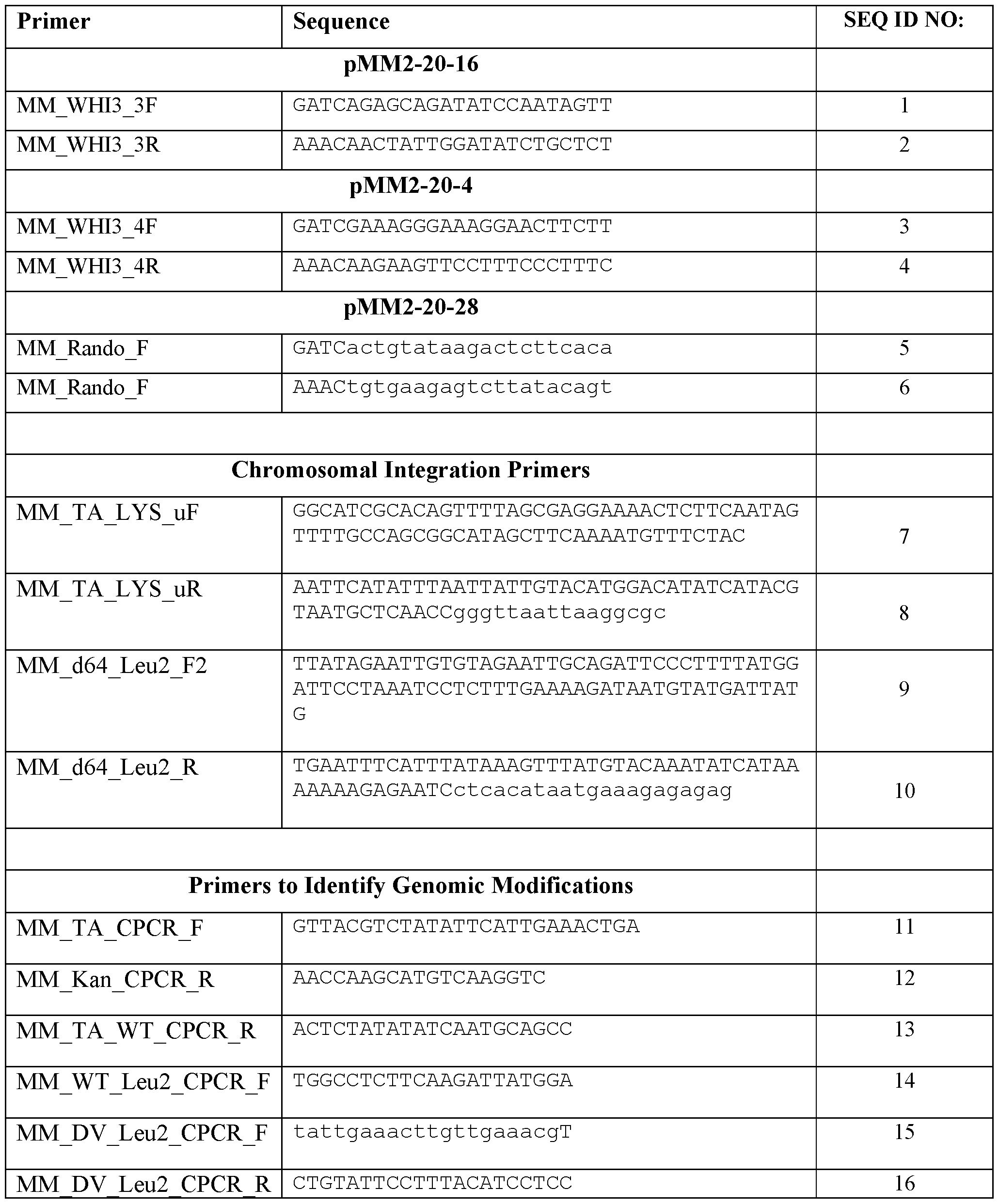
- Plasmid maps are shown in FIG. 6 and described in Table 8. Primer sequences provided in Table 9. Table 8. Plasmids
- MATU LEU2 pMM2-10-9 (TurboRFP Fluorescent wild-type ACT1 promoter strain
- TRPl used for live-cell imaging
- MATa pMM2-17-2 (pACTl-Al-TurboGFP No DVM strain with mutated ACT1 promoter
- pMM2-17-2 (pACTl-M-TurboGFP LEU2)
- Yeast transformations were performed using the Lithium-acetate method (Gietz et al., 2006. Methods Mol. Biol. 313 : 107-120). Chemically competent / ⁇ , coli STBL3 (Thermo Fisher Scientific, Waltham, MA) was used for all plasmid cloning and propagation in LB media (MP) supplemented with appropriate antibiotics. All yeast strains were in the CEN.PK MATa orMAT (van Dijken et al., 2000. Enzyme Microb. Technol. 26:706-714) background. Yeast were grown at 28-30°C on plates or in liquid culture with 250 rpm agitation.
- Yeast were cultured in YPD (10 g/L yeast extract, 20 g/L peptone, 20 g/L dextrose), 2X YPD, or synthetic dropout (SD) media (1.7 g/L yeast nitrogenous base, 5 g/L ammonium sulfate, yeast synthetic dropout media supplements (Sigma-Aldrich, St. Louis, MO), 20 g/L dextrose).
- SD synthetic dropout
- yeast nitrogenous base 1.7 g/L yeast nitrogenous base, 5 g/L ammonium sulfate, yeast synthetic dropout media supplements (Sigma-Aldrich, St. Louis, MO), 20 g/L dextrose.
- G418 sulfate resistant yeast were selected on YPD agar with 400 ⁇ g/ml G418 Sulfate. Counterselection for K1URA3 was performed using 1 g/L 5-floroorotic acid.
- MM TA CPCR F and MM Kan CPCR R which detect the presence of the transgene in the Lys2 locus and MM TA CPCR F and MM TA WT CPCR R which screen for the wild-type locus.
- FIG. 7A Insertion of the sgRNA and dCas9-VP64 cassette mto Leu2 locus was verified by PCR using MM_DV_Leu2_CPCR_F and MM DV Leu2 CPCR R which detect the presence of the transgene and MM_WT_Leu2_CPCR_F and MM DV Leu2 CPCR R which detect the wild-type locus (FIG. 7B). Mutations in the Actl promoter were detected by PCR amplifying a portion of the promoter using primers MM_Actg4_CPCR_F and
- Target coding regions were performed by transforming yeast strain YMM124 (Table 10) with pMM2-20-l backbone vectors (Table 8) expressing sgRNA to candidate coding regions (Table 11). Table 11. Target coding regions
- Colony centers were identified by applying regional peak detection to a z-projection through time using the thresholded images. When colonies merged, these peaks were used to find the dividing line between colonies: the peaks were used as seeds in a watershed on a distance- transformed image. Once colony boundaries were identified, the number of "on" pixels within a boundary at each moment in time was counted as the colony's area. Colonies that fell along the edge of the petri dish, that merged with colonies along the edge, or that had an ambiguous number of peaks within a large merged region were not included in the analysis. To calculate growth rates, the area-over-time data were log-transformed and fit into a line in a 12-hour moving window. The maximum slope in each time series was recorded as that colony's growth rate. The growth rates were analyzed by one-way ANOVA followed by Bonferroni's post-test comparing each condition to the random sgRNA control.
- Haploid 47a yeast strain YMM134 and YMM155 were mated to MATa strains YMM125 and YMM141 by combining overnight cultures in YPD to an OD 6 oo of 0.1 each in 1 ml YPD. The cultures were then incubated at 30°C for four hours, washed once with water and 30 iL were plated onto SD-Ura/Leu dropout media.
- Flow cytometry was performed using yeast strains YMM158 through YMM163.
- Overnight cultures grown in 2 mL SD-Complete media were diluted to an OD 6 oo 0.5 and grown for an additional four hours. Cells were collected by centrifugation, washed with DPBS, resuspended in DPBS and placed on ice protected from light prior to analysis. Flow cytometry was performed using a LSRFortessa
- Yeast strain YMM139 was mated separately with YMM156 and YMM157 in SD-Trp dropout media for 2 hours, pelleted, and resuspended in SD-Ura/Leu/Trp. Mated yeast were loaded onto a CellASIC ONIX diploid yeast plate and supplemented with SD-Ura/Leu/Trp. Cells were imaged using a Nikon Ti-E Deconvolution Microscope System every six minutes for 20 hours.
- the term “and/or” means one or all of the listed elements or a combination of any two or more of the listed elements; the terms “comprises,” “comprising,” and variations thereof are to be construed as open ended— i.e., additional elements or steps are optional and may or may not be present; unless otherwise specified, "a,” “an,” “the,” and “at least one” are used interchangeably and mean one or more than one; and the recitations of numerical ranges by endpoints include all numbers subsumed within that range (e.g., 1 to 5 includes 1, 1.5, 2, 2.75, 3, 3.80, 4, 5, etc.).
- any method disclosed herein that includes discrete steps the steps may be conducted in any feasible order. And, as appropriate, any combination of two or more steps may be conducted simultaneously.
- the particular examples, materials, amounts, and procedures are to be interpreted broadly in accordance with the scope and spirit of the invention as set forth herein.
Landscapes
- Life Sciences & Earth Sciences (AREA)
- Health & Medical Sciences (AREA)
- Genetics & Genomics (AREA)
- Engineering & Computer Science (AREA)
- Chemical & Material Sciences (AREA)
- Zoology (AREA)
- Organic Chemistry (AREA)
- Bioinformatics & Cheminformatics (AREA)
- Wood Science & Technology (AREA)
- Biotechnology (AREA)
- General Engineering & Computer Science (AREA)
- Biomedical Technology (AREA)
- Molecular Biology (AREA)
- Microbiology (AREA)
- Biochemistry (AREA)
- General Health & Medical Sciences (AREA)
- Mycology (AREA)
- Plant Pathology (AREA)
- Physics & Mathematics (AREA)
- Biophysics (AREA)
- Cell Biology (AREA)
- Medicinal Chemistry (AREA)
- Virology (AREA)
- Botany (AREA)
- Tropical Medicine & Parasitology (AREA)
- Micro-Organisms Or Cultivation Processes Thereof (AREA)
Abstract
Description



Claims
Priority Applications (5)
| Application Number | Priority Date | Filing Date | Title |
|---|---|---|---|
| AU2016353057A AU2016353057C1 (en) | 2015-11-11 | 2016-11-10 | Biocontainment/biocontrol system and methods |
| US15/775,164 US11718858B2 (en) | 2015-11-11 | 2016-11-10 | Biocontainment/biocontrol system and methods |
| BR112018009515A BR112018009515A2 (en) | 2015-11-11 | 2016-11-10 | biocontainment / biocontrol system and methods |
| AU2021201313A AU2021201313B2 (en) | 2015-11-11 | 2021-03-01 | Biocontainment/biocontrol system and methods |
| US18/219,524 US12416011B2 (en) | 2015-11-11 | 2023-07-07 | Biocontainment/biocontrol system and methods |
Applications Claiming Priority (2)
| Application Number | Priority Date | Filing Date | Title |
|---|---|---|---|
| US201562253954P | 2015-11-11 | 2015-11-11 | |
| US62/253,954 | 2015-11-11 |
Related Child Applications (2)
| Application Number | Title | Priority Date | Filing Date |
|---|---|---|---|
| US15/775,164 A-371-Of-International US11718858B2 (en) | 2015-11-11 | 2016-11-10 | Biocontainment/biocontrol system and methods |
| US18/219,524 Continuation US12416011B2 (en) | 2015-11-11 | 2023-07-07 | Biocontainment/biocontrol system and methods |
Publications (1)
| Publication Number | Publication Date |
|---|---|
| WO2017083501A1 true WO2017083501A1 (en) | 2017-05-18 |
Family
ID=58695324
Family Applications (1)
| Application Number | Title | Priority Date | Filing Date |
|---|---|---|---|
| PCT/US2016/061297 Ceased WO2017083501A1 (en) | 2015-11-11 | 2016-11-10 | Biocontainment/biocontrol system and methods |
Country Status (4)
| Country | Link |
|---|---|
| US (2) | US11718858B2 (en) |
| AU (2) | AU2016353057C1 (en) |
| BR (1) | BR112018009515A2 (en) |
| WO (1) | WO2017083501A1 (en) |
Cited By (2)
| Publication number | Priority date | Publication date | Assignee | Title |
|---|---|---|---|---|
| US11718858B2 (en) | 2015-11-11 | 2023-08-08 | Regents Of The University Of Minnesota | Biocontainment/biocontrol system and methods |
| US11834665B2 (en) | 2017-05-10 | 2023-12-05 | Regents Of The University Of Minnesota | Programmable transcription factors and methods |
Citations (4)
| Publication number | Priority date | Publication date | Assignee | Title |
|---|---|---|---|---|
| US20060147978A1 (en) * | 1998-05-12 | 2006-07-06 | James Lorens | Methods and compositions for screening for altered cellular phenotypes |
| US20090155854A1 (en) * | 2006-11-03 | 2009-06-18 | National Health Research Institute (An Institution Of Taiwan, R.O.C.) | METHOD FOR AMPLIFYING A FLAVIVIRUS cDNA IN A PROKARYOTIC CELL |
| US20140356958A1 (en) * | 2012-12-17 | 2014-12-04 | President And Fellows Of Harvard College | RNA-Guided Human Genome Engineering |
| US20150064138A1 (en) * | 2013-09-05 | 2015-03-05 | Massachusetts Institute Of Technology | Tuning microbial populations with programmable nucleases |
Family Cites Families (7)
| Publication number | Priority date | Publication date | Assignee | Title |
|---|---|---|---|---|
| GB201223097D0 (en) * | 2012-12-20 | 2013-02-06 | Max Planck Gesellschaft | Stable transformation of a population and a method of biocontainment using haploinsufficiency and underdominance principles |
| US10428376B2 (en) | 2013-12-02 | 2019-10-01 | Regents Of The University Of Minnesota | RNA amplification and oligonucleotide library preparation |
| US11718858B2 (en) | 2015-11-11 | 2023-08-08 | Regents Of The University Of Minnesota | Biocontainment/biocontrol system and methods |
| WO2018209014A1 (en) | 2017-05-10 | 2018-11-15 | Regents Of The University Of Minnesota | Programmable transcription factors and methods |
| US20220015339A1 (en) | 2018-11-05 | 2022-01-20 | Regents Of The University Of Minnesota | Systems and breeding methods for pest control |
| US20220330533A1 (en) | 2019-10-02 | 2022-10-20 | Regents Of The University Of Minnesota | Systems and methods for batch cultivation of non-transgenic heterogametes |
| US20220338454A1 (en) | 2019-10-31 | 2022-10-27 | Regents Of The University Of Minnesota | Systems and methods for generating genetic incompatibility |
-
2016
- 2016-11-10 US US15/775,164 patent/US11718858B2/en active Active
- 2016-11-10 BR BR112018009515A patent/BR112018009515A2/en not_active Application Discontinuation
- 2016-11-10 WO PCT/US2016/061297 patent/WO2017083501A1/en not_active Ceased
- 2016-11-10 AU AU2016353057A patent/AU2016353057C1/en active Active
-
2021
- 2021-03-01 AU AU2021201313A patent/AU2021201313B2/en active Active
-
2023
- 2023-07-07 US US18/219,524 patent/US12416011B2/en active Active
Patent Citations (4)
| Publication number | Priority date | Publication date | Assignee | Title |
|---|---|---|---|---|
| US20060147978A1 (en) * | 1998-05-12 | 2006-07-06 | James Lorens | Methods and compositions for screening for altered cellular phenotypes |
| US20090155854A1 (en) * | 2006-11-03 | 2009-06-18 | National Health Research Institute (An Institution Of Taiwan, R.O.C.) | METHOD FOR AMPLIFYING A FLAVIVIRUS cDNA IN A PROKARYOTIC CELL |
| US20140356958A1 (en) * | 2012-12-17 | 2014-12-04 | President And Fellows Of Harvard College | RNA-Guided Human Genome Engineering |
| US20150064138A1 (en) * | 2013-09-05 | 2015-03-05 | Massachusetts Institute Of Technology | Tuning microbial populations with programmable nucleases |
Non-Patent Citations (6)
| Title |
|---|
| BIKARD ET AL.: "Programmable repression and activation of bacterial gene expression using an engineered CRISPR-Cas system.", NUCLEIC ACIDS RES., vol. 41, no. 15, 2013, pages 7429 - 7437, XP055195374 * |
| CHAPPELL ET AL.: "A renaissance in RNA synthetic biology: new mechanisms, applications and tools for the future.", CURR OPIN CHEM BIOL., vol. 28, October 2015 (2015-10-01), pages 47 - 56, XP055270244 * |
| DICARLO ET AL.: "Genome engineering in Saccharomyces cerevisiae using CRISPR-Cas systems.", NUCLEIC ACIDS RES., vol. 41, no. 7, 2013, pages 4336 - 4343, XP055086617 * |
| FERNANDO ET AL.: "Molecular circuits for associative learning in single-celled organisms.", J R SOC INTERFACE., vol. 6, no. 34, 2009, pages 463 - 469, XP055384265 * |
| GALLAGHER ET AL.: "Multilayered genetic safeguards limit growth of microorganisms to defined environments.", NUCLEIC ACIDS RES., vol. 43, no. 3, February 2015 (2015-02-01), pages 1945 - 1954, XP055256923 * |
| KIANI ET AL.: "Cas9 gRNA engineering for genome editing, activation and repression.", NAT METHODS., vol. 12, no. 11, 2015, pages 1051 - 1054, XP055285351 * |
Cited By (3)
| Publication number | Priority date | Publication date | Assignee | Title |
|---|---|---|---|---|
| US11718858B2 (en) | 2015-11-11 | 2023-08-08 | Regents Of The University Of Minnesota | Biocontainment/biocontrol system and methods |
| US12416011B2 (en) | 2015-11-11 | 2025-09-16 | Regents Of The University Of Minnesota | Biocontainment/biocontrol system and methods |
| US11834665B2 (en) | 2017-05-10 | 2023-12-05 | Regents Of The University Of Minnesota | Programmable transcription factors and methods |
Also Published As
| Publication number | Publication date |
|---|---|
| US20180327762A1 (en) | 2018-11-15 |
| BR112018009515A2 (en) | 2018-11-06 |
| US20240093215A1 (en) | 2024-03-21 |
| AU2016353057B2 (en) | 2020-12-03 |
| US12416011B2 (en) | 2025-09-16 |
| AU2016353057C1 (en) | 2021-06-17 |
| AU2021201313B2 (en) | 2021-08-05 |
| AU2021201313A1 (en) | 2021-03-18 |
| AU2016353057A1 (en) | 2018-05-31 |
| US11718858B2 (en) | 2023-08-08 |
Similar Documents
| Publication | Publication Date | Title |
|---|---|---|
| Idnurm et al. | A silver bullet in a golden age of functional genomics: the impact of Agrobacterium-mediated transformation of fungi | |
| Malik et al. | Major evolutionary transitions in centromere complexity | |
| Volohonsky et al. | Tools for Anopheles gambiae transgenesis | |
| Takayama et al. | Biphasic incorporation of centromeric histone CENP-A in fission yeast | |
| Maselko et al. | Engineering species-like barriers to sexual reproduction | |
| DE69929796T2 (en) | EVOLUTION OF WHOLE CELLS AND ORGANISMS THROUGH RECURSIVE SEQUENCE RECOMBINATION | |
| US12416011B2 (en) | Biocontainment/biocontrol system and methods | |
| Bai et al. | RNA binding motif protein 48 is required for U12 splicing and maize endosperm differentiation | |
| Raphael et al. | Australian endemic pest tephritids: genetic, molecular and microbial tools for improved Sterile Insect Technique | |
| Takasu et al. | The use of TALENs for nonhomologous end joining mutagenesis in silkworm and fruitfly | |
| WO2019067011A1 (en) | Programmed modulation of crispr/cas9 activity | |
| Shih et al. | Purple chromoprotein gene serves as a new selection marker for transgenesis of the microalga Nannochloropsis oculata | |
| WO2017196858A1 (en) | Methods to design and use gene drives | |
| US20190241879A1 (en) | Methods and compounds for gene insertion into repeated chromosome regions for multi-locus assortment and daisyfield drives | |
| Strobl et al. | A universal vector concept for a direct genotyping of transgenic organisms and a systematic creation of homozygous lines | |
| López Hernández et al. | Diverse mating phenotypes impact the spread of wtf meiotic drivers in Schizosaccharomyces pombe | |
| US20200157552A1 (en) | Programmable transcription factors and methods | |
| Wloch-Salamon | Sociobiology of the budding yeast | |
| US20220338454A1 (en) | Systems and methods for generating genetic incompatibility | |
| CN114540364A (en) | Transgenic method for improving silk fibroin content in silkworm cocoon and silkworm variety thereof | |
| Yan et al. | Construction of homozygous mutants of migratory locust using CRISPR/Cas9 technology | |
| Connolly et al. | Application of the Cre/lox system to construct auxotrophic markers for quantitative genetic analyses in Fusarium graminearum | |
| de la Torre et al. | Robust Cre recombinase activity in the biotrophic smut fungus Ustilago maydis enables efficient conditional null mutants in planta | |
| JP2651316B2 (en) | Homologous recombination cell selection method | |
| Wudarski et al. | A platform for efficient transgenesis in Macrostomum lignano, a flatworm model organism for stem cell research |
Legal Events
| Date | Code | Title | Description |
|---|---|---|---|
| 121 | Ep: the epo has been informed by wipo that ep was designated in this application |
Ref document number: 16864989 Country of ref document: EP Kind code of ref document: A1 |
|
| NENP | Non-entry into the national phase |
Ref country code: DE |
|
| ENP | Entry into the national phase |
Ref document number: 2016353057 Country of ref document: AU Date of ref document: 20161110 Kind code of ref document: A |
|
| REG | Reference to national code |
Ref country code: BR Ref legal event code: B01A Ref document number: 112018009515 Country of ref document: BR |
|
| ENP | Entry into the national phase |
Ref document number: 112018009515 Country of ref document: BR Kind code of ref document: A2 Effective date: 20180510 |
|
| 122 | Ep: pct application non-entry in european phase |
Ref document number: 16864989 Country of ref document: EP Kind code of ref document: A1 |