WO2017081702A2 - A process for preparation of enzalutamide - Google Patents
A process for preparation of enzalutamide Download PDFInfo
- Publication number
- WO2017081702A2 WO2017081702A2 PCT/IN2016/050388 IN2016050388W WO2017081702A2 WO 2017081702 A2 WO2017081702 A2 WO 2017081702A2 IN 2016050388 W IN2016050388 W IN 2016050388W WO 2017081702 A2 WO2017081702 A2 WO 2017081702A2
- Authority
- WO
- WIPO (PCT)
- Prior art keywords
- formula
- compound
- alkyl
- enzalutamide
- methyl
- Prior art date
- Legal status (The legal status is an assumption and is not a legal conclusion. Google has not performed a legal analysis and makes no representation as to the accuracy of the status listed.)
- Ceased
Links
- QQAPRUPEFDFYAX-UHFFFAOYSA-N CCOC(c(c(F)c1)ccc1NC(C)(C)C(O)=O)=O Chemical compound CCOC(c(c(F)c1)ccc1NC(C)(C)C(O)=O)=O QQAPRUPEFDFYAX-UHFFFAOYSA-N 0.000 description 1
- NNMJPCUZFNRTEG-UHFFFAOYSA-N CCOC(c(ccc(N)c1)c1F)=O Chemical compound CCOC(c(ccc(N)c1)c1F)=O NNMJPCUZFNRTEG-UHFFFAOYSA-N 0.000 description 1
Classifications
-
- C—CHEMISTRY; METALLURGY
- C07—ORGANIC CHEMISTRY
- C07D—HETEROCYCLIC COMPOUNDS
- C07D233/00—Heterocyclic compounds containing 1,3-diazole or hydrogenated 1,3-diazole rings, not condensed with other rings
- C07D233/54—Heterocyclic compounds containing 1,3-diazole or hydrogenated 1,3-diazole rings, not condensed with other rings having two double bonds between ring members or between ring members and non-ring members
- C07D233/66—Heterocyclic compounds containing 1,3-diazole or hydrogenated 1,3-diazole rings, not condensed with other rings having two double bonds between ring members or between ring members and non-ring members with hetero atoms or with carbon atoms having three bonds to hetero atoms with at the most one bond to halogen, e.g. ester or nitrile radicals, directly attached to ring carbon atoms
- C07D233/86—Oxygen and sulfur atoms, e.g. thiohydantoin
Definitions
- the present invention relates to an improved process for preparation of enzalutamide which involves direct condensation of 2-(4-alkoxycarbonyl-3-fluoro-anilino)-2-methyl-propanoic acid and 4-isothiocyanato-2-(trifluoromethyl)benzonitrile to obtain alkyl 4-[3-(4-cyano-3- methyl-phenyl)-5,5-dimethyl-4-oxo-2-thioxo-imidazolidin-l-yl]-2-fluoro-benzoate, which is further converted to enzalutamide.
- Enzalutamide is an androgen receptor inhibitor approved for the treatment of patients with metastatic castration-resistant prostate cancer (CRPC).
- the chemical name is 4- ⁇ 3-[4-cyano- 3-(trifluoromethyl)phenyl] -5,5-dimethyl-4-oxo-2-sulfanylideneimidazolidin- 1 -yl ⁇ -2-fluoro- N-methylbenzamide dep
- US patent number 7709517 discloses a process for preparation of enzalutamide which involves reacting N-Methyl-2-fluoro-4-aminobenzamide with acetone cyanohydrin to give N-methyl-2-fluoro-4-(l,l-dimethyl-cyanomethyl)-aminobenzamide which was further reacted with 4-isothiocyanato-2-trifluoromethylbenzonitrile to afford the compound of Formula I.
- the process involves the use of acetone cyanohydrin which is known to be toxic and hazardous and is not recommended for commercial manufacturing.
- the process also requires elevated temperature which causes decomposition of 4- isothiocyanato-2-trifluoromethylbenzonitrile or the final product, enzalutamide.
- WIPO publication number 2011106570A1 also discloses processes for preparation of enzalutamide wherein one process involves activating 2-[3-fluoro-4- (methylcarbamoyl)anilino]-2-methyl-propanoic acid by converting it into its methyl ester and reacting the methyl ester with 4-isotiiiocyanato-2-trifluofomethylbenzonitrile.
- CN104803919A and CN104803918A discloses a process for preparation of enzalutamide as depicted below-
- the present invention provides a simple, scalable and economical process for the preparation of enzalutamide.
- R is C 1 -C4 alkyl, with a compound of Formula lib
- R is C 1 -C4 alkyl
- R is C 1 -C4 alkyl
- C 1 -C4 alkyl refers to a saturated hydrocarbon chain that includes carbon and hydrogen atoms in the backbone, either linear or branched, having from 1 to 4 carbon atoms.
- the non-limiting examples of C 1 -C4 alkyl includes methyl, ethyl, isopropyl, n- butyl or isobutyl.
- the present invention provides a process for preparation of enzalutamide, a compound of Formula I
- R is C 1 -C4 alkyl, with a compound of Formula lib
- R is C 1 -C4 alkyl
- R is C 1 -C4 alkyl
- the condensation of the compound of Formula Ila and lib as per step a is carried out in the presence of a suitable solvent and a base.
- the suitable solvent for the purpose can be selected from halogenated solvents such as dichloromethane; ethers such as tetrahydrofuran; esters such as ethyl acetate; N,N- dimethylformamide (DMF), dimethylsulfoxide, dimethylacetamide or a mixture thereof.
- the preferred solvent is dichloromethane.
- a base for the reaction may be selected from any suitable organic or inorganic bases, preferably weak bases such as triethylamine or diisopropylethylamine.
- the condensation of the compound of Formula Ila and lib as per step a can be carried out at a temperature range of 25 °C to 80 °C. Preferably, the temperature is about 25 °C to about 40 °C.
- the reaction can be maintained at the given condition for a time suitable for completion of the reaction, for example for about 5 to 20 hours, more preferably 10 to 15 hours.
- the compound of Formula lib is used in a molar equivalent of about 1 to 1.5 equivalent with respect to the compound of Formula Ila.
- CN104803919A (the CN '919 application) discloses a process for preparation of compound of Formula II by condensation of the compound of Formula A and B
- R in the compound of Formula A is methyl, ethyl or isopropyl and LG is a leaving group.
- the process disclosed in the CN '919 application requires high temperature and use of metallic catalyst like copper.
- the use of the metallic catalyst for the preparation of the pharmaceutical compounds is not preferred as it leads to some problems with respect to impurities and other regulatory complexity.
- the condensation of the compound of Formula II and III as per step b is carried out in the presence of a suitable solvent and a base.
- a suitable solvent for the purpose can be selected from but not limited to halogenated solvents such as dichlorome thane; ethers such as tetrahydrofuran; esters such as ethyl acetate; N,N-dimethylformamide (DMF), dimethylsulfoxide, dimethylacetamide or a mixture thereof. More preferred solvents are ethyl acetate and dichloromethane.
- a base for the reaction may be selected from any suitable organic or inorganic bases, preferably weak bases, such as triethylamine and diisopropylethylamine.
- the condensation of the compound of Formula II and III is carried out at a temperature range of about 40 °C to 80 °C, more preferably about 60 °C.
- the reaction can be carried out for a time suitable for completion of the reaction for instance 2 to 10 hours, preferably, 5 to 8 hours.
- the compound of Formula III is used in a molar equivalent of about 1 to 3 equivalent with respect to the compound of Formula II, more preferably 1.7 molar equivalents.
- the conversion according to step c can be done by any possible way as one of the skilled person of the art can perform, such as by direct coupling of the compound of Formula IV with methylamine to afford compound of Formula I.
- the compound of Formula IV can be first hydrolyzed to its corresponding acid, then reacted with methylamine to afford compound of Formula I.
- the free acid of the compound of Formula IV is first activated by a suitable activating agent and subsequently reacted with methylamine to afford compound of Formula I.
- the compound of Formula IV may be converted to compound of Formula I by any of the processes under the purview of a person skilled in the art.
- R in the compound of Formula Ila, compound of Formula II and compound of Formula IV is C 1 -C4 alkyl selected from methyl, ethyl, isopropyl, n-butyl or isobutyl; more preferably ethyl.
- the present invention provides a process for the preparation of enzalutamide, comprising:
- R is C 1 -C4 alkyl
- R is C 1 -C4 alkyl
- the steps "aa” and “ab” can be performed as per the process disclosed for the steps b and step c earlier in the specification.
- the present invention provides a process for preparation of a compound of Formula II
- R is C 1 -C4 alkyl, comprising condensing the compound of Formula Ila with a compound of Formula lib
- R in the compound of Formula Ila is C 1 -C4 alkyl.
- condensation of compound of Formula Ila and lib can be carried out as per the process described earlier in the specification.
Landscapes
- Chemical & Material Sciences (AREA)
- Organic Chemistry (AREA)
- Organic Low-Molecular-Weight Compounds And Preparation Thereof (AREA)
Abstract
The present invention relates to an improved process for preparation of enzalutamide which involves direct condensation of 2-(4-alkoxycarbonyl-3-fluoro-anilino)-2-methyl-propanoic acid and 4-isothiocyanato-2-(trifluoromethyl)benzonitrile to obtain alkyl 4-[3-(4-cyano-3- methyl-phenyl)-5,5-dimethyl-4-oxo-2-thioxo-imidazolidin-1-yl]-2-fluoro-benzoate, which is further converted to enzalutamide.
Description
A PROCESS FOR PREPARATION OF ENZALUTAMIDE
RELATED APPLICATIONS This application claims the benefit of Indian Patent Application no. 4279/MUM 2015 filed on November 09, 2015 which is hereby incorporated by reference.
FIELD OF THE INVENTION
The present invention relates to an improved process for preparation of enzalutamide which involves direct condensation of 2-(4-alkoxycarbonyl-3-fluoro-anilino)-2-methyl-propanoic acid and 4-isothiocyanato-2-(trifluoromethyl)benzonitrile to obtain alkyl 4-[3-(4-cyano-3- methyl-phenyl)-5,5-dimethyl-4-oxo-2-thioxo-imidazolidin-l-yl]-2-fluoro-benzoate, which is further converted to enzalutamide.
BACKGROUND OF THE INVENTION
Enzalutamide is an androgen receptor inhibitor approved for the treatment of patients with metastatic castration-resistant prostate cancer (CRPC). The chemical name is 4-{3-[4-cyano- 3-(trifluoromethyl)phenyl] -5,5-dimethyl-4-oxo-2-sulfanylideneimidazolidin- 1 -yl } -2-fluoro- N-methylbenzamide dep

Formula I
US patent number 7709517 (the '517 patent) discloses a process for preparation of enzalutamide which involves reacting N-Methyl-2-fluoro-4-aminobenzamide with acetone cyanohydrin to give N-methyl-2-fluoro-4-(l,l-dimethyl-cyanomethyl)-aminobenzamide which was further reacted with 4-isothiocyanato-2-trifluoromethylbenzonitrile to afford the compound of Formula I. The process involves the use of acetone cyanohydrin which is known to be toxic and hazardous and is not recommended for commercial manufacturing.
The process also requires elevated temperature which causes decomposition of 4- isothiocyanato-2-trifluoromethylbenzonitrile or the final product, enzalutamide.
WIPO publication number 2011106570A1 (the '570 application) also discloses processes for preparation of enzalutamide wherein one process involves activating 2-[3-fluoro-4- (methylcarbamoyl)anilino]-2-methyl-propanoic acid by converting it into its methyl ester and reacting the methyl ester with 4-isotiiiocyanato-2-trifluofomethylbenzonitrile. In another process reported in the WIPO '570 publication, 2-[3-fluoro-4-(methylcarbamoyl)anilino]-2- methyl-propanoic acid is condensed with 4~amino-2~(trifIi]orom.ethyi)benzonitriie to produce 4-(l-(4-eyano-3-(trifluoromeAyI)pheny
jV-methylbenzamide which in turn is converted to enzalutamide by reacting it with thiophosgene. The yields reported by the process are not viable for a commercial production.
CN104803919A and CN104803918A discloses a process for preparation of enzalutamide as depicted below-

The various other processes for the preparation of enzalutamide are reported in US 20150210649A1, WO 2015154730A1, CN 103910679A, CN 103980141 A, CN 104016924A.
The present invention provides a simple, scalable and economical process for the preparation of enzalutamide.
SUMMARY OF THE INVENTION
The present invention provi ound of Formula I

Formula I
wherein the process comprises:
a) condensing a compound of Formu

Formula Ila
wherein R is C1-C4 alkyl, with a compound of Formula lib

Formula
to obtain a compound of Formula II

Formula I
wherein R is C1-C4 alkyl,
b) condensing the compound of Formula II

Formula I
with a compound of Formula III

Formula I
to obtain a compound of Formula IV
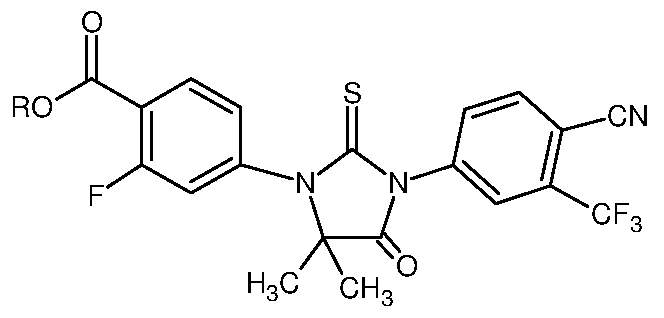
Formula IV
wherein R is C1-C4 alkyl, and
c) converting the compound of Formula IV to the compound of Formula I. GLOSSARY
The term "C1-C4 alkyl" as used herein refers to a saturated hydrocarbon chain that includes carbon and hydrogen atoms in the backbone, either linear or branched, having from 1 to 4 carbon atoms. The non-limiting examples of C1-C4 alkyl includes methyl, ethyl, isopropyl, n- butyl or isobutyl.
DETAILED DESCRIPTION OF THE INVENTION
In one aspect, the present invention provides a process for preparation of enzalutamide, a compound of Formula I

Formula I
wherein the process comprises:
a) condensing a compound of Formula lla

Formula lla
wherein R is C1-C4 alkyl, with a compound of Formula lib

Formula Mb
to obtain a compound of Formula II,

Formula II
wherein R is C1-C4 alkyl,
b) condensing the compound of Formula II
 with a compound of Formula III

Formula III
to obtain a compound of Formula IV

Formula IV
wherein R is C1-C4 alkyl, and
c) converting the compound of Formula IV to the compound of Formula I.
In one embodiment of the present invention, the condensation of the compound of Formula Ila and lib as per step a is carried out in the presence of a suitable solvent and a base. The suitable solvent for the purpose can be selected from halogenated solvents such as dichloromethane; ethers such as tetrahydrofuran; esters such as ethyl acetate; N,N- dimethylformamide (DMF), dimethylsulfoxide, dimethylacetamide or a mixture thereof. The preferred solvent is dichloromethane. A base for the reaction may be selected from any suitable organic or inorganic bases, preferably weak bases such as triethylamine or diisopropylethylamine. The condensation of the compound of Formula Ila and lib as per step a can be carried out at a temperature range of 25 °C to 80 °C. Preferably, the temperature is about 25 °C to about 40 °C. The reaction can be maintained at the given condition for a time
suitable for completion of the reaction, for example for about 5 to 20 hours, more preferably 10 to 15 hours. The compound of Formula lib is used in a molar equivalent of about 1 to 1.5 equivalent with respect to the compound of Formula Ila. CN104803919A (the CN '919 application) discloses a process for preparation of compound of Formula II by condensation of the compound of Formula A and B

Formula A Formula B
wherein R in the compound of Formula A is methyl, ethyl or isopropyl and LG is a leaving group. However the process disclosed in the CN '919 application requires high temperature and use of metallic catalyst like copper. The use of the metallic catalyst for the preparation of the pharmaceutical compounds is not preferred as it leads to some problems with respect to impurities and other regulatory complexity.
In another embodiment of the present invention, the condensation of the compound of Formula II and III as per step b is carried out in the presence of a suitable solvent and a base. A suitable solvent for the purpose can be selected from but not limited to halogenated solvents such as dichlorome thane; ethers such as tetrahydrofuran; esters such as ethyl acetate; N,N-dimethylformamide (DMF), dimethylsulfoxide, dimethylacetamide or a mixture thereof. More preferred solvents are ethyl acetate and dichloromethane. A base for the reaction may be selected from any suitable organic or inorganic bases, preferably weak bases, such as triethylamine and diisopropylethylamine. The condensation of the compound of Formula II and III is carried out at a temperature range of about 40 °C to 80 °C, more preferably about 60 °C. The reaction can be carried out for a time suitable for completion of the reaction for instance 2 to 10 hours, preferably, 5 to 8 hours. The compound of Formula III is used in a molar equivalent of about 1 to 3 equivalent with respect to the compound of Formula II, more preferably 1.7 molar equivalents.
In another embodiment of the present invention, the conversion according to step c, can be done by any possible way as one of the skilled person of the art can perform, such as by direct coupling of the compound of Formula IV with methylamine to afford compound of Formula I. In another way, the compound of Formula IV can be first hydrolyzed to its
corresponding acid, then reacted with methylamine to afford compound of Formula I. In yet another way, the free acid of the compound of Formula IV is first activated by a suitable activating agent and subsequently reacted with methylamine to afford compound of Formula I. Thus the compound of Formula IV may be converted to compound of Formula I by any of the processes under the purview of a person skilled in the art.
In another embodiment of the present invention, R in the compound of Formula Ila, compound of Formula II and compound of Formula IV is C1-C4 alkyl selected from methyl, ethyl, isopropyl, n-butyl or isobutyl; more preferably ethyl.
In another embodiment, the present invention provides a process for the preparation of enzalutamide, comprising:
(aa) condensing a compound of Formula II

Formula II
wherein R is C1-C4 alkyl,
with a compound of Formula III

Formula III
to obtain a compound of Formula IV

Formula IV
wherein R is C1-C4 alkyl, and
(ab) converting the compound of Formula IV to the compound of Formula I.
In another embodiment, the steps "aa" and "ab" can be performed as per the process disclosed for the steps b and step c earlier in the specification.
In yet another embodiment, the present invention provides a process for preparation of a compound of Formula II

Formula II
wherein R is C1-C4 alkyl, comprising condensing the compound of Formula Ila with a compound of Formula lib

Formula Ila Formula lib
wherein R in the compound of Formula Ila is C1-C4 alkyl.
In another embodiment, the condensation of compound of Formula Ila and lib can be carried out as per the process described earlier in the specification.
The

The present invention is further illustrated in detail with reference to the following examples. It is desired that the examples be considered in all respect as illustrative and are not intended to limit the scope of the claimed invention.
EXAMPLES
Example 1: Preparation of 2-(4-ethoxycarbonyl-3-fluoro-anilino)-2-methyl-propanoic acid

In a round bottomed flask equipped with nitrogen atmosphere facility, 2-fluoro-4- aminobenzoic acid ethyl ester (10 g), bromoisobutyric acid (16 g) and dichlorome thane (100 mL) were added at room temperature followed by the addition of triethylamine (25 mL) and the reaction mixture was stirred for 15 hours at 25 °C to 40 °C. After completion of the reaction, the reaction mixture was concentrated under reduced pressure at 40 °C, water was added and stirred for 1 hour. Aqueous layer was acidified with hydrochloric acid (7.5 mL) and stirred for another 60 minutes. Then the reaction mixture was cooled to 0 °C to 5 °C and stirred for additional 3 hour. The product was filtered and washed with 25 mL water and dried under vacuum at 40 °C for 6 hours to give the title compound. Yield: 14 g.
Example 2: Preparation of ethyl 4-[3-(4-cyano-3-methyl-phenyl)-5,5-dimethyl-4-oxo-2- thioxo-imidazolidin- 1 -yl] -2-fluoro-benzoate

In a 500 mL round bottomed flask equipped with nitrogen atmosphere facility, 4- isothiocyanato-2-(trifluoromethyl)benzonitrile (14 g) and ethylacetate (150 mL) were added. The reaction mixture was stirred for 15 minutes and triethylamine (5 mL) was added at 20 °C to 30 °C. The reaction mixture was heated to reflux for 15 minutes and then 2-(4- ethoxycarbonyl-3-fluoro-anilino)-2-methyl-propanoic acid (10 g) was added. The reaction was refluxed for 4-6 hours. After completion of the reaction, the reaction mixture was concentrated under reduced pressure at 50 °C. Ethyl alcohol (25 mL) was added to the residue and stirred for 1 hour, at 0 °C to 5 °C. The product was filtered, washed with ethyl alcohol and dried under vacuum at 40 °C for 6 hours to give the title compound. Yield: 9.2 g
Example 3- Preparation of 4-[3-(4-cyano-3-methyl-phenyl)-5,5-dimethyl-4-oxo-2-thioxo- imidazolidin-l-yl]-2-fluoro-iV-methyl-benzamide (Enzalutamide)

A mixture of ethyl 4-[3-(4-cyano-3-methyl-phenyl)-5,5-dimethyl-4-oxo-2-thioxo- imidazolidin-l-yl]-2-fluoro-benzoate (10 g) and aqueous methylamine (40 % solution, 150 mL) was stirred at 20 °C to 30 °C for 5 to 7 hours. Completion of reaction mixture was monitored by TLC. After completion of the reaction, the reaction mixture was concentrated to a volume of 100 mL under reduced pressure at 30 °C to 35 °C. The product was extracted with ethyl acetate (100 mL). The organic layer was concentrated under reduced pressure to obtain enzalutamide. Yield: 7 g.
Claims
1. A process for preparati

a) condensing a compound of

Formula Ila
wherein R is C1-C4 alkyl, with a compound of Formula lib

Formula Mb to obtain a compound of Formula II

Formula II wherein R is C1-C4 alkyl,
b) condensing the compound of Formula II

Formula II with a compound of Formula III

Formula III to obtain a compound of Formula IV

Formula IV
wherein R is C1-C4 alkyl, and
c) converting the compound of Formula IV to the compound of Formula I.
2. The process as in claim 1, wherein the step a is conducted in presence of a solvent selected from a group consisting of halogenated solvents, ethers, N,N- dimethylformamide, dimethylsulf oxide, dimethylacetamide and a base selected from inorganic base or organic base.
3. The process as in claim 2, wherein the solvent is selected from dichloromethane and a base selected from triethylamine or diisopropylethylamine.
4. The process as in claim 1, wherein the step b is conducted in presence of a solvent selected from a group consisting of halogenated solvents, ethers, N,N- dimethylformamide, dimethylsulf oxide, dimethylacetamide and a base selected from inorganic base or organic base.
5. The process as in claim 4, wherein the solvent is ethyl acetate and a base is selected from triethylamine or diisopropylethylamine.
6. The process as in claim 1, wherein the compound of Formula IV is converted into the compound of Formula I by condensing the compound of Formula IV with methylamine.
7. The process as in claim 1, wherein R in the compound of Formula Ila, Formula II and Formula IV is ethyl.
8. A process for preparatio

Formula I
wherein the process comprises:
(aa) condensing a compound of Formula II

Formula II
wherein R is C1-C4 alkyl,
with a compound of Formu

Formula III
to obtain compou

Formula IV
wherein R is C1-C4 alkyl, and
(ab) converting the compound of Formula IV to the compound of Formula I.
Applications Claiming Priority (2)
| Application Number | Priority Date | Filing Date | Title |
|---|---|---|---|
| IN4279/MUM/2015 | 2015-11-09 | ||
| IN4279MU2015 | 2015-11-09 |
Publications (2)
| Publication Number | Publication Date |
|---|---|
| WO2017081702A2 true WO2017081702A2 (en) | 2017-05-18 |
| WO2017081702A3 WO2017081702A3 (en) | 2017-07-13 |
Family
ID=58694873
Family Applications (1)
| Application Number | Title | Priority Date | Filing Date |
|---|---|---|---|
| PCT/IN2016/050388 Ceased WO2017081702A2 (en) | 2015-11-09 | 2016-11-08 | A process for preparation of enzalutamide |
Country Status (1)
| Country | Link |
|---|---|
| WO (1) | WO2017081702A2 (en) |
Cited By (2)
| Publication number | Priority date | Publication date | Assignee | Title |
|---|---|---|---|---|
| WO2020260469A1 (en) | 2019-06-27 | 2020-12-30 | Synthon B.V. | Process for preparation of enzalutamide |
| WO2022161469A1 (en) * | 2021-01-29 | 2022-08-04 | 苏州开拓药业股份有限公司 | Intermediate for thiohydantoin drug, and preparation method therefor and use thereof |
Family Cites Families (5)
| Publication number | Priority date | Publication date | Assignee | Title |
|---|---|---|---|---|
| US20160251316A1 (en) * | 2013-10-31 | 2016-09-01 | Sun Pharmaceutical Industries Limited | Process for the preparation of enzalutamide |
| CN104803918B (en) * | 2014-01-26 | 2017-11-10 | 上海医药工业研究院 | The preparation method of the miscellaneous Shandong amine of grace |
| CN104803919A (en) * | 2014-01-26 | 2015-07-29 | 上海医药工业研究院 | Preparation method of enzalutamide intermediate F |
| US9611225B2 (en) * | 2014-01-27 | 2017-04-04 | Cadila Healthcare Limited | Process for preparation of androgen receptor antagonist |
| CZ2014232A3 (en) * | 2014-04-07 | 2015-10-14 | Zentiva, K.S. | Process for preparing enzalutamide |
-
2016
- 2016-11-08 WO PCT/IN2016/050388 patent/WO2017081702A2/en not_active Ceased
Cited By (2)
| Publication number | Priority date | Publication date | Assignee | Title |
|---|---|---|---|---|
| WO2020260469A1 (en) | 2019-06-27 | 2020-12-30 | Synthon B.V. | Process for preparation of enzalutamide |
| WO2022161469A1 (en) * | 2021-01-29 | 2022-08-04 | 苏州开拓药业股份有限公司 | Intermediate for thiohydantoin drug, and preparation method therefor and use thereof |
Also Published As
| Publication number | Publication date |
|---|---|
| WO2017081702A3 (en) | 2017-07-13 |
Similar Documents
| Publication | Publication Date | Title |
|---|---|---|
| RU2616608C2 (en) | Method of producing derivatives of 4,4-difluoro-3,4-dihydroisoquinolin | |
| CN111662325B (en) | Method for preparing L-glufosinate-ammonium | |
| KR101472686B1 (en) | Method for preparation of benzimidazole derivatives | |
| DK2906531T3 (en) | APPLICABLE COMPOUNDS IN THE SYNTHESIS OF BENZAMIDE COMPOUNDS | |
| JP2023011667A (en) | Method for producing kinase inhibitor having sulfonamide structure | |
| RU2650110C2 (en) | Processes for synthesis of 2-amino-4,6-dimethoxybenzamide and other benzamide compounds | |
| WO2017081702A2 (en) | A process for preparation of enzalutamide | |
| KR101728443B1 (en) | Method for Producing Benzyl Ester 2-aminonicotinicotinate Derivative | |
| KR20090105309A (en) | Method for preparing 5-hydroxy-3-oxoheptanoate derivative having optical activity | |
| TWI361807B (en) | Process for preparing substituted 4-alkoxycarbonyl-3-aminothiophenes | |
| CN107954960B (en) | A kind of synthetic method of 1,3-dihydroisobenzofuran compounds | |
| JP4032861B2 (en) | Process for producing β-oxonitrile derivative or alkali metal salt thereof | |
| CN115215815B (en) | Method for efficiently preparing oxazolidone derivative | |
| RU2315747C2 (en) | Method for production of acetylene compound | |
| WO2003014067A1 (en) | PROCESS FOR PRODUCING ß-OXONITRILE COMPOUND OR ALKALI METAL SALT THEREOF | |
| JP5205971B2 (en) | Method for producing tetrahydropyran compound | |
| JP5142241B2 (en) | Method for producing nicotinic acid ester compound | |
| CN108997252B (en) | Green synthesis method of oxadiazole derivative | |
| JP3918468B2 (en) | 3,3-bis (alkoxycarbonyl-methylthio) propionitrile and process for producing the same | |
| WO2006108491A1 (en) | Improved process for preparing oxazole nitriles | |
| JP4194984B2 (en) | Phenylnaphthylimidazole compound | |
| JP4690733B2 (en) | Method for producing 3-hydroxypyrazole-1-carboxamide derivative | |
| JPS5916878A (en) | Production of 2,4-dihydroxy-3-acetylquinoline | |
| WO2022053318A1 (en) | A process for producing oxazole compounds | |
| JP5649170B2 (en) | Tetrahydro-β-carboline derivative and method for producing the same |
Legal Events
| Date | Code | Title | Description |
|---|---|---|---|
| 121 | Ep: the epo has been informed by wipo that ep was designated in this application |
Ref document number: 16863797 Country of ref document: EP Kind code of ref document: A2 |
|
| NENP | Non-entry into the national phase in: |
Ref country code: DE |
|
| 122 | Ep: pct application non-entry in european phase |
Ref document number: 16863797 Country of ref document: EP Kind code of ref document: A2 |