WO2017064627A2 - Process for preparation of eribulin and intermediates thereof - Google Patents
Process for preparation of eribulin and intermediates thereof Download PDFInfo
- Publication number
- WO2017064627A2 WO2017064627A2 PCT/IB2016/056097 IB2016056097W WO2017064627A2 WO 2017064627 A2 WO2017064627 A2 WO 2017064627A2 IB 2016056097 W IB2016056097 W IB 2016056097W WO 2017064627 A2 WO2017064627 A2 WO 2017064627A2
- Authority
- WO
- WIPO (PCT)
- Prior art keywords
- compound
- formula
- protecting group
- alcohol
- silyl
- Prior art date
- Legal status (The legal status is an assumption and is not a legal conclusion. Google has not performed a legal analysis and makes no representation as to the accuracy of the status listed.)
- Ceased
Links
- 0 CC=*CC#CCCC(C1)C(CC*2CC2)CC1*1CCC1 Chemical compound CC=*CC#CCCC(C1)C(CC*2CC2)CC1*1CCC1 0.000 description 6
- FLKWZFLWBMNKEA-OMFQWQAWSA-O C[C@@H]([C@@H](C1)OC2[C@H]3O[C@]1(CC[C@@H](C1)O[C@@H](CC[C@@H](C[C@H]4C)O[C@H](C[C@@H]([C@@H]5C6)O[C@H](C[C@@H](CN)O)[C@@H]5OC)/C4=N4)C1=C)[OH2+])C2OC(CC1)[C@]34O[C@H]1CC6=O Chemical compound C[C@@H]([C@@H](C1)OC2[C@H]3O[C@]1(CC[C@@H](C1)O[C@@H](CC[C@@H](C[C@H]4C)O[C@H](C[C@@H]([C@@H]5C6)O[C@H](C[C@@H](CN)O)[C@@H]5OC)/C4=N4)C1=C)[OH2+])C2OC(CC1)[C@]34O[C@H]1CC6=O FLKWZFLWBMNKEA-OMFQWQAWSA-O 0.000 description 1
- LUDPPJVPATXCNJ-VHSXEESVSA-N C[C@H](C[C@@H](CCC=O)N=O)C#CC#[I]=N Chemical compound C[C@H](C[C@@H](CCC=O)N=O)C#CC#[I]=N LUDPPJVPATXCNJ-VHSXEESVSA-N 0.000 description 1
Classifications
-
- A—HUMAN NECESSITIES
- A61—MEDICAL OR VETERINARY SCIENCE; HYGIENE
- A61K—PREPARATIONS FOR MEDICAL, DENTAL OR TOILETRY PURPOSES
- A61K31/00—Medicinal preparations containing organic active ingredients
-
- C—CHEMISTRY; METALLURGY
- C07—ORGANIC CHEMISTRY
- C07F—ACYCLIC, CARBOCYCLIC OR HETEROCYCLIC COMPOUNDS CONTAINING ELEMENTS OTHER THAN CARBON, HYDROGEN, HALOGEN, OXYGEN, NITROGEN, SULFUR, SELENIUM OR TELLURIUM
- C07F7/00—Compounds containing elements of Groups 4 or 14 of the Periodic Table
- C07F7/02—Silicon compounds
- C07F7/08—Compounds having one or more C—Si linkages
-
- C—CHEMISTRY; METALLURGY
- C07—ORGANIC CHEMISTRY
- C07D—HETEROCYCLIC COMPOUNDS
- C07D307/00—Heterocyclic compounds containing five-membered rings having one oxygen atom as the only ring hetero atom
- C07D307/02—Heterocyclic compounds containing five-membered rings having one oxygen atom as the only ring hetero atom not condensed with other rings
- C07D307/26—Heterocyclic compounds containing five-membered rings having one oxygen atom as the only ring hetero atom not condensed with other rings having one double bond between ring members or between a ring member and a non-ring member
- C07D307/28—Heterocyclic compounds containing five-membered rings having one oxygen atom as the only ring hetero atom not condensed with other rings having one double bond between ring members or between a ring member and a non-ring member with only hydrogen atoms, hydrocarbon or substituted hydrocarbon radicals, directly attached to ring carbon atoms
-
- C—CHEMISTRY; METALLURGY
- C07—ORGANIC CHEMISTRY
- C07F—ACYCLIC, CARBOCYCLIC OR HETEROCYCLIC COMPOUNDS CONTAINING ELEMENTS OTHER THAN CARBON, HYDROGEN, HALOGEN, OXYGEN, NITROGEN, SULFUR, SELENIUM OR TELLURIUM
- C07F7/00—Compounds containing elements of Groups 4 or 14 of the Periodic Table
-
- C—CHEMISTRY; METALLURGY
- C07—ORGANIC CHEMISTRY
- C07F—ACYCLIC, CARBOCYCLIC OR HETEROCYCLIC COMPOUNDS CONTAINING ELEMENTS OTHER THAN CARBON, HYDROGEN, HALOGEN, OXYGEN, NITROGEN, SULFUR, SELENIUM OR TELLURIUM
- C07F7/00—Compounds containing elements of Groups 4 or 14 of the Periodic Table
- C07F7/02—Silicon compounds
- C07F7/08—Compounds having one or more C—Si linkages
- C07F7/18—Compounds having one or more C—Si linkages as well as one or more C—O—Si linkages
- C07F7/1804—Compounds having Si-O-C linkages
Definitions
- aspects of the present application relate to a process for preparation of 4- Methylene tetrahydrofuran compound of formula II, which is useful as an intermediate for the preparation of halichondrin B analogues such as Eribulin.
- the drug compound having the adopted name Eribulin is a synthetic analogue of halichondrin B, and is represented by structure of formula I.
- Eribulin is a microtubule inhibitor indicated for the treatment of patients with metastatic breast cancer who have previously received at least two chemotherapeutic regimens for the treatment of metastatic disease.
- U.S. Patent No. 6,214,865 discloses eribulin and its pharmaceutically acceptable salts.
- a 4-methylene tetrahydrofuran compound of formula I I is used as an intermediate for the preparation of halichondrin B analogues such as Eribulin.
- R is selected from straight or branched C Cio alkyl or optionally substituted C 5 -Ci 2 aryl or optionally substituted aralkyl; X is halogen.
- the present application provides a process for preparation of 4-Methylene tetrahydrofuran compound of formula II,
- Pi is H or an alcohol protecting group
- P2 is H or an alcohol protecting group or -S0 2 (R); wherein R is selected from straight or branched C1 -C10 alkyl or optionally substituted C5-C 12 aryl or optionally substituted aralkyl
- X is halogen
- Ri is H or trialkyi silyl protecting group
- LG is -OS02(R); wherein R is selected from straight or branched C1 -C10 alkyl or optionally substituted C5-C12 aryl or optionally substituted aralkyl;
- Pi is an alcohol-protecting group
- P-i is H or an alcohol protecting group and X is halogen, preferably Iodine;
- the present application provides a process for preparation of acetylene compoun wherein is an alcohol-protecting group; Ri is H or trialkyi silyl protecting group; which includes one or more of the following steps:
- R ! is H or trialkyi silyl protecting group
- Ri is H or trialkyi silyl protecting group
- P-i is an alcohol-protecting group
- Ri is H or trialkyi silyl protecting group
- P-i is an alcohol-protecting group
- Ri is H or trialkyi silyl protecting group
- the present application provides a process for preparation of an acetylene compound of formula III, wherein Pi is an alcohol-protecting group; Ri is H or trialkyi silyl; which includes one or more of the following steps:
- Ri is H or trialkyi silyl
- Pi is H or an alcohol-protecting group
- X is halogen
- Ri is H or trialkyi silyl
- Ri is H or trialkyi silyl
- Ri is H or trialkyi silyl
- Pi is an alcohol-protecting group
- P 2 is hydrogen or an alcohol-protecting group
- the present application provides a process for preparation of a compound of formula IV;
- P ⁇ is an alcohol-protecting group
- LG is -OS0 2 (R); wherein R is selected from straight or branched C Cio alkyl or optionally substituted C5-C15 aryl or optionally substituted aralkyl
- X is halogen, preferably bromine
- R 2 is trialkyl silyl; P ⁇ is an alcohol-protecting group; X is halogen, preferably bromine;
- P ⁇ is an alcohol-protecting group
- X is halogen, preferably bromine or iodine
- P-i is an alcohol-protecting group
- Ri is H or trialkyi silyl protecting group
- the present application provides a compound formula VI or isomers thereof.
- the present application provides a compound of formula VII or isomers thereof.
- P-i is an alcohol-protecting group
- the present application provides a compound of formula VII I or isomers thereof.
- Pi is an alcohol-protecting group
- Ri is H or trialkyi silyl protecting group
- the present application provides a compound of formula IVa or isomers thereof.
- the present application provides a compound having the following formula or isomers thereof.
- the present application provides a process for preparation of eribulin or a pharmaceutically acceptable salt thereof comprising synthesizing eribulin or its pharmaceutically acceptable salt from one or more compounds of first embodiment to eleventh embodiment.
- Figure 1 is powder X-ray diffraction ("PXRD”) pattern of compound of formula
- the present application provides a process for preparation of 4-methylene tetrahydrofuran compound of formula II,
- R is selected from straight or branched C Ci 0 alkyl or optionally substituted C 5 -Ci 2 aryl or optionally substituted aralkyl;
- X is halogen
- Pi is an alcohol-protecting group
- Ri is H or trialkyi silyl protecting group
- LG is -OS0 2 (R); wherein R is selected from straight or branched C Cio alkyl or optionally substituted C 5 -d 2 aryl or optionally substituted aralkyl;
- Pi is an alcohol-protecting group
- Step (a) involves reacting acetylene compound of formula II I with vinyl halide compound of formula IV to provide compound of formula V;
- Suitable reagents that may be used in step (a) include, chromium chloride and optionally a ligand such as '(R)-N-(2-(4-isopropyl-4,5-dihydrooxazol-2- yl)phenyl)methanesulfonamide and the like, nickel chloride and optionally a ligand such as 2,9-dimethyl-1 ,10-phenanthroline and the like or any other suitable catalyst or ligands known in the art used in Nozaki-Hiyama-Kishi (NHK) reaction.
- a ligand such as '(R)-N-(2-(4-isopropyl-4,5-dihydrooxazol-2- yl)phenyl)methanesulfonamide and the like
- nickel chloride and optionally a ligand such as 2,9-dimethyl-1 ,10-phenanthroline and the like or any other suitable catalyst or ligands known in the art used
- Suitable bases that may be used in step (a) include, sodium hydride, potassium tert-butoxide, sodium methoxide, lithium hexamethyldisilazide, sodium amide, 1 ,8- bis(dimethylamino)naphthalene (Proton-sponge) and the like; other organic bases, such as for example, N-methylmorpholine, N-methylpyrrolidine, pyridine, 4-(N,N- dimethylamino)pyridine, morpholine, imidazole and the like or any other suitable base known in the art.
- Suitable solvents that may be used in step (a) include, ethers, aliphatic and alicyclic hydrocarbons, aromatic hydrocarbons, nitriles, polar aprotic solvents or mixtures thereof.
- the reaction mixture obtained from step (a) may be optionally processed to remove any insoluble solids, and particles may be removed by methods such as decantation, centrifugation, gravity filtration, suction filtration, or any other techniques for the removal of solids.
- the product of step (a) may be isolated directly from the reaction mixture itself after the reaction is complete in step (a), or after conventional work up with techniques such as filtration, quenching with a suitable reagent, extraction, or the like.
- an obtained crude product may be directly used for step (b) or it may be isolated and further purified.
- Step (b) involves optionally deprotecting compound of formula V to provide dihydroxy compound of formula V
- Suitable reagents that may be used in step (b) include, hydrochloric acid, hydrobromic acid, hydroiodic acid, nitric acid, sulfuric acid, acetic acid, formic acid, phosphoric acid, methanesulfonic acid, p-toluenesulfonic acid, tetra-n-butylammoniu m fluoride (TBAF), tris(dimethylamino)sulfonium difluorotrimethylsilicate, ammonia, sodium hydroxide, potassium hydroxide, sodium methoxide, potassium t-butoxide, sodium t-butoxide, sodium carbonate, potassium carbonate, sodium bicarbonate, potassium bicarbonate, and the like; ion exchange resins, such as: resins bound to metal ions, including lithium, sodium, potassium, and the like; and resins bound to acids, including phosphoric, sulfonic, methanesulfonic, p-toluenesulfonic,
- Suitable solvents that may be used in step (b) include water, alcohols, ketones, ethers, aliphatic and alicyclic hydrocarbons, halogenated hydrocarbons, aromatic hydrocarbons, nitriles, polar aprotic solvents, nitromethane or mixtures thereof.
- Suitable temperature that may be used in step (b) may be less than about 100°C, less than about 70°C, less than about 40°C, less than about 30°C, less than about 10°C, less than about 0°C, less than about -10°C, less than about -20°C, or any other suitable temperature.
- the reaction mixture obtained from step (b) may be optionally processed to remove any insoluble solids, and particles may be removed by methods such as decantation, centrifugation, gravity filtration, suction filtration, or any other techniques for the removal of solids.
- the product of step (b) may be isolated directly from the reaction mixture itself after the reaction is complete in step (b), or after conventional work up with techniques such as filtration, quenching with a suitable reagent, extraction, or the like.
- an obtained crude product may be directly used for step (c) or it may be isolated and further purified.
- Step (c) involves optionally protecting dihydroxy compound of formula VI to provide compound of formula VII;
- Suitable bases that may be used in step (c) include, alkali metal or alkaline earth metal hydroxides such as sodium hydroxide, potassium hydroxide, lithium hydroxide, calcium hydroxide; carbonates such as sodium carbonate, potassium carbonate, cesium carbonate, calcium carbonate, magnesium carbonate, sodium bicarbonate, potassium bicarbonate, alkoxides such as sodium methoxide, potassium methoxide; organic bases, such as for example, triethylamine, tributylamine, N- methylmorpholine, ⁇ , ⁇ -diisopropylethylamine, N-methylpyrrolidine, pyridine, collidine, 4-(N,N-dimethylamino)pyridine, morpholine, imidazole, 2-methylimidazole, 4- methylimidazole and the like or any other suitable base known in the art.
- alkali metal or alkaline earth metal hydroxides such as sodium hydroxide, potassium hydroxide, lithium hydroxide, calcium hydroxide
- Suitable solvents that may be used in step (c) include ketones, esters, ethers, aliphatic and alicyclic hydrocarbons, halogenated hydrocarbons, aromatic hydrocarbons, nitriles, polar aprotic solvents, nitromethane or mixtures thereof.
- the reaction mixture obtained from step (c) may be optionally processed to remove any insoluble solids, and particles may be removed by methods such as decantation, centrifugation, gravity filtration, suction filtration, or any other techniques for the removal of solids.
- the product of step (c) may be isolated directly from the reaction mixture itself after the reaction is complete in step (c), or after conventional work up with techniques such as filtration, quenching with a suitable reagent, extraction, or the like.
- an obtained crude product may be directly used for step (d) or it may be isolated and further purified.
- Step (d) involves converting compound of formula VI or formula VI I to provide compound of formula VIII;
- step (d) may involve reduction followed by halogenation, hydrohalogenation or any other suitable method known in the art.
- Suitable reducing agents that may be used in case of reduction in step (d) include, sodium borohydride, lithium aluminum hydride, sodium trimethoxy borohydride, Lithium borohydride, acetoxyborohydride, cyanoborohydride, sodium dihydro-bis-(2-methoxyethoxy) aluminate solution (VITRIDE®), diisobutyl aluminium hydride, 9-borabicyclo(3.3.1 )nonane (9-BBN), catecholborane, pinacolborane, diiasamylboirane, cyclohexylborane silanes such as triethylsilane, triphenylsilane and tributyltin hydride, tin-aluminium reagents such as diethyl(tributylstannyl)aluminum and the like or any other suitable reductants known in the art.
- Suitable catalysts that may be used in said reduction in
- Suitable halogenating agents that may be used in step (d) include, N- halosuccinimides such as N-Chlorosuccinimide, N-Bromosuccinimide, N- lodosuccinimide or any other suitable agents known in the art; 1 ,3-Dihalo-5,5- dimethylhydantoin such as 1 ,3-Diiodo-5,5-dimethylhydantoin and the like; halides such as iodine, bromine or any other suitable agents known in the art.
- Suitable agents for halogenation or hydrohalogenation include, hydrogen halides such as hydrogen chloride, hydrogen bromide, hydrogen iodide or any other suitable agents known in the art.
- Suitable solvents that may be used in step (d) include alcohols, ethers, aliphatic and alicyclic hydrocarbons, halogenated hydrocarbons, aromatic hydrocarbons, nitriles, polar aprotic solvents or mixtures thereof.
- the reaction mixture obtained from step (d) may be optionally processed to remove any insoluble solids, and particles may be removed by methods such as decantation, centrifugation, gravity filtration, suction filtration, or any other suitable techniques for the removal of solids.
- the product of step (d) may be isolated directly from the reaction mixture itself after the reaction is complete in step (d), or after conventional work up with techniques such as filtration, quenching with a suitable reagent, extraction, or the like.
- an obtained crude product may be directly used for step (e) or it may be isolated and further purified.
- Step (e) involves converting compound of formula VII I to compound of formula
- Conversion of compound of formula VIII to compound of formula II may involve (i) deprotecting both primary and secondary alcohol protected compound of formula VIII, (ii) optionally protecting primary alcohol with suitable alcohol protecting group preferably using pivaloyl chloride and protecting or activating secondary alcohol with a suitable protecting group or leaving group preferably using mesyl chloride or tosyl chloride.
- Suitable reagents that may be used in step (e) for deprotecting both primary and secondary alcohol protected compound of formula VIII, include, hydrochloric acid, hydrobromic acid, hydroiodic acid, nitric acid, sulfuric acid, acetic acid, formic acid, phosphoric acid, methanesulfonic acid, p-toluenesulfonic acid, tetra-n-butylammoniu m fluoride (TBAF), tris(dimethylamino)sulfonium difluorotrimethylsilicate, ammonia, sodium hydroxide, potassium hydroxide, sodium methoxide, potassium t-butoxide, sodium t-butoxide, sodium carbonate, potassium carbonate, sodium bicarbonate, potassium bicarbonate, and the like; ion exchange resins, such as: resins bound to metal ions, including lithium, sodium, potassium, and the like; and resins bound to acids, including phosphoric, sulfonic, methanesulf
- Suitable solvents that may be used in step (e) include water, alcohols, ketones, ethers, aliphatic and alicyclic hydrocarbons, halogenated hydrocarbons, aromatic hydrocarbons, nitriles, polar aprotic solvents, nitromethane and mixtures thereof.
- Suitable bases that may be used in step (e) for protecting the primary alcohol, for protecting or activating secondary alcohol include, alkali metal or alkaline earth metal hydroxides such as sodium hydroxide, potassium hydroxide, lithium hydroxide, calcium hydroxide; carbonates such as sodium carbonate, potassium carbonate, cesium carbonate, calcium carbonate, magnesium carbonate, sodium bicarbonate, potassium bicarbonate, alkoxides such as sodium methoxide, potassium methoxide; organic bases, such as for example, triethylamine, tributylamine, N-methylmorpholine, ⁇ , ⁇ -diisopropylethylamine, N-methylpyrrolidine, pyridine, collidine, 4-(N,N- dimethylamino)pyridine, morpholine, imidazole, 2-methylimidazole, 4-methylimidazole and the like or any other suitable base known in the art.
- alkali metal or alkaline earth metal hydroxides such as sodium hydroxide, potassium hydroxide,
- Suitable solvents that may be used in step (e) include ketones, esters, ethers, aliphatic and alicyclic hydrocarbons, halogenated hydrocarbons, aromatic hydrocarbons, nitriles, polar aprotic solvents, nitromethane or mixtures thereof.
- steps (a) to (e) or any two or more steps may be carried out in-situ i.e. without isolating the intermediates in each stage.
- the present application provides a process for preparation of acetylene compoun wherein is an alcohol-protecting group; Ri is H or trialkyl silyl protecting group; which includes one or more of the following steps:
- Ri is H or trialkyl silyl protecting group
- Ri is H or trialkyi silyl protecting group
- P-i is an alcohol-protecting group
- Ri is H or trialkyi silyl protecting group
- Pi is an alcohol-protecting group
- Ri is H or trialkyi silyl protecting group
- Step (a) involves treating crotonaldehyde IX with acetylene compound of formula X to provide compound of formula XI;
- Suitable reagents that may be used in step (a) may include rhodium(l) catalyst precursors such as hydroxy(cyclooctadiene)rhodium(l) dimer and the like; bulky diphosphine ligands such as (S)-(+)-5,5'-bis[di(3,5-di-tert-butyl-4- methoxyphenyl)phosphino]-4,4'-bi-1 ,3-benzodioxole ((S)-DTBM-SEGPHOS) and the like or any other suitable catalyst or ligands known in the art.
- Suitable solvents that may be used in step (a) include, ethers, aliphatic and alicyclic hydrocarbons, aromatic hydrocarbons, polar aprotic solvents or mixtures thereof.
- the reaction mixture obtained from step (a) may be optionally processed to remove any insoluble solids, and particles may be removed by methods such as decantation, centrifugation, gravity filtration, suction filtration, or any other techniques for the removal of solids.
- the product of step (a) may be isolated directly from the reaction mixture itself after the reaction is complete in step (a), or after conventional work up with techniques such as filtration, quenching with a suitable reagent, extraction, or the like.
- an obtained crude product may be directly used for step (b) or it may be isolated and further purified.
- Step (b) involves reacting compound of formula XI with (+)-B-allyldiisopino campheylborane to provide hydroxy compound of formula XII;
- Ri is H or trialkyl silyl protecting group
- Suitable solvents that may be used in step (b) include, ethers, aliphatic and alicyclic hydrocarbons, aromatic hydrocarbons, polar aprotic solvents or mixtures thereof.
- the reaction mixture obtained from step (b) may be optionally processed to remove any insoluble solids, and particles may be removed by methods such as decantation, centrifugation, gravity filtration, suction filtration, or any other techniques for the removal of solids.
- the product of step (b) may be isolated directly from the reaction mixture itself after the reaction is complete in step (b), or after conventional work up with techniques such as filtration, quenching with a suitable reagent, extraction, or the like.
- an obtained crude product may be directly used for step (c) or it may be isolated and further purified.
- Step (c) involves optionally protecting hydroxy compound of formula XII to provide compound of formula XIII;
- Pi is an alcohol-protecting group
- Ri is H or trialkyl silyl protecting group
- Suitable base that may be used in step (c) include, alkali metal or alkaline earth metal hydroxides such as sodium hydroxide, potassium hydroxide, lithium hydroxide, calcium hydroxide; carbonates such as sodium carbonate, potassium carbonate, cesium carbonate, calcium carbonate, magnesium carbonate, sodium bicarbonate, potassium bicarbonate, alkoxides such as sodium methoxide, potassium methoxide; organic bases, such as for example, triethylamine, tributylamine, N-methylmorpholine, ⁇ , ⁇ -diisopropylethylamine, N-methylpyrrolidine, pyridine, collidine, 4-(N,N- dimethylamino)pyridine, morpholine, imidazole, 2-methylimidazole, 4-methylimidazole and the like or any other suitable bases known in the art.
- alkali metal or alkaline earth metal hydroxides such as sodium hydroxide, potassium hydroxide, lithium hydroxide, calcium hydroxide
- carbonates
- Suitable solvents that may be used in step (c) include ketones, esters, ethers, aliphatic and alicyclic hydrocarbons, halogenated hydrocarbons, aromatic hydrocarbons, nitriles, polar aprotic solvents, nitromethane or mixtures thereof.
- the reaction mixture obtained from step (c) may be optionally processed to remove any insoluble solids, and particles may be removed by methods such as decantation, centrifugation, gravity filtration, suction filtration, or any other techniques for the removal of solids.
- the product of step (c) may be isolated directly from the reaction mixture itself after the reaction is complete in step (c), or after conventional work up with techniques such as filtration, quenching with a suitable reagent, extraction, or the like.
- an obtained crude product may be directly used for step (d) or it may be isolated and further purified.
- Step (d) involves converting compound of formula XII I to provide compound of formula XIV;
- Pi is an alcohol-protecting group
- Ri is H or trialkyl silyl protecting group
- Suitable reagents that may be used in step (d) include, 9- borabicyclo(3.3.1 )nonane (9-BBN), borane, bis-3-methyl-2-butylborane, dicyclohexylborane, boron trifluoride diethyl etherate, or any other suitable reagent that are known in the art.
- Suitable solvents that may be used in step (d) include, ethers, aliphatic and alicyclic hydrocarbons, aromatic hydrocarbons, polar aprotic solvents or mixtures thereof.
- the reaction mixture obtained from step (d) may be optionally processed to remove any insoluble solids, and particles may be removed by methods such as decantation, centrifugation, gravity filtration, suction filtration, or any other techniques for the removal of solids.
- the product of step (d) may be isolated directly from the reaction mixture itself after the reaction is complete in step (d), or after conventional work up with techniques such as filtration, quenching with a suitable reagent, extraction, or the like.
- an obtained crude product may be directly used for step (e) or it may be isolated and further purified.
- Step (e) involves converting compound of formula XIV to compound of formula
- Suitable reagents that may be used in step (e) include, (2,2,6,6-tetramethyl- piperidin-1 -yl)oxyl (TEMPO), pyridinium chlorochromate (PCC), oxalyl chloride & dimethyl sulfoxide (DMSO), dicyclohexylcarbodiimide & DMSO, Dess-Martin periodinane, [bis(acetoxy)iodo]-benzene (BAIB) and the like or any other oxidizing agent known in the art.
- TEMPO (2,2,6,6-tetramethyl- piperidin-1 -yl)oxyl
- PCC pyridinium chlorochromate
- DMSO oxalyl chloride & dimethyl sulfoxide
- BAIB Dess-Martin periodinane
- BAIB [bis(acetoxy)iodo]-benzene
- Suitable solvents that may be used in step (e) include, ethers, aliphatic and alicyclic hydrocarbons, aromatic hydrocarbons, halogenated hydrocarbons, polar aprotic solvents or mixtures thereof.
- the reaction mixture obtained from step (e) may be optionally processed to remove any insoluble solids, and particles may be removed by methods such as decantation, centrifugation, gravity filtration, suction filtration, or any other techniques for the removal of solids.
- the product of step (e) may be isolated directly from the reaction mixture itself after the reaction is complete in step (e), or after conventional work up with techniques such as filtration, quenching with a suitable reagent, extraction, or the like.
- steps (a) to (e) or any two or more steps may be carried out in-situ i.e. without isolating the intermediates in each stage.
- the present application provides a process for preparation of an acetylene compound of formula III
- Pi is an alcohol-protecting group
- Ri is H or trialkyi silyl; which includes one or more of the following steps:
- Ri is H or trialkylsilyl
- Pi is H or an alcohol-protecting group
- X is halogen
- Ri is H or trialkyi silyl
- Ri is H or trialkyi silyl
- Ri is H or trialkyl silyl
- Pi is an alcohol-protecting group
- P 2 is hydrogen or an alcohol-protecting group
- Ri is H or trialkyl silyl
- Step (a) involves treating a compound of formula XV with an acetylene compound of formula X to provide a compound of formula
- P ⁇ is H or trialkyl silyl
- P1 is an alcohol-protecting group
- X is halogen
- Suitable catalysts that may be used in step (a) include, dichloro[1 ,3- bis(diphenylphosphino)propane]palladium(ll) ((dppp)PdCI 2 ), [1 ,1 '-
- Suitable bases that may be used in step (a) include, alkali metal or alkaline earth metal carbonates such as sodium carbonate, potassium carbonate, cesium carbonate, calcium carbonate, magnesium carbonate, sodium bicarbonate, potassium bicarbonate, alkoxides such as sodium methoxide, potassium methoxide; organic bases, such as for example, triethylamine, tributylamine, A/-methylmorpholine, N,N- diisopropylethylamine, A/-methylpyrrolidine, pyridine, piperidine, collidine, 4-(N,N- dimethylamino)pyridine, morpholine, imidazole, 2-methylimidazole, 4-methylimidazole and the like or any other suitable base known in the art.
- alkali metal or alkaline earth metal carbonates such as sodium carbonate, potassium carbonate, cesium carbonate, calcium carbonate, magnesium carbonate, sodium bicarbonate, potassium bicarbonate, alkoxides such as sodium methoxide, potassium
- Suitable solvents that may be used in step (a) include, ethers, aliphatic and alicyclic hydrocarbons, aromatic hydrocarbons, nitriles, ethers, polar aprotic solvents or mixtures thereof.
- the reaction mixture obtained from step (a) may be optionally processed to remove any insoluble solids, and particles may be removed by methods such as decantation, centrifugation, gravity filtration, suction filtration, or any other techniques for the removal of solids.
- the product of step (a) may be isolated directly from the reaction mixture itself after the reaction is complete in step (a), or after conventional work up with techniques such as filtration, quenching with a suitable reagent, extraction, or the like.
- the resulting product may be directly used for step (b) with or without isolation or it may be further purified, if isolated, to improve the purity of the product.
- Step (b) involves optionally deprotecting a compound of formula XVI to provide a compound of formula XVII;
- Suitable reagents that may be used in step (b) include, hydrochloric acid, hydrobromic acid, hydroiodic acid, nitric acid, sulfuric acid, acetic acid, formic acid, phosphoric acid, methanesulfonic acid, p-toluenesulfonic acid, tetra-n-butylammoniu m fluoride (TBAF), tris(dimethylamino)sulfonium difluorotrimethylsilicate, ammonia, sodium hydroxide, potassium hydroxide, sodium methoxide, potassium t-butoxide, sodium t-butoxide, sodium carbonate, potassium carbonate, sodium bicarbonate, potassium bicarbonate, and the like; ion exchange resins, such as: resins bound to metal ions, including lithium, sodium, potassium, and the like; and resins bound to acids, including phosphoric, sulfonic, methanesulfonic, p-toluenesulfonic,
- Suitable solvents that may be used in step (b) include water, alcohols, ketones, ethers, aliphatic and alicyclic hydrocarbons, halogenated hydrocarbons, aromatic hydrocarbons, nitriles, polar aprotic solvents, nitromethane and mixtures thereof.
- Suitable temperatures that may be used in step (b) may be less than about 1 00°C, less than about 70°C, less than about 40°C, less than about 30°C, less than about 10°C, less than about 0°C, less than about -10°C, less than about -20°C, or any other suitable temperature.
- the reaction mixture obtained from step (b) may be optionally processed to remove any insoluble solids, and particles may be removed by methods such as decantation, centrifugation, gravity filtration , suction filtration, or any other suitable techniques for the removal of solids.
- the product of step (b) may be isolated directly from the reaction mixture itself after the reaction is complete in step (b), or after conventional work up with techniques such as filtration, quenching with a suitable reagent, extraction, or the like.
- an obtained crude product may be directly used for step (c) with or without isolation or it may be further purified, if isolated, to improve the purity of the product.
- Step (c) involves converting a compound of formula XVI or compound of formula XVI I to a compound of for
- Conversion of a compound of formula XVI or compound of formula XVI I to a compound of formula XVI II may be carried out using hydrogen and a catalyst;
- Suitable catalysts that may be used in step (c) include, [((S,S)- QuinoxP*)Rh(cod)]BF 4 , [((fl,fl)-Norphos)Rh(cod)]BF 4 , [((S,S)-Me-BPE)Rh(cod)]BF 4 , [((fl,fl)-Et-BPE)Rh(cod)]BF 4 , [((S,S)-Ph-BPP)Rh(cod)]BF 4 , [((S,S)-tBu- ferrotane)Rh(cod)]BF 4 , [((fl,fl)-Me-DuPhos)Rh(cod)]BF 4 , [((fi)-BINAP)Rh(cod)]BF 4 , [((S,S)-iPr-DuPhos)Rh(cod)]BF 4 , [((fl,f
- Suitable solvents that may be used in step (c) include alcohols, ethers, aliphatic and alicyclic hydrocarbons, halogenated hydrocarbons, polar aprotic solvents or mixtures thereof.
- the reaction mixture obtained from step (c) may be optionally processed to remove any insoluble solids, and particles may be removed by methods such as decantation, centrifugation, gravity filtration, suction filtration, or any other suitable techniques for the removal of solids.
- the product of step (c) may be isolated directly from the reaction mixture itself after the reaction is complete in step (c), or after conventional work up with techniques such as filtration, quenching with a suitable reagent, extraction, or the like.
- the resulting product may be directly used for step (d) with or without isolation or it may be further purified, if isolated, to improve the purity of the product.
- Step (d) involves protecting a diol compound of formula XVIII to provide a compound of formula XIX;
- Ri is H or trialkyl silyl
- Pi is an alcohol-protecting group
- P 2 is hydrogen or an alcohol-protecting group
- diol compound of formula XVIII may be protected sequentially to provide a compound of formula XIX or mono protected compound of formula XIV or compound of formula XXII I may be converted to compound of formula XIX or two or more compounds mixture of compound of formula XVIII, compound of formula XIV and compound of formula XXII I may be converted to compound of formula XIX
- ⁇ - ⁇ and P 2 is alcohol protecting group; Ri is H or trialkyl silyl;
- Suitable bases that may be used in step (d) include, alkali metal or alkaline earth metal hydroxides such as sodium hydroxide, potassium hydroxide, lithium hydroxide, calcium hydroxide; carbonates such as sodium carbonate, potassium carbonate, cesium carbonate, calcium carbonate, magnesium carbonate, sodium bicarbonate, potassium bicarbonate, alkoxides such as sodium methoxide, potassium methoxide; organic bases, such as for example, triethylamine, tributylamine, N- methylmorpholine, A/,A/-diisopropylethylamine, A/-methylpyrrolidine, pyridine, collidine 4-(A/,A/-dimethylamino)pyridine, morpholine, imidazole, piperidine, 2-methylimidazole, 4-methylimidazole and the like or any other suitable bases known in the art.
- alkali metal or alkaline earth metal hydroxides such as sodium hydroxide, potassium hydroxide, lithium hydroxide
- Suitable catalysts that may be used in step (d) include enzymes such as lipases, esterases, amidases and any other suitable trans esterification enzymes known in the art, other catalysts such as oxo[hexa(trifluoroacetato)]tetrazinc and the like or any other suitable catalysts known in the art that are used for selective alcohol acylation or protection..
- Suitable solvents that may be used in step (d) include ketones, esters, ethers, aliphatic and alicyclic hydrocarbons, halogenated hydrocarbons, aromatic hydrocarbons, nitriles, polar aprotic solvents, nitromethane or mixtures thereof.
- the reaction mixture obtained from step (d) may be optionally processed to remove any insoluble solids, and particles may be removed by methods such as decantation, centrifugation, gravity filtration, suction filtration, or any other techniques for the removal of solids.
- the product of step (d) may be isolated directly from the reaction mixture itself after the reaction is complete in step (d), or after conventional work up with techniques such as filtration, quenching with a suitable reagent, extraction, or the like.
- the resulting product may be directly used for step (e) with or without isolation or it may be further purified, if isolated, to improve the purity of the product.
- Step (e) involves optionally deprotecting a compound of formula XIX to provide a compound of formula XIV;
- Suitable reagents that may be used in step (e) include, hydrochloric acid, hydrobromic acid, hydroiodic acid, nitric acid, sulfuric acid, acetic acid, formic acid, phosphoric acid, methanesulfonic acid, p-toluenesulfonic acid, tetra-n-butylammoniu m fluoride (TBAF), tris(dimethylamino)sulfonium difluorotrimethylsilicate, ammonia, sodium hydroxide, potassium hydroxide, sodium methoxide, potassium f-butoxide, sodium f-butoxide, sodium carbonate, potassium carbonate, sodium bicarbonate, potassium bicarbonate, and the like; ion exchange resins, such as: resins bound to metal ions, including lithium, sodium, potassium, and the like; and resins bound to acids, including phosphoric, sulfonic, methanesulfonic, p-toluenesulfonic,
- Suitable solvents that may be used in step (e) include water, alcohols, ketones, ethers, aliphatic and alicyclic hydrocarbons, halogenated hydrocarbons, aromatic hydrocarbons, nitriles, polar aprotic solvents, nitromethane and mixtures thereof.
- Suitable temperatures that may be used in step (e) may be less than about 100°C, less than about 70°C, less than about 40°C, less than about 30°C, less than about 10°C, less than about 0°C, less than about -10°C, less than about -20°C, or any other suitable temperature.
- the reaction mixture obtained from step (e) may be optionally processed to remove any insoluble solids, and particles may be removed by methods such as decantation, centrifugation, gravity filtration, suction filtration, or any other techniques for the removal of solids.
- the product of step (e) may be isolated directly from the reaction mixture itself after the reaction is complete in step (e, or after conventional work up with techniques such as filtration, quenching with a suitable reagent, extraction, or the like.
- the resulting product may be directly used for step (f) with or without isolation or it may be further purified, if isolated, to improve the purity of the product.
- Step (f) involves converting a compound of formula XIV to a compound of formula II I.
- Suitable reagents that may be used in step (f) include, (2,2,6,6-tetramethyl- piperidin-1 -yl)oxyl (TEMPO), pyridinium chlorochromate (PCC), oxalyl chloride & dimethyl sulfoxide (DMSO), dicyclohexylcarbodiimide & DMSO, Dess-Martin periodinane, [bis(acetoxy)iodo]-benzene (BAIB), manganese dioxide and the like or any other suitable oxidizing agent known in the art.
- TEMPO (2,2,6,6-tetramethyl- piperidin-1 -yl)oxyl
- PCC pyridinium chlorochromate
- DMSO oxalyl chloride & dimethyl sulfoxide
- BAIB dicyclohexylcarbodiimide & DMSO
- BAIB [bis(acetoxy)iodo]-benzene
- Suitable solvents that may be used in step (f) include, ethers, aliphatic and alicyclic hydrocarbons, aromatic hydrocarbons, halogenated hydrocarbons, polar aprotic solvents or mixtures thereof.
- the reaction mixture obtained from step (f) may be optionally processed to remove any insoluble solids, and particles may be removed by methods such as decantation, centrifugation, gravity filtration, suction filtration, or any other techniques for the removal of solids.
- the product of step (f) may be isolated directly from the reaction mixture itself after the reaction is complete in step (f), or after conventional work up with techniques such as filtration, quenching with a suitable reagent, extraction, or the like.
- steps (a) to (f) or any two or more steps may be carried out in-situ i.e. without isolating the intermediates in each stage.
- a compound of formula XIV can also be prepared by using the (S)-enantiomer or enantiomerically enriched compound of formula XV.
- Inversion of the stereocentre at the secondary alcohol ⁇ (S)-enantiomer of a compound of formula XVI II ⁇ may be carried out by employing the Mitsunobu reaction conditions or any other suitable chiral inversion reaction conditions known in the art.
- the present application provides a process for preparation of a compound of formula IV;
- Pi is an alcohol-protecting group
- LG is -OSC>2(R); wherein R is selected from straight or branched C Cio alkyl or optionally substituted C5-C15 aryl or optionally substituted aralkyl
- X is halogen, preferably bromine
- R 2 is trialkyl silyl
- Pi is an alcohol-protecting group
- X is halogen, preferably bromine
- Step (a) involves reacting an epoxy compound of formula XX with a compound of formula XXI to provide a compound of formula XXII;
- R 2 is trialkyl silyl
- Pi is an alcohol-protecting group
- X is halogen, preferably bromine
- Suitable forms of magnesium metal that may be used in step (a) include, any form of magnesium metal such as magnesium turnings, magnesium beads, magnesium powder, magnesium chips and the like.
- Suitable reagents that may be used in step (a) to activate magnesium include, alkyl halides such as methyl iodide, methyl ethyl bromide, 1 , 2-dibromoethane and the like, iodine, diisobutylaluminium hydride (DIBAL-H), sodium bis(2- methoxyethoxy)aluminumhydride (Red-AI), lithium aluminium hydride (LAH) and the like or any other suitable magnesium activating reagents known in the art.
- alkyl halides such as methyl iodide, methyl ethyl bromide, 1 , 2-dibromoethane and the like
- iodine diisobutylaluminium hydride (DIBAL-H)
- DIBAL-H diisobutylaluminium hydride
- Red-AI sodium bis(2- methoxyethoxy)aluminumhydride
- Suitable solvents that may be used in step (a) include ethers, aromatic hydrocarbons, or mixtures thereof.
- step (a) may be carried out in presence of a metal catalyst such as cuprous chloride, cuprous bromide, cuprous iodide, zinc chloride and the like or any other suitable metal catalyst known in the art employed for the Grignard reaction.
- the reaction mixture obtained from step (a) may be optionally processed to remove any insoluble solids, and particles may be removed by methods such as decantation, centrifugation, gravity filtration, suction filtration, or any other techniques for the removal of solids.
- the product of step (a) may be isolated directly from the reaction mixture itself after the reaction is complete in step (a), or after conventional work up with techniques such as filtration, quenching with a suitable reagent, extraction, or the like.
- the resulting product may be directly used for step (b) with or without isolation or it may be further purified, if isolated, to improve the purity of the product.
- Step (b) involves converting a compound of formula XXII to a compound of formula XV;
- Pi is an alcohol-protecting group
- X is halogen, preferably bromine
- Suitable reagents that may be used in step (b) include, bromine, N- bromosuccinimide, 1 ,3-dibromo-5,5-dimethylhydantoin, pyridinium perbromide phosphorus tribromide, iodine, A/-iodosuccinimide and the like or any other suitable reagents known in the art.
- Suitable solvents that may be used in step (b) include, ethers, aliphatic and alicyclic hydrocarbons, aromatic hydrocarbons, halogenated hydrocarbons, esters, ketones, polar aprotic solvents or mixtures thereof.
- the reaction mixture obtained from step (b) may be optionally processed to remove any insoluble solids, and particles may be removed by methods such as decantation, centrifugation, gravity filtration, suction filtration, or any other techniques for the removal of solids.
- the product of step (b) may be isolated directly from the reaction mixture itself after the reaction is complete in step (b), or after conventional work up with techniques such as filtration, quenching with a suitable reagent, extraction, or the like.
- the resulting product may be directly used for step (c) with or without isolation or it may be further purified, if isolated, to improve the purity of the product.
- Step (c) involves converting a compound of formula XV to a compound of formula IV.
- the compound of formula IV is prepared by treating a compound of formula XV with sulfonyl halides or esters and the like.
- Suitable sulfonyl reagents that may be used in step (c) include, methanesulfonyl, p-toluenesulfonyl, 2,4,6- triisopropylbenzenesulfonyl, 4-propoxybenzene-1 -sulfonyl, 4-methoxybenzenesulfonyl, phenylmethanesulfonyl, 2,4-dichloropyrimidine-5-sulfonyl, benzenesulfonyl and the like.
- Suitable base that may be used in step (c) include, alkali metal or alkaline earth metal hydroxides such as sodium hydroxide, potassium hydroxide, lithium hydroxide, calcium hydroxide; carbonates such as sodium carbonate, potassium carbonate, cesium carbonate, calcium carbonate, magnesium carbonate, sodium bicarbonate, potassium bicarbonate, alkoxides such as sodium methoxide, potassium methoxide; organic bases, such as for example, triethylamine, tributylamine, A/-methylmorpholine, A/,A/-diisopropylethylamine, A/-methylpyrrolidine, pyridine, collidine, 4-(N,N- dimethylamino)pyridine, morpholine, imidazole, 2-methylimidazole, 4-methylimidazole and the like or any other suitable bases known in the art.
- alkali metal or alkaline earth metal hydroxides such as sodium hydroxide, potassium hydroxide, lithium hydroxide, calcium hydroxide
- Suitable solvents that may be used in step (c) include ketones, esters, ethers, aliphatic and alicyclic hydrocarbons, halogenated hydrocarbons, aromatic hydrocarbons, nitriles, polar aprotic solvents, nitromethane or mixtures thereof.
- the reaction mixture obtained from step (c) may be optionally processed to remove any insoluble solids, and particles may be removed by methods such as decantation, centrifugation, gravity filtration, suction filtration, or any other techniques for the removal of solids.
- the product of step (c) may be isolated directly from the reaction mixture itself after the reaction is complete in step (c), or after conventional work up with techniques such as filtration, quenching with a suitable reagent, extraction, or the like.
- steps (a) to (c) may be carried out in-situ i.e. without isolating the intermediates in each stage.
- the present application provides a compound of formula V or isomers thereof.
- P-i is an alcohol-protecting group
- Ri is H or trialkyi silyl protecting group preferably triisopropylsilyl ether
- the present application provides a compound formula VI or isomers thereof.
- the present application provides a compound of formula VII or isomers thereof.
- P-i is an alcohol-protecting group
- the present application provides a compound of formula VII I or isomers thereof.
- Pi is an alcohol-protecting group
- Ri is H or trialkyi silyl protecting group
- the present application provides a compound of formula IVa or isomers thereof.
- the present application provides a compound having the following formula or isomers thereof.
- the present application provides a process for preparation of eribulin or a pharmaceutically acceptable salt thereof comprising synthesizing eribulin or its pharmaceutically acceptable salt from one or more compounds of first embodiment to eleventh embodiment.
- One or more compounds of first embodiment to eleventh embodiment include compound of formula III, formula IV, formula IVa, formula V, formula VI, formula VII, formula VIII, formula XI, formula XII, formula XIII, formula XIV, formula XV, formula XVI, formula XVII, formula XVII I, formula XIX, formula XXII and compounds in eleventh embodiment.
- Isomers of one or more compounds of first embodiment to twelfth embodiment isomers include stereoisomers of formula III, formula IV, formula IVa, formula V, formula VI, formula VII, formula VIII, formula XI, formula XII, formula XIII, formula XIV, formula XV, formula XVI, formula XVII, formula XVIII, formula XIX, formula XXI I and compounds in eleventh embodiment.
- the number of carbon atoms present in a given group or compound is designated “C x -C y ", where x and y are the lower and upper limits, respectively.
- a group designated as “CrC 6 " contains from 1 to 6 carbon atoms.
- the carbon number as used in the definitions herein refers to carbon backbone and carbon branching, but does not include carbon atoms of the substituents, such as alkoxy substitutions or the like.
- an alcohol protecting group is a functional group that protects the alcohol group from participating in reactions that are occurring in other parts of the molecule.
- Suitable alcohol protecting groups that are used in step (a) include, acetyl, benzoyl, benzyl, ⁇ -methoxyethoxymethyl ether, methoxymethyl ether, dimethoxytrityl, p-methoxybenzyl ether, methylthiomethyl ether, allyl ether, f-butyl ether, pivaloyl, trityl, silyl ether (e.g., trimethylsilyl (TMS), f-butyldimethylsilyl (TBMDS), f-butyldiphenylsilyl (TBDPS), f-butyldimethylsilyloxymethyl (TOM) or triisopropylsilyl (TIPS) ether), tetrahydropyranyl (THP), methyl ether and ethyl,
- Alcohol is an organic compound containing a carbon bound to a hydroxyl group.
- Ci-C 6 alcohols include methanol, ethanol, 2-nitroethanol, 2-fluoroethanol, 2,2,2-trifluoroethanol, hexafluoroisopropyl alcohol, ethylene glycol, 1 -propanol, 2- propanol (isopropyl alcohol), 2-methoxyethanol, 1 -butanol, 2-butanol, i-butyl alcohol, t- butyl alcohol, 2-ethoxyethanol, diethylene glycol, 1 -, 2-, or 3-pentanol, neo-pentyl alcohol, t-pentyl alcohol, cyclohexanol, phenol, glycerol and the like.
- aliphatic hydrocarbon is a liquid hydrocarbon compound, which may be linear, branched, or cyclic and may be saturated or have as many as two double bonds.
- a liquid hydrocarbon compound that contains a six-carbon group having three double bonds in a ring is called “aromatic.”
- C 5 -C 8 aliphatic include n- pentane, isopentane, neopentane, n-hexane, isohexane, 3-methylpentane, 2,3- dimethylbutane, neohexane, n-heptane, isoheptane, 3-methylhexane, neoheptane, 2,3-dimethylpentane, 2,4-dimethylpentane, 3,3-dimethylpentane, 3-ethylpentane, 2,2,3-trimethylbutane, n-octane, isooctane, 3-methylheptane
- aromatic hydrocarbon solvent refers to a liquid, unsaturated, cyclic, hydrocarbon containing one or more rings which has delocalized conjugated ⁇ system.
- aromatic hydrocarbon solvent include benzene toluene, ethylbenzene, m-xylene, o-xylene, p-xylene, indane, naphthalene, tetralin, trimethylbenzene, chlorobenzene, fluorobenzene, trifluorotoluene, anisole, C 6 -Ci 2 aromatic hydrocarbons and the like.
- C 3 -C 6 esters include ethyl acetate, n-propyl acetate, n-butyl acetate, isobutyl acetate, t-butyl acetate, ethyl formate, methyl acetate, methyl propanoate, ethyl propanoate, methyl butanoate, ethyl butanoate and the like.
- ether is an organic compound containing an oxygen atom -O- bonded to two other carbon atoms.
- C 2 -C 6 ethers include diethyl ether, diisopropyl ether, methyl t-butyl ether, glyme, diglyme, tetrahydrofuran, 2-methyltetrahydrofuran, 1 , 4-dioxane, dibutyl ether, dimethylfuran, anisole, diethylene glycol monomethyl ether, diethylene glycol monoethyl ether, cyclopentyl methyl ether and the like.
- halogenated hydrocarbon is an organic compound containing a carbon bound to a halogen.
- Halogenated hydrocarbons include dichloromethane, 1 ,2- dichloroethane, trichloroethylene, perchloroethylene, 1 ,1 ,1 -trichloroethane, 1 ,1 ,2- trichloroethane, chloroform, carbon tetrachloride and the like.
- C 3 -C 6 ketones include acetone, ethyl methyl ketone, diethyl ketone, methyl isobutyl ketone, ketones and the like.
- a “nitrile” is an organic compound containing a cyano -(C ⁇ N) bonded to another carbon atom.
- C 2 -C 6 Nitriles include acetonitrile, propionitrile, butanenitrile and the like.
- a "polar aprotic solvents” include ⁇ , ⁇ -dimethylformamide, N,N- dimethylacetamide, dimethylsulfoxide, sulfolane, N-methylpyrrolidone and the like;
- Example-1 Preparation of (fi)-3-Methyl-5-(triisopropylsilyl)pent-4-ynal.
- Example-2 Preparation of (4ff,6fi)-6-methyl-8-(triisopropylsilyl)oct-1 -en-7-yn-4- ol.
- Example-3 Preparation of ieri-Butyldimethyl(((4R,6R)-6-methyl-8- (triisopropylsilyl)oct-1-en-7-yn-4-yl)oxy)silane.
- Example-4 Preparation of (4ff,6fi)-4-((tert-butyldimethylsilyl)oxy)-6-methyl-8- (triisopropylsilyl)oct-7-yn-1-ol.
- Example-5 Preparation of (4ff,6fi)-4-((ieri-Butyldimethylsilyl)oxy)-6-methyl-8- (triisopropylsilyl)oct-7-ynal.
- Example-6 Preparation of tert-butyl(3-((2S,5S)-5-((3R,5R)-3-((tert- butyldimethylsilyl)oxy)-5-methyl-7-(triisopropylsilyl)hept-6-yn-1-yl)-4-methylen tetrahydrofuran-2-yl)propoxy)diphenylsilane.
- Aldehyde and vinyl bromide compounds solution preparation In two separate 500 ml flasks, (4R,6R)-4-((tert-Butyldimethylsilyl)oxy)-6-methyl-8-(triisopropylsilyl)oct- 7-ynal (61 .9 g) and (R)-2-bromo-7-((tert-butyldiphenylsilyl) oxy)hept-1 -en-4-yl 2,4,6- triisopropylbenzenesulfonate (124.7 g) were evaporated with toluene (30 mL) three times to remove any water.
- the flasks were placed under a flow of nitrogen and acetonitrile (200 mL) was added to the flask containing bromo compound. After dissolution of bromo compound in acetonitrile, transferred to the flask containing aldehyde and stirred for 15 minutes to get clear solution.
- the reaction mass was warmed to 40 °C and stirred at 40 °C for 4 hours.
- Water (600 mL) and 2-Me-THF (600 mL) was added to the reaction mass and stirred for 15 minutes.
- Example-7 (3ff,5fi)-1 -((2S,5S)-5-(3-Hydroxypropyl)-3-methylenetetrahydrofuran- 2-yl)-5-methylhept-6-yn-3-ol
- Example-8 Preparation of ieri-Butyl(3-((2S,5S)-5-((3ff,5fi)-3-((tert- butyldimethylsilyl)oxy)-5-methylhept-6-yn-1-yl)-4-methylenetetrahydrofuran-2- yl)propoxy)dimethylsilane.
- DIBAL-H (1 M in THF, 1 .62 mL) was slowly added to a suspension of NiCI 2 (bis(diphenylphosphino)ethylene) (42.7 mg) in THF (0.5 mL) and stirred for 15 minutes.
- Example-10 Preparation of 3-((2S,5S)-5-((3ff,5fl)-3-Hydroxy-6-iodo-5- methylhept-6-en-1-yl)-4-methylenetetrahydrofuran-2-yl)propyl pivalate.
- Example-11 Preparation of (fi)-7-((ieri-butyldimethylsilyl)oxy)-2- (trimethylsilyl)hept-1-en-4-ol.
- 1 -bromovinyltrimethylsilane solution preparation 62.1 g of 1 -bromovinyltrimethylsilane was dissolved in 1 00 mL THF. Iodine (1 .17 g) was added to the magnesium turnings (9.55 g) at 23 °C and allowed to stand for 10 minutes. Anhydrous tetrahydrofuran (50 mL) followed by 1 - bromovinyltrimethylsilane solution in THF (10 mL) was added to the reaction mass at 24 °C and stirred for 30 minutes. Another lot of 1 -bromovinyltrimethylsilane solution in THF (10 mL) was added to the reaction mass at 24 °C and stirred for 20 minutes.
- Triethylamine (0.320 g) was added to the reaction mass containing (R)-7-((tert- butyldimethylsilyl)oxy)-2-(trimethylsilyl)hept-1 -en-4-ol (1 .0 g) and toluene (15 mL) at - 30 °C.
- bromine solution (0.606 g of bromine in 10 mL of toluene) was added slowly to the reaction mass at -58 °C.
- Sodium methanolate solution (2 mL; 25 wt. % in methanol) was added at -58 °C and the resultant reaction mixture was stirred at -48 °C for 5 hours.
- Example-13 Preparation of (fi)-2-bromo-7-((ieri-butyldimethylsilyl)oxy)hept-1- en-4-ol
- Example-14 Preparation of (fi)-2-bromo-7-((ieri-butyldimethylsilyl)oxy)hept-1- en-4-yl 2,4,6-triisopropylbenzenesulfonate.
- Example-15 Preparation of (fi)-1 -((ieri-butyldimethylsilyl)oxy)-6-methylene-8- (triisopropylsilyl)oct-7-yn-4-ol.
- the precipitate was removed by filtration through a pad of silica gel (100 g), the filter cake was washed with MTBE (250 mL). The combined filtrates were washed with water (500 mL), sat. NH 4 CI sol. (500 mL), water (500 mL) and brine solution (500 mL). The washed filtrates were dried over MgS0 4 and then concentrated under reduced pressure to afford title compound (157.47 g).
- Example-16 Preparation of (fi)-6-methylene-8-(triisopropylsilyl)oct-7-yne-1 ,4- diol.
- Example-17 Preparation of (4ff, 6fi)-6-Methyl-8-(triisopropylsilyl)oct-7-yne-1 ,4- diol.
- Example-19 preparation of (4ff, 6fi)-4-((ieri-Butyldimethylsilyl)oxy)-6-methyl-8- (triisopropylsilyl)oct-7-yn-1-ol.
- BusSn-AIEt? solution preparation 1 .6 M nBuLi in hexanes (8.8 mL) was added dropwise to the solution containing isopropylamine (1 .98 mL) and THF (34 mL) at -10 °C under nitrogen and the resulting solution was stirred at -10 °C for 30 minutes. Bu 3 SnH (3.8 mL) was added to the solution dropwise at below -30 °C and stirred for 30 minutes. 1 .8 M Et 2 AICI in PhMe (7.9 mL) was added dropwise at -40 °C and the reaction mixture was stirred for 10 minutes at -30 °C.
Landscapes
- Chemical & Material Sciences (AREA)
- Organic Chemistry (AREA)
- Health & Medical Sciences (AREA)
- Medicinal Chemistry (AREA)
- Pharmacology & Pharmacy (AREA)
- Epidemiology (AREA)
- Life Sciences & Earth Sciences (AREA)
- Animal Behavior & Ethology (AREA)
- General Health & Medical Sciences (AREA)
- Public Health (AREA)
- Veterinary Medicine (AREA)
- Heterocyclic Carbon Compounds Containing A Hetero Ring Having Oxygen Or Sulfur (AREA)
Abstract
The present application provides process for preparation of 4-Methylene tetrahydrofuran compound of formula II, which is useful as an intermediate for the preparation of halichondrin B analogues such as Eribulin.
Description
PROCESS FOR PREPARATION OF ERIBULIN AND INTERMEDIATES THEREOF
INTRODUCTION
Aspects of the present application relate to a process for preparation of 4- Methylene tetrahydrofuran compound of formula II, which is useful as an intermediate for the preparation of halichondrin B analogues such as Eribulin.
The drug compound having the adopted name Eribulin, is a synthetic analogue of halichondrin B, and is represented by structure of formula I.

I
Eribulin is a microtubule inhibitor indicated for the treatment of patients with metastatic breast cancer who have previously received at least two chemotherapeutic regimens for the treatment of metastatic disease. U.S. Patent No. 6,214,865 discloses eribulin and its pharmaceutically acceptable salts. A 4-methylene tetrahydrofuran compound of formula I I is used as an intermediate for the preparation of halichondrin B analogues such as Eribulin.

Processes for the preparation of a 4-methylene tetrahydrofuran compound of formula II have been disclosed in PCT application No. 2005/1 18565A1 , J. Am. Chem. Soc, 1992, 114, 3162 and Org. Lett., 2002, 4, 341 1-3414. The reported processes
suffer from major disadvantages, including use of highly expensive reagents, large amounts of catalysts, low temperature and longer reaction time.
Hence, there remains a need to provide an alternative process for the preparation of 4-Methylene tetrahydrofuran compound of formula II which is simple, economic and industrially viable, which in turn can be converted to Eribulin.
SUMMARY
In the first embodiment, the present application provides a process for preparation of 4-Methylene tetrahydrofuran compound of formula II,

I I
wherein Pi is H or an alcohol protecting group; P2 is H or an alcohol protecting group or -S02(R); wherein R is selected from straight or branched C1 -C10 alkyl or optionally substituted C5-C12 aryl or optionally substituted aralkyl; X is halogen;
which includes one or more of the following steps:
(a) reacting acetylene compound of formula III with vinyl halide compound of formula IV to provide compound of formula V;

V
wherein is an alcohol-protecting group; Ri is H or trialkyi silyl protecting group; LG is -OS02(R); wherein R is selected from straight or branched C1 -C10 alkyl or optionally substituted C5-C12 aryl or optionally substituted aralkyl;
(b) optionally deprotecting compound of formula V to provide dihydroxy compound of formula VI;

VI
(c) optionally protecting dihydroxy compound of formula VI to provide compound of formula VII;

VI I
wherein Pi is an alcohol-protecting group;
(d) converting compound of formula VI or formula VII to provide compound of formula VIII;

VII I
wherein P-i is H or an alcohol protecting group and X is halogen, preferably Iodine;
(e) converting compound of formula VIII to a compound of formula II.
In the second embodiment, the present application provides a process for preparation of acetylene compoun
 wherein is an alcohol-protecting group; Ri is H or trialkyi silyl protecting group; which includes one or more of the following steps:
(a) treating crotonaldehyde IX with acetylene compound of formula X to provide compound of formula XI;

IX X XI
wherein R! is H or trialkyi silyl protecting group;
(b) reacting compound of formula XI with (+)-B-allyldiisopinocampheylborane to provide hydroxy compound of formula XII;

XII
wherein Ri is H or trialkyi silyl protecting group;
(c) optionally protecting hydroxy compound of formula XII to provide a compound of formula XIII;

XII I
wherein P-i is an alcohol-protecting group; Ri is H or trialkyi silyl protecting group;
(d) converting compound of formula XIII to provide compound of formula XIV; and

XIV
wherein P-i is an alcohol-protecting group; Ri is H or trialkyi silyl protecting group
(e) converting compound of formula XIV to compound of formula I II.
In the third embodiment, the present application provides a process for preparation of an acetylene compound of formula III,
 wherein Pi is an alcohol-protecting group; Ri is H or trialkyi silyl; which includes one or more of the following steps:
(a) treating a compound of formula XV with an acetylene compound of formula X to provide a compound of formula XVI;

XV X XVI
wherein Ri is H or trialkyi silyl; Pi is H or an alcohol-protecting group; X is halogen;
(b) optionally deprotecting a compound of formula XVI to provide a compound of formula XVII;

XVII
wherein Ri is H or trialkyi silyl;
(c) converting a compound of formula XVI or compound of formula XVII to a compound of formula XVIII;

XVI I I
wherein Ri is H or trialkyi silyl;
(d) protecting a diol compound of formula XVIII to provide a compound of formula XIX;

XIX
wherein Ri is H or trialkyi silyl; Pi is an alcohol-protecting group; P2 is hydrogen or an alcohol-protecting group;
(e) optionally deprotecting a compound of formula XIX to provide a compound of formula XIV;

XIV
wherein is H or trialkyl silyl;
(f) converting a compound of formula XIV to a compound of formula III.
In the fourth embodiment, the present application provides a process for preparation of a compound of formula IV;

wherein P^ is an alcohol-protecting group; LG is -OS02(R); wherein R is selected from straight or branched C Cio alkyl or optionally substituted C5-C15 aryl or optionally substituted aralkyl; X is halogen, preferably bromine;
which includes one or more of the following steps:
(a) reacting an epoxide of formula XX with a compound of formula XXI to provide a compound of formula XXII;

wherein R2 is trialkyl silyl; P^ is an alcohol-protecting group; X is halogen, preferably bromine;
(b) converting a compound of formula XXII to a vinyl halide compound of formula XV;

wherein P^ is an alcohol-protecting group; X is halogen, preferably bromine or iodine;
(c) converting a compound of formula XV to a compound of formula IV.
In the fifth embodiment, the present application provides a compound of formula V or isomers thereof.

In the sixth embodiment, the present application provides a compound formula VI or isomers thereof.

In the seventh embodiment, the present application provides a compound of formula VII or isomers thereof.

VI I
wherein P-i is an alcohol-protecting group;
In the eighth embodiment, the present application provides a compound of formula VII I or isomers thereof.

VI I I
wherein Pi is H or an alcohol protecting group and X is halogen.
In the ninth embodiment, the present application provides a compound of formula II I or isomers thereof;

I I I
wherein Pi is an alcohol-protecting group; Ri is H or trialkyi silyl protecting group;
In the tenth embodiment, the present application provides a compound of formula IVa or isomers thereof.

IVa
wherein P is an alcohol protecting group and X is halogen;
In the eleventh embodiment, the present application provides a compound having the following formula or isomers thereof.


In the twelfth embodiment, the present application provides a process for preparation of eribulin or a pharmaceutically acceptable salt thereof comprising synthesizing eribulin or its pharmaceutically acceptable salt from one or more compounds of first embodiment to eleventh embodiment.
DRAWINGS
Figure 1 is powder X-ray diffraction ("PXRD") pattern of compound of formula
VI.
DETAILED DESCRIPTION
In the first embodiment, the present application provides a process for preparation of 4-methylene tetrahydrofuran compound of formula II,

I I
wherein is H or an alcohol protecting group; P2 is H or an alcohol protecting group or -S02(R); wherein R is selected from straight or branched C Ci0 alkyl or optionally substituted C5-Ci2 aryl or optionally substituted aralkyl; X is halogen
which includes one or more of the following steps:
(a) reacting acetylene compound of formula I II with vinyl halide compound of formula IV to provide compound of formula V;

V
wherein Pi is an alcohol-protecting group; Ri is H or trialkyi silyl protecting group; LG is -OS02(R); wherein R is selected from straight or branched C Cio alkyl or optionally substituted C5-d2 aryl or optionally substituted aralkyl;
(b) optionally deprotecting compound of formula V to provide dihydroxy compound of formula VI;

(c) optionally protecting dihydroxy compound of formula VI to provide compound of formula VII;

VI I
wherein Pi is an alcohol-protecting group;
(d) converting compound of formula VI or formula VII to provide compound of formula VII I;

VII I
wherein P-i is H or an alcohol protected group and X is halogen, preferably Iodine; and (e) converting compound of formula VII I to compound of formula II.
Step (a) involves reacting acetylene compound of formula II I with vinyl halide compound of formula IV to provide compound of formula V;

v
Suitable reagents that may be used in step (a) include, chromium chloride and optionally a ligand such as '(R)-N-(2-(4-isopropyl-4,5-dihydrooxazol-2-
yl)phenyl)methanesulfonamide and the like, nickel chloride and optionally a ligand such as 2,9-dimethyl-1 ,10-phenanthroline and the like or any other suitable catalyst or ligands known in the art used in Nozaki-Hiyama-Kishi (NHK) reaction.
Suitable bases that may be used in step (a) include, sodium hydride, potassium tert-butoxide, sodium methoxide, lithium hexamethyldisilazide, sodium amide, 1 ,8- bis(dimethylamino)naphthalene (Proton-sponge) and the like; other organic bases, such as for example, N-methylmorpholine, N-methylpyrrolidine, pyridine, 4-(N,N- dimethylamino)pyridine, morpholine, imidazole and the like or any other suitable base known in the art.
Suitable solvents that may be used in step (a) include, ethers, aliphatic and alicyclic hydrocarbons, aromatic hydrocarbons, nitriles, polar aprotic solvents or mixtures thereof.
The reaction mixture obtained from step (a) may be optionally processed to remove any insoluble solids, and particles may be removed by methods such as decantation, centrifugation, gravity filtration, suction filtration, or any other techniques for the removal of solids. The product of step (a) may be isolated directly from the reaction mixture itself after the reaction is complete in step (a), or after conventional work up with techniques such as filtration, quenching with a suitable reagent, extraction, or the like. Optionally, an obtained crude product may be directly used for step (b) or it may be isolated and further purified.
Step (b) involves optionally deprotecting compound of formula V to provide dihydroxy compound of formula V

VI
Suitable reagents that may be used in step (b) include, hydrochloric acid, hydrobromic acid, hydroiodic acid, nitric acid, sulfuric acid, acetic acid, formic acid, phosphoric acid, methanesulfonic acid, p-toluenesulfonic acid, tetra-n-butylammoniu m fluoride (TBAF), tris(dimethylamino)sulfonium difluorotrimethylsilicate, ammonia, sodium hydroxide, potassium hydroxide, sodium methoxide, potassium t-butoxide, sodium t-butoxide, sodium carbonate, potassium carbonate, sodium bicarbonate,
potassium bicarbonate, and the like; ion exchange resins, such as: resins bound to metal ions, including lithium, sodium, potassium, and the like; and resins bound to acids, including phosphoric, sulfonic, methanesulfonic, p-toluenesulfonic, and the like or any other suitable reagents and mixtures thereof.
Suitable solvents that may be used in step (b) include water, alcohols, ketones, ethers, aliphatic and alicyclic hydrocarbons, halogenated hydrocarbons, aromatic hydrocarbons, nitriles, polar aprotic solvents, nitromethane or mixtures thereof.
Suitable temperature that may be used in step (b) may be less than about 100°C, less than about 70°C, less than about 40°C, less than about 30°C, less than about 10°C, less than about 0°C, less than about -10°C, less than about -20°C, or any other suitable temperature.
The reaction mixture obtained from step (b) may be optionally processed to remove any insoluble solids, and particles may be removed by methods such as decantation, centrifugation, gravity filtration, suction filtration, or any other techniques for the removal of solids. The product of step (b) may be isolated directly from the reaction mixture itself after the reaction is complete in step (b), or after conventional work up with techniques such as filtration, quenching with a suitable reagent, extraction, or the like. Optionally, an obtained crude product may be directly used for step (c) or it may be isolated and further purified.
Step (c) involves optionally protecting dihydroxy compound of formula VI to provide compound of formula VII;

VI I
wherein is an alcohol-protecting group;
Suitable bases that may be used in step (c) include, alkali metal or alkaline earth metal hydroxides such as sodium hydroxide, potassium hydroxide, lithium hydroxide, calcium hydroxide; carbonates such as sodium carbonate, potassium carbonate, cesium carbonate, calcium carbonate, magnesium carbonate, sodium bicarbonate, potassium bicarbonate, alkoxides such as sodium methoxide, potassium methoxide; organic bases, such as for example, triethylamine, tributylamine, N-
methylmorpholine, Ν,Ν-diisopropylethylamine, N-methylpyrrolidine, pyridine, collidine, 4-(N,N-dimethylamino)pyridine, morpholine, imidazole, 2-methylimidazole, 4- methylimidazole and the like or any other suitable base known in the art.
Suitable solvents that may be used in step (c) include ketones, esters, ethers, aliphatic and alicyclic hydrocarbons, halogenated hydrocarbons, aromatic hydrocarbons, nitriles, polar aprotic solvents, nitromethane or mixtures thereof.
The reaction mixture obtained from step (c) may be optionally processed to remove any insoluble solids, and particles may be removed by methods such as decantation, centrifugation, gravity filtration, suction filtration, or any other techniques for the removal of solids. The product of step (c) may be isolated directly from the reaction mixture itself after the reaction is complete in step (c), or after conventional work up with techniques such as filtration, quenching with a suitable reagent, extraction, or the like. Optionally, an obtained crude product may be directly used for step (d) or it may be isolated and further purified.
Step (d) involves converting compound of formula VI or formula VI I to provide compound of formula VIII;
Suitably, step (d) may involve reduction followed by halogenation, hydrohalogenation or any other suitable method known in the art.
Suitable reducing agents that may be used in case of reduction in step (d) include, sodium borohydride, lithium aluminum hydride, sodium trimethoxy borohydride, Lithium borohydride, acetoxyborohydride, cyanoborohydride, sodium dihydro-bis-(2-methoxyethoxy) aluminate solution (VITRIDE®), diisobutyl aluminium hydride, 9-borabicyclo(3.3.1 )nonane (9-BBN), catecholborane, pinacolborane, diiasamylboirane, cyclohexylborane silanes such as triethylsilane, triphenylsilane and tributyltin hydride, tin-aluminium reagents such as diethyl(tributylstannyl)aluminum and the like or any other suitable reductants known in the art. Suitable catalysts that may be used in said reduction in step (d) includes, compounds of or complexes of nickel, ruthenium, palladium, copper, molybdenum and the like or any other suitable metal catalysts known in the art.
Suitable halogenating agents that may be used in step (d) include, N- halosuccinimides such as N-Chlorosuccinimide, N-Bromosuccinimide, N- lodosuccinimide or any other suitable agents known in the art; 1 ,3-Dihalo-5,5- dimethylhydantoin such as 1 ,3-Diiodo-5,5-dimethylhydantoin and the like; halides such as iodine, bromine or any other suitable agents known in the art. Suitable agents for
halogenation or hydrohalogenation include, hydrogen halides such as hydrogen chloride, hydrogen bromide, hydrogen iodide or any other suitable agents known in the art.
Suitable solvents that may be used in step (d) include alcohols, ethers, aliphatic and alicyclic hydrocarbons, halogenated hydrocarbons, aromatic hydrocarbons, nitriles, polar aprotic solvents or mixtures thereof.
The reaction mixture obtained from step (d) may be optionally processed to remove any insoluble solids, and particles may be removed by methods such as decantation, centrifugation, gravity filtration, suction filtration, or any other suitable techniques for the removal of solids. The product of step (d) may be isolated directly from the reaction mixture itself after the reaction is complete in step (d), or after conventional work up with techniques such as filtration, quenching with a suitable reagent, extraction, or the like. Optionally, an obtained crude product may be directly used for step (e) or it may be isolated and further purified.
Step (e) involves converting compound of formula VII I to compound of formula
II.
Conversion of compound of formula VIII to compound of formula II may involve (i) deprotecting both primary and secondary alcohol protected compound of formula VIII, (ii) optionally protecting primary alcohol with suitable alcohol protecting group preferably using pivaloyl chloride and protecting or activating secondary alcohol with a suitable protecting group or leaving group preferably using mesyl chloride or tosyl chloride.
Suitable reagents that may be used in step (e) for deprotecting both primary and secondary alcohol protected compound of formula VIII, include, hydrochloric acid, hydrobromic acid, hydroiodic acid, nitric acid, sulfuric acid, acetic acid, formic acid, phosphoric acid, methanesulfonic acid, p-toluenesulfonic acid, tetra-n-butylammoniu m fluoride (TBAF), tris(dimethylamino)sulfonium difluorotrimethylsilicate, ammonia, sodium hydroxide, potassium hydroxide, sodium methoxide, potassium t-butoxide, sodium t-butoxide, sodium carbonate, potassium carbonate, sodium bicarbonate, potassium bicarbonate, and the like; ion exchange resins, such as: resins bound to metal ions, including lithium, sodium, potassium, and the like; and resins bound to acids, including phosphoric, sulfonic, methanesulfonic, p-toluenesulfonic, and the like or any other suitable reagents and mixtures thereof.
Suitable solvents that may be used in step (e) include water, alcohols, ketones, ethers, aliphatic and alicyclic hydrocarbons, halogenated hydrocarbons, aromatic hydrocarbons, nitriles, polar aprotic solvents, nitromethane and mixtures thereof.
Suitable bases that may be used in step (e) for protecting the primary alcohol, for protecting or activating secondary alcohol include, alkali metal or alkaline earth metal hydroxides such as sodium hydroxide, potassium hydroxide, lithium hydroxide, calcium hydroxide; carbonates such as sodium carbonate, potassium carbonate, cesium carbonate, calcium carbonate, magnesium carbonate, sodium bicarbonate, potassium bicarbonate, alkoxides such as sodium methoxide, potassium methoxide; organic bases, such as for example, triethylamine, tributylamine, N-methylmorpholine, Ν,Ν-diisopropylethylamine, N-methylpyrrolidine, pyridine, collidine, 4-(N,N- dimethylamino)pyridine, morpholine, imidazole, 2-methylimidazole, 4-methylimidazole and the like or any other suitable base known in the art.
Suitable solvents that may be used in step (e) include ketones, esters, ethers, aliphatic and alicyclic hydrocarbons, halogenated hydrocarbons, aromatic hydrocarbons, nitriles, polar aprotic solvents, nitromethane or mixtures thereof.
Optionally steps (a) to (e) or any two or more steps may be carried out in-situ i.e. without isolating the intermediates in each stage.
In the second embodiment, the present application provides a process for preparation of acetylene compoun
 wherein is an alcohol-protecting group; Ri is H or trialkyl silyl protecting group; which includes one or more of the following steps:
(a) treating crotonaldehyde IX with acetylene compound of formula X to provide compound of formul

wherein Ri is H or trialkyl silyl protecting group;
(b) reacting compound of formula XI with (+)-B-Allyldiisopinocampheylborane to provide hydroxy compound of form

XII
wherein Ri is H or trialkyi silyl protecting group
(c) optionally protecting hydroxyl compound of formula XII to provide compound of formula XII I;

XII I
wherein P-i is an alcohol-protecting group; Ri is H or trialkyi silyl protecting group
(d) converting compound of formula XIII to provide compound of formula XIV; and

XIV
wherein Pi is an alcohol-protecting group; Ri is H or trialkyi silyl protecting group;
(e) converting compound of formula XIV to compound of formula I II.
Step (a) involves treating crotonaldehyde IX with acetylene compound of formula X to provide compound of formula XI;

Suitable reagents that may be used in step (a) may include rhodium(l) catalyst precursors such as hydroxy(cyclooctadiene)rhodium(l) dimer and the like; bulky diphosphine ligands such as (S)-(+)-5,5'-bis[di(3,5-di-tert-butyl-4- methoxyphenyl)phosphino]-4,4'-bi-1 ,3-benzodioxole ((S)-DTBM-SEGPHOS) and the like or any other suitable catalyst or ligands known in the art.
Suitable solvents that may be used in step (a) include, ethers, aliphatic and alicyclic hydrocarbons, aromatic hydrocarbons, polar aprotic solvents or mixtures thereof.
The reaction mixture obtained from step (a) may be optionally processed to remove any insoluble solids, and particles may be removed by methods such as decantation, centrifugation, gravity filtration, suction filtration, or any other techniques for the removal of solids. The product of step (a) may be isolated directly from the reaction mixture itself after the reaction is complete in step (a), or after conventional work up with techniques such as filtration, quenching with a suitable reagent, extraction, or the like. Optionally, an obtained crude product may be directly used for step (b) or it may be isolated and further purified.
Step (b) involves reacting compound of formula XI with (+)-B-allyldiisopino campheylborane to provide hydroxy compound of formula XII;

XII
wherein Ri is H or trialkyl silyl protecting group
Suitable solvents that may be used in step (b) include, ethers, aliphatic and alicyclic hydrocarbons, aromatic hydrocarbons, polar aprotic solvents or mixtures thereof.
The reaction mixture obtained from step (b) may be optionally processed to remove any insoluble solids, and particles may be removed by methods such as decantation, centrifugation, gravity filtration, suction filtration, or any other techniques for the removal of solids. The product of step (b) may be isolated directly from the reaction mixture itself after the reaction is complete in step (b), or after conventional work up with techniques such as filtration, quenching with a suitable reagent, extraction, or the like. Optionally, an obtained crude product may be directly used for step (c) or it may be isolated and further purified.
Step (c) involves optionally protecting hydroxy compound of formula XII to provide compound of formula XIII;

XII I
wherein Pi is an alcohol-protecting group; Ri is H or trialkyl silyl protecting group
Suitable base that may be used in step (c) include, alkali metal or alkaline earth metal hydroxides such as sodium hydroxide, potassium hydroxide, lithium hydroxide, calcium hydroxide; carbonates such as sodium carbonate, potassium carbonate, cesium carbonate, calcium carbonate, magnesium carbonate, sodium bicarbonate, potassium bicarbonate, alkoxides such as sodium methoxide, potassium methoxide; organic bases, such as for example, triethylamine, tributylamine, N-methylmorpholine, Ν,Ν-diisopropylethylamine, N-methylpyrrolidine, pyridine, collidine, 4-(N,N- dimethylamino)pyridine, morpholine, imidazole, 2-methylimidazole, 4-methylimidazole and the like or any other suitable bases known in the art.
Suitable solvents that may be used in step (c) include ketones, esters, ethers, aliphatic and alicyclic hydrocarbons, halogenated hydrocarbons, aromatic hydrocarbons, nitriles, polar aprotic solvents, nitromethane or mixtures thereof.
The reaction mixture obtained from step (c) may be optionally processed to remove any insoluble solids, and particles may be removed by methods such as decantation, centrifugation, gravity filtration, suction filtration, or any other techniques for the removal of solids. The product of step (c) may be isolated directly from the reaction mixture itself after the reaction is complete in step (c), or after conventional work up with techniques such as filtration, quenching with a suitable reagent, extraction, or the like. Optionally, an obtained crude product may be directly used for step (d) or it may be isolated and further purified.
Step (d) involves converting compound of formula XII I to provide compound of formula XIV; and

XIV
wherein Pi is an alcohol-protecting group; Ri is H or trialkyl silyl protecting group;
Suitable reagents that may be used in step (d) include, 9- borabicyclo(3.3.1 )nonane (9-BBN), borane, bis-3-methyl-2-butylborane, dicyclohexylborane, boron trifluoride diethyl etherate, or any other suitable reagent that are known in the art.
Suitable solvents that may be used in step (d) include, ethers, aliphatic and alicyclic hydrocarbons, aromatic hydrocarbons, polar aprotic solvents or mixtures thereof.
The reaction mixture obtained from step (d) may be optionally processed to remove any insoluble solids, and particles may be removed by methods such as decantation, centrifugation, gravity filtration, suction filtration, or any other techniques for the removal of solids. The product of step (d) may be isolated directly from the reaction mixture itself after the reaction is complete in step (d), or after conventional work up with techniques such as filtration, quenching with a suitable reagent, extraction, or the like. Optionally, an obtained crude product may be directly used for step (e) or it may be isolated and further purified.
Step (e) involves converting compound of formula XIV to compound of formula
III.
Suitable reagents that may be used in step (e) include, (2,2,6,6-tetramethyl- piperidin-1 -yl)oxyl (TEMPO), pyridinium chlorochromate (PCC), oxalyl chloride & dimethyl sulfoxide (DMSO), dicyclohexylcarbodiimide & DMSO, Dess-Martin periodinane, [bis(acetoxy)iodo]-benzene (BAIB) and the like or any other oxidizing agent known in the art.
Suitable solvents that may be used in step (e) include, ethers, aliphatic and alicyclic hydrocarbons, aromatic hydrocarbons, halogenated hydrocarbons, polar aprotic solvents or mixtures thereof.
The reaction mixture obtained from step (e) may be optionally processed to remove any insoluble solids, and particles may be removed by methods such as decantation, centrifugation, gravity filtration, suction filtration, or any other techniques for the removal of solids. The product of step (e) may be isolated directly from the reaction mixture itself after the reaction is complete in step (e), or after conventional work up with techniques such as filtration, quenching with a suitable reagent, extraction, or the like.
Optionally steps (a) to (e) or any two or more steps may be carried out in-situ i.e. without isolating the intermediates in each stage.
In the third embodiment, the present application provides a process for preparation of an acetylene compound of formula III

I I I
wherein Pi is an alcohol-protecting group; Ri is H or trialkyi silyl; which includes one or more of the following steps:
(a) treating a compound of formula XV with an acetylene compound of formula X to provide a compound of formula XVI;

XV X XVI
wherein Ri is H or trialkylsilyl; Pi is H or an alcohol-protecting group; X is halogen;
(b) optionally deprotecting a compound of formula XVI to provide a compound of formula XVII;

XVII
wherein Ri is H or trialkyi silyl;
(c) converting a compound of formula XVI or compound of formula XVII to a compound of formula XVIII;
Ri
I
HON '
XVI I I
wherein Ri is H or trialkyi silyl;
(d) protecting a diol compound of formula XVIII to provide a compound of formula XIX;

XIX
wherein Ri is H or trialkyl silyl; Pi is an alcohol-protecting group; P2 is hydrogen or an alcohol-protecting group;
(e) optionally deprotecting a compound of formula XIX to provide a compound of formula XIV;
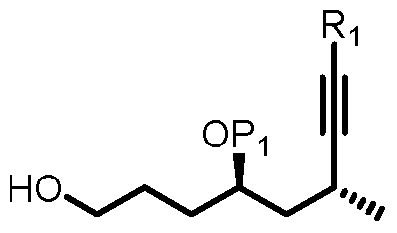
XIV
wherein Ri is H or trialkyl silyl;
(f) converting a compound of formula XIV to a compound of formula III.
Step (a) involves treating a compound of formula XV with an acetylene compound of formula X to provide a compound of formula

XV XVI
wherein P^ is H or trialkyl silyl; P1 is an alcohol-protecting group; X is halogen;
Suitable catalysts that may be used in step (a) include, dichloro[1 ,3- bis(diphenylphosphino)propane]palladium(ll) ((dppp)PdCI2), [1 ,1 '-
Bis(diphenylphosphino)ferrocene]dichloropalladium(ll) (Pd(dppf)CI2), bis(triphenylphosphine)palladium(ll) dichloride (PdCI2(PPh3)2), palladium- tetrakis(triphenylphosphine) (Pd(PPh3)4), tris(dibenzylideneacetone)dipalladium(0) (Pd2(dba)3), dichlorobis(tricyclohexylphosphine)palladium(ll) (PdCI2[P(Cy)3]2) and the like or any other suitable catalysts or ligands known in the art used in said Sonogashira reaction in step (a).
Suitable bases that may be used in step (a) include, alkali metal or alkaline earth metal carbonates such as sodium carbonate, potassium carbonate, cesium
carbonate, calcium carbonate, magnesium carbonate, sodium bicarbonate, potassium bicarbonate, alkoxides such as sodium methoxide, potassium methoxide; organic bases, such as for example, triethylamine, tributylamine, A/-methylmorpholine, N,N- diisopropylethylamine, A/-methylpyrrolidine, pyridine, piperidine, collidine, 4-(N,N- dimethylamino)pyridine, morpholine, imidazole, 2-methylimidazole, 4-methylimidazole and the like or any other suitable base known in the art.
Suitable solvents that may be used in step (a) include, ethers, aliphatic and alicyclic hydrocarbons, aromatic hydrocarbons, nitriles, ethers, polar aprotic solvents or mixtures thereof.
The reaction mixture obtained from step (a) may be optionally processed to remove any insoluble solids, and particles may be removed by methods such as decantation, centrifugation, gravity filtration, suction filtration, or any other techniques for the removal of solids. The product of step (a) may be isolated directly from the reaction mixture itself after the reaction is complete in step (a), or after conventional work up with techniques such as filtration, quenching with a suitable reagent, extraction, or the like. Optionally, the resulting product may be directly used for step (b) with or without isolation or it may be further purified, if isolated, to improve the purity of the product.
Step (b) involves optionally deprotecting a compound of formula XVI to provide a compound of formula XVII;

XVII
wherein is H or trialkyl silyl;
Suitable reagents that may be used in step (b) include, hydrochloric acid, hydrobromic acid, hydroiodic acid, nitric acid, sulfuric acid, acetic acid, formic acid, phosphoric acid, methanesulfonic acid, p-toluenesulfonic acid, tetra-n-butylammoniu m fluoride (TBAF), tris(dimethylamino)sulfonium difluorotrimethylsilicate, ammonia, sodium hydroxide, potassium hydroxide, sodium methoxide, potassium t-butoxide, sodium t-butoxide, sodium carbonate, potassium carbonate, sodium bicarbonate, potassium bicarbonate, and the like; ion exchange resins, such as: resins bound to metal ions, including lithium, sodium, potassium, and the like; and resins bound to
acids, including phosphoric, sulfonic, methanesulfonic, p-toluenesulfonic, and the like or any other suitable reagents and mixtures thereof.
Suitable solvents that may be used in step (b) include water, alcohols, ketones, ethers, aliphatic and alicyclic hydrocarbons, halogenated hydrocarbons, aromatic hydrocarbons, nitriles, polar aprotic solvents, nitromethane and mixtures thereof.
Suitable temperatures that may be used in step (b) may be less than about 1 00°C, less than about 70°C, less than about 40°C, less than about 30°C, less than about 10°C, less than about 0°C, less than about -10°C, less than about -20°C, or any other suitable temperature.
The reaction mixture obtained from step (b) may be optionally processed to remove any insoluble solids, and particles may be removed by methods such as decantation, centrifugation, gravity filtration , suction filtration, or any other suitable techniques for the removal of solids. The product of step (b) may be isolated directly from the reaction mixture itself after the reaction is complete in step (b), or after conventional work up with techniques such as filtration, quenching with a suitable reagent, extraction, or the like. Optionally, an obtained crude product may be directly used for step (c) with or without isolation or it may be further purified, if isolated, to improve the purity of the product.
Step (c) involves converting a compound of formula XVI or compound of formula XVI I to a compound of for

XVI I I
wherein is H or trialkyl silyl ;
Conversion of a compound of formula XVI or compound of formula XVI I to a compound of formula XVI II may be carried out using hydrogen and a catalyst;
Suitable catalysts that may be used in step (c) include, [((S,S)- QuinoxP*)Rh(cod)]BF4, [((fl,fl)-Norphos)Rh(cod)]BF4, [((S,S)-Me-BPE)Rh(cod)]BF4, [((fl,fl)-Et-BPE)Rh(cod)]BF4, [((S,S)-Ph-BPP)Rh(cod)]BF4, [((S,S)-tBu- ferrotane)Rh(cod)]BF4, [((fl,fl)-Me-DuPhos)Rh(cod)]BF4, [((fi)-BINAP)Rh(cod)]BF4, [((S,S)-iPr-DuPhos)Rh(cod)]BF4, [((fl,fl)-iPr-BPE)Rh(cod)]BF4, [((R,R,S,S)- DuanPhos)Rh(cod)]BF4, [RuCI((S)-BINAP)2^-CI)3][NH2Me2], [(S)-
SEGPHOS)Ru(OAc)2], [(S)-BINAP)Ru(OAc)2] and the like or any iridium (Ir) complexes known in the art used for hydrogenation or any other suitable metal complexes known in the art.
Suitable solvents that may be used in step (c) include alcohols, ethers, aliphatic and alicyclic hydrocarbons, halogenated hydrocarbons, polar aprotic solvents or mixtures thereof.
The reaction mixture obtained from step (c) may be optionally processed to remove any insoluble solids, and particles may be removed by methods such as decantation, centrifugation, gravity filtration, suction filtration, or any other suitable techniques for the removal of solids. The product of step (c) may be isolated directly from the reaction mixture itself after the reaction is complete in step (c), or after conventional work up with techniques such as filtration, quenching with a suitable reagent, extraction, or the like. Optionally, the resulting product may be directly used for step (d) with or without isolation or it may be further purified, if isolated, to improve the purity of the product.
Step (d) involves protecting a diol compound of formula XVIII to provide a compound of formula XIX;

XIX
wherein Ri is H or trialkyl silyl; Pi is an alcohol-protecting group; P2 is hydrogen or an alcohol-protecting group;
Optionally diol compound of formula XVIII may be protected sequentially to provide a compound of formula XIX or mono protected compound of formula XIV or compound of formula XXII I may be converted to compound of formula XIX or two or more compounds mixture of compound of formula XVIII, compound of formula XIV and compound of formula XXII I may be converted to compound of formula XIX

xviii xiv xxiii
Wherein Ρ-ι and P2 is alcohol protecting group; Ri is H or trialkyl silyl;
Suitable bases that may be used in step (d) include, alkali metal or alkaline earth metal hydroxides such as sodium hydroxide, potassium hydroxide, lithium hydroxide, calcium hydroxide; carbonates such as sodium carbonate, potassium carbonate, cesium carbonate, calcium carbonate, magnesium carbonate, sodium bicarbonate, potassium bicarbonate, alkoxides such as sodium methoxide, potassium methoxide; organic bases, such as for example, triethylamine, tributylamine, N- methylmorpholine, A/,A/-diisopropylethylamine, A/-methylpyrrolidine, pyridine, collidine 4-(A/,A/-dimethylamino)pyridine, morpholine, imidazole, piperidine, 2-methylimidazole, 4-methylimidazole and the like or any other suitable bases known in the art.
Suitable catalysts that may be used in step (d) include enzymes such as lipases, esterases, amidases and any other suitable trans esterification enzymes known in the art, other catalysts such as oxo[hexa(trifluoroacetato)]tetrazinc and the like or any other suitable catalysts known in the art that are used for selective alcohol acylation or protection..
Suitable solvents that may be used in step (d) include ketones, esters, ethers, aliphatic and alicyclic hydrocarbons, halogenated hydrocarbons, aromatic hydrocarbons, nitriles, polar aprotic solvents, nitromethane or mixtures thereof.
The reaction mixture obtained from step (d) may be optionally processed to remove any insoluble solids, and particles may be removed by methods such as decantation, centrifugation, gravity filtration, suction filtration, or any other techniques for the removal of solids. The product of step (d) may be isolated directly from the reaction mixture itself after the reaction is complete in step (d), or after conventional work up with techniques such as filtration, quenching with a suitable reagent, extraction, or the like. Optionally, the resulting product may be directly used for step (e) with or without isolation or it may be further purified, if isolated, to improve the purity of the product.
Step (e) involves optionally deprotecting a compound of formula XIX to provide a compound of formula XIV;
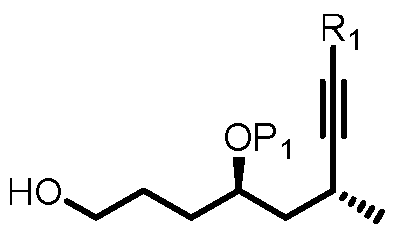
XIV
Suitable reagents that may be used in step (e) include, hydrochloric acid, hydrobromic acid, hydroiodic acid, nitric acid, sulfuric acid, acetic acid, formic acid, phosphoric acid, methanesulfonic acid, p-toluenesulfonic acid, tetra-n-butylammoniu m fluoride (TBAF), tris(dimethylamino)sulfonium difluorotrimethylsilicate, ammonia, sodium hydroxide, potassium hydroxide, sodium methoxide, potassium f-butoxide, sodium f-butoxide, sodium carbonate, potassium carbonate, sodium bicarbonate, potassium bicarbonate, and the like; ion exchange resins, such as: resins bound to metal ions, including lithium, sodium, potassium, and the like; and resins bound to acids, including phosphoric, sulfonic, methanesulfonic, p-toluenesulfonic, pyridinium p- toluenesulfonate and the like or any other suitable reagents and mixtures thereof.
Suitable solvents that may be used in step (e) include water, alcohols, ketones, ethers, aliphatic and alicyclic hydrocarbons, halogenated hydrocarbons, aromatic hydrocarbons, nitriles, polar aprotic solvents, nitromethane and mixtures thereof.
Suitable temperatures that may be used in step (e) may be less than about 100°C, less than about 70°C, less than about 40°C, less than about 30°C, less than about 10°C, less than about 0°C, less than about -10°C, less than about -20°C, or any other suitable temperature.
The reaction mixture obtained from step (e) may be optionally processed to remove any insoluble solids, and particles may be removed by methods such as decantation, centrifugation, gravity filtration, suction filtration, or any other techniques for the removal of solids. The product of step (e) may be isolated directly from the reaction mixture itself after the reaction is complete in step (e, or after conventional work up with techniques such as filtration, quenching with a suitable reagent, extraction, or the like. Optionally, the resulting product may be directly used for step (f) with or without isolation or it may be further purified, if isolated, to improve the purity of the product.
Step (f) involves converting a compound of formula XIV to a compound of formula II I.
Suitable reagents that may be used in step (f) include, (2,2,6,6-tetramethyl- piperidin-1 -yl)oxyl (TEMPO), pyridinium chlorochromate (PCC), oxalyl chloride &
dimethyl sulfoxide (DMSO), dicyclohexylcarbodiimide & DMSO, Dess-Martin periodinane, [bis(acetoxy)iodo]-benzene (BAIB), manganese dioxide and the like or any other suitable oxidizing agent known in the art.
Suitable solvents that may be used in step (f) include, ethers, aliphatic and alicyclic hydrocarbons, aromatic hydrocarbons, halogenated hydrocarbons, polar aprotic solvents or mixtures thereof.
The reaction mixture obtained from step (f) may be optionally processed to remove any insoluble solids, and particles may be removed by methods such as decantation, centrifugation, gravity filtration, suction filtration, or any other techniques for the removal of solids. The product of step (f) may be isolated directly from the reaction mixture itself after the reaction is complete in step (f), or after conventional work up with techniques such as filtration, quenching with a suitable reagent, extraction, or the like.
Optionally steps (a) to (f) or any two or more steps may be carried out in-situ i.e. without isolating the intermediates in each stage.
A compound of formula XIV can also be prepared by using the (S)-enantiomer or enantiomerically enriched compound of formula XV. Inversion of the stereocentre at the secondary alcohol {(S)-enantiomer of a compound of formula XVI II} may be carried out by employing the Mitsunobu reaction conditions or any other suitable chiral inversion reaction conditions known in the art.
In the fourth embodiment, the present application provides a process for preparation of a compound of formula IV;

wherein Pi is an alcohol-protecting group; LG is -OSC>2(R); wherein R is selected from straight or branched C Cio alkyl or optionally substituted C5-C15 aryl or optionally substituted aralkyl; X is halogen, preferably bromine;
which includes one or more of the following steps:
(a) reacting an epoxide of formula XX with a compound of formula XXI to provide a compound of formula XXI I;

** ™ XXII
wherein R2 is trialkyl silyl; Pi is an alcohol-protecting group; X is halogen, preferably bromine;
(b) converting a compound of formula XXII to a compound of formula XV;
X OH XV
wherein is an alcohol-protecting group; X is halogen;
(c) converting a compound of formula XV to a compound of formula IV.
Step (a) involves reacting an epoxy compound of formula XX with a compound of formula XXI to provide a compound of formula XXII;

** ™ XXII
wherein R2 is trialkyl silyl; Pi is an alcohol-protecting group; X is halogen, preferably bromine;
Suitable forms of magnesium metal that may be used in step (a) include, any form of magnesium metal such as magnesium turnings, magnesium beads, magnesium powder, magnesium chips and the like.
Suitable reagents that may be used in step (a) to activate magnesium include, alkyl halides such as methyl iodide, methyl ethyl bromide, 1 , 2-dibromoethane and the like, iodine, diisobutylaluminium hydride (DIBAL-H), sodium bis(2- methoxyethoxy)aluminumhydride (Red-AI), lithium aluminium hydride (LAH) and the like or any other suitable magnesium activating reagents known in the art.
Suitable solvents that may be used in step (a) include ethers, aromatic hydrocarbons, or mixtures thereof.
Optionally, step (a) may be carried out in presence of a metal catalyst such as cuprous chloride, cuprous bromide, cuprous iodide, zinc chloride and the like or any other suitable metal catalyst known in the art employed for the Grignard reaction.
The reaction mixture obtained from step (a) may be optionally processed to remove any insoluble solids, and particles may be removed by methods such as decantation, centrifugation, gravity filtration, suction filtration, or any other techniques for the removal of solids. The product of step (a) may be isolated directly from the reaction mixture itself after the reaction is complete in step (a), or after conventional work up with techniques such as filtration, quenching with a suitable reagent, extraction, or the like. Optionally, the resulting product may be directly used for step (b) with or without isolation or it may be further purified, if isolated, to improve the purity of the product.
Step (b) involves converting a compound of formula XXII to a compound of formula XV;

wherein Pi is an alcohol-protecting group; X is halogen, preferably bromine;
Suitable reagents that may be used in step (b) include, bromine, N- bromosuccinimide, 1 ,3-dibromo-5,5-dimethylhydantoin, pyridinium perbromide phosphorus tribromide, iodine, A/-iodosuccinimide and the like or any other suitable reagents known in the art.
Suitable solvents that may be used in step (b) include, ethers, aliphatic and alicyclic hydrocarbons, aromatic hydrocarbons, halogenated hydrocarbons, esters, ketones, polar aprotic solvents or mixtures thereof.
The reaction mixture obtained from step (b) may be optionally processed to remove any insoluble solids, and particles may be removed by methods such as decantation, centrifugation, gravity filtration, suction filtration, or any other techniques for the removal of solids. The product of step (b) may be isolated directly from the reaction mixture itself after the reaction is complete in step (b), or after conventional work up with techniques such as filtration, quenching with a suitable reagent, extraction, or the like. Optionally, the resulting product may be directly used for step (c) with or without isolation or it may be further purified, if isolated, to improve the purity of the product.
Step (c) involves converting a compound of formula XV to a compound of formula IV.
The compound of formula IV is prepared by treating a compound of formula XV with sulfonyl halides or esters and the like. Suitable sulfonyl reagents that may be used in step (c) include, methanesulfonyl, p-toluenesulfonyl, 2,4,6- triisopropylbenzenesulfonyl, 4-propoxybenzene-1 -sulfonyl, 4-methoxybenzenesulfonyl, phenylmethanesulfonyl, 2,4-dichloropyrimidine-5-sulfonyl, benzenesulfonyl and the like.
Suitable base that may be used in step (c) include, alkali metal or alkaline earth metal hydroxides such as sodium hydroxide, potassium hydroxide, lithium hydroxide, calcium hydroxide; carbonates such as sodium carbonate, potassium carbonate, cesium carbonate, calcium carbonate, magnesium carbonate, sodium bicarbonate, potassium bicarbonate, alkoxides such as sodium methoxide, potassium methoxide; organic bases, such as for example, triethylamine, tributylamine, A/-methylmorpholine, A/,A/-diisopropylethylamine, A/-methylpyrrolidine, pyridine, collidine, 4-(N,N- dimethylamino)pyridine, morpholine, imidazole, 2-methylimidazole, 4-methylimidazole and the like or any other suitable bases known in the art.
Suitable solvents that may be used in step (c) include ketones, esters, ethers, aliphatic and alicyclic hydrocarbons, halogenated hydrocarbons, aromatic hydrocarbons, nitriles, polar aprotic solvents, nitromethane or mixtures thereof.
The reaction mixture obtained from step (c) may be optionally processed to remove any insoluble solids, and particles may be removed by methods such as decantation, centrifugation, gravity filtration, suction filtration, or any other techniques for the removal of solids. The product of step (c) may be isolated directly from the reaction mixture itself after the reaction is complete in step (c), or after conventional work up with techniques such as filtration, quenching with a suitable reagent, extraction, or the like.
Optionally steps (a) to (c) may be carried out in-situ i.e. without isolating the intermediates in each stage.
In the fifth embodiment, the present application provides a compound of formula V or isomers thereof.
 wherein P-i is an alcohol-protecting group; Ri is H or trialkyi silyl protecting group preferably triisopropylsilyl ether;
In the sixth embodiment, the present application provides a compound formula VI or isomers thereof.

In the seventh embodiment, the present application provides a compound of formula VII or isomers thereof.

VI I
wherein P-i is an alcohol-protecting group;
In the eighth embodiment, the present application provides a compound of formula VII I or isomers thereof.

VII I
wherein Pi is H or an alcohol protecting group and X is halogen.
In the ninth embodiment, the present application provides a compound formula II I or isomers thereof;

I I I
wherein Pi is an alcohol-protecting group; Ri is H or trialkyi silyl protecting group;
In the tenth embodiment, the present application provides a compound of formula IVa or isomers thereof.

IVa
wherein Pi is an alcohol protecting group and X is halogen;
In the eleventh embodiment, the present application provides a compound having the following formula or isomers thereof.


In the twelfth embodiment, the present application provides a process for preparation of eribulin or a pharmaceutically acceptable salt thereof comprising synthesizing eribulin or its pharmaceutically acceptable salt from one or more compounds of first embodiment to eleventh embodiment.
One or more compounds of first embodiment to eleventh embodiment include compound of formula III, formula IV, formula IVa, formula V, formula VI, formula VII, formula VIII, formula XI, formula XII, formula XIII, formula XIV, formula XV, formula XVI, formula XVII, formula XVII I, formula XIX, formula XXII and compounds in eleventh embodiment.
Isomers of one or more compounds of first embodiment to twelfth embodiment isomers include stereoisomers of formula III, formula IV, formula IVa, formula V, formula VI, formula VII, formula VIII, formula XI, formula XII, formula XIII, formula XIV, formula XV, formula XVI, formula XVII, formula XVIII, formula XIX, formula XXI I and compounds in eleventh embodiment.
DEFINITIONS
The following definitions are used in connection with the present application unless the context indicates otherwise. In general, the number of carbon atoms present in a given group or compound is designated "Cx-Cy", where x and y are the lower and upper limits, respectively. For example, a group designated as "CrC6" contains from 1 to 6 carbon atoms. The carbon number as used in the definitions herein refers to carbon backbone and carbon branching, but does not include carbon atoms of the substituents, such as alkoxy substitutions or the like.
As used herein, "an alcohol protecting group" is a functional group that protects the alcohol group from participating in reactions that are occurring in other parts of the molecule. Suitable alcohol protecting groups that are used in step (a) include, acetyl, benzoyl, benzyl, β-methoxyethoxymethyl ether, methoxymethyl ether, dimethoxytrityl, p-methoxybenzyl ether, methylthiomethyl ether, allyl ether, f-butyl ether, pivaloyl, trityl, silyl ether (e.g., trimethylsilyl (TMS), f-butyldimethylsilyl (TBMDS), f-butyldiphenylsilyl (TBDPS), f-butyldimethylsilyloxymethyl (TOM) or triisopropylsilyl (TIPS) ether), tetrahydropyranyl (THP), methyl ether and ethoxyethyl ether (EE) or any suitable alcohol protecting group known in the art.
An "alcohol" is an organic compound containing a carbon bound to a hydroxyl group. "Ci-C6 alcohols" include methanol, ethanol, 2-nitroethanol, 2-fluoroethanol, 2,2,2-trifluoroethanol, hexafluoroisopropyl alcohol, ethylene glycol, 1 -propanol, 2- propanol (isopropyl alcohol), 2-methoxyethanol, 1 -butanol, 2-butanol, i-butyl alcohol, t- butyl alcohol, 2-ethoxyethanol, diethylene glycol, 1 -, 2-, or 3-pentanol, neo-pentyl alcohol, t-pentyl alcohol, cyclohexanol, phenol, glycerol and the like.
An "aliphatic hydrocarbon" is a liquid hydrocarbon compound, which may be linear, branched, or cyclic and may be saturated or have as many as two double bonds. A liquid hydrocarbon compound that contains a six-carbon group having three double bonds in a ring is called "aromatic." Examples of "C5-C8 aliphatic" include n- pentane, isopentane, neopentane, n-hexane, isohexane, 3-methylpentane, 2,3- dimethylbutane, neohexane, n-heptane, isoheptane, 3-methylhexane, neoheptane, 2,3-dimethylpentane, 2,4-dimethylpentane, 3,3-dimethylpentane, 3-ethylpentane, 2,2,3-trimethylbutane, n-octane, isooctane, 3-methylheptane, neooctane, cyclohexane, methylcyclohexane, cycloheptane, petroleum ethers and the like.
An "aromatic hydrocarbon solvent" refers to a liquid, unsaturated, cyclic, hydrocarbon containing one or more rings which has delocalized conjugated π system. Examples of an aromatic hydrocarbon solvent include benzene toluene, ethylbenzene, m-xylene, o-xylene, p-xylene, indane, naphthalene, tetralin, trimethylbenzene, chlorobenzene, fluorobenzene, trifluorotoluene, anisole, C6-Ci2 aromatic hydrocarbons and the like.
An "ester" is an organic compound containing a carboxyl group -(C=0)-0- bonded to two other carbon atoms. "C3-C6 esters" include ethyl acetate, n-propyl acetate, n-butyl acetate, isobutyl acetate, t-butyl acetate, ethyl formate, methyl acetate, methyl propanoate, ethyl propanoate, methyl butanoate, ethyl butanoate and the like.
An "ether" is an organic compound containing an oxygen atom -O- bonded to two other carbon atoms. "C2-C6 ethers" include diethyl ether, diisopropyl ether, methyl t-butyl ether, glyme, diglyme, tetrahydrofuran, 2-methyltetrahydrofuran, 1 , 4-dioxane, dibutyl ether, dimethylfuran, anisole, diethylene glycol monomethyl ether, diethylene glycol monoethyl ether, cyclopentyl methyl ether and the like.
A "halogenated hydrocarbon" is an organic compound containing a carbon bound to a halogen. Halogenated hydrocarbons include dichloromethane, 1 ,2- dichloroethane, trichloroethylene, perchloroethylene, 1 ,1 ,1 -trichloroethane, 1 ,1 ,2- trichloroethane, chloroform, carbon tetrachloride and the like.
A "ketone" is an organic compound containing a carbonyl group -(C=0)- bonded to two other carbon atoms. "C3-C6 ketones" include acetone, ethyl methyl ketone, diethyl ketone, methyl isobutyl ketone, ketones and the like.
A "nitrile" is an organic compound containing a cyano -(C≡N) bonded to another carbon atom. "C2-C6 Nitriles" include acetonitrile, propionitrile, butanenitrile and the like.
A "polar aprotic solvents" include Ν,Ν-dimethylformamide, N,N- dimethylacetamide, dimethylsulfoxide, sulfolane, N-methylpyrrolidone and the like;
Certain specific aspects and embodiments of the present application will be explained in greater detail with reference to the following examples, which are provided only for purposes of illustration and should not be construed as limiting the scope of the application in any manner. Reasonable variations of the described procedures are intended to be within the scope of the present application. While particular aspects of the present application have been illustrated and described, it would be obvious to those skilled in the art that various other changes and modifications can be made without departing from the spirit and scope of the invention. It is therefore intended to cover in the appended claims all such changes and modifications that are within the scope of this application.
EXAMPLES
Example-1 : Preparation of (fi)-3-Methyl-5-(triisopropylsilyl)pent-4-ynal.

[Rh(OH)(cod)]2 (5.87 g) and (S)-DTBM-SEGPHOS (36.45, 6 mol%) were partially dissolved in dioxane (732 mL) and warmed to 53 °C. After 1 .25 h, the resulting orange solution was allowed to cool to room temperature. TIPS acetylene (188 g) was charged to the reaction vessel over 10 min followed by crotonaldehyde (42.7 mL) was added to the reaction mass via pump syringe over 3 h and the resultant reaction mass was stirred at 43 °C for 16 h. Reaction mass was concentrated in vacuo and the obtained compound was purified by wipe-film-evaporation to afford the titled aldehyde (42.9 g, 170 mmol, 33%) as a pale yellow oil.
Example-2: Preparation of (4ff,6fi)-6-methyl-8-(triisopropylsilyl)oct-1 -en-7-yn-4- ol.

(R)-3-Methyl-5-(triisopropylsilyl)pent-4-ynal (10.77 g) in diethyl ether (50 mL) was added slowly to the solution of (+)-lpc2B-allyl (1 M in pentane, 51 .2 mL) in diethyl ether (50 mL) at -70 °C. The resultant reaction mass was stirred at -70 °C for 1 hour 30 minutes, warmed to 0 °C and stirred at 0 °C for 1 hour 30 minutes. 3M NaOH (80.2 mL) followed by hydrogen peroxide (30% aq. solution, 33 mL) was added slowly to the reaction mass at 27 °C and stirred at 27 °C for 17 hours. Reaction mass was passed through a pad of Celite, washed with MTBE (50 mL). Layers were separated, aqueous layer was extracted with MTBE (3 x 50 mL) and the combined organic extracts were dried over MgSC¼ and concentrated in vacuo. The obtained compound was purified by flash chromatography (Si02) using 0 to 5 to 10% EtOAc/heptane to afford titled compound (10.6 g).
Example-3: Preparation of ieri-Butyldimethyl(((4R,6R)-6-methyl-8- (triisopropylsilyl)oct-1-en-7-yn-4-yl)oxy)silane.

To a solution of (4R,6R)-6-methyl-8-(triisopropylsilyl)oct-1 -en-7-yn-4-ol (126 g) in DMF (250 mL) was added imidazole (87.6 g) followed by TBSCI (96.9 g). The solution was warmed to 44 °C and stirred at 44 °C for 1 8 hours. Methanol (10 mL), water (250 mL) and heptane (350 mL) was added slowly to the reaction mixture at 27 °C and stirred for 15 minutes. Layers were separated and the aqueous layer was extracted with heptane (250 mL). The combined organic layers were dried over MgSC¼ and then concentrated in vacuo. The obtained crude material was purified by flash chromatography (Si02) using (1 ) heptane (1 .5 L); (2) 1 % heptane/EtOAc (2 L); (3) 2% EtOAc/heptane (10 L) sequentially to afford the titled product (159.7 g).
Example-4: Preparation of (4ff,6fi)-4-((tert-butyldimethylsilyl)oxy)-6-methyl-8- (triisopropylsilyl)oct-7-yn-1-ol.
T

9-BBN-H (0.5 M in THF, 41 .9 mL) was added slowly to the solution of tert- Butyldimethyl(((4R,6R)-6-methyl-8-(triisopropylsilyl)oct-1 -en-7-yn-4-yl)oxy)silane (5.7 g) and THF (30 mL) at 0 °C. The solution was allowed to warm to 27 °C and stirred at 27 °C for 15 hours. Water (103 mL) followed by NaB03.4H20 (10.3 g) was added portion wise to the reaction mass at 20 °C and the resultant reaction mass was stirred at 27 °C for 22 hours. Reaction mass was filtered through a pad of Celite, washed with MTBE (250 mL). Layers were separated, aqueous layer was extracted with MTBE (250 mL). The combined organic layers were dried over MgSC and then concentrated in vacuo. The obtained crude material was purified by flash chromatography (Si02) using 0%, 10% and 20% EtOAc/heptane sequentially to afford titled product (5.45 g).
Example-5: Preparation of (4ff,6fi)-4-((ieri-Butyldimethylsilyl)oxy)-6-methyl-8- (triisopropylsilyl)oct-7-ynal.

To a solution of (4R,6R)-4-((tert-butyldimethylsilyl)oxy)-6-methyl-8- (triisopropylsilyl)oct-7-yn-1 -ol (122 g) in dichloromethane (500 mL) was added TEMPO (4.47 g) followed by Phl(OAc)2 (1 .2 g) at 27 °C and stirred at 27 °C for 18 hours. Dichloromethane (500 mL) was added to the reaction mass and the resultant reaction mass was washed with sat. aq. Na2S03 (500 mL), sat. aq. NaHC03 (500 mL) then brine (500 mL). The organic layer was concentrated in vacuo and the obtained crude material was purified by flash chromatography (Si02, 1 .4 kg) with (1 ) heptane (1 L), (2) 2% EtOAc/heptane (1 L), (3) 3% EtOAc/heptane (3 L) and (4) 4% EtOAc/heptane (3 L) sequentially to afford titled product (98.8 g).
Example-6: Preparation of tert-butyl(3-((2S,5S)-5-((3R,5R)-3-((tert- butyldimethylsilyl)oxy)-5-methyl-7-(triisopropylsilyl)hept-6-yn-1-yl)-4-methylen tetrahydrofuran-2-yl)propoxy)diphenylsilane.

Aldehyde and vinyl bromide compounds solution preparation: In two separate 500 ml flasks, (4R,6R)-4-((tert-Butyldimethylsilyl)oxy)-6-methyl-8-(triisopropylsilyl)oct- 7-ynal (61 .9 g) and (R)-2-bromo-7-((tert-butyldiphenylsilyl) oxy)hept-1 -en-4-yl 2,4,6- triisopropylbenzenesulfonate (124.7 g) were evaporated with toluene (30 mL) three times to remove any water. The flasks were placed under a flow of nitrogen and acetonitrile (200 mL) was added to the flask containing bromo compound. After dissolution of bromo compound in acetonitrile, transferred to the flask containing aldehyde and stirred for 15 minutes to get clear solution.
A 3L, 3-neck flask equipped with a mechanical stirrer and a nitrogen inlet and a gas outlet, was dried with a heatgun under a flow of nitrogen for 20 min. It was left under a nitrogen flow overnight. 1 ,8-bis(dimethylamino)naphthalene (Proton sponge) (96.6 g), (R)-N-(2-(4-isopropyl-4,5-dihydrooxazol-2-yl)phenyl)methanesulfonamide (133.8 g), and CrCI2 (55.4 g) were added to the flask. Acetonitrile (600 mL) was slowly added to the flask and the resultant reaction mass was stirred at 27 °C for 1 hour 30 minutes. NiCI2-2,9-dimethyl-1 ,10-phenanthroline (2.46 g, 5%), followed by the solution of aldehyde and vinyl bromide compounds was added to the reaction mass and the resultant reaction mass was stirred at 27 °C for 20 hours. Ethylenediamine (97 mL) was slowly added to the reaction mass at below 20 °C and stirred for 10 minutes. The reaction mass was warmed to 40 °C and stirred at 40 °C for 4 hours. Water (600 mL) and 2-Me-THF (600 mL) was added to the reaction mass and stirred for 15 minutes. The layers were separated, the aqueous layer was extracted twice with 2-Me-THF (600 mL), combined organic layers washed with brine (100 mL) and dried over MgSC¼. The obtained organic layer was filtered, concentrated in vacuo. THF (300 mL) was added to the crude compound, separated solid was filtered and wet cake was
washed with THF (300 mL). Acetonitrile (700 mL) and heptane (700 mL) was added to the wet compound, stirred for 30 minutes and the resultant reaction mass was filtered. Separated filtrate layers, extracted acetonitrile layer with heptane (3x700 mL). Evaporated all the heptane layer and the obtained crude material was purified using column chromatography (Heptane/MTBE (95/5, 2.5 L, then Heptane/MTBE (90/10, 4.5I)) to afford title compound (55 g).
Example-7: (3ff,5fi)-1 -((2S,5S)-5-(3-Hydroxypropyl)-3-methylenetetrahydrofuran- 2-yl)-5-methylhept-6-yn-3-ol

To a solution of tert-butyl(3-((2S,5S)-5-((3R,5R)-3-((tert-butyldimethylsilyl)oxy)- 5-methyl-7-(triisopropylsilyl)hept-6-yn-1 -yl)-4-methylene tetrahydrofuran-2-yl)propoxy) diphenylsilane (27.0 g) in THF (135 mL) was added TBAF (1 M in THF, 209 mL) over 25 min and the resulting brown solution was stirred at 27 °C for 16 hours. MTBE (270 mL) was added to the reaction mass, and the resultant reaction mass was washed with water/sat aq. NH4CI (1 :1 , 270 mL). Aqueous layer was extracted with MTBE (270 mL), combined organic layers were concentrated in vacuo. The obtained crude oil was dissolved in methanol (270 mL) and cone. HCI (8.1 mL) was added slowly. The solution was stirred at 27 °C for 2 hours and quenched with solid NaHC03 (7 g). The resultant suspension was filtered and the filtrate concentrated in vacuo. The obtained oil was dissolved in MTBE (270 mL) and washed with sat aq. NaHC03 (270 mL). Aqueous layer was extracted with MTBE (2 x 270 mL), the combined organic layers were concentrated in vacuo and the obtained crude material was purified by flash chromatography (Si02) with: (1 ) 20% EtOAc/heptane (0.5 L), (2) 60% EtOAc/heptane (1 L), (3) 80% EtOAc/heptane (2 L) and (4) EtOAc (0.5 L) sequentially to afford crystalline titled product (7.41 g; dr A ).
Example-8: Preparation of ieri-Butyl(3-((2S,5S)-5-((3ff,5fi)-3-((tert- butyldimethylsilyl)oxy)-5-methylhept-6-yn-1-yl)-4-methylenetetrahydrofuran-2- yl)propoxy)dimethylsilane.

To a solution of (3R,5R)-1 -((2S,5S)-5-(3-Hydroxypropyl)-3- methylenetetrahydrofuran-2-yl)-5-methylhept-6-yn-3-ol (9.85 g) and imidazole (12.6 g) in DMF (39 mL) was added TBSCI (13.9 g). The resulting reaction mass was warmed to 47°C and stirred at 47 °C for 16 hours. Methanol (4 mL) was added to the reaction mass then cooled to 27 °C. Heptane (100 mL) was added to the reaction mass and washed with water (2 x 200 mL) then sat aq. NH4CI (100 mL). The organic layer was concentrated in vacuo, the obtained crude oil was purified by passing through a silica plug using (1 ) heptane (200 mL) and (2) 5% EtOAc/heptane (600 mL) to afford the titled product (17.4 g; drA'A ).
Example-9: Preparation of (3ff,5fl)-1-((2S,5S)-5-(3-hydroxypropyl)-3- methylenetetrahydrofuran-2-yl)-6-iodo-5-methylhept-6-en-3-ol

DIBAL-H (1 M in THF, 1 .62 mL) was slowly added to a suspension of NiCI2 (bis(diphenylphosphino)ethylene) (42.7 mg) in THF (0.5 mL) and stirred for 15 minutes. A solution of tert-Butyl(3-((2S,5S)-5-((3R,5R)-3-((tert-butyldimethylsilyl)oxy)- 5-methylhept-6-yn-1 -yl)-4-methylenetetrahydrofuran-2-yl)propoxy)dimethylsilane (400 mg) in THF (1 .5 mL) was added to the reaction mass at 0 °C and stirred at 0 °C for 30 minutes. Reaction mass was warmed to 27 °C and stirred at 27 °C for 4 hours. A solution of N-iodosuccinimide (364 mg) in THF (1 .5 mL) was added to the reaction mass at -78 °C and stirred at -78 °C for 1 hour. Reaction mass was quenched into sat aq. Rochelle's salt (15 mL), extracted with MTBE (2 x 15 mL) and the combined organic layers were concentrated in vacuo. The resulting crude oil was dissolved in methanol (4 mL). 37% HCI (0.04 mL) was added to the reaction mass at 27 °C and stirred at 27 °C for 2 hours. Solid NaHC03 was added to the reaction mass, the suspension was filtered and the filtrate concentrated in vacuo. To the obtained crude
material, EtOAc (15 mL) and water (15 mL) was added. The layers were separated and the aqueous was extracted again with EtOAc (15 mL). The combined organic layers were dried over MgS04 and concentrated in vacuo. The resulting oil was purified by fluid chromatography using (1 ) 5% acetone/heptane (70 mL); (2) 40% EtOAc/acetone (80 mL) followed by supercritical fluid chromatography (SFC) to afford the titled product (178 mg).
SFC Method: Column: YMC amylose-C 150 x 4.6, 5 μ; Flow: 1 mL/min (Isocratic); Run-time: 15 minutes; Diluent: acetonitrile; Sample Concentration: 1 mg/mL in diluent; Mobile phase: acetonitrile and water in 95:5 ratio (v/v)
Example-10: Preparation of 3-((2S,5S)-5-((3ff,5fl)-3-Hydroxy-6-iodo-5- methylhept-6-en-1-yl)-4-methylenetetrahydrofuran-2-yl)propyl pivalate.

A solution of (3R,5R)-1 -((2S,5S)-5-(3-hydroxypropyl)-3-methylenetetrahydro furan-2-yl)-6-iodo-5-methylhept-6-en-3-ol (480 mg) in dichloromethane (4.8 mL) was cooled to 0 °C. Pyridine (296 μΙ_), 4-DMAP (9.6 mg) and then PivCI (157 μΙ_) was added to the reaction mass. The resultant reaction mass was stirred at 0 °C for 30 minutes then at 27 °C for 2 hours. Dichloromethane (5 mL) was added to the reaction mass and the obtained reaction mass was washed with sat. aq. NH4CI (10 mL). The organic layer was concentrated in vacuo and the resultant crude material was purified by FC (Si02) with (1 ) 20% EtOAc/heptane (60 mL) and 40% EtOAc/heptane (60 mL) sequentially to afford the titled product (480 mg).
Example-11 : Preparation of (fi)-7-((ieri-butyldimethylsilyl)oxy)-2- (trimethylsilyl)hept-1-en-4-ol.

1 -bromovinyltrimethylsilane solution preparation: 62.1 g of 1 -bromovinyltrimethylsilane was dissolved in 1 00 mL THF.
Iodine (1 .17 g) was added to the magnesium turnings (9.55 g) at 23 °C and allowed to stand for 10 minutes. Anhydrous tetrahydrofuran (50 mL) followed by 1 - bromovinyltrimethylsilane solution in THF (10 mL) was added to the reaction mass at 24 °C and stirred for 30 minutes. Another lot of 1 -bromovinyltrimethylsilane solution in THF (10 mL) was added to the reaction mass at 24 °C and stirred for 20 minutes. Anhydrous tetrahydrofuran (200 mL) followed by remaining 1 - bromovinyltrimethylsilane solution in THF (-130 mL) was added slowly to the reaction mass and stirred for 30 minutes. The resultant reaction mixture slowly cooled to 25 °C and further cooled to -25 °C. Copper (I) iodide (2.2 g) was added to the reaction mass at -25 °C under argon and stirred at -25 °C for 45 minutes. (fl)-ferf-butyldimethyl(3- (oxiran-2-yl)propoxy)silane solution in THF (50 g in 150 mL THF) was slowly added to the reaction mass at -25 °C over a period of 1 hour and stirred at -25 °C for 1 hour. Saturated ammonium chloride solution (200 mL) was added slowly to the reaction mass at 2 °C and stirred for 10 minutes. Water (200 mL) was added and stirred for 30 minutes, layers were separated. Aqueous layer was extracted with ethyl acetate (2X100 mL), combined organic layer was washed with water (200 mL), brine solution (200 mL) and dried with anhydrous sodium sulfate (20 g). The organic layer was concentrated in vacuo, the obtained crude product was purified by using column chromatography (eluent: EtOAc/hexane) to afford the titled product (68 g).
Example-12: Preparation of (fi)-2-bromo-7-((ieri-butyldimethylsilyl)oxy)hept-1 - en-4-ol

Triethylamine (0.320 g) was added to the reaction mass containing (R)-7-((tert- butyldimethylsilyl)oxy)-2-(trimethylsilyl)hept-1 -en-4-ol (1 .0 g) and toluene (15 mL) at - 30 °C. Pre cooled (-30 °C) bromine solution (0.606 g of bromine in 10 mL of toluene) was added slowly to the reaction mass at -58 °C. Sodium methanolate solution (2 mL; 25 wt. % in methanol) was added at -58 °C and the resultant reaction mixture was stirred at -48 °C for 5 hours. Methanol (10 mL) was added to the reaction mass at -42 °C and the reaction mass slowly warmed to 28 °C. Solvent was removed under reduced pressure at 48 °C. The obtained crude compound was dissolved in ethyl acetate (50 mL), washed with saturated aqueous ammonium chloride solution (10 mL)
and water (5 mL). The resultant organic layer was concentrated in vacuo at below 48 °C to afford the title compound.
Example-13: Preparation of (fi)-2-bromo-7-((ieri-butyldimethylsilyl)oxy)hept-1- en-4-ol

1 3-dibromo-5 5-dimethylimidazolidine-2 4-dione (10.84 g) was slowly added to the reaction mass containing (/^)-7-{(fe/ -butyldimethylsilyl)oxy)-2-(trimethylsilyl)hept- 1 -en-4-ol (10 g) and dichloromethane (150 mL) at -10 °C and the resultant reaction mass was stirred at -10 °C for 2 hours. Sodium methanolate solution (5.12 g; 30 wt. % in methanol) was added at -52 °C and the resultant reaction mixture was stirred at -52 °C for 2 hours 20 minutes. Methanol (100 mL) was added to the reaction mass at 0 °C and the reaction mass pH was slowly adjusted to 6.5 with aqueous ammonium chloride solution. Reaction mass concentrated under reduced pressure, the obtained crude compound was dissolved in ethyl acetate (100 mL), washed with saturated aqueous ammonium chloride solution (100 mL) and water (150 mL). The resultant organic layer was concentrated in vacuo at below 47 °C. The obtained crude compound was purified by flash chromatography to afford the titled compound (4.88 g)-
Example-14: Preparation of (fi)-2-bromo-7-((ieri-butyldimethylsilyl)oxy)hept-1- en-4-yl 2,4,6-triisopropylbenzenesulfonate.

4-(Dimethylamino)pyridine (286 mg) and triethylamine (316 mg) was added to the reaction mass containing (/:?)-2-bromo-7-((ferf-butyldimethylsilyl)oxy)hept-1 -en-4-ol (505 mg) and dichloromethane (5 mL) at 0 °C. Solution of 2,4,6-triisopropylbenzene-1 - sulfonyl chloride (710 mg in 1 .5 mL dichloromethane) was added to the reaction mass
at 0 °C and stirred at 25 °C for 22 hours. Reaction mass was washed with water (2x20 mL) and the resultant organic layer was concentrated in vacuo. The obtained crude compound was purified by flash chromatography to afford the titled compound (780 mg).
Example-15: Preparation of (fi)-1 -((ieri-butyldimethylsilyl)oxy)-6-methylene-8- (triisopropylsilyl)oct-7-yn-4-ol.

A solution of the bromide (100.31 g) in dry DMF (600 mL), dry triethylamine (130 mL) and (triisopropylsilyl)acetylene (104 mL) was added to the reaction mass containing [1 ,1 '-Bis(diphenylphosphino)ethane]dichloropalladium(ll) (1 .793 g) and copper iodide (1 .187 g) under N2 . The resultant reaction mass was stirred at 55 °C for 16 hours. MTBE (750 mL) was added to the reaction mass at 25 °C and stirred at 25 °C for 1 hour. The precipitate was removed by filtration through a pad of silica gel (100 g), the filter cake was washed with MTBE (250 mL). The combined filtrates were washed with water (500 mL), sat. NH4CI sol. (500 mL), water (500 mL) and brine solution (500 mL). The washed filtrates were dried over MgS04 and then concentrated under reduced pressure to afford title compound (157.47 g).
Example-16: Preparation of (fi)-6-methylene-8-(triisopropylsilyl)oct-7-yne-1 ,4- diol.

12 M HCI (1 .5 mL) was added to the reaction mass containing (fl)-1 -((ferf- butyldimethylsilyl)oxy)-6-methylene-8-(triisopropylsilyl)oct-7-yn-4-ol (157.47 g) and methanol (750 ml) and the resultant reaction mixture was stirred at 25 °C for 2 hours. Solid sodium hydrogen carbonate (2.27 g) was added to the reaction and stirred for 1 hour at 25 °C. The solids were removed by filtration and the filtrates concentrated under reduced pressure. The concentrated residue was dissolved in ethyl acetate (750 mL), washed with water (500 ml) and brine (500 ml). The resultant organic layer
was dried over magnesium sulfate and concentrated in vacuo to afford the title compound (108.7 g).
Example-17: Preparation of (4ff, 6fi)-6-Methyl-8-(triisopropylsilyl)oct-7-yne-1 ,4- diol.

(fl)-6-methylene-8-(triisopropylsilyl)oct-7-yne-1 ,4-diol (1 .0 g) and MeOH (10 mL) was charged into 50 mL Parr pressure vessel under a nitrogen atmosphere containing [((S,S)-QuinoxP*)Rh(cod)]BF4 (6.8 mg). The vessel was topped up to 10 bar pressure with hydrogen. Pressure was monitored and when it dropped to 9 bar or below, the pressure was increased to 1 0 bar by topping up with more hydrogen. Reaction mass was stirred until no further hydrogen uptake was observed. Pressure was released and the resulting solution was concentrated in vacuo to afford the titled compound (0.92 g).
Example-18: Preparation of (4ff, 6fi)-4-((tert-Butyldimethylsilyl)oxy)-6-methyl-8- (triisopropylsilyl)oct-7-yn-1-ol.

To a solution of (4R, 6fl)-6-Methyl-8-(triisopropylsilyl)oct-7-yne-1 ,4-diol (274 mg) in DMF (1 mL) was added imidazole (298 mg) followed by ferf-Butyldimethylsilyl chloride (330 mg) and the resultant reaction mass was stirred for 4 hours at 47 °C. MeOH (150 μΙ_) was added to the reaction mass at 25 °C and stirred at 25 °C for 2 hours. MTBE (20 mL) and water (20 mL) was added to the reaction mass and layers were separated. Organic layer washed with water (20 mL), dried over MgS04 and concentrated in vacuo to afford the crude di-TBS protected intermediate (467 mg) as a pale yellow oil.
To a solution of the crude di-TBS protected intermediate in EtOH (2.8 mL) was added pyridinium p-toluenesulfonate (21 .7 mg) and the resultant reaction mass was
stirred at 25 °C for 19 hours. Reaction mass was diluted with MTBE (20 mL) and washed with brine (20 mL). The organic layer was dried over MgSC¼ and concentrated in vacuo. The obtained crude compound was purified by flash chromatography (Si02) (0:100 to 20:80, EtOAc/heptane) to afforded the titled compound (214 mg).
Example-19: preparation of (4ff, 6fi)-4-((ieri-Butyldimethylsilyl)oxy)-6-methyl-8- (triisopropylsilyl)oct-7-yn-1-ol.
T

A mixture of (4R, 6/¾-6-Methyl-8-(triisopropylsilyl)oct-7-yne-1 ,4-diol and (4^,6^)-4-((ferf-butyldimethylsilyl)oxy)-6-methyl-8-(triisopropylsilyl)oct-7-yn-1 -ol (1 .36 g), isopropenyl acetate (0.8 mL) and Novozyme 435 (1 00 mg) in ferf-Butyl Methyl ether (1 5 mL) was stirred at 21 °C under nitrogen for 18 hours. Reaction mass filtered through a pad of Celite, washed with MTBE and the resultant filtrate was concentrated. The obtained crude compound was dissolved in dimethylformamide (4 mL).7erf-butyldimethylsilyl chloride (1 .2 g) and imidazole (1 .3 g) were added to the reaction mass and the resulting solution was stirred at 21 °C under nitrogen for 16 hours. Methanol (0.5 mL) was added to the reaction mass and the mixture was stirred at 21 °C for 3 hours. MTBE (30 mL) and water (20 mL) was added to the reaction mass at 21 °C and stirred for 1 5 minutes. The layers were separated and the aqueous layer was extracted with MTBE (30 mL). The combined layer was washed with water (10 mL) and then concentrated to yield a slightly hazy oil (1 .17 g). The oil was dissolved in methanol (15 mL) and potassium carbonate (100 mg) was added to the reaction mass. The resulting solution was stirred at 21 °C under nitrogen for 5 hours. The reaction mass was poured into a mixture of MTBE (20 mL) and water (30 mL) and layers were separated. The aqueous layer was extracted with MTBE (2 x 20 mL). The combined organic layer was filtered through a pad of magnesium sulfate and concentrated to afford title compound (750 mg).
Example-20: Preparation of (4ff,6fi)-4-((ieri-Butyldimethylsilyl)oxy)-6-methyl-8- (triisopropylsilyl)oct-7-ynal.

To a solution of (4/:?,6/:?)-4-((ferf-butyldimethylsilyl)oxy)-6-methyl-8- (triisopropylsilyl)oct-7-yn-1 -ol (122 g) in dichloromethane (500 mL) was added TEMPO (4.47 g) followed by Phl(OAc)2 (1 .2 g) at 27 °C and stirred at 27 °C for 18 hours. Dichloromethane (500 mL) was added to the reaction mass and the resultant reaction mass was washed with sat. aq. Na2S03 (500 mL), sat. aq. NaHC03 (500 mL) then brine (500 mL). The organic layer was concentrated in vacuo and the obtained crude material was purified by flash chromatography (Si02, 1 .4 kg) with (1 ) heptane (1 L), (2) 2% EtOAc/heptane (1 L), (3) 3% EtOAc/heptane (3 L) and (4) 4% EtOAc/heptane (3 L) sequentially to afford titled product (98.8 g).
Example-21 : Preparation of (3ff,5fl)-1-((2S,5S)-5-(3-hydroxypropyl)-3- methylenetetrahydrofuran-2-yl)-6-iodo-5-methylhept-6-en-3-ol

BusSn-AIEt? solution preparation: 1 .6 M nBuLi in hexanes (8.8 mL) was added dropwise to the solution containing isopropylamine (1 .98 mL) and THF (34 mL) at -10 °C under nitrogen and the resulting solution was stirred at -10 °C for 30 minutes. Bu3SnH (3.8 mL) was added to the solution dropwise at below -30 °C and stirred for 30 minutes. 1 .8 M Et2AICI in PhMe (7.9 mL) was added dropwise at -40 °C and the reaction mixture was stirred for 10 minutes at -30 °C.
tert-Butyl(3-((2S,5S)-5-((3R,5R)-3-((tert-butyldimethylsilyl)oxy)-5-methylhept-6- yn-1 -yl)-4-methylenetetrahydrofuran-2-yl)propoxy)dimethylsilane (3.3 g) in THF (17.5 mL) was added to a reaction mass that contained [Ph3PCul]4 (1 .28 g) under nitrogen atmosphere and the resulting suspension was stirred for 5 minutes at 0 °C. The Bu3Sn-AIEt2 solution was added to the reaction mixture and the resultant reaction
mixture stirred for 1 hour 30 minutes at 0 °C. Sat. aq. NH4CI solution (35 mL) was added slowly and the resulting mixture was diluted with 2-MeTHF (70 mL) and 20% w/w aq. Rochelle's salt solution (70 mL), warmed to room temperature, and stirred rapidly for 1 hour. The biphasic mixture was transferred into a separating funnel, further portions of 2-MeTHF (70 mL) and 20% w/w aq. Rochelle's salt solution (70 mL) were added and the phases were mixed, separated and the organic layer was washed with 20% w/w aq. Rochelle's salt solution (70 mL), brine (150 mL), dried with MgS04, filtered and concentrated to give a colourless oil containing an off-white precipitate. The oil was solubilised in heptane (150 mL) and stirred for 1 h, the resulting suspension filtered and the filtrate concentrated to give colourless oil.
The crude material (colourless oil) was dissolved in DCM (170 mL) and cooled to -40 °C under nitrogen. A/-lodosuccinimide (3.18 g) was added and the reaction stirred for 1 hour. The reaction mixture was quenched with 20% w/w aq. Na2S203 (1 50 mL) and warmed to room temperature. The layers were separated and the aqueous layer was washed with DCM (2x 150 mL). The combined organic layers were washed with brine solution (150 mL), dried with MgS04, filtered and concentrated to give 8.02 g pale yellow oil; potency 35.7 wt% for desired a-regioisomer, 2.86 g of title compound.
Claims
1. A process for preparation of compound of formula I I comprising one or more of the following steps:

I I
wherein Pi is H or an alcohol protecting group; P2 is H or an alcohol protecting group or -S02(R); wherein R is selected from straight or branched C1-C10 alkyl or optionally substituted C5-Ci2 aryl or optionally substituted aralkyl ; X is halogen;
(a) reacting acetylene compound of formula I II with vinyl halide compound of formula IV to provide compound of formula V;

V
wherein is an alcohol-protecting group; Ri is H or trialkyi silyl protecting group; LG is -OS02(R); wherein R is selected from straight or branched C1 -C10 alkyl or optionally substituted C5-C12 aryl or optionally substituted aralkyl ;
(b) optionally deprotecting compound of formula V to provide dihydroxy compound of formula VI;

(c) optionally protecting dihydroxy compound of formula VI to provide compound of formula VII;

VI I
wherein Pi is an alcohol-protecting group;
(d) converting compound of formula VI or formula VII to provide compound of formula VII I;

VII I
wherein P-i is H or an alcohol protecting group and X is halogen;
(e) converting compound of formula VII I to a compound of formula II.
2. The process according to claim 1 , wherein the compound of formula II I is

3. The process according to claim 1 , wherein the compound of formula IV is

4. The process according to claim 1 , wherein the compound of formula I I I is prepared by a process comprising one or more of the following steps:
(a) treating crotonaldehyde IX with acetylene compound of formula X to provide compound of formula XI;
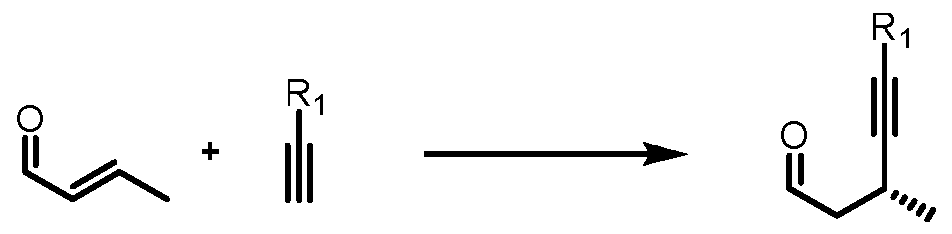
IX X XI
wherein is H or trialkyl silyl protecting group;
(b) reacting compound of formula XI with (+)-B-Allyldiisopinocampheylborane to provide hydroxy compound of formula XII;
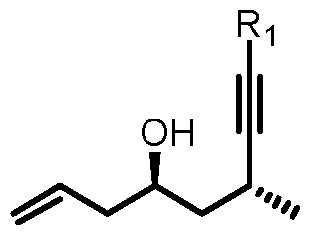
XII
wherein Ri is H or trialkyl silyl protecting group;
(c) optionally protecting hydroxy compound of formula XII to provide a compound of formula XIII;
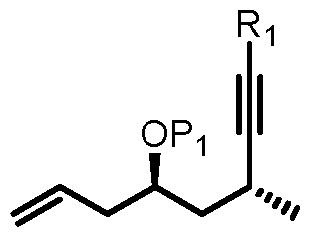
XII I
wherein P-i is an alcohol-protecting group; Ri is H or trialkyl silyl protecting group;
(d) converting compound of formula XIII to provide compound of formula XIV; and
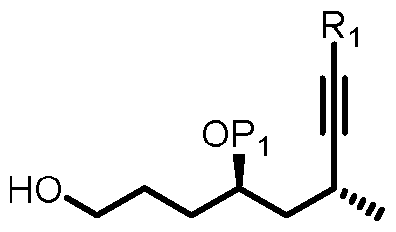
XIV
wherein is an alcohol-protecting group; Ri is H or trialkyl silyl protecting group (e) converting compound of formula XIV to compound of formula I II.
5. The process according to claim 1 , wherein the compound of formula III is prepared by process comprising one or more of the following steps:
(a) treating a compound of formula XV with an acetylene compound of formula X to provide a compound of formula XVI;

XV X XVI
wherein is H or trialkyi silyl; Pi is H or an alcohol-protecting group; X is halogen;
(b) optionally deprotecting a compound of formula XVI to provide a compound of formula XVII;

XVII
wherein is H or trialkyi silyl;
(c) converting a compound of formula XVI or a compound of formula XVII to a compound of formula XVIII;
Ri
OH II
HO„
XVI I I
wherein P^ is H or trialkyi silyl;
(d) protecting a diol compound of formula XVIII to provide a compound of formula XIX;

XIX
wherein is H or trialkyi silyl; Pi is an alcohol-protecting group; P2 is hydrogen or an alcohol-protecting group;
(e) optionally deprotecting a compound of formula XIX to provide a compound of formula XIV;
XIV
wherein Ri is H or trialkyi silyl;
(f) converting a compound of formula XIV to a compound of formula III.
6. The process according to claim 1 , wherein the compound of formula IV is prepared by a process comprising one or more of the following steps:
(a) reacting an epoxide of formula XX with a compound of formula XXI to provide a compound of formula XXII;

XX XXI
XXII
wherein R2 is trialkyi silyl; Pi is an alcohol-protecting group; X is halogen, preferably bromine;
(b) converting a compound of formula XXII to a vinyl halide compound of formula XV;

XV
wherein P-i is an alcohol-protecting group; X is halogen, preferably bromine or iodine;
(c) converting a compound of formula XV to a compound of formula IV.
7. A compound of formula V or isomers thereof.

8. A compound of formula VI or isomers thereof.

9. The compound of claim 8 in crystalline form.
10. A compound of formula VII or isomers thereof.

VI I
wherein P-i is an alcohol-protecting group;
11. A compound of formula VII I or isomers thereof.

VII I
wherein P-i is H or an alcohol protecting group and X is halogen.
12. A compound of formula IVa or isomers thereof.

wherein P is an alcohol protecting group and X is halogen.
13. A compound of claim 1 2 having the formula.

14. A compound of formula III or isomers thereof;

I I I
wherein P-i is an alcohol-protecting group; Ri is H or trialkyi silyl protecting group; 15. A compound of claim 14 having the formula.

16. A compound having the following formula or isomers thereof.


17. A process for preparation of eribulin or a pharmaceutically acceptable salt thereof from a compound of any one of claims 1 -16.
Applications Claiming Priority (4)
| Application Number | Priority Date | Filing Date | Title |
|---|---|---|---|
| IN5501/CHE/2015 | 2015-10-14 | ||
| IN5501CH2015 | 2015-10-14 | ||
| IN7087/CHE/2015 | 2015-12-30 | ||
| IN7087CH2015 | 2015-12-30 |
Publications (2)
| Publication Number | Publication Date |
|---|---|
| WO2017064627A2 true WO2017064627A2 (en) | 2017-04-20 |
| WO2017064627A3 WO2017064627A3 (en) | 2017-07-06 |
Family
ID=58517094
Family Applications (1)
| Application Number | Title | Priority Date | Filing Date |
|---|---|---|---|
| PCT/IB2016/056097 Ceased WO2017064627A2 (en) | 2015-10-14 | 2016-10-12 | Process for preparation of eribulin and intermediates thereof |
Country Status (1)
| Country | Link |
|---|---|
| WO (1) | WO2017064627A2 (en) |
Cited By (7)
| Publication number | Priority date | Publication date | Assignee | Title |
|---|---|---|---|---|
| WO2018096478A2 (en) | 2016-11-23 | 2018-05-31 | Dr. Reddy’S Laboratories Limited | Process for preparation of eribulin and intermediates thereof |
| US20190177291A1 (en) * | 2016-05-26 | 2019-06-13 | Dr. Reddy's Laboratories Limited | Process for preparation of eribulin and intermediates thereof |
| CN110922423A (en) * | 2019-10-16 | 2020-03-27 | 杭州励德生物科技有限公司 | Synthetic method of eribulin intermediate |
| CN111285894A (en) * | 2018-12-10 | 2020-06-16 | 北京天一绿甫医药科技有限公司 | Intermediate for preparing halichondrin compounds and preparation method thereof |
| CN111793047A (en) * | 2019-06-13 | 2020-10-20 | 南通诺泰生物医药技术有限公司 | Preparation method of eribulin intermediate |
| CN113166096A (en) * | 2018-10-09 | 2021-07-23 | 雷迪博士实验室有限公司 | Method for preparing eribulin and intermediate thereof |
| JP2025526430A (en) * | 2022-07-29 | 2025-08-13 | 上海皓元医薬股フン有限公司 | Process for preparing intermediates of eribulin |
Family Cites Families (2)
| Publication number | Priority date | Publication date | Assignee | Title |
|---|---|---|---|---|
| DE102013104007A1 (en) * | 2013-04-19 | 2014-10-23 | Schenck Rotec Gmbh | reinflator |
| BR112016009452B1 (en) * | 2013-11-04 | 2022-06-07 | Eisai R&D Management Co., Ltd | Methods of preparing intermediates in the synthesis of eribulin, methods of preparing eribulin and eribulin mesylate, and intermediate compounds |
-
2016
- 2016-10-12 WO PCT/IB2016/056097 patent/WO2017064627A2/en not_active Ceased
Cited By (13)
| Publication number | Priority date | Publication date | Assignee | Title |
|---|---|---|---|---|
| US20190177291A1 (en) * | 2016-05-26 | 2019-06-13 | Dr. Reddy's Laboratories Limited | Process for preparation of eribulin and intermediates thereof |
| JP2019521969A (en) * | 2016-05-26 | 2019-08-08 | ドクター レディズ ラボラトリーズ リミテッド | Method for producing eribulin and its intermediate |
| US11059799B2 (en) | 2016-05-26 | 2021-07-13 | Dr. Reddy's Laboratories Limited. | Process for preparation of eribulin and intermediates thereof |
| WO2018096478A2 (en) | 2016-11-23 | 2018-05-31 | Dr. Reddy’S Laboratories Limited | Process for preparation of eribulin and intermediates thereof |
| US10836776B2 (en) | 2016-11-23 | 2020-11-17 | Dr. Reddy's Laboratories Limited | Process for preparation of eribulin and intermediates thereof |
| CN113166096A (en) * | 2018-10-09 | 2021-07-23 | 雷迪博士实验室有限公司 | Method for preparing eribulin and intermediate thereof |
| CN111285894B (en) * | 2018-12-10 | 2021-03-05 | 北京天一绿甫医药科技有限公司 | Intermediate for preparing halichondrin compound and preparation method thereof |
| CN111285894A (en) * | 2018-12-10 | 2020-06-16 | 北京天一绿甫医药科技有限公司 | Intermediate for preparing halichondrin compounds and preparation method thereof |
| CN111793047A (en) * | 2019-06-13 | 2020-10-20 | 南通诺泰生物医药技术有限公司 | Preparation method of eribulin intermediate |
| CN111793047B (en) * | 2019-06-13 | 2023-08-22 | 南通诺泰生物医药技术有限公司 | Preparation method of eribulin intermediate |
| CN110922423B (en) * | 2019-10-16 | 2020-10-20 | 杭州励德生物科技有限公司 | Synthetic method of eribulin intermediate |
| CN110922423A (en) * | 2019-10-16 | 2020-03-27 | 杭州励德生物科技有限公司 | Synthetic method of eribulin intermediate |
| JP2025526430A (en) * | 2022-07-29 | 2025-08-13 | 上海皓元医薬股フン有限公司 | Process for preparing intermediates of eribulin |
Also Published As
| Publication number | Publication date |
|---|---|
| WO2017064627A3 (en) | 2017-07-06 |
Similar Documents
| Publication | Publication Date | Title |
|---|---|---|
| WO2017064627A2 (en) | Process for preparation of eribulin and intermediates thereof | |
| CA2868611C (en) | Alpha2 adrenoceptor agonists | |
| EP1613646A2 (en) | Process for preparation of cyclosporin "a" analogues having a terminal diene group | |
| EP2495235A1 (en) | Process for the synthesis of prostaglandins and intermediates thereof | |
| WO2011127143A1 (en) | Process for preparing benzoxaboroles | |
| JP2836556B2 (en) | Method for producing intermediate of 5,6,7-trinor-4,8-inter-m-phenylene PG12 derivative | |
| IL111851A (en) | Intermediates useful in the synthesis of bisindolylmaleimides and process for their preparation | |
| Fukuda et al. | Synthetic studies on macrolactin A by using a (diene) Fe (CO) 3 complex | |
| EP3464297B1 (en) | Process for preparation of eribulin and intermediates thereof | |
| Matsumura et al. | Synthesis of 7-fluoro-2, 4-methylene-17, 20-dimethylprostacyclins. Novel stable prostacyclin analogs as potent anti-anginal agents | |
| KR20170028990A (en) | Metal-catalyzed asymmetric 1,4-conjugate addition of vinylboron compounds to 2-substituted-4-oxy-cyclopent-2-en-1-ones yielding prostaglandins and prostaglandin analogs | |
| CN100537575C (en) | Production method of hexahydrofurofuranol derivative, intermediate therefor and production method thereof | |
| CN110713477B (en) | Preparation method of lubiprostone (LUBIPROSTONE) and its intermediate | |
| JPWO2004065346A1 (en) | (-)-Tetrahydrolipstatin and method for producing the intermediate | |
| Tang et al. | The study of intramolecular tandem radical cyclizations of acylsilanes with radicalphiles attached on silicon | |
| WO2017168309A1 (en) | Process for preparation of eribulin and intermediates thereof | |
| US10836776B2 (en) | Process for preparation of eribulin and intermediates thereof | |
| EP2861572B1 (en) | Improved process for the preparation of 2-substituted-2-(6-(substituted)-7-methylbenzo[d][1,3]dioxol-4-yl)acetic acid derivatives | |
| CN109232637A (en) | A kind of preparation method of entecavir midbodies | |
| Prasad et al. | Synthetic studies on cytotoxic macrolides cruentarens A and B: stereoselective synthesis of the C8–C19 segment of cruentarens A and B | |
| KR100810866B1 (en) | Total Synthesis of Lysophosphadidylcholine and Derivatives | |
| Dwight | The Synthesis and Biological Activity of 2'-Fluoro-N-methanocarbathymidine Epimers and An Approach Towards the Synthesis of Morphine | |
| Nguyen | Practical and stereoselective synthesis of alkenes through catalytic cross-metathesis | |
| Bräse et al. | Versatile Synthesis of Enantiomerically Pure 2‐Alkoxy‐1‐Ethynylcyclopropanes and their Application in the Synthesis of Enantiomerically Pure Bicyclo‐[3.3. 0] oct‐1‐en‐3‐ones | |
| Sarhan | Cycloadditions of Metal Oxyallyl Cations Generated from αα′-Dibromoketones to Furan and Pyrrole |
Legal Events
| Date | Code | Title | Description |
|---|---|---|---|
| 121 | Ep: the epo has been informed by wipo that ep was designated in this application |
Ref document number: 16855036 Country of ref document: EP Kind code of ref document: A2 |
|
| NENP | Non-entry into the national phase |
Ref country code: DE |
|
| 122 | Ep: pct application non-entry in european phase |
Ref document number: 16855036 Country of ref document: EP Kind code of ref document: A2 |