WO2017038995A1 - 真核微細藻類のリパーゼ突然変異体 - Google Patents
真核微細藻類のリパーゼ突然変異体 Download PDFInfo
- Publication number
- WO2017038995A1 WO2017038995A1 PCT/JP2016/075879 JP2016075879W WO2017038995A1 WO 2017038995 A1 WO2017038995 A1 WO 2017038995A1 JP 2016075879 W JP2016075879 W JP 2016075879W WO 2017038995 A1 WO2017038995 A1 WO 2017038995A1
- Authority
- WO
- WIPO (PCT)
- Prior art keywords
- tag
- strain
- sdp1
- eukaryotic microalgae
- protein
- Prior art date
- Legal status (The legal status is an assumption and is not a legal conclusion. Google has not performed a legal analysis and makes no representation as to the accuracy of the status listed.)
- Ceased
Links
Images

Classifications
-
- C—CHEMISTRY; METALLURGY
- C12—BIOCHEMISTRY; BEER; SPIRITS; WINE; VINEGAR; MICROBIOLOGY; ENZYMOLOGY; MUTATION OR GENETIC ENGINEERING
- C12N—MICROORGANISMS OR ENZYMES; COMPOSITIONS THEREOF; PROPAGATING, PRESERVING, OR MAINTAINING MICROORGANISMS; MUTATION OR GENETIC ENGINEERING; CULTURE MEDIA
- C12N15/00—Mutation or genetic engineering; DNA or RNA concerning genetic engineering, vectors, e.g. plasmids, or their isolation, preparation or purification; Use of hosts therefor
- C12N15/01—Preparation of mutants without inserting foreign genetic material therein; Screening processes therefor
-
- C—CHEMISTRY; METALLURGY
- C12—BIOCHEMISTRY; BEER; SPIRITS; WINE; VINEGAR; MICROBIOLOGY; ENZYMOLOGY; MUTATION OR GENETIC ENGINEERING
- C12P—FERMENTATION OR ENZYME-USING PROCESSES TO SYNTHESISE A DESIRED CHEMICAL COMPOUND OR COMPOSITION OR TO SEPARATE OPTICAL ISOMERS FROM A RACEMIC MIXTURE
- C12P7/00—Preparation of oxygen-containing organic compounds
- C12P7/62—Carboxylic acid esters
Definitions
- the present invention relates to a eukaryotic microalgae mutant that has an increased triacylglycerol accumulation amount as compared with a wild type or parent strain as a result of a decrease in triacylglycerol lipase activity and can grow even under short day length and use thereof About.
- Biodiesel fuel using as raw materials fatty acids produced by unicellular photosynthetic organisms hereinafter referred to as “microalgae” or compounds such as triacylglycerol (hereinafter referred to as “TAG”) that liberates fatty acids by hydrolysis Research on the production of industrial and food products such as is underway worldwide.
- microalgae unicellular photosynthetic organisms
- TAG triacylglycerol
- Rapeseed is an important vegetable oil ingredient along with palm and soybeans. Rapeseed seeds accumulate fats and oils based on TAG, but the TAG content is reduced by about 10% when the seeds mature. This decrease is thought to be due to TAG-specific lipase, and an attempt was made to increase the oil content of rapeseed by suppressing this lipase activity.
- SUGAR-DEPENDENT1 SDP1
- RNAi sequences were designed targeting the nucleotide sequence well conserved in rapeseed SDP1.
- this RNAi sequence was cloned downstream of a promoter specifically expressed in seeds and then introduced into rapeseed, the seed TAG content significantly increased in the introduced strain (Non-patent Document 2).
- it has succeeded in increasing the TAG content of Jatropha seeds (Non-patent Document 3).
- Thalassiosira pseudonana a kind of diatom, accumulates TAG under nitrogen-deficient conditions, but we searched for genes that might encode lipase among genes whose transcription is decreased under this culture condition.
- Thaps3_264297 I found a gene named. Therefore, when an antisense RNA that suppresses the expression of Thaps3_264297 was expressed, the amount of TAG accumulation increased about 3 times (Non-patent Document 4). When Thaps3_264297 protein was expressed in E.
- Thaps3_264297 protein has TAG lipase activity, phospholipase activity, and lysophosphatidic acid acyltransferase activity.
- the similarity between the Thaps3_264297 protein and the aforementioned SDP1 is limited.
- the unicellular green alga “Pseudochoricystis ellipsoidea Obi strain” (hereinafter sometimes referred to as “Obi strain”) was isolated and analyzed by Sato et al. (Non-patent Document 5; Patent Document 1). It was. The genus and species names of this strain are not named according to the international algae / fungi / plant naming conventions, but are tentative names. Subsequent phylogenetic analysis using genes indicates that these are closely related to the genera Coccomyxa and Pseudococcomyxa. This strain, like other microalgae, accumulates TAG in cells when the nitrogen source in the medium is depleted (Non-patent Document 6).
- the Obi strain can grow even if the medium pH is 3.5 or less (Patent Document 2), it can be cultured in large quantities outdoors with minimal growth of protozoa that prey on microalgae.
- Patent Document 2 Since the Obi strain can grow even if the medium pH is 3.5 or less (Patent Document 2), it can be cultured in large quantities outdoors with minimal growth of protozoa that prey on microalgae.
- the present inventors have been working on the breeding of Obi strains and the improvement of mass culture techniques.
- JcSDP1 Gene silencing of Sugar-dependent 1 (JcSDP1), encoding a patatin-domain triacylglycerol lipase, enhances seed oil accum 7:36 doi: 10.1186 / 1754-6834-7-36.
- Trentacoste EM Shrestha RP, Smith SR, Gle C, Hartmann AC, Hildebrand M, Gerwick WH. (2013) Metabolic engineering of lipid catabolism increases microalgal lipid accumulation without compromising growtl. . Satoh A, Kato M, Yamato T, Ikegami Y, Sekiguchi H, Kurano, N, Miyachi S.
- An object of the present invention is to isolate eukaryotic microalgae that can increase the amount of intracellular accumulation of TAG and can grow even under short day length, and to provide a TAG production method using the microalgae.
- the present invention includes the following.
- a eukaryotic microalgae mutant with reduced TAG lipase activity of SDP1 protein which has increased intracellular TAG accumulation and / or proliferation under short-day culture conditions compared to the parent strain
- the eukaryotic microalgae mutant, wherein the SDP1 protein is a protein having an amino acid sequence having at least 50% sequence identity with the amino acid sequence shown in SEQ ID NO: 4 and having TAG lipase activity .
- the eukaryotic microalgae mutant according to (1) wherein the translation efficiency of the gene encoding the SDP1 protein is reduced.
- the eukaryotic microalgae mutant according to any one of (1) to (4) which belongs to the green algal plant gate.
- the eukaryotic microalgae mutant according to (5) which belongs to the treboxya algae network.
- the eukaryotic microalgae mutant according to (6) which belongs to the genus Coccomyxa or the genus Pseudococcomyxa.
- a method for producing TAG comprising a step of culturing the eukaryotic microalgae mutant according to any one of (1) to (7).
- the present invention it is possible to produce a eukaryotic microalgae mutant with improved intracellular accumulation of TAG or improved growth under culture conditions with a short day length.
- culturing the eukaryotic microalgae mutant according to the present invention it is possible to reduce the production cost of TAG used for biofuel and the like.
- the present invention reduces the TAG lipase activity carried by SDP1 protein having homology with Sugar dependent 1 (AtSDP1), which is a TAG lipase that works during germination of Arabidopsis seeds, compared to the parent strain (or wild strain), Eukaryotic fines with increased intracellular TAG accumulation and / or improved growth under short day culture conditions (i.e., short day length (e.g., light 8 hours and dark 16 hours) culture conditions) It relates to algae mutants.
- AtSDP1 Sugar dependent 1
- Pseudochoricystis ellipsoidea (P. ellipsoidea) (tentative name) Obi strain [accession number FERM BP] belonging to the green plant subfamily, green algae plant gate (hereinafter referred to as "green algae") -10484; Patent Document 1 (in this patent, “Pseudochoricystiscystellipsoidea Sekiguchi et Kurano gen. Et sp.
- MBIC11204 strain which is referred to as“ Pseudochoricystis ellipsoidea Sekiguchi et Kurano gen. Et sp. Nov. ””
- SDP1 protein consisting of the amino acid sequence shown in SEQ ID NO: 3 (DNA base sequence: SEQ ID NO: 1, mRNA base sequence: SEQ ID NO: 2) increases the amount of accumulated TAG in the cells of this green alga.
- SEQ ID NO: 2 DNA base sequence: SEQ ID NO: 1, mRNA base sequence: SEQ ID NO: 2
- TAG lipase activity means an enzyme activity that hydrolyzes one ester bond in triacylglycerol in which three molecules of fatty acid are ester-bonded to glycerol to produce diacylglycerol and fatty acid.
- TAG lipase activity means an enzyme activity that hydrolyzes one ester bond in triacylglycerol in which three molecules of fatty acid are ester-bonded to glycerol to produce diacylglycerol and fatty acid.
- examples of the eukaryotic microalgae include eukaryotic microalgae belonging to green algae, diatoms (diatom or Bacillariophyceae), true eye-point algae (Eustigmatophyceae), and the like.
- green algae examples include green algae belonging to the Treboxia algae network.
- examples of green algae belonging to the treboxya algae network include, for example, the genus Trebouxia, Chlorella, Botryococcus, Choricystis, Coccomyxa, and Pseudococy.
- Green algae belonging to Specific strains belonging to the treboxya alga net include P. ellipsoidea Obi strain (Accession No. FERM BP-10484; Patent Document 1) and its mutant P. ellipsoidea 5P strain (Accession No. FERM BP-22179; No. 102715; hereinafter referred to as “5P strain”).
- ellipsoidea 5P strain have the same gene encoding the SDP1 protein (genomic DNA base sequence: SEQ ID NO: 1, mRNA base sequence: SEQ ID NO: 2, amino acid sequence: SEQ ID NO: 3).
- Examples include green algae belonging to the genus.
- examples of diatoms include eukaryotic microalgae belonging to the genus Fistulifera, Feodactiram, Thalassiosira, Cyclotella, Cylindrotheca, Skeletonema, etc. be able to.
- examples of the true eye point algae include the genus Nannochloropsis.
- the eukaryotic microalgae mutant according to the present invention is a eukaryotic microalgae mutant obtained by using the above eukaryotic microalgae as a parent strain and subjecting it to a method for reducing TAG lipase activity.
- the SDP1 protein includes an amino acid sequence shown in SEQ ID NO: 4 (that is, a highly conserved amino acid sequence corresponding to the 172nd to 625th amino acid sequences in SEQ ID NO: 3) and at least 50%, preferably at least Mention is made of a protein having an amino acid sequence having a sequence identity of 65%, particularly preferably at least 80%, most preferably at least 85%, at least 90%, at least 95%, 100% and having TAG lipase activity. It is done.
- the SDP1 protein includes at least 50%, preferably at least 65%, particularly preferably at least 80%, most preferably at least 85%, at least 90%, at least 95%, the amino acid sequence shown in SEQ ID NO: 3. Examples thereof include a protein consisting of an amino acid sequence having 100% sequence identity and having TAG lipase activity.
- the SDP1 gene includes at least 50%, preferably at least 58%, particularly preferably at least 65%, at least 80%, most preferably the coding region of the mRNA represented by the nucleotide sequence from position 131 to position 2419 in SEQ ID NO: 2.
- a gene encoding an mRNA having at least 85%, at least 90%, at least 95%, 100% sequence identity and encoding a protein having TAG lipase activity or 1 to Nucleotide sequences in which partial base sequences in several places (for example, 10 or less, preferably 5 or less, more preferably 3 or less, more preferably 2 or less) are deleted, substituted, added or inserted
- a gene encoding a protein having a TAG lipase activity for example, 10 or less, preferably 5 or less, more preferably 3 or less, more preferably 2 or less
- the SDP1 gene is, for example, at least 50%, preferably at least 65%, particularly preferably at least 80%, most preferably at least 85%, at least 90%, at least 95% with the amino acid sequence shown in SEQ ID NO: 3.
- a protein having a TAG lipase activity comprising an amino acid sequence in which an amino acid partial sequence is deleted, substituted, added, or inserted, and is preferably at most 3 sites, more preferably at most 3 sites, and even more preferably at 2 sites or less.
- SDP1 genes such as alleles and synonymous genes.
- at least one or more SDP1 genes are meant.
- the eukaryotic microalgae having the SDP1 gene described above are subjected to a method for reducing the TAG lipase activity carried by the SDP1 protein encoded by the SDP1 gene, whereby the eukaryotic microalgae according to the present invention is used.
- Algal mutants can be obtained.
- a eukaryotic microalgae mutant with reduced TAG lipase activity carried by the SDP1 protein according to the present invention can be produced according to the procedure shown in the Examples. That is, by allowing a mutagen to act on the parental eukaryotic microalgae, screening for mutants with increased TAG content, and confirming that mutations have occurred in the SDP1 gene in the mutants obtained. Can be created. As a result, mutations involving base substitution, deletion, insertion and / or addition can be introduced into the DNA of the SDP1 gene region.
- TAG lipase activity carried by the SDP1 protein include, for example, (1) introducing a mutation targeting the SDP1 gene and destroying the gene; (2) suppresses transcription of the SDP1 gene and reduces the expression of the gene; (3) suppresses the translation of the SDP1 gene and reduces the translation efficiency of the gene; A method is mentioned.
- the base sequence of the gene can be determined by the following method.
- the SDP1 protein present in eukaryotic microalgae and plants has a very well conserved amino acid sequence, so the PCR primer designed based on that amino acid sequence is used to determine the genome of the target eukaryotic microalgae.
- a PCR amplification reaction using DNA as a template is performed, and the amplified DNA fragment is cloned into E. coli, and then the base sequence of the DNA fragment is determined.
- the partial base sequence of the gene can be known, and the gene knockout method can be applied.
- ⁇ A single organism may contain multiple SDP1 genes, and it should be avoided to subject PCR-amplified DNA fragments directly to sequencing reactions.
- the inverse PCR method Huang SH. (1994) Inverse polymerase chain reaction. An efficient approach to cloning cDNA ends. Mol Biotechnol. 12: 15-22. ) Etc. may be used.
- next-generation sequencing technology has been developed, and it has become very easy to determine the entire genome sequence. Therefore, it is only necessary to first determine the whole genome sequence of the target eukaryotic microalgae and extract the gene sequence encoding the SDP1 protein therefrom.
- RNA interference method (Cerutti H et al., 2011, Eukaryot Cell, 10, 1164 ).
- the amount of accumulated TAG of the eukaryotic microalgae mutant obtained as described above and the growth under a culture condition with a short day length are measured by the method described in Example 1 and the like. If an increase or improvement in growth under culture conditions with a short day length can be confirmed, production of a eukaryotic microalgae mutant with reduced TAG lipase activity carried by the SDP1 protein according to the present invention is completed.
- the TAG lipase mutant Obi-LOD68 strain derived from the Obi strain shown in the Examples is an independent administration on August 27, 2015 (2015).
- the present invention includes a method for producing TAG by mass-culturing the eukaryotic microalgae mutant according to the present invention described above.
- a culture method described in Non-Patent Document 6 or the like that has already been established can be used.
- it is a method of culturing microalgae using a medium having urea as a nitrogen source and a pH of 4 or less (Patent Document 2).
- urea as the nitrogen source, fluctuations in pH due to consumption of nitrogen content are minimized.
- a lipid containing TAG can be obtained from the culture by, for example, hexane extraction.
- Example 1 Isolation of TAG lipase mutant Obi strain or 5P strain (Japanese Patent Laid-Open No. 2013-102715), which is a low chlorophyll mutant derived from the Obi strain, was transformed into NTG (1-methyl -3-nitro-1-nitrosoguanidine), then 1/3 DENSO medium [0.29 mM (NH 4 ) 2 SO 4 , 0.79 mM Urea, 130 ⁇ M MgSO 4 , 90 ⁇ M KH 2 PO 4 , 90 ⁇ M K 2 HPO 4 , 20 ⁇ M CaCl 2 , 1.2 ⁇ M CuSO 4 , 0.38 ⁇ M H 3 BO 3 , 0.35 ⁇ M ZnSO 4 , 0.2 ⁇ M MnSO 4 , 0.1 ⁇ M CoCl 2 , 4 nM Na 2 MoO 4 , 0.1% (v / v) Fe solution (3 g / L citric acid, 4.9 g / L ammonium ferric citrate, 0.1% (v
- the culture medium was depleted of nitrogen and TAG was accumulated in the cells. Thereafter, the cells were transferred to MA5 medium (Imamura et al., 2012, J Gen Appl Microbiol, 58, 1) and then placed in the dark for 4 days. When the cells were placed in this state, that is, in a state where nitrogen content was present but photosynthesis was not possible, accumulated TAG was gradually degraded (in the wild type) (see FIG. 1B).
- intracellular TAG was fluorescently stained with BODIPY 501/515, and cells with strong fluorescence (a large amount of TAG accumulation) were concentrated using FACS (fluorescence activated cell sorting).
- the cells subjected to FACS concentration were cultured again in 1/3 DENSO medium to accumulate TAG, then transferred to MA5 medium, and cultured in the dark for 4 days. Thereafter, FACS concentration was performed again. When this FACS concentration was performed three times in total, a cell population that hardly degraded TAG was obtained even after 4 days in the dark. This population was appropriately diluted and spread on MA5 agar medium to form colonies.
- TAG accumulated in the cells, but at the same time, the chlorophyll content of the cells decreased.
- cells with high TAG and low chlorophyll were transferred to fresh MA5 medium and placed in the dark for several days, they found that the TAG content of the cells decreased and the chlorophyll content increased. This was thought to be because chlorophyll was newly synthesized using the energy and carbon content obtained by the decomposition of TAG.
- the Obi strain colonies obtained after the FACS concentration were spread on a nitrocellulose membrane placed on an agar medium made of MA5 medium (MA5-N) depleted of nitrogen, and applied under a fluorescent lamp. For 1 week. Then, yellow cells grew on the nitrocellulose membrane. In these cells, TAG content is high and chlorophyll content is considered low. Next, the yellow cells were transferred together with the nitrocellulose membrane onto MA5 agar medium and cultured in the dark. In the wild Obi strain, the cell color changed to green within 4 days after being transferred to the dark. On the other hand, in many colony-derived clones isolated after FACS concentration, the cell color remained yellow even after being transferred to MA5 agar medium. As will be described later, these clones lacked the ability to degrade TAG in the dark.
- Example 2 TAG degradation of TAG lipase mutants Using the method shown in Example 1, two mutants (Obi-LOD68 and Obi- Two strains (5P-LOD11, 5P-LOD18) were isolated from LOD69) and 5P strain.
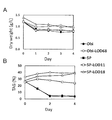
- FIG. 1 shows the results of changes in dry weight and TAG content when Obi strain, 5P strain, Obi-LOD68 strain, 5P-LOD11 strain and 5P-LOD18 strain were cultured in the dark.
- the dry weight of each strain placed in the dark decreased slightly for the first day, but remained almost unchanged after the second day (FIG. 1A).
- the TAG content significantly decreased in the first 2 days in the Obi strain and the 5P strain.
- none of the mutants had a small decrease in TAG content (5P-LOD11 strain) or did not decrease (FIG. 1B).
- the TAG content did not decrease even in the Obi-LOD69 strain under the same conditions.
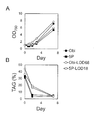
- Obi strain, 5P strain and two mutants were cultured in 1/3 DENSO medium for 1 week to accumulate TAG in the cells, and then these cells were added to MA5 medium. After that, the cells were cultured for 7 days under fluorescent light. All of these strains grown under fluorescent lights grew in the same way (FIG. 2A). With the start of growth, the TAG of wild strains (Obi strain and 5P strain) decreased rapidly. On the other hand, in the mutant, TAG decreased slightly later than the wild type (FIG. 2B). From this result, it was predicted that at least two TAG lipases were present in the Obi strain.
- TAG lipase whose activity is induced only under photosynthetic conditions, and the other is a TAG lipase that is active even in the dark.
- the mutants isolated this time seem to lack TAG lipase, which is active even in this darkness.
- Example 3 Growth and TAG accumulation of TAG lipase mutants Two TAG lipase mutants, Obi-LOD68 and 5P-LOD18, and their parent Obi and 5P strains were transformed into 1/3 DENSO. The cells were cultured in the medium under two light conditions. One is culturing under continuous light, and the other is culturing under light conditions of 8 hours light period and 16 hours dark period.
- the amount of energy gained during the 8-hour light phase is approximately equal to the amount of energy required to maintain the cells throughout the light and dark phases. It was.
- the growth yield of the TAG lipase mutant grown under the same light conditions was higher than that of the wild type. This suggests that these mutants that cannot use TAG as energy during the dark period have either increased energy efficiency gained from photosynthesis, decreased energy to maintain cells, or both. It was thought that. These changes are unlikely to be directly related to TAG lipase mutations, and resulted from changes in the expression of various metabolic enzymes as signals from changes in metabolite profiles caused by TAG lipase deficiency. It was thought to be a thing. Thus, an unexpected result was obtained that the TAG lipase mutant favored growth in poor conditions.
- the TAG content was maintained at 44% even under this light condition (Table 1).
- the TAG lipase mutant is superior to the wild strain in proliferation and TAG accumulation ability under poor light conditions. Therefore, it can be expected that the TAG lipase mutant exhibits TAG productivity superior to that of the wild strain under conditions where morning, evening, or day length is short, and increases the annual TAG production amount.
- the Obi-LOD68 strain had a single base substitution at the Splice acceptor site and had a splice site mutation.
- Obi-LOD68 strain Obi-LOD69 strain, 5P-LOD11 strain, 5P-LOD18 strain, (1) TAG degradation defect in dark phase, (2) under continuous light or light-dark culture conditions It was concluded that the increase in intracellular TAG accumulation and (3) improved growth under light-deficient conditions were caused by mutations in the SDP1 gene.
Landscapes
- Chemical & Material Sciences (AREA)
- Engineering & Computer Science (AREA)
- Genetics & Genomics (AREA)
- Life Sciences & Earth Sciences (AREA)
- Organic Chemistry (AREA)
- Health & Medical Sciences (AREA)
- Wood Science & Technology (AREA)
- Zoology (AREA)
- Bioinformatics & Cheminformatics (AREA)
- Biotechnology (AREA)
- General Engineering & Computer Science (AREA)
- Microbiology (AREA)
- Biochemistry (AREA)
- General Health & Medical Sciences (AREA)
- Biomedical Technology (AREA)
- General Chemical & Material Sciences (AREA)
- Chemical Kinetics & Catalysis (AREA)
- Physics & Mathematics (AREA)
- Biophysics (AREA)
- Molecular Biology (AREA)
- Plant Pathology (AREA)
- Micro-Organisms Or Cultivation Processes Thereof (AREA)
- Preparation Of Compounds By Using Micro-Organisms (AREA)
- Enzymes And Modification Thereof (AREA)
Abstract
本発明は、トリアシルグリセロール(TAG)蓄積量が向上し、日長が短い条件下でも増殖可能な真核微細藻類を提供することを目的とし、具体的には、SDP1タンパク質のTAGリパーゼ活性を低下させた真核微細藻類変異体であって、親株と比較して、細胞内TAG蓄積量が増加するか、及び/又は短日培養条件下での増殖が向上している、前記真核微細藻類変異体に関する。
Description
本発明は、トリアシルグリセロール・リパーゼ活性が減少した結果、野生型又は親株に比べてトリアシルグリセロール蓄積量が向上し、日長が短い条件下でも増殖できる真核微細藻類突然変異体及びその利用に関する。
単細胞性の光合成生物(以下、「微細藻類」と呼ぶ)が生産する脂肪酸、あるいは加水分解により脂肪酸を遊離するトリアシルグリセロール(以下、「TAG」と呼ぶ)等の化合物を原料として、バイオディーゼル燃料をはじめとする工業・食品製品を生産する研究が、世界的に行われている。しかしながら、現状ではTAG生産コストが高く、商業ベースでのバイオディーゼル燃料等の生産は困難である(非特許文献1)。そのため、バイオディーゼル燃料等の生産コスト削減のための更なる技術開発が続けられており、その1つに、微細藻類のTAG生産性の改良研究がある。TAG生産性を向上させるための研究の大多数は、TAGの生合成の強化を目指したものである。一方、合成されたTAGの分解を抑制することにより、TAGの蓄積量を上昇させることができると考えられる。
実際、植物においては、リパーゼ活性を低下させることにより、以下に示すように、TAGの蓄積量を上昇させることに成功している。ナタネはパームや大豆と並び重要な植物油の原料である。ナタネの種にはTAGを主成分とする油脂が蓄積されるが、種の成熟時にTAG含量が約10%減少する。この減少は、TAGに特異的なリパーゼによるものであろうと考えられ、このリパーゼ活性を抑制することにより、ナタネの油脂含量を増加させる試みがなされた。Arabidopsis thalianaにおいては、SUGAR-DEPENDENT1(SDP1)と呼ばれる、TAGに特異的なリパーゼが存在することが知られているが、ナタネにもSDP1と相同性の高い遺伝子が複数存在する。これらの遺伝子からの発現を抑圧するため、ナタネのSDP1で良く保存されている塩基配列をターゲットとしたRNAi配列が設計された。そして、このRNAi配列を種子で特異的に発現するプロモーターの下流にクローン化した後、ナタネに導入したところ、導入株では、種子のTAG含量が有意に上昇した(非特許文献2)。類似の手法で、ヤトロファ(Jatropha)の種子のTAG含量を増やすことにも成功している(非特許文献3)。
一方、真核微細藻類においては、リパーゼ活性を低下させることによってTAG蓄積量を増加させたという報告が唯一存在する。珪藻の一種であるThalassiosira pseudonanaは窒素欠乏条件下でTAGを蓄積するが、この培養条件下で転写が減少する遺伝子の中で、リパーゼをコードしている可能性を持つものを捜したところ、Thaps3_264297と名付けられた遺伝子を見出した。そこで、このThaps3_264297の発現を抑制するアンチセンスRNAを発現させたところ、TAG蓄積量が3倍程度増加した(非特許文献4)。Thaps3_264297タンパク質を大腸菌内で発現させ、生化学的解析を行ったところ、Thaps3_264297タンパク質はTAGリパーゼ活性、フォスフォリパーゼ活性、リソフォスファチジルアシル転移酵素(lysophosphatidic acid acyltransferase)活性を持つことが分かった。Thaps3_264297タンパク質と前述のSDP1との類似性は限定的である。
単細胞性緑藻「シュードコリシスチス・エリプソイディア(Pseudochoricystis ellipsoidea)Obi株」(以降、「Obi株」と呼ぶ場合がある)は、佐藤ら(非特許文献5;特許文献1)によって分離・解析された。この株の属及び種名は、国際藻類・菌類・植物命名規約に則り命名されたものではなく、仮称である。その後の遺伝子を用いた系統解析により、これらはCoccomyxa属及びPseudococcomyxa属に近縁であることが示されている。この株は、他の微細藻類と同様に、培地中の窒素源が枯渇すると細胞内にTAGを蓄積する(非特許文献6)。Obi株は、培地pHが3.5以下でも増殖できるので(特許文献2)、微細藻類を捕食する原生動物の増殖を最小限にした状態での屋外での大量培養が可能である。本発明者等は、Obi株の育種と大量培養技術の改良に取り組んできた。
Chisti Y. (2013) Constraints to commercialization of algal fuels. J. Biotechnol. 167:201-214.
Kelly AA, Shaw E, Powers SJ, Kurup S, Eastmond PJ.(2013) Suppression of the SUGAR-DEPENDENT1 triacylglycerol lipase family during seed development enhances oil yield in oilseed rape (Brassica napus L.). Plant Biotechnol J. 11:355-361.
Kim MJ, Yang SW, Mao HZ, Veena SP, Yin JL, Chua NH.(2014) Gene silencing of Sugar-dependent 1 (JcSDP1), encoding a patatin-domain triacylglycerol lipase, enhances seed oil accumulation in Jatropha curcas. Biotechnol Biofuels. 7:36. doi: 10.1186/1754-6834-7-36.
Trentacoste EM, Shrestha RP, Smith SR, Gle C, Hartmann AC, Hildebrand M, Gerwick WH. (2013) Metabolic engineering of lipid catabolism increases microalgal lipid accumulation without compromising growth. Proc Natl Acad Sci U S A. 110:19748-19753.
Satoh A, Kato M, Yamato T, Ikegami Y, Sekiguchi H, Kurano, N, Miyachi S. (2010) Characterization of the lipid accumulation in a new microalgal species, Pseudochoricystis ellipsoidea (Trebouxiophyceae). 2010, J. Jap. Inst. Energy 89, 909-913.
Ito T, Tanaka M, Shinkawa H, Nakada T, Ano Y, Kurano N, Soga T, Tomita M. (2013) Metabolic and morphological changes of an oil accumulating trebouxiophycean alga in nitrogen-deficient conditions. Metabolomics. 9:178-187.
真核微生物の増殖及びTAG生産性を改良し、TAG生産コストを削減することが望まれている。本発明は、TAGの細胞内蓄積量が増加し、日長が短い条件でも増殖可能な真核微細藻類を分離し、該微細藻類を利用したTAG生産方法を提供することを目的とする。
上記課題を解決するため鋭意研究を行った結果、シロイヌナズナのTAGリパーゼであるSugar dependent 1(AtSDP1)と相同性を持つタンパク質(以下、「SDP1タンパク質」と呼ぶ)をコードする遺伝子が変異したObi株の突然変異体では、TAGの細胞内蓄積量が増加し、また、日長が短い条件での増殖が可能であることを見出し、本発明を完成するに至った。
すなわち、本発明は以下を包含する。
(1)SDP1タンパク質のTAGリパーゼ活性を低下させた真核微細藻類変異体であって、親株と比較して、細胞内TAG蓄積量が増加するか、及び/又は短日培養条件下での増殖が向上しており、前記SDP1タンパク質が配列番号4に示すアミノ酸配列と少なくとも50%の配列同一性を有するアミノ酸配列を有し、且つTAGリパーゼ活性を有するタンパク質である、前記真核微細藻類変異体。
(2)SDP1タンパク質をコードする遺伝子を破壊した、(1)記載の真核微細藻類変異体。
(3)SDP1タンパク質をコードする遺伝子の発現を低下させた、(1)記載の真核微細藻類変異体。
(4)SDP1タンパク質をコードする遺伝子の翻訳効率を低下させた、(1)記載の真核微細藻類変異体。
(5)緑藻植物門に属する、(1)~(4)のいずれか1記載の真核微細藻類変異体。
(6)トレボキシア藻網に属する、(5)記載の真核微細藻類変異体。
(7)コッコミクサ(Coccomyxa)属又はシュードコッコミクサ(Pseudococcomyxa)属に属する、(6)記載の真核微細藻類変異体。
(8)(1)~(7)のいずれか1記載の真核微細藻類変異体を培養する工程を含む、TAG生産方法。
(1)SDP1タンパク質のTAGリパーゼ活性を低下させた真核微細藻類変異体であって、親株と比較して、細胞内TAG蓄積量が増加するか、及び/又は短日培養条件下での増殖が向上しており、前記SDP1タンパク質が配列番号4に示すアミノ酸配列と少なくとも50%の配列同一性を有するアミノ酸配列を有し、且つTAGリパーゼ活性を有するタンパク質である、前記真核微細藻類変異体。
(2)SDP1タンパク質をコードする遺伝子を破壊した、(1)記載の真核微細藻類変異体。
(3)SDP1タンパク質をコードする遺伝子の発現を低下させた、(1)記載の真核微細藻類変異体。
(4)SDP1タンパク質をコードする遺伝子の翻訳効率を低下させた、(1)記載の真核微細藻類変異体。
(5)緑藻植物門に属する、(1)~(4)のいずれか1記載の真核微細藻類変異体。
(6)トレボキシア藻網に属する、(5)記載の真核微細藻類変異体。
(7)コッコミクサ(Coccomyxa)属又はシュードコッコミクサ(Pseudococcomyxa)属に属する、(6)記載の真核微細藻類変異体。
(8)(1)~(7)のいずれか1記載の真核微細藻類変異体を培養する工程を含む、TAG生産方法。
本明細書は本願の優先権の基礎となる日本国特許出願番号2015-173188号の開示内容を包含する。
本発明により、細胞内のTAG蓄積量が向上し、あるいは日長が短い培養条件での増殖が改良された真核微細藻類変異体を作出することが可能となる。また、本発明に係る真核微細藻類変異体を培養することにより、バイオ燃料等に供するTAGの生産コストを削減することが可能となる。
本発明は、シロイヌナズナの種子の発芽時に働くTAGリパーゼであるSugar dependent 1(AtSDP1)と相同性を持つSDP1タンパク質の担うTAGリパーゼ活性を低下させることにより、親株(又は野生株)と比較して、細胞内TAG蓄積量が増加し、及び/又は短日培養条件下(すなわち、日長が短い(例えば、明期8時間及び暗期16時間)培養条件下)での増殖が向上した真核微細藻類変異体に関する。
微細藻類由来のTAGを原料としたバイオ燃料等の生産コストを削減するための最重要課題の一つは、微細藻類のTAG生産性の大幅向上である。本発明者等は、緑色植物亜界・緑藻植物門(以下、「緑藻」と記す)に属するシュードコリシスチス・エリプソイディア(Pseudochoricystis ellipsoidea; P. ellipsoidea)(仮称)Obi株[受託番号FERM BP-10484;特許文献1(当該特許では、「シュードコリシスチス エリプソイディア セキグチ エト クラノ ジェン エト エスピー ノブ(Pseudochoricystis ellipsoidea Sekiguchi et Kurano gen. et sp. nov.) MBIC11204株」と称される)]由来の配列番号3で示されるアミノ酸配列から成るSDP1タンパク質(DNA塩基配列:配列番号1、mRNA塩基配列:配列番号2)を欠損させることにより、この緑藻の細胞内のTAG蓄積量が増加し、また日長が短い条件での増殖が改良されることを見出し、本発明を完成するに至った。
SDP1タンパク質は、植物に広く存在するTAGリパーゼであり、特に油糧種子の発芽時に、貯蔵TAGの分解と転流とに関わっていることで知られている。具体的には、TAGリパーゼ活性とは、グリセロールに3分子の脂肪酸がエステル結合しているトリアシルグリセロールの中の1つのエステル結合を加水分解し、ジアシルグリセロールと脂肪酸とを生成する酵素活性を意味する。人工的な遺伝子操作を用いてSDP1の担うTAGリパーゼ活性を低減させることによって真核微細藻類の細胞内TAG含有量を向上させること、及び、TAGリパーゼ活性低減株を培養することにより、バイオ燃料等に供するTAGの生産コストを大幅削減することが可能となる。
本発明において、真核微細藻類としては、緑藻、珪藻(diatomあるいはBacillariophyceae)、真正眼点藻綱(Eustigmatophyceae)等に属する真核微細藻類を挙げることができる。
緑藻としては、例えばトレボキシア藻網に属する緑藻が挙げられる。トレボキシア藻網に属する緑藻としては、例えば、トレボキシア(Trebouxia)属、クロレラ(Chlorella)属、ボトリオコッカス(Botryococcus)属、コリシスチス(Choricystis)属、コッコミクサ(Coccomyxa)属、シュードコッコミクサ(Pseudococcomyxa)属に属する緑藻が挙げられる。トレボキシア藻網に属する具体的な株としては、P. ellipsoidea Obi株(受託番号FERM BP-10484;特許文献1)及びその変異株P. ellipsoidea 5P株(受託番号FERM BP-22179;特開2013-102715号公報;以下、「5P株」と呼ぶ場合がある)が挙げられる。P. ellipsoidea Obi株は、平成17年(2005年)2月15日付で独立行政法人産業技術総合研究所 特許生物寄託センター(〒305-8566日本国茨城県つくば市東1丁目1番地1中央第6)に受託番号FERM P-20401として寄託され、さらに受託番号FERM BP-10484としてブダペスト条約に基づく国際寄託へ移管されている。P. ellipsoidea 5P株は、平成23年(2011年)10月21日付で独立行政法人産業技術総合研究所 特許生物寄託センター(〒305-8566日本国茨城県つくば市東1丁目1番地1中央第6)に受託番号FERM P-22179として寄託され、さらに独立行政法人製品評価技術基盤機構 特許生物寄託センター(NITE-IPOD)(〒292-0818日本国千葉県木更津市かずさ鎌足2-5-8 120号室)に受託番号FERM BP-22179としてブダペスト条約に基づく国際寄託へ移管されている。なお、P. ellipsoidea Obi株とP. ellipsoidea 5P株とは、同一のSDP1タンパク質をコードする遺伝子(ゲノムDNA塩基配列:配列番号1、mRNA塩基配列:配列番号2、アミノ酸配列:配列番号3)を有する。トレボキシア藻網に属する緑藻以外の緑藻としては、例えばテトラセルミス(Tetraselmis)属、アンキストロデスムス(Ankistrodesmus)属、ドラニエラ(Dunalliella)属、ネオクロリス(Neochloris)属、クラミドモナス属、イカダモ(=セネデスムス:Scenedesmus)属等に属する緑藻が挙げられる。
更に珪藻としては、フィストゥリフェラ(Fistulifera)属、フェオダクチラム属、タラシオシラ(Thalassiosira)属、シクロテラ(Cyclotella)属、シリンドロティカ(Cylindrotheca)属、スケレトネマ(Skeletonema)属等に属する真核微細藻類を挙げることができる。さらに、真正眼点藻綱としては、ナンノクロロプシス属が挙げられる。
本発明に係る真核微細藻類変異体は、上述の真核微細藻類を親株として、TAGリパーゼ活性を低下させる方法に供することで得られた真核微細藻類変異体である。
本発明において、SDP1タンパク質としては、配列番号4に示すアミノ酸配列(すなわち、配列番号3における172番目~625番目のアミノ酸配列に相当する保存性の高いアミノ酸配列)と少なくとも50%、好ましくは、少なくとも65%、特に好ましくは、少なくとも80%、最も好ましくは、少なくとも85%、少なくとも90%、少なくとも95%、100%の配列同一性を有するアミノ酸配列を有し、且つTAGリパーゼ活性を有するタンパク質が挙げられる。
また、SDP1タンパク質としては、配列番号3に示すアミノ酸配列と少なくとも50%、好ましくは、少なくとも65%、特に好ましくは、少なくとも80%、最も好ましくは、少なくとも85%、少なくとも90%、少なくとも95%、100%の配列同一性を有するアミノ酸配列から成り、且つTAGリパーゼ活性を有するタンパク質が挙げられる。
SDP1遺伝子としては、配列番号2における131番目~2419番目の塩基配列で示されたmRNAのコーディング領域と少なくとも50%、好ましくは、少なくとも58%、特に好ましくは、少なくとも65%、少なくとも80%、最も好ましくは、少なくとも85%、少なくとも90%、少なくとも95%、100%の配列同一性を有するmRNAをコードし、且つTAGリパーゼ活性を有するタンパク質をコードする遺伝子、又は上記mRNA塩基配列に対して1~数か所(例えば10か所以下、好ましくは5か所以下、より好ましくは3か所以下、さらに好ましくは2か所以下)の部分塩基配列が欠失、置換、付加又は挿入された塩基配列から成るmRNA塩基配列をコードし、且つTAGリパーゼ活性を有するタンパク質をコードする遺伝子が挙げられる。
また、SDP1遺伝子としては、例えば配列番号3に示すアミノ酸配列と少なくとも50%、好ましくは、少なくとも65%、特に好ましくは、少なくとも80%、最も好ましくは、少なくとも85%、少なくとも90%、少なくとも95%、100%の配列同一性を有するアミノ酸配列から成り、且つTAGリパーゼ活性を有するタンパク質をコードする遺伝子、又は上記タンパク質のアミノ酸配列に対して1~数か所(例えば10か所以下、好ましくは5か所以下、より好ましくは3か所以下、さらに好ましくは2か所以下)のアミノ酸部分配列が欠失、置換、付加又は挿入されたアミノ酸配列から成り、且つTAGリパーゼ活性を有するタンパク質をコードする遺伝子が挙げられる。
多くの真核微細藻類においては、複数のSDP1遺伝子、例えば対立遺伝子、同義遺伝子等が存在する場合があるが、本発明においては、これらのうち少なくとも1つ又は複数のSDP1遺伝子を意味する。
本発明においては、以上に説明したSDP1遺伝子を有する真核微細藻類に対して、SDP1遺伝子によりコードされるSDP1タンパク質が担うTAGリパーゼ活性を低下させる方法に供することで、本発明に係る真核微細藻類変異体を得ることができる。
具体的に、本発明に係るSDP1タンパク質の担うTAGリパーゼ活性を低減した真核微細藻類変異体は、実施例に示した手順に従って作出できる。すなわち、親株の真核微細藻類に突然変異誘起物質を作用させた後、TAG含量が上昇した変異体をスクリーニングし、得られた変異体においてSDP1遺伝子に変異が起こっていることを確認することによって作出できる。これによって、SDP1遺伝子領域のDNAに塩基の置換、欠失、挿入及び/又は付加を伴う変異を導入することができる。
SDP1タンパク質の担うTAGリパーゼ活性を低下させるそれ以外の方法としては、例えば(1) SDP1遺伝子をターゲットとして変異を導入し、当該遺伝子を破壊する;
(2) SDP1遺伝子の転写を抑制し、該遺伝子の発現を低下させる;
(3) SDP1遺伝子の翻訳を抑制し、該遺伝子の翻訳効率を低下させる;
方法が挙げられる。
(2) SDP1遺伝子の転写を抑制し、該遺伝子の発現を低下させる;
(3) SDP1遺伝子の翻訳を抑制し、該遺伝子の翻訳効率を低下させる;
方法が挙げられる。
(1) SDP1遺伝子をターゲットとして変異を導入する方法
SDP1遺伝子をターゲットとして変異を導入する方法としては、該遺伝子の塩基配列が知られている場合、ZFN、TALENあるいはCRISPR/Casと呼ばれる遺伝子ノックアウト法(Gaj T, Gersbach CA, Barbas CF 3rd. (2013) ZFN, TALEN, and CRISPR/Cas-based methods for genome engineering. Trends Biotechnol. 31:397-405.)を用いることにより、その遺伝子が欠損した変異体を作出できる。
SDP1遺伝子をターゲットとして変異を導入する方法としては、該遺伝子の塩基配列が知られている場合、ZFN、TALENあるいはCRISPR/Casと呼ばれる遺伝子ノックアウト法(Gaj T, Gersbach CA, Barbas CF 3rd. (2013) ZFN, TALEN, and CRISPR/Cas-based methods for genome engineering. Trends Biotechnol. 31:397-405.)を用いることにより、その遺伝子が欠損した変異体を作出できる。
該遺伝子の塩基配列が知られていない場合、以下に示す方法で、該遺伝子の塩基配列を決定できる。真核微細藻類及び植物に存在するSDP1タンパク質には非常に良く保存されたアミノ酸配列が存在するので、そのアミノ酸配列を元に設計されたPCRプライマーを用いて、対象とする真核微細藻類のゲノムDNAを鋳型としたPCR増幅反応を行い、増幅されたDNA断片を大腸菌にクローン化した後、そのDNA断片の塩基配列を決定する。この方法によって、該遺伝子の部分塩基配列を知ることができ、上記遺伝子ノックアウト法を適用できるようになる。
一つの生物に複数のSDP1遺伝子が含まれている場合があり、PCR増幅されたDNA断片を直接シーケンシング反応に供することは避けるべきである。このようにして得られたSDP1遺伝子部分配列をさらに拡張したい場合は、インバースPCR法(Huang SH. (1994) Inverse polymerase chain reaction. An efficient approach to cloning cDNA ends. Mol Biotechnol. 12:15-22.)等を用いれば良い。
また、近年、所謂次世代シーケンシング技術が発達し、ゲノム全塩基配列の決定が非常に容易になった。そこで、対象真核微細藻類のゲノム全塩基配列を先ず決定し、その中から、SDP1タンパク質をコードする遺伝子配列を抽出すれば良い。
(2) SDP1遺伝子の転写を抑制し、該遺伝子の発現を低下させる方法
SDP1遺伝子の転写を抑制する方法としては、対象となる真核微細藻類における該遺伝子のプロモーター領域に変異を導入する方法が挙げられる。
SDP1遺伝子の転写を抑制する方法としては、対象となる真核微細藻類における該遺伝子のプロモーター領域に変異を導入する方法が挙げられる。
また、該遺伝子の正の発現制御に関わる遺伝子に変異を導入し、それらの機能を低下させる方法が挙げられる。
あるいは、該遺伝子の負の発現制御に関わる遺伝子に変異を導入し、負の発現制御が常時働くようにする方法が挙げられる。
(3) SDP1遺伝子の翻訳を抑制し、該遺伝子の翻訳効率を低下させる方法
SDP1遺伝子の翻訳を抑制する方法としては、いわゆるRNA干渉法(Cerutti H et al., 2011, Eukaryot Cell, 10, 1164)が挙げられる。
SDP1遺伝子の翻訳を抑制する方法としては、いわゆるRNA干渉法(Cerutti H et al., 2011, Eukaryot Cell, 10, 1164)が挙げられる。
以上のようにして得られた真核微細藻類変異体のTAG蓄積量と日長が短い培養条件での増殖とを、実施例1に説明する方法等によって測定し、TAGの細胞内蓄積量の増加あるいは日長が短い培養条件での増殖改善が確認できれば、本発明に係るSDP1タンパク質の担うTAGリパーゼ活性を減少させた真核微細藻類変異体の作出が完成する。
なお、本発明に係る真核微細藻類変異体の例として、実施例に示すObi株に由来するTAGリパーゼ突然変異体Obi-LOD68株が、平成27年(2015年)8月27日付で独立行政法人製品評価技術基盤機構 特許生物寄託センター(NITE-IPOD)(〒292-0818日本国千葉県木更津市かずさ鎌足2-5-8 120号室)に受託番号FERM P-22293として寄託され、さらに受託番号FERM BP-22293としてブダペスト条約に基づく国際寄託へ移管されている。
さらに、本発明は、以上に説明した本発明に係る真核微細藻類変異体を大量培養し、TAGを生産する方法を含む。大量培養法としては、既に確立されている非特許文献6に記載の培養法等を用いることができる。具体的には、尿素を窒素源とし、pHが4以下である培地を用いて、微細藻類を培養する方法である(特許文献2)。この培養方法によれば、窒素源を尿素とすることで、窒素分消費によるpHの変動は最小限となる。また、pH4以下の培養液中にCO2を導入しても重炭酸イオンがほとんど生じないので、培養液のpHが変動しにくい特徴もある。このように培養液のpHを安定的に4以下に保つことが出来るので、他の微細藻類や原生生物の増殖を抑制することができる。
培養後、例えば培養物からヘキサン抽出等によって、TAGを含む脂質を得ることができる。
以下、実施例を用いて本発明をより詳細に説明するが、本発明の技術的範囲はこれら実施例に限定されるものではない。
〔実施例1〕TAGリパーゼ突然変異体の分離
Obi株あるいはObi株由来の低クロロフィル突然変異体である5P株(特開2013-102715号公報)を、突然変異誘起剤であるNTG(1-methyl-3-nitro-1-nitrosoguanidine)で処理した後、1/3 DENSO培地[0.29 mM (NH4)2SO4, 0.79 mM Urea, 130 μM MgSO4, 90 μM KH2PO4, 90 μM K2HPO4, 20 μM CaCl2, 1.2 μM CuSO4, 0.38 μM H3BO3, 0.35 μM ZnSO4, 0.2 μM MnSO4, 0.1 μM CoCl2, 4 nM Na2MoO4, 0.1% (v/v) Fe solution (3 g/L citric acid, 4.9 g/L ammonium ferric citrate, 0.5 g/L EDTA-2Na)]で1週間培養した。この時点で培養液には窒素分が枯渇し、細胞内にTAGが蓄積された。その後、この細胞をMA5培地(Imamura et al., 2012, J Gen Appl Microbiol, 58, 1)に移した後、暗黒中に4日間置いた。細胞をこの状態、すなわち窒素分があるが光合成できない状態に置くと、蓄積したTAGは(野生株においては)次第に分解された(図1B参照)。4日後に、細胞内のTAGをBODIPY 501/515で蛍光染色し、蛍光の強い(TAG蓄積量が多い)細胞をFACS(fluorescence activated cell sorting)を用いて濃縮した。FACS濃縮を受けた細胞を再度1/3 DENSO培地で培養しTAGを蓄積させた後、MA5培地に移し、暗黒中で4日間培養した。その後、再度FACS濃縮を行った。このFACS濃縮を計3回行ったところ、暗黒中で4日間置いた後でも、TAGをほとんど分解しない細胞集団が得られた。この集団を適当に希釈し、MA5寒天培地にまいてコロニーを作らせた。
Obi株あるいはObi株由来の低クロロフィル突然変異体である5P株(特開2013-102715号公報)を、突然変異誘起剤であるNTG(1-methyl-3-nitro-1-nitrosoguanidine)で処理した後、1/3 DENSO培地[0.29 mM (NH4)2SO4, 0.79 mM Urea, 130 μM MgSO4, 90 μM KH2PO4, 90 μM K2HPO4, 20 μM CaCl2, 1.2 μM CuSO4, 0.38 μM H3BO3, 0.35 μM ZnSO4, 0.2 μM MnSO4, 0.1 μM CoCl2, 4 nM Na2MoO4, 0.1% (v/v) Fe solution (3 g/L citric acid, 4.9 g/L ammonium ferric citrate, 0.5 g/L EDTA-2Na)]で1週間培養した。この時点で培養液には窒素分が枯渇し、細胞内にTAGが蓄積された。その後、この細胞をMA5培地(Imamura et al., 2012, J Gen Appl Microbiol, 58, 1)に移した後、暗黒中に4日間置いた。細胞をこの状態、すなわち窒素分があるが光合成できない状態に置くと、蓄積したTAGは(野生株においては)次第に分解された(図1B参照)。4日後に、細胞内のTAGをBODIPY 501/515で蛍光染色し、蛍光の強い(TAG蓄積量が多い)細胞をFACS(fluorescence activated cell sorting)を用いて濃縮した。FACS濃縮を受けた細胞を再度1/3 DENSO培地で培養しTAGを蓄積させた後、MA5培地に移し、暗黒中で4日間培養した。その後、再度FACS濃縮を行った。このFACS濃縮を計3回行ったところ、暗黒中で4日間置いた後でも、TAGをほとんど分解しない細胞集団が得られた。この集団を適当に希釈し、MA5寒天培地にまいてコロニーを作らせた。
前述のように、Obi株を窒素欠乏条件下で培養するとTAGが細胞内に蓄積されるが、それと同時に細胞のクロロフィル含有量が減少した。高いTAG且つ低クロロフィルとなった細胞を新鮮なMA5培地に移し、暗黒中に数日置くと、細胞のTAG含有量が減少し、クロロフィル含有量が増加する事を見出した。これは、TAGの分解で得られたエネルギーと炭素分とを用いて、クロロフィルが新規に合成されるためと考えられた。
そこで、FACS濃縮後に得られたObi株のコロニーを、窒素分を抜いたMA5培地(MA5-N)で作った寒天培地の上に置いたニトロセルロース膜上に広げるように塗布し、蛍光灯下で一週間培養した。すると、ニトロセルロース膜上で黄色の細胞が増殖した。この細胞では、TAG含有量が高く、クロロフィル含有量は低いと考えらえる。次に、この黄色細胞をニトロセルロース膜ごと、MA5寒天培地上に移し、暗所で培養した。野生株であるObi株では、暗所に移されてから4日間以内に、細胞の色が緑色に変わった。一方、FACS濃縮後に分離されたコロニー由来のクローンの多くでは、MA5寒天培地に移された後でも、細胞の色は黄色のままであった。後述のように、これらのクローンでは、暗黒中でのTAG分解能力が欠損していた。
〔実施例2〕TAGリパーゼ突然変異体のTAG分解
実施例1に示した方法を用いて、TAG分解が欠損していると思われる突然変異体をObi株より2株(Obi-LOD68及びObi-LOD69)、5P株より2株(5P-LOD11、5P-LOD18)分離した。
実施例1に示した方法を用いて、TAG分解が欠損していると思われる突然変異体をObi株より2株(Obi-LOD68及びObi-LOD69)、5P株より2株(5P-LOD11、5P-LOD18)分離した。
これらの突然変異体とそれらの親株であるObi株及び5P株を、1/3 DENSO培地で1週間培養した。そして、TAGを蓄積した細胞を回収し、MA5培地に再懸濁した後、4日間暗黒下で培養した。
図1には、Obi株、5P株、Obi-LOD68株、5P-LOD11株及び5P-LOD18株を暗黒下培養した際の乾燥重量とTAG含有量の変化結果を示す。暗所に置かれたそれぞれの株の乾燥重量は、最初の1日にわずかに減少したものの、2日目以降ではほとんど変化はなかった(図1A)。一方、TAG含有量については、Obi株及び5P株において、最初の2日間で大きく減少した。これに対して、突然変異体はいずれも、TAG含有量の減少は少ない(5P-LOD11株)か、減少しなかった(図1B)。図には示していないが、Obi-LOD69株においても同条件下でTAG含有量は減少しなかった。
Obi株、5P株及び2つの突然変異体(Obi-LOD68、5P-LOD18)を、1/3 DENSO培地で1週間培養し、細胞内にTAGを蓄積させた後、これらの細胞をMA5培地に移し、その後7日間蛍光灯下で培養した。蛍光灯下で育てられたこれらの株は、いずれも同じように増殖した(図2A)。増殖開始に伴って、野生株(Obi株と5P株)のTAGは速やかに減少した。一方、突然変異体においては、TAGは、野生株よりもやや遅く減少した(図2B)。この結果から、少なくとも2つのTAGリパーゼがObi株に存在することが予想された。1つは、光合成条件下でのみ活性が誘導されるTAGリパーゼであり、もう1つは、暗黒下でも活性を持つTAGリパーゼである。今回分離された突然変異体では、この暗黒下でも活性を持つTAGリパーゼが欠損していると思われた。
〔実施例3〕TAGリパーゼ突然変異体の増殖とTAG蓄積
2つのTAGリパーゼ突然変異体であるObi-LOD68株及び5P-LOD18株とそれらの親株であるObi株及び5P株を、1/3 DENSO培地中、2つの光条件下で培養した。一つは連続光下での培養であり、もう一つは、8時間明期、16時間暗期の光条件下での培養である。
2つのTAGリパーゼ突然変異体であるObi-LOD68株及び5P-LOD18株とそれらの親株であるObi株及び5P株を、1/3 DENSO培地中、2つの光条件下で培養した。一つは連続光下での培養であり、もう一つは、8時間明期、16時間暗期の光条件下での培養である。
連続光培養では、親株とリパーゼ突然変異体との間で、顕著な増殖速度及び増殖収量の差は認められなかった(図3A)。しかしながら、17日後のTAG蓄積量を調べると、リパーゼ突然変異体のTAG蓄積量が野生株のそれを大きく上回っていた(表1)。
同じ株を、1/3 DENSO培地を用いて8時間明期、16時間暗期の光条件下で培養した場合、Obi株と5P株では、OD750が3付近で増殖が停止した。これに対して、TAGリパーゼ変異体では、OD750が3を越えて増殖が続いていた(図3B)。
培養液の細胞密度が高くなると、各細胞が利用できる光の量が減少してくる。恐らくOD750が3であるObi株及び5P株においては、8時間の明期に得るエネルギー量と明期及び暗期を通して細胞を維持するのに必要なエネルギー量とがほぼ等しいのであろうと考えられた。
一方、同じ光条件下で育てられたTAGリパーゼ突然変異体の増殖収率は、野生株よりも高かった。このことから、暗期にTAGをエネルギーとして利用できないこれらの突然変異体では、光合成で獲得するエネルギー効率が上昇しているか、細胞を維持するエネルギーが減少しているか、その両者であるかのいずれかであろうと考えられた。これらの変化がTAGリパーゼの変異と直接関係しているとは考えにくく、TAGリパーゼの欠損によって引き起こされた代謝物プロファイルの変化がシグナルとなって、様々な代謝酵素の発現が変化した結果起こったものであろうと考えられた。このように、TAGリパーゼ突然変異体は、乏しい条件での増殖に有利であるという、予想しなかった結果が得られた。
TAGリパーゼ変異体、特に、Obi-LOD68株においては、この光条件においても、TAG含有量は44%を維持していた(表1)。
以上、本研究によって、TAGリパーゼ変異体は、乏しい光条件においての増殖とTAG蓄積能力が野生株よりも優れていることが示された。よって、朝、夕あるいは日長が短い条件において、TAGリパーゼ変異体は野生株より優れたTAG生産性を示し、年間でのTAG生産量を増加させることが期待できる。

[Obi株、低クロロフィル変異体である5P株、Obi株由来のTAGリパーゼ欠損体であるObi-LOD68株、5P株由来のTAGリパーゼ変異体である5P-LOD18株のそれぞれを、連続光下(L24:D0)又は明期8時間及び暗期16時間の光条件下(L8:D16)で培養し、連続光培養の場合は培養開始後17日、明暗培養の場合は、培養開始後14及び24日目でサンプリングし、細胞内の油脂含有量を測定した]
〔実施例4〕TAGリパーゼ突然変異体のゲノム解析
Obi-LOD68、5P-LOD11、5P-LOD18の3株のゲノム塩基配列をIllumina HiSeq 2000で決定し、変異解析を行った。Obi-LOD68株ゲノムには23個の遺伝子にアミノ酸配列の変化を伴う突然変異が検出された。5P-LOD11及び5P-LOD18株のゲノムには、それぞれ、10個及び19個のアミノ酸配列の変化を伴う遺伝子変異が検出された。これら独立した3つ突然変異体に共通して変異があった遺伝子は、pev02gs0318601と命名されていた遺伝子(遺伝子塩基配列:配列番号1、mRNAの塩基配列:配列番号2、アミノ酸配列:配列番号3)のみであり、シロイヌナズナの種子の発芽時に働くTAGリパーゼであるSugar dependent 1(AtSDP1)と相同性が高かった。よって、pev02gs0318601遺伝子をSDP1と名付けた。
Obi-LOD68、5P-LOD11、5P-LOD18の3株のゲノム塩基配列をIllumina HiSeq 2000で決定し、変異解析を行った。Obi-LOD68株ゲノムには23個の遺伝子にアミノ酸配列の変化を伴う突然変異が検出された。5P-LOD11及び5P-LOD18株のゲノムには、それぞれ、10個及び19個のアミノ酸配列の変化を伴う遺伝子変異が検出された。これら独立した3つ突然変異体に共通して変異があった遺伝子は、pev02gs0318601と命名されていた遺伝子(遺伝子塩基配列:配列番号1、mRNAの塩基配列:配列番号2、アミノ酸配列:配列番号3)のみであり、シロイヌナズナの種子の発芽時に働くTAGリパーゼであるSugar dependent 1(AtSDP1)と相同性が高かった。よって、pev02gs0318601遺伝子をSDP1と名付けた。
Obi-LOD68株は、Splice acceptor部位に1塩基置換があり、スプライス部位変異が起こっていた。5P-LOD11株は、エキソンとイントロンを含む139 bpの欠失が、5P-LOD18株は塩基置換によるナンセンス変異が確認された。そこで、同じ表現型を持つObi-LOD69株のDNAからpev02gs0318601(= SDP1)遺伝子をPCRにより増幅し、ABI BigDyeTM Terminator v3.1 Cycle Sequencing Kit及びABI 3730xl sequencerにて塩基配列を決定した。その結果、Obi-LOD69株のSDP1遺伝子に、1塩基置換によるミスセンス変異があることが確認された。
以上を総合して、Obi-LOD68株、Obi-LOD69株、5P-LOD11株、5P-LOD18株における、(1)暗期でのTAG分解欠損、(2)連続光下又は明暗培養条件下での細胞内TAG蓄積量の増加、及び(3)光が乏しい条件下での増殖の改良は、SDP1遺伝子の変異によって起こされたと結論した。
FERM BP-10484
FERM BP-22179
FERM BP-22293
本明細書で引用した全ての刊行物、特許及び特許出願はそのまま引用により本明細書に組み入れられるものとする。
FERM BP-22179
FERM BP-22293
本明細書で引用した全ての刊行物、特許及び特許出願はそのまま引用により本明細書に組み入れられるものとする。
Claims (8)
- SDP1タンパク質のトリアシルグリセロール(TAG)リパーゼ活性を低下させた真核微細藻類変異体であって、親株と比較して、細胞内TAG蓄積量が増加するか、及び/又は短日培養条件下での増殖が向上しており、前記SDP1タンパク質が配列番号4に示すアミノ酸配列と少なくとも50%の配列同一性を有するアミノ酸配列を有し、且つTAGリパーゼ活性を有するタンパク質である、前記真核微細藻類変異体。
- SDP1タンパク質をコードする遺伝子を破壊した、請求項1記載の真核微細藻類変異体。
- SDP1タンパク質をコードする遺伝子の発現を低下させた、請求項1記載の真核微細藻類変異体。
- SDP1タンパク質をコードする遺伝子の翻訳効率を低下させた、請求項1記載の真核微細藻類変異体。
- 緑藻植物門に属する、請求項1~4のいずれか1項記載の真核微細藻類変異体。
- トレボキシア藻網に属する、請求項5記載の真核微細藻類変異体。
- コッコミクサ(Coccomyxa)属又はシュードコッコミクサ(Pseudococcomyxa)属に属する、請求項6記載の真核微細藻類変異体。
- 請求項1~7のいずれか1項記載の真核微細藻類変異体を培養する工程を含む、TAG生産方法。
Applications Claiming Priority (2)
| Application Number | Priority Date | Filing Date | Title |
|---|---|---|---|
| JP2015-173188 | 2015-09-02 | ||
| JP2015173188A JP6627336B2 (ja) | 2015-09-02 | 2015-09-02 | 真核微細藻類のリパーゼ突然変異体 |
Publications (1)
| Publication Number | Publication Date |
|---|---|
| WO2017038995A1 true WO2017038995A1 (ja) | 2017-03-09 |
Family
ID=58188968
Family Applications (1)
| Application Number | Title | Priority Date | Filing Date |
|---|---|---|---|
| PCT/JP2016/075879 Ceased WO2017038995A1 (ja) | 2015-09-02 | 2016-09-02 | 真核微細藻類のリパーゼ突然変異体 |
Country Status (2)
| Country | Link |
|---|---|
| JP (1) | JP6627336B2 (ja) |
| WO (1) | WO2017038995A1 (ja) |
Families Citing this family (1)
| Publication number | Priority date | Publication date | Assignee | Title |
|---|---|---|---|---|
| JP7269580B2 (ja) * | 2018-11-07 | 2023-05-09 | 学校法人 中央大学 | 油脂分解能が減少し、且つ油脂生産性が増加した緑藻変異体及びその利用 |
Citations (2)
| Publication number | Priority date | Publication date | Assignee | Title |
|---|---|---|---|---|
| JP2014527803A (ja) * | 2011-09-06 | 2014-10-23 | ヨハン ウォルフガング ゲーテ−ウニベルジテート フランクフルト アム マイン | トリアシルグリセロール(tag)リパーゼの遺伝子操作による微細藻類における脂質含量の増大 |
| WO2015075881A1 (ja) * | 2013-11-19 | 2015-05-28 | 株式会社デンソー | 緑藻の脂質蓄積変異体およびその利用 |
-
2015
- 2015-09-02 JP JP2015173188A patent/JP6627336B2/ja not_active Expired - Fee Related
-
2016
- 2016-09-02 WO PCT/JP2016/075879 patent/WO2017038995A1/ja not_active Ceased
Patent Citations (2)
| Publication number | Priority date | Publication date | Assignee | Title |
|---|---|---|---|---|
| JP2014527803A (ja) * | 2011-09-06 | 2014-10-23 | ヨハン ウォルフガング ゲーテ−ウニベルジテート フランクフルト アム マイン | トリアシルグリセロール(tag)リパーゼの遺伝子操作による微細藻類における脂質含量の増大 |
| WO2015075881A1 (ja) * | 2013-11-19 | 2015-05-28 | 株式会社デンソー | 緑藻の脂質蓄積変異体およびその利用 |
Non-Patent Citations (3)
| Title |
|---|
| DATABASE UniProtKB 13 June 2012 (2012-06-13), XP055368945, Database accession no. IOYJD5 * |
| DATABASE UniProtKB 3 September 2014 (2014-09-03), XP055368987, Database accession no. A0A061QXU0 * |
| MSANNE J. ET AL.: "Metabolic and gene expression changes triggered by nitrogen deprivation in the photoautotrophically grown microalgae Chlamydomonas reinhardtii and Coccomyxa sp. C- 169", PHYTOCHEMISTRY, vol. 75, 2012, pages 50 - 59, XP055226040 * |
Also Published As
| Publication number | Publication date |
|---|---|
| JP2017046645A (ja) | 2017-03-09 |
| JP6627336B2 (ja) | 2020-01-08 |
Similar Documents
| Publication | Publication Date | Title |
|---|---|---|
| Daskalaki et al. | Laboratory evolution strategies for improving lipid accumulation in Yarrowia lipolytica | |
| US10066248B2 (en) | Method of producing lipid by using β-ketoacyl-ACP synthase | |
| US9359623B2 (en) | Methods and compositions for the production of fatty acids in photosynthetic prokaryotic microorganisms | |
| US9944958B2 (en) | Method for preparing triacylglycerol high-productivity algae | |
| JP6446774B2 (ja) | 緑藻の脂質蓄積変異体およびその利用 | |
| Rawat et al. | Current perspectives on integrated approaches to enhance lipid accumulation in microalgae | |
| Úbeda-Mínguez et al. | Tools for microalgal biotechnology: development of an optimized transformation method for an industrially promising microalga—Tetraselmis chuii | |
| Ma et al. | Synchronous enhancement of astaxanthin and lipid accumulation in Haematococcus lacustris through co-mutation of ethanol and atmospheric and room temperature plasma: exploration of characteristics and underlying mechanisms | |
| CN114958636A (zh) | 一株高产石榴酸的重组解脂耶氏酵母菌及其构建方法和应用 | |
| KR101563148B1 (ko) | 감마선 조사에 의해 바이오매스, 전분 및 지질 함량이 증진된 미세조류 클라미도모나스 레인하드티아이 변이체 및 이의 용도 | |
| CN106754862A (zh) | 一种高生长能力隐甲藻突变藻株的选育方法 | |
| CN106995817A (zh) | 一种编码叶绿体碳酸酐酶基因在构建耐高浓度co2且快速生长的工业工程微藻中的应用 | |
| Zhang et al. | Manipulation of triacylglycerol biosynthesis in Nannochloropsis oceanica by overexpressing an Arabidopsis thaliana diacylglycerol acyltransferase gene | |
| JP6627336B2 (ja) | 真核微細藻類のリパーゼ突然変異体 | |
| Turab et al. | Upregulation of photosynthesis and TAG biosynthesis genes enhanced lipid production in ARTP-mutated Scenedesmus sp. via multi-omics analysis | |
| JP5988212B2 (ja) | トリアシルグリセロール高生産性藻類の作製方法 | |
| AU2016317623B2 (en) | Genetically modified strain of eukaryotic microalga having improved triglyceride productivity, and use thereof | |
| Koh et al. | Isolation and characterization of novel Chlorella species with cold resistance and high lipid accumulation for biodiesel production | |
| JP4803584B2 (ja) | 脂質生産性の高い形質転換微生物 | |
| Iftikhar et al. | Isolation, identification of an axenic fungal isolate of aspergillus sp.(mbl-1511) and its subsequent improvement for enhanced extracellular lipolytic potential through monoculture fermentation | |
| JP7269580B2 (ja) | 油脂分解能が減少し、且つ油脂生産性が増加した緑藻変異体及びその利用 | |
| CN114574374B (zh) | 一株产2-苯乙醇菌株及其应用 | |
| CN111378583B (zh) | 一种里氏木霉及其应用 | |
| JP7692558B2 (ja) | 油脂生産性が増加した真核微細藻類変異体及びその利用 | |
| Guo et al. | Boosting lipid production in the diatom Phaeodactylum tricornutum by knockdown of the Enoyl CoA hydratase using CRISPR interference |
Legal Events
| Date | Code | Title | Description |
|---|---|---|---|
| 121 | Ep: the epo has been informed by wipo that ep was designated in this application |
Ref document number: 16842024 Country of ref document: EP Kind code of ref document: A1 |
|
| NENP | Non-entry into the national phase |
Ref country code: DE |
|
| 122 | Ep: pct application non-entry in european phase |
Ref document number: 16842024 Country of ref document: EP Kind code of ref document: A1 |