WO2017005884A1 - Development of radical probes highly sensitive to the polarity - Google Patents
Development of radical probes highly sensitive to the polarity Download PDFInfo
- Publication number
- WO2017005884A1 WO2017005884A1 PCT/EP2016/066208 EP2016066208W WO2017005884A1 WO 2017005884 A1 WO2017005884 A1 WO 2017005884A1 EP 2016066208 W EP2016066208 W EP 2016066208W WO 2017005884 A1 WO2017005884 A1 WO 2017005884A1
- Authority
- WO
- WIPO (PCT)
- Prior art keywords
- compound
- alkyl
- water
- formula
- solvent
- Prior art date
- Legal status (The legal status is an assumption and is not a legal conclusion. Google has not performed a legal analysis and makes no representation as to the accuracy of the status listed.)
- Ceased
Links
Classifications
-
- C—CHEMISTRY; METALLURGY
- C07—ORGANIC CHEMISTRY
- C07F—ACYCLIC, CARBOCYCLIC OR HETEROCYCLIC COMPOUNDS CONTAINING ELEMENTS OTHER THAN CARBON, HYDROGEN, HALOGEN, OXYGEN, NITROGEN, SULFUR, SELENIUM OR TELLURIUM
- C07F9/00—Compounds containing elements of Groups 5 or 15 of the Periodic Table
- C07F9/02—Phosphorus compounds
- C07F9/547—Heterocyclic compounds, e.g. containing phosphorus as a ring hetero atom
- C07F9/553—Heterocyclic compounds, e.g. containing phosphorus as a ring hetero atom having one nitrogen atom as the only ring hetero atom
- C07F9/576—Six-membered rings
- C07F9/59—Hydrogenated pyridine rings
Definitions
- this significant solvent effect is particularly advantageous either for detecting and/or quantifying a first solvent S 1; for instance water, in a second solvent S 2 , for instance an organic solvent, or for investigating of changes in structure in materials when correlated to the change in polarity.
- a threshold of 0.1% by volume of water in THF can be detected using the betaphosphorylated nitroxides compounds according to the invention.
- the invention relates to a compound of formula (I) or (II):
- Ri is Cj-C 6 alkyl optionally substituted by R ;
- R 2 , R3 are independently selected from Ci-C 6 alkyl, C 6 -Cio aryl, 5 to 7 membered heteroaryl optionally substituted by R 10 ;
- R4, R5 are independently selected from C)-C 6 alkyl, C 6 -Cio aryl, 5 to 7 membered heteroaryl ;
- Y a is selected from Ci-C 6 alkyIcarbonyloxy, Cj-C 6 alkoxycarbonyloxy, d- C 6 alkyithiocarbonyl wherein said alkyl groups are optionally substituted by one or more F, and/or CI, OSi(R n ) 3 , OSi(OR n ) 3 and/or OSi(R S 2 )3, OS0 2 R]3;
- Y b is H, OH or NHR 8 ;
- X is (CH 2 ) m CHR 7 (CH 2 ) p ;
- R 6 , R 7 are independently selected from H, OH, N3 ⁇ 4, NHR 8 , an halogen atom, Cj-C 6 ; alkyl, C 6 -Cio aryl, 5 to 7 membered heteroaryl;
- R 8 is selected from H, d-C 6 alkyl
- R9, Rso are each independently selected from OH, N3 ⁇ 4, NHR 8 ;
- Rj i is at each occurrence independently selected from Ci-C 6 alkyl, C5-C 10 aryl;
- R] 2 is independently F or CI
- Ri3 is independently selected from Ci-C 6 alkyl, d-Ce perfluoroalkyl, (Cj- C 6 )alkyl(C6-Cio)aryl, and is notably CH 3 , CF3 or tolyl ;
- n 0 or 1 ;
- n 0 or 1 ;
- p is O or l ; provided that when , then at least one of R 6 , R 7 ,
- R 9 , ⁇ & is an hydrophilic group selected from OH, NH 2 , NHRg, said hydrophilic group being in cis position as regards the group
- the compound of formula (I) and (II) is a compound of formula (la) or (Ha) :
- the compound of formula (I) and (II) is a compound of formula (lb) or (lib) :
- n 0.
- n 1
- m+p is 0 or 1 , notably 0.
- m is 0 and p is 0.
- Yb is OH
- R 2 , R 3 are each independently a Ci-C 6 alkyl group.
- R4., R 5 are each independently a Cj-C 6 alkyl group.
- the compound of formula (lb) is diethyl (4- hydroxy-2,6,6-trimethylpiperidin-2-yl-N-oxyl)phosphonate.
- the invention relates to the use of a compound of formula (I) or (II) as defined above for detecting and/or quantifying a solvent Si in a solvent S 2 , Si and S 2 being distinct,
- Si is water and S 2 is an organic solvent.
- Si is an organic solvent and S 2 is water.
- Si and S 2 are each an organic solvent.
- ⁇ that is the difference between the normalized Reichardt polarity Constant E T N between Si and S 2 corresponds to a (delta)a,p larger than 4G.
- the change in the phosphorus hyperfine coupling constant of the compound of formula (I) or (II) is superior to 15 G between Sj and s 2 .
- the compound of formula (I) or (II) is used for detecting and/or quantifying a solvent Si crossing a polymeric film or a polymeric or biological membrane, said film or membrane having no permeability to the solvent S 2 containing the compound of formula (I) or (II).
- the nitroxide compound of formula (I) may be dissolved in a non polar solvent and conversely. Then, it is possible to detect the traces of polar solvent crossing the film/membranes and conversely, using EPR as a technique of detection.
- the film/membrane has no permeability to the solvent containing the nitroxide probe.
- the compounds of formula (I) or (II) are used for studying or monitoring membrane porosity, film permeability, swelling of polymer, stability of materials, drug delivery.
- Figure 1 EPR signal from pure THF (top) to pure water (bottom) and with different v% of water (from top to bottom, 0, 0.2, 0.6, 1.0, 2.0, and 100).
- Figure 2 Plots a N vs E T N for a ( ⁇ ), b ( ⁇ ), 8c ( ⁇ ), and 8t ( ⁇ ). Empty symbols are for outliers.
- Figure 3 Plots ap vs E T N for b ( ⁇ ), 8c ( ⁇ ), and St ( ⁇ ). Empty symbols are for outliers.
- Figure 4 Plots ⁇ vs a ? for b ( ⁇ ), 8c ( ⁇ ), and 8t ( ⁇ ).
- Figures 5, 6 and 7 ( Figures 5) Plots x w vs a? for 8c. Plots % volume of water vs a ? for 8c ( Figure 6) from pure THF to pure water and ( Figure 7) from pure THF to 1 % water.
- Example 1 Synthesis of diethyl (4-hydroxy-2,6,6-trimethylpiperidin-2-yl- N-oxyl)phosphonate (8) and diethyl (2,6,6-trimethyl-4-oxopiperidin-2-yl-N-oxyl)phosphonate (10) Nitroxide 9 was prepared in 8 steps (Scheme 2) starting from the commercially available 2,6-dimethyl-4-hydroxy-hept-l ,6-diene 1. The hydroxyl function was protected with the conventional tert-butyldimethylsilyl chloride (TBDMSC1) to afford 2. Then, one of the double bond of 2 was selectively oxidized into diol 3 with Os04 as oxidizing reagent.
- TBDMSC1 tert-butyldimethylsilyl chloride
- Alcohol 1 (1 1.5 g, 82.0 mmol), which was prepared according to the method disclosed into Breit, B. ; Breuninger, D. J. Am. Chem. Soc. 2004, 126, 10244, was dissolved in DMF (250 raL), imidazole (17 g, 246 mmol) and ter/-butyldimethylsilyl chloride (25 g, 164 mmol) were added, and the mixture was stirred for 5 h at 0 °C. The solution was poured into water and extracted with Et 2 0. The organic layers were washed with water, brine, dried with MgS0 4 , filtered, and concentrated.
- Diol 3 (6,0 g, 20.8 mmol) was solved in 300 ml of a THF/water mixture (3/1 v:v) with 1 1.0 g (52.0 mmol) of NaI0 4 and stirred at 0 °C for 3 h. The solution was poured into water and extracted with Et 2 0. The organic layers were washed with water, dried with MgS0 4 , filtered, and concentrated. Column chromatography yielded 5.11 g (96%) of 4 as a yellowish oil.
- Ketone 4 (3.0 g, 3.9 mmol) was dissolved in 5 ml of diethylphosphite.
- the aminophosphonate 5 (400 mg, 1.02 mmol) was dissolved in 50 mL of THF/water mixture (3/1 v:v). Hg(OAc) 2 (389 mg, 1.22 mmol) in 50 mL of the same solvent was slowly added to the aminophosphonate mixture and was stirred for 30 min at room temperature. Then, the mixture was poured on 50 ml of aqueous solution of NaBH 4 (77 mg, 2.03 mmol) and NaOH (163 mg, 4.06 mmol), extracted with Et 2 0. The organic layers were washed with brine, dried with MgS0 4 , filtered, and concentrated to yield 397 mg of piperidine 6 which was used in the next step without further purifications.
- N-methylmorpholine TV-oxide (128 mg, 1.09 mmol, 4.0 equiv.) was added to a stirred ice-cold solution of 8 (80 mg, 0.272 mmol) with a catalytic amount of tetrapropyl ammonium perruthenate and powdered molecular sieves 4 A in dry DCM (10 mL) under an argon atmosphere. After 20 min of stirring at room temperature, the reaction mixture was added to a column of silica gel to afford 70 mg of 9 (88%) as an orange solid.
- Ketone 9 (100 mg, 0.342 mmol) in 5 mL of dry THF was slowly added to a solution of KHMDS (1.0 M solution in THF, 0.513 raL, 0.513 mmol) in 5 mL of dry THF.
- KHMDS 1.0 M solution in THF, 0.513 raL, 0.513 mmol
- the enolate formation was kept 3 hours from -80 °C to -45 °C.
- freshly distillated Ac 2 0 70 mg, 0.684 mmol
- the mixture was stirred 2.5 hours. After that, the solution was poured on brine and extracted with EtOAc. The organic layers were dried with MgS0 4 , filtered, and concentrated. Column chromatography yielded 105 mg ( 1%)of 10 as a red oil.
- Example 2 Study of a N a and a values of 8c and 8t in various solvents
- G 0.1 mT
- b CHex: cyclo-hexme, tBuPh: ieri-butylbenzene, PhBr: bromobenzene, AcPh: acetophenone
- DCE 1 ,2-di-chloroethane
- DME 1,2-dimethoxyethane
- 14D 1,4-dioxane
- THF tetrahydrofurane
- AcOEt ethyl acetate
- ACN acetonitrile
- DMSO dimethylsulfoxide
- F formamide
- NMF N-methylformamide
- DMF N,N-dimethylformamide
- TFE 2,2,2-trifluoroethanol
- EG ethylene glycol
- TEG tri ethylene glycol
- AcOH acetic acid
- BnOH benzylic alcohol.
- c Ej N values are given in Ref. E4] unless otherwise mentioned
- the hyperfine coupling constant of atom at the position ⁇ is given by the Heller-McConnel relationship (equation 2) with BQ for the constant for the transfer of the spin density through the spin polarization process (in general disregarded), B ⁇ for the constant for the transfer of the spin density through the hyperconjugation process, pi the spin density on the nitrogen atom, and ⁇ the dihedral angle between the SOMO and the C— P bond.
- Equation 2 The hyperfine coupling constant of atom at the position ⁇ is given by the Heller-McConnel relationship (equation 2) with BQ for the constant for the transfer of the spin density through the spin polarization process (in general disregarded), B ⁇ for the constant for the transfer of the spin density through the hyperconjugation process, pi the spin density on the nitrogen atom, and ⁇ the dihedral angle between the SOMO and the C— P bond.
- polar solvents are expected to favor zwiterionic mesomeric forms B and D.
- an increase in ⁇ means that the phosphoryl and the nitroxyl moiety becomes closer and closer favoring a stabilizing dipole - dipole interaction as depicted in the oxaphosphetane-like structure (Scheme 4).
- the large a P value in rc-pentane for 8t implies a small angle ⁇ meaning a strong hyperconjugation interaction between the SOMO and the C— P bond implying that conformer 8tA is the favored conformer.
- the small slope means that bond rotation are strongly impeded in 8t.
- the angle ⁇ can be estimated with equation 2 for each solvent as long as
- the variation ⁇ of 20° confirms nicely the change of conformation in b toward the occurrence of oxaphosphetane-like structure (Scheme 4) in polar and protic solvents.
- the value ⁇ 32° denotes a dramatic change in structure of 8c in nice agreement with the chair-chair equilibrium between conformer 8cA, favored in apolar solvents, and 8cE, favored in polar and protic solvents.
- au G ,. cos2 ⁇
- Y ⁇ and 7 2 were defined as flp,si and ap s s 2 for water as solvent S 2 and THF as solvent Si.
- m is the number of solvent molecules involved in the microsphere solvation of the nitroxide for which a ?
- J3 ⁇ 4 0 is graphically determined as 0.1 ( Figure 9a) for a ? ⁇ o as given by equation 7. Then, the polar effect of THF is balanced for 2.4% of water. Thus, the difference of 2.70 G for ⁇ 2% of water led us to investigate the potential of 8c in the titration of water in THF as an organic solvent. It has to be mentioned that some Lucarini performed the titration of benzyl alcohol using 2,2,6,6-tetramethylpiperidin-N-oxyl radical and its ability for intermolecular H-bonding.
Landscapes
- Chemical & Material Sciences (AREA)
- Organic Chemistry (AREA)
- Health & Medical Sciences (AREA)
- Life Sciences & Earth Sciences (AREA)
- Biochemistry (AREA)
- General Health & Medical Sciences (AREA)
- Molecular Biology (AREA)
Abstract
The present invention relates to a compound of formula (I) or (II) and its use for detecting and/or quantifying a solvent S1 in a solvent S2, S1 and S2 being distinct, wherein R1, R2, R3, R4, R5, R6, X, Y and n are as defined in claim 1.
Description
DEVELOPMENT OF RADICAL PROBES HIGHLY SENSITIVE TO THE POLARITY
Since the seminal work of Knauer et al.m on the effect of 40 solvents with 4 nitroxides, values of for a (scheme 1) are considered as benchmark values and used for all discussion of solvent effect involving nitroxides. However, the sensitivity of nitroxides to solvent effect is rather weak, i.e. Aa^ ~ 2 G from n-hexane to water for a. However, in 976, Il'Yasov and coll.[2] reported a striking solvent effect (~ 18 G) on the phosphorus hyperfine coupling constant a? of the non-cyclic nitroxide b. However, this result did not raise any interest presumably because such a nitroxide was not stable. Recently, [ ] a weak effect (~ 2 G from rt-pentane to N-methyl formamide and ~ 0.6 G from n-pentane to water) of the polarity of solvent on a? for the stable non-cyclic nitroxide c has been reported.

6 c
It now has been discovered a class of stable betaphosphorylated nitroxides exhibiting a high sensitivity to solvent effect, that is, a significant change in the phosphorus hyperfine coupling constant (ΔαΡ), notably a Δ ρ superior to 20 G, between two distinct solvents, herein referred as Si and S2.
Taking into account the high sensitivity (around ppb) of Electron Paramagnetic Resonance (EPR), this significant solvent effect is particularly advantageous either for detecting and/or quantifying a first solvent S1; for instance water, in a second solvent S2, for instance an organic solvent, or for investigating of changes in structure in materials when correlated to the change in polarity. As an example, a threshold of 0.1% by volume of water in THF can be detected using the betaphosphorylated nitroxides compounds according to the invention.
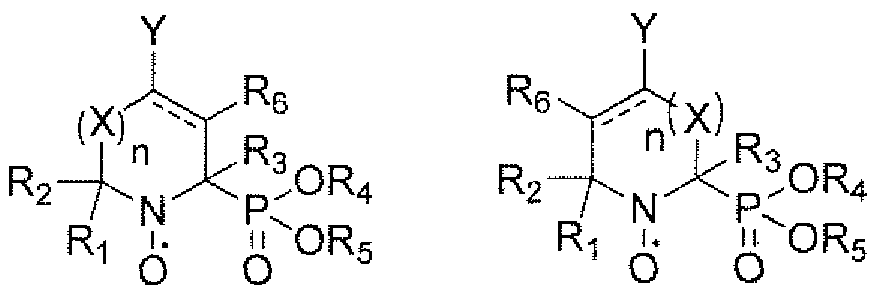
Thus, in one aspect, the invention relates to a compound of formula (I) or (II):

Ri is Cj-C6 alkyl optionally substituted by R ;
R2, R3 are independently selected from Ci-C6 alkyl, C6-Cio aryl, 5 to 7 membered heteroaryl optionally substituted by R10;
R4, R5 are independently selected from C)-C6 alkyl, C6-Cio aryl, 5 to 7 membered heteroaryl ;
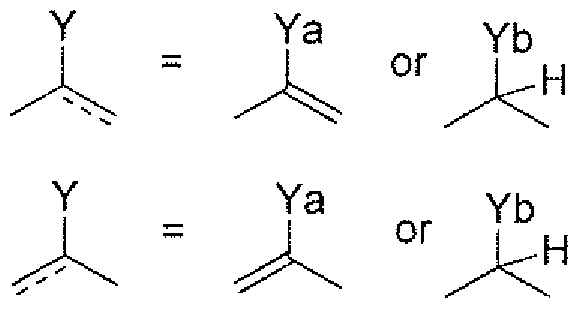
Ya is selected from Ci-C6 alkyIcarbonyloxy, Cj-C6 alkoxycarbonyloxy, d- C6 alkyithiocarbonyl wherein said alkyl groups are optionally substituted by one or more F, and/or CI, OSi(Rn)3, OSi(ORn)3 and/or OSi(RS 2)3, OS02R]3;
Yb is H, OH or NHR8;
X is (CH2)mCHR7(CH2)p;
R6, R7 are independently selected from H, OH, N¾, NHR8, an halogen atom, Cj-C6; alkyl, C6-Cio aryl, 5 to 7 membered heteroaryl;
R8 is selected from H, d-C6 alkyl;
R9, Rso are each independently selected from OH, N¾, NHR8;
Rj i is at each occurrence independently selected from Ci-C6 alkyl, C5-C 10 aryl;
R]2 is independently F or CI;
Ri3 is independently selected from Ci-C6 alkyl, d-Ce perfluoroalkyl, (Cj- C6)alkyl(C6-Cio)aryl, and is notably CH3, CF3 or tolyl ;
n is 0 or 1 ;
m is 0 or 1 ;
p is O or l ; provided that when
 , then at least one of R6, R7,
R9, Υ& is an hydrophilic group selected from OH, NH2, NHRg, said hydrophilic group being in cis position as regards the group

In one embodiment, the compound of formula (I) and (II) is a compound of formula (la) or (Ha) :

(la) (Ha)
In another embodiment, the compound of formula (I) and (II) is a compound of formula (lb) or (lib) :

( lb) (ilb)
In a particular embodiment, n is 0.
In a further embodiment, n is 1.
In yet another embodiment, m+p is 0 or 1 , notably 0.
In a further embodiment, m is 0 and p is 0.
In still a particular embodiment, Yb is OH.
In an additional embodiment, R2, R3 are each independently a Ci-C6 alkyl group.
In a further embodiment, R4., R5 are each independently a Cj-C6 alkyl group.
In a specific embodiment, the compound of formula (lb) is diethyl (4- hydroxy-2,6,6-trimethylpiperidin-2-yl-N-oxyl)phosphonate.
In a second aspect, the invention relates to the use of a compound of formula (I) or (II) as defined above for detecting and/or quantifying a solvent Si in a solvent S2, Si and S2 being distinct,
provided that when
Y Ya
Y Ya then Si is water.
In one embodiment, Si is water and S2 is an organic solvent.
In another embodiment, Si is an organic solvent and S2 is water.
In an additional embodiment, Si and S2 are each an organic solvent. Preferably, ΔΕ, that is the difference between the normalized Reichardt polarity Constant ET N between Si and S2 corresponds to a (delta)a,p larger than 4G.
In a particular embodiment, the change in the phosphorus hyperfine coupling constant of the compound of formula (I) or (II) is superior to 15 G between Sj and s2.
In a further embodiment, the compound of formula (I) or (II) is used for detecting and/or quantifying a solvent Si crossing a polymeric film or a polymeric or biological membrane, said film or membrane having no permeability to the solvent S2 containing the compound of formula (I) or (II).
As an example, the nitroxide compound of formula (I) may be dissolved in a non polar solvent and conversely. Then, it is possible to detect the traces of polar solvent crossing the film/membranes and conversely, using EPR as a technique of detection.
The film/membrane has no permeability to the solvent containing the nitroxide probe.
In a further embodiment, the compounds of formula (I) or (II) are used for studying or monitoring membrane porosity, film permeability, swelling of polymer, stability of materials, drug delivery. Figures
Figure 1: EPR signal from pure THF (top) to pure water (bottom) and with different v% of water (from top to bottom, 0, 0.2, 0.6, 1.0, 2.0, and 100).
Figure 2: Plots aN vs ET N for a (★), b (·), 8c (■), and 8t (♦). Empty symbols are for outliers.
Figure 3: Plots ap vs ET N for b (·), 8c (■), and St (♦). Empty symbols are for outliers.
Figure 4: Plots Θ vs a? for b (·), 8c (■), and 8t (♦).
Figures 5, 6 and 7: (Figure 5) Plots xw vs a? for 8c. Plots % volume of water vs a? for 8c (Figure 6) from pure THF to pure water and (Figure 7) from pure THF to 1 % water.
Examples
Example 1 : Synthesis of diethyl (4-hydroxy-2,6,6-trimethylpiperidin-2-yl- N-oxyl)phosphonate (8) and diethyl (2,6,6-trimethyl-4-oxopiperidin-2-yl-N-oxyl)phosphonate (10)
Nitroxide 9 was prepared in 8 steps (Scheme 2) starting from the commercially available 2,6-dimethyl-4-hydroxy-hept-l ,6-diene 1. The hydroxyl function was protected with the conventional tert-butyldimethylsilyl chloride (TBDMSC1) to afford 2. Then, one of the double bond of 2 was selectively oxidized into diol 3 with Os04 as oxidizing reagent. Diol 3 oxidized into ketone 4 with NaI04. Then, aminophosphonate 5 was obtained under condition specific for aminophosphorylation. Cyclization of 5 into 6 was performed in the presence of Hg(OAc)2 and the crude materials was oxidized with meta-chloperbenzoic acid (m-CPBA) into nitroxide 7. The protecting group of the latter was hydrolyzed to yield 8 which was oxidized into 9. The regioselectivity of the formation of the intracyclic double bond to afford 10 was controlled by using a bulky base, potassium hexamethyldisilazane (KHMDS), which reacted with the most accessible acidic protons which were the farer from the diethoxyphosphoryl group.

Scheme 2 a) tert-butyl( (2, 6-dimethylh epta-1, 6-dien-4-yl)oxy)dim ethylsilane (2).
I OTBSi
Zk
Alcohol 1 (1 1.5 g, 82.0 mmol), which was prepared according to the method disclosed into Breit, B. ; Breuninger, D. J. Am. Chem. Soc. 2004, 126, 10244, was dissolved
in DMF (250 raL), imidazole (17 g, 246 mmol) and ter/-butyldimethylsilyl chloride (25 g, 164 mmol) were added, and the mixture was stirred for 5 h at 0 °C. The solution was poured into water and extracted with Et20. The organic layers were washed with water, brine, dried with MgS04, filtered, and concentrated. Column chromatography yielded 20.6 g (99%) of 2 as a colorless oii. 'H NMR (400 MHz, CDC13): δ 4.77 (br s,2H), 4.71 (br s,2H),3.93 (q, J = 6.3 Hz, 1H), 2.20-2.1 1 (m, 4H), 1.73 (s, 6H), 0.87 (s, 9H), 0.04 (s, 6H). 13C NMR (75 MHz, CDC13): δ 143.0 (2C), 1 13.2 (2C¾), 69.8 (CH), 46.0.(2CH2), 26.1 (3CH3), 23.2 (2CH3), 18.3 (C), -4.4 (2CH3).
b) 4-((tert-butyldimethylsilyl)oxy)~2,6-dimethylhept-6-ene-l,2-diol (3).
I OTBSi Λ1 1
Alkene 2 (4.3 g, 16.9 mmol) was dissolved in 200 ml of a mixture acetone/ water (3/lv:v), then Os04 (1 mL of 4%w in water) was added and the mixture was stirred for 15 min at 0 °C. After that, 7Y-methylmorpholine-7V-oxide (4.0 g, 33.8 mmol) was added and stirred for 4 h at 0 °C. The solution was poured into 10 % aqueous Na2S203 and extracted with Et20. The organic layers were washed with water, brine, dried with MgS04? filtered, and concentrated. The crude product was obtained as a mixture of 2 diastereoisomers (ratio 2: 1). Column chromatography afforded 3.38 g of 2and 0.9g (86%) of 3as a yellowish oil. 1H NMR (400 MHz, C6D6): δ 4.78 (br s, 1H, M), 4.76 (br s, 1H, m+M), 4.70 (br s, 1 H, m), 4.26 (m, 1 H, m+M), 3.78 (s, 1H, m), 3.45-3.28 (m, 2H m, 3H M), 2.37-2.27 (m, 1 H, m+M), 2.22-2.07 (m, 1H M, 2H m), 1.87-1.70 (m, 2H M, 1 H m) 1.65-1.50 (m, 4H M, 4H m), 1.18 (s, 3H, M), 1.14 (s, 3H, m), 0.94 (s, 9H, m + M), 0.1 1 (s, 3H, m), 0.09 (s, 3H, M), 0.05 (s, 3H, m+M). 13C NMR (75 MHz, C6D6): δ 142.5 (C,M), 142.0 (C,m), 1 13.9 (CH2, m), 1 13.7 (CH2, M), 73.0 (C, m), 72.7 (C, M), 71.0 (CH2, m), 70.1 (C¾, M), 69.7 (CH, m), 69.6 (CH, M), 47.9 (CH2, m+M), 44.3 (CH2, M), 43.1 (CH2, m), 26.2 (CH3, M), 26.2 (CH3, m), 25.5 (CH3, M), 24.0 (CH3, m), 22.9 (CH3, M), 22.8 (CH3, m), 18.2 (C, M), 18.2 (C,m), -3.4 (CH3, m), -3.5 (CH3, M), -4.2 (CH3, M), -4.3 (CH3, m).
c) 4-((tert-butyldimethylsilyl)oxy)-6-methylhept-6-en-2-one (4)
I OTBSi
Diol 3 (6,0 g, 20.8 mmol) was solved in 300 ml of a THF/water mixture (3/1 v:v) with 1 1.0 g (52.0 mmol) of NaI04 and stirred at 0 °C for 3 h. The solution was poured into water and extracted with Et20. The organic layers were washed with water, dried with
MgS04, filtered, and concentrated. Column chromatography yielded 5.11 g (96%) of 4 as a yellowish oil. 1H NMR (400 MHz, CDC13): δ 4.78 (br s, 1H), 4.70 (br s, 1H), 4.36-4.28 (m, 1H), 2.60-2.47 (m, 2H), 2.30-2.10 (m, 2H), 2.15 (s, 3H), 1.74 (brs, 3H), 0.86 (s, 9H): 0.07 (s, 3H) 0.03 (s, 3H). i3C NMR (75 MHz, CDC13): 5 207.9 (C), 142.3 (C), 113.7 (C¾), 67.8 (CH), 50.5 (CH2), 46.6 (CH2), 31.8 (CH3), 25.9 (3CH3), 23.0 (CH3), 18.05 (C), -4.5 (CH3), - 4.8 (CH3).
d) diethyl (2-amino~4~((tert-butyldimethylsilyl)oxy)-6-methylhept-6-en~2- yl)ph osph onate( 5)

Ketone 4 (3.0 g, 3.9 mmol) was dissolved in 5 ml of diethylphosphite.
Molecular sieves 4A were added and the mixture was stirred under an ammoniac atmosphere for 24 h. Then, the mixture was filtered and the excess of diethylphosphite was removed under vacuum (50 °C, 2 mmHg). Column chromatography afforded 5 (550 mg, 37%) as a yellowish oil. 1H NMR (400 MHz, CDC13): 5 4.77 (br s, 1H, m+M), 4.71 (br s, 1H, m+M), 4.42-4.32 (m, 1H, M), 4.27-4.20 (m, 1H, m), 4.19-4.07 (m, 4H, m+M), 2.34-2.13 (m, 2H, m+M), 1.95-1.85 (m, 1H, m+M), 1.80-1.55 (m, 6H, m+M), 1.37-1.28 (m, 9H), 0.88 (s, 9H, m+M), 0.12 (s, 3H,M), 0.12 (s, 3H,m), 0.11 (s, 3H,m), 0.11 (s, 3H, M). 31P NMR (162 MHz, CDCI3): δ 31.67 (M), 30.88 (m). S3C NMR (75 MHz, CDC13): 5 142.7 (C, M), 142.2 (C, m), 1 13.5 (CH2, m), 113.3 (CH2, M), 67.8 (d, J= 13.2 Hz, CH, m), 67.6 (d, J = 10.5 Hz, CH, M), 62.5-62. l(d overlapped, 2CH2 m, 2CH2 M), 52.0 (d, J = 155 Hz, C, m), 51.8 (d, J = 146 Hz, C, M), 48.16 (CH2, M), 48.0 (CH2, m), 42.7 (d, J = 3.9 Hz, CH2), 41.9 (CH2), 26.0 (3CH3), 23.8 (CH3), 22.9 (d, J = 2.2 Hz, CH3, M), 22.7 (d, J - 2.2 Hz, CH3, m), 18.0 (C, M), 18.0 (C,m), 16.6 (d, J = 5.5 Hz, CH3), -3.6 (CH3, m), -3.6 (CH3, M), -4.1 (C¾, m), -4.1 (CH3, M).
e) diethyl(4-((tert~butyldimethylsilyl)oxy)-2,6,6~trimethylpiperidm^ N~oxyl)phosphonate (7).

The aminophosphonate 5 (400 mg, 1.02 mmol) was dissolved in 50 mL of THF/water mixture (3/1 v:v). Hg(OAc)2 (389 mg, 1.22 mmol) in 50 mL of the same solvent was slowly added to the aminophosphonate mixture and was stirred for 30 min at room
temperature. Then, the mixture was poured on 50 ml of aqueous solution of NaBH4 (77 mg, 2.03 mmol) and NaOH (163 mg, 4.06 mmol), extracted with Et20. The organic layers were washed with brine, dried with MgS04, filtered, and concentrated to yield 397 mg of piperidine 6 which was used in the next step without further purifications.
A solution of piperidin 6 (900 mg, 2.29 mmol) and m-CPBA (1.26 g, 4.58 mmol) in DCM was stirred 2 hours at 0 °C. The solution was poured into 10 % aqueous Na2S203 and extracted with DCM. The organic layers were washed with saturated aqueous solution of NaHC03, dried with MgS04, filtered, and concentrated. The crude product was obtained as a mixture of 2 diastereoisomers (ratio 2:1). Column chromatography yielded 685 mg of 7 (73%) as a red oil. The two diastereoisomers was separated and the major one was crystalized from Et20.
) diethyl (4-hydroxy~2, 6, 6-trim ethylpiperidin -2~yl~N~oxyl)phosphonate
(8)
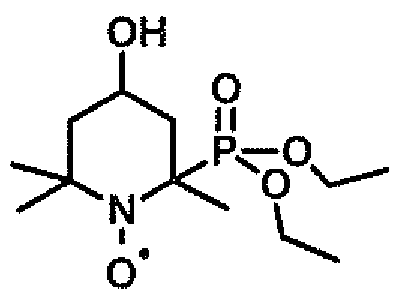
TBAF (1.0 M solution in THF, 1.47 mL, 1.47 mmol) was added dropwise to an ice-cold solution of silyl ether 7 (400 mg, 0.979 mmol) in dry THF (4 mL), under argon. The mixture was stirred 3 hours at room temperature and poured in a column of silica gel to afford 262 mg of 8 (91%) as a red oil.
g) diethyl (2,6,6~trimethyl-4-oxopiperidin-2-yl-N-oxyl)phosphonate (9)

N-methylmorpholine TV-oxide (128 mg, 1.09 mmol, 4.0 equiv.) was added to a stirred ice-cold solution of 8 (80 mg, 0.272 mmol) with a catalytic amount of tetrapropyl ammonium perruthenate and powdered molecular sieves 4 A in dry DCM (10 mL) under an argon atmosphere. After 20 min of stirring at room temperature, the reaction mixture was added to a column of silica gel to afford 70 mg of 9 (88%) as an orange solid.
h) 2-(diethoxyphosphoryl)-2,6,6-trimethyl-l,2,3,6-tetrahydropyridin-4-yl- N~oxyl acetate (10)

Ketone 9 (100 mg, 0.342 mmol) in 5 mL of dry THF was slowly added to a solution of KHMDS (1.0 M solution in THF, 0.513 raL, 0.513 mmol) in 5 mL of dry THF. The enolate formation was kept 3 hours from -80 °C to -45 °C. Then, freshly distillated Ac20 (70 mg, 0.684 mmol) was slowly added. The mixture was stirred 2.5 hours. After that, the solution was poured on brine and extracted with EtOAc. The organic layers were dried with MgS04, filtered, and concentrated. Column chromatography yielded 105 mg ( 1%)of 10 as a red oil. Example 2: Study of aN a and a values of 8c and 8t in various solvents
The two diastereoisomers 8c and 8t (Figure 1) with the diethoxyphosphoryl and hydroxyl groups in cis and trans relationships, respectively, were investigated separately. The effect of 45 solvents (Table 1) on oN and <¾> was investigated by EPR as well as the effect of the THF/water binary mixture of solvent from pure THF to pure water (Table 2) as exemplified in Figure 1.
8ca 8ta
solvent* Ne αΝ ap
1 ii-pentane 0.009 13.67 47.75 13.58 51.80
2 «-hexane 0.009 13.09 47.75 13.77 51.41
3 CHex 0.006 13.96 47.85 13.77 51.61
4 n-octane 0.012 13.58 47.95 13.67 51.70
5 benzene 0.111 14.44 40.44 14.06 50.93
6 toluene 0.099 14.25 40.92 13.96 51.12
7 i-BuPh 0.099 13.86 43.33 13.86 51.22
8 PhBr 0.182 14.44 40.15 14.06 50.45
9 Pyridine 0.302 15.31 25.23 14.15 49.87
10 AcPh 0.306 15.11 27.82 14.15 50.26
1 1 f-BuPH/ / 14.63 36.20 14.06 49.97
CH2C12
12 CH2C12 0.309 14.73 33.89 14.15 50.26
13 DCE 0.327 14.73 33.89 14.15 50.26
14 CHC13 0.259 14.83 33.79 14.25 50.83
15 CC14 0.052 13.77 44.96 13.96 51.51
16 DME 0.231 14.92 27.83 13.96 50.55
17 Et20 0.117 14.73 33.31 13.96 51.22
18 -Pr20 0.105 14.63 35.05 13.67 51.03
19 H-BU20 0.071 14.54 33.89 13.96 50.83
20 Mei-BuO 0.124 14.44 31.29 13.86 50.93
21 14D 0.164 15.02 26.96 14.15 51.03
22 THF 0.207 14.92 29.65 14.15 51.03
23 AcOEt 0.228 15.02 29.27 13.96 50.83
24 acetone 0.355 15.31 27.15 14.15 50.45
25 ACN 0.460 15.40 26.09 14.15 49.87
26 MeN02 0.481 15.31 26.86 14.25 49.78
27 DMSO 0.444 15.40 24.55 14.15 50.16
28 F 0.775 15.69 23.11 14.63 48.14
29 NMF 0.722 15.50 23.11 14.44 47.27
30 DMF 0.386 15.50 25.13 14.06 50.06
31 MeOH 0.762 15.40 24.07 14.53 48.43
32 EtOH 0.654 15.40 24.26 14.54 48.72
33 TFE 0.898 15.89 24.55 14.73 51.13
34 i-PrOH 0.546 15.21 25.03 14.35 49.58
35 «-BuOH 0.586 15.31 24.55 14.35 48.43
36 i-BuOH 0.389 15.31 25.61 14.25 51.41
37 BnOH 0.608 15.60 24.07 14.44 49.58
38 EG 0.790 15.60 23.49 14.54 49.29
39 TEG 0.682 15.11 24.26 14.35 49.10
40 water/ 0.71 15.79 23.97 14.92 49.68
MeOH
41 water 1 16.08 23.97 15.21 49.68
42 Tampon J 16.08 23.97 15.21 49.78
43 AcOH 0.648 15.50 24.45 14.44 49.97
44 Et3N 0.043 13.78 30.91 13.86 51.61
45 i-Pr2NH 0.145 14.70 29.56 13.86 51.22
Table 1. a^a and a?" values of 8c and 8t in 45 solvents* as well as the corresponding normalized Reichardt polarity solvent constant ExNc.
a a and a? are given in G (1 G = 0.1 mT). b CHex: cyclo-hexme, tBuPh: ieri-butylbenzene, PhBr: bromobenzene, AcPh: acetophenone, DCE: 1 ,2-di-chloroethane, DME: 1,2-dimethoxyethane, 14D: 1,4-dioxane, THF: tetrahydrofurane, AcOEt: ethyl acetate, ACN: acetonitrile, DMSO: dimethylsulfoxide, F: formamide, NMF: N-methylformamide, DMF: N,N-dimethylformamide, TFE: 2,2,2-trifluoroethanol, EG: ethylene glycol, TEG: tri ethylene glycol, AcOH: acetic acid, BnOH: benzylic alcohol. c EjN values are given in Ref. E4] unless otherwise mentioned. ^Not available.
The changes in ON for 8c and 8t as well as the changes in a for 8t are nicely accounted by effect recently discussed for several nitroxide models.
R! EtO EtO
N-0 - N-O" R1^P F^-P-O"
R EtO Eto'
B
Scheme 2: Canonical forms A and B of the nitroxyl moiety and C and D of the phosphoryl moiety
(1)

8cA Bct
Θ = 30° 9 = 90°
Scheme 3 : Conformational chair-chair equilibrium controlled by IHB in 8c and 8t Dotted line is for IHB. q is the dihedral angle between the SOMO (gray orbitals) and the C—P bond. A and E are for the diethoxyphosphoryl group in axial and equatorial positions, respectively.
The hyperfine coupling constant of atom at the position β is given by the Heller-McConnel relationship (equation 2) with BQ for the constant for the transfer of the spin density through the spin polarization process (in general disregarded), B\ for the constant for the transfer of the spin density through the hyperconjugation process, pi the spin density on the nitrogen atom, and Θ the dihedral angle between the SOMO and the C— P bond. As consequence, an increase of «p is expected with increasing ρΝ π, that is, increasing aN, and decreasing angle Θ.
a = Ba +B P; - coS 2 Q (2)
Contra-intuitively, a? for b and 8t decrease with increasing the polarity of the solvent £χΝ (Figure 3)[s), i.e., when a^ increases. However, the effect is more marked for b than for 8t, i.e., for 2 aP changes for aP = 40.80 gauss in «-hexane to op = 21.80 in methanol whereas for 8t it changes from aP = 51.80 G in rt-pentane to a? = 47.27 G in NMF. Taking into account equation 2, this decrease of «p with increasing aN implies a striking increase of Θ for b and a small increase for St. In fact, polar solvents are expected to favor zwiterionic mesomeric forms B and D. Then, an increase in Θ means that the phosphoryl and the nitroxyl moiety becomes closer and closer favoring a stabilizing dipole - dipole interaction as depicted
in the oxaphosphetane-like structure (Scheme 4). Moreover, the large aP value in rc-pentane for 8t implies a small angle Θ meaning a strong hyperconjugation interaction between the SOMO and the C— P bond implying that conformer 8tA is the favored conformer. The small slope means that bond rotation are strongly impeded in 8t.

Scheme 4. Oxaphosphetane-like structure.
Amazingly, 8c exhibit the same trend as b and 8t and a striking change of Δαρ ~ 25 G was observed from κ-octane (a? = 47.95 G) to NMF (ap = 23.1 1 G) as for b except that a? varies in an exponential fashion with ϋ Ν. As mentioned above, the puzzling changes in « for 8c were assumed due to a conformational equilibrium between 8c A and 8cE, 8cE being favored in H-bonding disrupting solvents. Then, in apolar solvents (ExN < 0.2), the axial position of the diethoxyphosphoryl group in 8cA maximized the overlapping between the SOMO and the C— P bond (small angle Θ in Newman projections in Scheme 3) although 3 syn-1 ,3 interactions which are overbalanced by the IHB and afforded the high a? value observed in «-hexane. On the other hand, in disrupting H-bonding solvents, the conformer 8cE, exhibiting only one syn-1 ,3 interaction, is favored involving the diethoxyphosphoryl group in equatorial position and, consequently, a large angle Θ (Newman projections in Scheme 4) affording the small ap values observed (Figure 3).
The angle Θ can be estimated with equation 2 for each solvent as long as
Βχ · ^π values are available. Thus, assuming B p^ = 58 G in n-pentane, θι is given as ca. 25° for 8c, values very close from the angle Θ observed in the Newman projection supporting the conformation 8cA in apolar solvents. Using equation 3 and θ] ; it was possible to determine θπ for each solvent for b, 8t, and 8c as displayed in Figure 4. The small variation in θ (ΔΘ = 10° from 77-hexane to water) for 8t confirms that bond rotations are impeded in 8t and that conformations deviate only a little from the conformer 8tA (Scheme 3). On the other hand, the variation ΔΘ of 20° confirms nicely the change of conformation in b toward the occurrence of oxaphosphetane-like structure (Scheme 4) in polar and protic solvents. Moreover, as expected, the value ΔΘ = 32° denotes a dramatic change in structure of 8c in
nice agreement with the chair-chair equilibrium between conformer 8cA, favored in apolar solvents, and 8cE, favored in polar and protic solvents. au = G ,. cos2 ^
Example 3: Titration of water in THF by EPR
Interestingly, a difference Δαρ of ca. 5 G is observed between THF and water. As these two solvent are miscible in any amount, the effect of binary mixture of solvents in aN and a? was investigated with the aim to develop the first titration of water in solvent by EPR. As displayed in Figure 1, EPR signals in THF (5 lines) and in water (6 lines) are very different. EPR signal was recorded between 0 to 1% of water in THF by steps of 0.1% and 10% to 100% of water by steps of 10% (Table 2 and Figures 5, 6 and 7). Solvent effect of binary mixture on spectroscopic properties has been intensively investigated using dyes. It has been shown that simplified the model m = \, implying only the occurrence of the solvent exchange reaction is described by equation (6) and account for many solvent effect in binary mixture:

Therefore, Y\ and 72 were defined as flp,si and apss2 for water as solvent S2 and THF as solvent Si. A good fit was observed for m = 1 (Figure 9a) affording <2piS J = GPJHF = 29.68 ± 0.07 G, aj>>S2 = tfp,w = 24.14 ± 0.05, fm = 9.0 ± 0.5, χ2 = 0.017 and R2 = 0.997. Hence, m is the number of solvent molecules involved in the microsphere solvation of the nitroxide for which a? changes, thus, only one molecule of water close to the nitroxyl moiety of 8c is required to make a? change. The value of/2/1 larger than 1 means that 8c would rather be solvated either with pure water or with some molecules of water in its cybotatic region than by pure THF.
The value of J¾0 is graphically determined as 0.1 (Figure 9a) for a?^ o as given by equation 7. Then, the polar effect of THF is balanced for 2.4% of water. Thus, the difference of 2.70 G for ~ 2% of water led us to investigate the potential of 8c in the titration of water in THF as an organic solvent. It has to be mentioned that some Lucarini performed the titration of benzyl alcohol using 2,2,6,6-tetramethylpiperidin-N-oxyl radical and its ability for intermolecular H-bonding.

The plot % volume of water vs a (Figure 6) exhibits the same shape as the plot xw vs ap (Figure 5). Obviously, the titration of traces (volume of THF lower than 50%) of THF in water is irrelevant. On the other hand, water in THF can be titrated accurately up to 30%, except that the relation is not linear. However, the enlargement of the zone from pure THF to 1% water (Figure 7) shows a linear relationship affording an easy titration. Taking into account an error of 0.1 G, accurate titration down to 0.2% water in THF was achieved.
entry % •X water <¾ «p
water (G) (G)
1 0 0 14.94 29.56
2 0.1 0.0045 15.05 29.47
3 0.2 0.0090 15.05 29.38
4 0.3 0.0134 15.00 29.14
5 0.4 0.0178 15.06 29.06
6 0.5 0.0221 15.04 28.78
7 0.6 0.0265 15.04 28.64
8 0.7 0.0308 15.10 28.48
9 0.8 0.0350 15.04 28.30
10 0.9 0.0393 15.04 28.00
11 1 0.0435 15.14 27.82
12 2 0.0840 15.21 27.28
13 3 0.1220 15.24 26.76
14 4 0.1580 15.34 26.00
15 5 0.1920 15.34 25.82
16 10 0.3334 15.38 25.36
17 20 0.5295 15.56 24.82
18 30 0.6586 15.62 24.52
19 40 0.7501 15.68 24.4
20 50 0.8182 15.80 24.22
21 60 0.8710 15.86 24.12
22 70 0.9131 15.98 24.12
23 80 0.9474 16.16 24.12
24 90 0.9759 16.22 24.12
25 100 1 16.22 24.18
Table 2. % water in THF, mole fraction xwater, nitrogen and phosphorus hyperfine coupling constants an and ap, respectively, for different % of water.
In conclusion, an amazing and puzzling cybotactic effect in nitroxide was reported. It was controlled by the occurrence of IHB (Intramolecular Hydrogen Bonding) affording a dramatic change of 25 G from n-pentane to water. Interestingly, to the best of our knowledge, this is the first report that a nitroxide exhibits a behavior similar to the one observed for betaine dyes.
Thus, for the first time, the titration of traces of water in THF (organic solvent) was performed down to 0.1%. Obviously, this is far from matching the Karl-Fischer titration that is suitable down to the ppm range. However, knowing that EPR can be ppb sensitive, it should be possible to develop better probes reaching such a threshold. However, the most interesting applications are likely in the Materials Sciences field to investigate the porosity of membranes, the stability of films in water or in organic solvents, the swelling of polymers and in Biology to investigate drug delivering via (nano)particles or micelles.
REFERENCES
B. Knauer, J. J. Napier, J. Am, Chem. Soc. 1976, 98, 4395 - 4400.
A. Sh. Mukhtarov, A. V. Il'Yasov, Ya. A. Levin, I. P. Gozman, M. S. Skorobogatova, E. I. Zoroatskaya,; Theor. Exp, Chem, 1976, 12, 656-660; A. Sh. Mukhtarov, A. V. Il'Yasov, Ya. A, Levin, I. P. Gozman, M. S. Skorobogatova, E. I. Zoroatskaya, Teor. Eksp. Khim. 1976, 12, 831 - 836.
G. Audran, P. Bremond, S. R. A. Marque, G. Obame, ChemPhysChem 2012, 13, 15, 3542-3548.
C. Reichardt, T. Welton in Solvent and Solvent Effect in Organic Chemistry, 4th ed., Wiley- VCH, Weinheim, 2011.
Solvent Effect in p-Phosphorylated Nitroxides: Model Nitroxides" Audran, G.; Bosco, L.; Bremond, P.; Butscher, T, Marque, S. R. Α., ΑρρΙ. Magnet. Reson. 20Ϊ5.
Claims
1. A compound of formula (I) or (II):
(I) (ll)
wherein:
Rj is CpCe alkyl optionally substituted by Rg;
R2, R3 are independently selected from Q-Cg alkyl, C6-Cio aryl, 5 to 7 membered heteroaryl optionally substituted by Rio;
R4, R5 are independently selected from C C6 alkyl, C6-Cio aryl, 5 to 7 membered heteroaryl ;
Y _ Ya r Yb
Y Ya Yb
Ya is selected from Ci-Ce alkylcarbonyloxy, Ci-C6 alkoxycarbonyloxy, Ci- C6 alkylthiocarbonyl wherein said alkyl groups are optionally substituted by one or more F, and/or CI ; OSi(Rn)3, OSi(ORn)3 and/or OSi(R!2)3, OS02R!3;
Yb is H, OH or NHR8;
X is (CH2)mCHR7(CH2)p;
R , R7 are independently selected from H, OH, NH2, NHRg, an halogen atom, Ci-C6; alkyl, C6-Cio aryl, 5 to 7 membered heteroaryl;
R8 is selected from H, Ci-C6 alkyl;
Rg, Rio are each independently selected from OH, NH2, NHRg;
Rii is at each occurrence independently selected from C[-C6 alkyl, C6-Cio aryl;
Ri2 is independently F, CI or C]-C6 alkyl;
i3 is independently selected from C[-C6 alkyl, C C6 perfiuoro alkyl, (Q- C6)alkyl(C6-Ci0)ar l;
n is 0 or 1 ;
m is 0 or 1 ;
p is 0 or 1 ;
- H
provided that when ^ ^ or -^' ^ is , then at least one of
R6, R7, R¾ Yb is an hydrophilic group selected from OH, N¾, NHRg, said hydrophilic group being in cis position as regards the group -Ρ(=0)(0¾)(0¾).
2. The compound of claim 1, wherein the compound of formula (Ϊ) and (II) is a compound of formula (la) or (Ila) :

3. The compound of claim 1, wherein the compound of formula (I) and (II) is a compound of formula (lb) or (lib) :

4. The compound of any of claims 1 to 3, wherein n is 1 ,
5. The compound of any of claims 1 to 4, wherein m is 0 and p is 0.
6. The compound of any of claims 1 to 5, wherein Y is OH.
7. The compound of any of claims 1 to 6, wherein R2, R are each independently a Q-Q alkyl group.
8. The compound of any of claims 1 to 7, wherein R4, R5 are each independently a C C6 alkyl group.
9. The compound of claim 1, which is diethyl (4-hydroxy-2,6,6- trimethylpiperidin-2-yl-N-oxyl)phosphonate.
10. Use of a compound of formula (I) or (II) as defined in any of claims 1 to 9 for detecting and/or quantifying a solvent S\ in a solvent S2, S] and S2 being distinct, provided that when
Y Ya
Y Ya
then Si is water.
1 1. Use of claim 10, wherein Si is water and S2 is an organic solvent.
12. Use of claim 10, wherein Si is an organic solvent and S2 is water,
13. Use of claim 10, wherein Si and S2 are each an organic solvent.
14. Use of claim 13, wherein ΔΕ between Si and S2 corresponds to a
(delta) ap larger than 4G.
15. Use of any of claims 10 to 14, wherein the change in the phosphorus hyperfme coupling constant of the compound of formula (I) or (II) is superior to 15 G between Si and S2.
16. Use according to any of claims 10 to 15, wherein Si is a solvent crossing a polymeric film or a polymeric or biological membrane.
17. Use according to any of claims 10 to 15, for studying or monitoring membrane porosity, film permeability, swelling of polymer, stability of materials, drug delivery.
Applications Claiming Priority (2)
| Application Number | Priority Date | Filing Date | Title |
|---|---|---|---|
| EP15306114.8 | 2015-07-07 | ||
| EP15306114.8A EP3115366A1 (en) | 2015-07-07 | 2015-07-07 | Development of radical probes highly sensitive to the polarity |
Publications (1)
| Publication Number | Publication Date |
|---|---|
| WO2017005884A1 true WO2017005884A1 (en) | 2017-01-12 |
Family
ID=53773395
Family Applications (1)
| Application Number | Title | Priority Date | Filing Date |
|---|---|---|---|
| PCT/EP2016/066208 Ceased WO2017005884A1 (en) | 2015-07-07 | 2016-07-07 | Development of radical probes highly sensitive to the polarity |
Country Status (2)
| Country | Link |
|---|---|
| EP (1) | EP3115366A1 (en) |
| WO (1) | WO2017005884A1 (en) |
-
2015
- 2015-07-07 EP EP15306114.8A patent/EP3115366A1/en not_active Ceased
-
2016
- 2016-07-07 WO PCT/EP2016/066208 patent/WO2017005884A1/en not_active Ceased
Non-Patent Citations (7)
| Title |
|---|
| A. SH. MUKHTAROV; A. V. IL'YASOV; YA. A, LEVIN; I. P. GOZMAN; M. S. SKOROBOGATOVA; E. I. ZOROATSKAYA, TEOR. EKSP. KHIM., vol. 12, 1976, pages 831 - 836 |
| A. SH. MUKHTAROV; A. V. IL'YASOV; YA. A. LEVIN; I. P. GOZMAN; M. S. SKOROBOGATOVA; E. I. ZOROATSKAYA, THEOR. EXP, CHEM., vol. 12, 1976, pages 656 - 660 |
| AUDRAN, G.; BOSCO, L.; BREMOND, P.; BUTSCHER, T; MARQUE, S. R. A.: "Solvent Effect in P-Phosphorylated Nitroxides: Model Nitroxides", APPL. MAGNET. RESON., 2015 |
| B. KNAUER; J. J. NAPIER, J. AM. CHEM. SOC., vol. 98, 1976, pages 4395 - 4400 |
| C. REICHARDT; T. WELTON: "Organic Chemistry", 2011, WILEY-VCH, article "Solvent and Solvent Effect" |
| G. AUDRAN; P. BREMOND; S. R. A. MARQUE; G. OBAME, CHEMPHYSCHEM, vol. 13, no. 15, 2012, pages 3542 - 3548 |
| GÉRARD AUDRAN ET AL: "Solvent Effect in [beta]-Phosphorylated Nitroxides: Model Nitroxides", APPLIED MAGNETIC RESONANCE., vol. 46, no. 12, 24 February 2015 (2015-02-24), AU, pages 1333 - 1342, XP055232777, ISSN: 0937-9347, DOI: 10.1007/s00723-015-0649-4 * |
Also Published As
| Publication number | Publication date |
|---|---|
| EP3115366A1 (en) | 2017-01-11 |
Similar Documents
| Publication | Publication Date | Title |
|---|---|---|
| KR20210057032A (en) | Methyl 6-(2,4-dichlorophenyl)-5-[4-[(3S)-1-(3-fluoropropyl)pyrrolidin-3-yl]oxyphenyl]-8,9-dihydro- Salt of 7H-benzo[7]annulene-2-carboxylate and preparation method thereof | |
| SK287611B6 (en) | Process for preparation of amine ethers and use of organic hydroperoxide for preparation of amine ether | |
| US20100121089A1 (en) | Methods for preparing dioranozinc compounds | |
| WO2017005884A1 (en) | Development of radical probes highly sensitive to the polarity | |
| Kaboudin et al. | ZnCl 2-mediated stereo-and chemoselective synthesis of vinylphosphonates | |
| CN111171068A (en) | A kind of preparation method of silicon spiro compound | |
| JP2018080278A (en) | Method for producing polymer | |
| Jiménez et al. | Bis-amidocarbazolyl urea receptor for short-chain dicarboxylate anions | |
| Li et al. | Reactivity of an NHC-stabilized silylene towards ketones. Formation of silicon bis-enolates vs. bis-silylation of the C [double bond, length as m-dash] O bond | |
| Turgut et al. | Synthesis of novel C2-symmetric chiral crown ethers and investigation of their enantiomeric recognition properties | |
| Hill et al. | Tris (triorganostannyltetrazoles): synthesis and supramolecular structures | |
| WO2023280638A9 (en) | Vinyl thianthrenium compound, process for its preparation and its use for transferring a vinyl group | |
| Alsbaiee et al. | The face selectivity of 1, 3-dipolar cycloaddition reactions of 4-butyloxycarbonyl-3, 4, 5, 6-tetrahydropyridine 1-oxide | |
| BR112020006166A2 (en) | hydrocarbon-soluble halogen and thiolate / magnesium exchange reagents | |
| JPWO2014034124A1 (en) | Simple manufacturing method | |
| Gangadhararao et al. | Cyclodiphosphazanes as synthetic probes: PC/PN bond formation from the reaction with functionalized propargyl alcohols and N-hydroxy substrates | |
| Schrader | Synthesis and Properties of Acylphosphines | |
| Alopina et al. | L-proline based alkylmethylimidazolium ionic liquids [Cnmim][Pro]: Synthesis and some physicochemical properties of their aqueous solutions | |
| Wahbi et al. | REACTION OF LAWESSON’S REAGENT WITH γ-PHOSPHONYL-OXIMES: SYNTHESIS OF NOVEL 1, 2, 5-OXAZAPHOSPHOLINE DERIVATIVES | |
| CN114315726B (en) | Preparation method of gem-difluoroallyl compound | |
| JP6871540B2 (en) | Method for producing allyl isocyanides | |
| 田中 | Catalytic Activity of Lewis Acid Complexes | |
| WO2024135652A1 (en) | Reissert-henze reaction using phosphonic acid anhydride as activator | |
| Dhakal et al. | Intramolecular (4+ 2) cycloaddition of aryl-1-aza-2-azoniaallene salts: a practical approach to highly sterically-congested polycyclic protonated azomethine imines | |
| JPS6211770A (en) | Tetrahydrofuran carboxylic acid derivative |
Legal Events
| Date | Code | Title | Description |
|---|---|---|---|
| 121 | Ep: the epo has been informed by wipo that ep was designated in this application |
Ref document number: 16736457 Country of ref document: EP Kind code of ref document: A1 |
|
| NENP | Non-entry into the national phase |
Ref country code: DE |
|
| 122 | Ep: pct application non-entry in european phase |
Ref document number: 16736457 Country of ref document: EP Kind code of ref document: A1 |