WO2016207656A1 - Methods of diagnosing bladder cancer - Google Patents

Methods of diagnosing bladder cancer Download PDF

Info

Publication number
WO2016207656A1
WO2016207656A1 PCT/GB2016/051903 GB2016051903W WO2016207656A1 WO 2016207656 A1 WO2016207656 A1 WO 2016207656A1 GB 2016051903 W GB2016051903 W GB 2016051903W WO 2016207656 A1 WO2016207656 A1 WO 2016207656A1
Authority
WO
WIPO (PCT)
Prior art keywords
mvps
seq
nos
methylated
identified
Prior art date
Legal status (The legal status is an assumption and is not a legal conclusion. Google has not performed a legal analysis and makes no representation as to the accuracy of the status listed.)
Ceased
Application number
PCT/GB2016/051903
Other languages
French (fr)
Inventor
Andrew FEBER
John Kelly
Current Assignee (The listed assignees may be inaccurate. Google has not performed a legal analysis and makes no representation or warranty as to the accuracy of the list.)
UCL Business Ltd
Original Assignee
UCL Business Ltd
Priority date (The priority date is an assumption and is not a legal conclusion. Google has not performed a legal analysis and makes no representation as to the accuracy of the date listed.)
Filing date
Publication date
Application filed by UCL Business Ltd filed Critical UCL Business Ltd
Priority to CN201680048957.0A priority Critical patent/CN108350504B/en
Priority to EP16732729.5A priority patent/EP3314016B1/en
Priority to AU2016283063A priority patent/AU2016283063B2/en
Priority to US15/738,539 priority patent/US11473148B2/en
Priority to JP2017567208A priority patent/JP7002334B2/en
Publication of WO2016207656A1 publication Critical patent/WO2016207656A1/en
Anticipated expiration legal-status Critical
Priority to JP2021169917A priority patent/JP2022025090A/en
Ceased legal-status Critical Current

Links

Classifications

    • CCHEMISTRY; METALLURGY
    • C12BIOCHEMISTRY; BEER; SPIRITS; WINE; VINEGAR; MICROBIOLOGY; ENZYMOLOGY; MUTATION OR GENETIC ENGINEERING
    • C12QMEASURING OR TESTING PROCESSES INVOLVING ENZYMES, NUCLEIC ACIDS OR MICROORGANISMS; COMPOSITIONS OR TEST PAPERS THEREFOR; PROCESSES OF PREPARING SUCH COMPOSITIONS; CONDITION-RESPONSIVE CONTROL IN MICROBIOLOGICAL OR ENZYMOLOGICAL PROCESSES
    • C12Q1/00Measuring or testing processes involving enzymes, nucleic acids or microorganisms; Compositions therefor; Processes of preparing such compositions
    • C12Q1/68Measuring or testing processes involving enzymes, nucleic acids or microorganisms; Compositions therefor; Processes of preparing such compositions involving nucleic acids
    • C12Q1/6876Nucleic acid products used in the analysis of nucleic acids, e.g. primers or probes
    • C12Q1/6883Nucleic acid products used in the analysis of nucleic acids, e.g. primers or probes for diseases caused by alterations of genetic material
    • C12Q1/6886Nucleic acid products used in the analysis of nucleic acids, e.g. primers or probes for diseases caused by alterations of genetic material for cancer
    • CCHEMISTRY; METALLURGY
    • C12BIOCHEMISTRY; BEER; SPIRITS; WINE; VINEGAR; MICROBIOLOGY; ENZYMOLOGY; MUTATION OR GENETIC ENGINEERING
    • C12QMEASURING OR TESTING PROCESSES INVOLVING ENZYMES, NUCLEIC ACIDS OR MICROORGANISMS; COMPOSITIONS OR TEST PAPERS THEREFOR; PROCESSES OF PREPARING SUCH COMPOSITIONS; CONDITION-RESPONSIVE CONTROL IN MICROBIOLOGICAL OR ENZYMOLOGICAL PROCESSES
    • C12Q1/00Measuring or testing processes involving enzymes, nucleic acids or microorganisms; Compositions therefor; Processes of preparing such compositions
    • C12Q1/68Measuring or testing processes involving enzymes, nucleic acids or microorganisms; Compositions therefor; Processes of preparing such compositions involving nucleic acids
    • C12Q1/6844Nucleic acid amplification reactions
    • C12Q1/686Polymerase chain reaction [PCR]
    • CCHEMISTRY; METALLURGY
    • C12BIOCHEMISTRY; BEER; SPIRITS; WINE; VINEGAR; MICROBIOLOGY; ENZYMOLOGY; MUTATION OR GENETIC ENGINEERING
    • C12QMEASURING OR TESTING PROCESSES INVOLVING ENZYMES, NUCLEIC ACIDS OR MICROORGANISMS; COMPOSITIONS OR TEST PAPERS THEREFOR; PROCESSES OF PREPARING SUCH COMPOSITIONS; CONDITION-RESPONSIVE CONTROL IN MICROBIOLOGICAL OR ENZYMOLOGICAL PROCESSES
    • C12Q1/00Measuring or testing processes involving enzymes, nucleic acids or microorganisms; Compositions therefor; Processes of preparing such compositions
    • C12Q1/68Measuring or testing processes involving enzymes, nucleic acids or microorganisms; Compositions therefor; Processes of preparing such compositions involving nucleic acids
    • C12Q1/6813Hybridisation assays
    • C12Q1/6827Hybridisation assays for detection of mutation or polymorphism
    • CCHEMISTRY; METALLURGY
    • C12BIOCHEMISTRY; BEER; SPIRITS; WINE; VINEGAR; MICROBIOLOGY; ENZYMOLOGY; MUTATION OR GENETIC ENGINEERING
    • C12QMEASURING OR TESTING PROCESSES INVOLVING ENZYMES, NUCLEIC ACIDS OR MICROORGANISMS; COMPOSITIONS OR TEST PAPERS THEREFOR; PROCESSES OF PREPARING SUCH COMPOSITIONS; CONDITION-RESPONSIVE CONTROL IN MICROBIOLOGICAL OR ENZYMOLOGICAL PROCESSES
    • C12Q1/00Measuring or testing processes involving enzymes, nucleic acids or microorganisms; Compositions therefor; Processes of preparing such compositions
    • C12Q1/68Measuring or testing processes involving enzymes, nucleic acids or microorganisms; Compositions therefor; Processes of preparing such compositions involving nucleic acids
    • C12Q1/6844Nucleic acid amplification reactions
    • C12Q1/6858Allele-specific amplification
    • CCHEMISTRY; METALLURGY
    • C12BIOCHEMISTRY; BEER; SPIRITS; WINE; VINEGAR; MICROBIOLOGY; ENZYMOLOGY; MUTATION OR GENETIC ENGINEERING
    • C12QMEASURING OR TESTING PROCESSES INVOLVING ENZYMES, NUCLEIC ACIDS OR MICROORGANISMS; COMPOSITIONS OR TEST PAPERS THEREFOR; PROCESSES OF PREPARING SUCH COMPOSITIONS; CONDITION-RESPONSIVE CONTROL IN MICROBIOLOGICAL OR ENZYMOLOGICAL PROCESSES
    • C12Q2523/00Reactions characterised by treatment of reaction samples
    • C12Q2523/10Characterised by chemical treatment
    • C12Q2523/125Bisulfite(s)
    • CCHEMISTRY; METALLURGY
    • C12BIOCHEMISTRY; BEER; SPIRITS; WINE; VINEGAR; MICROBIOLOGY; ENZYMOLOGY; MUTATION OR GENETIC ENGINEERING
    • C12QMEASURING OR TESTING PROCESSES INVOLVING ENZYMES, NUCLEIC ACIDS OR MICROORGANISMS; COMPOSITIONS OR TEST PAPERS THEREFOR; PROCESSES OF PREPARING SUCH COMPOSITIONS; CONDITION-RESPONSIVE CONTROL IN MICROBIOLOGICAL OR ENZYMOLOGICAL PROCESSES
    • C12Q2600/00Oligonucleotides characterized by their use
    • C12Q2600/118Prognosis of disease development
    • CCHEMISTRY; METALLURGY
    • C12BIOCHEMISTRY; BEER; SPIRITS; WINE; VINEGAR; MICROBIOLOGY; ENZYMOLOGY; MUTATION OR GENETIC ENGINEERING
    • C12QMEASURING OR TESTING PROCESSES INVOLVING ENZYMES, NUCLEIC ACIDS OR MICROORGANISMS; COMPOSITIONS OR TEST PAPERS THEREFOR; PROCESSES OF PREPARING SUCH COMPOSITIONS; CONDITION-RESPONSIVE CONTROL IN MICROBIOLOGICAL OR ENZYMOLOGICAL PROCESSES
    • C12Q2600/00Oligonucleotides characterized by their use
    • C12Q2600/154Methylation markers
    • CCHEMISTRY; METALLURGY
    • C12BIOCHEMISTRY; BEER; SPIRITS; WINE; VINEGAR; MICROBIOLOGY; ENZYMOLOGY; MUTATION OR GENETIC ENGINEERING
    • C12QMEASURING OR TESTING PROCESSES INVOLVING ENZYMES, NUCLEIC ACIDS OR MICROORGANISMS; COMPOSITIONS OR TEST PAPERS THEREFOR; PROCESSES OF PREPARING SUCH COMPOSITIONS; CONDITION-RESPONSIVE CONTROL IN MICROBIOLOGICAL OR ENZYMOLOGICAL PROCESSES
    • C12Q2600/00Oligonucleotides characterized by their use
    • C12Q2600/16Primer sets for multiplex assays
    • GPHYSICS
    • G01MEASURING; TESTING
    • G01NINVESTIGATING OR ANALYSING MATERIALS BY DETERMINING THEIR CHEMICAL OR PHYSICAL PROPERTIES
    • G01N33/00Investigating or analysing materials by specific methods not covered by groups G01N1/00 - G01N31/00
    • G01N33/48Biological material, e.g. blood, urine; Haemocytometers
    • G01N33/50Chemical analysis of biological material, e.g. blood, urine; Testing involving biospecific ligand binding methods; Immunological testing
    • G01N33/53Immunoassay; Biospecific binding assay; Materials therefor
    • G01N33/574Immunoassay; Biospecific binding assay; Materials therefor for cancer
    • G01N33/57407Specifically defined cancers

Definitions

  • the present invention relates to methods of diagnosing bladder cancer in a patient, involving determining the methylation status of Methylation Variable Positions (MVPs) in DNA from the patient and providing a diagnosis based on methylation status data.
  • the invention also relates to methods of treating bladder cancer comprising providing a diagnosis of bladder cancer by the diagnostic methods defined herein followed by administering one or more anti-cancer agents to a patient.
  • the invention also relates to methylation-discriminatory arrays comprising probes directed to the MVPs defined herein and kits comprising the arrays.
  • Bladder cancer represents one of the most common malignancies in the western world, ranking as the 5th most common cancer in the United States and causing approximately 3% of all cancer-related deaths [1, 2].
  • the foremost clinical sign at presentation is hematuria, and bladder cancer is detected in about 10% of all such cases investigated [3].
  • Bladder cancer is more likely in older male patients, current or past smokers and patients exposed to industrial carcinogens [4]. Younger females with nonvisible hematuria are less likely to harbor bladder cancer and for these patients delay in detection of bladder cancer, following misdiagnosis of haematuria, is a frequent event [5]. Cystoscopy is the current gold standard for detecting bladder cancer and is an invasive, uncomfortable procedure requiring clinic or hospital attendance and posing a small but significant risk of infection [6-9].
  • bladder cancer Each year in the UK, approximately 10,300 people are diagnosed with bladder cancer and 5,000 die from the disease. However, more than 100,000 cases per year are referred from primary care to urology haematuria clinics for cystoscopy and imaging. Bladder cancer is detected in only 10% of patients referred.
  • NMIBC muscle invasive bladder cancer
  • DNA methylation biomarkers in body fluids, including urine [15-23], plasma/serum [24-26], and sputum [27, 28], for the non-invasive detection of cancer.
  • Changes in DNA methylation play a key role in malignant transformation, leading to the silencing of tumor-suppressor genes and overexpression of oncogenes [29].
  • the ontogenic plasticity and relative stability of DNA methylation makes epigenetic changes ideal biomarkers for diagnosis.
  • Detected protein biomarkers include human complement factor H-related protein,
  • CEA carcinoembryonic antigen
  • NMP22 nuclear mitotic apparatus protein 22
  • WO2014042763 describes a nine -biomarker panel consisting of IL-8, MMP9, SDC1, CCL18,
  • SERPINEl CD44, VEGF-A, CA9, and ANG for detection of protein in urine samples; a further nine-biomarker panel consisting of CA9, CCL18, MMP12, TMEM45A, MMP9, SEMA3D, ERBB2, CRH, and MXRA8; as well as a three-biomarker panel consisting of CCL18, CD44, and VEGF-A.
  • DNA methylation biomarker assays for the detection of bladder cancer have been centered on the analysis of only a small number of loci, in part due to technological limitations and derivation of targets with cancer specificity [1 1-19].
  • reported sensitivities and specificities are high relative to established assays, but would fail to attain performance characteristics achieved by cystoscopy.
  • Methylation markers for bladder cancer previously studied include DAPK, BCL2, TERT, TWIST 1, NID2, RARbeta, E-cadherin and pi 6.
  • International patent application publication WO2013/144362 describes a diagnostic assay for bladder cancer involving detecting methylation of the promoter of the ECRG4 and/or the ITIH5 gene.
  • US patent application publication US2013224738 describes a diagnostic assay for bladder cancer involving assessing the methylation status of genes consisting of BCL2, CDKN2A and NID2.
  • Diagnostic methods which can detect bladder cancer from a biological sample, particularly a voided urine sample, with robust and high sensitivity and specificity, and which have the potential to reduce the need for cystoscopy in patients referred with haematuria and in patients undergoing surveillance for disease recurrence. Avoiding cystoscopy will reduce the cost of bladder cancer management and positively impact on patient wellbeing, reducing both the number of hospital visits and the inconvenience of an invasive investigation.
  • the invention provides the following:
  • the invention provides a method of diagnosing bladder cancer in an individual comprising:
  • the group of MVPs may comprises at least 40 of the MVPs identified in SEQ ID NOS 1 to 150 and denoted by [CG], and wherein bladder cancer is diagnosed when at least 25 of the MVPs identified in SEQ ID NOS 1 to 150 and denoted by [CG] are methylated.
  • the group of MVPs may comprise at least 50 of the MVPs identified in SEQ ID NOS 1 to 150 and denoted by [CG], or may comprise at least 100 of the MVPs identified in SEQ ID NOS 1 to 150 and denoted by [CG].
  • the group of MVPs may comprise all 150 of the MVPs identified in SEQ ID NOS 1 to 150 and denoted by [CG].
  • cancer may be diagnosed in the individual when at least 40 of the MVPs selected from the MVPs identified in SEQ ID NOS 1 to 150 and denoted by [CG] are methylated, or when at least 50 of the MVPs selected from the MVPs identified in SEQ ID NOS 1 to 150 and denoted by [CG] are methylated, or when at least 100 of the MVPs are methylated, or when all 150 MVPs are methylated.
  • the MVPs determined to be methylated may include the MVPs identified in SEQ ID NOS 1 to 3 and denoted by [CG], or may include the MVPs identified in SEQ ID NOS 1 to 5 and denoted by [CG], or may include the MVPs identified in SEQ ID NOS 1 to 10 and denoted by [CG], or may include the MVPs identified in SEQ ID NOS 1 to 40 and denoted by [CG].
  • the group of MVPs may comprise all 150 of the MVPs identified in SEQ ID NOS 1 to 150 and denoted by [CG], wherein bladder cancer is diagnosed in the individual when at least 40 of the MVPs selected from the MVPs identified in SEQ ID NOS 1 to 150 and denoted by [CG] are methylated, and wherein the MVPs determined to be methylated include the MVPs identified in SEQ ID NOS 1 to 10 and denoted by [CG].
  • the step of determining whether each one the MVPs is methylated may comprise bisulphite converting the DNA.
  • the step of determining whether each one the MVPs is methylated may comprise:
  • an amplification step may be performed, wherein loci comprising each MVP are amplified.
  • Amplification may be performed by PCR.
  • a capturing step may be performed before the sequencing or hybridization steps.
  • the capturing step may involve binding polynucleotides comprising the MVP loci to binding molecules specific to the MVP loci and collecting complexes comprising MVP loci and binding molecules; and wherein:
  • the capturing step occurs before the step of bisulphite converting the DNA
  • the capturing step occurs after the step of bisulphite converting the DNA but before the amplification or hybridization steps;
  • the capturing step occurs after the step of bisulphite converting the DNA and after the amplification step.
  • the binding molecules may be oligonucleotides specific for each MVP, preferably DNA or RNA molecules each comprising a sequence which is
  • the binding molecule may be coupled to a purification moiety.
  • the purification moiety may comprise a first purification moiety and the step of collecting complexes comprising MVP loci and binding molecules may comprise binding the first purification moiety to substrates comprising a second purification moiety, wherein first and second purification moieties form an interaction complex.
  • the first purification moiety may be biotin and the second purification moiety may be streptavidin; or the first purification moiety may be streptavidin and the second purification moiety may be biotin.
  • the step of amplifying loci comprising MVPs may comprise the use of primers which are independent of the methylation status of the MVP.
  • the step of amplifying loci comprising MVPs may be performed by
  • the biological sample obtained from the individual may be a sample of urine, blood, serum, plasma or cell-free DNA.
  • the method may achieve a ROC sensitivity of 95% or greater and a ROC specificity of 90% or greater; preferably a ROC sensitivity of 96% and a ROC specificity of 97%, preferably a ROC AUC of 95% or greater, preferably 98%o.
  • the method may achieve a negative predictive value (NPV) of 95% or greater, preferably 97%.
  • NPV negative predictive value
  • the step of diagnosing bladder cancer in the individual may further comprise:
  • the invention additionally provides a method of treating bladder cancer in an individual comprising:
  • the invention additionally provides a method of treating bladder cancer in an individual comprising:
  • the invention additionally provides a method of treating bladder cancer in an individual comprising:
  • the invention additionally provides a method of treating bladder cancer in an individual comprising administering one or more bladder cancer treatments to the individual, wherein the individual has been diagnosed with bladder cancer by steps comprising:
  • the invention additionally provides a method of diagnosing bladder cancer in an individual comprising:
  • the cancer may be a non-muscle invasive bladder cancer (NMIBC).
  • NMIBC non-muscle invasive bladder cancer
  • MIBC muscle invasive bladder cancer
  • the invention additionally provides an array capable of discriminating between methylated and non-methylated forms of MVPs; the array comprising oligonucleotide probes specific for a methylated form of each MVP in a MVP panel and oligonucleotide probes specific for a non-methylated form of each MVP in the panel; wherein the panel consists of at least 25 MVPs selected from the MVPs identified in SEQ ID NOS 1 to 150.
  • the array is not an Infinium HumanMethylation450 BeadChip array.
  • the number of MVP-specific oligonucleotide probes of the array is less than 482,421, preferably 482,000 or less, 480,000 or less, 450,000 or less, 440,000 or less, 430,000 or less, 420,000 or less, 410,000 or less, or 400,000 or less.
  • the panel may consist of at least 40 MVPs selected from the MVPs identified in SEQ ID NOS 1 to 150; preferably at least 50 MVPs, at least 60 MVPs, at least 70 MVPs, at least 80 MVPs, at least 90 MVPs, at least 100 MVPs, at least 110 MVPs, at least 120 MVPs, at least 130 MVPs, at least 140 MVPs, at least 145 MVPs, or all 150 MVPs identified in SEQ ID NOS 1 to 150.
  • the panel may include the MVPs defined by SEQ ID NOS 1 to 3, or the MVPs defined by SEQ ID NOS 1 to 5, or the MVPs defined by SEQ ID NOS 1 to 10, or the MVPs defined by SEQ ID NOS 1 to 20, or the MVPs defined by SEQ ID NOS 1 to 30, or the MVPs defined by SEQ ID NOS 1 to 40, or the MVPs defined by SEQ ID NOS 1 to 50, or the MVPs defined by SEQ ID NOS 1 to 60, or the MVPs defined by SEQ ID NOS 1 to 70, or the MVPs defined by SEQ ID NOS 1 to 80, or the MVPs defined by SEQ ID NOS 1 to 90, or the MVPs defined by SEQ ID NOS 1 to 100, or the MVPs defined by SEQ ID NOS 1 to 100, or the MVPs defined by SEQ ID NOS 1 to 120, or the MVPs defined by SEQ ID NOS 1 to 130, or the MVPs defined by SEQ ID NOS 1 to 140, or the MVPs defined by SEQ ID NOS 1 to 3
  • the panel may include all MVPs defined by SEQ ID NOS 1 to 150.
  • the array may further comprise one or more oligonucleotides comprising a MVP selected from any of the MVPs defined in SEQ ID NOS 1 to 150, wherein the one or more oligonucleotides are hybridized to
  • the one or more oligonucleotides may comprise at least 20 MVPs selected from the MVPs identified in SEQ ID NOS 1 to 150; preferably at least 50 MVPs, at least 60 MVPs, at least 70 MVPs, at least 80 MVPs, at least 90 MVPs, at least 100 MVPs, at least 110 MVPs, at least 120 MVPs, at least 130 MVPs, at least 140 MVPs, at least 145 MVPs, or all 150 MVPs identified in SEQ ID NOS 1 to 150.
  • the one or more oligonucleotides may comprise the MVPs defined by SEQ ID NOS 1 to 10, or the MVPs defined by SEQ ID NOS 1 to 20, or the MVPs defined by SEQ ID NOS 1 to 30, or the MVPs defined by SEQ ID NOS 1 to 40, or the MVPs defined by SEQ ID NOS 1 to 50, or the MVPs defined by SEQ ID NOS 1 to 60, or the MVPs defined by SEQ ID NOS 1 to 70, or the MVPs defined by SEQ ID NOS 1 to 80, or the MVPs defined by SEQ ID NOS 1 to 90, or the MVPs defined by SEQ ID NOS 1 to 100, or the MVPs defined by SEQ ID NOS 1 to 110, or the MVPs defined by SEQ ID NOS 1 to 120, or the MVPs defined by SEQ ID NOS 1 to 130, or the MVPs defined by SEQ ID NOS 1 to 140, or the MVPs defined by SEQ ID NOS 1 to 150.
  • the one or more oligonucleotides may comprise all MVPs defined by SEQ ID NOS 1 to 150.
  • Arrays as described above may be obtainable by hybridizing to an array as described above a group of oligonucleotides each comprising a different MVP selected from any of the MVPs defined in SEQ ID NOS 1 to 150, and wherein the group comprises at least 40 oligonucleotides.
  • the group may comprise at least 50 oligonucleotides.
  • the group may comprise at least 60, at least 70, at least 80, at least 90, at least 100, at least 110, at least 120, at least 130, at least 140, at least 145, or at least 150
  • the group may comprise at least 40 oligonucleotides comprising the MVPs defined by SEQ ID NOS 1 to 20, or wherein the group may comprise at least 50 oligonucleotides comprising the MVPs defined by SEQ ID NOS 1 to 50, or wherein the group may comprise at least 60 oligonucleotides comprising the MVPs defined by SEQ ID NOS 1 to 60, or wherein the group may comprise at least 70 oligonucleotides comprising the MVPs defined by SEQ ID NOS 1 to 70, or wherein the group may comprise at least 80 oligonucleotides comprising the MVPs defined by SEQ ID NOS 1 to 80, or wherein the group may comprise at least 90 oligonucleotides comprising the MVPs defined by SEQ ID NOS 1 to 90, or wherein the group may comprise at least 100 oligonucleotides comprising the MVPs defined by SEQ ID NOS 1 to 100, or wherein the group may comprise at least 110 oligonu
  • the invention also provides a process for making the hybridized array as defined above, comprising contacting an array as defined above with a group of
  • oligonucleotides each comprising a different MVP selected from any of the MVPs defined in SEQ ID NOS 1 to 150, and wherein the group comprises at least 25 oligonucleotides.
  • the invention also provides a process for making a hybridized array as defined above, comprising contacting an array as defined above with a group of
  • the invention also provides a kit comprising any of the arrays described above.
  • the kit may further comprise a DNA modifying regent that is capable of modifying a non-methylated cytosine in a MVP dinucleotide but is not capable of modifying a methylated cytosine in a MVP dinucleotide, optionally wherein the dinucleotide is CpG.
  • the DNA modifying regent may be a bisulphite reagent.
  • FIG. 1 Heatmap of 9786 MVPs (1746 hypermethylated MVPs, 8040 hypomethylated MVPs) between bladder cancer (red) and 30 normal urothelium (blue).
  • Figure 3. Heat map of the 150 loci involved in the UroMark assay for normal urothelium (Blue) bladder cancer (Red) compared with the predicted (Light blue/light red) and actual (Blue/Red) status of bladder cancer.
  • FIG. 4 MDS plots for bladder tumour and normal urothelium based on the methylation state of 150 loci in bladder cancer samples from UCL and TCGA Bladder Cancer.
  • the MDS (Multidimensional scaling) plot represents the dissimilarly of phenotypes based on the methylation state of the 150 loci with the panel, and clearly shows that the 150 marker can accurately separate tumour from normal bladder.
  • Axis represent the Euclidean distance between samples.
  • Figure 5. ROC plot for UroMark model for the detection of bladder cancer in urine.
  • FIG. 6 ROC plots for top performing (A) 3, (B) 5 and (C) 10 marker panels.
  • Top 3 MVPs are listed as SEQ ID NOs: 1 to 3
  • Top 5 MVPs are listed as SEQ ID NOs: 1 to 5
  • Top 10 MVPs are listed as SEQ ID NOs: 1 to 10, all in rank order (see Table 1).
  • FIG. 7 ROC plot for UroMark model for the detection of bladder cancer from 176 unique urine samples (98 non-cancer urines and 78 cancer urines).
  • FIG. 8 Comparison of DNA quality (concentration, purity and integrity) from patients' urine.
  • FIG. 9 ROC plot for UroMark model for the detection of bladder cancer from Validation Cohort 2 - 96 unique urine samples (64 non-cancer urines and 32 cancer urines).
  • Figure 10. ROC plot for UroMark model for the detection of bladder cancer from Validation Cohort 3 - 92 urine samples (65 non-cancer urines and 27 cancer urines).
  • bladder cancers represent one of the most prevalent groups of cancers in the western world.
  • Transitional cell carcinoma is the most common type, and accounts for approximately 90% of bladder cancers.
  • Transitional cell carcinomas arise from the transitional epithelium, which is a tissue lining the inner surface of the bladder.
  • the remaining 10% of bladder cancers are mainly comprised of squamous cell carcinoma, adenocarcinoma, sarcoma, and small cell carcinoma.
  • Squamous cell carcinoma also arises from epithelial tissue, from squamous cells. These are thin, flat cells found in the most superficial epithelial layer.
  • Adenocarcinomas form from epithelial cells having glandular characteristics and/or origin.
  • Sarcomas derive from cells of mesenchymal origin, such as the cells of the fat and muscle layers of the bladder.
  • Small cell carcinomas have a rapid doubling time and are capable of earlier metastases, making them particularly aggressive.
  • Bladder cancers may also be classified as non-muscle invasive bladder cancer (NMIBC) and muscle invasive bladder cancer (MIBC).
  • NMIBC non-muscle invasive bladder cancer
  • MIBC muscle invasive bladder cancer
  • the diagnostic and treatment methods described herein are capable of positively identifying malignant cells of all classifications of bladder cancer.
  • any of the methods described herein may be used to diagnose transitional cell carcinoma of the bladder, squamous cell carcinoma of the bladder, adenocarcinoma of the bladder, sarcoma of the bladder, small cell carcinoma of the bladder, metastatic bladder cancer, leiomyosarcoma (a tumor arising from smooth muscle), lymphoma (a tumor that usually arises in the lymph nodes), malignant melanoma (a tumor that usually arises from the skin) and large cell neuroendocrine carcinoma.
  • Primary forms and recurrent forms of bladder cancer are included.
  • the cancer to be diagnosed or treated as described herein may be a urothelial cell cancer.
  • the cancer may be cancer of the ureter, urethra or renal pelvis.
  • the most preferred patient type to which the diagnostic assays described herein are applicable are humans.
  • the diagnostic assays described herein may also be used to identify bladder cancer in a non-human animal.
  • non-human animals may contain tissue derived from humans, e.g. xenografts.
  • diagnostic assays may be used to diagnose human bladder cancer in an animal model of human bladder cancer.
  • Typical non-human animals to which the diagnostic assays described herein are applicable are rodents such as rats or mice.
  • MVPs Methylation Variable Positions
  • Methylation of DNA is a recognised form of epigenetic modification which has the capability of altering the expression of genes and other elements such as
  • methylation may have the effect of e.g. silencing tumor suppressor genes and/or increasing the expression of oncogenes. Other forms of dysregulation may occur as a result of methylation.
  • Methylation of DNA occurs at discrete loci which are predominately dinucleotide consisting of a CpG motif, but may also occur at CHH motifs (where H is A, C, or T).
  • a methyl group is added to the fifth carbon of cytosine bases to create methylcytosine.
  • Methylation can occur throughout the genome and is not limited to regions with respect to an expressed sequence such as a gene. Methylation typically, but not always, occurs in a promoter or other regulatory region of an expressed sequence.
  • a Methylation Variable Position as defined herein is any dinucleotide locus which may show a variation in its methylation status between phenotypes, i.e. between tumour and normal tissue.
  • An MVP is preferably a CpG or a CHH
  • An MPV as defined herein is not limited to the position of the locus with respect to a corresponding expressed sequence.
  • an assessment of DNA methylation status involves analysing the presence or absence of methyl groups in DNA, for example methyl groups on the 5 th position of one or more cytosine nucleotides.
  • the methylation status of one or more cytosine nucleotides present as a CpG dinucleotide (where C stands for
  • Cytosine, G for Guanine and p for the phosphate group linking the two is assessed.
  • assessing the methylation status of an MVP or determining whether an MVP is methylated it is meant that a determination is made as to whether an MVP was methylated or unmethylated in the starting sample of DNA obtained from the individual prior to subsequent processing.
  • An MVP is herein defined as methylated if one or more alleles of that MVP in a sample of genomic DNA from the patient is determined to possess one or more methylated CpG dinucleotide loci.
  • the MVPs determined to be methylated are methylated relative to normal urothelium control and/or whole blood control.
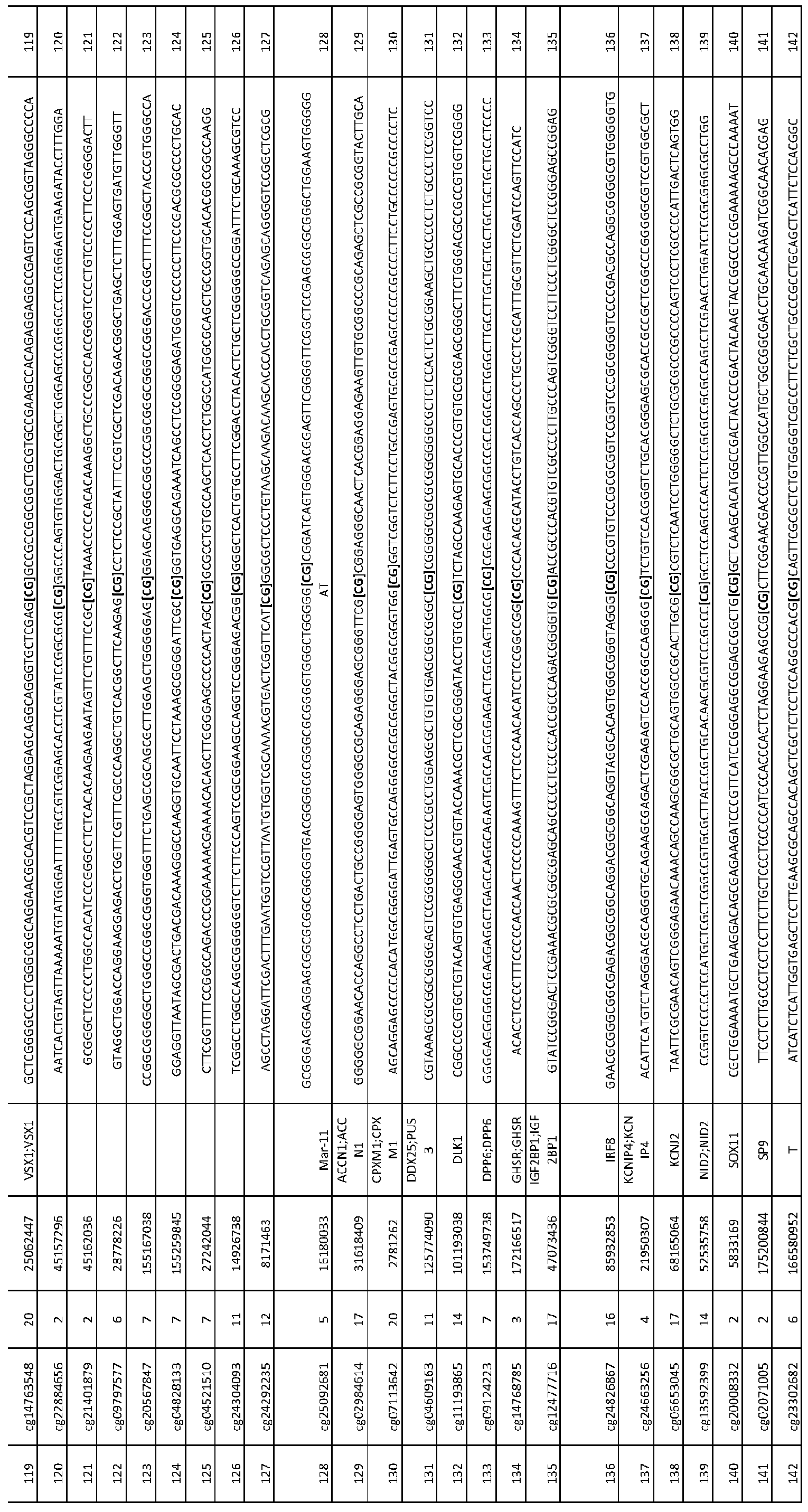
  • MVPs useful for diagnostic purposes are set forth in Table 1 and are identified by SEQ ID number, as well as Illumina ID number (limn ID).
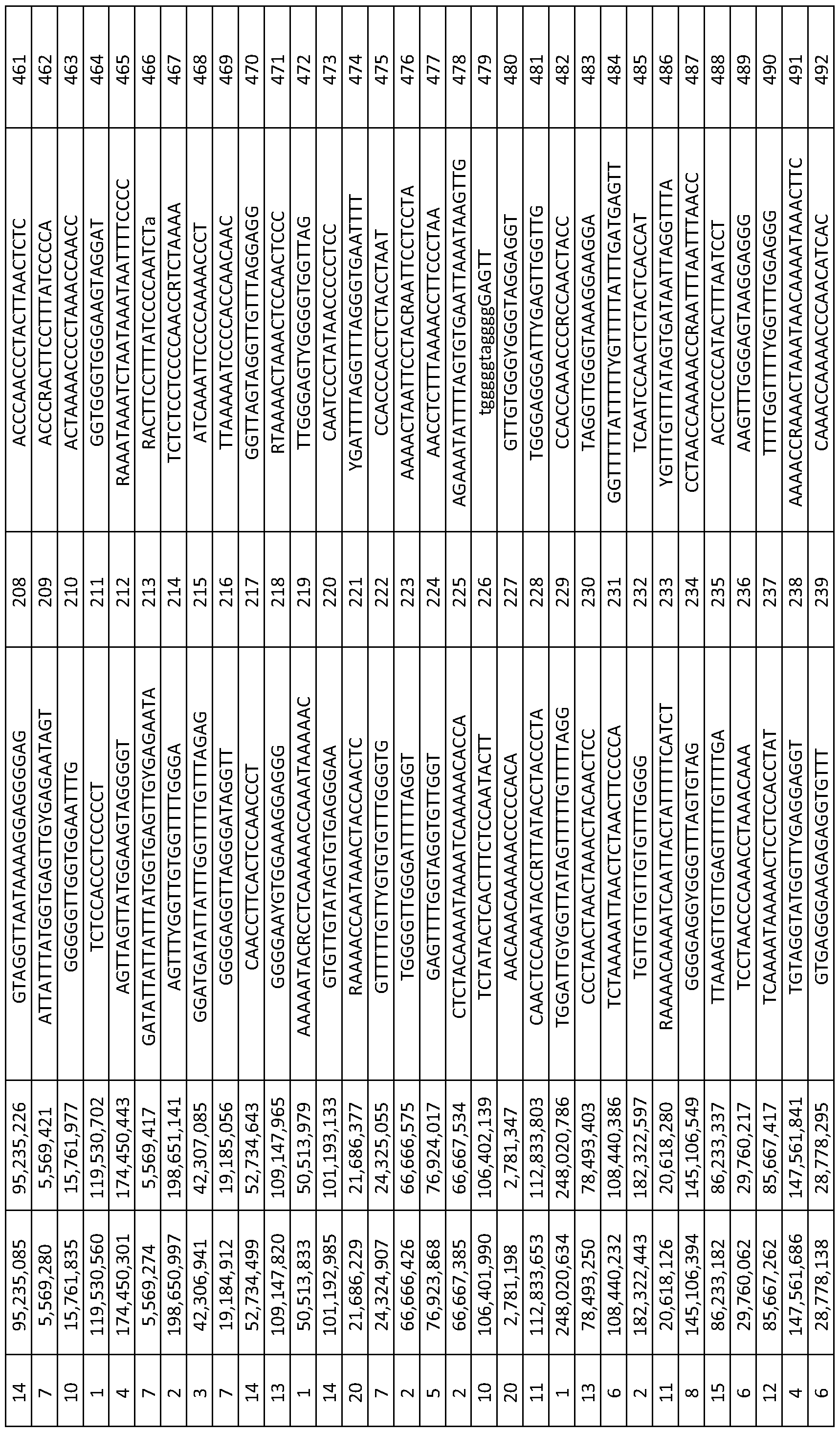
  • Exemplary primers for amplifying the defined MVPs are set forth in Table 2 and are also identified by SEQ ID number. Identification and assessment of Methylation Variable Position (MVP) status
  • MVPs Methylation Variable Positions
  • Methyl groups are lost from a starting DNA molecule during conventional in vitro handling steps such as PCR.
  • techniques for the detection of methyl groups commonly involve the preliminary treatment of DNA prior to subsequent processing, in a way that preserves the methylation status information of the original DNA molecule.
  • Such preliminary techniques involve three main categories of processing, i.e. bisulphite modification, restriction enzyme digestion and affinity-based analysis. Products of these techniques can then be coupled with sequencing or array- based platforms for subsequent identification or qualitative assessment of MVP methylation status.
  • cytosine bases can be detected by a variety of techniques. For example, primers specific for unmethylated versus methylated DNA can be generated and used for PCR- based identification of methylated CpG dinucleotides. A separation/capture step may be performed, e.g. using binding molecules such as complementary oligonucleotide sequences. Standard and next-generation DNA sequencing protocols can also be used.
  • methylation-sensitive enzymes can be employed which digest or cut only in the presence of methylated DNA. Analysis of resulting fragments is commonly carried out using microarrays.
  • binding molecules such as anti-5- methylcytosine antibodies are commonly employed prior to subsequent processing steps such as PCR and sequencing.
  • any suitable method can be employed.
  • Preferred methods involve bisulphite treatment of DNA, including amplification of the identified MVP loci for methylation specific PCR and/or sequencing and/or assessment of the methylation status of target loci using methylation-discriminatory microarrays.
  • Amplification of MVP loci can be achieved by a variety of approaches.
  • MVP loci are amplified using PCR.
  • MVP may also be amplified by other techniques such as multiplex ligation-dependent probe amplification (MLPA).
  • MLPA multiplex ligation-dependent probe amplification
  • PCR-based approaches may be used.
  • methylation-specific primers may be hybridized to DNA containing the MVP sequence of interest. Such primers may be designed to anneal to a sequence derived from either a methylated or non-methylated MVP locus.
  • a PCR reaction is performed and the presence of a subsequent PCR product indicates the presence of an annealed MVP of identifiable sequence.
  • DNA is bisulphite converted prior to amplification.
  • MSP methylation specific PCR
  • PCR primers may anneal to the MVP sequence of interest independently of the methylation status, and further processing steps may be used to determine the status of the MVP.
  • Assays are designed so that the MVP site(s) are located between primer annealing sites. This method scheme is used in techniques such as bisulphite genomic sequencing [54], COBRA [55], Ms-SNuPE [56]. In such methods, DNA can be bisulphite converted before or after amplification.
  • small-scale PCR approaches are used. Such approaches commonly involve mass partitioning of samples (e.g. digital PCR). These techniques offer robust accuracy and sensitivity in the context of a highly miniaturised system (pico-liter sized droplets), ideal for the subsequent handling of small quantities of DNA obtainable from the potentially small volume of cellular material present in biological samples, particularly urine samples.
  • a variety of such small-scale PCR techniques are widely available. For example, microdroplet-based PCR instruments are available from a variety of suppliers, including RainDance Technologies, Inc. (Billerica, MA;
  • Microarray platforms may also be used to carry out small-scale PCR. Such platforms may include microfiuidic network-based arrays e.g. available from Fluidigm Corp.
  • amplified PCR products may be coupled to subsequent analytical platforms in order to determine the methylation status of the MVPs of interest.
  • the PCR products may be directly sequenced to determine the presence or absence of a methyl cytosine at the target MVP or analysed by array-based techniques.
  • any suitable sequencing techniques may be employed to determine the sequence of target DNA.
  • second generation large numbers of DNA molecules are sequenced in parallel. Typically, tens of thousands of molecules are anchored to a given location at high density and sequences are determined in a process dependent upon DNA synthesis. Reactions generally consist of successive reagent delivery and washing steps, e.g. to allow the incorporation of reversible labelled terminator bases, and scanning steps to determine the order of base incorporation.
  • Array-based systems of this type are available commercially e.g. from Illumina, Inc. (San Diego, CA;
  • Third generation techniques are typically defined by the absence of a requirement to halt the sequencing process between detection steps and can therefore be viewed as real-time systems.
  • the base-specific release of hydrogen ions which occurs during the incorporation process, can be detected in the context of microwell systems (e.g. see the Ion Torrent system available from Life Technologies; http://www.lifetechnologies.com/).
  • PPi pyrophosphate
  • nanopore technologies DNA molecules are passed through or positioned next to nanopores, and the identities of individual bases are determined following movement of the DNA molecule relative to the nanopore. Systems of this type are available commercially e.g.
  • a DNA polymerase enzyme is confined in a "zero-mode waveguide" and the identity of incorporated bases are determined with florescence detection of gamma-labeled phosphonucleotides (see e.g. Pacific Biosciences; http://www.pacificbiosciences.com/).
  • sequencing steps may be omitted.
  • amplified PCR products may be applied directly to hybridization arrays based on the principle of the annealing of two complementary nucleic acid strands to form a double-stranded molecule.
  • Hybridization arrays may be designed to include probes which are able to hybridize to amplification products of an MVP and allow discrimination between methylated and non-methylated loci.
  • probes may be designed which are able to selectively hybridize to an MVP locus containing thymine, indicating the generation of uracil following bisulphite conversion of an unmethylated cytosine in the starting template DNA.
  • probes may be designed which are able to selectively hybridize to an MVP locus containing cytosine, indicating the absence of uracil conversion following bisulphite treatment. This corresponds with a methylated MVP locus in the starting template DNA.
  • Detection systems may include, e.g. the addition of fluorescent molecules following a methylation status-specific probe extension reaction. Such techniques allow MVP status determination without the specific need for the sequencing of MVP amplification products.
  • array-based discriminatory probes may be termed methylation-specific probes.
  • Any suitable methylation-discriminatory microarrays may be employed to assess the methylation status of the MVPs described herein.
  • a preferred methylation- discriminatory microarray system is provided by Illumina, Inc. (San Diego, CA;
  • BeadChip array system may be used to assess the methylation status of diagnostic MVPs for bladder cancer as described herein.
  • the array comprises beads to which are coupled oligonucleotide probes specific for DNA sequences corresponding to the unmethylated form of an MVP, as well as separate beads to which are coupled oligonucleotide probes specific for DNA sequences corresponding to the methylated form of an MVP.
  • Candidate DNA molecules are applied to the array and selectively hybridize, under appropriate conditions, to the oligonucleotide probe corresponding to the relevant epigenetic form.
  • corresponding genomic DNA will selectively attach to the bead comprising the methylation-specific oligonucleotide probe, but will fail to attach to the bead
  • the bladder cancer-specific diagnostic MVP biomarkers defined herein were initially identified using the Illumina Infinium HumanMethylation450 BeadChip array system, the same chip system can be used to interrogate those same MVPs in the diagnostic assays described herein.
  • Alternative or customised arrays could, however, be employed to interrogate the bladder cancer-specific diagnostic MVP biomarkers defined herein, provided that they comprise means for interrogating all MVPs for a given method, as defined herein.
  • DNA containing MVP sequences of interest may be hybridized to microarrays and then subjected to DNA sequencing to determine the status of the MVP as described above.
  • sequences corresponding to MVP loci may also be subjected to an enrichment process.
  • DNA containing MVP sequences of interest may be captured by binding molecules such as oligonucleotide probes complementary to the MVP target sequence of interest.
  • Sequences corresponding to MVP loci may be captured before or after bisulphite conversion or before or after amplification. Probes may be designed to be complementary to bisulphite converted DNA. Captured DNA may then be subjected to further processing steps to determine the status of the MVP, such as DNA sequencing steps.
  • Capture/separation steps may be custom designed. Alternatively a variety of such techniques are available commercially, e.g. the SureSelect target enrichment system available from Agilent Technologies (http://www.agilent.com/home). In this system biotinylated "bait” or “probe” sequences (e.g. RNA) complementary to the DNA containing MVP sequences of interest are hybridized to sample nucleic acids.
  • Streptavidin-coated magnetic beads are then used to capture sequences of interest hybridized to bait sequences. Unbound fractions are discarded. Bait sequences are then removed (e.g. by digestion of RNA) thus providing an enriched pool of MVP target sequences separated from non-MVP sequences.
  • template DNA is subjected to bisulphite conversion and target loci are then amplified by small-scale PCR such as microdroplet PCR using primers which are independent of the methylation status of the MVP.
  • small-scale PCR such as microdroplet PCR using primers which are independent of the methylation status of the MVP.
  • samples are subjected to a capture step to enrich for PCR products containing the target MVP, e.g. captured and purified using magnetic beads, as described above.
  • PCR reaction is carried out to incorporate DNA sequencing barcodes into MVP-containing amplicons. PCR products are again purified and then subjected to DNA sequencing and analysis to determine the presence or absence of a methylcytosine at the target genomic MVP [31].
  • the MVP biomarker loci defined herein are identified e.g. by Illumina® identifiers (IlmnID). These MVP loci identifiers refer to individual MVP sites used in the commercially available Illumina® Infinium Human Methylation450 BeadChip kit. The identity of each MVP site represented by each MVP loci identifier is publicly available from the Illumina, Inc. website under reference to the MVP sites used in the
  • Illumina® has developed a method to consistently designate MVP/CpG loci based on the actual or contextual sequence of each individual MVP/CpG locus.
  • Illumina® has developed a consistent and deterministic MVP loci database to ensure uniformity in the reporting of methylation data.
  • the Illumina® method takes advantage of sequences flanking a MVP locus to generate a unique MVP locus cluster ID. This number is based on sequence information only and is unaffected by genome version.
  • Illumina's standardized nomenclature also parallels the TOP/BOT strand nomenclature (which indicates the strand orientation) commonly used for single nucleotide polymorphism (SNP) designation.
  • SNP single nucleotide polymorphism
  • Illumina® Identifiers for the Infinium Human Methylation450 BeadChip system are also available from public repositories such as Gene Expression Omnibus (GEO) (http://www.ncbi.nlm.nih.gov/geo/).
  • GEO Gene Expression Omnibus
  • An MVP as defined herein thus refers to the CG dinucleotide motif identified in relation to each SEQ ID NO. and Illumina Identifier (limn ID) as listed in Table 1, wherein the cytosine base of the dinucleotide (noted in bold and square brackets in the sequences listed at Table 1) may (or may not) be modified.
  • determining the methylation status of a CpG defined by or identified in a given SEQ ID NO., or determining whether such a CpG is methylated it is meant that a determination is made as to whether the cytosine of the CG dinucleotide motif identified in bold and in square brackets in a sequence shown in Table 1 is methylated or not at one or more loci in the sample of DNA from the individual, accepting that variation in the sequence upstream and downstream of any given CpG may exist due to sequencing errors or variation between individuals.
  • the invention provides a method of diagnosing bladder cancer in an individual comprising:
  • the group of MVPs may comprise 26 or more of the MVPs identified in SEQ ID NOS 1 to 150 and denoted by [CG]; or the group may comprise 27 or more, 28 or more, 29 or more, 30 or more, 31 or more, 32 or more, 33 or more, 34 or more, 35 or more, 36 or more, 37 or more, 38 or more, 39 or more, 40 or more, 41 or more, 42 or more, 43 or more, 44 or more, 45 or more, 46 or more, 47 or more, 48 or more, 49 or more, 50 or more, 51 or more, 52 or more, 53 or more, 54 or more, 55 or more, 56 or more, 57 or more, 58 or more, 59 or more, 60 or more, 61 or more, 62 or more, 63 or more, 64 or more, 65
  • bladder cancer may be diagnosed when at least 25 of the MVPs identified in SEQ ID NOS 1 to 150 and denoted by [CG] are methylated.
  • Bladder cancer may be diagnosed when 26 or more of the MVPs identified in SEQ ID NOS 1 to 150 and denoted by [CG] are methylated; or when 27 or more, 28 or more, 29 or more, 30 or more, 31 or more, 32 or more, 33 or more, 34 or more, 35 or more, 36 or more, 37 or more, 38 or more, 39 or more, 40 or more, 41 or more, 42 or more, 43 or more, 44 or more, 45 or more, 46 or more, 47 or more, 48 or more, 49 or more, 50 or more, 51 or more, 52 or more, 53 or more, 54 or more, 55 or more, 56 or more, 57 or more, 58 or more, 59 or more, 60 or more, 61 or more, 62 or more, 63 or more, 64 or more, 65 or more, 66 or more, 67 or more
  • bladder cancer may be diagnosed when 40 or more of the MVPs identified in SEQ ID NOS 1 to 150 and denoted by [CG] are methylated.
  • Bladder cancer may also be diagnosed when 50 or more, 60 or more, 70 or more or 80 or more, 90 or more or 100 or more of the MVPs identified in SEQ ID NOS 1 to 150 and denoted by [CG] are methylated.
  • the MVPs determined to be methylated may include the MVPs identified in SEQ ID NOS 1 to 3 and denoted by [CG], or may include the MVPs identified in SEQ ID NOS 1 to 5 and denoted by [CG], or may include the MVPs identified in SEQ ID NOS 1 to 10 and denoted by [CG], or may include the MVPs identified in SEQ ID NOS 1 to 20 and denoted by [CG], or may include the MVPs identified in SEQ ID NOS 1 to 30 and denoted by [CG], or may include the MVPs identified in SEQ ID NOS 1 to 40 and denoted by [CG], or may include the MVPs identified in SEQ ID NOS 1 to 50 and denoted by [CG], or may include the MVPs identified in SEQ ID NOS 1 to 60 and denoted by [CG], or may include the MVPs identified in SEQ ID NOS 1 to 70 and denoted by [CG], or may include the MVPs identified in SEQ ID NOS 1 to 80 and denoted by [CG],
  • the group of MVPs (i.e. those MVPs the methylation status of which are to be determined) may comprises all 150 of the MVPs identified in SEQ ID NOS 1 to 150 and denoted by [CG], and in this method bladder cancer is diagnosed in the individual when at least 40 of the MVPs selected from the MVPs identified in SEQ ID NOS 1 to 150 and denoted by [CG] are methylated, and in this method the MVPs determined to be methylated include the MVPs identified in SEQ ID NOS 1 to 10 and denoted by [CG].
  • DNA sequences and in primer design for the purposes of methylation-specific analyses are generally available and have been described previously [57, 58, 59].
  • MVP methylation status assays described herein may be defined using standard receiver operating characteristic (ROC) statistical analysis [52].
  • ROC receiver operating characteristic
  • a bladder cancer diagnostic assay in accordance with the invention described herein can achieve a ROC sensitivity of 90%> or greater, 91%> or greater, 92% or greater, 93%> or greater, 94%> or greater, 95% or greater, 96%> or greater, 97% or greater, 98%> or greater or 99%.
  • ROC sensitivity may be 100%.
  • Diagnostic assays in accordance with the invention can achieve a ROC specificity of 90% or greater, 91% or greater, 92% or greater, 93% or greater, 94% or greater, 95% or greater, 96% or greater, 97% or greater, 98% or greater or 99%.
  • ROC specificity may be 100%. Diagnostic assays in accordance with the invention may have an associated combination of ROC sensitivity and ROC specificity values wherein the combination is any one of the above-listed sensitivity values and any one of the above-listed specificity values, provided that the sensitivity value is equal to or less than the specificity value.
  • the ROC specificity may be 100% and the ROC sensitivity may be 90% or greater, 91%> or greater, 92% or greater, 93% or greater, 94%> or greater, 95% or greater, 96% or greater, 97% or greater, 98% or greater, 99% or 100%.
  • the ROC specificity may be 99% and the ROC sensitivity may be 90% > or greater, 91%o or greater, 92% or greater, 93% or greater, 94% or greater, 95% or greater, 96% or greater, 97% or greater, 98% or 99%.
  • the ROC specificity may be 98% and the ROC sensitivity may be 90% or greater, 91% or greater, 92% or greater, 93% or greater, 94% or greater, 95% or greater, 96% or greater, 97% or 98%.
  • the ROC specificity may be 97% and the ROC sensitivity may be 90% or greater, 91% or greater, 92% or greater, 93% or greater, 94% or greater, 95% or greater, 96% or 97%.
  • the ROC specificity may be 96% and the ROC sensitivity may be 90% or greater, 91% or greater, 92% or greater, 93% or greater, 94% or greater, 95% or 96%.
  • the ROC specificity may be 95% and the ROC sensitivity may be 90% or greater, 91% or greater, 92% or greater, 93% or greater, 94%o or 95%.
  • the ROC specificity may be 94% and the ROC sensitivity may be 90% or greater, 91% or greater, 92% or greater, 93% or 94%.
  • the ROC specificity may be 93% and the ROC sensitivity may be 90% or greater, 91% or greater, 92% or 93%.
  • the ROC specificity may be 92% and the ROC sensitivity may be 90% or greater, 91% or 92%.
  • the ROC specificity may be 91% and the ROC sensitivity may be 90% or 91%.
  • the ROC specificity may be 90% and the ROC sensitivity may be 90%.
  • the assay may achieve a ROC sensitivity of 95% or greater and a ROC specificity of 90%o or greater; preferably a ROC sensitivity of 96% and a ROC specificity of 97%.
  • ROC plots corresponding to example methods representative of the diagnostic methods defined herein are presented at Figures 5 and 7, demonstrating the extraordinar sensitivity and selectivity of the MVP -based assays. This contrasts with assays conducted with smaller panels of biomarkers, which have been described previously. Thus, comparative data demonstrate the superior predictive power of the assays defined herein.
  • a further metric which can be employed to classify the accuracy of the MVP- based assays is ROC AUC.
  • AUC area under the curve of a ROC plot
  • the AUC score for the ROC plot will be 0.5.
  • the number of true positives will be 100% and the number of false positives will be 0%.
  • the AUC score for the ROC plot will be 1.
  • a bladder cancer diagnostic assay in accordance with the invention can achieve a ROC AUC of 0.90 or greater, 0.91 or greater, 0.92 or greater, 0.93 or greater, 0.94 or greater, 0.95 or greater, 0.96 or greater, 0.97 or greater, 0.98 or greater, 0.99 or 1.
  • the diagnostic assay can achieve a ROC AUC of 0.98 or greater.
  • Bladder cancer diagnostic tests based on the MVP methylation status assays described herein may also be characterised using a Negative Predictive Value (NPV) metric.
  • NPV Negative Predictive Value
  • a bladder cancer diagnostic assay in accordance with the invention described herein can achieve an NPV of 90% or greater, 91 > or greater, 92% or greater, 93% or greater, 94% or greater, 95% or greater, 96% or greater, 97% or greater, 98% or greater or 99% or 100%.
  • the bladder cancer diagnostic assays described herein may be performed on any suitable biological material obtained from the patient.
  • Preferred biological material is urine.
  • samples of bladder tissue e.g. obtained via biopsy or aspirates, or obtained from preserved samples ⁇ e.g. cryopreserved material, tissue sections etc.
  • Samples of biological material may also include solid tissue samples, aspirates, samples of biological fluids, blood, serum, plasma, ascitic fluid, lymph, peripheral blood, cerebrospinal fluid, fine needle aspirate, saliva, sputum, bone marrow, skin, epithelial samples (including buccal, cervical or vaginal epithelia) or other tissue derived from the ectoderm, vaginal fluid, semen etc.
  • Tissue scrapes may include biological material from e.g. buccal, oesophageal, bladder, vaginal, urethral or cervical scrapes.
  • the cells of the sample may comprise inflammatory cells, such as lymphocytes.
  • any of the assays and methods described herein may involve providing a biological sample from the patient as the source of patient DNA for methylation analysis.
  • any of the assays and methods described herein may involve obtaining patient DNA from a biological sample which has previously been obtained from the patient.
  • any of the assays and methods described herein may involve obtaining a biological sample from the patient as the source of patient DNA for methylation analysis.
  • Procedures for obtaining a biological sample from the patient may be noninvasive, such as collecting cells from urine. Alternatively, invasive procedures such as biopsies may be used.
  • the level of detection is such that 2 tumor cells may be detected in a sample comprising 150,000 cells or more.
  • the sample may comprise 160,000 cells or more, 170,000 cells or more, 180,000 cells or more, 190,000 cells or more, 200,000 cells or more, 210,000 cells or more, 220,000 cells or more, 230,000 cells or more, 240,000 cells or more, 250,000 cells or more, 260,000 cells or more, 270,000 cells or more, 280,000 cells or more, 280,000 cells or more, or 300,000 cells or more.
  • the number of tumor cells that can be detected is 10 or more, 20 or more, 30 or more, 40 or more, 50 or more, 60 or more, 70 or more, 80 or more, 90 or more, 100 or more, 200 or more, 300 or more, 400 or more, 500 or more,
  • the invention also encompasses the performance of one or more treatment steps following a positive diagnosis of bladder cancer by the diagnostic methods described herein.
  • the invention also encompasses a method of treating bladder cancer in an individual comprising:
  • the invention also encompasses a method of treating bladder cancer in an individual comprising:
  • the invention also encompasses a method of treating bladder cancer in an individual comprising: (a) determining whether each one of a group of MVPs selected from a panel comprising the MVPs identified in SEQ ID NOS 1 to 150 and denoted by [CG] is methylated in DNA from a sample from the individual, wherein the group comprises at least 25 of the MVPs identified in SEQ ID NOS 1 to 150 and denoted by [CG];
  • the invention also encompasses a method of treating bladder cancer in an individual comprising administering one or more bladder cancer treatments to the individual, wherein the individual has been diagnosed with bladder cancer by steps comprising:
  • the group of MVPs which are selected from a panel comprising the MVPs identified in SEQ ID NOS 1 to 150 and denoted by [CG] may comprise any number of MVPs as described and defined herein, provided that the group comprises at least 25 of the MVPs identified in SEQ ID NOS 1 to 150 and denoted by [CG].
  • bladder cancer may be diagnosed in the individual when the number of MVPs of the group which are determined to be methylated is any number of MVPs as described and defined herein, provided that at least 25 of the MVPs identified in SEQ ID NOS 1 to 150 and denoted by [CG] are determined to be methylated.
  • the invention encompasses administration of one or more surgical procedures, one or more chemotherapeutic agents, one or more immunotherapeutic agents, one or more radiotherapeutic agents, one or more hormonal therapeutic agents or any combination of the above following a positive diagnosis of bladder cancer.
  • Surgical procedures include transurethral resection of bladder tumor (TURBT), cystectomy, open radical cystectomy (ORC), laparoscopic radical cystectomy (LRC) and robot-assisted radical cystectomy (RARC).
  • TURBT transurethral resection of bladder tumor
  • ORC open radical cystectomy
  • LRC laparoscopic radical cystectomy
  • RARC robot-assisted radical cystectomy
  • Chemotherapeutic agents include the following. Alkylating agents, which include the nitrogen mustards, nitrosoureas, tetrazines, aziridines, cisplatin and platinum based derivatives, as well as the non-classical alkylating agents. Antimetabolites, which include the anti-folates, fluoropyrimidines, deoxynucleoside analogues and thiopurines. Microtubule disrupting agents, which include the vinca alkaloids and taxanes, as well as dolastatin 10 and derivatives thereof. Topoisomerase inhibitors, which include camptothecin, irinotecan and topotecan.
  • Topoisomerase II poisons which include etoposide, doxorubicin, mitoxantrone and teniposide.
  • Topoisomerase II catalytic inhibitors which include novobiocin, merbarone, and aclarubicin.
  • Cytotoxic antibiotics which include anthracyclines, actinomycin, bleomycin, plicamycin, and mitomycin.
  • Combinations of agents include but are not limited to MVAC (Methotrexate, Vinblastine, Vinblastine and Vinblastine), Gem-Cis (GC) (Gemcitabine and Cisplatin), Lapatinib and gemcitabine.
  • MVAC Metalhotrexate, Vinblastine, Vinblastine and Vinblastine
  • GC Gem-Cis
  • Lapatinib and gemcitabine include but are not limited to MVAC (Methotrexate, Vinblastine, Vinblastine and Vinblastine), Gem-Cis (GC) (Gemcitabine and Cisplatin), Lapatinib and gemcitabine.
  • Immunotherapeutics include bacilli Calmette-Guerin (BCG) immunotherapy as well as monoclonal antibodies and antibody-drug conjugates.
  • Antibody-drug conjugates include antibodies conjugated to microtubule disrupting agents and DNA modifying agents as described above.
  • Combination therapies include intravesical, sequential BCG, followed by electromotive administration (EMDA) of MMC (EMDA-MMC) as well as microwave- induced bladder wall hyperthermia (HT) and intravesical MMC.
  • EMDA electromotive administration
  • HT microwave- induced bladder wall hyperthermia
  • Cancer therapeutic agents are administered to a subject already suffering from a disorder or condition, in an amount sufficient to cure, alleviate or partially arrest the condition or one or more of its symptoms. Such therapeutic treatment may result in a decrease in severity of disease symptoms, or an increase in frequency or duration of symptom-free periods. An amount adequate to accomplish this is defined as "therapeutically effective amount”. Effective amounts for a given purpose will depend on the severity of the disease as well as the weight and general state of the subject. As used herein, the term "subject" includes any human. Arrays
  • the invention also encompasses arrays capable of discriminating between methylated and non-methylated forms of MVPs as defined herein; the arrays may comprise oligonucleotide probes specific for methylated forms of MVPs as defined herein and oligonucleotide probes specific for non-methylated forms of MVPs as defined herein.
  • probes comprise sequences which are complementary to those of the oligonucleotides comprising the MVP such they may hybridize, particularly under stringent conditions.
  • HumanMethylation450 BeadChip array Infinium HumanMethylation450 BeadChip array.
  • the number of MVP-specific oligonucleotide probes of the array is less than 482,421, preferably 482,000 or less, 480,000 or less, 450,000 or less, 440,000 or less, 430,000 or less, 420,000 or less, 410,000 or less, or 400,000 or less, 375,000 or less, 350,000 or less, 325,000 or less, 300,000 or less, 275,000 or less, 250,000 or less, 225,000 or less, 200,000 or less, 175,000 or less, 150,000 or less, 125,000 or less, 100,000 or less, 75,000 or less, 50,000 or less, 45,000 or less, 40,000 or less, 35,000 or less, 30,000 or less, 25,000 or less, 20,000 or less, 15,000 or less, 10,000 or less, 5,000 or less, 4,000 or less, 3,000 or less or 2,000 or less.
  • the invention further encompasses the use of any of the arrays as defined herein in any of the methods which require determining the methylation status of MVPs for the purposes of diagnosing bladder cancer cells in an individual. Kits
  • any of the arrays as defined herein may be comprised in a kit.
  • the kit may comprise any array as defined herein.
  • the kit may comprise any array as defined herein together with instructions for use.
  • the kit may additionally comprise a DNA modifying regent, such as a bisulphite reagent.
  • a DNA modifying regent such as a bisulphite reagent.
  • the kit may additionally comprise reagents for amplifying DNA, such as primers directed to any of the MVPs as defined herein as identified in SEQ ID NOS 1 to 150 (see Table 2).
  • the invention further encompasses a method of determining a methylation profile of a sample from an individual, the method comprising:
  • the group of MVPs which are selected from a panel comprising the MVPs identified in SEQ ID NOS 1 to 150 and denoted by [CG] may comprise any number of MVPs as described and defined herein, provided that the group comprises at least 25 of the MVPs identified in SEQ ID NOS 1 to 150 and denoted by [CG].
  • the methylation status of MVPs may be determined using any of the arrays described herein. Further methods
  • the step of diagnosing bladder cancer in the individual may further comprise:
  • the invention also encompasses a method of determining the risk of the development of bladder cancer in an individual, the method comprising:
  • the group of MVPs which are selected from a panel comprising the MVPs identified in SEQ ID NOS 1 to 150 and denoted by [CG] may comprise any number of MVPs as described and defined herein, provided that the group comprises at least 25 of the MVPs identified in SEQ ID NOS 1 to 150 and denoted by [CG].
  • the methylation status of MVPs may be determined using any of the arrays described herein.
  • the invention also encompasses the use of a group of MVPs in the diagnosis of bladder cancer in an individual or in determining the risk of the development of bladder cancer in an individual.
  • the group of MVPs are selected from a panel comprising the
  • the group of MVPs may comprise any number of MVPs as described and defined herein, provided that the group comprises at least 25 of the MVPs identified in SEQ ID NOS 1 to 150 and denoted by [CG].
  • the diagnosis of bladder cancer in an individual or the determination of the risk of the development of bladder cancer in an individual may be performed by any of the respective methods described and defined herein. Furthermore, in any such methods, the methylation status of MVPs may be determined using any of the arrays described herein.
  • next-generation DNA sequencing platforms hold particular promise for the development of highly sensitive epigenetic biomarker panels.
  • the microdroplet-based PCR amplification of bisulphite converted DNA, followed by next-generation sequencing of the amplified target loci developed by RainDance Technologies [30] enables the sensitive, specific and simultaneous amplification of up to 20,000 bisulfite-converted target loci.
  • Highly parallel microdroplet-based PCR amplification of bisulphite-converted DNA has shown utility in the validation of epigenetic alterations in a range of tissues [31 -33].
  • it has not been applied to the development of non-invasive diagnostic biomarkers for the detection of bladder cancer.
  • bladder-specific epigenetic biomarkers have been defined and the sensitivity and specificity of a 150 loci panel using
  • Genome-wide DNA methylation profiling was performed on DNA from 81 bladder cancers and 30 age-matched normal urothelium samples collected from UCLH (London) Department of Urology and CIEMAT (Madrid). The cohort included 35 low- grade non-muscle-invasive cancers. Pathological review of representative H&E sections was conducted to include specimens with tumor cellularity > 80%. Blood methylome data was download from the MARMAL-aid database (http:/marmal-aid.org, [34]).
  • er%20Urofheiiaj%2QCarciaoma consisting of MIBC bladder cancer and 20 normal urothelium samples.
  • Urine samples were obtained from patients attending haematuria clinics or undergoing cystoscopy for recurrent bladder cancer at University College Hospital. For comparison of clinic versus home urine samples, patients were asked to supply three samples: a clinic sample and two home samples, one of which should be a first void. 40- 100ml were obtained per sample.
  • the home urine kit for one sample comprised up to four 25ml sterile tubes, mailing tubes with absorbent pads and a pre-addressed padded envelope, designed to fit through a Royal Mail post box.
  • Urinary DNA was extracted using a DNeasy blood and tissue kit (Qiagen, UK) in accordance with the manufacturer's instructions. DNA was quantified by
  • the bisulfite-treated genomic DNA template mix was then applied to a fully automated Thunderstorm system (RainDance Technologies) following the
  • primer panel droplets (MethylSeq Solution, RainDance Technologies) were dispensed to a microfiuidic chip.
  • the DNA template mix was converted into droplets within the microfiuidic chip.
  • the primer pair droplets and template droplets were then paired together in a 1 : 1 ratio. Paired droplets passed through an electric field inducing the discrete droplets to coalesce into a single PCR droplet (26 pi); approximately 1 million PCR droplets are collected per sample.
  • PCR droplets were processed in a PTC-225 thermocycler (MJ Research) as follows: 94°C for 2 min; 55 cycles of 94°C for 30 s, 54°C for 45 s, 68°C for 80 s;
  • the pooled sequencing library (12 pM) and custom sequencing primers (0.5 ⁇ ) were applied to a MiSeq-cycle PE consumable cartridge (Illumina) according to the manufacturer's protocol.
  • the DNA sequences of the custom sequencing primers are provided in Table 2 below. Sequencing was performed on a MiSeq DNA sequencer
  • the RainDance Thunderstorm® System was also used for the sequencing of nucleic acids (http://raindancetech.com/targeted-dna-sequencing/thunderstorm/).
  • Sequencing adapters were trimmed from the raw sequencing reads using the fastq-mcf tool of ea-utils vl .1.2-537 [60]. Trimmed sequencing data were mapped to an in silico bisulfite-converted human reference genome (GRCh37) using Bismark vO.7.12
  • the epigenetic alterations associated with bladder cancer were initially defined by performing genome-wide DNA methylation profiling on DNA from 81 high-grade and 30 normal urothelium.
  • MVPs Methods (Methylation Variable Positions) between bladder cancer and normal tissue. MVPs were selected on the basis of statistical significance
  • methylated ( ⁇ >50%) as discussed herein in relation to the development of this initial DNA methylation biomarker panel, it is meant that for any given locus, >50% of cells in a patient sample are determined to be methylated with respect to that MVP.
  • alterations which are bladder cancer specific, whole blood and urine from 10 patients attending hematuria clinics and who had a confirmed non- cancer diagnosis was also profiled.
  • Random Forest framework which resulted in a classification signature consisting of 150 CpG loci ( Figure 2, see Table 1 below).
  • Using this core set of 150 markers we performed an internal cross validation of the classifier with predicted likelihood values i.e. likelihood of a sample being cancer or not for each sample independent of its relationship to the group of samples. This resulted in a cross validated sensitivity of 100% and specificity of 100% for the detection of cancer, showing that 150 epigenetic loci can clearly stratify normal urothelium from bladder cancer ( Figure 3, Figure 4).
  • Example 3 Validation of detection panel
  • Applying the epi-signature to this validation cohort of give a sensitivity of 95% and specificity of 96% and an AUC of 97% for the detection of bladder cancer in this independent validation cohort (Figure 5).
  • the large marker panel was also compared to the best performing single markers from the training cohort, this includes CpG loci from regions previously published as potential urinary biomarkers in genes including OTX1, COD I and MEIS1. For each CpG a methylation threshold was defined, based on the highest ⁇ -value obtained from non-bladder cancer controls in the training cohort. This value was then used to predict the likely presence of bladder cancer in the validation cohort.
  • the best performing single markers were combined and a predictive classifier developed to explore the potential for an "oligo panel" based on 3, 5 or 10 markers. Although sensitivities improve over single markers (best single marker 72%, best combined marker 70%), they still do not reach the required level to replace cystoscopy.
  • RainDrop BS-seq [31] allows large scale targeted bisulphite sequencing of a large number of regions (up to 20,00 unique amplicons) in parallel. This technology has been validated previously and shown to be highly correlated with the 45 OK methylation array, and its utility with low template input has also been validated [31 , 32].
  • a bisulphite converted sequencing primer panel was designed to measure the methylation state of the 150 selected genomic loci (see Table 2 below). Primers were designed to interrogate both Watson and Crick strands independently where possible.
  • Validation of the urinary epi-signature was conducted using RainDrop BS-seq in a second independent cohort of 96 cases. DNA from urinary sediment cells was obtained from 26 patients with bladder cancer and 64 non-cancer patient controls. Methylation score for each of the 150 loci was generated using the Bismark algorithm, using this data the urinary epi-signature predicted the likely presence of bladder cancer with a sensitivity of 96%, specificity of 97% and an AUC of 0.96.
  • Biomarker-driven early non-invasive detection of bladder cancer has the potential to radically improve the management of this disease.
  • Highly sensitive and specific assays have the potential utility in both the detection of de novo disease in patients attending haematuria clinic and also in the screening for recurrence in existing bladder cancer populations.
  • DNA methylation patterns are highly cell-specific and the ontogenic stability of these epigenetic events make DNA methylation an ideal biomarker for the detection and diagnosis of disease. Changes in global DNA methylation patterns are a common feature of neoplastic transformation and is a frequent event in bladder cancer. Previous studies have shown that methylation changes between bladder cancer, both non-muscle invasive bladder cancer (NMIBC) and muscle invasive bladder cancer (MIBC) and normal urothelium are reflected in urinary sediment cells from bladder cancer patients, and as such could be a useful diagnostic marker. Several studies now have shown the utility of urinary epigenetic markers in the diagnosis of bladder cancer.
  • NMIBC non-muscle invasive bladder cancer
  • MIBC muscle invasive bladder cancer
  • DNA methylation biomarker assays (along with other DNA based markers, e.g. mutations) have been limited by the low resolution of primary analysis in identifying putative biomarkers, using either a candidate approach or a low-resolution microarray based platforms, and also by the limitations in the technology available for analysing candidate markers in urine. This has resulted in single/small biomarker panels being interrogated in the final biomarker panel [15-23]. However, in order for small biomarker panels to show the sensitivity and specificity to match those of cystoscopy they rely heavily on a low intra and inter tumour heterogeneity across a wide spectrum of disease states [42].
  • the inventors have shown that by applying a large scale highly multiplexed next generation assay, which is both highly sensitive and quantitative, the presence of bladder cancer in urine can be detected with a higher sensitivity and specificity than previously published methylation assays, and has a PPV comparable to cystoscopy.
  • the invention demonstrates that the combination of novel technologies, which allow the interrogation of larger panels, and bladder cancer-specific epigenetic biomarkers can be utilized to detect bladder cancer, allowing a reduction in the number of cystoscopies and consequently improve the quality of life for the patients as well as decrease health care expenditure. Furthermore, the utility of large panel assays allows for the potential of multiple clinical parameters to be evaluated from within the same data. For example, the stratification of tumour grade, recurrence or progression of non- muscular invasive disease, the likely response to therapy for muscular invasive disease or the differential diagnosis of multiple conditions.
  • the standard UCL urine collection tubes contain 70mg/ml of StabilurTM urinary
  • Table 1 below provides a list of 150 MVPs (CpGs) as used in the methods described herein.
  • CpGs the Illumina Identifier 5
  • CH chromosome number
  • MAP INFO chromosome position
  • the cytosine of the CG dinucleotide motif subject to modification is identified in bold and in square brackets in each sequence.
  • the CpGs are listed in rank order from 1 to 150. The rank order is in respect to the number of tumours in which a given locus is methylated.
  • the MVP corresponding to SEQ ID NO: 1 is methylated in the largest number of tumours
  • the MVP corresponding to SEQ ID NO: 150 is methylated in the lowest 10 number of tumours.
  • Table 2 below provides exemplary primers which may be used to amplify or sequence MVPs defined in Table 1 above.
  • Table 3 below provides statistical information of exemplary assays involving all 150 MVPs as defined in Table 1 above, the top 3 ranked MVPs (SEQ ID NOs: 1-3), the top 5 ranked MVPs (SEQ ID NOs: 1-5) and the top 10 ranked MVPs (SEQ ID NOs: 1-10).
  • Belinsky SA Gene-promoter hypermethylation as a biomarker in lung cancer. Nat Rev Cancer 2004, 4:707-717.
  • Hajdinjak T UroVysion FISH test for detecting urothelial cancers: metaanalysis of diagnostic accuracy and comparison with urinary cytology testing. Urol Oncol 2008, 26:646-651.
  • Methylation-specific PCR a novel PCR assay for methylation status of CpG islands. Proc. Natl Acad. Sci. USA 1996, 93: 9821-9826.

Landscapes

  • Chemical & Material Sciences (AREA)
  • Life Sciences & Earth Sciences (AREA)
  • Health & Medical Sciences (AREA)
  • Organic Chemistry (AREA)
  • Proteomics, Peptides & Aminoacids (AREA)
  • Engineering & Computer Science (AREA)
  • Zoology (AREA)
  • Wood Science & Technology (AREA)
  • Immunology (AREA)
  • Analytical Chemistry (AREA)
  • Genetics & Genomics (AREA)
  • Pathology (AREA)
  • General Engineering & Computer Science (AREA)
  • General Health & Medical Sciences (AREA)
  • Microbiology (AREA)
  • Molecular Biology (AREA)
  • Biotechnology (AREA)
  • Biophysics (AREA)
  • Physics & Mathematics (AREA)
  • Biochemistry (AREA)
  • Bioinformatics & Cheminformatics (AREA)
  • Chemical Kinetics & Catalysis (AREA)
  • Oncology (AREA)
  • Hospice & Palliative Care (AREA)
  • Measuring Or Testing Involving Enzymes Or Micro-Organisms (AREA)
  • Apparatus Associated With Microorganisms And Enzymes (AREA)

Abstract

The present invention relates to methods of diagnosing bladder cancer in a patient, involving determining the methylation status of Methylation Variable Positions (MVPs) in DNA from the patient and providing a diagnosis based on methylation status data. The invention also relates to methods of treating bladder cancer comprising providing a diagnosis of bladder cancer by the diagnostic methods defined herein followed by administering one or more anti-cancer agents to a patient. The invention also relates to methylation-discriminatory arrays comprising probes directed to the MVPs defined herein and kits comprising the arrays.

Description

METHODS OF DIAGNOSING BLADDER CANCER
Field of the Invention
The present invention relates to methods of diagnosing bladder cancer in a patient, involving determining the methylation status of Methylation Variable Positions (MVPs) in DNA from the patient and providing a diagnosis based on methylation status data. The invention also relates to methods of treating bladder cancer comprising providing a diagnosis of bladder cancer by the diagnostic methods defined herein followed by administering one or more anti-cancer agents to a patient. The invention also relates to methylation-discriminatory arrays comprising probes directed to the MVPs defined herein and kits comprising the arrays.
Background to the Invention
Bladder cancer represents one of the most common malignancies in the western world, ranking as the 5th most common cancer in the United States and causing approximately 3% of all cancer-related deaths [1, 2]. The foremost clinical sign at presentation is hematuria, and bladder cancer is detected in about 10% of all such cases investigated [3]. Bladder cancer is more likely in older male patients, current or past smokers and patients exposed to industrial carcinogens [4]. Younger females with nonvisible hematuria are less likely to harbor bladder cancer and for these patients delay in detection of bladder cancer, following misdiagnosis of haematuria, is a frequent event [5]. Cystoscopy is the current gold standard for detecting bladder cancer and is an invasive, uncomfortable procedure requiring clinic or hospital attendance and posing a small but significant risk of infection [6-9].
Each year in the UK, approximately 10,300 people are diagnosed with bladder cancer and 5,000 die from the disease. However, more than 100,000 cases per year are referred from primary care to urology haematuria clinics for cystoscopy and imaging. Bladder cancer is detected in only 10% of patients referred.
Of those with confirmed disease, two thirds are non-muscle invasive bladder cancer (NMIBC) and of these, 70% will recur and 15% will progress to muscle invasive bladder cancer (MIBC). Surveillance by cystoscopy is necessary to detect recurrence and is performed as frequently as 3 monthly for 2 years then 6 monthly and annually thereafter for cases at high risk of recurrence. The investigation of haematuria and the subsequent surveillance for recurrence poses a significant health economic cost estimated as £55.39 million, ranking bladder as one of the most expensive cancers to manage [10, 11]. There is therefore a great need for improved assays which can better identify patients harbouring disease and reduce the need for unnecessary cystoscopy.
No urinary-based biomarker has FDA approval as a standalone test for the detection of bladder cancer, and consequently guidelines recommend cystoscopy of all patients with visible haematuria and persistent nonvisible haematuria [10, 11]. Urine cytology is frequently used as a diagnostic aid in conjunction with cystoscopy but has low sensitivity to detect cancer other than high grade disease and carcinoma in situ, and cannot replace cystoscopy [12, 13]. Similarly commercially available assays based on single targets or small panels of targets fail to detect bladder cancer with sufficient sensitivity and are approved for use only in conjunction with cystoscopy [14].
Several studies have now shown the potential utility of DNA methylation biomarkers in body fluids, including urine [15-23], plasma/serum [24-26], and sputum [27, 28], for the non-invasive detection of cancer. Changes in DNA methylation play a key role in malignant transformation, leading to the silencing of tumor-suppressor genes and overexpression of oncogenes [29]. The ontogenic plasticity and relative stability of DNA methylation makes epigenetic changes ideal biomarkers for diagnosis.
Detection assays involving the presence of specific proteins in voided urine have been developed and commercialised. In these cases the number of proteins detected per assay is low and specificities and sensitivities remain unsatisfactory [14]. Detected protein biomarkers include human complement factor H-related protein,
carcinoembryonic antigen (CEA), bladder tumor cell-associated mucins and nuclear mitotic apparatus protein 22 (NMP22).
In terms of assays assessing the expression of certain proteins, WO2014042763 describes a nine -biomarker panel consisting of IL-8, MMP9, SDC1, CCL18,
SERPINEl, CD44, VEGF-A, CA9, and ANG for detection of protein in urine samples; a further nine-biomarker panel consisting of CA9, CCL18, MMP12, TMEM45A, MMP9, SEMA3D, ERBB2, CRH, and MXRA8; as well as a three-biomarker panel consisting of CCL18, CD44, and VEGF-A.
To date, DNA methylation biomarker assays for the detection of bladder cancer have been centered on the analysis of only a small number of loci, in part due to technological limitations and derivation of targets with cancer specificity [1 1-19]. In general, reported sensitivities and specificities are high relative to established assays, but would fail to attain performance characteristics achieved by cystoscopy.
Methylation markers for bladder cancer previously studied include DAPK, BCL2, TERT, TWIST 1, NID2, RARbeta, E-cadherin and pi 6. International patent application publication WO2013/144362 describes a diagnostic assay for bladder cancer involving detecting methylation of the promoter of the ECRG4 and/or the ITIH5 gene. US patent application publication US2013224738 describes a diagnostic assay for bladder cancer involving assessing the methylation status of genes consisting of BCL2, CDKN2A and NID2.
Improved assays for the accurate diagnosis of bladder cancer are sought and would be of significant clinical and economic benefit, particularly assays which are non-invasive.
Summary of the Invention
Diagnostic methods are provided which can detect bladder cancer from a biological sample, particularly a voided urine sample, with robust and high sensitivity and specificity, and which have the potential to reduce the need for cystoscopy in patients referred with haematuria and in patients undergoing surveillance for disease recurrence. Avoiding cystoscopy will reduce the cost of bladder cancer management and positively impact on patient wellbeing, reducing both the number of hospital visits and the inconvenience of an invasive investigation. Thus the invention provides the following:
The invention provides a method of diagnosing bladder cancer in an individual comprising:
(a) providing DNA from a sample from the individual; (b) determining whether each one of a group of MVPs selected from a panel comprising the MVPs identified in SEQ ID NOS 1 to 150 and denoted by [CG] is methylated, wherein the group comprises at least 25 of the MVPs identified in SEQ ID NOS 1 to 150 and denoted by [CG]; and
(c) diagnosing bladder cancer in the individual when at least 25 of the MVPs of the group of (b) are methylated.
In any such method the group of MVPs may comprises at least 40 of the MVPs identified in SEQ ID NOS 1 to 150 and denoted by [CG], and wherein bladder cancer is diagnosed when at least 25 of the MVPs identified in SEQ ID NOS 1 to 150 and denoted by [CG] are methylated.
The group of MVPs may comprise at least 50 of the MVPs identified in SEQ ID NOS 1 to 150 and denoted by [CG], or may comprise at least 100 of the MVPs identified in SEQ ID NOS 1 to 150 and denoted by [CG].
The group of MVPs may comprise all 150 of the MVPs identified in SEQ ID NOS 1 to 150 and denoted by [CG].
In methods described above, cancer may be diagnosed in the individual when at least 40 of the MVPs selected from the MVPs identified in SEQ ID NOS 1 to 150 and denoted by [CG] are methylated, or when at least 50 of the MVPs selected from the MVPs identified in SEQ ID NOS 1 to 150 and denoted by [CG] are methylated, or when at least 100 of the MVPs are methylated, or when all 150 MVPs are methylated.
In methods described above, the MVPs determined to be methylated may include the MVPs identified in SEQ ID NOS 1 to 3 and denoted by [CG], or may include the MVPs identified in SEQ ID NOS 1 to 5 and denoted by [CG], or may include the MVPs identified in SEQ ID NOS 1 to 10 and denoted by [CG], or may include the MVPs identified in SEQ ID NOS 1 to 40 and denoted by [CG].
In methods described above, the group of MVPs may comprise all 150 of the MVPs identified in SEQ ID NOS 1 to 150 and denoted by [CG], wherein bladder cancer is diagnosed in the individual when at least 40 of the MVPs selected from the MVPs identified in SEQ ID NOS 1 to 150 and denoted by [CG] are methylated, and wherein the MVPs determined to be methylated include the MVPs identified in SEQ ID NOS 1 to 10 and denoted by [CG]. In any of the methods described above, the step of determining whether each one the MVPs is methylated may comprise bisulphite converting the DNA.
In any of the methods described above, the step of determining whether each one the MVPs is methylated may comprise:
1) performing a sequencing step to determine the sequence of MVPs;
2) hybridising DNA to an array comprising probes capable of discriminating
between methylated and non-methylated forms of MVPs and applying a detection system to the array to discriminate methylated and non-methylated forms of the MVPs; or
3) performing an amplification step using methylation-specific primers, wherein the status of an MVP as methylated or non-methylated is determined by the presence or absence of an amplified product.
Before the sequencing or hybridization steps, an amplification step may be performed, wherein loci comprising each MVP are amplified. Amplification may be performed by PCR.
A capturing step may be performed before the sequencing or hybridization steps. The capturing step may involve binding polynucleotides comprising the MVP loci to binding molecules specific to the MVP loci and collecting complexes comprising MVP loci and binding molecules; and wherein:
i. the capturing step occurs before the step of bisulphite converting the DNA;
ii. the capturing step occurs after the step of bisulphite converting the DNA but before the amplification or hybridization steps; or
iii. the capturing step occurs after the step of bisulphite converting the DNA and after the amplification step.
The binding molecules may be oligonucleotides specific for each MVP, preferably DNA or RNA molecules each comprising a sequence which is
complementary to the corresponding MVP.
The binding molecule may be coupled to a purification moiety.
The purification moiety may comprise a first purification moiety and the step of collecting complexes comprising MVP loci and binding molecules may comprise binding the first purification moiety to substrates comprising a second purification moiety, wherein first and second purification moieties form an interaction complex.
The first purification moiety may be biotin and the second purification moiety may be streptavidin; or the first purification moiety may be streptavidin and the second purification moiety may be biotin.
The step of amplifying loci comprising MVPs may comprise the use of primers which are independent of the methylation status of the MVP.
The step of amplifying loci comprising MVPs may be performed by
microdroplet PCR amplification.
In any of the methods described above, the biological sample obtained from the individual may be a sample of urine, blood, serum, plasma or cell-free DNA.
In any of the methods described above, the method may achieve a ROC sensitivity of 95% or greater and a ROC specificity of 90% or greater; preferably a ROC sensitivity of 96% and a ROC specificity of 97%, preferably a ROC AUC of 95% or greater, preferably 98%o.
In any of the methods described above, the method may achieve a negative predictive value (NPV) of 95% or greater, preferably 97%.
In any of the methods described above, the step of diagnosing bladder cancer in the individual may further comprise:
I. stratifying the grade of the tumor; and/or
II. determining the risk of recurrence of the tumor; and/or
III. determining the risk of progression of non-muscular invasive disease; and/or
determining the likely response to treatment therapy.
The invention additionally provides a method of treating bladder cancer in an individual comprising:
(a) obtaining DNA from a sample from the individual and determining whether each one of a group of MVPs selected from a panel comprising the MVPs identified in SEQ ID NOS 1 to 150 and denoted by [CG] is methylated, wherein the group comprises at least 25 of the MVPs identified in SEQ ID NOS 1 to 150 and denoted by [CG]; (b) diagnosing bladder cancer in the individual when at least 25 MVPs of the group of (a) are methylated; and
(c) administering one or more bladder cancer treatments to the individual.
The invention additionally provides a method of treating bladder cancer in an individual comprising:
(a) providing DNA from a sample from the individual and determining whether each one of a group of MVPs selected from a panel comprising the MVPs identified in SEQ ID NOS 1 to 150 and denoted by [CG] is methylated, wherein the group comprises at least 25 of the MVPs identified in SEQ ID NOS 1 to 150 and denoted by [CG];
(b) diagnosing bladder cancer in the individual when at least 25 MVPs of the group of (a) are methylated; and
(c) administering one or more bladder cancer treatments to the individual.
The invention additionally provides a method of treating bladder cancer in an individual comprising:
(a) determining whether each one of a group of MVPs selected from a panel
comprising the MVPs identified in SEQ ID NOS 1 to 150 and denoted by [CG] is methylated in DNA from a sample from the individual, wherein the group comprises at least 25 of the MVPs identified in SEQ ID NOS 1 to 150 and denoted by [CG];
(b) diagnosing bladder cancer in the individual when at least 25 MVPs of the group of (a) are methylated; and
(c) administering one or more bladder cancer treatments to the individual.
The invention additionally provides a method of treating bladder cancer in an individual comprising administering one or more bladder cancer treatments to the individual, wherein the individual has been diagnosed with bladder cancer by steps comprising:
(a) providing DNA from a sample from the individual and determining whether each one of a group of MVPs selected from a panel comprising the MVPs identified in SEQ ID NOS 1 to 150 and denoted by [CG] is methylated, wherein the group comprises at least 25 of the MVPs identified in SEQ ID NOS 1 to 150 and denoted by [CG]; and
(b) diagnosing bladder cancer in the individual when at least 25 MVPs of the group of (a) are methylated.
The invention additionally provides a method of diagnosing bladder cancer in an individual comprising:
(a) obtaining data which identify whether each one of a group of MVPs selected from a panel comprising the MVPs identified in SEQ ID NOS 1 to 150 and denoted by [CG] is methylated, wherein the group comprises at least 25 of the MVPs identified in SEQ ID NOS 1 to 150 and denoted by [CG]; and
(b) diagnosing bladder cancer in the individual when at least 25 MVPs of the group of (a) are methylated;
wherein the data were obtained by a method comprising:
i. obtaining DNA from the sample; and
ii. determining whether MVPs are methylated in the DNA.
In any of the methods described above the cancer may be a non-muscle invasive bladder cancer (NMIBC). The cancer may be a muscle invasive bladder cancer (MIBC).
The invention additionally provides an array capable of discriminating between methylated and non-methylated forms of MVPs; the array comprising oligonucleotide probes specific for a methylated form of each MVP in a MVP panel and oligonucleotide probes specific for a non-methylated form of each MVP in the panel; wherein the panel consists of at least 25 MVPs selected from the MVPs identified in SEQ ID NOS 1 to 150.
In certain embodiments the array is not an Infinium HumanMethylation450 BeadChip array. In certain embodiments the number of MVP-specific oligonucleotide probes of the array is less than 482,421, preferably 482,000 or less, 480,000 or less, 450,000 or less, 440,000 or less, 430,000 or less, 420,000 or less, 410,000 or less, or 400,000 or less.
In an array as described above, the panel may consist of at least 40 MVPs selected from the MVPs identified in SEQ ID NOS 1 to 150; preferably at least 50 MVPs, at least 60 MVPs, at least 70 MVPs, at least 80 MVPs, at least 90 MVPs, at least 100 MVPs, at least 110 MVPs, at least 120 MVPs, at least 130 MVPs, at least 140 MVPs, at least 145 MVPs, or all 150 MVPs identified in SEQ ID NOS 1 to 150.
In an array as described above, the panel may include the MVPs defined by SEQ ID NOS 1 to 3, or the MVPs defined by SEQ ID NOS 1 to 5, or the MVPs defined by SEQ ID NOS 1 to 10, or the MVPs defined by SEQ ID NOS 1 to 20, or the MVPs defined by SEQ ID NOS 1 to 30, or the MVPs defined by SEQ ID NOS 1 to 40, or the MVPs defined by SEQ ID NOS 1 to 50, or the MVPs defined by SEQ ID NOS 1 to 60, or the MVPs defined by SEQ ID NOS 1 to 70, or the MVPs defined by SEQ ID NOS 1 to 80, or the MVPs defined by SEQ ID NOS 1 to 90, or the MVPs defined by SEQ ID NOS 1 to 100, or the MVPs defined by SEQ ID NOS 1 to 100, or the MVPs defined by SEQ ID NOS 1 to 120, or the MVPs defined by SEQ ID NOS 1 to 130, or the MVPs defined by SEQ ID NOS 1 to 140, or the MVPs defined by SEQ ID NOS 1 to 150.
The panel may include all MVPs defined by SEQ ID NOS 1 to 150.
In array as described above, the array may further comprise one or more oligonucleotides comprising a MVP selected from any of the MVPs defined in SEQ ID NOS 1 to 150, wherein the one or more oligonucleotides are hybridized to
corresponding oligonucleotide probes of the array.
The one or more oligonucleotides may comprise at least 20 MVPs selected from the MVPs identified in SEQ ID NOS 1 to 150; preferably at least 50 MVPs, at least 60 MVPs, at least 70 MVPs, at least 80 MVPs, at least 90 MVPs, at least 100 MVPs, at least 110 MVPs, at least 120 MVPs, at least 130 MVPs, at least 140 MVPs, at least 145 MVPs, or all 150 MVPs identified in SEQ ID NOS 1 to 150.
The one or more oligonucleotides may comprise the MVPs defined by SEQ ID NOS 1 to 10, or the MVPs defined by SEQ ID NOS 1 to 20, or the MVPs defined by SEQ ID NOS 1 to 30, or the MVPs defined by SEQ ID NOS 1 to 40, or the MVPs defined by SEQ ID NOS 1 to 50, or the MVPs defined by SEQ ID NOS 1 to 60, or the MVPs defined by SEQ ID NOS 1 to 70, or the MVPs defined by SEQ ID NOS 1 to 80, or the MVPs defined by SEQ ID NOS 1 to 90, or the MVPs defined by SEQ ID NOS 1 to 100, or the MVPs defined by SEQ ID NOS 1 to 110, or the MVPs defined by SEQ ID NOS 1 to 120, or the MVPs defined by SEQ ID NOS 1 to 130, or the MVPs defined by SEQ ID NOS 1 to 140, or the MVPs defined by SEQ ID NOS 1 to 150.
The one or more oligonucleotides may comprise all MVPs defined by SEQ ID NOS 1 to 150.
Arrays as described above may be obtainable by hybridizing to an array as described above a group of oligonucleotides each comprising a different MVP selected from any of the MVPs defined in SEQ ID NOS 1 to 150, and wherein the group comprises at least 40 oligonucleotides.
In such a hybridized array, the group may comprise at least 50 oligonucleotides. The group may comprise at least 60, at least 70, at least 80, at least 90, at least 100, at least 110, at least 120, at least 130, at least 140, at least 145, or at least 150
oligonucleotides.
In a hybridized array, the group may comprise at least 40 oligonucleotides comprising the MVPs defined by SEQ ID NOS 1 to 20, or wherein the group may comprise at least 50 oligonucleotides comprising the MVPs defined by SEQ ID NOS 1 to 50, or wherein the group may comprise at least 60 oligonucleotides comprising the MVPs defined by SEQ ID NOS 1 to 60, or wherein the group may comprise at least 70 oligonucleotides comprising the MVPs defined by SEQ ID NOS 1 to 70, or wherein the group may comprise at least 80 oligonucleotides comprising the MVPs defined by SEQ ID NOS 1 to 80, or wherein the group may comprise at least 90 oligonucleotides comprising the MVPs defined by SEQ ID NOS 1 to 90, or wherein the group may comprise at least 100 oligonucleotides comprising the MVPs defined by SEQ ID NOS 1 to 100, or wherein the group may comprise at least 110 oligonucleotides comprising the MVPs defined by SEQ ID NOS 1 to 110, or wherein the group may comprise at least 120 oligonucleotides comprising the MVPs defined by SEQ ID NOS 1 to 120, or wherein the group may comprise at least 130 oligonucleotides comprising the MVPs defined by SEQ ID NOS 1 to 130, or wherein the group may comprise at least 140 oligonucleotides comprising the MVPs defined by SEQ ID NOS 1 to 140, or wherein the group may comprise at least 145 oligonucleotides comprising the MVPs defined by SEQ ID NOS 1 to 145, or wherein the group may comprise at least 150 oligonucleotides comprising the MVPs defined by SEQ ID NOS 1 to 150. The group may comprise at least the 150 oligonucleotides comprising the MVPs defined by SEQ ID NOS 1 to 150.
The invention also provides a process for making the hybridized array as defined above, comprising contacting an array as defined above with a group of
oligonucleotides each comprising a different MVP selected from any of the MVPs defined in SEQ ID NOS 1 to 150, and wherein the group comprises at least 25 oligonucleotides.
The invention also provides a process for making a hybridized array as defined above, comprising contacting an array as defined above with a group of
oligonucleotides as defined above.
The invention also provides a kit comprising any of the arrays described above. The kit may further comprise a DNA modifying regent that is capable of modifying a non-methylated cytosine in a MVP dinucleotide but is not capable of modifying a methylated cytosine in a MVP dinucleotide, optionally wherein the dinucleotide is CpG. The DNA modifying regent may be a bisulphite reagent.
Brief description of the Figures
Figure 1. Heatmap of 9786 MVPs (1746 hypermethylated MVPs, 8040 hypomethylated MVPs) between bladder cancer (red) and 30 normal urothelium (blue).
Figure 2. Heatmap of the 150 UroMark loci for non-cancer urine (n=10), normal urothelium (n=30), bladder cancer (n=81) and blood (n=489). Figure 3. Heat map of the 150 loci involved in the UroMark assay for normal urothelium (Blue) bladder cancer (Red) compared with the predicted (Light blue/light red) and actual (Blue/Red) status of bladder cancer.
Figure 4. MDS plots for bladder tumour and normal urothelium based on the methylation state of 150 loci in bladder cancer samples from UCL and TCGA Bladder Cancer. The MDS (Multidimensional scaling) plot represents the dissimilarly of phenotypes based on the methylation state of the 150 loci with the panel, and clearly shows that the 150 marker can accurately separate tumour from normal bladder. Axis represent the Euclidean distance between samples. Figure 5. ROC plot for UroMark model for the detection of bladder cancer in urine.
Figure 6. ROC plots for top performing (A) 3, (B) 5 and (C) 10 marker panels. Top 3 MVPs are listed as SEQ ID NOs: 1 to 3, Top 5 MVPs are listed as SEQ ID NOs: 1 to 5, Top 10 MVPs are listed as SEQ ID NOs: 1 to 10, all in rank order (see Table 1).
Figure 7. ROC plot for UroMark model for the detection of bladder cancer from 176 unique urine samples (98 non-cancer urines and 78 cancer urines).
Figure 8. Comparison of DNA quality (concentration, purity and integrity) from patients' urine. A) Concentration and purity of samples collected in clinic (n=123) compared with samples collected at home (n=41) where red indicates low yield or purity, amber indicates moderate yield and intermediate purity and green is high yield and purity. B) Percentage of samples exhibiting low, intermediate or high yield and purity. C) Representative Bioanalyzer electropherogram demonstrating recovery of high molecular weight of DNA in samples with concentrations quantifiable by spectrophotometry. D) Increased median yield and improved purity of urinary DNA using an extended digest step at 21°C compared with the manufacturer's standard protocol of 56°C for 1 hour. E) Comparison of two urine preservation methods: UCL established standard operating procedure versus Norgen urine preservation tubes. The number of bacteria were quantified by qPCR for the rpoB gene and expressed as copies rpoB per copy of human YWHAZ. Data are the mean +/- standard deviation.
Figure 9. ROC plot for UroMark model for the detection of bladder cancer from Validation Cohort 2 - 96 unique urine samples (64 non-cancer urines and 32 cancer urines). Figure 10. ROC plot for UroMark model for the detection of bladder cancer from Validation Cohort 3 - 92 urine samples (65 non-cancer urines and 27 cancer urines).
Detailed Description of the Invention
Bladder cancer
As discussed above, bladder cancers represent one of the most prevalent groups of cancers in the western world. Transitional cell carcinoma is the most common type, and accounts for approximately 90% of bladder cancers. Transitional cell carcinomas arise from the transitional epithelium, which is a tissue lining the inner surface of the bladder. The remaining 10% of bladder cancers are mainly comprised of squamous cell carcinoma, adenocarcinoma, sarcoma, and small cell carcinoma. Squamous cell carcinoma also arises from epithelial tissue, from squamous cells. These are thin, flat cells found in the most superficial epithelial layer. Adenocarcinomas form from epithelial cells having glandular characteristics and/or origin. Sarcomas derive from cells of mesenchymal origin, such as the cells of the fat and muscle layers of the bladder. Small cell carcinomas have a rapid doubling time and are capable of earlier metastases, making them particularly aggressive.
Bladder cancers may also be classified as non-muscle invasive bladder cancer (NMIBC) and muscle invasive bladder cancer (MIBC).
The diagnostic and treatment methods described herein are capable of positively identifying malignant cells of all classifications of bladder cancer. Thus, any of the methods described herein may be used to diagnose transitional cell carcinoma of the bladder, squamous cell carcinoma of the bladder, adenocarcinoma of the bladder, sarcoma of the bladder, small cell carcinoma of the bladder, metastatic bladder cancer, leiomyosarcoma (a tumor arising from smooth muscle), lymphoma (a tumor that usually arises in the lymph nodes), malignant melanoma (a tumor that usually arises from the skin) and large cell neuroendocrine carcinoma. Primary forms and recurrent forms of bladder cancer are included. The cancer to be diagnosed or treated as described herein may be a urothelial cell cancer. Thus, the cancer may be cancer of the ureter, urethra or renal pelvis. The most preferred patient type to which the diagnostic assays described herein are applicable are humans. The diagnostic assays described herein may also be used to identify bladder cancer in a non-human animal. For example, non-human animals may contain tissue derived from humans, e.g. xenografts. Thus, diagnostic assays may be used to diagnose human bladder cancer in an animal model of human bladder cancer. Typical non-human animals to which the diagnostic assays described herein are applicable are rodents such as rats or mice.
Methylation Variable Positions (MVPs)
Methylation of DNA is a recognised form of epigenetic modification which has the capability of altering the expression of genes and other elements such as
microR As [51]. In cancer development and progression, methylation may have the effect of e.g. silencing tumor suppressor genes and/or increasing the expression of oncogenes. Other forms of dysregulation may occur as a result of methylation.
Methylation of DNA occurs at discrete loci which are predominately dinucleotide consisting of a CpG motif, but may also occur at CHH motifs (where H is A, C, or T).
During methylation, a methyl group is added to the fifth carbon of cytosine bases to create methylcytosine.
Methylation can occur throughout the genome and is not limited to regions with respect to an expressed sequence such as a gene. Methylation typically, but not always, occurs in a promoter or other regulatory region of an expressed sequence.
A Methylation Variable Position (MVP) as defined herein is any dinucleotide locus which may show a variation in its methylation status between phenotypes, i.e. between tumour and normal tissue. An MVP is preferably a CpG or a CHH
dinucleotide motif. An MPV as defined herein is not limited to the position of the locus with respect to a corresponding expressed sequence.
Typically, an assessment of DNA methylation status involves analysing the presence or absence of methyl groups in DNA, for example methyl groups on the 5th position of one or more cytosine nucleotides. Preferably, the methylation status of one or more cytosine nucleotides present as a CpG dinucleotide (where C stands for
Cytosine, G for Guanine and p for the phosphate group linking the two) is assessed. By assessing the methylation status of an MVP or determining whether an MVP is methylated it is meant that a determination is made as to whether an MVP was methylated or unmethylated in the starting sample of DNA obtained from the individual prior to subsequent processing.
An MVP is herein defined as methylated if one or more alleles of that MVP in a sample of genomic DNA from the patient is determined to possess one or more methylated CpG dinucleotide loci.
In any of the methods described herein, the MVPs determined to be methylated are methylated relative to normal urothelium control and/or whole blood control.
Specific MVPs useful for diagnostic purposes are set forth in Table 1 and are identified by SEQ ID number, as well as Illumina ID number (limn ID). Exemplary primers for amplifying the defined MVPs are set forth in Table 2 and are also identified by SEQ ID number. Identification and assessment of Methylation Variable Position (MVP) status
A variety of techniques are available for the identification and assessment of Methylation Variable Positions (MVPs), as will be outlined briefly below. The diagnostic methods described herein encompass any suitable technique for the determination of MVP status.
Methyl groups are lost from a starting DNA molecule during conventional in vitro handling steps such as PCR. To avoid this, techniques for the detection of methyl groups commonly involve the preliminary treatment of DNA prior to subsequent processing, in a way that preserves the methylation status information of the original DNA molecule. Such preliminary techniques involve three main categories of processing, i.e. bisulphite modification, restriction enzyme digestion and affinity-based analysis. Products of these techniques can then be coupled with sequencing or array- based platforms for subsequent identification or qualitative assessment of MVP methylation status.
Techniques involving bisulphite modification of DNA have become the most common methods for detection and assessment of methylation status of CpG
dinucleotide. Treatment of DNA with bisulphite, e.g. sodium bisulphite, converts cytosine bases to uracil bases, but has no effect on 5-methylcytosines. Thus, the presence of a cytosine in bisulphite-treated DNA is indicative of the presence of a cytosine base which was previously methylated in the starting DNA molecule. Such cytosine bases can be detected by a variety of techniques. For example, primers specific for unmethylated versus methylated DNA can be generated and used for PCR- based identification of methylated CpG dinucleotides. A separation/capture step may be performed, e.g. using binding molecules such as complementary oligonucleotide sequences. Standard and next-generation DNA sequencing protocols can also be used.
In other approaches, methylation-sensitive enzymes can be employed which digest or cut only in the presence of methylated DNA. Analysis of resulting fragments is commonly carried out using microarrays.
Affinity-based techniques exploit binding interactions to capture fragments of methylated DNA for the purposes of enrichment. Binding molecules such as anti-5- methylcytosine antibodies are commonly employed prior to subsequent processing steps such as PCR and sequencing.
Olkhov-Mitsel and Bapat (2012) [51] provide a comprehensive review of techniques available for the identification and assessment of MVP -based biomarkers involving methylcytosine.
For the purposes of assessing the methylation status of the MVP -based biomarkers characterised and described herein, any suitable method can be employed.
Preferred methods involve bisulphite treatment of DNA, including amplification of the identified MVP loci for methylation specific PCR and/or sequencing and/or assessment of the methylation status of target loci using methylation-discriminatory microarrays.
Amplification of MVP loci can be achieved by a variety of approaches.
Preferably, MVP loci are amplified using PCR. MVP may also be amplified by other techniques such as multiplex ligation-dependent probe amplification (MLPA). A variety of PCR-based approaches may be used. For example, methylation-specific primers may be hybridized to DNA containing the MVP sequence of interest. Such primers may be designed to anneal to a sequence derived from either a methylated or non-methylated MVP locus. Following annealing, a PCR reaction is performed and the presence of a subsequent PCR product indicates the presence of an annealed MVP of identifiable sequence. In such methods, DNA is bisulphite converted prior to amplification. Such techniques are commonly referred to as methylation specific PCR (MSP) [53].
In other techniques, PCR primers may anneal to the MVP sequence of interest independently of the methylation status, and further processing steps may be used to determine the status of the MVP. Assays are designed so that the MVP site(s) are located between primer annealing sites. This method scheme is used in techniques such as bisulphite genomic sequencing [54], COBRA [55], Ms-SNuPE [56]. In such methods, DNA can be bisulphite converted before or after amplification.
Preferably, small-scale PCR approaches are used. Such approaches commonly involve mass partitioning of samples (e.g. digital PCR). These techniques offer robust accuracy and sensitivity in the context of a highly miniaturised system (pico-liter sized droplets), ideal for the subsequent handling of small quantities of DNA obtainable from the potentially small volume of cellular material present in biological samples, particularly urine samples. A variety of such small-scale PCR techniques are widely available. For example, microdroplet-based PCR instruments are available from a variety of suppliers, including RainDance Technologies, Inc. (Billerica, MA;
¾tt.p://rajnda.o.celech..cotriA and Bio-Rad, Inc. (http://www.bio-rad.com/). Microarray platforms may also be used to carry out small-scale PCR. Such platforms may include microfiuidic network-based arrays e.g. available from Fluidigm Corp.
Following amplification of MVP loci, amplified PCR products may be coupled to subsequent analytical platforms in order to determine the methylation status of the MVPs of interest. For example, the PCR products may be directly sequenced to determine the presence or absence of a methyl cytosine at the target MVP or analysed by array-based techniques.
Any suitable sequencing techniques may be employed to determine the sequence of target DNA. In the methods of the present invention the use of high-throughput, so- called "second generation", "third generation" and "next generation" techniques to sequence bisulphite-treated DNA are preferred. In second generation techniques, large numbers of DNA molecules are sequenced in parallel. Typically, tens of thousands of molecules are anchored to a given location at high density and sequences are determined in a process dependent upon DNA synthesis. Reactions generally consist of successive reagent delivery and washing steps, e.g. to allow the incorporation of reversible labelled terminator bases, and scanning steps to determine the order of base incorporation. Array-based systems of this type are available commercially e.g. from Illumina, Inc. (San Diego, CA;
http://www.illumina.com/).
Third generation techniques are typically defined by the absence of a requirement to halt the sequencing process between detection steps and can therefore be viewed as real-time systems. For example, the base-specific release of hydrogen ions, which occurs during the incorporation process, can be detected in the context of microwell systems (e.g. see the Ion Torrent system available from Life Technologies; http://www.lifetechnologies.com/). Similarly, in pyrosequencing the base-specific release of pyrophosphate (PPi) is detected and analysed. In nanopore technologies, DNA molecules are passed through or positioned next to nanopores, and the identities of individual bases are determined following movement of the DNA molecule relative to the nanopore. Systems of this type are available commercially e.g. from Oxford Nanopore (https://www.nanoporetech.com/). In an alternative method, a DNA polymerase enzyme is confined in a "zero-mode waveguide" and the identity of incorporated bases are determined with florescence detection of gamma-labeled phosphonucleotides (see e.g. Pacific Biosciences; http://www.pacificbiosciences.com/).
In other methods in accordance with the invention sequencing steps may be omitted. For example, amplified PCR products may be applied directly to hybridization arrays based on the principle of the annealing of two complementary nucleic acid strands to form a double-stranded molecule. Hybridization arrays may be designed to include probes which are able to hybridize to amplification products of an MVP and allow discrimination between methylated and non-methylated loci. For example, probes may be designed which are able to selectively hybridize to an MVP locus containing thymine, indicating the generation of uracil following bisulphite conversion of an unmethylated cytosine in the starting template DNA. Conversely, probes may be designed which are able to selectively hybridize to an MVP locus containing cytosine, indicating the absence of uracil conversion following bisulphite treatment. This corresponds with a methylated MVP locus in the starting template DNA.
Following the application of a suitable detection system to the array, computer- based analytical techniques can be used to determine the methylation status of an MVP. Detection systems may include, e.g. the addition of fluorescent molecules following a methylation status-specific probe extension reaction. Such techniques allow MVP status determination without the specific need for the sequencing of MVP amplification products. Such array-based discriminatory probes may be termed methylation-specific probes.
Any suitable methylation-discriminatory microarrays may be employed to assess the methylation status of the MVPs described herein. A preferred methylation- discriminatory microarray system is provided by Illumina, Inc. (San Diego, CA;
Figure imgf000020_0001
In particular, the Infinium HumanMethylation450
BeadChip array system may be used to assess the methylation status of diagnostic MVPs for bladder cancer as described herein. Such a system exploits the chemical modifications made to DNA following bisulphite treatment of the starting DNA molecule. Briefly, the array comprises beads to which are coupled oligonucleotide probes specific for DNA sequences corresponding to the unmethylated form of an MVP, as well as separate beads to which are coupled oligonucleotide probes specific for DNA sequences corresponding to the methylated form of an MVP. Candidate DNA molecules are applied to the array and selectively hybridize, under appropriate conditions, to the oligonucleotide probe corresponding to the relevant epigenetic form. Thus, a DNA molecule derived from an MVP which was methylated in the
corresponding genomic DNA will selectively attach to the bead comprising the methylation-specific oligonucleotide probe, but will fail to attach to the bead
comprising the non-methylation-specific oligonucleotide probe. Single-base extension of only the hybridized probes incorporates a labeled ddNTP, which is subsequently stained with a fluorescence reagent and imaged. The methylation status of the MVP may be determined by calculating the ratio of the fluorescent signal derived from the methylated and unmethylated sites. Because the bladder cancer-specific diagnostic MVP biomarkers defined herein were initially identified using the Illumina Infinium HumanMethylation450 BeadChip array system, the same chip system can be used to interrogate those same MVPs in the diagnostic assays described herein. Alternative or customised arrays could, however, be employed to interrogate the bladder cancer-specific diagnostic MVP biomarkers defined herein, provided that they comprise means for interrogating all MVPs for a given method, as defined herein.
Techniques involving combinations of the above-described methods may also be used. For example, DNA containing MVP sequences of interest may be hybridized to microarrays and then subjected to DNA sequencing to determine the status of the MVP as described above.
In the methods described above, sequences corresponding to MVP loci may also be subjected to an enrichment process. DNA containing MVP sequences of interest may be captured by binding molecules such as oligonucleotide probes complementary to the MVP target sequence of interest. Sequences corresponding to MVP loci may be captured before or after bisulphite conversion or before or after amplification. Probes may be designed to be complementary to bisulphite converted DNA. Captured DNA may then be subjected to further processing steps to determine the status of the MVP, such as DNA sequencing steps.
Capture/separation steps may be custom designed. Alternatively a variety of such techniques are available commercially, e.g. the SureSelect target enrichment system available from Agilent Technologies (http://www.agilent.com/home). In this system biotinylated "bait" or "probe" sequences (e.g. RNA) complementary to the DNA containing MVP sequences of interest are hybridized to sample nucleic acids.
Streptavidin-coated magnetic beads are then used to capture sequences of interest hybridized to bait sequences. Unbound fractions are discarded. Bait sequences are then removed (e.g. by digestion of RNA) thus providing an enriched pool of MVP target sequences separated from non-MVP sequences. In a preferred method of the invention, template DNA is subjected to bisulphite conversion and target loci are then amplified by small-scale PCR such as microdroplet PCR using primers which are independent of the methylation status of the MVP. Following amplification, samples are subjected to a capture step to enrich for PCR products containing the target MVP, e.g. captured and purified using magnetic beads, as described above. Following capture, a standard PCR reaction is carried out to incorporate DNA sequencing barcodes into MVP-containing amplicons. PCR products are again purified and then subjected to DNA sequencing and analysis to determine the presence or absence of a methylcytosine at the target genomic MVP [31].
The MVP biomarker loci defined herein are identified e.g. by Illumina® identifiers (IlmnID). These MVP loci identifiers refer to individual MVP sites used in the commercially available Illumina® Infinium Human Methylation450 BeadChip kit. The identity of each MVP site represented by each MVP loci identifier is publicly available from the Illumina, Inc. website under reference to the MVP sites used in the
Infinium Human Methylation450 BeadChip kit.
Further information regarding MVP loci identification used in Illumina, Inc products is found in the technical note entitled "Technical Note: Epigenetics. CpG Loci Identification. A guide to Illumina' s method for unambiguous CpG loci identification and tracking for the Golden Gate® and Infinium® Assay for Methylation" published in
2010 and found at:
Figure imgf000022_0001
Further information regarding the Illumina® Infinium Human Methylation450 B adChip system can be found at:
Figure imgf000022_0002
and at:
mi-
To complement evolving public databases to provide accurate MVP/CpG loci identifiers and strand orientation, Illumina® has developed a method to consistently designate MVP/CpG loci based on the actual or contextual sequence of each individual MVP/CpG locus. To unambiguously refer to MVP/CpG loci in any species, Illumina® has developed a consistent and deterministic MVP loci database to ensure uniformity in the reporting of methylation data. The Illumina® method takes advantage of sequences flanking a MVP locus to generate a unique MVP locus cluster ID. This number is based on sequence information only and is unaffected by genome version. Illumina's standardized nomenclature also parallels the TOP/BOT strand nomenclature (which indicates the strand orientation) commonly used for single nucleotide polymorphism (SNP) designation.
Illumina® Identifiers for the Infinium Human Methylation450 BeadChip system are also available from public repositories such as Gene Expression Omnibus (GEO) (http://www.ncbi.nlm.nih.gov/geo/).
An MVP as defined herein thus refers to the CG dinucleotide motif identified in relation to each SEQ ID NO. and Illumina Identifier (limn ID) as listed in Table 1, wherein the cytosine base of the dinucleotide (noted in bold and square brackets in the sequences listed at Table 1) may (or may not) be modified. Thus by determining the methylation status of a CpG defined by or identified in a given SEQ ID NO., or determining whether such a CpG is methylated, it is meant that a determination is made as to whether the cytosine of the CG dinucleotide motif identified in bold and in square brackets in a sequence shown in Table 1 is methylated or not at one or more loci in the sample of DNA from the individual, accepting that variation in the sequence upstream and downstream of any given CpG may exist due to sequencing errors or variation between individuals.
The invention provides a method of diagnosing bladder cancer in an individual comprising:
(a) providing DNA from a sample from the individual;
(b) determining whether each one of a group of MVPs selected from a panel comprising the MVPs identified in SEQ ID NOS 1 to 150 and denoted by [CG] is methylated, wherein the group comprises at least 25 of the MVPs identified in SEQ ID NOS 1 to 150 and denoted by [CG]; and
(c) diagnosing bladder cancer in the individual when at least 25 of the MVPs of the group of (b) are methylated. In any such method described herein, the group of MVPs (i.e. those MVPs the methylation status of which are to be determined) may comprise 26 or more of the MVPs identified in SEQ ID NOS 1 to 150 and denoted by [CG]; or the group may comprise 27 or more, 28 or more, 29 or more, 30 or more, 31 or more, 32 or more, 33 or more, 34 or more, 35 or more, 36 or more, 37 or more, 38 or more, 39 or more, 40 or more, 41 or more, 42 or more, 43 or more, 44 or more, 45 or more, 46 or more, 47 or more, 48 or more, 49 or more, 50 or more, 51 or more, 52 or more, 53 or more, 54 or more, 55 or more, 56 or more, 57 or more, 58 or more, 59 or more, 60 or more, 61 or more, 62 or more, 63 or more, 64 or more, 65 or more, 66 or more, 67 or more, 68 or more, 69 or more, 70 or more, 71 or more, 72 or more, 73 or more, 74 or more, 75 or more, 76 or more, 77 or more, 78 or more, 79 or more, 80 or more, 81 or more, 82 or more, 83 or more, 84 or more, 85 or more, 86 or more, 87 or more, 88 or more, 89 or more, 90 or more, 91 or more, 92 or more, 93 or more, 94 or more, 95 or more, 96 or more, 97 or more, 98 or more, 99 or more, 100 or more, 101 or more, 102 or more, 103 or more, 104 or more, 105 or more, 106 or more, 107 or more, 108 or more, 109 or more, 110 or more, 111 or more, 112 or more, 113 or more, 114 or more, 115 or more, 116 or more, 117 or more, 118 or more, 119 or more, 120 or more, 121 or more, 122 or more, 123 or more, 124 or more, 125 or more, 126 or more, 127 or more, 128 or more, 129 or more, 130 or more, 131 or more, 132 or more, 133 or more, 134 or more, 135 or more, 136 or more, 137 or more, 138 or more, 139 or more, 140 or more, 141 or more, 142 or more, 143 or more, 144 or more, 145 or more, 146 or more, 147 or more or 148 or more of the MVPs identified in SEQ ID NOS 1 to 150 and denoted by [CG]. The group may comprise 149 or 150 of the MVPs identified in SEQ ID NOS 1 to 150 and denoted by [CG].
In any of the methods described above, bladder cancer may be diagnosed when at least 25 of the MVPs identified in SEQ ID NOS 1 to 150 and denoted by [CG] are methylated. Bladder cancer may be diagnosed when 26 or more of the MVPs identified in SEQ ID NOS 1 to 150 and denoted by [CG] are methylated; or when 27 or more, 28 or more, 29 or more, 30 or more, 31 or more, 32 or more, 33 or more, 34 or more, 35 or more, 36 or more, 37 or more, 38 or more, 39 or more, 40 or more, 41 or more, 42 or more, 43 or more, 44 or more, 45 or more, 46 or more, 47 or more, 48 or more, 49 or more, 50 or more, 51 or more, 52 or more, 53 or more, 54 or more, 55 or more, 56 or more, 57 or more, 58 or more, 59 or more, 60 or more, 61 or more, 62 or more, 63 or more, 64 or more, 65 or more, 66 or more, 67 or more, 68 or more, 69 or more, 70 or more, 71 or more, 72 or more, 73 or more, 74 or more, 75 or more, 76 or more, 77 or more, 78 or more, 79 or more, 80 or more, 81 or more, 82 or more, 83 or more, 84 or more, 85 or more, 86 or more, 87 or more, 88 or more, 89 or more, 90 or more, 91 or more, 92 or more, 93 or more, 94 or more, 95 or more, 96 or more, 97 or more, 98 or more, 99 or more, 100 or more, 101 or more, 102 or more, 103 or more, 104 or more, 105 or more, 106 or more, 107 or more, 108 or more, 109 or more, 110 or more, 111 or more, 112 or more, 113 or more, 114 or more, 115 or more, 116 or more, 1 17 or more, 118 or more, 119 or more, 120 or more, 121 or more, 122 or more, 123 or more, 124 or more, 125 or more, 126 or more, 127 or more, 128 or more, 129 or more, 130 or more, 131 or more, 132 or more, 133 or more, 134 or more, 135 or more, 136 or more, 137 or more, 138 or more, 139 or more, 140 or more, 141 or more, 142 or more, 143 or more, 144 or more, 145 or more, 146 or more, 147 or more, or 148 or more of the MVPs identified in SEQ ID NOS 1 to 150 and denoted by [CG] are methylated. Bladder cancer may be diagnosed when 149 or 150 of the MVPs identified in SEQ ID NOS 1 to 150 and denoted by [CG] are methylated.
Preferably, bladder cancer may be diagnosed when 40 or more of the MVPs identified in SEQ ID NOS 1 to 150 and denoted by [CG] are methylated.
Bladder cancer may also be diagnosed when 50 or more, 60 or more, 70 or more or 80 or more, 90 or more or 100 or more of the MVPs identified in SEQ ID NOS 1 to 150 and denoted by [CG] are methylated.
In any of the methods described above the MVPs determined to be methylated may include the MVPs identified in SEQ ID NOS 1 to 3 and denoted by [CG], or may include the MVPs identified in SEQ ID NOS 1 to 5 and denoted by [CG], or may include the MVPs identified in SEQ ID NOS 1 to 10 and denoted by [CG], or may include the MVPs identified in SEQ ID NOS 1 to 20 and denoted by [CG], or may include the MVPs identified in SEQ ID NOS 1 to 30 and denoted by [CG], or may include the MVPs identified in SEQ ID NOS 1 to 40 and denoted by [CG], or may include the MVPs identified in SEQ ID NOS 1 to 50 and denoted by [CG], or may include the MVPs identified in SEQ ID NOS 1 to 60 and denoted by [CG], or may include the MVPs identified in SEQ ID NOS 1 to 70 and denoted by [CG], or may include the MVPs identified in SEQ ID NOS 1 to 80 and denoted by [CG], or may include the MVPs identified in SEQ ID NOS 1 to 90 and denoted by [CG], or may include the MVPs identified in SEQ ID NOS 1 to 100 and denoted by [CG].
In one embodiment, the group of MVPs (i.e. those MVPs the methylation status of which are to be determined) may comprises all 150 of the MVPs identified in SEQ ID NOS 1 to 150 and denoted by [CG], and in this method bladder cancer is diagnosed in the individual when at least 40 of the MVPs selected from the MVPs identified in SEQ ID NOS 1 to 150 and denoted by [CG] are methylated, and in this method the MVPs determined to be methylated include the MVPs identified in SEQ ID NOS 1 to 10 and denoted by [CG].
Bioinformatic tools and statistical metrics
Software programs which aid in the in silico analysis of bisulphite converted
DNA sequences and in primer design for the purposes of methylation-specific analyses are generally available and have been described previously [57, 58, 59].
Sensitivity and specificity metrics for bladder cancer diagnosis based on the
MVP methylation status assays described herein may be defined using standard receiver operating characteristic (ROC) statistical analysis [52]. In ROC analysis 100% sensitivity corresponds to a finding of no false negatives, and 100% specificity corresponds to a finding of no false positives.
Based on analyses conducted using a panel of 150 MVP biomarkers, a bladder cancer diagnostic assay in accordance with the invention described herein can achieve a ROC sensitivity of 90%> or greater, 91%> or greater, 92% or greater, 93%> or greater, 94%> or greater, 95% or greater, 96%> or greater, 97% or greater, 98%> or greater or 99%. The
ROC sensitivity may be 100%.
Diagnostic assays in accordance with the invention can achieve a ROC specificity of 90% or greater, 91% or greater, 92% or greater, 93% or greater, 94% or greater, 95% or greater, 96% or greater, 97% or greater, 98% or greater or 99%. The
ROC specificity may be 100%. Diagnostic assays in accordance with the invention may have an associated combination of ROC sensitivity and ROC specificity values wherein the combination is any one of the above-listed sensitivity values and any one of the above-listed specificity values, provided that the sensitivity value is equal to or less than the specificity value.
Thus, the ROC specificity may be 100% and the ROC sensitivity may be 90% or greater, 91%> or greater, 92% or greater, 93% or greater, 94%> or greater, 95% or greater, 96% or greater, 97% or greater, 98% or greater, 99% or 100%.
The ROC specificity may be 99% and the ROC sensitivity may be 90%> or greater, 91%o or greater, 92% or greater, 93% or greater, 94% or greater, 95% or greater, 96% or greater, 97% or greater, 98% or 99%.
The ROC specificity may be 98% and the ROC sensitivity may be 90% or greater, 91% or greater, 92% or greater, 93% or greater, 94% or greater, 95% or greater, 96% or greater, 97% or 98%.
The ROC specificity may be 97% and the ROC sensitivity may be 90% or greater, 91% or greater, 92% or greater, 93% or greater, 94% or greater, 95% or greater, 96% or 97%.
The ROC specificity may be 96% and the ROC sensitivity may be 90% or greater, 91% or greater, 92% or greater, 93% or greater, 94% or greater, 95% or 96%.
The ROC specificity may be 95% and the ROC sensitivity may be 90% or greater, 91% or greater, 92% or greater, 93% or greater, 94%o or 95%.
The ROC specificity may be 94% and the ROC sensitivity may be 90% or greater, 91% or greater, 92% or greater, 93% or 94%.
The ROC specificity may be 93% and the ROC sensitivity may be 90% or greater, 91% or greater, 92% or 93%.
The ROC specificity may be 92% and the ROC sensitivity may be 90% or greater, 91% or 92%.
The ROC specificity may be 91% and the ROC sensitivity may be 90% or 91%.
The ROC specificity may be 90% and the ROC sensitivity may be 90%.
Preferably, the assay may achieve a ROC sensitivity of 95% or greater and a ROC specificity of 90%o or greater; preferably a ROC sensitivity of 96% and a ROC specificity of 97%. ROC plots corresponding to example methods representative of the diagnostic methods defined herein are presented at Figures 5 and 7, demonstrating the exquisite sensitivity and selectivity of the MVP -based assays. This contrasts with assays conducted with smaller panels of biomarkers, which have been described previously. Thus, comparative data demonstrate the superior predictive power of the assays defined herein.
A further metric which can be employed to classify the accuracy of the MVP- based assays is ROC AUC. In ROC analysis, the area under the curve of a ROC plot (AUC) is a metric for binary classification. In a random binary classifier the number of true positives and false positives will be approximately equal. In this situation the AUC score for the ROC plot will be 0.5. In a perfect binary classifier the number of true positives will be 100% and the number of false positives will be 0%. In this situation the AUC score for the ROC plot will be 1.
Based on analyses conducted using biomarkers described herein, a bladder cancer diagnostic assay in accordance with the invention can achieve a ROC AUC of 0.90 or greater, 0.91 or greater, 0.92 or greater, 0.93 or greater, 0.94 or greater, 0.95 or greater, 0.96 or greater, 0.97 or greater, 0.98 or greater, 0.99 or 1. Preferably the diagnostic assay can achieve a ROC AUC of 0.98 or greater.
Bladder cancer diagnostic tests based on the MVP methylation status assays described herein may also be characterised using a Negative Predictive Value (NPV) metric. The NPV is a measure of the proportion of negative results that are true negative results.
Based on analyses conducted using a panel of 150 MVP biomarkers, a bladder cancer diagnostic assay in accordance with the invention described herein can achieve an NPV of 90% or greater, 91 > or greater, 92% or greater, 93% or greater, 94% or greater, 95% or greater, 96% or greater, 97% or greater, 98% or greater or 99% or 100%.
Biological samples
The bladder cancer diagnostic assays described herein may be performed on any suitable biological material obtained from the patient. Preferred biological material is urine. However, samples of bladder tissue, e.g. obtained via biopsy or aspirates, or obtained from preserved samples {e.g. cryopreserved material, tissue sections etc.) may be used. Samples of biological material may also include solid tissue samples, aspirates, samples of biological fluids, blood, serum, plasma, ascitic fluid, lymph, peripheral blood, cerebrospinal fluid, fine needle aspirate, saliva, sputum, bone marrow, skin, epithelial samples (including buccal, cervical or vaginal epithelia) or other tissue derived from the ectoderm, vaginal fluid, semen etc. Tissue scrapes may include biological material from e.g. buccal, oesophageal, bladder, vaginal, urethral or cervical scrapes. The cells of the sample may comprise inflammatory cells, such as lymphocytes.
Any of the assays and methods described herein may involve providing a biological sample from the patient as the source of patient DNA for methylation analysis.
Any of the assays and methods described herein may involve obtaining patient DNA from a biological sample which has previously been obtained from the patient.
Any of the assays and methods described herein may involve obtaining a biological sample from the patient as the source of patient DNA for methylation analysis. Procedures for obtaining a biological sample from the patient may be noninvasive, such as collecting cells from urine. Alternatively, invasive procedures such as biopsies may be used.
In the methods described herein the level of detection is such that 2 tumor cells may be detected in a sample comprising 150,000 cells or more. In such methods the sample may comprise 160,000 cells or more, 170,000 cells or more, 180,000 cells or more, 190,000 cells or more, 200,000 cells or more, 210,000 cells or more, 220,000 cells or more, 230,000 cells or more, 240,000 cells or more, 250,000 cells or more, 260,000 cells or more, 270,000 cells or more, 280,000 cells or more, 280,000 cells or more, or 300,000 cells or more.
In any such method, the number of tumor cells that can be detected is 10 or more, 20 or more, 30 or more, 40 or more, 50 or more, 60 or more, 70 or more, 80 or more, 90 or more, 100 or more, 200 or more, 300 or more, 400 or more, 500 or more,
600 or more, 700 or more, 800 or more, 900 or more, 1000 or more, 2000 or more, 3000 or more, 4000 or more, 5000 or more, 6000 or more, 7000 or more, 8000 or more, 9000 or more, 10000 or more, 20000 or more, 30000 or more, 40000 or more, 50000 or more, 60000 or more, 70000 or more, 80000 or more, 90000 or more or 100000 or more. Methods of treatment
The invention also encompasses the performance of one or more treatment steps following a positive diagnosis of bladder cancer by the diagnostic methods described herein.
Thus the invention also encompasses a method of treating bladder cancer in an individual comprising:
(a) obtaining DNA from a sample from the individual and determining whether each one of a group of MVPs selected from a panel comprising the MVPs identified in SEQ ID NOS 1 to 150 and denoted by [CG] is methylated, wherein the group comprises at least 25 of the MVPs identified in SEQ ID NOS 1 to 150 and denoted by [CG];
(b) diagnosing bladder cancer in the individual when at least 25 MVPs of the group of (a) are methylated; and
(c) administering one or more bladder cancer treatments to the individual. The invention also encompasses a method of treating bladder cancer in an individual comprising:
(a) providing DNA from a sample from the individual and determining whether each one of a group of MVPs selected from a panel comprising the MVPs identified in SEQ ID NOS 1 to 150 and denoted by [CG] is methylated, wherein the group comprises at least 25 of the MVPs identified in SEQ ID NOS 1 to 150 and denoted by [CG];
(b) diagnosing bladder cancer in the individual when at least 25 MVPs of the group of (a) are methylated; and
(c) administering one or more bladder cancer treatments to the individual. The invention also encompasses a method of treating bladder cancer in an individual comprising: (a) determining whether each one of a group of MVPs selected from a panel comprising the MVPs identified in SEQ ID NOS 1 to 150 and denoted by [CG] is methylated in DNA from a sample from the individual, wherein the group comprises at least 25 of the MVPs identified in SEQ ID NOS 1 to 150 and denoted by [CG];
(b) diagnosing bladder cancer in the individual when at least 25 MVPs of the group of (a) are methylated; and
(c) administering one or more bladder cancer treatments to the individual.
The invention also encompasses a method of treating bladder cancer in an individual comprising administering one or more bladder cancer treatments to the individual, wherein the individual has been diagnosed with bladder cancer by steps comprising:
(a) providing DNA from a sample from the individual and determining whether each one of a group of MVPs selected from a panel comprising the MVPs identified in SEQ ID NOS 1 to 150 and denoted by [CG] is methylated, wherein the group comprises at least 25 of the MVPs identified in SEQ ID NOS 1 to 150 and denoted by [CG]; and
(b) diagnosing bladder cancer in the individual when at least 25 MVPs of the group of (a) are methylated.
In any of the above-described methods of treating bladder cancer, the group of MVPs which are selected from a panel comprising the MVPs identified in SEQ ID NOS 1 to 150 and denoted by [CG] (i.e. the group of MVPs whose methylation status is to be determined) may comprise any number of MVPs as described and defined herein, provided that the group comprises at least 25 of the MVPs identified in SEQ ID NOS 1 to 150 and denoted by [CG]. In any of these methods, bladder cancer may be diagnosed in the individual when the number of MVPs of the group which are determined to be methylated is any number of MVPs as described and defined herein, provided that at least 25 of the MVPs identified in SEQ ID NOS 1 to 150 and denoted by [CG] are determined to be methylated.
Thus, the invention encompasses administration of one or more surgical procedures, one or more chemotherapeutic agents, one or more immunotherapeutic agents, one or more radiotherapeutic agents, one or more hormonal therapeutic agents or any combination of the above following a positive diagnosis of bladder cancer.
Surgical procedures include transurethral resection of bladder tumor (TURBT), cystectomy, open radical cystectomy (ORC), laparoscopic radical cystectomy (LRC) and robot-assisted radical cystectomy (RARC).
Chemotherapeutic agents include the following. Alkylating agents, which include the nitrogen mustards, nitrosoureas, tetrazines, aziridines, cisplatin and platinum based derivatives, as well as the non-classical alkylating agents. Antimetabolites, which include the anti-folates, fluoropyrimidines, deoxynucleoside analogues and thiopurines. Microtubule disrupting agents, which include the vinca alkaloids and taxanes, as well as dolastatin 10 and derivatives thereof. Topoisomerase inhibitors, which include camptothecin, irinotecan and topotecan. Topoisomerase II poisons, which include etoposide, doxorubicin, mitoxantrone and teniposide. Topoisomerase II catalytic inhibitors, which include novobiocin, merbarone, and aclarubicin. Cytotoxic antibiotics, which include anthracyclines, actinomycin, bleomycin, plicamycin, and mitomycin.
Combinations of agents include but are not limited to MVAC (Methotrexate, Vinblastine, Vinblastine and Vinblastine), Gem-Cis (GC) (Gemcitabine and Cisplatin), Lapatinib and gemcitabine.
Immunotherapeutics include bacilli Calmette-Guerin (BCG) immunotherapy as well as monoclonal antibodies and antibody-drug conjugates. Antibody-drug conjugates include antibodies conjugated to microtubule disrupting agents and DNA modifying agents as described above.
Combination therapies include intravesical, sequential BCG, followed by electromotive administration (EMDA) of MMC (EMDA-MMC) as well as microwave- induced bladder wall hyperthermia (HT) and intravesical MMC.
Cancer therapeutic agents are administered to a subject already suffering from a disorder or condition, in an amount sufficient to cure, alleviate or partially arrest the condition or one or more of its symptoms. Such therapeutic treatment may result in a decrease in severity of disease symptoms, or an increase in frequency or duration of symptom-free periods. An amount adequate to accomplish this is defined as "therapeutically effective amount". Effective amounts for a given purpose will depend on the severity of the disease as well as the weight and general state of the subject. As used herein, the term "subject" includes any human. Arrays
The invention also encompasses arrays capable of discriminating between methylated and non-methylated forms of MVPs as defined herein; the arrays may comprise oligonucleotide probes specific for methylated forms of MVPs as defined herein and oligonucleotide probes specific for non-methylated forms of MVPs as defined herein.
By "specific" it is meant that the probes comprise sequences which are complementary to those of the oligonucleotides comprising the MVP such they may hybridize, particularly under stringent conditions.
In some embodiments the array is not an Illumina Infinium
HumanMethylation450 BeadChip array (Infinium HumanMethylation450 BeadChip array).
Separately or additionally, in some embodiments the number of MVP-specific oligonucleotide probes of the array is less than 482,421, preferably 482,000 or less, 480,000 or less, 450,000 or less, 440,000 or less, 430,000 or less, 420,000 or less, 410,000 or less, or 400,000 or less, 375,000 or less, 350,000 or less, 325,000 or less, 300,000 or less, 275,000 or less, 250,000 or less, 225,000 or less, 200,000 or less, 175,000 or less, 150,000 or less, 125,000 or less, 100,000 or less, 75,000 or less, 50,000 or less, 45,000 or less, 40,000 or less, 35,000 or less, 30,000 or less, 25,000 or less, 20,000 or less, 15,000 or less, 10,000 or less, 5,000 or less, 4,000 or less, 3,000 or less or 2,000 or less.
The invention further encompasses the use of any of the arrays as defined herein in any of the methods which require determining the methylation status of MVPs for the purposes of diagnosing bladder cancer cells in an individual. Kits
Any of the arrays as defined herein may be comprised in a kit.
The kit may comprise any array as defined herein.
The kit may comprise any array as defined herein together with instructions for use.
The kit may additionally comprise a DNA modifying regent, such as a bisulphite reagent.
The kit may additionally comprise reagents for amplifying DNA, such as primers directed to any of the MVPs as defined herein as identified in SEQ ID NOS 1 to 150 (see Table 2).
Methods of determining a methylation profile of a sample
The invention further encompasses a method of determining a methylation profile of a sample from an individual, the method comprising:
i. providing DNA from a sample from the individual;
ii. determining whether each one of a group of MVPs selected from a panel
comprising the MVPs identified in SEQ ID NOS 1 to 150 and denoted by [CG] is methylated, wherein the group comprises at least 25 of the MVPs identified in SEQ ID NOS 1 to 150 and denoted by [CG]; and
iii. based on the methylation status of the MVPs of the group, determining a
methylation profile of the sample.
In any of the above-described methods of determining a methylation profile of a sample, the group of MVPs which are selected from a panel comprising the MVPs identified in SEQ ID NOS 1 to 150 and denoted by [CG] (i.e. the group of MVPs whose methylation status is to be determined) may comprise any number of MVPs as described and defined herein, provided that the group comprises at least 25 of the MVPs identified in SEQ ID NOS 1 to 150 and denoted by [CG].
Furthermore, in any such methods, the methylation status of MVPs may be determined using any of the arrays described herein. Further methods
In any of the diagnostic methods described herein, the step of diagnosing bladder cancer in the individual may further comprise:
I. stratifying the grade of the tumor; and/or
II. determining the risk of recurrence of the tumor; and/or
III. determining the risk of progression of non-muscular invasive disease; and/or
IV. determining the likely response to treatment therapy.
The invention also encompasses a method of determining the risk of the development of bladder cancer in an individual, the method comprising:
(a) providing DNA from a sample from the individual;
(b) determining whether each one of a group of MVPs selected from a panel
comprising the MVPs identified in SEQ ID NOS 1 to 150 and denoted by [CG] is methylated, wherein the group comprises at least 25 of the MVPs identified in SEQ ID NOS 1 to 150 and denoted by [CG]; and
(c) based on the methylation status of the MVPs of the group, determining the risk of the development of bladder cancer in the individual.
In any such method of determining the risk of the development of bladder cancer in an individual, the group of MVPs which are selected from a panel comprising the MVPs identified in SEQ ID NOS 1 to 150 and denoted by [CG] (i.e. the group of MVPs whose methylation status is to be determined) may comprise any number of MVPs as described and defined herein, provided that the group comprises at least 25 of the MVPs identified in SEQ ID NOS 1 to 150 and denoted by [CG].
Furthermore, in any such methods, the methylation status of MVPs may be determined using any of the arrays described herein.
Further uses
The invention also encompasses the use of a group of MVPs in the diagnosis of bladder cancer in an individual or in determining the risk of the development of bladder cancer in an individual.
In any such use, the group of MVPs are selected from a panel comprising the
MVPs identified in SEQ ID NOS 1 to 150 and denoted by [CG]. In any such use, the group of MVPs may comprise any number of MVPs as described and defined herein, provided that the group comprises at least 25 of the MVPs identified in SEQ ID NOS 1 to 150 and denoted by [CG].
In any of the above-described uses, the diagnosis of bladder cancer in an individual or the determination of the risk of the development of bladder cancer in an individual may be performed by any of the respective methods described and defined herein. Furthermore, in any such methods, the methylation status of MVPs may be determined using any of the arrays described herein.
The invention is illustrated by the following Examples:
Examples
Materials and methods Introduction
Emerging techniques that utilize next-generation DNA sequencing platforms hold particular promise for the development of highly sensitive epigenetic biomarker panels. For example, the microdroplet-based PCR amplification of bisulphite converted DNA, followed by next-generation sequencing of the amplified target loci developed by RainDance Technologies [30] enables the sensitive, specific and simultaneous amplification of up to 20,000 bisulfite-converted target loci. Highly parallel microdroplet-based PCR amplification of bisulphite-converted DNA has shown utility in the validation of epigenetic alterations in a range of tissues [31 -33]. However, as yet it has not been applied to the development of non-invasive diagnostic biomarkers for the detection of bladder cancer.
To derive a sensitive assay for the detection of bladder cancer, the inventors have performed one of the largest independent studies of genome-wide methylation in bladder cancer to date. From this, a panel of bladder-specific epigenetic biomarkers have been defined and the sensitivity and specificity of a 150 loci panel using
RainDrop-BS [31] on urinary DNA have been validated for the detection of bladder cancer with a high degree of diagnostic precision. Study Population
Genome-wide DNA methylation profiling was performed on DNA from 81 bladder cancers and 30 age-matched normal urothelium samples collected from UCLH (London) Department of Urology and CIEMAT (Madrid). The cohort included 35 low- grade non-muscle-invasive cancers. Pathological review of representative H&E sections was conducted to include specimens with tumor cellularity > 80%. Blood methylome data was download from the MARMAL-aid database (http:/marmal-aid.org, [34]).
Independent validation data were obtained from the Cancer Genome Atlas
Project
Figure imgf000037_0001
dataj¾ \nih,goy/tcga/tcga€ancerDetailsJsp?diseaseT^^
er%20Urofheiiaj%2QCarciaoma). consisting of MIBC bladder cancer and 20 normal urothelium samples.
For validation studies sequential urine samples were collected from patients attending UCLH one-stop haematuria and surveillance cystoscopy clinics (n= 86 bladder cancer, n= 96 non-cancer controls).
Urine collection
Urine samples were obtained from patients attending haematuria clinics or undergoing cystoscopy for recurrent bladder cancer at University College Hospital. For comparison of clinic versus home urine samples, patients were asked to supply three samples: a clinic sample and two home samples, one of which should be a first void. 40- 100ml were obtained per sample. The home urine kit for one sample comprised up to four 25ml sterile tubes, mailing tubes with absorbent pads and a pre-addressed padded envelope, designed to fit through a Royal Mail post box.
DNA extraction and quantification
Urinary DNA was extracted using a DNeasy blood and tissue kit (Qiagen, UK) in accordance with the manufacturer's instructions. DNA was quantified by
spectrophotometry (Nanodrop 1000) and fluorometry (Qubit ds DNA HS assay,
Invitrogen, UK). RainDance Microdroplet PCR
For microdroplet PCR, 7.20 μΐ of bisulfite-treated (and optionally, whole- genome amplified) DNA were added to 4.70 μΐ of 10χ High-Fidelity Buffer
(Invitrogen), 1.80 μΐ of 50 mM MgS04 (Invitrogen), 1.62 μΐ of 10 mM dNTP solution mix (NEB), 3.60 μΐ of 4 M betaine solution (Sigma- Aldrich), 3.60 μΐ of droplet stabilizer (RainDance Technologies), 1.80 μΐ of 100% dimethyl sulfoxide (Sigma- Aldrich) and 0.72 μΐ of 5 U/μΙ Platinum Taq Polymerase High-Fidelity (Invitrogen), to a total volume of 25 μΐ. The sample plate was sealed using an ALPS 50V microplate heat sealer (Thermo Scientific).
The bisulfite-treated genomic DNA template mix was then applied to a fully automated Thunderstorm system (RainDance Technologies) following the
manufacturer's instructions. In brief, primer panel droplets (MethylSeq Solution, RainDance Technologies) were dispensed to a microfiuidic chip. The DNA template mix was converted into droplets within the microfiuidic chip. The primer pair droplets and template droplets were then paired together in a 1 : 1 ratio. Paired droplets passed through an electric field inducing the discrete droplets to coalesce into a single PCR droplet (26 pi); approximately 1 million PCR droplets are collected per sample.
PCR droplets were processed in a PTC-225 thermocycler (MJ Research) as follows: 94°C for 2 min; 55 cycles of 94°C for 30 s, 54°C for 45 s, 68°C for 80 s;
followed by 68°C for 10 min; 4°C until further processing. The ramp rate was set to
1°C per second. Following PCR amplification, 70 μΐ of droplet destabilizer (RainDance Technologies) were added to each sample to break the PCR droplet emulsion and release the amplicons contained within the droplets. The solution was mixed well and incubated for 15 min at RT. Samples were purified using Agencourt AMPure XP magnetic beads (Beckman Coulter) following the manufacturer's protocol. For each sample, 234 μΐ of beads were used. Samples were eluted from magnetic beads in 40 μΐ of Buffer. The integrity and concentration (fragment range: 120-300 bp) of purified amplicon DNA were assessed using a High Sensitivity DNA Kit (Agilent Technologies) on a 2100 Bioanalyzer (Agilent Technologies). Methylation Array
500 ng of DNA was bisulphite converted and hybridised to the Infinium 450K Human Methylation array and processed in accordance with the manufacturer's recommendations. DNA bisulphite conversion was carried out using the EZ DNA Methylation kit (Zymo Research) as per the manufacturer's instructions. Samples were processed in a single batch. R statistical software (version 2.14.0 [35]) was used for the subsequent data analysis. The ChAMP pipeline was used to extract and analyze data from iDat files, samples were normalised using BMIQ [36, 37]. Raw β values
(methylation value) were subjected to a stringent quality control analysis as follows: samples showing reduced coverage were removed and only probes with detection levels above background across all samples were retained (detection P < 0.01). DMRs (Differentially Methylated Regions) were determined using Lasso [38, 39].
High-throughput DNA sequencing
The pooled sequencing library (12 pM) and custom sequencing primers (0.5 μΜ) were applied to a MiSeq-cycle PE consumable cartridge (Illumina) according to the manufacturer's protocol. The DNA sequences of the custom sequencing primers are provided in Table 2 below. Sequencing was performed on a MiSeq DNA sequencer
(Illumina) using 75 -bp paired-end reads.
The RainDance Thunderstorm® System was also used for the sequencing of nucleic acids (http://raindancetech.com/targeted-dna-sequencing/thunderstorm/).
Data and statistical analyses
Sequencing adapters were trimmed from the raw sequencing reads using the fastq-mcf tool of ea-utils vl .1.2-537 [60]. Trimmed sequencing data were mapped to an in silico bisulfite-converted human reference genome (GRCh37) using Bismark vO.7.12
[40, 61]. Methylation information was extracted using the methylation extractor tool of
Bismark vO.7.12 [61]. Targeted DNA sequencing analyses were performed using the R package TEQC v3.2.0.25. Example 1: Methylation profiling of low and high grade bladder cancer
The epigenetic alterations associated with bladder cancer were initially defined by performing genome-wide DNA methylation profiling on DNA from 81 high-grade and 30 normal urothelium.
Supervised analysis, using a Wilcoxon rank-sum test to assign directionality, was used to identify MVPs (Methylation Variable Positions) between bladder cancer and normal tissue. MVPs were selected on the basis of statistical significance
(Wilcoxon P-value>0.001). An additional filter of Δβ>0.30(+/-) was applied to compensate for not taking into account the absolute difference in methylation between the groups. The cut-off is empirically defined to result in a false discovery rate (FDR) of <2% and reduced candidate loci to those with largest methylation differences and therefore greatest potential for a discriminatory effect. A total of 9786 MVPs met these requirements (1746 hypermethylated MVPs, 8040 hypomethylated MVPs) (Figure 1).
Example 2: Bladder cancer specific urinary biomarkers
To define a DNA methylation biomarker panel, those loci which were determined to be methylated (β >50%) in at least 50% of cancers and unmethylated in normal urothelium (β <10%) were identified. By "methylated (β >50%)", as discussed herein in relation to the development of this initial DNA methylation biomarker panel, it is meant that for any given locus, >50% of cells in a patient sample are determined to be methylated with respect to that MVP. In order to remove potential false positive biomarkers and better define alterations which are bladder cancer specific, whole blood and urine from 10 patients attending hematuria clinics and who had a confirmed non- cancer diagnosis was also profiled. Subsequently, any loci which showed any methylation (β > 10%) in DNA from these non-cancer control urine and bloods were removed. A maximum of 432 loci were identified which are unmethylated in non- cancers and methylated (β >50%) in the majority of cancer tissue.
To derive a bladder cancer DNA methylation signature for detection we used the
Random Forest framework, which resulted in a classification signature consisting of 150 CpG loci (Figure 2, see Table 1 below). Using this core set of 150 markers we performed an internal cross validation of the classifier with predicted likelihood values i.e. likelihood of a sample being cancer or not for each sample independent of its relationship to the group of samples. This resulted in a cross validated sensitivity of 100% and specificity of 100% for the detection of cancer, showing that 150 epigenetic loci can clearly stratify normal urothelium from bladder cancer (Figure 3, Figure 4).
To determine sensitivity of the 150 CpG (MVP) marker panel for detection of bladder cancer using the classification algorithm, we assessed the methylation profiles of a further 179 bladder cancers (144 muscle invasive and 35 non-muscle invasive) and 20 normal cases. The panel correctly classified all bladder cancers, with a resulting sensitivity and specificity of 1.
Example 3: Validation of detection panel To test the 150 loci panel (epi-signature) for the detection of bladder cancer in urine samples, DNA from urinary sediment cells was obtained from a cohort (n=86) including 52 patients with bladder cancer (low-grade = 27, intermediate/high-grade = 25) and 34 non-cancer patient controls. Applying the epi-signature to this validation cohort of give a sensitivity of 95% and specificity of 96% and an AUC of 97% for the detection of bladder cancer in this independent validation cohort (Figure 5).
The large marker panel was also compared to the best performing single markers from the training cohort, this includes CpG loci from regions previously published as potential urinary biomarkers in genes including OTX1, COD I and MEIS1. For each CpG a methylation threshold was defined, based on the highest β-value obtained from non-bladder cancer controls in the training cohort. This value was then used to predict the likely presence of bladder cancer in the validation cohort. The best performing single markers were combined and a predictive classifier developed to explore the potential for an "oligo panel" based on 3, 5 or 10 markers. Although sensitivities improve over single markers (best single marker 72%, best combined marker 70%), they still do not reach the required level to replace cystoscopy. These data show that although single markers perform reasonably well alone or in combination (Figures 4-6, Table 1), the sensitivity to detect cancer using single loci or an oligo panel approach is limited and below a detection level desirable for clinical utility. Use of a large panel of markers out performs that of a single marker panel and Table 3 shows the sensitivity, specificity, AUC, PPV and NPV for the top 10 best performing markers and the combined 150 loci signature.
Example 4: Validation of detection panel using high throughput technology
RainDrop BS-seq [31], allows large scale targeted bisulphite sequencing of a large number of regions (up to 20,00 unique amplicons) in parallel. This technology has been validated previously and shown to be highly correlated with the 45 OK methylation array, and its utility with low template input has also been validated [31 , 32]. A bisulphite converted sequencing primer panel was designed to measure the methylation state of the 150 selected genomic loci (see Table 2 below). Primers were designed to interrogate both Watson and Crick strands independently where possible. Validation of the urinary epi-signature was conducted using RainDrop BS-seq in a second independent cohort of 96 cases. DNA from urinary sediment cells was obtained from 26 patients with bladder cancer and 64 non-cancer patient controls. Methylation score for each of the 150 loci was generated using the Bismark algorithm, using this data the urinary epi-signature predicted the likely presence of bladder cancer with a sensitivity of 96%, specificity of 97% and an AUC of 0.96.
Combining the methylation data from all validation samples allows an increase in the number of samples tested. Combining samples allowed assessment of 176 unique urine samples, 98 non-cancer urines and 78 cancer urines. The urinary epi-signature predicted the presence of bladder cancer with an AUC = 0.98, independent of profiling technology (Figure 7). Conclusion
Biomarker-driven early non-invasive detection of bladder cancer has the potential to radically improve the management of this disease. Highly sensitive and specific assays have the potential utility in both the detection of de novo disease in patients attending haematuria clinic and also in the screening for recurrence in existing bladder cancer populations.
Several non-invasive tests are commercially available, and are based on cytology, FISH 311 analysis, and detection of mutations. Despite being FDA approved, the tests have reported sensitivities of 54% to 86% and specificities of 61%> to 90%> [12, 13, 41]. Performance characteristics are not sufficient to replace cystoscopy and therefore have not been taken up into clinical practice. There is therefore significant room for improvement and development of novel biomarkers, combinations of biomarker panels and the use of novel technologies may be most helpful for this purpose.
DNA methylation patterns are highly cell-specific and the ontogenic stability of these epigenetic events make DNA methylation an ideal biomarker for the detection and diagnosis of disease. Changes in global DNA methylation patterns are a common feature of neoplastic transformation and is a frequent event in bladder cancer. Previous studies have shown that methylation changes between bladder cancer, both non-muscle invasive bladder cancer (NMIBC) and muscle invasive bladder cancer (MIBC) and normal urothelium are reflected in urinary sediment cells from bladder cancer patients, and as such could be a useful diagnostic marker. Several studies now have shown the utility of urinary epigenetic markers in the diagnosis of bladder cancer. However, although these studies have shown good sensitivities and specificities, they have failed to be taken up in clinical practice, predominately because they still do not command the performance characteristics to replace cystoscopy. DNA methylation biomarker assays (along with other DNA based markers, e.g. mutations) have been limited by the low resolution of primary analysis in identifying putative biomarkers, using either a candidate approach or a low-resolution microarray based platforms, and also by the limitations in the technology available for analysing candidate markers in urine. This has resulted in single/small biomarker panels being interrogated in the final biomarker panel [15-23]. However, in order for small biomarker panels to show the sensitivity and specificity to match those of cystoscopy they rely heavily on a low intra and inter tumour heterogeneity across a wide spectrum of disease states [42].
Novel technologies, such as next generation bisulphite sequencing and large scale multiplex PCR, now allow for larger panels of epigenetic biomarkers to be utilised [31, 32]. In order to define the epigenetic alterations involved in bladder cancer development and define a biomarker panel one of the largest unbiased genome wide DNA methylation screens of bladder cancer to date was carried out. Besides allowing an insight into the epigenetic alterations driving bladder cancer development, from these data a panel of the epigenetic biomarkers which has high sensitivity and specificity for detection of bladder cancer was also identified.
A biomarker panel of 150 single CpG loci was defined, which are predictive of bladder cancer. Although only a relatively small cohort, these data show the utility of a using a large panel of epigenetic markers, compared to single marker and small panel biomarker panels. With a sensitivity of 96% and a specificity of 97%, the negative predictive value (NPV) of this test is 97%. This is 1.2 to 8.7 times superior to what can be achieved by PSA (prostate-specific antigen) testing (PPV = 30%>-43%>),
mammography (PPV = 9%— 19%), or fecal occult blood screening (PPV = 6%-l 1%;
[43-48]) and similarly to that of cystoscopy (PPV = 66.7%- 98%) [49].
The inventors have shown that by applying a large scale highly multiplexed next generation assay, which is both highly sensitive and quantitative, the presence of bladder cancer in urine can be detected with a higher sensitivity and specificity than previously published methylation assays, and has a PPV comparable to cystoscopy.
The invention demonstrates that the combination of novel technologies, which allow the interrogation of larger panels, and bladder cancer-specific epigenetic biomarkers can be utilized to detect bladder cancer, allowing a reduction in the number of cystoscopies and consequently improve the quality of life for the patients as well as decrease health care expenditure. Furthermore, the utility of large panel assays allows for the potential of multiple clinical parameters to be evaluated from within the same data. For example, the stratification of tumour grade, recurrence or progression of non- muscular invasive disease, the likely response to therapy for muscular invasive disease or the differential diagnosis of multiple conditions.
Example 5: Optimisation of DNA sample handling and processing
Optimisation studies were performed in order to maximise DNA yield from samples of patient urine. DNA was incubated with proteinase K for either 1 hr at 56 °C or for 48 hours at 21 °C. Incubation was performed in the presence of RNAse A, 100 mg/mL. An increase in both amount and purity of the DNA was observed with the extended incubation protocol (Figure 8D).
The UCL home urine collection kit was compared with a commercially available kit (Norgen, Cat# 18124, https:/ norgenbiotek om display-prodiict,php?ID==424). The standard UCL urine collection tubes contain 70mg/ml of Stabilur™ urinary
preservative. This study was performed on urine from healthy volunteers; half of each sample was treated with the UCL standard method and the other half with Norgen preservative.
Little difference was observed in integrity of DNA from urine preserved with the two methods. No difference in DNA purity or yield was observed between first void samples and samples voided at other times (for concentration vs. time
Figure imgf000045_0001
p=0.614 and for purity vs. time c1(i)=l -046, p=0.306).
However, an apparent increase was noted in DNA yield over 8 days in urine treated with Norgen preservative, whereas DNA from urine treated with the UCL standard protocol was of similar amount irrespective of time.
An apparent increase in urine DNA yield with the Norgen system was found to be attributable to bacterial growth over time whereas growth was effectively inhibited using the UCL established protocol (Figure 8E). Example 6: additional validation of detection panel using high throughput technology
96 urine samples from 32 confirmed bladder cancer cases and 64 non-cancer cases (Validation Cohort 2) were analysed as described above. Sequencing of the 150 UroMark loci described above was performed following bisulphite conversion using the RainDance Thunderstorm® System. Statistical analysis was performed as described above, and the resulting ROC plot is shown in Figure 9 (AUC=0.96, Sensitivity= 0.97, Specificity=0.97, NVP= 0.98).
In a yet further study, 92 urine samples from a cohort of haematuria and known cancer samples (Validation Cohort 2) were analysed as described above. This cohort consisted of 27 confirmed cancer cases and 65 non-cancer cases. Again, sequencing of the 150 UroMark loci described above was performed following bisulphite conversion using the RainDance Thunderstorm® System. Statistical analysis was performed as described above, and the resulting ROC plot is shown in Figure 10 (AUC= 0.955, Sensitivity= 0.98, Specificity=0.97, NPV= 0.97).
Table 1
Table 1 below provides a list of 150 MVPs (CpGs) as used in the methods described herein. Provided for each CpG is the Illumina Identifier 5 (limn ID), the chromosome number (CH ) and chromosome position (MAP INFO) specifying the location of the CpG in the human genome, the gene name (if available), a forward sequence encompassing each CpG and a corresponding SEQ ID number. The cytosine of the CG dinucleotide motif subject to modification is identified in bold and in square brackets in each sequence. The CpGs are listed in rank order from 1 to 150. The rank order is in respect to the number of tumours in which a given locus is methylated. Thus, the MVP corresponding to SEQ ID NO: 1 is methylated in the largest number of tumours, whilst the MVP corresponding to SEQ ID NO: 150 is methylated in the lowest 10 number of tumours.
Figure imgf000047_0001
Figure imgf000048_0001
Figure imgf000049_0001
Figure imgf000050_0001
Figure imgf000051_0001
Figure imgf000052_0001
Figure imgf000053_0001
Figure imgf000054_0001
Table 2 below provides exemplary primers which may be used to amplify or sequence MVPs defined in Table 1 above.
Figure imgf000055_0001
Figure imgf000056_0001
Figure imgf000057_0001
Figure imgf000058_0001
Figure imgf000059_0001
Figure imgf000060_0001
Figure imgf000061_0001
Figure imgf000062_0001
Figure imgf000063_0001
Table 3
Table 3 below provides statistical information of exemplary assays involving all 150 MVPs as defined in Table 1 above, the top 3 ranked MVPs (SEQ ID NOs: 1-3), the top 5 ranked MVPs (SEQ ID NOs: 1-5) and the top 10 ranked MVPs (SEQ ID NOs: 1-10).
Figure imgf000064_0001
References
1. Siegel R, Ward E, Brawley O, Jemal A: Cancer statistics, 2011 : the impact of eliminating socioeconomic and racial disparities on premature cancer deaths. CA Cancer J Clin 2011, 61 :212-236.
2. Jemal A, Siegel R, Ward E, Hao Y, Xu J, Thun MJ: Cancer statistics, 2009. CA Cancer J Clin 2009, 59:225-249. 3. Khadra MH, Pickard RS, Charlton M, Powell PH, Neal DE: A prospective analysis of 1,930 patients with hematuria to evaluate current diagnostic practice. J Urol 2000, 163:524-527.
4. Cha EK, Tirsar LA, Schwentner C, Hennenlotter J, Christos PJ, Stenzl A, Mian C, Martini T, Pycha A, Shariat SF, Schmitz-Drager BJ: Accurate risk assessment of patients with asymptomatic hematuria for the presence of bladder cancer. World J Urol 2012, 30:847-852.
5. Lyratzopoulos G, Abel GA, McPhail S, Neal RD, Rubin GP: Gender inequalities in the promptness of diagnosis of bladder and renal cancer after symptomatic presentation: evidence from secondary analysis of an English primary care audit survey. BMJ Open 2013, 3.
6. Burke DM, Shackley DC, O'Reilly PH: The community-based morbidity of flexible cystoscopy. BJUInt 2002, 89:347-349.
7. Denzinger S, Burger M, Walter B, Knuechel R, Roessler W, Wieland WF, Filbeck T: Clinically relevant reduction in risk of recurrence of superficial bladder cancer using 5 -aminolevulinic acid-induced fluorescence diagnosis: 8-year results of prospective randomized study. Urology 2007, 69:675-679. 8. Zaak D, Kriegmair M, Stepp H, Stepp H, Baumgartner R, Oberneder R, Schneede P, Corvin S, Frimberger D, Knuchel R, Hofstetter A: Endoscopic detection of transitional cell carcinoma with 5 -aminolevulinic acid: results of 1012 fluorescence endoscopies. Urology 2001, 57:690-694.
9. Schlake A, Crispen PL, Cap AP, Atkinson T, Davenport D, Preston DM: NMP- 22, urinary cytology, and cystoscopy: a 1 year comparison study. Can J Urol 2012, 19:6345—6350. 10. Burns MB, Lackey L, Carpenter MA, Rathore A, Land AM, Leonard B, Refsland EW, Kotandeniya D, Tretyakova N, Nikas JB, et al: APOBEC3B is an enzymatic source of mutation in breast cancer. Nature 2013, 494:366-370.
11. Kelly JD, Fawcett DP, Goldberg LC: Assessment and management of non- visible haematuria in primary care. BMJ2009, 338:a3021.
12. Lotan Y, Roehrborn CG: Sensitivity and specificity of commonly available bladder tumor markers versus cytology: results of a comprehensive literature review and meta-analyses. Urology 2003, 61 : 109-118; discussion 118.
13. van Rhijn BW, van der Poel HG, van der Kwast TH: Urine markers for bladder cancer surveillance: a systematic review. Eur Urol 2005, 47:736-748.
14. Tilki D, Burger M, Dalbagni G, Grossman HB, Hakenberg OW, Palou J, Reich O, Roupret M, Shariat SF, Zlotta AR: Urine markers for detection and surveillance of non-muscle-invasive bladder cancer. Eur Urol 2011, 60:484-492.
15. Beukers W, Hercegovac A, Vermeij M, Kandimalla R, Blok AC, van der Aa MM, Zwarthoff EC, Zuiverloon TC: Hypermethylation of the polycomb group target gene PCDH7 in bladder tumors from patients of all ages. J Urol 2013, 190:311-316. 16. Hoque MO, Kim MS, Ostrow KL, Liu J, Wisman GB, Park HL, Poeta ML, Jeronimo C, Henrique R, Lendvai A, et al: Genome-wide promoter analysis uncovers portions of the cancer methylome. Cancer Res 2008, 68:2661—2670. 17. Kandimalla R, van Tilborg AA, Zwarthoff EC: DNA methylation-based biomarkers in bladder cancer. Nat Rev Urol 2013.
18. Kandimalla R, Masius R, Beukers W, Bangma CH, Orntoft TF, Dyrskjot L, van Leeuwen N, Lingsma H, van Tilborg AA, Zwarthoff EC: A 3-plex methylation assay combined with the FGFR3 mutation assay sensitively detects recurrent bladder cancer in voided urine. Clin Cancer Res 2013, 19:4760-4769.
19. Yu J, Zhu T, Wang Z, Zhang H, Qian Z, Xu H, Gao B, Wang W, Gu L, Meng J, et al: A novel set of DNA methylation markers in urine sediments for sensitive/specific detection of bladder cancer. Clin Cancer Res 2007, 13:7296-7304.
20. Friedrich MG, Weisenberger DJ, Cheng JC, Chandrasoma S, Siegmund KD, Gonzalgo 438 ML, Toma MI, Huland H, Yoo C, Tsai YC, et al: Detection of methylated apoptosis-associated genes in urine sediments of bladder cancer patients. Clin Cancer Res 440 2004, 10:7457-7465.
21. Hoque MO, Begum S, Topaloglu O, Chatterjee A, Rosenbaum E, Van Criekinge W, Westra WH, Schoenberg M, Zahurak M, Goodman SN, Sidransky D: Quantitation of promoter methylation of multiple genes in urine DNA and bladder cancer detection. J Natl Cancer Inst 2006, 98:996-1004.
22. Su SF, de Castro Abreu AL, Chihara Y, Tsai Y, Andreu-Vieyra C, Daneshmand S, Skinner EC, Jones PA, Siegmund KD, Liang G: A panel of three markers hyper- and hypomethylated in urine sediments accurately predicts bladder cancer recurrence. Clin Cancer Res 2014, 20: 1978-1989. 23. Andersson E, Steven K, Guldberg P: Size-based enrichment of exfoliated tumor cells in urine increases the sensitivity for DNA-based detection of bladder cancer. PLoS One 2014, 9:e94023. 24. Fackler MJ, Lopez Bujanda Z, Umbricht C, Teo WW, Cho S, Zhang Z,
Visvanathan K, Jeter S, Argani P, Wang C, et al: Novel methylated biomarkers and a robust assay to detect circulating tumor DNA in metastatic breast cancer. Cancer Res 2014, 74:2160-2170. 25. Philipp AB, Stieber P, Nagel D, Neumann J, Spelsberg F, Jung A, Lamerz R, Herbst A, Kolligs FT: Prognostic role of methylated free circulating DNA in colorectal cancer. Int J Cancer 2012, 131 :2308-2319.
26. Campan M, Moffitt M, Houshdaran S, Shen H, Widschwendter M, Daxenbichler G, Long T, Marth C, Laird-Offringa IA, Press MF, et al: Genome-scale screen for DNA methylation-based detection markers for ovarian cancer. PLoS One 2011, 6:e28141.
27. Leng S, Do K, Yingling CM, Picchi MA, Wolf HJ, Kennedy TC, Feser WJ, Baron AE, Franklin WA, Brock MV, et al: Defining a gene promoter methylation signature in sputum for lung cancer risk assessment. Clin Cancer Res 2012, 18:3387- 3395.
28. Belinsky SA: Gene-promoter hypermethylation as a biomarker in lung cancer. Nat Rev Cancer 2004, 4:707-717.
29. Kulis M, Esteller M: DNA methylation and cancer. Adv Genet 2010, 70:27 - 56. 469
30. Tewhey R, Warner JB, Nakano M, Libby B, Medkova M, David PH,
Kotsopoulos SK, Samuels ML, Hutchison JB, Larson JW, et al: Microdroplet-based PCR enrichment for large-scale targeted sequencing. Nat Biotechnol 2009, 27: 1025- 1031.
31. Paul DS, Guilhamon P, Karpathakis A, Butcher LM, Thirlwell C, Feber A, Beck S: Assessment of RainDrop BS-seq as a method for large-scale, targeted bisulfite sequencing. Epigenetics 2014, 9.
32. Guilhamon P, Eskandarpour M, Halai D, Wilson GA, Feber A, Teschendorff AE, Gomez V, Hergovich A, Tirabosco R, Fernanda Amary M, et al: Meta-analysis of IDH-mutant cancers identifies EBFl as an interaction partner for TET2. Nat Commun 2013, 4:2166.
33. Komori HK, LaMere SA, Torkamani A, Hart GT, Kotsopoulos S, Warner J, Samuels ML, Olson J, Head SR, Ordoukhanian P, et al: Application of microdroplet PCR for large-scale targeted bisulfite sequencing. Genome Res 2011, 21 : 1738-1745.
34. Lowe R, Rakyan VK: Marmal-aid - a database for Infinium
HumanMethylation450. BMC Bioinformatics 2013, 14:359. 35. R: A language and environment for statistical computing. 485
36. Morris TJ, Butcher LM, Feber A, Teschendorff AE, Chakravarthy AR, Wojdacz TK, Beck S: ChAMP: 450k Chip Analysis Methylation Pipeline. Bioinformatics 2013. 37. Teschendorff AE, Marabita F, Lechner M, Bartlett T, Tegner J, Gomez-Cabrero D, 488 Beck S: A beta-mixture quantile normalization method for correcting probe design bias in Illumina Infinium 450 k DNA methylation data. Bioinformatics 2013, 29: 189-196. 38. Morris TJ, Butcher LM, Feber A, Teschendorff AE, Chakravarthy AR, Wojdacz TK, Beck S: ChAMP: 450k Chip Analysis Methylation Pipeline. Bioinformatics 2014, 30:428-430. 39. Butcher LM, Beck S: Probe Lasso: A novel method to rope in differentially methylated regions with 450K DNA methylation data. Methods 2015, 72:21-28.
40. Deaton AM, Webb S, Kerr AR, Illingworth RS, Guy J, Andrews R, Bird A: Cell type-specific DNA methylation at intragenic CpG islands in the immune system.
Genome Res 2011, 21 : 1074-1086.
41. Hajdinjak T: UroVysion FISH test for detecting urothelial cancers: metaanalysis of diagnostic accuracy and comparison with urinary cytology testing. Urol Oncol 2008, 26:646-651.
42. Gerlinger M, Catto JW, Orntoft TF, Real FX, Zwarthoff EC, Swanton C:
Intratumour Heterogeneity in Urologic Cancers: From Molecular Evidence to Clinical Implications. Eur Urol 2014. 43. Hoffmann AC, Wild P, Leicht C, Bertz S, Danenberg KD, Danenberg PV, Stohr R, Stockle M, Lehmann J, Schuler M, Hartmann A: MDR1 and ERCC1 expression predict outcome of patients with locally advanced bladder cancer receiving adjuvant chemotherapy. Neoplasia 2010, 12:628-636. 44. Venkatesan A, Chu P, Kerlikowske K, Sickles EA, Smith— Bindman R: Positive predictive value of specific mammographic findings according to reader and patient variables. Radiology 2009, 250:648-657.
45. Mandel JS, Church TR, Bond JH, Ederer F, Geisser MS, Mongin SJ, Snover DC, Schuman LM: The effect of fecal occult-blood screening on the incidence of colorectal cancer. N Engl J Med 2000, 343: 1603-1607. 46. Hoffman RM, Gilliland FD, Adams-Cameron M, Hunt WC, Key CR: Prostate- specific antigen testing accuracy in community practice. BMC F am Pract 2002, 3: 19. 47. Chung W, Bondaruk J, Jelinek J, Lotan Y, Liang S, Czerniak B, Issa JP:
Detection of bladder cancer using novel DNA methylation biomarkers in urine sediments. Cancer Epidemiol Biomarkers Prev 2011, 20:1483-1491.
48. Catalona WJ, Smith DS, Ratliff TL, Dodds KM, Coplen DE, Yuan JJ, Petros JA, Andriole GL: Measurement of prostate-specific antigen in serum as a screening test for prostate cancer. N Engl J Med 1991, 324:1156-1161.
49. Blick CG, Nazir SA, Mallett S, Turney BW, Onwu , Roberts IS, Crew JP, Cowan NC: Evaluation of diagnostic strategies for bladder cancer using computed tomography (CT) urography, flexible cystoscopy and voided urine cytology: results for 778 patients from a hospital haematuria clinic. BJU Int 2012, 110:84-94.
50. Wolff EM, Chihara Y, Pan F, Weisenberger DJ, Siegmund KD, Sugano K, Kawashima K, Laird PW, Jones PA, Liang G: Unique DNA methylation patterns distinguish noninvasive and invasive urothelial cancers and establish an epigenetic field defect in premalignant tissue. Cancer Res 2010, 70:8169-8178.
51. Olkhov-Mitsel, E and Bapat, B: Strategies for discovery and validation of methylated and hydroxymethylated DNA biomarkers. Cancer Medicine 2012, 1(2): 237-260.
52. Eng, J: Receiver Operating Characteristic Analysis: A Primer. Academic Radiology 2005, 12(7): 909-916. 53. Herman, J. G., Graff, J. R., Myohanen, S., Nelkin, B. D. & Baylin, S. B.:
Methylation-specific PCR: a novel PCR assay for methylation status of CpG islands. Proc. Natl Acad. Sci. USA 1996, 93: 9821-9826.
54. Frommer, M. et al.: A genomic sequencing protocol that yields a positive display of 5-methylcytosine residues in individual DNA strands. Proc. Natl Acad. Sci. USA 1992, 89: 1827-1831.
55. Xiong, Z. & Laird, P. W.: COBRA: a sensitive and quantitative DNA methylation assay. Nucleic Acids Res. 1997, 25: 2532-2534.
56. Gonzalgo, M. L. & Jones, P. A.: Rapid quantitation of methylation differences at specific sites using methylationsensitive single nucleotide primer extension (Ms- SNuPE). Nucleic Acids Res. 1997, 25: 2529-2531.
57. Singal, R. & Grimes, S. R.: Microsoft Word macro for analysis of cytosine methylation by the bisulfite deamination reaction. Biotechniques 2001, 30: 116-120.
58. Anbazhagan, R., Herman, J. G., Enika, K. & Gabrielson, E.: Spreadsheet-based program for the analysis of DNA methylation. Biotechniques 2001, 30: 110-114.
59. Li, L. C. & Dahiya, R.: MethPrimer: designing primers for methylation PCRs. Bioinformatics 2002, 18: 1427-1431. 60. Aronesty, E.: Comparison of Sequencing Utility Programs. The Open
Bioinformatics Journal, 2013, 7: 1-8.
61. Krueger, F. & Andrews, S. R.: Bismark: a flexible aligner and methylation caller for Bisulfite-Seq applications. Bioinformatics, 2011, 27(11): 1571-2.

Claims

1. A method of diagnosing bladder cancer in an individual comprising:
(a) providing DNA from a sample from the individual;
(b) determining whether each one of a group of MVPs selected from a panel
comprising the MVPs identified in SEQ ID NOS 1 to 150 and denoted by [CG] is methylated, wherein the group comprises at least 25 of the MVPs identified in SEQ ID NOS 1 to 150 and denoted by [CG]; and
(c) diagnosing bladder cancer in the individual when at least 25 of the MVPs of the group of (b) are methylated.
2. The method according to claim 1, wherein the group of MVPs comprises at least 40 of the MVPs identified in SEQ ID NOS 1 to 150 and denoted by [CG], and wherein bladder cancer is diagnosed when at least 25 of the MVPs identified in SEQ ID NOS 1 to 150 and denoted by [CG] are methylated.
3. The method according to claim 2, wherein the group of MVPs comprises at least 50 of the MVPs identified in SEQ ID NOS 1 to 150 and denoted by [CG], or comprises at least 100 of the MVPs identified in SEQ ID NOS 1 to 150 and denoted by [CG].
4. The method according to claim 3, wherein the group of MVPs comprises all 150 of the MVPs identified in SEQ ID NOS 1 to 150 and denoted by [CG].
5. The method according to any one of claims 2 to 4, wherein bladder cancer is diagnosed in the individual when at least 40 of the MVPs selected from the MVPs identified in SEQ ID NOS 1 to 150 and denoted by [CG] are methylated, or when at least 50 of the MVPs selected from the MVPs identified in SEQ ID NOS 1 to 150 and denoted by [CG] are methylated, or when at least 100 of the MVPs are methylated, or when all 150 MVPs are methylated.
6. The method according to any one of the preceding claims, wherein the MVPs determined to be methylated include the MVPs identified in SEQ ID NOS 1 to 3 and denoted by [CG], or include the MVPs identified in SEQ ID NOS 1 to 5 and denoted by [CG], or include the MVPs identified in SEQ ID NOS 1 to 10 and denoted by [CG], or include the MVPs identified in SEQ ID NOS 1 to 40 and denoted by [CG].
7. The method according to claim 1 , wherein the group of MVPs comprises all 150 of the MVPs identified in SEQ ID NOS 1 to 150 and denoted by [CG], wherein bladder cancer is diagnosed in the individual when at least 40 of the MVPs selected from the MVPs identified in SEQ ID NOS 1 to 150 and denoted by [CG] are methylated, and wherein the MVPs determined to be methylated include the MVPs identified in SEQ ID NOS 1 to 10 and denoted by [CG].
8. The method according to any one of the preceding claims, wherein the step of determining whether each one the MVPs is methylated comprises bisulphite converting the DNA.
9. The method according to any one of claims 1 to 8, wherein the step of determining whether each one the MVPs is methylated comprises:
1) performing a sequencing step to determine the sequence of MVPs;
2) hybridising DNA to an array comprising probes capable of discriminating
between methylated and non-methylated forms of MVPs and applying a detection system to the array to discriminate methylated and non-methylated forms of the MVPs; or
3) performing an amplification step using methylation-specific primers, wherein the status of an MVP as methylated or non-methylated is determined by the presence or absence of an amplified product.
10. The method according to claim 9(a) or 9(b), wherein before the sequencing or hybridization steps an amplification step is performed, wherein loci comprising each MVP are amplified.
11. The method according to claim 9(c) or claim 10, wherein the amplification step is performed by PCR.
12. The method according to claim 10 or claim 11, wherein a capturing step is performed before the sequencing or hybridization steps, and wherein the capturing step involves binding polynucleotides comprising the MVP loci to binding molecules specific to the MVP loci and collecting complexes comprising MVP loci and binding molecules; and wherein:
i. the capturing step occurs before the step of bisulphite converting the DNA;
ii. the capturing step occurs after the step of bisulphite converting the DNA but before the amplification or hybridization steps; or
iii. the capturing step occurs after the step of bisulphite converting the DNA and after the amplification step.
13. The method according to claim 12, wherein the binding molecules are oligonucleotides specific for each MVP, preferably DNA or RNA molecules each having a sequence which is complementary to the corresponding MVP.
14. The method according to any one of claims 11 to 13, wherein the binding molecule is coupled to a purification moiety.
15. The method according to claim 14, wherein the purification moiety comprises a first purification moiety and the step of collecting complexes comprising MVP loci and binding molecules comprises binding the first purification moiety to substrates comprising a second purification moiety, wherein first and second purification moieties form an interaction complex.
16. The method according to claim 15, wherein the first purification moiety is bio tin and the second purification moiety is streptavidin; or wherein the first purification moiety is streptavidin and the second purification moiety is biotin.
17. The method according to any one of claims 10 to 16, wherein the step of amplifying loci comprising MVPs comprises the use of primers which are independent of the methylation status of the MVP.
18. The method according to any one of claims 3 to 17, wherein the step of amplifying loci comprising MVPs is performed by microdroplet PCR amplification.
19. The method according to any one of the preceding claims wherein the biological sample obtained from the individual is a sample of urine, blood, serum, plasma or cell- free DNA.
20. The method according to any one of the preceding claims, wherein the method achieves a ROC sensitivity of 95% or greater and a ROC specificity of 90% or greater; preferably a ROC sensitivity of 96% and a ROC specificity of 97%.
21. The method according to any one of claims 1 to 19, wherein the method achieves a ROC AUC of 95% or greater, preferably 98%.
22. The method according to any one of claims 1 to 19, wherein the method achieves a negative predictive value (NPV) of 95% or greater, preferably 97%.
23. The method according to any one of the preceding claims, wherein the step of diagnosing bladder cancer in the individual further comprises:
I. stratifying the grade of the tumor; and/or
II. determining the risk of recurrence of the tumor; and/or
III. determining the risk of progression of non-muscular invasive disease; and/or
determining the likely response to treatment therapy.
24. A method of treating bladder cancer in an individual comprising: (a) obtaining DNA from a sample from the individual and determining whether each one of a group of MVPs selected from a panel comprising the MVPs identified in SEQ ID NOS 1 to 150 and denoted by [CG] is methylated, wherein the group comprises at least 25 of the MVPs identified in SEQ ID NOS 1 to 150 and denoted by [CG];
(b) diagnosing bladder cancer in the individual when at least 25 MVPs of the group of (a) are methylated; and
(c) administering one or more bladder cancer treatments to the individual.
25. A method of treating bladder cancer in an individual comprising:
(a) providing DNA from a sample from the individual and determining whether each one of a group of MVPs selected from a panel comprising the MVPs identified in SEQ ID NOS 1 to 150 and denoted by [CG] is methylated, wherein the group comprises at least 25 of the MVPs identified in SEQ ID NOS 1 to 150 and denoted by [CG];
(b) diagnosing bladder cancer in the individual when at least 25 MVPs of the group of (a) are methylated; and
(c) administering one or more bladder cancer treatments to the individual.
26. A method of treating bladder cancer in an individual comprising:
(a) determining whether each one of a group of MVPs selected from a panel
comprising the MVPs identified in SEQ ID NOS 1 to 150 and denoted by [CG] is methylated in DNA from a sample from the individual, wherein the group comprises at least 25 of the MVPs identified in SEQ ID NOS 1 to 150 and denoted by [CG];
(b) diagnosing bladder cancer in the individual when at least 25 MVPs of the group of (a) are methylated; and
(c) administering one or more bladder cancer treatments to the individual.
27. A method of treating bladder cancer in an individual comprising administering one or more bladder cancer treatments to the individual, wherein the individual has been diagnosed with bladder cancer by steps comprising:
(a) providing DNA from a sample from the individual and determining whether each one of a group of MVPs selected from a panel comprising the MVPs identified in SEQ ID NOS 1 to 150 and denoted by [CG] is methylated, wherein the group comprises at least 25 of the MVPs identified in SEQ ID NOS 1 to 150 and denoted by [CG]; and
(b) diagnosing bladder cancer in the individual when at least 25 MVPs of the group of (a) are methylated.
28 A method of diagnosing bladder cancer in an individual comprising:
(a) obtaining data which identify whether each one of a group of MVPs selected from a panel comprising the MVPs identified in SEQ ID NOS 1 to 150 and denoted by [CG] is methylated, wherein the group comprises at least 25 of the
MVPs identified in SEQ ID NOS 1 to 150 and denoted by [CG]; and
(b) diagnosing bladder cancer in the individual when at least 25 MVPs of the group of (a) are methylated;
wherein the data were obtained by a method comprising:
i. obtaining DNA from the sample; and
ii. determining whether MVPs are methylated in the DNA.
29. The method according to any one of the preceding claims, wherein the cancer is a non-muscle invasive bladder cancer (NMIBC).
30. The method according to any one of claims 1 to 29, wherein the cancer is a muscle invasive bladder cancer (MIBC).
31. An array capable of discriminating between methylated and non-methylated forms of MVPs; the array comprising oligonucleotide probes specific for a methylated form of each MVP in a MVP panel and oligonucleotide probes specific for a non- methylated form of each MVP in the panel; wherein the panel consists of at least 25 MVPs selected from the MVPs identified in SEQ ID NOS 1 to 150.
32. An array according to claim 31 , provided that the array is not an Infinium HumanMethylation450 BeadChip array, and/or provided that the number of MVP- specific oligonucleotide probes of the array is less than 482,421, preferably 482,000 or less, 480,000 or less, 450,000 or less, 440,000 or less, 430,000 or less, 420,000 or less, 410,000 or less, or 400,000 or less.
33. An array according to claim 31 or claim 32, wherein the panel consists of at least 40 MVPs selected from the MVPs identified in SEQ ID NOS 1 to 150; preferably at least 50 MVPs, at least 60 MVPs, at least 70 MVPs, at least 80 MVPs, at least 90 MVPs, at least 100 MVPs, at least 110 MVPs, at least 120 MVPs, at least 130 MVPs, at least 140 MVPs, at least 145 MVPs, or all 150 MVPs identified in SEQ ID NOS 1 to 150.
34. An array according to any one of claims 31 to 33, wherein the panel includes the MVPs defined by SEQ ID NOS 1 to 3, or the MVPs defined by SEQ ID NOS 1 to 5, or the MVPs defined by SEQ ID NOS 1 to 10, or the MVPs defined by SEQ ID NOS 1 to 20, or the MVPs defined by SEQ ID NOS 1 to 30, or the MVPs defined by SEQ ID NOS 1 to 40, or the MVPs defined by SEQ ID NOS 1 to 50, or the MVPs defined by SEQ ID NOS 1 to 60, or the MVPs defined by SEQ ID NOS 1 to 70, or the MVPs defined by SEQ ID NOS 1 to 80, or the MVPs defined by SEQ ID NOS 1 to 90, or the MVPs defined by SEQ ID NOS 1 to 100, or the MVPs defined by SEQ ID NOS 1 to 100, or the MVPs defined by SEQ ID NOS 1 to 120, or the MVPs defined by SEQ ID NOS 1 to 130, or the MVPs defined by SEQ ID NOS 1 to 140, or the MVPs defined by SEQ ID NOS 1 to 150.
35. An array according to claim 34, wherein the panel includes all MVPs defined by SEQ ID NOS 1 to 150.
36. An array according to any one of claims 31 to 35, further comprising one or more oligonucleotides comprising a MVP selected from any of the MVPs defined in SEQ ID NOS 1 to 150, wherein the one or more oligonucleotides are hybridized to corresponding oligonucleotide probes of the array.
37. An array according to claim 36, wherein the one or more oligonucleotides comprise at least 25 MVPs selected from the MVPs identified in SEQ ID NOS 1 to 150; preferably at least 50 MVPs, at least 60 MVPs, at least 70 MVPs, at least 80 MVPs, at least 90 MVPs, at least 100 MVPs, at least 110 MVPs, at least 120 MVPs, at least 130 MVPs, at least 140 MVPs, at least 145 MVPs, or all 150 MVPs identified in SEQ ID NOS 1 to 150.
38. An array according to claim 36 or 37; wherein the one or more oligonucleotides comprise the MVPs defined by SEQ ID NOS 1 to 10, or the MVPs defined by SEQ ID NOS 1 to 20, or the MVPs defined by SEQ ID NOS 1 to 30, or the MVPs defined by SEQ ID NOS 1 to 40, or the MVPs defined by SEQ ID NOS 1 to 50, or the MVPs defined by SEQ ID NOS 1 to 60, or the MVPs defined by SEQ ID NOS 1 to 70, or the MVPs defined by SEQ ID NOS 1 to 80, or the MVPs defined by SEQ ID NOS 1 to 90, or the MVPs defined by SEQ ID NOS 1 to 100, or the MVPs defined by SEQ ID NOS 1 to 110, or the MVPs defined by SEQ ID NOS 1 to 120, or the MVPs defined by SEQ ID NOS 1 to 130, or the MVPs defined by SEQ ID NOS 1 to 140, or the MVPs defined by SEQ ID NOS 1 to 150.
39. An array according to claim 38; wherein the one or more oligonucleotides comprise all MVPs defined by SEQ ID NOS 1 to 150.
40. A hybridized array, wherein the array is obtainable by hybridizing to an array according to any one of claims 31 to 35 a group of oligonucleotides each comprising a different MVP selected from any of the MVPs defined in SEQ ID NOS 1 to 150, and wherein the group comprises at least 25 oligonucleotides.
41. A hybridized array according to claim 40, wherein the group comprises at least 40 oligonucleotides; optionally wherein the group comprises at least 50, at least 60, at least 70, at least 80, at least 90, at least 100, at least 110, at least 120, at least 130, at least 140, at least 145, or at least 150 oligonucleotides.
42. A hybridized array according to claim 40 or claim 41, wherein the group comprises at least 25 oligonucleotides comprising the MVPs defined by SEQ ID NOS 1 to 25, or wherein the group comprises at least 40 oligonucleotides comprising the MVPs defined by SEQ ID NOS 1 to 40, or wherein the group comprises at least 50
oligonucleotides comprising the MVPs defined by SEQ ID NOS 1 to 50, or wherein the group comprises at least 60 oligonucleotides comprising the MVPs defined by SEQ ID NOS 1 to 60, or wherein the group comprises at least 70 oligonucleotides comprising the MVPs defined by SEQ ID NOS 1 to 70, or wherein the group comprises at least 80 oligonucleotides comprising the MVPs defined by SEQ ID NOS 1 to 80, or wherein the group comprises at least 90 oligonucleotides comprising the MVPs defined by SEQ ID NOS 1 to 90, or wherein the group comprises at least 100 oligonucleotides comprising the MVPs defined by SEQ ID NOS 1 to 100, or wherein the group comprises at least 110 oligonucleotides comprising the MVPs defined by SEQ ID NOS 1 to 110, or wherein the group comprises at least 120 oligonucleotides comprising the MVPs defined by SEQ ID NOS 1 to 120, or wherein the group comprises at least 130 oligonucleotides comprising the MVPs defined by SEQ ID NOS 1 to 130, or wherein the group comprises at least 140 oligonucleotides comprising the MVPs defined by SEQ ID NOS 1 to 140, or wherein the group comprises at least 145 oligonucleotides comprising the MVPs defined by SEQ ID NOS 1 to 145, or wherein the group comprises at least 150 oligonucleotides comprising the MVPs defined by SEQ ID NOS 1 to 150.
43. A hybridized array according to claim 42, wherein the group comprises at least the 150 oligonucleotides comprising the MVPs defined by SEQ ID NOS 1 to 150.
44. A process for making the hybridized array according to claim 40, comprising contacting an array according to any one of claims 31 to 35 with a group of oligonucleotides each comprising a different MVP selected from any of the MVPs defined in SEQ ID NOS 1 to 150, and wherein the group comprises at least 25 oligonucleotides.
45. A process for making the hybridized array according to claim 41, comprising contacting an array according to any one of claims 31 to 35 with a group of oligonucleotides as defined according to claim 41; or a process for making the hybridized array according to claim 42 or 43, comprising contacting an array according to any one of claims 31 to 35 with a group of oligonucleotides as defined according to either claim 42 or claim 43.
46. A kit comprising an array according to any one of claims 31 to 35.
47. The kit according to claim 46, further comprising a DNA modifying regent that is capable of modifying a non-methylated cytosine in a MVP dinucleotide but is not capable of modifying a methylated cytosine in a MVP dinucleotide, optionally wherein the dinucleotide is CpG.
48. The kit according to claim 46 or 47, wherein the DNA modifying regent is a bisulphite reagent.
PCT/GB2016/051903 2015-06-24 2016-06-24 Methods of diagnosing bladder cancer Ceased WO2016207656A1 (en)

Priority Applications (6)

Application Number Priority Date Filing Date Title
CN201680048957.0A CN108350504B (en) 2015-06-24 2016-06-24 How to diagnose bladder cancer
EP16732729.5A EP3314016B1 (en) 2015-06-24 2016-06-24 Methods of diagnosing bladder cancer
AU2016283063A AU2016283063B2 (en) 2015-06-24 2016-06-24 Methods of diagnosing bladder cancer
US15/738,539 US11473148B2 (en) 2015-06-24 2016-06-24 Methods of diagnosing bladder cancer
JP2017567208A JP7002334B2 (en) 2015-06-24 2016-06-24 How to Diagnose Bladder Cancer
JP2021169917A JP2022025090A (en) 2015-06-24 2021-10-15 Methods of diagnosing bladder cancer

Applications Claiming Priority (2)

Application Number Priority Date Filing Date Title
GB1511152.9 2015-06-24
GBGB1511152.9A GB201511152D0 (en) 2015-06-24 2015-06-24 Method of diagnosing bladder cancer

Publications (1)

Publication Number Publication Date
WO2016207656A1 true WO2016207656A1 (en) 2016-12-29

Family

ID=53784470

Family Applications (1)

Application Number Title Priority Date Filing Date
PCT/GB2016/051903 Ceased WO2016207656A1 (en) 2015-06-24 2016-06-24 Methods of diagnosing bladder cancer

Country Status (8)

Country Link
US (1) US11473148B2 (en)
EP (1) EP3314016B1 (en)
JP (2) JP7002334B2 (en)
CN (1) CN108350504B (en)
AU (1) AU2016283063B2 (en)
GB (1) GB201511152D0 (en)
MA (1) MA42238A (en)
WO (1) WO2016207656A1 (en)

Cited By (13)

* Cited by examiner, † Cited by third party
Publication number Priority date Publication date Assignee Title
CN108588219A (en) * 2018-04-19 2018-09-28 安徽达健医学科技有限公司 A kind of kit and its application method for the detection of early stage carcinoma of urinary bladder
WO2018213550A1 (en) * 2017-05-18 2018-11-22 Genomic Health, Inc. Dna methylation and mutational analysis methods for bladder cancer surveillance
WO2019068082A1 (en) * 2017-09-29 2019-04-04 Arizona Board Of Regents On Behalf Of The University Of Arizona DNA METHYLATION BIOMARKERS FOR THE DIAGNOSIS OF CANCER
EP3880847A2 (en) * 2018-11-16 2021-09-22 Oslo Universitetssykehus HF Methods and compositions for characterizing bladder cancer
EP3856903A4 (en) * 2018-09-27 2022-07-27 Grail, LLC METHYLATION MARKERS AND TARGETED METHYLATION PROBE PANELS
EP3963095A4 (en) * 2019-05-03 2023-01-25 Cornell University MARKERS FOR THE IDENTIFICATION AND QUANTIFICATION OF A MUTATION, EXPRESSION, SPLICING VARIANT, TRANSLOCATION, COPY NUMBER OR NUCLEIC ACID SEQUENCE METHYLATION CHANGES
EP3964578A4 (en) * 2019-04-30 2023-06-07 Shanghai Epiprobe Biotechnology Co., Ltd. Methylation-based modified tumor marker stamp-ep8 and application thereof
JP2023100848A (en) * 2017-11-30 2023-07-19 マヨ ファウンデーション フォア メディカル エデュケーション アンド リサーチ breast cancer detection
CN116987787A (en) * 2023-06-09 2023-11-03 北京泛生子基因科技有限公司 Apparatus for detecting recurrence of bladder cancer and computer readable storage medium
EP4083232A4 (en) * 2019-12-26 2024-03-20 Anchordx Medical Co., Ltd. COMBINATION OF DNA METHYLATION BIOMARKERS AND DETECTION METHOD THEREOF AND KIT THEREOF
EP4144859A4 (en) * 2020-04-30 2024-07-24 Creative Biosciences (Guangzhou) Co., Ltd. REAGENT AND KIT FOR THE DETECTION OF TUMORS
US12435375B2 (en) 2018-04-02 2025-10-07 Grail, Inc. Methylation markers and targeted methylation probe panel
US12454726B2 (en) 2019-12-26 2025-10-28 Anchordx Medical Co., Ltd. Combinations, detection methods and kits of DNA methylation biomarker

Families Citing this family (21)

* Cited by examiner, † Cited by third party
Publication number Priority date Publication date Assignee Title
US20210172029A1 (en) * 2018-07-11 2021-06-10 Stichting Vumc Urine dna methylation markers for bladder cancer
CN111206093A (en) * 2018-11-21 2020-05-29 立森印迹诊断技术(无锡)有限公司 Marker for detecting invasive bladder cancer and application thereof
CN113728115A (en) * 2019-01-25 2021-11-30 格里尔公司 Detecting cancer, cancer-derived tissue and/or cancer cell types
CA3127894A1 (en) * 2019-02-05 2020-08-13 Grail, Inc. Detecting cancer, cancer tissue of origin, and/or a cancer cell type
US11396679B2 (en) 2019-05-31 2022-07-26 Universal Diagnostics, S.L. Detection of colorectal cancer
US20220251663A1 (en) * 2019-06-14 2022-08-11 Arizona Board Of Regents On Behalf Of The University Of Arizona Dna methylation biomarkers for cancer diagnosing and treatment
US11898199B2 (en) 2019-11-11 2024-02-13 Universal Diagnostics, S.A. Detection of colorectal cancer and/or advanced adenomas
CN110872631B (en) * 2019-12-26 2021-08-10 广州市基准医疗有限责任公司 DNA methylation biomarker combination, detection method and kit
CN117265121A (en) * 2019-12-31 2023-12-22 上海奕谱生物科技有限公司 Novel tumor diagnosis marker and application thereof
KR102637032B1 (en) * 2020-01-28 2024-02-15 주식회사 젠큐릭스 Composition for diagnosing bladder cancer using CpG methylation status of specific gene and uses thereof
US12467096B2 (en) 2020-05-15 2025-11-11 Universal Diagnostics, S.A. Methods and systems for identifying methylation biomarkers
CN111560436A (en) * 2020-05-28 2020-08-21 郑成云 TERT mutation detection kit and application thereof in noninvasive tumor diagnosis
CN115997035A (en) * 2020-06-30 2023-04-21 通用诊断股份公司 Systems and methods for detecting multiple cancer types
WO2022255472A1 (en) 2021-06-03 2022-12-08 日本精工株式会社 Grease deterioration detecting method, and lubricant deterioration detecting method
CN113652490B (en) * 2021-09-27 2022-07-22 广州凯普医药科技有限公司 Primer probe combination and kit for early screening and/or prognosis monitoring of bladder cancer
CN114107513B (en) * 2022-01-27 2022-05-03 北京优乐复生科技有限责任公司 Detection method and kit for bladder urothelial cancer diagnosis
CN116042820B (en) * 2022-09-07 2023-09-29 浙江大学 Colon cancer DNA methylation molecular markers and application thereof in preparation of early diagnosis kit for colon cancer
WO2024176212A1 (en) * 2023-02-21 2024-08-29 Nucleix Ltd. Assessment of hematuria and other urinary tract symptoms
CN116555432B (en) * 2023-07-05 2023-09-05 广州凯普医药科技有限公司 Rapid detection kit for bladder cancer
CN118006781B (en) * 2024-02-27 2025-01-07 广州中鑫基因医学科技有限公司 Markers, primer sets, high-sensitivity and high-specificity kits and detection methods for detecting urothelial carcinoma
CN118222710A (en) * 2024-03-25 2024-06-21 江苏阔然生物医药科技有限公司 Application of reagent for detecting methylation levels of DMRTA, RUNX3 and TWIST1 genes in preparation of bladder cancer diagnosis products

Citations (1)

* Cited by examiner, † Cited by third party
Publication number Priority date Publication date Assignee Title
WO2010123354A2 (en) * 2009-04-20 2010-10-28 Erasmus University Medical Center Rotterdam Method of diagnosing bladder cancer

Family Cites Families (3)

* Cited by examiner, † Cited by third party
Publication number Priority date Publication date Assignee Title
WO2010149782A1 (en) 2009-06-26 2010-12-29 Epigenomics Ag Methods and nucleic acids for analysis of bladder cell proliferative disorders
US9249467B2 (en) 2011-09-16 2016-02-02 Steven Goodison Bladder cancer detection composition, kit and associated methods
US9096905B2 (en) 2012-02-23 2015-08-04 Medical Diagnostic Laboratories, Llc Detecting DNA methylation of BCL2, CDKN2A and NID2 genes to predict bladder cancer in humans

Patent Citations (1)

* Cited by examiner, † Cited by third party
Publication number Priority date Publication date Assignee Title
WO2010123354A2 (en) * 2009-04-20 2010-10-28 Erasmus University Medical Center Rotterdam Method of diagnosing bladder cancer

Non-Patent Citations (3)

* Cited by examiner, † Cited by third party
Title
ANDREW FEBER ET AL: "Using high-density DNA methylation arrays to profile copy number alterations", GENOME BIOLOGY, BIOMED CENTRAL LTD., LONDON, GB, vol. 15, no. 2, 3 February 2014 (2014-02-03), pages R30, XP021185518, ISSN: 1465-6906, DOI: 10.1186/GB-2014-15-2-R30 *
T. REINERT ET AL: "Comprehensive Genome Methylation Analysis in Bladder Cancer: Identification and Validation of Novel Methylated Genes and Application of These as Urinary Tumor Markers", CLINICAL CANCER RESEARCH, vol. 17, no. 17, 25 July 2011 (2011-07-25), US, pages 5582 - 5592, XP055299578, ISSN: 1078-0432, DOI: 10.1158/1078-0432.CCR-10-2659 *
YOSHITOMO CHIHARA ET AL: "Diagnostic markers of urothelial cancer based on DNA methylation analysis", BMC CANCER, BIOMED CENTRAL, LONDON, GB, vol. 13, no. 1, 4 June 2013 (2013-06-04), pages 275, XP021153060, ISSN: 1471-2407, DOI: 10.1186/1471-2407-13-275 *

Cited By (26)

* Cited by examiner, † Cited by third party
Publication number Priority date Publication date Assignee Title
WO2018213550A1 (en) * 2017-05-18 2018-11-22 Genomic Health, Inc. Dna methylation and mutational analysis methods for bladder cancer surveillance
CN110621788A (en) * 2017-05-18 2019-12-27 基美健有限公司 DNA methylation and mutation analysis methods for bladder cancer monitoring
US11649506B2 (en) 2017-05-18 2023-05-16 Genomic Health, Inc. DNA methylation and mutational analysis methods for bladder cancer surveillance
WO2019068082A1 (en) * 2017-09-29 2019-04-04 Arizona Board Of Regents On Behalf Of The University Of Arizona DNA METHYLATION BIOMARKERS FOR THE DIAGNOSIS OF CANCER
US11851711B2 (en) 2017-09-29 2023-12-26 Arizona Board Of Regents On Behalf Of The University Of Arizona DNA methylation biomarkers for cancer diagnosing
JP7757338B2 (en) 2017-11-30 2025-10-21 マヨ ファウンデーション フォア メディカル エデュケーション アンド リサーチ Breast cancer detection
USRE50621E1 (en) 2017-11-30 2025-10-07 Mayo Foundation For Medical Education And Research Detecting breast cancer
US12325878B2 (en) 2017-11-30 2025-06-10 Mayo Foundation For Medical Education And Research Detecting breast cancer
JP2023100848A (en) * 2017-11-30 2023-07-19 マヨ ファウンデーション フォア メディカル エデュケーション アンド リサーチ breast cancer detection
US12435375B2 (en) 2018-04-02 2025-10-07 Grail, Inc. Methylation markers and targeted methylation probe panel
CN108588219A (en) * 2018-04-19 2018-09-28 安徽达健医学科技有限公司 A kind of kit and its application method for the detection of early stage carcinoma of urinary bladder
CN108588219B (en) * 2018-04-19 2021-10-26 安徽达健医学科技有限公司 Kit for early bladder cancer detection and use method thereof
US11725251B2 (en) 2018-09-27 2023-08-15 Grail, Llc Methylation markers and targeted methylation probe panel
US11685958B2 (en) 2018-09-27 2023-06-27 Grail, Llc Methylation markers and targeted methylation probe panel
EP3856903A4 (en) * 2018-09-27 2022-07-27 Grail, LLC METHYLATION MARKERS AND TARGETED METHYLATION PROBE PANELS
US11795513B2 (en) 2018-09-27 2023-10-24 Grail, Llc Methylation markers and targeted methylation probe panel
US12410482B2 (en) 2018-09-27 2025-09-09 Grail, Inc. Methylation markers and targeted methylation probe panel
EP3880847B1 (en) * 2018-11-16 2025-09-03 Oslo Universitetssykehus HF Methods and compositions for characterizing bladder cancer
EP3880847A2 (en) * 2018-11-16 2021-09-22 Oslo Universitetssykehus HF Methods and compositions for characterizing bladder cancer
EP3964578A4 (en) * 2019-04-30 2023-06-07 Shanghai Epiprobe Biotechnology Co., Ltd. Methylation-based modified tumor marker stamp-ep8 and application thereof
EP3963095A4 (en) * 2019-05-03 2023-01-25 Cornell University MARKERS FOR THE IDENTIFICATION AND QUANTIFICATION OF A MUTATION, EXPRESSION, SPLICING VARIANT, TRANSLOCATION, COPY NUMBER OR NUCLEIC ACID SEQUENCE METHYLATION CHANGES
EP4083232A4 (en) * 2019-12-26 2024-03-20 Anchordx Medical Co., Ltd. COMBINATION OF DNA METHYLATION BIOMARKERS AND DETECTION METHOD THEREOF AND KIT THEREOF
US12454726B2 (en) 2019-12-26 2025-10-28 Anchordx Medical Co., Ltd. Combinations, detection methods and kits of DNA methylation biomarker
AU2020445677B2 (en) * 2020-04-30 2025-05-29 Creative Biosciences (Guangzhou) Co., Ltd. Tumor detection reagent and kit
EP4144859A4 (en) * 2020-04-30 2024-07-24 Creative Biosciences (Guangzhou) Co., Ltd. REAGENT AND KIT FOR THE DETECTION OF TUMORS
CN116987787A (en) * 2023-06-09 2023-11-03 北京泛生子基因科技有限公司 Apparatus for detecting recurrence of bladder cancer and computer readable storage medium

Also Published As

Publication number Publication date
MA42238A (en) 2018-05-02
JP7002334B2 (en) 2022-02-04
JP2022025090A (en) 2022-02-09
EP3314016A1 (en) 2018-05-02
JP2018520672A (en) 2018-08-02
CN108350504A (en) 2018-07-31
AU2016283063B2 (en) 2022-01-20
CN108350504B (en) 2023-09-29
US20180305765A1 (en) 2018-10-25
US11473148B2 (en) 2022-10-18
AU2016283063A1 (en) 2018-02-08
GB201511152D0 (en) 2015-08-05
EP3314016B1 (en) 2024-05-29

Similar Documents

Publication Publication Date Title
EP3314016B1 (en) Methods of diagnosing bladder cancer
JP7289264B2 (en) Detection of Colon Tumors by Analysis of Methylated DNA
US20230028856A1 (en) Detecting gastrointestinal neoplasms
EP3889611A1 (en) Compositions and methods for performing methylation detection assays
CN109072310A (en) Cancer is detected in urine
EP3904515A1 (en) Tumor marker stamp-ep3 based on methylation modification
JP2024020392A (en) Composition for diagnosing liver cancer using CPG methylation changes in specific genes and its use
EP3828273A1 (en) Methylation modification-based tumor marker stamp-ep2
US20130071842A1 (en) Hypermethylation Biomarkers for Detection of Head and Neck Squamous Cell Cancer
US20220025466A1 (en) Differential methylation
EP3904516A1 (en) Methylation modification-based tumor marker stamp-ep6
US20210062268A1 (en) Method of Identifying Metastatic Breast Cancer by Differentially Methylated Regions
WO2018158589A1 (en) Diagnostic and prognostic methods
EP3964578A1 (en) Methylation-based modified tumor marker stamp-ep8 and application thereof
WO2017119510A1 (en) Test method, gene marker, and test agent for diagnosing breast cancer
JP2023500923A (en) Colorectal cancer detection method
EP3052660A1 (en) Kits and methods for diagnosis, screening, treatment and disease monitoring
JP7447155B2 (en) Method for detecting methylation of SDC2 gene
JP2023530984A (en) Methods for detecting and predicting grade 3 cervical epithelial neoplasia (CIN3) and/or cancer
AU2021291134A1 (en) Methods for detecting and predicting cancer
EP3964580A1 (en) Tumor marker stamp-ep9 based on methylation modification and application thereof
EP3964581A1 (en) Tumor marker stamp-ep7 based on methylated modification and use thereof
CN116783309A (en) Methods for detecting and predicting cancer and/or CIN3
JP2015177745A (en) Method of examining lung cancer
EP3887549A1 (en) Molecular signature

Legal Events

Date Code Title Description
121 Ep: the epo has been informed by wipo that ep was designated in this application

Ref document number: 16732729

Country of ref document: EP

Kind code of ref document: A1

WWE Wipo information: entry into national phase

Ref document number: 15738539

Country of ref document: US

ENP Entry into the national phase

Ref document number: 2017567208

Country of ref document: JP

Kind code of ref document: A

NENP Non-entry into the national phase

Ref country code: DE

WWE Wipo information: entry into national phase

Ref document number: 2016732729

Country of ref document: EP

ENP Entry into the national phase

Ref document number: 2016283063

Country of ref document: AU

Date of ref document: 20160624

Kind code of ref document: A

WWE Wipo information: entry into national phase

Ref document number: 201680048957.0

Country of ref document: CN