WO2016200348A1 - Long lasting bluish-green emitting phosphorescent pigments in the strontium aluminate (sr4al14o25) system - Google Patents
Long lasting bluish-green emitting phosphorescent pigments in the strontium aluminate (sr4al14o25) system Download PDFInfo
- Publication number
- WO2016200348A1 WO2016200348A1 PCT/TR2015/050004 TR2015050004W WO2016200348A1 WO 2016200348 A1 WO2016200348 A1 WO 2016200348A1 TR 2015050004 W TR2015050004 W TR 2015050004W WO 2016200348 A1 WO2016200348 A1 WO 2016200348A1
- Authority
- WO
- WIPO (PCT)
- Prior art keywords
- bluish
- proper
- mentioned
- long lasting
- long
- Prior art date
- Legal status (The legal status is an assumption and is not a legal conclusion. Google has not performed a legal analysis and makes no representation as to the accuracy of the status listed.)
- Ceased
Links
Images


Classifications
-
- C—CHEMISTRY; METALLURGY
- C09—DYES; PAINTS; POLISHES; NATURAL RESINS; ADHESIVES; COMPOSITIONS NOT OTHERWISE PROVIDED FOR; APPLICATIONS OF MATERIALS NOT OTHERWISE PROVIDED FOR
- C09K—MATERIALS FOR MISCELLANEOUS APPLICATIONS, NOT PROVIDED FOR ELSEWHERE
- C09K11/00—Luminescent materials, e.g. electroluminescent or chemiluminescent
- C09K11/08—Luminescent materials, e.g. electroluminescent or chemiluminescent containing inorganic luminescent materials
- C09K11/77—Luminescent materials, e.g. electroluminescent or chemiluminescent containing inorganic luminescent materials containing rare earth metals
- C09K11/7783—Luminescent materials, e.g. electroluminescent or chemiluminescent containing inorganic luminescent materials containing rare earth metals containing two or more rare earth metals one of which being europium
- C09K11/7792—Aluminates
Definitions
- This invention is about pigments with phosphorescence specification, having long term luminescence of bluish-green color in the dark and wide usage areas requiring optimum specifications in the product obtained.
- Phosphorescence is an event that diffusion of insulator at room temperature even after exciting (generally UV ray) is suspended. This is a process occurring during trapping or detrapping in specific defected regions of the charge carriers (e - or gaps) formed with this detained light exciting. Phosphorescence event besides luminescence center requires the presence of discrete layers in forbidden bandgap related with chemical and physical defects (contributions and gaps) in the main lattice. Some electrons and gaps occur with excitation under UV emission are entrapped at these kind of layers. According to these defects and dimensional split between luminescence centers or more precisely direct re-combination has low possibility in the lack of orbital overlaps. As a result, the trapped charge carriers stay at metastable state unless there is not enough energy to trigger of reunification.
- Phosphorescent pigments that absorb a certain wavelength of light diffuse to surrounding when the light source is removed.
- strontium aluminate hosts such as Sr 4 Al 14 O 25 :Eu 2+ , Dy 3+ and SrAl 2 O 4 : Eu 2+ , Dy 3+ had been studied intentionally as their advantages of high quantum efficiency, long lasting phosphorescence and stability.
- SrAl 2 O 4 , SrAl 12 O 19 , Sr 2 Al 6 O 11 and Sr 4 Al 14 O 25 phases in the SrO-Al 2 O 3 system are well known 4 main crystals.
- the green emission from SrAl 2 O 4 crystal phase obtained by re-cyrstallizing of utilizing melting property of B 2 O 3 is known as long-afterglow phosphor that Eu 2+ and Dy 3+ ions are used as co-dopants.
- the phosphorescence characteristic of SrAl 2 O 4 :Eu 2+ , Dy 3+ system is explained as a mechanism which occurs with thermal emissions of charge carriers and trapments at room temperature where Dy 3+ ion is worked as trapment center and Eu 2+ ion is emission center.
- B 2 O 3 improved the long lasting luminescence of phosphorous system.
- B 2 O 3 is used as high temperature melter in reducing medium to quicken the growth of particles of strontium aluminate. This had increased the penetration of trapment centers in ceramics. Improvement of brightness and long term luminescence is provided by doping the SrAl 2 O 4 :Eu 2+ , Dy 3+ lattice with univalent ions such as K + and Na + or bivalent ions like Mg 2+ and Zn 2+ . This kind of balancing decreases charge defects by taking place of trivalent rare earth ions in alkali earth ion areas inside aluminate. In the studies performed by Han et al.
- the optimum concentrations were set as 2, 4, 6 mole % of Eu 2+ , Dy 3+ and B 2 O 3 respectively for optimum phosphorescent properties in SrAl 2 O 4.
- 4 moles % Mg 2+ ion doping had provided the improvement in the luminescence.
- the improvement of photoluminescence and long lasting luminescence properties with doping B 2 O 3 had been based to liquid phase sintering at 1350 o C.
- the presence of charge stabilizer Mg 2+ is for the decrease of the defects of interstitial oxygen which lead to the reduction in phosphorescence.
- Sr 4 Al 14 O 25 synthesis consists of a complex reaction process. Until they go into a reaction, they perform dehydration [Al(OH) 3 ] at 1000 o C with the decomposition process (SrCO 3 ) and followed by solid-state reaction without weight loss at higher temperatures. The final product Sr 4 Al 14 O 25 is obtained after SrAl 2 O 4 and SrAl 12 O 19 intermediate phases occur.
- Sr 4 Al 14 O 25 system phosphors activated by bivalent europium shows emission ( ⁇ 500 nm) in the bluish-green area of spectrum. These phosphors present long lasting, permanent phosphorescence specifications when Dy 3+ dopping is used and they become attractive because of their desired specifications.
- orthorhombic structure of Sr 4 Al 14 O 25 :Eu 2+ , Dy 3+ has been prepared with single crystal, poly-crystalline or as thin film, solid-state reaction, sol-gel method, chemical sediment methods, combustion reaction and microwave methods and photoluminescence specifications are examined in details.
- T he orthorhombic Sr 4 Al 14 O 25 phase consists of 3 dimensional network sharing from corners of AlO 6 - octahedra and AlO 4 - tetrahedra planes which form channels of a- and c- where Sr 2+ ions are placed. These channels have very large radius.
- the chemical reductive atmospheres as H 2 and CO are required to obtain Eu 2+ ion when Eu 2 O 3 used as europium source.
- Sr 4 Al 14 O 25 is cyrstallized in Pmma space group in the orthorhombic system and consist of alternative planes which include tetrahedral AlO 4 - and octahedral AlO 6 - anions.
- the octahedral and tetrahedral platforms connect with the additional AlO 4 - tetrahedra and surrounded by three dimensional network structure.
- the Sr 4 Al 14 O 25 :Eu 2+ , Dy 3+ system after excitation, spreads visible light in two different wavelength (400 and 486 nm).
- the presence of this two different diffusion peaks are different characteristic comparing to aluminate phosphors with long lasting luminescence.
- the other aluminates have only one diffusion wavelength according to the literature. For example, 520 nm for SrO.Al 2 O 3 :Eu 2+ , Dy 3+ , 500 nm for BaO.Al 2 O 3 :Eu 2+ , Dy 3+ and 440 nm for Cao.Al 2 O 3 : Eu 2+ , Nd 3+ .
- This two diffusion peaks originate in the nature of luminescence of Eu 2+ in the 4SrO.7Al 2 O 3 ceramic matrix.
- microtubes consisting of a very little amount of gas tritium in glass. Inner wall of microtube was coated with ZnS which diffuses green light, doped and undoped. The tritium amount used was as little as it can be neglected and radioactive beta particles were not able to go out from the glass they locked in.
- the bluish-green phosphorescent pigment recipe in the Sr 4 Al 14 O 25 :Eu, Dy, Nd system was studied by preparing 6 different Dy 2 O 3 molar rates.
- the particle sizes were determined as ⁇ 10 ⁇ m according to the scanning electron microscope (SEM) results of phosphorescent pigments, grain sizes of which were examined after sintering and dry grinding. SEM results corresponded with particle-size analysis ones.
- Earth alkali aluminate systems activated with rare earth elements are long-lasting phosphorescent pigment systems.
- the most important property of these systems are strong light absorbtion, storage and emission ability thanks to their structure and then, long-afterglow property with high brightness, eventually.
- According to the light source generally room light
- Their brightness and decay times are ten times more than that of well known zinc sulphate phosphors.
- Earth alkali aluminate systems do not show any harmfull effects to the health not containing radioactive contribution. Apart from this, they are stable and resistant to atmospheric effects unlike zinc sulphate system. Light absorbtion and emission go on continuously.
- the phosphorescent pigments with long lasting bluish-green emission mentioned in the claim 1-2 have been characterized by synthesizing via solid-state reaction method under reductive nitrogen (N 2 ) – hydrogen (H 2 ) gas atmosphere.
- Claim 3 indicates the synthesizing method and its specification consists of the relevant steps as follows: - Mentioned gas atmosphere is nitrogen (N 2 ) – hydrogen (H 2 ) mixture. 90-98.5 % N 2 and 1.5-10 H 2 % is used. - Appropriate raw materials are chosen for solid-state reaction method of the phosphorescence pigment (in oxide, carbonate, hydroxide etc. forms). The determined raw materials are selected with the proper purities (>99.5 %). - To get long-afterglow phosphorescent pigment by the synthesizing method mentioned wet milling is applied for appropriate time by planetary mill (30 minutes – 6 hours).
- the proper wet medium ethanol, propanol-2 pure water, etc.
- appropriate milling and mixing media aluminum and zirconuim oxide balls in the diameter of 1mm-, and their jars are provided.
- the wet-milled and then dried batch is loaded in proper crucibles.
- Phosphorescent pigments are used in coating of products surfaces and can also be mixed with plastic, elastic, polyvinyl chloride (PVC), other synthetic resins and glass.
- PVC polyvinyl chloride
- Ceramic glazes doped with phosphorescence pigment have potential usage in apartments, especially in the well as skirting (ceramic production used in area where the wall and ground intersect). It can be a practical solution in the case of sudden electric cut, afterwards in emergency when the phosphorescent signs are placed beside stairs. Ceramic and glass product with phosphorescence pigment can be used as decor. As a border, glow stone, overlays in kitchen, bathroom or pool, ceramics with phosphorescent pigments containing glazes also provide visual richness which could be of ceramic artists interest.
Landscapes
- Chemical & Material Sciences (AREA)
- Inorganic Chemistry (AREA)
- Engineering & Computer Science (AREA)
- Materials Engineering (AREA)
- Organic Chemistry (AREA)
- Luminescent Compositions (AREA)
Abstract
Long lasting bluish-green emitting phosphorescent pigments in the strontium aluminate (Sr4Al14O25) system. This invention is about pigments with phosphorescence property, having long lasting luminescence of bluish-green colour in the dark and wide usage areas requesting optimum specifications in the product obtained.
Description
This invention is about pigments with
phosphorescence specification, having long term luminescence
of bluish-green color in the dark and wide usage areas
requiring optimum specifications in the product obtained.
Phosphorescence (or luminescence) is an event that
diffusion of insulator at room temperature even after
exciting (generally UV ray) is suspended. This is a process
occurring during trapping or detrapping in specific defected
regions of the charge carriers (e- or gaps)
formed with this detained light exciting. Phosphorescence
event besides luminescence center requires the presence of
discrete layers in forbidden bandgap related with chemical
and physical defects (contributions and gaps) in the main
lattice. Some electrons and gaps occur with excitation under
UV emission are entrapped at these kind of layers. According
to these defects and dimensional split between luminescence
centers or more precisely direct re-combination has low
possibility in the lack of orbital overlaps. As a result,
the trapped charge carriers stay at metastable state unless
there is not enough energy to trigger of reunification.
Phosphorescent pigments that absorb a certain
wavelength of light diffuse to surrounding when the light
source is removed.
In recent years the strontium aluminate hosts such
as
Sr4Al14O25:Eu2+,
Dy3+ and SrAl2O4:
Eu2+, Dy3+ had been studied
intentionally as their advantages of high quantum
efficiency, long lasting phosphorescence and stability.
SrAl2O4,
SrAl12O19,
Sr2Al6O11 and
Sr4Al14O25 phases in the
SrO-Al2O3 system are well known 4 main
crystals. The green emission from SrAl2O4
crystal phase obtained by re-cyrstallizing of
utilizing melting property of B2O3 is
known as long-afterglow phosphor that Eu2+ and
Dy3+ ions are used as co-dopants. The
phosphorescence characteristic of
SrAl2O4:Eu2+,
Dy3+ system is explained as a mechanism which
occurs with thermal emissions of charge carriers and
trapments at room temperature where Dy3+ ion is
worked as trapment center and Eu2+ ion is
emission center. It is also observed that
B2O3 improved the long lasting
luminescence of phosphorous system.
B2O3 is used as high temperature
melter in reducing medium to quicken the growth of particles
of strontium aluminate. This had increased the penetration
of trapment centers in ceramics. Improvement of brightness
and long term luminescence is provided by doping the
SrAl2O4:Eu2+,
Dy3+ lattice with univalent ions such as
K+ and Na+ or bivalent ions like
Mg2+ and Zn2+. This kind of balancing
decreases charge defects by taking place of trivalent rare
earth ions in alkali earth ion areas inside aluminate. In
the studies performed by Han et al. the optimum
concentrations were set as 2, 4, 6 mole % of Eu2+
, Dy3+
and B2O3 respectively for
optimum phosphorescent properties in
SrAl2O4. Apart from this 4 moles %
Mg2+ ion doping had provided the improvement in
the luminescence. The improvement of photoluminescence and
long lasting luminescence properties with doping
B2O3 had been based to liquid phase
sintering at 1350 oC. The presence of charge
stabilizer Mg2+ is for the decrease of the
defects of interstitial oxygen which lead to the reduction
in phosphorescence.
During the development process of phosphorescence,
the researchers emphasise on the effects of various
additions, molar rates of components and preparation methods
on SrAl2O4 and
Sr4Al14O25 phosphors doped
with Eu2+ and Dy3+. It was discovered
that shape and size of phosphors particles affect the
specifications of phosphorescence in these researches. New
properties as emission intensity turning to blue when
particle size reached to nano level had been discovered. It
is expected that the light absorbtion is to be better and to
generate a high density compact as a result of its
orientations when the phosphorous particles are in proper
form and plate-like structure. This situation provides
obtaining higher luminescence intensity. Particle size and
shape of phosphor powders can be depended on the type of the
crystal, particle size of starting materials and preparation process.
Long lasting luminescence specification of small
particle sized phosphors can be explained with passing of
excited Eu2+ to 4f-5d and consisting of so many
holes near the valance gap. Some of these independed holes
left on valency band thermally, immigrate towards the
valence band and got trapped by Dy3+ –borate
complex. When excitation source is removed, the trapped
holes are released thermally towards valence band, they
immigrate towards Eu2+ and as a result
re-unification which provides long lasting luminescence
occurs (Figure 1). It is understood that the long lasting
luminescence depends on the number of hole which is held.
The number of them is depending on the concentration of
Dy-borate complexes and deepness of trapments. As long as
the particle size decreases the color transforms to blue
with deepness of trapments and this provides increase in the
luminescence permanence.
Wang et. al prepared
Sr4Al14O25:Eu2+,
Dy3+ phosphors by using solid-state reaction
method and studied on the chemical reaction process.
It is clear that;
Sr4Al14O25 synthesis
consists of a complex reaction process. Until they go into a
reaction, they perform dehydration [Al(OH)3] at
1000 oC with the decomposition process
(SrCO3) and followed by solid-state reaction
without weight loss at higher temperatures. The final
product Sr4Al14O25 is
obtained after SrAl2O4 and
SrAl12O19 intermediate phases occur.
Chemical reactions of synthesizing process are as mentioned
below:
[Al(OH)3→Al2O3 +H2O] (200-6000C)
[SrCO3→SrO +CO2] (600-11000C)
[SrO+Al2O3→SrAl2O4] (12000C)
[SrAl2O4+Al2O3→ArAl12O19] (12500C)
[17SrAl2O4 + 3SrAl12O19→5Sr4Al14O25] (13000C)
[Al(OH)3→Al2O3 +H2O] (200-6000C)
[SrCO3→SrO +CO2] (600-11000C)
[SrO+Al2O3→SrAl2O4] (12000C)
[SrAl2O4+Al2O3→ArAl12O19] (12500C)
[17SrAl2O4 + 3SrAl12O19→5Sr4Al14O25] (13000C)
Sr4Al14O25 system
phosphors activated by bivalent europium shows emission
(~500 nm) in the bluish-green area of spectrum. These
phosphors present long lasting, permanent phosphorescence
specifications when Dy3+ dopping is used and they
become attractive because of their desired specifications.
Up to now, orthorhombic structure of
Sr4Al14O25:Eu2+,
Dy3+ has been prepared with single crystal,
poly-crystalline or as thin film, solid-state reaction,
sol-gel method, chemical sediment methods, combustion
reaction and microwave methods and photoluminescence
specifications are examined in details.
The chemical reductive atmospheres as
H2 and CO are required to obtain Eu2+
ion when Eu2O3 used as europium source.
Sr4Al14O25 is
cyrstallized in Pmma space group in the orthorhombic system
and consist of alternative planes which include tetrahedral AlO4
- and octahedral AlO6
- anions. The octahedral and tetrahedral
platforms connect with the additional AlO4
- tetrahedra and surrounded by three dimensional
network structure.
Reduction process of Eu3+ to
Eu2+ for
Sr4Al14O25:Eu2+
system which is prepared in air atmosphere can be explained
with charge balancing model as: Eu3+ ions which
doped to Sr4Al14O25
structure are replaced with Sr2+ ions. To provide
charge balance, it can be as replacing three Sr2+
with two Eu2+. As a result, a hole defect
V”Sr together with two negative charges with two
positive EuSr defect can form both two
Eu3+ ions to replace in the structure of the
compound. Afterwards, while V”Sr is acting as a
donor of electrons, two EuSr defect acts as
electron acceptor. Accordingly, negative charges in
V”Sr hole defect with heat exciting move to
Eu3+ area and reduce Eu3+ to
Eu2+. As reduced Eu2+ ions placed in
the holes of three dimensional network structure, they are
protected from oxygen effects under normal atmosphere
conditions. Therefore,
Sr4Al14O25 compound can
stabilize bivalent europium ions.
The
Sr4Al14O25:Eu2+,
Dy3+ system, after excitation, spreads
visible light in two different wavelength (400 and 486 nm).
The presence of this two different diffusion peaks are
different characteristic comparing to aluminate phosphors
with long lasting luminescence. The other aluminates have
only one diffusion wavelength according to the literature.
For example, 520 nm for
SrO.Al2O3:Eu2+,
Dy3+, 500 nm for
BaO.Al2O3:Eu2+,
Dy3+ and 440 nm for
Cao.Al2O3: Eu2+,
Nd3+. This two diffusion peaks originate in the
nature of luminescence of Eu2+ in the
4SrO.7Al2O3 ceramic matrix.
Until a few years ago, the only practically known
phosphorescence compound was copper and cobalt-doped zinc
sulfate (ZnS: Cu+, Co2+).
Phosphorescence applications remained limited due to the
large number of defects. There are two undesired properties
in the ZnS: Cu+, Co2+ material; short
decay time (nearly 1 hour) and sensitivity to humidity.
These two properties have brought limitation seriously. But,
this material is still used in watches and wall clocks to
show the time in the dark. Tens of years ago, radioactive
materials such as promethium, mezotorium and trithium were
attached to the main lattice which consists of ZnS to
eliminate the loss of luminescence intensity in a short
time. On those days, Swiss producers managed to isolate
microtubes consisting of a very little amount of gas tritium
in glass. Inner wall of microtube was coated with ZnS which
diffuses green light, doped and undoped. The tritium amount
used was as little as it can be neglected and radioactive
beta particles were not able to go out from the glass they
locked in.
The figures to support description of
phosphorescent pigments having bluish-green emission are
given below:
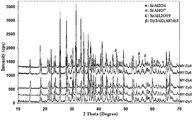
In the bluish-green phosphorescent pigment recipe, if Dy2O3 content is in the 0.01-0.3 molar ranges, it affects the spectrophotometer results examined. When Dy2O3 content changed while Al/Sr molar ratio was 3.5 and Eu/Dy equal to 4; 6 different recipes were prepared (MY-Dy1, MY-Dy2, MY-Dy3, MY-Dy4, MY-Dy5 and MY-Dy6):
XRD graphs are presented in Figure 2.
Spectroscopic emission graphs (excitation wavelength ~240 nm) of each recipe are given in Figure 3.
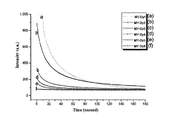
The afterglow (decay) curves of phosphor powders are shown in Figure 4.
In the bluish-green phosphorescent pigment recipe, if Dy2O3 content is in the 0.01-0.3 molar ranges, it affects the spectrophotometer results examined. When Dy2O3 content changed while Al/Sr molar ratio was 3.5 and Eu/Dy equal to 4; 6 different recipes were prepared (MY-Dy1, MY-Dy2, MY-Dy3, MY-Dy4, MY-Dy5 and MY-Dy6):
XRD graphs are presented in Figure 2.
Spectroscopic emission graphs (excitation wavelength ~240 nm) of each recipe are given in Figure 3.
The afterglow (decay) curves of phosphor powders are shown in Figure 4.
The bluish-green phosphorescent pigment recipe in
the Sr4Al14O25:Eu, Dy, Nd
system was studied by preparing 6 different
Dy2O3 molar rates.
| SrCO 3 (gr) | H 3 AlO 3 (gr) | Dy 2 O 3 (gr) | Eu 2 O 3 (gr) | Nd 2 O 3 (gr) | H 3 BO 3 (gr) | |
| Recipe 10.01 mole Dy2O3 | 3.25 | 6 | 0.02 | 0.08 | 0.0037 | 0.64 |
| Recipe 20.02 mole Dy2O3 | 3.20 | 5.88 | 0.04 | 0.078 | 0.0035 | 0.6 |
| Recipe 30.04 mole Dy2O3 | 3.15 | 5.8 | 0.08 | 0.075 | 0.0032 | 0.0032 |
| Recipe 40.08 mole Dy2O3 | 3.10 | 5.73 | 0.16 | 0.073 | 0.0030 | 0.55 |
| Recipe 50.1 mole Dy2O3 | 3.05 | 5.69 | 0.2 | 0.072 | 0.0026 | 0.52 |
| Recipe 60.3 mole Dy2O3 | 3 | 5.62 | 0.6 | 0.07 | 0.0022 | 0.50 |
When XRD graphs belong to the powders prepared by
adding Dy2O3 to the system were
presented in Figure 2. The phases of system were
Sr4Al14O25 and
SrAl4O7 until Eu/Dy mole rate was the
recipe. While Eu/Dy mole rate was higher than the recipe,
Dy3Al2(AlO4)3
phase occured as a result of the reaction between
Dy2O3 and Al2O3.
When sprectroscopic measurement results shown in
Figure 3 are examined, it could be seen that the change in
Dy2O3 amount doesn’t affect the
emission wavelength of phosphorescent pigments excessively
and the prepared pigments have emission wavelength of
483-494 nm ranges (blue-region). Dy3+ has a very
important role in creating holes and phosphorescence
mechanism occuring by thermal emission in the long-afterglow
phosphor systems. This trapping-emmision process provides a
long lasting luminescence property. Lin et. al indicated
that there would be enough amounts of traps in the main
matrix together with Dy3+ being doped to
structure but, if doped amount was too much, there would be
concentration quenching and luminescence effect may be decreased.
It can be clearly seen that the luminescence
intensities and decay times of MY-Dy1 and MY-Dy2 coded
compositions were higher in the decay curves seen in Figure
5.
The particle sizes were determined as ~10 µm
according to the scanning electron microscope (SEM) results
of phosphorescent pigments, grain sizes of which were
examined after sintering and dry grinding. SEM results
corresponded with particle-size analysis ones.
Earth alkali aluminate systems activated with rare
earth elements are long-lasting phosphorescent pigment
systems. The most important property of these systems are
strong light absorbtion, storage and emission ability thanks
to their structure and then, long-afterglow property with
high brightness, eventually. According to the light source
(generally room light), they show emission for more than 12
hours after light source is removed. Their brightness and
decay times are ten times more than that of well known zinc
sulphate phosphors. Earth alkali aluminate systems do not
show any harmfull effects to the health not containing
radioactive contribution. Apart from this, they are stable
and resistant to atmospheric effects unlike zinc sulphate
system. Light absorbtion and emission go on continuously.
In this invention, the bluish-green colour
emitting phosphorescent pigments of strontium aluminates
being most common and accomplished in the earth alkali
aluminate systems were developed under the light of previous
studies reported in the literature.
When we characterize the aluminate phosphors
[(M4Al14O25: R(x, y, z, t,
k, l, m, r, a, b, c, d)] which have long lasting
luminescence in bluish-green colour in the dark.
M:Strontium (Sr) element
R:Europium (Eu) as emission center, one or more from Dysprosium (Dy), Yttrium (Y) or Neodymium (Nd) Yttrium (Y), Praseodymium (Pr), Ytterbium (Yb), Erbium (Er), Gadolinium (Gd), Cerium (Ce), Samarium (Sm), Hafmium (Hf), Thulium (Tm) occur as co-dopant in the structure.
R:Europium (Eu) as emission center, one or more from Dysprosium (Dy), Yttrium (Y) or Neodymium (Nd) Yttrium (Y), Praseodymium (Pr), Ytterbium (Yb), Erbium (Er), Gadolinium (Gd), Cerium (Ce), Samarium (Sm), Hafmium (Hf), Thulium (Tm) occur as co-dopant in the structure.
1. In the phosphorescent pigments having long
lasting bluish-green emission mentioned in the claim 1 the
molar ranges of rare earth elements; Eux,
Dyy, Ndz, Yt, Prk,
Ybl, Erm, Gdr,
Cea, Smb, Hfc,
Tmd which can be added to
Sr4Al14O25 , the main
phase are as follows:
| Sr 4 Al 14 O 25 : Eu x , Dy y , Nd z , Y t , Pr k , Yb l , Er m , Gd r , Ce a , Sm b , Ho c , Tm d , B e | 0.0001≤ x, y, z, t, k, l, m, r, a, b, c, d ≤0.1 |
2. The phosphorescent pigments with long lasting
bluish-green emission mentioned in the claim 1-2 have been
characterized by synthesizing via solid-state reaction
method under reductive nitrogen (N2) – hydrogen
(H2) gas atmosphere.
3. Claim 3 indicates the synthesizing method and
its specification consists of the relevant steps as
follows:
- Mentioned gas atmosphere is nitrogen (N2) – hydrogen (H2) mixture. 90-98.5 % N2 and 1.5-10 H2 % is used.
- Appropriate raw materials are chosen for solid-state reaction method of the phosphorescence pigment (in oxide, carbonate, hydroxide etc. forms). The determined raw materials are selected with the proper purities (>99.5 %).
- To get long-afterglow phosphorescent pigment by the synthesizing method mentioned wet milling is applied for appropriate time by planetary mill (30 minutes – 6 hours).
- In the wet milling process mentioned the proper wet medium (ethanol, propanol-2 pure water, etc.), appropriate milling and mixing media, aluminum and zirconuim oxide balls in the diameter of 1mm-, and their jars are provided.
A) In the synthesizing method mentioned to get long-afterglow phosphorescent pigment a proper gas flow rate (0.1-0.50 lt/min) is set in the sintering furnace.
B) In the synthesizing method mentioned to obtain Sr4Al14O25 phase a proper sintering temperature (1250-1600 oC) and time (30 minutes-6 hours) are set in the furnace.
- In the synthesizing method mentioned the wet-milled and then dried batch is loaded in proper crucibles. The conditions indicated in A and B are followed:
- In the synthesizing method mentioned to get long-afterglow phosphorescent pigment dry milling to the bulk phosphor is performed under proper conditions for certain time to obtain particle sizes previously determined depending on the application field of the pigment.
- Mentioned gas atmosphere is nitrogen (N2) – hydrogen (H2) mixture. 90-98.5 % N2 and 1.5-10 H2 % is used.
- Appropriate raw materials are chosen for solid-state reaction method of the phosphorescence pigment (in oxide, carbonate, hydroxide etc. forms). The determined raw materials are selected with the proper purities (>99.5 %).
- To get long-afterglow phosphorescent pigment by the synthesizing method mentioned wet milling is applied for appropriate time by planetary mill (30 minutes – 6 hours).
- In the wet milling process mentioned the proper wet medium (ethanol, propanol-2 pure water, etc.), appropriate milling and mixing media, aluminum and zirconuim oxide balls in the diameter of 1mm-, and their jars are provided.
A) In the synthesizing method mentioned to get long-afterglow phosphorescent pigment a proper gas flow rate (0.1-0.50 lt/min) is set in the sintering furnace.
B) In the synthesizing method mentioned to obtain Sr4Al14O25 phase a proper sintering temperature (1250-1600 oC) and time (30 minutes-6 hours) are set in the furnace.
- In the synthesizing method mentioned the wet-milled and then dried batch is loaded in proper crucibles. The conditions indicated in A and B are followed:
- In the synthesizing method mentioned to get long-afterglow phosphorescent pigment dry milling to the bulk phosphor is performed under proper conditions for certain time to obtain particle sizes previously determined depending on the application field of the pigment.
Phosphorescent pigments are used in coating of
products surfaces and can also be mixed with plastic,
elastic, polyvinyl chloride (PVC), other synthetic resins
and glass.
They find themselves a wide usage area in traffic
safety signs, traffic control gloves, reflection plates of
vehicles, reflection flags, highway signs, tyres, shoes,
trench coats, telephone keypad overlays, watches, stair
edges, emergency exit signs, the surface of the fire
extinguisher cylinder, toys, writing tools. Apart from
these, ceramic glazes doped with phosphorescence pigment
have potential usage in apartments, especially in the well
as skirting (ceramic production used in area where the wall
and ground intersect). It can be a practical solution in the
case of sudden electric cut, afterwards in emergency when
the phosphorescent signs are placed beside stairs. Ceramic
and glass product with phosphorescence pigment can be used
as decor. As a border, glow stone, overlays in kitchen,
bathroom or pool, ceramics with phosphorescent pigments
containing glazes also provide visual richness which could
be of ceramic artists interest.
Claims (4)
- When we characterize the long lasting bluish-green colour emitting phosphorescent pigments M4Al14O25: R(x, y, z, t, k, l, m, r, a, b, c, d is valid:
M:Strontium (Sr) element
R:Europium (Eu) as emission center, one or more from Dysprosium (Dy), Yttrium (Y) or Neodymium (Nd) Yttrium (Y), Praseodymium (Pr), Ytterbium (Yb), Erbium (Er), Gadolinium (Gd), Cerium (Ce), Samarium (Sm), Hafmium (Hf), Thulium (Tm) occur as co-dopant in the structure. - In the phosphorescent pigments having long lasting bluish-green emission mentioned in the claim 1, the molar ranges of rare earth elements; Eux, Dyy, Ndz, Yt, Prk, Ybl, Erm, Gdr, Cea, Smb, Hfc, Tmd which can be added to Sr4Al14O25, the main phase, are as follows: Refence ---Table 2.
- The phosphorescent pigments with long lasting bluish-green emission mentioned in the claim 1-2 have been characterized by synthesizing via solid-state reaction method under reductive nitrogen (N2) – hydrogen (H2) gas atmosphere.
- Claim 3 indicates the synthesizing method and its specifications consist of the relevant steps as follows:
- Mentioned gas atmosphere is nitrogen (N2) – hydrogen (H2) mixture. 90-98.5 % N2 and 1.5-10 H2 % is used.
- Appropriate raw materials are chosen for solid-state reaction method of the phosphorescence pigment (in oxide, carbonate, hydroxide etc. forms). The determined raw materials are selected with the proper purities (>99.5 %).
- To get long-afterglow phosphorescent pigment by the synthesizing method mentioned wet milling is applied for appropriate time by planetary mill (30 minutes – 6 hours).
- In the wet milling process mentioned, the proper wet medium (ethanol, propanol-2 pure water, etc.), appropriate milling and mixing media, aluminum and zirconuim oxide balls in the diameter of 1mm-, and their jars are provided.
C) In the synthesizing method mentioned to get long-afterglow phosphorescent pigment a proper gas flow rate (0.1-0.50 lt/min) is set in the sintering furnace.
D) In the synthesizing method mentioned to obtain Sr4Al14O25 phase a proper sintering temperature (1250-1600 oC) and time (30 minutes-6 hours) are set in the furnace.
- In the synthesizing method mentioned the wet-milled and then dried batch is loaded into proper crucibles. The conditions indicated in A and B are followed:
- In the synthesizing method mentioned to get long-afterglow phosphorescent pigment dry milling to the bulk phosphor is performed under proper conditions for certain time to obtain particle sizes previously determined depending on the application field of the pigment.
Priority Applications (1)
| Application Number | Priority Date | Filing Date | Title |
|---|---|---|---|
| PCT/TR2015/050004 WO2016200348A1 (en) | 2015-06-10 | 2015-06-10 | Long lasting bluish-green emitting phosphorescent pigments in the strontium aluminate (sr4al14o25) system |
Applications Claiming Priority (1)
| Application Number | Priority Date | Filing Date | Title |
|---|---|---|---|
| PCT/TR2015/050004 WO2016200348A1 (en) | 2015-06-10 | 2015-06-10 | Long lasting bluish-green emitting phosphorescent pigments in the strontium aluminate (sr4al14o25) system |
Publications (1)
| Publication Number | Publication Date |
|---|---|
| WO2016200348A1 true WO2016200348A1 (en) | 2016-12-15 |
Family
ID=53514384
Family Applications (1)
| Application Number | Title | Priority Date | Filing Date |
|---|---|---|---|
| PCT/TR2015/050004 Ceased WO2016200348A1 (en) | 2015-06-10 | 2015-06-10 | Long lasting bluish-green emitting phosphorescent pigments in the strontium aluminate (sr4al14o25) system |
Country Status (1)
| Country | Link |
|---|---|
| WO (1) | WO2016200348A1 (en) |
Cited By (1)
| Publication number | Priority date | Publication date | Assignee | Title |
|---|---|---|---|---|
| CN111978949A (en) * | 2020-08-19 | 2020-11-24 | 河北大学 | Elastic force luminous composite material, preparation method and application thereof |
Citations (1)
| Publication number | Priority date | Publication date | Assignee | Title |
|---|---|---|---|---|
| EP2626401A1 (en) * | 2012-02-10 | 2013-08-14 | Rolex Sa | Novel long decay phosphors |
-
2015
- 2015-06-10 WO PCT/TR2015/050004 patent/WO2016200348A1/en not_active Ceased
Patent Citations (1)
| Publication number | Priority date | Publication date | Assignee | Title |
|---|---|---|---|---|
| EP2626401A1 (en) * | 2012-02-10 | 2013-08-14 | Rolex Sa | Novel long decay phosphors |
Non-Patent Citations (4)
| Title |
|---|
| LIN YUANHUA ET AL: "Anomalous luminescence in Sr4Al14O25:Eu, Dy phosphors", APPLIED PHYSICS LETTERS, AMERICAN INSTITUTE OF PHYSICS, 2 HUNTINGTON QUADRANGLE, MELVILLE, NY 11747, vol. 81, no. 6, 5 August 2002 (2002-08-05), pages 996 - 998, XP012033209, ISSN: 0003-6951, DOI: 10.1063/1.1490631 * |
| NAKAZAWA EIICHIRO ET AL: "Mechanism of the persistent phosphorescence in Sr4Al14O25:Eu and SrAl2O4:Eu codoped with rare earth ions", JOURNAL OF APPLIED PHYSICS, AMERICAN INSTITUTE OF PHYSICS, US, vol. 100, no. 11, 7 December 2006 (2006-12-07), pages 113113 - 113113, XP012089066, ISSN: 0021-8979, DOI: 10.1063/1.2397284 * |
| SURIYAMURTHY N ET AL: "Effects of non-stoichiometry and substitution on photoluminescence and afterglow luminescence of Sr4Al14O25:Eu<2+>, Dy<3+> phosphor", JOURNAL OF LUMINESCENCE, ELSEVIER BV NORTH-HOLLAND, NL, vol. 128, no. 11, 1 November 2008 (2008-11-01), pages 1809 - 1814, XP023614113, ISSN: 0022-2313, [retrieved on 20080510], DOI: 10.1016/J.JLUMIN.2008.05.001 * |
| VISHAL SHARMA ET AL: "Potential of Sr4Al14O25: Eu2+,Dy3+ inorganic oxide-based nanophosphor in Latent fingermark detection", JOURNAL OF MATERIALS SCIENCE, vol. 49, no. 5, 5 December 2013 (2013-12-05), Dordrecht, pages 2225 - 2234, XP055224095, ISSN: 0022-2461, DOI: 10.1007/s10853-013-7916-2 * |
Cited By (2)
| Publication number | Priority date | Publication date | Assignee | Title |
|---|---|---|---|---|
| CN111978949A (en) * | 2020-08-19 | 2020-11-24 | 河北大学 | Elastic force luminous composite material, preparation method and application thereof |
| CN111978949B (en) * | 2020-08-19 | 2023-07-04 | 河北大学 | Elastic force-induced luminous composite material, preparation method and application thereof |
Similar Documents
| Publication | Publication Date | Title |
|---|---|---|
| Gupta et al. | Lanthanide-doped lanthanum hafnate nanoparticles as multicolor phosphors for warm white lighting and scintillators | |
| Wu et al. | Long afterglow phosphorescent materials | |
| Ye et al. | A novel reddish-orange fluorapatite phosphor, La6-xBa4 (SiO4) 6F2: xSm3+-Structure, luminescence and energy transfer properties | |
| Kumar et al. | Surface and spectral studies of Eu3+ doped α-Al2O3 synthesized via solution combustion synthesis | |
| DE102010034322A1 (en) | Surface modified silicate phosphors | |
| Das et al. | Morphology control and photoluminescence properties of Eu 3+-activated Y 4 Al 2 O 9 nanophosphors for solid state lighting applications | |
| Yousif et al. | Ultra-broadband luminescent from a Bi doped CaO matrix | |
| He et al. | Enhanced afterglow performance of Zn2SiO4: Mn2+ by Pr3+ doping and mechanism | |
| Raman et al. | Photoluminescence properties of Sm3+-doped LiPbB5O9 phosphor for reddish-orange emitting light applications | |
| Wang et al. | Long persistent luminescence and traps distribution of Tb3+ doped calcium gallium germanate | |
| Parayil et al. | Ultra-bright and thermally stable deep red emitting doped yttrium zirconate nanoparticles for tunable white LEDs and indoor plant growth | |
| Long et al. | Modulating Mn self-reduction and multimodal luminescence in CaSb 2 O 6 through La 3+ doping for quadruple-mode dynamic anti-counterfeiting and optical temperature sensing applications | |
| EP3564338B1 (en) | Phosphorescent fluorescent body and production method therefore, and phosphorescent product | |
| Anu et al. | Spectral studies of thermally stable Dy3+/Sm3+ co-doped Li2Ba5W3O15 phosphors for warm white LEDs | |
| Jiayue et al. | Luminescence properties of SrB4O7: Sm2+ for light conversion agent | |
| Shivaramu et al. | Charge carrier trapping processes in un-doped and BaAl2O4: Eu3+ nanophosphor for thermoluminescent dosimeter applications | |
| Singh et al. | UV emitting Pb2+ doped SrZrO3 phosphors prepared by sol-gel procedure | |
| Hussin et al. | The origin of emission in strontium magnesium pyrophosphate doped with Dy2O3 | |
| Jaffar et al. | Optical properties and stability of Bi doped La2O2S | |
| Vinodkumar et al. | Influence of interstitial UO 2 2+ doping on the valence control of Eu and energy transfer to substitutional Eu 3+ and Sm 3+ in SrBPO 5 | |
| Noto et al. | Persistent photoluminescence emission from SrTa2O6: Pr3+ phosphor prepared at different temperatures | |
| DE102009030205A1 (en) | Phosphors with Eu (II) -doped silicate luminophores | |
| Öztürk et al. | Synthesizing and photoluminescence properties of Eu3+-doped germanate and Dy3+-doped silicate hosts | |
| Cavalli et al. | The dual luminescence of M2MgTeO6 (M= Sr, Ba) double perovskites | |
| US8765016B2 (en) | Green luminescent material of terbium doped gadolinium borate and preparing method thereof |
Legal Events
| Date | Code | Title | Description |
|---|---|---|---|
| 121 | Ep: the epo has been informed by wipo that ep was designated in this application |
Ref document number: 15734481 Country of ref document: EP Kind code of ref document: A1 |
|
| NENP | Non-entry into the national phase |
Ref country code: DE |
|
| 32PN | Ep: public notification in the ep bulletin as address of the adressee cannot be established |
Free format text: NOTING OF LOSS OF RIGHTS PURSUANT TO RULE 112(1)EPC DATED 03.04.2018 (EPO FORM 1205A). |
|
| 122 | Ep: pct application non-entry in european phase |
Ref document number: 15734481 Country of ref document: EP Kind code of ref document: A1 |