WO2016189796A1 - 車両用通信システム、車載装置及び鍵発行装置 - Google Patents
車両用通信システム、車載装置及び鍵発行装置 Download PDFInfo
- Publication number
- WO2016189796A1 WO2016189796A1 PCT/JP2016/002062 JP2016002062W WO2016189796A1 WO 2016189796 A1 WO2016189796 A1 WO 2016189796A1 JP 2016002062 W JP2016002062 W JP 2016002062W WO 2016189796 A1 WO2016189796 A1 WO 2016189796A1
- Authority
- WO
- WIPO (PCT)
- Prior art keywords
- key
- vehicle
- expiration date
- communication system
- issuing
- Prior art date
- Legal status (The legal status is an assumption and is not a legal conclusion. Google has not performed a legal analysis and makes no representation as to the accuracy of the status listed.)
- Ceased
Links
Images


Classifications
-
- H—ELECTRICITY
- H04—ELECTRIC COMMUNICATION TECHNIQUE
- H04L—TRANSMISSION OF DIGITAL INFORMATION, e.g. TELEGRAPHIC COMMUNICATION
- H04L9/00—Cryptographic mechanisms or cryptographic arrangements for secret or secure communications; Network security protocols
- H04L9/08—Key distribution or management, e.g. generation, sharing or updating, of cryptographic keys or passwords
- H04L9/0816—Key establishment, i.e. cryptographic processes or cryptographic protocols whereby a shared secret becomes available to two or more parties, for subsequent use
- H04L9/0819—Key transport or distribution, i.e. key establishment techniques where one party creates or otherwise obtains a secret value, and securely transfers it to the other(s)
-
- H—ELECTRICITY
- H04—ELECTRIC COMMUNICATION TECHNIQUE
- H04L—TRANSMISSION OF DIGITAL INFORMATION, e.g. TELEGRAPHIC COMMUNICATION
- H04L9/00—Cryptographic mechanisms or cryptographic arrangements for secret or secure communications; Network security protocols
- H04L9/08—Key distribution or management, e.g. generation, sharing or updating, of cryptographic keys or passwords
- H04L9/0861—Generation of secret information including derivation or calculation of cryptographic keys or passwords
- H04L9/0877—Generation of secret information including derivation or calculation of cryptographic keys or passwords using additional device, e.g. trusted platform module [TPM], smartcard, USB or hardware security module [HSM]
-
- H—ELECTRICITY
- H04—ELECTRIC COMMUNICATION TECHNIQUE
- H04L—TRANSMISSION OF DIGITAL INFORMATION, e.g. TELEGRAPHIC COMMUNICATION
- H04L9/00—Cryptographic mechanisms or cryptographic arrangements for secret or secure communications; Network security protocols
- H04L9/08—Key distribution or management, e.g. generation, sharing or updating, of cryptographic keys or passwords
- H04L9/0891—Revocation or update of secret information, e.g. encryption key update or rekeying
-
- H—ELECTRICITY
- H04—ELECTRIC COMMUNICATION TECHNIQUE
- H04L—TRANSMISSION OF DIGITAL INFORMATION, e.g. TELEGRAPHIC COMMUNICATION
- H04L9/00—Cryptographic mechanisms or cryptographic arrangements for secret or secure communications; Network security protocols
- H04L9/32—Cryptographic mechanisms or cryptographic arrangements for secret or secure communications; Network security protocols including means for verifying the identity or authority of a user of the system or for message authentication, e.g. authorization, entity authentication, data integrity or data verification, non-repudiation, key authentication or verification of credentials
- H04L9/3271—Cryptographic mechanisms or cryptographic arrangements for secret or secure communications; Network security protocols including means for verifying the identity or authority of a user of the system or for message authentication, e.g. authorization, entity authentication, data integrity or data verification, non-repudiation, key authentication or verification of credentials using challenge-response
- H04L9/3273—Cryptographic mechanisms or cryptographic arrangements for secret or secure communications; Network security protocols including means for verifying the identity or authority of a user of the system or for message authentication, e.g. authorization, entity authentication, data integrity or data verification, non-repudiation, key authentication or verification of credentials using challenge-response for mutual authentication
-
- H—ELECTRICITY
- H04—ELECTRIC COMMUNICATION TECHNIQUE
- H04W—WIRELESS COMMUNICATION NETWORKS
- H04W12/00—Security arrangements; Authentication; Protecting privacy or anonymity
- H04W12/02—Protecting privacy or anonymity, e.g. protecting personally identifiable information [PII]
-
- H—ELECTRICITY
- H04—ELECTRIC COMMUNICATION TECHNIQUE
- H04W—WIRELESS COMMUNICATION NETWORKS
- H04W12/00—Security arrangements; Authentication; Protecting privacy or anonymity
- H04W12/03—Protecting confidentiality, e.g. by encryption
-
- H—ELECTRICITY
- H04—ELECTRIC COMMUNICATION TECHNIQUE
- H04W—WIRELESS COMMUNICATION NETWORKS
- H04W12/00—Security arrangements; Authentication; Protecting privacy or anonymity
- H04W12/04—Key management, e.g. using generic bootstrapping architecture [GBA]
-
- H—ELECTRICITY
- H04—ELECTRIC COMMUNICATION TECHNIQUE
- H04W—WIRELESS COMMUNICATION NETWORKS
- H04W12/00—Security arrangements; Authentication; Protecting privacy or anonymity
- H04W12/04—Key management, e.g. using generic bootstrapping architecture [GBA]
- H04W12/041—Key generation or derivation
-
- H—ELECTRICITY
- H04—ELECTRIC COMMUNICATION TECHNIQUE
- H04L—TRANSMISSION OF DIGITAL INFORMATION, e.g. TELEGRAPHIC COMMUNICATION
- H04L2209/00—Additional information or applications relating to cryptographic mechanisms or cryptographic arrangements for secret or secure communication H04L9/00
- H04L2209/84—Vehicles
-
- H—ELECTRICITY
- H04—ELECTRIC COMMUNICATION TECHNIQUE
- H04L—TRANSMISSION OF DIGITAL INFORMATION, e.g. TELEGRAPHIC COMMUNICATION
- H04L67/00—Network arrangements or protocols for supporting network services or applications
- H04L67/01—Protocols
- H04L67/12—Protocols specially adapted for proprietary or special-purpose networking environments, e.g. medical networks, sensor networks, networks in vehicles or remote metering networks
-
- H—ELECTRICITY
- H04—ELECTRIC COMMUNICATION TECHNIQUE
- H04W—WIRELESS COMMUNICATION NETWORKS
- H04W4/00—Services specially adapted for wireless communication networks; Facilities therefor
- H04W4/30—Services specially adapted for particular environments, situations or purposes
- H04W4/40—Services specially adapted for particular environments, situations or purposes for vehicles, e.g. vehicle-to-pedestrians [V2P]
-
- H—ELECTRICITY
- H04—ELECTRIC COMMUNICATION TECHNIQUE
- H04W—WIRELESS COMMUNICATION NETWORKS
- H04W4/00—Services specially adapted for wireless communication networks; Facilities therefor
- H04W4/30—Services specially adapted for particular environments, situations or purposes
- H04W4/40—Services specially adapted for particular environments, situations or purposes for vehicles, e.g. vehicle-to-pedestrians [V2P]
- H04W4/48—Services specially adapted for particular environments, situations or purposes for vehicles, e.g. vehicle-to-pedestrians [V2P] for in-vehicle communication
Definitions
- the present disclosure relates to a vehicle communication system in which a mobile device and an in-vehicle device perform cryptographic communication using a key issued from a key issuing device.
- Patent Document 1 discloses a communication system in which a portable device carried by a user of a vehicle and an in-vehicle device mounted on the vehicle perform cryptographic communication.
- the communication system of Patent Document 1 includes a smart key for locking and unlocking a door as a portable device, and a door lock device for locking and unlocking the door as an in-vehicle device.
- the smart key and the door lock device store a plurality of keys for encryption communication issued from a key issuing device that can communicate via a communication network.
- the smart key and the door lock device use one of a plurality of stored keys for encrypted communication. By switching the key to be used until successful encrypted communication, a matching key is specified on both sides. ing.
- Patent Document 1 by using such a method, even if the smart key and the door lock device do not always communicate with the key issuing device, the key used for the cryptographic communication is updated, thereby improving the security of the cryptographic communication. Secured.
- the present disclosure reduces the frequency with which mobile devices and in-vehicle devices have to communicate with the key issuing device, secures security by updating the key for cryptographic communication, and the resources required to store the key.
- the purpose is to achieve reduction.
- a communication system for a vehicle includes an in-vehicle device mounted on a vehicle, a portable device that is carried by a user of the vehicle, and an encryption communication unit that is provided outside the vehicle, And a key issuing device for issuing the key.
- the mobile device and the in-vehicle device store the key issued by the key issuing device, and perform encrypted communication using the stored key.
- the key and the expiration date information indicating the expiration date of the key are issued from the key issuing device to the in-vehicle device.
- the in-vehicle device includes a determination unit and an update request unit.
- the determination unit determines whether an expiration date indicated by the issued expiration date information has arrived.
- the update request unit transmits a key update request for requesting the key issuing device to issue a new key.
- the key issuing device When the key issuing device receives a key update request from the in-vehicle device, the key issuing device issues a new key to the mobile device and issues the new key and expiration date information about the key to the in-vehicle device.
- the key issuance from the key issuing device to the mobile device and the in-vehicle device may be performed every time the expiration date indicated by the expiration date information arrives. For this reason, the frequency with which a portable apparatus and a vehicle-mounted apparatus must communicate with a key issuing apparatus can be lowered
- the security of the encryption communication can be ensured.
- the portable device and the in-vehicle device only need to store one key for encryption communication. That is, it is not necessary to store a plurality of keys. For this reason, it is possible to reduce resources (that is, memory resources) necessary for storing the key in the portable device and the in-vehicle device.
- the portable device may be taken away by a person who is not the user of the vehicle, but key expiration date information is not stored in the portable device. For this reason, it is possible to prevent a malicious person from falsifying the expiration date information, and as a result, the security of encryption communication can be improved.
- the vehicle-mounted device is mounted on a vehicle and performs cryptographic communication with a portable device that is carried by a user of the vehicle.
- a key used for encryption communication is issued to the in-vehicle device by a key issuing device outside the vehicle.
- the key and the expiration date information indicating the expiration date of the key are issued from the key issuing device to the in-vehicle device.
- the in-vehicle device includes a determination unit and an update request unit.
- the determination unit determines whether an expiration date indicated by the issued expiration date information has arrived.
- the update request unit transmits a key update request for requesting the key issuing device to issue a new key.
- the in-vehicle device of the present disclosure can be used as an in-vehicle device in a vehicle communication system.
- a key issuing device issues a key for encryption communication to a portable device carried by a vehicle user and an in-vehicle device mounted on the vehicle.
- the key issuing device includes a first issuing unit, a second issuing unit, and a key updating unit.
- the first issuing unit issues a key to the mobile device.
- the second issuing unit issues a key and expiration date information indicating the expiration date of the key to the in-vehicle device.
- the key update unit determines whether a key update request transmitted from the in-vehicle device has been received when the expiration date indicated by the expiration date information issued to the in-vehicle device has arrived, and determines that the key update request has been received. In this case, a new key is issued to the first issuing unit, and the new key and expiration date information about the key are issued to the second issuing unit.
- the key issuing device of the present disclosure can be used as a key issuing device in a vehicle communication system.
- the frequency with which mobile devices and in-vehicle devices have to communicate with the key issuing device is reduced, security is ensured by updating the key for encryption communication, and the resources necessary for storing the key are reduced. Reduction can be realized.
- FIG. 1 is a configuration diagram illustrating a vehicle communication system according to an embodiment.
- FIG. 2 is a flowchart showing each process of the key issuing server, the portable device, and the in-vehicle device.
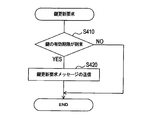
- FIG. 3 is a flowchart showing the key update request process.
- a vehicle communication system 1 includes an in-vehicle device 5 that is a device mounted on a vehicle 3, a portable device 7 that is carried by a user of the vehicle 3, and an outside of the vehicle 3. And a key issuing server (corresponding to a key issuing device) 9 serving as a key issuing device.
- the mobile device 7 is a multi-function mobile phone (so-called smartphone) in this embodiment.
- the key issuing server 9 functions as a center for issuing keys for encryption communication to the in-vehicle device 5 and the portable device 7.
- Communication between the key issuing server 9 and the in-vehicle device 5 and between the key issuing server 9 and the portable device 7 is possible via a communication network 10 such as a mobile phone network, the Internet, or a wide area network. .
- a communication network 10 such as a mobile phone network, the Internet, or a wide area network.
- Each of the in-vehicle device 5 and the portable device 7 communicates with the key issuing server 9 wirelessly.
- the portable device 7 and the in-vehicle device 5 can communicate with each other by short-range wireless communication using, for example, a UHF (Ultra High Frequency) band or the like.
- the wireless communication method between the mobile device 7 and the in-vehicle device 5 is, for example, Bluetooth (registered trademark), but other methods such as infrared communication may be used.
- communication via the communication network 10 may be performed.
- the in-vehicle device 5 includes a network interface 11 for communicating with at least the key issuing server 9 via the communication network 10 and a short-range communication device 12 for performing wireless communication with the portable device 7.
- the in-vehicle device 5 includes a CPU (Central Processing Unit) 13, a ROM (Read Only Memory) 14, a RAM (Random Access Memory) 15, and a storage device 16.
- the storage device 16 is a rewritable nonvolatile memory such as an EEPROM (ElectricallyrErasablerasProgrammable ROM) or flash memory, but may be a hard disk drive or the like.
- the in-vehicle device 5 includes an input circuit 17 for inputting various information related to the vehicle 3 and an output circuit 18 for controlling devices mounted on the vehicle 3.
- the mobile device 7 includes a network interface 21 for communicating with at least the key issuing server 9 via the communication network 10, a short-range communication device 22 for performing wireless communication with the in-vehicle device 5, a CPU 23, A ROM 24, a RAM 25, a storage device 26, and a display device 27 are provided.
- the display device 27 is, for example, a touch panel that also has a function as an input device.
- the storage device 26 is a rewritable nonvolatile memory such as an EEPROM or a flash memory, but may be a hard disk drive or the like.
- the key issuing server 9 includes a network interface 31, a CPU 33, a ROM 34, a RAM 35, and a storage device 36 for communicating with at least the in-vehicle device 5 and the portable device 7 via the communication network 10.
- the storage device 36 is, for example, a hard disk drive, but may be a rewritable nonvolatile memory such as an EEPROM or a flash memory.
- Each of the key issuing server 9, the portable device 7, and the in-vehicle device 5 includes a CPU, a ROM, and a RAM, and thus functions as a computer.
- the operation of the key issuing server 9 is realized by the CPU 33 executing a program stored in the ROM 34 or the storage device 36, for example.
- the ROM 34 and the storage device 36 correspond to an example of a computer-readable non-transitory storage medium.
- the operation of the in-vehicle device 5 is realized by the CPU 13 executing a program stored in, for example, the ROM 14 or the storage device 16.
- the operation of the portable device 7 is realized by the CPU 23 executing a program stored in the ROM 24 or the storage device 26, for example.
- the operation of the mobile device 7 described below is realized by the CPU 23 executing application software stored in the storage device 26, for example.
- the application software is downloaded from the key issuing server 9, for example.
- the key issuing server 9 performs processing for mutual authentication with the portable device 7 (S110). Then, the portable device 7 also performs a process for mutual authentication with the key issuing server 9 (S210). That is, the key issuing server 9 and the portable device 7 perform mutual authentication (S110, S210).
- the key issuing server 9 and the portable device 7 perform mutual authentication by, for example, a challenge / response method.
- the authentication key A is transferred from the key issuing server 9 to the portable device 7 in advance. It is distributed.
- the authentication key A may be embedded in application software downloaded from the key issuing server 9 to the mobile device 7.
- the user operates the portable device 7 and transmits a user ID, a password, and the like to the key issuing server 9, the authentication key A is transmitted from the key issuing server 9 to the portable device 7. Also good.
- any method may be used as long as the key issuing server 9 and the portable device 7 can share the authentication key A.
- the key issuing server 9 transmits random data that changes every time to the portable device 7 as a “challenge”.
- the portable device 7 performs a predetermined calculation using the data received from the key issuing server 9 and the authentication key A held by itself, and uses the calculation result data as a “response” as a key.
- the key issuing server 9 calculates the “response” by performing the same calculation as the mobile device 7 side using the “challenge” transmitted to the mobile device 7 and the authentication key A held by itself. If the calculation result matches the “response” received from the mobile device 7, the mobile device 7 is authenticated.
- the mutual authentication method between the key issuing server 9 and the portable device 7 may be a method other than the challenge / response method.
- the key issuing server 9 performs processing for mutual authentication with the in-vehicle device 5 (S120). Then, the in-vehicle device 5 also performs a process for mutual authentication with the key issuing server 9 (S310). That is, the key issuing server 9 and the in-vehicle device 5 perform mutual authentication (S120, S310).
- the key issuing server 9 and the in-vehicle device 5 also perform mutual authentication by a challenge / response method, for example, as in the mutual authentication between the key issuing server 9 and the portable device 7.
- the authentication key B is, for example, unique to the master key and the in-vehicle device 5. It is generated from the ID.
- the master key is shared between the manufacturing factory of the vehicle 3 and the key issuing server 9.
- the authentication key B is generated from the ID of the in-vehicle device 5 and the master key according to a predetermined generation rule, and the generated authentication key B is For example, the data is written in the storage device 16 of the device 5. Therefore, the in-vehicle device 5 performs mutual authentication with the key issuing server 9 using the authentication key B stored in the storage device 16.
- the key issuing server 9 acquires an ID from the in-vehicle device 5 in the authentication process with the in-vehicle device 5, and from the acquired ID and the master key, the same rule as the generation rule in the manufacturing factory of the vehicle 3 is used. An authentication key B is generated. Then, the key issuing server 9 performs mutual authentication with the in-vehicle device 5 using the generated authentication key B.
- the key issuing server 9 When the mutual authentication with the mobile device 7 and the in-vehicle device 5 is completed, the key issuing server 9 generates a key for encryption communication to be issued to the mobile device 7 and the in-vehicle device 5 (S130).
- the key generated in S130 is different every time.
- the key issuing server 9 encrypts the key generated in S130 by using the authentication key A shared with the portable device 7, and transmits the encrypted key to the portable device 7 (S140). ). Sending the key to the mobile device 7 corresponds to issuing the key to the mobile device 7.
- the mobile device 7 receives the encrypted key from the key issuing server 9, decrypts the received key using the authentication key A, and uses the decrypted key as the storage device 26, for example. (S220).
- the key issuing server 9 adds expiration date information to the key generated in S130, and shares the key with the expiration date information (hereinafter referred to as a key with information) with the in-vehicle device 5. Encryption is performed using the authentication key B. Then, the encrypted key with information is transmitted to the in-vehicle device 5 (S150). Transmitting the key with information to the in-vehicle device 5 corresponds to issuing the key and the expiration date information to the in-vehicle device 5.
- the expiration date information is information indicating the expiration date of the key. The specific contents of the expiration date information will be described later.
- the in-vehicle device 5 receives the encrypted key with information from the key issuing server 9 and decrypts the received key with information by using the authentication key B. Then, the decrypted key and expiration date information are stored in, for example, the storage device 16 (S320). Note that the key and the expiration date information may be sequentially transmitted from the key issuing server 9 to the in-vehicle device 5 one by one instead of in the form of a key with information.
- the mobile device 7 and the in-vehicle device 5 perform mutual authentication using the key issued from the key issuing server 9 (S230, S330). That is, the portable device 7 performs processing for mutual authentication with the in-vehicle device 5 in S230, and the in-vehicle device 5 performs processing for mutual authentication with the portable device 7 in S330.
- the portable device 7 and the in-vehicle device 5 perform mutual authentication by the above-described challenge / response method, for example, and the key issued from the key issuing server 9 is used as the authentication key.
- a retry request is transmitted to the key issuing server 9. Then, the key issuing server 9 that has received the retry request starts over from the processing of S110.
- the portable device 7 and the in-vehicle device 5 After successful mutual authentication, the portable device 7 and the in-vehicle device 5 perform cryptographic communication using the key issued and stored from the key issuing server 9 (S240, S340).
- the mobile device 7 and the in-vehicle device provide services to the user by performing encrypted communication. Note that the process surrounded by the two-dot chain line in FIG. 2 is a process performed at the stage of providing a service to the user.
- the mobile device 7 encrypts a command indicating the content of the request input by the user to the mobile device 7 using the key stored in the storage device 26 in S220, and the encrypted command is transmitted to the short-range communication.
- the data is transmitted to the in-vehicle device 5 by the device 22.
- the in-vehicle device 5 receives the command from the portable device 7 by the short-range communication device 12, and decrypts the received command using the key stored in the storage device 16 in S320. And the vehicle equipment 5 performs the process according to the decoded command.
- a command there is a command for a service that operates any part of the vehicle 3.
- the in-vehicle device 5 when a command requesting locking of the door of the vehicle 3 is transmitted from the portable device 7, the in-vehicle device 5 operates the door lock actuator of the vehicle 3 to lock the door. Conversely, when a command requesting unlocking of the door is transmitted from the portable device 7, the in-vehicle device 5 operates the door lock actuator to unlock the door.
- the service for operating any part of the vehicle 3 is not limited to door locking / unlocking, and may be, for example, moving a power window or starting an engine.
- a command there is a command for a service that notifies the mobile device 7 of the state of the vehicle 3 from the in-vehicle device 5.
- the in-vehicle device 5 encrypts the data of the information requested to be notified by the command using the key stored in the storage device 16 in S320, and the short-range communication device 12 uses the mobile device to encrypt the encrypted data. 7 to send. Then, the mobile device 7 receives the data from the in-vehicle device 5 by the short-range communication device 22 and decrypts the received data using the key stored in the storage device 26 in S220. Then, the portable device 7 displays the decrypted data content on the display device 27.
- failure information data is transmitted from the in-vehicle device 5 to the mobile device 7.
- the contents of the information are displayed on the display device 27 of the portable device 7.
- the in-vehicle device 5 performs the key update request processing shown in FIG. 3 at regular intervals, for example, after successful mutual authentication with the mobile device 7 in S340 of FIG. 2 (that is, after successful receipt of the key). To run.
- the expiration date information transmitted from the key issuing server 9 to the in-vehicle device 5 is information indicating, for example, the elapsed time from the key issuance as the key expiration date.
- the in-vehicle device 5 determines whether or not the time indicated by the expiration date information has elapsed from the time when the key from the key issuing server 9 is updated and stored in the storage device 16, and the time has elapsed. If it is determined, it is determined that the key expiration date has come.
- the in-vehicle device 5 determines in S410 that the key expiration date has not arrived, the in-vehicle device 5 ends the key update request processing as it is, but if it determines that the key expiration date has arrived, Proceed to S420.
- the in-vehicle device 5 transmits a key update request message for requesting issuance of a new key to the key issuing server 9. For example, the in-vehicle device 5 encrypts the key update request message using the authentication key B described above, and transmits the encrypted key update request message to the key issuing server 9. Then, the in-vehicle device 5 ends the key update request process.
- the key update request message corresponds to a key update request.
- S410 corresponds to a process as a determination unit
- S420 corresponds to a process as an update request unit.
- the key issuing server 9 determines whether or not the key update request message from the in-vehicle device 5 has been received (S160). Specifically, the key issuing server 9 receives a message from the in-vehicle device 5, decrypts the received message using the authentication key B, and if the decrypted message is a key update request message, It is determined that the key update request message from the in-vehicle device 5 has been received.
- the key issuing server 9 when the key issuing server 9 receives the key update request message from the in-vehicle device 5, the key issuing server 9 generates a new key (S130) and issues the new key to the portable device 7 (S140). ), The new key and the expiration date information about the key are issued to the in-vehicle device 5 (S150).
- S140 corresponds to a process as a first issuing unit
- S150 corresponds to a process as a second issuing unit
- S130 and S160 correspond to processing as a key update unit.
- the expiration date information is issued from the key issuing server 9 to the in-vehicle device 5 together with the key.
- the keys from the key issuing server 9 to the mobile device 7 and the in-vehicle device 5 are updated. Therefore, the following effects (1) to (4) can be obtained.
- a key is issued from the key issuing server 9 to the mobile device 7 and the in-vehicle device 5 every time the expiration date indicated by the expiration date information arrives. For this reason, the frequency with which the portable apparatus 7 and the vehicle-mounted apparatus 5 must communicate with the key issuing server 9 can be lowered.
- the mobile device 7 and the in-vehicle device 5 may store one key for encryption communication. That is, it is not necessary to store a plurality of keys. For this reason, in the portable apparatus 7 and the vehicle-mounted apparatus 5, the resource (namely, memory resource) required in order to memorize
- the portable device 7 may be taken away by a person who is not the user of the vehicle 3, the portable device 7 does not store key expiration date information. For this reason, it is possible to prevent a malicious person from falsifying the expiration date information, and as a result, the security of encryption communication can be improved.
- the expiration date information is information indicating the elapsed time from the key issuance as the key expiration date. Therefore, the length of the period during which the same key is actually used (that is, the key valid time) can be accurately controlled by the valid term information.
- the expiration date information issued by the key issuing server 9 may be always the same value, but may be different every time the key is updated.
- the expiration date information may be information indicating, as the key expiration date, the number of times that a specific operation has been performed on the vehicle 3 since the key was issued.
- the in-vehicle device 5 may count the number of times that a specific operation has been performed on the vehicle 3 from the time when the key from the key issuing server 9 is updated and stored in the storage device 16. In other words, the in-vehicle device 5 determines in S410 of FIG. 3 whether or not the count value of the number of times that the specific operation has been performed has reached the number of times indicated by the expiration date information, and determines that the number of times has been reached. Then, it may be determined that the key expiration date has come. Further, as the specific operation, for example, an operation of turning on the power switch of the vehicle 3 or an operation of opening / closing the door of the vehicle 3 can be considered.
- the key valid time can be changed according to the usage form of the vehicle. For example, if the expiration date is one week after the key issuance, users who use the vehicle only on weekends will have to renew the key each time the vehicle is used, and the merit of storing the key will be reduced. However, if the expiration date information is, for example, the number of times the power switch of the vehicle 3 is turned on or the number of times the door is opened and closed, the use of the key can be maintained for a certain period.
- the expiration date information may be, for example, information indicating the travel distance of the vehicle 3 from the time of issuing the key as the expiration date of the key.
- the in-vehicle device 5 may count the travel distance of the vehicle 3 from the time when the key from the key issuing server 9 is updated and stored in the storage device 16. That is, in S410 in FIG. 3, the in-vehicle device 5 determines whether or not the count value of the travel distance has reached the travel distance indicated by the expiration date information, and if it is determined that the travel distance has been reached, It may be determined that the expiration date has come. Even if comprised in this way, the effect similar to the modification 1 is acquired.
- the expiration date information may be information indicating, for example, the number of times the vehicle 3 has entered a specific state from the time of key issuance as the key expiration date.
- the in-vehicle device 5 may count the number of times the vehicle 3 has entered a specific state from the time when the key from the key issuing server 9 is updated and stored in the storage device 16. That is, the in-vehicle device 5 determines in S410 of FIG. 3 whether or not the count value of the number of times the vehicle 3 has entered a specific state has reached the number indicated by the expiration date information, and has reached that number. If it is determined, it may be determined that the expiration date of the key has arrived. Even if comprised in this way, the effect similar to the modification 1 is acquired.
- the fuel for the vehicle 3 is a fuel for the power source of the vehicle 3.
- the fuel for example, fossil fuel such as gasoline or light oil, vegetable oil, hydrogen, electricity, etc. can be considered, but other types of fuel may be used.
- the specific state of the vehicle 3 may be, for example, a state where the vehicle 3 has gone to a specific place.
- a specific place for example, a parking lot at home or a parking lot of a company where a user works can be considered, but other places may also be used.
- the specific state of the vehicle 3 may be, for example, a state in which the traveling speed of the vehicle 3 is equal to or higher than a predetermined value.
- a predetermined value of the traveling speed for example, values such as 30 km / h and 80 km / h may be considered, but other values may be used.
- the specific state of the vehicle 3 may be, for example, a state in which the coolant temperature of the engine of the vehicle 3 has become a predetermined value or more.
- a predetermined value of the cooling water temperature for example, a value such as 40 ° C. or 90 ° C. can be considered, but other values may be used.
- Modifications 1 to 3 may be combined as appropriate.
- the mobile device 7 is not limited to a smartphone, and may be, for example, an electronic key for locking / unlocking the door of the vehicle 3 or starting an engine, a tablet computer, or the like.
- the storage location of the key is preferably a storage device having a security function for access.
- the key can be stored in a SIM card (SubscriberSubIdentity Module Card).
- SIM card SubscriberSubIdentity Module Card
- the key can be stored in the security chip.
- the communication between the in-vehicle device 5 and the key issuing server 9 may be performed, for example, via the mobile device 7 (that is, the mobile device 7 becomes a relay device).
- communication among any of the key issuing server 9, the portable device 7, and the in-vehicle device 5 may be wired communication.
- the expiration date information may be transmitted from the key issuing server 9 to the portable device 7 together with the key. In that case, the portable device 7 may disregard the expiration date information from the key issuing server 9 and ignore it.
- this indication can take various forms, without being limited to the above-mentioned embodiment.
- the above-mentioned numerical values are also examples, and other values may be used.
- the functions of one component in the above embodiment may be distributed as a plurality of components, or the functions of a plurality of components may be integrated into one component.
- the present disclosure can also be realized in various forms such as a non-temporary storage medium that records the program, a program product stored in a computer-readable non-temporary storage medium, and a key management method for a vehicle communication system.
- each step is expressed as, for example, S110. Further, each step can be divided into a plurality of sub-steps, while a plurality of steps can be combined into one step.
- the embodiment, configuration, and aspect of the vehicle communication system, the in-vehicle device, and the key issuing device according to the present disclosure have been illustrated, the embodiment, configuration, and aspect according to the present disclosure are the above-described embodiments, configurations, It is not limited to each aspect.
- embodiments, configurations, and aspects obtained by appropriately combining technical sections disclosed in different embodiments, configurations, and aspects are also included in the scope of the embodiments, configurations, and aspects according to the present disclosure.
Landscapes
- Engineering & Computer Science (AREA)
- Computer Security & Cryptography (AREA)
- Computer Networks & Wireless Communication (AREA)
- Signal Processing (AREA)
- Lock And Its Accessories (AREA)
- Mobile Radio Communication Systems (AREA)
Abstract
車両用通信システムは、車載装置(5)と、携帯機器(7)と、車両の外部に設けられ、携帯機器と車載装置とに暗号通信用の鍵を発行する鍵発行装置(9)と、を備える。携帯機器と車載装置とが、鍵を記憶し、記憶した鍵を用いて暗号通信を行う。鍵発行装置から車載装置には、鍵と、有効期限情報とが発行される。車載装置は、有効期限が到来したか否かを判定する判定部と、新たな鍵の発行を要求するための鍵更新要求を送信する更新要求部と、を備える。鍵発行装置は、鍵更新要求を受信した場合には、新たな鍵を携帯機器に発行すると共に、新たな鍵と新たな鍵についての有効期限情報とを車載装置に発行する(S160,S130~S150)。
Description
本出願は、2015年5月22日に出願された日本国特許出願2015-104516号に基づくものであり、ここにその記載内容を参照により援用する。
本開示は、携帯機器と車載装置とが鍵発行装置から発行された鍵を用いて暗号通信を行う車両用通信システムに関する。
車両の使用者に携帯される携帯機器と、車両に搭載された車載装置とが、暗号通信を行う通信システムとして、例えば特許文献1に記載のものがある。
特許文献1の通信システムは、携帯機器として、ドアを施解錠するためのスマートキーを備え、車載装置として、ドアの施解錠を実施するドアロック装置を備える。そして、特許文献1の通信システムにおいて、スマートキーとドアロック装置は、通信網を介して通信可能な鍵発行装置から発行される暗号通信用の鍵を、複数記憶する。更に、スマートキーとドアロック装置は、記憶した複数の鍵の1つを暗号通信に使用するが、使用する鍵を暗号通信に成功するまで切り換えていくことにより、双方において一致する鍵を特定している。特許文献1では、このような手法により、スマートキー及びドアロック装置が鍵発行装置と常時通信しなくても、暗号通信に使用される鍵が更新されるようにして、暗号通信の安全性を確保している。
特許文献1の技術では、携帯機器と車載装置とにおいて、鍵を複数記憶しなければならず、鍵を記憶するためのリソースが増加するおそれがある。このため、リソースの乏しい車載装置や携帯機器へ適用しづらいおそれがある。
そこで、本開示は、携帯機器及び車載装置が鍵発行装置と通信しなければならない頻度を下げることと、暗号通信用の鍵の更新による安全性確保と、鍵を記憶するのに必要なリソースの低減とを、実現することを目的としている。
本開示の一態様による車両用通信システムは、車両に搭載された車載装置と、車両の使用者に携帯される携帯機器と、車両の外部に設けられ、携帯機器と車載装置とに暗号通信用の鍵を発行する鍵発行装置と、を備える。
車両用通信システムは、携帯機器と車載装置とが、鍵発行装置によって発行された鍵を記憶し、その記憶した鍵を用いて暗号通信を行う。
鍵発行装置から車載装置には、鍵と、その鍵の有効期限を示す有効期限情報とが発行される。
車載装置は、判定部と、更新要求部とを備える。判定部は、前記発行された有効期限情報が示す有効期限が、到来したか否かを判定する。更新要求部は、判定部により有効期限が到来したと判定されると、鍵発行装置に対して、新たな鍵の発行を要求するための鍵更新要求を送信する。
鍵発行装置は、車載装置からの鍵更新要求を受信した場合には、新たな鍵を携帯機器に発行すると共に、その新たな鍵と当該鍵についての有効期限情報とを車載装置に発行する。
本開示の車両用通信システムによれば、下記の効果が得られる。
鍵発行装置から携帯機器と車載装置とに鍵を発行するのは、有効期限情報が示す有効期限が到来する毎で良い。このため、携帯機器及び車載装置が鍵発行装置と通信しなければならない頻度を下げることができる。
携帯機器と車載装置とが暗号通信に用いる鍵は、有効期限情報が示す有効期限が到来する毎に更新されるため、暗号通信の安全性を確保することができる。
携帯機器と車載装置とは、暗号通信用の鍵を1つ記憶すれば良い。つまり、複数の鍵を記憶する必要がない。このため、携帯機器と車載装置とにおいて、鍵を記憶するのに必要なリソース(即ち、メモリ資源)を低減することができる。
携帯機器は、車両の使用者ではない者に持ち去られる可能性があるが、その携帯機器には鍵の有効期限情報が記憶されない。このため、悪意のある者が有効期限情報を改ざんすることを防止することができ、延いては暗号通信の安全性を高めることができる。
本開示の別の態様による車載装置は、車両に搭載されて、車両の使用者に携帯される携帯機器と暗号通信を行う。車載装置には、暗号通信に用いる鍵が、車両の外部の鍵発行装置によって発行される。
鍵発行装置から当該車載装置には、鍵と、その鍵の有効期限を示す有効期限情報とが発行される。
車載装置は、判定部と、更新要求部とを備える。判定部は、前記発行された有効期限情報が示す有効期限が、到来したか否かを判定する。更新要求部は、判定部により有効期限が到来したと判定されると、鍵発行装置に対して、新たな鍵の発行を要求するための鍵更新要求を送信する。
本開示の車載装置は、車両用通信システムにおける車載装置として使用することができる。
本開示の別の態様による鍵発行装置は、車両の使用者に携帯される携帯機器と、車両に搭載された車載装置とに、暗号通信用の鍵を発行する。
鍵発行装置は、第1の発行部と、第2の発行部と、鍵更新部と、を備える。第1の発行部は、携帯機器に鍵を発行する。第2の発行部は、車載装置に、鍵と、その鍵の有効期限を示す有効期限情報とを発行する。鍵更新部は、車載装置に発行された有効期限情報が示す有効期限が到来すると車載装置から送信されて来る鍵更新要求を受信したか否かを判定し、鍵更新要求を受信したと判定した場合には、新たな鍵を第1の発行部に発行させると共に、その新たな鍵と当該鍵についての有効期限情報とを第2の発行部に発行させる。
本開示の鍵発行装置は、車両用通信システムにおける鍵発行装置として使用することができる。
本開示によれば、携帯機器及び車載装置が鍵発行装置と通信しなければならない頻度を下げることと、暗号通信用の鍵の更新による安全性確保と、鍵を記憶するのに必要なリソースの低減とを、実現できる。
本開示についての上記および他の目的、特徴や利点は、添付図面を参照した下記詳細な説明から、より明確になる。添付図面において、
図1は、実施形態の車両用通信システムを表す構成図であり、
図2は、鍵発行サーバと携帯機器と車載装置との各処理を表すフローチャートであり、
図3は、鍵更新要求処理を表すフローチャートである。
以下に、本開示が適用された実施形態の車両用通信システムについて説明する。
(構成)
図1に示すように、本実施形態の車両用通信システム1は、車両3に搭載された装置である車載装置5と、車両3の使用者に携帯される携帯機器7と、車両3の外部に設けられた鍵発行装置としての鍵発行サーバ(鍵発行装置に相当する)9と、を備える。
図1に示すように、本実施形態の車両用通信システム1は、車両3に搭載された装置である車載装置5と、車両3の使用者に携帯される携帯機器7と、車両3の外部に設けられた鍵発行装置としての鍵発行サーバ(鍵発行装置に相当する)9と、を備える。
携帯機器7は、本実施形態では多機能携帯電話(いわゆるスマートフォン)である。鍵発行サーバ9は、車載装置5と携帯機器7とに暗号通信用の鍵を発行するためのセンターとして機能する。
鍵発行サーバ9と車載装置5との間、および鍵発行サーバ9と携帯機器7との間は、携帯電話網やインターネットや広域ネットワーク等の通信網10を介して、通信が可能となっている。そして、車載装置5と携帯機器7との各々は、鍵発行サーバ9と無線で通信するようになっている。
また、携帯機器7と車載装置5との間は、例えばUHF(Ultra High Frequency)帯等を用いる近距離無線通信によって通信可能となっている。本実施形態において、携帯機器7と車載装置5との間の無線通信方式は、例えばブルートゥース(登録商標)であるが、赤外線通信等、他の方式であってもよい。尚、携帯機器7と車載装置5との間の通信であっても、通信網10を介した通信が行われてもよい。
車載装置5は、通信網10を介して少なくも鍵発行サーバ9と通信するためのネットワークインターフェース11と、携帯機器7との間で無線通信を行うための近距離通信装置12とを備える。そして、車載装置5は、CPU(Central Processing Unit)13と、ROM(Read Only Memory)14と、RAM(Random Access Memory)15と、記憶装置16とを備える。記憶装置16は、例えば、EEPROM(Electrically Erasable Programmable ROM)やフラッシュメモリ等の書き換え可能不揮発性メモリであるが、ハードディスクドライブ等でも良い。更に、車載装置5は、車両3に関する各種情報を入力するための入力回路17と、車両3に搭載された機器を制御するための出力回路18とを備える。
携帯機器7は、通信網10を介して少なくも鍵発行サーバ9と通信するためのネットワークインターフェース21と、車載装置5との間で無線通信を行うための近距離通信装置22と、CPU23と、ROM24と、RAM25と、記憶装置26と、表示装置27とを備える。表示装置27は、例えば、入力装置としての機能を兼ね備えたタッチパネルである。また、記憶装置26は、例えば、EEPROMやフラッシュメモリ等の書き換え可能不揮発性メモリであるが、ハードディスクドライブ等でも良い。
鍵発行サーバ9は、通信網10を介して少なくも車載装置5及び携帯機器7と通信するためのネットワークインターフェース31と、CPU33と、ROM34と、RAM35と、記憶装置36とを備える。記憶装置36は、例えば、ハードディスクドライブであるが、EEPROMやフラッシュメモリ等の書き換え可能不揮発性メモリ等でも良い。
鍵発行サーバ9と携帯機器7と車載装置5との各々は、CPU、ROM及びRAMを備えるため、コンピュータとして機能する。
(処理)
次に、鍵発行サーバ9と携帯機器7と車載装置5との各々が行う処理について、図2,図3を用い説明する。尚、鍵発行サーバ9の動作は、CPU33が例えばROM34又は記憶装置36に記憶されているプログラムを実行することで実現される。ROM34および記憶装置36はコンピュータ読取り可能な非一時的な記憶媒体の一例に相当する。車載装置5の動作は、CPU13が例えばROM14又は記憶装置16に記憶されているプログラムを実行することで実現される。携帯機器7の動作は、CPU23が例えばROM24又は記憶装置26に記憶されているプログラムを実行することで実現される。特に、以下に説明する携帯機器7の動作は、例えば記憶装置26に記憶されたアプリケーションソフトをCPU23が実行することで実現される。そのアプリケーションソフトは、例えば鍵発行サーバ9からダウンロードされる。
次に、鍵発行サーバ9と携帯機器7と車載装置5との各々が行う処理について、図2,図3を用い説明する。尚、鍵発行サーバ9の動作は、CPU33が例えばROM34又は記憶装置36に記憶されているプログラムを実行することで実現される。ROM34および記憶装置36はコンピュータ読取り可能な非一時的な記憶媒体の一例に相当する。車載装置5の動作は、CPU13が例えばROM14又は記憶装置16に記憶されているプログラムを実行することで実現される。携帯機器7の動作は、CPU23が例えばROM24又は記憶装置26に記憶されているプログラムを実行することで実現される。特に、以下に説明する携帯機器7の動作は、例えば記憶装置26に記憶されたアプリケーションソフトをCPU23が実行することで実現される。そのアプリケーションソフトは、例えば鍵発行サーバ9からダウンロードされる。
図2に示すように、鍵発行サーバ9は携帯機器7との相互認証のための処理を行う(S110)。すると、携帯機器7も鍵発行サーバ9との相互認証のための処理を行う(S210)。つまり、鍵発行サーバ9と携帯機器7とが相互認証を実施する(S110,S210)。
鍵発行サーバ9と携帯機器7は、例えばチャレンジ・レスポンス方式によって相互認証を行う。
鍵発行サーバ9と携帯機器7とが相互認証を行うために用いる認証用鍵を、認証用鍵Aと言うことにすると、その認証用鍵Aは、事前に鍵発行サーバ9から携帯機器7に配付されている。例えば、認証用鍵Aは、鍵発行サーバ9から携帯機器7にダウンロードされるアプリケーションソフトに埋め込まれていても良い。また、使用者が携帯機器7を操作して鍵発行サーバ9へユーザIDとパスワード等を送信することで、鍵発行サーバ9から携帯機器7へ認証用鍵Aが送信されるようになっていても良い。携帯機器7への認証用鍵Aの配付方法は、鍵発行サーバ9と携帯機器7とが認証用鍵Aを共有できるのであれば、どのような方法でも良い。
そして、鍵発行サーバ9と携帯機器7との相互認証においては、まず、鍵発行サーバ9が、毎回変化するランダムなデータを、「チャレンジ」として携帯機器7に送信する。携帯機器7は、鍵発行サーバ9から受信したデータと、自身が保有している認証用鍵Aとを用いて、予め定められた演算を行い、その演算結果のデータを、「レスポンス」として鍵発行サーバ9に送信する。鍵発行サーバ9は、携帯機器7に送信した「チャレンジ」と、自身が保有している認証用鍵Aと用いて、携帯機器7側と同じ演算行うことにより、「レスポンス」を算出し、その算出結果と、携帯機器7から受信した「レスポンス」とが一致すれば、携帯機器7を認証する。その後更に、携帯機器7が「チャレンジ」の送り側となり、鍵発行サーバ9が「レスポンス」の送り側となることで、携帯機器7が鍵発行サーバ9を認証する。尚、鍵発行サーバ9と携帯機器7との相互認証の方式は、チャレンジ・レスポンス方式以外の方式であっても良い。
次に、鍵発行サーバ9は車載装置5との相互認証のための処理を行う(S120)。すると、車載装置5も鍵発行サーバ9との相互認証のための処理を行う(S310)。つまり、鍵発行サーバ9と車載装置5とが相互認証を実施する(S120,S310)。
鍵発行サーバ9と車載装置5も、例えば、鍵発行サーバ9と携帯機器7との相互認証と同様に、チャレンジ・レスポンス方式によって相互認証を行う。
鍵発行サーバ9と車載装置5とが相互認証を行うために用いる認証用鍵を、認証用鍵Bと言うことにすると、その認証用鍵Bは、例えば、マスタ鍵と車載装置5に固有のIDとから生成される。
具体的には、車両3の製造工場と鍵発行サーバ9とでマスタ鍵が共有されている。そして、車両3の製造工場では、車両3の製造工程において、車載装置5のIDとマスタ鍵とから所定の生成規則で認証用鍵Bが生成され、その生成された認証用鍵Bが、車載装置5の例えば記憶装置16に書き込まれる。このため、車載装置5は、記憶装置16に記憶された認証用鍵Bを用いて、鍵発行サーバ9との相互認証を行う。
また、鍵発行サーバ9は、車載装置5との認証過程において、車載装置5からIDを取得し、その取得したIDとマスタ鍵とから、車両3の製造工場での上記生成規則と同じ規則で認証用鍵Bを生成する。そして、鍵発行サーバ9は、その生成した認証用鍵Bを用いて、車載装置5との相互認証を行う。
鍵発行サーバ9は、携帯機器7及び車載装置5との相互認証が完了すると、携帯機器7及び車載装置5に発行する暗号通信用の鍵を生成する(S130)。このS130で生成される鍵は、毎回異なる。
そして、鍵発行サーバ9は、S130で生成した鍵を、携帯機器7との間で共有している認証用鍵Aを用いて暗号化し、その暗号化した鍵を携帯機器7に送信する(S140)。鍵を携帯機器7に送信することは、携帯機器7に鍵を発行することに相当する。
一方、携帯機器7は、鍵発行サーバ9からの暗号化された鍵を受信して、その受信した鍵を、認証用鍵Aを用いて復号し、その復号後の鍵を、例えば記憶装置26に記憶する(S220)。
また、鍵発行サーバ9は、S130で生成した鍵に有効期限情報を付加し、その有効期限情報を付加した鍵(以下、情報付き鍵という)を、車載装置5との間で共有している認証用鍵Bを用いて暗号化する。そして、その暗号化した情報付き鍵を車載装置5に送信する(S150)。情報付き鍵を車載装置5に送信することは、車載装置5に鍵と有効期限情報とを発行することに相当する。有効期限情報は、鍵の有効期限を示す情報である。有効期限情報の具体的な内容については後で述べる。
一方、車載装置5は、鍵発行サーバ9からの暗号化された情報付き鍵を受信して、その受信した情報付き鍵を、認証用鍵Bを用いて復号する。そして、復号した鍵及び有効期限情報を、例えば記憶装置16に記憶する(S320)。尚、鍵発行サーバ9から車載装置5へは、鍵と有効期限情報とが、情報付き鍵の形態ではなく、1つずつ順次送信されるようになっていても良い。
そして、携帯機器7と車載装置5は、鍵発行サーバ9から発行された鍵を用いて相互認証を実施する(S230,S330)。つまり、携帯機器7は、S230にて、車載装置5との相互認証のための処理を行い、車載装置5は、S330にて、携帯機器7との相互認証の処理を行う。
携帯機器7と車載装置5は、例えば前述のチャレンジ・レスポンス方式によって相互認証を行うが、認証用鍵としては、鍵発行サーバ9から発行された鍵を用いる。
また、携帯機器7と車載装置5との相互認証が失敗した場合には、携帯機器7と車載装置5とに同じ鍵が記憶されていないと考えられるため、図2において一点鎖線で囲まれた処理が再び実施される。図2において一点鎖線で囲まれた処理(即ち、S110~S150,S210~S230,S310~S330の処理)は、鍵発行サーバ9から携帯機器7及び車載装置5への鍵の配付が完了するまでの処理である。例えば、携帯機器7と車載装置5と何れかが、相手の認証に失敗した場合には、鍵発行サーバ9に対して再試行要求を送信する。そして、その再試行要求を受信した鍵発行サーバ9は、S110の処理からやり直す。
携帯機器7と車載装置5は、相互認証に成功した後は、鍵発行サーバ9から発行されて記憶した鍵を用いて暗号通信を行う(S240,S340)。そして、携帯機器7と車載装置は、暗号通信を行うことにより、使用者にサービスを提供する。尚、図2において二点鎖線で囲まれた処理は、使用者にサービスを提供する段階で実施される処理である。
携帯機器7は、例えば、使用者が当該携帯機器7に入力した要求の内容を示すコマンドを、S220で記憶装置26に記憶した鍵を用いて暗号化し、その暗号化したコマンドを、近距離通信装置22によって車載装置5に送信する。
車載装置5は、携帯機器7からのコマンドを近距離通信装置12によって受信し、その受信したコマンドを、S320で記憶装置16に記憶した鍵を用いて復号する。そして、車載装置5は、復号したコマンドに応じた処理を行う。
例えば、コマンドとしては、車両3における何れかの部分を動作させるサービスのためのコマンドがある。具体例を挙げると、携帯機器7から、車両3のドアの施錠を要求するコマンドが送信された場合、車載装置5は、車両3のドアロックアクチュエータを動作させてドアを施錠することとなる。逆に、携帯機器7からドアの解錠を要求するコマンドが送信された場合、車載装置5は、ドアロックアクチュエータを動作させてドアを解錠することとなる。尚、車両3における何れかの部分を動作させるサービスとしては、ドアの施解錠に限らず、例えば、パワーウィンドウを動かすことやエンジンを始動させること等でも良い。
また、コマンドとしては、車両3の状態を車載装置5から携帯機器7に通知させるサービスのためのコマンドもある。
その場合、車載装置5は、コマンドによって通知が要求された情報のデータを、S320で記憶装置16に記憶した鍵を用いて暗号化し、その暗号化したデータを、近距離通信装置12によって携帯機器7に送信する。そして、携帯機器7は、車載装置5からのデータを近距離通信装置22によって受信し、その受信したデータを、S220で記憶装置26に記憶した鍵を用いて復号する。そして、携帯機器7は、復号したデータの内容を表示装置27に表示する。具体例を挙げると、携帯機器7から車載装置5へ、車両3における故障情報の通知を要求するコマンドが送信された場合、車載装置5から携帯機器7へ故障情報のデータが送信され、その故障情報の内容が携帯機器7の表示装置27に表示されることとなる。
また、車載装置5は、図2のS340にて携帯機器7との相互認証に成功した後(つまり、鍵の受け取りに成功した後)は、図3に示す鍵更新要求処理を例えば一定時間毎に実行する。
図3に示すように、車載装置5は、鍵更新要求処理を開始すると、S410にて、図2のS320で鍵と共に記憶装置16に記憶した有効期限情報が示す有効期限が、到来したか否かを判定する。
本実施形態において、鍵発行サーバ9から車載装置5に送信される有効期限情報は、例えば、鍵の発行時からの経過時間を鍵の有効期限として示す情報である。
このため、車載装置5は、S410では、鍵発行サーバ9からの鍵を記憶装置16に更新記憶した時点から、有効期限情報が示す時間が経過したか否かを判定し、その時間が経過したと判定したなら、鍵の有効期限が到来したと判定する。
車載装置5は、S410にて、鍵の有効期限が到来していないと判定した場合には、そのまま当該鍵更新要求処理を終了するが、鍵の有効期限が到来したと判定した場合には、S420に進む。
車載装置5は、S420では、鍵発行サーバ9に対して、新たな鍵の発行を要求するための鍵更新要求メッセージを送信する。例えば、車載装置5は、鍵更新要求メッセージを、前述の認証用鍵Bを用いて暗号化し、その暗号化した鍵更新要求メッセージを鍵発行サーバ9に送信する。そして、車載装置5は、その後、当該鍵更新要求処理を終了する。
尚、鍵更新要求メッセージは、鍵更新要求に相当する。そして、車載装置5が行う処理のうち、S410は、判定部としての処理に相当し、S420は、更新要求部としての処理に相当する。
一方、図2に示すように、鍵発行サーバ9は、車載装置5からの鍵更新要求メッセージを受信したか否かを判定する(S160)。具体的には、鍵発行サーバ9は、車載装置5からのメッセージを受信して、その受信したメッセージを、認証用鍵Bを用いて復号し、復号したメッセージが鍵更新要求メッセージであれば、車載装置5からの鍵更新要求メッセージを受信したと判定する。
そして、鍵発行サーバ9は、車載装置5からの鍵更新要求メッセージを受信したと判定した場合には(S160:YES)、図2におけるS110の処理からやり直す。よって、この場合には、図2において一点鎖線で囲まれた処理が再び実施される。
このため、鍵発行サーバ9は、車載装置5からの鍵更新要求メッセージを受信した場合には、新たな鍵を生成して(S130)、その新たな鍵を携帯機器7に発行すると共に(S140)、その新たな鍵と当該鍵についての有効期限情報とを車載装置5に発行することとなる(S150)。
尚、鍵発行サーバ9が行う処理のうち、S140は、第1の発行部としての処理に相当し、S150は、第2の発行部としての処理に相当する。そして、S130とS160は、鍵更新部としての処理に相当する。
(効果)
本実施形態の車両用通信システム1では、鍵発行サーバ9から車載装置5には、鍵と共に有効期限情報が発行される。そして、その有効期限情報が示す有効期限が到来する毎に、鍵発行サーバ9から携帯機器7及び車載装置5への鍵が更新される。このため、下記(1)~(4)の効果が得られる。
本実施形態の車両用通信システム1では、鍵発行サーバ9から車載装置5には、鍵と共に有効期限情報が発行される。そして、その有効期限情報が示す有効期限が到来する毎に、鍵発行サーバ9から携帯機器7及び車載装置5への鍵が更新される。このため、下記(1)~(4)の効果が得られる。
(1)鍵発行サーバ9から携帯機器7と車載装置5とに鍵を発行するのは、有効期限情報が示す有効期限が到来する毎で良い。このため、携帯機器7及び車載装置5が鍵発行サーバ9と通信しなければならない頻度を下げることができる。
(2)携帯機器7と車載装置5とが暗号通信に用いる鍵は、有効期限情報が示す有効期限が到来する毎に更新されるため、暗号通信の安全性を確保することができる。
(3)携帯機器7と車載装置5とは、暗号通信用の鍵を1つ記憶すれば良い。つまり、複数の鍵を記憶する必要がない。このため、携帯機器7と車載装置5とにおいて、鍵を記憶するのに必要なリソース(即ち、メモリ資源)を低減することができる。
(4)携帯機器7は、車両3の使用者ではない者に持ち去られる可能性があるが、その携帯機器7には鍵の有効期限情報が記憶されない。このため、悪意のある者が有効期限情報を改ざんすることを防止することができ、延いては暗号通信の安全性を高めることができる。
また、上記実施形態では、有効期限情報が、鍵の発行時からの経過時間を鍵の有効期限として示す情報である。このため、同じ鍵が実際に使用される期間の長さ(即ち、鍵の有効時間)を、有効期限情報によって精度良く制御することができる。尚、鍵発行サーバ9が発行する有効期限情報は、いつも同じ値であっても良いが、鍵を更新する毎に異なる値としても良い。
(変形例1)
有効期限情報は、例えば、鍵の発行時から車両3に対して特定の操作が行われた回数を、鍵の有効期限として示す情報であっても良い。
有効期限情報は、例えば、鍵の発行時から車両3に対して特定の操作が行われた回数を、鍵の有効期限として示す情報であっても良い。
その場合、車載装置5は、鍵発行サーバ9からの鍵を記憶装置16に更新記憶した時点から、車両3に対して特定の操作が行われた回数を計数すれば良い。つまり、車載装置5は、図3のS410では、特定の操作が行われた回数の計数値が、有効期限情報が示す回数に達したか否かを判定し、その回数に達したと判定したなら、鍵の有効期限が到来したと判定すれば良い。また、特定の操作としては、例えば、車両3の電源スイッチをオンする操作や、車両3のドアを開閉する操作等が考えられる。
このように構成すれば、有効期限情報の値が同じであったとしても、車両の利用形態に応じて鍵の有効時間を変えることができる。例えば、有効期限が鍵発行時から1週間経過だった場合、車両を週末にしか利用しない使用者にとっては、車両の利用ごとに鍵を更新することになってしまい、鍵を記憶するメリットが薄れてしまうが、有効期限情報が例えば車両3の電源スイッチがオンされた回数やドアの開閉回数等であれば、一定の期間、鍵の利用を持続させることができる。
(変形例2)
有効期限情報は、例えば、鍵の発行時からの車両3の走行距離を、鍵の有効期限として示す情報であっても良い。
有効期限情報は、例えば、鍵の発行時からの車両3の走行距離を、鍵の有効期限として示す情報であっても良い。
その場合、車載装置5は、鍵発行サーバ9からの鍵を記憶装置16に更新記憶した時点からの、車両3の走行距離を計数すれば良い。つまり、車載装置5は、図3のS410では、走行距離の計数値が、有効期限情報が示す走行距離に達したか否かを判定し、その走行距離に達したと判定したなら、鍵の有効期限が到来したと判定すれば良い。このように構成しても、変形例1と同様の効果が得られる。
(変形例3)
有効期限情報は、例えば、鍵の発行時から車両3が特定の状態になった回数を、鍵の有効期限として示す情報であっても良い。
有効期限情報は、例えば、鍵の発行時から車両3が特定の状態になった回数を、鍵の有効期限として示す情報であっても良い。
その場合、車載装置5は、鍵発行サーバ9からの鍵を記憶装置16に更新記憶した時点から、車両3が特定の状態になった回数を計数すれば良い。つまり、車載装置5は、図3のS410では、車両3が特定の状態になった回数の計数値が、有効期限情報が示す回数に達したか否かを判定し、その回数に達したと判定したなら、鍵の有効期限が到来したと判定すれば良い。このように構成しても、変形例1と同様の効果が得られる。
また、車両3の特定の状態としては、例えば、車両3の燃料が補給されたという状態が考えられる。車両3の燃料は、車両3の動力源の燃料である。このため、燃料としては、例えば、ガソリンまたは軽油等の化石燃料や、植物油や、水素や、電気等が考えられるが、他の種類の燃料でも良い。
また、車両3の特定の状態としては、例えば、車両3が特定の場所に行ったという状態でも良い。そして、特定の場所としては、例えば、自宅の駐車場や、使用者が勤務する会社の駐車場等が考えられるが、他の場所でも良い。
また、車両3の特定の状態としては、例えば、車両3の走行速度が所定値以上になったという状態でも良い。走行速度の所定値としては、例えば、時速30Kmや時速80Kmといった値が考えられるが、他の値でも良い。
また、車両3の特定の状態としては、例えば、車両3のエンジンの冷却水温が所定値以上になったという状態でも良い。冷却水温の所定値としては、例えば、40℃や90℃といった値が考えられるが、他の値でも良い。
(他の実施形態)
上記変形例1~3の内容は適宜組み合わせても良い。
上記変形例1~3の内容は適宜組み合わせても良い。
また、携帯機器7は、スマートフォンに限らず、例えば、車両3のドアの施解錠やエンジンの始動等を行うための電子キーや、タブレット型パソコン等でも良い。
また、携帯機器7において、鍵の記憶場所は、アクセスにセキュリティ機能がある記憶装置が好ましい。例えば、携帯機器7がスマートフォンであれば、鍵がSIMカード(Subscriber Identity Module Card)に記憶されるように構成することができる。また例えば、携帯機器7がタブレット型パソコンであれば、鍵がセキュリティチップに記憶されるように構成することができる。
また、車載装置5と鍵発行サーバ9との通信は、例えば、携帯機器7を介して(即ち、携帯機器7が中継装置となって)行われるようになっていても良い。
また、鍵発行サーバ9と携帯機器7と車載装置5との何れか同士の通信は、有線通信であっても良い。
また、鍵発行サーバ9から携帯機器7にも、鍵と共に有効期限情報が送信されても良い。その場合、携帯機器7は、鍵発行サーバ9からの有効期限情報は無視して破棄すれば良い。
以上、本開示の実施形態について説明したが、本開示は上記実施形態に限定されることなく、種々の形態を採り得る。また、前述の数値も一例であり他の値でも良い。
例えば、上記実施形態における1つの構成要素が有する機能を複数の構成要素として分散させたり、複数の構成要素が有する機能を1つの構成要素に統合させたりしてもよい。また、上記実施形態の構成の一部を省略してもよい。
また、上述した車両用通信システム1の他、当該車両用通信システム1を構成する鍵発行サーバ9、携帯機器7及び車載装置5の各々や、その各々としてコンピュータを機能させるためのプログラム、このプログラムを記録した非一時的な記憶媒体、コンピュータ読み取り可能な非一時的な記憶媒体に保管されたプログラム製品、車両用通信システムの鍵管理方法など、種々の形態で本開示を実現することもできる。
ここで、この出願に記載されるフローチャート、あるいは、フローチャートの処理は、複数のステップ(あるいはセクションと言及される)から構成され、各ステップは、たとえば、S110と表現される。さらに、各ステップは、複数のサブステップに分割されることができる、一方、複数のステップが合わさって一つのステップにすることも可能である。
以上、本開示に係る車両用通信システム、車載装置及び鍵発行装置の実施形態、構成、態様を例示したが、本開示に係る実施形態、構成、態様は、上述した各実施形態、各構成、各態様に限定されるものではない。例えば、異なる実施形態、構成、態様にそれぞれ開示された技術的部を適宜組み合わせて得られる実施形態、構成、態様についても本開示に係る実施形態、構成、態様の範囲に含まれる。
Claims (13)
- 車両(3)に搭載された車載装置(5)と、
前記車両の使用者に携帯される携帯機器(7)と、
前記車両の外部に設けられ、前記携帯機器と前記車載装置とに暗号通信用の鍵を発行する鍵発行装置(9)と、を備え、
前記携帯機器と前記車載装置とが、前記鍵発行装置によって発行された前記鍵を記憶し、前記記憶した鍵を用いて暗号通信を行う車両用通信システム(1)において、
前記鍵発行装置から前記車載装置には、前記鍵と、前記鍵の有効期限を示す有効期限情報とが発行され、
前記車載装置は、
前記発行された有効期限情報が示す有効期限が到来したか否かを判定する判定部(S410)と、
前記判定部により前記有効期限が到来したと判定されると、前記鍵発行装置に対して、新たな鍵の発行を要求するための鍵更新要求を送信する更新要求部(S420)と、を備え、
前記鍵発行装置は、
前記鍵更新要求を受信した場合には、新たな鍵を前記携帯機器に発行すると共に、前記新たな鍵と前記新たな鍵についての前記有効期限情報とを前記車載装置に発行する(S160,S130~S150)、
車両用通信システム。 - 請求項1に記載の車両用通信システムにおいて、
前記有効期限情報は、前記鍵の発行時からの経過時間を、前記鍵の有効期限として示す車両用通信システム。 - 請求項1に記載の車両用通信システムにおいて、
前記有効期限情報は、前記鍵の発行時から前記車両に対して特定の操作が行われた回数を、前記鍵の有効期限として示す車両用通信システム。 - 請求項1に記載の車両用通信システムにおいて、
前記有効期限情報は、前記鍵の発行時からの前記車両の走行距離を、前記鍵の有効期限として示す車両用通信システム。 - 請求項1に記載の車両用通信システムにおいて、
前記有効期限情報は、前記鍵の発行時から前記車両が特定の状態になった回数を、前記鍵の有効期限として示す車両用通信システム。 - 請求項3に記載の車両用通信システムにおいて、
前記特定の操作は、前記車両の電源スイッチをオンする操作である、
車両用通信システム。 - 請求項3に記載の車両用通信システムにおいて、
前記特定の操作は、前記車両のドアを開閉する操作である、
車両用通信システム。 - 請求項5に記載の車両用通信システムにおいて、
前記特定の状態は、前記車両の燃料が補給されたことである、
車両用通信システム。 - 請求項5に記載の車両用通信システムにおいて、
前記特定の状態は、前記車両が特定の場所に行ったことである、
車両用通信システム。 - 請求項5に記載の車両用通信システムにおいて、
前記特定の状態は、前記車両の走行速度が所定値以上になったことである、
車両用通信システム。 - 請求項5に記載の車両用通信システムにおいて、
前記特定の状態は、前記車両のエンジンの冷却水温が所定値以上になったことである、
車両用通信システム。 - 車両(3)に搭載されて、前記車両の使用者に携帯される携帯機器(7)と暗号通信を行い、前記暗号通信に用いる鍵が、前記車両の外部の鍵発行装置(9)によって発行される車載装置(5)であって、
前記鍵発行装置から当該車載装置には、前記鍵と、前記鍵の有効期限を示す有効期限情報とが発行され、
前記発行された有効期限情報が示す有効期限が到来したか否かを判定する判定部(S410)と、
前記判定部により前記有効期限が到来したと判定されると、前記鍵発行装置に対して、新たな鍵の発行を要求するための鍵更新要求を送信する更新要求部(S420)と、
を備える車載装置。 - 車両(3)の使用者に携帯される携帯機器(7)と、前記車両に搭載された車載装置(5)とに、暗号通信用の鍵を発行する鍵発行装置(9)であって、
前記携帯機器に、前記鍵を発行する第1の発行部(S140)と、
前記車載装置に、前記鍵と、前記鍵の有効期限を示す有効期限情報とを発行する第2の発行部(S150)と、
前記車載装置に発行された前記有効期限情報が示す有効期限が到来すると前記車載装置から送信されて来る鍵更新要求を受信したか否かを判定し、前記鍵更新要求を受信したと判定した場合には、新たな前記鍵を前記第1の発行部に発行させると共に、前記新たな鍵と前記新たな鍵についての前記有効期限情報とを前記第2の発行部に発行させる鍵更新部(S130,S160)と、
を備える鍵発行装置。
Priority Applications (2)
| Application Number | Priority Date | Filing Date | Title |
|---|---|---|---|
| DE112016002331.6T DE112016002331B4 (de) | 2015-05-22 | 2016-04-15 | Fahrzeugkommunikationssystem, fahrzeugeigene Vorrichtung und Schlüsselausgabevorrichtung |
| US15/565,705 US10756894B2 (en) | 2015-05-22 | 2016-04-15 | Vehicle communication system, onboard apparatus, and key issuing apparatus |
Applications Claiming Priority (2)
| Application Number | Priority Date | Filing Date | Title |
|---|---|---|---|
| JP2015104516A JP6365410B2 (ja) | 2015-05-22 | 2015-05-22 | 車両用通信システム |
| JP2015-104516 | 2015-05-22 |
Publications (1)
| Publication Number | Publication Date |
|---|---|
| WO2016189796A1 true WO2016189796A1 (ja) | 2016-12-01 |
Family
ID=57393967
Family Applications (1)
| Application Number | Title | Priority Date | Filing Date |
|---|---|---|---|
| PCT/JP2016/002062 Ceased WO2016189796A1 (ja) | 2015-05-22 | 2016-04-15 | 車両用通信システム、車載装置及び鍵発行装置 |
Country Status (4)
| Country | Link |
|---|---|
| US (1) | US10756894B2 (ja) |
| JP (1) | JP6365410B2 (ja) |
| DE (1) | DE112016002331B4 (ja) |
| WO (1) | WO2016189796A1 (ja) |
Families Citing this family (23)
| Publication number | Priority date | Publication date | Assignee | Title |
|---|---|---|---|---|
| EP3110189A1 (en) * | 2015-06-25 | 2016-12-28 | Gemalto Sa | A method of replacing at least one authentication parameter for authenticating a security element and corresponding security element |
| JP6260066B2 (ja) * | 2016-01-18 | 2018-01-17 | Kddi株式会社 | 車載コンピュータシステム及び車両 |
| JP6288219B1 (ja) * | 2016-11-18 | 2018-03-07 | Kddi株式会社 | 通信システム |
| US10313123B1 (en) * | 2016-12-14 | 2019-06-04 | Amazon Technologies, Inc. | Synchronizable hardware security module |
| US10425225B1 (en) | 2016-12-14 | 2019-09-24 | Amazon Technologies, Inc. | Synchronizable hardware security module |
| US10263778B1 (en) | 2016-12-14 | 2019-04-16 | Amazon Technologies, Inc. | Synchronizable hardware security module |
| JP6784198B2 (ja) * | 2017-03-09 | 2020-11-11 | トヨタ自動車株式会社 | 施解錠システム、キーユニット |
| KR102363280B1 (ko) | 2017-06-23 | 2022-02-16 | 삼성전자주식회사 | 통신 시스템에서 보안 정보 제공 및 관리 장치 및 방법 |
| JP6731887B2 (ja) * | 2017-06-27 | 2020-07-29 | Kddi株式会社 | 保守システム及び保守方法 |
| JP6696942B2 (ja) * | 2017-08-14 | 2020-05-20 | Kddi株式会社 | 車両保安システム及び車両保安方法 |
| KR102422326B1 (ko) * | 2017-09-13 | 2022-07-19 | 현대자동차주식회사 | 자동차의 제어 시스템 및 제어 방법 |
| JP2019169814A (ja) | 2018-03-22 | 2019-10-03 | 本田技研工業株式会社 | 車両制御装置、及びプログラム |
| JP6640906B2 (ja) * | 2018-04-24 | 2020-02-05 | 株式会社東海理化電機製作所 | 鍵情報生成システム及び鍵情報生成方法 |
| US10680642B2 (en) * | 2018-07-29 | 2020-06-09 | Realtek Semiconductor Corp. | Data processing system and image processing circuit |
| DE102018010140A1 (de) * | 2018-12-27 | 2020-07-02 | Volkswagen Aktiengesellschaft | Konzept zum Bereitstellen eines Schlüsselsignals oder eines Wegfahrsperrensignals für ein Fahrzeug |
| US11314893B2 (en) | 2019-08-27 | 2022-04-26 | Toyota Motor Engineering & Manufacturing North America, Inc. | Systems and methods for securing personally identifiable information within telematics data |
| JP2021048518A (ja) * | 2019-09-19 | 2021-03-25 | 株式会社東芝 | 情報処理装置、情報処理システム及び情報処理装置の制御方法 |
| WO2022122450A1 (en) | 2020-12-10 | 2022-06-16 | Continental Teves Ag & Co. Ohg | Methods in particular for supporting of the fulfillment of functional safety requirements in v2x communication and electronic control devices |
| JP7815611B2 (ja) * | 2021-03-03 | 2026-02-18 | 大日本印刷株式会社 | ペアリング処理装置、ペアリング処理システム及びペアリング処理方法 |
| GB2609621B (en) * | 2021-08-05 | 2023-09-27 | Olive Innovations Ltd | Communication security module and method of secure communication |
| JP7673587B2 (ja) * | 2021-08-25 | 2025-05-09 | 富士電機株式会社 | ロッカー管理システム |
| JP7725939B2 (ja) * | 2021-08-25 | 2025-08-20 | 富士電機株式会社 | 収納装置管理システム |
| JP2024167594A (ja) * | 2023-05-22 | 2024-12-04 | トヨタ自動車株式会社 | 情報処理装置及び情報処理方法 |
Citations (4)
| Publication number | Priority date | Publication date | Assignee | Title |
|---|---|---|---|---|
| JP2008291566A (ja) * | 2007-05-25 | 2008-12-04 | Ntt Docomo Inc | 合鍵管理システム、合鍵管理サーバ、携帯電話機および合鍵管理方法 |
| JP2009275363A (ja) * | 2008-05-12 | 2009-11-26 | Tokai Rika Co Ltd | 電子キーシステム |
| JP2009302848A (ja) * | 2008-06-12 | 2009-12-24 | Tokai Rika Co Ltd | 暗号通信システム及び暗号鍵更新方法 |
| JP2012049993A (ja) * | 2010-08-30 | 2012-03-08 | Toyota Infotechnology Center Co Ltd | 暗号鍵更新システム、スマートキーシステムおよび暗号鍵更新方法 |
Family Cites Families (8)
| Publication number | Priority date | Publication date | Assignee | Title |
|---|---|---|---|---|
| US5905434A (en) * | 1997-12-08 | 1999-05-18 | Steffan; Paul J. | Vehicle communication device |
| JP4465998B2 (ja) * | 2003-07-22 | 2010-05-26 | トヨタ自動車株式会社 | 携帯端末及び車両遠隔制御システム |
| US7792522B1 (en) * | 2006-01-13 | 2010-09-07 | Positive Access Corporation | Software key control for mobile devices |
| JP4850520B2 (ja) * | 2006-01-19 | 2012-01-11 | クラリオン株式会社 | 車載装置、失効管理装置および失効管理システム |
| JP5333785B2 (ja) | 2010-06-07 | 2013-11-06 | トヨタ自動車株式会社 | 鍵装置、錠制御装置、制御用プログラムおよび制御方法 |
| JP5538132B2 (ja) | 2010-08-11 | 2014-07-02 | 株式会社日立製作所 | 真正性を保証する端末システム、端末及び端末管理サーバ |
| KR20140000050A (ko) | 2012-06-22 | 2014-01-02 | 주식회사 케이티 | 이동통신단말을 이용한 차량 임대 서비스 제공 방법 및 시스템 |
| US9485247B2 (en) * | 2014-03-04 | 2016-11-01 | Nissan North America, Inc. | On-board vehicle communication system and method |
-
2015
- 2015-05-22 JP JP2015104516A patent/JP6365410B2/ja active Active
-
2016
- 2016-04-15 US US15/565,705 patent/US10756894B2/en active Active
- 2016-04-15 WO PCT/JP2016/002062 patent/WO2016189796A1/ja not_active Ceased
- 2016-04-15 DE DE112016002331.6T patent/DE112016002331B4/de active Active
Patent Citations (4)
| Publication number | Priority date | Publication date | Assignee | Title |
|---|---|---|---|---|
| JP2008291566A (ja) * | 2007-05-25 | 2008-12-04 | Ntt Docomo Inc | 合鍵管理システム、合鍵管理サーバ、携帯電話機および合鍵管理方法 |
| JP2009275363A (ja) * | 2008-05-12 | 2009-11-26 | Tokai Rika Co Ltd | 電子キーシステム |
| JP2009302848A (ja) * | 2008-06-12 | 2009-12-24 | Tokai Rika Co Ltd | 暗号通信システム及び暗号鍵更新方法 |
| JP2012049993A (ja) * | 2010-08-30 | 2012-03-08 | Toyota Infotechnology Center Co Ltd | 暗号鍵更新システム、スマートキーシステムおよび暗号鍵更新方法 |
Also Published As
| Publication number | Publication date |
|---|---|
| JP6365410B2 (ja) | 2018-08-01 |
| US20180076958A1 (en) | 2018-03-15 |
| DE112016002331T5 (de) | 2018-03-01 |
| JP2016220098A (ja) | 2016-12-22 |
| US10756894B2 (en) | 2020-08-25 |
| DE112016002331B4 (de) | 2024-05-29 |
Similar Documents
| Publication | Publication Date | Title |
|---|---|---|
| JP6365410B2 (ja) | 車両用通信システム | |
| AU2023202028B2 (en) | Wireless access credential system | |
| US10217304B2 (en) | Intelligent vehicular electronic key system | |
| CN107085870B (zh) | 使用加密方法调节车辆访问 | |
| JP6345157B2 (ja) | 車載情報通信システム及び認証方法 | |
| JP6093514B2 (ja) | 電子キー登録方法 | |
| CN108605034B (zh) | 无线固件更新 | |
| CN106373235B (zh) | 虚拟钥匙的授权方法、服务器及授权系统 | |
| CN108696476B (zh) | 安全策略可配置的汽车车钥系统及其实现方法 | |
| CN110637328A (zh) | 一种基于便携式设备的车辆访问方法 | |
| JP5276940B2 (ja) | センタ装置,端末装置,および,認証システム | |
| JP7331563B2 (ja) | 端末、車両操作システム、車両操作方法およびプログラム | |
| CN113194139A (zh) | 车辆远程控制方法、装置、系统、电子设备及存储介质 | |
| JP6583728B2 (ja) | 通信システム | |
| JP2020088836A (ja) | 車両メンテナンスシステム、メンテナンスサーバ装置、管理サーバ装置、車載装置、メンテナンスツール、コンピュータプログラム及び車両メンテナンス方法 | |
| JP2006262184A (ja) | 権限所有装置および権限借用装置および制御装置および権限委譲システムおよび権限所有プログラムおよび権限所有方法 | |
| WO2016035466A1 (ja) | 通信システム、サーバ装置用プログラム及びこれを記録した記録媒体、通信装置用プログラム及びこれを記録した記録媒体、端末装置用プログラム及びこれを記録した記録媒体 | |
| CN112751803B (zh) | 管理对象的方法、设备、计算机可读存储介质 | |
| CN110239483A (zh) | 车辆控制方法、系统及计算机可读存储介质 | |
| CN111656729B (zh) | 用于为编码两台设备之间的数字通信计算托管会话密钥和私人会话密钥的系统和方法 | |
| JP2018206369A (ja) | ログイン制御方法 | |
| JP5985845B2 (ja) | 電子キー登録方法 | |
| US20250388191A1 (en) | Method and Device for Generating a Digital Access Key for a Motor Vehicle | |
| US20260113193A1 (en) | Apparatus and a Method for Interacting With a Digital Key on a Key Card | |
| JP2020004044A (ja) | 認証システム及び認証方法 |
Legal Events
| Date | Code | Title | Description |
|---|---|---|---|
| 121 | Ep: the epo has been informed by wipo that ep was designated in this application |
Ref document number: 16799512 Country of ref document: EP Kind code of ref document: A1 |
|
| WWE | Wipo information: entry into national phase |
Ref document number: 15565705 Country of ref document: US |
|
| WWE | Wipo information: entry into national phase |
Ref document number: 112016002331 Country of ref document: DE |
|
| 122 | Ep: pct application non-entry in european phase |
Ref document number: 16799512 Country of ref document: EP Kind code of ref document: A1 |