WO2016161515A1 - Methods and compositions for the treatment of cellulosic biomass and products produced thereby - Google Patents
Methods and compositions for the treatment of cellulosic biomass and products produced thereby Download PDFInfo
- Publication number
- WO2016161515A1 WO2016161515A1 PCT/CA2016/050402 CA2016050402W WO2016161515A1 WO 2016161515 A1 WO2016161515 A1 WO 2016161515A1 CA 2016050402 W CA2016050402 W CA 2016050402W WO 2016161515 A1 WO2016161515 A1 WO 2016161515A1
- Authority
- WO
- WIPO (PCT)
- Prior art keywords
- glucose
- stream
- cellulose
- surfactant
- activated
- Prior art date
- Legal status (The legal status is an assumption and is not a legal conclusion. Google has not performed a legal analysis and makes no representation as to the accuracy of the status listed.)
- Ceased
Links
Classifications
-
- C—CHEMISTRY; METALLURGY
- C12—BIOCHEMISTRY; BEER; SPIRITS; WINE; VINEGAR; MICROBIOLOGY; ENZYMOLOGY; MUTATION OR GENETIC ENGINEERING
- C12P—FERMENTATION OR ENZYME-USING PROCESSES TO SYNTHESISE A DESIRED CHEMICAL COMPOUND OR COMPOSITION OR TO SEPARATE OPTICAL ISOMERS FROM A RACEMIC MIXTURE
- C12P19/00—Preparation of compounds containing saccharide radicals
- C12P19/02—Monosaccharides
-
- C—CHEMISTRY; METALLURGY
- C12—BIOCHEMISTRY; BEER; SPIRITS; WINE; VINEGAR; MICROBIOLOGY; ENZYMOLOGY; MUTATION OR GENETIC ENGINEERING
- C12N—MICROORGANISMS OR ENZYMES; COMPOSITIONS THEREOF; PROPAGATING, PRESERVING, OR MAINTAINING MICROORGANISMS; MUTATION OR GENETIC ENGINEERING; CULTURE MEDIA
- C12N9/00—Enzymes; Proenzymes; Compositions thereof; Processes for preparing, activating, inhibiting, separating or purifying enzymes
- C12N9/14—Hydrolases (3)
- C12N9/24—Hydrolases (3) acting on glycosyl compounds (3.2)
- C12N9/2402—Hydrolases (3) acting on glycosyl compounds (3.2) hydrolysing O- and S- glycosyl compounds (3.2.1)
- C12N9/2405—Glucanases
- C12N9/2434—Glucanases acting on beta-1,4-glucosidic bonds
- C12N9/2437—Cellulases (3.2.1.4; 3.2.1.74; 3.2.1.91; 3.2.1.150)
-
- C—CHEMISTRY; METALLURGY
- C12—BIOCHEMISTRY; BEER; SPIRITS; WINE; VINEGAR; MICROBIOLOGY; ENZYMOLOGY; MUTATION OR GENETIC ENGINEERING
- C12N—MICROORGANISMS OR ENZYMES; COMPOSITIONS THEREOF; PROPAGATING, PRESERVING, OR MAINTAINING MICROORGANISMS; MUTATION OR GENETIC ENGINEERING; CULTURE MEDIA
- C12N9/00—Enzymes; Proenzymes; Compositions thereof; Processes for preparing, activating, inhibiting, separating or purifying enzymes
- C12N9/90—Isomerases (5.)
-
- C—CHEMISTRY; METALLURGY
- C12—BIOCHEMISTRY; BEER; SPIRITS; WINE; VINEGAR; MICROBIOLOGY; ENZYMOLOGY; MUTATION OR GENETIC ENGINEERING
- C12N—MICROORGANISMS OR ENZYMES; COMPOSITIONS THEREOF; PROPAGATING, PRESERVING, OR MAINTAINING MICROORGANISMS; MUTATION OR GENETIC ENGINEERING; CULTURE MEDIA
- C12N9/00—Enzymes; Proenzymes; Compositions thereof; Processes for preparing, activating, inhibiting, separating or purifying enzymes
- C12N9/96—Stabilising an enzyme by forming an adduct or a composition; Forming enzyme conjugates
-
- C—CHEMISTRY; METALLURGY
- C12—BIOCHEMISTRY; BEER; SPIRITS; WINE; VINEGAR; MICROBIOLOGY; ENZYMOLOGY; MUTATION OR GENETIC ENGINEERING
- C12P—FERMENTATION OR ENZYME-USING PROCESSES TO SYNTHESISE A DESIRED CHEMICAL COMPOUND OR COMPOSITION OR TO SEPARATE OPTICAL ISOMERS FROM A RACEMIC MIXTURE
- C12P19/00—Preparation of compounds containing saccharide radicals
- C12P19/14—Preparation of compounds containing saccharide radicals produced by the action of a carbohydrase (EC 3.2.x), e.g. by alpha-amylase, e.g. by cellulase, hemicellulase
-
- C—CHEMISTRY; METALLURGY
- C12—BIOCHEMISTRY; BEER; SPIRITS; WINE; VINEGAR; MICROBIOLOGY; ENZYMOLOGY; MUTATION OR GENETIC ENGINEERING
- C12Y—ENZYMES
- C12Y302/00—Hydrolases acting on glycosyl compounds, i.e. glycosylases (3.2)
- C12Y302/01—Glycosidases, i.e. enzymes hydrolysing O- and S-glycosyl compounds (3.2.1)
- C12Y302/01004—Cellulase (3.2.1.4), i.e. endo-1,4-beta-glucanase
-
- C—CHEMISTRY; METALLURGY
- C13—SUGAR INDUSTRY
- C13K—SACCHARIDES OBTAINED FROM NATURAL SOURCES OR BY HYDROLYSIS OF NATURALLY OCCURRING DISACCHARIDES, OLIGOSACCHARIDES OR POLYSACCHARIDES
- C13K1/00—Glucose; Glucose-containing syrups
- C13K1/02—Glucose; Glucose-containing syrups obtained by saccharification of cellulosic materials
-
- C—CHEMISTRY; METALLURGY
- C13—SUGAR INDUSTRY
- C13K—SACCHARIDES OBTAINED FROM NATURAL SOURCES OR BY HYDROLYSIS OF NATURALLY OCCURRING DISACCHARIDES, OLIGOSACCHARIDES OR POLYSACCHARIDES
- C13K1/00—Glucose; Glucose-containing syrups
- C13K1/02—Glucose; Glucose-containing syrups obtained by saccharification of cellulosic materials
- C13K1/04—Purifying
-
- C—CHEMISTRY; METALLURGY
- C13—SUGAR INDUSTRY
- C13K—SACCHARIDES OBTAINED FROM NATURAL SOURCES OR BY HYDROLYSIS OF NATURALLY OCCURRING DISACCHARIDES, OLIGOSACCHARIDES OR POLYSACCHARIDES
- C13K11/00—Fructose
-
- D—TEXTILES; PAPER
- D21—PAPER-MAKING; PRODUCTION OF CELLULOSE
- D21C—PRODUCTION OF CELLULOSE BY REMOVING NON-CELLULOSE SUBSTANCES FROM CELLULOSE-CONTAINING MATERIALS; REGENERATION OF PULPING LIQUORS; APPARATUS THEREFOR
- D21C1/00—Pretreatment of the finely-divided materials before digesting
- D21C1/10—Physical methods for facilitating impregnation
-
- D—TEXTILES; PAPER
- D21—PAPER-MAKING; PRODUCTION OF CELLULOSE
- D21C—PRODUCTION OF CELLULOSE BY REMOVING NON-CELLULOSE SUBSTANCES FROM CELLULOSE-CONTAINING MATERIALS; REGENERATION OF PULPING LIQUORS; APPARATUS THEREFOR
- D21C5/00—Other processes for obtaining cellulose, e.g. cooking cotton linters ; Processes characterised by the choice of cellulose-containing starting materials
- D21C5/005—Treatment of cellulose-containing material with microorganisms or enzymes
-
- C—CHEMISTRY; METALLURGY
- C08—ORGANIC MACROMOLECULAR COMPOUNDS; THEIR PREPARATION OR CHEMICAL WORKING-UP; COMPOSITIONS BASED THEREON
- C08B—POLYSACCHARIDES; DERIVATIVES THEREOF
- C08B15/00—Preparation of other cellulose derivatives or modified cellulose, e.g. complexes
- C08B15/08—Fractionation of cellulose, e.g. separation of cellulose crystallites
-
- C—CHEMISTRY; METALLURGY
- C12—BIOCHEMISTRY; BEER; SPIRITS; WINE; VINEGAR; MICROBIOLOGY; ENZYMOLOGY; MUTATION OR GENETIC ENGINEERING
- C12P—FERMENTATION OR ENZYME-USING PROCESSES TO SYNTHESISE A DESIRED CHEMICAL COMPOUND OR COMPOSITION OR TO SEPARATE OPTICAL ISOMERS FROM A RACEMIC MIXTURE
- C12P2201/00—Pretreatment of cellulosic or lignocellulosic material for subsequent enzymatic treatment or hydrolysis
-
- Y—GENERAL TAGGING OF NEW TECHNOLOGICAL DEVELOPMENTS; GENERAL TAGGING OF CROSS-SECTIONAL TECHNOLOGIES SPANNING OVER SEVERAL SECTIONS OF THE IPC; TECHNICAL SUBJECTS COVERED BY FORMER USPC CROSS-REFERENCE ART COLLECTIONS [XRACs] AND DIGESTS
- Y02—TECHNOLOGIES OR APPLICATIONS FOR MITIGATION OR ADAPTATION AGAINST CLIMATE CHANGE
- Y02E—REDUCTION OF GREENHOUSE GAS [GHG] EMISSIONS, RELATED TO ENERGY GENERATION, TRANSMISSION OR DISTRIBUTION
- Y02E50/00—Technologies for the production of fuel of non-fossil origin
- Y02E50/10—Biofuels, e.g. bio-diesel
Definitions
- This application relates to methods for treating cellulosic biomass to produce cellulosic sugars.
- methods for activating cellulosic feedstock and/or enzymatic hydrolysis to produce glucose are provided.
- Activated cellulosic feedstock and products produced from enzymatic hydrolysis of the activated cellulosic feedstock are also provided.
- a number of different methods for converting cellulosic biomass into sugars are known in the art. These generally include a pretreatment step wherein cellulosic biomass is physically and/or chemically altered to open up the structure of the polymeric sugars contained in cellulosic biomass and an enzymatic or chemical hydrolysis step wherein the polymeric sugars are broken down into monomeric sugars.
- Embodiments include a low severity steam treatment or autohydrolysis followed by hydrolysis with dilute acid or hot water.
- a method for activating a cellulosic feedstock in order to increase the chemical and/or enzymatic reactivity of cellulose in the feedstock may then be converted into cellulosic sugars such as by subjecting the activated cellulose to enzymatic hydrolysis.
- the cellulosic feedstock may be subjected to a first high temperature activation step followed by a second activation step at a lower temperature under alkali conditions.
- the method may comprise subjecting the feedstock to a first activation step wherein the feedstock is treated at a temperature greater than 190°C and a pressure greater than 200 psig to produce a first activated cellulose stream comprising cellulose II and insoluble solids.
- the insoluble solids may include components of the feedstock other than cellulose such as lignin.
- the first activated cellulose stream may be subjected to a second activation step wherein the first activated cellulose stream is treated with an alkali at a lower temperature than the first activation step to produce a second activated cellulose stream comprising cellulose IV.
- the first activation step is conducted in the presence of water.
- the first activation step alters the crystalline state of cellulose in the cellulosic feedstock to produce a first activated cellulose stream with a higher proportion of cellulose II relative to the amount of cellulose II in the cellulosic feedstock.
- the second activation step is believed to further alter the crystalline state of cellulose in the first activated cellulose stream to produce a second activated cellulose stream with a higher proportion of cellulose IV relative to the amount of cellulose IV in the first activated cellulose stream.
- the two-step activation method described herein produces a mixture of cellulose II , hydrated cellulose II and alkali-cellulose IV.
- the cellulosic material may be treated, e.g., washed and/or filtered, after one or each activation step in order to remove soluble non-cellulosic components.
- the method for activating cellulose described herein has also been determined to result in activated cellulose with an increase in the level of glucan and/or a decrease in the level of non-cellulosic components of the cellulosic feedstock such as lignin.
- the methods described herein produce activated cellulose with at least 60%, at least 70% or at least 75% glucan. In one embodiment, the methods described herein produce activated cellulose with less than 25%, less than 20% or less than 15% lignin.
- enzymatic hydrolysis mix suitable for use in the enzymatic hydrolysis of cellulose is provided.
- the enzymatic hydrolysis mix is contacted with activated cellulose produced according the methods described herein.
- one or more cellulase enzymes in combination with a surfactant and/or a dispersant for the enzymatic hydrolysis of cellulose.
- the cellulase enzymes form a complex with the surfactant and/or dispersant that may stabilize the enzymes, help maintain enzyme activity, prevent enzyme degradation and/or facilitate recovery of the enzymes following enzymatic hydrolysis.
- a dispersant such as an oligopeptide helps prevent the non-productive binding of cellulase enzymes by interacting with lignin and/or other non-cellulose components.
- the surfactant is a non-ionic surfactant such as a polysorbate surfactant.
- the surfactant is a blend of surfactants, such as TweenTM, an alkoxylated glyceride and nonyl phenol.
- the dispersant is a non-enzymatic oligopeptide, optionally a polyamino acid, optionally a polyamino acid with a molecular weight of between 500 and 10,000, between 1000 and 5000 or between 3500 and 4500.
- the polyamino acid is polyaspartic acid.
- the methods and compositions described herein offer a number of advantages with respect to the activation of cellulose and/or the production of cellulosic sugars, which may be obtained from some of the embodiments.
- use of the methods and compositions described herein may result in a glucose-rich sugar stream with greater than about 12% glucose, greater than about 14% glucose, greater than about 16% glucose or greater than about 18% glucose.
- the methods and compositions described herein may result in a high yield of monomeric sugars.
- the methods and compositions described herein may result in a yield of glucose that is greater than about 70%, greater than about 80%, greater than about 85%, greater than about 90% or greater than about 95% of a theoretical yield of glucose.
- the theoretical yield of glucose in an enzymatic hydrolysis reaction may be determined based on the glucan content of the activated cellulosic material subjected to enzymatic hydrolysis.
- the methods and compositions described herein may result in a glucose rich sugar stream with both a high yield and a high concentration of glucose.
- the glucose-rich sugar stream has greater than about 12% glucose and a yield of greater than 70%, or greater than 14% glucose and a yield of greater than 80%, or greater than 16% glucose and a yield greater than 90%.
- methods are provided for the enzymatic hydrolysis of activated cellulose to produce cellulosic sugars such as glucose.
- the enzymatic hydrolysis may be conducted on as a batch process or a continuous process.
- the enzymatic hydrolysis may be conducted using the enzymatic hydrolysis mix and/or the activated cellulose as disclosed herein.
- methods are provided for treating a glucose rich sugar stream to remove enzymes used for enzymatic hydrolysis.
- Removing and/or recycling the enzymes used for enzymatic hydrolysis may reduce the amount of enzyme needed for enzymatic hydrolysis and therefore the costs associated with producing cellulosic sugars.
- the methods and compositions described herein may be used to recover at least 60%, at least 70%, at least 80%, or at least 85% of the cellulase enzyme activity in an enzyme recycle stream following enzymatic hydrolysis.
- the enzyme recycling stream may be recycled to continue treating activated cellulose and/or may be used to treat fresh activated cellulose, such as a second activated cellulose stream as described herein.
- the glucose rich sugar stream is subjected to multiple enzyme removal treatments, either the same enzyme removal treatment repeated more than once or different enzyme removal treatments.
- a glucose-rich sugar stream produced by a method as described herein.
- the sugar stream comprises greater than 12%, greater than 14%, greater than 16% or greater than 18% glucose.
- the sugar stream comprises polyaspartic acid.
- the polyaspartic acid is present at a concentration between 1 ppb and 10000 ppm.
- a method for producing a glucose-rich sugar stream comprising (a) providing activated cellulose comprising a mix of cellulose II, hydrated cellulose II and alkali-cellulose IV; and subjecting the activated cellulose to enzymatic hydrolysis with one or more cellulase enzymes, a surfactant and a dispersant to produce the glucose-rich sugar stream.
- the activated cellulose is produced using a method a described herein.
- a glucose-rich sugar stream further comprising a non-glucose sugar, wherein the non-glucose sugar is one or more of xylose, xylo-oligosaccharide and xylan.
- the non-glucose sugars comprise about 3-8%, about 4-7% or about 5-6% of the dry matter of the composition.
- the glucose-rich sugar stream comprises about 5% non-glucose sugar.
- a fructose-rich sugar stream prepared by conversion of the glucose in the glucose-rich sugar stream of the invention to fructose.
- the fructose-rich sugar stream further comprising a non-fructose sugar, wherein the non-fructose sugar is one or more of xylose, xylo-oligosaccharide and xylan.
- the non- fructose sugars comprise about 1 -8%, about 2-7% or about 3-6% of the dry matter of the composition.
- the fructose-rich sugar stream comprises about 5% non-glucose sugar.
- a lower glycemic index glucose syrup or lower glycemic index fructose syrup wherein the glucose or fructose syrup comprises about 1 -8%, about 2-7% or about 3-6% of one or more of xylose, xylo-oligosaccharide and xylan, and wherein the glycemic index is lower than the glycemic index of conventional glucose or fructose syrup produced in a conventional manner.
- Figure 1 is a schematic flow chart of the method according to a preferred embodiment that includes a two-step activation of a cellulosic feedstock, enzymatic hydrolysis of the activated feedstock and an enzyme removal treatment to obtain an enzyme recycle stream and a glucose-rich and enzyme-poor sugar stream.
- a method for activating a cellulosic feedstock to produce activated cellulose It has been determined that subjecting a cellulosic feedstock to a first activation step at a high temperature and pressure followed by a second activation step with an alkali at a lower temperature than the first activation step produces activated cellulose with chemical and/or physical properties that are advantageous for the hydrolysis of cellulose into monomeric sugars.
- Cellulosic feedstock 10 may be any feedstock known in the cellulosic sugar art.
- the cellulosic feedstock may comprise one or more of straw, corn stover, bagasse, hardwoods, softwoods, energy crops and the like.
- the raw agricultural material which is provided to a plant may be treated to remove rocks, soil and other material present in the raw agricultural material and to reduce the size of the raw agricultural or forest based material that is fed to the process, such as by comminution, grinding, milling or otherwise treated.
- cellulosic feedstock 10 may be fed to reactor 14 wherein cellulosic feedstock 10 is subjected to a first activation step to produce a first activated cellulose stream 16.
- cellulosic feedstock 10 may be treated at an elevated temperature and pressure to produce first activated cellulose stream 16 comprising cellulose II and insoluble solids.
- Reactor 14 may be a batch reactor or a continuous process reactor. In the case of a batch reactor, cellulosic feedstock 10 may be fed to reactor 14 and the reactor, which may be a stirred tank reactor, may be raised to the operating conditions for a desired time. If reactor 14 is a continuous flow reactor, then it may be a steam exposition reactor as is known in the art and may be maintained at the desired operating condition.
- the first activation step may be conducted under conditions that increase the amount of cellulose II in the first activated cellulose stream relative to the amount of cellulose I I in the feedstock.
- the temperature may be greater than 190°C and optionally greater than 210°C, preferably greater than 220°C and may be less than about 250°C. Accordingly, the process may be conducted at a temperature in the range of 190°C - 250°C, 210°C - 250°C, 220°C - 240°C, or 222°C - 230°C.
- the pressure may be greater than 200 psig and optionally less than 500 psig. Pressure in the reactor corresponds to temperature as per saturated steam thermodynamics as a minimum. In an embodiment, pressure may be increased over and above that value by adding a pressurized gas, or adding superheat.
- Cellulosic feedstock 10 may be subjected to the first activation step for less than 30 minutes, less than 20 minutes, less than 10 minutes or less than 5 minutes.
- the duration of the treatment time will vary depending upon many factors including severity of the activation step, e.g. , the temperature and pressure of reactor 14.
- the first activation step may comprise subjecting the feedstock to a pressure between 200 and 500 psig and a temperature between 200 and 250°C for 1 to 30 minutes, or a pressure between 200 and 500 psig and a temperature between 190 and 215°C for less than 4 minutes.
- the first activation step is conducted in the presence of water.
- Water may be introduced into reactor 14 by one or more of being present in cellulosic feedstock 10, being present in reactor 14 when cellulosic feedstock is introduced into reactor 14 and by being introduced by feed stream 12.
- the total amount of moisture that is introduced into the reactor may be at least 30% and can be as high as 90%. In a particular embodiment, there is 50% moisture going into the reactor.
- First activated cellulose stream 16 may have a solids content of between about 30% and 50% solids by weight.
- the solids will comprise chiefly cellulose which may be subsequently subjected to a second activation step.
- the solids may further comprise lignin, hemicellulose and minor components such as ash, protein, or extractives.
- the cellulosic material may be subjected to one or more washing steps, either under the same conditions or different conditions, after the first and/or second activation step.
- first activated cellulose stream 16 may be subjected to one or more washing steps prior to the second activation step in order to remove soluble non-cellulosic components such as hemicellulose and some ash, extractives and lignin.
- the first wash removes these solubles and, because the solubles are at acidic pH, the wash step also reduces the alkali requirement in the second alkali activation stage.
- first activated cellulose stream 16 and wash water 20 may be introduced to wash reactor 18 to produce waste water 22 and a washed first activated cellulose stream 24.
- Wash water 20 may be hot water, such as water at a temperature between about 40°C and 100°C or between about 50°C and 95°C.
- Waste water stream 22 may be treated and recycled in the process or elsewhere or discarded.
- Wash reactor 18 may be any design known in the art.
- wash reactor 18 may be operated counter-currently and it may be a counter-current belt filter.
- Other filtration or separation methods may be used such as a filter press, twin wire press, twin roll press, rotary vaccum filter or a centrifuge.
- washed first activated cellulose stream 24 may be fed to reactor 26 wherein washed first activated cellulose stream 24 is subjected to a second activation step to produce a second activated cellulose stream 30. In alternate embodiments, some or all of first activated cellulose stream may be introduced into reactor 26. The following description is based on Figure 1 which exemplifies the use of a first wash step. In the second activation step, washed first activated cellulose stream 24 may be treated with an alkali at a lower temperature than the first activation step to produce a second activated cellulose stream comprising cellulose IV.
- Reactor 26 may be batch reactor or a continuous process reactor. In the case of a batch reactor, washed first activated cellulose stream 24 may be fed to reactor 26 and the reactor, which may be a stirred tank reactor, may be raised to the operating conditions for a desired time. If reactor 26 is a continuous flow reactor, then it may be a steam exposition reactor as is known in the art and may be maintained at the desired operating condition.
- the second activation step may be conducted under conditions that increase the amount of cellulose IV in the second activated cellulose stream relative to the amount of cellulose IV in the washed first activated cellulose stream 24.
- the temperature is optionally greater than 60°C, and may be less than about 180°C, less than about 160°C, less than 140°C, less than about 120°C, less than about 100°C or less than about 80°C. Accordingly the process may be conducted at a temperature in the range of 60°C - 180°C, 60°C - 160°C, 60°C - 140°C, 60°C - 120°C, 60°C - 100°C or 60°C - 80°C.
- the second activation step is conducted at superatmospheric pressure.
- the superatmospheric pressure may be a pressure between about 0.1 and 400 psig.
- Washed first activated cellulose stream 24 may be subjected to the second activation step for less than less than 180 minutes, less than 120 minutes, less than 90 minutes or less than 60 minutes and optionally more than 15 minutes, more than 30 minutes, or more than 45 minutes.
- the duration of the treatment time will vary depending upon many factors including severity of the activation step, e.g., the temperature and pressure of reactor 26.
- the second activation step may comprise subjecting the first activated cellulose stream to a temperature between 60 and 240°C for 15 to 120 minutes at a pressure of 0 to 500 psig or a temperature between 80 and 150 °C for at least 60 minutes at a pressure of 0 to 300 psig.
- the second activation step preferably comprises treating the first activated cellulose stream in the presence of an alkali.
- the alkali may be introduced into reactor 26 in any manner.
- alkali stream 28 is introduced separately into reactor 26. It will be appreciated that alkali stream 28 may be introduced into reactor 26 prior to, concurrently with or subsequent to the introduction of washed first activated cellulose stream 24 into reactor 26. Alternately alkali stream 28 may be introduced into washed first activated cellulose stream 24 and a combined stream then introduced into reactor 26.
- the alkali may comprise one or more of sodium hydroxide, potassium hydroxide, magnesium hydroxide and ammonia.
- the alkali is sodium hydroxide.
- the alkali is loaded at between about 10% and 1 %, between about 7% and 2% or preferably less than 6% of the total insoluble solids in first activated cellulose stream 24. The alkali swells cellulose and further breaks inter and intramolecular hydrogen bonds of the cellulose, thereby further modifying crystalline structure.
- the second activating step may be performed in the presence of an oxidizing agent and/or an enzyme such as a laccase and/or a lignin modifying enzyme.
- oxidizing agents suitable for use in the second activation step include, but are not limited to hydrogen peroxide (H 2 0 2 ).
- the oxidizing agent is loaded at less than about 2% and/or greater than about 0.0001 % of the total insoluble solids in the first activated cellulose stream 16/24.
- the oxidizing agent is loaded at less than about 1 %, less than about 0.1 % or less than about 0.001 % of the total insoluble solids in the first activated cellulose stream 16/24, optionally between about 1 % and 0.0001 %.
- Second activated cellulose stream 30 may have a solids content of between about 5% and 50% solids by weight, preferably between about 20% and 35% solids.
- the solids will comprise chiefly cellulose which may optionally be recovered and recycled.
- Other components will be hemicellulose and lignin, both less than 20%.
- second activated cellulose stream 30 may be subjected to one or more washing steps after activation to remove alkali and solubilized lignin.
- Second activated cellulose stream 30 and wash water 34 may be introduced to wash reactor 32 to produce waste water 36 and a washed second activated cellulose stream 38.
- Wash reactor 32 may be operated in a similar manner to wash reactor 18 or differently.
- Wash water 34 may be hot water, such as water at a temperature between about 50°C and 95°C or between about 60°C and 95°C.
- Waste water stream 36 may be treated and recycled in the process or elsewhere or discarded.
- Wash reactor 32 may be any design known in the art.
- wash reactor 32 may be operated counter-currently and it may be a counter-current belt filter.
- Other filtration or separation methods may be used, such as filter press, twin wire press, twin roll press, rotary vacuum filter or centrifuge.
- cellulose exists in several different crystalline structures, corresponding to the location of hydrogen bonds between and within strands.
- naturally occurring cellulose found in cellulosic biomass is cellulose I, with structures l a and l p .
- Cellulose in regenerated cellulose fibers is typically cellulose II.
- Regenerated cellulose fibers refers to fibers produced by the viscose process for viscose production of cellophane or rayon.
- the conversion of cellulose I to cellulose I I is irreversible.
- the structures of cellulose III and cellulose IV may be produced through various chemical treatments.
- the different crystalline forms of cellulose can be identified by characteristic X-ray diffraction patterns.
- Washed second activated cellulose stream 38 may be subjected to enzymatic hydrolysis in enzymatic hydrolysis reactor 40 with one or more cellulase enzymes 42 to produce a glucose-rich sugar stream 44. It will be appreciated that some or all of second activated cellulose stream 30 may be subjected to enzymatic hydrolysis and accordingly only a part or none of second activated cellulose stream 30 may be subjected to washing. The following description may apply to second activated cellulose stream 30 whether or not subjected to a washing step.
- the activated cellulose containing cellulose II (which may be a combination of cellulose II and hydrated cellulose II) and cellulose IV (which may be alkali-cellulose IV) which may be produced by the two step activation process disclosed herein is particularly susceptible to enzymatic hydrolysis.
- the activated cellulose has shown a surprising ability to adsorb cellulase enzymes. Contacting the activated cellulose with one or more cellulase enzymes in a glucose rich sugar stream may initially result in the enzymes being adsorbed to the activated cellulose. The cellulose may then be removed from the glucose-rich sugar stream and optionally introduced into enzymatic hydrolysis reactor 40.
- the activated cellulose produced by any method disclosed herein may be subject to enzymatic hydrolysis to break the cellulose down into cellulosic sugars such as glucose.
- the enzymatic hydrolysis process disclosed herein may be used with any conventional enzymatic hydrolysis cellulosic feedstock.
- activated cellulose optionally a second activated cellulose stream as described herein may be contacted with one or more cellulase enzymes to produce the glucose-rich sugar stream.
- washed second activated cellulose stream 30 and enzyme stream 42 are introduced into enzymatic hydrolysis reactor 40 to produce glucose rich sugar stream 44.
- Washed second activated cellulose stream 30 may be introduced into enzymatic hydrolysis reactor 40 prior to, concurrently with or subsequent to the introduction of enzyme stream 42 into reactor 40.
- enzyme stream 42 may be introduced into washed second activated cellulose stream 30 and the combined stream may be introduced into enzymatic hydrolysis reactor 40.
- Enzymatic hydrolysis reactor 40 may be any enzymatic hydrolysis reactor known in the art and may operate on a batch or continuous basis. Enzymatic hydrolysis reactor 40 may operate at any conventional temperatures and pressures, cellulose loading, enzyme loading and the like. For example, enzymatic hydrolysis reactor 40 may operate at a temperature range of 40°C to 55°C.
- the cellulase enzymes may be selected to break cellulose down into monomeric sugars.
- the cellulase enzymes may be selected to hydrolyze 1 ,4-beta-D-glycosidic linkages into monosaccharides.
- the one or more cellulase enzymes may comprise an enzyme with at least one of cellobiohydrolase, endoglucanase and beta-glucosidase activity.
- cellulase enzyme preparations may be isolated from a number of sources such as natural cultures of bacteria, yeast or fungi a person skilled in the art will appreciate using enzymes produced using recombinant techniques. Examples of commercially available enzymes suitable for use with the methods described herein include, but are not limited to, Novozymes Ctec 2 or 3, AB Enzymes Rohament.
- the one or more cellulase enzymes may be added at a loading of 0.1 to 120 mg, 0.2 to 60 mg or 1 to 30 mg of enzyme protein per gram of glucan. In one embodiment, the cellulase enzymes are added at a loading of 0.1 to 5 mg of enzyme protein per gram of glucan in the activated cellulose. In one embodiment, the one or more cellulase enzymes are added to the activated cellulose at a loading of about 2 to about 60 Filter Paper Units (FPU)/g of glucan, or optionally at a loading of about 2 to 30 or 1 to 15 FPU/g of glucan. The one or more cellulase enzymes may be added separately to the activated cellulose directly or first combined with a surfactant and/or dispersant as described subsequently.
- FPU Filter Paper Units
- the one or more cellulase enzymes may be contacted with the activated cellulose for a suitable length of time (e.g., for between 24-144 hours, between 48-144 hours, between 48-60 hours or between 24 and 72 hours) to in order to convert the cellulose into monomeric sugars through enzymatic hydrolysis.
- a suitable length of time e.g., for between 24-144 hours, between 48-144 hours, between 48-60 hours or between 24 and 72 hours
- enzymatic hydrolysis is conducted for a predetermined length of time or until a predetermined yield of glucose is obtained. After a certain amount of time, the rate of glucose production from the enzymatic hydrolysis of cellulose may decrease as the cellulose substrate is depleted or the presence of glucose inhibits the activity of the cellulase enzymes.
- an activated cellulose may be contacted with one or more cellulase enzymes in the presence of a surfactant and/or a dispersant.
- the dispersant is polyaspartic acid.
- activated cellulose particularly the activated cellulose disclosed herein
- a surfactant and/or a dispersant such as polyaspartic acid
- the presence of the surfactant and/or dispersant may increase cellulase enzyme stability, help protect the cellulase enzymes from degradation, prevent irreversible binding and/or improve cellulase enzyme activity.
- the presence of the surfactant and/or dispersant is also believed to improve the recovery of cellulase enzymes into an enzyme recycle stream following enzymatic hydrolysis.
- cellulase enzymes may be used for the enzymatic hydrolysis of activated cellulose, removed from the resulting glucose-rich sugar stream and recycled to enzymatic hydrolysis reactor 40 or contacted with fresh activated cellulose for further enzymatic hydrolysis.
- cellulase enzymes may be used and recycled in at least 3 or 4 rounds of enzymatic hydrolysis, each cycle lasting between 48 and 72 hours.
- the surfactant may be a non-ionic surfactant, optionally a polysorbate surfactant such as Tween.
- the surfactant may also be a blend of surfactants.
- the surfactant is a blend of Tween 80, an alkoxylated glyceride and nonyl phenol.
- the surfactant is present at a loading of less than about 2% and/or greater than about 0.01 %. In one embodiment, the surfactant is present at a loading between 1 % and 0.01 %, between 0.5% and 0.05% or between about 0.1 % and 0.2% of the weight of the cellulose content in the activated cellulose.
- the dispersant may be an oligopeptide, optionally a non-enzymatic polypeptide with molecular weight between 500 and 10,000 or between 1000 and 5000.
- the oligopeptide may be polyaspartic acid.
- the polyaspartic acid may have a molecular weight between 500 and 10,000, between 1000 and 5000 or between 3500 and 4500.
- the polyaspartic acid may be present at a loading of less than about 2% and/or greater than about 0.001 % of the weight of the cellulose content in the activated cellulose. In some embodiments, the polyaspartic acid is present at a loading between 1 % and 0.001 %, between 0.25% and 0.025%, or about 0.1 % of the weight of the cellulose content in the activated cellulose.
- the ratio of surfactant to dispersant (e.g., polyaspartic acid) in the enzymatic hydrolysis mix is from 0.1 : 1 to 10: 1 , optionally from 0.5: 1 to 2: 1 .
- the molar ratio of dispersant (e.g., polyaspartic acid) to the one or more cellulase enzymes is from 0.01 to 10: 1 .
- an enzymatic hydrolysis mix comprising one or more cellulase enzymes, one or more surfactants and one or more dispersants may be used in any enzymatic hydrolysis process or may be used in association with any of the activation and enzymatic hydrolysis processes disclosed herein.
- the enzymatic hydrolysis mix is particularly suitable for the enzymatic hydrolysis of activated cellulose comprising cellulose II and cellulose IV as described herein.
- the one or more cellulase enzymes, the surfactant and the dispersant may be introduced singularly or in combinations or sub-combinations into enzymatic hydrolysis reactor 40.
- the activated cellulose may each be combined separately with the activated cellulose (e.g., each may be sequentially added to stream 38 or stream 38 may be divided into 3 streams and the cellulase enzymes, the surfactant and the dispersant may each be added to one of the divided out streams) prior to introducing stream 38 into reactor 40.
- the one or more cellulase enzymes, the surfactant and the dispersant may be combined together to form stream 42 prior to combining the mixture with the activated cellulose (e.g., introducing stream 42 into reactor 40 or introducing stream 42 into stream 38 prior to introducing stream 38 into reactor 40).
- the one or more cellulase enzymes may be combined with the surfactant and the dispersant prior to subjecting the activated cellulose to enzymatic hydrolysis.
- the one or more cellulase enzymes may be combined with the surfactant and the dispersant for at least 5 seconds, at least 10 seconds, at least 30 seconds or at least 1 minute prior to contacting them with the activated cellulose (e.g., stream 38) or prior to subjecting the activated cellulose to enzymatic hydrolysis.
- glucose-rich sugar stream 44 may be subjected to an enzyme removal step to obtain a glucose-rich and enzyme-poor sugar stream 48 and an enzyme recycle stream 50.
- the enzyme removal step may be any enzyme removal step known in the art and may be conducted in any equipment known in the art.
- the enzyme removal step comprises contacting glucose-rich sugar stream 44, e.g., for a limited time, with cellulose, which may be an activated cellulose produced by any method disclosed herein.
- the enzyme removal step may comprise:
- step (a) comprises contacting the glucose-rich sugar stream with activated cellulose, optionally a second activated cellulose stream produced according to methods described herein.
- enzymes in the glucose-rich sugar stream adsorb onto the cellulose such that removing the cellulose from the glucose-rich sugar stream removes enzymes from the stream and results in glucose-rich and enzyme-poor sugar stream 48 and enzyme recycle stream 50.
- the cellulase enzymes in the glucose-rich sugar stream are in the presence of a surfactant and a dispersant and the enzymes in glucose-rich sugar stream 44 are removed by contacting glucose rich sugar stream 44 with activated cellulose 16, 24, 30, 38 produced using the methods described herein.
- a cellulose stream 52 may be introduced into reactor 46.
- Reactor 46 may comprise any reactor which may enable glucose-rich sugar stream 44 and cellulose to contact each other so as to withdraw enzymes from the solution and to separate the cellulose with the enzymes absorbed thereon.
- reactor 46 may comprise a stirred tank reactor or a plug flow reactor for mixing the glucose-rich sugar stream and cellulose to produce a mixed stream 54.
- the glucose-rich sugar stream and cellulose may be contacted together for less than about 2 hours, less than about 90 minutes or less than about 60 minutes and may be contacted together for between about 10 minutes and 60 minutes, or between about 30 minutes and 90 minutes.
- separator 56 may be any separator known in the arts. Separator 56 may use any separation technique known in the art such a filtration, decantation, gravity separation, centrifugation, or use of a press.
- separator 56 may comprise a filter, press, optionally a twin screw press, a twin wire press or a twin roll press.
- Enzyme recycle stream 50 may be a high solids stream. For example, enzyme recycle stream may comprise greater than about 30%, greater than about 40% or greater than about 50% cellulosic solids.
- Enzyme recycle stream 50 may be used for conducting enzymatic hydrolysis on fresh activated cellulose. Alternately, enzyme recycle stream 50 may be recycled to reactor 40. Accordingly, if reactor 40 is operated on a batch basis, a purge stream of glucose-rich sugar stream may be withdrawn and treated to obtain recycle stream 50. Surprisingly, it has been determined that enzymes recycled by this process generally maintain their activity after being recycled once, twice, three times or even four times. As a result, glucose-rich sugar stream 48 may comprise greater than about 12% glucose, greater than about 14% glucose, greater than about 16% glucose or greater than about 18% glucose. Further, a yield of glucose that is greater than about 70%, greater than about 80%, greater than about 85%, greater than about 90% or greater than about 95% of a theoretical yield of glucose may be obtained.
- glucose-rich sugar stream 48 may comprises a detectable level of polyaspartic acid.
- the sugar stream comprises between about 1 ppb and 10000 ppm polyaspartic acid.
- the glucose-rich sugar stream resulting from the enzymatic hydrolysis of the activated cellulose disclosed herein contains about 5% non-glucose sugars which are one or more of xylose, oligomers of xylose (xylo-oligosaccharide) and xylan.
- Xylo-oligosaccharides as described herein refer to polymers of xylos having a degree of polymerization (dp) of about 2 to about 10.
- Xylan as described herein refers to polymers of xylose having a degree of polymerization (dp) of >10.
- the enzymatic hydrolysis of the activated cellulose may be carried out using the hydrolysis mix as disclosed herein.
- the glucose rich sugar stream is prepared using the cellulose activation method and/or the enzyme hydrolysis method described herein.
- Glucose obtained from sources such as corn using standard methods are also known to have about 5% non-glucose sugars.
- the non-glucose sugars found in corn glucose are higher glycemic index sugars such as maltose, maltotriose, higher saccharides of dextrose.
- the non-glucose sugars found in the glucose rich sugar stream disclosed herein comprise about 1-8%, about 2-7% or about 3-6% of the dry matter of the composition and are one or more of xylose, xylo- oligosaccharides and xylan.
- the dry matter of the glucose-rich sugar stream was found to comprise 95% glucose, 4% xylose, 1 % xylo- oligosaccharides.
- Glucose obtained from the methods disclosed herein can be converted to fructose using known methods such as glucose isomerization to fructose as described, for example, by S.Z. Dziedzic et al., "Handbook of starch hydrolysis products and their derivatives” December 31 , 1995, pages 55-58, which is hereby incorporated herein by reference. It has been found that the fructose obtain from conversion of the glucose of obtained from the methods disclosed herein also contains about 3-5% non-glucose sugar wherein the non-glucose sugar is xylose and/or oligomers of xylose.
- a fructose-rich sugar stream prepared by conversion of the glucose in the glucose-rich sugar stream disclosed herein to fructose.
- the fructose-rich sugar stream also comprises non-fructose sugar, wherein the non-fructose sugar is one or more of xylose, xylo-oligosaccharide and xylan.
- the non-fructose sugars comprise about 1-8%, about 2-7% or about 3-6% of the dry matter of the composition.
- a lower glycemic index glucose product or lower glycemic index fructose product wherein the glucose product or fructose product comprises about 1-8%, about 2-7% or about 3-6% preferably 5% non-glucose or non-fructose sugar and wherein the non-glucose or non-fructose sugar is one or more of xylose, xylo-oligosaccharides and xylan.
- the glycemic index of the glucose product or fructose product is lower than the glycemic index of conventional glucose or fructose syrup produced in a conventional manner.
- the glycemic index (Gl) can be measured using methods known in the art for example as described in "In vitro method for predicting glycemic index of foods using simulated digestion and an artificial neural network" R. L. Magaletta et al., Cereal Chemistry vol. 87, no. 4, 2010.
- the glucose product or fructose product obtained by the methods described herein can be substituted for higher glycemic index glucose or fructose in production of various foods and drinks to provide a lower glycemic index product.
- Lower glycemic index foods and drinks may provide health advantages in the management of blood sugar and insulin levels which may in turn reduce the risk of heart disease and/or diabetes. Foods having a lower glycemic index may also be useful in controlling appetite and weight loss.
- Example 1 Treatment of Sugarcane Bagasse for Activating Cellulose
- Table 1 Influence of alkaline peroxide treatment on the chemical composition of the water insoluble component of steam pretreated and subsequently hot water washed sugarcane bagasse* (% dry weight).
- AHP-60 and AHP-120 refer to 60 minute and 120 minute treatments.
- Example 2 Enzymatic Hydrolysis of Activated Sugarcane Bagasse
- Example 1 The water insoluble cellulosic components prepared in Example 1 were then subjected to enzymatic hydrolysis for 72 hours.
- Comet additive S-001 comprising a mixture of a surfactant Tween 80 and a dispersant polyaspartic acid with a MW of 3500-4500 in a 1 : 1 ratio was also added to the enzymatic hydrolysis mix for the alkali treated sugar cane bagasse.
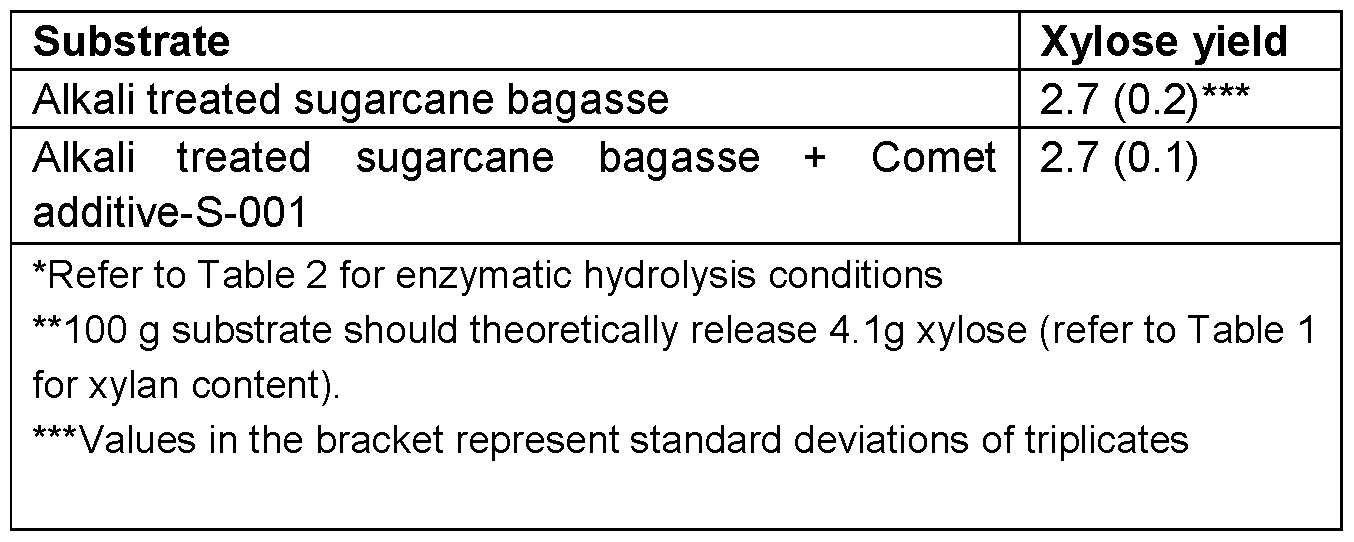
- Table 3 Monomelic xylose yield after the 72 hour enzymatic hydrolysis* of the water insoluble cellulosic component of steam pretreated and subsequently alkaline peroxide treated sugarcane bagasse (expressed as g per 100g substrate**).
- Table 5 Results of the recycle hydrolysis (Total 16% glucan)* of the water insoluble cellulosic component of steam pretreated and subsequently alkaline peroxide treated sugarcane bagasse.
- Example 3 Treatment of Wheat Straw for Activating Cellulose
- Table 6 Chemical composition of the water insoluble component of steam pretreated and subsequently alkaline peroxide treated wheat straw* (% Dry weight)
- Example 4 Enzymatic Hydrolysis of Activated Wheat Straw
- Table 9 Dissolved solids present in the 72 hour enzymatic hydrolysate of steam pretreated and subsequently alkaline peroxide treated wheat straw (% wt/wt)
- Table 1 1 Monomeric xylose yield during the fed-batch enzymatic hydrolysis (10% glucan loading) of the water insoluble cellulosic component of steam pretreated and subsequently alkaline peroxide treated wheat straw expressed as g per 100g total substrate used for hydrolysis in every stage).
- Table 12 Fraction of the total protein present in the supernatant prior to the addition of every batch of fresh substrates and enzymes (expressed as % of the total protein added**).
- composition dry matter basis:
- the cellulosic glucose product having the composition described above was found to have a glycemic index (Gl) of 72.
- glucose alone is known to have a glycemic index of 100.
- Dextrose is also known to have a glycemic index of 100 while maltose and maltodextrin are known to have glycemic indexes of 105 and 1 10 respectively.
Landscapes
- Chemical & Material Sciences (AREA)
- Life Sciences & Earth Sciences (AREA)
- Organic Chemistry (AREA)
- Health & Medical Sciences (AREA)
- Engineering & Computer Science (AREA)
- Wood Science & Technology (AREA)
- Zoology (AREA)
- Biochemistry (AREA)
- Genetics & Genomics (AREA)
- Bioinformatics & Cheminformatics (AREA)
- General Health & Medical Sciences (AREA)
- Microbiology (AREA)
- General Engineering & Computer Science (AREA)
- Biotechnology (AREA)
- Chemical Kinetics & Catalysis (AREA)
- Medicinal Chemistry (AREA)
- General Chemical & Material Sciences (AREA)
- Biomedical Technology (AREA)
- Molecular Biology (AREA)
- Emergency Medicine (AREA)
- Analytical Chemistry (AREA)
- Crystallography & Structural Chemistry (AREA)
- Materials Engineering (AREA)
- Polymers & Plastics (AREA)
- Preparation Of Compounds By Using Micro-Organisms (AREA)
- Polysaccharides And Polysaccharide Derivatives (AREA)
- Processing Of Solid Wastes (AREA)
- Saccharide Compounds (AREA)
- Enzymes And Modification Thereof (AREA)
Abstract
Description




Claims
Priority Applications (23)
| Application Number | Priority Date | Filing Date | Title |
|---|---|---|---|
| EP24158500.9A EP4386134A3 (en) | 2015-04-10 | 2016-04-08 | Methods and compositions for the treatment of cellulosic biomass and products produced thereby |
| SG11201708045PA SG11201708045PA (en) | 2015-04-10 | 2016-04-08 | Methods and compositions for the treatment of cellulosic biomass and products produced thereby |
| PL16775983.6T PL3280812T3 (en) | 2015-04-10 | 2016-04-08 | Methods and compositions for the treatment of cellulosic biomass and products produced thereby |
| JP2018503697A JP6933640B2 (en) | 2015-04-10 | 2016-04-08 | Methods and compositions for the treatment of cellulosic biomass and the products produced thereby |
| AU2016244742A AU2016244742B2 (en) | 2015-04-10 | 2016-04-08 | Methods and compositions for the treatment of cellulosic biomass and products produced thereby |
| MX2017012913A MX2017012913A (en) | 2015-04-10 | 2016-04-08 | Methods and compositions for the treatment of cellulosic biomass and products produced thereby. |
| BR112017021872-0A BR112017021872B1 (en) | 2015-04-10 | 2016-04-08 | METHOD FOR PRODUCING A GLUCOSE-RICH SUGAR STREAM FROM ACTIVATED CELLULOSE AND GLUCOSE-RICH SUGAR STREAM |
| CN201680026642.6A CN107614694B (en) | 2015-04-10 | 2016-04-08 | Methods and compositions for processing cellulosic biomass and products produced therefrom |
| MYPI2017703758A MY185762A (en) | 2015-04-10 | 2016-04-08 | Methods and compositions for the treatment of cellulosic biomass and products produced thereby |
| EP16775983.6A EP3280812B1 (en) | 2015-04-10 | 2016-04-08 | Methods and compositions for the treatment of cellulosic biomass and products produced thereby |
| US15/565,069 US10612059B2 (en) | 2015-04-10 | 2016-04-08 | Methods and compositions for the treatment of cellulosic biomass and products produced thereby |
| MYPI2020005353A MY200191A (en) | 2015-04-10 | 2016-04-08 | Method and compositions for the treatment of cellulosic biomass and products produced thereby |
| KR1020177032407A KR20180012254A (en) | 2015-04-10 | 2016-04-08 | Methods and compositions for the treatment of cellulosic biomass and products produced thereby |
| EA201700487A EA036683B1 (en) | 2015-04-10 | 2016-04-08 | Methods and compositions for the treatment of cellulosic biomass and products produced thereby |
| CA2982187A CA2982187A1 (en) | 2015-04-10 | 2016-04-08 | Glucose-rich sugar streams and methods for making the same |
| ES16775983T ES2985066T3 (en) | 2015-04-10 | 2016-04-08 | Methods and compositions for the treatment of cellulosic biomass and products obtained therefrom |
| PH12017501788A PH12017501788A1 (en) | 2015-04-10 | 2017-09-28 | Methods and compositions for the treatment of cellulosic biomass and products produced thereby |
| ZA2017/06915A ZA201706915B (en) | 2015-04-10 | 2017-10-12 | Methods and compositions for the treatment of cellulosic biomass and products produced thereby |
| PH12020500325A PH12020500325A1 (en) | 2015-04-10 | 2020-02-13 | Methods and compositions for the treatment of cellulosic biomass and products produced thereby |
| US16/825,176 US11692211B2 (en) | 2015-04-10 | 2020-03-20 | Methods and compositions for the treatment of cellulosic biomass and products produced thereby |
| AU2020250294A AU2020250294B2 (en) | 2015-04-10 | 2020-10-09 | Methods and compositions for the treatment of cellulosic biomass and products produced thereby |
| AU2022206729A AU2022206729A1 (en) | 2015-04-10 | 2022-07-19 | Methods and compositions for the treatment of cellulosic biomass and products produced thereby |
| US18/215,470 US20230416795A1 (en) | 2015-04-10 | 2023-06-28 | Methods and Compositions for the Treatment of Cellulosic Biomass and Products Produced Thereby |
Applications Claiming Priority (4)
| Application Number | Priority Date | Filing Date | Title |
|---|---|---|---|
| US201562145785P | 2015-04-10 | 2015-04-10 | |
| US62/145,785 | 2015-04-10 | ||
| US201562246271P | 2015-10-26 | 2015-10-26 | |
| US62/246,271 | 2015-10-26 |
Related Child Applications (2)
| Application Number | Title | Priority Date | Filing Date |
|---|---|---|---|
| US15/565,069 A-371-Of-International US10612059B2 (en) | 2015-04-10 | 2016-04-08 | Methods and compositions for the treatment of cellulosic biomass and products produced thereby |
| US16/825,176 Division US11692211B2 (en) | 2015-04-10 | 2020-03-20 | Methods and compositions for the treatment of cellulosic biomass and products produced thereby |
Publications (1)
| Publication Number | Publication Date |
|---|---|
| WO2016161515A1 true WO2016161515A1 (en) | 2016-10-13 |
Family
ID=57071612
Family Applications (1)
| Application Number | Title | Priority Date | Filing Date |
|---|---|---|---|
| PCT/CA2016/050402 Ceased WO2016161515A1 (en) | 2015-04-10 | 2016-04-08 | Methods and compositions for the treatment of cellulosic biomass and products produced thereby |
Country Status (18)
| Country | Link |
|---|---|
| US (3) | US10612059B2 (en) |
| EP (2) | EP4386134A3 (en) |
| JP (4) | JP6933640B2 (en) |
| KR (1) | KR20180012254A (en) |
| CN (1) | CN107614694B (en) |
| AU (3) | AU2016244742B2 (en) |
| CA (1) | CA2982187A1 (en) |
| CL (2) | CL2017002555A1 (en) |
| EA (1) | EA036683B1 (en) |
| ES (1) | ES2985066T3 (en) |
| HU (1) | HUE066391T2 (en) |
| MX (2) | MX2017012913A (en) |
| MY (2) | MY185762A (en) |
| PH (2) | PH12017501788A1 (en) |
| PL (1) | PL3280812T3 (en) |
| SG (2) | SG10202107085TA (en) |
| WO (1) | WO2016161515A1 (en) |
| ZA (2) | ZA201706915B (en) |
Cited By (5)
| Publication number | Priority date | Publication date | Assignee | Title |
|---|---|---|---|---|
| CN107287259A (en) * | 2017-08-15 | 2017-10-24 | 青岛澳蓝明东生物科技有限公司 | A kind of new technology that xylose is produced by raw material of viscose rayon pressed liquor |
| WO2019217844A1 (en) | 2018-05-10 | 2019-11-14 | Comet Biorefining Inc. | Compositions comprising glucose and hemicellulose and their use |
| US10612059B2 (en) | 2015-04-10 | 2020-04-07 | Comet Biorefining Inc. | Methods and compositions for the treatment of cellulosic biomass and products produced thereby |
| US11230691B2 (en) | 2016-10-13 | 2022-01-25 | Upm-Kymmene Corporation | Method and an apparatus for an enzymatic hydrolysis, a liquid fraction and a lignin fraction |
| US12263184B2 (en) | 2019-05-10 | 2025-04-01 | Comet Biorefining Inc. | Materials and methods for producing arabinoxylan compositions |
Families Citing this family (1)
| Publication number | Priority date | Publication date | Assignee | Title |
|---|---|---|---|---|
| CN111100891B (en) * | 2018-10-26 | 2021-08-06 | 中国石油化工股份有限公司 | Method for enzymolysis and saccharification of lignocellulose |
Citations (5)
| Publication number | Priority date | Publication date | Assignee | Title |
|---|---|---|---|---|
| US4025389A (en) * | 1975-03-13 | 1977-05-24 | Novo Industri A/S | Process and isomerizing glucose |
| WO1995020065A1 (en) * | 1994-01-24 | 1995-07-27 | Sunds Defibrator Pori Oy | Production of prehydrolyzed pulp |
| WO2010071805A2 (en) * | 2008-12-19 | 2010-06-24 | Mascoma Corporation | Two-stage process for biomass pretreatment |
| WO2011046816A1 (en) * | 2009-10-12 | 2011-04-21 | E. I. Du Pont De Nemours And Company | Methods to improve monomeric sugar release from lignocellulosic biomass following alkaline pretreatment |
| WO2014026154A1 (en) | 2012-08-09 | 2014-02-13 | Sweetwater Energy, Inc. | Optimized pretreatment of biomass |
Family Cites Families (212)
| Publication number | Priority date | Publication date | Assignee | Title |
|---|---|---|---|---|
| NZ193139A (en) | 1979-03-23 | 1982-05-25 | Univ California | Hydrolysis of cellulosic and lignocellulosic material to produce monosaccharides ethanol and methane |
| CA2615904C (en) | 1992-08-06 | 2011-09-27 | The Texas A&M University System | Methods of biomass pretreatment |
| ZA943640B (en) | 1993-06-07 | 1995-01-26 | Buckman Labor Inc | Synergistically stabilized liquid enzymatic compositions |
| US5902782A (en) | 1995-01-20 | 1999-05-11 | Procter & Gamble Company | Detergent compositions comprising stabilised polyamino acid compounds |
| US6077546A (en) | 1995-06-26 | 2000-06-20 | Kabushiki Kaisha Hayashibara Seibutsu | Quick-fermented feed and method of preparing |
| SE505141C2 (en) * | 1995-10-23 | 1997-06-30 | Sunds Defibrator Ind Ab | Oxygen delignification of pulp in two stages with high loading of alkali and oxygen and temperature below 90 C in the first step |
| CA2189899C (en) | 1995-11-13 | 2002-07-16 | Auvo K. Kettunen | Cooking cellulose material using high alkali concentrations and/or high ph near the end of the cook |
| US5967157A (en) * | 1996-09-11 | 1999-10-19 | The Procter & Gamble Company | Automatic dishwashing compositions containing low foaming nonionic surfactants in conjunction with enzymes |
| JPH10316999A (en) * | 1997-05-15 | 1998-12-02 | Kao Corp | Detergent composition |
| US5916780A (en) | 1997-06-09 | 1999-06-29 | Iogen Corporation | Pretreatment process for conversion of cellulose to fuel ethanol |
| US20010032711A1 (en) | 1998-10-26 | 2001-10-25 | C. Bertil Stromberg | Pulp cooking with particular alkali profiles |
| DE19916347C1 (en) | 1999-04-12 | 2000-11-09 | Rhodia Acetow Ag | Process for separating biomass containing lignocellulose |
| AUPQ132599A0 (en) | 1999-07-01 | 1999-07-22 | Commonwealth Scientific And Industrial Research Organisation | Nasogastric enteral formulations |
| US6924133B1 (en) | 1999-10-01 | 2005-08-02 | Novozymes A/S | Spray dried enzyme product |
| PL336363A1 (en) | 1999-10-29 | 2001-05-07 | Inst Wlokien Chem | Method of obtaining a modified cellulose pulp |
| CA2368571C (en) | 2000-02-01 | 2011-07-12 | Unitika Ltd. | Process for producing l-arabinose, l-arabinose-containing enzyme-treated products, diet foods, diabetic foods and fruit or vegetable juices, and process for producing the same |
| DE60136267D1 (en) | 2000-02-17 | 2008-12-04 | Biogasol Ipr Aps | METHOD FOR THE TREATMENT OF LIGNIN AND CELLULOSE-CONTAINING SUBSTANCES |
| US6419788B1 (en) | 2000-08-16 | 2002-07-16 | Purevision Technology, Inc. | Method of treating lignocellulosic biomass to produce cellulose |
| US7883884B2 (en) | 2000-08-22 | 2011-02-08 | Gfe Patent A/S | Concept for slurry separation and biogas production |
| FR2816321B1 (en) * | 2000-11-09 | 2003-01-24 | Roquette Freres | PROCESS FOR THE PREPARATION OF A FERMENTATION MEDIUM FROM A RENEWABLE RAW MATERIAL |
| DK1355542T3 (en) | 2000-12-27 | 2007-06-11 | Nutricia Nv | Nutritional composition with health-promoting effect containing oligosaccharides |
| US6692578B2 (en) | 2001-02-23 | 2004-02-17 | Battelle Memorial Institute | Hydrolysis of biomass material |
| US7709033B2 (en) | 2001-02-26 | 2010-05-04 | Biovelop International B.V. | Process for the fractionation of cereal brans |
| WO2003015533A1 (en) | 2001-08-20 | 2003-02-27 | K.U. Leuven Research And Development | Non-starch-polysaccharides |
| WO2003071025A2 (en) | 2002-02-22 | 2003-08-28 | Gilles Gervais | Process of treating lignocellulosic material to produce bio-ethanol |
| US7449209B2 (en) | 2002-07-29 | 2008-11-11 | General Mills Ip Holdings Ii, Llc | Method and ingredient for increasing soluble fiber content to enhance bile acid binding, increase viscosity, and increase hypocholesterolemic properties |
| SE0300801D0 (en) | 2003-03-21 | 2003-03-21 | Paul Gatenholm | Polymeric film or coating comprising hemicellulose |
| DK2228440T3 (en) | 2003-05-02 | 2013-01-02 | Novozymes Inc | Variants of beta-glucosidases |
| CA2543626C (en) | 2003-10-24 | 2013-08-27 | N.V. Nutricia | Synbiotic composition for infants |
| WO2005047499A1 (en) | 2003-10-28 | 2005-05-26 | Novozymes Inc. | Polypeptides having beta-glucosidase activity and polynucleotides encoding same |
| US20080227166A1 (en) | 2004-01-16 | 2008-09-18 | Novozymes A/S | Fermentation Processes |
| GB0414655D0 (en) | 2004-06-30 | 2004-08-04 | Leuven K U Res & Dev | Prebiotic |
| FR2874930B1 (en) | 2004-09-03 | 2008-07-25 | Df3 Sarl Sarl | PROCESS FOR OBTAINING FRACTIONS OBTAINED FROM CEREAL SOUND AND THE FRACTIONS THUS OBTAINED |
| US7709042B2 (en) | 2004-09-10 | 2010-05-04 | Iogen Energy Corporation | Process for producing a pretreated feedstock |
| US7198925B2 (en) | 2004-09-30 | 2007-04-03 | Iogen Energy Corporation | Pre-treatment of bales of feedstock |
| CA2580226C (en) | 2004-09-30 | 2013-01-29 | Iogen Energy Corporation | Continuous flowing pre-treatment system with steam recovery |
| FR2881753B1 (en) | 2005-02-09 | 2009-10-02 | Inst Francais Du Petrole | PROCESS FOR THE PRODUCTION OF CELLULOLYTIC AND HEMICELLULOLYTIC ENZYMES USING ETHANOLIC FERMENTATION DISTILLATION RESIDUES OF ENZYMATIC HYDROLYSATES OF (LIGNO-) CELLULOSIC MATERIALS |
| CN101160405B (en) | 2005-04-12 | 2014-01-01 | 纳幕尔杜邦公司 | Process for biomass treatment to obtain target chemical substance |
| FI122815B (en) | 2005-04-18 | 2012-07-13 | Cerefi Oy | Method for fractionating lignocellulosic materials and parts obtained from them |
| UA100662C2 (en) | 2005-07-19 | 2013-01-25 | Інбікон А/С | Method for conversion of cellulosic material to ethanol |
| JP5129142B2 (en) | 2005-09-30 | 2013-01-23 | ノボザイムス,インコーポレイティド | Method for enhancing degradation or conversion of cellulosic materials |
| EP1852493A1 (en) | 2006-05-05 | 2007-11-07 | BIOeCON International Holding N.V. | Hydrothermal treatment of carbon-based energy carrier material |
| NZ573330A (en) | 2006-05-08 | 2011-11-25 | Vertichem Corp | Process for the production of biofuel from plant materials |
| US20090321025A1 (en) | 2006-06-14 | 2009-12-31 | Sappi Manufacturing (Pty) Ltd. | Pulp reactivity enhancement |
| US20080014315A1 (en) * | 2006-07-14 | 2008-01-17 | Delease Patricia | Foam-creating compositions, foaming beverage compositions, and methods of preparation thereof |
| CA2595484A1 (en) | 2006-08-07 | 2008-02-07 | John Allan Fallavollita | Process for recovery of holocellulose and near-native lignin from biomass |
| US9499635B2 (en) | 2006-10-13 | 2016-11-22 | Sweetwater Energy, Inc. | Integrated wood processing and sugar production |
| CA2565433C (en) | 2006-10-25 | 2014-02-11 | Iogen Energy Corporation | Inorganic salt recovery during processing of lignocellulosic feedstocks |
| US7670678B2 (en) | 2006-12-20 | 2010-03-02 | The Procter & Gamble Company | Fibers comprising hemicellulose and processes for making same |
| AU2008208870B2 (en) | 2007-01-23 | 2013-05-02 | Basf Se | Method for producing glucose by enzymatic hydrolysis of cellulose that is obtained from material containing ligno-cellulose using an ionic liquid that comprises a polyatomic anion |
| CA2576317A1 (en) | 2007-01-25 | 2008-07-25 | Brian Foody | Method of obtaining inorganic salt and acetate salt from cellulosic biomass |
| EP2117322B1 (en) | 2007-02-27 | 2018-10-17 | CSM Bakery Solutions Europe Holding B.V. | Improved flour based dough and method of preparing such dough |
| US20080226803A1 (en) * | 2007-03-14 | 2008-09-18 | Concentrate Manufacturing Company Of Ireland | Natural flavoring agent for sugar-sweetened tea beverage to taste like high fructose corn syrup-sweetened beverage |
| AU2008242769B2 (en) | 2007-04-19 | 2013-10-17 | Mascoma Corporation | Combined thermochemical pretreatment and refining of lignocellulosic biomass |
| WO2008134037A1 (en) | 2007-04-27 | 2008-11-06 | Regents Of The Universty Of California | Treatment of lignocellulosic biomass with surfactants |
| WO2008137639A1 (en) | 2007-05-02 | 2008-11-13 | Mascoma Corporation | Two-stage method for pretreatment of lignocellulosic biomass |
| JP5520822B2 (en) | 2007-06-20 | 2014-06-11 | ナーガルジュナ エナジー プライベート リミテッド | Biomass component separation process |
| US8414706B2 (en) | 2007-06-21 | 2013-04-09 | Cantine Foraci S.R.L. | Process and plant for producing sugar products from grapes |
| KR101121543B1 (en) | 2007-07-04 | 2012-03-06 | 학교법인 선목학원 | Composition comprising starch or dietary fiber from gramineae plant for prevention and treatment of ischemic diseases and degenerative brain diseases |
| WO2009012779A2 (en) | 2007-07-25 | 2009-01-29 | Atlas-Stord Denmark | A method and a system forthe pretreatment of lignocellulosic material |
| US8980599B2 (en) | 2007-08-02 | 2015-03-17 | Iogen Energy Corporation | Method for the production of alcohol from a pretreated lignocellulosic feedstock |
| US7807419B2 (en) | 2007-08-22 | 2010-10-05 | E. I. Du Pont De Nemours And Company | Process for concentrated biomass saccharification |
| SI2191004T1 (en) | 2007-08-23 | 2013-10-30 | Stichting Dienst Landbouwkundig Onderzoek | Mild alkaline pretreatment and simultaneous saccharification and fermentation of lignocellulosic biomass into organic acids |
| BRPI0816191B1 (en) | 2007-09-03 | 2020-12-29 | Novozymes A/S | process for converting a material containing lignocellulose into a hydrolyzate |
| BRPI0817084B1 (en) | 2007-09-07 | 2019-05-21 | Council Of Scientific & Industrial Research | Process for the fractionation of sugarcane bagasse in higher alpha-cellulose, xylan and lignin pulp |
| GB0718974D0 (en) | 2007-09-28 | 2007-11-07 | Univ Leuven Kath | oligosaccharides derived from arabinoxylan for prevention of gastrointestinal infection |
| EP2207887A4 (en) | 2007-10-09 | 2014-01-22 | Sunopta Bioprocess Inc | Two-stage enzymatic hydrolysis process for treating lignocellulosic materials |
| RU2010116358A (en) | 2007-10-10 | 2011-12-10 | Маскома Канада Инк.,Са (Ca) | ENZYMATIC PROCESSING IN VACUUM OF LIGNO CELLULAR MATERIALS |
| WO2009058276A1 (en) | 2007-11-01 | 2009-05-07 | Mascoma Corporation | Product recovery from fermentation of lignocellulosic biomass |
| US8497110B2 (en) | 2008-01-31 | 2013-07-30 | Battelle Energy Alliance, Llc | Thermophilic and thermoacidophilic biopolymer-degrading genes and enzymes from alicyclobacillus acidocaldarius and related organisms, methods |
| GB0805360D0 (en) | 2008-03-25 | 2008-04-30 | Univ Leuven Kath | Arabinoxylan oligosaccharide preparation |
| PT2274433E (en) | 2008-04-03 | 2012-08-16 | Cellulose Sciences International Inc | Highly disordered cellulose |
| EP2277988A1 (en) | 2008-04-14 | 2011-01-26 | Mitsui Chemicals, Inc. | Yeast for production of glucose, and method for production of glucose using the same |
| US7931784B2 (en) | 2008-04-30 | 2011-04-26 | Xyleco, Inc. | Processing biomass and petroleum containing materials |
| AU2009290407B2 (en) | 2008-07-21 | 2013-06-06 | Praj Industries Limited | A process for production of ethanol from lignocellulosic material |
| EP2313514B1 (en) | 2008-08-11 | 2016-11-16 | DSM IP Assets B.V. | Degradation of lignocellulosic material |
| CN101338333A (en) * | 2008-08-12 | 2009-01-07 | 南京林业大学 | A method of converting agricultural and forestry waste into fermentable sugar |
| US8465788B2 (en) | 2008-08-18 | 2013-06-18 | Bioactor B.V. | Arabinoxylans for modulating the barrier function of the intestinal surface |
| US20120108798A1 (en) | 2008-10-17 | 2012-05-03 | Mascoma Corporation | Production Of Pure Lignin From Lignocellulosic Biomass |
| US8524474B2 (en) | 2008-11-20 | 2013-09-03 | E I Du Pont De Nemours And Company | Process for producing a concentrated sugar solution by enzymatic saccharification of polysaccharide enriched biomass |
| CA2739704C (en) | 2008-11-20 | 2015-08-18 | E.I. Du Pont De Nemours And Company | Process for producing a sugar solution by combined chemical and enzymatic saccharification of polysaccharide enriched biomass |
| ES2416086T3 (en) | 2008-12-10 | 2013-07-30 | Katholieke Universiteit Leuven | Food containing arabinoxylan and oligosaccharides |
| US8809033B2 (en) | 2008-12-19 | 2014-08-19 | Novozymes, Inc. | Methods for increasing hydrolysis of cellulosic material in the presence of cellobiose dehydrogenase |
| US8241873B2 (en) | 2008-12-19 | 2012-08-14 | E I Du Pont De Nemours And Company | Organic solvent pretreatment of biomass to enhance enzymatic saccharification |
| EP2379732A2 (en) | 2008-12-19 | 2011-10-26 | Novozymes Inc. | Methods for increasing enzymatic hydrolysis of cellulosic material in the presence of a peroxidase |
| CA2745508C (en) | 2008-12-23 | 2015-11-24 | Greenfield Ethanol Inc. | Use of stillage residue as a nutrient source for fermentation of hydrolyzed lignocellulosic biomass to ethanol |
| CN102316753B (en) | 2009-01-16 | 2016-06-29 | 杜邦营养生物科学有限公司 | Enzymatic generation of functional lipids from grain or grain by-stream |
| CA2738886C (en) | 2009-01-16 | 2012-02-21 | Greenfield Ethanol Inc. | Removal of inhibitory compounds during pre-treatment of lignocellulosic biomass |
| CA2749682A1 (en) | 2009-02-11 | 2010-08-19 | Xyleco, Inc. | Saccharifying biomass |
| JP2012519500A (en) | 2009-03-09 | 2012-08-30 | クテロス, インコーポレイテッド | Production of fermentation end products from Clostridium species |
| US9506098B2 (en) | 2011-09-24 | 2016-11-29 | Beta Renewables S.P.A. | Process for the rapid hydrolysis of high solids biomass |
| US20110111456A1 (en) | 2009-04-03 | 2011-05-12 | Xyleco, Inc. | Processing biomass |
| ES2499490T3 (en) | 2009-04-20 | 2014-09-29 | Greenfield Ethanol Inc. | Pretreatment of lignocellulosic biomass for removal of inhibitor compounds |
| CA2714946C (en) | 2009-04-23 | 2011-10-11 | Greenfield Ethanol Inc. | Fractionation of biomass for cellulosic ethanol and chemical production |
| WO2010121366A1 (en) | 2009-04-23 | 2010-10-28 | Greenfield Ethanol Inc. | Separation of reactive cellulose from lignocellulosic biomass with high lignin content |
| MY171749A (en) | 2009-05-26 | 2019-10-27 | Arvind Mallinath Lali | Method for production of fermentable sugars from biomass |
| DK2449092T3 (en) | 2009-06-30 | 2015-11-23 | Novozymes As | Process for the hydrolysis of biomass |
| SE0950534A1 (en) | 2009-07-07 | 2010-10-12 | Stora Enso Oyj | Method for producing microfibrillar cellulose |
| CA2673134A1 (en) | 2009-07-17 | 2011-01-17 | Murray J. Burke | Method and apparatus for the heat treatment of a cellulosic feedstock upstream of hydrolysis |
| WO2011020000A2 (en) | 2009-08-14 | 2011-02-17 | The Ohio State University Research Foundation | Combined liquid to solid-phase anaerobic digestion for biogas production from municipal and agricultural wastes |
| US20130244293A1 (en) | 2009-08-24 | 2013-09-19 | Board Of Trustees Of Michingan State Unversity | Fractionated extractive products from plant biomass and methods of making and using same |
| CN102574766B (en) | 2009-08-27 | 2014-08-13 | 艾欧基能源公司 | Recovery of volatile carboxylic acids by a stripper-extractor system |
| WO2011022812A1 (en) | 2009-08-27 | 2011-03-03 | Iogen Energy Corporation | Recovery of volatile carboxylic acids by extractive evaporation |
| CN102711994B (en) | 2009-09-25 | 2016-04-20 | 国立大学法人北海道大学 | The hydrolysis catalyst of cellulose or hemicellulose and use the manufacture method containing liquid glucose of this catalyst |
| CA2775358A1 (en) | 2009-09-29 | 2011-04-07 | Novozymes A/S | Polypeptides having cellulolytic enhancing activity and polynucleotides encoding same |
| CA2775656C (en) | 2009-09-29 | 2018-03-27 | Nova Pangaea Technologies Limited | Method and system for fractionation of lignocellulosic biomass |
| DK2496694T3 (en) | 2009-11-06 | 2017-06-06 | Novozymes Inc | COMPOSITIONS FOR SACCHARIFYING CELLULOS MATERIAL |
| PL2504017T3 (en) | 2009-11-25 | 2014-06-30 | Codexis Inc | Recombinant beta-glucosidase variants for production of soluble sugars from cellulosic biomass |
| EP2333151A1 (en) | 2009-12-11 | 2011-06-15 | Nederlandse Organisatie voor toegepast -natuurwetenschappelijk onderzoek TNO | Novel method for processing lignocellulose containing material |
| CA2784105A1 (en) | 2009-12-18 | 2011-06-23 | Shell Internationale Research Maatschappij B.V. | A process for the extraction of sugars and lignin from lignocellulose-comprising solid biomass |
| EP2336344A1 (en) | 2009-12-21 | 2011-06-22 | Sekab E-Technology AB | Pre-treatment of cellulosic material |
| CN102884197A (en) | 2010-01-29 | 2013-01-16 | 诺维信公司 | Biogas production process with enzymatic pre-treatment |
| CA2786949C (en) | 2010-02-08 | 2018-06-05 | Iogen Energy Corporation | Method for scale removal during a lignocellulosic conversion process |
| CA2786951A1 (en) | 2010-02-10 | 2011-08-18 | Iogen Energy Corporation | Method for the production of a fermentation product from lignocellulosic feedstocks |
| WO2011098577A1 (en) | 2010-02-11 | 2011-08-18 | Dsm Ip Assets B.V. | Host cell capable of producing enzymes useful for degradation of lignocellulosic material |
| WO2011103180A2 (en) | 2010-02-16 | 2011-08-25 | Grain Processing Corporation | Process for hydrolysis of wet fiber and method for producing fermentation products from wet fiber |
| CA2695823A1 (en) | 2010-03-05 | 2011-09-05 | Gary M. Pigeau | Method for the production of a fermentation product from a sugar hydrolysate |
| CA2791668A1 (en) | 2010-03-10 | 2011-09-15 | Toray Industries, Inc. | Method for producing pure sugar solution, and method for producing chemical product |
| RU2560443C2 (en) | 2010-03-15 | 2015-08-20 | Торэй Индастриз, Инк. | Method and device for manufacturing sugar solution |
| EP2547779A1 (en) | 2010-03-19 | 2013-01-23 | POET Research, Inc. | System for treatment of biomass to facilitate the production of ethanol |
| WO2011139382A2 (en) * | 2010-05-06 | 2011-11-10 | James Wade | Dandelion processes, compositions and products |
| EP2580245A1 (en) | 2010-06-10 | 2013-04-17 | Lali, Arvind Mallinath | Process for fractionation of biomass |
| AU2011267415B2 (en) | 2010-06-17 | 2014-08-14 | Borregaard As | Enzymatic hydrolysis of cellulose |
| US20110318796A1 (en) * | 2010-06-24 | 2011-12-29 | Cobalt Technologies, Inc., A Delaware Corporation | Method for extracting soluble sugar molecules from biomass material |
| MY160897A (en) | 2010-06-29 | 2017-03-31 | Dsm Ip Assets Bv | Polypeptide having or assisting in carbohydrate material degrading activity and uses thereof |
| CN102971338A (en) | 2010-06-29 | 2013-03-13 | 帝斯曼知识产权资产管理有限公司 | Polypeptide having beta-glucosidase activity and uses thereof |
| AU2011273689B2 (en) | 2010-06-29 | 2014-08-21 | Dsm Ip Assets B.V. | Polypeptide having carbohydrate degrading activity and uses thereof |
| BR112012033396A2 (en) | 2010-06-29 | 2015-06-23 | Dsm Ip Assets Bv | Polypeptide having swollenin activity and its uses. |
| BR112012033714A2 (en) | 2010-06-29 | 2016-02-16 | Dsm Ip Assets Bv | polypeptide with acetyl xylan esterase activity and its uses. |
| DK2588494T3 (en) | 2010-06-29 | 2018-06-14 | Dsm Ip Assets Bv | POLYPEPTIDE WITH BETA-GLUCOSIDASE ACTIVITY AND APPLICATIONS THEREOF |
| US8980050B2 (en) | 2012-08-20 | 2015-03-17 | Celanese International Corporation | Methods for removing hemicellulose |
| FR2962735B1 (en) | 2010-07-13 | 2013-03-15 | Centre Nat Rech Scient | NEW COMPOSITE MATERIALS BASED ON CELLULOSE |
| JP5822101B2 (en) | 2010-08-04 | 2015-11-24 | 愛媛県 | Method for producing cellulose solution, method for producing cellulose precipitate, and method for saccharification of cellulose |
| US20130143278A1 (en) | 2010-08-11 | 2013-06-06 | Iogen Energy Corporation | Recycle of leachate during lignocellulosic conversion processes |
| CN103068998A (en) | 2010-08-11 | 2013-04-24 | 艾欧基能源公司 | Method for dilute acid pretreatment of l1gnocellulosic feedstocks |
| US9458483B2 (en) | 2010-08-12 | 2016-10-04 | Novozymes, Inc. | Compositions comprising a polypeptide having cellulolytic enhancing activity and a bicyclic compound and uses thereof |
| US8815561B2 (en) | 2010-08-23 | 2014-08-26 | Wisconsin Alumni Research Foundation | Metal compounds to eliminate nonproductive enzyme adsorption and enhance enzymatic saccharification of lignocellulose |
| EP3470514A1 (en) | 2010-08-30 | 2019-04-17 | Novozymes A/S | Polypeptides having cellulolytic enhancing activity and polynucleotides encoding same |
| EP2612920B1 (en) | 2010-08-31 | 2020-10-14 | Oji Holdings Corporation | Method for enzymatic saccharification of lignocellulosic biomass, and method for manufacturing ethanol from lignocellulosic biomass |
| US20130252285A1 (en) | 2010-09-22 | 2013-09-26 | The Regents Of The University Of California | Ionic liquid pretreatment of cellulosic biomass: enzymatic hydrolysis and ionic liquid recycle |
| DK2621503T3 (en) | 2010-09-29 | 2018-01-02 | Orkla Foods Sverige Ab | APPLICATION OF A FOOD PRODUCT INCLUDING VISCIO FIBER WITH A BENEFICIAL EFFECT ON COGNITIVE PERFORMANCE |
| AP2013006844A0 (en) | 2010-10-06 | 2013-04-30 | Sekab E Technology Ab | Enzymatic hydrolysis of lignocellulosic material in the presence of sulfite, dithionite and/or dithiothreitol |
| FR2966154B1 (en) | 2010-10-13 | 2014-05-16 | Cie Ind De La Matiere Vegetale Cimv | IMPROVED METHOD OF ENZYMATIC HYDROLYSIS OF CELLULOSE |
| US9932414B2 (en) | 2010-11-02 | 2018-04-03 | Novozymes, Inc. | Methods of pretreating cellulosic material with a family 61 polypeptide |
| AU2011325841B2 (en) | 2010-11-05 | 2016-01-07 | Greenfield Ethanol Inc. | Bagasse fractionation for cellulosic ethanol and chemical production |
| US20120135109A1 (en) | 2010-11-30 | 2012-05-31 | Tropicana Products, Inc. | Fiber obtained from fruit or vegetable byproducts |
| EP2648540B1 (en) | 2010-12-08 | 2018-10-24 | Nestec S.A. | Frozen confectionary products comprising hydrolysed whole grain |
| US20120189739A1 (en) * | 2010-12-20 | 2012-07-26 | Imperial Sugar Company | Naturally-Sweetened Reduced-Calorie Base Syrup Compositions and Compositions Sweetened Therewith |
| CN103534348B (en) | 2011-01-26 | 2018-04-10 | 诺维信公司 | Polypeptide having cellobiohydrolase activity and polynucleotide encoding the polypeptide |
| US9051376B2 (en) | 2011-02-23 | 2015-06-09 | Novozymes, Inc. | Polypeptides having cellulolytic enhancing activity and polynucleotides encoding same |
| EP2683830A1 (en) | 2011-03-09 | 2014-01-15 | Novozymes A/S | Methods of increasing the cellulolytic enhancing activity of a polypeptide |
| WO2012130120A1 (en) | 2011-03-25 | 2012-10-04 | Novozymes A/S | Method for degrading or converting cellulosic material |
| US9410136B2 (en) | 2011-03-31 | 2016-08-09 | Novozymes, Inc. | Methods for enhancing the degradation or conversion of cellulosic material |
| US9340810B2 (en) | 2011-04-25 | 2016-05-17 | Novozymes, Inc. | Polypeptides having cellulolytic enhancing activity and polynucleotides encoding same |
| EP2702162B1 (en) | 2011-04-29 | 2020-02-26 | Novozymes, Inc. | Methods for enhancing the degradation or conversion of cellulosic material |
| BR112013031414A2 (en) | 2011-06-10 | 2016-09-06 | Univ Queensland | methods for converting lignocellulosic material into useful products |
| MX353708B (en) | 2011-07-15 | 2018-01-24 | Greenfield Specialty Alcohols Inc | BIOMASS CONDITIONING FOR IMPROVED RELEASE OF SUGAR C5 / C6 BEFORE FERMENTATION. |
| CN103797186B (en) | 2011-07-28 | 2016-09-14 | 格林菲尔德专业醇类公司 | Two-stage continuous pretreatment of lignocellulosic biomass |
| EP2748317B1 (en) | 2011-08-22 | 2017-04-19 | Codexis, Inc. | Gh61 glycoside hydrolase protein variants and cofactors that enhance gh61 activity |
| WO2013040702A1 (en) | 2011-09-20 | 2013-03-28 | Iogen Energy Corporation | Method for heating a feedstock |
| EP2773656B1 (en) | 2011-10-31 | 2019-06-19 | Novozymes, Inc. | Polypeptides having cellulolytic enhancing activity and polynucleotides encoding same |
| WO2013071883A1 (en) | 2011-11-18 | 2013-05-23 | Novozymes, Inc. | Polypeptides having endoglucanase activity and polynucleotides encoding same |
| EP2782998B1 (en) | 2011-11-22 | 2018-01-10 | Novozymes Inc. | Polypeptides having beta-xylosidase activity and polynucleotides encoding same |
| DK2785732T3 (en) | 2011-12-01 | 2017-06-19 | Novozymes Inc | POLYPEPTIDES WITH BETA-XYLOSIDASE ACTIVITY AND POLYNUCLEOTIDES CODING THEM |
| BR112014014760A2 (en) | 2011-12-19 | 2017-06-13 | Novozymes Inc | polypeptide, composition, polynucleotide, recombinant host cell, methods for producing a polypeptide, a precursor cell mutant, and a protein, and for inhibiting expression of a polypeptide, transgene plant, part of the plant or plant cell, rna molecule double-stranded inhibitory, processes for degrading or converting a cellulosic material, for producing a fermentation product, and for fermenting a cellulosic material, and for broth formulation or cell culture composition |
| US20130172547A1 (en) | 2011-12-30 | 2013-07-04 | Renmatix, Inc. | Compositions comprising c5 and c6 oligosaccharides |
| BR112014016131A8 (en) | 2011-12-30 | 2017-07-04 | Myriant Corp | integrated biorefinery |
| FI126118B (en) | 2012-02-10 | 2016-06-30 | Upm Kymmene Corp | Cellulose pulp pretreatment method |
| US10202660B2 (en) | 2012-03-02 | 2019-02-12 | Board Of Trustees Of Michigan State University | Methods for increasing sugar yield with size-adjusted lignocellulosic biomass particles |
| US20140106418A1 (en) | 2012-03-26 | 2014-04-17 | Sweetwater Energy, Inc. | Enhanced Fermentation From Pretreatment Products |
| EP2841570B1 (en) | 2012-04-23 | 2017-12-20 | Novozymes A/S | Polypeptides having glucuronyl esterase activity and polynucleotides encoding same |
| CA2870758C (en) | 2012-04-27 | 2018-01-16 | The Michigan Biotechnology Institute D/B/A Mbi | Methods of hydrolyzing pretreated densified biomass particulates and systems related thereto |
| AR091998A1 (en) | 2012-05-03 | 2015-03-18 | Annikki Gmbh | CELLULOSE PREPARATION PROCEDURE WITH LIGNIN LOW CONCENTRATION |
| US20150107790A1 (en) | 2012-05-14 | 2015-04-23 | Metsa Fibre Oy | Method of separation of hemicellulose and cellulose from polysaccharide sources |
| ES2688879T3 (en) | 2012-05-16 | 2018-11-07 | Prairie Berry Europe Gmbh | Polyhydroxylated pentacyclic triterpenic acids as HMG-CoA reductase inhibitors |
| BR112014027172B1 (en) | 2012-05-16 | 2020-10-20 | Hamlet Protein A/S | solid bioproducts, method for their production and use, as well as product for human consumption, animal feed, cosmetic or pharmaceutical or nutritional supplement |
| US9447197B2 (en) | 2012-06-28 | 2016-09-20 | Covidien Lp | Dissolution of oxidized cellulose and particle preparation by dispersion and neutralization |
| WO2014007606A1 (en) | 2012-07-05 | 2014-01-09 | N.V. Nutricia | Product for use in the prophylactic or therapeutic treatment of a negative emotion or introvert behaviour |
| US9434788B2 (en) | 2012-07-11 | 2016-09-06 | The United States Of America, As Represented By The Secretary Of Agriculture | Bio-based fiber gums (BFGs) and processes for producing BFGs |
| WO2014048369A1 (en) | 2012-09-28 | 2014-04-03 | Novozymes, Inc. | Polypeptides having cellulolytic enhancing activity and polynucleotides encoding same |
| CN104870639A (en) | 2012-12-14 | 2015-08-26 | 诺维信公司 | Polypeptides having cellulolytic enhancing activity and polynucleotides encoding same |
| US20150361407A1 (en) | 2013-01-11 | 2015-12-17 | Codexis, Inc. | Enzyme production compositions and methods |
| CN110016487A (en) | 2013-01-11 | 2019-07-16 | 帝斯曼知识产权资产管理有限公司 | Method for enzymatic hydrolysis of lignocellulosic material |
| MX370090B (en) | 2013-02-01 | 2019-10-25 | Centro De Investig En Alimentacion Y Desarrollo A C | Method and system for the integral treatment of wastewater from the maize industry. |
| US8778639B1 (en) | 2013-02-12 | 2014-07-15 | Novozymes Inc. | Polypeptides having endoglucanase activity and polynucleotides encoding same |
| JP6203815B2 (en) | 2013-02-28 | 2017-09-27 | 三菱日立パワーシステムズ環境ソリューション株式会社 | Biomass processing system |
| EP2986645A1 (en) | 2013-03-12 | 2016-02-24 | Tate & Lyle Ingredients Americas LLC | Food grade arabinoxylan product from corn fiber |
| US20140272068A1 (en) * | 2013-03-14 | 2014-09-18 | Indra Prakash | Beverages containing rare sugars |
| US9850512B2 (en) | 2013-03-15 | 2017-12-26 | The Research Foundation For The State University Of New York | Hydrolysis of cellulosic fines in primary clarified sludge of paper mills and the addition of a surfactant to increase the yield |
| US20140273104A1 (en) | 2013-03-15 | 2014-09-18 | Suganit Systems, Inc. | Pretreatment and fractionation of lignocellulosic biomass |
| GB201304939D0 (en) | 2013-03-18 | 2013-05-01 | Cellucomp Ltd | Process for Preparing Cellulose-Containing Particles from Plant Material |
| WO2015016930A1 (en) | 2013-08-01 | 2015-02-05 | Renmatix, Inc. | Method for biomass hydrolysis |
| US9421477B2 (en) | 2013-08-12 | 2016-08-23 | Green Extraction Technologies | Biomass fractionation and extraction apparatus |
| US10041055B2 (en) | 2013-09-19 | 2018-08-07 | Novozymes A/S | Polypeptides having mannanase activity and polynucleotides encoding same |
| WO2015050881A1 (en) | 2013-10-01 | 2015-04-09 | The Texas A&M University System | Systems and methods for converting lignocellulosic biomass to concentrated sugars |
| IN2013MU03417A (en) | 2013-10-29 | 2015-07-17 | Indian Oil Corp Ltd | |
| WO2015086782A1 (en) | 2013-12-11 | 2015-06-18 | Neste Oil Oyj | Method of processing lignocellulosic material using an alkaline delignification agent |
| PL3080288T3 (en) | 2013-12-11 | 2019-07-31 | Neste Oyj | Method of processing lignocellulosic material using a cationic compound |
| WO2015101693A1 (en) | 2013-12-31 | 2015-07-09 | Servicio Andaluz De Salud | Combined preparations and compositions for the treatment of oropharyngeal pain |
| FI127582B (en) | 2014-01-10 | 2018-09-14 | Ab Bln Woods Ltd | Method for lignin extraction |
| CN106103726A (en) | 2014-01-16 | 2016-11-09 | A·M·拉里 | Method for fractionating oligosaccharides from agricultural waste |
| US9194012B2 (en) | 2014-02-02 | 2015-11-24 | Edward Brian HAMRICK | Methods and systems for producing sugars from carbohydrate-rich substrates |
| AU2015263799B2 (en) | 2014-02-20 | 2019-12-05 | Grainfrac Inc. | System and method for fractionating grain |
| US9951363B2 (en) | 2014-03-14 | 2018-04-24 | The Research Foundation for the State University of New York College of Environmental Science and Forestry | Enzymatic hydrolysis of old corrugated cardboard (OCC) fines from recycled linerboard mill waste rejects |
| EP2929783A1 (en) | 2014-04-11 | 2015-10-14 | New Life Hold S.r.L. | Food flours useful in the reduction of glycemia, in the treatment of metabolic syndrome, in the reduction of cholesterol and/or in the treatment of type 2 diabetes |
| US20150307952A1 (en) | 2014-04-29 | 2015-10-29 | Bradley A. Saville | Liquid co-extraction process for production of sucrose, xylo-oligosaccharides and xylose from feedstock |
| US10041136B2 (en) | 2014-07-10 | 2018-08-07 | The United States Of America As Represented By The Secretary Of Agriculture | Glycosyl hydrolase xylanases, compositions and methods of use for efficient hydrolysis and processing of xylan |
| EA201790363A1 (en) * | 2014-09-19 | 2017-09-29 | Ксилеко, Инк. | SACCHARIDES AND SACCHARIDE COMPOSITIONS AND MIXTURES |
| WO2016045569A1 (en) | 2014-09-23 | 2016-03-31 | Novozymes A/S | Processes for producing ethanol and fermenting organisms |
| WO2016094544A1 (en) | 2014-12-12 | 2016-06-16 | Alliance For Sustainable Energy, Llc | Compositions, methods and systems for derivation of useful products from agricultural by-products |
| HUE066391T2 (en) | 2015-04-10 | 2024-07-28 | Comet Biorefining Inc | Methods and compositions for the treatment of cellulosic biomass and products produced thereby |
| US10072267B2 (en) | 2016-02-22 | 2018-09-11 | Danisco Us Inc | Fungal high-level protein production system |
-
2016
- 2016-04-08 HU HUE16775983A patent/HUE066391T2/en unknown
- 2016-04-08 KR KR1020177032407A patent/KR20180012254A/en not_active Ceased
- 2016-04-08 EP EP24158500.9A patent/EP4386134A3/en active Pending
- 2016-04-08 EA EA201700487A patent/EA036683B1/en unknown
- 2016-04-08 PL PL16775983.6T patent/PL3280812T3/en unknown
- 2016-04-08 JP JP2018503697A patent/JP6933640B2/en active Active
- 2016-04-08 MY MYPI2017703758A patent/MY185762A/en unknown
- 2016-04-08 EP EP16775983.6A patent/EP3280812B1/en active Active
- 2016-04-08 MY MYPI2020005353A patent/MY200191A/en unknown
- 2016-04-08 CA CA2982187A patent/CA2982187A1/en active Pending
- 2016-04-08 MX MX2017012913A patent/MX2017012913A/en unknown
- 2016-04-08 ES ES16775983T patent/ES2985066T3/en active Active
- 2016-04-08 CN CN201680026642.6A patent/CN107614694B/en active Active
- 2016-04-08 SG SG10202107085TA patent/SG10202107085TA/en unknown
- 2016-04-08 AU AU2016244742A patent/AU2016244742B2/en active Active
- 2016-04-08 US US15/565,069 patent/US10612059B2/en active Active
- 2016-04-08 SG SG11201708045PA patent/SG11201708045PA/en unknown
- 2016-04-08 WO PCT/CA2016/050402 patent/WO2016161515A1/en not_active Ceased
-
2017
- 2017-09-28 PH PH12017501788A patent/PH12017501788A1/en unknown
- 2017-10-06 MX MX2022008230A patent/MX2022008230A/en unknown
- 2017-10-10 CL CL2017002555A patent/CL2017002555A1/en unknown
- 2017-10-12 ZA ZA2017/06915A patent/ZA201706915B/en unknown
-
2019
- 2019-03-29 CL CL2019000863A patent/CL2019000863A1/en unknown
-
2020
- 2020-02-13 PH PH12020500325A patent/PH12020500325A1/en unknown
- 2020-03-20 US US16/825,176 patent/US11692211B2/en active Active
- 2020-10-09 AU AU2020250294A patent/AU2020250294B2/en active Active
-
2021
- 2021-08-19 JP JP2021134059A patent/JP2021184743A/en active Pending
-
2022
- 2022-07-19 AU AU2022206729A patent/AU2022206729A1/en not_active Abandoned
- 2022-08-25 ZA ZA2022/09513A patent/ZA202209513B/en unknown
-
2023
- 2023-06-28 US US18/215,470 patent/US20230416795A1/en not_active Abandoned
- 2023-09-28 JP JP2023166614A patent/JP7589308B2/en active Active
-
2024
- 2024-11-13 JP JP2024197810A patent/JP2025024076A/en active Pending
Patent Citations (7)
| Publication number | Priority date | Publication date | Assignee | Title |
|---|---|---|---|---|
| US4025389A (en) * | 1975-03-13 | 1977-05-24 | Novo Industri A/S | Process and isomerizing glucose |
| WO1995020065A1 (en) * | 1994-01-24 | 1995-07-27 | Sunds Defibrator Pori Oy | Production of prehydrolyzed pulp |
| WO2010071805A2 (en) * | 2008-12-19 | 2010-06-24 | Mascoma Corporation | Two-stage process for biomass pretreatment |
| US20110300586A1 (en) | 2008-12-19 | 2011-12-08 | Chaogang Liu | Two-Stage Process for Biomass Pretreatment |
| WO2011046816A1 (en) * | 2009-10-12 | 2011-04-21 | E. I. Du Pont De Nemours And Company | Methods to improve monomeric sugar release from lignocellulosic biomass following alkaline pretreatment |
| US20110250645A1 (en) | 2009-10-12 | 2011-10-13 | E.I. Du Pont De Nemours And Company | Methods to improve monomeric sugar release from lignocellulosic biomass following alkaline pretreatment |
| WO2014026154A1 (en) | 2012-08-09 | 2014-02-13 | Sweetwater Energy, Inc. | Optimized pretreatment of biomass |
Non-Patent Citations (3)
| Title |
|---|
| PEREZSAMAIN: "Advances in Carbohydrate Chemistry and Biochemistry", vol. 64, 2010, ELSEVIER, article "Structure and Engineering of Cellulose" |
| R. L. MAGALETTA ET AL.: "In vitro method for predicting glycemic index of foods using simulated digestion and an artificial neural network", CEREAL CHEMISTRY, vol. 87, no. 4, 2010 |
| S.Z. DZIEDZIC ET AL.: "Handbook of starch hydrolysis products and their derivatives", 31 December 1995, pages: 55 - 58 |
Cited By (17)
| Publication number | Priority date | Publication date | Assignee | Title |
|---|---|---|---|---|
| US10612059B2 (en) | 2015-04-10 | 2020-04-07 | Comet Biorefining Inc. | Methods and compositions for the treatment of cellulosic biomass and products produced thereby |
| US11692211B2 (en) | 2015-04-10 | 2023-07-04 | Comet Biorefining Inc. | Methods and compositions for the treatment of cellulosic biomass and products produced thereby |
| US11230691B2 (en) | 2016-10-13 | 2022-01-25 | Upm-Kymmene Corporation | Method and an apparatus for an enzymatic hydrolysis, a liquid fraction and a lignin fraction |
| FI131335B1 (en) * | 2016-10-13 | 2025-02-25 | Upm Kymmene Corp | Method and apparatus for enzymatic hydrolysis |
| CN107287259A (en) * | 2017-08-15 | 2017-10-24 | 青岛澳蓝明东生物科技有限公司 | A kind of new technology that xylose is produced by raw material of viscose rayon pressed liquor |
| JP2021522821A (en) * | 2018-05-10 | 2021-09-02 | コメット バイオリファイニング インコーポレイテッド | Compositions containing glucose and hemicellulose and their use |
| US11525016B2 (en) | 2018-05-10 | 2022-12-13 | Comet Biorefining Inc. | Compositions comprising glucose and hemicellulose and their use |
| US10633461B2 (en) | 2018-05-10 | 2020-04-28 | Comet Biorefining Inc. | Compositions comprising glucose and hemicellulose and their use |
| JP7351856B2 (en) | 2018-05-10 | 2023-09-27 | コメット バイオリファイニング インコーポレイテッド | Compositions containing glucose and hemicellulose and uses thereof |
| JP2023175803A (en) * | 2018-05-10 | 2023-12-12 | コメット バイオリファイニング インコーポレイテッド | Compositions containing glucose and hemicellulose and uses thereof |
| EP3790409B1 (en) | 2018-05-10 | 2024-12-18 | Comet Biorefining Inc. | Compositions comprising glucose and hemicellulose and their use |
| AU2019265921B2 (en) * | 2018-05-10 | 2024-12-19 | Comet Biorefining Inc. | Compositions comprising glucose and hemicellulose and their use |
| WO2019217844A1 (en) | 2018-05-10 | 2019-11-14 | Comet Biorefining Inc. | Compositions comprising glucose and hemicellulose and their use |
| US12269903B2 (en) | 2018-05-10 | 2025-04-08 | Comet Biorefining Inc. | Compositions comprising glucose and hemicellulose and their use |
| EP4545589A2 (en) | 2018-05-10 | 2025-04-30 | Comet Biorefining Inc. | Compositions comprising glucose and hemicellulose and their use |
| JP7696968B2 (en) | 2018-05-10 | 2025-06-23 | コメット バイオリファイニング インコーポレイテッド | Compositions containing glucose and hemicellulose and uses thereof |
| US12263184B2 (en) | 2019-05-10 | 2025-04-01 | Comet Biorefining Inc. | Materials and methods for producing arabinoxylan compositions |
Also Published As
Similar Documents
| Publication | Publication Date | Title |
|---|---|---|
| AU2020250294B2 (en) | Methods and compositions for the treatment of cellulosic biomass and products produced thereby | |
| EP2421912B1 (en) | Fractionation of biomass for cellulosic ethanol and chemical production | |
| Geng et al. | Effect of delignification on hemicellulose extraction from switchgrass, poplar, and pine and its effect on enzymatic convertibility of cellulose-rich residues | |
| WO2011073284A1 (en) | A process for the extraction of sugars and lignin from lignocellulose-comprising solid biomass | |
| CN103228707A (en) | Bagasse fractionation for cellulosic ethanol and chemical production | |
| AU2012278950A1 (en) | Process of extraction of hemicellulose from corn fiber | |
| US20150329887A1 (en) | Integrated biorefinery | |
| Chen et al. | Novel process for the coproduction of xylo-oligosaccharide and glucose from reed scraps of reed pulp mill | |
| WO2015107413A1 (en) | Process for fractionation of oligosaccharides from agri-waste | |
| WO2015126583A1 (en) | Lignin-coated cellulose fibers from lignocellulosic biomass | |
| WO2014106220A1 (en) | Processes for fractionating whole plants to produce fermentable sugars and co-products | |
| US20140187759A1 (en) | Biorefining processes and apparatus for separating cellulose hemicellulose, and lignin from biomass | |
| WO2016029069A1 (en) | Processes for producing cellulosic fructose from lignocellulosic biomass | |
| Buruiană et al. | Prebiotic xylooligosaccharides from lignocellulosic materials: production, purification and applications–An overview | |
| US20150361474A1 (en) | Processes for producing cellulosic fructose from lignocellulosic biomass | |
| BR122024020829A2 (en) | GLUCOSE PRODUCT | |
| BR112017021872B1 (en) | METHOD FOR PRODUCING A GLUCOSE-RICH SUGAR STREAM FROM ACTIVATED CELLULOSE AND GLUCOSE-RICH SUGAR STREAM | |
| CA2807668A1 (en) | Chlorine dioxide treatment of biomass feedstock | |
| WO2012155241A1 (en) | Enzyme recovery after enzymatic treatment of lignocellulosic materials |
Legal Events
| Date | Code | Title | Description |
|---|---|---|---|
| 121 | Ep: the epo has been informed by wipo that ep was designated in this application |
Ref document number: 16775983 Country of ref document: EP Kind code of ref document: A1 |
|
| WWE | Wipo information: entry into national phase |
Ref document number: 12017501788 Country of ref document: PH |
|
| WWE | Wipo information: entry into national phase |
Ref document number: 11201708045P Country of ref document: SG |
|
| ENP | Entry into the national phase |
Ref document number: 2018503697 Country of ref document: JP Kind code of ref document: A |
|
| WWE | Wipo information: entry into national phase |
Ref document number: 15565069 Country of ref document: US Ref document number: MX/A/2017/012913 Country of ref document: MX |
|
| ENP | Entry into the national phase |
Ref document number: 2982187 Country of ref document: CA |
|
| WWE | Wipo information: entry into national phase |
Ref document number: 122020006816 Country of ref document: BR |
|
| NENP | Non-entry into the national phase |
Ref country code: DE |
|
| ENP | Entry into the national phase |
Ref document number: 2016244742 Country of ref document: AU Date of ref document: 20160408 Kind code of ref document: A |
|
| REG | Reference to national code |
Ref country code: BR Ref legal event code: B01A Ref document number: 112017021872 Country of ref document: BR |
|
| ENP | Entry into the national phase |
Ref document number: 20177032407 Country of ref document: KR Kind code of ref document: A |
|
| WWE | Wipo information: entry into national phase |
Ref document number: 201700487 Country of ref document: EA |
|
| ENP | Entry into the national phase |
Ref document number: 112017021872 Country of ref document: BR Kind code of ref document: A2 Effective date: 20171010 |