WO2016139771A1 - 糖類の製造方法、エタノールの製造方法 - Google Patents
糖類の製造方法、エタノールの製造方法 Download PDFInfo
- Publication number
- WO2016139771A1 WO2016139771A1 PCT/JP2015/056323 JP2015056323W WO2016139771A1 WO 2016139771 A1 WO2016139771 A1 WO 2016139771A1 JP 2015056323 W JP2015056323 W JP 2015056323W WO 2016139771 A1 WO2016139771 A1 WO 2016139771A1
- Authority
- WO
- WIPO (PCT)
- Prior art keywords
- biomass
- cellulose
- mixed solution
- concentration
- enzyme
- Prior art date
- Legal status (The legal status is an assumption and is not a legal conclusion. Google has not performed a legal analysis and makes no representation as to the accuracy of the status listed.)
- Ceased
Links
Images


Classifications
-
- C—CHEMISTRY; METALLURGY
- C12—BIOCHEMISTRY; BEER; SPIRITS; WINE; VINEGAR; MICROBIOLOGY; ENZYMOLOGY; MUTATION OR GENETIC ENGINEERING
- C12P—FERMENTATION OR ENZYME-USING PROCESSES TO SYNTHESISE A DESIRED CHEMICAL COMPOUND OR COMPOSITION OR TO SEPARATE OPTICAL ISOMERS FROM A RACEMIC MIXTURE
- C12P19/00—Preparation of compounds containing saccharide radicals
- C12P19/02—Monosaccharides
-
- C—CHEMISTRY; METALLURGY
- C12—BIOCHEMISTRY; BEER; SPIRITS; WINE; VINEGAR; MICROBIOLOGY; ENZYMOLOGY; MUTATION OR GENETIC ENGINEERING
- C12P—FERMENTATION OR ENZYME-USING PROCESSES TO SYNTHESISE A DESIRED CHEMICAL COMPOUND OR COMPOSITION OR TO SEPARATE OPTICAL ISOMERS FROM A RACEMIC MIXTURE
- C12P19/00—Preparation of compounds containing saccharide radicals
- C12P19/14—Preparation of compounds containing saccharide radicals produced by the action of a carbohydrase (EC 3.2.x), e.g. by alpha-amylase, e.g. by cellulase, hemicellulase
-
- C—CHEMISTRY; METALLURGY
- C12—BIOCHEMISTRY; BEER; SPIRITS; WINE; VINEGAR; MICROBIOLOGY; ENZYMOLOGY; MUTATION OR GENETIC ENGINEERING
- C12P—FERMENTATION OR ENZYME-USING PROCESSES TO SYNTHESISE A DESIRED CHEMICAL COMPOUND OR COMPOSITION OR TO SEPARATE OPTICAL ISOMERS FROM A RACEMIC MIXTURE
- C12P7/00—Preparation of oxygen-containing organic compounds
- C12P7/02—Preparation of oxygen-containing organic compounds containing a hydroxy group
- C12P7/04—Preparation of oxygen-containing organic compounds containing a hydroxy group acyclic
- C12P7/06—Ethanol, i.e. non-beverage
- C12P7/08—Ethanol, i.e. non-beverage produced as by-product or from waste or cellulosic material substrate
- C12P7/10—Ethanol, i.e. non-beverage produced as by-product or from waste or cellulosic material substrate substrate containing cellulosic material
-
- C—CHEMISTRY; METALLURGY
- C12—BIOCHEMISTRY; BEER; SPIRITS; WINE; VINEGAR; MICROBIOLOGY; ENZYMOLOGY; MUTATION OR GENETIC ENGINEERING
- C12P—FERMENTATION OR ENZYME-USING PROCESSES TO SYNTHESISE A DESIRED CHEMICAL COMPOUND OR COMPOSITION OR TO SEPARATE OPTICAL ISOMERS FROM A RACEMIC MIXTURE
- C12P7/00—Preparation of oxygen-containing organic compounds
- C12P7/02—Preparation of oxygen-containing organic compounds containing a hydroxy group
- C12P7/04—Preparation of oxygen-containing organic compounds containing a hydroxy group acyclic
- C12P7/06—Ethanol, i.e. non-beverage
- C12P7/14—Multiple stages of fermentation; Multiple types of microorganisms or re-use of microorganisms
-
- C—CHEMISTRY; METALLURGY
- C12—BIOCHEMISTRY; BEER; SPIRITS; WINE; VINEGAR; MICROBIOLOGY; ENZYMOLOGY; MUTATION OR GENETIC ENGINEERING
- C12Y—ENZYMES
- C12Y302/00—Hydrolases acting on glycosyl compounds, i.e. glycosylases (3.2)
- C12Y302/01—Glycosidases, i.e. enzymes hydrolysing O- and S-glycosyl compounds (3.2.1)
- C12Y302/01004—Cellulase (3.2.1.4), i.e. endo-1,4-beta-glucanase
-
- C—CHEMISTRY; METALLURGY
- C13—SUGAR INDUSTRY
- C13K—SACCHARIDES OBTAINED FROM NATURAL SOURCES OR BY HYDROLYSIS OF NATURALLY OCCURRING DISACCHARIDES, OLIGOSACCHARIDES OR POLYSACCHARIDES
- C13K1/00—Glucose; Glucose-containing syrups
- C13K1/02—Glucose; Glucose-containing syrups obtained by saccharification of cellulosic materials
-
- Y—GENERAL TAGGING OF NEW TECHNOLOGICAL DEVELOPMENTS; GENERAL TAGGING OF CROSS-SECTIONAL TECHNOLOGIES SPANNING OVER SEVERAL SECTIONS OF THE IPC; TECHNICAL SUBJECTS COVERED BY FORMER USPC CROSS-REFERENCE ART COLLECTIONS [XRACs] AND DIGESTS
- Y02—TECHNOLOGIES OR APPLICATIONS FOR MITIGATION OR ADAPTATION AGAINST CLIMATE CHANGE
- Y02E—REDUCTION OF GREENHOUSE GAS [GHG] EMISSIONS, RELATED TO ENERGY GENERATION, TRANSMISSION OR DISTRIBUTION
- Y02E50/00—Technologies for the production of fuel of non-fossil origin
- Y02E50/10—Biofuels, e.g. bio-diesel
Definitions
- the present invention relates to a saccharide production method for producing saccharides from biomass, and an ethanol production method for producing ethanol from saccharides obtained from biomass.
- pre-treated biomass When pre-treated biomass is enzymatically saccharified to produce a sugar solution containing glucose as the main component, or when a pre-treated biomass is added together with a degrading enzyme and a fermentative fungus,
- a technology for producing a high concentration (100 g / L or more) sugar solution and a technology for producing a high concentration (50 g / L or more) ethanol are required for commercialization.
- the solid content concentration in the initial reaction tank is lowered, so that the fluidity of the slurry is maintained and the solid content is dissolved to some extent, and then the rest
- the fluidity of the slurry is ensured over the entire period from the beginning to the end of the reaction.
- the conventional sugar liquid and ethanol production methods require a large amount of degrading enzyme when biomass is enzymatically saccharified.
- the reason is that in the method of adding an aqueous solution containing a sugar solution in advance to a slurry containing biomass, the initial sugar concentration is increased, the degrading enzyme is inhibited by the sugar, and the activity is reduced.
- the initial decomposing enzyme concentration is lowered and the saccharification rate of the biomass is slowed.
- Decomposing enzymes are very expensive, so the use of decomposing enzymes is reduced in order to put ethanol production methods that apply technology for producing sugar liquid from biomass or technology for simultaneous saccharification and fermentation of biomass to practical use. This is an essential requirement.
- This invention is made
- the method for producing saccharides of the present invention at least any one of cellulose and hemicellulose is added to a slurry containing biomass, and at least one of cellulose and hemicellulose contained in the biomass is decomposed by the decomposing enzyme.
- a method for producing a saccharide comprising glucose as a main component, the slurry, the decomposing enzyme, and an adsorption inhibitor for preventing the decomposing enzyme from adsorbing to lignin contained in the biomass, wherein the concentration of at least one of the cellulose and hemicellulose is maintained at 75 g / L or less.
- the entire amount of the decomposing enzyme is added at the beginning of the reaction, and the decomposing enzyme is not added during the reaction.
- the method for producing ethanol of the present invention at least any one of cellulose and hemicellulose and a fermentation bacterium are added to a slurry containing biomass, and at least one of cellulose and hemicellulose contained in the biomass is decomposed.
- a method of degrading with an enzyme to produce a saccharide mainly composed of glucose and producing ethanol from the saccharide, wherein the slurry, the degrading enzyme, the fermenting bacterium, and the lignin contained in the biomass In a mixed solution containing an adsorption inhibitor for preventing the degradation enzyme from adsorbing, the concentration of at least one of the cellulose and hemicellulose is maintained at 75 g / L or less.
- the total amount of the decomposing enzyme is added at the beginning of the reaction, and the decomposing enzyme is not added during the reaction.
- ADVANTAGE OF THE INVENTION while maintaining the fluidity
- a method for producing ethanol that can be produced can be provided.
- Method for producing saccharides of the present invention at least any one of cellulose and hemicellulose is added to a slurry containing biomass, and at least one of cellulose and hemicellulose contained in biomass is decomposed with a decomposing enzyme.
- a method for producing a saccharide mainly composed of glucose, comprising a biomass slurry, a decomposing enzyme, a fermenting bacterium, and an adsorption inhibitor for preventing the decomposing enzyme from adsorbing to lignin contained in the biomass In the mixed solution containing, the concentration of at least one of cellulose and hemicellulose is maintained at 75 g / L or less.
- biomass at least one of cellulose and hemicellulose
- biomass is divided and added to this slurry in order to maintain the fluidity of the slurry containing biomass. That is, in the method for producing saccharides of the present invention, from the start to the end of the enzymatic saccharification step in which at least one of cellulose and hemicellulose in biomass is enzymatically saccharified by a degrading enzyme to obtain saccharides mainly composed of glucose.
- the biomass saccharification reaction is carried out in a state where the concentration of at least one of cellulose and hemicellulose is maintained at 75 g / L or less in the mixed solution containing the slurry, the degradation enzyme, and the adsorption inhibitor.
- the method for producing saccharides of the present embodiment first, with respect to biomass (tree or grass, or crop residue), at least one of cellulose and hemicellulose contained in biomass contained in biomass, and cellulose and hemicellulose A pretreatment for improving the contact efficiency with at least one of the degrading enzymes is performed.
- “at least one of cellulose and hemicellulose contained in biomass” means “cellulose” or “a mixture of cellulose and hemicellulose”.
- the “degrading enzyme of at least one of cellulose and hemicellulose” means “cellulose-degrading enzyme” or “degrading enzyme of cellulose and hemicellulose”.
- Examples of the pretreatment include alkali treatment, biomass treatment, steam explosion treatment, and dilute sulfuric acid treatment for biomass. From the viewpoint of enzymatic saccharification yield and equipment cost, steam explosion treatment, alkali treatment, or dilute sulfuric acid treatment is preferable. Used for. As the alkali treatment, organic solvent treatment, dilute sulfuric acid treatment, and steam explosion treatment for biomass, known treatments are used.
- biomass slurry a slurry containing biomass
- concentration of the biomass slurry that is, the concentration of biomass in the biomass slurry is appropriately adjusted according to the type of biomass and the pretreatment method thereof, and the amount of at least one of cellulose and hemicellulose in the biomass slurry is 50 g / L to 75 g / L is preferable.
- Water is mentioned as a solution (solvent) used for biomass slurry.
- the concentration of biomass in the biomass slurry is within the above range, all the solution is not absorbed into the pores of the biomass, and there is a moderately free solution. You can move around freely. Moreover, since the stirring operation of the biomass slurry becomes easy, the reactivity between the degrading enzyme and at least one of cellulose and hemicellulose is improved. Further, if the amount of at least one of cellulose and hemicellulose in the biomass slurry is less than 50 g / L, the efficiency of producing saccharides mainly composed of glucose is too bad.
- a biomass slurry, an aqueous solution (enzyme aqueous solution) containing an appropriate amount of cellulose and hemicellulose-degrading enzymes suitable for degrading cellulose contained in the biomass slurry, and a lignin-degrading enzyme contained in biomass An adsorption inhibitor for preventing the adsorption of the biomass slurry is put in a reaction vessel, and the biomass slurry, the aqueous enzyme solution, and the adsorption inhibitor are mixed, and the biomass slurry, the decomposing enzyme, and the adsorption inhibitor are mixed.
- a mixed solution A-1 containing is prepared (mixing step).
- the concentration of at least one of cellulose and hemicellulose in the mixed solution A-1 is adjusted to 75 g / L or less, preferably 35 g / L to 75 g / L.
- the pH of the mixed solution A-1 is adjusted so that the pH of the mixed solution A-1 containing the biomass slurry, the decomposing enzyme, and the adsorption inhibitor is the most suitable pH condition for the decomposing enzyme to be used. .
- the temperature of the reaction vessel is adjusted so that the temperature condition is most suitable for the degradation enzyme of at least one of cellulose and hemicellulose to be used.
- the pH of the mixed solution A-1 is preferably adjusted so that the above-described degrading enzyme functions actively. Specifically, the pH of the mixed solution A-1 is adjusted to 4-6. It is preferable.
- Cellulase is used as a degrading enzyme for decomposing biomass.
- xylanase or mannanase as a degrading enzyme other than cellulase for decomposing hemicellulose.
- the addition amount of degrading enzyme in protein mixture A-1 (based on the mass of the protein) is preferably 0.4 to 2 parts by mass, with 0.6 parts by mass assuming that the amount of biomass to be decomposed is 100 parts by mass. More preferably, the amount is from 1.5 to 1.5 parts by mass.
- adsorption inhibitor examples include bovine serum albumin (BSA), cheese whey, and cereal protein.
- BSA bovine serum albumin
- the addition amount of the adsorption inhibitor in the mixed liquid A-1 is preferably 0.1 to 2 parts by mass, and 0.4 to 1.5 parts by mass, when the biomass to be decomposed is 100 parts by mass. More preferably, it is part by mass.
- a stirring blade or the like is used for stirring the mixed solution A-1 and the mixed solution B-1 described later.
- the mixed solution A-1 (mixed solution B-1 is gently added to the extent that the decomposing enzyme contained in the mixed solution A-1 (mixed solution B-1) is not excessively deactivated. ) Is stirred and mixed, whereby at least one of cellulose and hemicellulose in the biomass is efficiently enzymatically saccharified by a degrading enzyme to obtain a saccharide mainly composed of glucose (enzymatic saccharification step).
- the concentration of at least one of cellulose and hemicellulose is 75 g / L or less in the mixed solution A-1 containing the biomass slurry, the degradation enzyme, and the adsorption inhibitor. While holding, the biomass is sequentially added to the mixed solution A-1. That is, at least one of cellulose and hemicellulose is compensated for the amount reduced by saccharification due to degradation by a degrading enzyme, and the concentration of at least one of cellulose and hemicellulose is 75 g / L in the mixed solution A-1. The biomass is sequentially added to the mixed solution A-1 so as to maintain the following.
- the entire amount of the above decomposing enzyme should be added to the mixed liquid A-1, and the above decomposing enzyme should not be added to the mixed liquid A-1 during the enzymatic saccharification reaction. Is preferred. In this way, in the mixed solution A-1, the enzyme concentration at the initial stage of the reaction is increased, and the biomass can be efficiently decomposed.
- this enzymatic saccharification step it is preferable to adjust the temperature of the mixed solution A-1 so that the above enzyme functions actively, and specifically, it is preferably maintained at 40 ° C. to 60 ° C.
- the enzymatic saccharification step even when saccharides mainly composed of glucose are produced, at least cellulose and hemicellulose in the mixed solution B-1 containing the biomass slurry, the degrading enzyme, the adsorption inhibitor, and the saccharides mainly composed of glucose are produced.
- the concentration (addition amount) of the biomass slurry in the mixed solution B-1 is adjusted so that the concentration of either one is 75 g / L or less.
- the addition amount of the biomass slurry in the mixed solution B-1 is adjusted by measuring the concentration (concentration) of saccharides containing glucose as a main component in the mixed solution B-1.
- the amount of reduction (the amount converted to saccharide) of at least one of cellulose and hemicellulose. From the obtained reduction amount and the volume of the mixed solution B-1, the concentration of at least one of cellulose and hemicellulose in the mixed solution B-1 is 75 g / L or less. The amount of biomass slurry added can be determined.
- the concentration of at least one of cellulose and hemicellulose is 75 g / L in the mixed solution A-1 and the mixed solution B-1 containing the biomass slurry, the degradation enzyme, and the adsorption inhibitor. Hold below. Therefore, a saccharide mainly composed of glucose at a high concentration (150 g / L or more) without using a large amount of degrading enzyme while maintaining the fluidity of the mixed solution A-1 or the mixed solution B-1 containing the biomass slurry. Can be manufactured.
- Method for producing ethanol In the ethanol production method of the present embodiment, at least one of cellulose and hemicellulose and a fermenting bacterium are added to a slurry containing biomass, and at least one of cellulose and hemicellulose contained in the biomass is decomposed.
- a concentration of at least one of cellulose and hemicellulose is maintained at 75 g / L or less.
- biomass (at least one of cellulose and hemicellulose) is dividedly added to the slurry in order to maintain the fluidity of the slurry containing biomass. That is, in the method for producing ethanol of the present invention, at least one of cellulose and hemicellulose in biomass is enzymatically saccharified by a degrading enzyme to obtain a saccharide mainly composed of glucose, and the glucose obtained by fermenting bacteria.
- the concentration of at least one of cellulose and hemicellulose in the mixed solution containing slurry, degrading enzyme, fermentation bacteria and adsorption inhibitor Biomass enzymatic saccharification reaction is carried out in a state of being maintained at 75 g / L or less.
- biomass is pretreated in the same manner as the sugar production method of the present embodiment described above.
- biomass slurry a slurry containing biomass that has been pretreated (hereinafter also referred to as “biomass slurry”) is prepared in the same manner as in the sugar production method of the present embodiment described above.
- a biomass slurry and an aqueous solution containing an appropriate amount of at least one of a cellulose-degrading enzyme and a hemicellulose-degrading enzyme suitable for degrading at least one of cellulose and hemicellulose contained in the biomass slurry
- An aqueous solution containing a fermenting bacterium (fermenting bacterium aqueous solution) and an adsorption inhibitor for preventing the degradation enzyme from adsorbing to the lignin contained in the biomass are placed in a reaction tank, a biomass slurry, an enzyme aqueous solution, A fermenting bacterial aqueous solution and an adsorption inhibitor are mixed to prepare a mixed solution A-2 containing a biomass slurry, a degrading enzyme, a fermenting fungus, and an adsorption inhibitor (mixing step).
- the concentration of at least one of cellulose and hemicellulose in the mixed solution A-2 is adjusted so as to be 75 g / L or less.
- the pH of the mixed solution A-2 is adjusted so that the pH of the mixed solution A-2 containing the biomass slurry, the decomposing enzyme, the fermenting bacteria, and the adsorption inhibitor is the most suitable pH condition for the decomposing enzyme to be used. Adjust. Furthermore, the temperature of the reaction vessel is adjusted so that the temperature condition is most suitable for the degradation enzyme of at least one of cellulose and hemicellulose to be used. In this mixing step, it is preferable to adjust the pH of the mixed solution A-2 so that the above-described degrading enzymes and the fermenting bacteria function actively. Specifically, the pH of the mixed solution A-2 is adjusted to 4-6. It is preferable to adjust to. In this mixing step, it is preferable to adjust the temperature of the mixed solution A-2 so that the decomposing enzyme and the fermenting bacteria function actively. Specifically, the temperature of the mixed solution A-2 The temperature is preferably raised to 30 ° C. to 40 ° C.
- the addition amount of degrading enzyme in the mixed solution A-2 (based on the mass of protein) is preferably 0.4 parts by mass to 2 parts by mass when the amount of biomass to be decomposed is 100 parts by mass, and 0.6 parts by mass. More preferably, the amount is from 1.5 to 1.5 parts by mass.
- the addition amount of the fermenting bacteria in the mixed solution A-2 is more preferably 1 to 10 in turbidity.
- Turbidity is an index representing the amount (concentration) of fermenting bacteria, and the higher the concentration, the more turbid the mixed solution is.
- the adsorption inhibitor As the adsorption inhibitor, the same adsorption inhibitor as in the sugar production method of the present embodiment described above is used.
- the addition amount of the adsorption inhibitor in the mixed solution A-2 is preferably 0.1 to 2 parts by mass, and 0.4 to 1.5 parts by mass, assuming that the amount of biomass to be decomposed is 100 parts by mass. More preferably, it is part by mass.
- a stirring blade or the like is used for stirring the mixed liquid A-2 and the mixed liquid B-2 and the mixed liquid C-2 described later.
- the mixed solution in the reaction vessel, the mixed solution is gently added to the extent that the decomposing enzyme and the fermentation bacteria contained in the mixed solution A-2 (mixed solution B-2, mixed solution C-2) are not excessively inactivated.
- A-2 mixed solution B-2, mixed solution C-2
- at least one of cellulose and hemicellulose in the biomass is efficiently enzymatically saccharified by a degrading enzyme, and glucose is the main component.
- the saccharide containing the obtained glucose as a main component is converted into ethanol by the fermentation bacteria (simultaneous saccharification and fermentation step).
- the process of simultaneously performing the enzymatic saccharification process and the fermentation process is referred to as a simultaneous saccharification and fermentation process.
- the concentration of at least one of cellulose and hemicellulose is 75 g in the mixed solution A-2 containing the biomass slurry, the degrading enzyme, the fermenting bacteria, and the adsorption inhibitor.
- the biomass is sequentially added to the mixed solution A-2 while maintaining the pressure at / L or lower.
- At least one of cellulose and hemicellulose is compensated for the amount reduced by saccharification due to degradation by a degrading enzyme, and the concentration of at least one of cellulose and hemicellulose is 75 g / L in the mixed solution A-2.
- Biomass is sequentially added to the mixed solution A-2 so as to maintain the following.
- the entire amount of the above decomposing enzyme should be added to the mixed liquid A-2, and the above decomposing enzyme should not be added to the mixed liquid A-2 during the enzymatic saccharification reaction. Is preferred. In this way, in the mixed solution A-2, the enzyme concentration at the initial stage of the reaction is increased, and the biomass can be efficiently decomposed.
- the temperature of the mixed solution A-2 it is preferable to adjust the temperature of the mixed solution A-2 so that the above-mentioned decomposing enzyme and the fermenting bacteria function actively. Specifically, the temperature is maintained at 30 to 40 ° C. It is preferable to do.
- the concentration (addition amount) of the biomass slurry in the mixed solution B-2 is adjusted so that the concentration of at least one of hemicellulose is 75 g / L or less.
- cellulose in the mixed liquid C-2 containing biomass slurry, decomposing enzyme, fermentation bacteria, adsorption inhibitor, saccharides and ethanol is also used.
- the concentration (addition amount) of the biomass slurry in the mixed solution C-2 is adjusted so that the concentration of at least one of hemicellulose is 75 g / L or less.
- the addition amount of the biomass slurry in the mixed solution B-2 or the mixed solution C-2 is adjusted by measuring the ethanol concentration (concentration) in the mixed solution B-2 or the mixed solution C-2.
- the amount (production amount) of ethanol produced by fermentation of a saccharide composed mainly of glucose produced by saccharification of at least one of cellulose and hemicellulose can be calculated according to the following equation (2).
- the fermentation yield of ethanol is a numerical value that varies depending on the performance of the fermenting bacteria, and is obtained in advance by experiments.
- the concentration of at least one of cellulose and hemicellulose in the mixed liquid B-2 or the mixed liquid C-2 is 75 g / L.
- the amount of biomass slurry added to the mixed solution B-2 or the mixed solution C-2 can be determined so as to become the following.
- the temperature of the mixed solution A-2, mixed solution B-2 or mixed solution C-2 containing the fermenting bacteria is preferably maintained at 30 to 40 ° C.
- the simultaneous saccharification and fermentation process is carried out until the fermentation of the saccharide mainly composed of glucose by the fermenting bacterium proceeds sufficiently and the reaction does not proceed any further. Fermentation is performed at 30 to 40 ° C. for about 1 to 5 days.
- the mixed solution A-2, mixed solution B-2, or mixed solution C-2 containing the biomass slurry, decomposing enzyme, fermenting bacteria, and adsorption inhibitor at least cellulose and hemicellulose are used. Either concentration is kept at 75 g / L or less. Therefore, while maintaining the fluidity of the mixed liquid A-2, mixed liquid B-2 or mixed liquid C-2 containing the biomass slurry, a high concentration (50 g / L or more) of ethanol without using a large amount of degrading enzyme Can be manufactured.
- the concentration of cellulose was adjusted to 38.4 g / L to 76.8 g / L.
- the cellulose concentration in the mixed solution b-1 was calculated by measuring the cellulose concentration in the steam-explosive bagasse.
- the mixed solution b-1 was kept at 50 ° C. for 20 days while gently shaking with a shaker to decompose the cellulose with a degrading enzyme.
- the concentration of saccharides mainly composed of glucose obtained by enzymatic degradation of cellulose was measured by high performance liquid chromatography (HPLC).
- a mixed solution b-2-2 containing a biomass slurry and a decomposing enzyme.
- the concentration of cellulose in the mixed solution b-2-2 was adjusted to 67.2 g / L.
- the concentration of cellulose in the mixed solution b-2-1 and the mixed solution b-2-2 was calculated by measuring the cellulose concentration in the steam explosion bagasse.
- Each of the mixed solution b-2-1 and the mixed solution b-2-2 was kept at 50 ° C. for 20 days while gently shaking with a shaker to decompose the cellulose with a degrading enzyme.
- cellulase as a degrading enzyme is added to the mixed solution a-3 by 20 mg per 1 g-dry of biomass
- bovine serum albumin (BSA) as an adsorption inhibitor is added at 10 mg per 1 g-dry of biomass
- a mixed solution b-3-2 containing an enzyme and an adsorption inhibitor was prepared.
- the concentration of cellulose in the mixed solution b-3-2 was adjusted to 60 g / L.
- the concentration of cellulose in the mixed solution b-3-1 and the mixed solution b-3-2 was calculated by measuring the cellulose concentration in the steam explosion bagasse.
- Each of the mixed solution b-3-1 and the mixed solution b-3-2 was kept at 50 ° C.
- the concentration of saccharides mainly composed of glucose reached 115 g / L.
- the concentration of saccharides mainly composed of glucose remained at 95 g / L.
- Example 4 Steam explosion bagasse was mixed with an acetic acid buffer 50 mmol / L solution having a pH of 5, and as shown in Table 2, a mixed solution a-4 having a biomass slurry concentration of 8 w / v% to 16 w / v% was obtained. Prepared. Cellulase as a degrading enzyme is added to each mixed solution a-4 having different biomass slurry concentrations by 4 mg per 1 g-dry biomass, and bovine serum albumin (BSA) as an adsorption inhibitor is added by 10 mg per 1 g biomass.
- BSA bovine serum albumin
- yeast as a fermenting bacterium was added so as to have a turbidity of 3, and a mixed solution b-4 containing a biomass slurry, a degrading enzyme, an adsorption inhibitor and a fermenting bacterium was prepared.
- the concentration of cellulose was adjusted to 38.4 g / L to 76.8 g / L.
- the cellulose concentration in the mixed solution b-4 was calculated by measuring the cellulose concentration in the steam-explosive bagasse.
- the mixed solution b-4 was held at 30 ° C.
- the concentration of cellulose was adjusted to 67.2 g / L in the mixed solution b-5-1. Further, cellulase as a degrading enzyme and 4 mg per 1 g-dry of biomass are added to the mixed solution a-5, yeast as a fermenting bacterium is added so as to have a turbidity of 3, and a biomass slurry, decomposing enzyme and fermenting bacterium are added. A mixed solution b-5-2 containing was prepared. Thereby, the concentration of cellulose was adjusted to 67.2 g / L in the mixed solution b-5-2.
- the cellulose concentration in the mixed solution b-5-1 and the mixed solution b-5-2 was calculated by measuring the cellulose concentration in the steam explosion bagasse.
- Each of the mixed liquid b-5-1 and the mixed liquid b-5-2 was held at 50 ° C. for 20 days while gently shaking with a shaker, so that cellulose was decomposed by a degrading enzyme and glucose was a main component. And ethanol was produced from the saccharide containing glucose as a main component. Further, 5 days after the start of the reaction, steam explosion bagasse was added so that the concentration of cellulose in the mixed solution b-5-1 and the mixed solution b-5-2 was 70 g / L. During the simultaneous saccharification and fermentation reaction, the ethanol concentration was measured by high performance liquid chromatography (HPLC) every predetermined time. The results are shown in FIG. From the results shown in FIG. 3, the ethanol concentration reached 48 g / L in the mixed solution b-5-1 containing the adsorption inhibitor, but the ethanol concentration in the mixed solution b-5-2 not containing the adsorption inhibitor. Remained at 29 g / L.
- cellulase as a degrading enzyme is added to the mixed solution a-6 by 20 mg per 1 g-dry of biomass, bovine serum albumin (BSA) as an adsorption inhibitor is added by 10 mg per 1 g of biomass, and yeast is used as a fermenting fungus.
- BSA bovine serum albumin
- yeast is used as a fermenting fungus.
- the concentration of cellulose in the mixed solution b-6-2 was adjusted to 60 g / L.
- the concentration of cellulose in the mixed solution b-6-1 and the mixed solution b-6-2 was calculated by measuring the cellulose concentration in the steam explosion bagasse.
- Each of the mixed solution b-6-1 and the mixed solution b-6-2 was kept at 50 ° C. for 20 days while gently shaking with a shaker to decompose the cellulose with a degrading enzyme.
- 3 days after the start of the reaction 5 g-dry of steam explosion bagasse was added to the mixed solution b-6-1 and the mixed solution b-6-2.
- 20 mg of cellulase as a degrading enzyme per 1 g-dry of biomass was added to the mixed solution b-6-2.
- the concentration of saccharides mainly composed of glucose obtained by enzymatic decomposition of cellulose was measured by high performance liquid chromatography (HPLC) every predetermined time.
- the amount of decomposing enzyme used can be reduced, and a saccharide production method capable of producing a high concentration of saccharide and ethanol capable of producing a high concentration of ethanol. It relates to the manufacturing method.
Landscapes
- Chemical & Material Sciences (AREA)
- Organic Chemistry (AREA)
- Life Sciences & Earth Sciences (AREA)
- Engineering & Computer Science (AREA)
- Zoology (AREA)
- Wood Science & Technology (AREA)
- General Health & Medical Sciences (AREA)
- Biochemistry (AREA)
- Health & Medical Sciences (AREA)
- Bioinformatics & Cheminformatics (AREA)
- General Engineering & Computer Science (AREA)
- Genetics & Genomics (AREA)
- Biotechnology (AREA)
- Microbiology (AREA)
- General Chemical & Material Sciences (AREA)
- Chemical Kinetics & Catalysis (AREA)
- Emergency Medicine (AREA)
- Preparation Of Compounds By Using Micro-Organisms (AREA)
Abstract
Description
糖化や発酵の効率が低下する理由としては、固形分濃度が高いと遊離水量が少なくなり、分解酵素が効率的にバイオマス全体に行き渡らないことや、遊離水が少ない状況は発酵菌の生育環境としては適していないこと等が挙げられる。
また、エタノール発酵は、発熱反応であり、反応熱の除去が必要になる。しかしながら、反応槽内のスラリー濃度が高い場合、熱伝導性が低下することに加えて、スラリーをポンプで循環させたり、反応槽内でスラリーを撹拌したりすることは困難となり、反応槽内を効率的に冷却することができない。
なお、本実施の形態は、発明の趣旨をより良く理解させるために具体的に説明するものであり、特に指定のない限り、本発明を限定するものではない。
本発明の糖類の製造方法は、バイオマスを含むスラリーに、セルロースおよびヘミセルロースの少なくともいずれか一方の分解酵素を添加し、バイオマスに含まれるセルロースおよびヘミセルロースの少なくともいずれか一方を、分解酵素で分解して、グルコースを主成分とする糖類を製造する方法であって、バイオマススラリーと、分解酵素と、発酵菌と、バイオマスに含まれるリグニンへ分解酵素が吸着するのを防止するための吸着抑制剤と、を含む混合液において、セルロースおよびヘミセルロースの少なくともいずれか一方の濃度を75g/L以下に保持する方法である。
本発明の糖類の製造方法では、バイオマスを含むスラリーの流動性を維持するために、このスラリーに、バイオマス(セルロースおよびヘミセルロースの少なくともいずれか一方)を分割して添加する。すなわち、本発明の糖類の製造方法では、分解酵素により、バイオマス中のセルロースおよびヘミセルロースの少なくともいずれか一方を酵素糖化し、グルコースを主成分とする糖類を得る酵素糖化工程の開始から終了までの間、スラリー、分解酵素および吸着抑制剤を含む混合液において、セルロースおよびヘミセルロースの少なくともいずれか一方の濃度を75g/L以下に保持した状態で、バイオマスの酵素糖化反応を行う。
バイオマスに対するアルカリ処理、有機溶剤処理、希硫酸処理、水蒸気爆砕処理としては、公知の処理が用いられる。
バイオマススラリーの濃度、すなわち、バイオマススラリーにおけるバイオマスの濃度は、バイオマスの種類やその前処理方法などに応じて適宜調整されるが、バイオマススラリー中のセルロースおよびヘミセルロースの少なくともいずれか一方の量が50g/L~75g/Lとなることが好ましい。
バイオマススラリーに用いられる溶液(溶媒)としては、水が挙げられる。
この混合工程では、混合液A-1のpHを、上記の分解酵素が活発に機能するように調節することが好ましく、具体的には、混合液A-1のpHを4~6に調節することが好ましい。
また、この混合工程では、上記の混合液A-1の温度を、上記の分解酵素が活発に機能するように調節することが好ましく、具体的には、混合液A-1の温度を40℃~60℃に昇温することが好ましい。
バイオマス中にヘミセルロースが多く含まれる場合、セルラーゼ以外にヘミセルロースを分解するための分解酵素として、キシラナーゼやマンナナーゼを添加することが好ましい。
混合液A-1における分解酵素の添加量(タンパク質の質量基準)は、分解するバイオマス量を100質量部とした場合、0.4質量部~2質量部であることが好ましく、0.6質量部~1.5質量部であることがより好ましい。
混合液A-1における吸着抑制剤の添加量は、分解するバイオマス量を100質量部とした場合、0.1質量部~2質量部であることが好ましく、0.4質量部~1.5質量部であることがより好ましい。
本実施形態では、反応槽内にて、混合液A-1(混合液B-1)に含まれる分解酵素が過度に失活しない程度に緩やかに、混合液A-1(混合液B-1)を攪拌混合することにより、分解酵素により、バイオマス中のセルロースおよびヘミセルロースの少なくともいずれか一方を効率的に酵素糖化し、グルコースを主成分とする糖類を得る(酵素糖化工程)。
この酵素糖化工程において、バイオマススラリーの流動性を維持するため、バイオマススラリー、分解酵素および吸着抑制剤を含む混合液A-1において、セルロースおよびヘミセルロースの少なくともいずれか一方の濃度を75g/L以下に保持しつつ、混合液A-1にバイオマスを逐次添加する。すなわち、セルロースおよびヘミセルロースの少なくともいずれか一方が、分解酵素によって分解されて糖化することによって減少した量を補って、混合液A-1において、セルロースおよびヘミセルロースの少なくともいずれか一方の濃度を75g/L以下に保持するように、混合液A-1にバイオマスを逐次添加する。
ここで、混合液B-1におけるバイオマススラリーの添加量は、混合液B-1におけるグルコースを主成分とする糖類の濃度(濃度)を測定することにより調整する。セルロースおよびヘミセルロースの少なくともいずれか一方が糖化して生成したグルコースを主成分とする糖類の量(生成量)は、下記の式(1)に従って算出することができる。
「セルロースおよびヘミセルロースの少なくともいずれか一方から生成したグルコースとキシロースの量(生成量)」(g)=「セルロースおよびヘミセルロースの少なくともいずれか一方の減少量(糖類に転化した量)」(g)×1.1 ・・・(1)
本実施形態のエタノールの製造方法は、バイオマスを含むスラリーに、セルロースおよびヘミセルロースの少なくともいずれか一方の分解酵素と発酵菌を添加し、バイオマスに含まれるセルロースおよびヘミセルロースの少なくともいずれか一方を、分解酵素で分解して、グルコースを主成分とする糖類を製造し、その糖類からエタノールを製造する方法であって、バイオマススラリーと、分解酵素と、発酵菌と、バイオマスに含まれるリグニンへ分解酵素が吸着するのを防止するための吸着抑制剤と、を含む混合液において、セルロースおよびヘミセルロースの少なくともいずれか一方の濃度を75g/L以下に保持する方法である。
本発明のエタノールの製造方法では、バイオマスを含むスラリーの流動性を維持するために、このスラリーに、バイオマス(セルロースおよびヘミセルロースの少なくともいずれか一方)を分割して添加する。すなわち、本発明のエタノールの製造方法では、分解酵素により、バイオマス中のセルロースおよびヘミセルロースの少なくともいずれか一方を酵素糖化し、グルコースを主成分とする糖類を得るとともに、発酵菌により、得られたグルコースを主成分とする糖類をエタノールに変換する酵素糖化工程の開始から終了までの間、スラリー、分解酵素、発酵菌および吸着抑制剤を含む混合液において、セルロースおよびヘミセルロースの少なくともいずれか一方の濃度を75g/L以下に保持した状態で、バイオマスの酵素糖化反応を行う。
この混合工程では、混合液A-2のpHを、上記の分解酵素および発酵菌が活発に機能するように調節することが好ましく、具体的には、混合液A-2のpHを4~6に調節することが好ましい。
また、この混合工程では、上記の混合液A-2の温度を、上記の分解酵素および発酵菌が活発に機能するように調節することが好ましく、具体的には、混合液A-2の温度を30℃~40℃に昇温することが好ましい。
混合液A-2における分解酵素の添加量(タンパク質の質量基準)は、分解するバイオマス量を100質量部とした場合、0.4質量部~2質量部であることが好ましく、0.6質量部~1.5質量部であることがより好ましい。
混合液A-2における発酵菌の添加量は、濁度1~10であることがより好ましい。
濁度とは、発酵菌の量(濃度)を表わす指標であり、濃度が高いほど、混合液が濁るため、その濁り度合いで発酵菌の量を示す。
混合液A-2における吸着抑制剤の添加量は、分解するバイオマス量を100質量部とした場合、0.1質量部~2質量部であることが好ましく、0.4質量部~1.5質量部であることがより好ましい。
本実施形態では、反応槽内にて、混合液A-2(混合液B-2、混合液C-2)に含まれる分解酵素および発酵菌が過度に失活しない程度に緩やかに、混合液A-2(混合液B-2、混合液C-2)を攪拌混合することにより、分解酵素により、バイオマス中のセルロースおよびヘミセルロースの少なくともいずれか一方を効率的に酵素糖化し、グルコースを主成分とする糖類を得るとともに、発酵菌により、得られたグルコースを主成分とする糖類をエタノールに変換する(同時糖化発酵工程)。ここで、酵素糖化工程と発酵工程を同時に行う工程を、同時糖化発酵工程と言う。
この同時糖化発酵工程において、バイオマススラリーの流動性を維持するため、バイオマススラリー、分解酵素、発酵菌および吸着抑制剤を含む混合液A-2において、セルロースおよびヘミセルロースの少なくともいずれか一方の濃度を75g/L以下に保持しつつ、混合液A-2にバイオマスを逐次添加する。すなわち、セルロースおよびヘミセルロースの少なくともいずれか一方が、分解酵素によって分解されて糖化することによって減少した量を補って、混合液A-2において、セルロースおよびヘミセルロースの少なくともいずれか一方の濃度を75g/L以下に保持するように、混合液A-2にバイオマスを逐次添加する。
また、同時糖化発酵工程において、グルコースを主成分とする糖類およびエタノールが生成した場合にも、バイオマススラリー、分解酵素、発酵菌、吸着抑制剤、糖類およびエタノールを含む混合液C-2における、セルロースおよびヘミセルロースの少なくともいずれか一方の濃度が75g/L以下となるように、混合液C-2におけるバイオマススラリーの濃度(添加量)を調整する。
「セルロースおよびヘミセルロースの少なくともいずれか一方が糖化して生成したグルコースを主成分とする糖類が発酵して生成したエタノールの量(生成量)」(g)=「セルロースおよびヘミセルロースの少なくともいずれか一方の減少量(糖類に転化した量)」(g)×1.1×0.51×(エタノールの発酵収率) ・・・(2)
エタノールの発酵収率は、発酵菌の性能によって異なる数値であり、予め実験により求めておく。
水蒸気爆砕バガスを、pHが5の酢酸緩衝液50mmol/L溶液と混合して、表1に示すように、バイオマススラリー濃度が8w/v%~16w/v%の混合液a-1を、それぞれ調製した。
バイオマススラリー濃度が異なる、それぞれの混合液a-1に、分解酵素としてセルラーゼを、バイオマス1g-dry当たり4mg添加し、吸着抑制剤として牛血清アルブミン(BSA)を、バイオマス1g-dry当たり10mg添加して、バイオマススラリー、分解酵素および吸着抑制剤を含む混合液b-1を調製した。これにより、表1に示すように、混合液b-1において、セルロースの濃度を38.4g/L~76.8g/Lに調整した。ここで、水蒸気爆砕バガス中のセルロース濃度を測定することにより、混合液b-1におけるセルロースの濃度を算出した。
混合液b-1を、振盪機で穏やかに振盪させながら、50℃にて20日間保持して、セルロースを分解酵素により分解した。
セルロースの酵素分解によって得られたグルコースを主成分とする糖類の濃度を、高速液体クロマトグラフィー(HPLC)により測定した。また、セルロースがグルコースを主成分とする糖類になった割合(糖化率)をバイオマス中のセルロース量と糖化液中のグルコースの濃度により算出した。これらの結果を表1に示す。

水蒸気爆砕バガスを、pHが5の酢酸緩衝液50mmol/L溶液と混合して、バイオマススラリー濃度が14w/v%の混合液a-2を調製した。
混合液a-2に、分解酵素としてセルラーゼを、バイオマス1g-dry当たり4mg添加し、吸着抑制剤として牛血清アルブミン(BSA)を、バイオマス1g-dry当たり10mg添加して、バイオマススラリー、分解酵素および吸着抑制剤を含む混合液b-2-1を調製した。これにより、混合液b-2-1において、セルロースの濃度を67.2g/Lに調整した。
また、混合液a-2に、分解酵素としてセルラーゼを、バイオマス1g-dry当たり4mg添加して、バイオマススラリーおよび分解酵素を含む混合液b-2-2を調製した。これにより、混合液b-2-2において、セルロースの濃度を67.2g/Lに調整した。
ここで、水蒸気爆砕バガス中のセルロース濃度を測定することにより、混合液b-2-1および混合液b-2-2におけるセルロースの濃度を算出した。
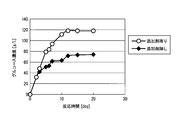
混合液b-2-1と混合液b-2-2をそれぞれ、振盪機で穏やかに振盪させながら、50℃にて20日間保持して、セルロースを分解酵素により分解した。また、反応開始から5日後に、混合液b-2-1および混合液b-2-2におけるセルロースの濃度が70g/Lとなるように、水蒸気爆砕バガスを追加した。
酵素分解反応中、所定時間毎に、セルロースの酵素分解によって得られたグルコースを主成分とする糖類の濃度を、高速液体クロマトグラフィー(HPLC)により測定した。結果を図1に示す。
図1の結果から、吸着抑制剤を含む混合液b-2-1では、グルコースを主成分とする糖類の濃度が118g/Lに達したが、吸着抑制剤を含まない混合液b-2-2では、グルコースを主成分とする糖類の濃度が74g/Lに留まった。
水蒸気爆砕バガス5g-dryを、pHが5の酢酸緩衝液50mmol/L溶液と混合して、混合液a-3を調製した。
混合液a-3に、分解酵素としてセルラーゼを、バイオマス1g-dry当たり40mg添加し、吸着抑制剤として牛血清アルブミン(BSA)を、バイオマス1g-dry当たり10mg添加して、バイオマススラリー、分解酵素および吸着抑制剤を含む混合液b-3-1を調製した。これにより、混合液b-3-1において、セルロースの濃度を60g/Lに調整した。
また、混合液a-3に、分解酵素としてセルラーゼを、バイオマス1g-dry当たり20mg添加し、吸着抑制剤として牛血清アルブミン(BSA)を、バイオマス1g-dry当たり10mg添加して、バイオマススラリー、分解酵素および吸着抑制剤を含む混合液b-3-2を調製した。これにより、混合液b-3-2において、セルロースの濃度を60g/Lに調整した。
ここで、水蒸気爆砕バガス中のセルロース濃度を測定することにより、混合液b-3-1および混合液b-3-2におけるセルロースの濃度を算出した。
混合液b-3-1と混合液b-3-2をそれぞれ、振盪機で穏やかに振盪させながら、50℃にて20日間保持して、セルロースを分解酵素により分解した。また、反応開始から3日後に、混合液b-3-1および混合液b-3-2に、水蒸気爆砕バガス5g-dryを追加した。水蒸気爆砕バガスを追加する際、混合液b-3-2には、分解酵素としてセルラーゼを、バイオマス1g-dry当たり20mg添加した。
酵素分解反応中、所定時間毎に、セルロースの酵素分解によって得られたグルコースを主成分とする糖類の濃度を、高速液体クロマトグラフィー(HPLC)により測定した。結果を図2に示す。
図2の結果から、反応初期にセルラーゼを40mg添加し、反応中にセルラーゼを添加しない混合液b-3-1では、グルコースを主成分とする糖類の濃度が115g/Lに達したが、反応初期にセルラーゼを20mg添加し、反応中にセルラーゼを20mg添加した混合液b-3-2では、グルコースを主成分とする糖類の濃度が95g/Lに留まった。
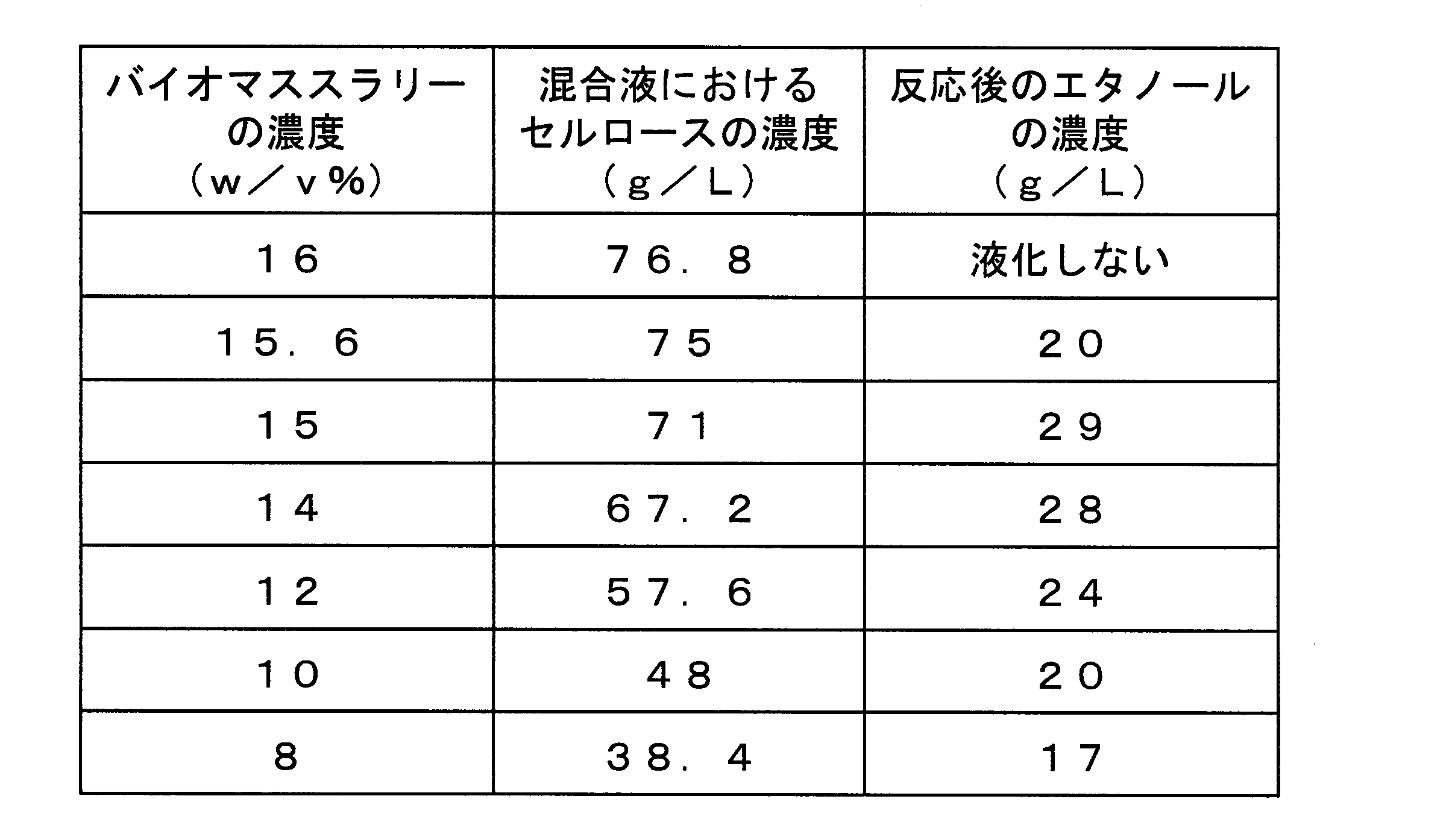
水蒸気爆砕バガスを、pHが5の酢酸緩衝液50mmol/L溶液と混合して、表2に示すように、バイオマススラリー濃度が8w/v%~16w/v%の混合液a-4を、それぞれ調製した。
バイオマススラリー濃度が異なる、それぞれの混合液a-4に、分解酵素としてセルラーゼを、バイオマス1g-dry当たり4mg添加し、吸着抑制剤として牛血清アルブミン(BSA)を、バイオマス1g-dry当たり10mg添加し、発酵菌として酵母菌を、濁度3となるように添加して、バイオマススラリー、分解酵素、吸着抑制剤および発酵菌を含む混合液b-4を調製した。これにより、表2に示すように、混合液b-4において、セルロースの濃度を38.4g/L~76.8g/Lに調整した。ここで、水蒸気爆砕バガス中のセルロース濃度を測定することにより、混合液b-4におけるセルロースの濃度を算出した。
混合液b-4を、振盪機で穏やかに振盪させながら、30℃にて7日間保持して、セルロースを分解酵素により分解して、グルコースを主成分とする糖類を生成し、そのグルコースを主成分とする糖類からエタノールを生成した。ここで、高速液体クロマトグラフィー(HPLC)により、混合液b-4におけるエタノールの濃度を算出した。これらの結果を表2に示す。
水蒸気爆砕バガスを、pHが5の酢酸緩衝液50mmol/L溶液と混合して、バイオマススラリー濃度が14w/v%の混合液a-5を調製した。
混合液a-5に、分解酵素としてセルラーゼを、バイオマス1g-dry当たり4mg添加し、吸着抑制剤として牛血清アルブミン(BSA)を、バイオマス1g-dry当たり10mg添加し、発酵菌として酵母菌を、濁度3となるように添加して、バイオマススラリー、分解酵素、吸着抑制剤および発酵菌を含む混合液b-5-1を調製した。これにより、混合液b-5-1において、セルロースの濃度を67.2g/Lに調整した。
また、混合液a-5に、分解酵素としてセルラーゼを、バイオマス1g-dry当たり4mg添加し、発酵菌として酵母菌を、濁度3となるように添加して、バイオマススラリー、分解酵素および発酵菌を含む混合液b-5-2を調製した。これにより、混合液b-5-2において、セルロースの濃度を67.2g/Lに調整した。
ここで、水蒸気爆砕バガス中のセルロース濃度を測定することにより、混合液b-5-1および混合液b-5-2におけるセルロースの濃度を算出した。
混合液b-5-1と混合液b-5-2をそれぞれ、振盪機で穏やかに振盪させながら、50℃にて20日間保持して、セルロースを分解酵素により分解して、グルコースを主成分とする糖類を生成し、そのグルコースを主成分とする糖類からエタノールを生成した。また、反応開始から5日後に、混合液b-5-1および混合液b-5-2におけるセルロースの濃度が70g/Lとなるように、水蒸気爆砕バガスを追加した。
同時糖化発酵反応中、所定時間毎に、エタノールの濃度を、高速液体クロマトグラフィー(HPLC)により測定した。結果を図3に示す。
図3の結果から、吸着抑制剤を含む混合液b-5-1では、エタノールの濃度が48g/Lに達したが、吸着抑制剤を含まない混合液b-5-2では、エタノールの濃度が29g/Lに留まった。
水蒸気爆砕バガス5g-dryを、pHが5の酢酸緩衝液50mmol/L溶液と混合して、混合液a-6を調製した。
混合液a-6に、分解酵素としてセルラーゼを、バイオマス1g-dry当たり40mg添加し、吸着抑制剤として牛血清アルブミン(BSA)を、バイオマス1g-dry当たり10mg添加し、発酵菌として酵母菌を、OD3となるように添加して、バイオマススラリー、分解酵素、吸着抑制剤および発酵菌を含む混合液b-6-1を調製した。これにより、混合液b-6-1において、セルロースの濃度を60g/Lに調整した。
また、混合液a-6に、分解酵素としてセルラーゼを、バイオマス1g-dry当たり20mg添加し、吸着抑制剤として牛血清アルブミン(BSA)を、バイオマス1g-dry当たり10mg添加し、発酵菌として酵母菌を、OD3となるように添加して、バイオマススラリー、分解酵素、吸着抑制剤および発酵菌を含む混合液b-6-2を調製した。これにより、混合液b-6-2において、セルロースの濃度を60g/Lに調整した。
ここで、水蒸気爆砕バガス中のセルロース濃度を測定することにより、混合液b-6-1および混合液b-6-2におけるセルロースの濃度を算出した。
混合液b-6-1と混合液b-6-2をそれぞれ、振盪機で穏やかに振盪させながら、50℃にて20日間保持して、セルロースを分解酵素により分解した。また、反応開始から3日後に、混合液b-6-1および混合液b-6-2に、水蒸気爆砕バガス5g-dryを追加した。水蒸気爆砕バガスを追加する際、混合液b-6-2には、分解酵素としてセルラーゼを、バイオマス1g-dry当たり20mg添加した。
酵素分解反応中、所定時間毎に、セルロースの酵素分解によって得られたグルコースを主成分とする糖類の濃度を、高速液体クロマトグラフィー(HPLC)により測定した。結果を図4に示す。
図4の結果から、反応初期にセルラーゼを40mg添加し、反応中にセルラーゼを添加しない混合液b-6-1では、エタノールの濃度が46g/Lに達したが、反応初期にセルラーゼを20mg添加し、反応中にセルラーゼを20mg添加した混合液b-6-2では、エタノールの濃度が37g/Lに留まった。
Claims (4)
- バイオマスを含むスラリーに、セルロースおよびヘミセルロースの少なくともいずれか一方の分解酵素を添加し、前記バイオマスに含まれるセルロースおよびヘミセルロースの少なくともいずれか一方を、前記分解酵素で分解して、グルコースを主成分とする糖類を製造する方法であって、
前記スラリーと、前記分解酵素と、前記バイオマスに含まれるリグニンへ前記分解酵素が吸着するのを防止するための吸着抑制剤と、を含む混合液において、前記セルロースおよびヘミセルロースの少なくともいずれか一方の濃度を75g/L以下に保持する糖類の製造方法。 - 反応初期に前記分解酵素を全量添加し、反応中に前記分解酵素を添加しない請求項1に記載の糖類の製造方法。
- バイオマスを含むスラリーに、セルロースおよびヘミセルロースの少なくともいずれか一方の分解酵素と発酵菌を添加し、前記バイオマスに含まれるセルロースおよびヘミセルロースの少なくともいずれか一方を、前記分解酵素で分解して、グルコースを主成分とする糖類を製造し、当該糖類からエタノールを製造する方法であって、
前記スラリーと、前記分解酵素と、前記発酵菌と、前記バイオマスに含まれるリグニンへ前記分解酵素が吸着するのを防止するための吸着抑制剤と、を含む混合液において、前記セルロースおよびヘミセルロースの少なくともいずれか一方の濃度を75g/L以下に保持するエタノールの製造方法。 - 反応初期に前記分解酵素を全量添加し、反応中に前記分解酵素を添加しない請求項3に記載のエタノールの製造方法。
Priority Applications (3)
| Application Number | Priority Date | Filing Date | Title |
|---|---|---|---|
| US15/545,212 US20180010159A1 (en) | 2015-03-04 | 2015-03-04 | Method of producing saccharides and method of producing ethanol |
| BR112017017388A BR112017017388A2 (pt) | 2015-03-04 | 2015-03-04 | método de produção de sacarídeos e método de produção de etanol |
| PCT/JP2015/056323 WO2016139771A1 (ja) | 2015-03-04 | 2015-03-04 | 糖類の製造方法、エタノールの製造方法 |
Applications Claiming Priority (1)
| Application Number | Priority Date | Filing Date | Title |
|---|---|---|---|
| PCT/JP2015/056323 WO2016139771A1 (ja) | 2015-03-04 | 2015-03-04 | 糖類の製造方法、エタノールの製造方法 |
Publications (1)
| Publication Number | Publication Date |
|---|---|
| WO2016139771A1 true WO2016139771A1 (ja) | 2016-09-09 |
Family
ID=56849312
Family Applications (1)
| Application Number | Title | Priority Date | Filing Date |
|---|---|---|---|
| PCT/JP2015/056323 Ceased WO2016139771A1 (ja) | 2015-03-04 | 2015-03-04 | 糖類の製造方法、エタノールの製造方法 |
Country Status (3)
| Country | Link |
|---|---|
| US (1) | US20180010159A1 (ja) |
| BR (1) | BR112017017388A2 (ja) |
| WO (1) | WO2016139771A1 (ja) |
Citations (3)
| Publication number | Priority date | Publication date | Assignee | Title |
|---|---|---|---|---|
| JP2011508606A (ja) * | 2008-01-04 | 2011-03-17 | ザ・ユニバーシティ・オブ・トレド | キシロースおよびヘキソース糖類の発酵方法 |
| JP2011182741A (ja) * | 2010-03-10 | 2011-09-22 | Taisei Corp | アルコールの製造方法 |
| WO2013121551A1 (ja) * | 2012-02-16 | 2013-08-22 | 日揮株式会社 | グルコースを主成分とする糖類の製造方法 |
-
2015
- 2015-03-04 US US15/545,212 patent/US20180010159A1/en not_active Abandoned
- 2015-03-04 WO PCT/JP2015/056323 patent/WO2016139771A1/ja not_active Ceased
- 2015-03-04 BR BR112017017388A patent/BR112017017388A2/pt not_active Application Discontinuation
Patent Citations (3)
| Publication number | Priority date | Publication date | Assignee | Title |
|---|---|---|---|---|
| JP2011508606A (ja) * | 2008-01-04 | 2011-03-17 | ザ・ユニバーシティ・オブ・トレド | キシロースおよびヘキソース糖類の発酵方法 |
| JP2011182741A (ja) * | 2010-03-10 | 2011-09-22 | Taisei Corp | アルコールの製造方法 |
| WO2013121551A1 (ja) * | 2012-02-16 | 2013-08-22 | 日揮株式会社 | グルコースを主成分とする糖類の製造方法 |
Non-Patent Citations (1)
| Title |
|---|
| KUMAR R ET AL.: "Effect of additives on the digestibility of corn stover solids following pretreatment by leading technologies", BIOTECHNOLOGY AND BIOENGINEERING, vol. 102, 2009, pages 1544 - 1557, XP055079511, DOI: doi:10.1002/bit.22203 * |
Also Published As
| Publication number | Publication date |
|---|---|
| US20180010159A1 (en) | 2018-01-11 |
| BR112017017388A2 (pt) | 2018-04-03 |
Similar Documents
| Publication | Publication Date | Title |
|---|---|---|
| Calderaro et al. | Characterization of an AA9 LPMO from Thielavia australiensis, Taus LPMO9B, under industrially relevant lignocellulose saccharification conditions | |
| Outeirino et al. | A novel approach to the biorefinery of brewery spent grain | |
| EP3222732B1 (en) | Lignocellulosic simultaneous saccharification and fermentation method improved by utilizing surfactant | |
| Geddes et al. | Seed train development for the fermentation of bagasse from sweet sorghum and sugarcane using a simplified fermentation process | |
| Vargas-Tah et al. | Non-severe thermochemical hydrolysis of stover from white corn and sequential enzymatic saccharification and fermentation to ethanol | |
| WO2011125056A1 (en) | Rapid and low cost enzymatic full conversion of lignocellulosic biomass | |
| Cayetano et al. | Two-stage processing of Miscanthus giganteus using anhydrous ammonia and hot water for effective xylan recovery and improved enzymatic saccharification | |
| Li et al. | Periodic peristalsis increasing acetone–butanol–ethanol productivity during simultaneous saccharification and fermentation of steam-exploded corn straw | |
| FR2898605A1 (fr) | Complement nutritionnel pour milieu de saccharification-fermentation dans la production d'ethanol | |
| WO2016139771A1 (ja) | 糖類の製造方法、エタノールの製造方法 | |
| JP2009131168A (ja) | 廃棄玉ネギの処理方法 | |
| JP2015139380A (ja) | 草本系バイオマス又は木質系バイオマスから糖を製造する方法及び生成された糖からエタノールを製造する方法 | |
| US20120164694A1 (en) | Method of producing saccharides containing glucose as major constituent | |
| JP2009022165A (ja) | エタノール製造方法 | |
| US20150037856A1 (en) | Rapid and low cost enzymatic full conversion of lignocellulosic biomass | |
| US10072253B2 (en) | Liquefied cellulosic biomass for enzyme production | |
| Gunam et al. | Experimentation of various co-culture fermentation strategies for better efficiency bioethanol production using wild cassava flour (Manihot glaziovii Muell. Arg) as substrate | |
| US10280437B2 (en) | Method for producing ethanol | |
| Wu | Mixed fermentation of Aspergillus niger and Candida shehatae to produce bioethanol with ionic-liquid-pretreated bagasse | |
| US9868968B2 (en) | Method for producing saccharides containing glucose as main component | |
| WO2013121551A1 (ja) | グルコースを主成分とする糖類の製造方法 | |
| JP4713688B1 (ja) | バイオエタノールの製造方法 | |
| Iram et al. | The Effect of Dilution, Aeration, and Agitation on Fungal Cellulase and Xylanase Production by DDGS-Based Fermentation Media in Stirred Tank Bioreactors | |
| US10612062B2 (en) | Method of producing saccharides from biomass with lesser amount of saccharifying enzyme inexpensively | |
| KR101408972B1 (ko) | 발효 촉진 조성물을 이용한 바이오 에탄올의 생산방법 |
Legal Events
| Date | Code | Title | Description |
|---|---|---|---|
| 121 | Ep: the epo has been informed by wipo that ep was designated in this application |
Ref document number: 15883939 Country of ref document: EP Kind code of ref document: A1 |
|
| WWE | Wipo information: entry into national phase |
Ref document number: 15545212 Country of ref document: US |
|
| REG | Reference to national code |
Ref country code: BR Ref legal event code: B01A Ref document number: 112017017388 Country of ref document: BR |
|
| NENP | Non-entry into the national phase |
Ref country code: DE |
|
| 122 | Ep: pct application non-entry in european phase |
Ref document number: 15883939 Country of ref document: EP Kind code of ref document: A1 |
|
| ENP | Entry into the national phase |
Ref document number: 112017017388 Country of ref document: BR Kind code of ref document: A2 Effective date: 20170814 |
|
| NENP | Non-entry into the national phase |
Ref country code: JP |