WO2016132933A1 - 設計装置、設計方法及び記録媒体 - Google Patents
設計装置、設計方法及び記録媒体 Download PDFInfo
- Publication number
- WO2016132933A1 WO2016132933A1 PCT/JP2016/053487 JP2016053487W WO2016132933A1 WO 2016132933 A1 WO2016132933 A1 WO 2016132933A1 JP 2016053487 W JP2016053487 W JP 2016053487W WO 2016132933 A1 WO2016132933 A1 WO 2016132933A1
- Authority
- WO
- WIPO (PCT)
- Prior art keywords
- distribution
- selection probability
- server
- content
- user
- Prior art date
- Legal status (The legal status is an assumption and is not a legal conclusion. Google has not performed a legal analysis and makes no representation as to the accuracy of the status listed.)
- Ceased
Links
Images



Classifications
-
- H—ELECTRICITY
- H04—ELECTRIC COMMUNICATION TECHNIQUE
- H04L—TRANSMISSION OF DIGITAL INFORMATION, e.g. TELEGRAPHIC COMMUNICATION
- H04L45/00—Routing or path finding of packets in data switching networks
- H04L45/12—Shortest path evaluation
- H04L45/124—Shortest path evaluation using a combination of metrics
-
- H—ELECTRICITY
- H04—ELECTRIC COMMUNICATION TECHNIQUE
- H04L—TRANSMISSION OF DIGITAL INFORMATION, e.g. TELEGRAPHIC COMMUNICATION
- H04L41/00—Arrangements for maintenance, administration or management of data switching networks, e.g. of packet switching networks
- H04L41/14—Network analysis or design
- H04L41/142—Network analysis or design using statistical or mathematical methods
-
- H—ELECTRICITY
- H04—ELECTRIC COMMUNICATION TECHNIQUE
- H04L—TRANSMISSION OF DIGITAL INFORMATION, e.g. TELEGRAPHIC COMMUNICATION
- H04L45/00—Routing or path finding of packets in data switching networks
- H04L45/42—Centralised routing
-
- H—ELECTRICITY
- H04—ELECTRIC COMMUNICATION TECHNIQUE
- H04L—TRANSMISSION OF DIGITAL INFORMATION, e.g. TELEGRAPHIC COMMUNICATION
- H04L67/00—Network arrangements or protocols for supporting network services or applications
- H04L67/01—Protocols
- H04L67/10—Protocols in which an application is distributed across nodes in the network
- H04L67/1001—Protocols in which an application is distributed across nodes in the network for accessing one among a plurality of replicated servers
- H04L67/1004—Server selection for load balancing
- H04L67/101—Server selection for load balancing based on network conditions
-
- H—ELECTRICITY
- H04—ELECTRIC COMMUNICATION TECHNIQUE
- H04L—TRANSMISSION OF DIGITAL INFORMATION, e.g. TELEGRAPHIC COMMUNICATION
- H04L67/00—Network arrangements or protocols for supporting network services or applications
- H04L67/01—Protocols
- H04L67/10—Protocols in which an application is distributed across nodes in the network
- H04L67/1097—Protocols in which an application is distributed across nodes in the network for distributed storage of data in networks, e.g. transport arrangements for network file system [NFS], storage area networks [SAN] or network attached storage [NAS]
-
- H—ELECTRICITY
- H04—ELECTRIC COMMUNICATION TECHNIQUE
- H04L—TRANSMISSION OF DIGITAL INFORMATION, e.g. TELEGRAPHIC COMMUNICATION
- H04L67/00—Network arrangements or protocols for supporting network services or applications
- H04L67/50—Network services
- H04L67/56—Provisioning of proxy services
- H04L67/568—Storing data temporarily at an intermediate stage, e.g. caching
Definitions
- the present invention relates to a design apparatus, a design method, and a recording medium.
- the present invention relates to a distribution request from a user in a content distribution NW (Contents Delivery Network, hereinafter referred to as CDN) that distributes content using cache servers distributed and arranged in a plurality of nodes of the network (NW).
- NW Content Distribution Network
- the present invention relates to a design apparatus, a design method, and a recording medium for designing a probability of selecting a distribution server or a distribution route used for content distribution.
- the Internet does not manage the state of individual flows within the network, but performs routing processing based on the received address.
- AS Autonomous System
- ISP Internet Service Provider
- packets are forwarded on a route with the minimum sum of link weights fixedly set by OSPF (Open Shortest Path First) .
- OSPF Open Shortest Path First
- the transmission host autonomously determines the transfer rate without performing flow admission control, link congestion may occur in principle. Therefore, in order to maintain appropriate communication quality, designing and managing the NW so that the load on all links that make up the NW is below an appropriate level is one of the major issues for ISPs.
- the link load always changes due to changes in the route caused by fluctuations in AC traffic demand and various faults. For this reason, many route control methods for dynamically setting a route through which a packet flows so as to actively use a link with a low usage rate and distributing the link load have been studied.
- HTTP Hypertext Transfer Protocol
- UGC User-Generated Content
- YouTube registered trademark
- VoD Video On Demand
- CDN Content Distribution
- CDN aims to improve user quality and reduce the amount of traffic within the network by placing a copy of the content on cache servers distributed over a number of networks and distributing them on behalf of the original server. For this reason, the origination node position of the distribution flow generated in content distribution is determined by the content arrangement method and server selection method, and the user quality and traffic volume in the NW are strongly influenced by these control methods.
- CDN is operated by CDN operators such as Akamai independent of ISP, and it distributes from the cache server in an overlay manner in the application layer, so it is difficult for ISP to obtain information on server selection method and content allocation method. is there. Therefore, the ISP performs routing control, and the CDN provider performs server selection (or content allocation) independently.
- Non-Patent Documents 1 and 2 for the above technologies.
- ISP routing controls the effect of CDN operators 'server selection
- CDN operators' server selection affects the effects of ISP routing, so when considering each control method. It is necessary to consider the influence of ISP and CDN operators' control on the other party's control results. For example, DiPalantino et al. Use game theory to model both strategies and analyze the resulting equilibrium.
- ISPs and CDN operators cooperate to select servers for example Poese et al. Analyze passive capture data, and DNS (Domain Name System) responds to the address of the delivery server that answers when delivering content It is diverse and states that response time is expected to be improved by ISPs selecting servers.
- Frank et al. Have also proposed a method for exchanging necessary information for CDN operators and ISPs to cooperate in server selection.
- Jiang et al. Analyze how close the overall optimal state is when the information held by ISPs is communicated to the other party in the situation where ISPs select routes and CDN operators select servers independently. .
- Jiang et al.'S document aims at total optimization at a single point in time, and is difficult to apply to an actual network where traffic exchanges will continue to change in the future.
- a method capable of repeating the optimization process in time series is required.
- An object of the present invention is to improve the CDN service by suppressing the frequency with which a delivery request from a user is rejected when the delivery request from the user changes in time in the CDN.
- a design apparatus includes: Design apparatus for designing a probability of selecting a distribution server or a distribution route used for content distribution in response to a distribution request from a user when distributing content using cache servers distributed and arranged in a plurality of nodes of the network Because A parameter input unit that receives as parameters the parameters related to the network and the demand estimate of the distribution request generated for the content from the user; Based on the input parameter value received in the parameter input unit, the selection probability that the cache server is selected as the distribution server so as to suppress the excessive distribution request that rejects the distribution request generated for the content from the user, or A selection probability design unit that designs the selection probability of a distribution route that is a set of a distribution route and a distribution server by which the distribution server distributes content using model predictive control; A selection probability output unit that outputs a selection probability of a cache server or a selection probability of a distribution route designed in the selection probability design unit; It is characterized by having.
- a design method includes: Design apparatus for designing a probability of selecting a distribution server or a distribution route used for content distribution in response to a distribution request from a user when distributing content using cache servers distributed and arranged in a plurality of nodes of the network
- a design method in which Receiving, as input parameter values, parameters relating to the network and a demand estimation amount of a distribution request generated for content from a user; Based on the received input parameter value, the selection probability that the cache server is selected as the distribution server so as to suppress the excessive distribution request that rejects the distribution request generated for the content from the user, or the distribution server is the content
- a recording medium is To design the probability of selecting a distribution server or distribution route used for content distribution in response to a distribution request from a user when distributing content using cache servers distributed to multiple nodes of the network , Computer, A parameter input means for receiving, as an input parameter value, a parameter relating to the network and a demand estimation amount of a distribution request generated for content from the user; Based on the input parameter value received in the parameter input means, the selection probability that the cache server is selected as the distribution server so as to suppress the excessive distribution request that rejects the distribution request generated for the content from the user, or Selection probability design means for designing the selection probability of a distribution route, which is a set of a distribution route and a distribution server, from which the distribution server distributes content using model predictive control, and the selection probability of the cache server designed by the selection probability design means Or a selection probability output means for outputting the selection probability of the delivery route, It is the recording medium which recorded the program made to function as.
- the frequency with which the distribution request from the user is rejected can be suppressed and the CDN service can be improved.
- the block diagram of the design apparatus which concerns on one Embodiment of this invention The figure which shows the example of the hardware constitutions of the design apparatus which concerns on one Embodiment of this invention.
- 1 is a configuration diagram of a distribution server selection probability optimal design device according to an embodiment of the present invention.
- 1 is a configuration diagram of a delivery route selection probability optimal design apparatus according to an embodiment of the present invention.
- Schematic showing the CDN operating mechanism Schematic diagram showing the optimization flow of model predictive control
- CAIS network topology used for performance evaluation of a design apparatus according to an embodiment of the present invention Diagram of Verio network topology used for performance evaluation of design device according to one embodiment of the present invention
- the probability of selecting a distribution server used for content distribution in response to a distribution request from a user A method of designing the probability of selecting a delivery route that is a set of a delivery route and a delivery server so as to suppress an excess delivery request in which the delivery request is rejected will be described.
- FIG. 1 is a configuration diagram of a design apparatus 100 according to an embodiment of the present invention.
- the design device 100 distributes the probability of selecting a distribution server used for content distribution in response to a distribution request from a user in a CDN that distributes content using cache servers distributed and arranged in a plurality of nodes of the network. It is a device designed to suppress over-delivery requests where requests are rejected.
- the design device 100 is also a device that designs the probability of selecting a delivery route that is a set of a delivery route and a delivery server so as to suppress an excess delivery request in which the delivery request is rejected.
- FIG. 2 is a diagram illustrating an example of a hardware configuration of the design apparatus 100 according to an embodiment of the present invention.
- the design apparatus 100 may be a computer including a CPU (Central Processing Unit) 151 such as a processor, a memory device 152 such as a RAM (Random Access Memory) and a ROM (Read Only Memory), a storage device 153 such as a hard disk, and the like.
- a CPU Central Processing Unit
- memory device 152 such as a RAM (Random Access Memory) and a ROM (Read Only Memory)
- storage device 153 such as a hard disk, and the like.
- the functions and processing of the design apparatus 100 are realized by the CPU executing data and programs stored in the storage device or the memory device.
- the design apparatus 100 includes a parameter input unit 101, a selection probability design unit 102, and a selection probability output unit 103.
- the parameter input unit 101 receives an input parameter value necessary for designing the selection probability of the distribution server or the selection probability of the distribution route using model predictive control (MPC). Specifically, the parameter input unit 101 receives a parameter related to a network and a demand estimation amount of a distribution request generated for content from a user.
- MPC model predictive control
- the selection probability design unit 102 selects the cache server as a distribution server based on the input parameter value received by the parameter input unit 101 so as to suppress the excessive distribution request that rejects the distribution request generated for the content from the user.
- the selection probability is designed using model predictive control.
- the selection probability design unit 102 may design not only the selection probability of the cache server but also a distribution route through which the distribution server distributes content to the user. In this case, the selection probability design unit 102 predicts the selection probability of the distribution route that is a combination of the distribution route and the distribution server so as to suppress the excessive distribution request that rejects the distribution request generated for the content from the user. Design with control.
- the selection probability output unit 103 outputs the selection probability of the cache server or the distribution route selected by the selection probability design unit 102.
- the design apparatus 100 of FIG. 1 determines the probability of selecting a distribution server used for content distribution in response to a distribution request from the user, that is, the distribution of the cache server.
- the distribution server selection probability optimal design apparatus 200 may be configured to optimally design so as to minimize the frequency of excessive distribution requests that are rejected due to excess capacity.
- FIG. 3 is a configuration diagram of the distribution server selection probability optimal design apparatus 200 according to an embodiment of the present invention.
- the distribution server selection probability optimal design apparatus 200 includes a parameter input unit 201, a cache server selection probability optimal design unit 202, and a cache server selection probability output unit 203.
- the cache server selection probability optimal design unit 202 may suppress the number of excess delivery requests, reduce the average number of hops of the delivery flow, and suppress the change amount of the selection probability. That is, the cache server selection probability optimal design unit 202 sets the objective function J s for suppressing the number of excess delivery requests, the objective function J h for reducing the average hop count of the delivery flow, and the change amount of the cache server selection probability.
- the objective function J v, p for suppression may be optimized simultaneously.
- the parameter input unit 201 receives, as input parameters, a parameter related to content in the network, a parameter related to a cache server, and a demand estimation amount of a distribution request generated for the content from the user. Specifically, the following parameters are input by the parameter input unit 201.
- the cache server selection probability optimal design unit 202 optimally designs the selection probability p u, m, k (s) of the cache server s based on the parameter value input from the parameter input unit 201, and the cache server selection probability output unit 203. Outputs the design value of p u, m, k (s).
- the design apparatus 100 in FIG. 1 determines the probability of selecting a distribution server used for content distribution in response to a distribution request from the user, and a distribution route through which the distribution server distributes content to the user.
- it may be configured as a distribution route selection probability optimal design apparatus 300 that optimally designs so as to minimize the frequency of excessive distribution requests in which distribution requests are rejected.
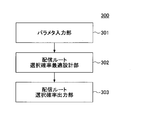
- FIG. 4 is a configuration diagram of a delivery route selection probability optimal design apparatus 300 according to an embodiment of the present invention.
- the distribution route selection probability optimal design apparatus 300 includes a parameter input unit 301, a distribution route selection probability optimal design unit 302, and a distribution route selection probability output unit 303.
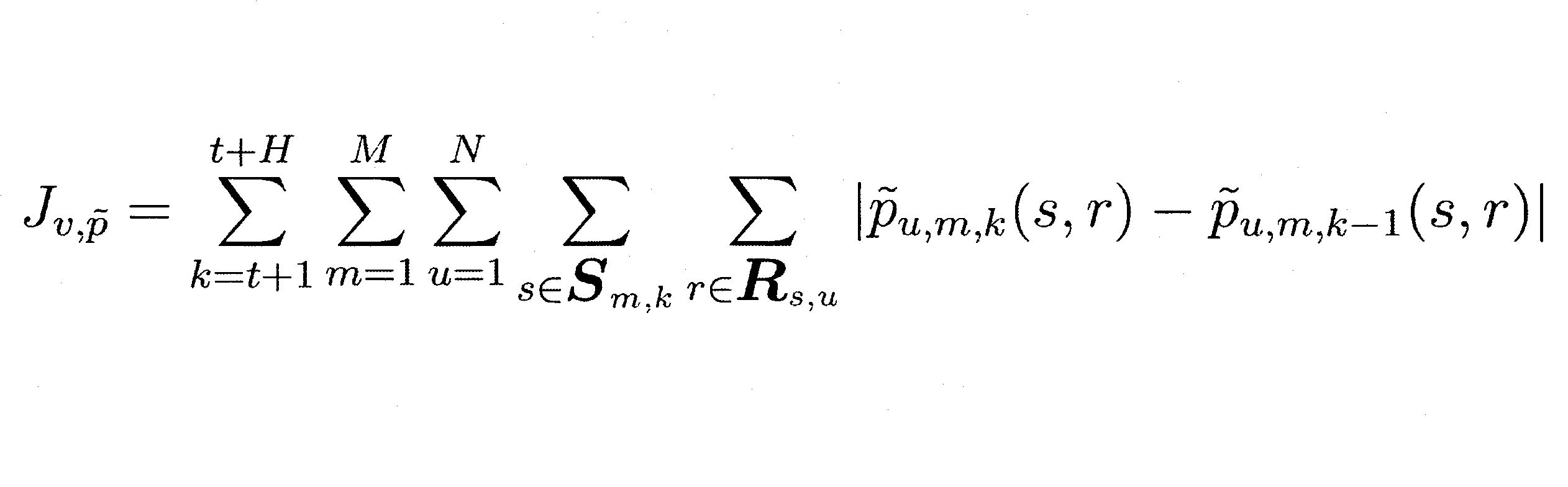
- the distribution route selection probability optimal design unit 302 suppresses the number of excessive distribution requests, reduces the total number of distribution flows passing through the link, reduces the average number of hops of the distribution flow, and suppresses the variation in the selection probability. May be.
- the distribution route selection probability optimal design unit 302 includes an objective function J s for suppressing the number of excessive distribution requests, an objective function J e for reducing the total number of distribution flows passing through the link, and an average number of hops of the distribution flow.
- the parameter input unit 301 receives, as an input parameter, a parameter related to a link in addition to a parameter related to content in the network, a parameter related to a cache server, and a demand estimation amount of a distribution request generated for the content from the user. Specifically, the parameter input unit 301 inputs the following parameters.
- the weight parameter w e of the objective function J e for the objective function J s -Weight parameter w h of objective function J h with respect to objective function J s -Objective function for objective function J s
- the distribution route selection probability optimal design unit 302 is based on the parameter value input from the parameter input unit 301 and the distribution route selection probability
- the design value of is output.
- the CDN starts distribution after selecting a cache server (or original server) that distributes the content.
- a distribution process used by a general CDN operator is assumed. Akamai is an example of a typical CDN operator.
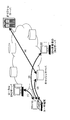
- FIG. 5 is a schematic diagram showing the operation mechanism of the CDN.
- the user needs to resolve the IP address of the distribution source server by DNS, but first inquires the IP address of the local DNS server as shown in (1) of FIG. If the requested content is cached in the local DNS, the content is distributed from there to the user terminal. If it is not cached, the user terminal is answered to make an inquiry to the DNS server of the CDN operator, and the user terminal inquires the IP address of the distribution server from the DNS server of the CDN operator as shown in (2) of FIG.
- the CDN operator's DNS server selects the cache server to be used for distribution and returns its IP address to the user terminal.
- the selection criteria for the cache server are determined by the CDN operator, but in many cases, the one with a short measured response time or one near the user terminal is selected.
- the user terminal requests the distributed cache server to distribute the content, and if the corresponding content is cached, it is distributed from there (cache hit). If it is not cached (cache miss), the cache server makes a request to the original server that holds the original of the corresponding content and acquires the content ((4) in FIG. 5). The acquired content is cached and distributed to the user terminal. If the cache capacity is insufficient, the newly acquired content is cached after deleting the cached content selected based on some policy. As the deletion content selection policy, LRU (least recently used) that deletes the one having the longest elapsed time since the last request is often used.
- LRU least recently used
- the delivery route is determined by selecting an arbitrary route r.
- the user accommodated by the node u is denoted as user u.
- the user u includes a user accommodated directly in the node u and a user accommodated in a lower NW accommodated in the node u.
- the target node of the content distribution flow for the user u is the node u.
- M contents of the same size are provided in the entire NW, and the distribution demand amount of content m generated from the user u in TSt (the number of requests generated in TSt) is d u, m, t .
- An original server is installed in all nodes, and each content is prepared in only one arbitrary node. The original position remains unchanged throughout the entire period, and the original of the content m exists in the node o m . .
- the original server and the cache server installed in the node n are expressed as an original server n and a cache server n, respectively, and the original server n and the cache server n are collectively expressed as a server n.
- the throughput of the distribution flow is the same.
- All nodes on the NW is installed cache server, to the storage capacity of the cache server s (maximum cacheable number of contents) and B s.
- the distribution processing capacity of the cache server or the original server is limited, and the upper limit of the total number of distributions that the cache server s can distribute within each TS is C C, s .
- All links in which the content m is held in the selected cache server s in response to the distribution request to the content u of the user u (cache hit), and the distribution capacity of the cache server s and the selected route r are routed When there is a margin, the content m is distributed from the cache server s, and a distribution flow is generated from the node s to the user u.
- content m is distributed from the original server o m in the case of the delivery capacity of the original server o m of content m can afford, from the node o m to the node s Distribution flow and a distribution flow from the node s to the user u are generated, and the content m is newly cached in the cache server s.
- LRU is assumed as a replacement method when the cache capacity is insufficient.
- the delivery capacity of the server and over the link from the original server o m is insufficient distribution request is rejected, discarded it has been requested shall again occurs at the next TS as over delivery request.
- the content held by each cache changes dynamically, but the set of caches that hold content m at the start of TSt.
- MPC Model Predictive Control
- U (t + H) is derived from u (t + 1), u (t + 2),.
- the input x t + 1 , ..., x t + H optimized in the prediction horizon [t + 1, t + H] is actually input to the system Is only the latest xt + 1 .
- Subsequent input settings are determined by correcting the predicted value based on the observation feedback and optimizing the input again.
- the input may change excessively due to the influence of prediction errors, and the system may become unstable.
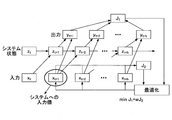
- FIG. 6 illustrates the optimization process in MPC.
- the system state z t + 1 in each TSt + 1 is determined from the system state z t and the input x t in TSt one time before.
- An optimization objective function J 1 + wJ 2 is obtained.
- the nonlinear optimization problem of minimizing this objective function demanded to the subject each x t of t + 1 ⁇ k ⁇ t + H, turning on the input value x t + 1 of TSt + 1 into the system.
- the MPC system state z t is a distribution demand amount d u, m, t generated for the content and is given from the outside. However, since d u, m, k of k ⁇ t is unknown at the start of TSt, its estimated value
- Cache server s is selected from the cache servers with probability p u, m, t (s). Therefore, p u, m, t (s) becomes MPC input x t , and at the start of each TS
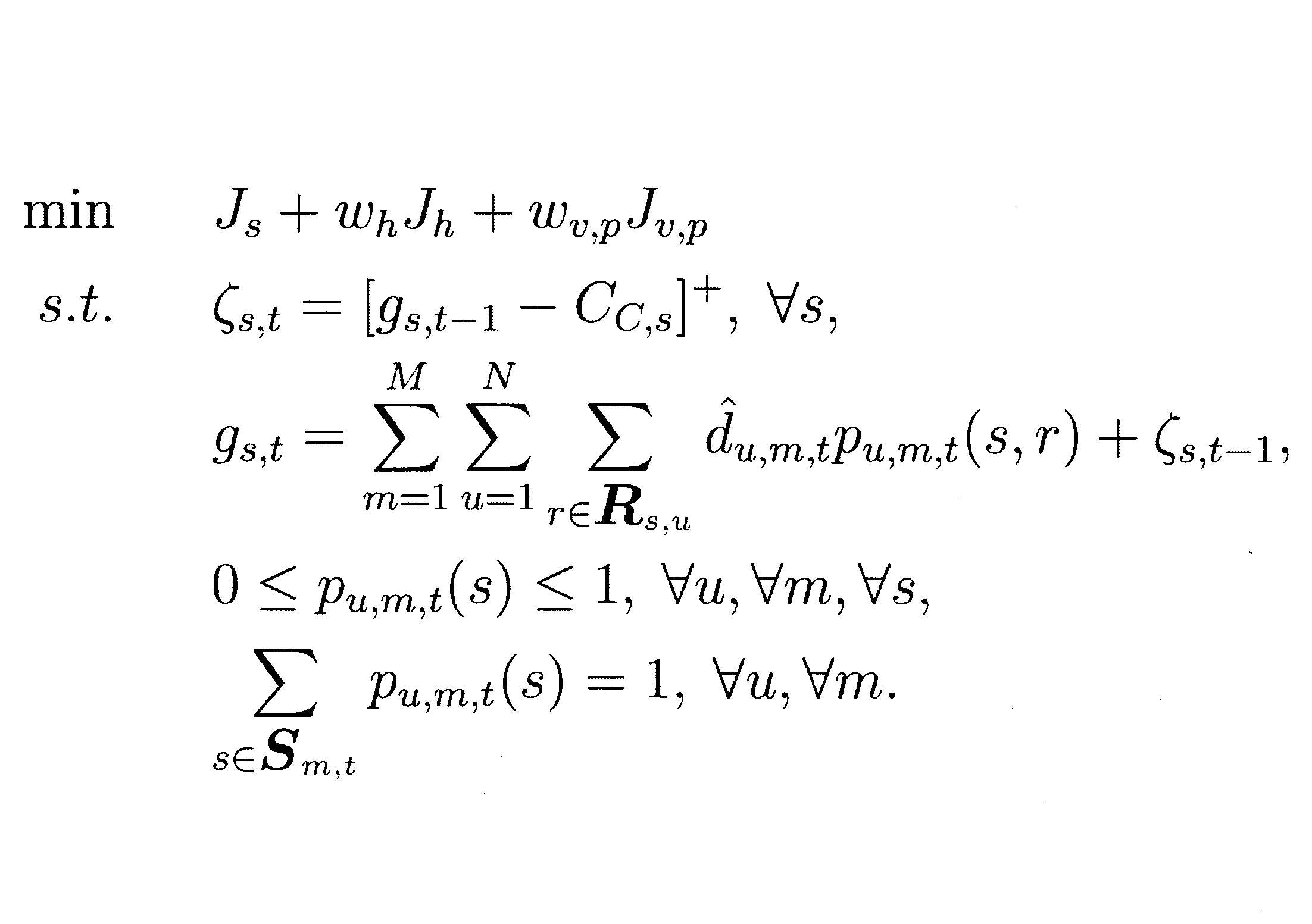
- Possible purposes of optimizing distribution server selection in content distribution include leveling the load on the cache server, reducing the number of excess distributions that cannot be accommodated due to congestion, and reducing the distribution flow hop length. Assuming that the excess delivery count of server s in TSt-1 is ⁇ s, t-1 , the total number g s, t of delivery flows delivered from server s in TSt is
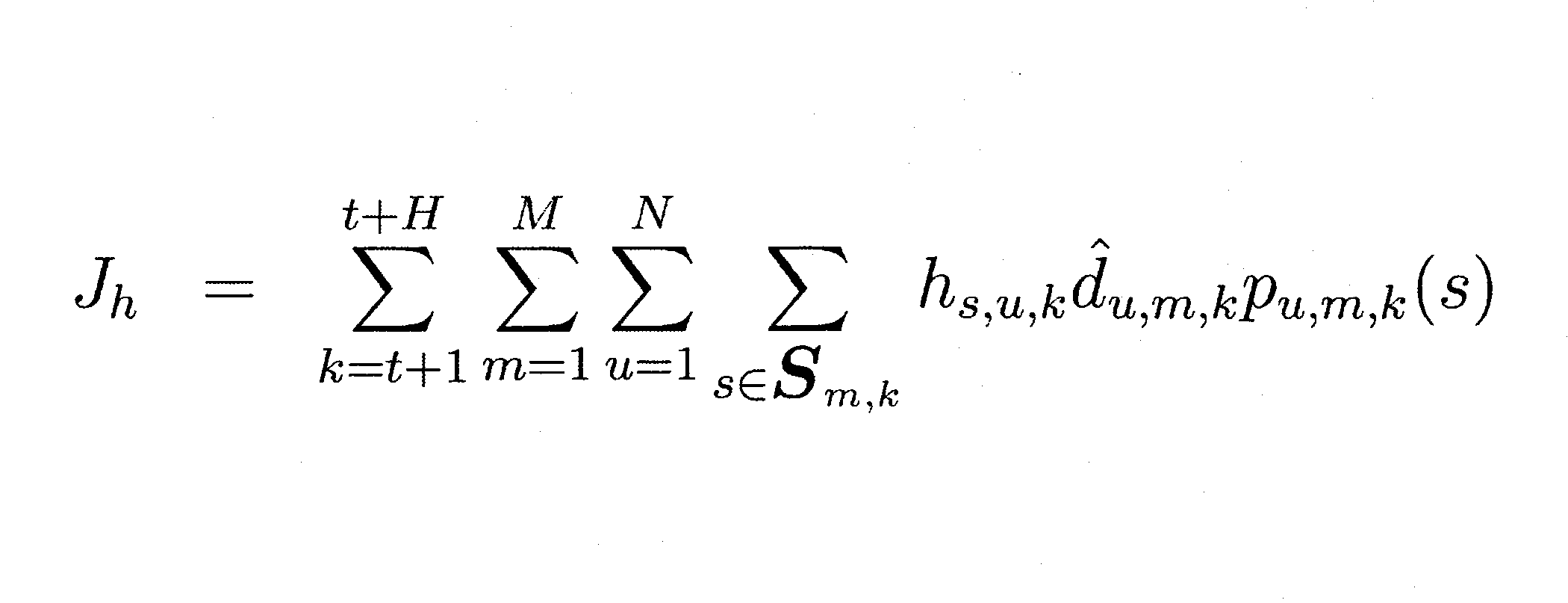
- the objective function J h is defined by the following equation.
- h s, u, k is the hop length of the distribution path from node s to node u in TSk, and here, the shortest hop number is used. Furthermore , in order to suppress the amount of change of p u, m, t (s), the objective function J v, p is defined by the following equation.
- J s + w h J h + w v, p using real parameters w h and w v, p representing the weights of J h and J v, p for J s The following nonlinear programming problem that minimizes J v, p optimizes p u, m, k (s) for each k in the range of t + 1 ⁇ k ⁇ t + H at the end of TSt.
- a set of a delivery route and a delivery cache server is called a delivery route, and it is considered to optimally design a delivery route to be used for a content m delivery request from a user u using MPC.
- the distribution source is s in the distribution routes included in the set of distribution routes.
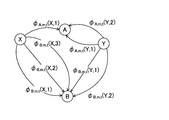
- FIG. 7 illustrates a distribution route of the content m to the user A and the user B when the content m exists in the cache X and the cache Y.
- Distribution flow path control affects link load and distribution flow hop length.
- the selection of the distribution server affects the distribution server load in addition to the link load and the distribution flow hop length. Therefore, when designing the selection probability of a distribution route / distribution cache server pair, the link load, distribution flow hop length, and distribution server load must be suppressed over the predicted horizon [t + 1, t + H]. It is necessary to consider at the same time.
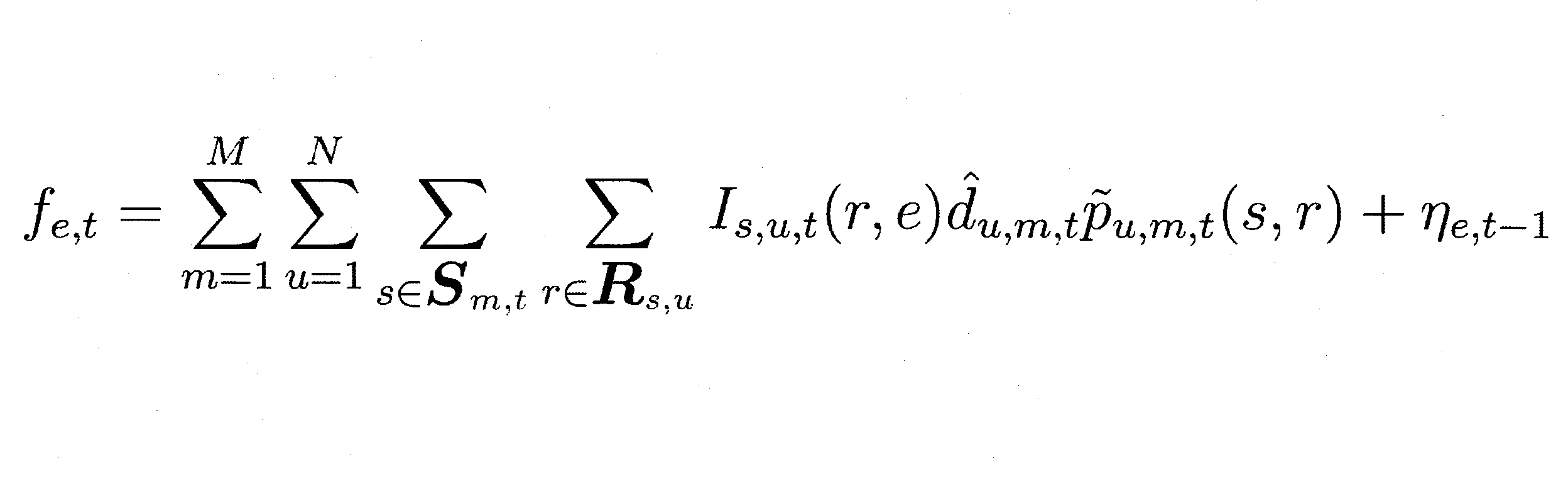
- I s, u, t (r, e) be a binary variable that becomes 1 when the path candidate r from node s to node u passes through link e in TSt, and the number of overdelivery of link e in TSt-1 If ⁇ e, t ⁇ 1 , the total number of distribution flows f e, t passing through link e in TSt is
- the distribution server selection method includes the case where only the cache server u is always used for the distribution request from the user u (L: Local), and the user among all the cache servers holding a copy of the requested content m.
- C Cooperative
- MPC MPC
- route setting methods two cases are considered, in which the shortest hop route is always selected (S: Shortest) and the route is optimized using MPC (M: MPC).
- the number of nodes N of each NW is 37 and 35
- the number of links E is 88 and 152
- the average node order is 2.38 and 4.11.
- Verio has a higher node order than CAIS, and there is a hub node with a higher order, whereas CAIS has a lower node order and no hub node.
- the hop distance between each node pair can be shortened via the hub node, so the average inter-node distance is 2.51, whereas the average CAIS inter-node distance is as large as 5.05.
- the content distribution request was generated according to the access log data collected in the commercial VoD service PowerInfo VoD system provided by China Telecom.
- This log data includes all the delivery requests of 20,921,657 that occurred during the seven months from June to December 2004.
- the log data for the 10 days from the 162nd day to the 171st day was used for the evaluation.
- the request was generated from a randomly selected node with a probability proportional to the population ratio of each node.
- the simulation was started from a state where no content was cached in the cache server. The first three days were excluded from the evaluation as a worm-up period, and the data obtained in the remaining seven days were used for the evaluation.
- route candidate a cache server, a distribution route, and a route were randomly selected.
- Tables 1 and 2 summarize the average number of overdelivery requests when each of the six forms is used for each CAIS and Verio NW.
- the difference in the results when only the delivery server selection method is changed using the same route setting method is far greater than the difference in the results when only the route setting method is changed using the same delivery server selection method.
- the distribution server selection method is the main factor that determines the average number of excess distribution requests.
- the cache server that is a selection candidate for each distribution request is limited to the requesting node.
- Cooperate always considers the cache status at the time of each distribution request occurrence, and the hop length to the requesting user is always within the cache server where the corresponding content exists. While the smallest one is selected, MPC designs the cache server selection probability based only on the content placement status at the start of TS, so the server selection that always reflects the content placement status at the time of request generation It is not. Therefore, compared with Cooperate, MPC is expected to increase the number of excess delivery requests, while the period required to grasp the arrangement state of the entire NW content is much longer and the control load is low.
- Tables 3 and 4 summarize the average delivery flow hop length when using each of the six forms for each CAIS and Verio NW.
- the distribution server selection method is the dominant factor determining the average distribution flow hop length.
- the average hop length is minimized when Cooperate, which acquires content from the closest cache server that holds the content, is used for the distribution server selection method, but MPC is used for the distribution server selection method. In this case, almost the same effect can be obtained.
- a cache server used for distribution is selected for each distribution request.
- the frequency of overdelivery requests that cause delivery requests to be rejected due to excess capacity of the cache server is minimized by optimizing the probability of performing and the probability of selecting a delivery route that is a combination of the cache server and route using MPC There is an effect that can be done.
- the design apparatus (distribution server selection probability optimal design apparatus, distribution route selection probability optimal design apparatus) according to the embodiment of the present invention has been described using a functional block diagram.
- the design apparatus according to the above may be realized by hardware, software, or a combination thereof.
- the embodiment of the present invention is a program that causes a computer to realize each function of the design apparatus according to the embodiment of the present invention, a program that causes a computer to execute each procedure of the method according to the embodiment of the present invention, and the like. May be realized.
- the functional units may be used in combination as necessary.
Landscapes
- Engineering & Computer Science (AREA)
- Computer Networks & Wireless Communication (AREA)
- Signal Processing (AREA)
- Physics & Mathematics (AREA)
- Algebra (AREA)
- General Physics & Mathematics (AREA)
- Mathematical Analysis (AREA)
- Mathematical Optimization (AREA)
- Mathematical Physics (AREA)
- Probability & Statistics with Applications (AREA)
- Pure & Applied Mathematics (AREA)
- Data Exchanges In Wide-Area Networks (AREA)
Abstract
CDNにおいて、ユーザからの配信要求に対してコンテンツの配信に用いられる配信サーバ又は配信ルートを選択する確率を設計する設計装置は、ネットワークに関するパラメタと、配信要求の需要推定量とを入力パラメタ値として受け取るパラメタ入力部と、前記受け取った入力パラメタ値に基づき、ユーザからの配信要求が棄却される超過配信要求を抑制するよう、キャッシュサーバが配信サーバとして選択される選択確率、又は、配信サーバがコンテンツを配信する配信経路と配信サーバの組である配信ルートの選択確率をモデル予測制御を用いて設計する選択確率設計部と、前記設計されたキャッシュサーバの選択確率又は配信ルートの選択確率を出力する選択確率出力部とを有する。
Description
本発明は、設計装置、設計方法及び記録媒体に関する。特に、本発明は、ネットワーク(NW)の複数のノードに分散配置されたキャッシュサーバを用いてコンテンツを配信するコンテンツ配信NW(Contents Delivery Network、以下、CDN)において、ユーザからの配信要求に対してコンテンツの配信に用いられる配信サーバ又は配信ルートを選択する確率を設計する設計装置、設計方法及び記録媒体に関する。
インターネットは個々のフローの状態を網内で管理せず受信アドレスに基づきルーティング処理を行う。各ISP(Internet Service Provider)が管理する単一AS(Autonomous System)内では、OSPF(Open Shortest Path First)により固定的に設定されたリンク重みの総和が最小となる経路上にパケットが転送される。また、フローの受付制御を行わず転送レートは送信ホストが自律的に決定するため、原理的にリンク輻輳が発生し得る。そのため適切な通信品質を維持するために、NWを構成する全てのリンクの負荷が適切な水準以下となるようNWを設計・管理することがISPの主要な課題の一つとなる。リンク負荷は交流トラヒックデマンドの変動や各種障害に起因する経路の変更によって常に変化する。そのため使用率の低いリンクを積極的に利用するようパケットの流れる経路を動的に設定し、リンク負荷の分散を図る経路制御法が数多く検討されている。
ところで近年、インターネットのトラヒックの多くの部分をWebサービスで用いられるHTTP(Hypertext Transfer Protocol)トラヒックが占めている。例えば2006年~2008年の間に日米間のバックボーンリンクで測定されたトラヒックの分析によると、HTTPパケットが約60%を占めている。またYouTube(登録商標)等のUGC(User-Generated Contents)やVoD(Video On Demand)のリッチコンテンツのトラヒック量も急増しており、インターネット上のトラヒックの多くは、これらコンテンツ配信によるものが大部分を占めている。コンテンツ配信はCDN事業者が運用するCDNを用いて配信される形態が一般的であり、例えばアクセス数上位1,000のサイトの中では74%がCDNを利用している。CDNは多数のNW上に分散配置されたキャッシュサーバにコンテンツのコピーを置きオリジナルサーバに代わって配信することで、ユーザ品質の向上とNW内トラヒック量の抑制を図っている。そのためコンテンツ配信において発生する配信フローの発ノード位置は、コンテンツ配置法やサーバ選択法によって決まり、ユーザ品質やNW内トラヒック量はこれらの制御法に強く影響を受ける。CDNはISPとは独立したAkamai等のCDN事業者により運営され、アプリケーション層においてオーバレイ的にキャッシュサーバから配信を行っており、ISPがサーバ選択法やコンテンツ配置法についての情報を得ることは困難である。そのためISPが経路制御を、CDN事業者がサーバ選択(もしくはコンテンツ配置)を各々、独立して実施している。
ISPがパケットの転送経路を制御する方式については、これまでに多くの研究が見られる。例えばFortzらはリンクを流れるトラヒック量の関数として定義されたリンクコストの総和が最小化するよう、OSPFのリンク重みを設計する方法を提案している。またBensonらは短期間先のトラヒック交流の予測に基づき短い時間周期で経路制御を行う方式を提案しており、Dannaらはユーザに割当てられる帯域の公平性とネットワーク資源の利用効率との間のトレードオフを考慮して適正な経路制御を行う問題を線形計画問題で定式化している。さらにKandulaらはスループットの測定値に基づき適応的に経路を設定する方式を提案している。また目的アドレスより細かな粒度で経路制御を行う方式も検討されており、例えばElwalidらはMPLS(Multi-Protocol Label Switching)を対象に、LSP(Label Switched Path)の経路を総リンクコストが最小化するよう最適設計する問題を線形計画問題で定式化しており、HongらやJainらはデータセンタ間NWにSDN(Software Defined Network)を用いることで、細粒度で短期間に経路を切替るTE(Traffic Engineering)方式を提案している。これらの方式はISPが経路制御を行うことを想定しているが、エンドユーザが実測情報に基づきオンライン最適化により経路を最適選択する方式も検討されている。また様々な経路制御方式の効果を、ユーザ体感品質の観点から分析した研究も見られる。
同様にCDN事業者が配信要求に対してどのサーバから配信するかを選択するサーバ選択法に関しても様々な研究が見られる。例えばPoeseらは、ISPがCDN事業者に対してネットワーク状態に関する情報を提供することで、CDN事業者がサーバ選択を適正に行うことを提案している。またサーバ選択ではなく、コンテンツをどの位置にキャッシュするかを制御することで配信元位置の適正化を図る研究も見られる。例えばApplegateらは、キャッシュ容量とリンク帯域との制約条件のもとで、ネットワーク内を流れる総トラヒック量を最小化するよう各コンテンツの配置位置を決める問題を混合整数計画問題で定式化している。またTangらはユーザ品質の制約条件を考慮してコンテンツ配置に要するレプリケーションコストを最小化するコンテンツ配置設計法を提案している。
以上の技術については、非特許文献1、2を参照されたい。
しかしISPの経路制御はCDN事業者のサーバ選択の効果に影響を与え、逆にCDN事業者のサーバ選択はISPの経路制御の効果に影響を与えることから、各々の制御方式を検討する際にはISPとCDN事業者の制御が相手の制御結果に与える影響を考慮する必要がある。例えばDiPalantinoらはゲーム理論を用いて両者の戦略をモデル化し、実現される均衡状態について分析している。またISPとCDN事業者が協調してサーバ選択を行う研究も見られ、例えばPoeseらはパッシブキャプチャデータを分析することで、コンテンツ配信時にDNS(Domain Name System)が回答する配信サーバのアドレスには多様性があり、ISPがサーバ選択を行うことでレスポンス時間の改善が期待されることを述べている。またFrankらはCDN事業者とISPとが協調してサーバ選択を行うための必要な情報を交換する方法について提案している。
また、JiangらはISPが経路を、CDN事業者がサーバ選択を各々独立に行う状況において、互いの保有する情報を相手に伝えることでどの程度、全体最適な状態に近づくかを分析している。
I. Poese, B. Frank, B. Ager, G. Smaragdakis, and A. Feldmann, Improving Content Delivery Using Provider-aided Distance Information, ACM IMC 2010.
I. Poese, B. Frank, G. Smaragdakis, S. Uhlig, A. Feldmann, and B. Maggs, Enabling Content-aware Traffic Engineering, ACM SIGCOMM Computer Communication Review, Vol.42, NO.5, pp.22-28, 2012.
このようにISPが経路制御を、CDN事業者がサーバ選択(もしくはコンテンツ配置)を各々、適切に行う方式に関して様々な検討が見られる。しかしISPの経路制御はCDN事業者のサーバ選択の効果に影響を与え、逆にCDN事業者のサーバ選択はISPの経路制御の効果に影響を与える。そのためISPとCDN事業者の制御が相手の制御結果に与える影響を考慮する必要がある。
ところが近年、Google等の大規模コンテンツプロバイダや、AT&T等のTier-1 ISPが自身でCDNを運用するケースも増えてきている。またISPとCDN事業者とが協力し、互いの情報を交換しながら経路制御とサーバ選択を適切に行う方式も提案されている。このようにコンテンツ配信における配信経路とサーバ選択を同時に最適化することが可能な環境が整いつつある。
上記のISPとCDN事業者が協調してサーバ選択を行うPoeseらの文献やFrankらの文献では、ISPがサーバ選択を行うことが提案されているが、ISPが同時に経路制御を行うことは考慮されていない。
また、コンテンツ配信における各コンテンツに対する需要量や人気度は時間的に大きく変化することから、配信経路とサーバ選択を最適化するためには、ダイナミックに変化する需要に対して適応的に制御する必要がある。そのためには将来の需要を精度よく推定できることが望ましい。コンテンツ人気度の時間的な推移の予測手法が検討されているが、高精度に予測を行うことは困難である。そのため予測誤差も考慮に入れトラヒック予測と連携して各種制御を行うことが有効と思われる。
Jiangらの文献では、単一時点における全体最適化を目指しており、将来にわたってトラヒック交流が変化し続ける実際のネットワークには適用が困難である。将来のトラヒック需要の予測が困難な複数の期間において適正な状態を実現するためには、時系列的に最適化処理が反復できる方式が求められる。
本発明は、CDNにおいて、ユーザからの配信要求が時間的に変化するときにユーザからの配信要求が棄却される頻度を抑制し、CDNサービスの向上を図ることを目的とする。
本発明の一形態に係る設計装置は、
ネットワークの複数のノードに分散配置されたキャッシュサーバを用いてコンテンツを配信する際に、ユーザからの配信要求に対してコンテンツの配信に用いられる配信サーバ又は配信ルートを選択する確率を設計する設計装置であって、
ネットワークに関するパラメタと、ユーザからのコンテンツに対して発生する配信要求の需要推定量とを入力パラメタ値として受け取るパラメタ入力部と、
前記パラメタ入力部において受け取った入力パラメタ値に基づき、ユーザからのコンテンツに対して発生する配信要求が棄却される超過配信要求を抑制するよう、キャッシュサーバが配信サーバとして選択される選択確率、又は、配信サーバがコンテンツを配信する配信経路と配信サーバの組である配信ルートの選択確率をモデル予測制御を用いて設計する選択確率設計部と、
前記選択確率設計部において設計されたキャッシュサーバの選択確率又は配信ルートの選択確率を出力する選択確率出力部と、
を有することを特徴とする。
ネットワークの複数のノードに分散配置されたキャッシュサーバを用いてコンテンツを配信する際に、ユーザからの配信要求に対してコンテンツの配信に用いられる配信サーバ又は配信ルートを選択する確率を設計する設計装置であって、
ネットワークに関するパラメタと、ユーザからのコンテンツに対して発生する配信要求の需要推定量とを入力パラメタ値として受け取るパラメタ入力部と、
前記パラメタ入力部において受け取った入力パラメタ値に基づき、ユーザからのコンテンツに対して発生する配信要求が棄却される超過配信要求を抑制するよう、キャッシュサーバが配信サーバとして選択される選択確率、又は、配信サーバがコンテンツを配信する配信経路と配信サーバの組である配信ルートの選択確率をモデル予測制御を用いて設計する選択確率設計部と、
前記選択確率設計部において設計されたキャッシュサーバの選択確率又は配信ルートの選択確率を出力する選択確率出力部と、
を有することを特徴とする。
また、本発明の一形態に係る設計方法は、
ネットワークの複数のノードに分散配置されたキャッシュサーバを用いてコンテンツを配信する際に、ユーザからの配信要求に対してコンテンツの配信に用いられる配信サーバ又は配信ルートを選択する確率を設計する設計装置における設計方法であって、
ネットワークに関するパラメタと、ユーザからのコンテンツに対して発生する配信要求の需要推定量とを入力パラメタ値として受け取るステップと、
前記受け取った入力パラメタ値に基づき、ユーザからのコンテンツに対して発生する配信要求が棄却される超過配信要求を抑制するよう、キャッシュサーバが配信サーバとして選択される選択確率、又は、配信サーバがコンテンツを配信する配信経路と配信サーバの組である配信ルートの選択確率をモデル予測制御を用いて設計するステップと、
前記設計されたキャッシュサーバの選択確率又は配信ルートの選択確率を出力するステップと、
を有することを特徴とする。
ネットワークの複数のノードに分散配置されたキャッシュサーバを用いてコンテンツを配信する際に、ユーザからの配信要求に対してコンテンツの配信に用いられる配信サーバ又は配信ルートを選択する確率を設計する設計装置における設計方法であって、
ネットワークに関するパラメタと、ユーザからのコンテンツに対して発生する配信要求の需要推定量とを入力パラメタ値として受け取るステップと、
前記受け取った入力パラメタ値に基づき、ユーザからのコンテンツに対して発生する配信要求が棄却される超過配信要求を抑制するよう、キャッシュサーバが配信サーバとして選択される選択確率、又は、配信サーバがコンテンツを配信する配信経路と配信サーバの組である配信ルートの選択確率をモデル予測制御を用いて設計するステップと、
前記設計されたキャッシュサーバの選択確率又は配信ルートの選択確率を出力するステップと、
を有することを特徴とする。
また、本発明の一形態に係る記録媒体は、
ネットワークの複数のノードに分散配置されたキャッシュサーバを用いてコンテンツを配信する際に、ユーザからの配信要求に対してコンテンツの配信に用いられる配信サーバ又は配信ルートを選択する確率を設計するために、コンピュータを、
ネットワークに関するパラメタと、ユーザからのコンテンツに対して発生する配信要求の需要推定量とを入力パラメタ値として受け取るパラメタ入力手段、
前記パラメタ入力手段において受け取った入力パラメタ値に基づき、ユーザからのコンテンツに対して発生する配信要求が棄却される超過配信要求を抑制するよう、キャッシュサーバが配信サーバとして選択される選択確率、又は、配信サーバがコンテンツを配信する配信経路と配信サーバの組である配信ルートの選択確率をモデル予測制御を用いて設計する選択確率設計手段、及び
前記選択確率設計手段において設計されたキャッシュサーバの選択確率又は配信ルートの選択確率を出力する選択確率出力手段、
として機能させるプログラムを記録した記録媒体であることを特徴とする。
ネットワークの複数のノードに分散配置されたキャッシュサーバを用いてコンテンツを配信する際に、ユーザからの配信要求に対してコンテンツの配信に用いられる配信サーバ又は配信ルートを選択する確率を設計するために、コンピュータを、
ネットワークに関するパラメタと、ユーザからのコンテンツに対して発生する配信要求の需要推定量とを入力パラメタ値として受け取るパラメタ入力手段、
前記パラメタ入力手段において受け取った入力パラメタ値に基づき、ユーザからのコンテンツに対して発生する配信要求が棄却される超過配信要求を抑制するよう、キャッシュサーバが配信サーバとして選択される選択確率、又は、配信サーバがコンテンツを配信する配信経路と配信サーバの組である配信ルートの選択確率をモデル予測制御を用いて設計する選択確率設計手段、及び
前記選択確率設計手段において設計されたキャッシュサーバの選択確率又は配信ルートの選択確率を出力する選択確率出力手段、
として機能させるプログラムを記録した記録媒体であることを特徴とする。
本発明によれば、CDNにおいて、ユーザからの配信要求が変化するときにユーザからの配信要求が棄却される頻度を抑制し、CDNサービスの向上を図ることが可能になる。
以下、図面を参照して本発明の実施形態について説明する。
本発明の実施形態では、ネットワークの複数のノードに分散配置されたキャッシュサーバを用いてコンテンツを配信するCDNにおいて、ユーザからの配信要求に対してコンテンツの配信に用いられる配信サーバを選択する確率や、配信経路と配信サーバの組である配信ルートを選択する確率を、配信要求が棄却される超過配信要求を抑制するように設計する手法について説明する。
<装置構成>
図1は、本発明の一実施形態に係る設計装置100の構成図である。設計装置100は、ネットワークの複数のノードに分散配置されたキャッシュサーバを用いてコンテンツを配信するCDNにおいて、ユーザからの配信要求に対してコンテンツの配信に用いられる配信サーバを選択する確率を、配信要求が棄却される超過配信要求を抑制するように設計する装置である。また、設計装置100は、配信経路と配信サーバの組である配信ルートを選択する確率を、配信要求が棄却される超過配信要求を抑制するように設計する装置でもある。
図1は、本発明の一実施形態に係る設計装置100の構成図である。設計装置100は、ネットワークの複数のノードに分散配置されたキャッシュサーバを用いてコンテンツを配信するCDNにおいて、ユーザからの配信要求に対してコンテンツの配信に用いられる配信サーバを選択する確率を、配信要求が棄却される超過配信要求を抑制するように設計する装置である。また、設計装置100は、配信経路と配信サーバの組である配信ルートを選択する確率を、配信要求が棄却される超過配信要求を抑制するように設計する装置でもある。
図2は、本発明の一実施形態に係る設計装置100のハードウェア構成の例を示す図である。設計装置100は、プロセッサ等のCPU(Central Processing Unit)151、RAM(Random Access Memory)やROM(Read Only Memory)等のメモリ装置152、ハードディスク等の記憶装置153等から構成されたコンピュータでもよい。例えば、設計装置100の機能及び処理は、記憶装置又はメモリ装置に格納されているデータやプログラムをCPUが実行することによって実現される。
設計装置100は、パラメタ入力部101と、選択確率設計部102と、選択確率出力部103とを有する。
パラメタ入力部101は、配信サーバの選択確率又は配信ルートの選択確率をモデル予測制御(MPC:Model Predictive Control)を用いて設計するために必要な入力パラメタ値を受け取る。具体的には、パラメタ入力部101は、ネットワークに関するパラメタ及びユーザからのコンテンツに対して発生する配信要求の需要推定量を受け取る。
選択確率設計部102は、パラメタ入力部101において受け取った入力パラメタ値に基づき、ユーザからのコンテンツに対して発生する配信要求が棄却される超過配信要求を抑制するよう、キャッシュサーバが配信サーバとして選択される選択確率をモデル予測制御を用いて設計する。また、選択確率設計部102は、キャッシュサーバの選択確率だけでなく、配信サーバがユーザにコンテンツを配信する配信経路も同時に設計してもよい。この場合、選択確率設計部102は、ユーザからのコンテンツに対して発生する配信要求が棄却される超過配信要求を抑制するよう、配信経路と配信サーバの組である配信ルートの選択確率をモデル予測制御を用いて設計する。
選択確率出力部103は、選択確率設計部102において設計されたキャッシュサーバの選択確率又は配信ルートの選択確率を出力する。
図1の設計装置100は、図3に示すように、ユーザからの配信要求に対してコンテンツの配信に用いられる配信サーバを選択する確率を、キャッシュサーバの容量超過により、すなわち、キャッシュサーバの配信能力超過により配信要求が棄却される超過配信要求の頻度を最小化するよう最適設計する配信サーバ選択確率最適設計装置200として構成されてもよい。
図3は、本発明の一実施形態に係る配信サーバ選択確率最適設計装置200の構成図である。配信サーバ選択確率最適設計装置200は、パラメタ入力部201と、キャッシュサーバ選択確率最適設計部202と、キャッシュサーバ選択確率出力部203とを有する。ここで、キャッシュサーバ選択確率最適設計部202は、超過配信要求数を抑制すると共に、配信フローの平均ホップ数の低減及び選択確率の変化量の抑制を行ってもよい。すなわち、キャッシュサーバ選択確率最適設計部202は、超過配信要求数の抑制のための目的関数Js、配信フローの平均ホップ数の低減ための目的関数Jh、キャッシュサーバの選択確率の変化量の抑制のための目的関数Jv,pを同時に最適化してもよい。
パラメタ入力部201は、ネットワークにおけるコンテンツに関するパラメタ、キャッシュサーバに関するパラメタ及びユーザからのコンテンツに対して発生する配信要求の需要推定量を入力パラメタとして受け取る。具体的には、パラメタ入力部201によって、以下のパラメタが入力される。
・コンテンツ数M
・ノード数N
・MPCの予測ホライズンH、
・キャッシュサーバsのキャッシュサーバ配信容量CC,s、
・タイムスロットtにおけるユーザuからのコンテンツmに対して発生する配信デマンド量du,m,tの需要推定量
・ノード数N
・MPCの予測ホライズンH、
・キャッシュサーバsのキャッシュサーバ配信容量CC,s、
・タイムスロットtにおけるユーザuからのコンテンツmに対して発生する配信デマンド量du,m,tの需要推定量



・目的関数Jsに対する目的関数Jhの重みパラメタwh
・目的関数Jsに対する目的関数Jv,pの重みパラメタwv,p
キャッシュサーバ選択確率最適設計部202は、パラメタ入力部201から入力されたパラメタ値に基づき、キャッシュサーバsの選択確率pu,m,k(s)を最適設計し、キャッシュサーバ選択確率出力部203によってpu,m,k(s)の設計値が出力される。
また、図1の設計装置100は、図4に示すように、ユーザからの配信要求に対してコンテンツの配信に用いられる配信サーバを選択する確率を、配信サーバがユーザにコンテンツを配信する配信経路と共に、配信要求が棄却される超過配信要求の頻度を最小化するよう最適設計する配信ルート選択確率最適設計装置300として構成されてもよい。
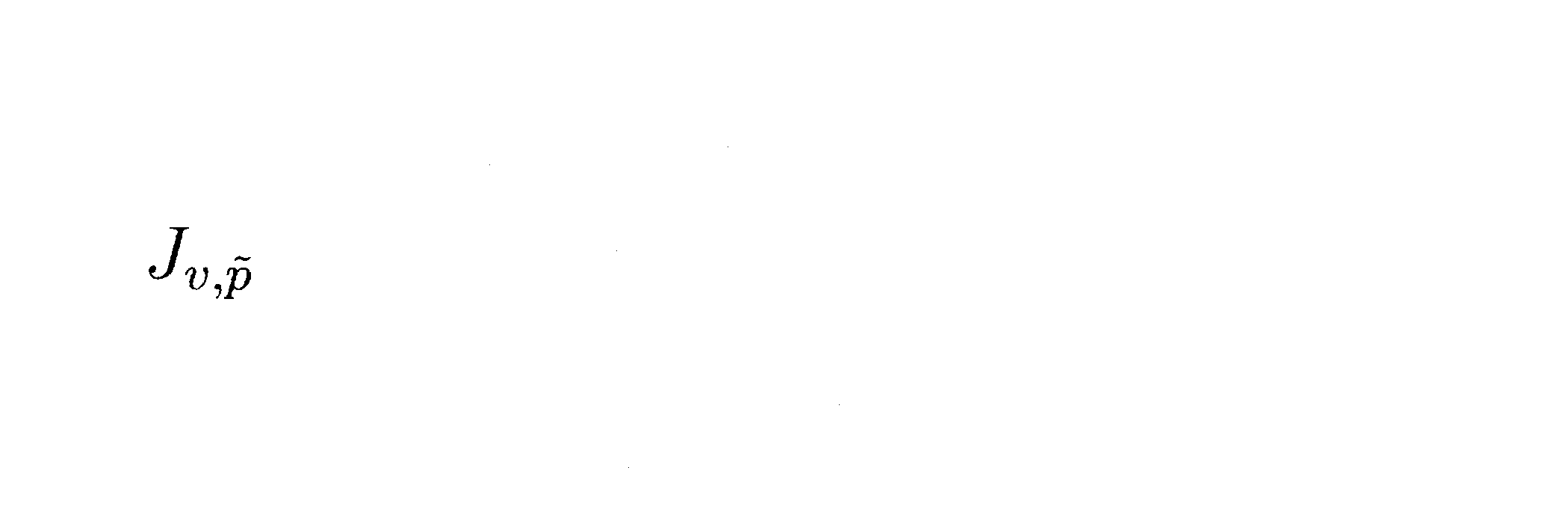
図4は、本発明の一実施形態に係る配信ルート選択確率最適設計装置300の構成図である。配信ルート選択確率最適設計装置300は、パラメタ入力部301と、配信ルート選択確率最適設計部302と、配信ルート選択確率出力部303とを有する。ここで、配信ルート選択確率最適設計部302は、超過配信要求数を抑制すると共に、リンクを通る配信フローの総数の低減、配信フローの平均ホップ数の低減及び選択確率の変化量の抑制を行ってもよい。すなわち、配信ルート選択確率最適設計部302は、超過配信要求数の抑制のための目的関数Js、リンクを通る配信フローの総数の低減のための目的関数Je、配信フローの平均ホップ数の低減ための目的関数Jh、配信ルートの選択確率の変化量の抑制のための目的関数
パラメタ入力部301は、ネットワークにおけるコンテンツに関するパラメタ、キャッシュサーバに関するパラメタ及びユーザからのコンテンツに対して発生する配信要求の需要推定量に加えて、リンクに関するパラメタを入力パラメタとして受け取る。具体的には、パラメタ入力部301によって、以下のパラメタが入力される。
・コンテンツ数M
・ノード数N
・MPCの予測ホライズンH、
・キャッシュサーバsのキャッシュサーバ配信容量CC,s、
・リンクeのリンク転送容量CL,e、
・タイムスロットtにおけるユーザuのコンテンツmに対する配信ルート集合
・ノード数N
・MPCの予測ホライズンH、
・キャッシュサーバsのキャッシュサーバ配信容量CC,s、
・リンクeのリンク転送容量CL,e、
・タイムスロットtにおけるユーザuのコンテンツmに対する配信ルート集合


・t+1≦k≦t+Hの範囲のタイムスロットkにおけるキャッシュサーバsからユーザuまでのホップ長hs,u,k
・目的関数Jsに対する目的関数Jeの重みパラメタwe、
・目的関数Jsに対する目的関数Jhの重みパラメタwh
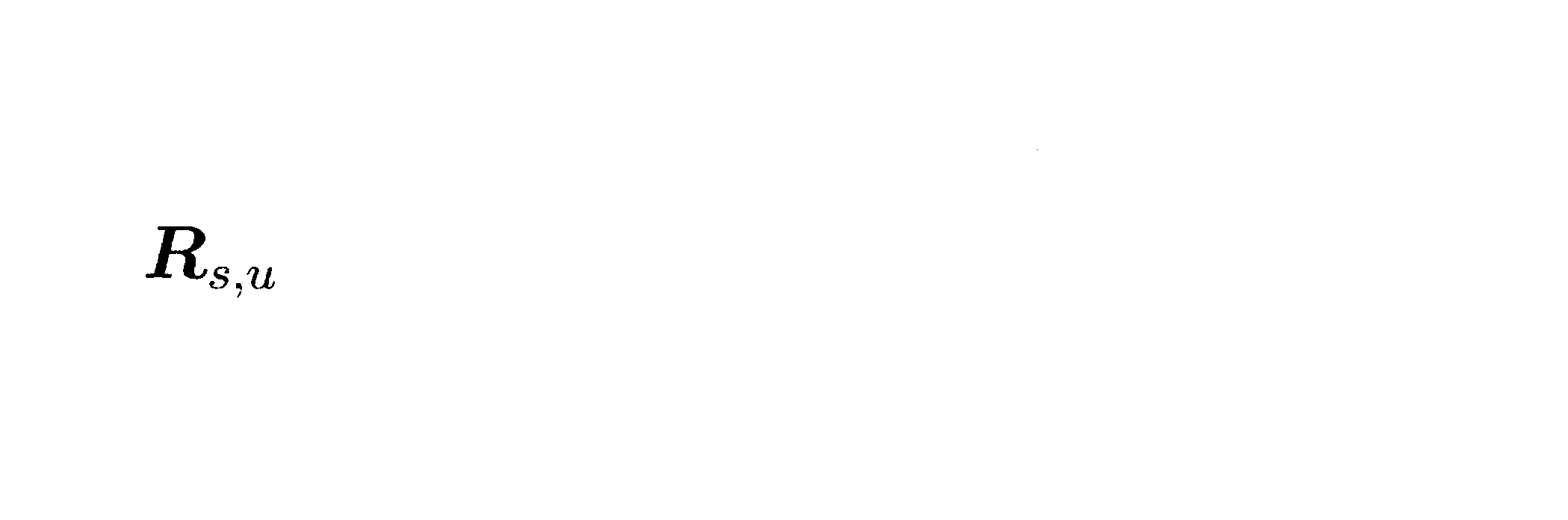
・目的関数Jsに対する目的関数




次に、本発明の実施形態に係る配信サーバの選択手法及び配信ルートの選択手法について、詳細を説明する。
<想定条件>
ユーザのコンテンツ配信要求に対してCDNは、コンテンツを配信するキャッシュサーバ(もしくはオリジナルサーバ)を選択した後に配信を開始する。これら配信に先立つ処理として、本発明の実施形態では、一般的なCDN事業者で用いられている配信処理を想定する。代表的なCDN事業者の例にはAkamaiがある。
ユーザのコンテンツ配信要求に対してCDNは、コンテンツを配信するキャッシュサーバ(もしくはオリジナルサーバ)を選択した後に配信を開始する。これら配信に先立つ処理として、本発明の実施形態では、一般的なCDN事業者で用いられている配信処理を想定する。代表的なCDN事業者の例にはAkamaiがある。
図5は、CDNの動作メカニズムを示す概略図である。ユーザは配信元サーバのIPアドレスをDNSにより解決する必要があるが、図5の(1)で示すように最初にローカルDNSサーバにIPアドレスを問い合わせる。要求コンテンツがローカルDNSにキャッシュされている場合にはそこからユーザ端末にコンテンツが配信される。キャッシュされていない場合は、CDN事業者のDNSサーバに問い合わせるようユーザ端末に回答され、ユーザ端末は図5の(2)に示すようにCDN事業者のDNSサーバに配信サーバのIPアドレスを問い合わせる。CDN事業者のDNSサーバは配信に用いるキャッシュサーバを選択してそのIPアドレスをユーザ端末に回答する。キャッシュサーバの選択基準はCDN事業者によって決められるが、多くの場合、実測レスポンス時間が短いものやユーザ端末の近くに存在するものが選択される。
ユーザ端末は図5の(3)に示すように、回答されたキャッシュサーバにコンテンツの配信を要求し、該当コンテンツがキャッシュされている場合にはそこから配信される(キャッシュヒット)。キャッシュされていない場合(キャッシュミス)には、そのキャッシュサーバは該当コンテンツのオリジナルを保有するオリジナルサーバに対して要求し、コンテンツを取得する(図5の(4))。そして取得コンテンツをキャッシュしてユーザ端末に配信する。キャッシュ容量が不足する場合には、キャッシュ済みコンテンツの中から何らかのポリシィに基づき選択したものを削除した後に新たに取得したコンテンツをキャッシュする。削除コンテンツの選択ポリシィとしては、最後に要求されてからの経過時間が最大のものを削除するLRU(least recently used)が用いられることが多い。
システム全体が固定時間長Tのタイムスロット(TS)に離散化されていることを想定する。NWとしては、単一のISPが管理するN個のノードとE本のリンクから構成された任意トポロジのNWを想定し、リンクeの伝送容量(各TS内で転送可能な総配信回数)はCL,eで与えられる。各ノードペアiからjのコンテンツ配信に用いる経路の候補集合


同一サイズのM個のコンテンツがNW全体で提供されており、TStにおいてユーザuから生じるコンテンツmの配信デマンド量(TSt内で生じる要求数)をdu,m,tとする。全てのノードにはオリジナルサーバが設置されており、各コンテンツは、任意の一つのノードにのみオリジナルが用意され、全期間を通してオリジナルの位置は不変とし、コンテンツmのオリジナルはノードomに存在する。ノードnに設置されたオリジナルサーバとキャッシュサーバを各々、オリジナルサーバn、キャッシュサーバnと表記し、オリジナルサーバnとキャッシュサーバnを合わせてサーバnと表記する。また配信フローのスループットは同一とする。
NW上の全てのノードにキャッシュサーバが設置されており、キャッシュサーバsのストレージ容量(最大キャッシュ可能コンテンツ数)をBsとする。キャッシュサーバやオリジナルサーバの配信処理容量は有限であり、キャッシュサーバsが各TS内で配信可能な総配信回数の上限をCC,sとする。ユーザuのコンテンツmへの配信要求に対して選択されたキャッシュサーバsにコンテンツmが保持されており(キャッシュヒット)、かつキャッシュサーバsの配信容量と選択された経路rが経由する全てのリンクに余裕がある場合には、キャッシュサーバsからコンテンツmが配信され、ノードsからユーザuに対して配信フローが発生する。
一方、キャッシュミス時やサーバやリンクの配信容量超過時には、コンテンツmのオリジナルサーバomの配信容量に余裕がある場合にはオリジナルサーバomからコンテンツmが配信され、ノードomからノードsへの配信フローとノードsからユーザuへの配信フローが発生し、新たにキャッシュサーバsにコンテンツmがキャッシュされる。キャッシュ容量が不足する場合の置換方式としてはLRUを想定する。さらにオリジナルサーバomからのサーバや経由リンクの配信容量が不足する場合には配信要求は棄却され、棄却された要求は超過配信要求として次のTSにおいて再度、発生するものとする。各キャッシュが保持するコンテンツはダイナミックに変化するが、TStの開始時点においてコンテンツmを保持しているキャッシュの集合を

<モデル予測制御(MPC)>
MPCはシステムの動作(出力)が設定したターゲットに近づくようにシステムのパラメタ(入力)を最適化するのは従来のシステム制御と同様であるが、その際に現時刻だけではなく将来のある一定の区間(予測ホライズン)におけるシステムの振る舞いを考慮した上で、入力の最適化を行う。すなわちTSkの出力をyk、出力値のターゲットをYkとすると、現TStにおいて将来のHステップ先の区間[t+1,t+H]全体に渡ってykのターゲットからのずれ
MPCはシステムの動作(出力)が設定したターゲットに近づくようにシステムのパラメタ(入力)を最適化するのは従来のシステム制御と同様であるが、その際に現時刻だけではなく将来のある一定の区間(予測ホライズン)におけるシステムの振る舞いを考慮した上で、入力の最適化を行う。すなわちTSkの出力をyk、出力値のターゲットをYkとすると、現TStにおいて将来のHステップ先の区間[t+1,t+H]全体に渡ってykのターゲットからのずれ


zk+1=f(k,zk,xk)
yk=g(k,zk,xk)
ここでfとgは入力・出力・状態の関係性を表す関数である。しかしシステムのモデル化の際に誤差が含まれることがあり、それに基づいた出力の予測値

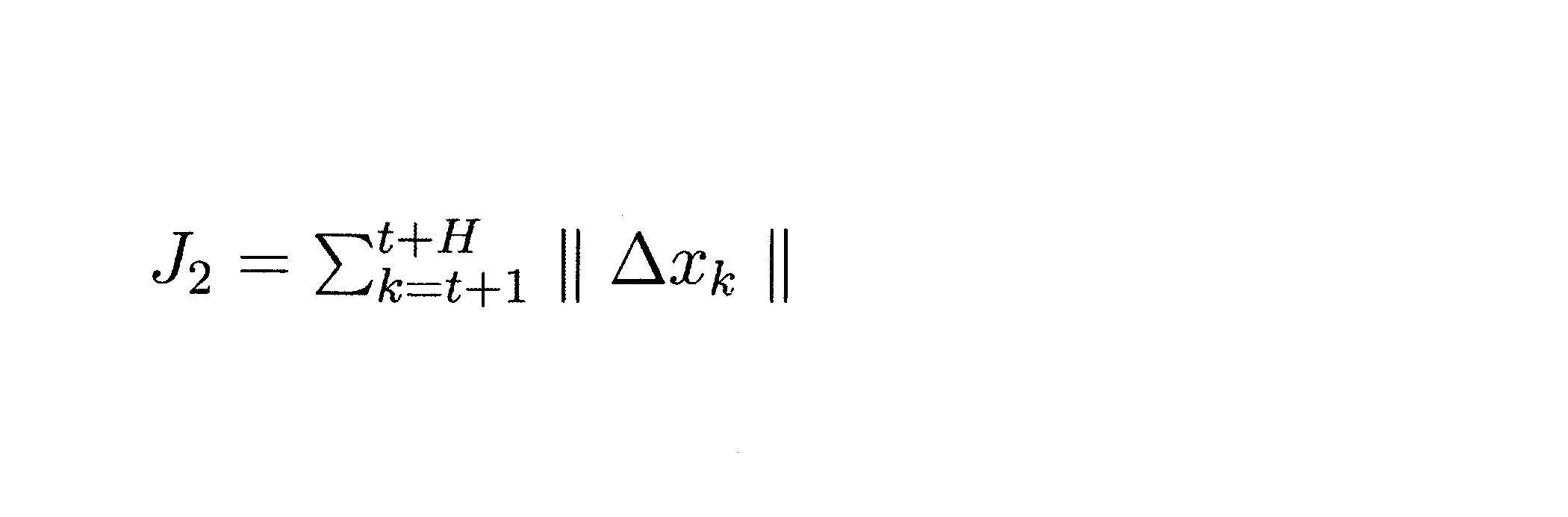
図6にMPCにおける最適化プロセスを図示する。各TSt+1におけるシステム状態zt+1は、1時刻前のTStにおけるシステム状態ztと入力xtから決まる。そしてTSt+1における出力yt+1は外部から与えられ、TSt+1におけるシステム状態zt+1と入力xt+1から決まる。よってt+1≦k≦t+Hの範囲の各TSkにおける入力xkを与えたときの、この範囲の各TSkにおける出力ykをk=t+1から順に再帰的に算出することができ、最適化目的関数J1+wJ2が得られる。そして本目的関数を最小化する非線形最適化問題をt+1≦k≦t+Hの各xtを対象に求め、TSt+1の入力値xt+1をシステムに投入する。
<配信サーバ選択最適化制御へのMPCの適用>
キャッシュサーバ選択確率最適設計部202における配信サーバ選択最適化のためにMPCを適用するときの具体例について以下に説明する。
キャッシュサーバ選択確率最適設計部202における配信サーバ選択最適化のためにMPCを適用するときの具体例について以下に説明する。
MPCのシステム状態ztはコンテンツに対して発生する配信デマンド量du,m,tとなり外部から与えられる。ただしTStの開始時点ではk≧tのdu,m,kは未知であることから、その推定値



コンテンツ配信における配信サーバ選択を最適化する目的としては、キャッシュサーバの負荷の平準化、輻輳によって収容できない超過配信数の抑制、配信フローホップ長の低減、が考えられる。TSt-1におけるサーバsの超過配信回数をζs,t-1とすると、TStにおいてサーバsから配信される配信フローの総数gs,tは、



配信ルート選択確率最適設計部302における配信サーバ選択と配信経路選択の同時最適化のためにMPCを適用するときの具体例について以下に説明する。
便宜上、配信経路と配信キャッシュサーバの組を配信ルートと呼び、MPCを用いてユーザuからのコンテンツmの配信要求に対して用いる配信ルートを最適設計することを考える。TStにおいて、任意のユーザuとコンテンツmの組に対して存在する配信ルートの集合を



やはり短時間で入力値xtの最適値を導出するために、配信ルートを確定的ではなく確率的に選択することを考える。すなわちTStにおけるユーザuのコンテンツmに対する各要求に対して、



コンテンツ配信における配信キャッシュサーバと配信経路選択を最適化する目的として、NW内に流れるトラヒック量の抑制と、輻輳によって収容できない超過配信数を抑制することが考えられる。トラヒック量抑制のためには配信フローのホップ長の低減が必要であり、超過配信数抑制のためにはリンクや配信サーバの負荷を容量以内に抑える必要がある。配信フローの経路制御はリンク負荷や配信フローホップ長に影響を与える。一方で配信サーバの選択はリンク負荷や配信フローホップ長に加えて、配信サーバ負荷に影響を与える。そのため配信経路と配信キャッシュサーバの組の選択確率を設計する際には、リンク負荷と配信フローホップ長と配信サーバ負荷の三つを予測ホライズン[t+1,t+H]にわたり抑制することを同時に考慮する必要がある。
Is,u,t(r,e)をTStにおいてノードsからノードuへの経路候補rがリンクeを通る場合に1となる二値変数とし、TSt-1におけるリンクeの超過配信回数をηe,t-1とすると、TStにおいてリンクeを通る配信フローの総数fe,tは、







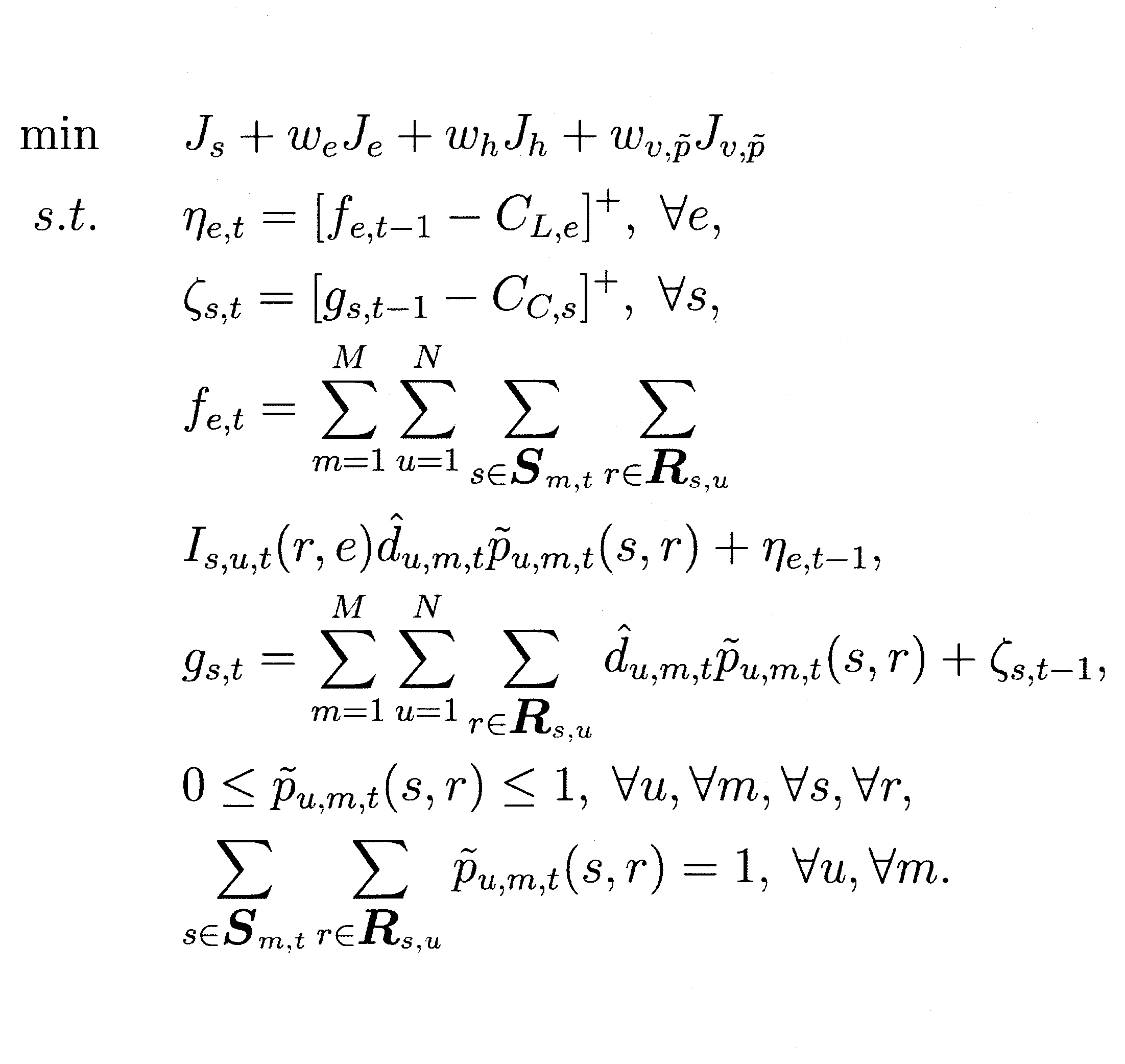
配信サーバ選択法としては、ユーザuからの配信要求に対して常にキャッシュサーバuのみを使用する場合(L: Local)と、要求されたコンテンツmのコピーを保持する全てのキャッシュサーバの中からユーザuへのホップ長が最短のものを選択する場合(C: Cooperative)と、MPCを用いて配信サーバを最適選択する場合(M: MPC)の三つを考える。一方、経路設定法としては、最短ホップ経路を常に選択する場合(S: Shortest)と、MPCを用いて経路を最適化する場合(M: MPC)の二つを考える。そのためコンテンツ配信NWの実現形態としては、3×2=6の場合について比較し、各々の形態を(配信サーバ選択法)×(経路設定法)という命名規則で表記すると、例えば従来のCDNはL×Sに相当し、M×SとM×Mが本発明の実施形態で説明した形態に相当する。
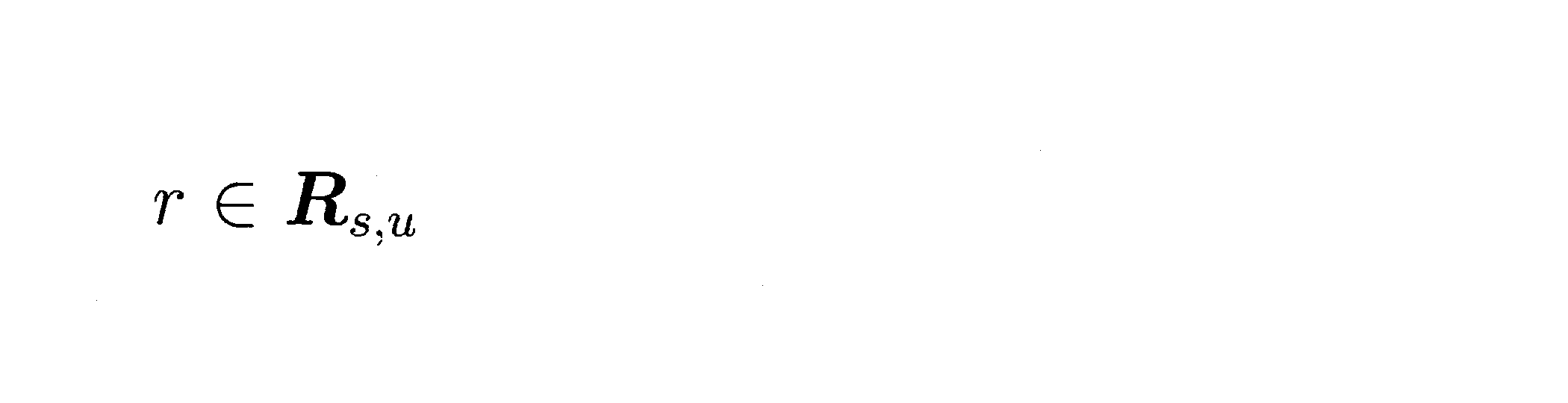
性能評価の比較のため、経路設定法にのみMPCを用いる形態について簡単に説明する。経路設定法にのみMPCを用いる形態は、CDNを運用していないISPがMPCを用いた制御を行う場合に相当し、サーバsからユーザuへの配信要求に対して




CAIDAで公開されている米国の二つの商用ISPバックボーンNW、CAISとVerioのNWトポロジを評価に用いた。図8A及び図8Bにこれら二つのNWのトポロジを示す。各々のNWのノード数Nは37と35で、リンク数Eは88と152であり、平均ノード次数は2.38と4.11である。VerioはCAISと比較してノード次数が高く、次数が大きなハブノードが存在するのに対してCAISはノード次数が低くハブノードが存在しない。Verioにおいてはハブノードを経由することで各ノードペア間のホップ距離を短縮することができるため、平均ノード間距離が2.51であるのに対して、CAISの平均ノード間距離は5.05と大きい。
そしてChina Telecomが提供する商用VoDサービスPowerInfo VoDシステムにおいて収集されたアクセスログデータに従いコンテンツ配信要求を発生させた。本ログデータには2004年6月から12月の7ヶ月間に発生した20,921,657の全配信要求が含まれているが、第162日目から171日目の10日間のログデータを評価に用い、各配信要求に対して各ノードの人口比に比例する確率でランダムに選択したノードから要求を発生させた。ただしキャッシュサーバに全くコンテンツがキャッシュされていない状態からシミュレーションを開始し、最初の3日間はワームアップ期間として評価対象外として、残りの7日間で得られたデータを評価に用いた。
全てのノードにキャッシュサーバが配置されているものとする。評価ログデータに含まれるコンテンツ数が7,500であったが、各キャッシュサーバのストレージ容量をBs=7,500/Nに設定した。ログデータの評価に用いた7日間における一日あたりの最大視聴回数は5,700であったが、各配信サーバの配信容量をCC,s=5,700×2/Nに、各リンクの伝送容量をCL,e=5,700×4/Nに設定した。また各コンテンツのオリジナルサーバomを、シミュレーション開始時に各ノードの人口比に比例する確率でランダムに設定し、シミュレーション期間中は不変とした。
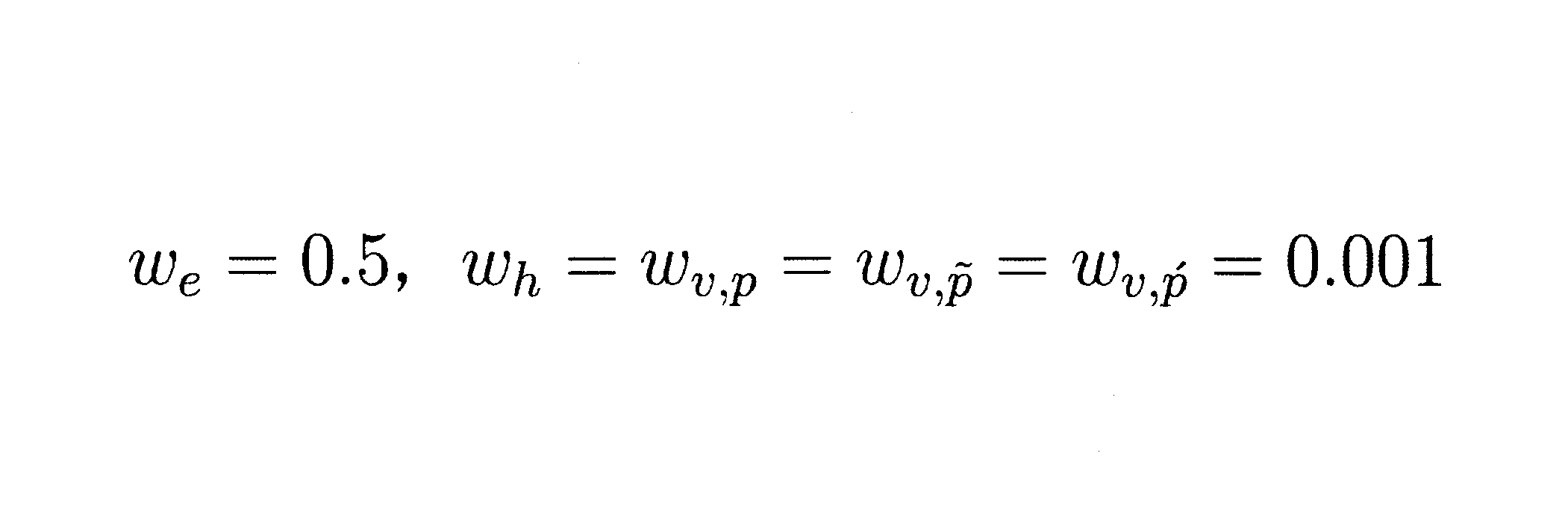
TSの期間長をT=30分とし、経路設定法と配信サーバ選択法のどちらか一方、もしくは経路設定法と配信サーバ選択法の両方にMPCを用いる場合、予測ホライズンをH=2に、各目的関数の重みを




<評価結果>
各TSにおいて発生した配信要求の中で、受付けられなかった超過配信要求数の平均値と、配信フローの平均ホップ長に関して6つの形態を比較する。表1と表2に、CAISとVerioの各NWに対して6つの各形態を用いた場合の平均超過配信要求数を各々まとめる。
各TSにおいて発生した配信要求の中で、受付けられなかった超過配信要求数の平均値と、配信フローの平均ホップ長に関して6つの形態を比較する。表1と表2に、CAISとVerioの各NWに対して6つの各形態を用いた場合の平均超過配信要求数を各々まとめる。
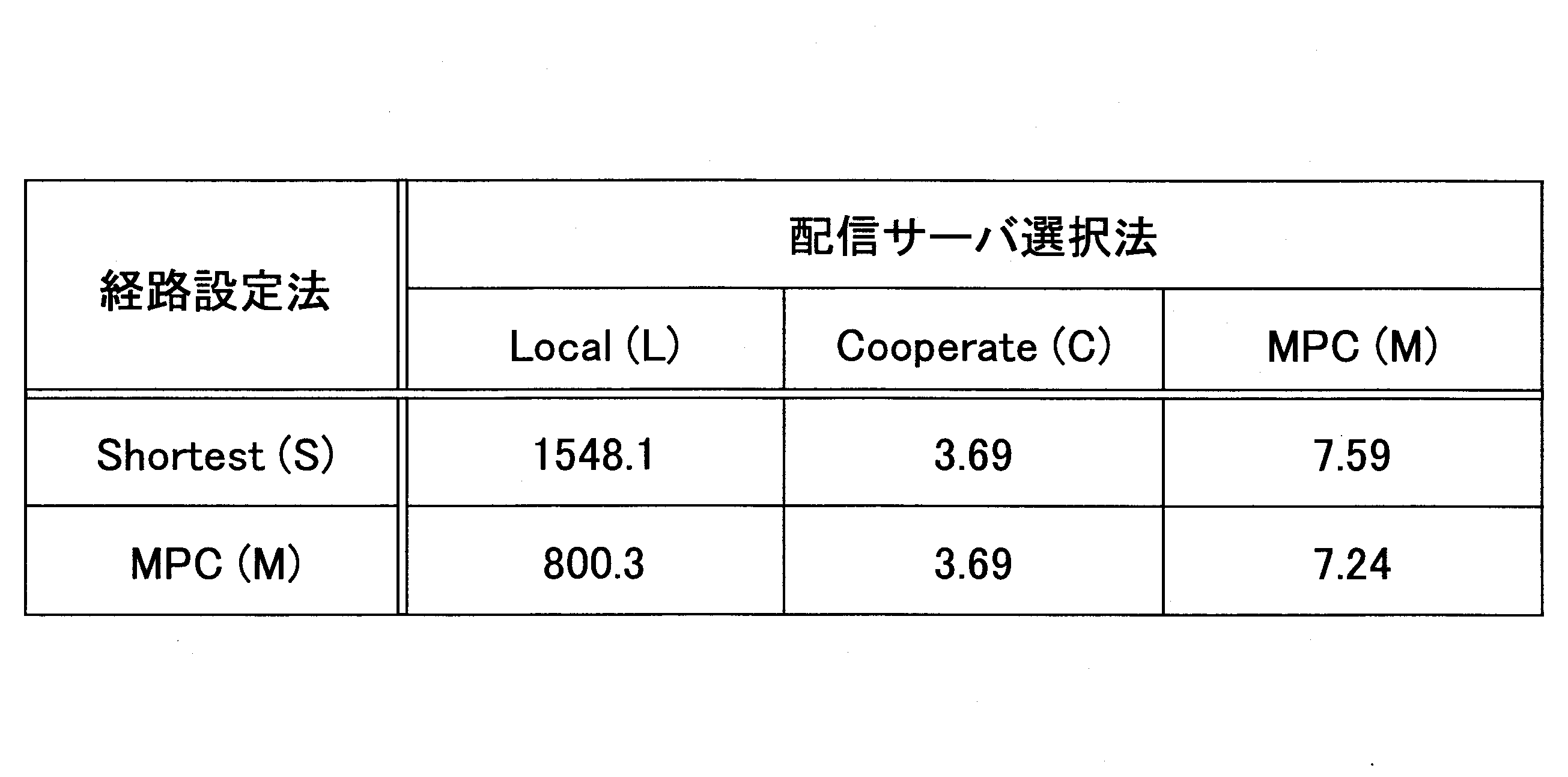
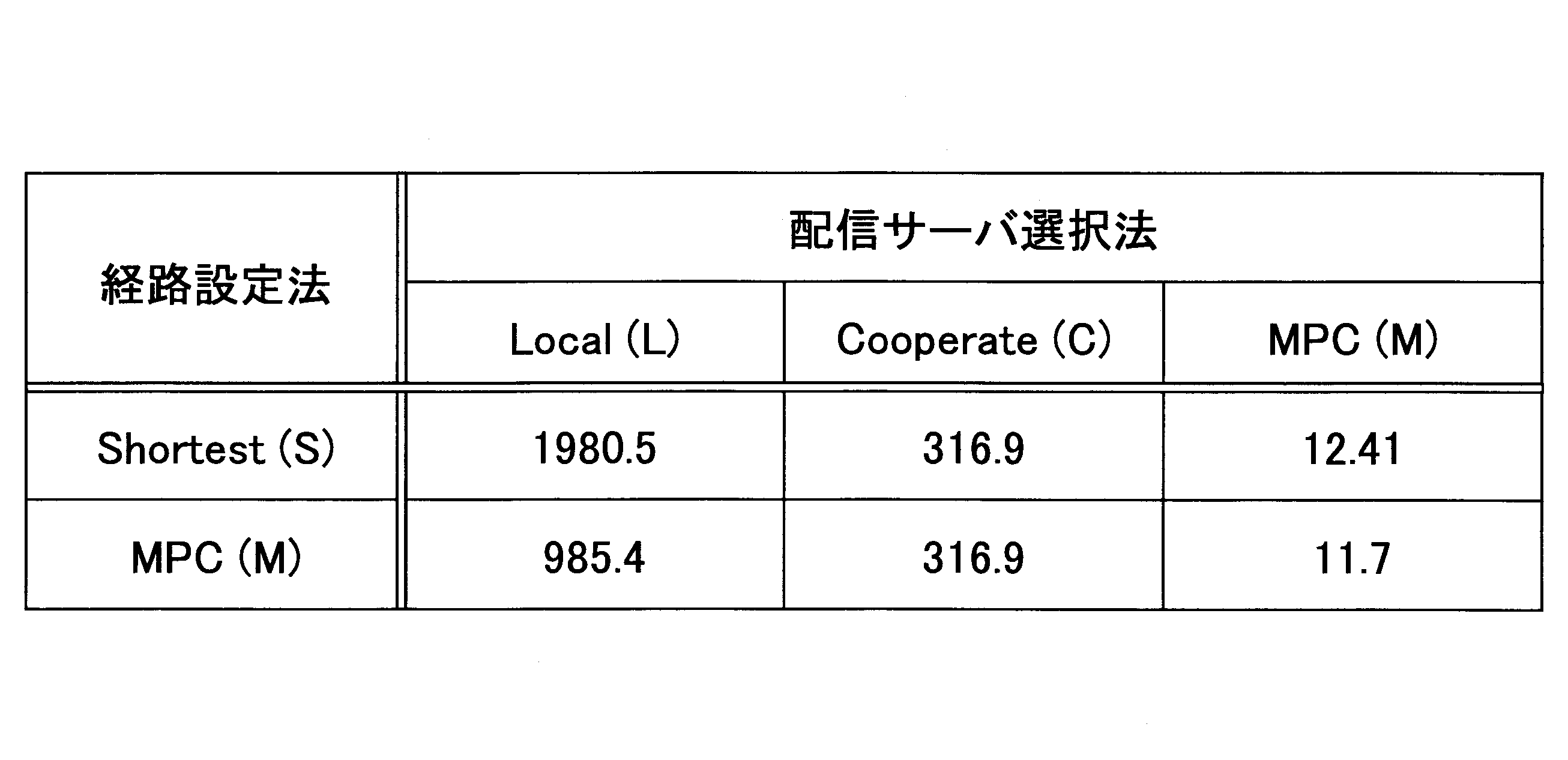
配信サーバ選択法がLocalの場合、各配信要求に対して選択候補となるキャッシュサーバが要求発生ノードに限定されるため、複数のノードのキャッシュサーバが選択候補となるCooperateやMPCの場合と比較して、超過配信要求数が1桁~2桁大きくなる。一方、配信サーバ選択法がCooperateとMPCの場合を比較すると、Cooperateは各配信要求発生時点のキャッシュ状態を考慮して、常に、該当コンテンツが存在するキャッシュサーバの中で要求ユーザへのホップ長が最小となるものが選択されるのに対して、MPCはTSの開始時点におけるコンテンツの配置状態のみに基づきキャッシュサーバの選択確率を設計するため、要求発生時点のコンテンツ配置状態を必ずしも反映したサーバ選択とはなっていない。そのためMPCはCooperateと比較して、NW全体のコンテンツの配置状態を把握することが必要な周期が遥かに長く、制御負荷が低い反面、超過配信要求数は増加することが予想される。
しかしCAISにおけるCooperateの結果はMPCより僅かに良好な程度に留まっている。さらにVerioにおいては逆に、MPCがCooperateより一桁程度も小さく、遥かに良好な結果を示している。これはVerioには高次数のハブノードが存在するがハブノードは他ノードからのホップ距離が短く、Cooperateにおいてはハブノードに存在するキャッシュサーバが配信サーバとして選択される機会が多く、これらキャッシュサーバに負荷が集中するためである。そのためハブノードが存在するハブ&スポーク型のNWの場合には、多数のキャッシュサーバが確率的に選択され、選択サーバの多様性が高いMPCを用いた配信サーバ選択法の効果が高くなる。
また表3と表4に、CAISとVerioの各NWに対して6つの各形態を用いた場合の平均配信フローホップ長を各々まとめる。
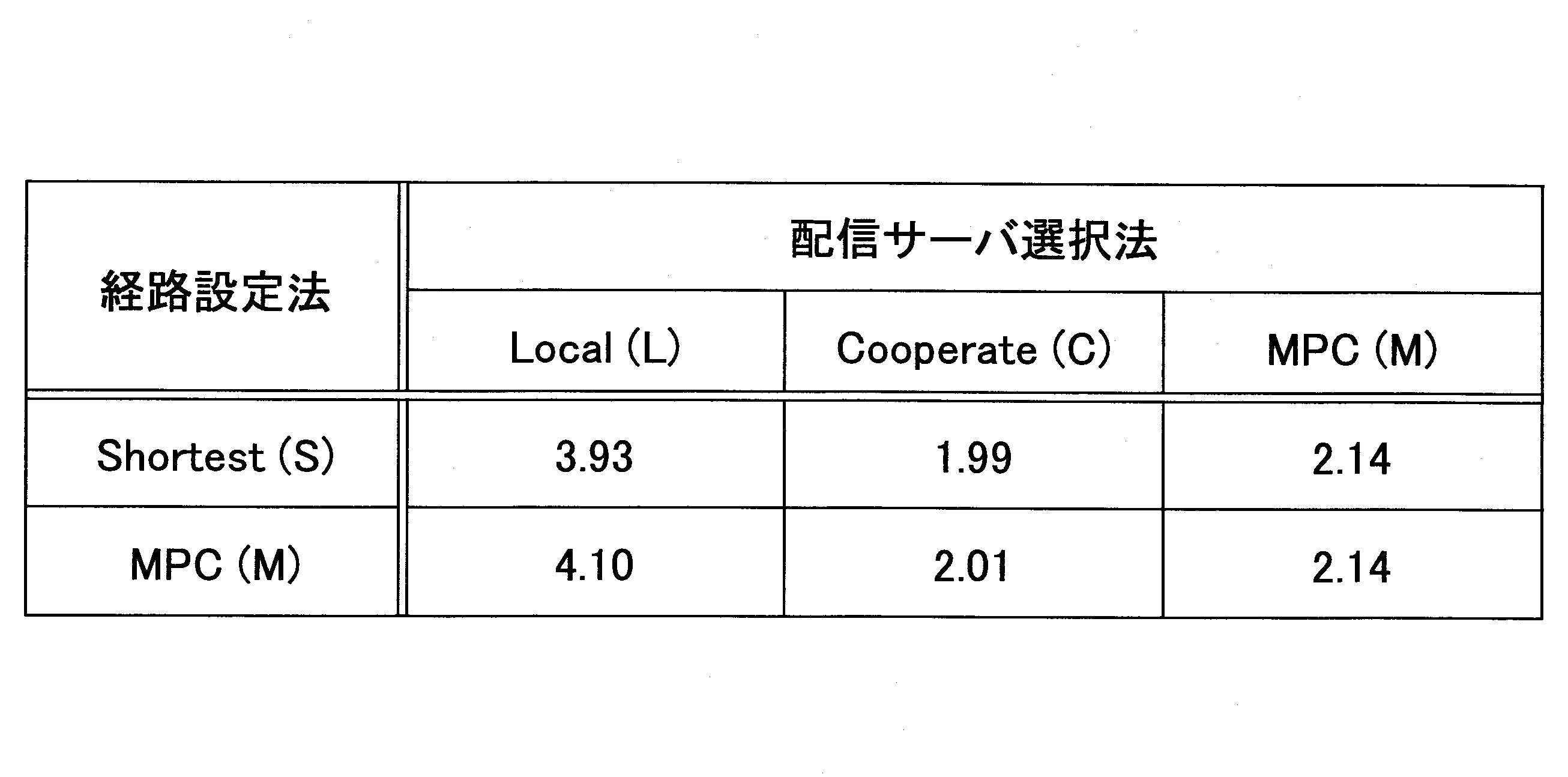
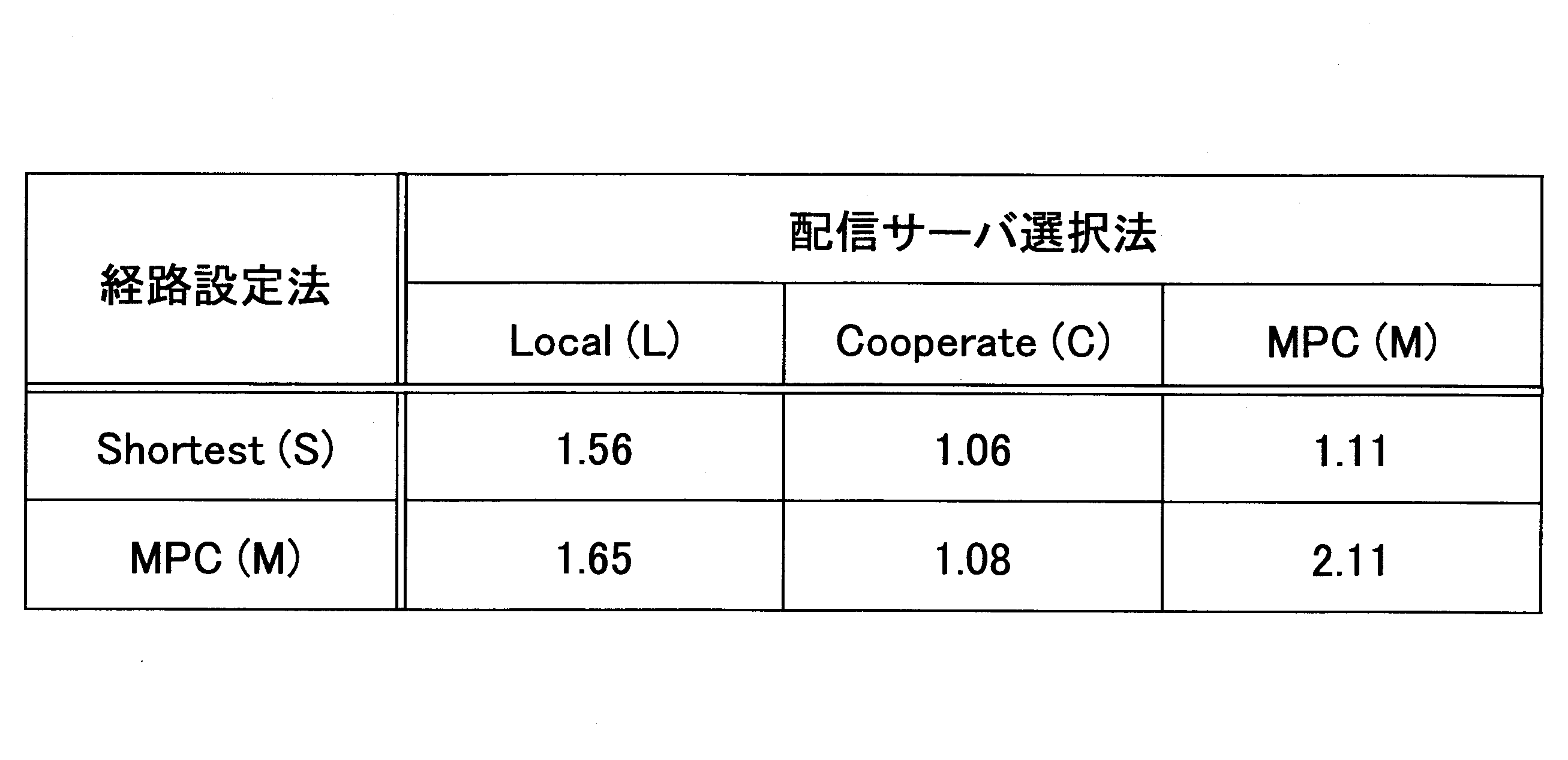
<本発明の実施形態の効果>
以上説明したように、本発明の実施形態によれば、NWの複数のノードに分散配置されたキャッシュサーバを用いてコンテンツを配信するCDNにおいて、各配信要求に対して配信に用いるキャッシュサーバを選択する確率や、キャッシュサーバと経路の組である配信ルートを選択する確率を、MPCを用いて最適設計することで、キャッシュサーバの容量超過により配信要求が棄却される超過配信要求の頻度を最小化できる効果がある。
以上説明したように、本発明の実施形態によれば、NWの複数のノードに分散配置されたキャッシュサーバを用いてコンテンツを配信するCDNにおいて、各配信要求に対して配信に用いるキャッシュサーバを選択する確率や、キャッシュサーバと経路の組である配信ルートを選択する確率を、MPCを用いて最適設計することで、キャッシュサーバの容量超過により配信要求が棄却される超過配信要求の頻度を最小化できる効果がある。
説明の便宜上、本発明の実施形態に係る設計装置(配信サーバ選択確率最適設計装置、配信ルート選択確率最適設計装置)は機能的なブロック図を用いて説明しているが、本発明の実施形態に係る設計装置は、ハードウェア、ソフトウェアまたはそれらの組み合わせで実現されてもよい。例えば、本発明の実施形態は、コンピュータに対して本発明の実施形態に係る設計装置の各機能を実現させるプログラム、コンピュータに対して本発明の実施形態に係る方法の各手順を実行させるプログラム等により、実現されてもよい。また、各機能部が必要に応じて組み合わせて使用されてもよい。
以上、CDNにおいて、ユーザからの配信要求が変化するときにユーザからの配信要求が棄却される頻度を抑制し、CDNサービスの向上を図るための手法について説明したが、本発明は、上記の実施形態に限定されることなく、請求の範囲内において、種々の変更・応用が可能である。
本国際出願は2015年2月20日に出願した日本国特許出願2015-031523号に基づく優先権を主張するものであり、2015-031523号の全内容を本国際出願に援用する。
100 設計装置
101 パラメタ入力部
102 選択確率設計部
103 選択確率出力部
200 配信サーバ選択確率最適設計装置
201 パラメタ入力部
202 キャッシュサーバ選択確率最適設計部
203 キャッシュサーバ選択確率出力部
300 配信ルート選択確率最適設計装置
301 パラメタ入力部
302 配信ルート選択確率最適設計部
303 配信ルート選択確率出力部
101 パラメタ入力部
102 選択確率設計部
103 選択確率出力部
200 配信サーバ選択確率最適設計装置
201 パラメタ入力部
202 キャッシュサーバ選択確率最適設計部
203 キャッシュサーバ選択確率出力部
300 配信ルート選択確率最適設計装置
301 パラメタ入力部
302 配信ルート選択確率最適設計部
303 配信ルート選択確率出力部
Claims (7)
- ネットワークの複数のノードに分散配置されたキャッシュサーバを用いてコンテンツを配信する際に、ユーザからの配信要求に対してコンテンツの配信に用いられる配信サーバ又は配信ルートを選択する確率を設計する設計装置であって、
ネットワークに関するパラメタと、ユーザからのコンテンツに対して発生する配信要求の需要推定量とを入力パラメタ値として受け取るパラメタ入力部と、
前記パラメタ入力部において受け取った入力パラメタ値に基づき、ユーザからのコンテンツに対して発生する配信要求が棄却される超過配信要求を抑制するよう、キャッシュサーバが配信サーバとして選択される選択確率、又は、配信サーバがコンテンツを配信する配信経路と配信サーバの組である配信ルートの選択確率をモデル予測制御を用いて設計する選択確率設計部と、
前記選択確率設計部において設計されたキャッシュサーバの選択確率又は配信ルートの選択確率を出力する選択確率出力部と、
を有する設計装置。 - 前記選択確率設計部は、配信フローの平均ホップ数の低減及び選択確率の変化量の抑制を行いつつ、超過配信要求数を抑制するよう、キャッシュサーバの選択確率を設計する、請求項1に記載の設計装置。
- 前記パラメタ入力部は、
コンテンツ数M、
ノード数N、
モデル予測制御の予測ホライズンH、
キャッシュサーバsのキャッシュサーバ配信容量CC,s、
タイムスロットtにおけるユーザuからのコンテンツmに対して発生する配信デマンド量du,m,tの需要推定量



超過配信要求数の抑制のための目的関数Jsに対する配信フローの平均ホップ数の低減ための目的関数Jhの重みパラメタwh、及び
目的関数Jsに対するキャッシュサーバsの選択確率pu,m,k(s)の変化量の抑制のための目的関数Jv,pの重みパラメタwv,pを受け取り、
前記選択確率設計部は、
タイムスロットt-1におけるキャッシュサーバsの超過配信回数ζs,t-1に対して、タイムスロットtにおいてキャッシュサーバsから配信される配信フローの総数gs,tを
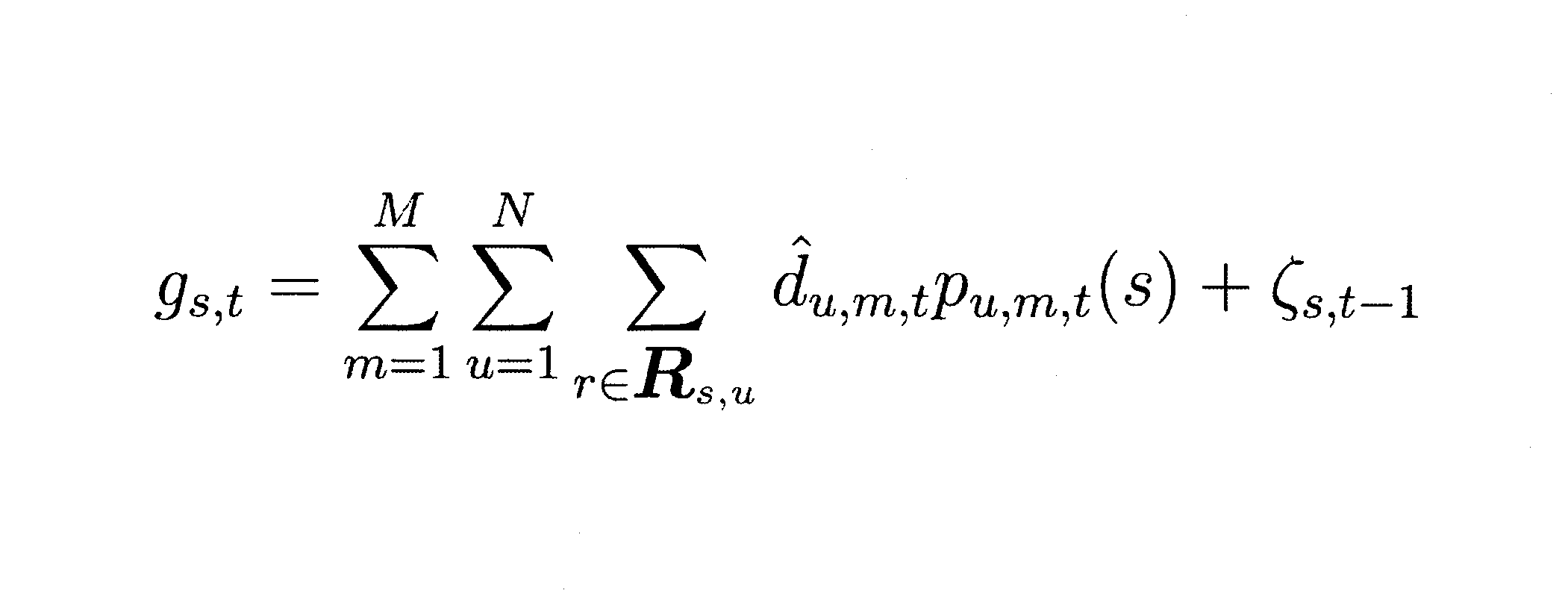
目的関数Jsを

更に、目的関数Jhを

更に、目的関数Jv,pを

Js+whJh+wv,pJv,pを最小化する非線形計画問題によって、タイムスロットtの終了時点においてt+1≦k≦t+Hの範囲のタイムスロットkに対する選択確率pu,m,k(s)を最適化する、請求項2に記載の設計装置。 - 前記選択確率設計部は、リンクを通る配信フローの総数の低減、配信フローの平均ホップ数の低減及び選択確率の変化量の抑制を行いつつ、超過配信要求数を抑制するよう、配信ルートの選択確率を設計する、請求項1に記載の設計装置。
- 前記パラメタ入力部は、
コンテンツ数M、
ノード数N、
モデル予測制御の予測ホライズンH、
キャッシュサーバsのキャッシュサーバ配信容量CC,s、
リンクeのリンク転送容量CL,e、
タイムスロットtにおけるユーザuのコンテンツmに対する配信ルート集合




t+1≦k≦t+Hの範囲のタイムスロットkにおけるキャッシュサーバsからユーザuまでのホップ長hs,u,k、
超過配信要求数の抑制のための目的関数Jsに対するリンクeを通る配信フローの総数の低減のための目的関数Jeの重みパラメタwe、
超過配信要求数の抑制のための目的関数Jsに対する配信フローの平均ホップ数の低減ための目的関数Jhの重みパラメタwh、及び
目的関数Jsに対する送信元がsで経路がrの配信ルートφu,m,t(s,r)の選択確率



前記選択確率設計部は、
タイムスロットt-1におけるリンクeの超過配信回数ηe,t-1に対して、タイムスロットtにおいてリンクeを通る配信フローの総数fe,tを
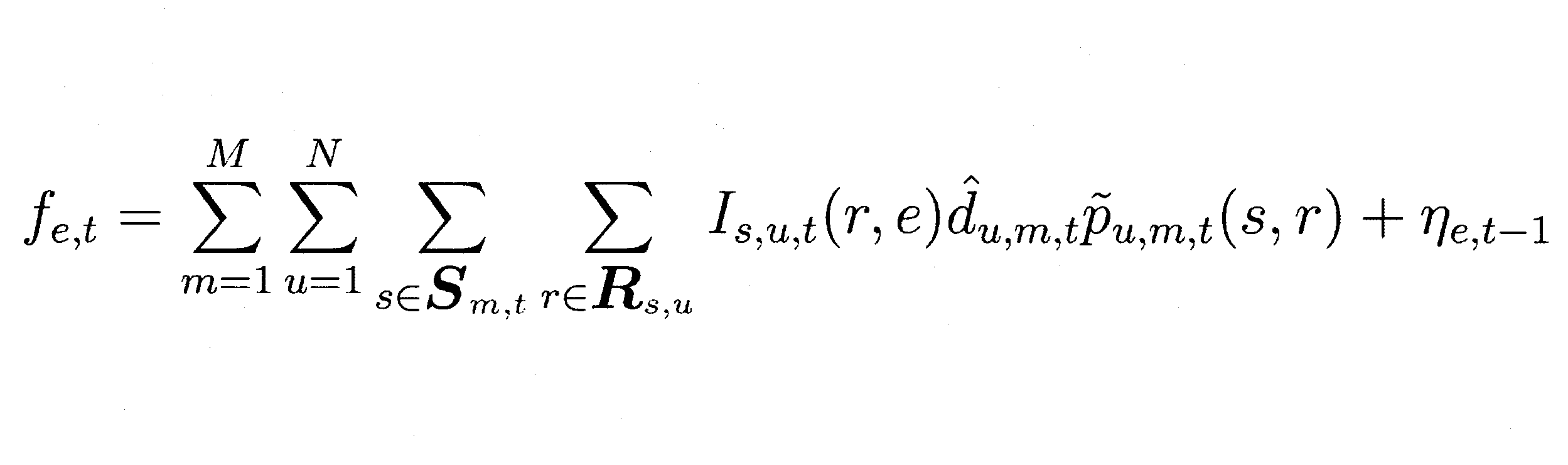
目的関数Jeを

タイムスロットt-1におけるキャッシュサーバsの超過配信回数ζs,t-1に対して、タイムスロットtにおいてキャッシュサーバsから配信される配信フローの総数gs,tを

目的関数Jsを

更に、目的関数Jhを
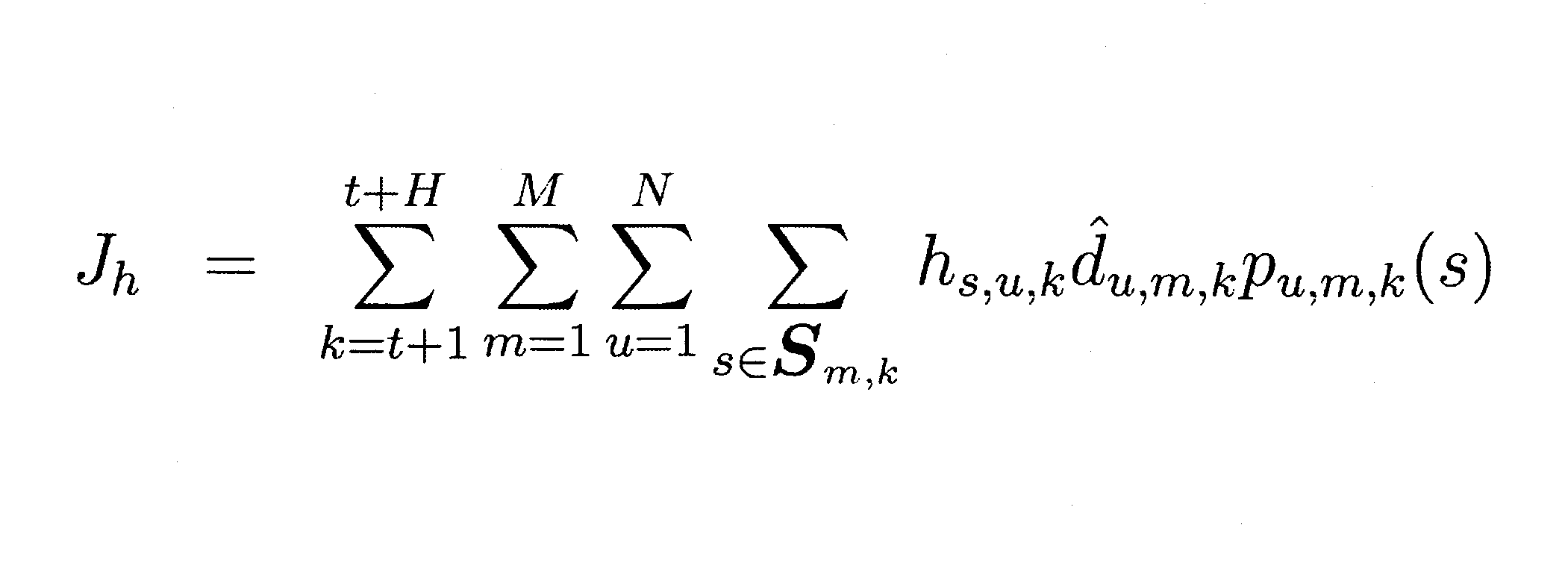
更に、目的関数

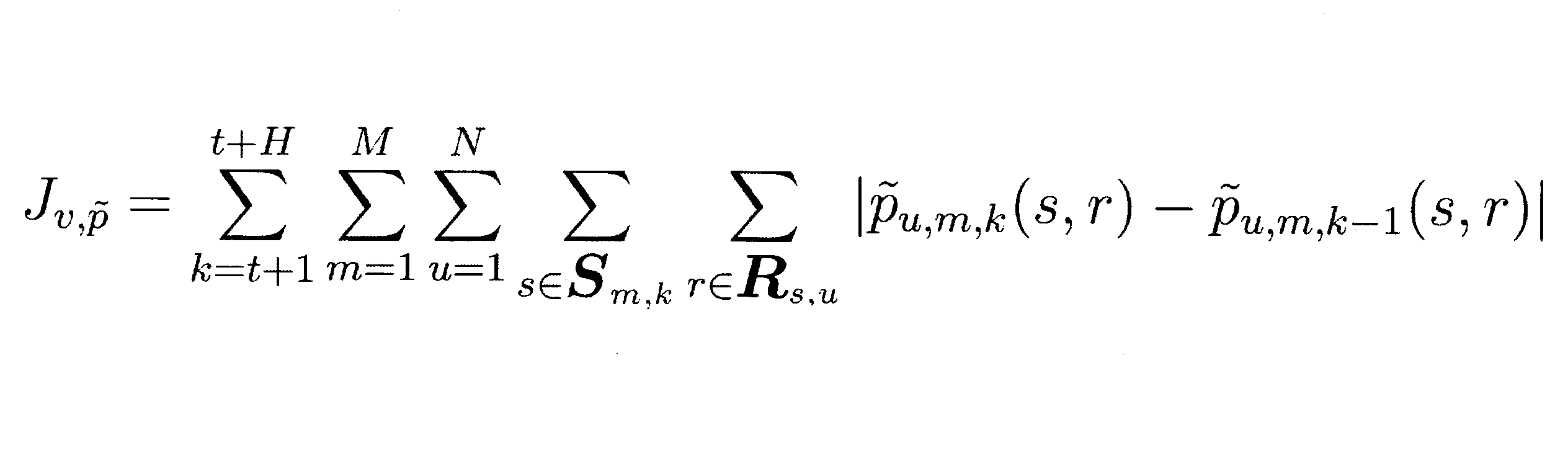


- ネットワークの複数のノードに分散配置されたキャッシュサーバを用いてコンテンツを配信する際に、ユーザからの配信要求に対してコンテンツの配信に用いられる配信サーバ又は配信ルートを選択する確率を設計する設計装置における設計方法であって、
ネットワークに関するパラメタと、ユーザからのコンテンツに対して発生する配信要求の需要推定量とを入力パラメタ値として受け取るステップと、
前記受け取った入力パラメタ値に基づき、ユーザからのコンテンツに対して発生する配信要求が棄却される超過配信要求を抑制するよう、キャッシュサーバが配信サーバとして選択される選択確率、又は、配信サーバがコンテンツを配信する配信経路と配信サーバの組である配信ルートの選択確率をモデル予測制御を用いて設計するステップと、
前記設計されたキャッシュサーバの選択確率又は配信ルートの選択確率を出力するステップと、
を有する設計方法。 - ネットワークの複数のノードに分散配置されたキャッシュサーバを用いてコンテンツを配信する際に、ユーザからの配信要求に対してコンテンツの配信に用いられる配信サーバ又は配信ルートを選択する確率を設計するために、コンピュータを、
ネットワークに関するパラメタと、ユーザからのコンテンツに対して発生する配信要求の需要推定量とを入力パラメタ値として受け取るパラメタ入力手段、
前記パラメタ入力手段において受け取った入力パラメタ値に基づき、ユーザからのコンテンツに対して発生する配信要求が棄却される超過配信要求を抑制するよう、キャッシュサーバが配信サーバとして選択される選択確率、又は、配信サーバがコンテンツを配信する配信経路と配信サーバの組である配信ルートの選択確率をモデル予測制御を用いて設計する選択確率設計手段、及び
前記選択確率設計手段において設計されたキャッシュサーバの選択確率又は配信ルートの選択確率を出力する選択確率出力手段、
として機能させるためのプログラムを記録した記録媒体。
Priority Applications (1)
| Application Number | Priority Date | Filing Date | Title |
|---|---|---|---|
| US15/549,192 US10542081B2 (en) | 2015-02-20 | 2016-02-05 | Apparatus, design method, and recording medium |
Applications Claiming Priority (2)
| Application Number | Priority Date | Filing Date | Title |
|---|---|---|---|
| JP2015-031523 | 2015-02-20 | ||
| JP2015031523A JP5888687B1 (ja) | 2015-02-20 | 2015-02-20 | 配信サーバ又は配信ルート設計装置、配信サーバ又は配信ルート設計方法及びプログラム |
Publications (1)
| Publication Number | Publication Date |
|---|---|
| WO2016132933A1 true WO2016132933A1 (ja) | 2016-08-25 |
Family
ID=55530477
Family Applications (1)
| Application Number | Title | Priority Date | Filing Date |
|---|---|---|---|
| PCT/JP2016/053487 Ceased WO2016132933A1 (ja) | 2015-02-20 | 2016-02-05 | 設計装置、設計方法及び記録媒体 |
Country Status (3)
| Country | Link |
|---|---|
| US (1) | US10542081B2 (ja) |
| JP (1) | JP5888687B1 (ja) |
| WO (1) | WO2016132933A1 (ja) |
Cited By (1)
| Publication number | Priority date | Publication date | Assignee | Title |
|---|---|---|---|---|
| CN108063726A (zh) * | 2017-12-08 | 2018-05-22 | 苏州大学 | 一种信息中心网络中信息缓存路由方法、系统及设备 |
Families Citing this family (6)
| Publication number | Priority date | Publication date | Assignee | Title |
|---|---|---|---|---|
| WO2017149355A1 (en) * | 2016-03-01 | 2017-09-08 | Telefonaktiebolaget Lm Ericsson (Publ) | Content distribution and delivery optimization in a content delivery network (cdn) |
| CN107645541B (zh) * | 2017-08-24 | 2021-03-02 | 创新先进技术有限公司 | 数据存储方法、装置及服务器 |
| US10609119B2 (en) * | 2017-11-03 | 2020-03-31 | Salesforce.Com, Inc. | Simultaneous optimization of multiple TCP parameters to improve download outcomes for network-based mobile applications |
| US11470176B2 (en) * | 2019-01-29 | 2022-10-11 | Cisco Technology, Inc. | Efficient and flexible load-balancing for clusters of caches under latency constraint |
| US11343325B2 (en) * | 2020-08-31 | 2022-05-24 | Adobe Inc. | Systems and methods for estimating typed graphlets in large data |
| CN115580576B (zh) * | 2022-12-07 | 2023-03-14 | 卓望数码技术(深圳)有限公司 | 基于自适应业务分流的路由分发方法、装置、设备及介质 |
Citations (2)
| Publication number | Priority date | Publication date | Assignee | Title |
|---|---|---|---|---|
| JP2010057107A (ja) * | 2008-08-29 | 2010-03-11 | Nippon Telegr & Teleph Corp <Ntt> | サーバ配置方法とキャリア型cdnにおけるサーバ配置方法およびサーバ配置システムとキャリア型cdnシステムならびにプログラム |
| JP2010199842A (ja) * | 2009-02-24 | 2010-09-09 | Nippon Telegr & Teleph Corp <Ntt> | キャッシュ設計システムと方法およびプログラム |
Family Cites Families (3)
| Publication number | Priority date | Publication date | Assignee | Title |
|---|---|---|---|---|
| US20050193113A1 (en) * | 2003-04-14 | 2005-09-01 | Fujitsu Limited | Server allocation control method |
| US20050216227A1 (en) * | 2004-03-23 | 2005-09-29 | Jogesh Warrior | Method of operating sensor net and sensor apparatus |
| US20140045475A1 (en) * | 2012-08-08 | 2014-02-13 | International Business Machines Corporation | Techniques for Improving Cache Effectiveness of Caches with Low User Population |
-
2015
- 2015-02-20 JP JP2015031523A patent/JP5888687B1/ja active Active
-
2016
- 2016-02-05 US US15/549,192 patent/US10542081B2/en active Active
- 2016-02-05 WO PCT/JP2016/053487 patent/WO2016132933A1/ja not_active Ceased
Patent Citations (2)
| Publication number | Priority date | Publication date | Assignee | Title |
|---|---|---|---|---|
| JP2010057107A (ja) * | 2008-08-29 | 2010-03-11 | Nippon Telegr & Teleph Corp <Ntt> | サーバ配置方法とキャリア型cdnにおけるサーバ配置方法およびサーバ配置システムとキャリア型cdnシステムならびにプログラム |
| JP2010199842A (ja) * | 2009-02-24 | 2010-09-09 | Nippon Telegr & Teleph Corp <Ntt> | キャッシュ設計システムと方法およびプログラム |
Cited By (1)
| Publication number | Priority date | Publication date | Assignee | Title |
|---|---|---|---|---|
| CN108063726A (zh) * | 2017-12-08 | 2018-05-22 | 苏州大学 | 一种信息中心网络中信息缓存路由方法、系统及设备 |
Also Published As
| Publication number | Publication date |
|---|---|
| US10542081B2 (en) | 2020-01-21 |
| US20180034900A1 (en) | 2018-02-01 |
| JP2016154287A (ja) | 2016-08-25 |
| JP5888687B1 (ja) | 2016-03-22 |
Similar Documents
| Publication | Publication Date | Title |
|---|---|---|
| JP5888687B1 (ja) | 配信サーバ又は配信ルート設計装置、配信サーバ又は配信ルート設計方法及びプログラム | |
| US7929440B2 (en) | Systems and methods for capacity planning using classified traffic | |
| Sharma et al. | Distributing content simplifies isp traffic engineering | |
| Fischer et al. | Replex: dynamic traffic engineering based on wardrop routing policies | |
| US9401868B2 (en) | Method of traffic engineering for provisioning routing and storage in content-oriented networks | |
| Golaszewski | Content Distribution Networks | |
| EP2656546A1 (en) | Communications network management | |
| US20140133302A1 (en) | Tuning routing metrics to reduce maximum link utilization and end-to-end delay violations | |
| Thar et al. | Online caching and cooperative forwarding in information centric networking | |
| Li et al. | Rate-selective caching for adaptive streaming over information-centric networks | |
| JP2016048498A (ja) | キャッシュ制御装置およびキャッシュ制御方法 | |
| Jiang et al. | Flexile: Meeting bandwidth objectives almost always | |
| Li et al. | Quality of experience in ICN: Keep your low-bitrate close and high-bitrate closer | |
| Qin et al. | Optimizing routing and server selection in intelligent SDN-based CDN | |
| Gvozdiev et al. | Low-latency routing on mesh-like backbones | |
| Diab et al. | Joint content distribution and traffic engineering of adaptive videos in telco-cdns | |
| JP5436370B2 (ja) | サーバ選択方法及び装置及びプログラム | |
| Avci et al. | A content-based traffic engineering policy for Information-Centric Networks | |
| Sourlas et al. | Cache-aware traffic engineering in information-centric networks | |
| JP2016046785A (ja) | キャッシュサーバ選択装置、分散キャッシュシステム、及びキャッシュサーバ選択方法 | |
| JP5506640B2 (ja) | コンテンツ配信方法及びシステム | |
| JP5280933B2 (ja) | サーバ並列配信システムと方法およびプログラム | |
| Hsu et al. | An integrated end-to-end QoS anycast routing on DiffServ networks | |
| Kamiyama et al. | Optimizing cache location and route on CDN using model predictive control | |
| Sousa et al. | A framework for improving routing configurations using multi-objective optimization mechanisms |
Legal Events
| Date | Code | Title | Description |
|---|---|---|---|
| 121 | Ep: the epo has been informed by wipo that ep was designated in this application |
Ref document number: 16752320 Country of ref document: EP Kind code of ref document: A1 |
|
| NENP | Non-entry into the national phase |
Ref country code: DE |
|
| 122 | Ep: pct application non-entry in european phase |
Ref document number: 16752320 Country of ref document: EP Kind code of ref document: A1 |