WO2016132910A1 - ハニカム触媒 - Google Patents
ハニカム触媒 Download PDFInfo
- Publication number
- WO2016132910A1 WO2016132910A1 PCT/JP2016/053296 JP2016053296W WO2016132910A1 WO 2016132910 A1 WO2016132910 A1 WO 2016132910A1 JP 2016053296 W JP2016053296 W JP 2016053296W WO 2016132910 A1 WO2016132910 A1 WO 2016132910A1
- Authority
- WO
- WIPO (PCT)
- Prior art keywords
- zeolite
- honeycomb catalyst
- mass
- tio
- vanadium
- Prior art date
- Legal status (The legal status is an assumption and is not a legal conclusion. Google has not performed a legal analysis and makes no representation as to the accuracy of the status listed.)
- Ceased
Links
Images

Classifications
-
- B—PERFORMING OPERATIONS; TRANSPORTING
- B01—PHYSICAL OR CHEMICAL PROCESSES OR APPARATUS IN GENERAL
- B01J—CHEMICAL OR PHYSICAL PROCESSES, e.g. CATALYSIS OR COLLOID CHEMISTRY; THEIR RELEVANT APPARATUS
- B01J35/00—Catalysts, in general, characterised by their form or physical properties
- B01J35/50—Catalysts, in general, characterised by their form or physical properties characterised by their shape or configuration
- B01J35/56—Foraminous structures having flow-through passages or channels, e.g. grids or three-dimensional [3D] monoliths
- B01J35/57—Honeycombs
-
- B—PERFORMING OPERATIONS; TRANSPORTING
- B01—PHYSICAL OR CHEMICAL PROCESSES OR APPARATUS IN GENERAL
- B01D—SEPARATION
- B01D53/00—Separation of gases or vapours; Recovering vapours of volatile solvents from gases; Chemical or biological purification of waste gases, e.g. engine exhaust gases, smoke, fumes, flue gases, aerosols
- B01D53/34—Chemical or biological purification of waste gases
- B01D53/74—General processes for purification of waste gases; Apparatus or devices specially adapted therefor
- B01D53/86—Catalytic processes
-
- B—PERFORMING OPERATIONS; TRANSPORTING
- B01—PHYSICAL OR CHEMICAL PROCESSES OR APPARATUS IN GENERAL
- B01D—SEPARATION
- B01D53/00—Separation of gases or vapours; Recovering vapours of volatile solvents from gases; Chemical or biological purification of waste gases, e.g. engine exhaust gases, smoke, fumes, flue gases, aerosols
- B01D53/34—Chemical or biological purification of waste gases
- B01D53/74—General processes for purification of waste gases; Apparatus or devices specially adapted therefor
- B01D53/86—Catalytic processes
- B01D53/90—Injecting reactants
-
- B—PERFORMING OPERATIONS; TRANSPORTING
- B01—PHYSICAL OR CHEMICAL PROCESSES OR APPARATUS IN GENERAL
- B01D—SEPARATION
- B01D53/00—Separation of gases or vapours; Recovering vapours of volatile solvents from gases; Chemical or biological purification of waste gases, e.g. engine exhaust gases, smoke, fumes, flue gases, aerosols
- B01D53/34—Chemical or biological purification of waste gases
- B01D53/92—Chemical or biological purification of waste gases of engine exhaust gases
- B01D53/94—Chemical or biological purification of waste gases of engine exhaust gases by catalytic processes
-
- B—PERFORMING OPERATIONS; TRANSPORTING
- B01—PHYSICAL OR CHEMICAL PROCESSES OR APPARATUS IN GENERAL
- B01J—CHEMICAL OR PHYSICAL PROCESSES, e.g. CATALYSIS OR COLLOID CHEMISTRY; THEIR RELEVANT APPARATUS
- B01J29/00—Catalysts comprising molecular sieves
- B01J29/04—Catalysts comprising molecular sieves having base-exchange properties, e.g. crystalline zeolites
- B01J29/06—Crystalline aluminosilicate zeolites; Isomorphous compounds thereof
- B01J29/70—Crystalline aluminosilicate zeolites; Isomorphous compounds thereof of types characterised by their specific structure not provided for in groups B01J29/08 - B01J29/65
- B01J29/78—Crystalline aluminosilicate zeolites; Isomorphous compounds thereof of types characterised by their specific structure not provided for in groups B01J29/08 - B01J29/65 containing arsenic, antimony, bismuth, vanadium, niobium, tantalum, polonium, chromium, molybdenum, tungsten, manganese, technetium or rhenium
-
- F—MECHANICAL ENGINEERING; LIGHTING; HEATING; WEAPONS; BLASTING
- F01—MACHINES OR ENGINES IN GENERAL; ENGINE PLANTS IN GENERAL; STEAM ENGINES
- F01N—GAS-FLOW SILENCERS OR EXHAUST APPARATUS FOR MACHINES OR ENGINES IN GENERAL; GAS-FLOW SILENCERS OR EXHAUST APPARATUS FOR INTERNAL-COMBUSTION ENGINES
- F01N3/00—Exhaust or silencing apparatus having means for purifying, rendering innocuous, or otherwise treating exhaust
- F01N3/08—Exhaust or silencing apparatus having means for purifying, rendering innocuous, or otherwise treating exhaust for rendering innocuous
- F01N3/10—Exhaust or silencing apparatus having means for purifying, rendering innocuous, or otherwise treating exhaust for rendering innocuous by thermal or catalytic conversion of noxious components of exhaust
Definitions
- the present invention relates to a honeycomb catalyst.
- an SCR Selective Catalytic Reduction
- V 2 O 5 vanadium pentoxide
- TiO 2 titanium dioxide
- WO 3 tungsten trioxide
- a honeycomb catalyst using a zeolitic material that can obtain higher purification performance when no sulfur component is contained in the exhaust gas is also known.
- Patent Document 1 discloses a catalyst for removing nitrogen oxides having a high denitration rate in a high temperature region of 400 ° C. or higher, wherein titanium oxide and / or a binary oxide of titanium and tungsten is an A component, and SiO 2 2 / Al 2 O 3 molar ratio is 8 or more acid type zeolite and / or cerium ion exchanged zeolite as B component, and the composition of A component is 50 to 100% by mass as TiO 2 and 0 as WO 3
- a nitrogen oxide removing catalyst which is in the range of ⁇ 50% by mass, wherein the A component and the B component are closely dispersed.
- Specific examples of zeolites include FAU structure (Y-type zeolite), MOR structure (mordenite), FER structure (ferrierite), and MFI structure (ZSM-5).
- Patent Document 2 in order to prevent poisoning due to selenium or arsenic in exhaust gas, 10 to 90% by mass of titania is added to zeolite supporting copper, and water, inorganic fibers, etc. are added and kneaded. Thereafter, drying and calcination are performed, and a method for producing a nitrogen oxide removing catalyst containing both a TiO 2 / V 2 O 5 / WO 3 component and a zeolite component is disclosed. Specifically, zeolites are disclosed as MOR structure (mordenite), FER structure (ferrierite), and MFI structure (ZSM-5).
- the ratio of NO 2 in NOx contained in the exhaust gas discharged (NO 2 / NOx) (hereinafter simply referred to as the NO 2 ratio).
- NO 2 ratio the ratio of NO 2 in NOx contained in the exhaust gas discharged
- the present invention has been made in view of the above problems, and is sufficiently high even when the NO 2 ratio in the exhaust gas becomes high or the temperature of the exhaust gas is low or high depending on the use situation and timing of the internal combustion engine.
- An object is to provide a honeycomb catalyst having NOx purification performance.
- the honeycomb catalyst of the present invention includes a TiO 2 / V 2 O 5 / WO 3 component composed of titanium oxide, vanadium oxide, and tungsten oxide, and a zeolite having a CHA structure and supporting copper (Cu). It consists of two types of catalyst components.
- the honeycomb catalyst is composed of two components, a TiO 2 / V 2 O 5 / WO 3 component and a CHA structure, and a zeolite supporting copper, so that it can be sufficiently used in a wide temperature range from a low temperature to a high temperature. High NOx purification performance. Moreover, even if the NO 2 ratio in the exhaust gas is increased, the NOx purification performance is sufficiently high. Therefore, the honeycomb catalyst itself can be reduced in size.
- zeolite having a CHA structure contracts and expands due to absorption and dehydration, but the honeycomb catalyst uses two types of zeolite and TiO 2 / V 2 O 5 / WO 3 components to reduce the amount of water absorption displacement. In addition to the production of the catalyst, it is difficult to crack when used as a catalyst, and is excellent in heat resistance and durability.
- the composition ratio (SiO 2 / Al 2 O 3 ) between silica and alumina in the zeolite is desirably less than 15.
- the composition ratio (SiO 2 / Al 2 O 3 ) between silica and alumina in the zeolite means the molar ratio (SAR) of SiO 2 to Al 2 O 3 in the zeolite.
- the composition ratio of silica and alumina is less than 15, the copper functioning as a catalyst can be supported at a high concentration, and the NOx purification performance is excellent even with a small amount of zeolite. .
- the composition ratio of silica and alumina is 15 or more, the amount of copper that functions as a catalyst that can be supported decreases, and the NOx purification rate decreases.
- the weight ratio of the zeolite to the total amount of the TiO 2 / V 2 O 5 / WO 3 component and the zeolite is preferably 5 to 70% by mass. Since the weight ratio of the zeolite to the total amount of the TiO 2 / V 2 O 5 / WO 3 component and the zeolite is 5 to 70% by mass, high NOx purification performance can be obtained in a wide temperature range. If the weight ratio of the zeolite is less than 5% by mass, the NOx purification performance is degraded. On the other hand, when the weight ratio of the zeolite exceeds 70% by mass, the amount of water absorption displacement increases, cracks may occur, and the cost of the honeycomb catalyst increases because the zeolite with the CHA structure is relatively expensive. End up.
- the honeycomb catalyst of the present invention preferably further contains 5 to 15% by mass of inorganic fibers.
- the honeycomb catalyst further contains 5 to 15% by mass of inorganic fibers, so that the mechanical strength of the honeycomb catalyst is improved.
- the inorganic fiber content is less than 5% by mass, the mechanical strength of the honeycomb catalyst is not sufficiently improved.
- the honeycomb catalyst content exceeds 15% by mass, the two types of catalysts in the honeycomb catalyst are used. The content of components decreases, and the NOx purification performance decreases.
- the inorganic fiber is desirably at least one selected from the group consisting of alumina, silica, silicon carbide, silica alumina, glass, potassium titanate, and aluminum borate.
- alumina silica
- silicon carbide silica alumina
- glass silica alumina
- potassium titanate aluminum borate
- the honeycomb catalyst of the present invention preferably further contains an inorganic binder.
- the inorganic binder plays a role of adhering each catalyst component and solidifies firmly by heating, so that the mechanical characteristics of the honeycomb catalyst can be improved.
- the honeycomb catalyst of the present invention preferably further contains at least one inorganic binder selected from the group consisting of alumina sol, silica sol, titania sol, water glass, sepiolite, attapulgite, bentonite and boehmite.
- the above-mentioned inorganic binder is excellent in adhesiveness, and when the honeycomb catalyst contains these inorganic binders, the strength of the honeycomb catalyst can be increased.
- the honeycomb catalyst of the present invention it is desirable that 3.5 to 8.0% by mass of Cu is supported on the zeolite.
- the supported Cu ions function as a NOx purification catalyst. can get.
- the amount of Cu supported is less than 3.5% by mass, the NOx purification performance becomes low.
- the amount of Cu supported exceeds 8.0% by mass, ammonia oxidation is promoted at a high temperature and the NOx purification performance decreases. To do.
- FIG. 1 (a) is a perspective view which shows typically an example of the honeycomb catalyst of this invention.
- FIG. 1B is a cross-sectional view taken along line AA in FIG.
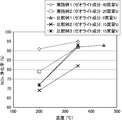
- FIG. 2 is a graph in which the horizontal axis is the simulated gas temperature, the vertical axis is the NOx purification rate, and the results of the NOx purification rate evaluation are plotted.
- the honeycomb catalyst of the present invention includes two types of catalysts, a TiO 2 / V 2 O 5 / WO 3 component composed of titanium oxide, vanadium oxide and tungsten oxide, and a zeolite having a CHA structure and supporting copper. It consists of components.
- honeycomb catalyst of the present invention a plurality of through holes whose both end portions are not sealed are arranged in parallel in the longitudinal direction with partition walls therebetween.
- the shape of the honeycomb catalyst of the present invention is not limited to a cylindrical shape, and may be a prismatic shape, an elliptical cylindrical shape, a long cylindrical shape, a rounded chamfered prismatic shape (for example, a rounded chamfered triangular prism shape), or the like. Good.
- the shape of the through hole of the honeycomb catalyst may be a quadrangular column shape, but the shape of the through hole is not limited to the quadrangular column shape, and may be a triangular column shape, a hexagonal column shape, or the like.
- FIG. 1 (a) is a perspective view which shows typically an example of the honeycomb catalyst of this invention.
- FIG. 1B is a cross-sectional view taken along line AA in FIG.
- a plurality of through holes 101 whose both ends are not sealed are arranged in parallel in the longitudinal direction with a partition wall 102 therebetween.
- the honeycomb catalyst 100 has a cylindrical shape.
- the shape of the honeycomb catalyst of the present invention is not limited to a cylindrical shape, and may be a prismatic shape, an elliptical column shape, a long cylindrical shape, a rounded chamfered prismatic shape (for example, a rounded chamfered triangular prism shape), or the like. May be.
- the honeycomb catalyst 100 purifies NOx in the exhaust gas.
- the exhaust gas G in FIG. 1 (b), the exhaust gas G flows into one of the through holes 101 of the honeycomb catalyst 100 from one end (exhaust gas inflow side end) 103.
- the mixed gas G of the exhaust gas and a reducing agent such as ammonia comes into contact with the catalyst species when passing through the through-hole 101, whereby the exhaust gas G NOx contained therein is purified.
- the purified exhaust gas G is discharged from the other end (exhaust gas outflow side end) 104 of the through hole 101.
- the honeycomb catalyst 100 it is possible to suitably purify NOx in the exhaust gas.
- the shape of the through hole 101 of the honeycomb catalyst is a quadrangular column shape, but the shape of the through hole is not limited to the quadrangular column shape, and may be a triangular column shape, a hexagonal column shape, or the like. Good.
- the TiO 2 / V 2 O 5 / WO 3 component constituting the honeycomb catalyst is composed of titanium oxide, vanadium oxide, and tungsten oxide. Since the SCR reaction of TiO 2 / V 2 O 5 / WO 3 components proceeds by the oxidation-reduction reaction of vanadium (pentavalent to tetravalent) on TiO 2 , the form of vanadium has a great influence on the NOx purification performance. It is guessed that
- the content of vanadium oxide contained in the TiO 2 / V 2 O 5 / WO 3 component is preferably 0.3 to 5.0% by mass.
- the content of vanadium oxide contained in the TiO 2 / V 2 O 5 / WO 3 component is more preferably 0.3 to 3.0% by mass.
- VO—W the bond between V in V 2 O 5 and oxygen and W in WO 3
- the content of tungsten oxide contained in the TiO 2 / V 2 O 5 / WO 3 component is preferably 3.0 to 10.0% by mass.
- the content of the tungsten oxide contained in the TiO 2 / V 2 O 5 / WO 3 component is less than 3.0% by mass, the vanadium is not sufficiently dispersed due to the small amount of the tungsten oxide, It is difficult to obtain sufficient NOx purification performance.
- the content of the tungsten oxide contained in the TiO 2 / V 2 O 5 / WO 3 component exceeds 10.0% by mass, the amount of tungsten is too large, which causes an increase in cost.
- the content of titanium oxide contained in the TiO 2 / V 2 O 5 / WO 3 component is desirably 85 to 96.7% by mass.
- the content of titanium oxide contained in the TiO 2 / V 2 O 5 / WO 3 component is less than 85% by mass, the mass of the titanium oxide is small, so that vanadium and tungsten are difficult to disperse on the titanium oxide. Thus, it becomes difficult to obtain sufficient NOx purification performance.
- vanadium oxide and tungsten oxide is in the above range, vanadium is dispersed and the number of V—O—W bonds is considered to increase, and TiO 2 / V 2 O 5 / WO 3 component NOx purification Performance is improved.
- the mass of the vanadium oxide is less than 1/13 of the mass of the tungsten oxide, the amount of vanadium is too small, and it is difficult to obtain sufficient NOx purification performance. Or, the amount of tungsten is too large, which increases the cost.
- the mass of the vanadium oxide exceeds the mass of the tungsten oxide, the dispersibility of the vanadium oxide is deteriorated and the NOx purification performance is lowered.
- the “ratio of vanadium atoms to tungsten atoms” means the molar ratio of vanadium atoms to tungsten atoms.
- the ratio of tungsten atoms to vanadium atoms is within the above range, the NOx purification performance can be improved. If the ratio of tungsten atoms to vanadium atoms is less than 0.5, the ratio of vanadium atoms is large, so vanadium is crystallized or volatilized, and the opportunity to come into contact with NOx is reduced. TiO 2 / V 2 O 5 / WO The NOx purification performance with respect to the content of vanadium of the three components is lowered. If the ratio of tungsten atoms to vanadium atoms exceeds 5.0, the amount of vanadium is too small, and sufficient NOx purification performance is difficult to obtain. Or, the amount of tungsten is too large, which increases the cost. In addition, the ratio of each said oxide can be measured using a fluorescent X ray analysis (XRF).
- XRF fluorescent X ray analysis
- the average particle diameter of the secondary particles of TiO 2 is preferably 0.1 to 3.0 ⁇ m, more preferably 0.5 to 1.5 ⁇ m. .
- the average particle size of the secondary particles of TiO 2 is preferably larger than the average particle size of the primary particles of zeolite described below.
- the zeolite constituting the honeycomb catalyst which has a CHA structure and carries copper, will be described.
- the zeolite constituting the honeycomb catalyst of the present invention is named and classified by the structure code of CHA in the International Zeolite Association (IZA), and has a crystal structure equivalent to that of naturally produced chabasite. It is a zeolite having
- the zeolite is desirably highly crystalline.
- the structure is not easily changed by heat or the like, heat resistance and durability are excellent, and NOx purification performance can be enhanced.
- Analysis of the crystal structure of zeolite can be performed using an X-ray diffraction (XRD) apparatus.
- the composition ratio of silica and alumina is desirably less than 15.
- the acid sites of the zeolite can be a sufficient number, and the acid sites can be used to exchange ions with metal ions. Copper that functions as a catalyst can be supported at a high concentration, and is excellent in NOx purification performance.
- the composition ratio (SiO 2 / Al 2 O 3 ) of silica and alumina in the zeolite of the present invention is more preferably 5 to 14.9, and further preferably 10 to 14.9.
- the composition ratio of silica and alumina (SiO 2 / Al 2 O 3 ) is 15 or more, the supported amount of Cu is small and the purification rate of NOx is lowered.
- the molar ratio of zeolite (SiO 2 / Al 2 O 3 ) can be measured using fluorescent X-ray analysis (XRF).
- the average particle diameter of the primary particles of the zeolite constituting the honeycomb catalyst of the present invention is preferably 0.1 to 1.0 ⁇ m, and more preferably 0.1 to 0.5 ⁇ m. Zeolite having such a small average particle diameter has a small amount of water absorption displacement.
- the pore size of the zeolite becomes too small and the NOx purification performance is lowered.
- the average particle size of the primary particles of the zeolite exceeds 1.0 ⁇ m, the amount of water absorption displacement of the zeolite increases, and the honeycomb catalyst may be cracked.
- the average particle diameter of the primary particles of the zeolite was measured by measuring the length of all diagonal lines of 10 particles by taking a SEM photograph using a scanning electron microscope (SEM, Hitachi High-Tech, S-4800). From the average value. Measurement conditions are as follows: acceleration voltage: 1 kV, emission: 10 ⁇ A, WD: 2.2 mm or less. In general, the CHA-type zeolite particles are cubic, and become a square when two-dimensionally imaged by an SEM photograph. Therefore, the diagonal line of one particle is two.
- the average particle diameter of the secondary particles of TiO 2 can be measured using a laser diffraction particle size distribution measuring apparatus (Malvern, Mastersizer 2000).
- the zeolite constituting the honeycomb catalyst it is desirable that 3.5 to 8.0% by mass of Cu is supported on the zeolite.
- the Cu ion exchange method can be performed by immersing the zeolite in one aqueous solution selected from an aqueous copper acetate solution, an aqueous copper nitrate solution, an aqueous copper sulfate solution, and an aqueous copper chloride solution.
- aqueous copper acetate solution it is preferable to use an aqueous copper acetate solution. This is because a large amount of Cu can be supported at one time.
- copper is supported on zeolite by performing ion exchange using a copper (II) acetate aqueous solution having a copper concentration of 0.1 to 2.5 mass% and a solution temperature of room temperature to 50 ° C. and atmospheric pressure. Can do.
- the weight ratio of the zeolite to the total amount of the TiO 2 / V 2 O 5 / WO 3 component and the zeolite is preferably 5 to 70% by mass.
- the weight ratio of the zeolite with respect to the total amount of the TiO 2 / V 2 O 5 / WO 3 component and the zeolite is less than 5% by mass, the zeolite weight ratio is too small, and the NOx purification performance decreases. .
- the weight ratio of the zeolite to the total amount of the TiO 2 / V 2 O 5 / WO 3 component and the zeolite exceeds 70% by mass, the amount of water absorption displacement increases and cracks may occur. Since the zeolite having the CHA structure is relatively expensive, the cost becomes high.
- the weight ratio of the zeolite to the total amount of the TiO 2 / V 2 O 5 / WO 3 component and the zeolite is more preferably 5 to 50% by mass.
- honeycomb catalyst of the present invention in addition to the TiO 2 / V 2 O 5 / WO 3 component and zeolite, it is desirable to further contain 5 to 15% by mass of inorganic fibers in order to improve the strength.
- the inorganic fiber examples include at least one selected from the group consisting of alumina, silica, silicon carbide, silica alumina, glass, wollastonite, potassium titanate, and aluminum borate.
- the inorganic fiber has high heat resistance, and even when used as a honeycomb catalyst, there is no melting damage and the effect as a reinforcing material can be maintained.
- the content of the inorganic fiber in the honeycomb catalyst is less than 5% by mass, the effect of improving the strength of the honeycomb catalyst becomes small.
- the content of the inorganic fiber in the honeycomb catalyst exceeds 15% by mass, the content of the TiO 2 / V 2 O 5 / WO 3 component or zeolite, which is the catalyst component in the honeycomb catalyst, decreases, and NOx The purification performance decreases.
- the honeycomb catalyst of the present invention it is desirable to include an inorganic binder in addition to the TiO 2 / V 2 O 5 / WO 3 component and zeolite.
- the inorganic binder is not particularly limited, and examples thereof include alumina sol, silica sol, titania sol, water glass, sepiolite, attapulgite, bentonite and boehmite. Among these, bentonite is preferable.
- These inorganic binders may be used alone or in combination of two or more. When these inorganic binders are contained in the honeycomb catalyst, the strength of the honeycomb catalyst can be increased.
- the content of the inorganic binder is preferably 3 to 15% by mass.
- the content of the inorganic binder is within the above range, the effect of improving the strength of the honeycomb catalyst is suitably exhibited.
- the honeycomb catalyst preferably has an opening ratio of a cross section perpendicular to the longitudinal direction of 50 to 85%.
- the opening ratio of the cross section perpendicular to the longitudinal direction of the honeycomb catalyst is less than 50%, the TiO 2 / V 2 O 5 / WO 3 component and zeolite are not effectively used for purification of NOx.
- the opening ratio of the cross section perpendicular to the longitudinal direction of the honeycomb catalyst exceeds 85%, the strength of the honeycomb catalyst becomes insufficient.
- the honeycomb catalyst preferably has a density of through holes having a cross section perpendicular to the longitudinal direction of 1.2 to 155 holes / cm 2 . If the density of the through-holes in the cross section perpendicular to the longitudinal direction of the honeycomb catalyst is less than 1.2 / cm 2 , the TiO 2 / V 2 O 5 / WO 3 component and the exhaust gas are less likely to come into contact with each other, thereby purifying NOx. Performance decreases. On the other hand, when the density of the through holes in the cross section perpendicular to the longitudinal direction of the honeycomb catalyst exceeds 155 holes / cm 2 , the pressure loss of the honeycomb catalyst increases.
- the density of through holes refers to the number of through holes per unit cross-sectional area in a cross section perpendicular to the longitudinal direction of the honeycomb catalyst.
- the thickness of the partition walls of the honeycomb catalyst is desirably 0.1 to 2.5 mm, and more desirably 0.1 to 0.3 mm.
- the thickness of the partition walls of the honeycomb catalyst is less than 0.1 mm, the strength of the honeycomb catalyst is lowered.
- the thickness of the honeycomb catalyst partition wall exceeds 2.5 mm, the exhaust gas does not easily enter the honeycomb catalyst partition wall, and the TiO 2 / V 2 O 5 / WO 3 component and zeolite are effective for NOx purification. Is no longer used.
- the honeycomb catalyst manufacturing method is obtained by mixing the titanium oxide, the vanadium raw material and the tungsten raw material, adding the inorganic fiber and the inorganic binder to the mixture, and kneading to produce a kneaded product, and the first step.
- a CHA-type zeolite obtained by reacting a raw material composition comprising a Si source, an Al source, an alkali source, water and a structure directing agent with the obtained kneaded product is subjected to Cu ion exchange, and then added and kneaded.
- other processes may be performed as necessary, and the contents of the processes may be changed.
- (1) First Step In the first step, titanium oxide, a vanadium raw material, and a tungsten raw material are mixed, and an inorganic fiber and an inorganic binder are added to this mixture and kneaded to prepare a kneaded product.
- the titanium oxide and the tungsten raw material are not kneaded first, but the tungsten raw material solution, the titanium oxide, and the vanadium raw material are mixed. Therefore, as a fine state of the particles constituting the kneaded material to be produced, the tungsten raw material and the vanadium raw material are likely to be uniformly dispersed on the surface of the titanium oxide. Therefore, it is considered that a V—O—W bond is likely to be formed in the honeycomb catalyst manufactured by the above honeycomb catalyst manufacturing method. In addition, when the titanium oxide and the vanadium raw material are mixed first, and then the tungsten raw material solution is mixed, the vanadium raw material and the tungsten raw material are not easily dispersed uniformly on the surface of the titanium oxide. Absent.
- the first step it is desirable to use a tungsten raw material solution in which the tungsten raw material is dissolved instead of a solid tungsten raw material.
- the tungsten raw material solution is used, the tungsten raw material and the vanadium raw material on the surface of the titanium oxide can be sufficiently uniformly dispersed, and a kneaded material with less uneven distribution of the vanadium raw material can be produced.
- the dispersibility of vanadium tends to be high. Therefore, a honeycomb catalyst having a sufficiently high NOx purification performance with respect to the vanadium content can be manufactured.
- the type of the tungsten raw material solution is not particularly limited, but is preferably a solution in which tungsten trioxide, ammonium paratungstate, ammonium metatungstate, or the like is dissolved in an amine solution and / or water.
- a solid tungsten raw material is dissolved in an amine solution and / or water to obtain a tungsten raw material solution
- a solid vanadium raw material is dissolved in an amine solution and / or water to obtain a vanadium raw material solution. It is desirable to mix titanium oxide and vanadium raw material solution. Even if the tungsten raw material and the vanadium raw material are solid, by dissolving them in a solvent to obtain a tungsten raw material solution and a vanadium raw material solution, the raw materials and the like can be mixed uniformly, and a kneaded material with less uneven distribution of the vanadium raw material can be obtained. Can be produced. Therefore, a TiO 2 / V 2 O 5 / WO 3 component having a sufficiently high NOx purification performance relative to the vanadium content can be produced.
- the amine solution is selected from the group consisting of dimethylamine, methylamine, monoethanolamine, diethanolamine, trimethylamine, ethylamine, propylamine and butylamine.
- a solution containing at least one kind is desirable.
- These amine solutions can easily dissolve the tungsten raw material and the vanadium raw material.
- the tungsten raw material solution and the vanadium raw material solution are used, as described above, a kneaded material with less uneven distribution of the vanadium raw material can be produced. Therefore, a TiO 2 / V 2 O 5 / WO 3 component having a sufficiently high NOx purification performance relative to the vanadium content can be produced.
- These amine solutions also function as metal corrosion inhibitors.
- the vanadium raw material is not particularly limited, but is desirably at least one selected from the group consisting of ammonium metavanadate, vanadyl sulfate, and vanadyl oxalate.
- a solid vanadium raw material may be used, or a vanadium raw material solution in which the solid vanadium raw material is dissolved may be used. Since ammonium metavanadate, vanadyl sulfate, and vanadyl oxalate are easy to handle, a honeycomb catalyst can be produced efficiently.
- the titanium oxide used in the first step is not particularly limited, but is preferably anatase type titanium oxide.
- a honeycomb catalyst using anatase type titanium oxide tends to have a large specific surface area. Therefore, it is easy to highly disperse vanadium, and a honeycomb catalyst excellent in NOx purification performance can be manufactured.
- the tungsten raw material solution, the titanium oxide, and the vanadium raw material are mixed.
- the solid tungsten raw material, the titanium oxide, and the vanadium raw material may be mixed at the same time.
- the tungsten raw material that is solid is not particularly limited, but is preferably at least one selected from the group consisting of tungsten trioxide, ammonium paratungstate, and ammonium metatungstate. Although it does not specifically limit as a vanadium raw material, It is desirable that it is at least 1 sort (s) selected from the group which consists of ammonium metavanadate, vanadyl sulfate, and vanadyl oxalate.
- the titanium oxide is preferably anatase type titanium oxide.
- a solid tungsten raw material, a titanium oxide, and a vanadium raw material are simultaneously mixed, and then an amine solution and / or water is added and kneaded to prepare a kneaded product.
- a kneaded material When preparing a kneaded material, it is not particularly limited, but may be mixed using a mixer, an attritor or the like, or may be kneaded using a kneader or the like.
- a mixer an attritor or the like
- a kneader or the like.
- an inorganic fiber and an inorganic binder are added and kneaded.
- an organic binder a dispersion medium, a molding aid, a lubricant, a metal corrosion inhibitor and the like may be appropriately added to the kneaded material as necessary.
- organic binder Methylcellulose, carboxymethylcellulose, a hydroxyethylcellulose, polyethyleneglycol, a phenol resin, an epoxy resin, etc. are mentioned, You may use individually and may use 2 or more types together.
- the addition amount of the organic binder is desirably 1 to 10% by mass with respect to the total weight of the titanium oxide, the vanadium raw material, the tungsten raw material, the inorganic binder and the inorganic fiber.
- Alcohol such as water
- organic solvents such as benzene, methanol, etc.
- the lubricant is not particularly limited, and examples thereof include sorbitan trioleate.
- Second Step zeolite obtained by reacting the kneaded material obtained in the first step with a raw material composition comprising a Si source, an Al source, an alkali source, water and a structure directing agent. Is added and kneaded.
- the Si source refers to a compound, a salt, and a composition that are raw materials for the silicon component of zeolite.
- the Si source for example, colloidal silica, amorphous silica, sodium silicate, tetraethylorthosilicate, aluminosilicate gel, and the like can be used, and two or more of these may be used in combination.
- colloidal silica is desirable in that a zeolite having a particle size of 0.1 to 0.5 ⁇ m can be obtained.
- the Al source refers to a compound, salt, and composition that are raw materials for the aluminum component of the zeolite.
- Examples of the Al source include aluminum hydroxide, pseudoboehmite, metallic aluminum, aluminum sulfate, sodium aluminate, aluminum hydroxide, aluminum chloride, alumino-silicate gel, and dry aluminum hydroxide gel.
- alkali source examples include sodium hydroxide, potassium hydroxide, rubidium hydroxide, cesium hydroxide, lithium hydroxide, alkali components in aluminate and silicate, alkali components in aluminosilicate gel, and the like. Two or more of these may be used in combination. Of these, potassium hydroxide, sodium hydroxide, and lithium hydroxide are desirable.
- the amount of water is not particularly limited, but the ratio of the number of moles of water to the total number of moles of Si of the Si source and Al of the Al source (H 2 O moles / total moles of Si and Al) is The ratio of the number of moles of water to the total number of moles of Si of the Si source and Al of the Al source (H 2 O mole number / total mole number of Si and Al) is preferably 15 to 25. It is more desirable.
- a structure directing agent refers to an organic molecule that defines the pore diameter and crystal structure of zeolite.
- the structure of the obtained zeolite can be controlled by the type of the structure-directing agent.
- Structure directing agents include hydroxides, halides, carbonates, methyl carbonates, sulfates and nitrates with N, N, N-trialkyladamantanammonium as a cation; and N, N, N-trimethylbenzylammonium ions , N-alkyl-3-quinuclidinol ions, or hydroxides, halides, carbonates, methyl carbonate salts, sulfates and nitrates with N, N, N-trialkylexoaminonorbornane as a cation At least one selected from can be used.
- N, N, N-trimethyladamantanammonium hydroxide hereinafter also referred to as TMAAOH
- N, N, N-trimethyladamantanammonium halide N, N, N-trimethyladamantanammonium carbonate
- TMAAOH N, N-trimethyladamantanammonium halide
- N, N, N-trimethyladamantanammonium carbonate It is preferable to use at least one selected from the group consisting of N, N, N-trimethyladamantanammonium methyl carbonate and N, N, N-trimethyladamantanammonium sulfate, and it is more preferable to use TMAAOH.
- the method for producing zeolite of the present invention it is desirable to further add zeolite seed crystals to the raw material composition.
- the seed crystal By using the seed crystal, the crystallization speed of the zeolite is increased, the time for producing the zeolite can be shortened, and the yield is improved.
- a zeolite seed crystal it is desirable to use a zeolite having a CHA structure.
- the amount of zeolite seed crystals added is preferably small, but considering the reaction rate and the effect of suppressing impurities, it should be 0.1 to 20% by mass with respect to the silica component contained in the raw material composition. Desirably, 0.5 to 15% by mass is more desirable.
- zeolite is synthesized by reacting the prepared raw material composition. Specifically, it is desirable to synthesize zeolite by hydrothermal synthesis of the raw material composition.
- the reaction vessel used for hydrothermal synthesis is not particularly limited as long as it is used for known hydrothermal synthesis, and may be a heat and pressure resistant vessel such as an autoclave.
- the zeolite can be crystallized by putting the raw material composition into the reaction vessel, sealing and heating.
- the zeolite constituting the honeycomb catalyst of the present invention it is desirable that 3.5 to 8.0% by mass of Cu is supported on the zeolite.
- copper can be supported on zeolite by performing ion exchange using an aqueous copper acetate solution or an aqueous ammonia solution containing copper.
- the zeolite produced by the above method is added to the kneaded product obtained in the first step while kneading using a kneader or the like to prepare a kneaded product.
- the amount of zeolite added is such that the weight ratio of the zeolite to the total amount of the TiO 2 / V 2 O 5 / WO 3 component and zeolite when the production of the honeycomb catalyst is completed is 5 to 70% by mass. It is desirable that In the kneading step, it is desirable to adjust the pH so that the pH of the kneaded product during kneading is 7-9.
- the pH when the kneaded product is acidic, it is desirable to adjust the pH using aqueous ammonia, and when the kneaded product is alkaline, it is preferable to adjust the pH using acetic acid or the like.
- the pH at the time of kneading to 7-9, the copper supported on the zeolite at the time of kneading becomes copper sulfate or tetraammine copper ions, preventing the NOx purification performance of the zeolite from deteriorating. This is because it can be done.
- the kneaded product obtained in the second step is formed into a shape such as a honeycomb to produce a formed body.
- the formed body is not limited to the honeycomb formed body, a method for forming the honeycomb formed body will be described below as an example.
- the kneaded product obtained in the second step is extrusion-molded using a mold configured to be able to produce a honeycomb molded body, whereby a plurality of through holes are arranged in the longitudinal direction with partition walls therebetween.
- the provided honeycomb formed body is produced. Thereafter, the honeycomb formed body is dried by using a dryer such as a microwave dryer, a hot air dryer, a dielectric dryer, a vacuum dryer, a vacuum dryer, a freeze dryer, or the like to produce a honeycomb dried body.
- honeycomb fired body (honeycomb catalyst) is obtained by degreasing the honeycomb dried body obtained and firing it.
- the degreasing conditions can be appropriately selected depending on the type and amount of the organic substance contained in the dried honeycomb body, but it is desirable that the degreasing conditions be 200 to 250 ° C. for 2 to 6 hours.
- the firing temperature is desirably 450 to 750 ° C., and more desirably 500 to 650 ° C. When the firing temperature is less than 450 ° C., the sintering does not proceed and the strength of the honeycomb fired body is lowered. On the other hand, if the firing temperature exceeds 750 ° C., the sintering proceeds too much and the reaction sites of the catalyst species are reduced.
- a honeycomb catalyst having a shape as shown in FIGS. 1A and 1B which is an example of the honeycomb catalyst of the present invention, can be manufactured.
- the honeycomb catalyst of the present invention is composed of two components, a TiO 2 / V 2 O 5 / WO 3 component and a CHA structure, and a zeolite supporting copper, the NO 2 ratio in the exhaust gas is When it becomes high or in a wide temperature range from low temperature to high temperature, it has sufficiently high NOx purification performance, and as a result, the honeycomb catalyst itself can be downsized.
- zeolite having a CHA structure contracts and expands due to absorption and dehydration, but the honeycomb catalyst uses two types of zeolite and TiO 2 / V 2 O 5 / WO 3 components to reduce the amount of water absorption displacement. In addition to the production of the catalyst, it is difficult to crack when used as a catalyst, and is excellent in heat resistance and durability.
- the honeycomb catalyst of the present invention when the composition ratio of silica to alumina in the zeolite (SiO 2 / Al 2 O 3 ) is less than 15, copper functioning as a catalyst even with a small amount of zeolite Can be carried at a high concentration, and the NOx purification performance is excellent.
- the weight ratio of the zeolite to the total amount of the TiO 2 / V 2 O 5 / WO 3 component and the zeolite is 5 to 70% by mass, it is high in a wide temperature range. NOx purification performance is obtained.
- the mechanical strength of the honeycomb catalyst is improved.
- the inorganic binder plays a role of adhering each catalyst component and solidifies firmly by heating, so that the mechanical characteristics of the honeycomb catalyst are improved. be able to.
- the supported Cu ions function as a catalyst for NOx purification, so that high NOx purification performance is obtained. It is done.
- Example 1 Manufacture of honeycomb catalyst
- First Step (1-1) Preparation of Tungsten Raw Material Solution An ammonium metatungstate aqueous solution in which ammonium metatungstate was previously dissolved in water was prepared as a tungsten raw material solution.
- (1-2) Preparation of vanadium raw material solution 2.6 parts by mass of ammonium metavanadate was dissolved in 3.1 parts by mass of monoethanolamine to prepare a vanadium raw material solution.
- Second step The composition ratio of silica and alumina (SiO 2 / Al 2) produced in advance with respect to 100 parts by mass of the kneaded material containing the TiO 2 / V 2 O 5 / WO 3 component obtained in the first step. 34.2 parts by mass of a CHA-structure zeolite having an O 3 ) of 12.6, an average primary particle diameter of 0.25 ⁇ m, a copper loading of 4.6% by mass, and an X-ray integral intensity ratio of 3.58 is added. Further kneading was performed using the same kneader. At that time, the pH of the kneaded product was adjusted to 7 using ammonia water. The kneading temperature is 15 ° C., and the kneading time is 20 minutes.
- the honeycomb dried body is put into a gas flow furnace, heated to 550 ° C. at a rate of temperature increase of 1 ° C./min, and held at that temperature for 2 hours for firing. Produced. Note that nitrogen gas was introduced at a gas flow rate of 8 L / min during firing.
- the manufactured honeycomb fired body is the honeycomb catalyst of Example 1.
- the honeycomb catalyst according to Example 1 has a regular rectangular column shape with a height of 35 mm, a width of 35 mm, and a length of 150 mm, a density of through holes of 124 holes / cm 2 (800 cpsi), and a partition wall thickness of 0.2 mm. It was.
- the ratio of TiO 2 / V 2 O 5 / WO 3 component and zeolite, TiO 2 / V 2 O 5 / WO 3 ingredient 60 wt%, zeolite was 40 mass%.
- TiO 2 / V 2 O 5 / WO 3 components are collected, degreased and fired under the same conditions as above, to obtain TiO 2 / V 2.
- TiO 2 was 75.6% by mass
- V 2 O 5 was 1.9% by mass
- WO 3 was 8.4% by mass
- an inorganic binder Bentonite
- inorganic fiber glass fiber
- Example 2 The ratio of the TiO 2 / V 2 O 5 / WO 3 component and the zeolite in the produced honeycomb catalyst is adjusted so that the TiO 2 / V 2 O 5 / WO 3 component is 80 mass% and the zeolite is 20 mass%. Other than that, the same conditions as in Example 1 were used.
- Example 1 A honeycomb catalyst was manufactured by performing only the same steps as the first step, the third step, and the fourth step in Example 1 without performing the same step as the second step in Example 1.
- the firing in the fourth step was performed by raising the temperature to 550 ° C. at a rate of temperature rise of 1 ° C./min and holding that temperature for 2 hours. Other conditions were the same as in Example 1. .
- a honeycomb catalyst containing a TiO 2 / V 2 O 5 / WO 3 component and no zeolite was produced by the above production method.
- Comparative Example 2 Fe-supported Y-type zeolite (FAU structure) is used, and the ratio of TiO 2 / V 2 O 5 / WO 3 component and zeolite in the produced honeycomb catalyst is changed to TiO 2 / V 2 O 5. / The same conditions as in Example 1 were carried out except that the WO 3 component was adjusted to 85% by mass and the zeolite to 15% by mass.
- Comparative Example 3 The test was carried out under the same conditions as in Comparative Example 2 except that the zeolite was replaced with Fe-supported ZSM-5 (MFI structure).
- the measurement point of the NOx purification rate was the saturation point of the outlet concentration of N 3 H and NOx.
- the components of the simulated gas are 350 ppm nitrogen monoxide, 350 ppm ammonia, 5% carbon dioxide, 10% oxygen, 4.6% water, and nitrogen (Balance).
- the results are shown in FIG. FIG. 2 is a graph in which the horizontal axis is the simulated gas temperature, the vertical axis is the NOx purification rate, and the results of the NOx purification rate evaluation are plotted.
- Example 1 zeolite: In the case of 40 mass%)
- the NOx purification rate (%) exceeded 90% at 200 ° C.
- the NOx purification rate (%) increased further at 300 ° C.
Landscapes
- Chemical & Material Sciences (AREA)
- Engineering & Computer Science (AREA)
- Chemical Kinetics & Catalysis (AREA)
- Environmental & Geological Engineering (AREA)
- Health & Medical Sciences (AREA)
- Biomedical Technology (AREA)
- Oil, Petroleum & Natural Gas (AREA)
- General Chemical & Material Sciences (AREA)
- Organic Chemistry (AREA)
- Materials Engineering (AREA)
- Analytical Chemistry (AREA)
- Combustion & Propulsion (AREA)
- Crystallography & Structural Chemistry (AREA)
- Toxicology (AREA)
- Mechanical Engineering (AREA)
- General Engineering & Computer Science (AREA)
- Catalysts (AREA)
- Exhaust Gas Treatment By Means Of Catalyst (AREA)
- Exhaust Gas After Treatment (AREA)
Abstract
本発明のハニカム触媒は、チタン酸化物、バナジウム酸化物及びタングステン酸化物よりなるTiO2/V2O5/WO3成分、並びに、CHA構造を有し、銅を担持したゼオライトの二種類の触媒成分からなることを特徴とする。
Description
本発明は、ハニカム触媒に関する。
ボイラー、ガスタービン、自動車等の内燃機関から排出される排ガス中のNOxを浄化するためのシステムとして、アンモニアを用いてNOxを窒素と水に還元するSCR(Selective Catalytic Reduction)システムが知られている。このSCRシステムに用いられる触媒として、五酸化バナジウム(V2O5)が高いNOx浄化性能を有することが知られており、二酸化チタン(TiO2)にV2O5や三酸化タングステン(WO3)を担持した、いわゆるTiO2/V2O5/WO3触媒が用いられている。
一方、排ガス中に硫黄成分が含まれない場合に、より高い浄化性能が得られるゼオライト系材料を用いたハニカム触媒も知られている。
特許文献1には、400℃以上の高温領域において、高い脱硝率を有する窒素酸化物除去用触媒であって、チタン酸化物及び/又はチタンとタングステンの二元系酸化物をA成分とし、SiO2/Al2O3モル比が8以上の酸型ゼオライト及び/又はセリウムイオン交換ゼオライトをB成分としてなり、かつA成分の組成は、TiO2として、50~100質量%、WO3として、0~50質量%の範囲であり、A成分とB成分は緊密に分散されている事を特徴とする窒素酸化物除去用触媒が開示されている。ゼオライトとして、具体的にはFAU構造(Y型ゼオライト)、MOR構造(モルデナイト)、FER構造(フェリエライト)、MFI構造(ZSM-5)が開示されている。
また、特許文献2には、排ガス中のセレンやヒ素による被毒を防ぐため、銅を担持したゼオライトにチタニアを10~90質量%添加し、さらに水や無機繊維等を加えて混練等を行った後、乾燥、焼成を行い、TiO2/V2O5/WO3成分とゼオライト成分の両方を含有する窒素酸化物除去用触媒を製造する方法が開示されている。ゼオライトとして、具体的にはMOR構造(モルデナイト)、FER構造(フェリエライト)、MFI構造(ZSM-5)が開示されている。
しかしながら、上記した特許文献1、2に記載された窒素酸化物除去用触媒では、排出される排ガスに含まれるNOx中のNO2の比率(NO2/NOx)(以下、単にNO2比率という)が高くなった際、NOx浄化性能が低下し易く、また、低温及び高温におけるNOx浄化性能が充分でないという問題があった。
本発明は、上記問題点を鑑みてなされたものであり、内燃機関の使用状況や時期により排ガス中のNO2比率が高くなったり、排ガスの温度が低い場合若しくは高い場合にも、充分に高いNOx浄化性能を有するハニカム触媒を提供することを目的とする。
すなわち、本発明のハニカム触媒は、チタン酸化物、バナジウム酸化物及びタングステン酸化物よりなるTiO2/V2O5/WO3成分、並びに、CHA構造を有し、銅(Cu)を担持したゼオライトの二種類の触媒成分からなることを特徴とする。
上記ハニカム触媒は、TiO2/V2O5/WO3成分とCHA構造を有し、銅を担持したゼオライトとの二種類の成分からなるので、低温から高温までの広い温度領域で、充分に高いNOx浄化性能を有する。また、排ガス中のNO2比率が高くなった場合であっても、充分に高いNOx浄化性能を有する。従って、ハニカム触媒自体を小型化することが可能になる。また、CHA構造を有するゼオライトは、吸脱水により収縮、膨張するが、上記ハニカム触媒は、ゼオライトとTiO2/V2O5/WO3成分との2種類を用いることで、吸水変位量が小さく、触媒の製造時は勿論のこと、触媒としての使用時にもクラックが生じにくく、耐熱性、耐久性に優れている。
本発明のハニカム触媒においては、上記ゼオライト中のシリカとアルミナの組成比(SiO2/Al2O3)は、15未満であることが望ましい。
上記ゼオライト中のシリカとアルミナの組成比(SiO2/Al2O3)とは、ゼオライト中のAl2O3に対するSiO2のモル比(SAR)を意味している。
上記ゼオライト中のシリカとアルミナの組成比(SiO2/Al2O3)とは、ゼオライト中のAl2O3に対するSiO2のモル比(SAR)を意味している。
上記ハニカム触媒では、上記シリカとアルミナの組成比が15未満であるので、触媒として機能する銅を高い濃度で担持することができ、少ないゼオライトの配合量であっても、NOxの浄化性能に優れる。
上記シリカとアルミナの組成比が15以上であると、担持できる触媒として機能する銅の量が少なくなるため、NOxの浄化率が低下してしまう。
上記シリカとアルミナの組成比が15以上であると、担持できる触媒として機能する銅の量が少なくなるため、NOxの浄化率が低下してしまう。
本発明のハニカム触媒では、上記TiO2/V2O5/WO3成分と上記ゼオライトとの合計量に対する上記ゼオライトの重量割合は、5~70質量%であることが望ましい。
上記TiO2/V2O5/WO3成分と上記ゼオライトとの合計量に対する上記ゼオライトの重量割合が5~70質量%であるので、広い温度領域で高いNOx浄化性能が得られる。
上記ゼオライトの重量割合が5質量%未満であると、NOx浄化性能が低下してしまう。一方、上記ゼオライトの重量割合が70質量%を超えると、吸水変位量が大きくなり、クラックが生じることがあり、また、CHA構造のゼオライトは比較的高価であるため、ハニカム触媒のコストが高くなってしまう。
上記TiO2/V2O5/WO3成分と上記ゼオライトとの合計量に対する上記ゼオライトの重量割合が5~70質量%であるので、広い温度領域で高いNOx浄化性能が得られる。
上記ゼオライトの重量割合が5質量%未満であると、NOx浄化性能が低下してしまう。一方、上記ゼオライトの重量割合が70質量%を超えると、吸水変位量が大きくなり、クラックが生じることがあり、また、CHA構造のゼオライトは比較的高価であるため、ハニカム触媒のコストが高くなってしまう。
本発明のハニカム触媒では、さらに、無機繊維を5~15質量%含有することが望ましい。
上記ハニカム触媒では、さらに、無機繊維を5~15質量%含有するので、ハニカム触媒の機械的強度が改善される。
無機繊維の含有量が5質量%未満であると、ハニカム触媒の機械的強度の改善が充分でなく、一方、ハニカム触媒の含有量が15質量%を超えると、ハニカム触媒中の二種類の触媒成分の含有量が低下して、NOxの浄化性能が低下する。
上記ハニカム触媒では、さらに、無機繊維を5~15質量%含有するので、ハニカム触媒の機械的強度が改善される。
無機繊維の含有量が5質量%未満であると、ハニカム触媒の機械的強度の改善が充分でなく、一方、ハニカム触媒の含有量が15質量%を超えると、ハニカム触媒中の二種類の触媒成分の含有量が低下して、NOxの浄化性能が低下する。
本発明のハニカム触媒では、上記無機繊維は、アルミナ、シリカ、炭化ケイ素、シリカアルミナ、ガラス、チタン酸カリウム及びホウ酸アルミニウムからなる群より選択される少なくとも1種であることが望ましい。
上記無機繊維は、いずれも耐熱性が高く、SCRシステムにおける触媒担体として使用した時でも、溶損などがないので、補強材としての効果を持続することができる。
上記無機繊維は、いずれも耐熱性が高く、SCRシステムにおける触媒担体として使用した時でも、溶損などがないので、補強材としての効果を持続することができる。
本発明のハニカム触媒では、さらに、無機バインダを含むことが望ましい。
上記無機バインダは、各触媒成分を接着する役割を果たし、加熱により強固に固化するため、上記ハニカム触媒の機械的特性を改善することができる。
上記無機バインダは、各触媒成分を接着する役割を果たし、加熱により強固に固化するため、上記ハニカム触媒の機械的特性を改善することができる。
本発明のハニカム触媒は、さらに、アルミナゾル、シリカゾル、チタニアゾル、水ガラス、セピオライト、アタパルジャイト、ベントナイト及びベーマイトからなる群より選択される少なくとも1種の無機バインダを含むことが望ましい。
上記した無機バインダは接着性に優れており、ハニカム触媒にこれら無機バインダが含まれていると、ハニカム触媒の強度を高くすることができる。
上記した無機バインダは接着性に優れており、ハニカム触媒にこれら無機バインダが含まれていると、ハニカム触媒の強度を高くすることができる。
本発明のハニカム触媒では、上記ゼオライトに対して、Cuが3.5~8.0質量%担持されていることが望ましい。
上記ハニカム触媒では、ゼオライトにCuが3.5~8.0質量%担持されていることで、少量のゼオライトでも、担持されたCuイオンがNOx浄化の触媒として機能するため、高いNOx浄化性能が得られる。Cuの担持量が3.5質量%未満の場合は、NOx浄化性能が低くなり、Cuの担持量が8.0質量%を超えると、高温でアンモニア酸化が促進され、NOxの浄化性能が低下する。
上記ハニカム触媒では、ゼオライトにCuが3.5~8.0質量%担持されていることで、少量のゼオライトでも、担持されたCuイオンがNOx浄化の触媒として機能するため、高いNOx浄化性能が得られる。Cuの担持量が3.5質量%未満の場合は、NOx浄化性能が低くなり、Cuの担持量が8.0質量%を超えると、高温でアンモニア酸化が促進され、NOxの浄化性能が低下する。
以下、本発明について具体的に説明する。しかしながら、本発明は、以下の記載に限定されるものではなく、本発明の要旨を変更しない範囲において適宜変更して適用することができる。
本発明のハニカム触媒は、チタン酸化物、バナジウム酸化物及びタングステン酸化物よりなるTiO2/V2O5/WO3成分、並びに、CHA構造を有し、銅を担持したゼオライトの二種類の触媒成分からなることを特徴とする。
まず、本発明のハニカム触媒の形状等を説明する。
本発明のハニカム触媒では、複数の両端部が封止されていない多数の貫通孔が隔壁を隔てて長手方向に並設されている。
本発明のハニカム触媒では、複数の両端部が封止されていない多数の貫通孔が隔壁を隔てて長手方向に並設されている。
本発明のハニカム触媒の形状としては、円柱状に限定されず、角柱状、楕円柱状、長円柱状、丸面取りされている角柱状(例えば、丸面取りされている三角柱状)等であってもよい。
次に、ハニカム触媒が排ガス中のNOxを浄化する機構について説明する。
上記ハニカム触媒のいずれかの貫通孔に、一方の端部(排ガス流入側端部)から流入した排ガス、場合によっては排ガスとアンモニアなどの還元剤との混合ガスは、該貫通孔を通過する際に、触媒種と接触し、これにより、排ガス中に含まれるNOxが浄化される。また、浄化された排ガスは、貫通孔の他方の端部(排ガス流出側端部)から排出される。
このように、ハニカム触媒を用いることにより、排ガス中のNOxを好適に浄化することができる。
上記ハニカム触媒のいずれかの貫通孔に、一方の端部(排ガス流入側端部)から流入した排ガス、場合によっては排ガスとアンモニアなどの還元剤との混合ガスは、該貫通孔を通過する際に、触媒種と接触し、これにより、排ガス中に含まれるNOxが浄化される。また、浄化された排ガスは、貫通孔の他方の端部(排ガス流出側端部)から排出される。
このように、ハニカム触媒を用いることにより、排ガス中のNOxを好適に浄化することができる。
上記ハニカム触媒の貫通孔の形状としては四角柱状が挙げられるが、貫通孔の形状としては、四角柱状に限定されず、三角柱状、六角柱状等であってもよい。
次に、本発明のハニカム触媒の形状等を、図面を用いて詳しく説明する。
図1(a)は、本発明のハニカム触媒の一例を模式的に示す斜視図である。図1(b)は、図1(a)のA-A線断面図である。
図1(a)に示すハニカム触媒100では、複数の両端部が封止されていない貫通孔101が隔壁102を隔てて長手方向に並設されている。また、ハニカム触媒100の形状は円柱状である。
図1(a)は、本発明のハニカム触媒の一例を模式的に示す斜視図である。図1(b)は、図1(a)のA-A線断面図である。
図1(a)に示すハニカム触媒100では、複数の両端部が封止されていない貫通孔101が隔壁102を隔てて長手方向に並設されている。また、ハニカム触媒100の形状は円柱状である。
なお、本発明のハニカム触媒の形状としては、円柱状に限定されず、角柱状、楕円柱状、長円柱状、丸面取りされている角柱状(例えば、丸面取りされている三角柱状)等であってもよい。
次に、ハニカム触媒100が排ガス中のNOxを浄化する機構について説明する。図1(b)に示すように、ハニカム触媒100のいずれかの貫通孔101に、一方の端部(排ガス流入側端部)103から流入した排ガスG(図1(b)中、排ガスをGで示し、排ガスの流れを矢印で示す)、場合によっては排ガスとアンモニアなどの還元剤との混合ガスGは、該貫通孔101を通過する際に、触媒種と接触し、これにより、排ガスG中に含まれるNOxが浄化される。また、浄化された排ガスGは、貫通孔101の他方の端部(排ガス流出側端部)104から排出される。
このように、ハニカム触媒100を用いることにより、排ガス中のNOxを好適に浄化することができる。
このように、ハニカム触媒100を用いることにより、排ガス中のNOxを好適に浄化することができる。
図1(a)及び(b)において、ハニカム触媒の貫通孔101の形状は四角柱状であるが、貫通孔の形状としては、四角柱状に限定されず、三角柱状、六角柱状等であってもよい。
次に、ハニカム触媒を構成するTiO2/V2O5/WO3成分、及び、CHA構造を有し、銅を担持したゼオライトについて説明することとする。
ハニカム触媒を構成するTiO2/V2O5/WO3成分は、チタン酸化物、バナジウム酸化物及びタングステン酸化物からなる。TiO2/V2O5/WO3成分のSCR反応は、TiO2上でのバナジウム(5価⇔4価)の酸化還元反応により進行することから、バナジウム存在形態がNOx浄化性能に大きな影響を及ぼすと推察される。
ハニカム触媒を構成するTiO2/V2O5/WO3成分は、チタン酸化物、バナジウム酸化物及びタングステン酸化物からなる。TiO2/V2O5/WO3成分のSCR反応は、TiO2上でのバナジウム(5価⇔4価)の酸化還元反応により進行することから、バナジウム存在形態がNOx浄化性能に大きな影響を及ぼすと推察される。
TiO2/V2O5/WO3成分に含まれるバナジウム酸化物の含有量は、0.3~5.0質量%が好ましい。また、TiO2/V2O5/WO3成分に含まれるバナジウム酸化物の含有量は、0.3~3.0質量%であることがより望ましい。
TiO2/V2O5/WO3成分では、バナジウム酸化物の含有量が少なくても、V2O5中のVと酸素とWO3中のWとの結合(以下、V-O-W結合という場合がある)が比較的多く存在するような形態で存在していることが望ましい。V-O-W結合が比較的多く存在するような形態で存在している場合、バナジウムが有効に機能し、高いNOx浄化性能を発揮することができる。
TiO2/V2O5/WO3成分に含まれるバナジウム酸化物の含有量が0.3質量%未満であると、バナジウムの量が少なすぎるので、充分なNOx浄化性能が得られにくい。一方、TiO2/V2O5/WO3成分に含まれるバナジウム酸化物の含有量が5.0質量%を超えると、バナジウムの量が多すぎるため、バナジウムを分散させることが難しく、バナジウムの含有量の割にハニカム触媒のNOx浄化性能を高くすることが困難となる。
TiO2/V2O5/WO3成分では、バナジウム酸化物の含有量が少なくても、V2O5中のVと酸素とWO3中のWとの結合(以下、V-O-W結合という場合がある)が比較的多く存在するような形態で存在していることが望ましい。V-O-W結合が比較的多く存在するような形態で存在している場合、バナジウムが有効に機能し、高いNOx浄化性能を発揮することができる。
TiO2/V2O5/WO3成分に含まれるバナジウム酸化物の含有量が0.3質量%未満であると、バナジウムの量が少なすぎるので、充分なNOx浄化性能が得られにくい。一方、TiO2/V2O5/WO3成分に含まれるバナジウム酸化物の含有量が5.0質量%を超えると、バナジウムの量が多すぎるため、バナジウムを分散させることが難しく、バナジウムの含有量の割にハニカム触媒のNOx浄化性能を高くすることが困難となる。
TiO2/V2O5/WO3成分に含まれるタングステン酸化物の含有量は、3.0~10.0質量%であることが望ましい。
TiO2/V2O5/WO3成分に含まれるタングステン酸化物の含有量が3.0質量%未満であると、タングステン酸化物が少ないことに起因して、バナジウムが充分に分散せず、充分なNOx浄化性能が得られにくい。
TiO2/V2O5/WO3成分に含まれるタングステン酸化物の含有量が10.0質量%を超えると、タングステンの量が多すぎることになりコストアップの要因となる。
TiO2/V2O5/WO3成分に含まれるタングステン酸化物の含有量が3.0質量%未満であると、タングステン酸化物が少ないことに起因して、バナジウムが充分に分散せず、充分なNOx浄化性能が得られにくい。
TiO2/V2O5/WO3成分に含まれるタングステン酸化物の含有量が10.0質量%を超えると、タングステンの量が多すぎることになりコストアップの要因となる。
TiO2/V2O5/WO3成分に含まれるチタン酸化物の含有量は、85~96.7質量%であることが望ましい。
TiO2/V2O5/WO3成分に含まれるチタン酸化物の含有量が85質量%未満であると、チタン酸化物の質量が少ないため、チタン酸化物上にバナジウム及びタングステンが分散しにくくなり、充分なNOx浄化性能が得られにくくなる。
TiO2/V2O5/WO3成分に含まれるチタン酸化物の含有量が96.7質量%を超えると、TiO2/V2O5/WO3成分に含まれるバナジウム酸化物及びタングステン酸化物の質量が少なくなるので、充分なNOx浄化性能が得られにくくなる。
TiO2/V2O5/WO3成分に含まれるチタン酸化物の含有量が85質量%未満であると、チタン酸化物の質量が少ないため、チタン酸化物上にバナジウム及びタングステンが分散しにくくなり、充分なNOx浄化性能が得られにくくなる。
TiO2/V2O5/WO3成分に含まれるチタン酸化物の含有量が96.7質量%を超えると、TiO2/V2O5/WO3成分に含まれるバナジウム酸化物及びタングステン酸化物の質量が少なくなるので、充分なNOx浄化性能が得られにくくなる。
TiO2/V2O5/WO3成分では、バナジウム酸化物と、タングステン酸化物との質量比が、バナジウム酸化物:タングステン酸化物=1:1~1:13であることが望ましく、1:1~1:10であることがより望ましい。
バナジウム酸化物と、タングステン酸化物との質量比が上記範囲であると、バナジウムが分散し、V-O-W結合が多くなると考えられ、TiO2/V2O5/WO3成分のNOx浄化性能が向上する。
バナジウム酸化物の質量が、タングステン酸化物の質量の1/13未満であると、バナジウムの量が少なすぎるので、充分なNOx浄化性能が得られにくい。もしくはタングステンの量が多すぎることになり、コストアップの要因となる。
バナジウム酸化物の質量が、タングステン酸化物の質量を超えると、バナジウム酸化物の分散性が悪くなり、NOx浄化性能が低下する。
バナジウム酸化物と、タングステン酸化物との質量比が上記範囲であると、バナジウムが分散し、V-O-W結合が多くなると考えられ、TiO2/V2O5/WO3成分のNOx浄化性能が向上する。
バナジウム酸化物の質量が、タングステン酸化物の質量の1/13未満であると、バナジウムの量が少なすぎるので、充分なNOx浄化性能が得られにくい。もしくはタングステンの量が多すぎることになり、コストアップの要因となる。
バナジウム酸化物の質量が、タングステン酸化物の質量を超えると、バナジウム酸化物の分散性が悪くなり、NOx浄化性能が低下する。
TiO2/V2O5/WO3成分では、バナジウム原子と、タングステン原子との比がタングステン原子/バナジウム原子=0.5~5.0であることが望ましく、0.5~1.5であることがより望ましい。
なお、本明細書において、「バナジウム原子と、タングステン原子との比」とは、バナジウム原子と、タングステン原子とのモル比を意味する。
上記の通り、ハニカム触媒においてW-O-V結合が多く存在する場合、バナジウムの分散性が高くなるので、NOx浄化性能が好適に発揮される。
なお、本明細書において、「バナジウム原子と、タングステン原子との比」とは、バナジウム原子と、タングステン原子とのモル比を意味する。
上記の通り、ハニカム触媒においてW-O-V結合が多く存在する場合、バナジウムの分散性が高くなるので、NOx浄化性能が好適に発揮される。
バナジウム原子に対する、タングステン原子の割合が上記範囲であるとNOx浄化性能を高くすることができる。
バナジウム原子に対する、タングステン原子の割合が0.5未満であると、バナジウム原子の比率が多いので、バナジウムが結晶化あるいは揮発してしまい、NOxと接触する機会が少なくなり、TiO2/V2O5/WO3成分のバナジウムの含有量に対するNOx浄化性能が低くなる。
バナジウム原子に対する、タングステン原子の割合が5.0を超えると、バナジウムの量が少なすぎるので、充分なNOx浄化性能が得られにくい。もしくはタングステンの量が多すぎることになり、コストアップの要因となる。なお、上記各酸化物の比率は蛍光X線分析(XRF)を用いて測定することができる。
バナジウム原子に対する、タングステン原子の割合が0.5未満であると、バナジウム原子の比率が多いので、バナジウムが結晶化あるいは揮発してしまい、NOxと接触する機会が少なくなり、TiO2/V2O5/WO3成分のバナジウムの含有量に対するNOx浄化性能が低くなる。
バナジウム原子に対する、タングステン原子の割合が5.0を超えると、バナジウムの量が少なすぎるので、充分なNOx浄化性能が得られにくい。もしくはタングステンの量が多すぎることになり、コストアップの要因となる。なお、上記各酸化物の比率は蛍光X線分析(XRF)を用いて測定することができる。
ハニカム触媒を構成するTiO2/V2O5/WO3成分において、TiO2の二次粒子の平均粒子径は、0.1~3.0μmが好ましく、0.5~1.5μmがより好ましい。また、TiO2の二次粒子の平均粒子径は、下記するゼオライトの一次粒子の平均粒子径より大きいことが好ましい。
次に、ハニカム触媒を構成するゼオライトであって、CHA構造を有し、銅を担持したゼオライトについて説明する。
本発明のハニカム触媒を構成するゼオライトは、国際ゼオライト学会(International Zeolite Association:IZA)において、CHAという構造コードで命名され、分類されており、天然に産出するチャバサイト(chabazite)と同等の結晶構造を有するゼオライトである。
上記ゼオライトは、結晶性が高いことが望ましい。
上記ゼオライトの結晶性が高いと、熱等により構造が変化しにくく、耐熱性、耐久性にも優れ、NOxの浄化性能を高くすることができる。
ゼオライトの結晶構造の解析は、X線回折(XRD)装置を用いて行うことができる。
上記ゼオライトの結晶性が高いと、熱等により構造が変化しにくく、耐熱性、耐久性にも優れ、NOxの浄化性能を高くすることができる。
ゼオライトの結晶構造の解析は、X線回折(XRD)装置を用いて行うことができる。
上記ゼオライトは、X線回折スペクトルにおいて、粉末X線解析法によるX線回折スペクトルで、2θ=20.7°付近、25.1°付近、26.1°付近にそれぞれ、CHA型ゼオライト結晶の(211)面、(104)面及び(220)面に相当するピークが現れる。上記ゼオライトの結晶性は、フッ化リチウムのX線回折スペクトルで、2θ=38.7°付近の(111)面に相当するピーク及び、2θ=44.9°付近の(200)面に相当するピークの積分強度の和に対するゼオライトの(211)面、(104)面及び(220)面の積分強度の和(X線積分強度比)により評価することができる。
フッ化リチウムのX線回折スペクトルの(111)面及び(200)面の積分強度の和に対するゼオライトの(211)面、(104)面及び(220)面の積分強度の和(X線積分強度比)は、3.1以上であることが好ましい。
フッ化リチウムのX線回折スペクトルの(111)面及び(200)面の積分強度の和に対するゼオライトの(211)面、(104)面及び(220)面の積分強度の和(X線積分強度比)は、3.1以上であることが好ましい。
上記ゼオライトでは、シリカとアルミナの組成比(SiO2/Al2O3)は、15未満であることが望ましい。上記ハニカム触媒では、上記シリカとアルミナの組成比が15未満であると、ゼオライトの酸点を充分な数とすることができ、その酸点を利用して金属イオンとイオン交換することができ、触媒として機能する、銅を高い濃度で担持することができ、NOxの浄化性能に優れる。
本発明のゼオライトのシリカとアルミナの組成比(SiO2/Al2O3)は、5~14.9であることがより望ましく、10~14.9であることがさらに望ましい。
シリカとアルミナの組成比(SiO2/Al2O3)が15以上であると、Cuの担持量が少なく、NOxの浄化率が低下してしまう。ゼオライトのモル比(SiO2/Al2O3)は、蛍光X線分析(XRF)を用いて測定することができる。
シリカとアルミナの組成比(SiO2/Al2O3)が15以上であると、Cuの担持量が少なく、NOxの浄化率が低下してしまう。ゼオライトのモル比(SiO2/Al2O3)は、蛍光X線分析(XRF)を用いて測定することができる。
本発明のハニカム触媒を構成するゼオライトの一次粒子の平均粒子径は、0.1~1.0μmであることが望ましく、0.1~0.5μmであることがより望ましい。このような小さな平均粒子径を有するゼオライトは、吸水変位量が小さくなる。
上記ゼオライトの一次粒子の平均粒子径が0.1μm未満のゼオライトでは、ハニカム触媒を作製すると、ゼオライトの気孔径が小さくなり過ぎ、NOxの浄化性能が低くなる。一方、上記ゼオライトの一次粒子の平均粒子径が1.0μmを超えると、ゼオライトの吸水変位量が大きくなり、ハニカム触媒にクラックが生じるおそれがある。
上記ゼオライトの一次粒子の平均粒子径は、走査型電子顕微鏡(SEM、日立ハイテク社製、S-4800)を用いて、SEM写真を撮影し、10個の粒子の全対角線の長さを測定し、その平均値から求める。なお、測定条件は、加速電圧:1kV、エミッション:10μA、WD:2.2mm以下とする。一般にCHA型ゼオライトの粒子は立方体であり、SEM写真で二次元に撮像した時には正方形となる。そのため1個の粒子の対角線は2本である。
TiO2の二次粒子の平均粒子径は、レーザー回折式粒度分布測定装置(Malvern社製、マスターサイザー2000)を用いて測定することができる。
TiO2の二次粒子の平均粒子径は、レーザー回折式粒度分布測定装置(Malvern社製、マスターサイザー2000)を用いて測定することができる。
ハニカム触媒を構成するゼオライトでは、ゼオライトに対してCuが3.5~8.0質量%担持されていることが望ましい。
Cuが3.5~8.0質量%担持されていることで、少量のゼオライトで、高いNOx浄化性能が得られる。Cuが3.5質量%未満の場合は、NOx浄化性能が低くなり、Cuが8.0質量%を超えると、高温でアンモニア酸化が促進され、NOxの浄化性能が低下する。Cuの担持量は、蛍光X線分析(XRF)を用いて測定することができる。
Cuイオン交換方法としては、酢酸銅水溶液、硝酸銅水溶液、硫酸銅水溶液および塩化銅水溶液から選ばれる1種の水溶液にゼオライトを浸漬することで、行うことができる。これらのうち、酢酸銅水溶液を用いることが好ましい。一度で多量のCuを担持することができるためである。例えば、銅濃度が0.1~2.5質量%の酢酸銅(II)水溶液を用い、溶液温度が室温~50℃、大気圧にてイオン交換を行うことで、ゼオライトに銅を担持することができる。
本発明のハニカム触媒において、TiO2/V2O5/WO3成分と上記ゼオライトとの合計量に対する上記ゼオライトの重量割合は、5~70質量%であることが好ましい。
TiO2/V2O5/WO3成分と上記ゼオライトとの合計量に対する上記ゼオライトの重量割合が、5質量%未満であると、ゼオライトの重量割合が少なすぎるため、NOxの浄化性能が低下する。
一方、TiO2/V2O5/WO3成分と上記ゼオライトとの合計量に対する上記ゼオライトの重量割合が、70質量%を超えると、吸水変位量が大きくなり、クラックが生じることがあり、また、CHA構造のゼオライトは比較的高価であるため、コストが高くなってしまう。
TiO2/V2O5/WO3成分と上記ゼオライトとの合計量に対する上記ゼオライトの重量割合は、5~50質量%がより好ましい。
一方、TiO2/V2O5/WO3成分と上記ゼオライトとの合計量に対する上記ゼオライトの重量割合が、70質量%を超えると、吸水変位量が大きくなり、クラックが生じることがあり、また、CHA構造のゼオライトは比較的高価であるため、コストが高くなってしまう。
TiO2/V2O5/WO3成分と上記ゼオライトとの合計量に対する上記ゼオライトの重量割合は、5~50質量%がより好ましい。
本発明のハニカム触媒では、TiO2/V2O5/WO3成分及びゼオライトに加え、強度を向上させるために、さらに無機繊維を5~15質量%含有することが望ましい。
上記無機繊維としては、アルミナ、シリカ、炭化ケイ素、シリカアルミナ、ガラス、ワラストナイト、チタン酸カリウム及びホウ酸アルミニウムからなる群より選択される少なくとも1種が挙げられる。
上記無機繊維は、耐熱性が高く、ハニカム触媒として使用した場合でも、溶損などがなく、補強材としての効果を持続することができる。
上記無機繊維は、耐熱性が高く、ハニカム触媒として使用した場合でも、溶損などがなく、補強材としての効果を持続することができる。
ハニカム触媒中の無機繊維の含有量が5質量%未満であると、ハニカム触媒の強度を向上させる効果が小さくなる。一方、ハニカム触媒中の無機繊維の含有量が15質量%を超えると、ハニカム触媒中の触媒成分であるTiO2/V2O5/WO3成分やゼオライトの含有量が低下して、NOxの浄化性能が低下する。
本発明のハニカム触媒では、TiO2/V2O5/WO3成分及びゼオライトに加え、さらに無機バインダを含むことが望ましい。無機バインダとしては、特に限定されないが、アルミナゾル、シリカゾル、チタニアゾル、水ガラス、セピオライト、アタパルジャイト、ベントナイト及びベーマイト等が挙げられる。これらのなかでは、ベントナイトが好ましい。これら無機バインダは、単独であってもよく、2種以上であってもよい。
ハニカム触媒にこれら無機バインダが含まれていると、ハニカム触媒の強度を高くすることができる。
また、ハニカム触媒に無機バインダが含まれる場合、無機バインダの含有量は、3~15質量%であることが望ましい。
無機バインダの含有量が上記範囲であると、ハニカム触媒の強度を向上させる効果が好適に発揮される。
ハニカム触媒にこれら無機バインダが含まれていると、ハニカム触媒の強度を高くすることができる。
また、ハニカム触媒に無機バインダが含まれる場合、無機バインダの含有量は、3~15質量%であることが望ましい。
無機バインダの含有量が上記範囲であると、ハニカム触媒の強度を向上させる効果が好適に発揮される。
ハニカム触媒は、長手方向に垂直な断面の開口率が50~85%であることが望ましい。ハニカム触媒の長手方向に垂直な断面の開口率が50%未満であると、TiO2/V2O5/WO3成分及びゼオライトがNOxの浄化に有効に利用されなくなる。一方、ハニカム触媒の長手方向に垂直な断面の開口率が85%を超えると、ハニカム触媒の強度が不充分となる。
ハニカム触媒は、長手方向に垂直な断面の貫通孔の密度が1.2~155個/cm2であることが望ましい。ハニカム触媒の長手方向に垂直な断面の貫通孔の密度が1.2個/cm2未満であると、TiO2/V2O5/WO3成分と排ガスが接触しにくくなって、NOxの浄化性能が低下する。一方、ハニカム触媒の長手方向に垂直な断面の貫通孔の密度が155個/cm2を超えると、ハニカム触媒の圧力損失が増大する。
貫通孔の密度とは、ハニカム触媒の長手方向に垂直な断面において、単位断面積当たりの貫通孔の数をいう。
貫通孔の密度とは、ハニカム触媒の長手方向に垂直な断面において、単位断面積当たりの貫通孔の数をいう。
ハニカム触媒の隔壁の厚さは、0.1~2.5mmであることが望ましく、0.1~0.3mmがより望ましい。ハニカム触媒の隔壁の厚さが0.1mm未満であると、ハニカム触媒の強度が低下する。一方、ハニカム触媒の隔壁の厚さが2.5mmを超えると、ハニカム触媒の隔壁の内部まで排ガスが侵入しにくくなり、TiO2/V2O5/WO3成分及びゼオライトがNOxの浄化に有効に利用されなくなる。
次に、本発明のハニカム触媒の製造方法について説明する。
ハニカム触媒の製造方法は、チタン酸化物、バナジウム原料及びタングステン原料を混合するとともに、この混合物に無機繊維、無機バインダを添加、混練して混練物を作製する第1工程と、第1工程により得られた混練物に、Si源、Al源、アルカリ源、水及び構造規定剤からなる原料組成物を反応させることにより得られたCHA型のゼオライトをCuイオン交換してから、添加、混練する第2工程と、第2工程により得られた混練物をハニカム状等の形状に成形して成形体を作製する第3工程と、得られた成形体を脱脂、焼成する第4工程とを含んでいる。
なお、ハニカム触媒を製造する際には、必要に応じて他の工程を行ってもよく、工程の内容を変更してもよい。
ハニカム触媒の製造方法は、チタン酸化物、バナジウム原料及びタングステン原料を混合するとともに、この混合物に無機繊維、無機バインダを添加、混練して混練物を作製する第1工程と、第1工程により得られた混練物に、Si源、Al源、アルカリ源、水及び構造規定剤からなる原料組成物を反応させることにより得られたCHA型のゼオライトをCuイオン交換してから、添加、混練する第2工程と、第2工程により得られた混練物をハニカム状等の形状に成形して成形体を作製する第3工程と、得られた成形体を脱脂、焼成する第4工程とを含んでいる。
なお、ハニカム触媒を製造する際には、必要に応じて他の工程を行ってもよく、工程の内容を変更してもよい。
(1)第1工程
第1工程では、チタン酸化物、バナジウム原料及びタングステン原料を混合するとともに、この混合物に無機繊維、無機バインダを添加、混練して混練物を作製する。
第1工程では、チタン酸化物、バナジウム原料及びタングステン原料を混合するとともに、この混合物に無機繊維、無機バインダを添加、混練して混練物を作製する。
第1工程では、チタン酸化物とタングステン原料とを先に混練するのではなく、タングステン原料溶液と、チタン酸化物と、バナジウム原料とを混合する。そのため、作製される混練物を構成する粒子の微細な状態としては、チタン酸化物の表面では、タングステン原料とバナジウム原料とが均一に分散した状態となりやすい。従って、上記ハニカム触媒の製造方法により製造されるハニカム触媒では、V-O-W結合が形成され易いと考えられる。
なお、チタン酸化物とバナジウム原料とを先に混合し、その後タングステン原料溶液を混合した場合には、チタン酸化物の表面で、バナジウム原料とタングステン原料とが均一に分散した状態となりにくいので余り望ましくない。
なお、チタン酸化物とバナジウム原料とを先に混合し、その後タングステン原料溶液を混合した場合には、チタン酸化物の表面で、バナジウム原料とタングステン原料とが均一に分散した状態となりにくいので余り望ましくない。
さらに、第1工程では、固体のタングステン原料ではなく、タングステン原料が溶解したタングステン原料溶液を用いることが望ましい。タングステン原料溶液を用いると、チタン酸化物の表面のタングステン原料とバナジウム原料とを充分に均一分散させることができ、バナジウム原料の偏在が少ない混練物を作製することができる。このような混練物を用いて製造されたハニカム触媒では、バナジウムの分散性が高くなりやすい。そのため、バナジウムの含有量に対するNOx浄化性能が充分に高いハニカム触媒を製造することができる。
タングステン原料溶液の種類としては、特に限定されないが、三酸化タングステン、パラタングステン酸アンモニウム、メタタングステン酸アンモニウム等がアミン溶液及び/又は水に溶解した溶液であることが望ましい。
第1工程では、固体であるタングステン原料をアミン溶液及び/又は水に溶解してタングステン原料溶液とし、固体であるバナジウム原料をアミン溶液及び/又は水に溶解してバナジウム原料溶液とし、タングステン原料溶液と、チタン酸化物と、バナジウム原料溶液とを混合することが望ましい。
タングステン原料及びバナジウム原料が固体であったとしても、溶媒に溶解してタングステン原料溶液及びバナジウム原料溶液とすることにより、原料等を均一に混合することができ、バナジウム原料の偏在が少ない混練物を作製することができる。
そのため、バナジウムの含有量に対するNOx浄化性能が充分に高いTiO2/V2O5/WO3成分を製造することができる。
タングステン原料及びバナジウム原料が固体であったとしても、溶媒に溶解してタングステン原料溶液及びバナジウム原料溶液とすることにより、原料等を均一に混合することができ、バナジウム原料の偏在が少ない混練物を作製することができる。
そのため、バナジウムの含有量に対するNOx浄化性能が充分に高いTiO2/V2O5/WO3成分を製造することができる。
また、第1工程においてアミン溶液を用いる場合には、特に限定されないが、アミン溶液が、ジメチルアミン、メチルアミン、モノエタノールアミン、ジエタノールアミン、トリメチルアミン、エチルアミン、プロピルアミン及びブチルアミンからなる群より選択される少なくとも1種を含む溶液であることが望ましい。これらアミン溶液は、タングステン原料及びバナジウム原料を容易に溶解することができる。
タングステン原料溶液及びバナジウム原料溶液を用いると、上記の通り、バナジウム原料の偏在が少ない混練物を作製することができる。そのため、バナジウムの含有量に対するNOx浄化性能が充分に高いTiO2/V2O5/WO3成分を製造することができる。
また、これらアミン溶液は、金属腐食防止剤としても機能する。
タングステン原料溶液及びバナジウム原料溶液を用いると、上記の通り、バナジウム原料の偏在が少ない混練物を作製することができる。そのため、バナジウムの含有量に対するNOx浄化性能が充分に高いTiO2/V2O5/WO3成分を製造することができる。
また、これらアミン溶液は、金属腐食防止剤としても機能する。
第1工程では、バナジウム原料は、特に限定されないが、メタバナジン酸アンモニウム、硫酸バナジル及び蓚酸バナジルからなる群より選択される少なくとも1種であることが望ましい。また、バナジウム原料として、固体のバナジウム原料を用いてもよく、固体のバナジウム原料が溶解したバナジウム原料溶液を用いてもよい。
メタバナジン酸アンモニウム、硫酸バナジル、蓚酸バナジルは、取扱いが容易であることから、効率よくハニカム触媒を製造することができる。
メタバナジン酸アンモニウム、硫酸バナジル、蓚酸バナジルは、取扱いが容易であることから、効率よくハニカム触媒を製造することができる。
第1工程で用いるチタン酸化物は、特に限定されないが、アナターゼ型酸化チタンであることが望ましい。
アナターゼ型酸化チタンを用いたハニカム触媒は比表面積が大きくなりやすい。そのため、バナジウムを高分散させやすく、NOx浄化性能に優れたハニカム触媒を製造することができる。
アナターゼ型酸化チタンを用いたハニカム触媒は比表面積が大きくなりやすい。そのため、バナジウムを高分散させやすく、NOx浄化性能に優れたハニカム触媒を製造することができる。
上記した第1工程では、タングステン原料溶液と、チタン酸化物と、バナジウム原料とを混合したが、固体であるタングステン原料と、チタン酸化物と、バナジウム原料とを同時に混合してもよい。
固体であるタングステン原料としては、特に限定されないが、三酸化タングステン、パラタングステン酸アンモニウム及びメタタングステン酸アンモニウムからなる群より選択される少なくとも1種であることが望ましい。
バナジウム原料としては、特に限定されないが、メタバナジン酸アンモニウム、硫酸バナジル及び蓚酸バナジルからなる群より選択される少なくとも1種であることが望ましい。
チタン酸化物としては、アナターゼ型酸化チタンであることが望ましい。
バナジウム原料としては、特に限定されないが、メタバナジン酸アンモニウム、硫酸バナジル及び蓚酸バナジルからなる群より選択される少なくとも1種であることが望ましい。
チタン酸化物としては、アナターゼ型酸化チタンであることが望ましい。
この場合、固体であるタングステン原料と、チタン酸化物と、バナジウム原料とを同時に混合した後、アミン溶液及び/又は水を加え、混練することにより混練物を作製する。
混練物を調製する際には、特に限定されないが、ミキサー、アトライタ等を用いて混合してもよく、ニーダー等を用いて混練してもよい。
第1工程では、チタン酸化物、バナジウム原料及びタングステン原料を混合する際に、無機繊維、無機バインダを添加し、混練する。
第1工程では、チタン酸化物、バナジウム原料及びタングステン原料を混合する際に、無機繊維、無機バインダを添加し、混練する。
また、混練物には、有機バインダ、分散媒、成形助剤、潤滑剤、金属腐食防止剤等を、必要に応じて適宜添加してもよい。
有機バインダとしては、特に限定されないが、メチルセルロース、カルボキシメチルセルロース、ヒドロキシエチルセルロース、ポリエチレングリコール、フェノール樹脂、エポキシ樹脂等が挙げられ、単独で使用してもよく、2種以上を併用してもよい。なお、有機バインダの添加量は、チタン酸化物、バナジウム原料、タングステン原料、無機バインダ及び無機繊維の総重量に対して、1~10質量%であることが望ましい。
分散媒としては、特に限定されないが、水、ベンゼン等の有機溶媒、メタノール等のアルコール等が挙げられ、単独で使用してもよく、2種以上を併用してもよい。
成形助剤としては、特に限定されないが、エチレングリコール、デキストリン、脂肪酸、脂肪酸石鹸、ポリアルコール等が挙げられ、単独で使用してもよく、2種以上を併用してもよい。
潤滑剤としては、特に限定されないが、ソルビタントリオレエート等が挙げられる。
(2)第2工程
第2工程では、第1工程により得られた混練物に、Si源、Al源、アルカリ源、水及び構造規定剤からなる原料組成物を反応させることにより得られたゼオライトをCuイオン交換して、添加、混練する。
第2工程では、第1工程により得られた混練物に、Si源、Al源、アルカリ源、水及び構造規定剤からなる原料組成物を反応させることにより得られたゼオライトをCuイオン交換して、添加、混練する。
Si源、Al源、アルカリ源、水及び構造規定剤からなる原料組成物を反応させることによりゼオライトを製造する際には、以下のような方法を採用することが好ましい。
Si源とは、ゼオライトのシリコン成分の原料となる化合物、塩及び組成物をいう。
Si源としては、例えば、コロイダルシリカ、無定型シリカ、珪酸ナトリウム、テトラエチルオルトシリケート、アルミノシリケートゲル等を用いることができ、これらを二種以上併用してもよい。これらの中では、粒子径が0.1~0.5μmのゼオライトを得ることができる点で、コロイダルシリカが望ましい。
Si源とは、ゼオライトのシリコン成分の原料となる化合物、塩及び組成物をいう。
Si源としては、例えば、コロイダルシリカ、無定型シリカ、珪酸ナトリウム、テトラエチルオルトシリケート、アルミノシリケートゲル等を用いることができ、これらを二種以上併用してもよい。これらの中では、粒子径が0.1~0.5μmのゼオライトを得ることができる点で、コロイダルシリカが望ましい。
Al源とは、ゼオライトのアルミニウム成分の原料となる化合物、塩及び組成物をいう。Al源としては、水酸化アルミニウム、擬ベーマイト、金属アルミニウム、硫酸アルミニウム、アルミン酸ナトリウム、水酸化アルミニウム、塩化アルミニウム、アルミノ-シリケートゲル、乾燥水酸化アルミニウムゲル等が挙げられる。
アルカリ源としては、例えば、水酸化ナトリウム、水酸化カリウム、水酸化ルビジウム、水酸化セシウム、水酸化リチウム、アルミン酸塩及び珪酸塩中のアルカリ成分、アルミノシリケートゲル中のアルカリ成分等を用いることができ、これらを二種以上併用してもよい。これらの中では、水酸化カリウム、水酸化ナトリウム、水酸化リチウムが望ましい。
水の量は、特に限定されるものではないが、Si源のSi及びAl源のAlの合計モル数に対する水のモル数の比(H2Oモル数/Si及びAlの合計モル数)が12~30であることが望ましく、Si源のSi及びAl源のAlの合計モル数に対する水のモル数の比(H2Oモル数/Si及びAlの合計モル数)が15~25であることがより望ましい。
構造規定剤(以下、SDAとも記載する)とは、ゼオライトの細孔径や結晶構造を規定する有機分子を示す。構造規定剤の種類等によって、得られるゼオライトの構造等を制御することができる。
構造規定剤としては、N,N,N-トリアルキルアダマンタンアンモニウムをカチオンとする水酸化物、ハロゲン化物、炭酸塩、メチルカーボネート塩、硫酸塩及び硝酸塩;及びN,N,N-トリメチルベンジルアンモニウムイオン、N-アルキル-3-キヌクリジノールイオン、またはN,N,N-トリアルキルエキソアミノノルボルナンをカチオンとする水酸化物、ハロゲン化物、炭酸塩、メチルカーボネート塩、硫酸塩及び硝酸塩からなる群から選ばれる少なくとも一種を用いることができる。これらの中では、N,N,N-トリメチルアダマンタンアンモニウム水酸化物(以下、TMAAOHとも記載する)、N,N,N-トリメチルアダマンタンアンモニウムハロゲン化物、N,N,N-トリメチルアダマンタンアンモニウム炭酸塩、N,N,N-トリメチルアダマンタンアンモニウムメチルカーボネート塩及びN,N,N-トリメチルアダマンタンアンモニウム硫酸塩からなる群から選ばれる少なくとも一種を用いることが望ましく、TMAAOHを用いることがより望ましい。
構造規定剤としては、N,N,N-トリアルキルアダマンタンアンモニウムをカチオンとする水酸化物、ハロゲン化物、炭酸塩、メチルカーボネート塩、硫酸塩及び硝酸塩;及びN,N,N-トリメチルベンジルアンモニウムイオン、N-アルキル-3-キヌクリジノールイオン、またはN,N,N-トリアルキルエキソアミノノルボルナンをカチオンとする水酸化物、ハロゲン化物、炭酸塩、メチルカーボネート塩、硫酸塩及び硝酸塩からなる群から選ばれる少なくとも一種を用いることができる。これらの中では、N,N,N-トリメチルアダマンタンアンモニウム水酸化物(以下、TMAAOHとも記載する)、N,N,N-トリメチルアダマンタンアンモニウムハロゲン化物、N,N,N-トリメチルアダマンタンアンモニウム炭酸塩、N,N,N-トリメチルアダマンタンアンモニウムメチルカーボネート塩及びN,N,N-トリメチルアダマンタンアンモニウム硫酸塩からなる群から選ばれる少なくとも一種を用いることが望ましく、TMAAOHを用いることがより望ましい。
本発明のゼオライトの製造方法においては、原料組成物に、さらにゼオライトの種結晶を加えることが望ましい。種結晶を用いることにより、ゼオライトの結晶化速度が速くなり、ゼオライト製造における時間が短縮でき、収率が向上する。
ゼオライトの種結晶としては、CHA構造を有するゼオライトを用いることが望ましい。
ゼオライトの種結晶の添加量は、少ない方が望ましいが、反応速度や不純物の抑制効果等を考慮すると、原料組成物に含まれるシリカ成分に対して、0.1~20質量%であることが望ましく、0.5~15質量%であることがより望ましい。
本発明のゼオライトの製造方法においては、準備した原料組成物を反応させることにより、ゼオライトを合成する。具体的には、原料組成物を水熱合成することによりゼオライトを合成することが望ましい。
水熱合成に用いられる反応容器は、既知の水熱合成に用いられるものであれば特に限定されず、オートクレーブなどの耐熱耐圧容器であればよい。反応容器に原料組成物を投入して密閉して加熱することにより、ゼオライトを結晶化させることができる。
本発明のハニカム触媒を構成するゼオライトでは、ゼオライトに対して、Cuが3.5~8.0質量%担持されている望ましい。
ゼオライトにCuを担持する場合には、酢酸銅水溶液か又は銅を含有するアンモニア水溶液を用いてイオン交換を行うことにより、ゼオライトに銅を担持させることができる。
ゼオライトにCuを担持する場合には、酢酸銅水溶液か又は銅を含有するアンモニア水溶液を用いてイオン交換を行うことにより、ゼオライトに銅を担持させることができる。
第2工程では、第1工程により得られた混練物に、上記方法等により製造されたゼオライトをニーダー等を用いて混練しながら添加し、混練物を作製する。
このとき、ゼオライトの添加量は、ハニカム触媒の製造が完了した際におけるTiO2/V2O5/WO3成分とゼオライトとの合計量に対するゼオライトの重量割合が、5~70質量%となる量であることが望ましい。
上記混練工程において、混練時の混練物のpHが、7~9となるようにpHを調整することが望ましい。
pHを調整する際、混練物が酸性の場合には、アンモニア水等を用いてpH調整することが望ましく、混練物がアルカリ性の場合には、酢酸等を用いてpH調整することが望ましい。
これは、混練時のpHを7~9となるように調整することにより、混練時にゼオライトに担持されている銅が硫酸銅やテトラアンミン銅イオンとなり、ゼオライトのNOxの浄化性能が低下するのを防止することができるためである。
このとき、ゼオライトの添加量は、ハニカム触媒の製造が完了した際におけるTiO2/V2O5/WO3成分とゼオライトとの合計量に対するゼオライトの重量割合が、5~70質量%となる量であることが望ましい。
上記混練工程において、混練時の混練物のpHが、7~9となるようにpHを調整することが望ましい。
pHを調整する際、混練物が酸性の場合には、アンモニア水等を用いてpH調整することが望ましく、混練物がアルカリ性の場合には、酢酸等を用いてpH調整することが望ましい。
これは、混練時のpHを7~9となるように調整することにより、混練時にゼオライトに担持されている銅が硫酸銅やテトラアンミン銅イオンとなり、ゼオライトのNOxの浄化性能が低下するのを防止することができるためである。
(3)第3工程
第2工程により得られた混練物をハニカム状等の形状に成形して成形体を作製する。
成形体は、ハニカム成形体に限定されるものではないが、以下においては、その一例として、ハニカム成形体を形成する方法について説明する。
この場合、第2工程により得られた混練物をハニカム成形体の作製が可能なように構成された金型を用い、押出成形することにより、複数の貫通孔が隔壁を隔てて長手方向に並設されているハニカム成形体を作製する。
その後、マイクロ波乾燥機、熱風乾燥機、誘電乾燥機、減圧乾燥機、真空乾燥機、凍結乾燥機等の乾燥機を用いて、ハニカム成形体を乾燥してハニカム乾燥体を作製する。
第2工程により得られた混練物をハニカム状等の形状に成形して成形体を作製する。
成形体は、ハニカム成形体に限定されるものではないが、以下においては、その一例として、ハニカム成形体を形成する方法について説明する。
この場合、第2工程により得られた混練物をハニカム成形体の作製が可能なように構成された金型を用い、押出成形することにより、複数の貫通孔が隔壁を隔てて長手方向に並設されているハニカム成形体を作製する。
その後、マイクロ波乾燥機、熱風乾燥機、誘電乾燥機、減圧乾燥機、真空乾燥機、凍結乾燥機等の乾燥機を用いて、ハニカム成形体を乾燥してハニカム乾燥体を作製する。
(4)第4工程
得られたハニカム乾燥体を脱脂した後、焼成することにより、ハニカム焼成体(ハニカム触媒)が得られる。脱脂条件は、ハニカム乾燥体に含まれる有機物の種類及び量によって適宜選択することができるが、200~250℃で2~6時間であることが望ましい。
焼成温度は、450~750℃であることが望ましく、500~650℃であることがより望ましい。焼成温度が450℃未満であると、焼結が進行せず、ハニカム焼成体の強度が低くなる。一方、焼成温度が750℃を超えると、焼結が進行しすぎて、触媒種の反応サイトが減少する。
得られたハニカム乾燥体を脱脂した後、焼成することにより、ハニカム焼成体(ハニカム触媒)が得られる。脱脂条件は、ハニカム乾燥体に含まれる有機物の種類及び量によって適宜選択することができるが、200~250℃で2~6時間であることが望ましい。
焼成温度は、450~750℃であることが望ましく、500~650℃であることがより望ましい。焼成温度が450℃未満であると、焼結が進行せず、ハニカム焼成体の強度が低くなる。一方、焼成温度が750℃を超えると、焼結が進行しすぎて、触媒種の反応サイトが減少する。
以上の工程を経ることにより本発明のハニカム触媒の一例である図1(a)及び(b)に示すような形状のハニカム触媒を製造することができる。
以下に、本発明のハニカム触媒の作用効果について説明する。
(1)本発明のハニカム触媒は、TiO2/V2O5/WO3成分とCHA構造を有し、銅を担持したゼオライトとの二種類の成分からなるので、排ガス中のNO2比率が高くなった場合や、低温から高温までの広い温度領域で、充分に高いNOx浄化性能を有し、その結果、ハニカム触媒自体を小型化することが可能になる。また、CHA構造を有するゼオライトは、吸脱水により収縮、膨張するが、上記ハニカム触媒は、ゼオライトとTiO2/V2O5/WO3成分との2種類を用いることで、吸水変位量が小さく、触媒の製造時は勿論のこと、触媒としての使用時にもクラックが生じにくく、耐熱性、耐久性に優れている。
(2)本発明のハニカム触媒において、ゼオライト中のシリカとアルミナの組成比(SiO2/Al2O3)が15未満である場合、少ないゼオライトの配合量であっても、触媒として機能する銅を高い濃度で担持することができ、NOxの浄化性能に優れる。
(3)本発明のハニカム触媒において、上記TiO2/V2O5/WO3成分と上記ゼオライトとの合計量に対する上記ゼオライトの重量割合が5~70質量%である場合、広い温度領域で高いNOx浄化性能が得られる。
(4)本発明のハニカム触媒において、さらに、無機繊維を5~15質量%含有する場合、ハニカム触媒の機械的強度が改善される。
(5)本発明のハニカム触媒において、さらに、無機バインダを含む場合、上記無機バインダが各触媒成分を接着する役割を果たし、加熱により強固に固化するため、上記ハニカム触媒の機械的特性を改善することができる。
(6)本発明のハニカム触媒において、ゼオライトにCuが3.5~8.0質量%担持されている場合、担持されたCuイオンがNOx浄化の触媒として機能するため、高いNOx浄化性能が得られる。
以下に、本発明の実施形態をより具体的に開示した実施例を示すが、本発明の実施形態はこれらの実施例のみに限定されるものではない。
(実施例1)
(ハニカム触媒の製造)
(1)第1工程
(1-1)タングステン原料溶液の準備
タングステン原料溶液として、あらかじめメタタングステン酸アンモニウムが水に溶解しているメタタングステン酸アンモニウム水溶液を準備した。
(1-2)バナジウム原料溶液の準備
メタバナジン酸アンモニウム2.6質量部を、モノエタノールアミン3.1質量部で溶解し、バナジウム原料溶液を準備した。
(ハニカム触媒の製造)
(1)第1工程
(1-1)タングステン原料溶液の準備
タングステン原料溶液として、あらかじめメタタングステン酸アンモニウムが水に溶解しているメタタングステン酸アンモニウム水溶液を準備した。
(1-2)バナジウム原料溶液の準備
メタバナジン酸アンモニウム2.6質量部を、モノエタノールアミン3.1質量部で溶解し、バナジウム原料溶液を準備した。
(1-3)混練物の調製
チタン酸化物としてアナターゼ型TiO2を42.1質量部、バナジウム原料として上記バナジウム原料溶液を1.3質量部、タングステン原料としてメタタングステン酸アンモニウム水溶液をメタタングステン酸アンモニウム換算で9.3質量部、無機バインダとしてベントナイトを6.2質量部、無機繊維としてガラスファイバを8.4質量部、有機バインダとしてメチルセルロースを1.4質量部、潤滑剤としてソルビタントリオレエートを0.5質量部、及び、イオン交換水30.8質量部を混合混練し、混練物を調製した。混練機としては、プラストグラフ(ブラベンダー社)を使用した。混練温度は、15℃であり、混練時間は、20分である。
チタン酸化物としてアナターゼ型TiO2を42.1質量部、バナジウム原料として上記バナジウム原料溶液を1.3質量部、タングステン原料としてメタタングステン酸アンモニウム水溶液をメタタングステン酸アンモニウム換算で9.3質量部、無機バインダとしてベントナイトを6.2質量部、無機繊維としてガラスファイバを8.4質量部、有機バインダとしてメチルセルロースを1.4質量部、潤滑剤としてソルビタントリオレエートを0.5質量部、及び、イオン交換水30.8質量部を混合混練し、混練物を調製した。混練機としては、プラストグラフ(ブラベンダー社)を使用した。混練温度は、15℃であり、混練時間は、20分である。
(2)第2工程
第1工程で得られたTiO2/V2O5/WO3成分を含む混練物100質量部に対し、予め製造されたシリカとアルミナの組成比(SiO2/Al2O3)が12.6で一次粒子の平均粒子径0.25μm、銅の担持量が4.6質量%、X線積分強度比が3.58のCHA構造のゼオライトを34.2質量部加え、同じ混練機を用いてさらに混練を行った。
その際、アンモニア水を用いて、混練物のpHが7となるようにpH調整を行った。
混練温度は、15℃であり、混練時間は、20分である。
第1工程で得られたTiO2/V2O5/WO3成分を含む混練物100質量部に対し、予め製造されたシリカとアルミナの組成比(SiO2/Al2O3)が12.6で一次粒子の平均粒子径0.25μm、銅の担持量が4.6質量%、X線積分強度比が3.58のCHA構造のゼオライトを34.2質量部加え、同じ混練機を用いてさらに混練を行った。
その際、アンモニア水を用いて、混練物のpHが7となるようにpH調整を行った。
混練温度は、15℃であり、混練時間は、20分である。
(3)第3工程
次に、押出成形機を用いて、混練物を所定の大きさに押出成形して、正四角柱状のハニカム成形体を作製した。そして、バッチマイクロ波乾燥機を用いてハニカム成形体を、乾燥圧力86.7kPaにて6分間乾燥させた後、さらに吸引乾燥を行い、ハニカム乾燥体とした。
次に、押出成形機を用いて、混練物を所定の大きさに押出成形して、正四角柱状のハニカム成形体を作製した。そして、バッチマイクロ波乾燥機を用いてハニカム成形体を、乾燥圧力86.7kPaにて6分間乾燥させた後、さらに吸引乾燥を行い、ハニカム乾燥体とした。
(4)第4工程
その後、ハニカム乾燥体をガス流通炉に投入し、昇温速度1℃/分にて550℃まで昇温し、その温度を2時間保持して焼成し、ハニカム焼成体を作製した。なお、焼成時においては、窒素ガスをガス流量8L/分にて導入した。
作製されたハニカム焼成体は、実施例1のハニカム触媒である。
その後、ハニカム乾燥体をガス流通炉に投入し、昇温速度1℃/分にて550℃まで昇温し、その温度を2時間保持して焼成し、ハニカム焼成体を作製した。なお、焼成時においては、窒素ガスをガス流量8L/分にて導入した。
作製されたハニカム焼成体は、実施例1のハニカム触媒である。
実施例1に係るハニカム触媒は、高さ35mm×幅35mm×長さ150mmの正四角柱状であり、貫通孔の密度が124個/cm2(800cpsi)、隔壁の厚さが0.2mmであった。
また、TiO2/V2O5/WO3成分とゼオライトの割合は、TiO2/V2O5/WO3成分が60質量%、ゼオライトが40質量%であった。
また、TiO2/V2O5/WO3成分とゼオライトの割合は、TiO2/V2O5/WO3成分が60質量%、ゼオライトが40質量%であった。
なお、第1工程が終了した後、ゼオライトを添加する前に、TiO2/V2O5/WO3成分を分取し、上記と同じ条件で脱脂、焼成することにより、TiO2/V2O5/WO3成分中の各成分の含有割合を分析したところ、TiO2が75.6質量%、V2O5が1.9質量%、WO3が8.4質量%、無機バインダ(ベントナイト)が6.0質量%、及び、無機繊維(ガラスファイバー)が8.1質量%であった。
(実施例2)
製造されるハニカム触媒中のTiO2/V2O5/WO3成分とゼオライトの割合を、TiO2/V2O5/WO3成分が80質量%、ゼオライトが20質量%となるように調整したほかは、実施例1と同様の条件で実施した。
製造されるハニカム触媒中のTiO2/V2O5/WO3成分とゼオライトの割合を、TiO2/V2O5/WO3成分が80質量%、ゼオライトが20質量%となるように調整したほかは、実施例1と同様の条件で実施した。
(比較例1)
実施例1における第2工程と同様の工程を行わず、実施例1における第1工程、第3工程及び第4工程と同様の工程のみを行ってハニカム触媒を製造した。なお、第4工程における焼成は、昇温速度1℃/分にて550℃まで昇温し、その温度を2時間保持することにより行ったが、その他の条件は、実施例1と同様である。
上記製造方法により、TiO2/V2O5/WO3成分を含み、ゼオライトを含まないハニカム触媒を製造した。
実施例1における第2工程と同様の工程を行わず、実施例1における第1工程、第3工程及び第4工程と同様の工程のみを行ってハニカム触媒を製造した。なお、第4工程における焼成は、昇温速度1℃/分にて550℃まで昇温し、その温度を2時間保持することにより行ったが、その他の条件は、実施例1と同様である。
上記製造方法により、TiO2/V2O5/WO3成分を含み、ゼオライトを含まないハニカム触媒を製造した。
(比較例2)
CHA型ゼオライトに代えて、Fe担持のY型ゼオライト(FAU構造)にし、製造されるハニカム触媒中のTiO2/V2O5/WO3成分とゼオライトの割合を、TiO2/V2O5/WO3成分が85質量%、ゼオライトが15質量%となるように調整したほかは、実施例1と同様の条件で実施した。
CHA型ゼオライトに代えて、Fe担持のY型ゼオライト(FAU構造)にし、製造されるハニカム触媒中のTiO2/V2O5/WO3成分とゼオライトの割合を、TiO2/V2O5/WO3成分が85質量%、ゼオライトが15質量%となるように調整したほかは、実施例1と同様の条件で実施した。
(比較例3)
ゼオライトをFe担持ZSM-5(MFI構造)に代えたほかは、比較例2と同様の条件で実施した。
ゼオライトをFe担持ZSM-5(MFI構造)に代えたほかは、比較例2と同様の条件で実施した。
(NOx浄化率評価)
実施例1及び2、並びに、比較例1~3のハニカム触媒から、ダイヤモンドカッターを用いて、一辺が35mm、長さが40mmの正四角柱状の試験片を切り出した。実施例1及び2に係る試験片に、200℃、350℃の模擬ガスを空間速度(SV)40,000/hr(200℃)、80,000/hr(350℃)、で流しながら、触媒評価装置(堀場製作所社製、SIGU-2000/MEXA-6000FT)を用いて、試料から流出するNOxの流出量を測定し、下記式(1)で表されるNOxの浄化率(%)を算出した。
比較例1については、200℃、350℃の模擬ガスを上記した条件で流したほか、450℃の模擬ガスを80,000/hrで流し、同様の触媒評価装置を用いて、試料から流出するNOxの流出量を測定し、下記式(1)で表されるNOxの浄化率(%)を算出した。
実施例1及び2、並びに、比較例1~3のハニカム触媒から、ダイヤモンドカッターを用いて、一辺が35mm、長さが40mmの正四角柱状の試験片を切り出した。実施例1及び2に係る試験片に、200℃、350℃の模擬ガスを空間速度(SV)40,000/hr(200℃)、80,000/hr(350℃)、で流しながら、触媒評価装置(堀場製作所社製、SIGU-2000/MEXA-6000FT)を用いて、試料から流出するNOxの流出量を測定し、下記式(1)で表されるNOxの浄化率(%)を算出した。
比較例1については、200℃、350℃の模擬ガスを上記した条件で流したほか、450℃の模擬ガスを80,000/hrで流し、同様の触媒評価装置を用いて、試料から流出するNOxの流出量を測定し、下記式(1)で表されるNOxの浄化率(%)を算出した。
NOx浄化率の測定ポイントは、N3H、NOxのアウトレット濃度の飽和ポイントとした。
(NOxの流入量-NOxの流出量)/(NOxの流入量)×100・・・(1)
なお、模擬ガスの構成成分は、一酸化窒素350ppm、アンモニア350ppm、二酸化炭素5%、酸素10%、水4.6%、窒素(Balance)である。結果を図2に示す。
図2は、横軸を模擬ガス温度とし、縦軸をNOx浄化率とし、NOx浄化率評価の結果をプロットした図である。
(NOxの流入量-NOxの流出量)/(NOxの流入量)×100・・・(1)
なお、模擬ガスの構成成分は、一酸化窒素350ppm、アンモニア350ppm、二酸化炭素5%、酸素10%、水4.6%、窒素(Balance)である。結果を図2に示す。
図2は、横軸を模擬ガス温度とし、縦軸をNOx浄化率とし、NOx浄化率評価の結果をプロットした図である。
図2に示すように、実施例1及び2では、比較例1~3と比べて低温領域である200℃でのNOxの浄化率(%)が増加しており、特に実施例1(ゼオライト:40質量%)の場合には、200℃でNOxの浄化率(%)が90%を上回り、300℃ではNOxの浄化率(%)がさらに大きく増加した。
100 ハニカム触媒
101 貫通孔
102 隔壁
103、104 ハニカム触媒の端部
101 貫通孔
102 隔壁
103、104 ハニカム触媒の端部
Claims (8)
- チタン酸化物、バナジウム酸化物及びタングステン酸化物よりなるTiO2/V2O5/WO3成分、並びに、CHA構造を有し、銅を担持したゼオライトの二種類の触媒成分からなることを特徴とするハニカム触媒。
- 前記ゼオライト中のシリカとアルミナの組成比(SiO2/Al2O3)は、15未満である請求項1に記載のハニカム触媒。
- 前記TiO2/V2O5/WO3成分と前記ゼオライトとの合計量に対する前記ゼオライトの重量割合は、5~70質量%である請求項1又は2に記載のハニカム触媒。
- さらに、無機繊維を5~15質量%含有する請求項1~3のいずれかに記載のハニカム触媒。
- 前記無機繊維は、アルミナ、シリカ、炭化ケイ素、シリカアルミナ、ガラス、チタン酸カリウム及びホウ酸アルミニウムからなる群より選択される少なくとも1種である請求項4に記載のハニカム触媒。
- さらに、無機バインダを含む請求項1~5のいずれかに記載のハニカム触媒。
- 前記無機バインダは、アルミナゾル、シリカゾル、チタニアゾル、水ガラス、セピオライト、アタパルジャイト、ベントナイト及びベーマイトからなる群より選択される少なくとも1種である請求項6に記載のハニカム触媒。
- 前記ゼオライトに対して、Cuが3.5~8.0質量%担持されている請求項1~7のいずれかに記載のハニカム触媒。
Applications Claiming Priority (2)
| Application Number | Priority Date | Filing Date | Title |
|---|---|---|---|
| JP2015027790A JP2016150277A (ja) | 2015-02-16 | 2015-02-16 | ハニカム触媒 |
| JP2015-027790 | 2015-02-16 |
Publications (1)
| Publication Number | Publication Date |
|---|---|
| WO2016132910A1 true WO2016132910A1 (ja) | 2016-08-25 |
Family
ID=56692168
Family Applications (1)
| Application Number | Title | Priority Date | Filing Date |
|---|---|---|---|
| PCT/JP2016/053296 Ceased WO2016132910A1 (ja) | 2015-02-16 | 2016-02-04 | ハニカム触媒 |
Country Status (2)
| Country | Link |
|---|---|
| JP (1) | JP2016150277A (ja) |
| WO (1) | WO2016132910A1 (ja) |
Families Citing this family (2)
| Publication number | Priority date | Publication date | Assignee | Title |
|---|---|---|---|---|
| EP3787789A1 (en) * | 2018-04-30 | 2021-03-10 | BASF Corporation | Catalyst for the oxidation of no, the oxidation of a hydrocarbon, the oxidation of nh3 and the selective catalytic reduction of nox |
| BR112022025568A2 (pt) * | 2020-06-25 | 2023-01-10 | Basf Corp | Processo para preparar um catalisador de redução catalítica seletiva |
Citations (3)
| Publication number | Priority date | Publication date | Assignee | Title |
|---|---|---|---|---|
| JP2012211066A (ja) * | 2010-12-22 | 2012-11-01 | Tosoh Corp | チャバザイト型ゼオライト及びその製造方法、銅が担持されている低シリカゼオライト、及び、そのゼオライトを含む窒素酸化物還元除去触媒、並びに、その触媒を使用する窒素酸化物還元除去方法 |
| JP2014525833A (ja) * | 2011-08-03 | 2014-10-02 | ジョンソン、マッセイ、パブリック、リミテッド、カンパニー | 押出成形ハニカム触媒 |
| US20140301923A1 (en) * | 2013-03-14 | 2014-10-09 | Basf Corporation | Selective Catalytic Reduction Catalyst System |
-
2015
- 2015-02-16 JP JP2015027790A patent/JP2016150277A/ja active Pending
-
2016
- 2016-02-04 WO PCT/JP2016/053296 patent/WO2016132910A1/ja not_active Ceased
Patent Citations (3)
| Publication number | Priority date | Publication date | Assignee | Title |
|---|---|---|---|---|
| JP2012211066A (ja) * | 2010-12-22 | 2012-11-01 | Tosoh Corp | チャバザイト型ゼオライト及びその製造方法、銅が担持されている低シリカゼオライト、及び、そのゼオライトを含む窒素酸化物還元除去触媒、並びに、その触媒を使用する窒素酸化物還元除去方法 |
| JP2014525833A (ja) * | 2011-08-03 | 2014-10-02 | ジョンソン、マッセイ、パブリック、リミテッド、カンパニー | 押出成形ハニカム触媒 |
| US20140301923A1 (en) * | 2013-03-14 | 2014-10-09 | Basf Corporation | Selective Catalytic Reduction Catalyst System |
Also Published As
| Publication number | Publication date |
|---|---|
| JP2016150277A (ja) | 2016-08-22 |
Similar Documents
| Publication | Publication Date | Title |
|---|---|---|
| US11452996B2 (en) | Zeolite synthesis with a fluoride source | |
| KR102186666B1 (ko) | 혼합된 금속 8-고리 소 공극 분자체 촉매 조성물, 촉매성 물품, 시스템 및 방법 | |
| KR102299703B1 (ko) | 고실리카 Cu-CHA의 혼합 주형 합성 | |
| US10807080B2 (en) | Synthesis of metal promoted zeolite catalyst | |
| US10722872B2 (en) | JMZ-5 and JMZ-6, zeolites having an SZR-type crystal structure, and methods of their preparation and use | |
| EP2908944A1 (en) | 8-ring small pore molecular sieve with promoter to improve low temperature performance | |
| JP2018533541A (ja) | アルミノシリケートaeiゼオライトの調製 | |
| JP2016150278A (ja) | ハニカム触媒 | |
| JP6599637B2 (ja) | ゼオライト、該ゼオライトの製造方法、該ゼオライトを使用したハニカム触媒及び排ガス浄化装置 | |
| CN107362824B (zh) | 获自无有机模板合成法的含铁和铜的沸石β | |
| WO2016132910A1 (ja) | ハニカム触媒 | |
| JP2016150280A (ja) | ハニカム触媒の製造方法 | |
| JP6546731B2 (ja) | ハニカム触媒 | |
| JP6792426B2 (ja) | ゼオライト及びハニカム触媒 | |
| JP2017007911A (ja) | ゼオライト混合粒子の製造方法、該ゼオライト混合粒子を使用したハニカム触媒及び排ガス浄化装置 | |
| JP2016150279A (ja) | ハニカム触媒 | |
| JP2016216279A (ja) | ゼオライト、該ゼオライトの製造方法、該ゼオライトを使用したハニカム触媒及び排ガス浄化装置 | |
| JP2024534758A (ja) | Chaゼオライト材料の合成、それから得ることができるchaゼオライト材料、及びそれを含むscr触媒 | |
| CN120813545A (zh) | Cha沸石材料的合成、能够由其获得的cha沸石材料和包含其的scr催化剂 |
Legal Events
| Date | Code | Title | Description |
|---|---|---|---|
| 121 | Ep: the epo has been informed by wipo that ep was designated in this application |
Ref document number: 16752297 Country of ref document: EP Kind code of ref document: A1 |
|
| NENP | Non-entry into the national phase |
Ref country code: DE |
|
| 122 | Ep: pct application non-entry in european phase |
Ref document number: 16752297 Country of ref document: EP Kind code of ref document: A1 |