WO2016114722A1 - Alpha-cell selective probe for ex-vivo two photon imaging of alpha cells in intact pancreatic islets - Google Patents
Alpha-cell selective probe for ex-vivo two photon imaging of alpha cells in intact pancreatic islets Download PDFInfo
- Publication number
- WO2016114722A1 WO2016114722A1 PCT/SG2016/050016 SG2016050016W WO2016114722A1 WO 2016114722 A1 WO2016114722 A1 WO 2016114722A1 SG 2016050016 W SG2016050016 W SG 2016050016W WO 2016114722 A1 WO2016114722 A1 WO 2016114722A1
- Authority
- WO
- WIPO (PCT)
- Prior art keywords
- alkyl
- atom
- aryl
- composition
- heteroaryl
- Prior art date
- Legal status (The legal status is an assumption and is not a legal conclusion. Google has not performed a legal analysis and makes no representation as to the accuracy of the status listed.)
- Ceased
Links
- 0 C*(**)C(*)(*)*(C)N(*)* Chemical compound C*(**)C(*)(*)*(C)N(*)* 0.000 description 2
- FTVRCKFCBSPJSD-UHFFFAOYSA-N CC(C)c1ccc(C2(C)C(CC3)C(C)(CN(CCCN)C(CN(C)c(ccc4c5)cc4ccc5C(C)=O)=O)CCC2)c3c1 Chemical compound CC(C)c1ccc(C2(C)C(CC3)C(C)(CN(CCCN)C(CN(C)c(ccc4c5)cc4ccc5C(C)=O)=O)CCC2)c3c1 FTVRCKFCBSPJSD-UHFFFAOYSA-N 0.000 description 1
- IAZDKBOYQTVCMF-UHFFFAOYSA-N CC(c(cc1)cc(cc2)c1cc2N(C)CC(N(CCCN)CCP(c1ccccc1)(c1ccccc1)=O)=O)=O Chemical compound CC(c(cc1)cc(cc2)c1cc2N(C)CC(N(CCCN)CCP(c1ccccc1)(c1ccccc1)=O)=O)=O IAZDKBOYQTVCMF-UHFFFAOYSA-N 0.000 description 1
- PPOCIDNUPAGICL-UHFFFAOYSA-N CCCCCN(CCCN)C(CN(C)c(ccc1c2)cc1ccc2C(C)=O)=O Chemical compound CCCCCN(CCCN)C(CN(C)c(ccc1c2)cc1ccc2C(C)=O)=O PPOCIDNUPAGICL-UHFFFAOYSA-N 0.000 description 1
- UCOUNQXJWAAPCP-UHFFFAOYSA-N CCN(CC)CCN(CCCN)C(CN(C)c(ccc1c2)cc1ccc2C(C)=O)=O Chemical compound CCN(CC)CCN(CCCN)C(CN(C)c(ccc1c2)cc1ccc2C(C)=O)=O UCOUNQXJWAAPCP-UHFFFAOYSA-N 0.000 description 1
- AYMKTPLKKIWFNQ-UHFFFAOYSA-N CC[O](C1CN(CCN(CCCN)C(CN(C)c(ccc2c3)cc2ccc3C(C)=O)=O)CC1)c1c(CN(CCCN)C(CN(C)c(cc2)cc(cc3)c2cc3C(C)=O)=O)cccc1 Chemical compound CC[O](C1CN(CCN(CCCN)C(CN(C)c(ccc2c3)cc2ccc3C(C)=O)=O)CC1)c1c(CN(CCCN)C(CN(C)c(cc2)cc(cc3)c2cc3C(C)=O)=O)cccc1 AYMKTPLKKIWFNQ-UHFFFAOYSA-N 0.000 description 1
Classifications
-
- G—PHYSICS
- G01—MEASURING; TESTING
- G01N—INVESTIGATING OR ANALYSING MATERIALS BY DETERMINING THEIR CHEMICAL OR PHYSICAL PROPERTIES
- G01N33/00—Investigating or analysing materials by specific methods not covered by groups G01N1/00 - G01N31/00
- G01N33/48—Biological material, e.g. blood, urine; Haemocytometers
- G01N33/50—Chemical analysis of biological material, e.g. blood, urine; Testing involving biospecific ligand binding methods; Immunological testing
- G01N33/52—Use of compounds or compositions for colorimetric, spectrophotometric or fluorometric investigation, e.g. use of reagent paper and including single- and multilayer analytical elements
-
- C—CHEMISTRY; METALLURGY
- C07—ORGANIC CHEMISTRY
- C07C—ACYCLIC OR CARBOCYCLIC COMPOUNDS
- C07C237/00—Carboxylic acid amides, the carbon skeleton of the acid part being further substituted by amino groups
- C07C237/02—Carboxylic acid amides, the carbon skeleton of the acid part being further substituted by amino groups having the carbon atoms of the carboxamide groups bound to acyclic carbon atoms of the carbon skeleton
- C07C237/04—Carboxylic acid amides, the carbon skeleton of the acid part being further substituted by amino groups having the carbon atoms of the carboxamide groups bound to acyclic carbon atoms of the carbon skeleton the carbon skeleton being acyclic and saturated
- C07C237/10—Carboxylic acid amides, the carbon skeleton of the acid part being further substituted by amino groups having the carbon atoms of the carboxamide groups bound to acyclic carbon atoms of the carbon skeleton the carbon skeleton being acyclic and saturated having the nitrogen atom of at least one of the carboxamide groups bound to an acyclic carbon atom of a hydrocarbon radical substituted by nitrogen atoms not being part of nitro or nitroso groups
-
- C—CHEMISTRY; METALLURGY
- C07—ORGANIC CHEMISTRY
- C07C—ACYCLIC OR CARBOCYCLIC COMPOUNDS
- C07C271/00—Derivatives of carbamic acids, i.e. compounds containing any of the groups, the nitrogen atom not being part of nitro or nitroso groups
- C07C271/06—Esters of carbamic acids
- C07C271/08—Esters of carbamic acids having oxygen atoms of carbamate groups bound to acyclic carbon atoms
- C07C271/10—Esters of carbamic acids having oxygen atoms of carbamate groups bound to acyclic carbon atoms with the nitrogen atoms of the carbamate groups bound to hydrogen atoms or to acyclic carbon atoms
- C07C271/20—Esters of carbamic acids having oxygen atoms of carbamate groups bound to acyclic carbon atoms with the nitrogen atoms of the carbamate groups bound to hydrogen atoms or to acyclic carbon atoms to carbon atoms of hydrocarbon radicals substituted by nitrogen atoms not being part of nitro or nitroso groups
-
- C—CHEMISTRY; METALLURGY
- C07—ORGANIC CHEMISTRY
- C07D—HETEROCYCLIC COMPOUNDS
- C07D207/00—Heterocyclic compounds containing five-membered rings not condensed with other rings, with one nitrogen atom as the only ring hetero atom
- C07D207/02—Heterocyclic compounds containing five-membered rings not condensed with other rings, with one nitrogen atom as the only ring hetero atom with only hydrogen or carbon atoms directly attached to the ring nitrogen atom
- C07D207/18—Heterocyclic compounds containing five-membered rings not condensed with other rings, with one nitrogen atom as the only ring hetero atom with only hydrogen or carbon atoms directly attached to the ring nitrogen atom having one double bond between ring members or between a ring member and a non-ring member
- C07D207/22—Heterocyclic compounds containing five-membered rings not condensed with other rings, with one nitrogen atom as the only ring hetero atom with only hydrogen or carbon atoms directly attached to the ring nitrogen atom having one double bond between ring members or between a ring member and a non-ring member with hetero atoms or with carbon atoms having three bonds to hetero atoms with at the most one bond to halogen, e.g. ester or nitrile radicals, directly attached to ring carbon atoms
- C07D207/24—Oxygen or sulfur atoms
- C07D207/26—2-Pyrrolidones
- C07D207/263—2-Pyrrolidones with only hydrogen atoms or radicals containing only hydrogen and carbon atoms directly attached to other ring carbon atoms
- C07D207/27—2-Pyrrolidones with only hydrogen atoms or radicals containing only hydrogen and carbon atoms directly attached to other ring carbon atoms with substituted hydrocarbon radicals directly attached to the ring nitrogen atom
-
- C—CHEMISTRY; METALLURGY
- C07—ORGANIC CHEMISTRY
- C07D—HETEROCYCLIC COMPOUNDS
- C07D211/00—Heterocyclic compounds containing hydrogenated pyridine rings, not condensed with other rings
- C07D211/04—Heterocyclic compounds containing hydrogenated pyridine rings, not condensed with other rings with only hydrogen or carbon atoms directly attached to the ring nitrogen atom
- C07D211/06—Heterocyclic compounds containing hydrogenated pyridine rings, not condensed with other rings with only hydrogen or carbon atoms directly attached to the ring nitrogen atom having no double bonds between ring members or between ring members and non-ring members
- C07D211/08—Heterocyclic compounds containing hydrogenated pyridine rings, not condensed with other rings with only hydrogen or carbon atoms directly attached to the ring nitrogen atom having no double bonds between ring members or between ring members and non-ring members with hydrocarbon or substituted hydrocarbon radicals directly attached to ring carbon atoms
- C07D211/10—Heterocyclic compounds containing hydrogenated pyridine rings, not condensed with other rings with only hydrogen or carbon atoms directly attached to the ring nitrogen atom having no double bonds between ring members or between ring members and non-ring members with hydrocarbon or substituted hydrocarbon radicals directly attached to ring carbon atoms with radicals containing only carbon and hydrogen atoms attached to ring carbon atoms
- C07D211/14—Heterocyclic compounds containing hydrogenated pyridine rings, not condensed with other rings with only hydrogen or carbon atoms directly attached to the ring nitrogen atom having no double bonds between ring members or between ring members and non-ring members with hydrocarbon or substituted hydrocarbon radicals directly attached to ring carbon atoms with radicals containing only carbon and hydrogen atoms attached to ring carbon atoms with hydrocarbon or substituted hydrocarbon radicals attached to the ring nitrogen atom
-
- C—CHEMISTRY; METALLURGY
- C07—ORGANIC CHEMISTRY
- C07D—HETEROCYCLIC COMPOUNDS
- C07D213/00—Heterocyclic compounds containing six-membered rings, not condensed with other rings, with one nitrogen atom as the only ring hetero atom and three or more double bonds between ring members or between ring members and non-ring members
- C07D213/02—Heterocyclic compounds containing six-membered rings, not condensed with other rings, with one nitrogen atom as the only ring hetero atom and three or more double bonds between ring members or between ring members and non-ring members having three double bonds between ring members or between ring members and non-ring members
- C07D213/04—Heterocyclic compounds containing six-membered rings, not condensed with other rings, with one nitrogen atom as the only ring hetero atom and three or more double bonds between ring members or between ring members and non-ring members having three double bonds between ring members or between ring members and non-ring members having no bond between the ring nitrogen atom and a non-ring member or having only hydrogen or carbon atoms directly attached to the ring nitrogen atom
- C07D213/24—Heterocyclic compounds containing six-membered rings, not condensed with other rings, with one nitrogen atom as the only ring hetero atom and three or more double bonds between ring members or between ring members and non-ring members having three double bonds between ring members or between ring members and non-ring members having no bond between the ring nitrogen atom and a non-ring member or having only hydrogen or carbon atoms directly attached to the ring nitrogen atom with substituted hydrocarbon radicals attached to ring carbon atoms
- C07D213/36—Radicals substituted by singly-bound nitrogen atoms
- C07D213/40—Acylated substituent nitrogen atom
-
- C—CHEMISTRY; METALLURGY
- C07—ORGANIC CHEMISTRY
- C07D—HETEROCYCLIC COMPOUNDS
- C07D295/00—Heterocyclic compounds containing polymethylene-imine rings with at least five ring members, 3-azabicyclo [3.2.2] nonane, piperazine, morpholine or thiomorpholine rings, having only hydrogen atoms directly attached to the ring carbon atoms
- C07D295/04—Heterocyclic compounds containing polymethylene-imine rings with at least five ring members, 3-azabicyclo [3.2.2] nonane, piperazine, morpholine or thiomorpholine rings, having only hydrogen atoms directly attached to the ring carbon atoms with substituted hydrocarbon radicals attached to ring nitrogen atoms
- C07D295/12—Heterocyclic compounds containing polymethylene-imine rings with at least five ring members, 3-azabicyclo [3.2.2] nonane, piperazine, morpholine or thiomorpholine rings, having only hydrogen atoms directly attached to the ring carbon atoms with substituted hydrocarbon radicals attached to ring nitrogen atoms substituted by singly or doubly bound nitrogen atoms
- C07D295/125—Heterocyclic compounds containing polymethylene-imine rings with at least five ring members, 3-azabicyclo [3.2.2] nonane, piperazine, morpholine or thiomorpholine rings, having only hydrogen atoms directly attached to the ring carbon atoms with substituted hydrocarbon radicals attached to ring nitrogen atoms substituted by singly or doubly bound nitrogen atoms with the ring nitrogen atoms and the substituent nitrogen atoms attached to the same carbon chain, which is not interrupted by carbocyclic rings
- C07D295/13—Heterocyclic compounds containing polymethylene-imine rings with at least five ring members, 3-azabicyclo [3.2.2] nonane, piperazine, morpholine or thiomorpholine rings, having only hydrogen atoms directly attached to the ring carbon atoms with substituted hydrocarbon radicals attached to ring nitrogen atoms substituted by singly or doubly bound nitrogen atoms with the ring nitrogen atoms and the substituent nitrogen atoms attached to the same carbon chain, which is not interrupted by carbocyclic rings to an acyclic saturated chain
-
- C—CHEMISTRY; METALLURGY
- C07—ORGANIC CHEMISTRY
- C07D—HETEROCYCLIC COMPOUNDS
- C07D307/00—Heterocyclic compounds containing five-membered rings having one oxygen atom as the only ring hetero atom
- C07D307/02—Heterocyclic compounds containing five-membered rings having one oxygen atom as the only ring hetero atom not condensed with other rings
- C07D307/34—Heterocyclic compounds containing five-membered rings having one oxygen atom as the only ring hetero atom not condensed with other rings having two or three double bonds between ring members or between ring members and non-ring members
- C07D307/38—Heterocyclic compounds containing five-membered rings having one oxygen atom as the only ring hetero atom not condensed with other rings having two or three double bonds between ring members or between ring members and non-ring members with substituted hydrocarbon radicals attached to ring carbon atoms
- C07D307/52—Radicals substituted by nitrogen atoms not forming part of a nitro radical
-
- C—CHEMISTRY; METALLURGY
- C07—ORGANIC CHEMISTRY
- C07D—HETEROCYCLIC COMPOUNDS
- C07D317/00—Heterocyclic compounds containing five-membered rings having two oxygen atoms as the only ring hetero atoms
- C07D317/08—Heterocyclic compounds containing five-membered rings having two oxygen atoms as the only ring hetero atoms having the hetero atoms in positions 1 and 3
- C07D317/44—Heterocyclic compounds containing five-membered rings having two oxygen atoms as the only ring hetero atoms having the hetero atoms in positions 1 and 3 ortho- or peri-condensed with carbocyclic rings or ring systems
- C07D317/46—Heterocyclic compounds containing five-membered rings having two oxygen atoms as the only ring hetero atoms having the hetero atoms in positions 1 and 3 ortho- or peri-condensed with carbocyclic rings or ring systems condensed with one six-membered ring
- C07D317/48—Methylenedioxybenzenes or hydrogenated methylenedioxybenzenes, unsubstituted on the hetero ring
- C07D317/50—Methylenedioxybenzenes or hydrogenated methylenedioxybenzenes, unsubstituted on the hetero ring with only hydrogen atoms, hydrocarbon or substituted hydrocarbon radicals, directly attached to atoms of the carbocyclic ring
- C07D317/58—Radicals substituted by nitrogen atoms
-
- C—CHEMISTRY; METALLURGY
- C07—ORGANIC CHEMISTRY
- C07C—ACYCLIC OR CARBOCYCLIC COMPOUNDS
- C07C2601/00—Systems containing only non-condensed rings
- C07C2601/12—Systems containing only non-condensed rings with a six-membered ring
- C07C2601/14—The ring being saturated
-
- C—CHEMISTRY; METALLURGY
- C07—ORGANIC CHEMISTRY
- C07C—ACYCLIC OR CARBOCYCLIC COMPOUNDS
- C07C2601/00—Systems containing only non-condensed rings
- C07C2601/18—Systems containing only non-condensed rings with a ring being at least seven-membered
-
- C—CHEMISTRY; METALLURGY
- C07—ORGANIC CHEMISTRY
- C07C—ACYCLIC OR CARBOCYCLIC COMPOUNDS
- C07C2603/00—Systems containing at least three condensed rings
- C07C2603/02—Ortho- or ortho- and peri-condensed systems
- C07C2603/04—Ortho- or ortho- and peri-condensed systems containing three rings
- C07C2603/22—Ortho- or ortho- and peri-condensed systems containing three rings containing only six-membered rings
- C07C2603/26—Phenanthrenes; Hydrogenated phenanthrenes
Definitions
- Pancreatic alpha cells secret glucagon in response to low blood glucose level.
- Studies in last decade show that human islet contains more alpha cells ( ⁇ 40%) than the well-studied rodent counterpart (-15%); moreover, the unique association of alpha cells with other endocrine cells in human islets has attracted more interest to study pancreatic alpha cell for understanding their function and influence on diabetes.
- the distribution and function of islet cells has been mostly achieved with either immunostaining or transgenic models.
- small molecule fluorescent probes offer significant advantage over these classic techniques such as, less tedious (does not require transfection unlike its protein counterpart), cheaper, easy and first staining.
- TP imaging required two longer wavelength laser light for the excitation of the fluorophore because of longer wavelength TP microscope has deeper achievable penetration depth, no autofluorescence, and less photo bleaching; owing to these advantages, TP microscopy became a preferred technique for live deep tissue imaging. There is a strong demand for the development of novel two-photon fluorescent probes.
- the invention is a composition represented by structural formula (A)
- Ri is (C 1 -C 20 )alkyl, (C 2 -C 20 )alkenyl, (C 2 -C 20 )alkynyl, (C 2 -C 2 o)alkoxy, (C 2 -C 20 )alkylamino or (C3-C 10 )cycloalkyl, each of which is optionally substituted with one or more groups independently selected from (C 6 -C 12 )aryl, (5-12 atom)heteroaryl, (5-12 atom)heterocycle, -P(0)((C 6 -C 18 )aryl) 2 , fused polycyclic carbocyclyl or carbamyl, further optionally substituted with one or more groups selected from halo, N0 2 , oxo, (Ci-C 6 )alkyl or (Ci-C 6 )alkoxy;
- R 2 is hydrogen, (Ci-C 6 )alkyl, (C 2 -C 10 )alkenyl, (C 6 -C 18 )arylalkyl, cyclohexyl, (C 6 -Ci 2 )aryl or (5-12 atom)heteroaryl;
- R3 is hydrogen or , wherein R5 and R 6 are independently hydrogen, (Ci-
- R4 is -C(0)R 9 , -C(0)OR 9 , -C(0)OH, -C(0)N(R 9 ) 2 , -S(0) 2 N(R 9 ) 2 , -S(0) 2 R 9 , -N0 2 , 2- benzothiazole or -C ⁇ N, wherein R 9 is independently (Ci-C 6 )alkyl, (C 2 -Cio)alkenyl, (C 6 - Ci8)arylalkyl, cyclohexyl, (C 6 -Ci 2 )aryl or (5-12 atom)heteroaryl; and
- n 0 to 4.
- R 2 is hydrogen, (Ci-C 6 )alkyl, (C 2 -Cio)alkenyl, (C 6 -Ci8)arylalkyl, cyclohexyl, (C 6 -Ci 2 )aryl or (5-12 atom)heteroaryl;
- R 3 is hydrogen or , wherein R5 and R 6 are independently hydrogen, C 2 o)alkyl, (C 6 -Ci8)arylalkyl, cyclohexyl, (C 6 -Ci 2 )aryl or (5-12 atom)heteroaryl, or R5 and R ( taken together form a (3-6 atom)heterocycle, R and R$ are independently hydrogen or (Ci- C 6 )alkyl, and m is 1 to 20;
- R4 is -C(0)R 9 , -C(0)OR 9 , -C(0)OH, -C(0)N(R 9 ) 2 , -S(0) 2 N(R 9 ) 2 , -S(0) 2 R 9 , -N0 2 , 2 benzothiazole or -C ⁇ N, wherein R 9 is independently (Ci-C 6 )alkyl, (C 2 -Cio)alkenyl, (C 6 - Ci8)arylalkyl, cyclohexyl, (C 6 -Ci 2 )aryl or (5-12 atom)heteroaryl; and
- R 4 of formula (B) is -C(0)R9, C(0)OR 9 , -C(0)N(R 9 ) 2 , or -C ⁇ N, wherein R 9 is independently (d-C 6 )alkyl, (C 2 -Ci 0 )alkenyl, (C 6 -Ci8)arylalkyl, cyclohexyl, (C 6 -Ci 2 )aryl or (5-12 atom)heteroaryl.
- R 3 of formula (B) is
- R5 and R 6 are independently hydrogen, (Ci-C 2 o)alkyl, (C 6 - Ci8)arylalkyl, cyclohexyl, (C 6 -Ci 2 )aryl or (5-12 atom)heteroaryl, or R5 and R 6 taken together form a (3-6 atom)heterocycle, R and R$ are independently hydrogen or (Ci-C 6 )alkyl, and m is 1 to 20.
- composition is represented by structural fo
- R 2 is hydrogen, (Ci-C 6 )alkyl, (C 2 -Cio)alkenyl, (C 6 -Ci8)arylalkyl, cyclohexyl, (C 6 -Ci 2 )aryl or (5-12 atom)heteroaryl;
- R5 and R 6 are independently hydrogen, (Ci-C 2 o)alkyl, (C 6 -Ci8)arylalkyl, cyclohexyl, (C 6 - Ci 2 )aryl or (5-12 atom)heteroaryl, or R5 and R 6 taken together form a (3-6 atom)heterocycle; R and R$ are independently hydrogen or (Ci-C 6 )alkyl;
- R 9 is (Ci-C 6 )alkyl, (C 2 -Ci 0 )alkenyl, (C 6 -Ci 8 )arylalkyl, cyclohexyl, (C 6 -Ci 2 )aryl or (5-12 atom)heteroaryl ;
- n 2 to 6;
- n 0 to 4.
- R 2 of formula (C) is (Ci-C 6 )alkyl.
- R5 and R 6 of formula (C) are independently hydrogen or (Ci-C 2 o)alkyl.
- R9 of formula (C) is (Ci- C 6 )alkyl.
- m of formula (C) is 2 or 3.
- n of formula (C) is 1 or 2.
- composition is represented by structural formula (I)
- Ri is (Ci-C 20 )alkyl, (C 2 -C 20 )alkenyl, (C 2 -C 20 )alkynyl, (C 2 -C 20 )alkoxy, (C 2 -C 20 )alkylamino or (C3-Cio)cycloalkyl, each of which is optionally substituted with one or more groups independently selected from (C 6 -Ci 2 )aryl, (5-12 atom)heteroaryl, (5-12 atom)heterocycle, -P(0)((C 6 -Ci8)aryl) 2 , fused polycyclic carbocyclyl or carbamyl, further optionally substituted with one or more groups selected from halo, N0 2 , oxo, (Ci-C 6 )alkyl or (Ci-C 6 )alkoxy,
- R 2 is (Ci-C 6 )alkyl
- R3 is (Ci-C 2 o)alkylamino
- R4 is acyl
- R 2 of formula (I) is
- R 3 of formula (I) is (d- Cio)alkylamino.
- composition is represented by structural formula (II):
- Ri is (Ci-C 20 )alkyl, (C 2 -C 20 )alkenyl, (C 2 -C 20 )alkynyl, (C 2 -C 20 )alkoxy, (C 2 -C 20 )alkylamino or (C 3 -Cio)cycloalkyl, each of which is optionally substituted with one or more groups independently selected from (C 6 -Ci 2 )aryl, (5-12 atom) heteroaryl, (5-12 atom) heterocycle, - P(0)((C 6 -Ci8)aryl) 2 , fused polycyclic carbocyclyl or carbamyl, further optionally substituted with one or more groups selected from halo, N0 2 , oxo, (Ci-C 6 )alkyl or (Ci-C 6 )alkoxy.
- composition is represented by structural formula III) or salt thereof:
- the invention is a method of visualizing a target cell, the method comprising (a) contacting a population of the target cell with a composition of the first aspect to form an incubation media; (b) incubating the incubation media of step (a) for a period of time sufficient to stain the target cells; and (c) visualizing the stained target cells of step (b) with two- photon microscopy to visualize the target cell.
- a fluorescence signal produced by the stained target cells allows for the visualizing to take place.
- the target cell is a pancreatic islet cell.
- the pancreatic islet cell is an alpha cell.
- FIGs. 1A-C illustrate primary screening and TP-a discovery.
- A The work flow of TPG library primary screening for seeking pancreatic cell selective probe.
- B Structure of TP-a (TPG-456).
- C Representative fluorescence (TP-a; emission window 430-530 nm) and bright- field images of cell panel stained with 500 nM TP-a, showing bright fluorescence signal from alpha cells.
- FIG. 2 illustrates whole islet staining with TP-a.
- Isolated mice pancreatic islets were stained with 500 nM TP-a for 1 hr at 37°C, followed by media washing and image acquisition in fresh media.
- 0.1% of DMSO was used.
- FIG. 3 illustrates two-photon live islet 3D imaging. Individual two-photon optical sections at 10 ⁇ depth interval of pancreatic islet labeled with 500 nM TP-a incubated at 37°C for lh. Z-stack projection of whole islet. Two-photon images taken with 40X objective using Leica TCS SP5X MP, Ex:750 nm femto sec laser light, Em: 430-530nm. Scale bar 20 ⁇ .
- FIGs. 4A-B illustrates spectroscopic information of TP-a.
- A One photon absorption and emission curve of TP-a measured in PBS buffer with 0.1% DMSO.
- B Two-photon absorption cross section of TP-a measured in ethanol.
- FIGs. 5A-C illustrate in vitro fluorescence responses of TP-a.
- A Fluorescence spectra of TP-a (10 ⁇ ) without glucagon and upon incubation with different concentration of glucagon (from 10 ⁇ to 200 ⁇ ) in 10 mM phosphate buffer (1 % DMSO, pH 7.4) under excitation of 370 nm light. Insert is the structure of TP-a.
- B Fractional saturation curve of glucagon with TP-a. Various concentration of glucagon were incubated with 6 ⁇ ⁇ - ⁇ for 30 min on ice in 10 mM phosphate buffer (pH 7.3, 1 % DMSO), followed by measurement of fluorescent emission.
- TPG Two-Photon Green
- dipolar dyes examples include acedan (2- acetyl-6-(dimethylamino)naphthalene), naphthalimide (4-amino-l,8-naphthalimide), coumarin (7-aminocoumarin), benzocoumarin, NBD ((4-nitro-2, l,3-benzoxadiazol-7-yl)amine), dansyl (5- amino-naphthalene-l-sulfonyl), rhodol, Nile red and blue.
- These dyes mostly contain a dialkylamino group as the electron-donor group and an electron-withdrawing moiety (acetyl, nitro, cyanide, dicyanovinyl, etc.), both conjugated to an aromatic system in such a way that the donor and acceptor are electronically conjugated.
- dipolar dyes generate intramolecular charge transfer (ICT) excited states upon irradiation with light, which bestows the dipolar dyes with environment-sensitive photophysical properties: typically, they emit at longer wavelengths as the polarity of the medium increases.
- ICT intramolecular charge transfer
- acedan and its analogues constitute an important class of two-photon excitable fluorophores for bioimaging of tissues, as they are small in size, can be readily modified, and show good two-photon absorption properties.
- a push- pull type naphthalene -based system like acedan is of great interest and can incorporate any number of electron withdrawing groups in place of acedan' s methyl-ketone group while maintaining the ability to fluoresce.
- salt refers to anionic and cationic salts.
- anionic salts include the acetate, benzenesulfonate, benzoate, bicarbonate, bitartrate, bromide, calcium edetate, camsylate, carbonate, chloride, citrate, dihydrochloride, edetate, edisylate, estolate, esylate, fumarate, glyceptate, gluconate, glutamate, glycollylarsanilate,
- hexylresorcinate hydrobromide, hydrochloride, hydroxynaphthoate, iodide, isethionate, lactate, lactobionate, malate, maleate, mandelate, mesylate, methylsulfate, mucate, napsylate, nitrate, pamoate, pantothenate, phosphate/diphosphate, polygalacturonate, salicylate, stearate, subacetate, succinate, sulfate, tannate, tartrate, teoclate, tosylate, and triethiodide salts.
- cationic salts include alkali metal salts (e.g., sodium and potassium), alkaline earth metal salts (e.g., calcium and magnesium), aluminum salts and ammonium salts, as well as salts made from physiologically acceptable organic bases such as trimethylamine, triethylamine, morpholine, pyridine, piperidine, picoline, dicyclohexylamine, N,N'-dibenzylethylenediamine, 2-hydroxyethylamine, bis-(2-hydroxyethyl)amine, tri-(2-hydroxyethyl)amine, procaine, dibenzylpiperidine, dehydroabietylamine, ⁇ , ⁇ '-bisdehydroabietylamine, glucamine, N- methylglucamine, collidine, quinine, quinoline, and basic amino acids such as lysine and arginine.
- alkali metal salts e.g., sodium and potassium
- alkaline earth metal salts e.g
- alkyl refers to both a saturated aliphatic branched or straight-chain monovalent hydrocarbon radical having the specified number of carbon atoms.
- (Ci-C 6 ) alkyl means a radical having from 1 -6 carbon atoms in a linear or branched arrangement.
- (Ci-C 6 ) alkyl examples include, for example, n-propyl, /-propyl, n-butyl, i- butyl, sec-butyl, i-butyl, n-pentyl, n-hexyl, 2-methylbutyl, 2-methylpentyl, 2-ethylbutyl, 3- methylpentyl, and 4-methylpentyl.
- Alkyl can be optionally substituted with halogen, -OH, oxo, (Ci-C 6 )alkyl, (Ci-C 6 )alkoxy, (Ci-C 6 ) alkoxy(Ci-C4)alkyl, aryl, heteroaryl, heterocyclyl, cycloalkyl, carbocyclyl, nitro, cyano, amino, acylamino, carbamyl, or -P(0)((C 6 -Ci8)aryl)2.
- cycloalkyl refers to saturated aliphatic cyclic hydrocarbon ring.
- (C 3 -C 8 ) cycloalkyl means (3-8 membered) saturated aliphatic cyclic hydrocarbon ring.
- (C 3 -C 8 ) cycloalkyl includes, but is not limited to, cyclopropyl, cyclobutyl, cyclopentyl, cyclohexyl, cycloheptyl, or cyclooctyl. Cycloalkyl can be optionally substituted in the same manner as alkyl, described above.
- Carbocyclyl refers to a cyclic group with only ring carbon atoms.
- Carbocyclyl includes 3- 12-membered saturated or unsaturated aliphatic cyclic hydrocarbon rings or 6- 12-membered aryl rings.
- Carbocyclyls are saturated or unsaturated aliphatic cyclic hydrocarbon rings or aromatic hydrocarbon rings having the specified number of carbon atoms.
- Carbocyclyls include cycloalkyl, cycloalkenyl, cycloalkynyl and aryl.
- Carbocyclyl can be a monocyclic or fused bicyclic or polycyclic ring system, optionally substituted in the same manner as alkyl or aryl, described herein.
- bicyclic ring system refers to ring systems having two rings with at least one ring atom in common.
- Bicyclic ring systems include fused, bridged and spiro ring systems.
- the two rings can both be aliphatic (e.g., cycloalkyl, cycloalkene, cycloalkyne, or heterocycloalkyl), both be aromatic (e.g., aryl or heteroaryl), or a combination thereof.
- the bicyclic ring systems can optionally contain 1 to 5 heteroatoms in the ring structure wherein each heteroatom is independently selected from O, N or S.
- the heteroatom When the heteroatom is S, it can be optionally mono- or di-oxygenated (e.g., -S(O)- or -S(0) 2 -).
- fused bicyclic ring system refers to ring systems having two rings which have two adjacent ring atoms in common.
- the two rings can both be aliphatic (e.g., cycloalkyl, cycloalkene, cycloalkyne, or heterocycloalkyl), both be aromatic (e.g., aryl or heteroaryl), or a combination thereof.
- the first ring can be cycloalkyl or heterocycloalkyl
- the second ring can be a cycloalkyl, cycloalkene, cycloalkyne, aryl, heteroaryl or a heterocycloalkyl.
- the second ring can be a (C 3 -C 6 )cycloalkyl, such as cyclopropyl, cyclobutyl, cyclopentyl and cyclohexyl.
- the second ring can be an aryl ring (e.g., phenyl).
- fused bicyclic ring systems include, but are not limited to, 6,7 , 8,9-tetrahydro-5H-benzo [7] annulene, 2, 3-dihydro- 1 H-indene, octahydro- 1 H-indene, tetrahy ronaphihalene, decahydronaphthalene, indoline, isoindoline, 2,3-dihydro- lH- benzo [d] imidazole, 2 , 3 -dihydrobenzo [d] oxazole , 2 , 3 -dihydrobenzo [d] thiazole,
- octahydrobenzo[d]oxazole octahydro- lH-benzo[d] imidazole, octahydrobenzo[d]thiazole, octahydrocyclopenta[c]pyrrole, 3-azabicyclo[3.1.0]hexane, 3-azabicyclo[3.2.0]heptane, 5,6,7,8- tetrahydroquinoline and 5,6,7,8-tetrahydroisoquinoline, and 2,3,4,5-tetrahydrobenzo[b]oxepine.
- Polycyclic ring system refers to ring systems having more than two rings (e.g., three rings resulting in a tricyclic ring system) and adjacent rings have at least one ring atom in common.
- Polycyclic ring systems include fused, bridged and spiro ring systems.
- a fused polycyclic ring system has at least two rings that have two adjacent ring atoms in common.
- a spiro polycyclic ring system has at least two rings that have only one ring atom in common.
- a bridged polycyclic ring system has at least two rings that have three or more adjacent ring atoms in common. Examples of polycyclic ring systems include, but are not
- 3 7 3 7 limited to, tricyclo[3.3.1.0 ' jnonane (noradamantane), tricyclo[3.3.1.1 ' jdecane (adamantane) and 2,3-dihydro- lH-phenalene.
- An example of a fused polycyclic carbocyclic ring includes, for example:
- amino refers to a primary (-NH 2 ), secondary (-NHR X ), or tertiary (-NR x R y ) group, wherein R x and R y is any alkyl, aryl, heterocyclyl, cycloalkyl or alkenylene, each optionally and independently substituted with one or more substituents described herein.
- R x and R y substituents may be taken together to form a "ring,” wherein the "ring,” as used herein, is cyclic amino groups such as piperidine and pyrrolidine, and may include heteroatoms such as in morpholine.
- alkylamino refers to an alkyl group, an alkenyl group, or an alkynyl group, as defined herein, substituted with an amino group.
- acyl refers to the groups H-C(O)-, alkyl-C(O)-, alkenyl- C(O)-, alkynyl-C(O)-, cycloalkyl-C(O)-, aryl-C(O), heteroaryl-C(O)-, and heterocyclyl-C(O)-, wherein alkyl, alkenyl, alkynyl, cycloalkyl, aryl, heteroaryl, and heterocyclyl are as defined herein.
- acyloxy refers to the groups alkyl-C(0)0-
- carbamyl refers to the group -NHC(0)OR w , wherein R w is H, alkyl, alkenyl, alkynyl, aryl, cycloalkyl, heteroaryl, or heterocyclyl as defined herein.
- alkenyl refers to a straight-chain or branched alkyl group having one or more carbon-carbon double bonds.
- (C 2 -C 6 ) alkenyl means a radical having 2-6 carbon atoms in a linear or branched arrangement having one or more double bonds.
- alkenyl groups include, but are not limited to, ethenyl, propenyl, butenyl, pentenyl, hexenyl, butadienyl, pentadienyl, hexadienyl groups, and the like.
- the one or more carbon- carbon double bonds can be internal (such as in 2-butene) or terminal (such as in 1-butene).
- alkynyl refers to a straight-chain or branched alkyl group having one or more carbon-carbon triple bonds.
- (C 2 -C 6 ) alkynyl means a radical having 2-6 carbon atoms in a linear or branched arrangement having one or more triple bonds.
- alkynyl groups include, but are not limited to, ethynyl, propynyl, butynyl, pentynyl, and the like.
- the one or more carbon-carbon triple bonds can be internal (such as in 2-butyne) or terminal (such as in 1-butyne).
- alkoxy refers to an "alkyl-O-" group, wherein alkyl is defined above.
- alkoxy group include methoxy or ethoxy groups.
- halogen or halo, refer to fluorine, chlorine, bromine or iodine.
- aryl refers to an aromatic monocyclic or polycyclic (e.g. bicyclic or tricyclic) carbocyclic ring system.
- (C 6 -Ci8) aryl is a 6-18 membered monocylic or polycyclic system.
- Aryl systems include optionally substituted groups such as phenyl, biphenyl, naphthyl, phenanthryl, anthracenyl, pyrenyl, fluoranthyl or fluorenyl.
- An aryl can be optionally substituted.
- Suitable substituents on an aryl include halogen, hydroxyl, (C 1 -C 12 ) alkyl, (C 2 -C 6 ) alkenyl, (C 2 -C 6 ) alkynyl, (Ci-C 6 ) haloalkyl, (C 1 -C 3 ) alkylamino, (C 1 -C 3 ) dialkylamino (Ci-C 6 ) alkoxy, (C 6 -Ci 8 ) aryloxy, (C 6 -Ci 8 ) arylamino, (C 6 -Ci 8 ) aryl, (C 6 - Ci 8 ) haloaryl, (5-12 atom) heteroaryl, -N0 2 , -CN, and oxo.
- a (C 6 -Ci 8 ) aryl is phenyl, indenyl, naphthyl, azulenyl, heptalenyl, biphenyl, indacenyl, acenaphthylenyl, fluorenyl, phenalenyl, phenanthrenyl, anthracenyl, cyclopentacyclooctenyl or benzocyclooctenyl.
- a (C 6 -Ci 8 ) aryl is phenyl, naphthalene, anthracene, lH-phenalene, tetracene, and pentacene.
- heteroaryl refers to aromatic groups containing one or more atoms that are a heteroatom (O, S, or N).
- (5-12 atom)heteroaryl is a 5-12 membered monocyclic or polycyclic aromatic group wherein one or more of the 5 to 12 members are O, S or N.
- a heteroaryl group can be monocyclic or polycyclic, e.g., a monocyclic heteroaryl ring fused to one or more carbocyclic aromatic groups or other monocyclic heteroaryl groups.
- the heteroaryl groups of this invention can also include ring systems substituted with one or more oxo moieties.
- heteroaryl groups include, but are not limited to, pyridinyl, pyridazinyl, imidazolyl, pyrimidinyl, pyrazolyl, triazolyl, pyrazinyl, quinolyl, isoquinolyl, tetrazolyl, furyl, thienyl, isoxazolyl, thiazolyl, oxazolyl, isothiazolyl, pyrrolyl, quinolinyl, isoquinohnyl, indolyl, benzimidazolyl, benzofuranyl, cinnolinyl, indazolyl, indolizinyl, phthalazinyl, pyridazinyl, triazinyl, isoindolyl, purinyl, oxadiazolyl, thiazolyl, thiadiazolyl, furazanyl, benzofurazanyl, benzothiophenyl,
- a 5-20-membered heteroaryl group is pyridyl, 1 -oxo-pyridyl, furanyl, benzo[ l,3]dioxolyl, benzo[l,4]dioxinyl, thienyl, pyrrolyl, oxazolyl, imidazolyl, thiazolyl, a isoxazolyl, quinolinyl, pyrazolyl, isothiazolyl, pyridazinyl, pyrimidinyl, pyrazinyl, a triazinyl, triazolyl, thiadiazolyl, isoquinohnyl, indazolyl, benzoxazolyl, benzofuryl, indolizinyl, imidazopyridyl, tetrazolyl, benzimidazolyl, benzothiazolyl, benzothiadiazolyl, benzox
- haloalkyl includes an alkyl substituted with one or more F, CI, Br, or I, wherein alkyl is defined above.
- haloaryl includes an aryl substituted with one or more F, CI, Br, or I, wherein aryl is defined above.
- hetero refers to the replacement of at least one carbon atom member in a ring system with at least one heteroatom selected from N, S or O. “Hetero” also refers to the replacement of at least one carbon atom member in a acyclic system.
- a hetero ring system or a hetero acyclic system may have 1 , 2, or 3 carbon atom members replaced by a heteroatom.
- heterocyclyl or “heterocyclic” or “heterocycle,” as used herein, refer to a saturated or unsaturated group having a single ring or multiple condensed rings, from 1 to 10 carbon atoms and from 1 to 4 heteroatoms selected from nitrogen, sulfur or oxygen.
- (5- 12 atom)heterocycle is a 5-12 membered saturated or unsaturated group having a single ring or multiple condensed rings wherein 1 to 4 of the 5 to 12 members are O, S or N.
- (3-6 atom)heterocycle is a 3-6 membered saturated or unsaturated group having a single ring or multiple condensed rings wherein 1 to 4 of the 3 to 6 members are O, S or N.
- one or more of the rings can be aryl or heteroaryl, provided that the point of attachment is at the heterocyclyl.
- Heterocyclyl can be unsubstituted or substituted in accordance with cycloalkyl.
- ⁇ represents a point of attachment between two atoms.
- oxo group When an oxo group is a substituent on a carbon atom, they form a carbonyl group (C(O) ).
- nitro refers to -N0 2 .
- TPG library described below is one example of a TPG library of probes of the present invention.
- Numerous other TPG libraries can be synthesized to produce probes of the present invention, for instance those having structural formula (A)
- Ri is (C 1 -C 20 )alkyl, (C 2 -C 20 )alkenyl, (C 2 -C 20 )alkynyl, (C 2 -C 20 )alkoxy, (C 2 -C 20 )alkylamino or (C3-Cio)cycloalkyl, each of which is optionally substituted with one or more groups independently selected from (C 6 -Ci 2 )aryl, (5-12 atom)heteroaryl, (5-12 atom)heterocycle, -P(0)((C 6 -Ci8)aryl) 2 , fused polycyclic carbocyclyl or carbamyl, further optionally substituted with one or more groups selected from halo, N0 2 , oxo, (Ci-C 6 )alkyl or (Ci-C 6 )alkoxy; R 2 is hydrogen, (Ci-C 6 )alkyl, (C2-Cio)alkenyl, (C 6
- P3 is hydrogen or , wherein R5 and R 6 are independently hydrogen, (Ci-
- R4 is -C(0)R 9 , -C(0)OR 9 , -C(0)OH, -C(0)N(R 9 ) 2 , -S(0) 2 N(R 9 ) 2 , -S(0) 2 R 9 , -N0 2 , 2- benzothiazole or -C ⁇ N, wherein R 9 is independently (Ci-C 6 )alkyl, (C 2 -Cio)alkenyl, (C 6 - Ci 8 )arylalkyl, cyclohexyl, (C 6 -Ci 2 )aryl or (5-12 atom)heteroaryl; and
- n 0 to 4.
- Synthetic scheme of TPG acid Reagent and conditions: (a) Cone. HC1, TEA, 90°C, 2 h. (b) Methylamine, Na 2 S 2 0 5 , H 2 0, MW, 150°C, 2 h. (c) Methylbromoacetate, Na 2 HP0 4 , Nal, Acetonitrile, Microwave, 140°C, 2 h. (d) KOH, EtOH, Stirring, RT, 5 h.
- Chart 1 illustrates amine building blocks used in the synthesis (R-NH 2 in Scheme 2).
- TPG-456 shows best performance and was thus named TP-a (FIG. 1C).
- TP-a can selectively stains alpha cells from the mice pancreatic endocrine tissue.
- the cultured dissociated pancreatic islet cells was stained with TP-a, only 14% of the whole islet cells were brightly stained. This subpopulation number matches with the known alpha cell population in mice pancreatic islets which is -13.5%.
- TP-a provides a convenient approach for selective alpha cell staining, and live pancreatic two-photon imaging for alpha cell distribution and survival in real time.
- TP-a might be a useful tool in diabetic research for understanding and study alpha cell survival and distribution in transplanted islet studies.
- TP-a selectively stains glucagon producing alpha cells in comparison with insulin producing beta cells of pancreatic islets
- the fluorescence response of TP-a was evaluated with glucagon and insulin first.
- TP-a not only has a concentration dependent fluorescence response with glucagon (FIG. 5A), but also has more than 8 fold fluorescence intensity with glucagon in comparison with insulin.
- the fractional saturation curve of TP-a (6 ⁇ ) with glucagon revealed a dissociation constant of 65.44 ⁇ (FIG. 5B).
- the fluorescence response of TP-a was also evaluated with pancreatic signaling molecules like acetylcholine, dopamine and found no response with them.
- the in vitro study with 23 other biological analytes revealed excellent glucagon selectivity of TP-a (FIG. 5C).
- Additional compounds of the invention include, for example:
- Equation 1 represents two-photon absorption cross section measurement
- I is the integrated fluorescence intensity
- C is the concentration
- n is the refractive index
- ⁇ is the quantum yield
- P is the incident power on the sample
- subscript 'ref stands for reference samples
- 'sample' stands for samples. The uncertainty in the measured cross sections was about 15%.
- TPG-105 410.27 411.27 362 460 0.50 97
- TPG-124 463.25 464.25 359 461 0.39
- TPG-131 445.27 446.27 363 460 0.23 98
- TPG-382 409.27 410.27 368 460 0.45 92
- TPG-412 439.21 440.21 359 460 0.72 98
- TPG-416 541.25 542.25 371 460 0.43 85
- TPG-419 383.26 384.26 369 464 0.39 93
- TPG-449 439.21 440.21 363 460 0.47 97
- Insulin producing beta TC-6, glucagon producing alpha TCI (Clone9), and exocrine acinar 266-6 cells were obtained from the Americal Type Culture Collection (ATCC) and were maintained according to ATCC protocols.
- ATCC Americal Type Culture Collection
- Beta and acinar cells cultured using Dulbecco's Modified Eagle's Medium (DMEM) with 4500 mg/L D-glucose with 10% FBS and 1 % penicillin- streptomycin (GIBCO, Life Technologies, Carlsbad, CA, United States).
- DMEM Dulbecco's Modified Eagle's Medium
- Alpha TCI cells were cultured in DMEM with 1000 mg/L D-glucose with 15% heat inactivated FBS, 2.0 g/L D-glucose, 15 mM HEPES, 0.1 mM non-essential amino acids (GIBCO, Life Technologies, Carlsbad, CA, United States).
- a primary screening platform was established with the alpha TC 1 , beta TC 6 and acinar cells. All three cell lines were seeded onto 384xwell plates in duplicate and cultured overnight before use. For screening all cells were incubated with 1 ⁇ each TPG library (80) compounds for 30 min to 1 hour. Wells were washed with fresh media before image taking, to reduce the background. To discover the hit candidates in order to develop two-photo imaging probe, we used one photon automated imaging system ImageXpress MicroTM with 10X objectives.
- Pancreatic islets were isolated from 10-15 week old mouse pancreas by collagenase P digestion and islet peaking methods in accordance with the animal handling regulations of our institution. Briefly, fresh pancreas was cut into small pieces and digested with 0.4% collagenase P (Roche, Indianapolis, IN, USA) solution in Hank's Balanced Salt Solution (HBSS; Invitrogen, Carlsbad, CA, USA) with 0.2% Bovine Serum Albumin for 13 minutes at 37°C on a shaker, followed by neutralization with 0.2% BSA HBSS buffer. Manual peaking of intact islets was carried out using Zeiss Stemi DV4 stereomicroscope.
- Islets were maintained in DMEM with 4500 mg/L glucose + 10% FBS and 1% penicillin-streptomycin (GIBCO, Life Technologies, Carlsbad, CA, United States). Freshly isolated islets were maintained in high glucose MDEM for 24 hour before intact islet two photon imaging. 10-20 islets were stained with 500 nM TP-a for 1 hour at 37°C, after incubation islets were transferred to fresh media for two-photon image acquisition.
- dissociation 50-100 islets were incubated with 0.25% Trypsin-EDTA ( IX), phenol red (GIBCO) at 37°C for 2 mins followed by trituration with pipette tips. Finally, the dissociated islet cells were transferred to the 4500 mg/L D-glucose DMEM with 10% FBS and 1% penicillin-streptomycin (GIBCO) for culture. Dissociated cells were cultured for 1 week, with media change every 2-3 days. For image acquisition the cells were stained with 500 nM TP-a for 1 hour at 37°C, after incubation islets were transferred to fresh media before two- photon image acquisition.
Landscapes
- Chemical & Material Sciences (AREA)
- Organic Chemistry (AREA)
- Health & Medical Sciences (AREA)
- Life Sciences & Earth Sciences (AREA)
- Hematology (AREA)
- Immunology (AREA)
- Engineering & Computer Science (AREA)
- Biomedical Technology (AREA)
- Urology & Nephrology (AREA)
- Molecular Biology (AREA)
- Microbiology (AREA)
- Cell Biology (AREA)
- Biotechnology (AREA)
- Food Science & Technology (AREA)
- Medicinal Chemistry (AREA)
- Physics & Mathematics (AREA)
- Analytical Chemistry (AREA)
- Biochemistry (AREA)
- General Health & Medical Sciences (AREA)
- General Physics & Mathematics (AREA)
- Pathology (AREA)
- Pharmaceuticals Containing Other Organic And Inorganic Compounds (AREA)
Abstract
The present invention relates to a composition represented by structural formula (A) [Formula should be entered here] or a salt thereof, as well as a method of visualizing a target cell, the method including (a) contacting a population of the target cell with the composition to form an incubation media, (b) incubating the incubation media for a period of time sufficient to stain the target cells, and (c) visualizing the stained target cells with two-photon microscopy to visualize the target cell.
Description
ALPHA-CELL SELECTIVE PROBE FOR EX- VIVO TWO PHOTON IMAGING OF ALPHA
CELLS IN INTACT PANCREATIC ISLETS
RELATED APPLICATIONS
[0001] This application claims the benefit of U.S. Provisional Application No. 62/103,920, filed on January 15, 2015. The entire teaching of the above application is incorporated herein by reference.
BACKGROUND OF THE INVENTION
[0002] Pancreatic alpha cells secret glucagon in response to low blood glucose level.
Glucagon counter regulates the hypoglycemic effect of insulin by increasing glycogenolysis and activating hepatic gluconeogenesis. Studies in last decade show that human islet contains more alpha cells (~ 40%) than the well-studied rodent counterpart (-15%); moreover, the unique association of alpha cells with other endocrine cells in human islets has attracted more interest to study pancreatic alpha cell for understanding their function and influence on diabetes. The distribution and function of islet cells has been mostly achieved with either immunostaining or transgenic models. However, small molecule fluorescent probes offer significant advantage over these classic techniques such as, less tedious (does not require transfection unlike its protein counterpart), cheaper, easy and first staining. Two-photon (TP) imaging required two longer wavelength laser light for the excitation of the fluorophore because of longer wavelength TP microscope has deeper achievable penetration depth, no autofluorescence, and less photo bleaching; owing to these advantages, TP microscopy became a preferred technique for live deep
tissue imaging. There is a strong demand for the development of novel two-photon fluorescent probes.
SUMMARY OF THE INVENTION
[0003] In a first aspect, the invention is a composition represented by structural formula (A)

or a salt thereof, wherein:
Ri is (C1-C20)alkyl, (C2-C20)alkenyl, (C2-C20)alkynyl, (C2-C2o)alkoxy, (C2-C20)alkylamino or (C3-C10)cycloalkyl, each of which is optionally substituted with one or more groups independently selected from (C6-C12)aryl, (5-12 atom)heteroaryl, (5-12 atom)heterocycle, -P(0)((C6-C18)aryl)2, fused polycyclic carbocyclyl or carbamyl, further optionally substituted with one or more groups selected from halo, N02, oxo, (Ci-C6)alkyl or (Ci-C6)alkoxy;
R2 is hydrogen, (Ci-C6)alkyl, (C2-C10)alkenyl, (C6-C18)arylalkyl, cyclohexyl, (C6-Ci2)aryl or (5-12 atom)heteroaryl;
R3 is hydrogen or
 , wherein R5 and R6 are independently hydrogen, (Ci-
C20)alkyl, (C6-C18)arylalkyl, cyclohexyl, (C6-Ci2)aryl or (5-12 atom)heteroaryl, or R5 and R6 taken together form a (3-6 atom)heterocycle, R and R$ are independently hydrogen or (Ci- C6)alkyl, and m is 1 to 20;
R4 is -C(0)R9, -C(0)OR9, -C(0)OH, -C(0)N(R9)2, -S(0)2N(R9)2, -S(0)2R9, -N02, 2- benzothiazole or -C≡N, wherein R9 is independently (Ci-C6)alkyl, (C2-Cio)alkenyl, (C6- Ci8)arylalkyl, cyclohexyl, (C6-Ci2)aryl or (5-12 atom)heteroaryl; and
n is 0 to 4.
[0004] In a first example embodiment of the first aspect, the composition is represented by structural fo

or salt thereof,
wherein:
R2 is hydrogen, (Ci-C6)alkyl, (C2-Cio)alkenyl, (C6-Ci8)arylalkyl, cyclohexyl, (C6-Ci2)aryl or (5-12 atom)heteroaryl;
R3 is hydrogen or
 , wherein R5 and R6 are independently hydrogen, C2o)alkyl, (C6-Ci8)arylalkyl, cyclohexyl, (C6-Ci2)aryl or (5-12 atom)heteroaryl, or R5 and R( taken together form a (3-6 atom)heterocycle, R and R$ are independently hydrogen or (Ci- C6)alkyl, and m is 1 to 20;
R4 is -C(0)R9, -C(0)OR9, -C(0)OH, -C(0)N(R9)2, -S(0)2N(R9)2, -S(0)2R9, -N02, 2 benzothiazole or -C≡N, wherein R9 is independently (Ci-C6)alkyl, (C2-Cio)alkenyl, (C6- Ci8)arylalkyl, cyclohexyl, (C6-Ci2)aryl or (5-12 atom)heteroaryl; and
n is 0 to 4.
[0005] In a second example embodiment of the first aspect, R4 of formula (B) is -C(0)R9, C(0)OR9, -C(0)N(R9)2, or -C≡N, wherein R9 is independently (d-C6)alkyl, (C2-Ci0)alkenyl, (C6-Ci8)arylalkyl, cyclohexyl, (C6-Ci2)aryl or (5-12 atom)heteroaryl.
[0006] In a third example embodiment of the first aspect, R3 of formula (B) is

[0007] In a fourth example embodiment of the first aspect, the composition is represented by structural fo

or salt thereof,
wherein:
R2 is hydrogen, (Ci-C6)alkyl, (C2-Cio)alkenyl, (C6-Ci8)arylalkyl, cyclohexyl, (C6-Ci2)aryl or (5-12 atom)heteroaryl;
R5 and R6 are independently hydrogen, (Ci-C2o)alkyl, (C6-Ci8)arylalkyl, cyclohexyl, (C6- Ci2)aryl or (5-12 atom)heteroaryl, or R5 and R6 taken together form a (3-6 atom)heterocycle;
R and R$ are independently hydrogen or (Ci-C6)alkyl;
R9 is (Ci-C6)alkyl, (C2-Ci0)alkenyl, (C6-Ci8)arylalkyl, cyclohexyl, (C6-Ci2)aryl or (5-12 atom)heteroaryl ;
m is 2 to 6; and
n is 0 to 4.
[0008] In a fifth example embodiment of the first aspect, R2 of formula (C) is (Ci-C6)alkyl.
[0009] In a sixth example embodiment of the first aspect, R5 and R6 of formula (C) are independently hydrogen or (Ci-C2o)alkyl.
[0010] In a seventh example embodiment of the first aspect, R9 of formula (C) is (Ci- C6)alkyl.
[0011] In an eighth example embodiment of the first aspect, m of formula (C) is 2 or 3.
[0012] In a ninth example embodiment of the first aspect, n of formula (C) is 1 or 2.
[0013] In a tenth example embodiment of the first aspect, the composition is represented by structural formula (I)

(I)
or a salt thereof, wherein:
Ri is (Ci-C20)alkyl, (C2-C20)alkenyl, (C2-C20)alkynyl, (C2-C20)alkoxy, (C2-C20)alkylamino or (C3-Cio)cycloalkyl, each of which is optionally substituted with one or more groups independently selected from (C6-Ci2)aryl, (5-12 atom)heteroaryl, (5-12 atom)heterocycle, -P(0)((C6-Ci8)aryl)2, fused polycyclic carbocyclyl or carbamyl, further optionally substituted with one or more groups selected from halo, N02, oxo, (Ci-C6)alkyl or (Ci-C6)alkoxy,
R2 is (Ci-C6)alkyl,
R3 is (Ci-C2o)alkylamino, and
R4 is acyl.
[0014] In an eleventh example embodiment of the first aspect, R2 of formula (I) is
(Ci-C3)alkyl.
[0015] In a twelfth example embodiment of the first aspect, R3 of formula (I) is (d- Cio)alkylamino.
[0016] In a thirteenth example embodiment of the first aspect, the composition is represented by structural formula (II):

(II)
wherein:
Ri is (Ci-C20)alkyl, (C2-C20)alkenyl, (C2-C20)alkynyl, (C2-C20)alkoxy, (C2-C20)alkylamino or (C3-Cio)cycloalkyl, each of which is optionally substituted with one or more groups independently selected from (C6-Ci2)aryl, (5-12 atom) heteroaryl, (5-12 atom) heterocycle, - P(0)((C6-Ci8)aryl)2, fused polycyclic carbocyclyl or carbamyl, further optionally substituted with one or more groups selected from halo, N02, oxo, (Ci-C6)alkyl or (Ci-C6)alkoxy.
[0017] In a fourteenth example embodiment of the first aspect, the composition is represented by structural formula III) or salt thereof:

(III).
[0018] In a second aspect, the invention is a method of visualizing a target cell, the method comprising (a) contacting a population of the target cell with a composition of the first aspect to form an incubation media; (b) incubating the incubation media of step (a) for a period of time sufficient to stain the target cells; and (c) visualizing the stained target cells of step (b) with two-
photon microscopy to visualize the target cell. In an embodiment of the second aspect, a fluorescence signal produced by the stained target cells allows for the visualizing to take place.
[0019] In an example embodiment of the second aspect, the target cell is a pancreatic islet cell. In another example embodiment of the second aspect, the pancreatic islet cell is an alpha cell.
BRIEF DESCRIPTION OF THE DRAWINGS
[0020] FIGs. 1A-C illustrate primary screening and TP-a discovery. (A) The work flow of TPG library primary screening for seeking pancreatic cell selective probe. (B) Structure of TP-a (TPG-456). (C) Representative fluorescence (TP-a; emission window 430-530 nm) and bright- field images of cell panel stained with 500 nM TP-a, showing bright fluorescence signal from alpha cells.
[0021] FIG. 2 illustrates whole islet staining with TP-a. Isolated mice pancreatic islets were stained with 500 nM TP-a for 1 hr at 37°C, followed by media washing and image acquisition in fresh media. For control 0.1% of DMSO was used. Two-photon images taken with 40X water immersion objective using Leica TCS SP5X MP, Ex:750 nm femto sec laser light, Em: 430- 530nm. Scale bar 20 μπι.
[0022] FIG. 3 illustrates two-photon live islet 3D imaging. Individual two-photon optical sections at 10 μπι depth interval of pancreatic islet labeled with 500 nM TP-a incubated at 37°C for lh. Z-stack projection of whole islet. Two-photon images taken with 40X objective using Leica TCS SP5X MP, Ex:750 nm femto sec laser light, Em: 430-530nm. Scale bar 20 μιη.
[0023] FIGs. 4A-B illustrates spectroscopic information of TP-a. (A) One photon absorption and emission curve of TP-a measured in PBS buffer with 0.1% DMSO. (B) Two-photon absorption cross section of TP-a measured in ethanol.
[0024] FIGs. 5A-C illustrate in vitro fluorescence responses of TP-a. (A) Fluorescence spectra of TP-a (10 μΜ) without glucagon and upon incubation with different concentration of glucagon (from 10 μΜ to 200 μΜ) in 10 mM phosphate buffer (1 % DMSO, pH 7.4) under excitation of 370 nm light. Insert is the structure of TP-a. (B) Fractional saturation curve of glucagon with TP-a. Various concentration of glucagon were incubated with 6 μΜ ΤΡ-α for 30 min on ice in 10 mM phosphate buffer (pH 7.3, 1 % DMSO), followed by measurement of
fluorescent emission. Experimental KD = 65.44 μΜ. (C) Selectivity of TP-a ( 10 μΜ) for glucagon in comparison with insulin, other proteins and small molecule analytes (¾(¾ 30 % solution in water). Insert show the selective increase in fluorescent emission of TP-a with glucagon in comparison to other analytes. Values are represented as mean and error bars are standard deviation (n = 3).
DETAILED DESCRIPTION OF THE INVENTION
[0025] A description of example embodiments of the invention follows.
[0026] Herein is reported the synthesis of a combinatorial two-photon fluorescence dye library (TPG: Two-Photon Green) containing 80 compounds. Primary screening of library compounds against the selected pancreatic cell lines leads to the discovery of an alpha cell imaging probe (TP- a). Further study of this probe demonstrates that TP-a can suitably be used for live alpha cell two-photon imaging of whole pancreatic islets. Moreover, using TP-a staining, bright alpha cell population from the endocrine islet cell mixture can successfully be sorted out.
[0027] Herein are also described probes utilizing "push-pull type" naphthalene-based fluorophores. As Singha et al. (5) describes, donor-acceptor (D-A) type dipolar fluorophores (or "push-pull type" dipolar fluorophores) have been widely used in molecular probes and biological tags owing to their highly emissive nature. Examples of such dipolar dyes include acedan (2- acetyl-6-(dimethylamino)naphthalene), naphthalimide (4-amino-l,8-naphthalimide), coumarin (7-aminocoumarin), benzocoumarin, NBD ((4-nitro-2, l,3-benzoxadiazol-7-yl)amine), dansyl (5- amino-naphthalene-l-sulfonyl), rhodol, Nile red and blue. These dyes mostly contain a dialkylamino group as the electron-donor group and an electron-withdrawing moiety (acetyl, nitro, cyanide, dicyanovinyl, etc.), both conjugated to an aromatic system in such a way that the donor and acceptor are electronically conjugated. Such dipolar dyes generate intramolecular charge transfer (ICT) excited states upon irradiation with light, which bestows the dipolar dyes with environment-sensitive photophysical properties: typically, they emit at longer wavelengths as the polarity of the medium increases.
[0028] These types of push-pull naphthalene-based fluorophores are used herein as two- photon imaging probes for whole pancreatic islets since the dipolar dyes are two-photon
excitable fluorophores. Among the known dipolar dyes, acedan and its analogues constitute an important class of two-photon excitable fluorophores for bioimaging of tissues, as they are small in size, can be readily modified, and show good two-photon absorption properties. Thus, a push- pull type naphthalene -based system like acedan is of great interest and can incorporate any number of electron withdrawing groups in place of acedan' s methyl-ketone group while maintaining the ability to fluoresce.
Definitions
[0029] The term "salt," as used herein, refers to anionic and cationic salts. Examples of anionic salts include the acetate, benzenesulfonate, benzoate, bicarbonate, bitartrate, bromide, calcium edetate, camsylate, carbonate, chloride, citrate, dihydrochloride, edetate, edisylate, estolate, esylate, fumarate, glyceptate, gluconate, glutamate, glycollylarsanilate,
hexylresorcinate, hydrobromide, hydrochloride, hydroxynaphthoate, iodide, isethionate, lactate, lactobionate, malate, maleate, mandelate, mesylate, methylsulfate, mucate, napsylate, nitrate, pamoate, pantothenate, phosphate/diphosphate, polygalacturonate, salicylate, stearate, subacetate, succinate, sulfate, tannate, tartrate, teoclate, tosylate, and triethiodide salts.
Examples of cationic salts include alkali metal salts (e.g., sodium and potassium), alkaline earth metal salts (e.g., calcium and magnesium), aluminum salts and ammonium salts, as well as salts made from physiologically acceptable organic bases such as trimethylamine, triethylamine, morpholine, pyridine, piperidine, picoline, dicyclohexylamine, N,N'-dibenzylethylenediamine, 2-hydroxyethylamine, bis-(2-hydroxyethyl)amine, tri-(2-hydroxyethyl)amine, procaine, dibenzylpiperidine, dehydroabietylamine, Ν,Ν'-bisdehydroabietylamine, glucamine, N- methylglucamine, collidine, quinine, quinoline, and basic amino acids such as lysine and arginine.
[0030] The term "alkyl," as used herein, refers to both a saturated aliphatic branched or straight-chain monovalent hydrocarbon radical having the specified number of carbon atoms. Thus, "(Ci-C6) alkyl" means a radical having from 1 -6 carbon atoms in a linear or branched arrangement. Examples of "(Ci-C6) alkyl" include, for example, n-propyl, /-propyl, n-butyl, i- butyl, sec-butyl, i-butyl, n-pentyl, n-hexyl, 2-methylbutyl, 2-methylpentyl, 2-ethylbutyl, 3- methylpentyl, and 4-methylpentyl. Alkyl can be optionally substituted with halogen, -OH, oxo,
(Ci-C6)alkyl, (Ci-C6)alkoxy, (Ci-C6) alkoxy(Ci-C4)alkyl, aryl, heteroaryl, heterocyclyl, cycloalkyl, carbocyclyl, nitro, cyano, amino, acylamino, carbamyl, or -P(0)((C6-Ci8)aryl)2.
[0031] The term "cycloalkyl," as used herein, refers to saturated aliphatic cyclic hydrocarbon ring. Thus, "(C3-C8) cycloalkyl" means (3-8 membered) saturated aliphatic cyclic hydrocarbon ring. (C3-C8) cycloalkyl includes, but is not limited to, cyclopropyl, cyclobutyl, cyclopentyl, cyclohexyl, cycloheptyl, or cyclooctyl. Cycloalkyl can be optionally substituted in the same manner as alkyl, described above.
[0032] The term "carbocyclyl," as used herein, refers to a cyclic group with only ring carbon atoms. "Carbocyclyl" includes 3- 12-membered saturated or unsaturated aliphatic cyclic hydrocarbon rings or 6- 12-membered aryl rings. Carbocyclyls are saturated or unsaturated aliphatic cyclic hydrocarbon rings or aromatic hydrocarbon rings having the specified number of carbon atoms. Carbocyclyls include cycloalkyl, cycloalkenyl, cycloalkynyl and aryl.
Carbocyclyl can be a monocyclic or fused bicyclic or polycyclic ring system, optionally substituted in the same manner as alkyl or aryl, described herein.
[0033] The term "bicyclic ring system," as used herein, refers to ring systems having two rings with at least one ring atom in common. Bicyclic ring systems include fused, bridged and spiro ring systems. The two rings can both be aliphatic (e.g., cycloalkyl, cycloalkene, cycloalkyne, or heterocycloalkyl), both be aromatic (e.g., aryl or heteroaryl), or a combination thereof. The bicyclic ring systems can optionally contain 1 to 5 heteroatoms in the ring structure wherein each heteroatom is independently selected from O, N or S. When the heteroatom is N, it can be substituted with H, alkyl, cycloalkyl, alkylene-cycloalkyl, heterocycloalkyl, alkylene- heterocycloalkyl, aryl, alkylene-aryl, heteroaryl, alkylene-heteroaryl, each of which can be optionally substituted with one or more halogen, =0, hydroxy, alkoxy, haloalkyl, alkyl, etc. When the heteroatom is S, it can be optionally mono- or di-oxygenated (e.g., -S(O)- or -S(0)2-).
[0034] The term "fused bicyclic ring system," as used herein, refers to ring systems having two rings which have two adjacent ring atoms in common. The two rings can both be aliphatic (e.g., cycloalkyl, cycloalkene, cycloalkyne, or heterocycloalkyl), both be aromatic (e.g., aryl or heteroaryl), or a combination thereof. For example, the first ring can be cycloalkyl or heterocycloalkyl, and the second ring can be a cycloalkyl, cycloalkene, cycloalkyne, aryl, heteroaryl or a heterocycloalkyl. For example, the second ring can be a (C3-C6)cycloalkyl, such
as cyclopropyl, cyclobutyl, cyclopentyl and cyclohexyl. Alternatively, the second ring can be an aryl ring (e.g., phenyl). Examples of fused bicyclic ring systems include, but are not limited to, 6,7 , 8,9-tetrahydro-5H-benzo [7] annulene, 2, 3-dihydro- 1 H-indene, octahydro- 1 H-indene, tetrahy ronaphihalene, decahydronaphthalene, indoline, isoindoline, 2,3-dihydro- lH- benzo [d] imidazole, 2 , 3 -dihydrobenzo [d] oxazole , 2 , 3 -dihydrobenzo [d] thiazole,
octahydrobenzo[d]oxazole, octahydro- lH-benzo[d] imidazole, octahydrobenzo[d]thiazole, octahydrocyclopenta[c]pyrrole, 3-azabicyclo[3.1.0]hexane, 3-azabicyclo[3.2.0]heptane, 5,6,7,8- tetrahydroquinoline and 5,6,7,8-tetrahydroisoquinoline, and 2,3,4,5-tetrahydrobenzo[b]oxepine.
[0035] The term "Polycyclic ring system," as used herein, refers to ring systems having more than two rings (e.g., three rings resulting in a tricyclic ring system) and adjacent rings have at least one ring atom in common. Polycyclic ring systems include fused, bridged and spiro ring systems. A fused polycyclic ring system has at least two rings that have two adjacent ring atoms in common. A spiro polycyclic ring system has at least two rings that have only one ring atom in common. A bridged polycyclic ring system has at least two rings that have three or more adjacent ring atoms in common. Examples of polycyclic ring systems include, but are not
3 7 3 7 limited to, tricyclo[3.3.1.0 ' jnonane (noradamantane), tricyclo[3.3.1.1 ' jdecane (adamantane) and 2,3-dihydro- lH-phenalene. An example of a fused polycyclic carbocyclic ring includes, for example:

wherein represents a point of attachment between two atoms.
[0036] The term "amino," as used herein, refers to a primary (-NH2), secondary (-NHRX), or tertiary (-NRxRy) group, wherein Rx and Ry is any alkyl, aryl, heterocyclyl, cycloalkyl or alkenylene, each optionally and independently substituted with one or more substituents described herein. The Rx and Ry substituents may be taken together to form a "ring," wherein the "ring," as used herein, is cyclic amino groups such as piperidine and pyrrolidine, and may include heteroatoms such as in morpholine. The terms "alkylamino," "alkenylamino," or
"alkynylamino" as used herein, refer to an alkyl group, an alkenyl group, or an alkynyl group, as defined herein, substituted with an amino group.
[0037] The term "acyl," as used herein refers to the groups H-C(O)-, alkyl-C(O)-, alkenyl- C(O)-, alkynyl-C(O)-, cycloalkyl-C(O)-, aryl-C(O), heteroaryl-C(O)-, and heterocyclyl-C(O)-, wherein alkyl, alkenyl, alkynyl, cycloalkyl, aryl, heteroaryl, and heterocyclyl are as defined herein.
[0038] The term "acyloxy," as used herein, refers to the groups alkyl-C(0)0-,
alkenyl-C(0)0-, alkynyl-C(0)0-, aryl-C(0)0-, cycloalkyl-C(0)0-, heteroaryl-C(0)0- and heterocyclyl-C(0)0-, wherein alkyl, alkenyl, alkynyl, aryl, cycloalkyl, heteroaryl and heterocyclyl are as defined herein.
[0039] The term "carbamyl," as used herein, refers to the group -NHC(0)ORw, wherein Rw is H, alkyl, alkenyl, alkynyl, aryl, cycloalkyl, heteroaryl, or heterocyclyl as defined herein.
[0040] The term "alkenyl," as used herein, refers to a straight-chain or branched alkyl group having one or more carbon-carbon double bonds. Thus, "(C2-C6) alkenyl" means a radical having 2-6 carbon atoms in a linear or branched arrangement having one or more double bonds. Examples of alkenyl groups include, but are not limited to, ethenyl, propenyl, butenyl, pentenyl, hexenyl, butadienyl, pentadienyl, hexadienyl groups, and the like. The one or more carbon- carbon double bonds can be internal (such as in 2-butene) or terminal (such as in 1-butene).
[0041] The term "alkynyl," as used herein, refers to a straight-chain or branched alkyl group having one or more carbon-carbon triple bonds. Thus, "(C2-C6) alkynyl" means a radical having 2-6 carbon atoms in a linear or branched arrangement having one or more triple bonds.
Examples of alkynyl groups include, but are not limited to, ethynyl, propynyl, butynyl, pentynyl, and the like. The one or more carbon-carbon triple bonds can be internal (such as in 2-butyne) or terminal (such as in 1-butyne).
[0042] The term "alkoxy", as used herein, refers to an "alkyl-O-" group, wherein alkyl is defined above. Examples of alkoxy group include methoxy or ethoxy groups.
[0043] The terms "halogen" or "halo," as used herein, refer to fluorine, chlorine, bromine or iodine.
[0044] The term "aryl," as used herein, refers to an aromatic monocyclic or polycyclic (e.g. bicyclic or tricyclic) carbocyclic ring system. Thus, "(C6-Ci8) aryl" is a 6-18 membered
monocylic or polycyclic system. Aryl systems include optionally substituted groups such as phenyl, biphenyl, naphthyl, phenanthryl, anthracenyl, pyrenyl, fluoranthyl or fluorenyl. An aryl can be optionally substituted. Examples of suitable substituents on an aryl include halogen, hydroxyl, (C1-C12) alkyl, (C2-C6) alkenyl, (C2-C6) alkynyl, (Ci-C6) haloalkyl, (C1-C3) alkylamino, (C1-C3) dialkylamino (Ci-C6) alkoxy, (C6-Ci8) aryloxy, (C6-Ci8) arylamino, (C6-Ci8) aryl, (C6- Ci8) haloaryl, (5-12 atom) heteroaryl, -N02, -CN, and oxo.
[0045] In some embodiments, a (C6-Ci8) aryl is phenyl, indenyl, naphthyl, azulenyl, heptalenyl, biphenyl, indacenyl, acenaphthylenyl, fluorenyl, phenalenyl, phenanthrenyl, anthracenyl, cyclopentacyclooctenyl or benzocyclooctenyl. In some embodiments, a (C6-Ci8) aryl is phenyl, naphthalene, anthracene, lH-phenalene, tetracene, and pentacene.
[0046] The term "heteroaryl," as used herein, refers to aromatic groups containing one or more atoms that are a heteroatom (O, S, or N). Thus, "(5-12 atom)heteroaryl" is a 5-12 membered monocyclic or polycyclic aromatic group wherein one or more of the 5 to 12 members are O, S or N. A heteroaryl group can be monocyclic or polycyclic, e.g., a monocyclic heteroaryl ring fused to one or more carbocyclic aromatic groups or other monocyclic heteroaryl groups. The heteroaryl groups of this invention can also include ring systems substituted with one or more oxo moieties. Examples of heteroaryl groups include, but are not limited to, pyridinyl, pyridazinyl, imidazolyl, pyrimidinyl, pyrazolyl, triazolyl, pyrazinyl, quinolyl, isoquinolyl, tetrazolyl, furyl, thienyl, isoxazolyl, thiazolyl, oxazolyl, isothiazolyl, pyrrolyl, quinolinyl, isoquinohnyl, indolyl, benzimidazolyl, benzofuranyl, cinnolinyl, indazolyl, indolizinyl, phthalazinyl, pyridazinyl, triazinyl, isoindolyl, purinyl, oxadiazolyl, thiazolyl, thiadiazolyl, furazanyl, benzofurazanyl, benzothiophenyl, benzotriazolyl, benzothiazolyl, benzoxazolyl, quinazolinyl, quinoxalinyl, naphthyridinyl, dihydroquinolyl, tetrahydroquinolyl, dihydroisoquinolyl, tetrahydroisoquinolyl, benzofuryl, furopyridinyl, pyrolopyrimidinyl, and azaindolyl.
[0047] In other embodiments, a 5-20-membered heteroaryl group is pyridyl, 1 -oxo-pyridyl, furanyl, benzo[ l,3]dioxolyl, benzo[l,4]dioxinyl, thienyl, pyrrolyl, oxazolyl, imidazolyl, thiazolyl, a isoxazolyl, quinolinyl, pyrazolyl, isothiazolyl, pyridazinyl, pyrimidinyl, pyrazinyl, a triazinyl, triazolyl, thiadiazolyl, isoquinohnyl, indazolyl, benzoxazolyl, benzofuryl, indolizinyl, imidazopyridyl, tetrazolyl, benzimidazolyl, benzothiazolyl, benzothiadiazolyl, benzoxadiazolyl,
indolyl, tetrahydroindolyl, azaindolyl, imidazopyridyl, quinazolinyl, purinyl,
pyrrolo[2,3]pyrimidinyl, pyrazolo[3,4]pyrimidinyl, imidazo[l,2-a]pyridyl, benzothienyl.
[0048] The term "haloalkyl," as used herein, includes an alkyl substituted with one or more F, CI, Br, or I, wherein alkyl is defined above.
[0049] The term "haloaryl," as used herein, includes an aryl substituted with one or more F, CI, Br, or I, wherein aryl is defined above.
[0050] The term "hetero," as used herein refers to the replacement of at least one carbon atom member in a ring system with at least one heteroatom selected from N, S or O. "Hetero" also refers to the replacement of at least one carbon atom member in a acyclic system. A hetero ring system or a hetero acyclic system may have 1 , 2, or 3 carbon atom members replaced by a heteroatom.
[0051] The terms "heterocyclyl" or "heterocyclic" or "heterocycle," as used herein, refer to a saturated or unsaturated group having a single ring or multiple condensed rings, from 1 to 10 carbon atoms and from 1 to 4 heteroatoms selected from nitrogen, sulfur or oxygen. Thus, "(5- 12 atom)heterocycle" is a 5-12 membered saturated or unsaturated group having a single ring or multiple condensed rings wherein 1 to 4 of the 5 to 12 members are O, S or N. Similarly, "(3-6 atom)heterocycle" is a 3-6 membered saturated or unsaturated group having a single ring or multiple condensed rings wherein 1 to 4 of the 3 to 6 members are O, S or N. In fused ring systems, one or more of the rings can be aryl or heteroaryl, provided that the point of attachment is at the heterocyclyl. Heterocyclyl can be unsubstituted or substituted in accordance with cycloalkyl.
[0052] <ΛΛ represents a point of attachment between two atoms.
[0053] The term "oxo," as used herein, refers to =0. When an oxo group is a substituent on a carbon atom, they form a carbonyl group (C(O) ).
[0054] The term "nitro," as used herein, refers to -N02.
[0055] The term "2-benzothiazole," as used herein, refers to

Compounds and Methods of the Invention
[0056] As shown in Scheme 1 , the general synthetic strategy of TPG acid (two-photon green library key intermediate) involves five steps starting from 6-methoxy-2-acetylnaphthalene (A). Compound A undergoes acid mediated demethylation to give compound B in quantitative yield (1). Sodium metabisulfite mediated substitution reaction was performed on B with methylamine, by using water as solvent and heating in microwave at 150 °C for 4 hr to give compound C. Next methyl bromoacetate was reacted to 6-methylamino-2-acetylnapthalene to give the ester D.
Finally D was hydrolyzed by using 2 N KOH, a standard base catalyzed ester hydrolysis method to obtain corresponding TPG acid (2). After synthesizing TPG acid, our previous reported robust solid phase methodology (3) was applied to synthesize an 80 compound TPG library (Scheme 1 and 2, Chart 1).
[0057] Without wishing to be bound by theory, it is believed that the polycyclic system of the TPG library compounds is responsible for the observed (below discussed) selectivity, thus the remainder of the linking groups and the fluorescent components of the probe compounds should be able to be modified without dramatically effecting selectivity and/or fluorescence.
[0058] The 80 compound TPG library described below is one example of a TPG library of probes of the present invention. Numerous other TPG libraries can be synthesized to produce probes of the present invention, for instance those having structural formula (A)

or a salt thereof, wherein:
Ri is (C1-C20)alkyl, (C2-C20)alkenyl, (C2-C20)alkynyl, (C2-C20)alkoxy, (C2-C20)alkylamino or (C3-Cio)cycloalkyl, each of which is optionally substituted with one or more groups independently selected from (C6-Ci2)aryl, (5-12 atom)heteroaryl, (5-12 atom)heterocycle, -P(0)((C6-Ci8)aryl)2, fused polycyclic carbocyclyl or carbamyl, further optionally substituted with one or more groups selected from halo, N02, oxo, (Ci-C6)alkyl or (Ci-C6)alkoxy;
R2 is hydrogen, (Ci-C6)alkyl, (C2-Cio)alkenyl, (C6-Ci8)arylalkyl, cyclohexyl, (C6-Ci2)aryl or (5-12 atom)heteroaryl;
P3 is hydrogen or
 , wherein R5 and R6 are independently hydrogen, (Ci-
C2o)alkyl, (C6-Ci8)arylalkyl, cyclohexyl, (C6-Ci2)aryl or (5-12 atom)heteroaryl, or R5 and R6 taken together form a (3-6 atom)heterocycle, R and R$ are independently hydrogen or (Ci- C6)alkyl, and m is 1 to 20;
R4 is -C(0)R9, -C(0)OR9, -C(0)OH, -C(0)N(R9)2, -S(0)2N(R9)2, -S(0)2R9, -N02, 2- benzothiazole or -C≡N, wherein R9 is independently (Ci-C6)alkyl, (C2-Cio)alkenyl, (C6- Ci8)arylalkyl, cyclohexyl, (C6-Ci2)aryl or (5-12 atom)heteroaryl; and
n is 0 to 4.
[0059] Synthetic scheme of TPG acid: Reagent and conditions: (a) Cone. HC1, TEA, 90°C, 2 h. (b) Methylamine, Na2S205, H20, MW, 150°C, 2 h. (c) Methylbromoacetate, Na2HP04, Nal, Acetonitrile, Microwave, 140°C, 2 h. (d) KOH, EtOH, Stirring, RT, 5 h.
Scheme 1

[0060] Solid phase synthesis of TPG library compounds. Reagents and conditions: (e) DIEA, THF, RT, 12 h. (f) DIEA, RNH2 (amine building blocks), NMP, 70°C, 12 h. (g) HBTU, HOBt, DIEA, RT, 24 h. (h) 0.5%TFA in DCM, RT, 15 min.
Scheme 2

[0061] Chart 1 illustrates amine building blocks used in the synthesis (R-NH2 in Scheme 2).
Chart 1

[0063] Next, it was examined if TP-a can selectively stains alpha cells from the mice pancreatic endocrine tissue. When the cultured dissociated pancreatic islet cells was stained with TP-a, only 14% of the whole islet cells were brightly stained. This subpopulation number matches with the known alpha cell population in mice pancreatic islets which is -13.5%.
Primary islet cells staining with TP-a. One week cultured dissociated islet cells from mice stained with 500 nM TP-a for 1 hr. Fluorescence images analysis showed selective bright staining of 14%, cell subpopulation (based on 3 independent set of experiment), also the brighter cells are ~ 1 1 fold brighter than the dim population. Two-photon images taken with 63X objective using Leica TCS SP5X MP, Ex:750 nm femto sec laser light, Em: 430-530nm.
[0064] To confirm the cell types of this brightly stained population, immunostaining was performed with anti-glucagon antibody (stains alpha cells), and the result demonstrates the TP-a positive cells are glucagon producing alpha cells. Isolated Pancreatic islet from mice cultured over one week labeled with TP-a, 500 nM for lhr; followed by immunostaining with Glucagon antibody, and Alexa 546 secondary antibody. Ex: 750nm (MP) Em: 450-520 nm (TP-a) and Ex: 550 nm, Em: 570-620 nm (Alexa 546 ). Images taken by Leica TCS SP5X with MP.
[0065] Finally, two photon imaging for visualizing the natural distribution of alpha cell in the intact pancreatic islets was desired. Handpicked fresh mouse pancreatic islets stained with 500 nM TP-a at 37°C for 1 hour and imaged with two-photon microscope. The two-photon optical sections of live islet at various depths show the distribution of alpha cells at the mantle of the islets. The bright fluorescence signal of TP-a shows three dimensional distributions of alpha cells in live intact islet with distinct cellular resolution. This is the first demonstration where selective alpha cell imaging in live pancreatic islet is achieved with two-photon fluorescent probe (3). Overall, TP-a provides a convenient approach for selective alpha cell staining, and live pancreatic two-photon imaging for alpha cell distribution and survival in real time. TP-a
might be a useful tool in diabetic research for understanding and study alpha cell survival and distribution in transplanted islet studies.
[0066] Since TP-a selectively stains glucagon producing alpha cells in comparison with insulin producing beta cells of pancreatic islets, the fluorescence response of TP-a was evaluated with glucagon and insulin first. TP-a not only has a concentration dependent fluorescence response with glucagon (FIG. 5A), but also has more than 8 fold fluorescence intensity with glucagon in comparison with insulin. The fractional saturation curve of TP-a (6 μΜ) with glucagon revealed a dissociation constant of 65.44 μΜ (FIG. 5B). The fluorescence response of TP-a was also evaluated with pancreatic signaling molecules like acetylcholine, dopamine and found no response with them. Moreover the in vitro study with 23 other biological analytes revealed excellent glucagon selectivity of TP-a (FIG. 5C).
[0067] Additional compounds of the invention include, for example:


[0068] Synthesis and characterization of TPG acid intermediates.

[0069] Synthesis of B. To a suspension of l-(6-methoxy-2-naphtyl)-l-ethanone, A (10.0 g, 50 mmol) in 80 mL of HC1 (d=l.18) in presence of CH2C12 (2 mL), 15 drops of (~ 0.75 mL) of triethlyamine in a 100 mL three-neck round bottom flask equipped with a reflux condenser and an isobaric dropping funnel. The stirred mixture was heated to boil and reflux at 90°C for 2 hr. The hot solution was filtered through a mineral wool plug to remove the oily residue. The solid, after cooling, was filtered out through a glass frit. Then the solid was dissolved in 20 mL of ethyl acetate, washed with brine, dried over with anhydrous magnesium sulfate, and the solvent was removed under reduced pressure to give a crude demethylated product. The solid was dissolved in a base solution, and the diluted HC1 was dropped in till white deposit appeared entirely. The solid was filtered out to afford compound B as yellow solid (8.09 g, 81%). 1H NMR (CD30D, 500 MHz), δ (ppm) = 8.44 (s, 1H), 7.89 (dd, = 8.5, 4.0 Hz, 2H), 7.67 (d, =8.5 Hz, 1H), 7.15 (d, =8.5 Hz, 2H), 4.88 (br s, 1H), 3.02 (s, 3H); 13C NMR (CD30D, 500 MHz), δ (ppm) = 200.58, 159.52, 139.36, 133.13, 132.73, 132.06, 128.69, 127.70, 125.21, 120.51, 110.11, 26.63.

[0070] Synthesis of C. To a suspension of 2-hydroxy-6-acetylnapthalene, B (1.0 g, 5.37 mmol), Na2S205 (2 g, 10.74 mmol) with 30 mL H20, MeNH2 (0.8 g, 27 mmol) was added. The mixture was stirred at 170°C for 4 h in the microwave. The product was collected by filtration, washed with ice cold water, and purified by crystallization from CDCls/EtOH to afford compound C as pale yellow crystals (0.67 g, 67%). The reaction was repeated 6 times to scale up C. 1H NMR (CDC13, 500 MHz); δ (ppm) = 8.28 (s, 1H), 7.92 (dd, = 8.5, 3.0 Hz, 1H), 7.71
(d, = 8.5 Hz, 1H), 7.63 (d, = 8.5 Hz, 1H), 6.93 (dd, = 8.5 Hz, 2H), 6.7 (s, 1H), 2.94 (s, 3H), 2.65 (s, 3H); 13C NMR (CDC13, 500 MHz); δ (ppm) = 198.14, 148.90, 138.15, 131.01, 130.88, 130.55, 126.19, 124.88 118.62, 103.77, 30.70, 26.52.

[0071] Synthesis of TPG acid. A mixture of C (3.0 g, 8.8 mmol), methyl bromoacetate (2.0 g, 13 mmol), Na2HP04 (1.9 g, 13 mmol), and Nal (0.5 g, 3.5 mmol) in MeCN (50 mL) was refluxed under N2 for 18 h. The product was extracted with ethyl acetate, washed with brine, and purified by crystallization from EtOH to obtained a light yellow powder; yield 2.5 g (70%) ; A mixture of this intermediate (2.0 g, 4.9 mmol) and KOH (o.70 g, 12 mmol) in EtOH (50 mL) was stirred for 5 h. The resultant solution was diluted with ice-water (100 mL) and concentrated HCL (aq) was added slowly at < 5°C until pH 3 was reached. The resulting precipitate was collected, washed with distilled water, and purified by crystallization from chloroform/petroleum ether to afford dark yellow solid (1.5 g, 79%). 1H NMR TPG acid (CD30D, 500 MHz), δ (ppm) = 8.34 (s, 1H), 7.82 (dd, J= 9, 3 Hz, 1H), 7.61 (d, J= 9.0 Hz, 1H), 7.15 (d, J= 9.0 Hz, 1H), 6.89 (s, 1H), 4.22 (s, 2H), 3.14 (14 (s, 3H), 2.60 (s, 3H); 13C NMR TPG acid (CD30D, 500 MHz), δ (ppm) = 200.42, 174.35, 150.94, 139.32, 132.02, 131.97, 131.92, 127.46, 125.19, 117.11, 106.57, 54.85, 39.82, 26.45.
[0072] Characterization of TP-OC (TPG-456) compound

[0073] 1H NMR TPG-M456 (300 MHz, MeOH), δ = 8.33 (dd, 7=18, 1.8 Hz, IH), 7.84 (dd, 7= 10.5, 1.8 Hz, IH), 7.80 (s, IH), 7.56 (dd, 7=8.4, 1.2 Hz, IH), 7.05 (dd, 7=9, 2.1 Hz, IH), 6.95 (m, IH), 6.85 (d, 7=1.5 Hz, IH), 6.74 (d, 7=1.5 Hz, IH), 4.44 (s, 2H), 3.16 (s, 3H), 3.08 (s, 5H), 2.64 (s, 3H), 2.11 (m, 4H), 1.26 (s, 6H), 1.17 (m, 14H), 1.11 (s, 3H), 0.966 (s, 3H). 13C NMR TPG-M456 (75 MHz, MeOH), δ = 198.22, 170.60, 161.26, 160.81, 149.03, 146.33, 145.63, 144.95, 133.15, 129.82, 125.57, 125.19, 124.43, 122.86, 117.86, 114.97, 114.00, 104.52, 59.18, 39.95, 39.22, 38.97, 37.24, 36.95, 36.76, 36.47, 36.19, 35.24, 34.54, 32.64, 29.09, 28.60, 28.41, 24.48, 23.47, 22.45, 18.49, 16.09. ESI-MS m/z (M+H) calc'd: 582.40, found 582.20.
Measurement of two -photon absorption cross sections
[0074] The 2PA spectra of library compounds were determined over a broad spectral region by the typical two-photon induced fluorescence (2PF) method relative to Rhodamine B in methanol. A PTI QuantaMaster spectrofluorimeter and femtosecond Ti: Sapphire laser (Mira 900F, 220 fs pulse width, 76 MHz repetition rate, tuning range 740-840 nm, Coherent, USA) were used. Two-photon fluorescence measurements were performed in 10 mm fluorometric quartz cuvettes at -lxlO 5 M in Methanol, and Rhodamine B as reference at ~ lxlO"5 M in Methanol. The experimental fluorescence excitation and detection conditions were conducted with negligible reabsorption processes which can effect 2PA measurements. The two-photon absorption cross section of the probes was calculated at each wavelength according to equation 1:
Equation 1 represents two-photon absorption cross section measurement

where I is the integrated fluorescence intensity, C is the concentration, n is the refractive index, Φ is the quantum yield, and P is the incident power on the sample, subscript 'ref stands for reference samples, 'sample' stands for samples. The uncertainty in the measured cross sections was about 15%.
Table 1

Table 2
uc M+(cal) M+l(exp.) Abs(nm) Em(nm) QY Purity
TPG-11 438.26 439.26 363 460 0.49 98
TPG-25 439.29 440.29 361 460 0.42 93
TPG-49 447.22 448.22 361 461 0.48 85
TPG-55 495.38 496.38 361 461 0.37 91
TPG-65 565.46 566.46 355 460 0.44 85
TPG-77 431.26 432.26 367 460 0.60 98
TPG-80 439.21 440.21 363 460 0.49 98
TPG-92 397.27 398.27 359 460 0.38 98
TPG-100 507.29 508.29 360 460 0.52 97
TPG-101 417.24 418.24 361 462 0.48 99
TPG-103 447.25 448.25 363 460 0.43 95
TPG-105 410.27 411.27 362 460 0.50 97
TPG-111 418.24 419.24 363 462 0.29 95
TPG-124 463.25 464.25 359 461 0.39 97
TPG-131 445.27 446.27 363 460 0.23 98
TPG-135 471.15 472.15 358 460 0.53 96
TPG-153 471.21 472.21 364 461 0.44 97
TPG-165 385.24 386.24 352 464 0.30 98
TPG-177 371.22 372.22 369 461 0.31 98
TPG-181 463.25 464.25 361 460 0.65 99
TPG-184 477.26 478.26 358 460 0.78 97
TPG-193 483.35 484.35 361 463 0.35 92
TPG-220 421.22 422.22 362 460 0.63 96
TPG-221 437.19 438.19 360 460 0.36 97
TPG-230 425.30 426.30 361 460 0.59 95
TPG-266 477.26 478.26 368 460 0.59 95
TPG-267 438.18 439.18 360 461 0.42 91
TPG-274 413.27 414.27 366 460 0.29 99
TPG-277 411.29 412.29 369 462 0.32 97
TPG-282 426.26 427.26 363 460 0.38 91
TPG-292 351.19 352.19 359 455 0.66 81
TPG-319 463.25 464.25 359 461 0.59 96
TPG-329 517.11 518.11 353 458 0.42 89
TPG-330 471.21 472.21 360 460 0.68 95
TPG-335 431.26 432.26 369 460 0.34 97
TPG-358 499.22 500.22 362 460 0.48 98
TPG-359 498.20 499.20 376 450 0.17 92
TPG-364 437.19 438.19 361 462 0.54 97
TPG-368 482.36 483.36 361 460 0.36 93
TPG-373 369.24 370.24 363 460 0.41 97
TPG-374 403.23 404.23 358 460 0.52 98
TPG-375 421.22 422.22 363 462 0.44 94
TPG-381 433.24 434.24 369 460 0.68 95
TPG-382 409.27 410.27 368 460 0.45 92
TPG-387 433.24 434.24 360 460 0.40 97
TPG-388 433.24 434.24 361 462 0.43 97
TPG-395 447.25 448.25 367 461 0.62 98
TPG-396 417.24 418.24 359 461 0.32 98
TPG-401 404.22 405.22 360 462 0.42 91
TPG-405 435.23 436.23 358 461 0.35 92
TPG-407 453.34 454.34 361 460 0.56 96
TPG-412 439.21 440.21 359 460 0.72 98
TPG-413 404.22 405.22 361 461 0.95 92
TPG-414 452.32 453.32 365 460 0.39 93
TPG-416 541.25 542.25 371 460 0.43 85
TPG-419 383.26 384.26 369 464 0.39 93
TPG-420 412.28 413.28 377 455 0.56 85
TPG-432 384.25 385.25 363 460 0.59 86
TPG-436 426.30 427.30 363 460 0.34 81
TPG-442 383.26 384.26 361 460 0.65 96
TPG-446 393.21 394.21 364 460 0.42 98
TPG-449 439.21 440.21 363 460 0.47 97
TPG-456 581.40 582.40 357 464 0.69 75
TPG-457 439.21 440.21 360 460 0.73 95
TPG-463 456.27 457.27 374 460 0.44 96
TPG-477 435.23 436.23 367 460 0.53 98
TPG-478 431.26 432.26 362 460 0.71 97
TPG-522 459.29 460.29 358 460 0.66 98
TPG-531 471.15 472.15 363 460 0.47 97
TPG-548 493.27 494.27 361 460 0.56 97
TPG-572 495.15 496.15 362 460 0.76 98
TPG-574 383.26 384.26 362 460 0.81 99
TPG-580 537.43 538.43 362 462 0.81 97
TPG-599 493.27 494.27 363 461 0.69 98
TPG-611 424.28 425.28 357 462 0.94 91
TPG-618 423.29 424.29 365 460 0.78 96
TPG-620 499.13 500.13 358 459 0.91 93
TPG-656 563.45 564.45 363 460 0.65 95
TPG-677 451.20 452.20 377 460 0.58 99
TPG-686 485.16 486.16 361 460 0.69 98
* 1 Quantum yields were measured in DMSO, using Coumarin 1 as a standard (φ: 0.59, in DMSO).*2 Purities were determined according to UV absorption at 350 nm. ESI-MS positive spectra, HPLC conditions: A: H20-HCOOH: 99.9:0.1. B: CH3CN-HCOOH: 99.9:0.1 ; gradient 100% A to 95% B (6 min), isocratic 95% B (6-8.2min), gradient 95% B to 100% A (8.2-9 min), isocratic 100% A (9-10 min). Reversephase Phenomenex C18 Luna column (4.6 x 50 mm ) 3.5 μπι, flow rate: 1.0 mL/min.
Cell culture
[0075] Insulin producing beta TC-6, glucagon producing alpha TCI (Clone9), and exocrine acinar 266-6 cells were obtained from the Americal Type Culture Collection (ATCC) and were maintained according to ATCC protocols. For Beta and acinar cells cultured using Dulbecco's Modified Eagle's Medium (DMEM) with 4500 mg/L D-glucose with 10% FBS and 1 %
penicillin- streptomycin (GIBCO, Life Technologies, Carlsbad, CA, United States). Alpha TCI cells were cultured in DMEM with 1000 mg/L D-glucose with 15% heat inactivated FBS, 2.0 g/L D-glucose, 15 mM HEPES, 0.1 mM non-essential amino acids (GIBCO, Life Technologies, Carlsbad, CA, United States).
Primary screening
[0076] A primary screening platform was established with the alpha TC 1 , beta TC 6 and acinar cells. All three cell lines were seeded onto 384xwell plates in duplicate and cultured overnight before use. For screening all cells were incubated with 1 μΜ each TPG library (80) compounds for 30 min to 1 hour. Wells were washed with fresh media before image taking, to reduce the background. To discover the hit candidates in order to develop two-photo imaging probe, we used one photon automated imaging system ImageXpress Micro™ with 10X objectives.
One-photon and Two-photon imaging
[0077] All images were carried out using Leica TCS SP5X MP (Leica Microsystems Ltd.) with 405 nm laser light for one -photon imaging and 750 nm (femto sec pulsed laser) for two- photon imaging. Images were taken using lOx dry, 40x dry, and lOOx oil objectives. For two- photon imaging the probes was excited by titanium-sapphire laser light set at wavelength 750 nm and an output power of 2710 mW. To obtain the probe signal the internal photomultiplier tube was set at 430 to 530 nm. Image analysis and intensity measurements were carried out by Leica Application Suite Advanced Fluorescence LAS AF.
Islet isolation and imaging
[0078] Pancreatic islets were isolated from 10-15 week old mouse pancreas by collagenase P digestion and islet peaking methods in accordance with the animal handling regulations of our institution. Briefly, fresh pancreas was cut into small pieces and digested with 0.4% collagenase P (Roche, Indianapolis, IN, USA) solution in Hank's Balanced Salt Solution (HBSS; Invitrogen, Carlsbad, CA, USA) with 0.2% Bovine Serum Albumin for 13 minutes at 37°C on a shaker, followed by neutralization with 0.2% BSA HBSS buffer. Manual peaking of intact islets was
carried out using Zeiss Stemi DV4 stereomicroscope. Islets were maintained in DMEM with 4500 mg/L glucose + 10% FBS and 1% penicillin-streptomycin (GIBCO, Life Technologies, Carlsbad, CA, United States). Freshly isolated islets were maintained in high glucose MDEM for 24 hour before intact islet two photon imaging. 10-20 islets were stained with 500 nM TP-a for 1 hour at 37°C, after incubation islets were transferred to fresh media for two-photon image acquisition.
[0079] For dissociation 50-100 islets were incubated with 0.25% Trypsin-EDTA ( IX), phenol red (GIBCO) at 37°C for 2 mins followed by trituration with pipette tips. Finally, the dissociated islet cells were transferred to the 4500 mg/L D-glucose DMEM with 10% FBS and 1% penicillin-streptomycin (GIBCO) for culture. Dissociated cells were cultured for 1 week, with media change every 2-3 days. For image acquisition the cells were stained with 500 nM TP-a for 1 hour at 37°C, after incubation islets were transferred to fresh media before two- photon image acquisition.
Immunohistochemistry
[0080] Primary cells and islets were fixed in 4% PFA and permeabilized with 0.1% Triton-X 100 (BDH chemical). Fixed Cells were identified by secretory markers at the respective dilutions: alpha cell - Glucagon (Sigma- Aldrich 3050 Spruce St. St. Louis) 1:2000, beta cell- insulin (Dako, SPD Scientific, Pvt. Ltd. Singapore) 1 :500. For secondary antibody staining, Cy5® Goat Anti-Mouse IgG (Invitrogen, Molecular Probes Inc, PO Box 22010 Eugene, OR) 1:500, and Alexa Fluor® 488 Goat Anti-Guinea Pig IgG (Invitrogen) 1:200 were used. Images were scored using intensity analysis software MetaXpress® and confirmed by image-based visual analysis for the selected hit compounds.
[0081]
REFERENCES
1. Li Jia R.; Zhang G. J., Chem. Crystallogr., 2005, 35, 10, 789.
2. Hwan M. K.; Hyo J. C; Soon Y. J.; Young G. K.; Won H. P. Seung J. J.; Chul H. K.
Taiha J.; Bong R. C; ChemBioChem., 2007, 8, 553.
3. Das, R. K.; Samanta, A.; Ha, H. H.; Chang, Y. T. RSC Adv., 2011, 1, 573.
4. Jeffrey D. C; Stacey B. D.; Kathryn L. C; Runpei W.; Craig S. N. Biol Proced Online., 2009, 11, 3.
5. Singha, S., et al., Chem. Sci., 2015, 6, 4335.
[0082] The teachings of all patents, published applications and references cited herein are incorporated by reference in their entirety.
[0083] While this invention has been particularly shown and described with references to example embodiments thereof, it will be understood by those skilled in the art that various changes in form and details may be made therein without departing from the scope of the invention encompassed by the appended claims.
Claims
1. A composition represented by structural formula (A):

Ri is (C1-C20)alkyl, (C2-C20)alkenyl, (C2-C20)alkynyl, (C2-C2o)alkoxy, (C2-C20)alkylamino or (C3-C10)cycloalkyl, each of which is optionally substituted with one or more groups independently selected from (C6-C12)aryl, (5-12 atom)heteroaryl, (5-12 atom)heterocycle, -P(0)((C6-C18)aryl)2, fused polycyclic carbocyclyl or carbamyl, further optionally substituted with one or more groups selected from halo, N02, oxo, (Ci-C6)alkyl or (Ci-C6)alkoxy;
R2 is hydrogen, (Ci-C6)alkyl, (C2-C10)alkenyl, (C6-C18)arylalkyl, cyclohexyl, (C6-Ci2)aryl or (5-12 atom)heteroaryl;
R3 is hydrogen or
 , wherein R5 and R6 are independently hydrogen, (Ci-
C20)alkyl, (C6-C18)arylalkyl, cyclohexyl, (C6-Ci2)aryl or (5-12 atom)heteroaryl, or R5 and R6 taken together form a (3-6 atom)heterocycle, R and R$ are independently hydrogen or (Ci- C6)alkyl, and m is 1 to 20;
R4 is -C(0)R9, -C(0)OR9, -C(0)OH, -C(0)N(R9)2, -S(0)2N(R9)2, -S(0)2R9, -N02, 2- benzothiazole or -C≡N, wherein R9 is independently (Ci-C6)alkyl, (C2-Cio)alkenyl, (C6- Ci8)arylalkyl, cyclohexyl, (C6-Ci2)aryl or (5-12 atom)heteroaryl; and n is 0 to 4.
2. The composition of Claim 1 , wherein the composition is represented by structural formula (B):

R2 is hydrogen, (Ci-C6)alkyl, (C2-Cio)alkenyl, (C6-Ci8)arylalkyl, cyclohexyl, (C6-Ci2)aryl or (5-12 atom)heteroaryl;
R3 is hydrogen or
 , wherein R5 and R6 are independently hydrogen, (Ci-
C2o)alkyl, (C6-Ci8)arylalkyl, cyclohexyl, (C6-Ci2)aryl or (5-12 atom)heteroaryl, or R5 and R6 taken together form a (3-6 atom)heterocycle, R and R$ are independently hydrogen or (Ci- C6)alkyl, and m is 1 to 20;
R4 is -C(0)R9, -C(0)OR9, -C(0)OH, -C(0)N(R9)2, -S(0)2N(R9)2, -S(0)2R9, -N02, 2- benzothiazole or -C≡N, wherein R9 is independently (Ci-C6)alkyl, (C2-Cio)alkenyl, (C6- Ci8)arylalkyl, cyclohexyl, (C6-Ci2)aryl or (5-12 atom)heteroaryl; and n is 0 to 4.
3. The composition of Claim 2, wherein R4 is -C(0)R9, -C(0)OR9, -C(0)N(R9)2, or -C≡N, wherein R9 is independently (Ci-C6)alkyl, (C2-Cio)alkenyl, (C6-Ci8)arylalkyl, cyclohexyl, (C6- Ci2)aryl or (5-12 atom)heteroaryl.
4. The composition of Claim 3, wherein R3 is
 , wherein R5 and R6 are independently hydrogen, (Ci-C2o)alkyl, (C6-Ci8)arylalkyl, cyclohexyl, (C6-Ci2)aryl or (5-12 atom)heteroaryl, or R5 and R6 taken together form a (3-6 atom)heterocycle, R and R$ are independently hydrogen or (Ci-C6)alkyl, and m is 1 to 20.
5. The composition of Claim 4, wherein the composition is represented by structural formula (C):

R2 is hydrogen, (Ci-C6)alkyl, (C2-Cio)alkenyl, (C6-Ci8)arylalkyl, cyclohexyl, (C6-Ci2)aryl or (5-12 atom)heteroaryl;
R5 and R6 are independently hydrogen, (Ci-C2o)alkyl, (C6-Ci8)arylalkyl, cyclohexyl, (C6- Ci2)aryl or (5-12 atom)heteroaryl, or R5 and R6 taken together form a (3-6 atom)heterocycle;
R and R$ are independently hydrogen or (Ci-C6)alkyl;
R9 is (Ci-C6)alkyl, (C2-Ci0)alkenyl, (C6-Ci8)arylalkyl, cyclohexyl, (C6-Ci2)aryl or (5-12 atom)heteroaryl ; m is 2 to 6; and n is 0 to 4.
6. The composition of Claim 5, wherein R2 is (Ci-C6)alkyl.
7. The composition of Claim 6, wherein R5 and R6 are independently hydrogen or (d-
C20)alkyl.
8. The composition of Claim 7, wherein R9 is (Ci-C6)alkyl.
9. The composition of Claim 8, wherein m is 2 or 3.
10. The composition of Claim 9, wherein n is 1 or 2.
11. The composition of Claim 1 , wherein the composition is represented by structural formula (I):

(I)
or a salt thereof, wherein:
Ri is (Ci-C2o)alkyl, (C2-C20)alkenyl, (C2-C20)alkynyl, (C2-C20)alkoxy, (C2-C20)alkylamino or (C3-Cio)cycloalkyl, each of which is optionally substituted with one or more groups independently selected from (C6-Ci2)aryl, (5-12 atom) heteroaryl, (5-12 atom) heterocycle, -P(0)((C6-Ci8)aryl)2, fused polycyclic carbocyclyl or carbamyl, further optionally substituted with one or more groups selected from halo, N02, oxo, (Ci-C6)alkyl or (Ci-C6)alkoxy,
R2 is (Ci-C6)alkyl,
R3 is (Ci-C2o)alkylamino, and
R4 is acyl.
12. The composition of Claim 11, wherein R2 is (Ci-C3)alkyl.
13. The composition of Claim 11, wherein R3 is (Ci-Cio)alkylamino.
14. The composition of Claim 11, wherein the composition is represented by structural formula (II):

(II)
wherein:
Ri is (Ci-C2o)alkyl, (C2-C2o)alkenyl, (C2-C20)alkynyl, (C2-C20)alkoxy, (C2-C20)alkylamino or (C3-Cio)cycloalkyl, each of which is optionally substituted with one or more groups independently selected from (C6-Ci2)aryl, (5-12 atom) heteroaryl, (5-12 atom) heterocycle, - P(0)((C6-Ci8)aryl)2, fused polycyclic carbocyclyl or carbamyl, further optionally substituted with one or more groups selected from halo, N02, oxo, (Ci-C6)alkyl or (Ci-C6)alkoxy.
15. The composition of Claim 11, wherein the composition is represented by the structural formula:


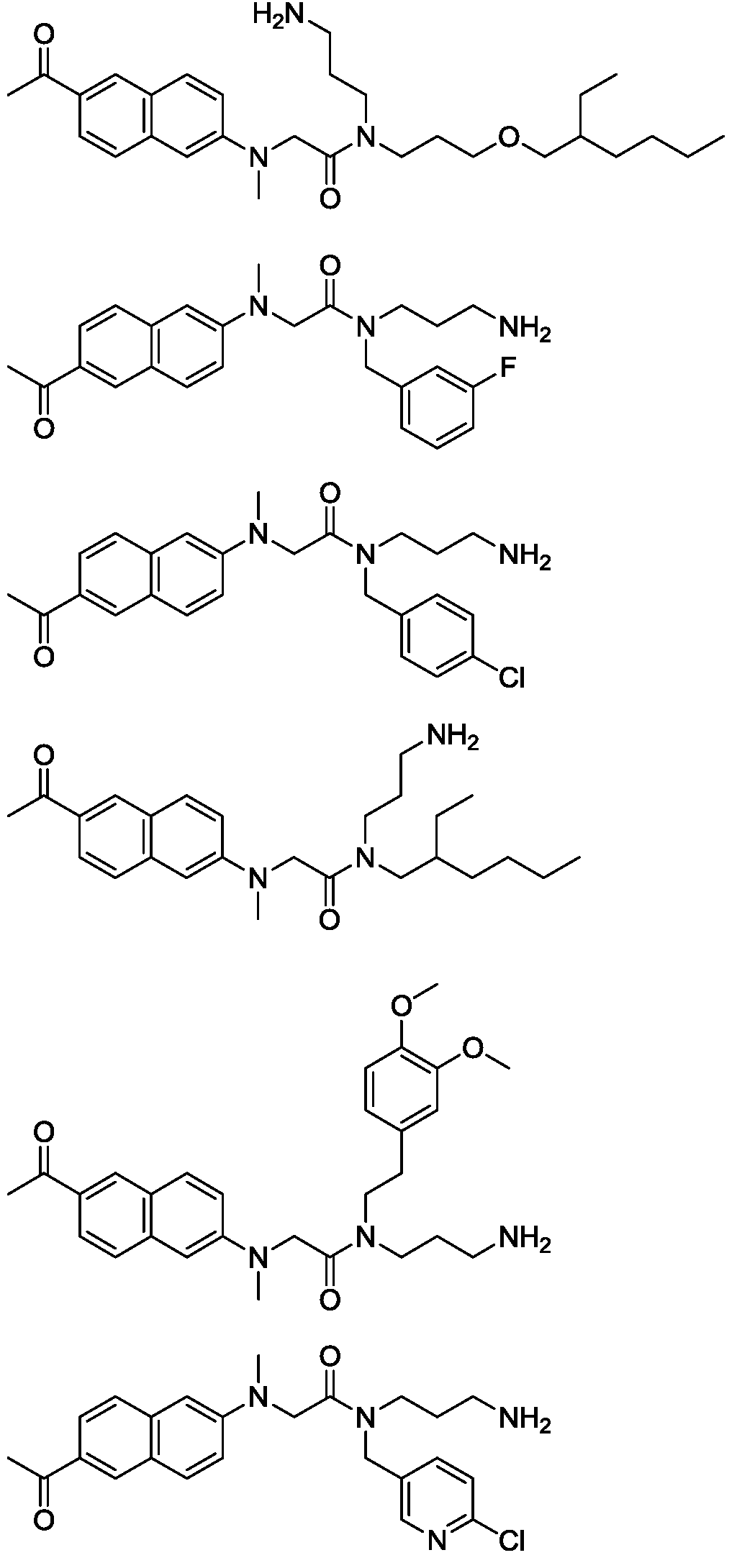


16. The composition of Claim 11, wherein the composition is represented by structural formula (III):

(III).
17. A method of visualizing a target cell, the method comprising:
(a) contacting a population of the target cell with a composition of any one of Claims 1-16 to form an incubation media;
(b) incubating the incubation media of step (a) for a period of time sufficient to stain the target cells; and
(c) visualizing the stained target cells of step (b) with two-photon microscopy to visualize the target cell.
18. The method of Claim 17, wherein the target cell is a pancreatic islet cell.
19. The method of Claim 18, wherein the pancreatic islet cell is an alpha cell.
Applications Claiming Priority (2)
| Application Number | Priority Date | Filing Date | Title |
|---|---|---|---|
| US201562103920P | 2015-01-15 | 2015-01-15 | |
| US62/103,920 | 2015-01-15 |
Publications (1)
| Publication Number | Publication Date |
|---|---|
| WO2016114722A1 true WO2016114722A1 (en) | 2016-07-21 |
Family
ID=56406142
Family Applications (1)
| Application Number | Title | Priority Date | Filing Date |
|---|---|---|---|
| PCT/SG2016/050016 Ceased WO2016114722A1 (en) | 2015-01-15 | 2016-01-15 | Alpha-cell selective probe for ex-vivo two photon imaging of alpha cells in intact pancreatic islets |
Country Status (1)
| Country | Link |
|---|---|
| WO (1) | WO2016114722A1 (en) |
Cited By (2)
| Publication number | Priority date | Publication date | Assignee | Title |
|---|---|---|---|---|
| CN109280017A (en) * | 2018-08-30 | 2019-01-29 | 河南师范大学 | A kind of two-photon fluorescent Golgi locator and preparation method and application thereof |
| JP2019043971A (en) * | 2017-08-29 | 2019-03-22 | 東洋インキScホールディングス株式会社 | Method for producing xanthene compound |
Citations (3)
| Publication number | Priority date | Publication date | Assignee | Title |
|---|---|---|---|---|
| US4008326A (en) * | 1973-12-26 | 1977-02-15 | The Upjohn Company | Substituted ureas and thioureas and pharmaceutical compositions thereof |
| US20010049374A1 (en) * | 1997-08-06 | 2001-12-06 | Steele Andrew W. | Urokinase inhibitors |
| US20090155837A1 (en) * | 2007-12-18 | 2009-06-18 | Bong-Rae Cho | Two-photon fluorescent probes for acidic vesicles in live cells and tissue and method of imaging acidic vesicles in live cells and tissue using the same |
-
2016
- 2016-01-15 WO PCT/SG2016/050016 patent/WO2016114722A1/en not_active Ceased
Patent Citations (3)
| Publication number | Priority date | Publication date | Assignee | Title |
|---|---|---|---|---|
| US4008326A (en) * | 1973-12-26 | 1977-02-15 | The Upjohn Company | Substituted ureas and thioureas and pharmaceutical compositions thereof |
| US20010049374A1 (en) * | 1997-08-06 | 2001-12-06 | Steele Andrew W. | Urokinase inhibitors |
| US20090155837A1 (en) * | 2007-12-18 | 2009-06-18 | Bong-Rae Cho | Two-photon fluorescent probes for acidic vesicles in live cells and tissue and method of imaging acidic vesicles in live cells and tissue using the same |
Cited By (2)
| Publication number | Priority date | Publication date | Assignee | Title |
|---|---|---|---|---|
| JP2019043971A (en) * | 2017-08-29 | 2019-03-22 | 東洋インキScホールディングス株式会社 | Method for producing xanthene compound |
| CN109280017A (en) * | 2018-08-30 | 2019-01-29 | 河南师范大学 | A kind of two-photon fluorescent Golgi locator and preparation method and application thereof |
Similar Documents
| Publication | Publication Date | Title |
|---|---|---|
| Zheng et al. | Rational design of fluorogenic and spontaneously blinking labels for super-resolution imaging | |
| JP7227741B2 (en) | Carboxy X rhodamine analog | |
| JP6351511B2 (en) | Synthesis of asymmetric Si rhodamine and rhodol | |
| Mitronova et al. | New fluorinated rhodamines for optical microscopy and nanoscopy | |
| Miao et al. | Novel fluorescent probes for highly selective two-photon imaging of mitochondria in living cells | |
| AU2015240774B2 (en) | Azetidine-substituted fluorescent compounds | |
| EP2778161B1 (en) | Two-photon fluorescent probe using naphthalene as matrix and preparation method and use thereof | |
| WO2010028349A2 (en) | Fluorochromes for organelle tracing and multi-color imaging | |
| Hou et al. | Sensitive detection and imaging of endogenous peroxynitrite using a benzo [d] thiazole derived cyanine probe | |
| US12440581B2 (en) | Fluorophores for super-resolution imaging | |
| WO2014104975A9 (en) | Megastokes amino-triazolyl-bodipy compounds and applications to live neuron staining and human serum albumin fa1 drug site probing | |
| Chong et al. | Pro-fluorescent mitochondria-targeted real-time responsive redox probes synthesised from carboxy isoindoline nitroxides: Sensitive probes of mitochondrial redox status in cells | |
| Shao et al. | Identification of fatty liver disease at diverse stages using two-photon absorption of triphenylamine-based BODIPY analogues | |
| CN106905389B (en) | A fluorescent probe of β-galactosidase with intracellular retention ability | |
| WO2016114722A1 (en) | Alpha-cell selective probe for ex-vivo two photon imaging of alpha cells in intact pancreatic islets | |
| Glavaš et al. | BODIPY fluorescent dyes for selective staining of intracellular organelles | |
| JP6456592B2 (en) | Fluorescence lifetime imaging probe | |
| WO2014109713A1 (en) | Fluorescent cell cycle probe having m-phase specificity | |
| Kumari et al. | A real time colorimetric ‘two in one’kit for tracking ppb levels of uric acid and Hg2+ in live HeLa S3 cells and Hg2+ induced keto–enol tautomerism | |
| JP6883332B2 (en) | Calcium ion detection fluorescent probe that can be tagged | |
| JP6675125B2 (en) | pH-dependent fluorescent compound | |
| WO2014142320A1 (en) | Novel compound, and reagent for detecting lipid droplets and/or adipose tissue containing said compound | |
| WO2020250998A1 (en) | Intracellular retentive fluorescent compound, and cell staining method and high-sensitivity cell detection method each using same | |
| WO2007050810A2 (en) | Fluorogenic probes for reactive oxygen species | |
| US11498932B2 (en) | Bright targetable red CA2+ indicators |
Legal Events
| Date | Code | Title | Description |
|---|---|---|---|
| 121 | Ep: the epo has been informed by wipo that ep was designated in this application |
Ref document number: 16737619 Country of ref document: EP Kind code of ref document: A1 |
|
| NENP | Non-entry into the national phase |
Ref country code: DE |
|
| 122 | Ep: pct application non-entry in european phase |
Ref document number: 16737619 Country of ref document: EP Kind code of ref document: A1 |