WO2016113763A1 - A novel antileishmanial formulation - Google Patents
A novel antileishmanial formulation Download PDFInfo
- Publication number
- WO2016113763A1 WO2016113763A1 PCT/IN2016/050019 IN2016050019W WO2016113763A1 WO 2016113763 A1 WO2016113763 A1 WO 2016113763A1 IN 2016050019 W IN2016050019 W IN 2016050019W WO 2016113763 A1 WO2016113763 A1 WO 2016113763A1
- Authority
- WO
- WIPO (PCT)
- Prior art keywords
- azanediyl
- bis
- diylbis
- hydroxyhex
- bromophenyl
- Prior art date
- Legal status (The legal status is an assumption and is not a legal conclusion. Google has not performed a legal analysis and makes no representation as to the accuracy of the status listed.)
- Ceased
Links
- 0 CC(CCCNC(CCCO)=CC(*)=O)NC(CCCO)=CC(*)=O Chemical compound CC(CCCNC(CCCO)=CC(*)=O)NC(CCCO)=CC(*)=O 0.000 description 1
Classifications
-
- A—HUMAN NECESSITIES
- A61—MEDICAL OR VETERINARY SCIENCE; HYGIENE
- A61K—PREPARATIONS FOR MEDICAL, DENTAL OR TOILETRY PURPOSES
- A61K9/00—Medicinal preparations characterised by special physical form
- A61K9/0012—Galenical forms characterised by the site of application
- A61K9/0019—Injectable compositions; Intramuscular, intravenous, arterial, subcutaneous administration; Compositions to be administered through the skin in an invasive manner
-
- A—HUMAN NECESSITIES
- A61—MEDICAL OR VETERINARY SCIENCE; HYGIENE
- A61K—PREPARATIONS FOR MEDICAL, DENTAL OR TOILETRY PURPOSES
- A61K31/00—Medicinal preparations containing organic active ingredients
- A61K31/13—Amines
- A61K31/135—Amines having aromatic rings, e.g. ketamine, nortriptyline
-
- A—HUMAN NECESSITIES
- A61—MEDICAL OR VETERINARY SCIENCE; HYGIENE
- A61K—PREPARATIONS FOR MEDICAL, DENTAL OR TOILETRY PURPOSES
- A61K47/00—Medicinal preparations characterised by the non-active ingredients used, e.g. carriers or inert additives; Targeting or modifying agents chemically bound to the active ingredient
- A61K47/30—Macromolecular organic or inorganic compounds, e.g. inorganic polyphosphates
- A61K47/36—Polysaccharides; Derivatives thereof, e.g. gums, starch, alginate, dextrin, hyaluronic acid, chitosan, inulin, agar or pectin
-
- A—HUMAN NECESSITIES
- A61—MEDICAL OR VETERINARY SCIENCE; HYGIENE
- A61K—PREPARATIONS FOR MEDICAL, DENTAL OR TOILETRY PURPOSES
- A61K9/00—Medicinal preparations characterised by special physical form
- A61K9/0012—Galenical forms characterised by the site of application
- A61K9/0053—Mouth and digestive tract, i.e. intraoral and peroral administration
-
- A—HUMAN NECESSITIES
- A61—MEDICAL OR VETERINARY SCIENCE; HYGIENE
- A61K—PREPARATIONS FOR MEDICAL, DENTAL OR TOILETRY PURPOSES
- A61K9/00—Medicinal preparations characterised by special physical form
- A61K9/14—Particulate form, e.g. powders, Processes for size reducing of pure drugs or the resulting products, Pure drug nanoparticles
- A61K9/16—Agglomerates; Granulates; Microbeadlets ; Microspheres; Pellets; Solid products obtained by spray drying, spray freeze drying, spray congealing,(multiple) emulsion solvent evaporation or extraction
- A61K9/1605—Excipients; Inactive ingredients
- A61K9/1629—Organic macromolecular compounds
- A61K9/1652—Polysaccharides, e.g. alginate, cellulose derivatives; Cyclodextrin
-
- A—HUMAN NECESSITIES
- A61—MEDICAL OR VETERINARY SCIENCE; HYGIENE
- A61K—PREPARATIONS FOR MEDICAL, DENTAL OR TOILETRY PURPOSES
- A61K9/00—Medicinal preparations characterised by special physical form
- A61K9/14—Particulate form, e.g. powders, Processes for size reducing of pure drugs or the resulting products, Pure drug nanoparticles
- A61K9/19—Particulate form, e.g. powders, Processes for size reducing of pure drugs or the resulting products, Pure drug nanoparticles lyophilised, i.e. freeze-dried, solutions or dispersions
-
- A—HUMAN NECESSITIES
- A61—MEDICAL OR VETERINARY SCIENCE; HYGIENE
- A61K—PREPARATIONS FOR MEDICAL, DENTAL OR TOILETRY PURPOSES
- A61K9/00—Medicinal preparations characterised by special physical form
- A61K9/48—Preparations in capsules, e.g. of gelatin, of chocolate
- A61K9/50—Microcapsules having a gas, liquid or semi-solid filling; Solid microparticles or pellets surrounded by a distinct coating layer, e.g. coated microspheres, coated drug crystals
- A61K9/5005—Wall or coating material
- A61K9/5021—Organic macromolecular compounds
- A61K9/5026—Organic macromolecular compounds obtained by reactions only involving carbon-to-carbon unsaturated bonds, e.g. polyvinyl pyrrolidone, poly(meth)acrylates
-
- A—HUMAN NECESSITIES
- A61—MEDICAL OR VETERINARY SCIENCE; HYGIENE
- A61P—SPECIFIC THERAPEUTIC ACTIVITY OF CHEMICAL COMPOUNDS OR MEDICINAL PREPARATIONS
- A61P33/00—Antiparasitic agents
- A61P33/02—Antiprotozoals, e.g. for leishmaniasis, trichomoniasis, toxoplasmosis
-
- C—CHEMISTRY; METALLURGY
- C07—ORGANIC CHEMISTRY
- C07C—ACYCLIC OR CARBOCYCLIC COMPOUNDS
- C07C225/00—Compounds containing amino groups and doubly—bound oxygen atoms bound to the same carbon skeleton, at least one of the doubly—bound oxygen atoms not being part of a —CHO group, e.g. amino ketones
- C07C225/02—Compounds containing amino groups and doubly—bound oxygen atoms bound to the same carbon skeleton, at least one of the doubly—bound oxygen atoms not being part of a —CHO group, e.g. amino ketones having amino groups bound to acyclic carbon atoms of the carbon skeleton
- C07C225/14—Compounds containing amino groups and doubly—bound oxygen atoms bound to the same carbon skeleton, at least one of the doubly—bound oxygen atoms not being part of a —CHO group, e.g. amino ketones having amino groups bound to acyclic carbon atoms of the carbon skeleton the carbon skeleton being unsaturated
- C07C225/16—Compounds containing amino groups and doubly—bound oxygen atoms bound to the same carbon skeleton, at least one of the doubly—bound oxygen atoms not being part of a —CHO group, e.g. amino ketones having amino groups bound to acyclic carbon atoms of the carbon skeleton the carbon skeleton being unsaturated and containing six-membered aromatic rings
-
- C—CHEMISTRY; METALLURGY
- C07—ORGANIC CHEMISTRY
- C07C—ACYCLIC OR CARBOCYCLIC COMPOUNDS
- C07C2603/00—Systems containing at least three condensed rings
- C07C2603/02—Ortho- or ortho- and peri-condensed systems
- C07C2603/04—Ortho- or ortho- and peri-condensed systems containing three rings
- C07C2603/06—Ortho- or ortho- and peri-condensed systems containing three rings containing at least one ring with less than six ring members
- C07C2603/10—Ortho- or ortho- and peri-condensed systems containing three rings containing at least one ring with less than six ring members containing five-membered rings
- C07C2603/12—Ortho- or ortho- and peri-condensed systems containing three rings containing at least one ring with less than six ring members containing five-membered rings only one five-membered ring
- C07C2603/18—Fluorenes; Hydrogenated fluorenes
Definitions
- the present invention relates to a novel antileishmanial formulation. Particularly, the present invention relates to the development of a novel formulation containing compounds belonging to the series of (2Z,2'Z)-3,3'-(alkane-l,2-diylbis(azanediyl))bis(6-hydroxy-l- arylhex-2-en-l-ones) as bioactive agents against Leishmania parasites in visceral organs. BACKGROUND OF THE INVENTION
- Leishmaniasis are vector born parasitic diseases caused by protozoa of the genus Leishmania. Twenty one Leishmania spp. are known to be pathogenic to human and may cause broad spectrum of clinical syndromes ranging from benign self healing cutaneous leishmaniasis (oriental sore) to fulminant mucocutaneousleishmaniasis (espundia) and fatal visceral leishmaniasis (Kala-azar). About 350 million people are at risk, as Leishmaniasis is considered to be endemic in 88 tropical and subtropical countries including southern Europe (Alvar J., Yactayo S., Bern C, 2006, Leishmaniasis and poverty, Trends in Parasitol; 22:552- 557). Therefore studies on control and management of the disease have received priority at national and international levels.
- polymeric nanoparticles have already been tested as nanocarriers for the delivery of standard toxic antileishmanial drugs (Nahar M. and Jain, N. K., 2009, Preparation, Characterization and Evaluation of Targeting Potential of Amphotericin B -Loaded Engineered PLGA Nanoparticles. Pharm. Research; 26: 2588-2598).
- these systems have led to an increase in drug efficacy and a decrease in toxicity, resulting in an improved therapeutic ratio (Lima, S. C, Rodriguesa, V., Garridob, J., Borgesb, F., Lind, P.K.
- Rational approach to develop new chemo-therapeutic agent is based on knowledge of molecular mechanisms, employed by the parasite for its survival at various levels of life cycle.
- the LdDCP belongs to M3 family of mono-zinc peptidases which cleaves N-benzoyal-L-glycyl-Lhistidyl- L-leucine (Hip-His-Leu, HHL), a substrate for ACE to release hippuric acid.
- captopril a known mammalian ACE inhibitor, was able to inhibit both LdDCP enzyme activity and in vitro parasite replication. These observations underscored the therapeutic potential of parasite enzyme inhibition.
- three-dimensional model of LdDCP was generated based on crystal structure of E.
- EcDCP coli DCP
- comparative modelling Boig M.S., Kumar A., Siddiqi M.I., Goyal N.,2010, Characterization of dipeptidylcarboxypeptidase of Leishmaniadonovani: a molecular model for structure based design of antileishmanials. J Comput Aided Mol Des;24:77-87
- a virtual screening approach was applied to identify potential inhibitors for LdDCP.
- Out of 15452 compounds four belonging to two chemical classes were identified as potential DCP inhibitors that also exhibited in vitro antileishmanial activity against promastigotes (Gangwar, S., Baig, M.
- the main objective of the present invention is to develop a novel nanoparticle formulation containing compounds belonging to the series of (2Z,2'Z)-3,3'-(alkane-l,2- diylbis(azanediyl))bis(6-hydroxy-l-aryl/fluorenyl-hex-2-en-l-ones) of general formula 1
- R is selected from
- Still another objective of the present invention is to achieve enhanced antileishmanial activity of the analogues of this series of compound.
- the present invention provides a novel antileishmanial formulation to treat visceral leishmaniasis, commonly known as Kala -azar.
- Bio-efficacy of nanoformulation of compound of general formula lcoated with Edragit is increased by two fold under in vivo condition via Oral route of administration as compared to bulk compound.
- Eudragit polymer is the anionic acrylic polymer that provided stability to the orally delivered biomolecules towards acidic pH, thus enhanced two fold bioefficacy of compound by oral administration as compared to bulk compound.
- the compounds of general formula 1 display potential antileishmanial activity via oral and intraperitoneal administration.
- the compounds of general formula 1 are specific inhibitor of leishmanial target enzyme dipeptidylcarboxypeptidase (IdDCP) and have no effect on mammalian counterpart angiotensin converting enzyme (ACE) at nM concentration.
- IdDCP leishmanial target enzyme dipeptidylcarboxypeptidase
- ACE angiotensin converting enzyme
- Figure 1 Synthesis of ⁇ , ⁇ '- [bis (l-aryl-6-hydroxy-hex-2-ene-l-one-3-yl) l,n-alkanediamines
- Figure 2 In-vitro release kinetics of nanoparticle preparation of compound lc in PBS at 37°C ABBREVIATIONS
- AIDS Acquired Immune Deficiency Syndrome
- WHO World Health Organization
- VL visceral Leishmaniasis
- LdDCP Leishmaniadonovanidipeptidylcarboxypeptidase
- ACE angiotensin converting enzyme
- DMSO Dimethylsulf oxide
- DCM Dichloromethane
- SSG sodium stibogluconate
- CDRI Central Drug Research Institute
- THF Tetrahydrofuran
- EE encapsulation efficiency
- PBS phosphate buffer
- UV/VIS Ultraviolet / Visible
- KBr Potassium Bromide
- NMR Nuclear Magnetic Resonance
- CDC1 3 Deuteriated chloroform
- J Coupling constant; s: singlet; d: doublet; t: triplet; ESI MS: Electron Spray Ionization Mass spectroscopy; HR MS: High Resolution Mass spectroscopy; IR: Infrared; ppm: parts per million; DMF
- the present invention relates to a novel controlled release antileishmanial formulation comprising a compound of formula 1 ,
- the formulation comprising a compound selected from a group consisting of :
- alkyldextran may be selected from a group consisting of O-butyldextran, O-hexyldextran, O-octyldextran, O- dodecyldextran, O-hexadecyldextran.
- O-alkyl-dextran is optionally coated with Eudraigt, cellulose acetate succinate, hydroxy propyl methyl cellulose phthalate, hydroxy propyl methyl cellulose acetate succinate, polyvinyl acetate phthalate, cellulose acetate trimellitate, sodium alginate.
- step (b) optionally adding a solution of polymer and co-polymer to the suspension obtained in step (a) and further stirring for a period of 3hr to 5hr at a temperature ranging between 30°C to 35°C ,
- step (a) or (b) dialyzing the suspension obtained in step (a) or (b) for a period of 2 to 4 days, followed by the freeze drying to obtain the solid dried nanoparticle.
- polymer is selected from the group consisting of PVA, PEG, and BSA.
- co-polymer is selected from the group consisting of Eudragit, cellulose acetate succinate, hydroxy propyl methyl cellulose phthalate, hydroxy propyl methyl cellulose acetate succinate, polyvinyl acetate phthalate, cellulose acetate trimellitate, and sodium alginate
- step (I) ii. adding n-bromoalkane in THF in the step (I) solution dropwise with stirring at the temprature ranging between 50-80 °C for the time in the range of 3-6 hr, followed by concentrating the reaction mixture on rotavapor to obtain a residual mass,
- step (iii) dissolving the residual mass of step (ii) in diethylether followed by the filtration and washing with diethyl ether to obtain a solid
- step (iii) dissolving the solid of step (iii) in deionized water followed by dialysis and lyophilization for the time in the range of 12-24hr at the temperature ranging between 30-35°C to obtain solid dry product.
- a formulation as claimed in Claim 1 has in vivo antileishmanial activity via oral route at dose 25-100mg/Kg in hamster model and has two times enhanced bioefficacy as compared to bulk drug.
- n-bromoalkane is selected from the group consisting of 1-bromobutane, 1-bromohexane, 1-bromooctane, 1- bromododecane, and 1-bromohexadecane.
- the solvent is selected from the group consisting of THF, dioxane, and n-butanol.
- (2Z2Z)-33'-( em ane- 1 , 2-diylbis(azanediyl))bis( 1 -(3 -bromophenyl)-6-hydroxyhex-2-en- 1-one) (lg).
- the compound of general formula 1 is useful as antileishmanial agent.
- a pharmaceutical composition comprising therapeutically effective amount of compound of general formula 1 thereof optionally along with pharmaceutically acceptable diluents, excipients, or carriers.
- (2Z,2'Z)-3,3'-(alkane-l,2- diylbis(azanediyl))bis(6-hydroxy-l-aryl/flourene-hex-2-en-l-ones) of general formula 1 display antileishmanial activity under in vivo conditions in hamster model both by ip and oral route
- the aryl group may be chosen from halo- substituted phenyl group.
- halogen group may be fluoro, chloro or bromo.
- the alkane implies a 2, 3 or 4 carbon chain.
- the compounds were prepared in dimethylsulfoxide (DMSO) for in vitro evaluation, and test concentrations were diluted from stocks in appropriate medium immediately before the assays.
- DMSO dimethylsulfoxide
- the aqueous solution of the test compounds were prepared by suspending the accurately weighed sample in a standard suspension vehicle of 10 % Tween-80/Ethanol (70:30) in deionized water for in vivo part of the study.
- the final volume contains 10% of the vehicle for inoculation by the intraperitoneal route.
- the enhancement of the antileishmanial activity under in vivo conditions both by ip and oral route could be achieved via a nanoparticle-based preparation of compounds belonging to general formula 1.
- the novel formulation containing compounds belonging to the series of (2Z,2'Z)-3,3'-(alkane-l,2-diylbis(azanediyl))bis(6- hydroxy-l-aryl/flourene-hex-2-en-l-ones) of general formula 1 is entrapped in functionalized dextran nanoparticles.
- the novel formulation containing compounds belonging to the series of (2Z,2'Z)-3,3'-(alkane-l,2-diylbis(azanediyl))bis(6- hydroxy-l-aryl/flourene-hex-2-en-l-ones) of general formula 1 is encapsulated to O- (alkyl) contend dextran.
- molecular weight of dextran varies from 25 to 45KDa with the number of alkyl group varies from 4-16 in O- (alkyl) complicat dextran.
- the nanoparticle preparation containgcompound(2Z,2'Z)-3 ,3 '-(alkane- 1 ,2-diylbis(azanediyl))bis(6-hydroxy- 1 -aryl/flourene- hex-2-en-l-ones)of general formula 1, is coated with polymer to provide protection against acidic pH, to be used for oral administration may selected from polymer belonging to the class Eugrate, cellulose derivatives,.
- the present invention provides a novel antileishmanial formulation to treat visceral leishmaniasis, commonly known as Kala -azar.
- the present invention comprises:
- b.l Antipromastigote assay The Leishmania donovani promastigotes (MHOM/IN/Dd8/80), originally obtained from Imperial college, London, transfected with firefly luciferase gene as described earlier (Ashutosh, Gupta, S., Ramesh, Sundar, S. and Goyal, N. Use of Leishmania donovani field isolates expressing the luciferase reporter gene in in vitro drug screening Antimicrob. Agents Chemother. 2005, 49, 3776-3783) were maintained in medium 199 (Sigma) supplemented with 10-15% foetal calf serum (Gibco) and gentamycin (40 ⁇ g/mL) solution (Sigma).
- N is average relative luminescence unit (RLU) of control wells and n is average RLU of treated wells.
- RLU relative luminescence unit
- Macrophage cells J744 were harvested from exponentially growing culture. The cells were diluted to l-5X10 6 /mL in RPMI medium plus 10-15% FCS (Sigma, USA) and layered in 16 well chamber slides (Nunc) under a final volume of 100 ⁇ / well and allowed to adhere for 24-30 hrs at 37°C in a 5% CC>2-95% air mixture. Adherent macrophages were infected with stationary phase promastigotes (WHO reference strain of L. donovani (MHOM/IN/80/Dd8) at ratio 1 :5 to 1:10 for 4 -24 hours at 37°C in a 5% C0 2 -95% air mixture.
- WHO reference strain of L. donovani MHOM/IN/80/Dd8
- test compounds prepared in DMSO and then diluted in complete RPMI medium, were added at two fold dilutions up to 7 points in complete medium starting from lOOug/ml concentrations after replacing the previous medium. Finally slides were fixed with 100% methanol and stained with 20% Giemsa stain for 45 minutes on day 6 (Seifert K. and Croft, S.L.
- N is average number of amastigotes per 100 cell nuclei of untreated well and n is average number of amastigotes per 100 cell nuclei of treated well.
- Cytotoxicity assay The macrophage cell viability was determined using the MTT assay (Mosmann, T. J., 1983, J.Immunol. Methods;65: 55-63). Exponentially growing cells (J774) (1-2 were incubated with test compounds. The test compounds are added at three fold dilutions up to 7 points in complete medium starting from 200 g ml concentrations, and were incubated at 37 °C in a humidified mixture of C02 and 95 % air in an incubator. Control wells containing dimethyl sulfoxide (DMSO) without compounds were also included in the experiment. Stock solutions of compounds were initially dissolved in DMSO and further diluted with fresh complete medium.
- cytotoxic effect were expressed as 50% lethal dose (i.e., as the concentration of a compound which provoked a 50% reduction in cell viability compared to cell in culture medium alone).
- CC 50 values were estimated as described by Huner et al.(Huber, W., Koella, J.C. 1993, Acta Trap.; 55: 257-261).
- the selectivity index (SI) for each compound was calculated as the ratio between, cytotoxicity (CC50) and activity (IC50) against Leishmania amastigotes. Compounds with SI index > 4, comparable or less than Miltefosine were considered as safe in this cytotoxic assay.
- Golden hamsters (Inbred strain) of either sex weighing 40-45g were infected intra-cardialy with l-3x 10 7 amastigotes per animal. The infection is well adapted to the hamster model and establishes itself in 15-20 days. Pre -treatment spleen biopsy in all the animals was carried out to assess the degree of infection. The animals with +1 infection (5-15 amastigotes / 100 spleen cell nuclei) were included in the chemotherapeutic trials. The infected animals were randomized into several groups on the basis of their parasitic burdens. Five to seven animals were used for each test compounds.
- Aqueous solution of the test compounds were prepared by suspending the accurately weighed sample in a standard suspension vehicle of 10 % Tween-80/Ethanol (70:30) in deionized water for in vivo part of the study. The final volume contains 10-12% of the vehicle for inoculation by the intraperitoneal route.
- Drug treatment by intraperitoneal (i.p.) route was initiated after 2 days of biopsy and continued for 5 consecutive days. Post-treatment biopsies were done on day 7 th and 28 th day of the last drug administration and amastigote counts are assessed by Giemsa staining.
- c.l.O-alkyldextrans were prepared using a novel method.
- the synthesis of O-alkyldextrans was achieved in high yields using phase transfer catalysis. Briefly, to synthesize O-butyl- dextran to -hexadecyl dextran 5g- dextran was taken up in a 10-40% solution of sodium hydroxide (20ml)containing a catalytic amount of Aliquat 336 (0.5g).
- the reaction mixture was heated up to 60-650C and n-bromoalkane (bromobutane, 1-bromohexane, 1-bromooctane, 1-bromododecane, or 1-bromohexadecane) (60nmol) in tetrahydrofuran (5ml) was added drop wise.
- tetrahydrofuran 5ml
- the reaction mixture was then allowed to stir 3h at 60-65 °C and then concentrated on a rotavapor.
- the residual mass was taken up in diethylether and filtered the solid on a sintered funnel. The solid was washed with diethylether (2X50ml) and then it was dissolved in deionized water (20ml).
- the mean particle size and zeta potential of the nanoparticles were analyzed by laser light diffraction using a Zetasizer Nano-ZS (Malvern Instruments, U.K).
- a known amount of nanoparticles were suspended in water (lmg/ml) and the mean particles size and charge on the nanoparticles were measured employing the following settings on the instrument: a nominal 5mW He-Ne laser operating at 633nm wavelength; 14 measurements per sample; refractive index of water, 1.33; viscosity for water, 0.89 cP. All measurements were carried out at 25°C.
- Zeta potential measurements were carried out on the same instrument in triplicates in automatic mode and the values are presented as the average value of 30 runs.
- the encapsulation efficiency of the model drug was determined by spectrophotometric estimation using Lambda Bio 20 UV/VIS Spectrophotometer (Perkin Elmer, USA). Briefly, accurately weighed drug loaded nanoparticles (-10-15 mg) were suspended in water (ImL) and after 10-20min the suspension was centrifuged at 13000rpm for 15min. The supernatant was removed and the pellet was dried and dissolved in chloroform (ImL) and measured the absorbance of the solution at 360 nm. The amount of drug (mg) was calculated from the standard curve drawn between the varied amounts of drug (mg) and absorbance (O.D.). From the following equation, the encapsulation efficiency (EE) was determined. All the measurements were conducted in triplicate.
- lOmg NPs were suspended in 2ml phosphate buffer (PBS), transferred the solution to a dialysis bag (12kDa) and allowed to dialyze against 20ml of same buffer at 37 ° C ⁇ 0.5 ° C with stirring at 50rpm in an incubator shaker (Heidolph Unimax 1010, Germany). At predetermined time- intervals, an aliquot (1ml) of the sample was withdrawn and its absorbance was measured at 360nm using Lambda Bio 20 UV/VIS Spectrophotometer (Perkin Elmer, USA) and added the same amount of fresh medium to the dialysis container. The amount of the released drug was then calculated using a previously prepared standard curve of the pure drug. The drug was slowly and consistently released (Figure 2.).
- PBS phosphate buffer
- O-alkyldextrans were prepared using a novel method.
- the synthesis of O-alkyldex trans was achieved in high yields using phase transfer catalysis. Briefly, to synthesize O-butyl-dextran, 5g dextran was takenup in a 20% solution of sodium hydroxide (20mL)containing a catalytic amount of aliquat 336 (0.5g). The reaction mixture was heated upto 65°C and n-bromobutane (60nmol) in THF(5mL) was added dropwise. The reaction mixture was then allowed to stir 3h at 60°C and then concentrated on a rotavapor. The residual mass was taken up in diethylether and filtered the solid on a sintered funnel.
- Compound lc-DextranC4 NPs prepared had an electric charge of _-4.5 ⁇ 1.32 mV and a size of 200 ⁇ 10.84nm. The entrapment efficiency was 40% and was observed to be the most stable formulation.
- the mean particle size and zeta potential of the nanoparticles were analyzed by laser light diffraction using a ZetasizerNano-ZS (Malvern Instruments, U.K).
- a known amount of nanoparticles were suspended in water (lmg/mL) and the mean particles size and charge on the nanoparticles were measured employing the following settings on the instrument: a nominal 5mW He-Ne laser operating at 633nm wavelength; 14 measurements per sample; refractive index of water, 1.33; viscosity for water, 0.89 cP. All measurements were carried out at 25°C.
- Zeta potential measurements were carried out on the same instrument in triplicates in automatic mode and the values are presented as the average value of 30 runs.
- the encapsulation efficiency of the model drug was determined by spectrophotometric estimation using Lambda Bio 20 UV/VIS Spectrophotometer (Perkin Elmer, USA). Briefly, accurately weighed drug loaded nanoparticles 10 mg) were suspended in water (ImL) and after lOmin, the suspension was centrifuged at 13000rpm for 15min. The supernatant was removed, pellet was dried and dissolved in chloroform (ImL) and measured the absorbance of the solution at 360 nm. The amount of drug (mg) was calculated from the standard curve drawn between the varied amounts of drug (mg) and absorbance (O.D.). From the following equation, the encapsulation efficiency (EE) was determined. All the measurements were conducted in triplicate.
- lOmg NPs were suspended in 2mL phosphate buffer (PBS), transferred the solution to a dialysis bag (12kDa) and allowed to dialyze against 20mL of same buffer at 37 ° C ⁇ 0.5 ° C with stirring at 50rpm in an incubator shaker (HeidolphUnimax 1010, Germany). At predetermined time- intervals, an aliquot (lmL) of the sample was withdrawn and its absorbance was measured at 360nm using Lambda Bio 20 UV/VIS Spectrophotometer (Perkin Elmer, USA) and added the same amount of fresh medium to the dialysis container. The amount of the released drug was then calculated using a previously prepared standard curve of the pure drug. The drug was slowly and consistently released (Figure 2.). More than 80% drug was released in 48 hours.
- PBS phosphate buffer
- the Leishmania donovani promastigotes (MHOM/IN/Dd8/80), originally obtained from Imperial college, London, transfected with fire fly luciferase gene as described earlier (Ashutosh, Gupta,S., Ramesh, Sundar, S. and Goyal,N. Use of Leishmania donovani field isolates expressing the luciferase reporter gene in in vitro drug screening. Antimicrob. Agents Chemother. 2005, 49, 3776-3783) are being maintained in medium 199 (Sigma) supplemented with 10% foetal calf serum (Gibco) and gentamycin (40 ⁇ g/mL) solution (Sigma). Exponentially growing transgenic promastigotes (1 X).
- N is average relative luminescence unit (RLU) of control wells and n is average RLU of treated wells.
- RLU relative luminescence unit
- the WHO reference strain of L. donovani (MHOM/IN/80/Dd8) was obtained from Imperial College, London (UK), and being maintained in this laboratory as promastigotes in vitro and as amastigotes in golden hamsters.
- Promastigotes of L. donovani were cultivated in medium 199 (Sigma-Aldrich) supplemented with 0.1% gentamycin (Biovaccines Private Ltd., Chevella, Andhra Pradesh, India) and 10% Fetal Calf Serum
- Macrophage cells J744 were harvested from exponentially growing culture. The cells were diluted to lX10 6 /mL in RPMI medium plus 10% FCS (Sigma, USA) and layered in 16 well chamber slides (Nunc) under a final volume of 100 ⁇ / well and allowed to adhere for 24hrs at 37°C in a 5% C0 2 -95% air mixture. Adherent macrophages were infected with stationary phase promastigotes at ratio 1: 10 for 24 hours at 37°C in a 5% C0 2 -95% air mixture.
- test compounds prepared in DMSO and then diluted in complete RPMI medium, were added at two fold dilutions up to 7 points in complete medium starting from 100 ⁇ g/mL concentrations after replacing the previous medium. Finally slides were fixed with 100% methanol and stained with 20% Giemsa stain for 45 minutes on day 6 (Seifert K. and Croft, S.L.
- N is average number of amastigotes per 100 cell nuclei of untreated well and n is average number of amastigotes per 100 cell nuclei of treated well.
- Example 3.3 Cytotoxicity assay: The macrophage cell viability was determined using the MTT assay (Mosmann, T. J., 1983, Immunol. Methods; 65 : 55-63). Exponentially growing cells (J774) (1 xl0 5 cells/lC l/well) were incubated with test compounds for 72 hours. The test compounds are added at three fold dilutions up to 7 points in complete medium starting from 20C ⁇ g/mL concentrations, and were incubated at 37°C in a humidified mixture of C02 and 95 % air in an incubator.
- Podophyllotoxm was used as a reference drug, and control wells containing dimethyl sulfoxide (DMSO) without compounds were also included in the experiment.
- Stock solutions of compounds were initially dissolved in DMSO and further diluted with fresh complete medium. After incubation, 25 ⁇ of MTT reagent (5mg/mL) in PBS medium, followed by syringe filtration was added to each well and incubated at 37 °C for 2 hours. At the end of the incubation period, the supernatant were removed by inverting the plate completely without disturbing cell layer and 150 ⁇ of pure DMSO are added to each well. After 15 min. of shaking the readings were recorded as absorbance at 544 nm on a micro plate reader.
- cytotoxic effect were expressed as 50% lethal dose (i.e., as the concentration of a compound which provoked a 50% reduction in cell viability compared to cell in culture medium alone).
- CC 50 values were estimated as described by Huber, W., Koella, J.C. 1993, Acta Trop.; 55: 257-261).
- SI selectivity index
- the animals with +1 infection (5-15 amastigotes / 100 spleen cell nuclei) were included in the chemotherapeutic trials.
- the infected animals were randomized into several groups on the basis of their parasitic burdens, six animals were used for each test sample.
- Drug treatment by intraperitoneal (i.p.) route and oral route was initiated after 2 days of biopsy and continued for 5 consecutive days.
- Post-treatment biopsies were done on day 7 th and 28 th day of the last drug administration and amastigote counts are assessed by Giemsa staining.
- Intensity of infection in both, treated and untreated animals, as also the initial count in treated animals was compared and the efficacy was expressed in terms of percentage inhibition (PI) using the following formula: -
- ANAT is Actual Number of Amastigotes in treated animals
- INAT is Initial Number of Amastigotes in Treated animals
- TIUC Times Increase of parasites in Untreated Control animals.
- aqueous solution of the test compounds was prepared by suspending the accurately weighed sample in a standard suspension vehicle of 10 % Tween-80/Ethanol (70:30) in ddH20. The final volume contains 10% of the vehicle for inoculation by the intraperitoneal route.
- the two nanoformulations of compound lc were developed.
- Formulationl, lc-dextranC4 nanoparticles exhibited significantly enhanced (five folds) therapeutic efficiency as compared to bulk drug by ip route.
- This formulation exhibited more than 84% parasite inhibition at one fifth ip dose i.e. lOmg/kg on both day7th and day 28 th of treatment..
- the dose is half of standard drug the dose, sodium stibogluconate (SSG), still showing same range of parasite inhibition (Table3).
- SSG sodium stibogluconate
- Table3 the compound lc- dextranC4 nanoparticles has better therapeutic potential as compared stanadard drug SSG.
- Formulatiori2 lc-dextranC4 eutragit coated nanoparticles also exhibited dose benefit of two fold hence enhanced therapeutic efficiency as compared to bulk drug.
- the formulation exhibited 80% parasite inhibition, comparable to therapeutic efficacy of lOOmg/kg dose of bulk drug.
- the activity was maintained up to 28 th day of treatment.
- the activity was also comparable to meltifosine, the only oral antileishmanial drug available.
- Recombinant leishmanial DCP was expressed in E. coli BL 21 pLysS (DE3) and purified to homogeneity as described earlier (Goyal N., Duncan R., Selvapandiyan, A., Debrabant, A., Baig, M.S., Nakhasi H.L.2006, Cloning and characterization of angiotensin converting enzyme related dipeptidylcarboxypeptidase from Leishmaniadonovani.
- Enzyme activity was measured according to the method of Cushman and Cheung, using N-benzoyl-L-glycyl-L-histidyl-L-leucine (HHL), a routine substrate used for ACE (Cushman D.W., Cheung H.S., 1971, Spectrophotometric assay and properties of the angiotensin-converting enzyme of rabbit lung. BiochemPharmacol; 20: 1637-1648).
- Activity of LdDCP was carried out spectrophotometrically, which is based on the direct measurement of released hippuric acid from HHL, which absorbs at 228 nm.
- Inhibitory activity of all selected compounds against LdDCP activity was measured at 1 ⁇ concentrations.
- different concentrations of inhibitors were incubated with the enzymes (LdDCP and ACE) for 5 min prior to the addition of the substrate (three separate experiments).
- Rat serum was taken as source of mammalian ACE.
- Protein concentration was determined by Bradford method using bovine serum albumin as standard (Bradford M.M. 1976, A rapid and sensitive method for the quantitation of microgram quantities of protein utilizing the principle of protein-dye binding. Anal Biochem; 72:248-254).
- *captopril is known inhibitor of ACE.
- the data in table is reported value for human testicular ACE (Deddish PA, Wang LX, Jackman HL, Michel B, Wang J, Skidgel, RA, Erdo ' s EG (1996) J PharmacolExpTher 279:1582
- the compounds of general formula 1 display potential antileishmanial activity via oral and intraperitoneal administration.
- the compounds of general formula 1 are specific inhibitor of leishmanial target enzyme dipeptidylcarboxypeptidase (ldDCP) and has no effect on mammalian counterpart angiotensin converting enzyme (ACE) at nM concentration.
- ldDCP leishmanial target enzyme dipeptidylcarboxypeptidase
- ACE angiotensin converting enzyme
- bio-efficacy of the nano formulations of compound of general formula 1 is increased by more than 5-fold as compared to bulk compound under in vivo conditions via intraperitoneal route of administration.
- Bio-efficacy of nanoformulation of compound of general formula lcoated with Edragit is increased by two fold under in vivo condition via Oral route of administration as compared to bulk compound.
- Eudragit polymer is the anionic acrylic polymer that provided stability to the orally delivered biomolecules towards acidic pH, thus enhanced two fold bioefficacy of compound by oral administration as compared to bulk compound.
Landscapes
- Health & Medical Sciences (AREA)
- Chemical & Material Sciences (AREA)
- Veterinary Medicine (AREA)
- Public Health (AREA)
- Pharmacology & Pharmacy (AREA)
- Life Sciences & Earth Sciences (AREA)
- Animal Behavior & Ethology (AREA)
- General Health & Medical Sciences (AREA)
- Medicinal Chemistry (AREA)
- Epidemiology (AREA)
- Engineering & Computer Science (AREA)
- Bioinformatics & Cheminformatics (AREA)
- Organic Chemistry (AREA)
- Nutrition Science (AREA)
- Tropical Medicine & Parasitology (AREA)
- Chemical Kinetics & Catalysis (AREA)
- General Chemical & Material Sciences (AREA)
- Nuclear Medicine, Radiotherapy & Molecular Imaging (AREA)
- Dermatology (AREA)
- Physiology (AREA)
- Inorganic Chemistry (AREA)
- Pharmaceuticals Containing Other Organic And Inorganic Compounds (AREA)
Abstract
A novel antileishmanial formulation containing compounds belonging to the series of (2Z,2'Z)-3,3'-(alkane-1,2-diylbis(azanediyl))bis(6-hydroxy-1- aryl/fluorenyl hex-2-en-1-ones) or their salts thereof showing antileishmanial activity under in vivo conditions against L. donovani in hamster model. These compounds or their formulation elicit anitleshmanial activity both via oral and ip routes.
Description
A NOVEL ANTILEISHMANIAL FORMULATION
FIELD OF THE INVENTION
[001] The present invention relates to a novel antileishmanial formulation. Particularly, the present invention relates to the development of a novel formulation containing compounds belonging to the series of (2Z,2'Z)-3,3'-(alkane-l,2-diylbis(azanediyl))bis(6-hydroxy-l- arylhex-2-en-l-ones) as bioactive agents against Leishmania parasites in visceral organs. BACKGROUND OF THE INVENTION
[002] Leishmaniasis are vector born parasitic diseases caused by protozoa of the genus Leishmania. Twenty one Leishmania spp. are known to be pathogenic to human and may cause broad spectrum of clinical syndromes ranging from benign self healing cutaneous leishmaniasis (oriental sore) to fulminant mucocutaneousleishmaniasis (espundia) and fatal visceral leishmaniasis (Kala-azar). About 350 million people are at risk, as Leishmaniasis is considered to be endemic in 88 tropical and subtropical countries including southern Europe (Alvar J., Yactayo S., Bern C, 2006, Leishmaniasis and poverty, Trends in Parasitol; 22:552- 557). Therefore studies on control and management of the disease have received priority at national and international levels.
[003] Vaccines against leishmaniasis are still under development (Guerin P. J., Olliaro P., Sundar S., Boelaert M., Croft S. L., Desjeux P., Wasunna M. K., Bryceson A. D., 2002, Visceral Leishmaniasis: current status of control, iagnosis, and treatment, and a proposed research and development agenda. Lancet Infect Dis; 2: 494-501.), and therefore control of leishmaniasis relies mainly on chemotherapy. The drugs recommended for the treatment of leishmaniasis are far from ideal because of high costs, high toxicity, and long-term treatment requirements (Barrett, M. P., and Croft, S. L., 2012, Management of trypanosomiasis and leishmaniasis. British Medical Bulletin; 104: 175-196). Increasing incidences of therapeutic failures and emergence of drug resistant parasites (Croft, S. L., Sundar, S. and Fairlamb, A. H., 2006, Drug Resistance in Leishmaniasis. Clin. Microbiol. Rev.; 19: 111.), have made imperative the need for the development of new effective, safe and nontoxic antileishmanial drug.
[004] Further, it has been observed that the ability of the parasite to survive and replicate inside host phagocytes poses a major problem in the development of effective anti-leishmania
therapeutic agents. The intracellular localization of the parasite is able to protect it from exposure to drugs that do not readily diffuse into cells. Therefore, use of drug carriers capable of delivering anti-leishmania compounds to infected cells should improve the therapeutic efficiency of those drugs and at the same time reduce their toxicity by modifying the pharmacokinetic and bio-distribution profiles of the drug (Couvreur, P., Vauthier, C, 2006, Nanotechnology: intelligent design to treat complex disease. Pharm Res; 23: 1417-50). In fact, polymeric nanoparticles have already been tested as nanocarriers for the delivery of standard toxic antileishmanial drugs (Nahar M. and Jain, N. K., 2009, Preparation, Characterization and Evaluation of Targeting Potential of Amphotericin B -Loaded Engineered PLGA Nanoparticles. Pharm. Research; 26: 2588-2598). Sometimes, these systems have led to an increase in drug efficacy and a decrease in toxicity, resulting in an improved therapeutic ratio (Lima, S. C, Rodriguesa, V., Garridob, J., Borgesb, F., Lind, P.K. T., da Silva, A.C., 2012, In vitro evaluation of bisnaphthalimidopropyl derivatives loaded into pegylated nanoparticles against Leishmania infantum protozoa Int. J. Antimicrob. Agents; 39: 424→430).The delivery of a drug to a patient with controlled-release of the active ingredient has been an active area of research for decades and has been fuelled by the many recent developments in polymer science. Biodegradable particles have been developed as sustained release vehicles used in the administration of small molecule drugs, proteins and peptide drugs, and nucleic acids.
[005] Rational approach to develop new chemo-therapeutic agent is based on knowledge of molecular mechanisms, employed by the parasite for its survival at various levels of life cycle.
[006] Further, molecular structure and chemical interactions define how cells or organisms live and die. Exploiting this approach towards the development of better therapeutics against visceral Leishmaniasis (VL), we focused on Leishmania donovani dipeptidylcarboxypeptidase (LdDCP), an angiotensin converting enzyme (ACE)-related metallopeptidase (Goyal N., Duncan R., Selvapandiyan A., Debrabant A., Baig M. S., Nakhasi H.L. 2006, Cloning and characterization of angiotensin converting enzyme related dipeptidylcarboxypeptidase from Leishmaniadonovani. Mol. Biochem.Parasitol., 145: 147-157), a novel drug target. The LdDCP belongs to M3 family of mono-zinc peptidases which cleaves N-benzoyal-L-glycyl-Lhistidyl- L-leucine (Hip-His-Leu, HHL), a substrate for ACE to release hippuric acid. Further, captopril, a known mammalian ACE inhibitor, was able to inhibit both LdDCP enzyme activity and in vitro parasite replication. These observations underscored the therapeutic
potential of parasite enzyme inhibition. Recently, three-dimensional model of LdDCP was generated based on crystal structure of E. coli DCP (EcDCP) by means of comparative modelling (Baig M.S., Kumar A., Siddiqi M.I., Goyal N.,2010, Characterization of dipeptidylcarboxypeptidase of Leishmaniadonovani: a molecular model for structure based design of antileishmanials. J Comput Aided Mol Des;24:77-87) and a virtual screening approach was applied to identify potential inhibitors for LdDCP. Out of 15452 compounds, four belonging to two chemical classes were identified as potential DCP inhibitors that also exhibited in vitro antileishmanial activity against promastigotes (Gangwar, S., Baig, M. S., Shah, P., Biswas, S., Batra, S., Siddiqi, M. I. and Goyal,N., 2012, Identification of novel inhibitors of dipeptidylcarboxypeptidase of Leishmaniadonovani via ligand-based virtual screening and biological evaluation. Chem. Biol. Drug Des.; 79: 149-156). These compounds belong to (2Z,20Z)-3,30-(ethane-l,2-ylbis(azanediyl))bis(l-(4-halophenyl)-6-hydroxyhex-2- en-l-one) and 3,5-disubstituted isoxazoles. It may be worthwhile to mention that previously compounds of these chemical classes were reported to display antioxidant, hypolipidemic and antithrombotic activities (Batra, S.; Bhaduri, A. P.; Joshi, B. S.; Roy, R.; Khanna, A. K.; Chander, R. 2001, Syntheses and biological evaluation of alkanediamines as antioxidant and hypolipidemic agents Bioorg. Med. Chem.;, 9: 3093-3099). The results of these initial experiments, therefore inferred that these chemically diverse compounds are the potent inhibitor of parasite enzyme, LdDCP with almost no effect on mammalian ACE. These compounds may offer chemical starting points to develop novel drug candidates and their formulations to treat Leishmania infections.
[007] Further, these compounds are not aqueous soluble rather have solubility in not pharmaceutically preferred solvents like DMSO, DMF and chloroform. In this endeavour, we also prepared the nanoparticles of the LdDCP inhibitors (Batra, S., Bhaduri, A. P., Joshi, B. S., Roy, R., Khanna, A. K., Chander, R., 2001, Syntheses and biological evaluation of alkanediamines as antioxidant and hypo-lipidemic agents. Bioorg. Med. Chem.; 9: 3093-3099) and their bioefficacy was evaluated for both parasite and mammalian enzyme inhibition as well as for their therapeutic potential under both in vitro and in-vivo condition against L. donovani, the causative agent of Indian kala-azar.
[008] These compounds have limited solubility and are soluble only in DMSO DMF and chloroform. This property seriously limits their use as pharmaceutical agent hence their development as antileishmanial therapeutic agents.
OBJECTIVES OF THE INVENTION
[009] The main objective of the present invention is to develop a novel nanoparticle formulation containing compounds belonging to the series of (2Z,2'Z)-3,3'-(alkane-l,2- diylbis(azanediyl))bis(6-hydroxy-l-aryl/fluorenyl-hex-2-en-l-ones) of general formula 1
o antileishmanial activity.

Compound 1
Wherein R is selected from

wherein X is selected from halogens (CI, Br and F) and 'n' is the number of methylene groups (n = 1, 2 and 3).
[010] Still another objective of the present invention is to achieve enhanced antileishmanial activity of the analogues of this series of compound.
SUMMARY OF THE INVENTION
[011] The present invention provides a novel antileishmanial formulation to treat visceral leishmaniasis, commonly known as Kala -azar. A novel nanoparticle formulation containing compounds belonging to the series of (2Z,2Z)-3,3'-(alkane-l,2-diylbis(azanediyl))bis(6- hydroxy-l-aryl/fluorenyl-hex-2-en-l-ones) of general formula 1 having high order of in vivo antileishmanial activity. Bio-efficacy of nanoformulation of compound of general formula lcoated with Edragit is increased by two fold under in vivo condition via Oral route of administration as compared to bulk compound. Eudragit polymer is the anionic acrylic polymer that provided stability to the orally delivered biomolecules towards acidic pH, thus enhanced two fold bioefficacy of compound by oral administration as compared to bulk compound. The compounds of general formula 1 display potential antileishmanial activity via oral and intraperitoneal administration. The compounds of general formula 1 are specific inhibitor of leishmanial target enzyme dipeptidylcarboxypeptidase (IdDCP) and have no effect
on mammalian counterpart angiotensin converting enzyme (ACE) at nM concentration.
[012] BRIEF DESCRIPTION OF THE DRAWINGS
Figure 1: Synthesis of Ν,Ν'- [bis (l-aryl-6-hydroxy-hex-2-ene-l-one-3-yl) l,n-alkanediamines Figure 2: In-vitro release kinetics of nanoparticle preparation of compound lc in PBS at 37°C ABBREVIATIONS
AIDS: Acquired Immune Deficiency Syndrome; WHO: World Health Organization; VL: visceral Leishmaniasis; LdDCP: Leishmaniadonovanidipeptidylcarboxypeptidase ; ACE: angiotensin converting enzyme; DMSO: Dimethylsulf oxide; DCM: Dichloromethane; SSG: sodium stibogluconate; CDRI: Central Drug Research Institute; THF: Tetrahydrofuran; EE: encapsulation efficiency ; PBS: phosphate buffer ; UV/VIS: Ultraviolet / Visible; KBr: Potassium Bromide; NMR: Nuclear Magnetic Resonance; CDC13: Deuteriated chloroform; J: Coupling constant; s: singlet; d: doublet; t: triplet; ESI MS: Electron Spray Ionization Mass spectroscopy; HR MS: High Resolution Mass spectroscopy; IR: Infrared; ppm: parts per million; DMF: Dimethylformamide; THF: Tetrahydrofuran; PVA: poly vinyl alcohol; BSA: Bovine serum Albumin; PEG: Polyethylene glycol.
DETAILED DESCRIPTION OF THE INVENTION
[013] Accordingly the present invention relates to a novel controlled release antileishmanial formulation comprising a compound of formula 1 ,
,R
O ΗΝ-^ΗΉ
„OH
Compound 1 wherein R is selected from
 X is selected from a group consisting of CI, Br and F; n is the number of methylene groups (n = 1, 2 and 3); encapsulated in alkyldextran.
In an embodiment of the present invention, wherein the formulation comprising a compound selected from a group consisting of :
i. (2Z2Z)-33'-(Ethane-l,2-diylbis(azanediyl))bis(l-(4-fluorophenyl)-6-hydroxyhex-2-en- 1-one) (la)
ii. (2Z2¾-33KEthane-l,2-diylbis(azanediyl))bis(l-(4-chlorophen^
1-one) (lb)
iii. (2Z2¾-33'-^thane-l,2-diylbis(azanediyl))bis(l-(4-bromophenyl)-6-hydro xyhex-2-en- 1-one) (lc)
iv. (2Z2Z)-33'-(emane- 1 ,2-diylbis(azanediyl))bis( 1 -(2-bromophenyl)-6-hydroxyhex-2-en- 1-one) (Id)
v. (2Z2¾-33'^ropane-1 -diylbis(azanediyl))bis(l-(2-bromophenyl)-6-hydroxyhex-2-en- 1-one) (le)
vi. (2Z2¾-33'^utane-l,4-diylbis(azanediyl))bis(l-(2-bromophenyl)-6-hydroxyhex-2-en- 1-one) (If)
vii. (2Z2Z)-33'-(emane- 1 , 2-diylbis(azanediyl))bis( 1 -(3 -bromophenyl)-6-hydroxyhex-2-en- 1-one) (lg).
viii. (2Z2Z)-33'-(propane- 1 ,3 -diylbis(azanediyl))bis( 1 -(3 -bromophenyl)-6-hydroxyhex-2-en-l- one)(lh).
ix. (2Z2¾-33'^utane-l,4-diylbis(azanediyl))bis(l-(3-bromophenyl)-6-hydroxyhex-2-en- 1-one) (li).
x. (2Z2Z)-33'-(emane-l,2-diylbis(azanediyl))bis(l-(9H-fluoren-2-yl)-6-hydro xyhex-2-en- 1-one) (lj).
xi. (2Z2Z)-33'-(propane- 1 ,3 -diylbis(azanediyl))bis( 1 -(9H-fluoren-2-yl)-6-hydroxyhex-2-en- l-one)(lk).
xii. (2Z2¾-33'-(butane-l,4-diylbis(azanediyl))bis(l-(9H-fluoreri-2-yl)-6-hydroxyhex-2-eri- 1-one) (11).
[014] In another embodiment of the present invention, wherein the alkyldextran may be selected from a group consisting of O-butyldextran, O-hexyldextran, O-octyldextran, O- dodecyldextran, O-hexadecyldextran.
[015] In yet another embodiment of the present invention, wherein the O-alkyl-dextran is optionally coated with Eudraigt, cellulose acetate succinate, hydroxy propyl methyl cellulose phthalate, hydroxy propyl methyl cellulose acetate succinate, polyvinyl acetate phthalate, cellulose acetate trimellitate, sodium alginate.
[016] In still another embodiment of the present invention, wherein about 80% drug from the formulation is released in about 48 hours.
[017] In another embodiment of the present invention a process for preparation of formulation, wherein the process comprising the steps:
a. preparing a suspension of the compound of general formula 1 with O-alkyldextran in a solvent selected from a group consisting of DMSO, and DMF with vigorously stirring followed by dropwise addition of water and stirring for a period ranging between 30min to 40min at a temperature ranging between 30°C to 35°C,
b. optionally adding a solution of polymer and co-polymer to the suspension obtained in step (a) and further stirring for a period of 3hr to 5hr at a temperature ranging between 30°C to 35°C ,
c. dialyzing the suspension obtained in step (a) or (b) for a period of 2 to 4 days, followed by the freeze drying to obtain the solid dried nanoparticle.
In another embodiment of the present invention, wherein the polymer is selected from the group consisting of PVA, PEG, and BSA.
[018] In yet another embodiment of the present invention, wherein the co-polymer is selected from the group consisting of Eudragit, cellulose acetate succinate, hydroxy propyl methyl cellulose phthalate, hydroxy propyl methyl cellulose acetate succinate, polyvinyl acetate phthalate, cellulose acetate trimellitate, and sodium alginate
[019] In yet another embodiment of the present invention, wherein the size of nanoparticle is found in the range of 190-210 nm.
[020] In another embodiment of the present invention, wherein the O-alkyldextran is prepared by the process comprising steps:
i. treating the dextran with % solution of sodium hydroxide ranging between 10-40% in the presence of catalyst selected from the group consisting of aliquat, tetrabutylammonium bromide, tetrabutylammonium hydrogen sulfate, and tetramethylammonium chloride followed by heating in the range of 50-80°C to obtain a solution,
ii. adding n-bromoalkane in THF in the step (I) solution dropwise with stirring at the temprature ranging between 50-80 °C for the time in the range of 3-6 hr, followed by concentrating the reaction mixture on rotavapor to obtain a residual mass,
iii. dissolving the residual mass of step (ii) in diethylether followed by the filtration and washing with diethyl ether to obtain a solid,
iv. dissolving the solid of step (iii) in deionized water followed by dialysis and lyophilization for the time in the range of 12-24hr at the temperature ranging between 30-35°C to obtain solid dry product.
In still another embodiment of the present invention wherein in vivo antileishmanial activity via intraperitoneal route at dose 2.5-50mg/Kg in hamster model and has five times enhanced bioefficacy as compared to bulk drug.
[021] In yet another embodiment of the present invention a formulation as claimed in Claim 1 has in vivo antileishmanial activity via oral route at dose 25-100mg/Kg in hamster model and has two times enhanced bioefficacy as compared to bulk drug.
[022] In another embodiment of the present invention, wherein the n-bromoalkane is selected from the group consisting of 1-bromobutane, 1-bromohexane, 1-bromooctane, 1- bromododecane, and 1-bromohexadecane.
[023] In another embodiment of the present invention, wherein the solvent is selected from the group consisting of THF, dioxane, and n-butanol.
In another embodiment of the resent invention a compound of formula 1,

Compound 1 wherein R is selected from
 or
wherein X is selected preferably from halogens (CI, Br and F) and 'n' is the number of methylene groups (n = 1, 2 and 3),
wherein the novel compound is:
(2Z2Z)-33'-(ethane- 1 ,2-diylbis(azanediyl))bis( 1 -(2-bromophenyl)-6-hydroxyhex-2-en- 1-one) (Id)
(2Z2Z)-33'-(propane- 1 ,3 -diylbis(azanediyl))bis( 1 -(2-bromophenyl)-6-hydroxyhex-2-en- 1-one) (le)
(2Z2Z)-33'-(butane- 1 ,4-diylbis(azanediyl))bis( 1 -(2-bromophenyl)-6-hydroxyhex-2-en- 1-one) (If)
iv. (2Z2Z)-33'-(emane- 1 , 2-diylbis(azanediyl))bis( 1 -(3 -bromophenyl)-6-hydroxyhex-2-en- 1-one) (lg).
v. (2Z2Z)-33'-(propane- 1 ,3 -diylbis(azanediyl))bis( 1 -(3 -bromophenyl)-6-hydroxyhex-2-en-l- one)(lh).
vi. (2Z2¾-33'^utane-l,4-diylbis(azanediyl))bis(l-(3-bromophenyl)-6-hydroxyhex-2-en- 1-one) (li).
vii. (2Z2Z)-33'-(emane-l,2-diylbis(azanediyl))bis(l-(9H-fluoren-2-yl)-6-hydro xyhex-2-en- 1-one) (lj).
viii. (2Z2Z)-33'-(propane- 1 ,3 -diylbis(azanediyl))bis( 1 -(9H-fluoren-2-yl)-6-hydroxyhex-2-en- l-one)(lk).
ix. (2Z2¾-33'-(butane-l,4-diylbis(azanediyl))bis(l-(9H-fluoreri-2-yl)-6-hydroxyhex-2-eri- 1-one) (11).
[024] In another embodiment of the present invention, wherein Compounds of formula 1 are the specific inhibitor of parasite target enzyme dipeptidylcarboxy peptidase with no effect on mammalian counterpart angiotensin converting enzyme at nanomolar concentration.
[025] In yet another embodiment of the present invention, the compound of general formula 1 is useful as antileishmanial agent.
[026] In still another embodiment of the present invention, a pharmaceutical composition comprising therapeutically effective amount of compound of general formula 1 thereof optionally along with pharmaceutically acceptable diluents, excipients, or carriers.
[027] In yet another embodiment of the present invention, (2Z,2'Z)-3,3'-(alkane-l,2- diylbis(azanediyl))bis(6-hydroxy-l-aryl/flourene-hex-2-en-l-ones) of general formula 1 display antileishmanial activity under in vivo conditions in hamster model both by ip and oral route
[028] In another embodiment of the present invention the aryl group may be chosen from halo- substituted phenyl group.
[029] In yet another embodiment of the present invention the halogen group may be fluoro, chloro or bromo.
[030] In another embodiment of the present invention the alkane implies a 2, 3 or 4 carbon chain.
[031] In yet another embodiment of the present invention the compounds were prepared in dimethylsulfoxide (DMSO) for in vitro evaluation, and test concentrations were diluted from stocks in appropriate medium immediately before the assays.
[032] In still another embodiment of the present invention, the aqueous solution of the test compounds were prepared by suspending the accurately weighed sample in a standard suspension vehicle of 10 % Tween-80/Ethanol (70:30) in deionized water for in vivo part of the study. The final volume contains 10% of the vehicle for inoculation by the intraperitoneal route.
[033] In yet another embodiment of the present invention, the enhancement of the antileishmanial activity under in vivo conditions both by ip and oral route could be achieved via a nanoparticle-based preparation of compounds belonging to general formula 1.
[034] In another embodiment of present invention, the novel formulation containing compounds belonging to the series of (2Z,2'Z)-3,3'-(alkane-l,2-diylbis(azanediyl))bis(6- hydroxy-l-aryl/flourene-hex-2-en-l-ones) of general formula 1 is entrapped in functionalized dextran nanoparticles.
[035] In another embodiment of present invention, the novel formulation containing compounds belonging to the series of (2Z,2'Z)-3,3'-(alkane-l,2-diylbis(azanediyl))bis(6- hydroxy-l-aryl/flourene-hex-2-en-l-ones) of general formula 1 is encapsulated to O- (alkyl)„ dextran.
[036] In another embodiment of present invention, molecular weight of dextran varies from 25 to 45KDa with the number of alkyl group varies from 4-16 in O- (alkyl)„ dextran.
[037] In another embodiment of present invention, the nanoparticle preparation containgcompound(2Z,2'Z)-3 ,3 '-(alkane- 1 ,2-diylbis(azanediyl))bis(6-hydroxy- 1 -aryl/flourene- hex-2-en-l-ones)of general formula 1, is coated with polymer to provide protection against acidic pH, to be used for oral administration may selected from polymer belonging to the class Eugrate, cellulose derivatives,.
[038] The present invention provides a novel antileishmanial formulation to treat visceral leishmaniasis, commonly known as Kala -azar. The present invention comprises:
Synthesis of compounds of general formula 1 reported in Batra, S., Bhaduri, A. P., Joshi, B. S.,Roy, R., Khanna, A. K., Chander, R.,2001, Syntheses and biological evaluation of alkanedi amines as antioxidant and hypolipidemic agents. Bioorg. Med. Chem.;9:3093-3099)
[039] The three known compounds were ;Compound la hemical name (2Z,2'Z)-3,3'-(ethane- 1 ,2-diylbis(azanediyl))bis( 1 -(4-fluorophenyl)-6-hydroxyhex-2-en- 1 -one) ; Compound lb: Chemical name (2Z,2'Z)-3,3'-(ethane-l,2-diylbis(azanediyl))bis(l-(4-chlorophenyl)-6- hydroxyhex-2-en-l-one).; Compoundlc: chemical name (2Z,2Z)-3,3'-(ethane-l,2- diylbis(azanediyl))bis(l -(4-bromophenyl)-6-hydroxyhex-2-en- 1 -one). New compounds were also synthesized.
Table 1. Reaction conditions for synthesis of compounds belonging to General formula 1

2f ethylenediamine 0°C, 30-35°C 10 h ij 16
2f 1,3- 0°C, 30-35°C lOh lk 11 diaminopropane
2f 1,4- 0°C, 30-35°C lOh 11 8 diaminobutane
[040] In vitro evaluation of anti leishmanial activity of novel compounds:
b.l Antipromastigote assay: The Leishmania donovani promastigotes (MHOM/IN/Dd8/80), originally obtained from Imperial college, London, transfected with firefly luciferase gene as described earlier (Ashutosh, Gupta, S., Ramesh, Sundar, S. and Goyal, N. Use of Leishmania donovani field isolates expressing the luciferase reporter gene in in vitro drug screening Antimicrob. Agents Chemother. 2005, 49, 3776-3783) were maintained in medium 199 (Sigma) supplemented with 10-15% foetal calf serum (Gibco) and gentamycin (40μg/mL) solution (Sigma). Exponentially growing transgenic promastigotes (0.5-2 X
 were seeded in 96-well flat bottom tissue culture plates (Cellstar) and allowed to grow for 72 h at 24 °C, in presence of l-100μg/mL of test compounds (stock prepared in 100% DMSO, initial concentration, followed by serial dilution in media) in duplicate for each concentration . After 72h of incubation, 50 μΐ of the parasite suspension was transferred in black 96 well plate (Nunc) followed by addition of 50 μΐ Steady Glo reagent (Promega), incubated for 1 min with mild shaking, and read on luminometer (Berthhold). The inhibition of parasite growth was determined by comparison of the luciferase activity of drug-treated parasites with that of untreated control parasites by the following formula- Percentage Inhibition (PI) = N-n x 100
N
Where, N is average relative luminescence unit (RLU) of control wells and n is average RLU of treated wells. The experiment was repeated two times and test compounds which showed PI
> 80 - 90% at <10-30μg/ml concentration was selected for further evaluation against the amastigote stage of parasite.
b.2.Antiamastigote assay: Macrophage cells (J744) were harvested from exponentially growing culture. The cells were diluted to l-5X10⁶/mL in RPMI medium plus 10-15% FCS (Sigma, USA) and layered in 16 well chamber slides (Nunc) under a final volume of 100 μΐ/ well and allowed to adhere for 24-30 hrs at 37°C in a 5% CC>2-95% air mixture. Adherent macrophages were infected with stationary phase promastigotes (WHO reference strain of L. donovani (MHOM/IN/80/Dd8) at ratio 1 :5 to 1:10 for 4 -24 hours at 37°C in a 5% C02-95% air mixture. After incubation, non-phagocytozed parasites were removed by washing and infected cultures were incubated further at 37°C in a 5% C02-95% air mixture in presence of antileishmanial compound(s) for three days. The test compounds, prepared in DMSO and then diluted in complete RPMI medium, were added at two fold dilutions up to 7 points in complete medium starting from lOOug/ml concentrations after replacing the previous medium. Finally slides were fixed with 100% methanol and stained with 20% Giemsa stain for 45 minutes on day 6 (Seifert K. and Croft, S.L. 2006, In vitro and in vivo interactions between Sodium stibogluconate, miltefosine and other antileishmanial drug. Antimicrobial Agents Chemotherapy; 50: 73-79). The number of amastigotes per 500 cell nuclei was counted in each well and the parasitic burden was expressed in terms of the number of amastigote per 100 cell nuclei. Drug activity (percent inhibition) was determined by comparing amastigote count of treated and untreated wells by the general formula:
Percent Inhibition = N-n x 100
N
Where, N is average number of amastigotes per 100 cell nuclei of untreated well and n is average number of amastigotes per 100 cell nuclei of treated well.
The compounds exhibited antileishmanial activity >80-100 activity in amastigote- macrophage assay at 10-30 ug/ml concentration were selected for in vivo bio-efficacy evaluation
b.3. Cytotoxicity assay:The macrophage cell viability was determined using the MTT assay (Mosmann, T. J., 1983, J.Immunol. Methods;65: 55-63). Exponentially growing cells (J774) (1-2
 were incubated with test compounds. The test compounds are added at three fold dilutions up to 7 points in complete medium starting from 200 g ml concentrations, and were incubated at 37 °C in a humidified mixture of C02 and 95 % air in an
incubator. Control wells containing dimethyl sulfoxide (DMSO) without compounds were also included in the experiment. Stock solutions of compounds were initially dissolved in DMSO and further diluted with fresh complete medium. After incubation, 25 μΐ of MTT reagent (5mg/mL) in PBS medium, followed by syringe filtration was added to each well and incubated at 37°C for 2 hours. At the end of the incubation period, the supernatant were removed by inverting the plate completely without disturbing cell layer and 150 μΐ of pure DMSO was added to each well. After 15 min. of shaking the readings were recorded as absorbance at 544 nm on a micro plate reader. The cytotoxic effect were expressed as 50% lethal dose (i.e., as the concentration of a compound which provoked a 50% reduction in cell viability compared to cell in culture medium alone). CC50 values were estimated as described by Huner et al.(Huber, W., Koella, J.C. 1993, Acta Trap.; 55: 257-261). The selectivity index (SI) for each compound was calculated as the ratio between, cytotoxicity (CC50) and activity (IC50) against Leishmania amastigotes. Compounds with SI index > 4, comparable or less than Miltefosine were considered as safe in this cytotoxic assay.
c. In vivo Bioefficacy evaluation: All compounds that exhibited significant inhibition of parasite enzyme, dipeidylcarboxypeptidase (LdDCP) and antiparasitic activity under in vitro condition, were selected for determination of their in vivo therapeutic potential against Ldonovani in golden hamster model using method of Bhatnagar et al., 1989. (Bhatnagar, S., Guru, P. Y.; Katiyar, J. C. Srivastava, R., Mukherjee, A., Akhtar, M. S., 1989, Indian J. Med. Res. 89: 439-443). Golden hamsters (Inbred strain) of either sex weighing 40-45g were infected intra-cardialy with l-3x 10⁷amastigotes per animal. The infection is well adapted to the hamster model and establishes itself in 15-20 days. Pre -treatment spleen biopsy in all the animals was carried out to assess the degree of infection. The animals with +1 infection (5-15 amastigotes / 100 spleen cell nuclei) were included in the chemotherapeutic trials. The infected animals were randomized into several groups on the basis of their parasitic burdens. Five to seven animals were used for each test compounds. Aqueous solution of the test compounds were prepared by suspending the accurately weighed sample in a standard suspension vehicle of 10 % Tween-80/Ethanol (70:30) in deionized water for in vivo part of the study. The final volume contains 10-12% of the vehicle for inoculation by the intraperitoneal route. Drug treatment by intraperitoneal (i.p.) route was initiated after 2 days of biopsy and continued for 5 consecutive days. Post-treatment biopsies were done on day 7th and 28th day of the last drug
administration and amastigote counts are assessed by Giemsa staining. Intensity of infection in both, treated and untreated animals, as also the initial count in treated animals was compared and the efficacy was expressed in terms of percentage inhibition (PI). All three known compounds exhibited therapeutic potential and inhibited parasite multiplication ranging from 55-92% by intraperitoneal route, and hence promising as compared to standard drug, sodium stibogluconate (SSG).Thus this chemical series provides a new lead that could be exploited as new antileishmanial agents. Compound lc exhibited best bio-efficacy among the series therefore selected for development of nanoformulation.
c). Process of preparation of nanoparticles of compound lc entrapped to 0-(alkyl)n dextran for efficient drug delivery and consisting of the steps of
1. Synthesizing the 0-(alkyl)n -dextran by attaching butyl -hexadecyl chain to the dextran.
2. Entrapping model drug compound lc in synthesized O-butyl-dextran formulating nanoparticles.
3. Characterizing the formulated nanoparticles for particle size and zeta potential.
4. Estimating the entrapment efficiency and in-vitro release of Compound lc in nanoparticles.
5. Coating of lc-nanoparticles with polymers example; Eudragit, cellulose acetate succinate, hydroxy propyl methyl cellulose phthalate,
c.l.O-alkyldextrans were prepared using a novel method. The synthesis of O-alkyldextrans was achieved in high yields using phase transfer catalysis. Briefly, to synthesize O-butyl- dextran to -hexadecyl dextran 5g- dextran was taken up in a 10-40% solution of sodium hydroxide (20ml)containing a catalytic amount of Aliquat 336 (0.5g). The reaction mixture was heated up to 60-650C and n-bromoalkane (bromobutane, 1-bromohexane, 1-bromooctane, 1-bromododecane, or 1-bromohexadecane) (60nmol) in tetrahydrofuran (5ml) was added drop wise. The reaction mixture was then allowed to stir 3h at 60-65 °C and then concentrated on a rotavapor. The residual mass was taken up in diethylether and filtered the solid on a sintered funnel. The solid was washed with diethylether (2X50ml) and then it was dissolved in deionized water (20ml). It was poured in a dialysis bag (MWCO 12kD) and subjected to dialysis for 24-36hr followed by lyophilization to obtain solid dry product in 65-82% yield. To fabricate Compound loaded functionalized dextran nanoparticles, 50mg of Compound lc and 150mg of O-butyl/hexadecyl-dextran were taken up in 4ml DMSO and stirred the
suspension for 30 min. To the vigorously stirred solution, water (10ml) was added drop wise. The suspension was allowed to stir for 12h at room temperature ranging from 30-35 OC and then subjected to dialysis for 4-6h to remove un-entrapped Compound lc. It was then freeze dried to obtain solid dry nanoparticles.
The mean particle size and zeta potential of the nanoparticles were analyzed by laser light diffraction using a Zetasizer Nano-ZS (Malvern Instruments, U.K). A known amount of nanoparticles were suspended in water (lmg/ml) and the mean particles size and charge on the nanoparticles were measured employing the following settings on the instrument: a nominal 5mW He-Ne laser operating at 633nm wavelength; 14 measurements per sample; refractive index of water, 1.33; viscosity for water, 0.89 cP. All measurements were carried out at 25°C. Zeta potential measurements were carried out on the same instrument in triplicates in automatic mode and the values are presented as the average value of 30 runs. The Smoluchowski approximation was used to calculate zeta potential from the electrophoretic mobility (Swami, A., Aggarwal, A., Pathak, A., Patnaik, S., Kumar, P., Singh, Y., et al., 2007, Imidazolyl-PEI modified nanoparticles for enhanced gene delivery. Int J Pharm; 335:180- 192).
The encapsulation efficiency of the model drug was determined by spectrophotometric estimation using Lambda Bio 20 UV/VIS Spectrophotometer (Perkin Elmer, USA). Briefly, accurately weighed drug loaded nanoparticles (-10-15 mg) were suspended in water (ImL) and after 10-20min the suspension was centrifuged at 13000rpm for 15min. The supernatant was removed and the pellet was dried and dissolved in chloroform (ImL) and measured the absorbance of the solution at 360 nm. The amount of drug (mg) was calculated from the standard curve drawn between the varied amounts of drug (mg) and absorbance (O.D.). From the following equation, the encapsulation efficiency (EE) was determined. All the measurements were conducted in triplicate.
Weight of drug in nanoparticles χ 100
EE % —
Weight of drug used for nanoparticles preparation
Compound lc loaded O -butyl -dextr an nanoparticles were evaluated for their in vitro release kinetics by dialysis method, as reported previously (Asadishad, B., Vossoughi, M., Alamzadeh, I., 2010, In vitro drug release behaviour and cytotoxicity of doxorubicin-loaded
gold nanoparticles in cancerous cells. Biotechnology Letters; 32:649-654). Briefly, lOmg NPs were suspended in 2ml phosphate buffer (PBS), transferred the solution to a dialysis bag (12kDa) and allowed to dialyze against 20ml of same buffer at 37°C±0.5°C with stirring at 50rpm in an incubator shaker (Heidolph Unimax 1010, Germany). At predetermined time- intervals, an aliquot (1ml) of the sample was withdrawn and its absorbance was measured at 360nm using Lambda Bio 20 UV/VIS Spectrophotometer (Perkin Elmer, USA) and added the same amount of fresh medium to the dialysis container. The amount of the released drug was then calculated using a previously prepared standard curve of the pure drug. The drug was slowly and consistently released (Figure 2.). More than 80% drug was released in 48 hours. Further, these compounds are not aqueous soluble rather have solubility is not pharmaceutically preferred solvents like DMSO, DMF and chloroform. In this endeavour, we also prepared the nanoparticles of the LdDCP inhibitors (Batra, S.,Bhaduri, A. P., Joshi, B. S.,Roy, R.,Khanna, A. K.,Chander, R., 2001, Syntheses and biological evaluation of alkanedi amines as antioxidant and hypo-lipidemic agents. Bioorg. Med. Chem.; 9: 3093-3099) and their bioefficacy was evaluated for both parasite and mammalian enzyme inhibition as well as for their therapeutic potential under both in vitro and in-vivo condition against L. donovani, the causative agent of Indian kala-azar.
Coating: 0.50 g Compound lc was dissolved in 15ml DMSO. To this, 1.5 g of O-alkyl- Dextran dissolved in 40ml water was added. The reaction was stirred for 2-3hr. Subsequently, the solution was added to 50ml of 1% PVA, BSA, PEG solution having 0.04% Eudragit dissolved in it. The reaction mixture was allowed to stir for 12-14hr at room temperatureranging from 30-35 oC, followed by dialysis for 4-7hr. It was then freeze dried to obtain solid dry nanoparticles.
The following examples are given by way of illustration of the present invention and should not be construed to limit the scope of the present invention;
[041] Example 1:
Preparation of general formula lis reported in Batra, S., Bhaduri, A. P., Joshi, B. S.,Roy, R., Khanna, A. K., Chander, R.,2001, , Syntheses and biological evaluation of alkanediamines as antioxidant and hypolipidemic agents. Bioorg. Med. Chem.;9:3093-3099. The spectral data of the new compounds (ld-ll)are provided.
Example 1.1.

(2Z,2'Z)-3 ,3 '-(Ethane- 1 ,2-diylbis(azanediyl))bis( 1 -(2-bromophenyl)-6-hydroxyhex-2-en- 1 - one) (Id). 65% as an off white solid; Rf= 0.52 (MeOH/CHCl3, 10:90, v/v); mp 139-140 °C; IR(KBr) vmax = 3451, 1590 cm YH NMR (CDC13, 300 MHz) δ = 1.77-1.84 (m, 4H, 2 x CH2), 2.49 (t, 4H, J=8.0 Hz,2 x CH2), 3.05 (brs, 2H, 2 x OH), 3.63-3.67 (m, 4H, 2 x CH2), 3.72-3.73 (m, 4H, 2 x CH2), 5.32 (s, 2H, 2 x CH), 7.19 (dt, 2H, J1= 1.8 Hz, J2 = 7.6 Hz,ArH), 7.30 (dt, 2H, J1= 1.0 Hz, J2 = 7.6 Hz,ArH), 7.38 (dd, 2H, J1 = 1.7 Hz, J2 = 7.5 Hz, ArH), 7.56 (d, 2H, J = 7.9 Hz, ArH), 11.38 (brs, 2H, 2 x NH);13C NMR (CDC13, 100 MHz) δ = 27.6, 28.7, 31.3, 42.7, 61.5, 95.7, 119.6, 127.4, 129.2, 130.2, 133.4, 143.4, 170.0, 190.2; ESI-MS m/z = 593.2 [M+H]+; ESI-HR-MS m/z = 593.0656, calcd. for C26H30Br2N2O4 [M+H]+ 593.0651.
Example 1.2.

(2Z,2'Z)-3,3'-(propane-l,3-diylbis(azanediyl))bis(l-(2-bromophenyl)-6-hydroxyhex-2-en- l-one)(le).
72% as an off white solid; Rf= 0.48 (MeOH/CHCl3, 10:90, v/v); mp 61-62 °C; IR(KBr) vmax = 3461, 1594 cm YH NMR (CDC13, 300 MHz) δ = 1.85 (brs, 4H, 2 x CH2), 2.07-2.11 (m,2H, CH2), 2.48-2.53 (m, 4H, 2 x CH2), 2.92 (brs, 2H, 2 x OH), 3.63-3.67 (m, 8H, 4 x CH2), 5.34 (s, 2H, 2 x CH), 7.17-7.22 (m, 2H, ArH), 7.32 (d, 2H, J= 7.2 Hz,ArH), 7.39 (d, 2H, J = 6.9 Hz, ArH), 7.57 (d, 2H, J= 7.6 Hz, ArH), 11.37 (brs, 2H, 2 x NH);13C NMR (CDC13, 100 MHz) δ = 28.8, 29.7, 31.2, 39.8, 61.4, 95.7, 119.5, 127.4, 129.1, 130.3, 133.4, 143.4, 170.0, 190.2; ESI- MS m/z = 507.3 [M+H]+; ESI-HR-MS m/z = 607.0809, calcd. for C27H32Br2N204 [M+H]+ 607.0807.
Example 1.3.

(2Z,2'Z)-3,3'-(butane-l,4-diylbis(azanediyl))bis(l-(2-bromophenyl)-6-hydroxyhex-2-en-l- one) (If).
56% as an off white solid; Rf= 0.49 (MeOH/CHCl3, 10:90, v/v); mp 95-96 °C; IR(KBr) vmax = 3452, 1588 cm"VH NMR (CDC13, 300 MHz) δ = 1.85 (brs, 8H, 4 x CH2), 2.43-2.49 (m, 4H, 2 x CH2), 2.58 (brs, 2H, 2 x OH), 3.47 (d, 4H, J= 3.9 Hz,2 x CH2), 3.66-3.69 (m, 4H, 2 x CH2), 5.29 (s, 2H, 2 x CH), 7.16-7.21 (m, 2H, ArH), 7.31 (d, 2H, J = 7.0 Hz, ArH), 7.39 (d, 2H, J= 6.2 Hz, ArH), 7.56 (d, 2H, J = 7.9 Hz, ArH), 11.38 (brs, 2H, 2 x NH);13C NMR (CDC13, 100 MHz) δ = 27.4, 28.4, 30.8, 42.5, 61.0, 94.9, 119.3, 127.1, 128.9, 129.8, 133.1, 143.4, 169.4, 189.4; ESI-MS m/z = 621.1 [M+H]+; ESI-HR-MS m/z = 621.0968, calcd. for C28H34Br2N204 [M+H]+ 621.0964.
Example 1.4.

(2Z,2'Z)-3,3'-(ethane-l,2-diylbis(azanediyl))bis(l-(3-bromophenyl)-6-hydroxyhex-2-en-l- one) (lg).
(2Z,2Z)-3 ,3 '-(ethane- 1 ,2-diylbis(azanediyl))bis( 1 -(3 -bromophenyl)-6-hydroxyhex-2-en- 1 -one) (lg). 69% as an off white solid; Rf= 0.50 (MeOH/CHCl3, 10:90, v/v); mp 121-122 °C; IR(KBr) vmax = 3458, 1589 crn YH NMR (CDC13, 300 MHz) δ = 1.78-1.83 (m, 4H, 2 x CH2), 2.5 (t, 4H, J=8.0 Hz,2 x CH2), 3.11 (brs, 2H, 2 x OH), 3.62-3.66 (m, 4H, 2 x CH2), 3.72-3.74 (m, 4H, 2 x CH2), 5.66 (s, 2H, 2 x CH), 7.23-7.29 (m,2H, ArH), 7.54 (d, 2H, J= 7.4 Hz,ArH), 7.73 (d, 2H, J = 7.7 Hz, ArH), 7.93 (s, 2H, ArH), 11.66 (brs, 2H, 2 x NH); 13C NMR (CDC13, 100 MHz) δ = 27.6, 28.7, 31.3, 42.7, 61.5, 91.3, 122.7, 125.5, 130.0, 130.1, 133.5, 142.6, 170.0,
186.0; ESI-MS m/z = 593.3 [M+H]+; ESI-HR-MS m/z= 593.0658, calcd. for C26H3oBr2N204 [M+H]+ 593.0651.
Example 1.5.
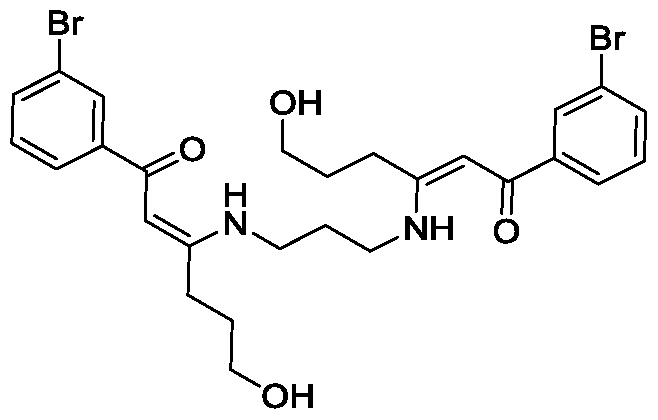
(2Z,2'Z)-3,3'-(propane-l,3-diylbis(azanediyl))bis(l-(3-bromophenyl)-6-hydroxyhex-2-en- 1-one) (lh).
61% as an off white solid; Rf= 0.42 (MeOH/CHCl3, 10:90, v/v); mp 63-64 °C; IR(KBr) vmax = 3467, 1584 cm VH NMR (CDC13, 300 MHz) δ = 1.84 (brs, 6H, 3 x CH2), 2.10 (brs, 2H, 2 x OH), 2.52-2.57 (m, 4H, 2 x CH2), 3.65 (s, 4H, 2 x CH2), 3.67 (s, 4H, 2 x CH2), 5.70 (s, 2H, 2 x CH), 7.31 (d, 2H, J= 7.9 Hz, ArH), 7.57 (d, 2H, J= 7.4 Hz, ArH), 7.77 (d, 2H, J = 7.5 Hz, ArH), 7.96 (s, 2H, ArH), 11.62 (brs, 2H, 2 x NH);13C NMR (CDC13, 100 MHz) δ = 29.1, 29.5, 31.6, 39.7, 61.4, 91.8, 122.7, 125.6, 130.1, 133.7, 142.3, 170.5, 186.4; ESI-MS m/z= 607.3 [M+H]+; ESI-HR-MS m/z= 607.0802, calcd. for C27H32Br2N204 [M+H]+ 607.0807.
Example 1.6.

(2Z,2'Z)-3,3'-(butane-l,4-diylbis(azanediyl))bis(l-(3-bromophenyl)-6-hydroxyhex-2-en-l- one) (li).
66% as an off white solid; Rf= 0.41 (MeOH/CHCl3, 10:90, v/v); mp 69-70 °C; IR(KBr) vmax = 3471, 1580 cm"VH NMR (CDC13, 300 MHz) δ = 1.82-1.88 (m, 8H, 4 x CH2), 2.46-2.51 (m, 4H, , 2 x CH2), 2.63 (brs, 2H, 2 x OH), 3.46 (d, 4H, J = 4.1 Hz, 2 x CH2), 3.68-3.72 (m,4H, 2 x CH2), 5.62 (s, 2H, 2 x CH), 7.24-7.29 (m,2H, ArH), 7.53 (d, 2H, J = 7.8 Hz, ArH), 7.74 (d, 2H,
J= 7.7 ΗΖ,ΑΓΗ), 7.94 (s, 2H, ArH). 11.64 (brs, 2H, 2 x NH); 1JC NMR (CDC13, 100 MHz) δ = 27.6, 28.7, 31.3, 42.7, 61.5, 91.3, 122.7, 125.5, 130.0, 130.1, 133.5, 142.5, 186.0; ESI-MS m/z 621.3 [M+H]+; ESI-HR-MS m/z = 621.0968, calcd. for C28H34Br2N204 [M+H]+ 624.0964.
Example 1.7.

(2Z,2'Z)-3,3'-(ethane-l,2-diylbis(azanediyl))bis(l-(9H-fluoren-2-yl)-6-hydro xyhex-2-en- 1-one) (lj).
(2Z,2'Z)-3 ,3 '-(Ethane- 1 ,2-diylbis(azanediyl))bis( 1 -(9H-fluoren-2-yl)-6-hydroxyhex-2-en- 1 - one) (lj). 16% as an off white solid; Rf= 0.51 (MeOH/CHCl3, 10:90, v/v); mp 82-84 °C; IR (KBr)vmax = 3452, 1586 cm 1; ¾ NMR (CDC13, 300 MHz) δ= 1.94 (brs, 2H, CH2), 2.50-2.55 (m, 4H, 2 x CH2), 2.97-3.01 (m, 4H, 2 x CH2), 3.46-3.52 (m, 4H, 2 x CH2), 3.71-3.75 (m, 4H, CH2 and 2 x OH), 3.93 (s, 4H, 2 x CH2), 5.81 (s, 2H, 2 x CH), 7.30-7.41 (m, 4H, ArH), 7.56 (d, J = 7.3 Hz, 2H, ArH), 7.77-7.82 (m, 4H, ArH), 7.91 (d, J = 7.8 Hz, 2H, ArH), 8.06 (s, 2H, ArH), 11.70 (brs, 2H, 2 x NH); 13C NMR (CDC13, 100 MHz) δ = 28.4, 31.3, 36.6, 43.0, 60.2, 91.0, 119.8, 120.7, 123.6, 125.4, 126.0, 127.1, 127.5, 128.9, 140.6, 143.2, 143.5, 144.1, 169.1, 186.4; ESI-MS m/z = 613.2 [M+H]+; ESI-HR-MS m/z = 613.3059, calcd. for C4oH4oN204 [M+H]+ 613.3066.
Example 1.8.

(2Z,2'Z)-3,3'-(propane-l,3-diylbis(azanediyl))bis(l-(9H-fluoren-2-yl)-6-hydroxyhi 1-one) (lk).
11% as an off white solid; Rf= 0.50 (MeOH/CHCl3, 10:90, v/v); mp 76-78°C; IR(KBr) vmax = 3411, 1592 cm 1; ¾ NMR (CDC13, 400 MHz) δ = 1.80 (brs, 4H, 2 x CH2), 2.45 (m, 2H, CH2), 3.40-3.44 (m, 4H, 2 x CH2), 3.63-3.66 (m, 4H, 2 x CH2), 3.85-3.92 (m, 4H, 2 x CH2), 3.89 (s, 4H, 2 x CH2), 5.75 (s, 2H, 2 x CH), 7.24-7.35 (m,4H, ArH), 7.48-7.50 (d, J= 7.3 Hz, 2H, ArH), 7.70-7.76 (m, 4H, ArH), 7.78-7.82 (d, J = 7.8 Hz, 2H, ArH), 8.04 (s, 2H, ArH), 11.61 (brs, 2H, 2 x NH); 13C NMR (CDC13, 100 MHz) δ 27.8, 31.4, 37.0, 42.6, 61.6, 91.4, 95.4, 119.5, 120.4, 123.6, 125.1,, 126.0, 126.9, 127.3, 137.4, 138.4, 139.0, 139.5, 141.1, 143.1, 144.1, 168.9, 188.0; ESI-MS m/z 627.0 [M+H]+; ESI-HR-MS m/z 627.3219, calcd. for C4iH42N204 [M+H]+ 627.3223.
Example 1.9.

(2Z,2'Z)-3,3'-(butane-l,4-diylbis(azanediyl))bis(l-(9H-fluoren-2-yl)-6-hydroxyhex-2-en-l- one) (11).
8% as an off white solid; Rf= 0.49 (MeOH/CHCl3, 10:90, v/v); mp 74-76°C; IR(KBr) vmax = 3426, 1522cm 1; ¾ NMR (CDC13, 400 MHz) δ = 1.80 (brs, 4H, 2 xCH2), 2.10 (m, 4H, 2 x CH2), 2.47-2.51 (m, 4H, 2 x CH2), 3.56-3.68 (m, 8H, 4 x CH2), 3.87 (s, 4H, 2 x CH2), 5.76 (s, 2H, 2 x CH), 7.26-7.32 (m, 4H, ArH), 7.48-7.50 (d, J= 7.3 Hz, 2H, ArH), 7.72-7.75 (m, 4H, ArH), 7.82 (d, J = 7.8 Hz, 2H, ArH), 7.97 (s, 2H, ArH), 11.53 (brs, 2H, 2 x NH); 13C NMR (CDC13, 100 MHz) δ = 29.1, 31.7, 37.0, 61.4, 91.9, 119.6, 120.5, 123.6, 125.2, 126.0, 126.9, 127.4, 138.6, 141. 0, 143.2, 144.2, 144.3, 169.7, 188.3; ESI-MS m z 641.0 [M+H]+; ESI-HR- MS m/z 641.3385, calcd. for C42H44N204 [M+H]+ 641.3379.
Example 2:
Process of preparation of nanoparticles of compound lc entrapped to 0-(alkyl)n dextran for efficient drug delivery and consisting of the steps of
1. Synthesizing the 0-(alkyl)n -dextran by attaching butyl chain to the dextran.
2. Entrapping our model drug compound lc in synthesized O-butyl-dextran formulating nanoparticles.
3. Characterizing the formulated nanoparticles for particle size and zeta potential.
4. Estimating the entrapment efficiency and in- vitro release of Compound lc from nanoparticles.
5. Coating of lc-nanoparticles with polymer, Eugrate.
[042] Example 2.1.Chemical synthesis of O-alkyldextran herein prepared herein O- butyl-dextran
O-alkyldextrans were prepared using a novel method. The synthesis of O-alkyldex trans was achieved in high yields using phase transfer catalysis. Briefly, to synthesize O-butyl-dextran, 5g dextran was takenup in a 20% solution of sodium hydroxide (20mL)containing a catalytic amount of aliquat 336 (0.5g). The reaction mixture was heated upto 65°C and n-bromobutane (60nmol) in THF(5mL) was added dropwise. The reaction mixture was then allowed to stir 3h at 60°C and then concentrated on a rotavapor. The residual mass was taken up in diethylether and filtered the solid on a sintered funnel. The solid was washed with diethylether (2X50mL) and then it was dissolved in deionized water(20mL).It was poured in a dialysis bag (MWCO 12kD) and subjected to dialysis for 24hr followed by lyophilization to obtain solid dry product in 65-82% yield.
[043] Example 2.2.Encapsulation of Compoundlc to O-butyl dextran
Method for encapsulation of Compound lc is developed for the first time. To fabricate Compound lc loaded functionalized dextran nanoparticles, 50mg Compoundlc and 150mg of O-butyl -dextran were taken up in 4mL DMSO and stirred the suspension for 30 min. at the temperature 35°C. To the vigorously stirred solution, water (lOmL) was added drop wise. The suspension was allowed to stir for 12h at 35°C and then subjected to dialysis for 4h at temperature 35°C to remove un-entrapped Compound lc. It was then freeze dried to obtain solid dry compoundlc loaded nanoparticles.
Results: Compound lc-DextranC4 NPs prepared had an electric charge of _-4.5 ± 1.32 mV and a size of 200 ± 10.84nm. The entrapment efficiency was 40% and was observed to be the most stable formulation.
[044] Example 2.3.Characterization of Nanoparticles
Size and zeta potential measurements
The mean particle size and zeta potential of the nanoparticles were analyzed by laser light diffraction using a ZetasizerNano-ZS (Malvern Instruments, U.K). A known amount of nanoparticles were suspended in water (lmg/mL) and the mean particles size and charge on the nanoparticles were measured employing the following settings on the instrument: a nominal 5mW He-Ne laser operating at 633nm wavelength; 14 measurements per sample; refractive index of water, 1.33; viscosity for water, 0.89 cP. All measurements were carried out at 25°C. Zeta potential measurements were carried out on the same instrument in triplicates in automatic mode and the values are presented as the average value of 30 runs. The Smoluchowski approximation was used to calculate zeta potential from the electrophoretic mobility (Swami, A., Aggarwal, A., Pathak, A., Patnaik, S., Kumar, P., Singh, Y., et al., 2007, Imidazolyl-PEI modified nanoparticles for enhanced gene delivery. Int. J. Pharm.; 335: 180- 192).
Results: Compound lc-DextranC4 NPs prepared had an electric charge of _-4.5 ± 1.32 mV.
[045] Example 2.4.Encapsulation Efficiency
The encapsulation efficiency of the model drug was determined by spectrophotometric estimation using Lambda Bio 20 UV/VIS Spectrophotometer (Perkin Elmer, USA). Briefly, accurately weighed drug loaded nanoparticles 10 mg) were suspended in water (ImL) and after lOmin, the suspension was centrifuged at 13000rpm for 15min. The supernatant was removed, pellet was dried and dissolved in chloroform (ImL) and measured the absorbance of the solution at 360 nm. The amount of drug (mg) was calculated from the standard curve drawn between the varied amounts of drug (mg) and absorbance (O.D.). From the following equation, the encapsulation efficiency (EE) was determined. All the measurements were conducted in triplicate.
Weight of drug in nanoparticles x 100
EE % —
Weight of drug used for nanoparticles preparation
Results: The entrapment efficiency of prepared Compound lc-DextranC4 NPs was 40%
Tablel: Characteristics of Compound lc-DextranC4 Nanoparticles

[046] Example 2.5: In vitro drug release study
Compound lc loaded O -butyl -dextr an nanoparticles were evaluated for their in vitro release kinetics by dialysis method, as reported previously (Asadishad, B., Vossoughi, M., Alamzadeh, I., 2010, In vitro drug release behaviour and cytotoxicity of doxorubicin-loaded gold nanoparticles in cancerous cells. Biotechnology Letters; 32:649-654). Briefly, lOmg NPs were suspended in 2mL phosphate buffer (PBS), transferred the solution to a dialysis bag (12kDa) and allowed to dialyze against 20mL of same buffer at 37°C±0.5°C with stirring at 50rpm in an incubator shaker (HeidolphUnimax 1010, Germany). At predetermined time- intervals, an aliquot (lmL) of the sample was withdrawn and its absorbance was measured at 360nm using Lambda Bio 20 UV/VIS Spectrophotometer (Perkin Elmer, USA) and added the same amount of fresh medium to the dialysis container. The amount of the released drug was then calculated using a previously prepared standard curve of the pure drug. The drug was slowly and consistently released (Figure 2.). More than 80% drug was released in 48 hours.
[047] Example 2.6: Preparation of Eudragit coated O-butyl-Dextran-Compound lc nanoparticles
0.5 g Compound lc was dissolved in 15mL DMSO. To this, 1.5 g of O-butyl-dextran dissolved in 40mL water was added. The reaction was stirred for 2-3hr. Subsequently, the solution was added to 50mL of 1% PVA solution having 0.04% Eudragit dissolved in it. Eudragit polymer is the anionic acrylic polymer with methacrylic acid and ethyl acrylic acid as the functional groups, and is resistant towards acidic pH, thus providing stability to the orally delivered biomolecules. Therefore, it was selected for providing the stable enteric coating to the NPs. The reaction mixture was allowed to stir for 12 hr at room temperature ranging from 35°C, followed by dialysis for 4hr. It was then freeze dried to obtain solid dry compound lc loaded nanoparticles with coating of eudragit.
[048] Example 3: In vitro antileishmanial activity assay
[049] Example 3.1: Antipromastigote assay:
Parasite: The Leishmania donovani promastigotes (MHOM/IN/Dd8/80), originally obtained from Imperial college, London, transfected with fire fly luciferase gene as described earlier (Ashutosh, Gupta,S., Ramesh, Sundar, S. and Goyal,N. Use of Leishmania donovani field isolates expressing the luciferase reporter gene in in vitro drug screening. Antimicrob. Agents Chemother. 2005, 49, 3776-3783) are being maintained in medium 199 (Sigma) supplemented with 10% foetal calf serum (Gibco) and gentamycin (40μg/mL) solution (Sigma). Exponentially growing transgenic promastigotes (1 X

were seeded in 96-well flat bottom tissue culture plates (Cellstar) and allowed to grow for 72 h at 24 °C, in presence of l-100μg/mL of test compounds (stock prepared in 100% DMSO, initial concentration, lmg/ml followed by dilution in media) in duplicate for each concentration. After 72h of incubation, 50 μΐ of the parasite suspension was transferred in black 96 well plate (Nunc) followed by addition of 50 μΐ Steady Glo reagent (Promega), incubated for 1 min with mild shaking, and read on luminometer (Berthhold). The inhibition of parasite growth was determined by comparison of the luciferase activity of drug-treated parasites with that of untreated control parasites by the following formula- Percentage Inhibition (PI) = N-n x 100
N
Where, N is average relative luminescence unit (RLU) of control wells and n is average RLU of treated wells. The experiment was repeated two times and test compounds which showed PI > 80 - 90% at 25μg/mL concentration wereselected for further evaluation against the amastigote stage of parasite.
Results: Compounds belonging to General formula 1 showed in vitro antileishmanial activity with IC50 against promastigotes in the range of 1-27 μg/mL. Compound lh,li andlj exhibited minimum IC50 against promastigotes (1-2 μg/mL) while compound lc and le exhibited maximum IC50 against promastigotes in range of 20-27 μg/mL. Compounds lk and 11 did not show any anti leishmanial activity (Table2).
[050] Example 3.2: Anti-amastigote assay:
Parasite:
The WHO reference strain of L. donovani (MHOM/IN/80/Dd8) was obtained from Imperial College, London (UK), and being maintained in this laboratory as promastigotes in vitro and as amastigotes in golden hamsters. Promastigotes of L. donovani were cultivated in medium 199 (Sigma-Aldrich) supplemented with 0.1% gentamycin (Biovaccines Private Ltd., Chevella, Andhra Pradesh, India) and 10% Fetal Calf Serum
[051] Procedure:
Macrophage cells (J744) were harvested from exponentially growing culture. The cells were diluted to lX106/mL in RPMI medium plus 10% FCS (Sigma, USA) and layered in 16 well chamber slides (Nunc) under a final volume of 100 μΐ/ well and allowed to adhere for 24hrs at 37°C in a 5% C02-95% air mixture. Adherent macrophages were infected with stationary phase promastigotes at ratio 1: 10 for 24 hours at 37°C in a 5% C02-95% air mixture. After incubation, non-phagocytozed parasites were removed by washing and infected cultures were incubated further at 37°C in a 5% CC>2-95% air mixture in presence of antileishmanial compound(s) for three days. The test compounds, prepared in DMSO and then diluted in complete RPMI medium, were added at two fold dilutions up to 7 points in complete medium starting from 100μg/mL concentrations after replacing the previous medium. Finally slides were fixed with 100% methanol and stained with 20% Giemsa stain for 45 minutes on day 6 (Seifert K. and Croft, S.L. 2006, In vitro and in vivo interactions between Sodium stibogluconate, miltefosine and other antileishmanial drug. Antimicrobial Agents Chemotherapy; 50: 73-79). The number of amastigotes per 500 cell nuclei was counted in each well and the parasitic burden was expressed in terms of the number of amastigote per 100 cell nuclei. Drug activity (percent inhibition) was determined by comparing amastigotes count of treated and untreated wells by the general formula:
Percent Inhibition = N-n x 100
N
Where, N is average number of amastigotes per 100 cell nuclei of untreated well and n is average number of amastigotes per 100 cell nuclei of treated well.
Results: All compounds exhibited antileishmanial activity in amastigote- macrophage assay. Compound le, lg, li and lj showed minimum IC50 value ((3-7 μg/ml) while Id showed maximum IC50 value against amastigotes.
[052] Example 3.3: Cytotoxicity assay:
The macrophage cell viability was determined using the MTT assay (Mosmann, T. J., 1983, Immunol. Methods; 65 : 55-63). Exponentially growing cells (J774) (1 xl05cells/lC l/well) were incubated with test compounds for 72 hours. The test compounds are added at three fold dilutions up to 7 points in complete medium starting from 20C^g/mL concentrations, and were incubated at 37°C in a humidified mixture of C02 and 95 % air in an incubator. Podophyllotoxm was used as a reference drug, and control wells containing dimethyl sulfoxide (DMSO) without compounds were also included in the experiment. Stock solutions of compounds were initially dissolved in DMSO and further diluted with fresh complete medium. After incubation, 25 μΐ of MTT reagent (5mg/mL) in PBS medium, followed by syringe filtration was added to each well and incubated at 37 °C for 2 hours. At the end of the incubation period, the supernatant were removed by inverting the plate completely without disturbing cell layer and 150 μΐ of pure DMSO are added to each well. After 15 min. of shaking the readings were recorded as absorbance at 544 nm on a micro plate reader. The cytotoxic effect were expressed as 50% lethal dose (i.e., as the concentration of a compound which provoked a 50% reduction in cell viability compared to cell in culture medium alone). CC50 values were estimated as described by Huber, W., Koella, J.C. 1993, Acta Trop.; 55: 257-261). The selectivity index (SI) for each compound was calculated as the ratio between, cytotoxicity (CC50) and activity (IC50) against Leishmania amastigotes.
Results: Compounds lb, le, lh-j have shown SI index >6. Compounds la, If, and lg exhibited SI index less than 3.5- 4.5, while compound lc showed SI index, 2.7.
[053] Example 4: In Vivo Antileishmanial activity in Hamster model:
The modified method of Bhatnagar et al., 1989 (Bhatnagar, S., Guru, P. Y.; Katiyar, J. C. Srivastava, R., Mukherjee, A., Akhtar, M. S., 1989, Indian J. Med. Res. 89: 439-443) was used for in-vivo screening. Golden hamsters (Inbred strain) of either sex weighing 40-45g were infected intra-cardialy with lx 107amastigotes per animal. Pre -treatment spleen biopsy in all the animals was carried out to assess the degree of infection on day 20 of infection. The animals with +1 infection (5-15 amastigotes / 100 spleen cell nuclei) were included in the chemotherapeutic trials. The infected animals were randomized into several groups on the basis of their parasitic burdens, six animals were used for each test sample. Drug treatment by intraperitoneal (i.p.) route and oral route was initiated after 2 days of biopsy and continued for 5 consecutive days. Post-treatment biopsies were done on day 7th and 28th day of the last drug
administration and amastigote counts are assessed by Giemsa staining. Intensity of infection in both, treated and untreated animals, as also the initial count in treated animals was compared and the efficacy was expressed in terms of percentage inhibition (PI) using the following formula: -
PI = 100- [ANAT x 100/ (INAT x TIUC)]
Where PI is Percent Inhibition of amastigotes multiplication, ANAT is Actual Number of Amastigotes in treated animals, INAT is Initial Number of Amastigotes in Treated animals and TIUC is Times Increase of parasites in Untreated Control animals.
For the in vivo evaluation, aqueous solution of the test compounds was prepared by suspending the accurately weighed sample in a standard suspension vehicle of 10 % Tween-80/Ethanol (70:30) in ddH20. The final volume contains 10% of the vehicle for inoculation by the intraperitoneal route.
Results: By ip route, out of 12 compounds, lc, li andlj exhibited significant parasite inhibition in the range of 80-90% on day 7th of treatment. Interestingly this antileishmanial activity was maintained on day 28th also. The activity was comparable to standard reference drug (Sodium Stibogluconate (SSG). Rest compounds exhibited moderate activity in the range of 55-65% inhibition (Table 2).
All three compounds lc, li and lj were evaluated for their bio-efficacy by oral route. All compounds exhibited significant in vivo antileishmanial activity by oral route also. Compound lc showed 87% parasite inhibition on day 7th which was maintained up to day 28th in range of more than 75% (Table 3). Other two compounds exhibited very significant antileishmanial activity by oral route on day 7th (Table 4) in the range of 90% but the activity was reduced to less than 70% on day 28th. Therefore compound lc was selected for development of formulation.
The two nanoformulations of compound lc were developed. Formulationl, lc-dextranC4 nanoparticles exhibited significantly enhanced (five folds) therapeutic efficiency as compared to bulk drug by ip route. This formulation exhibited more than 84% parasite inhibition at one fifth ip dose i.e. lOmg/kg on both day7th and day 28th of treatment.. The dose, is half of standard drug the dose, sodium stibogluconate (SSG), still showing same range of parasite inhibition (Table3). Thus, the compound lc- dextranC4 nanoparticles has better therapeutic potential as compared stanadard drug SSG.
Formulatiori2 lc-dextranC4 eutragit coated nanoparticles also exhibited dose benefit of two fold hence enhanced therapeutic efficiency as compared to bulk drug. At 50mg/kg dose, the formulation exhibited 80% parasite inhibition, comparable to therapeutic efficacy of lOOmg/kg dose of bulk drug. The activity was maintained up to 28th day of treatment. The activity was also comparable to meltifosine, the only oral antileishmanial drug available.
Table 2: Screening results of antileshmanial compounds, l(a-l)
IC50(ng/mL) In vivo evaluation at
50mg kgX5, ip dose
Compound code
SI % inhibition
Promastigote Amastigote
index 7th day 28th day la 16.02 16.29 4.0 68.66±11.54 61.5+6.16 lb 12.44 8.41 6.2 66.5±4.94 39±8.48 lc 21.77 14.29 2.7 80±6.0 83.4±6.42
Id 17.61 24.59 1.38 55±3.61 ND
le 27.18 6.69 6.0 ND ND
If 13.84 11.86 3.9 ND ND
lg* 6.8 3.43 4.37 58.5±8.66 69 ±10.39 lh 1.57 8.84 7.26 73.0±8.87 58.0±4.35 li 1.43 5.16 12.10 87.53±3.79 80.6±4.03 ij 1.03 6.36 12.12 89.6±3.86 84.3±3.67 lk >100 ND ND ND ND
11 >100 ND ND ND ND
SSG* 4.06 81.37±5.49 85.37±9.37
*- compounds were tested at 25mg Kg ip X 5 days; SSG = Sodium stibogluconate - (20mg/kg x 5days, i.p.)
Table3. In vivo efficacy of Compound lc and its nanoparticle formulations both by IP and Oral route.

*SSG: Sodium Stibogluconate
Table 4. Comparison of In vivo efficacy of Compounds, li and lj both by IP and Oral routes.

*SSG: Sodium Stibogluconate
Example 5: Effect of identified compounds on target enzymes; Leishmanial dipeptidylcarboxypeptidase (LdDCP) and mammalian angiotencin converting enzyme (ACE)
Recombinant leishmanial DCP was expressed in E. coli BL 21 pLysS (DE3) and purified to homogeneity as described earlier (Goyal N., Duncan R., Selvapandiyan, A., Debrabant, A., Baig, M.S., Nakhasi H.L.2006, Cloning and characterization of angiotensin converting enzyme related dipeptidylcarboxypeptidase from Leishmaniadonovani.
Mol.Biochem.Parasitol.;145: 147-157). Enzyme activity was measured according to the method of Cushman and Cheung, using N-benzoyl-L-glycyl-L-histidyl-L-leucine (HHL), a routine substrate used for ACE (Cushman D.W., Cheung H.S., 1971, Spectrophotometric assay and properties of the angiotensin-converting enzyme of rabbit lung. BiochemPharmacol; 20: 1637-1648). Activity of LdDCP was carried out spectrophotometrically, which is based on the direct measurement of released hippuric acid from HHL, which absorbs at 228 nm. Inhibitory activity of all selected compounds against LdDCP activity was measured at 1 μΜ concentrations. To determine Ki value of compounds, different concentrations of inhibitors were incubated with the enzymes (LdDCP and ACE) for 5 min prior to the addition of the substrate (three separate experiments). Rat serum was taken as source of mammalian ACE. Protein concentration was determined by Bradford method using bovine serum albumin as standard (Bradford M.M. 1976, A rapid and sensitive method for the quantitation of microgram quantities of protein utilizing the principle of protein-dye binding. Anal Biochem; 72:248-254).
Results: Four compounds lc,lh,li and lj inhibited specifically leishmanial LdDCP with Ki values in the range of 25-28nM while same compounds inhibited mammalian ACE at thousand times higher concentration that is in uM range(Table 5). The data clearly suggest that the identified compounds lc,lh,li,and lj are the specific inhibitor of leishmanial DCP.
Table 5: Effect of identified compounds on Leishmanialdipeptidylcarbox peptidase and mammalian ACE
Compound ¾ value
DCP (μΜ) ACE (μΜ)
lc 0.025±5 147.6±6.2
lh 0.025±7.07 7±1.4
li 0.0233±2.8 15.1+1.4
lj 0.02835±7 39±6.3
Captopril 0.035.8 0.0143
*captopril is known inhibitor of ACE. The data in table is reported value for human testicular ACE (Deddish PA, Wang LX, Jackman HL, Michel B, Wang J, Skidgel, RA, Erdo' s EG (1996) J PharmacolExpTher 279:1582
[054]AD VANTAGES OF THE PRESENT INVENTION
1. The compounds described herein are readily synthesized using cheap starting materials via only three step process.
2. The formulations described herein are readily prepared using cheap starting materials.
3. The compounds of general formula 1 display potential antileishmanial activity via oral and intraperitoneal administration.
4. The compounds of general formula 1 are specific inhibitor of leishmanial target enzyme dipeptidylcarboxypeptidase (ldDCP) and has no effect on mammalian counterpart angiotensin converting enzyme (ACE) at nM concentration.
5. The bio-efficacy of the nano formulations of compound of general formula 1 is increased by more than 5-fold as compared to bulk compound under in vivo conditions via intraperitoneal route of administration.
6. Bio-efficacy of nanoformulation of compound of general formula lcoated with Edragit is increased by two fold under in vivo condition via Oral route of administration as
compared to bulk compound. Eudragit polymer is the anionic acrylic polymer that provided stability to the orally delivered biomolecules towards acidic pH, thus enhanced two fold bioefficacy of compound by oral administration as compared to bulk compound.
Claims
1. A novel controlled release antileishmanial formulation comprising a compound of

Compound 1 wherein R is selected from
 or
wherein X is selected from a group consisting of CI, Br and F; n is the number of methylene groups (n = 1, 2 and 3); encapsulated in alkyldextran.
2. A formulation as claimed in claim 1, wherein the formulation comprising a compound selected from a group consisting of :
i. (2Z2Z -33'-(Ethane-l,2-diylbis(azanediyl))bis(l-(4-fluorophenyl)-6-hydroxyhex-2-en- 1-one) (la)
ii. (2Z2Z -33'-(Ethane-l,2-diylbis(azanediyl))bis(l-(4-chlorophenyl)-6-hydroxyhex-2-en- 1-one) (lb)
iii. (2Z2Z)-33'-(Ethane-l,2-diylbis(azanediyl))bis(l-(4-bromophenyl)-6-hydro xyhex-2-en- 1-one) (lc)
iv. (2Z2Z)-33'-(ethane- 1 ,2-diylbis(azanediyl))bis( 1 -(2-bromophenyl)-6-hydroxyhex-2-en- 1-one) (Id)
v. (2Z2Z)-33'-(propane-l,3-diylbis(azanediyl))bis(l-(2-bromophenyl)-6-hydroxyhex-2-en- 1-one) (le)
vi. (2Z2Z)-33'-(butane-l,4-diylbis(azanediyl))bis(l-(2-bromophenyl)-6-hydroxyhex-2-en- 1-one) (If)
vii. (2Z2Z)-33'-(ethane- 1 , 2-diylbis(azanediyl))bis( 1 -(3 -bromophenyl)-6-hydroxyhex-2-en- 1-one) (lg).
viii. (2Z2Z)-33'-(propane- 1 ,3 -diylbis(azanediyl))bis( 1 -(3 -bromophenyl)-6-hydroxyhex-2-en-l- one)(lh).
ix. (2Z2¾-33'^utane-l,4-diylbis(azanediyl))bis(l-(3-bromophenyl)-6-hydroxyhex-2-en- 1-one) (li).
x. (2Z2Z)-33'-(emane-l,2-diylbis(azanediyl))bis(l-(9H-fluoren-2-yl)-6-hydro xyhex-2-en- 1-one) (lj).
xi. (2Z2Z)-33'-(propane- 1 ,3 -diylbis(azanediyl))bis( 1 -(9H-fluoren-2-yl)-6-hydroxyhex-2-en- l-one)(lk).
xii. (2Z2¾-33'-(butane-l,4-diylbis(azanediyl))bis(l-(9H-fluoreri-2-yl)-6-hydroxyhex-2-eri- 1-one) (11).
3. A formulation as claimed in claim 1, wherein the alkyldextran is selected from a group consisting of O-butyldextran, O-hexyldextran, O-octyldextran, O-dodecyldextran, O- hexadecyldextran.
4. A formulation as claimed in claim 1, wherein the O-alkyl-dextran is optionally coated with Eudraigt, cellulose acetate succinate, hydroxy propyl methyl cellulose phthalate, hydroxy propyl methyl cellulose acetate succinate, polyvinyl acetate phthalate, cellulose acetate trimellitate, sodium alginate.
5. A formulation as claimed in claim 1, wherein about 80% drug from the formulation is released in about 48 hours.
6. A formulation as claimed in Claim 1 the formulation has in vivo antileishmanial activity via intraperitoneal route at dose 2.5-50mg/Kg in hamster model and has five times enhanced bioefficacy as compared to bulk drug.
7. A formulation as claimed in Claim 1, wherein the formulation has in vivo antileishmanial activity via oral route at dose 25-100mg/Kg in hamster model and has two times enhanced bioefficacy as compared to bulk drug.
8. A process for preparation of formulation as claimed in claiml, wherein the process comprising the steps:
a. preparing a suspension of the compound of general formula 1 with O- alkyldextran in a solvent selected from a group consisting of DMSO, and DMF with vigorously stirring followed by dropwise addition of water and stirring for a period ranging between 30min to 40min at a temperature ranging between 30 C to 35 C,
b. optionally adding a solution of polymer and co-polymer to the suspension obtained in step (a) and further stirring for a period of 3hr to 5hr at a temperature ranging between 30°C to 35°C ,
c. dialyzing the suspension obtained in step (a) or (b) for a period of 2 to 4 days, followed by the freeze drying to obtain solid dried nanoparticle.
9. The process as claimed in claim 8, wherein the polymer is selected from the group consisting of PVA, PEG, and BSA.
10. The process as claimed in claim 8, wherein the co-polymer is selected from the group consisting of Eudragit, cellulose acetate succinate, hydroxy propyl methyl cellulose phthalate, hydroxy propyl methyl cellulose acetate succinate, polyvinyl acetate phthalate, cellulose acetate trimellitate, and sodium alginate.
11. The process as claimed in claim 8, wherein the size of nanoparticle is found in the range of 190-210 nm.
12. The process as claimed in claim 8, wherein the O-alkyldextran is prepared by the process comprising steps:
i. treating the dextran with % solution of sodium hydroxide ranging between 10- 40% in the presence of catalyst selected from the group consisting of aliquat, tetrabutylammonium bromide, tetrabutyl ammonium hydrogen sulfate, and tetramethyl ammonium chloride followed by heating in the range of 50-80°C to obtain a solution,
ii. adding n-bromoalkane in THF in the step (I) solution dropwise with stirring at the temperature ranging between 50-80 °C for the time in the range of 3-6 hr, followed by concentrating the reaction mixture on rotavapor to obtain a residual mass,
iii. dissolving the residual mass of step (ii) in diethylether followed by the filtration and washing with diethyl ether to obtain a solid,
iv. dissolving the solid of step (iii) in deionized water followed by dialysis and lyophilization for the time in the range of 12-24hr at the temperature ranging between 30-35°C to obtain solid dry product.
13. The process as claimed in claim 12, wherein the n-bromoalkane is selected from the group consisting of 1-bromobutane, 1-bromohexane, 1-bromooctane, 1- bromododecane, and 1-bromohexadecane.
14. The process as claimed in claim 12, wherein the solvent is selected from the group consisting of THF, dioxane, and n-butanol,
15. A compound of formula 1,

Compound 1 wherein R is selected from
 or
wherein X is selected preferably from halogens (CI, Br and F) and 'n' is the number of methylene groups (n = 1, 2 and 3); wherein the novel compound comprising:
i. (2Z2Z)-33'-(ethane- 1 ,2-diylbis(azanediyl))bis( 1 -(2-bromophenyl)-6- hydroxyhex-2-en-l-one) (Id)
ii. (2Z2Z)-33'-(propane-l,3-diylbis(azanediyl))bis(l-(2-bromophenyl)-6- hydroxyhex-2-en-l-one) (le)
iii. (2Z2Z)-33'-(butane-l,4-diylbis(azanediyl))bis(l-(2-bromophenyl)-6- hydroxyhex-2-en-l-one) (If)
iv. (2Z2Z)-33'-(ethane- 1 , 2-diylbis(azanediyl))bis( 1 -(3-bromophenyl)-6- hydroxyhex-2-en-l-one) (lg).
v. (2Z2Z)-33'-(propane- 1 ,3 -diylbis(azanediyl))bis( 1 -(3 -bromophenyl)-6- hydroxyhex-2-en-l-one) (lh).
vi. (2Z2Z)-33'-(butane-l,4-diylbis(azanediyl))bis(l-(3-bromophenyl)-6- hydroxyhex-2-en-l-one) (li).
vii. (2Z2Z)-33'-(ethane-l,2-diylbis(azanediyl))bis(l-(9H-fluoren-2-yl)-6-hydro xyhex-2-en-l-one) (lj).
viii. (2Z2Z)-33'-(propane-l,3-diylbis(azanediyl))bis(l-(9H-fluoren-2-yl)-6- hydroxyhex-2-en-l-one) (lk).
ix. (2Z2Z)-33'-(butane-l,4-diylbis(azanediyl))bis(l-(9H-fluoren-2-yl)-6- hydroxyhex-2-en-l-one) (11).
A compound as claimed in claim 15, wherein Compounds of formula 1 are the specific inhibitor of parasite target enzyme dipeptidylcarboxy peptidase with no effect on mammalian counterpart angiotensin converting enzyme at nanomolar concentration.
Applications Claiming Priority (2)
| Application Number | Priority Date | Filing Date | Title |
|---|---|---|---|
| IN125/DEL/2015 | 2015-01-15 | ||
| IN125DE2015 | 2015-01-15 |
Publications (1)
| Publication Number | Publication Date |
|---|---|
| WO2016113763A1 true WO2016113763A1 (en) | 2016-07-21 |
Family
ID=55442844
Family Applications (1)
| Application Number | Title | Priority Date | Filing Date |
|---|---|---|---|
| PCT/IN2016/050019 Ceased WO2016113763A1 (en) | 2015-01-15 | 2016-01-15 | A novel antileishmanial formulation |
Country Status (1)
| Country | Link |
|---|---|
| WO (1) | WO2016113763A1 (en) |
-
2016
- 2016-01-15 WO PCT/IN2016/050019 patent/WO2016113763A1/en not_active Ceased
Non-Patent Citations (29)
| Title |
|---|
| ALICE MACHADO-SILVA ET AL: "New perspectives for leishmaniasis chemotherapy over current anti-leishmanial drugs: a patent landscape", EXPERT OPINION ON THERAPEUTIC PATENTS., vol. 25, no. 3, 20 December 2014 (2014-12-20), GB, pages 247 - 260, XP055264040, ISSN: 1354-3776, DOI: 10.1517/13543776.2014.993969 * |
| ALVAR J.; YACTAYO S.; BERN C.: "Leishmaniasis and poverty", TRENDS IN PARASITOL, vol. 22, 2006, pages 552 - 557 |
| ANTHONY D. DUONG ET AL: "Electrospray Encapsulation of Toll-Like Receptor Agonist Resiquimod in Polymer Microparticles for the Treatment of Visceral Leishmaniasis", MOLECULAR PHARMACEUTICS, vol. 10, no. 3, 4 March 2013 (2013-03-04), pages 1045 - 1055, XP055181864, ISSN: 1543-8384, DOI: 10.1021/mp3005098 * |
| ASADISHAD, B.; VOSSOUGHI, M.; ALAMZADEH, 1.: "In vitro drug release behaviour and cytotoxicity of doxorubicin-loaded gold nanoparticles in cancerous cells", BIOTECHNOLOGY LETTERS, vol. 32, 2010, pages 649 - 654 |
| ASHUTOSH, GUPTA, .; RAMESH, SUNDAR, S.; GOYAL, N.: "Use of Leishmania donovani field isolates expressing the luciferase reporter gene in in vitro drug screening Antimicrob", AGENTS CHEMOTHER, vol. 49, 2005, pages 3776 - 3783 |
| ASHUTOSH, GUPTA,S.; RAMESH, SUNDAR, S.; GOYAL,N.: "Use of Leishmania donovani field isolates expressing the luciferase reporter gene in in vitro drug screening", ANTIMICROB. AGENTS CHEMOTHER, vol. 49, 2005, pages 3776 - 3783 |
| BAIG M.S.; KUMAR A.; SIDDIQI M.I.; GOYAL N.: "Characterization of dipeptidylcarboxypeptidase of Leishmaniadonovani: a molecular model for structure based design of antileishmanials", J COMPUT AIDED MOL DES, vol. 24, 2010, pages 77 - 87 |
| BARRETT, M. P.; CROFT, S. L.: "Management of tiypanosomiasis and leishmaniasis", BRITISH MEDICAL BULLETIN, vol. 104, 2012, pages 175 - 196 |
| BATRA, S.; BHADURI, A. P.; JOSHI, B. S.; ROY, R.; KHANNA, A. K.; CHANDER, R.: "Syntheses and biological evaluation of alkanediamines as antioxidant and hypolipidemic agents Bioorg", MED. CHEM., vol. 9, 2001, pages 3093 - 3099 |
| BATRA, S.; BHADURI, A. P.; JOSHI, B. S.; ROY, R.; KHANNA, A. K.; CHANDER, R.: "Syntheses and biological evaluation of alkanediamines as antioxidant and hypo-lipidemic agents", BIOORG. MED. CHEM., vol. 9, 2001, pages 3093 - 3099 |
| BATRA, S.; BHADURI, A. P.; JOSHI, B. S.; ROY, R.; KHANNA, A. K.; CHANDER, R.: "Syntheses and biological evaluation of alkanediamines as antioxidant and hypolipidemic agents", BIOORG. MED. CHEM., vol. 9, 2001, pages 3093 - 3099 |
| BHATNAGAR, S.; GURU, P. Y.; KATIYAR, J. C.; SRIVASTAVA, R.; MUKHERJEE, A.; AKHTAR, M. S., INDIAN J. MED. RES., vol. 89, 1989, pages 439 - 443 |
| BHATNAGAR, S.; GURU, P. Y.; KATIYAR, J. C; SRIVASTAVA, R.; MUKHERJEE, A.; AKHTAR, M. S., INDIAN J. MED. RES, vol. 89, 1989, pages 439 - 443 |
| BRADFORD M.M.: "A rapid and sensitive method for the quantitation of microgram quantities of protein utilizing the principle of protein-dye binding", ANAL BIOCHCM, vol. 72, 1976, pages 248 - 254 |
| COUVREUR, P.; VAUTHIER, C.: "Nanotechnology: intelligent design to treat complex disease", PHARM RES, vol. 23, 2006, pages 1417 - 50 |
| CROFT, S. L.; SUNDAR, S.; FAIRLAMB, A. H.: "Drug Resistance in Leishmaniasis", CLIN. MICROBIOL. REV., vol. 19, 2006, pages 111 |
| CUSHMAN D.W.; CHEUNG H.S.: "Speetrophotometric assay and properties of the angiotensin-converting enzyme of rabbit lung", BIOCHEMPHARMACOL, vol. 20, 1971, pages 1637 - 1648 |
| GANGWAR, S.; BAIG, M. S.; SHAH, P.; BISWAS, S.; BATRA, S.; SIDDIQI, M. I.; GOYAL,N.: "Identification of novel inhibitors of dipeptidylcarboxypeptidase of Leishmaniadonovani via ligand-based virtual screening and biological evaluation", CHEM. BIOL. DRUG DES., vol. 79, 2012, pages 149 - 156 |
| GOYAL N.; DUNCAN R.; SELVAPANDIYAN, A.; DEBRABANT, A.; BAIG, M.S.; NAKHASI H.L: "Cloning and characterization of angiotensin converting enzyme related dipeptidylcarboxypeptidase from Leishmaniadonovani", MOL.BIOCHEM.PARASITOL, vol. 145, 2006, pages 147 - 157 |
| GUERIN P. J.; OLLIARO P.; SUNDAR S.; BOELAERT M.; CROFT S. L.; DESJEUX P.; WASUNNA M. K.; BRYCESON A. D.: "Visceral Leishmaniasis: current status of control, iagnosis, and treatment, and a proposed research and development agenda", LANCET INFECT DIS, vol. 2, 2002, pages 494 - 501 |
| HUBER, W.; KOELLA, J.C., ACTA TROP, vol. 55, 1993, pages 257 - 261 |
| LIMA, S. C.; RODRIGUESA, V.; GARRIDOB, J.; BORGESB, F.; LIND, P.K. T.; DA SILVA, A.C.: "n vitro evaluation of bisnaphthalimidopropyl derivatives loaded into pegylated nanoparticles against Leishmania infantum protozoa Int", J. ANTIMICROB. AGENTS, vol. 39, 2012, pages 424 - 430 |
| MOSMANN, T. J., IMMUNOL. METHODS, vol. 65, 1983, pages 55 - 63 |
| MOSMANN, T. J., J.IMMUNOL. METHODS, vol. 65, 1983, pages 55 - 63 |
| NAHAR M.; JAIN, N. K.: "Preparation, Characterization and Evaluation of Targeting Potential of Amphotericin B-Loaded Engineered PI,GA Nanoparticles", PHARM. RESEARCH, vol. 26, 2009, pages 2588 - 2598 |
| SEIFERT K.; CROFT, S.L.: "In vitro and in vivo interactions between Sodium stibogluconate, miltefosine and other antileishmanial drug", ANTIMICROBIAL AGENTS CHEMOTHERAPY, vol. 50, 2006, pages 73 - 79 |
| SIJUMON KUNJACHAN ET AL: "Chitosan-based macrophage-mediated drug targeting for the treatment of experimental visceral leishmaniasis", JOURNAL OF MICROENCAPSULATION., vol. 28, no. 4, 17 May 2011 (2011-05-17), GB, pages 301 - 310, XP055264021, ISSN: 0265-2048, DOI: 10.3109/02652048.2011.559281 * |
| SOFIA COSTA LIMA ET AL: "In vitro evaluation of bisnaphthalimidopropyl derivatives loaded into pegylated nanoparticles against Leishmania infantum protozoa", INTERNATIONAL JOURNAL OF ANTIMICROBIAL AGENTS, vol. 39, no. 5, 1 May 2012 (2012-05-01), AMSTERDAM, NL, pages 424 - 430, XP055264011, ISSN: 0924-8579, DOI: 10.1016/j.ijantimicag.2012.01.003 * |
| SONALI GANGWAR ET AL: "Identification of Novel Inhibitors of Dipeptidylcarboxypeptidase of Leishmania donovani via Ligand-Based Virtual Screening and Biological Evaluation", CHEMICAL BIOLOGY & DRUG DESIGN., vol. 79, no. 2, 28 February 2012 (2012-02-28), GB, pages 149 - 156, XP055264013, ISSN: 1747-0277, DOI: 10.1111/j.1747-0285.2011.01262.x * |
Similar Documents
| Publication | Publication Date | Title |
|---|---|---|
| JP6973805B2 (en) | N-terminally functionalized amino acid derivative capable of forming drug-encapsulating microspheres | |
| US20200055815A1 (en) | Tunable nitric oxide-releasing macromolecules having multiple nitric oxide donor structures | |
| US8153617B2 (en) | Bridged polycyclic compound based compositions for coating oral surfaces in humans | |
| EP2125026B1 (en) | Bridged polycyclic compound based compositions for the inhibition and amelioration of disease | |
| DK2849791T3 (en) | CONJUGATE OF A PHOTOSENSITIZER AND CHITOSAN AND APPLICATIONS THEREOF | |
| US8153618B2 (en) | Bridged polycyclic compound based compositions for topical applications for pets | |
| CN114805113A (en) | Safe and efficient degradable lipid nanoparticle as well as preparation method and application thereof | |
| US20090054528A1 (en) | Bridged polycyclic compound based compositions for coating oral surfaces in pets | |
| US20090074833A1 (en) | Bridged polycyclic compound based compositions for controlling bone resorption | |
| US8603493B2 (en) | Carbosilane dendrimers, preparation method thereof and use of same | |
| ES2414291B2 (en) | MACROCYCLIC COMPOUNDS OF SCORPING TYPE AND ITS USE AS ANTIPARASITARIES. | |
| CN117820235A (en) | Fluorescent phenanthroimidazole-amine copolymer, preparation method and antibacterial application thereof | |
| CN116283939B (en) | An antifungal compound with light-responsive activity and its application | |
| ES2618367T3 (en) | N6- (ferrocenmethyl) quinazolin-2,4,6-triamine (H2), its derivatives and prodrugs, as antileishmania, antiprotozoal, antiparasitic and antimicrobial agents | |
| CN113474007A (en) | Conjugates | |
| AU2024200852A1 (en) | Near-infrared emitting porphyrin compound and preparation method and use thereof | |
| Escobedo et al. | Live cell imaging of a fluorescent gentamicin conjugate | |
| US11225507B2 (en) | Conformation switchable antimicrobial peptides and methods of using the same | |
| RU2794763C1 (en) | 1-hydroxy- and 1-methoxy-2-(4-nitrophenyl)imidazole derivatives with antiviral activity against orthopoxviruses | |
| AU2012212707A1 (en) | Homo- and hetero-polyamino-acid derivatives of fullerene C60, method for producing same, and pharmaceutical compositions based on said derivatives | |
| HK1203850B (en) | Conjugate of a photosensitiser and chitosan and uses thereof |
Legal Events
| Date | Code | Title | Description |
|---|---|---|---|
| 121 | Ep: the epo has been informed by wipo that ep was designated in this application |
Ref document number: 16706686 Country of ref document: EP Kind code of ref document: A1 |
|
| NENP | Non-entry into the national phase |
Ref country code: DE |
|
| 122 | Ep: pct application non-entry in european phase |
Ref document number: 16706686 Country of ref document: EP Kind code of ref document: A1 |