WO2016103162A2 - Method and fertilizer compositions for treating a plant and plant growth medium - Google Patents
Method and fertilizer compositions for treating a plant and plant growth medium Download PDFInfo
- Publication number
- WO2016103162A2 WO2016103162A2 PCT/IB2015/059854 IB2015059854W WO2016103162A2 WO 2016103162 A2 WO2016103162 A2 WO 2016103162A2 IB 2015059854 W IB2015059854 W IB 2015059854W WO 2016103162 A2 WO2016103162 A2 WO 2016103162A2
- Authority
- WO
- WIPO (PCT)
- Prior art keywords
- plant
- nitrogen
- potassium
- fertilizer composition
- phosphorus
- Prior art date
- Legal status (The legal status is an assumption and is not a legal conclusion. Google has not performed a legal analysis and makes no representation as to the accuracy of the status listed.)
- Ceased
Links
Classifications
-
- C—CHEMISTRY; METALLURGY
- C05—FERTILISERS; MANUFACTURE THEREOF
- C05B—PHOSPHATIC FERTILISERS
- C05B17/00—Other phosphatic fertilisers, e.g. soft rock phosphates, bone meal
-
- A—HUMAN NECESSITIES
- A01—AGRICULTURE; FORESTRY; ANIMAL HUSBANDRY; HUNTING; TRAPPING; FISHING
- A01N—PRESERVATION OF BODIES OF HUMANS OR ANIMALS OR PLANTS OR PARTS THEREOF; BIOCIDES, e.g. AS DISINFECTANTS, AS PESTICIDES OR AS HERBICIDES; PEST REPELLANTS OR ATTRACTANTS; PLANT GROWTH REGULATORS
- A01N59/00—Biocides, pest repellants or attractants, or plant growth regulators containing elements or inorganic compounds
-
- A—HUMAN NECESSITIES
- A01—AGRICULTURE; FORESTRY; ANIMAL HUSBANDRY; HUNTING; TRAPPING; FISHING
- A01C—PLANTING; SOWING; FERTILISING
- A01C21/00—Methods of fertilising, sowing or planting
- A01C21/005—Following a specific plan, e.g. pattern
-
- A—HUMAN NECESSITIES
- A01—AGRICULTURE; FORESTRY; ANIMAL HUSBANDRY; HUNTING; TRAPPING; FISHING
- A01G—HORTICULTURE; CULTIVATION OF VEGETABLES, FLOWERS, RICE, FRUIT, VINES, HOPS OR SEAWEED; FORESTRY; WATERING
- A01G24/00—Growth substrates; Culture media; Apparatus or methods therefor
-
- A—HUMAN NECESSITIES
- A01—AGRICULTURE; FORESTRY; ANIMAL HUSBANDRY; HUNTING; TRAPPING; FISHING
- A01N—PRESERVATION OF BODIES OF HUMANS OR ANIMALS OR PLANTS OR PARTS THEREOF; BIOCIDES, e.g. AS DISINFECTANTS, AS PESTICIDES OR AS HERBICIDES; PEST REPELLANTS OR ATTRACTANTS; PLANT GROWTH REGULATORS
- A01N59/00—Biocides, pest repellants or attractants, or plant growth regulators containing elements or inorganic compounds
- A01N59/26—Phosphorus; Compounds thereof
-
- C—CHEMISTRY; METALLURGY
- C05—FERTILISERS; MANUFACTURE THEREOF
- C05B—PHOSPHATIC FERTILISERS
- C05B7/00—Fertilisers based essentially on alkali or ammonium orthophosphates
-
- C—CHEMISTRY; METALLURGY
- C05—FERTILISERS; MANUFACTURE THEREOF
- C05D—INORGANIC FERTILISERS NOT COVERED BY SUBCLASSES C05B, C05C; FERTILISERS PRODUCING CARBON DIOXIDE
- C05D3/00—Calcareous fertilisers
- C05D3/02—Calcareous fertilisers from limestone, calcium carbonate, calcium hydrate, slaked lime, calcium oxide, waste calcium products
-
- C—CHEMISTRY; METALLURGY
- C05—FERTILISERS; MANUFACTURE THEREOF
- C05G—MIXTURES OF FERTILISERS COVERED INDIVIDUALLY BY DIFFERENT SUBCLASSES OF CLASS C05; MIXTURES OF ONE OR MORE FERTILISERS WITH MATERIALS NOT HAVING A SPECIFIC FERTILISING ACTIVITY, e.g. PESTICIDES, SOIL-CONDITIONERS, WETTING AGENTS; FERTILISERS CHARACTERISED BY THEIR FORM
- C05G3/00—Mixtures of one or more fertilisers with additives not having a specially fertilising activity
Definitions
- This disclosure relates to methods for treating a plant using a fertilizer composition.
- Date palm and other trees and plants are grown in different regions according to the diversity of their climatic necessity, particularly average temperature and relative humidity, which affect yield and fruit growth and quality.
- Most of the date palms produced in Saudi Arabia and other certain locations are grown in sandy, loam and sandy loam soils. These types of soils may become deficient in N, P, K, Mn and B, which can potentially lead to lower nutrients flowing into the leaves, flowers and fruits and consequently, the cultivar's reproductive potentials would not be realized.
- a method of treating a plant comprising contacting a fertilizer composition with soil proximate to the plant; wherein the plant comprises one or more of a date palm, a citrus plant, a fig plant, a mango plant, or an olive plant; wherein the fertilizer composition comprises nitrogen, phosphorus, and potassium (NPK) in a grade in the range of about 10-24:5-12: 10-24.
- a fertilizer composition comprises nitrogen, phosphorus, and potassium (NPK) in a grade in the range of about 10-24:5-12: 10-24.
- Also disclosed herein is a method of treating a plant comprising contacting a fertilizer composition with soil proximate to the plant; wherein the plant comprises one or more of a date palm, a citrus plant, a fig plant, a mango plant, or an olive plant; wherein the fertilizer composition comprises nitrogen, phosphorus, potassium, and sulfur (NPKS, or also known as NPK+S) in a grade in the range of about 10-24:5-12: 10-24: 10-24.
- NPKS nitrogen, phosphorus, potassium, and sulfur
- Also disclosed herein is a method of treating a plant comprising contacting a fertilizer composition with soil proximate to the plant; wherein the plant comprises one or more of a date palm, a citrus plant, a fig plant, a mango plant, or an olive plant; wherein the fertilizer composition comprises nitrogen, phosphorus, and potassium (NPK) in a wt % ratio of nitrogen to phosphorus to potassium in the range of about 1.5-2.5: 1 : 1.5-2.5.
- NPK nitrogen, phosphorus, and potassium
- Also disclosed herein is a method of treating a plant comprising contacting a fertilizer composition with soil proximate to the plant; wherein the plant comprises one or more of a date palm, a citrus plant, a fig plant, a mango plant, or an olive plant; wherein the fertilizer composition comprises nitrogen, phosphorus, potassium, and sulfur (NPKS, or NPK+S) in a wt % ratio of nitrogen to phosphorus to potassium to sulfur in the range of about 1.5-2.5: 1 : 1.5-2.5: 1.5-2.5.
- NPKS nitrogen, phosphorus, potassium, and sulfur
- Also disclosed herein is a method of improving at least one of weight, volume, length, color, or shape of at least one of a fruit, seed, flower, leaf, bunch, root, stem, or stalk of a plant and/or to improve at least one of nutritional status, marketability, growth rate, or productivity of a plant, comprising: providing a fertilizer composition comprising nitrogen, phosphorus, and potassium (NPK) in a grade in the range of about 10-24:5-12: 10-24; wherein the plant comprises one or more of a date palm, citrus plant, fig plant, mango plant or an olive plant.
- NPK nitrogen, phosphorus, and potassium
- Also disclosed herein is a method of improving at least one of weight, volume, length, color, or shape of at least one of a fruit, seed, flower, leaf, bunch, root, stem, or stalk of a plant and/or to improve at least one of nutritional status, marketability, growth rate, or productivity of a plant, comprising: providing a fertilizer composition comprising nitrogen, phosphorus, and potassium (NPK) in a wt % ratio of nitrogen to phosphate to potassium in the range of about 1.5-2.5: 1 : 1.5-2.5; wherein the plant comprises one or more of a date palm, citrus plant, fig plant, mango plant or an olive plant.
- NPK nitrogen, phosphorus, and potassium
- a plant growth medium comprising: one or more of a plant species; and a fertilizer composition comprising nitrogen, phosphorous, potassium and sulfur (NPKS) in a wt % ratio of nitrogen to phosphate to potassium to sulfur in the range of about 1.5-2.5: 1: 1.5-2.5: 1.5-2.5; and wherein the one or more of a plant species comprises one or more of a date palm, a citrus plant, a fig plant, a mango plant, or an olive plant.
- NPKS nitrogen, phosphorous, potassium and sulfur
- a plant growth medium comprising: one or more of a plant species; and a fertilizer composition comprising nitrogen, phosphorous, and potassium (NPK) in a wt % ratio of nitrogen to phosphate to potassium in the range of about 1.5-2.5: 1 : 1.5-2.5; and wherein the one or more of a plant species comprises one or more of a date palm, a citrus plant, a fig plant, a mango plant, or an olive plant.
- NPK nitrogen, phosphorous, and potassium
- a plant growth medium comprising: one or more of a plant species; and a fertilizer composition comprising nitrogen, phosphorous, potassium and sulfur (NPKS) in a NPKS grade in the range of about 10-24:5-12: 10-24: 10-24; and wherein the one or more of a plant species comprises one or more of a date palm, a citrus plant, a fig plant, a mango plant, or an olive plant.
- NPKS nitrogen, phosphorous, potassium and sulfur
- a plant growth medium comprising: one or more of a plant species; and a fertilizer composition comprising nitrogen, phosphorous, and potassium (NPK) in a NPK grade in the range of about 10-24:5-12: 10-24; and wherein the one or more of a plant species comprises one or more of a date palm, a citrus plant, a fig plant, a mango plant, or an olive plant.
- NPK nitrogen, phosphorous, and potassium
- fertilizer compositions used in the disclosed methods.
- Figure 1 shows a representative graph showing bunch weight data of Khalas date palms in Darib farm following treatments according to the methods of the present invention.
- Figure 2 shows a representative graph showing yield weight data of Khalas date palms in Darib farm following treatments according to the methods of the present invention.
- Figure 3 shows a representative graph showing bunch weight data of Khalas date palms in Qassim farm following treatments according to the methods of the present invention.
- Figure 4 shows a representative graph showing yield weight data of Khalas date palms in Qassim farm following treatments according to the methods of the present invention.
- Figure 5 shows a representative graph showing bunch weight data of Khalas date palms in Al-Hassa farm following treatments according to the methods of the present invention.
- Figure 6 shows a representative graph showing yield weight data of Khalas date palms in Al-Hassa farm following treatments according to the methods of the present invention.
- Figure 7 shows a representative graph showing bunch weight data of Khalas date palms in Al-Kharj farm following treatments according to the methods of the present invention.
- Figure 8 shows a representative graph showing yield weight data of Khalas date palms in Al-Kharj farm following treatments according to the methods of the present invention.
- Ranges can be expressed herein as from “about” one particular value, and/or to "about” another particular value. When such a range is expressed, a further aspect includes from the one particular value and/or to the other particular value. Similarly, when values are expressed as approximations, by use of the antecedent "about,” it will be understood that the particular value forms a further aspect. It will be further understood that the endpoints of each of the ranges are significant both in relation to the other endpoint, and independently of the other endpoint. It is also understood that there are a number of values disclosed herein, and that each value is also herein disclosed as “about” that particular value in addition to the value itself. For example, if the value “10” is disclosed, then “about 10" is also disclosed.
- references in the specification and concluding claims to parts by weight of a particular element or component denotes the weight relationship between the element or component and any other elements or components or article for which a part by weight is expressed.
- X and Y are present at a weight ratio of 2:5 or 2/5 or 0.4, and are present in such ratio regardless of whether additional components are contained in the compound.
- references in the specification and concluding claims to molar ratios of a particular element or component denotes the molar relationship between the element or component and any other elements or components in the composition or article for which a molar ratio is expressed.
- a composition containing five moles of component X and two moles component Y X and Y are present at a molar ratio of 5:2 or 5/2 or 2.5 and are present in such ratio regardless of whether additional components are contained in the composition.
- a weight percent (wt %) of a component is based on total weight of the formulation or composition in which the component is included.
- fertilizer composition is synonymous with “composition.”
- the fertilizer can comprise a nitrogen compound, a phosphorus compound, a potassium compound, and optionally, a sulfur compound. These four compounds can be four separate compounds or less than four compounds where more than one of the nitrogen, phosphorus, potassium, and/or sulfur elements are contained in a single compound.
- micronutrient means a botanically acceptable salt of, such as, for example, and without limitation, iron (Fe 3+ ), copper (Cu 2+ ), manganese (Mn 2+ ), zinc (Zn 2+ ), and boron (B 3+ ).
- a method of treating a plant comprising contacting a fertilizer composition with soil proximate to the plant; wherein the plant comprises one or more of a date palm, a citrus plant, a fig plant, a mango plant, or an olive plant.
- the plant is selected from one or more of a date palm tree, a citrus plant, a fig plant, a mango plant, or an olive plant.
- the fertilizer composition is a composition comprising plant nutrients.
- the fertilizer composition comprises a blended combination of nitrogen (N) source, phosphorus (P) source, and potassium (K) source.
- any fertilizer composition with a nitrogen source, phosphorus source, and potassium source can be used in the method.
- the fertilizer composition comprises a blended combination of nitrogen (N) source, phosphorus (P) source, potassium (K) source, and sulfur (S) source.
- any fertilizer composition with a nitrogen source, phosphorus source, potassium source, and sulfur source can be used in the method.
- the fertilizer composition is a mixture. In other aspects, the fertilizer composition is granular and/or solid pellets.
- Nitrogen, phosphorus, and potassium (NPK) content or nitrogen, phosphorus, potassium, and sulfur (NPKS) content of complete fertilizer compositions can be expressed in derivative forms.
- NPK or NPKS grade is based on 1/100 weight parts, that is, the weight percent of the fertilizer composition.
- NPK and NPKS are measured as is typically measured in the fertilizer industry.
- a NPK Grade 10:5: 10 fertilizer composition means one hundred pounds of this fertilizer composition will have about ten pounds of nitrogen, measured as weight of elemental nitrogen, such as in ammoniacal (NH 4 + ) form, nitrate (NO 3 ) form, or a combination thereof, as nitrogen sources; about five pounds of phosphorus, measured as weight of phosphorus pentoxide (P 2 O 5 ) if all the phosphorus in the fertilizer composition appeared in P 2 O 5 form, such as in phosphate (e.g., H 2 P(V, HPO 4 2" , or a combination thereof) form as phosphorus sources; and about ten pounds of potassium (K + ), measured as weight of potassium oxide (K 2 0) if all the potassium in the fertilizer composition appeared in K 2 0 form.
- K + potassium
- a NPKS Grade 10:5: 10: 10 fertilizer composition means one hundred pounds of this fertilizer composition will have about ten pounds of nitrogen, measured as weight of elemental nitrogen, such as in ammoniacal (NH ⁇ form, nitrate (NO 3 ) form, or a combination thereof, as nitrogen sources; about five pounds of phosphorus, measured as weight of phosphorus pentoxide (P 2 O 5 ) if all the phosphorus in the fertilizer composition appeared in P 2 O 5 form, such as in phosphate (e.g., H 2 P(V, HPO 4 2" , or a combination thereof) form as phosphorus sources; about ten pounds of potassium (K + ), measured as weight of potassium oxide (K 2 O) if all the potassium in the fertilizer composition appeared in K 2 0 form; and about ten pounds of sulfur, measured as weig ht of sulfate (S0 4 2" ) if all the sulfur in the fertilizer composition appeared in sulfate form, such
- the fertilizer composition comprises nitrogen, phosphorus, and potassium (NPK) in a grade in the range of about 10-24:5-12: 10-24, that is, N is in the range of about 10-24, P is in range of about 5-12, and K is in the range of about 10-24.
- the NPK grade is in the range of about 10-16:5-8: 10-16.
- the NPK grade is in the range of about 12-22:6-11 : 12-22.
- the NPK grade is about 14-20:6.5-10.5: 14-20.
- the NPK grade is about 15-19:7-10: 15- 19.
- the NPK grade is about 20-24: 10-12:20-24. In a still further aspect, the NPK grade is about 22-24: 11-12:22-24. In an even further aspect, the NPK grade is about 23-24: 11.5-12:23-24.
- the NPK grade is about 10:5: 10. In a further aspect, the NPK grade is about 11:5.5: 11. In a yet further aspect, the NPK grade is about 12:6: 12. In an even further aspect, the NPK grade is about 14:7: 14. In a still further aspect, the NPK grade is about 16:8: 16. In a yet further aspect, the NPK grade is about 17:8.5: 17. In another aspect, the NPK grade is about 21: 10.5:21. In an even further aspect, the NPK grade is about 24: 12:24.
- the fertilizer composition comprises nitrogen, phosphorus, potassium, and sulfur (NPKS) in a grade in the range of about 10-24:5-12: 10-24: 10-24, that is, N is in the range of about 10-24, P is in range of about 5-12, K is in the range of about 10-24, and S is in the range of about 10-24.
- the NPKS grade is in the range of about 10-16:5-8: 10-16: 10-16.
- the NPKS grade is in the range of about 12-22:6-11 : 12-22: 12-22.
- the NPKS grade is about 14-20:6.5-10.5: 14- 20: 14-20.
- the NPKS grade is about 15-19:7-10: 15-19: 15-19.
- the NPKS grade is about 16-18:7.5-9.5: 16-18: 16-18.
- the NPKS grade is about 10:5: 10: 10. In a further aspect, the NPKS grade is about 11:5.5: 11 : 11. In a yet further aspect, the NPKS grade is about 12:6: 12: 12. In an even further aspect, the NPKS grade is about 14:7: 14: 14. In a still further aspect, the NPKS grade is about 16:8: 16: 16. In a yet further aspect, the NPKS grade is about 17:8.5: 17: 17.
- the fertilizer comprises nitrogen in the range of from about 1 wt % to about 24 wt %; phosphorus in the range of from about 1 wt % to about 12 wt %; and potassium in the range of from about 1 wt % to about 24 wt %.
- the fertilizer comprises nitrogen in the range of from about 1 wt % to about 24 wt %; P 2 O 5 in the range of from about 1 wt % to about 12 wt %; and K 2 0 in the range of from about 1 wt % to about 24 wt %.
- the fertilizer comprises nitrogen in the range of from about 1 wt % to about 24 wt %; phosphorus in the range of from about 1 wt % to about 12 wt %;
- the fertilizer comprises nitrogen in the range of from about 1 wt % to about 24 wt %; P 2 O 5 in the range of from about 1 wt % to about 12 wt %; K 2 0 in the range of from about 1 wt % to about 24 wt %; and sulfate in the range of from about 1 wt % to about 24 wt %.
- any of the inventive methods of making or using recited herein throughout this specification can be employed.
- the nitrogen in the fertilizer composition can be derived from any desired nitrogen source suitable for use in fertilizer compositions.
- the nitrogen can be ammoniacal nitrogen, nitrate nitrogen, or the like.
- exemplary nitrogen sources include, urea, ammonium sulfate ammonium phosphates, potassium nitrate, magnesium nitrate, sodium nitrate, ammonium polyphosphate and derivatives thereof.
- urea a slow release nitrogen source
- UAN-32 contains 32% nitrogen as 7.75% of ammoniacal nitrogen (slow release nitrogen), 7.75% of nitrate nitrogen (fast release nitrogen), and 16.5% of urea (very slow release nitrogen).
- AN-20 An alternative to UAN-32 is AN-20, which is an aqueous solution of ammonium nitrate.
- the nitrogen content in the fertilizer composition ranges from about 1 wt % to about 24 wt %, including exemplary values 1.5 wt %, 2 wt %, 2.5 wt %, 3 wt %, 4 wt %, 5 wt %, 6 wt %, 7 wt %, 8 wt %, 9 wt %, 10 wt %, 11 wt %, 12 wt %, 13 wt %, 14 wt %, 15 wt %, 16 wt %, 17 wt %, 18 wt %, 19 wt %, 20 wt %, 21 wt %, 22 wt %, and 23 wt %.
- the weight percentage can be in a range derived from any two of the above listed exemplary values.
- the nitrogen content can range from about 10 wt % to about 16 wt %, or 10 wt % to about 24 wt %.
- the fertilizer composition comprises a phosphorus compound.
- the phosphorus in the fertilizer composition can be derived from any desired phosphorus source suitable for use in fertilizer compositions.
- the phosphorus content in the fertilizer compositions can comprise water-soluble or citrate -soluble phosphorus pentoxide, or the like.
- exemplary phosphorus sources include single superphosphates, triple superphosphates, calcium phosphates, nitrophosphates, potassium phosphates, ammonium phosphates, ammoniated superphosphates and the like and mixtures thereof.
- the fertilizer composition can comprise phosphorus in the range of from about 1 wt % to about 12 wt %, including exemplary values of 1.5 wt %, 2 wt %, 2.5 wt %, 3 wt %, 4 wt %, 5 wt %, 6 wt %, 7 wt %, 8 wt %, 9 wt %, 10 wt %, and 11 wt %.
- the weight percentage can be in a range derived from any two of the above listed exemplary values.
- the phosphorus content can range from about 5 wt % to about 12 wt %, or about 5 wt % to about 8 wt %.
- the fertilizer composition comprises phosphorus pentoxide from about 1 wt % to about 12 wt %, including exemplary values of 1.5 wt %, 2 wt %, 2.5 wt %, 3 wt %, 4 wt %, 5 wt %, 6 wt %, 7 wt %, 8 wt %, 9 wt %, 10 wt %, and 11 wt %.
- the weight percentage can be in a range derived from any two of the above listed exemplary values.
- the phosphorus pentoxide content can range from about 5 wt % to about 12 wt %, or about 5 wt % to about 8 wt %.
- the fertilizer composition comprises a potassium compound.
- the phosphorus in the fertilizer composition can be derived from any desired phosphorus source suitable for use in fertilizer compositions.
- the potassium content can comprise potash or potassium oxide, or the like.
- the amount of potassium in the fertilizer composition can be expressed as the weight percent potassium oxide or potash.
- exemplary potassium sources include muriate of potash, potassium sulfates, potassium phosphates, potassium hydroxides, potassium nitrates, potassium carbonates and bicarbonates, potassium magnesium sulfates and the like and mixtures thereof.
- the potassium compound in the fertilizer composition ranges from about 1 wt % to about 24 wt %, including exemplary values 1.5 wt %, 2 wt %, 4 wt %, 6 wt %, 7 wt %, 8 wt %, 9 wt %, 10 wt %, 1 1 wt %, 12 wt %, 13 wt %, 14 wt %, 15 wt %, 16 wt %, 17 wt %, 18 wt %, 19 wt %, 19.5 wt %, 20 wt %, 21 wt %, 22 wt %, and 23 wt %.
- the weight percentage can be in a range derived from any two of the above listed exemplary values.
- the potassium compound in the fertilizer composition can range from about 10 wt % to about 24 wt %, or about 10 wt % to about 16 wt %.
- the fertilizer composition comprises potassium oxide in an amount ranging from about 1 wt % to about 24 wt %, including exemplary values 1.5 wt %, 2 wt %, 4 wt %, 5 wt %, 7 wt %, 8 wt %, 9 wt %, 10 wt %, 1 1 wt %, 12 wt %, 13 wt %, 14 wt %, 15 wt %, 16 wt %, 17 wt %, 18 wt %, 19 wt %, 20 wt %, 21 wt %, 22 wt %, and 23 wt %.
- the weight percentage can be in a range derived from any two of the above listed exemplary values.
- the fertilizer composition comprises potassium oxide in an amount ranging from about 10 wt % to about 24 wt %, or about 10 wt % to about 16 wt %.
- the fertilizer composition can comprise a sulfur compound.
- the sulfur in the fertilizer composition can be derived from any desired sulfur source suitable for use in fertilizer compositions.
- the fertilizer composition can comprise calcium sulfate, ammonium sulfate, or sulfuric acid, or a combination thereof.
- the sulfur compound can overlap (be the same compound) as other compound in the fertilizer composition.
- the sulfur compound can be the same as the nitrogen compound, for example, in some aspects, ammonium sulfate can be both a nitrogen compound and a sulfur compounds disclosed herein.
- the amount of sulfur compound of the fertilizer compositions of the present invention can be expressed as the weight percent sulfate.
- sulfur is an essential plant nutrient, and can also help to improve the soil conditions, especially, the calcareous and saline alkali soils.
- sulfur is believed to improve the efficiency of other plant nutrients, particularly nitrogen and phosphorous.
- sulfur sources can include gypsum (CaSO/t 2H 2 0), ammonium thiosulphate, ammonium sulfate, ammonium nitrate-sulfate, ammonium phosphate sulfate, potassium magnesium sulfate and the like.
- the sulfur compound can be present in the fertilizer composition in the range of from about 1 wt % to about 24 wt %, including exemplary values of 1.5 wt %, 2 wt %, 4 wt %, 5 wt %, 7 wt %, 8 wt %, 9 wt %, 10 wt %, 1 1 wt %, 12 wt %, 13 wt %, 14 wt %, 15 wt %, 16 wt %, 17 wt %, 18 wt %, 19 wt %, 20 wt %, 21 wt %, 22 wt %, 23 wt % based on the total weight of the fertilizer composition.
- the weight percentage can be in a range derived from any two of the above listed exemplary values.
- the sulfur can be present in the fertilizer composition in the range of from about 10 wt % to about 24 wt %, or about 10 wt % to about 16 wt %.
- suitable secondary nutrients can also be included in the fertilizer compositions.
- suitable secondary nutrient sources for use herein can include elemental sulfur, calcium and magnesium salts such as phosphates, oxides, sulfates, carbonates, chlorides, nitrates and the like and mixtures thereof.
- the fertilizer composition can comprise a micronutrient.
- a micronutrient is a botanically acceptable form of an inorganic or organometallic compound comprising boron (B), copper (Cu), iron (Fe), chloride (CI), manganese (Mn), molybdenum (Mo), or zinc (Zn), or a combination thereof.
- a micronutrient provides amounts of boron (B), copper (Cu), iron (Fe), chloride (CI), manganese (Mn), molybdenum (Mo), or zinc (Zn), or a combination thereof to promote the growth and development of the plant.
- the fertilizer composition can comprise B.
- the fertilizer composition can comprise Cu.
- the fertilizer composition can comprise Fe.
- the fertilizer composition can comprise CI.
- the fertilizer composition can comprise Mn.
- the fertilizer composition can comprise Mo.
- the fertilizer composition can comprise Zn.
- the fertilizer composition can comprise any combination of B, Cu, Fe, CI, Mn, Mo, or Zn.
- the fertilizer composition can comprise of B and Zn.
- the micronutrient is an inorganic compound comprising B, Cu, Fe, CI, Mn, Mo, or Zn, or a combination thereof.
- suitable inorganic compounds include, but are not limited to, sulfates, oxides, and salts. Non limiting examples include Borax, borates, CuSO/ t , FeSO/ t , and ZnSOz t .
- the micronutrient is an organic compound comprising B, Cu, Fe, CI, Mn, Mo, or Zn, or a combination thereof.
- Suitable organic compounds include, but are not limited to, to Fe EDTA, Fe EDDHA, Ca EDTA, Zn EDTA, and Mn EDTA where EDTA is ethylenediaminetetraacetate and EDDHA is ethylenediamine-N,N'-bis(2- hydroxyphenylacetate) .
- the fertilizer composition comprises a micronutrient in an amount ranging from about 0.1 wt % to about 3 wt % of the fertilizer composition, including exemplary values of 0.15 wt %, 0.2 wt %, 0.3 wt %, 0.4 wt %, 0.5 wt %, 0.8 wt %, 1 wt %, 1.1 wt %, 1.2 wt %, 1.3 wt %, 1.4 wt %, 1.5 wt %, 1.6 wt %, 1.7 wt %, 1.8 wt %, 1.9 wt %, 1.95 wt %, 2 wt %, 2.2 wt %, 2.4 wt %, 2.6 wt %, 2.8 wt %, and 2.9 wt %.
- the weight percentage can be in a range derived from any two of the above listed
- the fertilizer composition can comprise a filler.
- the filler comprises gypsum.
- the filler comprises single superphosphate or triple superphosphate or a combination thereof.
- the fertilizer compositions disclosed herein comprise a phosphorus compound and a filler.
- the filler can be the same or different as the one or more phosphorus compounds.
- the filler can be the same as the one or more phosphorus compounds. That is, in one aspect, the phosphorus compound acts in a fertilizer function as well as in a filler function.
- the filler can be different than the one or more phosphorus compound.
- a portion of the filler can include the one or more phosphorus compounds. It is understood that when the filler includes or is the one or more phosphorus compounds, that fertilizer in the fertilizer composition still comprises one or more phosphorus compounds in the fertilizer composition.
- the filler comprises one or more phosphorus compounds.
- the filler and one or more phosphorus compounds can be the same compound(s).
- the filler in fertilizers compositions comprising a filler and one or more phosphorus compounds, can comprise the one or more phosphorus compounds and at least one other compound or material.
- the filler in fertilizers compositions comprising a filler and one or more phosphorus compounds, does not comprise the one or more phosphorus compounds.
- the filler comprises sand, limestone, dolomite, or clay or a combination thereof.
- the filler can comprise more than one filler.
- the filler can be any filler conventionally used in fertilizer compositions.
- the filler can be used to prevent over-formulation of the NPK grade. Further, the use of a filler can reduce the cost of the fertilizer, for example, by the filler being less expensive than the other ingredients of the fertilizer.
- the filler can be added as a granulation aid. As such, the filler can promote the granulation performance and can make the control of the granulation process easier.
- a filler comprising an inert filler, such as sand may not have a granulation enhancement affect.
- the filler can comprise a combination of fillers that have a balance between using the cheapest filler while maintaining the granulation process performance.
- fertilizer compositions disclosed herein can also contain suitable amino acids, amino acids, amino acids, amino acids, amino acids, amino acids, amino acids, amino acids, amino acids, amino acids, amino acids, amino acids, amino acids, amino acids, amino acids, amino acids, amino acids, amino acids, amino acids, amino acids, amino acids, amino acids, amino acids, amino acids, amino acids, amino acids, amino acids, amino acids, amino acids, amino acids, amino acids, amino acids, amino acids, amino acids, amino acids, amino acids, amino acids, amino acids, amino acids, amino acids, amino acids, amino acids, amino acids, amino acids, amino acids, amino acids, amino acids, amino acids, amino acids, amino acids, amino acids, amino acids, amino acids, amino acids, amino acids, amino acids, amino acids, amino acids, amino acids, amino acids, amino acids, amino acids, amino acids, amino acids, amino acids, amino acids, amino acids, amino acids, amino acids, amino acids, amino acids, amino acids, amino acids, amino acids, amino acids, amino acids, amino acids, amino acids, amino acids, amino acids, amino acids
- micronutrients include iron, manganese, copper, boron, zinc and molybdenum salts such as phosphates, oxides, sulfates, carbonates, chlorides, nitrates, borates, molybdates and the like and mixtures thereof as well as chelates of micronutrients such as EDTA chelates and the like.
- the calcium and/or sulfur in gypsum can be a source of desirable secondary nutrients for plants.
- Gypsum is known to one skilled in the art and is commercially available. It is commonly known that gypsum comprises calcium sulfate di-hydrate (CaS0 4 .2H 2 0).
- the gypsum can also act as a granulation aid in the manufacturing process.
- the gypsum, as a granulation aid can produce hard, round granules.
- the gypsum fill can act as a desalinating material for a saline soil.
- the filler can be present in the fertilizer composition in an amount ranging from greater than 0 wt % to about 30 wt %, based on the total weight of the fertilizer composition, including exemplary values 0.5 wt %, 1 wt %, 1.5 wt %, 2 wt %, 2.5 wt %, 3 wt %, 4 wt %, 5 wt %, 6 wt %, 7 wt %, 8 wt %, 9 wt %, 10 wt %, 11 wt %, 12 wt %, 13 wt %, 14 wt %, 15 wt %, 16 wt %, 17 wt %, 18 wt %, 19 wt %, 20 wt %, 21 wt %, 22 wt %, 23 wt %, 24 wt %, 25 wt %, 20 wt %
- the fertilizer composition can comprise magnesium.
- the magnesium in the fertilizer composition can be magnesium oxide.
- the fertilizer composition can comprise magnesium oxide, magnesium sulfate, or magnesium nitrate, or a combination thereof.
- the fertilizer composition can comprise magnesium in an amount ranging from 0.1 wt % to 2.0 wt %, based on the total weight of the fertilizer composition, including exemplary values of 0.15 wt %, 0.2 wt %, 0.3 wt %, 0.4 wt %, 0.5 wt %, 0.6 wt %, 0.7 wt %, 0.8 wt %, 0.9 wt %, 1.0 wt %, 1.1 wt %, 1.2 wt %, 1.3 wt %, 1.4 wt %, 1.5 wt %, 1.6 wt %, 1.7 wt %, 1.8 wt %, 1.9 wt %, and 1.95 wt %.
- the weight percentage can be in a range derived from any two of the above listed exemplary values.
- the fertilizer composition can comprise magnesium in an amount ranging from
- the composition comprises a trace element.
- the trace element can comprise iron, copper, zinc, or manganese, or a combination thereof.
- the trace elements can be present in the following ratio of 3:2: 1 : 1 for Iron:Zinc:Manganese:Copper.
- the fertilizer composition comprises a trace element in an amount ranging from l wt % to 15 wt % based on the total fertilizer composition, including exemplary values of 2 wt %, 3 wt %, 4 wt %, 5 wt %, 6 wt %, 7 wt %, 8 wt %, 9 wt %, 10 wt %, 11 wt %, 12 wt %, 13 wt %, and 14 wt %.
- the weight percentage can be in a range derived from any two of the above listed exemplary values.
- the trace element can range from 2 wt % to 14 wt %.
- the fertilizer compositions can comprise other auxiliary agents such as soil remediation agents, pesticides, insecticides, weedicides, fungicides, urease inhibitors, nitrification inhibitors and the like, and one or more combinations thereof.
- the fertilizer composition can comprise a mixture or blended combination of nitrogen (N) source, phosphorus (P) source, potassium (K) source, and optionally a sulfur (S) source.
- nitrogen (N) source phosphorus (P) source
- potassium (K) source potassium (K) source
- S sulfur
- any fertilizer composition with a nitrogen source, phosphorus source, potassium source, and sulfur source can be used in the methods.
- the fertilizer composition is a mixture.
- the fertilizer composition comprises a single source fertilizer composition.
- the nitrogen, phosphorus, and potassium (NPK) content or nitrogen, phosphorus, potassium, and sulfur (NPKS) content of the fertilizer composition can be expressed in ratio form.
- the NPK or NPKS ratio of the fertilizer composition can be expressed as the ratio, for example wt % ratio, of nitrogen content to phosphorus content to potassium content, or nitrogen content to phosphorus content to potassium content to sulfur content.
- the NPK or NPKS ratio of the fertilizer composition can be expressed as the ratio, for example wt % ratio, of nitrogen source to phosphorus source to potassium source, or nitrogen source to phosphorus source to potassium source to sulfur source.
- the NPK content of the fertilizer composition is expressed as the wt % ratio of nitrogen to phosphate to potash. In other aspects, the NPKS content of the fertilizer composition is expressed as the wt % ratio of nitrogen to phosphate to potash to sulfur.
- the fertilizer composition comprises nitrogen, phosphorus, and potassium (NPK) in a wt % ratio of nitrogen to phosphorus to potassium of about 1.5- 2.5: 1 : 1.5-2.5, that is, N is in the range of about 1.5-2.5 weight parts, P is about 1 weight part, and K is in the range of about 1.5-2.5 weight parts.
- the wt % ratio of nitrogen to phosphorus to potassium is in the range of about 1.8-2.2: 1 : 1.8-2.2: 1.8-2.2.
- the wt % ratio of nitrogen to phosphorus to potassium is in the range of about 1.9-2.1 : 1 : 1.9-2.1 : 1.9-2.1.
- the wt % ratio of nitrogen to phosphorus to potassium is about 2: 1 :2.
- the wt % ratio of each component can be in a range derived from any two of the above listed values, including exemplary values of 1.6, 1.7, 1.8, 1.9, 2.0, 2.1, 2.2, 2.3 and 2.4.
- the wt % ratio of each component can range from 1.6 to 2.4, 1.7 to 2.3, 1.8 to 2.2, or 1.9 to 2.1.
- the fertilizer composition comprises nitrogen, phosphorus, potassium, and sulfur (NPKS) in a wt % ratio of nitrogen to phosphorus to potassium to sulfur of about 1.5-2.5: 1: 1.5-2.5: 1.5-2.5, that is, N is in the range of about 1.5-2.5 weight parts, P is about 1 weight part, K is in the range of about 1.5-2.5 weight parts, and S is in the range of about 1.5-2.5 weight parts.
- the wt % ratio of nitrogen to phosphorus to potassium to sulfur is in the range of about 1.8-2.2: 1 : 1.8-2.2: 1.8-2.2.
- the wt % ratio of nitrogen to phosphorus to potassium to sulfur is in the range of about 1.9- 2.1 : 1 : 1.9-2.1 : 1.9-2.1. In an even further aspect, the wt % ratio of nitrogen to phosphorus to potassium to sulfur is about 2: 1 :2:2. In another aspect, the wt % ratio of each component can be in a range derived from any two of the above listed values, including exemplary values of 1.6, 1.7, 1.8, 1.9, 2.0, 2.1, 2.2, 2.3 and 2.4. For example, the wt % ratio of each component can range from 1.6 to 2.4, 1.7 to 2.3, 1.8 to 2.2, or 1.9 to 2.1.
- the fertilizer composition comprises a wt % ratio of nitrogen to phosphate to potash of about 1.5-2.5 : 1 : 1.5-2.5, that is, nitrogen is in the range of about 1.5-2.5 weight parts, phosphate is about 1 weight part, and potash is in the range of about 1.5-2.5 weight parts.
- the wt % ratio of nitrogen to phosphate to potash is in the range of about 1.8-2.2: 1 : 1.8-2.2: 1.8-2.2.
- the wt % ratio of nitrogen to phosphate to potash is in the range of about 1.9-2.1 : 1 : 1.9-2.1 : 1.9-2.1.
- the wt % ratio of nitrogen to phosphate to potash is about 2: 1 :2.
- the wt % ratio of each component can be in a range derived from any two of the above listed values, including exemplary values of 1.6, 1.7, 1.8, 1.9, 2.0, 2.1, 2.2, 2.3 and 2.4.
- the wt % ratio of each component can range from 1.6 to 2.4, 1.7 to 2.3, 1.8 to 2.2, or 1.9 to 2.1.
- the fertilizer composition comprises a wt % ratio of nitrogen to phosphate to potash to sulfur is about 1.5-2.5: 1 : 1.5-2.5: 1.5-2.5, that is, nitrogen is in the range of about 1.5-2.5 weight parts, phosphate is about 1 weight part, potash is in the range of about 1.5-2.5 weight parts, and sulfur is in the range of about 1.5-2.5 weight parts.
- the wt % ratio of nitrogen to phosphate to potash to sulfur is in the range of about 1.8- 2.2: 1 : 1.8-2.2: 1.8-2.2.
- the wt % ratio of nitrogen to phosphate to potash to sulfur is in the range of about 1.9-2.1: 1 : 1.9-2.1 : 1.9-2.1. In an even further aspect, the wt % ratio of nitrogen to phosphate to potash to sulfur is about 2: 1:2:2.
- the wt % ratio of each component can be in a range derived from any two of the above listed values, including exemplary values of 1.6, 1.7, 1.8, 1.9, 2.0, 2.1, 2.2, 2.3 and 2.4. For example, the wt % ratio of each component can range from 1.6 to 2.4, 1.7 to 2.3, 1.8 to 2.2, or 1.9 to 2.1.
- the fertilizer compositions disclosed herein are used to treat plants.
- treating can mean application of the fertilizer composition to the plant itself or the soil, by any technique known in the art, and improving, increasing, and/or adding one or more qualities of one or more of a plant.
- the qualities can include one or more of a marketable quality or character of a particular plant such as color, quantity, length, width, size, shape, taste, smell, nutritional value of a fruit, leaf, root, stem, seed, flower, stalk, bunch or a combination thereof.
- treating can mean improving, increasing or adding one or more qualities, traits or characteristics related to at least one of nutritional status, marketability, growth rate, or productivity of a plant, or a combination thereof.
- the fertilizer composition can be contacted with the soil, for example, by contacting the fertilizer composition with the soil proximate to the plant.
- the contacting can comprise any conventional method of contacting a fertilizer composition with the soil.
- the contacting can comprise spreading the fertilizer composition on the soil, dispersing the fertilizer composition on the soil, covering the fertilizer composition on the soil, propagating the fertilizer composition on the soil, or broadcasting the fertilizer composition on the soil.
- the broadcasting comprises distributing and incorporating the fertilizer composition on the soil. While the fertilizer composition is typically contacted with the soil, the fertilizer composition can be contacted with the plant itself. In one aspect, the treating typically fertilizes the plant.
- contacting the fertilizer composition with soil can comprise dispensing the fertilizer composition in dosages.
- the method comprises further comprising contacting the fertilizer composition with water.
- the method of treating a plant is repeated more than one time.
- the method of treating a plant is repeated two to five times, for example, two, three, four or five times.
- the methods and fertilizer compositions disclosed herein can be used to treat any soil type.
- the soil type comprises arid soil, semi-arid soil, calcareous soil, alkali saline soil, clay soil, silty soil, loamy soil, sandy soil, peaty soil, chalky soil, rocky soil, or a combination thereof.
- the soil type is arid soil, semi-arid soil, calcareous soil, alkali saline soil, clay soil, sandy soil, chalky soil, rocky soil, or a combination thereof.
- plants that grow in arid soil, semi-arid soil, calcareous soil, sandy soils or combinations thereof can be treated with the fertilizer compositions disclosed herein.
- treating soil can be application of the fertilizer compositions to the soil and improving, enhancing, increasing or adding a quality, nutritional value or a desirable characteristic or a trait of a soil.
- calcareous soil and alkali saline soil types can benefit from the methods and fertilizer composition disclosed herein.
- many of the plant types that are grown in these soils can benefit from the disclosed fertilizer compositions.
- the plant comprises a seed, a shrub, or a tree.
- the plant is a tree.
- the plant is selected from one or more of a date palm tree, a citrus plant, a fig plant, a mango plant, or an olive plant.
- the plant is a date palm tree.
- the plant is a citrus plant.
- the plant is a fig plant.
- the plant is a mango plant.
- the plant is an olive plant.
- the methods can comprise simultaneously treating one or more plants selected from a date palm tree, a citrus plant, a fig plant, a mango plant, or an olive plant; and treating one or more plants not present in the foregoing list.
- the fertilizer composition can be contacted with one or more plants selected from a date palm tree, a citrus plant, a fig plant, a mango plant, or an olive plant; and also contacted with one or more plants not present in the foregoing list.
- the fertilizer compositions can be used to treat a group of plants.
- the group of plants comprises at least one of a date palm tree, a citrus plant, a fig plant, a mango plant, or an olive plant.
- the plant group can comprise a date palm tree and one or more of another plant species.
- the fertilizer compositions can be used in any commonly known dosage amounts (e.g. x grams/hectare; x grams/m 2 etc.) and dosage types (e.g., powder, granules, tablets etc.).
- dosage types e.g., powder, granules, tablets etc.
- the improvement, enhancement, increase or adding a desired trait or characteristic, color, quantity, length, width, size, shape, taste, smell, nutritional value of a fruit, leaf, root, stem, seed, flower, stalk, bunch can be measured using any of the known methods in the art.
- a measured plot with one or more plant types can be divided into a control group and a treatment group under identical conditions (soil types, weather, moisture etc.).
- only the treatment group is treated with the fertilizer composition. At the end of the treatment period, one or more of any of the values above can be measured against those of the control group, and the difference between the control group and the treatment group is interpreted as the effect of the fertilizer composition.
- fertilizer compositions used in the present invention can be prepared by employing methods as described herein below, in addition to other standard manipulations that are known in the literature, exemplified in the experimental sections or clear to one skilled in the art.
- the fertilizer composition can be prepared by combining a nitrogen (N) source, a phosphorus (P) source, and a potassium (K) source.
- the fertilizer composition can be prepared by combining a nitrogen (N) source, a phosphorus (P) source, a potassium (K) source, and a sulfur (S) source.
- the fertilizer composition can be prepared by combining at least one nitrogen compound, at least one phosphorus compound, and at least one potassium compound. In further aspect, the fertilizer composition can be prepared by combining at least one nitrogen compound, at least one phosphorus compound, at least one potassium compound, and at least one sulfur compound.
- the fertilizer composition can be granulated in a conventional drum granulation and a drying process. After drying, in one aspect, the product can be treated conventionally after the drier; screened, cooled, and coated before being stored.
- the disclosed fertilizer compositions comprise the products of the synthetic methods described herein.
- the disclosed fertilizer compositions comprise a material produced by a synthetic method described herein.
- the present invention comprises methods for manufacturing granular fertilizer compositions comprising combining at least one material of any of disclosed composition or at least one product of the disclosed methods with an acceptable binder.
- the method further comprises adding a nitrogen compound, a potassium compound, a sulfur compound, or a phosphorus compound, or a combination thereof. The adding can be performed during any suitable stage of the method.
- a method of treating a plant comprising contacting a fertilizer composition with soil proximate to the plant; wherein the plant comprises one or more of a date palm, a citrus plant, a fig plant, a mango plant, or an olive plant; wherein the fertilizer composition comprises nitrogen, phosphorus, and potassium (NPK) in a wt % ratio of nitrogen to phosphate to potassium of about 2: 1 :2.
- a fertilizer composition comprises nitrogen, phosphorus, and potassium (NPK) in a wt % ratio of nitrogen to phosphate to potassium of about 2: 1 :2.
- a method of treating a plant comprising contacting a fertilizer composition with soil proximate to the plant; wherein the plant comprises one or more of a date palm, a citrus plant, a fig plant, a mango plant, or an olive plant; wherein the fertilizer composition comprises nitrogen, phosphorus, and potassium (NPK) in a grade of about 16:8: 16.
- a fertilizer composition comprises nitrogen, phosphorus, and potassium (NPK) in a grade of about 16:8: 16.
- a method of treating a plant comprising contacting a fertilizer composition with soil proximate to the plant; wherein the plant comprises one or more of a date palm, a citrus plant, a fig plant, a mango plant, or an olive plant; wherein the fertilizer composition comprises nitrogen, phosphorus, and potassium (NPK) in a grade of about 14:7: 14.
- a method of treating a plant comprising contacting a fertilizer composition with soil proximate to the plant; wherein the plant comprises one or more of a date palm, a citrus plant, a fig plant, a mango plant, or an olive plant; wherein the fertilizer composition comprises nitrogen, phosphorus, and potassium (NPK) in a wt % ratio of nitrogen to phosphate to potassium is about 2: 1 :2; and wherein the fertilizer composition has a NPK grade of about 16:8: 16.
- NPK nitrogen, phosphorus, and potassium
- a method of treating a plant comprising contacting a fertilizer composition with soil proximate to the plant; wherein the plant comprises one or more of a date palm, a citrus plant, a fig plant, a mango plant, or an olive plant; wherein the fertilizer composition comprises nitrogen, phosphorus, and potassium (NPK) in a wt % ratio of nitrogen to phosphate to potassium is about 2: 1 :2; and wherein the fertilizer composition has a NPK grade of about 14:7: 14.
- NPK nitrogen, phosphorus, and potassium
- a method of treating a plant comprising contacting a fertilizer composition with soil proximate to the plant; wherein the plant comprises one or more of a date palm, a citrus plant, a fig plant, a mango plant, or an olive plant; wherein the fertilizer composition comprises nitrogen, phosphorus, potassium, and sulfur (NPKS) in a wt % ratio of nitrogen to phosphorus to potassium to sulfur of about 2: 1 :2:2.
- NPKS nitrogen, phosphorus, potassium, and sulfur
- a method of treating a plant comprising contacting a fertilizer composition with soil proximate to the plant; wherein the plant comprises one or more of a date palm, a citrus plant, a fig plant, a mango plant, or an olive plant; wherein the fertilizer composition comprises nitrogen, phosphorus, potassium, and sulfur (NPKS) in a grade of about 16:8: 16: 16.
- NPKS nitrogen, phosphorus, potassium, and sulfur
- a method of treating a plant comprising contacting a fertilizer composition with soil proximate to the plant; wherein the plant comprises one or more of a date palm, a citrus plant, a fig plant, a mango plant, or an olive plant; wherein the fertilizer composition comprises nitrogen, phosphorus, potassium, and sulfur (NPKS) in a grade of about 14:7: 14: 14.
- NPKS nitrogen, phosphorus, potassium, and sulfur
- a method of treating a plant comprising contacting a fertilizer composition with soil proximate to the plant; wherein the plant comprises one or more of a date palm, a citrus plant, a fig plant, a mango plant, or an olive plant; wherein the fertilizer composition comprises nitrogen, phosphorus, potassium, and sulfur (NPKS) in a wt % ratio of nitrogen to phosphorus to potassium to sulfur is about 2: 1 :2:2; and wherein the fertilizer composition has a NPKS grade of about 16:8: 16: 16.
- NPKS nitrogen, phosphorus, potassium, and sulfur
- a method of treating a plant comprising contacting a fertilizer composition with soil proximate to the plant; wherein the plant comprises one or more of a date palm, a citrus plant, a fig plant, a mango plant, or an olive plant; wherein the fertilizer composition comprises nitrogen, phosphorus, potassium, and sulfur (NPKS) in a wt % ratio of nitrogen to phosphorus to potassium to sulfur is about 2: 1 :2:2; and wherein the fertilizer composition has a NPKS grade of about 14:7: 14: 14.
- NPKS nitrogen, phosphorus, potassium, and sulfur
- plant growth medium comprises the plant species of the invention and the fertilizer compositions of the invention.
- the fertilizer compositions comprises NPK ratio of 2: 1 :2.
- the fertilizer compositions are of a NPK grade of 16:8: 16 or 14:7: 14.
- the ratio can be 2: 1 :2:2.
- these fertilizer compositions can have a NPKS grade of 16:8: 16: 16 or 14:7: 14: 14.
- the plant growth medium also comprises material that supports plant growth, for example, a supportive material through which roots grow and extract water and nutrients.
- the supportive material can comprise soil, sand, quartz, gravel, or the like.
- the plant growth medium can comprise any soil type.
- the soil type comprises arid soil, semi-arid soil, calcareous soil, alkali saline soil, clay soil, silty soil, loamy soil, sandy soil, peaty soil, chalky soil, rocky soil, or a combination thereof.
- the soil type is arid soil, semi-arid soil, calcareous soil, alkali saline soil, clay soil, sandy soil, chalky soil, rocky soil, or a combination thereof.
- the plant growth medium also comprises at least one plant species.
- the plant species is a one that grows in calcareous soils.
- the plant species is a one that grows in saline alkali soils.
- the plant species can be any plant species that can benefit from the methods and fertilizer compositions disclosed herein.
- the plant growth medium can comprise a date palm species.
- the plant growth medium can also comprise a plant group comprising at least one of a date palm tree/species, fig tree/species, citrus tree/species, mango tree/species and olive tree/species.
- a plant growth medium comprising: one or more of a plant species; and a fertilizer composition comprising nitrogen, phosphorous, potassium and sulfur (NPKS) in a wt % ratio of nitrogen to phosphate to potassium to sulfur in the range of about 1.5-2.5: 1 : 1.5-2.5: 1.5-2.5; and wherein the one or more of a plant species comprises one or more of a date palm, a citrus plant, a fig plant, a mango plant, or an olive plant.
- NPKS nitrogen, phosphorous, potassium and sulfur
- a plant growth medium comprising: one or more of a plant species; and a fertilizer composition comprising nitrogen, phosphorous, and potassium (NPK) in a wt % ratio of nitrogen to phosphate to potassium in the range of about 1.5-2.5: 1 : 1.5-2.5; and wherein the one or more of a plant species comprises one or more of a date palm, a citrus plant, a fig plant, a mango plant, or an olive plant.
- NPK nitrogen, phosphorous, and potassium
- a plant growth medium comprising: one or more of a plant species; and a fertilizer composition comprising nitrogen, phosphorous, potassium and sulfur (NPKS) in a NPKS grade in the range of about 10-24:5-12: 10-24: 10-24; and wherein the one or more of a plant species comprises one or more of a date palm, a citrus plant, a fig plant, a mango plant, or an olive plant.
- NPKS nitrogen, phosphorous, potassium and sulfur
- a plant growth medium comprising: one or more of a plant species; and a fertilizer composition comprising nitrogen, phosphorous, and potassium (NPK) in a NPK grade in the range of about 10-24:5-12: 10-24; and wherein the one or more of a plant species comprises one or more of a date palm, a citrus plant, a fig plant, a mango plant, or an olive plant.
- NPK nitrogen, phosphorous, and potassium
- the present invention also discloses a product made by the methods disclosed herein.
- the disclosed methods of treating exhibit advantages over prior methods of treating a plant.
- the present methods of treating a plant can be used to produce plants that exhibit improved nutritional status, for example, the status of chemical elements and compounds that are necessary for plant growth, growth rate, productivity, marketability, for example, aesthetic value, and/or fruit quality.
- the present methods can be used to treat plants grown in sandy soil exhibiting improved nutritional status, growth rate, productivity, marketability, and/or fruit quality.
- the present methods for treating plants can be used to produce plants having improved fruit yield and/or fruit physio-chemical properties.
- a method of improving at least one characteristic of a plant such as the weight, volume, length, color, or shape of at least one of a fruit, seed, flower, leaf, bunch, root, stem, or stalk of a plant and/or to improve at least one of nutritional status, marketability, growth rate, or productivity of a plant, comprising: providing a fertilizer composition comprising nitrogen, phosphorus, and potassium (NPK) in a grade in the range of about 10-24:5-12: 10-24; wherein the plant comprises one or more of a date palm, citrus plant, fig plant, mango plant or an olive plant.
- the fertilizer composition further comprises sulfur; wherein the fertilizer composition comprises nitrogen, phosphorus, potassium, and sulfur (NPKS) in a grade in the range of about 10-24:5-12: 10-24: 10-24.
- a method of improving at least one characteristic of a plant such as the weight, volume, length, color, or shape of at least one of a fruit, seed, flower, leaf, bunch, root, stem, or stalk of a plant and/or to improve at least one of nutritional status, marketability, growth rate, or productivity of a plant, comprising: providing a fertilizer composition comprising nitrogen, phosphorus, and potassium (NPK) in a wt % ratio of nitrogen to phosphate to potassium in the range of about 1.5-2.5: 1 : 1.5-2.5; wherein the plant comprises one or more of a date palm, citrus plant, fig plant, mango plant or an olive plant.
- NPK nitrogen, phosphorus, and potassium
- the fertilizer composition further comprises sulfur; wherein the fertilizer composition comprises nitrogen, phosphorus, potassium, and sulfur (NPKS) in a wt % ratio of nitrogen to phosphorus to potassium to sulfur in the range of about 1.5-2.5: 1 : 1.5-2.5: 1.5-2.5.
- NPKS nitrogen, phosphorus, potassium, and sulfur
- compositions for example those with a 2: 1 :2 NPK ratio
- plants that will benefit from these specific compositions are within the scope of the invention disclosed herein.
- a plant with fruits and a large leaf structure can benefit from the methods and fertilizer compositions disclosed herein.
- potash benefits the fruits and nitrogen benefits the leaves.
- date palm tree which has a fruiting section and a large leaf structure.
- Other examples include, without limitation, mango, fig, citrus and olive plants.
- only one plant type is treated, e.g., date palm tree.
- a plant group comprising at least one of a date palm tree, mango, fig, citrus and olive plant is treated with the fertilizer composition.
- the plant group that can be treated is selected from the group consisting of date palm tree, mango, fig, citrus, and olive plant.
- the step of providing the fertilizer composition comprises delivering, selling, distributing, giving, supplying, furnishing, dispensing, transporting, transferring, sending, manufacturing or otherwise making available, or a combination thereof.
- the method further comprises the step of treating the plant with the fertilizer composition.
- the disclosed methods can be operated or performed on an industrial scale.
- the methods disclosed herein can be configured to produce plants on an industrial scale.
- the methods can provide plants which can produce batches of fruit on an industrial scale.
- the batch size can comprise any desired industrial-scale batch size.
- the batch size can optionally be at least about 1 kg, including exemplary batch sizes of at least about 10 kg, at least about 25 kg, at least about 50 kg, at least about 100 kg, at least about 250 kg, at least about 500 kg, at least about 750 kg, at least about 1000 kg, at least about 2,500 kg, or greater.
- the batch size can optionally range from about 1 ton to about 2,500 kg, such as, for example, from about 10 kg to about 1,000 kg, from about 1,000 kg to about 2,500 kg, from about 100 kg to about 500 kg, from about 500 kg to about 1,000 kg, from about 10 kg to about 100 kg, from about 100 kg to about 250 kg, from about 500 kg to about 750 kg, or from about 750 kg to about 1,000 kg.
- the batch size can optionally be at least about 1 ton, including exemplary batch sizes of at least about 10 tons, at least about 25 tons, at least about 50 tons, at least about 100 tons, at least about 250 tons, at least about 500 tons, at least about 750 tons, at least about 1000 tons, at least about 2,500 tons, or greater.
- the batch size can optionally range from about 1 ton to about 2,500 tons, such as, for example, from about 10 tons to about 1,000 tons, from about 1,000 tons to about 2,500 tons, from about 100 tons to about 500 tons, from about 500 tons to about 1,000 tons, from about 10 tons to about 100 tons, from about 100 tons to about 250 tons, from about 500 tons to about 750 tons, or from about 750 tons to about 1,000 tons.
- the disclosed methods can be operated or performed on any desired time scale or production schedule that is commercially practicable.
- the disclosed methods can produce a quantity of at least 1 kg of fruit in a period of 1 growing season or less, including exemplary quantities of at least about 10 tons, 100 kg, 500 kg, or 1,000 kg, or greater within the period.
- the period of time can be 1 month.
- the quantity of fruit produced can range from about 1 kg to about 1,000 kg, and the period of time can range from about 1 month to about 1 year, for example, about 10 to about 1,000 kg in a period of 1 to 11 months.
- the disclosed methods include at least the following aspects.
- a method of treating a plant comprising contacting a fertilizer composition with soil proximate to the plant; wherein the plant comprises one or more of a date palm, a citrus plant, a fig plant, a mango plant, or an olive plant; wherein the fertilizer composition comprises nitrogen, phosphorus, and potassium (NPK) in a grade in the range of about 10 24:5 12: 10 24.
- a fertilizer composition comprises nitrogen, phosphorus, and potassium (NPK) in a grade in the range of about 10 24:5 12: 10 24.
- Aspect 2 The method according to aspect 1, wherein the NPK grade is in the range of about 12-22:6-11 : 12-22.
- Aspect 3 The method according to aspect 1, wherein the NPK grade is about 14- 20:6.5-10.5: 14-20.
- Aspect 4 The method according to aspect 1, wherein the NPK grade is about 15- 19:7-10: 15-19.
- Aspect 5 The method according to aspect 1, wherein the NPK grade is about 16- 18:7.5-9.5: 16-18.
- Aspect 6 The method according to aspect 1, wherein the NPK grade is about 17:8.5: 17.
- Aspect 7 The method of treating a plant according to any of aspects 1-6; wherein the fertilizer composition comprises nitrogen, phosphorus, and potassium in a wt % ratio of nitrogen to phosphorus to potassium in the range of about 1.5-2.5: 1 : 1.5-2.5.
- Aspect 8 The method of treating a plant according to any of aspects 1-6; wherein the wt % ratio of nitrogen to phosphorus to potassium is in the range of about 1.8-2.2: 1 : 1.8- 2.2.
- Aspect 9 The method of treating a plant according to any of aspects 1-6; wherein the wt % ratio of nitrogen to phosphorus to potassium is in the range of about 1.9-2.1 : 1 : 1.9- 2.1.
- Aspect 10 The method of treating a plant according to any of aspects 1-6; wherein the wt % ratio of nitrogen to phosphorus to potassium is about 2: 1 :2.
- Aspect 11 The method of treating a plant according to aspect 1, wherein the fertilizer composition further comprises sulfur; wherein the fertilizer composition comprises nitrogen, phosphorus, potassium, and sulfur (NPKS) in a grade in the range of about 10 24:5 12: 10-24: 10-24.
- NPKS nitrogen, phosphorus, potassium, and sulfur
- Aspect 12 The method according to aspect 11, wherein the NPKS grade is in the range of about 12 22:6-11 : 12-22: 12-22.
- Aspect 13 The method according to aspect 11, wherein the NPKS grade is about
- Aspect 14 The method according to aspect 11, wherein the NPKS grade is about
- Aspect 15 The method according to aspect 11, wherein the NPKS grade is about
- Aspect 16 The method according to aspect 11, wherein the NPKS grade is about 17:8.5: 17: 17.
- Aspect 17 The method of treating a plant according to aspects 11-16, wherein the fertilizer composition comprises nitrogen, phosphorus, potassium, and sulfur in a wt % ratio of nitrogen to phosphorus to potassium to sulfur in the range of about 1.5-2.5: 1 : 1.5-2.5: 1.5-2.5.
- Aspect 18 The method of treating a plant according to any of aspects 11-16, wherein the wt % ratio of nitrogen to phosphorus to potassium to sulfur is in the range of about
- Aspect 19 The method of treating a plant according to any of aspects 11-16, wherein the wt % ratio of nitrogen to phosphorus to potassium to sulfur is in the range of about
- Aspect 20 The method of treating a plant according to any of aspects 11-16, wherein the wt % ratio of nitrogen to phosphorus to potassium to sulfur is about 2: 1 :2:2.
- a method of treating a plant comprising contacting a fertilizer composition with soil proximate to the plant; wherein the plant comprises one or more of a date palm, a citrus plant, a fig plant, a mango plant, or an olive plant; wherein the fertilizer composition comprises nitrogen, phosphorus, and potassium (NPK) in a wt % ratio of nitrogen to phosphate to potassium in the range of about 1.5-2.5: 1: 1.5-2.5.
- NPK nitrogen, phosphorus, and potassium
- Aspect 22 The method of treating a plant according to aspect 21, wherein the wt % ratio of nitrogen to phosphorus to potassium is in the range of about 1.8-2.2: 1: 1.8-2.2.
- Aspect 23 The method of treating a plant according to aspect 21, wherein the wt % ratio of nitrogen to phosphorus to potassium is in the range of about 1.9-2.1 : 1: 1.9-2.1.
- Aspect 24 The method of treating a plant according to aspect 21, wherein the wt % ratio of nitrogen to phosphorus to potassium is about 2: 1 :2.
- Aspect 25 The method of treating a plant according to aspect 21, wherein the fertilizer composition further comprises sulfur; wherein the fertilizer composition comprises nitrogen, phosphorus, potassium, and sulfur (NPKS) in a wt % ratio of nitrogen to phosphorus to potassium to sulfur in the range of about 1.5-2.5: 1 : 1.5-2.5: 1.5-2.5.
- Aspect 26 The method of treating a plant according to aspect 25, wherein the wt % ratio of nitrogen to phosphorus to potassium to sulfur is in the range of about 1.8-2.2: 1 : 1.8- 2.2: 1.8-2.2.
- Aspect 27 The method of treating a plant according to aspect 25, wherein the wt % ratio of nitrogen to phosphorus to potassium to sulfur is in the range of about 1.9-2.1 : 1 : 1.9- 2.1 : 1.9-2.1.
- Aspect 28 The method of treating a plant according to aspect 25, wherein the wt % ratio of nitrogen to phosphorus to potassium to sulfur is about 2: 1 :2:2.
- Aspect 29 The method of treating a plant according to any of aspects 1-28, wherein the fertilizer composition further comprises a micronutrient.
- Aspect 30 The method of treating a plant according to aspect 29, wherein the micronutrient comprises iron, copper, zinc, boron, or manganese, or a combination thereof.
- Aspect 31 The method of treating a plant according to any of aspects 29-30, wherein the fertilizer composition comprises the micronutrient in an amount ranging from 0.5 wt % to 3.0 wt %, based on the total weight of the fertilizer composition.
- Aspect 32 The method of treating a plant according to aspect 31, wherein the fertilizer composition comprises the micronutrient in an amount ranging from 0.5 wt % to 1.5 wt %, based on the total weight of the fertilizer composition.
- Aspect 33 The method of treating a plant according to any of aspects 1-32, wherein the fertilizer composition comprises granules or pellets.
- Aspect 34 The method of treating a plant according to any of aspects 1-33, further comprising contacting the fertilizer composition with water.
- Aspect 35 The method of treating a plant according to any of aspects 1-34, wherein the fertilizer composition comprises a single source fertilizer composition.
- Aspect 36 The method of treating a plant according to any of aspects 1-35, wherein the plant comprises a seed, a shrub, or a tree.
- Aspect 37 The method of treating a plant according to aspect 36, wherein the plant is a tree.
- Aspect 38 The method of treating a plant according to any of aspects 1-37, wherein the plant is a date palm.
- Aspect 39 The method of treating a plant according to any of aspects 1-37, wherein the plant is a citrus plant.
- Aspect 40 The method of treating a plant according to any of aspects 1-37, wherein the plant is a fig plant.
- Aspect 41 The method of treating a plant according to any of aspects 1-37, wherein the plant is a mango plant.
- Aspect 42 The method of treating a plant according to any of aspects 1-37, wherein the plant is an olive plant.
- Aspect 43 The method according to any of aspects 1-42, wherein the method of treating the plant is repeated two to five times.
- Aspect 44 The method according to any of aspects 1-43, wherein the phosphorus is a phosphate, or the potassium is potash, or a combination thereof.
- a method of improving at least one of weight, volume, length, color, or shape of at least one of a fruit, seed, flower, leaf, bunch, root, stem, or stalk of a plant and/or to improve at least one of nutritional status, marketability, growth rate, or productivity of a plant comprising: providing a fertilizer composition comprising nitrogen, phosphorus, and potassium (NPK) in a grade in the range of about 10-24:5-12: 10-24; wherein the plant comprises one or more of a date palm, citrus plant, fig plant, mango plant, or an olive plant.
- NPK nitrogen, phosphorus, and potassium
- Aspect 46 The method according to aspect 45, wherein the NPK grade is in the range of about 12 22:6-11 : 12-22.
- Aspect 47 The method according to aspect 45, wherein the NPK grade is about 14- 20:6.5-10.5: 14-20.
- Aspect 48 The method according to aspect 45, wherein the NPK grade is about 15- 19:7-10: 15-19.
- Aspect 49 The method according to aspect 45, wherein the NPK grade is about 16- 18:7.5-9.5: 16-18.
- Aspect 50 The method according to aspect 45, wherein the NPK grade is about 17:8.5: 17.
- Aspect 51 The method according to any of aspects 45-50; wherein the fertilizer composition comprises nitrogen, phosphorus, and potassium in a wt % ratio of nitrogen to phosphorus to potassium in the range of about 1.5-2.5: 1 : 1.5-2.5.
- Aspect 52 The method according to any of aspects 45-50; wherein the wt % ratio of nitrogen to phosphorus to potassium is in the range of about 1.8-2.2: 1 : 1.8-2.2.
- Aspect 53 The method according to any of aspects 45-50; wherein the wt % ratio of nitrogen to phosphorus to potassium is in the range of about 1.9-2.1 : 1 : 1.9-2.1.
- Aspect 54 The method according to any of aspects 45-50; wherein the wt % ratio of nitrogen to phosphorus to potassium is about 2: 1 :2.
- Aspect 55 The method according to aspect 45, wherein the fertilizer composition further comprises sulfur; wherein the fertilizer composition comprises nitrogen, phosphorus, potassium, and sulfur (NPKS) in a grade in the range of about 10 24:5 12: 10-24: 10-24.
- NPKS nitrogen, phosphorus, potassium, and sulfur
- Aspect 56 The method according to aspect 55, wherein the NPKS grade is in the range of about 12 22:6-11 : 12-22: 12-22.
- Aspect 57 The method according to aspect 55, wherein the NPKS grade is about
- Aspect 58 The method according to aspect 55, wherein the NPKS grade is about
- Aspect 59 The method according to aspect 55, wherein the NPKS grade is about
- Aspect 60 The method according to aspect 55, wherein the NPKS grade is about 17:8.5: 17: 17.
- Aspect 61 The method according to aspects 55-60, wherein the fertilizer composition comprises nitrogen, phosphorus, potassium, and sulfur in a wt % ratio of nitrogen to phosphorus to potassium to sulfur in the range of about 1.5-2.5: 1 : 1.5-2.5: 1.5-2.5.
- Aspect 62 The method according to any of aspects 55-60, wherein the wt % ratio of nitrogen to phosphorus to potassium to sulfur is in the range of about 1.8-2.2: 1: 1.8-2.2: 1.8- 2.2.
- Aspect 63 The method according to any of aspects 55-60, wherein the wt % ratio of nitrogen to phosphorus to potassium to sulfur is in the range of about 1.9-2.1 : 1 : 1.9-2.1: 1.9- 2.1.
- Aspect 64 The method according to any of aspects 55-60, wherein the wt % ratio of nitrogen to phosphorus to potassium to sulfur is about 2: 1 :2:2.
- a method of improving at least one of weight, volume, length, color, or shape of at least one of a fruit, seed, flower, leaf, bunch, root, stem, or stalk of a plant and/or to improve at least one of nutritional status, marketability, growth rate, or productivity of a plant comprising: providing a fertilizer composition comprising nitrogen, phosphorus, and potassium (NPK) in a wt % ratio of nitrogen to phosphate to potassium in the range of about 1.5-2.5: 1 : 1.5-2.5; wherein the plant comprises one or more of a date palm, citrus plant, fig plant, mango plant, or an olive plant.
- NPK nitrogen, phosphorus, and potassium
- Aspect 66 The method according to aspect 65, wherein the wt % ratio of nitrogen to phosphorus to potassium is in the range of about 1.8-2.2: 1 : 1.8-2.2.
- Aspect 67 The method according to aspect 65, wherein the wt % ratio of nitrogen to phosphorus to potassium is in the range of about 1.9-2.1 : 1 : 1.9-2.1.
- Aspect 68 The method according to aspect 65, wherein the wt % ratio of nitrogen to phosphorus to potassium is about 2: 1 :2.
- Aspect 69 The method according to aspect 65, wherein the fertilizer composition further comprises sulfur; wherein the fertilizer composition comprises nitrogen, phosphorus, potassium, and sulfur (NPKS) in a wt % ratio of nitrogen to phosphorus to potassium to sulfur in the range of about 1.5-2.5: 1 : 1.5-2.5: 1.5-2.5.
- NPKS nitrogen, phosphorus, potassium, and sulfur
- Aspect 70 The method according to aspect 69, wherein the wt % ratio of nitrogen to phosphorus to potassium to sulfur is in the range of about 1.8-2.2: 1 : 1.8-2.2: 1.8-2.2.
- Aspect 71 The method according to aspect 69, wherein the wt % ratio of nitrogen to phosphorus to potassium to sulfur is in the range of about 1.9-2.1 : 1 : 1.9-2.1 : 1.9-2.1.
- Aspect 72 The method according to aspect 69, wherein the wt % ratio of nitrogen to phosphorus to potassium to sulfur is about 2: 1 :2:2.
- Aspect 73 The method according to any of aspects 45-69, wherein the fertilizer composition further comprises a micronutrient.
- Aspect 74 The method according to aspect 73, wherein the micronutrient comprises iron, copper, zinc, boron, or manganese, or a combination thereof.
- Aspect 75 The method according to any of aspects 73-74, wherein the fertilizer composition comprises the micronutrient in an amount ranging from 0.5 wt % to 3.0 wt %, based on the total weight of the fertilizer composition.
- Aspect 76 The method according to aspect 75, wherein the fertilizer composition comprises the micronutrient in an amount ranging from 0.5 wt % to 1.5 wt %, based on the total weight of the fertilizer composition.
- Aspect 77 The method according to any of aspects 45-76, wherein the fertilizer composition comprises granules or pellets.
- Aspect 78 The method according to any of aspects 45-77, further comprising treating the plant with the fertilizer composition.
- Aspect 79 The method according to any of aspects 45-78, wherein the fertilizer composition comprises a single source fertilizer composition.
- Aspect 80 The method according to any of aspects 45-79, wherein the plant comprises a seed, a shrub, or a tree.
- Aspect 81 The method according to aspect 80, wherein the plant is a tree.
- Aspect 82 The method of treating a plant according to any of aspects 45-81, wherein the plant is a date palm.
- Aspect 83 The method according to any of aspects 45-81, wherein the plant is a citrus plant.
- Aspect 84 The method according to any of aspects 45-81, wherein the plant is a fig plant.
- Aspect 85 The method according to any of aspects 45-81, wherein the plant is a mango plant.
- Aspect 86 The method according to any of aspects 45-81, wherein the plant is an olive plant.
- Aspect 87 The method according to aspect 78, wherein the treating the plant is repeated two to five times.
- Aspect 88 The method according to any of aspects 45-87, wherein the phosphorus is a phosphate, or the potassium is potash, or a combination thereof.
- Aspect 89 The method according to any of aspects 1, 7-10, and 29-44, wherein the NPK grade is about 16:8: 16.
- Aspect 90 The method according to any of aspects 1, 7-10, and 29-44, wherein the NPK grade is about 14:7: 14.
- Aspect 91 The method according to any of aspects 11, 17-20, and 29-44, wherein the NPKS grade is about 16:8: 16: 16.
- Aspect 92 The method according to any of aspects 11, 17-20, and 29-44, wherein the NPKS grade is about 14:7: 14: 14.
- a plant growth medium comprising: one or more of a plant species; and a fertilizer composition comprising nitrogen, phosphorous, potassium and sulfur (NPKS) in a wt % ratio of nitrogen to phosphate to potassium to sulfur in the range of about 1.5-2.5: 1 : 1.5- 2.5: 1.5-2.5; and wherein the one or more of a plant species comprises one or more of a date palm, a citrus plant, a fig plant, a mango plant, or an olive plant.
- NPKS nitrogen, phosphorous, potassium and sulfur
- a plant growth medium comprising: one or more of a plant species; and a fertilizer composition comprising nitrogen, phosphorous, and potassium (NPK) in a wt % ratio of nitrogen to phosphate to potassium in the range of about 1.5-2.5: 1 : 1.5-2.5; and wherein the one or more of a plant species comprises one or more of a date palm, a citrus plant, a fig plant, a mango plant, or an olive plant.
- NPK nitrogen, phosphorous, and potassium
- a plant growth medium comprising: one or more of a plant species; and a fertilizer composition comprising nitrogen, phosphorous, potassium and sulfur (NPKS) in a NPKS grade in the range of about 10-24:5-12: 10-24: 10-24; and wherein the one or more of a plant species comprises one or more of a date palm, a citrus plant, a fig plant, a mango plant, or an olive plant.
- NPKS nitrogen, phosphorous, potassium and sulfur
- a plant growth medium comprising: one or more of a plant species; and a fertilizer composition comprising nitrogen, phosphorous, and potassium (NPK) in a NPK grade in the range of about 10-24:5-12: 10-24; and wherein the one or more of a plant species comprises one or more of a date palm, a citrus plant, a fig plant, a mango plant, or an olive plant.
- NPK nitrogen, phosphorous, and potassium
- Aspect 97 The plant growth medium of aspect 93, wherein the wt % ratio of nitrogen to phosphorus to potassium to sulfur is in the range of about 1.8-2.2: 1 : 1.8-2.2: 1.8-2.2.
- Aspect 98 The plant growth medium of aspect 93, wherein the wt % ratio of nitrogen to phosphorus to potassium to sulfur is in the range of about 1.9-2.1 : 1 : 1.9-2.1 : 1.9-2.1.
- Aspect 99 The plant growth medium of aspect 93, wherein the wt % ratio of nitrogen to phosphorus to potassium to sulfur is about 2: 1 :2:2.
- Aspect 100 The plant growth medium of any of aspects 93, or 97-99, wherein the fertilizer composition is a (NPKS) grade in the range of about 10 24:5-12: 10 24: 10 24.
- NPKS fertilizer composition
- Aspect 101 The plant growth medium of any of aspects 93, 95, or 97-99, wherein the fertilizer composition is a (NPKS) grade in the range of about 12-22:6-11 : 12-22: 12-22.
- Aspect 102 The plant growth medium of any of aspects 93, 95, or 97-99, wherein the fertilizer composition is a (NPKS) grade in the range of about 14-20:6.5-10.5: 14-20: 14-20.
- NPKS fertilizer composition
- Aspect 103 The plant growth medium of any of aspects 93, 95, or 97-99, wherein the fertilizer composition is a (NPKS) grade in the range of about 15-19:7-10: 15-19: 15-19.
- NPKS fertilizer composition
- Aspect 104 The plant growth medium of any of aspects 93, 95, or 97-99, wherein the fertilizer composition is a (NPKS) grade in the range of about 16-18:7.5-9.5: 16-18: 16-18.
- NPKS fertilizer composition
- Aspect 105 The plant growth medium of any of aspects 93, 95, or 97-99, wherein the fertilizer composition is a (NPKS) grade of about 16:8: 16: 16.
- Aspect 106 The plant growth medium of any of aspects 93, 95, or 97-99, wherein the fertilizer composition is a (NPKS) grade of about 14:7: 14: 14.
- Aspect 107 The plant growth medium of aspect 94, wherein the wt % ratio of nitrogen to phosphorus to potassium is in the range of about 1.8-2.2: 1 : 1.8-2.2.
- Aspect 108 The plant growth medium of aspect 94, wherein the wt % ratio of nitrogen to phosphorus to potassium is in the range of about 1.9-2.1 : 1 : 1.9-2.1.
- Aspect 109 The plant growth medium of aspect 94, wherein the wt % ratio of nitrogen to phosphorus to potassium is about 2: 1 :2.
- Aspect 110 The plant growth medium of any of aspects 94, or 107-109, wherein the fertilizer composition is a (NPK) grade in the range of about 10-24:5-12: 10-24.
- Aspect 111 The plant growth medium of any of aspects 94, 96, or 107-109, wherein the fertilizer composition is a (NPK) grade in the range of about 12-22:6-11: 12-22.
- Aspect 112 The plant growth medium of any of aspects 94, 96, or 107-109, wherein the fertilizer composition is a (NPK) grade in the range of about 14-20:6.5-10.5: 14-20.
- Aspect 113 The plant growth medium of any of aspects 94, 96, or 107-109, wherein the fertilizer composition is a (NPK) grade in the range of about 15-19:7-10: 15-19.
- the fertilizer composition is a (NPK) grade in the range of about 15-19:7-10: 15-19.
- Aspect 114 The plant growth medium of any of aspects 94, 96, or 107-109, wherein the fertilizer composition is a (NPK) grade in the range of about 16-18:7.5-9.5: 16-18.
- Aspect 115 The plant growth medium of any of aspects 94, 96, or 107-109, wherein the fertilizer composition is a (NPK) grade of about 16:8: 16.
- Aspect 116 The plant growth medium of any of aspects 94, 96, or 107-109, wherein the fertilizer composition is a (NPK) grade of about 14:7: 14.
- Aspect 117 The plant growth medium of any of aspects 93-116, wherein the fertilizer composition further comprises a micronutrient.
- Aspect 118 The plant growth medium of aspect 117, wherein the micronutrient comprises iron, copper, zinc, boron, or manganese, or a combination thereof.
- Aspect 119 The plant growth medium of any of aspects 117-118, wherein the fertilizer composition comprises the micronutrient in an amount ranging from 0.5 wt % to 3.0 wt %, based on the total weight of the fertilizer composition.
- Aspect 120 The plant growth medium of any of aspects 117-118, wherein the fertilizer composition comprises the micronutrient in an amount ranging from 0.5 wt % to 1.5 wt %, based on the total weight of the fertilizer composition.
- Aspect 121 The plant growth medium of any of aspects 93-120, wherein the fertilizer composition comprises granules or pellets.
- Aspect 122 The plant growth medium of any of aspects 93-121, wherein the fertilizer composition comprises a single source fertilizer composition.
- Aspect 123 The plant growth medium of any of aspects 93-122, further comprising a supportive material.
- Aspect 124 The plant growth medium of any of aspects 93-123, wherein the supportive material comprises soil, sand, quartz, gravel, or a combination thereof.
- Aspect 125 The plant growth medium of any of aspects 93-124, wherein the plant comprises a seed, a shrub, or a tree.
- Aspect 126 The plant growth medium of any of aspects 93-125, wherein the plant is a tree.
- Aspect 127 The plant growth medium of any of aspects 93-126, wherein the plant is a date palm.
- Aspect 128 The plant growth medium of any of aspects 93-126, wherein the plant is a citrus plant.
- Aspect 129 The plant growth medium of any of aspects 93-126, wherein the plant is a fig plant.
- Aspect 130 The plant growth medium of any of aspects 93-126, wherein the plant is a mango plant.
- Aspect 131 The plant growth medium of any of aspects 93-126, wherein the plant is an olive plant.
- Aspect 132 The plant growth medium of any of aspects 124-131, wherein the supportive material comprises soil and the soil comprises arid soil, semi-arid soil, calcareous soil, alkali saline soil, clay soil, sandy soil, rocky soil, or chalky soil, or a combination thereof.
- Aspect 133 The method according to any of aspects 1-92, wherein the plant is grown in arid soil, semi-arid soil, calcareous soil, alkali saline soil, clay soil, sandy soil, rocky soil, or chalky soil, or a combination thereof.
- Aspect 134 The method according to aspect 133, wherein the plant is grown in arid soil, semi-arid soil, calcareous soil, alkali saline soil or a combination thereof.
- Aspect 135 The method according to any of aspects 1, 7-10, 21-24, 33-45, 51-54, 65-68, 73-88, 94, 96, 107-109, or 117-130, wherein the NPK grade is in the range of about 22-24: 11-12:22-24.
- Aspect 136 The method according to any of aspects 1, 7-10, 21-24, 33-45, 51-54, 65-68, 73-88, 94, 96, 107-109, or 117-130, wherein the NPK grade is about 23-24: 11.5-12:23- 24.
- Aspect 137 The method according to any of aspects 1, 7-10, 21-24, 33-45, 51-54, 65-68, 73-88, 94, 96, 107-109, or 117-130, wherein the NPK grade is about 24: 12:24.
- reaction conditions e.g., component concentrations, desired solvents, solvent mixtures, temperatures, pressures and other reaction ranges and conditions that can be used to optimize the product purity and yield obtained from the described process. Only reasonable and routine experimentation will be required to optimize such process conditions.
- fertilizer compositions that can be used in the disclosed methods. Provided in these examples are exemplary procedures for treating a plant.
- NPK fertilizer rates and numbers were evaluated over a two year period for date palm nutritional status, productivity and fruit quality, as well as fruit heavy metals content.
- NPK compound fertilizer 24: 12:24 was taken four rates [Zero, 4 kg (840g N + 420g P 2 0 5 + 840g K 2 0 /palm), 5 kg (1050g N + 525g P 2 0 5 + 1050g K 2 0 / palm) and 6 kg / palm (1260g N + 630g P 2 0 5 + 1260g K 2 0 /palm) and was applied at two (December and March), three, (December, March and April), four (December, March, April and June) and five (December, March, April, June and August) equal doses in order to study their influence on leaf and fruit mineral content, palm yield and fruit quality.
- a fruit sample of 30 mature dates was collected for each replicate at each stage.
- the fruit weight (g), length (cm), diameter (cm) and shape index (length/diameter) were evaluated.
- a leaf sample of three consecutive leaves located just below the fruiting zone was taken at random from each replicate in mid- August of both years.
- Leaf samples were washed with tap water, rinsed twice with distilled water and air dried in a drying oven at 70 °C.
- Dried leaves and fruits were digested with H202 and H2S04 according to Evanhuis and De Waard (1980). Suitable aliquots were taken for mineral content evaluation.
- Nitrogen was determined by the Kjeldahl method (AOAC, 1995).
- Phosphorus was determined by ascorbic acid method according to Murphy and Riley (1962). Potassium and sodium were determined by flame photometer.
- Ca, Mg, Fe, Zn, Mn, Cu, Pb and Cd contents were measured using an atomic absorption spectrophotometer.
- concentrations of N, P, K, Ca and Mg were expressed as percentages, while Fe, Mn, Zn, Cu, Pb and Cd as parts per million (ppm) on dry weight basis.
- Table 1 shows yield data for season 1
- Table 2 shows yield data for season 2.
- Rate Dose (%) (kg/tree) (kg/bunch)
- Rate Dose (%) (kg/tree) (kg/bunch)
- Rate dose (%) (%) content weight
- Rate dose (%) (%) content weight
- granular 16-8-16 and 14-7-14 NPK fertilizer grades were produced using a pipe-cross reactor (PCR) and a drum granulator. Process operating conditions were also evaluated when incorporating ammonium sulfate (AS) as a solid, being produced in situ, or a combination thereof. Finally, the chemical and physical properties of the granular NPK products were evaluated. As described herein, some of the fertilizer grades produced in the examples further comprise sulfur.
- the MGA was stored in a 4,150-liter (L) stainless steel (SS) cone-bottomed tank.
- the MGA in the storage tank was recirculated using a centrifugal pump to keep the insoluble solids in suspension.
- the acid required for the operation of the plant was transferred to a 208 L high density polyethylene (HDPE) feed tank.
- a progressive cavity pump was used to transfer the MGA from the feed tank to the PCR.
- the MGA was fed to the PCR cross at a 90 degree angle from the anhydrous ammonia feed. Ammonia and water were fed at the end of the cross (along the axis of the pipe).
- the MGA pumped from the feed tank to the PCR was measured by weight loss every 30 minutes.
- the ammonia flow to the PCR was measured using an armored rotameter.
- the PCR used was constructed from HASTELLOY C-276.
- the PCR cross was a square-type cross with four openings.
- the PCR pipe was 2.0 meters (m) long with a diameter of 1.9 centimeters (cm) with three discharge holes 6.4 millimeters (mm) in diameter equally spaced at 7.6 cm, with the first hole located 48.8 cm from the granulator feed end.
- Thermocouples were installed on the surface of the PCR pipe to measure surface (wall) temperatures. Three pairs (six in total) of thermocouples, three on the top side and three on the bottom side of the PCR, were installed to measure and monitor the temperatures generated along the pipe. The thermocouples were placed at 15.2 cm, 61.0 cm and 106.7 cm from the cross, the ammonium phosphate slurry was discharged from the PCR through holes drilled in the pipe directly onto the bed surface of granulating material. The large-scale pilot plant granulator was 92 cm in diameter and 180 cm long, and was operated at a 1.5° angle of inclination from the horizontal. A 17.8 cm retaining dam was located 25.4 cm from the discharge end of the granulator.
- the feed tank used for the sulfuric was a 208 L HDPE tank.
- Sulfuric acid was pumped to the drum granulator using a peristaltic pump through a 1.3 cm SS pipe.
- the dry raw materials (urea, AS and SOP) were introduced into the process by the use of a cluster hopper system where the material was weighed on a batch basis (usually two batches per hour) to yield the desired nutrient ratio. Once weighed, each batch was continuously fed by a raw-materials, variable-speed screw conveyor that discharged into the boot of the granulator feed bucket elevator, which discharged into the granulator.
- a raw materials bucket elevator transferred the dry raw materials to a multi-compartment cluster hopper.
- the cluster hopper system is a six-compartment cluster hopper, with a total holding capacity of 6 metric ton (mt), and includes six clam-shell type duplex discharge gates with levers and linkages for remote manual operation and an open grate-type top cover.
- the raw materials discharged into a weigh hopper equipped with a weigh scale.
- the weigh hopper is a shallow hopper with a holding capacity of 500 kilogram (kg), and is mounted on a suspension scale with a gross capacity of 3 mt. It was also equipped with a floor mounted scale dial (graduated in kilograms) with a duplex discharge gate with levers and linkages for remote manual operation.
- the material discharging the weigh hopper entered the surge hopper, which is mounted on a variable-speed, 3 m long screw conveyor.
- the holding capacity of the surge hopper was approximately 1,000 kg, and the conveying capacity of the screw was from 0 to 1,200 kg/h.
- the screw conveyor includes a total enclosed, fan-cooled (TEFC) 2-hp motor, a variable-speed control mechanism and a heavy duty helicoid 10.2 cm screw.
- Gases drawn from the granulator were treated in a once-through venturi-type scrubber before being exhausted into the atmosphere, using water as the scrubbing media.
- the scrubbing system consisted of a reinforced polyester venturi-type scrubber, a reinforced polyester recirculation seal tank with a capacity of approximately 227 L, a DURIMET 20 recirculating pump and a carbon steel fan.
- the moist, granular material was discharged by gravity into a rotary drum-type dryer.
- the dryer was 92 cm in diameter and 7.3 m long, and was operated with a cocurrent airflow heated by a natural gas-fired combustion chamber located at the inlet (material feed end) of the dryer.
- the operating temperature of the dryer was controlled indirectly by measuring the temperature of the dryer discharge material and adjusting the air to gas ratio of the combustion chamber to maintain the desired operating temperature.
- the dryer was operated at a 2.0° angle of inclination from the horizontal.
- the dryer was equipped with three hammer bands, each containing four (4) hammers with each hammer weighing 7.7 kg.
- the bands were numbered 1, 2 and 3 with band number 1 being the band closest to the dryer feed end. These bands were spaced 37 cm, 52 cm and 86 cm from the feed end of the dryer, and only one set of hammer bands was used during the activity.
- a cyclone-type dust collector was located in the process air duct between the dryer discharge and the dryer fan.
- the dryer cyclone dust collector was rated at 6,797 actual cubic meters per hour (Am3/h), and the dryer fan exhaust duct was connected to a venturi-type scrubber. Gases drawn from the dryer cyclone were treated in a direct-contact wet scrubber system, using water as the scrubbing media.
- the scrubbing system consisted of a 316L SS recirculation tank with a capacity of approximately 4,229 L, an 11.2-kilowatt (kW) SS DURCO scrubber liquor recirculating pump, and a SS fan rated at 3,400 Am 3 /h.
- a centrifugal bucket elevator was used to transfer the material from the dryer to an inclined double-deck, mechanically vibrated screening system.
- the screen housing was fitted with a Ty-Rod 3.35 mm oversize screen and a Ty-Rod 1.70 mm undersize screen to yield a product in the 1.70 to 3.35 mm size range.
- Oversized material from the screening system was routed to a chain mill for size reduction, and the crushed material discharged from the chain mill was returned back to the screening system.
- Undersized material from the screening system was returned (recycled) to the granulator together with a controlled fraction of the product-size material, when necessary, to maintain granulation control.
- the product-size fraction from the screening system was transferred to a product cooler that was operated with a cocurrent airflow vented to the fugitive dust collection system. From the product cooler, the product-size material was discharged into 1 mt bags.
- a fugitive dust collection system was also utilized, which consisted of a network of pickup ducts connected to a cyclone-type dust collector. The dust collector received the dust from the elevators, screening system and conveyors. The fugitive dust cyclone dust collector was rated at 6,797 Am 3 /h, using a 316L SS centrifugal fan for exhausting the air into the atmosphere.
- All processing equipment used in the granulation production described herein was constructed from mild steel with the exception of the venturi-type scrubber, the PN, the auxiliary tanks and equipment of the PN and the direct-contact scrubber.
- the mild steel components were coated on the outside with a zinc-epoxy corrosion-resistant resin, and the interior of the equipment was not coated.
- Test 7- 1129 was the first production test performed producing the NPK fertilizer grade 16-8-16. During this test, 75% of the required AS was fed as ground granular AS to the drum granulator, while 25% was made in situ in the drum granulator. Prior to the start of the test, the granulation pilot plant was filled with 350 kg of 5-20-20 and 250 kg of AS to obtain a startup material with calculated chemical analyses of 12-12-11. Ammonia required to obtain an ammonia-to-phosphoric acid (NH 3 :H 3 P0 4 ) mole ratio of 1.45 was fed to the PCR. The additional ammonia needed to obtain an NH 3 :H 3 P0 4 mole ratio of 1.85 and to neutralize the sulfuric acid to produce AS in situ was fed to the drum granulator.
- NH 3 :H 3 P0 4 ammonia-to-phosphoric acid
- the PCR operation was satisfactory well.
- the MGA flow rate to the PCR was steady.
- water was started to the PCR and was fed for the duration of the test.
- the addition of water to the PCR was used to trap ammonia and improve the PCR discharge.
- the average flow rate of water to the PCR was 14.8 kilograms per hour (kg/h). Minor adjustments to the ammonia flow rate were made to maintain the selected NH 3 :H 3 P0 4 inole ratio.
- the PCR slurry NH 3 :H 3 P0 4 inole ratio averaged 1.46 with a pH of 6.5.
- the average PCR wall temperature, 106.7 cm from the cross, was 116°C.
- Test 7-1130 was the second production test performed producing a 16-8-16 NPK fertilizer.
- AS split between solid AS fed to the drum granulator and AS made in situ in the drum granulator was 75% and 25%, respectively.
- the NH 3 :H 3 P0 4 mole ratio in the PCR was targeted at 1.45 and an NH 3 :H 3 PC>4 mole ratio of 1.85 was targeted in the drum granulator.
- the temperature of the material discharging the dryer was selected to be 95 degrees Celsius (°C).
- NH 3 :H 3 PC>4 mole ratio was 1.45 with a pH of 6.5.
- Test 7-1131 was the third production test performed on the NPK fertilizer grade 16- 8-16.
- AS split was 50% as solid AS and 50% as made in situ in the drum granulator.
- the NH 3 :H 3 PC>4 mole ratios and dryer discharge material temperature were the same as in Test 7-1130.
- the granulation operation was performed without problems. Water and steam were fed to the drum granulator. Minor adjustments to the water and steam flow rates were made as needed to maintain the desired granulation of the material in the drum granulator.
- the air flow through the dryer was increased from 1,700-1,800 Am 3 /h to 2,700-2,800 Am 3 /h.
- the air flow through the dryer was increased to enhance production process and prevent material adhesion. Several hours after the air flow was increased, the material buildup was not observed again.
- the SOP flow rate was decreased from 98.2 kg/h to 95.2 kg/h and the AS flow rate was increased from 61.4 kg/h to 64.4 kg/h.
- the drum granulator discharge material had an average NH 3 ⁇ 3 ⁇ 4 mole ratio of 1.84 with a pH of 7.5.
- the average temperature of the material discharging the dryer was 94°C.
- Test 7-1132 was the final production test performed producing a 16-8-16 NPK fertilizer.
- the AS split, NH 3 ⁇ 3 ⁇ 4 mole ratios and dryer discharge material temperature were targeted at 50/50, 1.45 in the PCR, 1.85 in the drum granulator and 95°C, respectively.
- Test 7-1133 was the first of four production test performed producing the NPK fertilizer grade 14-7-14.
- the ratio of solid AS to AS being made in situ in the drum granulator was 50:50.
- the process parameters selected during the test were a material discharging the dryer of 95°C and NH3:]3 ⁇ 4P04 mole ratios of 1.45 in the PCR and 1.85 in the drum granulator.
- Test 7-1133 was considered a transition test from the previous grade, 16-8-16, to an NPK fertilizer grade of 14-7-14.
- the granulation operation was satisfactory.
- the flow rate of water used during this test was approximately 25 kg/h higher than the previous two tests when targeting an NPK grade of 16-8-16.
- the ratio of solid AS to AS made in situ was 50:50.
- the flow rate of SOP was decreased from 85 kg/h to 83 kg/h due to the K 2 0 content of the mid-day product sample being above the targeted value.
- the average NH 3 :H 3 PC>4 mole ratio of the material discharging the drum granulator was 1.75 with a pH of 7.4.
- the average dryer material discharge temperature was 84°C.
- the recycle to product ratio was 4: 1.
- Test 7-1134 was the second production test performed producing a 14-7-14 NPK fertilizer having an AS split of 50% solid AS and 50% being made in situ in the drum granulator.
- the NH 3 :H 3 P0 4 mole ratios were the same as in Test 7-1133.
- Test 7-1135 was the third production test performed producing the NPK fertilizer grade 14-7-14 having an AS ratio of solid to being made in situ in the drum granulator of 50:50.
- the process parameters targeted during the test were an NH 3 :H 3 P0 4 mole ratio of 0.60 in the PCR, an NH 3 :H 3 PC>4 mole ratio of 1.85 in the drum granulator and a dryer material discharge temperature of 95 °C.
- the drum granulator discharge material had an average NH 3 :H 3 PC>4 mole ratio of 1.78 with a pH of 7.4.
- the dryer discharge material temperature averaged 92°C.
- Test 7-1136 was the fourth production test performed on the production of a 14-7- 14 NPK fertilizer with an AS split of 50% as solid AS and 50% of the AS being made in situ in the drum granulator.
- the process parameters targeted were an NH 3 :H 3 PC>4 mole ratio of 1.45 in the PCR, an NH :H PC>4 mole ratio of 1.85 in the drum granulator and a dryer material discharge temperature of 95 °C. Calcium lignosulfonate solution, at a concentration of 1% by weight, dry basis, in the final product was fed to the drum granulator during this test.
- Operation of the PCR went without problems.
- the average NH 3 :H 3 P0 4 mole ratio of the PCR slurry was 1.50 with a pH of 6.6.
- the PCR wall temperature 106.7 cm from the cross, averaged 112°C.
- Size analysis of fertilizer compositions was defined as the particle diameter range of the material. It was typically measured by sieving, a process of separating a mixture of particles according to their size fraction. The size analysis performed on the granular 16-8-16 and 14-7-14 NPK product samples shows that the product size was consistent throughout the activity with minor variations on the size distribution. All tests resulted in more than 97% of the particles being between 1.70 mm and 3.35 mm.
- Crushing strength is defined as the minimum force required to crush individual particles. Crushing strength is measured by applying pressure to individual granules, usually of a specified size range (-2.80 mm +2.36 mm), and recording the pressure required to fracture each granule. Granule crushing strength is useful in predicting the expected handling and storage properties of a granular fertilizer and the pressure limits applied during bag and bulk storage. The average crushing strength of 16-8-16 NPK products produced varied between 0.82 kilogram per granule (kg/granule) and 1.05 kg/granule. For the 14-7-14 NPK products produced, the average crushing strength ranged from 0.86 kg/granule to 0.97 kg/granule.
- Abrasion resistance is the resistance to the formation of dust and fines and to granule fracturing as a result of granule-to-granule and granule-to-equipment contact during handling. Abrasion resistance is determined by measuring the percentage of dust and fines created by subjecting a sample to abrasive-type action.
- the 16-8-16 NPK fertilizer products produced resulted in abrasion resistance values ranging from 0.48% to 1.60% degradation while the 14-7-14 NPK fertilizer products produced had abrasion resistance values between 0.54% and 1.05% degradation.
- Impact resistance is the resistance of granules to breakage upon impact against a hard surface. Impact resistance is of interest when fan-type fertilizer spreaders are used, when a material is discharged from an overhead point into a bulk pile, such as loading a ship hold, and when bags of material are dropped during handling.
- the impact resistance values for the 16-8-16 NPK fertilizer products produced ranged from 0.90% to 3.00% shattered granules and were between 0.90% and 1.10% for the 14-7-14 NPK fertilizer products produced.
- Critical relative humidity is defined as the relative humidity of the atmosphere at which a material will absorb moisture from the atmosphere and below which it will not absorb moisture from the atmosphere.
- the CRH for the 16-8-16 NPK products produced were between 60% and 65%.
- the CRH of the 14-7-14 NPK grade was between 75% and 80%.
- Hygroscopicity is the degree to which a material will absorb moisture from the atmosphere. Hygroscopicity of fertilizers is important when considering conditions under which a bulk pile can be stored and the material flowability during handling and field application. Fertilizer materials vary in their ability to withstand physical deterioration, such as wetting and softening, when exposed to a humid atmosphere. Even materials with about the same CRH often behave differently as a result of differences in "moisture-holding capacity;" therefore, determination of CRH is not sufficient in itself to indicate the hygroscopicity of a fertilizer.
- the hygroscopicities of fertilizers are compared by imposing various periods of humid exposure on samples contained in completely filled, open-top glass cups.
- the hygroscopicity tests consist of: (1) moisture absorption, which is the rate of moisture pick-up per unit of exposed surface; (2) moisture penetration, which is the depth of moisture penetration (visible wetting of the material); (3) moisture-holding capacity of the fertilizer material, which is the amount of moisture that individual particles will absorb before allowing moisture to be transferred by capillary action to adjacent particles; and (4) integrity of wetted granules, which is determined quantitatively by handling the top surface layer of a sample after it has been exposed to a humid atmosphere. The granule integrity is then rated as excellent, good, fair or poor.
- the moisture-holding capacity for the 16-8-16 NPK fertilizers were between 51 milligrams per cubic centimeter (mg/cm 3 ) and 63 mg/cm 3 and 83 mg/cm 3 to 97 mg/cm 3 for the 14-7-14 NPK fertilizers.
- Caking is the formation of a coherent mass from individual particles in either bulk or bag storage and is affected by one or more of the following: moisture content, particle size, particle hardness, conditioners, storage temperature, storage pressure, storage time, curing time and material composition. Excessive caking can lead to issues in handling and with field application. Bag caking tests results for 1, 3 and 6 months will be made available when completed.
- the data shows the method described herein can produce a number of fertilization composition according to the present invention.
- a 16-8-16 NPK fertilizer grade was produced having an AS split of 75% as solid AS and 25% being made in situ in the drum granulator when targeting an NH 3 :H 3 P0 4 mole ratio of 1.45 in the PCR and 1.85 in the drum granulator.
- a 16-8-16 NPK fertilizer grade was produced having an AS split of 50% as solid AS and 50% being made in situ in the drum granulator when targeting an NH 3 : ⁇ 3 ⁇ 4 ⁇ 4 mole ratio of 1.45 in the PCR and 1.85 in the drum granulator.
- a 14-7-14 NPK fertilizer grade was produced having an AS split of 50% as solid AS and 50% being made in situ in the drum granulator when targeting an NH 3 :H 3 P0 4 mole ratio of 0.60 or 1.45 in the PCR and 1.85 in the drum granulator.
- the experimental date palm fields were carried out during the 2014/2015 season at four different regions.
- the four regions were: Riyadh (Research and Agricultural Experiment Station at Dirab, King Saud University), Qassim (Endowments, Sheikh Saleh Al-Rajhi farm), Al-Ahsa (Rashed Al Rashed farm) and Kharj (Al- Mohammadiyah farm).
- the date palm fields comprised fruitful Khalas cultivar date palm trees planted at 10 ⁇ 10 m apart.
- the applied fertilization treatments were as follow:
- halas date palm were harvested at the commercial harvest date when fruits reached the tamur stage and the bunch weight and average fruit yield/tree were recorded in kilograms.
- a fruit sample of 30 mature dates was used for each replicate at biser and tamur stages, and the following fruit physical characteristics were determined: fruit, flesh and seed weight (g), fruit length (cm), diameter (cm), shape index (length/ diameter ) and volume (cm 3 ).
- yield rate increase for Tl, T2 and T3 treatments were 17.15%, 10.00% and -16.5%, respectively.
- yield rate increases for Tl, T2 and T3 treatments were 29.6%, 23.6%, and 1.40%, respectively.
- yield rate increase for Tl, T2 and T3 treatments were 20.45%, 10.75%, and 0.96% respectively.
- Tl and T2 treatment protocols showed homogeneity in fruit ripening and gave the highest percentage of tamur stage with minimal percentage of fruits at beser stage.
- T4 (control) treatment showed the highest percentage of fruits maintained at beser stage inside the harvested bunches (about 30-35%).
- the fruit physical properties data (Tamur stage) of the Khalas date palm cultivar in Dirab, Qassim, Al-Hassa and Al-Kharj farms are provided in Tables 18, 19, 20 and 21, respectively.
- the data show that the fruit weight, flesh weight, fruit volume and fruit dimensions were significantly affected by different treatments for Khalas date palm cultivar of study in the four different regions; Dirab, Qassim, Al-Hassa and Al-Kharj farm.
- a positive relationship was observed between fertilization by the inventive fertilizer formulation (Sabic NPK Formula) and fruit physical properties. Fertilization of Khalas date palm by Tl and T2 treatment protocols significantly increased the average fruit weight, flesh weight, fruit volume and fruit dimensions compared with T3 and T4 (control) treatments.
- the observed differences between the fertilizer application techniques used (trench digging (Tl) or scattering method (T2)) were minimal.
- the fertilizer formulation (SABIC NPK formula) and treatment protocol utilized in this example produced an effective response in the Khalas date palm cultivar under the selected regions conditions.
- An increase in total yield/tree and bunch weight, as well as improved fruit quality (physical and chemical properties) were observed when the Khalas date palm trees were treated by the disclosed fertilizer formulation (SABIC NPK formula) and treatment protocols.
- the differences between the fertilizer application techniques used were minimal.
Landscapes
- Life Sciences & Earth Sciences (AREA)
- Chemical & Material Sciences (AREA)
- Organic Chemistry (AREA)
- Environmental Sciences (AREA)
- Pest Control & Pesticides (AREA)
- Inorganic Chemistry (AREA)
- Zoology (AREA)
- Engineering & Computer Science (AREA)
- Dentistry (AREA)
- General Health & Medical Sciences (AREA)
- Wood Science & Technology (AREA)
- Plant Pathology (AREA)
- Health & Medical Sciences (AREA)
- Agronomy & Crop Science (AREA)
- Soil Sciences (AREA)
- Chemical Kinetics & Catalysis (AREA)
- Fertilizers (AREA)
- Agricultural Chemicals And Associated Chemicals (AREA)
Abstract
Disclosed herein is a method for treating a plant comprising contacting a fertilizer composition with soil proximate to the plant; wherein the plant comprises one or more of a date palm, a citrus plant, a fig plant, a mango plant, or an olive plant; wherein the fertilizer composition comprises nitrogen, phosphorus, and potassium (NPK) in various grades, including in the range of about 10-24:5-12:10-24.
Description
METHODS AND FERTILIZER COMPOSITIONS FOR TREATING A PLANT AND
PLANT GROWTH MEDIUM
CROSS REFERENCE TO RELATED APPLICATIONS
[0001] This application claims the benefit of and priority to United States Provisional Application No. 62/096,172 filed December 23, 2014, and United States Provisional
Application No. 62/151,568 filed April 23, 2015, both of which are hereby incorporated by this reference in their entireties.
[0002] This disclosure relates to methods for treating a plant using a fertilizer composition.
BACKGROUND
[0003] Date palm and other trees and plants are grown in different regions according to the diversity of their climatic necessity, particularly average temperature and relative humidity, which affect yield and fruit growth and quality. Most of the date palms produced in Saudi Arabia and other certain locations are grown in sandy, loam and sandy loam soils. These types of soils may become deficient in N, P, K, Mn and B, which can potentially lead to lower nutrients flowing into the leaves, flowers and fruits and consequently, the cultivar's reproductive potentials would not be realized.
[0004] Large amounts of macro and micronutrients are reported to be depleted annually from the soil as a result of heavy crop production/yields and leaves pruning. However, most of the date palm and other tree and plant growers in Saudi Arabia and elsewhere do not apply fertilizers in proper values or according to a systemic scientific program. Thus, there is a need for improved methods and compositions to obtain a higher growth, productivity, nutritional status and/or desirable fruit quality and/or marketability of plants grown under different soil types.
SUMMARY OF THE INVENTION
[0005] In accordance with the present invention, disclosed herein is a method of treating a plant comprising contacting a fertilizer composition with soil proximate to the plant; wherein the plant comprises one or more of a date palm, a citrus plant, a fig plant, a mango plant, or an olive plant; wherein the fertilizer composition comprises nitrogen, phosphorus, and potassium (NPK) in a grade in the range of about 10-24:5-12: 10-24.
[0006] Also disclosed herein is a method of treating a plant comprising contacting a fertilizer composition with soil proximate to the plant; wherein the plant comprises one or more of a date palm, a citrus plant, a fig plant, a mango plant, or an olive plant; wherein the fertilizer composition comprises nitrogen, phosphorus, potassium, and sulfur (NPKS, or also known as NPK+S) in a grade in the range of about 10-24:5-12: 10-24: 10-24.
[0007] Also disclosed herein is a method of treating a plant comprising contacting a fertilizer composition with soil proximate to the plant; wherein the plant comprises one or more of a date palm, a citrus plant, a fig plant, a mango plant, or an olive plant; wherein the fertilizer composition comprises nitrogen, phosphorus, and potassium (NPK) in a wt % ratio of nitrogen to phosphorus to potassium in the range of about 1.5-2.5: 1 : 1.5-2.5.
[0008] Also disclosed herein is a method of treating a plant comprising contacting a fertilizer composition with soil proximate to the plant; wherein the plant comprises one or more of a date palm, a citrus plant, a fig plant, a mango plant, or an olive plant; wherein the fertilizer composition comprises nitrogen, phosphorus, potassium, and sulfur (NPKS, or NPK+S) in a wt % ratio of nitrogen to phosphorus to potassium to sulfur in the range of about 1.5-2.5: 1 : 1.5-2.5: 1.5-2.5.
[0009] Also disclosed herein is a method of improving at least one of weight, volume, length, color, or shape of at least one of a fruit, seed, flower, leaf, bunch, root, stem, or stalk of a plant and/or to improve at least one of nutritional status, marketability, growth rate, or productivity of a plant, comprising: providing a fertilizer composition comprising nitrogen, phosphorus, and potassium (NPK) in a grade in the range of about 10-24:5-12: 10-24; wherein the plant comprises one or more of a date palm, citrus plant, fig plant, mango plant or an olive plant.
[0010] Also disclosed herein is a method of improving at least one of weight, volume, length, color, or shape of at least one of a fruit, seed, flower, leaf, bunch, root, stem, or stalk of a plant and/or to improve at least one of nutritional status, marketability, growth rate, or productivity of a plant, comprising: providing a fertilizer composition comprising nitrogen, phosphorus, and potassium (NPK) in a wt % ratio of nitrogen to phosphate to potassium in the range of about 1.5-2.5: 1 : 1.5-2.5; wherein the plant comprises one or more of a date palm, citrus plant, fig plant, mango plant or an olive plant.
[0011] Also disclosed herein is a plant growth medium comprising: one or more of a plant species; and a fertilizer composition comprising nitrogen, phosphorous, potassium and sulfur (NPKS) in a wt % ratio of nitrogen to phosphate to potassium to sulfur in the range of about 1.5-2.5: 1: 1.5-2.5: 1.5-2.5; and wherein the one or more of a plant species comprises one or more of a date palm, a citrus plant, a fig plant, a mango plant, or an olive plant.
[0012] Also disclosed herein is a plant growth medium comprising: one or more of a plant species; and a fertilizer composition comprising nitrogen, phosphorous, and potassium (NPK) in a wt % ratio of nitrogen to phosphate to potassium in the range of about 1.5-2.5: 1 : 1.5-2.5; and wherein the one or more of a plant species comprises one or more of a date palm, a citrus plant, a fig plant, a mango plant, or an olive plant.
[0013] Also disclosed herein is a plant growth medium comprising: one or more of a plant species; and a fertilizer composition comprising nitrogen, phosphorous, potassium and sulfur (NPKS) in a NPKS grade in the range of about 10-24:5-12: 10-24: 10-24; and wherein the one or more of a plant species comprises one or more of a date palm, a citrus plant, a fig plant, a mango plant, or an olive plant.
[0014] Also disclosed herein is a plant growth medium comprising: one or more of a plant species; and a fertilizer composition comprising nitrogen, phosphorous, and potassium (NPK) in a NPK grade in the range of about 10-24:5-12: 10-24; and wherein the one or more of a plant species comprises one or more of a date palm, a citrus plant, a fig plant, a mango plant, or an olive plant.
[0015] Also disclosed herein are the fertilizer compositions used in the disclosed methods.
[0016] Additional advantages will be set forth in part in the description which follows, and in part will be obvious from the description, or may be learned by practice of the aspects described below. The advantages described below will be realized and attained by means of the elements and combinations particularly pointed out in the appended claims. It is to be understood that both the foregoing general description and the following detailed description are exemplary and explanatory only and are not restrictive of the invention, as claimed.
BRIEF DESCRIPTION OF THE FIGURES
[0017] The accompanying figures, which are incorporated in and constitute a part of this specification, illustrate several aspects and together with the description serve to explain the principles of the invention.
[0018] Figure 1 shows a representative graph showing bunch weight data of Khalas date palms in Darib farm following treatments according to the methods of the present invention.
[0019] Figure 2 shows a representative graph showing yield weight data of Khalas date palms in Darib farm following treatments according to the methods of the present invention.
[0020] Figure 3 shows a representative graph showing bunch weight data of Khalas date palms in Qassim farm following treatments according to the methods of the present invention.
[0021] Figure 4 shows a representative graph showing yield weight data of Khalas date palms in Qassim farm following treatments according to the methods of the present invention.
[0022] Figure 5 shows a representative graph showing bunch weight data of Khalas date palms in Al-Hassa farm following treatments according to the methods of the present invention.
[0023] Figure 6 shows a representative graph showing yield weight data of Khalas date palms in Al-Hassa farm following treatments according to the methods of the present invention.
[0024] Figure 7 shows a representative graph showing bunch weight data of Khalas date palms in Al-Kharj farm following treatments according to the methods of the present invention.
[0025] Figure 8 shows a representative graph showing yield weight data of Khalas date palms in Al-Kharj farm following treatments according to the methods of the present invention.
DETAILED DESCRIPTION OF THE INVENTION
[0026] The present invention can be understood more readily by reference to the following detailed description of the invention and the examples included therein.
[0027] Before the present fertilizer compositions, articles, systems, devices, and/or methods are disclosed and described, it is to be understood that they are not limited to specific
methods unless otherwise specified, or to particular reagents unless otherwise specified, as such may, of course, vary. It is also to be understood that the terminology used herein is for the purpose of describing particular aspects only and is not intended to be limiting. Although any methods and materials similar or equivalent to those described herein can be used in the practice or testing of the present invention, example methods and materials are now described.
[0028] All publications mentioned herein are fully incorporated herein by reference to disclose and describe the methods and/or materials in connection with which the publications are cited. The publications discussed herein are provided solely for their disclosure prior to the filing date of the present application.
A. Definitions
[0029] As used herein, nomenclature for compounds and fertilizer compositions can be given using common names as well as names assigned by the International Union of Pure and Applied Chemistry (IUPAC), Chemical Abstracts Service (CAS) recommendations for nomenclature, and the Manual for Determining the Physical Properties of Fertilizer, hereby incorporated herein by reference. One of skill in the art can readily ascertain the structure of a compound and fertilizer composition if given a name by systemic reduction of the compound structure using naming conventions.
[0030] As used in the specification and the appended claims, the singular forms "a," "an," and "the" include plural referents unless the context clearly dictates otherwise.
[0031] Ranges can be expressed herein as from "about" one particular value, and/or to "about" another particular value. When such a range is expressed, a further aspect includes from the one particular value and/or to the other particular value. Similarly, when values are expressed as approximations, by use of the antecedent "about," it will be understood that the particular value forms a further aspect. It will be further understood that the endpoints of each of the ranges are significant both in relation to the other endpoint, and independently of the other endpoint. It is also understood that there are a number of values disclosed herein, and that each value is also herein disclosed as "about" that particular value in addition to the value itself. For example, if the value "10" is disclosed, then "about 10" is also disclosed. It is also understood that each unit between two particular units are also disclosed. For example, if 10 and 15 are disclosed, then 11, 12, 13, and 14 are also disclosed.
[0032] References in the specification and concluding claims to parts by weight of a particular element or component denotes the weight relationship between the element or component and any other elements or components or article for which a part by weight is expressed. Thus, in a composition comprising two parts by weight of component X and five parts by weight component Y, X and Y are present at a weight ratio of 2:5 or 2/5 or 0.4, and are present in such ratio regardless of whether additional components are contained in the compound. Additionally, references in the specification and concluding claims to molar ratios of a particular element or component denotes the molar relationship between the element or component and any other elements or components in the composition or article for which a molar ratio is expressed. Thus, in a composition containing five moles of component X and two moles component Y, X and Y are present at a molar ratio of 5:2 or 5/2 or 2.5 and are present in such ratio regardless of whether additional components are contained in the composition.
[0033] A weight percent (wt %) of a component, unless specifically stated to the contrary, is based on total weight of the formulation or composition in which the component is included.
[0034] As used herein, the terms "optional" or "optionally" means that a subsequently described event or circumstance can or cannot occur, and that the description includes instances where said event or circumstance occurs and instances where it does not.
[0035] Unless otherwise expressly stated, it is in no way intended that any method set forth herein be construed as requiring that its steps be performed in a specific order. Accordingly, where a method claim does not actually recite an order to be followed by its steps or it is not otherwise specifically stated in the claims or descriptions that the steps are to be limited to a specific order, it is no way intended that an order be inferred, in any respect. This holds for any possible non-express basis for interpretation, including: matters of logic with respect to arrangement of steps or operational flow, plain meaning derived from grammatical organization or punctuation, and number or type of embodiments described in the
specification.
[0036] Disclosed are components to be used to prepare fertilizer compositions as well as the fertilizer compositions themselves to be used within the methods disclosed herein. These and other compounds are disclosed herein, and it is understood that when combinations, subsets, interactions, groups, etcetera, of these materials are disclosed that while specific
reference of each various individual and collective combinations and permutation of these components cannot be explicitly disclosed, each is specifically contemplated and described herein. For example, if a particular fertilizer composition is disclosed and discussed and a number of modifications that can be made to a number of compounds including the fertilizer compositions are discussed, specifically contemplated is each and every combination and permutation of the composition and modifications that are possible unless specifically indicated to the contrary. Thus, if a class of compounds A, B, and C are disclosed as well as a class of fertilizer compositions D, E, and F and an example of a fertilizer composition, A-D is disclosed, then even if each is not individually recited each is individually and collectively contemplated meaning combinations, A-E, A-F, B-D, B-E, B-F, C-D, C-E, and C-F are considered disclosed. Likewise, any subset or combination of these is also disclosed. Thus, for example, the sub-group of A-E, B-F, and C-E would be considered disclosed. This concept applies to all aspects of this application including, but not limited to, steps in methods of making and using fertilizer compositions. Thus, if there are a variety of additional steps that can be performed, it is understood that each of these additional steps can be performed with any specific embodiment or combination of embodiments of the methods of the invention.
[0037] As used herein, "fertilizer composition" is synonymous with "composition." The fertilizer can comprise a nitrogen compound, a phosphorus compound, a potassium compound, and optionally, a sulfur compound. These four compounds can be four separate compounds or less than four compounds where more than one of the nitrogen, phosphorus, potassium, and/or sulfur elements are contained in a single compound.
[0038] As used herein, the term "micronutrient" means a botanically acceptable salt of, such as, for example, and without limitation, iron (Fe3+), copper (Cu2+), manganese (Mn2+), zinc (Zn2+), and boron (B3+).
[0039] In various aspects, disclosed herein are methods for treating a plant. In one aspect, disclosed here in is a method of treating a plant comprising contacting a fertilizer composition with soil proximate to the plant; wherein the plant comprises one or more of a date palm, a citrus plant, a fig plant, a mango plant, or an olive plant. In a further aspect, the plant is selected from one or more of a date palm tree, a citrus plant, a fig plant, a mango plant, or an olive plant.
[0040] As used herein, the fertilizer composition is a composition comprising plant nutrients. In a further aspect, the fertilizer composition comprises a blended combination of nitrogen (N) source, phosphorus (P) source, and potassium (K) source. In a still further aspect, any fertilizer composition with a nitrogen source, phosphorus source, and potassium source can be used in the method. In another aspect, the fertilizer composition comprises a blended combination of nitrogen (N) source, phosphorus (P) source, potassium (K) source, and sulfur (S) source. In a further aspect, any fertilizer composition with a nitrogen source, phosphorus source, potassium source, and sulfur source can be used in the method. In some aspects, the fertilizer composition is a mixture. In other aspects, the fertilizer composition is granular and/or solid pellets.
[0041] Nitrogen, phosphorus, and potassium (NPK) content or nitrogen, phosphorus, potassium, and sulfur (NPKS) content of complete fertilizer compositions can be expressed in derivative forms. As used herein, and as typically specified in the fertilizer industry, the NPK or NPKS grade is based on 1/100 weight parts, that is, the weight percent of the fertilizer composition.
[0042] As used herein, NPK and NPKS (also known as NPK+S) grades are measured as is typically measured in the fertilizer industry. For example, a NPK Grade 10:5: 10 fertilizer composition means one hundred pounds of this fertilizer composition will have about ten pounds of nitrogen, measured as weight of elemental nitrogen, such as in ammoniacal (NH4 +) form, nitrate (NO3) form, or a combination thereof, as nitrogen sources; about five pounds of phosphorus, measured as weight of phosphorus pentoxide (P2O5) if all the phosphorus in the fertilizer composition appeared in P2O5 form, such as in phosphate (e.g., H2P(V, HPO4 2", or a combination thereof) form as phosphorus sources; and about ten pounds of potassium (K+), measured as weight of potassium oxide (K20) if all the potassium in the fertilizer composition appeared in K20 form. As a further example, a NPKS Grade 10:5: 10: 10 fertilizer composition means one hundred pounds of this fertilizer composition will have about ten pounds of nitrogen, measured as weight of elemental nitrogen, such as in ammoniacal (NH^ form, nitrate (NO3) form, or a combination thereof, as nitrogen sources; about five pounds of phosphorus, measured as weight of phosphorus pentoxide (P2O5) if all the phosphorus in the fertilizer composition appeared in P2O5 form, such as in phosphate (e.g., H2P(V, HPO4 2", or a combination thereof) form as phosphorus sources; about ten pounds of potassium (K+), measured as weight of potassium oxide (K2O) if all the potassium in the fertilizer composition
appeared in K20 form; and about ten pounds of sulfur, measured as weig ht of sulfate (S04 2") if all the sulfur in the fertilizer composition appeared in sulfate form, such as in calcium sulfate, ammonium sulfate, or sulfuric acid.
[0043] In one aspect, the fertilizer composition comprises nitrogen, phosphorus, and potassium (NPK) in a grade in the range of about 10-24:5-12: 10-24, that is, N is in the range of about 10-24, P is in range of about 5-12, and K is in the range of about 10-24. In a further aspect, the NPK grade is in the range of about 10-16:5-8: 10-16. In a still further aspect, the NPK grade is in the range of about 12-22:6-11 : 12-22. In a yet further aspect, the NPK grade is about 14-20:6.5-10.5: 14-20. In an even further aspect, the NPK grade is about 15-19:7-10: 15- 19. In a still further aspect, the NPK grade is about 20-24: 10-12:20-24. In a still further aspect, the NPK grade is about 22-24: 11-12:22-24. In an even further aspect, the NPK grade is about 23-24: 11.5-12:23-24.
[0044] In one aspect, the NPK grade is about 10:5: 10. In a further aspect, the NPK grade is about 11:5.5: 11. In a yet further aspect, the NPK grade is about 12:6: 12. In an even further aspect, the NPK grade is about 14:7: 14. In a still further aspect, the NPK grade is about 16:8: 16. In a yet further aspect, the NPK grade is about 17:8.5: 17. In another aspect, the NPK grade is about 21: 10.5:21. In an even further aspect, the NPK grade is about 24: 12:24.
[0045] In another aspect, the fertilizer composition comprises nitrogen, phosphorus, potassium, and sulfur (NPKS) in a grade in the range of about 10-24:5-12: 10-24: 10-24, that is, N is in the range of about 10-24, P is in range of about 5-12, K is in the range of about 10-24, and S is in the range of about 10-24. In a further aspect, the NPKS grade is in the range of about 10-16:5-8: 10-16: 10-16. In a still further aspect, the NPKS grade is in the range of about 12-22:6-11 : 12-22: 12-22. In a yet further aspect, the NPKS grade is about 14-20:6.5-10.5: 14- 20: 14-20. In an even further aspect, the NPKS grade is about 15-19:7-10: 15-19: 15-19. In a still further aspect, the NPKS grade is about 16-18:7.5-9.5: 16-18: 16-18.
[0046] In one aspect, the NPKS grade is about 10:5: 10: 10. In a further aspect, the NPKS grade is about 11:5.5: 11 : 11. In a yet further aspect, the NPKS grade is about 12:6: 12: 12. In an even further aspect, the NPKS grade is about 14:7: 14: 14. In a still further aspect, the NPKS grade is about 16:8: 16: 16. In a yet further aspect, the NPKS grade is about 17:8.5: 17: 17.
[0047] In one aspect, the fertilizer comprises nitrogen in the range of from about 1 wt % to about 24 wt %; phosphorus in the range of from about 1 wt % to about 12 wt %; and potassium
in the range of from about 1 wt % to about 24 wt %. In a further aspect, the fertilizer comprises nitrogen in the range of from about 1 wt % to about 24 wt %; P2O5 in the range of from about 1 wt % to about 12 wt %; and K20 in the range of from about 1 wt % to about 24 wt %.
[0048] In another aspect, the fertilizer comprises nitrogen in the range of from about 1 wt % to about 24 wt %; phosphorus in the range of from about 1 wt % to about 12 wt %;
potassium in the range of from about 1 wt % to about 24 wt %; and sulfur in the range of from about 1 wt % to about 24 wt %. In a further aspect, the fertilizer comprises nitrogen in the range of from about 1 wt % to about 24 wt %; P2O5 in the range of from about 1 wt % to about 12 wt %; K20 in the range of from about 1 wt % to about 24 wt %; and sulfate in the range of from about 1 wt % to about 24 wt %. In the fertilizer compositions, any of the inventive methods of making or using recited herein throughout this specification can be employed.
[0049] In various aspects, the nitrogen in the fertilizer composition can be derived from any desired nitrogen source suitable for use in fertilizer compositions. For example and without limitation, the nitrogen can be ammoniacal nitrogen, nitrate nitrogen, or the like. In a further aspect, exemplary nitrogen sources include, urea, ammonium sulfate ammonium phosphates, potassium nitrate, magnesium nitrate, sodium nitrate, ammonium polyphosphate and derivatives thereof.
[0050] In a further aspect, urea, a slow release nitrogen source, cannot be used as a fertilizer by itself. Normally, urea is used as a blend of nitrogen sources. One such blend is UAN-32 (UAN = urea: ammonium nitrate). UAN-32 contains 32% nitrogen as 7.75% of ammoniacal nitrogen (slow release nitrogen), 7.75% of nitrate nitrogen (fast release nitrogen), and 16.5% of urea (very slow release nitrogen). An alternative to UAN-32 is AN-20, which is an aqueous solution of ammonium nitrate.
[0051] In one aspect, the nitrogen content in the fertilizer composition ranges from about 1 wt % to about 24 wt %, including exemplary values 1.5 wt %, 2 wt %, 2.5 wt %, 3 wt %, 4 wt %, 5 wt %, 6 wt %, 7 wt %, 8 wt %, 9 wt %, 10 wt %, 11 wt %, 12 wt %, 13 wt %, 14 wt %, 15 wt %, 16 wt %, 17 wt %, 18 wt %, 19 wt %, 20 wt %, 21 wt %, 22 wt %, and 23 wt %. In further aspects, the weight percentage can be in a range derived from any two of the above listed exemplary values. For example, the nitrogen content can range from about 10 wt % to about 16 wt %, or 10 wt % to about 24 wt %.
[0052] In various aspects, the fertilizer composition comprises a phosphorus compound. In a further aspect, the phosphorus in the fertilizer composition can be derived from any desired phosphorus source suitable for use in fertilizer compositions. For example and without limitation, the phosphorus content in the fertilizer compositions can comprise water-soluble or citrate -soluble phosphorus pentoxide, or the like. In a further aspect, exemplary phosphorus sources, include single superphosphates, triple superphosphates, calcium phosphates, nitrophosphates, potassium phosphates, ammonium phosphates, ammoniated superphosphates and the like and mixtures thereof.
[0053] In one aspect, the fertilizer composition can comprise phosphorus in the range of from about 1 wt % to about 12 wt %, including exemplary values of 1.5 wt %, 2 wt %, 2.5 wt %, 3 wt %, 4 wt %, 5 wt %, 6 wt %, 7 wt %, 8 wt %, 9 wt %, 10 wt %, and 11 wt %. In further aspects, the weight percentage can be in a range derived from any two of the above listed exemplary values. For example, the phosphorus content can range from about 5 wt % to about 12 wt %, or about 5 wt % to about 8 wt %.
[0054] In another aspect, the fertilizer composition comprises phosphorus pentoxide from about 1 wt % to about 12 wt %, including exemplary values of 1.5 wt %, 2 wt %, 2.5 wt %, 3 wt %, 4 wt %, 5 wt %, 6 wt %, 7 wt %, 8 wt %, 9 wt %, 10 wt %, and 11 wt %. In further aspects, the weight percentage can be in a range derived from any two of the above listed exemplary values. For example, the phosphorus pentoxide content can range from about 5 wt % to about 12 wt %, or about 5 wt % to about 8 wt %.
[0055] In various aspect, the fertilizer composition comprises a potassium compound. In further aspects, the phosphorus in the fertilizer composition can be derived from any desired phosphorus source suitable for use in fertilizer compositions. For example and without limitation, the potassium content can comprise potash or potassium oxide, or the like. In one aspect, the amount of potassium in the fertilizer composition can be expressed as the weight percent potassium oxide or potash. In a further aspect, exemplary potassium sources include muriate of potash, potassium sulfates, potassium phosphates, potassium hydroxides, potassium nitrates, potassium carbonates and bicarbonates, potassium magnesium sulfates and the like and mixtures thereof.
[0056] In one aspect, the potassium compound in the fertilizer composition ranges from about 1 wt % to about 24 wt %, including exemplary values 1.5 wt %, 2 wt %, 4 wt %, 6 wt %,
7 wt %, 8 wt %, 9 wt %, 10 wt %, 1 1 wt %, 12 wt %, 13 wt %, 14 wt %, 15 wt %, 16 wt %, 17 wt %, 18 wt %, 19 wt %, 19.5 wt %, 20 wt %, 21 wt %, 22 wt %, and 23 wt %. In further aspects, the weight percentage can be in a range derived from any two of the above listed exemplary values. For example, the potassium compound in the fertilizer composition can range from about 10 wt % to about 24 wt %, or about 10 wt % to about 16 wt %.
[0057] In another aspect, the fertilizer composition comprises potassium oxide in an amount ranging from about 1 wt % to about 24 wt %, including exemplary values 1.5 wt %, 2 wt %, 4 wt %, 5 wt %, 7 wt %, 8 wt %, 9 wt %, 10 wt %, 1 1 wt %, 12 wt %, 13 wt %, 14 wt %, 15 wt %, 16 wt %, 17 wt %, 18 wt %, 19 wt %, 20 wt %, 21 wt %, 22 wt %, and 23 wt %. In further aspects, the weight percentage can be in a range derived from any two of the above listed exemplary values. For example, the fertilizer composition comprises potassium oxide in an amount ranging from about 10 wt % to about 24 wt %, or about 10 wt % to about 16 wt %.
[0058] In various aspects, the fertilizer composition can comprise a sulfur compound. In further aspect, the sulfur in the fertilizer composition can be derived from any desired sulfur source suitable for use in fertilizer compositions. For example and without limitation, the fertilizer composition can comprise calcium sulfate, ammonium sulfate, or sulfuric acid, or a combination thereof. In one aspect, the sulfur compound can overlap (be the same compound) as other compound in the fertilizer composition. In a further aspect, the sulfur compound can be the same as the nitrogen compound, for example, in some aspects, ammonium sulfate can be both a nitrogen compound and a sulfur compounds disclosed herein. In some aspects, the amount of sulfur compound of the fertilizer compositions of the present invention can be expressed as the weight percent sulfate. In one aspect, it is believed that sulfur is an essential plant nutrient, and can also help to improve the soil conditions, especially, the calcareous and saline alkali soils. In a further aspect, sulfur is believed to improve the efficiency of other plant nutrients, particularly nitrogen and phosphorous. In a still further aspect, sulfur sources can include gypsum (CaSO/t 2H20), ammonium thiosulphate, ammonium sulfate, ammonium nitrate-sulfate, ammonium phosphate sulfate, potassium magnesium sulfate and the like.
[0059] In one aspect, the sulfur compound can be present in the fertilizer composition in the range of from about 1 wt % to about 24 wt %, including exemplary values of 1.5 wt %, 2 wt %, 4 wt %, 5 wt %, 7 wt %, 8 wt %, 9 wt %, 10 wt %, 1 1 wt %, 12 wt %, 13 wt %, 14 wt %, 15 wt %, 16 wt %, 17 wt %, 18 wt %, 19 wt %, 20 wt %, 21 wt %, 22 wt %, 23 wt % based on the total weight of the fertilizer composition. In further aspects, the weight percentage can be
in a range derived from any two of the above listed exemplary values. For example, the sulfur can be present in the fertilizer composition in the range of from about 10 wt % to about 24 wt %, or about 10 wt % to about 16 wt %.
[0060] In addition to these primary nutrients, suitable secondary nutrients can also be included in the fertilizer compositions. In a further aspect, suitable secondary nutrient sources for use herein can include elemental sulfur, calcium and magnesium salts such as phosphates, oxides, sulfates, carbonates, chlorides, nitrates and the like and mixtures thereof.
[0061] In one aspect, the fertilizer composition can comprise a micronutrient. A micronutrient is a botanically acceptable form of an inorganic or organometallic compound comprising boron (B), copper (Cu), iron (Fe), chloride (CI), manganese (Mn), molybdenum (Mo), or zinc (Zn), or a combination thereof. A micronutrient provides amounts of boron (B), copper (Cu), iron (Fe), chloride (CI), manganese (Mn), molybdenum (Mo), or zinc (Zn), or a combination thereof to promote the growth and development of the plant.
[0062] For example, the fertilizer composition can comprise B. In another example, the fertilizer composition can comprise Cu. In yet another example, the fertilizer composition can comprise Fe. In yet another example, the fertilizer composition can comprise CI. In yet another example, the fertilizer composition can comprise Mn. In yet another example, the fertilizer composition can comprise Mo. In yet another example, the fertilizer composition can comprise Zn. In yet another example, the fertilizer composition can comprise any combination of B, Cu, Fe, CI, Mn, Mo, or Zn. For example, the fertilizer composition can comprise of B and Zn.
[0063] In one aspect, the micronutrient is an inorganic compound comprising B, Cu, Fe, CI, Mn, Mo, or Zn, or a combination thereof. Suitable inorganic compounds include, but are not limited to, sulfates, oxides, and salts. Non limiting examples include Borax, borates, CuSO/t, FeSO/t, and ZnSOzt.
[0064] In another aspect, the micronutrient is an organic compound comprising B, Cu, Fe, CI, Mn, Mo, or Zn, or a combination thereof. Suitable organic compounds include, but are not limited to, to Fe EDTA, Fe EDDHA, Ca EDTA, Zn EDTA, and Mn EDTA where EDTA is ethylenediaminetetraacetate and EDDHA is ethylenediamine-N,N'-bis(2- hydroxyphenylacetate) .
[0065] In another aspect, the fertilizer composition comprises a micronutrient in an amount ranging from about 0.1 wt % to about 3 wt % of the fertilizer composition, including exemplary values of 0.15 wt %, 0.2 wt %, 0.3 wt %, 0.4 wt %, 0.5 wt %, 0.8 wt %, 1 wt %, 1.1 wt %, 1.2 wt %, 1.3 wt %, 1.4 wt %, 1.5 wt %, 1.6 wt %, 1.7 wt %, 1.8 wt %, 1.9 wt %, 1.95 wt %, 2 wt %, 2.2 wt %, 2.4 wt %, 2.6 wt %, 2.8 wt %, and 2.9 wt %. In further aspects, the weight percentage can be in a range derived from any two of the above listed exemplary values. For example, the fertilizer composition comprises a micronutrient in an amount ranging from 0.15 wt % to 2.95 wt %.
[0066] In various aspects, the fertilizer composition can comprise a filler. In one aspect, the filler comprises gypsum. In another aspect, the filler comprises single superphosphate or triple superphosphate or a combination thereof.
[0067] At least some of the fertilizer compositions disclosed herein comprise a phosphorus compound and a filler. In one aspect, in such compositions, the filler can be the same or different as the one or more phosphorus compounds. For example, the filler can be the same as the one or more phosphorus compounds. That is, in one aspect, the phosphorus compound acts in a fertilizer function as well as in a filler function. In another example, the filler can be different than the one or more phosphorus compound. In yet another example, a portion of the filler can include the one or more phosphorus compounds. It is understood that when the filler includes or is the one or more phosphorus compounds, that fertilizer in the fertilizer composition still comprises one or more phosphorus compounds in the fertilizer composition.
[0068] In one aspect, the filler comprises one or more phosphorus compounds. In one aspect, in fertilizers compositions comprising a filler and one or more phosphorus compounds, the filler and one or more phosphorus compounds can be the same compound(s). In another example, in fertilizers compositions comprising a filler and one or more phosphorus compounds, the filler can comprise the one or more phosphorus compounds and at least one other compound or material. In another example, in fertilizers compositions comprising a filler and one or more phosphorus compounds, the filler does not comprise the one or more phosphorus compounds.
[0069] In one aspect, the filler comprises sand, limestone, dolomite, or clay or a combination thereof. In a further aspect, the filler can comprise more than one filler. In an even further aspect, the filler can be any filler conventionally used in fertilizer compositions.
[0070] Without being bound by theory, the filler can be used to prevent over-formulation of the NPK grade. Further, the use of a filler can reduce the cost of the fertilizer, for example, by the filler being less expensive than the other ingredients of the fertilizer. In another aspect, the filler can be added as a granulation aid. As such, the filler can promote the granulation performance and can make the control of the granulation process easier. In a further aspect, a filler comprising an inert filler, such as sand, may not have a granulation enhancement affect. In an even further aspect, the filler can comprise a combination of fillers that have a balance between using the cheapest filler while maintaining the granulation process performance.
[0071] The fertilizer compositions disclosed herein can also contain suitable
micronutrients. Suitable micronutrient sources include iron, manganese, copper, boron, zinc and molybdenum salts such as phosphates, oxides, sulfates, carbonates, chlorides, nitrates, borates, molybdates and the like and mixtures thereof as well as chelates of micronutrients such as EDTA chelates and the like.
[0072] The calcium and/or sulfur in gypsum can be a source of desirable secondary nutrients for plants. Gypsum is known to one skilled in the art and is commercially available. It is commonly known that gypsum comprises calcium sulfate di-hydrate (CaS04.2H20).
[0073] In another aspect, the gypsum can also act as a granulation aid in the manufacturing process. In a further aspect, the gypsum, as a granulation aid, can produce hard, round granules. In a further aspect, the gypsum fill can act as a desalinating material for a saline soil.
[0074] In one aspect, the filler can be present in the fertilizer composition in an amount ranging from greater than 0 wt % to about 30 wt %, based on the total weight of the fertilizer composition, including exemplary values 0.5 wt %, 1 wt %, 1.5 wt %, 2 wt %, 2.5 wt %, 3 wt %, 4 wt %, 5 wt %, 6 wt %, 7 wt %, 8 wt %, 9 wt %, 10 wt %, 11 wt %, 12 wt %, 13 wt %, 14 wt %, 15 wt %, 16 wt %, 17 wt %, 18 wt %, 19 wt %, 20 wt %, 21 wt %, 22 wt %, 23 wt %, 24 wt %, 25 wt %, 26 wt %, 27 wt %, 28 wt %, 29 wt %, and 29.5 wt %. In further aspects, the weight percentage can be in a range derived from any two of the above listed exemplary values. For example, the filler can be present in the fertilizer composition in an amount ranging from 0.5 wt % to 29.5 wt %.
[0075] In one aspect, the fertilizer composition can comprise magnesium. In one aspect, the magnesium in the fertilizer composition can be magnesium oxide. In another aspect, the
fertilizer composition can comprise magnesium oxide, magnesium sulfate, or magnesium nitrate, or a combination thereof.
[0076] In another aspect, the fertilizer composition can comprise magnesium in an amount ranging from 0.1 wt % to 2.0 wt %, based on the total weight of the fertilizer composition, including exemplary values of 0.15 wt %, 0.2 wt %, 0.3 wt %, 0.4 wt %, 0.5 wt %, 0.6 wt %, 0.7 wt %, 0.8 wt %, 0.9 wt %, 1.0 wt %, 1.1 wt %, 1.2 wt %, 1.3 wt %, 1.4 wt %, 1.5 wt %, 1.6 wt %, 1.7 wt %, 1.8 wt %, 1.9 wt %, and 1.95 wt %. In further aspects, the weight percentage can be in a range derived from any two of the above listed exemplary values. For example, the fertilizer composition can comprise magnesium in an amount ranging from 0.15 wt % to 1.95 wt %.
[0077] In one aspect, the composition comprises a trace element. In a further aspect, the trace element can comprise iron, copper, zinc, or manganese, or a combination thereof. In a still further aspect, the trace elements can be present in the following ratio of 3:2: 1 : 1 for Iron:Zinc:Manganese:Copper.
[0078] In one aspect, the fertilizer composition comprises a trace element in an amount ranging from l wt % to 15 wt % based on the total fertilizer composition, including exemplary values of 2 wt %, 3 wt %, 4 wt %, 5 wt %, 6 wt %, 7 wt %, 8 wt %, 9 wt %, 10 wt %, 11 wt %, 12 wt %, 13 wt %, and 14 wt %. In further aspects, the weight percentage can be in a range derived from any two of the above listed exemplary values. For example, the trace element can range from 2 wt % to 14 wt %.
[0079] In another aspect, the fertilizer compositions can comprise other auxiliary agents such as soil remediation agents, pesticides, insecticides, weedicides, fungicides, urease inhibitors, nitrification inhibitors and the like, and one or more combinations thereof.
[0080] According to various further aspects of the disclosure, the fertilizer composition can comprise a mixture or blended combination of nitrogen (N) source, phosphorus (P) source, potassium (K) source, and optionally a sulfur (S) source. In a further aspect, any fertilizer composition with a nitrogen source, phosphorus source, potassium source, and sulfur source can be used in the methods. In some aspects, the fertilizer composition is a mixture. In other aspects, the fertilizer composition comprises a single source fertilizer composition.
[0081] In further aspects, the nitrogen, phosphorus, and potassium (NPK) content or nitrogen, phosphorus, potassium, and sulfur (NPKS) content of the fertilizer composition can
be expressed in ratio form. For example, according to some aspects, the NPK or NPKS ratio of the fertilizer composition can be expressed as the ratio, for example wt % ratio, of nitrogen content to phosphorus content to potassium content, or nitrogen content to phosphorus content to potassium content to sulfur content. In a further aspect, the NPK or NPKS ratio of the fertilizer composition can be expressed as the ratio, for example wt % ratio, of nitrogen source to phosphorus source to potassium source, or nitrogen source to phosphorus source to potassium source to sulfur source. In some aspects, the NPK content of the fertilizer composition is expressed as the wt % ratio of nitrogen to phosphate to potash. In other aspects, the NPKS content of the fertilizer composition is expressed as the wt % ratio of nitrogen to phosphate to potash to sulfur.
[0082] In a further aspect, the fertilizer composition comprises nitrogen, phosphorus, and potassium (NPK) in a wt % ratio of nitrogen to phosphorus to potassium of about 1.5- 2.5: 1 : 1.5-2.5, that is, N is in the range of about 1.5-2.5 weight parts, P is about 1 weight part, and K is in the range of about 1.5-2.5 weight parts. In a still further aspect, the wt % ratio of nitrogen to phosphorus to potassium is in the range of about 1.8-2.2: 1 : 1.8-2.2: 1.8-2.2. In a yet further aspect, the wt % ratio of nitrogen to phosphorus to potassium is in the range of about 1.9-2.1 : 1 : 1.9-2.1 : 1.9-2.1. In an even further aspect, the wt % ratio of nitrogen to phosphorus to potassium is about 2: 1 :2. In another aspect, the wt % ratio of each component can be in a range derived from any two of the above listed values, including exemplary values of 1.6, 1.7, 1.8, 1.9, 2.0, 2.1, 2.2, 2.3 and 2.4. For example, the wt % ratio of each component can range from 1.6 to 2.4, 1.7 to 2.3, 1.8 to 2.2, or 1.9 to 2.1.
[0083] In a further aspect, the fertilizer composition comprises nitrogen, phosphorus, potassium, and sulfur (NPKS) in a wt % ratio of nitrogen to phosphorus to potassium to sulfur of about 1.5-2.5: 1: 1.5-2.5: 1.5-2.5, that is, N is in the range of about 1.5-2.5 weight parts, P is about 1 weight part, K is in the range of about 1.5-2.5 weight parts, and S is in the range of about 1.5-2.5 weight parts. In a still further aspect, the wt % ratio of nitrogen to phosphorus to potassium to sulfur is in the range of about 1.8-2.2: 1 : 1.8-2.2: 1.8-2.2. In a yet further aspect, the wt % ratio of nitrogen to phosphorus to potassium to sulfur is in the range of about 1.9- 2.1 : 1 : 1.9-2.1 : 1.9-2.1. In an even further aspect, the wt % ratio of nitrogen to phosphorus to potassium to sulfur is about 2: 1 :2:2. In another aspect, the wt % ratio of each component can be in a range derived from any two of the above listed values, including exemplary values of
1.6, 1.7, 1.8, 1.9, 2.0, 2.1, 2.2, 2.3 and 2.4. For example, the wt % ratio of each component can range from 1.6 to 2.4, 1.7 to 2.3, 1.8 to 2.2, or 1.9 to 2.1.
[0084] In a further aspect, the fertilizer composition comprises a wt % ratio of nitrogen to phosphate to potash of about 1.5-2.5 : 1 : 1.5-2.5, that is, nitrogen is in the range of about 1.5-2.5 weight parts, phosphate is about 1 weight part, and potash is in the range of about 1.5-2.5 weight parts. In a still further aspect, the wt % ratio of nitrogen to phosphate to potash is in the range of about 1.8-2.2: 1 : 1.8-2.2: 1.8-2.2. In a yet further aspect, the wt % ratio of nitrogen to phosphate to potash is in the range of about 1.9-2.1 : 1 : 1.9-2.1 : 1.9-2.1. In an even further aspect, the wt % ratio of nitrogen to phosphate to potash is about 2: 1 :2. In another aspect, the wt % ratio of each component can be in a range derived from any two of the above listed values, including exemplary values of 1.6, 1.7, 1.8, 1.9, 2.0, 2.1, 2.2, 2.3 and 2.4. For example, the wt % ratio of each component can range from 1.6 to 2.4, 1.7 to 2.3, 1.8 to 2.2, or 1.9 to 2.1.
[0085] In a further aspect, the fertilizer composition comprises a wt % ratio of nitrogen to phosphate to potash to sulfur is about 1.5-2.5: 1 : 1.5-2.5: 1.5-2.5, that is, nitrogen is in the range of about 1.5-2.5 weight parts, phosphate is about 1 weight part, potash is in the range of about 1.5-2.5 weight parts, and sulfur is in the range of about 1.5-2.5 weight parts. In a still further aspect, the wt % ratio of nitrogen to phosphate to potash to sulfur is in the range of about 1.8- 2.2: 1 : 1.8-2.2: 1.8-2.2. In a yet further aspect, the wt % ratio of nitrogen to phosphate to potash to sulfur is in the range of about 1.9-2.1: 1 : 1.9-2.1 : 1.9-2.1. In an even further aspect, the wt % ratio of nitrogen to phosphate to potash to sulfur is about 2: 1:2:2. In another aspect, the wt % ratio of each component can be in a range derived from any two of the above listed values, including exemplary values of 1.6, 1.7, 1.8, 1.9, 2.0, 2.1, 2.2, 2.3 and 2.4. For example, the wt % ratio of each component can range from 1.6 to 2.4, 1.7 to 2.3, 1.8 to 2.2, or 1.9 to 2.1.
[0086] In one aspect, the fertilizer compositions disclosed herein are used to treat plants. In a further aspect, treating can mean application of the fertilizer composition to the plant itself or the soil, by any technique known in the art, and improving, increasing, and/or adding one or more qualities of one or more of a plant. For example, in one aspect, the qualities can include one or more of a marketable quality or character of a particular plant such as color, quantity, length, width, size, shape, taste, smell, nutritional value of a fruit, leaf, root, stem, seed, flower, stalk, bunch or a combination thereof. In a still further aspect, treating can mean improving, increasing or adding one or more qualities, traits or characteristics related to at least one of
nutritional status, marketability, growth rate, or productivity of a plant, or a combination thereof.
[0087] In a further aspect, the fertilizer composition can be contacted with the soil, for example, by contacting the fertilizer composition with the soil proximate to the plant. The contacting can comprise any conventional method of contacting a fertilizer composition with the soil. For example, the contacting can comprise spreading the fertilizer composition on the soil, dispersing the fertilizer composition on the soil, covering the fertilizer composition on the soil, propagating the fertilizer composition on the soil, or broadcasting the fertilizer composition on the soil. The broadcasting comprises distributing and incorporating the fertilizer composition on the soil. While the fertilizer composition is typically contacted with the soil, the fertilizer composition can be contacted with the plant itself. In one aspect, the treating typically fertilizes the plant.
[0088] In one aspect, contacting the fertilizer composition with soil can comprise dispensing the fertilizer composition in dosages. In a further aspect, the method comprises further comprising contacting the fertilizer composition with water. In another aspect, the method of treating a plant is repeated more than one time. In a further aspect, the method of treating a plant is repeated two to five times, for example, two, three, four or five times.
[0089] In one aspect, the methods and fertilizer compositions disclosed herein can be used to treat any soil type. In a further aspect, the soil type comprises arid soil, semi-arid soil, calcareous soil, alkali saline soil, clay soil, silty soil, loamy soil, sandy soil, peaty soil, chalky soil, rocky soil, or a combination thereof. In a still further aspect, the soil type is arid soil, semi-arid soil, calcareous soil, alkali saline soil, clay soil, sandy soil, chalky soil, rocky soil, or a combination thereof. In a particular aspect, plants that grow in arid soil, semi-arid soil, calcareous soil, sandy soils or combinations thereof, can be treated with the fertilizer compositions disclosed herein. In a yet further aspect, treating soil can be application of the fertilizer compositions to the soil and improving, enhancing, increasing or adding a quality, nutritional value or a desirable characteristic or a trait of a soil. In another aspect, calcareous soil and alkali saline soil types can benefit from the methods and fertilizer composition disclosed herein. In a further aspect, many of the plant types that are grown in these soils can benefit from the disclosed fertilizer compositions.
[0090] In a further aspect, the plant comprises a seed, a shrub, or a tree. In a still further aspect, the plant is a tree. In one aspect, the plant is selected from one or more of a date palm tree, a citrus plant, a fig plant, a mango plant, or an olive plant. In another aspect, the plant is a date palm tree. In another aspect, the plant is a citrus plant. In another aspect, the plant is a fig plant. In another aspect, the plant is a mango plant. In another aspect, the plant is an olive plant. In some aspects, the methods can comprise simultaneously treating one or more plants selected from a date palm tree, a citrus plant, a fig plant, a mango plant, or an olive plant; and treating one or more plants not present in the foregoing list. For example, the fertilizer composition can be contacted with one or more plants selected from a date palm tree, a citrus plant, a fig plant, a mango plant, or an olive plant; and also contacted with one or more plants not present in the foregoing list.
[0091] The fertilizer compositions can be used to treat a group of plants. In these instances the group of plants comprises at least one of a date palm tree, a citrus plant, a fig plant, a mango plant, or an olive plant. For example, the plant group can comprise a date palm tree and one or more of another plant species.
[0092] In one aspect, the fertilizer compositions can be used in any commonly known dosage amounts (e.g. x grams/hectare; x grams/m2 etc.) and dosage types (e.g., powder, granules, tablets etc.). In a further aspect, the improvement, enhancement, increase or adding a desired trait or characteristic, color, quantity, length, width, size, shape, taste, smell, nutritional value of a fruit, leaf, root, stem, seed, flower, stalk, bunch can be measured using any of the known methods in the art. For example, a measured plot with one or more plant types can be divided into a control group and a treatment group under identical conditions (soil types, weather, moisture etc.). In some aspects, only the treatment group is treated with the fertilizer composition. At the end of the treatment period, one or more of any of the values above can be measured against those of the control group, and the difference between the control group and the treatment group is interpreted as the effect of the fertilizer composition.
[0093] In various aspects, fertilizer compositions used in the present invention can be prepared by employing methods as described herein below, in addition to other standard manipulations that are known in the literature, exemplified in the experimental sections or clear to one skilled in the art.
[0094] In one aspect, the fertilizer composition can be prepared by combining a nitrogen (N) source, a phosphorus (P) source, and a potassium (K) source. In a further aspect, the fertilizer composition can be prepared by combining a nitrogen (N) source, a phosphorus (P) source, a potassium (K) source, and a sulfur (S) source. In another aspect, the fertilizer composition can be prepared by combining at least one nitrogen compound, at least one phosphorus compound, and at least one potassium compound. In further aspect, the fertilizer composition can be prepared by combining at least one nitrogen compound, at least one phosphorus compound, at least one potassium compound, and at least one sulfur compound.
[0095] In one aspect, the fertilizer composition can be granulated in a conventional drum granulation and a drying process. After drying, in one aspect, the product can be treated conventionally after the drier; screened, cooled, and coated before being stored.
[0096] Reactions used to make fertilizer compositions of the present invention are prepared by employing reactions as described in the following procedures, in addition to other standard manipulations known in the literature or to one skilled in the art. The following examples are provided so that the present invention might be more fully understood, are illustrative only, and should not be construed as limiting. In one aspect, the disclosed fertilizer compositions comprise the products of the synthetic methods described herein. In a further aspect, the disclosed fertilizer compositions comprise a material produced by a synthetic method described herein. In a still further aspect, the present invention comprises methods for manufacturing granular fertilizer compositions comprising combining at least one material of any of disclosed composition or at least one product of the disclosed methods with an acceptable binder. In one aspect, the method further comprises adding a nitrogen compound, a potassium compound, a sulfur compound, or a phosphorus compound, or a combination thereof. The adding can be performed during any suitable stage of the method.
[0097] For the methods of making, any of the disclosed compositions or methods of using recited herein throughout this specification can be employed.
[0098] In one aspect, disclosed herein is a method of treating a plant comprising contacting a fertilizer composition with soil proximate to the plant; wherein the plant comprises one or more of a date palm, a citrus plant, a fig plant, a mango plant, or an olive plant; wherein the fertilizer composition comprises nitrogen, phosphorus, and potassium (NPK) in a wt % ratio of nitrogen to phosphate to potassium of about 2: 1 :2.
[0099] In another aspect, disclosed herein is a method of treating a plant comprising contacting a fertilizer composition with soil proximate to the plant; wherein the plant comprises one or more of a date palm, a citrus plant, a fig plant, a mango plant, or an olive plant; wherein the fertilizer composition comprises nitrogen, phosphorus, and potassium (NPK) in a grade of about 16:8: 16.
[00100] In another aspect, disclosed herein is a method of treating a plant comprising contacting a fertilizer composition with soil proximate to the plant; wherein the plant comprises one or more of a date palm, a citrus plant, a fig plant, a mango plant, or an olive plant; wherein the fertilizer composition comprises nitrogen, phosphorus, and potassium (NPK) in a grade of about 14:7: 14.
[00101] In another aspect, disclosed herein is a method of treating a plant comprising contacting a fertilizer composition with soil proximate to the plant; wherein the plant comprises one or more of a date palm, a citrus plant, a fig plant, a mango plant, or an olive plant; wherein the fertilizer composition comprises nitrogen, phosphorus, and potassium (NPK) in a wt % ratio of nitrogen to phosphate to potassium is about 2: 1 :2; and wherein the fertilizer composition has a NPK grade of about 16:8: 16.
[00102] In another aspect, disclosed herein is a method of treating a plant comprising contacting a fertilizer composition with soil proximate to the plant; wherein the plant comprises one or more of a date palm, a citrus plant, a fig plant, a mango plant, or an olive plant; wherein the fertilizer composition comprises nitrogen, phosphorus, and potassium (NPK) in a wt % ratio of nitrogen to phosphate to potassium is about 2: 1 :2; and wherein the fertilizer composition has a NPK grade of about 14:7: 14.
[00103] In another aspect, disclosed herein is a method of treating a plant comprising contacting a fertilizer composition with soil proximate to the plant; wherein the plant comprises one or more of a date palm, a citrus plant, a fig plant, a mango plant, or an olive plant; wherein the fertilizer composition comprises nitrogen, phosphorus, potassium, and sulfur (NPKS) in a wt % ratio of nitrogen to phosphorus to potassium to sulfur of about 2: 1 :2:2.
[00104] In another aspect, disclosed herein is a method of treating a plant comprising contacting a fertilizer composition with soil proximate to the plant; wherein the plant comprises one or more of a date palm, a citrus plant, a fig plant, a mango plant, or an olive
plant; wherein the fertilizer composition comprises nitrogen, phosphorus, potassium, and sulfur (NPKS) in a grade of about 16:8: 16: 16.
[00105] In another aspect, disclosed herein is a method of treating a plant comprising contacting a fertilizer composition with soil proximate to the plant; wherein the plant comprises one or more of a date palm, a citrus plant, a fig plant, a mango plant, or an olive plant; wherein the fertilizer composition comprises nitrogen, phosphorus, potassium, and sulfur (NPKS) in a grade of about 14:7: 14: 14.
[00106] In another aspect, disclosed herein is a method of treating a plant comprising contacting a fertilizer composition with soil proximate to the plant; wherein the plant comprises one or more of a date palm, a citrus plant, a fig plant, a mango plant, or an olive plant; wherein the fertilizer composition comprises nitrogen, phosphorus, potassium, and sulfur (NPKS) in a wt % ratio of nitrogen to phosphorus to potassium to sulfur is about 2: 1 :2:2; and wherein the fertilizer composition has a NPKS grade of about 16:8: 16: 16.
[00107] In another aspect, disclosed herein is a method of treating a plant comprising contacting a fertilizer composition with soil proximate to the plant; wherein the plant comprises one or more of a date palm, a citrus plant, a fig plant, a mango plant, or an olive plant; wherein the fertilizer composition comprises nitrogen, phosphorus, potassium, and sulfur (NPKS) in a wt % ratio of nitrogen to phosphorus to potassium to sulfur is about 2: 1 :2:2; and wherein the fertilizer composition has a NPKS grade of about 14:7: 14: 14.
[00108] In one aspect, also disclosed herein are plant growth medium. In a further aspect, plant growth medium comprises the plant species of the invention and the fertilizer compositions of the invention. In a still further aspect, the fertilizer compositions comprises NPK ratio of 2: 1 :2. In some aspects, the fertilizer compositions are of a NPK grade of 16:8: 16 or 14:7: 14. In other aspects, where the fertilizer compositions comprise NPKS, the ratio can be 2: 1 :2:2. In a further aspect, these fertilizer compositions can have a NPKS grade of 16:8: 16: 16 or 14:7: 14: 14.
[00109] In various aspects, the plant growth medium also comprises material that supports plant growth, for example, a supportive material through which roots grow and extract water and nutrients. In a further aspect, the supportive material can comprise soil, sand, quartz, gravel, or the like.
[00110] In one aspect, the plant growth medium can comprise any soil type. In a further aspect, the soil type comprises arid soil, semi-arid soil, calcareous soil, alkali saline soil, clay soil, silty soil, loamy soil, sandy soil, peaty soil, chalky soil, rocky soil, or a combination thereof. In a still further aspect, the soil type is arid soil, semi-arid soil, calcareous soil, alkali saline soil, clay soil, sandy soil, chalky soil, rocky soil, or a combination thereof.
[00111] In one aspect, the plant growth medium also comprises at least one plant species. In some aspects, the plant species is a one that grows in calcareous soils. In other aspects, the plant species is a one that grows in saline alkali soils. In a further aspect, the plant species can be any plant species that can benefit from the methods and fertilizer compositions disclosed herein. For example, according to some aspects, the plant growth medium can comprise a date palm species. In a further aspect, the plant growth medium can also comprise a plant group comprising at least one of a date palm tree/species, fig tree/species, citrus tree/species, mango tree/species and olive tree/species.
[00112] Thus, in further aspects, disclosed herein is a plant growth medium comprising: one or more of a plant species; and a fertilizer composition comprising nitrogen, phosphorous, potassium and sulfur (NPKS) in a wt % ratio of nitrogen to phosphate to potassium to sulfur in the range of about 1.5-2.5: 1 : 1.5-2.5: 1.5-2.5; and wherein the one or more of a plant species comprises one or more of a date palm, a citrus plant, a fig plant, a mango plant, or an olive plant.
[00113] In another aspect, disclosed herein is a plant growth medium comprising: one or more of a plant species; and a fertilizer composition comprising nitrogen, phosphorous, and potassium (NPK) in a wt % ratio of nitrogen to phosphate to potassium in the range of about 1.5-2.5: 1 : 1.5-2.5; and wherein the one or more of a plant species comprises one or more of a date palm, a citrus plant, a fig plant, a mango plant, or an olive plant.
[00114] In another aspect, disclosed herein is a plant growth medium comprising: one or more of a plant species; and a fertilizer composition comprising nitrogen, phosphorous, potassium and sulfur (NPKS) in a NPKS grade in the range of about 10-24:5-12: 10-24: 10-24; and wherein the one or more of a plant species comprises one or more of a date palm, a citrus plant, a fig plant, a mango plant, or an olive plant.
[00115] In another aspect, disclosed herein is a plant growth medium comprising: one or more of a plant species; and a fertilizer composition comprising nitrogen, phosphorous, and
potassium (NPK) in a NPK grade in the range of about 10-24:5-12: 10-24; and wherein the one or more of a plant species comprises one or more of a date palm, a citrus plant, a fig plant, a mango plant, or an olive plant.
[00116] In another aspect, the present invention also discloses a product made by the methods disclosed herein.
[00117] In various aspects, the disclosed methods of treating exhibit advantages over prior methods of treating a plant. In one aspect, the present methods of treating a plant can be used to produce plants that exhibit improved nutritional status, for example, the status of chemical elements and compounds that are necessary for plant growth, growth rate, productivity, marketability, for example, aesthetic value, and/or fruit quality. In a further aspect, the present methods can be used to treat plants grown in sandy soil exhibiting improved nutritional status, growth rate, productivity, marketability, and/or fruit quality. In a still further aspect, the present methods for treating plants can be used to produce plants having improved fruit yield and/or fruit physio-chemical properties.
[00118] In one aspect, provided is a method of improving at least one characteristic of a plant, such as the weight, volume, length, color, or shape of at least one of a fruit, seed, flower, leaf, bunch, root, stem, or stalk of a plant and/or to improve at least one of nutritional status, marketability, growth rate, or productivity of a plant, comprising: providing a fertilizer composition comprising nitrogen, phosphorus, and potassium (NPK) in a grade in the range of about 10-24:5-12: 10-24; wherein the plant comprises one or more of a date palm, citrus plant, fig plant, mango plant or an olive plant. In a further aspect, the fertilizer composition further comprises sulfur; wherein the fertilizer composition comprises nitrogen, phosphorus, potassium, and sulfur (NPKS) in a grade in the range of about 10-24:5-12: 10-24: 10-24.
[00119] In another aspect, provided is a method of improving at least one characteristic of a plant, such as the weight, volume, length, color, or shape of at least one of a fruit, seed, flower, leaf, bunch, root, stem, or stalk of a plant and/or to improve at least one of nutritional status, marketability, growth rate, or productivity of a plant, comprising: providing a fertilizer composition comprising nitrogen, phosphorus, and potassium (NPK) in a wt % ratio of nitrogen to phosphate to potassium in the range of about 1.5-2.5: 1 : 1.5-2.5; wherein the plant comprises one or more of a date palm, citrus plant, fig plant, mango plant or an olive plant. In a further aspect, the fertilizer composition further comprises sulfur; wherein the fertilizer
composition comprises nitrogen, phosphorus, potassium, and sulfur (NPKS) in a wt % ratio of nitrogen to phosphorus to potassium to sulfur in the range of about 1.5-2.5: 1 : 1.5-2.5: 1.5-2.5.
[00120] In one aspect, it is believed in agronomy that nitrogen is for leaves, phosphorous for roots, and potash for fruit. In one aspect, using the present methods and fertilizer
compositions, for example those with a 2: 1 :2 NPK ratio, plants that will benefit from these specific compositions are within the scope of the invention disclosed herein. For example, a plant with fruits and a large leaf structure can benefit from the methods and fertilizer compositions disclosed herein. In this instance, potash benefits the fruits and nitrogen benefits the leaves. One specific example is date palm tree, which has a fruiting section and a large leaf structure. Other examples include, without limitation, mango, fig, citrus and olive plants. In some aspects, only one plant type is treated, e.g., date palm tree. In other aspects, a plant group comprising at least one of a date palm tree, mango, fig, citrus and olive plant is treated with the fertilizer composition. In other aspects, the plant group that can be treated is selected from the group consisting of date palm tree, mango, fig, citrus, and olive plant.
[00121] In various aspects, the step of providing the fertilizer composition comprises delivering, selling, distributing, giving, supplying, furnishing, dispensing, transporting, transferring, sending, manufacturing or otherwise making available, or a combination thereof. In some aspects, the method further comprises the step of treating the plant with the fertilizer composition.
[00122] Optionally, in various aspects, the disclosed methods can be operated or performed on an industrial scale. In one aspect, the methods disclosed herein can be configured to produce plants on an industrial scale. For example, according to further aspects, the methods can provide plants which can produce batches of fruit on an industrial scale. In a further aspect, the batch size can comprise any desired industrial-scale batch size.
[00123] In one aspect, the batch size can optionally be at least about 1 kg, including exemplary batch sizes of at least about 10 kg, at least about 25 kg, at least about 50 kg, at least about 100 kg, at least about 250 kg, at least about 500 kg, at least about 750 kg, at least about 1000 kg, at least about 2,500 kg, or greater. In an additional aspect, the batch size can optionally range from about 1 ton to about 2,500 kg, such as, for example, from about 10 kg to about 1,000 kg, from about 1,000 kg to about 2,500 kg, from about 100 kg to about 500 kg,
from about 500 kg to about 1,000 kg, from about 10 kg to about 100 kg, from about 100 kg to about 250 kg, from about 500 kg to about 750 kg, or from about 750 kg to about 1,000 kg.
[00124] In another aspect, the batch size can optionally be at least about 1 ton, including exemplary batch sizes of at least about 10 tons, at least about 25 tons, at least about 50 tons, at least about 100 tons, at least about 250 tons, at least about 500 tons, at least about 750 tons, at least about 1000 tons, at least about 2,500 tons, or greater. In an additional aspect, the batch size can optionally range from about 1 ton to about 2,500 tons, such as, for example, from about 10 tons to about 1,000 tons, from about 1,000 tons to about 2,500 tons, from about 100 tons to about 500 tons, from about 500 tons to about 1,000 tons, from about 10 tons to about 100 tons, from about 100 tons to about 250 tons, from about 500 tons to about 750 tons, or from about 750 tons to about 1,000 tons.
[00125] In various aspects, the disclosed methods can be operated or performed on any desired time scale or production schedule that is commercially practicable. In one aspect, the disclosed methods can produce a quantity of at least 1 kg of fruit in a period of 1 growing season or less, including exemplary quantities of at least about 10 tons, 100 kg, 500 kg, or 1,000 kg, or greater within the period. In a further aspect, the period of time can be 1 month. In a still further aspect, the quantity of fruit produced can range from about 1 kg to about 1,000 kg, and the period of time can range from about 1 month to about 1 year, for example, about 10 to about 1,000 kg in a period of 1 to 11 months.
ASPECTS
[00126] The disclosed methods include at least the following aspects.
[00127] Aspect 1 : A method of treating a plant comprising contacting a fertilizer composition with soil proximate to the plant; wherein the plant comprises one or more of a date palm, a citrus plant, a fig plant, a mango plant, or an olive plant; wherein the fertilizer composition comprises nitrogen, phosphorus, and potassium (NPK) in a grade in the range of about 10 24:5 12: 10 24.
[00128] Aspect 2: The method according to aspect 1, wherein the NPK grade is in the range of about 12-22:6-11 : 12-22.
[00129] Aspect 3 : The method according to aspect 1, wherein the NPK grade is about 14- 20:6.5-10.5: 14-20.
[00130] Aspect 4: The method according to aspect 1, wherein the NPK grade is about 15- 19:7-10: 15-19.
[00131] Aspect 5: The method according to aspect 1, wherein the NPK grade is about 16- 18:7.5-9.5: 16-18.
[00132] Aspect 6: The method according to aspect 1, wherein the NPK grade is about 17:8.5: 17.
[00133] Aspect 7: The method of treating a plant according to any of aspects 1-6; wherein the fertilizer composition comprises nitrogen, phosphorus, and potassium in a wt % ratio of nitrogen to phosphorus to potassium in the range of about 1.5-2.5: 1 : 1.5-2.5.
[00134] Aspect 8: The method of treating a plant according to any of aspects 1-6; wherein the wt % ratio of nitrogen to phosphorus to potassium is in the range of about 1.8-2.2: 1 : 1.8- 2.2.
[00135] Aspect 9: The method of treating a plant according to any of aspects 1-6; wherein the wt % ratio of nitrogen to phosphorus to potassium is in the range of about 1.9-2.1 : 1 : 1.9- 2.1.
[00136] Aspect 10: The method of treating a plant according to any of aspects 1-6; wherein the wt % ratio of nitrogen to phosphorus to potassium is about 2: 1 :2.
[00137] Aspect 11 : The method of treating a plant according to aspect 1, wherein the fertilizer composition further comprises sulfur; wherein the fertilizer composition comprises nitrogen, phosphorus, potassium, and sulfur (NPKS) in a grade in the range of about 10 24:5 12: 10-24: 10-24.
[00138] Aspect 12: The method according to aspect 11, wherein the NPKS grade is in the range of about 12 22:6-11 : 12-22: 12-22.
[00139] Aspect 13: The method according to aspect 11, wherein the NPKS grade is about
14- 20:6.5-10.5: 14-20: 14-20.
[00140] Aspect 14: The method according to aspect 11, wherein the NPKS grade is about
15- 19:7-10: 15-19: 15-19.
[00141] Aspect 15: The method according to aspect 11, wherein the NPKS grade is about
16- 18:7.5-9.5: 16-18: 16-18.
[00142] Aspect 16: The method according to aspect 11, wherein the NPKS grade is about 17:8.5: 17: 17.
[00143] Aspect 17: The method of treating a plant according to aspects 11-16, wherein the fertilizer composition comprises nitrogen, phosphorus, potassium, and sulfur in a wt % ratio of nitrogen to phosphorus to potassium to sulfur in the range of about 1.5-2.5: 1 : 1.5-2.5: 1.5-2.5.
[00144] Aspect 18: The method of treating a plant according to any of aspects 11-16, wherein the wt % ratio of nitrogen to phosphorus to potassium to sulfur is in the range of about
1.8- 2.2: 1 : 1.8-2.2: 1.8-2.2.
[00145] Aspect 19: The method of treating a plant according to any of aspects 11-16, wherein the wt % ratio of nitrogen to phosphorus to potassium to sulfur is in the range of about
1.9- 2.1 : 1 : 1.9-2.1 : 1.9-2.1.
[00146] Aspect 20: The method of treating a plant according to any of aspects 11-16, wherein the wt % ratio of nitrogen to phosphorus to potassium to sulfur is about 2: 1 :2:2.
[00147] Aspect 21 : A method of treating a plant comprising contacting a fertilizer composition with soil proximate to the plant; wherein the plant comprises one or more of a date palm, a citrus plant, a fig plant, a mango plant, or an olive plant; wherein the fertilizer composition comprises nitrogen, phosphorus, and potassium (NPK) in a wt % ratio of nitrogen to phosphate to potassium in the range of about 1.5-2.5: 1: 1.5-2.5.
[00148] Aspect 22: The method of treating a plant according to aspect 21, wherein the wt % ratio of nitrogen to phosphorus to potassium is in the range of about 1.8-2.2: 1: 1.8-2.2.
[00149] Aspect 23: The method of treating a plant according to aspect 21, wherein the wt % ratio of nitrogen to phosphorus to potassium is in the range of about 1.9-2.1 : 1: 1.9-2.1.
[00150] Aspect 24: The method of treating a plant according to aspect 21, wherein the wt % ratio of nitrogen to phosphorus to potassium is about 2: 1 :2.
[00151] Aspect 25: The method of treating a plant according to aspect 21, wherein the fertilizer composition further comprises sulfur; wherein the fertilizer composition comprises nitrogen, phosphorus, potassium, and sulfur (NPKS) in a wt % ratio of nitrogen to phosphorus to potassium to sulfur in the range of about 1.5-2.5: 1 : 1.5-2.5: 1.5-2.5.
[00152] Aspect 26: The method of treating a plant according to aspect 25, wherein the wt % ratio of nitrogen to phosphorus to potassium to sulfur is in the range of about 1.8-2.2: 1 : 1.8- 2.2: 1.8-2.2.
[00153] Aspect 27: The method of treating a plant according to aspect 25, wherein the wt % ratio of nitrogen to phosphorus to potassium to sulfur is in the range of about 1.9-2.1 : 1 : 1.9- 2.1 : 1.9-2.1.
[00154] Aspect 28: The method of treating a plant according to aspect 25, wherein the wt % ratio of nitrogen to phosphorus to potassium to sulfur is about 2: 1 :2:2.
[00155] Aspect 29: The method of treating a plant according to any of aspects 1-28, wherein the fertilizer composition further comprises a micronutrient.
[00156] Aspect 30: The method of treating a plant according to aspect 29, wherein the micronutrient comprises iron, copper, zinc, boron, or manganese, or a combination thereof.
[00157] Aspect 31 : The method of treating a plant according to any of aspects 29-30, wherein the fertilizer composition comprises the micronutrient in an amount ranging from 0.5 wt % to 3.0 wt %, based on the total weight of the fertilizer composition.
[00158] Aspect 32: The method of treating a plant according to aspect 31, wherein the fertilizer composition comprises the micronutrient in an amount ranging from 0.5 wt % to 1.5 wt %, based on the total weight of the fertilizer composition.
[00159] Aspect 33: The method of treating a plant according to any of aspects 1-32, wherein the fertilizer composition comprises granules or pellets.
[00160] Aspect 34: The method of treating a plant according to any of aspects 1-33, further comprising contacting the fertilizer composition with water.
[00161] Aspect 35: The method of treating a plant according to any of aspects 1-34, wherein the fertilizer composition comprises a single source fertilizer composition.
[00162] Aspect 36: The method of treating a plant according to any of aspects 1-35, wherein the plant comprises a seed, a shrub, or a tree.
[00163] Aspect 37: The method of treating a plant according to aspect 36, wherein the plant is a tree.
[00164] Aspect 38: The method of treating a plant according to any of aspects 1-37, wherein the plant is a date palm.
[00165] Aspect 39: The method of treating a plant according to any of aspects 1-37, wherein the plant is a citrus plant.
[00166] Aspect 40: The method of treating a plant according to any of aspects 1-37, wherein the plant is a fig plant.
[00167] Aspect 41 : The method of treating a plant according to any of aspects 1-37, wherein the plant is a mango plant.
[00168] Aspect 42: The method of treating a plant according to any of aspects 1-37, wherein the plant is an olive plant.
[00169] Aspect 43: The method according to any of aspects 1-42, wherein the method of treating the plant is repeated two to five times.
[00170] Aspect 44: The method according to any of aspects 1-43, wherein the phosphorus is a phosphate, or the potassium is potash, or a combination thereof.
[00171] Aspect 45: A method of improving at least one of weight, volume, length, color, or shape of at least one of a fruit, seed, flower, leaf, bunch, root, stem, or stalk of a plant and/or to improve at least one of nutritional status, marketability, growth rate, or productivity of a plant, comprising: providing a fertilizer composition comprising nitrogen, phosphorus, and potassium (NPK) in a grade in the range of about 10-24:5-12: 10-24; wherein the plant comprises one or more of a date palm, citrus plant, fig plant, mango plant, or an olive plant.
[00172] Aspect 46: The method according to aspect 45, wherein the NPK grade is in the range of about 12 22:6-11 : 12-22.
[00173] Aspect 47: The method according to aspect 45, wherein the NPK grade is about 14- 20:6.5-10.5: 14-20.
[00174] Aspect 48: The method according to aspect 45, wherein the NPK grade is about 15- 19:7-10: 15-19.
[00175] Aspect 49: The method according to aspect 45, wherein the NPK grade is about 16- 18:7.5-9.5: 16-18.
[00176] Aspect 50: The method according to aspect 45, wherein the NPK grade is about 17:8.5: 17.
[00177] Aspect 51 : The method according to any of aspects 45-50; wherein the fertilizer composition comprises nitrogen, phosphorus, and potassium in a wt % ratio of nitrogen to phosphorus to potassium in the range of about 1.5-2.5: 1 : 1.5-2.5.
[00178] Aspect 52: The method according to any of aspects 45-50; wherein the wt % ratio of nitrogen to phosphorus to potassium is in the range of about 1.8-2.2: 1 : 1.8-2.2.
[00179] Aspect 53: The method according to any of aspects 45-50; wherein the wt % ratio of nitrogen to phosphorus to potassium is in the range of about 1.9-2.1 : 1 : 1.9-2.1.
[00180] Aspect 54: The method according to any of aspects 45-50; wherein the wt % ratio of nitrogen to phosphorus to potassium is about 2: 1 :2.
[00181] Aspect 55: The method according to aspect 45, wherein the fertilizer composition further comprises sulfur; wherein the fertilizer composition comprises nitrogen, phosphorus, potassium, and sulfur (NPKS) in a grade in the range of about 10 24:5 12: 10-24: 10-24.
[00182] Aspect 56: The method according to aspect 55, wherein the NPKS grade is in the range of about 12 22:6-11 : 12-22: 12-22.
[00183] Aspect 57: The method according to aspect 55, wherein the NPKS grade is about
14- 20:6.5-10.5: 14-20: 14-20.
[00184] Aspect 58: The method according to aspect 55, wherein the NPKS grade is about
15- 19:7-10: 15-19: 15-19.
[00185] Aspect 59: The method according to aspect 55, wherein the NPKS grade is about
16- 18:7.5-9.5: 16-18: 16-18.
[00186] Aspect 60: The method according to aspect 55, wherein the NPKS grade is about 17:8.5: 17: 17.
[00187] Aspect 61 : The method according to aspects 55-60, wherein the fertilizer composition comprises nitrogen, phosphorus, potassium, and sulfur in a wt % ratio of nitrogen to phosphorus to potassium to sulfur in the range of about 1.5-2.5: 1 : 1.5-2.5: 1.5-2.5.
[00188] Aspect 62: The method according to any of aspects 55-60, wherein the wt % ratio of nitrogen to phosphorus to potassium to sulfur is in the range of about 1.8-2.2: 1: 1.8-2.2: 1.8- 2.2.
[00189] Aspect 63: The method according to any of aspects 55-60, wherein the wt % ratio of nitrogen to phosphorus to potassium to sulfur is in the range of about 1.9-2.1 : 1 : 1.9-2.1: 1.9- 2.1.
[00190] Aspect 64: The method according to any of aspects 55-60, wherein the wt % ratio of nitrogen to phosphorus to potassium to sulfur is about 2: 1 :2:2.
[00191] Aspect 65: A method of improving at least one of weight, volume, length, color, or shape of at least one of a fruit, seed, flower, leaf, bunch, root, stem, or stalk of a plant and/or to improve at least one of nutritional status, marketability, growth rate, or productivity of a plant, comprising: providing a fertilizer composition comprising nitrogen, phosphorus, and potassium (NPK) in a wt % ratio of nitrogen to phosphate to potassium in the range of about 1.5-2.5: 1 : 1.5-2.5; wherein the plant comprises one or more of a date palm, citrus plant, fig plant, mango plant, or an olive plant.
[00192] Aspect 66: The method according to aspect 65, wherein the wt % ratio of nitrogen to phosphorus to potassium is in the range of about 1.8-2.2: 1 : 1.8-2.2.
[00193] Aspect 67: The method according to aspect 65, wherein the wt % ratio of nitrogen to phosphorus to potassium is in the range of about 1.9-2.1 : 1 : 1.9-2.1.
[00194] Aspect 68: The method according to aspect 65, wherein the wt % ratio of nitrogen to phosphorus to potassium is about 2: 1 :2.
[00195] Aspect 69: The method according to aspect 65, wherein the fertilizer composition further comprises sulfur; wherein the fertilizer composition comprises nitrogen, phosphorus, potassium, and sulfur (NPKS) in a wt % ratio of nitrogen to phosphorus to potassium to sulfur in the range of about 1.5-2.5: 1 : 1.5-2.5: 1.5-2.5.
[00196] Aspect 70: The method according to aspect 69, wherein the wt % ratio of nitrogen to phosphorus to potassium to sulfur is in the range of about 1.8-2.2: 1 : 1.8-2.2: 1.8-2.2.
[00197] Aspect 71 : The method according to aspect 69, wherein the wt % ratio of nitrogen to phosphorus to potassium to sulfur is in the range of about 1.9-2.1 : 1 : 1.9-2.1 : 1.9-2.1.
[00198] Aspect 72: The method according to aspect 69, wherein the wt % ratio of nitrogen to phosphorus to potassium to sulfur is about 2: 1 :2:2.
[00199] Aspect 73 : The method according to any of aspects 45-69, wherein the fertilizer composition further comprises a micronutrient.
[00200] Aspect 74: The method according to aspect 73, wherein the micronutrient comprises iron, copper, zinc, boron, or manganese, or a combination thereof.
[00201] Aspect 75: The method according to any of aspects 73-74, wherein the fertilizer composition comprises the micronutrient in an amount ranging from 0.5 wt % to 3.0 wt %, based on the total weight of the fertilizer composition.
[00202] Aspect 76: The method according to aspect 75, wherein the fertilizer composition comprises the micronutrient in an amount ranging from 0.5 wt % to 1.5 wt %, based on the total weight of the fertilizer composition.
[00203] Aspect 77: The method according to any of aspects 45-76, wherein the fertilizer composition comprises granules or pellets.
[00204] Aspect 78: The method according to any of aspects 45-77, further comprising treating the plant with the fertilizer composition.
[00205] Aspect 79: The method according to any of aspects 45-78, wherein the fertilizer composition comprises a single source fertilizer composition.
[00206] Aspect 80: The method according to any of aspects 45-79, wherein the plant comprises a seed, a shrub, or a tree.
[00207] Aspect 81 : The method according to aspect 80, wherein the plant is a tree.
[00208] Aspect 82: The method of treating a plant according to any of aspects 45-81, wherein the plant is a date palm.
[00209] Aspect 83: The method according to any of aspects 45-81, wherein the plant is a citrus plant.
[00210] Aspect 84: The method according to any of aspects 45-81, wherein the plant is a fig plant.
[00211] Aspect 85: The method according to any of aspects 45-81, wherein the plant is a mango plant.
[00212] Aspect 86: The method according to any of aspects 45-81, wherein the plant is an olive plant.
[00213] Aspect 87: The method according to aspect 78, wherein the treating the plant is repeated two to five times.
[00214] Aspect 88: The method according to any of aspects 45-87, wherein the phosphorus is a phosphate, or the potassium is potash, or a combination thereof.
[00215] Aspect 89: The method according to any of aspects 1, 7-10, and 29-44, wherein the NPK grade is about 16:8: 16.
[00216] Aspect 90: The method according to any of aspects 1, 7-10, and 29-44, wherein the NPK grade is about 14:7: 14.
[00217] Aspect 91 : The method according to any of aspects 11, 17-20, and 29-44, wherein the NPKS grade is about 16:8: 16: 16.
[00218] Aspect 92: The method according to any of aspects 11, 17-20, and 29-44, wherein the NPKS grade is about 14:7: 14: 14.
[00219] Aspect 93: A plant growth medium comprising: one or more of a plant species; and a fertilizer composition comprising nitrogen, phosphorous, potassium and sulfur (NPKS) in a wt % ratio of nitrogen to phosphate to potassium to sulfur in the range of about 1.5-2.5: 1 : 1.5- 2.5: 1.5-2.5; and wherein the one or more of a plant species comprises one or more of a date palm, a citrus plant, a fig plant, a mango plant, or an olive plant.
[00220] Aspect 94: A plant growth medium comprising: one or more of a plant species; and a fertilizer composition comprising nitrogen, phosphorous, and potassium (NPK) in a wt % ratio of nitrogen to phosphate to potassium in the range of about 1.5-2.5: 1 : 1.5-2.5; and wherein the one or more of a plant species comprises one or more of a date palm, a citrus plant, a fig plant, a mango plant, or an olive plant.
[00221] Aspect 95: A plant growth medium comprising: one or more of a plant species; and a fertilizer composition comprising nitrogen, phosphorous, potassium and sulfur (NPKS) in a NPKS grade in the range of about 10-24:5-12: 10-24: 10-24; and wherein the one or more of a plant species comprises one or more of a date palm, a citrus plant, a fig plant, a mango plant, or an olive plant.
[00222] Aspect 96: A plant growth medium comprising: one or more of a plant species; and a fertilizer composition comprising nitrogen, phosphorous, and potassium (NPK) in a NPK grade in the range of about 10-24:5-12: 10-24; and wherein the one or more of a plant species comprises one or more of a date palm, a citrus plant, a fig plant, a mango plant, or an olive plant.
[00223] Aspect 97: The plant growth medium of aspect 93, wherein the wt % ratio of nitrogen to phosphorus to potassium to sulfur is in the range of about 1.8-2.2: 1 : 1.8-2.2: 1.8-2.2.
[00224] Aspect 98: The plant growth medium of aspect 93, wherein the wt % ratio of nitrogen to phosphorus to potassium to sulfur is in the range of about 1.9-2.1 : 1 : 1.9-2.1 : 1.9-2.1.
[00225] Aspect 99: The plant growth medium of aspect 93, wherein the wt % ratio of nitrogen to phosphorus to potassium to sulfur is about 2: 1 :2:2.
[00226] Aspect 100: The plant growth medium of any of aspects 93, or 97-99, wherein the fertilizer composition is a (NPKS) grade in the range of about 10 24:5-12: 10 24: 10 24.
[00227] Aspect 101 : The plant growth medium of any of aspects 93, 95, or 97-99, wherein the fertilizer composition is a (NPKS) grade in the range of about 12-22:6-11 : 12-22: 12-22.
[00228] Aspect 102: The plant growth medium of any of aspects 93, 95, or 97-99, wherein the fertilizer composition is a (NPKS) grade in the range of about 14-20:6.5-10.5: 14-20: 14-20.
[00229] Aspect 103: The plant growth medium of any of aspects 93, 95, or 97-99, wherein the fertilizer composition is a (NPKS) grade in the range of about 15-19:7-10: 15-19: 15-19.
[00230] Aspect 104: The plant growth medium of any of aspects 93, 95, or 97-99, wherein the fertilizer composition is a (NPKS) grade in the range of about 16-18:7.5-9.5: 16-18: 16-18.
[00231] Aspect 105: The plant growth medium of any of aspects 93, 95, or 97-99, wherein the fertilizer composition is a (NPKS) grade of about 16:8: 16: 16.
[00232] Aspect 106: The plant growth medium of any of aspects 93, 95, or 97-99, wherein the fertilizer composition is a (NPKS) grade of about 14:7: 14: 14.
[00233] Aspect 107: The plant growth medium of aspect 94, wherein the wt % ratio of nitrogen to phosphorus to potassium is in the range of about 1.8-2.2: 1 : 1.8-2.2.
[00234] Aspect 108: The plant growth medium of aspect 94, wherein the wt % ratio of nitrogen to phosphorus to potassium is in the range of about 1.9-2.1 : 1 : 1.9-2.1.
[00235] Aspect 109: The plant growth medium of aspect 94, wherein the wt % ratio of nitrogen to phosphorus to potassium is about 2: 1 :2.
[00236] Aspect 110: The plant growth medium of any of aspects 94, or 107-109, wherein the fertilizer composition is a (NPK) grade in the range of about 10-24:5-12: 10-24.
[00237] Aspect 111 : The plant growth medium of any of aspects 94, 96, or 107-109, wherein the fertilizer composition is a (NPK) grade in the range of about 12-22:6-11: 12-22.
[00238] Aspect 112: The plant growth medium of any of aspects 94, 96, or 107-109, wherein the fertilizer composition is a (NPK) grade in the range of about 14-20:6.5-10.5: 14-20.
[00239] Aspect 113: The plant growth medium of any of aspects 94, 96, or 107-109, wherein the fertilizer composition is a (NPK) grade in the range of about 15-19:7-10: 15-19.
[00240] Aspect 114: The plant growth medium of any of aspects 94, 96, or 107-109, wherein the fertilizer composition is a (NPK) grade in the range of about 16-18:7.5-9.5: 16-18.
[00241] Aspect 115: The plant growth medium of any of aspects 94, 96, or 107-109, wherein the fertilizer composition is a (NPK) grade of about 16:8: 16.
[00242] Aspect 116: The plant growth medium of any of aspects 94, 96, or 107-109, wherein the fertilizer composition is a (NPK) grade of about 14:7: 14.
[00243] Aspect 117: The plant growth medium of any of aspects 93-116, wherein the fertilizer composition further comprises a micronutrient.
[00244] Aspect 118: The plant growth medium of aspect 117, wherein the micronutrient comprises iron, copper, zinc, boron, or manganese, or a combination thereof.
[00245] Aspect 119: The plant growth medium of any of aspects 117-118, wherein the fertilizer composition comprises the micronutrient in an amount ranging from 0.5 wt % to 3.0 wt %, based on the total weight of the fertilizer composition.
[00246] Aspect 120: The plant growth medium of any of aspects 117-118, wherein the fertilizer composition comprises the micronutrient in an amount ranging from 0.5 wt % to 1.5 wt %, based on the total weight of the fertilizer composition.
[00247] Aspect 121 : The plant growth medium of any of aspects 93-120, wherein the fertilizer composition comprises granules or pellets.
[00248] Aspect 122: The plant growth medium of any of aspects 93-121, wherein the fertilizer composition comprises a single source fertilizer composition.
[00249] Aspect 123: The plant growth medium of any of aspects 93-122, further comprising a supportive material.
[00250] Aspect 124: The plant growth medium of any of aspects 93-123, wherein the supportive material comprises soil, sand, quartz, gravel, or a combination thereof.
[00251] Aspect 125: The plant growth medium of any of aspects 93-124, wherein the plant comprises a seed, a shrub, or a tree.
[00252] Aspect 126: The plant growth medium of any of aspects 93-125, wherein the plant is a tree.
[00253] Aspect 127: The plant growth medium of any of aspects 93-126, wherein the plant is a date palm.
[00254] Aspect 128: The plant growth medium of any of aspects 93-126, wherein the plant is a citrus plant.
[00255] Aspect 129: The plant growth medium of any of aspects 93-126, wherein the plant is a fig plant.
[00256] Aspect 130: The plant growth medium of any of aspects 93-126, wherein the plant is a mango plant.
[00257] Aspect 131 : The plant growth medium of any of aspects 93-126, wherein the plant is an olive plant.
[00258] Aspect 132: The plant growth medium of any of aspects 124-131, wherein the supportive material comprises soil and the soil comprises arid soil, semi-arid soil, calcareous soil, alkali saline soil, clay soil, sandy soil, rocky soil, or chalky soil, or a combination thereof.
[00259] Aspect 133: The method according to any of aspects 1-92, wherein the plant is grown in arid soil, semi-arid soil, calcareous soil, alkali saline soil, clay soil, sandy soil, rocky soil, or chalky soil, or a combination thereof.
[00260] Aspect 134: The method according to aspect 133, wherein the plant is grown in arid soil, semi-arid soil, calcareous soil, alkali saline soil or a combination thereof.
[00261] Aspect 135: The method according to any of aspects 1, 7-10, 21-24, 33-45, 51-54, 65-68, 73-88, 94, 96, 107-109, or 117-130, wherein the NPK grade is in the range of about 22-24: 11-12:22-24.
[00262] Aspect 136: The method according to any of aspects 1, 7-10, 21-24, 33-45, 51-54, 65-68, 73-88, 94, 96, 107-109, or 117-130, wherein the NPK grade is about 23-24: 11.5-12:23- 24.
[00263] Aspect 137: The method according to any of aspects 1, 7-10, 21-24, 33-45, 51-54, 65-68, 73-88, 94, 96, 107-109, or 117-130, wherein the NPK grade is about 24: 12:24.
EXAMPLES
[00264] The following examples are put forth so as to provide those of ordinary skill in the art with a complete disclosure and description of how the compounds, compositions, articles, devices, and/or methods described and claimed herein are made and evaluated, and are intended to be purely exemplary and are not intended to limit the scope of what the inventors regard as their invention. Efforts have been made to ensure accuracy with respect to numbers (e.g., amounts, temperature, etc.) but some errors and deviations should be accounted for. Unless indicated otherwise, parts are parts by weight, temperature is in °C or is at ambient temperature, and pressure is at or near atmospheric. There are numerous variations and combinations of reaction conditions, e.g., component concentrations, desired solvents, solvent mixtures, temperatures, pressures and other reaction ranges and conditions that can be used to optimize the product purity and yield obtained from the described process. Only reasonable and routine experimentation will be required to optimize such process conditions.
[00265] Described herein are fertilizer compositions that can be used in the disclosed methods. Provided in these examples are exemplary procedures for treating a plant.
A. Fertilizer grade 24:12:24
Materials
[00266] NPK fertilizer rates and numbers were evaluated over a two year period for date palm nutritional status, productivity and fruit quality, as well as fruit heavy metals content.
[00267] All routine agro-technical operations were carried out according to the traditional schedule for date palm plantation. The leaf / bunch ratio was adjusted, in both years, by the end of the blooming season to meet the value of 10: 1 for all experimental palms. From the
NPK compound fertilizer (24: 12:24) was taken four rates [Zero, 4 kg (840g N + 420g P205 + 840g K20 /palm), 5 kg (1050g N + 525g P205 + 1050g K20 / palm) and 6 kg / palm (1260g N + 630g P205 + 1260g K20 /palm) and was applied at two (December and March), three, (December, March and April), four (December, March, April and June) and five (December, March, April, June and August) equal doses in order to study their influence on leaf and fruit mineral content, palm yield and fruit quality. Sixteen fertilization treatments representing all possible combinations of the four NPK rates and four application doses (4 rates X 4 doses = 16 treatments). Each treatment was added as a broadcast on field experiment and conducted in a randomized complete block design (RCBD) in split plot arrangement using five replications (5x4x4= 80 uniformly selected palm trees). The soil moisture content was kept at an appropriate field capacity for sandy soil (50-75%).
[00268] In both years, palms were harvested at commercial harvest date when the fruits reached the rutab stage (full mature and yellow in color) or at tamur stage and the average fruit yield/tree and bunch weight were recorded in kilograms. Additionally, fruit samples were randomly taken from four different bunches in order to determine fruit physico-chemical characteristics.
Fruit physico-chemical characteristics
[00269] A fruit sample of 30 mature dates was collected for each replicate at each stage. The fruit weight (g), length (cm), diameter (cm) and shape index (length/diameter) were evaluated.
[00270] A sample of 40 mature dates at tamar stage for each replicate was used to determine the fruit chemical characteristics. The fruits were cut into small pieces with a clean knife. Five grams were taken from the whole fruit and extracted by water at 85°C and 3-5, dinitrosallicylic acid according to the method of (Barbin, 2006). Total and reducing sugars were determined as percentage of fresh weight according to AOAC (1995). Non-reducing sugars were calculated by the difference between total sugars and reducing sugars. In the fruit juice, the percentage of total soluble solids (TSS) was determine using hand refractometer and acidity as malic acid was also determined according to AOAC (1995).
Fruit dry matter and leaf mineral content
[00271] A sample of 40 mature fruit was taken to determine fruit dry matter and mineral content. Fruits were cut into pieces with a clean knife, then an amount of the fresh fruit was
weighed (fresh weight) and dried to a constant weight (g) in air drying oven at 70 °C, then weighed (dry weight) and fruit dry matter content was calculated using the following equation:
[00272] Fruit dry matter (%) = average dry weight/ average fresh weight χ 100.
[00273] A leaf sample of three consecutive leaves located just below the fruiting zone (about two years old) was taken at random from each replicate in mid- August of both years. Leaf samples were washed with tap water, rinsed twice with distilled water and air dried in a drying oven at 70 °C. Dried leaves and fruits were digested with H202 and H2S04 according to Evanhuis and De Waard (1980). Suitable aliquots were taken for mineral content evaluation. Nitrogen was determined by the Kjeldahl method (AOAC, 1995). Phosphorus was determined by ascorbic acid method according to Murphy and Riley (1962). Potassium and sodium were determined by flame photometer. Ca, Mg, Fe, Zn, Mn, Cu, Pb and Cd contents were measured using an atomic absorption spectrophotometer. The concentrations of N, P, K, Ca and Mg were expressed as percentages, while Fe, Mn, Zn, Cu, Pb and Cd as parts per million (ppm) on dry weight basis.
Statistical analysis
[00274] The obtained results were evaluated using two way analysis of variance (ANOVA). The effect of NPK rates, doses and interactions were compared using LSD (least significant difference) test at 0.05 significance level. Calculations were carried out using the software package Statistica™ for Windows version 6.1 (Statsoft Inc., 2001, Tulsa, Oklahoma, USA).
Yield components
[00275] The yield data for different NPK rates on the yield components are presented in Tables 1 and 2 below. Table 1 shows yield data for season 1, and Table 2 shows yield data for season 2.
[00276] The data show that the yield components (fruit set percent and yield and bunch weight) were higher with the applications of NPK rates at 4, 5 and 6 kg/tree than with unfertilized ones (Tables 1 and 2). Regarding NPK rate and dose on the fruit set, yield and bunch weight data in Tables 1 and 2 indicates that, in comparison with the unfertilized trees (control), a significant increase in the yield and bunch weight was observed in the samples collected from trees treated with NPK fertilizer at 4, 5 and 6 kg/tree in combination with applications of 4 or 5 equal doses. Similarly, trees treated with 4, 5 and 6 kg / tree from NPK
fertilizer in combination with 2, 3 or 4 dose application numbers had higher fruit set percent than the unfertilized ones in both seasons.
TABLE 1.
NPK Fruit set Yield Bunch weight
Rate Dose (%) (kg/tree) (kg/bunch)
Zero 42.2 143.7 14.4
4 59.4 162.3 16.2
5 62.8 165.3 16.5
6 66.6 169.9 17.0
L S D 3.6 4.3 1.0
2 64.0 147.8 14.8
3 58.7 154.3 15.4
4 56.2 175.4 17.5
5 52.0 163.6 16.4
L S D 1.2 3.53 0.35
Control 42.2 143.7 14.4
4 2 66.7 147.1 14.7
4 3 62.8 155.6 15.6
4 4 56.4 178.6 17.9
4 5 51.7 167.8 16.8
5 2 70.3 149.3 14.9
5 3 64.2 158.3 15.8
5 4 61.1 181.2 18.1
5 5 55.4 172.3 17.2
6 2 76.8 151.1 15.1
6 3 65.7 159.5 16.0
6
4 65.1 197.9 19.8
6
5 58.9 171.2 17.1
L S D 16.8 21 2.3
TABLE 2.
NPK Fruit set Yield Bunch weight
Rate Dose (%) (kg/tree) (kg/bunch)
Zero 45.80 117.33 11.73
4 56.88 150.08 14.84
5 63.44 159.86 15.76
6 70.23 163.51 16.58
L S D 3.53 3.34 0.63
2 52.92 130.17 13.02
3 55.59 144.28 14.43
4 62.75 163.59 16.01
5 65.08 152.73 15.62
L S D 1.71 2.1 0.21
Control 45.80 117.33 11.73
4 2 48.23 127.50 12.75
4 3 50.87 143.17 14.32
4 4 63.67 172.80 16.59
4 5 64.73 156.83 15.68
5 2 48.23 136.33 13.63
5 3 50.87 157.23 15.72
5 4 63.67 179.93 17.28
5 5 64.73 165.93 17.08
6 2 60.60 139.50 13.95
6 3 69.30 159.40 15.94
6 4 73.47 184.30 18.43
6
5 77.53 170.83 17.99
L S D 3.55 4.17 0.42
Physical fruit characteristics at rutab stage
[00277] The yield data for different NPK fertilizer rates on physical fruit characteristics at rutab stage are presented in Tables 3 and 4 below. Table 3 shows data for season 1, and Table 4 shows data for season 2.
[00278] The data in Tables 3 and 4 show that the fruit weight, volume and flesh weight was higher with the 4, 5, and 6 kg/tree of NPK fertilizer than unfertilized tree (control) during both seasons. Further, there were no significant differences between the 5 and 6 kg/tree (in their fruit weight and flesh weight during both seasons and in fruit volume in the first season only) and between 4 and 5 kg/tree in their fruit weight, volume and flesh weight during both seasons. Additionally, the fruit length and diameter was greater with the application of 4, 5 and 6
kg/tree from NPK fertilizer as compared with the unfertilized trees during both seasons, which did not significantly differ from each other in the first season.
[00279] An effect was observed between rates and dose applications on fruit weight, volume, diameter, length and flesh weight as compared with the unfertilized trees (Tables 3 and 4).
TABLE 3.
NPK Fruit Fruit flesh Fruit Fruit Fruit Seed
Rate dose weight volume weight length diameter shape weight
(g) (cm2) (g) (cm) (cm) index (g)
Zero 10.3 9.7 9.2 3.53 2.27 1.56 1.06
4 13.5 13.0 12.4 3.85 2.53 1.52 1.13
5 14.1 13.8 12.9 3.94 2.55 1.55 1.13
6 14.6 14.0 13.5 3.95 2.58 1.53 1.12
L S D 0.7 0.86 0.65 0.14 0.08 0.05 0.11
2 1 1.7 11.3 10.7 3.69 2.39 1.55 1.09
3 12.7 12.3 11.6 3.79 2.48 1.53 1.08
4 13.5 14.0 13.4 3.95 2.57 1.54 1.13
5 14.6 13.0 12.4 3.85 2.48 1.56 1.14
L S D 0.13 0.30 0.16 0.05 0.04 0.033 0.07
Control 10.3 9.7 9.2 3.53 2.27 1.56 1.06
4 2 1 1.7 11.3 10.6 3.67 2.40 1.52 1.09
4 3 13.1 12.5 12.0 3.80 2.52 1.51 1.05
4 4 15.3 15.0 14.1 4.03 2.65 1.52 1.18
4 5 14.0 13.3 12.9 3.90 2.53 1.54 1.19
5 2 12.3 12.0 11.2 3.80 2.43 1.56 1.10
5 3 13.5 13.3 12.4 3.93 2.57 1.53 1.11
5 4 15.7 15.3 14.5 4.05 2.67 1.52 1.15
5 5 14.7 14.3 13.6 3.98 2.53 1.57 1.16
6 2 12.7 12.0 11.6 3.77 2.45 1.54 1.10
6 3 13.8 13.5 12.7 3.88 2.57 1.51 1.10
6 4 17.0 16.0 15.8 4.17 2.70 1.55 1.14
6 5 15.1 14.5 13.9 4.00 2.58 1.55 1.15
L S D 2.4 2.2 2.3 0.23 0.15 NS NS
TABLE 4.
NPK Fruit Fruit flesh Fruit Fruit Fruit Seed
Rate dose weight volume weight length diameter shape weight
(g) (cm2) (g) (cm) (cm) index (g)
Zero 10.75 10.17 9.64 3.37 2.40 1.41 1.11
4 12.57 12.38 11.88 3.73 2.48 1.50 1.17
5 13.94 13.08 12.57 3.78 2.53 1.46 1.19
6 14.23 13.96 12.75 3.83 2.62 1.49 1.19
L S D 0.80 0.79 0.81 0.09 0.10 0.06 0.083
2 11.70 11.42 10.57 3.55 2.44 1.46 1.14
3 12.13 11.63 10.98 3.58 2.47 1.45 1.15
4 14.33 13.96 13.49 3.88 2.61 1.49 1.19
5 13.33 12.58 11.80 3.68 2.52 1.47 1.17
L S D 0.29 0.33 0.29 0.06 0.04 0.03 0.05
Control 10.75 10.17 9.64 3.37 2.40 1.41 1.11
4 2 11.79 11.67 11.14 3.57 2.40 1.49 1.13
4 3 12.04 11.67 10.87 3.60 2.60 1.44 1.17
4 4 13.46 13.83 13.71 3.93 2.50 1.51 1.18
4 5 12.99 12.33 11.80 3.80 2.43 1.56 1.19
5 2 11.99 11.83 10.66 3.67 2.53 1.45 1.18
5 3 12.75 12.17 11.87 3.70 2.50 1.48 1.21
5 4 16.33 15.50 15.53 4.10 2.73 1.50 1.24
5 5 14.68 12.83 12.22 3.83 2.70 1.42 1.12
6 2 12.27 12.00 10.81 3.60 2.43 1.48 1.13
6 3 12.99 12.50 11.55 3.67 2.70 1.49 1.12
6 4 16.77 16.33 15.09 4.13 2.47 1.53 1.25
6 5 14.89 15.00 13.56 3.73 2.53 1.47 1.25
L S D 0.58 0.67 0.59 0.12 0.09 0.51 0.10
Physical fruit characteristics at tamar stage
[00280] The yield data for different NPK fertilizer rates on physical fruit characteristics at tamar stage are presented in Tables 5 and 6 below. Table 5 shows data for season 1, and Table 6 shows data for season 2.
[00281] The data presented in Tables 5 and 6 show that the fruit weight, volume, diameter, length and flesh weight increased, during both seasons, by the addition of 4, 5, and 6 kg/tree as compared with unfertilized trees (control). The addition of 6 kg/tree gave the highest value of fruit weight and flesh weight followed by 5 and then 4 kg/tree in the first season.
[00282] An effect was observed between application rates and doses on fruit weight, volume, diameter, length, flesh weigh and shape index as compared with the unfertilized trees during both seasons (Table 5 and 6). A significant increase was observed in the samples
collected from trees treated with 4, 5 and 6 kg NPK fertilizer/tree as compared with the unfertilized ones (Tables 5 and 6).
TABLE 5.
NPK Fruit Fruit flesh Fruit Fruit Fruit Seed
Rate dose weight volume weight length diameter shape weight
(2) (cm2) (2) (cm) (cm) index (g)
Zero 6.4 8.3 5.7 3.23 2.13 1.51 0.75
4 7.8 9.3 7.1 3.63 2.23 1.62 0.77
5 8.1 9.6 7.3 3.65 2.24 1.63 0.76
6 8.4 10.0 7.7 3.66 2.30 1.59 0.76
L S D 0.16 0.73 0.15 0.102 0.075 0.08 N.S
2 7.0 8.5 6.2 3.42 2.17 1.58 0.76
3 7.5 9.1 6.7 3.50 2.21 1.57 0.74
4 8.5 10.1 7.7 3.67 2.30 1.59 0.76
5 7.8 9.5 7.0 3.58 2.23 1.62 0.76
L S D 0.10 0.40 0.11 0.07 0.06 0.06 N.S
Control 6.4 8.3 5.7 3.23 2.13 1.51 0.75
4 2 6.9 8.3 6.1 3.47 2.13 1.63 0.80
4 3 7.6 9.0 6.9 3.57 2.27 1.58 0.72
4 4 8.7 10.3 8.0 3.80 2.30 1.65 0.78
4 5 8.1 9.7 7.3 3.67 2.23 1.64 0.76
5 2 7.2 8.3 6.4 3.50 2.17 1.62 0.76
5 3 7.8 9.3 7.1 3.60 2.27 1.59 0.75
5 4 9.1 10.5 8.3 3.77 2.33 1.62 0.74
5 5 8.2 10.2 7.4 3.73 2.20 1.70 0.81
6 2 7.5 9.0 6.7 3.47 2.23 1.55 0.75
6 3 8.0 9.7 7.2 3.60 2.27 1.59 0.76
6 4 9.7 11.2 9.0 3.87 2.43 1.59 0.78
6 5 8.5 10.0 7.8 3.70 2.27 1.63 0.74
L S D 1.5 1.6 2.1 0.27 0.14 0.11 N.S
TABLE 6.
NPK Fruit Fruit flesh Fruit Fruit Fruit Seed
Rate dose weight volume weight length diameter shape weight
(g) (cm2) (g) (cm) (cm) index (g)
Zero 6.30 7.33 5.58 3.27 2.13 1.53 0.72
4 8.16 9.17 7.06 3.53 2.28 1.55 0.81
5 8.24 9.75 7.38 3.60 2.28 1.58 0.85
6 8.42 10.29 7.87 3.69 2.33 1.59 0.85
L S D 0.23 0.37 0.33 0.08 0.03 0.06 0.05
2 7.26 8.75 6.49 3.45 2.21 1.56 0.77
3 7.44 8.75 6.63 3.46 2.24 1.54 0.81
4 8.60 9.54 7.59 3.63 2.30 1.58 0.84
5 7.81 9.50 7.18 3.55 2.28 1.55 0.80
L S D 0.21 0.35 0.21 0.05 0.04 0.03 0.03
Control 6.30 7.33 5.58 3.27 2.13 1.53 0.72
4 2 7.27 8.50 6.53 3.40 2.23 1.52 0.74
4 3 7.68 9.17 6.85 3.53 2.27 1.56 0.83
4 4 9.28 9.33 7.55 3.60 2.30 1.57 0.81
4 5 8.40 9.67 7.32 3.57 2.33 1.53 0.84
5 2 7.23 9.17 6.42 3.47 2.20 1.58 0.81
5 3 7.91 9.17 7.07 3.50 2.27 1.54 0.84
5 4 9.64 10.33 8.47 3.83 2.36 1.62 0.90
5 5 8.17 10.33 7.56 3.60 2.30 1.57 0.85
6 2 8.25 10.00 7.43 3.67 2.26 1.63 0.82
6 3 7.87 9.33 7.03 3.53 2.30 1.54 0.84
6 4 9.18 11.17 8.74 3.80 2.40 1.58 0.92
6
5 8.37 10.67 8.26 3.77 2.36 1.59 0.81
L S D 0.43 0.71 0.43 0.11 0.09 0.06 0.07
Fruit chemical characteristics at tamar stage
[00283] The chemical data for different NPK fertilizer rates on chemical fruit characteristics at tamar stage are presented in Tables 7 and 8 below. Table 7 shows data for season 1, and Table 8 shows data for season 2.
[00284] The data in Tables 7 and 8 indicates that the addition of 4, 5 and 6 kg / tree from NPK fertilizer caused a significant increase in the fruit TSS, acidity, dry weight and total and reducing sugars content (Table 7 and 8). Furthermore, an effect between application rates and doses was observed with fruit TSS, acidity, dry weight and reducing and total sugars content.
TABLE 7.
NPK TSS Acidity Moisture Dry Sugars (%)
Rate dose (%) (%) content weight
Reducing Non- Total (%) (%) reducing
Zero 59.6 0.121 16.1 83.9 35.6 18.1 53.7
4 63.3 0.142 14.4 85.6 36.3 18.1 54.4
5 63.0 0.157 14.3 85.7 36.5 18.8 55.3
6 64.5 0.160 14.4 85.6 36.4 18.3 54.7
LSD 3.4 0.021 1.0 1.2 0.70 N.S 0.66
2 62.4 0.144 14.5 85.5 36.2 17.3 53.5
3 61.8 0.136 14.8 85.2 37.4 17.4 54.8
4 63.8 0.157 15.1 84.9 35.9 19.6 55.5
5 62.4 0.144 14.7 85.3 35.3 18.9 54.2
LSD 1.64 0.014 N.S N.S 0.63 1.9 1.7
Control 59.6 0.121 16.1 83.9 35.6 18.1 53.7
4 2 63.2 0.141 14.9 85.1 38.2 15.9 54.1
4 3 63.2 0.128 14.0 86.0 38.9 17.8 56.7
4 4 64.0 0.179 14.6 85.4 33.2 19.0 52.2
4 5 62.8 0.121 14.0 86.0 35.5 19.8 55.3
5 2 62.8 0.166 13.8 86.2 35.1 19.2 54.3
5 3 61.2 0.128 15.0 85.0 38.9 17.5 56.4
5 4 64.4 0.167 14.6 85.4 36.3 20.9 57.2
5 5 63.6 0.167 13.7 86.3 35.6 16.6 52.2
6 2 64.0 0.147 13.4 86.6 36.0 16.0 52.0
6 3 63.2 0.167 14.1 85.9 36.0 16.3 52.3
6 4 67.2 0.160 15.0 85.0 38.5 20.2 58.7
6 5 63.6 0.167 14.9 85.1 34.9 20.9 55.8
LSD 2.6 0.045 N.S 2.1 2.6 N.S 2.7
TABLE 8.
NPK TSS Acidity Moisture Dry Sugars (%)
Rate dose (%) (%) content weight
Reducing Non- Total (%) (%) reducing
Zero 58.13 0.25 14.73 85.27 33.80 15.70 49.50
4 61.55 0.24 15.44 84.56 37.17 18.98 56.06
5 62.00 0.24 15.11 84.89 36.92 20.19 57.13
6 63.09 0.24 15.04 84.96 38.98 19.32 58.38
LSD 0.99 0.07 0.57 0.67 2.46 3.70 1.46
2 60.23 0.25 15.07 84.93 37.43 15.58 53.00
3 60.63 0.25 15.08 84.92 36.34 18.47 54.81
4 63.02 0.23 14.99 85.01 36.13 21.43 57.49
5 60.88 0.25 15.19 84.81 36.97 18.72 55.77
LSD 0.49 0.04 0.41 0.11 1.50 2.05 1.00
Control 58.13 0.25 14.73 85.27 33.80 15.70 49.50
4 2 60.00 0.24 15.17 84.83 37.30 14.47 51.77
4 3 62.00 0.25 15.80 84.20 36.80 20.53 57.33
4 4 63.20 0.23 14.90 85.10 37.77 20.90 58.33
4 5 60.00 0.24 15.90 85.10 36.80 20.00 56.80
5 2 62.40 0.26 15.50 84.50 39.33 17.93 57.27
5 3 60.80 0.23 15.40 84.60 36.33 17.93 54.27
5 4 64.40 0.20 14.60 85.40 35.80 24.13 60.00
5 5 60.40 0.28 14.93 85.07 36.20 20.77 56.97
6 2 60.40 0.24 14.87 85.03 39.27 14.20 53.47
6 3 61.60 0.25 14.37 85.63 38.43 19.70 58.13
6 4 66.34 0.26 15.73 84.27 37.17 24.97 62.13
6 5 64.00 021 15.20 4.80 41.07 18.40 59.80
LSD 0.99 0.07 0.82 0.23 3.03 4.13 2.02
B. NPK granular fertilizer grades 16:8:16 and 14:7:14
[00285] In this example, granular 16-8-16 and 14-7-14 NPK fertilizer grades were produced using a pipe-cross reactor (PCR) and a drum granulator. Process operating conditions were also evaluated when incorporating ammonium sulfate (AS) as a solid, being produced in situ, or a combination thereof. Finally, the chemical and physical properties of the granular NPK products were evaluated. As described herein, some of the fertilizer grades produced in the examples further comprise sulfur.
Materials and General Procedure
[00286] Merchant-grade phosphoric acid (MGA), anhydrous ammonia, sulfuric acid (98%), potassium sulfate (SOP), prilled urea, AS, and the Granular 5-20-20 SUPERRAINBOW NPK
was procured from local vendors. Due to the particle size of the AS and SOP, the materials had to be ground to better incorporate them into the process. After grinding, approximately 50% of the AS particles passed 1.00 mm while approximately 50% of the SOP particles passed 710 microns (μηι). Furthermore, the sulfur present in the fertilizer grades produced in the examples are derived from AS, or SOP, or a combination thereof. Table 9 below shows the chemical analyses of the raw materials used in this example. Chemical Analyses of the raw material was performed according to the Association of Official Analytical Chemists (AOAC) methods. Moisture content was determined using vacuum desiccator method on an unground samples.
TABLE 9.

[00287] The MGA was stored in a 4,150-liter (L) stainless steel (SS) cone-bottomed tank. The MGA in the storage tank was recirculated using a centrifugal pump to keep the insoluble solids in suspension. The acid required for the operation of the plant was transferred to a 208 L high density polyethylene (HDPE) feed tank. A progressive cavity pump was used to transfer the MGA from the feed tank to the PCR. The MGA was fed to the PCR cross at a 90 degree angle from the anhydrous ammonia feed. Ammonia and water were fed at the end of the cross (along the axis of the pipe). During each test, the MGA pumped from the feed tank to the PCR was measured by weight loss every 30 minutes. The ammonia flow to the PCR was measured using an armored rotameter.
[00288] The PCR used was constructed from HASTELLOY C-276. The PCR cross was a square-type cross with four openings. The PCR pipe was 2.0 meters (m) long with a diameter of 1.9 centimeters (cm) with three discharge holes 6.4 millimeters (mm) in diameter equally spaced at 7.6 cm, with the first hole located 48.8 cm from the granulator feed end.
Thermocouples were installed on the surface of the PCR pipe to measure surface (wall)
temperatures. Three pairs (six in total) of thermocouples, three on the top side and three on the bottom side of the PCR, were installed to measure and monitor the temperatures generated along the pipe. The thermocouples were placed at 15.2 cm, 61.0 cm and 106.7 cm from the cross, the ammonium phosphate slurry was discharged from the PCR through holes drilled in the pipe directly onto the bed surface of granulating material. The large-scale pilot plant granulator was 92 cm in diameter and 180 cm long, and was operated at a 1.5° angle of inclination from the horizontal. A 17.8 cm retaining dam was located 25.4 cm from the discharge end of the granulator.
[00289] The feed tank used for the sulfuric was a 208 L HDPE tank. Sulfuric acid was pumped to the drum granulator using a peristaltic pump through a 1.3 cm SS pipe. During each test, the sulfuric acid pumped from the feed tank to the drum granulator was measured by weight loss every 30 minutes. The dry raw materials (urea, AS and SOP) were introduced into the process by the use of a cluster hopper system where the material was weighed on a batch basis (usually two batches per hour) to yield the desired nutrient ratio. Once weighed, each batch was continuously fed by a raw-materials, variable-speed screw conveyor that discharged into the boot of the granulator feed bucket elevator, which discharged into the granulator. A raw materials bucket elevator transferred the dry raw materials to a multi-compartment cluster hopper. The cluster hopper system is a six-compartment cluster hopper, with a total holding capacity of 6 metric ton (mt), and includes six clam-shell type duplex discharge gates with levers and linkages for remote manual operation and an open grate-type top cover. The raw materials discharged into a weigh hopper equipped with a weigh scale. The weigh hopper is a shallow hopper with a holding capacity of 500 kilogram (kg), and is mounted on a suspension scale with a gross capacity of 3 mt. It was also equipped with a floor mounted scale dial (graduated in kilograms) with a duplex discharge gate with levers and linkages for remote manual operation. The material discharging the weigh hopper entered the surge hopper, which is mounted on a variable-speed, 3 m long screw conveyor. The holding capacity of the surge hopper was approximately 1,000 kg, and the conveying capacity of the screw was from 0 to 1,200 kg/h. The screw conveyor includes a total enclosed, fan-cooled (TEFC) 2-hp motor, a variable-speed control mechanism and a heavy duty helicoid 10.2 cm screw.
[00290] Gases drawn from the granulator were treated in a once-through venturi-type scrubber before being exhausted into the atmosphere, using water as the scrubbing media. The scrubbing system consisted of a reinforced polyester venturi-type scrubber, a reinforced
polyester recirculation seal tank with a capacity of approximately 227 L, a DURIMET 20 recirculating pump and a carbon steel fan.
[00291] From the granulator, the moist, granular material was discharged by gravity into a rotary drum-type dryer. The dryer was 92 cm in diameter and 7.3 m long, and was operated with a cocurrent airflow heated by a natural gas-fired combustion chamber located at the inlet (material feed end) of the dryer. The operating temperature of the dryer was controlled indirectly by measuring the temperature of the dryer discharge material and adjusting the air to gas ratio of the combustion chamber to maintain the desired operating temperature. The dryer was operated at a 2.0° angle of inclination from the horizontal. The dryer was equipped with three hammer bands, each containing four (4) hammers with each hammer weighing 7.7 kg. For this example, the bands were numbered 1, 2 and 3 with band number 1 being the band closest to the dryer feed end. These bands were spaced 37 cm, 52 cm and 86 cm from the feed end of the dryer, and only one set of hammer bands was used during the activity.
[00292] A cyclone-type dust collector was located in the process air duct between the dryer discharge and the dryer fan. The dryer cyclone dust collector was rated at 6,797 actual cubic meters per hour (Am3/h), and the dryer fan exhaust duct was connected to a venturi-type scrubber. Gases drawn from the dryer cyclone were treated in a direct-contact wet scrubber system, using water as the scrubbing media. The scrubbing system consisted of a 316L SS recirculation tank with a capacity of approximately 4,229 L, an 11.2-kilowatt (kW) SS DURCO scrubber liquor recirculating pump, and a SS fan rated at 3,400 Am3/h.
[00293] A centrifugal bucket elevator was used to transfer the material from the dryer to an inclined double-deck, mechanically vibrated screening system. The screen housing was fitted with a Ty-Rod 3.35 mm oversize screen and a Ty-Rod 1.70 mm undersize screen to yield a product in the 1.70 to 3.35 mm size range. Oversized material from the screening system was routed to a chain mill for size reduction, and the crushed material discharged from the chain mill was returned back to the screening system. Undersized material from the screening system was returned (recycled) to the granulator together with a controlled fraction of the product-size material, when necessary, to maintain granulation control. The product-size fraction from the screening system was transferred to a product cooler that was operated with a cocurrent airflow vented to the fugitive dust collection system. From the product cooler, the product-size material was discharged into 1 mt bags.
A fugitive dust collection system was also utilized, which consisted of a network of pickup ducts connected to a cyclone-type dust collector. The dust collector received the dust from the elevators, screening system and conveyors. The fugitive dust cyclone dust collector was rated at 6,797 Am3/h, using a 316L SS centrifugal fan for exhausting the air into the atmosphere. All processing equipment used in the granulation production described herein was constructed from mild steel with the exception of the venturi-type scrubber, the PN, the auxiliary tanks and equipment of the PN and the direct-contact scrubber. The mild steel components were coated on the outside with a zinc-epoxy corrosion-resistant resin, and the interior of the equipment was not coated.
[00294] Samples of the fertilizer compositions were then produced using the methods described herein, and evaluated for chemical composition and selected physical properties. A summary of the data generated from the production tests performed during the production of the NPK fertilizers compositions is shown in Table 10 below.
[00295] Test 7- 1129 was the first production test performed producing the NPK fertilizer grade 16-8-16. During this test, 75% of the required AS was fed as ground granular AS to the drum granulator, while 25% was made in situ in the drum granulator. Prior to the start of the test, the granulation pilot plant was filled with 350 kg of 5-20-20 and 250 kg of AS to obtain a startup material with calculated chemical analyses of 12-12-11. Ammonia required to obtain an ammonia-to-phosphoric acid (NH3:H3P04) mole ratio of 1.45 was fed to the PCR. The additional ammonia needed to obtain an NH3:H3P04 mole ratio of 1.85 and to neutralize the sulfuric acid to produce AS in situ was fed to the drum granulator.
[00296] The PCR operation was satisfactory well. The MGA flow rate to the PCR was steady. At 0835 h, water was started to the PCR and was fed for the duration of the test. The addition of water to the PCR was used to trap ammonia and improve the PCR discharge. The average flow rate of water to the PCR was 14.8 kilograms per hour (kg/h). Minor adjustments to the ammonia flow rate were made to maintain the selected NH3:H3P04 inole ratio. The PCR slurry NH3:H3P04 inole ratio averaged 1.46 with a pH of 6.5. The average PCR wall temperature, 106.7 cm from the cross, was 116°C.
[00297] The flow rates of sulfuric acid, AS, urea and SOP to the drum granulator were steady. Granulation was satisfactory during startup, and improved by mid-day after increasing
the combustion chamber temperature to around 85°C to increase the dryer discharge material temperature.
[00298] Steam and water were fed to the drum granulator under the material bed to aid in granulation. The average NH3 :H3P04 mole ratio of the material discharging the drum granulator was 1.81 with a pH of 7.6. The average recycle to product ratio during the test was 4: 1. The average dryer material discharge temperature was 84°C.
[00299] Test 7-1130 was the second production test performed producing a 16-8-16 NPK fertilizer. As with the previous test, the AS split between solid AS fed to the drum granulator and AS made in situ in the drum granulator was 75% and 25%, respectively. The NH3:H3P04 mole ratio in the PCR was targeted at 1.45 and an NH3:H3PC>4 mole ratio of 1.85 was targeted in the drum granulator. Prior to this test, the temperature of the material discharging the dryer was selected to be 95 degrees Celsius (°C).
[00300] The MGA and ammonia flow rates to the PCR were steady. No identified problems with the operation of the PCR were encountered during the test. Water was fed to the PCR, at an average flow rate of 14.8 kg/h for the duration of the test. The average PCR slurry
NH3:H3PC>4 mole ratio was 1.45 with a pH of 6.5. The wall temperature of the PCR, 106.7 cm from the cross, averaged 120°C.
[00301] The granulation operation was satisfactory. As in the previous test, steam and water were fed under the rolling bed of fertilizer material to aid in granulation. The material discharging the drum granulator had an average NH3:H3PC>4 mole ratio of 1.83 with a pH of 7.6. The dryer material discharge temperature averaged 94°C.
[00302] Test 7-1131 was the third production test performed on the NPK fertilizer grade 16- 8-16. For this test, the AS split was 50% as solid AS and 50% as made in situ in the drum granulator. The NH3:H3PC>4 mole ratios and dryer discharge material temperature were the same as in Test 7-1130.
[00303] Operation of the PCR was satisfactory. The flow rates of raw materials to the PCR were steady. The NH3:H3PC>4 mole ratio of the PCR slurry averaged 1.47 with a pH of 6.5. The PCR wall temperature, 106.7 cm from the cross, averaged 116°C.
[00304] The granulation operation was performed without problems. Water and steam were fed to the drum granulator. Minor adjustments to the water and steam flow rates were made as
needed to maintain the desired granulation of the material in the drum granulator. At 0815 h, the air flow through the dryer was increased from 1,700-1,800 Am3/h to 2,700-2,800 Am3/h. The air flow through the dryer was increased to enhance production process and prevent material adhesion. Several hours after the air flow was increased, the material buildup was not observed again. At 1224 h, the SOP flow rate was decreased from 98.2 kg/h to 95.2 kg/h and the AS flow rate was increased from 61.4 kg/h to 64.4 kg/h. SOP flow rate was decreased to due to the high K2O content in the mid-day product sample; and the flow rate of AS was increased to maintain the production rate. The drum granulator discharge material had an average NH3 Ή3ΡΟ4 mole ratio of 1.84 with a pH of 7.5. The average temperature of the material discharging the dryer was 94°C.
[00305] Test 7-1132 was the final production test performed producing a 16-8-16 NPK fertilizer. The AS split, NH3 Ή3ΡΟ4 mole ratios and dryer discharge material temperature were targeted at 50/50, 1.45 in the PCR, 1.85 in the drum granulator and 95°C, respectively.
Operation of the PCR went without problems. The average NH3:]¾P04 mole ratio of the PCR slurry was 1.44 with a pH of 6.5. The temperature of the PCR wall, 106.7 cm from the cross, averaged 116°C.
[00306] Raw material flow rates to the drum granulator were steady for the duration of the test. As in previous tests, water and steam were fed to the drum granulator to aid in granulation. During this test, the granulation operation was satisfactory. A rough screen analysis was conducted to observe granulation on the discharge of the drum granulator and the discharge of the dryer at 1525h. For the drum granulator discharge, 12% of the particles were above 3.35 mm, 19% were between 3.35 mm and 1.70 mm and 69% of the particles were smaller than 1.70 mm. In terms of the material discharging the dryer, roughly 18% of the particles were larger than 3.35 mm, 25% were between 3.35 mm and 1.70 mm and 57% of the particles were smaller than 1.70 mm. The recycle to product ratio averaged 5: 1. The drum granulator discharge material NH3:H3P04 mole ratio averaged 1.78 with a pH of 7.5. The average granulator material and dryer material discharge temperatures were 78°C and 91°C, respectively.
[00307] Test 7-1133 was the first of four production test performed producing the NPK fertilizer grade 14-7-14. The ratio of solid AS to AS being made in situ in the drum granulator was 50:50. The process parameters selected during the test were a material discharging the dryer of 95°C and NH3:]¾P04 mole ratios of 1.45 in the PCR and 1.85 in the drum granulator.
Test 7-1133 was considered a transition test from the previous grade, 16-8-16, to an NPK fertilizer grade of 14-7-14.
[00308] The PCR operation was satisfactory. When feeding the MGA to the PCR, scale malfunctioning resulted in occasional erratic flow rates. Adjustments to the MGA pump and scale were made to help alleviate the erratic flow rates. Minor adjustments to the ammonia flow rate were made to maintain the desired NH3:H3PC>4 mole ratio. The PCR slurry
NH3:H3P04 mole ratio averaged 1.48 with a pH of 6.6, while the PCR wall temperature 106.7 cm from the PCR cross averaged 122°C. After the plant operation had ceased, the scale used to the weigh the MGA was replaced with a new scale.
[00309] The granulation operation was satisfactory. The flow rate of water used during this test was approximately 25 kg/h higher than the previous two tests when targeting an NPK grade of 16-8-16. The ratio of solid AS to AS made in situ was 50:50. At 1245 h, the flow rate of SOP was decreased from 85 kg/h to 83 kg/h due to the K20 content of the mid-day product sample being above the targeted value. The average NH3:H3PC>4 mole ratio of the material discharging the drum granulator was 1.75 with a pH of 7.4. The average dryer material discharge temperature was 84°C. For this test, the recycle to product ratio was 4: 1.
[00310] Test 7-1134 was the second production test performed producing a 14-7-14 NPK fertilizer having an AS split of 50% solid AS and 50% being made in situ in the drum granulator. The NH3:H3P04 mole ratios were the same as in Test 7-1133.
[00311] No problems were encountered operating the PCR. The flow rates of MGA and ammonia to the PCR were steady for the duration of the test. No problems were encountered with using the new scale to weigh the MGA. The NH3:H3P04 mole ratio of the PCR slurry averaged 1.46 with a pH of 6.5, while the temperature of the PCR wall, 106.7 cm from the cross, averaged 121°C.
[00312] The granulation operation performance was below the other tests, and did not benefit from the addition of water to the granulator did not aid in granulation. By 1300 h, a total of 249 kg of underflow dust had been collected from the dryer cyclone. This amount was roughly double the amount collected per day in the previous week. Table 11 below contains the amounts of underflow dust collected from the dryer and fugitive dust cyclones for the activity. By 1315 h, the material inside the drum granulator was not granulating, the recycle to product ratio had fallen below 3: 1 and the production rate had decreased well under 250 kg/h.
The NH3:H3P04 mole ratio of the material discharging the drum granulator averaged 1.78 with a pH of 7.4. The average temperature of the material discharging the dryer was 88°C.
[00313] Test 7-1135 was the third production test performed producing the NPK fertilizer grade 14-7-14 having an AS ratio of solid to being made in situ in the drum granulator of 50:50. The process parameters targeted during the test were an NH3:H3P04 mole ratio of 0.60 in the PCR, an NH3:H3PC>4 mole ratio of 1.85 in the drum granulator and a dryer material discharge temperature of 95 °C.
[00314] The MGA flow rate to the PCR was steady. Minor adjustments to the ammonia flow rate were made at the start of the test to achieve an NH3:H3PC>4 mole ratio between 0.60 and 0.70. No problems with the operation of the PCR were encountered during the test. The PCR slurry discharging into the drum granulator had an average NH3:H3PC>4 mole ratio of 0.76 with a pH of 2.6. The average PCR wall temperature, 106.7 cm from the cross, was 103°C.
[00315] From the time raw material feeds were started to the drum granulator, 0720 h, until 1030 h, granulation performance was less than previous test. As with the previous test, the recycle to product ratio was less than 3: 1 and the production rate was below 200 kg/h. At 1045 h, calcium lignosulfonate solution was fed to the drum granulator. The calcium ligno sulfonate solution was fed from an 18.9 L HDPE bucket to the drum granulator through a 1.3 cm SS pipe using a peristaltic pump. At 1236 h, the granulator operators moved the water feed from under the bed of the drum granulator to the calcium lignosulfonate solution pipe. By 1410 h, granulation was better than it had previously been. The recycle to production ratio was stable and production rate had increased to around 250 kg/h. The drum granulator discharge material had an average NH3:H3PC>4 mole ratio of 1.78 with a pH of 7.4. The dryer discharge material temperature averaged 92°C.
[00316] Test 7-1136 was the fourth production test performed on the production of a 14-7- 14 NPK fertilizer with an AS split of 50% as solid AS and 50% of the AS being made in situ in the drum granulator. For this test, the process parameters targeted were an NH3:H3PC>4 mole ratio of 1.45 in the PCR, an NH :H PC>4 mole ratio of 1.85 in the drum granulator and a dryer material discharge temperature of 95 °C. Calcium lignosulfonate solution, at a concentration of 1% by weight, dry basis, in the final product was fed to the drum granulator during this test.
[00317] Operation of the PCR went without problems. The average NH3 :H3P04 mole ratio of the PCR slurry was 1.50 with a pH of 6.6. The PCR wall temperature, 106.7 cm from the cross, averaged 112°C.
[00318] Overall, granulation was satisfactory. The recycle to product ratio averaged 5: 1 and was easily maintained. At 1040 h, crystalline AS was fed to the drum granulator instead of ground granular AS because the ground granular AS had been depleted. At 1200 h, the calcium lignosulfonate solution flow rate was decreased to have a concentration of 0.5% by weight, dry basis, in the final product. The average drum granulator material discharge NH3 Ή3ΡΟ4 mole ratio was 1.76 with a pH of 7.4. The average dryer discharge material temperature was 91°C.
TABLE 10.

Conditions
Bed Temperature, °C 73 71 79 78 80 78 83 82
Recycle Temperature, °C 65 67 72 71 54 59 61 59
Mole Ratio, moles 1.81 1.83 1.84 1.78 1.75 1.78 1.78 1.76
NH3/moles H3PO4
pH 7.6 7.6 7.5 7.5 7.4 7.4 7.4 7.4
Recycle-to-Product Ratio 4 4 4 5 4 3 4 5
Rotational Speed, rpm 17 16 16 16 16 15 13 13
Drum Speed, fraction of 38 36 36 36 36 33 29 29 critical, %
Dryer:
Conditions
Throughput, kg/h 1,443 1,638 1,686 1,818 1,525 1,337 1,544 1,736
Natural Gas, kg/h 7 9 8 8 6 7 8 9
Rotational Speed, rpm 9 9 9 9 9 9 9 8
Combustion Chamber 461 582 409 415 360 392 408 461
Temperature, °C
Material Discharge 84 94 94 91 84 88 92 91
Temperature, °C
Exhaust Gases 76 80 85 82 73 81 83 82
Temperature, °C
Exhaust Airflow, Am3/h 1,729 1,825 2,751 2,774 2,853 2,834 2,818 2,338
Ambient Conditions:
Relative Humidity 48/71 49/87 37/57 38/66 61/81 67/83 50/83 43/86
(min/max), %
Temp, (min./max.), °C 29/33 23/28 22/27 22/26 26/30 26/30 24/30 22/29
TABLE 11.

[00319] Chemical Analysis
[00320] Chemical analyses of the fertilizer compositions produced during each test were also performed on the day of production. Chemical analyses of the granular 16-8-16 and 14-7- 14 NPK fertilizer samples produced in the granulation pilot plant are shown in Table 12 below. For all tests, the chemical analyses of the composite product samples included total nitrogen, total P2O5, water-soluble P2O5 and citrate-soluble P2O5, K20, sulfur and moisture. All Chemical analyses performed according to the Association of Official Analytical Chemists (AOAC) methods except total nitrogen, which was analyzed using a combustion analyzer. Moisture content was determined using vacuum desiccator method on an unground sample.
[00321] Chemical analyses of the 16-8-16 NPK fertilizer product samples resulted in total nitrogen contents ranging from 15.3% to 16.8%, total P2O5 values of 7.5% to 8.5%, K20 contents of 14.7% to 18.2%, sulfur values ranging from 15.2% to 15.7% and moisture contents of 0.2% to 0.6%. The water soluble P205 and citrate soluble P205 ranged from 6.7% to 7.7% and 0.3% to 0.7%, respectively.
[00322] When producing the 14-7-14 NPK fertilizer, product samples resulted in total nitrogen contents between 13.9% and 14.2%, total P2O5 contents ranging from 6.6% to 7.2%, K20 values of 14.6% to 16.0%, sulfur contents of 18.1% to 18.5% and moisture values between 0.6% and 1.7%. The water soluble P2O5 was between 6.2% and 6.9% while the citrate soluble P205 ranged from 0.3% to 0.4%.
[00323] As shown in Table 12 below, the present methods can be used to prepare NPKS fertilizer grades comprising sulfur. The sulfur in these fertilizer grades are derived from ammonium sulfate, or potassium sulfate, or a combination thereof.
TABLE 12.

[00324] Physical Properties
[00325] Physical properties tests were performed on the product samples according to the Manual for Determining Physical Properties of Fertilizer (Rutland, D. W., (1993). Manual for determining physical properties of fertilizer. Muscle Shoals, Ala: International Fertilizer Development Center). The selected physical properties determined were size analysis by dry sieving method, granule crushing strength, abrasion resistance, impact resistance, critical relative humidity, moisture absorption-penetration, and caking tendency (small-bag method). Table 13 below contains the physical property tests results of the NPK grades produced.
[00326] Size Analysis
[00327] Size analysis of fertilizer compositions was defined as the particle diameter range of the material. It was typically measured by sieving, a process of separating a mixture of particles according to their size fraction. The size analysis performed on the granular 16-8-16 and 14-7-14 NPK product samples shows that the product size was consistent throughout the activity with minor variations on the size distribution. All tests resulted in more than 97% of the particles being between 1.70 mm and 3.35 mm.
[00328] Granule Crushing Strength
[00329] Crushing strength is defined as the minimum force required to crush individual particles. Crushing strength is measured by applying pressure to individual granules, usually of a specified size range (-2.80 mm +2.36 mm), and recording the pressure required to fracture each granule. Granule crushing strength is useful in predicting the expected handling and storage properties of a granular fertilizer and the pressure limits applied during bag and bulk storage. The average crushing strength of 16-8-16 NPK products produced varied between 0.82 kilogram per granule (kg/granule) and 1.05 kg/granule. For the 14-7-14 NPK products produced, the average crushing strength ranged from 0.86 kg/granule to 0.97 kg/granule.
[00330] Abrasion Resistance
[00331] Abrasion resistance is the resistance to the formation of dust and fines and to granule fracturing as a result of granule-to-granule and granule-to-equipment contact during handling. Abrasion resistance is determined by measuring the percentage of dust and fines created by subjecting a sample to abrasive-type action. The 16-8-16 NPK fertilizer products produced resulted in abrasion resistance values ranging from 0.48% to 1.60% degradation while the 14-7-14 NPK fertilizer products produced had abrasion resistance values between 0.54% and 1.05% degradation.
[00332] Impact Resistance
[00333] Impact resistance is the resistance of granules to breakage upon impact against a hard surface. Impact resistance is of interest when fan-type fertilizer spreaders are used, when a material is discharged from an overhead point into a bulk pile, such as loading a ship hold, and when bags of material are dropped during handling. The impact resistance values for the 16-8-16 NPK fertilizer products produced ranged from 0.90% to 3.00% shattered granules and were between 0.90% and 1.10% for the 14-7-14 NPK fertilizer products produced.
[00334] Critical Relative Humidity
[00335] Critical relative humidity (CRH) is defined as the relative humidity of the atmosphere at which a material will absorb moisture from the atmosphere and below which it will not absorb moisture from the atmosphere. The CRH for the 16-8-16 NPK products produced were between 60% and 65%. The CRH of the 14-7-14 NPK grade was between 75% and 80%.
[00336] Moisture Absorption-Penetration
[00337] Hygroscopicity is the degree to which a material will absorb moisture from the atmosphere. Hygroscopicity of fertilizers is important when considering conditions under which a bulk pile can be stored and the material flowability during handling and field application. Fertilizer materials vary in their ability to withstand physical deterioration, such as wetting and softening, when exposed to a humid atmosphere. Even materials with about the same CRH often behave differently as a result of differences in "moisture-holding capacity;" therefore, determination of CRH is not sufficient in itself to indicate the hygroscopicity of a fertilizer.
[00338] The hygroscopicities of fertilizers are compared by imposing various periods of humid exposure on samples contained in completely filled, open-top glass cups. The hygroscopicity tests consist of: (1) moisture absorption, which is the rate of moisture pick-up per unit of exposed surface; (2) moisture penetration, which is the depth of moisture penetration (visible wetting of the material); (3) moisture-holding capacity of the fertilizer material, which is the amount of moisture that individual particles will absorb before allowing moisture to be transferred by capillary action to adjacent particles; and (4) integrity of wetted granules, which is determined quantitatively by handling the top surface layer of a sample after it has been exposed to a humid atmosphere. The granule integrity is then rated as excellent, good, fair or poor.
[00339] The results indicated moisture absorption values ranging from 217 milligrams per square centimeter (mg/cm2) to 251 mg/cm2 for the 16-8-16 NPK fertilizers and 116 mg/cm2 to 124 mg/cm2 for the 14-7-14 NPK fertilizers. Moisture penetration depth varied from 3.6 cm to 4.3 cm when producing the 16-8-16 NPK fertilizers and 1.2 cm to 1.5 cm when producing the 14-7-14 NPK fertilizers. The moisture-holding capacity for the 16-8-16 NPK fertilizers were between 51 milligrams per cubic centimeter (mg/cm3) and 63 mg/cm3 and 83 mg/cm3 to 97 mg/cm3 for the 14-7-14 NPK fertilizers. The granule integrity of the 16-8-16 NPK fertilizer products were fair while the granule integrity of the 14-7-14 NPK fertilizer products were good.
[00340] Caking Tendency (Small-Bag Method)
[00341] Caking is the formation of a coherent mass from individual particles in either bulk or bag storage and is affected by one or more of the following: moisture content, particle size,
particle hardness, conditioners, storage temperature, storage pressure, storage time, curing time and material composition. Excessive caking can lead to issues in handling and with field application. Bag caking tests results for 1, 3 and 6 months will be made available when completed.
TABLE 13.

C. Fertilizer grade 16:8:16
Materials and Methods
[00343] In this example, the experimental date palm fields were carried out during the 2014/2015 season at four different regions. The four regions were: Riyadh (Research and Agricultural Experiment Station at Dirab, King Saud University), Qassim (Endowments, Sheikh Saleh Al-Rajhi farm), Al-Ahsa (Rashed Al Rashed farm) and Kharj (Al- Mohammadiyah farm). The date palm fields comprised fruitful Khalas cultivar date palm trees planted at 10 χ 10 m apart. The applied fertilization treatments were as follow:
[00344] For Tl treatment protocol, 1200 g N + 600 g P205 + 1200 g K20 from SABIC's NPK compound fertilizer per date palm tree was added as four doses in two trenches (ditch) within each basin 1 - 1.5 m away from the tree trunk (around the tree).
[00345] For T2 treatment protocol, 1200 g N +600g P205 + 1200 g K20 from SABIC's NPK compound fertilizer per date palm tree was added as four doses broadcasted or scattered above the soil around the tree within each basin then plowed into the soil to reduce the loss of nitrogen volatilization and increase the fertilizer absorption efficiency.
[00346] For T3 treatment protocol, conventional fertilization treatments as is known in the art were used for each orchard. In these orchards, farmers typically follow methods used by their ancestors in palm tree fertilization.
[00347] The T4 treatment protocol was used as the control treatment without any NPK application.
[00348] Yield and fruits properties determination
[00349] Bunch weight and total yield/tree:
[00350] At each location, halas date palm were harvested at the commercial harvest date when fruits reached the tamur stage and the bunch weight and average fruit yield/tree were recorded in kilograms.
[00351] Harvest date:
[00352] (l) Dirab: 16/8/2015
[00353] (2) A1-Hassa: 19/8/2015
[00354] (3) Al-Kharj: 20/9/2015
[00355] (4) Al- Qassim: 7/10/2015
[00356] Fruit physical characteristics:
[00357] A fruit sample of 30 mature dates was used for each replicate at biser and tamur stages, and the following fruit physical characteristics were determined: fruit, flesh and seed weight (g), fruit length (cm), diameter (cm), shape index (length/ diameter ) and volume (cm3).
[00358] Fruit chemical characteristics:
[00359] Chemical properties of fruits at tamur stage, namely total soluble solid (TSS%), fruit acidity and sugar content (reducing, non-reducing and total sugar), moisture content, were determined according to Association of Official Analysis Chemists , A.O.A.C. (1995). Official Methods of Analysis. 13th ed. Association of Official Analysis Chemists. Washington, D.C., USA.
[00360] Results - effect of applied SABIC's NPK fertilizer on bunch weight and yield:
[00361] The bunch weight and total yield data from the different NPK formulas and treatment protocols are presented below in Tables 14, 15, 16, 17 and in Figures 1-8. As the data show, the average bunch weight and yield of Khalas date palm cultivar at all four regions were significantly increased using Tl and T2 treatment protocols compared with T3 and T4 treatment. Tl fertilizer treatment resulted in greater bunch weight and yield when compared to the other treatments protocols. The T4 treatment protocol (control) produced the lowest bunch weight and yield.
[00362] The rates of yield increase (compared to the control (T4) treatment) in Dirab for Tl, T2 and T3 treatments were 32.0%, 7.3%, and 1.8%, respectively. In Qassim, yield rate increase for Tl, T2 and T3 treatments were 17.15%, 10.00% and -16.5%, respectively. In Al-Hassa, yield rate increases for Tl, T2 and T3 treatments were 29.6%, 23.6%, and 1.40%, respectively. In Al-Kharj, yield rate increase for Tl, T2 and T3 treatments were 20.45%, 10.75%, and 0.96% respectively.
[00363] Tl and T2 treatment protocols showed homogeneity in fruit ripening and gave the highest percentage of tamur stage with minimal percentage of fruits at beser stage. On the other hand, T4 (control) treatment showed the highest percentage of fruits maintained at beser stage inside the harvested bunches (about 30-35%).
Table 14.

Table 15.


[00364] Fruit Physical Properties:
[00365] The fruit physical properties data (Tamur stage) of the Khalas date palm cultivar in Dirab, Qassim, Al-Hassa and Al-Kharj farms are provided in Tables 18, 19, 20 and 21, respectively. The data show that the fruit weight, flesh weight, fruit volume and fruit dimensions were significantly affected by different treatments for Khalas date palm cultivar of study in the four different regions; Dirab, Qassim, Al-Hassa and Al-Kharj farm. A positive relationship was observed between fertilization by the inventive fertilizer formulation (Sabic NPK Formula) and fruit physical properties. Fertilization of Khalas date palm by Tl and T2 treatment protocols significantly increased the average fruit weight, flesh weight, fruit volume and fruit dimensions compared with T3 and T4 (control) treatments. The observed differences between the fertilizer application techniques used (trench digging (Tl) or scattering method (T2)) were minimal.
Table 18.


Table 21.

[00366] Fruit chemical properties:
[00367] The fruit chemical properties data (Tamur stage) of the Khalas date palm cultivar in Dirab, Qassim, Al-Hassa and Al-Kharj farms are provided in Tables 22, 23, 24 and 25, respectively. The data in Tables 22, 23, 24 and 25 demonstrate the effect of the inventive fertilizer formulation (SABIC NPK Formula) and treatment protocol on fruit chemical properties of Khalas date palm cultivar. A significant difference between the treatments was
observed in most of fruit chemical properties. Fertilization of Khalas date palm using Tl and T2 protocols significantly increased the average total soluble solids, moisture content, reducing sugar and total sugar percentage in date pulp as compared to T3 and T4 treatments in all four regions. Similarly, determination of fruit total acidity percentage also showed a significant difference between the treatments. The total acidity percentage gave the lowest values with Tl and T2 treatments when compared to T3 and T4 treatments in Dirab, Al-Hassa and Al-Kharj farms. On the other hand, in Qassim farm, fruits from trees using T3 and T4 treatments gave lower values compared to Tl and T2 treatments. Non reducing sugars (%) content was not significantly affected by any of the treatments in all regions.
Table 22.

Table 24.
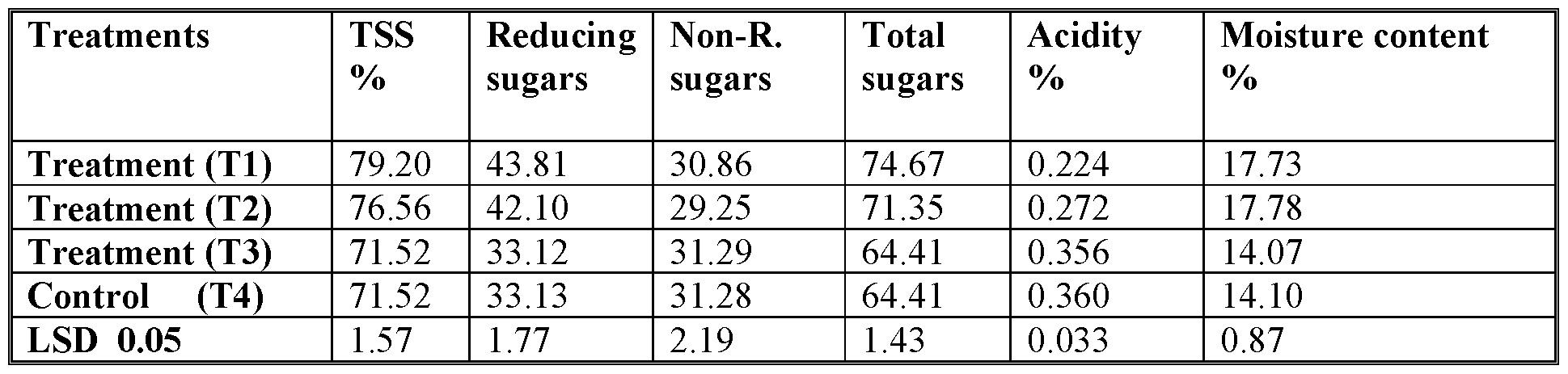

[00368] The fertilizer formulation (SABIC NPK formula) and treatment protocol utilized in this example produced an effective response in the Khalas date palm cultivar under the selected regions conditions. An increase in total yield/tree and bunch weight, as well as improved fruit quality (physical and chemical properties) were observed when the Khalas date palm trees were treated by the disclosed fertilizer formulation (SABIC NPK formula) and treatment protocols. The differences between the fertilizer application techniques used (trench digging (Tl) or scattering method (T2)) were minimal.
[00369] It will be apparent to those skilled in the art that various modifications and variations can be made in the present invention without departing from the scope or spirit of the invention. Other embodiments of the invention will be apparent to those skilled in the art from consideration of the specification and practice of the invention disclosed herein. It is intended that the specification and examples be considered as exemplary only, with a true scope and spirit of the invention being indicated by the following claims.
Claims
1. A method of treating a plant comprising contacting a fertilizer composition with soil proximate to the plant; wherein the plant comprises one or more of a date palm, a citrus plant, a fig plant, a mango plant, or an olive plant; wherein the fertilizer composition comprises nitrogen, phosphorus, and potassium (NPK) in a grade in the range of about 10-24:5-12: 10-24.
2. A method of treating a plant comprising contacting a fertilizer composition with soil proximate to the plant; wherein the plant comprises one or more of a date palm, a citrus plant, a fig plant, a mango plant, or an olive plant; wherein the fertilizer composition comprises nitrogen, phosphorus, and potassium (NPK) in a wt % ratio of nitrogen to phosphate to potassium in the range of about 1.5-2.5: 1 : 1.5-2.5.
3. A method of improving at least one of weight, volume, length, color, or shape of at least one of a fruit, seed, flower, leaf, bunch, root, stem, or stalk of a plant and/or to improve at least one of nutritional status, marketability, growth rate, or productivity of a plant, comprising: providing a fertilizer composition comprising nitrogen, phosphorus, and potassium (NPK) in a grade in the range of about 10-24:5-12: 10-24; wherein the plant comprises one or more of a date palm, citrus plant, fig plant, mango plant, or an olive plant.
4. A method of improving at least one of weight, volume, length, color, or shape of at least one of a fruit, seed, flower, leaf, bunch, root, stem, or stalk of a plant and/or to improve at least one of nutritional status, marketability, growth rate, or productivity of a plant, comprising: providing a fertilizer composition
comprising nitrogen, phosphorus, and potassium (NPK) in a wt % ratio of nitrogen to phosphate to potassium in the range of about 1.5-2.5: 1: 1.5-2.5; wherein the plant comprises one or more of a date palm, citrus plant, fig plant, mango plant, or an olive plant.
A plant growth medium comprising:
one or more of a plant species; and
a fertilizer composition comprising nitrogen, phosphorous, potassium and sulfur (NPKS) in a wt % ratio of nitrogen to phosphate to potassium to sulfur in the range of about 1.5-2.5: 1 : 1.5-2.5: 1.5-2.5; and
wherein the one or more of a plant species comprises one or more of a date palm, a citrus plant, a fig plant, a mango plant, or an olive plant.
A plant growth medium comprising:
one or more of a plant species; and
a fertilizer composition comprising nitrogen, phosphorous, and potassium (NPK) in a wt % ratio of nitrogen to phosphate to potassium in the range of about 1.5-2.5: 1 : 1.5-2.5; and
wherein the one or more of a plant species comprises one or more of a date palm, a citrus plant, a fig plant, a mango plant, or an olive plant.
A plant growth medium comprising:
one or more of a plant species; and
a fertilizer composition comprising nitrogen, phosphorous, potassium and sulfur (NPKS) in a NPKS grade in the range of about 10-24:5-12: 10-24: 10-24; and
wherein the one or more of a plant species comprises one or more of a date palm, a citrus plant, a fig plant, a mango plant, or an olive plant.
A plant growth medium comprising:
one or more of a plant species; and
a fertilizer composition comprising nitrogen, phosphorous, and potassium (NPK) in a NPK grade in the range of about 10-24:5-12: 10-24; and wherein the one or more of a plant species comprises one or more of a date palm, a citrus plant, a fig plant, a mango plant, or an olive plant.
The method or medium according to any of claims 1-4 or 6, wherein the NPK grade is about 16-18:7.5-9.5: 16-18.
The method or medium according to any of claims 1-4 or 8-9; wherein the fertilizer composition comprises nitrogen, phosphorus, and potassium in a wt % ratio of nitrogen to phosphorus to potassium in the range of about 1.5- 2.5: 1 : 1.5-2.5.
The method or medium according to any of claims 1-4, 6, or 8-10; wherein the wt % ratio of nitrogen to phosphorus to potassium is in the range of about 1.9- 2.1 : 1 : 1.9-2.1.
The method or medium according to any of claims 1-4, 6, or 10-11, wherein the NPK grade is in the range of about 22-24: 11-12:22-24.
The method or medium according to any of claims 1-5, wherein the fertilizer composition further comprises sulfur; wherein the fertilizer composition comprises nitrogen, phosphorus, potassium, and sulfur (NPKS) in a grade in the range of about 10-24:5-12: 10-24: 10-24.
14. The method or medium according to any of claims 7 or 13, wherein the NPKS grade is about 16-18:7.5-9.5: 16-18: 16-18.
15. The method or medium according to any of claims 7 or 13-14, wherein the fertilizer composition comprises nitrogen, phosphorus, potassium, and sulfur in a wt % ratio of nitrogen to phosphorus to potassium to sulfur in the range of about 1.5-2.5: 1 : 1.5-2.5: 1.5-2.5.
16. The method or medium according to any of claims 5, 7, or 13-15, wherein the wt % ratio of nitrogen to phosphorus to potassium to sulfur is in the range of about 1.9-2.1 : 1 : 1.9-2.1 : 1.9-2.1.
Priority Applications (1)
| Application Number | Priority Date | Filing Date | Title |
|---|---|---|---|
| CN201580070032.1A CN107108384A (en) | 2014-12-23 | 2015-12-21 | Method and Ru 2006101161 and plant growth culture medium for handling plant |
Applications Claiming Priority (4)
| Application Number | Priority Date | Filing Date | Title |
|---|---|---|---|
| US201462096172P | 2014-12-23 | 2014-12-23 | |
| US62/096,172 | 2014-12-23 | ||
| US201562151568P | 2015-04-23 | 2015-04-23 | |
| US62/151,568 | 2015-04-23 |
Publications (2)
| Publication Number | Publication Date |
|---|---|
| WO2016103162A2 true WO2016103162A2 (en) | 2016-06-30 |
| WO2016103162A3 WO2016103162A3 (en) | 2016-08-18 |
Family
ID=55080141
Family Applications (1)
| Application Number | Title | Priority Date | Filing Date |
|---|---|---|---|
| PCT/IB2015/059854 Ceased WO2016103162A2 (en) | 2014-12-23 | 2015-12-21 | Method and fertilizer compositions for treating a plant and plant growth medium |
Country Status (2)
| Country | Link |
|---|---|
| CN (1) | CN107108384A (en) |
| WO (1) | WO2016103162A2 (en) |
Cited By (7)
| Publication number | Priority date | Publication date | Assignee | Title |
|---|---|---|---|---|
| CN107567795A (en) * | 2017-09-28 | 2018-01-12 | 临汾市碧丰霖农业科技开发有限公司 | A kind of fig fertilizing method |
| CN109041997A (en) * | 2018-07-23 | 2018-12-21 | 江华瑶族自治县红美人种植专业合作社 | A kind of implantation methods of orange |
| WO2020106841A1 (en) * | 2018-11-21 | 2020-05-28 | Oms Investments, Inc. | Nutrient compositions |
| CN114391407A (en) * | 2021-12-29 | 2022-04-26 | 贵州省亚热带作物研究所 | Method for improving inherent quality of bagged mangoes |
| CN114395398A (en) * | 2022-01-18 | 2022-04-26 | 江西理工大学 | A kind of ionic rare earth tailings ammonia nitrogen leaching agent and using method thereof |
| CN114885734A (en) * | 2022-05-26 | 2022-08-12 | 滨州学院 | Method for improving planting survival rate of seedlings in rocky mountainous regions |
| EP4516766A1 (en) | 2023-09-01 | 2025-03-05 | suiteg GmbH | Nutrient solutions |
Family Cites Families (2)
| Publication number | Priority date | Publication date | Assignee | Title |
|---|---|---|---|---|
| CN1314632C (en) * | 2003-11-07 | 2007-05-09 | 中化化肥有限公司 | Series multielement chelate special-purpose composite fertilizer and method for preparing the same |
| CN100497269C (en) * | 2006-11-29 | 2009-06-10 | 文国建 | Mixing control-released composite fertilizer specially for rice and its production process |
-
2015
- 2015-12-21 WO PCT/IB2015/059854 patent/WO2016103162A2/en not_active Ceased
- 2015-12-21 CN CN201580070032.1A patent/CN107108384A/en active Pending
Non-Patent Citations (1)
| Title |
|---|
| "Official Methods of Analysis", 1995, ASSOCIATION OF OFFICIAL ANALYSIS CHEMISTS |
Cited By (9)
| Publication number | Priority date | Publication date | Assignee | Title |
|---|---|---|---|---|
| CN107567795A (en) * | 2017-09-28 | 2018-01-12 | 临汾市碧丰霖农业科技开发有限公司 | A kind of fig fertilizing method |
| CN109041997A (en) * | 2018-07-23 | 2018-12-21 | 江华瑶族自治县红美人种植专业合作社 | A kind of implantation methods of orange |
| WO2020106841A1 (en) * | 2018-11-21 | 2020-05-28 | Oms Investments, Inc. | Nutrient compositions |
| CN114391407A (en) * | 2021-12-29 | 2022-04-26 | 贵州省亚热带作物研究所 | Method for improving inherent quality of bagged mangoes |
| CN114395398A (en) * | 2022-01-18 | 2022-04-26 | 江西理工大学 | A kind of ionic rare earth tailings ammonia nitrogen leaching agent and using method thereof |
| CN114885734A (en) * | 2022-05-26 | 2022-08-12 | 滨州学院 | Method for improving planting survival rate of seedlings in rocky mountainous regions |
| CN114885734B (en) * | 2022-05-26 | 2023-05-09 | 滨州学院 | A method for improving the survival rate of seedling planting in rocky mountainous areas |
| EP4516766A1 (en) | 2023-09-01 | 2025-03-05 | suiteg GmbH | Nutrient solutions |
| WO2025046086A1 (en) | 2023-09-01 | 2025-03-06 | Suiteg Gmbh | Nutrient solutions |
Also Published As
| Publication number | Publication date |
|---|---|
| WO2016103162A3 (en) | 2016-08-18 |
| CN107108384A (en) | 2017-08-29 |
Similar Documents
| Publication | Publication Date | Title |
|---|---|---|
| US9540291B2 (en) | Coating for improved granular fertilizer efficiency | |
| Hammond et al. | Agronomic value of unacidulated and partially acidulated phosphate rocks indigenous to the tropics | |
| CN107108384A (en) | Method and Ru 2006101161 and plant growth culture medium for handling plant | |
| EP3008034B1 (en) | Slow and fast release fertilizer composition and methods for making same | |
| WO2014181149A2 (en) | Fertilizer compositions and methods thereof | |
| EP3740463B1 (en) | Multi-source micronutrient composition and methods of treating soil with the same | |
| Arshad et al. | Integrated effect of phosphorus and zinc on wheat crop | |
| US11124461B2 (en) | Fertilizer | |
| Chagas et al. | Productive characteristics, nutrition and agronomic efficiency of polymer-coated MAP in lettuce crops | |
| US20050178177A1 (en) | Organo phosphatic fertilizer | |
| de Lima et al. | Growth and development of bell peppers submitted to fertilization with biochar and nitrogen | |
| Szostek et al. | Effect of soil contamination with fluorine on the contents of calcium and magnesium in the biomass of crop plants | |
| JP5610501B2 (en) | Granular compound fertilizer and fertilizer application method | |
| Alkhader et al. | The effect of phosphorus fertilizers on the growth and quality of lettuce (Lactuca sativa L.) under greenhouse and field conditions | |
| US20220204417A1 (en) | Phosphogypsum containing fertilizer granules | |
| Krismawati et al. | Effect of organic and inorganic fertilizers application on the performance of rice | |
| JOGHAN et al. | Comparison among different integrated nutrition management for soil micro and macro elements after winter wheat harvesting and yield | |
| Alheidary et al. | Determination of the optimal spraying application rate for improving the vegetative growth of maize crop using knapsack sprayer | |
| Kovačević et al. | Soil and genotype influences on cadmium and strontium status in maize plants | |
| RU2342350C1 (en) | Method of obtaining granulated complex mineral fertilizers | |
| Norolahi | Study of biochar for salinity adsorption in barly plant | |
| Zewide | A coffee biochar-mineral NP interaction: Boon for soil health | |
| WO2024141485A1 (en) | Method of fortifying fertilizer with lipo-chitooligosaccharide (lco) | |
| WO2026099854A1 (en) | Polyphosphate coated fertilizers and a process for the production thereof | |
| CN120842005A (en) | A special organic fertilizer made of coal gangue humic acid and its production and use method |
Legal Events
| Date | Code | Title | Description |
|---|---|---|---|
| 121 | Ep: the epo has been informed by wipo that ep was designated in this application |
Ref document number: 15823027 Country of ref document: EP Kind code of ref document: A2 |
|
| NENP | Non-entry into the national phase |
Ref country code: DE |
|
| 122 | Ep: pct application non-entry in european phase |
Ref document number: 15823027 Country of ref document: EP Kind code of ref document: A2 |