WO2016017125A1 - Abnormality determination device for a nox sensor in a nox storage reduction catalyst using air-fuel ratio control - Google Patents
Abnormality determination device for a nox sensor in a nox storage reduction catalyst using air-fuel ratio control Download PDFInfo
- Publication number
- WO2016017125A1 WO2016017125A1 PCT/JP2015/003705 JP2015003705W WO2016017125A1 WO 2016017125 A1 WO2016017125 A1 WO 2016017125A1 JP 2015003705 W JP2015003705 W JP 2015003705W WO 2016017125 A1 WO2016017125 A1 WO 2016017125A1
- Authority
- WO
- WIPO (PCT)
- Prior art keywords
- nox
- deterioration
- degree
- fuel ratio
- time period
- Prior art date
- Legal status (The legal status is an assumption and is not a legal conclusion. Google has not performed a legal analysis and makes no representation as to the accuracy of the status listed.)
- Ceased
Links
Images







Classifications
-
- F—MECHANICAL ENGINEERING; LIGHTING; HEATING; WEAPONS; BLASTING
- F02—COMBUSTION ENGINES; HOT-GAS OR COMBUSTION-PRODUCT ENGINE PLANTS
- F02D—CONTROLLING COMBUSTION ENGINES
- F02D41/00—Electrical control of supply of combustible mixture or its constituents
- F02D41/22—Safety or indicating devices for abnormal conditions
- F02D41/222—Safety or indicating devices for abnormal conditions relating to the failure of sensors or parameter detection devices
-
- F—MECHANICAL ENGINEERING; LIGHTING; HEATING; WEAPONS; BLASTING
- F01—MACHINES OR ENGINES IN GENERAL; ENGINE PLANTS IN GENERAL; STEAM ENGINES
- F01N—GAS-FLOW SILENCERS OR EXHAUST APPARATUS FOR MACHINES OR ENGINES IN GENERAL; GAS-FLOW SILENCERS OR EXHAUST APPARATUS FOR INTERNAL-COMBUSTION ENGINES
- F01N11/00—Monitoring or diagnostic devices for exhaust-gas treatment apparatus
-
- F—MECHANICAL ENGINEERING; LIGHTING; HEATING; WEAPONS; BLASTING
- F01—MACHINES OR ENGINES IN GENERAL; ENGINE PLANTS IN GENERAL; STEAM ENGINES
- F01N—GAS-FLOW SILENCERS OR EXHAUST APPARATUS FOR MACHINES OR ENGINES IN GENERAL; GAS-FLOW SILENCERS OR EXHAUST APPARATUS FOR INTERNAL-COMBUSTION ENGINES
- F01N11/00—Monitoring or diagnostic devices for exhaust-gas treatment apparatus
- F01N11/007—Monitoring or diagnostic devices for exhaust-gas treatment apparatus the diagnostic devices measuring oxygen or air concentration downstream of the exhaust apparatus
-
- F—MECHANICAL ENGINEERING; LIGHTING; HEATING; WEAPONS; BLASTING
- F01—MACHINES OR ENGINES IN GENERAL; ENGINE PLANTS IN GENERAL; STEAM ENGINES
- F01N—GAS-FLOW SILENCERS OR EXHAUST APPARATUS FOR MACHINES OR ENGINES IN GENERAL; GAS-FLOW SILENCERS OR EXHAUST APPARATUS FOR INTERNAL-COMBUSTION ENGINES
- F01N3/00—Exhaust or silencing apparatus having means for purifying, rendering innocuous, or otherwise treating exhaust
- F01N3/08—Exhaust or silencing apparatus having means for purifying, rendering innocuous, or otherwise treating exhaust for rendering innocuous
- F01N3/0807—Exhaust or silencing apparatus having means for purifying, rendering innocuous, or otherwise treating exhaust for rendering innocuous by using absorbents or adsorbents
- F01N3/0814—Exhaust or silencing apparatus having means for purifying, rendering innocuous, or otherwise treating exhaust for rendering innocuous by using absorbents or adsorbents combined with catalytic converters, e.g. NOx absorption/storage reduction catalysts
-
- F—MECHANICAL ENGINEERING; LIGHTING; HEATING; WEAPONS; BLASTING
- F01—MACHINES OR ENGINES IN GENERAL; ENGINE PLANTS IN GENERAL; STEAM ENGINES
- F01N—GAS-FLOW SILENCERS OR EXHAUST APPARATUS FOR MACHINES OR ENGINES IN GENERAL; GAS-FLOW SILENCERS OR EXHAUST APPARATUS FOR INTERNAL-COMBUSTION ENGINES
- F01N3/00—Exhaust or silencing apparatus having means for purifying, rendering innocuous, or otherwise treating exhaust
- F01N3/08—Exhaust or silencing apparatus having means for purifying, rendering innocuous, or otherwise treating exhaust for rendering innocuous
- F01N3/0807—Exhaust or silencing apparatus having means for purifying, rendering innocuous, or otherwise treating exhaust for rendering innocuous by using absorbents or adsorbents
- F01N3/0828—Exhaust or silencing apparatus having means for purifying, rendering innocuous, or otherwise treating exhaust for rendering innocuous by using absorbents or adsorbents characterised by the absorbed or adsorbed substances
- F01N3/0842—Nitrogen oxides
-
- F—MECHANICAL ENGINEERING; LIGHTING; HEATING; WEAPONS; BLASTING
- F02—COMBUSTION ENGINES; HOT-GAS OR COMBUSTION-PRODUCT ENGINE PLANTS
- F02D—CONTROLLING COMBUSTION ENGINES
- F02D41/00—Electrical control of supply of combustible mixture or its constituents
- F02D41/02—Circuit arrangements for generating control signals
- F02D41/14—Introducing closed-loop corrections
- F02D41/1438—Introducing closed-loop corrections using means for determining characteristics of the combustion gases; Sensors therefor
- F02D41/1444—Introducing closed-loop corrections using means for determining characteristics of the combustion gases; Sensors therefor characterised by the characteristics of the combustion gases
- F02D41/1454—Introducing closed-loop corrections using means for determining characteristics of the combustion gases; Sensors therefor characterised by the characteristics of the combustion gases the characteristics being an oxygen content or concentration or the air-fuel ratio
-
- F—MECHANICAL ENGINEERING; LIGHTING; HEATING; WEAPONS; BLASTING
- F02—COMBUSTION ENGINES; HOT-GAS OR COMBUSTION-PRODUCT ENGINE PLANTS
- F02D—CONTROLLING COMBUSTION ENGINES
- F02D41/00—Electrical control of supply of combustible mixture or its constituents
- F02D41/02—Circuit arrangements for generating control signals
- F02D41/14—Introducing closed-loop corrections
- F02D41/1438—Introducing closed-loop corrections using means for determining characteristics of the combustion gases; Sensors therefor
- F02D41/1444—Introducing closed-loop corrections using means for determining characteristics of the combustion gases; Sensors therefor characterised by the characteristics of the combustion gases
- F02D41/146—Introducing closed-loop corrections using means for determining characteristics of the combustion gases; Sensors therefor characterised by the characteristics of the combustion gases the characteristics being an NOx content or concentration
-
- F—MECHANICAL ENGINEERING; LIGHTING; HEATING; WEAPONS; BLASTING
- F01—MACHINES OR ENGINES IN GENERAL; ENGINE PLANTS IN GENERAL; STEAM ENGINES
- F01N—GAS-FLOW SILENCERS OR EXHAUST APPARATUS FOR MACHINES OR ENGINES IN GENERAL; GAS-FLOW SILENCERS OR EXHAUST APPARATUS FOR INTERNAL-COMBUSTION ENGINES
- F01N2550/00—Monitoring or diagnosing the deterioration of exhaust systems
- F01N2550/02—Catalytic activity of catalytic converters
-
- F—MECHANICAL ENGINEERING; LIGHTING; HEATING; WEAPONS; BLASTING
- F01—MACHINES OR ENGINES IN GENERAL; ENGINE PLANTS IN GENERAL; STEAM ENGINES
- F01N—GAS-FLOW SILENCERS OR EXHAUST APPARATUS FOR MACHINES OR ENGINES IN GENERAL; GAS-FLOW SILENCERS OR EXHAUST APPARATUS FOR INTERNAL-COMBUSTION ENGINES
- F01N2560/00—Exhaust systems with means for detecting or measuring exhaust gas components or characteristics
- F01N2560/02—Exhaust systems with means for detecting or measuring exhaust gas components or characteristics the means being an exhaust gas sensor
- F01N2560/025—Exhaust systems with means for detecting or measuring exhaust gas components or characteristics the means being an exhaust gas sensor for measuring or detecting O2, e.g. lambda sensors
-
- F—MECHANICAL ENGINEERING; LIGHTING; HEATING; WEAPONS; BLASTING
- F01—MACHINES OR ENGINES IN GENERAL; ENGINE PLANTS IN GENERAL; STEAM ENGINES
- F01N—GAS-FLOW SILENCERS OR EXHAUST APPARATUS FOR MACHINES OR ENGINES IN GENERAL; GAS-FLOW SILENCERS OR EXHAUST APPARATUS FOR INTERNAL-COMBUSTION ENGINES
- F01N2560/00—Exhaust systems with means for detecting or measuring exhaust gas components or characteristics
- F01N2560/02—Exhaust systems with means for detecting or measuring exhaust gas components or characteristics the means being an exhaust gas sensor
- F01N2560/026—Exhaust systems with means for detecting or measuring exhaust gas components or characteristics the means being an exhaust gas sensor for measuring or detecting NOx
-
- F—MECHANICAL ENGINEERING; LIGHTING; HEATING; WEAPONS; BLASTING
- F01—MACHINES OR ENGINES IN GENERAL; ENGINE PLANTS IN GENERAL; STEAM ENGINES
- F01N—GAS-FLOW SILENCERS OR EXHAUST APPARATUS FOR MACHINES OR ENGINES IN GENERAL; GAS-FLOW SILENCERS OR EXHAUST APPARATUS FOR INTERNAL-COMBUSTION ENGINES
- F01N2610/00—Adding substances to exhaust gases
- F01N2610/03—Adding substances to exhaust gases the substance being hydrocarbons, e.g. engine fuel
-
- F—MECHANICAL ENGINEERING; LIGHTING; HEATING; WEAPONS; BLASTING
- F01—MACHINES OR ENGINES IN GENERAL; ENGINE PLANTS IN GENERAL; STEAM ENGINES
- F01N—GAS-FLOW SILENCERS OR EXHAUST APPARATUS FOR MACHINES OR ENGINES IN GENERAL; GAS-FLOW SILENCERS OR EXHAUST APPARATUS FOR INTERNAL-COMBUSTION ENGINES
- F01N3/00—Exhaust or silencing apparatus having means for purifying, rendering innocuous, or otherwise treating exhaust
- F01N3/08—Exhaust or silencing apparatus having means for purifying, rendering innocuous, or otherwise treating exhaust for rendering innocuous
- F01N3/10—Exhaust or silencing apparatus having means for purifying, rendering innocuous, or otherwise treating exhaust for rendering innocuous by thermal or catalytic conversion of noxious components of exhaust
- F01N3/18—Exhaust or silencing apparatus having means for purifying, rendering innocuous, or otherwise treating exhaust for rendering innocuous by thermal or catalytic conversion of noxious components of exhaust characterised by methods of operation; Control
- F01N3/20—Exhaust or silencing apparatus having means for purifying, rendering innocuous, or otherwise treating exhaust for rendering innocuous by thermal or catalytic conversion of noxious components of exhaust characterised by methods of operation; Control specially adapted for catalytic conversion
- F01N3/206—Adding periodically or continuously substances to exhaust gases for promoting purification, e.g. catalytic material in liquid form, NOx reducing agents
- F01N3/2066—Selective catalytic reduction [SCR]
- F01N3/2073—Means for generating a reducing substance from the exhaust gases
-
- Y—GENERAL TAGGING OF NEW TECHNOLOGICAL DEVELOPMENTS; GENERAL TAGGING OF CROSS-SECTIONAL TECHNOLOGIES SPANNING OVER SEVERAL SECTIONS OF THE IPC; TECHNICAL SUBJECTS COVERED BY FORMER USPC CROSS-REFERENCE ART COLLECTIONS [XRACs] AND DIGESTS
- Y02—TECHNOLOGIES OR APPLICATIONS FOR MITIGATION OR ADAPTATION AGAINST CLIMATE CHANGE
- Y02T—CLIMATE CHANGE MITIGATION TECHNOLOGIES RELATED TO TRANSPORTATION
- Y02T10/00—Road transport of goods or passengers
- Y02T10/10—Internal combustion engine [ICE] based vehicles
- Y02T10/40—Engine management systems
Definitions
- the present invention relates to an abnormality determination device which executes an abnormality determination with respect to a NOx sensor disposed at a downstream side of a NOx storage reduction catalyst.
- NOx in the exhaust gas discharged when an internal combustion engine is in a lean burn condition can be stored by a NOx storage reduction catalyst (hereinafter, also referred to simply as an "NOx catalyst"), and then, the NOx thus stored can be caused to release from the NOx catalyst and to be reduced to nitrogen by temporarily making rich the air-fuel ratio of the exhaust gas.
- NOx catalyst NOx storage reduction catalyst
- a NOx sensor for detecting the NOx in the exhaust gas is disposed at the downstream side of the NOx catalyst, so that it becomes possible to perform control such as the above-mentioned enrichment of the air-fuel ratio based on the detection of the sensor.
- the NOx sensor is used in this manner, but when abnormality occurs in the NOx sensor, it becomes difficult to carry out the reduction of NOx by the NOx catalyst as expected, thus inviting deterioration of emissions. For this reason, it is required to determine the occurrence of the abnormality in an appropriate manner.
- an amount of reducing agent equal to or more than an appropriate amount suitable for reducing the NOx stored in the NOx catalyst is supplied to the NOx catalyst, and the abnormality determination of the NOx sensor is made based on an output of the NOx sensor at that time.
- this technology is to perform the abnormality determination, in a state where an amount of reducing agent which becomes surplus for the reduction of the NOx has been grasped in advance, by making use of the output of the NOx sensor corresponding to the surplus amount of the reducing agent.
- the NOx sensor is also generally used in order to determine the deterioration of the NOx catalyst, so it is desired that the abnormality determination of the NOx sensor be executed in a state where the influence received from the degree of deterioration of the NOx catalyst has been suppressed as much as possible, but as mentioned above, the conventional technology is strongly subjected to the influence of the degree of deterioration of the NOx catalyst, so it must still be the that an appropriate abnormality determination of the NOx sensor is difficult to realize.
- the present invention has been made in view of the problem as referred to above, and has for its object to improve the accuracy of abnormality determination of a NOx sensor which is disposed at the downstream side of a NOx storage reduction catalyst.
- the present invention in order to solve the aforementioned problems, there has been adopted a configuration in which an amount of ammonia generated by a NOx catalyst is adjusted based on the degree of deterioration of the NOx catalyst, in a condition where a reducing agent is supplied to the NOx catalyst at the time of performing an abnormality determination of the NOx sensor.
- the degree of deterioration of the NOx catalyst is calculated with the use of a predetermined deterioration parameter other than a detected value of the NOx sensor.
- the present invention resides in an abnormality determination device for a NOx sensor which is disposed in an exhaust passage of an internal combustion engine at a downstream side of a NOx storage reduction catalyst and is configured so as to be able to detect NOx and ammonia in exhaust gas, the NOx storage catalyst stores NOx in the exhaust gas and reduces the NOx stored therein by a supply of a reducing agent.
- the abnormality determination device comprises: an air-fuel ratio control unit that executes predetermined air-fuel ratio control in which an air-fuel ratio of the exhaust gas discharged from the internal combustion engine and flowing into the NOx storage reduction catalyst is controlled to be a rich air-fuel ratio that is richer than a stoichiometric air-fuel ratio, thereby to generate ammonia by means of the NOx storage reduction catalyst; an abnormality determination unit that makes an abnormality determination of the NOx sensor based on an output integrated quantity which is an integrated quantity of detected values of the NOx sensor in a predetermined detection time period which includes at least a first detection time period of the NOx sensor corresponding to a time period in which the predetermined air-fuel ratio control is being executed by the air-fuel ratio control unit; an acquisition unit that acquires a degree of deterioration of the NOx storage reduction catalyst based on a predetermined deterioration parameter other than an output of the NOx sensor; and an adjustment unit that decides a predetermined execution parameter with respect to the predetermined air-fuel ratio control
- the abnormality determination device for a NOx sensor is a device which executes an abnormality determination with respect to the NOx sensor which is disposed at the downstream side of the NOx catalyst arranged in the exhaust passage.
- the NOx catalyst when placed in a lean atmosphere by the exhaust gas flowing thereinto, stores or occludes the NOx in the exhaust gas, and releases and reduces the stored NOx by the reducing agent which is supplied to the NOx catalyst by means of the predetermined air-fuel ratio control which is executed by the air-fuel ratio control unit, and in which the air-fuel ratio of the exhaust gas flowing into the NOx catalyst is made to a rich air-fuel ratio that is richer than the stoichiometric air-fuel ratio, thereby to place the NOx catalyst in a rich atmosphere.
- the predetermined air-fuel ratio control is executed according to the predetermined execution parameter related thereto, and for example, the predetermined execution parameter is a parameter relevant to the formation of the rich atmosphere or the generation of ammonia.
- the air-fuel ratio control unit adjusts the amount of reducing agent such as HC contained in the exhaust gas from the internal combustion engine, and controls the air-fuel ratio of the exhaust gas.
- NOx occluder In general, in the NOx catalyst, there exist a noble metal such as platinum, etc., and a strong basic metal such as Ba, etc., which functions as a NOx storage agent (NOx occluder). In cases where the NOx catalyst is in a state where it can exhibit its original function normally (hereinafter, referred to as a "normal state"), the function of storing NOx in the lean atmosphere and the function of releasing and reducing the NOx in the rich atmosphere, as mentioned above, are exhibited to a maximum extent, and at the same time, the ability of generating ammonia due to the reaction of the supplied agent and NOx is also exhibited to a maximum extent.
- a normal state the function of storing NOx in the lean atmosphere and the function of releasing and reducing the NOx in the rich atmosphere, as mentioned above, are exhibited to a maximum extent, and at the same time, the ability of generating ammonia due to the reaction of the supplied agent and NOx is also exhibited to a maximum extent.
- the NOx sensor disposed at the downstream side of the NOx catalyst is configured so as to be able to detect NOx and ammonia in the exhaust gas flowing out of the NOx catalyst. Then, the NOx sensor generates equivalent outputs with respect to the NOx in the exhaust gas and ammonia, without distinguishing the NOx and ammonia in the exhaust gas from each other.
- the predetermined air-fuel ratio control is executed by the air-fuel ratio control unit, the NOx stored in the NOx catalyst is released and reduced to N 2 , as mentioned above, and ammonia is generated resulting from the released NOx and the NOx in the exhaust gas flowing from the internal combustion engine.
- a part of the released NOx may flow out of the NOx catalyst as it is (in this description, the NOx having flowed out of the NOx catalyst is referred to as an "outflow NOx").
- the NOx sensor having the above-mentioned detection characteristics is able to detect the outflow NOx and the generated ammonia.
- the abnormality determination unit executes the abnormality determination based on the integrated quantity of the detected values of the NOx sensor in the predetermined detection time period which includes the first detection time period corresponding to a time period in which the predetermined air-fuel ratio control is executed, in other words, the first detection time period which is a time period in which the outflow NOx and the generated ammonia can be detected. Because the first detection time period is included in the predetermined detection time period, the output integrated quantity of the NOx sensor in the predetermined detection time period is a value which corresponds at least to a total amount of the outflow NOx and the generated ammonia at the time of the predetermined air-fuel ratio control being executed.
- the abnormality determination unit executes the abnormality determination of the NOx sensor in view of a phenomenon which occurs in the NOx catalyst due to the predetermined air-fuel ratio control.
- the amount of the generated ammonia is in general relatively larger than the amount of the outflow NOx, and hence, when the execution parameter of the predetermined air-fuel ratio control can be grasped in advance, the abnormality determination by the abnormality determination unit can be achieved by making a comparison between an actual output integrated quantity and an output integrated quantity which reflects the generation amount of ammonia assumed from the execution parameter in the case where the NOx sensor is assumed to be normal.
- the NOx catalyst deteriorates with the use thereof, and the above-mentioned NOx reduction ability and the ammonia generation capacity thereof decrease. For that reason, even if the abnormality determination by the abnormality determination unit is executed under an assumption that the NOx catalyst is always normal, in actuality, the output integrated quantity varies according to the degree of deterioration of the NOx catalyst, so it is difficult to improve the accuracy in the determination. Accordingly, in the abnormality determination device for a NOx sensor according to the present invention, the adjustment of the generation amount of ammonia under the predetermined air-fuel ratio control is executed through the decision of the predetermined execution parameter with respect to the predetermined air-fuel ratio control by the adjustment unit.
- the adjustment unit In the adjustment by the adjustment unit, it is taken into consideration that those which are detected by the NOx sensor under the predetermined air-fuel ratio control are mainly the outflow NOx and the generated ammonia.
- the outflow of NOx in the NOx catalyst results from a decrease in the reduction reactivity thereof due to the deterioration of the NOx catalyst, and so the degree of deterioration of the NOx catalyst is directly reflected on the amount of the outflow NOx, and there is only a small margin for the control of the deterioration of the NOx catalyst.
- the generation amount of ammonia is an element with a relatively large control margin which can be adjusted to some extent by changing the predetermined execution parameter with respect to the predetermined air-fuel ratio control.
- the present inventor has constructed the adjustment unit by focusing on this adjustable generation amount of ammonia. That is, the adjustment unit decides the predetermined execution parameter with respect to the predetermined air-fuel ratio control in such a manner that the output integrated quantity falls within the predetermined allowable range irrespective of the degree of deterioration of the NOx catalyst, in other word, the influence which the output integrated quantity receives from the degree of deterioration of the NOx catalyst can be reduced as much as possible. Then, the amount of ammonia generated by the NOx catalyst is adjusted by the predetermined air-fuel ratio control being executed according to the predetermined execution parameter thus decided.
- the degree of deterioration of the NOx catalyst used in the decision of the predetermined execution parameter by the adjustment unit is obtained by the acquisition unit based on the predetermined deterioration parameter other than the output of the NOx sensor.
- the reason for not using the output of the NOx sensor is that the abnormality determination device according to the present invention is intended to carry out the abnormality determination of the NOx sensor in such a manner as not to be easily influenced by the degree of deterioration of the NOx catalyst.
- the degree of deterioration of the NOx catalyst which is calculated by using the output of the NOx sensor, is used for the adjustment by the adjustment unit, when the NOx sensor has an abnormality, the abnormality of the NOx sensor will be reflected on that adjustment, and hence, it becomes difficult to realize the abnormality determination of the NOx sensor which cannot be easily influenced by the degree of deterioration of the NOx catalyst.
- the predetermined execution parameter of the predetermined air-fuel ratio control executed for abnormality determination is decided based on the degree of deterioration of the NOx catalyst which is obtained based on the predetermined deterioration parameter other than the output of the NOx sensor.
- the generation amount of ammonia generated by the predetermined air-fuel ratio control is adjusted, so that the output integrated quantity falls within the predetermined allowable range.
- the output integrated quantity in the predetermined detection time period becomes the integrated quantity of the detected values of the NOx sensor in a state where the influence of the degree of deterioration of the NOx catalyst at the time of execution of the abnormality determination is made to reduce as much as possible.
- the narrower the predetermined allowable range the narrower becomes the range of the variation of the output integrated quantity with respect to the degree of deterioration of the NOx catalyst.
- the predetermined allowable range is a range which is substantially equivalent to the output integrated quantity which is assumed when the NOx storage reduction catalyst is at a maximum degree of deterioration. That is, in such a configuration, the predetermined allowable range is made small as much as possible, thus making it possible to achieve the abnormality determination of the NOx sensor, while eliminating the influence of the degree of deterioration of the NOx catalyst as much as possible.
- the predetermined execution parameter of the predetermined air-fuel ratio control may be at least any one of a storage amount of NOx stored in the NOx storage reduction catalyst at a time point at which the predetermined air-fuel ratio control is started, a value of the rich air-fuel ratio that is reached in the predetermined air-fuel ratio control, and a control time period in which the rich air-fuel ratio is continued in the predetermined air-fuel ratio control. That is, these predetermined execution parameters are each to decide the generation amount of ammonia to be generated by the predetermined air-fuel ratio control.
- the abnormality determination unit executes the abnormality determination of the NOx sensor based on an integrated quantity of detected values of the NOx sensor in the predetermined detection time period by using the first detection time period as the predetermined detection time period.
- the generation amount of ammonia in a case where the adjustment by the adjustment unit has been executed is an amount that is decreased in comparison with the generation amount of ammonia in a case where adjustment by the adjustment unit has not been executed, and a range of decrease of the generation amount of ammonia in a case of the degree of deterioration of the NOx storage reduction catalyst being small is set larger than a range of decrease of the generation amount of ammonia in a case of the degree of deterioration of the NOx storage reduction catalyst being large.
- the first detection time period is set to the predetermined detection time period. Accordingly, in this case, the output integrated quantity of the NOx sensor reflects the total amount of the amount of the outflow NOx and the generation amount of ammonia resulting from the predetermined air-fuel ratio control.
- the adjustment unit can suppress the range of the variation of the output integrated quantity with respect to the degree of deterioration of the NOx catalyst, by deciding the predetermined execution parameter in such a manner that the extent of decrease in the case of the degree of deterioration of the NOx catalyst being small becomes larger in comparison with the extent of decrease in the case of the deterioration degree being large. As a result of this, it is possible to attain an improvement in the accuracy of the abnormality determination of the NOx sensor.
- the adjustment unit makes the storage amount of NOx smaller in a case where the degree of deterioration of the NOx storage reduction catalyst is small, in comparison with a case where the degree of deterioration thereof is large.
- the adjustment unit makes the value of the rich air-fuel ratio larger, i.e., make the air-fuel ratio of the exhaust gas leaner, in a case where the degree of deterioration of the NOx storage reduction catalyst is small, in comparison with a case where the degree of deterioration thereof is large.
- the adjustment unit makes the control time period shorter in a case where the degree of deterioration of the NOx storage reduction catalyst is small, in comparison with a case where the degree of deterioration thereof is large.
- the abnormality determination unit makes the abnormality determination of the NOx sensor based on an integrated quantity of detected values of the NOx sensor in the predetermined detection time period, by using both of the first detection time period and a second detection time period as the predetermined detection time period, wherein the second detection time period is a time period before the first detection time period and corresponds to a time period in which the air-fuel ratio of the exhaust gas flowing into the NOx storage reduction catalyst is controlled to be a lean air-fuel ratio that is leaner than the stoichiometric air-fuel ratio.
- the generation amount of ammonia in a case where an adjustment by the adjustment unit has been executed is an amount that is increased in comparison with the generation amount of ammonia in a case where an adjustment by the adjustment unit has not been executed, and a range of increase of the generation amount of ammonia in a case of the degree of deterioration of the NOx storage reduction catalyst being small is set larger than a range of increase of the generation amount of ammonia in a case of the degree of deterioration of the NOx storage reduction catalyst being large.
- both of the first detection time period and the second detection time period are set to the predetermined detection time period.
- This second detection time period is a time period in which the exhaust gas of a lean air-fuel ratio before the predetermined air-fuel ratio control is executed flows in the NOx catalyst, i.e., a time period in which when the NOx catalyst is normal, the NOx in the exhaust gas is being stored in the NOx catalyst.
- the NOx storage capacity of the NOx catalyst decreases due to the deterioration of the NOx catalyst, there is a possibility that the NOx, which should be originally stored in the NOx catalyst in the second detection time period, may pass through the NOx catalyst toward the downstream thereof, so that it may be detected by the NOx sensor.
- the output integrated quantity of the NOx sensor reflects the amount of passed-through NOx resulting from the degree of deterioration of the NOx catalyst, in addition to the total amount of the amount of the outflow NOx and the generation amount of ammonia resulting from the predetermined air-fuel ratio control.
- this second mode similar to the first mode, a tendency can be found that the larger the degree of deterioration of the NOx catalyst becomes, the smaller the generation amount of ammonia, and at the same time, the larger the amount of the outflow NOx becomes. Moreover, a tendency can be found that the larger the degree of deterioration of the NOx catalyst becomes, the larger the amount of the passed-through NOx becomes.
- This amount of the passed-through NOx is, in other words, an amount of NOx discharged without being reduced to nitrogen, and hence, even if the generation amount of ammonia and the amount of the outflow NOx are taken into consideration, there is a tendency that the larger the degree of deterioration of the NOx catalyst becomes, the larger the output integrated quantity of the NOx sensor is made to become. Accordingly, as mentioned above, the adjustment unit can suppress the range of the variation in the output integrated quantity with respect to the degree of deterioration of the NOx catalyst, by setting the predetermined execution parameter in such a manner that the extent of increase in the case of the degree of deterioration of the NOx catalyst being small becomes larger in comparison with the extent of increase in the case of the deterioration degree being large. As a result of this, it is possible to attain an improvement in the accuracy of the abnormality determination of the NOx sensor.
- the adjustment unit makes the storage amount of NOx larger in a case where the degree of deterioration of the NOx storage reduction catalyst is small, in comparison with a case where the degree of deterioration thereof is large.
- the adjustment unit makes the value of the rich air-fuel ratio smaller, i.e., make the air-fuel ratio of the exhaust gas richer, in a case where the degree of deterioration of the NOx storage reduction catalyst is small, in comparison with a case where the degree of deterioration thereof is large.
- Fig. 1 is a diagram showing the schematic construction of an exhaust system of an internal combustion engine in which an abnormality determination device for a NOx sensor according to the present invention is disposed.
- Figs. 2A through 2E are diagrams showing the changes over time of an output of the NOx sensor, a storage amount of NOx in a NOx catalyst, a rich spike flag, a supply amount of a reducing agent, and an air-fuel ratio of exhaust gas, respectively, at the time when abnormality determination control according to the abnormality determination device for a NOx sensor according to the present invention is executed.
- Figs. 1 is a diagram showing the schematic construction of an exhaust system of an internal combustion engine in which an abnormality determination device for a NOx sensor according to the present invention is disposed.
- Figs. 2A through 2E are diagrams showing the changes over time of an output of the NOx sensor, a storage amount of NOx in a NOx catalyst, a rich spike flag, a supply amount of a reducing agent, and an air-fuel ratio
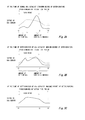
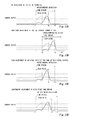
- FIGS. 3A through 3C are diagrams showing the changes over time of the output of the NOx sensor for three kinds of degrees of deterioration of the NOx catalyst, at the time when abnormality determination control according to the abnormality determination device for a NOx sensor according to the present invention is executed.
- Fig. 4 is a diagram showing incoming amounts and outgoing amounts of various kinds of components for two kinds of degrees of deterioration of the NOx catalyst, at the time when abnormality determination control according to the abnormality determination device for a NOx sensor according to the present invention is executed.
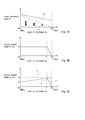
- Figs. 5A through 5D are diagrams for explaining an output integrated quantity of the NOx sensor for the abnormality determination of the NOx sensor. Figs.
- FIGS. 6A through 6C are diagrams showing correlations between each of execution parameters of the rich spike control executed at the time of the abnormality determination control by the abnormality determination device for a NOx sensor according to the present invention, and a generation amount of ammonia at the time of the abnormality determination control.
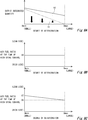
- Figs. 7A through 7C are first set of diagrams showing an adjustment example of an execution parameter of the rich spike control in the abnormality determination control by the abnormality determination device for a NOx sensor according to the present invention.
- Figs. 8A through 8C are second set of diagrams showing an adjustment example of an execution parameter of the rich spike control in the abnormality determination control by the abnormality determination device for a NOx sensor according to the present invention.
- Figs. 7A through 7C are first set of diagrams showing an adjustment example of an execution parameter of the rich spike control in the abnormality determination control by the abnormality determination device for a NOx sensor according to the present invention.
- Figs. 8A through 8C are second set of diagrams showing an adjustment example
- FIGS. 9A through 9C are third set of diagrams showing an adjustment example of an execution parameter of the rich spike control in the abnormality determination control by the abnormality determination device for a NOx sensor according to the present invention.
- Fig. 10 is a diagram showing the correlation among an adjustment change of each of the execution parameters of the rich spike control executed at the time of the abnormality determination control by the abnormality determination device for a NOx sensor according to the present invention, and a change of each of various kinds of components in the exhaust gas.
- Figs. 10 is a diagram showing the correlation among an adjustment change of each of the execution parameters of the rich spike control executed at the time of the abnormality determination control by the abnormality determination device for a NOx sensor according to the present invention, and a change of each of various kinds of components in the exhaust gas.
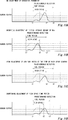
- FIGS. 11A through 11D are diagrams showing the changes over time of the output of the NOx sensor corresponding to the adjustment of individual execution parameters of rich spike control, respectively, in the case where an integration time period of the output is made to be a first detection period corresponding to the rich spike control, in the abnormality determination control by the abnormality determination device for a NOx sensor according to the present invention.
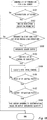
- Fig. 12 is a flow chart for the abnormality determination control by the abnormality determination device for a NOx sensor according to the present invention.
- Figs. 12 is a flow chart for the abnormality determination control by the abnormality determination device for a NOx sensor according to the present invention.
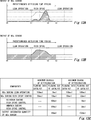
- FIGS. 13A through 13C are diagrams showing the changes over time of the output of the NOx sensor for two kinds of degrees of deterioration of the NOx catalyst in the case where an integration time period of the output is made to be both of a first detection period corresponding to rich spike control, and a second detection period corresponding to a lean operation period before the rich spike control, in the abnormality determination control by the abnormality determination device for a NOx sensor according to the present invention.
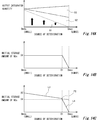
- Figs. 14A through 14C are first set of diagrams showing an adjustment example of an execution parameter of the rich spike control in the abnormality determination control shown in Figs 13A through 13C.
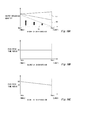
- 15A through 15C are second set of diagrams showing an adjustment example of an execution parameter of the rich spike control in the abnormality determination control shown in Figs 13A through 13C.
- Figs. 16A through 16C are third set of diagrams showing an adjustment example of an execution parameter of the rich spike control in the abnormality determination control shown in Figs 13A through 13C.
- FIG. 17A through 17D are diagrams showing the changes over time of the output of the NOx sensor corresponding to the adjustment of individual execution parameters of rich spike control, respectively, in the case where an integration time period of the output is made to be both of a first detection period corresponding to the rich spike control and a second detection period corresponding to a lean operation period before the rich spike control, in the abnormality determination control by the abnormality determination device for a NOx sensor according to the present invention.
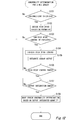
- Fig. 18 is a flow chart for the abnormality determination control shown in Fig. 13.
- Fig. 1 is a diagram showing the schematic construction of an exhaust system of an internal combustion engine in which an abnormality determination device for a NOx sensor according to this first embodiment of the present invention is installed.
- the internal combustion engine 1 shown in Fig. 1 is a multiple cylinder engine for vehicle use, and is a spark ignition internal combustion engine, more specifically, a gasoline engine.
- the internal combustion engine to which the present invention is applied is not limited to a spark ignition internal combustion engine, but may be, for example, a compression ignition type internal combustion engine, i.e., a diesel engine.
- an exhaust passage 2 is connected to the internal combustion engine 1. In the middle of this exhaust passage 2, there is arranged a NOx storage reduction catalyst (hereinafter, referred to as a NOx catalyst) 3.
- NOx catalyst NOx storage reduction catalyst
- the NOx catalyst 3 is constructed such that alumina (Al 2 O 3 ), for example, is used as a carrier, and barium (Ba) acting as a NOx absorbing component and platinum (Pt) acting as a catalyst component, for example, are supported on the carrier.
- This NOx catalyst 3 has a function of storing NOx contained in an incoming exhaust gas when the oxygen concentration of the exhaust gas is high (i.e., when the exhaust gas is in a state of a lean air-fuel ratio), and of releasing and reducing the stored NOx to nitrogen when the oxygen concentration of the incoming exhaust gas becomes low and when a reducing agent exists (i.e., when the exhaust gas is in a state of a rich air-fuel ratio).
- the word "storage” in this description is used as a term which includes temporary adsorption of NOx as well.
- a NOx sensor 4 for measuring the concentration of NOx in the exhaust gas is arranged in the exhaust passage 2 at a location downstream of the NOx catalyst 3.
- the NOx sensor 4 outputs a current signal proportional to the concentration of NOx in the exhaust gas.
- the NOx sensor 4 is able to detect not only the NOx in the exhaust gas but also ammonia in the exhaust gas, and is a so-called limiting current type NOx sensor.
- the NOx sensor 4 decomposes the NOx in the exhaust gas (in particular NO) into nitrogen and oxygen in the interior thereof, and generates a current output which is proportional to the amount of oxygen ions by the movement of oxygen ions based on the oxygen between its electrodes.
- the NOx sensor 4 decomposes the ammonia in the exhaust gas into NO and water in the interior thereof, further decomposes the NO into nitrogen and oxygen, and thereafter generates a current output due to the same principle as in the case of NOx. For that reason, the NOx sensor 4 emits an output proportional to a sum concentration of the concentration of NOx and the concentration of ammonia, and cannot emit distinguished outputs by distinguishing the concentration of NOx and the concentration of ammonia from each other.
- a pair of air-fuel ratio sensors 5, 6 each for measuring the air-fuel ratios of the exhaust gas are arranged in the exhaust passage 2 at locations downstream and upstream of the NOx catalyst 3, respectively.
- the air-fuel ratio sensors 5, 6 are each a so-called wide range (or broad band) air-fuel ratio sensor, which is able to continuously detect the air-fuel ratio over a relatively wide range, and which outputs a signal proportional to the air-fuel ratio.
- an ECU 10 which is an electronic control unit for controlling the internal combustion engine 1.
- This ECU 10 controls the operating state of the internal combustion engine 1 in accordance with the operating conditions of the internal combustion engine 1 or driver's requirements.
- an accelerator opening sensor 12 which serves to detect an engine load by outputting an electrical signal corresponding to an amount by which a driver depressed an accelerator pedal 11, and a crank position sensor 13, which serves to detect the number of revolutions per minute of the engine, are connected to the ECU 10 through electrical wiring, and the output signals of these variety of kinds of sensors are inputted to the ECU 10.
- a lean burn operation (hereinafter referred to simply as a "lean operation") is executed in which a target air-fuel ratio is set to a value higher than a stoichiometric air-fuel ratio, i.e., a leaner value than that.
- a combustion condition such as an amount of fuel injection, etc., is controlled in a feedback manner so that the air-fuel ratio detected by the air-fuel ratio sensor 6 becomes the target air-fuel ratio (lean air-fuel ratio).
- the NOx discharged from the internal combustion engine 1 during the lean operation is reduced and removed by means of the NOx catalyst 3.
- the NOx catalyst 3 executes storage of the NOx in the exhaust gas.
- exhaust gas air-fuel ratio control for temporarily supplying exhaust gas richer than the stoichiometric air-fuel ratio to the NOx catalyst 3, i.e., rich spike control, is executed by means of so-called post injection, etc., in which fuel is injected at a later stage of the expansion stroke or in the exhaust stroke in the internal combustion engine 1 thereby to cause a large amount of unburnt fuel to be contained in the exhaust gas, so that the stored NOx in the NOx catalyst 3 is made to be released therefrom for reduction and removal.
- the reducing components (HC, CO, H 2 ) contained in this rich exhaust gas function as a reducing agent which serves to cause the stored NOx to be released from the NOx catalyst 3, and to carry out
- a reducing agent supply valve is separately arranged in the exhaust passage 2 at the upstream side of the NOx catalyst 3, so that the reducing agent is supplied into the exhaust gas by executing the opening control of the reducing agent supply valve.
- the reducing agent there may be used anything that can generate reducing components such as HC, CO, etc., in the exhaust gas, and for example, the fuel in the internal combustion engine 1 can be used.
- the abnormality determination device for the NOx sensor 4 executes abnormality determination control, by making use of the detecting characteristics of the above-mentioned NOx sensor 4. That is, in the abnormality determination control, by causing the NOx catalyst 3 to store a predetermined amount of NOx, and by supplying, through the above-mentioned rich spike control, an excessive amount of the reducing agent more than an amount suitable for executing the release and reduction of the stored NOx (hereinafter referred to as a "suitable amount") to the NOx catalyst 3, it is determined, based on the output of the NOx sensor 4 at this time, whether the NOx sensor 4 is abnormal.
- an initial storage amount of NOx (hereinafter referred to as an "initial storage amount of NOx") at an initial time point at which the rich spike control is started is known in the abnormality determination control, and with respect to a suitable amount of the reducing agent (i.e., an amount of reducing agent suitable without excess or deficiency for executing the release and reduction of the NOx stored at the time of the start of the rich spike control) corresponding to this initial storage amount of NOx, the correlation thereof with the initial storage amount of NOx can also have been obtained in advance through experiments or the like.
- the NOx sensor 4 emits an output which corresponds to the surplus amount of the reducing agent, as a result of which it is possible to make the abnormality determination of the NOx sensor 4 by monitoring the output of this NOx sensor 4.
- Figs. 2A through 2E show, by solid lines, the change over time of the output of the NOx sensor 4, the change over time of the storage amount of NOx in the NOx catalyst 3, the change over time of a rich spike flag indicating the state of execution of the rich spike control, the change over time of the accumulated amount of supply of the reducing agent supplied to the NOx catalyst 3 throughout the rich spike control, and the change over time of the air-fuel ratio of the exhaust gas downstream of the NOx catalyst 3 (i.e., the air-fuel ratio detected by the air-fuel ratio sensor 5), respectively, at the time when the abnormality determination control is executed.
- a broken line in Fig. 2A represents the change over time of the amount of NOx contained in the exhaust gas flowing into the NOx catalyst 3 (i.e., the exhaust gas discharged from the internal combustion engine 1)
- a broken line in Fig. 2E represents the change over time of the air-fuel ratio of the exhaust gas flowing into the NOx catalyst 3.
- the individual changes over time shown in Figs. 2A through 2E are in the case where the degree of deterioration of the NOx catalyst 3 is a minimum degree of deterioration.
- the lean operation is executed until a time point t1 at which the abnormality determination control is started.
- NOx in the incoming exhaust gas is being stored, and when the amount of the exhaust gas thus stored arrives at a predetermined initial amount of storage X0 (at the time point t1), the rich spike flag is turned on by the NOx catalyst 3, so that the ECU 10 detects that the rich spike control is able to be executed. Accordingly, the ECU 10 starts the rich spike control at the time point t1, so that the supply of the reducing agent to the NOx catalyst 3 is started.
- the change over time of the storage amount of NOx in the NOx catalyst 3 can be calculated based on the change over time of the amount of NOx in the exhaust gas estimated from the operating state of the internal combustion engine 1 (the engine load, the rotation speed of the internal combustion engine, or the like).
- the air-fuel ratio of the exhaust gas which flows into the NOx catalyst 3 when this rich spike control is being executed, is made to a predetermined rich air-fuel ratio, as shown in Fig. 2E, so that the release and reduction of the stored NOx in the NOx catalyst 3 and the generation of ammonia are promoted. Then, when the cumulative amount of the supplied reducing agent in the rich spike control shown in Fig. 2D arrives at an excessive amount of supply X1 which corresponds to the initial storage amount of NOx X0 (at a time point t2), the rich spike flag will be returned to "off", and the ECU 10, which has detected this, will end the rich spike control.
- the cumulative amount of the supplied reducing agent is is reset at the time point t2.
- the end time of the rich spike control may be determined by detecting the change over time of the air-fuel ratio of the exhaust gas.
- the release and reduction of the stored NOx and the generation of ammonia are executed in the NOx catalyst 3, and the ammonia in the exhaust gas flowing out of the NOx catalyst 3 is detected by the NOx sensor 4, so that the abnormality determination of the NOx sensor 4 is executed by the use of the output thereof.
- the NOx thus released may not be reduced completely, but may flow out to the downstream side of the NOx catalyst 3 as it is, and such NOx will also be detected by the NOx sensor 4.
- the NOx flowing out to the downstream side of the NOx catalyst 3 in this manner at the time of the rich spike control is referred to as "outflow NOx" in this description, and it is detected by the NOx sensor 4 together with the generated ammonia, so that the output of the NOx sensor 4 is utilized for abnormality determination control.
- the output of the NOx sensor 4 obtained through the above-mentioned rich spike control i.e., the output of the NOx sensor 4 obtained by detecting the generated ammonia and the outflow NOx, is integrated in a predetermined detection time period, and the abnormality determination of the NOx sensor 4 is executed based on an integrated output value of the NOx sensor 4.
- the integrated output value of the NOx sensor 4 shows an actual detection result of the NOx sensor 4 when a predetermined amount of detection target components has been supplied to the NOx sensor 4 through the rich spike control, and hence, it becomes possible to carry out the abnormality determination of the NOx sensor 4 by comparing the integrated output value with predetermined threshold values for determination (e.g., X2 and X3 shown in Fig. 5D to be described later).
- predetermined threshold values for determination e.g., X2 and X3 shown in Fig. 5D to be described later.
- the predetermined detection time period is set.
- a lapse of a predetermined time period is required from a start time point of the rich spike control (supply).
- the predetermined detection time period there can be adopted a time period from the end time point t2 until a time point t3 after a fixed time period has elapsed from the start time point t1 of the rich spike control.
- This time period from the time point t1 to the time point t3 corresponds to a first detection time period which corresponds to a time period in which there is executed the rich spike control which is predetermined air-fuel ratio control according to the present invention.
- the predetermined detection time period will be described later in a second embodiment.
- the rich spike control for the abnormality determination of the NOx sensor 4 it is necessary to generate ammonia by supplying an excessive amount of the reducing agent to the NOx catalyst 3.
- the generation amount of ammonia at this time has a correlation with an execution parameter of the rich spike control, and when the execution parameter changes, the generation amount of ammonia will also change.
- the execution parameter of the rich spike control may be fixed to a specific condition.
- the execution parameter of the rich spike control which has a correlation with the generation of ammonia
- the execution parameter of the rich spike control which has a correlation with the generation of ammonia
- the execution parameter of the rich spike control which has a correlation with the generation of ammonia
- the execution parameter of the rich spike control which has a correlation with the generation of ammonia
- the execution parameter of the rich spike control which has a correlation with the generation of ammonia
- the execution parameter of the rich spike control which has a correlation with the generation of ammonia
- the catalytic performance of the NOx catalyst 3 decreases as sintering of the catalyst components in the interior thereof due to thermal deterioration or the deterioration thereof due to sulfur poisoning occurs. Accordingly, the larger the degree of deterioration of the NOx catalyst 3 becomes, the lower the NOx storage ability, the reduction ability and the ammonia generation ability become. For that reason, as shown in Figs. 3A through 3C, it has been found out that at the time of the abnormality determination of the NOx sensor 4, the output of the NOx sensor 4 in the rich spike control is influenced by the degree of deterioration of the NOx catalyst 3 to a large extent. In Figs.
- solid lines indicate that the changes over time of the output of the NOx sensor 4 at the time of the rich spike control according to the degree of deterioration of the NOx catalyst 3.
- the solid line in Fig. 3A indicates the change over time of the sensor output in the case where the degree of deterioration of the NOx catalyst 3 is a minimum degree (in a normal state);
- the solid line in Fig. 3B indicates the change over time of the sensor output in the case where the degree of deterioration of the NOx catalyst 3 is a medium degree;
- the solid line in Fig. 3C indicates the change over time of the sensor output in the case where the degree of deterioration of the NOx catalyst 3 is a maximum degree.
- broken lines in Fig. 3A and Fig. 3B indicate the changes over time of the amount of NOx of the exhaust gas flowing into the NOx catalyst 3 in the above-mentioned cases, respectively.
- the outflow NOx is detected by the NOx sensor 4 in accordance with the release of the NOx stored in the NOx catalyst 3, but thereafter, the ammonia generated with the reduction of the released NOx is detected by the NOx sensor 4.
- the predetermined detection time period i.e., the predetermined detection time period shown in Figs.
- 3A through 3C matches a first detection time period according to the present invention) in which the output of the NOx sensor 4 is integrated for executing the abnormality determination thereof.
- a first peak corresponds to the outflow NOx
- a second peak corresponds to the generated ammonia.
- the peak corresponding to the outflow NOx becomes large, resulting from the decrease in the reduction action of the NOx catalyst 3 due to the deterioration thereof, etc., and at the same time, the peak corresponding to the generated ammonia becomes small, resulting from the decrease in the ammonia generation action of the NOx catalyst 3 due to the deterioration thereof.
- the NOx contained in the exhaust gas having flowed into the NOx catalyst 3 at the time of the rich spike control will pass through the NOx catalyst 3 as it is, and will be detected by the NOx sensor 4, as a result of which the change over time of the output of the NOx sensor 4 shown in Fig. 3C will appear.
- the NOx in the various components during the lean operation is NOx which flows out of the internal combustion engine 1 when the lean operation is being executed in the internal combustion engine 1, and is basically NOx which becomes a target to be stored by the NOx catalyst 3.
- the NOx flowing into the NOx catalyst 3 during the rich spike control is NOx which flows out of the internal combustion engine 1 when the rich spike control for the abnormality determination of the NOx sensor 4 is being executed, whereas the NOx flowing out of the NOx catalyst 3 during the rich spike control corresponds to the above-mentioned outflow NOx.
- the nitrogen during the rich spike control is nitrogen which is generated by reduction of the stored NOx released by means of the rich spike control, and which flows out of the NOx catalyst 3.
- ammonia during the rich spike control is ammonia which is generated by means of the rich spike control and which flows out of the NOx catalyst 3.
- the output integrated quantity of the NOx sensor represents a total amount of the NOx and ammonia in the exhaust gas passing through the NOx sensor 4.
- NOx catalyst 3 in the case where the NOx catalyst 3 is in the normal state, NOx of 100 mol discharged during the lean operation is stored in the NOx catalyst 3. Then, when the rich spike control is thereafter executed, NOx of 50 mol will flow into the NOx catalyst 3 accompanying the enrichment of the air-fuel ratio of the exhaust gas, so that nitrogen of 60 mol and ammonia of 80 mol are generated by the reductive reaction and ammonia generation due to the NOx catalyst 3. At this time, the amount of the outflow NOx becomes a relatively small amount of 10 mol.
- the predetermined detection time period which is the time period in which the output of the NOx sensor 4 is integrated for abnormality determination thereof, is a time period (i.e., a time period between the time points t1 and t3 shown in Figs. 2A through 2E) corresponding to the time period in which the rich spike control is executed, and hence, the output integrated quantity of the NOx sensor 4 in the case of the NOx catalyst 3 being in the normal state becomes an integrated quantity corresponding to 90 mol which is a sum total of an outflow NOx of 10 mol and an amount of generated ammonia of 80 mol.
- the output integrated quantity of the NOx sensor 4 in the case where the degree of deterioration of the NOx catalyst 3 is the maximum becomes an integrated quantity corresponding to an amount of the passed-through NOx of 50 mol which has passed through the NOx catalyst 3 during the rich spike control.
- the output integrated quantity of the NOx sensor 4 for abnormality determination is affected by the influence of the degree of deterioration of the NOx catalyst 3 which is located at the upstream side of the NOx sensor 4, and does not become a constant value with respect to the degree of deterioration the NOx catalyst 3.
- the larger the degree of deterioration of the NOx catalyst 3 becomes the larger the outflow amount of the NOx generated in the NOx catalyst 3 at the time of the rich spike control becomes.
- the range of the variation in the generation amount of ammonia with respect to the degree of deterioration of the NOx catalyst 3 is larger than that in the outflow amount of the NOx, as a result of which when the variation in the generation amount of ammonia and the variation in the outflow amount of the NOx are superposed with each other, from the point of view of the output of the NOx sensor 4, there is a tendency in which the larger the degree of deterioration of the NOx catalyst 3 becomes, the lower becomes the output integrated quantity of the NOx sensor 4, which has been obtained by integrating the output thereof in the predetermined detection time period corresponding to the time period in which the rich spike control is being executed for abnormality determination, as shown in Fig.
- a region shown by S1 in Fig. 5C is the output integrated quantity which corresponds to the generation amount of ammonia, and a region shown by S2 therein is the output integrated quantity which corresponds to the outflow amount of the NOx.
- the output integrated quantity of the NOx sensor 4 falls within a predetermined range permitted in order to ensure the accuracy in the determination irrespective of the degree of deterioration of the NOx catalyst 3. Then, the more the range of the variation of the output integrated quantity with respect to the degree of deterioration of the NOx catalyst is suppressed (i.e., the smaller the variation range becomes), the narrower the above-mentioned predetermined allowable range can be set, thus making it possible to improve the accuracy of the abnormality determination of the NOx sensor 4.
- the execution parameter of the rich spike control for abnormality determination is adjusted in such a manner that the range of the variation of the output integrated quantity with respect to the degree of deterioration of the NOx catalyst 3 is suppressed.
- the output integrated quantity become constant irrespective of the degree of deterioration of the NOx catalyst 3, in order that there is no variation in the output integrated quantity with respect to the degree of deterioration of the NOx catalyst 3, as shown in Fig. 5D.
- the range between the lower limit threshold value X2 and the upper limit threshold value X3 for abnormality determination can be narrowed as much as possible, thus contributing to the improvement in the accuracy of the determination.
- the generation amount of ammonia, the outflow amount of the NOx, and the amount of the passed-through NOx are reflected on the output integrated quantity for abnormality determination.
- the outflow amount of the NOx and the amount of the passed-through NOx are values which are directly decided by the degree of deterioration of the NOx catalyst 3, so it is difficult to adjust the values of these amounts.
- the generation amount of ammonia is subjected to the influence of the degree of deterioration of the NOx catalyst 3, but is a value which can also be varied by the execution parameter of the rich spike control. Accordingly, based on Figs. 6A through 6C, reference will be made to adjustment modes for the execution parameter of the rich spike control for suppressing the range of the variation of the output integrated quantity with respect to the degree of deterioration of the NOx catalyst 3.
- the initial storage amount of NOx, the air-fuel ratio at the time of the rich spike control, and the rich spike time period are each mentioned as the execution parameter of the rich spike control which has a correlation with the generation amount of ammonia.
- a schematic correlation between the initial storage amount of NOx and the generation amount of ammonia is shown in Fig. 6A.
- a schematic correlation between the air-fuel ratio at the time of the rich spike control and the generation amount of ammonia is shown in Fig. 6B.
- a schematic correlation between the rich spike time period and the generation amount of ammonia is shown in Fig. 6C.
- FIG. 6A through 6C is a cumulative quantity of the amount of ammonia generated in the time period in which the rich spike control is executed. Also, the correlations shown in Figs. 6A through 6C are in the case where the degree of deterioration of the NOx catalyst 3 is not the maximum degree of deterioration but the predetermined degree of deterioration.
- the initial storage amount of NOx the more the initial storage amount of NOx, the more the generation amount of ammonia tends to increase, as shown in Fig. 6A. Accordingly, in cases where it is necessary to decrease the generation amount of ammonia according to the degree of deterioration of the NOx catalyst 3, in order to eliminate the variation in the output integrated quantity with respect to the degree of deterioration of the NOx catalyst 3, the initial storage amount of NOx to decide the start timing of the rich spike control should only be decreased, whereas on the contrary, in cases where it is necessary to increase the generation amount of ammonia according to the degree of deterioration of the NOx catalyst 3, the initial storage amount of NOx should only be increased. In addition, as shown in Fig.
- the generation amount of ammonia comes to a peak (maximum) when the air-fuel ratio at the time of the rich spike control is in the vicinity of a predetermined air-fuel ratio AF1, and the generation amount of ammonia decreases as the air-fuel ratio at the time of the rich spike control becomes away from the predetermined air-fuel ratio AF1. This is because the generation of ammonia from NO is executed under a rich atmosphere and the consumption of hydrogen for the ammonia generation comes to a peak at the predetermined air-fuel ratio AF1.
- the air-fuel ratio at the time of the rich spike control should only be shifted to a lean air-fuel ratio side within a range from AF1 to the stoichiometric air-fuel ratio, whereas on the contrary, in cases where it is necessary to increase the generation amount of ammonia according to the degree of deterioration of the NOx catalyst 3, the air-fuel ratio at the time of the rich spike control should only be shifted to a rich air-fuel ratio side within the range from AF1 to the stoichiometric air-fuel ratio.
- the longer the rich spike time period the more the generation amount of ammonia tends to increase, but when the rich spike time period becomes longer than a time period RS1, the increase in the generation amount of ammonia stops. This is because the NOx stored in the NOx catalyst 3 is used for the generation of ammonia so that when the rich spike time period becomes long and the stored NOx has been consumed, ammonia will no longer be generated.
- the rich spike time period is adjusted within a region in which the generation amount of ammonia varies according to the change of the rich spike time period, i.e., within a region in which the rich spike time period becomes equal to or less than RS1. Then, in order to eliminate the variation in the output integrated quantity with respect to the degree of deterioration of the NOx catalyst 3, in cases where it is necessary to decrease the generation amount of ammonia according to the degree of deterioration of the NOx catalyst 3, the rich spike time period is made short, whereas on the contrary, in cases where it is necessary to increase the generation amount of ammonia, the rich spike time period is made long.
- FIG. 7A is a diagram showing the variation in the output integrated quantity with respect to the degree of deterioration of the NOx catalyst 3, and is substantially the same as the contents shown in Fig. 5C.
- an improvement in the accuracy of the failure determination of the NOx sensor 4 is prohibited due to the variation of the output integrated quantity with respect to the degree of deterioration of the NOx catalyst 3, as mentioned above.
- adjustment of the initial storage amount of NOx is executed, based on the correlation between the initial storage amount of NOx and the generation amount of ammonia as shown in Fig.
- the extent of decrease referred to herein represents an extent of decrease of the generation amount of ammonia in the course of the change thereof from before adjustment to after adjustment. This is the same in the second and third adjustment modes to be described later.
- an arrow shown in Fig. 7A is an image that has a length reflecting the above-mentioned extent of decrease of the generation amount of ammonia.
- Fig. 7B shows a set value of the initial storage amount of NOx in the rich spike control before an adjustment for suppression of the range of the variation of the output integrated quantity is executed
- Fig. 7C shows a set value of the initial storage amount of NOx in the rich spike control in the case where the above-mentioned adjustment has been executed.
- the initial storage amount of NOx is maintained at X4 in a range from a minimum degree of deterioration Dmin of the NOx catalyst 3 to D1 which is near a maximum degree of deterioration Dmax thereof.
- the initial storage amount of NOx decreases gradually.
- the reason for the initial storage amount of NOx being set in this manner is that when the degree of deterioration of the NOx catalyst 3 exceeds D1, an amount of NOx which can be actually stored in the NOx catalyst 3 decreases to a remarkable extent, so that the NOx catalyst 3 becomes unable to store an amount of NOx which is assumed when the degree of deterioration is equal to or less than D1.
- the initial storage amount of NOx is made lower in accordance with the decreasing amount of NOx which can be stored, so that rich spike control is made to be executed at an early stage.
- the reduction of NOx in the exhaust gas will be executed, while suppressing the generation of the passed-through NOx.
- an adjustment is executed with respect to the initial storage amount of NOx set as shown in Fig. 7B in such a manner that the correlation between the degree of deterioration and the initial storage amount of NOx becomes as shown in Fig. 7C.
- an initial storage amount of NOx X5 at the time of the degree of deterioration of the NOx catalyst 3 being the minimum degree of deterioration Dmin is set smaller than the above-mentioned value X4, and the initial storage amount of NOx increases toward X4 as the degree of deterioration becomes larger. More specifically, the correlation between the degree of deterioration and the initial storage amount of NOx as shown in Fig.
- 7C is formed by a straight line L1, which connects between a point represented by the minimum degree of deterioration Dmin and the initial storage amount of NOx X5, and a point represented by the maximum degree of deterioration Dmax and the initial storage amount of NOx X4, and by a straight line L2 in the range where the degree of deterioration is from D1 to Dmax.
- a straight line L1 which connects between a point represented by the minimum degree of deterioration Dmin and the initial storage amount of NOx X5, and a point represented by the maximum degree of deterioration Dmax and the initial storage amount of NOx X4, and by a straight line L2 in the range where the degree of deterioration is from D1 to Dmax.
- P1 an intersection of the straight line L1 and the straight line L2 is represented by P1.
- the setting of the initial storage amount of NOx is adjusted in this manner, so that in a region where the degree of deterioration of the NOx catalyst 3 is smaller than a degree of deterioration corresponding to the intersection P1, the smaller the degree of deterioration, the smaller the initial storage amount of NOx is adjusted to be.
- the extent of decrease of the generation amount of ammonia at the time of the rich spike control in the case of the degree of deterioration being small becomes larger than that at the time of the rich spike control in the case of the degree of deterioration being large, and hence, the output integrated quantity with respect to the degree of deterioration becomes substantially constant, so that the range of the variation of the output integrated quantity with respect to the degree of deterioration can be made small.
- the straight line L1 is set to pass through a point at which the initial storage amount of NOx becomes X4 at the time of the maximum degree of deterioration Dmax, and this is due to the following reason: in the case of assuming that there is no decrease in the initial storage amount of NOx in a high deterioration region (D1 - Dmax), an amount of adjustment (an extent of decrease) of the generation amount of ammonia at the maximum degree of deterioration Dmax is made to be zero, i.e., the adjustment of the generation amount of ammonia is made not to be performed. This is to take into consideration that the action of the NOx catalyst 3 to generate ammonia is extremely low at the time of the maximum deterioration thereof, and that it is hard to ensure a margin for the adjustment thereof.
- the output integrated quantity with respect to the degree of deterioration can be made substantially constant, as mentioned above, as a result of which the range of the upper and lower limit threshold values for the abnormality determination of the NOx sensor 4 can be narrowed as much as possible, thus making it possible to say that an improvement in accuracy of the abnormality determination can be attained.
- Fig. 8B shows a set value of the air-fuel ratio at the time of the rich spike control in the course of the rich spike control before the above-mentioned adjustment for the suppression of the range of the variation of the output integrated quantity is executed
- Fig. 8C shows a set value of the air-fuel ratio at the time of the rich spike control in the course of the rich spike control when the above-mentioned adjustment has been executed.
- Fig. 8B shows a set value of the air-fuel ratio at the time of the rich spike control in the course of the rich spike control before the above-mentioned adjustment for the suppression of the range of the variation of the output integrated quantity is executed
- Fig. 8C shows a set value of the air-fuel ratio at the time of the rich spike control in the course of the rich spike control when the above-mentioned adjustment has been executed.
- the air-fuel ratio at the time of the rich spike control is maintained at X6 in an entire deterioration range from the minimum degree of deterioration Dmin of the NOx catalyst 3 to the maximum degree of deterioration Dmax thereof.
- the value X6 is an air-fuel ratio at a side leaner than AF1 shown in Fig. 6B.
- an air-fuel ratio X7 at the time of the rich spike control when the degree of deterioration of the NOx catalyst 3 is the minimum degree of deterioration Dmin is set larger than the above-mentioned value X6 (i.e., set to a value at the lean side), and the air-fuel ratio at the time of the rich spike control decreases (i.e., becomes rich) toward X6 as the degree of deterioration becomes larger.
- the air-fuel ratio X7 is richer than the stoichiometric air-fuel ratio.
- the correlation between the degree of deterioration and the air-fuel ratio at the time of the rich spike control is formed by a straight line which connects between a point represented by the minimum degree of deterioration Dmin and the air-fuel ratio X7 at the time of the rich spike control, and a point represented by the maximum degree of deterioration Dmax and the air-fuel ratio X6 at the time of the rich spike control.
- the air-fuel ratio at the time of the rich spike control is adjusted so as to be larger (i.e., to a value at the lean side) as the degree of deterioration is smaller.
- the extent of decrease of the generation amount of ammonia at the time of the rich spike control in the case of the degree of deterioration being small becomes larger than that at the time of the rich spike control in the case of the degree of deterioration being large, and hence, the output integrated quantity with respect to the degree of deterioration becomes substantially constant, so that the range of the variation of the output integrated quantity with respect to the degree of deterioration can be made small.
- the above-mentioned straight line is set to pass through the point at which the air-fuel ratio at the time of the rich spike control becomes X6 at the time of the maximum degree of deterioration Dmax. Similar to the case of the initial storage amount of NOx, this is to take into consideration that the action of the NOx catalyst 3 to generate ammonia is extremely low at the time of the maximum deterioration thereof, and that it is hard to ensure a margin for the adjustment thereof.
- Fig. 9B shows a set value of the rich spike time period in the rich spike control before the above-mentioned adjustment for the suppression of the range of the variation of the output integrated quantity is executed
- Fig. 9C shows a set value of the rich spike time period in the rich spike control when the above-mentioned adjustment has been executed.
- the rich spike time period is maintained at X8 in the entire deterioration range of the NOx catalyst 3 from the minimum degree of deterioration Dmin to the maximum degree of deterioration Dmax.
- the value X8 is a time period shorter than RS1 shown in Fig. 6C.
- a rich spike time period X9 when the degree of deterioration of the NOx catalyst 3 is the minimum degree of deterioration Dmin is set shorter than the above-mentioned value X8, and the rich spike time period increases toward X8 as the degree of deterioration becomes larger. More specifically, the correlation between the degree of deterioration and the rich spike time period, which is shown in Fig.
- the rich spike time period 9C is formed by a straight line which connects between a point represented by the minimum degree of deterioration Dmin and the rich spike time period X9, and a point represented by the maximum degree of deterioration Dmax and the rich spike time period X8.
- the rich spike time period is adjusted so as to be shorter as the degree of deterioration is smaller.
- the extent of decrease of the generation amount of ammonia at the time of the rich spike control in the case of the degree of deterioration being small becomes larger than that at the time of the rich spike control in the case of the degree of deterioration being large, and hence, the output integrated quantity with respect to the degree of deterioration becomes substantially constant, so that the range of the variation of the output integrated quantity with respect to the degree of deterioration can be made small.
- the above-mentioned straight line is set to pass through the point at which the rich spike time period becomes X8 at the time of the maximum degree of deterioration Dmax. Similar to the case of the initial storage amount of NOx, this is to take into consideration that the action of the NOx catalyst 3 to generate ammonia is extremely low at the time of the maximum deterioration thereof, and that it is hard to ensure a margin for the adjustment thereof.
- any of the first through third adjustment modes may be adopted, or two or three of these adjustment modes may be adopted in combination as appropriate.
- the amount of NOx during the lean operation or during the rich spike control is reflected on the output integrated quantity of the NOx sensor 4 according to the predetermined detection time period for the abnormality determination of the NOx sensor 4.
- the predetermined detection time period corresponds to a time period in which the rich spike control is being executed, as mentioned above, so NOx during the rich spike control is reflected on the output integrated quantity.
- the reflection of NOx during the lean operation on the output integrated quantity will be explained in detail in a second embodiment to be described later.
- Fig. 10 shows how the generation amount of ammonia during the rich spike control, the amount of NOx flowing into the NOx catalyst 3 during the rich spike control, and the amount of NOx flowing into the NOx catalyst 3 during the lean operation vary, i.e., tendencies of variation thereof, with the above-mentioned adjustment of the execution parameters being executed.
- This initial storage amount of NOx is also an element which decides the starting time point of the rich spike control, but it does not give a tendency of variation to the amount of NOx flowing into the NOx catalyst 3 during the rich spike control.
- the starting time point of the rich spike control is delayed, and the lean operation time period is extended by the time of delay, so that the amount of NOx flowing into the NOx catalyst 3 during the lean operation increases, whereas when the initial storage amount of NOx decreases, the amount of NOx flowing into the NOx catalyst 3 during the lean operation decreases.
- the rich spike time period when the rich spike time period is made long in a time region shorter than the time period RS1, the generation amount of ammonia during the rich spike control increases, and on the contrary, when the rich spike time period is made short, the generation amount of ammonia during the rich spike control decreases.
- an amount of NOx increased by the rich spike control is supplied to the NOx catalyst 3 over a long time period, so that the amount of NOx flowing into the NOx catalyst 3 during the rich spike control, of course, decreases, but on the contrary, when the rich spike time period is made short, the amount of NOx flowing into the NOx catalyst 3 during the rich spike control decreases.
- the rich spike time period does not give a tendency of variation to the amount of NOx flowing into the NOx catalyst 3 during the lean operation.
- the predetermined detection time period corresponds to a time period in which the rich spike control is being executed, as mentioned above, and in this case, as shown in Figs. 7A - 7C through Figs.
- the initial storage amount of NOx be adjusted to decrease, or the air-fuel ratio at the time of the rich spike control be adjusted to be leaner, or the rich spike time period be adjusted to be shorter, as the degree of deterioration of the NOx catalyst 3 becomes smaller.
- Figs. 11A through 11D the changes over time of the output of the NOx sensor 4 when these individual adjustments were executed are shown by solid lines, respectively, and the changes over time of the amount of NOx flowing into the NOx catalyst 3 when these individual adjustments were executed are shown by broken lines, respectively.
- Fig. 11A through 11D the changes over time of the output of the NOx sensor 4 when these individual adjustments were executed are shown by solid lines, respectively, and the changes over time of the amount of NOx flowing into the NOx catalyst 3 when these individual adjustments were executed are shown by broken lines, respectively.
- FIG. 11A shows the individual changes over time in the case where there was no adjustment of the execution parameters
- Fig. 11B shows the individual changes over time in the case where the initial storage amount of NOx was adjusted to decrease
- Fig. 11C shows the individual changes over time in the case where the air-fuel ratio at the time of the rich spike control was adjusted to be lean
- Fig. 11D shows the individual changes over time in the case where the rich spike time period was adjusted to be short.
- a time point t1' at which the rich spike control is started is made earlier than the start time point t1 in the case where an other execution parameter has been adjusted.
- the outflow amount of the NOx becomes somewhat (slightly) smaller and the generation amount of ammonia also becomes smaller, in comparison with the case where no adjustment of the execution parameter has been made.
- the amount of NOx flowing into the NOx catalyst 3 during the rich spike control it is unchanged in comparison with the case no adjustment of the execution parameter has been made.
- a start time point of the rich spike control is the same as in the case where no adjustment of the execution parameter has been made.
- the outflow amount of the NOx is unchanged in the case of no adjustment of the execution parameter, the generation amount of ammonia becomes smaller than that in the case of no adjustment of the execution parameter.
- the air-fuel ratio at the time of the rich spike control being adjusted to be lean, the amount of NOx flowing into the NOx catalyst 3 during the rich spike control becomes larger than that in the case of no adjustment of the execution parameter.
- a start time point of the rich spike control is the same as in the case where no adjustment of the execution parameter has been made.
- the outflow amount of the NOx is unchanged in the case of no adjustment of the execution parameter, the generation amount of ammonia becomes smaller than that in the case of no adjustment of the execution parameter.
- the rich spike time period being adjusted to be short, the amount of NOx flowing into the NOx catalyst 3 during the rich spike control becomes smaller than that in the case of no adjustment of the execution parameter.
- a factor in which the output integrated quantity of the NOx sensor 4 varies with respect to the degree of deterioration of the NOx catalyst 3 in the case of setting the predetermined detection time period to a time period corresponding to the time period in which the rich spike control is being executed is that the generation amount of ammonia, the outflow amount of the NOx, and the amount of the passed-through NOx change according to the degree of deterioration.
- the lean adjustment of the air-fuel ratio at the time of the rich spike control be followed by the decreasing adjustment of the initial storage amount of NOx in which the generation amount of ammonia is decreased, though the amount of inflow NOx during the rich spike control is unchanged.
- the shortening adjustment of the rich spike time period the amount of inflow NOx during the rich spike control is decreased, and hence, it is preferable to adopt an adjustment to perform the shortening adjustment of the rich spike time period and the lean adjustment of the air-fuel ratio at the time of the rich spike control at the same time, or an adjustment to perform the shortening adjustment of the rich spike time period and the decreasing adjustment of the initial storage amount of NOx at the same time.
- the shortening adjustment of the rich spike time period may be adopted independently, so that the range of the variation of the output integrated quantity with respect to the degree of deterioration of the NOx catalyst 3 is suppressed, and the output integrated quantity is made to fall within the predetermined allowable range.
- step S101 it is determined whether a precondition for performing the determination of abnormality of the NOx catalyst 4 is satisfied. As the precondition, there is mentioned the completion of the estimation of the degree of deterioration of the NOx catalyst 3.
- This control is to perform the abnormality determination of the NOx sensor 4 by deciding an execution parameter of the rich spike control according to the degree of deterioration of the NOx catalyst 3, and hence, it is not preferable to estimate the degree of deterioration of the NOx catalyst 3 used for this control, by making use of the NOx sensor 4 which is a target of the determination. Accordingly, the degree of deterioration of the NOx catalyst 3 for this control should be obtained, without using the NOx sensor 4.
- an estimation mode of the degree of deterioration of the NOx catalyst 3 there is mentioned an estimation of the degree of deterioration using a storage amount of NOx which is calculated by using the output of the air-fuel ratio sensor 5 at the time of the rich spike control being executed, for example, as disclosed in Japanese patent laid-open publication No. 2000-34946, etc.
- the degree of thermal deterioration of the NOx catalyst 3 can be estimated, based on the operational history in which the temperature of the exhaust gas flowing into the NOx catalyst 3 becomes equal to or higher than a predetermined temperature.
- step S101 the control flow goes to step S102, whereas when a negative determination is made, this control is ended.
- step S102 the execution parameter of the rich spike control for the abnormality determination of the NOx sensor 4 is decided based on an estimated degree of deterioration of the NOx catalyst 3 which becomes a basis for the affirmative determination made in step S101.
- the decision of the execution parameter is executed based on a control map on the ECU 10 in which the above-mentioned correlations between the degree of deterioration after the adjustment and the individual execution parameters, as shown in Fig. 7C, Fig. 8C and Fig. 9C, or based on similar correlations therebetween in consideration of the combination of the execution parameters after the adjustment, as explained based on Fig. 12.
- the routine goes to step S103.
- step S103 it is determined whether the rich spike control for the abnormality determination of the NOx sensor 4 can be executed. Specifically, from the point of view of the generation of ammonia in the NOx catalyst 3 according to the rich spike control, it is determined whether the temperature of the NOx catalyst 3 is equal to or more than a predetermined activation temperature, or whether the storage amount of NOx in the NOx catalyst 3 becomes equal to or more than the initial storage amount of NOx, which has been set as one of the execution parameters for the rich spike control, or the like.
- the determination in step S103 is executed according to the initial storage amount of NOx which has been decided in step S102.
- the routine goes to step S104, whereas when a negative determination is made, the routine is ended.
- step S104 the rich spike control is executed according to the execution parameter thus decided, and then in step S105, the integration of the output of the NOx sensor 4 is executed. Thereafter, in step S106, it is determined based on the lapse of the rich spike time period whether the rich spike control has been ended.
- step S106 it is determined based on the lapse of the rich spike time period whether the rich spike control has been ended.
- the routine goes to step S107, whereas when a negative determination is made, the routine returns to step S104, and the processings in step S104 and onward are repeated again.
- step S106 the integration of the output of the NOx sensor 4 is in a continued state.
- step S107 it is determined whether the output integration of the NOx sensor 4 being executed in step S104 has been ended, i.e., whether the predetermined detection time period has elapsed.
- the predetermined detection time period is a time period which is required for the reducing agent supplied to the NOx catalyst 3 by means of the rich spike control to react in the NOx catalyst 3, and which is also required for the result of the reaction to be detected by the NOx sensor 4, as mentioned above.
- the routine goes to step S108, whereas when a negative determination is made, the processing of step S107 is repeated again.
- step S108 the abnormality determination of the NOx sensor 4 is made based on the output integrated quantity of the NOx sensor 4 obtained by the preceding processings thus far executed. Because the output integrated quantity has been obtained through the above-mentioned decision of the execution parameter of the rich spike control, the range of the variation of the output integrated quantity with respect to the degree of deterioration of the NOx catalyst 3 is in an appropriately suppressed state, e.g., in a state as shown in Fig. 5D. Accordingly, for example, in the case where the output integrated quantity falls within a range from X2 inclusive to X3 inclusive, a determination is made that the NOx sensor 4 is normal.
- the output integrated quantity is less than X2
- a determination is made that the NOx sensor 4 is in an abnormal state due to the reduction of gain, i.e., in a state having abnormality in which the output of the NOx sensor 4 is smaller than that which should be originally obtained.
- the output integrated quantity is more than X3
- a determination is made that the NOx sensor 4 is in an abnormal state due to the enlargement of gain, i.e., in a state having abnormality in which the output of the NOx sensor 4 is larger than that which should be originally obtained.
- the abnormality determination of the NOx sensor 4 is executed in a state where the range of the variation of the output integrated quantity with respect to the degree of deterioration of the NOx catalyst 3 is suppressed, so that the accuracy of the abnormality determination can be improved in a suitable and appropriate manner.
- the abnormality determination control according to the second embodiment is different from that according to the first embodiment in that a time period, in which the output integration of the NOx sensor 4 for abnormality determination is executed, is made to include both of a rich spike time period corresponding to the time period in which the rich spike control is being executed (i.e., this rich spike time period corresponding to a first detection time period according to the present invention) and a lean operation time period which is executed before the rich spike time period (this lean operation time period corresponding to a second detection time period according to the present invention).
- a rich spike time period corresponding to the time period in which the rich spike control is being executed
- a lean operation time period which is executed before the rich spike time period
- FIG. 13A there are shown the change over time of the output of the NOx sensor 4 (solid line) and the change over time of the amount of NOx (broken line) contained in the exhaust gas flowing into the NOx catalyst 3, similar to Fig. 2A.
- the degree of deterioration of the NOx catalyst 3 corresponding to Fig. 13A is a minimum degree of deterioration.
- the predetermined detection time period in this embodiment includes both a time period during the lean operation (time point t4 - time point t1), and a time period (time point t1 - time point t3) corresponding to the time period in which the rich spike control is being executed, and the integrated quantity of the output of the NOx sensor 4 in the predetermined detection time period corresponds to the area of a region hatched by diagonal lines in Fig. 13A.
- the time point t4 at which the second detection time period starts is a time point at which a time period in which the last rich spike control preceding the current rich spike control executed from the time point t1 to the time point t2 was executed ended.
- the second detection time period is earlier than the first detection time period, but is a time period which has such a length in which the integrated quantity of the detected output of the NOx sensor 4 is influenced in accordance with the degree of deterioration of the NOx catalyst 3 by means of the NOx flowing into the NOx catalyst 3 continuously due to the lean operation, as will be described later.
- the second detection time period may be continuous with the first detection time period, or may be a time period which is set non-continuously from the first detection time period.
- Fig. 13B the output integrated quantity of the NOx sensor 4 in the case of the degree of deterioration of the NOx catalyst 3 being a maximum degree of deterioration is shown by a region hatched by diagonal lines.
- the change over time of the output of the NOx sensor 4 shown in Fig. 13B corresponds to the change over time of the amount of NOx in the exhaust gas flowing into the NOx catalyst 3 shown by the broken line in Fig. 13A.
- the predetermined detection time period is composed of both the first detection time period and the second detection time period, there exists a clear difference in the output integrated quantity of the NOx sensor 4 for abnormality determination according to the degree of deterioration of the NOx catalyst 3.
- Fig. 13C there are shown, by way of example and comparison, the inflow amounts of various kinds of components flowing into the NOx catalyst 3 and the outflow amounts thereof flowing out of the NOx catalyst 3, when the operation conditions of the internal combustion engine (i.e., the condition of the lean operation and the condition of the rich spike control) are made the same, in the case where the degree of deterioration of the NOx catalyst 3 is the minimum degree, and in the case where the degree of deterioration thereof is the maximum degree, with the predetermined detection time period being composed of both the first detection time period and the second detection time period.
- the various kinds of components as well as the inflow amounts and the outflow amounts thereof are the same as those shown in Fig. 4, and hence, the detailed explanation thereof is omitted.
- the output integrated quantity of the NOx sensor 4 in the case of the degree of deterioration of the NOx catalyst 3 being the maximum degree becomes an integrated quantity corresponding to 90 mol which is a sum total of an outflow NOx of 10 mol and an amount of generated ammonia of 80 mol, without requiring a consideration of the passed-through NOx.
- the output integrated quantity of the NOx sensor 4 in the case where the degree of deterioration of the NOx catalyst 3 is the maximum becomes an integrated quantity corresponding to an amount of the passed-through NOx of 150 mol which has passed through the NOx catalyst 3 during the lean operation and during the rich spike control.
- the output integrated quantity of the NOx sensor 4 for abnormality determination is affected by the influence of the degree of deterioration of the NOx catalyst 3 which is located at the upstream side of the NOx sensor 4, and does not become a constant value with respect to the degree of deterioration the NOx catalyst 3.
- the output integrated quantity in this second embodiment is obtained by adding an integrated quantity corresponding to a region S3 to the output integrated quantity in the first embodiment.
- This region S3 means an integrated value of the amount of NOx which passed through the NOx catalyst 3 during the lean operation.
- the output integrated quantity corresponding to S3 at the time of the NOx catalyst 3 being the minimum deterioration is zero, and the output integrated quantity corresponding to S3 at the time of the NOx catalyst 3 being the maximum deterioration is 150 mol.
- the larger the degree of deterioration of the NOx catalyst 3, the more the amount of the passed-through NOx becomes. Accordingly, when the output integrated quantities corresponding to the regions S1, S2, S3 are added up, there is a tendency in which the larger the degree of deterioration of the NOx catalyst 3 becomes, the larger becomes the output integrated quantity of the NOx sensor 4, which has been obtained by integrating the output thereof in the predetermined detection time period for abnormality determination, as shown in Fig. 14A.
- the adjustment of the execution parameter of the rich spike control for abnormality determination is executed; so that the range of the variation of the output integrated quantity with respect to above-mentioned the degree of deterioration of the NOx catalyst can be suppressed.
- the modes of the adjustment will be explained below with reference to Figs. 14A - 14C through Figs. 16A - 16C.
- (1) First Adjustment Mode As a first adjustment mode, reference will be made, based on Figs. 14A through 14C, to the suppression of the range of the variation of the output integrated quantity through the adjustment of the initial storage amount of NOx which is an execution parameter of the rich spike control. Fig.
- 14A is a diagram showing the variation in the output integrated quantity with respect to the degree of deterioration of the NOx catalyst 3, as mentioned above.
- adjustment of the initial storage amount of NOx is executed, based on the correlation between the initial storage amount of NOx and the generation amount of ammonia as shown in Fig. 6A, in such a manner that the smaller the degree of deterioration of the NOx catalyst 3, the larger the extent of increase of the generation amount of ammonia due to the rich spike control becomes.
- the extent of increase referred to herein represents an extent of increase of the generation amount of ammonia in the course of the change thereof from before adjustment to after adjustment.
- an arrow shown in Fig. 14A is an image that has a length reflecting the above-mentioned extent of increase of the generation amount of ammonia.
- Fig. 14B shows a set value of the initial storage amount of NOx in the rich spike control before the above-mentioned adjustment for the suppression of the range of the variation of the output integrated quantity is executed, and is the same as the contents shown in Fig. 7B of the first embodiment.
- Fig. 14C shows a set value of the initial storage amount of NOx in the rich spike control when the above-mentioned adjustment has been executed. Then, in order to suppress the range of the variation of the output integrated quantity, an adjustment is executed with respect to the initial storage amount of NOx set as shown in Fig.
- 14C is formed by a straight line L3, which connects between a point represented by the minimum degree of deterioration Dmin and the initial storage amount of NOx X5', and a point represented by the maximum degree of deterioration Dmax and the initial storage amount of NOx X4, and by a straight line L4 including a straight line in the range where the degree of deterioration is from D1 to Dmax.
- a straight line L3 which connects between a point represented by the minimum degree of deterioration Dmin and the initial storage amount of NOx X5', and a point represented by the maximum degree of deterioration Dmax and the initial storage amount of NOx X4, and by a straight line L4 including a straight line in the range where the degree of deterioration is from D1 to Dmax.
- an intersection of the straight line L3 and the straight line L4 is represented by P2.
- the extent of increase of the generation amount of ammonia at the time of the rich spike control in the case of the degree of deterioration being small becomes larger than that at the time of the rich spike control in the case of the degree of deterioration being large, and hence, the output integrated quantity with respect to the degree of deterioration becomes substantially constant, so that the range of the variation of the output integrated quantity with respect to the degree of deterioration can be made small.
- the straight line L3 is set to pass through a point at which the initial storage amount of NOx becomes X4 at the time of the maximum degree of deterioration Dmax, and this is due to the following reason: in the case of assuming that there is no decrease in the initial storage amount of NOx in a high deterioration region (D1 - Dmax), an amount of adjustment (an extent of increase) of the generation amount of ammonia at the maximum degree of deterioration Dmax is made to be zero, i.e., the adjustment of the generation amount of ammonia is made not to be performed. This is to take into consideration that the action of the NOx catalyst 3 to generate ammonia is extremely low at the time of the maximum deterioration thereof, and that it is hard to ensure a margin for the adjustment thereof.
- the output integrated quantity with respect to the degree of deterioration can be made substantially constant, as mentioned above, as a result of which the range of the upper and lower limit threshold values for the abnormality determination of the NOx sensor 4 can be narrowed as much as possible, thus making it possible to say that an improvement in accuracy of the abnormality determination can be attained.
- Fig. 15B shows a set value of the air-fuel ratio at the time of the rich spike control in the course of the rich spike control before the above-mentioned adjustment for the suppression of the range of the variation of the output integrated quantity is executed, and is the same as the contents shown in Fig. 8B of the first embodiment.
- Fig. 15C shows a set value of the air-fuel ratio at the time of the rich spike control in the course of the rich spike control when the above-mentioned adjustment has been executed. As shown in Fig.
- the air-fuel ratio at the time of the rich spike control is maintained at X6 in an entire deterioration range from the minimum degree of deterioration Dmin of the NOx catalyst 3 to the maximum degree of deterioration Dmax thereof.
- the value X6 is an air-fuel ratio at a side leaner than AF1 shown in Fig. 6B.
- an air-fuel ratio X7' at the time of the rich spike control when the degree of deterioration of the NOx catalyst 3 is the minimum degree of deterioration Dmin is set smaller than the above-mentioned value X6 (i.e., set to a value at the rich side), and the air-fuel ratio at the time of the rich spike control increases (i.e., becomes lean) toward X6 as the degree of deterioration becomes larger.
- the correlation between the degree of deterioration and the air-fuel ratio at the time of the rich spike control which is shown in Fig.
- the air-fuel ratio at the time of the rich spike control is adjusted so as to be smaller (i.e., to a value at the rich side) as the degree of deterioration is smaller.
- the extent of increase of the generation amount of ammonia at the time of the rich spike control in the case of the degree of deterioration being small becomes larger than that at the time of the rich spike control in the case of the degree of deterioration being large, and hence, the output integrated quantity with respect to the degree of deterioration becomes substantially constant, so that the range of the variation of the output integrated quantity with respect to the degree of deterioration can be made small.
- the above-mentioned straight line is set to pass through the point at which the air-fuel ratio at the time of the rich spike control becomes X6 at the time of the maximum degree of deterioration Dmax. Similar to the case of the initial storage amount of NOx, this is to take into consideration that the action of the NOx catalyst 3 to generate ammonia is extremely low at the time of the maximum deterioration thereof, and that it is hard to ensure a margin for the adjustment thereof.
- Fig. 16B shows a set value of the rich spike time period in the rich spike control before the above-mentioned adjustment for the suppression of the range of the variation of the output integrated quantity is executed, and is the same as the contents shown in Fig. 9B of the first embodiment.
- Fig. 16C shows a set value of the rich spike time period in the rich spike control when the above-mentioned adjustment has been executed.
- the rich spike time period is maintained at X8 in an entire deterioration range from the minimum degree of deterioration Dmin of the NOx catalyst 3 to the maximum degree of deterioration Dmax thereof.
- the value X8 is a time period shorter than RS1 shown in Fig. 6C.
- a rich spike time period X9' when the degree of deterioration of the NOx catalyst 3 is the minimum degree of deterioration Dmin is set longer than the above-mentioned value X8, and the rich spike time period decreases toward X8 as the degree of deterioration becomes larger.
- the value X9' is a time period shorter than RS1 shown in Fig. 6C.
- the correlation between the degree of deterioration and the rich spike time period which is shown in Fig. 16C, is formed by a straight line which connects between a point represented by the minimum degree of deterioration Dmin and the rich spike time period X9', and a point represented by the maximum degree of deterioration Dmax and the rich spike time period X8.
- the rich spike time period is adjusted so as to be longer as the degree of deterioration is smaller.
- the extent of increase of the generation amount of ammonia at the time of the rich spike control in the case of the degree of deterioration being small becomes larger than that at the time of the rich spike control in the case of the degree of deterioration being large, and hence, the output integrated quantity with respect to the degree of deterioration becomes substantially constant, so that the range of the variation of the output integrated quantity with respect to the degree of deterioration can be made small.
- the above-mentioned straight line is set to pass through the point at which the rich spike time period becomes X8 at the time of the maximum degree of deterioration Dmax. Similar to the case of the initial storage amount of NOx, this is to take into consideration that the action of the NOx catalyst 3 to generate ammonia is extremely low at the time of the maximum deterioration thereof, and that it is hard to ensure a margin for the adjustment thereof.
- any of the first through third adjustment modes may be adopted, or two or three of these adjustment modes may be adopted in combination as appropriate.
- the predetermined detection time period corresponds to both the lean operation time period and the rich spike time period in which the rich spike control is being executed, as mentioned above, and in this case, as shown in Figs. 14A - 14C through Figs.
- the initial storage amount of NOx be adjusted to increase, or the air-fuel ratio at the time of the rich spike control be adjusted to be richer, or the rich spike time period be adjusted to be longer, as the degree of deterioration of the NOx catalyst 3 becomes smaller.
- Figs. 17A through 17D the changes over time of the output of the NOx sensor 4 when these individual adjustments were executed are shown by solid lines, respectively, and the changes over time of the amount of NOx flowing into the NOx catalyst 3 when these individual adjustments were executed are shown by broken lines, respectively.
- Fig. 17A through 17D the changes over time of the output of the NOx sensor 4 when these individual adjustments were executed are shown by solid lines, respectively, and the changes over time of the amount of NOx flowing into the NOx catalyst 3 when these individual adjustments were executed are shown by broken lines, respectively.
- Fig. 17A through 17D the changes over time of the output of the NOx sensor 4 when these individual adjustments were executed are shown by solid lines, respectively, and the changes over time of the amount of NOx flowing into the NOx
- FIG. 17A shows the individual changes over time in the case where there was no adjustment of the execution parameters
- Fig. 17B shows the individual changes over time in the case where the initial storage amount of NOx was adjusted to increase
- Fig. 17C shows the individual changes over time in the case where the air-fuel ratio at the time of the rich spike control was adjusted to be rich
- Fig. 17D shows the individual changes over time in the case where the rich spike time period was adjusted to be long.
- a time point t1' at which the rich spike control is started is made later than the start time point t1 in the case where another execution parameter has been adjusted.
- the outflow amount of the NOx becomes somewhat (slightly) larger and the generation amount of ammonia also becomes larger, in comparison with the case where no adjustment of the execution parameter has been made.
- the lean operation time period extends, and the amount of NOx during the lean operation also increases.
- a start time point of the rich spike control is the same as in the case where no adjustment of the execution parameter has been made.
- the outflow amount of the NOx is unchanged in the case of no adjustment of the execution parameter, the generation amount of ammonia becomes larger than that in the case of no adjustment of the execution parameter.
- the air-fuel ratio at the time of the rich spike control being adjusted to be rich, the amount of NOx flowing into the NOx catalyst 3 during the rich spike control becomes smaller than that in the case of no adjustment of the execution parameter.
- the amount of NOx during the lean operation is the same as in the case of no adjustment of the execution parameter.
- a start time point of the rich spike control is the same as in the case where no adjustment of the execution parameter has been made.
- the outflow amount of the NOx is unchanged in the case of no adjustment of the execution parameter, the generation amount of ammonia becomes larger than that in the case of no adjustment of the execution parameter.
- the rich spike time period being adjusted to be long, the amount of NOx flowing into the NOx catalyst 3 during the rich spike control becomes larger than that in the case of no adjustment of the execution parameter.
- the amount of NOx during the lean operation is the same as in the case of no adjustment of the execution parameter.
- a factor in which the output integrated quantity of the NOx sensor 4 varies with respect to the degree of deterioration of the NOx catalyst 3 in the case of setting the predetermined detection time period to both of the lean operation time period and a time period corresponding to the time period in which the rich spike control is being executed is that the generation amount of ammonia, the outflow amount of the NOx, and the amount of the passed-through NOx change according to the degree of deterioration.
- the amount of inflow NOx during the lean operation or during the rich spike control is made to increase, and hence, it is preferable to adopt an adjustment to perform the increasing adjustment of the initial storage amount of NOx and the rich adjustment of the air-fuel ratio at the time of the rich spike control at the same time, or an adjustment to perform the extending adjustment of the rich spike time period and the rich adjustment of the air-fuel ratio at the time of the rich spike control at the same time.
- the increasing adjustment of the initial storage amount of NOx or the extending adjustment of the rich spike time period may be adopted independently, so that the range of the variation of the output integrated quantity with respect to the degree of deterioration of the NOx catalyst 3 is suppressed, and the output integrated quantity is made to fall within the predetermined allowable range.
- a flow for the abnormality determination control of the NOx sensor 4 in this second embodiment is shown in Fig. 18, based on the adjustment modes referred to above for the execution parameters of the rich spike control for suppressing the range of the variation of the output integrated quantity with respect to the degree of deterioration of the NOx catalyst 3.
- This abnormality determination control is executed by the ECU 10, as appropriate.
- the detailed explanation thereof is omitted, by attaching the same reference numerals to the corresponding processings.
- step S201 it is determined whether when the internal combustion engine 1 is in the lean operation, a condition for starting the output integration of the NOx sensor 4 for abnormality determination has been satisfied. That is, the processing of step S201 is to determine the start of the second detection time period in the predetermined detection time period. In this embodiment, at an end time point of a detection time period corresponding to the rich spike control executed at the latest (i.e., the last first detection time period), it is determined that the condition for starting the output integration has been satisfied.
- step S202 the routine goes to step S202, whereas when a negative determination is made, the routine is ended.
- step S202 the integration of the output of the NOx sensor 4 is executed as in the processing of step S105 shown in Fig. 12. Thereafter, when the processing of step S202 is completed, the processing of step S103 and thereafter will be executed.
- step S103 the processing of step S103 and thereafter will be executed.
- the abnormality determination of the NOx sensor 4 is executed in a state where the range of the variation of the output integrated quantity with respect to the degree of deterioration of the NOx catalyst 3 is suppressed with the output integrated quantity falling within the predetermined allowable range, as a result of which the accuracy of the abnormality determination can be improved in a suitable and appropriate manner.
Landscapes
- Engineering & Computer Science (AREA)
- Chemical & Material Sciences (AREA)
- Combustion & Propulsion (AREA)
- Mechanical Engineering (AREA)
- General Engineering & Computer Science (AREA)
- Chemical Kinetics & Catalysis (AREA)
- Exhaust Gas After Treatment (AREA)
- Electrical Control Of Air Or Fuel Supplied To Internal-Combustion Engine (AREA)
- Combined Controls Of Internal Combustion Engines (AREA)
- Exhaust Gas Treatment By Means Of Catalyst (AREA)
- Catalysts (AREA)
Abstract
An improvement in the accuracy of abnormality determination of a NOx sensor, which is disposed at the downstream side of a NOx storage reduction catalyst, is attained. An abnormality determination of the NOx sensor is made based on an output integrated quantity which is an integrated quantity of detected values of the NOx sensor in a predetermined detection time period which includes at least a first detection time period of the NOx sensor corresponding to a time period in which predetermined air-fuel ratio control to enable ammonia to flow out from the NOx catalyst to the downstream side thereof is executed. In this case, by deciding a predetermined execution parameter with respect to the predetermined air-fuel ratio control based on the degree of deterioration of the NOx catalyst, and by further executing the predetermined air-fuel ratio control, an amount of ammonia generated in the NOx catalyst is adjusted.
Description
The present invention relates to an abnormality determination device which executes an abnormality determination with respect to a NOx sensor disposed at a downstream side of a NOx storage reduction catalyst.
NOx in the exhaust gas discharged when an internal combustion engine is in a lean burn condition can be stored by a NOx storage reduction catalyst (hereinafter, also referred to simply as an "NOx catalyst"), and then, the NOx thus stored can be caused to release from the NOx catalyst and to be reduced to nitrogen by temporarily making rich the air-fuel ratio of the exhaust gas. Here, in order to control the reduction of NOx by the NOx catalyst, a NOx sensor for detecting the NOx in the exhaust gas is disposed at the downstream side of the NOx catalyst, so that it becomes possible to perform control such as the above-mentioned enrichment of the air-fuel ratio based on the detection of the sensor.
The NOx sensor is used in this manner, but when abnormality occurs in the NOx sensor, it becomes difficult to carry out the reduction of NOx by the NOx catalyst as expected, thus inviting deterioration of emissions. For this reason, it is required to determine the occurrence of the abnormality in an appropriate manner. For example, in the technology disclosed in a first patent literature, an amount of reducing agent equal to or more than an appropriate amount suitable for reducing the NOx stored in the NOx catalyst is supplied to the NOx catalyst, and the abnormality determination of the NOx sensor is made based on an output of the NOx sensor at that time. That is, this technology is to perform the abnormality determination, in a state where an amount of reducing agent which becomes surplus for the reduction of the NOx has been grasped in advance, by making use of the output of the NOx sensor corresponding to the surplus amount of the reducing agent.
[PTL 1] Japanese patent laid-open publication No. 2009-46992
[PTL 2] Japanese patent laid-open publication No. 2003-120399
[PTL 3] Japanese patent laid-open publication No. 2012-82710
[PTL 4] Japanese patent laid-open publication No. 2009-156206
[PTL 5] Japanese patent laid-open publication No. 2012-233419
[PTL 2] Japanese patent laid-open publication No. 2003-120399
[PTL 3] Japanese patent laid-open publication No. 2012-82710
[PTL 4] Japanese patent laid-open publication No. 2009-156206
[PTL 5] Japanese patent laid-open publication No. 2012-233419
In cases where an amount of reducing agent more than suitable for reducing the NOx stored in the NOx catalyst is supplied to the NOx catalyst, as in the case of the conventional technology, it becomes easy for ammonia to be generated in the NOx catalyst. Accordingly, in the conventional technology, the ammonia thus generated is detected by the NOx sensor together with NOx, and the abnormality determination of the NOx sensor is executed by the use of the detected value of the NOx sensor. However, the ammonia generation ability of the NOx catalyst changes according to the deterioration degree of the NOx catalyst, and hence, the abnormality determination of the NOx sensor according to the conventional technology is affected by the influence of the deterioration degree of the NOx catalyst, and it is not easy to achieve the abnormality determination with high accuracy.
In addition, the NOx sensor is also generally used in order to determine the deterioration of the NOx catalyst, so it is desired that the abnormality determination of the NOx sensor be executed in a state where the influence received from the degree of deterioration of the NOx catalyst has been suppressed as much as possible, but as mentioned above, the conventional technology is strongly subjected to the influence of the degree of deterioration of the NOx catalyst, so it must still be the that an appropriate abnormality determination of the NOx sensor is difficult to realize.
The present invention has been made in view of the problem as referred to above, and has for its object to improve the accuracy of abnormality determination of a NOx sensor which is disposed at the downstream side of a NOx storage reduction catalyst.
In the present invention, in order to solve the aforementioned problems, there has been adopted a configuration in which an amount of ammonia generated by a NOx catalyst is adjusted based on the degree of deterioration of the NOx catalyst, in a condition where a reducing agent is supplied to the NOx catalyst at the time of performing an abnormality determination of the NOx sensor. In this case, the degree of deterioration of the NOx catalyst is calculated with the use of a predetermined deterioration parameter other than a detected value of the NOx sensor. By performing the abnormality determination of the NOx sensor according to such a configuration, the influence of the degree of deterioration of the NOx catalyst can be reduced, thus making it possible to attain an improvement of accuracy in the abnormality determination of the NOx sensor.
Specifically, the present invention resides in an abnormality determination device for a NOx sensor which is disposed in an exhaust passage of an internal combustion engine at a downstream side of a NOx storage reduction catalyst and is configured so as to be able to detect NOx and ammonia in exhaust gas, the NOx storage catalyst stores NOx in the exhaust gas and reduces the NOx stored therein by a supply of a reducing agent. And the abnormality determination device comprises: an air-fuel ratio control unit that executes predetermined air-fuel ratio control in which an air-fuel ratio of the exhaust gas discharged from the internal combustion engine and flowing into the NOx storage reduction catalyst is controlled to be a rich air-fuel ratio that is richer than a stoichiometric air-fuel ratio, thereby to generate ammonia by means of the NOx storage reduction catalyst; an abnormality determination unit that makes an abnormality determination of the NOx sensor based on an output integrated quantity which is an integrated quantity of detected values of the NOx sensor in a predetermined detection time period which includes at least a first detection time period of the NOx sensor corresponding to a time period in which the predetermined air-fuel ratio control is being executed by the air-fuel ratio control unit; an acquisition unit that acquires a degree of deterioration of the NOx storage reduction catalyst based on a predetermined deterioration parameter other than an output of the NOx sensor; and an adjustment unit that decides a predetermined execution parameter with respect to the predetermined air-fuel ratio control based on the degree of deterioration of the NOx storage reduction catalyst, and executes the predetermined air-fuel ratio control according to the predetermined execution parameter thus decided, thereby to adjust a generation amount of ammonia generated by the NOx storage reduction catalyst such that the output integrated quantity falls within a predetermined allowable range irrespective of the degree of deterioration of the NOx storage reduction catalyst.
The abnormality determination device for a NOx sensor according to the present invention is a device which executes an abnormality determination with respect to the NOx sensor which is disposed at the downstream side of the NOx catalyst arranged in the exhaust passage. Here, the NOx catalyst, when placed in a lean atmosphere by the exhaust gas flowing thereinto, stores or occludes the NOx in the exhaust gas, and releases and reduces the stored NOx by the reducing agent which is supplied to the NOx catalyst by means of the predetermined air-fuel ratio control which is executed by the air-fuel ratio control unit, and in which the air-fuel ratio of the exhaust gas flowing into the NOx catalyst is made to a rich air-fuel ratio that is richer than the stoichiometric air-fuel ratio, thereby to place the NOx catalyst in a rich atmosphere. In addition, at the time of the predetermined air-fuel ratio control, ammonia is generated by the NOx catalyst, as will be described later. This predetermined air-fuel ratio control is executed according to the predetermined execution parameter related thereto, and for example, the predetermined execution parameter is a parameter relevant to the formation of the rich atmosphere or the generation of ammonia. Here, note that the air-fuel ratio control unit adjusts the amount of reducing agent such as HC contained in the exhaust gas from the internal combustion engine, and controls the air-fuel ratio of the exhaust gas.
In general, in the NOx catalyst, there exist a noble metal such as platinum, etc., and a strong basic metal such as Ba, etc., which functions as a NOx storage agent (NOx occluder). In cases where the NOx catalyst is in a state where it can exhibit its original function normally (hereinafter, referred to as a "normal state"), the function of storing NOx in the lean atmosphere and the function of releasing and reducing the NOx in the rich atmosphere, as mentioned above, are exhibited to a maximum extent, and at the same time, the ability of generating ammonia due to the reaction of the supplied agent and NOx is also exhibited to a maximum extent.
In addition, the NOx sensor disposed at the downstream side of the NOx catalyst is configured so as to be able to detect NOx and ammonia in the exhaust gas flowing out of the NOx catalyst. Then, the NOx sensor generates equivalent outputs with respect to the NOx in the exhaust gas and ammonia, without distinguishing the NOx and ammonia in the exhaust gas from each other. Here, when the predetermined air-fuel ratio control is executed by the air-fuel ratio control unit, the NOx stored in the NOx catalyst is released and reduced to N2, as mentioned above, and ammonia is generated resulting from the released NOx and the NOx in the exhaust gas flowing from the internal combustion engine. In addition, a part of the released NOx may flow out of the NOx catalyst as it is (in this description, the NOx having flowed out of the NOx catalyst is referred to as an "outflow NOx"). However, the NOx sensor having the above-mentioned detection characteristics is able to detect the outflow NOx and the generated ammonia.
Accordingly, in the abnormality determination device for a NOx sensor according to the present invention, the abnormality determination unit executes the abnormality determination based on the integrated quantity of the detected values of the NOx sensor in the predetermined detection time period which includes the first detection time period corresponding to a time period in which the predetermined air-fuel ratio control is executed, in other words, the first detection time period which is a time period in which the outflow NOx and the generated ammonia can be detected. Because the first detection time period is included in the predetermined detection time period, the output integrated quantity of the NOx sensor in the predetermined detection time period is a value which corresponds at least to a total amount of the outflow NOx and the generated ammonia at the time of the predetermined air-fuel ratio control being executed. Accordingly, the abnormality determination unit executes the abnormality determination of the NOx sensor in view of a phenomenon which occurs in the NOx catalyst due to the predetermined air-fuel ratio control. For example, when the NOx catalyst is normal, the amount of the generated ammonia is in general relatively larger than the amount of the outflow NOx, and hence, when the execution parameter of the predetermined air-fuel ratio control can be grasped in advance, the abnormality determination by the abnormality determination unit can be achieved by making a comparison between an actual output integrated quantity and an output integrated quantity which reflects the generation amount of ammonia assumed from the execution parameter in the case where the NOx sensor is assumed to be normal.
However, in actuality, the NOx catalyst deteriorates with the use thereof, and the above-mentioned NOx reduction ability and the ammonia generation capacity thereof decrease. For that reason, even if the abnormality determination by the abnormality determination unit is executed under an assumption that the NOx catalyst is always normal, in actuality, the output integrated quantity varies according to the degree of deterioration of the NOx catalyst, so it is difficult to improve the accuracy in the determination. Accordingly, in the abnormality determination device for a NOx sensor according to the present invention, the adjustment of the generation amount of ammonia under the predetermined air-fuel ratio control is executed through the decision of the predetermined execution parameter with respect to the predetermined air-fuel ratio control by the adjustment unit. In the adjustment by the adjustment unit, it is taken into consideration that those which are detected by the NOx sensor under the predetermined air-fuel ratio control are mainly the outflow NOx and the generated ammonia. The outflow of NOx in the NOx catalyst results from a decrease in the reduction reactivity thereof due to the deterioration of the NOx catalyst, and so the degree of deterioration of the NOx catalyst is directly reflected on the amount of the outflow NOx, and there is only a small margin for the control of the deterioration of the NOx catalyst. On the other hand, the generation amount of ammonia is an element with a relatively large control margin which can be adjusted to some extent by changing the predetermined execution parameter with respect to the predetermined air-fuel ratio control. Accordingly, the present inventor has constructed the adjustment unit by focusing on this adjustable generation amount of ammonia. That is, the adjustment unit decides the predetermined execution parameter with respect to the predetermined air-fuel ratio control in such a manner that the output integrated quantity falls within the predetermined allowable range irrespective of the degree of deterioration of the NOx catalyst, in other word, the influence which the output integrated quantity receives from the degree of deterioration of the NOx catalyst can be reduced as much as possible. Then, the amount of ammonia generated by the NOx catalyst is adjusted by the predetermined air-fuel ratio control being executed according to the predetermined execution parameter thus decided.
Here, note that the degree of deterioration of the NOx catalyst used in the decision of the predetermined execution parameter by the adjustment unit is obtained by the acquisition unit based on the predetermined deterioration parameter other than the output of the NOx sensor. Thus, the reason for not using the output of the NOx sensor is that the abnormality determination device according to the present invention is intended to carry out the abnormality determination of the NOx sensor in such a manner as not to be easily influenced by the degree of deterioration of the NOx catalyst. If the degree of deterioration of the NOx catalyst, which is calculated by using the output of the NOx sensor, is used for the adjustment by the adjustment unit, when the NOx sensor has an abnormality, the abnormality of the NOx sensor will be reflected on that adjustment, and hence, it becomes difficult to realize the abnormality determination of the NOx sensor which cannot be easily influenced by the degree of deterioration of the NOx catalyst. As a mode of calculating the degree of deterioration of the NOx catalyst based on the predetermined deterioration parameter other than the output of the NOx sensor, there can be mentioned, by way of example, various well-known technologies such as the calculation of the deterioration degree of the NOx catalyst based on an operation history of the internal combustion engine, the calculation using an output of an air-fuel ratio sensor arranged at the downstream side of the NOx catalyst, etc.
According to the abnormality determination device for a NOx sensor constructed in this manner, the predetermined execution parameter of the predetermined air-fuel ratio control executed for abnormality determination is decided based on the degree of deterioration of the NOx catalyst which is obtained based on the predetermined deterioration parameter other than the output of the NOx sensor. As a result, the generation amount of ammonia generated by the predetermined air-fuel ratio control is adjusted, so that the output integrated quantity falls within the predetermined allowable range. Accordingly, the output integrated quantity in the predetermined detection time period becomes the integrated quantity of the detected values of the NOx sensor in a state where the influence of the degree of deterioration of the NOx catalyst at the time of execution of the abnormality determination is made to reduce as much as possible. As a result, it becomes possible to realize the abnormality determination of the NOx sensor which cannot be easily influenced by the degree of deterioration of the NOx catalyst.
Here, in the above-mentioned abnormality determination device for a NOx sensor, the narrower the predetermined allowable range, the narrower becomes the range of the variation of the output integrated quantity with respect to the degree of deterioration of the NOx catalyst. As a result of this, it is possible to improve the accuracy of the abnormality determination of the NOx sensor by means of the abnormality determination unit. Accordingly, preferably, the predetermined allowable range is a range which is substantially equivalent to the output integrated quantity which is assumed when the NOx storage reduction catalyst is at a maximum degree of deterioration. That is, in such a configuration, the predetermined allowable range is made small as much as possible, thus making it possible to achieve the abnormality determination of the NOx sensor, while eliminating the influence of the degree of deterioration of the NOx catalyst as much as possible.
Moreover, in the abnormality determination device for a NOx sensor mentioned until above, the predetermined execution parameter of the predetermined air-fuel ratio control may be at least any one of a storage amount of NOx stored in the NOx storage reduction catalyst at a time point at which the predetermined air-fuel ratio control is started, a value of the rich air-fuel ratio that is reached in the predetermined air-fuel ratio control, and a control time period in which the rich air-fuel ratio is continued in the predetermined air-fuel ratio control. That is, these predetermined execution parameters are each to decide the generation amount of ammonia to be generated by the predetermined air-fuel ratio control. For example, when the degree of deterioration of the NOx catalyst is the same, in general, the larger the storage amount of NOx becomes, the more the generation amount of ammonia will tend to increase, and the smaller the value of the rich air-fuel ratio becomes (i.e., the richer the air-fuel ratio becomes), the more the generation amount of ammonia tends to increase, and in addition, the longer the control time period becomes, the more the generation amount of ammonia tends to increase. Accordingly, it becomes possible to improve the accuracy in the abnormality determination of the NOx sensor, by adjusting the generation amount of ammonia based on these tendencies in such a manner that the output integrated quantity may fall in the predetermined allowable range.
Here, reference is made to specific modes of the decision of the predetermined execution parameter by the adjustment unit. First, in a first mode, the abnormality determination unit executes the abnormality determination of the NOx sensor based on an integrated quantity of detected values of the NOx sensor in the predetermined detection time period by using the first detection time period as the predetermined detection time period. In this case, the generation amount of ammonia in a case where the adjustment by the adjustment unit has been executed is an amount that is decreased in comparison with the generation amount of ammonia in a case where adjustment by the adjustment unit has not been executed, and a range of decrease of the generation amount of ammonia in a case of the degree of deterioration of the NOx storage reduction catalyst being small is set larger than a range of decrease of the generation amount of ammonia in a case of the degree of deterioration of the NOx storage reduction catalyst being large.
In this first mode, the first detection time period is set to the predetermined detection time period. Accordingly, in this case, the output integrated quantity of the NOx sensor reflects the total amount of the amount of the outflow NOx and the generation amount of ammonia resulting from the predetermined air-fuel ratio control. Here, a tendency can be found that the larger the degree of deterioration of the NOx catalyst becomes, the smaller the generation amount of ammonia, and at the same time, the larger the amount of the outflow NOx becomes. Then, the extent of decrease of the generation amount of ammonia becomes larger than the extent of increase of the amount of the outflow NOx, so that the larger the degree of deterioration of the NOx catalyst becomes, the smaller the output integrated quantity of the NOx sensor with respect to the degree of deterioration of the NOx catalyst tends to become. Accordingly, as mentioned above, the adjustment unit can suppress the range of the variation of the output integrated quantity with respect to the degree of deterioration of the NOx catalyst, by deciding the predetermined execution parameter in such a manner that the extent of decrease in the case of the degree of deterioration of the NOx catalyst being small becomes larger in comparison with the extent of decrease in the case of the deterioration degree being large. As a result of this, it is possible to attain an improvement in the accuracy of the abnormality determination of the NOx sensor.
Then, as the specific setting of the predetermined execution parameter by the adjustment unit in this first mode, there can be mentioned by way of example the following adjustment modes, based on the correlation among the storage amount of NOx, the value of the rich air-fuel ratio, the control time period, and the generation amount of ammonia, as referred to above. Firstly, when the storage amount of NOx is included as the predetermined execution parameter of the predetermined air-fuel ratio control, the adjustment unit makes the storage amount of NOx smaller in a case where the degree of deterioration of the NOx storage reduction catalyst is small, in comparison with a case where the degree of deterioration thereof is large. Secondly, when the value of the rich air-fuel ratio is included as the predetermined execution parameter of the predetermined air-fuel ratio control, the adjustment unit makes the value of the rich air-fuel ratio larger, i.e., make the air-fuel ratio of the exhaust gas leaner, in a case where the degree of deterioration of the NOx storage reduction catalyst is small, in comparison with a case where the degree of deterioration thereof is large. In addition, thirdly, when the control time period is included as the predetermined execution parameter of the predetermined air-fuel ratio control, the adjustment unit makes the control time period shorter in a case where the degree of deterioration of the NOx storage reduction catalyst is small, in comparison with a case where the degree of deterioration thereof is large.
Next, in a second mode with respect to the decision of the predetermined execution parameter by the adjustment unit, the abnormality determination unit makes the abnormality determination of the NOx sensor based on an integrated quantity of detected values of the NOx sensor in the predetermined detection time period, by using both of the first detection time period and a second detection time period as the predetermined detection time period, wherein the second detection time period is a time period before the first detection time period and corresponds to a time period in which the air-fuel ratio of the exhaust gas flowing into the NOx storage reduction catalyst is controlled to be a lean air-fuel ratio that is leaner than the stoichiometric air-fuel ratio. In this case, the generation amount of ammonia in a case where an adjustment by the adjustment unit has been executed is an amount that is increased in comparison with the generation amount of ammonia in a case where an adjustment by the adjustment unit has not been executed, and a range of increase of the generation amount of ammonia in a case of the degree of deterioration of the NOx storage reduction catalyst being small is set larger than a range of increase of the generation amount of ammonia in a case of the degree of deterioration of the NOx storage reduction catalyst being large.
In this second mode, both of the first detection time period and the second detection time period are set to the predetermined detection time period. This second detection time period is a time period in which the exhaust gas of a lean air-fuel ratio before the predetermined air-fuel ratio control is executed flows in the NOx catalyst, i.e., a time period in which when the NOx catalyst is normal, the NOx in the exhaust gas is being stored in the NOx catalyst. However, when the NOx storage capacity of the NOx catalyst decreases due to the deterioration of the NOx catalyst, there is a possibility that the NOx, which should be originally stored in the NOx catalyst in the second detection time period, may pass through the NOx catalyst toward the downstream thereof, so that it may be detected by the NOx sensor. Here, note that in this description, this NOx thus having passed through the NOx catalyst is referred to as passed-through NOx. Accordingly, in this case, the output integrated quantity of the NOx sensor reflects the amount of passed-through NOx resulting from the degree of deterioration of the NOx catalyst, in addition to the total amount of the amount of the outflow NOx and the generation amount of ammonia resulting from the predetermined air-fuel ratio control.
Then, in this second mode, similar to the first mode, a tendency can be found that the larger the degree of deterioration of the NOx catalyst becomes, the smaller the generation amount of ammonia, and at the same time, the larger the amount of the outflow NOx becomes. Moreover, a tendency can be found that the larger the degree of deterioration of the NOx catalyst becomes, the larger the amount of the passed-through NOx becomes. This amount of the passed-through NOx is, in other words, an amount of NOx discharged without being reduced to nitrogen, and hence, even if the generation amount of ammonia and the amount of the outflow NOx are taken into consideration, there is a tendency that the larger the degree of deterioration of the NOx catalyst becomes, the larger the output integrated quantity of the NOx sensor is made to become. Accordingly, as mentioned above, the adjustment unit can suppress the range of the variation in the output integrated quantity with respect to the degree of deterioration of the NOx catalyst, by setting the predetermined execution parameter in such a manner that the extent of increase in the case of the degree of deterioration of the NOx catalyst being small becomes larger in comparison with the extent of increase in the case of the deterioration degree being large. As a result of this, it is possible to attain an improvement in the accuracy of the abnormality determination of the NOx sensor.
Then, as the specific setting of the predetermined execution parameter by the adjustment unit in this second mode, there can be mentioned by way of example the following adjustment modes, based on the correlation among the storage amount of NOx, the value of the rich air-fuel ratio, the control time period, and the generation amount of ammonia, as referred to above. Firstly, when the storage amount of NOx is included as the predetermined execution parameter of the predetermined air-fuel ratio control, the adjustment unit makes the storage amount of NOx larger in a case where the degree of deterioration of the NOx storage reduction catalyst is small, in comparison with a case where the degree of deterioration thereof is large. Secondly, when the value of the rich air-fuel ratio is included as the predetermined execution parameter of the predetermined air-fuel ratio control, the adjustment unit makes the value of the rich air-fuel ratio smaller, i.e., make the air-fuel ratio of the exhaust gas richer, in a case where the degree of deterioration of the NOx storage reduction catalyst is small, in comparison with a case where the degree of deterioration thereof is large.
According to the present invention, it is possible to attain an improvement in the accuracy of abnormality determination of a NOx sensor which is disposed at the downstream side of a NOx storage reduction catalyst.
Hereinafter, specific embodiments of the present invention will be described based on the attached drawings. However, the dimensions, materials, shapes, relative arrangements and so on of component parts described in the embodiments are not intended to limit the technical scope of the present invention to these alone in particular as long as there are no specific statements.
Fig. 1 is a diagram showing the schematic construction of an exhaust system of an internal combustion engine in which an abnormality determination device for a NOx sensor according to this first embodiment of the present invention is installed. The internal combustion engine 1 shown in Fig. 1 is a multiple cylinder engine for vehicle use, and is a spark ignition internal combustion engine, more specifically, a gasoline engine. However, the internal combustion engine to which the present invention is applied is not limited to a spark ignition internal combustion engine, but may be, for example, a compression ignition type internal combustion engine, i.e., a diesel engine. In addition, an exhaust passage 2 is connected to the internal combustion engine 1. In the middle of this exhaust passage 2, there is arranged a NOx storage reduction catalyst (hereinafter, referred to as a NOx catalyst) 3.
The NOx catalyst 3 is constructed such that alumina (Al2O3), for example, is used as a carrier, and barium (Ba) acting as a NOx absorbing component and platinum (Pt) acting as a catalyst component, for example, are supported on the carrier. This NOx catalyst 3 has a function of storing NOx contained in an incoming exhaust gas when the oxygen concentration of the exhaust gas is high (i.e., when the exhaust gas is in a state of a lean air-fuel ratio), and of releasing and reducing the stored NOx to nitrogen when the oxygen concentration of the incoming exhaust gas becomes low and when a reducing agent exists (i.e., when the exhaust gas is in a state of a rich air-fuel ratio). Here, note that the word "storage" in this description is used as a term which includes temporary adsorption of NOx as well.
In addition, a NOx sensor 4 for measuring the concentration of NOx in the exhaust gas is arranged in the exhaust passage 2 at a location downstream of the NOx catalyst 3. The NOx sensor 4 outputs a current signal proportional to the concentration of NOx in the exhaust gas. In particular, the NOx sensor 4 is able to detect not only the NOx in the exhaust gas but also ammonia in the exhaust gas, and is a so-called limiting current type NOx sensor. The NOx sensor 4 decomposes the NOx in the exhaust gas (in particular NO) into nitrogen and oxygen in the interior thereof, and generates a current output which is proportional to the amount of oxygen ions by the movement of oxygen ions based on the oxygen between its electrodes. On the other hand, the NOx sensor 4 decomposes the ammonia in the exhaust gas into NO and water in the interior thereof, further decomposes the NO into nitrogen and oxygen, and thereafter generates a current output due to the same principle as in the case of NOx. For that reason, the NOx sensor 4 emits an output proportional to a sum concentration of the concentration of NOx and the concentration of ammonia, and cannot emit distinguished outputs by distinguishing the concentration of NOx and the concentration of ammonia from each other.
Moreover, a pair of air- fuel ratio sensors 5, 6 each for measuring the air-fuel ratios of the exhaust gas are arranged in the exhaust passage 2 at locations downstream and upstream of the NOx catalyst 3, respectively. The air- fuel ratio sensors 5, 6 are each a so-called wide range (or broad band) air-fuel ratio sensor, which is able to continuously detect the air-fuel ratio over a relatively wide range, and which outputs a signal proportional to the air-fuel ratio.
In the internal combustion engine 1 constructed as stated above, there is arranged in combination therewith an ECU 10 which is an electronic control unit for controlling the internal combustion engine 1. This ECU 10 controls the operating state of the internal combustion engine 1 in accordance with the operating conditions of the internal combustion engine 1 or driver's requirements. In addition, besides the above-mentioned sensors, an accelerator opening sensor 12, which serves to detect an engine load by outputting an electrical signal corresponding to an amount by which a driver depressed an accelerator pedal 11, and a crank position sensor 13, which serves to detect the number of revolutions per minute of the engine, are connected to the ECU 10 through electrical wiring, and the output signals of these variety of kinds of sensors are inputted to the ECU 10.
Here, in the internal combustion engine 1, from the point of view of an increase in fuel economy, etc., a lean burn operation (hereinafter referred to simply as a "lean operation") is executed in which a target air-fuel ratio is set to a value higher than a stoichiometric air-fuel ratio, i.e., a leaner value than that. During the lean operation, a combustion condition such as an amount of fuel injection, etc., is controlled in a feedback manner so that the air-fuel ratio detected by the air-fuel ratio sensor 6 becomes the target air-fuel ratio (lean air-fuel ratio). The NOx discharged from the internal combustion engine 1 during the lean operation is reduced and removed by means of the NOx catalyst 3. That is, in the course of the lean operation, the air-fuel ratio of the exhaust gas is leaner than the stoichiometric air-fuel ratio, so the NOx catalyst 3 executes storage of the NOx in the exhaust gas. On the other hand, when the NOx catalyst 3 stores the NOx up to a saturation state, exhaust gas air-fuel ratio control for temporarily supplying exhaust gas richer than the stoichiometric air-fuel ratio to the NOx catalyst 3, i.e., rich spike control, is executed by means of so-called post injection, etc., in which fuel is injected at a later stage of the expansion stroke or in the exhaust stroke in the internal combustion engine 1 thereby to cause a large amount of unburnt fuel to be contained in the exhaust gas, so that the stored NOx in the NOx catalyst 3 is made to be released therefrom for reduction and removal. The reducing components (HC, CO, H2) contained in this rich exhaust gas function as a reducing agent which serves to cause the stored NOx to be released from the NOx catalyst 3, and to carry out the reduction and removal of the released NOx.
Here, note that modes other than the above can also be adopted for the rich spike control. For example, there is a method in which a reducing agent supply valve is separately arranged in the exhaust passage 2 at the upstream side of the NOx catalyst 3, so that the reducing agent is supplied into the exhaust gas by executing the opening control of the reducing agent supply valve. As the reducing agent, there may be used anything that can generate reducing components such as HC, CO, etc., in the exhaust gas, and for example, the fuel in the internal combustion engine 1 can be used.
However, in cases where the reducing agent is supplied to the NOx catalyst 3 according to the rich spike control, nitrogen in the exhaust gas reacts with the reducing components inside the NOx catalyst 3 thereby to generate ammonia. Then, the ammonia thus generated reacts with the NOx released from the NOx catalyst 3, as a result of which the NOx is reduced to nitrogen. On the other hand, when an excessive amount of the reducing agent is supplied, the NOx stored in the NOx catalyst 3 is all released therefrom and reduced, and besides, ammonia is generated by a surplus amount of the reducing components which have not been used for the release and reduction of the NOx, and flows out to the downstream side of the NOx catalyst 3. This ammonia that flowed out is detected by the NOx sensor 4, as mentioned above.
The abnormality determination device for the NOx sensor 4 according to this embodiment executes abnormality determination control, by making use of the detecting characteristics of the above-mentioned NOx sensor 4. That is, in the abnormality determination control, by causing the NOx catalyst 3 to store a predetermined amount of NOx, and by supplying, through the above-mentioned rich spike control, an excessive amount of the reducing agent more than an amount suitable for executing the release and reduction of the stored NOx (hereinafter referred to as a "suitable amount") to the NOx catalyst 3, it is determined, based on the output of the NOx sensor 4 at this time, whether the NOx sensor 4 is abnormal. When the excessive amount of the reducing agent is supplied to the NOx catalyst 3, ammonia is generated by a surplus amount of the reducing agent which has not been used for the release and reduction of the stored NOx, and the ammonia thus generated is detected by the NOx sensor 4. An initial storage amount of NOx (hereinafter referred to as an "initial storage amount of NOx") at an initial time point at which the rich spike control is started is known in the abnormality determination control, and with respect to a suitable amount of the reducing agent (i.e., an amount of reducing agent suitable without excess or deficiency for executing the release and reduction of the NOx stored at the time of the start of the rich spike control) corresponding to this initial storage amount of NOx, the correlation thereof with the initial storage amount of NOx can also have been obtained in advance through experiments or the like. Accordingly, in the rich spike control at the time of abnormality determination control, by supplying a predetermined surplus amount of the reducing agent to the NOx catalyst 3 in addition to the suitable amount, the NOx sensor 4 emits an output which corresponds to the surplus amount of the reducing agent, as a result of which it is possible to make the abnormality determination of the NOx sensor 4 by monitoring the output of this NOx sensor 4.
Accordingly, the overall content of the abnormality determination control will be explained based on Figs. 2A through 2E. Figs. 2A through 2E show, by solid lines, the change over time of the output of the NOx sensor 4, the change over time of the storage amount of NOx in the NOx catalyst 3, the change over time of a rich spike flag indicating the state of execution of the rich spike control, the change over time of the accumulated amount of supply of the reducing agent supplied to the NOx catalyst 3 throughout the rich spike control, and the change over time of the air-fuel ratio of the exhaust gas downstream of the NOx catalyst 3 (i.e., the air-fuel ratio detected by the air-fuel ratio sensor 5), respectively, at the time when the abnormality determination control is executed. Here, note that a broken line in Fig. 2A represents the change over time of the amount of NOx contained in the exhaust gas flowing into the NOx catalyst 3 (i.e., the exhaust gas discharged from the internal combustion engine 1), and a broken line in Fig. 2E represents the change over time of the air-fuel ratio of the exhaust gas flowing into the NOx catalyst 3. In addition, the individual changes over time shown in Figs. 2A through 2E are in the case where the degree of deterioration of the NOx catalyst 3 is a minimum degree of deterioration.
Specifically, in the internal combustion engine 1, the lean operation is executed until a time point t1 at which the abnormality determination control is started. During this time period, NOx in the incoming exhaust gas is being stored, and when the amount of the exhaust gas thus stored arrives at a predetermined initial amount of storage X0 (at the time point t1), the rich spike flag is turned on by the NOx catalyst 3, so that the ECU 10 detects that the rich spike control is able to be executed. Accordingly, the ECU 10 starts the rich spike control at the time point t1, so that the supply of the reducing agent to the NOx catalyst 3 is started. Here, note that the change over time of the storage amount of NOx in the NOx catalyst 3 can be calculated based on the change over time of the amount of NOx in the exhaust gas estimated from the operating state of the internal combustion engine 1 (the engine load, the rotation speed of the internal combustion engine, or the like).
The air-fuel ratio of the exhaust gas, which flows into the NOx catalyst 3 when this rich spike control is being executed, is made to a predetermined rich air-fuel ratio, as shown in Fig. 2E, so that the release and reduction of the stored NOx in the NOx catalyst 3 and the generation of ammonia are promoted. Then, when the cumulative amount of the supplied reducing agent in the rich spike control shown in Fig. 2D arrives at an excessive amount of supply X1 which corresponds to the initial storage amount of NOx X0 (at a time point t2), the rich spike flag will be returned to "off", and the ECU 10, which has detected this, will end the rich spike control. In addition, with the end of the rich spike control, the cumulative amount of the supplied reducing agent is is reset at the time point t2. Here, note that, as shown in Fig. 2E, when the reductive reaction of the stored NOx is executed in the NOx catalyst 3, the air-fuel ratio of the exhaust gas at the downstream side of the NOx catalyst 3 is maintained in the vicinity of the stoichiometric air-fuel ratio, but when the reductive reaction ends, the air-fuel ratio of the exhaust gas changes to a rich side, and hence, the end time of the rich spike control may be determined by detecting the change over time of the air-fuel ratio of the exhaust gas. After the end of the rich spike control, the lean operation is again executed.
With the above-mentioned rich spike control being executed between the time point t1 and the time point t2 in this manner, the release and reduction of the stored NOx and the generation of ammonia are executed in the NOx catalyst 3, and the ammonia in the exhaust gas flowing out of the NOx catalyst 3 is detected by the NOx sensor 4, so that the abnormality determination of the NOx sensor 4 is executed by the use of the output thereof. Here, note that in actuality, in the case of the release and reduction of the stored NOx, the NOx thus released may not be reduced completely, but may flow out to the downstream side of the NOx catalyst 3 as it is, and such NOx will also be detected by the NOx sensor 4. Accordingly, the NOx flowing out to the downstream side of the NOx catalyst 3 in this manner at the time of the rich spike control is referred to as "outflow NOx" in this description, and it is detected by the NOx sensor 4 together with the generated ammonia, so that the output of the NOx sensor 4 is utilized for abnormality determination control.
Then, in the abnormality determination control, the output of the NOx sensor 4 obtained through the above-mentioned rich spike control, i.e., the output of the NOx sensor 4 obtained by detecting the generated ammonia and the outflow NOx, is integrated in a predetermined detection time period, and the abnormality determination of the NOx sensor 4 is executed based on an integrated output value of the NOx sensor 4. The integrated output value of the NOx sensor 4 shows an actual detection result of the NOx sensor 4 when a predetermined amount of detection target components has been supplied to the NOx sensor 4 through the rich spike control, and hence, it becomes possible to carry out the abnormality determination of the NOx sensor 4 by comparing the integrated output value with predetermined threshold values for determination (e.g., X2 and X3 shown in Fig. 5D to be described later). In order to carry out such abnormality determination control in an appropriate manner, it is necessary to detect the amount of ammonia generated through the rich spike control by means of the NOx sensor 4 in a suitable manner, and for this purpose, the predetermined detection time period is set. In order to detect the ammonia generated resulting from the reducing agent supplied to the NOx catalyst 3 through the rich spike control by means of the NOx sensor 4, a lapse of a predetermined time period is required from a start time point of the rich spike control (supply). Accordingly, as an example of the predetermined detection time period, there can be adopted a time period from the end time point t2 until a time point t3 after a fixed time period has elapsed from the start time point t1 of the rich spike control. This time period from the time point t1 to the time point t3 corresponds to a first detection time period which corresponds to a time period in which there is executed the rich spike control which is predetermined air-fuel ratio control according to the present invention. Here, note that other examples of the predetermined detection time period will be described later in a second embodiment.
In this manner, in the rich spike control for the abnormality determination of the NOx sensor 4, it is necessary to generate ammonia by supplying an excessive amount of the reducing agent to the NOx catalyst 3. The generation amount of ammonia at this time has a correlation with an execution parameter of the rich spike control, and when the execution parameter changes, the generation amount of ammonia will also change. For that reason, in the conventional technology, in order to make an ammonia generation condition constant at the time of the abnormality determination control of the NOx sensor 4, the execution parameter of the rich spike control may be fixed to a specific condition. Here, note that as the execution parameter of the rich spike control which has a correlation with the generation of ammonia, there can be mentioned the above-mentioned initial storage amount of NOx, the value of a rich air-fuel ratio which can be reached at the time of the rich spike control (hereinafter, referred to as an "air-fuel ratio at the time of the rich spike control"), and a control time period in which the air-fuel ratio at the time of the rich spike control is continued in the rich spike control (hereinafter, referred to as a "rich spike time period").
Here, the catalytic performance of the NOx catalyst 3 decreases as sintering of the catalyst components in the interior thereof due to thermal deterioration or the deterioration thereof due to sulfur poisoning occurs. Accordingly, the larger the degree of deterioration of the NOx catalyst 3 becomes, the lower the NOx storage ability, the reduction ability and the ammonia generation ability become. For that reason, as shown in Figs. 3A through 3C, it has been found out that at the time of the abnormality determination of the NOx sensor 4, the output of the NOx sensor 4 in the rich spike control is influenced by the degree of deterioration of the NOx catalyst 3 to a large extent. In Figs. 3A through 3C, solid lines indicate that the changes over time of the output of the NOx sensor 4 at the time of the rich spike control according to the degree of deterioration of the NOx catalyst 3. Specifically, the solid line in Fig. 3A indicates the change over time of the sensor output in the case where the degree of deterioration of the NOx catalyst 3 is a minimum degree (in a normal state); the solid line in Fig. 3B indicates the change over time of the sensor output in the case where the degree of deterioration of the NOx catalyst 3 is a medium degree; and the solid line in Fig. 3C indicates the change over time of the sensor output in the case where the degree of deterioration of the NOx catalyst 3 is a maximum degree. Here, note that broken lines in Fig. 3A and Fig. 3B indicate the changes over time of the amount of NOx of the exhaust gas flowing into the NOx catalyst 3 in the above-mentioned cases, respectively.
As shown in Fig. 3A and 3B, in an initial time period in which the rich spike control has been started (i.e., in a time period immediately after the time point t1), the outflow NOx is detected by the NOx sensor 4 in accordance with the release of the NOx stored in the NOx catalyst 3, but thereafter, the ammonia generated with the reduction of the released NOx is detected by the NOx sensor 4. For that reason, in a state where the NOx catalyst 3 has suitable catalytic performance, two peaks characteristic in the change over time of the sensor output appear in the predetermined detection time period (i.e., the predetermined detection time period shown in Figs. 3A through 3C matches a first detection time period according to the present invention) in which the output of the NOx sensor 4 is integrated for executing the abnormality determination thereof. Here, a first peak corresponds to the outflow NOx, and a second peak corresponds to the generated ammonia.
In cases where the NOx catalyst 3 is in the normal state, as shown in Fig. 3A, the peak corresponding to the outflow NOx is relatively small, and the generation of ammonia by the catalytic action of the NOx catalyst 3 is executed in an active manner, so that the peak corresponding to the generated ammonia becomes large. Then, when the degree of deterioration of the NOx catalyst 3 becomes gradually large, as shown in Fig. 3B, the peak corresponding to the outflow NOx becomes large, resulting from the decrease in the reduction action of the NOx catalyst 3 due to the deterioration thereof, etc., and at the same time, the peak corresponding to the generated ammonia becomes small, resulting from the decrease in the ammonia generation action of the NOx catalyst 3 due to the deterioration thereof. Thus, in cases where the degree of deterioration of the NOx catalyst 3 becomes a maximum state and the catalytic action thereof is lost, the NOx contained in the exhaust gas having flowed into the NOx catalyst 3 at the time of the rich spike control will pass through the NOx catalyst 3 as it is, and will be detected by the NOx sensor 4, as a result of which the change over time of the output of the NOx sensor 4 shown in Fig. 3C will appear.
In this manner, the output of the NOx sensor 4 at the time of the rich spike control for abnormality determination is affected by the influence of the degree of deterioration of the NOx catalyst 3 to a large extent. Now, based on Fig. 4, reference will be made to how the degree of deterioration of the NOx catalyst 3 will affect the output integrated quantity of the NOx sensor 4 used for the abnormality determination of the NOx sensor 4. Fig. 4 shows, by way of example and comparison, the inflow amounts of various kinds of components flowing into the NOx catalyst 3 and the outflow amounts thereof flowing out of the NOx catalyst 3, when the operation conditions of the internal combustion engine (i.e., the condition of the lean operation and the condition of the rich spike control) are made the same, in the case where the NOx catalyst 3 is in the normal state (i.e., in a state in which the change over time of the output in Fig. 3A can be shown), and in the case where the degree of deterioration of the NOx catalyst 3 is maximum (i.e., in a state in which the change over time of the output in Fig. 3C can be shown). The NOx in the various components during the lean operation is NOx which flows out of the internal combustion engine 1 when the lean operation is being executed in the internal combustion engine 1, and is basically NOx which becomes a target to be stored by the NOx catalyst 3. In addition, the NOx flowing into the NOx catalyst 3 during the rich spike control is NOx which flows out of the internal combustion engine 1 when the rich spike control for the abnormality determination of the NOx sensor 4 is being executed, whereas the NOx flowing out of the NOx catalyst 3 during the rich spike control corresponds to the above-mentioned outflow NOx. Moreover, the nitrogen during the rich spike control is nitrogen which is generated by reduction of the stored NOx released by means of the rich spike control, and which flows out of the NOx catalyst 3. Further, the ammonia during the rich spike control is ammonia which is generated by means of the rich spike control and which flows out of the NOx catalyst 3. The output integrated quantity of the NOx sensor represents a total amount of the NOx and ammonia in the exhaust gas passing through the NOx sensor 4.
As can be understood from Fig. 4, in the case where the NOx catalyst 3 is in the normal state, NOx of 100 mol discharged during the lean operation is stored in the NOx catalyst 3. Then, when the rich spike control is thereafter executed, NOx of 50 mol will flow into the NOx catalyst 3 accompanying the enrichment of the air-fuel ratio of the exhaust gas, so that nitrogen of 60 mol and ammonia of 80 mol are generated by the reductive reaction and ammonia generation due to the NOx catalyst 3. At this time, the amount of the outflow NOx becomes a relatively small amount of 10 mol. On the other hand, in cases where the degree of deterioration of the NOx catalyst is the maximum, when the lean operation and the rich spike control are executed similarly, NOx of 100 mol discharged during the lean operation will pass through the NOx catalyst 3 as it is. Here, note that in this description, the NOx having passed through the NOx catalyst 3 during the lean operation in this manner is referred to as "passed-through NOx". Then, because the degree of deterioration is the maximum, the NOx during the rich spike control, which is in the amount of 50 mol and has been discharged from the internal combustion engine 1, will pass through the NOx catalyst 3 as it is. Also, note that in the case where the degree of deterioration is the maximum, the storage of NOx is not substantially executed, so that outflow NOx will not be produced, and nitrogen and ammonia will not be generated by the reductive reaction of the outflow NOx.
Here, the predetermined detection time period, which is the time period in which the output of the NOx sensor 4 is integrated for abnormality determination thereof, is a time period (i.e., a time period between the time points t1 and t3 shown in Figs. 2A through 2E) corresponding to the time period in which the rich spike control is executed, and hence, the output integrated quantity of the NOx sensor 4 in the case of the NOx catalyst 3 being in the normal state becomes an integrated quantity corresponding to 90 mol which is a sum total of an outflow NOx of 10 mol and an amount of generated ammonia of 80 mol. On the other hand, the output integrated quantity of the NOx sensor 4 in the case where the degree of deterioration of the NOx catalyst 3 is the maximum becomes an integrated quantity corresponding to an amount of the passed-through NOx of 50 mol which has passed through the NOx catalyst 3 during the rich spike control. Thus, the output integrated quantity of the NOx sensor 4 for abnormality determination is affected by the influence of the degree of deterioration of the NOx catalyst 3 which is located at the upstream side of the NOx sensor 4, and does not become a constant value with respect to the degree of deterioration the NOx catalyst 3.
In consideration of the comparison result shown in Fig. 4, more specific reference will be made to the influence which the degree of deterioration of the NOx catalyst 3 has on the output integrated quantity, based on Figs. 5A through 5D. In cases where the execution parameter of the rich spike control in the internal combustion engine 1 is made the same, the larger the degree of deterioration of the NOx catalyst 3 becomes, the smaller the amount of ammonia generated in the NOx catalyst 3 by means of the rich spike control becomes, so that it becomes zero at the time of the maximum deterioration thereof, as shown in Fig. 5A. On the other hand, the larger the degree of deterioration of the NOx catalyst 3 becomes, the larger the outflow amount of the NOx generated in the NOx catalyst 3 at the time of the rich spike control becomes. However, the range of the variation in the generation amount of ammonia with respect to the degree of deterioration of the NOx catalyst 3 is larger than that in the outflow amount of the NOx, as a result of which when the variation in the generation amount of ammonia and the variation in the outflow amount of the NOx are superposed with each other, from the point of view of the output of the NOx sensor 4, there is a tendency in which the larger the degree of deterioration of the NOx catalyst 3 becomes, the lower becomes the output integrated quantity of the NOx sensor 4, which has been obtained by integrating the output thereof in the predetermined detection time period corresponding to the time period in which the rich spike control is being executed for abnormality determination, as shown in Fig. 5C. Here, note that a region shown by S1 in Fig. 5C is the output integrated quantity which corresponds to the generation amount of ammonia, and a region shown by S2 therein is the output integrated quantity which corresponds to the outflow amount of the NOx.
In order to make the abnormality determination of the NOx sensor 3 possible in the entire range of the degree of deterioration of the NOx catalyst 3, in cases where the output integrated quantity of the NOx sensor 4 with respect to the degree of deterioration of the NOx catalyst 3 varies to a large extent in this manner (e.g., in the case shown in Fig. 4, an output integrated quantity at the time of the NOx catalyst 3 being normal becomes 1.8 times as large as an output integrated quantity at the time of the NOx catalyst 3 being at the maximum degree of deterioration), it is necessary to set threshold values for abnormality determination which provide predetermined margins with respect to a maximum value and a minimum value of the output integrated quantity, respectively. For example, in the case shown in Fig. 4, 100 mol is set for an upper limit side threshold value, and 40 mol is set for a lower limit side threshold value based on the fact that the output integrated quantity in the normal state of the NOx catalyst 3 is 90 mol and the output integrated quantity at the time of the maximum degree of deterioration of the NOx catalyst 3 is 50 mol. For that reason, when the output integrated quantity of the NOx sensor 4 varies to a large extent in this manner, the range of the upper and lower limit threshold values will be set wide in view of that variation, as a result of which it becomes difficult to enhance the accuracy of the abnormality determination of the NOx sensor 4.
In order to improve the accuracy of the abnormality determination of the NOx sensor 4 based on the output integrated quantity, it is useful to make the output integrated quantity of the NOx sensor 4 fall within a predetermined range permitted in order to ensure the accuracy in the determination irrespective of the degree of deterioration of the NOx catalyst 3. Then, the more the range of the variation of the output integrated quantity with respect to the degree of deterioration of the NOx catalyst is suppressed (i.e., the smaller the variation range becomes), the narrower the above-mentioned predetermined allowable range can be set, thus making it possible to improve the accuracy of the abnormality determination of the NOx sensor 4. Accordingly, in the abnormality determination device for the NOx sensor 4 according to the present invention, in order to make the output integrated quantity of the NOx sensor 4 within the allowable range irrespective of the degree of deterioration of the NOx catalyst 3, the execution parameter of the rich spike control for abnormality determination is adjusted in such a manner that the range of the variation of the output integrated quantity with respect to the degree of deterioration of the NOx catalyst 3 is suppressed.
In addition, from the point of view of the improvement in the precision of abnormality determination, it is ideally preferable that the output integrated quantity become constant irrespective of the degree of deterioration of the NOx catalyst 3, in order that there is no variation in the output integrated quantity with respect to the degree of deterioration of the NOx catalyst 3, as shown in Fig. 5D. By doing in this manner, the range between the lower limit threshold value X2 and the upper limit threshold value X3 for abnormality determination can be narrowed as much as possible, thus contributing to the improvement in the accuracy of the determination. Here, note that in cases where no variation is made in the output integrated quantity with respect to the degree of deterioration of the NOx catalyst 3 in this manner, it is preferable that as a value of the output integrated quantity, there be adopted an output integrated quantity in the case where the degree of deterioration of the NOx catalyst 3 is assumed to become the maximum. This is because at the time of the maximum deterioration, the catalytic action of the NOx catalyst 3 has dropped decreased to a large extent, so that an adjustment margin for the execution parameter of the rich spike control cannot be secured to a sufficient extent. The details for this will be described later.
Here, as explained based on Fig. 4, the generation amount of ammonia, the outflow amount of the NOx, and the amount of the passed-through NOx are reflected on the output integrated quantity for abnormality determination. Among these, the outflow amount of the NOx and the amount of the passed-through NOx are values which are directly decided by the degree of deterioration of the NOx catalyst 3, so it is difficult to adjust the values of these amounts. On the other hand, the generation amount of ammonia is subjected to the influence of the degree of deterioration of the NOx catalyst 3, but is a value which can also be varied by the execution parameter of the rich spike control. Accordingly, based on Figs. 6A through 6C, reference will be made to adjustment modes for the execution parameter of the rich spike control for suppressing the range of the variation of the output integrated quantity with respect to the degree of deterioration of the NOx catalyst 3.
As described above, the initial storage amount of NOx, the air-fuel ratio at the time of the rich spike control, and the rich spike time period are each mentioned as the execution parameter of the rich spike control which has a correlation with the generation amount of ammonia. A schematic correlation between the initial storage amount of NOx and the generation amount of ammonia is shown in Fig. 6A. A schematic correlation between the air-fuel ratio at the time of the rich spike control and the generation amount of ammonia is shown in Fig. 6B. A schematic correlation between the rich spike time period and the generation amount of ammonia is shown in Fig. 6C. Here, note that the generation amount of ammonia on the axis of ordinate in each of Fig. 6A through 6C is a cumulative quantity of the amount of ammonia generated in the time period in which the rich spike control is executed. Also, the correlations shown in Figs. 6A through 6C are in the case where the degree of deterioration of the NOx catalyst 3 is not the maximum degree of deterioration but the predetermined degree of deterioration.
Here, the more the initial storage amount of NOx, the more the generation amount of ammonia tends to increase, as shown in Fig. 6A. Accordingly, in cases where it is necessary to decrease the generation amount of ammonia according to the degree of deterioration of the NOx catalyst 3, in order to eliminate the variation in the output integrated quantity with respect to the degree of deterioration of the NOx catalyst 3, the initial storage amount of NOx to decide the start timing of the rich spike control should only be decreased, whereas on the contrary, in cases where it is necessary to increase the generation amount of ammonia according to the degree of deterioration of the NOx catalyst 3, the initial storage amount of NOx should only be increased. In addition, as shown in Fig. 6B, the generation amount of ammonia comes to a peak (maximum) when the air-fuel ratio at the time of the rich spike control is in the vicinity of a predetermined air-fuel ratio AF1, and the generation amount of ammonia decreases as the air-fuel ratio at the time of the rich spike control becomes away from the predetermined air-fuel ratio AF1. This is because the generation of ammonia from NO is executed under a rich atmosphere and the consumption of hydrogen for the ammonia generation comes to a peak at the predetermined air-fuel ratio AF1. Accordingly, in cases where it is necessary to decrease the generation amount of ammonia according to the degree of deterioration of the NOx catalyst 3, in order to eliminate the variation in the output integrated quantity with respect to the degree of deterioration of the NOx catalyst 3, the air-fuel ratio at the time of the rich spike control should only be shifted to a lean air-fuel ratio side within a range from AF1 to the stoichiometric air-fuel ratio, whereas on the contrary, in cases where it is necessary to increase the generation amount of ammonia according to the degree of deterioration of the NOx catalyst 3, the air-fuel ratio at the time of the rich spike control should only be shifted to a rich air-fuel ratio side within the range from AF1 to the stoichiometric air-fuel ratio.
Moreover, as shown in Fig. 6C, the longer the rich spike time period, the more the generation amount of ammonia tends to increase, but when the rich spike time period becomes longer than a time period RS1, the increase in the generation amount of ammonia stops. This is because the NOx stored in the NOx catalyst 3 is used for the generation of ammonia so that when the rich spike time period becomes long and the stored NOx has been consumed, ammonia will no longer be generated. Accordingly, in order to adjust the generation amount of ammonia according to the degree of deterioration of the NOx catalyst 3, the rich spike time period is adjusted within a region in which the generation amount of ammonia varies according to the change of the rich spike time period, i.e., within a region in which the rich spike time period becomes equal to or less than RS1. Then, in order to eliminate the variation in the output integrated quantity with respect to the degree of deterioration of the NOx catalyst 3, in cases where it is necessary to decrease the generation amount of ammonia according to the degree of deterioration of the NOx catalyst 3, the rich spike time period is made short, whereas on the contrary, in cases where it is necessary to increase the generation amount of ammonia, the rich spike time period is made long.
Here, based on Figs. 7A through 7C, Figs. 8A through 8C and Figs. 9A through 9C, reference will be made to adjustment modes for the execution parameter of the rich spike control for suppressing the range of the variation of the output integrated quantity with respect to the degree of deterioration of the NOx catalyst 3, in cases where the predetermined detection time period is made to the first detection time period which corresponds to the time period in which the rich spike control is executed.
(1) First Adjustment Mode
As a first adjustment mode, reference will be made, based on Figs. 7A through 7C, to the suppression of the range of the variation of the output integrated quantity through the adjustment of the initial storage amount of NOx which is an execution parameter of the rich spike control. Fig. 7A is a diagram showing the variation in the output integrated quantity with respect to the degree of deterioration of theNOx catalyst 3, and is substantially the same as the contents shown in Fig. 5C. Thus, an improvement in the accuracy of the failure determination of the NOx sensor 4 is prohibited due to the variation of the output integrated quantity with respect to the degree of deterioration of the NOx catalyst 3, as mentioned above. In this adjustment mode, in order to suppress the range of the variation of the output integrated quantity with respect to this the degree of deterioration, adjustment of the initial storage amount of NOx is executed, based on the correlation between the initial storage amount of NOx and the generation amount of ammonia as shown in Fig. 6A, in such a manner that the smaller the degree of deterioration of the NOx catalyst 3, the larger the extent of decrease of the generation amount of ammonia due to the rich spike control becomes. The extent of decrease referred to herein represents an extent of decrease of the generation amount of ammonia in the course of the change thereof from before adjustment to after adjustment. This is the same in the second and third adjustment modes to be described later. Here, note that an arrow shown in Fig. 7A is an image that has a length reflecting the above-mentioned extent of decrease of the generation amount of ammonia. By achieving such a decrease in the generation amount of ammonia, it becomes possible to suppress the range of the variation of the output integrated quantity with respect to the degree of deterioration of the NOx catalyst 3.
(1) First Adjustment Mode
As a first adjustment mode, reference will be made, based on Figs. 7A through 7C, to the suppression of the range of the variation of the output integrated quantity through the adjustment of the initial storage amount of NOx which is an execution parameter of the rich spike control. Fig. 7A is a diagram showing the variation in the output integrated quantity with respect to the degree of deterioration of the
Reference will be made to specific adjustment of the initial storage amount of NOx based on Figs. 7B and 7C. Fig. 7B shows a set value of the initial storage amount of NOx in the rich spike control before an adjustment for suppression of the range of the variation of the output integrated quantity is executed, and Fig. 7C shows a set value of the initial storage amount of NOx in the rich spike control in the case where the above-mentioned adjustment has been executed. As shown in Fig. 7B, before the adjustment, the initial storage amount of NOx is maintained at X4 in a range from a minimum degree of deterioration Dmin of the NOx catalyst 3 to D1 which is near a maximum degree of deterioration Dmax thereof. Then, in a region where the degree of deterioration of the NOx catalyst 3 is from D1 to Dmax, the initial storage amount of NOx decreases gradually. The reason for the initial storage amount of NOx being set in this manner is that when the degree of deterioration of the NOx catalyst 3 exceeds D1, an amount of NOx which can be actually stored in the NOx catalyst 3 decreases to a remarkable extent, so that the NOx catalyst 3 becomes unable to store an amount of NOx which is assumed when the degree of deterioration is equal to or less than D1. In this manner, with the NOx catalyst 3 having a relatively large degree of deterioration, the initial storage amount of NOx is made lower in accordance with the decreasing amount of NOx which can be stored, so that rich spike control is made to be executed at an early stage. As a result of this, the reduction of NOx in the exhaust gas will be executed, while suppressing the generation of the passed-through NOx.
Then, in order to suppress the range of the variation of the output integrated quantity, an adjustment is executed with respect to the initial storage amount of NOx set as shown in Fig. 7B in such a manner that the correlation between the degree of deterioration and the initial storage amount of NOx becomes as shown in Fig. 7C. In the initial storage amount of NOx after this adjustment, an initial storage amount of NOx X5 at the time of the degree of deterioration of the NOx catalyst 3 being the minimum degree of deterioration Dmin is set smaller than the above-mentioned value X4, and the initial storage amount of NOx increases toward X4 as the degree of deterioration becomes larger. More specifically, the correlation between the degree of deterioration and the initial storage amount of NOx as shown in Fig. 7C is formed by a straight line L1, which connects between a point represented by the minimum degree of deterioration Dmin and the initial storage amount of NOx X5, and a point represented by the maximum degree of deterioration Dmax and the initial storage amount of NOx X4, and by a straight line L2 in the range where the degree of deterioration is from D1 to Dmax. Here, note that an intersection of the straight line L1 and the straight line L2 is represented by P1. Thus, the setting of the initial storage amount of NOx is adjusted in this manner, so that in a region where the degree of deterioration of the NOx catalyst 3 is smaller than a degree of deterioration corresponding to the intersection P1, the smaller the degree of deterioration, the smaller the initial storage amount of NOx is adjusted to be. As a result, the extent of decrease of the generation amount of ammonia at the time of the rich spike control in the case of the degree of deterioration being small becomes larger than that at the time of the rich spike control in the case of the degree of deterioration being large, and hence, the output integrated quantity with respect to the degree of deterioration becomes substantially constant, so that the range of the variation of the output integrated quantity with respect to the degree of deterioration can be made small.
Here, note that in this adjustment mode, the straight line L1 is set to pass through a point at which the initial storage amount of NOx becomes X4 at the time of the maximum degree of deterioration Dmax, and this is due to the following reason: in the case of assuming that there is no decrease in the initial storage amount of NOx in a high deterioration region (D1 - Dmax), an amount of adjustment (an extent of decrease) of the generation amount of ammonia at the maximum degree of deterioration Dmax is made to be zero, i.e., the adjustment of the generation amount of ammonia is made not to be performed. This is to take into consideration that the action of the NOx catalyst 3 to generate ammonia is extremely low at the time of the maximum deterioration thereof, and that it is hard to ensure a margin for the adjustment thereof.
In addition, in this adjustment mode, in the region from the degree of deterioration corresponding to the intersection P1 to the maximum degree of deterioration Dmax, the initial storage amount of NOx is still in the state where it decreases in accordance with the increasing degree of deterioration, resulting from the catalyst deterioration as mentioned above, and adjustment processing with respect to the initial storage amount of NOx is not substantially executed. For that reason, in cases where the degree of deterioration of the NOx catalyst 3 is in that region, the range of the variation of the output integrated quantity with respect to the degree of deterioration of the NOx catalyst 3 cannot be adjusted to a sufficient extent. However, in cases where the degree of deterioration of the NOx catalyst 3 belongs to a relatively wide range from the minimum degree of deterioration Dmin to the above-mentioned degree of deterioration corresponding to the intersection P1, the output integrated quantity with respect to the degree of deterioration can be made substantially constant, as mentioned above, as a result of which the range of the upper and lower limit threshold values for the abnormality determination of the NOx sensor 4 can be narrowed as much as possible, thus making it possible to say that an improvement in accuracy of the abnormality determination can be attained.
(2) Second Adjustment Mode
As a second adjustment mode, reference will be made, based on Figs. 8A through 8C, to the suppression of the range of the variation of the output integrated quantity through the adjustment of the air-fuel ratio at the time of the rich spike control which is an execution parameter of the rich spike control. Fig. 8A shows the same contents as shown in Fig. 7A, so the detailed explanation thereof is omitted. In this adjustment mode, in order to suppress the range of the variation of the output integrated quantity with respect to this degree of deterioration, adjustment of the air-fuel ratio at the time of the rich spike control is executed, based on the correlation between the air-fuel ratio at the time of the rich spike control and the generation amount of ammonia as shown in Fig. 6B, in such a manner that the smaller the degree of deterioration of theNOx catalyst 3, the larger the extent of decrease of the generation amount of ammonia due to the rich spike control becomes. By achieving such a decrease in the generation amount of ammonia, it becomes possible to suppress the range of the variation of the output integrated quantity with respect to the degree of deterioration of the NOx catalyst 3.
As a second adjustment mode, reference will be made, based on Figs. 8A through 8C, to the suppression of the range of the variation of the output integrated quantity through the adjustment of the air-fuel ratio at the time of the rich spike control which is an execution parameter of the rich spike control. Fig. 8A shows the same contents as shown in Fig. 7A, so the detailed explanation thereof is omitted. In this adjustment mode, in order to suppress the range of the variation of the output integrated quantity with respect to this degree of deterioration, adjustment of the air-fuel ratio at the time of the rich spike control is executed, based on the correlation between the air-fuel ratio at the time of the rich spike control and the generation amount of ammonia as shown in Fig. 6B, in such a manner that the smaller the degree of deterioration of the
Reference will be made to specific adjustment of the air-fuel ratio at the time of the rich spike control based on Figs. 8B and 8C. Fig. 8B shows a set value of the air-fuel ratio at the time of the rich spike control in the course of the rich spike control before the above-mentioned adjustment for the suppression of the range of the variation of the output integrated quantity is executed, and Fig. 8C shows a set value of the air-fuel ratio at the time of the rich spike control in the course of the rich spike control when the above-mentioned adjustment has been executed. As shown in Fig. 8B, before the adjustment, the air-fuel ratio at the time of the rich spike control is maintained at X6 in an entire deterioration range from the minimum degree of deterioration Dmin of the NOx catalyst 3 to the maximum degree of deterioration Dmax thereof. Here, note that the value X6 is an air-fuel ratio at a side leaner than AF1 shown in Fig. 6B.
Then, in order to suppress the range of the variation of the output integrated quantity, an adjustment is executed with respect to the air-fuel ratio at the time of the rich spike control set as shown in Fig. 8B in such a manner that the correlation between the degree of deterioration and the air-fuel ratio at the time of the rich spike control becomes as shown in Fig. 8C. In the air-fuel ratio at the time of the rich spike control after this adjustment, an air-fuel ratio X7 at the time of the rich spike control when the degree of deterioration of the NOx catalyst 3 is the minimum degree of deterioration Dmin is set larger than the above-mentioned value X6 (i.e., set to a value at the lean side), and the air-fuel ratio at the time of the rich spike control decreases (i.e., becomes rich) toward X6 as the degree of deterioration becomes larger. Here, note that the air-fuel ratio X7 is richer than the stoichiometric air-fuel ratio. More specifically, the correlation between the degree of deterioration and the air-fuel ratio at the time of the rich spike control, which is shown in Fig. 8C, is formed by a straight line which connects between a point represented by the minimum degree of deterioration Dmin and the air-fuel ratio X7 at the time of the rich spike control, and a point represented by the maximum degree of deterioration Dmax and the air-fuel ratio X6 at the time of the rich spike control. Thus, by adjusting the setting of the air-fuel ratio at the time of the rich spike control, the air-fuel ratio at the time of the rich spike control is adjusted so as to be larger (i.e., to a value at the lean side) as the degree of deterioration is smaller. As a result, the extent of decrease of the generation amount of ammonia at the time of the rich spike control in the case of the degree of deterioration being small becomes larger than that at the time of the rich spike control in the case of the degree of deterioration being large, and hence, the output integrated quantity with respect to the degree of deterioration becomes substantially constant, so that the range of the variation of the output integrated quantity with respect to the degree of deterioration can be made small.
Here, note that in this adjustment mode, the above-mentioned straight line is set to pass through the point at which the air-fuel ratio at the time of the rich spike control becomes X6 at the time of the maximum degree of deterioration Dmax. Similar to the case of the initial storage amount of NOx, this is to take into consideration that the action of the NOx catalyst 3 to generate ammonia is extremely low at the time of the maximum deterioration thereof, and that it is hard to ensure a margin for the adjustment thereof.
(3) Third Adjustment Mode
As a third adjustment mode, reference will be made, based on Figs. 9A through 9C, to the suppression of the range of the variation of the output integrated quantity through the adjustment of the rich spike time period which is an execution parameter of the rich spike control. Fig. 9A is the same as the contents shown in Fig. 7A, so the detailed explanation thereof is omitted. In this adjustment mode, in order to suppress the range of the variation of the output integrated quantity with respect to this degree of deterioration, adjustment of the rich spike time period is executed, based on the correlation between the rich spike time period and the generation amount of ammonia as shown in Fig. 6C, in such a manner that the smaller the degree of deterioration of theNOx catalyst 3, the larger the extent of decrease of the generation amount of ammonia due to the rich spike control becomes. By achieving such a decrease in the generation amount of ammonia, it becomes possible to suppress the range of the variation of the output integrated quantity with respect to the degree of deterioration of the NOx catalyst 3.
As a third adjustment mode, reference will be made, based on Figs. 9A through 9C, to the suppression of the range of the variation of the output integrated quantity through the adjustment of the rich spike time period which is an execution parameter of the rich spike control. Fig. 9A is the same as the contents shown in Fig. 7A, so the detailed explanation thereof is omitted. In this adjustment mode, in order to suppress the range of the variation of the output integrated quantity with respect to this degree of deterioration, adjustment of the rich spike time period is executed, based on the correlation between the rich spike time period and the generation amount of ammonia as shown in Fig. 6C, in such a manner that the smaller the degree of deterioration of the
Reference will be made to specific adjustment of the rich spike time period based on Figs. 9B and 9C. Fig. 9B shows a set value of the rich spike time period in the rich spike control before the above-mentioned adjustment for the suppression of the range of the variation of the output integrated quantity is executed, and Fig. 9C shows a set value of the rich spike time period in the rich spike control when the above-mentioned adjustment has been executed. As shown in Fig. 9B, before the adjustment, the rich spike time period is maintained at X8 in the entire deterioration range of the NOx catalyst 3 from the minimum degree of deterioration Dmin to the maximum degree of deterioration Dmax. Here, note that the value X8 is a time period shorter than RS1 shown in Fig. 6C.
Then, in order to suppress the range of the variation of the output integrated quantity, an adjustment is executed with respect to the rich spike time period set as shown in Fig. 9B in such a manner that the correlation between the degree of deterioration and the rich spike time period becomes as shown in Fig. 9C. In the rich spike time period after this adjustment, a rich spike time period X9 when the degree of deterioration of the NOx catalyst 3 is the minimum degree of deterioration Dmin is set shorter than the above-mentioned value X8, and the rich spike time period increases toward X8 as the degree of deterioration becomes larger. More specifically, the correlation between the degree of deterioration and the rich spike time period, which is shown in Fig. 9C, is formed by a straight line which connects between a point represented by the minimum degree of deterioration Dmin and the rich spike time period X9, and a point represented by the maximum degree of deterioration Dmax and the rich spike time period X8. Thus, by adjusting the setting of the rich spike time period, the rich spike time period is adjusted so as to be shorter as the degree of deterioration is smaller. As a result, the extent of decrease of the generation amount of ammonia at the time of the rich spike control in the case of the degree of deterioration being small becomes larger than that at the time of the rich spike control in the case of the degree of deterioration being large, and hence, the output integrated quantity with respect to the degree of deterioration becomes substantially constant, so that the range of the variation of the output integrated quantity with respect to the degree of deterioration can be made small.
Here, note that in this adjustment mode, the above-mentioned straight line is set to pass through the point at which the rich spike time period becomes X8 at the time of the maximum degree of deterioration Dmax. Similar to the case of the initial storage amount of NOx, this is to take into consideration that the action of the NOx catalyst 3 to generate ammonia is extremely low at the time of the maximum deterioration thereof, and that it is hard to ensure a margin for the adjustment thereof.
Thus, by adopting the adjustment modes (the first through third adjustment modes) for the execution parameters of the rich spike control shown in Figs. 7A - 7C through Figs. 9A - 9C, it is possible to suppress the range of the variation of the output integrated quantity with respect to the degree of deterioration of the NOx catalyst 3, thereby making it possible to improve the accuracy in the abnormality determination of the NOx sensor 4. Here, note that as long as the accuracy in the abnormality determination of the NOx sensor 4 is within an allowable level, in order to suppress the range of the variation of the output integrated quantity, any of the first through third adjustment modes may be adopted, or two or three of these adjustment modes may be adopted in combination as appropriate.
< Detailed Discussion with respect to the Adjustment of the Execution Parameters of the Rich Spike Control >
Here, in the above-mentioned adjustment modes, the suppression of the range of the variation of the output integrated quantity with respect to the degree of deterioration of theNOx catalyst 3 is attained, by adjusting the generation amount of ammonia in the rich spike control according to the degree of deterioration of the NOx catalyst 3 through the adjustment of the execution parameters of the rich spike control. However, in these adjustment modes, in cases where the above-mentioned execution parameters of the rich spike control are adjusted, not only the amount of generation of ammonia but also the amount of NOx in the exhaust gas flowing into the NOx catalyst 3 during the lean operation or during the rich spike control will be influenced. The amount of NOx during the lean operation or during the rich spike control is reflected on the output integrated quantity of the NOx sensor 4 according to the predetermined detection time period for the abnormality determination of the NOx sensor 4. Here, note that in this first embodiment, the predetermined detection time period corresponds to a time period in which the rich spike control is being executed, as mentioned above, so NOx during the rich spike control is reflected on the output integrated quantity. The reflection of NOx during the lean operation on the output integrated quantity will be explained in detail in a second embodiment to be described later.
Here, in the above-mentioned adjustment modes, the suppression of the range of the variation of the output integrated quantity with respect to the degree of deterioration of the
In view of the above, in order to suppress the range of the variation of the output integrated quantity with respect to this degree of deterioration of the NOx catalyst 3 in a more suitable manner, it can be the that it is preferable to perform the adjustment of the execution parameters of the rich spike control by taking into consideration the influence of the adjustment on the amount of NOx in the exhaust gas flowing into the NOx catalyst 3 during the lean operation or during the rich spike control. Accordingly, Fig. 10 shows how the generation amount of ammonia during the rich spike control, the amount of NOx flowing into the NOx catalyst 3 during the rich spike control, and the amount of NOx flowing into the NOx catalyst 3 during the lean operation vary, i.e., tendencies of variation thereof, with the above-mentioned adjustment of the execution parameters being executed.
As shown in Fig. 6A, when the initial storage amount of NOx increases, the generation amount of ammonia during the rich spike control increases, but on the contrary, when the initial storage amount of NOx decreases, the generation amount of ammonia during the rich spike control decreases. This initial storage amount of NOx is also an element which decides the starting time point of the rich spike control, but it does not give a tendency of variation to the amount of NOx flowing into the NOx catalyst 3 during the rich spike control. On the other hand, when the initial storage amount of NOx increases, the starting time point of the rich spike control is delayed, and the lean operation time period is extended by the time of delay, so that the amount of NOx flowing into the NOx catalyst 3 during the lean operation increases, whereas when the initial storage amount of NOx decreases, the amount of NOx flowing into the NOx catalyst 3 during the lean operation decreases.
Next, with respect to the air-fuel ratio at the time of the rich spike control, as shown in Fig. 6B, when the air-fuel ratio at the time of the rich spike control is made rich in an air-fuel ratio region at a leaner side than the air-fuel ratio AF1, the generation amount of ammonia during the rich spike control increases, but on the contrary, when the air-fuel ratio at the time of the rich spike control is made lean, the generation amount of ammonia during the rich spike control decreases. In addition, when the air-fuel ratio at the time of the rich spike control is made rich, combustion is executed in a state where the amount of oxygen in a combustion chamber of the internal combustion engine 1 is small, so that the amount of NOx flowing into the NOx catalyst 3 during the rich spike control decreases, but on the contrary, when the air-fuel ratio at the time of the rich spike control is made lean , the amount of NOx flowing into the NOx catalyst 3 during the rich spike control increases. Here, note that the air-fuel ratio at the time of the rich spike control does not give a tendency of variation to the amount of NOx flowing into the NOx catalyst 3 during the lean operation.
Then, with respect to the rich spike time period, as shown in Fig. 6C, when the rich spike time period is made long in a time region shorter than the time period RS1, the generation amount of ammonia during the rich spike control increases, and on the contrary, when the rich spike time period is made short, the generation amount of ammonia during the rich spike control decreases. In addition, when the rich spike time period is made long, an amount of NOx increased by the rich spike control is supplied to the NOx catalyst 3 over a long time period, so that the amount of NOx flowing into the NOx catalyst 3 during the rich spike control, of course, decreases, but on the contrary, when the rich spike time period is made short, the amount of NOx flowing into the NOx catalyst 3 during the rich spike control decreases. Here, note that the rich spike time period does not give a tendency of variation to the amount of NOx flowing into the NOx catalyst 3 during the lean operation.
Based on the tendencies of variation shown in this Fig. 10, a detailed discussion with respect to the adjustment of the execution parameters of the rich spike control is executed. In the first embodiment, the predetermined detection time period corresponds to a time period in which the rich spike control is being executed, as mentioned above, and in this case, as shown in Figs. 7A - 7C through Figs. 9A - 9C, in order to suppress the range of the variation of the output integrated quantity with respect to this degree of deterioration of the NOx catalyst 3, it is preferable that the initial storage amount of NOx be adjusted to decrease, or the air-fuel ratio at the time of the rich spike control be adjusted to be leaner, or the rich spike time period be adjusted to be shorter, as the degree of deterioration of the NOx catalyst 3 becomes smaller. Accordingly, in Figs. 11A through 11D, the changes over time of the output of the NOx sensor 4 when these individual adjustments were executed are shown by solid lines, respectively, and the changes over time of the amount of NOx flowing into the NOx catalyst 3 when these individual adjustments were executed are shown by broken lines, respectively. Specifically, Fig. 11A shows the individual changes over time in the case where there was no adjustment of the execution parameters; Fig. 11B shows the individual changes over time in the case where the initial storage amount of NOx was adjusted to decrease; Fig. 11C shows the individual changes over time in the case where the air-fuel ratio at the time of the rich spike control was adjusted to be lean; and Fig. 11D shows the individual changes over time in the case where the rich spike time period was adjusted to be short.
In the case where the initial storage amount of NOx has been adjusted to decrease, as shown in Fig. 11B, a time point t1' at which the rich spike control is started is made earlier than the start time point t1 in the case where an other execution parameter has been adjusted. At this time, owing to the decrease in the initial storage amount of NOx, the outflow amount of the NOx becomes somewhat (slightly) smaller and the generation amount of ammonia also becomes smaller, in comparison with the case where no adjustment of the execution parameter has been made. However, with respect to the amount of NOx flowing into the NOx catalyst 3 during the rich spike control, it is unchanged in comparison with the case no adjustment of the execution parameter has been made.
Next, in the case where the air-fuel ratio at the time of the rich spike control is adjusted to be lean, as shown in Fig. 11C, a start time point of the rich spike control is the same as in the case where no adjustment of the execution parameter has been made. However, although the outflow amount of the NOx is unchanged in the case of no adjustment of the execution parameter, the generation amount of ammonia becomes smaller than that in the case of no adjustment of the execution parameter. On the other hand, with the air-fuel ratio at the time of the rich spike control being adjusted to be lean, the amount of NOx flowing into the NOx catalyst 3 during the rich spike control becomes larger than that in the case of no adjustment of the execution parameter.
Then, in the case where the rich spike time period is adjusted to be short, as shown in Fig. 11D, a start time point of the rich spike control is the same as in the case where no adjustment of the execution parameter has been made. However, although the outflow amount of the NOx is unchanged in the case of no adjustment of the execution parameter, the generation amount of ammonia becomes smaller than that in the case of no adjustment of the execution parameter. On the other hand, with the rich spike time period being adjusted to be short, the amount of NOx flowing into the NOx catalyst 3 during the rich spike control becomes smaller than that in the case of no adjustment of the execution parameter.
Here, as shown in Fig. 4 and Fig. 5C, a factor in which the output integrated quantity of the NOx sensor 4 varies with respect to the degree of deterioration of the NOx catalyst 3 in the case of setting the predetermined detection time period to a time period corresponding to the time period in which the rich spike control is being executed is that the generation amount of ammonia, the outflow amount of the NOx, and the amount of the passed-through NOx change according to the degree of deterioration. Accordingly, it is considered that in order to suppress the range of the variation of the output integrated quantity, it is most preferable to perform lean adjustment of the air-fuel ratio at the time of the rich spike control in which in the case where the degree of deterioration of the NOx catalyst 3 is relatively small, the amount of ammonia to be generated is made to decrease, whereas in the case where the degree of deterioration of the NOx catalyst 3 is relatively large, the amount of passed-through NOx is made to increase. Here, note that in the case where the degree of deterioration of the NOx catalyst 3 is relatively small, even if the amount of inflow NOx during the rich spike control is increased by this lean adjustment, NOx is appropriately reduced by the catalytic action of the NOx catalyst 3, so it is hard for the passed-through NOx to occur.
In addition, it is preferable that the lean adjustment of the air-fuel ratio at the time of the rich spike control be followed by the decreasing adjustment of the initial storage amount of NOx in which the generation amount of ammonia is decreased, though the amount of inflow NOx during the rich spike control is unchanged. Moreover, in the shortening adjustment of the rich spike time period, the amount of inflow NOx during the rich spike control is decreased, and hence, it is preferable to adopt an adjustment to perform the shortening adjustment of the rich spike time period and the lean adjustment of the air-fuel ratio at the time of the rich spike control at the same time, or an adjustment to perform the shortening adjustment of the rich spike time period and the decreasing adjustment of the initial storage amount of NOx at the same time. Here, note that this does not hinder the independent adoption of the shortening adjustment of the rich spike time period, but as long as the accuracy in the abnormality determination of the NOx sensor 4 leads to a desirable and appropriate level, the shortening adjustment of the rich spike time period may be adopted independently, so that the range of the variation of the output integrated quantity with respect to the degree of deterioration of the NOx catalyst 3 is suppressed, and the output integrated quantity is made to fall within the predetermined allowable range.
< Flow for Abnormality Determination Control >
A flow for the abnormality determination control of theNOx sensor 4 is shown in Fig. 12, based on the adjustment modes referred to above for the execution parameters of the rich spike control for suppressing the range of the variation of the output integrated quantity with respect to the degree of deterioration of the NOx catalyst 3. This abnormality determination control is executed by the ECU 10, as appropriate. First, in step S101, it is determined whether a precondition for performing the determination of abnormality of the NOx catalyst 4 is satisfied. As the precondition, there is mentioned the completion of the estimation of the degree of deterioration of the NOx catalyst 3. This control is to perform the abnormality determination of the NOx sensor 4 by deciding an execution parameter of the rich spike control according to the degree of deterioration of the NOx catalyst 3, and hence, it is not preferable to estimate the degree of deterioration of the NOx catalyst 3 used for this control, by making use of the NOx sensor 4 which is a target of the determination. Accordingly, the degree of deterioration of the NOx catalyst 3 for this control should be obtained, without using the NOx sensor 4.
A flow for the abnormality determination control of the
As an estimation mode of the degree of deterioration of the NOx catalyst 3, there is mentioned an estimation of the degree of deterioration using a storage amount of NOx which is calculated by using the output of the air-fuel ratio sensor 5 at the time of the rich spike control being executed, for example, as disclosed in Japanese patent laid-open publication No. 2000-34946, etc.
In addition, as another method of estimating the degree of deterioration of the NOx catalyst 3, such an estimation may be made based on the operation history of the internal combustion engine 1. The longer the time period in which the NOx catalyst 3 is exposed to a high temperature atmosphere, the more thermal deterioration occurs, and the lower the NOx reduction ability thereof becomes. Accordingly, the degree of thermal deterioration of the NOx catalyst 3 can be estimated, based on the operational history in which the temperature of the exhaust gas flowing into the NOx catalyst 3 becomes equal to or higher than a predetermined temperature.
Then, when an affirmative determination is made in step S101, the control flow goes to step S102, whereas when a negative determination is made, this control is ended. Subsequently, in step S102, the execution parameter of the rich spike control for the abnormality determination of the NOx sensor 4 is decided based on an estimated degree of deterioration of the NOx catalyst 3 which becomes a basis for the affirmative determination made in step S101. The decision of the execution parameter is executed based on a control map on the ECU 10 in which the above-mentioned correlations between the degree of deterioration after the adjustment and the individual execution parameters, as shown in Fig. 7C, Fig. 8C and Fig. 9C, or based on similar correlations therebetween in consideration of the combination of the execution parameters after the adjustment, as explained based on Fig. 12. After the processing of the step S102 is completed, the routine goes to step S103.
In step S103, it is determined whether the rich spike control for the abnormality determination of the NOx sensor 4 can be executed. Specifically, from the point of view of the generation of ammonia in the NOx catalyst 3 according to the rich spike control, it is determined whether the temperature of the NOx catalyst 3 is equal to or more than a predetermined activation temperature, or whether the storage amount of NOx in the NOx catalyst 3 becomes equal to or more than the initial storage amount of NOx, which has been set as one of the execution parameters for the rich spike control, or the like. Here, note that the determination in step S103 is executed according to the initial storage amount of NOx which has been decided in step S102. When an affirmative determination is made in step S103, the routine goes to step S104, whereas when a negative determination is made, the routine is ended.
In step S104, the rich spike control is executed according to the execution parameter thus decided, and then in step S105, the integration of the output of the NOx sensor 4 is executed. Thereafter, in step S106, it is determined based on the lapse of the rich spike time period whether the rich spike control has been ended. When an affirmative determination is made in step S106, the routine goes to step S107, whereas when a negative determination is made, the routine returns to step S104, and the processings in step S104 and onward are repeated again. Here, note that immediately after an affirmative determination is made in step S106, the integration of the output of the NOx sensor 4 is in a continued state.
In step S107, it is determined whether the output integration of the NOx sensor 4 being executed in step S104 has been ended, i.e., whether the predetermined detection time period has elapsed. With respect to the predetermined detection time period, this is a time period which is required for the reducing agent supplied to the NOx catalyst 3 by means of the rich spike control to react in the NOx catalyst 3, and which is also required for the result of the reaction to be detected by the NOx sensor 4, as mentioned above. Accordingly, a determination may be made that the integration of the output of the NOx sensor 4 is ended, for example, at a time point at which the predetermined time period has elapsed from the end of the rich spike control, i.e., when a time period of (t3 - t2) has elapsed, as shown in Fig. 2. When an affirmative determination is made in step S107, the routine goes to step S108, whereas when a negative determination is made, the processing of step S107 is repeated again.
Subsequently, in step S108, the abnormality determination of the NOx sensor 4 is made based on the output integrated quantity of the NOx sensor 4 obtained by the preceding processings thus far executed. Because the output integrated quantity has been obtained through the above-mentioned decision of the execution parameter of the rich spike control, the range of the variation of the output integrated quantity with respect to the degree of deterioration of the NOx catalyst 3 is in an appropriately suppressed state, e.g., in a state as shown in Fig. 5D. Accordingly, for example, in the case where the output integrated quantity falls within a range from X2 inclusive to X3 inclusive, a determination is made that the NOx sensor 4 is normal. On the other hand, in the case where the output integrated quantity is less than X2, a determination is made that the NOx sensor 4 is in an abnormal state due to the reduction of gain, i.e., in a state having abnormality in which the output of the NOx sensor 4 is smaller than that which should be originally obtained. In addition, in the case where the output integrated quantity is more than X3, a determination is made that the NOx sensor 4 is in an abnormal state due to the enlargement of gain, i.e., in a state having abnormality in which the output of the NOx sensor 4 is larger than that which should be originally obtained.
According to this control, the abnormality determination of the NOx sensor 4 is executed in a state where the range of the variation of the output integrated quantity with respect to the degree of deterioration of the NOx catalyst 3 is suppressed, so that the accuracy of the abnormality determination can be improved in a suitable and appropriate manner.
Reference will be made to a second embodiment for the abnormality determination control of the NOx sensor 4 according to the present invention, based on Figs. 13A - 13C through Fig. 18. The abnormality determination control according to the second embodiment is different from that according to the first embodiment in that a time period, in which the output integration of the NOx sensor 4 for abnormality determination is executed, is made to include both of a rich spike time period corresponding to the time period in which the rich spike control is being executed (i.e., this rich spike time period corresponding to a first detection time period according to the present invention) and a lean operation time period which is executed before the rich spike time period (this lean operation time period corresponding to a second detection time period according to the present invention). Specifically, in Fig. 13A, there are shown the change over time of the output of the NOx sensor 4 (solid line) and the change over time of the amount of NOx (broken line) contained in the exhaust gas flowing into the NOx catalyst 3, similar to Fig. 2A. The degree of deterioration of the NOx catalyst 3 corresponding to Fig. 13A is a minimum degree of deterioration. Then, the predetermined detection time period in this embodiment includes both a time period during the lean operation (time point t4 - time point t1), and a time period (time point t1 - time point t3) corresponding to the time period in which the rich spike control is being executed, and the integrated quantity of the output of the NOx sensor 4 in the predetermined detection time period corresponds to the area of a region hatched by diagonal lines in Fig. 13A.
Here, note that the time point t4 at which the second detection time period starts is a time point at which a time period in which the last rich spike control preceding the current rich spike control executed from the time point t1 to the time point t2 was executed ended. Then, the second detection time period is earlier than the first detection time period, but is a time period which has such a length in which the integrated quantity of the detected output of the NOx sensor 4 is influenced in accordance with the degree of deterioration of the NOx catalyst 3 by means of the NOx flowing into the NOx catalyst 3 continuously due to the lean operation, as will be described later. As long as these conditions are satisfied, the second detection time period may be continuous with the first detection time period, or may be a time period which is set non-continuously from the first detection time period.
Then, in Fig. 13B, the output integrated quantity of the NOx sensor 4 in the case of the degree of deterioration of the NOx catalyst 3 being a maximum degree of deterioration is shown by a region hatched by diagonal lines. Here, note that the change over time of the output of the NOx sensor 4 shown in Fig. 13B corresponds to the change over time of the amount of NOx in the exhaust gas flowing into the NOx catalyst 3 shown by the broken line in Fig. 13A. As can be understood from a comparison between Fig. 13A and Fig. 13B, in the case where the predetermined detection time period is composed of both the first detection time period and the second detection time period, there exists a clear difference in the output integrated quantity of the NOx sensor 4 for abnormality determination according to the degree of deterioration of the NOx catalyst 3.
Accordingly, in Fig. 13C, there are shown, by way of example and comparison, the inflow amounts of various kinds of components flowing into the NOx catalyst 3 and the outflow amounts thereof flowing out of the NOx catalyst 3, when the operation conditions of the internal combustion engine (i.e., the condition of the lean operation and the condition of the rich spike control) are made the same, in the case where the degree of deterioration of the NOx catalyst 3 is the minimum degree, and in the case where the degree of deterioration thereof is the maximum degree, with the predetermined detection time period being composed of both the first detection time period and the second detection time period. Here, note that the various kinds of components as well as the inflow amounts and the outflow amounts thereof are the same as those shown in Fig. 4, and hence, the detailed explanation thereof is omitted.
Here, because the predetermined detection time period is composed of both the first detection time period and the second detection time period, the output integrated quantity of the NOx sensor 4 in the case of the degree of deterioration of the NOx catalyst 3 being the maximum degree becomes an integrated quantity corresponding to 90 mol which is a sum total of an outflow NOx of 10 mol and an amount of generated ammonia of 80 mol, without requiring a consideration of the passed-through NOx. On the other hand, the output integrated quantity of the NOx sensor 4 in the case where the degree of deterioration of the NOx catalyst 3 is the maximum becomes an integrated quantity corresponding to an amount of the passed-through NOx of 150 mol which has passed through the NOx catalyst 3 during the lean operation and during the rich spike control. Thus, the output integrated quantity of the NOx sensor 4 for abnormality determination is affected by the influence of the degree of deterioration of the NOx catalyst 3 which is located at the upstream side of the NOx sensor 4, and does not become a constant value with respect to the degree of deterioration the NOx catalyst 3.
Accordingly, based on Fig. 14A, more specific reference will be made to the influence which the degree of deterioration of the NOx catalyst 3 has on the output integrated quantity, in consideration of this result. Here, note that regions S1, S2 in Fig. 14A are the same as those shown in Fig. 5C, so the detailed explanation thereof is omitted. That is, the output integrated quantity in this second embodiment is obtained by adding an integrated quantity corresponding to a region S3 to the output integrated quantity in the first embodiment. This region S3 means an integrated value of the amount of NOx which passed through the NOx catalyst 3 during the lean operation. Using the example shown in Fig. 13C, the output integrated quantity corresponding to S3 at the time of the NOx catalyst 3 being the minimum deterioration is zero, and the output integrated quantity corresponding to S3 at the time of the NOx catalyst 3 being the maximum deterioration is 150 mol. Thus, the larger the degree of deterioration of the NOx catalyst 3, the more the amount of the passed-through NOx becomes. Accordingly, when the output integrated quantities corresponding to the regions S1, S2, S3 are added up, there is a tendency in which the larger the degree of deterioration of the NOx catalyst 3 becomes, the larger becomes the output integrated quantity of the NOx sensor 4, which has been obtained by integrating the output thereof in the predetermined detection time period for abnormality determination, as shown in Fig. 14A.
Accordingly, in this second embodiment, for the same purpose as in the first embodiment, the adjustment of the execution parameter of the rich spike control for abnormality determination is executed; so that the range of the variation of the output integrated quantity with respect to above-mentioned the degree of deterioration of the NOx catalyst can be suppressed. Then, the modes of the adjustment will be explained below with reference to Figs. 14A - 14C through Figs. 16A - 16C.
(1) First Adjustment Mode
As a first adjustment mode, reference will be made, based on Figs. 14A through 14C, to the suppression of the range of the variation of the output integrated quantity through the adjustment of the initial storage amount of NOx which is an execution parameter of the rich spike control. Fig. 14A is a diagram showing the variation in the output integrated quantity with respect to the degree of deterioration of theNOx catalyst 3, as mentioned above. In this adjustment mode, in order to suppress the range of the variation of the output integrated quantity with respect to this the degree of deterioration, adjustment of the initial storage amount of NOx is executed, based on the correlation between the initial storage amount of NOx and the generation amount of ammonia as shown in Fig. 6A, in such a manner that the smaller the degree of deterioration of the NOx catalyst 3, the larger the extent of increase of the generation amount of ammonia due to the rich spike control becomes. The extent of increase referred to herein represents an extent of increase of the generation amount of ammonia in the course of the change thereof from before adjustment to after adjustment. This is the same in the second and third adjustment modes to be described later. Here, note that an arrow shown in Fig. 14A is an image that has a length reflecting the above-mentioned extent of increase of the generation amount of ammonia. By achieving such an increase in the generation amount of ammonia, it becomes possible to suppress the range of the variation of the output integrated quantity with respect to the degree of deterioration of the NOx catalyst 3.
(1) First Adjustment Mode
As a first adjustment mode, reference will be made, based on Figs. 14A through 14C, to the suppression of the range of the variation of the output integrated quantity through the adjustment of the initial storage amount of NOx which is an execution parameter of the rich spike control. Fig. 14A is a diagram showing the variation in the output integrated quantity with respect to the degree of deterioration of the
Reference will be made to specific adjustment of the initial storage amount of NOx based on Figs. 14B and 14C. Fig. 14B shows a set value of the initial storage amount of NOx in the rich spike control before the above-mentioned adjustment for the suppression of the range of the variation of the output integrated quantity is executed, and is the same as the contents shown in Fig. 7B of the first embodiment. In addition, Fig. 14C shows a set value of the initial storage amount of NOx in the rich spike control when the above-mentioned adjustment has been executed. Then, in order to suppress the range of the variation of the output integrated quantity, an adjustment is executed with respect to the initial storage amount of NOx set as shown in Fig. 14B in such a manner that the correlation between the degree of deterioration and the initial storage amount of NOx becomes as shown in Fig. 14C. In the initial storage amount of NOx after this adjustment, an initial storage amount of NOx X5' at the time of the degree of deterioration of the NOx catalyst 3 being the minimum degree of deterioration Dmin is set larger than the above-mentioned value X4, and the initial storage amount of NOx decreases toward X4 as the degree of deterioration becomes larger. More specifically, the correlation between the degree of deterioration and the initial storage amount of NOx as shown in Fig. 14C is formed by a straight line L3, which connects between a point represented by the minimum degree of deterioration Dmin and the initial storage amount of NOx X5', and a point represented by the maximum degree of deterioration Dmax and the initial storage amount of NOx X4, and by a straight line L4 including a straight line in the range where the degree of deterioration is from D1 to Dmax. Here, note that an intersection of the straight line L3 and the straight line L4 is represented by P2. Thus, the setting of the initial storage amount of NOx is adjusted in this manner, so that in a region where the degree of deterioration of the NOx catalyst 3 is smaller than D1, the smaller the degree of deterioration, the larger the initial storage amount of NOx is adjusted to be. As a result, the extent of increase of the generation amount of ammonia at the time of the rich spike control in the case of the degree of deterioration being small becomes larger than that at the time of the rich spike control in the case of the degree of deterioration being large, and hence, the output integrated quantity with respect to the degree of deterioration becomes substantially constant, so that the range of the variation of the output integrated quantity with respect to the degree of deterioration can be made small.
Here, note that in this adjustment mode, the straight line L3 is set to pass through a point at which the initial storage amount of NOx becomes X4 at the time of the maximum degree of deterioration Dmax, and this is due to the following reason: in the case of assuming that there is no decrease in the initial storage amount of NOx in a high deterioration region (D1 - Dmax), an amount of adjustment (an extent of increase) of the generation amount of ammonia at the maximum degree of deterioration Dmax is made to be zero, i.e., the adjustment of the generation amount of ammonia is made not to be performed. This is to take into consideration that the action of the NOx catalyst 3 to generate ammonia is extremely low at the time of the maximum deterioration thereof, and that it is hard to ensure a margin for the adjustment thereof.
In addition, in this adjustment mode, in the region from D1 to the maximum degree of deterioration Dmax, the initial storage amount of NOx is still in the state where it decreases in accordance with the increasing degree of deterioration, resulting from the catalyst deterioration as mentioned above, and adjustment processing with respect to the initial storage amount of NOx is not substantially executed. For that reason, in cases where the degree of deterioration of the NOx catalyst 3 is in that region, the range of the variation of the output integrated quantity with respect to the degree of deterioration of the NOx catalyst 3 cannot be adjusted to a sufficient extent. However, in cases where the degree of deterioration of the NOx catalyst 3 belongs to a relatively wide range from the minimum degree of deterioration Dmin to the degree of deterioration D1, the output integrated quantity with respect to the degree of deterioration can be made substantially constant, as mentioned above, as a result of which the range of the upper and lower limit threshold values for the abnormality determination of the NOx sensor 4 can be narrowed as much as possible, thus making it possible to say that an improvement in accuracy of the abnormality determination can be attained.
(2) Second Adjustment Mode
As a second adjustment mode, reference will be made, based on Figs. 15A through 15C, to the suppression of the range of the variation of the output integrated quantity through the adjustment of the air-fuel ratio at the time of the rich spike control which is an execution parameter of the rich spike control. Fig. 15A is the same as the contents shown in Fig. 14A, so the detailed explanation thereof is omitted. In this adjustment mode, in order to suppress the range of the variation of the output integrated quantity with respect to this degree of deterioration, adjustment of the air-fuel ratio at the time of the rich spike control is executed, based on the correlation between the air-fuel ratio at the time of the rich spike control and the generation amount of ammonia as shown in Fig. 6B, in such a manner that the smaller the degree of deterioration of theNOx catalyst 3, the larger the extent of increase of the generation amount of ammonia due to the rich spike control becomes. By achieving such an increase in the generation amount of ammonia, it becomes possible to suppress the range of the variation of the output integrated quantity with respect to the degree of deterioration of the NOx catalyst 3.
As a second adjustment mode, reference will be made, based on Figs. 15A through 15C, to the suppression of the range of the variation of the output integrated quantity through the adjustment of the air-fuel ratio at the time of the rich spike control which is an execution parameter of the rich spike control. Fig. 15A is the same as the contents shown in Fig. 14A, so the detailed explanation thereof is omitted. In this adjustment mode, in order to suppress the range of the variation of the output integrated quantity with respect to this degree of deterioration, adjustment of the air-fuel ratio at the time of the rich spike control is executed, based on the correlation between the air-fuel ratio at the time of the rich spike control and the generation amount of ammonia as shown in Fig. 6B, in such a manner that the smaller the degree of deterioration of the
Reference will be made to specific adjustment of the air-fuel ratio at the time of the rich spike control based on Figs. 15B and 15C. Fig. 15B shows a set value of the air-fuel ratio at the time of the rich spike control in the course of the rich spike control before the above-mentioned adjustment for the suppression of the range of the variation of the output integrated quantity is executed, and is the same as the contents shown in Fig. 8B of the first embodiment. In addition, Fig. 15C shows a set value of the air-fuel ratio at the time of the rich spike control in the course of the rich spike control when the above-mentioned adjustment has been executed. As shown in Fig. 15B, before the adjustment, the air-fuel ratio at the time of the rich spike control is maintained at X6 in an entire deterioration range from the minimum degree of deterioration Dmin of the NOx catalyst 3 to the maximum degree of deterioration Dmax thereof. Here, note that the value X6 is an air-fuel ratio at a side leaner than AF1 shown in Fig. 6B.
Then, in order to suppress the range of the variation of the output integrated quantity, an adjustment is executed with respect to the air-fuel ratio at the time of the rich spike control set as shown in Fig. 15B in such a manner that the correlation between the degree of deterioration and the air-fuel ratio at the time of the rich spike control becomes as shown in Fig. 15C. In the air-fuel ratio at the time of the rich spike control after this adjustment, an air-fuel ratio X7' at the time of the rich spike control when the degree of deterioration of the NOx catalyst 3 is the minimum degree of deterioration Dmin is set smaller than the above-mentioned value X6 (i.e., set to a value at the rich side), and the air-fuel ratio at the time of the rich spike control increases (i.e., becomes lean) toward X6 as the degree of deterioration becomes larger. More specifically, the correlation between the degree of deterioration and the air-fuel ratio at the time of the rich spike control, which is shown in Fig. 15C, is formed by a straight line which connects between a point represented by the minimum degree of deterioration Dmin and the air-fuel ratio X7' at the time of the rich spike control, and a point represented by the maximum degree of deterioration Dmax and the air-fuel ratio X6 at the time of the rich spike control. Thus, by adjusting the setting of the air-fuel ratio at the time of the rich spike control, the air-fuel ratio at the time of the rich spike control is adjusted so as to be smaller (i.e., to a value at the rich side) as the degree of deterioration is smaller. As a result, the extent of increase of the generation amount of ammonia at the time of the rich spike control in the case of the degree of deterioration being small becomes larger than that at the time of the rich spike control in the case of the degree of deterioration being large, and hence, the output integrated quantity with respect to the degree of deterioration becomes substantially constant, so that the range of the variation of the output integrated quantity with respect to the degree of deterioration can be made small.
Here, note that in this adjustment mode, the above-mentioned straight line is set to pass through the point at which the air-fuel ratio at the time of the rich spike control becomes X6 at the time of the maximum degree of deterioration Dmax. Similar to the case of the initial storage amount of NOx, this is to take into consideration that the action of the NOx catalyst 3 to generate ammonia is extremely low at the time of the maximum deterioration thereof, and that it is hard to ensure a margin for the adjustment thereof.
(3) Third Adjustment Mode
As a third adjustment mode, reference will be made, based on Figs. 16A through 16C, to the suppression of the range of the variation of the output integrated quantity through the adjustment of the rich spike time period which is an execution parameter of the rich spike control. Fig. 16A is the same as the contents shown in Fig. 14A, so the detailed explanation thereof is omitted. In this adjustment mode, in order to suppress the range of the variation of the output integrated quantity with respect to this degree of deterioration, adjustment of the rich spike time period is executed, based on the correlation between the rich spike time period and the generation amount of ammonia as shown in Fig. 6C, in such a manner that the smaller the degree of deterioration of theNOx catalyst 3, the larger the extent of increase of the generation amount of ammonia due to the rich spike control becomes. By achieving such an increase in the generation amount of ammonia, it becomes possible to suppress the range of the variation of the output integrated quantity with respect to the degree of deterioration of the NOx catalyst 3.
As a third adjustment mode, reference will be made, based on Figs. 16A through 16C, to the suppression of the range of the variation of the output integrated quantity through the adjustment of the rich spike time period which is an execution parameter of the rich spike control. Fig. 16A is the same as the contents shown in Fig. 14A, so the detailed explanation thereof is omitted. In this adjustment mode, in order to suppress the range of the variation of the output integrated quantity with respect to this degree of deterioration, adjustment of the rich spike time period is executed, based on the correlation between the rich spike time period and the generation amount of ammonia as shown in Fig. 6C, in such a manner that the smaller the degree of deterioration of the
Reference will be made to specific adjustment of the rich spike time period based on Figs. 16B and 16C. Fig. 16B shows a set value of the rich spike time period in the rich spike control before the above-mentioned adjustment for the suppression of the range of the variation of the output integrated quantity is executed, and is the same as the contents shown in Fig. 9B of the first embodiment. In addition, Fig. 16C shows a set value of the rich spike time period in the rich spike control when the above-mentioned adjustment has been executed. As shown in Fig. 16B, before the adjustment, the rich spike time period is maintained at X8 in an entire deterioration range from the minimum degree of deterioration Dmin of the NOx catalyst 3 to the maximum degree of deterioration Dmax thereof. Here, note that the value X8 is a time period shorter than RS1 shown in Fig. 6C.
Then, in order to suppress the range of the variation of the output integrated quantity, an adjustment is executed with respect to the rich spike time period set as shown in Fig. 16B in such a manner that the correlation between the degree of deterioration and the rich spike time period becomes as shown in Fig. 16C. In the rich spike time period after this adjustment, a rich spike time period X9' when the degree of deterioration of the NOx catalyst 3 is the minimum degree of deterioration Dmin is set longer than the above-mentioned value X8, and the rich spike time period decreases toward X8 as the degree of deterioration becomes larger. Here, note that the value X9' is a time period shorter than RS1 shown in Fig. 6C. More specifically, the correlation between the degree of deterioration and the rich spike time period, which is shown in Fig. 16C, is formed by a straight line which connects between a point represented by the minimum degree of deterioration Dmin and the rich spike time period X9', and a point represented by the maximum degree of deterioration Dmax and the rich spike time period X8. Thus, by adjusting the setting of the rich spike time period, the rich spike time period is adjusted so as to be longer as the degree of deterioration is smaller. As a result, the extent of increase of the generation amount of ammonia at the time of the rich spike control in the case of the degree of deterioration being small becomes larger than that at the time of the rich spike control in the case of the degree of deterioration being large, and hence, the output integrated quantity with respect to the degree of deterioration becomes substantially constant, so that the range of the variation of the output integrated quantity with respect to the degree of deterioration can be made small.
Here, note that in this adjustment mode, the above-mentioned straight line is set to pass through the point at which the rich spike time period becomes X8 at the time of the maximum degree of deterioration Dmax. Similar to the case of the initial storage amount of NOx, this is to take into consideration that the action of the NOx catalyst 3 to generate ammonia is extremely low at the time of the maximum deterioration thereof, and that it is hard to ensure a margin for the adjustment thereof.
Thus, by adopting the adjustment modes (the first through third adjustment modes) for the execution parameters of the rich spike control shown in Figs. 14A - 14C through Figs. 16A - 16C, it is possible to suppress the range of the variation of the output integrated quantity with respect to the degree of deterioration of the NOx catalyst 3, thereby making it possible to improve the accuracy in the abnormality determination of the NOx sensor 4. Here, note that as long as the accuracy in the abnormality determination of the NOx sensor 4 is within an allowable level, in order to suppress the range of the variation of the output integrated quantity, any of the first through third adjustment modes may be adopted, or two or three of these adjustment modes may be adopted in combination as appropriate.
< Detailed Discussion with respect to the Adjustment of the Execution Parameters of the Rich Spike Control >
Here, note that in this second embodiment, too, based on the tendencies of variation shown in this Fig. 10, a detailed discussion with respect to the adjustment of the execution parameters of the rich spike control is executed. In this second embodiment, the predetermined detection time period corresponds to both the lean operation time period and the rich spike time period in which the rich spike control is being executed, as mentioned above, and in this case, as shown in Figs. 14A - 14C through Figs. 16A - 16C, in order to suppress the range of the variation of the output integrated quantity with respect to this degree of deterioration of theNOx catalyst 3, it is preferable that the initial storage amount of NOx be adjusted to increase, or the air-fuel ratio at the time of the rich spike control be adjusted to be richer, or the rich spike time period be adjusted to be longer, as the degree of deterioration of the NOx catalyst 3 becomes smaller. Accordingly, in Figs. 17A through 17D, the changes over time of the output of the NOx sensor 4 when these individual adjustments were executed are shown by solid lines, respectively, and the changes over time of the amount of NOx flowing into the NOx catalyst 3 when these individual adjustments were executed are shown by broken lines, respectively. Specifically, Fig. 17A shows the individual changes over time in the case where there was no adjustment of the execution parameters; Fig. 17B shows the individual changes over time in the case where the initial storage amount of NOx was adjusted to increase; Fig. 17C shows the individual changes over time in the case where the air-fuel ratio at the time of the rich spike control was adjusted to be rich; and Fig. 17D shows the individual changes over time in the case where the rich spike time period was adjusted to be long.
Here, note that in this second embodiment, too, based on the tendencies of variation shown in this Fig. 10, a detailed discussion with respect to the adjustment of the execution parameters of the rich spike control is executed. In this second embodiment, the predetermined detection time period corresponds to both the lean operation time period and the rich spike time period in which the rich spike control is being executed, as mentioned above, and in this case, as shown in Figs. 14A - 14C through Figs. 16A - 16C, in order to suppress the range of the variation of the output integrated quantity with respect to this degree of deterioration of the
In the case where the initial storage amount of NOx has been adjusted to decrease, as shown in Fig. 17B, a time point t1' at which the rich spike control is started is made later than the start time point t1 in the case where another execution parameter has been adjusted. At this time, owing to the increase in the initial storage amount of NOx, the outflow amount of the NOx becomes somewhat (slightly) larger and the generation amount of ammonia also becomes larger, in comparison with the case where no adjustment of the execution parameter has been made. In addition, due to the delay in the start of the rich spike control, the lean operation time period extends, and the amount of NOx during the lean operation also increases.
Next, in the case where the air-fuel ratio at the time of the rich spike control is adjusted to be rich, as shown in Fig. 17C, a start time point of the rich spike control is the same as in the case where no adjustment of the execution parameter has been made. However, although the outflow amount of the NOx is unchanged in the case of no adjustment of the execution parameter, the generation amount of ammonia becomes larger than that in the case of no adjustment of the execution parameter. On the other hand, with the air-fuel ratio at the time of the rich spike control being adjusted to be rich, the amount of NOx flowing into the NOx catalyst 3 during the rich spike control becomes smaller than that in the case of no adjustment of the execution parameter. Here, note that the amount of NOx during the lean operation is the same as in the case of no adjustment of the execution parameter.
Then, in the case where the rich spike time period is adjusted to be long, as shown in Fig. 17D, a start time point of the rich spike control is the same as in the case where no adjustment of the execution parameter has been made. However, although the outflow amount of the NOx is unchanged in the case of no adjustment of the execution parameter, the generation amount of ammonia becomes larger than that in the case of no adjustment of the execution parameter. On the other hand, with the rich spike time period being adjusted to be long, the amount of NOx flowing into the NOx catalyst 3 during the rich spike control becomes larger than that in the case of no adjustment of the execution parameter. Here, note that the amount of NOx during the lean operation is the same as in the case of no adjustment of the execution parameter.
Here, as shown in Fig. 14A, etc., a factor in which the output integrated quantity of the NOx sensor 4 varies with respect to the degree of deterioration of the NOx catalyst 3 in the case of setting the predetermined detection time period to both of the lean operation time period and a time period corresponding to the time period in which the rich spike control is being executed is that the generation amount of ammonia, the outflow amount of the NOx, and the amount of the passed-through NOx change according to the degree of deterioration. Accordingly, it is considered that in order to suppress the range of the variation of the output integrated quantity, it is most preferable to perform rich adjustment of the air-fuel ratio at the time of the rich spike control in which in the case where the degree of deterioration of the NOx catalyst 3 is relatively small, the amount of ammonia to be generated is made to increase, whereas in the case where the degree of deterioration of the NOx catalyst 3 is relatively large, the amount of passed-through NOx is made to decrease.
In addition, with respect to the adjustment to increase the initial storage amount of NOx or the adjustment to extend the rich spike time period, the amount of inflow NOx during the lean operation or during the rich spike control is made to increase, and hence, it is preferable to adopt an adjustment to perform the increasing adjustment of the initial storage amount of NOx and the rich adjustment of the air-fuel ratio at the time of the rich spike control at the same time, or an adjustment to perform the extending adjustment of the rich spike time period and the rich adjustment of the air-fuel ratio at the time of the rich spike control at the same time. Here, note that this does not hinder the independent adoption of the increasing adjustment of the initial storage amount of NOx or the extending adjustment of the rich spike time period, but as long as the accuracy in the abnormality determination of the NOx sensor 4 leads to a desirable and appropriate level, the increasing adjustment of the initial storage amount of NOx or the extending adjustment of the rich spike time period may be adopted independently, so that the range of the variation of the output integrated quantity with respect to the degree of deterioration of the NOx catalyst 3 is suppressed, and the output integrated quantity is made to fall within the predetermined allowable range.
< Flow for Abnormality Determination Control >
A flow for the abnormality determination control of theNOx sensor 4 in this second embodiment is shown in Fig. 18, based on the adjustment modes referred to above for the execution parameters of the rich spike control for suppressing the range of the variation of the output integrated quantity with respect to the degree of deterioration of the NOx catalyst 3. This abnormality determination control is executed by the ECU 10, as appropriate. Here, note that with respect to those processings which are included in the abnormality determination control shown in Fig. 18, and which are equivalent to the processings included in the abnormality determination control shown in Fig. 12, the detailed explanation thereof is omitted, by attaching the same reference numerals to the corresponding processings.
A flow for the abnormality determination control of the
In this abnormality determination control, after the processing of step S102 ends, the routine goes to step S201. Then, in step S201, it is determined whether when the internal combustion engine 1 is in the lean operation, a condition for starting the output integration of the NOx sensor 4 for abnormality determination has been satisfied. That is, the processing of step S201 is to determine the start of the second detection time period in the predetermined detection time period. In this embodiment, at an end time point of a detection time period corresponding to the rich spike control executed at the latest (i.e., the last first detection time period), it is determined that the condition for starting the output integration has been satisfied. When an affirmative determination is made in step S201, the routine goes to step S202, whereas when a negative determination is made, the routine is ended. Then, in step S202, the integration of the output of the NOx sensor 4 is executed as in the processing of step S105 shown in Fig. 12. Thereafter, when the processing of step S202 is completed, the processing of step S103 and thereafter will be executed. Here, note that in this control, the integration of the sensor output is started in the above-mentioned step S202, and hence, the processing of step S105 itself is not included.
According to this control, the abnormality determination of the NOx sensor 4 is executed in a state where the range of the variation of the output integrated quantity with respect to the degree of deterioration of the NOx catalyst 3 is suppressed with the output integrated quantity falling within the predetermined allowable range, as a result of which the accuracy of the abnormality determination can be improved in a suitable and appropriate manner.
1 internal combustion engine
2 exhaust passage
3 NOx storage reduction catalyst (NOx catalyst)
4 NOx sensor
5 air-fuel ratio sensor
6 air-fuel ratio sensor
10 ECU
11 accelerator pedal
12 accelerator opening sensor
13 crank position sensor
2 exhaust passage
3 NOx storage reduction catalyst (NOx catalyst)
4 NOx sensor
5 air-fuel ratio sensor
6 air-fuel ratio sensor
10 ECU
11 accelerator pedal
12 accelerator opening sensor
13 crank position sensor
Claims (11)
- An abnormality determination device for a NOx sensor which is disposed in an exhaust passage of an internal combustion engine at a downstream side of a NOx storage reduction catalyst and is configured so as to be able to detect NOx and ammonia in exhaust gas, the NOx storage catalyst stores NOx in the exhaust gas and reduces the NOx stored therein by a supply of a reducing agent, the abnormality determination device comprising:
an air-fuel ratio control unit that executes predetermined air-fuel ratio control in which an air-fuel ratio of the exhaust gas discharged from the internal combustion engine and flowing into the NOx storage reduction catalyst is controlled to be a rich air-fuel ratio that is richer than a stoichiometric air-fuel ratio, thereby to generate ammonia by means of the NOx storage reduction catalyst;
an abnormality determination unit that makes an abnormality determination of the NOx sensor based on an output integrated quantity which is an integrated quantity of detected values of the NOx sensor in a predetermined detection time period which includes at least a first detection time period of the NOx sensor corresponding to a time period in which the predetermined air-fuel ratio control is being executed by the air-fuel ratio control unit;
an acquisition unit that acquires a degree of deterioration of the NOx storage reduction catalyst based on a predetermined deterioration parameter other than an output of the NOx sensor; and
an adjustment unit that decides a predetermined execution parameter with respect to the predetermined air-fuel ratio control based on the degree of deterioration of the NOx storage reduction catalyst, and executes the predetermined air-fuel ratio control according to the predetermined execution parameter thus decided, thereby to adjust a generation amount of ammonia generated by the NOx storage reduction catalyst such that the output integrated quantity falls within a predetermined allowable range irrespective of the degree of deterioration of the NOx storage reduction catalyst. - The abnormality determination device for a NOx sensor as set forth in claim 1, wherein
the predetermined allowable range is a range which is substantially equivalent to the output integrated quantity which is assumed when the NOx storage reduction catalyst is at a maximum degree of deterioration. - The abnormality determination device for a NOx sensor as set forth in claim 1 or 2, wherein
the predetermined execution parameter of the predetermined air-fuel ratio control is at least any one of a storage amount of NOx stored in the NOx storage reduction catalyst at a time point at which the predetermined air-fuel ratio control is started, a value of the rich air-fuel ratio that is reached in the predetermined air-fuel ratio control, and a control time period in which the rich air-fuel ratio is continued in the predetermined air-fuel ratio control. - The abnormality determination device for a NOx sensor as set forth in claim 3, wherein
the abnormality determination unit executes the abnormality determination of the NOx sensor based on an integrated quantity of detected values of the NOx sensor in the predetermined detection time period by using the first detection time period as the predetermined detection time period; and
the generation amount of ammonia in a case where the adjustment by the adjustment unit has been executed is an amount that is decreased in comparison with the generation amount of ammonia in a case where adjustment by the adjustment unit has not been executed, and a range of decrease of the generation amount of ammonia in a case of the degree of deterioration of the NOx storage reduction catalyst being small is set larger than a range of decrease of the generation amount of ammonia in a case of the degree of deterioration of the NOx storage reduction catalyst being large. - The abnormality determination device for a NOx sensor as set forth in claim 4, wherein
when the storage amount of NOx is included as the predetermined execution parameter of the predetermined air-fuel ratio control, the adjustment unit makes the storage amount of NOx smaller in a case where the degree of deterioration of the NOx storage reduction catalyst is small, in comparison with a case where the degree of deterioration thereof is large. - The abnormality determination device for a NOx sensor as set forth in claim 4, wherein
when the value of the rich air-fuel ratio is included as the predetermined execution parameter of the predetermined air-fuel ratio control, the adjustment unit makes the value of the rich air-fuel ratio larger in a case where the degree of deterioration of the NOx storage reduction catalyst is small, in comparison with a case where the degree of deterioration thereof is large. - The abnormality determination device for a NOx sensor as set forth in claim 4, wherein
when the control time period is included as the predetermined execution parameter of the predetermined air-fuel ratio control, the adjustment unit makes the control time period shorter in a case where the degree of deterioration of the NOx storage reduction catalyst is small, in comparison with a case where the degree of deterioration thereof is large. - The abnormality determination device for a NOx sensor as set forth in claim 3, wherein
the abnormality determination unit makes the abnormality determination of the NOx sensor based on an integrated quantity of detected values of the NOx sensor in the predetermined detection time period, by using both of the first detection time period and a second detection time period as the predetermined detection time period, wherein the second detection time period is a time period before the first detection time period and corresponds to a time period in which the air-fuel ratio of the exhaust gas flowing into the NOx storage reduction catalyst is controlled to be a lean air-fuel ratio that is leaner than the stoichiometric air-fuel ratio; and
the generation amount of ammonia in a case where an adjustment by the adjustment unit has been executed is an amount that is increased in comparison with the generation amount of ammonia in a case where an adjustment by the adjustment unit has not been executed, and a range of increase of the generation amount of ammonia in a case of the degree of deterioration of the NOx storage reduction catalyst being small is set larger than a range of increase of the generation amount of ammonia in a case of the degree of deterioration of the NOx storage reduction catalyst being large. - The abnormality determination device for a NOx sensor as set forth in claim 8, wherein
when the storage amount of NOx is included as the predetermined execution parameter of the predetermined air-fuel ratio control, the adjustment unit makes the storage amount of NOx larger in a case where the degree of deterioration of the NOx storage reduction catalyst is small, in comparison with a case where the degree of deterioration thereof is large. - The abnormality determination device for a NOx sensor as set forth in claim 8, wherein
when the value of the rich air-fuel ratio is included as the predetermined execution parameter of the predetermined air-fuel ratio control, the adjustment unit makes the value of the rich air-fuel ratio smaller in a case where the degree of deterioration of the NOx storage reduction catalyst is small, in comparison with a case where the degree of deterioration thereof is large. - The abnormality determination device for a NOx sensor as set forth in claim 8, wherein
when the control time period is included as the predetermined execution parameter of the predetermined air-fuel ratio control, the adjustment unit makes the control time period longer in a case where the degree of deterioration of the NOx storage reduction catalyst is small, in comparison with a case where the degree of deterioration thereof is large.
Applications Claiming Priority (2)
| Application Number | Priority Date | Filing Date | Title |
|---|---|---|---|
| JP2014158138A JP6183316B2 (en) | 2014-08-01 | 2014-08-01 | NOx sensor abnormality determination device |
| JP2014-158138 | 2014-08-01 |
Publications (1)
| Publication Number | Publication Date |
|---|---|
| WO2016017125A1 true WO2016017125A1 (en) | 2016-02-04 |
Family
ID=53801136
Family Applications (1)
| Application Number | Title | Priority Date | Filing Date |
|---|---|---|---|
| PCT/JP2015/003705 Ceased WO2016017125A1 (en) | 2014-08-01 | 2015-07-23 | Abnormality determination device for a nox sensor in a nox storage reduction catalyst using air-fuel ratio control |
Country Status (2)
| Country | Link |
|---|---|
| JP (1) | JP6183316B2 (en) |
| WO (1) | WO2016017125A1 (en) |
Cited By (2)
| Publication number | Priority date | Publication date | Assignee | Title |
|---|---|---|---|---|
| EP3385517A1 (en) * | 2017-04-04 | 2018-10-10 | Toyota Jidosha Kabushiki Kaisha | Abnormality diagnosis system of ammonia detection device |
| US11326496B2 (en) | 2017-10-24 | 2022-05-10 | Denso Corporation | Vehicle control device |
Citations (7)
| Publication number | Priority date | Publication date | Assignee | Title |
|---|---|---|---|---|
| JP2000034946A (en) | 1998-07-17 | 2000-02-02 | Denso Corp | Exhaust gas purification device for internal combustion engine |
| FR2818311A1 (en) * | 2000-12-14 | 2002-06-21 | Siemens Ag | METHOD FOR DIAGNOSING A NOx SENSOR IN THE EXHAUST PATH OF AN INTERNAL COMBUSTION ENGINE |
| JP2003120399A (en) | 2001-10-09 | 2003-04-23 | Toyota Motor Corp | NOx sensor abnormality detection device |
| JP2009046992A (en) | 2007-08-13 | 2009-03-05 | Toyota Motor Corp | NOx sensor abnormality diagnosis device |
| JP2009156206A (en) | 2007-12-27 | 2009-07-16 | Denso Corp | NOx sensor abnormality detection device and exhaust purification system using the same |
| JP2012082710A (en) | 2010-10-07 | 2012-04-26 | Toyota Motor Corp | Degradation detection system for nox sensor |
| JP2012233419A (en) | 2011-04-28 | 2012-11-29 | Toyota Motor Corp | Determination system of catalyst degradation |
Family Cites Families (4)
| Publication number | Priority date | Publication date | Assignee | Title |
|---|---|---|---|---|
| JP2001355485A (en) * | 2000-06-16 | 2001-12-26 | Isuzu Motors Ltd | Exhaust gas purification device equipped with a nitrogen oxide storage reduction catalyst |
| JP3873904B2 (en) * | 2003-02-26 | 2007-01-31 | 日産自動車株式会社 | Exhaust gas purification device for internal combustion engine |
| JP5690182B2 (en) * | 2011-03-24 | 2015-03-25 | 本田技研工業株式会社 | Control device for internal combustion engine |
| JP5821717B2 (en) * | 2012-03-12 | 2015-11-24 | トヨタ自動車株式会社 | Catalyst abnormality judgment system |
-
2014
- 2014-08-01 JP JP2014158138A patent/JP6183316B2/en not_active Expired - Fee Related
-
2015
- 2015-07-23 WO PCT/JP2015/003705 patent/WO2016017125A1/en not_active Ceased
Patent Citations (8)
| Publication number | Priority date | Publication date | Assignee | Title |
|---|---|---|---|---|
| JP2000034946A (en) | 1998-07-17 | 2000-02-02 | Denso Corp | Exhaust gas purification device for internal combustion engine |
| FR2818311A1 (en) * | 2000-12-14 | 2002-06-21 | Siemens Ag | METHOD FOR DIAGNOSING A NOx SENSOR IN THE EXHAUST PATH OF AN INTERNAL COMBUSTION ENGINE |
| JP2003120399A (en) | 2001-10-09 | 2003-04-23 | Toyota Motor Corp | NOx sensor abnormality detection device |
| JP2009046992A (en) | 2007-08-13 | 2009-03-05 | Toyota Motor Corp | NOx sensor abnormality diagnosis device |
| EP2188506A1 (en) * | 2007-08-13 | 2010-05-26 | Toyota Jidosha Kabusiki Kaisha | NOx SENSOR MALFUNCTION DIAGNOSTIC DEVICE AND MALFUNCTION DIAGNOSTIC METHOD |
| JP2009156206A (en) | 2007-12-27 | 2009-07-16 | Denso Corp | NOx sensor abnormality detection device and exhaust purification system using the same |
| JP2012082710A (en) | 2010-10-07 | 2012-04-26 | Toyota Motor Corp | Degradation detection system for nox sensor |
| JP2012233419A (en) | 2011-04-28 | 2012-11-29 | Toyota Motor Corp | Determination system of catalyst degradation |
Cited By (2)
| Publication number | Priority date | Publication date | Assignee | Title |
|---|---|---|---|---|
| EP3385517A1 (en) * | 2017-04-04 | 2018-10-10 | Toyota Jidosha Kabushiki Kaisha | Abnormality diagnosis system of ammonia detection device |
| US11326496B2 (en) | 2017-10-24 | 2022-05-10 | Denso Corporation | Vehicle control device |
Also Published As
| Publication number | Publication date |
|---|---|
| JP6183316B2 (en) | 2017-08-23 |
| JP2016035233A (en) | 2016-03-17 |
Similar Documents
| Publication | Publication Date | Title |
|---|---|---|
| EP1413718B1 (en) | Exhaust emission control system and method | |
| EP1092856B1 (en) | Exhaust emission control system for internal combustion engine | |
| JP4844257B2 (en) | Catalyst degradation detector | |
| JP5835478B2 (en) | Catalyst deterioration judgment system | |
| JP5024405B2 (en) | Catalyst degradation detector | |
| US10859018B1 (en) | Exhaust gas purification system using three-way catalyst and method of controlling the same | |
| JP2004100700A (en) | Exhaust emission control and diagnostics | |
| JP2004100699A (en) | Exhaust emission diagnostic system | |
| US10526988B2 (en) | Controlling device for purifying exhaust gas purifying | |
| JP4218601B2 (en) | Air-fuel ratio sensor deterioration judgment system for compression ignition internal combustion engine | |
| US20040226282A1 (en) | Abnormality detecting system for oxygen sensor and abnormality detecting method | |
| EP1174611A2 (en) | Exhaust emission control system for internal combustion engine | |
| JP4518277B2 (en) | Regeneration method for NOx storage catalytic converter | |
| WO2016017125A1 (en) | Abnormality determination device for a nox sensor in a nox storage reduction catalyst using air-fuel ratio control | |
| JP4366976B2 (en) | Exhaust gas sensor abnormality detection device | |
| JP4645543B2 (en) | Exhaust gas purification device for internal combustion engine | |
| JP5673797B2 (en) | Catalyst deterioration judgment system | |
| US8074441B2 (en) | Apparatus and method for determining catalyst degradation | |
| JP4193790B2 (en) | Exhaust gas purification device for internal combustion engine | |
| JP5724839B2 (en) | Catalyst deterioration judgment system | |
| EP2682578B1 (en) | Catalyst deterioration determination system | |
| JP2006057461A (en) | Anomaly detection device | |
| JP2009293510A (en) | Catalyst diagnosis device | |
| JP2004036393A (en) | Air-fuel ratio control device for in-cylinder injection internal combustion engine | |
| JP2015017592A (en) | Catalyst deterioration determination device for internal combustion engine |
Legal Events
| Date | Code | Title | Description |
|---|---|---|---|
| 121 | Ep: the epo has been informed by wipo that ep was designated in this application |
Ref document number: 15748323 Country of ref document: EP Kind code of ref document: A1 |
|
| NENP | Non-entry into the national phase |
Ref country code: DE |
|
| 122 | Ep: pct application non-entry in european phase |
Ref document number: 15748323 Country of ref document: EP Kind code of ref document: A1 |