WO2016009630A1 - 藻類油脂の製造方法及び藻類油脂の産生促進剤 - Google Patents
藻類油脂の製造方法及び藻類油脂の産生促進剤 Download PDFInfo
- Publication number
- WO2016009630A1 WO2016009630A1 PCT/JP2015/003505 JP2015003505W WO2016009630A1 WO 2016009630 A1 WO2016009630 A1 WO 2016009630A1 JP 2015003505 W JP2015003505 W JP 2015003505W WO 2016009630 A1 WO2016009630 A1 WO 2016009630A1
- Authority
- WO
- WIPO (PCT)
- Prior art keywords
- algae
- inhibitor
- oil
- kdac
- fat
- Prior art date
- Legal status (The legal status is an assumption and is not a legal conclusion. Google has not performed a legal analysis and makes no representation as to the accuracy of the status listed.)
- Ceased
Links
- BBQSMWMQUBXUQL-QYRJBPRJSA-N CC(C)/C(/C=C/C(NO)=O)=C\[C@@H](C)C(c(cc1)ccc1N(C)C)=O Chemical compound CC(C)/C(/C=C/C(NO)=O)=C\[C@@H](C)C(c(cc1)ccc1N(C)C)=O BBQSMWMQUBXUQL-QYRJBPRJSA-N 0.000 description 1
- XOANAYZMEBLXHW-IIXSXUBISA-N C[C@@H](C(c(cc1)ccc1N(C)C)O)/C=C(\C)/C=C/C(NO[C@@H]([C@@H]([C@H]1O)O)O[C@H](CO)[C@H]1O)=O Chemical compound C[C@@H](C(c(cc1)ccc1N(C)C)O)/C=C(\C)/C=C/C(NO[C@@H]([C@@H]([C@H]1O)O)O[C@H](CO)[C@H]1O)=O XOANAYZMEBLXHW-IIXSXUBISA-N 0.000 description 1
Images




Classifications
-
- C—CHEMISTRY; METALLURGY
- C12—BIOCHEMISTRY; BEER; SPIRITS; WINE; VINEGAR; MICROBIOLOGY; ENZYMOLOGY; MUTATION OR GENETIC ENGINEERING
- C12N—MICROORGANISMS OR ENZYMES; COMPOSITIONS THEREOF; PROPAGATING, PRESERVING, OR MAINTAINING MICROORGANISMS; MUTATION OR GENETIC ENGINEERING; CULTURE MEDIA
- C12N1/00—Microorganisms; Compositions thereof; Processes of propagating, maintaining or preserving microorganisms or compositions thereof; Processes of preparing or isolating a composition containing a microorganism; Culture media therefor
- C12N1/12—Unicellular algae; Culture media therefor
-
- C—CHEMISTRY; METALLURGY
- C12—BIOCHEMISTRY; BEER; SPIRITS; WINE; VINEGAR; MICROBIOLOGY; ENZYMOLOGY; MUTATION OR GENETIC ENGINEERING
- C12P—FERMENTATION OR ENZYME-USING PROCESSES TO SYNTHESISE A DESIRED CHEMICAL COMPOUND OR COMPOSITION OR TO SEPARATE OPTICAL ISOMERS FROM A RACEMIC MIXTURE
- C12P7/00—Preparation of oxygen-containing organic compounds
- C12P7/64—Fats; Fatty oils; Ester-type waxes; Higher fatty acids, i.e. having at least seven carbon atoms in an unbroken chain bound to a carboxyl group; Oxidised oils or fats
Definitions
- the present invention relates to a method for producing algal fats and oils and a production promoter for algal fats and oils. More specifically, the present invention relates to a method for producing algal fats and oils using a lysine deacetylase inhibitor.
- Patent Document 1 discloses an algae capable of producing biomass without performing a culture medium exchange operation for nutrient limitation. This algae has an improved ability to produce starch by adding an operation to increase the glutathione concentration in the chloroplast.
- KDAC inhibitor A lysine deacetylase inhibitor (KDAC inhibitor) is also called a histone deacetylase inhibitor (HDAC inhibitor), and its application as an anticancer agent has been studied (Patent Document 2).
- Zorinza generic name: vorinostat
- a therapeutic agent for cutaneous T-cell lymphoma is one of the anticancer drugs on the market.
- Patent Document 3 proposes to use a KDAC inhibitor as a differentiation inhibitor for filamentous fungi and use it for plant disease control.
- the use of KDAC inhibitors for biomass production by algae has never been reported.
- the main object of the present invention is to provide a technique capable of achieving high productivity in a method for producing fats and oils using algae, without performing a culture medium exchange operation for nutrient limitation. To do.
- the present invention provides the following [1] to [15].
- [1] A method for producing algal fats and oils, comprising a step of treating algae with a lysine deacetylase inhibitor (KDAC inhibitor).
- KDAC inhibitor a lysine deacetylase inhibitor
- [2] The method according to [1], wherein the step is a step of enhancing the degree of acetylation of the algal intracellular protein as compared to the case where the lysine deacetylase inhibitor is not treated (control).
- the lysine deacetylase inhibitor is one or more selected from the group consisting of Ky-6, Ky-9, Ky-72, Ky-317, FK228, MC1568, Tubastin A, trichostatin, and salts thereof
- the production method of [2] which is a compound of [4] The method according to any one of [1] to [3], wherein the algae is red algae, green algae or gray algae.
- the production method of [4] wherein the algae belong to the genus Cyanidioschyzon, the genus Chlamydomonas, or the genus Euglena.
- the algae is cyanidioschyzon merolae, and the lysine deacetylase inhibitor is selected from the group consisting of Ky-6, Ky-72, Ky-317, FK228, TSA and salts thereof.
- the production method of [6] which is one or more compounds.
- the algae is Chlamydomonas reinhardtii, and the lysine deacetylase inhibitor is Ky-6, Ky-9, Ky-317, MC1568, TSA, 4-phenylhybridic acid, and The production method of [6], which is one or more compounds selected from the group consisting of these salts.
- the algae is Euglena gracilis, and the lysine deacetylase inhibitor is Ky-6, Ky-9, Ky-29, Ky-72, Ky-317, SAHA, MS-275, [6]
- the production method of [6] which is one or more compounds selected from the group consisting of FK228, Tubasatin A, and salts thereof.
- An algal fat / oil production promoter comprising a lysine deacetylase inhibitor.
- the lysine deacetylase inhibitor is one or more selected from the group consisting of Ky-6, Ky-9, Ky-72, Ky-317, FK228, MC1568, Tubastin A, trichostatin, and salts thereof [11] The production promoter of [11].
- the degree of acetylation of algal intracellular protein is enhanced (enhanced) compared to control means that the degree of acetylation of intracellular protein treated with a KDAC inhibitor is treated with a KDAC inhibitor. It means that it is higher than the degree of acetylation of the protein in the cell (control) that has not been treated. Specifically, it means that the amount of acetylated protein in the algae after treatment with KDAC inhibitor is 1.1 times or more compared to the amount of acetylated protein in the alga not treated with KDAC inhibitor.
- the degree of acetylation of a protein can be measured by a conventionally known technique, for example, it can be measured by Western blot using an antibody specific for acetylated protein.
- KDAC inhibitors broadly include substances that exhibit the above-mentioned activity of “enhancing the degree of acetylation of algal intracellular proteins compared to controls” against algae.
- the “KDAC inhibitor” includes at least Ky-6, Ky-9, Ky-72, Ky-317, FK228, MC1568, Tubastin A, trichostatin and salts thereof.
- the salt is not particularly limited as long as it has the above activity, and may be, for example, sodium salt, potassium salt, calcium salt and the like.
- a method for producing algal fats and oils capable of achieving high productivity without performing an operation of exchanging a culture solution for nutrient limitation.
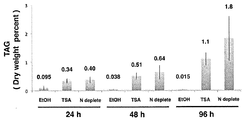
- Example 1 which is a figure which shows the result of having measured the accumulation amount of the triglyceride in Cyanidioschyzon melolae which processed TSA.
- A shows the ratio of the TAG weight to the dry weight of the cells
- B shows the ratio of the TAG weight to the total lipid weight.
- Example 1 which is a figure which shows the result of having measured the accumulation amount of the triglyceride in Cyanidioschyzon melolae which processed TSA.
- the figure shows the ratio of TAG weight to dry cell weight.
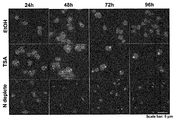
- Example 1 which shows the fluorescence observation image of the cell of Cyanidioschyzon melolae which processed TSA.
- the method for producing algal fats and oils according to the present invention includes a step of treating algae with a lysine deacetylase inhibitor (KDAC inhibitor).
- KDAC inhibitor lysine deacetylase inhibitor
- the treatment with the KDAC inhibitor results in an increase in the degree of acetylation of intracellular proteins. That is, an algae with an increased degree of acetylation of intracellular proteins can be obtained.
- algae accumulate oil and fat.
- the treatment of the KDAC inhibitor may be performed by adding the KDAC inhibitor to the algae culture solution.
- concentration of the KDAC inhibitor added to the culture solution is not particularly limited, but is 0.5 to 100 ⁇ M, preferably 1 to 10 ⁇ M.
- the treatment time of the KDAC inhibitor is not particularly limited, but is 24 hours or longer, preferably 48 hours or longer.
- the KDAC inhibitor used in the present invention is not particularly limited as long as it exhibits lysine deacetylase inhibitory activity against algae.
- Examples of the KDAC inhibitor include the following compounds or salts thereof.
- the KDAC inhibitor acts as an algal fat production promoter, and the present invention also provides an algal fat production promoter containing the KDAC inhibitor.
- Trichostatin A (see Patent Document 3)
- Trichostatin C (see Patent Document 3)
- Ky-6, Ky-9, Ky-72, Ky-317, FK228, MC1568, Tubastin A and trichostatin are preferable.
- Evaluation of the lysine deacetylase inhibitory activity of a KDAC inhibitor against algae is carried out by measuring the amount of acetylated protein in the cell by Western blotting using an antibody specific for acetylated protein, and treating the KDAC inhibitor. This can be done by comparing before and after (see Example 3).
- the KDAC inhibitor when the amount after treatment is 1.1 times or more compared to the amount of algal acetylated protein (eg, acetylated histone) before treatment with the KDAC inhibitor, the KDAC inhibitor Can be determined to have lysine deacetylase inhibitory activity against the algae. Furthermore, when the amount of acetylated protein before and after treatment with the KDAC inhibitor has a significant increase of 5% by t-test, it is determined that the KDAC inhibitor has lysine deacetylase inhibitory activity against the algae. It is preferable to do.
- the means for enhancing the degree of acetylation of intracellular proteins is to suppress the expression of lysine deacetylase or to activate lysine acetylase (KAT) instead of inhibiting lysine deacetylase by a KDAC inhibitor.
- KAT lysine acetylase
- expression induction may be sufficient.
- fat and oil accumulation accompanied by an increase in the degree of acetylation of intracellular proteins can also be induced by these means.
- the algae used in the present invention are not particularly limited as long as they have the ability to produce fats and oils or can express the ability to produce fats and oils by treatment with a KDAC inhibitor.
- algae having the ability to produce fats and oils for example, red algae, green algae or gray algae are known.
- red algae examples include genus cyanidiosone such as cyanidioschyzon merolae, and porphyridium genus such as porphyridium cruentum and porphyradium yezoensis.
- green algae examples include genus Chlamydomonas reinhardtii and other Chlamydomonas species, Chlorella vulgaris and other Chlorella species, and Botryococcus braunii and other Botryococcus braunii genera.
- gray algae examples include the genus Cyanophore such as Cyanophora paradoxa.
- those belonging to the genus Cyanidioschyzon, Chlamydomonas or Euglena can be suitably selected. More specifically, cyanidioschyzon merolae, Chlamydomonas reinhardtii or Euglena gracilis can be suitably selected.
- KDAC inhibitors include Ky-6, Ky-9, Ky-29, Ky-72, Ky-317, SAHA, MS-275, FK228, and Tubastatin A. It is preferred to use one or more compounds selected from the group consisting of
- Examples of the fats and oils to be produced include aliphatic ester compounds composed of aliphatic carboxylic acids and monovalent or trivalent aliphatic alcohols.
- the aliphatic carboxylic acid is not particularly limited as long as it is produced by algae.
- it is an aliphatic carboxylic acid having 14 to 22 carbon atoms, specifically, palmitic acid, palmitoleic acid, margaric acid, stearin.
- examples include acids, oleic acid, and linoleic acid.
- the fats and oils can also include photosynthetic pigments such as phospholipids, free fatty acids, steroid compounds, and carotenoids.
- the culture of the algae before and after the KDAC treatment may be performed under the culture conditions conventionally employed. Usually, it is cultured at normal temperature, preferably 25-37 ° C., by photoautotrophic culture in which carbon dioxide in the air is used as a carbon source to grow by photosynthesis. As a light source for photosynthesis, sunlight or an artificial light source can be used. In order to accelerate the growth of the algae, the light irradiation to the algae is preferably performed at 2 to 100 kilolux for 30 to 500 hours.
- the concentration of carbon dioxide in the medium atmosphere is preferably 0.3 to 10% by volume, and the medium may be agitated or aerated with air as necessary to promote dissolution into the medium.
- a general inorganic medium such as a CHU medium, a JM medium, or an MDM medium can be used.
- the inorganic medium usually contains Ca (NO 3 ) 2 .4H 2 O or KNO 3 as a nitrogen source, and KH 2 PO 4 or MgSO 4 .7H 2 O as other main nutrient components.
- Antibiotics that do not affect the growth of algae may be added to the medium.
- the pH of the medium is preferably 3-10.
- the culture period is preferably 1 to 20 days when the culture is started at an algal body concentration of 0.5 g / L, although it depends on the amount of algal bodies inoculated first.
- the cultured algae are separated from the medium, dried as necessary, and then extracted with fats and oils.
- the separation is preferably performed by separating the algae from the culture medium using solid-liquid separation means such as filtration or centrifugation. Further, from the viewpoint of further reducing the residual amount of medium components, it is preferable to wash the algae separated by the solid-liquid separation means with water, preferably deionized water or distilled water, or a buffer solution.
- Drying can be performed under general conditions. In addition, it is preferable to carry out the conditions under which moisture is efficiently removed and the aliphatic compound in the algal cells is not subject to oxidative degradation. For example, it is preferably performed at a temperature of ⁇ 30 to 180 ° C. in the atmosphere. Specific drying methods include freeze drying and drying by heating. Drying gives a solid powder of algae.
- the algae separated from the medium may be subjected to oil and fat extraction without drying. Moreover, you may use for the fats and oils extraction directly the culture solution containing algae, without performing isolation
- the aliphatic compound contained in the obtained algal solid powder and / or the aliphatic compound adhering to the solid powder is extracted with a solvent.
- aliphatic solvents such as hexane and pentane
- polar solvents such as ethyl acetate, diethyl ether, and methyl ethyl ketone are used as the solvent.
- intracellular chloroplasts can be maintained (see Example 1, FIG. 3), unlike the conventional method based on nutrient deficiency conditions. Therefore, in the method for producing algal fats and oils according to the present invention, there is a possibility that the production of fats and oils can be induced while maintaining carbon fixation by photosynthesis of algae.
- Example 1 Evaluation of oil-and-fat production ability of Cyanidioschizon melolae treated with TSA> The oil-and-oil producing ability of Cyanidischyzon merolae treated with TSA (trichostatin A) was evaluated by comparison with the oil-and-fat producing ability of Cyanidioshyzon merolae cultured under nitrogen-deficient conditions.
- Algal culture Aerated culture was performed in MA2 medium, 40 ° C., 2% CO 2 .
- the culture solution was appropriately diluted and used for the following treatments.
- Treatment of TSA Adjust the cell density of schizon broth to about 1 ⁇ 10 7 / ml, add TSA to the broth to a final concentration of 1 ⁇ M, and culture with aeration in MA2 medium, 40 ° C., 2% CO 2 Went. Only ethanol was added to the control group.
- Cultivation under nitrogen-deficient conditions The cell density of the schizon broth was adjusted to about 2 to 5 ⁇ 10 7 / ml.
- the medium was changed from MA2 medium to MA2-N medium in which ammonium sulfate was replaced with sodium sulfate, and then aerated culture was performed at 40 ° C. and 2% CO 2 .
- TAG triglycerides
- FIGs. 1A and 2 show the ratio of TAG weight to dry weight of cells
- FIG. 1B shows the ratio of TAG weight to total lipid weight. Similar to cells cultured under nitrogen-deficient conditions, the amount of TAG accumulated in cells treated with TSA was increased compared to the control group.
- FIG. 3 shows fluorescence observation images of cells 24, 48, and 96 hours after treatment with TSA and 24, 48, and 96 hours after the start of culture under nitrogen-deficient conditions.
- Green fluorescence is a stained image of oil droplets
- red fluorescence is a stained image of chloroplasts.
- accumulation of oil droplets can be confirmed at all observation times.
- chloroplasts are destroyed after 48 hours, whereas in cells treated with TSA, it can be confirmed that chloroplasts are maintained after that time. This finding suggests that TSA treatment can induce fat and oil production without maintaining intracellular chloroplasts and stopping carbon fixation by algae photosynthesis, unlike culturing under nitrogen-deficient conditions. Yes.
- Table 1 shows the analysis results of the fatty acid composition in the TAG.
- Example 2 Evaluation of fat-and-oil production ability of Chlamydomonas reinhardtii treated with TSA>
- the oil production capacity of Chlamydomonas reinhardtii treated with TSA (trichostatin A) was evaluated by comparison with the oil production capacity of Chlamydomonas reinhardtii cultured under nitrogen-deficient conditions.
- TSA triglyceride
- TAG triglyceride
- FIG. The results are shown in FIG. The figure shows the ratio of TAG weight to dry cell weight. Similar to cells cultured under nitrogen-deficient conditions, the amount of TAG accumulated in cells treated with TSA was increased compared to the control group.
- Table 2 shows the analysis results of the fatty acid composition in TAG.
- Example 3 Evaluation of fat and oil production promoting action of various KDAC inhibitors> Cyanidioschizon melolae and Chlamydomonas reinhardtii were treated with various KDAC inhibitors to evaluate changes in the amount of oil production.
- KDAC inhibitors include Ky-1, Ky-2, Ky-6, Ky-9, Ky-29, Ky-72, Ky-317, VPA, SAHA, SAHA analog, MS-275, FK228, Tubastin A, MGCD0103, MC1568, JNJ-264815585, sodium butyrate (SB), nicotinamide (NA), TSA were used.
- the KDAC inhibitor treatment was performed in the same manner as in Example 1. Cells were collected 24 hours after treatment with TSA and 24 hours after the start of culture under nitrogen-deficient conditions. In the same manner as in Example 1, triglyceride (TAG) was separated and quantified.
- the degree of acetylation of histone H3 and H4 in the collected cells was evaluated by Western blot.
- the recovered cells were suspended in 8M Urea, and the extract obtained by sonication and centrifugation was used as a sample.
- Western blotting was performed using an anti-acetylated antibody (Cell Signaling Technology, # 9441), and bands appearing near 15 kDa and 12 kDa were detected as acetylated histones H3 and H4, respectively. Bands were imaged with LAS-3000 (Fujifilm) chemiluminescence mode, and area values were calculated with image analysis software (image gauge).
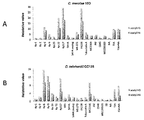
- the degree of acetylation of histone is shown in FIG.
- the figure shows the degree of histone acetylation as a relative value when the control group (treated with each inhibitor solvent (ethanol, DMSO, 1 mM DTT-containing DMSO)) is 1. It can be confirmed that the degree of histone acetylation is enhanced in Cyanidioschizon melolae (see Fig. A) and Chlamydomonas reinhardtii (see Fig. B) treated with Ky-6, Ky-317 and TSA. In addition, Cyanidioschizon melolae treated with Ky-72 and FK228 and Chlamydomonas reinhardtii treated with Ky-9 and MC1568 increased the degree of acetylation of histones.
- Example 4 Evaluation of oil production ability of Euglena gracilis Klebs treated with KDAC inhibitor> The oil production capacity of Euglena gracilis Klebs NIES-48 (obtained from National Institute for Environmental Studies) treated with KDAC inhibitor was evaluated.
- KDAC inhibitors include Ky-1, Ky-2, Ky-6, Ky-9, Ky-29, Ky-72, Ky-317, SAHA, SAHA analog, MS-275, FK228, Tubastatin A, MGCD0103, MC1568, JNJ-2648585, TSA were used.
- the KDAC inhibitor treatment was performed in the same manner as in Example 1. After 24 hours of TSA treatment, intracellular oil droplets were fluorescently stained and observed for fluorescence.
- Example 5 Evaluation 2 of fat-and-oil producing ability of Chlamydomonas reinhardtii treated with KDAC inhibitor 2> The fat and oil producing ability of Chlamydomonas reinhardtii treated with a KDAC inhibitor was evaluated.
- KDAC inhibitor 4-phenylbutyric acid (4-PB) and butyryl hydroxyacid (BHA) were used.
- Algae was pre-cultured in TAP medium (added with 10 mM NH 4 Cl) at 25 ° C. under light irradiation.
- the preculture was performed until the cell concentration reached 0.5 ⁇ 10 7 cells / ml (4-PB treatment group) or 0.2 ⁇ 10 7 cells / ml (BHA treatment group). After centrifugation, the supernatant was removed and resuspended in the same amount of TAP medium.
- the suspension was dispensed in 25 ml aliquots and 4-PB or BHA was added at final concentrations of 3 mM and 1 mM, respectively. Methanol was added to the control group.
- the cells were statically cultured at 25 ° C. for 24 hours under light irradiation.
- the collected cells were sufficiently dried by a freeze dryer, lipids were extracted by the Bligh-Dyer method, and triglycerides (TAG) were separated and purified by thin layer chromatography.
- the purified TAG was subjected to methanolysis, and the fatty acid composition in the TAG was quantified by a gas chromatography hydrogen flame ion detector (GC-FID) to calculate the amount of TAG.
- GC-FID gas chromatography hydrogen flame ion detector
- the method for producing algal fats and oils according to the present invention cell fat accumulation can be induced only by adding a KDAC inhibitor even if nutrients are sufficiently present in the culture solution. Therefore, the operation for exchanging the culture solution for this can be eliminated. Therefore, the method for producing algal fats and oils according to the present invention can be used for producing the algal fats and oils used for the raw material and fuel of the surfactant with high productivity.
Landscapes
- Chemical & Material Sciences (AREA)
- Engineering & Computer Science (AREA)
- Life Sciences & Earth Sciences (AREA)
- Organic Chemistry (AREA)
- Biotechnology (AREA)
- Wood Science & Technology (AREA)
- Zoology (AREA)
- Health & Medical Sciences (AREA)
- Genetics & Genomics (AREA)
- Bioinformatics & Cheminformatics (AREA)
- General Engineering & Computer Science (AREA)
- General Health & Medical Sciences (AREA)
- Microbiology (AREA)
- Biochemistry (AREA)
- General Chemical & Material Sciences (AREA)
- Chemical Kinetics & Catalysis (AREA)
- Oil, Petroleum & Natural Gas (AREA)
- Botany (AREA)
- Cell Biology (AREA)
- Medicinal Chemistry (AREA)
- Tropical Medicine & Parasitology (AREA)
- Virology (AREA)
- Biomedical Technology (AREA)
- Preparation Of Compounds By Using Micro-Organisms (AREA)
- Micro-Organisms Or Cultivation Processes Thereof (AREA)
Abstract
藻類を用いて油脂を製造する方法において、栄養制限のための培養液の交換操作を行うことなく、高い生産性を達成することが可能な技術として、藻類をリジンデアセチラーゼ阻害剤(KDAC阻害剤)で処理し、細胞内タンパク質のアセチル化度を亢進させる工程を含む、藻類油脂の製造方法を提供する。この製造方法によれば、培養液中に栄養が十分に存在していてもKDAC阻害剤を添加するだけで細胞の油脂蓄積を誘導できる。
Description
本発明は、藻類油脂の製造方法及び藻類油脂の産生促進剤に関する。より詳しくは、リジンデアセチラーゼ阻害剤を用いた藻類油脂の製造方法等に関する。
植物油脂は、食用に加え、界面活性剤の原料や燃料の用途のために、需要が拡大している。藻類は、栄養欠乏、強光などのストレス条件下で油脂を蓄積する。藻類を用いて油脂を製造する方法として、窒素を含有している培養液を用いて藻類を培養し増殖させた後、培養液を窒素を含有しないものに交換して細胞を窒素飢餓状態とすることによって、藻類の油脂産生を誘導する方法がある。しかし、この従来方法では、栄養制限のための培養液の交換に多くのエネルギー消費とコストが発生する。
特許文献1には、栄養制限のための培養液の交換操作を行うことなく、バイオマスを産生させることが可能な藻類が開示されている。この藻類は、葉緑体内のグルタチオン濃度を増加させる操作を加えることにより、デンプンの産生能を向上させたものである。
リジンデアセチラーゼ阻害剤(KDAC阻害剤)は、ヒストンデアセチラーゼ阻害剤(HDAC阻害剤)とも称され、抗がん剤としての応用が検討されてきている(特許文献2)。上市された抗がん剤に、皮膚T細胞性リンパ腫の治療薬であるゾリンザ(一般名ボリノスタット)がある。
特許文献3では、KDAC阻害剤を糸状菌の分化抑制剤として用い、植物病害防除のために利用することが提案されている。藻類によるバイオマス産生のためにKDAC阻害剤を利用することは、これまで報告されていない。
本発明は、藻類を用いて油脂を製造する方法において、栄養制限のための培養液の交換操作を行うことなく、高い生産性を達成することが可能な技術を提供することを主な目的とする。
上記課題解決のため、本発明は、以下の[1]~[15]を提供する。
[1]藻類をリジンデアセチラーゼ阻害剤(KDAC阻害剤)で処理する工程を含む、藻類油脂の製造方法。
[2]前記工程は、前記藻類の細胞内タンパク質のアセチル化度を、リジンデアセチラーゼ阻害剤により処理していない場合(対照)に比して亢進させる工程である[1]の製造方法。
[3]前記リジンデアセチラーゼ阻害剤が、Ky-6、Ky-9、Ky-72、Ky-317、FK228、MC1568、Tubastatin A、トリコスタチン及びこれらの塩からなる群より選択される一以上の化合物である[1]又は[2]の製造方法。
[4]前記藻類が、紅藻類、緑藻類又は灰色藻類である[1]~[3]のいずれかの製造方法。
[5]前記藻類が、シアニジオシゾン(Cyanidioschyzon)属、クラミドモナス(Chlamydomonas)属又はユーグレナ(Euglena)属に属する[4]の製造方法。
[6]前記藻類が、シアニジオシゾン・メロラエ(Cyanidioschyzon merolae)、クラミドモナス・レインハルディ(Chlamydomonas reinhardtii)又はユーグレナ・グラシリス(Euglena gracilis)である[5]の製造方法。
[7]前記藻類がシアニジオシゾン・メロラエ(Cyanidioschyzon merolae)であり、前記リジンデアセチラーゼ阻害剤がKy-6、Ky-72、Ky-317、FK228、TSA及びこれらの塩からなる群より選択される一以上の化合物である[6]の製造方法。
[8]前記藻類がクラミドモナス・レインハルディ(Chlamydomonas reinhardtii)であり、前記リジンデアセチラーゼ阻害剤がKy-6、Ky-9、Ky-317、MC1568、TSA、4-phenylbutyric acid、Butyryl hydorxamic acid及びこれらの塩からなる群より選択される一以上の化合物である[6]の製造方法。
[9]前記藻類がユーグレナ・グラシリス(Euglena gracilis)であり、前記リジンデアセチラーゼ阻害剤がKy-6,Ky-9,Ky-29,Ky-72,Ky-317,SAHA,MS-275,FK228、Tubastatin A及びこれらの塩からなる群より選択される一以上の化合物である[6]の製造方法。
[10]栄養制限のための培養液の交換工程を含まない[1]~[9]のいずれかの製造方法。
[1]藻類をリジンデアセチラーゼ阻害剤(KDAC阻害剤)で処理する工程を含む、藻類油脂の製造方法。
[2]前記工程は、前記藻類の細胞内タンパク質のアセチル化度を、リジンデアセチラーゼ阻害剤により処理していない場合(対照)に比して亢進させる工程である[1]の製造方法。
[3]前記リジンデアセチラーゼ阻害剤が、Ky-6、Ky-9、Ky-72、Ky-317、FK228、MC1568、Tubastatin A、トリコスタチン及びこれらの塩からなる群より選択される一以上の化合物である[1]又は[2]の製造方法。
[4]前記藻類が、紅藻類、緑藻類又は灰色藻類である[1]~[3]のいずれかの製造方法。
[5]前記藻類が、シアニジオシゾン(Cyanidioschyzon)属、クラミドモナス(Chlamydomonas)属又はユーグレナ(Euglena)属に属する[4]の製造方法。
[6]前記藻類が、シアニジオシゾン・メロラエ(Cyanidioschyzon merolae)、クラミドモナス・レインハルディ(Chlamydomonas reinhardtii)又はユーグレナ・グラシリス(Euglena gracilis)である[5]の製造方法。
[7]前記藻類がシアニジオシゾン・メロラエ(Cyanidioschyzon merolae)であり、前記リジンデアセチラーゼ阻害剤がKy-6、Ky-72、Ky-317、FK228、TSA及びこれらの塩からなる群より選択される一以上の化合物である[6]の製造方法。
[8]前記藻類がクラミドモナス・レインハルディ(Chlamydomonas reinhardtii)であり、前記リジンデアセチラーゼ阻害剤がKy-6、Ky-9、Ky-317、MC1568、TSA、4-phenylbutyric acid、Butyryl hydorxamic acid及びこれらの塩からなる群より選択される一以上の化合物である[6]の製造方法。
[9]前記藻類がユーグレナ・グラシリス(Euglena gracilis)であり、前記リジンデアセチラーゼ阻害剤がKy-6,Ky-9,Ky-29,Ky-72,Ky-317,SAHA,MS-275,FK228、Tubastatin A及びこれらの塩からなる群より選択される一以上の化合物である[6]の製造方法。
[10]栄養制限のための培養液の交換工程を含まない[1]~[9]のいずれかの製造方法。
[11]リジンデアセチラーゼ阻害剤を含む、藻類油脂の産生促進剤。
[12]前記リジンデアセチラーゼ阻害剤が、Ky-6、Ky-9、Ky-72、Ky-317、FK228、MC1568、Tubastatin A、トリコスタチン及びこれらの塩からなる群より選択される一以上の化合物である[11]の産生促進剤。
[12]前記リジンデアセチラーゼ阻害剤が、Ky-6、Ky-9、Ky-72、Ky-317、FK228、MC1568、Tubastatin A、トリコスタチン及びこれらの塩からなる群より選択される一以上の化合物である[11]の産生促進剤。
[13]細胞内タンパク質のアセチル化度が対照に比して高められた藻類。
[14][13]の藻類を培養する工程を含む、藻類油脂の製造方法。
[15]栄養制限のための培養液の交換工程を含まない[14]の製造方法。
[14][13]の藻類を培養する工程を含む、藻類油脂の製造方法。
[15]栄養制限のための培養液の交換工程を含まない[14]の製造方法。
本発明において、「藻類の細胞内タンパク質のアセチル化度を対照に比して亢進させる(高める)」とは、KDAC阻害剤により処理した細胞内のタンパク質のアセチル化度が、KDAC阻害剤による処理をしていない細胞(対照)内のタンパク質のアセチル化度に比べて高いことを意味する。具体的には、KDAC阻害剤未処理の藻類のアセチル化タンパク質の量と比較して、KDAC阻害剤処理後の藻類のアセチル化タンパク質の量が1.1倍以上であることをいう。あるいは、KDAC阻害剤未処理の藻類のアセチル化タンパク質の量と、KDAC阻害剤処理後の藻類のアセチル化タンパク質の量との間にt検定で5%レベルの有意な増加があることをいう。タンパク質のアセチル化度は、従来公知の手法によって測定することができ、例えばアセチル化タンパク質に特異的な抗体を用いたウェスタンブロットにより測定できる。
また、本発明において、「KDAC阻害剤」には、藻類に対して、上記の「藻類の細胞内タンパク質のアセチル化度を対照に比して亢進させる」活性を示す物質が広く包含されるものとする。具体的には、「KDAC阻害剤」には、少なくともKy-6、Ky-9、Ky-72、Ky-317、FK228、MC1568、Tubastatin A、トリコスタチン及びこれらの塩が含まれるものとする。塩としては、上記活性を有すれば特に限定されることはなく、例えばナトリウム塩、カリウム塩、カルシウム塩などであってよい。
本発明により、栄養制限のための培養液の交換操作を行うことなく、高い生産性を達成することが可能な藻類油脂の製造方法が提供される。
以下、本発明を実施するための好適な形態について説明する。なお、以下に説明する実施形態は、本発明の代表的な実施形態の一例を示したものであり、これにより本発明の範囲が狭く解釈されることはない。
[KDAC阻害剤処理工程]
本発明に係る藻類油脂の製造方法は、藻類をリジンデアセチラーゼ阻害剤(KDAC阻害剤)で処理する工程を含むことを特徴とする。該工程では、KDAC阻害剤の処理の結果、細胞内タンパク質のアセチル化度の亢進が生じる。すなわち、細胞内タンパク質のアセチル化度が高められた藻類が得られる。実施例に示されるように、KDAC阻害剤の処理によって、細胞内タンパク質のアセチル化度が亢進された状態となると、藻類が油脂を蓄積するようになる。
本発明に係る藻類油脂の製造方法は、藻類をリジンデアセチラーゼ阻害剤(KDAC阻害剤)で処理する工程を含むことを特徴とする。該工程では、KDAC阻害剤の処理の結果、細胞内タンパク質のアセチル化度の亢進が生じる。すなわち、細胞内タンパク質のアセチル化度が高められた藻類が得られる。実施例に示されるように、KDAC阻害剤の処理によって、細胞内タンパク質のアセチル化度が亢進された状態となると、藻類が油脂を蓄積するようになる。
KDAC阻害剤の処理は、藻類の培養液中にKDAC阻害剤を添加することによって行えばよい。培養液中へのKDAC阻害剤の添加濃度は、特に限定されないが、0.5~100μM、好ましくは1~10μMとされる。また、KDAC阻害剤の処理時間は、特に限定されないが、24時間以上、好ましくは48時間以上とされる。
本発明に用いるKDAC阻害剤は、藻類に対してリジンデアセチラーゼ阻害活性を示すものであればよく、特に限定されない。KDAC阻害剤としては、以下の化合物又はその塩を例示できる。本発明において、KDAC阻害剤は藻類油脂の産生促進剤として作用するものであり、本発明は、KDAC阻害剤を含む藻類油脂の産生促進剤をも提供するものである。
Ky-1(特許文献2参照)

Ky-2
〈cyclo(-L-2-amino-8-hydroxamido-suberoyl-aminoisobutylyl-L-phenylalanyl-D-prolyl-)〉(特許文献3参照)
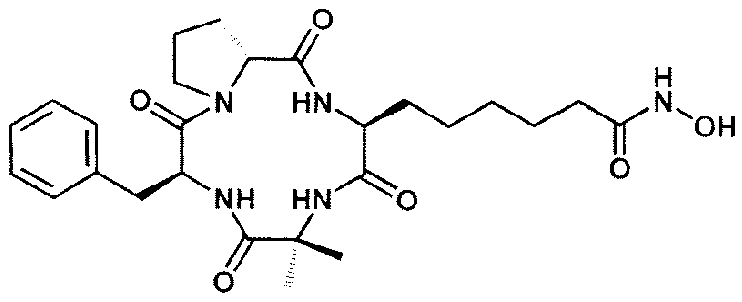
〈cyclo(-L-2-amino-8-hydroxamido-suberoyl-aminoisobutylyl-L-phenylalanyl-D-prolyl-)〉(特許文献3参照)
Ky-6
〈cyclo(-L-2-amino-7-(2-pyridyldisulfidryl)heptanoyl-aminoisobutylyl-L-phenylalanyl-D-prolyl-)〉(特許文献3参照)
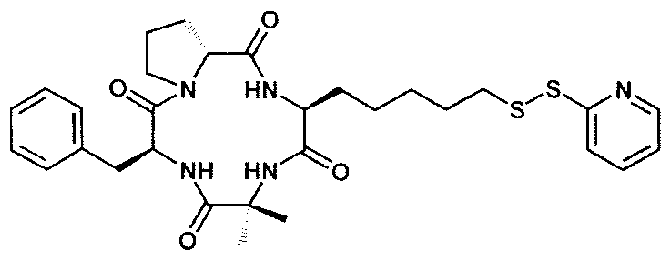
〈cyclo(-L-2-amino-7-(2-pyridyldisulfidryl)heptanoyl-aminoisobutylyl-L-phenylalanyl-D-prolyl-)〉(特許文献3参照)
Ky-9(特開2008-143886参照)
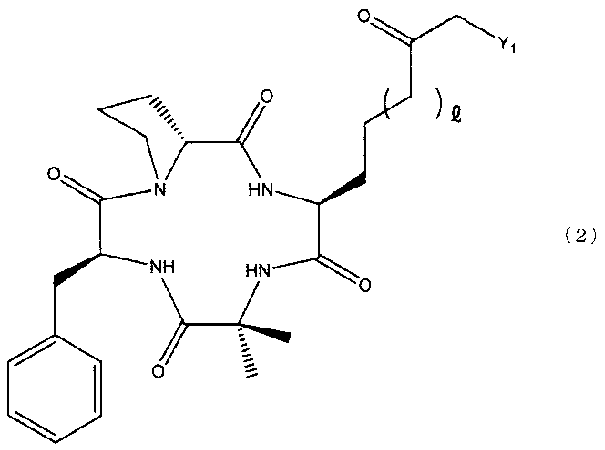
Ky-9:上記式においてl=3、Y1=OCH3
Ky-29(特開2008-143886参照)
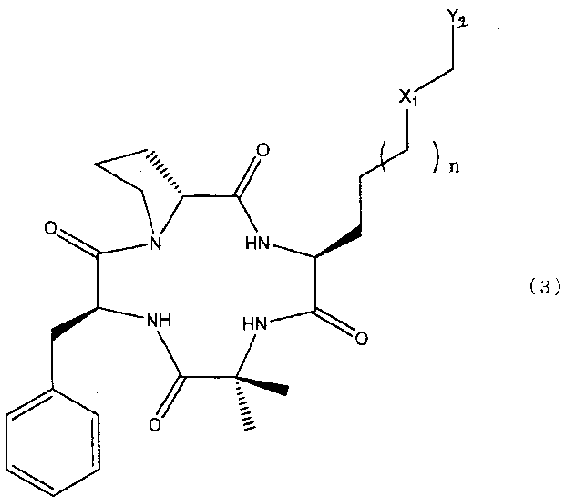
Ky-29:上記式においてn=3、X1=S、Y2=COCF3
Ky-72:上記式においてn=3、X1=S、Y2=COCH3
Ky-72:上記式においてn=3、X1=S、Y2=COCH3
Ky-317(Bioorganic & Medicinal Chemistry Letters 20 (2010) 997-999参照)

SAHA(特許文献3参照)
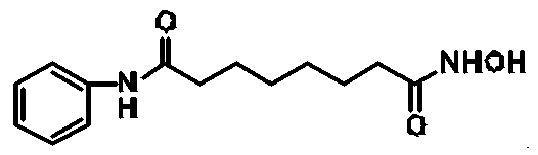
SAHA analog

MS-275

FK228

Tubastatin A

MGCD0103(Mocetinostat)
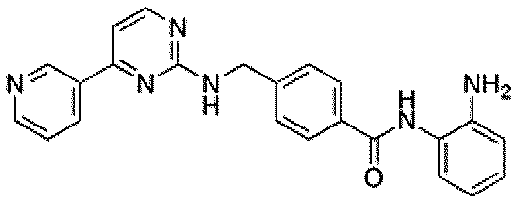
MC1568
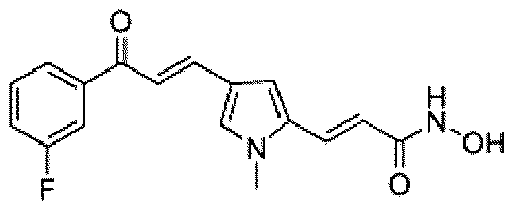
JNJ-26481585

トリコスタチンA(特許文献3参照)

トリコスタチンC(特許文献3参照)
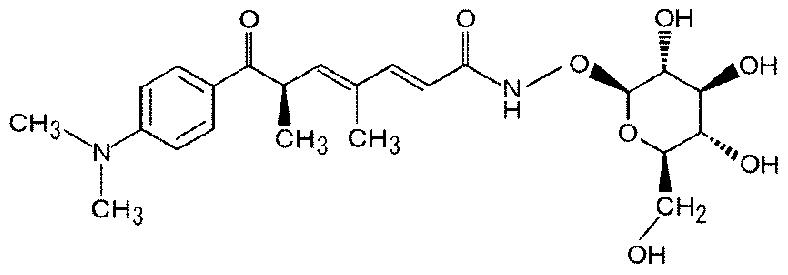
酪酸ナトリウム(sodium butyrate:SB)
ニコチンアミド(nicotinamide:NA)
バルプロ酸(Valproic Acid:VPA)
ニコチンアミド(nicotinamide:NA)
バルプロ酸(Valproic Acid:VPA)
4-phenylbutyric acid(Annu. Rev. Pharmacol. Toxicol., 2005, 45:495-528, Figure 2参照)
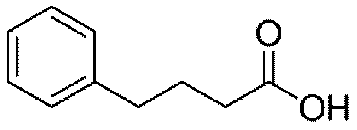
Butyryl hydorxamic acid(Experimental Hepatology, 2003, 31, 197-203, Table 1参照)。
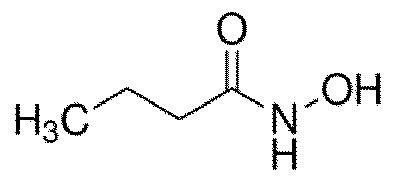
これらのKDAC阻害剤のなかでは、Ky-6、Ky-9、Ky-72、Ky-317、FK228、MC1568、Tubastatin A及びトリコスタチンが好ましい。
KDAC阻害剤の藻類に対するリジンデアセチラーゼ阻害活性の評価は、例えば、アセチル化タンパク質に特異的な抗体を用いたウェスタンブロットにより、細胞内のアセチル化タンパク質の量を測定し、KDAC阻害剤の処理前後で比較することによって行うことができる(実施例3参照)。
具体的には、KDAC阻害剤の処理前の藻類のアセチル化タンパク質(例えば、アセチル化ヒストン)の量と比較して、処理後の量が1.1倍以上である場合に、該KDAC阻害剤が該藻類に対してリジンデアセチラーゼ阻害活性を有すると判断することができる。さらに、KDAC阻害剤の処理前後でアセチル化タンパク質の量にt検定で5%レベルの有意な増加がある場合に、該KDAC阻害剤が該藻類に対してリジンデアセチラーゼ阻害活性を有すると判断することが好ましい。
実施例に示されるように、KDAC阻害剤の処理によって、細胞内タンパク質のアセチル化度が亢進された状態となると、細胞は油脂蓄積するようになることが確認されている。ここで、細胞内タンパク質のアセチル化度を亢進させるための手段は、KDAC阻害剤によるリジンデアセチラーゼの阻害に替えて、リジンデアセチラーゼの発現抑制や、リジンアセチラーゼ(KAT)の活性化又は発現誘導であってもよい。これらの手段によっても、細胞内タンパク質のアセチル化度の亢進を伴う油脂蓄積を誘導できる可能性がある。
[藻類]
本発明に用いる藻類は、油脂の産生能を有するあるいはKDAC阻害剤による処理によって油脂の産生能を発現するものであればよく、特に限定されない。油脂の産生能を有する藻類としては、例えば、紅藻類、緑藻類又は灰色藻類が知られている。
本発明に用いる藻類は、油脂の産生能を有するあるいはKDAC阻害剤による処理によって油脂の産生能を発現するものであればよく、特に限定されない。油脂の産生能を有する藻類としては、例えば、紅藻類、緑藻類又は灰色藻類が知られている。
紅藻類としては、シアニジオシゾン・メロラエ(Cyanidioschyzon merolae)等のシアニジオシゾン属、ポルフィリジウム・クルエンタム(Porphyridium cruentum)及びポルフィリジウム・エゾエンシス(Porphyra yezoensis)等のポルフィリジウム属などが挙げられる。
緑藻類としては、クラミドモナス・レインハルディ(Chlamydomonas reinhardtii)等のクラミドモナス属、クロレラ・ブルガリス(Chlorella vulgaris)等のクロレラ属、ボトリオコッカス・ブラウニー(Botryococcus braunii)等のボトリオコッカス属などが挙げられる。
灰色藻類としては、シアノフォア・パラドキサ(Cyanophora paradoxa)等のシアノフォア属が挙げられる。
藻類としては、シアニジオシゾン(Cyanidioschyzon)属、クラミドモナス(Chlamydomonas)属又はユーグレナ(Euglena)属に属するものを好適に選択できる。より具体的には、シアニジオシゾン・メロラエ(Cyanidioschyzon merolae)、クラミドモナス・レインハルディ(Chlamydomonas reinhardtii)又はユーグレナ・グラシリス(Euglena gracilis)を好適に選択できる。
藻類としてシアニジオシゾン・メロラエ(Cyanidioschyzon merolae)を用いる場合には、KDAC阻害剤にはKy-6、Ky-72、Ky-317、FK228及びTSAからなる群より選択される一以上の化合物を用いることが好適となる。
藻類としてクラミドモナス・レインハルディ(Chlamydomonas reinhardtii)を用いる場合には、KDAC阻害剤にはKy-6、Ky-9、Ky-317、MC1568及びTSAからなる群より選択される一以上の化合物を用いることが好適となる。
藻類としてユーグレナ・グラシリス(Euglena gracilis)を用いる場合には、KDAC阻害剤にはKy-6,Ky-9,Ky-29,Ky-72,Ky-317,SAHA,MS-275,FK228及びTubastatin Aからなる群より選択される一以上の化合物を用いることが好適となる。
藻類としてクラミドモナス・レインハルディ(Chlamydomonas reinhardtii)を用いる場合には、KDAC阻害剤にはKy-6、Ky-9、Ky-317、MC1568及びTSAからなる群より選択される一以上の化合物を用いることが好適となる。
藻類としてユーグレナ・グラシリス(Euglena gracilis)を用いる場合には、KDAC阻害剤にはKy-6,Ky-9,Ky-29,Ky-72,Ky-317,SAHA,MS-275,FK228及びTubastatin Aからなる群より選択される一以上の化合物を用いることが好適となる。
[油脂]
製造する油脂としては、脂肪族カルボン酸と、1価又は3価の脂肪族アルコールと、からなる脂肪族エステル化合物が挙げられる。脂肪族カルボン酸は、藻類が産生するものであれば特に限定されず、例えば、炭素数14~22の脂肪族カルボン酸であって、具体的には、パルミチン酸、パルミトレイン酸、マルガリン酸、ステアリン酸、オレイン酸及びリノール酸等を挙げることができる。また、油脂としては、リン脂質、遊離脂肪酸、ステロイド化合物、カロテノイド等の光合成色素等も含み得る。
製造する油脂としては、脂肪族カルボン酸と、1価又は3価の脂肪族アルコールと、からなる脂肪族エステル化合物が挙げられる。脂肪族カルボン酸は、藻類が産生するものであれば特に限定されず、例えば、炭素数14~22の脂肪族カルボン酸であって、具体的には、パルミチン酸、パルミトレイン酸、マルガリン酸、ステアリン酸、オレイン酸及びリノール酸等を挙げることができる。また、油脂としては、リン脂質、遊離脂肪酸、ステロイド化合物、カロテノイド等の光合成色素等も含み得る。
[培養工程]
KDAC処理前及び処理後の藻類の培養は、従来から採用されている培養条件で行えばよい。通常、空気中の二酸化炭素を炭素源として光合成で増殖させる光独立栄養的培養によって、常温で、好ましくは25~37℃で培養する。光合成のための光源は、太陽光、又は人工的な光源を用いることができる。藻類の増殖を早めるため、藻類への光照射は、2~100キロルックスで30~500時間行うことが好ましい。培地雰囲気中の二酸化炭素濃度は0.3~10体積%が好ましく、培地中への溶け込みを促進するために、必要に応じて培地を撹拌、又は空気によって曝気してもよい。
KDAC処理前及び処理後の藻類の培養は、従来から採用されている培養条件で行えばよい。通常、空気中の二酸化炭素を炭素源として光合成で増殖させる光独立栄養的培養によって、常温で、好ましくは25~37℃で培養する。光合成のための光源は、太陽光、又は人工的な光源を用いることができる。藻類の増殖を早めるため、藻類への光照射は、2~100キロルックスで30~500時間行うことが好ましい。培地雰囲気中の二酸化炭素濃度は0.3~10体積%が好ましく、培地中への溶け込みを促進するために、必要に応じて培地を撹拌、又は空気によって曝気してもよい。
培地には、CHU培地、JM培地、MDM培地等、一般的な無機培地を用いることができる。無機培地には、通常、窒素源としてCa(NO3)2・4H2OやKNO3が、その他の主要な栄養成分としてKH2PO4やMgSO4・7H2O等が含まれている。また、培地には、藻類の生育に影響を与えない抗生物質等を添加してもよい。培地のpHは、3~10が好ましい。培養期間は、初めに接種する藻体量にもよるが、0.5g/Lの藻体濃度で培養を開始した場合、1~20日間とすることが好ましい。
[油脂抽出工程]
培養した藻類を培地から分離し、必要に応じて乾燥を行った後、油脂の抽出を行う。分離は、ろ過や遠心分離等の固液分離手段を用いて藻類を培地から分離することが好ましい。また、培地成分の残留量を一層低減する観点から、固液分離手段によって分離された藻類を水、好ましくは脱イオン水又は蒸留水、あるいは緩衝液等で洗浄することが好ましい。
培養した藻類を培地から分離し、必要に応じて乾燥を行った後、油脂の抽出を行う。分離は、ろ過や遠心分離等の固液分離手段を用いて藻類を培地から分離することが好ましい。また、培地成分の残留量を一層低減する観点から、固液分離手段によって分離された藻類を水、好ましくは脱イオン水又は蒸留水、あるいは緩衝液等で洗浄することが好ましい。
乾燥は、一般的な条件で行うことが可能である。なお、効率的に水分が除去され、かつ、藻類細胞内の脂肪族化合物が酸化劣化を受けない条件で行うことが好ましい。例えば、大気中-30~180℃の温度で行うことが好ましい。具体的な乾燥方法としては、凍結乾燥や、加温による乾燥等が挙げられる。乾燥によって、藻類の固形粉末が得られる。
なお、培地から分離された藻類は、乾燥を行うことなく油脂抽出に供してもよい。また、分離を行うことなく、培養工程に引き続いて、藻類を含む培養液を直接油脂抽出に供してもよい。
油脂抽出は、得られた藻類の固形粉末中に含まれる脂肪族化合物、及び/又は該固形粉末に付着する脂肪族化合物を溶媒によって抽出する。ここで、溶媒には、ヘキサンやペンタン等の脂肪族炭化水素や、酢酸エチル、ジエチルエーテル、メチルエチルケトン等の極性溶媒が用いられる。
本発明に係る藻類油脂の製造方法によれば、培養液中に栄養が十分に存在していてもKDAC阻害剤を添加するだけで細胞の油脂蓄積を誘導できる。従って、本発明に係る藻類油脂の製造方法では、栄養制限のための培養液の交換操作を行う必要がなく、高い生産性を達成することが可能である。
また、本発明に係る藻類油脂の製造方法においては、従来の栄養欠乏条件による方法とは異なり、細胞内の葉緑体を維持できる(実施例1、図3参照)。従って、本発明に係る藻類油脂の製造方法では、藻類の光合成による炭素固定を維持したまま、油脂の産生を誘導できる可能性がある。
<実施例1:TSAを処理したCyanidioschyzon merolaeの油脂産生能の評価>
TSA(トリコスタチンA)処理したCyanidioschyzon merolaeの油脂産生能を、窒素欠乏条件で培養したCyanidioschyzon merolaeの油脂産生能との比較により評価した。
TSA(トリコスタチンA)処理したCyanidioschyzon merolaeの油脂産生能を、窒素欠乏条件で培養したCyanidioschyzon merolaeの油脂産生能との比較により評価した。
藻類の培養:MA2培地、40℃、2% CO2にて通気培養を行った。培養液を適宜希釈して以下の処理に使用した。
TSAの処理:シゾン培養液の細胞密度を1×10⁷/ml程度に調整し、TSAを終濃度1μMとなるよう培養液に添加し、MA2培地、40℃, 2% CO2にて通気培養を行った。対照群には、エタノールのみを添加した。
窒素欠乏条件での培養:シゾン培養液の細胞密度を2~5×10⁷/ml程度となるように調整した。培地を、MA2培地から、硫酸アンモニウムを硫酸ナトリウムに置換したMA2-N培地に交換した後、40℃, 2% CO2にて通気培養を行った。
TSAの処理:シゾン培養液の細胞密度を1×10⁷/ml程度に調整し、TSAを終濃度1μMとなるよう培養液に添加し、MA2培地、40℃, 2% CO2にて通気培養を行った。対照群には、エタノールのみを添加した。
窒素欠乏条件での培養:シゾン培養液の細胞密度を2~5×10⁷/ml程度となるように調整した。培地を、MA2培地から、硫酸アンモニウムを硫酸ナトリウムに置換したMA2-N培地に交換した後、40℃, 2% CO2にて通気培養を行った。
TSAの処理24,48,72,96時間後及び窒素欠乏条件での培養開始24、48,72,96時間後に細胞を回収した。回収した細胞を凍結乾燥機により十分乾燥させ、Bligh-Dyer法により脂質を抽出し、薄層クロマトグラフィーによりトリグリセリド(TAG)を分離・精製した。精製したTAGをメタノリシス化し、TAG中の脂肪酸組成をガスクロマトグラフィー水素炎イオン検出器(GC-FID)により定量し、TAG量を算出した。
結果を図1~図3に示す。図1A及び図2は細胞の乾燥重量に対するTAG重量の比率、図1Bは総脂質重量に対するTAG重量の比率を示す。窒素欠乏条件で培養した細胞と同様に、TSAを処理した細胞では、対照群に比してTAGの蓄積量が増加していた。
図3に、TSAの処理後24、48,96時間及び窒素欠乏条件での培養開始後24、48,96時間における細胞の蛍光観察像を示す。緑蛍光は油滴の染色像、赤蛍光は葉緑体の染色像である。TSAを処理した細胞及び窒素欠乏条件で培養した細胞では全ての観察時間において油滴の蓄積が確認できる。窒素欠乏条件で培養した細胞では、48時間以後、葉緑体が破壊されているのに対し、TSAを処理した細胞では、同時間以降も、葉緑体が維持されているのが確認できる。この知見は、TSA処理においては、窒素欠乏条件での培養と異なり、細胞内の葉緑体を維持して藻類の光合成による炭素固定を停止させることなく、油脂産生を誘導できる可能性を示している。
TAG中の脂肪酸組成の解析結果を表1に示す。

TSAを処理した細胞では、処理時間に依存してリノール酸(18:2)の蓄積が進行する傾向が認められた。
<実施例2:TSAを処理したChlamydomonas reinhardtiiの油脂産生能の評価>
TSA(トリコスタチンA)処理したChlamydomonas reinhardtiiの油脂産生能を、窒素欠乏条件で培養したChlamydomonas reinhardtiiの油脂産生能との比較により評価した。
TSA(トリコスタチンA)処理したChlamydomonas reinhardtiiの油脂産生能を、窒素欠乏条件で培養したChlamydomonas reinhardtiiの油脂産生能との比較により評価した。
TSAの処理及び窒素欠乏条件での培養は実施例1と同様にして行った。TSAの処理24時間後及び窒素欠乏条件での培養開始24時間後に細胞を回収した。実施例1と同様にしてトリグリセリド(TAG)の分離及び定量と、TAG中の脂肪酸組成の解析を行った。
結果を図4に示す。図は細胞の乾燥重量に対するTAG重量の比率を示す。窒素欠乏条件で培養した細胞と同様に、TSAを処理した細胞では、対照群に比してTAGの蓄積量が増加していた。
TAG中の脂肪酸組成の解析結果を表2に示す。

<実施例3:種々のKDAC阻害剤の油脂産生促進作用の評価>
Cyanidioschyzon merolae及びChlamydomonas reinhardtiiを種々のKDAC阻害剤により処理し、油脂産生量の変化を評価した。
Cyanidioschyzon merolae及びChlamydomonas reinhardtiiを種々のKDAC阻害剤により処理し、油脂産生量の変化を評価した。
KDAC阻害剤には、Ky-1,Ky-2,Ky-6,Ky-9,Ky-29,Ky-72,Ky-317,VPA,SAHA,SAHA analog,MS-275,FK228,Tubastatin A,MGCD0103,MC1568,JNJ-26481585,sodium butyrate(SB),nicotinamide(NA),TSAを用いた。KDAC阻害剤の処理は実施例1と同様にして行った。TSAの処理24時間後及び窒素欠乏条件での培養開始24時間後に細胞を回収した。実施例1と同様にしてトリグリセリド(TAG)の分離及び定量を行った。
また、回収した細胞内のヒストンH3及びH4のアセチル化度をウェスタンブロットにより評価した。回収した細胞を8M Ureaに懸濁し、超音波破砕と遠心分離を行って得た抽出物をサンプルとした。ウェスタンブロットは抗アセチル化抗体(Cell Signaling Technology、#9441)を用いて行い、15kDa付近と12kDa付近に現れるバンドをそれぞれアセチル化ヒストンH3、H4として検出した。LAS-3000(Fujifilm) chemiluminescence modeにてバンドを撮像し、画像解析ソフト(image gauge)にてエリア値を算出した。
ヒストンのアセチル化度を図5に示す。図は、ヒストンのアセチル化度を、対照群(各阻害剤の溶媒(エタノール、DMSO、1mM DTT含DMSO)で処理したもの)を1とした相対値により示す。Ky-6,Ky-317,TSAを処置したCyanidioschyzon merolae(図A参照)及びChlamydomonas reinhardtii(図B参照)では、ヒストンのアセチル化度が亢進されているのが確認できる。また、Ky-72,FK228を処理したCyanidioschyzon merolaeと、Ky-9,MC1568を処理したChlamydomonas reinhardtiiでは、ヒストンのアセチル化度が亢進された。
TAGの定量の結果、ヒストンのアセチル化度の亢進が確認された細胞と、TAGの蓄積量の増加が認められた細胞とは一致した。すなわち、Ky-6,Ky-317,TSAは、Cyanidioschyzon merolae及びChlamydomonas reinhardtiiにおいて油脂産生促進作用を示した。また、Ky-72,FK228はCyanidioschyzon merolaeにおいて、Ky-9,MC1568はChlamydomonas reinhardtiiにおいて油脂産生促進作用を示した。この結果から、培養液への添加によって藻類に対して活性を示し得るKDAC阻害剤であれば、藻類による油脂の産生を促進できることが明らかとなった。
<実施例4:KDAC阻害剤を処理したEuglena gracilis Klebsの油脂産生能の評価>
KDAC阻害剤を処理したEuglena gracilis Klebs NIES-48(国立環境研究所から入手)の油脂産生能を評価した。KDAC阻害剤には、Ky-1,Ky-2,Ky-6,Ky-9,Ky-29,Ky-72,Ky-317,SAHA,SAHA analog,MS-275,FK228,Tubastatin A,MGCD0103,MC1568,JNJ-26481585,TSAを用いた。KDAC阻害剤の処理は実施例1と同様にして行った。TSAの処理24時間後に、細胞内の油滴を蛍光染色し、蛍光観察を行った。
KDAC阻害剤を処理したEuglena gracilis Klebs NIES-48(国立環境研究所から入手)の油脂産生能を評価した。KDAC阻害剤には、Ky-1,Ky-2,Ky-6,Ky-9,Ky-29,Ky-72,Ky-317,SAHA,SAHA analog,MS-275,FK228,Tubastatin A,MGCD0103,MC1568,JNJ-26481585,TSAを用いた。KDAC阻害剤の処理は実施例1と同様にして行った。TSAの処理24時間後に、細胞内の油滴を蛍光染色し、蛍光観察を行った。
その結果、Ky-6,Ky-9,Ky-29,Ky-72,Ky-317,SAHA,MS-275,FK228,Tubastatin Aを処理した細胞では、対照群に比して細胞内の油滴が増加した。特にKy-6及びTubastatin Aは効果が顕著であった。
<実施例5:KDAC阻害剤を処理したChlamydomonas reinhardtiiの油脂産生能の評価2>
KDAC阻害剤を処理したChlamydomonas reinhardtiiの油脂産生能を評価した。KDAC阻害剤には、4-phenylbutyric acid(4-PB)とButyryl hydorxamic acid(BHA)を用いた。
KDAC阻害剤を処理したChlamydomonas reinhardtiiの油脂産生能を評価した。KDAC阻害剤には、4-phenylbutyric acid(4-PB)とButyryl hydorxamic acid(BHA)を用いた。
光照射下、25℃で、TAP培地(10 mM NH4Cl添加)中で藻類を前培養した。前培養は、細胞濃度が0.5×10⁷ cells/ml(4-PB処理群)又は0.2×107 cells/ml(BHA処理群)に達するまで行った。遠心分離後、上清を除き、同量のTAP培地で再懸濁した。懸濁液を25 mlずつプレートに分注し、4-PB又はBHAをそれぞれ終濃度3 mM、1 mMで添加した。対照群には、メタノールを添加した。光照射下、25℃で24時間静置培養した。回収した細胞を凍結乾燥機により十分乾燥させ、Bligh-Dyer法により脂質を抽出し、薄層クロマトグラフィーによりトリグリセリド(TAG)を分離・精製した。精製したTAGをメタノリシス化し、TAG中の脂肪酸組成をガスクロマトグラフィー水素炎イオン検出器(GC-FID)により定量し、TAG量を算出した。結果を図6及び図7に示す。BHAを処理した細胞では、対照群に比してTAGの蓄積量の顕著な増加が確認された(図6参照)。また、4-PBを処理した細胞でも、対照群に比してTAGの蓄積量が増加する傾向がみられた(図6参照)。
本発明に係る藻類油脂の製造方法によれば、培養液中に栄養が十分に存在していてもKDAC阻害剤を添加するだけで細胞の油脂蓄積を誘導でき、従来方法のような栄養制限のための培養液の交換操作を不要とできる。従って、本発明に係る藻類油脂の製造方法は、界面活性剤の原料や燃料に用いられる藻類油脂を生産性良く製造するために利用できる。
Claims (7)
- 藻類をリジンデアセチラーゼ阻害剤で処理する工程を含む、藻類油脂の製造方法。
- 前記工程は、前記藻類の細胞内タンパク質のアセチル化度を対照に比して亢進させる工程である、請求項1記載の製造方法。
- 前記リジンデアセチラーゼ阻害剤が、Ky-6、Ky-9、Ky-72、Ky-317、FK228、MC1568、Tubastatin A、トリコスタチン及びこれらの塩からなる群より選択される一以上の化合物である、請求項1又は2記載の製造方法。
- リジンデアセチラーゼ阻害剤を含む、藻類油脂の産生促進剤。
- 前記リジンデアセチラーゼ阻害剤が、Ky-6、Ky-9、Ky-72、Ky-317、FK228、MC1568、Tubastatin A、トリコスタチン及びこれらの塩からなる群より選択される一以上の化合物である、請求項4記載の藻類油脂の産生促進剤。
- 細胞内タンパク質のアセチル化度が対照に比して高められた藻類。
- 請求項6記載の藻類を培養する工程を含む、藻類油脂の製造方法。
Applications Claiming Priority (2)
| Application Number | Priority Date | Filing Date | Title |
|---|---|---|---|
| JP2014144756A JP2017153369A (ja) | 2014-07-15 | 2014-07-15 | 藻類油脂の製造方法及び藻類油脂の産生促進剤 |
| JP2014-144756 | 2014-07-15 |
Publications (1)
| Publication Number | Publication Date |
|---|---|
| WO2016009630A1 true WO2016009630A1 (ja) | 2016-01-21 |
Family
ID=55078139
Family Applications (1)
| Application Number | Title | Priority Date | Filing Date |
|---|---|---|---|
| PCT/JP2015/003505 Ceased WO2016009630A1 (ja) | 2014-07-15 | 2015-07-10 | 藻類油脂の製造方法及び藻類油脂の産生促進剤 |
Country Status (2)
| Country | Link |
|---|---|
| JP (1) | JP2017153369A (ja) |
| WO (1) | WO2016009630A1 (ja) |
Cited By (1)
| Publication number | Priority date | Publication date | Assignee | Title |
|---|---|---|---|---|
| JP2017184698A (ja) * | 2016-04-08 | 2017-10-12 | 株式会社ユーグレナ | 油脂高含有ユーグレナ |
-
2014
- 2014-07-15 JP JP2014144756A patent/JP2017153369A/ja active Pending
-
2015
- 2015-07-10 WO PCT/JP2015/003505 patent/WO2016009630A1/ja not_active Ceased
Non-Patent Citations (2)
| Title |
|---|
| CHENG Q. ET AL.: "Effect of histone deacetylase inhibitors on tubulin acetylation and development in Volvox carteri(Volvocales", J. PHYCOL., vol. 42, 2006, pages 417 - 422 * |
| WATERBORG J. H.: "Dynamics of Histone Acetylation in Chlamydomonas reinhardtii", THE JOURNAL OF BIOLOGICAL CHEMISTRY, vol. 273, no. 42, 1998, pages 27602 - 27609, XP055056370, DOI: doi:10.1074/jbc.273.42.27602 * |
Cited By (1)
| Publication number | Priority date | Publication date | Assignee | Title |
|---|---|---|---|---|
| JP2017184698A (ja) * | 2016-04-08 | 2017-10-12 | 株式会社ユーグレナ | 油脂高含有ユーグレナ |
Also Published As
| Publication number | Publication date |
|---|---|
| JP2017153369A (ja) | 2017-09-07 |
Similar Documents
| Publication | Publication Date | Title |
|---|---|---|
| Pei et al. | Flocculation performance and mechanism of fungal pellets on harvesting of microalgal biomass | |
| Kong et al. | The characteristics of biomass production, lipid accumulation and chlorophyll biosynthesis of Chlorella vulgaris under mixotrophic cultivation | |
| Subhash et al. | Temperature induced stress influence on biodiesel productivity during mixotrophic microalgae cultivation with wastewater | |
| Pasquet et al. | Fatty acids profile and temperature in the cultured marine diatom Odontella aurita | |
| Moheimani et al. | Non-destructive oil extraction from Botryococcus braunii (Chlorophyta) | |
| US20110124034A1 (en) | Enrichment of process feedstock | |
| Fan | Acclimation to NaCl and light stress of heterotrophic Chlamydomonas reinhardtii for lipid accumulation | |
| Zhang et al. | Effects of stationary phase elongation and initial nitrogen and phosphorus concentrations on the growth and lipid-producing potential of Chlorella sp. HQ | |
| Kiran et al. | Influence of varying nitrogen levels on lipid accumulation in Chlorella sp. | |
| US20110217743A1 (en) | Method of Producing Lauric Acid-containing Oil or Fat | |
| US20220372430A1 (en) | Protists enriched with lipids rich in polyunsaturated fatty acids | |
| Zalogin et al. | Azide improves triglyceride yield in microalgae | |
| JP6721807B2 (ja) | 長鎖脂肪酸生産藻類及びそれを用いた長鎖脂肪酸生産方法 | |
| Xue et al. | Cultivation of Dunaliella tertiolecta intervened by triethylamine enhances the lipid content | |
| Gélinas et al. | Residual corn crop hydrolysate and silage juice as alternative carbon sources in microalgae production | |
| WO2014003530A1 (fr) | Procédé pour augmenter le potentiel de production de biocarburant à partir de micro-algues en utilisant des bio-modulateurs | |
| JP5922377B2 (ja) | 油脂産生微細藻類の培養方法 | |
| Battah et al. | Effect of different concentrations of sodium nitrate, sodium chloride, and ferrous sulphate on the growth and lipid content of Chlorella vulgaris. | |
| WO2016009630A1 (ja) | 藻類油脂の製造方法及び藻類油脂の産生促進剤 | |
| Tran et al. | Evaluating the potential use of myxomycetes as a source of lipids for biodiesel production | |
| Abirami et al. | Screening and optimization of culture conditions of Nannochloropsis gaditana for omega 3 fatty acid production | |
| CN106488985B (zh) | 固醇代谢的抑制剂使微藻内甘油三酯累积的应用及其方法 | |
| Vitug et al. | Enhancement of some culture conditions for optimizing growth and lipid production in the diatom Nitzschia palea | |
| Charioui et al. | Effect of the medium culture on cells growth and accumulation of carotenoids in microalgae hypersaline Dunaliella sp. isolated from salt ponds of the region of Essaouira in Morocco | |
| US20120245368A1 (en) | Method of Producing Lauric Acid-containing Oil or Fat |
Legal Events
| Date | Code | Title | Description |
|---|---|---|---|
| 121 | Ep: the epo has been informed by wipo that ep was designated in this application |
Ref document number: 15822213 Country of ref document: EP Kind code of ref document: A1 |
|
| NENP | Non-entry into the national phase |
Ref country code: DE |
|
| NENP | Non-entry into the national phase |
Ref country code: JP |
|
| 122 | Ep: pct application non-entry in european phase |
Ref document number: 15822213 Country of ref document: EP Kind code of ref document: A1 |