WO2016005318A1 - Synthesis and use of amino lipids - Google Patents

Synthesis and use of amino lipids Download PDF

Info

Publication number
WO2016005318A1
WO2016005318A1 PCT/EP2015/065334 EP2015065334W WO2016005318A1 WO 2016005318 A1 WO2016005318 A1 WO 2016005318A1 EP 2015065334 W EP2015065334 W EP 2015065334W WO 2016005318 A1 WO2016005318 A1 WO 2016005318A1
Authority
WO
WIPO (PCT)
Prior art keywords
alkyl
integer
same
different
optionally substituted
Prior art date
Legal status (The legal status is an assumption and is not a legal conclusion. Google has not performed a legal analysis and makes no representation as to the accuracy of the status listed.)
Ceased
Application number
PCT/EP2015/065334
Other languages
French (fr)
Inventor
Linxian Li
Girish Karadka Shankara
Xing DU
Yihang Wu
Gary Davidson
Pavel Levkin
Current Assignee (The listed assignees may be inaccurate. Google has not performed a legal analysis and makes no representation or warranty as to the accuracy of the list.)
INCELLA GmbH
Karlsruher Institut fuer Technologie KIT
Original Assignee
INCELLA GmbH
Karlsruher Institut fuer Technologie KIT
Priority date (The priority date is an assumption and is not a legal conclusion. Google has not performed a legal analysis and makes no representation as to the accuracy of the date listed.)
Filing date
Publication date
Application filed by INCELLA GmbH, Karlsruher Institut fuer Technologie KIT filed Critical INCELLA GmbH
Priority to GB1621707.7A priority Critical patent/GB2544905A/en
Priority to JP2017500998A priority patent/JP2017522305A/en
Priority to US15/324,619 priority patent/US20170204076A1/en
Priority to DE112015003165.0T priority patent/DE112015003165T5/en
Publication of WO2016005318A1 publication Critical patent/WO2016005318A1/en
Anticipated expiration legal-status Critical
Ceased legal-status Critical Current

Links

Classifications

    • CCHEMISTRY; METALLURGY
    • C07ORGANIC CHEMISTRY
    • C07DHETEROCYCLIC COMPOUNDS
    • C07D295/00Heterocyclic compounds containing polymethylene-imine rings with at least five ring members, 3-azabicyclo [3.2.2] nonane, piperazine, morpholine or thiomorpholine rings, having only hydrogen atoms directly attached to the ring carbon atoms
    • C07D295/16Heterocyclic compounds containing polymethylene-imine rings with at least five ring members, 3-azabicyclo [3.2.2] nonane, piperazine, morpholine or thiomorpholine rings, having only hydrogen atoms directly attached to the ring carbon atoms acylated on ring nitrogen atoms
    • C07D295/20Heterocyclic compounds containing polymethylene-imine rings with at least five ring members, 3-azabicyclo [3.2.2] nonane, piperazine, morpholine or thiomorpholine rings, having only hydrogen atoms directly attached to the ring carbon atoms acylated on ring nitrogen atoms by radicals derived from carbonic acid, or sulfur or nitrogen analogues thereof
    • C07D295/215Radicals derived from nitrogen analogues of carbonic acid
    • CCHEMISTRY; METALLURGY
    • C07ORGANIC CHEMISTRY
    • C07DHETEROCYCLIC COMPOUNDS
    • C07D295/00Heterocyclic compounds containing polymethylene-imine rings with at least five ring members, 3-azabicyclo [3.2.2] nonane, piperazine, morpholine or thiomorpholine rings, having only hydrogen atoms directly attached to the ring carbon atoms
    • C07D295/04Heterocyclic compounds containing polymethylene-imine rings with at least five ring members, 3-azabicyclo [3.2.2] nonane, piperazine, morpholine or thiomorpholine rings, having only hydrogen atoms directly attached to the ring carbon atoms with substituted hydrocarbon radicals attached to ring nitrogen atoms
    • C07D295/14Heterocyclic compounds containing polymethylene-imine rings with at least five ring members, 3-azabicyclo [3.2.2] nonane, piperazine, morpholine or thiomorpholine rings, having only hydrogen atoms directly attached to the ring carbon atoms with substituted hydrocarbon radicals attached to ring nitrogen atoms substituted by carbon atoms having three bonds to hetero atoms with at the most one bond to halogen, e.g. ester or nitrile radicals
    • C07D295/145Heterocyclic compounds containing polymethylene-imine rings with at least five ring members, 3-azabicyclo [3.2.2] nonane, piperazine, morpholine or thiomorpholine rings, having only hydrogen atoms directly attached to the ring carbon atoms with substituted hydrocarbon radicals attached to ring nitrogen atoms substituted by carbon atoms having three bonds to hetero atoms with at the most one bond to halogen, e.g. ester or nitrile radicals with the ring nitrogen atoms and the carbon atoms with three bonds to hetero atoms attached to the same carbon chain, which is not interrupted by carbocyclic rings
    • C07D295/15Heterocyclic compounds containing polymethylene-imine rings with at least five ring members, 3-azabicyclo [3.2.2] nonane, piperazine, morpholine or thiomorpholine rings, having only hydrogen atoms directly attached to the ring carbon atoms with substituted hydrocarbon radicals attached to ring nitrogen atoms substituted by carbon atoms having three bonds to hetero atoms with at the most one bond to halogen, e.g. ester or nitrile radicals with the ring nitrogen atoms and the carbon atoms with three bonds to hetero atoms attached to the same carbon chain, which is not interrupted by carbocyclic rings to an acyclic saturated chain
    • AHUMAN NECESSITIES
    • A61MEDICAL OR VETERINARY SCIENCE; HYGIENE
    • A61KPREPARATIONS FOR MEDICAL, DENTAL OR TOILETRY PURPOSES
    • A61K31/00Medicinal preparations containing organic active ingredients
    • A61K31/70Carbohydrates; Sugars; Derivatives thereof
    • A61K31/7088Compounds having three or more nucleosides or nucleotides
    • AHUMAN NECESSITIES
    • A61MEDICAL OR VETERINARY SCIENCE; HYGIENE
    • A61KPREPARATIONS FOR MEDICAL, DENTAL OR TOILETRY PURPOSES
    • A61K9/00Medicinal preparations characterised by special physical form
    • A61K9/10Dispersions; Emulsions
    • A61K9/127Synthetic bilayered vehicles, e.g. liposomes or liposomes with cholesterol as the only non-phosphatidyl surfactant
    • AHUMAN NECESSITIES
    • A61MEDICAL OR VETERINARY SCIENCE; HYGIENE
    • A61KPREPARATIONS FOR MEDICAL, DENTAL OR TOILETRY PURPOSES
    • A61K9/00Medicinal preparations characterised by special physical form
    • A61K9/10Dispersions; Emulsions
    • A61K9/127Synthetic bilayered vehicles, e.g. liposomes or liposomes with cholesterol as the only non-phosphatidyl surfactant
    • A61K9/1271Non-conventional liposomes, e.g. PEGylated liposomes or liposomes coated or grafted with polymers
    • A61K9/1272Non-conventional liposomes, e.g. PEGylated liposomes or liposomes coated or grafted with polymers comprising non-phosphatidyl surfactants as bilayer-forming substances, e.g. cationic lipids or non-phosphatidyl liposomes coated or grafted with polymers
    • AHUMAN NECESSITIES
    • A61MEDICAL OR VETERINARY SCIENCE; HYGIENE
    • A61PSPECIFIC THERAPEUTIC ACTIVITY OF CHEMICAL COMPOUNDS OR MEDICINAL PREPARATIONS
    • A61P1/00Drugs for disorders of the alimentary tract or the digestive system
    • A61P1/16Drugs for disorders of the alimentary tract or the digestive system for liver or gallbladder disorders, e.g. hepatoprotective agents, cholagogues, litholytics
    • AHUMAN NECESSITIES
    • A61MEDICAL OR VETERINARY SCIENCE; HYGIENE
    • A61PSPECIFIC THERAPEUTIC ACTIVITY OF CHEMICAL COMPOUNDS OR MEDICINAL PREPARATIONS
    • A61P25/00Drugs for disorders of the nervous system
    • AHUMAN NECESSITIES
    • A61MEDICAL OR VETERINARY SCIENCE; HYGIENE
    • A61PSPECIFIC THERAPEUTIC ACTIVITY OF CHEMICAL COMPOUNDS OR MEDICINAL PREPARATIONS
    • A61P29/00Non-central analgesic, antipyretic or antiinflammatory agents, e.g. antirheumatic agents; Non-steroidal antiinflammatory drugs [NSAID]
    • AHUMAN NECESSITIES
    • A61MEDICAL OR VETERINARY SCIENCE; HYGIENE
    • A61PSPECIFIC THERAPEUTIC ACTIVITY OF CHEMICAL COMPOUNDS OR MEDICINAL PREPARATIONS
    • A61P31/00Antiinfectives, i.e. antibiotics, antiseptics, chemotherapeutics
    • AHUMAN NECESSITIES
    • A61MEDICAL OR VETERINARY SCIENCE; HYGIENE
    • A61PSPECIFIC THERAPEUTIC ACTIVITY OF CHEMICAL COMPOUNDS OR MEDICINAL PREPARATIONS
    • A61P31/00Antiinfectives, i.e. antibiotics, antiseptics, chemotherapeutics
    • A61P31/12Antivirals
    • AHUMAN NECESSITIES
    • A61MEDICAL OR VETERINARY SCIENCE; HYGIENE
    • A61PSPECIFIC THERAPEUTIC ACTIVITY OF CHEMICAL COMPOUNDS OR MEDICINAL PREPARATIONS
    • A61P35/00Antineoplastic agents
    • CCHEMISTRY; METALLURGY
    • C07ORGANIC CHEMISTRY
    • C07CACYCLIC OR CARBOCYCLIC COMPOUNDS
    • C07C271/00Derivatives of carbamic acids, i.e. compounds containing any of the groups, the nitrogen atom not being part of nitro or nitroso groups
    • C07C271/06Esters of carbamic acids
    • C07C271/08Esters of carbamic acids having oxygen atoms of carbamate groups bound to acyclic carbon atoms
    • C07C271/10Esters of carbamic acids having oxygen atoms of carbamate groups bound to acyclic carbon atoms with the nitrogen atoms of the carbamate groups bound to hydrogen atoms or to acyclic carbon atoms
    • C07C271/20Esters of carbamic acids having oxygen atoms of carbamate groups bound to acyclic carbon atoms with the nitrogen atoms of the carbamate groups bound to hydrogen atoms or to acyclic carbon atoms to carbon atoms of hydrocarbon radicals substituted by nitrogen atoms not being part of nitro or nitroso groups
    • CCHEMISTRY; METALLURGY
    • C07ORGANIC CHEMISTRY
    • C07CACYCLIC OR CARBOCYCLIC COMPOUNDS
    • C07C315/00Preparation of sulfones; Preparation of sulfoxides
    • C07C315/04Preparation of sulfones; Preparation of sulfoxides by reactions not involving the formation of sulfone or sulfoxide groups
    • CCHEMISTRY; METALLURGY
    • C07ORGANIC CHEMISTRY
    • C07CACYCLIC OR CARBOCYCLIC COMPOUNDS
    • C07C317/00Sulfones; Sulfoxides
    • C07C317/16Sulfones; Sulfoxides having sulfone or sulfoxide groups and singly-bound oxygen atoms bound to the same carbon skeleton
    • C07C317/18Sulfones; Sulfoxides having sulfone or sulfoxide groups and singly-bound oxygen atoms bound to the same carbon skeleton with sulfone or sulfoxide groups bound to acyclic carbon atoms of the carbon skeleton
    • CCHEMISTRY; METALLURGY
    • C07ORGANIC CHEMISTRY
    • C07CACYCLIC OR CARBOCYCLIC COMPOUNDS
    • C07C317/00Sulfones; Sulfoxides
    • C07C317/26Sulfones; Sulfoxides having sulfone or sulfoxide groups and nitrogen atoms, not being part of nitro or nitroso groups, bound to the same carbon skeleton
    • CCHEMISTRY; METALLURGY
    • C07ORGANIC CHEMISTRY
    • C07CACYCLIC OR CARBOCYCLIC COMPOUNDS
    • C07C317/00Sulfones; Sulfoxides
    • C07C317/26Sulfones; Sulfoxides having sulfone or sulfoxide groups and nitrogen atoms, not being part of nitro or nitroso groups, bound to the same carbon skeleton
    • C07C317/28Sulfones; Sulfoxides having sulfone or sulfoxide groups and nitrogen atoms, not being part of nitro or nitroso groups, bound to the same carbon skeleton with sulfone or sulfoxide groups bound to acyclic carbon atoms of the carbon skeleton
    • CCHEMISTRY; METALLURGY
    • C07ORGANIC CHEMISTRY
    • C07CACYCLIC OR CARBOCYCLIC COMPOUNDS
    • C07C319/00Preparation of thiols, sulfides, hydropolysulfides or polysulfides
    • C07C319/02Preparation of thiols, sulfides, hydropolysulfides or polysulfides of thiols
    • C07C319/12Preparation of thiols, sulfides, hydropolysulfides or polysulfides of thiols by reactions not involving the formation of mercapto groups
    • CCHEMISTRY; METALLURGY
    • C07ORGANIC CHEMISTRY
    • C07CACYCLIC OR CARBOCYCLIC COMPOUNDS
    • C07C323/00Thiols, sulfides, hydropolysulfides or polysulfides substituted by halogen, oxygen or nitrogen atoms, or by sulfur atoms not being part of thio groups
    • C07C323/10Thiols, sulfides, hydropolysulfides or polysulfides substituted by halogen, oxygen or nitrogen atoms, or by sulfur atoms not being part of thio groups containing thio groups and singly-bound oxygen atoms bound to the same carbon skeleton
    • C07C323/11Thiols, sulfides, hydropolysulfides or polysulfides substituted by halogen, oxygen or nitrogen atoms, or by sulfur atoms not being part of thio groups containing thio groups and singly-bound oxygen atoms bound to the same carbon skeleton having the sulfur atoms of the thio groups bound to acyclic carbon atoms of the carbon skeleton
    • C07C323/12Thiols, sulfides, hydropolysulfides or polysulfides substituted by halogen, oxygen or nitrogen atoms, or by sulfur atoms not being part of thio groups containing thio groups and singly-bound oxygen atoms bound to the same carbon skeleton having the sulfur atoms of the thio groups bound to acyclic carbon atoms of the carbon skeleton the carbon skeleton being acyclic and saturated
    • CCHEMISTRY; METALLURGY
    • C07ORGANIC CHEMISTRY
    • C07CACYCLIC OR CARBOCYCLIC COMPOUNDS
    • C07C323/00Thiols, sulfides, hydropolysulfides or polysulfides substituted by halogen, oxygen or nitrogen atoms, or by sulfur atoms not being part of thio groups
    • C07C323/23Thiols, sulfides, hydropolysulfides or polysulfides substituted by halogen, oxygen or nitrogen atoms, or by sulfur atoms not being part of thio groups containing thio groups and nitrogen atoms, not being part of nitro or nitroso groups, bound to the same carbon skeleton
    • C07C323/24Thiols, sulfides, hydropolysulfides or polysulfides substituted by halogen, oxygen or nitrogen atoms, or by sulfur atoms not being part of thio groups containing thio groups and nitrogen atoms, not being part of nitro or nitroso groups, bound to the same carbon skeleton having the sulfur atoms of the thio groups bound to acyclic carbon atoms of the carbon skeleton
    • C07C323/25Thiols, sulfides, hydropolysulfides or polysulfides substituted by halogen, oxygen or nitrogen atoms, or by sulfur atoms not being part of thio groups containing thio groups and nitrogen atoms, not being part of nitro or nitroso groups, bound to the same carbon skeleton having the sulfur atoms of the thio groups bound to acyclic carbon atoms of the carbon skeleton the carbon skeleton being acyclic and saturated
    • CCHEMISTRY; METALLURGY
    • C07ORGANIC CHEMISTRY
    • C07CACYCLIC OR CARBOCYCLIC COMPOUNDS
    • C07C323/00Thiols, sulfides, hydropolysulfides or polysulfides substituted by halogen, oxygen or nitrogen atoms, or by sulfur atoms not being part of thio groups
    • C07C323/23Thiols, sulfides, hydropolysulfides or polysulfides substituted by halogen, oxygen or nitrogen atoms, or by sulfur atoms not being part of thio groups containing thio groups and nitrogen atoms, not being part of nitro or nitroso groups, bound to the same carbon skeleton
    • C07C323/39Thiols, sulfides, hydropolysulfides or polysulfides substituted by halogen, oxygen or nitrogen atoms, or by sulfur atoms not being part of thio groups containing thio groups and nitrogen atoms, not being part of nitro or nitroso groups, bound to the same carbon skeleton at least one of the nitrogen atoms being part of any of the groups, X being a hetero atom, Y being any atom
    • C07C323/43Y being a hetero atom
    • C07C323/44X or Y being nitrogen atoms
    • CCHEMISTRY; METALLURGY
    • C07ORGANIC CHEMISTRY
    • C07CACYCLIC OR CARBOCYCLIC COMPOUNDS
    • C07C323/00Thiols, sulfides, hydropolysulfides or polysulfides substituted by halogen, oxygen or nitrogen atoms, or by sulfur atoms not being part of thio groups
    • C07C323/64Thiols, sulfides, hydropolysulfides or polysulfides substituted by halogen, oxygen or nitrogen atoms, or by sulfur atoms not being part of thio groups containing thio groups and sulfur atoms, not being part of thio groups, bound to the same carbon skeleton
    • C07C323/65Thiols, sulfides, hydropolysulfides or polysulfides substituted by halogen, oxygen or nitrogen atoms, or by sulfur atoms not being part of thio groups containing thio groups and sulfur atoms, not being part of thio groups, bound to the same carbon skeleton containing sulfur atoms of sulfone or sulfoxide groups bound to the carbon skeleton
    • CCHEMISTRY; METALLURGY
    • C07ORGANIC CHEMISTRY
    • C07DHETEROCYCLIC COMPOUNDS
    • C07D207/00Heterocyclic compounds containing five-membered rings not condensed with other rings, with one nitrogen atom as the only ring hetero atom
    • C07D207/02Heterocyclic compounds containing five-membered rings not condensed with other rings, with one nitrogen atom as the only ring hetero atom with only hydrogen or carbon atoms directly attached to the ring nitrogen atom
    • C07D207/04Heterocyclic compounds containing five-membered rings not condensed with other rings, with one nitrogen atom as the only ring hetero atom with only hydrogen or carbon atoms directly attached to the ring nitrogen atom having no double bonds between ring members or between ring members and non-ring members
    • C07D207/06Heterocyclic compounds containing five-membered rings not condensed with other rings, with one nitrogen atom as the only ring hetero atom with only hydrogen or carbon atoms directly attached to the ring nitrogen atom having no double bonds between ring members or between ring members and non-ring members with radicals, containing only hydrogen and carbon atoms, attached to ring carbon atoms
    • CCHEMISTRY; METALLURGY
    • C07ORGANIC CHEMISTRY
    • C07DHETEROCYCLIC COMPOUNDS
    • C07D295/00Heterocyclic compounds containing polymethylene-imine rings with at least five ring members, 3-azabicyclo [3.2.2] nonane, piperazine, morpholine or thiomorpholine rings, having only hydrogen atoms directly attached to the ring carbon atoms
    • C07D295/04Heterocyclic compounds containing polymethylene-imine rings with at least five ring members, 3-azabicyclo [3.2.2] nonane, piperazine, morpholine or thiomorpholine rings, having only hydrogen atoms directly attached to the ring carbon atoms with substituted hydrocarbon radicals attached to ring nitrogen atoms
    • CCHEMISTRY; METALLURGY
    • C07ORGANIC CHEMISTRY
    • C07DHETEROCYCLIC COMPOUNDS
    • C07D295/00Heterocyclic compounds containing polymethylene-imine rings with at least five ring members, 3-azabicyclo [3.2.2] nonane, piperazine, morpholine or thiomorpholine rings, having only hydrogen atoms directly attached to the ring carbon atoms
    • C07D295/04Heterocyclic compounds containing polymethylene-imine rings with at least five ring members, 3-azabicyclo [3.2.2] nonane, piperazine, morpholine or thiomorpholine rings, having only hydrogen atoms directly attached to the ring carbon atoms with substituted hydrocarbon radicals attached to ring nitrogen atoms
    • C07D295/12Heterocyclic compounds containing polymethylene-imine rings with at least five ring members, 3-azabicyclo [3.2.2] nonane, piperazine, morpholine or thiomorpholine rings, having only hydrogen atoms directly attached to the ring carbon atoms with substituted hydrocarbon radicals attached to ring nitrogen atoms substituted by singly or doubly bound nitrogen atoms
    • C07D295/125Heterocyclic compounds containing polymethylene-imine rings with at least five ring members, 3-azabicyclo [3.2.2] nonane, piperazine, morpholine or thiomorpholine rings, having only hydrogen atoms directly attached to the ring carbon atoms with substituted hydrocarbon radicals attached to ring nitrogen atoms substituted by singly or doubly bound nitrogen atoms with the ring nitrogen atoms and the substituent nitrogen atoms attached to the same carbon chain, which is not interrupted by carbocyclic rings
    • C07D295/13Heterocyclic compounds containing polymethylene-imine rings with at least five ring members, 3-azabicyclo [3.2.2] nonane, piperazine, morpholine or thiomorpholine rings, having only hydrogen atoms directly attached to the ring carbon atoms with substituted hydrocarbon radicals attached to ring nitrogen atoms substituted by singly or doubly bound nitrogen atoms with the ring nitrogen atoms and the substituent nitrogen atoms attached to the same carbon chain, which is not interrupted by carbocyclic rings to an acyclic saturated chain
    • CCHEMISTRY; METALLURGY
    • C12BIOCHEMISTRY; BEER; SPIRITS; WINE; VINEGAR; MICROBIOLOGY; ENZYMOLOGY; MUTATION OR GENETIC ENGINEERING
    • C12NMICROORGANISMS OR ENZYMES; COMPOSITIONS THEREOF; PROPAGATING, PRESERVING, OR MAINTAINING MICROORGANISMS; MUTATION OR GENETIC ENGINEERING; CULTURE MEDIA
    • C12N15/00Mutation or genetic engineering; DNA or RNA concerning genetic engineering, vectors, e.g. plasmids, or their isolation, preparation or purification; Use of hosts therefor
    • C12N15/09Recombinant DNA-technology
    • C12N15/11DNA or RNA fragments; Modified forms thereof; Non-coding nucleic acids having a biological activity
    • C12N15/113Non-coding nucleic acids modulating the expression of genes, e.g. antisense oligonucleotides; Antisense DNA or RNA; Triplex- forming oligonucleotides; Catalytic nucleic acids, e.g. ribozymes; Nucleic acids used in co-suppression or gene silencing
    • CCHEMISTRY; METALLURGY
    • C12BIOCHEMISTRY; BEER; SPIRITS; WINE; VINEGAR; MICROBIOLOGY; ENZYMOLOGY; MUTATION OR GENETIC ENGINEERING
    • C12NMICROORGANISMS OR ENZYMES; COMPOSITIONS THEREOF; PROPAGATING, PRESERVING, OR MAINTAINING MICROORGANISMS; MUTATION OR GENETIC ENGINEERING; CULTURE MEDIA
    • C12N2310/00Structure or type of the nucleic acid
    • C12N2310/10Type of nucleic acid
    • C12N2310/14Type of nucleic acid interfering nucleic acids [NA]
    • CCHEMISTRY; METALLURGY
    • C12BIOCHEMISTRY; BEER; SPIRITS; WINE; VINEGAR; MICROBIOLOGY; ENZYMOLOGY; MUTATION OR GENETIC ENGINEERING
    • C12NMICROORGANISMS OR ENZYMES; COMPOSITIONS THEREOF; PROPAGATING, PRESERVING, OR MAINTAINING MICROORGANISMS; MUTATION OR GENETIC ENGINEERING; CULTURE MEDIA
    • C12N2320/00Applications; Uses
    • C12N2320/30Special therapeutic applications
    • C12N2320/32Special delivery means, e.g. tissue-specific

Definitions

  • the present invention pertains to amino lipids and their synthesis.
  • Such (cationic) amino lipids have good properties as transfection agents. They can be used to produce lipid particles, especially liposomes, allowing the delivery of bioactive agents into cells.
  • the simplicity of the synthesis allows the development of a combinatorial library of (cationic) amino lipids in a kit-like manner. The compounds contained in this library can be screened for particular properties, in particular for the transfection of various cell lines.
  • the invention also refers to the use of lipid particles containing the neutral or cationic amino lipids as medicament.
  • Liposomes are artificially prepared spherical vesicles made of a lipid bilayer. To deliver the molecules to sites of action, the lipid bilayer can fuse with other bilayers such as the cell membrane, thus delivering the liposome contents inside the cell.
  • Liposomes are used for drug delivery due to their unique properties.
  • a liposome encapsulates a region of aqueous solution inside a hydrophobic membrane; dissolved hydrophilic solutes cannot readily pass through the lipids.
  • Hydrophobic chemicals can be dissolved into the membrane, and in this way liposome can carry both hydrophobic molecules and hydrophilic molecules.
  • Liposomes can be combined with bioactive agents such as drugs, nucleic acids, peptides etc. and used to deliver these agents for the regulation of a cells biochemical pathway. This opens possibilities for new treatments of diseases.
  • cationic lipids are the most effective transfection agents.
  • Cationic lipids represent a promising class of synthetic materials for DNA delivery.
  • there are several commercialized cationic lipids but the number of cationic lipids for safe and effective delivery of genes is still limited.
  • liposomes for gene therapy In “Cationic liposomes for gene therapy” (Miller AD, Angew Chem Int Ed. 1998, 37: 1768-1785) most of the commonly used and commercially available transfection agents are described.
  • conventional lipid synthesis typically requires individually optimized, multiple-step synthesis, including time-intensive procedures such as chemical protection and deprotection, use and removal of catalysts, solvent exchanges and purification.
  • Cationic lipids need to be combined with natural phospholipids (referred to as helper lipids) to form liposomes that can be more efficiently incorporated into cell membranes.
  • helper lipids natural phospholipids
  • liposomes By combining liposomes with DNA or drugs, which alone cannot diffuse through the membrane of the target cell, they can be (indiscriminately) delivered past the lipid bilayer.
  • the use of liposomes for transformation or transfection of DNA into a host cell is known as lipofection.
  • liposomal reagents represent the state of the art with respect to cell transfection agents, they have the following drawbacks: Firstly, many cell lines (such as primary cells) cannot be effectively transfected at the moment, even with liposomal reagents. Secondly, they are relatively difficult and expensive to synthesize, often resulting in a high price.
  • transfection e.g. calcium phosphate
  • transfection agents that are easy to synthesize and which have good transfection yields for a wide variety of cell types.
  • lipid particles especially liposomes, containing said (cationic) amino lipids.
  • these lipid particles or liposomes should be able to deliver bioactive agents through cell membranes.
  • Another object was the use of said lipid particles or liposomes for the treatment of diseases.
  • the invention provides novel amino lipids with the following general formula (I):
  • Z is either hydrogen or -X 1 R 1 , R 1 and R 2 are the same or different and independently from each other C 6 -C 2 4 alkyl, C 6 -C 2 4 alkenyl, C 6 -C 2 4 alkynyl, or C 6 -C 2 4 acyl, which can be optionally substituted with a Ci-C 6 hydrocarbyl group,
  • Y is 0 r heterocycles of the formula
  • k and I are integers from 0 to 2.
  • R 3 and R 4 are either the same or different and independently C Ci 2 alkyl, Ci-Ci 2 alkenyl, or d-
  • Ci 2 alkynyl wherein alkyl, alkenyl or alkynyl may be optionally substituted with a Ci-C 6 hydrocarbyl group, or R 3 and R 4 may join to form, together with the nitrogen atom to which they are bound, an optionally substituted N-heterocyclic ring of 3 to 10 atoms comprising 1 to 7 nitrogen atoms (including the nitrogen atom to which R 3 and R 4 are bound),
  • R 5 and R 6 are either absent or is hydrogen or C Ci 2 alkyl to provide a quaternary amine
  • R 7 is either hydrogen or C Ci 2 alkyl
  • n is an integer from 1 to 12
  • R 3 and R 4 are the same or different alkyl amines.
  • R 1 and R 2 are the same or different and independently C 6 -C 24 alkyl, more preferred, R 1 and R 2 are the same C 6 -Ci 8 alkyl.
  • I n relates to amino lipids of formula (lb)
  • the present invention provides amino lipids of the general formula (II):
  • R 1 and R 2 are the same C 6 -Ci 8 alkyl
  • Y is either O ⁇ XNH , 0 ⁇ X0 , HN ⁇ XNH , HN ⁇ XO , N H, NR 7 , + NR 6 R 7 , HN ⁇ i ° ⁇ 0 r
  • R 3 and R 4 are either the same or different C1-C12 alkyls, wherein alkyl may be optionally substituted with a Ci-C 6 hydrocarbyl group, or R 3 and R 4 may join to form, together with the nitrogen atom to which they are bound, an optionally substituted N-heterocyclic ring of 3 to 10 atoms comprising 1 to 7 nitrogen atoms,
  • R 5 and R 6 are either absent or is hydrogen or C1-C12 alkyl to provide a quaternary amine
  • R 7 is either hydrogen or C1-C12 alkyl
  • n is an integer from 1 to 12
  • n and m are independently of each other an integer of 1 , 2 or 3, and p is independently an integer of 1 or 2.
  • Particularly preferred embodiments correspond to the structures of formula (Ilia), (1Mb), (III c), (Mid), (llle), (lllf), (lllg), (lllh), (MM), (lllj), (lllk), (MM), (lllm), (llln), (lllo), (lllp), (lllq), (lllr), (Ills), (lilt), (lllu), (lllv), or (lllw)
  • R 1 and R 2 are the same C 11 -C 12 alkyls
  • R 3 and R 4 are the same Ci-C 2 alkyls
  • n is an integer from 1 to 3.
  • Y is either ° NH , 0 0 o
  • k and I are integers from 0 to 2
  • Y is either 0 X NH OX 0 ; HNX NH ; HN X 0 ; 0 r heterocycles of the
  • amino lipids according to the invention comprise a structure according to Ilia to Mil.
  • Y is either NH, NR 7 , + NR 6 R 7 , or heterocycles of the formula
  • R 6 is either absent or hydrogen or C1-C12 alkyls to provide a quaternary amine
  • R 7 is either hydrogen or C1-C12 alkyl
  • Y is either NH, NR 7 , + NR 6 R 7 , or heterocycles of the formula
  • amino lipids according to the invention comprise a structure according
  • R 1 and R 2 are the same or different and independently from each other C 6 -C 2 4 alkyl, C 6 - C 2 4 alkenyl, C 6 -C 2 4 alkynyl, or C 6 -C 2 4 acyl, which can be optionally substituted with a Ci-C 6 hydrocarbyl group,
  • Z is ° X N or ° X NH , k and I are integers from 0 to 2.
  • n is an integer from 1 to 12.
  • the present invention also provides a method to synthesize amino lipids according to formula I and Ic, preferably lb.
  • the method represents the first parallel synthesis of large libraries of ionizable (cationic) amino lipids based on thiol-yne chemistry in liquid-phase combinatorial synthesis without chromatography purification.
  • the method according to the invention comprises the step of the reaction of alkynes or alkenes f the general formula (VI)
  • Z is either hydrogen or -S-R 1 ,
  • R 1 and R 2 are the same or different and independently C 6 -C 2 4 alkyl, C 6 -C 2 4 alkenyl, C 6 -C 2 4 alkynyl, or C 6 -C 24 acyl, which can be optionally substituted with a CrC 6 hydrocarbyl group,
  • Y is either CT ⁇ NH , 0 ⁇ 0 , HN ⁇ NH , HN ⁇ O , NH, NR 7 , + NR 6 R 7 , H
  • R 3 and R 4 are either the same or different and independently C1-C12 alkyl, C1-C12 alkenyl, or d- C12 alkynyl, wherein alkyl, alkenyl or alkynyl may be optionally substituted with a Ci-C 6 hydrocarbyl group, or R 3 and R 4 may join to form, together with the nitrogen atom to which they are bound, an optionally substituted N-heterocyclic ring of 3 to 10 atoms comprising 1 to 7 nitrogen atoms,
  • R 5 and R 6 are either absent or are hydrogen or C1-C12 alkyl to provide a quaternary amine
  • R 7 is either hydrogen or C1-C12 alkyl
  • n is an integer from 1 to 12
  • R 3 and R 4 are the same; in another embodiment, R 3 and R 4 are different alkyl amines.
  • This reaction is conducted via a radical mechanism.
  • Chemical radical sources can be added to start the reaction or it can be simply conducted under sunlight.
  • the reaction is started by UV irradiation.
  • the oxidation of the thioethers is preferably performed at room temperature with aqueous hydrogen peroxide in a solvent such as methanol.
  • this oxidation of the thioethers can be catalyzed by a catalyst such as titanium-containing zeolites.
  • a catalyst such as titanium-containing zeolites. This reaction has already been proposed by Hulea et al. (Hulea V, Moreau P, Renzo FD. Thioether oxidation by hydrogen peroxide using titanium-containing zeolites as catalysts. Journal of Molecular Catalysis A: Chemcial. 1996, 1 1 1 :325-332).
  • R 1 and R 2 are the same or different and independently C 6 -C 2 4 alkyl, C 6 -C 24 alkenyl, C 6 -C 24 alkynyl, or C 6 -C 24 acyl, which can be optionally substituted with a CrC 6 hydrocarbyl group,
  • Y is either O x NH O X O , HN X NH j HN X O , 0 r heterocycles of the formula
  • R 3 and R 4 are either the same or different and independently C1-C12 alkyl, C1-C12 alkenyl, or d- C12 alkynyl, wherein alkyl, alkenyl or alkynyl may be optionally substituted with a Ci-C 6 hydrocarbyl group, or R 3 and R 4 may join to form, together with the nitrogen atom to which they are bound, an optionally substituted N-heterocyclic ring of 3 to 10 atoms comprising 1 to 7 nitrogen atoms,
  • R 5 is either absent or is hydrogen or C1-C12 alkyl to provide a quaternary amine
  • n is an integer from 1 to 12
  • R 3 and R 4 are the same; in another embodiment, R 3 and R 4 are different alkyl amines.
  • R 1 and R 2 are the same or different and independently C 6 -C 2 4 alkyl, C 6 -C 2 4 alkenyl, C 6 -C 2 4 alkynyl, or C 6 -C 2 4 acyl, which can be optionally substituted with a CrC 6 hydrocarbyl group, the formula
  • k and I are integers from 0 to 2
  • R 3 and R 4 are either the same or different and independently C1-C12 alkyl, C1-C12 alkenyl, or d- C12 alkynyl, wherein alkyl, alkenyl or alkynyl may be optionally substituted with a Ci-C 6 hydrocarbyl group, or R 3 and R 4 may join to form, together with the nitrogen atom to which they are bound, an optionally substituted N-heterocyclic ring of 3 to 10 atoms comprising 1 to 7 nitrogen atoms,
  • R 5 and R 6 are either absent or are hydrogens or C1-C12 alkyls to provide a quaternary amine
  • R 7 is either hydrogen or C1-C12 alkyl
  • n is an integer from 1 to 12
  • R 3 and R 4 are the same; in another embodiment, R 3 and R 4 are different alkyl amines.
  • the synthesis of the compounds 67-76 is performed based on a reaction with compounds of general formula IVg and IVh as described above and herein.
  • the invention relates to a method to synthesize amino lipids according to formula I, (I) ,
  • Z is either hydrogen or -X 1 -R 1 ,
  • Y is either O X NH OX O , HN NH j HN X O , 0 r heterocycles of the formula or wherein k and I are integers from 0 to 2,
  • R 3 and R 4 are either the same or different and independently C1-C12 alkyl, C1-C12 alkenyl, or d- C12 alkynyl, wherein alkyl, alkenyl or alkynyl may be optionally substituted with a Ci-C 6 hydrocarbyl group, or R 3 and R 4 may join to form, together with the nitrogen atom to which they are bound, an optionally substituted N-heterocyclic ring of 3 to 10 atoms comprising 1 to 7 nitrogen atoms,
  • R 5 is either absent or is hydrogen or C1-C12 alkyl to provide a quaternary amine
  • n is an integer from 1 to 12
  • p is an integer from 1 to 3.
  • R 3 and R 4 are the same; in another embodiment, R 3 and R 4 are different alkyl amines.
  • the method represents the first parallel synthesis of large libraries of ionisable cationic amino lipids based on thiol-yne chemistry in liquid-phase combinatorial synthesis (without chromatography purification) comprising the following steps:
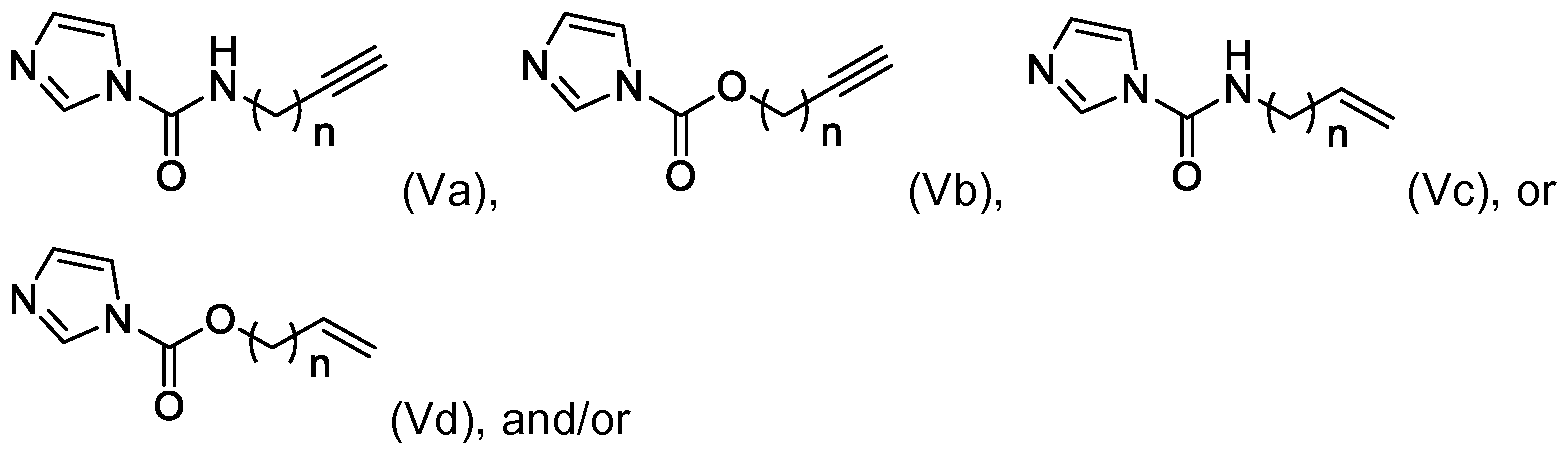
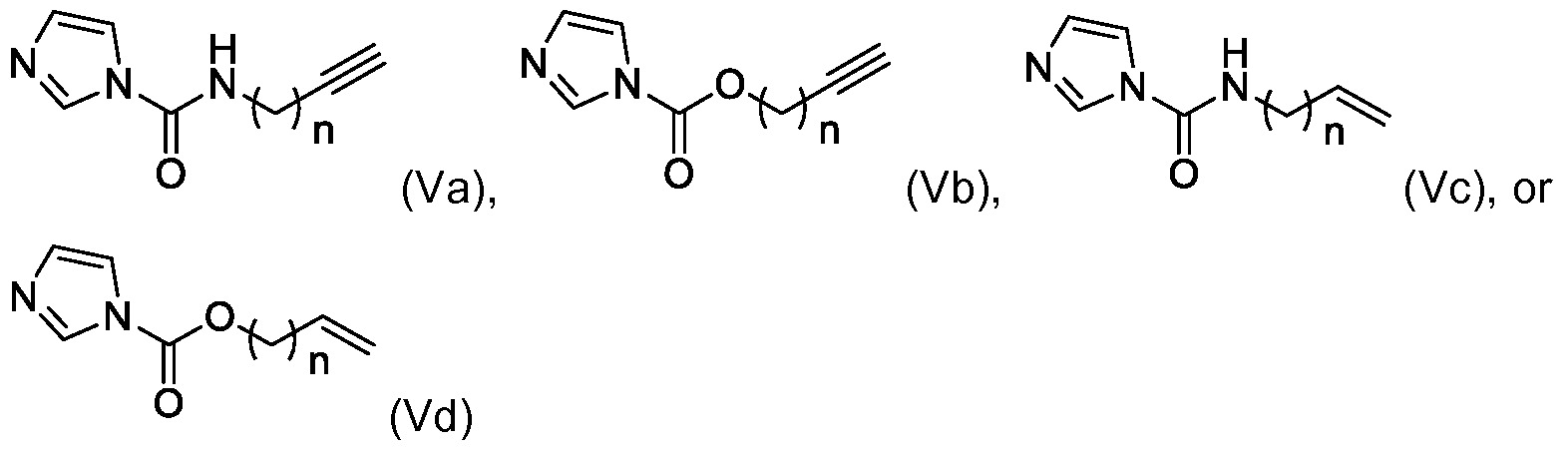
  • the first step is reaction of alkynes or alkenes of the general formula (IVa), (IVb), (IVc), or (IVd) (IVc), or (IVd) wherein n is an inte
  • the second step is a reaction of alkynes or alkenes of the general formula (Va), (Vb), (Vc), or (Vd)
  • n, m, p, Y, E, R 3 , R 4 and R 5 are defined as above.
  • the third step is the reaction of alkynes of the general formula (VI) with the compounds of the general formula, HS-R 1 and HS-R 2 ,
  • R 1 and R 2 are the same or different and independently C 6 -C 2 4 alkyl, C 6 -C 2 4 alkenyl, C 6 - C 2 4 alkynyl, or C 6 -C 2 4 acyl, which can be optionally substituted with a CrC 6 hydrocarbyl group, preferably under either UV-irradiation or using a radical initiator, to yield a compound of the general formula VII') (VII'), wherein n, m, p, Y, Z, R 1 , R 2 , R 3 , R 4 and R 5 are defined as above.
  • This reaction is conducted preferably via a radical mechanism.
  • Chemical radical sources can be added to start the reaction or it can be simply conducted under sunlight.
  • the reaction is started by UV irradiation.
  • the fourth step is preferably performed at room temperature with aqueous hydrogen peroxide in a solvent such as methanol.
  • the fourth step can further been catalyzed by a catalyst such as titanium-containing zeolites.
  • a catalyst such as titanium-containing zeolites.
  • This reaction has already been proposed by Hulea et al. (Hulea V, Moreau P, Renzo FD. Thioether oxidation by hydrogen peroxide using titanium-containing zeolites as catalysts. Journal of Molecular Catalysis A: Chemcial. 1996, 1 1 1 :325-332). Surprisingly this reaction does not affect other functional groups of the amino lipids of the second step.
  • this fourth step is mandatory.
  • the invention relates to a method to synthesize amino lipids according t
  • Z is either hydrogen or -X 1 -R 1 ,
  • R 1 and R 2 are the same or different and independently C 6 -C 2 4 alkyl, C 6 -C 2 4 alkenyl, C 6 -C 2 4 alkynyl, or C 6 -C 2 4 acyl, which can be optionally substituted with a CrC 6 hydrocarbyl group,
  • k and I are integers from 0 to 2
  • R 3 and R 4 are either the same or different and independently C Ci 2 alkyl, Ci-Ci 2 alkenyl, or d- Ci 2 alkynyl, wherein alkyl, alkenyl or alkynyl may be optionally substituted with a Ci-C 6 hydrocarbyl group, or R 3 and R 4 may join to form, together with the nitrogen atom to which they are bound, an optionally substituted N-heterocyclic ring of 3 to 10 atoms comprising 1 to 7 nitrogen atoms.
  • R 5 and R 6 are either absent or are hydrogen or C Ci 2 alkyls to provide a quaternary amine, R 7 is either hydrogen or C Ci 2 alkyl,
  • R 3 and R 4 are the same; in another embodiment, R 3 and R 4 are different alkyl amines.
  • the method represents the first parallel synthesis of large libraries of ionizable cationic amino lipids based on thiol-yne chemistry in liquid-phase combinatorial synthesis without chromatography purification comprising the following steps:
  • the first step is reaction of alkynes or alkenes of the general formula (IVe), (IVf), (IVg), or (IVh) o.
  • n is an integer from 1 to 12,
  • Y is either NH, NR 7 , + NR 6 R 7 , HN ⁇ ° ⁇ 0 r heterocycles of the formula
  • R 3 and R 4 are either the same or different C1-C12 alkyls, wherein alkyl may be optionally substituted with a Ci-C 6 hydrocarbyl group, or R 3 and R 4 may join to form, together with the nitrogen atom to which they are bound, an optionally substituted N-heterocyclic ring of 3 to 10 atoms comprising 1 to 7 nitrogen atoms,
  • R 5 and R 6 are either absent or are hydrogen or C1-C12 alkyls to provide a quaternary amine
  • R 7 is either hydrogen or C1-C12 alkyl
  • n and m are independently an integer of 1 , 2 or 3, and p is independently an integer of 1 or 2.
  • R 3 and R 4 are the same; in another embodiment, R 3 and R 4 are different alkyl amines.
  • the synthesis of the compounds 67-76 is performed based on a reaction with compounds of general formula IVg and IVh as described above and herein.
  • the second step is reaction of alkynes or alkenes of the general formula (VI") with the compounds of the general formula, HS-R 1 and HS-R 2 , wherein R 1 and R 2 are the same or different and independently C 6 -C 2 4 alkyl, C 6 -C 2 4 alkenyl, C 6 -C 2 4 alkynyl, or C 6 -C 24 acyl, which can be optionally substituted with a Ci-C 6 hydrocarbyl group, under either UV-irradiation or using a radical initiator, to yield a compound of the general formula (VII") (VII"), wherein n, m, p, Y, R 1 , R 2 , R 3 , R 4 and R 5 are defined as above for formula VI".
  • This reaction is conducted via a radical mechanism.
  • Chemical radical sources can be added to start the reaction or it can be simply conducted under sunlight.
  • the reaction is started by UV irradiation.
  • the third step is preferably performed at room temperature with aqueous hydrogen peroxide in a solvent such as methanol.
  • the third step can further been catalyzed by a catalyst such as titanium-containing zeolites.
  • a catalyst such as titanium-containing zeolites.
  • This reaction has already been proposed by Hulea et al. (Hulea V, Moreau P, Renzo FD. Thioether oxidation by hydrogen peroxide using titanium-containing zeolites as catalysts. Journal of Molecular Catalysis A: Chemcial. 1996, 1 1 1 :325-332). Surprisingly this reaction does not affect other functional groups of the amino lipids of the second step.
  • this third step is mandatory.
  • the invention comprises the reaction of alkynes or alkenes of the general formula (VIII)
  • R 1 and R 2 are the same or different and independently from each other C 6 -C 2 4 alkyl, C 6 -C 2 4 alkenyl, C 6 -C 2 4 alkynyl, or C 6 -C 24 acyl, which can be optionally substituted with a Ci-C 6 hydrocarbyl group,
  • Z is ° A N or ° A NH , k and I are integers from 0 to 2.
  • n is an integer from 1 to 12.
  • the oxidation of the thioethers is preferably performed at room temperature with aqueous hydrogen peroxide in a solvent such as methanol.
  • this oxidation of the thioethers can be catalyzed by a catalyst such as titanium-containing zeolites.
  • a catalyst such as titanium-containing zeolites. This reaction has already been proposed by Hulea et al. (Hulea V, Moreau P, Renzo FD. Thioether oxidation by hydrogen peroxide using titanium-containing zeolites as catalysts. Journal of Molecular Catalysis A: Chemcial. 1996, 1 1 1 :325-332).
  • lipid particles containing an amino lipid according to formulas I to III are directed to lipid particles containing an amino lipid according to formulas I to III.
  • the term 'lipid particle' means nanosized objects made of amino lipids which are placed into an aqueous solution. These particles are inter alia lipid bilayer vesicles (liposomes), a multi-lamellar vesicles or miscelles.
  • said nanoparticles are liposomes containing an amino lipid according to formulas I to III.
  • liposomes are microvesicles composed of a bilayer of lipid amphipathic (amphiphilic) molecules enclosing an aqueous compartment.
  • Liposome formation is not a spontaneous process. Lipid vesicles are formed first when lipids such as phospholipids are placed in water and consequently form one bilayer or a series of bilayers, each separated by water molecules. Liposomes can be created by sonicating lipid vesicles in water.
  • 'lipid bilayer' means a thin membrane made of two layers of lipid molecules.
  • the term 'micelle' means an aggregate of surfactant molecules dispersed in a liquid colloid.
  • a typical micelle in aqueous solution forms an aggregate with the hydrophilic head regions in contact with water, sequestering the hydrophobic single tail region in the micelle center.
  • the term 'cells' means a generic term and encompass the cultivation of individual cells, tissues, organs, insect cells, avian cells, fish cells, amphibian cells, mammalian cells, primary cells, continuous cell lines, stem cells and/or genetically engineered cells, such as recombinant cells expressing a hetereologous polypeptide or protein.
  • Recombinant cells include, for example, cells expressing heterologous polypeptides or proteins, such as a growth factor or a blood factor.
  • said lipid particles or liposomes further contain a helper lipid.
  • a helper lipid is a non-cationic lipid, preferably a non-cationic phospholipid.
  • Liposomes consisting of a mixture of cationic amino lipids and non-cationic (neutral) phospholipids are the most effective for nucleic acid delivery into cells.
  • said non-cationic lipid is DOPE.
  • helper lipid and amino lipid of claims 1 -4 are added in a 1 :1 ratio to form liposomes.
  • the lipid particle or liposome further comprises a sterol.
  • Sterol like cholesterol, is a natural component in cell membranes. It can be used to stabilize the particle, and help the integration into a cell membrane.
  • the lipid particles or liposomes further contain a bioactive agent.
  • a bioactive agent is one which has a biological effect when introduced into a cell or host, for example by stimulating an immune response or an inflammatory response, by exerting enzymatic activity or by complementing a mutation, etc.
  • bioactive agents include inter alia nucleic acids, peptides, proteins, antibodies and small molecules.
  • a liposome When a liposome is used to encapsulate a drug substance either within the lipid bilayer or in the interior aqueous space of the liposome the term 'liposome drug' can be employed.
  • the bioactive agent is a nucleic acid.
  • said bioactive agent is a member optionally selected from the group consisting of: an antineoplastic agent, an antibiotic, an immunomodulator, an anti-inflammatory agent, an agent acting on the central nervous system, a polypeptide or a polypeptoid.
  • the lipid particle or liposome further contains at least one polyethylene glycol (PEG)-lipid.
  • PEG lipids help to protect the particles and their cargo from degradation in-vivo.
  • PEG form a protective layer over the liposome surface and increase the circulating time in vivo. It can be used in liposome drug delivery (PEG-liposome).
  • Lipid particles or liposomes containing a bioactive agent can be used to deliver any of a variety of therapeutic agents into cells.
  • the present invention encompasses the use of lipid particles, especially liposomes, as described above for delivering a bioactive agent into a cell.
  • said bioactive agent is a nucleic acid, including but not limited to, RNA, antisense oligonucleotide, a DNA, a plasmid, a ribosomal RNA (rRNA), a micro RNA (miRNA), transfer RNA (tRNA), a small inhibitory RNA (siRNA) or small nuclear RNA (snRNA).
  • the bioactive agent may also be an antineoplastic agent, an antibiotic, an immunomodulator, an antiinflammatory agent, an agent acting on the central nervous system, antigens or fragments thereof, proteins, peptides, polypeptoid, vaccines and small-molecules or mixtures thereof.
  • lipid particles or liposomes containing amino lipids as defined in the present invention are suitable to deliver bioactive agents into cells.
  • the wide variety of different amino lipids which can be synthesized by the mentioned versatile synthesis method can be screened for particular characteristics that are conferred to the liposomes. Important characteristics are for example transfection efficiency, cytotoxicity, adhesion of the agent to be delivered into the cell, stability of the liposomes, size of the liposomes, etc.
  • the present method allows the creation of specifically adapted liposomes for particular applications.
  • lipid particles (liposomes) can be used for transfecting multicellular tissues or organisms. This offers the possibility of a novel therapeutic treatment of patients.
  • a patient can be any mammal, preferably selected from the group consisting of human, mouse, rat, pig, cat, dog, horse, goat, cattle, and monkey and/or others. Most preferably, the patient is a human being.
  • An important embodiment of the present invention is the use of said lipid particles or liposomes containing amino lipids according to one of formulas (l-lll) for use as a medicament.
  • said lipid particles or liposomes can be administered to patients for use in gene therapy, in gene vaccination, in antisense therapy or in therapy by interfering RNA.
  • a lipid particle of the invention may also be used for the manufacture of a medicine for use in nucleic acid transfer, for example in treatment of the human or animal body by therapy, especially in the treatment of a condition caused by or related to a genetic defect or modification.
  • Targets for gene therapy include monogenic disorders, for example, cystic fibrosis, various cancers, and infections, for example, viral infections, for example, with HIV.
  • transfection with the p53 gene offers great potential for cancer treatment.
  • Targets for gene vaccination are also well known, and include vaccination against pathogens for which vaccines derived from natural sources are too dangerous for human use and recombinant vaccines are not always effective, for example, hepatitis B virus, human immunodeficiency virus (HIV), hepatitis C virus (HCV) and herpes simplex virus.
  • Targets for anti-sense therapy are also known. Further targets for gene therapy and anti-sense therapy are being proposed as knowledge of the genetic basis of disease increases, as are further targets for gene vaccination.
  • a lipid particle of the invention may be used in vaccination.
  • a lipid particle or liposome of the invention may be used to deliver an antigen or a nucleic acid encoding an antigen.
  • liposome vaccines are described in Butts C, et al. Randomized phase MB trial of BLP25 liposome vaccine in stage 1MB and IV Non-Small-Cell Lung Cancer. Journal of Clinical Oncology. 2005, 23:6674-6681 and in U'Ren L, et al. Vaccination with liposome-DNA complexes elicits enhanced antitumor immunity. Cancer Gene Therapy. 2006, 13:1033-1044.
  • a lipid particle of the invention may be used to elicit an immune response against a wide variety of antigens for the treatment and/or prevention of a number of conditions including, but not limited to, cancer, allergies, toxicity and infection by pathogens such as viruses, bacteria, fungi, and other pathogenic organisms.
  • said lipid particle or liposome can be used as a medicament in treatment of a viral infection, a liver disease or disorder, or cancer.
  • liposomes can be captured by the cells of the reticulo-endothelial system, which are primarily situated in the liver. The liposome will be accumulated there.
  • Fig. 1 Comparative microscope pictures showing results of lipofection by use of amino liposomal reagent # 30 and one commercially available transfection reagent.
  • Fig. 2 Comparative microscope pictures showing results of lipofection by use of an amino liposomal reagent #60 and one commercially available transfection reagent.
  • Fig. 3 Graphical overview of the transfection efficiency of a library of transfection reagents of example compounds 1 to 44 compared to a commercially available reagent.
  • Fig. 4 Graphical overview of the transfection efficiency of a library of transfection reagents of example compounds 47 to 76 compared to a commercially available reagent.
  • Fig. 5 siRNA gene silencing in MEF cells using lipid reagent #24.
  • Fig. 6 siRNA gene silencing in MEF cells using lipid reagent #64.
  • the amino lipid was synthesized by two steps.
  • the first step is to synthesize prop-2-yn-1-yl (2- (dimethylamino)ethyl) carbamate.
  • 0.1 mmol carbonyiimidazole and 0.1 mmol propargyl alcohol were dissolved in 2 ml DCM and added into a 20 ml glass vial covered with aluminium foil. The solution was shaked for 1 h, then 0.1 mmol dimethylethane-1 ,2-diamine and 0.01 mmol DMAP were added, and the solution was shaken overnight.
  • the second step is the photo addition of dodecanethiol on to prop-2-yn-1-yl (2- (dimethylamino)ethyl) carbamate.
  • dodecanethiol and 3 mg DMPA were added to the solution from first step and the vial was degassed by argon and irradiated under 365 nm UV for 2h. The vial was then dried and stored under 4 °C.
  • Table 1 Examples of synthesized compounds 2-22 and the corresponding MW/z values.
  • the first step is to synthesize 1 -(2-(dimethylamino)ethyl)-3-(prop-2-yn-1 -yl)urea.
  • 0.1 mmol carbonyiimidazole and 0.1 mmol propargyl amine were dissolved in 2 ml DCM and added into a 20 ml glass vial covered with aluminium foil. The solution was shaked for 1 h, then 0.1 mmol dimethylethane-1 ,2-diamine and 0.01 mmol DMAP were added, the solution was shaked for overnight.
  • the second step is the photo addition of thiol onto 1 -(2-(dimethylamino)ethyl)-3-(prop-2-yn-1-yl)- urea.
  • 0.2 mmol dodecanthiol and 3 mg DMPA were added to the solution from first step and the vial was degassed by argon and irradiated under 365 nm UV for 2h. The vial was then dried and stored under 4 °C.
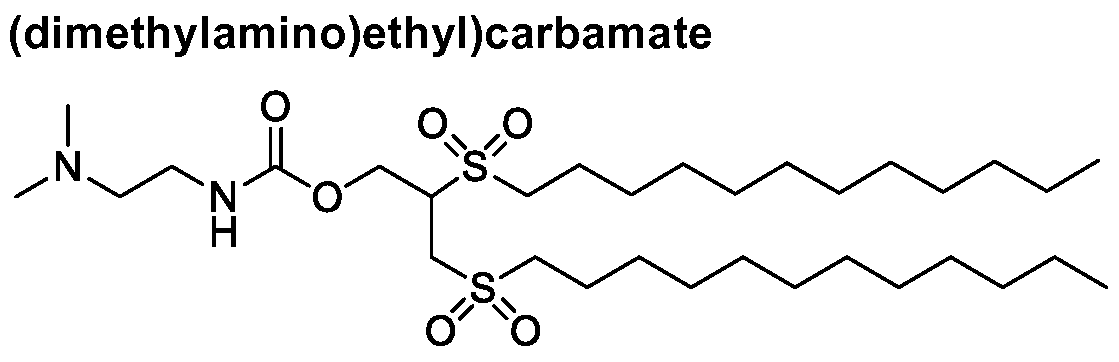
  • Example 45 Synthesis and characterization of 3-(dodecylsulfinyl)-2-(dodecylthio)propyl -(dimethylamino)ethyl)carbamate
  • the amino lipid is synthesized in one step. 1 mmol 2,3-bis(dodecylthio)propyl (2- (dimethylamino)ethyl)carbamate (product of example 1 ) was mixed with 10 mmol aqueous hydrogen peroxide (30%) in 10 ml methanol, and stirred at room temperature for 1 h. Then the mixture was transferred to a 50 ml flask and evaporated.
  • the amino lipid is synthesized in one step. 1 mmol 2,3-bis(dodecylthio)propyl (2- (dimethylamino)ethyl)carbamate (product of example 1 ) was mixed with 10 mmol aqueous hydrogen peroxide (30%) in 10 ml methanol, and stirred at room temperature for 2 d. Then the mixture was transferred to a 50 ml flask and evaporated.
  • Example 47 Synthesis and characterization of N 1 ,N 1 -bis(3-(dodecylthio)propyl)-N 2 ,N 2 - dimethylethane-1 ,2-diamine
  • N 1 ,N 1 -bis(3-(dodecylthio)propyl)-N 2 ,N 2 -dimethylethane-1 ,2-diamine is similar to the previous examples.
  • 1 mmol of N 1 ,N 1 -dimethylethane-1 ,2-diamine, and 2 mmol 3-bromoprop-1-ene were added to a 20 ml glass vial containing 2 ml THF and 1 wt % Cs 2 C0 3 .
  • the solution was shaked for overnight at 40°C.
  • the solution vial was then removed from the shaker, centrifuged and the supernatant was transferred into a new 20 ml vial.
  • Table 3 Examples of synthesized compounds 48-56 and the corresponding MW/z values.
  • Example 57 Synthesis and characterization of 11 -(dodecylthio)-2-methyl-9-oxa-13-thia- -diazapentacosan-7-ol
  • the lipid was synthesized as follows, 1 mmol N 1 ,N 1 -dimethylethane-1 ,2-diamine, and 1 mmol 2- ((prop-2-yn-1-yloxy)methyl)oxirane were dissolved in 2 ml ethanol in a 20 ml glass vial covered with septum. The solution was shaken for overnight at 40 °C. The solution vial was then removed from the shaker, ethanol was evaporated and 2 ml fresh THF was added and mixed well, the solution was then degassed for 5 min and filled with Argon (Ar) for 3 min, then covered with a cap.
  • Argon Argon
  • Table 4 Examples of synthesized compounds 58-66 and the corresponding MW/z values.
  • Table 5 Examples of synthesized compounds 68-76 and the corresponding MW/z values.
  • Example 77 Synthesis and characterization of N 1 -(3-(dodecylsulfinyl)-2- (dodecylthio)propyl)-N 2 ,N 2 -dimethylethane-1 ,2-diamine
  • the amino lipid is synthesized in one step. 1 mmol N 1 -(2,3-bis(dodecylthio)propyl)-N 2 ,N 2 - dimethylethane-1 ,2-diamine (product of example 50) was mixed with 10 mmol aqueous hydrogen peroxide (30%) in 10 ml methanol, and stirred at room temperature for 1 h. Then the mixture was transferred to a 50 ml flask and evaporated. To verify the identity of the molecules, crude product was analyzed by mass spectrometry. The molecular ion was clearly identified as 546.5 MW/z.
  • Example 78 Synthesis and characterization of N 1 -(2,3-bis(dodecylsulfonyl)propyl)-N 2 ,N 2 -
  • the amino lipid is synthesized in one step. 1 mmol N 1 -(2,3-bis(dodecylthio)propyl)-N 2 ,N 2 - dimethylethane-1 ,2-diamine (product of example 50) was mixed with 10 mmol aqueous hydrogen peroxide (30%) in 10 ml methanol, and stirred at room temperature for 2 d. Then the mixture was transferred to a 50 ml flask and evaporated.
  • Example 79 Initial determination of optimal lipid ratios for cell transfection.
  • the well documented HEK 293T cell line is used for examples 79 and 80.
  • DOPE natural phospholipid dioleolylphosphatidylethanolamine
  • co-lipid also termed helper lipid
  • DOPE phospholipid dioleolylphosphatidylethanolamine
  • DOPE co-lipid
  • DPDEC 2,3-bis(dodecylthio)propyl (2-(dimethylamino)ethyl) carbamate
  • lipid reagent This final 2 mg/ml liposome sample is referred to as the "lipid reagent".
  • lipid reagents 0.1 ⁇ , 0.2 ⁇ , 0.3 ⁇ , 0.4 ⁇ and 0.5 ⁇ of the above lipid reagents were combined with either 50 ng or 100 ng plasmid DNA (comprising the pCS-LacZ and pH2B-YFP plasmids at a ratio of 5:1 , respectively) and mixed with cells as described below:
  • lipid reagent from (1 ) to either 50ng or 100ng plasmid DNA (DNA dissolved in 10ul of 50 mmol/l sodium acetate buffer, pH 5.0). 3. Samples were left at RT for 30 min to form Lipid/DNA transfection complexes. As DNA is negatively charged, it associates non-specifically with the positively charged head groups of the cationic lipids in the liposomes.
  • HEK 293 cells approximately 50,000 cells, in DMEM culture medium supplemented with 10 % fetal calf serum
  • 50 ⁇ of freshly suspended HEK 293 cells were added to the lipid/DNA complexes, mixed with pipette action and 65 ⁇ of the cells + lipid/DNA complexes added to a single 96-well.
  • YFP yellow fluorescent protein
  • a very clear optimal ratio of lipid: DOPE was identified as 2 : 1 and the optimal lipid reagent : DNA ratio was 0.4 ⁇ lipid reagent per 75 ng DNA. These conditions were therefore used for the primary screen to identify the lipid reagents with highest cell transfection efficiency and lowest cell toxicity, as described in example 80 below.
  • Example 80 Primary screen using novel lipids reagents
  • Detection YFP fluorescence relative to total cell number (total cell number assessed using the nuclear dye, Hoechst - see Fig. 1 and 2)
  • a commercially available liposomal transfection reagent was used as a reference (reference reagent) according to manufacturers' instructions, see Fig. 1 and 2.
  • Hoechst 33258 dye was added to cells at a final concentration of 0.2 pg/ml and cells incubated for a further 30 min at 37 ° C. Cells were then placed on an inverted microscope and 2 independent sets of images of the cells captured from each well as shown in Fig. 1 and 2.
  • a library of newly synthesized compounds according to claim 1 have been tested for their ability to transfect HEK 293 cells.
  • the graphs in Fig. 3 and 4 show the transfection efficiency of these lipid compounds compared to a commercially available transfection agent reference. 1 of the lipid molecules is efficient at delivering plasmid DNA (YFP gene) to HEK 293 cells when compared to a widely used commercial transfection reagent, indicated by the solid line.
  • Two reagents in particular have been identified as possessing very low toxicity and have the ability to very efficiently deliver siRNA molecules to cells (#24, see Fig. 5 and #64; see Fig. 6).
  • Example 81 Screen of library "hits" for ability to transfect siRNA
  • RNA interference RNA interference
  • siRNA small interfering RNA
  • LRP6 Low density lipoprotein receptor related protein 6
  • siRNA molecules Diluted lipid reagents from (1 ) added to 1 pmol (0.2 ⁇ of 5 pmol/l) siRNA molecules in 8 ⁇ NaOAc buffer, pH 5.0 and mixed with pipette action.
  • the siRNA molecules used had either a scrambled sequence not specific for any known gene (Con siRNA), or a sequence specifically targeting the endogenous mRNA from the LRP6 gene (LRP6 siRNA).
  • WB was performed using an automated BioLane HTI instrument using antibodies against LRP6 and a-tubublin proteins. HRP linked secondary antibodies and chemiluminescence were used to detect the proteins on the membrane.
  • FIGS 5 and 6 show the Western Blot (WB) analysis of LRP6 protein from total lysates of MEF (mouse embryonic fibroblast) cells transfected with the indicated siRNA molecules and cultured for 24 hours.
  • Lipid reagents #24 and #64 are quite effective compared with the commercial reagent A at siRNA mediated gene silencing. This demonstrates the striking difference in properties of related transfection reagents and highlights the importance of using our novel method to easily synthesize hundreds of related lipids that can be screened to identify the ones having optimal properties (such as highly efficient DNA and siRNA delivery as well as low cellular toxicity).

Landscapes

  • Chemical & Material Sciences (AREA)
  • Organic Chemistry (AREA)
  • Health & Medical Sciences (AREA)
  • Life Sciences & Earth Sciences (AREA)
  • General Health & Medical Sciences (AREA)
  • Medicinal Chemistry (AREA)
  • Pharmacology & Pharmacy (AREA)
  • Animal Behavior & Ethology (AREA)
  • Public Health (AREA)
  • Veterinary Medicine (AREA)
  • Chemical Kinetics & Catalysis (AREA)
  • Molecular Biology (AREA)
  • Engineering & Computer Science (AREA)
  • General Chemical & Material Sciences (AREA)
  • Nuclear Medicine, Radiotherapy & Molecular Imaging (AREA)
  • Epidemiology (AREA)
  • Genetics & Genomics (AREA)
  • Biomedical Technology (AREA)
  • Bioinformatics & Cheminformatics (AREA)
  • Biophysics (AREA)
  • Dispersion Chemistry (AREA)
  • Wood Science & Technology (AREA)
  • Biotechnology (AREA)
  • General Engineering & Computer Science (AREA)
  • Zoology (AREA)
  • Communicable Diseases (AREA)
  • Oncology (AREA)
  • Plant Pathology (AREA)
  • Biochemistry (AREA)
  • Microbiology (AREA)
  • Physics & Mathematics (AREA)
  • Gastroenterology & Hepatology (AREA)
  • Rheumatology (AREA)
  • Pain & Pain Management (AREA)
  • Virology (AREA)
  • Neurology (AREA)
  • Neurosurgery (AREA)
  • Organic Low-Molecular-Weight Compounds And Preparation Thereof (AREA)
  • Medicinal Preparation (AREA)
  • Pharmaceuticals Containing Other Organic And Inorganic Compounds (AREA)

Abstract

The present invention provides novel amino lipids and a method for synthesizing these compounds. According to the invention, the amino lipids have a structure of the following formula (I) wherein Z is either hydrogen or -X1 R1, R1 and R2 are the same or different and independently C6-C24 alkyl, C6-C24 alkenyl, C6-C24 alkynyl, or C6-C24 acyl, which can be optionally substituted with a C1-C6 hydrocarbyl group, X1 and X2 are the same or different, either S or S=O or S(=O)2, Y is either (II) or heterocycles of the formula (III) or (IV) wherein k and I are integers from 0 to 2, R3 and R4 are either the same or different and independently C1-C12 alkyl, C1-C12 alkenyl, or C1-C12 alkynyl, wherein alkyl, alkenyl or alkynyl may be optionally substituted with a C1-C6 hydrocarbyl group, or R3 and R4 optionally join to form, together with the nitrogen atom to which they are bound, an optionally substituted N-heterocyclic ring of 3 to 10 atoms comprising 1 to 7 nitrogen atoms, or R3 and R4 are the same or different alkyl amines; R5 and R6 are either absent or is hydrogen or C1-C12 alkyl to provide a quaternary amine, R7 is either hydrogen or C1-C12 alkyl, m is an integer from 1 to 12, n is an integer from 1 to 12, and p is an integer from 1 to 3, wherein preferably Y = N for p = 2 or 3.

Description

SYNTHESIS AND USE OF AMINO LIPIDS
The present invention pertains to amino lipids and their synthesis. Such (cationic) amino lipids have good properties as transfection agents. They can be used to produce lipid particles, especially liposomes, allowing the delivery of bioactive agents into cells. The simplicity of the synthesis allows the development of a combinatorial library of (cationic) amino lipids in a kit-like manner. The compounds contained in this library can be screened for particular properties, in particular for the transfection of various cell lines. The invention also refers to the use of lipid particles containing the neutral or cationic amino lipids as medicament.
Background
Of the various reagents used to transfect cells with bioactive agents such as nucleic acids, those based on liposome mediated delivery are widely acknowledged to be the most effective. This is due mostly to their efficiency and ease of use. Liposomes are artificially prepared spherical vesicles made of a lipid bilayer. To deliver the molecules to sites of action, the lipid bilayer can fuse with other bilayers such as the cell membrane, thus delivering the liposome contents inside the cell.
Liposomes are used for drug delivery due to their unique properties. A liposome encapsulates a region of aqueous solution inside a hydrophobic membrane; dissolved hydrophilic solutes cannot readily pass through the lipids. Hydrophobic chemicals can be dissolved into the membrane, and in this way liposome can carry both hydrophobic molecules and hydrophilic molecules. Liposomes can be combined with bioactive agents such as drugs, nucleic acids, peptides etc. and used to deliver these agents for the regulation of a cells biochemical pathway. This opens possibilities for new treatments of diseases.
For delivery of negatively charged nucleic acid, cationic lipids are the most effective transfection agents. Cationic lipids represent a promising class of synthetic materials for DNA delivery. To date, there are several commercialized cationic lipids but the number of cationic lipids for safe and effective delivery of genes is still limited.
In "Cationic liposomes for gene therapy" (Miller AD, Angew Chem Int Ed. 1998, 37: 1768-1785) most of the commonly used and commercially available transfection agents are described. However, conventional lipid synthesis typically requires individually optimized, multiple-step synthesis, including time-intensive procedures such as chemical protection and deprotection, use and removal of catalysts, solvent exchanges and purification. Cationic lipids need to be combined with natural phospholipids (referred to as helper lipids) to form liposomes that can be more efficiently incorporated into cell membranes. By combining liposomes with DNA or drugs, which alone cannot diffuse through the membrane of the target cell, they can be (indiscriminately) delivered past the lipid bilayer. The use of liposomes for transformation or transfection of DNA into a host cell is known as lipofection.
Although liposomal reagents represent the state of the art with respect to cell transfection agents, they have the following drawbacks: Firstly, many cell lines (such as primary cells) cannot be effectively transfected at the moment, even with liposomal reagents. Secondly, they are relatively difficult and expensive to synthesize, often resulting in a high price.
As a consequence of the second point, many laboratories use less efficient, cheaper alternatives for transfection (e.g. calcium phosphate). There is a concrete requirement for new transfection agents that are easy to synthesize and which have good transfection yields for a wide variety of cell types. As an alternative, it would be helpful to dispose an easy combinatorial synthesis of transfection agents allowing the production of a variety of different compounds.
Accordingly, it was an object of the present invention to provide novel (cationic) amino lipids and a method for their synthesis. The method should be generic, economic and easy to perform. This generic method allows the development of a library of cationic amino lipids. Generation of such lipid libraries (containing of hundreds of different lipid molecules) greatly enhances the identification of lipids harboring optimal transfection reagent properties.
It was a further object of the present invention to provide lipid particles, especially liposomes, containing said (cationic) amino lipids. In particular, these lipid particles or liposomes should be able to deliver bioactive agents through cell membranes.
Another object was the use of said lipid particles or liposomes for the treatment of diseases. Description of the invention
The invention provides novel amino lipids with the following general formula (I):
Figure imgf000003_0001
wherein Z is either hydrogen or -X1 R1, R1 and R2 are the same or different and independently from each other C6-C24 alkyl, C6-C24 alkenyl, C6-C24 alkynyl, or C6-C24 acyl, which can be optionally substituted with a Ci-C6 hydrocarbyl group,
X1 and X2 are the same or different, either S or S=0 or S(=0)2,
Y is
Figure imgf000004_0001
0r heterocycles of the formula
Figure imgf000004_0002
wherein k and I are integers from 0 to 2.
R3 and R4 are either the same or different and independently C Ci2 alkyl, Ci-Ci2 alkenyl, or d-
Ci2 alkynyl, wherein alkyl, alkenyl or alkynyl may be optionally substituted with a Ci-C6 hydrocarbyl group, or R3 and R4 may join to form, together with the nitrogen atom to which they are bound, an optionally substituted N-heterocyclic ring of 3 to 10 atoms comprising 1 to 7 nitrogen atoms (including the nitrogen atom to which R3 and R4 are bound),
R5 and R6 are either absent or is hydrogen or C Ci2 alkyl to provide a quaternary amine,
R7 is either hydrogen or C Ci2 alkyl,
m is an integer from 1 to 12, n is an integer from 1 to 12, and p is an integer from 1 to 3, wherein in one embodiment, Y = N for p = 2 or 3;
and wherein Y is, in one embodiment, also
Figure imgf000004_0003
In one embodiment of the invention R3 and R4 are the same or different alkyl amines.
In a preferred embodiment of the invention, R1 and R2 are the same or different and independently C6-C24 alkyl, more preferred, R1 and R2 are the same C6-Ci8 alkyl.
I n relates to amino lipids of formula (lb)
Figure imgf000004_0004
wherein the variables are defined as above.
In another embodiment, X1 and X2 are the same or different, either S=0 or S(=0)2. In one embodiment, the present invention provides amino lipids of the general formula (II):
Figure imgf000005_0001
R1 and R2 are the same C6-Ci8 alkyl
O O O O OH
Y is either O^ XNH , 0^ X0 , HN^ XNH , HN^ XO , NH, NR7, +NR6R7, HN^^ i °\ 0r
/~ P /— \ P Γ~ /— \+ r6 — N N— — N N- — N N— — N N— heterocycles of the formula ^— ^ NH , ^— ^ O , ^— ^ , ^— ^ , or
Figure imgf000005_0002
R3 and R4 are either the same or different C1-C12 alkyls, wherein alkyl may be optionally substituted with a Ci-C6 hydrocarbyl group, or R3 and R4 may join to form, together with the nitrogen atom to which they are bound, an optionally substituted N-heterocyclic ring of 3 to 10 atoms comprising 1 to 7 nitrogen atoms,
R5 and R6 are either absent or is hydrogen or C1-C12 alkyl to provide a quaternary amine, R7 is either hydrogen or C1-C12 alkyl,
m is an integer from 1 to 12, n is an integer from 1 to 12, and p is an integer from 1 to 3, wherein in one embodiment, Y = N for p = 2 or 3;
and wherein Y can also be
Figure imgf000005_0003
for p =2.
In a preferred embodiment of the compounds according to the formulas (I) or (II), n and m are independently of each other an integer of 1 , 2 or 3, and p is independently an integer of 1 or 2.
Particularly preferred embodiments correspond to the structures of formula (Ilia), (1Mb), (III c), (Mid), (llle), (lllf), (lllg), (lllh), (MM), (lllj), (lllk), (MM), (lllm), (llln), (lllo), (lllp), (lllq), (lllr), (Ills), (lilt), (lllu), (lllv), or (lllw)
Figure imgf000006_0001
Figure imgf000007_0001
wherein R1 and R2 are the same C11-C12 alkyls,
R3 and R4 are the same Ci-C2 alkyls,
m is an integer from 1 to 2, n is an integer from 1 to 3.
O
In one particularly preferred embodiment of the invention, in formula I and II Y is either ° NH , 0 0 o
O X 0 ; HNX NH ; HNX O 0r heterocycles of the formula
Figure imgf000007_0002
wherein k and I are integers from 0 to 2,
0 0 0 o
particularly preferably Y is either 0 X NH OX 0 ; HNX NH ; HN X 0 ; 0r heterocycles of the
Γ~ P P
— N N^ — N N—
formula ^— f NH or ^— / O
and most preferably the amino lipids according to the invention comprise a structure according to Ilia to Mil.
Figure imgf000008_0001
H H R3 O
I
"R2
o m H n
Figure imgf000008_0002
In another particularly preferred embodiment, in formula I and II Y is either NH, NR7, +NR6R7,
Figure imgf000008_0003
or heterocycles of the formula
HO
— N N— — N N— — N N- O—
l^_J l^_J l^_J
1 , , or / wherein k and I are integers from 0 to 2, R6 is either absent or hydrogen or C1-C12 alkyls to provide a quaternary amine,
R7 is either hydrogen or C1-C12 alkyl,
OH
HN O
particularly preferably Y is either NH, NR7, +NR6R7, or heterocycles of the formula
Figure imgf000009_0001
and most preferably the amino lipids according to the invention comprise a structure according
Figure imgf000009_0002
ino lipids with the following general formula (Ic):
Figure imgf000009_0003
IC)
wherein R1 and R2 are the same or different and independently from each other C6-C24 alkyl, C6- C24 alkenyl, C6-C24 alkynyl, or C6-C24 acyl, which can be optionally substituted with a Ci-C6 hydrocarbyl group,
X1 and X2 are the same or different, either S or S=0 or S(=0)2,
Y is either
Figure imgf000010_0001
O O
wherein Z is ° X N or ° X NH , k and I are integers from 0 to 2.
m is an integer from 1 to 12 and n is an integer from 1 to 12.
Synthesis methods
The present invention also provides a method to synthesize amino lipids according to formula I and Ic, preferably lb. The method represents the first parallel synthesis of large libraries of ionizable (cationic) amino lipids based on thiol-yne chemistry in liquid-phase combinatorial synthesis without chromatography purification.
The method according to the invention comprises the step of the reaction of alkynes or alkenes f the general formula (VI)
Figure imgf000010_0002
with the compounds of the general formula, HS-R1 and HS-R2,
under either UV-irradiation or using a radical initiator, to yield a compound of the general formula (VII)
Figure imgf000010_0003
wherein E is either CH=CH2 or C≡CH,
Z is either hydrogen or -S-R1,
R1 and R2 are the same or different and independently C6-C24 alkyl, C6-C24 alkenyl, C6-C24 alkynyl, or C6-C24 acyl, which can be optionally substituted with a CrC6 hydrocarbyl group,
O O O O OH
X X X X u
Y is either CT^NH , 0^0 , HN^NH , HN^O , NH, NR7, +NR6R7, H
heterocycles of the formula
Figure imgf000010_0004
wherein k and I are integers from 0 to 2, R3 and R4 are either the same or different and independently C1-C12 alkyl, C1-C12 alkenyl, or d- C12 alkynyl, wherein alkyl, alkenyl or alkynyl may be optionally substituted with a Ci-C6 hydrocarbyl group, or R3 and R4 may join to form, together with the nitrogen atom to which they are bound, an optionally substituted N-heterocyclic ring of 3 to 10 atoms comprising 1 to 7 nitrogen atoms,
R5 and R6 are either absent or are hydrogen or C1-C12 alkyl to provide a quaternary amine, R7 is either hydrogen or C1-C12 alkyl,
m is an integer from 1 to 12, n is an integer from 1 to 12, and p is an integer from 1 to 3, wherein in one embodiment Y = N for p = 2 or
and wherein Y is, in one embodiment,
Figure imgf000011_0001
In one embodiment, R3 and R4 are the same; in another embodiment, R3 and R4 are different alkyl amines.
This reaction is conducted via a radical mechanism. Chemical radical sources can be added to start the reaction or it can be simply conducted under sunlight. In a preferred embodiment the reaction is started by UV irradiation.
In one particularly preferred embodiment of the invention the method further comprises the step of
oxidation of the thioethers of general formula (VII) into sulfoxide (S=0) and/or sulfone (S(=0)2) using an oxidation agent to synthesize a sulfoxide or sulfone group containing amino lipid.
The oxidation of the thioethers is preferably performed at room temperature with aqueous hydrogen peroxide in a solvent such as methanol. In another embodiment of the invention this oxidation of the thioethers can be catalyzed by a catalyst such as titanium-containing zeolites. This reaction has already been proposed by Hulea et al. (Hulea V, Moreau P, Renzo FD. Thioether oxidation by hydrogen peroxide using titanium-containing zeolites as catalysts. Journal of Molecular Catalysis A: Chemcial. 1996, 1 1 1 :325-332).
In one preferred embodiment the method according to the invention further comprises the following two steps:
a) reaction of alkynes or alkenes of the general formula (IVa), (IVb), (IVc), or (IVd)
Figure imgf000011_0002
(IVd) wherein n is an inte
with the compound
Figure imgf000012_0001
to yield a compound of the general formula (Va), (Vb), (Vc), or (Vd)
Figure imgf000012_0002
b) reaction of alkynes or alkenes of the general formula (Va), (Vb), (Vc), or (Vd)
Figure imgf000012_0003
0 (Vd)
with an amine of the general formula (R3R4R5N)(CH2)mZ, with m as an integer from 1 to 12, wherein Z is OH, NH2, NH, or a secondary heterocyclic amine of the formula
Figure imgf000012_0004
, wherein k and I are integers from 0 to 2,
to yield a compound of the general formula (VI')
Figure imgf000012_0005
(VI'),wherein E is either CH=CH2 or C≡CH,
R1 and R2 are the same or different and independently C6-C24 alkyl, C6-C24 alkenyl, C6-C24 alkynyl, or C6-C24 acyl, which can be optionally substituted with a CrC6 hydrocarbyl group,
o o o o
Y is either O x NH O X O , HN X NH j HN X O , 0r heterocycles of the formula
Figure imgf000012_0006
or wherein k and I are integers from 0 to 2, R3 and R4 are either the same or different and independently C1-C12 alkyl, C1-C12 alkenyl, or d- C12 alkynyl, wherein alkyl, alkenyl or alkynyl may be optionally substituted with a Ci-C6 hydrocarbyl group, or R3 and R4 may join to form, together with the nitrogen atom to which they are bound, an optionally substituted N-heterocyclic ring of 3 to 10 atoms comprising 1 to 7 nitrogen atoms,
R5 is either absent or is hydrogen or C1-C12 alkyl to provide a quaternary amine,
m is an integer from 1 to 12, n is an integer from 1 to 12, and p is an integer from 1 to 3, wherein in one embodiment Y = N for p = 2 or 3.
In one embodiment R3 and R4 are the same; in another embodiment, R3 and R4 are different alkyl amines.
In an alternative preferred embodiment the method according to the invention comprises the following step:
reaction of alkynes or alkenes of the general formula (IVe), (IVf), (IVg), or (IVh)
Figure imgf000013_0001
n (IVh) wherein n is an integer from 1 to 12,
with an amine of the general formula (R3R4R5N)(CH2)mZ, with m as an integer from 1 to 12, wherein Z is NH2, NH, N or a secondary heterocyclic amine of the formula
— N NH
V
1 , wherein k and I are integers from 0 to 2,
t ield a compound of the general formula (VI")
Figure imgf000013_0002
wherein E is either CH=CH2 or C≡CH,
R1 and R2 are the same or different and independently C6-C24 alkyl, C6-C24 alkenyl, C6-C24 alkynyl, or C6-C24 acyl, which can be optionally substituted with a CrC6 hydrocarbyl group, the formula
Figure imgf000013_0003
herein k and I are integers from 0 to 2, R3 and R4 are either the same or different and independently C1-C12 alkyl, C1-C12 alkenyl, or d- C12 alkynyl, wherein alkyl, alkenyl or alkynyl may be optionally substituted with a Ci-C6 hydrocarbyl group, or R3 and R4 may join to form, together with the nitrogen atom to which they are bound, an optionally substituted N-heterocyclic ring of 3 to 10 atoms comprising 1 to 7 nitrogen atoms,
R5 and R6 are either absent or are hydrogens or C1-C12 alkyls to provide a quaternary amine, R7 is either hydrogen or C1-C12 alkyl,
m is an integer from 1 to 12, n is an integer from 1 to 12, and p is an integer from 1 to 3, wherein in one embodiment Y = N for p =2 or 3;
and wherein Y is, in one embodiment,
Figure imgf000014_0001
In one embodiment R3 and R4 are the same; in another embodiment, R3 and R4 are different alkyl amines.
In particular, the synthesis of the compounds 67-76 is performed based on a reaction with compounds of general formula IVg and IVh as described above and herein.
In one embodiment, the invention relates to a method to synthesize amino lipids according to formula I,
Figure imgf000014_0002
(I),
wherein Z is either hydrogen or -X1-R1,
R1 and R2 are the same or different and independently C6-C24 alkyl, C6-C24 alkenyl, C6-C24 alkynyl, or C6-C24 acyl, which can be optionally substituted with a CrC6 hydrocarbyl group, X1 and X2 are the same or different, either S or S=0 or S(=0)2,
O O O O
Y is either O X NH OX O , HN NH j HN X O , 0r heterocycles of the formula
Figure imgf000014_0003
or wherein k and I are integers from 0 to 2,
R3 and R4 are either the same or different and independently C1-C12 alkyl, C1-C12 alkenyl, or d- C12 alkynyl, wherein alkyl, alkenyl or alkynyl may be optionally substituted with a Ci-C6 hydrocarbyl group, or R3 and R4 may join to form, together with the nitrogen atom to which they are bound, an optionally substituted N-heterocyclic ring of 3 to 10 atoms comprising 1 to 7 nitrogen atoms,
R5 is either absent or is hydrogen or C1-C12 alkyl to provide a quaternary amine,
m is an integer from 1 to 12, n is an integer from 1 to 12, and p is an integer from 1 to 3.
In one embodiment R3 and R4 are the same; in another embodiment, R3 and R4 are different alkyl amines.
The method represents the first parallel synthesis of large libraries of ionisable cationic amino lipids based on thiol-yne chemistry in liquid-phase combinatorial synthesis (without chromatography purification) comprising the following steps:
The first step is reaction of alkynes or alkenes of the general formula (IVa), (IVb), (IVc), or (IVd)
Figure imgf000015_0001
(IVc), or (IVd) wherein n is an inte
with the compound
Figure imgf000015_0002
to yield a compound of the general formula (Va), (Vb), (Vc),
Figure imgf000015_0003
The second step is a reaction of alkynes or alkenes of the general formula (Va), (Vb), (Vc), or (Vd)
Figure imgf000015_0004
with an amine of the general formula (R3R4R5N)(CH2)mZ, with m as an integer from 1 to 12, wherein Z is OH, NH2, NH, or a secondary heterocyclic amine of the formula
Figure imgf000016_0001
, wherein k and I are integers from 0 to 2,
t ield a compound of the general formula (VI')
Figure imgf000016_0002
n, m, p, Y, E, R3, R4 and R5 are defined as above.
The third step is the reaction of alkynes of the general formula (VI) with the compounds of the general formula, HS-R1 and HS-R2,
wherein R1 and R2 are the same or different and independently C6-C24 alkyl, C6-C24 alkenyl, C6- C24 alkynyl, or C6-C24 acyl, which can be optionally substituted with a CrC6 hydrocarbyl group, preferably under either UV-irradiation or using a radical initiator, to yield a compound of the general formula VII')
Figure imgf000016_0003
(VII'), wherein n, m, p, Y, Z, R1, R2, R3, R4 and R5 are defined as above.
This reaction is conducted preferably via a radical mechanism. Chemical radical sources can be added to start the reaction or it can be simply conducted under sunlight. In a preferred embodiment the reaction is started by UV irradiation.
The optional fourth step is an oxidation reaction of the thioether groups of the product of second step with an oxidizing reagent to yield a compound of the general formula (I), wherein n, m, p, Y, R1, R2, R3, R4 and R5 are defined as above and X1, X2 are the same or different, either S=0 or S(=0)2. The fourth step is preferably performed at room temperature with aqueous hydrogen peroxide in a solvent such as methanol.
The fourth step can further been catalyzed by a catalyst such as titanium-containing zeolites. This reaction has already been proposed by Hulea et al. (Hulea V, Moreau P, Renzo FD. Thioether oxidation by hydrogen peroxide using titanium-containing zeolites as catalysts. Journal of Molecular Catalysis A: Chemcial. 1996, 1 1 1 :325-332). Surprisingly this reaction does not affect other functional groups of the amino lipids of the second step.
In one embodiment of the invention, this fourth step is mandatory. In another embodiment, the invention relates to a method to synthesize amino lipids according t
Figure imgf000017_0001
wherein Z is either hydrogen or -X1-R1,
R1 and R2 are the same or different and independently C6-C24 alkyl, C6-C24 alkenyl, C6-C24 alkynyl, or C6-C24 acyl, which can be optionally substituted with a CrC6 hydrocarbyl group, X1 and X2 are the same or different, either S or S=0 or S(=0)2, of the formula
Figure imgf000017_0002
k and I are integers from 0 to 2,
R3 and R4 are either the same or different and independently C Ci2 alkyl, Ci-Ci2 alkenyl, or d- Ci2 alkynyl, wherein alkyl, alkenyl or alkynyl may be optionally substituted with a Ci-C6 hydrocarbyl group, or R3 and R4 may join to form, together with the nitrogen atom to which they are bound, an optionally substituted N-heterocyclic ring of 3 to 10 atoms comprising 1 to 7 nitrogen atoms.
R5 and R6 are either absent or are hydrogen or C Ci2 alkyls to provide a quaternary amine, R7 is either hydrogen or C Ci2 alkyl,
m is an integer from 1 to 12 and n is an integer from 1 to 12 and p is an integer from 1 to 3, wherein in one embodiment Y = N for p =2 or 3;
and wherein Y is, in one embodiment, also
Figure imgf000017_0003
for p =2.
In one embodiment R3 and R4 are the same; in another embodiment, R3 and R4 are different alkyl amines.
The method represents the first parallel synthesis of large libraries of ionizable cationic amino lipids based on thiol-yne chemistry in liquid-phase combinatorial synthesis without chromatography purification comprising the following steps:
The first step is reaction of alkynes or alkenes of the general formula (IVe), (IVf), (IVg), or (IVh) o.
Figure imgf000017_0004
wherein n is an integer from 1 to 12,
with an amine of the general formula (R3R4R5N)(CH2)mZ, with m as an integer from 1 to 12, wherein Z is NH2, NH, N or a secondary heterocyclic amine of the formula
— N NH
1 , wherein k and I are integers from 0 to 2,
t he general formula (VI")
Figure imgf000018_0001
I") wherein E is either CH=CH2 or C≡CH,
OH
Y is either NH, NR7, +NR6R7, HN^^^^°\ 0r heterocycles of the formula
HO
-N N— — N N— — N O—
f , — , or — /
and wherein Y is, in one embodiment, also
Figure imgf000018_0002
for p =2.
R3 and R4 are either the same or different C1-C12 alkyls, wherein alkyl may be optionally substituted with a Ci-C6 hydrocarbyl group, or R3 and R4 may join to form, together with the nitrogen atom to which they are bound, an optionally substituted N-heterocyclic ring of 3 to 10 atoms comprising 1 to 7 nitrogen atoms,
R5 and R6 are either absent or are hydrogen or C1-C12 alkyls to provide a quaternary amine, R7 is either hydrogen or C1-C12 alkyl,
m is an integer from 1 to 12 and n is an integer from 1 to 12 and p is an integer from 1 to 3. In a preferred embodiment n and m are independently an integer of 1 , 2 or 3, and p is independently an integer of 1 or 2.
In one embodiment R3 and R4 are the same; in another embodiment, R3 and R4 are different alkyl amines.
In particular, the synthesis of the compounds 67-76 is performed based on a reaction with compounds of general formula IVg and IVh as described above and herein.
The second step is reaction of alkynes or alkenes of the general formula (VI") with the compounds of the general formula, HS-R1 and HS-R2, wherein R1 and R2 are the same or different and independently C6-C24 alkyl, C6-C24 alkenyl, C6-C24 alkynyl, or C6-C24 acyl, which can be optionally substituted with a Ci-C6 hydrocarbyl group, under either UV-irradiation or using a radical initiator, to yield a compound of the general formula (VII")
Figure imgf000019_0001
(VII"), wherein n, m, p, Y, R1, R2, R3, R4 and R5 are defined as above for formula VI".
This reaction is conducted via a radical mechanism. Chemical radical sources can be added to start the reaction or it can be simply conducted under sunlight. In a preferred embodiment the reaction is started by UV irradiation.
The optional third step is an oxidation reaction of the thioether groups of the product of second step with an oxidising reagent to yield a compound of the general formula (I), wherein n, m, p, Y, Z, R1, R2, R3, R4 and R5 are defined as above and X1, X2 are the same or different, either S=0 or S(=0)2. The third step is preferably performed at room temperature with aqueous hydrogen peroxide in a solvent such as methanol.
The third step can further been catalyzed by a catalyst such as titanium-containing zeolites. This reaction has already been proposed by Hulea et al. (Hulea V, Moreau P, Renzo FD. Thioether oxidation by hydrogen peroxide using titanium-containing zeolites as catalysts. Journal of Molecular Catalysis A: Chemcial. 1996, 1 1 1 :325-332). Surprisingly this reaction does not affect other functional groups of the amino lipids of the second step.
In one embodiment, this third step is mandatory.
In one embodiment the invention comprises the reaction of alkynes or alkenes of the general formula (VIII)
with the compounds of the general formula, HS-R1 and HS-R2,
under either UV-irradiation or using a radical initiator, to yield a compound of the general
Figure imgf000019_0002
(lc)
Wherein R1 and R2 are the same or different and independently from each other C6-C24 alkyl, C6-C24 alkenyl, C6-C24 alkynyl, or C6-C24 acyl, which can be optionally substituted with a Ci-C6 hydrocarbyl group,
X1 and X2 are the same or different, either S or S=0 or S(=0)2, Y is either
Figure imgf000020_0001
o o
wherein Z is ° A N or ° A NH , k and I are integers from 0 to 2.
m is an integer from 1 to 12 and n is an integer from 1 to 12.
In one particularly preferred embodiment of the invention the method further comprises the step of oxidation of the thioethers of general formula (lc) into sulfoxide (S=0) and/or sulfone (S(=0)2) using an oxidation agent to synthesize a sulfoxide or sulfone group containing amino lipid.
The oxidation of the thioethers is preferably performed at room temperature with aqueous hydrogen peroxide in a solvent such as methanol. In another embodiment of the invention this oxidation of the thioethers can be catalyzed by a catalyst such as titanium-containing zeolites. This reaction has already been proposed by Hulea et al. (Hulea V, Moreau P, Renzo FD. Thioether oxidation by hydrogen peroxide using titanium-containing zeolites as catalysts. Journal of Molecular Catalysis A: Chemcial. 1996, 1 1 1 :325-332).
These methods according to the invention are very versatile; they can be used to synthesize large libraries of (cationic) amino lipids for rapid cell-based screening assay in a very inexpensive manner. The resulting compounds all have both a hydrophobic character due to their long non-polar residues and a hydrophilic character due to their amino group. This amphiphilic character can be used to form lipid particles, e.g. lipid bilayers, micelles, liposomes, etc. Moreover, the amino group of these compounds confers a cationic charge, which is useful for transfection agents. This library of different compounds with new characteristics can be tested easily for their transfection capacity of a wide variety of cell types.
Lipid particles
Another embodiment of the present invention is directed to lipid particles containing an amino lipid according to formulas I to III. Within the scope of the invention, the term 'lipid particle' means nanosized objects made of amino lipids which are placed into an aqueous solution. These particles are inter alia lipid bilayer vesicles (liposomes), a multi-lamellar vesicles or miscelles. In a preferred embodiment of the present invention, said nanoparticles are liposomes containing an amino lipid according to formulas I to III. Within the scope of the invention liposomes are microvesicles composed of a bilayer of lipid amphipathic (amphiphilic) molecules enclosing an aqueous compartment.
Liposome formation is not a spontaneous process. Lipid vesicles are formed first when lipids such as phospholipids are placed in water and consequently form one bilayer or a series of bilayers, each separated by water molecules. Liposomes can be created by sonicating lipid vesicles in water.
Within the scope of the invention, the term 'lipid bilayer' means a thin membrane made of two layers of lipid molecules.
The term 'micelle' means an aggregate of surfactant molecules dispersed in a liquid colloid. A typical micelle in aqueous solution forms an aggregate with the hydrophilic head regions in contact with water, sequestering the hydrophobic single tail region in the micelle center.
Within the scope of the invention, the term 'cells' means a generic term and encompass the cultivation of individual cells, tissues, organs, insect cells, avian cells, fish cells, amphibian cells, mammalian cells, primary cells, continuous cell lines, stem cells and/or genetically engineered cells, such as recombinant cells expressing a hetereologous polypeptide or protein. Recombinant cells include, for example, cells expressing heterologous polypeptides or proteins, such as a growth factor or a blood factor.
In one embodiment, said lipid particles or liposomes further contain a helper lipid. Such a helper lipid is a non-cationic lipid, preferably a non-cationic phospholipid. Liposomes consisting of a mixture of cationic amino lipids and non-cationic (neutral) phospholipids are the most effective for nucleic acid delivery into cells. In an even more preferred embodiment said non-cationic lipid is DOPE. In a most preferred embodiment, helper lipid and amino lipid of claims 1 -4 are added in a 1 :1 ratio to form liposomes.
In a further embodiment, the lipid particle or liposome further comprises a sterol. Sterol, like cholesterol, is a natural component in cell membranes. It can be used to stabilize the particle, and help the integration into a cell membrane.
In another embodiment of the invention, the lipid particles or liposomes further contain a bioactive agent. Within the scope of this invention a bioactive agent is one which has a biological effect when introduced into a cell or host, for example by stimulating an immune response or an inflammatory response, by exerting enzymatic activity or by complementing a mutation, etc. bioactive agents include inter alia nucleic acids, peptides, proteins, antibodies and small molecules.
When a liposome is used to encapsulate a drug substance either within the lipid bilayer or in the interior aqueous space of the liposome the term 'liposome drug' can be employed.
In a most preferred embodiment, the bioactive agent is a nucleic acid. In another preferred embodiment said bioactive agent is a member optionally selected from the group consisting of: an antineoplastic agent, an antibiotic, an immunomodulator, an anti-inflammatory agent, an agent acting on the central nervous system, a polypeptide or a polypeptoid.
In yet another embodiment the lipid particle or liposome further contains at least one polyethylene glycol (PEG)-lipid. PEG lipids help to protect the particles and their cargo from degradation in-vivo. Moreover, PEG form a protective layer over the liposome surface and increase the circulating time in vivo. It can be used in liposome drug delivery (PEG-liposome).
Lipid particles or liposomes containing a bioactive agent can be used to deliver any of a variety of therapeutic agents into cells. The present invention encompasses the use of lipid particles, especially liposomes, as described above for delivering a bioactive agent into a cell.
Preferably said bioactive agent is a nucleic acid, including but not limited to, RNA, antisense oligonucleotide, a DNA, a plasmid, a ribosomal RNA (rRNA), a micro RNA (miRNA), transfer RNA (tRNA), a small inhibitory RNA (siRNA) or small nuclear RNA (snRNA). The bioactive agent may also be an antineoplastic agent, an antibiotic, an immunomodulator, an antiinflammatory agent, an agent acting on the central nervous system, antigens or fragments thereof, proteins, peptides, polypeptoid, vaccines and small-molecules or mixtures thereof.
As has been set out above, lipid particles or liposomes containing amino lipids as defined in the present invention are suitable to deliver bioactive agents into cells. The wide variety of different amino lipids which can be synthesized by the mentioned versatile synthesis method can be screened for particular characteristics that are conferred to the liposomes. Important characteristics are for example transfection efficiency, cytotoxicity, adhesion of the agent to be delivered into the cell, stability of the liposomes, size of the liposomes, etc. The present method allows the creation of specifically adapted liposomes for particular applications. For example, lipid particles (liposomes) can be used for transfecting multicellular tissues or organisms. This offers the possibility of a novel therapeutic treatment of patients.
According to the present invention, a patient can be any mammal, preferably selected from the group consisting of human, mouse, rat, pig, cat, dog, horse, goat, cattle, and monkey and/or others. Most preferably, the patient is a human being.
An important embodiment of the present invention is the use of said lipid particles or liposomes containing amino lipids according to one of formulas (l-lll) for use as a medicament.
In particular, said lipid particles or liposomes can be administered to patients for use in gene therapy, in gene vaccination, in antisense therapy or in therapy by interfering RNA. A lipid particle of the invention may also be used for the manufacture of a medicine for use in nucleic acid transfer, for example in treatment of the human or animal body by therapy, especially in the treatment of a condition caused by or related to a genetic defect or modification.
Targets for gene therapy are well known and include monogenic disorders, for example, cystic fibrosis, various cancers, and infections, for example, viral infections, for example, with HIV. For example, transfection with the p53 gene offers great potential for cancer treatment. Targets for gene vaccination are also well known, and include vaccination against pathogens for which vaccines derived from natural sources are too dangerous for human use and recombinant vaccines are not always effective, for example, hepatitis B virus, human immunodeficiency virus (HIV), hepatitis C virus (HCV) and herpes simplex virus.
Targets for anti-sense therapy are also known. Further targets for gene therapy and anti-sense therapy are being proposed as knowledge of the genetic basis of disease increases, as are further targets for gene vaccination.
A lipid particle of the invention may be used in vaccination. Thus, a lipid particle or liposome of the invention may be used to deliver an antigen or a nucleic acid encoding an antigen. These techniques are familiar to a person skilled in the art. Examples for liposome vaccines are described in Butts C, et al. Randomized phase MB trial of BLP25 liposome vaccine in stage 1MB and IV Non-Small-Cell Lung Cancer. Journal of Clinical Oncology. 2005, 23:6674-6681 and in U'Ren L, et al. Vaccination with liposome-DNA complexes elicits enhanced antitumor immunity. Cancer Gene Therapy. 2006, 13:1033-1044. A lipid particle of the invention may be used to elicit an immune response against a wide variety of antigens for the treatment and/or prevention of a number of conditions including, but not limited to, cancer, allergies, toxicity and infection by pathogens such as viruses, bacteria, fungi, and other pathogenic organisms.
In a further embodiment of the invention, said lipid particle or liposome can be used as a medicament in treatment of a viral infection, a liver disease or disorder, or cancer. On liver diseases, liposomes can be captured by the cells of the reticulo-endothelial system, which are primarily situated in the liver. The liposome will be accumulated there.
Figures
The following figures are presented to provide a better understanding of the description of procedures and conceptual aspects of the invention.
Fig. 1 : Comparative microscope pictures showing results of lipofection by use of amino liposomal reagent # 30 and one commercially available transfection reagent.
Fig. 2: Comparative microscope pictures showing results of lipofection by use of an amino liposomal reagent #60 and one commercially available transfection reagent.
Fig. 3: Graphical overview of the transfection efficiency of a library of transfection reagents of example compounds 1 to 44 compared to a commercially available reagent.
Fig. 4: Graphical overview of the transfection efficiency of a library of transfection reagents of example compounds 47 to 76 compared to a commercially available reagent.
Fig. 5: siRNA gene silencing in MEF cells using lipid reagent #24.
Fig. 6: siRNA gene silencing in MEF cells using lipid reagent #64.
Examples
The following 81 examples are presented to provide a better understanding of the description procedures and conceptual aspects of the invention.
Example 1 : Synthesis and characterization of 2,3-bis(dodecylthio)propyl I (dimethylamino)ethyl) carbamate
Figure imgf000026_0001
The amino lipid was synthesized by two steps. The first step is to synthesize prop-2-yn-1-yl (2- (dimethylamino)ethyl) carbamate. 0.1 mmol carbonyiimidazole and 0.1 mmol propargyl alcohol were dissolved in 2 ml DCM and added into a 20 ml glass vial covered with aluminium foil. The solution was shaked for 1 h, then 0.1 mmol dimethylethane-1 ,2-diamine and 0.01 mmol DMAP were added, and the solution was shaken overnight.
The second step is the photo addition of dodecanethiol on to prop-2-yn-1-yl (2- (dimethylamino)ethyl) carbamate. To do this, 0.2 mmol dodecanthiol and 3 mg DMPA were added to the solution from first step and the vial was degassed by argon and irradiated under 365 nm UV for 2h. The vial was then dried and stored under 4 °C.
To verify the identity of the molecules, crude product was analyzed by mass spectrometry. The molecular ion was clearly identified as 574.46 W/z.
Synthesis of the compounds of the examples 2-22 were carried out similarly to example 1. Step 1 differs in the used amine and the stoichiometric ratios differ for examples 17-22. Step 2 differs in the educts, whereas the stoichiometric ratios were maintained. The resulting compounds and the corresponding MW/z values are summarized in Table 1 :
Table 1 : Examples of synthesized compounds 2-22 and the corresponding MW/z values.
Example Compound MW/z
2 2,3-bis(undecylthio)propyl (2-(dimethylamino)ethyl)carbamate 546.43
I
3 2,3-bis(dodecylthio)propyl (2-(pyrrolidin-1 -yl)ethyl)carbamate 600.47
4 2,3-bis(undecylthio)propyl (2-(pyrrolidin-1 -yl)carbamate 572.44
Figure imgf000027_0001
5 -bis(dodecylthio)propyl (2-(diethylamino)ethyl)carbamate 602.49
Figure imgf000027_0002
6 -bis(undecylthio)propyl (2-(diethylamino)ethyl)carbamate 574.46
Figure imgf000027_0003
7 2,3-bis(dodecylthio)propyl (3-(diethylamino)propyl)carbamate 616.5
Figure imgf000027_0004
8 2,3-bis(undecylthio)propyl (3-(diethylamino)propyl)carbamate 588.47
Figure imgf000027_0005
9 2,3-bis(dodecylthio)propyl (3-(dimethylamino)propyl)carbamate 588.47 0
2,3-bis(undecylthio)propyl (3-(dimethylamino)propyl)carbamate 560.44
0
3-(dodecylthio)propyl (2-(dimethylamino)ethyl)carbamate 374.3 I °
3-(undecylthio)propyl (2-(dimethylamino)ethyl)carbamate 360.28 I 0
3-(dodecylthio)propyl (2-(diethylamino)ethyl)carbamate 402.33 ^ o -(undecylthio)propyl (2-(diethylamino)ethyl)carbamate 388.31
Figure imgf000028_0001
3-(dodecylthio)propyl (3-(diethylamino)propyl)carbamate 416.34
Figure imgf000028_0002
-(undecylthio)propyl (3-(diethylamino)propyl)carbamate 402.33
Figure imgf000028_0003
bis(3-(dodecylthio)propyl) (piperazine-1 ,4-diylbis(propane-3, 1 - 772.59 diyl))dicarbamate
Figure imgf000029_0001
Example 23: Synthesis and characterization of 1 -(2,3-bis(dodecylthio)propyl)-3-(2-
Figure imgf000029_0002
The synthesis procedure of 1-(2,3-bis(dodecylthio)propyl)-3-(2-imethylamino)ethyl)urea is similar to the previous examples.
The first step is to synthesize 1 -(2-(dimethylamino)ethyl)-3-(prop-2-yn-1 -yl)urea. 0.1 mmol carbonyiimidazole and 0.1 mmol propargyl amine were dissolved in 2 ml DCM and added into a 20 ml glass vial covered with aluminium foil. The solution was shaked for 1 h, then 0.1 mmol dimethylethane-1 ,2-diamine and 0.01 mmol DMAP were added, the solution was shaked for overnight.
The second step is the photo addition of thiol onto 1 -(2-(dimethylamino)ethyl)-3-(prop-2-yn-1-yl)- urea. To do this, 0.2 mmol dodecanthiol and 3 mg DMPA were added to the solution from first step and the vial was degassed by argon and irradiated under 365 nm UV for 2h. The vial was then dried and stored under 4 °C.
To verify the identity of the molecules, crude product was analyzed by mass spectrometry. The molecular ion was clearly identified as 573.47 MW/z.
Syntheses according to the examples 24-44 were carried out similarly to example 23. Step 1 differs in the used amine as well as the stoichiometric ratio for the examples 39 - 44. Step 2 differs in the educts, whereas the stoichiometric ratios were maintained. The resulting compounds and the corresponding molecular ion are resumed in table 2:
Table 2: Examples of synthesized compounds 24-44 and the corresponding MW/z values.
Example Compound MW/z
24 1-(2,3-bis(undecylthio)propyl)-3-(2-(dimethylamino)ethyl)urea 545.44
25 1-(2,3-bis(dodecylthio)propyl)-3-(2-(pyrrolidin-1-yl)ethyl)urea 599.49
26 1-(2,3-bis(undecylthio)propyl)-3-(2-(pyrrolidin-1-yl)ethyl)urea 571.46
Figure imgf000030_0001
27 1-(2,3-bis(dodecylthio)propyl)-3-(2-(diethylamino)ethyl)urea 601.50
28 1-(2,3-bis(undecylthio)propyl)-3-(2-(diethylamino)ethyl)urea 573.47 ^ 0
1-(2,3-bis(dodecylthio)propyl)-3-(3-(diethylamino)propyl)urea 615.52
1-(2,3-bis(undecylthio)propyl)-3-(3-(diethylamino)propyl)urea 587.49
1-(2,3-bis(dodecylthio)propyl)-3-(3-(dimethylamino)propyl)urea 587.49
Figure imgf000031_0001
1-(2,3-bis(undecylthio)propyl)-3-(3-(dimethylamino)propyl)urea 559.46
Figure imgf000031_0002
1-(2-(dimethylamino)ethyl)-3-(3-(dodecylthio)propyl)urea 373.31
H H
-(2-(dimethylamino)ethyl)-3-(2-(undecylthio)propyl)urea 359.30
Figure imgf000031_0003
1-(2-(diethylamino)ethyl)-3-(2-(dodecylthio)ethyl)urea 401.34
Figure imgf000031_0004
1-(2-(diethylamino)ethyl)-3-(2-(undecylthio)propyl)urea 387.33
Figure imgf000032_0001
Figure imgf000033_0001
Example 45: Synthesis and characterization of 3-(dodecylsulfinyl)-2-(dodecylthio)propyl -(dimethylamino)ethyl)carbamate
Figure imgf000033_0002
The amino lipid is synthesized in one step. 1 mmol 2,3-bis(dodecylthio)propyl (2- (dimethylamino)ethyl)carbamate (product of example 1 ) was mixed with 10 mmol aqueous hydrogen peroxide (30%) in 10 ml methanol, and stirred at room temperature for 1 h. Then the mixture was transferred to a 50 ml flask and evaporated.
To verify the identity of the molecules, crude product was analyzed by mass spectrometry. The molecular ion was clearly identified as 590.5 MW/z.
Example 46: Synthesis and characterization of 2,3-bis(dodecylsulfonyl)propyl (2-
Figure imgf000033_0003
The amino lipid is synthesized in one step. 1 mmol 2,3-bis(dodecylthio)propyl (2- (dimethylamino)ethyl)carbamate (product of example 1 ) was mixed with 10 mmol aqueous hydrogen peroxide (30%) in 10 ml methanol, and stirred at room temperature for 2 d. Then the mixture was transferred to a 50 ml flask and evaporated.
To verify the identity of the molecules, crude product was analyzed by mass spectrometry. The molecular ion was clearly identified as 638.4 MW/z.
Example 47: Synthesis and characterization of N1,N1-bis(3-(dodecylthio)propyl)-N2,N2- dimethylethane-1 ,2-diamine
Figure imgf000033_0004
The synthesis procedure of N1,N1-bis(3-(dodecylthio)propyl)-N2,N2-dimethylethane-1 ,2-diamine is similar to the previous examples. 1 mmol of N1,N1-dimethylethane-1 ,2-diamine, and 2 mmol 3-bromoprop-1-ene were added to a 20 ml glass vial containing 2 ml THF and 1 wt % Cs2C03. The solution was shaked for overnight at 40°C. The solution vial was then removed from the shaker, centrifuged and the supernatant was transferred into a new 20 ml vial. 2 mmol dodecane-1 -thiol and 5-7 wt% 2,2-Dimethoxy-2- phenylacetonphenone (DMPA) solution in THF were added to the above 20 ml glass vial. The mixture was irradiated under UV 365 nm for 2 h and then the THF was evaporated out.
This step was carried out similar to the previous examples. The stoichiometric ratios were maintained.
To verify the identity of the molecules, crude product was tested by mass spectrometry (m/z 572.51 ).
Syntheses according to the examples 48-59 were carried out similarly to example 47. Step 1 differs in the used amine, whereas the stoichiometric ratios were maintained. The resulting compounds and the corresponding molecular ion are resumed in table 3.
Table 3: Examples of synthesized compounds 48-56 and the corresponding MW/z values.
Example Compound MW/z
48 3-(dodecylthio)-N-(3-(dodecylthio)propyl)-N-(2-(pyrrolidin-1- 598.52
yl)ethyl)propan-1 -amine
49 N1,N1-bis(3-(dodecylthio)propyl)-N2,N2-diethylethane-1 ,2- 600.54
diamine
50 N1,N1-bis(3-(dodecylthio)propyl)-N3,N3-diethylpropane-1 ,3- 614.56
diamine
51 N1,N1-bis(3-(dodecylthio)propyl)-N3,N3-dimethylpropane-1 ,3- 586.52
diamine 52 N1,N1-dimethyl-N2,N2-bis(3-(undecylthio)propyl)ethane-1 ,2- 544.48 diamine
N
53 N-(2-(pyrrolidin-1-yl)ethyl)-3-(undecylthio)-N-(3- 570.50
(undecylthio)propyl)propan-1 -amine
54 N1,N1-diethyl-N2,N2-bis(3-(undecylthio)propyl)ethane-1 ,2- 572.51
diamine
^ . ^^ ^ ^
55 N1,N1-diethyl-N3,N3-bis(3-(undecylthio)propyl)propane-1 ,3- 586.53
diamine
56 N1,N1-dimethyl-N3,N3-bis(3-(undecylthio)propyl)propane-1 ,3- 558.50
diamine
Example 57: Synthesis and characterization of 11 -(dodecylthio)-2-methyl-9-oxa-13-thia- -diazapentacosan-7-ol
Figure imgf000035_0001
The lipid was synthesized as follows, 1 mmol N1,N1-dimethylethane-1 ,2-diamine, and 1 mmol 2- ((prop-2-yn-1-yloxy)methyl)oxirane were dissolved in 2 ml ethanol in a 20 ml glass vial covered with septum. The solution was shaken for overnight at 40 °C. The solution vial was then removed from the shaker, ethanol was evaporated and 2 ml fresh THF was added and mixed well, the solution was then degassed for 5 min and filled with Argon (Ar) for 3 min, then covered with a cap. 2 mmol dodecane-1 -thiol and 5-7 wt% 2,2-Dimethoxy-2-phenylacetonphenone (DMPA) solution in THF were added to the above 20 ml glass vial. The mixture was irradiated under UV 365 nm for 2 h and then the THF was evaporated out.
To verify the identity of the molecules, crude product was analyzed by mass spectrometry. The molecular ion was clearly identified as 605.08 MW/z.
Synthesis of the compounds of the examples 58-66 were carried out similarly to example 57. The resulting compounds and the corresponding MW/z values are summarized in Table 4:
Table 4: Examples of synthesized compounds 58-66 and the corresponding MW/z values.
Example Compound MW/z
58 1-(2,3-bis(dodecylthio)propoxy)-3-((2-(pyrrolidin-1 - 631.1 1
yl)ethyl)amino)propan-2-ol
59 -(dodecylthio)-3-ethyl-10-oxa-14-thia-3,6-diazahexacosan-8-ol 633.13
Figure imgf000036_0001
60 13-(dodecylthio)-3-ethyl-1 1 -oxa-15-thia-3,7-diazaheptacosan-9-ol 647.16
61 12-(dodecylthio)-2-methyl-10-oxa-14-thia-2,6-diazahexacosan-8-ol 619.10
62 2-methyl-1 1-(undecylthio)-9-oxa-13-thia-2,5-diazatetracosan-7-ol 577.02
63 1-(2,3-bis(undecylthio)propoxy)-3-((2-(pyrrolidin-1 - 603.06 yl)ethyl)amino)propan-2-ol
64 3-ethyl-12-(undecylthio)-10-oxa-14-thia-3,6-diazapentacosan-8-ol 605.08
65 3-ethyl-13-(undecylthio)-1 1 -oxa-15-thia-3,7-diazahexacosan-9-ol 619.10
66 2-methyl-12-(undecylthio)-10-oxa-14-thia-2,6-diazapentacosan-8-ol 519.05
Example 67: Synthesis and characterization of 21 -(2-(dimethylamino)ethyl)-17,25-di -dithia-21 -azahentetracontane-19,23-diol
Figure imgf000037_0001
The synthesis procedure of 21 -(2-(dimethylamino)ethyl)-17,25-dioxa-13,29-dithia-21 - azahentetracontane-19,23-diol is similar to the previous examples. 1 mmol N1,N1- dimethylethane-1 ,2-diamine, and 2 mmol 2-((allyloxy)methyl)oxirane were dissolved in 2 ml ethanol in a 20 ml glass vial covered with septum. The solution was shaken for overnight at 40°C. The solution vial was then removed from the shaker, ethanol was evaporated and 2 ml fresh THF was added and mixed well, the solution was then degassed for 5 min and filled with Argon (Ar) for 3 min, then covered with a cap. 2 mmol dodecane-1 -thiol and 5-7 wt% 2,2- Dimethoxy-2-phenylacetonphenone (DMPA) solution in THF were added to the above 20 ml glass vial. The mixture was irradiated under UV 365 nm for 2 h and then the THF was evaporated out.
This step was carried out similar to the previous examples. The stoichiometric ratios were maintained.
To verify the identity of the molecules, crude product was tested by mass spectrometry (m/z 721.24). Syntheses according to the examples 68-76 were carried out similarly to example 67. The resulting compounds and the corresponding molecular ion are resumed in table 5:
Table 5: Examples of synthesized compounds 68-76 and the corresponding MW/z values.
Example Compound MW/z
68 21 -(2-(pyrrolidin-1 -yl)ethyl)-17,25-dioxa-13,29-dithia-21 - 747.27 azahentetracontane-19,23-diol
69 21 -(2-(diethylamino)ethyl)-17,25-dioxa-13,29-dithia-21- 749.29 azahentetracontane-19,23-diol
70 21 -(4-(diethylamino)butyl)-17,25-dioxa-13,29-dithia-21- 777.34 azahentetracontane-19,23-diol
71 21 -(4-(dimethylamino)butyl)-17,25-dioxa-13,29-dithia-21 - 749.29 azahentetracontane-19,23-diol
72 20-(2-(dimethylamino)ethyl)-16,24-dioxa-12,28-dithia-20- 693.18 azanonatriacontane-18,22-diol
OH 73 20-(2-(pyrrolidin-1-yl)ethyl)-16,24-dioxa-12,28-dithia-20- 719.12 azanonatriacontane-18,22-diol
74 20-(2-(diethylamino)ethyl)-16,24-dioxa-12,28-dithia-20- 721.24 azanonatriacontane-18,22-diol
75 20-(4-(diethylamino)butyl)-16,24-dioxa-12,28-dithia-20- 749.29 azanonatriacontane-18,22-diol
76 20-(4-(dimethylamino)butyl)-16,24-dioxa-12,28-dithia-20- 721.24 azanonatriacontane-18,22-diol
Example 77: Synthesis and characterization of N1-(3-(dodecylsulfinyl)-2- (dodecylthio)propyl)-N2,N2-dimethylethane-1 ,2-diamine
Figure imgf000039_0001
The amino lipid is synthesized in one step. 1 mmol N1-(2,3-bis(dodecylthio)propyl)-N2,N2- dimethylethane-1 ,2-diamine (product of example 50) was mixed with 10 mmol aqueous hydrogen peroxide (30%) in 10 ml methanol, and stirred at room temperature for 1 h. Then the mixture was transferred to a 50 ml flask and evaporated. To verify the identity of the molecules, crude product was analyzed by mass spectrometry. The molecular ion was clearly identified as 546.5 MW/z.
Example 78: Synthesis and characterization of N1-(2,3-bis(dodecylsulfonyl)propyl)-N2,N2-
Figure imgf000040_0001
The amino lipid is synthesized in one step. 1 mmol N1-(2,3-bis(dodecylthio)propyl)-N2,N2- dimethylethane-1 ,2-diamine (product of example 50) was mixed with 10 mmol aqueous hydrogen peroxide (30%) in 10 ml methanol, and stirred at room temperature for 2 d. Then the mixture was transferred to a 50 ml flask and evaporated.
To verify the identity of the molecules, crude product was analyzed by mass spectrometry. The molecular ion was clearly identified as 594.4 MW/z.
Screening of the cationic lipid for cell transfection
Example 79: Initial determination of optimal lipid ratios for cell transfection.
The well documented HEK 293T cell line is used for examples 79 and 80.
The natural phospholipid dioleolylphosphatidylethanolamine (DOPE - structure shown below) was selected as the required co-lipid (also termed helper lipid). It is required not for the stability of liposomes per se, but rather the breakdown of the lipid membranes in the endocytic compartment (endosomes) of cells, allowing release of the bioactive agent to the cytosol and/or nucleus. Basically, it is required for the desired effect for stable liposome formation in combination with our cationic amino lipids (DPDEC). DOPE was mixed with a representative cationic amino lipid (structure shown below) in different ratios. Both lipids were dissolved in ethanol at 50 mg/ml and combined to a final volume of 30 μΙ.
DOPE (co-lipid):
Figure imgf000040_0002
2,3-bis(dodecylthio)propyl (2-(dimethylamino)ethyl) carbamate (DPDEC) as representative novel cationic amino lipids:
DPDEC:
Figure imgf000041_0001
Table 6: DPDEC ratios tested
Figure imgf000041_0002
These 30 μΙ ethanol mixtures were then added to 70 μΙ of 0.2 mol/l Sodium acetate buffer (pH 5.0) with constant vortexing for 30 s, followed by sonication for 5 min to form liposomes. Final lipid content is 2 mg/ml. This final 2 mg/ml liposome sample is referred to as the "lipid reagent".
0.1 μΙ, 0.2 μΙ, 0.3 μΙ, 0.4 μΙ and 0.5 μΙ of the above lipid reagents were combined with either 50 ng or 100 ng plasmid DNA (comprising the pCS-LacZ and pH2B-YFP plasmids at a ratio of 5:1 , respectively) and mixed with cells as described below:
(amounts shown are for one well of a 96-well culture plate)
1. 0.1 μΙ-0.5 μΙ lipid reagent diluted in 10 μΙ of 50 mmol/l sodium acetate buffer, pH 5.0.
2. After 2-5 min incubation, added diluted lipid reagent from (1 ) to either 50ng or 100ng plasmid DNA (DNA dissolved in 10ul of 50 mmol/l sodium acetate buffer, pH 5.0). 3. Samples were left at RT for 30 min to form Lipid/DNA transfection complexes. As DNA is negatively charged, it associates non-specifically with the positively charged head groups of the cationic lipids in the liposomes.
4. After 30 min, 50 μΙ of freshly suspended HEK 293 cells (approximately 50,000 cells, in DMEM culture medium supplemented with 10 % fetal calf serum) were added to the lipid/DNA complexes, mixed with pipette action and 65 μΙ of the cells + lipid/DNA complexes added to a single 96-well.
To assess the ability of the lipid mixtures to deliver the plasmid DNA into cells, microscopy was used to visualize fluorescence emitted by the yellow fluorescent protein (YFP) 20-24 hours after initial transfection. The YFP protein is encoded by the pH2B-YFP plasmid and is efficiently synthesized and located within the nucleus of successfully transfected cells.
RESULTS:
A very clear optimal ratio of lipid: DOPE was identified as 2 : 1 and the optimal lipid reagent : DNA ratio was 0.4 μΙ lipid reagent per 75 ng DNA. These conditions were therefore used for the primary screen to identify the lipid reagents with highest cell transfection efficiency and lowest cell toxicity, as described in example 80 below.
Example 80: Primary screen using novel lipids reagents
Cell line: HEK 293 cells
Screen format: 96-well
Detection (read-out): YFP fluorescence relative to total cell number (total cell number assessed using the nuclear dye, Hoechst - see Fig. 1 and 2)
A commercially available liposomal transfection reagent was used as a reference (reference reagent) according to manufacturers' instructions, see Fig. 1 and 2.
Method:
All steps performed in 96 tube/plate format using 8- or 12-channel multi-pipettes. Amounts shown are for duplicate (2x) wells of a 96-well plate.
1. 0.8 μΙ lipid reagents diluted in 20 μΙ 50 mmol/l NaOAc buffer, pH 5.0. 2. Diluted lipid reagents from (1 ) were added to 150 ng DNA (25 ng pH2B-YFP + 125 ng pCS- LacZ plasmids) in 20 μΙ NaOAc buffer, pH 5.0 and mixed with pipette action.
3. After 30 min incubation at RT, added 100 μΙ freshly resuspended cells (5 x 10⁴ cells/well DMEM culture medium supplemented with 10 % fetal calf serum) and mixed with pipette.
4. Duplicate 65μΙ aliquots of the cells + lipid/DNA complexes were immediately transferred to separate wells of a 96-well culture plate and placed in 37 °C incubator with 5 % C02.
5. 20 to 24 hours after initial transfection of cells, Hoechst 33258 dye was added to cells at a final concentration of 0.2 pg/ml and cells incubated for a further 30 min at 37 °C. Cells were then placed on an inverted microscope and 2 independent sets of images of the cells captured from each well as shown in Fig. 1 and 2.
For each sample, 3 images were captured: bright field image of cells (Fig. 1 and 2 upper panels), Hoechst dye stained image of total cell nuclei (Fig. 1 and 2 middle panels) and YFP images showing cells successfully transfected with plasmid DNA and expressing YFP protein (Fig. 1 and 2 lower panels). Microscope images of transfected HEK 293 cells, showing both the transfection efficiency and toxicity level of two of our lipid molecules (#30 and #60) compared to a commonly used commercial transfection reagent (reference reagent). Lipid reagents #30 and #60 have a transfection efficiency of approximately 90 % and have low cell toxicity (very few brightly stained apoptotic nuclei).
According to the protocol given in Example 80, a library of newly synthesized compounds according to claim 1 have been tested for their ability to transfect HEK 293 cells. The graphs in Fig. 3 and 4 show the transfection efficiency of these lipid compounds compared to a commercially available transfection agent reference. 1 of the lipid molecules is efficient at delivering plasmid DNA (YFP gene) to HEK 293 cells when compared to a widely used commercial transfection reagent, indicated by the solid line. Two reagents, in particular have been identified as possessing very low toxicity and have the ability to very efficiently deliver siRNA molecules to cells (#24, see Fig. 5 and #64; see Fig. 6).
Example 81 : Screen of library "hits" for ability to transfect siRNA
One of the key technologies for manipulation of gene function, both in cells and whole organisms, is gene silencing through RNA interference (RNAi). Delivery of small interfering RNA (siRNA) molecules into mammalian cells is crucial for this technology and has significant clinical/therapeutic implications.
Thus, in addition to screening our lipids for delivery of plasmid DNA (the genes) we have also screened amino lipids according to the present invention for their ability to efficiently deliver siRNA molecules (the gene silencers).
In order to screen for this two different types of cells were used to test the ability of our lipid reagents to deliver siRNA targeting Low density lipoprotein receptor related protein 6 (LRP6). This is a 200 kD single-pass transmembrane receptor for Wnt ligands and activates the Wnt/b- catenin signalling pathway. It is expressed at relatively high levels in MEF cells.
Assay: Transfection of siRNA in mouse embryonic fibroblast (MEF) cells
Method:
All steps performed in 0.2ml PCR tubes and 96 well plate format. Amounts shown are for one well of a 96-well plate.
1. 0.25μΙ lipid reagents diluted in 8 μΙ 50 mmol/l NaOAc buffer, pH 5.0.
2. Diluted lipid reagents from (1 ) added to 1 pmol (0.2 μΙ of 5 pmol/l) siRNA molecules in 8 μΙ NaOAc buffer, pH 5.0 and mixed with pipette action. The siRNA molecules used had either a scrambled sequence not specific for any known gene (Con siRNA), or a sequence specifically targeting the endogenous mRNA from the LRP6 gene (LRP6 siRNA).
3. After 30 min incubation at RT, added 50μΙ freshly resuspended cells (2 x 10⁴ cells/well DMEM culture medium supplemented with 10 % fetal calf serum) in one well of a 96-well plate and placed in 37 °C incubator with 5 % C02.
4. 24 hours after initial transfection, cells, were lysed in 25 μΙ detergent buffer (50 mmol/l Tris, 1 % Triton X-100, 0, 15 mol/l NaCI, pH 7.0, containing protease and phosphatase inhibitors), spun to remove insoluble cell debris and 30 μΙ clarified lysates added to 10 μΙ of 4x SDS loading buffer (250 mmol/l Tris HCI, 40 % Glycerol, 8 % SDS, 0.01 % Bromophenol Blue, 5 % 2- Mercaptoethanol, pH 6.8). 5. Samples were denatures by heating at 96 °C for 2 min and 12 μΙ loaded on a 9 % SDS- PAGE gels for separation of proteins according to molecular weight. Separated proteins were transferred from the SDS-PAGE gel to nitrocellulose membrane for Western Blot (WB) analysis.
6. WB was performed using an automated BioLane HTI instrument using antibodies against LRP6 and a-tubublin proteins. HRP linked secondary antibodies and chemiluminescence were used to detect the proteins on the membrane.
Results
Figures 5 and 6 show the Western Blot (WB) analysis of LRP6 protein from total lysates of MEF (mouse embryonic fibroblast) cells transfected with the indicated siRNA molecules and cultured for 24 hours. Lipid reagents #24 and #64 are quite effective compared with the commercial reagent A at siRNA mediated gene silencing. This demonstrates the striking difference in properties of related transfection reagents and highlights the importance of using our novel method to easily synthesize hundreds of related lipids that can be screened to identify the ones having optimal properties (such as highly efficient DNA and siRNA delivery as well as low cellular toxicity).
List of abbreviations
Ar Argon
DCM Dichloromethane
DEDPA N-(2-(Dimethylamino)ethyl)-4,5-bis(dodecylthio)pentanamide
DIC N, N'-Diisopropylcarbodiimide
DMEM Culture medium
DMF Dimethylformamide
DMPA 2,2-Dimethoxy-2-phenylacetonphenone
DNA Desoxyribonucleic acid
DOPE Dioleolylphosphatidylethanolamine
YFP Yellow Fluorescent Protein
HOBt Hydroxylbenzotriazole
HRP Horseradish Peroxidase
kD kilo Dalton
LRP6 Low density lipoprotein receptor related protein 6
MEF Mouse embryonic fibroblast
PEG Polyethylene glycol
RNA Ribonucleic acid
RNAi RNA interference
siRNA small interfering RNA
SDS Sodium dodecyl sulfate
THF Tetrahydrofuran
WB Western Blot
Wnt Signalling proteins in cell differentiation

Claims

Claims
1. Amino lipid comprising a structure of the following formula:
Figure imgf000047_0001
wherein Z is either hydrogen or -X1 R1,
R1 and R2 are the same or different and independently C6-C24 alkyl, C6-C24 alkenyl, C6-C24 alkynyl, or C6-C24 acyl, which can be optionally substituted with a CrC6 hydrocarbyl group, X1 and X2 are the same or different, either S or S=0 or S(=0)2,
O O O O OH
ther O X ΝΗ , ΟX O , HN NH , HN X HIM
Y is ei O , NH, MR7, n^^^n °\ or heterocycles of the formula
Figure imgf000047_0002
wherein k and I are integers from 0 to 2,
R3 and R4 are either the same or different and independently C Ci2 alkyl, C Ci2 alkenyl, or d- Ci2 alkynyl, wherein alkyl, alkenyl or alkynyl may be optionally substituted with a CrC6 hydrocarbyl group, or R3 and R4 optionally join to form, together with the nitrogen atom to which they are bound, an optionally substituted N-heterocyclic ring of 3 to 10 atoms comprising 1 to 7 nitrogen atoms, or R3 and R4 are the same or different alkyl amines;
R5 and R6 are either absent or is hydrogen or C Ci2 alkyl to provide a quaternary amine, R7 is either hydrogen or C Ci2 alkyl,
m is an integer from 1 to 12, n is an integer from 1 to 12, and p is an integer from 1 to 3, wherein preferably Y = N for p = 2 or 3;
and wherein Y can also be
Figure imgf000047_0003
2. The amino lipid of claim 1 having the structure of formula (la) or (lb).
Figure imgf000048_0001
wherein R1 and R2 are the same or different and independently C6-C24 alkyl, C6-C24 alkenyl, C6- C24 alkynyl, or C6-C24 acyl, which can be optionally substituted with a CrC6 hydrocarbyl group, X1 and X2 are the same or different, either S or S=0 or S(=0)2,
Y is either O
Figure imgf000048_0002
or heterocycles of the formula
Figure imgf000048_0003
wherein k and I are integers from 0 to 2,
R3 and R4 are either the same or different and independently C1-C12 alkyl, C1-C12 alkenyl, or d- C12 alkynyl, wherein alkyl, alkenyl or alkynyl may be optionally substituted with a CrC6 hydrocarbyl group, or R3 and R4 optionally join to form, together with the nitrogen atom to which they are bound, an optionally substituted N-heterocyclic ring of 3 to 10 atoms comprising 1 to 7 nitrogen atoms, or R3 and R4 are the same or different alkyl amines;
R5 and R6 are either absent or is hydrogen or C1-C12 alkyl to provide a quaternary amine, R7 is either hydrogen or C1-C12 alkyl,
m is an integer from 1 to 12, n is an integer from 1 to 12, and p is an integer from 1 to 3, wherein preferably, Y = N for p = 2 or 3;
and wherein Y can also be
Figure imgf000048_0004
for p =2. . Amino lipids comprising a structure of the following formula (lc)
Figure imgf000048_0005
wherein R1 and R2 are the same or different and independently from each other C6-C24 alkyl, C6- C24 alkenyl, C6-C24 alkynyl, or C6-C24 acyl, which can be optionally substituted with a Ci-C6 hydrocarbyl group,
X1 and X2 are the same or different, either S or S=0 or S(=0)2,
Y is either
Figure imgf000049_0001
wherein Z is ° N or ° NH , k and I are integers from 0 to 2.
m is an integer from 1 to 12 and n is an integer from 1 to 12.
4. The amino lipid of claim 1 or 2, wherein X1 and X2 are either the same or different and independently S=0 or S(=0)2.
5. The amino lipid of claim 1 to 4, wherein R1 and R2 are the same or different and independently C6-C24 alkyl, which is optionally substituted with a Ci-C6 hydrocarbyl group.
6. The amino lipid of claim 1 or 5, having the structure of formula (lla) or (Mb)
Figure imgf000049_0002
wherein R1 and R2 are the same C6-Ci8 alkyl,
Y is
Figure imgf000049_0003
or heterocycles
/— \ P /— \ P /— \ /— \+r6
— N — N — N N— — N N—
of the formula ^— f NH , ^— O , ^— ^ , ^— ^ , or
Figure imgf000049_0004
R3 and R4 are the same or different and independently C1-C12 alkyl, wherein alkyl is optionally substituted with a Ci-C6 hydrocarbyl group, or R3 and R4 optionally join to form, together with the nitrogen atom to which they are bound, an optionally substituted N-heterocyclic ring of 3 to 10 atoms comprising 1 to 7 nitrogen atoms, or R3 and R4 are the same or different alkyl amines; R5 and R6 are either absent or hydrogen or C1-C12 alkyl to provide a quaternary amine,
R7 is either hydrogen or C1-C12 alkyl,
m is an integer from 1 to 12, n is an integer from 1 to 12, and p is an integer from 1 to 3, wherein preferably, Y = N for p = 2 or 3;
and wherein Y can also be
Figure imgf000049_0005
for p =2.
7. The amino lipid of claim 1 , 5 or 6, having the structure of formula (Ilia), (lllb), (lllc), (llld), (Ille), (lllf), (lllg), (lllh), (UN), (lllj), (lllk), (Mil), (lllm), (llln), (lllo), (lllp), (lllr), (Ills), (lilt), (lllu), (lllv), or (IMw)
Figure imgf000050_0001
Figure imgf000050_0002
Figure imgf000050_0003
Figure imgf000051_0001
wherein R1 and R2 are the same Cn-Ci2 alkyl,
R3 and R4 are the same Ci-C2 alkyls,
m is an integer from 1 to 2, n is an integer from 1 to 3.
8. A lipid particle containing an amino lipid of one of the claims 1 to 7.
9. The lipid particle of claim 8, wherein said lipid particle is a liposome.
10. The lipid particle of claims 8 or 9, further containing a non-cationic lipid, a sterol and/or a bioactive agent, wherein the bioactive agent is in particular selected from the group consisting of: a nucleic acid, an antineoplastic agent, an antibiotic, an immunomodulator, an antiinflammatory agent, an agent acting on the central nervous system, a polypeptide or a polypeptoid.
1 1 . Use of a lipid particle of claims 8 to 10 for delivering a bioactive agent into a cell.
12. Use of a lipid particle of claims 8 to 10 as a medicament, in particular as a medicament in the treatment of a viral infection, a liver disease or disorder, or cancer.
13. A method for synthesizing an amino lipid of claims 1 and 4 to 7 comprising the step of: performing a reaction of alkynes or alkenes of general formula (VI)
Figure imgf000051_0002
wherein E is either CH=CH2 or C≡CH, with the compounds of the general formula HS-R1 and HS-R2 to yield a compound of general
Figure imgf000052_0001
wherein R1 and R2 are the same or different and independently C6-C24 alkyl, C6-C24 alkenyl, C6- C24 alkynyl, or C6-C24 acyl, which is optionally substituted with a Ci-C6 hydrocarbyl group,
O O O O OH
Y is either O^ XNH , 0^ X0 , HN^ XNH , HN^ XO , NH, NR7, HN^^ i °\ or a heterocycle of the formula
Figure imgf000052_0002
wherein k and I are integers from 0 or wherein k and I are integers from 0 to 2,
R3 and R4 are either the same or different and independently C Ci2 alkyl, C Ci2 alkenyl, or d- Ci2 alkynyl, wherein alkyl, alkenyl or alkynyl is optionally substituted with a Ci-C6 hydrocarbyl group, or R3 and R4 optionally join to form, together with the nitrogen atom to which they are bound, an optionally substituted N-heterocyclic ring of 3 to 10 atoms comprising 1 to 7 nitrogen atoms, or R3 and R4 are the same or different alkyl amines;
R5 and R6 are either absent or are hydrogen or C Ci2 alkyl to provide a quaternary amine, R7 is either hydrogen or C Ci2 alkyl,
m is an integer from 1 to 12, n is an integer from 1 to 12, and p is an integer from 1 to 3, wherein preferably, Y = N for p = 2 or 3;
and wherein Y can also be
Figure imgf000052_0003
14. The method of claim 13, wherein the reaction of alkynes or alkenes of general formula (VI) with the compounds of the general formula HS-R1 and HS-R2 is performed under UV- irradiation or using a radical initiator.
15. The method of claim 12 or 14, wherein the product of the reaction is a compound according to formula (Vllb).
16. The method of claims 13 to 15, further comprising the step of oxidation of the thioethers of general formula (Vila) or (VI lb) into sulfoxide (S=0) and/or sulfone (S(=0)2) using an oxidation agent to synthesize a sulfoxide or sulfone group containing amino lipid of claim 1 or 2.
17. The method of claim 13 or 16, further comprising the steps of
a) Performing a reaction of alkynes or alkenes of the general formula (IVa), (IVb), (IVc), or (IVd)
H. , ^ HO^^ H M^.
(IVa), n (IVb), n (IVc), or n (IVd) wherein n is an integer from 1 to 12,
Figure imgf000053_0001
or (Vd)
Figure imgf000053_0002
b) Performing a reaction of alkynes or alkenes of the general formula (Va), (Vb), (Vc),
Figure imgf000053_0003
with an amine of the general formula (R3R4R5N)(CH2)mZ, wherein m is an integer from 1 to 12, Z is OH, NH.2, NH, or a secondary heterocyclic amine of the formula
— N NH
V
/ , wherein k and I are integers from 0 to 2,
to yield a compound of the general formula (Vl'a) or (Vl'b)
Figure imgf000054_0001
wherein R1 and R2 are the same or different and independently C6-C24 alkyl, C6-C24 alkenyl, C6- C24 alkynyl, or C6-C24 acyl, which is optionally substituted with a Ci-C6 hydrocarbyl group,
O O O O
Y is either O X NH OX O HN NH j HN X O , 0r heterocycles of the formula
Figure imgf000054_0002
R3 and R4 are either the same or different and independently C1-C12 alkyl, C1-C12 alkenyl, or d- C12 alkynyl, wherein alkyl, alkenyl or alkynyl is optionally substituted with a Ci-C6 hydrocarbyl group, or R3 and R4 optionally join to form, together with the nitrogen atom to which they are bound, an optionally substituted N-heterocyclic ring of 3 to 10 atoms comprising 1 to 7 nitrogen atoms, or R3 and R4 are the same or different alkyl amines;
R5 is either absent or is hydrogen or C1-C12 alkyl to provide a quaternary amine,
m is an integer from 1 to 12, n is an integer from 1 to 12, and p is an integer from 1 to 3, wherein preferably, Y = N for p = 2 or 3.
18. The method of claim 13 or 16, further comprising the step of
), or (IVh)
Figure imgf000054_0003
wherein n is an integer from 1 to 12,
with an amine of the general formula (R3R4R5N)(CH2)mZ, wherein m is an integer from 1 to 12, and Z is NH2, NH, N or a secondary heterocyclic amine of the formula
— N NH
V
/ , wherein k and I are integers from 0 to 2,
to yield a compound of the a) or (Vl"b)
Figure imgf000054_0004
(Vl"a) or (Vl"b) wherein R1 and R2 are the same or different and independently C6-C24 alkyl, C6-C24 alkenyl, C6- C24 alkynyl, or C6-C24 acyl, which is optionally substituted with a Ci-C6 hydrocarbyl group,
OH
Y is either NH, NR7, N\^^/°\ or heterocycles of the formula
— N N— — N N— — N O—
j-J j j-J
1 , / , or / wherein k and I are integers from 0 to 2,
R3 and R4 are either the same or different and independently C1-C12 alkyl, C1-C12 alkenyl, or d- C12 alkynyl, wherein alkyl, alkenyl or alkynyl is optionally substituted with a Ci-C6 hydrocarbyl group, or R3 and R4 optionally join to form, together with the nitrogen atom to which they are bound, an optionally substituted N-heterocyclic ring of 3 to 10 atoms comprising 1 to 7 nitrogen atoms,
R5 and R6 are either absent or are hydrogen or C1-C12 alkyls to provide a quaternary amine, R7 is either hydrogen or C1-C12 alkyl,
m is an integer from 1 to 12, n is an integer from 1 to 12, and p is an integer from 1 to 3, wherein preferably, Y = N for p = 2 or 3;
and wherein Y can also be
Figure imgf000055_0001
for p =2.
PCT/EP2015/065334 2014-07-08 2015-07-06 Synthesis and use of amino lipids Ceased WO2016005318A1 (en)

Priority Applications (4)

Application Number Priority Date Filing Date Title
GB1621707.7A GB2544905A (en) 2014-07-08 2015-07-06 Synthesis and use of amino lipids
JP2017500998A JP2017522305A (en) 2014-07-08 2015-07-06 Synthesis and use of aminolipids
US15/324,619 US20170204076A1 (en) 2014-07-08 2015-07-06 Synthesis and use of amino lipids
DE112015003165.0T DE112015003165T5 (en) 2014-07-08 2015-07-06 Synthesis and use of aminolipids

Applications Claiming Priority (4)

Application Number Priority Date Filing Date Title
EP14176142.9 2014-07-08
EP14176142 2014-07-08
EP14182478.9A EP2966068A1 (en) 2014-07-08 2014-08-27 Synthesis and use of amino lipids
EP14182478.9 2014-08-27

Publications (1)

Publication Number Publication Date
WO2016005318A1 true WO2016005318A1 (en) 2016-01-14

Family

ID=51205199

Family Applications (1)

Application Number Title Priority Date Filing Date
PCT/EP2015/065334 Ceased WO2016005318A1 (en) 2014-07-08 2015-07-06 Synthesis and use of amino lipids

Country Status (6)

Country Link
US (1) US20170204076A1 (en)
EP (1) EP2966068A1 (en)
JP (1) JP2017522305A (en)
DE (1) DE112015003165T5 (en)
GB (1) GB2544905A (en)
WO (1) WO2016005318A1 (en)

Cited By (5)

* Cited by examiner, † Cited by third party
Publication number Priority date Publication date Assignee Title
CN105622473A (en) * 2016-02-06 2016-06-01 吴国球 Cation amino lipid and synthesis method and application thereof
JP2019515016A (en) * 2016-05-16 2019-06-06 ザ ボード オブ リージェンツ オブ ザ ユニバーシティー オブ テキサス システム Compositions for tRNA delivery as nanoparticles and methods of use thereof
US12121591B2 (en) 2022-12-22 2024-10-22 Nanovation Therapeutics Inc. Sulfur-containing ionizable lipids for the delivery of nucleic acids and other therapeutic agents
WO2025026545A1 (en) * 2023-08-01 2025-02-06 BioNTech SE Ionizable thioplipids and uses thereof
WO2025027089A1 (en) * 2023-08-01 2025-02-06 BioNTech SE Ionizable thiolipids and uses thereof

Families Citing this family (6)

* Cited by examiner, † Cited by third party
Publication number Priority date Publication date Assignee Title
JP2024500918A (en) * 2020-12-23 2024-01-10 イーザアールエヌーエー イムノセラピーズ エンヴェー ionizable lipids
KR20240082389A (en) * 2022-01-17 2024-06-10 에스티팜 주식회사 Ionizable lipids containing biodegradable disulfide bonds and lipid nanoparticles containing them
CN114213295B (en) * 2022-02-22 2022-05-20 中国科学院基础医学与肿瘤研究所(筹) Cationic compound, preparation method, compound and application thereof
CN114230521B (en) * 2022-02-22 2022-05-31 中国科学院基础医学与肿瘤研究所(筹) Ionizable cationic compound and application of compound thereof
TW202400189A (en) * 2022-05-20 2024-01-01 比利時商eTheRNA免疫治療公司 Ionizable lipids
CN117024323A (en) * 2023-07-21 2023-11-10 中国科学院基础医学与肿瘤研究所(筹) Degradable and ionizable cationic lipid material and application thereof

Citations (4)

* Cited by examiner, † Cited by third party
Publication number Priority date Publication date Assignee Title
US5817599A (en) * 1995-01-23 1998-10-06 Mitsubishi Paper Mills Limited Reversible heat sensitive recording material
US20120295832A1 (en) * 2011-05-17 2012-11-22 Arrowhead Research Corporation Novel Lipids and Compositions for Intracellular Delivery of Biologically Active Compounds
WO2012170952A2 (en) * 2011-06-08 2012-12-13 Nitto Denko Corporation Compounds for targeting drug delivery and enhancing sirna activity
WO2013086373A1 (en) * 2011-12-07 2013-06-13 Alnylam Pharmaceuticals, Inc. Lipids for the delivery of active agents

Patent Citations (4)

* Cited by examiner, † Cited by third party
Publication number Priority date Publication date Assignee Title
US5817599A (en) * 1995-01-23 1998-10-06 Mitsubishi Paper Mills Limited Reversible heat sensitive recording material
US20120295832A1 (en) * 2011-05-17 2012-11-22 Arrowhead Research Corporation Novel Lipids and Compositions for Intracellular Delivery of Biologically Active Compounds
WO2012170952A2 (en) * 2011-06-08 2012-12-13 Nitto Denko Corporation Compounds for targeting drug delivery and enhancing sirna activity
WO2013086373A1 (en) * 2011-12-07 2013-06-13 Alnylam Pharmaceuticals, Inc. Lipids for the delivery of active agents

Non-Patent Citations (8)

* Cited by examiner, † Cited by third party
Title
BUTTS C ET AL.: "Randomized phase IIB trial of BLP25 liposome vaccine in stage IIIB and IV Non-Small-Cell Lung Cancer", JOURNAL OF CLINICAL ONCOLOGY, vol. 23, 2005, pages 6674 - 6681
C. A. ALABI ET AL: "Multiparametric approach for the evaluation of lipid nanoparticles for siRNA delivery", PROCEEDINGS OF THE NATIONAL ACADEMY OF SCIENCES, vol. 110, no. 32, 23 July 2013 (2013-07-23), pages 12881 - 12886, XP055188643, ISSN: 0027-8424, DOI: 10.1073/pnas.1306529110 *
HULEA V; MOREAU P; RENZO FD: "Thioether oxidation by hydrogen peroxide using titanium-containing zeolites as catalysts", JOURNAL OF MOLECULAR CATALYSIS A: CHEMCIAL., vol. 111, 1996, pages 325 - 332
KABIR-UD-DIN ET AL: "Mixed Micelle Formation between Amphiphilic Drug Amitriptyline Hydrochloride and Surfactants (Conventional and Gemini) at 293.15-308.15 K", THE JOURNAL OF PHYSICAL CHEMISTRY B, vol. 114, no. 19, 20 May 2010 (2010-05-20), pages 6354 - 6364, XP055188744, ISSN: 1520-6106, DOI: 10.1021/jp100123r *
MALIK ABDUL RUB ET AL: "Study of the Interaction Between Promazine Hydrochloride and Surfactant (Conventional/Gemini) Mixtures at Different Temperatures", JOURNAL OF SOLUTION CHEMISTRY, vol. 43, no. 5, 1 May 2014 (2014-05-01), pages 930 - 949, XP055188745, ISSN: 0095-9782, DOI: 10.1007/s10953-014-0174-3 *
MILLER AD: "Cationic liposomes for gene therapy", ANGEW CHEM INT ED., vol. 37, 1998, pages 1768 - 1785
PATANI G A ET AL: "BIOISOSTERISM: A RATIONAL APPROACH IN DRUG DESIGN", CHEMICAL REVIEWS, AMERICAN CHEMICAL SOCIETY, US, vol. 96, no. 8, 1 January 1996 (1996-01-01), pages 3147 - 3176, XP000652176, ISSN: 0009-2665, DOI: 10.1021/CR950066Q *
U'REN L ET AL.: "Vaccination with liposome-DNA complexes elicits enhanced antitumor immunity", CANCER GENE THERAPY, vol. 13, 2006, pages 1033 - 1044

Cited By (8)

* Cited by examiner, † Cited by third party
Publication number Priority date Publication date Assignee Title
CN105622473A (en) * 2016-02-06 2016-06-01 吴国球 Cation amino lipid and synthesis method and application thereof
JP2019515016A (en) * 2016-05-16 2019-06-06 ザ ボード オブ リージェンツ オブ ザ ユニバーシティー オブ テキサス システム Compositions for tRNA delivery as nanoparticles and methods of use thereof
JP7312552B2 (en) 2016-05-16 2023-07-21 ザ ボード オブ リージェンツ オブ ザ ユニバーシティー オブ テキサス システム Compositions for tRNA delivery as nanoparticles and methods of use thereof
JP2023123863A (en) * 2016-05-16 2023-09-05 ザ ボード オブ リージェンツ オブ ザ ユニバーシティー オブ テキサス システム Compositions for tRNA delivery as nanoparticles and methods of use thereof
JP7789725B2 (en) 2016-05-16 2025-12-22 ザ ボード オブ リージェンツ オブ ザ ユニバーシティー オブ テキサス システム Compositions for tRNA delivery as nanoparticles and methods of use thereof
US12121591B2 (en) 2022-12-22 2024-10-22 Nanovation Therapeutics Inc. Sulfur-containing ionizable lipids for the delivery of nucleic acids and other therapeutic agents
WO2025026545A1 (en) * 2023-08-01 2025-02-06 BioNTech SE Ionizable thioplipids and uses thereof
WO2025027089A1 (en) * 2023-08-01 2025-02-06 BioNTech SE Ionizable thiolipids and uses thereof

Also Published As

Publication number Publication date
US20170204076A1 (en) 2017-07-20
GB2544905A (en) 2017-05-31
GB201621707D0 (en) 2017-02-01
EP2966068A1 (en) 2016-01-13
DE112015003165T5 (en) 2017-05-18
JP2017522305A (en) 2017-08-10

Similar Documents

Publication Publication Date Title
EP2532649B1 (en) Amino lipids, their synthesis and uses thereof
WO2016005318A1 (en) Synthesis and use of amino lipids
US5635487A (en) Amphipathic, micellar delivery systems for biologically active polyions
JP2024519715A (en) Lipid Compositions Comprising Peptide-Lipid Conjugates
CN113461577B (en) Amino lipid and application thereof
Colombani et al. Self-assembling complexes between binary mixtures of lipids with different linkers and nucleic acids promote universal mRNA, DNA and siRNA delivery
JP5775073B2 (en) Cell membrane modification method by mixture and fusion of amphiphilic molecules
KR102829172B1 (en) Amino lipid compound, method for preparing same, and application thereof
CA3219056A1 (en) Peptide-lipid conjugates
EP3141582B1 (en) Synthesis and use of polyalkylamines
CN113968968B (en) Aminolipid compounds, preparation methods and applications thereof
US20030109699A1 (en) Amphiphilic quinolylpolyamines as transfer agents for biologically active macromolecules
PL199213B1 (en) Polyene macrolide derivatives, use for vectoring molecules
CA3173259C (en) Amino lipid compound, preparation method therefore, and application thereof
RU2610271C1 (en) Composition containing disulphide polycationic amphiphile with neutral phospholipide and method for producing thereof
Wu et al. Evaluation of pentaerythritol-based and trimethylolpropane-based cationic lipidic materials for gene delivery
HK40058691B (en) An amino liposome compound, preparation method thereof, and use thereof
HK40058691A (en) An amino liposome compound, preparation method thereof, and use thereof
CN121045013A (en) An ionizable cationic lipid compound, its preparation method and application
EA050970B1 (en) Cyclohexane Lipidoids for Nucleic Acid Transfection and Their Applications

Legal Events

Date Code Title Description
121 Ep: the epo has been informed by wipo that ep was designated in this application

Ref document number: 15744126

Country of ref document: EP

Kind code of ref document: A1

ENP Entry into the national phase

Ref document number: 201621707

Country of ref document: GB

Kind code of ref document: A

Free format text: PCT FILING DATE = 20150706

ENP Entry into the national phase

Ref document number: 2017500998

Country of ref document: JP

Kind code of ref document: A

WWE Wipo information: entry into national phase

Ref document number: 15324619

Country of ref document: US

WWE Wipo information: entry into national phase

Ref document number: 112015003165

Country of ref document: DE

ENPC Correction to former announcement of entry into national phase, pct application did not enter into the national phase

Ref country code: GB

122 Ep: pct application non-entry in european phase

Ref document number: 15744126

Country of ref document: EP

Kind code of ref document: A1