WO2015189566A1 - Potassium bar soap comprising compositions exhibiting improved antimicrobial benefits - Google Patents
Potassium bar soap comprising compositions exhibiting improved antimicrobial benefits Download PDFInfo
- Publication number
- WO2015189566A1 WO2015189566A1 PCT/GB2015/051583 GB2015051583W WO2015189566A1 WO 2015189566 A1 WO2015189566 A1 WO 2015189566A1 GB 2015051583 W GB2015051583 W GB 2015051583W WO 2015189566 A1 WO2015189566 A1 WO 2015189566A1
- Authority
- WO
- WIPO (PCT)
- Prior art keywords
- bar
- soap
- soaps
- potassium
- saturated fatty
- Prior art date
- Legal status (The legal status is an assumption and is not a legal conclusion. Google has not performed a legal analysis and makes no representation as to the accuracy of the status listed.)
- Ceased
Links
Classifications
-
- C—CHEMISTRY; METALLURGY
- C11—ANIMAL OR VEGETABLE OILS, FATS, FATTY SUBSTANCES OR WAXES; FATTY ACIDS THEREFROM; DETERGENTS; CANDLES
- C11D—DETERGENT COMPOSITIONS; USE OF SINGLE SUBSTANCES AS DETERGENTS; SOAP OR SOAP-MAKING; RESIN SOAPS; RECOVERY OF GLYCEROL
- C11D9/00—Compositions of detergents based essentially on soap
- C11D9/007—Soaps or soap mixtures with well defined chain length
-
- A—HUMAN NECESSITIES
- A01—AGRICULTURE; FORESTRY; ANIMAL HUSBANDRY; HUNTING; TRAPPING; FISHING
- A01N—PRESERVATION OF BODIES OF HUMANS OR ANIMALS OR PLANTS OR PARTS THEREOF; BIOCIDES, e.g. AS DISINFECTANTS, AS PESTICIDES OR AS HERBICIDES; PEST REPELLANTS OR ATTRACTANTS; PLANT GROWTH REGULATORS
- A01N25/00—Biocides, pest repellants or attractants, or plant growth regulators, characterised by their forms, or by their non-active ingredients or by their methods of application, e.g. seed treatment or sequential application; Substances for reducing the noxious effect of the active ingredients to organisms other than pests
- A01N25/30—Biocides, pest repellants or attractants, or plant growth regulators, characterised by their forms, or by their non-active ingredients or by their methods of application, e.g. seed treatment or sequential application; Substances for reducing the noxious effect of the active ingredients to organisms other than pests characterised by the surfactants
-
- A—HUMAN NECESSITIES
- A01—AGRICULTURE; FORESTRY; ANIMAL HUSBANDRY; HUNTING; TRAPPING; FISHING
- A01N—PRESERVATION OF BODIES OF HUMANS OR ANIMALS OR PLANTS OR PARTS THEREOF; BIOCIDES, e.g. AS DISINFECTANTS, AS PESTICIDES OR AS HERBICIDES; PEST REPELLANTS OR ATTRACTANTS; PLANT GROWTH REGULATORS
- A01N31/00—Biocides, pest repellants or attractants, or plant growth regulators containing organic oxygen or sulfur compounds
- A01N31/08—Oxygen or sulfur directly attached to an aromatic ring system
-
- A—HUMAN NECESSITIES
- A01—AGRICULTURE; FORESTRY; ANIMAL HUSBANDRY; HUNTING; TRAPPING; FISHING
- A01N—PRESERVATION OF BODIES OF HUMANS OR ANIMALS OR PLANTS OR PARTS THEREOF; BIOCIDES, e.g. AS DISINFECTANTS, AS PESTICIDES OR AS HERBICIDES; PEST REPELLANTS OR ATTRACTANTS; PLANT GROWTH REGULATORS
- A01N37/00—Biocides, pest repellants or attractants, or plant growth regulators containing organic compounds containing a carbon atom having three bonds to hetero atoms with at the most two bonds to halogen, e.g. carboxylic acids
- A01N37/02—Saturated carboxylic acids or thio analogues thereof; Derivatives thereof
-
- A—HUMAN NECESSITIES
- A01—AGRICULTURE; FORESTRY; ANIMAL HUSBANDRY; HUNTING; TRAPPING; FISHING
- A01N—PRESERVATION OF BODIES OF HUMANS OR ANIMALS OR PLANTS OR PARTS THEREOF; BIOCIDES, e.g. AS DISINFECTANTS, AS PESTICIDES OR AS HERBICIDES; PEST REPELLANTS OR ATTRACTANTS; PLANT GROWTH REGULATORS
- A01N37/00—Biocides, pest repellants or attractants, or plant growth regulators containing organic compounds containing a carbon atom having three bonds to hetero atoms with at the most two bonds to halogen, e.g. carboxylic acids
- A01N37/06—Unsaturated carboxylic acids or thio analogues thereof; Derivatives thereof
-
- A—HUMAN NECESSITIES
- A01—AGRICULTURE; FORESTRY; ANIMAL HUSBANDRY; HUNTING; TRAPPING; FISHING
- A01N—PRESERVATION OF BODIES OF HUMANS OR ANIMALS OR PLANTS OR PARTS THEREOF; BIOCIDES, e.g. AS DISINFECTANTS, AS PESTICIDES OR AS HERBICIDES; PEST REPELLANTS OR ATTRACTANTS; PLANT GROWTH REGULATORS
- A01N47/00—Biocides, pest repellants or attractants, or plant growth regulators containing organic compounds containing a carbon atom not being member of a ring and having no bond to a carbon or hydrogen atom, e.g. derivatives of carbonic acid
- A01N47/08—Biocides, pest repellants or attractants, or plant growth regulators containing organic compounds containing a carbon atom not being member of a ring and having no bond to a carbon or hydrogen atom, e.g. derivatives of carbonic acid the carbon atom having one or more single bonds to nitrogen atoms
- A01N47/28—Ureas or thioureas containing the groups >N—CO—N< or >N—CS—N<
- A01N47/30—Derivatives containing the group >N—CO—N aryl or >N—CS—N—aryl
-
- A—HUMAN NECESSITIES
- A61—MEDICAL OR VETERINARY SCIENCE; HYGIENE
- A61K—PREPARATIONS FOR MEDICAL, DENTAL OR TOILETRY PURPOSES
- A61K8/00—Cosmetics or similar toiletry preparations
- A61K8/02—Cosmetics or similar toiletry preparations characterised by special physical form
- A61K8/0216—Solid or semisolid forms
-
- A—HUMAN NECESSITIES
- A61—MEDICAL OR VETERINARY SCIENCE; HYGIENE
- A61K—PREPARATIONS FOR MEDICAL, DENTAL OR TOILETRY PURPOSES
- A61K8/00—Cosmetics or similar toiletry preparations
- A61K8/18—Cosmetics or similar toiletry preparations characterised by the composition
- A61K8/30—Cosmetics or similar toiletry preparations characterised by the composition containing organic compounds
- A61K8/33—Cosmetics or similar toiletry preparations characterised by the composition containing organic compounds containing oxygen
- A61K8/36—Carboxylic acids; Salts or anhydrides thereof
- A61K8/361—Carboxylic acids having more than seven carbon atoms in an unbroken chain; Salts or anhydrides thereof
-
- A—HUMAN NECESSITIES
- A61—MEDICAL OR VETERINARY SCIENCE; HYGIENE
- A61Q—SPECIFIC USE OF COSMETICS OR SIMILAR TOILETRY PREPARATIONS
- A61Q17/00—Barrier preparations; Preparations brought into direct contact with the skin for affording protection against external influences, e.g. sunlight, X-rays or other harmful rays, corrosive materials, bacteria or insect stings
- A61Q17/005—Antimicrobial preparations
-
- A—HUMAN NECESSITIES
- A61—MEDICAL OR VETERINARY SCIENCE; HYGIENE
- A61Q—SPECIFIC USE OF COSMETICS OR SIMILAR TOILETRY PREPARATIONS
- A61Q19/00—Preparations for care of the skin
- A61Q19/10—Washing or bathing preparations
-
- C—CHEMISTRY; METALLURGY
- C11—ANIMAL OR VEGETABLE OILS, FATS, FATTY SUBSTANCES OR WAXES; FATTY ACIDS THEREFROM; DETERGENTS; CANDLES
- C11D—DETERGENT COMPOSITIONS; USE OF SINGLE SUBSTANCES AS DETERGENTS; SOAP OR SOAP-MAKING; RESIN SOAPS; RECOVERY OF GLYCEROL
- C11D3/00—Other compounding ingredients of detergent compositions covered in group C11D1/00
- C11D3/48—Medical, disinfecting agents, disinfecting, antibacterial, germicidal or antimicrobial compositions
-
- C—CHEMISTRY; METALLURGY
- C11—ANIMAL OR VEGETABLE OILS, FATS, FATTY SUBSTANCES OR WAXES; FATTY ACIDS THEREFROM; DETERGENTS; CANDLES
- C11D—DETERGENT COMPOSITIONS; USE OF SINGLE SUBSTANCES AS DETERGENTS; SOAP OR SOAP-MAKING; RESIN SOAPS; RECOVERY OF GLYCEROL
- C11D9/00—Compositions of detergents based essentially on soap
- C11D9/02—Compositions of detergents based essentially on soap on alkali or ammonium soaps
-
- A—HUMAN NECESSITIES
- A61—MEDICAL OR VETERINARY SCIENCE; HYGIENE
- A61K—PREPARATIONS FOR MEDICAL, DENTAL OR TOILETRY PURPOSES
- A61K2800/00—Properties of cosmetic compositions or active ingredients thereof or formulation aids used therein and process related aspects
- A61K2800/40—Chemical, physico-chemical or functional or structural properties of particular ingredients
- A61K2800/59—Mixtures
- A61K2800/592—Mixtures of compounds complementing their respective functions
Definitions
- the present invention relates to potassium bar soap compositions which are particularly useful in personal care applications, e.g., topical skin care, cleansing, which bar soap compositions exhibit an appreciable antimicrobial benefit.
- Bar soaps are amongst the oldest forms of personal cleansing products. They are relatively easy to produce, as they are the form of solid bars or cakes require the simplest of packaging, typically boast long shelf storage lives, and of course are effective in providing a cleaning benefit. Many variations of such bar soaps are also known, and also widely available are bar soaps which additionally boasts an antimicrobial benefit. These are generally provided by the addition of known antimicrobial constituents, such as those based on antimicrobial free metal ions (e.g, Ag + , Cu 2+ , Zn 2+ ), phenolic antimicrobial compounds (e.g.
- non-phenolic antimicrobial compounds e.g, certain quaternary ammonium salts which independently of the bar soap composition provided antimicrobial benefit.
- non-phenolic antimicrobial compounds e.g, certain quaternary ammonium salts
- bar soap compositions which comprise sodium salts of "soap noodles", and which further necessarily include either a ternary system comprising: at least one of each of the following constituents: (a) an alkyl lactate, (b) a fatty acid ester oil and (c) a sucrose ether based surfactant, preferably at specific weight ratios of (a):(b):(c); or: a binary system comprising at least one of each of the following constituents: (a) an alkyl lactate, and a (b) a fatty acid ester oil, preferably at specific weight ratios of (a):(b).
- bar soap compositions and bar soaps formed therefrom which comprise at least 85%wt. of an antimicrobial system which includes a soap constituent which includes potassium cocoate as its primary (or preferably its predominant or exclusive) constituent, and additionally includes a non-quaternary ammonium based germicidal compound which independently provides an antimicrobial benefit, preferably wherein the said non-quaternary ammonium based germicidal compound is TCC and/or PCMX, wherein an aqueous elution of the antimicrobial system provides an improved antimicrobial benefit as compared to a like aqueous elution of a like bar soap composition which utilizes or substitutes a soap cocoate of a different salt form, viz., other than potassium, especially sodium cocoate, in the place of the potassium cocoate.
- an antimicrobial system which includes a soap constituent which includes potassium cocoate as its primary (or preferably its predominant or exclusive) constituent, and additionally includes a non-quaternary ammonium based germicidal compound which independently provides an anti
- bar soap compositions and bar soaps formed therefrom which comprise at least 85%wt. of an antimicrobial system which includes a soap constituent which includes potassium cocoate as its primary (or preferably its predominant or exclusive) constituent and additionally includes a quaternary ammonium based germicidal compound which independently provides an antimicrobial benefit, wherein an aqueous elution of the antimicrobial system provides an improved antimicrobial benefit as compared to a like aqueous elution of a like bar soap composition which utilizes or substitutes a like cocoate salt of a different salt form, viz., other than potassium, especially sodium cocoate, in place of the potassium cocoate.
- the present invention provides bar soap compositions and bar soaps formed therefrom which provide an effective antimicrobial benefit against gram positive and gram negative bacteria, which bar soap compositions comprise at least 85%wt. of an antimicrobial system which is a soap constituent having both potassium tallowate and potassium cocoate and in which the weight percentage of the potassium cocoate exceeds that of the potassium tallowate, which even in the absence of germicidal compounds selected from non-quaternary ammonium based germicidal compounds and quaternary ammonium based germicidal compounds, provide an effective antimicrobial benefit when provided as an aqueous elution, particularly as compared to a like aqueous elution of a like bar soap composition which utilizes or substitutes a like amount and like type of cocoate and/or like amount and type of tallowate of a different salt form, viz., other than potassium, especially sodium cocoate and sodium tallowate, and/or wherein in the soap constituent includes both potassium tallowate and potassium
- the present invention provides bar soap compositions and bar soaps formed therefrom which provide an effective antimicrobial benefit against gram positive and gram negative bacteria, which bar soap compositions comprise at least 85%wt. of an antimicrobial system which is a soap constituent at least 85%wt. of a potassium soap constituent based on saponified fatty acids, wherein at least 60% wt.
- the present invention provides bar soap compositions and bar soaps formed therefrom which comprise at least 85%wt. of a soap constituent of saponified fatty acids, wherein at least 60% wt. of the saponified fatty acids present are potassium soaps of C 12 -C 16 saturated fatty acids, and which additionally includes a quaternary ammonium based germicidal compound, wherein an aqueous elution of the antimicrobial system provides an improved antimicrobial benefit as compared to a like aqueous elution of a like bar soap composition which utilizes or substitutes a like saponified fatty acid(s) of a different salt form, viz., other than potassium fatty acid salts, in place of the potassium soaps of C 12 -C 16 saturated fatty acids.
- the present invention provides bar soap compositions and bar soaps formed therefrom which provide an effective antimicrobial benefit against gram positive and gram negative bacteria, which bar soap compositions comprise at least 85%wt. of an antimicrobial system which is a soap constituent of potassium soaps based on saponified fatty acids, wherein at least 60% wt.
- potassium soaps of saponified fatty acids present are potassium soaps of C 12 -C 16 saturated fatty acids, and wherein at least about 50% of the amount of the potassium soaps of C 12 -C 16 saturated fatty acids present are CI 2 saturated fatty acids potassium soaps, and wherein an aqueous elution of the antimicrobial system exhibits effective antimicrobial benefit against gram positive and gram negative bacteria even in the absence of germicidal compounds selected from non-quaternary ammonium based germicidal compounds and quaternary ammonium based germicidal compounds, which antimicrobial benefit is great than provided by a like aqueous elution of a like bar soap composition and bar soap formed therefrom which utilizes or substitutes a like amount and type of non-potasssium metal soaps of C 12 -C 16 saturated fatty acids.
- bar soap compositions and bar soaps according to any of the foregoing aspects of the invention, which bar soaps and bar soap compositions include a non-quaternary ammonium based germicidal compound, preferably wherein the said non-quaternary ammonium based germicidal compound is TCC and/or PCMX.
- bar soaps and bar soap compositions according to any of the first through sixth aspects of the invention, which bar soap compositions additionally include a quaternary ammonium based germicidal compound which independently provides an antimicrobial benefit.
- compositions according to any of the first through sixth aspects of the invention in which quaternary ammonium based germicidal compound which independently provides an antimicrobial benefit are excluded, and/or in which non-quaternary ammonium based germicidal compound, particularly TCC and/or PCMX, are excluded.
- bar soap compositions and/or bar soaps therefrom which necessarily include at least one or more further non- potassium fatty soap constituents, e.g. sodium soaps.
- bar soap composition refers to a composition which may, subject to appropriate processing conditions (e.g, compression) may be formed into a generally rigid, self-supporting solid bar soap, and references regarding the identity of constituents and weight percentages of a bar soap composition are similarly applicable to bar soaps formed therefrom.
- the present invention provides a method for providing a germicidal benefit to a topical surface, especially a dermal surface, the method comprising the step of:
- a topical surface upon which the presence of one or more undesired pathogens, preferably bacteria, are known or suspected with a bar soap composition, a bar soap formed therefrom, or an aqueous elution of the bar soap compositions or bar soaps as described herein in an amount and/or for a duration which is effective in imparting a germicidal effect to the topical surface.
- Soaps used in the soap constituent of the present invention are known to the art as saponified fatty acids, having typically having from about 8 to about 24 carbon atoms, preferably from about 10 to about 20 carbon atoms, which are supplied from a variety of fatty acid sources.
- fatty acid sources include natural sources such as, for instance, plant or animal-derived glycerides (e.g., palm oil, coconut oil, soybean oil, castor oil, tallow, lard, etc.).
- the fatty acids can also be synthetically prepared. Soaps may be prepared by either direct saponification of fats and oils or by neutralization of free fatty acids.
- sodium salts of saponified naturally occurring fatty acids are overwhelmingly predominant in the industry as such sources of fatty acids are relatively cheap, and sodium is both effective, widely available and effectively aids in the aqueous dissolution of the saponified fatty acids.
- fatty acids of fatty acids from natural sources may vary widely and typically a technical grade mixture is provided which may vary from batch to batch, and which does not necessarily consistently include specific ratios or distributions of specific fatty acids within such a technical grade mixture.
- Representative distributions of fatty acids of fatty acids from natural sources are as follows:
- the soap constituent comprises at least 55% but preferably, is at least (in order of increasing preference, in %) 56, 57, 58, 59, 60, 61 , 62, 63, 64, 65, 66, 67, 68, 69, 70, 71, 72, 73, 74, 75, 76, 77, 78, 79, 80, 81, 82, 83, 84, 85, 86, 87, 88, 89, 90, 91, 92, 93, 94, 94.5, 95, 95.5, 96, 96.5, 97, 97.5, 98, 98.5, 99, and 99.5% of potassium salts of C12, C14 and Ci6 saturated fatty acids.
- C12, C14 and Ci 6 saturated fatty acid potassium salts preferably at least 50%, preferably at least 55%, yet more preferably at least 60% of the total of the C12, Ci4 and Ci 6 saturated fatty acid potassium salts are C12 saturated fatty acid potassium salts.
- the C12 saturated fatty acid potassium salts comprise also not more than about 70% of the total amount of the statistical distribution of C12, C14 and Ci6 saturated fatty acid potassium salts present in the soap constituent.
- the potassium salts of C12, Ci4 and Ci 6 saturated fatty acid potassium salts are C14 saturated fatty acid potassium salts, and further concurrently the C14 saturated fatty acid potassium salts comprise not more than 30%, preferably not more than 25% of the C12, C14 and Ci 6 saturated fatty acid potassium salts present in the soap constituent..
- At least 5% and preferably at least 10% of the C12, Ci4 and Ci 6 saturated fatty acid potassium salts are Ci 6 saturated fatty acid potassium salts, and further concurrently the Ci 6 saturated fatty acid potassium salts comprise not more than 20%, preferably not more than 15% of the saturated fatty C12, C14 and Ci6 fatty acids present in the soap constituent.
- the soap constituent comprises at least 2% of a C 10 saturated fatty acid potassium salt.
- the soap constituent also comprises not more than about 20% of Ci8 mono-, di- and tri-unsaturated fatty acids.
- the soap constituent of the bar soap compositions and/or the bar soaps comprise potassium salts of C12, C14 and Ci 6 saturated fatty acids, although according to this aspect the potassium salts of C12, C14 and Ci 6 saturated fatty acids need not be the predominant amount of potassium salts of fatty acids present in the soap constituent.
- the (statistical) distribution of C12, C14 and Ci 6 saturated fatty acid potassium salts present in the soap constituent preferably at least 50%, preferably at least 55%, yet more preferably at least 60% of the total of the C12, C14 and Ci6 saturated fatty acid potassium salts are C 12 saturated fatty acid potassium salts.
- the C 12 saturated fatty acid potassium salts comprise also not more than about 70% of the total amount of the statistical distribution of Ci2, Ci4 and C 16 saturated fatty acid potassium salts present in the soap constituent.
- the potassium salts of C 12 , C 14 and C 16 saturated fatty acid potassium salts are C 14 saturated fatty acid potassium salts, and further concurrently the C 14 saturated fatty acid potassium salts comprise not more than 30%, preferably not more than 25% of the C 12 , C 14 and C 16 saturated fatty acid potassium salts present in the soap constituent.
- At least 5% and preferably at least 10% of the Ci2, C 14 and C 16 saturated fatty acid potassium salts are C 16 saturated fatty acid potassium salts, and further concurrently the C 16 saturated fatty acid potassium salts comprise not more than 20%, preferably not more than 15% of the saturated fatty C 12 , C 14 and Ci6 fatty acids present in the soap constituent.
- the soap constituent comprises at least 2% of a C 10 saturated fatty acid potassium salt.
- the soap constituent also comprises not more than about 20% of C 18 mono-, di- and tri-unsaturated fatty acids.
- such a potassium soap having a desired statistical distribution of fatty C 12 , C 14 and C 16 fatty acids may be provided by a potassium cocoate soap and/or a potassium palm kernel oil soap having a requisite distribution of fatty C 12 , C 14 and C 16 fatty acids.
- the present inventors have surprisingly discovered that by virtue of the close control of the statistical distribution of the C 12 saturated fatty acid potassium salts, C 14 saturated fatty acid potassium salts and C 16 saturated fatty acid potassium salts, optionally but preferably concurrently with the close control of the statistical distribution of the C 18 mono-, di- and tri-unsaturated fatty acid potassium salts also present, that a surprising antimicrobial benefit may be achieved, with our without the presence of further antimicrobial constituents.
- bar soap compositions which include a soap constituent which constituent includes potassium cocoate as its primary constituent which provides an unexpected antimicrobial efficacy of the bar soap compositions.
- a soap constituent which constituent includes potassium cocoate as its primary constituent which provides an unexpected antimicrobial efficacy of the bar soap compositions.
- the potassium cocoate provides at least 50% wt. of all soap constituents present in the bar soap compositions.
- potassium cocoate provides at least (in %wt.) : 51, 52, 53, 54, 55, 56, 57, 58, 59, 60, 61, 62, 63, 64, 65, 66, 67, 68, 69,70, 71, 72, 73, 74, 75, 76, 77, 78, 79, 80, 81, 82, 83, 84, 85, 86, 87, 88, 89, 90, 91, 92, 93, 94, 95, 96, 97, 98, 99 and 100%wt. of the total amount of all soaps present in the bar soap compositions.
- the potassium cocoate is present in a "predominant" amount, more specifically at least 80%wt, or more but more preferably at least 95%wt. of all of the soaps present in the bar soap compositions, or yet more preferably the potassium cocoate is present in an "exclusive" amount, more specifically at least 99%wt, but preferably 100%wt. of all of the soaps present in the bar soap compositions.
- primary soap constituents include both potassium tallowate and potassium cocoate and in which the weight percentage of the potassium cocoate preferably exceeds that of the potassium tallowate (although in certain embodiments the reverse may be true.).
- this "pair" of potassium tallowate and potassium cocoate are the primary soaps of the soap constituent of the bar soap compositions, and together, provide at least 50% wt. of all soap constituents present in the bar soap compositions.
- the potassium tallowate and potassium cocoate together provides at least (in %wt.) : 51, 52, 53, 54, 55, 56, 57, 58, 59, 60, 61, 62, 63, 64, 65, 66, 67, 68, 69,70, 71, 72, 73, 74, 75, 76, 77, 78, 79, 80, 81, 82, 83, 84, 85, 86, 87, 88, 89, 90, 91, 92, 93, 94, 95, 96, 97, 98, 99 and 100%wt. of the total amount of all soaps present in the bar soap compositions.
- the potassium cocoate exceeds that of the potassium tallowate.
- the respective weight ratio of potassium cocoate:potassium tallowate is at least 50.1 :49.9, but preferred respective weight ratios being (in order of increasing preference) 50.5:49.5, 51 :49, 52:48; 53:47, 54:46; 55:45; 56:44; 57:43; 58:42; 59:41 ; 60:40; 61 :39; 62:38; 63:37; 64:36; 65:35; 66:34; 67:33; 68:32; 69:31; 70:30; 71 :29; 72:28; 73:27;
- the soap constituent comprises at least 85%wt. of the total weight of the bar soap composition and/or the bar soap formed of the bar soap composition.
- the soap constituent comprises between 85%-99%wt, and preferably (and in order of increasing preference, in %wt.) at least 85, 85.5, 86, 86.5, 87, 87.5, 88, 88.5, 89, 89.5, 90, 90.5, 91, 91.5, 92, 92.5, 93, 93.5, 94, 94.5, 95, 95.5, 96, 96.5, 97, 97.5, 98, 98.5 and 99% wt, and in some embodiments, preferably (and in order of increasing preference, in %wt.) not more than: 99, 98.5, 98, 97,5, 97, 96.5, 96, 95.5, 95, 94.5%wt.
- the bar soap compositions of the invention may additionally include one or more anionic, nonionic, amphoteric or zwitterionic surfactants, particularly where such are provided to increase the production of foam or lather when the bar soap is used in a manual cleaning operation, e.g., washing of the hands, body or hair.
- Such surfactants are distinguished from the soap constituent described herein.
- Such are frequently referred to as synthetic surfactants, or "syndets" as they are distinguished from the fatty acid based soaps (frequently supplied as "soap noodles") which is the major constituent of the present invention.
- anionic surfactants which may be used in this capacity in the bar soaps include one or more of: alcohol sulfates and sulfonates, alcohol phosphates and phosphonates, alkyl ester sulfates, alkyl diphenyl ether sulfonates, alkyl sulfates, alkyl ether sulfates, sulfate esters of an alkylphenoxy polyoxyethylene ethanol, alkyl monoglyceride sulfates, alkyl sulfonates, alkyl ether sulfates, alpha-olefin sulfonates, beta-alkoxy alkane sulfonates, alkyl ether sulfonates, ethoxylated alkyl sulfonates, alkylaryl sulfonates, alkylaryl sulfates, alkyl monoglyceride sulfonates, alky
- sulfosuccinates (containing up to 10 moles of ethylene oxide), sulfosuccinates, octoxynol or nonoxynol phosphates, taurates, fatty taurides, fatty acid amide polyoxy ethylene sulfates, acyl glycerol sulfonates, fatty oleyl glycerol sulfates, alkyl phenol ethylene oxide ether sulfates, paraffin sulfonates, alkyl phosphates, isethionates, N-acyl taurates, alkyl succinamates and sulfosuccinates, alkylpolysaccharide sulfates, alkylpolyglucoside sulfates, alkyl polyethoxy carboxylates, and sarcosinates or mixtures thereof.
- anionic surfactants include water soluble salts or acids of the formula (ROS03) x M or (RS03) X M wherein R is preferably a C6-C24 hydrocarbyl, preferably an alkyl or hydroxyalkyl having a C10-C20 alkyl component, more preferably a C12-C18 alkyl or hydroxyalkyl, and M is H or a mono-, di- or tri-valent cation, e. g., an alkali metal cation (e. g., sodium, potassium, lithium), or ammonium or substituted ammonium (e.
- R is preferably a C6-C24 hydrocarbyl, preferably an alkyl or hydroxyalkyl having a C10-C20 alkyl component, more preferably a C12-C18 alkyl or hydroxyalkyl
- M is H or a mono-, di- or tri-valent cation, e. g., an alkali metal cation
- methyl-, dimethyl-, and trimethyl ammonium cations and quaternary ammonium cations such as tetramethyl-ammonium and dimethyl piperdinium cations and quaternary ammonium cations derived from alkylamines such as ethylamine, diethylamine, triethylamine, and mixtures thereof, and the like) and x is an integer, preferably 1 to 3, most preferably 1.
- anionic surfactants include alkyl-diphenyl-ethersulphonates and alkyl-carboxylates.
- Other anionic surfactants are C6-C20 linear
- alkylbenzenesulfonates C6-C22 primary or secondary alkanesulfonates, C6-C24 olefinsulfonates, sulfonated polycarboxylic acids prepared by sulfonation of the pyrolyzed product of alkaline earth metal citrates, C6-C24 alkylpolyglycolethersulfates , alkyl ester sulfates such as C14-16 methyl ester sulfates; acyl glycerol sulfonates, fatty oleyl glycerol sulfates, alkyl phenol ethylene oxide ether sulfates, paraffin sulfonates, alkyl phosphates, isethionates such as the acyl isethionates, N-acyl taurates, alkyl succinamates and sulfosuccinates, monoesters of sulfosuccinate (especially saturated and unsaturated
- Non-limiting examples of nonionic surfactants which may be used in the bar soaps include one or more of: alkyl glucosides, alkyl polyglucosides, polyhydroxy fatty acid amides, alkoxylated fatty acid esters, amine oxides, and mixtures thereof.
- Further nonionic surfactants include almost any hydrophobic compound having a carboxy, hydroxy, amido, or amino group with a free hydrogen attached to the nitrogen which can be condensed with alkylene oxide (e.g, ethylene oxide, propylene oxide) or with the polyhydration product thereof, polyethylene glycol, to form a water soluble nonionic surfactant compound.
- alkylene oxide e.g, ethylene oxide, propylene oxide
- the length of the polyethenoxy hydrophobic and hydrophilic elements may various.
- nonionic compounds include the polyoxyethylene ethers of alkyl aromatic hydroxy compounds, e.g., alkylated poly oxy ethylene phenols, polyoxyethylene ethers of long chain aliphatic alcohols, the polyoxyethylene ethers of hydrophobic propylene oxide polymers, and the higher alkyl amine oxides.
- nonionic surfactants include primary and secondary linear and branched alcohol ethoxylates, such as those based on s-Cis alcohols which further include an average of from 2 to 80 moles of ethoxylation per mol of alcohol. Examples include the Genapol® series of linear alcohol ethoxylates from Clariant Corp., Charlotte, NC. Further nonionic surfactants include secondary C 12 -C 15 alcohol ethoxylates, including those which have from about 3 to about 10 moles of ethoxylation. Such are available in the Tergitol® series of nonionic surfactants (Dow Chemical, Midland, MI), particularly those in the Tergitol® "15-S-"series.
- nonionic surfactants for use as the (b) at least one nonionic surfactant include which may be advantageously included in the inventive compositions are alkoxy block copolymers, and in particular, compounds based on ethoxy/propoxy block copolymers.
- Polymeric alkylene oxide block copolymers include nonionic surfactants in which the major portion of the molecule is made up of block polymeric C2-C4 alkylene oxides.
- Such nonionic surfactants while preferably built up from an alkylene oxide chain starting group, and can have as a starting nucleus almost any active hydrogen containing group including, without limitation, amides, phenols, thiols and secondary alcohols. Such are available in the Pluronic® series of block copolymer surfactants (ex. BASF).
- alkylpolyglycoside compounds include those which include alkyl monoglycosides and polyglycosides which may be prepared generally by reacting a monosaccharide, or a compound hydrolyzable to a monosaccharide with an alcohol such as a fatty alcohol in an acid medium.
- alkyl glycoside surfactants alkyl glycoside surfactants suitable for use in the bar soaps of the present invention may be represented by formula (II) below:
- R is a monovalent organic radical containing from about 6 to about 30, preferably from about 8 to about 18 carbon atoms;
- Ri is a divalent hydrocarbon radical containing from about 2 to about 4 carbon atoms
- O is an oxygen atom
- y is a number which has an average value from about 0 to about 1 and is preferably 0;
- G is a moiety derived from a reducing saccharide containing 5 or 6 carbon atoms.
- x is a number having an average value from about 1 to 5 (preferably from 1.1 to 2);
- Z is O 2 M 1 ,
- R 2 is (CH 2 )C0 2 M 1 or
- b is a number of from 0 to 3x+l preferably an average of from 0.5 to 2 per glycosal group
- p 1 to 10
- M 1 is H + or an organic or inorganic cation, such as, for example, an alkali metal, ammonium, monoethanolamine, or calcium.
- R is generally the residue of a fatty alcohol having from about 8 to 30 and preferably 8 to 18 carbon atoms.
- alkylglycosides as described above include, for example, APG® 225 which is described as being an alkyl polyglycoside in which the alkyl group contains 8 to 10 carbon atoms and having an average degree of polymerization of 1.7, APG® 325 CS GLYCOSIDE which is described as being a 50% C9-C11 alkyl polyglycoside, also commonly referred to as D-glucopyranoside, Glucopon® 425, described to be an alkyl polyglycoside in which the alkyl group contains 8 to 16 carbon atoms and having an average degree of polymerization of 1.48, Glucopon® 625 CS which is described as being a 50% C10-C16 alkyl polyglycoside, also commonly referred to as a D-glucopyranoside, (available from Cognis Corp., Amble
- nonionic surfactants which may be used in the bar soaps of the invention include certain alkanolamides including monoethanolamides and diethanolamides, particularly fatty monoalkanolamides and fatty dialkanolamides.
- alkanolamides including monoethanolamides and diethanolamides, particularly fatty monoalkanolamides and fatty dialkanolamides.
- Commercially available monoethanol amides and diethanol amides include those marketed under the trade names Alakamide® and Cyclomide® by Rhone-Poulenc Co., (Cranbury, NJ).
- the bar soap compositions of the invention may include one or more sucrose ester based nonionic surfactants.
- sucrose ester based nonionic surfactants are compounds which consist largely of sucrose mono- and di-esters of the natural fatty acids having 12 to 20 carbon atoms and preferably those having 16 to 20 carbon atoms.
- sucrose cocoate and sucrose laurate of which sucrose cocoate is particularly preferred.
- sucrose cocoate is particularly preferred.
- sucrose cocoate comprises at least 60%wt, and in order of increasing preference at least 70%, 75%, 80%, 85%, 90%, 95%, 98%, 99% and 100% by weight of the sucrose ether based nonionic surfactant constituent.
- sucrose ester based nonionic surfactants comprise from 0.001%wt. to about 3%wt, but more preferably from 0.05%wt. to about l%wt. of bar soap compositions.
- Exemplary useful amphoteric and zwitterionic surfactants include one or more of: alkyl betaines, alkyl amidobetaines, aminopropionates, aminoglycinates, imidazolinium betaines and sulfobetaines.
- Alkyl betaines are known surfactants which are mainly produced by carboxyalkylation, preferably carboxymethylation of aminic compounds.
- Typical examples are the carboxymethylation products of hexyl methyl amine, hexyl dimethyl amine, octyl dimethyl amine, decyl dimethyl amine, dodecyl methyl amine, dodecyl dimethyl amine, dodecyl ethyl methyl amine, C 12/14 cocoalkyl dimethyl amine, myristyl dimethyl amine, cetyl dimethyl amine, stearyl dimethyl amine, stearyl ethyl methyl amine, oleyl dimethyl amine, Ci 6 /i8 tallow alkyl dimethyl amine and technical mixtures thereof.
- Alkyl amidobetaines which represent carboxyalkylation products of amidoamines are also suitable.
- Typical examples are reaction products of fatty acids containing 6 to 22 carbon atoms, namely caproic acid, caprylic acid, capric acid, lauric acid, myristic acid, palmitic acid, palmitoleic acid, stearic acid, isostearic acid, oleic acid, elaidic acid, petroselic acid, linoleic acid, linolenic acid, elaeostearic acid, arachic acid, gadoleic acid, behenic acid and erucic acid and technical mixtures thereof, with N,N- dimethylaminoethyl amine, ⁇ , ⁇ -dimethylaminoproply amine, N,N-diethylaminoethyl amine and N,N-diethylaminoproply amine which are condensed with sodium
- one or more of such anionic, nonionic, amphoteric or zwitterionic surfactants may be included in any effective amount.
- such one or more said surfactants comprise about 0.1 - 25%wt. of the bar soap of which they form a part.
- the present invention also provides an antimicrobial system which includes a soap constituent which comprises potassium cocoate and/or other potassium soap of a preferred statistical distribution of C 12 , Ci 4 and C 16 fatty acid as described previously, and which bar soap compositions additionally include a quaternary ammonium based germicidal compound which independently provides an antimicrobial benefit.
- the bar soap compositions include a quaternary ammonium based germicidal compound. Such include quaternary ammonium
- Ri, R 2 , R3 and Rt is a alkyl, aryl or alkylaryl substituent of from 6 to 26 carbon atoms, and the entire cation portion of the molecule has a molecular weight of at least 165.
- the alkyl substituents may be long-chain alkyl, long-chain alkoxyaryl, long- chain alkylaryl, halogen-substituted long-chain alkylaryl, long-chain alkylphenoxyalkyl, arylalkyl, etc.
- the remaining substituents on the nitrogen atoms other than the abovementioned alkyl substituents are hydrocarbons usually containing no more than 12 carbon atoms.
- the substituents Ri, R 2 , R3 and Rt may be straight-chained or may be branched, but are preferably straight-chained, and may include one or more amide, ether or ester linkages.
- the counterion X may be any salt-forming anion which permits for the solubility or miscibility of the quaternary ammonium complex within the treatment composition.
- Exemplary quaternary ammonium salts within the above description include the alkyl ammonium halides such as cetyl trimethyl ammonium bromide, alkyl aryl ammonium halides such as octadecyl dimethyl benzyl ammonium bromide, N-alkyl pyridinium halides such as N-cetyl pyridinium bromide, and the like.
- quaternary ammonium salts include those in which the molecule contains either amide, ether or ester linkages such as octyl phenoxy ethoxy ethyl dimethyl benzyl ammonium chloride, N-(laurylcocoaminoformylmethyl)-pyridinium chloride, and the like.
- Preferred quaternary ammonium compounds which exhibit an microbicidal effect, viz., act as germicides, and which are useful in the practice of the present invention include those which have the structural formula:
- R 2 and R3 are the same or different Cs-C ⁇ alkyl, or R 2 is Ci 2- i6alkyl, Cg.
- R 2 and R3 are preferably substantially linear.
- Particularly useful quaternary ammonium compounds useful in the present inventive compositions include materials which include a single quaternary compound, as well as mixtures of two or more different quaternary compounds.
- Such useful quaternary compounds are available under the BARD AC®, BARQUAT®, HY AMINE®, LONZABAC®, and ONYXIDE® trademarks, which are more fully described in, for example, McCutcheon's Functional Materials (Vol. 2), North American Edition, 1998, as well as the respective product literature from the suppliers identified below.
- BZT which is described to be benzethonium chloride (N-benzyl- N,N-dimethyl-2- ⁇ 2-[4-(2,4,4-trimethylpentan-2-yl)phenoxy]ethoxy ⁇ ethanaminium chloride);
- BARD AC® 205M which is described to be a liquid containing alkyl dimethyl benzyl ammonium chloride; octyl decyl dimethyl ammonium chloride; didecyl dimethyl ammonium chloride, and dioctyl dimethyl ammonium chloride (50% active) (also available as 80% active (BARD AC® 208M));
- BARD AC® 2050 which is described to be a combination of octyl decyl dimethyl ammonium chloride/didecyl dimethyl ammonium chloride, and dioctyl dimethyl ammonium chloride (50% active) (also available as 80% active (BARD AC® 2080));
- HY AMINE® 1622 described as diisobutyl phenoxy ethoxy ethyl dimethyl benzyl ammonium chloride (50% solution); HY AMINE® 3500 (50% actives), described as alkyl dimethyl benzyl ammonium chloride (also available as 80% active (HY AMINE® 3500-80)); and HYMAINE® 2389 described as being based on methyldodecylbenzyl ammonium chloride and/or methyldodecylxylene-bis-trimethyl ammonium chloride.
- BARD AC®, BARQUAT® and HY AMINE® are presently commercially available from Lonza, Inc., Fairlawn, New Jersey).
- BTC® 50 NF (or BTC® 65 NF) is described to be alkyl dimethyl benzyl ammonium chloride (50% active); BTC® 99 is described as didecyl dimethyl ammonium chloride (50% acive); BTC® 776 is described to be myrisalkonium chloride (50% active); BTC® 818 is described as being octyl decyl dimethyl ammonium chloride, didecyl dimethyl ammonium chloride, and dioctyl dimethyl ammonium chloride (50% active) (available also as 80% active (BTC® 818-80%)); BTC® 824 and BTC® 835 are each described as being of alkyl dimethyl benzyl ammonium chloride (each 50% active); BTC® 885 is described as a combination of BTC® 835 and BTC® 818 (50% active) (available also as 80% active (BTC® 888)); BTC® 1010 is described as didecyl dimethyl ammoni
- the cationic quaternary ammonium compounds are preferably non-polymeric and/or non-oligomeric cationic surfactant compounds, and are thus distinguishable from the "Polyquat" polymers known to the art.
- the least one cationic quaternary ammonium compound(s) may be present in any effective amount, but generally need not be present in amounts in excess of about 10%wt. based on the total weight of the animate surface treatment composition of which it forms a part.
- the germicidal quaternary ammonium compound(s) may be present in the inventive compositions in amounts of from about 0.001 %wt. to up to about 10%wt, very preferably about 0.01 -8%wt, more preferably in amounts of between about 0.01 -2% wt, and most preferably from about 0.01 - l%wt.
- the preferred germicidal cationic quaternary ammonium compound(s) are present in amounts of at least about 200 parts per million (ppm), preferably in amounts of from about 1 ppm to 10,000 ppm, preferably from about 50 ppm to 2000 ppm, more preferably in amounts of from about 100 ppm to 1,000 ppm.
- the present invention also provides an antimicrobial system which includes a soap constituent which comprises potassium cocoate and/or other potassium soap of a preferred statistical distribution of C 12 , C14 and C 16 fatty acid as described previously, and which bar soap compositions additionally include a non-quaternary ammonium based germicidal compound.
- a soap constituent which comprises potassium cocoate and/or other potassium soap of a preferred statistical distribution of C 12 , C14 and C 16 fatty acid as described previously, and which bar soap compositions additionally include a non-quaternary ammonium based germicidal compound.
- Non-limiting examples of these compounds include: benzoyl peroxide, pyrithiones (especially zinc pyrithione which is also known as ZPT), dimethyldimethylol hydantoin (Glydant),
- methylchloroisothiazolinone/methylisothiazolinone (Kathon CG), sodium sulfite, sodium bisulfite, imidazolidinyl urea (Germall 115), diazolidinyl urea (Germaill II), benzyl alcohol, 2-bromo-2-nitropropane-l,3-diol (Bronopol), formalin (formaldehyde), iodopropenyl butylcarbamate (Polyphase PI 00), chloroacetamide, methanamine, methyldibromonitrile glutaronitrile (l,2-Dibromo-2,4-dicyanobutane or Tektamer), glutaraldehyde, 5-bromo-5-nitro- 1,3-dioxane (Bronidox), phenethyl alcohol, o- phenylphenol/sodium o-phenylphenol, sodium hydroxymethylglyc
- PCMX dichloro meta xylenol, chlorothymol, 5 -chloro-2 -hydroxy diphenylmethane, resorcinol and its derivatives including methyl resorcinol, ethyl resorcinol, n-propyl resorcinol, n-butyl resorcinol, n-amyl resorcinol, n-hexyl resorcinol, n-heptyl resorcinol, n-octyl resorcinol, n-nonyl resorcinol, phenyl resorcinol, benzyl resorcinol, phenylethyl resorcinol, phenylpropyl resorcinol, p-chlorobenzyl resorcinol, 5-chloro 2,4- dihydroxydiphenyl methane, 4-chloro
- halogenated carbanilides e.g., 3,4,4-trichlorocarbanilides (Triclocarban or TCC), 3-trifluoromethyl-4,4-dichlorocarbanilide, 3,3,4-trichlorocarbanilide, etc.
- phenol based non-cationic microbicidals antimicrobial constituents
- those based on one or more phenolic compounds particularly 2- hydroxydiphenyl compounds which may be exemplified by the following classes of compounds:
- Y chlorine or bromine
- Z is S0 2 H, N0 2 , or Ci -C 4 alkyl
- r is 0 to 3
- o is 0 to 3
- p is 0 or 1
- m is 0 or 1
- n is 0 or 1.
- Y is chlorine or bromine
- m is 0, n is 0 or 1
- o is 1 or 2
- r is 1 or 2
- p is 0, and according to especially preferred embodiments, Y is chlorine, m is 0, n is 0, o is 1, r is 2, and p is 0.
- Particularly useful 2-hydroxydiphenyl compounds include those which may be represented by the structur
- TCCLOSAN which is commonly referred to as "TRICLOSAN” and which is presently commercially available from Ciba Specialty Chemicals Corp., as well as halogenated carbanilides, e.g., TCC.
- phenolic based antimicrobial constituents agents include 2,2'-hydroxy-5,5'-dibromo-diphenyl ether which may be represented by the structure:
- Ri is hydro, hydroxy, Ci -C 4 alkyl, chloro, nitro, phenyl, or benzyl
- R 2 is hydro, hydroxy, Ci -Cs alkyl, or halo
- R3 is hydro, Ci -Cs alkyl, hydroxy, chloro, nitro, or a sulfur in the form of an alkali metal salt or ammonium salt
- Rt is hydro or methyl
- R5 is hydro or nitro.
- Halo is bromo or, preferably, is chloro.
- phenol derivatives include, but are not limited to, chlorophenols (0-, m-, p-), 2,4-dichlorophenol, p-nitrophenol, picric acid, xylenol, p- chloro-m-xylenol, cresols (o-, m-, p-), p-chloro-m-cresol, pyrocatechol, resorcinol, 4-n- hexylresorcinol, pyrogallol, phloroglucin, carvacrol, thymol, p-chlorothymol, o- phenylphenol, o-benzylphenol, p-chloro-o-benzylphenol, phenol, 4-ethylphenol, and 4- phenolsulfonic acid.
- Still further useful phenol derivatives include those which may be represented by the structure:
- X is sulfur or a methylene group
- Ri and R'i are hydroxy
- R 2 , R' 2 , R3, R3, R4, R4, R5, and R5, independent of one another, are hydro or halo.
- diphenyl compounds are hexachlorophene, tetrachlorophene, dichlorophene, 2,3-dihydroxy-5,5'-dichlorodiphenyl sulfide, 2,2'-dihydroxy-3,3',5,5'- tetrachlorodiphenyl sulfide, 2,2'-dihydroxy-3,5',5,5', 6,6'-hexachlorodiphenyl sulfide, and 3,3'-dibromo-5,5'-dichloro-2,2'-dihydroxydiphenylamine.
- a particularly useful phenol derivative is commonly referred to as triclocarban, or 3,4,4'- trich
- non-quaternary ammonium based germicidal compound is TCC and/or PCMX,
- the least one non-quaternary ammonium based germicidal compound may be present in any effective amount, but generally need not be present in amounts in excess of about 10%wt. based on the total weight of the animate surface treatment composition of which it forms a part.
- the non-quaternary ammonium based germicidal compound(s) may be present in the inventive compositions in amounts of from about 0.001 %wt. to up to about 10%wt, very preferably about 0.01-8%wt, more preferably in amounts of between about 0.01- 2%wt, and most preferably from about 0.01 - l%wt.
- the preferred non-quaternary ammonium based germicidal compound(s) are present in amounts of at least about 200 parts per million (ppm), preferably in amounts of from about 1 ppm to 10,000 ppm, preferably from about 50 ppm to 2000 ppm, more preferably in amounts of from about 100 ppm to 1 ,000 ppm.
- ppm parts per million
- the bar soaps of the present invention may include still further constituents.
- Such further constituents are described herein.
- the bar soap compositions may include an effective amount of an anti-acne agent.
- an anti-acne agent such may be any compound, composition or material which has been approved by the U.S. Food and Drug Administration for the topical treatment of acne.
- antiacne agents include, but are not limited to, salicylic acid, benzoyl peroxide, sulphur, retinoic acid, Candida bombicola/glucose/methyl rapeseedate ferment, peat water, resorcinol, silt, peat, permethin, azelaic acid, clindamycin, adapalene, erythromycin, sodium sulfacetamide, and combinations thereof. Of these, benzoyl peroxide is particularly preferred.
- alkyl lactates which may of themselves provide an antimicrobial benefit.
- Such include the reaction products of a Cs- Ci8 fatty alcohol with lactic acid.
- Preferred alkyl lactates include those represented by the following general structural formula (la):
- R is a Cs-Cis alkyl moiety, preferably is a C10-C14 alkyl moiety and especially preferably is predominantly (at least 85%, more preferably at least 90%, particularly preferably at least 95% and most preferably at least about 98%) of a C 12 alkyl moiety.
- the alkyl moiety may be branched but is preferably substantially linear.
- a particularly preferred alkyl lactate conforming to formula (la) is lauryl lactyl lactate.
- Preferred alkyl lactates also include those represented by the following general structural formula (lb): in which R is a Cs-Cis alkyl moiety, preferably is a C10-C14 alkyl moiety and especially preferably is predominantly (at least 85%, more preferably at least 90%, particularly preferably at least 95% and most preferably at least about 98%) of a C 12 alkyl moiety.
- the alkyl moiety may be branched but is preferably substantially linear.
- a particularly preferred alkyl lactate conforming to formula (lb) is lauryl lactyl lactate.
- other alkyl lactates not specifically encompassed by the compounds of formula (la) and/or (lb) may also be utilized.
- alkyl lactates When present such one or more alkyl lactates may be present in any effective amount, but advantageously comprise between about 0.001%wt. to about 3%wt, more preferably between about 0.05%wt. to about 0.5%wt. of a bar soap composition.
- the soap bars may include one or more polyols.
- polyols include compounds having two or more hydroxyl groups and which are highly water soluble, preferably freely soluble, in water.
- suitable polyols include: relatively low molecular weight short chain polyhydroxy compounds such as glycerol and propylene glycol; sugars such as sorbitol, manitol, sucrose and glucose; modified carbohydrates such as hydrolyzed starch, dextrin and maltodextrin, and polymeric synthetic polyols such as polyalkylene glycols, for example polyoxyethylene glycol (PEG) and
- PPG polyoxypropylene glycol
- polystyrene resin preferred are relatively low molecular weight compound which are either liquid or readily soluble in aqueous solutions, e.g., low molecular weight polyols and sugars.
- Particularly preferred polyols are glycerine, glycerol, sorbitol and their mixtures. Glycerine and glycerol are particularly preferred, as such may also provide benefits as humectants in the bar soaps.
- such one or more polyols may be included in minor but effective amounts, e.g, from about 0.00 l%wt. to about 0.5%wt, more preferably from about 0.1 - 2.5%wt. and especially preferably from about 0.5 - 1.25%wt. based on the total weight of the bar soap of which it forms a part.
- the bar soap compositions of the invention may include one or more stearyl alkanoates, preferably one or more selected from stearyl caprylate, stearyl palmitate, stearyl stearate, stearyl behenate, and stearyl olivate.
- stearyl heptanoate is particularly preferred.
- a mixture of stearyl alkanoates may be used, in certain particularly preferred embodiments it is preferred that the predominant stearyl alkanoate present is stearyl heptanoate.
- stearyl heptanoate comprises at least 60%wt, and in order of increasing preference at least 70%, 75%, 80%, 85%, 90%, 95%, 98%, 99% and 100% by weight of the stearyl alkanoates present.
- the overall content of the one or more stearyl alkanoates in the bar soap compositions is preferably from 0.001%wt. to about 5%wt, more preferably is from 0.05%wt. to about 0.8%wt.
- One or more insoluble filler materials may also be present in the bar soap compositions.
- Such are provided as powders or comminuted particulates of aqueous insoluble materials such that due to their small size they are readily incorporated into the compositions from which the bar soaps are produced.
- These filler materials may be inorganic or organic or a combination as long as it is insoluble in water.
- the insoluble particles should not be perceived by a user of the bar soap as unduly abrasive or granular and advantageously such filler materials have an average particle of size less than 300 microns, more preferably less than 100 microns and most preferably less than 50 microns.
- the insoluble particles have a maximum particle size of 300 microns or less, preferably 200 microns or less.
- Non-limiting examples of inorganic particulate materials includes talc and calcium carbonate.
- Talc is a magnesium silicate mineral material, with a sheet silicate structure and a composition of Mg3Si4(OH)22, and may be available in a hydrated form. Talc is considered hydrophobic as it is wetted by oil rather than water.
- Calcium carbonate or as it is interchangeable referred to as "chalk" exists in three crystal forms: calcite, aragonite and vaterite. The natural morphology of calicite is rhombohedral or cuboidal, acicular or dendritic for aragonite and spheroidal for vaterite.
- calcium carbonate or chalk is also known as precipitated calcium carbonate and is produced by a carbonation method in which carbon dioxide gas is bubbled through an aqueous suspension of calcium hydroxide.
- the crystal type of calcium carbonate is calcite or a mixture of calcite and aragonite.
- suitable optional insoluble inorganic particulate materials include alumino silicates, aluminates, silicates, phosphates, insoluble sulfates such as sodium sulfate, borates and clays (e.g., kaolin, china clay) as well as mixtures thereof.
- Non-limiting examples of organic particulate materials include: insoluble polysaccharides such as highly cross linked or insolubilized starch (e.g., by reaction with a hydrophobe such as octyl succinate) and cellulose; synthetic polymers such as various polymer lattices and suspension polymers; insoluble soaps and mixtures thereof.
- insoluble polysaccharides such as highly cross linked or insolubilized starch (e.g., by reaction with a hydrophobe such as octyl succinate) and cellulose
- synthetic polymers such as various polymer lattices and suspension polymers
- insoluble soaps and mixtures thereof include: insoluble polysaccharides such as highly cross linked or insolubilized starch (e.g., by reaction with a hydrophobe such as octyl succinate) and cellulose; synthetic polymers such as various polymer lattices and suspension polymers; insoluble soaps and mixtures thereof.
- one or more of the foregoing insoluble filler materials may comprise up to about 20%wt. of the bar soap of which it forms a part, but
- the bar soap compositions may include one or more organosiloxane containing constituents, especially polysiloxane containing compounds which may provide a skin treatment benefit to an epidermal surface treated with the bar soap of the invention.
- organosiloxane containing constituents especially polysiloxane containing compounds which may provide a skin treatment benefit to an epidermal surface treated with the bar soap of the invention.
- Such materials are known per se, and are often interchangeably referred to as silicone emulsifiers.
- silicone emulsifiers include polydiorganosiloxanepolyoxyalkylene copolymers containing at least one polydiorganosiloxane segment and at least one polyoxyalkylene segment.
- the polyoxyalkylene segments may be bonded to the polydiorganosiloxane segments with silicon-oxygen-carbon bonds and/or with silicon- carbon bonds.
- the polydiorganosiloxane segments consist essentially of siloxane units which are interlinked
- the value of b may range from 0 to 3 for said siloxane units with the provision that there is an average of approximately 2, i.e. from 1.9 to 2.1 R radicals for every silicon in the copolymer.
- Suitable siloxane units thus include R3S1O1/2, R2S1O2/2, RS1O3/2, and S1O4/2 siloxane units taken in such molar amounts so that b has an average value of approximately 2 in the copolymer.
- Said siloxane units may be arranged in linear, cyclic and/or branched fashion.
- the R radicals may be any radical selected from the group consisting of methyl, ethyl, vinyl, phenyl, and a divalent radical bonding a
- R radicals are methyl radicals; preferably there is at least one methyl radical bonded to each silicon atom in (d).
- Divalent R radicals preferably contain no more than 6 carbon atoms. Examples of divalent R radicals include— O— , ⁇ C m H 2m O ⁇ , ⁇ C m H 2m — and ⁇ C m H 2m C0 2 ⁇ where m is an integer greater than zero.
- Me(C 6 H 5 )Si0 2/2 , Me(CH 2 CH)Si0 2/2 , (C 6 H 5 ) 2 Si0 2/2 , MeQSi0 2/2 , and Q(C 6 H 5 )Si0 2/2 ;
- Volatile linear silicones including polydimethylsiloxane and dimethicones may also be present as silicone emulsifiers in compositions according to the invention.
- silicone emulsifiers are one or more compounds which may be represented by the structure:
- R 1 represents a Ci-C 30 straight chained, branched or cyclic alkyl group
- R 2 represents a moiety selected from:
- n represents an integer from about 3 to about 10
- R3 and R4 are sleeted from hydrogen and Ci-C 6 straight chain, or branched chain alkyl groups with the proviso that R 3 and R 4 are not simultaneously the same
- each of m, p, x and y are independently selected from integers of zero or greater, such that the molecule has a molecular weight of between about 200 to about 20,000,000 and wherein both m and p are not both simultaneously zero
- z is selected from integers of 1 or greater.
- one or more of the foregoing organosiloxane containing constituents may comprise up to about 5%wt. of the bar soap of which it forms a part, but advantageously, when present in included in an amount of from about 0.01 %wt. to about 1.5%wt.
- a organosiloxane containing constituent is necessarily present.
- Particularly preferred organosiloxane containing constituents and amounts useful in the bar soaps of the invention are disclosed with reference to one or more of the Examples
- the bar soap compositions may include one or more optical modifying constituents, such as reflecting materials and pearlizing agents which provide a frequently desirable appearance to the bar soap.
- optical modifying constituents may be inorganic materials, such as one or more of: titanium dioxide, coated micas and other interference pigments; plate like mirror particles such as organic glitters.
- Further useful optical modifiers may be based on organic materials or compounds, such as one or more of latexes presently commercially available under the trademark ACUSOL (ex. Rohm & Haas Inc.). which are characterized by pH of about 2 to about 3, having approximately 40% solids in water, with particle size of about 0.1 to about 0.5 micron;
- styrene/polyvinylpyrrolidone co-polymers and styrene/acrylic emulsions such as styrene/polyvinylpyrrolidone co-polymers available as POLECTRON 430 (ex. ISP Technologies, Inc.), as well as styrene/acrylamide emulsion such as OPULYN (ex. Rohm & Haas Inc.).
- the bar soaps may include as optical modifying constituents one or more optical brighteners.
- optical brighteners include 4,4'-diamino-2,2'- stilbenedisulfonic acids (flavonic acids), 4,4'-distyrylbiphenyls, methylumbelliferones, coumarins, dihydroquinolinones, 1,3-diarylpyrazolines, naphthalimides, benzoxazole, benzisoxazole and benzimidazole systems, and the pyrene derivatives substituted by heterocycles.
- Specific examples of such optical brighteners include those sold under the trade name TINOPAL (ex.
- Ciba such and as TINOPAL CBS which is described to be disodium 2,2'-bis-(phenyl-styryl)disulphonate as well as TINOPAL DMS which is described to be disodium 4,4'bis-(2-morpholino-4-anilino-s-triazin-6-ylamino)stilbene disulphonate.
- TINOPAL CBS which is described to be disodium 2,2'-bis-(phenyl-styryl)disulphonate
- TINOPAL DMS which is described to be disodium 4,4'bis-(2-morpholino-4-anilino-s-triazin-6-ylamino)stilbene disulphonate.
- Such optical brighteners may be included n useful amounts; exemplary useful amounts generally fall within the range on from 0.001%wt. to 0. l%wt.
- optical modifying constituents are advantageously included in generally minor amounts such as from 0.001 - 1 %wt. but desirably are present in amounts from 0.01 - 0.75%wt. In certain preferred embodiments an optical modifying constituents is necessarily present in the bar soaps..
- the bar soap compositions may include one or more fragrance materials which may be a one or more compounds which impart an olfactive effect from the bar soap.
- Exemplary fragrance materials may be based on natural and synthetic fragrances and most commonly are mixtures or blends of a plurality of such fragrances, optionally in conjunction with a carrier such as an organic solvent or a mixture of organic solvents in which the fragrances are dissolved, suspended or dispersed.
- a carrier such as an organic solvent or a mixture of organic solvents in which the fragrances are dissolved, suspended or dispersed.
- Such may be natural fragrances, e.g, natural extracts of plants, fruits, roots, stems, leaves, wood extracts, e.g.
- terpineols resins, balsams, animal raw materials, e.g., civet and beaver, as well as typical synthetic perfume compounds which are frequently products of the ester, ether, aldehyde, ketone, alcohol and hydrocarbon type, e.g., benzyl acetate, linalyl acetate, citral, citronellal, methyl cedryl ketone, eugenol, isoeugenol, geraniol, linalool, and Typically it is preferred to use mixtures of different perfume compounds which, together, produce an agreeable fragrance.
- Other suitable perfume oils are essential oils of relatively low volatility which are mostly used as aroma components.
- the fragrance constituent may be present in any effective amount such that it can be discerned by a consumer of the composition, however is advantageously present in amounts of up to about 2%wt, preferably are present in amounts of from about 0.00001%wt. to about 1.25%wt. of the bar soap.
- the bar soap compositions may include one or more coloring agents, such as one or more dyes and/or pigments, which may be present in effective amounts.
- Such one or more coloring agents are present in amounts of about 0.0001 - l%wt. of the bar soap which include said one or more coloring agents.
- the bar soap compositions may include one or more vitamins.
- the treatment compositions of the invention may optionally further comprise one or more vitamins, antioxidants and/or coenzymes.
- vitamins include one or more of Vitamin A and derivatives thereof such as Vitamin A palmitate, acetate, or other esters thereof, as well as Vitamin A in the form of beta carotene, Vitamin C such as ascorbic acid and derivatives thereof including metal salts such as magnesium ascorbyl phosphate, the B vitamins such as thiamine, riboflavin, niacinamide, pyridoxin, and the like, Vitamin E and derivatives thereof such as Vitamin E acetate, nicotinate, or other esters thereof, as well as Vitamin D and Vitamin K.
- Nonlimiting examples of coenzymes include one or more of thiamine pyrophosphate, flavin adenin dinucleotide, folic acid, pyridoxal phosphate, tetrahydrofolic acid, and the like.
- Nonlimiting examples of antioxidants include one or more of potassium sulfite, sodium bisulfite, sodium erythrobate, sodium metabisulfite, sodium sulfite, propyl gallate, cysteine hydrochloride, butylated hydroxytoluene, butylated hydroxyanisole, and the like.
- such one or more vitamins, antioxidants and/or coenzymes may be individually present in effective amounts, and when present, advantageously comprise at least about 0.001%wt. of the treatment composition of which it forms a part.
- each of the one or more of said vitamins, antioxidants and/or coenzymes comprise from about 0.002%wt. - 0.10%wt. of the bar soap.
- the bar soap compositions may also optionally include a preservative constituent which is used to control the undesired where the microorganisms within the treatment composition is particularly in long-term storage and at elevated temperatures.
- a preservative constituent which is used to control the undesired where the microorganisms within the treatment composition is particularly in long-term storage and at elevated temperatures.
- Such are usually distinguished from the optional non-cationic compounds which provide an antimicrobial or germidical discussed above, as preservative constituents typically are included in minor amounts which are effective in providing a useful benefit to regard spoilage or unwanted microbial growth in the bar soap itself, but are ineffective in providing a useful antimicrobial benefit when dissolved with water to form a washing solution and/or formed into a lather which washing solution and/or lather themselves provided a useful cleaning and/or antimicrobial benefit, particularly to treated dermal surfaces.
- Nonlimiting examples include one or more of parabens, including methyl parabens and ethyl parabens, glutaraldehyde, formaldehyde, 2-bromo-2- nitropropoane-l,3-diol, 5-chloro-2-methyl-4-isothiazolin-3-one, 2-methyl-4- isothiazoline-3-one, and mixtures thereof.
- One exemplary composition is a combination 5-chloro-2-methyl-4-isothiazolin-3-one and 2-methyl-4-isothiazolin-3-one where the amount of either component may be present in the mixture anywhere from 0.001 to 99.99 weight percent, based on the total amount of the preservative.
- Further exemplary useful preservatives include those which are commercially including a mixture of 5-chloro-2- methyl-4-isothiazolin-3-one and 2-m ethyl -4-isothiazolin-3 -one marketed under the trademark KATHON® CG/ICP as a preservative composition presently commercially available from Rohm and Haas (Philadelphia, PA).
- the preservative constituent is advantageously present in an amount from about 0.00001 - 0.5%wt. of the bar soap.
- the bar soap compositions may include one or more antioxidants such as, for example, butylated hydroxytoluene (BHT).
- BHT butylated hydroxytoluene
- One or more antioxidants when present, are advantageously present in any effective amount, e.g., 0.00001% - 0.5%wt. of the bar soap.
- the bar soap compositions may include one or more chelating agents.
- chelating agents include those known to the art, including by way of non-limiting example; aminopolycarboxylic acids and salts thereof wherein the amino nitrogen has attached thereto two or more substituent groups.
- Preferred chelating agents include acids and salts, especially the sodium and potassium salts of ethylenediaminetetraacetic acid, diethylenetriaminepentaacetic acid, N-hydroxyethylethylenediaminetriacetic acid, and of which the sodium salts of ethylenediaminetetraacetic acid may be particularly advantageously used.
- Such chelating may be included in generally minor amounts such as from about 0.001 - 0.5 %wt.
- the bar soap compositions may include one or more pH adjusting agents, (which may also be one or more pH buffers) which may be used to establish and/or maintain a desired pH of the compositions from which the bar soaps are formed, as well as to the bar soap itself.
- pH adjusting agents are one or more acids and/or bases whether such be based on organic and/or inorganic compounds or materials.
- pH adjusting agents include phosphorus containing compounds, monovalent and polyvalent salts such as of silicates, carbonates, and borates, certain acids and bases, tartrates and certain acetates.
- Further exemplary pH adjusting agents include mineral acids, basic compositions, and organic acids, which are typically required in only minor amounts.
- Further exemplary and useful pH adjusting agents include monoalkanolamines, dialkanolamines, trialkanolamines, and alkylalkanolamines such as alkyl-dialkanolamines, and dialkyl-monoalkanolamines. Such may also function as detersive surfactants.
- the alkanol and alkyl groups are generally short to medium chain length, that is, from 1 to 7 carbons in length.
- pH buffering agents include the alkali metal phosphates, polyphosphates, pyrophosphates, triphosphates, tetraphosphates, silicates, metasilicates, polysilicates, carbonates, hydroxides, and mixtures of the same.
- Certain salts such as the alkaline earth phosphates, carbonates, hydroxides, can also function as buffers. It may also be suitable to use as buffers such materials as aluminosilicates (zeolites), borates, aluminates and certain organic materials such as gluconates, succinates, maleates, citrates, and their alkali metal salts.
- the one or more pH adjusting agents are included in amounts which are effective in establishing and/or maintaining the pH of a treatment composition at or desired pH value or within a range of pH values.
- the one or more pH adjusting agents comprise from about 0.001 - 2.5%wt, preferably from about 0.01 - 1.5%wt. of the treatment composition of which the one or more pH adjusting agents form a part.
- the bar soap compositions may include one or more skin benefit agents which may be used to promote an improved skin feel, or to improve skin health or appearance, or to promote hair health or appearance.
- skin benefit agents include but are not limited to lipids such as cholesterol, ceramides, and pseudoceramides; sunscreens such as cinnamates; other types of exfoliant particles such as polyethylene beads, walnut shells, apricot seeds, flower petals and seeds, and inorganics such as silica, and pumice;
- additional emollients such as long chain alcohols and waxes e.g., lanolin
- additional moisturizers such as long chain alcohols and waxes e.g., lanolin
- skin-toning agents skin nutrients such as vitamins like Vitamin C, D and E and essential oils like bergamot, citrus unshiu, calamus, and the like
- impatiens balsamina, camu camu, alpine leaf and other plant extracts such as witch-hazel, and mixtures thereof.
- a minor amount of water may be present in the bar soap and the bar soap compositions from which the bar soaps are formed, although such is typically in an amount of not more than 7.5%wt, and preferably no more than about 3.5%wt. of "added water” is provided to the remaining constituents of a bar soap composition. It is to be realized that in certain of the other constituents, a minor amount of water may be present and may thus be supplied to a bar soap composition from which a bar soap is made; such sources of water are however not considered to be "added water” as defined herein.
- bar soap compositions described above may be formed into bar soaps according to conventional production methods known to the art.
- the bar soaps are made by a process which involved both the intensive mixing or working of the soap mass while it is in a semi-solid plastic state and its forming into a cohesive mass by the process of extrusion.
- the intensive mixing can be accomplished by one or more unit operations known in the art which can include roller milling, refining, and single or multistage extrusion.
- Such processes work the bar soap composition preferably at a temperature of between about 20°C. and about 70°C. to form a homogeneous network of insoluble materials in a viscous liquid and/or liquid crystalline phase containing the lower melting, more soluble surfactants (e.g., soaps and other water soluble/dispersible materials).
- the extruded mass must be thermoplastic within the process temperature of extrusion which is generally between about 20° C. and about 60°C,
- the bar soap composition must soften within this process temperature window but remain highly viscous, i.e., not softer excessively to form a sticky mass.
- the material must regain its structure and harden quickly as the temperature is lowered below its softening point.
- the softened mass although pliable must be sufficiently viscous so that it does not stick to the surfaces of the extruder in order to be capable of conveyance by the extruder screws but not bend excessively when exiting the extruder as a billet. However, if the mass is too viscous it will not be capable of extrusion at reasonable rates.
- the extruded mass of the bar soap compositions may be formed by cutting the extrudate into a final form of a bar soap having defined geometry.
- the extruded mass may be further optionally formed into a formed bar soap, such as by stamping or compressing a cut mass of the bar soap composition into a formed three-dimensional shape having a defined geometry.
- bar soaps of the invention may be made.
- Such extruded bar soaps have physical-chemical properties and an internal structure which are different from soaps that are made by a melt-cast process wherein a bar composition is first melted and liquefied in order to form a liquid phase which is then poured into molds to solidify by quiescent cooling, after which the cooled "cast" bars may be removed and used.
- the bar soaps formed form the bar soap compositions are rigid, self supporting articles having a hardness as measured using a Humboldt Model H-1240 electric Penetrometer with a digital automatic timer of at least about 1.7 mm, but more preferably (and in order of increasing preference) exhibit a hardness of at least: 2, 2.25, 2.5, 2.75, 3, 3.25, 3.5, 3.75, 4, 4.25, and 4.5 mm of needle penetration, preferably as measured on a single bar soap sample.
- a single reading, or an average of a plurality of needle penetration readings may be used in this evaluation.
- the bar soap compositions of the present invention are found to be sufficiently durable for use in forming bar soaps therefrom by conventional processes, even though preferred bar soaps comprise in their soap constituent a high weight percentage of C 6 - C 16 , and in particular C 12 fatty acid soaps of potassium as such lower alkyl distributions in a soap constituent are frequently considered as being too soft for use in a product which is formed into a rigid, three-dimensional tablet or cake, viz., a bar soap, and which also exhibits a useful service life after repeated wettings with water.
- the bar soaps of the present invention are sufficiently hard and provide a satisfactory service life in their product format.
- the bar soaps may be packaged for sale as vendible products, e.g, overwrapped in a coated paper wrapper, packaged in a box, or even sold without any additional packaging.
- the bar soaps are used in a conventional manner for personal washing of an mammalian body, e.g, human body and are advantageously used in personal washing, particularly of the epidermis, and hair.
- the bar soap When used in a conventional washing process, typically the bar soap is wetted with water, and then contacted with one or more parts of the body, e.g., the epidermis, and hair.
- a quantity of the bar soap composition is thus eluted into the water and forms a washing composition which provides a useful cleaning and/or microbicidal benefit to the contacted parts of the body.
- the washing composition when entraining air, may form a lather which is also useful in providing a useful cleaning and/or microbicidal benefit to the contacted parts of the body.
- the washing composition is typically washed or rinsed off the treated parts of the body, e.g., epidermis, hair, with an additional amount of water.
- bar soaps of the invention are used in a conventional manner, they are used, as well as intended to be used, by contacting a bar soap with a quantity of water, which can be flowing water such as from a faucet, or can be a body (or aliquot) of water such as in a sink, or wash basin.
- a bar soap can be flowing water such as from a faucet, or can be a body (or aliquot) of water such as in a sink, or wash basin.
- elution elution
- This elution provides an effective antimicrobial benefit to a topical surface, particularly to the epidermis of a person or animal.
- elutions formed from the partial dissolution of a bar soap composition or bar soap in water which form aqueous dilutions of the bar soaps at concentrations of from 10 - 20 %w/v, (particularly preferably about 10%w/v) exhibit a pH in the range of at least about 9 more preferably a pH in the range of from about 9 - 10, more preferably from about 9.2 - 9.7, with particularly preferred pH values being identified with reference to one or more of the Examples.
- elutions exhibit an antimicrobial benefit, particularly according to the testing protocol described with reference to the Examples.
- aqueous compositions (elutions) of 16%wt. bar soap/water, preferably in deionized or distilled water exhibit at least about a 2.5 loglO reduction of E.coli according to ASTM E2315 - 03 "Standard Guide for Assessment of Antimicrobial Activity Using a Time-Kill Procedure". More preferably such aqueous compositions (elutions) exhibit even higher levels of antimicrobial efficacy, preferably (and in order of increasing preference) at least about 2.75, 3.0, 3.25, 3.5, 3.75, 4, 4.25, 4.5, 4.75, 5, 5.25, 5.5, 5.75, and even about 6 loglO reduction of E.coli according to ASTM E2315 - 03. Specific formulations, specific degrees of antimicrobial efficacy of tested aqueous elutions, according to ASTM E2315 - 03 are demonstrated amongst the Examples.
- bar soaps were formed from bar soap compositions conforming to the defined invention are disclosed on Table 1, as well as a number of further bar soaps were formed from comparative compositions are disclosed on Table C3. Additional comparative compositions were also tested, based on two commercially available personal care products and are described with reference to Tables CI and C2.
- each of the following example and comparative example compositions were evaluated for antimicrobial efficacy (as reported as "log 10" reduction of the challenge microorganism on the following tables) against the indicated challenge microorganisms (bacteria).
- the challenge bacterial cultures (18-24 hours) were prepared by suspension in tryptic sodium chloride, equilibrated to 20 °C - 22 °C at room temperature.
- the test composition was a bar soap formed from a bar soap composition
- at least half of a bar soap was grated at one time to ensure consistency of the composition.
- Grating of the bar soap was done using a clean food processor (e.g, KitchenAid, or other) equipped with a suitable blade (e.g, cheese grater) to produce small particles or the bar soap.
- the bar soap particles were transferred to a sterile glass bottle; all such bar soap particles were utilized for testing within 36 hours from their grating.
- a 17.76 gram sample of a composition e.g, grated bar soap composition (or a commercially available product according to a "comparative example” was combined with 82.24 ml of as standardized hard water sample (300 ppm CaCC ) at room temperature (20°C - 22 °C) in a sterile vessel (e.g, test tube) and stirred, and thereafter the sample was immersed in a 50 °C - 55 °C water bath for 1 - 3 hours, during which time the sample was periodically removed and stirred (by swirling the test tube) until all of the composition was fully dissolved in the water.
- a sterile vessel e.g, test tube
- a 9 ml aliquot of the dissolved composition was dispensed into a sterile culture tube, to which was added 1 ml of the test culture, which resulted in a 16% w/v dilution of the grated bar soap in the water and largely aqueous inoculum mixture.
- the test tube was then vortexed for 5 second, and allowed to remain in contact for 60 +/- 5 seconds, immediately after which a 1 ml aliquot was withdrawn and added to a further tube containing 9 ml of a neutralizer.
- the neutralization was allowed to occur for 5 minutes, and thereafter serial ten-fold dilutions using tryptic sodium chloride were plated, and incubated for 24-48 hours at 36 ⁇ 1°C
- the bacterial inocula used were also serially diluted, plated and incubated for 24-48 hours at 36 ⁇ 1°C Post-incubation the surviving colony-forming units (CFUs) of the challenge bacteria were enumerated and logio reduction values for each formulation tested were determined from one or more replicate samples, in the case of plurality of replicate samples the average results were reported.
- CFUs colony-forming units
- a first comparative composition identified as "CI”, a commercially available powdered product "Planet Spaixie Clay Face Cleanser” (ex. AVON Co.) which on its ingredients label lists: water, stearic acid, glycerin, myristic acid, potassium hydroxide and lauric acid.
- This commercially available product is however directed to be used without coming into contact with water but rather is directed to be applied directly from its packaging and onto the skin, hence the product is pulverent and is not in a solid product format, e.g, a bar soap.
- a further comparative composition identified as "C2", a commercially available product "Tatcha® Powdered Face Cleanser” which on its ingredients label lists: talc, microcrystalling cellulose, potassium myristate, polyethylene, Oryza sativa bran, papain, dextrin, algae extract and Chamilia sinesis.
- the product was anhydrous and a free flowing pulverent composition which when combined with or added to water and agitated, generated an appreciable foam.
- the antimicrobial efficacy of this C2 composition was evaluated for antimicrobial efficacy by first forming an aqueous elution (aqueous dilution) which was thereafter tested according to the ASTM E2315 protocol described above. The resultant degree of antimicrobial efficacy is reported on the following Table C2:
- compositions according to the invention are disclosed in the following Table 1 which discloses bar soap compositions according to the invention, which bar soap compositions were first formed into bar soaps, and subsequently tested for antimcicrobial testing against two challenge microorganisms, S. aureus and E.coli with the protocol of ASTM E2315 - 03 "Standard Guide for Assessment of Antimicrobial Activity Using a Time-Kill Procedure" described previously:
- sucrose cocoate sucrose cocoate 100%wt. actives, supplied as
- PCMX PCMX - chloroxylenol, 100%wt. actives (ex.,
- fragrance fragrance used as supplied, proprietary composition of its supplier
- silicone emulsion silicone emulsion used as supplied, 25%wt. active, supplied as Wacker Belsil 551 HP (ex. Wacker) talc talc particles, 100%wt.actives, ex. Hi Tech Minerals and Chemicals Co.
- Bar soaps were produced in the compositions described on Table C3 and Table 1 in accordance with the following steps:
- the contents of the bowl were emptied onto a clean surface, and covered with a plastic food grade film, and a rolling pin was used to manually compress and flatten the mass of the composition.
- a rolling pin was used to manually compress and flatten the mass of the composition.
- the plastic food grade films temporally removed, and the flattened composition is folded over once or twice, and thereafter the plastic food grade film is of reapplied.
- rolling pin is used to manually compress and flatten the mass of the composition to the same thickness; this process is repeated between 3-6 times in order to provide improved homogenate distribution of the constituents.
- Such also mimics the operation of a conventional roll mill provides a similar function.
- the portion of the flattened composition is cut away, removed, and supplied to a two part die having a cavity.
- the two parts of the die brought together, under compressive force of approximately 1 ton in order to compress the composition in form it into the final shape of a bar soap.
- the form bar soaps ejected or otherwise removed from the cavity, and used in the subsequent antimicrobial testing as described following.
- the formed bar soaps had a volume of approximately 50 cubic centimeters and were generally rectangular with radiused edges, each bar having a length of 75 mm, a width of 45 mm and a height of 15 mm.
- the reported pH of the bar soap compositions are those of 16-18%w/v elutions of grated bar soap in deionized or distilled water at room temperature (20°C-22 °C).
- Penetrometer with a digital automatic timer. The hardness was evaluated by the measurement of the depth of penetration (millimeters) of the Penetrometer needle into a sample of a bar soap. Each sample of bar soap was tested 5 times, at different locations of the bar soap, and the average penetration is reported on the following Table 1 A:
Landscapes
- Life Sciences & Earth Sciences (AREA)
- Health & Medical Sciences (AREA)
- General Health & Medical Sciences (AREA)
- Engineering & Computer Science (AREA)
- Wood Science & Technology (AREA)
- Chemical & Material Sciences (AREA)
- Environmental Sciences (AREA)
- Zoology (AREA)
- Agronomy & Crop Science (AREA)
- Pest Control & Pesticides (AREA)
- Plant Pathology (AREA)
- Dentistry (AREA)
- Organic Chemistry (AREA)
- Oil, Petroleum & Natural Gas (AREA)
- Chemical Kinetics & Catalysis (AREA)
- Animal Behavior & Ethology (AREA)
- Public Health (AREA)
- Veterinary Medicine (AREA)
- Toxicology (AREA)
- Dermatology (AREA)
- Birds (AREA)
- Epidemiology (AREA)
- Emergency Medicine (AREA)
- Detergent Compositions (AREA)
Abstract
Bar soap compositions and bar soaps formed therefrom which provide an effective antimicrobial benefit against gram positive and gram negative bacteria, which bar soap compositions comprise at least 85%wt. of an antimicrobial system which is a soap constituent of potassium soaps based on saponified fatty acids, wherein of the potassium soaps of saponified fatty acids present are potassium soaps of C12-C16 saturated fatty acids, and wherein at least about 50% of the amount of the potassium soaps of C12-C16 saturated fatty acids present are C12 saturated fatty acids potassium soaps, and wherein an aqueous elution of the antimicrobial system exhibits effective antimicrobial benefit against gram positive and gram negative bacteria even in the absence of further germicidal compounds.
Description
POTASSIUM BAR SOAP COMPRISING COMPOSITIONS EXHIBITING
IMPROVED ANTIMICROBIAL BENEFITS
The present invention relates to potassium bar soap compositions which are particularly useful in personal care applications, e.g., topical skin care, cleansing, which bar soap compositions exhibit an appreciable antimicrobial benefit.
Bar soaps are amongst the oldest forms of personal cleansing products. They are relatively easy to produce, as they are the form of solid bars or cakes require the simplest of packaging, typically boast long shelf storage lives, and of course are effective in providing a cleaning benefit. Many variations of such bar soaps are also known, and also widely available are bar soaps which additionally boasts an antimicrobial benefit. These are generally provided by the addition of known antimicrobial constituents, such as those based on antimicrobial free metal ions (e.g, Ag+, Cu2+, Zn2+), phenolic antimicrobial compounds (e.g. TRICLOSAN, PCMX, TCC), non-phenolic antimicrobial compounds (e.g, certain quaternary ammonium salts) which independently of the bar soap composition provided antimicrobial benefit. The addition of these antimicrobial constituents, although well known to be effective, are also facing increasing scrutiny from regulatory agencies, and additionally require added material handling and costs during the production process of bar soaps containing such constituents.
Demonstrated in published application WO 2013/144603 are bar soap compositions which comprise sodium salts of "soap noodles", and which further necessarily include either a ternary system comprising: at least one of each of the following constituents: (a) an alkyl lactate, (b) a fatty acid ester oil and (c) a sucrose ether based surfactant, preferably at specific weight ratios of (a):(b):(c); or: a binary system comprising at least one of each of the following constituents: (a) an alkyl lactate, and a (b) a fatty acid ester oil, preferably at specific weight ratios of (a):(b).
In a first aspect there are provided bar soap compositions and bar soaps formed therefrom which comprise at least 85%wt. of an antimicrobial system which includes a soap constituent which includes potassium cocoate as its primary (or preferably its predominant or exclusive) constituent, and additionally includes a non-quaternary ammonium based germicidal compound which independently provides an antimicrobial benefit, preferably wherein the said non-quaternary ammonium based germicidal compound is TCC and/or PCMX, wherein an aqueous elution of the antimicrobial system provides an improved antimicrobial benefit as compared to a like aqueous elution of a like bar soap composition which utilizes or substitutes a soap cocoate of a different salt form, viz., other than potassium, especially sodium cocoate, in the place of the potassium cocoate.
In a second aspect there are provided bar soap compositions and bar soaps formed therefrom which comprise at least 85%wt. of an antimicrobial system which includes a soap constituent which includes potassium cocoate as its primary (or preferably its predominant or exclusive) constituent and additionally includes a quaternary ammonium based germicidal compound which independently provides an antimicrobial benefit, wherein an aqueous elution of the antimicrobial system provides an improved antimicrobial benefit as compared to a like aqueous elution of a like bar soap composition which utilizes or substitutes a like cocoate salt of a different salt form, viz., other than potassium, especially sodium cocoate, in place of the potassium cocoate.
In a third aspect the present invention provides bar soap compositions and bar soaps formed therefrom which provide an effective antimicrobial benefit against gram positive and gram negative bacteria, which bar soap compositions comprise at least 85%wt. of an antimicrobial system which is a soap constituent having both potassium tallowate and potassium cocoate and in which the weight percentage of the potassium cocoate exceeds that of the potassium tallowate, which even in the absence of germicidal compounds selected from non-quaternary ammonium based germicidal compounds and quaternary ammonium based germicidal compounds, provide an effective antimicrobial benefit when provided as an aqueous elution, particularly as compared to a like aqueous elution of a like bar soap composition which utilizes or substitutes a like amount and like type of cocoate and/or like amount and type of tallowate of a different salt form, viz.,
other than potassium, especially sodium cocoate and sodium tallowate, and/or wherein in the soap constituent includes both potassium tallowate and potassium cocoate and in which the weight percentage of the potassium tallowate exceeds that of the potassium cocoate.
In a fourth aspect the present invention provides bar soap compositions and bar soaps formed therefrom which provide an effective antimicrobial benefit against gram positive and gram negative bacteria, which bar soap compositions comprise at least 85%wt. of an antimicrobial system which is a soap constituent at least 85%wt. of a potassium soap constituent based on saponified fatty acids, wherein at least 60% wt. of the saponified fatty acids present are potassium soaps of C12-C16 saturated fatty acids, preferably fatty acids, and which additionally includes a non-quaternary ammonium based germicidal compound, preferably wherein the said non-quaternary ammonium based germicidal compound is TCC and/or PCMX, wherein an aqueous elution of the antimicrobial system provides an improved antimicrobial benefit as compared to a like aqueous elution of a like bar soap composition which utilizes or substitutes a like saponified fatty acid(s) of a different salt form, viz., other than potassium saturated fatty acid salts, in place of the potassium soaps of C12-C16 saturated fatty acids.
In a fifth aspect the present invention provides bar soap compositions and bar soaps formed therefrom which comprise at least 85%wt. of a soap constituent of saponified fatty acids, wherein at least 60% wt. of the saponified fatty acids present are potassium soaps of C12-C16 saturated fatty acids, and which additionally includes a quaternary ammonium based germicidal compound, wherein an aqueous elution of the antimicrobial system provides an improved antimicrobial benefit as compared to a like aqueous elution of a like bar soap composition which utilizes or substitutes a like saponified fatty acid(s) of a different salt form, viz., other than potassium fatty acid salts, in place of the potassium soaps of C12-C16 saturated fatty acids.
In a sixth aspect the present invention provides bar soap compositions and bar soaps formed therefrom which provide an effective antimicrobial benefit against gram positive and gram negative bacteria, which bar soap compositions comprise at least 85%wt. of an antimicrobial system which is a soap constituent of potassium soaps based on saponified fatty acids, wherein at least 60% wt. of the potassium soaps of saponified
fatty acids present are potassium soaps of C12-C16 saturated fatty acids, and wherein at least about 50% of the amount of the potassium soaps of C12-C16 saturated fatty acids present are CI 2 saturated fatty acids potassium soaps, and wherein an aqueous elution of the antimicrobial system exhibits effective antimicrobial benefit against gram positive and gram negative bacteria even in the absence of germicidal compounds selected from non-quaternary ammonium based germicidal compounds and quaternary ammonium based germicidal compounds, which antimicrobial benefit is great than provided by a like aqueous elution of a like bar soap composition and bar soap formed therefrom which utilizes or substitutes a like amount and type of non-potasssium metal soaps of C12-C16 saturated fatty acids.
In a seventh aspect of the invention there are provided bar soap compositions and bar soaps according to any of the foregoing aspects of the invention, which bar soaps and bar soap compositions include a non-quaternary ammonium based germicidal compound, preferably wherein the said non-quaternary ammonium based germicidal compound is TCC and/or PCMX.
In a eighth aspect of the invention there are provided bar soaps and bar soap compositions according to any of the first through sixth aspects of the invention, which bar soap compositions additionally include a quaternary ammonium based germicidal compound which independently provides an antimicrobial benefit.
In a ninth aspect of the present invention, there are provided bar soap
compositions according to any of the first through sixth aspects of the invention in which quaternary ammonium based germicidal compound which independently provides an antimicrobial benefit are excluded, and/or in which non-quaternary ammonium based germicidal compound, particularly TCC and/or PCMX, are excluded.
In an tenth aspect of the invention, there are provided bar soap compositions and/or bar soaps therefrom which necessarily include at least one or more further non- potassium fatty soap constituents, e.g. sodium soaps.
In a further embodiment the present invention provides as a vendible product, a bar soap, formed from and/or having a bar soap composition according to any of the foregoing aspects of the invention.
It is to be expressly understood that as used herein, "bar soap composition" refers to a composition which may, subject to appropriate processing conditions (e.g, compression) may be formed into a generally rigid, self-supporting solid bar soap, and references regarding the identity of constituents and weight percentages of a bar soap composition are similarly applicable to bar soaps formed therefrom.
In a still further aspect the present invention provides a method for providing a germicidal benefit to a topical surface, especially a dermal surface, the method comprising the step of:
contacting a topical surface upon which the presence of one or more undesired pathogens, preferably bacteria, are known or suspected, with a bar soap composition, a bar soap formed therefrom, or an aqueous elution of the bar soap compositions or bar soaps as described herein in an amount and/or for a duration which is effective in imparting a germicidal effect to the topical surface.
Soaps used in the soap constituent of the present invention are known to the art as saponified fatty acids, having typically having from about 8 to about 24 carbon atoms, preferably from about 10 to about 20 carbon atoms, which are supplied from a variety of fatty acid sources. Such sources include natural sources such as, for instance, plant or animal-derived glycerides (e.g., palm oil, coconut oil, soybean oil, castor oil, tallow, lard, etc.). The fatty acids can also be synthetically prepared. Soaps may be prepared by either direct saponification of fats and oils or by neutralization of free fatty acids. Particularly useful are the sodium, ammonium and alkanolammonium salts of lauric acid, myristic acid, palmitic acid, stearic acid, oleic acid, linoleic acid, ricinoleic acid, coconut fatty acid, palm kernel fatty acid and tallow fatty acid, as well as technical grade mixtures thereof. Of these sodium salts of saponified naturally occurring fatty acids are overwhelmingly predominant in the industry as such sources of fatty acids are relatively cheap, and sodium is both effective, widely available and effectively aids in the aqueous dissolution of the saponified fatty acids. However, with the sourcing of fatty acids from natural sources the distribution of the specific acids within such a composition may vary widely and typically a technical grade mixture is provided which may vary from batch to batch, and which does not necessarily consistently include specific ratios or distributions
of specific fatty acids within such a technical grade mixture. Representative distributions of fatty acids of fatty acids from natural sources are as follows:
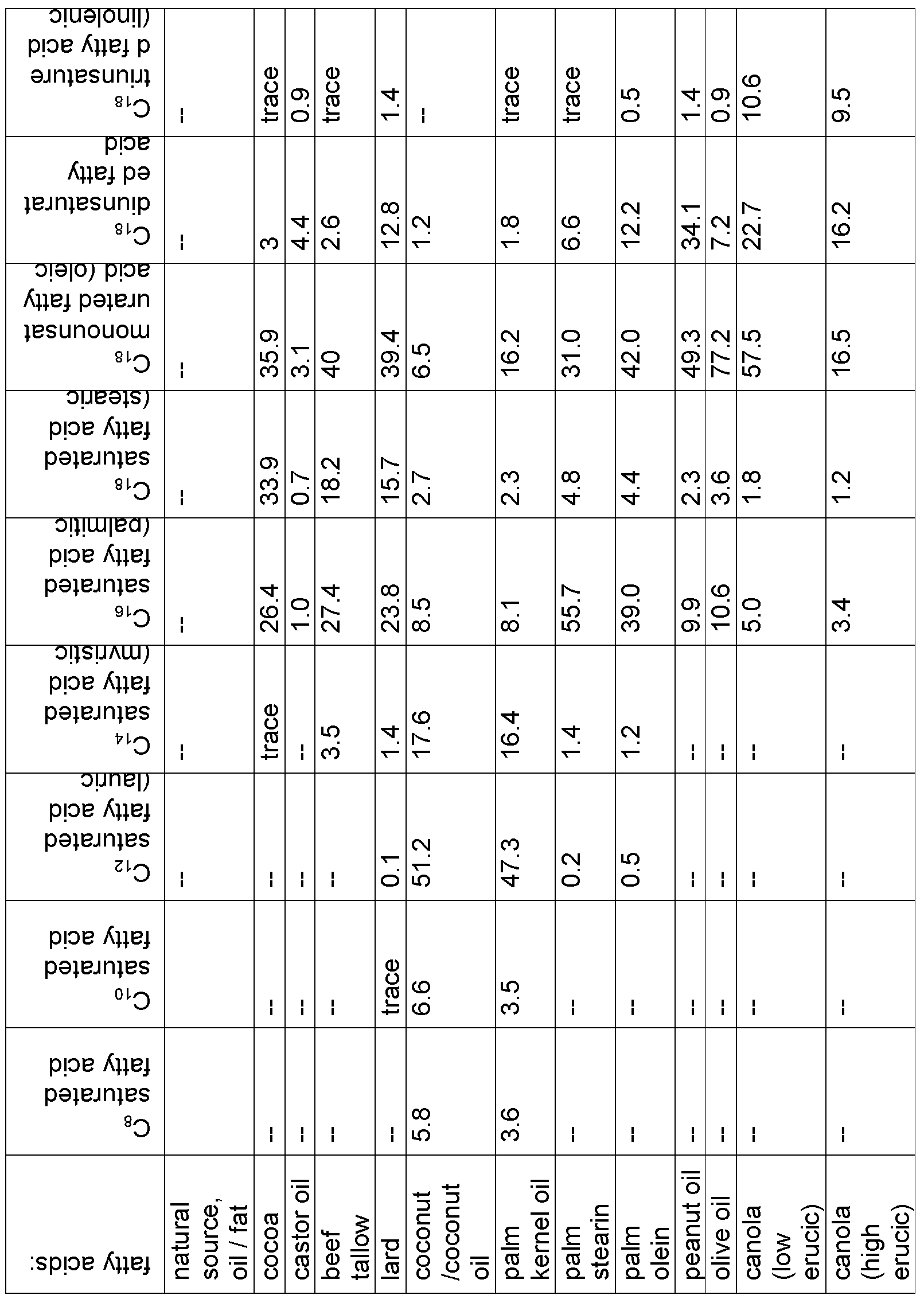
-7 -
In one aspect of the invention, the soap constituent comprises at least 55% but preferably, is at least (in order of increasing preference, in %) 56, 57, 58, 59, 60, 61 , 62, 63, 64, 65, 66, 67, 68, 69, 70, 71, 72, 73, 74, 75, 76, 77, 78, 79, 80, 81, 82, 83, 84, 85, 86, 87, 88, 89, 90, 91, 92, 93, 94, 94.5, 95, 95.5, 96, 96.5, 97, 97.5, 98, 98.5, 99, and 99.5% of potassium salts of C12, C14 and Ci6 saturated fatty acids. Within this (preferred) (statistical) distribution of C12, C14 and Ci6 saturated fatty acid potassium salts, preferably at least 50%, preferably at least 55%, yet more preferably at least 60% of the total of the C12, Ci4 and Ci6 saturated fatty acid potassium salts are C12 saturated fatty acid potassium salts. In preferred embodiments, the C12 saturated fatty acid potassium salts comprise also not more than about 70% of the total amount of the statistical distribution of C12, C14 and Ci6 saturated fatty acid potassium salts present in the soap constituent. Preferably, concurrently with the above at least 15%, more preferably at least 20% of the potassium salts of C12, Ci4 and Ci6 saturated fatty acid potassium salts are C14 saturated fatty acid potassium salts, and further concurrently the C14 saturated fatty acid potassium salts comprise not more than 30%, preferably not more than 25% of the C12, C14 and Ci6 saturated fatty acid potassium salts present in the soap constituent.. Preferably, concurrently with one or more of the foregoing, at least 5% and preferably at least 10% of the C12, Ci4 and Ci6 saturated fatty acid potassium salts are Ci6 saturated fatty acid potassium salts, and further concurrently the Ci6 saturated fatty acid potassium salts comprise not more than 20%, preferably not more than 15% of the saturated fatty C12, C14 and Ci6 fatty acids present in the soap constituent. Optionally but preferably in addition to the foregoing parameters, the soap constituent comprises at least 2% of a C 10 saturated fatty acid potassium salt. Optionally but preferably the soap constituent also comprises not more than about 20% of Ci8 mono-, di- and tri-unsaturated fatty acids.
According to the invention, the soap constituent of the bar soap compositions and/or the bar soaps comprise potassium salts of C12, C14 and Ci6 saturated fatty acids, although according to this aspect the potassium salts of C12, C14 and Ci6 saturated fatty acids need not be the predominant amount of potassium salts of fatty acids present in the soap constituent. In this aspect, preferably the (statistical) distribution of C12, C14 and Ci6 saturated fatty acid potassium salts present in the soap constituent, preferably at least 50%, preferably at least 55%, yet more preferably at least 60% of the total of the C12, C14
and Ci6 saturated fatty acid potassium salts are C12 saturated fatty acid potassium salts. In preferred embodiments of this aspect, the C12 saturated fatty acid potassium salts comprise also not more than about 70% of the total amount of the statistical distribution of Ci2, Ci4 and C16 saturated fatty acid potassium salts present in the soap constituent. Preferably, concurrently with the above at least 15%, more preferably at least 20% of the potassium salts of C12, C14 and C16 saturated fatty acid potassium salts are C14 saturated fatty acid potassium salts, and further concurrently the C14 saturated fatty acid potassium salts comprise not more than 30%, preferably not more than 25% of the C12, C14 and C16 saturated fatty acid potassium salts present in the soap constituent.. Preferably, concurrently with one or more of the foregoing, at least 5% and preferably at least 10% of the Ci2, C14 and C16 saturated fatty acid potassium salts are C16 saturated fatty acid potassium salts, and further concurrently the C16 saturated fatty acid potassium salts comprise not more than 20%, preferably not more than 15% of the saturated fatty C12, C14 and Ci6 fatty acids present in the soap constituent. Optionally but preferably in addition to the foregoing parameters, the soap constituent comprises at least 2% of a C10 saturated fatty acid potassium salt. Optionally but preferably the soap constituent also comprises not more than about 20% of C18 mono-, di- and tri-unsaturated fatty acids.
By way of non-limiting example, such a potassium soap having a desired statistical distribution of fatty C12, C14 and C16 fatty acids may be provided by a potassium cocoate soap and/or a potassium palm kernel oil soap having a requisite distribution of fatty C12, C14 and C16 fatty acids.
While not wishing to be found by the following hypothesis, the present inventors have surprisingly discovered that by virtue of the close control of the statistical distribution of the C12 saturated fatty acid potassium salts, C14 saturated fatty acid potassium salts and C16 saturated fatty acid potassium salts, optionally but preferably concurrently with the close control of the statistical distribution of the C18 mono-, di- and tri-unsaturated fatty acid potassium salts also present, that a surprising antimicrobial benefit may be achieved, with our without the presence of further antimicrobial constituents.
In another aspect of the invention the present inventors have surprisingly found that bar soap compositions which include a soap constituent which constituent includes
potassium cocoate as its primary constituent which provides an unexpected antimicrobial efficacy of the bar soap compositions. Such has been observed even in the absence of one or more non-soap antimicrobial compounds, e.g. quaternary ammonium based germicidal compounds, non-quaternary ammonium based germicidal compounds, e.g, TRICLOSAN, TCC and/or PCMX, as well as antimicrobial free metal ions, e.g, Ag+, Cu2+, Zn2+. Preferably the potassium cocoate provides at least 50% wt. of all soap constituents present in the bar soap compositions. More preferably (in order of increasing preference) potassium cocoate provides at least (in %wt.) : 51, 52, 53, 54, 55, 56, 57, 58, 59, 60, 61, 62, 63, 64, 65, 66, 67, 68, 69,70, 71, 72, 73, 74, 75, 76, 77, 78, 79, 80, 81, 82, 83, 84, 85, 86, 87, 88, 89, 90, 91, 92, 93, 94, 95, 96, 97, 98, 99 and 100%wt. of the total amount of all soaps present in the bar soap compositions. As used herein, and in accordance with particular preferred embodiments, the potassium cocoate is present in a "predominant" amount, more specifically at least 80%wt, or more but more preferably at least 95%wt. of all of the soaps present in the bar soap compositions, or yet more preferably the potassium cocoate is present in an "exclusive" amount, more specifically at least 99%wt, but preferably 100%wt. of all of the soaps present in the bar soap compositions.
In a further aspect of the invention primary soap constituents include both potassium tallowate and potassium cocoate and in which the weight percentage of the potassium cocoate preferably exceeds that of the potassium tallowate (although in certain embodiments the reverse may be true.). Desirably this "pair" of potassium tallowate and potassium cocoate are the primary soaps of the soap constituent of the bar soap compositions, and together, provide at least 50% wt. of all soap constituents present in the bar soap compositions. More preferably (in order of increasing preference) the potassium tallowate and potassium cocoate together provides at least (in %wt.) : 51, 52, 53, 54, 55, 56, 57, 58, 59, 60, 61, 62, 63, 64, 65, 66, 67, 68, 69,70, 71, 72, 73, 74, 75, 76, 77, 78, 79, 80, 81, 82, 83, 84, 85, 86, 87, 88, 89, 90, 91, 92, 93, 94, 95, 96, 97, 98, 99 and 100%wt. of the total amount of all soaps present in the bar soap compositions. It is also concurrently required that the potassium cocoate exceeds that of the potassium tallowate. Preferably the respective weight ratio of potassium cocoate:potassium tallowate is at least 50.1 :49.9, but preferred respective weight ratios being (in order of increasing preference)
50.5:49.5, 51 :49, 52:48; 53:47, 54:46; 55:45; 56:44; 57:43; 58:42; 59:41 ; 60:40; 61 :39; 62:38; 63:37; 64:36; 65:35; 66:34; 67:33; 68:32; 69:31; 70:30; 71 :29; 72:28; 73:27;
74:26; 75:25; 76:24; 77:23; 78:22; 79:21; 80:20; 81 : 19; 82:18; 83:17; 84: 16; 85:15;
86:14; 87: 13; 88: 12; 89: 11; 90:10; 91 :9; 92:8; 93:7; 94:6; 95:5; 96:4; 97:3; 98:2; 99:1 and preferably 100:0. Certain particular embodiments and preferred soap constituents having both potassium tallowate and potassium cocoate, which represent certain preferred respective weight ratios are disclosed in one or more of the Examples.
The soap constituent comprises at least 85%wt. of the total weight of the bar soap composition and/or the bar soap formed of the bar soap composition. Preferably however, the soap constituent comprises between 85%-99%wt, and preferably (and in order of increasing preference, in %wt.) at least 85, 85.5, 86, 86.5, 87, 87.5, 88, 88.5, 89, 89.5, 90, 90.5, 91, 91.5, 92, 92.5, 93, 93.5, 94, 94.5, 95, 95.5, 96, 96.5, 97, 97.5, 98, 98.5 and 99% wt, and in some embodiments, preferably (and in order of increasing preference, in %wt.) not more than: 99, 98.5, 98, 97,5, 97, 96.5, 96, 95.5, 95, 94.5%wt.
The bar soap compositions of the invention may additionally include one or more anionic, nonionic, amphoteric or zwitterionic surfactants, particularly where such are provided to increase the production of foam or lather when the bar soap is used in a manual cleaning operation, e.g., washing of the hands, body or hair. Such surfactants are distinguished from the soap constituent described herein. Such are frequently referred to as synthetic surfactants, or "syndets" as they are distinguished from the fatty acid based soaps (frequently supplied as "soap noodles") which is the major constituent of the present invention. By way of non-limiting example, such include anionic surfactants which may be used in this capacity in the bar soaps include one or more of: alcohol sulfates and sulfonates, alcohol phosphates and phosphonates, alkyl ester sulfates, alkyl diphenyl ether sulfonates, alkyl sulfates, alkyl ether sulfates, sulfate esters of an alkylphenoxy polyoxyethylene ethanol, alkyl monoglyceride sulfates, alkyl sulfonates, alkyl ether sulfates, alpha-olefin sulfonates, beta-alkoxy alkane sulfonates, alkyl ether sulfonates, ethoxylated alkyl sulfonates, alkylaryl sulfonates, alkylaryl sulfates, alkyl monoglyceride sulfonates, alkyl carboxylates, alkyl ether carboxylates, alkyl alkoxy carboxylates having 1 to 5 moles of ethylene oxide, alkylpolyglycolethersulfates
(containing up to 10 moles of ethylene oxide), sulfosuccinates, octoxynol or nonoxynol
phosphates, taurates, fatty taurides, fatty acid amide polyoxy ethylene sulfates, acyl glycerol sulfonates, fatty oleyl glycerol sulfates, alkyl phenol ethylene oxide ether sulfates, paraffin sulfonates, alkyl phosphates, isethionates, N-acyl taurates, alkyl succinamates and sulfosuccinates, alkylpolysaccharide sulfates, alkylpolyglucoside sulfates, alkyl polyethoxy carboxylates, and sarcosinates or mixtures thereof.
Further examples of anionic surfactants include water soluble salts or acids of the formula (ROS03)xM or (RS03)XM wherein R is preferably a C6-C24 hydrocarbyl, preferably an alkyl or hydroxyalkyl having a C10-C20 alkyl component, more preferably a C12-C18 alkyl or hydroxyalkyl, and M is H or a mono-, di- or tri-valent cation, e. g., an alkali metal cation (e. g., sodium, potassium, lithium), or ammonium or substituted ammonium (e. g., methyl-, dimethyl-, and trimethyl ammonium cations and quaternary ammonium cations, such as tetramethyl-ammonium and dimethyl piperdinium cations and quaternary ammonium cations derived from alkylamines such as ethylamine, diethylamine, triethylamine, and mixtures thereof, and the like) and x is an integer, preferably 1 to 3, most preferably 1.
Further examples of anionic surfactants include alkyl-diphenyl-ethersulphonates and alkyl-carboxylates. Other anionic surfactants are C6-C20 linear
alkylbenzenesulfonates, C6-C22 primary or secondary alkanesulfonates, C6-C24 olefinsulfonates, sulfonated polycarboxylic acids prepared by sulfonation of the pyrolyzed product of alkaline earth metal citrates, C6-C24 alkylpolyglycolethersulfates , alkyl ester sulfates such as C14-16 methyl ester sulfates; acyl glycerol sulfonates, fatty oleyl glycerol sulfates, alkyl phenol ethylene oxide ether sulfates, paraffin sulfonates, alkyl phosphates, isethionates such as the acyl isethionates, N-acyl taurates, alkyl succinamates and sulfosuccinates, monoesters of sulfosuccinate (especially saturated and unsaturated C12-C18 monoesters) diesters of sulfosuccinate (especially saturated and unsaturated C6-Ci4 diesters), acyl sarcosinates, sulfates of alkylpolysaccharides such as the sulfates of alkylpolyglucoside (the nonionic nonsulfated compounds being described below), branched primary alkyl sulfates, alkyl polyethoxy carboxylates such as those of the formula RO(CH2CH20)kCH2COO"M+ wherein R is a C8-C22 alkyl, k is an integer from 0 to 10, and M is a soluble salt-forming cation.
When present, such one or more anionic surfactants may be present in any effective amount, and advantageously comprise up to about 20%wt. of the bar soap compositions of which they form a part.
Non-limiting examples of nonionic surfactants which may be used in the bar soaps include one or more of: alkyl glucosides, alkyl polyglucosides, polyhydroxy fatty acid amides, alkoxylated fatty acid esters, amine oxides, and mixtures thereof. Further nonionic surfactants include almost any hydrophobic compound having a carboxy, hydroxy, amido, or amino group with a free hydrogen attached to the nitrogen which can be condensed with alkylene oxide (e.g, ethylene oxide, propylene oxide) or with the polyhydration product thereof, polyethylene glycol, to form a water soluble nonionic surfactant compound. Further, the length of the polyethenoxy hydrophobic and hydrophilic elements may various. Exemplary nonionic compounds include the polyoxyethylene ethers of alkyl aromatic hydroxy compounds, e.g., alkylated poly oxy ethylene phenols, polyoxyethylene ethers of long chain aliphatic alcohols, the polyoxyethylene ethers of hydrophobic propylene oxide polymers, and the higher alkyl amine oxides.
Examples of nonionic surfactants include primary and secondary linear and branched alcohol ethoxylates, such as those based on s-Cis alcohols which further include an average of from 2 to 80 moles of ethoxylation per mol of alcohol. Examples include the Genapol® series of linear alcohol ethoxylates from Clariant Corp., Charlotte, NC. Further nonionic surfactants include secondary C12-C15 alcohol ethoxylates, including those which have from about 3 to about 10 moles of ethoxylation. Such are available in the Tergitol® series of nonionic surfactants (Dow Chemical, Midland, MI), particularly those in the Tergitol® "15-S-"series. Still further examples of suitable nonionic surfactants for use as the (b) at least one nonionic surfactant include which may be advantageously included in the inventive compositions are alkoxy block copolymers, and in particular, compounds based on ethoxy/propoxy block copolymers. Polymeric alkylene oxide block copolymers include nonionic surfactants in which the major portion of the molecule is made up of block polymeric C2-C4 alkylene oxides. Such nonionic surfactants, while preferably built up from an alkylene oxide chain starting group, and can have as a starting nucleus almost any active hydrogen containing group including,
without limitation, amides, phenols, thiols and secondary alcohols. Such are available in the Pluronic® series of block copolymer surfactants (ex. BASF).
Examples of alkylpolyglycoside compounds include those which include alkyl monoglycosides and polyglycosides which may be prepared generally by reacting a monosaccharide, or a compound hydrolyzable to a monosaccharide with an alcohol such as a fatty alcohol in an acid medium. Exemplary alkyl glycoside surfactants alkyl glycoside surfactants suitable for use in the bar soaps of the present invention may be represented by formula (II) below:

wherein:
R is a monovalent organic radical containing from about 6 to about 30, preferably from about 8 to about 18 carbon atoms;
Ri is a divalent hydrocarbon radical containing from about 2 to about 4 carbon atoms;
O is an oxygen atom;
y is a number which has an average value from about 0 to about 1 and is preferably 0;
G is a moiety derived from a reducing saccharide containing 5 or 6 carbon atoms; and
x is a number having an average value from about 1 to 5 (preferably from 1.1 to 2);
Z is O2M1,
0
II
— 0-C-R2
0(CH2),
 R2 is (CH2)C02M1 or
CH=CHC02M1; (with the proviso that Z can be 02M1 only if Z is in place of a primary hydroxyl group in which the primary hydroxyl-bearing
carbon atom,
— CH2OH, is oxidized to form a

group);
b is a number of from 0 to 3x+l preferably an average of from 0.5 to 2 per glycosal group;
p is 1 to 10,
M1 is H+ or an organic or inorganic cation, such as, for example, an alkali metal, ammonium, monoethanolamine, or calcium.
As defined in Formula II above, R is generally the residue of a fatty alcohol having from about 8 to 30 and preferably 8 to 18 carbon atoms. Examples of such alkylglycosides as described above include, for example, APG® 225 which is described as being an alkyl polyglycoside in which the alkyl group contains 8 to 10 carbon atoms and having an average degree of polymerization of 1.7, APG® 325 CS GLYCOSIDE which is described as being a 50% C9-C11 alkyl polyglycoside, also commonly referred to as D-glucopyranoside, Glucopon® 425, described to be an alkyl polyglycoside in which the alkyl group contains 8 to 16 carbon atoms and having an average degree of polymerization of 1.48, Glucopon® 625 CS which is described as being a 50% C10-C16 alkyl polyglycoside, also commonly referred to as a D-glucopyranoside, (available from Cognis Corp., Ambler PA), Plantaren® 2000, described as being an alkyl polyglycoside in which the alkyl group contains 8 to 16 carbon atoms and having an average degree of polymerization of 1.4, and Plantaren® 1300, described to be an alkyl polyglycoside in which the alkyl group contains 12 to 16 carbon atoms and having an average degree of polymerization of 1.6.
Further, and sometimes preferred nonionic surfactants which may be used in the bar soaps of the invention include certain alkanolamides including monoethanolamides and diethanolamides, particularly fatty monoalkanolamides and fatty dialkanolamides. Commercially available monoethanol amides and diethanol amides include those marketed under the trade names Alakamide® and Cyclomide® by Rhone-Poulenc Co., (Cranbury, NJ).
The bar soap compositions of the invention may include one or more sucrose ester based nonionic surfactants. Such are compounds which consist largely of sucrose mono-
and di-esters of the natural fatty acids having 12 to 20 carbon atoms and preferably those having 16 to 20 carbon atoms. By way of non-limiting example, such include sucrose cocoate, sucrose dilaurate, sucrose distearate, sucrose laurate, sucrose myristate, sucrose oleate, sucrose palmitate, sucrose polylaurate, sucrose polylinoleate, sucrose polyoleate, sucrose polystearate, sucrose stearate, sucrose tetrastearate, sucrose tribehenate, sucrose tristearate or any combination thereof. Of these, preferred are sucrose cocoate and sucrose laurate, of which sucrose cocoate is particularly preferred. Whereas a mixture of sucrose ester based nonionic surfactants may be used, in certain particularly preferred embodiments it is preferred that the predominant sucrose ester based nonionic surfactant present is sucrose cocoate. In certain preferred embodiments, sucrose cocoate comprises at least 60%wt, and in order of increasing preference at least 70%, 75%, 80%, 85%, 90%, 95%, 98%, 99% and 100% by weight of the sucrose ether based nonionic surfactant constituent. When present the one or more sucrose ester based nonionic surfactants comprise from 0.001%wt. to about 3%wt, but more preferably from 0.05%wt. to about l%wt. of bar soap compositions.
Exemplary useful amphoteric and zwitterionic surfactants include one or more of: alkyl betaines, alkyl amidobetaines, aminopropionates, aminoglycinates, imidazolinium betaines and sulfobetaines. Alkyl betaines are known surfactants which are mainly produced by carboxyalkylation, preferably carboxymethylation of aminic compounds. Typical examples are the carboxymethylation products of hexyl methyl amine, hexyl dimethyl amine, octyl dimethyl amine, decyl dimethyl amine, dodecyl methyl amine, dodecyl dimethyl amine, dodecyl ethyl methyl amine, C12/14 cocoalkyl dimethyl amine, myristyl dimethyl amine, cetyl dimethyl amine, stearyl dimethyl amine, stearyl ethyl methyl amine, oleyl dimethyl amine, Ci6/i8 tallow alkyl dimethyl amine and technical mixtures thereof. Alkyl amidobetaines which represent carboxyalkylation products of amidoamines are also suitable. Typical examples are reaction products of fatty acids containing 6 to 22 carbon atoms, namely caproic acid, caprylic acid, capric acid, lauric acid, myristic acid, palmitic acid, palmitoleic acid, stearic acid, isostearic acid, oleic acid, elaidic acid, petroselic acid, linoleic acid, linolenic acid, elaeostearic acid, arachic acid, gadoleic acid, behenic acid and erucic acid and technical mixtures thereof, with N,N- dimethylaminoethyl amine, Ν,Ν-dimethylaminoproply amine, N,N-diethylaminoethyl
amine and N,N-diethylaminoproply amine which are condensed with sodium
chloroacetate.
When present, one or more of such anionic, nonionic, amphoteric or zwitterionic surfactants may be included in any effective amount. When present, such one or more said surfactants comprise about 0.1 - 25%wt. of the bar soap of which they form a part.
The present invention also provides an antimicrobial system which includes a soap constituent which comprises potassium cocoate and/or other potassium soap of a preferred statistical distribution of C12, Ci4 and C16 fatty acid as described previously, and which bar soap compositions additionally include a quaternary ammonium based germicidal compound which independently provides an antimicrobial benefit. Thus according to such an embodiment, the bar soap compositions include a quaternary ammonium based germicidal compound. Such include quaternary ammonium
compounds and salts thereof, which may be characterized by the general structural formula:

Preferred quaternary ammonium compounds which exhibit an microbicidal effect, viz., act as germicides, and which are useful in the practice of the present invention include those which have the structural formula:

isalkylethoxy, Cs-isalkylphenolethoxy and R3 is benzyl, and X is a halide, for example chloride, bromide or iodide, a saccharinate counterion or is a methosulfate anion. The alkyl groups recited in R2 and R3 may be straight-chained or branched, but are preferably substantially linear.
Particularly useful quaternary ammonium compounds useful in the present inventive compositions include materials which include a single quaternary compound, as well as mixtures of two or more different quaternary compounds. Such useful quaternary compounds are available under the BARD AC®, BARQUAT®, HY AMINE®,
LONZABAC®, and ONYXIDE® trademarks, which are more fully described in, for example, McCutcheon's Functional Materials (Vol. 2), North American Edition, 1998, as well as the respective product literature from the suppliers identified below. Such include, for example: BZT, which is described to be benzethonium chloride (N-benzyl- N,N-dimethyl-2-{2-[4-(2,4,4-trimethylpentan-2-yl)phenoxy]ethoxy}ethanaminium chloride); BARD AC® 205M which is described to be a liquid containing alkyl dimethyl benzyl ammonium chloride; octyl decyl dimethyl ammonium chloride; didecyl dimethyl ammonium chloride, and dioctyl dimethyl ammonium chloride (50% active) (also available as 80% active (BARD AC® 208M)); BARD AC® 2050 which is described to be a combination of octyl decyl dimethyl ammonium chloride/didecyl dimethyl ammonium chloride, and dioctyl dimethyl ammonium chloride (50% active) (also available as 80% active (BARD AC® 2080)); BARD AC ® 2250 which is described to be didecyl dimethyl ammonium chloride (50% active); BARD AC® LF (or BARD AC® LF-80), described as being based on dioctyl dimethyl ammonium chloride (BARQUAT® MB-50, MX-50, OJ- 50 (each 50% liquid) and MB-80 or MX-80 (each 80% liquid) are each described as an alkyl dimethyl benzyl ammonium chloride; BARD AC® 4250 and BARQUAT® 4250Z (each 50% active) or BARQUAT® 4280 and BARQUAT 4280Z (each 80% active) are each described as alkyl dimethyl benzyl ammonium chloride/alkyl dimethyl ethyl benzyl ammonium chloride. Also, HY AMINE® 1622, described as diisobutyl phenoxy ethoxy ethyl dimethyl benzyl ammonium chloride (50% solution); HY AMINE® 3500 (50% actives), described as alkyl dimethyl benzyl ammonium chloride (also available as 80% active (HY AMINE® 3500-80)); and HYMAINE® 2389 described as being based on methyldodecylbenzyl ammonium chloride and/or methyldodecylxylene-bis-trimethyl ammonium chloride. (BARD AC®, BARQUAT® and HY AMINE® are presently commercially available from Lonza, Inc., Fairlawn, New Jersey). BTC® 50 NF (or BTC® 65 NF) is described to be alkyl dimethyl benzyl ammonium chloride (50% active); BTC® 99 is described as didecyl dimethyl ammonium chloride (50% acive); BTC® 776 is described to be myrisalkonium chloride (50% active); BTC® 818 is described as being octyl decyl dimethyl ammonium chloride, didecyl dimethyl ammonium chloride, and dioctyl dimethyl ammonium chloride (50% active) (available also as 80% active (BTC® 818-80%)); BTC® 824 and BTC® 835 are each described as
being of alkyl dimethyl benzyl ammonium chloride (each 50% active); BTC® 885 is described as a combination of BTC® 835 and BTC® 818 (50% active) (available also as 80% active (BTC® 888)); BTC® 1010 is described as didecyl dimethyl ammonium chloride (50% active) (also available as 80% active (BTC® 1010-80)); BTC® 2125 (or BTC® 2125 M) is described as alkyl dimethyl benzyl ammonium chloride and alkyl dimethyl ethylbenzyl ammonium chloride (each 50% active) (also available as 80% active (BTC® 2125 80 or BTC® 2125 M)); BTC® 2565 is described as alkyl dimethyl benzyl ammonium chlorides (50% active) (also available as 80% active (BTC® 2568)); BTC® 8248 (or BTC® 8358) is described as alkyl dimethyl benzyl ammonium chloride (80% active) (also available as 90% active (BTC® 8249)); ONYXIDE® 3300 is described as n-alkyl dimethyl benzyl ammonium saccharinate (95% active). (BTC® and ONYXIDE® are presently commercially available from Stepan Company, Northfield, Illinois.)
The cationic quaternary ammonium compounds are preferably non-polymeric and/or non-oligomeric cationic surfactant compounds, and are thus distinguishable from the "Polyquat" polymers known to the art.
When present in a bar soap composition, the least one cationic quaternary ammonium compound(s) may be present in any effective amount, but generally need not be present in amounts in excess of about 10%wt. based on the total weight of the animate surface treatment composition of which it forms a part. Preferably, when present, the germicidal quaternary ammonium compound(s) may be present in the inventive compositions in amounts of from about 0.001 %wt. to up to about 10%wt, very preferably about 0.01 -8%wt, more preferably in amounts of between about 0.01 -2% wt, and most preferably from about 0.01 - l%wt. It is particularly advantageous that the preferred germicidal cationic quaternary ammonium compound(s) are present in amounts of at least about 200 parts per million (ppm), preferably in amounts of from about 1 ppm to 10,000 ppm, preferably from about 50 ppm to 2000 ppm, more preferably in amounts of from about 100 ppm to 1,000 ppm.
Notwithstanding the foregoing, it is to be understood that in other specific embodiments of the invention such one or more quaternary ammonium based germicidal compound(s) are expressly excluded.
The present invention also provides an antimicrobial system which includes a soap constituent which comprises potassium cocoate and/or other potassium soap of a preferred statistical distribution of C12, C14 and C16 fatty acid as described previously, and which bar soap compositions additionally include a non-quaternary ammonium based germicidal compound. Non-limiting examples of these compounds include: benzoyl peroxide, pyrithiones (especially zinc pyrithione which is also known as ZPT), dimethyldimethylol hydantoin (Glydant),
methylchloroisothiazolinone/methylisothiazolinone (Kathon CG), sodium sulfite, sodium bisulfite, imidazolidinyl urea (Germall 115), diazolidinyl urea (Germaill II), benzyl alcohol, 2-bromo-2-nitropropane-l,3-diol (Bronopol), formalin (formaldehyde), iodopropenyl butylcarbamate (Polyphase PI 00), chloroacetamide, methanamine, methyldibromonitrile glutaronitrile (l,2-Dibromo-2,4-dicyanobutane or Tektamer), glutaraldehyde, 5-bromo-5-nitro- 1,3-dioxane (Bronidox), phenethyl alcohol, o- phenylphenol/sodium o-phenylphenol, sodium hydroxymethylglycinate (Suttocide A), polymethoxy bicyclic oxazolidine (Nuosept C), dimethoxane, thimersal dichlorobenzyl alcohol, captan, chlorphenenesin, dichlorophene, chlorbutanol, glyceryl laurate, halogenated diphenyl ethers like 2,4,4-trichloro-2-hydroxy-diphenyl ether (Triclosan or TCS), 2,2-dihydroxy-5,5-dibromo-diphenyl ether, phenolic compounds like phenol, 2- methyl phenol, 3 -methyl phenol, 4-methyl phenol, 4-ethyl phenol, 2,4-dimethyl phenol, 2,5-dimethyl phenol, 3,4-dimethyl phenol, 2,6-dimethyl phenol, 4-n-propyl phenol, 4-n- butyl phenol, 4-n-amyl phenol, 4-tert-amyl phenol, 4-n-hexyl phenol, 4-n-heptyl phenol, mono- and poly-alkyl and aromatic halophenols such as p-chlorophenol, methyl p- chlorophenol, ethyl p-chlorophenol, n-propyl p-chlorophenol, n-butyl p-chlorophenol, n- amyl p-chlorophenol, sec-amyl p-chlorophenol, n-hexyl p-chlorophenol, cyclohexyl p- chlorophenol, n-heptyl p-chlorophenol, n-octyl p-chlorophenol, o-chlorophenol, methyl o-chlorophenol, ethyl o-chlorophenol, n-propyl o-chlorophenol, n-butyl o-chlorophenol, n-amyl o-chlorophenol, tert-amyl o-chlorophenol, n-hexyl o-chlorophenol, n-heptyl o- chlorophenol, o-benzyl p-chlorophenol, o-benzyl-m-methyl p-chlorophenol, o-benzyl-m, m-dimethyl p-chlorophenol, o-phenylethyl p-chlorophenol, o-phenylethyl-m-methyl p- chlorophenol, 3 -methyl p-chlorophenol, 3,5-dimethyl p-chlorophenol, 6-ethyl-3 -methyl p-chlorophenol, 6-n-propyl-3 -methyl p-chlorophenol, 6-iso-propyl-3 -methyl p-
chlorophenol, 2-ethyl-3,5-dimethyl p-chlorophenol, 6-sec-butyl-3 -methyl p-chlorophenol, 2-iso-propyl-3, 5 -dimethyl p-chlorophenol, 6-diethylmethyl-3 -methyl p-chlorophenol, 6- iso-propyl-2-ethyl-3 -methyl p-chlorophenol, 2-sec-amyl-3, 5 -dimethyl p-chlorophenol 2- diethylmethyl-3,5-dimethyl p-chlorophenol, 6-sec-octyl-3 -methyl p-chlorophenol, p- chloro-m-cresol, p-bromophenol, methyl p-bromophenol, ethyl p-bromophenol, n-propyl p-bromophenol, n-butyl p-bromophenol, n-amyl p-bromophenol, sec-amyl p- bromophenol, n-hexyl p-bromophenol, cyclohexyl p-bromophenol, o-bromophenol, tert- amyl o-bromophenol, n-hexyl o-bromophenol, n-propyl-m,m-dimethyl o-bromophenol, 2-phenyl phenol, 4-chloro-2-methyl phenol, 4-chloro-3 -methyl phenol, 4-chloro-3,5- dimethyl phenol, 2,4-dichloro-3,5-dimethylphenol, 3,4,5, 6-terabromo-2-methylphenol, 5- methyl-2-pentylphenol, 4-isopropyl-3 -methylphenol, para-chloro-meta-xy lenol
("PCMX"), dichloro meta xylenol, chlorothymol, 5 -chloro-2 -hydroxy diphenylmethane, resorcinol and its derivatives including methyl resorcinol, ethyl resorcinol, n-propyl resorcinol, n-butyl resorcinol, n-amyl resorcinol, n-hexyl resorcinol, n-heptyl resorcinol, n-octyl resorcinol, n-nonyl resorcinol, phenyl resorcinol, benzyl resorcinol, phenylethyl resorcinol, phenylpropyl resorcinol, p-chlorobenzyl resorcinol, 5-chloro 2,4- dihydroxydiphenyl methane, 4-chloro 2,4-dihydroxydiphenyl methane, 5-bromo 2,4- dihydroxydiphenyl methane, and 4-bromo 2,4-dihydroxydiphenyl methane, bisphenolic compounds like 2,2-methylene bis (4-chlorophenol), 2,2-methylene bis (3,4,6- trichlorophenol), 2,2-methylene bis (4-chloro-6-bromophenol), bis (2-hydroxy-3,5- dichlorophenyl) sulphide, and bis (2-hydroxy-5-chlorobenzyl)sulphide, benzoic esters (parabens) like methylparaben, propylparaben, butylparaben, ethylparaben,
isopropylparaben, isobutylparaben, benzylparaben, sodium methylparaben, and sodium propylparaben, halogenated carbanilides (e.g., 3,4,4-trichlorocarbanilides (Triclocarban or TCC), 3-trifluoromethyl-4,4-dichlorocarbanilide, 3,3,4-trichlorocarbanilide, etc.).
Of these, preferred are phenol based non-cationic microbicidals (antimicrobial constituents), especially those based on one or more phenolic compounds, particularly 2- hydroxydiphenyl compounds which may be exemplified by the following classes of compounds:

wherein Y is chlorine or bromine, Z is S02 H, N02, or Ci -C4 alkyl, r is 0 to 3, o is 0 to 3, p is 0 or 1 , m is 0 or 1 , and n is 0 or 1. In preferred embodiments, Y is chlorine or bromine, m is 0, n is 0 or 1 , o is 1 or 2, r is 1 or 2, and p is 0, and according to especially preferred embodiments, Y is chlorine, m is 0, n is 0, o is 1, r is 2, and p is 0.
Particularly useful 2-hydroxydiphenyl compounds include those which may be represented by the structur

which is commonly referred to as "TRICLOSAN" and which is presently commercially available from Ciba Specialty Chemicals Corp., as well as halogenated carbanilides, e.g., TCC.
Further exemplary useful phenolic based antimicrobial constituents agents include 2,2'-hydroxy-5,5'-dibromo-diphenyl ether which may be represented by the structure:

wherein Ri is hydro, hydroxy, Ci -C4 alkyl, chloro, nitro, phenyl, or benzyl; R2 is hydro, hydroxy, Ci -Cs alkyl, or halo; R3 is hydro, Ci -Cs alkyl, hydroxy, chloro, nitro, or a sulfur in the form of an alkali metal salt or ammonium salt; Rt is hydro or methyl, and R5 is hydro or nitro. Halo is bromo or, preferably, is chloro.
Specific examples of phenol derivatives include, but are not limited to, chlorophenols (0-, m-, p-), 2,4-dichlorophenol, p-nitrophenol, picric acid, xylenol, p-
chloro-m-xylenol, cresols (o-, m-, p-), p-chloro-m-cresol, pyrocatechol, resorcinol, 4-n- hexylresorcinol, pyrogallol, phloroglucin, carvacrol, thymol, p-chlorothymol, o- phenylphenol, o-benzylphenol, p-chloro-o-benzylphenol, phenol, 4-ethylphenol, and 4- phenolsulfonic acid.
Still further useful phenol derivatives include those which may be represented by the structure:

More preferably said non-quaternary ammonium based germicidal compound is TCC and/or PCMX,
When present in a bar soap composition, the least one non-quaternary ammonium based germicidal compound may be present in any effective amount, but generally need not be present in amounts in excess of about 10%wt. based on the total weight of the animate surface treatment composition of which it forms a part. Preferably, when present, the non-quaternary ammonium based germicidal compound(s) may be present in the inventive compositions in amounts of from about 0.001 %wt. to up to about 10%wt, very preferably about 0.01-8%wt, more preferably in amounts of between about 0.01- 2%wt, and most preferably from about 0.01 - l%wt. It is particularly advantageous that the preferred non-quaternary ammonium based germicidal compound(s) are present in amounts of at least about 200 parts per million (ppm), preferably in amounts of from
about 1 ppm to 10,000 ppm, preferably from about 50 ppm to 2000 ppm, more preferably in amounts of from about 100 ppm to 1 ,000 ppm.
Notwithstanding the foregoing, it is to be understood that in certain embodiments such one or more non-quaternary ammonium based germicidal compounds are expressly excluded from the bar soap compositions.
The bar soaps of the present invention may include still further constituents. Non- limiting examples of such further constituents are described herein.
The bar soap compositions may include an effective amount of an anti-acne agent. Such may be any compound, composition or material which has been approved by the U.S. Food and Drug Administration for the topical treatment of acne. Examples of antiacne agents include, but are not limited to, salicylic acid, benzoyl peroxide, sulphur, retinoic acid, Candida bombicola/glucose/methyl rapeseedate ferment, peat water, resorcinol, silt, peat, permethin, azelaic acid, clindamycin, adapalene, erythromycin, sodium sulfacetamide, and combinations thereof. Of these, benzoyl peroxide is particularly preferred.
Further useful constituents include one or more alkyl lactates, which may of themselves provide an antimicrobial benefit. Such include the reaction products of a Cs- Ci8 fatty alcohol with lactic acid. Preferred alkyl lactates include those represented by the following general structural formula (la):

in which R is a Cs-Cis alkyl moiety, preferably is a C10-C14 alkyl moiety and especially preferably is predominantly (at least 85%, more preferably at least 90%, particularly preferably at least 95% and most preferably at least about 98%) of a C 12 alkyl moiety. The alkyl moiety may be branched but is preferably substantially linear. A particularly preferred alkyl lactate conforming to formula (la) is lauryl lactyl lactate. Preferred alkyl lactates also include those represented by the following general structural formula (lb):
 in which R is a Cs-Cis alkyl moiety, preferably is a C10-C14 alkyl moiety and especially preferably is predominantly (at least 85%, more preferably at least 90%, particularly preferably at least 95% and most preferably at least about 98%) of a C12 alkyl moiety. The alkyl moiety may be branched but is preferably substantially linear. A particularly preferred alkyl lactate conforming to formula (lb) is lauryl lactyl lactate. Of course it is to be understood that other alkyl lactates not specifically encompassed by the compounds of formula (la) and/or (lb) may also be utilized. When present such one or more alkyl lactates may be present in any effective amount, but advantageously comprise between about 0.001%wt. to about 3%wt, more preferably between about 0.05%wt. to about 0.5%wt. of a bar soap composition.
The soap bars may include one or more polyols. Such include compounds having two or more hydroxyl groups and which are highly water soluble, preferably freely soluble, in water. Non-limiting examples of suitable polyols include: relatively low molecular weight short chain polyhydroxy compounds such as glycerol and propylene glycol; sugars such as sorbitol, manitol, sucrose and glucose; modified carbohydrates such as hydrolyzed starch, dextrin and maltodextrin, and polymeric synthetic polyols such as polyalkylene glycols, for example polyoxyethylene glycol (PEG) and
polyoxypropylene glycol (PPG).
Of these said polyols, preferred are relatively low molecular weight compound which are either liquid or readily soluble in aqueous solutions, e.g., low molecular weight polyols and sugars. Particularly preferred polyols are glycerine, glycerol, sorbitol and their mixtures. Glycerine and glycerol are particularly preferred, as such may also provide benefits as humectants in the bar soaps.
When present, such one or more polyols may be included in minor but effective amounts, e.g, from about 0.00 l%wt. to about 0.5%wt, more preferably from about 0.1 -
2.5%wt. and especially preferably from about 0.5 - 1.25%wt. based on the total weight of the bar soap of which it forms a part.
The bar soap compositions of the invention may include one or more stearyl alkanoates, preferably one or more selected from stearyl caprylate, stearyl palmitate, stearyl stearate, stearyl behenate, and stearyl olivate. Of these, stearyl heptanoate is particularly preferred. Whereas a mixture of stearyl alkanoates may be used, in certain particularly preferred embodiments it is preferred that the predominant stearyl alkanoate present is stearyl heptanoate. In certain preferred embodiments, stearyl heptanoate comprises at least 60%wt, and in order of increasing preference at least 70%, 75%, 80%, 85%, 90%, 95%, 98%, 99% and 100% by weight of the stearyl alkanoates present. The overall content of the one or more stearyl alkanoates in the bar soap compositions is preferably from 0.001%wt. to about 5%wt, more preferably is from 0.05%wt. to about 0.8%wt.
One or more insoluble filler materials may also be present in the bar soap compositions. Advantageously such are provided as powders or comminuted particulates of aqueous insoluble materials such that due to their small size they are readily incorporated into the compositions from which the bar soaps are produced. These filler materials may be inorganic or organic or a combination as long as it is insoluble in water. The insoluble particles should not be perceived by a user of the bar soap as unduly abrasive or granular and advantageously such filler materials have an average particle of size less than 300 microns, more preferably less than 100 microns and most preferably less than 50 microns. Preferably the insoluble particles have a maximum particle size of 300 microns or less, preferably 200 microns or less.
Non-limiting examples of inorganic particulate materials includes talc and calcium carbonate. Talc is a magnesium silicate mineral material, with a sheet silicate structure and a composition of Mg3Si4(OH)22, and may be available in a hydrated form. Talc is considered hydrophobic as it is wetted by oil rather than water. Calcium carbonate or as it is interchangeable referred to as "chalk" exists in three crystal forms: calcite, aragonite and vaterite. The natural morphology of calicite is rhombohedral or cuboidal, acicular or dendritic for aragonite and spheroidal for vaterite. Commercially, calcium carbonate or chalk is also known as precipitated calcium carbonate and is
produced by a carbonation method in which carbon dioxide gas is bubbled through an aqueous suspension of calcium hydroxide. In this process the crystal type of calcium carbonate is calcite or a mixture of calcite and aragonite.
Further non-limiting examples of suitable optional insoluble inorganic particulate materials include alumino silicates, aluminates, silicates, phosphates, insoluble sulfates such as sodium sulfate, borates and clays (e.g., kaolin, china clay) as well as mixtures thereof.
Non-limiting examples of organic particulate materials include: insoluble polysaccharides such as highly cross linked or insolubilized starch (e.g., by reaction with a hydrophobe such as octyl succinate) and cellulose; synthetic polymers such as various polymer lattices and suspension polymers; insoluble soaps and mixtures thereof.
When present one or more of the foregoing insoluble filler materials may comprise up to about 20%wt. of the bar soap of which it forms a part, but
advantageously, when present in included in an amount of from about 0.01 %wt. to about 10%wt. Particularly preferred insoluble filler materials and amounts useful in the bar soaps of the invention are disclosed with reference to one or more of the Examples.
The bar soap compositions may include one or more organosiloxane containing constituents, especially polysiloxane containing compounds which may provide a skin treatment benefit to an epidermal surface treated with the bar soap of the invention. Such materials are known per se, and are often interchangeably referred to as silicone emulsifiers. Such silicone emulsifiers include polydiorganosiloxanepolyoxyalkylene copolymers containing at least one polydiorganosiloxane segment and at least one polyoxyalkylene segment. The polyoxyalkylene segments may be bonded to the polydiorganosiloxane segments with silicon-oxygen-carbon bonds and/or with silicon- carbon bonds. The polydiorganosiloxane segments of consist essentially of siloxane units which are interlinked by Si-O-Si linkages and which have the formula:
R SiO(4{ })/2
The value of b may range from 0 to 3 for said siloxane units with the provision that there is an average of approximately 2, i.e. from 1.9 to 2.1 R radicals for every silicon in the copolymer. Suitable siloxane units thus include R3S1O1/2, R2S1O2/2, RS1O3/2, and S1O4/2 siloxane units taken in such molar amounts so that b has an average value of
approximately 2 in the copolymer. Said siloxane units may be arranged in linear, cyclic and/or branched fashion. The R radicals may be any radical selected from the group consisting of methyl, ethyl, vinyl, phenyl, and a divalent radical bonding a
polyoxyalkylene segment to the polydiorganosiloxane segment. At least 95 percent of all R radicals are methyl radicals; preferably there is at least one methyl radical bonded to each silicon atom in (d). Divalent R radicals preferably contain no more than 6 carbon atoms. Examples of divalent R radicals include— O— , ~CmH2mO~, ~CmH2m— and ~CmH2mC02 ~ where m is an integer greater than zero. Illustrative of the siloxane units that make up the polydiorganosiloxane segments are the following, where Me denotes methyl and Q denotes said divalent R radical and bonded polyoxyalkylene segment: R3S1O1/2 units such as Me3SiOi/2, Me2(CH2=CH)SiOi/2, Me2(C6 H5)SiOi/2,

Me(C6H5)Si02/2, Me(CH2=CH)Si02/2, (C6H5)2Si02/2, MeQSi02/2, and Q(C6H5)Si02/2 ; RSi03/2 units such as MeSi03/2, CeHsSiO^, CH2=CHSi03/2, CH3CH2Si03/2 and QSi03/2 ; and Si04/2 units.
Volatile linear silicones including polydimethylsiloxane and dimethicones may also be present as silicone emulsifiers in compositions according to the invention.
Also useful as silicone emulsifiers in the inventive compositions are one or more compounds which may be represented by the structure:

wherein
R1 represents a Ci-C30 straight chained, branched or cyclic alkyl group,
R2 represents a moiety selected from:
(CH2)n— O— (CH2CHR 0)m— H
and
(CH2)n-0— (CH2CHR30)m-(CH2CHR40)p-H
in which n represents an integer from about 3 to about 10, R3 and R4 are sleeted from hydrogen and Ci-C6 straight chain, or branched chain alkyl groups with the proviso that R3 and R4 are not simultaneously the same, each of m, p, x and y are independently selected from integers of zero or greater, such that the molecule has a molecular weight of between about 200 to about 20,000,000 and wherein both m and p are not both simultaneously zero, and z is selected from integers of 1 or greater.
When present, one or more of the foregoing organosiloxane containing constituents may comprise up to about 5%wt. of the bar soap of which it forms a part, but advantageously, when present in included in an amount of from about 0.01 %wt. to about 1.5%wt. In certain embodiments a organosiloxane containing constituent is necessarily present. Particularly preferred organosiloxane containing constituents and amounts useful in the bar soaps of the invention are disclosed with reference to one or more of the Examples
The bar soap compositions may include one or more optical modifying constituents, such as reflecting materials and pearlizing agents which provide a frequently desirable appearance to the bar soap. Such optical modifying constituents may be inorganic materials, such as one or more of: titanium dioxide, coated micas and other interference pigments; plate like mirror particles such as organic glitters. Further useful optical modifiers may be based on organic materials or compounds, such as one or more of latexes presently commercially available under the trademark ACUSOL (ex. Rohm & Haas Inc.). which are characterized by pH of about 2 to about 3, having approximately 40% solids in water, with particle size of about 0.1 to about 0.5 micron;
styrene/polyvinylpyrrolidone co-polymers and styrene/acrylic emulsions, such as styrene/polyvinylpyrrolidone co-polymers available as POLECTRON 430 (ex. ISP Technologies, Inc.), as well as styrene/acrylamide emulsion such as OPULYN (ex. Rohm & Haas Inc.).
The bar soaps may include as optical modifying constituents one or more optical brighteners. By way of nonlimiting examples, such include 4,4'-diamino-2,2'- stilbenedisulfonic acids (flavonic acids), 4,4'-distyrylbiphenyls, methylumbelliferones, coumarins, dihydroquinolinones, 1,3-diarylpyrazolines, naphthalimides, benzoxazole, benzisoxazole and benzimidazole systems, and the pyrene derivatives substituted by
heterocycles. Specific examples of such optical brighteners include those sold under the trade name TINOPAL (ex. Ciba) such and as TINOPAL CBS which is described to be disodium 2,2'-bis-(phenyl-styryl)disulphonate as well as TINOPAL DMS which is described to be disodium 4,4'bis-(2-morpholino-4-anilino-s-triazin-6-ylamino)stilbene disulphonate. Such optical brighteners may be included n useful amounts; exemplary useful amounts generally fall within the range on from 0.001%wt. to 0. l%wt.
When present, such optical modifying constituents are advantageously included in generally minor amounts such as from 0.001 - 1 %wt. but desirably are present in amounts from 0.01 - 0.75%wt. In certain preferred embodiments an optical modifying constituents is necessarily present in the bar soaps..
The bar soap compositions may include one or more fragrance materials which may be a one or more compounds which impart an olfactive effect from the bar soap. Exemplary fragrance materials may be based on natural and synthetic fragrances and most commonly are mixtures or blends of a plurality of such fragrances, optionally in conjunction with a carrier such as an organic solvent or a mixture of organic solvents in which the fragrances are dissolved, suspended or dispersed. Such may be natural fragrances, e.g, natural extracts of plants, fruits, roots, stems, leaves, wood extracts, e.g. terpineols, resins, balsams, animal raw materials, e.g., civet and beaver, as well as typical synthetic perfume compounds which are frequently products of the ester, ether, aldehyde, ketone, alcohol and hydrocarbon type, e.g., benzyl acetate, linalyl acetate, citral, citronellal, methyl cedryl ketone, eugenol, isoeugenol, geraniol, linalool, and Typically it is preferred to use mixtures of different perfume compounds which, together, produce an agreeable fragrance. Other suitable perfume oils are essential oils of relatively low volatility which are mostly used as aroma components. Examples are sage oil, camomile oil, clove oil, melissa oil, mint oil, cinnamon leaf oil, lime-blossom oil, juniper berry oil, vetiver oil, olibanum oil, galbanum oil, labolanum oil and lavendin oil. When present in a treatment composition, in accordance with certain of the preferred embodiments, the fragrance constituent may be present in any effective amount such that it can be discerned by a consumer of the composition, however is advantageously present in amounts of up to about 2%wt, preferably are present in amounts of from about 0.00001%wt. to about 1.25%wt. of the bar soap.
The bar soap compositions may include one or more coloring agents, such as one or more dyes and/or pigments, which may be present in effective amounts.
Advantageously such one or more coloring agents are present in amounts of about 0.0001 - l%wt. of the bar soap which include said one or more coloring agents.
The bar soap compositions may include one or more vitamins. The treatment compositions of the invention may optionally further comprise one or more vitamins, antioxidants and/or coenzymes. Nonlimiting examples of vitamins include one or more of Vitamin A and derivatives thereof such as Vitamin A palmitate, acetate, or other esters thereof, as well as Vitamin A in the form of beta carotene, Vitamin C such as ascorbic acid and derivatives thereof including metal salts such as magnesium ascorbyl phosphate, the B vitamins such as thiamine, riboflavin, niacinamide, pyridoxin, and the like, Vitamin E and derivatives thereof such as Vitamin E acetate, nicotinate, or other esters thereof, as well as Vitamin D and Vitamin K. Nonlimiting examples of coenzymes include one or more of thiamine pyrophosphate, flavin adenin dinucleotide, folic acid, pyridoxal phosphate, tetrahydrofolic acid, and the like. Nonlimiting examples of antioxidants include one or more of potassium sulfite, sodium bisulfite, sodium erythrobate, sodium metabisulfite, sodium sulfite, propyl gallate, cysteine hydrochloride, butylated hydroxytoluene, butylated hydroxyanisole, and the like.
When present, such one or more vitamins, antioxidants and/or coenzymes may be individually present in effective amounts, and when present, advantageously comprise at least about 0.001%wt. of the treatment composition of which it forms a part. Preferably, when present, each of the one or more of said vitamins, antioxidants and/or coenzymes comprise from about 0.002%wt. - 0.10%wt. of the bar soap.
The bar soap compositions may also optionally include a preservative constituent which is used to control the undesired where the microorganisms within the treatment composition is particularly in long-term storage and at elevated temperatures. Such are usually distinguished from the optional non-cationic compounds which provide an antimicrobial or germidical discussed above, as preservative constituents typically are included in minor amounts which are effective in providing a useful benefit to regard spoilage or unwanted microbial growth in the bar soap itself, but are ineffective in providing a useful antimicrobial benefit when dissolved with water to form a washing
solution and/or formed into a lather which washing solution and/or lather themselves provided a useful cleaning and/or antimicrobial benefit, particularly to treated dermal surfaces. Thus, such ancillary preservative constituents may be included in minor but effective amounts. Nonlimiting examples include one or more of parabens, including methyl parabens and ethyl parabens, glutaraldehyde, formaldehyde, 2-bromo-2- nitropropoane-l,3-diol, 5-chloro-2-methyl-4-isothiazolin-3-one, 2-methyl-4- isothiazoline-3-one, and mixtures thereof. One exemplary composition is a combination 5-chloro-2-methyl-4-isothiazolin-3-one and 2-methyl-4-isothiazolin-3-one where the amount of either component may be present in the mixture anywhere from 0.001 to 99.99 weight percent, based on the total amount of the preservative. Further exemplary useful preservatives include those which are commercially including a mixture of 5-chloro-2- methyl-4-isothiazolin-3-one and 2-m ethyl -4-isothiazolin-3 -one marketed under the trademark KATHON® CG/ICP as a preservative composition presently commercially available from Rohm and Haas (Philadelphia, PA). Typically, when present, the preservative constituent is advantageously present in an amount from about 0.00001 - 0.5%wt. of the bar soap.
The bar soap compositions may include one or more antioxidants such as, for example, butylated hydroxytoluene (BHT). One or more antioxidants when present, are advantageously present in any effective amount, e.g., 0.00001% - 0.5%wt. of the bar soap.
The bar soap compositions may include one or more chelating agents. Exemplary useful chelating agents include those known to the art, including by way of non-limiting example; aminopolycarboxylic acids and salts thereof wherein the amino nitrogen has attached thereto two or more substituent groups. Preferred chelating agents include acids and salts, especially the sodium and potassium salts of ethylenediaminetetraacetic acid, diethylenetriaminepentaacetic acid, N-hydroxyethylethylenediaminetriacetic acid, and of which the sodium salts of ethylenediaminetetraacetic acid may be particularly advantageously used. Such chelating may be included in generally minor amounts such as from about 0.001 - 0.5 %wt. based on the weight of the chelating agents and/or salt forms thereof.
The bar soap compositions may include one or more pH adjusting agents, (which may also be one or more pH buffers) which may be used to establish and/or maintain a desired pH of the compositions from which the bar soaps are formed, as well as to the bar soap itself. Essentially any material which may increase or decrease the pH of the bar soap composition is suitable as a pH adjusting agent. Suitable pH adjusting agents are one or more acids and/or bases whether such be based on organic and/or inorganic compounds or materials. By way of non-limiting example, pH adjusting agents include phosphorus containing compounds, monovalent and polyvalent salts such as of silicates, carbonates, and borates, certain acids and bases, tartrates and certain acetates. Further exemplary pH adjusting agents include mineral acids, basic compositions, and organic acids, which are typically required in only minor amounts. Further exemplary and useful pH adjusting agents include monoalkanolamines, dialkanolamines, trialkanolamines, and alkylalkanolamines such as alkyl-dialkanolamines, and dialkyl-monoalkanolamines. Such may also function as detersive surfactants. The alkanol and alkyl groups are generally short to medium chain length, that is, from 1 to 7 carbons in length.
By way of further non-limiting example, pH buffering agents include the alkali metal phosphates, polyphosphates, pyrophosphates, triphosphates, tetraphosphates, silicates, metasilicates, polysilicates, carbonates, hydroxides, and mixtures of the same. Certain salts, such as the alkaline earth phosphates, carbonates, hydroxides, can also function as buffers. It may also be suitable to use as buffers such materials as aluminosilicates (zeolites), borates, aluminates and certain organic materials such as gluconates, succinates, maleates, citrates, and their alkali metal salts. When present, the one or more pH adjusting agents are included in amounts which are effective in establishing and/or maintaining the pH of a treatment composition at or desired pH value or within a range of pH values. Advantageously the one or more pH adjusting agents comprise from about 0.001 - 2.5%wt, preferably from about 0.01 - 1.5%wt. of the treatment composition of which the one or more pH adjusting agents form a part.
Optionally the bar soap compositions may include one or more skin benefit agents which may be used to promote an improved skin feel, or to improve skin health or appearance, or to promote hair health or appearance. Such include but are not limited to lipids such as cholesterol, ceramides, and pseudoceramides; sunscreens such as
cinnamates; other types of exfoliant particles such as polyethylene beads, walnut shells, apricot seeds, flower petals and seeds, and inorganics such as silica, and pumice;
additional emollients (skin softening agents) such as long chain alcohols and waxes e.g., lanolin; additional moisturizers; skin-toning agents; skin nutrients such as vitamins like Vitamin C, D and E and essential oils like bergamot, citrus unshiu, calamus, and the like; water soluble or insoluble extracts of avocado, grape, grape seed, myrrh, cucumber, watercress, calendula, elder flower, geranium, linden blossom, amaranth, seaweed, gingko, ginseng, carrot; impatiens balsamina, camu camu, alpine leaf and other plant extracts such as witch-hazel, and mixtures thereof.
It is to be understood here that while one or more of these forgoing optional constituents may be present as a constituent or component of "soap noodles", however an additional amount of these constituents identified here may be added in addition to any amount already present as part of the essential constituents described with reference to the first and second aspects of the invention.
A minor amount of water may be present in the bar soap and the bar soap compositions from which the bar soaps are formed, although such is typically in an amount of not more than 7.5%wt, and preferably no more than about 3.5%wt. of "added water" is provided to the remaining constituents of a bar soap composition. It is to be realized that in certain of the other constituents, a minor amount of water may be present and may thus be supplied to a bar soap composition from which a bar soap is made; such sources of water are however not considered to be "added water" as defined herein.
As noted previously, the bar soap compositions described above may be formed into bar soaps according to conventional production methods known to the art.
Advantageously the bar soaps are made by a process which involved both the intensive mixing or working of the soap mass while it is in a semi-solid plastic state and its forming into a cohesive mass by the process of extrusion. The intensive mixing can be accomplished by one or more unit operations known in the art which can include roller milling, refining, and single or multistage extrusion. Such processes work the bar soap composition preferably at a temperature of between about 20°C. and about 70°C. to form a homogeneous network of insoluble materials in a viscous liquid and/or liquid crystalline phase containing the lower melting, more soluble surfactants (e.g., soaps and
other water soluble/dispersible materials). The extruded mass must be thermoplastic within the process temperature of extrusion which is generally between about 20° C. and about 60°C, Thus, the bar soap composition must soften within this process temperature window but remain highly viscous, i.e., not softer excessively to form a sticky mass. The material must regain its structure and harden quickly as the temperature is lowered below its softening point. The softened mass although pliable must be sufficiently viscous so that it does not stick to the surfaces of the extruder in order to be capable of conveyance by the extruder screws but not bend excessively when exiting the extruder as a billet. However, if the mass is too viscous it will not be capable of extrusion at reasonable rates. The extruded mass of the bar soap compositions may be formed by cutting the extrudate into a final form of a bar soap having defined geometry.. The extruded mass may be further optionally formed into a formed bar soap, such as by stamping or compressing a cut mass of the bar soap composition into a formed three-dimensional shape having a defined geometry.
By such a process, bar soaps of the invention may be made. Such extruded bar soaps have physical-chemical properties and an internal structure which are different from soaps that are made by a melt-cast process wherein a bar composition is first melted and liquefied in order to form a liquid phase which is then poured into molds to solidify by quiescent cooling, after which the cooled "cast" bars may be removed and used.
Preferably the bar soaps formed form the bar soap compositions are rigid, self supporting articles having a hardness as measured using a Humboldt Model H-1240 electric Penetrometer with a digital automatic timer of at least about 1.7 mm, but more preferably (and in order of increasing preference) exhibit a hardness of at least: 2, 2.25, 2.5, 2.75, 3, 3.25, 3.5, 3.75, 4, 4.25, and 4.5 mm of needle penetration, preferably as measured on a single bar soap sample. A single reading, or an average of a plurality of needle penetration readings (e.g., 2, 3, 5 or more readings), may be used in this evaluation. Again, unexpectedly the bar soap compositions of the present invention are found to be sufficiently durable for use in forming bar soaps therefrom by conventional processes, even though preferred bar soaps comprise in their soap constituent a high weight percentage of C6 - C16, and in particular C12 fatty acid soaps of potassium as such lower alkyl distributions in a soap constituent are frequently considered as being too soft
for use in a product which is formed into a rigid, three-dimensional tablet or cake, viz., a bar soap, and which also exhibits a useful service life after repeated wettings with water. Surprisingly the bar soaps of the present invention are sufficiently hard and provide a satisfactory service life in their product format.
Subsequently the bar soaps may be packaged for sale as vendible products, e.g, overwrapped in a coated paper wrapper, packaged in a box, or even sold without any additional packaging.
The bar soaps are used in a conventional manner for personal washing of an mammalian body, e.g, human body and are advantageously used in personal washing, particularly of the epidermis, and hair. When used in a conventional washing process, typically the bar soap is wetted with water, and then contacted with one or more parts of the body, e.g., the epidermis, and hair. A quantity of the bar soap composition is thus eluted into the water and forms a washing composition which provides a useful cleaning and/or microbicidal benefit to the contacted parts of the body. The washing composition when entraining air, may form a lather which is also useful in providing a useful cleaning and/or microbicidal benefit to the contacted parts of the body. Thereafter the washing composition is typically washed or rinsed off the treated parts of the body, e.g., epidermis, hair, with an additional amount of water.
As the bar soaps of the invention are used in a conventional manner, they are used, as well as intended to be used, by contacting a bar soap with a quantity of water, which can be flowing water such as from a faucet, or can be a body (or aliquot) of water such as in a sink, or wash basin. Such contact between the soap bar and the water causes the dissolution or dispersion of the constituents of the bar soap into the water, viz., and "elution". This elution provides an effective antimicrobial benefit to a topical surface, particularly to the epidermis of a person or animal.
In particularly preferred embodiments, elutions formed from the partial dissolution of a bar soap composition or bar soap in water, which form aqueous dilutions of the bar soaps at concentrations of from 10 - 20 %w/v, (particularly preferably about 10%w/v) exhibit a pH in the range of at least about 9 more preferably a pH in the range of from about 9 - 10, more preferably from about 9.2 - 9.7, with particularly preferred pH values being identified with reference to one or more of the Examples. Desirably
such elutions exhibit an antimicrobial benefit, particularly according to the testing protocol described with reference to the Examples.
In particularly preferred embodiments, aqueous compositions (elutions) of 16%wt. bar soap/water, preferably in deionized or distilled water, exhibit at least about a 2.5 loglO reduction of E.coli according to ASTM E2315 - 03 "Standard Guide for Assessment of Antimicrobial Activity Using a Time-Kill Procedure". More preferably such aqueous compositions (elutions) exhibit even higher levels of antimicrobial efficacy, preferably (and in order of increasing preference) at least about 2.75, 3.0, 3.25, 3.5, 3.75, 4, 4.25, 4.5, 4.75, 5, 5.25, 5.5, 5.75, and even about 6 loglO reduction of E.coli according to ASTM E2315 - 03. Specific formulations, specific degrees of antimicrobial efficacy of tested aqueous elutions, according to ASTM E2315 - 03 are demonstrated amongst the Examples.
Examples:
A number of bar soaps were formed from bar soap compositions conforming to the defined invention are disclosed on Table 1, as well as a number of further bar soaps were formed from comparative compositions are disclosed on Table C3. Additional comparative compositions were also tested, based on two commercially available personal care products and are described with reference to Tables CI and C2.
Antimicrobial Test Protocol:
As indicated, each of the following example and comparative example compositions were evaluated for antimicrobial efficacy (as reported as "log 10" reduction of the challenge microorganism on the following tables) against the indicated challenge microorganisms (bacteria).
A testing protocol according to ASTM E2315 - 03 "Standard Guide for Assessment of Antimicrobial Activity Using a Time-Kill Procedure" was used to evaluate
antimicrobial efficacy against both Gram positive (Staphylococcus aureus) ( ATTC 6538) and Gram negative (Escherichia coli) (ATCC 10536) bacteria. According to this protocol, first, the challenge bacterial cultures (18-24 hours) were prepared by suspension in tryptic sodium chloride, equilibrated to 20 °C - 22 °C at room temperature. Where the
test composition was a bar soap formed from a bar soap composition, at least half of a bar soap was grated at one time to ensure consistency of the composition. Grating of the bar soap was done using a clean food processor (e.g, KitchenAid, or other) equipped with a suitable blade (e.g, cheese grater) to produce small particles or the bar soap. After grating, the bar soap particles were transferred to a sterile glass bottle; all such bar soap particles were utilized for testing within 36 hours from their grating.
To form an aqueous elution for antimicrobial testing, on the day of such testing, a 17.76 gram sample of a composition, e.g, grated bar soap composition (or a commercially available product according to a "comparative example" was combined with 82.24 ml of as standardized hard water sample (300 ppm CaCC ) at room temperature (20°C - 22 °C) in a sterile vessel (e.g, test tube) and stirred, and thereafter the sample was immersed in a 50 °C - 55 °C water bath for 1 - 3 hours, during which time the sample was periodically removed and stirred (by swirling the test tube) until all of the composition was fully dissolved in the water.
Subsequently a 9 ml aliquot of the dissolved composition was dispensed into a sterile culture tube, to which was added 1 ml of the test culture, which resulted in a 16% w/v dilution of the grated bar soap in the water and largely aqueous inoculum mixture. The test tube was then vortexed for 5 second, and allowed to remain in contact for 60 +/- 5 seconds, immediately after which a 1 ml aliquot was withdrawn and added to a further tube containing 9 ml of a neutralizer. The neutralization was allowed to occur for 5 minutes, and thereafter serial ten-fold dilutions using tryptic sodium chloride were plated, and incubated for 24-48 hours at 36±1°C The bacterial inocula used were also serially diluted, plated and incubated for 24-48 hours at 36±1°C Post-incubation the surviving colony-forming units (CFUs) of the challenge bacteria were enumerated and logio reduction values for each formulation tested were determined from one or more replicate samples, in the case of plurality of replicate samples the average results were reported.
A first comparative composition, identified as "CI", a commercially available powdered product "Planet Spa Moroccan Clay Face Cleanser" (ex. AVON Co.) which on its ingredients label lists: water, stearic acid, glycerin, myristic acid, potassium hydroxide and lauric acid. This commercially available product is however directed to be used without coming into contact with water but rather is directed to be applied directly
from its packaging and onto the skin, hence the product is pulverent and is not in a solid product format, e.g, a bar soap. The antimicrobial efficacy of this CI composition was evaluated by first forming a 16%w/v aqueous elution (aqueous dilution) and thereafter was tested pursuant to the ASTM E2315 protocol described above; the resultant evaluated degree of antimicrobial efficacy is reported on the following Table CI :

A further comparative composition, identified as "C2", a commercially available product "Tatcha® Powdered Face Cleanser" which on its ingredients label lists: talc, microcrystalling cellulose, potassium myristate, polyethylene, Oryza sativa bran, papain, dextrin, algae extract and Chamilia sinesis. The product was anhydrous and a free flowing pulverent composition which when combined with or added to water and agitated, generated an appreciable foam. The antimicrobial efficacy of this C2 composition was evaluated for antimicrobial efficacy by first forming an aqueous elution (aqueous dilution) which was thereafter tested according to the ASTM E2315 protocol described above. The resultant degree of antimicrobial efficacy is reported on the following Table C2:

A number of further comparative compositions, which were first formed into bar soaps, and subsequently grated and then tested for antimcicrobial testing against two challenge microorganisms, S. aureus and E.coli with the protocol described below are described on the following Table C3. Notably the soap constituent used in the compositions of Table C3 were either exclusively sodium soaps, or were exclusively potassium tallow soaps.


Compositions according to the invention are disclosed in the following Table 1 which discloses bar soap compositions according to the invention, which bar soap compositions were first formed into bar soaps, and subsequently tested for antimcicrobial testing against two challenge microorganisms, S. aureus and E.coli with the protocol of ASTM E2315 - 03 "Standard Guide for Assessment of Antimicrobial Activity Using a Time-Kill Procedure" described previously:

E8 E9 E10 E1 1 E12 E13 sodium soap — — — — —
K tallowate 71.5 — — — — —
K cocoate 22.75 94.25 93.95 94.05 93.87 93.87
5 5
C14-C16 olefin 0.75 0.75 0.75 0.75 0.75 0.75 sulfonate,
sodium salt
stearyl 0.2 0.2 0.2 0.2 0.2 0.2 alkanoate
sucrose cocoate 0.25 0.25 0.25 0.25 0.25 0.25
PCMX 0 0 0.3 0 0.175 0.175
TCC 0 0 0 0.2 0.2 0.2 lauryl lactyl 0.35 0.35 0.35 0.35 0.35 0.35 lactate
glycerin 1 .1 1.1 1.1 1.1 1.1 1.1 talc
titanium dioxide 0.3 0.3 0.3 0.3 0.3 0.3 silicone 0.5 0.5 0.5 0.5 0.5 0.5 emulsion
fragrance 1 .3 1.3 1.3 1.3 1.3 1.3 di water 1 1 1 1 1 1
PH 9.62 9.4 9.57 9.54 9.53
S. aureus 1.41 1.46 1.50 2.19 2.15 2.13
E.coli 2.98 3.90 4.70 5.95 6.00 5.34
The identity of the constituents described with reference to the foregoing tables are described in further detail on Table 2.

Tegosoft LSE 65K soft (ex. Evonik)
stearyl alkanoate mixture of stearyl heptanoate and stearyl caprylate,
100%wt. actives, supplied as Tegosoft SH (ex.
Evonik)
PCMX PCMX - chloroxylenol, 100%wt. actives (ex.,
Huaxin)
TCC triclocarban, 100%wt. actives, supplied as (ex.,
Chemspec, or Lanxess)
lauryl lactyl lactate lauryl lactyl lactate, provided as Stepan Mild L3,
100%wt. actives (ex. Stepan Co.)
glycerin glycerol, 99.7%wt. actives (ex. Ecogreen)
fragrance fragrance, used as supplied, proprietary composition of its supplier
silicone emulsion silicone emulsion, used as supplied, 25%wt. active, supplied as Wacker Belsil 551 HP (ex. Wacker) talc talc particles, 100%wt.actives, ex. Hi Tech Minerals and Chemicals Co.
titanium dioxide titanium dioxide, powder, 100%wt. actives, (ex.
Sachtleben)
di water deionized water, as "added water"
Bar soaps were produced in the compositions described on Table C3 and Table 1 in accordance with the following steps:
To the mixing bowl of a first blender were first added (when present) the soap, surfactants, titanium dioxide, talc and TCC. A separate premixture is made in a separate blender, by adding to the bowl of said blender the remaining constituents, which were mixed until they were observed to be homogenous. Subsequently, this homogenous premixture is added to the mixing bowl of the first blender, which was operated initially at a first come a low speed to provide good initial blending, and then the speed was increased until the mixture was observed to adhere to the walls of the bowl. Such is an indication of a high degree of homogeneity. Thereafter, the contents of the bowl were emptied onto a clean surface, and covered with a plastic food grade film, and a rolling pin was used to manually compress and flatten the mass of the composition. When sufficiently flattened to thickness of between 0.2 - 1 cm, the plastic food grade films temporally removed, and the flattened composition is folded over once or twice, and thereafter the plastic food grade film is of reapplied. Again, rolling pin is used to manually compress and flatten the mass of the composition to the same thickness; this process is repeated between 3-6 times in order to provide improved homogenate distribution of the constituents. Such also
mimics the operation of a conventional roll mill provides a similar function.
Subsequently, the portion of the flattened composition is cut away, removed, and supplied to a two part die having a cavity. The two parts of the die brought together, under compressive force of approximately 1 ton in order to compress the composition in form it into the final shape of a bar soap. Thereafter, the form bar soaps ejected or otherwise removed from the cavity, and used in the subsequent antimicrobial testing as described following. The formed bar soaps had a volume of approximately 50 cubic centimeters and were generally rectangular with radiused edges, each bar having a length of 75 mm, a width of 45 mm and a height of 15 mm.
On the foregoing table(s), the reported pH of the bar soap compositions are those of 16-18%w/v elutions of grated bar soap in deionized or distilled water at room temperature (20°C-22 °C).
Certain of the bar soaps formed from the bar soap compositions according to Table 1 were tested for their hardness using a Humboldt Model H-1240 electric
Penetrometer with a digital automatic timer. The hardness was evaluated by the measurement of the depth of penetration (millimeters) of the Penetrometer needle into a sample of a bar soap. Each sample of bar soap was tested 5 times, at different locations of the bar soap, and the average penetration is reported on the following Table 1 A:

As seen from the foregoing, the tested bar soap compositions of Table 1 A demonstrated good hardness, making them suitable for use in a consumer bar soap product.
Claims
1. Bar soap compositions and bar soaps formed therefrom which provide an effective antimicrobial benefit against gram positive and gram negative bacteria, which bar soap compositions comprise at least 85%wt. of an antimicrobial system which is a soap constituent of potassium soaps based on saponified fatty acids, wherein at least 60% wt. of the potassium soaps of saponified fatty acids present are potassium soaps of C12-C16 saturated fatty acids, and wherein at least about 50% of the amount of the potassium soaps of C12-C16 saturated fatty acids present are C12 saturated fatty acids potassium soaps, and wherein an aqueous elution of the antimicrobial system exhibits effective antimicrobial benefit against gram positive and gram negative bacteria even in the absence of germicidal compounds selected from non-quaternary ammonium based germicidal compounds and quaternary ammonium based germicidal compounds, which antimicrobial benefit is greater than that provided by a like aqueous elution of a like bar soap composition and bar soap formed therefrom which utilizes or substitutes a like amount and type of non-potasssium metal soaps of C12-C16 saturated fatty acids.
2. Bar soap compositions and bar soaps according to claim 1, wherein the bar soap compositions comprise at least 85%wt. of an antimicrobial system which is a soap constituent of potassium soaps based on saponified fatty acids, wherein at least 55% of the soap constituent are potassium salts of C12, C14 and C16 saturated fatty acids.
3. Bar soap compositions and bar soaps according to claim 2, wherein the bar soap compositions comprise at least 85%wt. of an antimicrobial system which is a soap constituent of potassium soaps based on saponified fatty acids, wherein at least 55% of the soap constituent are potassium salts of C12, C14 and C16 saturated fatty acids, and within the distribution of C12, C14 and C16 saturated fatty acid potassium salts, preferably at least 50%, preferably at least 55%, yet more preferably at least 60%, and also not more than about 70%, of the total of the C12, C14 and C16 saturated fatty acid potassium salts are C12 saturated fatty acid potassium salts.
4. Bar soap compositions and bar soaps according to claim 3, wherein at least 15%, more preferably at least 20%, but not more than 30%, preferably not more than 25% of the potassium salts of C12, Ci4 and C16 saturated fatty acid potassium salts are Ci4 saturated fatty acid potassium salts.
5. Bar soap compositions and bar soaps according to claim 3, wherein at least 5% and preferably at least 10%, but not more than 20%, and preferably not more than 15% of the Ci2, Ci4 and C16 saturated fatty acid potassium salts are C16 saturated fatty acid potassium salts.
6. Bar soap compositions and bar soaps according to any preceding claim, wherein the soap constituent comprises at least 2% of a CIO saturated fatty acid potassium salt.
7. Bar soap compositions and bar soaps according to any preceding claim, wherein the soap constituent comprises not more than about 20% of CI 8 mono-, di- and tri- unsaturated fatty acids.
8. Bar soap compositions and bar soaps according to any preceding claim wherein the soap constituent comprises a potassium cocoate soap and/or a potassium palm kemel oil soap and a potassium tallow soap.
9. Bar soap compositions and bar soaps according to any preceding claim which further comprises a non-quaternary ammonium based germicidal compound which independently provides an antimicrobial benefit.
10. Bar soap compositions and bar soaps according to any preceding claim which further comprises a quaternary ammonium based germicidal compound which independently provides an antimicrobial benefit.
11. Bar soaps according to any preceding claim which bar soap exhibits a hardness as measured using a Humboldt Model H-1240 electric Penetrometer with a digital automatic
timer of at least about 1.7 mm, but more preferably (and in order of increasing preference) exhibit a hardness of at least: 2, more preferably at least 3, and especially preferably at least 3.5 mm of needle penetration
Priority Applications (2)
| Application Number | Priority Date | Filing Date | Title |
|---|---|---|---|
| CN201580039746.6A CN106536701A (en) | 2014-06-09 | 2015-06-01 | Potassium bar soap comprising compositions exhibiting improved antimicrobial benefits |
| ZA2016/08372A ZA201608372B (en) | 2014-06-09 | 2016-12-05 | Potassium bar soap comprising compositions exhibiting improved antimicrobial benefits |
Applications Claiming Priority (2)
| Application Number | Priority Date | Filing Date | Title |
|---|---|---|---|
| GBGB1410156.2A GB201410156D0 (en) | 2014-06-09 | 2014-06-09 | Potassium bar soap comprising compositions exhibiting improved antimicrobial benefits |
| GB1410156.2 | 2014-06-09 |
Publications (1)
| Publication Number | Publication Date |
|---|---|
| WO2015189566A1 true WO2015189566A1 (en) | 2015-12-17 |
Family
ID=51266873
Family Applications (1)
| Application Number | Title | Priority Date | Filing Date |
|---|---|---|---|
| PCT/GB2015/051583 Ceased WO2015189566A1 (en) | 2014-06-09 | 2015-06-01 | Potassium bar soap comprising compositions exhibiting improved antimicrobial benefits |
Country Status (4)
| Country | Link |
|---|---|
| CN (1) | CN106536701A (en) |
| GB (1) | GB201410156D0 (en) |
| WO (1) | WO2015189566A1 (en) |
| ZA (1) | ZA201608372B (en) |
Cited By (6)
| Publication number | Priority date | Publication date | Assignee | Title |
|---|---|---|---|---|
| EP3187575A3 (en) * | 2015-12-29 | 2017-07-19 | The Dial Corporation | Bar soap with cationic agent |
| WO2017132356A1 (en) * | 2016-01-29 | 2017-08-03 | Colgate-Palmolive Company | Cleansing compositions |
| US11414632B2 (en) | 2019-03-01 | 2022-08-16 | Conopco, Inc. | Soap bar with improved perfume impact and deposition of actives |
| US11659838B2 (en) | 2021-04-01 | 2023-05-30 | Sterilex, Llc | Quat-free powdered disinfectant/sanitizer |
| US20230357675A1 (en) * | 2022-05-05 | 2023-11-09 | James Arthur McDonell | Sustainable Green Solid Potassium Fatty Acid Soaps and Self Thickening Liquid Soaps Made Thereof |
| US12006494B2 (en) | 2019-03-01 | 2024-06-11 | Conopco, Inc. | Bar compositions comprising C10 soap while minimizing ratio of unsaturated C18 soap to caprate |
Citations (1)
| Publication number | Priority date | Publication date | Assignee | Title |
|---|---|---|---|---|
| WO1999035226A1 (en) * | 1998-01-08 | 1999-07-15 | Unilever Plc | Soap bars with a bactericidal capacity and methods of enhancing such capacity |
-
2014
- 2014-06-09 GB GBGB1410156.2A patent/GB201410156D0/en not_active Ceased
-
2015
- 2015-06-01 WO PCT/GB2015/051583 patent/WO2015189566A1/en not_active Ceased
- 2015-06-01 CN CN201580039746.6A patent/CN106536701A/en active Pending
-
2016
- 2016-12-05 ZA ZA2016/08372A patent/ZA201608372B/en unknown
Patent Citations (1)
| Publication number | Priority date | Publication date | Assignee | Title |
|---|---|---|---|---|
| WO1999035226A1 (en) * | 1998-01-08 | 1999-07-15 | Unilever Plc | Soap bars with a bactericidal capacity and methods of enhancing such capacity |
Cited By (10)
| Publication number | Priority date | Publication date | Assignee | Title |
|---|---|---|---|---|
| EP3187575A3 (en) * | 2015-12-29 | 2017-07-19 | The Dial Corporation | Bar soap with cationic agent |
| WO2017132356A1 (en) * | 2016-01-29 | 2017-08-03 | Colgate-Palmolive Company | Cleansing compositions |
| CN107022432A (en) * | 2016-01-29 | 2017-08-08 | 高露洁-棕榄公司 | Cleasing compositions |
| US11028349B2 (en) | 2016-01-29 | 2021-06-08 | Colgate-Palmolive Company | Cleansing compositions comprising a mixture of phenol disinfectants |
| US11414632B2 (en) | 2019-03-01 | 2022-08-16 | Conopco, Inc. | Soap bar with improved perfume impact and deposition of actives |
| US12006494B2 (en) | 2019-03-01 | 2024-06-11 | Conopco, Inc. | Bar compositions comprising C10 soap while minimizing ratio of unsaturated C18 soap to caprate |
| US11659838B2 (en) | 2021-04-01 | 2023-05-30 | Sterilex, Llc | Quat-free powdered disinfectant/sanitizer |
| US12274267B2 (en) | 2021-04-01 | 2025-04-15 | Sterilex, Llc | Quat-free powdered disinfectant/sanitizer |
| US20230357675A1 (en) * | 2022-05-05 | 2023-11-09 | James Arthur McDonell | Sustainable Green Solid Potassium Fatty Acid Soaps and Self Thickening Liquid Soaps Made Thereof |
| US11879114B2 (en) * | 2022-05-05 | 2024-01-23 | James Arthur McDonell | Sustainable green solid potassium fatty acid soaps and self thickening liquid soaps made thereof |
Also Published As
| Publication number | Publication date |
|---|---|
| GB201410156D0 (en) | 2014-07-23 |
| CN106536701A (en) | 2017-03-22 |
| ZA201608372B (en) | 2018-05-30 |
Similar Documents
| Publication | Publication Date | Title |
|---|---|---|
| WO2015189566A1 (en) | Potassium bar soap comprising compositions exhibiting improved antimicrobial benefits | |
| CA2908910C (en) | Liquid soap having enhanced antibacterial activity | |
| US9095134B2 (en) | Antimicrobial compositions containing cationic active ingredients and quaternary sugar derived surfactants | |
| CN106062161B (en) | Cleaning compositions containing stabilized silver | |
| DE60206387T2 (en) | PARTICULAR SKIN CLEANING AGENT WITH HIGH STABILITY AGAINST MATCHING | |
| EP2986698B1 (en) | Soap bar having enhanced antibacterial activity | |
| CN107849502A (en) | Low Total Fatty Matter (TFM) Antimicrobial Cleansing Bars | |
| WO2016024090A1 (en) | Bar soap composition | |
| CN103555451A (en) | Children's laundry liquid | |
| WO2013144603A1 (en) | Bar soaps | |
| EP3727282B1 (en) | Fast-acting biocidal cleansing composition | |
| WO2016079480A1 (en) | Bar soap composition | |
| EP4146350B1 (en) | Antibacterial composition | |
| AU2015216704B2 (en) | Pulvurent effervescent topical treatment composition | |
| MXPA99011318A (en) | Liquid antimicrobial cleansing compositions |
Legal Events
| Date | Code | Title | Description |
|---|---|---|---|
| 121 | Ep: the epo has been informed by wipo that ep was designated in this application |
Ref document number: 15726275 Country of ref document: EP Kind code of ref document: A1 |
|
| NENP | Non-entry into the national phase |
Ref country code: DE |
|
| 122 | Ep: pct application non-entry in european phase |
Ref document number: 15726275 Country of ref document: EP Kind code of ref document: A1 |