WO2015166645A1 - キシロース資化能及びエタノール生産能を有する酵母 - Google Patents
キシロース資化能及びエタノール生産能を有する酵母 Download PDFInfo
- Publication number
- WO2015166645A1 WO2015166645A1 PCT/JP2015/002175 JP2015002175W WO2015166645A1 WO 2015166645 A1 WO2015166645 A1 WO 2015166645A1 JP 2015002175 W JP2015002175 W JP 2015002175W WO 2015166645 A1 WO2015166645 A1 WO 2015166645A1
- Authority
- WO
- WIPO (PCT)
- Prior art keywords
- xylose
- ethanol
- yeast
- strains
- ability
- Prior art date
- Legal status (The legal status is an assumption and is not a legal conclusion. Google has not performed a legal analysis and makes no representation as to the accuracy of the status listed.)
- Ceased
Links
Images


Classifications
-
- C—CHEMISTRY; METALLURGY
- C12—BIOCHEMISTRY; BEER; SPIRITS; WINE; VINEGAR; MICROBIOLOGY; ENZYMOLOGY; MUTATION OR GENETIC ENGINEERING
- C12P—FERMENTATION OR ENZYME-USING PROCESSES TO SYNTHESISE A DESIRED CHEMICAL COMPOUND OR COMPOSITION OR TO SEPARATE OPTICAL ISOMERS FROM A RACEMIC MIXTURE
- C12P7/00—Preparation of oxygen-containing organic compounds
- C12P7/02—Preparation of oxygen-containing organic compounds containing a hydroxy group
- C12P7/04—Preparation of oxygen-containing organic compounds containing a hydroxy group acyclic
- C12P7/06—Ethanol, i.e. non-beverage
-
- C—CHEMISTRY; METALLURGY
- C12—BIOCHEMISTRY; BEER; SPIRITS; WINE; VINEGAR; MICROBIOLOGY; ENZYMOLOGY; MUTATION OR GENETIC ENGINEERING
- C12N—MICROORGANISMS OR ENZYMES; COMPOSITIONS THEREOF; PROPAGATING, PRESERVING, OR MAINTAINING MICROORGANISMS; MUTATION OR GENETIC ENGINEERING; CULTURE MEDIA
- C12N1/00—Microorganisms; Compositions thereof; Processes of propagating, maintaining or preserving microorganisms or compositions thereof; Processes of preparing or isolating a composition containing a microorganism; Culture media therefor
- C12N1/14—Fungi; Culture media therefor
- C12N1/145—Fungi isolates
-
- C—CHEMISTRY; METALLURGY
- C12—BIOCHEMISTRY; BEER; SPIRITS; WINE; VINEGAR; MICROBIOLOGY; ENZYMOLOGY; MUTATION OR GENETIC ENGINEERING
- C12N—MICROORGANISMS OR ENZYMES; COMPOSITIONS THEREOF; PROPAGATING, PRESERVING, OR MAINTAINING MICROORGANISMS; MUTATION OR GENETIC ENGINEERING; CULTURE MEDIA
- C12N1/00—Microorganisms; Compositions thereof; Processes of propagating, maintaining or preserving microorganisms or compositions thereof; Processes of preparing or isolating a composition containing a microorganism; Culture media therefor
- C12N1/14—Fungi; Culture media therefor
- C12N1/16—Yeasts; Culture media therefor
-
- C—CHEMISTRY; METALLURGY
- C12—BIOCHEMISTRY; BEER; SPIRITS; WINE; VINEGAR; MICROBIOLOGY; ENZYMOLOGY; MUTATION OR GENETIC ENGINEERING
- C12R—INDEXING SCHEME ASSOCIATED WITH SUBCLASSES C12C - C12Q, RELATING TO MICROORGANISMS
- C12R2001/00—Microorganisms ; Processes using microorganisms
- C12R2001/645—Fungi ; Processes using fungi
-
- Y—GENERAL TAGGING OF NEW TECHNOLOGICAL DEVELOPMENTS; GENERAL TAGGING OF CROSS-SECTIONAL TECHNOLOGIES SPANNING OVER SEVERAL SECTIONS OF THE IPC; TECHNICAL SUBJECTS COVERED BY FORMER USPC CROSS-REFERENCE ART COLLECTIONS [XRACs] AND DIGESTS
- Y02—TECHNOLOGIES OR APPLICATIONS FOR MITIGATION OR ADAPTATION AGAINST CLIMATE CHANGE
- Y02E—REDUCTION OF GREENHOUSE GAS [GHG] EMISSIONS, RELATED TO ENERGY GENERATION, TRANSMISSION OR DISTRIBUTION
- Y02E50/00—Technologies for the production of fuel of non-fossil origin
- Y02E50/10—Biofuels, e.g. bio-diesel
Definitions
- the present invention relates to a yeast having xylose assimilation ability and ethanol production ability, and a method for producing ethanol, more specifically, yeast Kluyveromyces marxianus No. 21 strains (Accession No .: NITE BP-01739), or mutants thereof having xylose utilization ability and ethanol production ability when cultured at 30 ° C. under aerobic conditions in a medium containing xylose as a sugar source And a method for producing ethanol using the yeast or a mutant thereof.
- Bioethanol is produced by fermenting sugars produced from biomass, and is a renewable natural energy, and it does not increase the amount of carbon dioxide in the atmosphere due to its combustion. The future as an alternative fuel is expected.
- Lignocellulosic biomass is composed of cellulose, hemicellulose, lignin and the like.
- Xylose is a kind of pentose sugar and occupies about 25% of lignocellulose. If such xylose can be used as a raw material for bioethanol production, the use of lignocellulose-based biomass is expected to expand. However, since Saccharomyces cerevisiae, which is a general ethanol-producing yeast, does not have xylose utilization ability, xylose cannot be used as a raw material for ethanol production when Saccharomyces cerevisiae is used.
- microorganisms imparted with xylose assimilation ability by genetic recombination for example, fungal hosts transformed with a nucleic acid construct containing a nucleotide sequence encoding xylose isomerase and given the ability to use xylose as a carbon source
- Mutant yeast belonging to the genus Kluyveromyces modified so as to improve ethanol yield from xylose by attenuating cells see Patent Document 3
- ADH1 gene and ADH4 gene see Patent Document 4
- a microorganism whose expression rate of glycine synthesis protein gene and / or methionine synthesis protein gene is lost and xylose metabolism enzyme gene is introduced to increase the utilization rate of xylose (Patent Document 5) Have been proposed).
- genetically modified microorganisms are microorganisms that do not exist in nature
- the gene assembly is taken from the fermentation tank that produced ethanol.
- Many restrictions on so-called physical containment arise, such as the need to provide highly airtight equipment so that the replacement microorganisms do not leak.
- an accompanying device in case of leakage is required, and at the end of fermentation, it becomes a factor of high cost such as having to be completely sterilized and discarded.
- Non-Patent Document 1 the phenomenon of “glucose repression” in which a pathway related to metabolism of other sugars is inhibited in the presence of glucose is well known (see Non-Patent Document 1), and various types including glucose. It was a problem in ethanol production from biomass composed of various sugars.
- Kluyveromyces marcianus DMKU3-1042 strain which is a heat-resistant ethanol-producing yeast, using various pentoses and hexoses as sugar sources (non- Patent Document 2). Since Kluyveromyces marxianus DMKU3-1042 has heat resistance, fermentation at high temperature is possible. Therefore, if Kluyveromyces marxianus DMKU3-1042 strain is used, the cost required for the equipment for cooling the culture solution that has become high temperature due to the heat of fermentation generated in the fermentation process can be reduced. As a source, there was a problem that ethanol productivity was very low.
- an object of the present invention is to provide a heat-resistant yeast that can assimilate xylose and produce ethanol, or a mutant thereof, and a method for assimilating xylose to produce ethanol.
- the present inventors first obtained a heat-resistant yeast that can grow at 47 ° C. in Laos. Further examination of the properties of such heat-resistant yeast revealed that xylose can be assimilated when cultured at 40 ° C. in the presence of glucose, and when cultured under aerobic conditions using xylose as the sole sugar source. In addition, it was found that ethanol can be produced by assimilating xylose, and the present invention was completed.
- the present invention relates to [1] yeast Kluyveromyces marcianus no. 21 strains (Accession No .: NITE BP-01739), or mutants thereof having xylose utilization ability and ethanol production ability when cultured at 30 ° C. under aerobic conditions in a medium containing xylose as a sugar source [2]
- the present invention relates to a method for producing ethanol, comprising culturing the yeast according to the above [1] or a mutant thereof under aerobic conditions in a medium containing xylose as a sugar source.
- a heat-resistant yeast capable of assimilating xylose and producing ethanol.
- the yeast of the present invention or its mutant strain can assimilate xylose even at 40 ° C., if ethanol is produced using the yeast of the present invention or its mutant strain, it can be used as a facility for cooling the culture solution. Costs required can be reduced.
- the yeast of the present invention or a mutant strain thereof has glucose resistance, it is possible to efficiently produce ethanol even if a saccharified solution derived from lignocellulose biomass is used as a sugar source.
- Kluyveromyces Marcianus No. It is a figure which shows the result of having performed various stress tolerance tests about 21 strains. Kluyveromyces Marcianus No. It is a figure which shows the result of having performed the glucose tolerance test about 21 strains. Kluyveromyces Marcianus No. It is a figure which shows the result of having performed the ethanol production test from xylose about 21 strains. Kluyveromyces Marcianus No. It is a figure which shows the result of having culture
- the 21 strains (hereinafter also simply referred to as “No. 21 strain”) are naturally-derived strains isolated by the present inventors in Laos, and are under the accession number NITE BP-01739, Kazusa Kama, Kisarazu City, Chiba Prefecture, Japan. Deposited on October 24, 2013 at NITE Incorporated Administrative Agency Product Evaluation Technology Foundation, Patent Microbiology Deposit Center located in Room 122-5-8. No.
- the 21 strain is a heat-resistant yeast that can assimilate xylose to produce ethanol.
- mutant strain of the present invention No. 1 having xylose utilization ability and ethanol production ability when cultured at 30 ° C. under aerobic conditions in a medium containing xylose as a sugar source.
- the mutant is not particularly limited as long as it is a 21 mutant (hereinafter also simply referred to as “the present mutant”).
- a known mutagenesis method such as a method of irradiating 21 strains with ultraviolet rays or radiation, or a method of contacting with a mutagen substance is performed, and the medium containing xylose as a sugar source is subjected to aerobic conditions at 30 ° C. Can be obtained by selecting a strain capable of producing ethanol by assimilating xylose.
- examples of the medium containing xylose as a sugar source include a medium containing at least xylose as a sugar component serving as a substrate for ethanol synthesis.
- the amount of xylose contained in the medium is 0.5 to 20 %, Preferably 1.0 to 15%.
- a medium containing xylose as a sugar source As a medium containing xylose as a sugar source, YPD medium (2% bactopeptone, 1% yeast extract, 2% glucose), YPAD medium (2% bactopeptone, 1% yeast extract, 2% glucose, 40 ⁇ l / ml) Adenine sulfate), SD medium (2% glucose, 0.67% L amino acid-free yeast nitrogen base), YM medium (0.3% yeast extract, 0.3% malt extract, 0.5% peptone, 1% % Glucose), YP medium (1% yeast extract, 2% peptone), etc., a medium in which xylose is added to a medium generally used for yeast, and a pure sugar such as glucose, sucrose, or fructose together with xylose Or mixtures thereof, and xylose may be added as the sole sugar source.
- YPD medium 2% bactopeptone, 1% yeast extract, 2% glucose
- YPAD medium 2%
- xylose as the sole sugar source means that xylose is included as a sugar component serving as a substrate for ethanol synthesis and no saccharide other than xylose is added.
- a medium containing xylose as the sole sugar source examples include YPxy medium (1% yeast extract, 2% peptone, 2% xylose) in which xylose is added to the medium.
- an inorganic salt such as ammonium sulfate, magnesium sulfate, or potassium phosphate or a sugar alcohol may be added as an auxiliary component to a medium containing xylose as a sugar source.
- a medium containing xylose as a sugar source a medium added with a saccharified liquid derived from lignocellulose-based biomass may be used, and the method for preparing the saccharified liquid is not particularly limited, but an enzyme that degrades polysaccharides. It is prepared by degrading to monosaccharides that can be assimilated using sucrose, or by hydrolyzing polysaccharides with microorganisms that have the ability to degrade polysaccharides and degrading them to assimilate monosaccharides The method of doing can be mentioned.
- culturing under aerobic conditions refers to culturing in the presence of molecular oxygen, and in the case of shaking culture, culturing at a rotational speed of 60 to 400 rpm (revolution per minute) can be mentioned. it can.
- xylose can be metabolized.
- Such xylose assimilation ability can be evaluated by cultivating yeast in a medium containing xylose and using the consumption of xylose contained in the medium from the start of culture as an index. When the yeast is cultured at 30 ° C. for 48 hours under the conditions and xylose is consumed by 50% or more, preferably 70% or more, more preferably 80% or more, the yeast has the ability to assimilate xylose. .
- the consumption of xylose can be measured by a known method using high performance liquid chromatography (HPLC).
- ethanol production ability can be evaluated by cultivating yeast and using the amount of ethanol produced in the medium from the start of culture as an index.
- the yeast can be produced at 30 ° C. under aerobic conditions using a YPXyl medium. Is cultured for 48 hours and ethanol is produced when ethanol is produced at 0.05% w / v or more, preferably 0.1% w / v or more, more preferably 0.2% w / v or more. It can be said that it has the ability.
- the production amount of ethanol can be measured by a known method using high performance liquid chromatography (HPLC).
- the 21 strains and the mutant of the present invention (hereinafter collectively referred to as “the yeast”) can be cultured in YPD medium, YPAD medium, SD medium, YM medium and the like generally used for yeast culture.
- the present yeast has resistance to various stresses.
- the yeast is resistant to heat stress and can grow well even at a high temperature of 47 ° C.
- the yeast has resistance to oxidative stress and can grow well in a medium containing 6 mM H 2 O 2 .
- the present yeast has resistance to osmotic stress and can grow well in a medium containing 35% glucose.
- the yeast is resistant to ethanol stress and can grow well in a medium containing 10% ethanol.
- the yeast has glucose resistance.
- Glucose resistance means resistance to the aforementioned glucose suppression. That is, glucose resistance is an indicator of the ability to assimilate various sugars and convert them to ethanol. Since the present yeast has glucose resistance, it is possible to efficiently produce ethanol using a liquid containing various sugars such as a saccharified liquid derived from lignocellulosic biomass.
- the yeast can efficiently produce ethanol by assimilating xylose.
- the heat-resistant yeast strain Kluyveromyces marxianus DMKU3-1042 strain that the present inventors isolated in Thailand and exhibits excellent ethanol productivity at 40 ° C. or higher accesion number: NITE BP-291, Patent No. 5051727
- strain 3-1042 When the xylose is assimilated using the publication (hereinafter also simply referred to as “strain 3-1042”), since xylitol is obtained as a metabolite more than ethanol, the ethanol production efficiency is low.
- strain 3-1042 when xylose is assimilated using the present yeast, more ethanol is obtained as a metabolite than xylitol, so that ethanol production efficiency is high.
- by culturing with increased air permeability most of the metabolites can be converted to ethanol, and in addition, the ethanol production time can be shortened.
- the ethanol production method of the present invention is not particularly limited as long as the yeast is cultured under an aerobic condition in a medium containing xylose as a sugar source. By the ethanol production method of the present invention, From this, ethanol can be produced efficiently.
- the present yeast is capable of ethanol fermentation at a high temperature of 30 ° C. or higher, saccharification treatment of lignocellulosic biomass with an enzyme and ethanol fermentation may be performed simultaneously in a medium.
- the culture temperature is not particularly limited, but preferably 30 to 40 ° C, more preferably 30 to 37 ° C.
- examples of the culture method include shaking culture, stirring culture, shaking stirring culture, continuous culture, or a combination thereof, and preferable examples include shaking culture and stirring culture.
- the rotation speed can be 60 to 400 rpm, preferably 80 to 200 rpm.
- aeration corresponding to 0.1 to 0.3 vvm may be performed in order to increase the cell density of yeast in a large-scale culture system.
- the culture time can be 1 to 10 days, preferably 2 to 7 days, more preferably 2 to 3 days.
- Examples of the pH of the medium include pH 4 to 8, preferably pH 5 to 7.
- any conventionally known method can be applied.
- a liquid phase containing ethanol by a solid-liquid separation operation yeast
- a method of recovering by separating and purifying ethanol contained in the liquid phase by a distillation method after separating the solid phase containing the solid component can be mentioned.
- oxidative stress 5 mM or 6 mM H 2 O 2
- osmotic stress 30% or 35% glucose
- ethanol stress 8% or 10% ethanol
- Fig. 1 shows the results of various stress tolerance tests.
- the figure is a matrix, columns are temperature conditions (30 ° C, 45 ° C, 47 ° C), rows are various stresses (1. heat stress, 2. oxidative stress, 3. osmotic stress, 4. ethanol stress). Respectively.
- control strain 3-1042 upper: DMKU3-1042
- No. Twenty-one stocks (bottom) are spotted side by side in a single photo.
- strain 3-1042 For oxidative stress, no. Twenty-one strains showed better growth than strain 3-1042 under all temperature conditions. Strain 3-1042 hardly grew in the presence of 5 mM H 2 O 2 . On the other hand, no. It was revealed that 21 strains grew well at 30 ° C. and 45 ° C. and had a certain resistance to 5 mM H 2 O 2 even at 47 ° C.
- FIG. 1 The results are shown in FIG.
- the figure is a matrix, the columns indicate the culture temperature (30 ° C, 37 ° C, 40 ° C) and the conditions regarding the presence or absence of 2-DOG ([+ 0.01% 2-DOG] has 2-DOG).
- the sugar sources (glucose, galactose, mannose, xylose, arabinose) in the medium are shown.
- control strain 3-1042 top
- No. 21 stocks bottom
- Glucose was a positive control, and both glucose and 2-DOG were taken up by cells, so there was no difference in growth between the two.
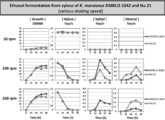
- FIG. Fig has become a matrix
- the column is absorbed OD 660 from the left (Growth OD660), xylose concentration (Xylose% w / v) in the culture medium, xylitol concentration in the broth (Xylitol% w / v), incubated
- the ethanol concentration in the liquid is shown respectively.
- the row indicates the shaking condition (50, 100, 150 rpm).
- No. 21 strains are represented by light gray solid lines (- ⁇ -)
- 3-1042 strains are represented by dark gray solid lines (- ⁇ -).
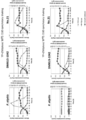
- the results are shown in FIG.
- the ethanol concentration (% w / v) in the culture solution is a light gray solid line (- ⁇ -)
- the xylose concentration (g / L) in the culture solution is a dark gray solid line (- ⁇ -)
- OD 660 Absorption is represented by a dark gray solid line (- ⁇ -).
- the upper axis represents OD 660 absorption and xylose concentration (g / L) in the culture solution
- the lower axis represents ethanol concentration (% w / v) in the culture solution.
- yeast of the present invention If the yeast of the present invention is used, xylose can be assimilated to produce ethanol efficiently, which is useful in the ethanol production field.
Landscapes
- Life Sciences & Earth Sciences (AREA)
- Chemical & Material Sciences (AREA)
- Engineering & Computer Science (AREA)
- Organic Chemistry (AREA)
- Health & Medical Sciences (AREA)
- Zoology (AREA)
- Wood Science & Technology (AREA)
- Genetics & Genomics (AREA)
- Bioinformatics & Cheminformatics (AREA)
- Biotechnology (AREA)
- Biochemistry (AREA)
- General Health & Medical Sciences (AREA)
- General Engineering & Computer Science (AREA)
- Microbiology (AREA)
- Mycology (AREA)
- Medicinal Chemistry (AREA)
- Botany (AREA)
- Tropical Medicine & Parasitology (AREA)
- Biomedical Technology (AREA)
- Virology (AREA)
- Chemical Kinetics & Catalysis (AREA)
- General Chemical & Material Sciences (AREA)
- Preparation Of Compounds By Using Micro-Organisms (AREA)
- Micro-Organisms Or Cultivation Processes Thereof (AREA)
Abstract
Description
ラオス国内4つの地域において、果実、野菜、草木の葉や土からサンプルを採取し、YPD培地に植え込み、37℃で3日間培養後、YPD寒天平板上に広げて37℃で1~2日間培養しコロニーとして分離した。かかる分離したコロニーから、耐熱性を有し、キシロース資化能が高い株をスクリーニングし、そのうちの1株をNo.21と命名した。
前述のスクリーニングで得られたNo.21株について、その形態的、生理的、生化学的性質を一般的な方法(Kurtzman and Fell (1998))等により調べた。その結果、No.21株は、コロニーはクリーム色、湿光、隆起状で、滑らかな縁を有し、粘着性があり、多極性に出芽しており、子嚢胞子は球形で、2~4胞子/子嚢であった。また、かかる株は45℃で生育し、グルコースからエタノールを生産した。さらに、No.21株からゲノムDNAを抽出し、サンガー法によりその26S rDNA塩基配列(配列番号1)を決定し、BLAST homology searchを用いて酵母の既知種と比較した。その結果、クルイベロマイセス・マルシアヌスの既知株(BM4株、NBRC1777株等)と100%配列が一致した。したがって、No.21株はクルイベロマイセス・マルシアヌスと同定した。
No.21株の工業的な有用性を確認するため、酵母を用いた培養で起こりうる種々のストレスへの耐性を検討した。YPD液体培地(pH7.0)にNo.21株又は対照株として3-1042株を一白金耳植菌し、30℃、18時間、好気的条件下で培養して原菌液を調製した。次にYPD寒天培地を用意し、No.21株、3-1042株の原菌液をYP液体培地によって1倍、10倍、100倍、1000倍、10000倍希釈してそれぞれ左から順に5箇所スポットし、30℃、45℃、47℃の3温度条件下で18時間培養して生育を調べた。また、上記の熱ストレス(物理的ストレス)の他、酸化ストレス(5mM又は6mM H2O2)、浸透圧ストレス(30%又は35% グルコース)、エタノールストレス(8%又は10% エタノール)の3種類の化学的なストレスを検討するため、各ストレス源を含有したYPD寒天培地上に上述と同様に希釈した原菌液をそれぞれスポットして培養し、生育を比較した。
上述のNo.21株及び3-1042株の原菌液をYP液体培地によって1倍、10倍、100倍、1000倍、10000倍希釈して、各種糖(グルコース、ガラクトース、マンノース、キシロース、アラビノース)を唯一の糖源とするYPD寒天培地(各種糖をそれぞれ2%含有)にそれぞれ左から順に5箇所スポットし、2-デオキシグルコース(2-DOG)を0.01%となるように添加して30℃、37℃、40℃の3温度条件下で48時間培養してグルコース抵抗性を調べた。2-DOGはグルコーストランスポーターによって取り込まれ、かつ解糖系において代謝されない物質であり、2-DOGを添加することでグルコース抑制を誘導することができる。
No.21株が有するキシロースからのエタノール生産性を検討するため、キシロースを唯一の糖源として含有する液体YPXyl培地を用いたエタノール生産試験を行った。No.21株及び3-1042株を30mLのYPXyl培地(pH7、キシロースを2%含有)に一白金耳植菌し、30℃で培養した。キシロース資化の酸素要求性を確認するため、50rpm、100rpm、150rpmの3条件で振とう培養し、生育とエタノール生産性を調べた。培養はそれぞれ96時間行い、24時間ごとに培養液を少量採取し、OD660の吸収(生育の指標)、培養液中のキシロース濃度(キシロースの資化の指標)、培養液中のキシリトール濃度(エタノール発酵に使われなかったキシロースの指標)、培養液中のエタノール濃度(エタノール生産能の指標)をそれぞれ測定した。キシロース濃度、エタノール濃度は、培養液を遠心分離(14,000rpm、1分)し、上清をメンブレンフィルター(日本ポール社製)でろ過して検液とし、高速液体クロマトグラフィー(日立ハイテクノロジーズ社製)で測定することで求めた。培地中のエタノール濃度の測定における高速液体クロマトグラフィーの分析条件として、カラムはGelpack(登録商標)GL-C610-S(日立ハイテクノロジーズ社製)を使用した。
No.21株が37℃でもキシロースからのエタノール生産性を有することを以下の方法で確認した。No.21株、3-1042株及びキシロースを資化してエタノールを生産する能力が高いピキア・スチピチス(P.stipitis)株を30mLのYPXyl培地(pH7、キシロースを2%含有)に一白金耳植菌し、30℃又は37℃、160rpmで培養して生育とエタノール生産性を調べた。培養はそれぞれ120時間行い、12時間ごとに培養液を少量採取し、OD660の吸収(生育の指標)及び培養液中のキシロース濃度(キシロースの資化の指標)、培養液中のエタノール濃度(エタノール生産能の指標)をそれぞれ測定した。キシロース濃度、エタノール濃度は、上述と同様の方法で測定することで求めた。
Claims (2)
- 酵母クルイベロマイセス・マルシアヌスNo.21株(受託番号:NITE BP-01739)、又は、キシロースを糖源として含有する培地により好気的条件下、30℃で培養した場合にキシロース資化能及びエタノール生産能を有するその変異株。
- 請求項1記載の酵母又はその変異株を、キシロースを糖源として含有する培地により好気的条件下で培養することを特徴とするエタノールの生産方法。
Priority Applications (2)
| Application Number | Priority Date | Filing Date | Title |
|---|---|---|---|
| US15/305,105 US10011853B2 (en) | 2014-04-28 | 2015-04-22 | Yeast having xylose assimilation ability and ethanol production ability |
| JP2016515856A JP6443944B2 (ja) | 2014-04-28 | 2015-04-22 | キシロース資化能及びエタノール生産能を有する酵母 |
Applications Claiming Priority (2)
| Application Number | Priority Date | Filing Date | Title |
|---|---|---|---|
| JP2014092206 | 2014-04-28 | ||
| JP2014-092206 | 2014-04-28 |
Publications (1)
| Publication Number | Publication Date |
|---|---|
| WO2015166645A1 true WO2015166645A1 (ja) | 2015-11-05 |
Family
ID=54358390
Family Applications (1)
| Application Number | Title | Priority Date | Filing Date |
|---|---|---|---|
| PCT/JP2015/002175 Ceased WO2015166645A1 (ja) | 2014-04-28 | 2015-04-22 | キシロース資化能及びエタノール生産能を有する酵母 |
Country Status (3)
| Country | Link |
|---|---|
| US (1) | US10011853B2 (ja) |
| JP (1) | JP6443944B2 (ja) |
| WO (1) | WO2015166645A1 (ja) |
Citations (2)
| Publication number | Priority date | Publication date | Assignee | Title |
|---|---|---|---|---|
| JP2012210169A (ja) * | 2011-03-30 | 2012-11-01 | Toyota Motor Corp | Kluyveromyces属の変異体酵母及びこれを用いたエタノールの製造方法 |
| JP2013021947A (ja) * | 2011-07-19 | 2013-02-04 | Toyota Motor Corp | Kluyveromyces属の変異体酵母及びこれを用いたエタノールの製造方法 |
Family Cites Families (5)
| Publication number | Priority date | Publication date | Assignee | Title |
|---|---|---|---|---|
| DE60325457D1 (de) | 2002-01-23 | 2009-02-05 | Royal Nedalco B V | Fermentation von pentosezuckern |
| JP4435517B2 (ja) | 2003-08-08 | 2010-03-17 | 学校法人東京農業大学 | セルロース系バイオマスの処理方法 |
| WO2008062558A1 (en) * | 2006-11-20 | 2008-05-29 | Yamaguchi University | Thermotolerant ethanol-producing yeast and ethanol production method utilizing the same |
| JP5881300B2 (ja) | 2011-03-04 | 2016-03-09 | サントリーホールディングス株式会社 | リグノセルロース系バイオマスからのエタノール醗酵微生物 |
| JP2013042727A (ja) | 2011-08-26 | 2013-03-04 | Kawasaki Heavy Ind Ltd | リグノセルロース系バイオマスからエタノールを製造する方法及びその前処理方法 |
-
2015
- 2015-04-22 WO PCT/JP2015/002175 patent/WO2015166645A1/ja not_active Ceased
- 2015-04-22 JP JP2016515856A patent/JP6443944B2/ja active Active
- 2015-04-22 US US15/305,105 patent/US10011853B2/en active Active
Patent Citations (2)
| Publication number | Priority date | Publication date | Assignee | Title |
|---|---|---|---|---|
| JP2012210169A (ja) * | 2011-03-30 | 2012-11-01 | Toyota Motor Corp | Kluyveromyces属の変異体酵母及びこれを用いたエタノールの製造方法 |
| JP2013021947A (ja) * | 2011-07-19 | 2013-02-04 | Toyota Motor Corp | Kluyveromyces属の変異体酵母及びこれを用いたエタノールの製造方法 |
Non-Patent Citations (2)
| Title |
|---|
| NONKLANG, SANOM ET AL.: "High-Temperature Ethanol Fermentation and Transformation with Linear DNA in the Thermotolerant Yeast Kluyveromyces marxianus DMKU3-1042", APPL. ENVIRON. MICROBIOL., vol. 74, no. 24, 2008, pages 7514 - 7521, XP008161732, ISSN: 0099-2240 * |
| RODRUSSAMEE, NADCHANOK ET AL.: "Growth and ethanol fermentation ability on hexose and pentose sugars and glucose effect under various conditions in thermotolerant yeast Kluyveromyces marxianus", APPL. MICROBIOL. BIOTECHNOL., vol. 90, 2011, pages 1573 - 1586, XP055122883, ISSN: 0175-7598 * |
Also Published As
| Publication number | Publication date |
|---|---|
| US20170051319A1 (en) | 2017-02-23 |
| US10011853B2 (en) | 2018-07-03 |
| JP6443944B2 (ja) | 2018-12-26 |
| JPWO2015166645A1 (ja) | 2017-04-20 |
Similar Documents
| Publication | Publication Date | Title |
|---|---|---|
| Hu et al. | Thermotolerant Kluyveromyces marxianus and Saccharomyces cerevisiae strains representing potentials for bioethanol production from Jerusalem artichoke by consolidated bioprocessing | |
| Cadete et al. | Diversity and physiological characterization of D-xylose-fermenting yeasts isolated from the Brazilian Amazonian Forest | |
| Charoensopharat et al. | Ethanol production from Jerusalem artichoke tubers at high temperature by newly isolated thermotolerant inulin-utilizing yeast Kluyveromyces marxianus using consolidated bioprocessing | |
| Sveinsdóttir et al. | Ethanol production from monosugars and lignocellulosic biomass by thermophilic bacteria isolated from Icelandic hot springs | |
| Morais et al. | Production of ethanol and xylanolytic enzymes by yeasts inhabiting rotting wood isolated in sugarcane bagasse hydrolysate | |
| Mishra et al. | Lignocellulosic bioethanol production employing newly isolated inhibitor and thermotolerant Saccharomyces cerevisiae DBTIOC S24 strain in SSF and SHF | |
| Moremi et al. | The improvement of bioethanol production by pentose‐fermenting yeasts isolated from herbal preparations, the gut of dung beetles, and marula wine | |
| Dubey et al. | Screening of natural yeast isolates under the effects of stresses associated with second-generation biofuel production | |
| CN102533612B (zh) | 拜氏梭菌菌株及其筛选方法和应用 | |
| Kosaka et al. | Potential of thermotolerant ethanologenic yeasts isolated from ASEAN countries and their application in high-temperature fermentation | |
| Rahman et al. | Effect of various parameters on the growth and ethanol production by yeasts isolated from natural sources | |
| Hashem et al. | Feasibility and sustainability of bioethanol production from starchy restaurants’ bio-wastes by new yeast strains | |
| Mehdikhani et al. | Screening of Saccharomyces cerevisiae for high tolerance of ethanol concentration and temperature | |
| KR101738903B1 (ko) | 곰팡이 컨소시엄을 이용한 바이오매스의 동시 전처리 및 당화 방법과 이를 이용한 바이오연료의 제조방법 | |
| JP6443944B2 (ja) | キシロース資化能及びエタノール生産能を有する酵母 | |
| KR101630832B1 (ko) | 동시 당화 발효 효능이 우수한 고온내성 신규 균주 및 이를 이용한 바이오에탄올 생산방법 | |
| US11299757B2 (en) | Mutant gene associated with improvement in ethanol productivity via ethanol fermentation and method for producing ethanol using the same | |
| Ofosu-Appiah et al. | Evaluation of ethanol production from pito mash using Zymomonas mobilis and Saccharomyces cerevisiae | |
| JP6210487B2 (ja) | キシロース資化能を有するエタノール生産酵母を生産する方法 | |
| JP6180660B2 (ja) | 高効率エタノール発酵菌 | |
| JP6240344B2 (ja) | 高効率エタノール発酵菌 | |
| Morimoto et al. | Torulaspora quercuum shows great potential for bioethanol production from macroalgal hydrolysate | |
| JP6249391B2 (ja) | キシロースを高温で発酵する方法 | |
| Mezule et al. | Biobutanol production from agricultural waste: A simple approach for pre-treatment and hydrolysis | |
| JP6327822B2 (ja) | 糸状菌を用いる木質系バイオマスからのエタノールの製造方法 |
Legal Events
| Date | Code | Title | Description |
|---|---|---|---|
| 121 | Ep: the epo has been informed by wipo that ep was designated in this application |
Ref document number: 15785956 Country of ref document: EP Kind code of ref document: A1 |
|
| ENP | Entry into the national phase |
Ref document number: 2016515856 Country of ref document: JP Kind code of ref document: A |
|
| WWE | Wipo information: entry into national phase |
Ref document number: 15305105 Country of ref document: US |
|
| NENP | Non-entry into the national phase |
Ref country code: DE |
|
| 122 | Ep: pct application non-entry in european phase |
Ref document number: 15785956 Country of ref document: EP Kind code of ref document: A1 |