WO2015147666A1 - N-guanyl derivatives of 9-amino-5.1 1 -dimethyl-5h-indolo[2,3-b]quinoline having cytotoxic activity - Google Patents
N-guanyl derivatives of 9-amino-5.1 1 -dimethyl-5h-indolo[2,3-b]quinoline having cytotoxic activity Download PDFInfo
- Publication number
- WO2015147666A1 WO2015147666A1 PCT/PL2015/000053 PL2015000053W WO2015147666A1 WO 2015147666 A1 WO2015147666 A1 WO 2015147666A1 PL 2015000053 W PL2015000053 W PL 2015000053W WO 2015147666 A1 WO2015147666 A1 WO 2015147666A1
- Authority
- WO
- WIPO (PCT)
- Prior art keywords
- guanyl
- indolo
- dimethyl
- amino
- quinoline
- Prior art date
- Legal status (The legal status is an assumption and is not a legal conclusion. Google has not performed a legal analysis and makes no representation as to the accuracy of the status listed.)
- Ceased
Links
- 0 CC(c(cccc1)c1N1C)=C2C1=Nc(cc1)c2cc1NC(C(*)NC(N)=N)=O Chemical compound CC(c(cccc1)c1N1C)=C2C1=Nc(cc1)c2cc1NC(C(*)NC(N)=N)=O 0.000 description 1
Classifications
-
- C—CHEMISTRY; METALLURGY
- C07—ORGANIC CHEMISTRY
- C07D—HETEROCYCLIC COMPOUNDS
- C07D401/00—Heterocyclic compounds containing two or more hetero rings, having nitrogen atoms as the only ring hetero atoms, at least one ring being a six-membered ring with only one nitrogen atom
- C07D401/02—Heterocyclic compounds containing two or more hetero rings, having nitrogen atoms as the only ring hetero atoms, at least one ring being a six-membered ring with only one nitrogen atom containing two hetero rings
- C07D401/04—Heterocyclic compounds containing two or more hetero rings, having nitrogen atoms as the only ring hetero atoms, at least one ring being a six-membered ring with only one nitrogen atom containing two hetero rings directly linked by a ring-member-to-ring-member bond
-
- A—HUMAN NECESSITIES
- A61—MEDICAL OR VETERINARY SCIENCE; HYGIENE
- A61P—SPECIFIC THERAPEUTIC ACTIVITY OF CHEMICAL COMPOUNDS OR MEDICINAL PREPARATIONS
- A61P35/00—Antineoplastic agents
Definitions
- N-guanyl derivatives of 9-amino-5,ll-dimethyl-5H-indolo[2,3- b]quinoline their preparation process and the pharmaceutical preparations thereof.
- N-Guanyl derivatives of 9-amino-5,ll-dimethyl-5Ay-indolo[2,3-b]quinoline possess a selective cytotoxic activity and may be useful for the treatment of neoplastic diseases " . "
- a basic method for metastatic cancer treatment and one of the methods used in the combination therapy of solid carcinoma is chemotherapy.
- it is considered one of the most difficult anti-cancer treatments, mainly due to the unknown tumour- causing factors, minimal biochemical differences between cancer and healthy cells, non-specific anti-cancer activity of cytostatic drugs, their low therapeutic index and toxic effect on healthy cells.
- Cytostatics which interact with the DNA helix and induce the mechanisms leading to cell death. Cytostatics can bound to the DNA as alkylating agents (eg. cis-platine), intercalate into the DNA strands (eg. anticancer antibiotics) or interact with the minor or major DNA groove (doxorubicin, mitoxantron, actinomycin D).
- alkylating agents eg. cis-platine
- intercalate into the DNA strands eg. anticancer antibiotics
- minor or major DNA groove doxorubicin, mitoxantron, actinomycin D
- a group of natural-origin compounds interacting with the DNA comprises, inter alia, indoloquinoline alkaloids.
- Indoloquinoline alkaloids isolated from an African plant species, Cryptolepis sanguinolenta have a broad spectrum of biological activities such as antibacterial, antifungal and cytotoxic activities.
- a high cytotoxic activity against many cancer cells is displayed, inter alia, by cryptolepine (5-methyl-5 H-indolo[3,2- b]quinoline), neocryptolepine (5-methyl-5H-indolo[2,3-b]quinoline, and also by isocryptolepine (5-methyl-5H-indolo[3,2-c]quinoline) (Lavrado, J. et al., Indoloquinolines as Scaffolds for Drug Discovery, Current Med. Chem. 2010, 17, 2348- 2370].
- the chemical structure of the main indoloquinoline alkaloids is shown in Figure 1.
- DiMIQ 5,ll-Dimethyl-5H-indolo[2,3-b]quinoline
- IC 50 1 ⁇ .
- DiMIQ has become the lead compound for potential anticancer agents among different derivatives of indoloquinolines. Successive investigations in vitro have proved that DiMIQ intercalates the DNA strongly and stabilizes the drug-DNA-topoisomerase II complex, while the potency of its bonding with the DNA is dependent on pH, i.e.
- polish patent PL 206855 Bl specification some synthetic derivatives having dialkylaminoalkyl substituents connected with 5,ll-dimethyl-5H- or 6,ll-dimethyl-6H- indolo[2,3-b]quinoline chromophores via amide, amine or ether bonds, were disclosed. Their cytotoxic activity against KB cell was also studied.
- Polish patent specifications PL 202545 Bl and PL 206681 Bl as well as the publication of Godlewska J. et al., Radiol. Oncol. 2004, 38, 137-144 also revealed glycosyl derivatives of 5,ll-dimethyl-5H-indolo[2,3-b]quinoline and 6,ll-dimethyl-6H- indolo[2,3-b]quinoline.
- the glycosyl groups such as deoxy-glucose, deoxy-rhamnose, deoxy-lactose or aminoglycosyl (derivatives of daunosamine and acosamine) are situated in the positions 2 and 9.
- the cytotoxic activity of dipeptide derivatives which were designed on the basis of the cytotoxic activity study results for the amino acid derivatives, was similar or lower than the activity of the unsubstituted DiMIQ (IC 50 values between 1.54 - 4.65 ⁇ ).
- the cytotoxic activity of the amino acid and peptide derivatives of DiMIQ was similar or higher than the cytotoxic activity of doxorubicin.
- the guanyl group may play an important role in the delivery of the drug to cancer cells and also due to its strong basic properties (pK a 12.5) may strongly interact with the phosphate residues of the minor groove of the DNA helix (Orner B.P., Hamilton A.D., J. Incl. Phen Macrocycl. Chem. 2001, 41, 141-147).
- the guanyl group can be found in many naturally occurring substances as well as in the metabolites of different living organisms.
- a good example is ptilomycalin A isolated from the Red Sea and Caribbean Sea sponges, exhibiting antimicrobial, antifungal, antiviral as well as cytotoxic activity.
- the introduction of guanyl substituents can increase the DiMIQ-DNA interaction and, as a result, advantageously affect the cytotoxic acitivity of DiMIQ.
- the guanyl group may also improve the delivery of the substance inside the cancer cells by increasing the hydrophilicity and water solubility of the formed molecule as well as lowering its toxicity (Kralova J. et al., J. Med. Chem. 2003, 46, 2049-2056; Hau V.S. et al., J. Pharm. Sciences 2002, 91, 2140- 2149; Liu H. Mei. et al., J. Pharmacol Exp. Ther. 2006, 319, 308-316).
- the present invention provides new N-guanyl derivatives of 9-amino-5,ll-dimethyl- 5H-indolo[2,3-b]quinoline with the hybrid structure, where the guanyl group is directly bonded to the chromophore through a nitrogen atom of the amino group in position 9 or to the N a -amino group of the amino acid residue of the acylating 9-amino-5,ll- dimethyl-5W-indolo[2,3-b]quinoline.
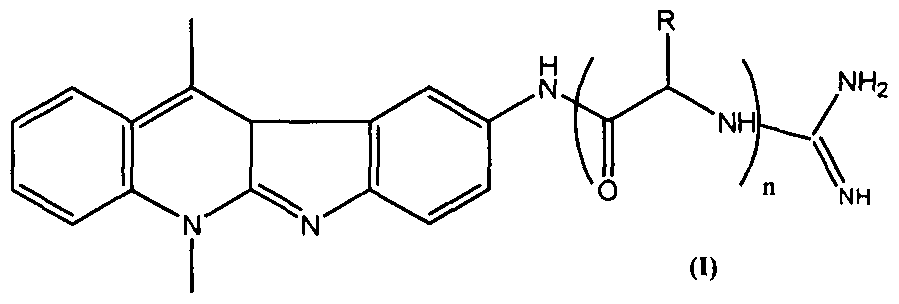
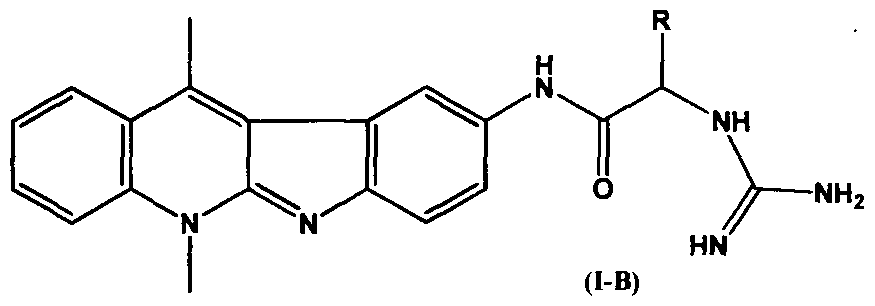
- the present invention provides the N-guanyl derivatives of 9-amino-5,ll- dimethyl-5H-indolo[2,3-b]quinoline of Formula (I)
- n 0 or 1
- R is a side chain of the acylating a-amino acid residue
- side chain of the acylating a-amino acid residue relates to naturally occurring L- and D-a-amino acids.
- the acylating a-amino acid residue is glycine or .-proline.
- a further aspect of the invention is the process for the preparation of N-guanyl derivatives of 9-amino- ll-dimethyl-5H-indolo[2,3-b]quinoline of Formula (I)
- n 0 or 1
- R is a side chain of the acylating a-amino acid residue
- n 0 or 1
- R is a side chain of the acylating a-amino acid residue
- step (ii) isolation of the crude reaction product of step (i) and its purification by column chromatography,
- thioureas for example diBoc-thiourea or thiourea generating reagents such as carbamoil- isothiocyanates, thioureas immobilized on resins
- 1-amidine-lH-pyrazoles mainly not substituted lH-pyrazole-l-carboxamidine and its mono- or di-Boc, and mono- or di-Z-derivatives; 4) triflyl guanidine, and di-Boc- and diZ-triflylguanidines; and in special cases cabodiimides, cyanamides or oxidation products of thioureas (for example aminoiminosulfonic acids).
- guanylating agents such as lH-l-pirazole-carboxyamidine (PCA) directly gives guanylated amines, although this reaction may be accompanied by the formation of some by-products.
- substituted guanylating agents such as the protected ltf-l-pirazole-carboxyamidines or protected S-methyl-isothiourea requires the removal of the protecting group after guanylation.
- the guanylation with the protected thioureas and S-methyl-isothioureas runs slowly and the use of a mercuric (II) salt, for example HgCI 2 , as a catalyst is recommended (Levallet C.
- II mercuric
- the guanylation reaction is carried out with the /V-protected guanylating agents in the presence of a catalyst, and subsequently the protecting group is removed from the reaction product.
- Suitable /V-protected guanylating agents include diBoc-, diZ-,o-CI-Z-, o-Br-Z- substituted
- the most preferred /V-protected guanylating agent is ⁇ /, ⁇ /'-diBoc-S-methyloisothiourea.
- the guanylation reaction is preferably carried out in the presence of HgCI 2 as a catalyst and a tertiary amine.
- /V-Protecting groups in the guanyl moiety and, if present, the protecting groups from the side chain of the amino acid residue are removed according to one of the well- known procedures, e.g. under acidic conditions such as by trifluoroacetic acid or hydrogen chloride treatment.
- Deprotection is carried out in an alcohol selected from the aliphatic alcohols saturated with gaseous hydrochloride acid or in the neat trifluoroacetic acid.
- the crude product is separated by concentrating the reaction mixture and purified by a typical procedure. Purification might include the treatment of the separated material with basic solutions, typically an aqueous hydrogen carbonate solution, and extraction with an organic, water-immiscible solvent selected from the group comprising esters, ethers, cyclic ethers, aliphatic and aromatic halogenated hydrocarbons; the use of chloroform is preferred.
- basic solutions typically an aqueous hydrogen carbonate solution
- an organic, water-immiscible solvent selected from the group comprising esters, ethers, cyclic ethers, aliphatic and aromatic halogenated hydrocarbons; the use of chloroform is preferred.
- the crude product may be purified by several treatments with a hydroxy solvent and the removal of the solvent in vacuo.
- the obtained product (I) is separated and purified.
- the reaction product is obtained in the form of the salt with the acid used in step (iii), namely hydrochloride and trifluoroacetate.
- step (iv) for example trifluoroacetate
- a stronger acid for example hydrochloric acid
- the free base is treated with another pharmaceutically acceptable acid.
- suitable mineral acids are hydrochlorides, hydrobromides, sulphates and phosphates.
- suitable organic acids are malic, fumaric, succinic, itaconic, citraconic, oxalic, benzoic, p-aminobenzoic, ascorbic, acetic, propionic, tartaric, salicylic, citric, gluconic, lactic, mandelic, cinnamic, aspartic, methanesulfonic, ethanesulofonic, benzenesulfonic, p- toluenesufonic, glycolic, glutamic, stearic or palmitic acid.
- N-guanyl derivatives of 9- amino-5,ll-dimethyl-5H-indolo[2,3-b]quinoline of formula (I) are acetate or hydrochloride salts.
- N-Guanyl derivative of 9-amino-5,ll-dimethyl-5H-indolo[2,3-b]quinoline of formula (I) or its salt can be, if necessary, purified by column gel chromatography or by recrystallization.
- N-Guanyl derivatives of 9-amino-5,ll-dimethyl-5H-indolo[2,3-b]quinoline and their salts can occur in non-solvated form or as solvates with pharmaceutically acceptable solvents such as water, alcohols and others.
- This invention includes all forms of N- guanyl derivatives of formula (I): solvated forms as well as free forms without solvents.
- IM-Guanyl derivatives of 9-amino-5,ll-dimethyl-5H-indolo[2,3-b]quinoline 0 f formula (I) exhibit potentially valuable pharmacological properties which are demonstrated by the in vitro studies of their activity against selected cancer cells including: human cancer cell lines KB (cervix carcinoma), non-small cell lung cancer A549, breast cancer MCF-7, and colon cancer LoVo.
- N-guanyl derivatives of 9-amino-5,ll-dimethyl-5H-indolo[2,3-b]quinoline may be used as the active substances in the pharmaceutical formulations for the prevention or therapy of different cancers in humans, including, but not limited, to cervix carcinoma, prostate, breast, cancer, colon or lung cancer.
- the pharmaceutical formulation for the treatment and/or prevention of cancers comprises N-guanyl derivative of 9-amino-5,ll-dimethyl-5H-indolo[2,3-b]quinoline of
- Formula (I) or its pharmaceutically acceptable salt and at least one pharmaceutically acceptable carrier and/or excipient are examples of pharmaceutically acceptable carrier and/or excipient.
- the pharmaceutical formulation of the present invention comprising the therapeutically effective amount of N-guanyl derivative of 9-amino-5,ll-dimethyl-5H- indolo[2,3-b]quinoline amine of Formula (I) or its pharmaceutically acceptable addition salt is administrated to the patient in need in a suitable pharmaceutical dosage form and by any acceptable route, including intravenous, subcutaneous, intramuscular or oral administration.
- a suitable dosage strength of the compound according to the present invention is from 0.1 to 100 mg/kg daily, preferably from 0.5 to 10 mg/kg daily.
- the suitable dose may be administrated to the patient in one or a few dosage units per day, as monotherapy or in combination with other therapeutic agents.
- Such compounds may be administrated simultaneously as one preparation or in separate preparations, or one after another, in the order and intervals determined by a specialist.
- the pharmaceutical formulation of the present invention may be prepared in various pharmaceutical dosage forms, well-known to those skilled in the art, such as those cited in Remington's Pharmaceutical Sciences, 18th Ed. , Mack Publ.Co. 1990.
- the pharmaceutical formulations suitable for injections and infusions comprise sterile aqueous, aqueous-organic and non-aqueous suspensions, dry substances and tablets for solution preparations, as well as implants.
- the excipients are used for the suspension preparation to ensure an even distribution of the active ingredient in the liquid phase and they include polysorbates, lecithine, polyoxyethylene- polyoxypropylene co-polymers, peptizing agents, such as phosphoranes, polyphosphoranes and citrates of water-soluble polymers such as carboxymethyl cellulose, methyl cellulose, polyvinylpyrrolidone, gums and gelatin.
- Formulations for injections may contain pharmaceutically acceptable excipients, such as pH regulators, buffers, tonicity agents and preservatives. Dry substances are used for the preparation of the solutions or suspensions ex tempore, by dilution with a suitable solvent.
- the pharmaceutical forms for oral administration include tablets, pills, powders, granules, pellets or capsules containing pharmaceutically acceptable solid carriers such as corn starch, lactose, sucrose, sorbitol, hydrous magnesium silicate, stearic acid, magnesium stearate, dicalcium phosphate or gums. Tablets or granules may be coated or otherwise processed in order to achieve a dosage unit ensuring preferable extended release.
- pharmaceutically acceptable solid carriers such as corn starch, lactose, sucrose, sorbitol, hydrous magnesium silicate, stearic acid, magnesium stearate, dicalcium phosphate or gums.
- Tablets or granules may be coated or otherwise processed in order to achieve a dosage unit ensuring preferable extended release.
- a number of various substances may be used, including polymeric acids and mixtures of polymeric acids with other substances, such as shellac, cetyl alcohol or cellulose acetate.
- the purity of new compounds was determined by high-performance liquid chromatography (HPLC) using a Waters system consisting of a multisolvent delivery system, column thermostat, autosampler, detector PDA, Chromatography Manager Empower 2 software for PC computations.
- HPLC high-performance liquid chromatography
- a C8 column 150 x 4,6 mm with 3.5 ⁇ particles was used.
- the mobile phases consisting of 0.1% TFA (phase A), and 0.1% TFA in acetonitrile (phase B) were used at the flow rate of lmL/min. Gradient elution was used in the gradient system 98% - 5% phase A, and 2% - 95% phase B.
- the concentration of the injected sample was about 0.2 mg/mL and water was used as the solvent. Detection was performed at 275 nm.
- A/-(5,ll-Dimethyl-5H-indolo[2,3-b]quinolin-9-yl)-glycylamide (50 mg; 0.157 mM), which was obtained according to the methods previously described (K. Sidoryk et al., J. Med. Chem. 55 (11), pp. 5077-5087, 2012), and 70 mg of BSTU (0,24 mM) were dissolved in 2 mL of dry DMF, next 0.2 mL of DIPEA (1,4 mM) and 65.1 mg of HgCI 2 (0,24 mM) were added.
- the product in the form of a free base was obtained from hydrochloride which was purified by preparative TLC chromatography in methanol : chloroform : 25 % ammonia solution (80:40:1). The isolated amid was dark orange in colour.
- the selected N-guanyl derivatives of 9-amine-5 / ll-dimethyl-5H-indolo[2,3-b]quinoline obtained according to the invention were tested for their biological activity against the selected cancer cell lines.
- Human cancer cell lines: KB (cervix carcinoma), A549 (non- small cell lung cancer), MCF-7 (breast cancer) and LoVo (colon) were used in the study.
- Selected derivatives were also tested for their cytotoxic activity against normal mice fibroblasts (BALB/3T3).
- All cell lines are maintained at the Institute of Immunology and Experimental Therapy PAS in Wroclaw, Tru. They are cultured in the mixture of RPMI 1649 + Opti-MEM (1:1) supplemented with 5% FBS, 100 Mg/ml streptomycin, 100 units/ml penicillin, 2 mM L-glutamine at 37°C with 5% C0 2 humidified atmosphere.
- Test solutions of the studied compounds (1 mg/ml) were prepared by dissolving 1 mg of the substance in 100 ⁇ DMSO completed with 900 ⁇ of the tissue culture medium. Afterwards, the tested compounds were diluted in the culture medium to reach the final concentrations of 10, 1, 0.1 and 0.01 Mg/ml.
- the biological study was performed using an SRB test which measures the inhibited proliferation of target cells in a 72-hour in vitro study (Skehan et al., J. Nat. Cancer. Inst., 82, 1107-1112, 1990). Each compound in a given concentration was tested in triplicate in each experiment. The experiments were repeated 3-5 times.
- Cisplatin 2.8910.68 2.6510.45 2.9+0.52 1.710.05 2.5510.25
- iCso - half maximal inhibitory concentration non-small cell lung cancer A549, breast cancer MCF-7, colon cancer LoVo, cervix carcinoma KB and mice fibroblast BALB/3T3;
- cytotoxic activity against KB cervix carcinoma (IC 5 o 0.332 ⁇ 0.005 g/ml)
- it did not show any cytotoxic activity against colon cancer LoVo (IC 5 o 28,91 ⁇ 6,23 ⁇ g/ml).
- the cytotoxic activity of compound la against normal fibroblasts was up to 1000 times lower than against A549 and MCF-7 cancer cell lines.
- Such high selectivity was not observed in any of the standard anti-cancer drugs, such as doxorubicin and cisplatin, which showed comparative cytotoxic activity against cancer cells as well as against normal cell.
- the cytotoxic activity of DiMIQ against cancer cell lines is comparable to its cytotoxic activity against normal cell lines.
Landscapes
- Chemical & Material Sciences (AREA)
- Organic Chemistry (AREA)
- Health & Medical Sciences (AREA)
- Chemical Kinetics & Catalysis (AREA)
- General Chemical & Material Sciences (AREA)
- Medicinal Chemistry (AREA)
- Nuclear Medicine, Radiotherapy & Molecular Imaging (AREA)
- Pharmacology & Pharmacy (AREA)
- Life Sciences & Earth Sciences (AREA)
- Animal Behavior & Ethology (AREA)
- General Health & Medical Sciences (AREA)
- Public Health (AREA)
- Veterinary Medicine (AREA)
- Pharmaceuticals Containing Other Organic And Inorganic Compounds (AREA)
Abstract
Description


Claims




Priority Applications (1)
| Application Number | Priority Date | Filing Date | Title |
|---|---|---|---|
| PL420169A PL420169A1 (en) | 2014-03-28 | 2015-03-27 | N-Guanyl derivatives of 9-amino-5,11-dimethyl-5H-indolo[2,3-b]quinoline, method for obtaining them and pharmaceuticals containing them |
Applications Claiming Priority (2)
| Application Number | Priority Date | Filing Date | Title |
|---|---|---|---|
| PL407711A PL407711A1 (en) | 2014-03-28 | 2014-03-28 | Derivatives of N-Guanyl derivatives of 9-amino-5,11-dimethyl-5H-indolo[2,3-b]quinoline, method for obtaining them and pharmaceuticals containing them |
| PLP.40771 | 2014-03-28 |
Publications (1)
| Publication Number | Publication Date |
|---|---|
| WO2015147666A1 true WO2015147666A1 (en) | 2015-10-01 |
Family
ID=53055081
Family Applications (1)
| Application Number | Title | Priority Date | Filing Date |
|---|---|---|---|
| PCT/PL2015/000053 Ceased WO2015147666A1 (en) | 2014-03-28 | 2015-03-27 | N-guanyl derivatives of 9-amino-5.1 1 -dimethyl-5h-indolo[2,3-b]quinoline having cytotoxic activity |
Country Status (2)
| Country | Link |
|---|---|
| PL (2) | PL407711A1 (en) |
| WO (1) | WO2015147666A1 (en) |
Cited By (4)
| Publication number | Priority date | Publication date | Assignee | Title |
|---|---|---|---|---|
| KR20190117602A (en) * | 2017-02-14 | 2019-10-16 | 메르크 파텐트 게엠베하 | Materials for Organic Electroluminescent Devices |
| WO2022076409A1 (en) * | 2020-10-06 | 2022-04-14 | Dana-Farber Cancer Institute, Inc. | Potent and selective covalent inhibitors of serine-arginine protein kinase (srpk) 1 and srpk2 and uses thereof |
| CN115350189A (en) * | 2022-09-22 | 2022-11-18 | 兰州大学 | Application of neocelandine derivative in preparation of medicine for treating colorectal cancer |
| PL445978A1 (en) * | 2023-08-31 | 2025-03-03 | Sieć Badawcza Łukasiewicz - Instytut Chemii Przemysłowej Imienia Profesora Ignacego Mościckiego | Conjugates of hydroxycinnamic acids and 9-amino-5,11-dimethyl-5H-indolo[2,3-b]quinoline, method of obtaining them, medical use and pharmaceutical composition |
Citations (4)
| Publication number | Priority date | Publication date | Assignee | Title |
|---|---|---|---|---|
| PL206855A1 (en) | 1978-05-16 | 1980-01-28 | Akad Sztuk Pieknych | |
| PL202545B1 (en) | 2004-04-02 | 2009-07-31 | Inst Farmaceutyczny | Carbohydrate derivatives of 5,11-dimethyl-5H-indole[2,3-b]quinoline and method for their obtaining as well as pharmaceuticals containing these derivatives |
| PL206681B1 (en) | 2002-05-10 | 2010-09-30 | Fundacja Na Rzecz Wspierania R | Carbohydrate derivatives of quinoline [2,3-b] indole and method of their receiving |
| PL219085B1 (en) | 2010-03-26 | 2015-03-31 | Inst Farmaceutyczny | Derivatives of 5,11-dimethyl-5H-indole [2,3-b] quinoline |
-
2014
- 2014-03-28 PL PL407711A patent/PL407711A1/en unknown
-
2015
- 2015-03-27 WO PCT/PL2015/000053 patent/WO2015147666A1/en not_active Ceased
- 2015-03-27 PL PL420169A patent/PL420169A1/en unknown
Patent Citations (4)
| Publication number | Priority date | Publication date | Assignee | Title |
|---|---|---|---|---|
| PL206855A1 (en) | 1978-05-16 | 1980-01-28 | Akad Sztuk Pieknych | |
| PL206681B1 (en) | 2002-05-10 | 2010-09-30 | Fundacja Na Rzecz Wspierania R | Carbohydrate derivatives of quinoline [2,3-b] indole and method of their receiving |
| PL202545B1 (en) | 2004-04-02 | 2009-07-31 | Inst Farmaceutyczny | Carbohydrate derivatives of 5,11-dimethyl-5H-indole[2,3-b]quinoline and method for their obtaining as well as pharmaceuticals containing these derivatives |
| PL219085B1 (en) | 2010-03-26 | 2015-03-31 | Inst Farmaceutyczny | Derivatives of 5,11-dimethyl-5H-indole [2,3-b] quinoline |
Non-Patent Citations (29)
| Title |
|---|
| "Remington's Pharmaceutical Sciences 18th Ed.", 1990, MACK PUBL.CO |
| CARUSO ANNA ET AL: "Synthesis and evaluation of cytotoxic activities of new guanidines derived from carbazoles", BIOORGANIC & MEDICINAL CHEMISTRY LETTERS, PERGAMON, AMSTERDAM, NL, vol. 24, no. 2, 17 December 2013 (2013-12-17), pages 467 - 472, XP028814533, ISSN: 0960-894X, DOI: 10.1016/J.BMCL.2013.12.047 * |
| DISS M. ET AL., J. AM. CHEM. SOC., vol. 130, 2008, pages 1321 |
| GERS T. ET AL., SYNTHESIS, vol. 1, 2004, pages 7 - 42 |
| GODLEWSKA J. ET AL., ANTICANCER RES., vol. 25, 2005, pages 2857 - 2868 |
| GODLEWSKA J. ET AL., RADIOL. ONCOL., vol. 38, 2004, pages 137 - 144 |
| HAU V.S. ET AL., J. PHARM. SCIENCES, vol. 91, 2002, pages 2140 - 2149 |
| HUMENIUK R. ET AL., ONCOL. RES., vol. 13, 2003, pages 269 - 277 |
| K. SIDORYK ET AL., J. MED. CHEM., vol. 55, no. 11, 2012, pages 5077 - 5087 |
| K. SIDORYK ET AL., POLISH J. CHEM., vol. 82, 2008, pages 2095 |
| KACZMAREK T. ET AL., ACTA POLON. PHARM., vol. 59, 2002, pages 199 - 207 |
| KACZMAREK T. ET AL., ARCHIV. PHARM., vol. 321, 1988, pages 463 - 467 |
| KACZMAREK T. ET AL., BIOORG. AND MED. CHEM., vol. 7, 1999, pages 2457 - 2464 |
| KACZMAREK T.; NANTKA-NAMIRSKI P., POL. J. PHARMACOL. PHARM., vol. 33, 1981, pages 121 - 127 |
| KATARZYNA SIDORYK ET AL: "Synthesis and Biological Evaluation of New Amino Acid and Dipeptide Derivatives of Neocryptolepine as Anticancer Agents", JOURNAL OF MEDICINAL CHEMISTRY, vol. 55, no. 11, 14 June 2012 (2012-06-14), pages 5077 - 5087, XP055194483, ISSN: 0022-2623, DOI: 10.1021/jm300468t * |
| KATRITZKY A.R. ET AL., ARCHIVE FOR ORGANIC CHEMISTRY, no. 4, 19 July 2005 (2005-07-19), pages 49 - 87 |
| KRALOVA J. ET AL., J. MED. CHEM., vol. 46, 2003, pages 2049 - 2056 |
| LAVRADO, J. ET AL.: "Indoloquinolines as Scaffolds for Drug Discovery", CURRENT MED. CHEM., vol. 17, 2010, pages 2348 - 2370 |
| LEVALLET C., TETRAHEDRON, vol. 53, 1997, pages 5291 - 5304 |
| LIU H. MEI. ET AL., J. PHARMACOL EXP. THER., vol. 319, 2006, pages 308 - 316 |
| OHARA K., TETRAHEDRON LETT., vol. 50, 2009, pages 1463 - 1465 |
| ORNER B.P.; HAMILTON A.D., J. INCL. PHEN MACROCYCL. CHEM., vol. 41, 2001, pages 141 - 147 |
| OSIADACZ J. ET AL., ANTICANCER RES., vol. 19, 1999, pages 3333 - 3342 |
| PECZYHSKA-CZOCH W. ET AL., J. MED. CHEM., vol. 37, 1994, pages 3503 - 3510 |
| PECZYNSKA-CZOCH, W. ET AL.: "Progress in Industrial Microbiology", vol. 27, 1989, pages: 333 - 353 |
| SIDORYK K., J. MED. CHEM., vol. 55, no. 11, 2012, pages 5077 - 5087 |
| SIDORYK KATARZYNA ET AL: "Searching for new derivatives of neocryptolepine: Synthesis, antiproliferative, antimicrobial and antifungal activities", EUROPEAN JOURNAL OF MEDICINAL CHEMISTRY, vol. 78, 20 March 2014 (2014-03-20), pages 304 - 313, XP028847869, ISSN: 0223-5234, DOI: 10.1016/J.EJMECH.2014.03.060 * |
| SKEHAN ET AL., J. NAT. CANCER. INST., vol. 82, 1990, pages 1107 - 1112 |
| YONG Y.F. ET AL., J. ORG. CHEM., vol. 62, 1997, pages 1540 - 1542 |
Cited By (8)
| Publication number | Priority date | Publication date | Assignee | Title |
|---|---|---|---|---|
| KR20190117602A (en) * | 2017-02-14 | 2019-10-16 | 메르크 파텐트 게엠베하 | Materials for Organic Electroluminescent Devices |
| KR102542688B1 (en) | 2017-02-14 | 2023-06-12 | 메르크 파텐트 게엠베하 | Materials for Organic Electroluminescent Devices |
| WO2022076409A1 (en) * | 2020-10-06 | 2022-04-14 | Dana-Farber Cancer Institute, Inc. | Potent and selective covalent inhibitors of serine-arginine protein kinase (srpk) 1 and srpk2 and uses thereof |
| US12497398B2 (en) | 2020-10-06 | 2025-12-16 | Dana-Farber Cancer Institute, Inc. | Potent and selective covalent inhibitors of serine-arginine protein kinase (SRPK) 1 and SRPK2 and uses thereof |
| CN115350189A (en) * | 2022-09-22 | 2022-11-18 | 兰州大学 | Application of neocelandine derivative in preparation of medicine for treating colorectal cancer |
| CN115350189B (en) * | 2022-09-22 | 2023-05-30 | 兰州大学 | Application of sinomenine derivative in preparation of medicines for treating colorectal cancer |
| PL445978A1 (en) * | 2023-08-31 | 2025-03-03 | Sieć Badawcza Łukasiewicz - Instytut Chemii Przemysłowej Imienia Profesora Ignacego Mościckiego | Conjugates of hydroxycinnamic acids and 9-amino-5,11-dimethyl-5H-indolo[2,3-b]quinoline, method of obtaining them, medical use and pharmaceutical composition |
| PL248245B1 (en) * | 2023-08-31 | 2025-11-12 | Siec Badawcza Lukasiewicz Inst Chemii Przemyslowej Imienia Profesora Ignacego Moscickiego | Conjugates of hydroxycinnamic acids and 9-amino-5,11-dimethyl-5H-indolo[2,3-b]quinoline, method of obtaining them, medical use and pharmaceutical composition |
Also Published As
| Publication number | Publication date |
|---|---|
| PL407711A1 (en) | 2015-10-12 |
| PL420169A1 (en) | 2017-07-31 |
Similar Documents
| Publication | Publication Date | Title |
|---|---|---|
| US10562864B2 (en) | Chemical modulators of immune checkpoints and therapeutic use | |
| US9745335B2 (en) | N-substituted second generation derivatives of antifungal antibiotic amphotericin B and methods of their preparation and application | |
| KR20200098618A (en) | Ionic polymers containing biologically active compounds | |
| CA3025931A1 (en) | Antibody drug conjugates having derivatives of amatoxin as the drug | |
| EA019749B1 (en) | Antiviral compounds | |
| US20190070154A1 (en) | New methods of use for an anti-diarrhea agent | |
| WO2015147666A1 (en) | N-guanyl derivatives of 9-amino-5.1 1 -dimethyl-5h-indolo[2,3-b]quinoline having cytotoxic activity | |
| Antoszczak et al. | Synthesis and antiproliferative activity of new bioconjugates of Salinomycin with amino acid esters | |
| US10501466B2 (en) | WDR5 inhibitors and modulators | |
| EP4043467A1 (en) | Class of functional molecules targeting proteolysis pathways, preparation and application thereof | |
| EP2824108B1 (en) | Tetracyclic anthraquinone derivatives | |
| US11712435B2 (en) | Mebendazole prodrugs with enhanced solubility and oral bioavailability | |
| RU2680138C2 (en) | Tricyclic gyrase inhibitors | |
| EP3470410B1 (en) | Crystalline form of compound suppressing protein kinase activity, and application thereof | |
| US11987579B2 (en) | Niclosamide analogues and therapeutic use thereof | |
| CN114478561B (en) | Epalrestat lycorine conjugate and preparation method and application thereof | |
| WO2020247679A1 (en) | Wdr5 inhibitors and modulators | |
| EP4644391A1 (en) | Novel phenylquinolone compound having antibacterial and anticancer functions, and preparation thereof | |
| WO2015069766A1 (en) | Dupa-indenoisoquinoline conjugates | |
| CN101395143A (en) | Azaheterocyclic compounds for the treatment of malaria or AIDS | |
| CN121378247A (en) | A novel CDK6 covalent inhibitor, its preparation method and pharmaceutical applications | |
| CN110862428A (en) | Anti-tumor epirubicin compounds | |
| CN101474186A (en) | 2,3,4,7,8-polysubstituted naphthyridine [4,3-d] pyridine derivates with anti-tumor activity | |
| US10584105B2 (en) | Immunoproteasome inhibitor analogs | |
| AU2022234998A1 (en) | Pyridopyrimidine compounds and applications thereof |
Legal Events
| Date | Code | Title | Description |
|---|---|---|---|
| 121 | Ep: the epo has been informed by wipo that ep was designated in this application |
Ref document number: 15721050 Country of ref document: EP Kind code of ref document: A1 |
|
| NENP | Non-entry into the national phase |
Ref country code: DE |
|
| WWE | Wipo information: entry into national phase |
Ref document number: 420169 Country of ref document: PL |
|
| REEP | Request for entry into the european phase |
Ref document number: 2015721050 Country of ref document: EP |
|
| WWE | Wipo information: entry into national phase |
Ref document number: 2015721050 Country of ref document: EP |
|
| 122 | Ep: pct application non-entry in european phase |
Ref document number: 15721050 Country of ref document: EP Kind code of ref document: A1 |