WO2015137322A1 - 層状イリジウム酸塩、層状イリジウム酸及び酸化イリジウムナノシート - Google Patents
層状イリジウム酸塩、層状イリジウム酸及び酸化イリジウムナノシート Download PDFInfo
- Publication number
- WO2015137322A1 WO2015137322A1 PCT/JP2015/056972 JP2015056972W WO2015137322A1 WO 2015137322 A1 WO2015137322 A1 WO 2015137322A1 JP 2015056972 W JP2015056972 W JP 2015056972W WO 2015137322 A1 WO2015137322 A1 WO 2015137322A1
- Authority
- WO
- WIPO (PCT)
- Prior art keywords
- layered
- iridate
- iridium oxide
- iridium
- nanosheet
- Prior art date
- Legal status (The legal status is an assumption and is not a legal conclusion. Google has not performed a legal analysis and makes no representation as to the accuracy of the status listed.)
- Ceased
Links
Images


Classifications
-
- C—CHEMISTRY; METALLURGY
- C25—ELECTROLYTIC OR ELECTROPHORETIC PROCESSES; APPARATUS THEREFOR
- C25B—ELECTROLYTIC OR ELECTROPHORETIC PROCESSES FOR THE PRODUCTION OF COMPOUNDS OR NON-METALS; APPARATUS THEREFOR
- C25B11/00—Electrodes; Manufacture thereof not otherwise provided for
- C25B11/04—Electrodes; Manufacture thereof not otherwise provided for characterised by the material
- C25B11/051—Electrodes formed of electrocatalysts on a substrate or carrier
- C25B11/073—Electrodes formed of electrocatalysts on a substrate or carrier characterised by the electrocatalyst material
- C25B11/075—Electrodes formed of electrocatalysts on a substrate or carrier characterised by the electrocatalyst material consisting of a single catalytic element or catalytic compound
-
- B—PERFORMING OPERATIONS; TRANSPORTING
- B01—PHYSICAL OR CHEMICAL PROCESSES OR APPARATUS IN GENERAL
- B01J—CHEMICAL OR PHYSICAL PROCESSES, e.g. CATALYSIS OR COLLOID CHEMISTRY; THEIR RELEVANT APPARATUS
- B01J23/00—Catalysts comprising metals or metal oxides or hydroxides, not provided for in group B01J21/00
- B01J23/38—Catalysts comprising metals or metal oxides or hydroxides, not provided for in group B01J21/00 of noble metals
- B01J23/54—Catalysts comprising metals or metal oxides or hydroxides, not provided for in group B01J21/00 of noble metals combined with metals, oxides or hydroxides provided for in groups B01J23/02 - B01J23/36
- B01J23/56—Platinum group metals
- B01J23/58—Platinum group metals with alkali- or alkaline earth metals
-
- B—PERFORMING OPERATIONS; TRANSPORTING
- B01—PHYSICAL OR CHEMICAL PROCESSES OR APPARATUS IN GENERAL
- B01J—CHEMICAL OR PHYSICAL PROCESSES, e.g. CATALYSIS OR COLLOID CHEMISTRY; THEIR RELEVANT APPARATUS
- B01J37/00—Processes, in general, for preparing catalysts; Processes, in general, for activation of catalysts
- B01J37/0009—Use of binding agents; Moulding; Pressing; Powdering; Granulating; Addition of materials ameliorating the mechanical properties of the product catalyst
- B01J37/0063—Granulating
-
- B—PERFORMING OPERATIONS; TRANSPORTING
- B01—PHYSICAL OR CHEMICAL PROCESSES OR APPARATUS IN GENERAL
- B01J—CHEMICAL OR PHYSICAL PROCESSES, e.g. CATALYSIS OR COLLOID CHEMISTRY; THEIR RELEVANT APPARATUS
- B01J37/00—Processes, in general, for preparing catalysts; Processes, in general, for activation of catalysts
- B01J37/02—Impregnation, coating or precipitation
- B01J37/0215—Coating
- B01J37/0217—Pretreatment of the substrate before coating
-
- B—PERFORMING OPERATIONS; TRANSPORTING
- B01—PHYSICAL OR CHEMICAL PROCESSES OR APPARATUS IN GENERAL
- B01J—CHEMICAL OR PHYSICAL PROCESSES, e.g. CATALYSIS OR COLLOID CHEMISTRY; THEIR RELEVANT APPARATUS
- B01J37/00—Processes, in general, for preparing catalysts; Processes, in general, for activation of catalysts
- B01J37/04—Mixing
-
- B—PERFORMING OPERATIONS; TRANSPORTING
- B01—PHYSICAL OR CHEMICAL PROCESSES OR APPARATUS IN GENERAL
- B01J—CHEMICAL OR PHYSICAL PROCESSES, e.g. CATALYSIS OR COLLOID CHEMISTRY; THEIR RELEVANT APPARATUS
- B01J37/00—Processes, in general, for preparing catalysts; Processes, in general, for activation of catalysts
- B01J37/06—Washing
-
- B—PERFORMING OPERATIONS; TRANSPORTING
- B01—PHYSICAL OR CHEMICAL PROCESSES OR APPARATUS IN GENERAL
- B01J—CHEMICAL OR PHYSICAL PROCESSES, e.g. CATALYSIS OR COLLOID CHEMISTRY; THEIR RELEVANT APPARATUS
- B01J37/00—Processes, in general, for preparing catalysts; Processes, in general, for activation of catalysts
- B01J37/08—Heat treatment
- B01J37/082—Decomposition and pyrolysis
- B01J37/088—Decomposition of a metal salt
-
- B—PERFORMING OPERATIONS; TRANSPORTING
- B01—PHYSICAL OR CHEMICAL PROCESSES OR APPARATUS IN GENERAL
- B01J—CHEMICAL OR PHYSICAL PROCESSES, e.g. CATALYSIS OR COLLOID CHEMISTRY; THEIR RELEVANT APPARATUS
- B01J37/00—Processes, in general, for preparing catalysts; Processes, in general, for activation of catalysts
- B01J37/34—Irradiation by, or application of, electric, magnetic or wave energy, e.g. ultrasonic waves ; Ionic sputtering; Flame or plasma spraying; Particle radiation
- B01J37/341—Irradiation by, or application of, electric, magnetic or wave energy, e.g. ultrasonic waves ; Ionic sputtering; Flame or plasma spraying; Particle radiation making use of electric or magnetic fields, wave energy or particle radiation
- B01J37/343—Irradiation by, or application of, electric, magnetic or wave energy, e.g. ultrasonic waves ; Ionic sputtering; Flame or plasma spraying; Particle radiation making use of electric or magnetic fields, wave energy or particle radiation of ultrasonic wave energy
-
- C—CHEMISTRY; METALLURGY
- C01—INORGANIC CHEMISTRY
- C01G—COMPOUNDS CONTAINING METALS NOT COVERED BY SUBCLASSES C01D OR C01F
- C01G55/00—Compounds of ruthenium, rhodium, palladium, osmium, iridium, or platinum
-
- C—CHEMISTRY; METALLURGY
- C01—INORGANIC CHEMISTRY
- C01G—COMPOUNDS CONTAINING METALS NOT COVERED BY SUBCLASSES C01D OR C01F
- C01G55/00—Compounds of ruthenium, rhodium, palladium, osmium, iridium, or platinum
- C01G55/002—Compounds containing ruthenium, rhodium, palladium, osmium, iridium or platinum, with or without oxygen or hydrogen, and containing two or more other elements
-
- C—CHEMISTRY; METALLURGY
- C01—INORGANIC CHEMISTRY
- C01G—COMPOUNDS CONTAINING METALS NOT COVERED BY SUBCLASSES C01D OR C01F
- C01G55/00—Compounds of ruthenium, rhodium, palladium, osmium, iridium, or platinum
- C01G55/004—Oxides; Hydroxides
-
- C—CHEMISTRY; METALLURGY
- C25—ELECTROLYTIC OR ELECTROPHORETIC PROCESSES; APPARATUS THEREFOR
- C25B—ELECTROLYTIC OR ELECTROPHORETIC PROCESSES FOR THE PRODUCTION OF COMPOUNDS OR NON-METALS; APPARATUS THEREFOR
- C25B1/00—Electrolytic production of inorganic compounds or non-metals
- C25B1/01—Products
- C25B1/02—Hydrogen or oxygen
-
- C—CHEMISTRY; METALLURGY
- C25—ELECTROLYTIC OR ELECTROPHORETIC PROCESSES; APPARATUS THEREFOR
- C25B—ELECTROLYTIC OR ELECTROPHORETIC PROCESSES FOR THE PRODUCTION OF COMPOUNDS OR NON-METALS; APPARATUS THEREFOR
- C25B1/00—Electrolytic production of inorganic compounds or non-metals
- C25B1/01—Products
- C25B1/13—Ozone
-
- C—CHEMISTRY; METALLURGY
- C25—ELECTROLYTIC OR ELECTROPHORETIC PROCESSES; APPARATUS THEREFOR
- C25B—ELECTROLYTIC OR ELECTROPHORETIC PROCESSES FOR THE PRODUCTION OF COMPOUNDS OR NON-METALS; APPARATUS THEREFOR
- C25B1/00—Electrolytic production of inorganic compounds or non-metals
- C25B1/01—Products
- C25B1/24—Halogens or compounds thereof
- C25B1/26—Chlorine; Compounds thereof
-
- C—CHEMISTRY; METALLURGY
- C25—ELECTROLYTIC OR ELECTROPHORETIC PROCESSES; APPARATUS THEREFOR
- C25B—ELECTROLYTIC OR ELECTROPHORETIC PROCESSES FOR THE PRODUCTION OF COMPOUNDS OR NON-METALS; APPARATUS THEREFOR
- C25B11/00—Electrodes; Manufacture thereof not otherwise provided for
- C25B11/04—Electrodes; Manufacture thereof not otherwise provided for characterised by the material
- C25B11/051—Electrodes formed of electrocatalysts on a substrate or carrier
-
- B—PERFORMING OPERATIONS; TRANSPORTING
- B82—NANOTECHNOLOGY
- B82Y—SPECIFIC USES OR APPLICATIONS OF NANOSTRUCTURES; MEASUREMENT OR ANALYSIS OF NANOSTRUCTURES; MANUFACTURE OR TREATMENT OF NANOSTRUCTURES
- B82Y30/00—Nanotechnology for materials or surface science, e.g. nanocomposites
-
- B—PERFORMING OPERATIONS; TRANSPORTING
- B82—NANOTECHNOLOGY
- B82Y—SPECIFIC USES OR APPLICATIONS OF NANOSTRUCTURES; MEASUREMENT OR ANALYSIS OF NANOSTRUCTURES; MANUFACTURE OR TREATMENT OF NANOSTRUCTURES
- B82Y40/00—Manufacture or treatment of nanostructures
-
- C—CHEMISTRY; METALLURGY
- C01—INORGANIC CHEMISTRY
- C01P—INDEXING SCHEME RELATING TO STRUCTURAL AND PHYSICAL ASPECTS OF SOLID INORGANIC COMPOUNDS
- C01P2002/00—Crystal-structural characteristics
- C01P2002/70—Crystal-structural characteristics defined by measured X-ray, neutron or electron diffraction data
- C01P2002/72—Crystal-structural characteristics defined by measured X-ray, neutron or electron diffraction data by d-values or two theta-values, e.g. as X-ray diagram
-
- C—CHEMISTRY; METALLURGY
- C01—INORGANIC CHEMISTRY
- C01P—INDEXING SCHEME RELATING TO STRUCTURAL AND PHYSICAL ASPECTS OF SOLID INORGANIC COMPOUNDS
- C01P2004/00—Particle morphology
- C01P2004/01—Particle morphology depicted by an image
- C01P2004/03—Particle morphology depicted by an image obtained by SEM
-
- C—CHEMISTRY; METALLURGY
- C01—INORGANIC CHEMISTRY
- C01P—INDEXING SCHEME RELATING TO STRUCTURAL AND PHYSICAL ASPECTS OF SOLID INORGANIC COMPOUNDS
- C01P2004/00—Particle morphology
- C01P2004/01—Particle morphology depicted by an image
- C01P2004/04—Particle morphology depicted by an image obtained by TEM, STEM, STM or AFM
-
- C—CHEMISTRY; METALLURGY
- C01—INORGANIC CHEMISTRY
- C01P—INDEXING SCHEME RELATING TO STRUCTURAL AND PHYSICAL ASPECTS OF SOLID INORGANIC COMPOUNDS
- C01P2004/00—Particle morphology
- C01P2004/20—Particle morphology extending in two dimensions, e.g. plate-like
- C01P2004/24—Nanoplates, i.e. plate-like particles with a thickness from 1-100 nanometer
Definitions
- the present invention relates to a layered iridate, a layered iridium acid, and an iridium oxide nanosheet.
- the nanosheet is a two-dimensional substance having a high shape anisotropy with a lateral size of several tens to several hundreds of times while the thickness is on the order of nanometers.
- Such nanosheets not only inherit the functionality of the matrix (conductivity, semiconducting properties, dielectric properties, etc.) but also have a large specific surface area required for catalytic reactions and the like.
- the nanosheet may exhibit outstanding physical properties such as a one-dimensional quantum size effect.
- nanosheets can be reconfigured in three dimensions as functional blocks, once separated nanosheets, to form artificial superlattice-like nanostructured materials that cannot be achieved thermodynamically. It has the potential to be controlled. Therefore, for nanosheets, the superlattice approach, which has so far been the mainstream of gas-phase synthesis techniques such as molecular beam epitaxy, can be developed in the liquid phase. Has attracted a lot of interest from the industry.
- the present inventor has proposed a technique of using a layered compound of a metal compound as a precursor as a new method for obtaining a metal nanosheet (see Patent Document 3).
- This technology is a method of preparing a layered compound in which ruthenium oxide is layered, and reducing the ruthenium oxide to obtain a metal ruthenium nanosheet having the layered compound as a precursor. Reduction to obtain a metal ruthenium nanosheet.
- the crystalline metal compound nanosheet has a thickness derived from the unit cell, and has a two-dimensional (planar) spread structure.
- Many nanosheets can be obtained by exfoliation of a compound having a layered structure, and have the advantage that the available surface is larger than particles composed of the same number of atoms.
- Examples of the material of the nanosheet having good conductivity include carbon (graphene) and ruthenium oxide (ruthenium oxide nanosheet).
- the present invention focuses on iridium oxide used for electrolysis, chlorine generation, metal ion separation, etc. as an electrode catalyst for a dimensionally stable electrode, and is a layered iridate and layered iridium used for producing iridium oxide nanosheets.
- the object is to provide acid and iridium oxide nanosheets.
- the layered iridate according to the present invention for solving the above problems is M x IrO y ⁇ nH 2 O (M is a monovalent metal, x is 0.1 to 0.5, y is 1. 5 to 2.5, and n is 0.5 to 1.5) are layered.
- the layered iridium acid according to the present invention for solving the above problems is H x IrO y ⁇ nH 2 O (x is 0.1 to 0.5, y is 1.5 to 2.5, n is 0 to 1) are overlapped in layers.
- the iridium oxide nanosheet according to the present invention for solving the above problems is an iridium oxide single crystal sheet having a thickness of 3 nm or less.
- iridium oxide is used as an electrode catalyst for dimensionally stable electrodes for electrolysis, chlorine generation, metal ion separation, etc., its application can be expected, especially as a catalyst for oxygen reduction, chlorine generation, electrolysis, etc. it can.
- the layered iridate, the layered iridium acid, and the iridium oxide nanosheet according to the present invention will be described in detail, but the present invention is not limited to the following description within the scope of the technical scope thereof.
- the layered iridate according to the present invention has M x IrO y ⁇ nH 2 O (M is a monovalent metal, x is 0.1 to 0.5, y is 1.5 to 2.5, and n is 0.00. 5 to 1.5) are layered.
- M is preferably an alkali metal, and examples thereof include Li, Na, K, Rb, and Cs.
- x and y can be prepared with the compounding quantity of an iridium oxide and an alkali metal compound.
- the layered iridate is firstly (1) pulverized iridium oxide and then mixed with an alkali metal compound, (2) pelletizing the resulting mixture, and (3) first firing on the molded pellets (4) pulverize and mix the pellets after firing, (5) re-mold the pellets after pulverization, (6) perform the second firing on the formed pellets, (7) after firing Wash things until neutral.
- a layered iridate can be obtained.
- the alkali metal compound used in the pulverizing and mixing step (1) is not particularly limited, and examples thereof include potassium carbonate.
- the first firing step (3) can be a heat treatment in an inert gas atmosphere, for example, in the range of 700 ° C. to 800 ° C.
- the second firing step of (2) can also be a heat treatment in an inert gas atmosphere, for example, in the range of 700 ° C. to 800 ° C. (eg, 780 ° C.) for 1 to several hours (eg, 1 hour).
- Layered iridium acid can be obtained by treating the obtained layered iridate in an acidic solution.
- the treatment in an acidic solution is a treatment of immersing in an acidic solution such as 1M HCl for about 1 to 4 days (for example, 3 days).
- an acidic solution such as 1M HCl for about 1 to 4 days (for example, 3 days).
- H x IrO y ⁇ nH 2 O (x is 0.1 to 0.5, y is 1.5 to 2.5, and n is 0 to 1) are layered.
- the iridium oxide nanosheet according to the present invention is an iridium oxide single crystal sheet having a thickness of 3 nm or less.
- the layered iridium acid obtained above is reacted with alkylammonium or alkylamine to form an alkylammonium-layered iridium acid intercalation compound.
- an iridium oxide nanosheet dispersion solution dark blue dispersion solution
- iridium oxide nanosheets can be obtained by a mutual adsorption method.
- alkylammonium or alkylamine for example, tetrabutylammonium etc. can be used preferably.
- the substrate for example, a Si substrate or a quartz substrate
- the substrate is immersed in the iridium oxide nanosheet dispersion solution.
- One layer of iridium oxide nanosheet can be coated on the substrate in a single dipping process.
- the iridium oxide nanosheets can be stacked by the number of repetitions, and can be stacked as five layers, ten layers, twenty layers,.
- an object is to obtain an iridium oxide nanosheet, and a layered iridate used for producing the iridium oxide nanosheet is newly synthesized.
- the iridium oxide nanosheet was obtained from the layered iridium acid.
- Iridium oxide is used as an electrode catalyst for dimensionally stable electrodes for electrolysis, chlorine generation, metal ion separation and the like, and its application can be expected, and in particular, it can be expected as a catalyst for oxygen reduction, chlorine generation, electrolysis and the like.
- iridium oxide is a conductive metal oxide that is electrochemically stable in a wide potential range, has high acid / base resistance, and therefore has excellent corrosion resistance and electronic conductivity.
- Example 1 Layered potassium iridate and layered iridium acid were prepared.
- iridium oxide (IrO 2 ) was pulverized in a nitrogen-substituted glove box, mixed with potassium carbonate (K 2 CO 3 ), and mixed for 30 minutes.
- the mixing ratio (IrO 2 : K 2 CO 3 ) was 1: 2.
- the mixture taken out from the glove box was pressed at 1.5 ton for 10 minutes to form pellets.
- the molded pellets were baked at 750 ° C. for 1 hour (first baking) in an argon atmosphere. After putting in the glove box again, pulverization and mixing were performed, pressing was performed at 1.5 ton for 10 minutes, and pellets were formed again.
- the molded pellets were baked at 780 ° C. for 1 hour (second baking) in an argon atmosphere.
- the thing after baking exhibited the glossy black.
- it washed with water until it became neutral while applying ultrasonic waves.
- layered potassium iridate having no dark blue color was obtained.
- the layered potassium iridate was placed in a 1M HCl solution and allowed to stand for 3 days to obtain layered iridium acid. The supernatant liquid was brown.
- FIG. 1 is an electron micrograph of the obtained layered iridium acid.
- the layered potassium iridate was also observed. From the photograph, a clear layered structure was confirmed in both layered iridium acid and layered potassium iridate.
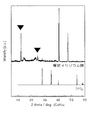
- FIG. 2 is an X-ray diffraction pattern (X-ray source: CuK ⁇ ray) of layered iridium acid.
- X-ray source CuK ⁇ ray
- the composition of layered iridium acid and layered potassium iridate was measured at 15 points using EDX (EX-200, Horiba, Ltd.).
- the layered potassium iridate had an atomic ratio of K of 7.5, Ir of 23.1, and O of 69.4.
- the layered iridium acid had an atomic ratio of Ir of 27.6 and O of 72.4.
- TBAOH tetrabutylammonium hydroxide
- Example 3 Using the iridium oxide nanosheet dispersion solution obtained in Example 2, iridium oxide nanosheets were obtained.
- the nanosheet was formed by an alternating adsorption lamination method (Layer by Layer; LbL).
- LbL alternating adsorption lamination method
- a Si substrate for coating iridium oxide nanosheets was prepared, immersed in a 10% by mass PVA aqueous solution for 10 minutes, washed with ultrapure water, and then the Si substrate was dispersed in 0.3 g / L iridium oxide nanosheets. It was immersed in the solution for 20 minutes.
- the Si substrate was pulled up, washed with ultrapure water, returned to the 10% by mass PVA aqueous solution, and washed and immersed repeatedly.
- a Si substrate coated with the iridium oxide nanosheet was obtained.
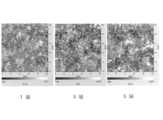
- FIG. 3 is a DFM image of an iridium oxide nanosheet thin film photographed using SPM (SPA400, manufactured by Seiko Instruments Inc.). Images were taken of one soaked one layer, three soaked three layers, and five soaked five layers.
- FIG. 4 is an enlarged view of the DFM image of the iridium oxide nanosheet. When the film pressure was also measured, the result that the average thickness was 1.65 nm ⁇ 0.1 nm was obtained.
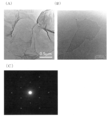
- FIG. 5 shows a TEM image (A), an enlarged TEM image (B), and an electron beam diffraction pattern (C) showing the form of the iridium oxide nanosheet.
- This TEM image was taken after the iridium oxide nanosheet dispersion solution was dropped on the observation grid and dried at 60 ° C. for 6 hours.
- the observation grid is JEOL Ltd., No. 1605, a grid with a supporting film (carbon reinforced film).
- the iridium oxide nanosheet exhibited a typical single crystal electron diffraction pattern.
- Example 4 20 ⁇ L of the 0.3 g / L iridium oxide nanosheet dispersion solution obtained in Example 2 was dropped on glassy carbon (Tokai Carbon Co., Ltd.) having a diameter of 5 mm buffed with an alumina powder of 0.05 ⁇ m in advance. Dry for 30 minutes. On top of that, 20 ⁇ L of a 5% by mass Nafion (registered trademark of DuPont) solution was dropped and dried at 60 ° C. for 30 minutes. Thus, an evaluation electrode was produced.
- the rotating disk electrode (RDE) measurement was performed on a standard three-electrode electrochemical cell. Pt mesh (Nikola Corporation) was used as the counter electrode, a silver-silver chloride electrode was used as the reference electrode, and the evaluation electrode obtained above was used as the working electrode. RDE measurements were performed in 0.5M H 2 SO 4 electrolyte.
- the specific capacitance was evaluated by cyclic voltammetry in the potential range: 0.2 to 1.2 V (vs. RHE), and from the potential scanning speed dependency in the range of 2 to 500 mV / s. In anodic scan and cathodic scan, characteristic peaks were observed in the vicinity of 0.85 V and 0.95 V (vs. RHE).
- the stability evaluation was 50 mV / s, and the potential range was increased from 0.05 V to 1.2 V, 1.3 V, 1.4 V, and 1.5 V (vs. RHE).
- the potential range of 0.05 V to 1.5 V (vs. RHE) there was no gas generation accompanied by electrolysis, and there was no dissolution of the electrode (iridium oxide nanosheet).
- Example 5 The specific capacitance evaluation and the stability evaluation were performed in the same manner as in Example 4 except that the electrolytic solution was changed to 1 M Li 2 SO 4 . In the potential range of 0.05 V to 1.5 V (vs. RHE), there was no gas generation accompanied by electrolysis, and there was no dissolution of the electrode (iridium oxide nanosheet).
Landscapes
- Chemical & Material Sciences (AREA)
- Organic Chemistry (AREA)
- Engineering & Computer Science (AREA)
- Chemical Kinetics & Catalysis (AREA)
- Materials Engineering (AREA)
- Inorganic Chemistry (AREA)
- Electrochemistry (AREA)
- Metallurgy (AREA)
- Physics & Mathematics (AREA)
- Thermal Sciences (AREA)
- Optics & Photonics (AREA)
- Health & Medical Sciences (AREA)
- Plasma & Fusion (AREA)
- Toxicology (AREA)
- Inorganic Compounds Of Heavy Metals (AREA)
- Catalysts (AREA)
- Electrodes For Compound Or Non-Metal Manufacture (AREA)
Abstract
【課題】酸化イリジウムナノシートを作製するために用いる層状イリジウム酸塩、層状イリジウム酸、及び酸化イリジウムナノシートを提供する。 【解決手段】層状イリジウム酸塩は、MxIrOy・nH2O(Mは1価の金属、xは0.1~0.5、yは1.5~2.5、nは0.5~1.5)が層状に重なり合っている。Mがカリウムであり、回折角2θ=13.0°、26.0°に回折ピークがある。層状イリジウム酸は、HxIrOy・nH2O(xは0.1~0.5、yは1.5~2.5、nは0~1)が層状に重なり合っている。この層状イリジウム酸は、回折角2θ=12.3°、24.6°に回折ピークがある。酸化イリジウムナノシートは、3nm以下の厚さの酸化イリジウム単結晶シートである。
Description
本発明は、層状イリジウム酸塩、層状イリジウム酸及び酸化イリジウムナノシートに関する。
ナノシートは、厚さがナノメートルオーダーであるのに対して、横サイズがその数十倍から数百倍以上という高い形状異方性を持つ2次元状の物質である。そうしたナノシートは、母相の機能性(導電性、半導体的性質、誘電性等)を受け継ぐだけでなく、触媒反応等に必要な広い比表面積を有している。また、ナノシートは、一次元の量子サイズ効果を発現する等、際立った物性を示すことがある。さらに、ナノシートは、一度分離させたナノシートを機能性ブロックとして再び3次元的に集積化し、熱力学的には達成できない人工超格子状のナノ構造材料を形成することにより、物性・特性を自在に制御できる可能性を秘めている。そのため、ナノシートについては、これまで分子線ビームエピタキシー等の気相合成技術が主流であった超格子アプローチを液相で展開できるため、製品性能だけでなく合成ルートの視点からも、エネルギー・デバイス分野を中心とした産業界から高い関心を集めている。
ナノシートの合成方法に関しては、分子、イオン等から成長させる方法、層状化合物を単層剥離する方法等が提案されている。これらの合成方法は、金属化合物のナノシートの合成に向けて検討されてきたものであるが、液相反応を利用して白金や金等といった貴金属のナノシートを製造する技術も提案されている(特許文献1,2参照)。
本発明者は、金属ナノシートを得るための新しい方法として、金属化合物の層状化合物を前駆体として利用する技術を提案した(特許文献3参照)。この技術は、酸化ルテニウムが層状に重なる層状化合物を準備し、その酸化ルテニウムを還元して層状化合物を前駆体とする金属ルテニウムナノシートを得る方法であり、酸化ルテニウムナノシートの薄膜の状態で酸化ルテニウムを還元して金属ルテニウムナノシートを得ている。
上記のように、結晶性の金属化合物ナノシートは、単位格子に由来する厚さを有し、二次元的(平面状)に広がった構造を持っている。多くのナノシートは、層状構造を持つ化合物の剥離により得ることができ、同じ原子数で構成される粒子よりも利用できる表面が大きくなるという利点がある。良導電性を有するナノシートの素材としては、カーボン(グラフェン)、酸化ルテニウム(酸化ルテニウムナノシート)等が挙げられる。
本発明は、寸法安定性電極の電極触媒として電解用、塩素発生用、金属イオン分離等に用いられている酸化イリジウムに着目し、酸化イリジウムナノシートを作製するために用いる層状イリジウム酸塩、層状イリジウム酸、及び酸化イリジウムナノシートを提供することにある。
(1)上記課題を解決するための本発明に係る層状イリジウム酸塩は、MxIrOy・nH2O(Mは1価の金属、xは0.1~0.5、yは1.5~2.5、nは0.5~1.5)が層状に重なり合っていることを特徴とする。
本発明に係る層状イリジウム酸塩において、前記Mがカリウムであり、回折角2θ=13.0°、26.0°に回折ピークがある。
(2)上記課題を解決するための本発明に係る層状イリジウム酸は、HxIrOy・nH2O(xは0.1~0.5、yは1.5~2.5、nは0~1)が層状に重なり合っていることを特徴とする。
本発明に係る層状イリジウム酸において、回折角2θ=12.3°、24.6°に回折ピークがある。
(3)上記課題を解決するための本発明に係る酸化イリジウムナノシートは、3nm以下の厚さの酸化イリジウム単結晶シートであることを特徴とする。
本発明によれば、酸化イリジウムナノシートを作製するために用いる層状イリジウム酸塩、層状イリジウム酸、及び酸化イリジウムナノシートを提供することができた。酸化イリジウムは、寸法安定性電極の電極触媒として電解用、塩素発生用、金属イオン分離等に用いられていることから、その応用が期待でき、特に酸素還元、塩素発生、電解等の触媒として期待できる。
以下、本発明に係る層状イリジウム酸塩、層状イリジウム酸及び酸化イリジウムナノシートについて詳しく説明するが、本発明は、その技術的範囲に含まれる範囲において下記の説明に限定されない。
[層状イリジウム酸塩、層状イリジウム酸]
本発明に係る層状イリジウム酸塩は、MxIrOy・nH2O(Mは1価の金属、xは0.1~0.5、yは1.5~2.5、nは0.5~1.5)が層状に重なり合っている。Mは、アルカリ金属であることが好ましく、例えば、Li、Na、K、Rb、Cs等を挙げることができる。また、x、yは、酸化イリジウムとアルカリ金属化合物の配合量で調製することができる。
本発明に係る層状イリジウム酸塩は、MxIrOy・nH2O(Mは1価の金属、xは0.1~0.5、yは1.5~2.5、nは0.5~1.5)が層状に重なり合っている。Mは、アルカリ金属であることが好ましく、例えば、Li、Na、K、Rb、Cs等を挙げることができる。また、x、yは、酸化イリジウムとアルカリ金属化合物の配合量で調製することができる。
層状イリジウム酸塩は、先ず、(1)酸化イリジウムを粉砕した後にアルカリ金属化合物と混合する、(2)得られた混合物をペレット成形する、(3)成形したペレットに対して第1回目の焼成を行う、(4)焼成後のペレットを粉砕し混合する、(5)粉砕したものを再度ペレット成形する、(6)成形したペレットに対して第2回目の焼成を行う、(7)焼成後のものを中性になるまで洗浄する。こうして層状イリジウム酸塩を得ることができる。
このとき、(1)の粉砕混合工程と(4)の粉砕混合工程は、窒素雰囲気下で行うことが望ましい。(1)の粉砕混合工程で用いるアルカリ金属化合物は特に限定されないが、炭酸カリウム等を挙げることができる。酸化イリジウムとアルカリ金属化合物との混合比は特に限定されないが、例えば酸化イリジウム:アルカリ金属化合物=1:1~1:4程度にすることができる。(3)の第1焼成工程は、不活性ガス雰囲気中で、例えば700℃~800℃(例えば750℃)の範囲で1~数時間(例えば1時間)の熱処理とすることができ、(6)の第2焼成工程も、不活性ガス雰囲気中で、例えば700℃~800℃(例えば780℃)の範囲で1~数時間(例えば1時間)の熱処理とすることができる。
層状イリジウム酸は、得られた層状イリジウム酸塩を酸性溶液中で処理して得ることができる。酸性溶液中の処理とは、例えば1MHCl等の酸性溶液に、1日~4日程度(例えば3日)浸漬させる処理である。得られた層状イリジウム酸は、HxIrOy・nH2O(xは0.1~0.5、yは1.5~2.5、nは0~1)が層状に重なり合っている。
[酸化イリジウムナノシート]
本発明に係る酸化イリジウムナノシートは、3nm以下の厚さの酸化イリジウム単結晶シートである。この酸化イリジウムナノシートは、先ず、上記で得られた層状イリジウム酸に、アルキルアンモニウム又はアルキルアミンを反応させて、アルキルアンモニウム-層状イリジウム酸層間化合物とし、その後、そのアルキルアンモニウム-層状イリジウム酸層間化合物を水等の溶媒と混合して、酸化イリジウムナノシート分散溶液(濃紺色の分散溶液)を得る。得られた酸化イリジウムナノシート分散溶液を用いて、相互吸着法で酸化イリジウムナノシートを得ることができる。なお、アルキルアンモニウム又はアルキルアミンとしては、各種のものを用いることができるが、例えばテトラブチルアンモニウム等を好ましく用いることができる。
本発明に係る酸化イリジウムナノシートは、3nm以下の厚さの酸化イリジウム単結晶シートである。この酸化イリジウムナノシートは、先ず、上記で得られた層状イリジウム酸に、アルキルアンモニウム又はアルキルアミンを反応させて、アルキルアンモニウム-層状イリジウム酸層間化合物とし、その後、そのアルキルアンモニウム-層状イリジウム酸層間化合物を水等の溶媒と混合して、酸化イリジウムナノシート分散溶液(濃紺色の分散溶液)を得る。得られた酸化イリジウムナノシート分散溶液を用いて、相互吸着法で酸化イリジウムナノシートを得ることができる。なお、アルキルアンモニウム又はアルキルアミンとしては、各種のものを用いることができるが、例えばテトラブチルアンモニウム等を好ましく用いることができる。
具体的には、酸化イリジウムナノシートを被覆するための基板(例えばSi基板又は石英基板)を洗浄した後、その基板を酸化イリジウムナノシート分散溶液中に浸漬する。一回の浸漬工程で1層の酸化イリジウムナノシートが基板上に被覆できる。洗浄と浸漬を繰り返すことにより、繰り返しの数だけ酸化イリジウムナノシートを積層することができ、5層、10層、20層、…と積層することができる。
本発明では、イリジウムに着目し、酸化イリジウムナノシートを得ることを目的とし、その酸化イリジウムナノシートを作製するために用いる層状イリジウム酸塩を新たに合成し、その層状イリジウム酸塩から層状イリジウム酸を新たに合成し、その層状イリジウム酸から酸化イリジウムナノシートを得た。酸化イリジウムは、寸法安定性電極の電極触媒として電解用、塩素発生用、金属イオン分離等に用いられており、その応用が期待でき、特に酸素還元、塩素発生、電解等の触媒として期待できる。また、酸化イリジウムは、広い電位範囲で電気化学的に安定で、耐酸・耐塩基性が高いため、優れた耐食性を有し、さらに電子伝導性を有する導電性金属酸化物である。
実施例により、本発明をさらに詳しく説明する。
[実施例1]
層状のイリジウム酸カリウム及び層状イリジウム酸を作製した。先ず、窒素置換したグローブボックス内で、酸化イリジウム(IrO2)を粉砕した後に炭酸カリウム(K2CO3)と混ぜ、30分間混合した。混合比(IrO2:K2CO3)は1:2とした。グローブボックスから出した混合物を、1.5tonで10分間のプレスを行ってペレットを成形した。次いで、成形したペレットをアルゴン雰囲気中にて750℃、1時間の焼成(第1回目の焼成)を行った。再びグローブボックス内に入れ、粉砕混合を行った後、1.5tonで10分間のプレスを行ってペレットを再び成形した。次いで、成形したペレットをアルゴン雰囲気中にて780℃、1時間の焼成(第2回目の焼成)を行った。焼成後のものは、光沢を持つ黒色を呈した。次いで、超音波を印加しながら中性になるまで水洗浄した。こうして、濃紺色がなくなった層状イリジウム酸カリウムを得た。その層状イリジウム酸カリウムを、1MHCl溶液に入れ、3日間放置して層状イリジウム酸を得た。上澄み液は褐色であった。
層状のイリジウム酸カリウム及び層状イリジウム酸を作製した。先ず、窒素置換したグローブボックス内で、酸化イリジウム(IrO2)を粉砕した後に炭酸カリウム(K2CO3)と混ぜ、30分間混合した。混合比(IrO2:K2CO3)は1:2とした。グローブボックスから出した混合物を、1.5tonで10分間のプレスを行ってペレットを成形した。次いで、成形したペレットをアルゴン雰囲気中にて750℃、1時間の焼成(第1回目の焼成)を行った。再びグローブボックス内に入れ、粉砕混合を行った後、1.5tonで10分間のプレスを行ってペレットを再び成形した。次いで、成形したペレットをアルゴン雰囲気中にて780℃、1時間の焼成(第2回目の焼成)を行った。焼成後のものは、光沢を持つ黒色を呈した。次いで、超音波を印加しながら中性になるまで水洗浄した。こうして、濃紺色がなくなった層状イリジウム酸カリウムを得た。その層状イリジウム酸カリウムを、1MHCl溶液に入れ、3日間放置して層状イリジウム酸を得た。上澄み液は褐色であった。
図1は、得られた層状イリジウム酸の電子顕微鏡写真である。併せて、層状イリジウム酸カリウムについても観察した。写真より、層状イリジウム酸と層状イリジウム酸カリウムのいずれにも、明確な層状構造が確認できた。図2は、層状イリジウム酸のX線回折パターン(X線源:CuKα線)である。層イリジウム酸カリウムの場合は、2θで13.0°と26.0°に結晶性のピークが表れ、層状イリジウム酸の場合は、2θで12.3°と24.6°に結晶性のピークが表れた。なお、いずれの場合も、原料である酸化イリジウムのピークは見られなかった。
層状イリジウム酸と層状イリジウム酸カリウムの組成を、EDX(EX-200、株式会社堀場製作所)を用いて15点を測定した。層状イリジウム酸カリウムは、原子比で、Kが7.5、Irが23.1、Oが69.4であった。また、層状イリジウム酸は、原子比で、Irが27.6、Oが72.4であった。
[実施例2]
層状イリジウム酸から酸化イリジウムナノシートを作製した。実施例1で得た層状イリジウム酸を用い、10%テトラブチルアンモニウムヒドロキシド(TBAOH)溶液を、Ir:TBAOH=1:5で加えた。このとき、得られる酸化イリジウムナノシートの濃度が0.5g/Lになるように調製した。その後、25℃、160rpm、7日間振とうした。こうして、0.5g/L酸化イリジウムナノシート分散溶液を得た。この酸化イリジウムナノシート分散溶液は濃紺色であった。
層状イリジウム酸から酸化イリジウムナノシートを作製した。実施例1で得た層状イリジウム酸を用い、10%テトラブチルアンモニウムヒドロキシド(TBAOH)溶液を、Ir:TBAOH=1:5で加えた。このとき、得られる酸化イリジウムナノシートの濃度が0.5g/Lになるように調製した。その後、25℃、160rpm、7日間振とうした。こうして、0.5g/L酸化イリジウムナノシート分散溶液を得た。この酸化イリジウムナノシート分散溶液は濃紺色であった。
[実施例3]
実施例2で得た酸化イリジウムナノシート分散溶液を用いて酸化イリジウムナノシートを得た。ナノシートは、交互吸着積層法(Layer by Layer; LbL)により成膜した。先ず、酸化イリジウムナノシートを被覆するためのSi基板を準備し、10質量%PVA水溶液に10分間浸漬して洗浄し、超純水で洗浄した後、Si基板を0.3g/L酸化イリジウムナノシート分散溶液中に20分間浸漬した。Si基板を引き上げて超純水で洗浄し、再び10質量%PVA水溶液に戻して洗浄、浸漬を繰り返した。こうして、酸化イリジウムナノシートを被覆したSi基板を得た。
実施例2で得た酸化イリジウムナノシート分散溶液を用いて酸化イリジウムナノシートを得た。ナノシートは、交互吸着積層法(Layer by Layer; LbL)により成膜した。先ず、酸化イリジウムナノシートを被覆するためのSi基板を準備し、10質量%PVA水溶液に10分間浸漬して洗浄し、超純水で洗浄した後、Si基板を0.3g/L酸化イリジウムナノシート分散溶液中に20分間浸漬した。Si基板を引き上げて超純水で洗浄し、再び10質量%PVA水溶液に戻して洗浄、浸漬を繰り返した。こうして、酸化イリジウムナノシートを被覆したSi基板を得た。
図3は、SPM(SPA400、セイコーインスツルメンツ株式会社製)を用いて撮影した酸化イリジウムナノシート薄膜のDFM画像である。1回浸漬して1層被覆したもの、3回浸漬して3層被覆したもの、5回浸漬して5層被覆したものについて撮影した。図4は、酸化イリジウムナノシートのDFM画像の拡大図であり、併せて膜圧測定も行ったところ、平均厚さが1.65nm±0.1nmという結果が得られた。
図5は、酸化イリジウムナノシートの形態を示すTEM像(A)、拡大TEM像(B)及び電子線回折パターン(C)である。このTEM像は、観察用グリッド上に酸化イリジウムナノシート分散溶液を滴下し、60℃で6時間乾燥した後のものを撮影した。なお、観察用グリッドは、日本電子株式会社、No.1605、支持膜付きグリッド(カーボン補強済みフィルム)である。図5に示すように、酸化イリジウムナノシートは、典型的な単結晶の電子線回折パターンを示した。
[実施例4]
予め0.05μmのアルミナ粉末を用いてバフ研磨した直径5mmのグラッシーカーボン(東海カーボン株式会社)上に、実施例2で得た0.3g/L酸化イリジウムナノシート分散溶液20μLを滴下し、60℃30分乾燥させた。その上に、5質量%のナフィオン(Nafion、デュポン社の登録商標)溶液20μLを滴下し、60℃30分乾燥させた。こうして評価用電極を作製した。
予め0.05μmのアルミナ粉末を用いてバフ研磨した直径5mmのグラッシーカーボン(東海カーボン株式会社)上に、実施例2で得た0.3g/L酸化イリジウムナノシート分散溶液20μLを滴下し、60℃30分乾燥させた。その上に、5質量%のナフィオン(Nafion、デュポン社の登録商標)溶液20μLを滴下し、60℃30分乾燥させた。こうして評価用電極を作製した。
回転ディスク電極(RDE)測定は、標準的な3電極電気化学セルで行った。カウンター電極としてPtメッシュ(株式会社ニコラ)を用い、参照電極として銀塩化銀電極を用い、作用極として上記得られた評価用電極を用いた。RDE測定は、0.5MのH2SO4電解液中で行った。
比静電容量評価は、電位範囲:0.2~1.2V(vs.RHE)でのサイクリックボルタンメトリーで評価し、2~500mV/sの範囲で電位走査速度依存性から評価した。アノーディックスキャンとカソーディックスキャンで、0.85Vと0.95V(vs.RHE)付近に特徴的なピークが見られた。
安定性評価は、50mV/sで、0.05Vから、1.2V、1.3V、1.4V、1.5V(vs.RHE)の範囲で電位範囲を上げていった。0.05V~1.5V(vs.RHE)の電位範囲で、電気分解を伴うガス発生がなく、電極(酸化イリジウムナノシート)の溶解もなかった。
[実施例5]
電解液を1MLi2SO4に変えた他は、実施例4と同様にして比静電容量評価と安定性評価を行った。0.05V~1.5V(vs.RHE)の電位範囲で、電気分解を伴うガス発生がなく、電極(酸化イリジウムナノシート)の溶解もなかった。
電解液を1MLi2SO4に変えた他は、実施例4と同様にして比静電容量評価と安定性評価を行った。0.05V~1.5V(vs.RHE)の電位範囲で、電気分解を伴うガス発生がなく、電極(酸化イリジウムナノシート)の溶解もなかった。
Claims (5)
- MxIrOy・nH2O(Mは1価の金属、xは0.1~0.5、yは1.5~2.5、nは0.5~1.5)が層状に重なり合っていることを特徴とする層状イリジウム酸塩。
- 前記Mがカリウムであり、回折角2θ=13.0°、26.0°に回折ピークがある、請求項1に記載の層状イリジウム酸塩。
- HxIrOy・nH2O(xは0.1~0.5、yは1.5~2.5、nは0~1)が層状に重なり合っていることを特徴とする層状イリジウム酸。
- 回折角2θ=12.3°、24.6°に回折ピークがある、請求項3に記載の層状イリジウム酸。
- 3nm以下の厚さの酸化イリジウム単結晶シートであることを特徴とする酸化イリジウムナノシート。
Priority Applications (1)
| Application Number | Priority Date | Filing Date | Title |
|---|---|---|---|
| US15/261,331 US9689080B2 (en) | 2014-03-11 | 2016-09-09 | Layered alkali iridate, layered iridic acid, and iridium oxide nanosheet |
Applications Claiming Priority (2)
| Application Number | Priority Date | Filing Date | Title |
|---|---|---|---|
| JP2014048253A JP6173951B2 (ja) | 2014-03-11 | 2014-03-11 | 層状イリジウム酸塩及び層状イリジウム酸並びに酸化イリジウムナノシートの製造方法 |
| JP2014-048253 | 2014-03-11 |
Related Child Applications (1)
| Application Number | Title | Priority Date | Filing Date |
|---|---|---|---|
| US15/261,331 Continuation-In-Part US9689080B2 (en) | 2014-03-11 | 2016-09-09 | Layered alkali iridate, layered iridic acid, and iridium oxide nanosheet |
Publications (1)
| Publication Number | Publication Date |
|---|---|
| WO2015137322A1 true WO2015137322A1 (ja) | 2015-09-17 |
Family
ID=54071766
Family Applications (1)
| Application Number | Title | Priority Date | Filing Date |
|---|---|---|---|
| PCT/JP2015/056972 Ceased WO2015137322A1 (ja) | 2014-03-11 | 2015-03-10 | 層状イリジウム酸塩、層状イリジウム酸及び酸化イリジウムナノシート |
Country Status (3)
| Country | Link |
|---|---|
| US (1) | US9689080B2 (ja) |
| JP (1) | JP6173951B2 (ja) |
| WO (1) | WO2015137322A1 (ja) |
Families Citing this family (3)
| Publication number | Priority date | Publication date | Assignee | Title |
|---|---|---|---|---|
| JP2023079246A (ja) * | 2021-11-28 | 2023-06-08 | 国立大学法人信州大学 | 酸化イリジウムナノシートを助触媒として含む電極触媒 |
| JP2023080494A (ja) * | 2021-11-30 | 2023-06-09 | 国立大学法人信州大学 | イリジウム固溶マンガン酸化物 |
| GB202302253D0 (en) | 2023-02-17 | 2023-04-05 | Johnson Matthey Hydrogen Technologies Ltd | Catalyst and process |
Citations (3)
| Publication number | Priority date | Publication date | Assignee | Title |
|---|---|---|---|---|
| JP2006117519A (ja) * | 2004-10-21 | 2006-05-11 | Sharp Corp | 酸化イリジウムナノワイヤおよびそれを形成する方法 |
| JP2008029838A (ja) * | 2006-07-31 | 2008-02-14 | Sharp Corp | IrOXナノ構造体電極のニューラル・インターフェースを有する光学装置 |
| JP2013058429A (ja) * | 2011-09-09 | 2013-03-28 | Shinshu Univ | 酸素還元能を有する電極触媒 |
Family Cites Families (11)
| Publication number | Priority date | Publication date | Assignee | Title |
|---|---|---|---|---|
| CA2127749A1 (en) * | 1993-07-09 | 1995-01-10 | Takashi Itoh | Catalyst for purifying exhaust gas and method for purifying exhaust gas |
| CA2144366A1 (en) * | 1995-03-09 | 1996-09-11 | Takashi Itoh | Method of purifying exhaust gas from internal combustion engine |
| CN1874841B (zh) * | 2003-10-29 | 2010-09-15 | 尤米科尔股份公司及两合公司 | 水电解用贵金属氧化物催化剂 |
| US7022621B1 (en) | 2004-10-21 | 2006-04-04 | Sharp Laboratories Of America, Inc. | Iridium oxide nanostructure patterning |
| US20080277746A1 (en) | 2004-10-21 | 2008-11-13 | Sharp Laboratories Of America, Inc. | Nanowire sensor with self-aligned electrode support |
| US7438759B2 (en) | 2004-10-21 | 2008-10-21 | Sharp Laboratories Of America, Inc. | Ambient environment nanowire sensor |
| US7494840B2 (en) | 2004-10-21 | 2009-02-24 | Sharp Laboratories Of America, Inc. | Optical device with IrOx nanostructure electrode neural interface |
| US7098144B2 (en) | 2004-10-21 | 2006-08-29 | Sharp Laboratories Of America, Inc. | Iridium oxide nanotubes and method for forming same |
| JP4934799B2 (ja) | 2005-02-15 | 2012-05-16 | 国立大学法人 宮崎大学 | スポンジ状白金ナノシートをカーボンに担持せしめてなる白金−カーボン複合体とその製造方法 |
| JP4779118B2 (ja) | 2006-09-04 | 2011-09-28 | 国立大学法人九州大学 | 貴金属ナノシートの製造方法 |
| JP5582464B2 (ja) | 2009-06-08 | 2014-09-03 | 国立大学法人信州大学 | 金属ナノシートの製造方法、および金属ナノシート |
-
2014
- 2014-03-11 JP JP2014048253A patent/JP6173951B2/ja active Active
-
2015
- 2015-03-10 WO PCT/JP2015/056972 patent/WO2015137322A1/ja not_active Ceased
-
2016
- 2016-09-09 US US15/261,331 patent/US9689080B2/en active Active
Patent Citations (3)
| Publication number | Priority date | Publication date | Assignee | Title |
|---|---|---|---|---|
| JP2006117519A (ja) * | 2004-10-21 | 2006-05-11 | Sharp Corp | 酸化イリジウムナノワイヤおよびそれを形成する方法 |
| JP2008029838A (ja) * | 2006-07-31 | 2008-02-14 | Sharp Corp | IrOXナノ構造体電極のニューラル・インターフェースを有する光学装置 |
| JP2013058429A (ja) * | 2011-09-09 | 2013-03-28 | Shinshu Univ | 酸素還元能を有する電極触媒 |
Non-Patent Citations (1)
| Title |
|---|
| WATARU SUGIMOTO ET AL.: "Synthesis of Ir02 Nanosheet", 94TH ANNUAL MEETING OF THE CHEMICAL SOCIETY OF JAPAN IN SPRING (2014) KOEN YOKOSHU II, 12 March 2014 (2014-03-12), pages 360 * |
Also Published As
| Publication number | Publication date |
|---|---|
| US20160376715A1 (en) | 2016-12-29 |
| JP6173951B2 (ja) | 2017-08-02 |
| US9689080B2 (en) | 2017-06-27 |
| JP2015171966A (ja) | 2015-10-01 |
Similar Documents
| Publication | Publication Date | Title |
|---|---|---|
| Zhang et al. | Anodic Transformation of a Core‐Shell Prussian Blue Analogue to a Bifunctional Electrocatalyst for Water Splitting | |
| Yu et al. | Two dimensional Ir‐based catalysts for acidic OER | |
| Wang et al. | Fabricating Ru single atoms and clusters on CoP for boosted hydrogen evolution reaction | |
| Li et al. | Facile synthesis of porous Pt–Pd nanospheres supported on reduced graphene oxide nanosheets for enhanced methanol electrooxidation | |
| Arciga-Duran et al. | Effect of oxygen vacancies in electrodeposited NiO towards the oxygen evolution reaction: Role of Ni-Glycine complexes | |
| Konkena et al. | MoSSe@ reduced graphene oxide nanocomposite heterostructures as efficient and stable electrocatalysts for the hydrogen evolution reaction | |
| Xing et al. | Synthesis, characterization, and properties of nickel–cobalt layered double hydroxide nanostructures | |
| Farahani et al. | MnOx-based electrocatalysts for enhanced oxygen reduction in microbial fuel cell air cathodes | |
| US20210348284A1 (en) | Trimetallic layered double hydroxide composition | |
| Wang et al. | Metal-organic-framework template-derived hierarchical porous CoP arrays for energy-saving overall water splitting | |
| Zhang et al. | Hierarchical cobalt-based hydroxide microspheres for water oxidation | |
| Lindstrom et al. | Facile synthesis of an efficient Ni–Fe–Co based oxygen evolution reaction electrocatalyst | |
| Sun et al. | Soft/hard interface design of bismuth nanodots embedded in Ti3C2Tx MXene for highly efficient dechlorination battery deionization | |
| Qian et al. | Synthesis of manganese dioxide/reduced graphene oxide composites with excellent electrocatalytic activity toward reduction of oxygen | |
| Yan et al. | Growth of highly mesoporous CuCo2O4@ C core-shell arrays as advanced electrodes for high-performance supercapacitors | |
| Wu et al. | Tuning the spin state of Co3+ by crystal facet engineering for enhancing the oxygen evolution reaction activity | |
| Soares et al. | High surface area LaNiO3 electrodes for oxygen electrocatalysis in alkaline media | |
| Hussain et al. | Effect of Sm dopant on electrocatalytic activity of AgNbO3 perovskite fabricated by sonication method for Oxygen Evaluation Reaction (OER) | |
| Chaddha et al. | Birnessite-clay mineral couple in the rock varnish: a nature's electrocatalyst | |
| Lee et al. | Nanostructuring of metal surfaces by corrosion for efficient water splitting | |
| Poorahong et al. | An efficient porous molybdenum diselenide catalyst for electrochemical hydrogen generation | |
| Košević et al. | A continuous process for the ultrasonic spray pyrolysis synthesis of RuO2/TiO2 particles and their application as a coating of activated titanium anode | |
| Rahmanian et al. | Graphene oxide-assisted electrochemical growth of Ni (OH) 2 nanoflowers on nickel foam as electrode material for high-performance supercapacitors | |
| Zhou et al. | Highly active surface structure in nanosized spinel cobalt-based oxides for electrocatalytic water splitting | |
| JP6173951B2 (ja) | 層状イリジウム酸塩及び層状イリジウム酸並びに酸化イリジウムナノシートの製造方法 |
Legal Events
| Date | Code | Title | Description |
|---|---|---|---|
| 121 | Ep: the epo has been informed by wipo that ep was designated in this application |
Ref document number: 15762401 Country of ref document: EP Kind code of ref document: A1 |
|
| NENP | Non-entry into the national phase |
Ref country code: DE |
|
| 122 | Ep: pct application non-entry in european phase |
Ref document number: 15762401 Country of ref document: EP Kind code of ref document: A1 |