WO2015129451A1 - 脊柱靭帯骨化症の病状進行抑制剤 - Google Patents
脊柱靭帯骨化症の病状進行抑制剤 Download PDFInfo
- Publication number
- WO2015129451A1 WO2015129451A1 PCT/JP2015/053658 JP2015053658W WO2015129451A1 WO 2015129451 A1 WO2015129451 A1 WO 2015129451A1 JP 2015053658 W JP2015053658 W JP 2015053658W WO 2015129451 A1 WO2015129451 A1 WO 2015129451A1
- Authority
- WO
- WIPO (PCT)
- Prior art keywords
- ossification
- ligament
- histamine
- receptor antagonist
- spinal
- Prior art date
- Legal status (The legal status is an assumption and is not a legal conclusion. Google has not performed a legal analysis and makes no representation as to the accuracy of the status listed.)
- Ceased
Links
Images


Classifications
-
- A—HUMAN NECESSITIES
- A61—MEDICAL OR VETERINARY SCIENCE; HYGIENE
- A61K—PREPARATIONS FOR MEDICAL, DENTAL OR TOILETRY PURPOSES
- A61K31/00—Medicinal preparations containing organic active ingredients
- A61K31/33—Heterocyclic compounds
- A61K31/335—Heterocyclic compounds having oxygen as the only ring hetero atom, e.g. fungichromin
- A61K31/34—Heterocyclic compounds having oxygen as the only ring hetero atom, e.g. fungichromin having five-membered rings with one oxygen as the only ring hetero atom, e.g. isosorbide
- A61K31/341—Heterocyclic compounds having oxygen as the only ring hetero atom, e.g. fungichromin having five-membered rings with one oxygen as the only ring hetero atom, e.g. isosorbide not condensed with another ring, e.g. ranitidine, furosemide, bufetolol, muscarine
-
- A—HUMAN NECESSITIES
- A61—MEDICAL OR VETERINARY SCIENCE; HYGIENE
- A61K—PREPARATIONS FOR MEDICAL, DENTAL OR TOILETRY PURPOSES
- A61K31/00—Medicinal preparations containing organic active ingredients
- A61K31/33—Heterocyclic compounds
- A61K31/395—Heterocyclic compounds having nitrogen as a ring hetero atom, e.g. guanethidine or rifamycins
- A61K31/41—Heterocyclic compounds having nitrogen as a ring hetero atom, e.g. guanethidine or rifamycins having five-membered rings with two or more ring hetero atoms, at least one of which being nitrogen, e.g. tetrazole
- A61K31/4164—1,3-Diazoles
-
- A—HUMAN NECESSITIES
- A61—MEDICAL OR VETERINARY SCIENCE; HYGIENE
- A61K—PREPARATIONS FOR MEDICAL, DENTAL OR TOILETRY PURPOSES
- A61K31/00—Medicinal preparations containing organic active ingredients
- A61K31/33—Heterocyclic compounds
- A61K31/395—Heterocyclic compounds having nitrogen as a ring hetero atom, e.g. guanethidine or rifamycins
- A61K31/41—Heterocyclic compounds having nitrogen as a ring hetero atom, e.g. guanethidine or rifamycins having five-membered rings with two or more ring hetero atoms, at least one of which being nitrogen, e.g. tetrazole
- A61K31/425—Thiazoles
- A61K31/426—1,3-Thiazoles
-
- A—HUMAN NECESSITIES
- A61—MEDICAL OR VETERINARY SCIENCE; HYGIENE
- A61K—PREPARATIONS FOR MEDICAL, DENTAL OR TOILETRY PURPOSES
- A61K31/00—Medicinal preparations containing organic active ingredients
- A61K31/33—Heterocyclic compounds
- A61K31/395—Heterocyclic compounds having nitrogen as a ring hetero atom, e.g. guanethidine or rifamycins
- A61K31/435—Heterocyclic compounds having nitrogen as a ring hetero atom, e.g. guanethidine or rifamycins having six-membered rings with one nitrogen as the only ring hetero atom
- A61K31/44—Non condensed pyridines; Hydrogenated derivatives thereof
- A61K31/445—Non condensed piperidines, e.g. piperocaine
- A61K31/4453—Non condensed piperidines, e.g. piperocaine only substituted in position 1, e.g. propipocaine, diperodon
-
- A—HUMAN NECESSITIES
- A61—MEDICAL OR VETERINARY SCIENCE; HYGIENE
- A61P—SPECIFIC THERAPEUTIC ACTIVITY OF CHEMICAL COMPOUNDS OR MEDICINAL PREPARATIONS
- A61P19/00—Drugs for skeletal disorders
- A61P19/04—Drugs for skeletal disorders for non-specific disorders of the connective tissue
Definitions
- the present invention relates to a disease state progression inhibitor of vertebral ligament ossification.
- Ectopic calcification is defined as the deposition of calcified material in soft tissue and is also called ectopic ossification.
- Causes can be divided into traumatic, neurological, and hereditary. There is no fundamental treatment, and symptomatic treatment such as non-steroidal anti-inflammatory drugs and local radiation therapy is generally performed.
- Ossification of the spine ligament is a ossification of the longitudinal ligament of the ligament (OSL) due to the ossified ligament.
- Ossification of yellow ligand (OYL) Ossification of yellow ligand (OYL)
- Ossification of antibiotic longitudinal ligand (OALL) Ossification of antibiotic longitudinal ligand
- Osteosis of the posterior longitudinal ligament has been designated as an intractable disease by the Ministry of Health, Labor and Welfare. It is a disease that causes neuropathy.
- conservative therapy for the purpose of protecting the compressed nerve is the first choice.
- the neurological symptoms are strong, surgical removal of the ossification site or spinal canal Enlargement, but surgical invasion becomes a problem.
- the posterior longitudinal ligament ossification is also problematic in that it is easy to combine the ossification of the yellow ligament and the anterior longitudinal ligament.
- Non-Patent Documents 1 and 2 which are disease model mice.
- the present condition is that the useful means which replaces the said conservative therapy and an operation is not yet provided.
- an object of the present invention is to provide a disease state progression inhibitor of spinal ligament ossification that can suppress the progression of the condition of ossification of the spinal ligament.
- a histamine H 2 receptor antagonist used for the treatment of gastric ulcer, duodenal ulcer and the like is a pathological condition of spinal ligament ossification. It has been found that the progress of the above can be suppressed, and the present invention has been completed.
- the present invention is based on the above findings by the present inventors, and means for solving the above problems are as follows. That is, ⁇ 1> A histamine H 2 receptor antagonist, which is a disease state progression inhibitor of ossification of the vertebral ligament of the spine. ⁇ 2> A method for suppressing progression of a pathological condition of spinal ligament ossification, comprising administering to the individual the agent for suppressing the progression of spinal ligament ossification according to ⁇ 1>. is there.
- a disease state progression inhibitor of vertebral ligament ossification that can solve the above-described problems and can achieve the above-mentioned object and can suppress the progression of the condition of ossification of the vertebral ligament. Can be provided.
- FIG. 1 is a micro CT image taken in Test Example 1.
- FIG. 2 is a graph showing the evaluation of the volume of ectopic ossification lesions in Test Example 1.
- FIG. 3 is a bone density numerical image of mice (15 weeks old) in the non-administration group of Test Example 1.
- FIG. 4 is a micro CT image of a 7-week-old mouse in Test Example 2.
- the spinal ligament ossification disease progression inhibitor of the present invention contains at least a histamine H 2 receptor antagonist, and further contains other components as necessary.
- the disease progression inhibitor for spinal ligament ossification is used to suppress the progression of the disease state of spinal ligament ossification.
- the suppression of the progression of the pathological condition of spinal ligament ossification includes the suppression of the development of ectopic ossification foci and the suppression of recurrence after surgical removal of the ossification site.
- the histamine H 2 receptor antagonist competitively antagonizes the histamine H 2 receptor and is used for the treatment of gastric ulcer, duodenal ulcer and the like.
- the histamine H 2 receptor antagonist is not particularly limited and may be appropriately selected depending on the intended purpose. Examples thereof include famotidine, ranitidine, nizatidine, cimetidine, roxatidine, and lafutidine. These may be used individually by 1 type and may use 2 or more types together. Among the histamine H 2 receptor antagonists, famotidine, ranitidine, nizatidine, cimetidine, and roxatidine are preferable, and famotidine and cimetidine are more preferable.
- the histamine H 2 receptor antagonist may be in the form of a salt.
- the salt is not particularly limited as long as it is a pharmacologically acceptable salt, and can be appropriately selected depending on the purpose.
- histamine H 2 receptor antagonist a chemically synthesized product or a commercially available product may be used.
- the histamine H 2 receptor antagonist may be an embodiment composed solely of an active ingredient or an embodiment containing other components.
- the content of the histamine H 2 receptor antagonists in disease progression inhibitor of the spinal ligament ossification is not particularly limited and may be appropriately selected depending on the purpose. Moreover, the disease state progression inhibitor of spinal ligament ossification may be the histamine H 2 receptor antagonist itself.
- ⁇ Other ingredients> There is no restriction
- permitted pharmacologically are mentioned.
- the pharmacologically acceptable carrier is not particularly limited and may be appropriately selected depending on the intended purpose. Examples thereof include ethanol, water and starch.
- Spinal ligament ossification refers to ossification of the ligaments related to the spinal column.
- the spinal ligament ossification is classified into posterior longitudinal ligament ossification, yellow ligament ossification, and anterior longitudinal ligament ossification according to the ossified ligament part.
- the above-mentioned pathological progression inhibitor of spinal ligament ossification can be suitably used for suppressing the progression of the pathological condition of posterior longitudinal ligament ossification.
- the pathological progression inhibitor of spinal ligament ossification may be used alone, or may be used in combination with a medicine containing other ingredients as active ingredients. Moreover, the disease state progression inhibitor of spinal ligament ossification may be used in a state of being blended in a medicine containing another component as an active ingredient.
- the dosage form of the disease progression inhibitor for spinal ligament ossification is not particularly limited and may be appropriately selected depending on the intended purpose.
- Examples of the dosage form include liquid, powder, capsule, and tablet. can do.
- the above-mentioned agent for suppressing the progression of the symptom of vertebral ligament ossification can be produced according to a conventional method.
- administering There is no restriction
- the administration method can be appropriately selected according to, for example, the dosage form of the disease progression inhibitor for spinal ligament ossification, and can be administered orally or parenterally.
- the dose is not particularly limited, and is appropriately selected in consideration of various factors such as the age, weight, constitution, symptom, and presence / absence of administration of a drug or drug containing other ingredients as active ingredients. be able to.
- the daily dose of the disease progression inhibitor of vertebral ligament ossification can be, for example, 0.5 ⁇ g to 16 ⁇ g per gram of body weight as the amount of the active ingredient of the histamine H 2 receptor antagonist. .
- the administration time is not particularly limited and can be appropriately selected depending on the purpose.
- the subject to be administered is not particularly limited and can be appropriately selected depending on the purpose, but human is particularly preferable.
- the disease state progression inhibitor of spinal ligament ossification can suppress the progression of the condition of spinal ligament ossification, it can be suitably used for the prevention of the pathological condition associated with ossification of the spinal ligament.
- the pathological condition associated with the ossification of the spinal ligament include perception disorder and movement disorder.
- the spinal ligament ossification disease progression inhibitor can be a non-invasive medical means to replace conventional surgical treatment.
- the present invention also relates to a method for suppressing the progression of the pathological condition of spinal ligament ossification, which comprises administering to the individual the agent for suppressing the progression of ossification of the spinal ligament.
- Test Example 1 A tw mouse, which is a disease model mouse for posterior longitudinal ligament ossification, was prepared (manufactured by CLEA Japan, Inc.).
- the ttw mouse has a point mutation in the ectonucleotide pyrophosphatase / phosphodiesterase 1 (ENPP1) gene and spontaneously develops a stenotic lesion of the spinal canal due to ectopic bone formation of the periosteum and ligament.
- ENPP1 ectonucleotide pyrophosphatase / phosphodiesterase 1
- ectopic bone formation is observed in the upper cervical vertebra including the large occipital foramen (Okawa A et al., Nat Genet 19: 271-273, 1998, Hirakawa H et al., J Ortho Sci 9: 591-597). , 2004).
- the daily dose of the histamine H 2 receptor antagonist was 0.667 ⁇ g / g body weight of the tw mice.
- the histamine H 2 receptor antagonist was added to a water supply bottle so as to achieve the dose based on the average amount of water consumed by mice, and was orally administered for 11 weeks from 4 weeks to 15 weeks of age.
- administered group 1, in the histamine H 2 receptor antagonist administration group (hereinafter sometimes referred to as “administration group”), the development of ectopic ossification foci (see arrow) at the upper cervical vertebrae level is It was confirmed that it was suppressed more than the H 2 receptor antagonist non-administered group (hereinafter sometimes referred to as “non-administered group”).
- a 3D display image is created by the volume rendering function, and the first cervical vertebra and the second 2D are created using the 3D image analysis software TRI / 3D-BON (Ratok System Engineering Co., Ltd.).
- the ectopic ossification of the posterior longitudinal ligament of the cervical spine was observed and quantitatively evaluated.
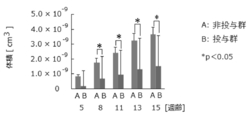
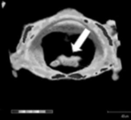
- the results of evaluating the volume of the ectopic ossification lesion are shown in FIG. 2, and the bone density numerical images of tw mice (15 weeks old) in the histamine H 2 receptor antagonist non-administration group are shown in FIG. From the results of FIG.
- famotidine which is a histamine H 2 receptor antagonist can suppress the development of ectopic ossification over time at the upper cervical spine level.
- Test Example 2 In Test Example 1, the test was conducted in the same manner as in Test Example 1 except that the histamine H 2 receptor antagonist and the dose in the histamine H 2 receptor antagonist administration group were changed as follows.
- ⁇ Histamine H 2 receptor antagonist administration group-1 Ranitidine (manufactured by Wako Pure Chemical Industries, Ltd.) was used as a histamine H 2 receptor antagonist, and the daily dose was 5.003 ⁇ g / g body weight of the tw mouse.
- ⁇ Histamine H 2 receptor antagonist administration group-2 As a histamine H 2 receptor antagonist, cimetidine (manufactured by Wako Pure Chemical Industries, Ltd.) was used, and the daily dose was 13.340 ⁇ g / g body weight of the tw mouse.
- ⁇ Histamine H 2 receptor antagonist administration group-3 Nizatidine (manufactured by LKT Laboratories) was used as a histamine H 2 receptor antagonist, and the daily dose was 5.003 ⁇ g per 1 g body weight of the tw mice.
- ⁇ Histamine H 2 receptor antagonist group 4 Loxatidine (manufactured by Wako Pure Chemical Industries, Ltd.) was used as a histamine H 2 receptor antagonist, and the daily dose was 2.501 ⁇ g / g body weight of the tw mouse.
- administration of a histamine H 2 receptor antagonist can suppress the progression of the pathology of posterior longitudinal ligament ossification, and can also suppress recurrence after surgical removal of the ossification site. The possibility was also suggested.
- Examples of the aspect of the present invention include the following.
- a histamine H 2 receptor antagonist which is a disease state progression inhibitor of ossification of the vertebral ligament of the spine.
- ⁇ 4> A method for suppressing progression of a pathological condition of spinal ligament ossification, comprising administering to the individual the disease state progression inhibitor of spinal ligament ossification according to any one of ⁇ 1> to ⁇ 3> above It is the method characterized by this.
Landscapes
- Health & Medical Sciences (AREA)
- Chemical & Material Sciences (AREA)
- Medicinal Chemistry (AREA)
- Pharmacology & Pharmacy (AREA)
- Life Sciences & Earth Sciences (AREA)
- Animal Behavior & Ethology (AREA)
- General Health & Medical Sciences (AREA)
- Public Health (AREA)
- Veterinary Medicine (AREA)
- Epidemiology (AREA)
- Engineering & Computer Science (AREA)
- Biomedical Technology (AREA)
- Bioinformatics & Cheminformatics (AREA)
- Physical Education & Sports Medicine (AREA)
- Chemical Kinetics & Catalysis (AREA)
- General Chemical & Material Sciences (AREA)
- Nuclear Medicine, Radiotherapy & Molecular Imaging (AREA)
- Organic Chemistry (AREA)
- Medicines That Contain Protein Lipid Enzymes And Other Medicines (AREA)
- Pharmaceuticals Containing Other Organic And Inorganic Compounds (AREA)
Abstract
ヒスタミンH2受容体拮抗剤を含む脊柱靭帯骨化症の病状進行抑制剤である。
Description
本発明は、脊柱靭帯骨化症の病状進行抑制剤に関する。
異所性石灰化は、軟組織における石灰化物質の沈着として定義され、異所性骨化とも呼ばれる。原因としては、外傷性、神経性、遺伝性に分けられる。根本的な治療法はなく、非ステロイド抗炎症剤や局所的な放射線治療などの対症療法が一般的に行われている。
脊柱靭帯骨化症(Ossification of spine ligament(OSL))は、骨化した靭帯の部分により、後縦靭帯骨化症(Ossification of the posterior longitudinal ligament of the spine(OPLL))、黄色靭帯骨化症(Ossification of yellow ligament(OYL))、前縦靭帯骨化症(Ossification of anterior longitudinal ligament(OALL))に分類されている。
後縦靭帯骨化症は、厚生労働省から難病に指定されており、脊柱を縦に走る後縦靱帯の骨化が脊柱管の狭窄を引き起こした結果、脊髄または脊髄から分枝する神経が圧迫されて神経障害を引き起こす病気である。前記後縦靭帯骨化症に対しては、圧迫された神経の保護を目的とした保存的療法が第一選択であり、神経症状が強い場合は、手術的に骨化部位の除去や脊柱管拡大を図るが、手術侵襲が問題となる。
また、後縦靭帯骨化症は、黄色靭帯骨化症、及び前縦靭帯骨化症を合併しやすいことも問題となる。
また、後縦靭帯骨化症は、黄色靭帯骨化症、及び前縦靭帯骨化症を合併しやすいことも問題となる。
これまでに、後縦靱帯骨化症については、疾患モデルマウスであるttwマウス(例えば、非特許文献1から2参照)を用いた様々な研究がなされている。
しかしながら、前記保存的療法や手術に代わる有用な手段は、未だ提供されていないのが現状である。
しかしながら、前記保存的療法や手術に代わる有用な手段は、未だ提供されていないのが現状である。
Okawa A et al.、 Nat Genet 19:271-273、1998年
Hirakawa H et al.、 J Orthop Sci 9:591-597、2004年
本発明は、前記従来における諸問題を解決し、以下の目的を達成することを課題とする。即ち、本発明は、脊柱靭帯骨化症の病状の進行を抑制することができる脊柱靭帯骨化症の病状進行抑制剤を提供することを目的とする。
前記課題を解決するため、本発明者らは鋭意検討した結果、驚くべきことに、胃潰瘍や十二指腸潰瘍などの治療に用いられているヒスタミンH2受容体拮抗剤が、脊柱靭帯骨化症の病状の進行を抑制することができることを見出し、本願発明を完成するに至った。
本発明は、本発明者らによる前記知見に基づくものであり、前記課題を解決するための手段としては、以下の通りである。即ち、
<1> ヒスタミンH2受容体拮抗剤を含むことを特徴とする脊柱靭帯骨化症の病状進行抑制剤である。
<2> 脊柱靭帯骨化症の病状の進行を抑制する方法であって、個体に、前記<1>に記載の脊柱靭帯骨化症の病状進行抑制剤を投与することを特徴とする方法である。
<1> ヒスタミンH2受容体拮抗剤を含むことを特徴とする脊柱靭帯骨化症の病状進行抑制剤である。
<2> 脊柱靭帯骨化症の病状の進行を抑制する方法であって、個体に、前記<1>に記載の脊柱靭帯骨化症の病状進行抑制剤を投与することを特徴とする方法である。
本発明によれば、従来における前記諸問題を解決し、前記目的を達成することができ、脊柱靭帯骨化症の病状の進行を抑制することができる脊柱靭帯骨化症の病状進行抑制剤を提供することができる。
(脊柱靭帯骨化症の病状進行抑制剤)
本発明の脊柱靭帯骨化症の病状進行抑制剤は、ヒスタミンH2受容体拮抗剤を少なくとも含み、必要に応じて更にその他の成分を含む。
前記脊柱靭帯骨化症の病状進行抑制剤は、脊柱靭帯骨化症の病状の進行を抑制するために用いられる。
本発明において、脊柱靭帯骨化症の病状の進行の抑制には、異所性骨化巣の発達を抑制することや、骨化部位の外科的摘出後の再発を抑制することが含まれる。
本発明の脊柱靭帯骨化症の病状進行抑制剤は、ヒスタミンH2受容体拮抗剤を少なくとも含み、必要に応じて更にその他の成分を含む。
前記脊柱靭帯骨化症の病状進行抑制剤は、脊柱靭帯骨化症の病状の進行を抑制するために用いられる。
本発明において、脊柱靭帯骨化症の病状の進行の抑制には、異所性骨化巣の発達を抑制することや、骨化部位の外科的摘出後の再発を抑制することが含まれる。
<ヒスタミンH2受容体拮抗剤>
前記ヒスタミンH2受容体拮抗剤は、ヒスタミンH2受容体を競合的に拮抗するものであり、胃潰瘍や十二指腸潰瘍などの治療に用いられている。
前記ヒスタミンH2受容体拮抗剤としては、特に制限はなく、目的に応じて適宜選択することができ、例えば、ファモチジン、ラニチジン、ニザチジン、シメチジン、ロキサチジン、ラフチジンなどが挙げられる。これらは、1種単独で使用してもよいし、2種以上を併用してもよい。
前記ヒスタミンH2受容体拮抗剤の中でも、ファモチジン、ラニチジン、ニザチジン、シメチジン、ロキサチジンが好ましく、ファモチジン、シメチジンがより好ましい。
前記ヒスタミンH2受容体拮抗剤は、ヒスタミンH2受容体を競合的に拮抗するものであり、胃潰瘍や十二指腸潰瘍などの治療に用いられている。
前記ヒスタミンH2受容体拮抗剤としては、特に制限はなく、目的に応じて適宜選択することができ、例えば、ファモチジン、ラニチジン、ニザチジン、シメチジン、ロキサチジン、ラフチジンなどが挙げられる。これらは、1種単独で使用してもよいし、2種以上を併用してもよい。
前記ヒスタミンH2受容体拮抗剤の中でも、ファモチジン、ラニチジン、ニザチジン、シメチジン、ロキサチジンが好ましく、ファモチジン、シメチジンがより好ましい。
前記ヒスタミンH2受容体拮抗剤は、塩の態様であってもよい。
前記塩としては、薬理学的に許容され得る塩であれば、特に制限はなく、目的に応じて適宜選択することができる。
前記塩としては、薬理学的に許容され得る塩であれば、特に制限はなく、目的に応じて適宜選択することができる。
前記ヒスタミンH2受容体拮抗剤は、化学合成したものを使用してもよいし、市販品を使用してもよい。
前記ヒスタミンH2受容体拮抗剤は、有効成分のみからなる態様であってもよいし、その他の成分を含む態様であってもよい。
前記脊柱靭帯骨化症の病状進行抑制剤における前記ヒスタミンH2受容体拮抗剤の含有量としては、特に制限はなく、目的に応じて適宜選択することができる。また、前記脊柱靭帯骨化症の病状進行抑制剤は、前記ヒスタミンH2受容体拮抗剤そのものであってもよい。
<その他の成分>
前記脊柱靭帯骨化症の病状進行抑制剤におけるその他の成分としては、特に制限はなく、目的に応じて適宜選択することができ、例えば、薬理学的に許容され得る担体などが挙げられる。
前記薬理学的に許容され得る担体としては、特に制限はなく、目的に応じて適宜選択することができ、例えば、エタノール、水、デンプンなどが挙げられる。
前記脊柱靭帯骨化症の病状進行抑制剤における前記その他の成分の含有量としては、本発明の効果を損なわない限り、特に制限はなく、目的に応じて適宜選択することができる。
前記脊柱靭帯骨化症の病状進行抑制剤におけるその他の成分としては、特に制限はなく、目的に応じて適宜選択することができ、例えば、薬理学的に許容され得る担体などが挙げられる。
前記薬理学的に許容され得る担体としては、特に制限はなく、目的に応じて適宜選択することができ、例えば、エタノール、水、デンプンなどが挙げられる。
前記脊柱靭帯骨化症の病状進行抑制剤における前記その他の成分の含有量としては、本発明の効果を損なわない限り、特に制限はなく、目的に応じて適宜選択することができる。
<脊柱靭帯骨化症>
脊柱靭帯骨化症は、脊柱に関する靭帯の骨化症をいう。前記脊柱靭帯骨化症は、骨化した靭帯の部分により、後縦靭帯骨化症、黄色靭帯骨化症、前縦靭帯骨化症に分類される。
前記脊柱靭帯骨化症の病状進行抑制剤は、後縦靭帯骨化症の病状の進行の抑制に好適に用いることができる。
脊柱靭帯骨化症は、脊柱に関する靭帯の骨化症をいう。前記脊柱靭帯骨化症は、骨化した靭帯の部分により、後縦靭帯骨化症、黄色靭帯骨化症、前縦靭帯骨化症に分類される。
前記脊柱靭帯骨化症の病状進行抑制剤は、後縦靭帯骨化症の病状の進行の抑制に好適に用いることができる。
<使用>
前記脊柱靭帯骨化症の病状進行抑制剤は、単独で使用されてもよいし、他の成分を有効成分とする医薬と併せて使用されてもよい。また、前記脊柱靭帯骨化症の病状進行抑制剤は、他の成分を有効成分とする医薬中に配合された状態で使用されてもよい。
前記脊柱靭帯骨化症の病状進行抑制剤は、単独で使用されてもよいし、他の成分を有効成分とする医薬と併せて使用されてもよい。また、前記脊柱靭帯骨化症の病状進行抑制剤は、他の成分を有効成分とする医薬中に配合された状態で使用されてもよい。
<剤形>
前記脊柱靭帯骨化症の病状進行抑制剤の剤形としては、特に制限はなく、目的に応じて適宜選択することができ、例えば、液状、粉末状、カプセル状、錠剤状などの剤形とすることができる。これらの剤形の前記脊柱靭帯骨化症の病状進行抑制剤は、常法に従い製造することができる。
前記脊柱靭帯骨化症の病状進行抑制剤の剤形としては、特に制限はなく、目的に応じて適宜選択することができ、例えば、液状、粉末状、カプセル状、錠剤状などの剤形とすることができる。これらの剤形の前記脊柱靭帯骨化症の病状進行抑制剤は、常法に従い製造することができる。
<投与>
前記脊柱靭帯骨化症の病状進行抑制剤の投与方法、投与量、投与時期、及び投与対象としては、特に制限はなく、目的に応じて適宜選択することができる。
前記脊柱靭帯骨化症の病状進行抑制剤の投与方法、投与量、投与時期、及び投与対象としては、特に制限はなく、目的に応じて適宜選択することができる。
前記投与方法としては、例えば、前記脊柱靭帯骨化症の病状進行抑制剤の剤形などに応じて適宜選択することができ、経口又は非経口で投与することができる。
前記投与量としては、特に制限はなく、投与対象個体の年齢、体重、体質、症状、他の成分を有効成分とする医薬や薬剤の投与の有無など、様々な要因を考慮して適宜選択することができる。
前記脊柱靭帯骨化症の病状進行抑制剤の1日当たりの投与量は、例えば、前記ヒスタミンH2受容体拮抗剤の有効成分の量として、体重1g当たり、0.5μg~16μgとすることができる。
前記脊柱靭帯骨化症の病状進行抑制剤の1日当たりの投与量は、例えば、前記ヒスタミンH2受容体拮抗剤の有効成分の量として、体重1g当たり、0.5μg~16μgとすることができる。
前記投与時期としては、特に制限はなく、目的に応じて適宜選択することができる。
前記投与対象としては、特に制限はなく、目的に応じて適宜選択することができるが、特にヒトが好適に挙げられる。
前記脊柱靭帯骨化症の病状進行抑制剤は、脊柱靭帯骨化症の病状の進行を抑制することができるので、脊柱靭帯骨化症に伴う病態の予防にも好適に用いることができる。前記脊柱靭帯骨化症に伴う病態としては、例えば、知覚障害、運動障害などが挙げられる。
前記脊柱靭帯骨化症の病状進行抑制剤は、従来の外科的治療に代わる、非侵襲的な内科的手段となり得る。
(脊柱靭帯骨化症の病状の進行を抑制する方法)
前記脊柱靭帯骨化症の病状進行抑制剤は、個体に投与することにより、個体における脊柱靭帯骨化症の病状の進行を抑制することができる。したがって、本発明は、個体に前記脊柱靭帯骨化症の病状進行抑制剤を投与することを特徴とする、脊柱靭帯骨化症の病状の進行を抑制する方法にも関する。
前記脊柱靭帯骨化症の病状進行抑制剤は、個体に投与することにより、個体における脊柱靭帯骨化症の病状の進行を抑制することができる。したがって、本発明は、個体に前記脊柱靭帯骨化症の病状進行抑制剤を投与することを特徴とする、脊柱靭帯骨化症の病状の進行を抑制する方法にも関する。
以下に試験例を挙げて本発明を具体的に説明するが、本発明はこれらの試験例に何ら限定されるものではない。
(試験例1)
<モデル動物>
後縦靭帯骨化症の疾患モデルマウスであるttwマウスを用意した(日本クレア株式会社製)。前記ttwマウスは、ectonucleotide pyrophosphatase/phosphodiesterase 1(ENPP1)遺伝子に点変異を有し、骨膜や靭帯の異所性骨形成のため、脊柱管の狭窄性病変を100%自然発症する。特に大後頭孔を含む上位頸椎部に異所性骨形成が観られる(Okawa A et al.、 Nat Genet 19:271-273、1998年、Hirakawa H et al.、 J Orthop Sci 9:591-597、2004年参照)。
<モデル動物>
後縦靭帯骨化症の疾患モデルマウスであるttwマウスを用意した(日本クレア株式会社製)。前記ttwマウスは、ectonucleotide pyrophosphatase/phosphodiesterase 1(ENPP1)遺伝子に点変異を有し、骨膜や靭帯の異所性骨形成のため、脊柱管の狭窄性病変を100%自然発症する。特に大後頭孔を含む上位頸椎部に異所性骨形成が観られる(Okawa A et al.、 Nat Genet 19:271-273、1998年、Hirakawa H et al.、 J Orthop Sci 9:591-597、2004年参照)。
<試験>
前記ttwマウスを以下の2群に分け、脊柱靭帯骨化症の病状の進行を調べた。
(1) ヒスタミンH2受容体拮抗剤投与群(n=8)
ヒスタミンH2受容体拮抗剤として、塩酸ファモチジン(Sigma-Aldrich社製)を用いた。前記ヒスタミンH2受容体拮抗剤の1日当たりの投与量は、前記ttwマウスの体重1g当たり0.667μgとした。前記ヒスタミンH2受容体拮抗剤は、マウスの平均飲水量を基に、前記投与量となるように給水ボトルに添加し、4週齢から15週齢までの11週間、経口投与した。
(2) ヒスタミンH2受容体拮抗剤非投与群(n=8)
前記ヒスタミンH2受容体拮抗剤投与群において、ヒスタミンH2受容体拮抗剤を非投与とした以外は、同様にして飼育した。
前記ttwマウスを以下の2群に分け、脊柱靭帯骨化症の病状の進行を調べた。
(1) ヒスタミンH2受容体拮抗剤投与群(n=8)
ヒスタミンH2受容体拮抗剤として、塩酸ファモチジン(Sigma-Aldrich社製)を用いた。前記ヒスタミンH2受容体拮抗剤の1日当たりの投与量は、前記ttwマウスの体重1g当たり0.667μgとした。前記ヒスタミンH2受容体拮抗剤は、マウスの平均飲水量を基に、前記投与量となるように給水ボトルに添加し、4週齢から15週齢までの11週間、経口投与した。
(2) ヒスタミンH2受容体拮抗剤非投与群(n=8)
前記ヒスタミンH2受容体拮抗剤投与群において、ヒスタミンH2受容体拮抗剤を非投与とした以外は、同様にして飼育した。
各個体につき、投与1週間後(5週齢)、4週間後(8週齢)、7週間後(11週齢)、9週間後(13週齢)、11週間後(15週齢)に、実験動物用3DマイクロX線CT R_mCT2(株式会社リガク製)を用いて、上位頸椎レベルの異所性骨化巣のマイクロCT撮影を行った。結果を図1に示す。
図1の結果から、ヒスタミンH2受容体拮抗剤投与群(以下、「投与群」と称することがある)では、上位頸椎レベルの異所性骨化巣(矢印部参照)の発達が、ヒスタミンH2受容体拮抗剤非投与群(以下、「非投与群」と称することがある)よりも抑制されていることが確認された。
図1の結果から、ヒスタミンH2受容体拮抗剤投与群(以下、「投与群」と称することがある)では、上位頸椎レベルの異所性骨化巣(矢印部参照)の発達が、ヒスタミンH2受容体拮抗剤非投与群(以下、「非投与群」と称することがある)よりも抑制されていることが確認された。
また、撮影したマイクロCTデータを基に、ボリュームレンダリング機能で3D表示画像を作成し、3次元画像解析ソフトTRI/3D-BON(ラトックシステムエンジニアリング株式会社製)を用いて、第1頸椎及び第2頚椎の後縦靭帯部の異所性骨化の観察及び定量的評価を行った。
異所性骨化巣の体積を評価した結果を図2に示し、ヒスタミンH2受容体拮抗剤非投与群のttwマウス(15週齢)の骨密度数値像を図3に示す。
図2の結果から、投与群(B)では、非投与群(A)に対して有意に(p<0.05)、異所性骨化巣の体積が小さいことが確認された。
図3の結果から、矢印部の骨密度数値が高く、非投与群では、異所性骨化が生じていることが確認された。
異所性骨化巣の体積を評価した結果を図2に示し、ヒスタミンH2受容体拮抗剤非投与群のttwマウス(15週齢)の骨密度数値像を図3に示す。
図2の結果から、投与群(B)では、非投与群(A)に対して有意に(p<0.05)、異所性骨化巣の体積が小さいことが確認された。
図3の結果から、矢印部の骨密度数値が高く、非投与群では、異所性骨化が生じていることが確認された。
以上の結果から、ヒスタミンH2受容体拮抗剤であるファモチジンを投与することにより、上位頸椎レベルにおける経時的な異所性骨化巣の発達を抑制することができることが確認された。
(試験例2)
試験例1において、ヒスタミンH2受容体拮抗剤投与群のヒスタミンH2受容体拮抗剤及び投与量を以下のように変更した以外は、試験例1と同様にして試験した。
・ ヒスタミンH2受容体拮抗剤投与群-1
ヒスタミンH2受容体拮抗剤として、ラニチジン(和光純薬工業株式会社製)を用い、1日当たりの投与量を、前記ttwマウスの体重1g当たり5.003μgとした。
・ ヒスタミンH2受容体拮抗剤投与群-2
ヒスタミンH2受容体拮抗剤として、シメチジン(和光純薬工業株式会社製)を用い、1日当たりの投与量を、前記ttwマウスの体重1g当たり13.340μgとした。
・ ヒスタミンH2受容体拮抗剤投与群-3
ヒスタミンH2受容体拮抗剤として、ニザチジン(LKT Laboratories社製)を用い、1日当たりの投与量を、前記ttwマウスの体重1g当たり5.003μgとした。
・ ヒスタミンH2受容体拮抗剤投与群-4
ヒスタミンH2受容体拮抗剤として、ロキサチジン(和光純薬工業株式会社製)を用い、1日当たりの投与量を、前記ttwマウスの体重1g当たり2.501μgとした。
試験例1において、ヒスタミンH2受容体拮抗剤投与群のヒスタミンH2受容体拮抗剤及び投与量を以下のように変更した以外は、試験例1と同様にして試験した。
・ ヒスタミンH2受容体拮抗剤投与群-1
ヒスタミンH2受容体拮抗剤として、ラニチジン(和光純薬工業株式会社製)を用い、1日当たりの投与量を、前記ttwマウスの体重1g当たり5.003μgとした。
・ ヒスタミンH2受容体拮抗剤投与群-2
ヒスタミンH2受容体拮抗剤として、シメチジン(和光純薬工業株式会社製)を用い、1日当たりの投与量を、前記ttwマウスの体重1g当たり13.340μgとした。
・ ヒスタミンH2受容体拮抗剤投与群-3
ヒスタミンH2受容体拮抗剤として、ニザチジン(LKT Laboratories社製)を用い、1日当たりの投与量を、前記ttwマウスの体重1g当たり5.003μgとした。
・ ヒスタミンH2受容体拮抗剤投与群-4
ヒスタミンH2受容体拮抗剤として、ロキサチジン(和光純薬工業株式会社製)を用い、1日当たりの投与量を、前記ttwマウスの体重1g当たり2.501μgとした。
投与3週間後(7週齢)の各群のマウスについて、実験動物用3DマイクロX線CT R_mCT2(株式会社リガク製)を用いて、上位頸椎レベルの異所性骨化巣のマイクロCT撮影を行った。結果を図4に示す。
図4の結果から、ヒスタミンH2受容体拮抗剤投与群では、いずれの群においても、上位頸椎レベルの異所性骨化巣の発達が、ヒスタミンH2受容体拮抗剤非投与群よりも抑制されていることが確認された。
図4の結果から、ヒスタミンH2受容体拮抗剤投与群では、いずれの群においても、上位頸椎レベルの異所性骨化巣の発達が、ヒスタミンH2受容体拮抗剤非投与群よりも抑制されていることが確認された。
以上の結果から、ファモチジン以外のヒスタミンH2受容体拮抗剤を用いた場合にも、上位頸椎レベルにおける経時的な異所性骨化巣の発達を抑制することができることが確認された。
したがって、ヒスタミンH2受容体拮抗剤を投与することにより、後縦靱帯骨化症の病状の進行を抑制することができ、また、骨化部位を外科的に摘出した後の再発を抑制し得る可能性も示唆された。
本発明の態様としては、例えば、以下のものなどが挙げられる。
<1> ヒスタミンH2受容体拮抗剤を含むことを特徴とする脊柱靭帯骨化症の病状進行抑制剤である。
<2> 脊柱靭帯骨化症が、後縦靭帯骨化症である前記<1>に記載の脊柱靭帯骨化症の病状進行抑制剤である。
<3> ヒスタミンH2受容体拮抗剤が、ファモチジン、ラニチジン、ニザチジン、シメチジン、及びロキサチジンからなる群から選択される少なくとも1種である前記<1>から<2>のいずれかに記載の脊柱靭帯骨化症の病状進行抑制剤である。
<4> 脊柱靭帯骨化症の病状の進行を抑制する方法であって、個体に、前記<1>から<3>のいずれかに記載の脊柱靭帯骨化症の病状進行抑制剤を投与することを特徴とする方法である。
<1> ヒスタミンH2受容体拮抗剤を含むことを特徴とする脊柱靭帯骨化症の病状進行抑制剤である。
<2> 脊柱靭帯骨化症が、後縦靭帯骨化症である前記<1>に記載の脊柱靭帯骨化症の病状進行抑制剤である。
<3> ヒスタミンH2受容体拮抗剤が、ファモチジン、ラニチジン、ニザチジン、シメチジン、及びロキサチジンからなる群から選択される少なくとも1種である前記<1>から<2>のいずれかに記載の脊柱靭帯骨化症の病状進行抑制剤である。
<4> 脊柱靭帯骨化症の病状の進行を抑制する方法であって、個体に、前記<1>から<3>のいずれかに記載の脊柱靭帯骨化症の病状進行抑制剤を投与することを特徴とする方法である。
Claims (3)
- ヒスタミンH2受容体拮抗剤を含むことを特徴とする脊柱靭帯骨化症の病状進行抑制剤。
- 脊柱靭帯骨化症が、後縦靭帯骨化症である請求項1に記載の脊柱靭帯骨化症の病状進行抑制剤。
- ヒスタミンH2受容体拮抗剤が、ファモチジン、ラニチジン、ニザチジン、シメチジン、及びロキサチジンからなる群から選択される少なくとも1種である請求項1から2のいずれかに記載の脊柱靭帯骨化症の病状進行抑制剤。
Applications Claiming Priority (2)
| Application Number | Priority Date | Filing Date | Title |
|---|---|---|---|
| JP2014-033916 | 2014-02-25 | ||
| JP2014033916A JP2015157784A (ja) | 2014-02-25 | 2014-02-25 | 脊柱靭帯骨化症の病状進行抑制剤 |
Publications (1)
| Publication Number | Publication Date |
|---|---|
| WO2015129451A1 true WO2015129451A1 (ja) | 2015-09-03 |
Family
ID=54008775
Family Applications (1)
| Application Number | Title | Priority Date | Filing Date |
|---|---|---|---|
| PCT/JP2015/053658 Ceased WO2015129451A1 (ja) | 2014-02-25 | 2015-02-10 | 脊柱靭帯骨化症の病状進行抑制剤 |
Country Status (2)
| Country | Link |
|---|---|
| JP (1) | JP2015157784A (ja) |
| WO (1) | WO2015129451A1 (ja) |
Citations (1)
| Publication number | Priority date | Publication date | Assignee | Title |
|---|---|---|---|---|
| JPH04225988A (ja) * | 1990-04-25 | 1992-08-14 | Glaxo Group Ltd | カルボン酸誘導体 |
-
2014
- 2014-02-25 JP JP2014033916A patent/JP2015157784A/ja active Pending
-
2015
- 2015-02-10 WO PCT/JP2015/053658 patent/WO2015129451A1/ja not_active Ceased
Patent Citations (1)
| Publication number | Priority date | Publication date | Assignee | Title |
|---|---|---|---|---|
| JPH04225988A (ja) * | 1990-04-25 | 1992-08-14 | Glaxo Group Ltd | カルボン酸誘導体 |
Non-Patent Citations (3)
| Title |
|---|
| FUJIO HIGUCHI ET AL.: "Case report of calcinosis who responsed to cimetidine", SEIKEI GEKA, vol. 46, 1995, pages 1549 - 1554 * |
| HAJIME YAMASHITA: "Sekkai Chinchakusei Kenban'en ni Taisuru H2 Juyotai Kikkoyaku Famotidine Heiyo ni yoru Soki Kaizen Koka no Kento", PROG MED, vol. 24, no. 8, 2004, pages 2013 - 2017 * |
| TOYOHIRO FUJIWARA: "Tekiogai Shiyo Joho A La Carte Dai 20 Kai Sekkai Chinchakusei Kenban'en", THE PHARMACEUTICALS MONTHLY, vol. 49, no. 12, 2007, pages 1933 - 1937 * |
Also Published As
| Publication number | Publication date |
|---|---|
| JP2015157784A (ja) | 2015-09-03 |
Similar Documents
| Publication | Publication Date | Title |
|---|---|---|
| Burke et al. | Fibrous dysplasia of bone: craniofacial and dental implications | |
| Valladares-Neto et al. | TMJ response to mandibular advancement surgery: an overview of risk factors | |
| Reid | Efficacy, effectiveness and side effects of medications used to prevent fractures | |
| Koewler et al. | Effects of a monoclonal antibody raised against nerve growth factor on skeletal pain and bone healing after fracture of the C57BL/6J mouse femur | |
| EP1701725B1 (en) | Compositions comprising flupirtine and an opioid for use in the treatment of neuropathic pain | |
| Koh et al. | Gardner syndrome associated with multiple osteomas, intestinal polyposis, and epidermoid cysts | |
| Gondivkar et al. | Gorham-Stout syndrome: a rare clinical entity and review of literature | |
| JP6224690B2 (ja) | 抗腫瘍薬の投与方法 | |
| Shankar et al. | Paget disease of bone: a classic case report | |
| US20120172341A1 (en) | Compositions comprising tramadol and celecoxib in the treatment of pain | |
| Little et al. | Functional outcome measures in a surgical model of hip osteoarthritis in dogs | |
| Patel et al. | Axitinib-related osteonecrosis of the jaw | |
| Erickson et al. | Effect of Cystone® on urinary composition and stone formation over a one year period | |
| KR20080105864A (ko) | 리마프로스트를 함유하는 경추증의 치료 및/또는 증상 진전억제제 | |
| Sebba et al. | Ibandronate dose response is associated with increases in bone mineral density and reductions in clinical fractures: results of a meta-analysis | |
| Jee et al. | The influence of alendronate on the healing of extraction sockets of ovariectomized rats assessed by in vivo micro–computed tomography | |
| Seo et al. | Effects of condylar head surface changes on mandibular position in patients with temporomandibular joint osteoarthritis | |
| Block et al. | Porous bone increases the risk of posterior mandibular implant failure | |
| JP2015157784A (ja) | 脊柱靭帯骨化症の病状進行抑制剤 | |
| Kaye et al. | The effects of gastroretentive gabapentin (Gralise®) on spinal stenosis patients with radicular pain | |
| van Atteveld et al. | Recent perspectives on the association between osteonecrosis and bone mineral density decline in childhood acute lymphoblastic leukemia | |
| Wrzosek et al. | Congenital bipartite atlas with hypodactyly in a dog: clinical, radiographic and CT findings | |
| Shen et al. | Effects of inferior alveolar nerve rupture on bone remodeling of the mandible: A preliminary study | |
| EP2162129B1 (en) | Use of hdac inhibitors for the treatment of bone destruction | |
| Hammou et al. | Spinal cοrd compression secondary to brοwn tumοr as first manifestation of primary hyperparathyroidism |
Legal Events
| Date | Code | Title | Description |
|---|---|---|---|
| 121 | Ep: the epo has been informed by wipo that ep was designated in this application |
Ref document number: 15755078 Country of ref document: EP Kind code of ref document: A1 |
|
| NENP | Non-entry into the national phase |
Ref country code: DE |
|
| 122 | Ep: pct application non-entry in european phase |
Ref document number: 15755078 Country of ref document: EP Kind code of ref document: A1 |