WO2015108490A2 - Heteroaryl alkyne derivatives and uses thereof - Google Patents
Heteroaryl alkyne derivatives and uses thereof Download PDFInfo
- Publication number
- WO2015108490A2 WO2015108490A2 PCT/SG2015/050005 SG2015050005W WO2015108490A2 WO 2015108490 A2 WO2015108490 A2 WO 2015108490A2 SG 2015050005 W SG2015050005 W SG 2015050005W WO 2015108490 A2 WO2015108490 A2 WO 2015108490A2
- Authority
- WO
- WIPO (PCT)
- Prior art keywords
- optionally substituted
- compound
- alkyl
- certain embodiments
- heterocyclyl
- Prior art date
- Legal status (The legal status is an assumption and is not a legal conclusion. Google has not performed a legal analysis and makes no representation as to the accuracy of the status listed.)
- Ceased
Links
- 0 Cc(cnc(*c1cc(C(F)(F)F)c(CN2CCN(*)CC2)cc1)c1)c1C#C[C@]1C=CC=CC=C/C=C1 Chemical compound Cc(cnc(*c1cc(C(F)(F)F)c(CN2CCN(*)CC2)cc1)c1)c1C#C[C@]1C=CC=CC=C/C=C1 0.000 description 29
- AGHYOKPOJRMSKG-UHFFFAOYSA-N C#Cc(cc1)cnc1NC(C1CC1)=O Chemical compound C#Cc(cc1)cnc1NC(C1CC1)=O AGHYOKPOJRMSKG-UHFFFAOYSA-N 0.000 description 2
- MELDCSHRDXLTDH-UHFFFAOYSA-N C#Cc1cnc(cc2)[n]1nc2Cl Chemical compound C#Cc1cnc(cc2)[n]1nc2Cl MELDCSHRDXLTDH-UHFFFAOYSA-N 0.000 description 2
- BJEQMKKSOMHOCN-UHFFFAOYSA-N CCN1CCN(Cc(c(C(F)(F)F)c2)ccc2NC(Nc2cc(C#C)ccn2)=O)CC1 Chemical compound CCN1CCN(Cc(c(C(F)(F)F)c2)ccc2NC(Nc2cc(C#C)ccn2)=O)CC1 BJEQMKKSOMHOCN-UHFFFAOYSA-N 0.000 description 2
- ZMWAZMYBMAAMAW-UHFFFAOYSA-N CN1CCN(Cc(cc2)c(C(F)(F)F)cc2N)CC1 Chemical compound CN1CCN(Cc(cc2)c(C(F)(F)F)cc2N)CC1 ZMWAZMYBMAAMAW-UHFFFAOYSA-N 0.000 description 2
- IXZYLRXTIRTNQR-UHFFFAOYSA-N C#Cc(c(F)c1)cnc1N Chemical compound C#Cc(c(F)c1)cnc1N IXZYLRXTIRTNQR-UHFFFAOYSA-N 0.000 description 1
- GFZCTTUJFXUHOU-UHFFFAOYSA-O C#Cc(cc1C=[NH2+])cnc1N Chemical compound C#Cc(cc1C=[NH2+])cnc1N GFZCTTUJFXUHOU-UHFFFAOYSA-O 0.000 description 1
- OQSZSSZQGXVLRA-UHFFFAOYSA-N C#Cc1cnc2[nH]ccc2c1F Chemical compound C#Cc1cnc2[nH]ccc2c1F OQSZSSZQGXVLRA-UHFFFAOYSA-N 0.000 description 1
- VYOHSFQVMLAURO-UHFFFAOYSA-N C#Cc1cnc2[n]1nccc2 Chemical compound C#Cc1cnc2[n]1nccc2 VYOHSFQVMLAURO-UHFFFAOYSA-N 0.000 description 1
- YDEBKIAVZZHABU-UHFFFAOYSA-N CC(C(Nc1ccc(CN2CCN(C)CC2)c(C(F)(F)F)c1)=O)c(cc1)ccc1C#Cc(cc1)cnc1NC(C1CC1)=O Chemical compound CC(C(Nc1ccc(CN2CCN(C)CC2)c(C(F)(F)F)c1)=O)c(cc1)ccc1C#Cc(cc1)cnc1NC(C1CC1)=O YDEBKIAVZZHABU-UHFFFAOYSA-N 0.000 description 1
- PFDBEACWLCHWRZ-UHFFFAOYSA-N CC(C(O)=O)c(cc1)ccc1Br Chemical compound CC(C(O)=O)c(cc1)ccc1Br PFDBEACWLCHWRZ-UHFFFAOYSA-N 0.000 description 1
- NKIAUIBQOYMGNN-UHFFFAOYSA-N CC(C)(C)OC(N1CCN(Cc(c(C(F)(F)F)c2)ccc2NC(c2cccc(Br)c2)=O)CC1)=O Chemical compound CC(C)(C)OC(N1CCN(Cc(c(C(F)(F)F)c2)ccc2NC(c2cccc(Br)c2)=O)CC1)=O NKIAUIBQOYMGNN-UHFFFAOYSA-N 0.000 description 1
- JGDPFRQFLMWXOV-UHFFFAOYSA-N CC(C)(C)OC(Nc([s]1)ncc1[BrH]C)=O Chemical compound CC(C)(C)OC(Nc([s]1)ncc1[BrH]C)=O JGDPFRQFLMWXOV-UHFFFAOYSA-N 0.000 description 1
- MLLUIAATWQVFDR-UHFFFAOYSA-N CC(C)CNc(cc1)n[n]2c1ncc2C#C Chemical compound CC(C)CNc(cc1)n[n]2c1ncc2C#C MLLUIAATWQVFDR-UHFFFAOYSA-N 0.000 description 1
- SMDYHRYJWBYNFX-UHFFFAOYSA-N CC(C)CNc(cc1)n[n]2c1ncc2C#Cc1ccnc(NC(c2ccc(CN3CCNCC3)c(C(F)(F)F)c2)=O)c1 Chemical compound CC(C)CNc(cc1)n[n]2c1ncc2C#Cc1ccnc(NC(c2ccc(CN3CCNCC3)c(C(F)(F)F)c2)=O)c1 SMDYHRYJWBYNFX-UHFFFAOYSA-N 0.000 description 1
- GVXZNRJLWSJQMZ-UHFFFAOYSA-N CC(C)c(c1c2)n[nH]c1ncc2Br Chemical compound CC(C)c(c1c2)n[nH]c1ncc2Br GVXZNRJLWSJQMZ-UHFFFAOYSA-N 0.000 description 1
- MJTZKTKMGIMPRE-AATRIKPKSA-N CC/C=C(\CC)/C(F)(F)F Chemical compound CC/C=C(\CC)/C(F)(F)F MJTZKTKMGIMPRE-AATRIKPKSA-N 0.000 description 1
- VLYFUTTXGUMPHE-UHFFFAOYSA-N CCN1CCN(Cc(c(C(F)(F)F)c2)ccc2C(Nc2cc(C#Cc3c(C)c(cc[nH]4)c4nc3)ccn2)=O)CC1 Chemical compound CCN1CCN(Cc(c(C(F)(F)F)c2)ccc2C(Nc2cc(C#Cc3c(C)c(cc[nH]4)c4nc3)ccn2)=O)CC1 VLYFUTTXGUMPHE-UHFFFAOYSA-N 0.000 description 1
- FGLFQCJFNWUXGM-UHFFFAOYSA-N CCN1CCN(Cc(c(C(F)(F)F)c2)ccc2NC(Nc2nccc(Br)c2)=O)CC1 Chemical compound CCN1CCN(Cc(c(C(F)(F)F)c2)ccc2NC(Nc2nccc(Br)c2)=O)CC1 FGLFQCJFNWUXGM-UHFFFAOYSA-N 0.000 description 1
- AUVMGFTXIPAUPA-UHFFFAOYSA-N CCN1CCN(Cc(c(C(F)(F)F)c2)ccc2NC(Nc2nccc(C#Cc3cnc4[nH]nc(C(C)C)c4c3)c2)=O)CC1 Chemical compound CCN1CCN(Cc(c(C(F)(F)F)c2)ccc2NC(Nc2nccc(C#Cc3cnc4[nH]nc(C(C)C)c4c3)c2)=O)CC1 AUVMGFTXIPAUPA-UHFFFAOYSA-N 0.000 description 1
- XUKPFYOHMWYXDZ-UHFFFAOYSA-N CCN1CCN(Cc(c(C(F)(F)F)c2)ccc2NC(Nc2nccc(C#Cc3cnc4[n]3nccc4)c2)=O)CC1 Chemical compound CCN1CCN(Cc(c(C(F)(F)F)c2)ccc2NC(Nc2nccc(C#Cc3cnc4[n]3nccc4)c2)=O)CC1 XUKPFYOHMWYXDZ-UHFFFAOYSA-N 0.000 description 1
- UEABVXHPIDNOOD-UHFFFAOYSA-N CCN1CCN(Cc(cc2)c(C(F)(F)F)cc2NC(Nc2cc(C#Cc(c(C#N)c3)cnc3N)ccn2)=O)CC1 Chemical compound CCN1CCN(Cc(cc2)c(C(F)(F)F)cc2NC(Nc2cc(C#Cc(c(C#N)c3)cnc3N)ccn2)=O)CC1 UEABVXHPIDNOOD-UHFFFAOYSA-N 0.000 description 1
- CJEYSADRAJYXQE-UHFFFAOYSA-N CCN1CCN(Cc(cc2)c(C(F)(F)F)cc2NC(Nc2ncc(C)c(C#Cc3cnc(cc4)[n]3nc4N(C)C)c2)=O)CC1 Chemical compound CCN1CCN(Cc(cc2)c(C(F)(F)F)cc2NC(Nc2ncc(C)c(C#Cc3cnc(cc4)[n]3nc4N(C)C)c2)=O)CC1 CJEYSADRAJYXQE-UHFFFAOYSA-N 0.000 description 1
- ISPVUYAFHKZBAP-UHFFFAOYSA-N CCN1CCN(Cc(cc2)c(C(F)(F)F)cc2NC(Nc2nccc(C#Cc3ccc4nc[nH]c4c3)c2)=O)CC1 Chemical compound CCN1CCN(Cc(cc2)c(C(F)(F)F)cc2NC(Nc2nccc(C#Cc3ccc4nc[nH]c4c3)c2)=O)CC1 ISPVUYAFHKZBAP-UHFFFAOYSA-N 0.000 description 1
- TYRZGNJGFBCIKB-UHFFFAOYSA-N CCOc(cc1)n[n]2c1ncc2C#C Chemical compound CCOc(cc1)n[n]2c1ncc2C#C TYRZGNJGFBCIKB-UHFFFAOYSA-N 0.000 description 1
- BNFNQKYBKBBMMU-UHFFFAOYSA-N CCOc(cc1)n[n]2c1ncc2C#Cc1ccnc(NC(c2ccc(CN3CCNCC3)c(C(F)(F)F)c2)=O)c1 Chemical compound CCOc(cc1)n[n]2c1ncc2C#Cc1ccnc(NC(c2ccc(CN3CCNCC3)c(C(F)(F)F)c2)=O)c1 BNFNQKYBKBBMMU-UHFFFAOYSA-N 0.000 description 1
- MSVKMNMIQWHGFI-UHFFFAOYSA-N CCc1cc2cc(C#C)cnc2[nH]1 Chemical compound CCc1cc2cc(C#C)cnc2[nH]1 MSVKMNMIQWHGFI-UHFFFAOYSA-N 0.000 description 1
- KGMOTNZISMARNX-UHFFFAOYSA-N CCc1cc2cc(C#Cc3cc(NC(Nc4ccc(CN5CCN(CC)CC5)c(C(F)(F)F)c4)=O)ncc3)cnc2[nH]1 Chemical compound CCc1cc2cc(C#Cc3cc(NC(Nc4ccc(CN5CCN(CC)CC5)c(C(F)(F)F)c4)=O)ncc3)cnc2[nH]1 KGMOTNZISMARNX-UHFFFAOYSA-N 0.000 description 1
- SYKBVIPQDWTFEG-UHFFFAOYSA-N CN(C)Cc(cc1)c(C(F)(F)F)cc1NC(Nc1ncc(C#Cc(cnc2c3cc[nH]2)c3F)[s]1)=O Chemical compound CN(C)Cc(cc1)c(C(F)(F)F)cc1NC(Nc1ncc(C#Cc(cnc2c3cc[nH]2)c3F)[s]1)=O SYKBVIPQDWTFEG-UHFFFAOYSA-N 0.000 description 1
- JHWJCFMAQJBFPW-UHFFFAOYSA-N CN(C)c(cc1)n[n]2c1ncc2C#C Chemical compound CN(C)c(cc1)n[n]2c1ncc2C#C JHWJCFMAQJBFPW-UHFFFAOYSA-N 0.000 description 1
- KYTOPRXOAXJWBR-UHFFFAOYSA-N CN(C)c(cc1)n[n]2c1ncc2C#Cc1cnc(N)[s]1 Chemical compound CN(C)c(cc1)n[n]2c1ncc2C#Cc1cnc(N)[s]1 KYTOPRXOAXJWBR-UHFFFAOYSA-N 0.000 description 1
- XOPPQWNQAYSOSK-UHFFFAOYSA-N CN1CCN(Cc(c(C(F)(F)F)c2)ccc2C(Nc([s]2)ncc2Br)=O)CC1 Chemical compound CN1CCN(Cc(c(C(F)(F)F)c2)ccc2C(Nc([s]2)ncc2Br)=O)CC1 XOPPQWNQAYSOSK-UHFFFAOYSA-N 0.000 description 1
- AXONVEFJNCYCRP-UHFFFAOYSA-N CN1CCN(Cc(c(C(F)(F)F)c2)ccc2C(Nc2cc(C#Cc3cnc4[n]3nccc4)ccn2)=O)CC1 Chemical compound CN1CCN(Cc(c(C(F)(F)F)c2)ccc2C(Nc2cc(C#Cc3cnc4[n]3nccc4)ccn2)=O)CC1 AXONVEFJNCYCRP-UHFFFAOYSA-N 0.000 description 1
- BGQHYFNXJCUZEX-UHFFFAOYSA-N CN1CCN(Cc(c(C(F)(F)F)c2)ccc2C(Nc2ncc(C#Cc(cnc(N)c3)c3F)[s]2)=O)CC1 Chemical compound CN1CCN(Cc(c(C(F)(F)F)c2)ccc2C(Nc2ncc(C#Cc(cnc(N)c3)c3F)[s]2)=O)CC1 BGQHYFNXJCUZEX-UHFFFAOYSA-N 0.000 description 1
- YNCZXZLITUQCEM-UHFFFAOYSA-N CN1CCN(Cc(c(C(F)(F)F)c2)ccc2C(Nc2ncc(C#Cc3cnc4[n]3ccnc4)[s]2)=O)CC1 Chemical compound CN1CCN(Cc(c(C(F)(F)F)c2)ccc2C(Nc2ncc(C#Cc3cnc4[n]3ccnc4)[s]2)=O)CC1 YNCZXZLITUQCEM-UHFFFAOYSA-N 0.000 description 1
- FDKRBFGGTHIOFO-UHFFFAOYSA-N CN1CCN(Cc(cc2)c(C(F)(F)F)cc2C(Nc2nccc(C#Cc(cc(cc[nH]3)c3n3)c3F)c2)=O)CC1 Chemical compound CN1CCN(Cc(cc2)c(C(F)(F)F)cc2C(Nc2nccc(C#Cc(cc(cc[nH]3)c3n3)c3F)c2)=O)CC1 FDKRBFGGTHIOFO-UHFFFAOYSA-N 0.000 description 1
- MMVIYYLOKIDEQN-UHFFFAOYSA-N CN1CCN(Cc(cc2)c(C(F)(F)F)cc2NC(Cc2nccc(C#Cc(cnc3c4cc[nH]3)c4F)c2)=O)CC1 Chemical compound CN1CCN(Cc(cc2)c(C(F)(F)F)cc2NC(Cc2nccc(C#Cc(cnc3c4cc[nH]3)c4F)c2)=O)CC1 MMVIYYLOKIDEQN-UHFFFAOYSA-N 0.000 description 1
- QGTLZVWHDCFTKM-UHFFFAOYSA-N CN1CCN(Cc(cc2)c(C(F)(F)F)cc2NC(Nc(cccc2C#Cc3cc(cn[nH]4)c4nc3)c2F)=O)CC1 Chemical compound CN1CCN(Cc(cc2)c(C(F)(F)F)cc2NC(Nc(cccc2C#Cc3cc(cn[nH]4)c4nc3)c2F)=O)CC1 QGTLZVWHDCFTKM-UHFFFAOYSA-N 0.000 description 1
- KNRHLZMHLOFHLI-UHFFFAOYSA-N COc(c1c2)n[nH]c1ncc2C#Cc1cc(NC(c2ccc(CN3CCNCC3)c(C(F)(F)F)c2)=O)ncc1 Chemical compound COc(c1c2)n[nH]c1ncc2C#Cc1cc(NC(c2ccc(CN3CCNCC3)c(C(F)(F)F)c2)=O)ncc1 KNRHLZMHLOFHLI-UHFFFAOYSA-N 0.000 description 1
- PUJVSTYUTMVCSG-UHFFFAOYSA-N Fc1c(cc[nH]2)c2ncc1Br Chemical compound Fc1c(cc[nH]2)c2ncc1Br PUJVSTYUTMVCSG-UHFFFAOYSA-N 0.000 description 1
- HYPQOSVTIONWSN-UHFFFAOYSA-N Nc(cccc1Br)c1F Chemical compound Nc(cccc1Br)c1F HYPQOSVTIONWSN-UHFFFAOYSA-N 0.000 description 1
- WGOLHUGPTDEKCF-UHFFFAOYSA-N Nc(nc1)ccc1Br Chemical compound Nc(nc1)ccc1Br WGOLHUGPTDEKCF-UHFFFAOYSA-N 0.000 description 1
- BZJWEYIMSIZFIS-UHFFFAOYSA-N Nc(ncc(C#Cc1cc(NC(c2ccc(CN3CCNCC3)c(C(F)(F)F)c2)=O)ncc1)c1)c1F Chemical compound Nc(ncc(C#Cc1cc(NC(c2ccc(CN3CCNCC3)c(C(F)(F)F)c2)=O)ncc1)c1)c1F BZJWEYIMSIZFIS-UHFFFAOYSA-N 0.000 description 1
- BAQKUNMKVAPWGU-UHFFFAOYSA-N Nc1nccc(Br)c1 Chemical compound Nc1nccc(Br)c1 BAQKUNMKVAPWGU-UHFFFAOYSA-N 0.000 description 1
- DHPKTHROZFIEJK-UHFFFAOYSA-N O=C(C1)Nc(nc2)c1cc2Br Chemical compound O=C(C1)Nc(nc2)c1cc2Br DHPKTHROZFIEJK-UHFFFAOYSA-N 0.000 description 1
- ZOOSILUVXHVRJE-UHFFFAOYSA-N O=C(C1CC1)Cl Chemical compound O=C(C1CC1)Cl ZOOSILUVXHVRJE-UHFFFAOYSA-N 0.000 description 1
- QOWSWEBLNVACCL-UHFFFAOYSA-N OC(Cc(cc1)ccc1Br)=O Chemical compound OC(Cc(cc1)ccc1Br)=O QOWSWEBLNVACCL-UHFFFAOYSA-N 0.000 description 1
- COEMBDATKOQUEO-UHFFFAOYSA-N OC(c1ccc(CN2CCNCC2)c(C(F)(F)F)c1)Nc1nccc(Br)c1 Chemical compound OC(c1ccc(CN2CCNCC2)c(C(F)(F)F)c1)Nc1nccc(Br)c1 COEMBDATKOQUEO-UHFFFAOYSA-N 0.000 description 1
Classifications
-
- C—CHEMISTRY; METALLURGY
- C07—ORGANIC CHEMISTRY
- C07D—HETEROCYCLIC COMPOUNDS
- C07D417/00—Heterocyclic compounds containing two or more hetero rings, at least one ring having nitrogen and sulfur atoms as the only ring hetero atoms, not provided for by group C07D415/00
- C07D417/02—Heterocyclic compounds containing two or more hetero rings, at least one ring having nitrogen and sulfur atoms as the only ring hetero atoms, not provided for by group C07D415/00 containing two hetero rings
- C07D417/06—Heterocyclic compounds containing two or more hetero rings, at least one ring having nitrogen and sulfur atoms as the only ring hetero atoms, not provided for by group C07D415/00 containing two hetero rings linked by a carbon chain containing only aliphatic carbon atoms
-
- A—HUMAN NECESSITIES
- A61—MEDICAL OR VETERINARY SCIENCE; HYGIENE
- A61K—PREPARATIONS FOR MEDICAL, DENTAL OR TOILETRY PURPOSES
- A61K31/00—Medicinal preparations containing organic active ingredients
- A61K31/33—Heterocyclic compounds
- A61K31/395—Heterocyclic compounds having nitrogen as a ring hetero atom, e.g. guanethidine or rifamycins
- A61K31/435—Heterocyclic compounds having nitrogen as a ring hetero atom, e.g. guanethidine or rifamycins having six-membered rings with one nitrogen as the only ring hetero atom
- A61K31/4353—Heterocyclic compounds having nitrogen as a ring hetero atom, e.g. guanethidine or rifamycins having six-membered rings with one nitrogen as the only ring hetero atom ortho- or peri-condensed with heterocyclic ring systems
- A61K31/437—Heterocyclic compounds having nitrogen as a ring hetero atom, e.g. guanethidine or rifamycins having six-membered rings with one nitrogen as the only ring hetero atom ortho- or peri-condensed with heterocyclic ring systems the heterocyclic ring system containing a five-membered ring having nitrogen as a ring hetero atom, e.g. indolizine, beta-carboline
-
- A—HUMAN NECESSITIES
- A61—MEDICAL OR VETERINARY SCIENCE; HYGIENE
- A61K—PREPARATIONS FOR MEDICAL, DENTAL OR TOILETRY PURPOSES
- A61K31/00—Medicinal preparations containing organic active ingredients
- A61K31/33—Heterocyclic compounds
- A61K31/395—Heterocyclic compounds having nitrogen as a ring hetero atom, e.g. guanethidine or rifamycins
- A61K31/495—Heterocyclic compounds having nitrogen as a ring hetero atom, e.g. guanethidine or rifamycins having six-membered rings with two or more nitrogen atoms as the only ring heteroatoms, e.g. piperazine or tetrazines
- A61K31/496—Non-condensed piperazines containing further heterocyclic rings, e.g. rifampin, thiothixene or sparfloxacin
-
- A—HUMAN NECESSITIES
- A61—MEDICAL OR VETERINARY SCIENCE; HYGIENE
- A61K—PREPARATIONS FOR MEDICAL, DENTAL OR TOILETRY PURPOSES
- A61K31/00—Medicinal preparations containing organic active ingredients
- A61K31/33—Heterocyclic compounds
- A61K31/395—Heterocyclic compounds having nitrogen as a ring hetero atom, e.g. guanethidine or rifamycins
- A61K31/495—Heterocyclic compounds having nitrogen as a ring hetero atom, e.g. guanethidine or rifamycins having six-membered rings with two or more nitrogen atoms as the only ring heteroatoms, e.g. piperazine or tetrazines
- A61K31/4985—Pyrazines or piperazines ortho- or peri-condensed with heterocyclic ring systems
-
- A—HUMAN NECESSITIES
- A61—MEDICAL OR VETERINARY SCIENCE; HYGIENE
- A61K—PREPARATIONS FOR MEDICAL, DENTAL OR TOILETRY PURPOSES
- A61K31/00—Medicinal preparations containing organic active ingredients
- A61K31/33—Heterocyclic compounds
- A61K31/395—Heterocyclic compounds having nitrogen as a ring hetero atom, e.g. guanethidine or rifamycins
- A61K31/495—Heterocyclic compounds having nitrogen as a ring hetero atom, e.g. guanethidine or rifamycins having six-membered rings with two or more nitrogen atoms as the only ring heteroatoms, e.g. piperazine or tetrazines
- A61K31/50—Pyridazines; Hydrogenated pyridazines
- A61K31/501—Pyridazines; Hydrogenated pyridazines not condensed and containing further heterocyclic rings
-
- A—HUMAN NECESSITIES
- A61—MEDICAL OR VETERINARY SCIENCE; HYGIENE
- A61K—PREPARATIONS FOR MEDICAL, DENTAL OR TOILETRY PURPOSES
- A61K31/00—Medicinal preparations containing organic active ingredients
- A61K31/33—Heterocyclic compounds
- A61K31/395—Heterocyclic compounds having nitrogen as a ring hetero atom, e.g. guanethidine or rifamycins
- A61K31/495—Heterocyclic compounds having nitrogen as a ring hetero atom, e.g. guanethidine or rifamycins having six-membered rings with two or more nitrogen atoms as the only ring heteroatoms, e.g. piperazine or tetrazines
- A61K31/50—Pyridazines; Hydrogenated pyridazines
- A61K31/5025—Pyridazines; Hydrogenated pyridazines ortho- or peri-condensed with heterocyclic ring systems
-
- A—HUMAN NECESSITIES
- A61—MEDICAL OR VETERINARY SCIENCE; HYGIENE
- A61K—PREPARATIONS FOR MEDICAL, DENTAL OR TOILETRY PURPOSES
- A61K31/00—Medicinal preparations containing organic active ingredients
- A61K31/33—Heterocyclic compounds
- A61K31/395—Heterocyclic compounds having nitrogen as a ring hetero atom, e.g. guanethidine or rifamycins
- A61K31/495—Heterocyclic compounds having nitrogen as a ring hetero atom, e.g. guanethidine or rifamycins having six-membered rings with two or more nitrogen atoms as the only ring heteroatoms, e.g. piperazine or tetrazines
- A61K31/505—Pyrimidines; Hydrogenated pyrimidines, e.g. trimethoprim
- A61K31/506—Pyrimidines; Hydrogenated pyrimidines, e.g. trimethoprim not condensed and containing further heterocyclic rings
-
- A—HUMAN NECESSITIES
- A61—MEDICAL OR VETERINARY SCIENCE; HYGIENE
- A61K—PREPARATIONS FOR MEDICAL, DENTAL OR TOILETRY PURPOSES
- A61K31/00—Medicinal preparations containing organic active ingredients
- A61K31/33—Heterocyclic compounds
- A61K31/395—Heterocyclic compounds having nitrogen as a ring hetero atom, e.g. guanethidine or rifamycins
- A61K31/495—Heterocyclic compounds having nitrogen as a ring hetero atom, e.g. guanethidine or rifamycins having six-membered rings with two or more nitrogen atoms as the only ring heteroatoms, e.g. piperazine or tetrazines
- A61K31/505—Pyrimidines; Hydrogenated pyrimidines, e.g. trimethoprim
- A61K31/519—Pyrimidines; Hydrogenated pyrimidines, e.g. trimethoprim ortho- or peri-condensed with heterocyclic rings
-
- A—HUMAN NECESSITIES
- A61—MEDICAL OR VETERINARY SCIENCE; HYGIENE
- A61K—PREPARATIONS FOR MEDICAL, DENTAL OR TOILETRY PURPOSES
- A61K45/00—Medicinal preparations containing active ingredients not provided for in groups A61K31/00 - A61K41/00
- A61K45/06—Mixtures of active ingredients without chemical characterisation, e.g. antiphlogistics and cardiaca
-
- A—HUMAN NECESSITIES
- A61—MEDICAL OR VETERINARY SCIENCE; HYGIENE
- A61P—SPECIFIC THERAPEUTIC ACTIVITY OF CHEMICAL COMPOUNDS OR MEDICINAL PREPARATIONS
- A61P25/00—Drugs for disorders of the nervous system
- A61P25/28—Drugs for disorders of the nervous system for treating neurodegenerative disorders of the central nervous system, e.g. nootropic agents, cognition enhancers, drugs for treating Alzheimer's disease or other forms of dementia
-
- A—HUMAN NECESSITIES
- A61—MEDICAL OR VETERINARY SCIENCE; HYGIENE
- A61P—SPECIFIC THERAPEUTIC ACTIVITY OF CHEMICAL COMPOUNDS OR MEDICINAL PREPARATIONS
- A61P3/00—Drugs for disorders of the metabolism
- A61P3/04—Anorexiants; Antiobesity agents
-
- A—HUMAN NECESSITIES
- A61—MEDICAL OR VETERINARY SCIENCE; HYGIENE
- A61P—SPECIFIC THERAPEUTIC ACTIVITY OF CHEMICAL COMPOUNDS OR MEDICINAL PREPARATIONS
- A61P3/00—Drugs for disorders of the metabolism
- A61P3/08—Drugs for disorders of the metabolism for glucose homeostasis
- A61P3/10—Drugs for disorders of the metabolism for glucose homeostasis for hyperglycaemia, e.g. antidiabetics
-
- A—HUMAN NECESSITIES
- A61—MEDICAL OR VETERINARY SCIENCE; HYGIENE
- A61P—SPECIFIC THERAPEUTIC ACTIVITY OF CHEMICAL COMPOUNDS OR MEDICINAL PREPARATIONS
- A61P35/00—Antineoplastic agents
-
- C—CHEMISTRY; METALLURGY
- C07—ORGANIC CHEMISTRY
- C07D—HETEROCYCLIC COMPOUNDS
- C07D401/00—Heterocyclic compounds containing two or more hetero rings, having nitrogen atoms as the only ring hetero atoms, at least one ring being a six-membered ring with only one nitrogen atom
- C07D401/02—Heterocyclic compounds containing two or more hetero rings, having nitrogen atoms as the only ring hetero atoms, at least one ring being a six-membered ring with only one nitrogen atom containing two hetero rings
- C07D401/06—Heterocyclic compounds containing two or more hetero rings, having nitrogen atoms as the only ring hetero atoms, at least one ring being a six-membered ring with only one nitrogen atom containing two hetero rings linked by a carbon chain containing only aliphatic carbon atoms
-
- C—CHEMISTRY; METALLURGY
- C07—ORGANIC CHEMISTRY
- C07D—HETEROCYCLIC COMPOUNDS
- C07D401/00—Heterocyclic compounds containing two or more hetero rings, having nitrogen atoms as the only ring hetero atoms, at least one ring being a six-membered ring with only one nitrogen atom
- C07D401/02—Heterocyclic compounds containing two or more hetero rings, having nitrogen atoms as the only ring hetero atoms, at least one ring being a six-membered ring with only one nitrogen atom containing two hetero rings
- C07D401/12—Heterocyclic compounds containing two or more hetero rings, having nitrogen atoms as the only ring hetero atoms, at least one ring being a six-membered ring with only one nitrogen atom containing two hetero rings linked by a chain containing hetero atoms as chain links
-
- C—CHEMISTRY; METALLURGY
- C07—ORGANIC CHEMISTRY
- C07D—HETEROCYCLIC COMPOUNDS
- C07D401/00—Heterocyclic compounds containing two or more hetero rings, having nitrogen atoms as the only ring hetero atoms, at least one ring being a six-membered ring with only one nitrogen atom
- C07D401/14—Heterocyclic compounds containing two or more hetero rings, having nitrogen atoms as the only ring hetero atoms, at least one ring being a six-membered ring with only one nitrogen atom containing three or more hetero rings
-
- C—CHEMISTRY; METALLURGY
- C07—ORGANIC CHEMISTRY
- C07D—HETEROCYCLIC COMPOUNDS
- C07D417/00—Heterocyclic compounds containing two or more hetero rings, at least one ring having nitrogen and sulfur atoms as the only ring hetero atoms, not provided for by group C07D415/00
- C07D417/14—Heterocyclic compounds containing two or more hetero rings, at least one ring having nitrogen and sulfur atoms as the only ring hetero atoms, not provided for by group C07D415/00 containing three or more hetero rings
-
- C—CHEMISTRY; METALLURGY
- C07—ORGANIC CHEMISTRY
- C07D—HETEROCYCLIC COMPOUNDS
- C07D471/00—Heterocyclic compounds containing nitrogen atoms as the only ring hetero atoms in the condensed system, at least one ring being a six-membered ring with one nitrogen atom, not provided for by groups C07D451/00 - C07D463/00
- C07D471/02—Heterocyclic compounds containing nitrogen atoms as the only ring hetero atoms in the condensed system, at least one ring being a six-membered ring with one nitrogen atom, not provided for by groups C07D451/00 - C07D463/00 in which the condensed system contains two hetero rings
- C07D471/04—Ortho-condensed systems
-
- C—CHEMISTRY; METALLURGY
- C07—ORGANIC CHEMISTRY
- C07D—HETEROCYCLIC COMPOUNDS
- C07D487/00—Heterocyclic compounds containing nitrogen atoms as the only ring hetero atoms in the condensed system, not provided for by groups C07D451/00 - C07D477/00
- C07D487/02—Heterocyclic compounds containing nitrogen atoms as the only ring hetero atoms in the condensed system, not provided for by groups C07D451/00 - C07D477/00 in which the condensed system contains two hetero rings
- C07D487/04—Ortho-condensed systems
Definitions
- the protein kinases represent a large family of proteins and play a central role in the regulation of a wide variety of cellular processes and maintaining control over cellular function. Aberrant kinase activity has been observed in many disease states including benign and malignant proliferative disorders as well as diseases resulting from the inappropriate activation of the immune and nervous systems.
- MAP Kinase-interacting kinases also known as MAP Kinase signal- integrating kinases, (MNKs)
- MNKs MAP Kinase signal- integrating kinases
- MNKla/b and MNK2a/b proteins differ at their C-termini, in each case the a- form possessing a longer C-terminal region than the b- form which lacks the MAP Kinase-binding region.
- the N-termini of all forms contain a polybasic region which binds Importin a and the translation factor scaffold protein eukaryotic Initiation Factor (eIF4G).
- eIF4G eukaryotic Initiation Factor
- the catalytic domains of MNKla/b and MNK2a/b share three unusual features, two short inserts and a DFD tripeptide feature where other kinases have DFG.
- Mnk isoforms differ markedly in their activity, regulation, and subcellular localization.
- MNK substrate The best-characterized MNK substrate is eIF4E. Although the cellular role of eIF4E phosphorylation remains unclear, it may promote export of a defined set of mRNAs from the nucleus. Other Mnk substrates bind to AU-rich elements that modulate the
- MNKl is highly expressed in hematological malignancies, and both MNKl and MNK2 are up-regulated in solid tumors such as gliomas and ovarian cancers (Worch, J.; Tickenbrock, L.; Schwable, J.; Steffen, B.; Cauvet, T.; Mlody, B.; Buerger, H.; Koeffler, H. P.; Berdel, W. E.; Serve, H.; Muller-Tidow, C.
- MNK inhibitors can regulate the innate immune response in macrophage. It has been shown that CGP57380, a Mnk inhibitor, inhibits the release of TNF-alpha by macrophage (and not eIF4E) (Buxade, M. ; Morrice, N.; Krebs, D. L.; Proud, C. G. J. Biol. Chem. 2008, 283, 57-65). According to PCT publication, WO 2005/003785, MNK kinases are promising targets for anti-inflammatory therapy.
- MNK 1/2 were also reported to phosphorylate a number of different proteins in addition to eIF4E. Three of these are hnRNPAl , cPLA2 and Sprouty2 (Guil, S. ; Long, J. C ; Caceres, J. F. Mol.Cell Biol. 2006, 26, 5744-5758; Hefner, Y. ; Borsch-Haubold, A. G. ;
- hnRNPAl is overexpressed in colorectal cancer, and it could contribute to maintenance of telomere repeats in cancer cells with enhanced cell proliferation (Ushigome, M.; Ubagai, T.; Fukuda, H. ; Tsuchiya, N. ; Sugimura, T. ; Takatsuka, J. ; Nakagama, H. Int. J. Oncol. 2005, 26, 635-640). It is also reported that the expression levels of hnRNPA/B is deregulated in non-small cell lung cancer (Boukakis, G. ; Patrinou- Georgoula, M. ; Lekarakou, M. ; Valavanis, C ; Guialis, A. BMC.Cancer 2010, 10, 434).
- MNK inhibitors are potentially useful in the treatment of cancers including breast, protate, hematological malignancies (e.g., CML, AML), head and neck, colon, 1 bladder, prostatic adenocarcinoma, lung, cervical, and lymphomas (Bianchini, A. ; Loiarro, M. ; Bielli, P. ; Busa, R. ; Paronetto, M. P. ; Loreni, F. ; Geremia, R. ; Sette, C. Carcinogenesis 2008, 29, 2279-2288; Berkel, H. J. ; Turbat-Herrera, E. A. ; Shi, R.; De Benedetti, A. Cancer Epidemiol.Biomarkers Prev.
- Abelson (ABL)-family proteins comprise one of the best conserved branches of the tyrosine kinases.
- Each ABL protein contains an SH3-SH2-TK (Src homology 3-Src homology 2-tyrosine kinase) domain cassette, which confers autoregulated kinase activity and is common among nonreceptor tyrosine kinases.
- the Abelson non-receptor tyrosine kinase (c-Abl) is involved in signal transduction, via phosphorylation of its substrate proteins. In the cell, c-Abl shuttles between the cytoplasm and nucleus, and its activity is normally tightly regulated through a number of diverse mechanisms. Abl has been implicated in the control of growth-factor and integrin signaling, cell cycle, cell differentiation, neurogenesis, apoptosis, cell adhesion, cytoskeletal structure, and response to DNA damage and oxidative stress.
- the present invention provides novel compounds that inhibit the activity of one or more protein kinases and are useful in the treatment of kinase-associated diseases.
- the inventive compounds inhibit MAP kinase interacting kinases 1 and 2 (MNKl and MNK2).
- the inventive compounds inhibit Abelson (Abl) tyrosine kinase.
- the provided compounds are useful in the prevention and/or treatment of proliferative diseases (e.g. cancer including hematological cancers and solid tumors such as gliomas and ovarian cancers), inflammatory conditions, neurodegenerative diseases (e.g. Alzheimer's disease), and metabolic disorders (e.g. obesity, diabetes).
- the invention provides a compound of Formula (I):
- Ring A, Ring B, L, R , R , and t are as described herein.
- the present invention relates to pharmaceutical compositions comprising an inventive compound and to their use for the prevention and treatment of diseases associated with a dysregulated or dysfunctional kinase pathway or aberrant kinase activity.
- the present invention relates to methods of using the inventive compound for the prevention and treatment of diseases associated with a dysregulated or dysfunctional kinase pathway or aberrant kinase activity.
- the disease is asscociated with increased activity of the kinase or the pathway that includes the kinase.
- Mnkl and Mnk2 play a role in the dysregulated or dysfunctional kinase pathway (e.g.
- Abl tyrosine kinase plays a role in the dysfunctional kinase pathway. In certain embodiments, Abl tyrosine kinase has a T315I mutation. In certain embodiments, Abl tyrosine kinase has a E255K mutation.
- the present invention relates to pharmaceutical compositions comprising these compounds for the prevention and/or treatment of diseases such as, but not limited to, cancer, inflammatory conditions, neurodegenerative diseases, and metabolic disorders.
- the present invention relates to methods of using the provided pharmaceutical compositions comprising these compounds for the prevention and/or treatment of diseases such as, but not limited to, cancer, inflammatory conditions, neurodegenerative diseases, and metabolic disorders.
- the provided compounds described herein can be used as single agents or in combination with one or more additional agents.
- the additional agent is a small molecule or biologic.
- the additional agent is a kinase inhibitor. In some embodiments, the additional agent is a monoclonal antibody. In some embodiments, the additional agent is siRNA.
- the invention relates to methods for modulating the activity of a protein kinase comprising contacting the protein kinase with a compound of Formula (I).
- the protein kinase whose activity is being modulated is Mnk (e.g., Mnkl or Mnk2).
- the protein kinase is Abl tyrosine kinase (e.g., wide type and mutants).
- the present invention describes methods for the synthesis of compounds of Formula (I).
- kits comprising a compound of Formula (I), or a pharmaceutically acceptable salt thereof, or a pharmaceutical composition thereof.
- the provided kits may be useful for the treatment of cancer, inflammatory conditions, neurodegenerative diseases, and metabolic disorders.
- the kits described herein further include instructions for administering the compound of Formula (I), or the pharmaceutically acceptable salt thereof, or the pharmaceutical composition thereof.
- the kits may also include packaging information describing the use or prescribing information for the subject or a health care professional. Such information may be required by a regulatory agency such as the U.S. Food and Drug Administration (FDA).
- the kit may also optionally include a device for administration of the compound or composition, for example, a syringe for parenteral administration.
- Compounds described herein can comprise one or more asymmetric centers, and thus can exist in various isomeric forms, e.g. , enantiomers and/or diastereomers.
- the compounds described herein can be in the form of an individual enantiomer, diastereomer or geometric isomer, or can be in the form of a mixture of stereoisomers, including racemic mixtures and mixtures enriched in one or more stereoisomer.
- Isomers can be isolated from mixtures by methods known to those skilled in the art, including chiral high pressure liquid chromatography (HPLC) and the formation and crystallization of chiral salts; or preferred isomers can be prepared by asymmetric syntheses.
- HPLC high pressure liquid chromatography
- Alkyl refers to a radical of a straight-chain or branched saturated hydrocarbon group having from 1 to 20 carbon atoms ("Q_2o alkyl”). In some embodiments, an alkyl group has 1 to 10 carbon atoms ("Ci-io alkyl”). In some embodiments, an alkyl group has 1 to 9 carbon atoms (“C 1 -.9 alkyl”).
- an alkyl group has 1 to 8 carbon atoms ("Ci_8 alkyl”). In some embodiments, an alkyl group has 1 to 7 carbon atoms (“Ci_7 alkyl”). In some embodiments, an alkyl group has 1 to 6 carbon atoms (“Ci_6 alkyl”). In some embodiments, an alkyl group has 1 to 5 carbon atoms ("Ci_5 alkyl”). In some embodiments, an alkyl group has 1 to 4 carbon atoms (“C 1 -4 alkyl”). In some embodiments, an alkyl group has 1 to 3 carbon atoms ("C 1 -3 alkyl”).
- an alkyl group has 1 to 2 carbon atoms (“Ci_2 alkyl”). In some embodiments, an alkyl group has 1 carbon atom (“Ci alkyl”). In some embodiments, an alkyl group has 2 to 6 carbon atoms (“C2-6 alkyl”).
- Ci_6 alkyl groups include methyl (Ci), ethyl (C 2 ), n-propyl (C 3 ), isopropyl (C 3 ), n-butyl (C 4 ), tert-butyl (C 4 ), sec-butyl (C 4 ), iso-butyl (C 4 ), n-pentyl (C5), 3- pentanyl (C5), amyl (C5), neopentyl (C5), 3-methyl-2-butanyl (C5), tertiary amyl (C5), and n- hexyl (C 6 ).
- alkyl groups include n-heptyl (C 7 ), n-octyl (C 8 ) and the like. Unless otherwise specified, each instance of an alkyl group is independently optionally substituted, i. e. , unsubstituted (an "unsubstituted alkyl") or substituted (a "substituted alkyl") with one or more substituents.
- the alkyl group is unsubstituted Ci_io alkyl (e.g., -CH 3 ). In certain embodiments, the alkyl group is substituted Ci_io alkyl.
- alkenyl refers to a radical of a straight-chain or branched hydrocarbon group having from 2 to 20 carbon atoms, one or more carbon-carbon double bonds, and no triple bonds ("C2-2 0 alkenyl”).
- an alkenyl group has 2 to 10 carbon atoms ("C2- 10 alkenyl”).
- an alkenyl group has 2 to 9 carbon atoms ("C2-9 alkenyl”).
- an alkenyl group has 2 to 8 carbon atoms (“C 2 _ 8 alkenyl”).
- an alkenyl group has 2 to 7 carbon atoms (“C2-7 alkenyl”).
- an alkenyl group has 2 to 6 carbon atoms ("C 2 _6 alkenyl”). In some embodiments, an alkenyl group has 2 to 5 carbon atoms ("C2-5 alkenyl”). In some embodiments, an alkenyl group has 2 to 4 carbon atoms ("C2- alkenyl”). In some embodiments, an alkenyl group has 2 to 3 carbon atoms (“C2-3 alkenyl”). In some embodiments, an alkenyl group has 2 carbon atoms ("C 2 alkenyl”). The one or more carbon- carbon double bonds can be internal (such as in 2-butenyl) or terminal (such as in 1-butenyl).
- Examples of C2- alkenyl groups include ethenyl (C 2 ), 1-propenyl (C 3 ), 2-propenyl (C 3 ), 1- butenyl (C 4 ), 2-butenyl (C 4 ), butadienyl (C 4 ), and the like.
- Examples of C2-6 alkenyl groups include the aforementioned C2 ⁇ alkenyl groups as well as pentenyl (C5), pentadienyl (C5), hexenyl (C 6 ), and the like.
- Additional examples of alkenyl include heptenyl (C 7 ), octenyl (Cg), octatrienyl (Cg), and the like.
- each instance of an alkenyl group is independently optionally substituted, i.e. , unsubstituted (an "unsubstituted alkenyl”) or substituted (a "substituted alkenyl”) with one or more substituents.
- the alkenyl group is unsubstituted C2- 10 alkenyl. In certain embodiments, the alkenyl group is substituted C2- 10 alkenyl.
- Alkynyl refers to a radical of a straight-chain or branched hydrocarbon group having from 2 to 20 carbon atoms, one or more carbon-carbon triple bonds, and optionally one or more double bonds ("C2-2 0 alkynyl”).
- an alkynyl group has 2 to 10 carbon atoms ("C2- 10 alkynyl”).
- an alkynyl group has 2 to 9 carbon atoms ("C2-9 alkynyl”).
- an alkynyl group has 2 to 8 carbon atoms (“C 2 _g alkynyl”).
- an alkynyl group has 2 to 7 carbon atoms ("C2-7 alkynyl”). In some embodiments, an alkynyl group has 2 to 6 carbon atoms (“C 2 _6 alkynyl”). In some embodiments, an alkynyl group has 2 to 5 carbon atoms ("C2-5 alkynyl”). In some embodiments, an alkynyl group has 2 to 4 carbon atoms ("C2-4 alkynyl”). In some embodiments, an alkynyl group has 2 to 3 carbon atoms (“C2-3 alkynyl”). In some embodiments, an alkynyl group has 2 carbon atoms ("C 2 alkynyl”).
- the one or more carbon- carbon triple bonds can be internal (such as in 2-butynyl) or terminal (such as in 1-butynyl).
- C2- alkynyl groups include, without limitation, ethynyl (C 2 ), 1-propynyl (C 3 ), 2-propynyl (C 3 ), 1-butynyl (C 4 ), 2-butynyl (C 4 ), and the like.
- Examples of C2-6 alkenyl groups include the aforementioned C2-4 alkynyl groups as well as pentynyl (C5), hexynyl (C 6 ), and the like.
- alkynyl examples include heptynyl (C 7 ), octynyl (Cg), and the like.
- each instance of an alkynyl group is independently optionally substituted, i.e. , unsubstituted (an "unsubstituted alkynyl") or substituted (a "substituted alkynyl") with one or more substituents.
- the alkynyl group is unsubstituted C2- 10 alkynyl.
- the alkynyl group is substituted C2-10 alkynyl.
- Carbocyclyl or “carbocyclic” refers to a radical of a non-aromatic cyclic hydrocarbon group having from 3 to 10 ring carbon atoms ("C 3 _io carbocyclyl") and zero heteroatoms in the non-aromatic ring system.
- a carbocyclyl group has 3 to 8 ring carbon atoms ("C 3 _g carbocyclyl”).
- a carbocyclyl group has 3 to 6 ring carbon atoms ("C 3 _6 carbocyclyl”).
- a carbocyclyl group has 3 to 6 ring carbon atoms (“C 3 _6 carbocyclyl”).
- a carbocyclyl group has 5 to 10 ring carbon atoms ("Cs_io carbocyclyl").
- Exemplary C3-6 carbocyclyl groups include, without limitation, cyclopropyl (C 3 ), cyclopropenyl (C 3 ), cyclobutyl (C 4 ), cyclobutenyl (C 4 ), cyclopentyl (C5), cyclopentenyl (C5), cyclohexyl (C 6 ), cyclohexenyl (Ce), cyclohexadienyl (Ce), and the like.
- Exemplary C 3 _s carbocyclyl groups include, without limitation, the aforementioned C 3 _6 carbocyclyl groups as well as cycloheptyl (C 7 ), cycloheptenyl (C 7 ), cycloheptadienyl (C 7 ), cycloheptatrienyl (C 7 ), cyclooctyl (C 8 ), cyclooctenyl (C 8 ), bicyclo[2.2.1]heptanyl (C 7 ), bicyclo[2.2.2]octanyl (C 8 ), and the like.
- Exemplary C 3 _io carbocyclyl groups include, without limitation, the aforementioned C 3 _s carbocyclyl groups as well as cyclononyl (C9), cyclononenyl (C9), cyclodecyl (C 1 0), cyclodecenyl (C 1 0), octahydro-lH-indenyl (C9), decahydronaphthalenyl (Cio), spiro[4.5]decanyl (C 10 ), and the like.
- the carbocyclyl group is either monocyclic ("monocyclic carbocyclyl”) or contain a fused, bridged or spiro ring system such as a bicyclic system ("bicyclic
- carbocyclyl and can be saturated or can be partially unsaturated.
- Carbocyclyl also includes ring systems wherein the carbocyclyl ring, as defined above, is fused with one or more aryl or heteroaryl groups wherein the point of attachment is on the carbocyclyl ring, and in such instances, the number of carbons continue to designate the number of carbons in the carbocyclic ring system.
- each instance of a carbocyclyl group is independently optionally substituted, i.e. , unsubstituted (an "unsubstituted carbocyclyl") or substituted (a "substituted carbocyclyl") with one or more substituents.
- the carbocyclyl group is unsubstituted C 3 _io carbocyclyl.
- the carbocyclyl group is a substituted C 3 _io carbocyclyl.
- “carbocyclyl” is a monocyclic, saturated carbocyclyl group having from 3 to 10 ring carbon atoms ("C 3 _io cycloalkyl”). In some embodiments, a cycloalkyl group has 3 to 8 ring carbon atoms ("C 3 _s cycloalkyl”). In some embodiments, a cycloalkyl group has 3 to 6 ring carbon atoms ("C 3 _6 cycloalkyl”). In some embodiments, a cycloalkyl group has 5 to 6 ring carbon atoms ("Cs_6 cycloalkyl").
- a cycloalkyl group has 5 to 10 ring carbon atoms ("C5- 1 0 cycloalkyl").
- C5-6 cycloalkyl groups include cyclopentyl (C 3 ⁇ 4 ) and cyclohexyl (C 3 ⁇ 4 ).
- C 3 _6 cycloalkyl groups include the aforementioned Cs_6 cycloalkyl groups as well as cyclopropyl (C 3 ) and cyclobutyl (C 4 ).
- C 3 _s cycloalkyl groups include the aforementioned C 3 _6 cycloalkyl groups as well as cycloheptyl (C 7 ) and cyclooctyl (C 8 ). Unless otherwise specified, each instance of a cycloalkyl group is independently unsubstituted (an
- the cycloalkyl group is unsubstituted C 3 _io cycloalkyl. In certain embodiments, the cycloalkyl group is substituted C3_io cycloalkyl.
- Heterocyclyl refers to a radical of a 3- to 10-membered non- aromatic ring system having ring carbon atoms and 1 to 4 ring heteroatoms, wherein each heteroatom is independently selected from nitrogen, oxygen, and sulfur ("3-10 membered heterocyclyl”).
- the point of attachment can be a carbon or nitrogen atom, as valency permits.
- a heterocyclyl group can either be monocyclic ("monocyclic heterocyclyl”) or a fused, bridged or spiro ring system such as a bicyclic system (“bicyclic heterocyclyl”), and can be saturated or can be partially unsaturated.
- Heterocyclyl bicyclic ring systems can include one or more heteroatoms in one or both rings.
- Heterocyclyl also includes ring systems wherein the heterocyclyl ring, as defined above, is fused with one or more carbocyclyl groups wherein the point of attachment is either on the carbocyclyl or heterocyclyl ring, or ring systems wherein the heterocyclyl ring, as defined above, is fused with one or more aryl or heteroaryl groups, wherein the point of attachment is on the heterocyclyl ring, and in such instances, the number of ring members continue to designate the number of ring members in the heterocyclyl ring system.
- each instance of heterocyclyl is independently optionally substituted, i.e., unsubstituted (an "unsubstituted heterocyclyl") or substituted (a "substituted heterocyclyl”) with one or more substituents.
- the heterocyclyl group is
- heterocyclyl group is substituted 3-10 membered heterocyclyl.
- a heterocyclyl group is a 5-10 membered non-aromatic ring system having ring carbon atoms and 1-4 ring heteroatoms, wherein each heteroatom is independently selected from nitrogen, oxygen, and sulfur ("5-10 membered heterocyclyl").
- a heterocyclyl group is a 5-8 membered non-aromatic ring system having ring carbon atoms and ⁇ - ⁇ ring heteroatoms, wherein each heteroatom is
- a heterocyclyl group is a 5-6 membered non-aromatic ring system having ring carbon atoms and ⁇ - ⁇ ring heteroatoms, wherein each heteroatom is
- the 5-6 membered heterocyclyl has 1-3 ring heteroatoms selected from nitrogen, oxygen, and sulfur. In some embodiments, the 5-6 membered heterocyclyl has 1-2 ring heteroatoms selected from nitrogen, oxygen, and sulfur. In some embodiments, the 5-6 membered heterocyclyl has one ring heteroatom selected from nitrogen, oxygen, and sulfur. [00025] Exemplary 3-membered heterocyclyl groups containing one heteroatom include, without limitation, azirdinyl, oxiranyl, thiorenyl.
- Exemplary 4— membered heterocyclyl groups containing one heteroatom include, without limitation, azetidinyl, oxetanyl and thietanyl.
- Exemplary 5-membered heterocyclyl groups containing one heteroatom include, without limitation, tetrahydrofuranyl, dihydrofuranyl, tetrahydrothiophenyl,
- Exemplary 5- membered heterocyclyl groups containing two heteroatoms include, without limitation, dioxolanyl, oxasulfuranyl, disulfuranyl, and oxazolidin-2-one.
- Exemplary 5-membered heterocyclyl groups containing three heteroatoms include, without limitation, triazolinyl, oxadiazolinyl, and thiadiazolinyl.
- Exemplary 6-membered heterocyclyl groups containing one heteroatom include, without limitation, piperidinyl, tetrahydropyranyl, dihydropyridinyl, and thianyl.
- Exemplary 6-membered heterocyclyl groups containing two heteroatoms include, without limitation, piperazinyl, morpholinyl, dithianyl, and dioxanyl.
- Exemplary 6- membered heterocyclyl groups containing two heteroatoms include, without limitation, triazinanyl.
- Exemplary 7-membered heterocyclyl groups containing one heteroatom include, without limitation, azepanyl, oxepanyl and thiepanyl.
- Exemplary 8-membered heterocyclyl groups containing one heteroatom include, without limitation, azocanyl, oxecanyl, and thiocanyl.
- Exemplary 5-membered heterocyclyl groups fused to a aryl ring include, without limitation, indolinyl, isoindolinyl, dihydrobenzofuranyl, dihydrobenzothienyl, benzoxazolinonyl, and the like.
- Exemplary 6-membered heterocyclyl groups fused to an aryl ring include, without limitation, tetrahydroquinolinyl, tetrahydroisoquinolinyl, and the like.
- Aryl refers to a radical of a monocyclic or polycyclic ⁇ e.g., bicyclic or tricyclic) 4n+2 aromatic ring system ⁇ e.g., having 6, 10, or 14 ⁇ electrons shared in a cyclic array) having 6-14 ring carbon atoms and zero heteroatoms provided in the aromatic ring system ("C6-14 aryl").
- an aryl group has six ring carbon atoms ("C6 aryl”; e.g., phenyl).
- an aryl group has ten ring carbon atoms ("Cio aryl”; e.g., naphthyl such as 1-naphthyl and 2-naphthyl). In some embodiments, an aryl group has fourteen ring carbon atoms ("C14 aryl”; e.g., anthracyl).
- Aryl also includes ring systems wherein the aryl ring, as defined above, is fused with one or more carbocyclyl or heterocyclyl groups wherein the radical or point of attachment is on the aryl ring, and in such instances, the number of carbon atoms continue to designate the number of carbon atoms in the aryl ring system. Unless otherwise specified, each instance of an aryl group is independently optionally substituted, i.e. , unsubstituted (an "unsubstituted aryl”) or substituted (a
- substituted aryl with one or more substituents.
- the aryl group is unsubstituted C -u aryl.
- the aryl group is substituted C 6 -i4 aryl.
- Heteroaryl refers to a radical of a 5-10 membered monocyclic or bicyclic 4n+2 aromatic ring system (e.g., having 6 or 10 ⁇ electrons shared in a cyclic array) having ring carbon atoms and 1-4 ring heteroatoms provided in the aromatic ring system, wherein each heteroatom is independently selected from nitrogen, oxygen and sulfur ("5-10 membered heteroaryl").
- the point of attachment can be a carbon or nitrogen atom, as valency permits.
- Heteroaryl bicyclic ring systems can include one or more heteroatoms in one or both rings.
- Heteroaryl includes ring systems wherein the heteroaryl ring, as defined above, is fused with one or more carbocyclyl or heterocyclyl groups wherein the point of attachment is on the heteroaryl ring, and in such instances, the number of ring members continue to designate the number of ring members in the heteroaryl ring system.
- Heteroaryl also includes ring systems wherein the heteroaryl ring, as defined above, is fused with one or more aryl groups wherein the point of attachment is either on the aryl or heteroaryl ring, and in such instances, the number of ring members designates the number of ring members in the fused (aryl/heteroaryl) ring system.
- Bicyclic heteroaryl groups wherein one ring does not contain a heteroatom e.g., indolyl, quinolinyl, carbazolyl, and the like
- the point of attachment can be on either ring, i.e., either the ring bearing a heteroatom (e.g., 2-indolyl) or the ring that does not contain a heteroatom (e.g., 5-indolyl).
- a heteroaryl group is a 5-10 membered aromatic ring system having ring carbon atoms and 1-4 ring heteroatoms provided in the aromatic ring system, wherein each heteroatom is independently selected from nitrogen, oxygen, and sulfur ("5-10 membered heteroaryl").
- a heteroaryl group is a 5-8 membered aromatic ring system having ring carbon atoms and 1-4 ring heteroatoms provided in the aromatic ring system, wherein each heteroatom is independently selected from nitrogen, oxygen, and sulfur ("5-8 membered heteroaryl").
- a heteroaryl group is a 5-6 membered aromatic ring system having ring carbon atoms and 1-4 ring heteroatoms provided in the aromatic ring system, wherein each heteroatom is independently selected from nitrogen, oxygen, and sulfur ("5-6 membered heteroaryl").
- the 5-6 membered heteroaryl has 1-3 ring heteroatoms selected from nitrogen, oxygen, and sulfur.
- the 5-6 membered heteroaryl has 1-2 ring heteroatoms selected from nitrogen, oxygen, and sulfur.
- the 5-6 membered heteroaryl has 1 ring heteroatom selected from nitrogen, oxygen, and sulfur.
- each instance of a heteroaryl group is independently optionally substituted, i.e., unsubstituted ("unsubstituted heteroaryl") or substituted ("substituted heteroaryl") with one or more substituents.
- the heteroaryl group is unsubstituted 5-14 membered heteroaryl. In certain embodiments, the heteroaryl group is substituted 5-14 membered heteroaryl.
- Exemplary 5-membered heteroaryl groups containing one heteroatom include, without limitation, pyrrolyl, furanyl and thiophenyl.
- Exemplary 5-membered heteroaryl groups containing two heteroatoms include, without limitation, imidazolyl, pyrazolyl, oxazolyl, isoxazolyl, thiazolyl, and isothiazolyl.
- Exemplary 5-membered heteroaryl groups containing three heteroatoms include, without limitation, triazolyl, oxadiazolyl, and thiadiazolyl.
- Exemplary 5-membered heteroaryl groups containing four heteroatoms include, without limitation, tetrazolyl.
- Exemplary 6-membered heteroaryl groups containing one heteroatom include, without limitation, pyridinyl.
- Exemplary 6-membered heteroaryl groups containing two heteroatoms include, without limitation, pyridazinyl, pyrimidinyl, and pyrazinyl.
- Exemplary 6-membered heteroaryl groups containing three or four heteroatoms include, without limitation, triazinyl and tetrazinyl, respectively.
- Exemplary 7-membered heteroaryl groups containing one heteroatom include, without limitation, azepinyl, oxepinyl, and thiepinyl.
- Exemplary 5,6-bicyclic heteroaryl groups include, without limitation, indolyl, isoindolyl, indazolyl, benzotriazolyl, benzothiophenyl, isobenzothiophenyl, benzofuranyl, benzoisofuranyl, benzimidazolyl, benzoxazolyl, benzisoxazolyl, benzoxadiazolyl, benzthiazolyl, benzisothiazolyl, benzthiadiazolyl, indolizinyl, and purinyl.
- Exemplary 6,6- bicyclic heteroaryl groups include, without limitation, naphthyridinyl, pteridinyl, quinolinyl, isoquinolinyl, cinnolinyl, quinoxalinyl, phthalazinyl, and quinazolinyl.
- Alkyl, alkenyl, alkynyl, carbocyclyl, heterocyclyl, aryl, and heteroaryl groups, as defined herein, are optionally substituted (e.g., "substituted” or “unsubstituted” alkyl, "substituted” or “unsubstituted” alkenyl, "substituted” or “unsubstituted” alkynyl,
- substituted means that at least one hydrogen present on a group (e.g., a carbon or nitrogen atom) is replaced with a permissible substituent, e.g., a substituent which upon substitution results in a stable compound, e.g., a compound which does not spontaneously undergo transformation such as by rearrangement, cyclization, elimination, or other reaction.
- a "substituted” group has a substituent at one or more substitutable positions of the group, and when more than one position in any given structure is substituted, the substituent is either the same or different at each position.
- substituted is contemplated to include substitution with all permissible substituents of organic compounds, any of the substituents described herein that results in the formation of a stable compound.
- the present invention contemplates any and all such combinations in order to arrive at a stable compound.
- heteroatoms such as nitrogen may have hydrogen substituents and/or any suitable substituent as described herein which satisfy the valencies of the heteroatoms and results in the formation of a stable moiety.
- each instance of R" is, independently, selected from Ci_io alkyl, Ci_io perhaloalkyl, C 2 _io alkenyl, C 2 _io alkynyl, C 3 _io carbocyclyl, 3-14 membered heterocyclyl, C -u aryl, and 5-14 membered heteroaryl, or two R m groups are joined to form a 3-14 membered heterocyclyl or 5-14 membered heteroaryl ring, wherein each alkyl, alkenyl, alkynyl, carbocyclyl, heterocyclyl, aryl, and heteroaryl is independently substituted with 0, 1, 2, 3, 4, or 5 R dd groups; each instance of R bb is, independently, selected from hydrogen, -OH, -OR 2 *, -N(R CC )2, -CN,
- each instance of R cc is, independently, selected from hydrogen, Ci_io alkyl, Ci_io
- perhaloalkyl C 2 _io alkenyl, C 2 _io alkynyl, C3_io carbocyclyl, 3-14 membered heterocyclyl, Ce-14 aryl, and 5-14 membered heteroaryl, or two R cc groups are joined to form a 3-14 membered heterocyclyl or 5-14 membered heteroaryl ring, wherein each alkyl, alkenyl, alkynyl, carbocyclyl, heterocyclyl, aryl, and heteroaryl is independently substituted with 0, 1 , 2, 3, 4, or 5 R dd groups;
- each instance of R ee is, independently, selected from d-6 alkyl, d-6 perhaloalkyl, C 2 _6 alkenyl, C 2 _6 alkynyl, C 3 _io carbocyclyl, C6-10 aryl, 3-10 membered heterocyclyl, and 3-10 membered heteroaryl, wherein each alkyl, alkenyl, alkynyl, carbocyclyl, heterocyclyl, aryl, and heteroaryl is independently substituted with 0, 1, 2, 3, 4, or 5 R gg groups;
- each instance of R ff is, independently, selected from hydrogen, d-6 alkyl, d-6 perhaloalkyl, C 2 _6 alkenyl, C 2 _6 alkynyl, C 3 _io carbocyclyl, 3-10 membered heterocyclyl, C6-10 aryl and 5-
- each alkyl, alkenyl, alkynyl, carbocyclyl, heterocyclyl, aryl, and heteroaryl is independently substituted with 0, 1, 2, 3, 4, or 5 R gg groups;
- Halo or "halogen” refers to fluorine (fluoro, -F), chlorine (chloro, -CI), bromine (bromo, -Br), or iodine (iodo, -I).
- Nitrogen atoms can be substituted or unsubstituted as valency permits, and include primary, secondary, tertiary, and quarternary nitrogen atoms.
- the substituent present on a nitrogen atom is a nitrogen protecting group (also referred to as an amino protecting group).
- Amide nitrogen protecting groups include, but are not limited to, formamide, acetamide, chloroacetamide, trichloroacetamide, trifluoroacetamide, phenylacetamide, 3-phenylpropanamide, picolinamide, 3-pyridylcarboxamide, N- benzoylphenylalanyl derivative, benzamide, /?-phenylbenzamide, o-nitophenylacetamide, o- nitrophenoxyacetamide, acetoacetamide, (N'-dithiobenzyloxyacylamino)acetamide, 3-(p- hydroxyphenyl)propanamide, 3-(o-nitrophenyl)propanamide, 2-methyl-2-(o- nitrophenoxy)propanamide, 2-methyl-2-(o-phenylazophenoxy)propanamide, 4- chlorobutanamide, 3-methyl-3-nitrobutanamide, o-
- Carbamate nitrogen protecting groups include, but are not limited to, methyl carbamate, ethyl carbamante, 9-fluorenylmethyl carbamate (Fmoc), 9-(2- sulfo)fluorenylmethyl carbamate, 9-(2,7-dibromo)fluoroenylmethyl carbamate, 2,7-di-i- butyl-[9-( 10,10-dioxo-l 0, 10, 10, 10-tetrahydrothioxanthyl)]methyl carbamate (DBD-Tmoc), 4-methoxyphenacyl carbamate (Phenoc), 2,2,2-trichloroethyl carbamate (Troc), 2- trimethylsilylethyl carbamate (Teoc), 2-phenylethyl carbamate (hZ), l-(l-adamantyl)-l- methylethyl
- nitrogen protecting groups include, but are not limited to, phenothiazinyl- (10)-acyl derivative, N'-p-toluenesulfonylaminoacyl derivative, N'-phenylaminothioacyl derivative, N-benzoylphenylalanyl derivative, N-acetylmethionine derivative, 4,5-diphenyl- 3-oxazolin-2-one, N-phthalimide, N-dithiasuccinimide (Dts), N-2,3-diphenylmaleimide, N-2,5-dimethylpyrrole, N-l,l,4,4-tetramethyldisilylazacyclopentane adduct (STABASE), 5-substituted l,3-dimethyl-l,3,5-triazacyclohexan-2-one, 5-substituted 1 ,3-
- benzenesulfenamide o-nitrobenzenesulfenamide (Nps), 2,4-dinitrobenzenesulfenamide, pentachlorobenzenesulfenamide, 2-nitro-4-methoxybenzenesulfenamide,
- triphenylmethylsulfenamide triphenylmethylsulfenamide
- 3-nitropyridinesulfenamide Npys
- the substituent present on an oxygen atom is an oxygen protecting group (also referred to as a hydroxyl protecting group).
- Oxygen protecting groups are well known in the art and include those described in detail in Protecting Groups in Organic Synthesis, T. W. Greene and P. G. M. Wuts, 3 ra edition, John Wiley & Sons, 1999, incorporated herein by reference.
- oxygen protecting groups include, but are not limited to, methyl, methoxylmethyl (MOM), methylthiomethyl (MTM), i-butylthiomethyl,
- DPMS diphenylmethylsilyl
- TMPS i-butylmethoxyphenylsilyl
- benzoylformate acetate, chloroacetate, dichloroacetate, trichloroacetate, trifluoroacetate, methoxyacetate, triphenylmethoxyacetate, phenoxyacetate, p-chlorophenoxyacetate, 3- phenylpropionate, 4-oxopentanoate (levulinate), 4,4-(ethylenedithio)pentanoate (levulmoyldithioacetal), pivaloate, adamantoate, crotonate, 4— methoxycrotonate, benzoate, p- phenylbenzoate, 2,4,6-trimethylbenzoate (mesitoate), alkyl methyl carbonate, 9- fluorenylmethyl carbonate (Fmoc), alkyl ethyl carbonate, alkyl 2,2,2-trichloroethyl carbonate (Troc), 2-(trimethylsilyl)ethyl carbonate (TMSEC), 2-(
- the substituent present on a sulfur atom is a sulfur protecting group (also referred to as a thiol protecting group).
- Sulfur protecting groups are well known in the art and include those described in detail in Protecting Groups in Organic Synthesis, T. W. Greene and P. G. M. Wuts, 3 rd edition, John Wiley & Sons, 1999, incorporated herein by reference.
- pharmaceutically acceptable form thereof refers to pharmaceutically acceptable salts, solvates, hydrates, prodrugs, tautomers, isomers, enantiomers, diastereomers, and/or polymorphs of a compound of the present invention.
- the pharmaceutically acceptable form is a
- pharmaceutically acceptable salt refers to those salts which are, within the scope of sound medical judgment, suitable for use in contact with the tissues of humans and lower animals without undue toxicity, irritation, allergic response and the like, and are commensurate with a reasonable benefit/risk ratio.
- Pharmaceutically acceptable salts are well known in the art. For example, Berge et al. , describe pharmaceutically acceptable salts in detail in /. Pharmaceutical Sciences, 1977, 66, 1-19, incorporated herein by reference.
- Pharmaceutically acceptable salts of the compounds of this invention include those derived from suitable inorganic and organic acids and bases.
- Examples of pharmaceutically acceptable, nontoxic acid addition salts are salts of an amino group formed with inorganic acids such as hydrochloric acid, hydrobromic acid, phosphoric acid, sulfuric acid and perchloric acid or with organic acids such as acetic acid, oxalic acid, maleic acid, tartaric acid, citric acid, succinic acid or malonic acid or by using other methods used in the art such as ion exchange.
- inorganic acids such as hydrochloric acid, hydrobromic acid, phosphoric acid, sulfuric acid and perchloric acid
- organic acids such as acetic acid, oxalic acid, maleic acid, tartaric acid, citric acid, succinic acid or malonic acid or by using other methods used in the art such as ion exchange.
- salts include adipate, alginate, ascorbate, aspartate, benzenesulfonate, benzoate, bisulfate, borate, butyrate, camphorate, camphorsulfonate, citrate, cyclopentanepropionate, digluconate, dodecylsulfate, ethanesulfonate, formate, fumarate, glucoheptonate, glycerophosphate, gluconate, hemisulfate, heptanoate, hexanoate, hydroiodide, 2-hydroxy-ethanesulfonate, lactobionate, lactate, laurate, lauryl sulfate, malate, maleate, malonate, methanesulfonate, 2- naphthalenesulfonate, nicotinate, nitrate, oleate, oxalate, palmitate, pamoate, pectinate
- Salts derived from appropriate bases include alkali metal, alkaline earth metal, ammonium and N+(Cl-4alkyl)4 salts.
- Representative alkali or alkaline earth metal salts include sodium, lithium, potassium, calcium, magnesium, and the like.
- Further pharmaceutically acceptable salts include, when appropriate, nontoxic ammonium, quaternary ammonium, and amine cations formed using counterions such as halide, hydroxide, carboxylate, sulfate, phosphate, nitrate, loweralkyl sulfonate and aryl sulfonate.
- the pharmaceutically acceptable form is a hydrate or solvate.
- hydrate refers to a compound non-covalently associated with one or more molecules of water.
- solvate refers to a compound non-covalently associated with one or more molecules of an organic solvent.
- the pharmaceutically acceptable form is a prodrug.
- prodrug refers to a derivative of a parent compound that requires transformation within the body in order to release the parent compound. In certain cases, a prodrug has improved physical and/or delivery properties over the parent compound.
- Prodrugs are typically designed to enhance pharmaceutically and/or pharmacokinetically based properties associated with the parent compound.
- the advantage of a prodrug can lie in its physical properties, such as enhanced water solubility for parenteral administration at physiological pH compared to the parent compound, or it enhances absorption from the digestive tract, or it may enhance drug stability for long-term storage.
- esters as a prodrug type for compounds containing a carboxyl or hydroxyl functionality is known in the art as described, for example, in The Organic Chemistry of Drug Design and Drug Interaction by Richard Silverman, published by Academic Press (1992).
- the pharmaceutically acceptable form is a tautomer.
- tautomer includes two or more interconvertable compounds resulting from at least one formal migration of a hydrogen atom and at least one change in valency (e.g., a single bond to a double bond, a triple bond to a single bond, or vice versa). The exact ratio of the tautomers depends on several factors, including temperature, solvent, and pH. Tautomerizations (i.e., the reaction providing a tautomeric pair) may catalyzed by acid or base.
- Exemplary tautomerizations include keto-to-enol; amide-to-imide; lactam-to-lactim; enamine-to-imine; and enamine-to-(a different) enamine tautomerizations.
- the pharmaceutically acceptable form is an isomer.
- the term "isomer” as used herein includes any and all geometric isomers and stereoisomers (e.g., enantiomers, diasteromers, etc.).
- “isomer” include cis- and trans-isomers, E- and Z- isomers, R- and S-enantiomers, diastereomers, (D)-isomers, (L)-isomers, racemic mixtures thereof, and other mixtures thereof, as falling within the scope of the invention.
- an isomer/enantiomer may, in some embodiments, be provided substantially free of the corresponding enantiomer, and may also be referred to as "optically enriched.”
- “Optically-enriched,” as used herein, means that the compound is made up of a significantly greater proportion of one enantiomer.
- the compound of the present invention is made up of at least about 90% by weight of a preferred enantiomer.
- the compound is made up of at least about 95%, 98%, or 99% by weight of a preferred enantiomer.
- Preferred enantiomers may be isolated from racemic mixtures by any method known to those skilled in the art, including chiral high pressure liquid
- the pharmaceutically acceptable form is a polymorph.
- polymorph refers to a crystalline compound existing in more than one crystalline form/structure. When polymorphism exists as a result of difference in crystal packing it is called packing polymorphism. Polymorphism can also result from the existence of different conformers of the same molecule in conformational polymorphism. In pseudopolymorphism the different crystal types are the result of hydration or solvation.
- a "subject" to which administration is contemplated includes, but is not limited to, humans ⁇ i.e. , a male or female of any age group, e.g., a pediatric subject (e.g, infant, child, adolescent) or adult subject (e.g., young adult, middle-aged adult or senior adult)) and/or other primates (e.g., cynomolgus monkeys, rhesus monkeys); mammals, including commercially relevant mammals such as cattle, pigs, horses, sheep, goats, cats, and/or dogs; and/or birds, including commercially relevant birds such as chickens, ducks, geese, and/or turkeys.
- the subject is an animal.
- the animal may be of either sex and may be of any stage of development.
- the animal is a mammal.
- the subject is a human.
- the subject is a domesticated animal, such as a dog, cat, cow, pig, horse, sheep, or goat.
- the subject is a companion animal such as a dog or cat.
- the subject is a livestock animal such as a cow, pig, horse, sheep, or goat.
- the subject is a zoo animal.
- the subject is a research animal such as a rodent (e.g., mouse, rat), dog, pig, or non-human primate.
- the animal is a genetically engineered animal.
- the animal is a transgenic animal.
- Treating encompasses an action that occurs while a subject is suffering from a condition (e.g., a "MNKl - or MNK2-related” disease, disorder, or condition, e.g., a disease, disorder, or condition in which MNKl and/or MNK2 is known to play role) which reduces the severity of the condition or retards or slows the progression of the condition (“therapeutic treatment”).
- a condition e.g., a "MNKl - or MNK2-related disease, disorder, or condition, e.g., a disease, disorder, or condition in which MNKl and/or MNK2 is known to play role
- inhibitor refers to the ability of a compound to reduce, slow, halt or prevent activity of a particular biological process relative to vehicle.
- the biological process is in vitro (e.g., a biochemical or cellular assay). In certain embodiments, the biological process is in vivo.
- an "effective amount" of a compound refers to an amount sufficient to elicit the desired biological response, e.g., treat the condition.
- the effective amount of a compound described herein may vary depending on such factors as the desired biological endpoint, the pharmacokinetics of the compound, the condition being treated, the mode of administration, and the age and health of the subject.
- An effective amount encompasses therapeutic and prophylactic treatment.
- the effective amount of a compounds refers to an amount sufficient to inhibit the activity of a kinase.
- a “therapeutically effective amount” of a compound is an amount sufficient to provide a therapeutic benefit in the treatment of a condition or to delay or minimize one or more symptoms associated with the condition.
- a therapeutically effective amount of a compound means an amount of therapeutic agent, alone or in combination with other therapies, which provides a therapeutic benefit in the treatment of the condition.
- the term "therapeutically effective amount” can encompass an amount that improves overall therapy, reduces or avoids symptoms or causes of the condition, or enhances the therapeutic efficacy of another therapeutic agent.
- a therapeutically effective amount is an amount effective to inhibit cell growth or induce cell death.
- a prophylactically effective amount of a compound is an amount sufficient to prevent a condition, or one or more symptoms associated with the condition or prevent its recurrence.
- a prophylactically effective amount of a compound means an amount of a therapeutic agent, alone or in combination with other agents, which provides a prophylactic benefit in the prevention of the condition.
- the term “prophylactically effective amount” can encompass an amount that improves overall prophylaxis or enhances the prophylactic efficacy of another prophylactic agent.
- kinase represent a class of enzymes that are able to transfer a phosphate group from a donor molecule to an acceptor molecule, e.g., an amino acid residue of a protein or a lipid molecule.
- kinases include Abl, ACK, Aktl/ ⁇ , ⁇ 3 ⁇ 42/ ⁇ , Akt3/PKBy, ALK1, ALK2, Alk4, AMPKal/ ⁇ / ⁇ , ⁇ 1/ ⁇ 1/ ⁇ 2, ⁇ 1/ ⁇ 1/ ⁇ 3, ⁇ 1/ ⁇ 2/ ⁇ 1, ⁇ 2/ ⁇ 1/ ⁇ 1, ⁇ 2/ ⁇ 2/ ⁇ 2, Abl2, ARKS, Askl, Aurora A, Aurora B, Aurora C, Axl, BARK1, Blk, Bmx, B-Raf, Brk, BrSKl , BrSK2, Btk, CaMKla, CaMK ⁇ , CaMKly, CaMK15, CAMK2a, CaMK2 ⁇ , CAMK25, CAMK2y, CAMK4, CAMKK1, CAMKK2, CDK1, CDK2, CDK3, CDK4, CDK5, CDK6, CDK7, CDK9, CDKl/cyclin B, CDK2/cyclin A, CDK2/cyclin E, CDK3/cyclin
- CDK9/cyclin Tl CHK1, CHK2, CKl(y), CK15, CK2al, CK2a2, cKit, c-RAF, CLK1, CLK2, CLK3, COT, Csk, DAPK1, DAPK2, DAPK3, DCAMLK2, DDR2, DMPK, DRAK1, DYRK1A, DYRK2, DYRK3, eEF2K, EGFR, EPHA1, EPHA2, EPHA3, EPHA4, EPHA5, EPHA6, EPHA7, EPHA8, EphBl, EphB2, EphB3, EphB4, ErbB4, Erkl, Erk2, FAK, Fer, Fes, FGFR1, Flt2, Flt4, FLT3 D835Y, FGFR2, FGFR3, FGFR4, Fgr, Fltl, Flt3, Fms, FRK, FynA, GCK, GPRK5, GRK2, GRK4, GRK6, GRK7, G
- mutant Abl tyrosine kinase refers to an Abl tyrosine kinase with a single or multiple amino acid changes as compared to the wild-type protein. Mutations in Abl tyrosine kinase act by disrupting critical contact points between protein and inhibitor (for example, Gleevec, and the like), more often, by inducing a transition from the inactive to the active state.
- inhibitor for example, Gleevec, and the like
- Exemplary Abl tyrosine kinase point mutations include: M224V, L248V, G250E, G250R, Q252R, Q252H, Y253H, Y253F, E255K, E255V, D276G, T277A, V289A, F311L, T3151, T315N, F317L, M343T, M315T, E355G, F359V, F359A, V379I, F382L, L387M, L387F, H396P, H396R, A397P, S417Y, E459K, and F486S. Unless otherwise stated for this invention, Abl refers to wild-type and mutant forms of the enzyme.
- small molecule refers to a non-peptidic, non- oligomeric organic compound either synthesized in the laboratory or found in nature.
- Small molecules can refer to compounds that are "natural product-like", however, the term “small molecule” is not limited to "natural product-like” compounds. Rather, a small molecule is typically characterized in that it contains several carbon-carbon bonds, and has a molecular weight of less than 2000 g/mol, preferably less than 1500 g/mol, although this characterization is not intended to be limiting for the purposes of the present invention. Small molecules are typically characterized by multiple carbon-carbon bonds and may have one or more stereocenters. In certain embodiments, the small molecule is not polymeric or oligomeric. In certain embnodiments, the small molecule is not a nucleic acid, protein, or peptide.
- biologicals refer to products created by a biological process.
- exemplary biologies include, but are not limited to, natural or synthetic growth hormone, natural or synthetic human insulin and its analogues, monoclonal antibodies, receptor constructs, vaccines, antibodies, blood, cells, organs, grafts, or tissues.
- Monoclonal antibodies are highly specific, being directed against a single antigenic site and generally to a single epitope on an antigen.
- the modifier "monoclonal” indicates the character of the antibody as being obtained from a substantially homogeneous population of antibodies, and does not require that the antibody be produced by any particular method or be the only antibody in the composition.
- Antibody as used herein encompasses polyclonal and monoclonal antibodies, and further encompasses antibodies of any class (e.g. , IgM, IgG, and subclasses thereof).
- Antibody also encompasses hybrid antibodies, bispecific antibodies, heteroantibodies, chimeric antibodies, humanized antibodies, and functional fragments thereof which retain antigen binding.
- the term "antibody” encompasses compositions comprising an antigen- binding protein, individually or as a preparation comprising a plurality thereof, having one or more polypeptides that can be genetically encodable by immunoglobulin genes, or fragments of immunoglobulin genes, or that comprise CDRs ob tainted or derived from
- immunoglobulins and which bind an antigen of interest.
- Light chains are classified as either kappa or lambda.
- Heavy chains can be classified as gamma, mu, alpha, delta, or epsilon, which in turn define the immunoglobulin classes, IgG, IgM, IgA, IgD and IgE, respectively.
- Antibody also encompasses single-chain antibodies that contain a heavy chain and a light chain linked together as a single polypeptide, each of such linked heavy or light chains nonetheless being referred to herein as a heavy chain or a light chain.
- Antibody also encompasses intact immunoglobulins as well antigen-binding fragments of antibodies.
- the term "antibody”, as used herein also includes an antigen-binding portion of an antibody, which can be produced by the modification of whole antibodies or synthesized de novo using recombinant DNA methodologies.
- siRNA refers to an isolated RNA molecule, preferably greater than 10 nucleotides in length, more preferably greater than 15 nucleotides in length, and most preferably 18, 19, 20, 21 , 22, 23, 24, 25, 26, 27, 28, 29, or 30 nucleotides in length, that functions as a key intermediate in triggering sequence- specific RNA degradation. A range of 19-25 nucleotides is the most preferred size for siRNAs.
- siRNAs can also include short hairpin RNAs (shRNA) in which both strands of an siRNA duplex are included within a single RNA molecule. Double-stranded siRNAs generally include a sense and anti-sense strand.
- siRNAs generally consist of only the antisense strand that is complementary to the target gene or mRNA.
- siRNA includes any form of RNA, preferably dsRNA (proteolytically cleaved products of larger dsRNA, partially purified RNA, essentially pure RNA, synthetic RNA, recombinantly produced RNA) as well as modified RNA that differs from naturally occurring RNA by the addition, deletion, substitution, and/or alteration of one or more nucleotides (Yair Dorsett; Thomas Tuschl, Nature Reviews Drug Discovery, 2004, 3, 318-329). DETAILED DESCRIPTION OF CERTAIN EMBODIMENTS
- the invention provides heteroaryl alkyne derivatives as kinase inhibitors.
- the provided compounds act as inhibitors of the MAP kinase interacting kinases 1 and 2 (MNK1 and MNK2) and/or Abl-tyrosine kinase.
- MNK1 and MNK2 MAP kinase interacting kinases 1 and 2
- the provided compounds and pharmaceutical compositions thereof are useful in treating diseases associated with aberrant MNK or Abl-tyrosine kinase activity or dysregulation of the corresponding pathway.
- the provided compounds and pharmaceutical compositions can be used to prevent and/or treat cancer (such as solid tumor and hematological tumor), an inflammatory disease, a neurodegenerative disease (such as Alzheimer's disease), or a metabolic disorder (such as diabetes, hyperlipidemia and obesity).
- the provided compounds are heteroaryl alkyne derivatives.
- the present invention provides a compound of Formula (I):
- Ring A is optionally substituted phenyl, optionally substituted five-membered heteroaryl, optionally substituted six-membered heteroaryl, optionally substituted 5,6- or 6,6-bicyclic heteroaryl, or optionally substituted 5,6- or 6,6-bicyclic heterocycle;
- Ring B is optionally substituted phenyl, optionally substituted five-membered heteroaryl, optionally substituted six-membered heteroaryl, or optionally substituted 5,6-bicyclic heteroaryl;
- R L1 is hydrogen or optionally substituted Ci_6 alkyl
- each of R N1 and R N2 is independently hydrogen, optionally substituted Ci_6 alkyl, or optionally substituted C3-6 carbocyclyl, or R N1 and R N2 are taken with the intervening nitrogen to form an optionally substituted heterocyclic moiety;
- t is 1, 2, or 3;
- s is 1, 2, or 3.
- Ring A is optionally substituted phenyl, optionally substituted five-membered heteroaryl, optionally substituted six-membered heteroaryl, optionally substituted 5,6- or 6,6-bicyclic heteroaryl, or optionally substituted 5,6- or 6,6- bicyclic heterocycle. In certain embodiments, Ring A is optionally substituted five-membered heteroaryl, optionally substituted six-membered heteroaryl, optionally substituted 5,6- or 6,6- bicyclic heteroaryl, or optionally substituted 5,6- or 6,6-bicyclic heterocycle. In certain embodiments, Ring A is optionally substituted five-membered heteroaryl, optionally substituted six-membered heteroaryl, or optionally substituted 5,6- or 6,6-bicyclic heteroaryl.
- Rin A is optionally substituted phenyl of the formula
- each instance of is independently hydrogen, halogen, optionally substituted Ci_6 alkyl, optionally substituted C3-6 carbocyclyl, optionally substituted phenyl, optionally substituted four-, five-, or six-membered heterocyclyl, optionally substituted five- or six-membered heteroaryl, optionally substituted acyl, -CN, -OR AO , or -N(R AN ) 2 ; each instance of R is independently hydrogen, optionally substituted alkyl, optionally substituted carbocyclyl, optionally substituted aryl, optionally substituted heterocyclyl, optionally substituted heteroaryl, or an oxygen protecting group; and
- each instance of R 1 ⁇ and R ⁇ is independently hydrogen, optionally substituted alkyl, optionally substituted carbocyclyl, optionally substituted aryl, optionally substituted heterocyclyl, optionally substituted heteroaryl, optionally substituted acyl, or a nitrogen protecting group, or two R RAN are taken with the intervening nitrogen to form an optionally substituted heterocyclyl, or two R ⁇ are taken with the intervening nitrogen to form an optionally substituted heterocyclyl; and
- np 0, 1 , 2, 3, 4, or 5.
- np is 0. In certain embodiments, np is 1. In certain embodiments, np is 2. In certain embodiments, np is 3. In certain embodiments, np is 4. In certain embodiments, np is 5.
- Ring A is of the formula .
- Ring A is optionally substituted five-membered heteroaryl. In certain embodiments, Ring A is optionally substituted five-membered heteroaryl with one heteroatom selected from the group consisting of O, S, and N. In certain embodiments, Ring A is optionally substituted five-membered heteroaryl with two heteroatoms selected from the group consisting of O, S, and N. In certain embodiments, Ring A is one of the following formulae:
- each instance of is independently hydrogen, halogen, optionally substituted Ci alkyl, optionally substituted Cj- carbocyclyl, optionally substituted phenyl, optionally substituted four-, five-, or six-membered heterocyclyl, optionally substituted five- or six-membered heteroaryl, optionally substituted acyl, -CN, -OR AO , or -N(R AN ) 2 ;
- each instance of R AO is independently hydrogen, optionally substituted alkyl, optionally substituted carbocyclyl, optionally substituted aryl, optionally substituted heterocyclyl, optionally substituted heteroaryl, or an oxygen protecting group; and each instance of R 1 ⁇ and is independently hydrogen, optionally substituted alkyl, optionally substituted carbocyclyl, optionally substituted aryl, optionally substituted heterocyclyl, optionally substituted heteroaryl, optionally substituted acyl, or a nitrogen protecting group, or two R RAN are taken with the intervening nitrogen to form an optionally substituted heterocyclyl, or two R ⁇ are taken with the intervening nitrogen to form an optionally substituted heterocyclyl; and
- nl 0, 1 or 2.
- nl is 0. In certain embodiments, nl is 1. In certain embodiments, nl is 2.
- each instance of R RA is independently hydrogen, halogen, optionally substituted Ci_6 alkyl, optionally substituted carbocyclyl, optionally substituted phenyl, optionally substituted four-, five-, or six-membered heterocyclyl, optionally substituted five- or six-membered heteroaryl, optionally substituted acyl, -CN, - OR AO , or -N(R AN )2.
- R RA is hydrogen.
- R 1 ⁇ is independently hydrogen, halogen, optionally substituted Ci_6 alkyl, optionally substituted carbocyclyl, optionally substituted phenyl, optionally substituted four-, five-, or six-membered heterocyclyl, optionally substituted five- or six-membered heteroaryl, optionally substituted acyl, -CN, - OR AO , or -N(R AN )2.
- R RA is hydrogen.
- R 1 ⁇ is
- R is -F, -CI, -Br, or -I.
- R is - CN.
- R RA is optionally substituted Ci_6 alkyl. In certain embodiments, is unsubstituted Ci_6 alkyl. In certain embodiments, R RA is methyl, ethyl, n-propyl, iso-
- R is substituted Ci_6 alkyl.
- R RA is -CF 3 , -CHF2, or -CH2F.
- R RA is acetyl.
- is -C( 0)NH 2 .
- R RA is -OR AO , wherein each instance of R AO is independently hydrogen, optionally substituted alkyl, optionally substituted carbocyclyl, optionally substituted aryl, optionally substituted heterocyclyl, optionally substituted heteroaryl, or an oxygen protecting group.
- R RA is -OH.
- R RA is -OR AO , wherein R AO is independently optionally substituted Ci_6 alkyl, optionally substituted C 3 -6 carbocyclyl, optionally substituted aryl, optionally substituted heterocyclyl, optionally substituted heteroaryl, or an oxygen protecting group.
- R RA is -OR AO , wherein R AO is optionally substituted Ci_6 alkyl. In certain embodiments, R RA is -OR AO , wherein R AO is unsubstituted Ci_6 alkyl. In certain embodiments,
- R RA is -O-methyl, -O-ethyl, -O-propyl, or -O-isopropyl.
- R RA is -OR AO , wherein R AO is optionally substituted heterocyclyl.
- R RA is -OR AO , wherein R AO is optionally substituted aryl.
- R RA is -O-phenyl.
- R RA is -OR AO , wherein R AO is optionally substituted heteroaryl.
- R 1 ⁇ is -OR AO , wherein R AO is an oxygen protecting group.
- R RA is -OR AO , wherein R AO is Ac, Boc, TBS, TIPS, Bn, or Bz.
- R RA is -N(R each instance of R ⁇ is independently hydrogen, optionally substituted alkyl, optionally substituted carbocyclyl, optionally substituted aryl, optionally substituted heterocyclyl, optionally substituted heteroaryl, optionally substituted acyl, a nitrogen protecting group, or two R RAN are taken with the intervening nitrogen to form an optionally substituted heterocyclyl.
- R RAN is -N(R wherein each instance of R ⁇ is independently hydrogen, optionally substituted alkyl, optionally substituted acyl, or a nitrogen protecting group.
- R RA is In some embodiments, is -N(R In certain embodiments, is -NHR ⁇ , wherein R ⁇ is optionally substituted alkyl, optionally substituted carbocyclyl, optionally substituted aryl, optionally substituted heterocyclyl, optionally substituted heteroaryl, optionally substituted acyl, or a nitrogen protecting group. In certain embodiments, R RA is -NHR ⁇ , wherein R ⁇ is optionally substituted Ci alkyl. In certain embodiments, R RA is -NHR ⁇ , wherein R ⁇ is unsubstituted Ci alkyl. In certain
- R RA is -NH-methyl, -NH-ethyl, -NH- «-propyl, or -NH-wo-propyl.
- R RA is -NHR ⁇ , wherein R ⁇ is a nitrogen protecting group.
- R RA is In certain embodiments, R RA is In certain embodiments, two R RAN are taken with the intervening nitrogen to form an optionally substituted heterocyclyl. In certain embodiments, two RAN are taken with the intervening nitrogen to form an optionally substituted four-, five-,
- R is ⁇ ⁇ " , , or ⁇ .
- R RA is of the formula is independently optionally substituted Ci alkyl, optionally substituted C3-6 carbocyclyl, optionally substituted phenyl, optionally substituted five- or six-membered heterocyclyl, optionally substituted five- or six-membered heteroaryl, -OR A , or -N(R
- R 1 ⁇ 1 is independently optionally substituted Ci alkyl.
- R is unsubstituted Ci alkyl.
- R is methyl, ethyl, n-propyl, iso- propyl, n-butyl, iso-butyl, or tert-butyl.
- R RA1 is substituted Ci alkyl.
- R RA1 is -CH 2 C1, -CHC1 2 , -CHF 2, -CH 2 F , or -CF 3 .
- R is optionally substituted C3_6 carbocyclyl.
- R is cyclopropyl, cyclobutyl, cyclopentyl, or cyclohexyl.
- R ⁇ 1 is optionally substituted phenyl. In certain embodiments, R ⁇ 1 is phenyl. In certain embodiments, R RAl is substituted phenyl. In certain embodiments, R RAl is optionally substituted five- or six-membered heterocyclyl. In certain embodiments, R ⁇ 1 is optionally substituted five-membered heterocyclyl. In certain embodiments, R ⁇ 1 is optionally substituted six-membered heterocyclyl. In certain embodiments, R RA1 is optionally substituted five- or six-membered heteroaryl. In certain embodiments, R RA1 is optionally substituted five-membered heteroaryl. In certain embodiments, R RA1 is optionally substituted six-membered heteroaryl. In certain embodiments, R ⁇ 1 is optionally substituted pyridine. In certain embodiments, R ⁇ 1 is pyridine.
- R RA is optionally substituted four-, five-, or six- membered heterocyclyl.
- R ⁇ is optionally substituted four- membered heterocyclyl.
- R ⁇ is optionally substituted four-
- R is optionally substituted five-membered heterocyclyl.
- R ⁇ is optionally substituted five-membered heterocyclyl with one or two heteroatoms each independently
- R is optionally substituted six-membered heterocyclyl.
- R RA is optionally substituted six-membered heterocyclyl with one or two heteroatoms each independently selected from the group consisting of N, S, and O.
- R RA is optionally substituted five- or six-membered heteroaryl. In certain embodiments, R RA is optionally substituted five-membered heteroaryl.
- R is optionally substituted five-membered heteroaryl with one N, O, or S.
- R ⁇ is optionally substituted five-membered heteroaryl with two heteroatoms each independently selected from the group consisting of N, S, or O.
- R is optionally substituted six-membered heteroaryl.
- R RA is optionally substituted six-membered heteroaryl with one N, O, or S.
- R ⁇ is optionally substituted six-membered heteroaryl with two heteroatoms each independently selected from the group consisting of N, S, or O.
- R RA is substituted pyridine.
- R RA is pyridine.
- Ring A is one of the following formulae:
- Ring A is optionally substituted six-membered heteroaryl. In certain embodiments, Ring A is is optionally substituted six-membered heteroaryl with one or two N. In certain embodiments, Ring A is one of the following formulae:
- R RA is as defined herein, and each instance of n2 is independently 0, or an integer of 1 to 4, inclusive.
- each instance of n2 is independently 0 or an integer of 1 to 4, inclusive. In certain embodiments, n2 is 0. In certain embodiments, n2 is 1. In certain embodiments, n2 is 2. In certain embodiments, n2 is 3. In certain embodiments, n2 is 4.
- each instance of R RN1 is independently hydrogen, optionally substituted alkyl, optionally substituted carbocyclyl, optionally substituted aryl, optionally substituted heterocyclyl, or optionally substituted heteroaryl.
- R RN1 is hydrogen.
- R 1 ⁇ 1 is optionally substituted alkyl.
- R RN1 is optionally substituted Ci_6 alkyl.
- R 1 ⁇ 1 is unsubstituted Ci_6 alkyl.
- R RN1 is methyl, ethyl, n-propyl, iso- propyl, n-butyl, iso-butyl, or tert-butyl. In certain embodiments, R RN1 is substituted Ci-6 alkyl. In certain embodiments, R RN1 is -CH 2 C1, -CHC1 2 , -CHF 2, -CH 2 F or -CF 3 . In certain embodiments, R RN1 is optionally substituted carbocyclyl. In certain embodiments, R 1 ⁇ 1 is optionally substituted C 3 _6 carbocyclyl.
- R RN1 is cycloproyl, cyclobutyl, cyclopentyl, or cyclohexyl. In certain embodiments, R RN1 is optionally substituted aryl. In certain embodiments, R RN1 is optionally substituted phenyl. In certain embodiments, R 1 ⁇ 1 is phenyl. In certain embodiments, R 1 ⁇ 1 is substituted phenyl. In certain embodiments, R 1 ⁇ 1 is optionally substituted heterocyclyl. In certain embodiments, R 1 ⁇ 1 is optionally substituted five- or six-membered heterocyclyl. In certain embodiments, R 1 ⁇ 1 is optionally substituted heteroaryl. In certain embodiments, R 1 ⁇ 1 is optionally substituted five- or six- membered heteroaryl.
- each instance of R 1 ⁇ 1 and R ⁇ 1 is independently hydrogen, optionally substituted alkyl, optionally substituted carbocyclyl, optionally substituted aryl, optionally substituted heterocyclyl, or optionally substituted heteroaryl.
- each instance of R RA1 is independently hydrogen, optionally substituted alkyl, optionally substituted carbocyclyl, optionally substituted aryl, optionally substituted heterocyclyl, or optionally substituted heteroaryl.
- R RAl is hydrogen.
- R RAl is optionally substituted alkyl.
- R RA1 is optionally substituted Ci_6 alkyl.
- R 1 ⁇ 1 is unsubstituted Ci_6 alkyl.
- R RA1 is methyl, ethyl, n-propyl, iso- propyl, n-butyl, iso-butyl, or tert-butyl. In certain embodiments, R RA1 is substituted Ci-6 alkyl. In certain embodiments, R RA1 is -CH 2 C1, -CHC1 2 , -CHF 2, -CH 2 F or -CF 3 . In certain embodiments, R RAl is optionally substituted carbocyclyl. In certain embodiments, R RAl is optionally substituted C3_6 carbocyclyl.
- R RA1 is cycloproyl, cyclobutyl, cyclopentyl, or cyclohexyl. In certain embodiments, R RA1 is optionally substituted aryl. In certain embodiments, R RA1 is optionally substituted phenyl. In certain embodiments,
- R RAl is phenyl. In certain embodiments, R RAl is substituted phenyl. In certain embodiments,
- R RAl is optionally substituted heterocyclyl. In certain embodiments, R RAl is optionally substituted five- or six-membered heterocyclyl. In certain embodiments, R 1 ⁇ 1 is optionally substituted heteroaryl. In certain embodiments, R 1 ⁇ 1 is optionally substituted five- or six- membered heteroaryl.
- Ring A is optionally substituted 5,6- or 6,6-bicyclic heteroaryl. In certain embodiments, Ring A is optionally substituted 5,6- or 6,6-bicyclic heteroaryl with one, two, or three N. In certain embodiments, Ring A is one of the following formulae:
- R RA is as defined herein; each instance of n3 is independently 0 or an integer of 1 to
- each instance of n3 is independently 0 or an integer of 1 to 6, inclusive, as valency permits.
- n3 is 0.
- n3 is 1.
- n3 is 2.
- n3 is 3.
- n3 is 4.
- n3 is 5.
- n3 is 6.
- n3 is an integer of 1 to 6, inclusive, as valency permits.
- n3 is 1 or 2 as valency permits.
- R ⁇ , R AO and R ⁇ 1 are as define herein.
- R RA is hydrogen. In certain embodiments, R RA is halogen. In certain embodiments, R RA is F. In certain embodiments, R RA is CI. In certain embodiments, R RA is Br. In certain
- R RA is I. In certain embodiments, R RA is optionally substituted Ci_6 alkyl. In certain embodiments, R ⁇ is substituted Ci_6 alkyl. In certain embodiments, R RA is unsubstituted Ci_6 alkyl. In certain embodiments, R ⁇ is methyl, ethyl, n-propyl, or iso-propyl.
- Ring A is optionally substituted 5,6- or 6,6-bicyclic heteroaryl
- Ring A is optionally substituted 5,6- or 6,6-bicyclic is optionally substituted phenyl of the formula:
- each instance of R is independently hydrogen, halogen, -CN, optionally substituted alkyl, optionally substituted carbocyclyl, optionally substituted aryl, optionally substituted heterocyclyl, optionally substituted heteroaryl, or optionally substituted acyl; and
- p is an integer of 1 to 5, inclusive.
- p is an integer of 1 to 5, inclusive, as valency permits. In certain embodiments, p is 1. In certain embodiments, p is 2. In certain embodiments, p is 3. In certain embodiments, p is 4. In certain embodiments, p is 5.
- each instance of is independently hydrogen, halogen, -CN, optionally substituted alkyl, optionally substituted carbocyclyl, optionally substituted aryl, optionally substituted heterocyclyl, optionally substituted heteroaryl, or optionally substituted acyl.
- R ⁇ is CN.
- R ⁇ is halogen (e.g. F, CI, Br, or I).
- R is optionally substituted five-membered heterocyclyl having two heteroatoms ech independently selected from the group consisting of N, O, and S. ⁇ In certain embodiments, R ⁇ is optionally substituted six-
- R is optionally substituted six-membered heterocyclyl having two heteroatoms ech independently selected from the group consisting of N, O, and S.
- Ring A when Ring A is optionally substituted 5,6- or 6,6-bicyclic heteroaryl, each instance of is independently -CN, -F, -CI, -CH 3 , -C2H5, - ! Pr, -Ph, -0 ! Pr, -OCH 3 , -OC 2 H 5 , -NH 2 , -NHCH 2 ! Pr, -N(CH 3 ) 2 , -NHCH 3 , -N(C 2 H 5 ) 2 , -NH-(CH 2 ) 3 -OH, - N(CH 3 )-(CH 2 )2-OCH 3 ,
- Ring A is optionally substituted 5,6- or 6,6-bicyclic heterocycle. In certain embodiments, Ring A is optionally substituted 5,6- or 6,6-bicyclic heterocycle with one, two, or three N. In certain embodiments, Ring A is one of the following formulae: is as defined herein; and each instance of n4 is independently 0 or an integer of 1 to 6, inclusive, as valency permits. In certain embodiments, n4 is 0. In certain embodiments, n4 is 1. In certain embodiments, n4 is 2. In certain embodiments, n4 is 3. In certain embodiments, n4 is 4. In certain embodiments, n4 is 5. In certain embodiments, n4 is 6.
- Ring A is of the formula or
- Ring B is optionally substituted phenyl, optionally substituted five-membered heteroaryl, optionally substituted six-membered heteroaryl, or optionally substituted 5,6-bicyclic heteroaryl.
- Rin B is optionall substituted phenyl of the formula:
- each instance of R RB is independently hydrogen, halogen, or optionally substituted Ci_6 alkyl; a indicates the point of attachment to alkynyl;
- ml is 1 , 2, 3, or 4. [000101] As generally used herein, ml is 1, 2, 3, or 4. In certain embodiments, ml is 1. In certain embodiments, ml is 2. In certain embodiments, ml is 3. In certain embodiments, ml is 4.
- each instance of R RB is independently hydrogen, halogen, or optionally substituted Ci_6 alkyl.
- R RB is hydrogen.
- R RB is CN.
- R RB is halogen (e.g. , F, CI, Br, or I).
- R RB is optionally substituted alkyl.
- R RB is substituted Ci_6 alkyl.
- R RB is unsubstituted Ci_6 alkyl.
- R RB is methyl, ethyl, n-propyl, or iso-propyl.
- Ring B is of the formula:
- Ring B is optionally substituted five-membered heteroaryl. In certain embodiments, Ring B is optionally substituted five-membered heteroaryl with one N, O, or S. In certain embodiments, Ring B is optionally substituted five- membered heteroaryl with two heteroatoms each independently selected from the group consisting of N, O, and S. In certain embodiments, Ring B is of one of the following formulae:
- Ring B is optionally substituted six-membered heteroaryl. In certain embodiments, Ring B is optionally substituted six-membered heteroaryl with one N, O, or S. In certain embodiments, Ring B is optionally substituted six-membered heteroaryl with two heteroatoms each independently selected from the group consisting of N, O, and S. In certain embodiments, Ring B is of one of the following formulae:
- a indicates the point of attachment to alkynyl
- n2 is 1, 2, or 3 and R RB is as defined herein.
- m2 is 1, 2, or 3. In certain embodiments, m2 is 1. In certain embodiments, m2 is 2. In certain embodiments, m2 is 3.
- Ring B is optionally substituted 5,6-bicyclic heteroaryl. In certain embodiments, Ring B is optionally substituted 5,6-bicyclic heteroaryl with one N, O, or S. In certain embodiments, Ring B is optionally substituted 5,6-bicyclic heteroaryl with two heteroatoms each independently selected from the group consisting of N, O, and S.
- Ring B is one of the following formulae:
- R is independently hydrogen, optionally substituted Ci_6 alkyl, or optionally substituted C3_6 carbocyclyl.
- R N1 is hydrogen.
- R N1 is optionally substituted Ci_6 alkyl.
- R N1 is unsubstituted Ci-6 alkyl.
- R N1 is methyl, ethyl, n-propyl, iso-propyl, n-butyl, iso-butyl, or tert-butyl.
- R N1 is substituted Ci_6 alkyl.
- R N1 is optionally substituted carbocyclyl.
- R N1 is optionally substituted C3_6 carbocyclyl.
- R N1 is cycloproyl, cyclobutyl, cyclopentyl, or cyclohexyl.
- R N2 is independently hydrogen, optionally substituted Ci-6 alkyl, or optionally substituted C3-6 carbocyclyl. In certain embodiments, R N2 is hydrogen. In certain embodiments, R is optionally substituted Ci_6 alkyl. In certain embodiments, R is unsubstituted Q_6 alkyl. In certain embodiments, R N2 is methyl, ethyl, n-propyl, iso-propyl, n-butyl, iso-butyl, or tert-butyl. In certain embodiments, R N2 is substituted Ci-6 alkyl. In certain embodiments, R N2 is optionally substituted carbocyclyl. In certain embodiments, R N2 is optionally substituted carbocyclyl. In certain embodiments, R N2 is cycloproyl, cyclobutyl, cyclopentyl, or cyclohexyl.
- R N1 and R N2 each are independently optionally substituted Ci_6 alkyl. In certain embodiments, R N1 and R N2 each are independently unsubstituted Ci-6 alkyl. In certain embodiments, R N1 and R N2 each are independently methyl, ethyl, n-propyl, or iso-propyl. In certain embodiments, R N1 and R N2 are the same. In certain embodiments, R N1 and R N2 are different. In certain embodiments, R N1 and R N2 are both methyl, ethyl, n-propyl, or iso-propyl.
- R N1 and R N2 are taken with the intervening nitrogen to form an optionally substituted heterocyclic moiety. In certain embodiments, R N1 and R N2 are taken with the intervening nitrogen to form an optionally substituted three-, four-, five-, or six-membered heterocyclic moiety. In certain embodiments, R N1 and R N2 are taken with the intervening nitrogen to form an optionally substituted six-membered heterocyclic moiety of
- R is independently hydrogen, optionally substituted Q_6 alkyl, or a nitrogen protecting group.
- R N3 is hydrogen. In certain embodiments, R N3 is optionally substituted Ci-6 alkyl. In certain embodiments, R N3 is unsubstituted Ci-6 alkyl. In certain embodiments, R N3 is methyl, ethyl, n-propyl, or iso-propyl. In certain embodiments, R N3 is substituted Ci-6 alkyl. In certain embodiments, R N3 is a nitrogen protecting group. In certain embodiments, R N3 is Bn, Bz, or Boc.
- R N1 and R N2 are taken with the intervening nitrogen to form an optionally substituted four-membered heterocyclic moiety. In certain embodiments, R N1 and R N2 are taken with the intervening nitrogen to form an optionally substituted azetidinyl moiety. In certain embodiments, R N1 and R N2 are taken with the intervening nitrogen to form one of the following formulae: . In certain embodiments, R and R are taken with the intervening
- R and R are taken with the intervening nitrogen to form an optionally substituted six-membered heterocyclic moiety of the formula:
- t is 1. In certain embodiments, t is 2. In certain embodiments, t is 3.
- the compound of Formula (I) is of one of the following formulae:
- Ring A, L, R , R , ml, m2, and m3 are as defined herein.
- the compound of Formula (I) is of one of the following:
- R RA , nl, n2, and n3 are as defined herein.
- R RA and R ⁇ 1 are as defined herein.
- Ring A is of the formula: , wherein R RA is as defined herein.
- Ring A is of the formula: , wherein R K/Y is as defined herein.
- Ring A is of the formula: , wherein R RA is as defined herein.
- a provided compound is of one of the formulae in Table 1.
- Table 1 Exemplified Compounds.
- Enzymatic assays have shown that compounds of Formula (I) are inhibitors of Abl-wild type and Abl-T315I with IC5 0 values in the range of approximately 12 ⁇ to lower than approximately 1 nM.
- the provided compounds inhibit Mnkl and/or Mnk2 with IC5 0 values in the range of approximately 10 ⁇ to lower than approximately 30 nM.
- the provided compounds inhibit Mnkl and/or Mnk2 with the IC5 0 values in the range of approximately 8 ⁇ to lower than approximately 50 nM.
- the provided compounds inhibit Mnkl and/or Mnk2 with the IC5 0 values in the range of approximately 5 ⁇ to lower than approximately 100 nM. In certain embodiments, the provided compounds inhibit Mnkl and/or Mnk2 with the IC5 0 values in the range of approximately 1 ⁇ to lower than approximately 500 nM.
- the provided compounds have the IC5 0 S values varying from as low as approximately 7 nM to approximately 16 ⁇ in the phosphorylation inhibition assay in Hela cell line. In certain embodimetns, the provided compounds have IC5 0 S varying from as low as approximately 50 nM to approximately 10 ⁇ in the phosphorylation inhibition assay in Hela cell line. In certain embodimetns, the provided compounds have the IC5 0 S values varying from as low as approximately 100 nM to approximately 5 ⁇ in the phosphorylation inhibition assay in Hela cell line. In certain embodimetns, the provided compounds have IC5 0 S varying from as low as approximately 500 nM to approximately 1 ⁇ in the phosphorylation inhibition assay in Hela cell line.
- compositions comprising an effective amount of a compound described herein, or a pharmaceutically acceptable form (e.g., pharmaceutically acceptable salt or prodrug) thereof, and, optionally, a
- compositions agents include any and all solvents, diluents or other liquid vehicles, dispersion or suspension aids, surface active agents, isotonic agents, thickening or emulsifying agents, preservatives, solid binders, lubricants and the like, as suited to the particular dosage form desired.
- compositions described herein can be prepared by any method known in the art of pharmacology. In general, such preparatory methods include the steps of bringing the compound of the present invention (the "active ingredient") into association with a carrier and/or one or more other accessory ingredients, and then, if necessary and/or desirable, shaping and/or packaging the product into a desired single- or multi-dose unit.
- compositions can be prepared, packaged, and/or sold in bulk, as a single unit dose, and/or as a plurality of single unit doses.
- a "unit dose" is discrete amount of the pharmaceutical composition comprising a predetermined amount of the active ingredient.
- the amount of the active ingredient is generally equal to the dosage of the active ingredient which would be administered to a subject and/or a convenient fraction of such a dosage such as, for example, one-half or one-third of such a dosage.
- Relative amounts of the active ingredient, the pharmaceutically acceptable excipient, and/or any additional ingredients in a pharmaceutical composition of the invention will vary, depending upon the identity, size, and/or condition of the subject treated and further depending upon the route by which the composition is to be administered.
- the composition may comprise between 0.1% and 100% (w/w) active ingredient.
- compositions used in the manufacture of provided pharmaceutical compositions include inert diluents, dispersing and/or granulating agents, surface active agents and/or emulsifiers, disintegrating agents, binding agents, preservatives, buffering agents, lubricating agents, and/or oils. Excipients such as cocoa butter and suppository waxes, coloring agents, coating agents, sweetening, flavoring, and perfuming agents may also be present in the composition.
- Exemplary diluents include calcium carbonate, sodium carbonate, calcium phosphate, dicalcium phosphate, calcium sulfate, calcium hydrogen phosphate, sodium phosphate lactose, sucrose, cellulose, microcrystalline cellulose, kaolin, mannitol, sorbitol, inositol, sodium chloride, dry starch, cornstarch, powdered sugar, etc., and combinations thereof.
- Exemplary granulating and/or dispersing agents include potato starch, corn starch, tapioca starch, sodium starch glycolate, clays, alginic acid, guar gum, citrus pulp, agar, bentonite, cellulose and wood products, natural sponge, cation-exchange resins, calcium carbonate, silicates, sodium carbonate, cross-linked poly(vinyl-pyrrolidone) (crospovidone), sodium carboxymethyl starch (sodium starch glycolate), carboxymethyl cellulose, cross- linked sodium carboxymethyl cellulose (croscarmellose), methylcellulose, pregelatinized starch (starch 1500), microcrystalline starch, water insoluble starch, calcium carboxymethyl cellulose, magnesium aluminum silicate (Veegum), sodium lauryl sulfate, quaternary ammonium compounds, etc., and combinations thereof.
- Exemplary surface active agents and/or emulsifiers include natural emulsifiers (e.g. acacia, agar, alginic acid, sodium alginate, tragacanth, chondrux, cholesterol, xanthan, pectin, gelatin, egg yolk, casein, wool fat, cholesterol, wax, and lecithin), colloidal clays (e.g. bentonite (aluminum silicate) and Veegum (magnesium aluminum silicate)), long chain amino acid derivatives, high molecular weight alcohols (e.g.
- natural emulsifiers e.g. acacia, agar, alginic acid, sodium alginate, tragacanth, chondrux, cholesterol, xanthan, pectin, gelatin, egg yolk, casein, wool fat, cholesterol, wax, and lecithin
- colloidal clays e.g. bentonite (aluminum silicate) and Veegum (mag
- stearyl alcohol cetyl alcohol, oleyl alcohol, triacetin monostearate, ethylene glycol distearate, glyceryl monostearate, and propylene glycol monostearate, polyvinyl alcohol
- carbomers e.g. carboxy polymethylene, poly aery lie acid, acrylic acid polymer, and carboxy vinyl polymer
- carrageenan cellulosic derivatives (e.g. carboxymethylcellulose sodium, powdered cellulose, hydroxymethyl cellulose, hydroxypropyl cellulose, hydroxypropyl methylcellulose, methylcellulose), sorbitan fatty acid esters (e.g.
- polyoxyethylene sorbitan monolaurate Tween 20
- polyoxyethylene sorbitan Tween 60
- polyoxyethylene sorbitan monooleate Tween 80
- sorbitan monopalmitate Span 40
- sorbitan monostearate Span 60
- sorbitan tristearate Span 65
- polyoxyethylene esters e.g. polyoxyethylene monostearate (Myrj 45), polyoxyethylene hydrogenated castor oil, polyethoxylated castor oil, polyoxymethylene stearate, and Solutol
- sucrose fatty acid esters e.g.
- CREMOPHOR polyoxyethylene ethers, (e.g. polyoxyethylene lauryl ether (Brij 30)), poly(vinyl-pyrrolidone), diethylene glycol monolaurate, triethanolamine oleate, sodium oleate, potassium oleate, ethyl oleate, oleic acid, ethyl laurate, sodium lauryl sulfate, Pluronic F-68, Poloxamer PI 88, cetrimonium bromide, cetylpyridinium chloride, benzalkonium chloride, docusate sodium, etc. and/or combinations thereof.
- polyoxyethylene ethers e.g. polyoxyethylene lauryl ether (Brij 30)
- poly(vinyl-pyrrolidone) diethylene glycol monolaurate
- triethanolamine oleate sodium oleate
- potassium oleate ethyl oleate
- oleic acid ethyl la
- Exemplary binding agents include starch (e.g. cornstarch and starch paste), gelatin, sugars (e.g. sucrose, glucose, dextrose, dextrin, molasses, lactose, lactitol, mannitol, etc.), natural and synthetic gums (e.g. acacia, sodium alginate, extract of Irish moss, panwar gum, ghatti gum, mucilage of isapol husks, carboxymethylcellulose, methylcellulose, ethylcellulose, hydroxyethylcellulose, hydroxypropyl cellulose, hydroxypropyl
- starch e.g. cornstarch and starch paste
- gelatin e.g. cornstarch and starch paste
- sugars e.g. sucrose, glucose, dextrose, dextrin, molasses, lactose, lactitol, mannitol, etc.
- natural and synthetic gums e.g. acacia
- exemplary preservatives include antioxidants, chelating agents, antimicrobial preservatives, antifungal preservatives, alcohol preservatives, acidic preservatives, and other preservatives.
- antioxidants include alpha tocopherol, ascorbic acid, acorbyl palmitate, butylated hydroxyanisole, butylated hydroxytoluene, monothioglycerol, potassium metabisulfite, propionic acid, propyl gallate, sodium ascorbate, sodium bisulfite, sodium metabisulfite, and sodium sulfite.
- Exemplary chelating agents include ethylenediaminetetraacetic acid (EDTA) and salts and hydrates thereof (e.g., sodium edetate, disodium edetate, trisodium edetate, calcium disodium edetate, dipotassium edetate, and the like), citric acid and salts and hydrates thereof (e.g. , citric acid monohydrate), fumaric acid and salts and hydrates thereof, malic acid and salts and hydrates thereof, phosphoric acid and salts and hydrates thereof, and tartaric acid and salts and hydrates thereof.
- EDTA ethylenediaminetetraacetic acid
- salts and hydrates thereof e.g., sodium edetate, disodium edetate, trisodium edetate, calcium disodium edetate, dipotassium edetate, and the like
- citric acid and salts and hydrates thereof e.g. , citric
- antimicrobial preservatives include benzalkonium chloride, benzethonium chloride, benzyl alcohol, bronopol, cetrimide, cetylpyridinium chloride, chlorhexidine, chlorobutanol, chlorocresol, chloroxylenol, cresol, ethyl alcohol, glycerin, hexetidine, imidurea, phenol, phenoxyethanol, phenylethyl alcohol, phenylmercuric nitrate, propylene glycol, and thimerosal.
- Exemplary antifungal preservatives include butyl paraben, methyl paraben, ethyl paraben, propyl paraben, benzoic acid, hydroxybenzoic acid, potassium benzoate, potassium sorbate, sodium benzoate, sodium propionate, and sorbic acid.
- Exemplary alcohol preservatives include ethanol, polyethylene glycol, phenol, phenolic compounds, bisphenol, chlorobutanol, hydroxybenzoate, and phenylethyl alcohol.
- Exemplary acidic preservatives include vitamin A, vitamin C, vitamin E, beta- carotene, citric acid, acetic acid, dehydroacetic acid, ascorbic acid, sorbic acid, and phytic acid.
- preservatives include tocopherol, tocopherol acetate, deteroxime mesylate, cetrimide, butylated hydroxyanisol (BHA), butylated hydroxytoluened (BHT),
- the preservative is an anti-oxidant. In other embodiments, the preservative is a chelating agent.
- Exemplary buffering agents include citrate buffer solutions, acetate buffer solutions, phosphate buffer solutions, ammonium chloride, calcium carbonate, calcium chloride, calcium citrate, calcium glubionate, calcium gluceptate, calcium gluconate, D- gluconic acid, calcium glycerophosphate, calcium lactate, propanoic acid, calcium levulinate, pentanoic acid, dibasic calcium phosphate, phosphoric acid, tribasic calcium phosphate, calcium hydroxide phosphate, potassium acetate, potassium chloride, potassium gluconate, potassium mixtures, dibasic potassium phosphate, monobasic potassium phosphate, potassium phosphate mixtures, sodium acetate, sodium bicarbonate, sodium chloride, sodium citrate, sodium lactate, dibasic sodium phosphate, monobasic sodium phosphate, sodium phosphate mixtures, tromethamine, magnesium hydroxide, aluminum hydroxide, alginic acid, pyrogen-free water, isotonic sa
- Exemplary lubricating agents include magnesium stearate, calcium stearate, stearic acid, silica, talc, malt, glyceryl behanate, hydrogenated vegetable oils, polyethylene glycol, sodium benzoate, sodium acetate, sodium chloride, leucine, magnesium lauryl sulfate, sodium lauryl sulfate, etc., and combinations thereof.
- Exemplary natural oils include almond, apricot kernel, avocado, babassu, bergamot, black current seed, borage, cade, camomile, canola, caraway, carnauba, castor, cinnamon, cocoa butter, coconut, cod liver, coffee, corn, cotton seed, emu, eucalyptus, evening primrose, fish, flaxseed, geraniol, gourd, grape seed, hazel nut, hyssop, isopropyl myristate, jojoba, kukui nut, lavandin, lavender, lemon, litsea cubeba, macademia nut, mallow, mango seed, meadowfoam seed, mink, nutmeg, olive, orange, orange roughy, palm, palm kernel, peach kernel, peanut, poppy seed, pumpkin seed, rapeseed, rice bran, rosemary, safflower, sandalwood, sasquana, savoury, sea
- Exemplary synthetic oils include, but are not limited to, butyl stearate, caprylic triglyceride, capric triglyceride, cyclomethicone, diethyl sebacate, dimethicone 360, isopropyl myristate, mineral oil, octyldodecanol, oleyl alcohol, silicone oil, and combinations thereof.
- Liquid dosage forms for oral and parenteral administration include
- the liquid dosage forms may comprise inert diluents commonly used in the art such as, for example, water or other solvents, solubilizing agents and emulsifiers such as ethyl alcohol, isopropyl alcohol, ethyl carbonate, ethyl acetate, benzyl alcohol, benzyl benzoate, propylene glycol, 1 ,3-butylene glycol, dimethylformamide, oils (e.g., cottonseed, groundnut, corn, germ, olive, castor, and sesame oils), glycerol, tetrahydrofurfuryl alcohol, polyethylene glycols and fatty acid esters of sorbitan, and mixtures thereof.
- inert diluents commonly used in the art such as, for example, water or other solvents, solubilizing agents and emulsifiers such as ethyl alcohol, isopropyl alcohol, ethyl carbonate, ethyl acetate
- the oral compositions can include adjuvants such as wetting agents, emulsifying and suspending agents, sweetening, flavoring, and perfuming agents.
- adjuvants such as wetting agents, emulsifying and suspending agents, sweetening, flavoring, and perfuming agents.
- the conjugates of the invention are mixed with solubilizing agents such as CREMOPHOR, alcohols, oils, modified oils, glycols, polysorbates, cyclodextrins, polymers, and combinations thereof.
- Injectable preparations for example, sterile injectable aqueous or oleaginous suspensions can be formulated according to the known art using suitable dispersing or wetting agents and suspending agents.
- the sterile injectable preparation can be a sterile injectable solution, suspension or emulsion in a nontoxic parenterally acceptable diluent or solvent, for example, as a solution in 1,3-butanediol.
- acceptable vehicles and solvents that can be employed are water, Ringer's solution, U.S. P. and isotonic sodium chloride solution.
- sterile, fixed oils are conventionally employed as a solvent or suspending medium.
- any bland fixed oil can be employed including synthetic mono- or diglycerides.
- fatty acids such as oleic acid are used in the preparation of injectables.
- the injectable formulations can be sterilized, for example, by filtration through a bacterial-retaining filter, or by incorporating sterilizing agents in the form of sterile solid compositions which can be dissolved or dispersed in sterile water or other sterile injectable medium prior to use.
- compositions for rectal or vaginal administration are typically suppositories which can be prepared by mixing the conjugates of this invention with suitable non-irritating excipients or carriers such as cocoa butter, polyethylene glycol or a suppository wax which are solid at ambient temperature but liquid at body temperature and therefore melt in the rectum or vaginal cavity and release the active ingredient.
- suitable non-irritating excipients or carriers such as cocoa butter, polyethylene glycol or a suppository wax which are solid at ambient temperature but liquid at body temperature and therefore melt in the rectum or vaginal cavity and release the active ingredient.
- Solid dosage forms for oral administration include capsules, tablets, pills, powders, and granules.
- the active ingredient is mixed with at least one inert, pharmaceutically acceptable excipient or carrier such as sodium citrate or dicalcium phosphate and/or a) fillers or extenders such as starches, lactose, sucrose, glucose, mannitol, and silicic acid, b) binders such as, for example, carboxymethylcellulose, alginates, gelatin, polyvinylpyrrolidinone, sucrose, and acacia, c) humectants such as glycerol, d) disintegrating agents such as agar, calcium carbonate, potato or tapioca starch, alginic acid, certain silicates, and sodium carbonate, e) solution retarding agents such as paraffin, f) absorption accelerators such as quaternary ammonium compounds, g) wetting agents such as, for example, cetyl alcohol and g
- Solid compositions of a similar type can be employed as fillers in soft and hard- filled gelatin capsules using such excipients as lactose or milk sugar as well as high molecular weight polyethylene glycols and the like.
- the solid dosage forms of tablets, dragees, capsules, pills, and granules can be prepared with coatings and shells such as enteric coatings and other coatings well known in the pharmaceutical formulating art. They may optionally comprise opacifying agents and can be of a composition that they release the active ingredient(s) only, or preferentially, in a certain part of the intestinal tract, optionally, in a delayed manner. Examples of embedding compositions which can be used include polymeric substances and waxes.
- Solid compositions of a similar type can be employed as fillers in soft and hard-filled gelatin capsules using such excipients as lactose or milk sugar as well as high molecular weight polethylene glycols and the like.
- the active ingredients can be in micro-encapsulated form with one or more excipients as noted above.
- the solid dosage forms of tablets, dragees, capsules, pills, and granules can be prepared with coatings and shells such as enteric coatings, release controlling coatings and other coatings well known in the pharmaceutical formulating art.
- the active ingredient can be admixed with at least one inert diluent such as sucrose, lactose or starch.
- Such dosage forms may comprise, as is normal practice, additional substances other than inert diluents, e.g., tableting lubricants and other tableting aids such a magnesium stearate and microcrystalline cellulose.
- the dosage forms may comprise buffering agents. They may optionally comprise opacifying agents and can be of a composition that they release the active ingredient(s) only, or preferentially, in a certain part of the intestinal tract, optionally, in a delayed manner.
- Dosage forms for topical and/or transdermal administration of a compound of this invention may include ointments, pastes, creams, lotions, gels, powders, solutions, sprays, inhalants and/or patches.
- the active ingredient is admixed under sterile conditions with a pharmaceutically acceptable carrier and/or any needed preservatives and/or buffers as can be required.
- the present invention contemplates the use of transdermal patches, which often have the added advantage of providing controlled delivery of an active ingredient to the body.
- Such dosage forms can be prepared, for example, by dissolving and/or dispensing the active ingredient in the proper medium.
- the rate can be controlled by either providing a rate controlling membrane and/or by dispersing the active ingredient in a polymer matrix and/or gel.
- Suitable devices for use in delivering intradermal pharmaceutical compositions described herein include short needle devices such as those described in U.S. Patents 4,886,499; 5,190,521; 5,328,483; 5,527,288; 4,270,537; 5,015,235; 5,141,496; and
- Intradermal compositions can be administered by devices which limit the effective penetration length of a needle into the skin, such as those described in PCT publication WO 99/34850 and functional equivalents thereof. Jet injection devices which deliver liquids to the dermis via a liquid jet injector and/or via a needle which pierces the stratum corneum and produces a jet which reaches the dermis are suitable. Jet injection devices are described, for example, in U.S. Patents 5,480,381 ; 5,599,302; 5,334,144;
- Ballistic powder/particle delivery devices which use compressed gas to accelerate vaccine in powder form through the outer layers of the skin to the dermis are suitable.
- conventional syringes can be used in the classical mantoux method of intradermal administration.
- Formulations suitable for topical administration include, but are not limited to, liquid and/or semi liquid preparations such as liniments, lotions, oil in water and/or water in oil emulsions such as creams, ointments and/or pastes, and/or solutions and/or suspensions.
- Topically-administrable formulations may, for example, comprise from about 1 % to about 10% (w/w) active ingredient, although the concentration of the active ingredient can be as high as the solubility limit of the active ingredient in the solvent.
- Formulations for topical administration may further comprise one or more of the additional ingredients described herein.
- a pharmaceutical composition of the invention can be prepared, packaged, and/or sold in a formulation suitable for pulmonary administration via the buccal cavity. Such a formulation may comprise dry particles which comprise the active ingredient and which have a diameter in the range from about 0.5 to about 7 nanometers or from about 1 to about 6 nanometers. Such compositions are conveniently in the form of dry powders for
- a device comprising a dry powder reservoir to which a stream of propellant can be directed to disperse the powder and/or using a self propelling
- solvent/powder dispensing container such as a device comprising the active ingredient dissolved and/or suspended in a low-boiling propellant in a sealed container.
- Such powders comprise particles wherein at least 98% of the particles by weight have a diameter greater than 0.5 nanometers and at least 95% of the particles by number have a diameter less than 7 nanometers. Alternatively, at least 95% of the particles by weight have a diameter greater than 1 nanometer and at least 90% of the particles by number have a diameter less than 6 nanometers.
- Dry powder compositions may include a solid fine powder diluent such as sugar and are conveniently provided in a unit dose form.
- Low boiling propellants generally include liquid propellants having a boiling point of below 65 °F at atmospheric pressure.
- the propellant may constitute 50 to 99.9% (w/w) of the composition, and the active ingredient may constitute 0.1 to 20% (w/w) of the composition.
- the propellant may further comprise additional ingredients such as a liquid non-ionic and/or solid anionic surfactant and/or a solid diluent (which may have a particle size of the same order as particles comprising the active ingredient).
- compositions of the invention formulated for pulmonary delivery may provide the active ingredient in the form of droplets of a solution and/or suspension.
- Such formulations can be prepared, packaged, and/or sold as aqueous and/or dilute alcoholic solutions and/or suspensions, optionally sterile, comprising the active ingredient, and may conveniently be administered using any nebulization and/or atomization device.
- Such formulations may further comprise one or more additional ingredients including, but not limited to, a flavoring agent such as saccharin sodium, a volatile oil, a buffering agent, a surface active agent, and/or a preservative such as methylhydroxybenzoate.
- the droplets provided by this route of administration may have an average diameter in the range from about 0.1 to about 200 nanometers.
- Formulations described herein as being useful for pulmonary delivery are useful for intranasal delivery of a pharmaceutical composition of the invention.
- Another formulation suitable for intranasal administration is a coarse powder comprising the active ingredient and having an average particle from about 0.2 to 500 micrometers. Such a formulation is administered by rapid inhalation through the nasal passage from a container of the powder held close to the nares.
- Formulations for nasal administration may, for example, comprise from about as little as 0.1% (w/w) and as much as 100% (w/w) of the active ingredient, and may comprise one or more of the additional ingredients described herein.
- a pharmaceutical composition of the invention can be prepared, packaged, and/or sold in a formulation for buccal
- formulations may, for example, be in the form of tablets and/or lozenges made using conventional methods, and may contain, for example, 0.1 to 20% (w/w) active ingredient, the balance comprising an orally dissolvable and/or degradable composition and, optionally, one or more of the additional ingredients described herein.
- formulations for buccal administration may comprise a powder and/or an aerosolized and/or atomized solution and/or suspension comprising the active ingredient.
- Such powdered, aerosolized, and/or aerosolized formulations when dispersed, may have an average particle and/or droplet size in the range from about 0.1 to about 200 nanometers, and may further comprise one or more of the additional ingredients described herein.
- a pharmaceutical composition of the invention can be prepared, packaged, and/or sold in a formulation for ophthalmic administration.
- Such formulations may, for example, be in the form of eye drops including, for example, a 0.1/1.0% (w/w) solution and/or suspension of the active ingredient in an aqueous or oily liquid carrier.
- Such drops may further comprise buffering agents, salts, and/or one or more other of the additional ingredients described herein.
- Other opthalmically-administrable formulations which are useful include those which comprise the active ingredient in microcrystalline form and/or in a liposomal preparation. Ear drops and/or eye drops are contemplated as being within the scope of this invention.
- compositions suitable for administration to humans are principally directed to pharmaceutical compositions which are suitable for administration to humans, it will be understood by the skilled artisan that such compositions are generally suitable for administration to animals of all sorts. Modification of pharmaceutical compositions suitable for administration to humans in order to render the compositions suitable for administration to various animals is well understood, and the ordinarily skilled veterinary pharmacologist can design and/or perform such modification with ordinary experimentation. Kits
- kits e.g. , pharmaceutical packs
- the kits provided may comprise an inventive pharmaceutical composition or compound and a container (e.g. , a vial, ampule, bottle, syringe, and/or dispenser package, or other suitable container).
- a container e.g. , a vial, ampule, bottle, syringe, and/or dispenser package, or other suitable container.
- provided kits may optionally further include a second container comprising a pharmaceutical excipient for dilution or suspension of an inventive pharmaceutical composition or compound.
- the inventive kits may optionally further include a second container comprising a pharmaceutical excipient for dilution or suspension of an inventive pharmaceutical composition or compound.
- compositions or compound provided in the container and the second container are combined to form one unit dosage form.
- a single container may comprise one or more compartments for containing an inventive pharmaceutical composition or compound, and/or a pharmaceutically acceptable excipient for suspension or dilution.
- a single container can be appropriate for modification such that the container may receive a physical modification so as to allow combination of compartments and/or components of individual compartments.
- a foil or plastic bag may comprise two or more compartments separated by a perforated seal which can be broken so as to allow combination of contents of two individual compartments once the signal to break the seal is generated.
- a kit may thus comprise such multi-compartment containers providing an inventive pharmaceutical composition or compound and one or more pharmaceutically acceptable excipients.
- instructions for use are additionally provided in such kits of the invention.
- Such instructions may provide, generally, for example, instructions for dosage and administration.
- instructions may further provide additional detail relating to specialized instructions for particular containers and/or systems for administration.
- instructions may provide specialized instructions for use in conjunction and/or in combination with an additional therapeutic agent.
- compositions of the present invention are typically formulated in dosage unit form for ease of administration and uniformity of dosage. It will be understood, however, that the total daily usage of the compositions of the present invention will be decided by the attending physician within the scope of sound medical judgment.
- the specific therapeutically effective dose level for any particular subject or organism will depend upon a variety of factors including the disease, disorder, or condition being treated and the severity of the disorder; the activity of the specific active ingredient employed; the specific composition employed; the age, body weight, general health, sex and diet of the subject; the time of administration, route of administration, and rate of excretion of the specific active ingredient employed; the duration of the treatment; drugs used in combination or coincidental with the specific active ingredient employed; and like factors well known in the medical arts.
- the compounds and compositions provided herein can be administered by any route, including enteral (e.g. , oral), parenteral, intravenous, intramuscular, intra-arterial, intramedullary, intrathecal, subcutaneous, intraventricular, transdermal, interdermal, rectal, intravaginal, intraperitoneal, topical (as by powders, ointments, creams, and/or drops), mucosal, nasal, bucal, sublingual; by intratracheal instillation, bronchial instillation, and/or inhalation; and/or as an oral spray, nasal spray, and/or aerosol.
- enteral e.g. , oral
- parenteral intravenous
- intramuscular intra-arterial
- intramedullary intrathecal
- subcutaneous intraventricular
- transdermal transdermal
- interdermal interdermal
- rectal intravaginal
- topical as by powders, ointments, creams, and/or drops
- the most appropriate route of administration will depend upon a variety of factors including the nature of the agent (e.g., its stability in the environment of the gastrointestinal tract), and/or the condition of the subject (e.g. , whether the subject is able to tolerate oral administration).
- the exact amount of a compound required to achieve an effective amount will vary from subject to subject, depending, for example, on species, age, and general condition of a subject, severity of the side effects or disorder, identity of the particular compound(s), mode of administration, and the like.
- the desired dosage can be delivered three times a day, two times a day, once a day, every other day, every third day, every week, every two weeks, every three weeks, or every four weeks.
- the desired dosage can be delivered using multiple administrations (e.g., two, three, four, five, six, seven, eight, nine, ten, eleven, twelve, thirteen, fourteen, or more administrations).
- an effective amount of a compound for administration one or more times a day to a 70 kg adult human may comprise about 0.0001 mg to about 3000 mg, about 0.0001 mg to about 2000 mg, about 0.0001 mg to about 1000 mg, about 0.001 mg to about 1000 mg, about 0.01 mg to about 1000 mg, about 0.1 mg to about 1000 mg, about 1 mg to about 1000 mg, about 1 mg to about 100 mg, about 10 mg to about 1000 mg, or about 100 mg to about 1000 mg, of a compound per unit dosage form.
- the compounds of the invention may be at dosage levels sufficient to deliver from about 0.001 mg/kg to about 100 mg/kg, from about 0.01 mg/kg to about 50 mg/kg, preferably from about 0.1 mg/kg to about 40 mg/kg, preferably from about 0.5 mg/kg to about 30 mg/kg, from about 0.01 mg/kg to about 10 mg/kg, from about 0.1 mg/kg to about 10 mg/kg, and more preferably from about 1 mg/kg to about 25 mg/kg, of subject body weight per day, one or more times a day, to obtain the desired therapeutic effect.
- dose ranges as described herein provide guidance for the administration of provided pharmaceutical compositions to an adult.
- the amount to be administered to, for example, a child or an adolescent can be determined by a medical practitioner or person skilled in the art and can be lower or the same as that administered to an adult.
- a compound or composition, as described herein, can be administered in combination with one or more additional therapeutically active agents.
- the compounds or compositions can be administered in combination with additional therapeutically active agents that improve their bioavailability, reduce and/or modify their metabolism, inhibit their excretion, and/or modify their distribution within the body.
- additional therapeutically active agents that improve their bioavailability, reduce and/or modify their metabolism, inhibit their excretion, and/or modify their distribution within the body.
- the therapy employed may achieve a desired effect for the same disorder, and/or it may achieve different effects.
- the compound or composition can be administered concurrently with, prior to, or subsequent to, one or more additional therapeutically active agents.
- each agent will be administered at a dose and/or on a time schedule determined for that agent.
- the additional therapeutically active agent utilized in this combination can be administered together in a single composition or administered separately in different compositions.
- the particular combination to employ in a regimen will take into account compatibility of the inventive compound with the additional therapeutically active agent and/or the desired therapeutic effect to be achieved.
- additional therapeutically active agents utilized in combination be utilized at levels that do not exceed the levels at which they are utilized individually. In some embodiments, the levels utilized in combination will be lower than those utilized individually.
- Exemplary additional therapeutically active agents include, but are not limited to, small organic molecules such as drug compounds (e.g. , compounds approved by the U.S. Food and Drug Administration as provided in the Code of Federal Regulations (CFR)), peptides, proteins, carbohydrates, monosaccharides, oligosaccharides, polysaccharides, nucleoproteins, mucoproteins, lipoproteins, synthetic polypeptides or proteins, small molecules linked to proteins, glycoproteins, steroids, nucleic acids, DNAs, RNAs, nucleotides, nucleosides, oligonucleotides, antisense oligonucleotides, lipids, hormones, vitamins, and cells.
- drug compounds e.g. , compounds approved by the U.S. Food and Drug Administration as provided in the Code of Federal Regulations (CFR)
- CFR Code of Federal Regulations
- peptides e.g., compounds approved by the U.S. Food and Drug Administration as provided in the Code of Federal Regulation
- an additional therapeutically active agent is a kinase inhibitor.
- an additional kinase inhibitor is Axitinib, Crizotinib, Dasatinib, Erlotinib, Gefitinib, Imatinib, Lapatinib, Nilotinib, Pazopanib, Ruxolitinib, Sorafenib, Sunitinib, Vandetanib.
- Exemplary additional therapeutically active agents include, but are not limited to, biologies such as naturla of synthetic growth hormone, natural or synthetic human insulin and its analogues, monoclonal antibodies, receptor constructs, vaccines, antibodies, blood, organs or tissues.
- kinases [000178] Compounds and compositions described herein are generally useful for the inhibition of one or more kinases.
- a partial, non-limiting, list of these kinases include:
- PDGF-R platelet-derived growth factor receptor kinase
- trkB nerve growth factor receptor
- Met the nerve growth factor receptor
- FGFR3 the fibroblast growth factor receptor
- non-receptor tyrosine kinases such Abl and the fusion kinase BCR-Abl, Lck, Csk, Fes, Bmx and c-src
- serine/threonine kinases such as b-RAF, c-RAF, sgk, MAP kinases (e.g., MNK1 , MNK2, MKK4, MKK6, etc.) and SAPK2a, SAPK2 and SAPK3.
- compounds and compositions described herein are generally useful for the inhibition of MNK1 and/or MNK2. In certain embodiments, compounds and compositions described herein are generally useful for the inhibition of Abelson (Abl) tyrosine kinase. In certain embodiments, the Abelson (Abl) tyrosine kinase is wild type Abl tyrosine kinase. In certain embodiments, the Abelson (Abl) tyrosine kinase is a mutant Abl tyrosine kinase.
- the Abelson (Abl) tyrosine kinase is a mutant Abl tyrosine kinase having a mutation selected from the group consisting of M244V, L248V, G250E, G250A, Q252H, Q252R, Y253F, Y253H, E255K, E255V, D276G, F311L, T315I, T315N, T315A, F317V, F317L, M343T, M351T, E355G, F359A, F359V, V379I, F382L, L387M, H396P, H396R, S417Y, E459K and F486S.
- the Abelson (Abl) tyrosine kinase is a mutant Abl tyrosine kinase having the mutation T315I. In certain embodiments, the Abelson (Abl) tyrosine kinase is a mutant Abl tyrosine kinase having the mutation E255K.
- methods of treating kinase -related disorder in a subject comprise administering an effective amount of a compound described herein (e.g. , a compound of Formula (I)), or a pharmaceutically acceptable form thereof), to a subject in need of treatment.
- a compound described herein e.g. , a compound of Formula (I)
- a pharmaceutically acceptable form thereof e.g., a compound of Formula (I)
- methods of treating MNK1- and/or MNK2-related disorder in a subject comprise administering an effective amount of a compound described herein (e.g. , a compound of Formula (I)), or a pharmaceutically acceptable form thereof), to a subject in need of treatment.
- methods of treating Abl- related disorder in a subject which comprise administering an effective amount of a compound described herein (e.g. , a compound of Formula (I)), or a pharmaceutically acceptable form thereof), to a subject in need of treatment.
- the effective amount is a therapeutically effective amount.
- the effective amount is a prophylactically effective amount.
- the subject is suffering from a MNK1 -related disorder. In certain embodiments, the subject is susceptible to a MNK1 -mediated disorder. In certain embodiments, the subject is suffering from a MNK2-related disorder. In certain embodiments, the subject is susceptible to a MNK2- mediated disorder.
- Exemplary MNK-related disorders include, but are not limited to, metabolic diseases such as obesity, as well as related disorders such as eating disorder, cachexia, diabetes mellitus, hypertension, coronary heart disease, hypercholesterolemia, dyslipidemia, osteoarthritis, gallstones, and sleep apnea, neurodegenerative disorders such as autism, Alzheimer's disease, and cancer such as breast, protate, hematological malignancies (e.g., CML, AML), head and neck, colon, bladder, prostatic adenocarcinoma, lung, cervical, and lymphomas.
- the subject is suffering from an Abl-related disorder.
- the subject is susceptible to a Abl-mediated disorder.
- the subject is suffering from a Abl-related disorder.
- the subject is susceptible to a Abl-mediated disorder.
- Exemplary Abl-mediated disorders include, but are not limited to, hematopoietic tumor, mammary cancer, uterine body cancer, uterine cervix cancer, prostatic cancer, bladder cancer, renal cancer, gastric cancer, esophageal cancer, hepatic cancer, biliary tract cancer, colon cancer, rectal cancer, pancreatic cancer, lung cancer, oral cavity and pharynx cancer, osteosarcoma, melanoma or brain neoplasm.
- methods of treating kinase -related disorder in a subject comprise administering an effective amount of a compound described herein (e.g. , a compound of Formula (I)) in combination with another agent, to a subject in need of treatment.
- the agent is a small molecule or biologic.
- the agent is a kinase inhibitor.
- the agent is a chemotherapeutic agent.
- the agent is a monoclonal antibody.
- the agent is an siRNA.
- kinase-related disorder means any disease, disorder, or other pathological condition in which a kinase (e.g., MNK1 and/or MNK2 and/or Abl) is known to play a role.
- a kinase e.g., MNK1 and/or MNK2 and/or Abl
- the present disclosure relates to treating or lessening the severity of one or more diseases in which MNK1 and/or MNK2 is known to play a role.
- the present disclosure relates to treating or lessening the severity of one or more diseases in which Abl tyrosine kinase is known to play a role.
- the kinase-related condition is selected from the group consisting of proliferative diseases, neurodegenerative diseases, autoimmune diseases, and inflammatory diseases.
- a provided compound is useful for treating a proliferative disease, e.g. , cancer. In certain embodiments, a provided compound is useful for treating a solid tumor. In certain embodiments, a provided compound is useful for treating a hematological malignancy.
- Exemplary cancers include, but are not limited to, acoustic neuroma; adenocarcinoma; adrenal gland cancer; anal cancer; angiosarcoma (e.g., lymphangiosarcoma, lymphangioendotheliosarcoma, hemangiosarcoma); appendix cancer; benign monoclonal gammopathy; biliary cancer (e.g., cholangiocarcinoma); bladder cancer; breast cancer (e.g., adenocarcinoma of the breast, papillary carcinoma of the breast, mammary cancer, medullary carcinoma of the breast); brain cancer (e.g., meningioma, glioblastomas, glioma (e.g., astrocytoma, oligodendroglioma), medulloblastoma); bronchus cancer; carcinoid tumor; cervical cancer (e.g., cervical adenocarcinoma); choriocar
- endotheliosarcoma e.g., Kaposi's sarcoma, multiple idiopathic hemorrhagic sarcoma
- endometrial cancer e.g., uterine cancer, uterine sarcoma
- esophageal cancer e.g., adenocarcinoma of the esophagus, Barrett's adenocarinoma
- Ewing sarcoma eye cancer (e.g., intraocular melanoma, retinoblastoma); familiar hypereosinophilia; gall bladder cancer; gastric cancer (e.g., stomach adenocarcinoma); gastrointestinal stromal tumor (GIST); germ cell cancer; head and neck cancer (e.g., head and neck squamous cell carcinoma, oral cancer (e.g., oral squamous cell carcinoma), throat cancer (e.g., laryngeal cancer, pharyngeal cancer, nasopharyngeal cancer, oropharyngeal cancer)); hematopoietic cancers (e.g., leukemia such as acute lymphocy
- B-cell NHL such as diffuse large cell lymphoma (DLCL) (e.g., diffuse large B-cell lymphoma), follicular lymphoma, chronic lymphocytic leukemia/small lymphocytic lymphoma (CLL/SLL), mantle cell lymphoma (MCL), marginal zone B-cell lymphomas (e.g., mucosa-associated lymphoid tissue (MALT) lymphomas, nodal marginal zone B-cell lymphoma, splenic marginal zone B-cell lymphoma), primary mediastinal B-cell lymphoma, Burkitt lymphoma, lymphoplasmacytic lymphoma (i.e., Waldenstrom's macroglobulinemia), hairy cell leukemia (HCL), immunoblastic large cell lymphoma, precursor B -lymphoblastic lymphoma and primary central nervous system (CNS) lymphoma; and T-cell NHL such as precursor T-lymphoblastic lymphom
- MM multiple myeloma
- heavy chain disease e.g. , alpha chain disease, gamma chain disease, mu chain disease
- hemangioblastoma e.g., alpha chain disease, gamma chain disease, mu chain disease
- hypopharynx cancer e.g., hemangioblastoma
- hypopharynx cancer e.g., hemangioblastoma
- hypopharynx cancer e.g., inflammatory myofibroblastic tumors
- immunocytic amyloidosis e.g., nephroblastoma a.k. a.
- liver cancer e.g., hepatocellular cancer (HCC), malignant hepatoma
- lung cancer e.g., bronchogenic carcinoma, small cell lung cancer (SCLC), non-small cell lung cancer (NSCLC), adenocarcinoma of the lung
- leiomyosarcoma LMS
- mastocytosis e.g., systemic mastocytosis
- muscle cancer myelodysplastic syndrome (MDS); mesothelioma;
- myeloproliferative disorder e.g., polycythemia Vera (PV), essential thrombocytosis (ET), agnogenic myeloid metaplasia (AMM) a.k.a. myelofibrosis (MF), chronic idiopathic myelofibrosis, chronic myelocytic leukemia (CML), chronic neutrophilic leukemia (CNL), hypereosinophilic syndrome (HES)); neuroblastoma; neurofibroma (e.g., neurofibromatosis (NF) type 1 or type 2, schwannomatosis); neuroendocrine cancer (e.g., gastroenteropancreatic neuroendocrine tumor (GEP-NET), carcinoid tumor); osteosarcoma (e.g., bone cancer); ovarian cancer (e.g., cystadenocarcinoma, ovarian embryonal carcinoma, ovarian adenocarcinoma); papillary adenocar
- IPMN intraductal papillary mucinous neoplasm
- IPMN Islet cell tumors
- penile cancer e.g., Paget's disease of the penis and scrotum
- pinealoma primitive neuroectodermal tumor (PNT); plasma cell neoplasia; paraneoplastic syndromes; intraepithelial neoplasms
- prostate cancer e.g., prostate adenocarcinoma
- rectal cancer rhabdomyosarcoma
- salivary gland cancer skin cancer [e.g., squamous cell carcinoma (SCC), keratoacanthoma (KA), melanoma, basal cell carcinoma (BCC)] ; small bowel cancer (e.g., appendix cancer); soft tissue sarcoma (e.g., malignant fibrous histiocytoma (MFH), liposarcoma, malignant peripheral nerve sheath tumor (MPNST
- a provided compound is useful for treating hematopoietic tumor, breast cancer, colon cancer, lung cancer, lymphomas, mammary cancer, uterine body cancer, cervix cancer, prostatic cancer, bladder cancer, renal cancer, gastric cancer, esophageal cancer, hepatic cancer, biliary tract cancer, rectal cancer, pancreatic cancer, lung cancer, gliomas, ovarian cancer, oral cavity and pharynx cancer, osteosarcoma, melanoma or brain neoplasm.
- a provided compound is useful for treating a
- neurodegenerative disease exemplary neurodegenerative diseases include, but are not limited to, Alzheimer' s disease, Huntington's disease, progressive supranuclear palsy, corticobasal degeneration, frontotemporal lobar degeneration, Pick's disease, Parkinson's disease, Lewy body disease, and amyotropic lateral sclerosis (ALS).
- Alzheimer' s disease Huntington's disease, progressive supranuclear palsy, corticobasal degeneration, frontotemporal lobar degeneration, Pick's disease, Parkinson's disease, Lewy body disease, and amyotropic lateral sclerosis (ALS).
- ALS amyotropic lateral sclerosis
- a provided compound is useful for treating a
- neurodevelopmental disorder refers to impairments of the growth and development of the brain or central nervous system.
- a neurodevelopmental disorder also refers to a disorder of brain function that affects emotion, learning ability, self-control and memory and that unfolds as the individual grows.
- Disorders considered neurodevelopmental in origin, or that have neurodevelopmental consequences when they occur in infancy and childhood include, but are not limited to autism and autism spectrum disorders (e.g. Asperger syndrome or Mendelsohnn's Syndrome), fetal alcohol spectrum disorder, motor disorders (e.g. developmental coordination disorder, stereotypic movement disorder and the tic disorders including Tourette syndrome), traumatic brain injury (e.g. congenital injuries), genetic disorders (e.g.
- the neurodevelopmental disorder is autism.
- a provided compound is useful for treating an autoimmune disease.
- autoimmune diseases include, but are not limited to, rheumatoid arthritis, spondyloarthopathies, gouty arthritis, degenerative joint diseases such as osteoarthritis, systemic lupus erythematosus, Sjogren's syndrome, ankylosing spondylitis, undifferentiated spondylitis, Behcet's disease, haemolytic autoimmune anaemias, multiple sclerosis, amyotrophic lateral sclerosis, amylosis, acute painful shoulder, psoriatic arthritis, juvenile arthritis, asthma, atherosclerosis, osteoporosis, bronchitis, tendonitis, bursitis, skin condition (e.g.
- eosinophilic disease e.g. , selected from peptic ulcers, regional enteritis, diverticulitis, gastrointestinal bleeding, eosinophilic gastrointestinal disorders (e.g. , eosinophilic esophagitis, eosinophilic gastritis, eosinophilic gastroenteritis, eosinophilic colitis), gastritis, diarrhea, gastroesophageal reflux disease (GERD), inflammatory bowel disease (IBD) (e.g.
- GSD gastroesophageal reflux disease
- NUD non-ulcerative dyspepsia
- NCCP non-cardiac chest pain
- a provided compound is useful for treating an inflammatory disease.
- inflammatory disease refers to those conditions that are characterized by signs of pain (dolor, from the generation of noxious substances and the stimulation of nerves), heat (calor, from vasodilatation), redness (rubor, from vasodilatation and increased blood flow), swelling (tumor, from excessive inflow or restricted outflow of fluid), and/or loss of function (functio laesa, which can be partial or complete, temporary or permanent.
- Inflammation takes on many forms and includes, but is not limited to, acute, adhesive, atrophic, catarrhal, chronic, cirrhotic, diffuse, disseminated, exudative, fibrinous, fibrosing, focal, granulomatous, hyperplastic, hypertrophic, interstitial, metastatic, necrotic, obliterative, parenchymatous, plastic, productive, proliferous, pseudomembranous, purulent, sclerosing, seroplastic, serous, simple, specific, subacute, suppurative, toxic, traumatic, and/or ulcerative inflammation.
- Exemplary inflammatory diseases include, but are not limited to, inflammation associated with acne, asthma, arteritis (e.g.
- polyarteritis e.g., polyarteritis, temporal arteritis, periarteritis nodosa, Takayasu's arteritis), arthritis (e.g. , crystalline arthritis, osteoarthritis, psoriatic arthritis, gouty arthritis, reactive arthritis, rheumatoid arthritis, and Reiter's arthritis), ankylosing spondylitis, amylosis, amyotrophic lateral sclerosis, autoimmune diseases, allergies or allergic reactions, atherosclerosis, bronchitis, bursitis, chronic prostatitis, conjunctivitis, Chagas disease, chronic obstructive pulmonary disease, cermatomyositis, dry eye syndrome, diverticulitis, diabetes (e.g.
- type I diabetes mellitus type 2 diabetes mellitus
- a skin condition e.g. , psoriasis, eczema, burns, dermatitis, pruritus (itch)
- endometriosis Guillain-Barre syndrome, infection, ischaemic heart disease, Kawasaki disease,
- glomerulonephritis glomerulonephritis, gingivitis, hypersensitivity, headaches (e.g. , migraine headaches, tension headaches), ileus (e.g. , postoperative ileus and ileus during sepsis), idiopathic
- thrombocytopenic purpura interstitial cystitis (painful bladder syndrome), gastrointestinal disorder (e.g. , selected from peptic ulcers, regional enteritis, diverticulitis, gastrointestinal bleeding, eosinophilic gastrointestinal disorders (e.g. , eosinophilic esophagitis, eosinophilic gastritis, eosinophilic gastroenteritis, eosinophilic colitis), gastritis, diarrhea,
- gastrointestinal disorder e.g. , selected from peptic ulcers, regional enteritis, diverticulitis, gastrointestinal bleeding, eosinophilic gastrointestinal disorders (e.g. , eosinophilic esophagitis, eosinophilic gastritis, eosinophilic gastroenteritis, eosinophilic colitis), gastritis, diarrhea,
- GSD gastroesophageal reflux disease
- IBD inflammatory bowel disease
- IBS inflammatory bowel syndrome
- morphea myeasthenia gravis
- myocardial ischemia nephrotic syndrome
- pemphigus vulgaris pernicious aneaemia
- peptic ulcers polymyositis
- neuroinflammation associated with brain disorders e.g.
- prostatitis chronic inflammation associated with cranial radiation injury, pelvic inflammatory disease, reperfusion injury, regional enteritis, rheumatic fever, systemic lupus erythematosus, schleroderma, scierodoma, sarcoidosis, spondyloarthopathies, Sjogren's syndrome, thyroiditis, transplantation rejection, tendonitis, trauma or injury (e.g. , frostbite, chemical irritants, toxins, scarring, burns, physical injury), vasculitis, vitiligo and Wegener's granulomatosis.
- trauma or injury e.g. , frostbite, chemical irritants, toxins, scarring, burns, physical injury
- vasculitis vitiligo and Wegener's granulomatosis.
- the inflammatory disorder is selected from arthritis (e.g. , rheumatoid arthritis), inflammatory bowel disease, inflammatory bowel syndrome, asthma, psoriasis, endometriosis, interstitial cystitis, prostatistis, appendicitis, Blau syndrome, blepharitis, bronchiolitis, cervicitis, cholangitis, cholecystitis, chronic recurrent multifocal osteomyelitis (CRMO), cryopyrin associated periodic syndrome (CAPS), dacryoadenitis, dermatomyositis, dry eye syndrome, encephalitis, endocarditis, endometritis, enterocolitis, epicondylitis, epididymitis, familial cold-induced autoinflammatory syndrome, familial Mediterranean fever (FMF), fasciitis, fibrositis, hepatitis, hidradenitis suppurativa, laryngitis, mastitis, men
- arthritis
- the inflammatory condition is a chronic inflammatory condition (e.g. , conditions resulting from asthma, arthritis and inflammatory bowel disease).
- the compounds may also be useful in treating inflammation associated with trauma and non-inflammatory myalgia.
- the compounds may also be useful in treating inflammation associated with cancer.
- a provided compound is useful for treating or lessening the severity of hyperproliferative diseases including, but not limited to, psoriasis or smooth muscle cell proliferation including vascular proliferative disorders, atherosclerosis, and restenosis.
- a provided compound is useful for treating or lessening the severity of endometriosis, uterine fibroids, endometrial hyperplasia, and benign prostate hyperplasia.
- a provided compound is useful for treating or lessening the severity of one or more diseases and conditions, wherein the disease or condition is selected from immune-related conditions or diseases, which include, but are not limited to transplantation, transfusion, anaphylaxis, allergies (e.g., allergies to plant pollens, latex, drugs, foods, insect poisons, animal hair, animal dander, dust mites, or cockroach calyx), hypersensitivity, allergic conjunctivitis, allergic rhinitis, and atopic dermatitis.
- immune-related conditions or diseases include, but are not limited to transplantation, transfusion, anaphylaxis, allergies (e.g., allergies to plant pollens, latex, drugs, foods, insect poisons, animal hair, animal dander, dust mites, or cockroach calyx), hypersensitivity, allergic conjunctivitis, allergic rhinitis, and atopic dermatitis.
- a provided compound is useful for treating a metabolic disorder (e.g., diabetes, hyperlipidemia and obesity).
- a metabolic disorder e.g., diabetes, hyperlipidemia and obesity.
- the present disclosure provides methods of inhibiting a kinase comprising contacting the kinase with an effective amount of a compound described herein (e.g., a compound of Formula (I)), or a pharmaceutically acceptable form thereof.
- the present disclosure provides a method of inhibiting MNKl comprising contacting MNKl with an effective amount of a compound described herein (e.g., a compound of Formula (I)), or a pharmaceutically acceptable form thereof.
- the present disclosure provides a method of inhibiting MNK2 comprising contacting MNK2 with an effective amount of a compound described herein (e.g., a compound of Formula (I)), or a pharmaceutically acceptable form thereof.
- the present disclosure provides a method of inhibiting Abl tyrosine kinase comprising contacting Abl-tyrosine kinase with an effective amount of a compound described herein (e.g., a compound of Formula (I)), or a pharmaceutically acceptable form thereof.
- a compound described herein e.g., a compound of Formula (I)
- the MNKl , MNK2, Abl tyrosine kinase may be purified, partially purified, isolated, or crude, and may be present in a cell, tissue, or subject.
- the method is an in vitro method, e.g., such as an assay method.
- MNKl , MNK2, or Abl- tyrosine kinase does not necessarily require that all of the MNKl, MNK2, or Abl-tyrosine kinase be inhibited.
- Exemplary levels of inhibition of MNKl , MNK2, or Abl-tyrosine kinase include at least 10% inhibition, about 10% to about 25% inhibition, about 25% to about 50% inhibition, about 50% to about 75% inhibition, at least 50% inhibition, at least 75% inhibition, about 80% inhibition, about 90% inhibition, and greater than 90% inhibition.
- Exemplary concentrations of the provided compounds to inhibit MNKl, MNK2, or Abl- tyrosine kinase are from about 1 nM to about 20 ⁇ . In certain embodiments, the exemplary concentrations of the provided compounds to inhibit MNKl, MNK2, or Abl-tyrosine kinase are from about 1 nM to about 15 ⁇ . In certain embodiments, the exemplary concentrations of the provided compounds to inhibit MNKl , MNK2, or Abl-tyrosine kinase are from about 1 nM to about 10 ⁇ .
- the exemplary concentrations of the provided compounds to inhibit MNKl , MNK2, or Abl-tyrosine kinase are from about 1 nM to about 8 ⁇ . In certain embodiments, the exemplary concentrations of the provided compounds to inhibit MNKl , MNK2, or Abl-tyrosine kinase are from about 1 nM to about 6 ⁇ . In certain embodiments, the exemplary concentrations of the provided compounds to inhibit MNKl, MNK2, or Abl-tyrosine kinase are from about 1 nM to about 4 ⁇ .
- the exemplary concentrations of the provided compounds to inhibit MNKl, MNK2, or Abl- tyrosine kinase are from about 1 nM to about 2 ⁇ . In certain embodiments, the exemplary concentrations of the provided compounds to inhibit MNKl, MNK2, or Abl-tyrosine kinase are from about 1 nM to about 1 ⁇ . In certain embodiments, the exemplary concentrations of the provided compounds to inhibit MNKl, MNK2, or Abl-tyrosine kinase are from about 1 nM to about 0.5 ⁇ . In certain embodiments, the exemplary concentrations of the provided compounds to inhibit MNKl , MNK2, or Abl-tyrosine kinase are from about 1 nM to about 0.1 ⁇ .
- a method of inhibiting kinase activity in a subject in need thereof comprising administering to the subject an effective amount of a compound described herein (e.g. , a compound of Formula (I)), or a pharmaceutically acceptable form thereof, or a pharmaceutical composition thereof.
- a method of inhibiting MNKl and/or MNK2 and/or Abl-tyrosine kinase activity in a subject in need thereof e.g.
- a subject diagnosed as having a MNKl - and/or MNK2- and/or Abl-tyrosine kinase-related disorder comprising administering to the subject an effective amount of a compound described herein (e.g. , a compound of Formula (I)), or a pharmaceutically acceptable form thereof, or a pharmaceutical composition thereof.
- a compound described herein e.g. , a compound of Formula (I)
- DIPEA N,N-diisopropylethylamine
- HATU 2-(lH-7-Azabenzotriazol-l-yl)-l,l,3,3-tetramethyl uronium hexafluorophosphate Methanaminium
- HBTU 0-Benzotriazole-N,N,N',N'-tetramethyl-uronium-hexafluoiO-phosphate
- Pd(PPh 3 )4 Teti'akis(triphenylphosphine)palladium(0)
- Step 1 Preparation of 6-chloro-3-((trimethylsilyl)ethynyl)imidazo[l,2-b]pyridazine
- the title compound was prepared following general procedure B and starting from 6-chloro-3-iodoimidazo[l,2-b]pyridazine and ethynyltrimethylsilane.
- the reaction crude product was purified by column chromatography (silica gel, eluent: hexane/ethyl acetate 50:50) to afford 6-chloro-3-((trimethylsilyl)ethynyl)imidazo[l,2-b]pyridazine (3 g) as a yellow solid.
- MS (ESI) m/z 250.13 [CnH 12 ClN 3 Si+H] + .
- Step 1 Preparation of 6-bromo-3-((trimethylsilyl)ethynyl)imidazo[l,2-a]pyridine
- Step 2 Preparation of 6-bromo-3-ethynylimidazo[l,2-a]pyridine
- a solution of crude 6-bromo-3-((trimethylsilyl)ethynyl)imidazo[l,2-a]pyridine and TBAF (5.38 g, 19.34 mmol) in a mixture of THF (60 mL) and H 2 0 (2 mL) was stirred at room temperature for lh then was concentrated to dryness in vacuo. The residue was purified by flash column chromatography on silica gel to afford 6-bromo-3-ethynylimidazo[l,2- a]pyridine as a brown solid (2.2 g, 64% over two steps).
- Step 1 Preparation 5-chloro-3-((trimethylsilyl)ethynyl)pyrazolo[l,5-a]pyrimidine
- Step 1 Preparation of 6-chloro-3-((trimethylsilyl)ethynyl)imidazo[l,2-a]pyrazine
- Step 1 Preparation of N-methylimidazo[l,2-b]pyridazin-6-amine
- Step 2 Preparation of 3-iodo-N-methylimidazo[l,2-b]pyridazin-6-amine [000209] A mixture of solution of N-methylimidazo[l,2-b]pyridazin-6-amine (3.5 g, 23.64 mmol) and S (6.38 g, 28.37 mmol) in DMF (25 mL) was stirred at room temperature for 4 h and was poured into ice-cold water. The solid that has precipitated was isolated by filtration and dried to afford 3-iodo-N-methylimidazo[l,2-b]pyridazin-6-amine (4 g, 51.2%) as a pale brown solid.
- Step 3 preparation of N-methyl-3-((trimethylsilyl)ethynyl)imidazo[l,2-b]pyridazin-6-amine
- TEA 4-aminoethynyltrimethylsilane
- Cul 415.8 mg, 2.18 mmol
- ethynyltrimethylsilane 64.1 mL, 43.77 mmol
- Pd(PPh 3 ) 4 842 mg, 0.729 mmol.
- reaction mixture was heated at 80 °C for 3 h then, was diluted with EtOAc and filtered through a short pad of celite. The filtrate was concentrated under reduced pressure and the residue was purified by flash column chromatography (silica gel, eluent:
- Step 4 preparation of 3-ethynyl-N-methylimidazo[l,2-b]pyridazin-6-amine
- Step 1 Preparation of 3-iodo-N,N-dimethylimidazo[l,2-b]pyridazin-6-amine [000211] To a solution of N,N-dimethylimidazo[l,2-b]pyridazin-6-amine (15 g, 92.59 mmol) in acetonitrile (100 mL) was added S (24.88 g, 111.11 mmol) at 0 °C.
- Step 2 Preparation of N,N-dimethyl-3-((trimethylsilyl)ethynyl)imidazo[l,2-b]pyridazin-6- amine
- Step 3 Preparation of 3-ethynyl-N,N-dimethylimidazo[l,2-b]pyridazin-6-amine
- Step 1 Preparation of 3-((trimethylsilyl)ethynyl)imidazo[l,2-a]pyridine
- Step 1 Preparation of 3-((trimethylsilyl)ethynyl)imidazo[l,2-a]pyrazine
- Step 2 Preparation of 3-ethynylimidazo[l,2-a]pyrazine [000217] To a solution of 3-((trimethylsilyl)ethynyl)imidazo[l,2-a]pyrazine (161 mg, 0.75 mmol) in methanol (4 mL) was added potassium carbonate (103 mg, 0.75 mmol) and was stirred at room temperature for 3 h before concentrated under reduced pressure. The residue was purified by column chromatography (silica gel, Hexane/Ethyl acetate 4:1) to afford 3- ethynylimidazo[l,2-fl]pyrazine (58 mg, 54%) as yellow solid.
- Step 1 Preparation of 3-((trimethylsilyl)ethynyl)pyrazolo[l,5-a]pyrimidine
- Step 1 Preparation of 4-fluoro-5-((trimethylsilyl)ethynyl)-lH-pyrrolo[2,3-b]pyridine
- Step 1 Preparation of teri-butyl 5-((6-(dimemylamino)imidazo[l,2-b]pyridazin-3- yl)ethynyl)thiazol-2-ylcarbamate
- teri-butyl 5-bromothiazol-2-ylcarbamate 600mg, 2.159 mmol
- THF tetrahydrofuran
- PdCl 2 dppf DCM
- dppf 60 mg, 0.107 mmol
- Cul 61.5mg, 0.323 mmol
- TEA 700 mg, 6.47 mmol
- 3-ethynyl-NN- dimethylimidazo[l,2-b]pyridazin-6-amine 400 mg, 2.15 mmol
- Step 2 Preparation of 5-((6-(dimethylamino)imidazo[l,2-b]pyridazin-3-yl)ethynyl)thiazol-2- amine
- Step 1 preparation of N-(4-bromopyridin-2-yl)-4-methyl-3-(trifluoromethyl)benzamide
- Step 2 preparation of 4-(bromomethyl)-N-(4-bromopyridin-2-yl)-3-(trifluoromethyl)
- Step 3 Preparation of teri-butyl 4-(4-(4-bromopyridin-2-ylcarbamoyl)-2- (trifluoromethyl)benzyl)piperazine- 1 -carboxylate.
- Step 1 Preparation of teri-butyl 4-(2-(trifluoromethyl)-4-(4-((trimethylsilyl)ethynyl)pyridin- 2-ylcarbamoyl)benzyl)piperazine- 1 -carboxylate
- Step 2 Preparation teri-butyl 4-(4-(4-ethynylpyridin-2-ylcarbamoyl)-2- (trifluoromethyl)benzyl)piperazine- 1 -carboxylate
- Step 1 Preparation of N-(4-bromopyridin-2-yl)-4-((4-methylpiperazin-l-yl)methyl)-3- (trifluoromethyl)benzamide
- Step 2 Preparation of 4-((4-methylpiperazin-l-yl) methyl)-3-(trifluoromethyl)-N-(4- ((trimethylsilyl) ethynyl) pyridin-2-yl) benzamide
- Step 3 Preparation N-(4-ethynylpyridin-2-yl)-4-((4-methylpiperazin-l-yl) methyl)-3- (trifluoromethyl)benzamide
- Step 1 Preparation of N-(4-bromopyridin-2-yl)-4-((4-ethylpiperazin-l-yl)methyl)-3- (trifluoromethyl)benzamide
- reaction crude was purified by flash column chromatography (silica gel, eluent DCM/MeOH/NFLOH) to afford N-(4-bromopyridin-2-yl)- 4-((4-ethylpiperazin-l-yl)methyl)-3-(trifluoromethyl)benzamide (6 g, 12%, AUC HPLC 95.8%) as an off white solid.
- Step 2 Preparation of 4-((4-ethylpiperazin-l-yl) methyl)-3-(trifluoromethyl)-N-(4- ((trimethylsilyl) ethynyl) pyridin-2-yl) benzamide
- Step 3 Preparation of 4-((4-ethylpiperazin-l-yl)methyl)-N-(4-ethynylpyridin-2-yl)-3- (trifluoromethyl)benzamide
- Step 2 Preparation of teri-butyl 4-(4-(3-(4-bromopyridin-2-yl)ureido)-2- (trifluoromethyl)benzyl)piperazine- 1 -carboxylate.
- Step 1 teri-butyl 4-(2-(trifluoromethyl)-4-(3-(4-((trimethylsilyl)ethynyl)pyridin-2- yl)ureido)benzyl)piperazine- 1 -carboxylate.
- Step 1 Preparation of l-(4-((4-methylpiperazin-l-yl)methyl)-3- (trifluoromethyl)phenyl)-3-(4-((trimethylsilyl)ethynyl)pyridin-2-yl)urea.
- the title compound was prepared in a similar fashion as described in step 1 of intermediate 13 synthesis starting from l-(4-bromopyridin-2-yl)-3-(4-((4-methylpiperazin-l-yl)methyl)-3- (trifluoromethyl)phenyl)urea (1 g, 2.12 mmol).
- Step 2 l-(4-ethynylpyridin-2-yl)-3-(4-((4-methylpiperazin-l-yl)methyl)-3- (trifluoromethyl)phenyl)urea.
- the title compound was prepared in a similar fashion as described in step 2 of intermediate 13 synthesis starting from l-(4-((4-methylpiperazin-l- yl)methyl)-3-(trifluoromethyl)phenyl)-3-(4-((trimethylsilyl)ethynyl)pyridin-2-yl)urea (800 mg, 1.63 mmol).
- the crude product was further purified by column chromatography (neutral alumina, eluent: hexanes/EtOAc 8:2:1% NH 4 OH) to afford l-(4-ethynylpyridin-2-yl)-3-(4- ((4-methylpiperazin-l-yl)methyl)-3-(trifluoromethyl)phenyl)urea (500 mg, 73%, AUC HPLC 94.2 %) as a pale yellow solid.
- Step 1 Preparation of l-(4-((4-ethylpiperazin-l-yl)methyl)-3-(trifluoromethyl)phenyl)-3-(4- ((trimethylsilyl)ethynyl)pyridin-2-yl)urea
- Step 2 Preparation of l-(4-((4-ethylpiperazin-l-yl)methyl)-3-(trifluoromethyl)phenyl)-3-(4- ethynylpyridin-2-yl)urea
- Step 1 Preparation of 4-((dimethylamino)methyl)-3-(trifluoromethyl)benzoyl azide
- Step 2 Preparation of l-(4-bromopyridin-2-yl)-3-(4-((dimethylamino)methyl)-3- (trifluoromethyl)phenyl)urea
- Step 1 preparation of 4-((4-methylpiperazin-l-yl)methyl)-3-(trifluoromethyl)-N-(5- ((trimethylsilyl)ethynyl)thiazol-2-yl)benzamide
- Step 2 preparation of N-(5-ethynylthiazol-2-yl)-4-((4-methylpiperazin-l-yl)methyl)-3- (trifluoromethyl)benzamide
- Step 1 Preparation of 4-((4-ethylpiperazin-l-yl)methyl)-3-(trifluoromethyl)-N-(5- ((trimethylsilyl)ethynyl)thiazol-2-yl)benzamide
- Step 2 Preparation of 4-((4-ethylpiperazin-l-yl)methyl)-N-(5-ethynylthiazol-2-yl)-3- (trifluoromethyl)benzamide
- Step 1 Preparation of 4-((4-ethylpiperazin-l-yl)methyl)-3-(trifluoromethyl)benzoyl azide
- Step 1 Preparation of phenyl 5-bromothiazol-2-ylcarbamate
- Step 2 Preparation of l-(5-bromothiazol-2-yl)-3-(4-((4-methylpiperazin-l-yl)methyl)-3- (trifluoromethyl)phenyl)urea
- Step 1 Preparation of 6-(prop-l-en-2-yl)imidazo[l ,2-b]pyridazine.
- 6-chloroimidazo[l,2-b]pyridazine (4 g, 26.43mmol)
- K 3 PO4 11.08 g, 52.28 mmol
- 4,4,5,5-tetramethyl-2-(prop-l-en-2-yl)-l,3,2-dioxaborolane 5.7 g, 33.98 mmol
- 1 ,4- dioxan 25 mL
- water 4 mL
- Pd(PPh 3 ) 4 1.5 g, 1.30 mmol
- Step 2 Preparation of 6-isopropylimidazo[l,2-b]pyridazine.
- 6-(prop-l-en-2- yl)imidazo[l,2-b]pyridazine(3.8 g) in ethanol(30 mL) was added Pd/C(380 mg, 10% w/w) and stirred under hydrogen (60 psi) for 16 h.
- the reaction mixture was filtered through celite pad, and the filtrate was concentrated to afford 6-isopropylimidazo[l,2-b]pyridazine (4.0 g, LC-MS 78%) as an orange oil.
- MS (ESI) m/z: 162.2 [C 9 H 9 N 3 +H] + .
- Step 3 Preparation of 3-iodo-6-isopropylimidazo[l,2-b]pyridazine.
- 6- isopropylimidazo[l,2-b]pyridazine 3.5 g 18.63 mmol
- DMF(10 mL) DMF(10 mL)
- N- iodosuccinimide N- iodosuccinimide
- the reaction mixture was diluted with water, the solid that has precipitated was isolated by filtration and washed several times with water to afford 3-iodo-6-isopropylimidazo[l,2-b]pyridazine(3.5 g, LC-MS 74%) as a yellow solid.
- MS (ESI) m/z: 288.02 [C 9 H 8 N 3 I+H] +
- Step 4 Preparation of teri-butyl 5-((6-isopropylimidazo[l,2-b]pyridazin-3- yl)ethynyl)thiazol-2-ylcarbamate.
- Step 5 Preparation of 5-((6-isopropylimidazo[l,2-b]pyridazin-3- yl)ethynyl)thiazol-2-amine.
- teri-butyl 5-((6-isopropylimidazo[l,2- b]pyridazin-3-yl)ethynyl)thiazol-2-ylcarbamate (2 g, 5.22 mmol) in dichloromethane (10 mL) and TFA (8 mL) was stirred at room temperature for 3 h.
- the reaction mixture was diluted with water and basified with NaHC0 3, extracted with CHC1 3 .
- Step 1 Preparation of 6-cyclopropyl-3-iodoimidazo[l,2-b]pyridazine.
- a mixture of 6-cyclopropylimidazo[l,2-b]pyridazine (700 mg, 4.4 mmol) and N-iodosuccinimide (1 g, 4.84 mmol) in DMF (5 mL) was stirred at room temperature for 2 h.
- the reaction mixture was diluted with water, the precipitate was washed several times with water to afford 6- cyclopropyl-3-iodoimidazo[l,2-b]pyridazine (800 mg, LC-MS 70%) as a yellow solid.
- Step 2 Preparation of teri-butyl 5-((6-cyclopropylimidazo[l,2-b]pyridazin-3- yl)ethynyl)thiazol-2-ylcarbamate.
- Step3 Preparation of 5-((6-cyclopropylimidazo[l,2-b]pyridazin-3- yl)ethynyl)thiazol-2-amine.
- the reaction mixture was diluted with water and basified with 30% NaOAc solution and extracted with CHC1 3 .
- Step 1 Preparation of teri-butyl 5-(imidazo[l,2-b]pyridazin-3-ylethynyl)thiazol-2- ylcarbamate.
- teri-butyl 5-ethynylthiazol-2-ylcarbamate 918 mg, 4.09 mmol
- 3-iodoimidazo[l,2-b]pyridazine (1 g, 4.09 mmol)
- Cul (12 mg, 0.614 mmol)
- DIPEA (1.15 mL, 0.614 mmol) in acetonitrile (15 mL) under argon were added Pd(PPh 3 ) 4 (236 mg, 0.204 mmol) and PPh 3 (53 mg, 0.204 mmol).
- Step 2 Preparation of 5-(imidazo[l,2-b]pyridazin-3-ylethynyl)thiazol-2-amine.
- the reaction mixture was diluted with water and basified with a 30% aqueous solution of NaOAc and extracted with ethyl acetate.
- Step 1 Preparation of phenyl 3-ethynylphenylcarbamate.
- 3-ethynylaniline 5 g, 42.73 mmol
- pyridine 2 mL
- dichloromethane 20 mL
- phenylchloroformate 3 mL dissolved in 5 mL DCM
- Step 2 Preparation of l-(3-ethynylphenyl)-3-(4-((4-methylpiperzin-l-yl) methyl)- (Trifluoromethyl) phenyl) urea.
- Step 1 Preparation of teri-butyl 4-(4-(4-((l-methyl-lH-pyrazol-4-yl)ethynyl)pyridin-2- ylcarbamoyl)-2-(trifluoromethyl)benzyl)piperazine- 1 -carboxylate
- Step 2 Preparation of N-(4-((l -methyl- lH-pyrazol-4-yl) ethynyl) pyridin-2-yl)-4-(piperazin- 1 -ylmethyl)-3-(trifluoromethyl) benzamide
- Example 2 4-(( 4-ethylpiperazin-l-yl jmethyl )-N-(4-( (6-( methylamino )pyridin-3- yl)ethynyl)pyridin-2-yl)-3-(trifluoromethyl)benzamide
- Step 1 Preparation of teri-butyl 5-bromopyridin-2-yl(methyl)carbamate
- Step 2 Preparation of teri-butyl methyl (5-((trimethylsilyl)ethynyl)pyridin-2- yl)carbamate; The title compound was synthesized from teri-butyl 5-bromopyridin-2- yl(methyl) carbamate and ethynyltrimethylsilane following a method similar to general procedure A.
- reaction crude product was purified by chromatography (silica gel, eluent hexanes/ethyl acetate 98:2) to afford teri-butyl methyl(5-((trimethylsilyl)ethynyl)pyridin-2- yl)carbamate (1.3 g, 68.4%) as a brown liquid.
- Step 3 Preparation of teri-butyl 5-ethynylpyridin-2-yl(methyl)carbamate; A solution of tert- butyl methyl (5-((trimethylsilyl)ethynyl)pyridin-2-yl)carbamate (1.3 g, 4.26 mmol) and K2CO 3 (1.15 g, 8.52 mmol) in methanol (20 mL) was stirred at room temperature for 3 h and the reaction mixture was concentrated under reduced pressure. The residue was diluted with EtOAc and washed in turn with water and brine.
- Step 4 Preparation of teri-butyl 5-((2-(4-((4-ethylpiperazin-l-yl)methyl)-3- (trifluoromethyl)benzanndo)pyridin-4-yl)ethynyl)pyridin-2-yl(methyl)carbamate ;
- the title compound was synthesized from teri-butyl 5-ethynylpyridin-2-yl(methyl)carbamate and N- (4-bromopyridin-2-yl)-4-((4-emylpiperazin-l-yl)methyl)-3-(trifluoromethyl)benzamide following a method similar to general procedure A.
- Step 5 preparation of 4-((4-ethylpiperazin-l-yl)methyl)-N-(4-((6- (memylamino)pyridin-3-yl)ethynyl)pyridin-2-yl)-3-(trifluoromethyl)benzamide;
- the title compound was synthesized from teri-butyl 5-((2-(4-((4-ethylpiperazin-l-yl)methyl)-3- (trifluoromethyl)benzamido)pyridin-4-yl)ethynyl)pyridin-2-yl(methyl)carbamate following a method similar to general procedure D.
- Step 1 Preparation of N-(3-methyl-5-((trimethylsilyl)ethynyl)pyridin-2- yl)acetamide;
- the title compound was synthesized from N-(5-bromo-3-methylpyridin-2- yl)acetamide and ethynyltrimethylsilane following a method similar to general procedure A.
- the residue mixture was purified by column chromatography (silica gel, eluents
- Step 2 Preparation of N-(5-ethynyl-3-methylpyridin-2-yl)acetamide; To a solution of N-(3-methyl-5-((trimethylsilyl)ethynyl)pyridin-2-yl)acetamide (153 mg, 0.62 mmol) in MeOH (10 mL) was added potassium carbonate (300 mg, 3.49 mmol) and stirred at room temperature for 4 h. The reaction mixture was concentrated under reduced pressure, then diluted with water (100 mL) and extracted with DCM (3x15 mL).
- Step 3 Preparation of N-(4-((6-acetamido-5-methylpyridin-3-yl)ethynyl)pyridin- 2-yl)-4-((4-ethylpiperazin-l-yl)methyl)-3-(trifluoromethyl)benz amide
- the title compound was prepared following a method similar to general procedure A and starting from N-(4-bromopyridin-2-yl)-4-((4-ethylpiperazin- l-yl)methyl)-3- (trifluoromethyl)benzamideamine and N-(5-ethynyl-3-methylpyridin-2-yl)acetamide.
- Example 7 4-(( 4-ethylpiperazin-l-yl )methyl )-N-(4-( (6-( methylsulfonamido )pyridin-3- yl)ethynyl)pyridin-2-yl)-3-(trifluoromethyl)benzamide
- Step 1 Preparation of 5-((trimethylsilyl) ethynyl) pyridine-2, 3-diamine;
- the title compound was synthesized from 5-bromopyridine-2,3-diamine and ethynyltrimethylsilane following a method similar to general procedure A.
- Crude product was purified by column chromatography (silica gel, methnol/dichloromethane 1 : 100) to afford 5- ((trimethylsilyl)ethynyl)pyridine-2,3-diamine (600 mg, 60 %) as pale brown color solid.
- MS (ESI) m/z 206.3 [C 10 Hl5N 3 Si] +
- Step 2 Preparation of 5-ethynylpyridine-2, 3-diamine;
- a solution of 5- ((trimethylsilyl) ethynyl) pyridine-2,3-diamine (600 mg, 2.92 mmol) and LiOH (184 mg,4.39 mmol) in mixture of THF (10 mL) and water (5 mL) was stirred at room temperature for 3 h.
- the reaction mixture was concentrated under reduce pressure, the residue was diluted with EtOAc and washed in turn with water and brine.
- Organic layer was dried over Na 2 S0 4 , filtered and concentrated under reduced pressure to afford 5-ethynylpyridine-2, 3-diamine (300 mg, 79 %) as pale brown color solid.
- MS (ESI) m/z 134 [C 7 H 7 N 3 +H] +
- Step 3 Preparation of N-(4-((5, 6-diaminopyridin-3-yl) ethynyl) pyridin-2-yl)-4- ((4-ethylpiperazin-l-yl) methyl)-3-(trifluoromethyl) benzamide;
- the title compound was synthesized from5-ethynylpyridine-2, 3-diamine and N-(4-bromopyridin-2-yl)-4-((4- ethylpiperazin-l-yl) methyl)-3-(trifluoromethyl) benzamide following a method similar to general procedure A.
- Example 11 4-((4-ethylpiperazin-l-yl)methyl)-N-(4-((6-pivalamidopyridin-3- yl)ethynyl)pyridin-2-yl)-3-(trifluoromethyl)benzamide H
- Example 17 N-(4-(2-(5-(cyclopropanecarboxamido)pyridin-3-yl)ethynyl)pyridin-2-yl)-4-((4- ethyl)-3-(trifluoromethyl)benzamide
- Example 18 N-(4-(2-(6-aminopyridazin-3-yl)ethynyl)pyridin-2-yl)-4-((4-ethylpiperazin-l- yl )methyl )-3-( trifluoromethyl )benzamide
- Example 20 4-(piperazin-l-ylmethyl)-N-(4-(pyrimidin-5-ylethynyl) pyridin-2-yl)-3-
- Step 1 Preparation of teri-butyl 4-(4-(4-(pyrimidin-5-ylethynyl) pyridin-2- ylcarbamoyl)-2-(trifluoromethyl) benzyl) piperazine-l-carboxylate;
- the title compound was synthesized from teri-butyl4-(4-(4-bromopyridin-2-y5-ethynylpyrimidine carbanoyl)-2- (trifluoromethyl)benzyl)piperazine-l-carboxylate and 5-ethynylpyrimidine in a similar method to that described in general procedure A.
- Step 2 Preparation of 4-(piperazin-l-ylmethyl)-N-(4-(pyrimidin-5-ylethynyl) pyridin-2-yl)-3-(trifluoromethyl) benzamide; The title compound was synthesized from tert- butyl 4-(4-(4-(pyrimidin-5-ylethynyl)pyridin-2-ylcarbamoyl)-2-
- Step 1 Preparation of teri-butyl 5-((trimethylsilyl)ethynyl)thiazol-2-ylcarbamate;
- the title compound was synthesized from teri-butyl 5-bromothiazol-2-yl carbamate and Ethynyltrimethylsilane following a method similar to general procedure A.
- the crude product was purified by column chromatography (silica gel, hexane/ethyl acetate 95:5) to afford tert- butyl 5-((trimethylsilyl)ethynyl)thiazol-2-ylcarbamate (1.4 g).
- Step 2 Preparation of teri-butyl 5-ethynylthiazol-2-ylcarbamate; A solution of LiOH in water was added to a solution of teri-butyl 5-((trimethylsilyl)ethynyl)thiazol-2- ylcarbamate (1.4 g, 5.04 mmol) in THF (15 mL). Reaction was stirred at room temperature for 3 h. After completion, the reaction mixture was concentrated under reduced pressure. The residue was diluted with water, extracted into EtOAc. The extracts were dried over Na 2 S0 4 , filtered and concentrated under reduced pressure.
- Step 3 Preparation of teri-butyl 5-((2-(4-((4-ethylpiperazin-l-yl)methyl)-3- (trifluoromethyl)benzamido)pyridin-4-yl)ethynyl)thiazol-2-ylcarbamate;
- the title compound was synthesized from N-(4-bromopyridin-2-yl)-4-((4-ethylpiperazin-l-yl)methyl)-3- (trifluoromethyl)benzamide and teri-butyl 5-ethynylthiazol-2-ylcarbamate following a method similar to general procedure A.
- Step 4 Preparation of N-(4-((2-aminothiazol-5-yl)ethynyl)pyridin-2-yl)-4-((4- ethylpiperazin-l-yl)memyl)-3-(trifluoromethyl)benzamide;
- the title compound was synthesized from teri-butyl 5-((2-(4-((4-ethylpiperazin-l-yl)methyl)-3- (trifluoromethyl)benzamido)pyridin-4-yl)ethynyl)thiazol-2-ylcarbamate in a similar method as described in general procedure D.
- Step 1 Preparation of N-(5-bromothiazol-2-yl)acetamide
- Acetyl chloride (0.14 mL, 1.924 mmol) was added drop wise to a cooled mixture of 5- bromothiazol-2-amine hydrobromide (500 mg, 1.92 mmol) and triethyl amine (0.53 mL, 3.85 mmol) in CH2CI2 (5 mL) at room temperature.
- the reaction mixture was stirred at room temperature for 14 h and was diluted with CH 2 CI 2 , washed with a saturated aqueous solution of NaHC(3 ⁇ 4, followed by brine.
- the organic layer was dried over Na 2 S0 4 , filtered and concentrated under reduced pressure. The residue was purified by flash column
- Step 2 Preparation of N-(4-((2-acetamidothiazol-5-yl) ethynyl) pyridin-2-yl)-4- ((4-ethylpiperazin-l-yl) methyl)-3-(trifluoromethyl) benzamide;
- the title compound was synthesized from N-(5-bromothiazol-2-yl) acetamide and 4-((4-ethylpiperazin-l-yl)methyl)- N-(4-ethynylpyridin-2-yl)-3-(trifluoromethyl)benzamide following a method similar to general procedure A.
- reaction crude product was purified by preparative HPLC to afford N-(4-((2-acetamidothiazol-5-yl) ethynyl) pyridin-2-yl)-4-((4-ethylpiperazin-l-yl) methyl)-3- (trifluoromethyl) benzamide (110 mg, AUC HPLC 98.5 %) as an off-white solid.
- reaction crude product was purified by preparative HPLC to afford N-(4-((2- (cyclopropanecarboxamido)thiazol-5-yl)ethynyl)pyridin-2-yl)-4-((4-ethylpiperazin-l- yl)methyl)-3-(trifluoromethyl)benzamide (12 mg, 12.6%, AUC HPLC 95.1%) as a yellow solid.
- Step 1 Preparation of teri-butyl 4-(4-(4-((l-methyl-lH-pyrazol-5-yl) ethynyl) pyridin-2-ylcarbamoyl)-2-(trifluoromethyl) benzyl) piperazine-l-carboxylate;
- the title compound was synthesized from teri-butyl 4-(4-(4-ethynylpyridin-2-ylcarbamoyl)-2- (trifluoromethyl)benzyl)piperazine- 1 -carboxylate and 5-iodo- 1 -methyl- lH-pyrazole following a method similar to general procedure A.
- Step 2 Preparation of N-(4-((l-methyl-lH-pyrazol-5-yl) ethynyl) pyridin-2-yl)-4- (piperazin-l-ylmethyl)-3-(trifluoromethyl) benzamide;
- the title compound was synthesized from teri-butyl 4-(4-(4-((l-methyl-lH-pyrazol-5-yl)ethynyl)pyridin-2-ylcarbamoyl)-2- (trifluoromethyl)benzyl)piperazine-l -carboxylate in a similar method as described in general procedure D.
- Example 25 4-((4-ethylpiperazin-l-yl)methyl)-N-(4-((3-methyl-lH-pyrazol-4- yl)ethynyl)pyridin-2-yl)-3-(trifluoromethyl)benzamide
- Step 1 Preparation of teri-butyl 4-(4-(4-((l,2-dimethyl-lH-imidazol-5-yl)ethynyl)pyridin-2- ylcarbamoyl)-2-(trifluoromethyl)benzyl)piperazine- 1 -carboxylate
- Step 2 preparation of N-(4-((l,2-dimethyl-lH-imidazol-5-yl)ethynyl)pyridin-2-yl)-4- (piperazin- 1 -ylmethyl)-3-(trifluoromethyl)benzamide
- Step 1 Preparation of teri-butyl 4-(4-(4-(pyridin-3-ylethynyl) pyridin-2-ylcarbamoyl)-2- (trifluoromethyl) benzyl) piperazine-l-carboxylate
- Step 2 Preparation of 4-(piperazin-l-ylmethyl)-N-(4-(pyridin-3-ylethynyl)pyridin-2-yl)-3- (trifluoromethyl)benzamide
- Step 1 Preparation of 5-((trimethylsilyl)ethynyl)pyridin-2-amine.
- Step 3 Preparation of N-(4-((6-aminopyridin-3-yl)ethynyl)pyridin-2-yl)-4-((4-ethylpiperazin- l-yl)methyl)-3-(trifluoromethyl)benzamide
- the title compound was synthesized following a method similar to general procedure A and starting from N-(4-bromopyridin-2-yl)-4-((4-ethylpiperazin-l-yl)methyl)-3- (trifluoromethyl)benzamide and 5-ethynylpyridin-2-amine.
- the reaction crude product was purified by preparative HPLC to afford N-(4-((6-aminopyridin-3-yl)ethynyl)pyridin-2-yl)-4- ((4-ethylpiperazin-l-yl)methyl)-3-(trifluoromethyl)benzamide (90 mg, 21%, AUC HPLC 99.4%) as an off white solid.
- Step 1 Preparation of l-(5-bromopyridin-2-yl)ethanone
- Step 2 Preparation of N-(4-((6-acetylpyridin-3-yl)ethynyl)pyridin-2-yl)-4-((4-ethylpiperazin- l-yl)methyl)-3-(trifluoromethyl)benzamide
- Step 1 Preparation of N-(4-((6-(cyclopropanecarboxamido) pyridin-3-yl) ethynyl) pyridin-2- yl)-4-((4-ethylpiperazin- 1 -yl) methyl)-3-(trifluoromethyl) benzamide
- Step 1 Preparation of N-(5-((trimethylsilyl) ethynyl) pyridin-2-yl) acetamide.
- Step 2 Preparation of N-(5-ethynylpyridin-2-yl) acetamide.
- Step 3 preparation of N-(4-((6-acetamidopyridin-3-yl) ethynyl) pyridin-2-yl)-4-((4- ethylpiperazin-l-yl) methyl)-3-(trifluoromethyl) benzamide
- Step 1 Preparation of 5-((trimethylsilyl)ethynyl)pyrimidin-2-amine
- Step 3 Preparation of N-(4-((2-aminopyrimidin-5-yl) ethynyl) pyridin-2-yl)-4-((4- ethylpiperazin- 1 -yl) methyl)-3-(trifluoromethyl)benzamide
- Example 35 4-((4-ethylpiperazin-l-yl)methyl)-N-(4-(thiazol-5-ylethynyl)pyridin-2-yl)-3- ide
Landscapes
- Chemical & Material Sciences (AREA)
- Health & Medical Sciences (AREA)
- Organic Chemistry (AREA)
- Public Health (AREA)
- Medicinal Chemistry (AREA)
- Veterinary Medicine (AREA)
- Pharmacology & Pharmacy (AREA)
- Life Sciences & Earth Sciences (AREA)
- Animal Behavior & Ethology (AREA)
- General Health & Medical Sciences (AREA)
- Epidemiology (AREA)
- Nuclear Medicine, Radiotherapy & Molecular Imaging (AREA)
- Diabetes (AREA)
- General Chemical & Material Sciences (AREA)
- Engineering & Computer Science (AREA)
- Bioinformatics & Cheminformatics (AREA)
- Chemical Kinetics & Catalysis (AREA)
- Biomedical Technology (AREA)
- Neurosurgery (AREA)
- Hematology (AREA)
- Obesity (AREA)
- Neurology (AREA)
- Emergency Medicine (AREA)
- Hospice & Palliative Care (AREA)
- Child & Adolescent Psychology (AREA)
- Endocrinology (AREA)
- Psychiatry (AREA)
- Pharmaceuticals Containing Other Organic And Inorganic Compounds (AREA)
Abstract
The present invention relates to certain heteroaryl alkyne compounds of Formula (I) that act as kinase inhibitors. The present invention further relates to pharmaceutical compositions comprising these compounds, and to the use of the compounds for the prevention and treatment of diseases (e.g., proliferative diseases (e.g., cancer), inflammatory diseases, autoimmune disease, metabolic diseases, neurodegenerative diseases (e.g., Alzheimer's disease), or neurodevelopmental disorders (e.g., autism)), as well as methods of treating these diseases.
Description
HETEROARYL ALKYNE DERIVATIVES AND USES THEREOF
CROSS-REFERENCE TO RELATED APPLICATIONS
[0001] The present application claims priority to British Patent Application No.
GB 1400787.6, filed on 17 January 2014, which is incorporated herein by reference.
BACKGROUND OF THE INVENTION
[0002] The protein kinases represent a large family of proteins and play a central role in the regulation of a wide variety of cellular processes and maintaining control over cellular function. Aberrant kinase activity has been observed in many disease states including benign and malignant proliferative disorders as well as diseases resulting from the inappropriate activation of the immune and nervous systems.
[0003] The human MAP Kinase-interacting kinases, also known as MAP Kinase signal- integrating kinases, (MNKs), are ubiquitously expressed protein-serine/threonine kinases that are directly activated by ERK or p38 MAP kinases (Buxade, M.; Parra-Palau, J. L.; Proud, C. G. Front Biosci. 2008, 13, 5359-5373; Fukunaga, R.; Hunter, T. EMBO J. 1997, 16, 1921- 1933; Waskiewicz, A. J.; Flynn, A.; Proud, C. G.; Cooper, J. A. EMBO J. 1997, 16, 1909- 1920). They comprise a group of four proteins derived from two genes (gene symbols:
MKNK1 and MKNK2) by alternative splicing. MNKla/b and MNK2a/b proteins differ at their C-termini, in each case the a- form possessing a longer C-terminal region than the b- form which lacks the MAP Kinase-binding region. The N-termini of all forms contain a polybasic region which binds Importin a and the translation factor scaffold protein eukaryotic Initiation Factor (eIF4G). The catalytic domains of MNKla/b and MNK2a/b share three unusual features, two short inserts and a DFD tripeptide feature where other kinases have DFG. Mnk isoforms differ markedly in their activity, regulation, and subcellular localization. The best-characterized MNK substrate is eIF4E. Although the cellular role of eIF4E phosphorylation remains unclear, it may promote export of a defined set of mRNAs from the nucleus. Other Mnk substrates bind to AU-rich elements that modulate the
stability/translation of specific mRNAs (Buxade, M. ; Parra-Palau, J. L. ; Proud, C. G. Front Biosci. 2008, 13, 5359-5373). MNKl is highly expressed in hematological malignancies, and both MNKl and MNK2 are up-regulated in solid tumors such as gliomas and ovarian cancers (Worch, J.; Tickenbrock, L.; Schwable, J.; Steffen, B.; Cauvet, T.; Mlody, B.; Buerger, H.; Koeffler, H. P.; Berdel, W. E.; Serve, H.; Muller-Tidow, C. Oncogene 2004, 23, 9162-9172; Pellagatti, A.; Esoof, N.; Watkins, F.; Langford, C. F.; Vetrie, D.; Campbell, L. J.; Fidler, C;
Cavenagh, J. D. ; Eagleton, H. ; Gordon, P. ; Woodcock, B. ; Pushkaran, B. ; Kwan, M. ;
Wainscoat, J. S. ; Boultwood, J. Br.J.Haematol. 2004, 125, 576-583; Bredel, M ; Bredel, C ; Juric, D. ; Harsh, G. R.; Vogel, H. ; Recht, L. D. ; Sikic, B. I. Cancer Res. 2005, 65, 4088- 4096).
[0004] MNK inhibitors can regulate the innate immune response in macrophage. It has been shown that CGP57380, a Mnk inhibitor, inhibits the release of TNF-alpha by macrophage (and not eIF4E) (Buxade, M. ; Morrice, N.; Krebs, D. L.; Proud, C. G. J. Biol. Chem. 2008, 283, 57-65). According to PCT publication, WO 2005/003785, MNK kinases are promising targets for anti-inflammatory therapy.
[0005] MNK 1/2 were also reported to phosphorylate a number of different proteins in addition to eIF4E. Three of these are hnRNPAl , cPLA2 and Sprouty2 (Guil, S. ; Long, J. C ; Caceres, J. F. Mol.Cell Biol. 2006, 26, 5744-5758; Hefner, Y. ; Borsch-Haubold, A. G. ;
Murakami, M. ; Wilde, J. I. ; Pasquet, S. ; Schieltz, D.; Ghomashchi, F.; Yates, J. R., Ill;
Armstrong, C. G. ; Paterson, A. ; Cohen, P. ; Fukunaga, R. ; Hunter, T. ; Kudo, I. ; Watson, S. P. ; Gelb, M. H. J.Biol.Chem. 2000, 275, 37542-37551 ; DaSilva, J. ; Xu, L. ; Kim, H. J.; Miller, W. T. ; Bar-Sagi, D. Mol. Cell Biol. 2006, 26, 1898-1907). Their role and function is still being investigated. Among these substrates, hnRNPAl is overexpressed in colorectal cancer, and it could contribute to maintenance of telomere repeats in cancer cells with enhanced cell proliferation (Ushigome, M.; Ubagai, T.; Fukuda, H. ; Tsuchiya, N. ; Sugimura, T. ; Takatsuka, J. ; Nakagama, H. Int. J. Oncol. 2005, 26, 635-640). It is also reported that the expression levels of hnRNPA/B is deregulated in non-small cell lung cancer (Boukakis, G. ; Patrinou- Georgoula, M. ; Lekarakou, M. ; Valavanis, C ; Guialis, A. BMC.Cancer 2010, 10, 434).
Accordingly, MNK inhibitors are potentially useful in the treatment of cancers including breast, protate, hematological malignancies (e.g., CML, AML), head and neck, colon,1 bladder, prostatic adenocarcinoma, lung, cervical, and lymphomas (Bianchini, A. ; Loiarro, M. ; Bielli, P. ; Busa, R. ; Paronetto, M. P. ; Loreni, F. ; Geremia, R. ; Sette, C. Carcinogenesis 2008, 29, 2279-2288; Berkel, H. J. ; Turbat-Herrera, E. A. ; Shi, R.; De Benedetti, A. Cancer Epidemiol.Biomarkers Prev. 2001 , 10, 663-666; Wendel, H. G.; De Stanchina, E.; Fridman, J. S. ; Malina, A.; Ray, S.; Kogan, S. ; Cordon-Cardo, C; Pelletier, J.; Lowe, S. W. Nature 2004, 428, 332-337; De Benedetti, A. ; Graff, J. R. Oncogene 2004, 23, 3189-3199).
[0006] Abelson (ABL)-family proteins comprise one of the best conserved branches of the tyrosine kinases. Each ABL protein contains an SH3-SH2-TK (Src homology 3-Src homology 2-tyrosine kinase) domain cassette, which confers autoregulated kinase activity and is common among nonreceptor tyrosine kinases. The Abelson non-receptor tyrosine
kinase (c-Abl) is involved in signal transduction, via phosphorylation of its substrate proteins. In the cell, c-Abl shuttles between the cytoplasm and nucleus, and its activity is normally tightly regulated through a number of diverse mechanisms. Abl has been implicated in the control of growth-factor and integrin signaling, cell cycle, cell differentiation, neurogenesis, apoptosis, cell adhesion, cytoskeletal structure, and response to DNA damage and oxidative stress.
[0007] Because kinases have been implicated in numerous diseases and conditions, such as cancer, neurodegenerative diseases, or metabolic diseases, there is a need to develop new and potent protein kinase inhibitors that can be used for treating these diseases (Sci. Signal., 2010, 3(139), p. re6).
SUMMARY OF THE INVENTION
[0008] The present invention provides novel compounds that inhibit the activity of one or more protein kinases and are useful in the treatment of kinase-associated diseases. In certain embodiments, the inventive compounds inhibit MAP kinase interacting kinases 1 and 2 (MNKl and MNK2). In certain embodiments, the inventive compounds inhibit Abelson (Abl) tyrosine kinase. The provided compounds are useful in the prevention and/or treatment of proliferative diseases (e.g. cancer including hematological cancers and solid tumors such as gliomas and ovarian cancers), inflammatory conditions, neurodegenerative diseases (e.g. Alzheimer's disease), and metabolic disorders (e.g. obesity, diabetes).
[0009] In one aspect, the invention provides a compound of Formula (I):

or a pharmaceutically acceptable salt thereof, wherein Ring A, Ring B, L, R , R , and t are as described herein.
[00010] In another aspect, the present invention relates to pharmaceutical compositions comprising an inventive compound and to their use for the prevention and treatment of diseases associated with a dysregulated or dysfunctional kinase pathway or aberrant kinase activity. In another aspect, the present invention relates to methods of using the inventive compound for the prevention and treatment of diseases associated with a dysregulated or
dysfunctional kinase pathway or aberrant kinase activity. In certain embodiments, the disease is asscociated with increased activity of the kinase or the pathway that includes the kinase. In certain embodiments, Mnkl and Mnk2 play a role in the dysregulated or dysfunctional kinase pathway (e.g. Mnk overexpression, eIF4E overexpression, P38 MAPK kinase pathway). In certain embodiments, Abl tyrosine kinase plays a role in the dysfunctional kinase pathway. In certain embodiments, Abl tyrosine kinase has a T315I mutation. In certain embodiments, Abl tyrosine kinase has a E255K mutation.
[00011] In another aspect, the present invention relates to pharmaceutical compositions comprising these compounds for the prevention and/or treatment of diseases such as, but not limited to, cancer, inflammatory conditions, neurodegenerative diseases, and metabolic disorders. In another aspect, the present invention relates to methods of using the provided pharmaceutical compositions comprising these compounds for the prevention and/or treatment of diseases such as, but not limited to, cancer, inflammatory conditions, neurodegenerative diseases, and metabolic disorders. The provided compounds described herein can be used as single agents or in combination with one or more additional agents. In some embodiments, the additional agent is a small molecule or biologic. In some
embodiments, the additional agent is a kinase inhibitor. In some embodiments, the additional agent is a monoclonal antibody. In some embodiments, the additional agent is siRNA.
[00012] In another aspect, the invention relates to methods for modulating the activity of a protein kinase comprising contacting the protein kinase with a compound of Formula (I). In certain certain embodiments, the protein kinase whose activity is being modulated is Mnk (e.g., Mnkl or Mnk2). In certain certain embodiments, the protein kinase is Abl tyrosine kinase (e.g., wide type and mutants).
[00013] In yet another aspect, the present invention describes methods for the synthesis of compounds of Formula (I).
[00014] In another aspect, the present invention provides kits comprising a compound of Formula (I), or a pharmaceutically acceptable salt thereof, or a pharmaceutical composition thereof. The provided kits may be useful for the treatment of cancer, inflammatory conditions, neurodegenerative diseases, and metabolic disorders. In certain embodiments, the kits described herein further include instructions for administering the compound of Formula (I), or the pharmaceutically acceptable salt thereof, or the pharmaceutical composition thereof. The kits may also include packaging information describing the use or prescribing information for the subject or a health care professional. Such information may be required by a regulatory agency such as the U.S. Food and Drug Administration (FDA). The kit may
also optionally include a device for administration of the compound or composition, for example, a syringe for parenteral administration.
DEFINITIONS
Chemical definitions
[00015] Definitions of specific functional groups and chemical terms are described in more detail below. The chemical elements are identified in accordance with the Periodic Table of the Elements, CAS version, Handbook of Chemistry and Physics, 75th Ed., inside cover, and specific functional groups are generally defined as described therein.
Additionally, general principles of organic chemistry, as well as specific functional moieties and reactivity, are described in Thomas Sorrell, Organic Chemistry, University Science Books, Sausalito, 1999; Smith and March, March 's Advanced Organic Chemistry, 5th Edition, John Wiley & Sons, Inc., New York, 2001 ; Larock, Comprehensive Organic Transformations, VCH Publishers, Inc., New York, 1989; and Carruthers, Some Modern rd
Methods of Organic Synthesis, 3 Edition, Cambridge University Press, Cambridge, 1987.
[00016] Compounds described herein can comprise one or more asymmetric centers, and thus can exist in various isomeric forms, e.g. , enantiomers and/or diastereomers. For example, the compounds described herein can be in the form of an individual enantiomer, diastereomer or geometric isomer, or can be in the form of a mixture of stereoisomers, including racemic mixtures and mixtures enriched in one or more stereoisomer. Isomers can be isolated from mixtures by methods known to those skilled in the art, including chiral high pressure liquid chromatography (HPLC) and the formation and crystallization of chiral salts; or preferred isomers can be prepared by asymmetric syntheses. See, for example, Jacques et al , Enantiomers, Racemates and Resolutions (Wiley Interscience, New York, 1981); Wilen et ah , Tetrahedron 33:2725 (1977); Eliel, Stereochemistry of Carbon Compounds (McGraw- Hill, NY, 1962); and Wilen, Tables of Resolving Agents and Optical Resolutions p. 268 (E.L. Eliel, Ed., Univ. of Notre Dame Press, Notre Dame, IN 1972). The invention additionally encompasses compounds described herein as individual isomers substantially free of other isomers, and alternatively, as mixtures of various isomers.
[00017] When a range of values is listed, it is intended to encompass each value and subrange within the range. For example "Ci_6 alkyl" is intended to encompass, Q, C2, C3, C4,
C5, C , Ci_6, Ci_5, Ci-4, Ci_3, Ci_2, C2-6, C2-5, C2_4, C2_3, C3_6, C3_5, C3-4, C4_6, C4_5, and C5_6 alkyl.
[00018] "Alkyl" refers to a radical of a straight-chain or branched saturated hydrocarbon group having from 1 to 20 carbon atoms ("Q_2o alkyl"). In some embodiments, an alkyl group has 1 to 10 carbon atoms ("Ci-io alkyl"). In some embodiments, an alkyl group has 1 to 9 carbon atoms ("C1-.9 alkyl"). In some embodiments, an alkyl group has 1 to 8 carbon atoms ("Ci_8 alkyl"). In some embodiments, an alkyl group has 1 to 7 carbon atoms ("Ci_7 alkyl"). In some embodiments, an alkyl group has 1 to 6 carbon atoms ("Ci_6 alkyl"). In some embodiments, an alkyl group has 1 to 5 carbon atoms ("Ci_5 alkyl"). In some embodiments, an alkyl group has 1 to 4 carbon atoms ("C1-4 alkyl"). In some embodiments, an alkyl group has 1 to 3 carbon atoms ("C1-3 alkyl"). In some embodiments, an alkyl group has 1 to 2 carbon atoms ("Ci_2 alkyl"). In some embodiments, an alkyl group has 1 carbon atom ("Ci alkyl"). In some embodiments, an alkyl group has 2 to 6 carbon atoms ("C2-6 alkyl"). Examples of Ci_6 alkyl groups include methyl (Ci), ethyl (C2), n-propyl (C3), isopropyl (C3), n-butyl (C4), tert-butyl (C4), sec-butyl (C4), iso-butyl (C4), n-pentyl (C5), 3- pentanyl (C5), amyl (C5), neopentyl (C5), 3-methyl-2-butanyl (C5), tertiary amyl (C5), and n- hexyl (C6). Additional examples of alkyl groups include n-heptyl (C7), n-octyl (C8) and the like. Unless otherwise specified, each instance of an alkyl group is independently optionally substituted, i. e. , unsubstituted (an "unsubstituted alkyl") or substituted (a "substituted alkyl") with one or more substituents. In certain embodiments, the alkyl group is unsubstituted Ci_io alkyl (e.g., -CH3). In certain embodiments, the alkyl group is substituted Ci_io alkyl.
[00019] "Alkenyl" refers to a radical of a straight-chain or branched hydrocarbon group having from 2 to 20 carbon atoms, one or more carbon-carbon double bonds, and no triple bonds ("C2-20 alkenyl"). In some embodiments, an alkenyl group has 2 to 10 carbon atoms ("C2-10 alkenyl"). In some embodiments, an alkenyl group has 2 to 9 carbon atoms ("C2-9 alkenyl"). In some embodiments, an alkenyl group has 2 to 8 carbon atoms ("C2_8 alkenyl"). In some embodiments, an alkenyl group has 2 to 7 carbon atoms ("C2-7 alkenyl"). In some embodiments, an alkenyl group has 2 to 6 carbon atoms ("C2_6 alkenyl"). In some embodiments, an alkenyl group has 2 to 5 carbon atoms ("C2-5 alkenyl"). In some embodiments, an alkenyl group has 2 to 4 carbon atoms ("C2- alkenyl"). In some embodiments, an alkenyl group has 2 to 3 carbon atoms ("C2-3 alkenyl"). In some embodiments, an alkenyl group has 2 carbon atoms ("C2 alkenyl"). The one or more carbon- carbon double bonds can be internal (such as in 2-butenyl) or terminal (such as in 1-butenyl). Examples of C2- alkenyl groups include ethenyl (C2), 1-propenyl (C3), 2-propenyl (C3), 1- butenyl (C4), 2-butenyl (C4), butadienyl (C4), and the like. Examples of C2-6 alkenyl groups include the aforementioned C2^ alkenyl groups as well as pentenyl (C5), pentadienyl (C5),
hexenyl (C6), and the like. Additional examples of alkenyl include heptenyl (C7), octenyl (Cg), octatrienyl (Cg), and the like. Unless otherwise specified, each instance of an alkenyl group is independently optionally substituted, i.e. , unsubstituted (an "unsubstituted alkenyl") or substituted (a "substituted alkenyl") with one or more substituents. In certain
embodiments, the alkenyl group is unsubstituted C2-10 alkenyl. In certain embodiments, the alkenyl group is substituted C2-10 alkenyl.
[00020] "Alkynyl" refers to a radical of a straight-chain or branched hydrocarbon group having from 2 to 20 carbon atoms, one or more carbon-carbon triple bonds, and optionally one or more double bonds ("C2-20 alkynyl"). In some embodiments, an alkynyl group has 2 to 10 carbon atoms ("C2-10 alkynyl"). In some embodiments, an alkynyl group has 2 to 9 carbon atoms ("C2-9 alkynyl"). In some embodiments, an alkynyl group has 2 to 8 carbon atoms ("C2_g alkynyl"). In some embodiments, an alkynyl group has 2 to 7 carbon atoms ("C2-7 alkynyl"). In some embodiments, an alkynyl group has 2 to 6 carbon atoms ("C2_6 alkynyl"). In some embodiments, an alkynyl group has 2 to 5 carbon atoms ("C2-5 alkynyl"). In some embodiments, an alkynyl group has 2 to 4 carbon atoms ("C2-4 alkynyl"). In some embodiments, an alkynyl group has 2 to 3 carbon atoms ("C2-3 alkynyl"). In some embodiments, an alkynyl group has 2 carbon atoms ("C2 alkynyl"). The one or more carbon- carbon triple bonds can be internal (such as in 2-butynyl) or terminal (such as in 1-butynyl). Examples of C2- alkynyl groups include, without limitation, ethynyl (C2), 1-propynyl (C3), 2-propynyl (C3), 1-butynyl (C4), 2-butynyl (C4), and the like. Examples of C2-6 alkenyl groups include the aforementioned C2-4 alkynyl groups as well as pentynyl (C5), hexynyl (C6), and the like. Additional examples of alkynyl include heptynyl (C7), octynyl (Cg), and the like. Unless otherwise specified, each instance of an alkynyl group is independently optionally substituted, i.e. , unsubstituted (an "unsubstituted alkynyl") or substituted (a "substituted alkynyl") with one or more substituents. In certain embodiments, the alkynyl group is unsubstituted C2-10 alkynyl. In certain embodiments, the alkynyl group is substituted C2-10 alkynyl.
[00021] "Carbocyclyl" or "carbocyclic" refers to a radical of a non-aromatic cyclic hydrocarbon group having from 3 to 10 ring carbon atoms ("C3_io carbocyclyl") and zero heteroatoms in the non-aromatic ring system. In some embodiments, a carbocyclyl group has 3 to 8 ring carbon atoms ("C3_g carbocyclyl"). In some embodiments, a carbocyclyl group has 3 to 6 ring carbon atoms ("C3_6 carbocyclyl"). In some embodiments, a carbocyclyl group has 3 to 6 ring carbon atoms ("C3_6 carbocyclyl"). In some embodiments, a carbocyclyl group has 5 to 10 ring carbon atoms ("Cs_io carbocyclyl"). Exemplary C3-6
carbocyclyl groups include, without limitation, cyclopropyl (C3), cyclopropenyl (C3), cyclobutyl (C4), cyclobutenyl (C4), cyclopentyl (C5), cyclopentenyl (C5), cyclohexyl (C6), cyclohexenyl (Ce), cyclohexadienyl (Ce), and the like. Exemplary C3_s carbocyclyl groups include, without limitation, the aforementioned C3_6 carbocyclyl groups as well as cycloheptyl (C7), cycloheptenyl (C7), cycloheptadienyl (C7), cycloheptatrienyl (C7), cyclooctyl (C8), cyclooctenyl (C8), bicyclo[2.2.1]heptanyl (C7), bicyclo[2.2.2]octanyl (C8), and the like. Exemplary C3_io carbocyclyl groups include, without limitation, the aforementioned C3_s carbocyclyl groups as well as cyclononyl (C9), cyclononenyl (C9), cyclodecyl (C10), cyclodecenyl (C10), octahydro-lH-indenyl (C9), decahydronaphthalenyl (Cio), spiro[4.5]decanyl (C10), and the like. As the foregoing examples illustrate, in certain embodiments, the carbocyclyl group is either monocyclic ("monocyclic carbocyclyl") or contain a fused, bridged or spiro ring system such as a bicyclic system ("bicyclic
carbocyclyl") and can be saturated or can be partially unsaturated. "Carbocyclyl" also includes ring systems wherein the carbocyclyl ring, as defined above, is fused with one or more aryl or heteroaryl groups wherein the point of attachment is on the carbocyclyl ring, and in such instances, the number of carbons continue to designate the number of carbons in the carbocyclic ring system. Unless otherwise specified, each instance of a carbocyclyl group is independently optionally substituted, i.e. , unsubstituted (an "unsubstituted carbocyclyl") or substituted (a "substituted carbocyclyl") with one or more substituents. In certain embodiments, the carbocyclyl group is unsubstituted C3_io carbocyclyl. In certain embodiments, the carbocyclyl group is a substituted C3_io carbocyclyl.
[00022] In some embodiments, "carbocyclyl" is a monocyclic, saturated carbocyclyl group having from 3 to 10 ring carbon atoms ("C3_io cycloalkyl"). In some embodiments, a cycloalkyl group has 3 to 8 ring carbon atoms ("C3_s cycloalkyl"). In some embodiments, a cycloalkyl group has 3 to 6 ring carbon atoms ("C3_6 cycloalkyl"). In some embodiments, a cycloalkyl group has 5 to 6 ring carbon atoms ("Cs_6 cycloalkyl"). In some embodiments, a cycloalkyl group has 5 to 10 ring carbon atoms ("C5-10 cycloalkyl"). Examples of C5-6 cycloalkyl groups include cyclopentyl (C¾) and cyclohexyl (C¾). Examples of C3_6 cycloalkyl groups include the aforementioned Cs_6 cycloalkyl groups as well as cyclopropyl (C3) and cyclobutyl (C4). Examples of C3_s cycloalkyl groups include the aforementioned C3_6 cycloalkyl groups as well as cycloheptyl (C7) and cyclooctyl (C8). Unless otherwise specified, each instance of a cycloalkyl group is independently unsubstituted (an
"unsubstituted cycloalkyl") or substituted (a "substituted cycloalkyl") with one or more
substituents. In certain embodiments, the cycloalkyl group is unsubstituted C3_io cycloalkyl. In certain embodiments, the cycloalkyl group is substituted C3_io cycloalkyl.
[00023] "Heterocyclyl" or "heterocyclic" refers to a radical of a 3- to 10-membered non- aromatic ring system having ring carbon atoms and 1 to 4 ring heteroatoms, wherein each heteroatom is independently selected from nitrogen, oxygen, and sulfur ("3-10 membered heterocyclyl"). In heterocyclyl groups that contain one or more nitrogen atoms, the point of attachment can be a carbon or nitrogen atom, as valency permits. A heterocyclyl group can either be monocyclic ("monocyclic heterocyclyl") or a fused, bridged or spiro ring system such as a bicyclic system ("bicyclic heterocyclyl"), and can be saturated or can be partially unsaturated. Heterocyclyl bicyclic ring systems can include one or more heteroatoms in one or both rings. "Heterocyclyl" also includes ring systems wherein the heterocyclyl ring, as defined above, is fused with one or more carbocyclyl groups wherein the point of attachment is either on the carbocyclyl or heterocyclyl ring, or ring systems wherein the heterocyclyl ring, as defined above, is fused with one or more aryl or heteroaryl groups, wherein the point of attachment is on the heterocyclyl ring, and in such instances, the number of ring members continue to designate the number of ring members in the heterocyclyl ring system. Unless otherwise specified, each instance of heterocyclyl is independently optionally substituted, i.e., unsubstituted (an "unsubstituted heterocyclyl") or substituted (a "substituted heterocyclyl") with one or more substituents. In certain embodiments, the heterocyclyl group is
unsubstituted 3-10 membered heterocyclyl. In certain embodiments, the heterocyclyl group is substituted 3-10 membered heterocyclyl.
[00024] In some embodiments, a heterocyclyl group is a 5-10 membered non-aromatic ring system having ring carbon atoms and 1-4 ring heteroatoms, wherein each heteroatom is independently selected from nitrogen, oxygen, and sulfur ("5-10 membered heterocyclyl"). In some embodiments, a heterocyclyl group is a 5-8 membered non-aromatic ring system having ring carbon atoms and \-\ ring heteroatoms, wherein each heteroatom is
independently selected from nitrogen, oxygen, and sulfur ("5-8 membered heterocyclyl"). In some embodiments, a heterocyclyl group is a 5-6 membered non-aromatic ring system having ring carbon atoms and \-\ ring heteroatoms, wherein each heteroatom is
independently selected from nitrogen, oxygen, and sulfur ("5-6 membered heterocyclyl"). In some embodiments, the 5-6 membered heterocyclyl has 1-3 ring heteroatoms selected from nitrogen, oxygen, and sulfur. In some embodiments, the 5-6 membered heterocyclyl has 1-2 ring heteroatoms selected from nitrogen, oxygen, and sulfur. In some embodiments, the 5-6 membered heterocyclyl has one ring heteroatom selected from nitrogen, oxygen, and sulfur.
[00025] Exemplary 3-membered heterocyclyl groups containing one heteroatom include, without limitation, azirdinyl, oxiranyl, thiorenyl. Exemplary 4— membered heterocyclyl groups containing one heteroatom include, without limitation, azetidinyl, oxetanyl and thietanyl. Exemplary 5-membered heterocyclyl groups containing one heteroatom include, without limitation, tetrahydrofuranyl, dihydrofuranyl, tetrahydrothiophenyl,
dihydrothiophenyl, pyrrolidinyl, dihydropyrrolyl and pyrrolyl-2,5-dione. Exemplary 5- membered heterocyclyl groups containing two heteroatoms include, without limitation, dioxolanyl, oxasulfuranyl, disulfuranyl, and oxazolidin-2-one. Exemplary 5-membered heterocyclyl groups containing three heteroatoms include, without limitation, triazolinyl, oxadiazolinyl, and thiadiazolinyl. Exemplary 6-membered heterocyclyl groups containing one heteroatom include, without limitation, piperidinyl, tetrahydropyranyl, dihydropyridinyl, and thianyl. Exemplary 6-membered heterocyclyl groups containing two heteroatoms include, without limitation, piperazinyl, morpholinyl, dithianyl, and dioxanyl. Exemplary 6- membered heterocyclyl groups containing two heteroatoms include, without limitation, triazinanyl. Exemplary 7-membered heterocyclyl groups containing one heteroatom include, without limitation, azepanyl, oxepanyl and thiepanyl. Exemplary 8-membered heterocyclyl groups containing one heteroatom include, without limitation, azocanyl, oxecanyl, and thiocanyl. Exemplary 5-membered heterocyclyl groups fused to a aryl ring (also referred to herein as a 5,6-bicyclic heterocyclic ring) include, without limitation, indolinyl, isoindolinyl, dihydrobenzofuranyl, dihydrobenzothienyl, benzoxazolinonyl, and the like. Exemplary 6-membered heterocyclyl groups fused to an aryl ring (also referred to herein as a 6,6-bicyclic heterocyclic ring) include, without limitation, tetrahydroquinolinyl, tetrahydroisoquinolinyl, and the like.
[00026] "Aryl" refers to a radical of a monocyclic or polycyclic {e.g., bicyclic or tricyclic) 4n+2 aromatic ring system {e.g., having 6, 10, or 14 π electrons shared in a cyclic array) having 6-14 ring carbon atoms and zero heteroatoms provided in the aromatic ring system ("C6-14 aryl"). In some embodiments, an aryl group has six ring carbon atoms ("C6 aryl"; e.g., phenyl). In some embodiments, an aryl group has ten ring carbon atoms ("Cio aryl"; e.g., naphthyl such as 1-naphthyl and 2-naphthyl). In some embodiments, an aryl group has fourteen ring carbon atoms ("C14 aryl"; e.g., anthracyl). "Aryl" also includes ring systems wherein the aryl ring, as defined above, is fused with one or more carbocyclyl or heterocyclyl groups wherein the radical or point of attachment is on the aryl ring, and in such instances, the number of carbon atoms continue to designate the number of carbon atoms in the aryl ring
system. Unless otherwise specified, each instance of an aryl group is independently optionally substituted, i.e. , unsubstituted (an "unsubstituted aryl") or substituted (a
"substituted aryl") with one or more substituents. In certain embodiments, the aryl group is unsubstituted C -u aryl. In certain embodiments, the aryl group is substituted C6-i4 aryl.
[00027] "Heteroaryl" refers to a radical of a 5-10 membered monocyclic or bicyclic 4n+2 aromatic ring system (e.g., having 6 or 10 π electrons shared in a cyclic array) having ring carbon atoms and 1-4 ring heteroatoms provided in the aromatic ring system, wherein each heteroatom is independently selected from nitrogen, oxygen and sulfur ("5-10 membered heteroaryl"). In heteroaryl groups that contain one or more nitrogen atoms, the point of attachment can be a carbon or nitrogen atom, as valency permits. Heteroaryl bicyclic ring systems can include one or more heteroatoms in one or both rings. "Heteroaryl" includes ring systems wherein the heteroaryl ring, as defined above, is fused with one or more carbocyclyl or heterocyclyl groups wherein the point of attachment is on the heteroaryl ring, and in such instances, the number of ring members continue to designate the number of ring members in the heteroaryl ring system. "Heteroaryl" also includes ring systems wherein the heteroaryl ring, as defined above, is fused with one or more aryl groups wherein the point of attachment is either on the aryl or heteroaryl ring, and in such instances, the number of ring members designates the number of ring members in the fused (aryl/heteroaryl) ring system. Bicyclic heteroaryl groups wherein one ring does not contain a heteroatom (e.g., indolyl, quinolinyl, carbazolyl, and the like) the point of attachment can be on either ring, i.e., either the ring bearing a heteroatom (e.g., 2-indolyl) or the ring that does not contain a heteroatom (e.g., 5-indolyl).
[00028] In some embodiments, a heteroaryl group is a 5-10 membered aromatic ring system having ring carbon atoms and 1-4 ring heteroatoms provided in the aromatic ring system, wherein each heteroatom is independently selected from nitrogen, oxygen, and sulfur ("5-10 membered heteroaryl"). In some embodiments, a heteroaryl group is a 5-8 membered aromatic ring system having ring carbon atoms and 1-4 ring heteroatoms provided in the aromatic ring system, wherein each heteroatom is independently selected from nitrogen, oxygen, and sulfur ("5-8 membered heteroaryl"). In some embodiments, a heteroaryl group is a 5-6 membered aromatic ring system having ring carbon atoms and 1-4 ring heteroatoms provided in the aromatic ring system, wherein each heteroatom is independently selected from nitrogen, oxygen, and sulfur ("5-6 membered heteroaryl"). In some embodiments, the 5-6 membered heteroaryl has 1-3 ring heteroatoms selected from nitrogen, oxygen, and
sulfur. In some embodiments, the 5-6 membered heteroaryl has 1-2 ring heteroatoms selected from nitrogen, oxygen, and sulfur. In some embodiments, the 5-6 membered heteroaryl has 1 ring heteroatom selected from nitrogen, oxygen, and sulfur. Unless otherwise specified, each instance of a heteroaryl group is independently optionally substituted, i.e., unsubstituted ("unsubstituted heteroaryl") or substituted ("substituted heteroaryl") with one or more substituents. In certain embodiments, the heteroaryl group is unsubstituted 5-14 membered heteroaryl. In certain embodiments, the heteroaryl group is substituted 5-14 membered heteroaryl.
[00029] Exemplary 5-membered heteroaryl groups containing one heteroatom include, without limitation, pyrrolyl, furanyl and thiophenyl. Exemplary 5-membered heteroaryl groups containing two heteroatoms include, without limitation, imidazolyl, pyrazolyl, oxazolyl, isoxazolyl, thiazolyl, and isothiazolyl. Exemplary 5-membered heteroaryl groups containing three heteroatoms include, without limitation, triazolyl, oxadiazolyl, and thiadiazolyl. Exemplary 5-membered heteroaryl groups containing four heteroatoms include, without limitation, tetrazolyl. Exemplary 6-membered heteroaryl groups containing one heteroatom include, without limitation, pyridinyl. Exemplary 6-membered heteroaryl groups containing two heteroatoms include, without limitation, pyridazinyl, pyrimidinyl, and pyrazinyl. Exemplary 6-membered heteroaryl groups containing three or four heteroatoms include, without limitation, triazinyl and tetrazinyl, respectively. Exemplary 7-membered heteroaryl groups containing one heteroatom include, without limitation, azepinyl, oxepinyl, and thiepinyl. Exemplary 5,6-bicyclic heteroaryl groups include, without limitation, indolyl, isoindolyl, indazolyl, benzotriazolyl, benzothiophenyl, isobenzothiophenyl, benzofuranyl, benzoisofuranyl, benzimidazolyl, benzoxazolyl, benzisoxazolyl, benzoxadiazolyl, benzthiazolyl, benzisothiazolyl, benzthiadiazolyl, indolizinyl, and purinyl. Exemplary 6,6- bicyclic heteroaryl groups include, without limitation, naphthyridinyl, pteridinyl, quinolinyl, isoquinolinyl, cinnolinyl, quinoxalinyl, phthalazinyl, and quinazolinyl.
[00030] Alkyl, alkenyl, alkynyl, carbocyclyl, heterocyclyl, aryl, and heteroaryl groups, as defined herein, are optionally substituted (e.g., "substituted" or "unsubstituted" alkyl, "substituted" or "unsubstituted" alkenyl, "substituted" or "unsubstituted" alkynyl,
"substituted" or "unsubstituted" carbocyclyl, "substituted" or "unsubstituted" heterocyclyl, "substituted" or "unsubstituted" aryl or "substituted" or "unsubstituted" heteroaryl group). In general, the term "substituted", whether preceded by the term "optionally" or not, means that at least one hydrogen present on a group (e.g., a carbon or nitrogen atom) is replaced with a permissible substituent, e.g., a substituent which upon substitution results in a stable
compound, e.g., a compound which does not spontaneously undergo transformation such as by rearrangement, cyclization, elimination, or other reaction. Unless otherwise indicated, a "substituted" group has a substituent at one or more substitutable positions of the group, and when more than one position in any given structure is substituted, the substituent is either the same or different at each position. The term "substituted" is contemplated to include substitution with all permissible substituents of organic compounds, any of the substituents described herein that results in the formation of a stable compound. The present invention contemplates any and all such combinations in order to arrive at a stable compound. For purposes of this invention, heteroatoms such as nitrogen may have hydrogen substituents and/or any suitable substituent as described herein which satisfy the valencies of the heteroatoms and results in the formation of a stable moiety.
[00031] Exemplary carbon atom substituents include, but are not limited to, halogen, -CN, -NO2, -N3, -SO2H, -SO3H, -OH, -ORaa, -ON(Rbb)2, -N(Rbb)2, -N(Rbb)3 +X", -N(ORcc)Rbb, -SH, -SRaa, -SSRCC, -C(=0)Raa, -C02H, -CHO, -C(ORcc)2, -C02Raa, -OC(=0)Raa, - OC02Raa, -C(=0)N(Rbb)2, -OC(=0)N(Rbb)2, -NRbbC(=0)Raa, -NRbbC02Raa, - NRbbC(=0)N(Rbb)2, -C(=NRbb)Raa, -C(=NRbb)ORaa, -OC(=NRbb)Raa, -OC(=NRbb)ORaa, - C(=NRbb)N(Rbb)2, -OC(=NRbb)N(Rbb)2, -NRbbC(=NRbb)N(Rbb)2, -C(=0)NRbbS02Raa, -
 -S02ORaa, -OS02Raa, -S(=0)Raa, -OS(=0)Raa, - S R^, -OSi(Raa)3 -C(=S)N(Rbb)2, -C(=0)SRaa, -C(=S)SRaa, -SC(=S)SRaa, -SC(=0)SRaa, -OC(=0)SRaa, -SC(=0)ORaa, -SC(=0)Raa, -P(=0)2Raa, -OP(=0)2Raa, -P(=0)(Raa)2, - OP(=0)(Raa)2, -OP(=0)(ORcc)2, -P(=0)2N(Rbb)2, -OP(=0)2N(Rbb)2, -P(=0)(NRbb)2, - OP(=0)(NRbb)2, -NRbbP(=0)(ORcc)2, -NRbbP(=0)(NRbb)2, -P(RCC)2, -P(RCC)3, -OP(Rcc)2, - OP(Rcc)3, -B(Raa)2, -B(ORcc)2, -BRaa(ORcc), d_10 alkyl, d_10 perhaloalkyl, C2_10 alkenyl, C2_io alkynyl, C3_io carbocyclyl, 3-14 membered heterocyclyl, C -u aryl, and 5-14 membered heteroaryl, wherein each alkyl, alkenyl, alkynyl, carbocyclyl, heterocyclyl, aryl, and heteroaryl is independently substituted with 0, 1, 2, 3, 4, or 5 Rdd groups;
or two geminal hydrogens on a carbon atom are replaced with the group =0, =S, =NN(Rbb)2, =NNRbbC(=0)Raa, =NNRbbC(=0)ORaa, =NNRbbS(=0)2Raa, =NRbb, or =NORcc;
each instance of R" is, independently, selected from Ci_io alkyl, Ci_io perhaloalkyl, C2_io alkenyl, C2_io alkynyl, C3_io carbocyclyl, 3-14 membered heterocyclyl, C -u aryl, and 5-14 membered heteroaryl, or two Rm groups are joined to form a 3-14 membered heterocyclyl or 5-14 membered heteroaryl ring, wherein each alkyl, alkenyl, alkynyl, carbocyclyl, heterocyclyl, aryl, and heteroaryl is independently substituted with 0, 1, 2, 3, 4, or 5 Rdd groups;
each instance of Rbb is, independently, selected from hydrogen, -OH, -OR2*, -N(RCC)2, -CN,

S02N(Rcc)2, -S02Rcc, -S02ORcc, -SOR^, -C(=S)N(RCC)2, -C(=0)SRcc, -C(=S)SRCC, - P(=0)2Raa, -P(=0)(Raa)2, -P(=0)2N(Rcc)2, -P(=0)(NRcc)2, d_10 alkyl, d-io perhaloalkyl, C2_ JO alkenyl, C2_io alkynyl, C3_io carbocyclyl, 3-14 membered heterocyclyl, d_i4 aryl, and 5- 14 membered heteroaryl, or two Rbb groups are joined to form a 3-14 membered heterocyclyl or 5-14 membered heteroaryl ring, wherein each alkyl, alkenyl, alkynyl, carbocyclyl, heterocyclyl, aryl, and heteroaryl is independently substituted with 0, 1, 2, 3, 4, or 5 Rdd groups;
each instance of Rcc is, independently, selected from hydrogen, Ci_io alkyl, Ci_io
perhaloalkyl, C2_io alkenyl, C2_io alkynyl, C3_io carbocyclyl, 3-14 membered heterocyclyl, Ce-14 aryl, and 5-14 membered heteroaryl, or two Rcc groups are joined to form a 3-14 membered heterocyclyl or 5-14 membered heteroaryl ring, wherein each alkyl, alkenyl, alkynyl, carbocyclyl, heterocyclyl, aryl, and heteroaryl is independently substituted with 0, 1 , 2, 3, 4, or 5 Rdd groups;
each instance of Rdd is, independently, selected from halogen, -CN, -N02, -N3, -S02H, - SO3H, -OH, -ORee, -ON(Rff)2, -N(Rff)2, -N(Rff)3 +X", -N(ORee)Rff, -SH, -SRee, -SSRee, - C(=0)Ree, -C02H, -C02Ree, -OC(=0)Ree, -OC02Ree, -C(=0)N(Rff)2, -OC(=0)N(Rff)2, - NRffC(=0)Ree, -NRffC02Ree, -NRffC(=0)N(Rff)2, -C(=NRff)ORee, -OC(=NRff)Ree, - OC(=NRff)ORee, -C(=NRff)N(Rff)2, -OC(=NRff)N(Rff)2, -NRffC(=NRff)N(Rff)2,-NRffS02Ree, -S02N(Rff)2, -S02Ree, -S02ORee, -OS02Ree, -S(=0)Ree, -Si(Ree)3, -OSi(Ree)3, - C(=S)N(Rff)2, -C(=0)SRee, -C(=S)SRee, -SC(=S)SRee, -P(=0)2Ree, -P(=0)(Ree)2, - OP(=0)(Ree)2, -OP(=0)(ORee)2, Ci_6 alkyl, d-6 perhaloalkyl, C2_6 alkenyl, C2_6 alkynyl, C3_ !0 carbocyclyl, 3-10 membered heterocyclyl, C6-10 aryl, 5-10 membered heteroaryl, wherein each alkyl, alkenyl, alkynyl, carbocyclyl, heterocyclyl, aryl, and heteroaryl is independently substituted with 0, 1, 2, 3, 4, or 5 Rgg groups, or two geminal Rdd substituents can be joined to form =0 or =S;
each instance of Ree is, independently, selected from d-6 alkyl, d-6 perhaloalkyl, C2_6 alkenyl, C2_6 alkynyl, C3_io carbocyclyl, C6-10 aryl, 3-10 membered heterocyclyl, and 3-10 membered heteroaryl, wherein each alkyl, alkenyl, alkynyl, carbocyclyl, heterocyclyl, aryl, and heteroaryl is independently substituted with 0, 1, 2, 3, 4, or 5 Rgg groups;
each instance of R ff is, independently, selected from hydrogen, d-6 alkyl, d-6 perhaloalkyl, C2_6 alkenyl, C2_6 alkynyl, C3_io carbocyclyl, 3-10 membered heterocyclyl, C6-10 aryl and 5-
10 membered heteroaryl, or two R ff groups are joined to form a 3-14 membered heterocyclyl
or 5-14 membered heteroaryl ring, wherein each alkyl, alkenyl, alkynyl, carbocyclyl, heterocyclyl, aryl, and heteroaryl is independently substituted with 0, 1, 2, 3, 4, or 5 Rgg groups; and
each instance of Rgg is, independently, halogen, -CN, -N02, -N , -S02H, -SO3H, -OH, - OCi_6 alkyl, -ON(d_6 alkyl)2, -N(d_6 alkyl)2, -N(d_6 alkyl)3 +X- -NH(d_6 alkyl)2 +X- - NH2(d_6 alkyl) +X", -NH3 +X", -N(Od_6 alkyl)(d_6 alkyl), -N(OH)(d_6 alkyl), -NH(OH), -SH, -Sd_6 alkyl, -SS(d_6 alkyl), -C(=0)(d_6 alkyl), -C02H, -C02(d_6 alkyl), - OC(=0)(d_6 alkyl), -OC02(d_6 alkyl), -C(=0)NH2, -C(=0)N(d_6 alkyl)2, - OC(=0)NH(d_6 alkyl), -NHC(=0)( d_6 alkyl), -N(d_6 alkyl)C(=0)( d_6 alkyl), - NHC02(d_6 alkyl), -NHC(=0)N(d_6 alkyl)2, -NHC(=0)NH(d_6 alkyl), -NHC(=0)NH2, -C(=NH)0(d_6 alkyl),-OC(=NH)(d_6 alkyl), -OC(=NH)Od_6 alkyl, -C(=NH)N(d_6 alkyl)2, -C(=NH)NH(d_6 alkyl), -C(=NH)NH2, -OC(=NH)N(d_6 alkyl)2, - OC(NH)NH(d_6 alkyl), -OC(NH)NH2, -NHC(NH)N(d_6 alkyl)2, -NHC(=NH)NH2, - NHS02(d_6 alkyl), -S02N(d_6 alkyl)2, -S02NH(d_6 alkyl), -S02NH2,-S02d_6 alkyl, - S020d_6 alkyl, -OS02Ci_6 alkyl, -SOd_6 alkyl, -Si(Ci_6 alkyl)3, -OSi(d_6 alkyl)3 - C(=S)N(d_6 alkyl)2, C(=S)NH(d_6 alkyl), C(=S)NH2, -C(=0)S(d_6 alkyl), -C(=S)Sd_6 alkyl, -SC(=S)Sd_6 alkyl, -P(=0)2(d_6 alkyl), -P(=0)(d_6 alkyl)2, -OP(=0)(d_6 alkyl)2, - OP(=0)(Od_6 alkyl)2, d_6 alkyl, d_6 perhaloalkyl, C2_6 alkenyl, C2_6 alkynyl, C3_10 carbocyclyl, C6-10 aryl, 3-10 membered heterocyclyl, 5-10 membered heteroaryl; or two geminal Rgg substituents can be joined to form =0 or =S; wherein X~ is a counterion.
[00032] "Halo" or "halogen" refers to fluorine (fluoro, -F), chlorine (chloro, -CI), bromine (bromo, -Br), or iodine (iodo, -I).
[00033] Nitrogen atoms can be substituted or unsubstituted as valency permits, and include primary, secondary, tertiary, and quarternary nitrogen atoms. Exemplary nitrogen atom substitutents include, but are not limited to, hydrogen, -OH, -ORaa, -N(RCC)2, -CN, - C(=0)Raa, -C(=0)N(Rcc)2, -C02Raa, -S02Raa, -C(=NRbb)Raa, -C(=NRcc)ORaa, - C(=NRCC)N(RCC)2, -S02N(Rcc)2, -S02Rcc, -S02ORcc, -SOR^, -C(=S)N(RCC)2, -C(=0)SRcc, - C(=S)SRCC, -P(=0)2Raa, -P(=0)(Raa)2, -P(=0)2N(Rcc)2, -P(=0)(NRcc)2, d_10 alkyl, d_10 perhaloalkyl, C2_io alkenyl, C2_io alkynyl, C3_io carbocyclyl, 3-14 membered heterocyclyl, -i4 aryl, and 5-14 membered heteroaryl, or two Rcc groups attached to a nitrogen atom are joined to form a 3-14 membered heterocyclyl or 5-14 membered heteroaryl ring, wherein each alkyl, alkenyl, alkynyl, carbocyclyl, heterocyclyl, aryl, and heteroaryl is independently substituted with 0, 1, 2, 3, 4, or 5 Rdd groups, and wherein R23, Rbb, Rcc and Rdd are as defined above.
[00034] In certain embodiments, the substituent present on a nitrogen atom is a nitrogen protecting group (also referred to as an amino protecting group). Nitrogen protecting groups include, but are not limited to, -OH, -ORaa, -N(RCC)2, -C(=0)Raa, -C(=0)N(Rcc)2, -C02Raa, -S02Raa, -C(=NRcc)Raa, -C(=NRcc)ORaa, -C(=NRCC)N(RCC)2, -S02N(Rcc)2, -S02Rcc, - S02ORcc, -SORaa, -C(=S)N(RCC)2, -C(=0)SRcc, -C(=S)SRCC, d_10 alkyl (e.g., aralkyl, heteroaralkyl), C2_io alkenyl, C2_io alkynyl, C3_io carbocyclyl, 3-14 membered heterocyclyl, C -14 aryl, and 5-14 membered heteroaryl groups, wherein each alkyl, alkenyl, alkynyl, carbocyclyl, heterocyclyl, aralkyl, aryl, and heteroaryl is independently substituted with 0, 1, 2, 3, 4, or 5 R groups, and wherein Raa, Rbb, Rcc, and Rdd are as defined herein. Nitrogen protecting groups are well known in the art and include those described in detail in Protecting
Groups in Organic Synthesis, T. W. Greene and P. G. M. Wuts, 3 rd edition, John Wiley & Sons, 1999, incorporated herein by reference.
[00035] Amide nitrogen protecting groups (e.g., -C(=0)Raa) include, but are not limited to, formamide, acetamide, chloroacetamide, trichloroacetamide, trifluoroacetamide, phenylacetamide, 3-phenylpropanamide, picolinamide, 3-pyridylcarboxamide, N- benzoylphenylalanyl derivative, benzamide, /?-phenylbenzamide, o-nitophenylacetamide, o- nitrophenoxyacetamide, acetoacetamide, (N'-dithiobenzyloxyacylamino)acetamide, 3-(p- hydroxyphenyl)propanamide, 3-(o-nitrophenyl)propanamide, 2-methyl-2-(o- nitrophenoxy)propanamide, 2-methyl-2-(o-phenylazophenoxy)propanamide, 4- chlorobutanamide, 3-methyl-3-nitrobutanamide, o-nitrocinnamide, N-acetylmethionine, o- nitrobenzamide, and o-(benzoyloxymethyl)benzamide.
[00036] Carbamate nitrogen protecting groups (e.g., -C(=0)ORaa) include, but are not limited to, methyl carbamate, ethyl carbamante, 9-fluorenylmethyl carbamate (Fmoc), 9-(2- sulfo)fluorenylmethyl carbamate, 9-(2,7-dibromo)fluoroenylmethyl carbamate, 2,7-di-i- butyl-[9-( 10,10-dioxo-l 0, 10, 10, 10-tetrahydrothioxanthyl)]methyl carbamate (DBD-Tmoc), 4-methoxyphenacyl carbamate (Phenoc), 2,2,2-trichloroethyl carbamate (Troc), 2- trimethylsilylethyl carbamate (Teoc), 2-phenylethyl carbamate (hZ), l-(l-adamantyl)-l- methylethyl carbamate (Adpoc), 1,1 -dime thy 1-2-haloethyl carbamate, l,l-dimethyl-2,2- dibromoethyl carbamate (DB-i-BOC), l,l-dimethyl-2,2,2-trichloroethyl carbamate (TCBOC), l-methyl-l-(4-biphenylyl)ethyl carbamate (Bpoc), l-(3,5-di-i-butylphenyl)-l- methylethyl carbamate (i-Bumeoc), 2-(2'- and 4'-pyridyl)ethyl carbamate (Pyoc), 2-(N,N- dicyclohexylcarboxamido)ethyl carbamate, i-butyl carbamate (BOC), 1-adamantyl carbamate (Adoc), vinyl carbamate (Voc), allyl carbamate (Alloc), 1-isopropylallyl carbamate (Ipaoc), cinnamyl carbamate (Coc), 4-nitrocinnamyl carbamate (Noc), 8-quinolyl
carbamate, N-hydroxypiperidinyl carbamate, alkyldithio carbamate, benzyl carbamate (Cbz), /?-methoxybenzyl carbamate (Moz), /?-nitobenzyl carbamate, /?-bromobenzyl carbamate, p- chlorobenzyl carbamate, 2,4- dichlorobenzyl carbamate, 4-methylsulfinylbenzyl carbamate (Msz), 9-anthrylmethyl carbamate, diphenylmethyl carbamate, 2-methylthioethyl carbamate, 2-methylsulfonylethyl carbamate, 2-(p-toluenesulfonyl)ethyl carbamate, [2-(l,3- dithianyl)] methyl carbamate (Dmoc), 4-methylthiophenyl carbamate (Mtpc), 2,4- dimethylthiophenyl carbamate (Bmpc), 2-phosphonioethyl carbamate (Peoc), 2- triphenylphosphonioisopropyl carbamate (Ppoc), l,l-dimethyl-2-cyanoethyl carbamate, m- chloro-p-acyloxybenzyl carbamate, /?-(dihydroxyboryl)benzyl carbamate, 5- benzisoxazolylmethyl carbamate, 2-(trifluoromethyl)-6-chromonylmethyl carbamate (Tcroc), m-nitrophenyl carbamate, 3,5-dimethoxybenzyl carbamate, o-nitrobenzyl carbamate, 3,4— dime thoxy-6-nitrobenzyl carbamate, phenyl(o-nitrophenyl)methyl carbamate, i-amyl carbamate, 5-benzyl thiocarbamate, /?-cyanobenzyl carbamate, cyclobutyl carbamate, cyclohexyl carbamate, cyclopentyl carbamate, cyclopropylmethyl carbamate, p- decyloxybenzyl carbamate, 2,2-dimethoxyacylvinyl carbamate, o-(N,N- dimethylcarboxamido)benzyl carbamate, 1 , l-dimethyl-3-(N,N-dimethylcarboxamido)propyl carbamate, 1, 1-dimethylpropynyl carbamate, di(2-pyridyl)methyl carbamate, 2- furanylmethyl carbamate, 2-iodoethyl carbamate, isoborynl carbamate, isobutyl carbamate, isonicotinyl carbamate, p-(p '-methoxyphenylazo)benzyl carbamate, 1-methylcyclobutyl carbamate, 1-methylcyclohexyl carbamate, 1 -methyl- 1 -cyclopropylmethyl carbamate, 1- methyl- 1 -(3 , 5-dimethoxyphenyl)ethyl carbamate, 1 -methyl- 1 -(/?-phenylazophenyl)ethyl carbamate, 1-methyl-l-phenylethyl carbamate, l-methyl-l-(4-pyridyl)ethyl carbamate, phenyl carbamate, /?-(phenylazo)benzyl carbamate, 2,4,6-tri-i-butylphenyl carbamate, 4- (trimethylammonium)benzyl carbamate, and 2,4,6-trimethylbenzyl carbamate.
[00037] Sulfonamide nitrogen protecting groups {e.g., -S(=0)2 aa) include, but are not limited to, p-toluenesulfonamide (Ts), benzenesulfonamide, 2,3,6,-trimethyl-4- methoxybenzenesulfonamide (Mtr), 2,4,6-trimethoxybenzenesulfonamide (Mtb), 2,6- dimethyl-4-methoxybenzenesulfonamide (Pme), 2,3,5, 6-tetramethyl-4- methoxybenzenesulfonamide (Mte), 4-methoxybenzenesulfonamide (Mbs), 2,4,6- trimethylbenzenesulfonamide (Mts), 2,6-dimethoxy-4-methylbenzenesulfonamide (iMds), 2,2,5,7, 8-pentamethylchroman-6-sulfonamide (Pmc), methanesulfonamide (Ms), β- trimethylsilylethanesulfonamide (SES), 9-anthracenesulfonamide, 4-(4',8'- dimethoxynaphthylmethyl)benzenesulfonamide (DNMBS), benzylsulfonamide,
trifluoromethylsulfonamide, and phenacylsulfonamide.
[00038] Other nitrogen protecting groups include, but are not limited to, phenothiazinyl- (10)-acyl derivative, N'-p-toluenesulfonylaminoacyl derivative, N'-phenylaminothioacyl derivative, N-benzoylphenylalanyl derivative, N-acetylmethionine derivative, 4,5-diphenyl- 3-oxazolin-2-one, N-phthalimide, N-dithiasuccinimide (Dts), N-2,3-diphenylmaleimide, N-2,5-dimethylpyrrole, N-l,l,4,4-tetramethyldisilylazacyclopentane adduct (STABASE), 5-substituted l,3-dimethyl-l,3,5-triazacyclohexan-2-one, 5-substituted 1 ,3-dibenzyl- l,3,5-triazacyclohexan-2-one, 1-substituted 3,5-dinitro-4-pyridone, N-methylamine, N- allylamine, N-[2-(trimemylsilyl)emoxy]methylamine (SEM), N-3-acetoxypropylamine, N- (l-isopropyl-4-nitro-2-oxo-3-pyroolin-3-yl)amine, quaternary ammonium salts, N- benzylamine, N-di(4-methoxyphenyl)methylamine, N-5-dibenzosuberylamine, N- triphenylmethylamine (Tr), N-[(4-methoxyphenyl)diphenylmethyl]amine (MMTr), N-9- phenylfluorenylamine (PhF), N-2,7-dichloro-9-fluorenylmethyleneamine, N- ferrocenylmethylamino (Fcm), N-2-picolylamino N'-oxide, N-1,1- dimethylthiomethyleneamine, N-benzylideneamine, N-p-methoxybenzylideneamine, N- diphenylmethyleneamine, N-[(2-pyridyl)mesityl]methyleneamine, N-(N',N'- dimethylaminomethylene)amine, NN'-isopropylidenediamine, N-p-nitrobenzylideneamine, N-salicylideneamine, N-5-chlorosalicylideneamine, N-(5-chloro-2- hydroxyphenyl)phenylmethyleneamine , N-cyclohexylideneamine , N-(5 , 5-dimethyl-3-oxo- l-cyclohexenyl)amine, N-borane derivative, N-diphenylborinic acid derivative, N- [phenyl(pentaacylchromium- or tungsten)acyl] amine, N-copper chelate, N-zinc chelate, N- nitroamine, N-nitrosoamine, amine N-oxide, diphenylphosphinamide (Dpp),
dimethylthiophosphinamide (Mpt), diphenylthiophosphinamide (Ppt), dialkyl
phosphoramidates, dibenzyl phosphoramidate, diphenyl phosphoramidate,
benzenesulfenamide, o-nitrobenzenesulfenamide (Nps), 2,4-dinitrobenzenesulfenamide, pentachlorobenzenesulfenamide, 2-nitro-4-methoxybenzenesulfenamide,
triphenylmethylsulfenamide, and 3-nitropyridinesulfenamide (Npys).
[00039] In certain embodiments, the substituent present on an oxygen atom is an oxygen protecting group (also referred to as a hydroxyl protecting group). Oxygen protecting groups include, but are not limited to, -Raa, -N(Rbb)2, -C(=0)SRaa, -C(=0)Raa, -C02Raa, - C(=0)N(Rbb)2, -C(=NRbb)Raa, -C(=NRbb)ORaa, -C(=NRbb)N(Rbb)2, -S(=0)Raa, -S02Raa, - Si(Raa)3 -P(RCC)2, -P(RCC)3, -P(=0)2Raa, -P(=0)(Raa)2, -P(=0)(ORcc)2, -P(=0)2N(Rbb)2, and - P(=0)(NRbb)2, wherein Raa, Rbb, and Rcc are as defined herein. Oxygen protecting groups are well known in the art and include those described in detail in Protecting Groups in Organic
Synthesis, T. W. Greene and P. G. M. Wuts, 3ra edition, John Wiley & Sons, 1999, incorporated herein by reference.
[00040] Exemplary oxygen protecting groups include, but are not limited to, methyl, methoxylmethyl (MOM), methylthiomethyl (MTM), i-butylthiomethyl,
(phenyldimethylsilyl)methoxymethyl (SMOM), benzyloxymethyl (BOM), /?- methoxybenzyloxymethyl (PMBM), (4-methoxyphenoxy)methyl (p-AOM), guaiacolmethyl (GUM), i-butoxymethyl, 4—pentenyloxymethyl (POM), siloxymethyl, 2- methoxyethoxymethyl (MEM), 2,2,2-trichloroethoxymethyl, bis(2-chloroethoxy)methyl, 2- (trimethylsilyl)ethoxymethyl (SEMOR), tetrahydropyranyl (THP), 3- bromotetrahydropyranyl, tetrahydrothiopyranyl, 1-methoxycyclohexyl, 4- methoxytetrahydropyranyl (MTHP), 4-methoxytetrahydrothiopyranyl, 4- methoxytetrahydrothiopyranyl S,S-dioxide, l-[(2-chloro-4-methyl)phenyl]-4- methoxypiperidin-4-yl (CTMP), l,4-dioxan-2-yl, tetrahydrofuranyl, tetrahydrothiofuranyl, 2,3,3a,4,5,6,7,7a-octahydro-7,8,8-trimethyl-4,7-methanobenzofuran-2-yl, 1-ethoxyethyl, l-(2-chloroethoxy)ethyl, 1-methyl-l-methoxyethyl, 1-methyl-l-benzyloxyethyl, 1- methyl-l-benzyloxy-2-fluoroethyl, 2,2,2-trichloroethyl, 2-trimethylsilylethyl, 2- (phenylselenyl)ethyl, i-butyl, allyl, p-chlorophenyl, p-methoxyphenyl, 2,4-dinitrophenyl, benzyl (Bn), p-methoxybenzyl, 3,4-dimethoxybenzyl, o-nitrobenzyl, p-nitrobenzyl, p- halobenzyl, 2,6-dichlorobenzyl, p-cyanobenzyl, p-phenylbenzyl, 2-picolyl, 4-picolyl, 3- methyl-2-picolyl N-oxido, diphenylmethyl, ρ,ρ'-dinitrobenzhydryl, 5-dibenzosuberyl, triphenylmethyl, a-naphthyldiphenylmethyl, p-methoxyphenyldiphenylmethyl, di(p- methoxyphenyl)phenylmethyl, tri(p-methoxyphenyl)methyl, 4-(4'- bromophenacyloxyphenyl)diphenylmethyl, 4,4',4"-tris(4,5- dichlorophthalimidophenyl)methyl, 4,4',4"-tris(levulinoyloxyphenyl)methyl, 4,4',4"- tris(benzoyloxyphenyl)methyl, 3-(imidazol-l-yl)bis(4',4"-dimethoxyphenyl)methyl, 1,1- bis(4-methoxyphenyl)-l'-pyrenylmethyl, 9-anthryl, 9-(9-phenyl)xanthenyl, 9-(9-phenyl- 10-oxo)anthryl, 1 ,3-benzodisulfuran-2-yl, benzisothiazolyl S,S-dioxido, trimethylsilyl (TMS), triethylsilyl (TES), triisopropylsilyl (TIPS), dimethylisopropylsilyl (IPDMS), diethylisopropylsilyl (DEIPS), dime thy lthexylsilyl, i-butyldimethylsilyl (TBDMS), t- butyldiphenylsilyl (TBDPS), tribenzylsilyl, tri-p-xylylsilyl, triphenylsilyl,
diphenylmethylsilyl (DPMS), i-butylmethoxyphenylsilyl (TBMPS), formate,
benzoylformate, acetate, chloroacetate, dichloroacetate, trichloroacetate, trifluoroacetate, methoxyacetate, triphenylmethoxyacetate, phenoxyacetate, p-chlorophenoxyacetate, 3- phenylpropionate, 4-oxopentanoate (levulinate), 4,4-(ethylenedithio)pentanoate
(levulmoyldithioacetal), pivaloate, adamantoate, crotonate, 4— methoxycrotonate, benzoate, p- phenylbenzoate, 2,4,6-trimethylbenzoate (mesitoate), alkyl methyl carbonate, 9- fluorenylmethyl carbonate (Fmoc), alkyl ethyl carbonate, alkyl 2,2,2-trichloroethyl carbonate (Troc), 2-(trimethylsilyl)ethyl carbonate (TMSEC), 2-(phenylsulfonyl) ethyl carbonate (Psec), 2-(triphenylphosphonio) ethyl carbonate (Peoc), alkyl isobutyl carbonate, alkyl vinyl carbonate alkyl allyl carbonate, alkyl p-nitrophenyl carbonate, alkyl benzyl carbonate, alkyl /?-methoxybenzyl carbonate, alkyl 3,4-dimethoxybenzyl carbonate, alkyl o-nitrobenzyl carbonate, alkyl p-nitrobenzyl carbonate, alkyl 5-benzyl thiocarbonate, 4-ethoxy-l- napththyl carbonate, methyl dithiocarbonate, 2-iodobenzoate, 4-azidobutyrate, 4-nitro^l— methylpentanoate, o-(dibromomethyl)benzoate, 2-formylbenzenesulfonate, 2- (methylthiomethoxy)ethyl, 4-(methylthiomethoxy)butyrate, 2-
(methylthiomethoxymethyl)benzoate, 2,6-dichloro-4-methylphenoxyacetate, 2,6-dichloro- 4-(l,l,3,3-tetramethylbutyl)phenoxyacetate, 2,4-bis(l,l-dimethylpropyl)phenoxyacetate, chlorodiphenylacetate, isobutyrate, monosuccinoate, (£T)-2-methyi-2-butenoate, o- (methoxyacyl)benzoate, a-naphthoate, nitrate, alkyl Ν,Ν,Ν',Ν'- tetramethylphosphorodiamidate, alkyl N-phenylcarbamate, borate, dimethylphosphmothioyl, alkyl 2,4-dinitrophenylsulfenate, sulfate, methanesulfonate (mesylate), benzylsulfonate, and tosylate (Ts).
[00041] In certain embodiments, the substituent present on a sulfur atom is a sulfur protecting group (also referred to as a thiol protecting group). Sulfur protecting groups include, but are not limited to, -Raa, -N(Rbb)2, -C(=0)SRaa, -C(=0)Raa, -C02Raa, - C(=0)N(Rbb)2, -C(=NRbb)Raa, -C(=NRbb)ORaa, -C(=NRbb)N(Rbb)2, -S(=0)Raa, -S02Raa, - Si(Raa)3 -P(RCC)2, -P(RCC)3, -P(=0)2Raa, -P(=0)(Raa)2, -P(=0)(ORcc)2, -P(=0)2N(Rbb)2, and - P(=0)(NRDD)2, wherein Raa, R , and R" are as defined herein. Sulfur protecting groups are well known in the art and include those described in detail in Protecting Groups in Organic Synthesis, T. W. Greene and P. G. M. Wuts, 3rd edition, John Wiley & Sons, 1999, incorporated herein by reference.
[00042] As used herein, the term "optionally substituted acyl" refers to an organic functional group having the general formula ROSAC(=0)-, wherein ROSA is independently hydrogen, optionally substituted Ci_6 alkyl, optionally substituted C3_6 carbocyclyl, optionally substituted aryl, optionally substituted heterocyclyl, or optionally substituted heteroaryl.
[00043] These and other exemplary substituents are described in more detail in the Detailed Description, Examples, and claims. The present invention is not intended to be limited in any manner by the above exemplary listing of substituents.
Other definitions
[00044] The term "pharmaceutically acceptable form thereof as used herein refers to pharmaceutically acceptable salts, solvates, hydrates, prodrugs, tautomers, isomers, enantiomers, diastereomers, and/or polymorphs of a compound of the present invention.
[00045] In certain embodiments, the pharmaceutically acceptable form is a
pharmaceutically acceptable salt. The term "pharmaceutically acceptable salt" as used herein refers to those salts which are, within the scope of sound medical judgment, suitable for use in contact with the tissues of humans and lower animals without undue toxicity, irritation, allergic response and the like, and are commensurate with a reasonable benefit/risk ratio. Pharmaceutically acceptable salts are well known in the art. For example, Berge et al. , describe pharmaceutically acceptable salts in detail in /. Pharmaceutical Sciences, 1977, 66, 1-19, incorporated herein by reference. Pharmaceutically acceptable salts of the compounds of this invention include those derived from suitable inorganic and organic acids and bases. Examples of pharmaceutically acceptable, nontoxic acid addition salts are salts of an amino group formed with inorganic acids such as hydrochloric acid, hydrobromic acid, phosphoric acid, sulfuric acid and perchloric acid or with organic acids such as acetic acid, oxalic acid, maleic acid, tartaric acid, citric acid, succinic acid or malonic acid or by using other methods used in the art such as ion exchange. Other pharmaceutically acceptable salts include adipate, alginate, ascorbate, aspartate, benzenesulfonate, benzoate, bisulfate, borate, butyrate, camphorate, camphorsulfonate, citrate, cyclopentanepropionate, digluconate, dodecylsulfate, ethanesulfonate, formate, fumarate, glucoheptonate, glycerophosphate, gluconate, hemisulfate, heptanoate, hexanoate, hydroiodide, 2-hydroxy-ethanesulfonate, lactobionate, lactate, laurate, lauryl sulfate, malate, maleate, malonate, methanesulfonate, 2- naphthalenesulfonate, nicotinate, nitrate, oleate, oxalate, palmitate, pamoate, pectinate, persulfate, 3-phenylpropionate, phosphate, picrate, pivalate, propionate, stearate, succinate, sulfate, tartrate, thiocyanate, p-toluenesulfonate, undecanoate, valerate salts, and the like. Salts derived from appropriate bases include alkali metal, alkaline earth metal, ammonium and N+(Cl-4alkyl)4 salts. Representative alkali or alkaline earth metal salts include sodium, lithium, potassium, calcium, magnesium, and the like. Further pharmaceutically acceptable salts include, when appropriate, nontoxic ammonium, quaternary ammonium, and amine
cations formed using counterions such as halide, hydroxide, carboxylate, sulfate, phosphate, nitrate, loweralkyl sulfonate and aryl sulfonate.
[00046] In certain embodiments, the pharmaceutically acceptable form is a hydrate or solvate. The term "hydrate" as used herein refers to a compound non-covalently associated with one or more molecules of water. Likewise, the term "solvate" refers to a compound non-covalently associated with one or more molecules of an organic solvent.
[00047] In certain embodiments, the pharmaceutically acceptable form is a prodrug. The term "prodrug" as used herein refers to a derivative of a parent compound that requires transformation within the body in order to release the parent compound. In certain cases, a prodrug has improved physical and/or delivery properties over the parent compound.
Prodrugs are typically designed to enhance pharmaceutically and/or pharmacokinetically based properties associated with the parent compound. The advantage of a prodrug can lie in its physical properties, such as enhanced water solubility for parenteral administration at physiological pH compared to the parent compound, or it enhances absorption from the digestive tract, or it may enhance drug stability for long-term storage. In recent years several types of bioreversible derivatives have been exploited for utilization in designing prodrugs. Using esters as a prodrug type for compounds containing a carboxyl or hydroxyl functionality is known in the art as described, for example, in The Organic Chemistry of Drug Design and Drug Interaction by Richard Silverman, published by Academic Press (1992).
[00048] In certain embodiments, the pharmaceutically acceptable form is a tautomer. The term "tautomer" as used herein includes two or more interconvertable compounds resulting from at least one formal migration of a hydrogen atom and at least one change in valency (e.g., a single bond to a double bond, a triple bond to a single bond, or vice versa). The exact ratio of the tautomers depends on several factors, including temperature, solvent, and pH. Tautomerizations (i.e., the reaction providing a tautomeric pair) may catalyzed by acid or base. Exemplary tautomerizations include keto-to-enol; amide-to-imide; lactam-to-lactim; enamine-to-imine; and enamine-to-(a different) enamine tautomerizations.
[00049] In certain embodiments, the pharmaceutically acceptable form is an isomer. The term "isomer" as used herein includes any and all geometric isomers and stereoisomers (e.g., enantiomers, diasteromers, etc.). For example, "isomer" include cis- and trans-isomers, E- and Z- isomers, R- and S-enantiomers, diastereomers, (D)-isomers, (L)-isomers, racemic mixtures thereof, and other mixtures thereof, as falling within the scope of the invention. For instance, an isomer/enantiomer may, in some embodiments, be provided substantially free of the corresponding enantiomer, and may also be referred to as "optically enriched."
"Optically-enriched," as used herein, means that the compound is made up of a significantly greater proportion of one enantiomer. In certain embodiments the compound of the present invention is made up of at least about 90% by weight of a preferred enantiomer. In other embodiments the compound is made up of at least about 95%, 98%, or 99% by weight of a preferred enantiomer. Preferred enantiomers may be isolated from racemic mixtures by any method known to those skilled in the art, including chiral high pressure liquid
chromatography (HPLC) and the formation and crystallization of chiral salts or prepared by asymmetric syntheses. See, for example, Jacques, et al. , Enantiomers, Racemates and Resolutions (Wiley Interscience, New York, 1981); Wilen, S.H., et al., Tetrahedron 33:2725 (1977); Eliel, E.L. Stereochemistry of Carbon Compounds (McGraw-Hill, NY, 1962); Wilen, S.H. Tables of Resolving Agents and Optical Resolutions p. 268 (E.L. Eliel, Ed., Univ. of Notre Dame Press, Notre Dame, IN 1972).
[00050] In certain embodiments, the pharmaceutically acceptable form is a polymorph. The term "polymorph" as used herein refers to a crystalline compound existing in more than one crystalline form/structure. When polymorphism exists as a result of difference in crystal packing it is called packing polymorphism. Polymorphism can also result from the existence of different conformers of the same molecule in conformational polymorphism. In pseudopolymorphism the different crystal types are the result of hydration or solvation.
[00051] A "subject" to which administration is contemplated includes, but is not limited to, humans {i.e. , a male or female of any age group, e.g., a pediatric subject (e.g, infant, child, adolescent) or adult subject (e.g., young adult, middle-aged adult or senior adult)) and/or other primates (e.g., cynomolgus monkeys, rhesus monkeys); mammals, including commercially relevant mammals such as cattle, pigs, horses, sheep, goats, cats, and/or dogs; and/or birds, including commercially relevant birds such as chickens, ducks, geese, and/or turkeys. In certain embodiments, the subject is an animal. The animal may be of either sex and may be of any stage of development. In certain embodiments, the animal is a mammal. In certain embodiments, the subject is a human. In certain embodiments, the subject is a domesticated animal, such as a dog, cat, cow, pig, horse, sheep, or goat. In certain
embodiments, the subject is a companion animal such as a dog or cat. In certain embodiments, the subject is a livestock animal such as a cow, pig, horse, sheep, or goat. In certain embodiments, the subject is a zoo animal. In another embodiment, the subject is a research animal such as a rodent (e.g., mouse, rat), dog, pig, or non-human primate. In certain embodimennts, the animal is a genetically engineered animal. In certain embodiments, the animal is a transgenic animal.
[00052] "Treat," "treating" and "treatment" encompasses an action that occurs while a subject is suffering from a condition (e.g., a "MNKl - or MNK2-related" disease, disorder, or condition, e.g., a disease, disorder, or condition in which MNKl and/or MNK2 is known to play role) which reduces the severity of the condition or retards or slows the progression of the condition ("therapeutic treatment").
[00053] As used herein "inhibition," "inhibiting," and "inhibit", refer to the ability of a compound to reduce, slow, halt or prevent activity of a particular biological process relative to vehicle. In certain embodiments, the biological process is in vitro (e.g., a biochemical or cellular assay). In certain embodiments, the biological process is in vivo.
[00054] An "effective amount" of a compound refers to an amount sufficient to elicit the desired biological response, e.g., treat the condition. As will be appreciated by those of ordinary skill in this art, the effective amount of a compound described herein may vary depending on such factors as the desired biological endpoint, the pharmacokinetics of the compound, the condition being treated, the mode of administration, and the age and health of the subject. An effective amount encompasses therapeutic and prophylactic treatment. In certain embodiments, the effective amount of a compounds refers to an amount sufficient to inhibit the activity of a kinase.
[00055] A "therapeutically effective amount" of a compound is an amount sufficient to provide a therapeutic benefit in the treatment of a condition or to delay or minimize one or more symptoms associated with the condition. A therapeutically effective amount of a compound means an amount of therapeutic agent, alone or in combination with other therapies, which provides a therapeutic benefit in the treatment of the condition. The term "therapeutically effective amount" can encompass an amount that improves overall therapy, reduces or avoids symptoms or causes of the condition, or enhances the therapeutic efficacy of another therapeutic agent. In some embodiments, a therapeutically effective amount is an amount effective to inhibit cell growth or induce cell death.
[00056] A "prophylactically effective amount" of a compound is an amount sufficient to prevent a condition, or one or more symptoms associated with the condition or prevent its recurrence. A prophylactically effective amount of a compound means an amount of a therapeutic agent, alone or in combination with other agents, which provides a prophylactic benefit in the prevention of the condition. The term "prophylactically effective amount" can encompass an amount that improves overall prophylaxis or enhances the prophylactic efficacy of another prophylactic agent.
[00057] As used herein, the term "kinase" represent a class of enzymes that are able to transfer a phosphate group from a donor molecule to an acceptor molecule, e.g., an amino acid residue of a protein or a lipid molecule. Representative, non-limiting examples of kinases include Abl, ACK, Aktl/ΡΚΒα, Α¾2/ΡΚΒβ, Akt3/PKBy, ALK1, ALK2, Alk4, AMPKal/βΙ/γΙ, ΑΜΡΚα1/β1/γ2, ΑΜΡΚα1/β1/γ3, ΑΜΡΚα1/β2/γ1, ΑΜΡΚα2/β1/γ1, ΑΜΡΚα2/β2/γ2, Abl2, ARKS, Askl, Aurora A, Aurora B, Aurora C, Axl, BARK1, Blk, Bmx, B-Raf, Brk, BrSKl , BrSK2, Btk, CaMKla, CaMK^, CaMKly, CaMK15, CAMK2a, CaMK2β, CAMK25, CAMK2y, CAMK4, CAMKK1, CAMKK2, CDK1, CDK2, CDK3, CDK4, CDK5, CDK6, CDK7, CDK9, CDKl/cyclin B, CDK2/cyclin A, CDK2/cyclin E, CDK3/cyclin E, CDK5/p25, CDK5/p35, CDK6/cyclinD3, CDK7/cyclin H/MAT1,
CDK9/cyclin Tl, CHK1, CHK2, CKl(y), CK15, CK2al, CK2a2, cKit, c-RAF, CLK1, CLK2, CLK3, COT, Csk, DAPK1, DAPK2, DAPK3, DCAMLK2, DDR2, DMPK, DRAK1, DYRK1A, DYRK2, DYRK3, eEF2K, EGFR, EPHA1, EPHA2, EPHA3, EPHA4, EPHA5, EPHA6, EPHA7, EPHA8, EphBl, EphB2, EphB3, EphB4, ErbB4, Erkl, Erk2, FAK, Fer, Fes, FGFR1, Flt2, Flt4, FLT3 D835Y, FGFR2, FGFR3, FGFR4, Fgr, Fltl, Flt3, Fms, FRK, FynA, GCK, GPRK5, GRK2, GRK4, GRK6, GRK7, GSK3a, GS^, Hck, HER2, HER4, HIPKl, HIPK2, HIPK3, HIPK4, IGFIR, ΙΚΚβ, IKKa, ΙΚΚε, IR, InsR, IRR, IRAKI, IRAK2, IRAK4, Itk, JAK2, JAK3, JNKl, JNK2, JNK3, KDR, KHSl, Kit, Lck, LIMKl, LKBl, LOK, LRRK2, Lyn A, Lyn B, MAPK1, MAPK2, MAPK12, MAPKAP-K2, MAPKAP-K3, MAPKAPK2, MAPKAPK3, MAPKAPK5, MARK1, MARK2, MARK3, MARK4, MELK, MEK1, MEK2, MEKK2, MEKK3, Mer, Met, MET M1250T, MINK, MKK4, MKK6, ΜΚΚ7β, MLCK, MLK1, MLK3, MNK1, MNK2, MRCKa, MRC^, MSK1, MSK2, MSSK1, STK23, STK4, STK3, STK24, MST1, MST2, MST3, MST4, MUSK, mTOR, ΜΥ03β, MYT1, NDR1, NEK11, NEK2, NEK3, NEK6, NEK7, NEK9, NLK, NUAK2, p38a, ρ38β, ρ38δ, ρ38γ, p70S6K, S6K, SRK, PAK1/CDC42, PAK2, PAK3, PAK4, PAK5, PAK6, PAR- IB a, PASK, PBK, PDGFRa, PDGFRβ, PDK1, PEK, PHKG2, PI3Ka, ΡΒΚβ, ΡΙ3Κγ, ΡΒΚδ, Piml, Pim2, PKAca, ΡΚΑ , PKAcy, PKA(b), PKA, PKBa, ΡΚΒβ, ΡΚΒγ, PKCa, ΡΚΟβΙ, ΡΚΟβ2, ΡΚΟβΙ Ι, PKC5, PKCe, PKCy, ΡΚΟμ, PKCr|, PKCt, PKC0, ΡΚΟζ, PKD1, PKD2, PKD3, PKGla, PKG1B, PKN1, PKN2, PKR, PLK1, PLK2, PLK3, PLK4, Polo, PRAK, PRK2, PrKX, PTK5, PYK2, QIK, Rafl, Ret, RIPK2, RIPK5, ROCK1, ROCK2, RON, ROS, Rse, RSKl, RSK2, RSK3, RSK4, SAPK2a, SAPK2b, SAPK3, SAPK4, SGK1, SGK2, SGK3, SIK, MLCK, SLK, Snk, Src, SRPK1, SRPK2, STK33, SYK, TAK1- TAB 1, TAK1, TBK1, TAOl, TA02, TA03, TBK1, TEC, TESK1, TGFβRl, TGFβR2, Tie2,
TLK2, TrkA, TrkB, TrkC, TSSK1, TSSK2, TTK, TXK, TYK2, TYR03, ULK1, ULK2, WEE1, WNK2, WNK3, Yesl, YSK1, ZAK, ZAP70, ZC3, and ZIPK.
[00058] As used herein, "mutant Abl tyrosine kinase" refers to an Abl tyrosine kinase with a single or multiple amino acid changes as compared to the wild-type protein. Mutations in Abl tyrosine kinase act by disrupting critical contact points between protein and inhibitor (for example, Gleevec, and the like), more often, by inducing a transition from the inactive to the active state. Exemplary Abl tyrosine kinase point mutations include: M224V, L248V, G250E, G250R, Q252R, Q252H, Y253H, Y253F, E255K, E255V, D276G, T277A, V289A, F311L, T3151, T315N, F317L, M343T, M315T, E355G, F359V, F359A, V379I, F382L, L387M, L387F, H396P, H396R, A397P, S417Y, E459K, and F486S. Unless otherwise stated for this invention, Abl refers to wild-type and mutant forms of the enzyme.
[00059] As used herein, the term "small molecule" refers to a non-peptidic, non- oligomeric organic compound either synthesized in the laboratory or found in nature. Small molecules, as used herein, can refer to compounds that are "natural product-like", however, the term "small molecule" is not limited to "natural product-like" compounds. Rather, a small molecule is typically characterized in that it contains several carbon-carbon bonds, and has a molecular weight of less than 2000 g/mol, preferably less than 1500 g/mol, although this characterization is not intended to be limiting for the purposes of the present invention. Small molecules are typically characterized by multiple carbon-carbon bonds and may have one or more stereocenters. In certain embodiments, the small molecule is not polymeric or oligomeric. In certain embnodiments, the small molecule is not a nucleic acid, protein, or peptide.
[00060] As used herein the term "biologies" refer to products created by a biological process. Exemplary biologies include, but are not limited to, natural or synthetic growth hormone, natural or synthetic human insulin and its analogues, monoclonal antibodies, receptor constructs, vaccines, antibodies, blood, cells, organs, grafts, or tissues.
[00061] The term "monoclonal antibody" as used in the specification, refers to a composition comprising one or more antibodies obtained from a population of substantially homogeneous antibodies, i.e., a population the individual antibodies of which are identical except for any naturally occurring mutations that may be present in minor amounts.
Monoclonal antibodies are highly specific, being directed against a single antigenic site and generally to a single epitope on an antigen. The modifier "monoclonal" indicates the character of the antibody as being obtained from a substantially homogeneous population of
antibodies, and does not require that the antibody be produced by any particular method or be the only antibody in the composition.
[00062] Antibody as used herein encompasses polyclonal and monoclonal antibodies, and further encompasses antibodies of any class (e.g. , IgM, IgG, and subclasses thereof).
Antibody also encompasses hybrid antibodies, bispecific antibodies, heteroantibodies, chimeric antibodies, humanized antibodies, and functional fragments thereof which retain antigen binding. The term "antibody" encompasses compositions comprising an antigen- binding protein, individually or as a preparation comprising a plurality thereof, having one or more polypeptides that can be genetically encodable by immunoglobulin genes, or fragments of immunoglobulin genes, or that comprise CDRs ob tainted or derived from
immunoglobulins, and which bind an antigen of interest. Light chains are classified as either kappa or lambda. Heavy chains can be classified as gamma, mu, alpha, delta, or epsilon, which in turn define the immunoglobulin classes, IgG, IgM, IgA, IgD and IgE, respectively. Antibody also encompasses single-chain antibodies that contain a heavy chain and a light chain linked together as a single polypeptide, each of such linked heavy or light chains nonetheless being referred to herein as a heavy chain or a light chain. Antibody also encompasses intact immunoglobulins as well antigen-binding fragments of antibodies. Thus, the term "antibody", as used herein also includes an antigen-binding portion of an antibody, which can be produced by the modification of whole antibodies or synthesized de novo using recombinant DNA methodologies.
[00063] The term "siRNA" refers to an isolated RNA molecule, preferably greater than 10 nucleotides in length, more preferably greater than 15 nucleotides in length, and most preferably 18, 19, 20, 21 , 22, 23, 24, 25, 26, 27, 28, 29, or 30 nucleotides in length, that functions as a key intermediate in triggering sequence- specific RNA degradation. A range of 19-25 nucleotides is the most preferred size for siRNAs. siRNAs can also include short hairpin RNAs (shRNA) in which both strands of an siRNA duplex are included within a single RNA molecule. Double-stranded siRNAs generally include a sense and anti-sense strand. Single- stranded siRNAs generally consist of only the antisense strand that is complementary to the target gene or mRNA. siRNA includes any form of RNA, preferably dsRNA (proteolytically cleaved products of larger dsRNA, partially purified RNA, essentially pure RNA, synthetic RNA, recombinantly produced RNA) as well as modified RNA that differs from naturally occurring RNA by the addition, deletion, substitution, and/or alteration of one or more nucleotides (Yair Dorsett; Thomas Tuschl, Nature Reviews Drug Discovery, 2004, 3, 318-329).
DETAILED DESCRIPTION OF CERTAIN EMBODIMENTS
[00064] The invention provides heteroaryl alkyne derivatives as kinase inhibitors. In particular, the provided compounds act as inhibitors of the MAP kinase interacting kinases 1 and 2 (MNK1 and MNK2) and/or Abl-tyrosine kinase. The provided compounds and pharmaceutical compositions thereof are useful in treating diseases associated with aberrant MNK or Abl-tyrosine kinase activity or dysregulation of the corresponding pathway. For example, the provided compounds and pharmaceutical compositions can be used to prevent and/or treat cancer (such as solid tumor and hematological tumor), an inflammatory disease, a neurodegenerative disease (such as Alzheimer's disease), or a metabolic disorder (such as diabetes, hyperlipidemia and obesity).
Compounds
[00065] The provided compounds are heteroaryl alkyne derivatives. In one aspect, the present invention provides a compound of Formula (I):

or a pharmaceutically acceptable salt thereof,
wherein
Ring A is optionally substituted phenyl, optionally substituted five-membered heteroaryl, optionally substituted six-membered heteroaryl, optionally substituted 5,6- or 6,6-bicyclic heteroaryl, or optionally substituted 5,6- or 6,6-bicyclic heterocycle;
Ring B is optionally substituted phenyl, optionally substituted five-membered heteroaryl, optionally substituted six-membered heteroaryl, or optionally substituted 5,6-bicyclic heteroaryl;
L is one of the following formulae:

b indicates the point of attachment to Ring B;
/indicates the point of attachment to m-CF3-Ph;
RL1 is hydrogen or optionally substituted Ci_6 alkyl;
each of RN1 and RN2 is independently hydrogen, optionally substituted Ci_6 alkyl, or optionally substituted C3-6 carbocyclyl, or RN1 and RN2 are taken with the intervening nitrogen to form an optionally substituted heterocyclic moiety;
t is 1, 2, or 3; and
s is 1, 2, or 3.
[00066] As generally defined herein, Ring A is optionally substituted phenyl, optionally substituted five-membered heteroaryl, optionally substituted six-membered heteroaryl, optionally substituted 5,6- or 6,6-bicyclic heteroaryl, or optionally substituted 5,6- or 6,6- bicyclic heterocycle. In certain embodiments, Ring A is optionally substituted five-membered heteroaryl, optionally substituted six-membered heteroaryl, optionally substituted 5,6- or 6,6- bicyclic heteroaryl, or optionally substituted 5,6- or 6,6-bicyclic heterocycle. In certain embodiments, Ring A is optionally substituted five-membered heteroaryl, optionally substituted six-membered heteroaryl, or optionally substituted 5,6- or 6,6-bicyclic heteroaryl.
[00067] In certain embodiments, Rin A is optionally substituted phenyl of the formula

wherein
each instance of is independently hydrogen, halogen, optionally substituted Ci_6 alkyl, optionally substituted C3-6 carbocyclyl, optionally substituted phenyl, optionally substituted four-, five-, or six-membered heterocyclyl, optionally substituted five- or six-membered heteroaryl, optionally substituted acyl, -CN, -ORAO, or -N(RAN)2;
each instance of R is independently hydrogen, optionally substituted alkyl, optionally substituted carbocyclyl, optionally substituted aryl, optionally substituted heterocyclyl, optionally substituted heteroaryl, or an oxygen protecting group; and
each instance of R1^ and R^ is independently hydrogen, optionally substituted alkyl, optionally substituted carbocyclyl, optionally substituted aryl, optionally substituted heterocyclyl, optionally substituted heteroaryl, optionally substituted acyl, or a nitrogen protecting group, or two RRAN are taken with the intervening nitrogen to form an optionally substituted heterocyclyl, or two R^ are taken with the intervening nitrogen to form an optionally substituted heterocyclyl; and
np is 0, 1 , 2, 3, 4, or 5.
[00068] In certain embodiments, np is 0. In certain embodiments, np is 1. In certain embodiments, np is 2. In certain embodiments, np is 3. In certain embodiments, np is 4. In certain embodiments, np is 5.
[00069] In certain embodiments, Ring A is of the formula
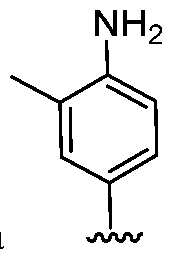 .
.
[00070] In certain embodiments, Ring A is optionally substituted five-membered heteroaryl. In certain embodiments, Ring A is optionally substituted five-membered heteroaryl with one heteroatom selected from the group consisting of O, S, and N. In certain embodiments, Ring A is optionally substituted five-membered heteroaryl with two heteroatoms selected from the group consisting of O, S, and N. In certain embodiments, Ring A is one of the following formulae:

wherein
each instance of is independently hydrogen, halogen, optionally substituted Ci alkyl, optionally substituted Cj- carbocyclyl, optionally substituted phenyl, optionally substituted four-, five-, or six-membered heterocyclyl, optionally substituted five- or six-membered heteroaryl, optionally substituted acyl, -CN, -ORAO, or -N(RAN)2;
each instance of RAO is independently hydrogen, optionally substituted alkyl, optionally substituted carbocyclyl, optionally substituted aryl, optionally substituted heterocyclyl, optionally substituted heteroaryl, or an oxygen protecting group; and
each instance of R1^ and is independently hydrogen, optionally substituted alkyl, optionally substituted carbocyclyl, optionally substituted aryl, optionally substituted heterocyclyl, optionally substituted heteroaryl, optionally substituted acyl, or a nitrogen protecting group, or two RRAN are taken with the intervening nitrogen to form an optionally substituted heterocyclyl, or two R^ are taken with the intervening nitrogen to form an optionally substituted heterocyclyl; and
nl is 0, 1 or 2.
[00071] In certain embodiments, nl is 0. In certain embodiments, nl is 1. In certain embodiments, nl is 2.
[00072] As generally defined herein, each instance of RRA is independently hydrogen, halogen, optionally substituted Ci_6 alkyl, optionally substituted carbocyclyl, optionally substituted phenyl, optionally substituted four-, five-, or six-membered heterocyclyl, optionally substituted five- or six-membered heteroaryl, optionally substituted acyl, -CN, - ORAO, or -N(RAN)2. In certain embodiments, RRA is hydrogen. In certain embodiments, R1^ is
RA RA
halogen. In certain embodiments, R is -F, -CI, -Br, or -I. In certain embodiments, R is - CN. In certain embodiments, RRA is optionally substituted Ci_6 alkyl. In certain embodiments, is unsubstituted Ci_6 alkyl. In certain embodiments, RRA is methyl, ethyl, n-propyl, iso-
RA
propyl, n-butyl, iso-butyl, or tert-butyl. In certain embodiments, R is substituted Ci_6 alkyl. In certain embodiments, RRA is -CF3, -CHF2, or -CH2F. In certain embodiments, is optionally substituted acyl. In certain embodiments, RRA is acetyl. In certain embodiments, is -C(=0)NH2.
[00073] In certain embodiments, RRA is -ORAO, wherein each instance of RAO is independently hydrogen, optionally substituted alkyl, optionally substituted carbocyclyl, optionally substituted aryl, optionally substituted heterocyclyl, optionally substituted heteroaryl, or an oxygen protecting group. In certain embodiments, RRA is -OH. In some embodiments, RRA is -ORAO, wherein RAO is independently optionally substituted Ci_6 alkyl, optionally substituted C3-6 carbocyclyl, optionally substituted aryl, optionally substituted heterocyclyl, optionally substituted heteroaryl, or an oxygen protecting group. In certain embodiments, RRA is -ORAO, wherein RAO is optionally substituted Ci_6 alkyl. In certain embodiments, RRA is -ORAO, wherein RAO is unsubstituted Ci_6 alkyl. In certain
embodiments, RRA is -O-methyl, -O-ethyl, -O-propyl, or -O-isopropyl. In certain embodiments, RRA is -ORAO, wherein RAO is optionally substituted heterocyclyl. In certain embodiments, RRA is -ORAO, wherein RAO is optionally substituted aryl. In certain embodiments, RRA is -O-phenyl. In certain embodiments, RRA is -ORAO, wherein RAO is
optionally substituted heteroaryl. In certain embodiments, R1^ is -ORAO, wherein RAO is an oxygen protecting group. In certain embodiments, RRA is -ORAO, wherein RAO is Ac, Boc, TBS, TIPS, Bn, or Bz.
[00074] In certain embodiments, RRA is -N(R each instance of R^ is independently hydrogen, optionally substituted alkyl, optionally substituted carbocyclyl, optionally substituted aryl, optionally substituted heterocyclyl, optionally substituted heteroaryl, optionally substituted acyl, a nitrogen protecting group, or two RRAN are taken with the intervening nitrogen to form an optionally substituted heterocyclyl. In certain embodiments, is -N(R wherein each instance of R^ is independently hydrogen, optionally substituted alkyl, optionally substituted acyl, or a nitrogen protecting group. In certain embodiments, RRAis In some embodiments, is -N(R In certain embodiments, is -NHR^, wherein R^ is optionally substituted alkyl, optionally substituted carbocyclyl, optionally substituted aryl, optionally substituted heterocyclyl, optionally substituted heteroaryl, optionally substituted acyl, or a nitrogen protecting group. In certain embodiments, RRA is -NHR^, wherein R^ is optionally substituted Ci alkyl. In certain embodiments, RRA is -NHR^, wherein R^ is unsubstituted Ci alkyl. In certain
embodiments, RRA is -NH-methyl, -NH-ethyl, -NH-«-propyl, or -NH-wo-propyl. In certain embodiments, RRA is -NHR^, wherein R^ is a nitrogen protecting group. In certain embodiments, RRA is In certain embodiments, two RRAN are taken with the intervening nitrogen to form an optionally substituted heterocyclyl. In certain embodiments, two RAN are taken with the intervening nitrogen to form an optionally substituted four-, five-,
or six-membered heterocyclyl. In certain embodiments, R is □ < " , , or ·~ί~ .
[00075] In certain embodiments, RRA is of the formula
 is independently optionally substituted Ci alkyl, optionally substituted C3-6 carbocyclyl, optionally substituted phenyl, optionally substituted five- or six-membered heterocyclyl, optionally substituted five- or six-membered heteroaryl, -ORA, or -N(R In certain embodiments, R1^1 is independently optionally substituted Ci alkyl. In certain embodiments,
R is unsubstituted Ci alkyl. In certain embodiments, R is methyl, ethyl, n-propyl, iso- propyl, n-butyl, iso-butyl, or tert-butyl. In certain embodiments, RRA1 is substituted Ci alkyl. In certain embodiments, RRA1 is -CH2C1, -CHC12, -CHF2, -CH2F, or -CF3. In certain
embodiments, R is optionally substituted C3_6 carbocyclyl. In certain embodiments, R is cyclopropyl, cyclobutyl, cyclopentyl, or cyclohexyl. In certain embodiments, R^1 is optionally substituted phenyl. In certain embodiments, R^1 is phenyl. In certain embodiments, R RAl is substituted phenyl. In certain embodiments, R RAl is optionally substituted five- or six-membered heterocyclyl. In certain embodiments, R^1 is optionally substituted five-membered heterocyclyl. In certain embodiments, R^1 is optionally substituted six-membered heterocyclyl. In certain embodiments, RRA1 is optionally substituted five- or six-membered heteroaryl. In certain embodiments, RRA1 is optionally substituted five-membered heteroaryl. In certain embodiments, RRA1 is optionally substituted six-membered heteroaryl. In certain embodiments, R^1 is optionally substituted pyridine. In certain embodiments, R^1 is pyridine.
[00076] In certain embodiments, RRA is optionally substituted four-, five-, or six- membered heterocyclyl. In certain embodiments, R^ is optionally substituted four- membered heterocyclyl. In certain embodiments, R^ is optionally substituted four-
RA
membered heterocyclyl with one N, S, and O. In certain embodiments, R is optionally substituted five-membered heterocyclyl. In certain embodiments, R^ is optionally substituted five-membered heterocyclyl with one or two heteroatoms each independently
RA
selected from the group consisting of N, S, and O. In certain embodiments, R is optionally substituted six-membered heterocyclyl. In certain embodiments, RRA is optionally substituted six-membered heterocyclyl with one or two heteroatoms each independently selected from the group consisting of N, S, and O.
[00077] In certain embodiments, RRA is optionally substituted five- or six-membered heteroaryl. In certain embodiments, RRA is optionally substituted five-membered heteroaryl.
RA
In certain embodiments, R is optionally substituted five-membered heteroaryl with one N, O, or S. In certain embodiments, R^ is optionally substituted five-membered heteroaryl with two heteroatoms each independently selected from the group consisting of N, S, or O. In
RA
certain embodiments, R is optionally substituted six-membered heteroaryl. In certain embodiments, RRA is optionally substituted six-membered heteroaryl with one N, O, or S. In certain embodiments, R^ is optionally substituted six-membered heteroaryl with two heteroatoms each independently selected from the group consisting of N, S, or O. In certain embodiments, RRA is substituted pyridine. In certain embodiments, RRA is pyridine.
[00078] In certain embodiments of Ring A being optionally substituted five-membered heteroaryl, RRA is -N(RAN)2, -NHR^, or -NHC(=0)RAN1. In certain embodiments, RRA is - NH2, -NHAc, or -NHC(=0)-cyclopropyl.
[00079] In certain embodiments, Ring A is one of the following formulae:

[00080] In certain embodiments, Ring A is optionally substituted six-membered heteroaryl. In certain embodiments, Ring A is is optionally substituted six-membered heteroaryl with one or two N. In certain embodiments, Ring A is one of the following formulae:

[00081] As generally used herein, each instance of n2 is independently 0 or an integer of 1 to 4, inclusive. In certain embodiments, n2 is 0. In certain embodiments, n2 is 1. In certain embodiments, n2 is 2. In certain embodiments, n2 is 3. In certain embodiments, n2 is 4.
[00082] In certain embodiments wherein Ring A is optionally substituted six-membered heteroaryl, RRA is -N(RAN)2, -NHR^, or -NHC(=0)RAN1, wherein each instance of R^1 is independently hydrogen, o optionally substituted alkyl, optionally substituted carbocyclyl,
optionally substituted aryl, optionally substituted heterocyclyl, or optionally substituted heteroaryl.
[00083] As generally defined herein, each instance of RRN1 is independently hydrogen, optionally substituted alkyl, optionally substituted carbocyclyl, optionally substituted aryl, optionally substituted heterocyclyl, or optionally substituted heteroaryl. In certain embodiments, RRN1 is hydrogen. In certain embodiments, R1^1 is optionally substituted alkyl. In certain embodiments, RRN1 is optionally substituted Ci_6 alkyl. In certain embodiments, R1^1 is unsubstituted Ci_6 alkyl. In certain embodiments, RRN1 is methyl, ethyl, n-propyl, iso- propyl, n-butyl, iso-butyl, or tert-butyl. In certain embodiments, RRN1 is substituted Ci-6 alkyl. In certain embodiments, RRN1 is -CH2C1, -CHC12, -CHF2, -CH2F or -CF3. In certain embodiments, RRN1 is optionally substituted carbocyclyl. In certain embodiments, R1^1 is optionally substituted C3_6 carbocyclyl. In certain embodiments, RRN1 is cycloproyl, cyclobutyl, cyclopentyl, or cyclohexyl. In certain embodiments, RRN1 is optionally substituted aryl. In certain embodiments, RRN1 is optionally substituted phenyl. In certain embodiments, R1^1 is phenyl. In certain embodiments, R1^1 is substituted phenyl. In certain embodiments, R1^1 is optionally substituted heterocyclyl. In certain embodiments, R1^1 is optionally substituted five- or six-membered heterocyclyl. In certain embodiments, R1^1 is optionally substituted heteroaryl. In certain embodiments, R1^1 is optionally substituted five- or six- membered heteroaryl.
[00084] In certain embodiments of Ring A being optionally substituted six-membered heteroaryl, RRA is one of the following formulae: -CN, -F, -CI, -CH3, -NH2, -NHCH3, - N(C2H5)2, -NHAc, -N(CH3)Ac, -NHC(=0)-cyclopropyl, or -C(=0)CH3.
ae:


wherein
each instance of R1^1 and R^1 is independently hydrogen, optionally substituted alkyl, optionally substituted carbocyclyl, optionally substituted aryl, optionally substituted heterocyclyl, or optionally substituted heteroaryl.
[00086] As generally defined herein, each instance of RRA1 is independently hydrogen, optionally substituted alkyl, optionally substituted carbocyclyl, optionally substituted aryl, optionally substituted heterocyclyl, or optionally substituted heteroaryl. In certain embodiments, R RAl is hydrogen. In certain embodiments, R RAl is optionally substituted alkyl. In certain embodiments, RRA1 is optionally substituted Ci_6 alkyl. In certain embodiments, R1^1 is unsubstituted Ci_6 alkyl. In certain embodiments, RRA1 is methyl, ethyl, n-propyl, iso- propyl, n-butyl, iso-butyl, or tert-butyl. In certain embodiments, RRA1 is substituted Ci-6 alkyl. In certain embodiments, RRA1 is -CH2C1, -CHC12, -CHF2, -CH2F or -CF3. In certain embodiments, R RAl is optionally substituted carbocyclyl. In certain embodiments, R RAl is optionally substituted C3_6 carbocyclyl. In certain embodiments, RRA1 is cycloproyl, cyclobutyl, cyclopentyl, or cyclohexyl. In certain embodiments, RRA1 is optionally substituted aryl. In certain embodiments, RRA1 is optionally substituted phenyl. In certain embodiments,
R RAl is phenyl. In certain embodiments, R RAl is substituted phenyl. In certain embodiments,
R RAl is optionally substituted heterocyclyl. In certain embodiments, R RAl is optionally substituted five- or six-membered heterocyclyl. In certain embodiments, R1^1 is optionally substituted heteroaryl. In certain embodiments, R1^1 is optionally substituted five- or six- membered heteroaryl.


[00088] In certain embodiments, Ring A is optionally substituted 5,6- or 6,6-bicyclic heteroaryl. In certain embodiments, Ring A is optionally substituted 5,6- or 6,6-bicyclic heteroaryl with one, two, or three N. In certain embodiments, Ring A is one of the following formulae:

wherein RRA is as defined herein; each instance of n3 is independently 0 or an integer of 1 to
6, inclusive, as valency permits.
[00089] As generally used herein, each instance of n3 is independently 0 or an integer of 1 to 6, inclusive, as valency permits. In certain embodiments, n3 is 0. In certain embodiments, n3 is 1. In certain embodiments, n3 is 2. In certain embodiments, n3 is 3. In certain embodiments, n3 is 4. In certain embodiments, n3 is 5. In certain embodiments, n3 is 6. In certain embodiments, n3 is an integer of 1 to 6, inclusive, as valency permits. In certain embodiments, n3 is 1 or 2 as valency permits.

[00091] In certain embodiments when Ring A is optionally substituted 5,6- or 6,6-bicyclic heteroaryl, at least one instance of R^ is hydrogen, halogen, optionally substituted Ci_6 alkyl, -N(RAN)2, -NHR^, -NHC(=0)RAN1, -ORAO, optionally substituted carbocyclyl, or optionally substituted phenyl, wherein R^, RAO and R^1 are as define herein. In certain embodiments,
R RA is hydrogen. In certain embodiments, R RA is halogen. In certain embodiments, R RA is F. In certain embodiments, RRA is CI. In certain embodiments, RRA is Br. In certain
embodiments, RRA is I. In certain embodiments, RRA is optionally substituted Ci_6 alkyl. In certain embodiments, R^ is substituted Ci_6 alkyl. In certain embodiments, RRA is unsubstituted Ci_6 alkyl. In certain embodiments, R^ is methyl, ethyl, n-propyl, or iso-propyl.
[00092] In certain embodiments when Ring A is optionally substituted 5,6- or 6,6-bicyclic heteroaryl, at least one instance of R^ is -N(RAN)2, -NHR^, -NHC(=0)RAN1, -ORAO, optionally substituted carbocyclyl, or optionally substituted phenyl, wherein R^, RAO and R^1 are as define herein.
[00093] In certain embodiments when Ring A is optionally substituted 5,6- or 6,6-bicyclic is optionally substituted phenyl of the formula:

wherein
each instance of R is independently hydrogen, halogen, -CN, optionally substituted alkyl, optionally substituted carbocyclyl, optionally substituted aryl, optionally substituted heterocyclyl, optionally substituted heteroaryl, or optionally substituted acyl; and
p is an integer of 1 to 5, inclusive.
[00094] As generally used herein, p is an integer of 1 to 5, inclusive, as valency permits. In certain embodiments, p is 1. In certain embodiments, p is 2. In certain embodiments, p is 3. In certain embodiments, p is 4. In certain embodiments, p is 5.
[00095] As generally used herein, each instance of is independently hydrogen, halogen, -CN, optionally substituted alkyl, optionally substituted carbocyclyl, optionally substituted aryl, optionally substituted heterocyclyl, optionally substituted heteroaryl, or optionally substituted acyl. In certain embodiments, is hydrogen. In certain embodiments, R^ is CN. In certain embodiments, R^ is halogen (e.g. F, CI, Br, or I). In certain
embodiments, R^ is optionally substituted alkyl. In certain embodiments, R^ is substituted Ci_6 alkyl. In certain embodiments, R^ is unsubstituted Ci_6 alkyl. In certain embodiments, R^ is methyl, ethyl, n-propyl, or iso-propyl. In certain embodiments, R^ is optionally substituted acyl of the formula -C(=0)RAP1, wherein R^1 is independently optionally substituted alkyl, optionally substituted carbocyclyl, optionally substituted aryl, optionally
AP
substituted heterocyclyl, or optionally substituted heteroaryl. In certain embodiments, R is optionally substituted acyl of the formula -C(=0)RAP1, wherein R^1 is optionally substituted heterocyclyl. In certain embodiments, R^ is optionally substituted five-membered
AP
heterocyclyl having one N, O, or S. In certain embodiments, R is optionally substituted five-membered heterocyclyl having two heteroatoms ech independently selected from the group consisting of N, O, and S.~ In certain embodiments, R^ is optionally substituted six-
AP
membered heterocyclyl having one N, O, or S. In certain embodiments, R is optionally substituted six-membered heterocyclyl having two heteroatoms ech independently selected from the group consisting of N, O, and S.
[00096] In certain embodiments when Ring A is optionally substituted 5,6- or 6,6-bicyclic heteroaryl, each instance of is independently -CN, -F, -CI, -CH3, -C2H5, -!Pr, -Ph,
 -0!Pr, -OCH3, -OC2H5, -NH2, -NHCH2 !Pr, -N(CH3)2, -NHCH3, -N(C2H5)2, -NH-(CH2)3-OH, -
N(CH3)-(CH2)2-OCH3,
-0!Pr, -OCH3, -OC2H5, -NH2, -NHCH2 !Pr, -N(CH3)2, -NHCH3, -N(C2H5)2, -NH-(CH2)3-OH, -
N(CH3)-(CH2)2-OCH3,


[00097] In certain embodiments, Ring A is optionally substituted 5,6- or 6,6-bicyclic heterocycle. In certain embodiments, Ring A is optionally substituted 5,6- or 6,6-bicyclic heterocycle with one, two, or three N. In certain embodiments, Ring A is one of the following formulae:
 is as defined herein; and each instance of n4 is independently 0 or an integer of 1 to 6, inclusive, as valency permits. In certain embodiments, n4 is 0. In certain embodiments, n4 is 1. In certain embodiments, n4 is 2. In certain embodiments, n4 is 3. In certain embodiments, n4 is 4. In certain embodiments, n4 is 5. In certain embodiments, n4 is 6.
[00098] In certain embodiments, Ring A is of the formula
 or
or
[00099] As generally defined herein, Ring B is optionally substituted phenyl, optionally substituted five-membered heteroaryl, optionally substituted six-membered heteroaryl, or optionally substituted 5,6-bicyclic heteroaryl.
[000100] In certain embodiments, Rin B is optionall substituted phenyl of the formula:

wherein
each instance of RRB is independently hydrogen, halogen, or optionally substituted Ci_6 alkyl; a indicates the point of attachment to alkynyl;
I indicates the point of attachment to L; and
ml is 1 , 2, 3, or 4.
[000101] As generally used herein, ml is 1, 2, 3, or 4. In certain embodiments, ml is 1. In certain embodiments, ml is 2. In certain embodiments, ml is 3. In certain embodiments, ml is 4.
[000102] As generally used herein, each instance of RRB is independently hydrogen, halogen, or optionally substituted Ci_6 alkyl. In certain embodiments, RRB is hydrogen. In certain embodiments, RRB is CN. In certain embodiments, RRB is halogen (e.g. , F, CI, Br, or I). In certain embodiments, RRB is optionally substituted alkyl. In certain embodiments, RRB is substituted Ci_6 alkyl. In certain embodiments, RRB is unsubstituted Ci_6 alkyl. In certain embodiments, RRB is methyl, ethyl, n-propyl, or iso-propyl.
[000103] In certain embodiments, Ring B is of the formula:

[000104] In certain embodiments, Ring B is optionally substituted five-membered heteroaryl. In certain embodiments, Ring B is optionally substituted five-membered heteroaryl with one N, O, or S. In certain embodiments, Ring B is optionally substituted five- membered heteroaryl with two heteroatoms each independently selected from the group consisting of N, O, and S. In certain embodiments, Ring B is of one of the following formulae:

wherein R is as defined herein.
[000105] In certain embodiments, Ring B is optionally substituted six-membered heteroaryl. In certain embodiments, Ring B is optionally substituted six-membered heteroaryl with one N, O, or S. In certain embodiments, Ring B is optionally substituted six-membered heteroaryl with two heteroatoms each independently selected from the group consisting of N, O, and S. In certain embodiments, Ring B is of one of the following formulae:
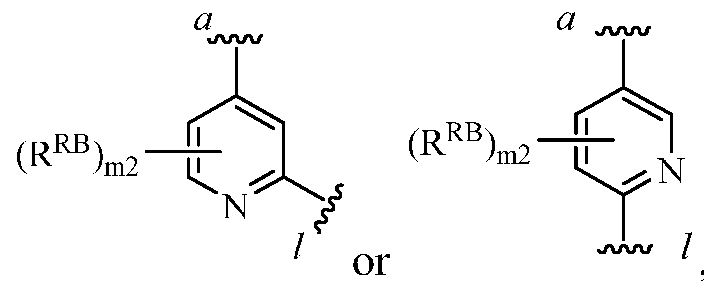
wherein
a indicates the point of attachment to alkynyl;
I indicates the point of attachment to L; and
m2 is 1, 2, or 3 and RRB is as defined herein.
[000106] As generally used herein, m2 is 1, 2, or 3. In certain embodiments, m2 is 1. In certain embodiments, m2 is 2. In certain embodiments, m2 is 3.
[000107] In certain embodiments, Ring B is optionally substituted 5,6-bicyclic heteroaryl. In certain embodiments, Ring B is optionally substituted 5,6-bicyclic heteroaryl with one N, O, or S. In certain embodiments, Ring B is optionally substituted 5,6-bicyclic heteroaryl with two heteroatoms each independently selected from the group consisting of N, O, and S.
[000108] In certain embodiments, Ring B is one of the following formulae:

[000109] As generally used herein, R is independently hydrogen, optionally substituted Ci_6 alkyl, or optionally substituted C3_6 carbocyclyl. In certain embodiments, RN1 is hydrogen. In certain embodiments, RN1 is optionally substituted Ci_6 alkyl. In certain embodiments, RN1 is unsubstituted Ci-6 alkyl. In certain embodiments, RN1 is methyl, ethyl, n-propyl, iso-propyl, n-butyl, iso-butyl, or tert-butyl. In certain embodiments, RN1 is substituted Ci_6 alkyl. In certain embodiments, RN1 is optionally substituted carbocyclyl. In certain embodiments, RN1 is optionally substituted C3_6 carbocyclyl. In certain embodiments, RN1 is cycloproyl, cyclobutyl, cyclopentyl, or cyclohexyl.
[000110] As generally used herein, RN2 is independently hydrogen, optionally substituted Ci-6 alkyl, or optionally substituted C3-6 carbocyclyl. In certain embodiments, RN2 is hydrogen.
In certain embodiments, R is optionally substituted Ci_6 alkyl. In certain embodiments, R is unsubstituted Q_6 alkyl. In certain embodiments, RN2 is methyl, ethyl, n-propyl, iso-propyl, n-butyl, iso-butyl, or tert-butyl. In certain embodiments, RN2 is substituted Ci-6 alkyl. In certain embodiments, RN2 is optionally substituted carbocyclyl. In certain embodiments, RN2 is optionally substituted carbocyclyl. In certain embodiments, RN2 is cycloproyl, cyclobutyl, cyclopentyl, or cyclohexyl.
[000111] In certain embodiments, RN1 and RN2 each are independently optionally substituted Ci_6 alkyl. In certain embodiments, RN1 and RN2 each are independently unsubstituted Ci-6 alkyl. In certain embodiments, RN1 and RN2 each are independently methyl, ethyl, n-propyl, or iso-propyl. In certain embodiments, RN1 and RN2 are the same. In certain embodiments, RN1 and RN2 are different. In certain embodiments, RN1 and RN2 are both methyl, ethyl, n-propyl, or iso-propyl.
[000112] In certain embodiments, RN1 and RN2 are taken with the intervening nitrogen to form an optionally substituted heterocyclic moiety. In certain embodiments, RN1 and RN2 are taken with the intervening nitrogen to form an optionally substituted three-, four-, five-, or six-membered heterocyclic moiety. In certain embodiments, RN1 and RN2 are taken with the intervening nitrogen to form an optionally substituted six-membered heterocyclic moiety of

the formula: , wherein R is independently hydrogen, optionally substituted Q_6 alkyl, or a nitrogen protecting group.
[000113] In certain embodiments, RN3 is hydrogen. In certain embodiments, RN3 is optionally substituted Ci-6 alkyl. In certain embodiments, RN3 is unsubstituted Ci-6 alkyl. In certain embodiments, RN3 is methyl, ethyl, n-propyl, or iso-propyl. In certain embodiments, RN3 is substituted Ci-6 alkyl. In certain embodiments, RN3 is a nitrogen protecting group. In certain embodiments, RN3 is Bn, Bz, or Boc.
[000114] In certain embodiments, RN1 and RN2 are taken with the intervening nitrogen to form an optionally substituted four-membered heterocyclic moiety. In certain embodiments, RN1 and RN2 are taken with the intervening nitrogen to form an optionally substituted azetidinyl moiety. In certain embodiments, RN1 and RN2 are taken with the intervening nitrogen to form one of the following formulae:
 . In certain embodiments, R and R are taken with the intervening
N
nitrogen to form a formula of
[000115] In certain embodiments, R and R are taken with the intervening nitrogen to form an optionally substituted six-membered heterocyclic moiety of the formula:

[000116] In certain embodiments, t is 1. In certain embodiments, t is 2. In certain embodiments, t is 3.
[000117] In certain embodiments, the compound of Formula (I) is of one of the following formulae:

[000118] In certain embodiments, the compound of Formula (I) is of one of the following

(I-j) (I-k) (1-1)

(I-m) (I-n) (I-o) or or a pharmaceutically acceptable salt thereof, wherein Ring A, L, and RN3 are as defined herein.
[000119] In certain embodiments, the compound of Formula (I) and (I-a) to (I-o), wherein Ring A is one of the following formulae:

wherein RRA, nl, n2, and n3 are as defined herein.
[000120] In certain embodiments, the compound of Formula (I) and (I-a) to (I-o), wherein Ring A is one of the following formulae:


wherein RRA and R^1 are as defined herein.
[000121] In certain embodiments, the compound of Formula (I) and (I-a) to (I-o), wherein
Ring A is of the formula:
 , wherein RRA is as defined herein.
[000122] In certain embodiments, the compound of Formula (I) and (I-a) to (I-o), wherein
Ring A is of the formula:
 , wherein RK/Y is as defined herein.
[000123] In certain embodiments, the compound of Formula (I) and (I-a) to (I-o), wherein
Ring A is of the formula:
 , wherein RRA is as defined herein.
[000124] In certain embodiments, a provided compound is of one of the formulae in Table 1.
Table 1. Exemplified Compounds.
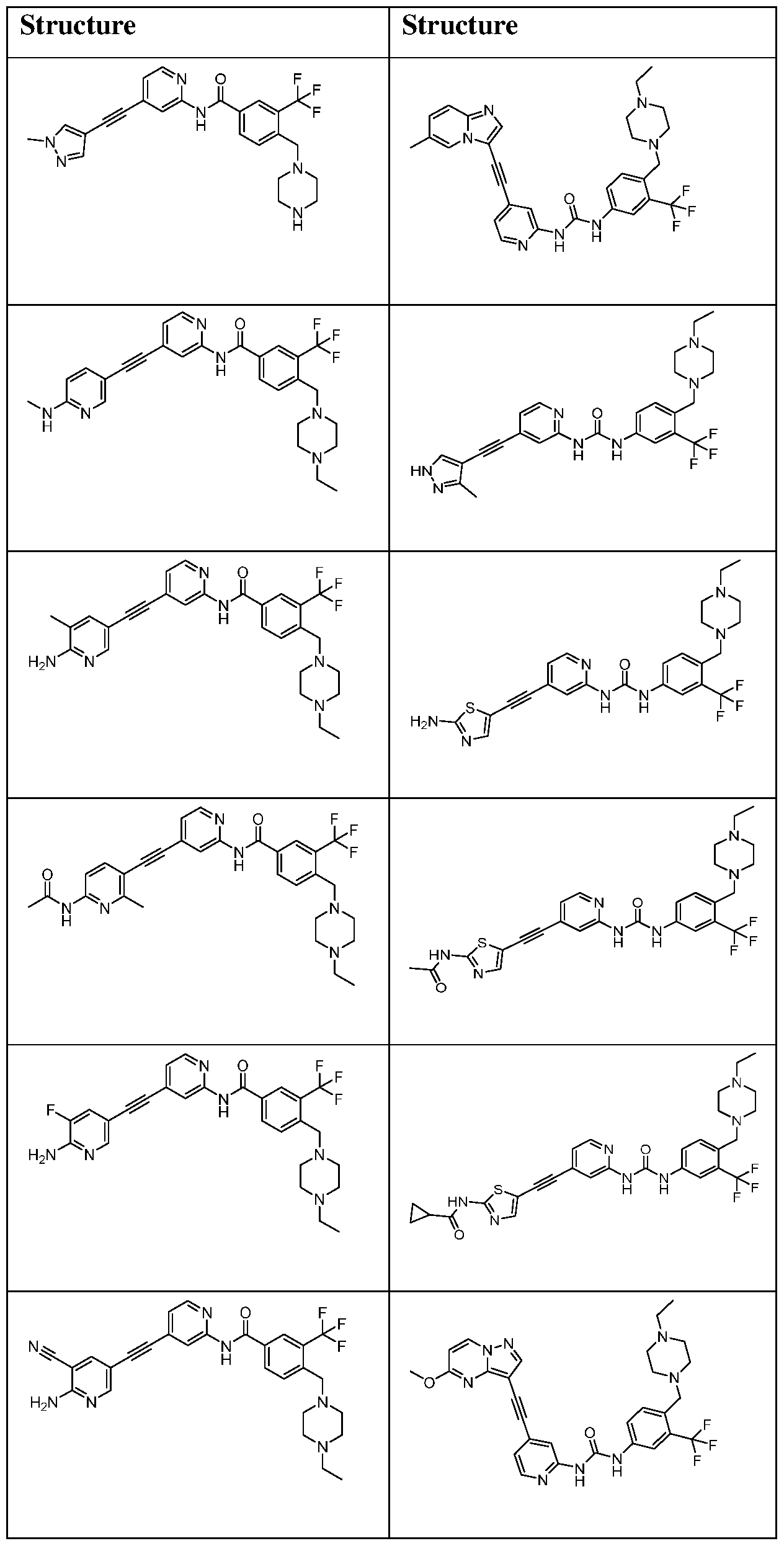
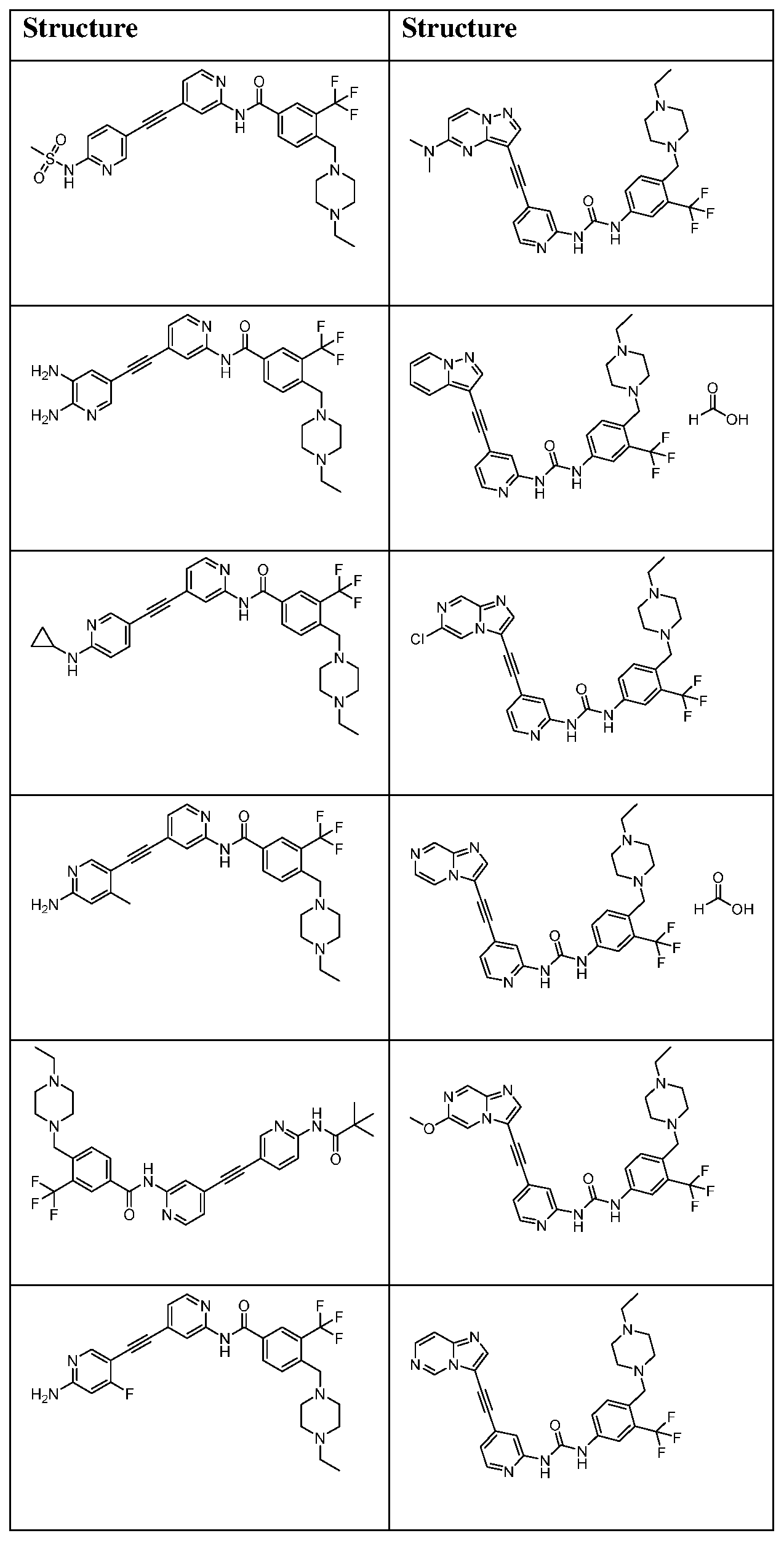


62


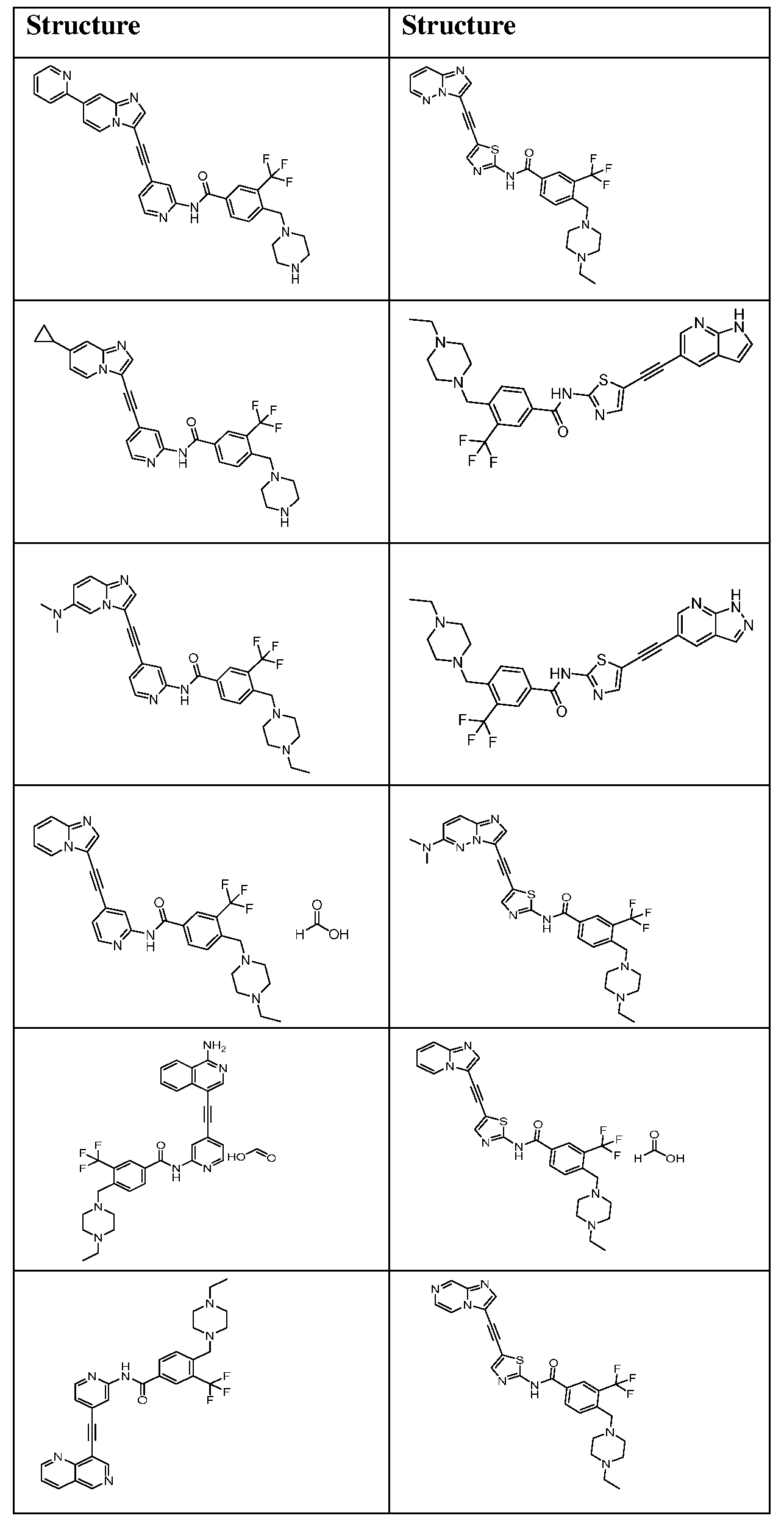


[000126] In certain embodiments, the provided compounds have the IC50S values varying from as low as approximately 7 nM to approximately 16 μΜ in the phosphorylation inhibition assay in Hela cell line. In certain embodimetns, the provided compounds have IC50S varying from as low as approximately 50 nM to approximately 10 μΜ in the phosphorylation inhibition assay in Hela cell line. In certain embodimetns, the provided compounds have the IC50S values varying from as low as approximately 100 nM to approximately 5 μΜ in the phosphorylation inhibition assay in Hela cell line. In certain embodimetns, the provided compounds have IC50S varying from as low as approximately 500 nM to approximately 1 μΜ in the phosphorylation inhibition assay in Hela cell line.
Pharmaceutical Compositions
[000127] The present invention also provides pharmaceutical compositions comprising an effective amount of a compound described herein, or a pharmaceutically acceptable form (e.g., pharmaceutically acceptable salt or prodrug) thereof, and, optionally, a
pharmaceutically acceptable excipient.
[000128] Pharmaceutically acceptable excipients include any and all solvents, diluents or other liquid vehicles, dispersion or suspension aids, surface active agents, isotonic agents, thickening or emulsifying agents, preservatives, solid binders, lubricants and the like, as suited to the particular dosage form desired. General considerations in formulation and/or manufacture of pharmaceutical compositions agents can be found, for example, in
Remington's Pharmaceutical Sciences, Sixteenth Edition, E. W. Martin (Mack Publishing Co., Easton, Pa., 1980), and Remington: The Science and Practice of Pharmacy, 21st Edition (Lippincott Williams & Wilkins, 2005).
[000129] Pharmaceutical compositions described herein can be prepared by any method known in the art of pharmacology. In general, such preparatory methods include the steps of bringing the compound of the present invention (the "active ingredient") into association with a carrier and/or one or more other accessory ingredients, and then, if necessary and/or desirable, shaping and/or packaging the product into a desired single- or multi-dose unit.
[000130] Pharmaceutical compositions can be prepared, packaged, and/or sold in bulk, as a single unit dose, and/or as a plurality of single unit doses. As used herein, a "unit dose" is discrete amount of the pharmaceutical composition comprising a predetermined amount of the active ingredient. The amount of the active ingredient is generally equal to the dosage of the active ingredient which would be administered to a subject and/or a convenient fraction of such a dosage such as, for example, one-half or one-third of such a dosage.
[000131] Relative amounts of the active ingredient, the pharmaceutically acceptable excipient, and/or any additional ingredients in a pharmaceutical composition of the invention will vary, depending upon the identity, size, and/or condition of the subject treated and further depending upon the route by which the composition is to be administered. By way of example, the composition may comprise between 0.1% and 100% (w/w) active ingredient.
[000132] Pharmaceutically acceptable excipients used in the manufacture of provided pharmaceutical compositions include inert diluents, dispersing and/or granulating agents, surface active agents and/or emulsifiers, disintegrating agents, binding agents, preservatives, buffering agents, lubricating agents, and/or oils. Excipients such as cocoa butter and suppository waxes, coloring agents, coating agents, sweetening, flavoring, and perfuming agents may also be present in the composition.
[000133] Exemplary diluents include calcium carbonate, sodium carbonate, calcium phosphate, dicalcium phosphate, calcium sulfate, calcium hydrogen phosphate, sodium phosphate lactose, sucrose, cellulose, microcrystalline cellulose, kaolin, mannitol, sorbitol, inositol, sodium chloride, dry starch, cornstarch, powdered sugar, etc., and combinations thereof.
[000134] Exemplary granulating and/or dispersing agents include potato starch, corn starch, tapioca starch, sodium starch glycolate, clays, alginic acid, guar gum, citrus pulp, agar, bentonite, cellulose and wood products, natural sponge, cation-exchange resins, calcium carbonate, silicates, sodium carbonate, cross-linked poly(vinyl-pyrrolidone) (crospovidone), sodium carboxymethyl starch (sodium starch glycolate), carboxymethyl cellulose, cross- linked sodium carboxymethyl cellulose (croscarmellose), methylcellulose, pregelatinized starch (starch 1500), microcrystalline starch, water insoluble starch, calcium carboxymethyl
cellulose, magnesium aluminum silicate (Veegum), sodium lauryl sulfate, quaternary ammonium compounds, etc., and combinations thereof.
[000135] Exemplary surface active agents and/or emulsifiers include natural emulsifiers (e.g. acacia, agar, alginic acid, sodium alginate, tragacanth, chondrux, cholesterol, xanthan, pectin, gelatin, egg yolk, casein, wool fat, cholesterol, wax, and lecithin), colloidal clays (e.g. bentonite (aluminum silicate) and Veegum (magnesium aluminum silicate)), long chain amino acid derivatives, high molecular weight alcohols (e.g. stearyl alcohol, cetyl alcohol, oleyl alcohol, triacetin monostearate, ethylene glycol distearate, glyceryl monostearate, and propylene glycol monostearate, polyvinyl alcohol), carbomers (e.g. carboxy polymethylene, poly aery lie acid, acrylic acid polymer, and carboxy vinyl polymer), carrageenan, cellulosic derivatives (e.g. carboxymethylcellulose sodium, powdered cellulose, hydroxymethyl cellulose, hydroxypropyl cellulose, hydroxypropyl methylcellulose, methylcellulose), sorbitan fatty acid esters (e.g. polyoxyethylene sorbitan monolaurate (Tween 20), polyoxyethylene sorbitan (Tween 60), polyoxyethylene sorbitan monooleate (Tween 80), sorbitan monopalmitate (Span 40), sorbitan monostearate (Span 60), sorbitan tristearate (Span 65), glyceryl monooleate, sorbitan monooleate (Span 80)), polyoxyethylene esters (e.g. polyoxyethylene monostearate (Myrj 45), polyoxyethylene hydrogenated castor oil, polyethoxylated castor oil, polyoxymethylene stearate, and Solutol), sucrose fatty acid esters, polyethylene glycol fatty acid esters (e.g. CREMOPHOR), polyoxyethylene ethers, (e.g. polyoxyethylene lauryl ether (Brij 30)), poly(vinyl-pyrrolidone), diethylene glycol monolaurate, triethanolamine oleate, sodium oleate, potassium oleate, ethyl oleate, oleic acid, ethyl laurate, sodium lauryl sulfate, Pluronic F-68, Poloxamer PI 88, cetrimonium bromide, cetylpyridinium chloride, benzalkonium chloride, docusate sodium, etc. and/or combinations thereof.
[000136] Exemplary binding agents include starch (e.g. cornstarch and starch paste), gelatin, sugars (e.g. sucrose, glucose, dextrose, dextrin, molasses, lactose, lactitol, mannitol, etc.), natural and synthetic gums (e.g. acacia, sodium alginate, extract of Irish moss, panwar gum, ghatti gum, mucilage of isapol husks, carboxymethylcellulose, methylcellulose, ethylcellulose, hydroxyethylcellulose, hydroxypropyl cellulose, hydroxypropyl
methylcellulose, microcrystalline cellulose, cellulose acetate, poly(vinyl-pyrrolidone), magnesium aluminum silicate (Veegum), and larch arabogalactan), alginates, polyethylene oxide, polyethylene glycol, inorganic calcium salts, silicic acid, polymethacrylates, waxes, water, alcohol, etc., and/or combinations thereof.
[000137] Exemplary preservatives include antioxidants, chelating agents, antimicrobial preservatives, antifungal preservatives, alcohol preservatives, acidic preservatives, and other preservatives.
[000138] Exemplary antioxidants include alpha tocopherol, ascorbic acid, acorbyl palmitate, butylated hydroxyanisole, butylated hydroxytoluene, monothioglycerol, potassium metabisulfite, propionic acid, propyl gallate, sodium ascorbate, sodium bisulfite, sodium metabisulfite, and sodium sulfite.
[000139] Exemplary chelating agents include ethylenediaminetetraacetic acid (EDTA) and salts and hydrates thereof (e.g., sodium edetate, disodium edetate, trisodium edetate, calcium disodium edetate, dipotassium edetate, and the like), citric acid and salts and hydrates thereof (e.g. , citric acid monohydrate), fumaric acid and salts and hydrates thereof, malic acid and salts and hydrates thereof, phosphoric acid and salts and hydrates thereof, and tartaric acid and salts and hydrates thereof. Exemplary antimicrobial preservatives include benzalkonium chloride, benzethonium chloride, benzyl alcohol, bronopol, cetrimide, cetylpyridinium chloride, chlorhexidine, chlorobutanol, chlorocresol, chloroxylenol, cresol, ethyl alcohol, glycerin, hexetidine, imidurea, phenol, phenoxyethanol, phenylethyl alcohol, phenylmercuric nitrate, propylene glycol, and thimerosal.
[000140] Exemplary antifungal preservatives include butyl paraben, methyl paraben, ethyl paraben, propyl paraben, benzoic acid, hydroxybenzoic acid, potassium benzoate, potassium sorbate, sodium benzoate, sodium propionate, and sorbic acid.
[000141] Exemplary alcohol preservatives include ethanol, polyethylene glycol, phenol, phenolic compounds, bisphenol, chlorobutanol, hydroxybenzoate, and phenylethyl alcohol.
[000142] Exemplary acidic preservatives include vitamin A, vitamin C, vitamin E, beta- carotene, citric acid, acetic acid, dehydroacetic acid, ascorbic acid, sorbic acid, and phytic acid.
[000143] Other preservatives include tocopherol, tocopherol acetate, deteroxime mesylate, cetrimide, butylated hydroxyanisol (BHA), butylated hydroxytoluened (BHT),
ethylenediamine, sodium lauryl sulfate (SLS), sodium lauryl ether sulfate (SLES), sodium bisulfite, sodium metabisulfite, potassium sulfite, potassium metabisulfite, Glydant Plus, Phenonip, methylparaben, Germall 115, Germaben II, Neolone, Kathon, and Euxyl. In certain embodiments, the preservative is an anti-oxidant. In other embodiments, the preservative is a chelating agent.
[000144] Exemplary buffering agents include citrate buffer solutions, acetate buffer solutions, phosphate buffer solutions, ammonium chloride, calcium carbonate, calcium
chloride, calcium citrate, calcium glubionate, calcium gluceptate, calcium gluconate, D- gluconic acid, calcium glycerophosphate, calcium lactate, propanoic acid, calcium levulinate, pentanoic acid, dibasic calcium phosphate, phosphoric acid, tribasic calcium phosphate, calcium hydroxide phosphate, potassium acetate, potassium chloride, potassium gluconate, potassium mixtures, dibasic potassium phosphate, monobasic potassium phosphate, potassium phosphate mixtures, sodium acetate, sodium bicarbonate, sodium chloride, sodium citrate, sodium lactate, dibasic sodium phosphate, monobasic sodium phosphate, sodium phosphate mixtures, tromethamine, magnesium hydroxide, aluminum hydroxide, alginic acid, pyrogen-free water, isotonic saline, Ringer' s solution, ethyl alcohol, etc., and combinations thereof.
[000145] Exemplary lubricating agents include magnesium stearate, calcium stearate, stearic acid, silica, talc, malt, glyceryl behanate, hydrogenated vegetable oils, polyethylene glycol, sodium benzoate, sodium acetate, sodium chloride, leucine, magnesium lauryl sulfate, sodium lauryl sulfate, etc., and combinations thereof.
[000146] Exemplary natural oils include almond, apricot kernel, avocado, babassu, bergamot, black current seed, borage, cade, camomile, canola, caraway, carnauba, castor, cinnamon, cocoa butter, coconut, cod liver, coffee, corn, cotton seed, emu, eucalyptus, evening primrose, fish, flaxseed, geraniol, gourd, grape seed, hazel nut, hyssop, isopropyl myristate, jojoba, kukui nut, lavandin, lavender, lemon, litsea cubeba, macademia nut, mallow, mango seed, meadowfoam seed, mink, nutmeg, olive, orange, orange roughy, palm, palm kernel, peach kernel, peanut, poppy seed, pumpkin seed, rapeseed, rice bran, rosemary, safflower, sandalwood, sasquana, savoury, sea buckthorn, sesame, shea butter, silicone, soybean, sunflower, tea tree, thistle, tsubaki, vetiver, walnut, and wheat germ oils.
Exemplary synthetic oils include, but are not limited to, butyl stearate, caprylic triglyceride, capric triglyceride, cyclomethicone, diethyl sebacate, dimethicone 360, isopropyl myristate, mineral oil, octyldodecanol, oleyl alcohol, silicone oil, and combinations thereof.
[000147] Liquid dosage forms for oral and parenteral administration include
pharmaceutically acceptable emulsions, microemulsions, solutions, suspensions, syrups and elixirs. In addition to the active ingredients, the liquid dosage forms may comprise inert diluents commonly used in the art such as, for example, water or other solvents, solubilizing agents and emulsifiers such as ethyl alcohol, isopropyl alcohol, ethyl carbonate, ethyl acetate, benzyl alcohol, benzyl benzoate, propylene glycol, 1 ,3-butylene glycol, dimethylformamide, oils (e.g., cottonseed, groundnut, corn, germ, olive, castor, and sesame oils), glycerol, tetrahydrofurfuryl alcohol, polyethylene glycols and fatty acid esters of sorbitan, and
mixtures thereof. Besides inert diluents, the oral compositions can include adjuvants such as wetting agents, emulsifying and suspending agents, sweetening, flavoring, and perfuming agents. In certain embodiments for parenteral administration, the conjugates of the invention are mixed with solubilizing agents such as CREMOPHOR, alcohols, oils, modified oils, glycols, polysorbates, cyclodextrins, polymers, and combinations thereof.
[000148] Injectable preparations, for example, sterile injectable aqueous or oleaginous suspensions can be formulated according to the known art using suitable dispersing or wetting agents and suspending agents. The sterile injectable preparation can be a sterile injectable solution, suspension or emulsion in a nontoxic parenterally acceptable diluent or solvent, for example, as a solution in 1,3-butanediol. Among the acceptable vehicles and solvents that can be employed are water, Ringer's solution, U.S. P. and isotonic sodium chloride solution. In addition, sterile, fixed oils are conventionally employed as a solvent or suspending medium. For this purpose any bland fixed oil can be employed including synthetic mono- or diglycerides. In addition, fatty acids such as oleic acid are used in the preparation of injectables.
[000149] The injectable formulations can be sterilized, for example, by filtration through a bacterial-retaining filter, or by incorporating sterilizing agents in the form of sterile solid compositions which can be dissolved or dispersed in sterile water or other sterile injectable medium prior to use.
[000150] In order to prolong the effect of a drug, it is often desirable to slow the absorption of the drug from subcutaneous or intramuscular injection. This can be accomplished by the use of a liquid suspension of crystalline or amorphous material with poor water solubility. The rate of absorption of the drug then depends upon its rate of dissolution which, in turn, may depend upon crystal size and crystalline form. Alternatively, delayed absorption of a parenterally administered drug form is accomplished by dissolving or suspending the drug in an oil vehicle.
[000151] Compositions for rectal or vaginal administration are typically suppositories which can be prepared by mixing the conjugates of this invention with suitable non-irritating excipients or carriers such as cocoa butter, polyethylene glycol or a suppository wax which are solid at ambient temperature but liquid at body temperature and therefore melt in the rectum or vaginal cavity and release the active ingredient.
[000152] Solid dosage forms for oral administration include capsules, tablets, pills, powders, and granules. In such solid dosage forms, the active ingredient is mixed with at least one inert, pharmaceutically acceptable excipient or carrier such as sodium citrate or
dicalcium phosphate and/or a) fillers or extenders such as starches, lactose, sucrose, glucose, mannitol, and silicic acid, b) binders such as, for example, carboxymethylcellulose, alginates, gelatin, polyvinylpyrrolidinone, sucrose, and acacia, c) humectants such as glycerol, d) disintegrating agents such as agar, calcium carbonate, potato or tapioca starch, alginic acid, certain silicates, and sodium carbonate, e) solution retarding agents such as paraffin, f) absorption accelerators such as quaternary ammonium compounds, g) wetting agents such as, for example, cetyl alcohol and glycerol monostearate, h) absorbents such as kaolin and bentonite clay, and i) lubricants such as talc, calcium stearate, magnesium stearate, solid polyethylene glycols, sodium lauryl sulfate, and mixtures thereof. In the case of capsules, tablets and pills, the dosage form may comprise buffering agents.
[000153] Solid compositions of a similar type can be employed as fillers in soft and hard- filled gelatin capsules using such excipients as lactose or milk sugar as well as high molecular weight polyethylene glycols and the like. The solid dosage forms of tablets, dragees, capsules, pills, and granules can be prepared with coatings and shells such as enteric coatings and other coatings well known in the pharmaceutical formulating art. They may optionally comprise opacifying agents and can be of a composition that they release the active ingredient(s) only, or preferentially, in a certain part of the intestinal tract, optionally, in a delayed manner. Examples of embedding compositions which can be used include polymeric substances and waxes. Solid compositions of a similar type can be employed as fillers in soft and hard-filled gelatin capsules using such excipients as lactose or milk sugar as well as high molecular weight polethylene glycols and the like.
[000154] The active ingredients can be in micro-encapsulated form with one or more excipients as noted above. The solid dosage forms of tablets, dragees, capsules, pills, and granules can be prepared with coatings and shells such as enteric coatings, release controlling coatings and other coatings well known in the pharmaceutical formulating art. In such solid dosage forms the active ingredient can be admixed with at least one inert diluent such as sucrose, lactose or starch. Such dosage forms may comprise, as is normal practice, additional substances other than inert diluents, e.g., tableting lubricants and other tableting aids such a magnesium stearate and microcrystalline cellulose. In the case of capsules, tablets and pills, the dosage forms may comprise buffering agents. They may optionally comprise opacifying agents and can be of a composition that they release the active ingredient(s) only, or preferentially, in a certain part of the intestinal tract, optionally, in a delayed manner.
Examples of embedding compositions which can be used include polymeric substances and waxes.
[000155] Dosage forms for topical and/or transdermal administration of a compound of this invention may include ointments, pastes, creams, lotions, gels, powders, solutions, sprays, inhalants and/or patches. Generally, the active ingredient is admixed under sterile conditions with a pharmaceutically acceptable carrier and/or any needed preservatives and/or buffers as can be required. Additionally, the present invention contemplates the use of transdermal patches, which often have the added advantage of providing controlled delivery of an active ingredient to the body. Such dosage forms can be prepared, for example, by dissolving and/or dispensing the active ingredient in the proper medium. Alternatively or additionally, the rate can be controlled by either providing a rate controlling membrane and/or by dispersing the active ingredient in a polymer matrix and/or gel.
[000156] Suitable devices for use in delivering intradermal pharmaceutical compositions described herein include short needle devices such as those described in U.S. Patents 4,886,499; 5,190,521; 5,328,483; 5,527,288; 4,270,537; 5,015,235; 5,141,496; and
5,417,662. Intradermal compositions can be administered by devices which limit the effective penetration length of a needle into the skin, such as those described in PCT publication WO 99/34850 and functional equivalents thereof. Jet injection devices which deliver liquids to the dermis via a liquid jet injector and/or via a needle which pierces the stratum corneum and produces a jet which reaches the dermis are suitable. Jet injection devices are described, for example, in U.S. Patents 5,480,381 ; 5,599,302; 5,334,144;
5,993,412; 5,649,912; 5,569,189; 5,704,911 ; 5,383,851 ; 5,893,397; 5,466,220; 5,339,163; 5,312,335; 5,503,627; 5,064,413; 5,520,639; 4,596,556; 4,790,824; 4,941,880; 4,940,460; and PCT publications WO 97/37705 and WO 97/13537. Ballistic powder/particle delivery devices which use compressed gas to accelerate vaccine in powder form through the outer layers of the skin to the dermis are suitable. Alternatively or additionally, conventional syringes can be used in the classical mantoux method of intradermal administration.
[000157] Formulations suitable for topical administration include, but are not limited to, liquid and/or semi liquid preparations such as liniments, lotions, oil in water and/or water in oil emulsions such as creams, ointments and/or pastes, and/or solutions and/or suspensions. Topically-administrable formulations may, for example, comprise from about 1 % to about 10% (w/w) active ingredient, although the concentration of the active ingredient can be as high as the solubility limit of the active ingredient in the solvent. Formulations for topical administration may further comprise one or more of the additional ingredients described herein.
[000158] A pharmaceutical composition of the invention can be prepared, packaged, and/or sold in a formulation suitable for pulmonary administration via the buccal cavity. Such a formulation may comprise dry particles which comprise the active ingredient and which have a diameter in the range from about 0.5 to about 7 nanometers or from about 1 to about 6 nanometers. Such compositions are conveniently in the form of dry powders for
administration using a device comprising a dry powder reservoir to which a stream of propellant can be directed to disperse the powder and/or using a self propelling
solvent/powder dispensing container such as a device comprising the active ingredient dissolved and/or suspended in a low-boiling propellant in a sealed container. Such powders comprise particles wherein at least 98% of the particles by weight have a diameter greater than 0.5 nanometers and at least 95% of the particles by number have a diameter less than 7 nanometers. Alternatively, at least 95% of the particles by weight have a diameter greater than 1 nanometer and at least 90% of the particles by number have a diameter less than 6 nanometers. Dry powder compositions may include a solid fine powder diluent such as sugar and are conveniently provided in a unit dose form.
[000159] Low boiling propellants generally include liquid propellants having a boiling point of below 65 °F at atmospheric pressure. Generally the propellant may constitute 50 to 99.9% (w/w) of the composition, and the active ingredient may constitute 0.1 to 20% (w/w) of the composition. The propellant may further comprise additional ingredients such as a liquid non-ionic and/or solid anionic surfactant and/or a solid diluent (which may have a particle size of the same order as particles comprising the active ingredient).
[000160] Pharmaceutical compositions of the invention formulated for pulmonary delivery may provide the active ingredient in the form of droplets of a solution and/or suspension. Such formulations can be prepared, packaged, and/or sold as aqueous and/or dilute alcoholic solutions and/or suspensions, optionally sterile, comprising the active ingredient, and may conveniently be administered using any nebulization and/or atomization device. Such formulations may further comprise one or more additional ingredients including, but not limited to, a flavoring agent such as saccharin sodium, a volatile oil, a buffering agent, a surface active agent, and/or a preservative such as methylhydroxybenzoate. The droplets provided by this route of administration may have an average diameter in the range from about 0.1 to about 200 nanometers.
[000161] Formulations described herein as being useful for pulmonary delivery are useful for intranasal delivery of a pharmaceutical composition of the invention. Another formulation suitable for intranasal administration is a coarse powder comprising the active
ingredient and having an average particle from about 0.2 to 500 micrometers. Such a formulation is administered by rapid inhalation through the nasal passage from a container of the powder held close to the nares.
[000162] Formulations for nasal administration may, for example, comprise from about as little as 0.1% (w/w) and as much as 100% (w/w) of the active ingredient, and may comprise one or more of the additional ingredients described herein. A pharmaceutical composition of the invention can be prepared, packaged, and/or sold in a formulation for buccal
administration. Such formulations may, for example, be in the form of tablets and/or lozenges made using conventional methods, and may contain, for example, 0.1 to 20% (w/w) active ingredient, the balance comprising an orally dissolvable and/or degradable composition and, optionally, one or more of the additional ingredients described herein. Alternately, formulations for buccal administration may comprise a powder and/or an aerosolized and/or atomized solution and/or suspension comprising the active ingredient. Such powdered, aerosolized, and/or aerosolized formulations, when dispersed, may have an average particle and/or droplet size in the range from about 0.1 to about 200 nanometers, and may further comprise one or more of the additional ingredients described herein.
[000163] A pharmaceutical composition of the invention can be prepared, packaged, and/or sold in a formulation for ophthalmic administration. Such formulations may, for example, be in the form of eye drops including, for example, a 0.1/1.0% (w/w) solution and/or suspension of the active ingredient in an aqueous or oily liquid carrier. Such drops may further comprise buffering agents, salts, and/or one or more other of the additional ingredients described herein. Other opthalmically-administrable formulations which are useful include those which comprise the active ingredient in microcrystalline form and/or in a liposomal preparation. Ear drops and/or eye drops are contemplated as being within the scope of this invention.
[000164] Although the descriptions of pharmaceutical compositions provided herein are principally directed to pharmaceutical compositions which are suitable for administration to humans, it will be understood by the skilled artisan that such compositions are generally suitable for administration to animals of all sorts. Modification of pharmaceutical compositions suitable for administration to humans in order to render the compositions suitable for administration to various animals is well understood, and the ordinarily skilled veterinary pharmacologist can design and/or perform such modification with ordinary experimentation.
Kits
[000165] Still further encompassed by the invention are kits (e.g. , pharmaceutical packs). The kits provided may comprise an inventive pharmaceutical composition or compound and a container (e.g. , a vial, ampule, bottle, syringe, and/or dispenser package, or other suitable container). In some embodiments, provided kits may optionally further include a second container comprising a pharmaceutical excipient for dilution or suspension of an inventive pharmaceutical composition or compound. In some embodiments, the inventive
pharmaceutical composition or compound provided in the container and the second container are combined to form one unit dosage form.
[000166] Optionally, a single container may comprise one or more compartments for containing an inventive pharmaceutical composition or compound, and/or a pharmaceutically acceptable excipient for suspension or dilution. In some embodiments, a single container can be appropriate for modification such that the container may receive a physical modification so as to allow combination of compartments and/or components of individual compartments. For example, a foil or plastic bag may comprise two or more compartments separated by a perforated seal which can be broken so as to allow combination of contents of two individual compartments once the signal to break the seal is generated. A kit may thus comprise such multi-compartment containers providing an inventive pharmaceutical composition or compound and one or more pharmaceutically acceptable excipients.
[000167] Optionally, instructions for use are additionally provided in such kits of the invention. Such instructions may provide, generally, for example, instructions for dosage and administration. In other embodiments, instructions may further provide additional detail relating to specialized instructions for particular containers and/or systems for administration. Still further, instructions may provide specialized instructions for use in conjunction and/or in combination with an additional therapeutic agent.
[000168] Compounds provided herein are typically formulated in dosage unit form for ease of administration and uniformity of dosage. It will be understood, however, that the total daily usage of the compositions of the present invention will be decided by the attending physician within the scope of sound medical judgment. The specific therapeutically effective dose level for any particular subject or organism will depend upon a variety of factors including the disease, disorder, or condition being treated and the severity of the disorder; the activity of the specific active ingredient employed; the specific composition employed; the age, body weight, general health, sex and diet of the subject; the time of administration, route of administration, and rate of excretion of the specific active ingredient employed; the
duration of the treatment; drugs used in combination or coincidental with the specific active ingredient employed; and like factors well known in the medical arts.
[000169] The compounds and compositions provided herein can be administered by any route, including enteral (e.g. , oral), parenteral, intravenous, intramuscular, intra-arterial, intramedullary, intrathecal, subcutaneous, intraventricular, transdermal, interdermal, rectal, intravaginal, intraperitoneal, topical (as by powders, ointments, creams, and/or drops), mucosal, nasal, bucal, sublingual; by intratracheal instillation, bronchial instillation, and/or inhalation; and/or as an oral spray, nasal spray, and/or aerosol. Specifically contemplated routes are oral administration, intravenous administration (e.g. , systemic intravenous injection), regional administration via blood and/or lymph supply, and/or direct
administration to an affected site. In general the most appropriate route of administration will depend upon a variety of factors including the nature of the agent (e.g., its stability in the environment of the gastrointestinal tract), and/or the condition of the subject (e.g. , whether the subject is able to tolerate oral administration).
[000170] The exact amount of a compound required to achieve an effective amount will vary from subject to subject, depending, for example, on species, age, and general condition of a subject, severity of the side effects or disorder, identity of the particular compound(s), mode of administration, and the like. The desired dosage can be delivered three times a day, two times a day, once a day, every other day, every third day, every week, every two weeks, every three weeks, or every four weeks. In certain embodiments, the desired dosage can be delivered using multiple administrations (e.g., two, three, four, five, six, seven, eight, nine, ten, eleven, twelve, thirteen, fourteen, or more administrations).
[000171] In certain embodiments, an effective amount of a compound for administration one or more times a day to a 70 kg adult human may comprise about 0.0001 mg to about 3000 mg, about 0.0001 mg to about 2000 mg, about 0.0001 mg to about 1000 mg, about 0.001 mg to about 1000 mg, about 0.01 mg to about 1000 mg, about 0.1 mg to about 1000 mg, about 1 mg to about 1000 mg, about 1 mg to about 100 mg, about 10 mg to about 1000 mg, or about 100 mg to about 1000 mg, of a compound per unit dosage form.
[000172] In certain embodiments, the compounds of the invention may be at dosage levels sufficient to deliver from about 0.001 mg/kg to about 100 mg/kg, from about 0.01 mg/kg to about 50 mg/kg, preferably from about 0.1 mg/kg to about 40 mg/kg, preferably from about 0.5 mg/kg to about 30 mg/kg, from about 0.01 mg/kg to about 10 mg/kg, from about 0.1 mg/kg to about 10 mg/kg, and more preferably from about 1 mg/kg to about 25 mg/kg, of subject body weight per day, one or more times a day, to obtain the desired therapeutic effect.
[000173] It will be appreciated that dose ranges as described herein provide guidance for the administration of provided pharmaceutical compositions to an adult. The amount to be administered to, for example, a child or an adolescent can be determined by a medical practitioner or person skilled in the art and can be lower or the same as that administered to an adult.
[000174] It will be also appreciated that a compound or composition, as described herein, can be administered in combination with one or more additional therapeutically active agents. The compounds or compositions can be administered in combination with additional therapeutically active agents that improve their bioavailability, reduce and/or modify their metabolism, inhibit their excretion, and/or modify their distribution within the body. It will also be appreciated that the therapy employed may achieve a desired effect for the same disorder, and/or it may achieve different effects.
[000175] The compound or composition can be administered concurrently with, prior to, or subsequent to, one or more additional therapeutically active agents. In general, each agent will be administered at a dose and/or on a time schedule determined for that agent. In will further be appreciated that the additional therapeutically active agent utilized in this combination can be administered together in a single composition or administered separately in different compositions. The particular combination to employ in a regimen will take into account compatibility of the inventive compound with the additional therapeutically active agent and/or the desired therapeutic effect to be achieved. In general, it is expected that additional therapeutically active agents utilized in combination be utilized at levels that do not exceed the levels at which they are utilized individually. In some embodiments, the levels utilized in combination will be lower than those utilized individually.
[000176] Exemplary additional therapeutically active agents include, but are not limited to, small organic molecules such as drug compounds (e.g. , compounds approved by the U.S. Food and Drug Administration as provided in the Code of Federal Regulations (CFR)), peptides, proteins, carbohydrates, monosaccharides, oligosaccharides, polysaccharides, nucleoproteins, mucoproteins, lipoproteins, synthetic polypeptides or proteins, small molecules linked to proteins, glycoproteins, steroids, nucleic acids, DNAs, RNAs, nucleotides, nucleosides, oligonucleotides, antisense oligonucleotides, lipids, hormones, vitamins, and cells. In some embodiments, an additional therapeutically active agent is a kinase inhibitor. In some embodiments, an additional kinase inhibitor is Axitinib, Crizotinib, Dasatinib, Erlotinib, Gefitinib, Imatinib, Lapatinib, Nilotinib, Pazopanib, Ruxolitinib, Sorafenib, Sunitinib, Vandetanib.
[000177] Exemplary additional therapeutically active agents include, but are not limited to, biologies such as naturla of synthetic growth hormone, natural or synthetic human insulin and its analogues, monoclonal antibodies, receptor constructs, vaccines, antibodies, blood, organs or tissues.
[000178] Compounds and compositions described herein are generally useful for the inhibition of one or more kinases. A partial, non-limiting, list of these kinases include:
receptor tyrosine kinases such as platelet-derived growth factor receptor kinase (PDGF-R), the nerve growth factor receptor, trkB, Met, and the fibroblast growth factor receptor, FGFR3; non-receptor tyrosine kinases such Abl and the fusion kinase BCR-Abl, Lck, Csk, Fes, Bmx and c-src; and serine/threonine kinases such as b-RAF, c-RAF, sgk, MAP kinases (e.g., MNK1 , MNK2, MKK4, MKK6, etc.) and SAPK2a, SAPK2 and SAPK3.
In certain embodiments, compounds and compositions described herein are generally useful for the inhibition of MNK1 and/or MNK2. In certain embodiments, compounds and compositions described herein are generally useful for the inhibition of Abelson (Abl) tyrosine kinase. In certain embodiments, the Abelson (Abl) tyrosine kinase is wild type Abl tyrosine kinase. In certain embodiments, the Abelson (Abl) tyrosine kinase is a mutant Abl tyrosine kinase. In certain embodiments, the Abelson (Abl) tyrosine kinase is a mutant Abl tyrosine kinase having a mutation selected from the group consisting of M244V, L248V, G250E, G250A, Q252H, Q252R, Y253F, Y253H, E255K, E255V, D276G, F311L, T315I, T315N, T315A, F317V, F317L, M343T, M351T, E355G, F359A, F359V, V379I, F382L, L387M, H396P, H396R, S417Y, E459K and F486S. In certain embodiments, the Abelson (Abl) tyrosine kinase is a mutant Abl tyrosine kinase having the mutation T315I. In certain embodiments, the Abelson (Abl) tyrosine kinase is a mutant Abl tyrosine kinase having the mutation E255K.
[000179] In some embodiments, methods of treating kinase -related disorder in a subject are provided which comprise administering an effective amount of a compound described herein (e.g. , a compound of Formula (I)), or a pharmaceutically acceptable form thereof), to a subject in need of treatment.
[000180] In some embodiments, methods of treating MNK1- and/or MNK2-related disorder in a subject are provided which comprise administering an effective amount of a compound described herein (e.g. , a compound of Formula (I)), or a pharmaceutically acceptable form thereof), to a subject in need of treatment. In some embodiments, methods of treating Abl- related disorder in a subject are provided which comprise administering an effective amount of a compound described herein (e.g. , a compound of Formula (I)), or a pharmaceutically
acceptable form thereof), to a subject in need of treatment. In certain embodiments, the effective amount is a therapeutically effective amount. In certain embodiments, the effective amount is a prophylactically effective amount. In certain embodiments, the subject is suffering from a MNK1 -related disorder. In certain embodiments, the subject is susceptible to a MNK1 -mediated disorder. In certain embodiments, the subject is suffering from a MNK2-related disorder. In certain embodiments, the subject is susceptible to a MNK2- mediated disorder. Exemplary MNK-related disorders include, but are not limited to, metabolic diseases such as obesity, as well as related disorders such as eating disorder, cachexia, diabetes mellitus, hypertension, coronary heart disease, hypercholesterolemia, dyslipidemia, osteoarthritis, gallstones, and sleep apnea, neurodegenerative disorders such as autism, Alzheimer's disease, and cancer such as breast, protate, hematological malignancies (e.g., CML, AML), head and neck, colon, bladder, prostatic adenocarcinoma, lung, cervical, and lymphomas. In certain embodiments, the subject is suffering from an Abl-related disorder. In certain embodiments, the subject is susceptible to a Abl-mediated disorder. In certain embodiments, the subject is suffering from a Abl-related disorder. In certain embodiments, the subject is susceptible to a Abl-mediated disorder. Exemplary Abl-mediated disorders include, but are not limited to, hematopoietic tumor, mammary cancer, uterine body cancer, uterine cervix cancer, prostatic cancer, bladder cancer, renal cancer, gastric cancer, esophageal cancer, hepatic cancer, biliary tract cancer, colon cancer, rectal cancer, pancreatic cancer, lung cancer, oral cavity and pharynx cancer, osteosarcoma, melanoma or brain neoplasm.
[000181] In some embodiments, methods of treating kinase -related disorder in a subject are provided which comprise administering an effective amount of a compound described herein (e.g. , a compound of Formula (I)) in combination with another agent, to a subject in need of treatment. In certain embodiments, the agent is a small molecule or biologic. In certain embodiments, the agent is a kinase inhibitor. In certain embodiments, the agent is a chemotherapeutic agent. In certain embodiments, the agent is a monoclonal antibody. In certain embodiments, the agent is an siRNA.
[000182] As used herein, the term "kinase-related disorder" means any disease, disorder, or other pathological condition in which a kinase (e.g., MNK1 and/or MNK2 and/or Abl) is known to play a role. In some embodiments, the present disclosure relates to treating or lessening the severity of one or more diseases in which MNK1 and/or MNK2 is known to
play a role. In some embodiments, the present disclosure relates to treating or lessening the severity of one or more diseases in which Abl tyrosine kinase is known to play a role.
[000183] In certain embodiments, the kinase-related condition is selected from the group consisting of proliferative diseases, neurodegenerative diseases, autoimmune diseases, and inflammatory diseases.
[000184] In certain embodiments, a provided compound is useful for treating a proliferative disease, e.g. , cancer. In certain embodiments, a provided compound is useful for treating a solid tumor. In certain embodiments, a provided compound is useful for treating a hematological malignancy. Exemplary cancers include, but are not limited to, acoustic neuroma; adenocarcinoma; adrenal gland cancer; anal cancer; angiosarcoma (e.g., lymphangiosarcoma, lymphangioendotheliosarcoma, hemangiosarcoma); appendix cancer; benign monoclonal gammopathy; biliary cancer (e.g., cholangiocarcinoma); bladder cancer; breast cancer (e.g., adenocarcinoma of the breast, papillary carcinoma of the breast, mammary cancer, medullary carcinoma of the breast); brain cancer (e.g., meningioma, glioblastomas, glioma (e.g., astrocytoma, oligodendroglioma), medulloblastoma); bronchus cancer; carcinoid tumor; cervical cancer (e.g., cervical adenocarcinoma); choriocarcinoma; chordoma; craniopharyngioma; colorectal cancer (e.g., colon cancer, rectal cancer, colorectal adenocarcinoma); connective tissue cancer; epithelial carcinoma; ependymoma;
endotheliosarcoma (e.g., Kaposi's sarcoma, multiple idiopathic hemorrhagic sarcoma);
endometrial cancer (e.g., uterine cancer, uterine sarcoma); esophageal cancer (e.g., adenocarcinoma of the esophagus, Barrett's adenocarinoma); Ewing sarcoma; eye cancer (e.g., intraocular melanoma, retinoblastoma); familiar hypereosinophilia; gall bladder cancer; gastric cancer (e.g., stomach adenocarcinoma); gastrointestinal stromal tumor (GIST); germ cell cancer; head and neck cancer (e.g., head and neck squamous cell carcinoma, oral cancer (e.g., oral squamous cell carcinoma), throat cancer (e.g., laryngeal cancer, pharyngeal cancer, nasopharyngeal cancer, oropharyngeal cancer)); hematopoietic cancers (e.g., leukemia such as acute lymphocytic leukemia (ALL) (e.g., B-cell ALL, T-cell ALL), acute myelocytic leukemia (AML) (e.g., B-cell AML, T-cell AML), chronic myelocytic leukemia (CML) (e.g., B-cell CML, T-cell CML), and chronic lymphocytic leukemia (CLL) (e.g., B-cell CLL, T- cell CLL)); lymphoma such as Hodgkin lymphoma (HL) (e.g., B-cell HL, T-cell HL) and non-Hodgkin lymphoma (NHL) (e.g. , B-cell NHL such as diffuse large cell lymphoma (DLCL) (e.g., diffuse large B-cell lymphoma), follicular lymphoma, chronic lymphocytic leukemia/small lymphocytic lymphoma (CLL/SLL), mantle cell lymphoma (MCL), marginal zone B-cell lymphomas (e.g., mucosa-associated lymphoid tissue (MALT) lymphomas, nodal
marginal zone B-cell lymphoma, splenic marginal zone B-cell lymphoma), primary mediastinal B-cell lymphoma, Burkitt lymphoma, lymphoplasmacytic lymphoma (i.e., Waldenstrom's macroglobulinemia), hairy cell leukemia (HCL), immunoblastic large cell lymphoma, precursor B -lymphoblastic lymphoma and primary central nervous system (CNS) lymphoma; and T-cell NHL such as precursor T-lymphoblastic lymphoma/leukemia, peripheral T-cell lymphoma (PTCL) (e.g., cutaneous T-cell lymphoma (CTCL) (e.g., mycosis fungiodes, Sezary syndrome), angioimmunoblastic T-cell lymphoma, extranodal natural killer T-cell lymphoma, enteropathy type T-cell lymphoma, subcutaneous panniculitis-like T- cell lymphoma, and anaplastic large cell lymphoma); a mixture of one or more
leukemia/lymphoma as described above; and multiple myeloma (MM)), heavy chain disease (e.g. , alpha chain disease, gamma chain disease, mu chain disease); hemangioblastoma; hypopharynx cancer; inflammatory myofibroblastic tumors; immunocytic amyloidosis; kidney cancer (e.g., nephroblastoma a.k. a. Wilms' tumor, renal cell carcinoma); liver cancer (e.g., hepatocellular cancer (HCC), malignant hepatoma); lung cancer (e.g., bronchogenic carcinoma, small cell lung cancer (SCLC), non-small cell lung cancer (NSCLC), adenocarcinoma of the lung); leiomyosarcoma (LMS); mastocytosis (e.g., systemic mastocytosis); muscle cancer; myelodysplastic syndrome (MDS); mesothelioma;
myeloproliferative disorder (MPD) e.g., polycythemia Vera (PV), essential thrombocytosis (ET), agnogenic myeloid metaplasia (AMM) a.k.a. myelofibrosis (MF), chronic idiopathic myelofibrosis, chronic myelocytic leukemia (CML), chronic neutrophilic leukemia (CNL), hypereosinophilic syndrome (HES)); neuroblastoma; neurofibroma (e.g., neurofibromatosis (NF) type 1 or type 2, schwannomatosis); neuroendocrine cancer (e.g., gastroenteropancreatic neuroendocrine tumor (GEP-NET), carcinoid tumor); osteosarcoma (e.g., bone cancer); ovarian cancer (e.g., cystadenocarcinoma, ovarian embryonal carcinoma, ovarian adenocarcinoma); papillary adenocarcinoma; pancreatic cancer (e.g., pancreatic
andenocarcinoma, intraductal papillary mucinous neoplasm (IPMN), Islet cell tumors); penile cancer (e.g., Paget's disease of the penis and scrotum); pinealoma; primitive neuroectodermal tumor (PNT); plasma cell neoplasia; paraneoplastic syndromes; intraepithelial neoplasms; prostate cancer (e.g., prostate adenocarcinoma); rectal cancer; rhabdomyosarcoma; salivary gland cancer; skin cancer [e.g., squamous cell carcinoma (SCC), keratoacanthoma (KA), melanoma, basal cell carcinoma (BCC)] ; small bowel cancer (e.g., appendix cancer); soft tissue sarcoma (e.g., malignant fibrous histiocytoma (MFH), liposarcoma, malignant peripheral nerve sheath tumor (MPNST), chondrosarcoma, fibrosarcoma, myxosarcoma); sebaceous gland carcinoma; small intestine cancer; sweat gland carcinoma; synovioma;
testicular cancer (e.g., seminoma, testicular embryonal carcinoma); thyroid cancer (e.g., papillary carcinoma of the thyroid, papillary thyroid carcinoma (PTC), medullary thyroid cancer); urethral cancer; vaginal cancer; and vulvar cancer (e.g., Paget's disease of the vulva). In certain embodiments, a provided compound is useful for treating hematopoietic tumor, breast cancer, colon cancer, lung cancer, lymphomas, mammary cancer, uterine body cancer, cervix cancer, prostatic cancer, bladder cancer, renal cancer, gastric cancer, esophageal cancer, hepatic cancer, biliary tract cancer, rectal cancer, pancreatic cancer, lung cancer, gliomas, ovarian cancer, oral cavity and pharynx cancer, osteosarcoma, melanoma or brain neoplasm.
[000185] In certain embodiments, a provided compound is useful for treating a
neurodegenerative disease. Exemplary neurodegenerative diseases include, but are not limited to, Alzheimer' s disease, Huntington's disease, progressive supranuclear palsy, corticobasal degeneration, frontotemporal lobar degeneration, Pick's disease, Parkinson's disease, Lewy body disease, and amyotropic lateral sclerosis (ALS).
[000186] In certain embodiments, a provided compound is useful for treating a
neurodevelopmental disorder. As used herein, the term "neurodevelopmental disorder" refers to impairments of the growth and development of the brain or central nervous system. A neurodevelopmental disorder also refers to a disorder of brain function that affects emotion, learning ability, self-control and memory and that unfolds as the individual grows. Disorders considered neurodevelopmental in origin, or that have neurodevelopmental consequences when they occur in infancy and childhood include, but are not limited to autism and autism spectrum disorders (e.g. Asperger syndrome or Mendelsohnn's Syndrome), fetal alcohol spectrum disorder, motor disorders (e.g. developmental coordination disorder, stereotypic movement disorder and the tic disorders including Tourette syndrome), traumatic brain injury (e.g. congenital injuries), genetic disorders (e.g. fragile-X syndrome, Neurofibromatosis, Tuberous Sclerosis, Rett's Syndrome, Timothy Syndrome, PTEN mutations, or Tourettes), Down syndrome, communication, speech and language disorders, eating disorders (e.g., anorexia nervosa and bulimia nervosa), adjustment disorder, attention-deficit/hyperactivity disorder, conduct disorder, oppositional defiant disorder, delirium, dementia, multi-infarct dementia, learning and memory disorders (e.g., amnesia and age-related memory loss). In certain embodiments, the neurodevelopmental disorder is autism.
[000187] In certain embodiments, a provided compound is useful for treating an autoimmune disease. Exemplary autoimmune diseases include, but are not limited to, rheumatoid arthritis, spondyloarthopathies, gouty arthritis, degenerative joint diseases such as
osteoarthritis, systemic lupus erythematosus, Sjogren's syndrome, ankylosing spondylitis, undifferentiated spondylitis, Behcet's disease, haemolytic autoimmune anaemias, multiple sclerosis, amyotrophic lateral sclerosis, amylosis, acute painful shoulder, psoriatic arthritis, juvenile arthritis, asthma, atherosclerosis, osteoporosis, bronchitis, tendonitis, bursitis, skin condition (e.g. , psoriasis, eczema, burns, dermatitis, pruritus (itch)), enuresis, eosinophilic disease, gastrointestinal disorder (e.g. , selected from peptic ulcers, regional enteritis, diverticulitis, gastrointestinal bleeding, eosinophilic gastrointestinal disorders (e.g. , eosinophilic esophagitis, eosinophilic gastritis, eosinophilic gastroenteritis, eosinophilic colitis), gastritis, diarrhea, gastroesophageal reflux disease (GERD), inflammatory bowel disease (IBD) (e.g. , Crohn's disease, ulcerative colitis, collagenous colitis, lymphocytic colitis, ischaemic colitis, diversion colitis, Behcet's syndrome, indeterminate colitis) and inflammatory bowel syndrome (IBS)), Still' s disease, myasthenia gravis, Hashimoto's thyroiditis, Ord's thyroiditis, Grave's disease, acute disseminated encephalomyelitis, Addison's disease, opsoclonus-myoclonus syndrome, antiphospholipid antibody syndrome, autoimmune hepatitis, celiac disease, Goodpasture's syndrome, optic neuritis, scleroderma, primary biliary cirrhosis, Reiter's syndrome, warm autoimmune hemolytic anemia, alopecia universalis, chronic fatigue, dysautonomia, neuromyotonia, vulvodynia and disorders ameliorated by a gastroprokinetic agent (e.g. , ileus, postoperative ileus and ileus during sepsis; gastroesophageal reflux disease (GERD); eosinophilic esophagitis, gastroparesis such as diabetic gastroparesis; food intolerances and food allergies and other functional bowel disorders, such as non-ulcerative dyspepsia (NUD) and non-cardiac chest pain (NCCP, including costo-chondritis)).
[000188] In certain embodiments, a provided compound is useful for treating an inflammatory disease. The term "inflammatory disease" refers to those conditions that are characterized by signs of pain (dolor, from the generation of noxious substances and the stimulation of nerves), heat (calor, from vasodilatation), redness (rubor, from vasodilatation and increased blood flow), swelling (tumor, from excessive inflow or restricted outflow of fluid), and/or loss of function (functio laesa, which can be partial or complete, temporary or permanent. Inflammation takes on many forms and includes, but is not limited to, acute, adhesive, atrophic, catarrhal, chronic, cirrhotic, diffuse, disseminated, exudative, fibrinous, fibrosing, focal, granulomatous, hyperplastic, hypertrophic, interstitial, metastatic, necrotic, obliterative, parenchymatous, plastic, productive, proliferous, pseudomembranous, purulent, sclerosing, seroplastic, serous, simple, specific, subacute, suppurative, toxic, traumatic, and/or ulcerative inflammation.
[000189] Exemplary inflammatory diseases include, but are not limited to, inflammation associated with acne, asthma, arteritis (e.g. , polyarteritis, temporal arteritis, periarteritis nodosa, Takayasu's arteritis), arthritis (e.g. , crystalline arthritis, osteoarthritis, psoriatic arthritis, gouty arthritis, reactive arthritis, rheumatoid arthritis, and Reiter's arthritis), ankylosing spondylitis, amylosis, amyotrophic lateral sclerosis, autoimmune diseases, allergies or allergic reactions, atherosclerosis, bronchitis, bursitis, chronic prostatitis, conjunctivitis, Chagas disease, chronic obstructive pulmonary disease, cermatomyositis, dry eye syndrome, diverticulitis, diabetes (e.g. , type I diabetes mellitus, type 2 diabetes mellitus), a skin condition (e.g. , psoriasis, eczema, burns, dermatitis, pruritus (itch)), endometriosis, Guillain-Barre syndrome, infection, ischaemic heart disease, Kawasaki disease,
glomerulonephritis, gingivitis, hypersensitivity, headaches (e.g. , migraine headaches, tension headaches), ileus (e.g. , postoperative ileus and ileus during sepsis), idiopathic
thrombocytopenic purpura, interstitial cystitis (painful bladder syndrome), gastrointestinal disorder (e.g. , selected from peptic ulcers, regional enteritis, diverticulitis, gastrointestinal bleeding, eosinophilic gastrointestinal disorders (e.g. , eosinophilic esophagitis, eosinophilic gastritis, eosinophilic gastroenteritis, eosinophilic colitis), gastritis, diarrhea,
gastroesophageal reflux disease (GERD), inflammatory bowel disease (IBD) (e.g. , Crohn's disease, ulcerative colitis, collagenous colitis, lymphocytic colitis, ischaemic colitis, diversion colitis, Behcet's syndrome, indeterminate colitis), inflammatory bowel syndrome (IBS), lupus, multiple sclerosis, morphea, myeasthenia gravis, myocardial ischemia, nephrotic syndrome, pemphigus vulgaris, pernicious aneaemia, peptic ulcers, polymyositis, primary biliary cirrhosis, neuroinflammation associated with brain disorders (e.g. , Parkinson's disease, Huntington's disease, and Alzheimer's disease), prostatitis, chronic inflammation associated with cranial radiation injury, pelvic inflammatory disease, reperfusion injury, regional enteritis, rheumatic fever, systemic lupus erythematosus, schleroderma, scierodoma, sarcoidosis, spondyloarthopathies, Sjogren's syndrome, thyroiditis, transplantation rejection, tendonitis, trauma or injury (e.g. , frostbite, chemical irritants, toxins, scarring, burns, physical injury), vasculitis, vitiligo and Wegener's granulomatosis. In certain embodiments, the inflammatory disorder is selected from arthritis (e.g. , rheumatoid arthritis), inflammatory bowel disease, inflammatory bowel syndrome, asthma, psoriasis, endometriosis, interstitial cystitis, prostatistis, appendicitis, Blau syndrome, blepharitis, bronchiolitis, cervicitis, cholangitis, cholecystitis, chronic recurrent multifocal osteomyelitis (CRMO), cryopyrin associated periodic syndrome (CAPS), dacryoadenitis, dermatomyositis, dry eye syndrome, encephalitis, endocarditis, endometritis, enterocolitis, epicondylitis, epididymitis, familial
cold-induced autoinflammatory syndrome, familial Mediterranean fever (FMF), fasciitis, fibrositis, hepatitis, hidradenitis suppurativa, laryngitis, mastitis, meningitis, mevalonate kinase deficiency (MKD), Muckle-Well syndrome, myelitis myocarditis, myositis, nephritis, oophoritis, orchitis, osteitis, inflammatory osteolysis, otitis, pancreatitis, parotitis, pericarditis, peritonitis, pharyngitis, pleuritis, phlebitis, pneumonitis, pneumonia, proctitis, pulmonary fibrosis, pyelonephritis, pyoderma gangrenosum and acne syndrome (PAPA), pyogenic sterile arthritis, rhinitis, salpingitis, sinusitis, stomatitis, synovitis, TNF receptor associated periodic syndrome (TRAPS), tonsillitis, undifferentiated arthropathy, uveitis, vaginitis and vulvitis. In certain embodiments, the inflammatory condition is an acute inflammatory condition (e.g., inflammation resulting from infection). In certain
embodiments, the inflammatory condition is a chronic inflammatory condition (e.g. , conditions resulting from asthma, arthritis and inflammatory bowel disease). The compounds may also be useful in treating inflammation associated with trauma and non-inflammatory myalgia. The compounds may also be useful in treating inflammation associated with cancer.
[000190] In certain embodiments, a provided compound is useful for treating or lessening the severity of hyperproliferative diseases including, but not limited to, psoriasis or smooth muscle cell proliferation including vascular proliferative disorders, atherosclerosis, and restenosis.
[000191] In certain embodiments, a provided compound is useful for treating or lessening the severity of endometriosis, uterine fibroids, endometrial hyperplasia, and benign prostate hyperplasia.
[000192] In some embodiments, a provided compound is useful for treating or lessening the severity of one or more diseases and conditions, wherein the disease or condition is selected from immune-related conditions or diseases, which include, but are not limited to transplantation, transfusion, anaphylaxis, allergies (e.g., allergies to plant pollens, latex, drugs, foods, insect poisons, animal hair, animal dander, dust mites, or cockroach calyx), hypersensitivity, allergic conjunctivitis, allergic rhinitis, and atopic dermatitis.
[000193] In some embodiments, a provided compound is useful for treating a metabolic disorder (e.g., diabetes, hyperlipidemia and obesity).
Methods of Treatment and Uses
[000194] In some embodiments, the present disclosure provides methods of inhibiting a kinase comprising contacting the kinase with an effective amount of a compound described herein (e.g., a compound of Formula (I)), or a pharmaceutically acceptable form thereof. In some embodiments, the present disclosure provides a method of inhibiting MNKl comprising
contacting MNKl with an effective amount of a compound described herein (e.g., a compound of Formula (I)), or a pharmaceutically acceptable form thereof. In some embodiments, the present disclosure provides a method of inhibiting MNK2 comprising contacting MNK2 with an effective amount of a compound described herein (e.g., a compound of Formula (I)), or a pharmaceutically acceptable form thereof. In some embodiments, the present disclosure provides a method of inhibiting Abl tyrosine kinase comprising contacting Abl-tyrosine kinase with an effective amount of a compound described herein (e.g., a compound of Formula (I)), or a pharmaceutically acceptable form thereof. The MNKl , MNK2, Abl tyrosine kinase may be purified, partially purified, isolated, or crude, and may be present in a cell, tissue, or subject. Thus, such methods encompass both inhibition of in vitro and in vivo MNKl, MNK2, or Abl-tyrosine kinase activity. In certain embodiments, the method is an in vitro method, e.g., such as an assay method. It will be understood by one of ordinary skill in the art that inhibition of MNKl , MNK2, or Abl- tyrosine kinase does not necessarily require that all of the MNKl, MNK2, or Abl-tyrosine kinase be inhibited. Exemplary levels of inhibition of MNKl , MNK2, or Abl-tyrosine kinase include at least 10% inhibition, about 10% to about 25% inhibition, about 25% to about 50% inhibition, about 50% to about 75% inhibition, at least 50% inhibition, at least 75% inhibition, about 80% inhibition, about 90% inhibition, and greater than 90% inhibition. Exemplary concentrations of the provided compounds to inhibit MNKl, MNK2, or Abl- tyrosine kinase are from about 1 nM to about 20 μΜ. In certain embodiments, the exemplary concentrations of the provided compounds to inhibit MNKl, MNK2, or Abl-tyrosine kinase are from about 1 nM to about 15 μΜ. In certain embodiments, the exemplary concentrations of the provided compounds to inhibit MNKl , MNK2, or Abl-tyrosine kinase are from about 1 nM to about 10 μΜ. In certain embodiments, the exemplary concentrations of the provided compounds to inhibit MNKl , MNK2, or Abl-tyrosine kinase are from about 1 nM to about 8 μΜ. In certain embodiments, the exemplary concentrations of the provided compounds to inhibit MNKl , MNK2, or Abl-tyrosine kinase are from about 1 nM to about 6 μΜ. In certain embodiments, the exemplary concentrations of the provided compounds to inhibit MNKl, MNK2, or Abl-tyrosine kinase are from about 1 nM to about 4 μΜ. In certain embodiments, the exemplary concentrations of the provided compounds to inhibit MNKl, MNK2, or Abl- tyrosine kinase are from about 1 nM to about 2 μΜ. In certain embodiments, the exemplary concentrations of the provided compounds to inhibit MNKl, MNK2, or Abl-tyrosine kinase are from about 1 nM to about 1 μΜ. In certain embodiments, the exemplary concentrations of the provided compounds to inhibit MNKl, MNK2, or Abl-tyrosine kinase are from about 1
nM to about 0.5 μΜ. In certain embodiments, the exemplary concentrations of the provided compounds to inhibit MNKl , MNK2, or Abl-tyrosine kinase are from about 1 nM to about 0.1 μΜ.
[000195] In some embodiments, provided is a method of inhibiting kinase activity in a subject in need thereof (e.g. , a subject diagnosed as having a kinase-related disorder) comprising administering to the subject an effective amount of a compound described herein (e.g. , a compound of Formula (I)), or a pharmaceutically acceptable form thereof, or a pharmaceutical composition thereof. In some embodiments, provided is a method of inhibiting MNKl and/or MNK2 and/or Abl-tyrosine kinase activity in a subject in need thereof (e.g. , a subject diagnosed as having a MNKl - and/or MNK2- and/or Abl-tyrosine kinase-related disorder) comprising administering to the subject an effective amount of a compound described herein (e.g. , a compound of Formula (I)), or a pharmaceutically acceptable form thereof, or a pharmaceutical composition thereof.
EXAMPLES AND EMBODIMENTS
[000196] The following examples serve to illustrate the invention without limiting the scope thereof.
Abbreviations
ACN: acetonitrile
AcOEt: ethyl acetate
AcOH: acetic acid
AUC: area under the curve
Brine: saturated aqueous solution of NaCl
cat.: catalyst
d: day(s)
DCM: dichloromethane
DIPEA: N,N-diisopropylethylamine
DMF: N,N-dimethylformamide
DMSO: dimethylsulfoxide
DMSO-d6: per-deuterated dimethylsulfoxide
dppf: 1, 1'- Bis( diphenylphosphino) ferrocene
EDCI: l-ethyl-3-(3-dimethylaminopropyl) carbodiimide)
ESI: Eiectrospray ionization
Ether: diethylether
Et3N: triethylamine
EtOH: ethanol
h: hour(s)
HATU: 2-(lH-7-Azabenzotriazol-l-yl)-l,l,3,3-tetramethyl uronium hexafluorophosphate Methanaminium
HBTU: 0-Benzotriazole-N,N,N',N'-tetramethyl-uronium-hexafluoiO-phosphate
HOBt: N-Hydroxybenzotriazole
HPLC: high pressure liquid chromatography
L: litre(s)
LC-MS: Liquid chromatography-mass spectrometry
mL: milliliter(s)
Me: methyl
MeOH: methanol
min: minute(s)
mp: melting point
MS: mass spectrometry
NBS: N-Bromosuccinimide
MS: N-iodosuccinimide
ΝΜΜ: N-methylmorpholine
NMR: Nuclear Magnetic Resonance
PdCi (dppf)2*DCM: 1 J Bis(diphersyipbo phino)ferrocei5e-paIkdH^i(iIsdich]oride dichloromet ane complex
Pd(dppf)Cl2: [1,1 '-Bis(diphenylphosphino)ferrocene]dichloropalladium(II)
Pd(PPh3)4: Teti'akis(triphenylphosphine)palladium(0)
TBAF: Tetra-butyl-ammonium iodide
THF: tetrahydrofuran
TFA: trifluoroacetic acid
TLC: thin layer chromatography
TMS: trimethylsilyl
T3P: Propylphosphonic Anhydride
Synthesis of compounds
[000197] General procedure A: To a solution of aryl halide in DMF (5.4 mL/mmol) under inert athmosphere were added the aryl alkyne (1.2 eq), Ρά(¾(ΡΡ1ΐ3)2 (0.13 eq), Cul (0.1 eq), PPI13 (0.35 eq) and DIPEA (5.4 mL/mmol). The reaction mixture was heated at 80 °C until completion of the reaction. The mixture was then concentrated under reduced pressure and the residue was purified as described.
[000198] General procedure B : To a solution of aryl halide in DMF (5.0 mL/mmol) under inert athmosphere were added the aryl alkyne (3 eq), Cul (0.15 eq), DIPEA (1.5 eq) and Pd(PPli3)4 (0.05 eq) was heated at 90 °C for 4 h under argon until completion of the reaction. The mixture was diluted with water (20 mL/mmol) and the precipitate was isolated by filtration to give the reaction crude product which was purified as described.
[000199] General procedure C:To a solution of aryl halide in DMF (9.0 mL/mmol) under inert athmosphere were successively added Pd(PPh3)4 (0.19 eq), PPI13 (0.19 eq), Cul (0.28 eq), the alkyne (2.9 eq) and DIPEA (9 mL/mmol). The reaction mixture was heated at 80 °C until completion and was diluted with water.The precipitate was isolated by filtration and was purified as described.
[000200] General procedure D: To a solution of Boc -protected derivative in
dichlorome thane (16 mL/mmol) at a temperature maintained between 0 °C and 5 °C was added TFA (6 mL/mmol). The reaction was stirred for 1 h in most cases while warming to room temperature. The reaction mixture was diluted with water (30 mLmmol) and the pH of the aqueous layer was first adjusted to approximately 9 using saturated aqueous solution of NaHCC>3. The aqeous phase was extracted with DCM (30 mL/mmol) or with a mixture of chloroform/methanol (95/5; 30 mL/mmol). The organic layer was dried over Na2S04, filtered and concentrated to afford the reaction crude product was purified as described.
Intermediates


Step 1 : Preparation of 6-chloro-3-((trimethylsilyl)ethynyl)imidazo[l,2-b]pyridazine
[000201] The title compound was prepared following general procedure B and starting from 6-chloro-3-iodoimidazo[l,2-b]pyridazine and ethynyltrimethylsilane. The reaction crude product was purified by column chromatography (silica gel, eluent: hexane/ethyl acetate 50:50) to afford 6-chloro-3-((trimethylsilyl)ethynyl)imidazo[l,2-b]pyridazine (3 g) as a yellow solid. MS (ESI) m/z 250.13 [CnH12ClN3Si+H]+.
Step 2: Preparation of 6-chloro-3-ethynylimidazo[l,2-b]pyridazine
[000202] To a solution of 6-chloro-3-((trimethylsilyl)ethynyl)imidazo[l,2-b]pyridazine (3 g, 12.04 mmol) in THF (30 mL) was added TBAF in THF (15 mL). The reaction mixture at room temperature for 3 h and was concentrated under reduced pressure to afford 6-chloro-3- ethynylimidazo[l,2-b]pyridazine (1.0 g, 47%, AUC HPLC 95%). JH NMR (400 MHz, CDC13) δ (ppm): 7.99 (s, 1H), 7.94 (d, / = 9.2 Hz, 1H), 7.14 (d, / = 9.6 Hz, 1H), 3.80 (s, 1 H); MS (ESI) m/z 178.2 [C8H4C1N3+H]+. [l,2-a]pyridine

Step 1 : Preparation of 6-bromo-3-((trimethylsilyl)ethynyl)imidazo[l,2-a]pyridine
[000203] To a solution of 6-bromo-3-iodoimidazo[l,2-a]pyridine (5 g, 15.5 mmol) and ethynyltrimethylsilane (1.67 g, 17 mmol) in MeCN (150 mL) were added TEA (50 mL), Pd(PPli3)Cl2 (326 mg, 3% mol) and Cul (147 mg, 5% mol). The mixture was stirred at room temperature for 1 h and then heated to reflux overnight under N2 atmosphere. The solvent was removed in vacuo. The residue was dissolved in DCM and washed with water. The organic layer was dried over Na2S04, filtered and concentrated to afford the crude 6-bromo- 3-((trimethylsilyl)ethynyl)imidazo[l,2-a]pyridine as a black oil which was used without further purification in the next step.
Step 2: Preparation of 6-bromo-3-ethynylimidazo[l,2-a]pyridine
[000204] A solution of crude 6-bromo-3-((trimethylsilyl)ethynyl)imidazo[l,2-a]pyridine and TBAF (5.38 g, 19.34 mmol) in a mixture of THF (60 mL) and H20 (2 mL) was stirred at room temperature for lh then was concentrated to dryness in vacuo. The residue was purified by flash column chromatography on silica gel to afford 6-bromo-3-ethynylimidazo[l,2- a]pyridine as a brown solid (2.2 g, 64% over two steps). JHNMR (CDCI3, 400 MHz) δ (ppm): 8.36 (s, 1H), 7.79 (s, 1H), 7.49 (d, / = 9.6 Hz, 1H), 7.27 (dd, / = 9.2 Hz, 0.9 Hz, 1H), 3.77 (s, 1H); LC-MS mJz 221 [C9H5BrN2 + H]+. lo[l,5-a]pyrimidine

Step 1 : Preparation 5-chloro-3-((trimethylsilyl)ethynyl)pyrazolo[l,5-a]pyrimidine
[000205] To a solution of 5-chloro-3-iodopyrazolo[l,5-a]pyrimidine (8.48 g, 30 mmol) and ethynyltrimethylsilane (2.89 g, 30 mmol) in THF (200 mL) were added K2C03 (4.6 g, 33.4 mmol), Pd(PPh3)Cl2 (640 mg, 0.9 mmol) and Cul (289 mg, 1.5 mmol) and (ra-Bu)4NI (350 mg). The mixture was stirred at 68 °C for 8 h under N2 atmosphere. The solvent was removed in vacuo and the residue was dissolved in DCM then washed with water. The organic layer was dried over Na2S04, filtered and concentrated to afford black oil which was purified by flash column chromatography on silica gel to afford the 5-chloro-3-
((trimethylsilyl)ethynyl)pyrazolo[l,5-a]pyrimidine (4.5 g, 60%) as a brown solid. JH NMR (400 MHz, CDCI3) δ (ppm): 0.29 (s, 9H) 6.84-6.88 (m, 1H) 8.23 (s, 1H) 8.51-8.57 (m, 1H) Step 2: Preparation of 5-chloro-3-ethynylpyrazolo[l,5-a]pyrimidine To a solution of 5- chloro-3-((trimethylsilyl)ethynyl)pyrazolo[l,5-a]pyrimidine (4.5 g) in a mixture of THF (80 mL) and H20 (4 mL) was added TBAF (5.6 g, 20 mmol) in one portion. The mixture was stirred at room temperature for lh. The solvent was removed in vacuo and the residue was purified by chromatography on silica gel to afford 5-chloro-3-ethynylpyrazolo[l,5- ajpyrimidine as a yellow solid (1 g, 31%). JH NMR (400 MHz, CDC13) δ (ppm): 3.32 (s, 1H) 6.89 (d, / = 7.2 Hz, 1H) 8.24 (s, 1H) 8.56 (d, / = 7.2 Hz, 1H). LC-MS m/z 178 [C8H4C1N3 +
H]+.
,2-a]pyrazine

Step 1 : Preparation of 6-chloro-3-((trimethylsilyl)ethynyl)imidazo[l,2-a]pyrazine
[000206] To a solution of 6-chloro-3-iodoimidazo[l,2-a]pyrazine (5 g, 0.0179 mol) and ethynyltrimethylsilane (1.75 g, 0.017 mmol) in THF (150 mL) were added K2CO3 (2.71 g, 0.020 mol), Pd(PPh3)Cl2 (0.37 g, 0.00053 mol) and Cul (0.17 g, 0.001 mol) and (ra-Bu)4NI (200 mg). The mixture was stirred at 68 °C for 8 h under N2 atmosphere. The solvent was removed in vacuo and the residue was dissolved in DCM and washed with water. The organic layer was dried over Na2S04, filtered and concentrated to afford black oil which was purified by chromatography on silica gel to afford 6-chloro-3-((trimethylsilyl)ethynyl)imidazo[l,2- ajpyrazine (2.8 g) as a brown solid. JH NMR (400 MHz, CDC13) δ (ppm) 0.34 (s, 9H), 7.99 (s, 1H) 8.23 (s, 1H) 8.93 (s, 1H).
Step 2: Preparation of 6-chloro-3-ethynylimidazo[l,2-a]pyrazine
[000207] To a solution of 6-chloro-3-((trimethylsilyl)ethynyl)imidazo[l,2-a]pyrazine (2.8 g) in a mixture of THF (60 mL) and H20 (2 mL) was added TB AF (3.92 g, 14.06 mmol) in one portion. The mixture was stirred at room temperature for lh. The solvent was removed in vacuo and the residue was purified by chromatography on silica gel to afford 6-chloro-3- ethynylimidazo[l,2-a]pyrazine as a yellow solid (0.8 g, 40% ). JH NMR (400 MHz, CDC13) δ (ppm): 3.90 (s, 1H) 8.04 (s, 1H) 8.31 (s, 1H) 8.96 (s, 1H). LC-MS m/z 178
 + H]+. methylimidazo[ 1 ,2-b]pyridazin-6-amine

Step 1 : Preparation of N-methylimidazo[l,2-b]pyridazin-6-amine
[000208] A solution of 6-chloroimidazo[l,2-b]pyridazine (5 g, 32.67 mmol) and methyl amine in THF (100 mL) in a steel bomb was heated at 180 °C for 16 h. The reaction mixture was concentrated under reduced pressure and the precipitate was isolated by filtration to afford N-methylimidazo[l,2-b]pyridazin-6-amine (3.5 g, 73.4%). JH NMR (400 MHz, DMSO-d6) δ (ppm): 8.08 (s, 1H), 7.81 (d, / = 9.6 Hz, 1H), 7.68 (s, 1H), 6.91 (t, / = 9.2 Hz, 1H), 2.80 (d, / = 4.4 Hz, 4H); MS (ESI) m/z: 149.0 [C7H8N4+H]+.
Step 2: Preparation of 3-iodo-N-methylimidazo[l,2-b]pyridazin-6-amine
[000209] A mixture of solution of N-methylimidazo[l,2-b]pyridazin-6-amine (3.5 g, 23.64 mmol) and S (6.38 g, 28.37 mmol) in DMF (25 mL) was stirred at room temperature for 4 h and was poured into ice-cold water. The solid that has precipitated was isolated by filtration and dried to afford 3-iodo-N-methylimidazo[l,2-b]pyridazin-6-amine (4 g, 51.2%) as a pale brown solid. JH NMR (400 MHz, DMSO-d6) δ (ppm): 8.22 (d, / = 9.6 Hz, 1H), 7.97 (s, 1H), 7.42 (d, / = 10.0 Hz, 1H), 2.74 (s, 3H); MS (ESI) m/z: 275.0 [C7H7IN4+ H]+.
Step 3: preparation of N-methyl-3-((trimethylsilyl)ethynyl)imidazo[l,2-b]pyridazin-6-amine To a solution of 3-iodo-N-methylimidazo[l,2-b]pyridazin-6-amine (4 g, 14.59 mmol) in THF (50 mL) under argon were successively added TEA (4.15 mL, 29.18 mmol), Cul (415.8 mg, 2.18 mmol), ethynyltrimethylsilane (6.1 mL, 43.77 mmol) and Pd(PPh3)4 (842 mg, 0.729 mmol). The reaction mixture was heated at 80 °C for 3 h then, was diluted with EtOAc and filtered through a short pad of celite. The filtrate was concentrated under reduced pressure and the residue was purified by flash column chromatography (silica gel, eluent:
hexane/EtOAc 30:70) to afford N-methyl-3-((trimethylsilyl)ethynyl)imidazo[l,2-b]pyridazin- 6-amine (1.5 g, 37.5%) as a pale yellow solid. JH NMR (400 MHz, CDC13) δ (ppm): 7.68 (s, 1H), 7.63 (d, / = 10.0 Hz, 1H), 6.45 (d, / = 9.6 Hz, 1H), 3.02 (d, / = 5.2 Hz, 3H), 0.30 (s, 9H); MS (ESI) m/z: 245 [C12H16N4Si+H]+.
Step 4: preparation of 3-ethynyl-N-methylimidazo[l,2-b]pyridazin-6-amine
[000210] A solution of LiOH in water was added to a solution of N-methyl-3- ((trimethylsilyl)ethynyl)imidazo[l,2-b]pyridazin-6-amine (1.5 g, 6.14 mmol) in THF (15 mL) and the resulting mixture was vigorously stirred at room temperature for 3 h. The reaction mixture was diluted with EtOAc and washed with water and brine. The organic layer was dried over Na2S04, filtered and concentrated under reduced pressure. The residue was purified by flash column chromatography (silica gel, petroleum ether/EtOAc 90: 10) to afford 3-ethynyl-N-methylimidazo[ 1 ,2-b]pyridazin-6-amine (800 mg) as brown solid. JH NMR (400 MHz, DMSO-<¾) δ (ppm): 8.02 (d, / = 2.8 Hz, 1H), 7.85 (d, / = 10.0 Hz, 1H), 7.16 (s, 1H), 6.98-6.95 (m, 1H), 4.93 (s, 1 H), 2.85 (d, / = 4.4 Hz, 3H); MS (ESI) m/z: 173.19
[C9H8N4+H]+.
Intermediate 6: 3-ethynyl-N,N-dimethylimidazo[ l,2-b]pyridazin-6-amine

Step 1 : Preparation of 3-iodo-N,N-dimethylimidazo[l,2-b]pyridazin-6-amine
[000211] To a solution of N,N-dimethylimidazo[l,2-b]pyridazin-6-amine (15 g, 92.59 mmol) in acetonitrile (100 mL) was added S (24.88 g, 111.11 mmol) at 0 °C. The reaction mixture was stirred at room temperature for 3 h and the precipitate was isolated by filtration, washed with water and dried to afford 3-iodo-N,N-dimethylimidazo[l,2-b]pyridazin-6-amine 2 (25 g, 93%, LC-MS 96%) as a yellow solid. JH NMR (400 MHz, DMSO-<¾) δ (ppm): 7.72 (d, / = 10.0 Hz, 2H), 7.55 (s, 1H), 7.04 (d, / = 9.6 Hz, 2H), 3.09 (s, 6H); MS (ESI) m/z 289.1 [C8H9IN4 + H]+.
Step 2: Preparation of N,N-dimethyl-3-((trimethylsilyl)ethynyl)imidazo[l,2-b]pyridazin-6- amine
[000212] A mixture of 3-iodo-N,N-dimethylimidazo[l,2-b]pyridazin-6-amine (5 g, 17.36 mmol), ethynyltrimethylsilane (7.29 mL, 21.36 mmol), PdCl2(dppfVDCM (709 mg, 0.86 mmol), Cul (494.7 mg, 2.60 mmol), and DIPEA (4.47 mL, 26.04 mmol) in 50 mL of THF was stirred at 80 °C under Ν2 for 4 h. The organic layer was dried over anhydrous Na2S04 and concentrated under reduced pressure. The crude residue was purified by column chromatography (silica gel, eluent CH2CI2/CH3OH 95:5) to afford N,N-dimethyl-3- ((trimethylsilyl)ethynyl)imidazo[l,2-b]pyridazin-6-amine (3 g) as a yellow solid. JH NMR (400 MHz, DMSO-<¾) δ (ppm): 7.84 (d, / = 9.6 Hz, 1H), 7.73 (s, 1H), 7.12 (d, / = 10.4 Hz, 1H), 3.08 (s, 6H), 0.25 (t, / = 3.2 Hz, 9H); MS (ESI) m/z 259.13 [C13H18N4Si+H]+.
Step 3: Preparation of 3-ethynyl-N,N-dimethylimidazo[l,2-b]pyridazin-6-amine
[000213] To a solution of N,N-dimethyl-3-((trimethylsilyl)ethynyl)imidazo[l,2-b]pyridazin- 6-amine (3 g, 11.62 mmol) in THF (30 mL) at room temperature was added a solution of LiOH (586 mg, 13.95 mmol) in water (10 mL) and MeOH (10 mL). The reaction mixture was stirred for 3 h and was concentrated under reduced pressure to afford 3-ethynyl-N,N- dimethylimidazo[l,2-b]pyridazin-6-amine, (1.5 g, 71%, AUC HPLC 90%). JH NMR (400 MHz, DMSO-<¾) δ (ppm): 7.85 (d, / = 10.0 Hz, 1H), 7.74 (s, 1H), 7.12 (d, / = 9.6 Hz, 1H), 4.77 (s, 1 H), 3.10 (s, 6H); MS (ESI) m/z 187.1 [C10H10N4+H]+. 3-ethynylimidazo[l,2-a] pyridine

Step 1 : Preparation of 3-((trimethylsilyl)ethynyl)imidazo[l,2-a]pyridine
[000214] To a solution of 3-iodoimidazo[l,2-a]pyridine (224 mg, 1 mmol) in acetonitrile (3 mL) under inert atmosphere were added ethynyltrimethylsilane (295 mg, 3 mmol),
tetrakis(triphenylphosphine)palladium (58 mg, 0.05 mmol), copper iodide (29 mg, 0.15 mmol) and DIPEA (1.5 mL) and the resulting mixture was heated at 70 °C for 5 h, then concentrated under reduced pressure. The residue was purified by column chromatography (silica gel, Hexane/Ethyl acetate 4:1) to afford 3-((trimethylsilyl)ethynyl)imidazo[l,2- fljpyridine (207 mg, 97%) as yellow solid. JH NMR (400 MHz, CDC13) δ (ppm): 8.26 (d, / = 6.7 Hz, 1H), 7.85 (s, 1H), 7.65 (d, / = 9.0 Hz, 1H), 7.31-7.21 (m, 1H), 6.98-6.91 (m, 1H), 0.31 (s, 9H); MS (ESI) m/z 215 [C12H14N2Si + H]+.
Step 2: 3-ethynylimidazo[l,2-a]pyridine
[000215] To a solution of 3-((trimethylsilyl)ethynyl)imidazo[l,2-a]pyridine (207 mg, 0.97mmol) in methanol (4 mL) was added potassium carbonate (133 mg, 0.97 mmol) and was stirred at room temperature for 3 h before concentrated under reduced pressure. The residue was purified by column chromatography (silica gel, Hexane/Ethyl acetate 4: 1) to afford 3-ethynylimidazo[l,2-fl]pyridine (85 mg, 62%) as yellow solid. JH NMR (400 MHz, CDCI3) δ (ppm): 8.30 (dt, / = 6.8, 1.0 Hz, 1H), 7.89 (s, 1H), 7.67 (d, / = 9.1 Hz, 1H), 7.30 (dd, / = 6.8, 1.2 Hz, 1H), 6.95 (td, / = 6.8, 0.8 Hz, 1H), 3.82 (s, 1H); MS (ESI) m/z
143[C9H6N2 + H]+. 3-ethynylimidazo[ 1 ,2-a]pyrazine

Step 1 : Preparation of 3-((trimethylsilyl)ethynyl)imidazo[l,2-a]pyrazine
[000216] To a solution of 3-bromoimidazo[l,2-a]pyrazine (198 mg, 1.00 mmol) in DMF (2 mL) under inert atmosphere were added ethynyltrimethylsilane (0.42 ml, 3 mmol), triphenylphophine (91 mg, 0.35 mmol), Ρά(ΡΡ]¾)2(¾ (91 mg, 0.13 mmol), copper iodide (19 mg, 0.1 mmol) and DIPEA (1 mL). The resulting mixture was heated to 80 C for 5h, then was cooled, diluted with water (10 mL) and extracted with EtOAc (3 x 15 mL). The combined organic layers were washed in turn with water and brine, dried over Na2S04, filtered and concentrated under reduced pressure. The crude product was purified by column chromatography (silica gel, Hexane/Ethyl acetate 5: 1) to afford 3-
((trimethylsilyl)ethynyl)imidazo[l,2-fl]pyrazine (161 mg, 75%) as yellow solid. JH NMR (400 MHz, CDCI3) δ (ppm): 9.11 (s, 1H), 8.18 (d, / = 4.4 Hz, 1H), 8.03 (d, / = 4.4 Hz, 1H), 7.96 (s, 1H), 0.33 (s, 9H); MS (ESI) m/z 216[C11H13N3Si + H]+.
Step 2: Preparation of 3-ethynylimidazo[l,2-a]pyrazine
[000217] To a solution of 3-((trimethylsilyl)ethynyl)imidazo[l,2-a]pyrazine (161 mg, 0.75 mmol) in methanol (4 mL) was added potassium carbonate (103 mg, 0.75 mmol) and was stirred at room temperature for 3 h before concentrated under reduced pressure. The residue was purified by column chromatography (silica gel, Hexane/Ethyl acetate 4:1) to afford 3- ethynylimidazo[l,2-fl]pyrazine (58 mg, 54%) as yellow solid. JH NMR (400 MHz, CDC13) δ (ppm): 9.14 (d, / = 1.3 Hz, 1H), 8.22 (dd, / = 4.5, 1.4 Hz, 1H), 8.04 (d, / = 4.5 Hz, 1H), 8.00 (s, 1H), 3.86 (s, 1H); MS (ESI) m/z 144[C8H5N3 + H]+. lpyrazolo[l ,5-a]pyrimidine

Step 1 : Preparation of 3-((trimethylsilyl)ethynyl)pyrazolo[l,5-a]pyrimidine
[000218] To a mixture of 3-bromopyrazolo[l,5-a]pyrimidine (100 mg, 0.505 mmol), trimethylsilylacetylene (173 μΕ, 1.21 mmol), PdCl2(PPh3)2 (46 mg, 0.0655 mmol), Cul (10 mg, 0.0505 mmol), PPh3 (46 mg, 0.177 mmol) in THF: DMF (3: 1, 1.0 mL) was added Et3N (1.0 mL). After purging with argon for 10 mins, the resulting mixture was stirred at 90°C for 3 h in a microwave reactor. Upon cooling to room temperature, the solvents were removed in vacuo and the resulting residue was purified by flash column chromatography (silica gel, eluent EtOAc/ petroleum ether 20:80) to afford 3-((trimethylsilyl)ethynyl)pyrazolo[l,5- a]pyrimidine, which was not further purified and carried forward to the next step. MS (ESI) m/z 216 [CnH13N3Si + H]+
Step 2 : Preparation of 3-ethynylpyrazolo[l,5-a]pyrimidine
[000219] A mixture of 3-((trimethylsilyl)ethynyl)pyrazolo[l,5-a]pyrimidine (60 mg, 0.279 mmol) and K2C0 (38 mg, 0.279 mmol) in MeOH (2 mL) and THF (2 mL) was stirred at room temperature for 1 h. The mixture was filtered through a short pad of celite and the filtrate was concentrated under reduced pressure. The residue was purified by preparative TLC (eluent EtOAc/petroleum ether 50:50) to afford 3-ethynylpyrazolo[l,5-a]pyrimidine (18 mg, 25% over two steps); JH NMR (600 MHz, CDC13) δ (ppm): 8.67 (dd, / = 7.0, 1.8 Hz, 1H), 8.59 (dd, / = 4.0, 1.8 Hz, 1H), 8.25 (s, 1H), 6.91 (dd, / = 7.0, 4.0 Hz, 1H), 3.33 (s, 1H); 13C NMR (150 MHz, CDC13) δ (ppm): 150.6, 149.5, 147.7, 135.8, 109.1, 93.2, 81.4, 73.5; MS (ESI) m/z 144 [C8H5N3 + H]+
Intermediate 10: 5-ethynyl-4-fluoro-lH-pyrrolo[2,3-b]pyridine

Step 1 : Preparation of 4-fluoro-5-((trimethylsilyl)ethynyl)-lH-pyrrolo[2,3-b]pyridine
[000220] To a mixture of 5-bromo-4-fluoro-lH-pyrrolo[2,3-b]pyridine (200 mg, 0.930 mmol) in a 3: 1 mixture of THF and DMF (1.0 mL), were added trimethylsilylacetylene (318 μΐ,, 2.24 mmol), PdCl2(PPh3)2 (85 mg, 0.121 mmol), Cul (18 mg, 0.0930 mmol) and PPh3 (86 mg, 0.326 mmol) and Εί3Ν (1.0 mL). After purging with Argon for 10 min, the resulting mixture was stirred at 90°C for 3 h in a microwave reactor. Upon cooling to room temperature, the solvents were removed in vacuo and the resulting residue was purified by flash column chromatography (silica gel, eluent EtOAc/petroleum ether 20:80) to afford 4- fluoro-5-((trimethylsilyl)ethynyl)-lH-pyrrolo[2,3-b]pyridine (188 mg, 87%); JH NMR (600 MHz, CDC13) δ (ppm): 11.69 (s, 1H), 8.42 (d, / = 8.4 Hz, 1H), 7.34 (d, / = 3.5 Hz, 1H), 6.61 (d, / = 3.5 Hz, 1H), 0.30 (s, 9H); 13C NMR (150 MHz, CDC13) δ (ppm): 163.6, 161.8, 151.1, 151.0, 147.7, 126.0, 109.4, 109.3, 100.7, 100.6, 97.7, 97.3, 96.1, 0.0; MS (ESI) m/z 273 [C12H13FN2Si + MeCN]+
Step 2: Preparation of 5-ethynyl-4-fluoro-lH-pyrrolo[2,3-b]pyridine
[000221] A mixture of 4-fluoro-5-((trimethylsilyl)ethynyl)-lH-pyrrolo[2,3-b]pyridine (188 mg, 0.809 mmol) and K2C03 (112 mg, 0.809 mmol) in MeOH (2 mL) and THF (2 mL) was stirred at room temperature for 1 h. The mixture was filtered through a short pad of celite and the filtrate concentrated. The residue was purified by column chromatography (silica gel, eluent EtOAc/ petroleum ether 20 : 80) to afford 5-ethynyl-4-fluoro-lH-pyrrolo[2,3- bjpyridine (84 mg, 65%); JH NMR (600 MHz, CDC13) δ (ppm): 10.92 (s, 1H), 8.43 (s, 1H), 7.36 (d, / = 3.6 Hz, 1H), 6.63 (d, / = 3.6 Hz, 1H), 3.35 (s, 1H); 13C NMR (150 MHz, CDCI3) δ (ppm): 164.0, 162.2, 151.1, 151.0, 147.8, 132.2, 132.2, 128.7, 128.6, 126.0, 97.9, 82.9, 75.3; MS (ESI) m/z 161 [C9H5FN2 + H]+ l,2-b]pyridazin-3-yl)ethynyl)thiazol-2-amine

Step 1 : Preparation of teri-butyl 5-((6-(dimemylamino)imidazo[l,2-b]pyridazin-3- yl)ethynyl)thiazol-2-ylcarbamate
[000222] To a solution of teri-butyl 5-bromothiazol-2-ylcarbamate (600mg, 2.159 mmol) in THF (10.0 mL) were successively added PdCl2(dppf DCM (88 mg, 0.107 mmol), dppf (60 mg, 0.107 mmol), Cul (61.5mg, 0.323 mmol), TEA (700 mg, 6.47 mmol) and 3-ethynyl-NN- dimethylimidazo[l,2-b]pyridazin-6-amine (400 mg, 2.15 mmol) and the reaction mixture was heated at 80 °C for 6 h. The reaction mixture was concentrated under reduced pressure. The residue was purified by flash column chromatography (neutral alumina, eluent:
dichloromethane/methanol 97:03) to afford teri-butyl 5-((6-(dimethylamino) imidazo[l,2- b]pyridazin-3-yl)ethynyl)thiazol-2-ylcarbamate (500 mg, 52%, LCMS-86%) as an off white solid. MS (ESI) m/z: 384 [C18H2oN602S]+-
Step 2: Preparation of 5-((6-(dimethylamino)imidazo[l,2-b]pyridazin-3-yl)ethynyl)thiazol-2- amine
[000223] A solution of teri-butyl 5-((6-(dimethylamino) imidazo[l,2-b]pyridazin-3- yl)ethynyl)thiazol-2-ylcarbamate (500 mg, 1.30 mmol) and TFA (2 mL) in dichloromethane (10 mL) was stirred at room temperature for 2 h. The reaction mixture was basified with saturated NaHC(¾ and extracted with ethyl acetate. The organic layer was dried over Na2S04, filtered and concentrated under reduced pressure. The residue was washed with diethyl ether to afford 5-((6-(dimethylamino)imidazo[l,2-b]pyridazin-3-yl)ethynyl)thiazol-2- amine (200 mg, 37.3%) as a yellow solid. MS (ESI) m/z: 284 [C13H12N6S]+.
Intermediate 12: tert-butyl 4-(4-(4-bromopyridin-2-ylcarbamoyl)-2-

Step 1 : preparation of N-(4-bromopyridin-2-yl)-4-methyl-3-(trifluoromethyl)benzamide
[000224] To a solution of 4-methyl-3-(trifluoromethyl)benzoic acid (25 g, 122.5 mmol) in dichloromethane (250 mL) at a temperature maintained between 0-5°C, was added oxalyl chloride (17 mL, 122.5 mmol) and DMF (0.1 mL, cat.) and the mixture was stirred at room temperature for 4 h then was concentrated to dryness under reduced pressure. The residue was dissolved in dichloromethane (250 mL) and cooled to 10 °C prior to the addition of DMAP (14.8g, 122.55 mmol), TEA (24.7g, 245.1 mmol) and 2-amino-4-bromo pyridine (21. lg, 122.55 mmol). The reaction mixture was stirred at room temperature for 15 h then was concentrated under reduced pressure. The residue was diluted with water and the
precipitate that crashed out of solution was isolated by filtration and was purified by flash column chromatography (silica gel, hexanes/EtOAc 8:2) to afford N-(4-bromopyridin-2-yl)- 4-methyl-3-(trifluoromethyl)benzamide (32.6 g, 74.2 %): JH NMR 400 MHz, CDC13) δ (ppm): 8.68 (s, 1H), 8.64 (s, 1H), 8.16 (s, 1H), 8.11 (d, / = 5.6 Hz , 1H), 7.96 (d, / = 8.0 Hz, 1H), 7.86 (d, / = 5.6 Hz, 1H), 7.43 (d, / = 8.0 Hz, 1H), 2.57 (s, 3H), MS (ESI) m/z 358.01 [C14H10BrF3N2O]+
Step 2: preparation of 4-(bromomethyl)-N-(4-bromopyridin-2-yl)-3-(trifluoromethyl)
[000225] A solution of N-(4-bromopyridin-2-yl)-4-methyl-3-(trifluoromethyl)benzamide (32.6 g, 90.8 mmol), N-bromo succinamide (24.2 g, 136.2 mmol) and ΑΙΒΝ (2.9 g, 18.16 mmol) in carbon tetrachloride (350 mL) was heated to reflux for 15 h. The reaction mixture was concentrated under reduced pressure and the residue was diluted with water and extracted with ethyl acetate. The combined extracts were dried over Na2S04 filtered and concentrated under reduced pressure to afford 4-(bromomethyl)-N-(4-bromopyridin-2-yl)-3- (trifluoromethyl)benzamide (45 g) as pale brown solid. This crude product was used in the next step without further purification.
Step 3: Preparation of teri-butyl 4-(4-(4-bromopyridin-2-ylcarbamoyl)-2- (trifluoromethyl)benzyl)piperazine- 1 -carboxylate.
[000226] To a cooled solution of teri-butyl piperazine-1 -carboxylate (31.8 g, 171.2 mmol) in acetonitrile (100 mL) was added dropwise a solution of 4-(bromomethyl)-N-(4- bromopyridin-2-yl)-3-(trifluoromethyl)benzamide (25 g, -57 mmol) in acetonitrile (100 mL). The reaction mixture was stirred at room temperature for 3 h and was concentrated under reduced pressure. The residue was diluted with water then extracted with ethyl acetate (150 mL). The organic phase was washed in turn with water and brine, dried over Na2S04, filtered and concentrated under reduced pressure. The residue was purified by flash column chromatography (silica gel, eluent petroleum ether/EtOAc 80:20) to afford teri-butyl 4-(4-(4- bromopyridin-2-ylcarbamoyl)-2-(trifluoromethyl)benzyl)piperazine-l -carboxylate (5 g, 16%, AUC HPLC 93.4%) as a yellow solid. m.p: 59-63 °C. JH NMR 400 MHz, CDCI3) δ (ppm): 8.64 (d, / = 1.6 Hz, 1H), 8.57 (s, 1H), 8.17 (s, 1H), 8.13 (d, / = 5.2 Hz , 2H), 8.06-7.99 (m, 2H), 7.27 (d, / = 8.4 Hz, 1H), 3.73 (s, 2H), 3.46 (t, / = 4.8 Hz, 4H), 2.44 (t, / = 4.8 Hz, 4H), 1.43 (s, 9H); MS (ESI) m/z 543.29

Intermediate 13: tert-butyl 4-(4-(4-ethynylpyridin-2-ylcarbamoyl)-2- ( trifluoromethyl )benzyl )piperazine- 1 -carboxylate

Step 1 : Preparation of teri-butyl 4-(2-(trifluoromethyl)-4-(4-((trimethylsilyl)ethynyl)pyridin- 2-ylcarbamoyl)benzyl)piperazine- 1 -carboxylate
[000227] The title compound was prepared following similar to general procedure B and starting from teri-butyl 4-(4-(4-bromopyridin-2-ylcarbamoyl)-2- (trifluoromethyl)benzyl)piperazine-l -carboxylate (1 g, 1.84 mmol) and
Ethynyltrimethylsilane. Purification by column chromatography (neutral alumina, eluent: petroleum ether/ethyl acetate 80:20) gave teri-butyl 4-(2-(trifluoromethyl)-4-(4- ((trimethylsilyl)ethynyl)pyridin-2-ylcarbamoyl)benzyl)piperazine- 1 -carboxylate (500 mg, 50%) as a brown solid. MS (ESI) m/z 561.2 [C28H35F3N4O3S1 +H]+.
Step 2: Preparation teri-butyl 4-(4-(4-ethynylpyridin-2-ylcarbamoyl)-2- (trifluoromethyl)benzyl)piperazine- 1 -carboxylate
[000228] A solution of teri-butyl 4-(2-(trifluoromethyl)-4-(4-
((trimethylsilyl)ethynyl)pyridin-2-ylcarbamoyl)benzyl)piperazine- 1 -carboxylate (500 mg, 0.89 mmol) in a mixture of NH4OH (20 mL) and THF (20 mL) was stirred at room temperature for 6 h. The reaction mixture was concentrated under reduce pressure, the residue diluted with diethyl ether and washed in turn with water and brine. The organic layer was dried over Na2S04, filtered and concentrated under reduced pressure to afford teri-butyl 4-(4-(4-ethynylpyridin-2-ylcarbamoyl)-2-(trifluoromethyl)benzyl)piperazine-l-carboxylate (300 mg, LC-MS 85%) as a off white solid. JH NMR (400 MHz, CDC13) δ (ppm): 11.81 (s, 1H), 8.50 (s, 1H), 8.25 (d, / = 5.2 Hz, 1H), 7.92 (s, 1H), 7.73 (s, 2H ), 7.01 (d, / = 5.2 Hz ,1H), 6.96 (s, 1H), 3.43 (t, / = 4.8 Hz, 4H), 3.33 (s, 2H), 2.41 (s, 4H), 1.46 (s, 9H); MS (ESI) m/z 489.4 (M+H) C25H27F3N4O3+ H]+
Intermediate 14 & 15: N-(4-bromopyridin-2-yl)-4-((4-methylpiperazin-l-yl)methyl)-3- ( trifluoromethyl)benzamide and N-(4-ethynylpyridin-2-yl)-4-( ( 4-methylpiperazin-l- yl )methyl )-3-( trifluoromethyl )benzamide

Step 1 : Preparation of N-(4-bromopyridin-2-yl)-4-((4-methylpiperazin-l-yl)methyl)-3- (trifluoromethyl)benzamide
[000229] To a solution of N-methyl piperazine (34.1 g, 342.4 mmol) in acetonitrile (100 mL) was added a solution of 4-(bromomethyl)-N-(4-bromopyridin-2-yl)-3- (trifluoromethyl)benzamide (50 g, 114.15 mmol) in acetonitrile (200 mL) drop wise at room temperature. The reaction mixture was stirred at room temperature for 3 h and was concentrated under reduced pressure. The residue was diluted with ethyl acetate (150 mL) and the resulting solution was washed in turn with water and brine, dried over Na2S04, filtered and concentrated under reduced pressure. The residue was purified by column chromatography (silica gel, CH2Cl2/MeOH/NH4OH 90:9.5:0.5) to afford N-(4-bromopyridin- 2-yl)-4-((4-ethylpiperazin-l-yl)methyl)-3-(trifluoromethyl)benzamide (5.23 g, 12%) as an off white solid. m.p: 114-117 °C, JH NMR 400 MHz, CDC13) δ (ppm): 8.64 (s, 1H), 8.56 (s, 1H), 8.17 (s, 1H), 8.13 (d, / = 5.6 Hz , 1H), 8.05 (d, / = 8.4 Hz, 1H), 7.96 (d, / = 8.4 Hz, 1H), 7.27-7.25 (m, 1H), 3.75 (s, 2H), 2.61-2.55( m, 8H), 2.39 (s, 3H). MS (ESI) m/z 457.1
[C19H2oBrF3N40]+
Step 2: Preparation of 4-((4-methylpiperazin-l-yl) methyl)-3-(trifluoromethyl)-N-(4- ((trimethylsilyl) ethynyl) pyridin-2-yl) benzamide
[000230] To a solution of N-(4-bromopyridin-2-yl)-4-((4-methylpiperazin-l-yl)methyl)-3- (trifluoromethyl) benzamide (1 g, 2.18 mmol) in THF (30 mL) under argon were successively were added PdCl2(PPh3)2 (74.2 mg, 0.10 mmol), Cul (60.3 mg, 0.31 mmol),
Ethynyltrimethylsilane (0.9 mL, 6.54 mmol) and triethyl amine (0.92 mL, 6.54 mmol) and the resulting mixturewas heated at 70 °C for 15 h. The reaction mixture was diluted with EtOAc and washed in turn with water brine. The organic layer was dried over Na2S04, filtered and concentrated under reduced pressure. The crude product was purified by chromatography (neutral alumina, eluent, ethyl acetate/Petroleum ether 20:80) to afford 4- ((4-methylpiperazin-l-yl) methyl)-3-(trifluoromethyl)-N-(4-((trimethylsilyl) ethynyl) pyridin- 2-yl) benzamide (900 mg, 90%) as a brown solid. JH NMR (400 MHz, DMSO-<¾) δ (ppm): 8.41 (d, / = 5.2 Hz, 1H), 8.32 (s, 1H), 8.27 (d, / =7.2 Hz, 1H), 8.21 (s, 1H ), 7.90 (d, / = 8.0
Hz, 1H), 7.60 (bs, 1H), 7.21 (d, / = 4.8 Hz, 1H), 3.67 (s , 2H), 2.49-2.35 (m, 8H), 2.16 (s, 3H), 0.27 (s, 9H); MS (ESI) m/z: 475.2 [C24H29F3N4OS1 +H]+
Step 3: Preparation N-(4-ethynylpyridin-2-yl)-4-((4-methylpiperazin-l-yl) methyl)-3- (trifluoromethyl)benzamide
[000231] A mixture of 4-((4-methylpiperazin-l-yl) methyl)-3-(trifluoromethyl)-N-(4- ((trimethylsilyl) ethynyl) pyridin-2-yl)benzamide (900 mg, 1.89 mmol) in THF (20 mL) and aqueous ΝΗ4ΟΗ (20 mL) was stirred at room temperature for 6 h. The reaction mixture was concentrated under reduce pressure, and the residue was diluted with diethyl ether then washed in turn with water and brine. The organic layer was dried over Na2S04, filtered and concentrated under reduced pressure to afford N-(4-ethynylpyridin-2-yl)-4-((4- methylpiperazin-l-yl) methyl)-3-(trifluoromethyl)benzamide (600 mg, 79%) as a pale brown solid. JH NMR (400 MHz, DMSO-<¾) δ (ppm): 11.22 (s, 1H), 8.42 (d, / = 5.6 Hz, 1H), 8.32 (s, 1H), 8.27 (d, / = 8.4 Hz, 1H ), 8.24 (s, 1H), 7.90 (d, / = 8 Hz ,1H), 7.25 (dd, / = 1.2 Hz, / = 1.6 Hz, 1H), 4.61 (s, 1H), 3.67 (s, 2H), 2.50-2.49 (m, 8H), 2.16 (s, 3H); MS (ESI) m/z: 403.1 C21H21F3N4O+ H]+
Intermediate 16 and 17: N-(4-bromopyridin-2-yl)-4-((4-ethylpiperazin-l-yl)methyl)-3-
( trifluoromethyl)benzamide and 4-((4-ethylpiperazin-l-yl)methyl)-N-(4-ethynylpyridin-2-yl)-
3-( trifluoromethyl)benzamide

Step 1 : Preparation of N-(4-bromopyridin-2-yl)-4-((4-ethylpiperazin-l-yl)methyl)-3- (trifluoromethyl)benzamide
[000232] To a cooled solution of N-ethyl piperazine (26 mL, 207.47 mmol) in acetonitrile (100 mL) was added dropwise a solution of 4-(bromomethyl)-N-(4-bromopyridin-2-yl)-3- (trifluoromethyl)benzamide (45 g, 102.73 mmol) in acetonitrile (200 mL). The reaction mixture was stirred at room temperature for 3 h then was concentrated under reduced pressure. The residue was diluted with water and extracted with ethyl acetate (150 mL). The organic layer was washed in turn with water and brine, dried over Na2S04, filtered and concentrated under reduced pressure. The reaction crude was purified by flash column chromatography (silica gel, eluent DCM/MeOH/NFLOH) to afford N-(4-bromopyridin-2-yl)- 4-((4-ethylpiperazin-l-yl)methyl)-3-(trifluoromethyl)benzamide (6 g, 12%, AUC HPLC
95.8%) as an off white solid. H NMR 400 MHz, CDC13) δ (ppm): 8.64 (s, 1H), 8.53 (s, 1H), 8.17 (s, 1H), 8.14 (d, / = 5.6 Hz , 1H), 8.04 (d, / = 8.4 Hz, 1H), 7.99 (d, / = 8.4 Hz, 1H), 7.27 (d, / = 8.4 Hz, 1H), 3.75 (s, 2H), 2.61-2.51(m, 10H), 1.14 (t, / = 5.6 Hz, 3H). MS (ESI) m/z 471.2 [C2oH22BrF3N40]+ .
Step 2: Preparation of 4-((4-ethylpiperazin-l-yl) methyl)-3-(trifluoromethyl)-N-(4- ((trimethylsilyl) ethynyl) pyridin-2-yl) benzamide
[000233] A solution of N-(4-bromopyridin-2yl)4-((4-ethylpiperazin-l-yl)methyl)-3- (trifluoromethyl)benzamide (20 g, 42.46 mmol) in THF (300 mL) was degassed with argon for 30 min. PdCl2(dppf)2'DCM (3.5 g, 4.24 mmol), Cul (1.2 g, 6.39 mmol), TEA (17.7 mL, 127 mmol), ethynyltrimethylsilane (8.3 g, 84.92 mmol), were added and the reaction mixture was heated at 80 C for 15 h. Reaction mixture was cooled to room temperature, filtered through a short pad of celite. The filtrate was concentrated under reduced pressure and the residue was triturated with n-hexane. The solid was isolated by filtration and was further purified by column chromatography (neutral alumina, eluent ethyl acetate/hexanes 0/100 to 50/ 100) to afford 4-((4-ethylpiperazin- l-yl)methyl)-3-(trifluoromethyl)-N-(4- ((trimethylsilyl)ethynyl)pyridin-2-yl)benzamide as pale brown solid (8 g, 38.6%, LC-MS 91.7%). JH NMR(400 MHz, CDC13) δ (ppm): 8.51 (s, 1H) , 8.44 (s, 1H), 8.25 (d, / = 4.4 Hz, 1H), 8.18 (s, 1H), 8.04 (d, / = 8.0 Hz, 1H ), 7.98 (d, / =8.0 Hz, 1H), 7.12 (d, / = 4.4 Hz, 1H), 3.75 (s, 2H), 2.63-2.53 (m, 10H), 1.16-1.15 (m, 3H), 0.27 (s, 9H). MS (ESI) m/z:489.23 (M+H) [C25H31F3N4OSi + H]+.
Step 3: Preparation of 4-((4-ethylpiperazin-l-yl)methyl)-N-(4-ethynylpyridin-2-yl)-3- (trifluoromethyl)benzamide
[000234] A solution of LiOH»H20 (793 mg, 0.0165 mmol) in water (50 mL) was added to a solution of 4-((4-ethylpiperazin- 1 -yl)methyl)-3-(trifluoromethyl)-N-(4- ((trimethylsilyl)ethynyl)pyridin-2-yl)benzamide (8 g, 16.35 mmol) in THF (50 mL) was stirred at room temperature for 3 h. The reaction mixture was concentrated under reduced pressure and the residue was diluted with EtOAc and water. The organic layer was washed in turn with water and brine, dried over Na2S04 filtered and concentrated under reduced pressure. The crude product was purified by column chromatography (neutral alumina, eluent EtOAc/hexanes 0/100 to 40/100) to afford 4-((4-ethylpiperazin-l-yl) methyl)-N-(4- ethynylpyridin-2-yl)-3-(trifluoromethyl) benzamide (6 g, 88%, HPLC-95.8%) as pale brown solid. JH NMR (400 MHz, DMSO-<¾) δ (ppm): 11.23 (s, 1H), 8.43 (d, / = 4.8 Hz, 1H), 8.32 (s, 1 H), 8.28 (d, / = 6.4 Hz, 1 H), 8.24 (s, 1H), 7.91 (d, / = 8.0 Hz, 1 H),7.25 (dd, / = 5.6, 1.2
Hz, 1H), 4.61 (s, 1 H), 3.67 (s, 2H), 2.43-2.42 (m, 8 H), 2.31 (q, / = 4.0 Hz, 2H), 0.98 (t, / = 7.2 Hz, 3H); MS (ESI) m/z 417.2 [C22H23F3N4O +H]+.
Intermediate 18: tert-butyl 4-(4-(3-(4-bromopyridin-2-yl)ureido)-2-

Step 1 : Preparation of 4-bromopicolinoyl azide
[000235] To a mixture of 4-bromopicolinic acid (10 g, 49 mmol), triethylamine (6.5 g, 65 mmol) at -10 °C, was added, dropwise, ethyl chloroformate (8 g, 74 mmol) and the resulting mixture was stirred for 2 h. A solution of sodium azide (5.4 g, 84 mmol) in water (25 mL) was added to the above reaction mixture at -10 °C and afterward stirred for 2 h at room temperature. The reaction mixture was poured into ice water (80 mL) and extracted with ethyl acetate (80 mL). The organic layer was dried over Na2S04, filtered and concentrated under reduced pressure to afford 4-bromo picolinoyl azide (7 g, 59%) as an off-white solid; MS (ESI) m/z 226 [C6H3BrN40+H]+
Step 2: Preparation of teri-butyl 4-(4-(3-(4-bromopyridin-2-yl)ureido)-2- (trifluoromethyl)benzyl)piperazine- 1 -carboxylate.
[000236] A solution of 4-bromopicolinoyl azide (20 g, 88.0 mmol) in toluene was refluxed for 1 h then was cooled to room temperature prior to the addition of a solution of teri-butyl 4- (4-amino-2-(trifluoromethyl)benzyl)piperazine-l -carboxylate (31.5 g, 88.0 mmol) in toluene. The reaction mixture was stirred for 16 h at room temperature and was concentrated under reduced pressure. The crude product was purified by column chromatography (silica gel, eluent CHCl3/MeOH: 98:2) to afford teri-butyl 4-(4-(3-(4-bromopyridin-2-yl)ureido)-2- (trifluoromethyl)benzyl)piperazine-l -carboxylate (12 g, 24%, AUC HPLC 95%) as an off white solid. JH NMR (400 MHz, CDC13) δ (ppm): 11.70 (s, 1H), 8.78 (s, 1H), 8.11 (d , / = 6.0 Hz, 1H), 7.92 (s, 1H), 7.73 (s , 2H), 7.14 (d, / = 4.8 Hz, 2H), 3.63 (s, 2H), 3.43 (s, 4H), 2.42 (bs, 4H), 1.46 (s, 9H); m/z 473.2 [C23H27BrF3N503+H]+
Intermediate 19: l-(4-ethynylpyridin-2-yl)-3-(4-((4-methylpiperazin-l-yl) methyl)-3- ( trifluoromethyl) phenyl) urea

Step 1 : teri-butyl 4-(2-(trifluoromethyl)-4-(3-(4-((trimethylsilyl)ethynyl)pyridin-2- yl)ureido)benzyl)piperazine- 1 -carboxylate.
[000237] The title compound was prepared in a similar fashion as described in step 1 of intermediate 18 synthesis starting from teri-butyl 4-(4-(3-(4-bromopyridin-2-yl)ureido)-2- (trifluoromethyl)benzyl)piperazine-l -carboxylate (1. 5 g, 2.68 mmol). The crude product was further purified by flash column chromatography (silica gel, eluent: CH2CI2: MeOH 95:5) to afford teri-butyl 4-(2-(trifluoromethyl)-4-(3-(4-((trimethylsilyl)ethynyl)pyridin-2- yl)ureido)benzyl)piperazine-l -carboxylate (3 g, 58%, LC-MS 90%) as an off white solid Step 2: Preparation of teri-butyl 4-(4-(3-(4-ethynylpyridin-2-yl)ureido)-2- (trifluoromethyl)benzyl)piperazine- 1 -carboxylate.
[000238] The title compound was prepared in a similar fashion as described in step 2 of intermediate 18 synthesis starting from teri-butyl 4-(2-(trifluoromethyl)-4-(3-(4- ((trimethylsilyl)ethynyl)pyridin-2-yl)ureido)benzyl)piperazine-l -carboxylate (2.3 g, 3.99 mmol). The crude product purified by flash column chromatography (silica gel, eluent: CH2C12: MeOH 95:5) to afford teri-butyl 4-(4-(3-(4-ethynylpyridin-2-yl) ureido)-2- (trifluoromethyl)benzyl)piperazine-l -carboxylate (2 g, 74%, AUC HPLC 97.5%) as an off white solid. m.p.: 215-217 °C; JH NMR (400 MHz, DMSO-<¾) δ (ppm): 10.30 (s, 1H), 9.52 (s, 1H), 8.30 (d, / = 5.2 Hz, 1H), 8.01 (d, / = 1.6 Hz, 1H), 7.69-7.62 (m, 3H), 7.09 (dd, / = 6.8, 2.0 Hz, 1H), 4.58 (s, 1H), 3.56 (s, 2H), 3.32 (bs, 4H), 2.33 (bs, 4H), 1.39 (s, 9H); MS

Intermediate 20: l-(4-bromopyridin-2-yl)-3-(4-((4-methylpiperazin-l-yl)methyl)-3-

[000239] Preparation of l-(4-bromopyridin-2-yl)-3-(4-((4-methylpiperazin-l-yl)methyl)-3- (trifluoromethyl)phenyl)urea. A solution of 4-bromopicolinoyl azide (10 g, 44.0 mmol) in toluene was refluxed for 1 h then was cooled to room temperature prior to the addition of a solution of 4-((4-methylpiperazin-l-yl)methyl)-3-(trifluoromethyl)aniline (12.0 g, 44.0 mmol) in toluene. The resulting mixture was stirred for 16 h at room temperature then, was
concentrated under reduced pressure. The residue was purified by column chromatography (Neutral Alumina, eluent petroleum ether/ethyl acetate 80:20) to afford l-(4-bromopyridin-2- yl)-3-(4-((4-methylpiperazin-l-yl)methyl)-3-(trifluoromethyl)phenyl)urea (4.5 g, 21%, LC- MS 98%) as an off white solid. JH NMR (400 MHz, CDC13) δ (ppm): 11.7 (s, 1H), 8.53 (s, 1H), 8.11 (d, / = 5.2 Hz, 1H), 7.89 (s, 1H), 7.72 (d, / = 8.4 Hz, 1H), 7.68 (d, / = 8.4 Hz, 1H), 7.13 (t, / =5.2 Hz, 2H), 3.66 (s, 2H), 2.61 (bs, 8H), 2.41 (s, 3H); nt/z 473.2
[C19H21BrF3N50+H]+
Intermediate 21: l-(4-ethynylpyridin-2-yl)-3-(4-((4-methylpiperazin-l-yl) methyl)-3- trifluoromethyl) phenyl) urea

[000240] Step 1 : Preparation of l-(4-((4-methylpiperazin-l-yl)methyl)-3- (trifluoromethyl)phenyl)-3-(4-((trimethylsilyl)ethynyl)pyridin-2-yl)urea. The title compound was prepared in a similar fashion as described in step 1 of intermediate 13 synthesis starting from l-(4-bromopyridin-2-yl)-3-(4-((4-methylpiperazin-l-yl)methyl)-3- (trifluoromethyl)phenyl)urea (1 g, 2.12 mmol). The crude product was further purified by column chromatography (neutral alumina, eluent: hexanes/EtOAc 8:2) to afford l-(4-((4- methylpiperazin- 1 -yl)methyl)-3-(trifluoromethyl)phenyl)-3-(4-
((trimethylsilyl)ethynyl)pyridin-2-yl)urea (800 mg, 80%, LC-MS 92%) as an off-white solid. JH NMR(400 MHz, DMSO-<¾) δ (ppm): 10.22 (s, 1H), 9.50 (s, 1H), 8.29 (d, / = 6.8 Hz, 1H), 8.01 (d, / = 2.4 Hz, 1H), 7.64-7.54 (m, 2H), 7.41-7.39 (m, 1H), 7.05 (dd, / = 6.8, Hz, 2.0, Hz, 1H), 3.55 (s, 2H), 2.38-2.27 (m, 8H), 2.15 (s, 3H), 0.26 (s, 9 H). MS (ESI)
m/z:490.11[C24H3oF3N5OSi+ H]+.
[000241] Step 2: l-(4-ethynylpyridin-2-yl)-3-(4-((4-methylpiperazin-l-yl)methyl)-3- (trifluoromethyl)phenyl)urea. The title compound was prepared in a similar fashion as described in step 2 of intermediate 13 synthesis starting from l-(4-((4-methylpiperazin-l- yl)methyl)-3-(trifluoromethyl)phenyl)-3-(4-((trimethylsilyl)ethynyl)pyridin-2-yl)urea (800 mg, 1.63 mmol). The crude product was further purified by column chromatography (neutral alumina, eluent: hexanes/EtOAc 8:2:1% NH4OH) to afford l-(4-ethynylpyridin-2-yl)-3-(4- ((4-methylpiperazin-l-yl)methyl)-3-(trifluoromethyl)phenyl)urea (500 mg, 73%, AUC HPLC 94.2 %) as a pale yellow solid. m.p: 176-180°C; JH NMR (400 MHz, DMSO-<¾) δ (ppm): 10.29 (s, 1H), 9.52 (s, 1H), 8.30 (d, / = 6.8 Hz, 1H), 8.01 (d, / = 2.4 Hz, 1H), 7.66-7.60 (m,
3H), 7.09 (dd, / = 6.8, 2.0 Hz, 1H), 4.59 (s, 1H), 3.54 (s, 2H), 2.38-2.32 (m, 8H),
3H); MS (ESI) m/z 418.15 [C21H22F3N50 +H]+.
Intermediate 22: (4-bromopyridin-2-yl)-3-(4-((4-ethylpiperazin-I-yl
urea

[000242] Preparation of l-(4-bromopyridin-2-yl)-3-(4-((4-ethylpiperazin-l-yl) methyl)-3- (trifluoromethyl) phenyl) urea; A mixture of 4-bromopicolinoyl azide (7 g, 28.8 mmol) in toluene was heated to reflux for 1 h. To the reaction mixture at room temperature was added a solution of 4-((4-ethylpiperazin-l-yl)methyl)-3-(trifluoromethyl)aniline (8.26 g, 28.8 mmol) in toluene. The reaction mixture was stirred for 16 h and was concentrated under reduced pressure. The residue was purified by column chromatography (silica gel, eluent
CHCl3/MeOH: 98:2) to afford l-(4-bromopyridin-2-yl)-3-(4-((4-ethylpiperazin-l-yl) methyl)-3-(trifluoromethyl) phenyl) urea (2.5 g, 22%, LC-MS 92%) as an off white solid. m.p.: 161-165 °C. JH NMR (400 MHz, CDCI3): δ (ppm): 11.72 (s, 1H), 8.94 (s, 1H), 8.10 (d, / = 5.6 Hz, 1H), 7.92 (d, / = 1.6 Hz, 1H), 7.74-7.67 (m, 2H), 7.18 (s, 1H), 7.14 (dd, / = 5.6, 1.2 Hz, 1H), 3.67 (s, 2H); 2.76-2.42 (m, 10H), 1.20 (t, / = 7.0 Hz, 3H); m/z 488
[C2oH23BrF3N50+H]+
Intermediate 23: I-(4-((4-ethylpiperazin-I-yl)methyl)-3-(trifluoromethyl)phenyl)-3-(4-

Step 1 : Preparation of l-(4-((4-ethylpiperazin-l-yl)methyl)-3-(trifluoromethyl)phenyl)-3-(4- ((trimethylsilyl)ethynyl)pyridin-2-yl)urea
[000243] To a solution of l-(4-bromopyridin-2-yl)-3-(4-((4-ethylpiperazin-l-yl)methyl)-3- (trifluoromethyl)phenyl)urea (1 g, 2.036 mmol) in THF (15mL) under argon were successively added PdCl2(dppf)2 »CH2Cl2 (166 mg, 0.203 mmol), Cul (58 mg, 0.31 mmol), TEA (1.4 mL, 10.28 mmol), ethynyltrimethylsilane (598 mg, 6.11 mmol). The reaction mixture was heated at 80 °C for 15 h and was filtered through a short pad of celite. The filtrate was concentrated under reduced pressure and the residue was triturated with n-hexane.
The solid was isolated by filtration and purified by column chromatography (neutral alumina, eluent hexanes/EtOAc 8:2) to afford l-(4-((4-ethylpiperazin-l-yl)methyl)-3- (trifluoromethyl)phenyl)-3-(4-((trimethylsilyl)ethynyl)pyridin-2-yl)urea (900 mg, 87.7%) as an off white solid. JH NMR (400 MHz, DMSO-<¾) δ (ppm): 10.22 (s, 1H), 9.49 (s, 1H), 8.28 (d, / = 5.2 Hz, 1H), 8.01 (d, / = 1.6 Hz, 1H), 7.67-7.59 (m, 3H), 7.05 (d, / = 4.2 Hz, 1H ), 3.55 (s, 2H), 2.38-2.33 (m, 10H), 1.02-1.01 (m, 3H), 0.26 (s, 9H). MS (ESI) m/z: 504.2 [C25H32F3N5OSi+H]+.
Step 2: Preparation of l-(4-((4-ethylpiperazin-l-yl)methyl)-3-(trifluoromethyl)phenyl)-3-(4- ethynylpyridin-2-yl)urea
[000244] A solution of l-(4-((4-ethylpiperazin-l-yl)methyl)-3-(trifluoromethyl)phenyl)-3- (4-((trimethylsilyl)ethynyl)pyridin-2-yl)urea (3 g, 5.95 mmol) and aqueous ammonia (50 mL) in THF (50 mL) was stirred at room temperature for 15 h. The reaction mixture was concentrated to a smaller volume under reduced pressure. The residue was diluted with water and extracted with ethyl acetate. The extracts were dried over Na2S04, filtered and concentrated under reduced pressure. The residue was purified by column chromatography (neutral alumina, eluent: hexanes/EtOAc 8:2) to afford l-(4-((4-ethylpiperazin-l-yl)methyl)- 3-(trifluoromethyl)phenyl)-3-(4-ethynylpyridin-2-yl)urea (2 g, 80%, AUC HPLC 96.9%) as an off white solid. JH NMR (400 MHz, DMSO-<¾) δ (ppm): 10.29 (s, 1H), 9.52 (s, 1H), 8.30 (d, / = 5.2 Hz, 1H), 8.01 (d, / = 1.6 Hz, 1H), 7.67-7.59 (m, 3H), 7.05 (d, / = 4.2 Hz, 1H ), 4.59 (s, 1H), 3.54 (s, 2H), 2.44-2.27 (m, 10H), 0.97 (t, / = 7.2 Hz, 3H); MS (ESI) m/z 432.19 [C22H24F3N50 + H]+.
Intermediate 24: tert-butyl 4-(4-(2-(4-bromopyridin-2-yl)acetamido)-2- ( trifluoromethyl )benzyl )piperazine- 1 -carboxylate

Preparation of tert-butyl 4-(4-(2-(4-bromopyridin-2-yl)acetamido)-2- (trifluoromethyl)benzyl)piperazine- 1 -carboxylate
[000245] To a solution of 2-(4-bromopyridin-2-yl) acetic acid (600 mg, 2.77 mmol) and teri-butyl 4-(4-amino-2-(trifluoromethyl)benzyl)piperazine-l -carboxylate (797 mg, 2.22 mmol in dichloromethane (25 mL) were added TEA (0.392 mL, 2.77 mmol) and
Propylphosphonic anhydride (1.22 mL, 4.15 mmol). The reaction mixture was stirred at room
temperature for 16 h then was diluted with dichloromethane and washed in turn with water and brine solution. The organic layer was dried over Na2S04, filtered and concentrated under reduced pressure to give tert-butyl 4-(4-(2-(4-bromopyridin-2-yl) acetamido)-2- (trifluoromethyl) benzyl)piperazine-l-carboxylate (1.5 g).
Intermediate 25: 2-(4-bromopyridin-2-yl)-N-(4-((4-methylpiperazin-I-yl)methyl)-3-

Preparation of 2-(4-bromopyridin-2-yl)-N-(4-((4-methylpiperazin- 1 -yl)methyl)-3- (trifluoromethyl)phenyl)acetamide
[000246] To a solution of 2-(4-bromopyridin-2-yl) acetic acid (1.5 g, 6.94 mmol) and 4-((4- ethylpiperazin-l-yl)methyl)-3-(trifluoromethyl)aniline (2.08 g, 7.63 mmol in
dichloromethane (25 mL) were added TEA (1.47 mL, 10.41 mmol) and propylphosphonic anhydride (2.1 g, 10.41 mmol). The reaction mixture was stirred at room temperature for 16 h then was diluted with dichloromethane and washed in turn with water and brine. The organic layer was dried over Na2S04, filtered and concentrated under reduced pressure to give 2-(4- bromopyridin-2-yl)-N-(4-((4-methylpiperazin- 1 -yl) methyl)-3-(trifluoromethyl) phenyl) acetamide (1.2 g, LC-MS 88%).
Intermediate 26: 2-(4-bromopyridin-2-yl)-N-(4-((4-ethylpiperazin-I-yl)methyl)-3-

Preparation of 2-(4-bromopyridin-2-yl)-N-(4-((4-ethylpiperazin- 1 -yl)methyl)-3- (trifluoromethyl)phenyl)acetamide
[000247] To a solution of 2-(4-bromopyridin-2-yl) acetic acid (1 g, 4.62 mmol) and 4-((4- ethylpiperazin-l-yl)methyl)-3-(trifluoromethyl)aniline (1.46 g, 5.09 mmol) in
dichloromethane (25 mL) were added TEA (0.98 mL, 6.93 mmol), propylphosphonic anhydride (2.2 mL, 6.93mmol). The reaction mixture was stirred at room temperature for 16 h and was diluted with dichloromethane then washed in turn with water and brine. The organic phase was dried over Na2S04, filtered and concentrated under reduced pressure to
give 2-(4-bromopyridin-2-yl)-N-(4-((4-ethylpiperazin- 1 -yl) methyl)-3-(trifluoromethyl) phenyl) acetamide (700 mg, LC-MS 91%).
Intermediate 27: I-(4-bromopyridin-2-yl)-3-(4-((dimethylamino)methyl)-3- ( trifluoromethyl )phenyl )urea

N-(4-bromopyridin-2-yl)-4-((dimethylamino)methyl)-3-(trifluoromethyl)benzamide
[000248] To a solution of 4-((dimethylamino)methyl)-3-(trifluoromethyl)benzoic acid (3) (2.0 g, 8.09 mmol) in anhydrous pyridine (50 mL) at -10 °C, were added 4-bromopyridin-2- amine (1.75 g, 10.12 mmol) and, dropwise, phosphorus oxychloride (3.78 mL, 40.4 mmol) under vigorous agitation. The reaction mixture was stirred at -10 °C for 30 min, then was warmed to room temperature and stirred overnight. The reaction was quenched by adding crushed ice/water (50 mL) and the resulting mixture was extracted with EtOAc (2x50 mL). The combined organic layers were dried over anhydrous Na2S04, filtered and concentrated under reduced pressure. The crude material was purified by column chromatography ( neutral alumina, eluent pet-ether/ethyl acetate: 70/30) to afford N-(4-bromopyridin-2-yl)-4- ((dimethylamino)methyl)-3-(trifluoromethyl)benzamide (1.2 g, 36% AUC HPLC 96%) as an off white solid^H NMR (400 MHz, DMSO-<¾) δ (ppm): 11.32 (s, 1H), 8.45 (s, 1H), 8.32- 8.27 (m, 3H), 7.91 (d, / = 8.4 Hz, 1H), 7.46 (d, / = 5.2 Hz, 1H), 3.60 (s, 2H), 2.22 (s, 6H); MS (ESI) m/z: 403.3 (M+H) [C16H15BrF3N30]+.
Intermediate 28: I-(4-bromopyridin-2-yl)-3-(4-((dimethylamino)methyl)-3-

Step 1 : Preparation of 4-((dimethylamino)methyl)-3-(trifluoromethyl)benzoyl azide
[000249] To a mixture of 4-((dimethylamino)methyl)-3-(trifluoromethyl)benzoic acid (4 g, 16.19mmol), triethylamine (3.4 g, 24.29 mmol) in THF (40 mL) at -10 °C, was slowly added ethyl chloroformate (2.27 g, 21.09 mmol). The reaction mixture was stirred for 2 h prior to
the addition of a solution -10 °C, of a solution of NaN3 (1.78 g, 27.63 mmol) in water (100 mL). The reaction mixture was stirred for 2 h at room temperature and was poured into ice- cold water (80 mL). The aqueous phase was extracted with ethyl acetate (80 mL) and the organic layer was dried over Na2S04, filtered and concentrated under reduced pressure to afford 4-((dimemylamino)methyl)-3-(trifluoromethyl)benzoyl azide (2.5 g, 56.8 % LC-MS 95%) as yellow liquid nt/z 273.09 [C11H11F3N40+H]+.
Step 2: Preparation of l-(4-bromopyridin-2-yl)-3-(4-((dimethylamino)methyl)-3- (trifluoromethyl)phenyl)urea
[000250] A mixture of 4-((dimethylamino)methyl)-3-(trifluoromethyl)benzoyl azide (1 g, 3.67 mmol) and 2-amino 4-bromo pyridine (636 mg, 3.67 mmol) in toluene was heated to reflux for 5 h then was cooled to room temperature. The precipitate was isolated by filtration and dried to afford l-(4-bromopyridin-2-yl)-3-(4-((dimethylamino)methyl)-3- (trifluoromethyl)phenyl)urea (1.0 g, 65.35%,) as an off white solid. JH NMR (400 MHz, DMSO-t¾): δ (ppm) 10.19 (s, 1H), 9.59 (s, 1H), 8.94 (s, 1H), 8.20 (d, / = 5.2 Hz, 1H), 7.98 (s, 1H), 7.89 (s, 1H), 7.67-7.61 (m, 1H), 7.29-7.27 (m, 1H), 3.47 (s, 2H), 2.17 (s, 6H); nt/z 417.0 [C16H16BrF3N40+H]+
Intermediate 29: tert-butyl 4-(4-(5-bromothiazol-2-ylcarbamoyl)-2- ( trifluoromethyl )benzyl )piperazine- 1 -carboxylate

Preparation of teri-butyl 4-(4-(5-bromothiazol-2-ylcarbamoyl)-2- (trifluoromethyl)benzyl)piperazine- 1 -carboxylate.
[000251] To a solution of 4-((4-(teri-butoxycarbonyl) piperazin-l-yl) methyl)-3- (trifluoromethyl) benzoic acid (1.5 g, 3.8 mmol) in anhydrous pyridine (100 mL) at -10 °C were added 5-bromothiazol-2-amine (760 mg, 4.25 mmol) and, dropwise, phosphorus oxychloride (1.42 mL, 15.2 mmol) under vigorous agitation. The reaction mixture was stirred at -10 °C for 30 min. The solution was allowed to warm to room temperature and then stirred overnight. The reaction was quenched by adding crushed ice/water (50 mL) and the resulting mixture was extracted with ethyl acetate (2x50 mL). The combined organic layers were dried over anhydrous Na2S04, filtered and concentrated under reduced pressure. The crude material was purified by column chromatography (neutral alumina, eluent petroleum ether/ethyl
acetate 90: 10 to afford teri-butyl 4-(4-(5-bromothiazol-2-ylcarbamoyl)-2- (trifluoromethyl)benzyl)piperazine-l-carboxylate (1 g, AUC HPLC 94%) as an off-white solid. JH NMR (400 MHz, CDC13) δ (ppm): 13.20 (s, 1H), 8.44 (s, 1H), 8.34 (d, / = 8.0 Hz, 1H), 7.97 (d, / = 8.0 Hz, 1H), 7.68 (s, 1H), 3.71 (s, 2H), 3.33 (bs , 4H), 2.37 (bs, 4H), 1.39 (s, 9H); MS (ESI) m/z: 463.07 (M+H) ^^BrFsN^Sf
Intermediate 30: N-(5-bromothiazol-2-yl)-4-((4-methylpiperazin-l-yl)methyl)-3-

Preparation of N-(5-bromothiazol-2-yl)-4-((4-methylpiperazin- 1 -yl)methyl)-3- (trifluoromethyl)benzamide
[000252] To a solution of 4-((4-methylpiperazin-l-yl)methyl)-3-(trifluoromethyl)benzoic acid (15.0 g, 49.66 mmol) in anhydrous pyridine (100 mL) at -10 °C, were 5-bromothiazol- 2-amine (10.6 g, 59.60 mmol) and, dropwise, phosphorus oxychloride (18.5 mL, 198.64 mmol) under vigorous agitation. The reaction mixture was stirred at -10 °C for 30 min, was allowed to warm to room temperature and then stirred overnight. The reaction was quenched by additing crushed ice/water (50 mL) followed by a extraction with ethyl acetate (2x50 mL). The combined organic layers were dried over anhydrous Na2S04, filtered and concentrated under reduced pressure. The crude material was purified by column chromatography (neutral alumina, eluent petroleum ether/Ethyl acetate 80/20) to afford N-(5-bromothiazol-2-yl)-4-((4- methylpiperazin-l-yl)methyl)-3-(trifluoromethyl)benzamide (6 g, 26%, AUC HPLC 96.75%) as an off white solid. m.p: 190-193 °C. JH NMR (400 MHz, CDC13) δ: 10.50 (bs, 1H), 8.20 (s, 1H), 8.08-8.03 (m, 2H), 7.25 (s, 1H), 3.74 (s, 2H), 2.54-2.48 (m, 8H), 2.31 (s, 3H); MS (ESI) m/z: 463.07 [C17H18BrF3N40S]+
Intermediate 31: N-(5-( ( 6-methoxyimidazo[ l,2-b]pyridazin-3-yl)ethynyl)thiazol-2-yl)-4-((4-

[000253] To a solution of N-(54jromothiazol-2-yl)-4-((4-methylpiperazin-l-yl)methyl)-3- (trifluoromethyl)benzamide (1.5 g, 3.23 mmol) in THF (20 mL) under argon were successively added PdCl2(PPh3)2 (113 mg, 0.161 mmol), PPh3 (42 mg, 0.161 mmol), Cul (92 mg, 0.484 mmol), triethylamine (978 mg, 9.69 mmol), ethynyltrimethylsilane (952 mg, 9.71 mmol). The reaction mixture was heated at 80 °C for 5 h in a sealed tube then was filtered through a short pad of celite. The filtrate was concentrated under reduced pressure and, the residue was purified by column chromatography (neutral alumina, eluent, hexane/ethyl acetate 30:70) to afford 4-((4-methylpiperazin-l-yl)methyl)-3-(trifluoromethyl)-N-(5- ((trimethylsilyl)ethynyl)thiazol-2-yl)benzamide (300 mg, 20%, LC-MS 98%) as an off white solid. JH NMR (400 MHz, DMSO-<¾) δ (ppm): 12.8 (bs, 1H), 8.43 (s, 1H), 8.34 (d, / = 7.6 Hz, 1H), 7.93 (d, / = 8.0 Hz, 1H), 7.81 (s, 1H), 3.69 (s, 2H), 2.43-2.44 (m, 8H), 2.23 (s, 3H), 0.23 (s, 9H). MS (ESI) m/z: 481.11 [C22H27F3N4OSS1 + H]+ .
Step 2: preparation of N-(5-ethynylthiazol-2-yl)-4-((4-methylpiperazin-l-yl)methyl)-3- (trifluoromethyl)benzamide
[000254] To a solution of LiOH»H20 (27 mg, 0.63 mmol) in water (5 mL) was added a solution of 4-((4-methylpiperazin-l-yl)methyl)-3-(trifluoromethyl)-N-(5- ((trimethylsilyl)ethynyl)thiazol-2-yl)benzamide (300 mg, 0.625 mmol) in THF (10 mL) and the reaction mixture was stirred at room temperature for 2 h. The solvent was evaporated and residue was diluted with ethyl acetate and washed in turn with water and brine. The organic layer was dried over Na2S04, filtered and concentrated under reduced pressure to afford N-(5- ethynylthiazol-2-yl)-4-((4-methylpiperazin- 1 -yl)methyl)-3-(trifluoromethyl)benzamide (250 mg, 68%, LC-MS 71%) as an off-white solid. JH NMR (400 MHz, DMSO-<¾) δ (ppm): 12.90 (s, 1H), 8.43 (s, 1H), 8.33 (d, / = 8.4 Hz, 1H), 7.89 (d, / = 8.4 Hz, 1H), 7.76 (s, 1H), 4.49 (s, 1H), 3.67 (s, 2H), 2.42-2.38 (m, 8H), 2.18 (s, 3H). MS (ESI) m/z: 409.2 [C^H^FsN^OS + H]+.
Intermediate 32: N-(5-bromothiazol-2-yl)-4-((4-ethylpiperazin-l-yl)methyl)-3-

[000255] To a solution of 4-((4-ethylpiperazin-l-yl)methyl)-3-(trifluoromethyl)benzoic acid (10 g, 31.64 mmol) in anhydrous pyridine (100 mL) at-10 °C were successively added 5- bromothiazol-2-amine (6.79 g, 37.97 mmol) and, dropwise under vigorous
stirring.phosphorus oxychloride (11.83 mL, 126.56 mmol). The reaction mixture was stirred at -10 °C for 30 min and was stirred overnight while warming to room temperature. The reaction was quenched by adding ice/water (50 mL) and the aqueous phase was extracted with EtOAc (2x50 mL). The combined organic layers were dried over Na2S04, filtered and concentrated under reduced pressure. The residue was purified by column chromatography (neutral alumina, eluent: ethyl acetate: Petroleum ether 20:80) to afford N-(5-bromothiazol-2- yl)-4-((4-ethylpiperazin-l-yl)methyl)-3-(trifluoromethyl)benzamide (5 g, 33%, AUC HPLC 96.4%) as an off white solid, m.p: 191-195 °C. JH NMR (400 MHz, DMSO-<¾) δ: 12.80 (bs, 1H), 8.43 (s, 1H), 8.34 (d, / = 8.0 Hz, 1H), 7.92 (d, / = 8.4 Hz, 1H), 7.63 (s, 1H), 3.69 (s, 2H), 2.46-2.38 (m, 10H), 1.01 (t, / = 4.0 Hz, 3H); MS (ESI) m/z: 477 [C18H2oBrF3N4OS]+
Intermediate 33: 4-( (4-ethylpiperazin-l-yl)methyl)-N-(5-ethynylthiazol-2-yl)-3-

Step 1 : Preparation of 4-((4-ethylpiperazin-l-yl)methyl)-3-(trifluoromethyl)-N-(5- ((trimethylsilyl)ethynyl)thiazol-2-yl)benzamide
[000256] To a solution of N-(5-bromothiazol-2-yl)-4-((4-ethylpiperazin-l-yl)methyl)-3- (trifluoromethyl)benzamide (1.4 g, 2.93 mmol) in THF (20 mL) under Argon were successively added PdCl2(PPh3)2 (103 mg, 0.146 mmol), PPh3 (38 mg, 0.146 mmol), Cul (83 mg, 0.44 mmol), triethylamine (1.2 mL, 8.8 mmol) and ethynyltrimethylsilane (862 mg, 8.81 mmol). The reaction mixture was heated in sealed tube at 60 °C for 5 h and was filtered through a short pad of celite. The filtrate was concentrated under reduced pressure and the residue was purified by column chromatography (neutral alumina, eluent: hexane/ethyl acetate 20:80) to afford 4-((4-ethylpiperazin-l-yl)methyl)-3-(trifluoromethyl)-N-(5- ((trimethylsilyl)ethynyl)thiazol-2-yl)benzamide (400 mg, 20%) as a yellow solid. JH NMR (400 MHz, CDC13) δ (ppm): 8.21 (s, 1H), 8.08-8.03 (m, 2H), 7.46 (s, 1H), 3.74 (s, 2H), 2.56-
2.41 (m, 10H), 1.09 (t, / = 6.8 Hz, 3H), 0.25 (s, 9H). MS (ESI) m/z: 494.9 [C23H29F3N4OSS1 + H]+
Step 2: Preparation of 4-((4-ethylpiperazin-l-yl)methyl)-N-(5-ethynylthiazol-2-yl)-3- (trifluoromethyl)benzamide
[000257] To a solution of LiOH»H20 (18 mg, 0.40 mmol) in water (2 mL) was added 4-((4- ethylpiperazin-l-yl)memyl)-3-(trifluoromemyl)-N-(5-((trimethylsilyl)ethynyl)thiazol-2- yl)benzamide (200 mg, 0.404 mmol). The reaction mixture was stirred at room temperature for 2 h and was diluted with ethyl acetate. The organic phase was washed in turn with water and brine, then dried over Na2S04, filtered and concentrated under reduced pressure to afford 4-((4-ethylpiperazin-l-yl)methyl)-N-(5-emynylthiazol-2-yl)-3-(trifluoromethyl)benzamide (160 mg, 94%, LC-MS 95.9.%) as a pale yellow solid.1!! NMR (400 MHz, DMSO-d6) δ (ppm): 8.42 (s, 1H), 8.32 (d, / = 7.6 Hz, 1H), 7.84 (d, / = 8.0 Hz, 1H), 7.65 (s, 1H), 4.35 (s, 1H), 3.65 (s, 2H), 2.41-2.30 (m, 10H), 0.98 (d, / = 7.2 Hz, 3H). MS (ESI) m/z:423.3
[C2oH21F3N40S + H]+ .
Intermediate 34: l-(5-bromothiazol-2-yl)-3-(4-( (4-ethylpiperazin-l-yl)methyl)-3- ( trifluoromethyl )phenyl )urea

Step 1 : Preparation of 4-((4-ethylpiperazin-l-yl)methyl)-3-(trifluoromethyl)benzoyl azide
[000258] To a solution of 4-((4-ethylpiperazin-l-yl)methyl)-3-(trifluoromethyl)benzoic acid (3.5 g, 11.07 mmol) in THF (50 mL) were successively added TEA (4.8 ml, 32.67 mmol), ethyl chloroformate (4.4 mL, 18.75 mmol) at 0 °C. After 1 h, a solution of NaN3 (1.4 g, 21.53 mmol) in water (2 mL) at 0 °C was added and was follew by a 2 h stirring at room temperature. To the reaction mixture was added water (50 mL) and the aqueous phase was extracted with EtOAc (2 x 50 mL). The combined organic layer was washed with brine (2 x 10 mL), dried over Na2S04, filtered, and concentrated under reduced pressure to afford 4-((4- ethylpiperazin-l-yl)methyl)-3-(trifluoromethyl)benzoyl azide (1.1 g, 29.7 %) as colourless solid. JH NMR (400 MHz, CDC13) δ (ppm): 8.27 (s, 1H), 8.15 (d, / = 9.6 Hz, 1H), 7.96 (d, / = 8.4 Hz, 1H), 3.71 (s, 2H), 2.54-2.43 (m, 10H), 1.08 (t, / = 7.2 Hz, 3H). MS (ESI) m/z: 342.15 [C15H18F3N50+H]+.
Step 2: Preparation of l-(5-bromothiazol-2-yl)-3-(4-((4-ethylpiperazin-l-yl)methyl)-3- (trifluoromethyl)phenyl)urea
[000259] A solution of 4-((4-ethylpiperazin-l-yl)methyl)-3-(trifluoromethyl)benzoyl azide 2(1.1 g, 3.22 mmol) and 5-bromothiazol-2-amine (0.8 g, 4.46 mmol) in toluene was heated at 95 °C for 16 h. The reaction mixture was concentrated and purified by column
chromatography (neutral alumina, eluents: DCM/MeOH 93:7) to afford l-(5-bromothiazol-2- yl)-3-(4-((4-ethylpiperazin-l-yl)methyl)-3-(trifluoromethyl)phenyl)urea (250 mg,16 ) as a brown solid (LC-MS 78.6%). MS (ESI) nt/z: 592.01 (M+l) [C18H2iBrF3N5OS+H]+.
Intermediate 35: l-(5-bromothiazol-2-yl)-3-(4-( (4-methylpiperazin-l-yl)methyl)-3- ( trifluoromethyl )phenyl )urea

Step 1 : Preparation of phenyl 5-bromothiazol-2-ylcarbamate
[000260] A solution of 2-amino-5-bromothiazole (5 g, 27.9 mmol) and pyridine (8.81 mL, 111.7 mmol) in dry dichloromethane (120 mL) was stirred under an inert atmosphere prior to the dropwise addition of a solution of phenyl chloroformate (5.22 g, 33.48 mmol) in dichloromethane (20 mL). The resulting reaction mixture and the mixture was stirred for 2 hours then was concentrated under reduced pressure. The residue was suspended in a mixture of hexane and water. The solid that has formed, was isolated by filtration, washed in turn with water and a mixture of hexane/dichloromethane (3: 1), then dissolved in THF (100 mL) and dried over Na2S04. The solution was filtered and concentrated under reduced to give phenyl 5-bromothiazol-2-ylcarbamate (7 g, 84.3%, LC-MS 96%). JH NMR (DMSO-<¾): 7.27 (m, 3H), 7.44 (m, 2H), 7.52 (s, 1H); MS (ESI) m/z: 301 [C10H7BrN2O2S +H]+ .
Step 2: Preparation of l-(5-bromothiazol-2-yl)-3-(4-((4-methylpiperazin-l-yl)methyl)-3- (trifluoromethyl)phenyl)urea
[000261] To a solution of 4-((4-methylpiperazin-l-yl)methyl)-3-(trifluoromethyl)aniline (2.0 g, 7.35 mmol) and triethylamine (2.81 mL, 20.08 mmol) in anhydrous 1,4-dioxane (20 mL) at room temperature, was added phenyl 5-bromothiazol-2-ylcarbamate (2.0 g, 6.68 mmol). The reaction mixture was stirred at 60 °C under argon atmosphere for 3 hours, then was concentrated under reduced pressure. The residue was purified by flash column chromatography (silica gel, eluent, dichloromethane/MeOH 90:10) to afford l-(5- bromothiazol-2-yl)-3-(4-((4-methylpiperazin-l-yl)methyl)-3-(trifluoromethyl)phenyl)urea as
a brown solid (1.5 g, LC-MS 70%); which was used without further purification in the next step.
Intermediate 36: N-( 5-bromothiazol-2-yl)-4-( ( dimethylamino )methyl)-3-

[000262] To a solution of 4-((dimethylamino) methyl)-3-(trifluoromethyl) benzoic acid (2.5 g, 10.12 mmol) in anhydrous pyridine (50 mL) at -10 °C were successively added 5- bromothiazol-2-amine (1.81 g, 10.12 mmol) and, dropwise, phosphorus oxychloride (3.78 mL, 40.4 mmol) under vigorous agitation. The reaction mixture was stirred at -10 °C for 30 min then was warmed to room temperature and stirred overnight. The reaction was quenched by adding crushed ice/water (50 mL) and the aqueous phase was extracted with EtOAc (2x50 mL). The combined organic layers were dried over Na2S04, filtered and concentrated under reduced pressure. The crude material was purified by column chromatography (neutral alumina, eluent petroleum ether/ethyl acetate 60/40) to afford N-(5-bromothiazol-2-yl)-4-
((dimethylamino)methyl)-3-(trifluoromethyl)benzamide (1.5 g, 36%, AUC HPLC 98%) as a yellow solid. JH NMR (400 MHz, DMSO-<¾) δ (ppm): 13.09 (s, 1H), 8.43 (s, 1H), 8.35 (d, / = 8.0 Hz, 1H), 7.94 (d, / = 8.0 Hz, 1H), 7.67 (s, 1H), 3.62 (s, 2H), 2.22 (s, 6H); MS (ESI) m/z: 409.9 (M+H) [CwHjsBrFsNsOSf.
Intermediate 37: Synthesis of 5-(( 6-isopropylimidazo[ 1, 2-b ]pyridazin-3-yl )ethynyl)thiazol-2-

3. NIS
[000263] Step 1 : Preparation of 6-(prop-l-en-2-yl)imidazo[l ,2-b]pyridazine. To a solution of 6-chloroimidazo[l,2-b]pyridazine (4 g, 26.43mmol), K3PO4 (11.08 g, 52.28 mmol), and 4,4,5,5-tetramethyl-2-(prop-l-en-2-yl)-l,3,2-dioxaborolane ( 5.7 g, 33.98 mmol) in 1 ,4- dioxan (25 mL) and water (4 mL) under Argon was added Pd(PPh3)4 (1.5 g, 1.30 mmol). The reaction mixture was heated at 100 °C for 16 h and was filtered through celite. The filtrate
was concentrated, diluted with water and extracted into EtOAc, washed in turn with water and brine. The combined organic layer was dried over Na2S04, filtered and concentrated under reduced pressure. The residue was purified by column chromatography (silica gel, eluent petroleum ether/ EtOAc 70:30) to afford 6-(prop-l-en-2-yl)imidazo[l,2-b]pyridazine (3.8 g, 91.5%, LC-MS 91%) as a yellow solid. MS (ESI) m/z: 159.8 [C6H4C1N3+H]+
Step 2: Preparation of 6-isopropylimidazo[l,2-b]pyridazine. To a solution of 6-(prop-l-en-2- yl)imidazo[l,2-b]pyridazine(3.8 g) in ethanol(30 mL) was added Pd/C(380 mg, 10% w/w) and stirred under hydrogen (60 psi) for 16 h. The reaction mixture was filtered through celite pad, and the filtrate was concentrated to afford 6-isopropylimidazo[l,2-b]pyridazine (4.0 g, LC-MS 78%) as an orange oil. MS (ESI) m/z: 162.2 [C9H9N3+H]+ .
Step 3: Preparation of 3-iodo-6-isopropylimidazo[l,2-b]pyridazine. To a solution of 6- isopropylimidazo[l,2-b]pyridazine (3.5 g 18.63 mmol) in DMF(10 mL) was added N- iodosuccinimide and the mixture was stirred at room temperature for 2 h. The reaction mixture was diluted with water, the solid that has precipitated was isolated by filtration and washed several times with water to afford 3-iodo-6-isopropylimidazo[l,2-b]pyridazine(3.5 g, LC-MS 74%) as a yellow solid. MS (ESI) m/z: 288.02 [C9H8N3I+H]+
[000264] Step 4: Preparation of teri-butyl 5-((6-isopropylimidazo[l,2-b]pyridazin-3- yl)ethynyl)thiazol-2-ylcarbamate. To a solution of teri-butyl 5-ethynylthiazol-2-ylcarbamate (2.1 g, 9.58 mmol), 3-iodo-6-isopropylimidazo[l,2-b]pyridazine (2.5 g, 8.71 mmol), Cul (248 mg, 0.435 mmol) and DIPEA (4.68 mL, 26.13 mmol) in acetonitrile (50 mL) under argon were added Pd(PPh3)4 (503 mg, 0.435 mmol). The reaction mixture was heated at 90 °C for 6 h then, was diluted with water and extracted with CHC13. The organic phase was washeh in turn with water and brine, dried over anhydrous Na2S04, filtered and concentrated under reduced pressure. The residue was purified by column chromatography (silica gel, eluent CHC1 /CH30H 98:2) to give teri-butyl 5-((6-isopropylimidazo[l,2-b]pyridazin-3- yl)ethynyl)thiazol-2-ylcarbamate (2.5 g, LC-MS 70%) as a yellow solid. MS (ESI) m/z 383.9

[000265] Step 5: Preparation of 5-((6-isopropylimidazo[l,2-b]pyridazin-3- yl)ethynyl)thiazol-2-amine. To a solution of teri-butyl 5-((6-isopropylimidazo[l,2- b]pyridazin-3-yl)ethynyl)thiazol-2-ylcarbamate (2 g, 5.22 mmol) in dichloromethane (10 mL) and TFA (8 mL) was stirred at room temperature for 3 h. The reaction mixture was diluted with water and basified with NaHC03, extracted with CHC13. The organic layer was washed with brine, dried over anhydrous Na2S04 and concentrated under reduced pressure to obtain
5-((6-isopropylinndazo[l,2-b]pyridazin-3-yl)ethynyl)thiazol-2-amine (400 mg, LC-MS 86%) as a yellow solid. MS (ESI) m/z 384.1 [C14H13N5S+H].
Intermediate 38: Synthesis of 5-(( 6-cyclopropylimidazo[ 1, 2-b]pyridazin-3-yl )ethynyl)thiazol- 2-amine

[000266] Step 1 : Preparation of 6-cyclopropyl-3-iodoimidazo[l,2-b]pyridazine. A mixture of 6-cyclopropylimidazo[l,2-b]pyridazine (700 mg, 4.4 mmol) and N-iodosuccinimide (1 g, 4.84 mmol) in DMF (5 mL) was stirred at room temperature for 2 h.The reaction mixture was diluted with water, the precipitate was washed several times with water to afford 6- cyclopropyl-3-iodoimidazo[l,2-b]pyridazine (800 mg, LC-MS 70%) as a yellow solid. MS (ESI) m/z: 286.1 [C9H8IN3+H]+
[000267] Step 2: Preparation of teri-butyl 5-((6-cyclopropylimidazo[l,2-b]pyridazin-3- yl)ethynyl)thiazol-2-ylcarbamate. To a solution of teri-butyl 5-ethynylthiazol-2-ylcarbamate (628 mg, 2.80 mmol), 6-cyclopropyl-3-iodoimidazo[l,2-b]pyridazine (800 mg, 2.80), Cul (80 mg, 0.42 mmol) and DIPEA (1 mL, 5.61 mmol) in acetonitrile (10 mL) under argon were added Pd(PPh3)4 (162 mg, 0.14 mmol) and PPh3 (36 mg, 0.14 mmol). The reaction mixture was heated at 80 °C for 6 hand was concentrated under reduced pressure. The residue was diluted with water and extracted with CHC13. The combined organic layer washed in turn with water and brine, was dried over anhydrous Na2S04, filtered and concentrated under reduced pressure. The residue was purified by column chromatography (silica gel, eluent CH2Ci2/CH3OH 98:2) to give teri-butyl 5-((6-cyclopropylimidazo[l,2-b]pyridazin-3- yl)ethynyl)thiazol-2-ylcarbamate (600 mg) as a pale yellow solid. MS (ESI) m/z 382.2

[000268] Step3: Preparation of 5-((6-cyclopropylimidazo[l,2-b]pyridazin-3- yl)ethynyl)thiazol-2-amine. A solution of teri-butyl 5-((6-cyclopropylimidazo[l,2- b]pyridazin-3-yl)ethynyl)thiazol-2-ylcarbamate (1.8 g, 4.72 mmol) in dichloromethane (20 mL) and TFA (30 mL) was stirred at room temperature for 3 h. The reaction mixture was diluted with water and basified with 30% NaOAc solution and extracted with CHC13. The organic layer was washed with brine solution, dried over anhydrous Na2S04 and concentrated
under reduced pressure to asfford 5-((6-cyclopropylimidazo[l,2-b]pyridazin-3- yl)ethynyl)thiazol-2-amine (700 mg) as a yellow solid. MS (ESI) m/z 282.4 [C14H„N5S+H]+.
Intermediate 39: Synthesis of 5-(imidazo[ 1 ,2-b]pyridazin-3-ylethynyl)thiazol-2-amine

[000269] Step 1 : Preparation of teri-butyl 5-(imidazo[l,2-b]pyridazin-3-ylethynyl)thiazol-2- ylcarbamate. To a solution of teri-butyl 5-ethynylthiazol-2-ylcarbamate (918 mg, 4.09 mmol), 3-iodoimidazo[l,2-b]pyridazine (1 g, 4.09 mmol), Cul (12 mg, 0.614 mmol) and DIPEA (1.15 mL, 0.614 mmol) in acetonitrile (15 mL) under argon were added Pd(PPh3)4 (236 mg, 0.204 mmol) and PPh3 (53 mg, 0.204 mmol). The reaction mixture was heated at 80 °C for 6 h and was concentrated under reduced pressure. The residue was diluted with water and extracted with EtOAc. The combined organic layer was washed in turn with water, brine, dried over anhydrous Na2S04, filtered and concentrated under reduced pressure. The crude product was purified by column chromatography (silica gel, eluent CH2CI2/CH3OH 97:3) to give teri-butyl 5-(imidazo[l,2-b]pyridazin-3-ylethynyl)thiazol-2-ylcarbamate (700 mg, LC- MS 70%) as a yellow solid. MS (ESI) m/z 342.15 [C16H15N502S+H]+.
[000270] Step 2: Preparation of 5-(imidazo[l,2-b]pyridazin-3-ylethynyl)thiazol-2-amine. A solution of teri-butyl 5-(imidazo[l,2-b]pyridazin-3-ylethynyl)thiazol-2-ylcarbamate (700 mg, 2.05 mmol) in dichloromethane (10 mL) and TFA (15 mL) was stirred at room temperature for 3 h. The reaction mixture was diluted with water and basified with a 30% aqueous solution of NaOAc and extracted with ethyl acetate. The combined organic layer was washed in turn with water, brine, dried over Na2S04, filtered and concentrated under reduced pressure to give 5-(imidazo[l,2-b]pyridazin-3-ylethynyl)thiazol-2-amine (400 mg) as a yellow solid. MS (ESI) m/z 242.12 [CnH7N5S+H]+.
Intermediate 40: Synthesis of l-(3-ethynylphenyl)-3-(4-((4-methylpiperzin-l-yl) methyl)- (trifluoromethyl) phenyl) urea

[000271] Step 1 : Preparation of phenyl 3-ethynylphenylcarbamate. To an ice-cold solution of 3-ethynylaniline (5 g, 42.73 mmol) and pyridine (2 mL) in dichloromethane (20 mL) was added dropwise phenylchloroformate (3 mL dissolved in 5 mL DCM). The reaction mixture was stirred at room temperature for 4 h and was concentrated under reduce pressure. The residue was diluted with water, solid separated was filtered and washed with n-pentane and dried to afford phenyl 3-ethynylphenylcarbamate as a brown solid (6 g, 78%, LC-MS 96%). JH NMR (400 MHz, DMSO-<¾) δ (ppm): 10.37 (s, 1H), 7.66 (s, 1H), 7.58 (d, / = 8.0 Hz, 1H), 7.45-7.42 (m, 2H), 736-7.33 (m, 1H), 7.28-7.23 (m, 3H), 7.18(d, / = 7.6 Hz, 1H) 4.18 (s, 1H). MS (ESI) m/z: 238.03 [C15HnN02+H]+.
[000272] Step 2: Preparation of l-(3-ethynylphenyl)-3-(4-((4-methylpiperzin-l-yl) methyl)- (Trifluoromethyl) phenyl) urea. A solution of phenyl 3-ethynylphenylcarbamate (1 g, 4.219 mmol) were added 4-((4-methylpiperazin-iyl) methyl)-3-(triflouromethyl) aniline (924 mg, 3.37 mmol) and triethylamine (1.1 mL, 8.43 mmol) in 1,4 dioxane (10 mL) and stirred at 80 °C for 2 h and the reaction mixture was concentrated under reduced pressure. The residue was diluted with water, extracted into ethyl acetate. The ombined organic layer was washed in turn with water and brine, dried over Na2S04, filtered and concentrated under reduced pressure. The residue was purified by column chromatography (silica gel, eluent
CH2Cl2/MeOH 90: 10) to afford l-(3-ethynylphenyl)-3-(4-((4-methylpiperzin-l-yl) methyl)- (trifluoromethyl) phenyl) urea (800 mg, LC-MS-88%) as a brown solid. JH NMR (400 MHz, DMSO- ) δ (ppm): 9.02 (s, 1H), 8.84 (s, 1H),7.95 (d, / = 1.6 Hz, 1H), 7.66 (s, 1H), 7.64 (d, / = 14.0 Hz, 1H), 7.55 (dd, / = 8.0, 1.2 Hz, 1H), 7.42 (dd, / = 8.0, 1.2 Hz, 1H). 7.31-7.27 (m, 1H), 7.10 (d, / = 7.6 Hz, 1H), 4.14 (s, 1H), 3.52 (s, 2H), 2.37-2.32 (m, 8H), 2.16 (s, 3H). MS
 Examples
Example 1: N-(4-((l -methyl- lH-pyrazol-4-yl) ethynyl) pyridin-2-yl)-4-(piperazin-l-ylmethyl)- -(trtfluoromethyl) benzamide

Step 1 : Preparation of teri-butyl 4-(4-(4-((l-methyl-lH-pyrazol-4-yl)ethynyl)pyridin-2- ylcarbamoyl)-2-(trifluoromethyl)benzyl)piperazine- 1 -carboxylate
[000273] To a solution of teri-butyl 4-(4-(4-ethynylpyridin-2-ylcarbamoyl)-2- (trifluoromethyl)benzyl)piperazine-l -carboxylate (300 mg, 0.56 mmol) in acetonitrile (15 mL) under Argon were successively added PdCl2(PPh3)2 (32 mg, 0.028 mmol), Cul (16 mg, 0.83 mmol), 4-bromo-l -methyl- lH-pyrazole (73.5 mg, 0.664 mmol) and DIPEA (143 mg , 1.10 mmol). The reaction mixture was heated at 80 °C for 15 h, was diluted with EtOAc and washed in turn with water and brine. The organic layer was dried over Na2S04i filtered and concentrated under reduced pressure. The residue was purified by flash column
chromatography (silica gel eluent: with dichloromethane/methanol 80:20) to afford teri-butyl 4-(4-(4-(( 1 -methyl- 1 H-pyrazol-4-yl)ethynyl)pyridin-2-ylcarbamoyl)-2- (trifluoromethyl)benzyl)piperazine-l -carboxylate (80 mg, 25%, LC-MS 95 %) as a yellow solid.
Step 2: Preparation of N-(4-((l -methyl- lH-pyrazol-4-yl) ethynyl) pyridin-2-yl)-4-(piperazin- 1 -ylmethyl)-3-(trifluoromethyl) benzamide
[000274] The title compound was prepared following a method similar to general procedure D and starting from teri-butyl 4-(4-(4-((l-methyl-lH-pyrazol-4-yl)ethynyl) pyridin-2- ylcarbamoyl)-2-(trifluoromethyl)benzyl)piperazine-l -carboxylate. The crude product was purified by flash column chromatography (silica gel, eluent; CHCI3/CH3OH 96:4) to give N- (4-((l -methyl- lH-pyrazol-4-yl) ethynyl) pyridin-2-yl)-4-(piperazin-l-ylmethyl)-3- (trifluoromethyl) benzamide (5 mg, 18%, AUC HPLC 96%) as an off-white solid.
JH NMR (400 MHz, CDC13) δ (ppm): 8.57 (s, 1H), 8.42 (s, 1H), 8.28-8.27 (d, / = 4.4 Hz, 2H), 8.06-8.04 (d, m, 2H), 7.70-7.68 (d, / = 8.0 Hz, 2H), 7.26 (s, 1H), 3.95 (s, 3H), 3.71 (s, 2H), 2.95-2.92 (m, 4H), 2.50-2.46 (m, 4H); MS (ESI) m/z 468 [C24H23F3N60 H]+.
Example 2: 4-(( 4-ethylpiperazin-l-yl jmethyl )-N-(4-( (6-( methylamino )pyridin-3- yl)ethynyl)pyridin-2-yl)-3-(trifluoromethyl)benzamide

Step 1 : Preparation of teri-butyl 5-bromopyridin-2-yl(methyl)carbamate
[000275] To a suspension of NaH (0.33 g, 13.96 mmol) in DMF (10 mL) cooled to 0-5 °C, was added teri-butyl 5-bromopyridin-2-ylcarbamate (1.9 g, 6.98 mmol) portion-wise. After 15 minutes, Mel (1.2 g, 8.38 mmol) was added drop-wise at 0 °C. Reaction mixture was stirred at room temperature for 2 h. Reaction mixture was poured into crushed-ice and extracted into EtOAc. Organic layer was washed with water followed by brine. Organic layer was dried over anhydrous Na2S04, filtered and concentrated under reduced pressure to afford teri-butyl 5-bromopyridin-2-yl(methyl)carbamate (1.8 g, 90%). JH NMR (400 MHz, CDC13) δ (ppm): 8.40 (d, / = 2.0 Hz, 1H), 7.71-7.65 (m, 2H), 3.37 (s, 3H), 1.52 (s, 9H).
[000276] Step 2: Preparation of teri-butyl methyl (5-((trimethylsilyl)ethynyl)pyridin-2- yl)carbamate; The title compound was synthesized from teri-butyl 5-bromopyridin-2- yl(methyl) carbamate and ethynyltrimethylsilane following a method similar to general procedure A. The reaction crude product was purified by chromatography (silica gel, eluent hexanes/ethyl acetate 98:2) to afford teri-butyl methyl(5-((trimethylsilyl)ethynyl)pyridin-2- yl)carbamate (1.3 g, 68.4%) as a brown liquid. JH NMR (400 MHz, CDC13) δ (ppm): 8.43 (d, / = 1.2 Hz, 1H), 7.72 (d, / = 8.8 Hz, 1H), 7.66 (d, / = 2, 8.8 Hz, 1H), 3.39 (s, 3H), 1.52 (s, 9H), 0.25 (s, 9H); MS (ESI) m/z 305.3 [C16H24N202Si+H]+.
Step 3: Preparation of teri-butyl 5-ethynylpyridin-2-yl(methyl)carbamate; A solution of tert- butyl methyl (5-((trimethylsilyl)ethynyl)pyridin-2-yl)carbamate (1.3 g, 4.26 mmol) and K2CO3 (1.15 g, 8.52 mmol) in methanol (20 mL) was stirred at room temperature for 3 h and the reaction mixture was concentrated under reduced pressure. The residue was diluted with EtOAc and washed in turn with water and brine. The organic layer was dried over Na2S04, filtered and concentrated under reduced pressure to afford teri-butyl 5-ethynylpyridin-2-yl (methyl)carbamate (900 mg, 90.7%) as a pale brown liquid. JH NMR (400 MHz, CDC13) δ (ppm): 8.47 (d, / = 1.6 Hz, 1H), 7.76 (d, / = 8.8 Hz, 1H), 7.69 (d, / = 2.4, 8.8 Hz, 1H), 3.40 (s, 3H), 3.15 (s, 1H), 1.53 (s, 9H); MS (ESI) m/z 233 [C13H16N202+H]+.
[000277] Step 4: Preparation of teri-butyl 5-((2-(4-((4-ethylpiperazin-l-yl)methyl)-3- (trifluoromethyl)benzanndo)pyridin-4-yl)ethynyl)pyridin-2-yl(methyl)carbamate ; The title compound was synthesized from teri-butyl 5-ethynylpyridin-2-yl(methyl)carbamate and N- (4-bromopyridin-2-yl)-4-((4-emylpiperazin-l-yl)methyl)-3-(trifluoromethyl)benzamide following a method similar to general procedure A. The crude product was purified by chromatography (silica gel, eluent dichloromethane/CHsOH 98:2) to afford teri-butyl 5-((2- (4-((4-ethylpiperazin-l-yl) methyl)-3-(trifluoromethyl) benzamido) pyridin-4- yl)ethynyl)pyridin-2-yl(methyl)carbamate (700 mg) as a pale brown semi-solid. MS (ESI) m/z 621 [C33H37F3N603+H]+.
[000278] Step 5: preparation of 4-((4-ethylpiperazin-l-yl)methyl)-N-(4-((6- (memylamino)pyridin-3-yl)ethynyl)pyridin-2-yl)-3-(trifluoromethyl)benzamide; The title compound was synthesized from teri-butyl 5-((2-(4-((4-ethylpiperazin-l-yl)methyl)-3- (trifluoromethyl)benzamido)pyridin-4-yl)ethynyl)pyridin-2-yl(methyl)carbamate following a method similar to general procedure D. Crude product was purified by preparative HPLC to afford 4-((4-ethylpiperazin-l-yl)methyl)-N-(4-((6-(methylamino)pyridin-3- yl)ethynyl)pyridin-2-yl)-3-(trifluoromethyl)benzamide (200 mg, HPLC 98.2%) as an off- white solid. JH NMR (400 MHz, DMSO-<¾) δ (ppm): 11.23 (s, 1H), 8.41 (d, / = 5.2 Hz, 1H), 8.34-8.25 (m, 4H), 7.92 (d, / = 7.6 Hz, 1H), 7.59 (d, / = 8.0 Hz, 1H), 7.24 (d, / = 4.8 Hz, 1H), 7.16-7.15 (m, 1H), 6.51 (d, / = 8.8 Hz, 1H), 3.67 (s, 2H), 2.82 (d, / = 4.4 Hz, 3H), 2.43-2.29 (m, 10H), 0.98 (t, / = 6.8 Hz, 3H); MS (ESI) m/z 523 [C28H29F3N60+H]+.
Example 3: N-(4-((6-amino-5-methylpyridin-3-yl)ethynyl)pyridin-2-yl)-4-((4-ethylpiperazin-

[000279] Step 1 : Preparation of N-(3-methyl-5-((trimethylsilyl)ethynyl)pyridin-2- yl)acetamide; The title compound was synthesized from N-(5-bromo-3-methylpyridin-2- yl)acetamide and ethynyltrimethylsilane following a method similar to general procedure A. The residue mixture was purified by column chromatography (silica gel, eluents
hexanes/EtOAc 4: 1) to afford N-(3-methyl-5-((trimemylsilyl)ethynyl)pyridin-2-yl)acetamide (153 mg, 71%) as brown solid. JH NMR (400 MHz, CDC13) δ (ppm): 8.30 (s, 1H), 8.02 (s,
IH), 7.61 (s, IH), 2.27 (s, 3H), 2.24 (s, 3H), 0.24 (s, 9H); MS (ESI) m/z 247 [C13H18N2OSi + H]+.
[000280] Step 2: Preparation of N-(5-ethynyl-3-methylpyridin-2-yl)acetamide; To a solution of N-(3-methyl-5-((trimethylsilyl)ethynyl)pyridin-2-yl)acetamide (153 mg, 0.62 mmol) in MeOH (10 mL) was added potassium carbonate (300 mg, 3.49 mmol) and stirred at room temperature for 4 h. The reaction mixture was concentrated under reduced pressure, then diluted with water (100 mL) and extracted with DCM (3x15 mL). The combined organic layer was dried over Na2S04 and was concentrated under reduced pressure to afford N-(5- ethynyl-3-methylpyridin-2-yl)acetamide (40 mg, 37%,) as brown solid; MS (ESI) m/z 175 [C10H10N2O + H]+.
[000281] Step 3: Preparation of N-(4-((6-acetamido-5-methylpyridin-3-yl)ethynyl)pyridin- 2-yl)-4-((4-ethylpiperazin-l-yl)methyl)-3-(trifluoromethyl)benz amide
The title compound was prepared following a method similar to general procedure A and starting from N-(4-bromopyridin-2-yl)-4-((4-ethylpiperazin- l-yl)methyl)-3- (trifluoromethyl)benzamideamine and N-(5-ethynyl-3-methylpyridin-2-yl)acetamide. A purification by preparative HPLC (CI 8, eluents ACN/H20/HCOOH 0.1%) gave N-(4-((6- acetamido-5-methylpyridin-3-yl)ethynyl)pyridin-2-yl)-4-((4-ethylpiperazin-l-yl)methyl)-3- (trifluoromethyl)benzamide (26 mg, 43%, AUC HPLC 98 %) as brown solid and N-(4-((6- amino-5-methylpyridin-3-yl)ethynyl)pyridin-2-yl)-4-((4-ethylpiperazin-l-yl)methyl)-3- (trifluoromethyl)benzamide (6 mg, 11%, AUC HPLC 99 %) as a yellow solid.
[000282] N-(4-((6-amino-5-methylpyridin-3-yl)ethynyl)pyridin-2-yl)-4-((4-ethylpiperazin- l-yl)methyl)-3-(trifluoromethyl)benzamide; m.p. 124 -126 °C; JH NMR (400 MHz, CDC13) δ (ppm): 8.62 (s, IH), 8.48 (s, IH), 8.27 (d, / = 4.0 Hz, IH), 8.20 (s, 2H), 8.07 (d, / = 7.6 Hz, IH), 8.00 (d, / =7.6 Hz, IH), 7.46 (s,lH), 7.15 (d, / = 3.56 Hz, IH), 4.68 (s, 2H), 3.74 (s, 2H), 2.80 - 2.50 (m, 10H), 2.16 (s, 3H), 1.13 (t, / = 7.1 Hz, 3H); 13C NMR (100 MHz, CDCI3) δ (ppm): 164.17, 157.08, 151.34, 149.83, 147.86, 142.83, 140.38, 134.30, 132.78, 131.00, 130.21, 124.98, 124.92, 121.87, 116.08, 115.81, 109.04, 92.72, 87.69, 57.99, 53.21, 52.83, 52.29, 16.89, 11.95; MS (ESI) m/z 523 [C28H29F3N60+ H]+.
Example 4: N-(4-((6-acetamido-2-methylpyridin-3-yl)ethynyl)pyridin-2-yl)-4-((4- ethylpiperazin-l-yl)methyl)-3-(trifluoromethyl)benzamide

[000283] The title compound was synthesized from4-((4-ethylpiperazin-l-yl)methyl)-N-(4- ethynylpyridin-2-yl)-3-(trifluoromethyl)benzamide and N-(5-bromo-6-methylpyridin-2- yl)acetamide following a method similar to general procedure A. The crude product was purified by column chromatography (silica gel, Ct^C MeOH 10: 1) and by preparative HPLC (CI 8, eluent CH3CN/H20/HCOOH 0.01%) to afford N-(4-((6-acetamido-2- methylpyridin-3-yl)ethynyl)pyridin-2-yl)-4-((4-ethylpiperazin-l-yl)methyl)-3- (trifluoromethyl)benzamide (10 mg, 15%, AUC HPLC 99%) as white solid; m.p. 65.5-67.4 °C; JH NMR (400 MHz, MeOO-d4) δ (ppm): 8.39 (d, / = 5.2 Hz, 1H), 8.37 (s, 1H), 8.31 (s, 1H), 8.22 (d, / = 8.1 Hz, 1H), 8.05-7.98 (m, 2H), 7.87 (d, / = 8.4 Hz, 1H), 7.27 (d, / = 5.8 Hz, 1H), 3.80 (s, 2H), 2.68 (s, 3H), 2.51-2.82 (m, 10H), 2.19 (s, 3H),1.16 (t, / = 6.7 Hz, 3H); 13C NMR (100 MHz, MeOD-<¾) δ (ppm): 170.71, 165.55, 159.40, 152.09, 151.00, 148.14, 141.78, 141.42, 133.29, 133.16, 130.87, 130.81, 128.70 (q, / = 30.8 Hz), 125.26 (q, / = 5.9 Hz), 124.15 (q, / = 273.6 Hz), 121.42, 116.08, 112.95, 110.66, 91.37, 90.36, 57.58, 52.26, 52.09, 51.85, 22.66, 22.06, 10.08; MS (ESI) m/z 565 [C3oH31F3N602+H]+.
Example 5: N-(4-((6-amino-5-fluoropyridin-3-yl)ethynyl)pyridin-2-yl)-4-((4-ethylpiperazin-l- yl )methyl )-3-( trifluoromethyl )benzamide

[000284] The title compound was synthesized from 4-((4-ethylpiperazin-l-yl)methyl)-N-(4- ethynylpyridin-2-yl)-3-(trifluoromethyl)benzamide and 4-iodo-3-methyl- lH-pyrazole following a method similar to general procedure A. The residue was purified by flash column chromatography (silica gel, CH2Cl2/MeOH 10: 1) and by preparative HPLC (C18, eluent CH3CN/H20/HCOOH 0.01%) to afford N-(4-((6-amino-5-fluoropyridin-3- yl)ethynyl)pyridin-2-yl)-4-((4-ethylpiperazin-l-yl)methyl)-3-(trifluoromethyl)benzamide (14 mg, 22%, AUC HPLC 96%) as a white solid; m.p. 77.1-78.5 °C; JH NMR (400 MHz,
MeOD-<¾) δ (ppm): 8.49 (bs, 1H), 8.34 (d, / = 5.0 Hz, 1H), 8.31 (s, 2H), 8.22 (d, / = 8.2 Hz, 1H), 8.01-7.99 (m, 2H), 7.48 (dd, / = 11.4, 1.6 Hz, 1H), 7.22 (d, / = 5.0 Hz, 1H), 3.84 (s, 2H), 3.10-2.96 (m, 6H), 2.73 (bs, 4H), 1.28 (t, / = 7.3 Hz, 3H); 13C NMR (100 MHz, MeOD- d4) δ (ppm): 169.43, 166.82, 153.40, 151.65, 151.52, 149.46, 147.94 (d, / = 4.9 Hz), 142.41, 135.03, 134.79, 132.36 (d, / = 16.4 Hz), 130.17 (q, / = 30.8 Hz), 126.79 (q, / = 5.6 Hz), 125.54 (q, / = 273.5 Hz), 124.57 (d, / = 16.8 Hz), 122.86, 117.46, 108.31 (d, / = 3.3 Hz), 91.93, 88.32, 58.53, 53.08, 51.88, 10.20; MS (ESI) m/z 527 [C27H26F4N60 + H]+.
Example 6: N-(4-((6-amino-5-cyanopyridin-3-yl)ethynyl)pyridin-2-yl)-4-((4-ethylpiperazin-l- nzamide

[000285] The title compound was synthesized from 4-((4-ethylpiperazin-l-yl)methyl)-N-(4- ethynylpyridin-2-yl)-3-(trifluoromethyl)benzamide and 2-amino-5-bromonicotinonitrile following a method similar to general procedure A. The residue was purified by column chromatography (silica gel, CH2Cl2/MeOH 10: 1) and by preparative HPLC (C18, eluent CH3CN/H20/HCOOH 0.01%) to afford N-(4-((6-amino-5-cyanopyridin-3-yl)ethynyl)pyridin- 2-yl)-4-((4-ethylpiperazin-l-yl)methyl)-3-(trifluoromethyl)benzamide (14 mg, 22%, AUC HPLC 99%) as brown solid; m.p. 199.6-201.3 °C; JH NMR (400 MHz, CDC13) δ (ppm): 9.28 (bs, 1H), 8.53 (s, 1H), 8.43 (s, 1H), 8.39 (bs, 1H), 8.26 (s, 2H), 8.12 (d, / = 7.9 Hz, 1H), 7.93- 7.81 (m, 2H), 7.18 (d, / = 4.8 Hz, 1H), 5.64 (s, 2H), 3.81 (s, 2H), 3.06 (bs, 4H), 2.97 (q, / = 7.2 Hz, 2H), 2.79(bs, 4H), 1.30 (t, / = 7.2 Hz, 3H); 13C NMR (100 MHz, CDCI3) δ (ppm): 166.76, 164.36, 158.42, 155.96, 151.52, 147.41, 144.02, 141.25, 133.71, 133.28, 131.05, 130.61, 129.69, 125.66, 123.77, 121.93, 116.43, 115.38, 108.87, 91.51, 89.82, 88.84, 57.71, 51.49, 51.12, 50.21, 9.36; MS (ESI) m/z 534 [C28H26F3N7O + H]+.
Example 7: 4-(( 4-ethylpiperazin-l-yl )methyl )-N-(4-( (6-( methylsulfonamido )pyridin-3- yl)ethynyl)pyridin-2-yl)-3-(trifluoromethyl)benzamide
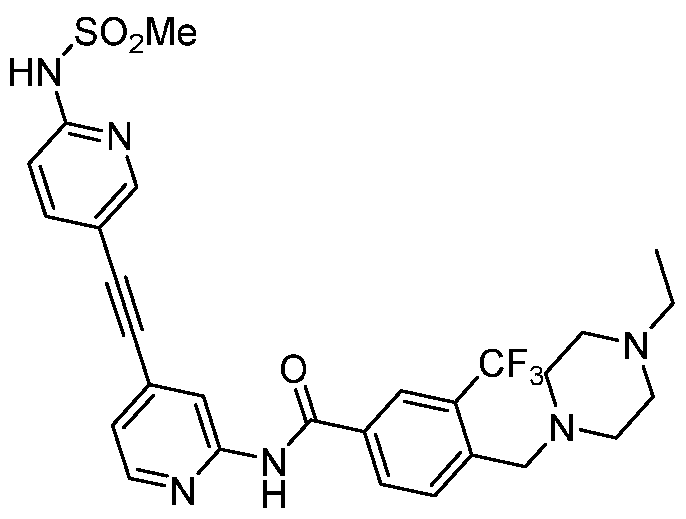
[000286] The title compound was synthesized from 4-((4-ethylpiperazin-l-yl)methyl)-N-(4- ethynylpyridin-2-yl)-3-(trifluoromethyl)benzamide and N-(5-bromopyridin-2- yl)methanesulfonamide following a method similar to general procedure A. The residue was purified by column chromatography (silica gel, Ct^C MeOH 10: 1) and by preparative HPLC (C18, eluent CH3CN/H20/HCOOH 0.01%) to afford 4-((4-ethylpiperazin-l- yl)methyl)-N-(4-((6-(methylsulfonamido)pyridin-3-yl)ethynyl)pyridin-2-yl)-3- (trifluoromethyl)benzamide (9 mg, 13%, AUC HPLC 99%) as brown solid; m.p. 102.8-103.2 °C; JH NMR (400 MHz, CDC13) δ (ppm): 9.09-8.82(m, 1H), 8.54 (s, 1H), 8.49 (s, 1H), 8.46 (s, 1H), 8.33 (d, / = 5.1 Hz, 1H), 8.23 (s, 1H), 8.09 (d, / = 8.0 Hz, 1H), 7.92 (d, / = 8.0 Hz, 1H), 7.86 (dd, / = 8.6, 2.0 Hz, 1H), 7.31 (d, / = 8.6 Hz, 1H), 7.20 (d, / = 5.1 Hz, 1H), 3.78 (s, 2H), 3.25 (s, 3H), 3.00-2.61 (m, 8H), 2.79 (q, / = 7.3 Hz, 2H) 1.23 (t, / = 7.3 Hz, 3H); 13C NMR (100 MHz, CDCI3) δ (ppm): 167.41, 164.32, 151.48, 151.41, 150.74, 147.90, 142.01, 141.91, 133.42, 133.09, 131.07, 130.45, 129.60, 125.35, 124.43, 122.07, 116.28, 114.00, 111.73, 90.15, 89.58, 57.80, 51.67, 51.62, 51.24, 41.42, 10.22; MS (ESI) m/z 587
[C28H29F3N603S + H]+.
Example 8: N-(4-((5, 6-diaminopyridin-3-yl) ethynyl) pyridin-2-yl)-4-((4-ethylpiperazin-l-yl)

[000287] Step 1 : Preparation of 5-((trimethylsilyl) ethynyl) pyridine-2, 3-diamine; The title compound was synthesized from 5-bromopyridine-2,3-diamine and ethynyltrimethylsilane following a method similar to general procedure A. Crude product was purified by column
chromatography (silica gel, methnol/dichloromethane 1 : 100) to afford 5- ((trimethylsilyl)ethynyl)pyridine-2,3-diamine (600 mg, 60 %) as pale brown color solid. MS (ESI) m/z 206.3 [C10Hl5N3Si]+
[000288] Step 2: Preparation of 5-ethynylpyridine-2, 3-diamine; A solution of 5- ((trimethylsilyl) ethynyl) pyridine-2,3-diamine (600 mg, 2.92 mmol) and LiOH (184 mg,4.39 mmol) in mixture of THF (10 mL) and water (5 mL) was stirred at room temperature for 3 h. The reaction mixture was concentrated under reduce pressure, the residue was diluted with EtOAc and washed in turn with water and brine. Organic layer was dried over Na2S04, filtered and concentrated under reduced pressure to afford 5-ethynylpyridine-2, 3-diamine (300 mg, 79 %) as pale brown color solid. MS (ESI) m/z 134 [C7H7N3+H]+
[000289] Step 3: Preparation of N-(4-((5, 6-diaminopyridin-3-yl) ethynyl) pyridin-2-yl)-4- ((4-ethylpiperazin-l-yl) methyl)-3-(trifluoromethyl) benzamide; The title compound was synthesized from5-ethynylpyridine-2, 3-diamine and N-(4-bromopyridin-2-yl)-4-((4- ethylpiperazin-l-yl) methyl)-3-(trifluoromethyl) benzamide following a method similar to general procedure A. Crude product was purified by preparative TLC to afford N-(4-((5, 6- diaminopyridin-3-yl) ethynyl) pyridin-2-yl)-4-((4-ethylpiperazin-l-yl) methyl)-3- (trifluoromethyl) benzamide (0.05 mg, 25%, LCMS-97%, HPLC Purity?) as off white solid. JH-NMR (400 MHz, DMSO-<¾) δ (ppm): 11.18 (s, IH), 8.38 (d, / = 4.8 Hz, IH), 8.31 (s, IH), 8.28 (d, / = 8.0 Hz, 2H), 8.22 (s, IH), 7.91 (d, / = 7.6 Hz, IH), 7.60 (s, IH), 7.22 (d, / = 4.8 Hz, IH), 6.83 (s, IH), 6.03 (s, 2H), 4.90 (s, 2H), 3.68 (s, 2H), 2.49-2.32 (m, 10H), 0.99 (t, / = 0.8 Hz, 3H). MS (ESI) m/z 524.3 [C27H28F3N70+H]+
Example 9: N-(4-(( 6-(cyclopropylamino )pyridin-3-yl )ethynyl )pyridin-2-yl)-4-( (4- ethylpiperazin-l-yl)methyl)-3-(trifluoromethyl)benzamide

[000290] The title compound was synthesized fromN-(4-bromopyridin-2-yl)-4-((4- ethylpiperazin-l-yl)memyl)-3-(trifluoromemyl)benzamideamine and 5-bromo-N- cyclopropylpyridin-2-amine following a method similar to general procedure A. The crude
product was purified by preparative HPLC (CI 8, eluents ACN/H20/HCOOH 0.1%) to afford N-(4-((6-(cyclopropylamino)pyridin-3-yl)ethynyl)pyridin-2-yl)-4-((4-ethylpiperazin-l- yl)methyl)-3-(trifluoromethyl)benzamide (18 mg, 27%, AUC HPLC 93%) as brown solid; m.p. 83-85 °C; JH NMR (400 MHz, MeOD-d4) δ (ppm): 8.34 (d, / = 8.0 Hz, 1H), 8.30 (s, 2H), 8.24-8.18 (m, 2H), 8.01 (d, / = 8.1 Hz, 1H), 7.66 (dd, / = 8.8 Hz, / = 2.4 Hz, 1H), 7.21 (dd, / = 5.2 Hz, / = 1.2 Hz, 1H), 6.74 (d, / = 8.4 Hz, 1H), 3.78 (s, 2H), 2.90-2.40 (m, 11H), 1.15 (t, / = 7.3 Hz, 3H), 0.82 (m, / = 2.9 Hz, 2H), 0.53 (m, / = 2.8 Hz, 2H); MS (ESI) m/z 549 [C3oH31F3N60+ H]+.
Example 10: N-(4-((6-amino-4-methylpyridin-3-yl)ethynyl)pyridin-2-yl)-4-((4-e
l-yl)methyl)-3-(trifluoromethyl)benzamide

[000291] The title compound was synthesized from N-(4-bromopyridin-2-yl)-4-((4- ethylpiperazin- 1 -yl)memyl)-3-(trifluoromemyl)benzamideamine and 5-bromo-4- methylpyridin-2-amine following a method similar to general procedure A. The crude product was purified by preparative HPLC (CI 8, eluents ACN/H20/HCOOH 0.1%) to afford N-(4-((6-amino-4-methylpyridin-3-yl)ethynyl)pyridin-2-yl)-4-((4-ethylpiperazin-l- yl)methyl)-3-(trifluoromethyl)benzamide (26 mg, 41%, AUC HPLC 95%) as brown solid; mp 162-164 °C; JH NMR (400 MHz, MeOD-d4) δ (ppm): 8.34 (d, / = 5.1 Hz, 1H),8.30 (s, 2H), 8.22 (d, / = 8.1 Hz, 1H),8.07 (s, 1H), 8.01 (d, / = 8.1 Hz, 1H), 7.22 (d, / = 4.9 Ηζ,ΙΗ), 6.49 (s,lH), 3.81 (s, 2H), 2.87 (s, 4H), 2.78 (q, / = 7.2 Hz, 2H), 2.66 (s, 4H), 2.40 (s, 3H),1.21 (t, / = 7.2 Hz, 3H); MS (ESI) m/z 523 [C28H29F3N60+H]+.
Example 11: 4-((4-ethylpiperazin-l-yl)methyl)-N-(4-((6-pivalamidopyridin-3- yl)ethynyl)pyridin-2-yl)-3-(trifluoromethyl)benzamide
H

[000292] The title compound was synthesized from N-(4-bromopyridin-2-yl)-4-((4- ethylpiperazin- 1 -yl)memyl)-3-(trifluoromemyl)benzamideamine and N-(5-bromopyridin-2- yl)pivalamide following a method similar to general procedure A. The crude product was purified by preparative HPLC (CI 8, eluents ACN/H20/HCOOH 0.1%) to afford 4-((4- ethylpiperazin-l-yl)memyl)-N-(4-((6-pivalamidopyridin-3-yl)ethynyl)pyridin-2-yl)-3- (trifluoromethyl)benzamide (20 mg, 28%, AUC HPLC 98%) as brown solid; mp 100-102°C; JH NMR (400 MHz, CDC13) δ (ppm): 9.11 (s, 1H), 8.54 (s, 1H), 8.46 (d, / = 1.5 Hz, 1H), 8.31 (d, / = 8.7 Hz, 1H), 8.27 (d, / = 5.7 Hz, 1H), 8.24 (s, 1H), 8.20 (s, 1H), 8.10 (d, / = 8.1 Hz, 1H), 7.87-7.82 (m, 2H), 7.19 (d.d, / = 5.2 , 1.6 Hz, 1H), 3.78 (s, 2H), 2.92 (s, 4H), 2.83 (q, / = 7.2 Hz, 2H), 2.73 (s, 4H), 1.34 (s, 9H), 1.25 (t, / = 7.2 Hz, 3H); MS (ESI) m/z 593[C32H35F3N602+H]+.
Example 12: N-(4-((6-amino-4-fluoropyridin-3-yl)ethynyl)pyridin-2-yl)-4-((4-ethylpipe -yl)methyl)-3-(trifluoromethyl)benzamide

[000293] The title compound was synthesized from 4-((4-ethylpiperazin-l-yl)methyl)-N-(4- ethynylpyridin-2-yl)-3-(trifluoromethyl) and 5-bromo-4-fluoropyridin-2-amine following a method similar to general procedure A. The crude reaction mixture was purified by preparative HPLC (CI 8, eluent CH3CN/H20/HCOOH 0.1%) to afford N-(4-((6-amino-4- fluoropyridin-3-yl)ethynyl)pyridin-2-yl)-4-((4-ethylpiperazin-l-yl)methyl)-3- (trifluoromethyl)benzamide (30 mg, 47%, AUC HPLC 96.7%) as yellow solid; m.p. 151-153 °C; JH NMR (400 MHz, CDC13) δ (ppm): 8.85 (s, 1H), 8.50 (s, 1H), 8.33-8.18 (m, 3H), 8.07
(d, / = 8.1 Hz, 1H), 7.97 (d, / = 8.1 Hz, 1H), 7.17 (d, / = 4.5 Hz, 1H), 6.24 (d, / = 10.2 Hz, 1H), 4.97 (s, 2H), 3.74 (s, 2H), 2.60 (s, 8H), 2.54 (q, / = 7.2 Hz, 2H), 1.13 (t, / = 7.2 Hz, 3H); 13C NMR (100 MHz, CDC13) δ (ppm): 170.63, 168.02, 164.29, 160.63, 160.52, 154.40, 151.45, 147.81, 142.59, 133.84, 132.90, 131.00, 130.32, 129.57, 129.27, 125.23, 125.10, 122.51, 121.98, 115.95, 99.30, 94.59, 91.97, 85.78, 57.95, 52.73, 52.51, 52.12, 11.51 ; MS (ESI) m/z 527 [C27H26F4N60+ H]+.
Example 13: N-(4-((6-amino-5-methoxypyridin-3-yl)ethynyl)pyridin-2-yl)-4-((4- ethylpiperazin-l-yl)methyl)-3-(trifluoromethyl)benzamide

[000294] The title compound was synthesized from 4-((4-ethylpiperazin-l-yl)methyl)-N-(4- ethynylpyridin-2-yl)-3-(trifluoromethyl)benzamide and 5-bromo-3-methoxypyridin-2-amine following a method similar to general procedure A. The residue was purified by flash column chromatography (silica gel, CH2Cl2/MeOH 10: 1) and by preparative HPLC (C18, eluent CH3CN/H2O/HCOOH 0.01%) to afford N-(4-((6-amino-5-methoxypyridin-3- yl)ethynyl)pyridin-2-yl)-4-((4-ethylpiperazin- 1 -yl)methyl)-3-(trifluoromethyl)benzamide (24 mg, 37%, AUC HPLC 99.9%) as white solid; m.p. 69.7-70.7 °C; JH NMR (400 MHz, CDCI3) δ (ppm): 9.44 (bs, 1H), 8.54 (s, 1H), 8.39 (bs, 1H), 8.31-8.22 (m, 2H), 8.12 (d, / = 8.1 Hz, 1H), 7.93-7.81 (m, 2H), 7.17 (d, / = 4.9 Hz, 1H), 7.05 (s, 1H), 5.55 (bs, 2H), 3.91 (s, 3H), 3.80 (s, 2H), 3.07(bs, 4H), 2.97 (q, / = 7.3 Hz, 2H), 2.89-2.75 (m, 4H), 1.30 (t, / = 7.3 Hz, 3H); 13C NMR (100 MHz, CDC13) δ (ppm): 166.81, 164.42, 151.45, 150.74, 147.13, 141.97, 141.79, 141.15, 134.65, 133.39, 131.00, 130.61, 129.65 (q, / = 31.1 Hz), 125.76 (q, / = 5.8 Hz), 123.80 (q, / = 274.3 Hz), 121.80, 117.37, 116.40, 107.81, 93.06, 87.42, 57.71, 55.63, 51.49, 51.13, 50.21, 9.35; MS (ESI) m/z 539 [C28H29F3N602 + H]+.
Example 14: N-(4-((6-amino-4-cyanopyridin-3-yl)ethynyl)pyridin-2-yl)-4-((4-ethylpiperazin- l-yl)methyl)-3-(trifluoromethyl)benzamide

[000295] The title compound was synthesized from 4-((4-ethylpiperazin-l-yl)methyl)-N-(4- ethynylpyridin-2-yl)-3-(trifluoromethyl)benzamide and 2-amino-5-bromoisonicotinonitrile following a method similar to general procedure A. The residue was purified by column chromatography (silica gel, Ct^C^/MeOH 10: 1) and by preparative HPLC (C18, eluent CH3CN/H20/HCOOH 0.01%) to afford N-(4-((6-amino-4-cyanopyridin-3-yl)ethynyl)pyridin- 2-yl)-4-((4-ethylpiperazin-l-yl)methyl)-3-(trifluoromethyl)benzamide (lOmg, 16%, AUC HPLC 98%) as yellow solid; m.p. 114.5-116.3 °C; JH NMR (400 MHz, DMSO-<¾) δ (ppm): 11.26 (s, 1H), 8.46 (d, / = 5.0 Hz, 1H), 8.43 (s, 1H), 8.34 (s, 1H), 8.32-8.27 (m, 2H), 7.92 (d, / = 8.2 Hz, 1H), 7.25 (d, / = 5.0 Hz, 1H), 7.19 (s, 2H), 6.87 (s, 1H), 3.68 (s, 2H), 2.43 (bs, 8H), 2.33 (q, / = 7.1 Hz, 2H), 0.99 (t, / = 7.1 Hz, 3H); 13C NMR (100 MHz, DMSO-<¾) δ (ppm): 164.28, 158.84, 152.74, 151.83, 148.03, 141.09, 132.23, 131.21, 129.98, 125.07, 121.78, 120.46, 115.21, 114.93, 110.16, 104.39, 90.73, 88.11, 56.94, 52.30, 51.74, 50.96, 11.38; MS (ESI) m/z 534[C28H26F3N70 + H]+.
Example 15: N-(4-((5-aminopyridin-3-yl)ethynyl)pyridin-2-yl)-4-((4-ethylpiperazin-l- enzamide

[000296] The title compound was synthesized from N-(4-bromopyridin-2-yl)-4-((4- ethylpiperazin- 1 -yl)memyl)-3-(trifluoromemyl)benzamideamine and 5-bromopyridin-3- amine following a method similar to general procedure A. The crude product was purified by preparative HPLC (CI 8, eluents ACN/H20/HCOOH 0.1%) to afford N-(4-((5-aminopyridin- 3-yl)ethynyl)pyridin-2-yl)-4-((4-ethylpiperazin-l-yl)methyl)-3-(trifluoromethyl)benzamide (15 mg, 24%, AUC HPLC 98%) as brown solid; mp 63-65 °C; JH NMR (400 MHz, MeOD- d4) δ (ppm): 8.50-8.30 (m, 3H), 8.22 (d, / = 7.20 Hz, 1H), 8.20-7.80 (m, 3H), 7.70-7.79 (m,
1H), 7.20-7.40 (m, 2H), 3.81 (s, 2H), 2.85 (s, 4H), 2.75 (q, / = 7.3 Hz, 2H), 2.66 (s, 4H), 1.20 (t, / = 7.3 Hz, 3H); MS (ESI) m/z 509 [C27H27F3N60+ H]+ .
Example 16: N-(4-(2-(5-acetamidopyridin-3-yl)ethynyl)pyridin-2-yl)-4-((4-ethylpiperazin-l- yl )methyl )-3-( trifluoromethyl )benzamide

[000297] The title compound was synthesized from N-(5-bromopyridin-3-yl)acetamide and 4-((4-ethylpiperazin-l-yl)methyl)-N-(4-ethynylpyridin-2-yl)-3-(trifluoromethyl)benzamide following a method similar to general procedure A. The crude product was purified by preparative HPLC to afford N-(4-(2-(5-acetamidopyridin-3-yl)ethynyl)pyridin-2-yl)-4-((4- ethylpiperazin -yl)me l)-3-(trifluoromethyl)benzamide (16.3 mg, 25%, AUC HPLC 99%) as a light brown solid. JH NMR (600 MHz, DMSO-<¾) δ (ppm): 11.32 (s, 1H), 10.39 (s, 1H), 8.70 (d, / = 2.3 Hz, 1H), 8.51 (d, / = 2.0 Hz, 1H), 8.48 (d, / = 5.1 Hz, 1H), 8.38-8.33 (m, 3H), 8.30 (dd, / = 8.2, 1.9 Hz, 1H), 7.92 (d, / = 8.1 Hz, 1H), 7.39 (dd, / = 5.1, 1.5 Hz, 1H), 3.73 (s, 2H), 2.11 (s, 3H), 1.09 (t, / = 6.8 Hz, 3H); 13C NMR (150 MHz, DMSO-<¾) δ (ppm): 169.3, 164.8, 152.4, 148.7, 146.1, 141.3, 140.8, 135.6, 132.9, 132.0, 131.2, 130.6, 127.8, 127.5, 127.3, 127.1, 126.9, 125.7, 125.0, 123.2, 121.6, 118.0, 116.2, 89.9, 89.5, 57.1, 51.5, 51.1, 23.9, 23.9; MS (ESI) m/z 551 [C29H29F3N602+ H]+.
Example 17: N-(4-(2-(5-(cyclopropanecarboxamido)pyridin-3-yl)ethynyl)pyridin-2-yl)-4-((4- ethyl)-3-(trifluoromethyl)benzamide

[000298] The title compound was synthesized from N-(5-bromopyridin-3- yl)cyclopropanecarboxamide and 4-((4-ethylpiperazin- 1 -yl)methyl)-N-(4-ethynylpyridin-2- yl)-3-(trifluoromethyl)benzamide following a method similar to general procedure A. The reaction crude product was purified by preparative HPLC to afford N-(4-(2-(5-
(cyclopropanecarboxamido)pyridin-3-yl)emynyl)pyridin-2-yl)-4-((4-ethylpiperazin-l- yl)methyl)-3-(trifluoromethyl)benzamide (2.2 mg, AUC HPLC 99%) as a light brown solid; JH NMR (600 MHz, DMSO-<¾) δ (ppm): 11.30 (s, 1H), 10.65 (s, 1H), 8.73 (d, / = 2.5 Hz, 1H), 8.50 (d, / = 1.9 Hz, 1H), 8.48 (d, / = 5.0 Hz, 1H), 8.35 (dd, / = 4.0, 1.8 Hz, 3H), 8.29 (dd, / = 8.2, 1.9 Hz, 1H), 7.92 (d, / = 8.2 Hz, 1H), 7.38 (dd, / = 5.0, 1.5 Hz, 1H), 3.69 (s, 2H), 2.49-2.29 (m, 8H), 1.85-1.79 (m, 1H), 1.05-0.98 (m, 3H), 0.89-0.83 (m, 4H); 13C NMR (150 MHz, DMSO-<¾) δ (ppm): 172.6, 164.9, 152.4, 148.7, 146.0, 141.6, 140.8, 135.6, 132.8,
132.0, 131.2, 130.5, 127.9, 127.4, 127.2, 127.07, 126.8, 125.6, 125.0, 123.2, 121.5, 118.0,
116.1, 89.9, 89.5, 57.4, 52.1, 51.4, 14.6, 11.7, 7.7; MS (ESI) m/z 577 [C3iH3iF3N602+H]+.
Example 18: N-(4-(2-(6-aminopyridazin-3-yl)ethynyl)pyridin-2-yl)-4-((4-ethylpiperazin-l- yl )methyl )-3-( trifluoromethyl )benzamide

[000299] The title compound was synthesized from 6-chloropyridazin-3-amine and 4-((4- ethylpiperazin-l-yl)methyl)-N-(4-ethynylpyridin-2-yl)-3-(trifluoromethyl)benzamide following a method similar to general procedure A. The reaction crude product was purified by preparative HPLC to afford N-(4-(2-(6-aminopyridazin-3-yl)ethynyl)pyridin-2-yl)-4-((4- ethylpiperazin-l-yl)memyl)-3-(trifluoromethyl)benzamide (4.1 mg, AUC HPLC 99%) as a light brown solid; JH NMR (600 MHz, DMSO-<¾) δ (ppm): 11.29 (s, 1H), 8.47 (d, / = 5.1 Hz, 1H), 8.34 (dd, / = 4.5, 1.4 Hz, 2H), 8.29 (dd, / = 8.0, 1.9 Hz, 1H), 7.92 (d, / = 8.2 Hz, 1H), 7.54 (d, / = 9.2 Hz, 1H), 7.34 (dd, / = 5.0, 1.5 Hz, 1H), 6.95 (s, 2H), 6.79 (d, / = 9.2 Hz, 1H), 3.68 (s, 2H), 2.41 (d, / = 26.3 Hz, 4H), 2.32 (q, / = 7.2 Hz, 2H), 0.99 (t, / = 7.1 Hz, 3H); 13C NMR (150 MHz, DMSO-<¾) δ (ppm): 164.9, 159.5, 152.4, 148.6, 141.7, 136.5, 132.8, 132.0, 131.4, 131.1, 130.5, 127.4, 127.2, 127.0, 126.8, 125.6, 125.0, 123.2, 115.9, 112.6, 91.4, 87.0, 57.5, 52.9, 52.3, 51.5, 12.0; MS (ESI) m/z 510[C26H26F3N7O+ H]+.
Example 19: N-(4-(2-(6-acetamidopyridazin-3-yl)ethynyl)pyridin-2-yl)-4-((4-ethylpiperazin- l-yl)methyl)-3-(trifluoromethyl)benzamide

[000300] The title compound was synthesized from N-(6-chloropyridazin-3-yl)acetamide and 4-((4-ethylpiperazin- 1 -yl)methyl)-N-(4-ethynylpyridin-2-yl)-3-
(trifluoromethyl)benzamide following a method similar to general procedure A. The reaction crude product was purified by prep-HPLC to afford N-(4-(2-(6-acetamidopyridazin-3- yl)ethynyl)pyridin-2-yl)-4-((4-ethylpiperazin-l-yl)methyl)-3-(trifluoromethyl)benzamide formate salt (8.0 mg, 11%, AUC HPLC 99%) as a light brown solid; JH NMR (600 MHz, DMSO-<¾) δ (ppm): 11.43 (s, 1H), 11.34 (s, 1H), 8.52 (d, / = 5.1 Hz, 1H), 8.42-8.37 (m, 2H), 8.35 (d, / = 1.9 Hz, 1H), 8.29 (dd, / = 8.1, 1.9 Hz, 1H), 8.20 (s, 1H), 8.01 (d, / = 9.3 Hz, 1H), 7.92 (d, / = 8.1 Hz, 1H), 7.42 (dd, / = 5.0, 1.5 Hz, 1H), 3.68 (s, 2H), 2.46-2.39 (m, 4H), 2.33 (d, / = 7.2 Hz, 2H), 2.18 (s, 3H), 0.99 (t, / = 7.1 Hz, 3H); 13C NMR (150 MHz, DMSO- d6) δ (ppm): 170.4, 164.9, 154.4, 152.4, 148.8, 142.4, 141.7, 132.7, 132.2, 132.0, 130.6, 130.5, 127.4, 127.2, 127.0, 126.8, 125.7, 125.0, 123.2, 121.5, 121.4, 117.3, 116.2, 89.5, 88.8, 57.5, 52.8, 52.3, 51.5, 24.0; MS (ESI) m/z 552 [C28H28F3N7O2 + H]+.
Example 20: 4-(piperazin-l-ylmethyl)-N-(4-(pyrimidin-5-ylethynyl) pyridin-2-yl)-3-

[000301] Step 1 : Preparation of teri-butyl 4-(4-(4-(pyrimidin-5-ylethynyl) pyridin-2- ylcarbamoyl)-2-(trifluoromethyl) benzyl) piperazine-l-carboxylate; The title compound was synthesized from teri-butyl4-(4-(4-bromopyridin-2-y5-ethynylpyrimidine carbanoyl)-2- (trifluoromethyl)benzyl)piperazine-l-carboxylate and 5-ethynylpyrimidine in a similar method to that described in general procedure A. The crude product was purified by column chromatography (silica gel, eluent: petroleum ether/EtOAc 1 : 1) to afford teri-butyl 4-(4-(4- (pyrimidin-5-ylethynyl) pyridin-2-ylcarbamoyl)-2-(trifluoromethyl) benzyl) piperazine-l- carboxylate as a yellow solid (300 mg, 82%); MS (ESI) m/z 567
 [000302] Step 2: Preparation of 4-(piperazin-l-ylmethyl)-N-(4-(pyrimidin-5-ylethynyl) pyridin-2-yl)-3-(trifluoromethyl) benzamide; The title compound was synthesized from tert- butyl 4-(4-(4-(pyrimidin-5-ylethynyl)pyridin-2-ylcarbamoyl)-2-
(trifluoromethyl)benzyl)piperazine-l- ethynylpyrimidine in a similar method to that described in general procedure D. The crude product was purified by column chromatography (silica gel, eluent CHCl3/MeOH 96:4) to afford 4-(piperazin-l-ylmethyl)-N-(4-(pyrimidin-5- ylethynyl)pyridin-2-yl)-3-(trifluoromethyl)benzamide as an off white solid (170 mg, 69%, LC-MS 96%, AUC HPLC 95.2%); m.p. 135-135 °C; JH NMR (400 MHz, CDC13) δ (ppm): 9.21 (s, 1H), 8.92 (s, 2H), 8.60-8.57 (d, / = 12.8 Hz, 2H), 8.37-8.36 (d, / = 4.4 Hz, 2H), 8.19 (s, 1H), 8.09-8.03 (m, 2H), 7.26-7.23 (m, 1H), 3.72 (s, 2H), 2.94-2.85 (m, 4H), 2.48-2.44 (m, 4H); MS (ESI) m/z 467 [C24H21F3N60+H]+.
Example 21: N-(4-((2-aminothiazol-5-yl)ethynyl)pyridin-2-yl)-4-((4-ethylpiperazin-l-
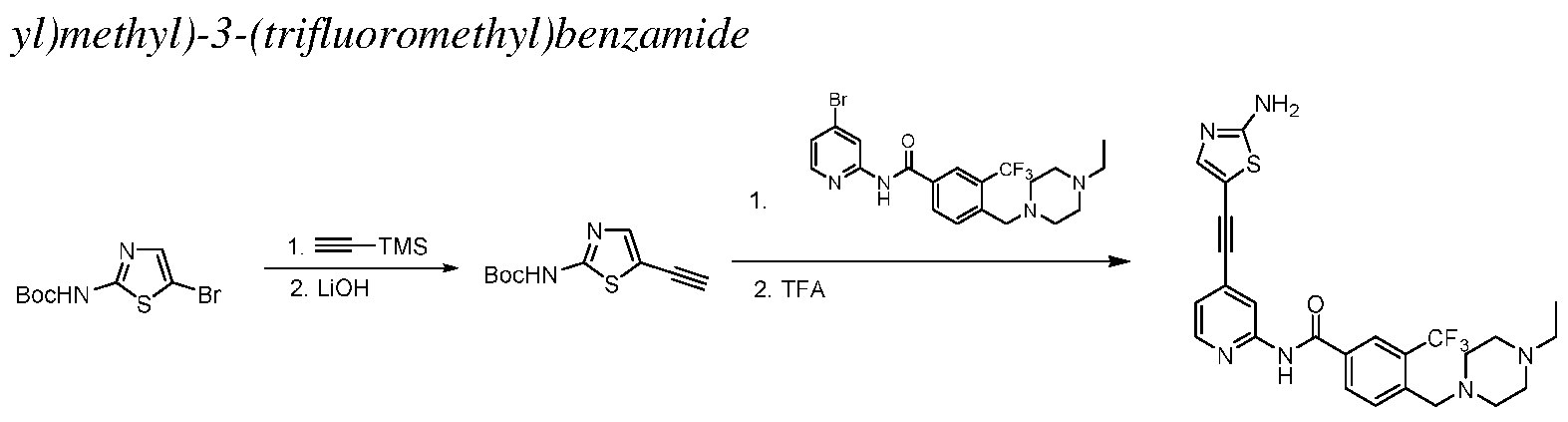
[000303] Step 1 : Preparation of teri-butyl 5-((trimethylsilyl)ethynyl)thiazol-2-ylcarbamate; The title compound was synthesized from teri-butyl 5-bromothiazol-2-yl carbamate and Ethynyltrimethylsilane following a method similar to general procedure A. The crude product was purified by column chromatography (silica gel, hexane/ethyl acetate 95:5) to afford tert- butyl 5-((trimethylsilyl)ethynyl)thiazol-2-ylcarbamate (1.4 g). MS (ESI) m/z 297.1
[C13H20N2O2SSi+H]+.
[000304] Step 2: Preparation of teri-butyl 5-ethynylthiazol-2-ylcarbamate; A solution of LiOH in water was added to a solution of teri-butyl 5-((trimethylsilyl)ethynyl)thiazol-2- ylcarbamate (1.4 g, 5.04 mmol) in THF (15 mL). Reaction was stirred at room temperature for 3 h. After completion, the reaction mixture was concentrated under reduced pressure. The residue was diluted with water, extracted into EtOAc. The extracts were dried over Na2S04, filtered and concentrated under reduced pressure. The residue was purified by flash column chromatography (silica gel, hexanes/ethyl acetate 90:10) to afford teri-butyl 5-ethynylthiazol- 2-ylcarbamate (1 g) as a brown solid.
[000305] Step 3: Preparation of teri-butyl 5-((2-(4-((4-ethylpiperazin-l-yl)methyl)-3- (trifluoromethyl)benzamido)pyridin-4-yl)ethynyl)thiazol-2-ylcarbamate; The title compound was synthesized from N-(4-bromopyridin-2-yl)-4-((4-ethylpiperazin-l-yl)methyl)-3- (trifluoromethyl)benzamide and teri-butyl 5-ethynylthiazol-2-ylcarbamate following a method similar to general procedure A. To the reaction crude product was added water, and the mixture was extracted with EtOAc. The organic extracts were washed in turn with water and brine then, dried over Na2 S04, filtered and concentrated under reduced pressure to afford teri-butyl 5-((2-(4-((4-ethylpiperazin- 1 -yl)methyl)-3-(trifluoromethyl)benzamido)pyridin-4- yl)ethynyl)thiazol-2-ylcarbamate. The crude product was used in the next step without further purification. MS (ESI) m/z 615.3 [CsoHssFsNcAS+Hf.
[000306] Step 4: Preparation of N-(4-((2-aminothiazol-5-yl)ethynyl)pyridin-2-yl)-4-((4- ethylpiperazin-l-yl)memyl)-3-(trifluoromethyl)benzamide; The title compound was synthesized from teri-butyl 5-((2-(4-((4-ethylpiperazin-l-yl)methyl)-3- (trifluoromethyl)benzamido)pyridin-4-yl)ethynyl)thiazol-2-ylcarbamate in a similar method as described in general procedure D. The reaction crude product was purified by preparative HPLC to afford N-(4-((2-aminothiazol-5-yl)ethynyl)pyridin-2-yl)-4-((4-ethylpiperazin-l- yl)methyl)-3-(trifluoromethyl)benzamid (18 mg, HPLC 98.7%) as a pale yellow solid. JH
NMR(400 MHz, DMSO-<¾) δ (ppm): 11.23 (s, 1H), 8.38 (d, / = 4.8 Hz, 1H), 8.31 (s, 1H), 8.27 (d, / = 8.0 Hz, 1H), 8.18 (s, 1H), 7.90 (d, / = 8.0 Hz, 1H), 7.69 (s, 2H), 7.45 (s, 1H), 7.20 (dd, / = 1.2, 4.8 Hz, 1H), 3.65 (s, 2H), 2.42-2.30 (m, 10H), 0.97 (t, / = 7.2 Hz, 3H); MS (ESI) m/z 515.5 [C25H25F3N6OS+H]+.
Example 22: N-(4-((2-acetamidothiazol-5-yl)ethynyl)pyridin-2-yl)-4-((4-ethylpiperazin-l-

[000307] Step 1 : Preparation of N-(5-bromothiazol-2-yl)acetamide;
Acetyl chloride (0.14 mL, 1.924 mmol) was added drop wise to a cooled mixture of 5- bromothiazol-2-amine hydrobromide (500 mg, 1.92 mmol) and triethyl amine (0.53 mL, 3.85 mmol) in CH2CI2 (5 mL) at room temperature. The reaction mixture was stirred at room
temperature for 14 h and was diluted with CH2CI2, washed with a saturated aqueous solution of NaHC(¾, followed by brine. The organic layer was dried over Na2S04, filtered and concentrated under reduced pressure. The residue was purified by flash column
chromatography (silica gel, hexanes/EtOAc 15:85) to afford N-(5-bromothiazol-2-yl) acetamide (340 mg, 80%).
[000308] Step 2: Preparation of N-(4-((2-acetamidothiazol-5-yl) ethynyl) pyridin-2-yl)-4- ((4-ethylpiperazin-l-yl) methyl)-3-(trifluoromethyl) benzamide; The title compound was synthesized from N-(5-bromothiazol-2-yl) acetamide and 4-((4-ethylpiperazin-l-yl)methyl)- N-(4-ethynylpyridin-2-yl)-3-(trifluoromethyl)benzamide following a method similar to general procedure A. The reaction crude product was purified by preparative HPLC to afford N-(4-((2-acetamidothiazol-5-yl) ethynyl) pyridin-2-yl)-4-((4-ethylpiperazin-l-yl) methyl)-3- (trifluoromethyl) benzamide (110 mg, AUC HPLC 98.5 %) as an off-white solid. JH NMR (400 MHz, DMSO- ) δ (ppm): 12.52 (s, 1H), 11.25 (s, 1H), 8.44 (d, / = 5.6 Hz, 1H), 8.34 (s, 1H), 8.28 (s, 2H), 7.94 (s, 1H), 7.91 (d, / = 8.4 Ηζ,ΙΗ), 7.29 (d, / = 1.6 Hz, 1H), 3.68 (s, 2H), 2.42 (m, 8H), 2.32 (q, 2H), 2.19 (s, 3H), 0.98 (t, / = 7.0 Hz, 3H). MS (ESI) m/z 557.4 [C27H27F3N602S + H]+ .
Example 23: N-(4-((2-(cyclopropanecarboxamido)thiazol-5-yl)ethynyl)pyridin-2-yl)-4-((4-

[000309] The title compound was synthesized from 4-((4-ethylpiperazin-l-yl)methyl)-N-(4- ethynylpyridin-2-yl)-3-(trifluoromethyl)benzamide and N-(5-bromothiazol-2- yl)cyclopropanecarboxamide following a method similar to general procedure A. The reaction crude product was purified by preparative HPLC to afford N-(4-((2- (cyclopropanecarboxamido)thiazol-5-yl)ethynyl)pyridin-2-yl)-4-((4-ethylpiperazin-l- yl)methyl)-3-(trifluoromethyl)benzamide (12 mg, 12.6%, AUC HPLC 95.1%) as a yellow solid. JH NMR (400 MHz, CD3OD) δ (ppm): 8.39 (d, / = 8.4 Hz, 1H), 8.35 (d, / = 5.2 Hz, 1H), 8.31-8.29 (m, 2H), 8.01 (d, / = 8.4 Hz, 1H), 7.74 (s, 1H), 7.23 (dd, / = 1.6, 5.2 Hz, 1H), 3.77 (s, 2H), 2.60-2.50 (m, 10H), 1.92-1.28 (m, 1H), 1.12 (t, / = 6.8 Hz, 3H), 1.08-0.97 (m, 4H). MS (ESI) m/z 583.0
 + H]+.
Example 24: N-(4-((l-methyl-lH-pyrazol-5-yl) thinly) pyridin-2-yl)-4-(piperazin-l-ylmethyl)- -(trifluoromethyl) benzamide
+ H]+.
Example 24: N-(4-((l-methyl-lH-pyrazol-5-yl) thinly) pyridin-2-yl)-4-(piperazin-l-ylmethyl)- -(trifluoromethyl) benzamide

[000310] Step 1 : Preparation of teri-butyl 4-(4-(4-((l-methyl-lH-pyrazol-5-yl) ethynyl) pyridin-2-ylcarbamoyl)-2-(trifluoromethyl) benzyl) piperazine-l-carboxylate; The title compound was synthesized from teri-butyl 4-(4-(4-ethynylpyridin-2-ylcarbamoyl)-2- (trifluoromethyl)benzyl)piperazine- 1 -carboxylate and 5-iodo- 1 -methyl- lH-pyrazole following a method similar to general procedure A. The crude product was purified by flash column chromatography (silica gel eluent petroleum ether/EtOAc 1 : 1) to afford teri-butyl 4- (4-(4-((l-methyl-lH-pyrazol-5-yl)ethynyl)pyridin-2-ylcarbamoyl)-2-
(trifluoromethyl)benzyl)piperazine-l -carboxylate as a solid (50 mg, 26%). MS (ESI) m/z 569 [C29H31F3N603+ H]+
[000311] Step 2: Preparation of N-(4-((l-methyl-lH-pyrazol-5-yl) ethynyl) pyridin-2-yl)-4- (piperazin-l-ylmethyl)-3-(trifluoromethyl) benzamide; The title compound was synthesized from teri-butyl 4-(4-(4-((l-methyl-lH-pyrazol-5-yl)ethynyl)pyridin-2-ylcarbamoyl)-2- (trifluoromethyl)benzyl)piperazine-l -carboxylate in a similar method as described in general procedure D. The crude product was purified by flash column chromatography (silica gel, eluent CHCl3/MeOH 96:4) to afford 10 mg of N-(4-((l-methyl-lH-pyrazol-5- yl)ethynyl)pyridin-2-yl)-4-(piperazin-l-ylmethyl)-3-(trifluoromethyl)benzamide as a pale yellow solid (26%, AUC-HPLC 96%). JH NMR (400 MHz, CDC13) δ (ppm): 8.58 (s, 1H), 8.53 (s, 1H), 8.35-8.34 (d, / = 1.6 Hz, 1H), 8.19 (s, 1H), 8.08-8.03 (m, 2H), 7.50 (s, 1H ), 7.21-7.19 (t, / = 4.4 Hz, 1H), 6.58-6.57 (d, / = 2.0 Hz, 1H ), 4.03 (s, 3H ), 3.71 (s, 2H), 2.94-2.85 (m, 4H), 2.48-2.20 (m, 4H); MS (ESI) m/z 469 [C24H23F3N60+ H]+.
Example 25: 4-((4-ethylpiperazin-l-yl)methyl)-N-(4-((3-methyl-lH-pyrazol-4- yl)ethynyl)pyridin-2-yl)-3-(trifluoromethyl)benzamide

[000312] The title compound was synthesized from 4-((4-ethylpiperazin-l-yl)methyl)-N-(4- ethynylpyridin-2-yl)-3-(trifluoromethyl)benzamide and 4-iodo-3-methyl-lH-pyrazole in a similar method as described in general procedure D. The residue was purified by flash column chromatography (silica gel, DCM/methnol 10: 1) to afford 4-((4-ethylpiperazin-l- yl)methyl)-N-(4-((3-methyl-lH-pyrazol-4-yl)ethynyl)pyridin-2-yl)-3- (trifluoromethyl)benzamide (33 mg, 55%, AUC HPLC 98%) as white solid; m.p. 171.2- 173.3 °C; JH NMR (400 MHz, MeOO-d4) δ (ppm): 8.33-8.28 (m, 3H), 8.20 (d, / = 8.1 Hz, 1H), 8.00 (d, / = 8.1 Hz, 1H), 7.76 (bs, 1H), 7.20 (d, / = 4.7 Hz, 1H), 3.79 (s, 2H), 2.73 (bs, 8H), 2.65-2.60 (m, 2H), 2.41 (s, 3H), 1.16 (t, / = 7.3 Hz, 3H); MS (ESI) m/z 497
[C26H27F3N60 + H]+.
Example 26: N-(4-( ( lH-pyrazol-4-yl)ethynyl)pyridin-2-yl)-4-( ( 4-ethylpiperazin-l -yl)methyl)- 3-( trifluoromethyl)benzamide

[000313] The title compound was synthesized from 4-((4-ethylpiperazin-l-yl)methyl)-N-(4- ethynylpyridin-2-yl)-3-(trifluoromethyl)benzamide and 4-iodo-lH-pyrazole following a method similar to general procedure A. The reaction mixture was purified by preparative HPLC (CI 8, eluents ACN/H20/HCOOH 0.1%) to afford N-(4-((lH-pyrazol-4- yl)ethynyl)pyridin-2-yl)-4-((4-ethylpiperazin-l-yl)methyl)-3-(trifluoromethyl)benzamide (18 mg, 22 %, AUC HPLC 95%) as brown solid; mp 124-126 °C; JH NMR (400 MHz, MeOD- d4) δ (ppm): 8.33 (d, / = 5.1 Hz, 1H), 8.29 (s, 1H), 8.20 (d, / = 8.0 Hz, 1H), 8.01 (d, / = 8.0 Hz, 1H), 7.91(m, 2H), 7.73 (m, 1H), 7.20 (d, / = 4.7 Hz, 1H), 3.78 (s, 2H), 2.88-2.30 (m, 10H), 1.14 (t, / = 7.2 Hz, 3H); 13C NMR (100 MHz, MeOO-d4) δ (ppm): 152.93, 149.00, 143.55, 135.92, 134.23, 132.29, 132.20, 132.00, 126.67, 123.94, 123.12, 117.79, 103.00,
89.30, 87.90, 78.93, 78.61, 78.29, 59.23, 53.89, 53.55, 12.51; MS (ESI) m/z 483
[C25H25F3N60 + H]+.
Example 27: N-(4-((l, 2-dimethyl-lH-imidazol-5-yl )ethynyl)pyridin-2-yl)-4-( (4-

[000314] To the mixture of mixture of 5-bromo-l,2-dimethyl-lH-imidazole (126 mg, 0.721 mmol), 4-((4-ethylpiperazin- 1 -yl)methyl)-N-(4-ethynylpyridin-2-yl)-3- (trifluoromethyl)benzamide (300 mg, 0.721 mmol), and diisopropyl ethyl amine (1 mL) in DMF (3 mL) under argon, were added PdCl2 (dppf)2 (52 mg, 0.0721 mmol), Cul (20 mg, 0.108 mmol). The reaction mixture was heated at 80 °C for 15 h, was diluted with water and extracted into EtOAc. The organic layer was washed in turn with water and brine then was dried over Na2S04, filtered and concentrated under reduced pressure. The crude product was purified by preparative HPLC to afford N-(4-((l,2-dimethyl-lH-imidazol-5- yl)ethynyl)pyridin-2-yl)-4-((4-ethylpiperazin- 1 -yl)methyl)-3-(trifluoromethyl)benzamide (45 mg, 12%, AUC HPLC 90%) as an off-white solid. JH NMR(400 MHz, DMSO-<¾) δ (ppm): 11.24 (s, 1H), 8.43 (d, / = 5.2 Hz, 1H), 8.35 (s, 1H), 8.30-8.28 (m, 2H), 7.92 (d, / = 8.0 Hz, 1H), 7.36 (bs, 1H), 7.31 (d, / = 5.2 Hz, 1H ), 3.70 (s, 2H), 3.64 (s, 3H), 2.45-2.32 (m, 13H), 1.02-1.01 (m, 3H); MS (ESI) m/z: 511.1 [C27H29F3N60+H]+.
Example 28: N-(4-((l,2-dimethyl-lH-imidazol-5-yl)ethynyl)pyridin-2-yl)-4-(piperazin-l-

Step 1 : Preparation of teri-butyl 4-(4-(4-((l,2-dimethyl-lH-imidazol-5-yl)ethynyl)pyridin-2- ylcarbamoyl)-2-(trifluoromethyl)benzyl)piperazine- 1 -carboxylate
[000315] To a solution of teri-butyl 4-(4-(4-ethynylpyridin-2-ylcarbamoyl)-2- (trifluoromethyl) benzyl) piperazine-1 -carboxylate (100 mg, 0.204 mmol) in DMF (2 mL)
under Argon were successively added 5-bromo-l,2-dimethyl-lH-imidazole (35 mg, 0.20 mmol), PdCi2(PPh3)2 (7.1 mg, 0.010 mmol), piperidine (52 mg, 0.61 mmol). The reaction mixture was heated to 80 °C for 15 h and was diluted with EtOAc. The organic phase was washed in turn with water and brine, dried over Na2S04, filtered and concentrated under reduced pressure to afford teri-butyl 4-(4-(4-((l,2-dimethyl-lH-imidazol-5- yl)ethynyl)pyridin-2-ylcarbamoyl)-2-(trifluoromethyl)benzyl)piperazine-l-carboxylate (180 mg); MS (ESI) m/z:583.24 [C3oH33F3N603 + H .The crude product was carried forth to the next step without further purification.
Step 2: preparation of N-(4-((l,2-dimethyl-lH-imidazol-5-yl)ethynyl)pyridin-2-yl)-4- (piperazin- 1 -ylmethyl)-3-(trifluoromethyl)benzamide
[000316] A solution of teri-butyl 4-(4-(4-((l,2-dimethyl-lH-imidazol-5-yl)ethynyl)pyridin- 2-ylcarbamoyl)-2-(trifluoromethyl)benzyl)piperazine-l-carboxylate (150 mg) in
dichloromethane (5 mL) and TFA (1 mL) was stirred at room temperature for 5 h. The reaction mixture was concentrated under reduce pressure, and the residue was diluted with EtOAc. The organic phase was washed in turn with a saturated aqueous solution of NaHCC>3, water and brine, dried over Na2S04, filtered and concentrated under reduced pressure. The residue was purified by preparative HPLC to afford N-(4-((l,2-dimethyl-lH-imidazol-5- yl)ethynyl)pyridin-2-yl)-4-(piperazin-l-ylmethyl)-3-(trifluoromethyl)benzamide (10 mg, HPLC 98.1%) as pale yellow solid. JH NMR(400 MHz, CD3OD) δ (ppm): 8.38 (d, / = 5.2 Hz, IH), 8.33 (s, IH), 8.29 (s, IH), 8.22 (d, / =8.0 Hz, IH), 8.03 (d, / =8.0 Hz, IH), 7.28 (s, IH), 7.24 (dd, / =5.2, 1.2 Hz, IH), 3.78 (s, 2H), 3.71 (s, 3H), 3.02-2.99 (m, 4H), 2.58- 2.56(m, 4H), 2.42 (s, 3H). MS (ESI) m/z: 483.32 [C25H25F3N60 + H]+ .
Example 29: 4-(piperazin-l-ylmethyl)-N-(4-(pyridin-3-ylethynyl)pyridin-2-yl)-3-

Step 1 : Preparation of teri-butyl 4-(4-(4-(pyridin-3-ylethynyl) pyridin-2-ylcarbamoyl)-2- (trifluoromethyl) benzyl) piperazine-l-carboxylate
[000317] The title compound was synthesized following a method similar to general procedure B starting from teri-butyl 4-(4-(4-bromopyridin-2-ylcarbamoyl)-2- (trifluoromethyl)benzyl)piperazine-l-carboxylate and 3-ethynylpyridine. Purification by flash
column chromatography (silica gel eluent: dichloromethane/MeOH 70:30) gave teri-butyl 4- (4-(4-(pyridin-3-ylethynyl) pyridin-2-ylcarbamoyl)-2-(trifluoromethyl) benzyl) piperazine-1- carboxylate as an off white solid (200mg).
Step 2: Preparation of 4-(piperazin-l-ylmethyl)-N-(4-(pyridin-3-ylethynyl)pyridin-2-yl)-3- (trifluoromethyl)benzamide
[000318] The title compound was synthesized following a method similar to general procedure D starting from teri-butyl 4-(4-(4-(pyridin-3-ylethynyl) pyridin-2-ylcarbamoyl)-2- (trifluoromethyl) benzyl) piperazine-l-carboxylate. Putification by column chromatography (silica gel, eluent, CHCI3/CH3OH 96:4) gave 4-(piperazin-l-ylmethyl)-N-(4-(pyridin-3- ylethynyl)pyridin-2-yl)-3-(trifluoromethyl)benzamide (85 mg, 69%, AUC HPLC 96%) as an off-white solid. JH NMR (400 MHz, CDC13) δ (ppm): 8.82 (s, 1H), 8.62-8.55 (m, 3H), 8.34- 8.33 (d, / = 4.4 Hz, 1H), 8.20 (s, 1H), 8.09-8.02 (m, 2H), 7.88-7.86 (d, / = 7.6 Hz, 1H), 7.36-7.33 (m, 1H), 7.26-7.21 (d, / = 4.4 Hz, 1H), 3.71 (s, 2H), 3.10-2.93 (m, 4H), 2.80-2.49 (m, 4H); MS (ESI) m/z 465 [C25H22F3N50 + H]+.
Example 30: N-(4-((6-aminopyridin-3-yl)ethynyl)pyridin-2-yl)-4-((4-ethylpiperazin-l- yl )methyl )-3-( trifluoromethyl )benzamide

Step 1 : Preparation of 5-((trimethylsilyl)ethynyl)pyridin-2-amine.
[000319] The title compound was synthesized following a method similar to general procedure A starting from 5-iodopyridin-2-aminel and Ethynyltrimethylsilane. The crude product was purified by flash column chromatography (silica gel, eluent
dichloromethane/MeOH 99: 1) to afford 5-((trimethylsilyl)ethynyl)pyridin-2-amine (750 mg,
86%) as a brown solid. MS (ESI) m/z: 191 [C10H14N2Si + H]+.
Step 2: preparation of 5-ethynylpyridin-2-amine
[000320] A mixture of 5-((trimethylsilyl)ethynyl)pyridin-2-amine (750 mg, 3.94 mmol) and K2CO3 (1.08 g, 7.89 mmol) in methanol (5 mL) was stirred at room temperature for 2 h then was diluted with ethyl acetate and washed in turn with water and brine. The organic layer was dried over Na2S04, filtered and concentrated under reduced pressure to afford 5-
ethynylpyridin-2-amine (450 mg, 96%, LC-MS 98%) as a pale brown solid. MS (ESI) m/z:U9 [C7H6N2 + H]+.
Step 3: Preparation of N-(4-((6-aminopyridin-3-yl)ethynyl)pyridin-2-yl)-4-((4-ethylpiperazin- l-yl)methyl)-3-(trifluoromethyl)benzamide
[000321] The title compound was synthesized following a method similar to general procedure A and starting from N-(4-bromopyridin-2-yl)-4-((4-ethylpiperazin-l-yl)methyl)-3- (trifluoromethyl)benzamide and 5-ethynylpyridin-2-amine. The reaction crude product was purified by preparative HPLC to afford N-(4-((6-aminopyridin-3-yl)ethynyl)pyridin-2-yl)-4- ((4-ethylpiperazin-l-yl)methyl)-3-(trifluoromethyl)benzamide (90 mg, 21%, AUC HPLC 99.4%) as an off white solid. JH NMR (400 MHz, DMSO-<¾) δ (ppm): 11.26 (s, 1H), 8.41 (d, / = 5.2 Hz 1H), 8.35 (s,lH), 8.30 (d, / = 7.6 Hz, 1H), 8.25 (s, 1H),8.21 (s, 1H), 7.92 (d, / = 8.4 Hz, 1H), 7.59 (d, / = 2.0 Hz, 1H), 7.24 (d, / = 5.6Hz, 1H), 6.62 (s, 2H), 6.47 (d, / = 8.8 Hz, 1H), 3.71 (s, 2H), 2.50 (m, 2H), 2.33 (m, 8H), 1.04 (m, 3H); MS (ESI) m/z: 509.2

Example 31: N-(4-((6-acetylpyridin-3-yl)ethynyl)pyridin-2-yl)-4-((4-ethylpiperazin-l- yl )methyl )-3-( trifluoromethyl )benzamide

Step 1 : Preparation of l-(5-bromopyridin-2-yl)ethanone
[000322] To a solution of 5-Bromo-2-cyanopyridine (4 g, 21.85 mmol) in anhydrous THF (100 mL) at -20 °C was added dropwise methylmagnesium bromide (21.85 mL, 3M) over 3 hours while maintaining the reaction temperature between -20 °C and -10 °C. The reaction mixture was cooled to -40 °C and a solution of concentrated HCl (4.0 mL) in water (15 mL) was added dropwise. The mixture was stirred for 10 minutes then poured into a potassium phosphate buffer (300 mL, 1M, pH 7). Ethyl acetate (300 mL) was added and the organic phase was dried over Na2SC>4, filtered and concentrated under reduced pressure. The crude product was purified by flash column chromatography (silica gel, eluent petroleum ether/ethyl acetate 99: 1) to give l-(5-bromopyridin-2-yl)ethanone (3.4 g). JH NMR (400
MHz, CDCI3) δ (ppm): 8.73 (d, / = 1.6 Hz, 1H), 7.96 (dd, / = 8.0 Hz, 1H), 7.92 (dd, / = 8.0 Hz, 1H, 2.69 (s, 3H).
Step 2: Preparation of N-(4-((6-acetylpyridin-3-yl)ethynyl)pyridin-2-yl)-4-((4-ethylpiperazin- l-yl)methyl)-3-(trifluoromethyl)benzamide
[000323] To a mixture of l-(5-bromopyridin-2-yl)ethanone (96 mg, 0.480 mmol), 4-((4- ethylpiperazin- 1 -yl)methyl)-N-(4-ethynylpyridin-2-yl)-3-(trifluoromethyl)benzamide (250 mg, 0.60 mmol), Cul (17.1 mg, 0.09 mmol), and DIPEA ( 0.154 mL, 0.9 mmol) in DMF (10 mL) was added Pd(PPli3)4 (40 mg, 0.03 mmol). The reaction mixture was heated at 80 °C for 2 h under argon and was diluted with water (10 mL). The precipitate was isolated byfiltration to give the reaction crude product which was purified by flash column chromatography (silica gel, eluent CHCI3/CH3OH 96:4) and by preparative HPLC to afford N-(4-((6-acetylpyridin-3- yl)ethynyl)pyridin-2-yl)-4-((4-ethylpiperazin- 1 -yl)methyl)-3-(trifluoromethyl)benzamide (55 mg, 21%, AUC HPLC 99%) as a brown solid. JH NMR (400 MHz, CDCI3) δ (ppm): 8.83 (s, 1H), 8.56 (d, / = 5.6 Hz, 2H), 8.36 (d, / = 4.8 Hz, 1H), 8.19 (s, 1H), 8.08 (s, 1H), 8.05 (s, 1H), 8.01-7.96 (m, 2H), 7.25-7.20 (m, 1H), 3.75 (s, 2H), 2.74 (s, 3H), 2.71-2.41 (m, 10H), 1.12 (bs, 3H); MS (ESI) m z 536.56 [C29H28F3N502+H]+.
Example 32: N-(4-((6-(cyclopropanecarboxamido)pyridin-3-yl)ethynyl)pyridin-2-yl)-4-((4- oromethyl)benzamide

Step 1 : Preparation of N-(4-((6-(cyclopropanecarboxamido) pyridin-3-yl) ethynyl) pyridin-2- yl)-4-((4-ethylpiperazin- 1 -yl) methyl)-3-(trifluoromethyl) benzamide
[000324] To a solution of N-(5-bromopyridin-2-yl) cyclopropanecarboxamide (200 mg, 0.84 mmol) in DMF (2 mL) under argon were successively added PdCl2(dppf)2 (30.5 mg, 0.041 mmol), Cul (23.8 mg, 0.125 mmol), 4-((4-ethylpiperazin-l-yl)methyl)-N-(4- ethynylpyridin-2-yl)-3-(trifluoromethyl)benzamide (350 mg, 0.8361 mmol) and DIPEA (2 mL). The reaction mixture was heated at 100 °C for 15 h and was concentrated under reduced pressure. The syrup was diluted with EtOAc, washed in turn with water and brine. The
organic layers were dried over Na2S04, filtered and concentrated under reduced pressure. The residue was purified by preparative HPLC to afford N-(4-((6-(cyclopropanecarboxamido) pyridin-3-yl) ethynyl) pyridin-2-yl)-4-((4-ethylpiperazin-l-yl) methyl)-3-(trifluoromethyl) benzamide (15 mg, 3.1 %, LC-MS 96.63%) as an off-white solid; JH NMR (400 MHz, CD3OD) δ (ppm): 8.51 (d, / = 1.6 Hz, 1H), 8.38 (s, 1H), 8.36 (d, / = 4 Hz, 1H), 8.29 (s, 1H), 8.20 (d, / = 7.6 Hz, 1H), 8.15 (d, / = 8.4 Hz, 1H), 8.01 (d, / = 12 Hz, 1H), 7.92 (dd, / = 2.0 Hz, 1H), 7.26 (dd, / = 1.2 Hz, 1H), 3.74 (s, 2H), 2.35-2.57 (m, 10H), 1.92-1.88 (m, 1H), 1.12 (t, / = 14.4 Hz, 3H), 1.01-0.98 (m, 2H), 0.93-0.88 (m, 2H); MS (ESI) m/z: 577.3

Example 33: N-(4-((6-acetamidopyridin-3-yl)ethynyl)pyridin-2-yl)-4-((4-ethylpiperazin-l- yl )methyl )-3-( trifluoromethyl )benzamide

Step 1 : Preparation of N-(5-((trimethylsilyl) ethynyl) pyridin-2-yl) acetamide.
[000325] The title compound was synthesized following a method similar to general procedure B starting from N-(5-iodopyridin-2-yl)acetamide and Ethynyltrimethylsilane. The crude product was purified by flash column chromatography (silica gel, eluent
CH2Cl2/MeOH 99: 1) to afford N-(5-((trimethylsilyl)ethynyl)pyridin-2-yl)acetamide (1.3 g, 76.2 %, LCMS-93.5%) as pale brown solid. JH NMR (400 MHz, CDC13) δ (ppm): 8.34 (s, 1H), 8.16 (d, / = 8.4 Hz, 1H), 8.03 (s, 1H), 7.76 (dd, / = 1.6, 8.8 Hz, 1H), 2.21 (s, 3H), 0.25 (s, 9H); MS (ESI) m/z: 233.1 [C12H16N2OSi+H]+.
Step 2: Preparation of N-(5-ethynylpyridin-2-yl) acetamide.
[000326] A mixture of N-(5-((trimethylsilyl)ethynyl)pyridin-2-yl)acetamide (1.3 g, 5.64 mmol) and K2CC>3 (1.5 g, 11.29 mmol) in methanol (10 mL) was stirred at room temperature for 3 h. The reaction mixture was diluted with EtOAc and washed in turn with water and brine. The organic layer was dried over Na2S04, filtered and concentrated under reduced pressure to afford N-(5-ethynylpyridin-2-yl) acetamide (750 mg, 83.2 %) as pale brown solid, that was used without further purification in the next step. JH NMR (400 MHz, CDCI3) δ (ppm): 10.71 (s, 1H), 8.42 (d, / = 2.0 Hz, 1H), 8.10 (d, / = 8.8 Hz, 1H), 7.88 (dd, / = 2.4, 8.8 Hz, 1H), 4.33 (s, 1H), 2.10 (s, 3H). MS (ESI) m z: 161.3 [C9H8N20 + H]+.
Step 3: preparation of N-(4-((6-acetamidopyridin-3-yl) ethynyl) pyridin-2-yl)-4-((4- ethylpiperazin-l-yl) methyl)-3-(trifluoromethyl) benzamide
[000327] A mixture of N-(4-bromopyridin-2-yl)-4-((4-ethylpiperazin-l-yl) methyl)-3- (trifluoromethyl) benzamide (513 mg, 1.086 mmol) in THF (10 mL) under Argon were successively added PdCl2(dppf)2 (35.5 mg, 0.043 mmol), PPh3 (56.9 mg, 0.217 mmol), Cul (12.3 mg, 0.0652 mmol), N-(5-ethynylpyridin-2-yl)acetamide 3 (350 mg, 2.17 mmol) and triethylamine (2.1 g, 21.5 mmol) and the resulting reaction mixture was heated at 80 °C for 15 h. The reaction mixture was diluted with EtOAc and washed with water and brine. The organic layer was dried over Na2S04, filtered and concentrated under reduced pressure. The crude product was purified by preparative HPLC to afford N-(4-((6-acetamidopyridin-3-yl) ethynyl) pyridin-2-yl)-4-((4-ethylpiperazin-l-yl) methyl)-3-(trifluoromethyl) benzamide (130 mg, 21.7%, AUC HPLC 96.2%) as an off-white solid. JH NMR (400 MHz, DMSO-<¾) δ (ppm): 11.29 (s, 1H), 10.79 (s, 1H), 8.61 (d, / = 2.4 Hz, 1H), 8.47 (d, / = 5.6 Hz, 1H ) 8.28- 8.34 (m, 3H), 8.17 (d, / = 8.8 Hz, 1H), 8.05 (dd, / = 2.0, 8.8 Hz, 1H), 7.93 (d, / = 8.4 Hz, 1H), 7.32 (dd, J =1.2, 5.2 Hz, 1H), 3.68 (s, 2H), 2.33-2.49 (m, 10H), 2.12 (s, 3H), 0.99 (t, / = 6.4 Hz, 3H); MS (ESI) m/z: 551.2 ^^FsNeC^ + H]+.
Example 34: N-(4-((2-aminopyrimidin-5-yl) ethynyl) pyridin-2-yl)-4-((4-ethylpiperazin-l-yl) methyl)-3-( trifluoromethyl) benzamide

Step 1 : Preparation of 5-((trimethylsilyl)ethynyl)pyrimidin-2-amine
[000328] To a solution of 5-iodopyrimidin-2-amine (2.0g, 9.0 mmol) in acetonitrile (80 mL) under argon were successively added PdCl2(PPh3)2 (0.32g, 0.45 mmol) trimethysiUyllalkyne (2.8 mL, 19.0 mmol), Cul (85 mg, 1.30 mmol) and TEA (7.5 mL, 31.5 mmol). The reaction mixture was heated at 80 °C for 3 h and was diluted with EtOAc. The organic phase was washed successively with water and brine, was dried over Na2S04, filtered and concentrated. The residue was purified flash column chromatography (silica gel eluent: petroleum ether/EtOAc 70:30) to afford 5-((trimethylsilyl)ethynyl)pyrimidin-2-amine (1.4 g, LC-MS 88%) as a pale yellow solid.
Step 2: Preparation of 5-ethynylpyrimidin-2-amine
[000329] To a solution of 5-((trimethylsilyl)ethynyl)pyrimidin-2-amine (1.4 g, 7.20 mmol) in methanol (80 mL) was slowly added K2CO3 at a temperature maintained between 0-5 °C. The resulting heterogeneous mixture was stirred for 1.5 h at room temperature and was filtered through a short pad of celite. The filtrate was concentrated under reduced pressure and the residue was washed with a solution of 90: 10 methanol/water. The solid thus formed was isolated by filtration and dried under vacuum to afford 5-ethynylpyrimidin-2-amine (700 mg) as a solid.
Step 3: Preparation of N-(4-((2-aminopyrimidin-5-yl) ethynyl) pyridin-2-yl)-4-((4- ethylpiperazin- 1 -yl) methyl)-3-(trifluoromethyl)benzamide
[000330] To a solution of N-(4-bromopyridin-2-yl)-4-((4-ethylpiperazin-l-yl)methyl)-3- (trifluoromethyl)benzamide (300 mg, 0.6366 mmol) in acetonitrile (9 mL) under argon were successively added PdCl2(PPh3)2 (22 mg, 0.0318 mmol), Cul (18 mg, 0.0947 mmol) and 5- ethynylpyrimidin-2-amine (152 mg, 1.27 mmol) and DIPEA (0.2 mL, 1.28 mmol). The reaction mixture was heated at 80 °C for 3 h and was diluted with EtOAc. The organic phase was washed in turn with water and brine, dried over Na2S04, filtered and concentrated under reduced pressure. The crude product was purified by column chromatography (silica gel, eluent: dichloromethane/methanol 80:20) to afford N-(4-((2-aminopyrimidin-5-yl) ethynyl) pyridin-2-yl)-4-((4-ethylpiperazin-l-yl) methyl)-3-(trifluoromethyl)benzamide (802 mg, 26%, AUC HPLC 97%) as a light yellow solid. JH NMR (400 MHz, CDC13) δ (ppm): 8.59 (s, 1H), 8.55-8.45 (m, 3H), 8.31-8.30 (d, / = 4.4 Hz, 1H), 8.19 (s, 1H), 8.07-8.0 (m, 2H), 7.17- 7.16 (d, / = 4.4 Hz, 1H), 5.30 (s, 2H), 3.73 (s, 2H), 2.56-2.43 (m, 10H), 1.12-1.08 (t, / = 7.6 Hz, 3H); MS (ESI) m/z 509 [C26H26F3N7O+ H]+.
Example 35: 4-((4-ethylpiperazin-l-yl)methyl)-N-(4-(thiazol-5-ylethynyl)pyridin-2-yl)-3- ide

Preparation of 4-((4-ethylpiperazin-l-yl) methyl)-N-(4-(thiazol-5-ylethynyl) pyridin-2-yl)-3- (trifluoromethyl) benzamine):
[000331] The title compound was synthesized following a method similar to general procedure B starting from 4-((4-ethylpiperazin-l-yl)methyl)-N-(4-ethynylpyridin-2-yl)-3-
(trifluoromethyl)benzamide (50 mg, 0.63 mmol) and 5-bromothiazole. The reaction crude product was purified by flash column chromatography (silica gel eluent:
dichloromethane/methanol 20:80) to afford 4-((4-ethylpiperazin-l-yl) methyl)-N-(4-(thiazol- 5-ylethynyl) pyridin-2-yl)-3-(trifluoromethyl) benzamide (5 mg, LC-MS 98 %, AUC HPLC 99%) as a pale yellow solid. JH NMR (400 MHz, CDC13) δ (ppm): 8.83 (s, 1H), 8.67 (s,lH), 8.52 (s, 1H), 8.35 (s, 1H), 8.23 (s, 1H), 8.15 (bs, 1H), 8.10-8.08 (d, / = 7.2 Hz , 1H), 7.81- 7.79 (d, / = 6.4 Hz, 1H), 7.20 (bs, 1H), 3.85 (s, 2H), 3.48-2.95 (m,10H ), 1.58-1.46 (t, / = 6.8 Hz, 3H ); MS (ESI) m/z 499 [C25H24F3N5OS+ H]+ .
Example 36: N-(4-((6-acetamido-2-methylpyridin-3-yl)ethynyl)pyridin-2-yl)-4-((4- methylpiperazin-l-yl)methyl)-3-(trifluoromethyl)benzamide

Step 1 : Preparation of N-(6-methyl-5-((2-(3-(4-((4-methylpiperazin-l-yl)methyl)-3- (trifluoromethyl)phenyl)ureido)pyridin-4-yl)ethynyl)pyridin-2-yl)acetamide
[000332] The title compound was synthesized following a method similar to general procedure B starting from N-(5-ethynyl-6-methylpyridin-2-yl)acetamide and l-(4- bromopyridin-2-yl)-3-(4-((4-methylpiperazin-l-yl)methyl)-3-(trifluoromethyl)phenyl)urea. The residue was purified by flash column chromatography (silica gel, eluent CHCI3/CH3OH 97:3) and by preparative HPLC to give N-(6-methyl-5-((2-(3-(4-((4-methylpiperazin-l- yl)memyl)-3-(trifluoromethyl)phenyl)ureido)pyridin-4-yl)emynyl)pyridin-2-yl)acetamide (15 mg, AUC HPLC 92.33%) as a pale yellow solid, m.p 226-229 °C; JH NMR (400 MHz, CD3OD) δ (ppm): 8.31 (d, / = 5.2 Hz, 1H), 8.00 (s, 1H), 7.97 (s, 1H), 7.83 (d, / = 8.8 Hz, 1H), 7.73-7.70 (m, 2H), 7.41 (s, 1H), 7.11 (d, / = 4.8 Hz, 1H), 3.64 (s, 2H), 2.62-2.56 (m, 11 H), 2.35 (s, 3H), 2.17 (s, 3H); MS (ESI) m/z 566 [C29H3oF3N702+H]+.
Example 37: N-(4-((l-methyl-\H-imidazol-5-yl) ethynyl) pyridin-2-yl)-4-(piperazin-l- ylmethyl)-3-( trifluoromethyl) benzamide

Step 1 : Preparation of teri-butyl 4-(4-(4-((l-methyl-lH-imidazol-5-yl)ethynyl)pyridin-2- ylcarbamoyl)-2-(trifluoromethyl)benzyl)piperazine- 1 -carboxylate
[000333] The title compound was synthesized following a method similar to general procedure B starting from teri-butyl 4-(4-(4-bromopyridin-2-ylcarbamoyl)-2- (trifluoromethyl)benzyl)piperazine-l -carboxylate and 5-ethynyl-l -methyl- IH-imidazole. The reaction rude product was purified by column chromatography (silica gel, eluent:
dichloromethane/methanol 70:30) to afford teri-butyl 4-(4-(4-((l-methyl-lH-imidazol-5- yl)ethynyl)pyridin-2-ylcarbamoyl)-2-(trifluoromethyl)benzyl)piperazine-l-carboxylate (150 mg, 47%, LC-MS 94.5 %) as an off-white solid.
Step 2: Preparation of of N-(4-((l-methyl-lH-imidazol-5-yl) ethynyl) pyridin-2-yl)-4- (piperazin- 1 -ylmethyl)-3-(trifluoromethyl) benzamide
[000334] The title compound was synthesized following a method similar to general procedure D starting from teri-butyl 4-(4-(4-((l-methyl-iH-imidazol-5-yl) ethynyl) pyridin- 2-ylcarbamoyl)-2-(trifluoromethyl) benzyl) piperazine-1 -carboxylate. The reaction crude product was purified by flash column chromatography (silica gel, eluent: CHCI3/CH3OH 96:4) to afford N-(4-((l-methyl-lH-pyrazol-4-yl) ethynyl) pyridin-2-yl)-4-(piperazin-l- ylmethyl)-3-(trifluoromethyl) benzamide (50 mg, 40%, LC-MS 95%, AUC HPLC 98%) as an off-white solid. JH NMR (400 MHz, CDC13) δ (ppm): 8.65 (bs, 1H), 8.49 (s, 1H), 8.32-8.30 (d, / = 4.8 Hz 1H), 8.20 (s, 1H), 8.08-8.01 (m, 2H), 7.54 (s, 1H), 7.45 (s, 1H), 7.17-7.16 (d, / = 5.2 Hz, 1H), 3.78 (s, 3H), 3.72 (s, 2H), 3.10-2.97 (m, 4H), 2.59-2.45 (m, 4H); MS (ESI) m/z 468 [C24H23F3N60 + H]+.
Example 38: 3-( trifluoromethyl )-N-( 4-(2-( imidazo[ 1,2-b ]pyridazin-3-yl)ethynyl )pyridin-2-yl)- -((piperazin-l-yl)methyl)benzamide

Step 1 : Preparation of teri-butyl 4-(4-((4-(imidazo[l,2-¾]pyridazin-3-ylethynyl)pyridin-2- yl)carbamoyl)-2-(trifluoromethyl)benzyl)piperazine-l-carboxylate
[000335] The title compound was prepared following similar to general procedure A and starting from teri-butyl 4-(4-((4-bromopyridin-2-yl)carbamoyl)-2-
(trifluoromethyl)benzyl)piperazine-l-carboxylate and 3-ethynylimidazo[l,2-Z?]pyridazine. Purification by flash column chromatography (silica gel, eluent: EtOAc) gave teri-butyl 4-(4- ((4-(imidazo[l,2-¾]pyridazin-3-ylethynyl)pyridin-2-yl)carbamoyl)-2- (trifluoromethyl)benzyl)piperazine-l-carboxylate (160 mg, 72%). JH NMR (600 MHz, DMSO- ) δ (ppm): 11.33 (s, 1H), 8.76 (dd, / = 4.4, 1.5 Hz, 1H), 8.49 (dd, / = 5.1, 0.7 Hz, 1H), 8.40-8.35 (m, 2H), 8.32 (s, 1H), 8.32-8.27 (m, 2H), 7.96 (s, 1H), 7.44 (dd, / = 9.2, 4.4 Hz, 1H), 7.36 (dd, / = 5.1, 1.4 Hz, 1H), 3.71 (s, 2H), 2.42-2.34 (m, 4H), 1.40 (s, 9H). 13C NMR (150 MHz, DMSO-<¾) δ (ppm): 164.9, 153.8, 152.4, 148.8, 145.2, 141.3, 140.0, 139.5, 132.9, 132.0, 131.5, 131.4, 131.3, 130.7, 128.8, 128.7, 126.2, 120.8, 119.6, 115.4, 110.9, 96.1, 80.9, 78.8, 57.4, 52.6, 28.0; MS (ESI) m/z 606 [C31H30F3N7O3 + H]+
Step 2: Preparation of 3-(trifluoromethyl)-N-(4-(2-(imidazo[l,2-¾]pyridazin-3- yl)ethynyl)pyridin-2-yl)-4-((piperazin- 1 -yl)methyl)benzamide
[000336] The title compound was prepared following similar to general procedure D and starting from teri-butyl 4-((4-(4-(2-(imidazo[l,2-b]pyridazin-3-yl)ethynyl)pyridin-2- ylcarbamoyl)-2-(trifluoromethyl)phenyl)methyl)piperazine-l-carboxylate. The reaction crude product was purified by column chromatography (eluent DCM/CH3OH 92:8) to afford 3- (trifluoromethyl)-N-(4-(2-(imidazo[l,2-¾]pyridazin-3-yl)ethynyl)pyridin-2-yl)-4-((piperazin- l-yl)methyl)benzamide (77 mg, 57%, AUC HPLC 100%) as a light brown solid; JH NMR (600 MHz, DMSO-<¾) δ (ppm): 11.39 (s, 1H), 8.76 (dd, / = 4.4, 1.5 Hz, 1H), 8.49 (dd, / = 5.1, 0.7 Hz, 1H), 8.38 (d, / = 0.7 Hz, 2H), 8.33 (s, 1H), 8.31 (dd, / = 8.5, 1.8 Hz, 1H), 8.30 (dd, / = 9.2, 1.6 Hz, 1H), 7.95 (d, / = 8.2 Hz, 1H), 7.44 (dd, / = 9.2, 4.4 Hz, 1H), 7.37 (dd, / = 5.1, 1.4 Hz, 1H), 3.76 (s, 2H), 3.11 (s, 4H), 2.61 (s, 4H); 13C NMR (150 MHz, DMSO-<¾) δ (ppm): 165.0, 152.5, 148.7, 145.2, 141.8, 140.0, 139.5, 132.8, 131.9, 131.3, 130.6, 127.3, 126.2, 125.6, 123.2, 120.7, 119.6, 115.4, 110.9, 96.1, 80.8, 58.3, 54.3, 45.6; MS (ESI) m/z 506 [C26H22F3N7O + H]+.
Example 39: 3-( trifluoromethyl )-N-( 4-(2-( imidazo[ 1,2-b ]pyridazin-3-yl)ethynyl )pyridin-2-yl)- 4-( (4-methylpiperazin-l-yl )methyl )benzamide

[000337] To a solution of 3-(trifluoromethyl)-N-(4-(2-(imidazo[l,2-¾]pyridazin-3- yl)ethynyl)pyridin-2-yl)-4-((piperazin-l-yl)methyl)benzamide (20 mg, 0.039 mmol) and MeOH (1.5 mL) was added formaldehyde (37% wt. aq. solution, 13 mg) and the mixture stirred at 50°C for 30 mins. NaBI¾ (4.5 mg) was added and the reaction stirred at rt for 15 min. The reaction was quench with IN HC1, then the mixture was basified with K2CO3, filtered and concentrated in vacuo. The residue was purified by preparative TLC (eluent DCM/CH3OH 4: 1) to afford 3-(trifluoromethyl)-N-(4-(2-(imidazo[l,2-Z?]pyridazin-3- yl)ethynyl)pyridin-2-yl)-4-((4-methylpiperazin-l-yl)methyl)benzamide (10 mg, 48%, AUC HPLC >99%) as a light brown solid; JH NMR (600 MHz, DMSO-<¾) δ (ppm): 11.31 (s, 1H), 8.76 (dd, / = 4.4, 1.5 Hz, 1H), 8.49 (dd, / = 5.1, 0.7 Hz, 1H), 8.39-8.37 (m, 1H), 8.36 (d, / = 1.5 Hz, 1H), 8.32 (s, 1H), 8.31-8.27 (m, 2H), 7.92 (d, / = 8.2 Hz, 1H), 7.44 (dd, / = 9.2, 4.4 Hz, 1H), 7.36 (dd, / = 5.1, 1.5 Hz, 1H), 3.69 (s, 2H), 2.44 (bs, 8H), 2.21 (s, 3H); 13C NMR (150 MHz, DMSO-<¾) δ (ppm): 164.9, 152.4, 148.7, 145.2, 140.0, 139.5, 132.8, 132.0, 131.3, 130.6, 127.3, 126.2, 125.7, 125.0, 120.8, 119.6, 115.4, 110.9, 96.1, 80.9, 57.4, 54.5, 52.5, 45.4; MS (ESI) m/z 520 [C27H24F3N7O+ H]+.
Example 40: 4-((4-ethylpiperazin-l-yl)methyl)-3-(trifluoromethyl)-N-(4-(2-(imidazo[l,2-

[000338] To a solution of 3-(trifluoromethyl)-N-(4-(2-(imidazo[l,2-Z?]pyridazin-3- yl)ethynyl)pyridin-2-yl)-4-((piperazin-l-yl)methyl)benzamide (50 mg, 0.099 mmol)in THF (0.5 mL) and CH2C12 (0.5 mL) was added DIPEA (51.7 \xL, 0.297 mmol) followed by bromoethane (14.6 ί, 0.198 mmol) and the mixture stirred at room temperature for 12 h. The reaction mixture was concentrated in vacuo and the residue purified by preparative TLC (eluent, DCM/CH3OH 90:10), to afford 4-((4-ethylpiperazin-l-yl)methyl)-3- (trifluoromethyl)-N-(4-(2-(imidazo[l,2-¾]pyridazin-3-yl)ethynyl)pyridin-2-yl)benzamide (15
mg, 28.4%, AUC HPLC 97.6%) as a white solid; H NMR (600 MHz, DMSO-<¾) δ (ppm): 11.35 (s, 1H), 8.76 (dd, / = 4.2, 1.2 Hz, 1H), 8.48 (d, / = 4.8 Hz, 1H), 8. 37-8.32 (m, 3H), 8.30-8.28 (m, 2H), 7.92 (d, / = 7.8 Hz, 1H), 7.44 (dd, / = 9.0, 4.2 Hz, 1H), 7.36 (d, / = 5.4 Hz, 1H), 3.67 (s, 2H), 2.43-2.34 (bs, 8H), 2.11 (q, / = 7.2 Hz, 2H), 0.97 (t, / = 7.2 Hz, 3H); 13C NMR (150 MHz, DMSO-<¾) δ (ppm): 163.4, 153.0, 149.2, 145.7, 142.1, 140.5, 139.9, 133.2, 132.5, 131.7, 131.0, 127.6, 127.4, 126.7, 126.1, 121.2, 120.1, 115.8, 111.3, 96.6, 81.3, 72.9, 63.5, 57.9, 53.3, 52.8, 52.0, 12.5; MS (ESI) m/z 534 [C28H26F3N7O + H]+.
Example 41: 3-( trifluoromethyl )-N-( 4-(2-( 6-methylimidazo[ 1,2-b ]pyridazin-3- yl)ethynyl)pyridin-2-yl)-4-((piperazin-l-yl)methyl)benzamide

[000339] Step 1 : Preparation of 6-methyl-3-((trimethylsilyl)ethynyl)imidazo[l,2- ¾]pyridazine; The title compound was synthesized from 3-bromo-6-methylimidazo[l,2- ¾]pyridazine in a similar method to that described in general procedure A. The crude reaction mixture was purified by flash column chromatography (silica gel, eluent: EtOAc/hexanes 25:75) to afford 6-methyl-3-((trimethylsilyl)emynyl)imidazo[l,2-¾]pyridazine (62 mg, 93%); JH NMR (600 MHz, CDCI3) δ (ppm): 7.90 (s, 1H), 7.84 (d, / = 9.2 Hz, 1H), 6.96 (d, / = 9.2 Hz, 1H), 2.63 (s, 3H), 0.31 (s, 9H). 13C NMR (150 MHz, CDC13) δ (ppm): 153.3, 138.1, 125.2, 120.1, 113.2, 105.3, 90.9, 21.9, 0.0; MS (ESI) m/z 230 [C12H15N3Si + H]+.
[000340] Step 2: Preparation of 3-ethynyl-6-methylimidazo[l,2-Z?]pyridazine; To a solution of 6-methyl-3-((trimethylsilyl)ethynyl)imidazo[l,2-¾]pyridazine (62 mg, 0.270 mmol) in 1 : 1 THF:MeOH (4 mL) was added K2CO3 (45 mg, 0.324 mmol) and stirred at room temperature for 30 minutes. The solvents were removed in vacuo and the residue suspended between EtOAc and water. The layers were separated, the organic layer washed with water and the combined aqueous back-extracted with EtOAc. The organics were combined, dried over MgS04, concentrated and purified by flash column chromatography (silica gel, eluent:
EtOAc/hexanes 30:70) to afford 3-ethynyl-6-methylimidazo[l,2-¾]pyridazine (33 mg, 79%). JH NMR (600 MHz, CDC13) δ (ppm): 7.93 (s, 1H), 7.90 (d, / = 9.3 Hz, 1H), 7.02 (d, / = 9.3 Hz, 1H), 3.78 (s, 1H), 2.65 (s, 3H). 13C NMR (150 MHz, CDCI3) δ (ppm): 153.6, 138.4, 137.9, 125.3, 120.6, 112.2, 87.3, 70.8, 21.9. MS (ESI) m/z 158 [C9H7N3 + H]+.
[000341] Step 3: Preparation of teri-butyl 4-(4-((4-((6-methylimidazo[l,2-¾]pyridazin-3- yl)ethynyl)pyridin-2-yl)carbamoyl)-2-(trifluoromethyl)benzyl)piperazine- 1 -carboxylate ; The title compound was synthesized from 3-ethynyl-6-methylimidazo[l,2-Z?]pyridazine and tert- butyl 4-(4-((4-bromopyridin-2-yl)carbamoyl)-2-(trifluoromethyl)benzyl)piperazine- 1 - carboxylate following a method similar to general procedure A. The solvents were removed in vacuo and purified by flash column chromatography (silica gel, eluent: EtOAc/hexanes 75:25) to afford teri-butyl 4-(4-((4-((6-methylimidazo[l,2-¾]pyridazin-3-yl)ethynyl)pyridin- 2-yl)carbamoyl)-2-(trifluoromethyl)benzyl)piperazine-l-carboxylate (82 mg, 63%); JH NMR (600 MHz, CDC13) δ (ppm): 8.87 (s, 1H), 8.60 (s, 1H), 8.30 (d, / = 5.0 Hz, 1H), 8.25 (s, 1H), 8.13 (d, / = 6.6 Hz, 1H), 8.04 (s, 1H), 7.88 (d, / = 9.2 Hz, 1H), 7.28 (dd, / = 5.1, 1.4 Hz, 1H), 7.03 (d, / = 9.2 Hz, 1H), 3.83 (s, 2H), 3.54 (m, 4H), 2.68 (s, 3H), 2.53 (m, 4H), 1.45 (s, 9H); 13C NMR (150 MHz, CDC13) δ (ppm): 164.1, 154.7, 153.5, 151.4, 147.8, 139.3, 135.1, 133.6, 132.2, 132.1, 130.6, 128.6, 128.5, 125.5, 125.4, 124.7, 122.9, 122.0, 120.6, 115.8, 112.2, 96.3, 81.7, 80.1, 57.7, 53.0, 28.5, 21.9; MS (ESI) m/z 620 [C32H32F3N7O3 + H]+.
Step 4: Preparation of 3-(trifluoromethyl)-N-(4-(2-(6-methylimidazo[l,2-b]pyridazin-3- yl)ethynyl)pyridin-2-yl)-4-((piperazin- 1 -yl)methyl)benzamide ;
[000342] The title compound was prepared following a method similar to general procedure D and starting from teri-butyl 4-((4-(4-(2-(6-methylimidazo[l,2-¾]pyridazin-3- yl)ethynyl)pyridin-2-ylcarbamoyl)-2-(trifluoromethyl)phenyl)methyl)piperazine-l- carboxylate. The reaction crude product was purified by preparative TLC (eluent
DCM/CH3OH 90: 10) to afford 3-(trifluoromethyl)-N-(4-(2-(6-methylimidazo[l,2- b]pyridazin-3-yl)ethynyl)pyridin-2-yl)-4-((piperazin-l-yl)methyl)benzamide (36.5 mg, 53.0%, AUC HPLC 100%) as a light brown solid; JH NMR (600 MHz, DMSO-<¾) δ (ppm): 8.48 (dd, / = 5.1, 0.7 Hz, 1H), 8.38-8.33 (m, 2H), 8.31-8.27 (m, 1H), 8.22 (s, 1H), 8.16 (d, / = 9.3 Hz, 1H), 7.94 (d, / = 8.1 Hz, 1H), 7.35 (dd, / = 5.1, 1.4 Hz, 1H), 7.33 (d, / = 9.3 Hz, 1H), 3.64 (s, 2H), 2.71 (t, / = 4.7 Hz, 4H), 2.62 (s, 3H), 2.34 (s, 4H); 13C NMR (150 MHz, DMSO-<¾) δ (ppm): 165.0, 154.0, 152.5, 148.7, 141.8, 139.1, 132.8, 131.9, 131.4, 130.6, 127.5, 127.3, 127.1, 126.9, 125.6, 125.0, 123.2, 121.6, 121.4, 120.9, 115.4, 110.6, 95.9, 81.2, 58.3, 54.3, 45.6, 21.3; MS (ESI) m/z 520 [C27H24F3N7O+ H]+.
Example 42: N-(4-(2-(6-cyclopropylimidazo[l,2-b]pyridazin-3-yl)ethynyl)pyridin-2-yl)-3- ( trifluoromethyl)-4-( (piperazin-l-yl)methyl)benzamide

Step 1 : Preparation of 6-cyclopropylimidazo[l,2- ?]pyridazine
[000343] To a stirred solution of 6-chloroimidazo[l,2- ?]pyridazine (2 g, 13.07 mmol), cyclopropylboronic acid (1.68 g, 19.6 mmol), S-Phos (1.6 g, 3.92 mmol) and potassium phosphate (5.5 g, 26.1 mmol) in toluene (20 mL), was added Palladium(II) acetate (440 mg, 1.96 mmol). The reaction mixture was stirred at 150 °C for 2 h in a sealed tube under N2. The reaction mixture was diluted with DCM and washed with water and brine. The organic layer was dried over anhydrous Na2S04 and concentrated under reduced pressure to obtain the crude product which was purified by column chromatography (silica; heptane/EtOAc 0/100 to 50/50) to afford 6-cyclopropylimidazo[l,2- ?]pyridazine (1.4 g, 67%) as a liquid. JH NMR (400 MHz, CDC13) δ (ppm): 7.82 (s, 1H), 7.79 (d, / = 9.2 Hz, 1H), 7.66 (s, 1H), 6.82 (d, / = 9.2 Hz, 1H), 2.09 (t, / = 4.8 Hz, 1H), 1.09 (t, / = 7.2 Hz, 4H); MS (ESI) m/z 160.1
[C9H9N3+H]+.
[000344] Step 2: Preparation of 3-bromo-6-cyclopropylimidazo[l,2- ?]pyridazine; N- bromosuccinimide (214 mg, 1.207 mmol) was added to a solution of 6- cyclopropylimidazo[l,2- ?]pyridazine (160 mg, 1.006 mmol) in 1 : 1
acetonitrile:dichlorome thane (4 mL) and the mixture stirred at room temperature for 15 minutes. The mixture was then diluted with dichloromethane and washed with water. The layers were separated, the organic layer concentrated and the crude purified by flash column chromatography (silica gel, eluent: EtOAc/hexanes 40:60) to afford 3-bromo-6- cyclopropylimidazo[l,2- ?]pyridazine (190 mg, 79%). JH NMR (600 MHz, CDC13) δ (ppm): 7.82 (d, / = 9.3 Hz, 1H), 7.70 (s, 1H), 6.89 (d, / = 9.3 Hz, 1H), 2.19 (tt, / = 7.5, 5.5 Hz, 1H), 1.18-1.14 (m, 4H);13C NMR (150 MHz, CDC13) δ (ppm): 157.8, 133.2, 125.0, 116.8, 15.5, 9.9. MS (ESI) m/z 238 [C9H8BrN3 + H]+.
Step 3: Preparation of teri-butyl 4-(4-((4-((6-cyclopropylimidazo[l,2-¾]pyridazin-3- yl)ethynyl)pyridin-2-yl)carbamoyl)-2-(trifluoromethyl)benzyl)piperazine- 1 -carboxylate ;
[000345] The title compound was prepared following a method similar to general procedure A and starting from 3-bromo-6-cyclopropylimidazo[l,2- ?]pyridazine and teri-butyl 4-(4-((4- ethynylpyridin-2-yl)carbamoyl)-2-(trifluoromethyl)benzyl)piperazine- 1 -carboxylate. The solvents were removed in vacuo and the crude purified twice by flash column
chromatography (silica gel, eluent: EtOAc/hexanes 65:35, then EtOAc/diethyl ether 50:50) to afford teri-butyl 4-(4-((4-((6-cyclopropylimidazo[l ,2-Z?]pyridazin-3-yl)ethynyl)pyridin-2- yl)carbamoyl)-2-(trifluoromethyl)benzyl)piperazine-l-carboxylate (58 mg, 35%). JH NMR (600 MHz, CDC13) δ (ppm): 8.87 (s, 1H), 8.57 (s, 1H), 8.29 (d, / = 5.1 Hz, 1H), 8.23 (d, / = 1.9 Hz, 1H), 8.10 (dd, / = 8.2, 1.9 Hz, 1H), 8.01 (d, / = 9.2 Hz, 2H), 7.84 (d, / = 9.3 Hz, 1H), 7.24 (dd, / = 5.1, 1.4 Hz, 1H), 6.90 (d, / = 9.3 Hz, 1H), 3.73 (s, 2H), 3.50-3.42 (m, 4H), 2.45 (m, 4H), 2.21 (p, / = 6.6 Hz, 1H), 1.46 (s, 9H), 1.16 (d, / = 6.5 Hz, 4H); 13C NMR (150 MHz, CDCI3) δ (ppm): 164.3, 158.1, 154.8, 151.5, 148.0, 139.0, 133.5, 133.1, 132.9, 131.1, 130.5, 129.7, 129.5, 129.3, 129.1, 125.3, 125.2, 121.9, 118.0, 115.7, 96.3, 81.7, 79.8, 77.3, 77.1, 76.9, 58.1, 53.1, 28.5, 15.6, 10.0; MS (ESI) m/z 646 [C34H34F3N7O3 + H]+.
Step 4: Preparation of N-(4-(2-(6-cyclopropylimidazo[l,2-¾]pyridazin-3-yl)ethynyl)pyridin- 2-yl)-3-(trifluoromethyl)-4-((piperazin- 1 -yl)methyl)benzamide
[000346] The title compound was prepared following a method similar to general procedure D and starting from teri-butyl 4-((4-(4-(2-(6-cyclopropylimidazo[l,2-¾]pyridazin-3- yl)ethynyl)pyridin-2-ylcarbamoyl)-2-(trifluoromethyl)phenyl)methyl)piperazine-l- carboxylate. The reaction crude product was purified by preparative TLC (eluent
DCM/CH3OH 92:8) to afford N-(4-(2-(6-cyclopropylimidazo[l,2-Z?]pyridazin-3- yl)ethynyl)pyridin-2-yl)-3-(trifluoromethyl)-4-((piperazin- 1 -yl)methyl)benzamide (9.0 mg, 71.4%, AUC HPLC 98%) as a white solid; JH NMR (600 MHz, DMSO-<¾) δ (ppm): 11.24 (bs, 1H), 8.49 (d, / = 6.0 Hz, 1H), 8.36-8.34 (m, 2H), 8.29 (d, / = 6.0 Hz, 1H), 8.19 (s, 1H), 8.12 (d, / = 12.0 Hz, 1H), 7.94 (d, / = 6.0 Hz, 1H), 7.34 (d, / = 6.0 Hz, 1H), 7.24 (d, / = 12.0 Hz, 1H), 3.64 (s, 2H), 2.72-2.69 (m, 4H), 2.36-2.28 (m, 5H), 1.15-1.13 (m, 4H); 13C NMR (150 MHz, DMSO-<¾) δ (ppm): 165.0, 158.4, 152.5, 148.8, 141.8, 139.4, 138.9, 132.8, 132.0, 131.5, 130.6, 125.7, 125.1, 123.2, 120.8, 118.8, 115.4, 110.7, 96.1, 81.2, 72.5, 63.1, 58.3, 45.6, 15.1 and 9.6; MS (ESI) m/z 546 [C29H26F3N7O+ H]+.
Example 43: N-(4-((6-aminoimidazo[ l,2-b]pyridazin-3-yl)ethynyl)pyridin-2-yl)-4-((4-

Step 1 : Preparation of 3-iodoimidazo[l,2-Z?]pyridazin-6-amine
[000347] To a solution of imidazo[l,2-Z?]pyridazin-6-amine (2.3 g, 17.16 mmol) in DMF (10 mL) was added NIS (7.68 g, 34.32 mmol) at room temperature. The reaction mixture was stirred for 4 h and was poured into ice-cold water. The solid that has precipitated was isolated by filtration and was dried to afford 3-iodoimidazo[l,2-Z?]pyridazin-6-amine (3.5 g, 79.5 %) as a brown solid. JH NMR (400 MHz, DMSO-<¾) δ (ppm): 7.69 (d, / = 9.6 Hz, 1H), 7.47 (s, 1H), 6.65 (d, / = 10 Hz, 1H), 6.54 (bs, 2H); MS (ESI) m/z 260.9 [C6H5IN4+ H]+.
Step 2: Preparation of 6-bis-Boc -protected (imidazo[l,2-b]pyridazin-6-amine)
[000348] To a solution of 3-iodoimidazo[l,2-Z?]pyridazin-6-amine (500 mg, 1.92 mmol), DMAP (468 mg, 3.84 mmol) and 1,4 dioxane (5 mL), (Boc)20 (1.2 g, 5.76 mmol) was added drop wise at room temperature. After completion, reaction mixture was concentrated under reduced pressure, diluted with water. The solid was isolated and dried to afford the 6-bis- Boc-protected imidazo[l,2-b]pyridazin-6-amine (500 mg, 56.5%) as an off-white solid. MS (ESI) m/z 461.2 [C16H21IN404 +H]+.
Step 3: Preparation of 6-bis-Boc -protected (N-(4-((6-aminoimidazo[l,2-b]pyridazin-3- yl)ethynyl)pyridin-2-yl)-4-((4-ethylpiperazin-l-yl)methyl)-3-(trifluoromethyl)benzamide;
[000349] The title compound was prepared following a method similar to general procedure A and starting from the product of step 2 above and 4-((4-ethylpiperazin-l-yl)methyl)-N-(4- ethynylpyridin-2-yl)-3-(trifluoromethyl)benzamide). After completion, reaction mixture was cooled to room temperature, concentrated under reduced pressure and the residue was diluted with water. The solid that has formed was isolated by filtration and dried to afford 6-bis- Boc-protected N-(4-((6-aminoimidazo[l,2-b]pyridazin-3-yl)ethynyl)pyridin-2-yl)-4-((4- ethylpiperazin-l-yl)memyl)-3-(trifluoromethyl)benzamide (600 mg). The crude product was used in the next step without further purification. MS (ESI) m/z 649.3 [C33H35F3N803 + H]+.
[000350] Step 4: Preparation of N-(4-((6-aminoimidazo[l,2-Z?]pyridazin-3- yl)ethynyl)pyridin-2-yl)-4-((4-ethylpiperazin-l-yl)methyl)-3-(trifluoromethyl)benzamide; The title compound was prepared following a method similar to general procedure D and starting from teri-butyl 3-((2-(4-((4-ethylpiperazin-l-yl)methyl)-3-
(trifluoromethyl)benzamido)pyridin-4-yl)ethynyl)imidazo[l,2-¾]pyridazin-6-ylcarbamate. After completion, the reaction mixture was concentrated under reduced pressure, basified with a saturated aqueous of NaHC(¾. The precipitate was isolated and purified by preparative HPLC to afford N-(4-((6-aminoimidazo[l,2-¾]pyridazin-3-yl)ethynyl)pyridin-2-yl)-4-((4- ethylpiperazin-l-yl)memyl)-3-(trifluoromethyl)benzamide (80 mg, AUC HPLC 98.0%) as pale yellow solid. JH NMR (400 MHz, DMSO-<¾) δ (ppm): 11.31 (s, 1H), 8.46 (d, / = 4.8 Hz, 1H), 8.35-8.28 (m, 3H),7.93-7.89 (m, 2H), 7.84 (d, / = 10.0 Hz, 1H), 7.29 (d, / = 5.2 Hz,
1H), 6.78 (d, / = 9.6 Hz, 1H), 6.71 (s, 2H), 3.68 (s, 2H), 2.43 (m, 10H), 0.98 (t, / = 6.8 Hz, 3H); MS (ESI) m/z 548.89 [C28H27F3N80+H]+.
Example 44: N-(4-((6-(dimethylamino)imidazo[l,2-b]pyridazin-3-yl)ethynyl)pyridin-2-yl)-4-

Step 1 : Preparation of teri-butyl 4-(4-(4-((6-(dimethylamino)imidazo[l,2-b]pyridazin-3- yl)ethynyl)pyridin-2-ylcarbamoyl)-2-(trifluoromethyl)benzyl)piperazine-l-carboxylate
[000351] The title compound was prepared following a method similar to general procedure B and starting from teri-butyl 4-(4-(4-bromopyridin-2-ylcarbamoyl)-2- (trifluoromethyl)benzyl)piperazine- 1 -carboxylate and 3-ethynyl-N,N-dimethylimidazo[ 1 ,2- b]pyridazin-6-amine. The reaction crude product was purified by flash chromatography (silica gel, eluent,CHCl3/MeOH 95:5) to afford teri-butyl 4-(4-(4-((6- (dimethylamino)imidazo[l,2-b]pyridazin-3-yl)ethynyl)pyridin-2-ylcarbamoyl)-2- (trifluoromethyl)benzyl)piperazine-l -carboxylate as a yellow solid (200 mg, LC-MS 71%). MS (ESI) m/z 658.3 [C33H35F3N8O3+H].
Step 2: Preparation of N-(4-((6-(dimethylamino)imidazo[l,2-b]pyridazin-3- yl)ethynyl)pyridin-2-yl)-4-(piperazin-l-ylmethyl)-3-(trifluoromethyl)benz amide
[000352] The title compound was prepared following a method similar to general procedure D and starting from teri-butyl 4-(4-(4-((6-(dimethylamino)imidazo[l,2-b]pyridazin-3- yl)ethynyl)pyridin-2-ylcarbamoyl)-2-(trifluoromethyl)benzyl)piperazine- 1 -carboxylate. The reaction crude product was purification by preparative HPLC to afford N-(4-((6- (dimethylamino)imidazo[ 1 ,2-b]pyridazin-3-yl)ethynyl)pyridin-2-yl)-4-(piperazin- 1 - ylmethyl)-3-(trifluoromethyl)benzamide (35 mg, AUC HPLC 98.6%) as an off-white solid. m.p: 221-224 °C. JH NMR (400 MHz, CDC13) δ (ppm): 8.59 (s,lH), 8.55 (s,lH), 8.30 (d, / = 5.2 Hz, 2H), 8.20 (s, 1H), 8.07 (q, / = 8.4 Hz, 2H), 7.84 (s, 1H), 7.71 (d, / = 10 Ηζ,ΙΗ), 7.22 (dd, / = 1.2 Hz, / = 1.2 Hz, 1H), 6.84 (d, / = 10 Hz, 1H), 3.71 (s, 2H), 3.21 (s, 6H), 2.94-2.91 (t, / = 4.8 Hz, 4H), 2.47 (bs, 4H). MS (ESI) m/z 549.15 [M+H] [C28H27F3N80+H]+.
Example 45: N-(4-((6-chloroimidazo[ l,2-b]pyridazin-3-yl)ethynyl)pyridin-2-yl)-4-(piperazin- l-ylmethyl)-3-(trifluoromethyl)benzamide

Step 1 : Preparation of teri-butyl 4-(4-(4-((6-chloroimidazo[l,2-b]pyridazin-3- yl)ethynyl)pyridin-2-ylcarbamoyl)-2-(trifluoromethyl)benzyl)piperazine-l-carboxylate
[000353] The title compound was prepared following a method similar to general procedure B and starting from 6-chloro-3-ethynylimidazo[l,2-b]pyridazine and teri-butyl 4-(4-(4- bromopyridin-2-ylcarbamoyl)-2-(trifluoromethyl)benzyl)piperazine- 1 -carboxylate. The reaction crude product was purified by flash column chromatography (silica gel, eluent: dichloromethane/methanol 90: 10) to afford teri-butyl 4-(4-(4-((6-chloroimidazo[l,2- b]pyridazin-3-yl)ethynyl)pyridin-2-ylcarbamoyl)-2-(trifluoromethyl)benzyl)piperazine-l- carboxylate (600 mg).
Step 2: Preparation of N-(4-((6-chloroimidazo[l,2-b]pyridazin-3-yl)ethynyl)pyridin-2-yl)-4- (piperazin- 1 -ylmethyl)-3-(trifluoromethyl)benzamide
[000354] A solution of teri-butyl 4-(4-(4-((6-chloroimidazo[l,2-b]pyridazin-3- yl)ethynyl)pyridin-2-ylcarbamoyl)-2-(trifluoromethyl)benzyl)piperazine- 1 -carboxylate (600 mg, 0.93 mmol) in dichloromethane (10 mL) and TFA (2 mL) was stirred at room temperature for 2 h and was concentrated under reduced pressure. The residue was purified by preparative HPLC to afford N-(4-((6-chloroimidazo[l,2-b]pyridazin-3-yl)ethynyl)pyridin- 2-yl)-4-(piperazin-l-ylmethyl)-3-(trifluoromethyl)benzamide (50 mg, LC-MS 91.8% HPLC ?) as a pale yellow solid. JH NMR (400 MHz, DMSO-<¾) δ (ppm): 11.35 (s, 1 H), 8.51 (d, / = 4.8 Hz, 1H), 8.39-8.35 (m, 5H), 8.32(d, / = 4.4 Hz, 1H), 7.94 (d, / = 8.4 Hz, 1H), 7.58 (d, / = 9.2 Hz, 1H), 7.39 (dd, / = 1.6 Hz, / =1.6 Hz ,1H), 3.64 (s, 2H), 2.74 (t, / = 4.4 Hz, 4H), 2.33 (d, / = 4.4 Hz, 4H). MS (ESI) m/z: 540.12 [C26H21C1F3N70+H]+.
Example 46: N-(4-((6-( methylamino )imidazo[ 1, 2-b ]pyridazin-3-yl )ethynyl )pyridin-2-yl )-4- uoromethyl)benzamide

Step 1 : preparation of teri-butyl 4-(4-(4-((6-(memylamino)imidazo[l,2-b]pyridazin-3- yl)ethynyl)pyridin-2-ylcarbamoyl)-2-(trifluoromethyl)benzyl)piperazine-l-carboxylate
[000355] The title compound was prepared following a method similar to general procedure B and starting from tert-butyl 4-(4-(4-bromopyridin-2-ylcarbamoyl)-2-(trifluoromethyl) benzyl)piperazine-l -carboxylate and tert-butyl 3-ethynyl-N-memylimidazo[l,2-b]pyridazin- 6-amine. . The reaction mixture was diluted with EtOAc and washed with water and brine. The organic layer was dried over Na2S04, filtered and concentrated under reduced pressure to afford tert-butyl 4-(4-(4-((6-(methylamino)imidazo[ 1 ,24j]pyridazin-3-yl)ethynyl)pyridin-2- ylcarbamoyl)-2-(trifluoromethyl)benzyl)piperazine-l -carboxylate (100 mg); MS (ESI)

Step 2: preparation of N-(4-((6-(methylamino)imidazo[l,2-b]pyridazin-3-yl)ethynyl)pyridin-
2- yl)-4-(piperazin- 1 -ylmethyl)-3-(trifluoromethyl)benzamide
[000356] The title compound was prepared following a method similar to general procedure D and starting from teri-butyl 4-(4-(4-((6-(methylamino)imidazo[l,2-b]pyridazin-3- yl)ethynyl)pyridin-2-ylcarbamoyl)-2-(trifluoromethyl)benzyl)piperazine- 1 -carboxylate. The reaction crude product was purified by column chromatography (silica gel, eluent,
CHCI3/CH3OH 96:4) and by preparative HPLC to afford N-(4-((6-
(methylamino)imidazo[ 1 ,2-b]pyridazin-3-yl)ethynyl)pyridin-2-yl)-4-(piperazin- 1 -ylmethyl)-
3- (trifluoromethyl)benzamide (15 mg, 18%, AUC HPLC 97.8%) as a Brown solid. m.p. 214- 217 °C; JH NMR (400 MHz, DMSO d6) δ (ppm) 11.31 (s, 1H), 8.47 (d, / = 4.8 Hz, 1H), 8.34 (s, 1H), 8.29 (d, / = 8.4 Hz, 2H), 7.93 (d, / = 8.0 Hz, 1H), 7.89 (s, lH), 7.79 (d, / = 9.6 Hz, 1H), 7.30 (d, / = 4.0 Hz, 1H), 7.24 (d, / = 4.4 Hz, 1H), 6.78 (d, / = 9.6 Hz, 1H), 3.66 (s, 2H), 3.89 (d, / = 4.8 Hz, 3H), 2.78-2.70 (m, 4H), 2.38-2.32 (m, 4H); MS (ESI) m/z 535.2

Example 47: 4-( ( 4-ethylpiperazin-l-yl)methyl)-N-(4-( (6-( methylamino )imidazo[ 1, 2- -2-yl)-3-(trifluoromethyl)benzamid

Preparation of 4-((4-ethylpiperazin- 1 -yl)methyl)-N-(4-((6-(methylamino)imidazo[ 1 ,2- b]pyridazin-3-yl)ethynyl)pyridin-2-yl)-3-(trifluoromethyl)benzamide
[000357] The title compound was prepared following a method similar to general procedure B starting from N-(4-bromopyridin-2-yl)-4-((4-ethylpiperazin-l-yl)methyl)-3- (trifluoromethyl)benzamide and 3-ethynyl-N-methylimidazo[l,2-b]pyridazin-6-amine. The
reaction crude product was purified by flash column chromatography (silica gel, eluent: dichloromethane/MeOH 90: 10) and preparative HPLC to afford 4-((4-ethylpiperazin-l- yl)methyl)-N-(4-((6-(methylamino)imidazo[l,2-b]pyridazin-3-yl)ethynyl)pyridin-2-yl)-3- (trifluoromethyl)benzamide (30 mg, AUC HPLC 98.7%) as a pale yellow solid. JH NMR (400 MHz, (CDC13), δ (ppm): 8.59 (d, / = 12.8 Hz, 1H), 8.31 (d, / = 5.2 Hz, 1H), 8.20 (s, 1H), 8.08-8.00 (m, 2H), 7.83 (s, 1H), 7.66 (d, / = 9.6 Hz, 1H), 7.25-7.23 (m, 1H), 6.53 (d, / = 9.6 Hz, 1H), 4.53(d, / = 5.2 Hz, 1H), 3.74 (s, 2H), 3.11 (d, / = 5.6 Hz, 3H ), 2.56-2.42 (m, 10H), 1.10 (t, / = 7.2 Hz, 3H); MS (ESI) m/z: 563.2

Example 48: N-(4-((6-(dimethylamino) imidazo [1, 2-b] pyridazin-3-yl) ethynyl) pyridin-2- -4-((4-ethylpiperazin-l-yl) methyl)-3-(trifluoromethyl) benzamide

[000358] The title compound was synthesized from 3-ethynyl-N, N-dimethylimidazo [1, 2- b] pyridazin-6-amine and N-(4-bromopyridin-2-yl)-4-((4-ethylpiperazin-l-yl)methyl)-3- (trifluoromethyl)benzamide in a similar method to that described in general procedure A. The crude product was purified by preparative HPLC to afford N-(4-((6-
(dimethylamino)imidazo[ 1 ,2-¾]pyridazin-3-yl)ethynyl)pyridin-2-yl)-4-((4-ethylpiperazin- 1 - yl)methyl)-3-(trifluoromethyl)benzamide (90 mg, 25%, AUC HPLC >99%) as a yellow solid. JH NMR (400 MHz, DMSO-<¾) δ (ppm): 11.30 (s, 1H), 8.46 (d, / = 4.8 Hz, 1H), 8.35 (m, 2H), 8.29 (d, / = 8 Hz, 1H), 7.91-7.96 (m, 3H), 7.30 (dd, / = 4.4, 5.6 Hz, 1H), 7.21 (d, / = 10 Hz, 1H), 3.68 (s, 2H), 3.13 (s, 6H), 2.31-2.54 (m, 10H), 1.00 (t, / = 7.6 Hz, 3H); MS (ESI) m/z 576 [C3oH31F3N80+H]+.
Example 49: N-(4-((6-(diethylamino)imidazo[l,2-b]pyridazin-3-yl)ethynyl)pyridin-2-yl)-4- (piperazin-l-ylmethyl)-3-(trifluoromethyl)benzamide

[000359] Step 1 : Preparation of teri-butyl 4-(4-(4-((6-chloroimidazo[l,2-b]pyridazin-3- yl)ethynyl)pyridin-2-ylcarbamoyl)-2-(trifluoromethyl)benzyl)piperazine-l-carboxylate; The
title compound was synthesized from 6-chloro-3-ethynylimidazo[l,2-b]pyridazine and tert- butyl 4-(4-(4-bromopyridin-2-ylcarbamoyl)-2-(trifluoromethyl) benzyl) piperazine-1- carboxylate following a method similar to general procedure A. The crude product was purified by column chromatography (silica gel, eluent Hex/EtOAc 5:95) to afford teri-butyl 4-(4-(4-((6-chloroimidazo[l,2-b]pyridazin-3-yl)ethynyl)pyridin-2-ylcarbamoyl)-2- (trifluoromethyl)benzyl)piperazine-l -carboxylate (18 mg, 16%, AUC HPLC 70%) as an off- white solid. JH NMR (400 MHz, MeOD) δ (ppm): 8.49 (d, / = 6.6 Hz, 1H), 8.31 (d, / = 7.4 Hz, 2H), 8.42 (s, 1H), 8.14 (d, / = 7.6 Hz, 1H), 7.95 (t, / = 9.2 Hz, 2H), 7.76 (s, 1H), 7.70 (d, / = 7.5 Hz, 2H), 7.50-7.41 (m, 4H), 7.22 (d, / = 4.0 Hz, 1H), (3.87 (s, 2H), 3.45 (s, 4H), 2.43 (t, / = 4.52 Hz, 4H), 1.46 (s, 9H); MS (ESI) m/z 640 [C31H29CIF3N7O3+ H]+.
[000360] Step 2: Preparation of teri-butyl 4-(4-(4-((6-(diethylamino)imidazo[l,2- ¾]pyridazin-3-yl)ethynyl)pyridin-2-ylcarbamoyl)-2-(trifluoromethyl)benzyl)piperazine-l- carboxylate; To a solution of teri-butyl 4-(4-(4-((6-chloroimidazo[l,2-Z?]pyridazin-3- yl)ethynyl)pyridin-2-ylcarbamoyl)-2-(trifluoromethyl)benzyl)piperazine- 1 -carboxylate (20 mg, 0.03 mmol) in NMP (3.0 mL) was added diethylamine (2.0 mL). The resulting mixture was heated in a microwave reactor at 160 °C for 1 h followed by a purification by column chromatography (silica gel, eluent Hex/EtOAc 1:3) to afford crude teri-butyl 4-(4-(4-((6- (diemylamino)imidazo[l,2-b]pyridazin-3-yl)ethynyl)pyridin-2-ylcarbamoyl)-2- (trifluoromethyl)benzyl)piperazine-l -carboxylate as brown solid. MS (ESI) m/z 677
[C35H39F3N803 + H]+.
Step 3: Preparation of N-(4-((6-(diethylamino)imidazo[l,2-b]pyridazin-3-yl)ethynyl)pyridin- 2-yl)-4-(piperazin-l-ylmethyl)-3-(trifluoromethyl)benz amide;
[000361] The title compound was prepared following a method similar to general procedure D and starting from the crude teri-butyl 4-(4-(4-((6-(diethylarnino)imidazo[l,2-b]pyridazin-3- yl)ethynyl)pyridin-2-ylcarbamoyl)-2-(trifluoromethyl)benzyl)piperazine- 1 -carboxylate. The crude reaction mixture was purified by preparative HPLC (CI 8, eluents ACN/H2O/HCOOH 0.1 %) to afford N-(4-((6-(diethylamino)imidazo[ 1 ,2-Z?]pyridazin-3-yl)ethynyl)pyridin-2-yl)- 4-(piperazin-l-ylmethyl)-3-(trifluoromethyl)benzamide (10 mg, 68%, AUC HPLC 99%) as yellow solid. JH NMR (400 MHz, MeOD) δ (ppm): 8.45 (s, 1H), 8.42 (d, / = 5.2 Hz, 1H), 8.33 (s, 1H), 8.24 (d, / = 8.2 Hz, 1H), 8.02 (d, / = 8.2 Hz, 1H), 7.98 (s, 1H), 7.85 (d, / = 10.1 Hz, 1H), 7.31 (d, / = 10.1 Hz, 1H), 7.28 (q, / = 2.1 Hz, 1H), 3.87(s, 2H), 3.68 (q, / = 7.1 Hz, 4H), 3.29-3.25 (m, 4H), 3.28 (t, / = 5.2 Hz, 4H), 1.33 (t, / = 7.1 Hz, 6H); 13C NMR (100 MHz, MeOD-<¾) δ (ppm): 166.84, 155.71, 153.56, 149.64, 142.13, 135.15, 134.04, 133.16,
132.50, 132.34, 126.87, 126.82, 124.62, 122.29, 117.10, 114.99, 97.27, 58.79, 50.86, 45.03, 44.85, 13,13; MS (ESI) m/z 577 [C30H31F3N8O3 + H]+.
Example 50: N-(4-((6-(2-methoxyethylamino)imidazo[l,2-b]pyridazin-3-yl)ethynyl)pyridin-2- -4-(piperazin-l -ylmethyl -3-( trifluoromethyl )benzamide

[000362] Step 1 : Preparation of 3-ethynyl-N-(2-methoxyethyl)imidazo[l,2-Z?]pyridazin-6- amine; A solution of 6-chloro-3-ethynylimidazo[l,2-Z?]pyridazine (60 mg, 0.34 mmol), 2- methoxyethanamine (0.5 mL) and ΝΜΡ (2 mL) was heated in a microwave reactor at 140 °C for 0.5 h. The reaction solution was filtered, concentrated and the residue was purified by flash column chromatography (silica gel, eluents Hex/EA 1 : 1) to afford 3-ethynyl-N-(2- methoxyethyl)imidazo[l,2-b]pyridazin-6-amine (31 mg, 66%) as a brown solid. MS (ESI) m/z 217 [CnH12N40 + H]+.
[000363] Step 2: Preparation of teri-butyl 4-(4-(4-((6-(2-methoxyethylamino)imidazo[l,2- ¾]pyridazin-3-yl)ethynyl)pyridin-2-ylcarbamoyl)-2-(trifluoromethyl)benzyl) piperazine- 1 - carboxylate; The title compound was synthesized from 3-ethynyl-N-(2- methoxyethyl)imidazo[l,2-¾]pyridazin-6-amine and teri-butyl 4-(4-(4-bromopyridin-2- ylcarbamoyl)-2-(trifluoromethyl) benzyl) piperazine- 1 -carboxylate following a method analogous to that described in general procedure A. Purification by preparative HPLC (CI 8, eluent ACN/H20/HCOOH 0.1%) gave teri-butyl 4-(4-(4-((6-(2-methoxyethylamino) imidazo[l,2-¾]pyridazin-3-yl)ethynyl)pyridin-2-ylcarbamoyl)-2-(trifluoromethyl) benzyl)piperazine-l -carboxylate (2.5 mg) as off-white solid. MS (ESI) m/z 579
[C29H29F3N802 + H]+.
Step 3: Preparation of N-(4-((6-(2-methoxyethylamino)imidazo[l,2-Z?]pyridazin-3- yl)ethynyl)pyridin-2-yl)-4-(piperazin-l-ylmethyl)-3-(trifluoromethyl)benz amide;
[000364] The title compound was prepared following a method similar to general procedure D and starting from teri-butyl 4-(4-(4-((6-(2-methoxyethylamino)imidazo[l,2-b]pyridazin-3- yl)ethynyl)pyridin-2-ylcarbamoyl)-2-(trifluoromethyl)benzyl) piperazine- 1 -carboxylate. Purification by preparative HPLC (CI 8, eluents ACN/H20/HCOOH 0.1%) afforded N-(4-((6- (2-methoxyethylamino)imidazo[ 1 ,2-Z?]pyridazin-3-yl)ethynyl)pyridin-2-yl)-4-(piperazin- 1 -
ylmethyl)-3-(trifluoromethyl)benzamide (2.1 mg, AUC HPLC 97%) as off-white solid. H NMR (400 MHz, MeOD) δ (ppm): 8.55 (s, 1H), 8.41 (s, 1H), 8.38 (d, / = 4.9 Hz, 1H), 8.32 (s, 1H), 8.23 (d, / = 7.8 Hz, 1H), 8.02 (d, / = 8.0 Hz, 1H), 7.75 (s, 1H), 7.64 (d, / = 9.7 Hz, 1H), 7.26 (d, / = 4.8 Hz, 1H), 6.83 (d, / = 9.7 Hz, 1H ), 3.82 (s, 2H), 3.74 (t, / = 5.1 Hz, 2H), 3.66 (t, / = 5.0 Hz, 2H), 3.42 (s, 3H), 3.14 (s, 4H), 2.66 (s, 4H); 13C NMR (100 MHz, MeOD) δ (ppm): 166.79, 156.16, 153.50, 149.58, 142.54, 136.31, 134.98, 134.98, 132.38, 130.03, 126.82, 126.76, 125.70, 122.25, 117.13, 116.21, 113.14, 96.79, 82.69, 71.61, 59.11, 58.99, 52.28, 45.50, 42.19; MS (ESI) m/z 579 [C29H29F3N8O2 + H]+.
Example 51: N-(4-((6-(( 2-methoxyethyl)( methyl )amino )imidazo[ 1,2-b ]pyridazin-3- enzamide

[000365] Step 1 : Preparation of 3-ethynyl-N-(2-methoxyethyl)-N-methylimidazo[l,2- Z?]pyridazin-6-amine; A solution of 6-chloro-3-ethynylimidazo[l,2-b]pyridazine (100 mg, 0.56 mmol) in 2-methoxy-N-methylethanamine (2.0 ml) was heated at 140°C in a microwave reactor for 1 h at atmospheric pressure. The reaction mixture was then purified by column chromatography (silica gel, eluent hexanes/EtOAc 1 :9) to afford 3-ethynyl-N-(2- methoxyethyl)-N-methylimidazo[l,2-¾]pyridazin-6-amine (70 mg, 54%) as brown viscuous sirup. MS (ESI) m/z 231 [C12H14N40 + H]+.
[000366] Step 2: Preparation of teri-butyl 4-(4-(4-((6-((2- methoxyethyl)(methyl)amino)imidazo[l,2-b]pyridazin-3-yl)ethynyl)pyridin-2-ylcarbamoyl)- 2-(trifluoromethyl)benzyl)piperazine-l-carboxylate; The title compound was synthesized from 3-ethynyl-N-(2-methoxyethyl)-N-methylimidazo[l,2-b]pyridazin-6-amine and teri-butyl 4-(4-(4-bromopyridin-2-ylcarbamoyl)-2-(trifluoromethyl) benzyl) piperazine- 1 -carboxylate following a method similar to general procedure A. The reaction mixture was filtered, washed, and purified by preparative HPLC (CI 8, eluents ACN/H20/HCOOH 0.1%) to afford teri-butyl 4-(4-(4-((6-((2-methoxyethyl)(methyl)amino)imidazo[l,2-b]pyridazin-3- yl)ethynyl)pyridin-2-ylcarbamoyl)-2-(trifluoromethyl)benzyl)piperazine- 1 -carboxylate. MS (ESI) m/z 693[C35H39F3N804 +H]+.
[000367] Step 3: Preparation of N-(4-((6-((2-methoxyethyl)(methyl)amino)imidazo[l,2- ¾]pyridazin-3-yl)ethynyl)pyridin-2-yl)-4-(piperazin-l-ylmethyl)-3-
(trifluoromethyl)benzamide; The title compound was prepared following a method similar to general procedure D and starting from tert-butyl 4-(4-(4-((6-((2- methoxyethyl)(methyl)amino)imidazo[l,2-¾]pyridazin-3-yl)ethynyl)pyridin-2-ylcarbamoyl)- 2-(trifluoromethyl)benzyl)piperazine-l-carboxylate. The reaction solution was purified by preparative HPLC (CI 8, eluents ACN/H20/HCOOH 0.1%) twice to afford N-(4-((6-((2- methoxyethyl) (methyl) amino)imidazo [1,2-b] pyridazin-3 -yl)ethynyl)pyridin-2-yl)-4- (piperazin-l-ylmethyl)-3-(trifluoromethyl)benzamide (7.0 mg, 21%, AUC HPLC 99%) as off-white solid.1!! NMR (400 MHz, MeOD) δ (ppm): 8.40 (s, 1H), 8.38 (d, / = 5.2 Hz, 1H), 8.32 (s, 1H), 8.23 (dJ = 8.1 Hz, 1H), 8.02 (d, / = 8.1 Hz, 1H), 8.80 (s, 1H), 7.74 (d,J = 10.0 Hz, 1H), 7.26 (d, / = 5.2 Hz, 1H), 7.19 (d, / = 10.0 Hz, 1H), 4.90^1.80 (m, 4H), 3.74 (t, / = 5.2 Hz, 2H), 3.38 (s, 3H), 3.24 (s, 3H), 3.13 (t, / = 4.8 Hz, 4H), 2.66 (s, 4H); MS (ESI) m/z 593 [C3oH31F3N802+H]+.
Example 52: N-(4-((6-( isobutylamino )imidazo[ 1, 2-b ] pyridazin-3 -yl )ethynyl )pyridin-2-yl)-4-

Step 1 : Synthesis of 3-ethynyl-N-isobutylimidazo[l,2-¾]pyridazin-6-amine
[000368] To a solution of 6-chloro-3-ethynylimidazo[l,2-Z?]pyridazine (106 mg, 0.60 mmol) in N-methyl-2-pyrrolidone (1 mL) was added isobutylamine (219 mg, 3 mmol). The resulting mixture was heated in a microwave reator at 140 °C for 30 min. The reaction media was purified by column chromatography (silica gel, eluent hexanes/ethyl acetate 1 :1) to afford 3-ethynyl-N-isobutylimidazo[l,2-Z?]pyridazin-6-amine (85 mg, 66%) as white solid. MS (ESI) m/z 215 [C12H14N4 + H]+.
Step 2: Synthesis of teri-butyl 4-(4-((4-((6-(isobutylamino)imidazo[l,2-¾]pyridazin-3- yl)ethynyl)pyridin-2-yl)carbamoyl)-2-(trifluoromethyl)benzyl)piperazine-l-carboxylate
[000369] The title compound was prepared following a method similar to general procedure A and starting from 3-ethynyl-N-isobutylimidazo[l,2-Z?]pyridazin-6-amine and teri-butyl 4- (4-((4-bromopyridin-2-yl)carbamoyl)-2-(trifluoromethyl)benzyl)piperazine-l-carboxylate.
The crude product was purified by flash column chromatography (silica gel, Ct^C^/MeOH 10:1) to afford tert- butyl 4-(4-((4-((6-(isobutylamino)imidazo[l,2-¾]pyridazin-3- yl)ethynyl)pyridin-2-yl)carbamoyl)-2-(trifluoromethyl)benzyl)piperazine- 1 -carboxylate (38 mg, 28%) as yellow solid; MS (ESI) m/z 677[C35H39F3N803+ H]+.
Step 3: Preparation of N-(4-((6-(isobutylamino)imidazo[l,2-Z?]pyridazin-3- yl)ethynyl)pyridin-2-yl)-4-(piperazin-l-ylmethyl)-3-(trifluoromethyl)benz amide
[000370] The title compound was prepared following a method similar to general procedure D and starting from teri-butyl 4-(4-((4-((6-(isobutylamino)imidazo[l,2-¾]pyridazin-3- yl)ethynyl)pyridin-2-yl)carbamoyl)-2-(trifluoromethyl)benzyl)piperazine- 1 -carboxylate. The residue was purified by column chromatography (silica gel, eluent Ct^C MeOH 95:5 to 90:10) to afford N-(4-((6-(isobutylamino)imidazo[l,2-¾]pyridazin-3-yl)ethynyl)pyridin-2-yl)- 4-(piperazin-l-ylmethyl)-3-(trifluoromethyl)benzamide (9 mg, 52%, AUC HPLC 99%) as white solid. JH NMR (400 MHz, MeOO-d4) δ (ppm): 8.41 (s, 1H), 8.37 (d, / = 5.2 Hz, 1H), 8.29 (s, 1H), 8.20 (d, / = 8.2 Hz, 1H), 8.02 (d, / = 8.2 Hz, 1H), 7.73 (s, 1H), 7.60 (d, / = 9.7 Hz, 1H), 7.24 (d, / = 5.0 Hz, 1H), 6.79 (d, / = 9.7 Hz, 1H), 3.73 (s, 2H), 3.27 (d, / = 6.8 Hz, 2H), 2.89-2.85 (m, 4H), 2.49 (bs, 4H), 2.10 (sept, / = 6.7 Hz, 1H), 1.04 (d, / = 6.7 Hz, 6H); MS (ESI) m/z 577 [CsoHs^NgO + H]+.
Example 53: N-(4-((6-( 3-hydroxypropylamino )imidazo[ 1,2-b ]pyridazin-3-yl jethynyl jpyridin- 2-yl)-4-(piperazin-l-ylmethyl)-3-(trifluoromethyl)benzamide

[000371] Step 1 : Preparation of 3-((3-ethynylimidazo[l,2-Z?]pyridazin-6-yl)amino)propan- 1-ol.To a solution of 6-chloro-3-ethynylimidazo[l,2-Z?]pyridazine (43 mg, 0.24 mmol) in N- methyl-2-pyrrolidone (1 mL) was added 3-aminopropan-l-ol (91 mg, 1.21 mmol). The resulting mixture was heated in a microwave reactor at 140 °C for 30 min. The reaction media was purified by column chromatography (silica gel, eluent CH2Ci2/MeOH 95:5 to 90:10) to afford 3-((3-ethynylimidazo[l,2-¾]pyridazin-6-yl)amino)propan-l-ol (22mg, 42%). MS (ESI) m/z 217 [CnH12N40 + H]+.
Step 2: Preparation of teri-butyl 4-(4-((4-((6-((3-hydroxypropyl)amino)imidazo[l,2-
¾]pyridazin-3-yl)ethynyl)pyridin-2-yl)carbamoyl)-2-(trifluoromethyl)benzyl)piperazine-l- carboxylate
[000372] The title compound was prepared following a method similar to general procedure A and starting from 3-((3-emynylimidazo[l,2-¾]pyridazin-6-yl)amino)propan-l-ol (22 mg, 0.10 mmol) and teri-butyl 4-(4-((4-bromopyridin-2-yl)carbamoyl)-2-
(trifluoromethyl)benzyl)piperazine-l -carboxylate. The crude product was purified by column chromatography (silica gel, Ct^C^/MeOH 10: 1) and by preparative HPLC (C18, eluent CH3CN/H2O/HCOOH 0.01%) to afford teri-butyl 4-(4-((4-((6-((3- hydroxypropyl)amino)imidazo[l,2-¾]pyridazin-3-yl)ethynyl)pyridin-2-yl)carbamoyl)-2- (trifluoromethyl)benzyl)piperazine-l -carboxylate (14 mg, 21%) as yellow solid; MS (ESI) m/z 679LC34H37F3N8O4+ H]+.
Step 3: Preparation of N-(4-((6-(3-hydroxypropylamino)imidazo[l,2-Z?]pyridazin-3- yl)ethynyl)pyridin-2-yl)-4-(piperazin-l-ylmethyl)-3-(trifluoromethyl)benz amide
[000373] The title compound was prepared following a method similar to general procedure D and starting from teri-butyl 4-(4-(4-((6-(3-hydroxypropylamino)imidazo[l,2-¾]pyridazin- 3-yl)ethynyl)pyridin-2-ylcarbamoyl)-2-(trifluoromethyl)benzyl)piperazine-l-carboxylate. The residue was purified by column chromatography (silica gel, eluent Ct^C MeOH 95:5 to 90: 10) to afford N-(4-((6-(3-hydroxypropylamino)imidazo[l,2-¾]pyridazin-3- yl)ethynyl)pyridin-2-yl)-4-(piperazin-l-ylmethyl)-3-(trifluoromethyl)benzamide (6 mg, 50%, AUC HPLC 99%) as white solid. JH NMR (400 MHz, MeOO-d4) δ (ppm): 8.40 (s, 1H), 8.38 (d, / = 5.1 Hz, 1H), 8.32 (s, 1H), 8.24 (d, / = 8.2 Hz, 1H), 8.01 (d, / = 8.2 Hz, 1H), 7.74 (s, 1H), 7.62 (d, / = 9.7 Hz, 1H), 7.29 (d, / = 4.7 Hz, 1H), 6.78 (d, / = 9.7 Hz, 1H), 3.85 (s, 2H), 3.74 (t, / = 6.3 Hz, 2H), 3.56 (t, / = 6.8 Hz, 2H), 3.24 (t, / = 5.0 Hz, 4H), 2.77-2.72 (m, 4H), 2.00-1.93 (m, 2H); MS (ESI) m/z 579.70 [C29H29F3N8O2 + H]+.
Example 54: N-(4-((6-( azetidin-l-yl)imidazo[ 1,2-b ]pyridazin-3-yl jethynyl )pyridin-2-yl)-4-

Step 1 : Preparation of 6-(azetidin-l-yl)-3-ethynylimidazo [l,2-b]pyridazine
[000374] To a solution of 6-chloro-3-ethynylimidazo[l,2-b]pyridazine (300 mg, 1.69 mmol) in 1,4 dioxane (10 mL) was added azetidine (144.4 mg, 2.53 mmol) and the resultion solution was heated at 100 °C for 2 h. The reaction mixture was diluted with dichloromethane and washed with water and brine. The organic layer was dried over anhydrous Na2S04 and concentrated under reduced pressure to give 6-(azetidin-l-yl)-3-ethynylimidazo[l,2- bjpyridazine (200 mg, 59.70%, LC-MS 98%). JH NMR (400 MHz, CDC13) δ (ppm): 7.74 (s, 1H), 7.66 (d, / = 9.6 Hz, 1H), 6.42 (d, / = 9.6 Hz, 1H), 4.15 (t, / = 7.6 Hz, 4H), 3.69 (s, 1H), 2.45 (quint, / = 7.2 Hz, 2H); MS (ESI) m/z 199.09 [C11H10F3N4+H]+.
Step 2: Preparation of teri-butyl 4-(4-(4-((6-(azetidin-l-yl)imidazo[l,2-b]pyridazin-3- yl)ethynyl)pyridin-2-ylcarbamoyl)-2-(trifluoromethyl)benzyl)piperazine-l-carboxylate
[000375] The title compound was synthesized following a method similar to general procedure B starting from 6-(azetidin-l-yl)-3-ethynylimidazo[l,2-b]pyridazine and teri-butyl 4-(4-(4-bromopyridin-2-ylcarbamoyl)-2-(trifluoromethyl)benzyl)piperazine-l-carboxylate. The reaction crude product was purified by flash column chromatography (silica gel, eluent: CHCI3/CH3OH 97:3) to afford teri-butyl 4-(4-(4-((6-(azetidin-l-yl)imidazo[l,2-b]pyridazin- 3-yl)ethynyl)pyridin-2-ylcarbamoyl)-2-trifluoromethyl)benzyl)piperazine-l-carboxylate (150 mg). MS (ESI) m/z 661.28 [C34H35F3N8O3 +H]+.
Step 3: Preparation of N-(4-((6-(azetidin-l-yl)imidazo[l,2-b]pyridazin-3-yl)ethynyl)pyridin- 2-yl)-4-(piperazin- 1 -ylmethyl)-3-(trifluoromethyl)benzamide
[000376] To a solution of teri-butyl 4-(4-(4-((6-(azetidin-l-yl)imidazo[l,2-b]pyridazin-3- yl)ethynyl)pyridin-2-ylcarbamoyl)-2-(trifluoromethyl)benzyl)piperazine-l-carboxylate (150 mg, 0.22 mmol) in dichloromethane (50 mL) was added TFA (10 mL) at 0 °C and the solution was stirred for 3 h while warming to room temperature. The reaction mixture was diluted with CHCI3 and basified with NaHC03. The organic phase was washed in turn with water and brine, dried over anhydrous Na2S04, filtered and concentrated under reduced pressure. The residue was purified by column chromatography (silica gel, eluent:
CHCI3/CH3OH 95:5) and by preparative HPLC to afford N-(4-((6-(azetidin-l-yl)imidazo[l,2- b]pyridazin-3-yl)ethynyl)pyridin-2-yl)-4-(piperazin-l-ylmethyl)-3-
(trifluoromethyl)benzamide (40 mg, 33%, HPLC-AUC 97.5%) as a yellow solid, m.p-185- 190 °C; JH NMR (400 MHz, DMSO d6) δ (ppm): 11.31 (s, 1H), 8.46 (d, / = 4.8 Hz, 1H), 8.34 (s, 2H), 8.29 (d, / = 8.0 Hz, 1H), 7.95 (t, / = 6.4 Hz , 3H), 7.30 (d, / = 4.8 Hz, 1H), 6.78 (d, / = 9.6 Hz, 1H), 4.13 (t, / = 6.8 Hz, 4H ), 3.66 (s, 2H), 2.78 (s, 4H), 2.38 (s, 7H); MS (ESI) m/z 559.2 [C29H27F3N80+H]+.
Example 55: 3-( trifluoromethyl)-N-(4-( 2-( 6-( isobutyramido )imidazo[ 1,2-b ]pyridazin-3- yl)ethynyl)pyridin-2-yl)-4-((piperazin-l-yl)methyl)benzamide

[000377] Step 1 : Preparation of N-(imidazo[l,2-Z?]pyridazin-6-yl)isobutyramide; To a solution of imidazo[l,2-Z?]pyridazin-6-amine (200 mg, 1.49 mmol), DMAP (91 mg, 0.745 mmol) and triethylamine (623 μL·, 4.47 mmol) in anhydrous DCM (3 mL) cooled to 0 °C, was first added a solution of isobutyryl chloride (256 μί, 2.44 mmol) in DCM (1 mL), followed by few drops of DMF. The mixture was stirred at room temperature for 12 h then, was diluted with DCM, washed in turn with water and brine, dried over MgS04 and concentrated. The crude was purified by flash column chromatography (silica gel, eluent: MeOH/EtOAc 2:98) to afford N-(imidazo[l,2-Z?]pyridazin-6-yl)isobutyramide (35 mg, 12%). JH NMR (600 MHz, CDC13) δ (ppm): 8.52 (s, 1H), 8.13 (d, / = 9.9 Hz, 1H), 7.94 (d, / = 9.9 Hz, 1H), 7.74 (s, 1H), 7.69 (s, 1H), 2.65 (hept, / = 6.9 Hz, 1H), 1.27 (d, / = 6.9 Hz, 6H).13C NMR (150 MHz, CDC13) δ (ppm): 176.3, 148.5, 138.1, 133.4, 126.7, 116.3, 112.9, 36.7, 19.4. (ESI) m/z 205 [C10H12N4O + H]+.
[000378] Step 2: Preparation of N-(3-bromoimidazo[l,2-Z?]pyridazin-6-yl)isobutyramide; N- bromosuccinimide (34 mg, 0.189 mmol) was added to a solution of N-(imidazo[l,2- Z?]pyridazin-6-yl)isobutyramide (35 mg, 0.171 mmol) in a mixture of ACN and DCM (1 :1, 2 mL) and the mixture stirred at room temperature for 1 h. The mixture was then concentrated and purified by flash column chromatography (silica gel, eluent: EtOAc). The fractions containing desired product was then concentrated and passed through a column of basic alumina and concentrated to afford N-(3-bromoimidazo[l,2-Z?]pyridazin-6-yl)isobutyramide (40 mg, 83%). JH NMR (600 MHz, CDC13) δ (ppm): 8.24 (d, / = 9.8 Hz, 2H), 7.94 (d, / = 9.9 Hz, 1H), 7.73 (s, 1H), 2.64 (hept, / = 6.9 Hz, 1H), 1.30 (d, / = 6.9 Hz, 6H); 13C NMR (150 MHz, CDCI3) δ (ppm): 176.2, 149.2, 138.8, 133.9, 127.0, 112.8, 100.0, 36.9, 19.4; MS (ESI) m/z 283 [C10H„BrN4O + H]+.
[000379] Step 3: Preparation of N-(3-((trimethylsilyl)ethynyl)imidazo[l,2-¾]pyridazin-6- yl)isobutyramide; The title compound was synthesized from N-(3-bromoimidazo[l,2- Z?]pyridazin-6-yl)isobutyramide and trimethylsilylacetylene following a similar method as described in general procedure A. The mixture was then concentrated and the crude purified
by flash column chromatography (silica gel, eluent: EtOAc/hexanes 30:70) to afford N-(3- ((trimethylsilyl)ethynyl)imidazo[l,2-¾]pyridazin-6-yl)isobutyramide (95.8 mg, 82%). JH NMR (600 MHz, CDC13) δ (ppm): 8.24 (d, / = 9.7 Hz, 1H), 8.04 (s, 1H), 7.94 (d, / = 9.7 Hz, 1H), 2.62 (hept, / = 7.0 Hz, 1H), 1.30 (d, / = 6.9 Hz, 6H), 0.32 (s, 7H); 13C NMR (150 MHz, CDCI3) δ (ppm): 176.1, 149.0, 138.9, 126.9, 121.8, 118.5, 113.4, 105.6, 90.8, 37.0, 19.4, 0.0; MS (ESI) m/z 301 [C15H2oN4OSi+H]+.
Step 4: Preparation of N-(3-ethynylimidazo[l,2-Z?]pyridazin-6-yl)isobutyramide
[000380] To a solution of N-(3-((trimethylsilyl)ethynyl)imidazo[l,2-¾]pyridazin-6- yl)isobutyramide (95 mg, 0.316 mmol) in THF (1.5 mL) and MeOH (1.5 mL) was added potassium carbonate (52 mg, 0.379 mmol). The reaction mixture stirred at room temperature for 1 h. The solvents were removed in vacuo and the residue suspended between EtOAc and water. The organic layer washed with water and the combined aqueous back-extracted with EtOAc. The organics were combined, dried over MgS04, concentrated and purified by flash column chromatography (silica gel, eluent: EtOAc/hexanes 4:6) to afford N-(3- ethynylimidazo[l,2-Z?]pyridazin-6-yl)isobutyramide (28 mg, 39%). JH NMR (600 MHz, CDCI3) δ (ppm): 8.27 (d, / = 9.8 Hz, 1H), 8.18 (s, 1H), 7.96 (dd, / = 9.8, 0.6 Hz, 1H), 7.95 (s, 1H), 3.79 (s, 1H), 2.60 (hept, / = 6.9 Hz, 1H), 1.29 (d, / = 6.9 Hz, 6H);13C NMR (150 MHz, CDCI3) δ (ppm): 176.1, 149.1, 138.9, 129.3, 127.1, 113.8, 111.8, 87.3, 70.9, 36.9, 19.4; MS (ESI) m/z 229 [C12H12N40 + H]+.
[000381] Step 5: Preparation of teri-butyl 4-(4-((4-((6-isobutyramidoimidazo[l,2- ¾]pyridazin-3-yl)ethynyl)pyridin-2-yl)carbamoyl)-2-(trifluoromethyl)benzyl)piperazine-l- carboxylate; The title compound was synthesized from N-(3-ethynylimidazo[l,2-¾]pyridazin- 6-yl)isobutyramide and teri-butyl 4-(4-((4-bromopyridin-2-yl)carbamoyl)-2- (trifluoromethyl)benzyl)piperazine-l-carboxylate following a method similar to general procedure A. The solvents were removed in vacuo and the crude purified by flash column chromatography (silica gel, eluent: EtOAc/dichloromethane 50:50) to afford teri-butyl 4-(4- ((4-((6-isobutyramidoimidazo[l,2-¾]pyridazin-3-yl)ethynyl)pyridin-2-yl)carbamoyl)-2- (trifluoromethyl)benzyl)piperazine-l-carboxylate (30 mg, 35%). JH NMR (600 MHz, CDCI3) δ (ppm): 9.00 (s, 1H), 8.78 (s, 1H), 8.51 (s, 1H), 8.37 (d, / = 9.8 Hz, 1H), 8.34 (d, / = 5.1 Hz, 1H), 8.18 (s, 1H), 8.05 (d, / = 8.5 Hz, 1H), 8.01 (d, / = 13.2 Hz, 1H), 7.98 (d, / = 4.5 Hz, 2H), 7.23 (dd, / = 5.1, 1.4 Hz, 1H), 3.73 (s, 2H), 3.56 - 3.40 (m, 4H), 2.73 (dq, / = 13.3, 6.7 Hz, 1H), 2.45 (m, 4H), 1.46 (s, 9H), 1.33 (d, / = 6.9 Hz, 6H). 13C NMR (150 MHz, CDC13) δ (ppm): 176.6, 164.5, 162.6, 154.8, 151.5, 149.6, 148.0, 139.3, 133.3, 132.2, 132.2, 132.0,
130.4, 128.6, 128.6, 127.2, 125.2, 121.8, 116.0, 114.1, 111.8, 96.6, 81.5, 58.0, 53.1, 36.9, 36.6, 31.5, 28.5, 19.5; MS (ESI) m/z 691 [CssHa^NgC^ + H]+.
[000382] Step 6: Preparation of 3-(trifluoromethyl)-N-(4-(2-(6-(isobutyramido)imidazo[l,2- Z?]pyridazin-3-yl)ethynyl)pyridin-2-yl)-4-((piperazin- 1 -yl)methyl)benzamide: The title compound was prepared following a method similar to general procedure D and starting from teri-butyl 4-((4-(4-(2-(6-(isobutyramido)imidazo[l,2-¾]pyridazin-3-yl)ethynyl)pyridin-2- ylcarbamoyl)-2-(trifluoromethyl)phenyl)methyl)piperazine-l-carboxylate in. The reaction crude product was purified by preparative TLC (eluent DCM/CH3OH 90: 10) to afford 3- (trifluoromethyl)-N-(4-(2-(6-(isobutyramido)imidazo[l,2-¾]pyridazin-3-yl)ethynyl)pyridin-2- yl)-4-((piperazin-l-yl)methyl)benzamide (15.7 mg, 61%, AUC HPLC 97.6%) as a light brown solid; JH NMR (600 MHz, DMSO-<¾) δ (ppm): 11.33 (s, 1H), 11.03 (s, 1H), 8.50 (dd, / = 5.1, 0.6 Hz, 1H), 8.35 (d, / = 0.8 Hz, 2H), 8.29 (d, / = 8.0 Hz, 1H), 8.25-8.19 (m, 2H), 8.11 (d, / = 9.8 Hz, 1H), 7.94 (d, / = 8.1 Hz, 1H), 7.36 (dd, / = 5.1, 1.4 Hz, 1H), 3.66 (s, 2H), 2.87-2.72 (m, 5H), 2.37 (s, 4H), 1.13 (d, / = 6.8 Hz, 6H); 13C NMR (150 MHz, DMSO-<¾) δ (ppm): 177.0, 165.0, 152.4, 149.9, 148.8, 141.7, 139.4, 138.7, 132.7, 132.0, 131.4, 130.7,
127.5, 127.3, 127.1, 126.98, 126.9, 125.08, 123.2, 121.1, 115.4, 115.1, 110.7, 96.0, 81.1, 58.1, 53.74, 45.2, 34.6, 19.2; MS (ESI) m/z 591 [C30H29F3N8O2+ H]+.
Example 56: Synthesis ofN-(4-(( 6-acetamidoimidazo[ 1,2-b ]pyridazin-3-yl jethynyl )pyridin-2- -4-(piperazin-l -ylmethyl )-3-( trifluoromethyl )benzamide

Step 1 : preparation of N-(imidazo[l,2-b]pyridazin-6-yl)acetamide
[000383] Acetic anhydride (2.36 mL, 25.06 mmol) was added drop-wise to a cooled mixture of imidazo[l,2-b]pyridazin-6-amine (2.8 g, 20.89 mmol) and 4- dimethylaminopyridine (5.1 g, 41.79 mmol) in pyridine (5 mL). The reaction mixture was stirred at 100 °C for 2 h then was diluted with CH2CI2 and washed in tur with IN HC1 aqueous solution and brine. The organic phase was dried over Na2S04, filtered and concentrated under reduced pressure. The residue was purified by flash column
chromatography (silica gel, eluent: hexane/ethyl acetate 80:20) to afford N-(imidazo[ 1,2- b]pyridazin-6-yl)acetamide (1.2 g, 33%, LC-MS 92%). MS (ESI) m/z: 177.2 [C8H8N40 +
H]+ JH NMR (400 MHz, DMSO-<¾) δ (ppm): 10.86 (s, 1H), 8.10 (t, / = 6.0 Hz, 2H), 7.90 (d, / = 9.6 Hz, 1H), 7.70 (s, 1H), 2.13 (s, 3H); MS (ESI) m/z: 177.07 [C8H8N40+H]+ .
Step 2: Preparation of N-(3-iodoimidazo [l,2-b]pyridazin-6-yl)acetamide
[000384] A solution of N-(imidazo[l,2-b]pyridazin-6-yl)acetamide (1.2 g, 6.81 mmol) and NIS (1.84 g, 8.18 mmol) in DMF (20 mL) was stirred at room temperature for 4 h. Water (50 mL) was added and the resulting mixture was filtered. The cake was washed with water and dried to afford N-(3 odoimidazo[l,2-b]pyridazin-6-yl)acetamide (1.5 g, 75%, LC-MS 94%) as a yellow solid. JH NMR (400 MHz, DMSO d6) δ (ppm): 10.96 (s, 1 H), 8.09 (d, / = 9.6 Hz, 1H), 7.96 (s, 1H), 7.81 (s, 1H), 2.16 (s, 3H); MS (ESI) m/z: 302.2 [C8H7IN40+H]+. Step 3: Preparation of N-(3-((trimethylsilyl)ethynyl)imidazo[l,2-b]pyridazin-6-yl)acetamide
[000385] The title compound was prepared following a method similar to general procedure B and starting from N-(3-iodoimidazo[l,2-b]pyridazin-6-yl)acetamide and
ethynyltrimethylsilane. The reaction crude product was purified by flash chromatography (silica gel, eluent: heptane/ethyl acetate 0/100 to 50/50) to afford N-(3- ((trimethylsilyl)ethynyl)imidazo[l,2-b]pyridazin-6-yl)acetamide (900 mg) as a brown solid. MS (ESI) m/z: 273.1 [C13H16N4OSi+H]+.
Step 4: Preparation of N-(3-ethynylimidazo[l,2-b]pyridazin-6-yl)acetamide
[000386] To a solution of N-(3-((trimethylsilyl)ethynyl)imidazo[l,2-b]pyridazin-6- yl)acetamide (900 mg, 3.3 mmol) in THF (20 mL) was added LiOH (1667 mg, 3.97 mmol) in water (5 mL) at room temperature and stirred for 2 h. The reaction mixture was concentrated under reduced pressure, washed with water and extracted with ethyl acetate (50 mL) to afford N-(3-ethynylimidazo[l,2-b]pyridazin-6-yl)acetamide (500 mg) as an brown solid.
Step 5: Preparation of teri-butyl 4-(4-(4-((6-acetamidoimidazo[l,2-b]pyridazin-3- yl)ethynyl)pyridin-2-ylcarbamoyl)-2-(trifluoromethyl)benzyl)piperazine-l-carboxylate
[000387] The title compound was prepared following a method similar to general procedure B and starting from N-(3-ethynylimidazo[l,2-b]pyridazin-6-yl)acetamide and teri-butyl 4-(4- ((4-bromopyridin-2-yl)carbamoyl)-2-(trifluoromethyl)benzyl)piperazine- 1 -carboxylate. The reaction crude product was purified by flash column chromatography (silica gel, eluent CHCI3/CH3OH 95:5) to afford teri-butyl 4-(4-(4-((6-acetamidoimidazo [1, 2-b] pyridazin-3- yl) ethynyl) pyridin-2-ylcarbamoyl)-2-trifluoromethyl) benzyl) piperazine-1 -carboxylate (150 mg) as a yellow solid.
Step 6: Preparation of N-(4-((6-acetamidoimidazo [l,2-b]pyridazin-3-yl)ethynyl)pyridin-2- yl)-4-(piperazin- 1 -ylmethyl)-3-(trifluoromethyl)benzamide
[000388] The title compound was prepared following a method similar to general procedure D and starting from teri-butyl 4-(4-(4-((6-acetamidoimidazo[l,2-b]pyridazin-3- yl)ethynyl)pyridin-2-ylcarbamoyl)-2-(trifluoromethyl)benzyl)piperazine- 1 -carboxylate. The reaction crude product was purified by column chromatography (silica gel, eluent
CHCI3/CH3OH 96:4) and by preparative HPLC to afford N-(4-((6-acetamidoimidazo[l, 2- b]pyridazin-3-yl)ethynyl)pyridin-2-yl)-4-(piperazin-l-ylmethyl)-3-
(trifluoromethyl)benzamide (20 mg, 46 ,AUC HPLC 90.8%) as a pale brown solid. JH NMR (400 MHz, DMSO d6) δ (ppm): 11.35 (s, 1H), 11.11 (s, 1H), 8.50 (d, / = 5.2 Hz, 1H), 8.36 (s, 2H), 8.30-8.22 (m, 3H), 8.00 (d, / = 8.0 Hz, 1H), 7.95 (d, / = 8.4 Hz, 2H), 7.36-7.35 (m, 1H), 3.64 (s, 2H), 2.74-2.67 (m, 4H), 2.49-2.34 (m, 4H), 2.18 (s, 3H); MS (ESI) m/z 563.55 [C28H25F3N802+H]+.
Example 57: Synthesis ofN-(4-(( 6-acetamidoimidazo[ 1,2-b ]pyridazin-3-yl jethynyl )pyridin-2- yl )-4-(( 4-ethylpiperazin-l -yl )methyl )-3-( trifluoromethyl )benzamide

Step 1 : Preparation of N-(4-((6-acetamidoimidazo [l,2-b]pyridazin-3-yl)ethynyl)pyridin-2- yl)-4-((4-ethylpiperazin-l-yl)methyl)-3-(trifluoromethyl)benz amide
[000389] N-(4-((6-acetamidoimidazo[l,2-b]pyridazin-3-yl)ethynyl)pyridin-2-yl)-4-((4- ethylpiperazin-l-yl)memyl)-3-(trifluoromethyl)benzamide was prepared using a procedure similar to that described in general procedure B and starting from N-(3-ethynylimidazo[l,2- b]pyridazin-6-yl)acetamide and N-(4-bromopyridin-2-yl)-4-((4-ethylpiperazin- 1 -yl)methyl)- 3-(trifluoromethyl)benzamide. The crude product was purified by flash column
chromatography (silica gel, eluent CHCI3/CH3OH 95:5) and by preparative HPLC to afford N-(4-((6-acetamidoimidazo[l,2-b]pyridazin-3-yl)ethynyl)pyridin-2-yl)-4-((4-ethylpiperazin- l-yl)methyl)-3-(trifluoromethyl)benzamide (15 mg, 16%, AUC HPLC 95.6%) as a pale brown solid. JH NMR (400 MHz, CD3OD) δ (ppm): 8.42-8.40 (m, 2H), 8.29 (d, / = 9.2 Hz, 2H), 8.22 (d, / = 8.4 Hz, 1H), 8.07-8.01 (m, 3H), 8.30 (d, / = 4.8 Hz, 1H), 3.77 (s, 2H), 2.57-2.44 (m, 10H), 2.22 (s, 3H), 1.11 (t, / = 7.2 Hz, 3H); MS (ESI) m/z 591.62
[C3oH29F3N802+H]+.
Example 58: N-(4-((6-ethoxyimidazo[ l,2-b]pyridazin-3-yl)ethynyl)pyridin-2-yl)-4-(piperazin- l-ylmethyl)-3-(trifluoromethyl)benzamide

[000390] Step 1 : Preparation of 3-ethynyl-6-isopropoxyimidazo[l,2-Z?]pyridazine; A mixture of 6-chloro-3-ethynylimidazo[l,2-Z?]pyridazine (50 mg, 0.28 mmol), Sodium hydride (23 mg, 0.56 mmol) in isopropanol (5 mL) was heated at 150 °C in a microwave reactor for 2 h. The reaction solution was filtered, concentrated and purified by column chromatography (silica gel, eluents hexanes/EtOAc 9:1) to afford 3-ethynyl-6-isopropoxyimidazo[l,2- &]pyridazine (33 mg, 75 %) as a brown solid. MS (ESI) m/z 202 [C11H11N30+H]+.
[000391] Step 2: Preparation of tert-butyl 4-(4-(4-((6-isopropoxyimidazo[l,2-¾]pyridazin-3- yl)ethynyl)pyridin-2-ylcarbamoyl)-2-(trifluoromethyl)benzyl)piperazine-l-carboxylate; The title compound was synthesized from 3-ethynyl-6-isopropoxyimidazo[l,2-Z?]pyridazine and tert-butyl 4-(4-(4-bromopyridin-2-ylcarbamoyl)-2-(trifluoromethyl) benzyl) piperazine-1- carboxylate following a method similar to general procedure A. The residue mixture filtered washed was purified by preparative HPLC (C18, eluents ACN/H20/HCOOH 0.1%) to afford to tert-butyl 4-(4-(4-((6-isopropoxyimidazo[l ,2-¾]pyridazin-3-yl)ethynyl)pyridin-2- ylcarbamoyl)-2-(trifluoromethyl)benzyl)piperazine-l-carboxylate as off-white solid. MS (ESI) m/z 664 [C34H36F3N704+H]+.
[000392] Step 3: Preparation of 4-(4-((6-isopropoxyimidazo[l,2-Z?]pyridazin-3- yl)ethynyl)pyridin-2-yl)-4-(piperazin-l-ylmethyl)-3-(trifluoromethyl)benzamide; The title compound was synthesized from teri-butyl 4-(4-(4-((6-isopropoxyimidazo[l,2-¾]pyridazin-3- yl)ethynyl)pyridin-2-ylcarbamoyl)-2-(trifluoromethyl)benzyl)piperazine- 1 -carboxylate in a similar method as described in general procedure D. The crude product was purified by preparative HPLC (CI 8, eluents ACN/H20/HCOOH 0.1%) to afford 4-(4-((6- isopropoxyimidazo[ 1 ,2-Z?]pyridazin-3-yl)ethynyl)pyridin-2-yl)-4-(piperazin- 1 -ylmethyl)-3- (trifluoromethyl)benzamide (3 mg, AUC HPLC 95%) as off-white solid. JH NMR (400 MHz, MeOD) δ (ppm): 8.60 (s, 1H), 8.53 (t, / = 3.8 Hz, 1H), 8.33 (s, 1H), 8.25 (d, / = 8.3 Hz, 1H), 8.03 (d, / = 8.3 Hz, 1H), 7.95 (d, / = 9.7 Hz, 1H), 7.90 (s, 1H), 7.42 (dd, / = 5.2, 1.2 Hz, 1H),
6.96 (d, / = 9.7 Hz, 1H), 5.34 (q, / = 6.2 Hz, 1H), 3.83 (s, 2H), 3.17-3.13 (m, 4H), 2.68 (s, 4H), 1.48 (d, / = 6.2 Hz, 6H); MS (ESI) m/z 564
 + H]+.
Example 59: N-(4-((6-ethoxyimidazo[ l,2-b]pyridazin-3-yl)ethynyl)pyridin-2-yl)-4-(piperazin- l-ylmethyl)-3-(trifluoromethyl)benzamide

Step 1 : Preparation of 6-ethoxy-3-ethynylimidazo[l,2-Z?]pyridazine;
[000393] A solution of 6-chloro-3-ethynylimidazo[l,2-Z?]pyridazine (78.0 mg, 0.44 mmol) in EtOH (5.0 mL) was added sodium hydride (12.65 mg, 0.53 mmol). The reaction mixture was subjected to microwave condition at 100°C for 30 min and purified by column chromatography (silica gel, eluents hexanes/EtOAc 9: 1) to afford 6-ethoxy-3- ethynylimidazo[l,2-Z?]pyridazine (23.0 mg, 0.123 mmol) as an off-white solid. H NMR (400 MHz, CDC13) δ (ppm): 7.82 (s, 1H), 7.78 (d, / = 9.6 Hz, 1H), 6.73 (d, / = 9.6 Hz, 1H), 4.47 (q, / = 7.1 Hz, 2H), 3.69 (s, 1H), 1.46 (t, / = 7.1 Hz, 3H); MS (ESI) m/z 188 [C10H9N3O + H]+.
Step 2: Preparation of teri-butyl 4-(4-(4-((6-ethoxyimidazo[l,2-¾]pyridazin-3- yl)ethynyl)pyridin-2-ylcarbamoyl)-2-(trifluoromethyl)benzyl)piperazine-l-carboxylate
[000394] The title compound was synthesized from 6-ethoxy-3-ethynylimidazo[l,2- ¾]pyridazine and teri-butyl 4-(4-(4-bromopyridin-2-ylcarbamoyl)-2-(trifluoromethyl) benzyl) piperazine-l-carboxylate following a method similar to general procedure A. The residue mixture filtered washed was purified by preparative HPLC (CI 8, eluents ACN/H2O/HCOOH 0.1%) to afford to teri-butyl 4-(4-(4-((6-ethoxyimidazo[l,2-¾]pyridazin-3-yl)ethynyl)pyridin- 2-ylcarbamoyl)-2-(trifluoromethyl)benzyl)piperazine-l-carboxylate as off-white solid. MS (ESI) m/z 650 [C33H34F3N7O4 + H]+.
Step 3: Preparation of N-(4-((6-ethoxyimidazo[l,2-¾]pyridazin-3-yl)ethynyl)pyridin-2-yl)-4-
(piperazin- 1 -ylmethyl)-3-(trifluoromethyl)benzamide
[000395] The title compound was synthesized from teri-butyl 4-(4-(4-((6- ethoxyimidazo[l,2-¾]pyridazin-3-yl)ethynyl)pyridin-2-ylcarbamoyl)-2-
(trifluoromethyl)benzyl)piperazine-l-carboxylate in a similar method as described in general
procedure D. The reaction solution was purified by preparative HPLC (CI 8, eluents
ACN/H20/HCOOH 0.1%) to afford N-(4-((6-emoxyimidazo[l,2-£]pyridazin-3- yl)ethynyl)pyridin-2-yl)-4-(piperazin-l-ylmethyl)-3-(trifluoromethyl)benzamide (3.2 mg, AUC HPLC 97%) as off-white solid.1!! NMR (400 MHz, MeOD) δ (ppm): 8.45 (s, 1H), 8.41 (d, / = 4.9 Hz, 1H), 8.31 (d, / = 10.5 Hz, 1H), 8.23 (d, / = 8.3 Hz, 1H), 8.03 (d, / = 8.5 Hz, 1H), 7.94 (d, / = 3.2 Hz, 1H), 7.92 (s, 1H), 7.29 (d, / = 2.1 Hz, 1H), 6.99 (d, / = 9.6 Hz, 1H), 4.60-4.55 (m, 2H), 3.81 (s, 2H), 3.13-3.09 (m, 4H), 2.64 (s, 4H), 1.53 (t, / = 7.04 Hz, 3H); MS (ESI) m/z 550 [C28H26F3N702+H]+.
Example 60: Synthesis of r4-(piperazin-l -ylmethyl)-N-(4-((6-(pyridin-4-yl) imidazo[l,2-

[000396] Step 1 : Preparation of 6-(pyridin-4-yl) imidazo [1,2-Z?]pyridazine; A mixture of 3 g of 6-chloroimidazo[l,2-¾] pyridazine in 1,4- dioxane/water (30 mL) was treated with pyridin-4-ylboronic acid (2.65 g, 21.5 mmol) and potassium phosphate (8.3 g, 39.2 mmol). The reaction mixture was degassed with argon for 30 min. Ρά(ΡΡ1¾)4 (1.12 g, 0.1 mmol) was added and degassed with argon for another 30 min. The mixture was heated at 100 °C for 4 h. The solvent was removed and water was added to the reaction mixture; the solid was filtered to afford 6-(pyridin-4-yl) imidazo[l,2-¾]pyridazine (1.8 g, 48%) as a pale yellow solid. MS (ESI) m/z 197 [CnH8N4+H ].
[000397] Step 2: Preparation of 3-iodo-6-(pyridin-4-yl) imidazo [1,2-Z?]pyridazine; A solution of 6-(pyridin-4-yl)imidazo[l,2-Z?]pyridazine (1.8 g) in DMF (18 mL) was treated with N-iodosuccinamide (4.2 g, 18.3 mmol) and heated to 90 °C for 3 h. The reaction mixture was cooled to room temperature then poured into ice cold water, extracted with ethyl acetate and washed the organic layer with water. The solvent was evaporated to dryness under vacuum to afford 3-iodo-6-(pyridin-4-yl) imidazo [1, 2-b] pyridazine (2.5 g, 86%) as a brown solid. MS (ESI) m/z 322 [C„H7IN4+H].
[000398] Step 3: Preparation of 6-(pyridin-4-yl)-3-((trimethylsilyl) ethynyl) imidazo [1, 2- b] pyridazine; The title compound was synthesized from 3-iodo-6-(pyridin-4-yl)imidazo[l,2- b] pyridazine and trimethylsilyl acetylene following a method similar to general procedure A. The crude product was purified by flash column chromatography (silica gel eluent petroleum
ether/EtOAcl: l) to afford 6-(pyridin-4-yl)-3-((trimethylsilyl) ethynyl)imidazo[l,2- &]pyridazine as a yellow solid (500 mg, 86%); MS (ESI) m/z 293 [C16H16N4Si+H].
[000399] Step 4: Preparation of 3-ethynyl-6-(pyridin-4-yl) imidazo [1, 2-b] pyridazine; A mixture of 6-(pyridin-4-yl)-3-((trimethylsilyl)ethynyl)imidazo[l,2-¾]pyridazine (0.5 g, 6.1 mmol) and LiOH (0.14 mg, 3.42 mmol) in THF (10 mL) and H2O (2 mL) was stirred at room temperature for 2 h. The solvent was removed under vacuum and the residue was diluted with water (10 mL). The aqueous layer was extracted with ethyl acetate (20 mL). The organic layer was washed in turn water and brine (10 mL) then concentrated to dryness under reduced pressure to afford 3-ethynyl-6-(pyridin-4-yl)imidazo[l,2-¾]pyridazine (300 mg, 86%, LC-MS 92%) as a light brown solid; (ESI) m/z 221 [C13H8N4+H].
[000400] Step 5: Preparation of teri-butyl 4-(4-(4-((6-(pyridin-4-yl)imidazo[l,2- ¾]pyridazin-3-yl)ethynyl)pyridin-2-ylcarbamoyl)-2-(trifluoromethyl)benzyl)piperazine-l- carboxylate; The title compound was synthesized from teri-butyl4-(4-(4-bromopyridin-2- ylcarbamoyl)-2-(trifluoromethyl)benzyl)piperazine- 1 -carboxylate and 3-ethynyl-6-(pyridin-4- yl)imidazo[l,2-Z?]pyridazine following a method similar to general procedure A. The crude product was purified by flash chromatography (silica gel, eluted: petroleum ether/EtOAc 1 : 1) to afford teri-butyl 4-(4-(4-((6-(pyridin-4-yl)imidazo[l,2-¾]pyridazin-3-yl)ethynyl)pyridin-2- ylcarbamoyl)-2-(trifluoromethyl)benzyl)piperazine-l -carboxylate as a pale yellow solid (340 mg, 77%); MS (ESI) m/z 683 [C36H33F3N8O3+H].
[000401] Step 6: 4-(piperazin-l-ylmethyl)-N-(4-((6-(pyridin-4-yl) imidazo [1, 2-b] pyridazin-3-yl) ethynyl) pyridin-2-yl)-3-(trifluoromethyl) benzamide; The title compound was synthesized from teri-butyl 4-(4-(4-((6-(pyridin-4-yl)imidazo[l,2-¾]pyridazin-3- yl)ethynyl)pyridin-2-ylcarbamoyl)-2-(trifluoromethyl)benzyl)piperazine- 1 -carboxylate in a similar method as described in general procedure D. The crude product was purified by column chromatography to afford 4-(piperazin-l-ylmethyl)-N-(4-((6-(pyridin-4- yl)imidazo[l,2-b]pyridazin-3-yl)ethynyl)pyridin-2-yl)-3-(trifluoromethyl)benzamide (43%, AUC HPLC 96.4%) as a pale yellow solid; m.p. 234-237 °C; JH NMR (400 MHz, CDCI3) δ (ppm): 8.87-8.86 (d, / = 1.4 Hz, 2H), 8.67-8.64 (d, / = 12.3Hz, 2H), 8.38-8.37 (d, / = 4.9 Hz, 1H), 8.21-8.00 (m, 7H), 7.67-7.65 (d, / = 9.7 Ηζ,ΙΗ), 7.31-7.29 (d, / = 1.4 Hz, 1H), 3.72 (s, 2H), 2.95-2.93 (t, / = 4.8 Hz, 4H), 2.48 (m, 4H); MS (ESI) m/z 583

Example 61: Synthesis of tert-butyl 4-(4-(4-((6-(pyridin-2-yl) imidazo [1, 2-b] pyridazin-3-yl) ethynyl) pyridin-2-ylcarbamoyl)-2-(trifluoromethyl) benzyl) piperazine-1 -carboxylate

Step 1 : Preparation of 6-(pyridin-2-yl) imidazo[l,2-Z?]pyridazine
[000402] To a solution of 6-chloroimidazo [1,2-Z?]pyridazine (1 g, 6.5 mmol) in 1,4- dioxane (10 mL) were added 2-(tributylstannyl)pyridine (2.5 g, 6.5 mmol) and Pd(PPli3)4 (0.3 g, 0.33 mmol). The reaction mixture was heated at 100 °C for 4 h, then was concentrated to dryness under reduced pressure. The residue was purified by flash column chromatography (silica gel, eluent ethyl acetate/petroleum ether (3:7)) to afford 6-(pyridin-2-yl) imidazo[l,2- &]pyridazine (0.8 g, 62%) as yellow solid. MS (ESI) m/z 197 [CnH8N4+ H] +.
Step 2: Preparation of 3-iodo-6-(pyridin-2-yl) imidazo[l,2-Z?]pyridazine
[000403] A mixture of 6-(pyridin2-yl) imidazo[l,2-fc] pyridazine (0.8 g, 4.0 mmol) and N- iodo succinamide (1.3 g, 18.3 mmol) in DMF (8 mL) was heated at 90 °C for 4 h. The reaction mixture was cooled to room temperature and poured into ice cold water (20 mL). The aqueous phase was extracted with ethyl acetate (15 mL) and the organic phase was washed with water (5 mL) and concentrated under reduced pressure to afford 3-iodo-6- (pyridin-2-yl)imidazo[l,2-Z?]pyridazine (1 g, 77%) as an light brown solid; MS (ESI) m/z 322

Step 3: Preparation of teri-butyl 4-(4-(4-((6-(pyridin-2-yl)imidazo[l,2-b]pyridazin-3- yl)ethynyl)pyridin-2-ylcarbamoyl)-2-(trifluoromethyl)benzyl)piperazine-l-carboxylate
[000404] The title compound was synthesized from teri-butyl4-(4-(4-ethynylpyridin-2- ylcarbamoyl)-2-(trifluoromethyl)benzyl)piperazine- 1 -carboxylate and 3-iodo-6-(pyridin-2- yl)imidazo[l,2-Z?]pyridazine in a similar manner as described in general procedure A. The crude product was purified by column chromatography (silica gel eluent CH2Ci2/MeOH 96:4) to afford teri-butyl 4-(4-(4-((6-(pyridin-2-yl)imidazo[l,2-¾]pyridazin-3-yl)ethynyl)pyridin-2- ylcarbamoyl)-2-(trifluoromethyl)benzyl)piperazine-l -carboxylate (300 mg, 71%) as a yellow solid; MS (ESI) m/z 683 [C36H33F3N8O3+ H] +.
[000405] Step 4: Preparation of 4-(piperazin-l-ylmethyl)-N-(4-((6-(pyridin-2- yl)imidazo[l,2-¾]pyridazin-3-yl)ethynyl)pyridin-2-yl)-3-(trifluoromemyl)benzamide; The title compound was synthesized from teri-butyl 4-(4-(4-((6-(pyridin-2-yl)imidazo[l,2- b]pyridazin-3-yl)ethynyl)pyridin-2-ylcarbamoyl)-2-(trifluoromethyl)benzyl)piperazine-l-
carboxylate in a similar fashion as described in general procedure D. The crude reaction was purified by flash column chromatography to afford 4-(piperazin-l-ylmethyl)-N-(4-((6- (pyridin-2-yl)imidazo[l,2-¾]pyridazin-3-yl)ethynyl)pyridin-2-yl)-3- (trifluoromethyl)benzamide (60 mg, 46%, AUC HPLC 96.2) as a pale yellow solid; m.p. 219-224 °C; JH NMR (400 MHz, CDC13) δ (ppm): 8.75-8.74 (d, / = 4.4 Hz, 1H), 8.68-8.60 (m, 3H), 8.39-8.34 (dd, / = 9.3Hz, / = 7.5 Hz, 2H), 8.23 (s, 1H), 8.12-7.96 (m, 5H), 7.45- 7.42 (dd, / = 4.9 Hz, / = 5.3 Hz, 1H), 7.31-7.30 (dd, / = 1.4 Hz, 0.9 Hz, 1H), 3.72 (s, 2H), 2.94 (m, 4H), 2.48(m, 4H); MS (ESI) m/z 584 [C31H25F3N8O +H]+.
Example 62: N-(4-((lH-pyrrolo[3,2-b]pyridin-6-yl)ethynyl)pyridin-2-yl)-4-((4- oromethyl)benzamide

[000406] The title compound was prepared in the amount of 250 mg (11.3%, over 2 steps, AUC HPLC 98.40%) as an off-white solid in a similar fashion as described for Example 297 synthesis starting from Intermediate 17. mp: 208-211 °C. JH NMR (400 MHz, DMSO- ) δ (ppm): 11.63 (s, 1H), 11.26 (s, 1H), 8.56 (d, / = 1.2 Hz, 1H), 8.47 (d, / = 4.8 Hz, 1H), 8.33- 8.26 (m, 3H), 8.11 (d, / = 1.2 Hz, 1H), 7.93 (d, / = 8.4 Hz, 1H), 7.82 (d, / = 3.2 Hz, 1H), 7.37 (dd, / = 4.0, 1.2 Hz, 1H), 6.66 (d, / = 2.4 Hz, 1H), 3.67 (s, 2H), 2.53-2.21 (m, 10H), 1.00 (t, / = 6.8 Hz, 3H). MS (ESI) m/z 533.22 [C29H27F3N6+H]+.
Example 63: 4-((4-ethylpiperazin-l-yl)methyl)-N-(4-((2-oxo-2,3-dihydro-lH-pyrrolo[2,3- b ]pyridin-5-yl )ethynyl )pyridin-2-yl )-3-( trifluoromethyl )benzamide formate salt

Example 64: N-(4-(( 4H-[ 1,2,3 ]triazolo[ 4, 5-b ]pyridin-6-yl )ethynyl )pyridin-2-yl)-4-( ( 4- thyl)-3-(trifluoromethyl)benzamide

[000408] The title compound was synthesized from 4-((4-ethylpiperazin-l-yl)methyl)-N-(4- ethynylpyridin-2-yl)-3-(trifluoromethyl)benzamide and 6-bromo-4H-[l,2,3]triazolo[4,5- ¾]pyridine following a method similar to general procedure A. The residue was purified by column chromatography (silica gel, CH2Ci2/MeOH 10: 1) and by preparative HPLC (CI 8, eluent CH3CN/H20/HCOOH 0.01%) to afford N-(4-((4H-[l,2,3]triazolo[4,5-&]pyridin-6- yl)ethynyl)pyridin-2-yl)-4-((4-ethylpiperazin- 1 -yl)methyl)-3-(trifluoromethyl)benzamide (7 mg, 11%, AUC HPLC 97%) as brown solid; m.p. 132.2-134.2 °C; JH NMR (400 MHz, MeOD-<¾) δ (ppm): 8.81(s, 1H), 8.56 (s, 1H), 8.50-8.28 (m, 3H), 8.21 (d, / = 8.2 Hz, 1H), 7.95 (d, / = 7.9 Hz, 1H), 7.31 (d, / = 4.4 Hz, 1H), 3.84 (s, 2H), 3.40-3.20 (m, 4H), 3.17 (q, / = 7.2 Hz, 2H), 2.78 (bs, 4H), 1.34 (t, / = 7.2 Hz, 3H); 13C NMR (100 MHz, MeOD-<¾) δ (ppm): 167.89, 166.80, 153.56, 153.43, 152.49, 149.69, 142.16, 135.08, 134.00, 133.00, 132.53, 132.28, 130.19, 129.23, 126.86, 125.55, 123.16, 117.82, 116.88, 91.46, 90.32, 58.38, 53.09, 52.91, 51.34, 9.78; MS (ESI) m/z 535 [C27H25F3N8O + H]+.
Example 65: 4-( ( 4-ethylpiperazin-l-yl)methyl)-N-(4-( imidazo[ 1, 2-a ]pyrimidin-6- ylethynyl)pyridin-2-yl)-3-(trifluoromethyl)benzamide formate salt

[000409] The title compound was synthesized from 4-((4-ethylpiperazin-l-yl)methyl)-N-(4- ethynylpyridin-2-yl)-3-(trifluoromethyl)benzamide and 6-bromo-imidazo[l ,2-a]pyrimidine following a method similar to general procedure A. The residue was purified by column chromatography (silica gel, Ct^C^/MeOH 10: 1) and by preparative HPLC (C18, eluent CH3CN/H20/HCOOH 0.01%) to afford 4-((4-ethylpiperazin-l-yl)methyl)-N-(4-(imidazo[l,2- fl]pyrimidin-6-ylethynyl)pyridin-2-yl)-3-(trifluoromethyl)benzamide fomate salt (25 mg, 39%, AUC HPLC >99%) as yellow solid; m.p. 155.1-155.6 °C; JH NMR (400 MHz, MeOD- d4) δ (ppm): 9.23 (d, / = 2.3 Hz, 1H), 8.71 (d, / = 2.3 Hz, 1H), 8.47-8.36 (m, 3H), 8.32 (s, 1H), 8.24 (d, / = 8.1 Hz, 1H), 8.00 (d, / = 8.1 Hz, 1H), 7.89 (d, / = 1.4 Hz, 1H), 7.79 (d, / = 1.4 Hz, 1H), 7.32 (dd, / = 5.1 ; 1.4 Hz, 1H), 3.86 (s, 2H), 3.21 (bs, 4H), 3.10 (q, / = 7.3 Hz, 2H), 2.76(bs, 4H), 1.32 (t, / = 7.3 Hz, 3H); 13C NMR (100 MHz, MeOD-<¾) δ (ppm): 168.47, 166.92, 153.65, 153.47, 149.80, 148.40, 142.35, 139.50, 135.92, 135.10, 133.65, 132.53, 132.35, 130.25, 126.88, 125.58, 123.04, 117.72, 113.96, 107.28, 91.53, 87.59, 58.49, 53.13, 53.03, 51.63, 9.99; MS (ESI) m/z 534 [C28H26F3N7O + H]+.
Example 66: N-(4-((lH-pyrazolo[4,3-b]pyridin-6-yl)ethynyl)pyridin-2-yl)-4-((4- l)-3-(trifluoromethyl)benzamide formate salt

[000410] The title compound was synthesized from 4-((4-ethylpiperazin-l-yl)methyl)-N-(4- ethynylpyridin-2-yl)-3-(trifluoromethyl)benzamide and 6-bromo- lH-pyrazolo[4,3-¾]pyridine following a method similar to general procedure A. The residue was purified by column chromatography (silica gel, CH2Cl2/MeOH 10: 1) and by preparative HPLC (C18, eluent CH3CN/H2O/HCOOH 0.01%) to afford N-(4-((lH-pyrazolo[4,3 ]pyridin-6- yl)ethynyl)pyridin-2-yl)-4-((4-ethylpiperazin-l-yl)methyl)-3-(trifluoromethyl)benzamide formate salt (23mg, 36%, AUC HPLC >99%) as yellow solid, m.p: 63.0-65.6 °C; JH NMR (400 MHz, MeOD-<¾) δ (ppm): 8.70 (d, / = 1.6 Hz, 1H), 8.50-8.38 (m, 3H), 8.33 (bs, 1H), 8.31-8.26 (m, 2H), 8.24 (d, / = 8.1 Hz, 1H), 8.01 (d, / = 8.1 Hz, 1H), 7.34 (d, / = 4.5 Hz,
1H), 3.86 (s, 2H), 3.15(bs, 4H), 3.04 (q, / = 7.3 Hz, 2H), 2.75(bs, 4H), 1.30 (t, / = 7.3 Hz, 3H); 13C NMR (100 MHz, MeOD-<¾) δ (ppm): 168.88, 166.94, 153.61, 149.75, 148.90, 142.43, 141.17, 135.08, 134.00, 132.52, 132.34, 130.24, 126.87, 125.59, 123.18, 117.87, 117.61, 91.74, 90.60, 58.55, 53.16, 53.11, 51.83, 10.16; MS (ESI) m/z 534 [C28H26F3N7O +
H]+.
Example 67: N-(4-((3H-imidazo [4,5-b] pyridin-6-yl) ethynyl) pyridin-2-yl)-4-((4-

[000411] Step 1 : Preparation of 6-((trimethylsilyl) ethynyl)-3H-imidazo [4,5- ?] pyridine; The title compound was synthesized from 6-bromo-3H-imidazo [4,5- ?] pyridine and trimethyl silyl acetylene following a method similar to general procedure A. Crude product was purified by column chromatography (silica gel, eluent dichloromethane/MeOH 100/1) to afford 6- ((trimethylsilyl) ethynyl)-3H-imidazo [4,5- ?] pyridine (300 mg, 55 %) as a brown color solid. MS (ESI) m/z 216.3 [CnH13N3Si+H]+.
[000412] Step 2: Preparation of 6-ethynyl-3H-imidazo [4,5- ?] pyridine; A solution of 6- ((trimethylsilyl) ethynyl)-3H-imidazo [4,5- ?] pyridine (250 mg, 5.81 mmol) and LiOH (366 mg, 8.72 mmol) in THF (10 mL) and water (5 mL) was stirred at room temperature for 3 h and was concentrated under reduce pressure. The residue was diluted with EtOAc and washed with water and brine. The organic layer was dried over Na2S04, filtered and concentrated under reduced pressure to afford 6-ethynyl-3H-imidazo [4,5- ?] pyridine (100 mg, 55 %) as brown color solid. MS (ESI) m/z 144 [C8H5N3 +H]+
[000413] Step 3: Preparation of N-(4-((3H-imidazo [4,5- ?] pyridin-6-yl) ethynyl) pyridin-2- yl)-4-((4-ethylpiperazin-l-yl) methyl)-3-(trifluoromethyl) benzamide; The title compound was synthesized from6-ethynyl-3H-imidazo [4,5- ?] pyridine and N-(4-bromopyridin-2-yl)-4- ((4-ethylpiperazin-l-yl) methyl)-3-(trifluoromethyl) benzamide following a method similar to general procedure A. Crude product was purified by preparative HPLC to afford N-(4-((3H- imidazo[4,5-¾]pyridin-6-yl)ethynyl)pyridin-2-yl)-4-((4-ethylpiperazin-l-yl)methyl)-3- (trifluoromethyl)benzamide (50 mg, 22%, AUC HPLC 98.3% as off white solid. JH
NMR(400 MHz, CD3OD) δ (ppm): 8.61 (s, 1H), 8.51 (s, 1H), 8.41 (d, / = 1.2 Hz, 2H), 8.32
(s, 1H), 8.29 (s, 1H), 8.22 (d, / = 0.8 Hz, 1H), 8.10 (d, / = 1.2 Hz, 1H), 7.32 (dd, / = 1.2,5.2 Hz, 1H), 3.75 (s, 2H), 2.41-2.85 (m, 10H), 1.82 ( t, / = 0.8 Hz, 3H); MS (ESI) m/z 532
[C28H26F3N70+ H]+
Example 68: N-(4-( ( 5H-pyrrolo[ 3, 2-b ]pyrazin-2-yl)ethynyl)pyridin-2-yl)-4-( ( 4- tethylpiperazin-l-yl )methyl )-3-( trifluoromethyl )benzamide

[000414] The title compound was synthesized from from4-((4-ethylpiperazin-l-yl)methyl)- N-(4-ethynylpyridin-2-yl)-3-(trifluoromethyl)benzamide and 2-ethynyl-5H-pyrrolo[3,2- ¾]pyrazine following a method similar to general procedure A. The reaction mixture was purified by preparative HPLC (CI 8, eluents ACN/H20/HCOOH 0.1%) to afford N-(4-((5H- pyrrolo[3,2-Z?]pyrazin-2-yl)ethynyl)pyridin-2-yl)-4-((4-ethylpiperazin-l-yl)methyl)-3- (trifluoromethyl)benzamide (56 mg, 50 %, AUC HPLC 98%) as off white solid; m.p. 226 - 228 °C; JH NMR (400 MHz, MeOD-d4) δ (ppm): 8.54 (s, 1H), 8.44 (s, 1H), 8.40 (d, / = 5.1 Hz, 1H), 8.30 (s, 1H), 8.22 (d, / = 8.1 Hz, 1H), 7.99 (d, / = 8.1 Hz, 1H), 7.88 (d, / = 3.64 Hz, 1H), 7.33 (q, / = 2.1 Hz, 1H), 6.66 (d, / = 3.6 Hz, 1H), 3.84 (s, 2H), 3.20-3.00 (m, 6H), 2.76 (s, 4H), 1.31 (t, / = 7.3 Hz, 3H); 13C NMR (100 MHz, MeOD-<¾) δ (ppm): 169.43, 166.80, 153.56, 149.69, 142.30, 142.03, 141.82, 140.41, 135.00, 134.36, 133.76, 132.48, 132.34, 132.26, 130.30, 129.99, 126.84, 126.80, 124.17, 123.14, 117.83, 101.80, 92.25, 88.30, 58.47, 53.09, 52.99, 51.62, 10.02; MS (ESI) m/z 534 [C28H26F3N7O + H]+.
Example 69: N-(4-((lH-pyrazolo[4,3-c]pyridin-7-yl)ethynyl)pyridin-2-yl)-4-((4- rmate salt

Example 70: N-(4-((lH-pyrazolo[3,4-c]pyridin-4-yl)ethynyl)pyridin-2-yl)-4-((4- ethylpiperazin-l-yl)methyl)-3-(trifluoromethyl)benzamide formate salt

[000416] The title compound was synthesized from 4-((4-ethylpiperazin-l-yl)methyl)-N-(4- ethynylpyridin-2-yl)-3-(trifluoromethyl)benzamide and 4-bromo- lH-pyrazolo[3,4-c]pyridine following a method similar to general procedure A. The residue was purified by flash column chromatography (eluent CH2CI2/CH3OH 90: 10) followed by preparative HPLC to afford N- (4-((lH-pyrazolo[3,4-c]pyridin-4-yl)ethynyl)pyridin-2-yl)-4-((4-ethylpiperazin-l-yl)methyl)- 3-(trifluoromethyl)benzamide formate (17.8 mg, 26%, AUC HPLC 99.2%) as a light yellow solid; JH NMR (600 MHz, DMSO-<¾) δ (ppm): 11.31 (s, 1H), 9.15 (s, 1H), 8.55 - 8.49 (m, 2H), 8.47 (s, 1H), 8.42 (d, / = 1.3 Hz, 1H), 8.36 (d, / = 1.9 Hz, 1H), 8.30 (dd, / = 8.1, 1.8 Hz, 1H), 8.16 (s, 1H), 7.93 (d, / = 8.1 Hz, 1H), 7.49 (dd, / = 5.1, 1.4 Hz, 1H), 3.69 (s, 2H), 2.48 - 2.42 (m, 4H), 2.38 (q, / = 7.2 Hz, 2H), 1.00 (t, / = 7.1 Hz, 3H); 13C NMR (150 MHz, DMSO- <¾) 5 (ppm): 164.9, 163.2, 152.4, 148.7, 141.7, 141.6, 136.3, 136.1, 132.8, 132.0, 131.4,
130.6, 127.5, 127.3, 127.1, 126.8, 126.4, 125.7, 125.0, 123.2, 121.8, 116.2, 109.0, 92.3, 88.5, 57.4, 52.6, 52.2, 51.5, 11.7; MS (ESI) m/z 534 [C28H26F3N70+ H]+
Example 71: N-(4-((lH-pyrrolo[3,2-c]pyridin-7-yl)ethynyl)pyridin-2-yl)-4-((4- l)-3-(trifluoromethyl)benzamide

[000417] The title compound was synthesized from 4-((4-ethylpiperazin-l-yl)methyl)-N-(4- ethynylpyridin-2-yl)-3-(trifluoromethyl)benzamide and 7-bromo-lH-pyrrolo[3,2-c]pyridine following a method similar to general procedure A. The residue was purified by column chromatography (silica gel, Ct^C^/MeOH 10: 1) and by preparative HPLC (C18, eluent CH3CN/H2O/HCOOH 0.01%) to afford N-(4-((lH-pyrrolo[3,2-c]pyridin-7- yl)ethynyl)pyridin-2-yl)-4-((4-ethylpiperazin-l-yl)methyl)-3-(trifluoromethyl)benzamide (16 mg, 25%, AUC HPLC 99%) as yellow solid; m.p. 114.1-114.7 °C; JH NMR (400 MHz, MeOD-<¾) δ (ppm): 8.92 (s, 1H), 8.50 (s, 1H), 8.46 (s, 1H), 8.43 (d, / = 5.1 Hz, 1H), 8.33 (s, 1H), 8.32-8.19 (m, 4H), 8.00 (d, / = 8.1 Hz, 1H), 7.59 (d, / = 3.3 Hz, 1H), 7.42 (dd, / = 5.1, 1.2 Hz, 1H), 6.86 (d, / = 3.3 Hz, 1H), 3.87 (s, 2H), 3.40-3.21 (m, 4H), 3.20 (q, / = 7.3 Hz, 2H), 2.80 (bs, 4H), 1.35 (t, / = 7.3 Hz, 3H); 13C NMR (100 MHz, MeOD-<¾) δ (ppm):
165.42, 165.31, 152.09, 148.22, 141.13, 140.72, 140.40, 140.35, 133.67, 132.60, 131.08, 130.91, 128.80, 128.57, 125.44, 124.11, 121.82, 116.48, 102.52, 92.88, 85.85, 56.92, 51.57, 51.32, 49.70, 8.17; MS (ESI) m/z 533 [C29H27F3N60 + H]+.
Example 72: N-(4-((6-aminoimidazo [1,2-b] pyridazin-3-yl) ethynyl) pyridin-2-yl)-4-((4- ide

[000418] Step 1 : Preparation of di-teri-butyl 6-bromo-2-oxo-lH-imidazo[4,5-¾] pyridine- 1, 3(2H)-dicarboxylate; To a solution of 6-bromo-lH-imidazo [4, 5-b] pyridin-2(3H)-one (500
mg, 2.34 mmol) and DMAP (568 mg, 4.69 mmol) in THF (20 mL), was added (Boc)20 (2 g, 9.388 mmol) at room temperature. After completion, reaction mixture was concentrated under reduce pressure and purified by column chromatography using (silica gel, eluent: petroleum ether/ethyl acetate 80:20) to afford di-teri-butyl 6-bromo-2-oxo-lH-imidazo[4,5- &]pyridine-l,3(2H)-dicarboxylate (800 mg, 88%) as white solid. MS (ESI) m/z 413
[C16H2oBrN305+H]+
[000419] Step 2: Preparation of di-teri-butyl 6-((2-(4-((4-ethylpiperazin-l-yl)methyl)-3- (trifluoromethyl)benzamido)pyridin-4-yl)ethynyl)-2-oxo-lH-imidazo[4,5-¾]pyridine- l,3(2H)-dicarboxylate; The title compound was synthesized from di-teri-butyl 6-bromo-2- oxo-lH-imidazo [4,5- ?] pyridine- l,3(2H)-dicarboxylate and 4-((4-ethylpiperazin-l- yl)methyl)-N-(4-ethynylpyridin-2-yl)-3-(trifluoromethyl)benzamide following a method similar to general procedure A. Crude product was directly used in next step to afford άι-tert- butyl 6-((2-(4-((4-ethylpiperazin-l-yl)methyl)-3-(trifluoromethyl)benzamido)pyridin-4- yl)ethynyl)-2-oxo-lH-imidazo[4,5-b]pyridine-l,3(2H)-dicarboxylate (300 mg) as brown color solid. MS (ESI) m/z 750

[000420] Step 3 : Preparation of 4-((4-ethylpiperazin- 1 -yl)methyl)-N-(4-((2-oxo-2,3- dihydro-lH-imidazo[4,5-¾]pyridin-6-yl)ethynyl)pyridin-2-yl)-3-(trifluoromethyl)benzamide; The title compound was prepared following similar to general procedure D and starting from di-teri-butyl-6-((2-(4-((4-ethyl piperazin- 1 -yl) methyl)-3-(trifluoromethyl)
benzamido)pyridine-4-yl)ethynyl)-2-oxo- lH-imidazo[4,5- ?]pyridine- 1 ,3(2H)-dicarboxylate. The crude product was purified by preparative HPLC to afford 4-((4-ethylpiperazin-l- yl)memyl)-N-(4-((2-oxo-2,3-dihydro-lH-imidazo[4,5-¾]pyridin-6-yl)ethynyl)pyridin-2-yl)-3- (trifluoromethyl)benzamide (50 mg, 25%, AUC HPLC 95.2%) as off-white color solid. H NMR (400 MHz, DMSO-<¾) δ (ppm): 11.66 (s, 1H), 11.24 (s, 1H), 11.08 (s, 1H), 8.45 (d, / = 4.8, 1H), 8.35 (s, 1H), 8.29 (d, / = 11.6 Hz, 2H), 8.19 (s, 1H), 7.92 (d, / = 8.4 Hz, 1H),7.44 (s, 1H), 7.32 (d, / = 1.2 Hz, 1H), 3.69 (s, 2H), 2.51-2.33 (m, 10H), 1.10 ( t, / = 0.8 Hz, 3H). MS (ESI) m/z 550 [C28H26F3N7O2 + H]+
Example 73: 4-((4-ethylpiperazin-l-yl)methyl)-N-(4-((2-oxo-2,3-dihydro-lH-pyrrolo[3,2- b ]pyridin-6-yl )ethynyl )pyridin-2-yl )-3-( trifluoromethyl )benzamide

[000421] The title compound was synthesized from from4-((4-ethylpiperazin-l-yl)methyl)- N-(4-ethynylpyridin-2-yl)-3-(trifluoromethyl)benzamide and 6-iodo- 1 ,3-dihydro-2H- pyrrolo[3,2-Z?]pyridin-2-one following a method similar to general procedure A. The residue was purified by column chromatography (silica gel, DCM/methanol 10: 1) to afford 4-((4- ethylpiperazin-l-yl)methyl)-N-(4-((2-oxo-2,3-dihydro-lH-pyrrolo[3,2-¾]pyridin-6- yl)ethynyl)pyridin-2-yl)-3-(trifluoromethyl)benzamide (10 mg, 15%, AUC HPLC 99.9%) as brown solid; m.p. 196.0-197.2 °C; JH NMR (400 MHz, CDC13) δ (ppm): 8.60 (s, 1H), 8.54 (s, 1H), 8.42 (d, / = 1.6 Hz, 1H), 8.34 (dd, / = 5.1, 0.6 Hz, 1H), 8.19 (s, 1H), 8.07 (dd, / = 8.2, 1.3 Hz, 1H), 8.02 (d, / = 8.2 Hz, 1H), 7.73 (s, 1H), 7.20 (dd, / = 5.1, 1.3 Hz, 1H), 3.74 (s, 2H), 3.71 (s, 2H), 2.56 (bs, 8H), 2.45 (q, / = 7.2 Hz, 2H), 1.10 (t, / = 7.2 Hz, 3H); 13C NMR (100 MHz, CDC13) δ (ppm): 164.29, 151.48, 148.30, 148.16, 146.32, 143.07, 136.98, 133.00, 132.59, 131.07, 130.20, 129.14, 127.28, 124.93, 122.08, 118.32, 117.54, 116.15, 90.47, 89.89, 57.99, 53.27, 52.86, 52.32, 37.55, 11.99; MS (ESI) m/z 549
 + H]+.
Example 74: N-(4-((2-ethyl-lH-pyrrolo[2,3-b]pyridin-5-yl)ethynyl)pyridin-2-yl)-4-((4-

[000422] The title compound was synthesized from N-(4-bromopyridin-2-yl)-4-((4- ethylpiperazin-l-yl)memyl)-3-(trifluoromemyl)benzamideamine and 5-bromo-2-ethyl-lH- pyrrolo[2,3-¾]pyridine following a method similar to general procedure A. The crude product was purified by preparative HPLC (CI 8, eluent ACN/H20/HCOOH 0.1%) to afford N-(4-((2- ethyl- lH-pyrrolo[2,3-¾]pyridin-5-yl)ethynyl)pyridin-2-yl)-4-((4-ethylpiperazin- 1 -yl)methyl)- 3-(trifluoromethyl)benzamide (16 mg, 23%, AUC HPLC 97%) as yellow solid; mp 98- 100°C; JH NMR (400 MHz, MeOD-<¾) δ (ppm): 8.45-8.30 (m, 2H), 8.31 (s, 2H), 8.21 (d, / = 8.0 Hz, 1H), 8.06 (s, 1H), 8.01 (d, / = 8.0 Hz, 1H), 7.27 (d, / = 5.1 Hz, 1H), 6.26 (s, 1H),
3.78 (s, 2H), 2.83 (q, / = 7.3 Hz, 2H), 2.80-2.40 (m, 10H), 1.36 (t, / = 7.5 Hz, 3H), 1.14 (t, / = 7.2 Hz, 3H); 13C NMR (100 MHz, MeOD-<¾) δ (ppm): 167.02, 153.50, 149.50, 146.56, 145.37, 135.16, 134.82, 132.29, 131.96, 126.76, 123.01, 122.84, 117.67, 111.53, 98.00, 94.09, 87.95, 59.09, 53.75, 53.61, 53.32, 22.45, 13.50, 11.58; MS (ESI) m/z 561
[C31H3oF3N60+ H]+
Example 75: N-(4-((lH-pyrrolo[2,3-b]pyridin-5-yl)ethynyl)pyridin-2-yl)-4-((4- methyl)-3-(trifluoromethyl)benzamide

The title compound was synthesized from Intermediate 17 and 5-bromo-lH-pyrrolo[2,3- ¾]pyridine following a method similar to general procedure A. The residue was purified by column chromatography (silica gel, DCM/methanol 10: 1) to afford N-(4-((lH-pyrrolo[2,3- ¾]pyridin-5-yl)ethynyl)pyridin-2-yl)-4-((4-ethylpiperazin-l-yl)methyl)-3- (trifluoromethyl)benzamide (1065 mg, 83%, AUC HPLC 97.36%) as yellow solid, mp: 232.7-233.9 °C; JH NMR (400 MHz, DMSO d6) δ 12.00 (s, IH), 11.16 (s, IH), 8.48-8.45 (m, 2H), 8.35-8.28 (m, 4H), 7.91 (d, / = 8.4 Hz, IH), 7.59 (d, / = 5.6 Hz, IH), 7.33 (dd, / = 4.0, 1.2 Hz, IH), 6.53 (d, / = 2.0 Hz, IH), 3.68 (s, 2H), 2.49-2.39 (m, 10H) 0.98 (t, / = 7.6 Hz, 3H) MS (ESI) m/z 533.05 [C29H27F3N60 +H]+..
Example 76: N-(4-(2-( lH-pyrrolo[2,3-b]pyridin-5-yl)ethynyl)pyridin-2-yl)-3- thyl )benzamide

[000423] To a solution of N-(4-(2-(lH-pyrrolo[2,3- ?]pyridin-5-yl)ethynyl)pyridin-2-yl)-3- (trifluoromethyl)-4-((piperazin-l-yl)methyl)benzamide (17 mg, 0.0336 mmol) and DMF (1.0 mL) was added K2C03 (14 mg, 0.101 mmol) followed by Mel (2.0 μΕ, 0.0336 mmol). The resulting mixture was stirred at room temperature for 12 h. DMF was then removed in vacuo
and the resulting residue was purified by preparative TLC (DCM/MeOH 85:15) to afford N- (4-(2-(lH-pyrrolo[2,3-^]pyridin-5-yl)ethynyl)pyridin-2-yl)-3-(trifluoromethyl)-4-((4- methylpiperazin-l-yl)methyl)benzamide (7.2 mg, 41%, AUC HPLC 95.7%) as a brown solid; JH NMR (600 MHz, DMSO-<¾) δ (ppm): 12.00 (s, 1H), 11.25 (s, 1H), 8.47 (d, / = 2.0 Hz, 1H), 8.45 (d, / = 5.1 Hz, 1H), 8.35 (d, / = 1.8 Hz, 1H), 8.33 (d, / = 1.3 Hz, 1H), 8.31-8.28 (m, 2H), 7.92 (d, / = 8.1 Hz, 1H), 7.60-7.57 (m, 1H), 7.34 (dd, / = 5.1, 1.5 Hz, 1H), 6.53 (dd, / = 3.4, 1.8 Hz, 1H), 3.69 (s, 2H), 2.48-2.43 (m, 4H), 2.24 (s, 3H); 13C NMR (150 MHz, DMSO- ) δ (ppm): 164.9, 152.3, 148.5, 147.8, 145.5, 141.5, 132.9, 132.3, 132.0, 131.6, 130.6, 127.9, 125.7, 125.0, 123.2, 121.4, 119.2, 115.9, 109.3, 100.5, 93.0, 87.2, 57.4, 54.4, 52.3, 45.3; MS (ESI) m/z 520 [C28H25F3N60 + H]+
Example 77: Synthesis of N-(4-((4-amino-lH-pyrrolo [2, 3-b] pyridin-5-yl) ethynyl) pyridin- 2-yl)-4-((4-ethylpiperazin-l-yl) methyl)-3-( trifluoromethyl) benzamide

Step 1 : Preparation of teri-butyl 4-(teri-butoxycarbonylamino)-5-((2-(4-((4-ethylpiperazin-l- yl)memyl)-3-(trifluoromethyl)benzanndo)pyridin-4-yl)ethynyl)-lH-pyrrolo[2,3-b]pyridine-l- carboxylate
[000424] The title compound was prepared following similar to general procedure A and starting from 4-((4-ethylpiperazin- 1 -yl)methyl)-N-(4-ethynylpyridin-2-yl)-3- (trifluoromethyl)benzamide and the teri-butyl 5-bromo-4-((tert-butoxycarbonyl)amino)-lH- pyrrolo[2,3-b]pyridine-l-carboxylate. The crude product was purified by flash column chromatography (silica gel, eluent: dichloromethane/methanol 80:20) to afford teri-butyl 4- ((teri-butoxycarbonyl)amino)-5-((2-(4-((4-ethylpiperazin-l-yl)methyl)-3- (trifluoromethyl)benzamido)pyridin-4-yl)ethynyl)- lH-pyrrolo[2,3-b]pyridine- 1 -carboxylate (150 mg) as a brown solid.
Step 2: Preparation of N-(4-((4-amino-lH-pyrrolo[2,3-b]pyridin-5-yl)ethynyl)pyridin-2-yl)-4- ((4-ethylpiperazin- 1 -yl)methyl)-3-(trifluoromethyl)benzamide
[000425] The title compound was prepared following similar to general procedure D and starting from teri-butyl 4-((teri-butoxycarbonyl)amino)-5-((2-(4-((4-ethylpiperazin-l-
yl)memyl)-3-(trifluoromethyl)benzamido)pyridin-4-yl)ethynyl)- lH-pyrrolo[2,3-t>]pyridine- 1 - carboxylate. The crude product was purified by preparative HPLC to afford N-(4-((4-amino- lH^yrrolo[23-b]pyridin-5-yl)emynyl)pyridin-2-yl)-4-((4-ethylpiperazin-l-yl)methyl)-3- (trifluoromethyl)benzamide (1.2 mg, AUC HPLC 89.5%) as a pale brown solid. JH NMR (400 MHz, CD3OD) δ (ppm): 8.33-8.30 (m, 3H), 8.22 (d, / = 8.0 Hz, 1H), 8.05-8.00 (m, 2H), 7.32 (d, / = 4.0 Hz, 1H), 7.11 (d, / = 3.6 Hz, 1H), 6.62 (d, J =3.2 Ηζ,ΙΗ), 3.77 (s, 2H), 2.68-2.48 (m, 10H), 1.13 (d, / = 7.2 Hz, 3H). MS (ESI) m/z: 548.3 [C29H28F3N7O + H]+ .
Example 78: N-(4-((4-chloro-lH-pyrrolo [2,3-b]pyridin-5-yl)ethynyl)pyridin-2-yl)-4-((4- thyl)benzamide

[000426] Preparation of N-(4-((4-chloro-lH-pyrrolo[2,3-¾]pyridin-5-yl)ethynyl)pyridin-2- yl)-4-((4-ethylpiperazin-l-yl)methyl)-3-(trifluoromethyl)benzamide; The title compound was synthesized from teri-butyl 5-bromo-4-chloro-lH-pyrrolo[2,3-¾]pyridine-l-carboxylate and 4-((4-ethylpiperazin- 1 -yl) methyl)-N-(4-ethynylpyridin-2-yl)-3-(trifluoromethyl) benzamide following a method similar to general procedure A. The crude product was purified by preparative HPLC to afford N-(4-((4-chloro-lH-pyrrolo[2,3-¾]pyridin-5-yl)ethynyl)pyridin- 2-yl)-4-((4-ethylpiperazin-l-yl)methyl)-3-(trifluoromethyl)benzamide (2.6 mg, HPLC 96.2 %) as pale brown solid; JH NMR (400 MHz, CD3OD) δ (ppm): 8.44 (s, 1H), 8.41-8.39 (m, 2H), 8.30 (s, 1H), 8.23 (d, / = 10.8 Hz, 1H), 8.03 (d, / = 10.8 Hz, 1H), 7.53 (d, / = 4.8 Hz, 1H), 7.32 (dd, / = 6.8, 2.0 Hz, 1H), 6.65 (d, / = 4.8 Hz, 1H), 3.78 (s, 2H), 2.59-2.48 (m, 10H),1.13 (t, / = 9.6 Hz, 3H); MS (ESI) m/z 567 [<¾H26C1F3N+H]+.
Example 79: 4-((4-ethylpiperazin-l-yl)methyl)-N-(4-((4-fluoro-lH-pyrrolo[2,3-b]pyridin-5- l)benzamide

Example 80: N-(4-((lH-pyrazolo [3, 4-b] pyridin-5-yl) ethynyl) pyridin-2-yl)-4-((4- l)-3-(trifluoromethyl) benzamide

[000428] The title compound was synthesized from 5 -ethynyl- lH-pyrazolo [3, 4-b] pyridine and N-(4-bromopyridin-2-yl)-4-((4-ethylpiperazin- 1 -yl)methyl)-3-
(trifluoromethyl)benzamide following a method similar to general procedure A. The reaction crude product was purified by preparative HPLC to afford N-(4-((lH-pyrazolo[3,4-Z?]pyridin- 5-yl)ethynyl)pyridin-2-yl)-4-((4-ethylpiperazin-l-yl)methyl)-3-(trifluoromethyl)benzamide (50 mg, 16%, AUC HPLC 97.9%) as light yellow color solid. JH NMR (400 MHz, DMSO- <¾) 5 (ppm): 14.01 (s, 1H), 11.31 (s, 1H), 8.77 (d, / = 2 Hz, 1H), 8.61 (s, 1H), 8.48 (d, / = 5.2 Hz, 1H), 8.36-8.24 (m, 4H), 7.92 (d, / = 8.4 Hz, 1H), 7.36 (d, / = 4.8 Hz, 1H), 3.68 (s, 2H) 2.50 -2.31 (m, 10H), 0.99 (t, / = 6.8 Hz, 3H); MS (ESI) m/z 534 [C28H26F3N70+H]+
Example 81: N-(4-((3-amino-lH-pyrazolo [3, 4-b] pyridin-5-yl)ethynyl)pyridin-2-yl)-4-((4- ethylpiperazin-l-yl)methyl)-3-(trifluoromethyl)benzamide

Step 1 : Preparation teri-butyl 3-(teri-butoxycarbonylamino)-5-((2-(4-((4-ethylpiperazin-l- yl)memyl)-3-(trifluoromethyl)benzanndo)pyridin-4-yl)ethynyl)-lH-pyrazolo[3,4-b]pyridine-
1-carboxylate
[000429] The title compound was prepared following similar to general procedure A and starting from
The boc -protected aza-indazole and 4-((4-ethylpiperazin-l-yl)methyl)-N-(4-ethynylpyridin-2- yl)-3-(trifluoromethyl)benzamide. The reaction crude product was purified by column chromatography (silica gel, eluent idichloromethane/methanol/NtUOH 95:4: 1) to afford a mixture of boc -protected products as a brown solid. MS (ESI) m/z: 749.53 (M+H) di-boc and 649.41 (M+H) mono-boc.
Step 2: Preparation N-(4-((3-amino-lH-pyrazolo[3,4-b]pyridin-5-yl)ethynyl)pyridin-2-yl)-4- ((4-ethylpiperazin-l-yl)methyl)-3-(trifluoromethyl)benzamide:
[000430] A solution of the above products (300 mg) in a mixture of TFA (5.0 mL) and dichloromethane (15 mL) was stirred at room temperature for 3 h. The reaction mixture was concentrated under reduced pressure. The residue was basified with saturated NaHC(¾ and extracted into EtOAc. The organic layers were washed in turn with water and brine, dried over Na2S04, filtered and concentrated under reduced pressure. The residue was purified by preparative TLC (dichloromethane/methanol 80:20) to afford N-(4-((3-amino- 1H- pyrazolo[3,4-b]pyridin-5-yl)ethynyl)pyridin-2-yl)-4-((4-ethylpiperazin-l-yl)methyl)-3- (trifluoromethyl)benzamide (75 mg, 34.2%, AUC HPLC >99%) as yellow solid; m.p. 129.0- 130.1 °C; JH NMR (400 MHz, MeOD-<¾) δ (ppm): 8.59 (s, 1H), 8.45-8.30 (m, 5H), 8.23 (d, / = 7.7 Hz, 1H), 8.00 (d, / = 8.0 Hz, 1H), 7.29 (s, 1H), 3.86 (s, 2H), 3.24 (bs, 4H), 3.13 (q, / = 7.2 Hz, 2H), 2.77 (bs, 4H), 1.33 (t, / = 7.2 Hz, 3H); 13C NMR (100 MHz, MeOD-<¾) δ (ppm): 166.86, 153.51, 153.33, 149.59, 142.25, 135.00, 134.74, 132.52, 132.35, 130.26 (q, / = 29.3 Hz), 126.88 (q, / = 5.6 Hz), 125.58 (q, / = 273.4 Hz), 123.02, 117.67, 110.71, 107.70, 92.86, 88.60, 58.45, 53.12, 52.98, 51.50, 9.90; MS (ESI) m/z 549 [C28H27F3N8O + H]+..
Example 82: N-(4-((3-acetamido-lH-pyrazolo[3,4-b]pyridin-5-yl)ethynyl)pyridin-2-yl)-4-((4- ethylpiperazin-l-yl)methyl)-3-(trifluoromethyl)benzamide

[000431] The title compound was synthesized from 4-((4-ethylpiperazin-l-yl)methyl)-N-(4- ethynylpyridin-2-yl)-3-(trifluoromethyl)benzamide and N-(5-bromo- lH-pyrazolo[3,4- Z?]pyridin-3-yl)acetamide following a method similar to general procedure A. The residue was purified by column chromatography (silica gel, Ct^C MeOH 10: 1) and by preparative HPLC (CI 8, eluent CH3CN/H20/HCOOH 0.01%) to afford N-(4-((3-acetamido- 1H- pyrazolo[3,4-¾]pyridin-5-yl)ethynyl)pyridin-2-yl)-4-((4-ethylpiperazin-l-yl)methyl)-3- (trifluoromethyl)benzamide (4 mg, AUC HPLC 97%) as a yellow solid; m.p. 144.5-145.6 °C; JH NMR (400 MHz, MeOO-d4) δ (ppm): 8.71 (s, 1H), 8.67 (d, / = 1.6 Hz, 1H), 8.45-8.25 (m, 5H), 8.24 (d, / = 8.1 Hz, 1H), 8.00 (d, / = 8.2 Hz, 1H), 7.30 (d, / = 5.2 Hz, 1H), 3.87 (s, 2H), 3.40-3.22 (m, 4H), 3.18 (q, / = 7.3 Hz, 2H), 2.79 (bs, 4H), 2.24 (s, 3H), 1.34 (t, / = 7.3 Hz, 3H); 13C NMR (100 MHz, MeOO-d4) δ (ppm): 171.78, 167.10, 166.84, 153.52, 153.21, 152.19, 149.63, 142.15, 141.59, 138.13, 135.19, 134.57, 132.57, 132.35, 130.25, 126.88, 125.58, 123.09, 117.74, 112.49, 109.12, 92.47, 88.86, 58.39, 53.11, 52.92, 51.32, 22.95, 9.75; MS (ESI) m/z 59I LC30H29F3N8O2 + H]+.
Example 83: N-(4-(2-(3-( dimethylamino )-lH-pyrazolo[ 3,4-b ]pyridin-5-yl jethynyl )pyridin-2- -4-(( 4-ethylpiperazin-l -yl )methyl )-3-( trifluoromethyl )benzamide

[000432] The title compound was synthesized from 5-bromo-N,N-dimethyl-lH- pyrazolo[3,4-Z?]pyridin-3-arnine and 4-((4-ethylpiperazin-l-yl)methyl)-N-(4-ethynylpyridin- 2-yl)-3-(trifluoromethyl)benzamide following a method similar to general procedure A. The reaction crude product was purified by preparative HPLC to afford N-(4-(2-(3- (dimethylamino)-lH-pyrazolo[3,4-¾]pyridin-5-yl)ethynyl)pyridin-2-yl)-4-((4-ethylpiperazin- l-yl)methyl)-3-(trifluoromethyl)benzamide (5.4 mg, AUC HPLC 98.8%) as a yellow solid; JH NMR (600 MHz, DMSO- ) δ (ppm): 11.33 (d, / = 15.2 Hz, 1H), 8.75 (d, / = 2.3 Hz,
1H), 8.50 (d, / = 5.1 Hz, 1H), 8.43 - 8.31 (m, 2H), 8.28 (dd, / = 8.1, 1.9 Hz, 1H), 8.23 (d, / = 2.3 Hz, 1H), 7.92 (dd, / = 8.2, 4.6 Hz, 1H), 7.36 (dd, / = 5.0, 1.4 Hz, 1H), 3.97 (s, 1H), 3.68 (s, 2H), 3.03 (s, 2H), 2.85 (s, 2H), 2.43 (m, 5H), 2.32 (q, / = 7.1 Hz, 3H), 0.98 (t, / = 7.2 Hz, 3H); 13C NMR (150 MHz, DMSO-<¾) δ (ppm): 164.9, 164.5, 152.4, 152.2, 148.8, 145.9, 141.7, 139.8, 132.7, 132.5, 132.0, 130.9, 130.6, 127.4, 127.2, 127.0, 126.8, 125.6, 121.5, 118.1, 116.1, 91.3, 88.3, 57.5, 52.9, 52.3, 51.6, 37.6, 34.2, 12.0; MS (ESI) m/z 557
[C3oH31F3N80+ H]+.
Example 84:4-((4-ethylpiperazin-l-yl)methyl)-N-(4-((3-isopropyl-\H-pyrazolo[3,4-b]pyridin- -yl)ethynyl)pyridin-2-yl)-3-(trifluoromethyl)benzamide

[000433] The title compound was synthesized from 4-((4-ethylpiperazin-l-yl)methyl)-N-(4- ethynylpyridin-2-yl)-3-(trifluoromethyl)benzamide and 5-bromo-3-isopropyl- 1H- pyrazolo[3,4-Z?]pyridine following a method similar to general procedure A. The reaction crude product was purified by preparative HPLC to afford 4-((4-ethylpiperazin-l-yl)methyl)- N-(4-((3-isopropyl-lH-pyrazolo[3,4-¾]pyridin-5-yl)ethynyl)pyridin-2-yl)-3- (trifluoromethyl)benzamide (21.8 mg, 32%, AUC HPLC 97.9%) as a cream solid; JH NMR (600 MHz, DMSO-de) δ (ppm): 13.53 (s, 1H), 11.27 (s, 1H), 8.71 (d, / = 2.0 Hz, 1H), 8.68 (d, / = 2.0 Hz, 1H), 8.47 (d, / = 5.0 Hz, 1H), 8.38-8.36 (m, 1H), 8.35 (d, / = 1.9 Hz, 1H), 8.29 (dd, / = 8.1, 1.9 Hz, 1H), 7.92 (d, / = 8.1 Hz, 1H), 7.35 (dd, / = 5.1, 1.5 Hz, 1H), 3.68 (s, 2H), 2.43 (m, 5H), 2.32 (q, / = 7.2 Hz, 2H), 1.38 (d, / = 6.9 Hz, 6H), 0.98 (t, / = 7.2 Hz, 3H); 13C NMR (150 MHz, DMSO-de) δ (ppm): 164.9, 152.4, 151.5, 151.1, 148.6, 141.7,
133.8, 133.7, 132.8, 132.0, 130.6, 127.4, 127.2, 127.0, 126.8, 125.6, 125.0, 123.2, 121.4,
115.9, 111.9, 109.8, 91.9, 87.8, 57.5, 52.9, 52.3, 51.6, 27.4, 21.9, 12.0; MS (ESI) m/z 577 [C31H32F3N7O+ H]+.
Example 85: 3-( trifluoromethyl )-N-( 4-(2-( 3-isopropyl-lH-pyrazolo[ 3, 4-b ]pyridin-5- yl)ethynyl)pyridin-2-yl)-4-((piperazin-l-yl)methyl)benzamide

[000434] Step 1 : Preparation of 3-isopropyl-5-((trimethylsilyl)ethynyl)-lH-pyrazolo[3,4- b] pyridine ;_The title compound was synthesized from 5-bromo-3-isopropyl-lH-pyrazolo[3,4- b] pyridine and trimethylsilylacetylene following a method similar to general procedure A. The mixture was then concentrated to dryness and the crude purified by flash column chromatography (silica gel, eluent: EtOAc/hexanes 30:70) to afford 3-isopropyl-5- ((trimethylsilyl)ethynyl)-lH-pyrazolo[3,4-/?]pyridine (111 mg, 86%); MS (ESI) m/z 258 [C14H19N3Si + H]+.
[000435] Step 2: Preparation of 5-ethynyl-3-isopropyl-lH-pyrazolo[3,4-Z?]pyridine; To a solution of 3-isopropyl-5-((trimethylsilyl)ethynyl)-lH-pyrazolo[3,4-/?]pyridine (111 mg, 0.431 mmol) and 1 : 1 THF:MeOH (5 mL) was added K2C03 (71 mg, 0.517 mmol) and stirred at room temperature for 1 h. The solvents were removed in vacuo and the crude purified by flash column chromatography (silica gel, eluent: EtOAc/hexanes 30:70) to afford 5-ethynyl- 3-isopropyl-lH-pyrazolo[3,4-£]pyridine (43.4 mg, 54%). JH NMR (600 MHz, CDC13) δ (ppm): 8.71 (s, 1H), 8.31 (s, 1H), 3.42-3.40 (m, 1H), 3.18 (s, 1H), 1.47 (d, / = 7.0 Hz, 6H); 13C NMR (150 MHz, CDC13) δ (ppm): 152.34, 151.20, 150.81, 134.61, 113.46, 111.69, 80.88, 79.10, 28.43, 22.14
[000436] Step 3: Preparation of teri-butyl 4-(4-((4-((3-isopropyl-lH-pyrazolo[3,4- ¾]pyridin-5-yl)ethynyl)pyridin-2-yl)carbamoyl)-2-(trifluoromethyl)benzyl)piperazine-l- carboxylate; The title compound was synthesized from 5-ethynyl-3-isopropyl-lH- pyrazolo[3,4- ?]pyridine and teri-butyl 4-(4-((4-bromopyridin-2-yl)carbamoyl)-2- (trifluoromethyl)benzyl)piperazine-l-carboxylate following a method similar to general procedure A. The solvents were removed in vacuo and purified by flash column
chromatography (silica gel, eluent: EtOAc/hexanes 75:25) to afford teri-butyl 4-(4-((4-((3- isopropyl-lH-pyrazolo[3,4-¾]pyridin-5-yl)ethynyl)pyridin-2-yl)carbamoyl)-2- (trifluoromethyl)benzyl)piperazine-l-carboxylate (104 mg, 58%); MS (ESI) m/z 648
[C34H36F3N703 + H]+.
[000437] Step 4: Preparation of 3-(trifluoromethyl)-N-(4-(2-(3-isopropyl-lH-pyrazolo[3,4- ¾]pyridin-5-yl)ethynyl)pyridin-2-yl)-4-((piperazin-l-yl)methyl)benzamide; The title compound was synthesized from teri-butyl 4-(4-(4-(2-(3-isopropyl-lH-pyrazolo[3,4-
¾]pyridin-5-yl)ethynyl)pyridin-2-ylcarbamoyl)-2-(trifluoromethyl)benzyl)piperazine-l- carboxylate in a similar method as described in general procedure D. The reaction crude product was purified by preparative HPLC to afford 3-(trifluoromethyl)-N-(4-(2-(3-isopropyl- lH-pyrazolo[3,4-¾]pyridin-5-yl)ethynyl)pyridin-2-yl)-4-((piperazin-l-yl)methyl)benzamide (28.5 mg, 41%, AUC HPLC: 96.6%) as a light brown solid; JH NMR (600 MHz, DMSO-<¾) δ (ppm): 11.30 (s, 1H), 8.72 (d, / = 1.9 Hz, 1H), 8.69 (d, / = 2.0 Hz, 1H), 8.48 (dd, / = 5.1, 0.9 Hz, 1H), 8.37 (q, / = 1.2 Hz, 2H), 8.30 (dd, / = 8.0, 1.9 Hz, 1H), 8.28 (s, 1H), 7.94 (d, / = 8.1 Hz, 1H), 7.36 (dd, / = 5.0, 1.5 Hz, 1H), 3.70 (s, 2H), 3.40-3.38 (m, / = 6.9 Hz, 1H), 2.91 (t, / = 4.9 Hz, 4H), 2.49-2.44 (m, 4H), 1.39 (d, / = 7.0 Hz, 6H); 13C NMR (150 MHz, DMSO) 5 (ppm): 164.8, 152.3, 151.5, 151.1, 150.8, 148.60, 141.2, 133.7, 132.9, 132.0, 130.6, 127.1, 125.7, 125.0, 123.2, 121.4, 115.9, 111.8, 109.8, 91.9, 87.8, 57.7, 51.9, 44.2, 27.4, 21.9; MS (ESI) m/z 549 [C29H28F3N7O + H]+.
Example 86: N-(4-((3-isopropyl-lH-pyrazolo[3,4-b]pyridin-5-yl)ethynyl)pyridin-2-yl)-4-((4- thyl)-3-(trifluoromethyl)benzamide

[000438] To a solution of N-(4-((3-isopropyl-lH-pyrazolo[3,4-b]pyridin-5- yl)ethynyl)pyridin-2-yl)-4-(piperazin- 1 -ylmethyl)-3-(trifluoromethyl)benzamide (30 mg, 0.0548 mmol) in 1: 1 THF:DMF (2 mL), was added K2C03 (7.6 mg, 0.055 mmol) and stirred for 15 min. iodomethane (1.7 μί, 0.0274 mmol) dissolved in THF (40μΚ) was then added and the mixture stirred for 1.2 h at room temperature and was concentrated in vacuo. The residue was purified by preparative TLC to give N-(4-((3-isopropyl-lH-pyrazolo[3,4- b]pyridin-5-yl)ethynyl)pyridin-2-yl)-4-((4-methylpiperazin-l-yl)methyl)-3- (trifluoromethyl)benzamide (6.2 mg, 20%, AUC HPLC: 97.8%) as a light yellow solid; JH NMR (600 MHz, DMSO-<¾) δ (ppm): 13.53 (s, 1H), 11.28 (s, 1H), 8.72 (d, / = 1.9 Hz, 1H), 8.69 (d, / = 2.0 Hz, 1H), 8.49-8.46 (m, 1H), 8.38-8.34 (m, 2H), 8.30 (dd, / = 8.1, 1.9 Hz, 1H), 7.92 (d, / = 8.2 Hz, 1H), 7.36 (dd, / = 5.1, 1.5 Hz, 1H), 3.69 (s, 2H), 2.43 (s, 4H), 2.19 (s, 3H), 1.39 (d, / = 6.9 Hz, 6H); MS (ESI) m/z 563 [C30H30F3N7O + H]+.
Example 87: 4-((4-ethylpiperazin-l-yl)methyl)-3-(trifluoromethyl)-N-(4-(2-(3-methyl-lH- ethynyl )pyridin-2-yl )benzamide

[000439] Preparation of 4-((4-ethylpiperazin-l-yl)methyl)-3-(trifluoromethyl)-N-(4-(2-(3- memyl-lH-pyrazolo[3,4-b]pyridin-5-yl)ethynyl)pyridin-2-yl)benzamide
The title compound was synthesized from 5-bromo-3-methyl-lH-pyrazolo[3,4-Z?]pyridine and
4- ((4-ethylpiperazin-l-yl)methyl)-N-(4-ethynylpyridin-2-yl)-3-(trifluoromethyl)benzamide following a protocol similar to general procedure A. The reaction crude product was purified by preparative HPLC to afford 4-((4-ethylpiperazin-l-yl)methyl)-3-(trifluoromethyl)-N-(4-(2- (3-memyl-lH^yrazolo[3,4-b]pyridin-5-yl)ethynyl)pyridin-2-yl)benzamide (17.1 mg, 26%, AUC HPLC: >99%) as a light brown solid; JH NMR (600 MHz, DMSO-<¾) δ (ppm): 13.55 (s, 1H), 11.27 (s, 1H), 8.72 (d, / = 1.9 Hz, 1H), 8.61 (d, / = 2.0 Hz, 1H), 8.47 (d, / = 5.1 Hz, 1H), 8.38-8.33 (m, 2H), 8.29 (dd, / = 8.2, 1.9 Hz, 1H), 7.92 (d, / = 8.1 Hz, 1H), 7.34 (dd, / = 5.1, 1.5 Hz, 1H), 3.68 (s, 2H), 2.53 (s, 3H), 2.46-2.39 (m, 4H), 2.32 (q, / = 7.2 Hz, 2H), 0.98 (t, / = 7.1 Hz, 3H); 13C NMR (150 MHz, DMSO) δ (ppm): 164.9, 152.4, 151.4, 151.1, 148.7, 141.7, 133.6, 132.8, 132.0, 130.6, 127.1, 125.7, 125.0, 123.2, 121.4, 115.9, 113.6, 109.9, 91.8, 87.8, 57.5, 52.9, 52.4, 51.6, 12.1, 12.0, 11.9; MS (ESI) m/z 549 [C29H28F3N7O + H]+
Example 88: 4-((4-ethylpiperazin-l-yl)methyl)-N-(4-((3-methoxy-lH-pyrazolo[ 3,4-b]pyridin- - yl)ethynyl)pyridin-2-yl)-3-(trifluoromethyl)benzamide

[000440] Preparation of 4-((4-ethylpiperazin-l-yl)methyl)-N-(4-((3-methoxy-lH- pyrazolo[3,4-b]pyridin-5-yl)emynyl)pyridin-2-yl)-3-(trifluoromethyl)benzamide
The title compound was synthesized from 4-((4-ethylpiperazin-l-yl)methyl)-N-(4- ethynylpyridin-2-yl)-3-(trifluoromethyl)benzamide and 5-bromo-3-methoxy- 1H- pyrazolo[3,4-Z?]pyridine following general procedure A. The residue was purified by column chromatography (silica gel, Ct^C^/MeOH 10: 1) and followed by preparative HPLC (CI 8, eluent CH3CN/H20/HCOOH 0.01%) to afford 4-((4-ethylpiperazin-l-yl)methyl)-N-(4-((3- methoxy-lH-pyrazolo[3,4-¾]pyridin-5-yl)ethynyl)pyridin-2-yl)-3-(trifluoromethyl)benzamide (16 mg, 12%, AUC HPLC 97%) as white solid; m.p. 66.3-67.9 °C; JH NMR (400 MHz, CDC13) δ (ppm): 9.46 (s, 1H), 8.67 (d, / = 1.4 Hz, 1H), 8.60 (s, 1H), 8.40-8.26 (m, 3H), 8.25 (d, / = 1.9 Hz, 1H), 8.14 (d, / = 8.1 Hz, 1H), 7.85 (d, / = 8.1 Hz, 1H), 7.24 (dd, / = 5.2, 1.4 Hz, 1H), 4.12 (s, 3H), 3.82 (s, 2H), 3.11 (bs, 4H), 3.01 (q, / = 7.3 Hz, 2H), 2.84-2.76 (m, 4H), 1.32 (t, / = 7.3 Hz, 3H); 13C NMR (100 MHz, CDC13) δ (ppm): 166.36, 164.62, 156.16, 152.59, 151.59, 151.29, 146.78, 140.89, 134.52, 133.39, 133.37, 130.99, 130.80, 129.66 (q, / = 31.2 Hz), 126.02 (q, / = 5.8 Hz), 123.80 (q, / = 274.4 Hz), 122.03, 119.71, 116.93, 110.85, 104.92, 92.42, 88.10, 57.67, 56.16, 51.59, 51.11, 49.85, 9.09; MS (ESI) m/z
564.2OLC29H28F3N7O2 + H]+.
Example 89: N-(4-((2,3-dihydro-lH-pyrrolo[2,3-b]pyridin-6-yl)ethynyl)pyridin-2-yl)-4-((4- thyl)-3-(trifluoromethyl)benzamide formate salt

N-(4-((2,3-dihydro-lH^yrrolo[2,3-b]pyridin-6-yl)ethynyl)pyridin-2-yl)-4-((4-ethylpipe l-yl)methyl)-3-(trifluoromethyl)benzamideformate
[000441] The title compound was synthesized from N-(4-bromopyridin-2-yl)-4-((4- ethylpiperazin- 1 -yl)memyl)-3-(trifluoromemyl)benzamideamine and 6-bromo-2,3-dihydro- lH-pyrrolo[2,3-¾]pyridine following general procedure A. The reaction mixture was purified by preparative HPLC (CI 8, eluent CH3CN/H20/HCOOH 0.1%) to afford N-(4-((2,3-dihydro- lH-pyrrolo[2,3-¾]pyridin-6-yl)ethynyl)pyridin-2-yl)-4-((4-ethylpiperazin-l-yl)methyl)-3- (trifluoromethyl)benzamide formate salt, (18.7 mg, 29%, AUC HPLC 98.6%) as off-white solid; m.p. 145-147 °C; H NMR (400 MHz, CDCI3) δ (ppm): 9.08 (s, 1H), 8.47 (s, 1H), 8.41 (s, 1H), 8.23 (s, 1H), 8.22 (s, 1H), 8.09 (dd, / = 8.0 Hz, / = 1.2 Hz, 1H), 8.00 (s, 1H), 7.89 (d, / = 8.1 Hz, 1H), 7.36 (d, / = 1.6 Hz, 1H), 7.13 (dd, / = 5.2 Hz, / = 1.2 Hz, 1H), 3.78 (s, 2H), 3.73 (t, / = 8.4 Hz, 2H), 3.12 (t, / = 8.4 Hz, 2H), 2.90 (bs, 4H), 2.81 (q, / = 7.3 Hz, 2H),
2.75-2.65 (m, 4H), 1.24 (t, / = 7.3 Hz, 3H); 1JC NMR (100 MHz, CDC13) δ (ppm): 167.22, 164.28, 163.92, 151.40, 149.62, 147.49, 141.64, 134.59, 133.92, 133.29, 131.00, 130.46, 130.03, 129.73, 129.42, 129.11, 127.91, 125.47, 125.41, 125.18, 122.46, 121.84, 116.01, 107.43, 93.49, 87.36, 57.79, 51.61, 51.49, 51.03, 44.33, 29.71, 27.08, 10.03; MS (ESI) m/z 535 [C29H29F3N60+ H]+.
Example 90: 4-( ( 4-ethylpiperazin-l-yl)methyl)-N-(4-( imidazo[ 1, 2-a ]pyrazin-6- oromethyl)benzamide

Preparation of 4-((4-ethylpiperazin-l-yl)methyl)-N-(4-(imidazo[l,2-a]pyrazin-6- ylethynyl)pyridin-2-yl)-3-(trifluoromethyl)benzamide
[000442] The title compound was synthesized from 4-((4-ethylpiperazin-l-yl)methyl)-N-(4- ethynylpyridin-2-yl)-3-(trifluoromethyl)benzamide and 6-bromoimidazo[l ,2-a]pyrazine following general procedure A. The reaction crude product was purified by column chromatography (silica gel, CH2Cl2/MeOH 10: 1) and by preparative HPLC (C18, eluent CH3CN/H2O/HCOOH 0.01%) to afford 4-((4-ethylpiperazin-l-yl)methyl)-N-(4-(imidazo[l,2- fl]pyrazin-6-ylethynyl)pyridin-2-yl)-3-(trifluoromethyl)benzamide (7.0 mg, 11%, AUC HPLC 99%) as white solid; m.p. 94.3-94.6 °C; JH NMR (400 MHz, MeOD-<¾) δ (ppm): 9.03 (s, 1H), 8.95 (d, / = 1.2 Hz, 1H), 8.45 (s, 1H), 8.42 (d, / = 5.1 Hz, 1H), 8.32 (s, 1H), 8.23 (d, / = 7.8 Hz, 1H), 8.11 (s, 1H), 8.01 (d, / = 8.2 Hz, 1H), 7.90 (s, 1H), 7.33 (d, / = 4.9 Hz, 1H), 3.84 (s, 2H), 3.04(bs, 4H), 2.93 (q, / = 7.2 Hz, 2H), 2.71 (bs, 4H), 1.26 (t, / = 7.2 Hz, 3H); 13C NMR (100 MHz, MeOD-<¾) δ (ppm): 166.98, 153.66, 149.80, 144.09, 142.60, 137.19, 135.02, 133.62, 132.49, 132.33, 130.23 (q, / = 30.5 Hz), 126.85 (q, / = 6.5 Hz), 126.04, 125.61 (q, / = 274.6 Hz), 124.88, 123.09, 117.81, 116.99, 90.43, 88.25, 58.65, 53.25, 53.20, 52.22, 10.47; MS (ESI) m/z 534 [C28H26F3N7O + H]+.
Example 91: 4-( ( 4-ethylpiperazin-l-yl)methyl)-N-(4-( imidazo[ 1, 2-b ]pyridazin-6- ylethynyl)pyridin-2-yl)-3-(trifluoromethyl)benzamide formate salt

Preparation of 4-((4-ethylpiperazin- 1 -yl)methyl)-N-(4-(imidazo[ 1 ,2-b]pyridazin-6- ylethynyl)pyridin-2-yl)-3-(trifluoromethyl)benzarnide formate salt
[000443] The title compound was synthesized from 4-((4-ethylpiperazin-l-yl)methyl)-N-(4- ethynylpyridin-2-yl)-3-(trifluoromethyl)benzamide and 6-bromoimidazo[l ,2-Z?]pyridazine following a method similar to general procedure A. The residue was purified by column chromatography (silica gel, Ct^Cb/MeOH 10: 1) and by preparative HPLC (C18, eluent CH3CN/H20/HCOOH 0.01%) to afford 4-((4-ethylpiperazin-l-yl)methyl)-N-(4-(imidazo[l,2- ¾]pyridazin-6-ylethynyl)pyridin-2-yl)-3-(trifluoromethyl)benzamide formate salt (34 mg, 53%, AUC HPLC 99%) as white solid; m.p. 157.1-157.3 °C; JH NMR (400 MHz, MeOD-d4) δ (ppm): 8.48(s, 1H), 8.46 (d, / = 5.1 Hz, 1H), 8.41 (s, 1H), 8.33 (s, 1H), 8.24 (d, / = 8.2 Hz, 1H), 8.20 (s, 1H), 8.08 (d, / = 9.4 Hz, 1H), 8.01 (d, / = 8.2 Hz, 1H), 7.85 (s, 1H), 7.48 (d, / = 9.4 Hz, 1H), 7.37 (dd, / = 5.1, 1.2 Hz, 1H), 3.86 (s, 2H), 3.20(bs, 4H), 3.08 (q, / = 7.3 Hz, 2H), 2.76(bs, 4H), 1.31 (t, / = 7.3 Hz, 3H); 13C NMR (100 MHz, MeOO-d4) δ (ppm): 168.55, 166.98, 153.75, 149.98, 142.40, 139.70, 139.41, 135.33, 135.07, 132.72, 132.55, 132.35, 130.26 (q, / = 30.9 Hz), 126.90 (q, / = 5.9 Hz), 126.20, 125.53 (q, / = 272.7 Hz), 123.27, 122.66, 118.83, 118.06, 89.93, 89.27, 58.53, 53.15, 53.07, 51.71, 10.06; MS (ESI) m/z 534 [C28H26F3N70 + H]+.
Example 92: N-(4-((7-phenylimidazo[ l,2-a]pyridin-3-yl)ethynyl)pyridin-2-yl)-4-(piperazin-l-

[000444] Step 1 : Preparation of 7-phenyl-3-((trimethylsilyl)ethynyl)imidazo[l,2-a]pyridine; The title compound was synthesized from 3-iodo-7-phenylimidazo[l,2-a]pyridine and ethynyltrimethylsilane following a method similar to general procedure A. The residue was purified by column chromatography (silica gel, eluents Hex/EtOAc 1: 1) to afford 7-phenyl-3-
((trimethylsilyl)ethynyl)imidazo[l,2-fl]pyridine (35 mg, 18%) as a yellow solid. MS (ESI) m/z 291 [C18H18N2Si+H]+.
[000445] Step 2: Preparation of 3-ethynyl-7-phenylimidazo[l,2-a]pyridine; To a solution of 7-phenyl-3-((trimethylsilyl)ethynyl)imidazo[l,2-fl]pyridine (35 mg, 0.12 mmol) in THF (2 mL) was added TBAF solution (2 ml, 1M in THF) and stirred at r.t for 18 h. The reaction mixture was concentrated under reduced pressure, then diluted with water (20 mL) and extracted with DCM (3x10 mL). The combined organic layer was dried over Na2S04 and was concentrated under reduced pressure. The residue was purified by column chromatography (silica gel, eluents Hex/EtOAc 9: 1) to afford 3-ethynyl-7-phenylimidazo[l,2-a]pyridine (15 mg, 57%) as brown solid. JH NMR (400 MHz, MeOD-d4) δ (ppm): 8.41 (d, / = 6.8 Hz, 1H), 7.82 (s, 1H), 7.78 (s, 1H), 7.71 (d, / = 7.2 Hz, 2H), 7.50-7.93 (m, 2H), 7.41-7.37 (m, 2H), 4.43 (s, 1H); MS (ESI) m/z 219 [C15H10N2 + H]+.
[000446] Step 3: Preparation of teri-butyl 4-(4-(4-((7-phenylimidazo[l,2-a]pyridin-3- yl)ethynyl)pyridin-2-ylcarbamoyl)-2-(trifluoromethyl)benzyl)piperazine-l-carboxylate; The title compound was synthesized from 3-ethynyl-7-phenylimidazo[l,2-a]pyridine and tert- butyl 4-(4-(4-bromopyridin-2-ylcarbamoyl)-2-(trifluoromethyl) benzyl) piperazine-1- carboxylate following a method similar to general procedure A. The residue mixture was purified by column chromatography (silica gel, eluent Hex/EtOAc 1:9) to afford teri-butyl 4- (4-(4-((7-phenylimidazo[l,2-fl]pyridin-3-yl)ethynyl)pyridin-2-yl carbamoyl)-2- (trifluoromethyl)benzyl)piperazine-l-carboxylate (34 mg, 73%, AUC HPLC 97%) as yellow solid. JH NMR (400 MHz, MeOD- δ (ppm): 8.49 (d, / = 6.6 Hz, 1H), 8.31 (d, / = 7.4 Hz, 2H), 8.42 (s, 1H), 8.14 (d, / = 7.6 Hz, 1H), 7.95 (t, / = 9.2 Hz, 2H), 7.76 (s, 1H), 7.70 (d, / = 7.5 Hz, 2H), 7.50-7.41 (m, 4H), 7.22 (d, / = 4.0 Hz, 1H), 3.87 (s, 2H), 3.45 (s, 4H), 2.43 (t, / = 4.52 Hz, 4H), 1.46 (s, 9H); MS (ESI) m/z 681 [C38H35F3N603+ H]+.
[000447] Step 4: Preparation of N-(4-((7-phenylimidazo[l,2-a]pyridin-3-yl)ethynyl)pyridin- 2-yl)-4-(piperazin-l-ylmethyl)-3-(trifluoromethyl)benzamide; The title compound was synthesized from teri-butyl 4-(4-(4-((7-phenylimidazo[l,2-a]pyridin-3-yl)ethynyl)pyridin-2- ylcarbamoyl)-2-(trifluoromethyl)benzyl)piperazine-l-carboxylate in a method similar to general procedure D. The residue was purified by column chromatography (silica gel, eluents MeOH/DCM 1 :9) to afford N-(4-((7-phenylimidazo [l,2-a]pyridin-3-yl)ethynyl)pyridin-2- yl)-4-(piperazin-l-ylmethyl)-3-(trifluoromethyl) benzamide (24 mg, 83%, AUC HPLC 99%) as yellow solid. JH NMR (400 MHz, MeOD-<¾) δ (ppm): 8.68 (d, / = 7.1 Hz, 1H), 8.45 (s, 1H), 8.42 (d, / = 5.2 Hz, 1H), 8.34 (s, 1H), 8.25 (d, / = 8.2 Hz, 1H), 8.05 (s, 1H), 8.02 (d, / = 8.2 Hz, 1H), 7.91 (s, 1H), 7.81 (d, / = 7.3 Hz, 2H), 7.57-7.44 (m, 4H), 7.38 (q, / = 2.2 Hz,
1H), 3.87 (s, 2H), 3.30 - 3.26 (m, 4H), 2.76 (t, / = 4.66 Hz, 4H); 1JC NMR (100 MHz, MeOD-<¾) δ (ppm): 166.74, 163.66, 163.31, 162.62, 153.42, 149.58, 142.38, 139.78, 138.83, 134.93, 133.71, 132.47, 132.26, 130.62, 130.33, 130.13, 130.00, 129.70, 127.98, 127.04, 126.85, 126.80, 124.16, 122.25, 119.70, 116.80, 115.36, 114.17, 113.89, 98.63, 81.41, 58.78, 50.83, 44.96; MS (ESI) m/z 581 [C33H27F3N60+ H]+.
Example 93: 3-( trifluoromethyl )-N-( 4-(2-( imidazo[ 1,2-b ]pyridazin-3-yl)ethynyl )-5- methylpyridin-2-yl)-4-((piperazin-l-yl)methyl)benzamide

[000448] Step 1 : Preparation of N-(4-iodo-5-methylpyridin-2-yl)-4-(methoxymethyl)-3- (trifluoromethyl)benzamide; Oxalyl chloride (395 μΐ., 4.596 mmol) was added dropwise to a solution of 4-(methoxymethyl)-3-(trifluoromethyl)benzoic acid (200 mg, 0.707 mmol) dissolved in anhydrous DCM (2.5 mL), followed by 2 drops of DMF and the mixture was stirred at room temperature for 5h. The mixture was then concentrated in vacuo and the crude acid chloride redissolved in dry dichloromethane (2.5 mL). To a solution of 4-iodo-5- methylpyridin-2-amine (182 mg, 0.777 mmol) in DCM (2 mL) at 0°C was added DMAP (22 mg, 0.177 mmol) and triethylamine (148 μί, 1.059 mmol). The solution of acid chloride was then added dropwise and the mixture stirred at room temperature for 12 h. The mixture was then diluted with DCM, washed in turn with water and brine, dried over MgS04 and concentrated. The residue was purified by flash column chromatography (silica gel, eluent: EtOAc/hexanes 25:75) to afford N-(4-iodo-5-methylpyridin-2-yl)-4-(methoxymethyl)-3- (trifluoromethyl)benzamide (142 mg, 37%). JH NMR (600 MHz, CDC13) δ (ppm): 9.34 (s, 1H), 9.05 (s, 1H), 8.26 (d, / = 1.8 Hz, 1H), 8.18 (dd, / = 8.2, 1.9 Hz, 1H), 8.03 (s, 1H), 7.89 (d, / = 8.1 Hz, 1H), 4.75-4.67 (m, 2H), 3.49 (s, 3H), 2.41 (d, / = 0.8 Hz, 3H); 13C NMR (150 MHz, CDCI3) δ (ppm): 164.1, 148.5, 143.8, 142.3, 134.4, 132.6, 130.7, 129.1, 128.5, 128.2, 128.0, 127.8, 125.4, 125.3, 125.3, 125.3, 124.8, 122.9, 116.6, 70.1, 70.1, 70.1, 70.1, 59.0, 24.2; MS (ESI) m/z 451 [C16H14F3lN202+ H]+.
[000449] Step 2: Preparation of 4-(bromomethyl)-N-(4-iodo-5-methylpyridin-2-yl)-3- (trifluoromethyl)benzamide; A solution of N-(4-iodo-5-methylpyridin-2-yl)-4- (methoxymethyl)-3-(trifluoromethyl)benzamide (142 mg, 0.316 mmol) in dichloromethane (2
mL) was cooled to -78°C and BBr3 (3.16 mL, 3.16 mmol) was added slowly dropwise and the reaction stirred at room temperature for 12 h. The mixture was quenched by cooling to 0°C, followed by the addition of saturated NaHCCb. The aqueous was extracted with DCM (3x5 mL), the organic extracts were combined, washed with water and brine, dried over MgS04 and concentrated. The crude product was purified by flash column chromatography (silica gel, eluent: EtOAc/hexanes 50:50) to afford 4-(bromomethyl)-N-(4-iodo-5- methylpyridin-2-yl)-3-(trifluoromethyl)benzamide (45 mg, 28%). JH NMR (600 MHz, CDC13) δ (ppm): 9.50 (s, 1H), 9.06 (s, 1H), 8.27 (s, 1H), 8.21 (dd, / = 8.1, 1.7 Hz, 1H), 8.03 (s, 1H), 7.77 (d, / = 8.1 Hz, 1H), 4.66 (s, 2H), 2.42 (s, 3H); 13C NMR (150 MHz, CDCI3) δ (ppm): 163.7, 148.2, 143.4, 140.8, 134.6, 133.6, 131.2, 129.3, 129.2, 129.1, 127.1, 126.0, 125.9, 125.9, 125.8, 124.9, 124.5, 122.6, 117.1, 27.3, 24.2; MS (ESI) m/z 498
[C15H11BrF3IN20+ H]+.
[000450] Step 3: Preparation of teri-butyl 4-(4-((4-iodo-5-methylpyridin-2-yl)carbamoyl)- 2-(trifluoromethyl)benzyl)piperazine-l-carboxylate; 4-(bromomethyl)-N-(4-iodo-5- memylpyridin-2-yl)-3-(trifluoromethyl)benzamide (45 mg, 0.0904 mmol) was added to a solution of N-Boc piperazine (169 mg, 0.908 mmol) in ACN (1.5 mL), followed by DMF (0.5 mL) and the mixture stirred at room temperature for 4 h. The mixture was concentrated in vacuo and the crude residue was purified by flash column chromatography (silica gel, eluent: EtOAc/hexanes 40:60) to afford teri-butyl 4-(4-((4-iodo-5-methylpyridin-2-yl)carbamoyl)-2- (trifluoromethyl)benzyl)piperazine-l-carboxylate (55 mg, quant.). JH NMR (600 MHz, CDCI3) δ (ppm): 8.92 (s, 1H), 8.65 (s, 1H), 8.21 (s, 1H), 8.12 - 8.06 (m, 1H), 8.05 (s, 1H), 3.78 (s, 2H), 3.51 (m, 4H), 2.50 (m, 4H), 2.39 (s, 3H), 1.47 (s, 9H); 13C NMR (150 MHz, CDCI3) δ (ppm): 163.9, 154.7, 149.1, 148.7, 146.5, 134.2, 131.3, 130.5, 129.8, 125.2, 124.7, 124.0, 122.9, 121.1, 114.4, 114.2, 53.0, 28.5, 24.1; MS (ESI) m/z 605 [C24H28F3lN403+ H]+.
[000451] Step 4: Preparation of teri-butyl 4-(4-((4-(imidazo[l,2-/?]pyridazin-3-ylethynyl)-5- methylpyridin-2-yl)carbamoyl)-2-(trifluoromethyl)benzyl)piperazine-l-carboxylate; The title compound was synthesized from teri-butyl 4-(4-((4-iodo-5-methylpyridin-2-yl)carbamoyl)-2- (trifluoromethyl)benzyl)piperazine-l-carboxylate and 3-ethynylimidazo[l,2-Z?]pyridazine following a method similar to general procedure A. The solvents were removed in vacuo and the crude purified by flash column chromatography (silica gel, eluent: EtOAc/hexanes 80:20) to afford teri-butyl 4-(4-((4-(imidazo[l,2-¾]pyridazin-3-ylethynyl)-5-methylpyridin-2- yl)carbamoyl)-2-(trifluoromethyl)benzyl)piperazine-l-carboxylate (32 mg, 49%). JH NMR (600 MHz, CDCI3) δ (ppm): 8.84 (s, 1H), 8.58 (s, 1H), 8.51 (d, / = 4.2 Hz, 1H), 8.32-8.07 (m, 5H), 8.08-7.97 (m, 2H), 7.18 (dd, / = 9.0, 4.4 Hz, 1H), 3.82 (s, 2H), 3.53 (m, 4H), 2.53
(m, 7H), 1.46 (s, 9H); 1JC NMR (150 MHz, CDC13) δ (ppm): 164.0, 162.6, 154.7, 149.2, 147.8, 144.1, 139.4, 133.3, 132.2, 132.2, 132.0, 130.8, 130.6, 128.6, 128.5, 126.1, 125.3, 124.8, 122.9, 118.3, 115.5, 95.6, 84.9, 80.1, 53.0, 28.5, 17.3; MS (ESI) m/z 620
[C32H32F3N703 + H]+.
[000452] Step 5: Preparation of 3-(trifluoromethyl)-N-(4-(2-(imidazo[l,2-¾]pyridazin-3- yl)ethynyl)-5-methylpyridin-2-yl)-4-((piperazin-l-yl)methyl)benzamide; The title compound was synthesized from teri-butyl 4-((4-(4-(2-(imidazo[l,2-¾]pyridazin-3-yl)ethynyl)-5- methylpyridin-2-ylcarbamoyl)-2-(trifluoromethyl)phenyl)methyl)piperazine- 1 -carboxylate in a similar method as described in general procedure D. The reaction crude product was purified by preparative TLC (eluent DCM/CH3OH 90:10) to afford 3-(trifluoromethyl)-N-(4- (2-(imidazo[l,2-¾]pyridazin-3-yl)ethynyl)-5-methylpyridin-2-yl)-4-((piperazin-l- yl)methyl)benzamide (12.2 mg, 51.9%, AUC HPLC 97%) as a light brown solid; JH NMR (600 MHz, DMSO-<¾) δ (ppm): 11.19 (s, 1H), 8.75 (dd, / = 4.8, 1.8 Hz, 1H), 8.39 (s, 1H), 8.31-8.26 (m, 5H), 7.92 (d, / = 8.4 Hz, 1H), 7.41 (dd, / = 9.0, 4.2 Hz, 1H), 3.68 (s, 2H), 2.89-2.87 (m, 4H), 2.48-2.38 (m, 7H); 13C NMR (150 MHz, DMSO-<¾) δ (ppm): 165.1, 150.6, 149.0, 145.7, 141.6, 140.5, 139.7, 133.4, 132.3, 131.6, 131.1, 129.8, 120.0, 115.4, 111.5, 95.6, 84.8, 58.2, 52.5, 44.8, 17.0; MS (ESI) m/z 520 [C27H24F3N7O+ H]+.
Example 94: 4-((4-ethylpiperazin-l-yl)methyl)-3-(trifluoromethyl)-N-(4-(2-(imidazo[l,2- ethylpyridin-2-yl)benzamide
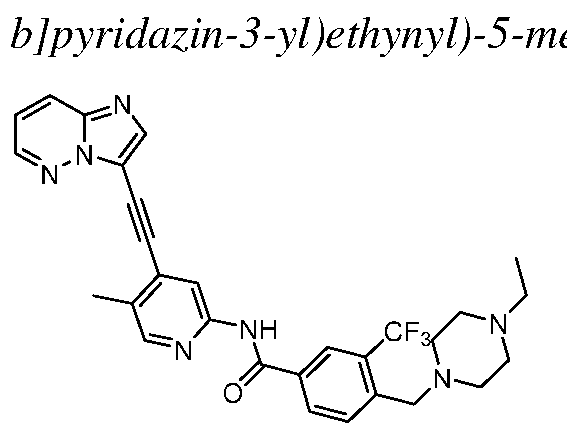
[000453] The title compound was synthesized by alkylating 3-(trifluoromethyl)-N-(4-(2- (imidazo[ 1 ,2-b]pyridazin-3-yl)ethynyl)-5-methylpyridin-2-yl)-4-((piperazin- 1 - yl)methyl)benzamide with bromoethane in a similar method as described for 4-((4- ethylpiperazin- 1 -yl)memyl)-3-(trifluoromethyl)-N-(4-(2-(imidazo[ 1 ,2-b]pyridazin-3- yl)ethynyl)pyridin-2-yl)benzamide. The reaction crude product was purified by preparative TLC (eluent DCM/CH3OH 90: 10) to afford 4-((4-ethylpiperazin-l-yl)methyl)-3- (trifluoromethyl)-N-(4-(2-(imidazo[l,2-¾]pyridazin-3-yl)ethynyl)-5-methylpyridin-2- yl)benzamide (10 mg, 68%, AUC HPLC 97%) as a white solid; JH NMR (600 MHz, DMSO- d6) δ (ppm): 11.19 (s, 1H), 8.76 (dd, / = 4.2, 1.2 Hz, 1H), 8.40 (s, 1H), 8. 34- 8.31 (m, 3H),
8.28 (m, 2H), 7.91 (d, / = 7.8 Hz, 1H), 7.42 (dd, / = 9.0, 4.2 Hz, 1H), 3.67 (s, 2H), 2.48 (s, 3H), 2.46-2.32 (m, 8H), 2.31 (q, / = 7.2 Hz, 2H), 0.98 (t, / = 7.2 Hz, 3H); 13C NMR (150 MHz, DMSO-<¾) δ (ppm): 164.7, 150.2, 148.6, 145.3, 141.6, 140.1, 139.3, 132.8, 131.9, 130.6, 129.4, 126.2, 125.6, 119.6, 114.9, 111.1, 95.2, 84.3, 72.5, 63.1, 57.5, 52.9, 52.3, 51.6, 16.6, 12.0; MS (ESI) m/z 548 [C29H28F3N7O + H]+.
Example 95: N-(4-(2-(6-(dimethylamino)imidazo[l,2-b]pyridazin-3-yl)ethynyl)-5-

[000454] Step 1 : Preparation of teri-butyl 4-(4-((4-((6-(dimethylamino)imidazo[l,2- ¾]pyridazin-3-yl)ethynyl)-5-methylpyridin-2-yl)carbamoyl)-2-
(trifluoromethyl)benzyl)piperazine-l-carboxylate; The title compound was synthesized from teri-butyl 4-(4-((4-iodo-5-methylpyridin-2-yl)carbamoyl)-2-
(trifluoromethyl)benzyl)piperazine- 1 -carboxylate and 3-ethynyl-N,N-dimethylimidazo[ 1 ,2- Z?]pyridazin-6-amine following a method similar to general procedure A. The solvents were removed in vacuo and the crude purified by flash column chromatography (silica gel, eluent: EtOAc) to afford teri-butyl 4-(4-((4-((6-(dimethylamino)imidazo[l,2-¾]pyridazin-3- yl)ethynyl)-5-methylpyridin-2-yl)carbamoyl)-2-(trifluoromethyl)benzyl)piperazine-l- carboxylate (37 mg, 19%). JH NMR (600 MHz, Chloroform-if) δ (ppm): 8.81 (s, 1H), 8.53 (s, 1H), 8.23 (s, 2H), 8.10 (t, / = 12.5 Hz, 2H), 7.77 (s, 1H), 6.87 (s, 1H), 3.78 (s, 2H), 3.50 (m, 4H), 3.18 (s, 6H), 2.53 (s, 3H), 2.49 (m, 4H), 1.46 (s, 9H). 13C NMR (151 MHz, CDC13) δ 164.0, 155.3, 154.8, 149.2, 133.9, 133.3, 132.2, 132.2, 132.0, 131.3, 130.5, 129.6, 129.4, 128.6, 128.6, 126.6, 125.7, 125.3, 125.2, 125.2, 125.2, 124.8, 123.0, 115.1, 110.2, 95.4, 80.0, 57.9, 53.1, 38.8, 28.5, 17.2; MS (ESI) m/z 663 [C34H37F3N8O3 + H]+.
[000455] Step 2: Preparation of N-(4-((6-(dimethylamino)imidazo[l,2-¾]pyridazin-3- yl)ethynyl)-5-methylpyridin-2-yl)-4-(piperazin-l-ylmethyl)-3-(trifluoromethyl)benzamide; The title compound was synthesized from teri-butyl 4-(4-((4-((6-
(dimethylamino)imidazo[l,2-¾]pyridazin-3-yl)ethynyl)-5-methylpyridin-2-yl)carbamoyl)-2- (trifluoromethyl)benzyl)piperazine-l -carboxylate in a similar method as described in general
procedure D. The crude product was directly used in next step without further purification. MS (ESI) m/z 563 [C29H29F3N8O + H]+.
[000456] Step 3: Preparation of N-(4-(2-(6-(dimethylamino)imidazo[l,2-¾]pyridazin-3- yl)ethynyl)-5-methylpyridin-2-yl)-4-((4-ethylpiperazin-l-yl)methyl)-3- (trifluoromethyl)benzamide: The title compound was synthesized from N-(4-((6- (dimethylamino)imidazo[ 1 ,2-¾]pyridazin-3-yl)ethynyl)-5-methylpyridin-2-yl)-4-(piperazin- 1 - ylmethyl)-3-(trifluoromethyl)benzamide in a similar method as described for 4-((4- ethylpiperazin- 1 -yl)methyl)-3-(trifluoromethyl)-N-(4-(2-(imidazo[ 1 ,2-b]pyridazin-3- yl)ethynyl)pyridin-2-yl)benzamide. The reaction crude product was purified by preparative HPLC to afford N-(4-(2-(6-(dimethylamino)imidazo[l,2-¾]pyridazin-3-yl)ethynyl)-5- methylpyridin-2-yl)-4-((4-ethylpiperazin- 1 -yl)methyl)-3-(trifluoromethyl)benzamide formate
(8.9 mg, 26%, AUC HPLC 99%) as a white solid; H NMR (600 MHz, DMSO-<¾) δ (ppm): 11.22 (s, 1H), 8.39 (s, 1H), 8.35 (s, 1H), 8.29 (m, / = 4.4 Hz, 2H), 8.15 (s, 1H), 7.99 (s, 1H), 7.94 (d, / = 9.9 Hz, 1H), 7.91 (d, / = 8.2 Hz, 1H), 7.21 (d, / = 10.0 Hz, 1H), 3.71 (s, 3H), 3.13 (s, 6H), 1.24 (d, / = 6.4 Hz, 2H), 1.05 (t, / = 7.1 Hz, 3H); 13C NMR (150 MHz, DMSO- i¾) 5 (ppm): 164.6, 163.3, 155.4, 150.2, 148.5, 141.3, 136.8, 133.0, 132.0, 131.7, 130.6, 129.1, 127.3, 127.0, 125.7, 125.1, 123.2, 114.4, 110.5, 95.0, 86.0, 57.2, 51.8, 51.3, 38.2, 18.8, 16.5, 11.2; MS (ESI) m/z 591.2 [C31H33F3N8O + H]+.
Example 96: Synthesis of 3-((lH-pyrazolo[3,4-b]pyridin-5-yl)ethynyl)-N-(4-((4- methylpiperazin-l-yl)methyl)-3-(trifluoromethyl)phenyl)benzamide

[000457] Step 1 : Synthesis of 3-iodo-N-(4-((4-methylpiperazin- 1 -yl)methyl)-3- (trifluoromethyl)phenyl)benzamide; To a solution of 3-iodobenzoic acid (90 mg, 0.36 mmol) in anhydrous N,N-dimethylformamide (2 mL) was added HATU (278 mg, 0.78 mmol) and the mixture was stirred at room temperature for 30 minutes. A solution of 4-((4- methylpiperazin-l-yl)methyl)-3-(trifluoromethyl)aniline (100 mg, 0.36 mmol) and triethylamine (74 mg, 0.73 mmol) in anhydrous N,N-dimethylformamide (1 mL) was added. The reaction mixture was stirred at room temperature for 2 h. The mixture was then
partitioned between H2O (50 mL) and ethyl acetate (50 mL). The aqueous layer was extracted with ethyl acetate (2x50 mL). The combined organic extracts were washed with brine (100 mL), dried over sodium sulfate and concentrated in vacuum. The residue was purified by flash column chromatography (silica gel, eluent DCM/MeOH 19: 1) to afford 3-iodo-N-(4- ((4-methylpiperazin-l-yl)methyl)-3-(trifluoromethyl)phenyl)benzamide (182 mg, 98% yield) as brown amorphous solid. MS (ESI) m/z 504.1 [C2oH2iF3IN30+H]+.
[000458] Step 2: Synthesis of 3-((lH-pyrazolo[3,4-Z?]pyridin-5-yl)ethynyl)-N-(4-((4- methylpiperazin-l-yl)methyl)-3-(trifluoromethyl)phenyl)benzamide; To a round bottom flask equipped with a reflux condenser was added 3-iodo-N-(4-((4-methylpiperazin-l-yl)methyl)- 3-(trifluoromethyl)phenyl)benzamide (100 mg, 0.19 mmol), PdCl2(PPh3)2 (14 mg, 0.019 mmol), copper(I) iodide (3.7 mg, 0.019 mmol) and 5-ethynyl-lH-pyrazolo[3,4-Z?]pyridine (31 mg, 0.21 mmol) in anhydrous triethylamine (5 mL). The reaction mixture was purged with nitrogen for 5 minutes. The mixture was heated at 80 °C for 16 hours. The solution was cooled to room temperature, filtered through celite and washed with ethyl acetate. The filtrate was concentrated under reduced pressure and the residue was purified by flash column chromatography (silica gel, DCM/MeOH/ammonium hydroxide 96:3.6:0.4) to afford 3-((lH- pyrazolo[3,4-¾]pyridin-5-yl)ethynyl)-N-(4-((4-methylpiperazin-l-yl)methyl)-3- (trifluoromethyl)phenyl)benzamide (24.2 mg, 23% yield, AUC HPLC 95.7%) as an off-white solid; JH NMR (400 MHz, DMSO-d6) δ (ppm): 13.93 (s, 1H), 10.61 (s, 1H), 8.72 (d, / = 1.9 Hz, 1H), 8.51 (d, / = 1.9 Hz, 1H), 8.22-8.21 (m, 3H), 8.06 (d, / = 8.6 Hz, 1H), 8.00 (d, / = 7.9 Hz, 1H), 7.82 (d, / = 7.9 Hz, 1H), 7.72 (d, / = 8.6 Hz, 1H), 7.63 (t, / = 7.8 Hz, 1H), 3.57 (s, 2H), 2.39-2.32 (m, 8H), 2.16 (s, 3H); MS (ESI) m/z 519.2 [C28H25F3N60+H]+;
Example 97: 4-(piperazin-l-ylmethyl)-N-(4-( (7-(pyridin-2-yl)imidazo[ l,2-a]pyridin-3-

[000459] Step 1 : Preparation of 3-ethynyl-7-(pyridin-2-yl)imidazo[l,2-a]pyridine; 3-iodo-7- (pyridin-2-yl)imidazo[l,2-fl]pyridine and ethynyltrimethylsilane subjected to Sonogashira coupling reaction following a method similar to general procedure A. The residue was
purified by flash column chromatography (silica gel, eluents Hex/EtOAc 2:3) to afford 7- (pyridin-2-yl)-3-((trimethylsilyl)ethynyl)imidazo[l,2-fl]pyridine as yellow solid.
[000460] Step 2: Preparation of 3-ethynyl-7-(pyridin-2-yl)imidazo[l,2-a]pyridine. The intermediate was dissolved in THF (2 ml) followed by addition of TBAF solution (2 ml, 1M) and the mixture was stirred for 18 h at room temperature. The reaction mixture was concentrated and purified by flash column chromatography (silica gel, eluents Hex/EtOAc 1 : 1) to afford 3-ethynyl-7-(pyridin-2-yl)imidazo[l,2-a]pyridine (18 mg, 57 % 2 steps) as a yellow solid. JH NMR (400 MHz, MeOD-<¾) δ (ppm): 8.67 (m, / = 1.1 Hz, 1H), 8.48 (q, / = 2.7 Hz, 1H), 8.24 (q, / = 0.87 Hz, 1H), 8.01-7.86 (m, 3H), 7.79 (q, / = 2.9 Hz, 1H), 7.40 (m, / = 1.9 Hz, 1H), 4.45 (s, 1H); MS (ESI) m/z 220 [C14H9N3+H]+.
[000461] Step 2: Preparation of 4-(piperazin-l-ylmethyl)-N-(4-((7-(pyridin-2- yl)imidazo[l,2-fl]pyridin-3-yl)ethynyl)pyridin-2-yl)-3-(trifluoromethyl)benzamide; 3- ethynyl-7-(pyridin-2-yl)imidazo[l,2-fl]pyridine and teri-butyl 4-(4-(4-bromopyridin-2- ylcarbamoyl)-2-(trifluoromethyl) benzyl) piperazine-l-carboxylate subjected to Sonogashira coupling reaction in a similar fahion as described in general procedure A. The residue mixture was purified by column chromatography (silica gel, eluents Hex/EtOAc 3:7) to afford teri-butyl 4-(4-(4-((7-(pyridin-2-yl)imidazo[l ,2-a]pyridin-3-yl)ethynyl)pyridin-2- ylcarbamoyl)-2-(trifluoromethyl)benzyl)piperazine- 1 -carboxylate.
Step 3: Synthesis of 4-(piperazin-l-ylmethyl)-N-(4-((7-(pyridin-2-yl)imidazo[l,2-a]pyridin- 3-yl)ethynyl)pyridin-2-yl)-3-(trifluoromethyl)benzamide. The intermediate from the step above was added to a solution of TFA in DCM (6 ml, 50%) and stirred at room temperature for 18 h before purification by preparative HPLC (CI 8, eluents ACN/H20/HCOOH 0.1%) to afford 4-(piperazin- 1 -ylmethyl)-N-(4-((7-(pyridin-2-yl)imidazo[ 1 ,2-a]pyridin-3- yl)ethynyl)pyridin-2-yl)-3-(trifluoromethyl)benzamide (25 mg, 52%, AUC HPLC 99%) as yellow solid; JH NMR (400 MHz, MeOO-d4) δ (ppm): 8.49 (d, / = 6.6 Hz, 1H), 8.31 (d, / = 7.4 Hz, 2H), 8.42 (s, 1H), 8.14 (d, / = 7.6 Hz, 1H), 7.95 (t, / = 9.2 Hz, 2H), 7.76 (s, 1H), 7.70 (d, / = 7.5 Hz, 2H), 7.50-7.41 (m, 4H), 7.22 (d, / = 4.0 Hz, 1H), (3.87 (s, 2H), 3.45 (s, 4H), 2.43 (t, / = 4.5 Hz, 4H), 1.46 (s, 9H); MS (ESI) m/z 681 [C38H35F3N603+ H]+.
Example 98: N-(4-((7-cyclopropylimidazo[ l,2-a]pyridin-3-yl)ethynyl)pyridin-2-yl)-4- (piperazin-l-ylmethyl)-3-(trifluoromethyl)benzamide

[000462] Step 1 : Preparation of 7-cyclopropyl-3-((trimethylsilyl)ethynyl)imidazo[ 1,2- fl]pyridine; 7-cyclopropyl-3-iodoimidazo[l,2-a]pyridine and ethynyltrimethylsilane subjected to Sonogashira coupling reaction in a similar methodas described in general procedure A. The reaction mixture was purified by column chromatography (silica gel, eluents Hex/EtOAc 7:3) to afford 7-cyclopropyl-3-((trimethylsilyl)ethynyl)imidazo[l,2]pyridine (11.4 mg) as brown viscous liquid. MS (ESI) m/z 246 [C15H18N2Si + H]+.
The intermediate 7-cyclopropyl-3-((trimethylsilyl)ethynyl)imidazo[l,2]pyridine was subjected to silyl deportation by using TBAF in THF. The reaction mixture was purified by column chromatography to afford 7-cyclopropyl-3-ethynylimidazo[l,2-a]pyridine.
[000463] Step 2: Preparation of N-(4-((7-cyclopropylimidazo[l,2-a]pyridin-3- yl)ethynyl)pyridin-2-yl)-4-(piperazin-l-ylmethyl)-3-(trifluoromethyl)benzamide; 7- cyclopropyl-3-ethynylimidazo[l,2-fl]pyridine and teri-butyl 4-(4-(4-bromopyridin-2- ylcarbamoyl)-2-(trifluoromethyl) benzyl) piperazine-l-carboxylate subjected to Sonogashira coupling reaction following a method similar to general procedure A. The residue mixture was purified by flash column chromatography (silica gel, eluents Hex/EtOAc 1 :9) to afford crude teri-butyl 4-(4-(4-((7-cyclopropylimidazo[l ,2-a]pyridin-3-yl)ethynyl)pyridin-2- ylcarbamoyl)-2-(trifluoromethyl)benzyl)piperazine-l-carboxylate which was then dissolved in DCM (2 ml) and TFA was added ( 2 ml). The reaction solution was stirred at 80 °C overnight and neutralized with a saturated aqueous olution of NaHCC>3 followed by an aqueous work-up then a purification by preparative HPLC (CI 8, eluents ACN/H2O/HCOOH 0.1 %) to afford N-(4-((7-cyclopropylimidazo[ 1 ,2-a]pyridin-3-yl)ethynyl)pyridin-2-yl)-4- (piperazin-l-ylmethyl)-3-(trifluoromethyl)benzamide (0.8 mg, AUC HPLC 97%) as yellow solid. JH NMR (400 MHz, MeOO-d4) δ (ppm): 8.45 (s, 1H), 8.42 (d, / = 5.2 Hz, 1H), 8.33 (s, 1H), 8.24 (d, / = 8.2 Hz, 1H), 8.02 (d, / = 8.2 Hz, 1H), 7.98 (s, 1H), 7.85 (d, / = 10.1 Hz, 1H), 7.31 (d, / = 10.1 Hz, 1H), 7.28 (q, / = 2.1 Hz, 1H), 3.87(s, 2H), 3.68 (q, / = 7.1 Hz, 4H), 3.29-3.25 (m, 4H), 3.28 (t, / = 5.2 Hz, 4H), 1.33 (t, / = 7.1 Hz, 6H); MS (ESI) m/z 577
[C3oH31F3N803 + H]+.
Example 99: N-(4-((6-(dimethylamino)imidazo[l,2-a]pyridin-3-yl)ethynyl)pyridin-2

Step 1 : Preparation of N,N-dimethylimidazo[l,2-a]pyridin-6-amine
[000464] A mixture of 6-bromoimidazo[l,2-a]pyridine (2 g, 10.1 mmol), potassium tert- butoxide (2.27 g, 20.3 mmol), X-Phos (48.1 mg, 0.10 mmol), dimethyl amine in THF (2 M, 10 mL) and Pd(dba)2 (57.5 mg, 0.10 mmol) in xylene was heated at 180 °C for 4 h in a sealed tube. The reaction mixture was diluted with a mixture of EtOAc and THF and washed in turn with water and brine. The organic layer was dried over Na2S04 and concentrated under reduced pressure. The residue was purified by flash column chromatography (silica gel, eluent CHCI3/CH3OH 96:4) of N,N-dimethylimidazo[l,2-a]pyridin-6-amine (1.2 g, 73%) as a solid. JH NMR (400 MHz, CDC13) δ (ppm): 7.49 (s, 1H), 7.46 (s, 1H), 7.44 (s, 1H), 7.39 (d, / = 2.0 Hz, 1H), 7.02 (dd, / = 2.4 Hz, 1H), 2.84 (s, 6H); MS (ESI) nt/z: 162.2 [C9HnN3+H]+. Step 2: Preparation of 3-iodo-N,N-dimethylimidazo[l,2-a]pyridin-6-amine
[000465] To a solution of N,N-dimethylimidazo[l,2-a]pyridin-6-amine (1.2 g, 7.45 mmol) in ACN (20 mL) was added NIS (2.01 g, 8.94 mmol) and the reaction mixture was stirred at room temperature for 2 h. The reaction mixture was diluted with water (50 mL) and filtered. The organic phase was washed in turn with water and brine, dried over Na2S04, filtered and concentrated under reduced pressure to afford 3-iodo-N,N-dimethylimidazo[l,2-a]pyridin-6- amine. JH NMR (400 MHz, DMSO-<¾) δ (ppm): 7.58 (s, 1H), 7.48 (d, / = 9.6 Hz, 1H), 7.32 (d, J =1.6 Hz, 1H), 7.28 (dd, / = 2.0 Hz, 1H), 2.84 (s, 6H); MS (ESI) nt/z: 286.1
[C9H10IN3+H]+ .
Step 3: Preparation of N-(4-((6-(dimethylamino)imidazo[l,2-a]pyridin-3-yl)ethynyl)pyridin- 2-yl)-4-((4-ethylpiperazin-l-yl)methyl)-3-(trifluoromethyl)benz amide
[000466] The title compound was synthesized from 3-iodo-N,N-dimethylimidazo[l,2- fl]pyridin-6-amine and 4-((4-ethylpiperazin- 1 -yl)methyl)-N-(4-ethynylpyridin-2-yl)-3- (trifluoromethyl)benzamide following a method similar to general procedure A. The reaction mixture was purified by flash coloum chromatography (silica gel, eluent CHCI3/CH3OH 96:4) to afford N-(4-((6-(dimethylamino)imidazo[l,2-a]pyridin-3-yl)ethynyl)pyridin-2-yl)-4- ((4-ethylpiperazin-l-yl)methyl)-3-(trifluoromethyl)benzamide (50 mg, 25%, AUC HPLC 90%) as a yellow solid; m.p. 160-165 °C; JH NMR (400 MHz, CDC13) δ (ppm): 8.54 (d, / =
12.0 Hz, 1H), 8.33 (d, / = 4.8 Hz, 1H), 8.21 (s, 1H), 8.07 (d, / = 8.0 Hz, 2H), 7.90 (d, / = 7.6 Hz, 2H), 7.62 (s, 1H), 7.58 (d, / = 9.6 Hz, 1H), 7.21-7.16 (m, 2H), 3.80 (s, 2H), 3.00 (s, 6H), 2.82-2.77 (m, 10H), 1.29 (t, / = 4.0 Hz, 3H); MS (ESI) m/z 576.4 [C3iH32F3N70+H]+.
Example 100: 4-((4-ethylpiperazin-l-yl)methyl)-N-(4-( imidazo[ l,2-a]pyridin-3- uoromethyl)benzamide formate salt

Preparation of 4-((4-ethylpiperazin- 1 -yl)methyl)-N-(4-(imidazo[ 1 ,2-a]pyridin-3- ylethynyl)pyridin-2-yl)-3-(trifluoromethyl)benzarnide formate salt
[000467] The title compound was synthesized from 4-((4-ethylpiperazin-l-yl)methyl)-N-(4- ethynylpyridin-2-yl)-3-(trifluoromethyl)benzamide and 3-iodoimidazo[ 1 ,2-a]pyridine following a method similar to general procedure A. The residue was purified by column chromatography (silica gel, DCM/methnol 10:1) to afford 4-((4-ethylpiperazin-l-yl)methyl)- N-(4-(imidazo[l,2-fl]pyridin-3-ylethynyl)pyridin-2-yl)-3-(trifluoromethyl)benzamide formate salt (32 mg, 25%, AUC HPLC 99%) as a yellow solid, m.p. 50.2-51.6 °C; JH NMR (400 MHz, MeOD-<¾) δ (ppm): 8.51 (d, / = 6.8 Hz, 1H), 8.39 (s, 1H), 8.34 (s, 1H), 8.32 (d, / = 5.1 Hz, 1H), 8.27 (s, 1H), 8.19 (dd, / = 8.0, 1.2 Hz, 1H), 7.96-7.89 (m, 2H), 7.62 (d, / = 9.0 Hz, 1H), 7.49-7.42 (m, 1H), 7.25 (dd, / = 5.1, 1.3 Hz, 1H), 7.17-7.12 (m, 1H), 3.83 (s, 2H), 3.35-3.24 (m, 4H), 3.20 (q, / = 7.3 Hz, 2H), 2.79 (bs, 4H), 1.35 (t, / = 7.3 Hz, 3H); 13C NMR (100 MHz, MeOD-<¾) δ (ppm): 168.03, 166.59, 153.39, 149.54, 147.29, 142.12, 139.67, 134.90, 133.78, 132.44, 132.19, 130.09, 128.92, 126.97, 126.82, 125.49, 121.42, 118.09, 116.78, 115.63, 109.30, 98.54, 81.57, 58.35, 52.92, 52.67, 51.11, 9.60; MS (ESI) m/z 533.70 [C29H27F3N60 + H]+.
Example 101: N-(4-((l -aminoisoquinolin-4-yl jethynyl )pyridin-2-yl )-4-( (4-ethylpiperazin-l-
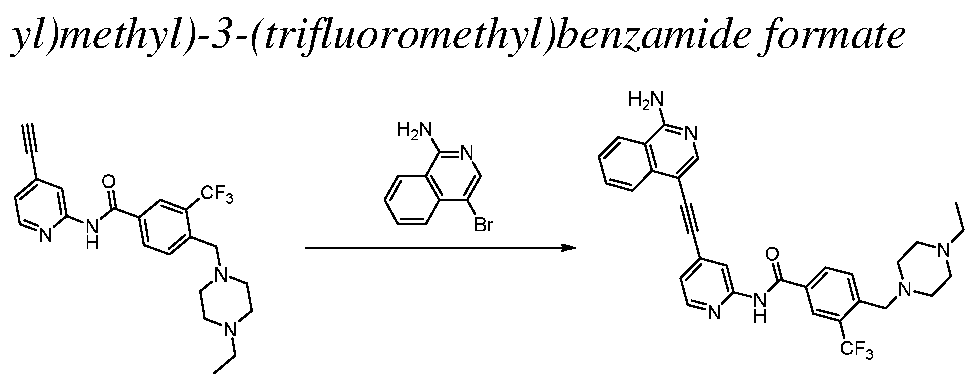
[000468] The title compound was synthesized from N-(4-bromopyridin-2-yl)-4-((4- ethylpiperazin- 1 -yl)memyl)-3-(trifluoromemyl)benzamideamine and 4-bromoisoquinolin- 1 - amine following a method similar to general procedure A. The reaction mixture was purified twice by preparative HPLC (CI 8, eluent CH3CN/H20/HCOOH 0.1%) to afford N-(4-((l - aminoisoquinolin-4-yl)ethynyl)pyridin-2-yl)-4-((4-ethylpiperazin-l-yl)methyl)-3- (trifluoromethyl)benzamide (5 mg, AUC HPLC 98.9%) as an off-white solid; m.p. 99-101 °C; JH NMR (400 MHz, CD3OD) δ (ppm): 8.94 (s, IH), 8.60 (s, IH), 8.40 (s, IH), 8.31 (d, / = 5.2 Hz, IH), 8.26 (t, / = 3.9 Hz, 2H), 8.20 (s, IH), 8.11 (dd, / = 8.0 Hz, / = 1.6 Hz, IH), 7.94-7.81 (m, 3H), 7.68-7.60 (m, IH), 7.30-7.28 (m, IH), 6.60-6.20 (bs, 2H), 3.79 (s, 2H), 3.91 (s, 4H), 2.82 (q, / = 7.3 Hz, 2H), 2.73 (s, 4H), 1.25 (t, / = 7.3 Hz, 3H); 13C NMR (100 MHz, CD3OD) δ (ppm): 166.90, 164.25, 156.49, 151.43, 147.64, 144.56, 136.68, 134.43, 133.19, 132.01, 131.07, 130.41, 127.45, 125.93, 125.44, 125.38, 122.89, 122.09, 116.87, 116.00, 105.73, 91.85, 90.69, 57.80, 51.60, 51.49, 51.05, 10.04; MS (ESI) m/z 593
[C31H29F3N60 + H]+.
Example 102: N-(4-(2-( l,6-naphthyridin-8-yl)ethynyl)pyridin-2-yl)-4-((4-ethylpiperaz

Preparation of N-(4-(2-(l,6-naphthyridin-8-yl)ethynyl)pyridin-2-yl)-4-((4-ethylpiperazin-l- yl)methyl)-3-(trifluoromethyl)benzamide
[000469] The title compound was synthesized from 8-bromo-l,6-naphthyridine and 4-((4- ethylpiperazin-l-yl)memyl)-N-(4-ethynylpyridin-2-yl)-3-(trifluoromethyl)benzamide following a method similar to general procedure A. The reaction crude product was purified by column chromatography (eluent DCM/CH3OH 90:10) to afford N-(4-(2-(l,6-naphthyridin- 8-yl)ethynyl)pyridin-2-yl)-4-((4-ethylpiperazin-l-yl)methyl)-3-(trifluoromethyl)benzamide (11.9 mg, 18%, AUC HPLC 99%) as a light brown solid; JH NMR (600 MHz, DMSO-<¾) δ (ppm): 11.32 (s, IH), 9.49 (s, IH), 9.30 (dd, / = 4.2, 1.8 Hz, IH), 9.09 (s, IH), 8.70 (dd, / = 8.3, 1.8 Hz, IH), 8.52 (d, / = 5.0 Hz, IH), 8.43 (d, / = 1.3 Hz, IH), 8.36 (d, / = 1.8 Hz, IH),
8.30 (dd, / = 8.1, 1.8 Hz, IH), 7.93 (d, / = 8.1 Hz, IH), 7.85 (dd, / = 8.2, 4.2 Hz, IH), 7.42 (dd, / = 5.0, 1.4 Hz, IH), 2.47 - 2.39 (m, 4H), 2.32 (q, / = 7.2 Hz, 2H), 0.99 (t, / = 7.2 Hz, 3H); 13C NMR (150 MHz, DMSO-<¾) δ (ppm): 164.9, 156.1, 154.1, 152.4, 150.5, 149.1, 148.7, 141.7, 136.9, 132.8, 132.0, 131.7, 130.5, 127.4, 127.2, 127.0, 126.8, 125.6, 125.0, 124.1, 123.2, 123.0, 121.5, 116.1, 93.9, 88.7, 57.5, 52.9, 52.3, 51.5, 11.9; MS (ESI) m/z 545.15 [C3oH27F3N60+ H]+.
Example 103: 4-((4-ethylpiperazin-l-yl)methyl)-N-(4-(pyrazolo[ l,5-a]pyridin-3-

[000470] The title compound was synthesized from 4-((4-ethylpiperazin-l-yl)methyl)-N-(4- ethynylpyridin-2-yl)-3-(trifluoromethyl)benzamide and 3-bromopyrazolo[l ,5-a]pyridine following a method similar to general procedure A. The reaction crude product was purified by flash column chromatography (silica gel, CH2Ci2:MeOH 100:0 to 90: 10) and by preparative HPLC (CH3CN/H2O/0.1 % Formic acid) to afford 4-((4-ethylpiperazin-l- yl)methyl)-N-(4-(pyrazolo[l,5-fl]pyridin-3-ylethynyl)pyridin-2-yl)-3-
(trifluoromethyl)benzamide (4.9 mg, AUC HPLC 98.7%). JH NMR (400 MHz, DMSO-<¾) δ (ppm): 11.22 (s, IH), 8.84 (d, IH, / = 6.9 Hz), 8.43-8.42 (m, 2H), 8.35 (s, IH), 8.31-8.29 (m, 2H), 7.93-7.90 (m, 2H), 7.53-7.48 (m, IH), 7.33-7.32 (m, IH), 7.12-7.09 (m, IH), 3.68 (s, 2H), 2.49-2.43 (m, 8H), 2.32 (q, 2H, / = 7.2 Hz), 0.98 (t, 3H, / = 7.2 Hz); MS (ESI) m/z 533.2 [C29H27F3N60+H]+;
Example 104: 4-((4-ethylpiperazin-l-yl)methyl)-N-(4-( imidazo[ 1 ,2-c]pyrimidin-3-

[000471] The title compound was synthesized from 4-((4-ethylpiperazin-l-yl)methyl)-N-(4- ethynylpyridin-2-yl)-3-(trifluoromethyl)benzamide and 3-bromoimidazo[l ,2-c]pyrimidine
following a method similar to general procedure A. The residue was purified by flash column chromatography (silica gel, eluent DCM/MeOH 9: 1) and the product thus obtained was triturated in MeOH, isolated by centrifugation and dried to afford 4-((4-ethylpiperazin-l- yl)memyl)-N-(4-(imidazo[l,2-c]pyrimidin-3-ylethynyl)pyridin-2-yl)-3- (trifluoromethyl)benzamide (21 mg, 33.1%, AUC HPLC 97.5%) as white powder; mp 186- 188 °C; JH NMR (400 MHz, CDC13) δ (ppm): 9.25 (s, 1H), 8.80 (s, 1H), 8.58 (s, 1H), 8.34 (d, / = 5.0 Hz, 1H), 8.21 (s, 1H), 8.08 (d, / = 6.4 Hz, 2H), 8.01 (d, / = 7.3 Hz, 2H), 7.60 (d, / = 6.3 Hz, 1H), 7.23 (d, / = 4.8 Hz, 1H), 3.74 (s, 2H), 2.75-2.30 (m, 10H), 1.12 (t, / = 7.2 Hz, 3H); 13C NMR (100 MHz, CDCI3) δ (ppm): 164.37, 151.65, 148.27, 145.83, 142.99, 140.92, 138.87, 132.68, 132.52, 131.10, 130.29, 129.63, 129.32, 129.01, 125.24, 125.04, 124.98, 122.51, 121.44, 115.48, 112.95, 106.38, 97.40, 79.79, 58.01, 53.11, 52.82, 52.33, 11.87; MS (ESI) m/z 534.60[C28H26F3N7O + H]+.
Example 105: N-(4-((lH-benzo[d]imidazol-6-yl)ethynyl)pyridin-2-yl)-4-((4-ethylpiperazin-l-

[000472] The title compound was synthesized from 6-ethynyl-lH-benzo[(f]imidazole and N-(4-bromopyridin-2-yl)-4-((4-emylpiperazin-l-yl)memyl)-3-(trifluoromethyl)benzamide following a method similar to general procedure A. The crude product was purified by column chromatography (silica gel, CH2Ci2/MeOH 10: 1) and by preparative HPLC (CI 8, eluent CH3CN/H2O/HCOOH 0.01%) to afford N-(4-((lH-benzo[ ]imidazol-6- yl)ethynyl)pyridin-2-yl)-4-((4-ethylpiperazin- 1 -yl)methyl)-3-(trifluoromethyl)benzamide (69 mg, 24%, AUC HPLC 99%) as white solid; m.p. 248.2-250.7 °C; JH NMR (400 MHz, MeOD-<¾) δ (ppm): 8.36-8.35 (m, 2H), 8.28 (d, / = 1.6 Hz, 1H), 8.26 (s, 1H), 8.20 (dd, / = 8.2, 1.6 Hz, 1H), 7.99 (d, / = 8.2 Hz, 1H), 7.86 (s, 1H), 7.65 (d, / = 8.4 Hz, 1H), 7.49 (dd, / = 8.4, 1.4 Hz, 1H), 7.26 (dd, / = 2.8; 1.4 Hz, 1H), 3.75 (s, 2H), 2.56 (bs, 8H), 2.45 (q, / = 7.3 Hz, 2H), 1.10 (t, / = 7.3 Hz, 3H); MS (ESI) m/z 533 [C29H27F3N60 + H]+.
Example 106: N-(4-((6-methoxyimidazo[ l,2-b]pyridazin-3-yl)ethynyl)pyridin-2-yl)-4-((4- methylpiperazin-l-yl)methyl)-3-(trifluoromethyl)benzamide

Preparation of N-(4-((6-methoxyimidazo[ 1 ,2-b]pyridazin-3-yl)ethynyl)pyridin-2-yl)-4-((4- methylpiperazin- 1 -yl)methyl)-3-(trifluoromethyl)benzamide.
[000473] The title compound was synthesized following a method similar to general procedure B starting from N-(4-bromopyridin-2-yl)-4-((4-methylpiperazin-l-yl)methyl)-3- (trifluoromethyl)benzamide and 3-ethynyl-6-methoxyimidazo[l,2-b]pyridazine. The reaction crude product was purified by flash column chromatography (silica gel, eluent
CHCI3/CH3OH 97:3) to give N-(4-((6-methoxyimidazo[l,2-b]pyridazin-3-yl)ethynyl)pyridin- 2-yl)-4-((4-methylpiperazin-l-yl)methyl)-3-(trifluoromethyl)benzamide (100 mg, 41%, AUC HPLC 94.6%) as a yellow solid. JH NMR (400 MHz, DMSO d6) δ (ppm): 11.27 (s, 1H), 8.48 (d, / = 5.2 Hz, 1H), 8.37 (s, 1H), 8.34 (s, 1H), 8.28 (d, / = 8.0 Hz, 1H), 8.19 (s, 1H), 8.13 (d, / = 4.0 Hz, 1H), 7.91 (d, / = 8.0 Hz, 1H), 7.35 (dd, / = 1.2 Hz, / = 1.6 Hz, 1H), 7.07 (d, / = 9.6 Hz, 1H), 4.07 (s, 3H), 3.68 (s, 2H), 2.42-2.32 (m, 8H), 2.17 (s, 3H); MS (ESI) m/z 550.1 [C28H26F3N702+H]+.
Example 107: 4-(piperazin-l-ylmethyl)-N-(4-((6-(pyridin-3-yl) imidazo [1, 2-b] pyridazin-3- yl) ethynyl) pyridin-2-yl)-3-(trifluoromethyl)benzamide

Step 1 : Preparation of 6-(pyridin-3-yl) imidazo[l,2-b]pyridazine
[000474] To a solution of 6-chloroimidazo[l,2-b] pyridazine (2.0 g, 13 mmol) in a mixture of 1 ,4-dioxane and water (25 ml) under argon were successively added pyridin-3-ylboronic acid (1.80 g, 14 mmol), potassium phosphate (5.6 g, 26 mmol), Pd(PPh3)4 (0.75 g, 0.6 mmol). The resulting reaction mixture was heated at 80 °C for 16 h, was concentrated under reduced pressure and the residue was diluted with water ( 20 mL). The precipitate was isolated by filtration and dried to afford 6-(pyridin-3-yl) imidazo[l,2-b]pyridazine as a yellow solid (1.4 g)-
Step 2: Preparation of 3-iodo-6-(pyridin-3-yl) imidazo[l,2-b]pyridazine):
[000475] To a solution of 6-(pyridin3-yl) imidazo[l,2-b] pyridazine (1.5 g, 7.65 mmol) in
DMF (5 mL) was added N-iodo succinamide (2.6 g, 11.4 mmol). The reaction mixture was
heated at 90 °C for 2 h, poured into ice cold water (20 mL) and extracted with ethyl acetate (15 mL). The organic phase washed in turn with water and brine, dried over Na2S04, filtered and concentrated under reduced pressure to afford 3-iodo-6-(pyridin-3-yl)imidazo[l ,2- bjpyridazine (1 g, 41 %, LC-MS 75%) as a brown solid.
Step 3: Preparation of 6-(pyridin-3-yl)-3-((trimethylsilyl) ethynyl)imidazo[l ,2-b]pyridazine:
[000476] To a solution of 3-iodo-6-(pyridin-3-yl)imidazo[l ,2-b]pyridazine (2.0g, 6.2 mmol) in DMF (5 mL) under argon were successively added Pd(PPh3)4 (0.36 g, 0.31 mmol), trimethysillyllalkyne (0.73 g, 7.4 mmol), Cul (58 mg, 0.31 mmol) and DIPEA (1.6 g, 12.4 mmol). The resulting reaction mixture was stirred for 3 h at room temperature, diluted with EtOAc and washed in turn with water and brine. The organic layer was dried over Na2S04 and concentrated. The residue was purified by flash column chromatography (silica gel eluent: petroleum ether/EtOAc 70:30) to afford 6-(pyridin-3-yl)-3- ((trimethylsilyl)ethynyl)imidazo[l ,2-b]pyridazine ( 1.5 g, 83%).
Step 4: Preparation of 3-ethynyl-6-(pyridin-3-yl) imidazo [1, 2-b] pyridazine:
[000477] To a solution of 6-(pyridin-3-yl)-3-((trimethylsilyl)ethynyl)imidazo[l,2- b]pyridazine (1 g, 3.4 mmol) in a mixture of THF (10 mL) and H2O (2 mL) was added LiOH (210 mg, 0.005 mol). The reaction mixture was stirred at room temperature for 2 h, was concentrated under reduced pressure and the residue was diluted with ethyl acetate (15 mL). The organic phase was washed in turn with water and brine. The organic layer was dried over Na2S04, filtered and concentrated under reduced pressure to afford 3-ethynyl-6-(pyridin-3- yl)imidazo[l,2-b]pyridazine (400 mg, 53%, LC-MS 89%) as a yellow solid.
Step 5: Preparation of teri-butyl 4-(4-(4-((6-(pyridin-3-yl)imidazo[l,2-b]pyridazin-3- yl)ethynyl)pyridin-2-ylcarbamoyl)-2-(trifluoromethyl)benzyl)piperazine-l-carboxylate:
[000478] The title compound was synthesized following a method similar to general procedure B starting from teri-butyl 4-(4-(4-bromopyridin-2-ylcarbamoyl)-2- (trifluoromethyl)benzyl)piperazine-l-carboxylate and 3-ethynyl-6-(pyridin-3-yl)imidazo[l ,2- b]pyridazine. The reaction crude product was purified by flash column chromatography (silica gel eluent: dichloromethane/ methanol 98:2) to afford teri-butyl 4-(4-(4-((6-(pyridin-3- yl)imidazo[l,2-b]pyridazin-3-yl)ethynyl)pyridin-2-ylcarbamoyl)-2- (trifluoromethyl)benzyl)piperazine-l-carboxylate (80 mg, LC-MS 84%) as a yellow solid. Step 6: 4-(piperazin-l-ylmethyl)-N-(4-((6-(pyridin-3-yl) imidazo [1, 2-b] pyridazin-3-yl) ethynyl) pyridin-2-yl)-3-(trifluoromethyl) benzamide:
[000479] The title compound was synthesized following a method similar to general procedure D starting from teri-butyl 4-(4-(4-((6-(pyridin-3-yl)imidazo[l,2-b]pyridazin-3-
yl)ethynyl)pyridin-2-ylcarbamoyl)-2-(trifluoromethyl)benzyl)piperazine- 1 -carboxylate. The reaction crude product was purified by flash column chromatography (silica gel, eluent: CHCI3/CH3OH 96:4) to give 4-(piperazin-l-ylmethyl)-N-(4-((6-(pyridin-3-yl) imidazo [1, 2- b] pyridazin-3-yl) ethynyl) pyridin-2-yl)-3-(trifluoromethyl) benzamide (60 mg, 69%, AUC HPLC 98%) as a yellow solid. JH NMR (400 MHz, CDC13) δ (ppm): 9.28-9.28 (d, / = 1.6 Hz, 1H), 8.79-8.77 (dd, / = 4.8, / = 1.2 Hz, 1H), 8.63-8.62 (d, / = 5.6 Hz , 2H), 8.37-8.35 (d, / = 5.2 Hz, 1H), 8.21 (s, 1H), 8.15-8.06 (m, 4H), 7.66-7.63 (d, / = 11.2 Hz, 1H), 7.60- 7.56 (m, 1H), 7.31-7.29 (m, 1H), 3.72 (s, 2H), 2.94-2.92 (m, 4H ), 2.50-2.42 (m, 4H ); MS (ESI) m/z 583 [C3iH25F3N80+H]+.
Example 108: 4-(piperazin-l-ylmethyl)-N-(4-( ( 6-(pyrimidin-5-yl)imidazo[ 1,2-b ]pyridazin-3-

Step 1 : Preparation of 6-(pyrimidin-5-yl)imidazo[l,2-b]pyridazine
[000480] To a solution of 6-chloroimidazo[ 1,2-b] pyridazine (2 g, 13.07 mmol) in a mixture of 1,4- dioxane and water (30 mL) under argon, were successively added Pd(PPli3)4 (0.754 g, 0.65 mmol), pyrimidin-5-ylboronic acid (1.94 g, 15.68 mmol), potassium phosphate (5.54 g, 26.14 mmol). The reaction mixture was heated at 100 °C for 4 h and was concentrated to afford 6-(pyrimidin-5-yl)imidazo[l,2-b]pyridazine (2.5 g, 48%, LC-MS 98%) as a yellow solid. JH NMR (400 MHz, DMSO-<¾) δ (ppm): 9.45 (s, 2H), 9.35 (s, 1H), 8.44 (s, 1H), 8.35 (d, / = 9.6 Ηζ,ΙΗ), 7.94 (d, / = 9.6 Hz, 1H), 7.89 (s, 1H). MS (ESI) m/z 198 [C10H7N5+H]. Step 2: Preparation of 3-iodo-6-(pyrimidin-5-yl)imidazo[l,2-b]pyridazine
[000481] To a solution of 3-iodo-6-(pyrirnidin-5-yl)imidazo[l,2-b]pyridazine (2.5 g, 12.69 mmol) in DMF (18 mL) was added N-iodosuccinamide (3.42 g, 15.22 mmol) and the reaction mixture was stirred at room temperature for 3 h. The reaction mixture was diluted with EtOAc and washed in turn with water and brine. The organic layer was dried over Na2S04, filtered and concentrated under reduced pressure to afford 3-iodo-6-(pyrimidin-5- yl)imidazo[l,2-b]pyridazine (2.8 g) as a pale brown solid. (ESI) m/z 324 [C10H6IN5+H]. Step 3: Preparation of 6-(pyrimidin-5-yl)-3-((trimethylsilyl)ethynyl)imidazo[l,2-b]pyridazine
[000482] The title compound was synthesized following a method similar to general procedure A starting from 3-iodo-6-(pyrimidin-5-yl)imidazo[l,2-b]pyridazine (2.8 g, 2.18
mmol) and ethynyltrimethylsilane. The reaction crude product was purified by column chromatography (neutral alumina, eluent: Petroleum ether/ethyl acetate 80:20) to afford 6- (pyrimidin-5-yl)-3-((trimethylsilyl)ethynyl)imidazo[l,2-b]pyridazine (1.5 g, 60%, LC-MS 90%) as a brown solid. JH NMR (400 MHz, DMSO-<¾) δ (ppm): 9.40 (s, 2H), 9.36 (s, 1H), 8.44 (d, / = 9.2 Hz, 1H), 8.05 (s, 1H), 7.56 (d, / = 9.2 Hz, 1H), 0.34 (s, 9H). MS (ESI) m/z 294 A [CisHisNsSi+H].
Step 4: Preparation of 3-ethynyl-6-(pyrimidin-5-yl)imidazo[l,2-b]pyridazine
[000483] To a solution of 6-(pyrimidin-5-yl)-3-((trimethylsilyl) ethynyl) imidazo [1, 2-b] pyridazine (1.5 g, 5.11 mmol) in THF (20 mL) and ¾0 (5 mL) was added LiOH (257.5 mg, 6.13 mmol) at room temperature and stirred for 6 h. The reaction mixture was concentrated under reduce pressure. The residue was diluted with diethyl ether then washed in turn with water and brine. The organic layer was dried over Na2S04, filtered and concentrated under reduced pressure to afford 3-ethynyl-6-(pyrimidin-5-yl)imidazo[l,2-b]pyridazine (800 mg, 61%, LC-MS 95%) as a light brown solid. JH NMR (400 MHz, DMSO-<¾) δ (ppm): 9.46 (s, 2H), 9.37 (s, 1H), 8.44 (d, / = 9.2 Hz, 1H), 8.21 (s, 1H), 8.07 (d, / = 9.6 Hz, 1H), 5.03 (s, 1H). MS (ESI) m/z 222.1 [C12H7N5+H].
Step 5: Preparation of tert-butyl 4-(4-(4-((6-(pyrimidin-5-yl)imidazo[l,2-b]pyridazin-3- yl)ethynyl)pyridin-2-ylcarbamoyl)-2-(trifluoromethyl)benzyl)piperazine-l-carboxylate
[000484] The title compound was synthesized following a method similar to general procedure A starting from teri-butyl 4-(4-(4-bromopyridin-2-ylcarbamoyl)-2- (trifluoromethyl)benzyl)piperazine- 1 -carboxylate and 3-ethynyl-6-(pyrimidin-5- yl)imidazo[l,2-b]pyridazine. The crude product was purified by column chromatography (neutral alumina, eluent: Petroleum ether /ethyl acetate 80:20) to afford teri-butyl 4-(4-(4-((6- (pyrimidin-5-yl)imidazo[l,2-b]pyridazin-3-yl)ethynyl)pyridin-2-ylcarbamoyl)-2- (trifluoromethyl)benzyl)piperazine-l -carboxylate (200 mg, 53%, LC-MS 88%) as an off- white solid.
Step 6: 4-(piperazin-l-ylmethyl)-N-(4-((6-(pyrimidin-5-yl)imidazo[l,2-b]pyridazin-3- yl)ethynyl)pyridin-2-yl)-3-(trifluoromethyl)benzamide
[000485] The title compound was synthesized following a method similar to general procedure D starting from teri-butyl tert-butyl 4-(4-(4-((6-(pyrimidin-5-yl)imidazo[l,2- b]pyridazin-3-yl)ethynyl)pyridin-2-ylcarbamoyl)-2-(trifluoromethyl)benzyl)piperazine-l- carboxylate. The reaction crude product was purified by column chromatography (neutral alumina, eluent: petroleum ether/ethyl acetate 70:30) to afford 4-(piperazin-l-ylmethyl)-N-(4- ((6-(pyridin-4-yl)imidazo[l,2-b]pyridazin-3-yl)ethynyl)pyridin-2-yl)-3-
(trifluoromethyl)benzamide (30 mg, 17%, LC-MS 97%, AUC HPLC 99%) as a yellow solid, m.p.: 260-263 °C. JH NMR (400 MHz, DMSO-<¾ δ (ppm): 11.35 (s, 1H), 9.55 (s, 2H), 9.38 (s, 1H), 8.51 (d, / = 7.6 Hz, 2H), 8.42 (s, 2H), 8.36 (s, 1H), 8.29 (s, 1H), 8.16 (d, / = 10.0 Hz, 1H), 7.94 (d, / = 8.0 Hz, 1H), 7.44 (d, / = 4.8 Hz, 1H), 3.75 (s, 2H), 2.91 (t, / = 4.0 Hz, 4H), 2.51-2.49 (m, 4H). MS (ESI) m/z 582.1 [C3oH24F3N90+H]+.
Example 109: N-(4-((6-( 1 H-pyrazol-1 -yl)imidazo[ l,2-b]pyridazin-3-yl)ethynyl)pyridin-2-yl)- -(piperazin-l-ylmethyl)-3-(trifluorometh l)benzamide

Step 1 : Preparation of 3-ethynyl-6-(lH-pyrazol-l-yl)imidazo[l,2-b]pyridazine
[000486] To a solution of lH-pyrazole (154 mg, 2.26 mmol) in DMF (5 mL) under argon was added NaH (108 mg, 4.52 mmol) in portions wise and the mixture was stirred at room temperature for 30 min. The reaction mixture was cooled to 0 °C prior to the addition of 6- chloro-3-ethynylimidazo [1, 2-b]pyridazine (400 mg, 2.26 mmol). The reaction mixture was heated at 80 °C for 4 h, was diluted with ethyl acetate and washed in turn with water and brine. The organic layer was dried over anhydrous Na2S04, filtered and concentrated under reduced pressure. The crude product was purified by column chromatography (silica gel, eluent: petroleum ether/ethyl acetate 80:20) to afford 3-ethynyl-6-(lH-pyrazol-l- yl)imidazo[l,2-b]pyridazine (120 mg, 25%, LC-MS 85%) [CnH7N5+ H]+
Step 2: Preparation of teri-butyl 4-(4-(4-((6-(lH-pyrazol-l-yl)imidazo[l,2-b]pyridazin-3- yl)ethynyl)pyridin-2-ylcarbamoyl)-2-(trifluoromethyl)benzyl)piperazine-l-carboxylate
[000487] The title compound was synthesized following a method similar to general procedure B starting from teri-butyl 4-(4-(4-bromopyridin-2-ylcarbamoyl)-2- (trifluoromethyl)benzyl)piperazine-l-carboxylate (250 mg, 0.46mmol) and 3-ethynyl-6-(lH- pyrazol-l-yl)imidazo[l,2-b]pyridazine. The reaction crude product was purified by preparative HPLC to afford teri-butyl 4-(4-(4-((6-(lH-pyrazol-l-yl)imidazo[l,2-b]pyridazin- 3-yl)ethynyl)pyridin-2-ylcarbamoyl)-2-(trifluoromethyl)benzyl)piperazine-l-carboxylate (100 mg, 31%, AUC HPLC 90%) as a yellow semi solid. MS (ESI) m/z: 670.2
[C34H32F3N903+H]+.
Step 3: Preparation of N-(4-((6-(lH-pyrazol-l-yl) imidazo [1, 2-b] pyridazin-3-yl) ethynyl) pyridin-2-yl)-4-(piperazin- 1 -ylmethyl)-3-(trifluoromethyl) benzamide
[000488] To a solution of teri-butyl 4-(4-(4-((6-(lH-pyrazol-l-yl)imidazo[l,2-b]pyridazin- 3-yl)ethynyl)pyridin-2-ylcarbamoyl)-2-(trifluoromethyl)benzyl)piperazine-l-carboxylate (100 mg, 0.148 mmol) in dichloromethane (3 mL) at 0 °C was added TFA (2 mL). The reaction mixture was stirred at room temperature for 2 h, was concentrated under reduce pressure, diluted with EtOAC then washed in turn with a saturated aqueous solution of NaHCC>3, water and brine. The organic layer was concentrated to dryness and afforded N-(4- ((6-(lH-pyrazol-l-yl)imidazo[l,2-b]pyridazin-3-yl)ethynyl)pyridin-2-yl)-4-(piperazin-l- ylmethyl)-3-(trifluoromethyl)benzamide (26 mg, 30%, AUC HPLC 98.0%) as a brown solid. JH NMR (400 MHz, DMSO-d6) δ (ppm): 11.35 (s, 1H), 8.74 (d, / = 2.4 Hz, 1H), 8.54-8.52 (d, / = 5.2 Hz, 2H), 8.44 (t, / = 3.6 Hz 1H), 8.37-8.30 (m, 3H), 8.04 (d, / = 10.4 Hz, 1H), 8.0 (s, 1H), 7.95(d, / = 8 Hz, 1H), 7.47 (d, / = 5.2 Hz, 1H), 6.75 (s, 1H), 3.64 (s, 2H), 2.74-2.70 (m, 4H), 2.38-2.34 (m, 4H). MS (ESI) m/z: 572.4 [C29H24F3N90+H]+.
Example 110: N-(4-((lH-pyrrolo[2,3-c]pyridin-4-yl)ethynyl)pyridin-2-yl)-4-((4-

Step 1 : Preparation of teri-butyl 4-((trimethylsilyl)ethynyl)-lH-pyrrolo[2,3-c]pyridine-l- carboxylate
[000489] The title compound was synthesized following a method similar to general procedure A starting from teri-butyl 4-bromo-lH-pyrrolo[2,3-c]pyridine-l-carboxylate and ethynyltrimethylsilane. The reaction crude product was purified by column chromatography (silica gel, eluent: hexane/ethyl acetate 60:40) to afford teri-butyl 4-((trimethylsilyl)ethynyl)- lH-pyrrolo[2,3-c]pyridine-l-carboxylate (500 mg) as an off-white solid. MS (ESI) m/z 259.13 [C17H22N202Si+H]+.
Step 2: Preparation of teri-butyl 4-ethynyl-lH-pyrrolo[2,3-c]pyridine-l-carboxylate
[000490] A solution of teri-butyl 4-((trimethylsilyl)ethynyl)-lH-pyrrolo[2,3-c]pyridine-l- carboxylate (500 mg, 1.59 mmol) and LiOH (80.2 mg, 1.91 mmol) in THF (10 mL) and water (2 mL) was and stirred at room temperature for 2 h and was concentrated under reduced pressure. The residue was diluted with EtOAc and washed with water and brine. The
organic layer was dried over Na2S04, filtered and concentrated under reduced pressure to afford teri-butyl 4-ethynyl-lH-pyrrolo[2,3-c]pyridine-l-carboxylate (300 mg, 78%, LC-MS 98%) as a brown solid; MS (ESI) m z: 243.2 [Ci4H14N202+H] + .
Step 3: Preparation of teri-butyl 4-((2-(4-((4-ethylpiperazin-l-yl)methyl)-3- (trifluoromethyl)benzamido)pyridin-4-yl)ethynyl)-lH-pyrrolo[2,3-c]pyridine-l-carboxylate
[000491] The title compound was synthesized following a method similar to general procedure A starting from teri-butyl 4-ethynyl-lH-pyrrolo[2,3-c]pyridine-l-carboxylate and N-(4-bromopyridin-2-yl)-4-((4-emylpiperazin-l-yl)memyl)-3-(trifluoromethyl)benzamide. The reaction crude product was purified by column chromatography (silica gel eluent:
dichloromethane/methanol 95:5) to afford teri-butyl 4-((2-(4-((4-ethylpiperazin-l-yl)methyl)- 3-(trifluoromethyl)benzamido)pyridin-4-yl)ethynyl)-lH-pyrrolo[2,3-c]pyridine-l-carboxylate (200 mg) as a brown solid. (ESI) m/z: 633.2 [C34H35F3N603+H]+.
Step 4: Preparation of N-(4-((iH-pyrrolo[2,3-c]pyridin-4-yl)ethynyl)pyridin-2-yl)-4-((4- ethylpiperazin- 1 -yl)methyl)-3 -(trifluoromethyl)benzamide
[000492] The title compound was synthesized following a method similar to general procedure D starting from teri-butyl 4-((2-(4-((4-ethylpiperazin-l-yl)methyl)-3- (trifluoromethyl)benzamido)pyridin-4-yl)ethynyl)-iH-pyrrolo[2,3-c]pyridine-l-carboxylate. The reaction crude product was purified by preparative TLC (dichloromethane/methanol 80:20) to afford N-(4-((lH-pyrrolo[2,3-c]pyridin-4-yl)ethynyl)pyridin-2-yl)-4-((4- ethylpiperazin-l-yl)memyl)-3-(trifluoromethyl)benzamide (50 mg, 34.2%, HPLC AUC 99.1%) as an off-white solid. mp: 119-125°C; JH NMR (400 MHz, CDC13) δ (ppm): 8.83 (s, 1H), 8.70 (s, 1H), 8.61 (d, / = 6.0 Hz, 2H), 8.52 (s, 1H)„ 8.35(d, / = 4.8 Hz, 1H), 8.21 (s, 1H), 8.08 (d, / = 8.4 Hz, 1H), 8.02(d, / = 8.4 Hz, 1H), 7.51 (t, / = 2.8 Hz, 1H), 7.28 (d, / = 9.6 Hz, 1H), 6.84 (s, 1H), 3.74 (s, 2H), 2.59-2.50 (bs, 8H), 2.46 (q, / = 7.0 Hz, 2H), 1.10 (t, / = 6.8 Hz, 3H). MS (ESI) m/z: 533.2 [C29H27F3N60+ H]+.
Example 111: N-(4-((6-amino-lH-pyrrolo[2,3-b]pyridin-5-yl)ethynyl)pyridin-2-yl)-4-((4- ide

Stepl : preparation of N-(4-((6-amino-lH-pyrrolo[2,3-b]pyridin-5-yl)ethynyl)pyridin-2-yl)-4- ((4-ethylpiperazin- 1 -yl)methyl)-3-(trifluoromethyl)benzamide
[000493] The title compound was synthesized following a method similar to general procedure A starting from 5-bromo-lH-pyrrolo [2,3-b]pyridin-6-amine (152 mg, 0.721 mmol) and 4-((4-ethylpiperazin- 1 -yl)methyl)-N-(4-ethynylpyridin-2-yl)-3- (trifluoromethyl)benzamide. The reaction crude product was purified by preparative HPLC to afford N-(4-((6-amino-lH-pyrrolo[2,3-b]pyridin-5-yl)ethynyl)pyridin-2-yl)-4-((4- ethylpiperazin -yl)me l)-3-(trifluoromethyl)benzamide (60 mg, 15.2%, AUC HPLC 93.43 %) as an off white solid. JH NMR (400 MHz, DMSO-<¾) δ (ppm): 11.15 (s, 1H), 11.06 (s, 1H), 8.41 (d, / = 4.8 Hz, 1H), 8.35 (s, 1H), 8.31-8.28 (m, 2H), 7.93-7.91 (m,2H), 7.41 (dd, / = 5.2, 1.2 Hz, 1H), 7.05-7.04 (m, 1H), 6.23-6.22 (m, 1H), 6.06 (bs, 2H), 3.68 (s, 2H), 2.49- 2.32 (m, 10H), 0.99 (t, / = 6.8 Hz, 3H). MS (ESI) m/z:548.1 [C29H28F3N7O+ H]+ .
Example 112: N-(4-( (4-fluoro-lH-pyrrolo[ 2, 3-b ]pyridin-5-yl )ethynyl )pyridin-2-yl )-4- thyl)-3-(trifluoromethyl)benzamide

Step 1 : Preparation of teri-butyl 5-((2-(4-((4-(tert-butoxycarbonyl) piperazin-l-yl) methyl)-3- (trifluoromethyl) benzamido) pyridin-4-yl) ethynyl)-4-fluoro-lH-pyrrolo [2, 3-b] pyridine- 1- carboxylate
[000494] To a solution of teri-butyl 5-bromo-4-fluoro-lH-pyrrolo[2,3-b]pyridine-l- carboxylate (129 mg, 0.409 mmol) in DMF (1 mL) under argon were successively added PdCl2(dppf) (30 mg, 0.040 mmol), Cul (11.7 mg, 0.061 mmol), dppf (11.4 mg, 0.020 mmol), teri-butyl 4-(4-(4-ethynylpyridin-2-ylcarbamoyl)-2-(trifluoromethyl)benzyl)piperazine- 1 - carboxylate (200 mg, 0.409 mmol) and DIPEA (1 mL). The reaction mixture was heated at 100 °C for 16 h and was diluted with water (30 mL). The precipitate was isolated by filtration to afford teri-butyl 5-((2-(4-((4-(tert-butoxycarbonyl) piperazin-l-yl) methyl)-3- (trifluoromethyl) benzamido) pyridin-4-yl) ethynyl)-4-fluoro-lH-pyrrolo [2, 3-b] pyridine- 1- carboxylate (140 mg, LC-MS 86%). The crude product was used in the next step without further purification. MS (ESI) m/z: 723 [C37H38F4N605 + H]+.
Step 2: Preparation of N-(4-((4-fluoro-lH-pyrrolo [2, 3-b] pyridin-5-yl) ethynyl) pyridin-2- yl)-4-(piperazin- 1 -ylmethyl)-3-(trifluoromethyl) benzamide
[000495] The title compound was synthesized following a method similar to general procedure B starting from teri-butyl 5-((2-(4-((4-(teri-butoxycarbonyl) piperazin-l-yl)
methyl)-3-(trifluoromethyl) benzamido) pyridin-4-yl) ethynyl)-4-fluoro-lH-pyrrolo [2, 3-b] pyridine- 1-carboxylate. The reaction crude product was purified by preparative TLC plate to afford N-(4-((4-fluoro-lH- pyrrolo [2, 3-b] pyridin-5-yl) ethynyl) pyridin-2-yl)-4-(piperazin- l-ylmethyl)-3-(trifluoromethyl) benzamide (15 mg, HPLC AUC 96%) as an off white solid. JH NMR (400 MHz, CD3OD) δ (ppm): 8.42 (s, 1H), 8.40 (s, 1H), 8.39-8.37 (d, / = 8.0 Hz, 2H), 8.32-8.30 (d, / = 2.0 Hz, 1H), 8.23-8.21 (d, / = 8 Hz, 1H), 7.46-7.44 (dd, / = 7.6 Hz, 1.5 Hz, 1H), 7.31-7.29 (d, / = 6.4 Hz, 1H), 6.64-6.62 (d, / = 3.2 Hz, 1H), 3.77 (s, 2H), 2.98-2.95 (m, 4H), 2.60-2.51 (m, 4H): MS (ESI) m/z: 523.1 [C27H22F4N60+H]+.
Example 113: N-(4-( (4-fluoro-\H-pyrrolo[ 2, 3-b]pyridin-5-yl )ethynyl )pyridin-2-yl )-4-( (4- thyl)benzamide

Preparation of N-(4-((4-fluoro-lH-pyrrolo [2, 3-b] pyridin-5-yl) ethynyl) pyridin-2-yl)-4-((4- methylpiperazin-l-yl) methyl)-3-(trifluoromethyl) benzamide
[000496] To a solution of teri-butyl 5-bromo-4-fluoro-lH-pyrrolo [2, 3-b] pyridine- 1- carboxylate (250 mg, 0.7936 mmol) in DMF (2 mL) under argon were successively added PdCl2(dppf)2 (29 mg, 0.039 mmol), dppf (22 mg, 0.0396 mmol), Cul (22.6 mg, 0.119 mmol), N-(4-ethynylpyridin-2-yl)-4-((4-methylpiperazin- 1 -yl) methyl)-3-(trifluoromethyl)benzamide (318.3 mg, 0.7936 mmol) and DIPEA (2 mL). The reaction mixture was heated at 100 °C for 15 h and was concentrated under reduced pressure. The residue was diluted with EtOAc and washed in turn with water and brine. The extracts were dried over Na2S04, filtered and concentrated under reduced pressure. The residue was purified by preparative HPLC to afford N-(4-((4-fluoro-lH-pyrrolo[2,3-b]pyridin-5-yl)ethynyl)pyridin-2-yl)-4-((4-methylpiperazin- l-yl)methyl)-3-(trifluoromethyl)benzamide (10 mg, 2.1%, AUC HPLC 96.2%) as an off- white solid. H NMR (400 MHz, CD3OD) δ (ppm): 8.42 (s, 2H), 8.40 (s, 1H), 8.38 (s, 1H), 8.30 (s, 1H), 8.21 (d, / = 6.4 Hz, 1H), 8.01 (d, / = 8.0 Hz, 1H), 7.45 (d, / = 3.6 Hz, 1H), 6.64 (d, / = 3.6 Hz, 1H), 3.77 (s, 2H), 2.56-2.52 (m, 8H), 2.31 (s, 3H); MS (ESI) m/z: 537.1
[C28H24F4N60+H]+.
Example 114: N-(4-((3-amino-\H-pyrazolo[3,4-b]pyridin-5-yl)ethynyl)pyridin-2-yl)-4-((4-

Step 1 : Preparation of teri-butyl 3-(teri-butoxycarbonylamino)-5-((2-(4-((4-methylpiperazin- l-yl)memyl)-3-(trifluoromethyl)benzamido)pyridin-4-yl)ethynyl)-lH-pyrazolo[3,4- b]pyridine- 1 -carboxylate
[000497] The title compound was synthesized following a method similar to general procedure A starting from teri-butyl 3-(bis(teri-butoxycarbonyl)amino)-5-bromo-lH- pyrazolo[3,4-b]pyridine-l-carboxylate and N-(4-ethynylpyridin-2-yl)-4-((4-methylpiperazin- l-yl)methyl)-3-(trifluoromethyl)benzamide. Purification by flash column chromatography (silica gel, eluent: CH2CI2/CH3OH/NH4OH 95:4: 1) gave a mixture boc protected products (250 mg, LC-MS 28% triBoc, 14% diBoc and 15% monoBoc) as a brown solid.
Step 2: preparation of N-(4-((3-amino-lH-pyrazolo[3,4-b]pyridin-5-yl)ethynyl)pyridin-2-yl)- 4-((4-ethylpiperazin-l-yl)methyl)-3-(trifluoromethyl)benzamide.
[000498] A solution of the products from step (250 mg, 0.34 mmol) in a mixture of TFA (5.0 mL) and dichloromethane (10 mL) was stirred at room temperature for 3 h. The reaction mixture was concentrated under reduced pressure and the crude product was basified with a saturated aqueous solution of NaHCC>3 and then extracted with EtOAc. The extracts were washed in turn with water and brine, dried over Na2S04 filtered and concentrated under reduced pressure. The residue was purified by preparative TLC to afford N-(4-((3-amino- 1H- pyrazolo[3,4-b]pyridin-5-yl)ethynyl)pyridin-2-yl)-4-((4-ethylpiperazin-l-yl)methyl)-3- (trifluoromethyl)benzamide (30 mg, 18.6%, AUC HPLC 97.2%) as a yellow solid. JH NMR (400 MHz, DMSO-<¾) δ (ppm): 12.32 (s, 1H), 11.24 (s, 1H), 8.58 (d, / = 2.4 Hz, 1H), 8.47- 8.44 (m, 2H), 8.35-8.33 (m, 2H), 8.29 (d, / = 8.0 Hz, 1H), 7.91 (d, / = 8.4 Hz, 1H), 7.32 (dd, / = 5.2, 1.2 Hz, 1H), 5.77 (s, 2H), 3.68 (s, 2H), 2.43-2.32 (m, 8H), 2.18 (s, 3H); MS (ESI)

Example 115: N-(4-( isoquinolin-4-ylethynyl)pyridin-2-yl)-4-(piperazin-l-ylmethyl)-3- ( trifluoromethyl)benzamide

Step 1 : Preparation of 4-((trimethylsilyl)ethynyl)isoquinoline
[000499] To a solution of 4-bromoisoquinoline (2 g, 9.7 mmol) and ethynyltrimethylsilane (2.0 mL, 14.56 mmol) in THF (30 mL) under Argon were successively added Ρά(¾(ΡΡ1ΐ3)2 (340 mg, 0.485 mmol), Cul (276 mg, 1.45 mmol) and DIPEA (2.5 mL, 14.55 mmol) and the mixture was heated to 80 °C for 10 h. The reaction mixture was concentrated under reduced pressure and then purified by column chromatography (silica gel eluent petroleum ether/ethyl acetate 80:20) to afford 4-((trimethylsilyl)ethynyl)isoquinoline (1.8 g, 85%) as an off-white solid. (ESI) m/z:226.10 [C14H15NSi + H]+
Step 2: Preparation of 4-ethynylisoquinoline
[000500] To a solution of 4-((trimethylsilyl)ethynyl)isoquinoline (1.8 g, 7.99 mmol) in a mixture of THF (10 mL) and water (2 mL) was added LiOH (0.403 g, 9.59 mmol) and the mixture was stirred for 2 h at room temperature. The reaction mixture was diluted with EtOAc and washed in turn with water and brine. The organic layer was dried over Na2S04, filtered and concentrated under reduced pressure to afford 4-ethynylisoquinoline (1 g, 83%, LCMS-98%) as a brown color solid. JH NMR(400 MHz, CdCl3) δ: 9.22 (s, 1H), 8.74 (s, 1H), 8.48 (d, / = 7.8 Hz, 1H), 7.98 (d, / = 8.4 Hz, 1H), 7.62-7.60 (m, 1H), 7.31-7.24 (m, 1H), 3.55 (s, 1H); (ESI) m/z: 154.01 [CnH7N+H]+
Step 3: Preparation of teri-butyl 4-(4-(4-(isoquinolin-4-ylethynyl)pyridin-2-ylcarbamoyl)-2- (trifluoromethyl)benzyl)piperazine- 1 -carboxylate
[000501] To a solution of 4-ethynylisoquinoline (127 mg, 0.83 mmol) in DMF (10 mL) under argon was successively added teri-butyl 4-(4-(4-bromopyridin-2-ylcarbamoyl)-2- (trifluoromethyl)benzyl)piperazine-l -carboxylate (200 mg, 0.55 mmol), Ρά(¾(ΡΡ1ΐ3)2 (19 mg, 0.027 mmol), Cul (15.6 mg, 0.08 mmol) and DIPEA (0.141 mL, 0.825 mmol). The mixture was heated at 90 °C for 6 h and was poured in cold water. The precipitate was isolated by filtration and was purified by flash column chromatography (silica gel, eluent CHCI3/CH3OH 96:4) to give teri-butyl 4-(4-(4-(isoquinolin-4-ylethynyl)pyridin-2-ylcarbamoyl)-2- (trifluoromethyl)benzyl)piperazine-l -carboxylate (150 mg, 16%, LC-MS 96.8%) as a yellow solid. JH NMR(400 MHz, CDCI3) δ (ppm): 9.30 (bs, 1H), 8.83 (bs, 1H), 8.64 (d, / = 5.6 Hz, 2H), 8.38 (d, / = 4.8 Hz, 1H), 8.33 (d, / = 8.4 Hz, 1H), 8.23 (s, 1H), 8.05 (d, / = 7.6 Hz, 2H),
7.73 (t, / = 7.6 Hz, 2H), 7.33 (d, / = 5.2 Hz, 2H), 3.74 (s, 2H), 3.48-3.44 (m, 4H), 2.48- 2.44.(m, 4H), 1.10 (9H, s); (ESI) m/z: 614.1

Step 3: Preparation of N-(4-(isoquinolin-4-ylemynyl)pyridin-2-yl)-4-(piperazin-l-ylmethyl)-
3- (trifluoromethyl)benzamide
[000502] The title compound was synthesized following a method similar to general procedure D starting from teri-butyl 4-(4-(4-(isoquinolin-4-ylethynyl)pyridin-2- ylcarbamoyl)-2-(trifluoromethyl)benzyl)piperazine-l-carboxylate. The reaction crude product was purified by flash column chromatography (silica gel, eluent: CHCI3/CH3OH 96:4) and by preparative HPLC to afford N-(4-(isoquinolin-4-ylethynyl)pyridin-2-yl)-4-(piperazin-l- ylmethyl)-3-(trifluoromethyl)benzamide (40 mg, 41%, HPLC AUC 99.5%) as an off-white solid. m.p- 197-201 °C; JH NMR (400 MHz, CDC13) δ (ppm): 9.27 (s, 1H), 8.83 (s, 1H), 8.66 (d, / = 5.6 Hz, 2H), 8.38 (d, / = 5.2 Hz, 1H), 8.33 (d, / = 8.0 Hz, 2H), 8.22 (s,lH), 8.09 (d, / = 8.0 Hz, 1H), 8.05 (d, / = 8.8 Hz, 2H), 7.88 (t, / = 7.2 Hz, 1H), 7.73 (t, / = 7.2 Hz, 1H), 7.33 (d, / = 5.6 Hz, 1H) 3.72 (s, 2H), 2.93 (t, / = 5.2 Hz, 4H), 2.48 (s, 4H); MS (ESI) m/z 516.3 [C29H24F3N50+H]+.
Example 116: N-(4-((5-( dimethylamino )pyrazolo[ 1,5-a ]pyrimidin-3-yl)ethynyl)pyridin-2-yl)- - ((4-ethylpiperazin-l-yl)methyl)-3-(trifluoromethyl)benzamide

Step 1 : Preparation of N, N-dimethylpyrazolo[l,5-a]pyrimidin-5-amine
[000503] A solution of 5-chloropyrazolo[l,5-a]pyrimidine (1 g, 6.536 mmol) in dimethyl amine (15 mL) was heated in a sealed tube at 60 °C for 4 h. The reaction mixture was concentrated and the precipitate was isolated by filtration and washed with n-pentane to afford N,N-dimethylpyrazolo[l,5-fl]pyrimidin-5-amine (1 g, 95%). MS (ESI) m/z 163.0
[C8H10N4+H]+.
[000504] Step 2: Preparation of 3-iodo-N,N-dimethylpyrazolo[l,5-a]pyrimidin-5-amine; A solution of N,N-dimemylpyrazolo[l,5-fl]pyrimidin-5-amine (1 g, 6.172 mmol) and S (2.5 g, 11.11 mmol) in DMF (3 mL) was stirred for 3 h at room temperature. The reaction mixture was poured into ice-cold water and extracted into ethyl acetate. The organic layer was washed with water, brine, dried over Na2S04, filtered and concentrated under reduced pressure. The solid was washed with n-pentane to afford 3-iodo-N,N-dimethylpyrazolo[l,5-
fl]pyrimidin-5-amine (1.68 g, 94 %) as a pale brown solid. MS (ESI) m/z 289.02 [C8H9IN4+ H]+.
Step 3: Preparation of N-(4-((5-(dimemylamino)pyrazolo[l,5-fl]pyrirnidin-3- yl)ethynyl)pyridin-2-yl)-4-((4-ethylpiperazin-l-yl)memyl)-3-(trifluoromethyl)benzamide
[000505] The title compound was synthesized from 4-((4-ethylpiperazin-l-yl)methyl)-N-(4- ethynylpyridin-2-yl)-3-(trifluoromethyl)benzamide 3-iodo-N,N-dimethylpyrazolo[l,5- fl]pyrimidin-5-amine following a method similar to general procedure A. The crude product was purified by preparative HPLC to afford N-(4-((5-(dimethylamino)pyrazolo[ 1,5- fl]pyrimidin-3-yl)ethynyl)pyridin-2-yl)-4-((4-ethylpiperazin-l-yl)methyl)-3- (trifluoromethyl)benzamide (20 mg, AUC HPLC 95%) as pale yellow solid. JH NMR (400 MHz, DMSO-<¾) δ (ppm): 11.16 (s, 1H), 8.68 (d, / = 8.0 Hz, 1H), 8.38 (d, /= 5.2 Hz, 1H), 8.33 (s, 1H), 8.30 (d, /= 4.8 Hz, 1H), 8.27 (s, 1H), 8.23 (s, 1H), 8.17 (s,lH), 7.91 (d, / = 8.4 Hz, 1H), 7.20 (dd, / = 5.2, 1.2 Hz, 1H), 6.70 (d, / = 7.6 Hz 1H), 3.68 (s, 2H), 3.21 (s, 6H), 2.45-2.43 (m, 8H), 2.32 (q, 2H), 0.98 (t, / = 7.0 Hz, 3H). MS (ESI) m/z 577.36
[C3oH31F3N80 + H]+.
Example 117: 4-((4-ethylpiperazin-l-yl)methyl)-N-(4-(pyrazolo[ l,5-a]pyrimidin-3-

[000506] The title compound was synthesized from 4-((4-ethylpiperazin-l-yl)methyl)-N-(4- ethynylpyridin-2-yl)-3-(trifluoromethyl)benzamide and 3-bromopyrazolo[l ,5-a]pyrimidine following a method similar to general procedure A. The crude product was purified by flash column chromatography (silica gel, CH2Ci2/MeOH 0-20%) and by preparative HPLC (CH3CN/H2O/0.1% formic acid) to afford 4-((4-ethylpiperazin-l-yl)methyl)-N-(4- (pyrazolo[l,5-fl]pyrimidin-3-ylethynyl)pyridin-2-yl)-3-(trifluoromethyl)benzamide (3.4 mg, AUC HPLC 98.7%). JH NMR (400 MHz, DMSO-<¾) δ (ppm): 11.24 (s, 1H), 9.26 (dd, 1H, / = 1.6, 7.2 Hz), 8.75 (dd, / = 1.6, 4.2 Hz, 1H), 8.62 (s, 1H), 8.44 (d, / = 5.2 Hz, 1H), 8.35 (s, 1H), 8.32 (s, 1H), 8.30-3.28 (m, 1H), 7.95 (d, / = 8.4 Hz, 1H), 7.29-7.25 (m, 2H), 3.68 (s, 2H), 2.43-2.29 (m, 10H), 0.98 (t, / = 7.2 Hz, 3H); MS (ESI) m/z 534.2 [C28H26F3N70+H]+
Example 118: 4-(imidazo[l,2-b]pyridazin-3-ylethynyl)-N-(4-(piperazin-l-ylmethyl)-3- ( trifluoromethyl )phenyl )picolinamide

Step 1 : Preparation of teri-butyl 4-(4-(4-(imidazo[l,2-b]pyridazin-3-ylethynyl)picolinamido)-
2- (trifluoromethyl)benzyl)piperazine- 1 -carboxylate
[000507] The title compound was synthesized following a method similar to general procedure B starting from teri-butyl 4-(4-(4-bromopicolinamido)-2- (trifluoromethyl)benzyl)piperazine-l -carboxylate and 3-ethynylimidazo[l,2-b]pyridazine. The reaction crude product was purified by flash column chromatography (silica gel, eluent dichloromethane/MeOH 90: 10) to afford teri-butyl 4-(4-(4-(imidazo[l,2-b]pyridazin-3- ylethynyl)picolinamido)-2-(trifluoromethyl)benzyl)piperazine-l -carboxylate (200 mg) as an off-white solid.
Step 2: Preparation of 4-(imidazo[l,2-b]pyridazin-3-ylethynyl)-N-(4-(piperazin-l-ylmethyl)-
3- (trifluoromethyl)phenyl)picolinamide
[000508] The title compound was synthesized following a method similar to general procedure D starting from teri-butyl 4-(4-(4-(imidazo[l,2-b]pyridazin-3- ylethynyl)picolinamido)-2-(trifluoromethyl)benzyl)piperazine- 1 -carboxylate. The reaction crude product was purified by preparative HPLC to afford 4-(imidazo[l,2-b]pyridazin-3- ylethynyl)-N-(4-(piperazin- 1 -ylmethyl)-3-(trifluoromethyl)phenyl)picolinamide (25 mg, AUC HPLC 97.5%) as an off-white solid. JH NMR (400 MHz, CDC13) δ (ppm): 10.07 (s, 1H), 8.64 (d, / = 5.8 Hz, 1H), 8.53 (d, / = 2.8 Hz, 1H), 8.48 (s, 1H), 8.14 (s, 1H), 8.06-7.99 (m, 3H), 7.83 (d, / = 8.4 Hz, 1H), 7.65 (d, / = 4.8 Hz, 1H), 7.21 (q, / = 4.4 Hz, 1H), 3.63 (s, 2H), 2.92 (t, / = 4.4 Hz, 4H), 2.46 (bs, 4H). MS (ESI) m/z: 548.29 [C26H22F3N7O + H]+
Example 119: 4-(( lH-pyrazolo[ 3,4-b ]pyridin-5-yl )ethynyl)-N-( 4-(( 4-methylpiperazin-l -

[000509] Step 1 : Synthesis of 4-bromo-N-(4-((4-methylpiperazin-l-yl)methyl)-3- (trifluoromethyl)phenyl)picolinamide; To 4-bromopicolinic acid (74 mg, 0.36 mmol) in anhydrous DMF (2 mL) was treated HATU (278 mg, 0.78 mmol) and the mixture was stirred
at room temperature for 30 minutes. A solution of 4-((4-methylpiperazin-l-yl)methyl)-3- (trifluoromethyl)aniline (100 mg, 0.36 mmol) and triethylamine (74 mg, 0.73 mmol) in anhydrous DMF (1 mL) was added. The reaction mixture was stirred at room temperature for 2 h. The mixture was then partitioned between H2O (50 mL) and ethyl acetate (50 mL). The aqueous layer was extracted with ethyl acetate (2 x 50 mL). The combined organic extracts were washed with brine (100 mL), dried over sodium sulfate and concentrated in vacuum. The residue was purified by flash chromatography (silica gel, eluent 19:1 DCM/MeOH) to afford 4-bromo-N-(4-((4-methylpiperazin- 1 -yl)methyl)-3-
(trifluoromethyl)phenyl)picolinamide (131 mg, 78%, AUC HPLC) as brown oil. JH NMR (400 MHz, DMSO- ) δ (ppm) 11.04 (s, 1H), 8.64 (d, / = 5.2 Hz, 1H), 8.38 (d, / = 1.7 Hz, 1H), 8.30 (d, / = 1.7 Hz, 1H), 8.37 (dd, / = 1.5 and 8.5 Hz, 1H), 8.00-7.99 (m, 1H), 7.71 (d, / = 8.5 Hz, 1H), 3.64 (s, 2H), 2.93 (s, 3H), 2.69 (s, 8H); MS (ESI) m/z 458
[C19H2oBrF3N40+H]+
[000510] Step 2: Synthesis of 4-((lH-pyrazolo[3,4-Z?]pyridin-5-yl)ethynyl)-N-(4-((4- methylpiperazin-l-yl)methyl)-3-(trifluoromethyl)phenyl)picolinamide; The title compound was synthesized from 4-bromo-N-(4-((4-methylpiperazin-l-yl)methyl)-3- (trifluoromethyl)phenyl)picolinamide and 5-ethynyl-lH-pyrazolo[3,4-Z?]pyridine following a method similar to general procedure A. The residue was purified by preparative HPLC (CI 8, acetonitrile/water/0.1 % formic acid) to afford 4-((lH-pyrazolo[3,4-Z?]pyridin-5-yl)ethynyl)- N-(4-((4-methylpiperazin- 1 -yl)methyl)-3-(trifluoromethyl)phenyl)picolinamide (6.5 mg, AUC HPLC 98.9%) as yellow amorphous solid, mp: 90.6-91.1 °C; JH NMR (400 MHz, DMSO- ) δ (ppm): 14.00 (bs, 1H), 11.02 (s, 1H), 8.82-8.79 (m, 2H), 8.62 (s, 1H), 8.39 (s, 1H), 8.26 (d, / = 2.6 Hz, 2H), 8.17 (d, / = 8.3 Hz, 1H), 7.85 (dd, / = 5.0; 1.4 Hz, 1H), 7.72 (d, / = 8.6 Hz, 1H), 3.57 (s, 2H), 2.39-2.32 (m, 8H), 2.17 (s, 3H); MS (ESI) m/z 520

Example 120: N-(3-(imidazo[l,2-b]pyridazin-3-ylethynyl)phenyl)-4-(piperazin-l-ylmethyl)-3-

Step 1 : Preparation of teri-butyl 4-(4-(3-bromophenylcarbamoyl)-2- (trifluoromethyl)benzyl)piperazine- 1 -carboxylate
[000511] To a solution of 4-((4-(teri-butoxycarbonyl)piperazin-l-yl)methyl)-3- (trifluoromethyl)benzoic acid (1.4 g, 3.60 mmol) in DMF (25 mL) were successively added HATU (2.05 g, 5.41mmol), 3-bromoaniline (743 mg, 4.32 mmol) and DIPEA (0.92 mL, 5.41 mmol). The resultant reaction mixture was stirred at room temperature under inert atmosphere for 16 h. The reaction mixture was diluted with EtOAc (75 mL) and washed with water (15 mL) and brine. The organic layer was dried over Na2S04 and was concentrated under reduced pressure. The crude product was purified by flash column chromatography (silica gel, eluent: ethyl acetate/petroleum ether 50:50) to afford teri-butyl 4-(4-(3- bromophenylcarbamoyl)-2-(trifluoromethyl)benzyl)piperazine- 1 -carboxylate (900 mg) Step 2: Preparation of teri-butyl 4-(4-(3-(imidazo[l,2-b]pyridazin-3- ylethynyl)phenylcarbamoyl)-2-(trifluoromethyl)benzyl)piperazine-l-carboxylate.
[000512] The title compound was synthesized following a method similar to general procedure B starting from 3-ethynylimidazo[l,2-b]pyridazine (126.6 mg, 0.88 mmol) in acetonitrile (10 mL) and teri-butyl 4-(4-(3-bromophenylcarbamoyl)-2-
(trifluoromethyl)benzyl)piperazine-l -carboxylate. The reaction crude product was purified by flash column chromatography (silica gel, eluent: CHCI3/CH3OH 97:3) to afford teri-butyl 4- (4-(3-(imidazo[l,2-b]pyridazin-3-ylethynyl)phenylcarbamoyl)-2- (trifluoromethyl)benzyl)piperazine-l -carboxylate (200 mg). MS (ESI) m/z 605.2
[C32H31F3N603 +H]+.
Step 3: Preparation of N-(3-(imidazo[l,2-b]pyridazin-3-ylethynyl)phenyl)-4-(piperazin-l- ylmethyl)-3-(trifluoromethyl)benzamide.
[000513] The title compound was synthesized following a method similar to general procedure D starting from teri-butyl 4-(4-(3-(imidazo[l,2-b]pyridazin-3- ylethynyl)phenylcarbamoyl)-2-(trifluoromethyl)benzyl)piperazine- 1 -carboxylate. The reaction crude product was purified by flash column chromatography (silica gel, eluent CHCI3/CH3OH 96:4) and by preparative HPLC to give N-(3-(imidazo[l,2-b]pyridazin-3- ylethynyl)phenyl)-4-(piperazin-l-ylmethyl)-3-(trifluoromethyl)benzamide (45 mg, 30%, AUC HPLC 95.9%) as a yellow solid. m.p 115-118 °C; JH NMR (400 MHz, CDCI3) δ (ppm): 8.49 (s, 1H), 8.14 (s, 1H), 8.05 (s, 1H), 8.02-7.99 (m, 6H), 7.73 (d, / = 8.0 Hz, 1H), 7.45-7.39 (m, 2H), 7.14 (q, / = 4.4 Hz, 1H), 3.70 (s, 2H), 2.93 (t, / = 4.4 Hz, 4H), 2.47 (bs, 4H); MS (ESI) m/z 503.3 [C27H23F3N60+H]+.
Example 121: 3-(imidazo[l,2-b]pyridazin-3-ylethynyl)-N-(4-(piperazin-l-ylmethyl)-3- ( trifluoromethyl )phenyl )benzamide

Preparation of teri-butyl 4-(4-(3-(imidazo[l,2-b]pyridazin-3-ylethynyl)benzamido)-2- (trifluoromethyl)benzyl)piperazine- 1 -carboxylate
[000514] The title compound was synthesized following a method similar to general procedure B starting from teri-butyl 4-(4-(3-bromobenzamido)-2-
(trifluoromethyl)benzyl)piperazine-l -carboxylate and 3-ethynylimidazo[l,2-b]pyridazine. The reaction crude product was purified by column chromatography to afford 4-(4-(3- (imidazo[ 1 ,2-b]pyridazin-3-ylethynyl)benzamido)-2-(trifluoromethyl)benzyl)piperazine- 1 - carboxylate (200 mg) as a white solid.
Step 2: Preparation of 3-(imidazo[l,2-b]pyridazin-3-ylethynyl)-N-(4-(piperazin-l-ylmethyl)- 3-(trifluoromethyl)phenyl)benzamide
[000515] To a solution of 4-(4-(3-(imidazo[l,2-b]pyridazin-3-ylethynyl)benzamido)-2- (trifluoromethyl)benzyl)piperazine-l -carboxylate (200 mg, 0.33 mmol) in dichloromethane (10 mL) was added TFA (5 mL) and stirred at room temperature for 2 h. The reaction mixture was concentrated under reduced pressure. The residue was purified by preparative HPLC to afford 3-(imidazo[l,2-b]pyridazin-3-ylethynyl)-N-(4-(piperazin-l-ylmethyl)-3- (trifluoromethyl)phenyl)benzamide (20 mg, AUC HPLC 92.5%) as a white solid. JH NMR (400 MHz, CD3OD) δ (ppm): 8.64 (d, / = 2.8 Hz, 1H), 8.20 (s, 1H), 8.15 (s, 1H) 8.11 (d, / = 9.2 Hz, 1H), 8.07 (s, 1H), 8.00 (t, / = 9.2 Hz, 2H), 7.83 (d, / = 8.0 Hz, 1H), 7.78 (d, / = 8.8 Hz, 1H), 7.61 (t, / = 8.0 Hz, 1H), 7.38 (d, / = 4.4 Hz, 1H), 3.75 (s, 2H), 3.28-3.24 (m, 4H), 2.78-2.74 (m, 4H). MS (ESI) m/z: 548.29 [C27H23F3N60 + H]+ .
Example 122: l-(4-( imidazo[ 1,2-b ]pyridazin-3-ylethynyl )pyridin-2-yl )-3-(4-(piperazin-l- ethyl)phenyl)urea

[000516] Step 1 : Preparation of teri-butyl 4-(4-(3-(4-(imidazo[l,2-£]pyridazin-3- ylethynyl)pyridin-2-yl)ureido)-2-(trifluoromethyl)benzyl)piperazine- 1 -carboxylate ; The title compound was synthesized from 3-ethynylimidazo[l,2-Z?]pyridazine and teri-butyl 4-(4-(3-
(4-bromopyridin-2-yl)ureido)-2-(trifluoromethyl)benzyl)piperazine- 1 -carboxylate following a method similar to general procedure A. The crude product was purified by flash
chromatography (silica gel, eluent CHCI3/CH3OH 95:5) to afford teri-butyl 4-(4-(3-(4- (imidazo[ 1 ,2-Z?]pyridazin-3-ylethynyl)pyridin-2-yl)ureido)-2- (trifluoromethyl)benzyl)piperazine-l -carboxylate as a brown solid (150 mg).
[000517] Step 2: Preparation of l-(4-(imidazo[l,2-¾]pyridazin-3-ylethynyl)pyridin-2-yl)-3- (4-(piperazin-l-ylmethyl)-3-(trifluoromethyl)phenyl)urea; The title compound was synthesized from te^butyl-4-(4-(3-(4-(imidazo[l,2-¾]pyridazin-3-ylethynyl)pyridin-2- yl)ureido)-2-(trifluoromethyl)benzyl)piperazine-l -carboxylate in a similar method as described in general procedure D.. The crude product was purified by column
chromatography (silica gel, eluent CHCVMeOH 95:5) of l-(4-(imidazo[l,2-b]pyridazin-3- ylethynyl)pyridin-2-yl)-3-(4-(piperazin- 1 -ylmethyl)-3-(trifluoromethyl)phenyl)urea (90 mg, 75%, AUC HPLC 93.3% ) as a brick-red solid. JH NMR (400 MHz, DMSO-<¾) δ (ppm): 10.82 (s, 1H), 9.94 (s, 1H), 8.77 (dd, / = 1.2 Hz, 1H), 8.35-8.26 (m, 3H), 8.04 (s, 1H), 7.94 (s, 1H), 7.67 (d, / = 9.2 Hz, 2H), 7.45 (dd, / = 5.6 Hz, 1H), 7.17 (d, / = 6.8 Hz, 1H), 3.52 (bs, 2H), 3.33 (bs, 2H), 2.73-2.69 (m, 2H), 2.27 (bs, 4H); MS (ESI) m/z 521.2
[C26H23F3N80+H]+.
Example 123: l-(4-( imidazo[ 1,2-b ]pyridazin-3-ylethynyl )pyridin-2-yl )-3-(4-((4- methylpiperazin-l-yl)methyl)-3-(trifluoromethyl)phenyl)urea

[000518] The title compound was synthesized from 3-ethynylimidazo[l,2-Z?]pyridazine and 1 -(4-bromopyridin-2-yl)-3-(4-((4-methylpiperazin- 1 -yl)methyl)-3-
(trifluoromethyl)phenyl)urea following a method similar to general procedure A. The crude product was purified by flash chromatography (silica gel, eluent CHCI3/CH3OH 95:5) to afford l-(4-(imidazo[ 1 ,2-¾]pyridazin-3-ylethynyl)pyridin-2-yl)-3-(4-((4-methylpiperazin- 1 - yl)methyl)-3-(trifluoromethyl)phenyl)urea (100 mg, 90%, AUC HPLC 98.5%) as a yellow solid. JH NMR (400 MHz, CDCI3) δ (ppm): 11.86 (s, 1H), 8.52 (dd, / = 1.6 Hz, 2H), 8.12 (s, 1H), 8.05 (d, / = 10.0 Hz, 2H),7.82 (d, / = 7.6 Hz, 2H), 7.64-7.60 (m, 1H),7.40 (s, 1H),
7.22-7.15 (m, 2H), 6.96 (s, IH), 3.68 (s, 2H), 2.72 (bs, 8H), 2.52 (s, 3H), 1.11 (t, / = 7.2 Hz, 3H); MS (ESI) m/z 535.25 [C27H25F3N80+H]+.
Example 124: l-(4-((4-ethylpiperazin-l-yl)methyl)-3-(trifluoromethyl)phenyl)-3-(4- ( imidazo[ 1, 2-b ]pyridazin-3-ylethynyl )pyridin-2-yl )urea

[000519] The title compound was synthesized from 3-ethynylimidazo[l,2-Z?]pyridazine and 1 -(4-bromopyridin-2-yl)-3-(4-((4-ethylpiperazin- 1 -yl)methyl)-3-(trifluoromethyl)phenyl)urea following a method similar to general procedure A. The crude product was purified by flash chromatography (silica gel, eluent CHCI3/CH3OH 95:5) to afford 100 mg of material, which was further purified by preparative TLC to afford l-(4-((4-ethylpiperazin-l-yl)methyl)-3- (trifluoromethyl)phenyl)-3-(4-(imidazo[ 1 ,2-Z?]pyridazin-3-ylethynyl)pyridin-2-yl)urea (50 mg, 46%, AUC HPLC 96.0%) as a pale yellow solid; m.p. 221-223 °C; JH NMR (400 MHz, DMSO-de) δ (ppm): 10.45 (s, IH), 9.65 (s, IH), 8.75 (d, / = 1.6 Hz, IH), 8.55 (d, / = 5.2 Hz, IH), 8.30-8.27 (m, 2H), 8.03 (s, IH), 7.86 (s, IH), 7.69 (t, / = 12.8 Hz, 2H), 7.45 (dd, / = 4.4 Hz, IH), 7.20-7.18 (m, IH), 3.64 (s, 2H), 3.45-3.34 (m, 2H), 3.19-2.8 (m, 6H), 2 .46 (s, 2H), 1.23-1.22 (m, 3H); MS (ESI) m/z 549.5 [C28H27F3N80+H]+.
Example 125: l-(4-((6-cyclopropylimidazo[l,2-b]pyridazin-3-yl)ethynyl)pyridin-2-yl)-3-(4-

Step 1 : Preparation of 6-cyclopropyl-3-iodoimidazo[l,2-b]pyridazine
[000520] A solution of 6-cyclopropylimidazo[l,2-b]pyridazine (1.4 g, 8.8 mmol) and NIS (2.36 g, 10.5 mmol) in DMF (20 mL) was stirred at room temperature for 4 h. The reaction mixture was diluted with water (50 mL) and was filtered. The organic phasewas washed with water and dried to afford 6-cyclopropyl-3-iodoimidazo[l,2-Z?]pyridazine (2.1 g, 84%) as a yellow solid. JH NMR (400 MHz, DMSO-<¾) δ (ppm): 7.84 (d, / = 9.2 Hz, IH), 7.70 (s, IH),
6.99 (d, / = 9.6 Hz, 1H), 2.19 (q, / = 6.4 Hz, 1H), 1.09 (t, / = 7.2 Hz, 4H); MS (ESI) nt/z: 286.1 [C9H8IN3+H]+.
Step 2: Preparation of 6-cyclopropyl-3-((trimethylsilyl)ethynyl)imidazo[l ,2-¾]pyridazine
[000521] The title compound was synthesized from 6-cyclopropyl-3-iodoimidazo[l ,2- ¾]pyridazine and ethynyltrimethylsilane following a method similar to general procedure A. The crude product was purified by flash column chromatography (silica gel; heptane/ethyl acetate 100/0 to 50/50) to afford 6-cyclopropyl-3-((trimethylsilyl)ethynyl)imidazo[l,2- &]pyridazine (1.3 g, 73%) as a brown solid. JH NMR(400 MHz, CDC13) δ (ppm): 8.01 (d, / = 9.2 Hz, 1H),7.95 (s, 1H), 6.89 (d, / = 9.2 Hz, 1H), 2.17 (d, / =7.2 Hz, 1H), 1.09 (t, / = 7.2 Hz, 4H), 0.31 (s, 9H); MS (ESI) m/z 256.59 [C14H17N3Si+H]+ .
[000522] Step 3: Preparation of 6-cyclopropyl-3-ethynylimidazo[l,2-¾]pyridazine; an heterogneous solution of 6-cyclopropyl-3-((trimethylsilyl)ethynyl)imidazo[l ,2-¾]pyridazine (1.3 g, 5.09 mmol) and LiOH (256 g, 6.11 mmol) in THF (20 mL) and water (5 mL) was stirred at room temperature and stirred for 2 h and was concentrated under reduced pressure. The residue was diluted with water and the resulting solution was extracted with ethyl acetate (50 mL), dried over Na2S04, filtered and concentrated under reduced pressure to afford 6- cyclopropyl-3-ethynylimidazo[l,2-¾]pyridazine (500 mg, 50%) as an off-white solid.
[000523] Step 4: Preparation of l-(4-((6-cyclopropylimidazo[l,2- ?]pyridazin-3- yl)ethynyl)pyridin-2-yl)-3-(4-((4-ethylpiperazin-l-yl)methyl)-3-(trifluoromethyl)phenyl)urea; The title compound was synthesized from 6-cyclopropyl-3-ethynylimidazo[l ,2- ?]pyridazine and Intermediate 22 following a method similar to general procedure A. The crude product was purified by flash column chromatography (silica gel, eluent CHCI3/CH3OH 96:4) and by preparative HPLC to afford l-(4-((6-cyclopropylimidazo[l ,2- ?]pyridazin-3- yl)ethynyl)pyridin-2-yl)-3-(4-((4-ethylpiperazin-l-yl)methyl)-3-(trifluoromethyl)phenyl)urea (40 mg, 16%, AUC HPLC 96.08%) as a brown solid; m.p. 221-223 °C; JH NMR (400 MHz, CDCI3) δ (ppm): 11.81 (s, 1H), 8.30 (d, / = 5.2 Hz, 1H), 8.00 (s, 1 H), 7.87-7.84 (m, 2H), 7.78 (d, / = 8.8 Hz, 1H), 7.73 (d, / = 8.4 Hz, 1H), 7.12 (t, / = 1.2 Hz, 1H), 6.99-6.93 (m, 2H), 3.62 (s, 2H), 2.52-2.39 (m, 10H), 2.21 (q, / = 7.2 Hz, 1H), 1.16 (t, / = 3.2 Hz, 4H), 1.09 (t, / = 7.2 Hz, 4H); MS (ESI) m/z 589.6 [C3iH31F3N80+H]+.
Example 126: l-(4-((6-cyclopropylimidazo[l, 2-b]pyridazin-3-yl)ethynyl)pyridin-2-yl)-3-(4- (piperazin-l-ylmethyl)-3-(trifluoromethyl)phenyl)urea

[000524] Step 1 : Preparation of teri-butyl 4-(4-(3-(4-((6-cyclopropylimidazo[l,2- b]pyridazin-3-yl)ethynyl)pyridin-2-yl)ureido)-2-(trifluoromethyl)benzyl)piperazine-l- carboxylate; The title compound was synthesized from 6-cyclopropyl-3-ethynylimidazo[l,2- b]pyridazine and Intermediate 18 following a method similar to general procedure A. The crude product was purified by flash column chromatography (silica gel, eluent: ethyl acetate/petroleum ether 70:30) to afford (174 mg) teri-butyl 4-(4-(3-(4-((6- cyclopropylimidazo[l,2-b]pyridazin-3-yl)ethynyl)pyridin-2-yl)ureido)-2- (trifluoromethyl)benzyl)piperazine- 1 -carboxylate.
[000525] Step 2: Preparation of l-(4-((6-cyclopropylimidazo [1, 2-b] pyridazin-3-yl) ethynyl) pyridin-2-yl)-3-(4-(piperazin-l-ylmethyl)-3-(trifluoromethyl) phenyl)urea; The title compound was synthesized from teri-butyl 4-(4-(3-(4-((6-cyclopropylimidazo [1,2- b]pyridazin-3-yl)ethynyl)pyridin-2-yl)ureido)-2-(trifluoromethyl)benzyl)piperazine-l- carboxylate in a similar procedure as described in general procedure D. teri-butyl 4-(4-(3-(4- ((6-cyclopropylimidazo[l,2-b]pyridazin-3-yl)ethynyl)pyridin-2-yl)ureido)-2- (trifluoromethyl)benzyl)piperazine-l -carboxylate (150 mg, 0.22 mmol) and TFA (2 mL) in DCM (10 mL) was stirred at room temperature for 2 h. The reaction mixture was diluted with water and basified with NaHCC>3. The aqueous pase was extracted with CHCl3.The extracts were washed with water and brine, dried over anhydrous Na2S04 and concentrated under reduced pressure to obtain l-(4-((6-cyclopropylimidazo[l,2-b]pyridazin-3- yl)ethynyl)pyridin-2-yl)-3-(4-(piperazin- 1 -ylmethyl)-3-(trifluoromethyl)phenyl)urea (40 mg, 16%, AUC HPLC 96.1%) as an off-white solid. JH NMR (400 MHz, DMSO-<¾) δ (ppm): 10.35 (bs, 1H), 9.59 (s, 1H), 8.36 (d, / = 4.8 Hz , 1H), 8.17 (s, 1H), 8.12 (d, / = 9.0 Hz, 1H), 8.04 (brs, 2H), 7.78 (s, 1H), 7.67-7.65 (m, 2H), 7.25 (d, / = 9.6 Hz, 1H), 7.16 (d, / = 4.8 Hz, 1H), 1.14-1.16 (m, 4H), 2.36-2.40 (m, 5H), 2.84 (bs, 4H), 3.55 (brs, 2H); MS (ESI) m/z 560.23 [C29H27F3N80+H]+.
Example 127: Synthesis of 1 -(4-((6-cyclopropylimidazo[ 1 ,2-b]pyridazin-3-yl)ethynyl)pyridin- 2-yl)-3-(4-((4-methylpiperazin-l-yl)methyl)-3-(trifluoromethyl)phenyl)urea

[000526] The title compound was synthesized from 6-cyclopropyl-3-ethynylimidazo[l,2- ¾]pyridazine and Intermediate 20 following a method similar to general procedure A. The crude product was purified by flash column chromatography (silica gel, eluent
CHCI3/CH3OH 96:4) and by preparative HPLC to afford l-(4-((6-cyclopropylimidazo[l ,2- ¾]pyridazin-3-yl)ethynyl)pyridin-2-yl)-3-(4-((4-methylpiperazin-l-yl)methyl)-3- (trifluoromethyl)phenyl)urea (12 mg, 57%, AUC HPLC 98.1 %) as a off-white solid. JH NMR (400 MHz, DMSO-<¾) δ (ppm): 10.34 (s, 1H), 9.59 (s, 1H), 8.36 (d, / = 4.8 Hz 1H), 8.17 (s, 1H), 8.11 (d, / = 9.6 Hz, 1H), 8.04 (d, / = 1.6 Hz, 1H), 7.78 (s, 1H), 7.68-7.61 (m, 2H), 7.25 (d, / = 9.2 Hz , 1H), 7.16 (d, / = 5.2 Hz, 1H), 3.54 (s, 2H), 2.38-2.27 (m, 9H), 2.16 (s, 3H), 1.16-1.07 (m, 4H); MS (ESI) m z 575.24 [C30H29F3N8O +H]+.
Example 128: Synthesis of l-(4-((6-(dimethylamino)imidazo[l,2-b]pyridazin-3- -3-(4-(piperazin-l-ylmethyl)-3-(trifluorometh^

[000527] Step 1 : Preparation of teri-butyl 4-(4-(3-(4-((6-(dimethylamino)imidazo[l,2- ¾]pyridazin-3-yl)ethynyl)pyridin-2-yl)ureido)-2-(trifluoromethyl)benzyl)piperazine-l- carboxylate; The title compound was synthesized starting from 3-ethynyl-N,N- dimethylimidazo[l ,2-Z?]pyridazin-6-amine and Intermediate 18 following a method similar to general procedure A. The crude product was purified by flash column chromatography (silica gel, eluent CHCI3/CH3OH 95:5) to afford teri-butyl-4-(4-(3-(4-((6- (dimethylamino)imidazo[l,2-¾]pyridazin-3-yl)ethynyl)pyridin-2-yl)ureido)-2- (trifluoromethyl)benzyl)piperazine-l -carboxylate (200 mg) as a brown solid.
[000528] Step 2: Preparation of l-(4-((6-(dimethylamino)imidazo[l,2-Z?]pyridazin-3- yl)ethynyl)pyridin-2-yl)-3-(4-(piperazin- 1 -ylmethyl)-3-(trifluoromethyl)phenyl)urea; The title compound was synthesized from teri-butyl 4-(4-(3-(4-((6-(dimethylamino)imidazo[l ,2- ¾]pyridazin-3-yl)ethynyl)pyridin-2-yl)ureido)-2-(trifluoromethyl)benzyl)piperazine-l- carboxylate in a similar procedure as described in general procedure D. The crude product was purified by flash column chromatography (silica gel, eluent: CHCI3/CH3OH/NH4OH 95:4: 1) to afford l-(4-((6-(dimethylamino)imidazo[l,2-¾]pyridazin-3-yl)ethynyl)pyridin-2-
yl)-3-(4-(piperazin -ylmethyl)-3-(trifluoromethyl)phenyl)urea (110 mg, 68%, AUC HPLC 95.7%) as a yellow solid. JH NMR (400 MHz, DMSO-<¾) δ (ppm): 10.46 (s, 1H), 9.62 (s, 1H), 8.33 (d, / = 6.8 Hz, 1H), 8.05 (s, 1H), 7.93 (s, 1H), 7.90 (s, 1H), 7.75 (s, 1H), 7.70-7.65 (m, 2H), 7.20 (d, / = 13.6 Hz, 1H), 7.12 (dd, / = 6.8 Hz, 1H), 3.56 (bs, 2H), 3.15 (s, 6H), 2.86 (s, 4H), 2.42 (s, 4H); MS (ESI) m/z 564.29

Example 129: Synthesis of l-(4-((4-ethylpiperazin-l-yl)methyl)-3-(trtfluoromethyl)phenyl)-3- -((6-( methylamino )imidazo[ 1, 2-b ]pyridazin-3-yl)ethynyl )pyridin-2-yl)urea

[000529] The title compound was prepared following generale produre B and starting from Intermediate 22 and 3-ethynyl-N-methylimidazo[l,2-b]pyridazin-6-amine. The reaction crude product was purified by preparative TLC (dichloromethane/MeOH 80:20) to afford 1- (4-((4-ethylpiperazin-l-yl)methyl)-3-(trifluoromethyl)phenyl)-3-(4-((6- (memylamino)imidazo[l,2-b]pyridazin-3-yl)ethynyl)pyridin-2-yl)urea (45 mg, 19.5%, AUC HPLC 98.6%) as an off white solid. JH NMR (400 MHz, DMSO) δ (ppm): 10.40 (s, 1H), 9.50 (s, 1H), 8.33 (d, / = 5.2 Hz, 1H), 8.04 (s, 1H), 7.85 (s, 1H), 7.77 (d, / = 10.0 Hz, 2H ) 7.68-7.65 (m, 2H), 7.17 (d, / = 4.4 Hz, 1H), 7.13 (d, / = 4.4 Hz, 1H), 6.77 (d, / = 9.60 Hz, 1H), 3.55 (s, 2H), 2.90 (d, / = 4.80 Hz, 3H), 2.40 (bs, 10H), 1.00 (s, 3H); MS (ESI) m/z: 578.42 [C29H30F3N9O + H]+ .
Example 130: 1 -(4-((4-ethylpiperazin-l -yl)methyl)-3-( trtfluoromethyl)phenyl)-3-(4-( ( 6-( ( 2- l)pyridin-2-yl)urea

[000530] Step 1 : Preparation of N-(2-methoxyethyl)-N-methylimidazo[l,2-Z?]pyridazin-6- amine; A solution of 6-chloroimidazo[l,2-Z?]pyridazine (300 mg, 1.95 mmol) in ΝΜΡ (3.00 mL) was added 2-methoxy-N-methylethanamine (830 mg, 9.05 mmol). The reaction mixture was heated in a microwave reactor at 150 °C for 60 min then was diluted with ACN (30.0 mL) and acidified with TFA prior to the addition of l-iodopyrrolidine-2,5-dione (440 mg, 1.95 mmol) and the resultingmixture was further stirred for 3 h. The reaction mixture was purified by flash column chromatography (silica gel, eluents Hex/EtOAc 95:5) to afford 3-
iodo-N-(2-methoxyethyl)-N-methylinndazo[l,2-¾]pyridazin-6-amine (211 mg, 32.5%) as a yellow solid. JH NMR (400 MHz, CDC13) δ (ppm): 7.62 (d, / = 9.9 Hz, 1H), 7.56 (s, 1H), 6.77 (d, / = 9.9 Hz, 1H), 3.71 (t, / = 5.1 Hz, 1H), 3.65 (t, / = 5.1 Hz, 1H), 3.37 (s, 3H), 3.17 (s, 1H); MS (ESI) m/z 333 [C10H13IN4O+ H]+.
[000531] Step 2: Preparation of l-(4-((4-ethylpiperazin-l-yl)methyl)-3- (trifluoromethyl)phenyl)-3-(4-((6-((2-memoxyethyl)(methyl)amino)imidazo[l,2-¾]pyridazin- 3-yl)ethynyl)pyridin-2-yl)urea; The title compound was synthesized from l-(4-((4- ethylpiperazin- 1 -yl)methyl)-3-(trifluoromethyl)phenyl)-3-(4-ethynylpyridin-2-yl)urea and 3- iodo-N-(2-methoxyethyl)-N-methylimidazo[l,2-¾]pyridazin-6-amine following a method similar to general procedure A. The crude reaction mixture was purified by preparative HPLC (C18, eluent CH3CN/H20/HCOOH 0.1%) to afford l-(4-((4-ethylpiperazin-l-yl)methyl)-3- (trifluoromethyl)phenyl)-3-(4-((6-((2-methoxyethyl)(methyl)amino)imidazo[l,2-¾]pyridazin- 3-yl)ethynyl)pyridin-2-yl)urea (24 mg, 32%, AUC HPLC 97.9 %) as brown solid; m.p. 93-95 °C; JH NMR (400 MHz, MeOD) δ (ppm): 8.31 (d, / = 5.2 Hz, 1H), 7.99 (d, / = 1.28 Hz, 1H), 7.89-7.62 (m, 4H), 7.46 (s, 1H), 7.19 (d, / = 9.9 Hz, 1H), 7.11 (d, / = 4.7 Hz, 1H), 3.82 (t, / = 5.3 Hz, 2H), 3.72 (t, / = 5.3 Hz, 2H), 3.65 (s, 2H), 3.37 (s, 3H), 3.23 (s, 3H), 2.80-2.30 (m, 10H), 1.13 (t, / = 7.2 Hz, 3H); 13C NMR (100 MHz, MeOD) δ (ppm): 154.95, 152.94, 146.52, 138.24, 135.41, 133.27, 131.42, 130.35, 129.04, 128.74, 128.43, 125.71, 124.33, 123.00, 122.38, 118.46, 116.51, 116.45, 112.83, 111.70, 95.35, 81.43, 69.83, 57.85, 57.03, 54.41, 51.60, 50.22, 50.00, 46.96, 42.35, 36.35, 11.70, 8.66; MS (ESI) m/z 636.70
[C32H36F3N902+H]+.
Example 131: l-(4-( ( 6-( diethylamino )imidazo[ 1, 2-b]pyridazin-3-yl)ethynyl)pyridin-2-yl)-3-

Step 1 : Preparation of N,N-diethyl-3-iodoimidazo[l,2-Z?]pyridazin-6-amine
[000532] A solution of 6-chloroimidazo[l,2-Z?]pyridazine (300 mg, 1.95 mmol) and diethylamine (707 mg, 4.95 mmol) in ΝΜΡ (3.00 mL) was heated at 150°C for 60 min in a microwave reactor. The reaction mixture was diluted with ACN (30.0 mL) and acidified with TFA before adding l-iodopyrrolidine-2,5-dione (440 mg, 1.95 mmol). The reaction mixture
was stirred for 3 h and was purified by flash column chromatography (silica gel, eluents hexanes/EtOAc 3:7) to afford N,N-diethyl-3-iodoimidazo[l,2-¾]pyridazin-6-amine (309 mg, 50 %) as an yellow solid. JH NMR (400 MHz, CDC13) δ (ppm): 7.92 (d, / = 9.9 Hz, 1H), 7.66 (s, 1H), 6.82 (d, / = 9.6 Hz, 1H), 3.57 (q, / = 7.1 Hz, 1H), 1.27 (t, / = 7.1 Hz, 1H); MS (ESI) m/z 317 [C10H13IN4 + H]+.
Step 2: Preparation of l-(4-((6-(diethylannno)imidazo[l,2-¾]pyridazin-3-yl)ethynyl)pyridin- 2-yl)-3-(4-((4-ethylpiperazin-l-yl)methyl)-3-(trifluoromethyl)phenyl)urea
[000533] The title compound was synthesized from l-(4-((4-ethylpiperazin-l-yl)methyl)-3- (trifluoromethyl)phenyl)-3-(4-ethynylpyridin-2-yl)urea and N,N-diethyl-3-iodoimidazo[l,2- Z?]pyridazin-6-amine following a method similar to general procedure A. The crude reaction mixture was purified by preparative HPLC (CI 8, eluent CH3CN/H20/HCOOH 0.1%) to afford l-(4-((6-(diethylamino)imidazo[l,2-¾]pyridazin-3-yl)ethynyl)pyridin-2-yl)-3-(4-((4- ethylpiperazin-l-yl)methyl)-3-(trifluoromethyl)phenyl)urea (9.5 mg, 13%, AUC HPLC 97.1 %) as brown solid; mp 110-112 °C; JH NMR (400 MHz, MeOD) δ (ppm): 8.31 (d, / = 5.2 Hz, 1H), 8.01 (d, / = 1.7 Hz, 1H), 7.85-7.62 (m, 4H), 7.47 (s, 1H), 7.20-7.00 (m, 2H), 3.75- 3.60 (m, 6H), 2.90-2.40 (m, 10H), 1.31 (t, / = 7.0 Hz, 6H), 1.16 (t, / = 7.2 Hz, 3H); 13C NMR (100 MHz, MeOD) δ (ppm): 153.78, 153.05, 146.63, 138.39, 131.43, 130.81, 129.06, 128.76, 125.73, 124.57, 123.02, 122.42, 118.49, 116.55, 116.50, 112.87, 111.56, 95.20, 57.24, 54.41, 51.76, 51.11, 11.86, 11.74, 9.36; MS (ESI) m/z 620.70

Example 132: Preparation l-(4-((4-ethylpiperazin-l-yl)methyl)-3-(trifluoromethyl)phenyl)-3- a

Step 1 : Preparation of 6-methoxyimidazo[l,2-¾]pyridazine
[000534] A solution of 6-bromoimidazo[l,2-Z?]pyridazine (198 mg, 1.00 mmol) in methanol (2 mL) and sodium methoxide (108 mg, 2.00 mmol) was heated at 100 °C for 1 hr in a microwave reactor and was concentrated under reduced pressure. The residue was purified by column chromatography (silica gel, eluent; hexane/ethyl acetate 5: 1) to afford 6- methoxyimidazo[l,2-Z?]pyridazine (100 mg, 67%) as white solid. JH NMR (400 MHz, CDC13) δ (pm) 7.77 (d, / = 9.6 Hz, 1H), 7.74 (s, 1H), 7.60 (d, / = 1.0 Hz, 1H), 6.67 (d, / = 9.6 Hz, 1H), 3.98 (s, 3H); MS (ESI) m/z 150 [C7H7N3O + H]+.
Step 2: Preparation of 3-iodo-6-methoxyimidazo[l,2-¾]pyridazine
[000535] A solution of 6-methoxyimidazo[l,2-Z?]pyridazine (100 mg, 0.67 mmol) and N- iodosuccinimide (302 mg, 1.34 mmol) in acetonitrile (8 mL) was stirred at room temperature for 8 h and was concentrated under reduced pressure. The residue was purified by column chromatography (silica gel, eluent hexane/ethyl acetate 5: 1) to afford 3-iodo-6- methoxyimidazo[l,2-¾]pyridazine (140 mg, 76%) as white solid. JH NMR (400 MHz, CDC13) δ (ppm): 7.89 (d, / = 9.6 Hz, 1H), 7.64 (s, 1H), 6.84 (d, / = 9.6 Hz, 1H), 4.09 (s, 3H); MS (ESI) m/z 276 [C7H6IN30 + H]+.
Step 3: Preparation of l-(4-((4-ethylpiperazin-l-yl)methyl)-3-(trifluoromethyl)phenyl)-3-(4- ((6-methoxyimidazo[l,2-b]pyridazin-3-yl)ethynyl)pyridin-2-yl)urea
[000536] The title compound was synthesized following a method similar to general procedure B starting from l-(4-((4-ethylpiperazin-l-yl)methyl)-3-(trifluoromethyl)phenyl)-3- (4-ethynylpyridin-2-yl)urea and 3-iodo-6-methoxyimidazo[l,2-¾]pyridazine. The reaction crude product was purified by flash column chromatography (silica gel, DCM/methanol 10: 1) to afford l-(4-((4-ethylpiperazin-l-yl)methyl)-3-(trifluoromethyl)phenyl)-3-(4-((6- methoxyimidazo[l,2-b]pyridazin-3-yl)ethynyl)pyridin-2-yl)urea (12 mg, 17%, AUC HPLC 98%) as yellow solid; m.p. 204.8-206.0 °C; JH NMR (400 MHz, MeOD-<¾) δ (ppm): 8.30 (s, 1H), 8.02-7.84 (m, 3H), 7.73-7.65 (m, 2H), 7.44 (s, 1H), 7.12 (s, 1H), 6.98 (d, / = 8.8 Hz, 1H), 4.13 (s, 3H), 3.72 (s, 2H), 3.27 (bs, 4H), 3.16 (q, / = 7.0 Hz, 2H), 2.74 (bs, 4H), 1.33 (t, / = 7.0 Hz, 3H); 13C NMR (100 MHz, MeOD-d4) δ (ppm): 162.68, 154.52, 148.15, 139.77, 138.09, 134.35, 132.96, 131.66, 130.43, 128.25, 125.79, 123.95, 120.06, 118.06, 115.77, 114.56, 97.13, 91.87, 81.78, 58.34, 55.65, 53.05, 52.92, 51.19, 9.72; MS (ESI) m/z 580
[C29H29F3N802 + H]+.
Example 133: l-(4-((lH-pyrrolo [2,3-b] pyridin-5-yl) ethynyl) pyridin-2-yl)-3-(4-(piperazin-

Step 1 : Preparation of di-teri-butyl 6-((2-(4-((4-ethylpiperazin-l-yl)methyl)-3- (trifluoromethyl)benzamido)pyridin-4-yl)ethynyl)-2-oxo-lH-imidazo[4,5-¾]pyridine- 1 ,3(2H)-dicarboxylate
[000537] The title compound was synthesized from 5 -ethynyl- lH-pyrrolo {2,3-b] and tert- butyl 4-(4-(3-(4-bromopyridin-2-yl)ureido)-2-(trifluoromethyl)benzyl)piperazine- 1 -
carboxylate following a method similar to general procedure A. The crude product was purified by flash column chromatography (silica gel, eluent: dichloromethane/methanol 10: 1) to afford di-teri-butyl 6-((2-(4-((4-ethylpiperazin-l-yl)methyl)-3- (trifluoromethyl)benzamido)pyridin-4-yl)ethynyl)-2-oxo-lH-imidazo[4,5-¾]pyridine- l,3(2H)-dicarboxylate (150 mg, 53%) as an off-white color solid. MS (ESI) m/z 621
[C32H32F3N703+H]+
Step 2: Preparation of l-(4-((lH-pyrrolo[2,3-¾]pyridin-5-yl)ethynyl)pyridin-2-yl)-3-(4- (piperazin- 1 -ylmethyl)-3-(trifluoromethyl)phenyl)urea
[000538] The title compound was synthesized starting from di-teri-butyl6-((2-(4-((4- ethylpiperazin-l-yl) methyl)-3-(trifluoro methyl) benzamido) pyridin-4-yl) ethynyl)-2-oxo- lH-imidazo [4,5-¾]pyridine-l,3(2H)-dicarboxylate in a similar method as described in general procedure D. After completion, reaction mixture was concentrated under reduce pressure, basified with saturated aqueous solution of NaHCC>3 resulted solid was separated, filtered and dried to afford l-(4-((lH-pyrrolo[2,3-¾]pyridin-5-yl)ethynyl)pyridin-2-yl)-3-(4- (piperazin-l-ylmethyl)-3-(trifluoromethyl)phenyl)urea (70 mg, 56%, AUC HPLC 95.3%) as an off white solid. JH NMR (400 MHz, DMSO-<¾) δ (ppm): 11.978 (s, 1H), 10.339 (s, 1H), 9.55 (s, 1H), 8.45 (d, / = 2 Hz, 1H), 8.33 (d, / = 5.6 Hz, 1H), 8.26 (d, / = 2 Hz, 1H), 8.03 (s, 1H), 7.75 (s, 1H),7.68 (d, / = 8.8 Hz, 1H), 7.63 (s, 1H),7.59 (d, / = 8.8 Hz, 2H), 7.17 (dd, / = 1.2, 4 Hz, 1H), 6.52 (d, / = 3.2 Hz, 1H), 3.51 (s, 2H), 2.69 (m, 4H), 2.30 (m, 4H); MS (ESI) m/z 520 [C27H24F3N70+H]+
Example 134: l-(4-( ( lH-pyrrolo[2,3-b]pyridin-5-yl)ethynyl)pyridin-2-yl)-3-(4-((4- ethylpiperazin-l-yl)methyl)-3-(trifluoromethyl)phenyl

[000539] The title compound was prepared from 5-ethynyl-lH-pyrrolo[2,3-¾]pyridine and 1 -(4-bromopyridin-2-yl)-3-(4-((4-ethylpiperazin- 1 -yl)methyl)-3-(trifluoromethyl)phenyl)urea following a method similar to general procedure A. The crude product was purified by flash chromatography (silica gel, eluent CHCI3/CH3OH 96:4) and by preparative HPLC to afford l-(4-((lH-pyrrolo[2,3-¾]pyridin-5-yl)ethynyl)pyridin-2-yl)-3-(4-((4-ethylpiperazin-l- yl)methyl)-3-(trifluoromethyl)phenyl)urea (80 mg, 21%, AUC HPLC 96.2%) as an off-white
solid; m.p. 268-271 °C; H NMR (400 MHz, CDC13) δ (ppm): 11.97 (s, 1H), 10.32 (s, 1H), 9.53 (s, 1H), 8.46 (d, / = 2.0 Hz, 1H), 8.33 (d, / = 5.2 Hz, 1H), 8.27 (d, / = 2.0 Hz, 1H), 8.04 (d, / = 1.6 Hz, 1H), 7.75 (s, 1H), 7.68-7.57 (m, 3H), 7.17 (q, / = 4.8 Hz, 1H), 6.52 (q, / = 1.6 Hz, 1H), 3.54 (s, 2H), 2.39-2.28 (m, 10H), 0.99 (t, / = 7.6 Hz, 3H); MS (ESI) m/z 548.26 [C29H28F3N70+H]+.
Example 135: l-(4-((lH-pyrrolo [2, 3-b] pyridin-5-yl) ethynyl) pyridin-2-yl)-3-(4-((4- methylpiperazin-l-yl) methyl)-3-(trifluoromethyl) phenyl) urea

[000540] The title compound was prepared from 5-ethynyl-lH-pyrrolo [2, 3-b] pyridine and 1 -(4-bromopyridin-2-yl)-3-(4-((4-methylpiperazin- 1 -yl)methyl)-3-
(trifluoromethyl)phenyl)urea following a method similar to general procedure A. The crude product was purified by flash column chromatography (silica gel, eluent:
dichloromethane/methanol 10: 1) to afford l-(4-((lH-pyrrolo[2,3-¾]pyridin-5- yl)ethynyl)pyridin-2-yl)-3-(4-((4-methylpiperazin-lyl)methyl)3(trifluoromethyl)phenyl)urea (100 mg, 45%, HPLC 99.8%) as a white solid. JH NMR (400 MHz, DMSO-<¾) δ (ppm): 11.98 (s, 1H), 10.33 (s, 1H), 9.54 (s, 1H), 8.46 (d, / = 2.4 Hz, 1H), 8.33 (d, / = 5.2 Hz, 1H), 8.26 (d, / = 1.6 Hz, 1H), 8.03 (d, / = 1.6 Hz, 1H), 7.75 (s, 1Η),7.57-7.67 (m, 3H), 7.17 (dd, / = 0.8, 4.8 Hz, 1H), 7.17 (dd, / = 1.6, 3.2 Hz, 1H), 3.60 (s, 2H), 2.32 (s, 3H), 2.33-2.62 (m, 8H); MS (ESI) m/z 534 [C28H26F3N70+H]+
Example 136: l-(4-((2-ethyl-lH-pyrrolo[2,3-b]pyridin-5-yl)ethynyl)pyridin-2-yl)-3-(4-((4-

Example 137: l-(4-((2, 3-dihydro-lH-pyrrolo[ 2, 3-b ]pyridin-5-yl )ethynyl )pyridin-2-yl)-3-( 4- -ethylpiperazin-l-yl)methyl)-3-(trifluoromethyl)phenyl)urea

[000542] The title compound was synthesized from l-(4-((4-ethylpiperazin-l-yl)methyl)-3- (trifluoromethyl)phenyl)-3-(4-ethynylpyridin-2-yl)urea and 5-bromo-2,3-dihydro- 1H- pyrrolo[2,3-¾]pyridine following a method similar to general procedure A. The crude product was washed in MeOH (1.0 ml x 3) and the precipitate was isolated by centrifugation to afford l-(4-((2,3-dihydro-lH-pyrrolo[2,3-¾]pyridin-5-yl)ethynyl)pyridin-2-yl)-3-(4-((4- ethylpiperazin-l-yl)methyl)-3-(trifluoromethyl)phenyl)urea (6.1 mg, AUC HPLC 97.7%) as white powder; mp 223-225 °C; JH NMR (400 MHz, CDC13) δ (ppm): 12.20 (s, 1H), 10.21 (s, 1H), 8.21 (d, / = 5.3 Hz, 1H), 8.17 (s, 1H), 7.85-7.74 (m, 2H), 7.72 (d, / = 8.5 Hz, 1H), 7.52 (s, 1H), 7.32 (s, 1H), 6.98 (d, / = 5.2 Hz, 1H), 6.94 (s, 1H), 3.78 (t, / = 8.4 Hz, 2H), 3.64 (s, 2H), 3.78 (t, / = 8.4 Hz, 2H), 2.75-2.30 (m, 10H), 1.11 (t, / = 7.1 Hz, 3H); MS (ESI) m/z 550.65 [C29H30F3N7O + H]+.
Example 138: l-(4-((lH-pyrazolo[3,4-b]pyridin-5-yl)ethynyl)pyridin-2-yl)-3-(4-((4- ethylpiperazin-l-yl)methyl)-3-(trifluoromethyl)phenyl)urea

[000543] The title compound was prepared from 5-ethynyl-lH-pyrazolo[3,4-Z?]pyridine and 1 -(4-bromopyridin-2-yl)-3-(4-((4-ethylpiperazin- 1 -yl)methyl)-3-(trifluoromethyl)phenyl)urea following a method similar to general procedure A. The crude product was purified by flash chromatography (silica gel, eluent CHCI3/CH3OH/NH4OH 95:4:1) and then it was further purified by preparative HPLC to afford l-(4-((lH-pyrazolo[3,4-Z?]pyridin-5- yl)ethynyl)pyridin-2-yl)-3-(4-((4-ethylpiperazin-l-yl)methyl)-3-(trifluoromethyl)phenyl)urea (10 mg, 21%, AUC HPLC 98%) as an off-white solid. JH NMR (400 MHz, DMSO d6) δ (ppm): 10.42 (s, 1H), 9.61 (s, 2H), 8.75 (d, / = 1.6 Hz, 1H), 8.58 (s, 1H), 8.35 (d, / = 4.8 Hz, 1H), 8.23 (s, 1H), 8.04 (s, 1H), 7.82 (s, 1H), 7.67 (s, 2H), 7.20 (d, / = 5.2 Hz, 1H), 3.65 (s, 2H), 3.44 (d, / = 11.6 Hz, 2H), 3.13-2.89 (m, 6H), 2.44-2.32 (m, 2H), 1.23 (t, / = 7.6 Hz, 3H); MS (ESI) m/z 549.26 [C28H27F3N80+H]+.
Example 139: l-(4-((4-ethylpiperazin-l-yl)methyl)-3-(trifluoromethyl)phenyl)-3-(4-((3- isopropyl-1 H-pyrazolo[ 3, 4-b]pyridin-5-yl )ethynyl)pyridin-2-yl )urea

[000544] The title compound was synthesized from l-(4-((4-ethylpiperazin-l-yl)methyl)-3- (trifluoromethyl)phenyl)-3-(4-ethynylpyridin-2-yl)urea and 5-bromo-3-isopropyl- 1H- pyrazolo[3,4-Z?]pyridine following a method similar to general procedure A. The resulting residue was purified by flash column chromatography (eluent CH2CI2/CH3OH 85:15) followed by preparative HPLC to afford l-(4-((4-ethylpiperazin-l-yl)methyl)-3- (trifluoromethyl)phenyl)-3-(4-((3-isopropyl-lH-pyrazolo[3,4-¾]pyridin-5-yl)ethynyl)pyridin- 2-yl)urea (3.2 mg, AUC HPLC 98.6%) as an off white solid; JH NMR (600 MHz, DMSO-<¾) δ (ppm): 10.32 (s, 1H), 9.61 (s, 1H), 8.70 (d, / = 1.9 Hz, 1H), 8.67 (d, / = 2.0 Hz, 1H), 8.34 (d, / = 5.2 Hz, 1H), 8.05 (d, / = 2.2 Hz, 1H), 7.82 (s, 1H), 7.67 (d, / = 8.5 Hz, 1H), 7.61 (dd, / = 8.4, 2.3 Hz, 1H), 7.21-7.16 (m, 1H), 3.54 (s, 2H), 2.42-2.35 (m, 4H), 2.31 (q, / = 7.2 Hz, 2H), 1.38 (d, / = 6.9 Hz, 6H), 0.98 (t, / = 7.1 Hz, 3H); 13C NMR (150 MHz, DMSO-<¾) δ
(ppm): 152.8, 152.1, 151.5, 151.1, 147.9, 138.0, 133.7, 132.2, 131.4, 130.9, 127.9, 127.7, 127.5, 127.3, 125.2, 123.4, 122.2, 119.3, 115.5, 113.1, 111.9, 109.8, 91.8, 87.7, 57.4, 52.8, 52.4, 51.6, 27.4, 21.9, 12.0; MS (ESI) m/z 591 [C31H32F3N8O + H]+
Example 140: l-(4-((4-ethylpiperazin-l-yl)methyl)-3-(trifluoromethyl)phenyl)-3-(4-((3- -2-yl)urea

[000545] The title compound was synthesized from 5-bromo-3-methyl-lH-pyrazolo[3,4- ¾]pyridine and l-(4-((4-ethylpiperazin-l-yl)methyl)-3-(trifluoromethyl)phenyl)-3-(4- ethynylpyridin-2-yl)urea following a method similar to general procedure A. The reaction crude was purified by flash column chromatography (eluent CH2CI2/CH3OH 85: 15) and by preparative HPLC to afford l-(4-((4-ethylpiperazin-l-yl)methyl)-3-(trifluoromethyl)phenyl)- 3-(4-((3-methyl-lH-pyrazolo[3,4-b]pyridin-5-yl)ethynyl)pyridin-2-yl)urea (4.0 mg, AUC HPLC: 98.7%) as a light brown solid; JH NMR (600 MHz, DMSO-de) δ (ppm): 13.54 (s, 1H), 10.33 (s, 1H), 9.63 (s, 1H), 8.71 (d, / = 2.0 Hz, 1H), 8.60 (d, / = 2.0 Hz, 1H), 8.35 (d, / = 5.1 Hz, 1H), 8.05 (d, / = 2.2 Hz, 1H), 7.81 (s, 1H), 7.67 (d, / = 8.5 Hz, 1H), 7.62 (dd, / = 8.5, 2.2 Hz, 1H), 7.18 (dd, / = 5.2, 1.5 Hz, 1H), 3.54 (s, 2H), 2.53 (s, 3H), 2.43-2.35 (m, 4H), 2.31 (q, / = 7.2 Hz, 2H), 0.98 (t, / = 7.2 Hz, 3H); 13C NMR (150 MHz, DMSO- ) δ (ppm): 152.8, 152.1, 151.4, 151.1, 147.9, 138.0, 133.5, 132.1, 131.4, 130.9, 127.9, 127.7, 127.5, 127.3, 125.2, 123.4, 122.1, 119.2, 115.5, 113.6, 113.1, 109.8, 91.7, 87.7, 57.4, 52.8, 52.3, 51.5, 12.1, 12.0; MS (ESI) m/z 564 [C29H29F3N8O + H]+
Example 141: l-(4-((4-ethylpiperazin-l-yl)methyl)-3-(trifluoromethyl)phenyl)-3-(4-((3- methoxy-1 H-pyrazolo[ 3,4-b ]pyridin-5-yl)ethynyl )pyridin-2-yl )urea

[000546] The title compound was synthesized from l-(4-((4-ethylpiperazin-l-yl)methyl)-3- (trifluoromethyl)phenyl)-3-(4-ethynylpyridin-2-yl)urea and 5-bromo-3-methoxy-lH-
pyrazolo[3,4-Z?]pyridine following a method similar to general procedure A. The residue was purified by column chromatography (silica gel, Ct^C MeOH 10: 1) and by preparative HPLC (C18, eluent CH3CN/H20/HCOOH 0.01%) to afford l-(4-((4-ethylpiperazin-l- yl)methyl)-3-(trifluoromethyl)phenyl)-3-(4-((3-methoxy-lH-pyrazolo[3,4-¾]pyridin-5- yl)ethynyl)pyridin-2-yl)urea (12 mg, AUC HPLC 98%) as white solid; m.p. 224.0-225.7 °C; JH NMR (400 MHz, DMSO-<¾) δ (ppm): 12.94 (s, 1H), 10.36 (s, 1H), 9.63 (s, 1H), 8.70 (d, / = 1.8 Hz, 1H), 8.43 (d, / = 1.8 Hz, 1H), 8.34 (d, / = 5.1 Hz, 1H), 8.05 (s, 1H), 7.80 (s, 1H), 7.67 (d, / = 8.5 Hz, 1H), 7.62 (d, / = 8.3 Hz, 1H), 7.18 (d, / = 5.1 Hz, 1H), 4.04 (s, 3H), ), 3.55 (s, 2H), 2.41 (bs, 8H), 2.34 (q, / = 7.2 Hz, 2H), 0.99 (t, / = 7.2 Hz, 3H); 13C NMR (100 MHz, DMSO-<¾) δ (ppm): 154.89, 152.78, 152.31, 152.04, 150.89, 147.78, 138.00, 132.59, 132.04, 131.34, 130.78, 127.54, 124.24, 122.10, 119.25, 115.44, 113.07, 109.44, 103.05, 91.41, 87.72, 57.30, 55.73, 52.59, 52.22, 51.44, 11.78; MS (ESI) m/z 579.70[C29H29F3N8O2 + H]+.
Example 142: l-(4-((3-amino-lH^yrazolo[3,4-b]pyridin-5-yl)ethynyl)pyridin-2-yl)-3-(4-((4- -3-(trifluoromethyl)phenyl)urea

[000547] The title compound was synthesized from l-(4-((4-ethylpiperazin-l-yl)methyl)-3- (trifluoromethyl)phenyl)-3-(4-ethynylpyridin-2-yl)urea and 5-bromo-lH-pyrazolo[3,4- Z?]pyridin-3-amine in following a method similar to general procedure A. The residue was purified blash column chromatography (silica gel, CH2Cl2/MeOH 10:1) and by preparative HPLC (C18, eluent CH3CN/H20/HCOOH 0.01%) to afford l-(4-((3-amino-lH-pyrazolo[3,4- ¾]pyridin-5-yl)ethynyl)pyridin-2-yl)-3-(4-((4-ethylpiperazin-l-yl)methyl)-3- (trifluoromethyl)phenyl)urea (4 mg, AUC HPLC 95%) as white solid; m.p. 210.0-211.2 °C; JH NMR (400 MHz, MeOD-<¾) δ (ppm): 8.59 (d, / = 1.9 Hz, 1H), 8.39 (d, / = 1.9 Hz, 1H), 8.33 (d, / = 5.2 Hz, 1H), 8.01 (d, / = 1.5 Hz, 1H), 7.78-7.71 (m, 2H), 7.43 (s, 1H), 7.16 (dd, / = 5.2, 1.2 Hz, 1H), 3.74 (s, 2H), 3.15 (bs, 4H), 3.04 (q, / = 7.3 Hz, 2H), 2.72 (bs, 4H), 1.31 (t, / = 7.3 Hz, 3H); 13C NMR (100 MHz, MeOD-<¾) δ (ppm): 167.66, 153.11, 153.06, 151.85, 151.02, 148.87, 146.61, 138.25, 133.65, 133.52, 131.52, 130.44, 129.00 (q, / = 31.4 Hz),
124.35 (q, / = 273.9 Hz), 122.61, 119.16, 116.70 (q, / = 6.1 Hz), 113.45, 109.14, 106.21, 91.51, 86.84, 56.98, 51.68, 50.20, 8.64; MS (ESI) m/z 564.65[C28H28F3N90 + H]+.
Example 143: l-(4-((4-ethylpiperazin-l-yl)methyl)-3-(trtfluoromethyl)phenyl)-3-(4-((2-oxo- -dihydro-lH-pyrrolo[ 2, 3-b ]pyridin-5-yl )ethynyl )pyridin-2-yl )urea formate
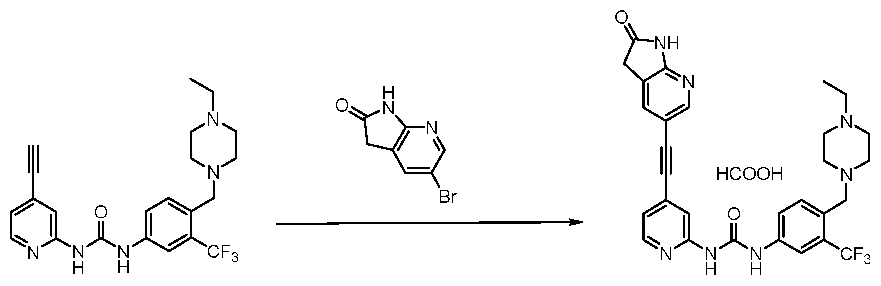
[000548] The title compound was synthesized from l-(4-((4-ethylpiperazin-l-yl)methyl)-3- (trifluoromethyl)phenyl)-3-(4-ethynylpyridin-2-yl)urea and 5-bromo-lH-pyrrolo[2,3- Z?]pyridin-2(3H)-one following a method similar to general procedure A. The reaction mixture was purified twice by preparative HPLC (CI 8, eluent CH3CN/H20/HCOOH 0.1%) to afford l-(4-((4-ethylpiperazin-l-yl)methyl)-3-(trifluoromethyl)phenyl)-3-(4-((2-oxo-2,3- dihydro-lH-pyrrolo[2,3-b]pyridin-5-yl)ethynyl)pyridin-2-yl)urea formate (4.6 mg, AUC HPLC 90.2%) as purple solid; JH NMR (400 MHz, MeOD-<¾) δ (ppm): 8.52 (s, 1H), 8.34- 8.38 (m, 2H), 7.98 (s, 1H), 7.76-7.65 (m, 4H), 7.39 (s, 1H), 7.11 (dd, / = 5.2, 1.6 Hz, 1H), 3.69 (s, 2H), 3.00-2.50 (m, 12H), 1.22 (t, / = 7.3 Hz, 3H); MS (ESI) m/z 564 [C29H28F3N7O2 + H]+.
Example 144: l-(3-( ( lH-pyrrolo[2,3-b]pyridin-5-yl)ethynyl)phenyl)-3-(4-((4- romethyl)phenyl)urea

[000549] The title compound was synthesized from Intermediate 40 and 5-iodo-lH- pyrrolo[2,3-¾]pyridine following a method similar to general procedure A. The reaction crude product was purified by preparative HPLC to afford l-(3-((lH-pyrrolo[2,3-¾]pyridin-5- yl)ethynyl)phenyl)-3-(4-((4-methylpiperazin-l-yl)methyl)-3-(trifluoromethyl)phenyl)urea
(20.3 mg, 32%, AUC HPLC 99%) as a yellow solid. H NMR (400 MHz, DMSO- ) δ (ppm): 11.53 (s, 1H), 9.12 (s, 1H), 8.94 (s, 1H), 8.50 (bs, 1H), 7.97 (d, /= 4.8 Hz, 2H), 7.80 (s, 1H), 7.75 (t, /= 2.7 Hz, 1H), 7.64-7.56 (m, 2H), 7.41-7.32 (m, 2H), 7.20 (d, /= 7.3 Hz,
1H), 6.61 (s, 1H), 3.53 (s, 2H), 2.38 D-2.33 (m, 8H), 2.16 (s, 3H); MS (ESI) m/z 533.15
[C29H27F3N60+H]+;
Example 145: l-(3-((lH-pyrazolo[3,4-b]pyridin-5-yl)ethynyl)phenyl)-3-(4-((4-

[000550] Step 1 : Synthesis of teri-butyl 5-((3-(3-(4-((4-methylpiperazin-l-yl)methyl)-3- (trifluoromethyl)phenyl)ureido)phenyl)ethynyl)-lH-pyrazolo[3,4-¾]pyridine-l-carboxylate; The title compound was synthesized from Intermediate 40 and teri-butyl 5-bromo-lH- pyrazolo[3,4- ?]pyridine-l-carboxylate following a method similar to general procedure A. The reaction crude product was purified by flash chromatography (silica gel,
dichloromethane/ methanol/ ΝΗ4ΟΗ 94:5.4:0.6) to afford teri-butyl 5-((3-(3-(4-((4- methylpiperazin-l-yl)methyl)-3-(trifluoromethyl)phenyl)ureido)phenyl)ethynyl)-lH- pyrazolo[3,4-Z?]pyridine-l-carboxylate (92 mg) as brow visquous liquid MS (ESI) m/z 634.2 [C33H34F3N7O3 +H]+.
[000551] Step 2: Synthesis of l-(3-((lH-pyrazolo[3,4-/?]pyridin-5-yl)ethynyl)phenyl)-3-(4- ((4-methylpiperazin-l-yl)methyl)-3-(trifluoromethyl)phenyl)urea; A solution of teri-butyl 5- ((3-(3-(4-((4-methylpiperazin-l-yl)methyl)-3-
(trifluoromethyl)phenyl)ureido)phenyl)ethynyl)-lH-pyrazolo[3,4-/?]pyridine-l-carboxylate (90 mg, 0.14 mmol) in TFA (65 mg, 0.56 mmol) and DCM (3 mL) was stirred at room temperature for 16 h and was concentrated under reduced pressure. The residue was purified by preparative HPLC (65:35 water with 0.1% formic acid/ acetonitrile with 0.1% formic acid) to afford 3 l-(3-((lH-pyrazolo[3,4-¾]pyridin-5-yl)ethynyl)phenyl)-3-(4-((4- methylpiperazin-l-yl)methyl)-3-(trifluoromethyl)phenyl)urea (16.7 mg, 17% yield over 2 steps, AUC HPLC 99.3%) as off-white solid. JH NMR (400 MHz, DMSO-<¾) δ (ppm): 13.90 (s, 1H), 9.09 (s, 1H), 8.93 (s, 1H), 8.69 (d, / = 1.9 Hz, 1H), 8.49 (s, 1H), 8.20 (s, 1H), 7.99 (d, / = 1.8 Hz, 1H), 7.83 (s, 1H), 7.64-7.56 (m, 2H), 7.41-7.33 (m, 2H), 7.21 (d, / = 7.4 Hz, 1H), 3.53 (s, 2H), 2.38-2.32 (m, 8H), 2.15 (s, 3H); MS (ESI) m/z 534.2 [C28H26F3N70+H]+.
Example 146: l-(3-((lH-pyrazolo[3,4-b]pyridin-5-yl)ethynyl)-2-fluorophenyl)-3-(4-((4- methylpiperazin-l-yl)methyl)-3-(trifluoromethyl)phenyl)urea

Step 1 : Synthesis of l-(3-bromo-2-fluorophenyl)-3-(4-((4-methylpiperazin-l-yl)methyl)-3- (trifluoromethyl)phenyl)urea
[000552] To a solution of 3-Bromo-2-fluoroaniline (69.5 mg, 0.365 mmol) in DCM (3.0 mL) were added triethylamine (0.05 mL, 0.365 mmol) and triphosgene (35.7 mg, 0.120 mmol) at 0°C. The reaction was stirred for 30 min while warming to room temperature prior to the addition of 4-((4-methylpiperazin-l-yl)methyl)-3-(trifluoromethyl)aniline (100 mg, 0.365 mmol) and was further stirred for 16 h. The reaction diluted with methanol and was concentrated in vacuo. The crude product was purified by flash column chromatography (silica gel, CH2Cl2:MeOH 20: 1) to afford l-(3-bromo-2-fluorophenyl)-3-(4-((4- methylpiperazin-l-yl)methyl)-3-(trifluoromethyl)phenyl)urea (176 mg, 98%). MS (ESI) m/z 492.0 [C2oH21BrF4N40+H]+.
Step 2: Synthesis of l-(3-((lH-pyrazolo[3,4-¾]pyridin-5-yl)ethynyl)-2-fluorophenyl)-3-(4- ((4-methylpiperazin- 1 -yl)methyl)-3-(trifluoromethyl)phenyl)urea
[000553] The title compound was synthesized from 5-ethynyl-lH-pyrazolo[3,4-Z?]pyridine and 1 -(3-bromo-2-fluorophenyl)-3-(4-((4-methylpiperazin- 1 -yl)methyl)-3- (trifluoromethyl)phenyl)urea following a method similar to general procedure A. The crude product was purified by flash column chromatography (silica gel, eluent CH2Ci2:MeOH 100:0 to 80:20) and by preparative HPLC (CH3CN:H20, 0.1% formic acid) to afford l-(3- ((lH-pyrazolo[3,4-¾]pyridin-5-yl)ethynyl)-2-fluorophenyl)-3-(4-((4-methylpiperazin-l- yl)methyl)-3-(trifluoromethyl)phenyl)urea (3.0 mg, AUC HPLC 99.7%). JH NMR (400 MHz, DMSO- ) δ (ppm): 13.94 (s, 1H), 9.70 (s, 1H), 8.97 (s, 1H), 8.70 (d, 1H, / = 1.9 Hz), 8.52 (d, 1H, / = 1.9 Hz), 8.27 (s, 1H), 8.22 (s, 1H), 8.14 (t, 1H, / = 7.6 Hz), 7.99 (d, 1H, / = 2.0 Hz), 7.31-7.56 (m, 2H), 3.32-3.23 (m, 2H), 2.38-2.32 (m, 8H), 2.15 (s, 3H); MS (ESI) m/z 552.2 [C28H25F4N70+H]+.
Example 147: l-(4-((6-(dimethylamino)imidazo[l,2-b]pyridazin-3-yl)ethynyl)-5- (4-ethylpiperazin-l-yl)methyl)-3-(trifluoromethyl)phenyl)urea
 [000554] Step 1 : Preparation of 1 -(4-((4-ethylpiperazin- 1 -yl)methyl)-3- (trifluoromethyl)phenyl)-3-(4-iodo-5-methylpyridin-2-yl)urea; A solution of 4-((4- ethylpiperazin-l-yl)methyl)-3-(trifluoromethyl)benzoyl azide (25 mg, 0.0733 mmol) in dry toluene (2 mL) was refluxed under argon for 2 h. When the reaction was completed, 4-iodo- 5-methylpyridin-2-amine (17 mg, 0.0733 mmol) was added and the mixture heated at 100 °C for 2 h. The solvents were then removed in vacuo and the crude purified by flash column chromatography (silica gel, eluent DCM/MeOH 95/5) to afford l-(4-((4-ethylpiperazin-l- yl)methyl)-3-(trifluoromethyl)phenyl)-3-(4-iodo-5-methylpyridin-2-yl)urea (8.9 mg, 22%). JH NMR (600 MHz, CDC13) δ (ppm): 11.57 (s, 1H), 8.84 (s, 1H), 8.02 (s, 1H), 7.88 (d, / = 2.6 Hz, 1H), 7.75 (dd, / = 8.1, 2.6 Hz, 1H), 7.65-7.53 (m, 2H), 3.68 (d, / = 3.9 Hz, 2H), 2.76 (m, 4H), 2.35 (s, 3H), 1.41 (q, / = 7.0 Hz, 1H), 1.29 (m, 4H), 0.97 (t, / = 7.3 Hz, 1H); 13C NMR (150 MHz, CDC13) δ (ppm): 153.3, 150.8, 144.5, 137.9, 131.7, 131.1, 129.4, 125.2, 123.4, 122.9, 122.1, 117.7, 114.4, 59.1, 57.8, 52.3, 51.0, 13.7; MS (ESI) m/z 548
[C2oH23F3IN50 + H]+.
[000555] Step 2: Preparation of l-(4-((6-(dimethylamino)imidazo[l,2-b]pyridazin-3- yl)ethynyl)-5-methylpyridin-2-yl)-3-(4-((4-ethylpiperazin-l-yl)methyl)-3- (trifluoromethyl)phenyl)urea; The title compound was synthesized from 3-ethynyl-N,N- dimethylimidazo[l,2-Z?]pyridazin-6-amine and l-(4-((4-ethylpiperazin-l-yl)methyl)-3- (trifluoromethyl)phenyl)-3-(4-iodo-5-methylpyridin-2-yl)urea following a method similar to general procedure A. The resulting residue was purified by flash column chromatography (eluent CH2C12/CH30H 85: 15) followed by preparative HPLC to afford l-(4-((6- (dimethylamino)imidazo[l,2-b]pyridazin-3-yl)ethynyl)-5-methylpyridin-2-yl)-3-(4-((4- ethylpiperazin-l-yl)methyl)-3-(trifluoromethyl)phenyl)urea (10.1 mg, 33%, AUC HPLC 97.9%) as a yellow solid; JH NMR (600 MHz, DMSO-<¾) δ (ppm): 10.32 (s, 1H), 9.48 (s, 1H), 8.25 (s, 1H), 8.04 (d, / = 2.2 Hz, 1H), 7.97 (s, 1H), 7.92 (d, / = 9.9 Hz, 1H), 7.72 (s, 1H), 7.66 (d, / = 8.5 Hz, 1H), 7.60 (dd, / = 8.5, 2.2 Hz, 1H), 7.20 (d, / = 9.9 Hz, 1H), 3.54 (s, 2H), 3.13 (s, 6H), 2.44 (s, 3H), 2.42-2.34 (m, 4H), 2.31 (q, / = 7.2 Hz, 2H), 0.98 (t, / = 7.2 Hz, 3H); 13C NMR (150 MHz, DMSO- ) δ (ppm): 155.3, 152.1, 150.7, 147.5, 138.1, 136.9, 136.7, 132.1, 131.4, 130.7, 127.7, 126.6, 125.6, 125.2, 122.0, 115.4, 111.7, 111.5, 110.5, 94.8, 85.8, 57.4, 52.7, 52.3, 51.5, 38.1, 16.2, 11.9; MS (ESI) m/z 607 [C31H34F3N9O + H]+.
Example 148: l-(4-((lH^yrazolo[3,4-b]pyridin-5-yl)ethynyl)-5-methylpyridin-2-yl)-3-(4-((4- ethylpiperazin-l-yl)methyl)-3-(trifluoromethyl)phenyl)urea

[000556] Step 1 : Preparation of l-(4-((4-ethylpiperazin-l-yl)methyl)-3- (trifluoromethyl)phenyl)-3-(4-iodo-5-methylpyridin-2-yl)urea; A solution of 4-((4- ethylpiperazin-l-yl)methyl)-3-(trifluoromethyl)benzoyl azide (25 mg, 0.0733 mmol) in dry toluene (2 mL) was refluxed under argon for 2 h. 4-iodo-5-methylpyridin-2-amine (17 mg, 0.0733 mmol) was added and the mixture heated at 100°C for 2 h. The solvents were then removed in vacuo and the residue was purified by flash column chromatography (silica gel, eluent: MeOH/dichloromethane 5:95) to afford l-(4-((4-ethylpiperazin-l-yl)methyl)-3- (trifluoromethyl)phenyl)-3-(4-iodo-5-methylpyridin-2-yl)urea (8.9 mg, 22%). JH NMR (600 MHz, CDC13) δ (ppm): 11.57 (s, 1H), 8.84 (s, 1H), 8.02 (s, 1H), 7.88 (d, / = 2.6 Hz, 1H), 7.75 (dd, / = 8.1, 2.6 Hz, 1H), 7.65-7.53 (m, 2H), 3.68 (d, / = 3.9 Hz, 2H), 2.76 (m, 4H), 2.35 (s, 3H), 1.41 (q, / = 7.0 Hz, 1H), 1.29 (m, 4H), 0.97 (t, / = 7.3 Hz, 1H); 13C NMR (150 MHz, CDCI3) δ 153.3, 150.8, 144.5, 137.9, 131.7, 131.1, 129.4, 125.2, 123.4, 122.9, 122.1, 117.7, 114.4, 59.1, 57.8, 52.3, 51.0, 13.7; MS (ESI) m/z 548 [C2oH23F3IN50 + H]+.
[000557] Step 2: Preparation of l-(4-((lH-pyrazolo[3,4 ]pyridin-5-yl)ethynyl)-5- methylpyridin-2-yl)-3-(4-((4-ethylpiperazin-l-yl)methyl)-3-(trifluoromethyl)phenyl)urea; The title compound was synthesized from 5-ethynyl-lH-pyrazolo[3,4-Z?]pyridine and l-(4- ((4-ethylpiperazin-l-yl)methyl)-3-(trifluoromethyl)phenyl)-3-(4-iodo-5-methylpyridin-2- yl)urea following a method similar to general procedure A. The reaction crude product was purified by preparative HPLC to afford l-(4-((lH-pyrazolo[3,4-b]pyridin-5-yl)ethynyl)-5- methylpyridin-2-yl)-3-(4-((4-ethylpiperazin- 1 -yl)methyl)-3-(trifluoromethyl)phenyl)urea (6.1 mg, 20%, AUC HPLC 97.7%) as an off-white solid; JH NMR (600 MHz, DMSO-de) δ
(ppm): 13.98 (s, 1H), 10.25 (s, 1H), 9.49 (s, 1H), 8.77 (d, / = 2.0 Hz, 1H), 8.61 (d, / = 2.0 Hz, 1H), 8.26 (s, 1H), 8.24 (s, 1H), 8.03 (d, / = 2.3 Hz, 1H), 7.79 (s, 1H), 7.66 (d, / = 8.5 Hz, 1H), 7.60 (dd, / = 8.4, 2.2 Hz, 1H), 3.54 (s, 2H), 2.41 (s, 3H), 2.40-2.33 (m, 4H), 2.30 (q, / = 7.2 Hz, 2H), 0.98 (t, / = 7.1 Hz, 3H); 13C NMR (150 MHz, DMSO-<¾) δ (ppm): 152.6, 151.7, 151.2, 151.2, 148.1, 138.6, 134.3, 132.4, 131.8, 131.2, 128.3, 128.1, 128.0, 127.9, 127.7, 125.7, 123.9, 122.5, 115.8, 114.4, 113.3, 111.4, 95.5, 87.1, 57.8, 53.3, 52.8, 52.0, 16.9, 12.5; MS (ESI) m/z 564 [C29H29F3N8O + H]+
Example 149: Synthesis of l-(5-((6-(dimethylamino)imidazo[l,2-b]pyridazin-3-

Step 1 : Preparation of l-(5-bromopyridin-2-yl)-3-(4-((4-ethylpiperazin-l-yl) methyl)-3- (trifluoromethyl) phenyl) urea
[000558] A mixture of 5-bromopicolinoyl azide (1.5 g, 6.6 mmol) in toluene was refluxed for 1 h then cooled to room temperature. A solution of 4-((4-ethylpiperazin-l-yl) methyl)-3- (trifluoromethyl) aniline (2.0 g, 6.9 mmol) in toluene was slowly added to the reaction mixture at room temperature and the resulting solution was stirred for an additional 16 h. The reaction mixture was concentrated to a smaller volume under reduced pressure and the residue was purified by column chromatography (silica gel, eluent CHCb/MeOH 98:2) to afford l-(5-bromopyridin-2-yl)-3-(4-((4-ethylpiperazin-l-yl)methyl)-3- (trifluoromethyl)phenyl)urea (78%, LC-MS 86% ) as an off white solid; MS (ESI) m/z 486 [C2oH23BrF3N50+ H]+.
Step 2: Preparation of l-(5-((6-(dimethylamino)imidazo[l,2-¾]pyridazin-3- yl)ethynyl)pyridin-2-yl)-3-(4-((4-ethylpiperazin-l-yl)methyl)-3-(trifluoromethyl)phenyl)urea
[000559] The title compound was synthesized from l-(5-bromopyridin-2-yl)-3-(4-((4- ethylpiperazin- 1 -yl)methyl)-3-(trifluoromethyl)phenyl)urea and 3-ethynyl-N,N- dimethylimidazo[l,2-Z?]pyridazin-6-amine following a method similar to general procedure A. The solvent was evaporated and the residue was purified by preparative HPLC to afford 1- (5-((6-(dimemylamino)imidazo[l,2-b]pyridazin-3-yl)ethynyl)pyridin-2-yl)-3-(4-((4- ethylpiperazin-l-yl)methyl)-3-(trifluoromethyl)phenyl)urea (23 mg, AUC HPLC 98.8%) as a yellow solid. m.p. 192-196 °C; JH NMR (400 MHz, CDC13) δ (ppm): 11.72 (s, 1H), 8.94 (s, 1H), 8.10 (d, / = 5.6 Hz, 1H), 7.92 (d, / = 1.6 Hz, 1H), 7.74-7.67 (m, 2H), 7.18 (s, 1H), 7.14 (dd, / = 5.6 Hz, 1.2 Hz, 1H), 3.67 (s, 2H), 2.76-2.42 (m, 10 H), 1.20 (t, / = 7.0, Hz, 2H); MS (ESI) m/z 592 [C30H32F3N9O+ H]+.
Example 150: l-(4-((6-(cyclopropylamino)pyridin-3-yl)ethynyl)pyridin-2-yl)-3-(4-((4- ethylpiperazin-l-yl)methyl)-3-(trifluoromethyl)phenyl)urea

[000560] The title compound was synthesized from l-(4-((4-ethylpiperazin-l-yl)methyl)-3- (trifluoromethyl)phenyl)-3-(4-ethynylpyridin-2-yl)urea and 5-bromo-N-cyclopropylpyridin-2- amine following a method similar to general procedure A. The reaction mixture was purified by column chromatography (silica gel, eluents DCM/MeOH 9:1) to afford a yellow solid which was triturated in MeOH (3X1.0 ml) and the solid was isolated by centrifugation to afford l-(4-((6-(cyclopropylarnino)pyridin-3-yl)ethynyl)pyridin-2-yl)-3-(4-((4- ethylpiperazin-l-yl)methyl)-3-(trifluoromethyl)phenyl)urea (6.5 mg, AUC HPLC 99.5%) as a white powder; mp 238-240 °C; JH NMR (400 MHz, CDC13) δ (ppm): 12.12 (s, 1H), 9.39 (s, 1H), 8.38 (d, / = 1.7 Hz, 1H), 8.23 (d, / = 5.3 Hz, 1H), 7.93 (s, 1H), 7.80-7.70 (m, 2H), 7.66 (dd, / = 8.4, 2.0 Hz, 1H), 7.31 (s, 1H), 7.02 (d, / = 5.4 Hz, 1H), 6.87 (s, 1H), 6.80 (d, / = 8.8 Hz, 1H), 3.64 (s, 2H), 2.65-2.30 (m, 11H), 1.10 (t, / = 7.2 Hz, 3H), 0.85 (d, / = 5.1 Hz, 2H), 0.67 (d, / = 2.3 Hz, 2H); 13C NMR (100 MHz, CDC13) δ (ppm): 160.29, 153.70, 152.94, 151.86, 145.96, 140.91, 137.33, 134.55, 132.37, 131.30, 123.10, 119.16, 117.57, 113.09, 106.92, 105.79, 93.57, 87.19, 73.65, 57.95, 53.15, 52.96, 52.34, 23.96, 11.99, 7.35; MS (ESI) m/z 564.25 [C30H32F3N7O + H]+.
Example 151: l-(4-((6-amino-5-methylpyridin-3-yl)ethynyl)pyridin-2-yl)-3-(4-((4- -yl)methyl)-3-(trifluoromethyl)phenyl)urea

[000561] The title compound was synthesized froml-(4-((4-ethylpiperazin-l-yl)methyl)-3- (trifluoromethyl)phenyl)-3-(4-ethynylpyridin-2-yl)urea and 5-iodo-3-methylpyridin-2-amine following a method similar to general procedure A. The reaction mixture was purified twice by preparative HPLC (C18, eluent CH3CN/H20/HCOOH 0.1%) to afford l-(4-((6-amino-5- methylpyridin-3-yl)ethynyl)pyridin-2-yl)-3-(4-((4-ethylpiperazin-l-yl)methyl)-3- (trifluoromethyl)phenyl)urea (5.2 mg, AUC HPLC > 99%) as white solid; m.p. 210 -212 °C; JH NMR (400 MHz, MeOD-d4) δ (ppm): 8.27 (d, / = 5.3 Hz, 1H), 8.03 (s, 1H), 7.98 (d, / = 1.8 Hz, 1H), 7.76-7.63 (m, 2H), 7.48 (s, 1H), 7.30 (s, 1H), 7.06 (dd, / = 5.2, 1.6 Hz, 1H), 3.65 (s, 2H), 2.85-2.25 (m, 10H), 2.14 (s, 3H), 1.12 (t, / = 7.2 Hz, 3H); 13C NMR (100 MHz,
DMSO- ) δ (ppm): 159.11, 153.29, 152.62, 149.97, 148.11, 139.60, 138.56, 133.39, 132.04, 131.90, 129.12, 128.26, 122.68, 119.41, 116.29, 113.18, 105.74, 93.63, 87.58, 67.91, 57.91, 53.31, 52.88, 52.05, 42.95, 38.58, 30.28, 28.83, 23.74, 22.85, 17.17; MS (ESI) m/z 538.65 [C28H3oF3N70+ H]+.
Example 152: l-(4-((6-amino-4-methylpyridin-3-yl)ethynyl)pyridin-2-yl)-3-(4-((4- -l-yl)methyl)-3-(trifluoromethyl)phenyl)urea formate

[000562] The title compound was synthesized from l-(4-((4-ethylpiperazin-l-yl)methyl)-3- (trifluoromethyl)phenyl)-3-(4-ethynylpyridin-2-yl)urea and 5-iodo-4-methylpyridin-2-amine following a method similar to general procedure A. The reaction mixture was purified by preparative HPLC (CI 8, eluent CH3CN/H20/HCOOH 0.1%) to afford l-(4-((6-amino-4- methylpyridin-3-yl)ethynyl)pyridin-2-yl)-3-(4-((4-ethylpiperazin-l-yl)methyl)-3- (trifluoromethyl)phenyl)urea formate (7.6 mg, 12.2%, AUC HPLC 99.4 %) as pale-yellow solid; m.p. 199-201 °C; JH NMR (400 MHz, MeOD-<¾) δ (ppm): 8.42 (s, 1H), 8.27 (d, / = 5.3 Hz, 1H), 8.04 (s, 1H), 7.98 (s, 1H), 7.77-7.65 (m, 2H), 7.30 (s, 1H), 7.06 (dd, / = 5.2, 1.6 Hz, 1H), 6.48 (s, 1H), 3.73 (s, 2H), 3.31-3.00 (m, 6H), 2.73 (s, 4H), 2.38 (s, 3H), 1.32 (t, / = 7.3 Hz, 3H); 13C NMR (100 MHz, MeOD-<¾) δ (ppm): 159.68, 153.17, 153.04, 150.98, 150.66, 146.43, 137.86, 134.21, 131.39, 128.73, 122.54, 118.88, 113.02, 90.83, 90.18, 57.52, 52.31, 52.18, 51.86, 18.93, 10.20; MS (ESI) m/z 538.30 [C28H30F3N7O+ H]+.
Example 153: l-(4-((6-amino-5-cyanopyridin-3-yl)ethynyl)pyridin-2-yl)-3-(4-((4- henyl)urea

Step 1 : Preparation of 2-amino-5-((trimethylsilyl)ethynyl)nicotinonitrile
[000563] The title compound was synthesized following a method similar to general procedure B starting from 2-amino-5-bromonicotinonitrile and ethynyltrimethylsilane. The crude product was purified by column chromatography (silica gel, hexane/ethyl acetate 5: 1) to afford 2-amino-5-((trimethylsilyl)ethynyl)nicotinonitrile (176 mg, 82%) as white solid. JH
NMR (400 MHz, CDC13) δ (ppm): 8.34 (d, / = 2.2 Hz, 1H), 7.76 (d, / = 2.2 Hz, 1H), 5.32 (s, 2H), 0.24 (s, 9H); MS (ESI) m/z 216[CnHi3N3Si + H]+.
Step 2: Preparation of 2-amino-5-ethynylnicotinonitrile
[000564] To a solution of 2-amino-5-((trimethylsilyl)ethynyl)nicotinonitrile (176 mg, 0.82 mmol) in methanol (4 mL) was added potassium carbonate (226 mg, 1.63 mmol) and was stirred at room temperature for 3 h and was concentrated under reduced pressure. The residue was purified by column chromatography (silica gel, Hexane/Ethyl acetate 1: 1) to afford 2-amino-5-ethynylnicotinonitrile (120 mg, 99.9%) as white solid. JH NMR (400 MHz, CDCI3) δ (ppm): 8.36 (d, / = 2.1 Hz, 1H), 7.78 (d, / = 2.1 Hz, 1H), 5.34 (s, 2H), 3.11 (s, 1H); MS (ESI) m/z 144 [C8H5N3 + H]+.
Step 3: Preparation of l-(4-((6-amino-5-cyanopyridin-3-yl)ethynyl)pyridin-2-yl)-3-(4-((4- ethylpiperazin- 1 -yl)methyl)-3-(trifluoromethyl)phenyl)urea;
[000565] To a solution of 2-amino-5-ethynylnicotinonitrile (17 mg, 0.12 mmol) in DMF (1 mL) under inert atmosphere was added l-(4-bromopyridin-2-yl)-3-(4-((4-ethylpiperazin-l- yl)methyl)-3-(trifluoromethyl)phenyl)urea (58 mg, 0.12 mmol), triphenylphophine (11 mg, 0.042 mmol), Pd(PPh3)2Cl2 (11 mg, 0.016 mmol), copper iodide (2.3 mg, 0.012 mmol) and DIPEA (0.5 mL). The resulting mixture was heated to 90 °C for 18 h, then was cooled, diluted with water (10 mL) and extracted with EtOAc (3 x 15 mL). The combined organic layers were washed in turn with water and brine, dried over Na2S04, filtered and concentrated under reduced pressure. The crude product was purified by column chromatography (silica gel, CH2Cl2/MeOH 10: 1) and by preparative HPLC (C18, eluent CH3CN/H2O/HCOOH 0.01%) to afford l-(4-((6-amino-5-cyanopyridin-3-yl)ethynyl)pyridin-2-yl)-3-(4-((4- ethylpiperazin-l-yl)methyl)-3-(trifluoromethyl)phenyl)urea (15 mg, 23%, AUC HPLC 98%) as white solid; m.p. 224.0-225.2 °C; JH NMR (400 MHz, DMSO-<¾) δ (ppm): 10.31 (s, 1H), 9.57 (s, 1H), 8.46 (s, 1H), 8.31 (d, / = 5.0 Hz, 1H), 8.20 (s, 1H), 8.17 (s, 1H), 8.04 (s, 1H), 7.73 (s, 1H), 7.69-7.58 (m, 2H), 7.50 (s, 2H), 7.10 (d, / = 4.7 Hz, 1H), 3.55 (s, 2H), 2.80- 2.15 (m, 10H), 1.00 (t, / = 7.0 Hz, 3H); 13C NMR (100 MHz, DMSO-<¾) δ (ppm): 162.68, 158.66, 155.65, 152.23, 151.50, 147.24, 144.47, 137.48, 131.59, 130.86, 130.25, 127.06, 123.74 , 121.59, 118.52, 115.29, 114.94, 112.37, 104.94, 89.66, 88.83, 87.24, 56.77, 51.98, 51.66, 50.90, 11.18; MS (ESI) m/z 549.65[C28H27F3N80+ H]+.
Example 154: l-(4-(( 6-amino-4-fluoropyridin-3-yl )ethynyl )pyridin-2-yl)-3-( 4-((4- ethylpiperazin-l-yl)methyl)-3-(trifluoromethyl)phenyl)urea

[000566] The title compound was synthesized from from4-((4-ethylpiperazin-l-yl)methyl)- N-(4-ethynylpyridin-2-yl)-3-(trifluoromethyl)benzamide and 5-bromo-4-fluoropyridin-2- amine following a method similar to general procedure A. The reaction mixture was purified by preparative HPLC (C18, eluent CH3CN/H20/HCOOH 0.1%) to afford l-(4-((6-amino-4- fluoropyridin-3-yl)ethynyl)pyridin-2-yl)-3-(4-((4-ethylpiperazin-l-yl)methyl)-3- (trifluoromethyl)phenyl)urea (9.3 mg, 14.8%, AUC HPLC 95.8 %) as brown solid; mp 172- 174 °C; JH NMR (400 MHz, MeOO-d4) δ (ppm): 8.28 (d, / = 5.4 Hz, 1H), 8.14 (d, / = 10.0 Hz, 1H), 7.97 (s, 1H), 7.71 (s, 2H), 7.32 (s, 1H), 7.07 (dd, / = 5.2, 1.2 Hz, 1H), 6.33 (d, / = 11.6 Hz, 1H), 3.66 (s, 2H), 2.90 -2.40 (m, 10H), 1.16 (t, / = 7.3 Hz, 3H); 13C NMR (100 MHz, MeOD-<¾) δ (ppm): 153.70, 153.14, 153.06, 146.51, 137.96, 133.71, 131.43, 131.13, 122.58, 118.88, 116.66, 113.13, 93.62, 90.69, 57.37, 53.37, 52.13, 51.81, 51.62, 9.75; MS (ESI) m/z 542.60 [C27H27F4N70+H]+.
Example 155: l-(4-(( 6-amino-5-fluoropyridin-3-yl )ethynyl )pyridin-2-yl)-3-( 4-((4-

Step 1 : Preparation of 3-fluoro-5-((trimethylsilyl)ethynyl)pyridin-2-amine
[000567] The title compound was synthesized following a method similar to general procedure A starting from 5-bromo-3-fluoropyridin-2-amine and ethynyltrimethylsilane. The crude product was purified by column chromatography (silica gel, Hexane/Ethyl acetate 5: 1) to afford 3-fluoro-5-((trimethylsilyl)ethynyl)pyridin-2-amine (125 mg, 60%) as white solid. JH NMR (400 MHz, CDC13) δ (ppm): 7.78 (s, 1H), 7.05 (dd, / = 11.1, 1.6 Hz, 1H), 4.58 (s, 2H), 0.02 (s, 9H); MS (ESI) m/z 209[C10H13FN2Si + H]+.
Step 2: Preparation of 5-ethynyl-3-fluoropyridin-2-amine
[000568] To a solution of 3-fluoro-5-((trimethylsilyl)ethynyl)pyridin-2-amine (125 mg, 0.60mmol) in methanol (4 mL) was added potassium carbonate (166 mg, 1.20 mmol) and
was stirred at room temperature for 3 h before concentrated under reduced pressure. The residue was purified by column chromatography (silica gel, Hexane/Ethyl acetate 1: 1) to afford 5-ethynyl-3-fluoropyridin-2-amine (78 mg, 95%) as white solid. JH NMR (400 MHz, CDC13) δ (ppm): 8.02 (s, 1H), 7.29 (dd, / = 11.0, 1.6 Hz, 1H), 4.79 (s, 2H), 3.06 (s, 1H); MS (ESI) m/z 137[C7H5FN2 + H]+.
Step 3: Preparation of l-(4-((6-amino-5-fluoropyridin-3-yl)ethynyl)pyridin-2-yl)-3-(4-((4- ethylpiperazin- 1 -yl)methyl)-3-(trifluoromethyl)phenyl)urea
[000569] The title compound was synthesized following a method similar to general procedure A starting from 5-ethynyl-3-fluoropyridin-2-amine and l-(4-bromopyridin-2-yl)-3- (4-((4-ethylpiperazin-l-yl)methyl)-3-(trifluoromethyl)phenyl)urea. The reaction crude product was purified by flash column chromatography (silica gel, CH2Ci2/MeOH 10:1) and by preparative HPLC (C18, eluent CH3CN/H20/HCOOH 0.01%) to afford l-(4-((6-amino-5- fluoropyridin-3-yl)ethynyl)pyridin-2-yl)-3-(4-((4-ethylpiperazin-l-yl)methyl)-3- (trifluoromethyl)phenyl)urea (12 mg, 18%, AUC HPLC 99%) as white solid. m.p: 195.5- 196.6 °C; JH NMR (400 MHz, MeOD-<¾) δ (ppm): 8.28 (d, / = 5.2 Hz, 1H), 8.02-7.96 (m, 2H), 7.76-7.69 (m, 2H), 7.46 (dd, / = 11.4, 1.7 Hz, 1H), 7.33 (s, 1H), 7.08 (dd, / = 5.3, 1.0 Hz, 1H), 3.73 (s, 2H), 3.16 (bs, 4H), 3.07 (q, / = 7.3 Hz, 2H), 2.72 (bs, 4H), 1.30 (t, / = 7.3 Hz, 3H); 13C NMR (100 MHz, MeOD-<¾) δ (ppm): 168.96, 154.58, 154.48, 151.73, 151.60, 148.00, 147.06, 139.72, 135.21, 132.98, 131.86, 130.45, 125.80, 124.56, 124.08, 120.50, 118.20, 114.72, 108.21, 92.09, 88.06, 58.42, 53.11, 51.57, 10.03; MS (ESI) m/z 542.65
[C27H27F4N7O + H]+.
Example 156: l-(4-((6-amino-5-methoxypyridin-3-yl)ethynyl)pyridin-2-yl)-3-(4-((4- methyl)-3-(trifluoromethyl)phenyl)urea

[000570] The title compound was synthesized from l-(4-((4-ethylpiperazin-l-yl)methyl)-3- (trifluoromethyl)phenyl)-3-(4-ethynylpyridin-2-yl)urea and 5-bromo-3-methoxypyridin-2- amine following a method similar to general procedure A. The residue was purified by column chromatography (silica gel, CH2Ci2/MeOH 10: 1) and by preparative HPLC (CI 8, eluent CH3CN/H20/HCOOH 0.01%) to afford l-(4-((6-amino-5-methoxypyridin-3- yl)ethynyl)pyridin-2-yl)-3-(4-((4-ethylpiperazin-l-yl)methyl)-3-(trifluoromethyl)phenyl)urea
(5 mg, AUC HPLC 99%) as white solid; m.p. 211.1-212.1 °C; H NMR (400 MHz, MeOD- d4) δ (ppm): 8.27 (s, 1H), 7.99 (s, 1H), 7.82-7.66 (m, 3H), 7.32 (s, 1H), 7.15 (s, 1H), 7.07 (d, / = 3.7 Hz, 1H), 3.90 (s, 3H), 3.74 (s, 2H), 3.45-3.25 (m, 4H), 3.18 (q, / = 7.2 Hz, 2H), 2.74 (bs, 4H), 1.34 (t, / = 7.2 Hz, 3H); 13C NMR (100 MHz, MeOD-<¾) δ (ppm): 165.73, 153.00, 151.52, 146.40, 141.98, 138.34, 134.11, 131.54, 130.20, 129.00, 124.33, 122.62, 119.02, 116.70, 116.67, 113.16, 92.28, 86.20, 56.86, 54.80, 51.61, 51.47, 49.68, 8.23; MS (ESI) m/z 554.65 [C28H3oF3N702 + H]+.
Example 157: N-(5-((2-(3-(4-((4-ethylpiperazin-l-yl)methyl)-3- nyl )ureido )pyridin-4-yl)ethynyl)-6-methylpyridin-2-yl )acetamide

[000571] The title compound was synthesized from l-(4-((4-ethylpiperazin-l-yl)methyl)-3- (trifluoromethyl)phenyl)-3-(4-ethynylpyridin-2-yl)urea and N-(5-bromo-6-methylpyridin-2- yl)acetamide following a method similar to general procedure A. The residue was purified by column chromatography (silica gel, CH2Cl2/MeOH 10:1) and by preparative HPLC (C18, eluent CH3CN/H20/HCOOH 0.01%) to afford N-(5-((2-(3-(4-((4-ethylpiperazin- 1- yl)memyl)-3-(trifluoromethyl)phenyl)ureido)pyridin-4-yl)ethynyl)-6-methylpyridin-2- yl)acetamide (8 mg, 12%, AUC HPLC 98%) as white solid; m.p. 201.2-202.1 °C; JH NMR (400 MHz, DMSO-<¾) δ (ppm): 10.69 (s, 1H), 10.36 (s, 1H), 9.58 (s, 1H), 8.33 (d, / = 4.6 Hz, 1H), 8.18 (s, 1H), 8.07-7.91 (m, 3H), 7.75 (s, 1H), 7.70-7.59 (m, 2H), 7.16 (d, / = 4.3 Hz, 1H), 3.55 (s, 2H), 2.61 (s, 3H), 2.60-2.20(m, 10H), 2.11 (s, 3H), 1.00 (t, / = 6.3 Hz, 3H); 13C NMR (100 MHz, DMSO-<¾) δ (ppm): 170.12, 163.88, 159.52, 153.33, 152.58, 151.88, 148.35, 142.31, 138.52, 132.60, 131.96, 131.30, 128.13, 124.78, 122.73, 119.69, 116.08, 113.52, 112.14, 110.83, 91.98, 91.08, 57.79, 52.90, 52.65, 51.94, 24.41, 23.28, 12.11 ; MS (ESI) m/z 581.05 [C30H32F3N7O2 + H]+.
Example 158: l-(4-((6-amino-4-cyanopyridin-3-yl)ethynyl)pyridin-2-yl)-3-(4-((4- ethylpiperazin-l-yl)methyl)-3-(trifluoromethyl)phenyl)urea

[000572] The title compound was synthesized from l-(4-((4-ethylpiperazin-l-yl)methyl)-3- (trifluoromethyl)phenyl)-3-(4-ethynylpyridin-2-yl)urea and 2-amino-5- bromoisonicotinonitrile following a method similar to general procedure A. The reaction crude product was purified by flash column chromatography (silica gel, CH2Cl2/MeOH 10: 1) and by preparative HPLC (C18, eluent CH3CN/H20/HCOOH 0.01%) to afford l-(4-((6- amino-4-cyanopyridin-3-yl)ethynyl)pyridin-2-yl)-3-(4-((4-ethylpiperazin-l-yl)methyl)-3- (trifluoromethyl)phenyl)urea (8 mg, 12%, AUC HPLC 98%) as yellow solid. m.p: 203.4- 204.2 °C; JH NMR (400 MHz, CD3OD) δ (ppm): 8.31 (s, 2H), 7.98 (s, 1H), 7.77-7.68 (m, 2H), 7.36 (s, 1H), 7.11 (d, / = 4.6 Hz, 1H), 6.86 (s, 1H), 3.73 (s, 2H), 3.21 (bs, 4H), 3.11 (q, / = 7.3 Hz, 2H), 2.73 (bs, 4H), 1.31 (t, / = 7.3 Hz, 3H); 13C NMR (100 MHz, CD3OD) δ (ppm): 160.98, 154.55, 154.15, 148.03, 139.73, 134.64, 133.00, 131.83, 130.47 (q, / = 30.2 Hz), 125.80 (q, / = 273.2 Hz), 125.03, 124.13, 120.47, 118.21 (q, / = 6.1 Hz), 116.64, 114.71, 112.35, 108.03, 92.35, 89.57, 58.41, 53.12, 53.06, 51.44, 9.92; MS (ESI) m/z 549.75 [C28H27F3N80 + H]+.
Example 159: N-(5-((2-(3-(4-((4-ethylpiperazin-l-yl)methyl)-3-
( trifluoromethyl )phenyl )ureido )pyridin-4-yl)ethynyl)-3-methylpyridin-2-yl )acetamide

[000573] The title compound was synthesized from l-(4-((4-ethylpiperazin-l-yl)methyl)-3- (trifluoromethyl)phenyl)-3-(4-ethynylpyridin-2-yl)urea and N-(5-bromo-3-methylpyridin-2- yl)acetamide following a method similar to general procedure A. The reaction crude product was purified by preparative HPLC (CI 8, eluent CH3CN/H20/HCOOH 0.1%) to afford N-(5- ((2-(3-(4-((4-ethylpiperazin-l-yl)methyl)-3-(trifluoromethyl)phenyl)ureido)pyridin-4- yl)ethynyl)-3-methylpyridin-2-yl)acetamide (22.4 mg, 33.3%, AUC HPLC 99.7%) as brown solid; m.p. 110-112 °C; JH NMR (400 MHz, CD3OD) δ (ppm): 8.47 (s, 1H), 8.32 (d, / = 5.2 Hz, 1H), 7.98 (s, 1H), 7.89 (s, 1H), 7.78-7.63 (m, 2H), 7.43 (s, 1H), 7.14 (dd, / = 5.2, 0.8 Hz, 1H), 3.65 (s, 2H), 2.80-2.40 (m, 10H), 2.29 (s, 3H), 2.20 (s, 3H),1.13 (t, / = 7.2 Hz, 3H); 13C
NMR (100 MHz, CD3OD) δ (ppm): 170.97, 167.70, 153.06, 153.02, 149.69, 148.23, 146.73, 142.16, 138.28, 132.98, 131.52, 130.32, 129.65, 129.12, 128.85, 128.52, 125.69, 122.98, 122.57, 119.23, 117.07, 116.69, 116.63, 113.70, 89.51, 88.88, 56.92, 51.58, 51.48, 49.85, 29.33, 21.78, 16.29, 8.36; MS (ESI) m/z 580.35 [C30H32F3N7O2 + H]+.
Example 160: l-(4-((4-methylpiperazin-l-yl)methyl)-3-(trifluoromethyl)phenyl)-3-(3-

[000574] The title compound was synthesized from l-(3-ethynylphenyl)-3-(4-((4- methylpiperazin-l-yl)methyl)-3-(trifluoromethyl)phenyl)urea and 3-bromopyridine following a method similar to general procedure A. The reaction crude product was purified by preparative HPLC (acetonitrile/water/ 0.1% formic acid) to afford l-(4-((4-methylpiperazin- l-yl)methyl)-3-(trifluoromethyl)phenyl)-3-(3-(pyridin-3-ylethynyl)phenyl)urea (20.3mg, 32%, AUC HPLC 99.3%) as a yellow solid; mp: 68.6-69.1 °C; JH NMR (400 MHz, DMSO- d6) δ (ppm): 9.90 (s, 1H), 8.93 (s, 1H), 8.77 (s, 1H), 8.06-8.05 (m, 1H), 8.01-7.98 (m, 2H), 7.83 (s, 1H), 7.62 (d, /= 8.4 Hz, 1H), 7.58-7.55 (m, 1H), 7.48-7.34 (m, 4H), 7.21 (d, /= 7.6 Hz, 1H), 3.53 (s, 2H), 2.37-2.32 (m, 8H), 2.15 (s, 3H); MS (ESI) m/z 494.2
[C27H26F3N50+H]+.
Example 161: N-(5-((3-(3-(4-((4-methylpiperazin-l-yl)methyl)-3- -yl )acetamide

[000575] The title compound was synthesized from l-(3-ethynylphenyl)-3-(4-((4- methylpiperazin- 1 -yl)methyl)-3-(trifluoromethyl)phenyl)urea and N-(5-bromopyridin-2- yl)acetamide following a method similar to general procedure A. The residue was purified by preparative HPLC (75:35 water with 0.1% formic acid/ acetonitrile with 0.1% formic acid) to afford N-(5-((3-(3-(4-((4-methylpiperazin-l-yl)methyl)-3
(trifluoromethyl)phenyl)ureido)phenyl)ethynyl)pyridin-2-yl)acetamide (21 mg, 31 , AUC HPLC 98.3%) as yellow solid; mp: 105.9-106.4 °C; JH NMR (400 MHz, DMSO-<¾) δ (ppm): 10.70 (s, 1H), 9.13 (s, 1H), 8.96 (s, 1H), 8.52 (s, 1H), 8.13 (d, / = 8.4 Hz, 1H), 7.98- 7.94 (m, 2H), 7.80 (s, 1H), 7.62 (d, / = 8.8 Hz, 1H), 7.57 (d, / = 8.4 Hz, 1H), 7.40-7.32 (m, 2H), 7.17 (d, / = 7.6 Hz, 1H), 3.52 (s, 2H), 2.38-2.32 (m, 8H), 2.15 (s, 3H), 2.11 (s, 3H); MS (ESI) m/z 551.2 [C29H29F3N602+H]+.
Example 162: l-(5-((lH-pyrazolo[3,4-b]pyridin-5-yl)ethynyl)-2-fluorophenyl)-3-(4-((4- enyl)urea

Step 1 : Preparation of l-(5-bromo-2-fluorophenyl)-3-(4-((4-methylpiperazin-l-yl)methyl)-3- (trifluoromethyl)phenyl)urea
[000576] To a solution of 5-Bromo-2-fluoroaniline (69.5 mg, 0.365 mmol) in
dichloromethane (3.0 mL) was added triethylamine (0.05 mL, 0.365 mmol), followed by triphosgene (35.7 mg, 0.120 mmol) at 0 °C. The reaction was then allowed to stir at room temperature for 30 minutes. 4-((4-methylpiperazin-l-yl)methyl)-3-(trifluoromethyl)aniline (100 mg, 0.365 mmol) was added to the reaction mixture and stirred at room temperature for 16 hours. The reaction mixture was quenched with methanol and concentrated in vacuo. The crude product was purified by flash column chromatography (Redisep silica gel,
CH2Cl2:MeOH 20: 1) to afford l-(5-bromo-2-fluorophenyl)-3-(4-((4-methylpiperazin-l- yl)methyl)-3-(trifluoromethyl)phenyl)urea (179 mg, 99.9%).
Step 2: Preparation of l-(5-((lH-pyrazolo[3,4-¾]pyridin-5-yl)ethynyl)-2-fluorophenyl)-3-(4- ((4-methylpiperazin- 1 -yl)methyl)-3-(trifluoromethyl)phenyl)urea
[000577] The title compound was synthesized from 5-ethynyl-lH-pyrazolo[3,4-Z?]pyridine and 1 -(5-bromo-2-fluorophenyl)-3-(4-((4-methylpiperazin- 1 -yl)methyl)-3- (trifluoromethyl)phenyl)urea following a method similar to general procedure A. The crude product was purified by flash column chromatography (Silica gel, CH2Ci2:MeOH, 0-20%), the product collected was further recrystallised with MeOH/Hexane to afford l-(5-((lH- pyrazolo[3,4-Z?]pyridin-5-yl)ethynyl)-2-fluorophenyl)-3-(4-((4-methylpiperazin-l-yl)methyl)- 3-(trifluoromethyl)phenyl)urea (6.9 mg, AUC HPLC 97.2%). JH NMR (400 MHz, DMSO- d6) δ (ppm): 13.89 (s, 1H), 9.57 (s, 1H), 8.81 (s, 1H), 8.74-8.69 (m, 1H), 8.50 (d, / = 1.6 Hz,
1H), 8.39-8.37 (m, 1H), 8.19 (m, 1H), 8.00 (d, 1H, / = 2 Hz), 7.65-7.57 (m, 2H), 7.37-7.25 (m, 2H), 3.62 (s, 2H), 2.71-2.66 (m, 8H), 2.33-2.32 (m, 3H); MS (ESI) m/z 552.2
[C28H25F4N70+H]+;
Example 163: l-(4-((lH-pyrazolo[3,4-b]pyridin-5-yl)ethynyl)phenyl)-3-(4-((4- thyl)phenyl)urea

[000578] Step 1 : Synthesis of 4-((lH-pyrazolo[3,4-Z?]pyridin-5-yl)ethynyl)aniline; The title compound was synthesized from 4-ethynylaniline and 5-Bromo-lH-pyrazolo[3,4-Z?]pyridine following a method similar to general procedure A. The crude product was purified by flash column chromatography (silica gel, Ct^C MeOH, 0-10%) to afford 4-((lH-pyrazolo[3,4- &]pyridin-5-yl)ethynyl)aniline (23 mg, 38%). MS (ESI) m/z 235.1 [C14H10N4+H]+.
Step 2: Synthesis of l-(4-((lH-pyrazolo[3,4-¾]pyridin-5-yl)ethynyl)phenyl)-3-(4-((4- methylpiperazin- 1 -yl)methyl)-3-(trifluoromethyl)phenyl)urea
[000579] To a solution of 5-((l-(triisopropylsilyl)-lH-pyrrol-3-yl)ethynyl)-lH- pyrazolo[3,4-Z?]pyridine (23 mg, 0.0982 mmol) in DCM (1.0 mL) was added triethylamine (0.01 mL, 0.0982 mmol), followed by triphosgene (9.6 mg, 0.032 mmol) at 0 °C. The reaction was stirred at room temperature for 15 minutes prior to the addition of 4-((4- methylpiperazin-l-yl)methyl)-3-(trifluoromethyl)aniline (26.8 mg, 0.0982 mmol) and the resulting mixture was stirred for an additional 2 h at room temperature. The reaction was quenched by adding methanol and the mixture was concentrated in vacuo. The crude product was purified by flash column chromatography (Silica gel, eluent: Ct^C^MeOH 20: 1), followed by re-crystallization in a mixture of methanol and hexane to afford l-(4-((lH- pyrazolo[3,4-¾]pyridin-5-yl)ethynyl)phenyl)-3-(4-((4-methylpiperazin-l-yl)methyl)-3- (trifluoromethyl)phenyl)urea (6.1 mg, 11%, AUC HPLC 92.1%). mp 163.4-164.9 °C; JH NMR (400 MHz, DMSO-de) δ (ppm): 13.86 (s, 1H), 9.16 (s, 1H), 9.09 (s, 1H), 8.65 (d, 1H, / = 2.0 Hz), 8.43 (d, 1H, / = 1.8 Hz), 8.18 (s, 1H), 7.96 (d, 1H, / = 1.8 Hz), 7.64-7.54 (m, 7H), 3.56 (s, 2H), 2.67-2.66 (m, 3H), 2.33-2.20 (m, 8H); MS (ESI) m/z 533.9 [C28H26F3N70+H]+;
Example 164: N-(5-((6-(3-(4-((4-methylpiperazin-l-yl)methyl)-3- (trifluoromethyl)phenyl)ure nyl)pyridin-2-yl)cyclopropanecarbo

[000580] Step 1 : Preparation of N-(5-((trimethylsilyl)ethynyl)pyridin-2- yl)cyclopropanecarboxamide; The title compound was synthesized from N-(5-bromopyridin- 2-yl)cyclopropanecarboxamide and ethynyltrimethylsilane following a method similar to general procedure A. The residue was purified by flash column chromatography (silica gel, hexanes/ethyl acetate 19:1) to afford N-(5-((trimethylsilyl)ethynyl)pyridin-2- yl)cyclopropanecarboxamide (806 mg, 75%) as yellow solid. MS (ESI) m/z 259.0
[C14H18N2OSi + H]+.
[000581] Step 2: Preparation of N-(5-((trimethylsilyl)ethynyl)pyridin-2- yl)cyclopropanecarboxamide; A solution of N-(5-ethynylpyridin-2- yl)cyclopropanecarboxamide (800 mg, 0.30 mmol) in anhydrous methanol (10 mL) was treated with potassium carbonate (231 mg, 0.15 mmol) and the mixture was stirred at room temperature for 2 h. The reaction mixture was concentrated under reduced pressure. The residue was poured into a mixture of water (50 mL) and ethyl acetate (50 mL). The aqueous layer was extracted with ethyl acetate (50x2 mL) and the combined organic extracts were washed with brine (100 mL), dried over sodium sulfate and concentrated under reduced. The residue was purified by flash chromatography (silica gel, dichloromethane/ethyl acetate 99: 1) to afford N-(5-((trimethylsilyl)ethynyl)pyridin-2-yl)cyclopropanecarboxamide (297 mg, 51 % yield) as a white solid. JH NMR (400 MHz, DMSO-d6) δ (ppm): 10.96 (s, 1H), 8.42 (d, / = 2.1 Hz, 1H), 8.07 (d, / = 8.6 Hz, 1H), 7.85 (dd, / = 8.6; 2.1Hz, 1H), 4.29 (s, 1H), 2.04-1.98 (m, 1H), 0.83-0.81 (m, 4H); MS (ESI) m/z 187.9 [CnHioN2CH-H]+;
[000582] Step 3: Preparation of l-(5-bromopyridin-2-yl)-3-(4-((4-methylpiperazin-l- yl)methyl)-3-(trifluoromethyl)phenyl)urea; To a solution of 5-bromopyridin-2-amine (50 mg, 0.28 mmol) in anhydrous dichloromethane (5 mL) was added triethylamine (29 mg, 0.28 mmol) and triphosgene (28 mg, 0.095 mmol) at 0 °C. The mixture was stirred at room temperature for 15 minutes before adding 4-((4-methylpiperazin-l-yl)methyl)-3- (trifluoromethyl)aniline (78 mg, 0.28 mmol). The reaction mixture was stirred at room
temperature for 16 h and was quenched with methanol and concentrated under reduced pressure. The residue was purified by flash chromatography (Silica gel,
dichloromethane/methanol 9:1) to afford l-(5-bromopyridin-2-yl)-3-(4-((4-methylpiperazin-
1- yl)methyl)-3-(trifluoromethyl)phenyl)urea (58 mg) with 4-((4-methylpiperazin-l- yl)methyl)-3-(trifluoromethyl)aniline as crude brown oil. MS (ESI) m/z 473.8
[C19H21BrF3N50+H]+;
[000583] Step 4: Preparation of N-(5-((6-(3-(4-((4-methylpiperazin-l-yl)methyl)-3- (trifluoromethyl)phenyl)ureido)pyridin-3-yl)ethynyl)pyridin-2-yl)cyclopropanecarboxamide; The title compound was synthesized from l-(5-bromopyridin-2-yl)-3-(4-((4-methylpiperazin- 1 -yl)methyl)-3-(trifluoromethyl)phenyl)urea and N-(5-ethynylpyridin-2- yl)cyclopropanecarboxamide following a method similar to general procedure A. The filtrate was concentrated under vacuum and the residue was purified by preparative HPLC
(acetonitrile/water/0.1 % formic acid/ with 0.1% formic acid) to afford N-(5-((6-(3-(4-((4- methylpiperazin-l-yl)methyl)-3-(trifluoromethyl)phenyl)ureido)pyridin-3-yl)ethynyl)pyridin-
2- yl)cyclopropanecarboxamide (11.3 mg) to afford a yellow amorphous solid which was subjected to saturated bicarbonate wash and the aqueous layer was extracted with ethyl acetate. The organic layer was dried over sodium sulfate, filtered and concentrated under reduced pressure to afford a yellow solid (9.3 mg) which was freeze dried with water and methanol to afford N-(5-((6-(3-(4-((4-methylpiperazin-l-yl)methyl)-3- (trifluoromethyl)phenyl)ureido)pyridin-3-yl)ethynyl)pyridin-2-yl)cyclopropanecarboxamide (4.4 mg, AUC HPLC 97.5%) as yellow amorphous solid. JH NMR (400 MHz, DMSO-d6) δ (ppm): 8.55-8.47 (m, 2H), 8.12 (d, / = 8.6 Hz, 1H), 8.02 (s, 1H), 7.94-7.89 (m, 2H), 7.74 (d, / = 8.6 Hz, 1H), 7.65 (s, 2H), 3.54 (s, 2H), 2.38-2.32 (m, 8H), 2.15 (s, 3H), 2.05-1.99 (m, 1H), 0.84 (m, 4H); MS (ESI) m/z 578.3 [C3oH3oF3N702+H]+.
Example 165: N-(5-((4-(3-(4-((4-ethylpiperazin-l-yl) methyl)-3-(trtfluoromethyl) phenyl) acetamide

[000584] Step 1 : Preparation of l-(4-((4-ethylpiperazin-l-yl) methyl)-3-(trifluoromethyl) phenyl)-3-(4-ethynylphenyl) urea; To a solution of Triphosgene (7.60 g, 25.62 mmol) in
dichloromethane was added 4-ethynylaniline (3 g, 25.62 mmol), triethyl amine (18 mL, 150 mmol) and stirred for 30 minutes at 0 °C. To this reaction mixture was added 4-((4- ethylpiperazin-l-yl)methyl)-3-(trifluoromethyl)aniline (7.35 g, 25.62 mmol) and the mixture was heated at 40 °C for 3 h. The reaction mixture was diluted with saturated aqueous solution of sodium bicarbonate and extracted with dichloromethane. Theorganic layer was concentrated and purified by column chromatography (DCM/MeOH 95:5) to afford l-(4-((4- ethylpiperazin-l-yl)methyl)-3-(trifluoromethyl)phenyl)-3-(4-ethynylphenyl)urea (5 g, 89%) as an off white solid. JH NMR (400 MHz, DMSO d6) δ (ppm): 9.05 (s, 1H), 8.97 (s, 1H), 7.95 (d, / = 8.0 Hz, 1H), 7.64-7.62 (d, / = 8.4 Hz, 1H), 7.57-7.55 (d, / = 8.4 Hz, 1H), 7.49- 7.47 (m, 2H), 7.40-7.38 (m, 2H), 4.06 (s, 2H), 3.34 (s, 1H), 2.37-2.33 (m, 10H), 0.99-0.96 (t, / = 6.8 Hz, 3H); MS (ESI) m/z 430.5 [C23H25F3N4O +H]+.
[000585] Step 2: Preparation of N-(5-((4-(3-(4-((4-ethylpiperazin-l-yl)methyl)-3- (trifluoromethyl)phenyl)ureido)phenyl)ethynyl)pyridin-2-yl)acetamide; The title compound was synthesized from l-(4-((4-ethylpiperazin-l-yl)methyl)-3-(trifluoromethyl)phenyl)-3-(4- ethynylphenyl)urea and N-(5-bromopyridin-2-yl)acetamide following a method similar to general procedure A. Purification of the reaction crude product by preparative HPLC gave N- (5-((4-(3-(4-((4-ethylpiperazin-l-yl)methyl)-3-
(trifluoromethyl)phenyl)ureido)phenyl)ethynyl)pyridin-2-yl)acetamide (130 mg, LC-MS 97.98%) as an off white solid. JH NMR (400 MHz, DMSO-<¾) δ 10.69 (s, 1H), 9.08 (s, 1H), 9.01 (s, 1H), 8.47 (s, 1H), 8.13-8.10 (d, / = 8.8 Hz, 1H), 7.97-7.89 (m, 2H), 7.64-7.46 (m, 6H), 3.52 (s, 2H), 2.38-2.27 (m, 10H), 2.11 (s, 3H), 0.99-0.96 (t, / = 7.2 Hz, 3H); MS (ESI) m/z 565.3 [C3oH3iF3N602 +H]+.
Example 166: N-(5-((4-(3-(4-((4-methylpiperazin-l-yl)methyl)-3- -2-yl )cyclopropanecarboxamide

Step 1 : Preparation of l-(4-ethynylphenyl)-3-(4-((4-methylpiperazin-l-yl)methyl)-3- (trifluoromethyl)phenyl)urea
[000586] To a solution of 4-ethynylaniline (150 mg, 1.28 mmol) in dichloromethane (6.0 mL) were successively added triethylamine (0.18 mL, 1.28 mmol) and triphosgene (125 mg, 0.422 mmol) at 0 °C. The reaction was stirred at room temperature for 15 minutes prior to the
addition of 4-((4-methylpiperazin-l-yl)methyl)-3-(trifluoromethyl)aniline (150 mg, 1.28 mmol) and the resulting mixture was stirred at room temperature for 2 h. The reaction mixture was quenched with methanol and concentrated in vacuo. The crude product was purified by flash column chromatography (silica gel, Ct^C^MeOH 20: 1) to afford l-(4- ethynylphenyl)-3-(4-((4-methylpiperazin- 1 -yl)methyl)-3-(trifluoromethyl)phenyl)urea (531 mg, 99%). MS (ESI) m/z 417.2

Step 2: Preparation of N-(5-((4-(3-(4-((4-methylpiperazin-l-yl)methyl)-3- (trifluoromethyl)phenyl)ureido)phenyl)ethynyl)pyridin-2-yl)cyclopropanecarboxamide
[000587] The title compound was synthesized from N-(5-bromopyridin-2- yl)cyclopropanecarboxamide and 1 -(4-ethynylphenyl)-3-(4-((4-methylpiperazin- 1 - yl)methyl)-3-(trifluoromethyl)phenyl)urea following a method similar to general procedure A. The residue was purified by flash column chromatography (silica gel, dichloromethane/ methanol/ ammonium hydroxide 85: 15: 1%) and by preparative HPLC
(acetonitrile/water/0.1 % formic acid) to afford N-(5-((4-(3-(4-((4-methylpiperazin-l- yl)methyl)-3-(trifluoromethyl)phenyl)ureido)phenyl)ethynyl)pyridin-2- yl)cyclopropanecarboxamide (6.9 mg, AUC HPLC 99.5%) as pale brown amorphous solid. JH NMR (400 MHz, DMSO-<¾) δ (ppm): 10.97 (s, IH), 9.49 (s, IH), 9.41 (s, IH), 8.47 (d, /= 1.6 Hz, IH), 8.11 (d, /= 8.6 Hz, IH), 7.98 (s, IH), 7.89 (dd, /= 2.2; 8.6 Hz, IH), 7.61 (s, IH), 7.55 (d, /= 8.8 Hz, IH), 7.46 (d, /= 8.8 Hz, IH), 3.52 (s, 2H), 2.37-2.32 (m, 8H), 2.15 (s, 3H), 2.03-2.00 (m, IH), 0.84-0.82 (m, 4H); MS (ESI) m/z 577.9 [C3iH31F3N602+H]+;
Example 167: l-(4-((4-ethylpiperazin-l-yl)methyl)-3-(trifluoromethyl)phenyl)-3-(4- -yl)urea

[000588] The title compound was synthesized from 3 -ethynylimidazo[l,2-a] pyridine and 1- (4-bromopyridin-2-yl)-3-(4-((4-ethylpiperazin-l-yl)methyl)-3-(trifluoromethyl)phenyl)urea following a method similar to general procedure A. The crude product was purified by column chromatography (silica gel, eluent CHCI3/CH3OH 96:4) and by preparative TLC to afford l-(4-((4-ethylpiperazin-l-yl)methyl)-3-(trifluoromemyl)phenyl)-3-(4-(imidazo[l,2- fl]pyridin-3-ylethynyl)pyridin-2-yl)urea (80 mg, 46%, AUC HPLC 96.1%) as a brown solid; m.p. 206-209 °C; JH NMR (400 MHz, DMSO-<¾) δ (ppm): 10.45 (s, IH), 9.98 (s, IH), 9.61
(s, 1H), 8.71 (d, / = 6.8 Hz, 1H), 8.36 (d, / = 5.2 Hz, 1H), 8.15 (s, 1H), 8.04 (s, 1H), 7.85 (s, 1H), 7.76 (d, / = 8.8 Hz, 1H), 7.67-7.64 (m, 2H), 7.51-7.47 (m, 1H), 7.31 (dd, / = 4.0 Hz, 1H), 7.20 (t, / = 8.0 Hz, 1H), 3.66 (s, 2H), 3.47-2.90 (m ,10H), 1.25 (t, / = 4.0 Hz, 3H); MS (ESI) m/z 548.2 [C29H28F3N70+H]+.
Example 168: l-(4-((6-(dimethylamino)imidazo[l,2-a]pyridin-3-yl)ethyny
uoromethyl )phenyl )urea

[000589] The title compound was synthesized from l-(4-((4-ethylpiperazin-l-yl)methyl)-3- (trifluoromethyl)phenyl)-3-(4-ethynylpyridin-2-yl)urea and 3-iodo-N,N-dimethylimidazo[l ,2- fl]pyridin-6-amine following a method similar to general procedure A. The reaction crude product was purified by preparative HPLC to afford l-(4-((6-(dimethylamino)imidazo[l,2- fl]pyridin-3-yl)ethynyl)pyridin-2-yl)-3-(4-((4-ethylpiperazin-l-yl)methyl)-3- (trifluoromethyl)phenyl)urea (27.1 mg, 40%, AUC HPLC: 98.9%) as a light yellow solid; JH NMR (600 MHz, DMSO-<¾) δ (ppm) : 10.42 (s, 1H), 9.59 (s, 1H), 8.34 (d, / = 5.2 Hz, 1H), 8.05 (d, / = 2.2 Hz, 1H), 7.98 (s, 1H), 7.75 (s, 1H), 7.66 (d, / = 8.5 Hz, 1H), 7.63 (d, / = 2.4 Hz, 1H), 7.62 (dd, / = 9.1, 3.9 Hz, 2H), 7.40 (dd, / = 9.8, 2.4 Hz, 1H), 7.24 (dd, / = 5.3, 1.5 Hz, 1H), 3.55 (s, 2H), 2.95 (s, 6H), 2.42-2.32 (m, 6H), 0.99 (t, / = 7.1 Hz, 3H); 13C NMR (150 MHz, DMSO-<¾) δ (ppm): 152.8, 152.1, 147.8, 141.7, 141.1, 139.0, 138.0, 132.0, 131.5, 130.9, 128.0, 127.8, 127.6, 127.4, 125.2, 123.4, 122.3, 120.7, 118.5, 117.2, 115.6, 112.3, 106.5, 106.2, 97.8, 82.2, 57.4, 52.6, 52.3, 51.6, 11.8; MS (ESI) m/z 591 [C31H33F3N8O + H]+.
Example 169: l-(4-((4-ethylpiperazin-l-yl)methyl)-3-(trtfluoromethyl)phenyl)-3-(4-((6- -2-yl )urea

[000590] The title compound was synthesized froml-(4-((4-ethylpiperazin-l-yl)methyl)-3- (trifluoromethyl)phenyl)-3-(4-ethynylpyridin-2-yl)urea and 3-bromo-6-methylimidazo[ 1 ,2- fl]pyridine following a method similar to general procedure A. The reaction crude rpoduct was purified by preparative HPLC (CI 8, eluent CH3CN/H20/HCOOH 0.1%) to afford l-(4- ((4-ethylpiperazin-l-yl)methyl)-3-(trifluoromethyl)phenyl)-3-(4-((6-methylimidazo[l,2-
fl]pyridin-3-yl)ethynyl)pyridin-2-yl)urea (14.8 mg, 22.6%, AUC HPLC 97.8%) as brown solid; m.p. 205-207 °C; JH NMR (400 MHz, DMSO-<¾) δ (ppm): 10.37 (s, 1H), 9.61 (s, 1H), 8.51 (s, 1H), 8.36 (d, / = 5.2 Hz, 1H), 8.25-8.00 (m, 2H), 7.81 (s, 1H), 7.75-7.60 (m, 3H), 7.40-7.30 (m, 2H), 3.55 (s, 2H), 2.50 -2.10 (m, 13H), 0.98 (t, / = 7.2 Hz, 3H); 13C NMR (100 MHz, DMSO- ) δ (ppm): 152.22, 151.52, 147.16, 137.46, 131.33, 130.85, 130.36, 129.47, 123.23, 12.94, 121.62, 118.27, 116.32, 114.98, 111.75, 96.57, 56.82, 52.25, 51.81, 50.98, 16.90, 11.42; MS (ESI) m/z 562.65 [C30H30F3N7O + H]+.
Example 170: 1 -(4-((4-ethylpiperazin-l -yl)methyl)-3-( trifluoromethyl)phenyl)-3-(4-( ( 3- methyl-lH-pyrazol-4-yl)ethynyl)pyridin-2-yl)urea

[000591] The title compound was synthesized froml-(4-((4-ethylpiperazin-l-yl)methyl)-3- (trifluoromethyl)phenyl)-3-(4-ethynylpyridin-2-yl)urea and 4-iodo-3-methyl- lH-pyrazole following a method similar to general procedure A. The reaction crude product was purified by flash column chromatography (silica gel, DCM/methanol 10: 1) to afford l-(4-((4- ethylpiperazin-l-yl)methyl)-3-(trifluoromethyl)phenyl)-3-(4-((3-methyl-lH-pyrazol-4- yl)ethynyl)pyridin-2-yl)urea (10 mg, 15%, AUC HPLC 95%) as brown solid^H NMR (400
MHz, CDCI3) δ (ppm): 8.26 (dd, / = 5.3, 0.5 Hz, 1H), 7.97 (d, / = 2.0 Hz, 1H), 7.79-7.64 (m, 3H), 7.30 (s, 1H), 7.05 (dd, / = 5.3, 1.3 Hz, 1H), 3.64 (s, 2H), 2.54(bs, 8H), 2.46 (q, / = 7.3 Hz, 2H), 2.40 (s, 3H), 1.11 (t, / = 7.3 Hz, 3H); 13C NMR (100 MHz, CDCI3) δ (ppm): 154.62, 154.47, 147.85, 139.29, 135.81, 132.83, 130.32, 125.83, 123.98, 120.34, 118.01, 114.47, 101.80, 90.28, 87.45, 58.97, 53.78, 53.72, 53.32,11.72 ; MS (ESI) m/z 512.65 [C26H28F3N7O
+ H]+.
Example 171: tert-butyl 5-((2-(3-(4-((4-ethylpiperazin-l-yl) methyl)-3-(trifluoromethyl)

[000592] The title compound was synthesized from l-(4-bromopyridin-2-yl)-3-(4-((4- ethylpiperazin-l-yl)methyl)-3-(trifluoromethyl)phenyl) urea and teri-butyl (5-ethynylthiazol- 2-yl)carbamate following a method similar to general procedure A. The crude reaction mixture was diluted with water, extracted with EtOAc. The combined organic layer were washed with water, brine, dried over Na2S04, filtered and concentrated under reduced pressure to afford teri-butyl 5-((2-(3-(4-((4-ethylpiperazin-l-yl)methyl)-3- (trifluoromethyl)phenyl)ureido)pyridin-4-yl)ethynyl)thiazol-2-ylcarbamate (200 mg, LC-MS 78%) MS (ESI) m/z 630.1 [C30H34F3N7O3S + H]+ .
Step 2: Preparation of l-(4-((2-aminothiazol-5-yl) ethynyl)pyridin-2-yl)-3-(4-((4- ethylpiperazin- 1 -yl)methyl)-3-(trifluoromethyl)phenyl)urea
[000593] A solution of teri-butyl 5-((2-(3-(4-((4-ethylpiperazin- 1 -yl) methyl)-3- (trifluoromethyl)phenyl)ureido)pyridin-4-yl)ethynyl)thiazol-2-ylcarbamate (200 mg, 1.01 mmol, 78%) and TFA (5 mL) in DCM (15 mL) was stirred at room temperature for 2 h. After completion, reaction mixture was concentrated under reduce pressure, basified with a saturated aqueous solution of NaHCC>3. The solid was isolated by filtration and purified by preparative TLC to afford l-(4-((2-aminothiazol-5-yl)ethynyl)pyridin-2-yl)-3-(4-((4- ethylpiperazin-l-yl)methyl)-3-(trifluoromethyl)phenyl)urea (20 mg, AUC HPLC 95.1%) as brown solid. H NMR(400 MHz, DMSO-<¾) δ (ppm): 9.52 (s, 1H), 8.01 (s, 1H), 7.67-7.60 (m, 4H), 7.54 (s, 1H), 7.45 (s, 1H),7.02 (d, / = 4.0 Hz, 1H), 3.56 (s, 2H), 3.54 (s, 2H), 2.44- 2.27 (m, 10H), 0.97 (t, / = 7.6 Hz, 3H); MS (ESI) m/z 530.16 [C25H26F3N7OS + H]+ .
Example 172: N-(5-((2-(3-(4-((4-ethylpiperazin-l-yl)methyl)-3- l)thiazol-2-yl )acetamide

[000594] The title compound was synthesized from l-(4-bromopyridin-2-yl)-3-(4-((4- ethylpiperazin-l-yl)methyl)-3-(trifluoromethyl)phenyl) urea and N-(5-ethynylthiazol-2- yl)acetamide following a method similar to general procedure A. The reaction crude product was purified by preparative HPLC to afford N-(5-((2-(3-(4-((4-ethylpiperazin-l-yl)methyl)-3- (trifluoromethyl)phenyl)ureido)pyridin-4-yl)ethynyl)thiazol-2-yl)acetamide (18 mg, LC-MS
89.5%,) as a yellow solid. H NMR (400 MHz, DMSO-<¾) δ (ppm): 12.52 (s, 1H), 10.29 (s, 1H), 9.54 (s, lH), 8.31 (d, / = 5.6 Hz, 1H), 8.02 (s, 1H), 7.93 (s, 1H), 7.71 (s, 1H), 7.67-7.60 (m, 3H), 7.13 (d, / = 4.8 Hz, 1H), 3.55 (s, 2H), 2.40-2.32 (m, 10H), 2.18 (s, 3H) 0.99 (t, / = 6.4 Hz, 3H). MS (ESI) m/z 472.1 [C27H28F3N7O2S + H]+ .
Example 173: N-(5-((2-(3-(4-((4-ethylpiperazin-l-yl)methyl)-3- ido )pyridin-4-yl)ethynyl)thiazol-2-yl )cyclopropanecarboxamide

[000595] The title compound was synthesized from l-(4-bromopyridin-2-yl)-3-(4-((4- ethylpiperazin-l-yl)methyl)-3-(trifluoromethyl)phenyl) urea and N-(5-ethynylthiazol-2- yl)cyclopropanecarboxamide (118.7 mg, 0.618 mmol) following a method similar to general procedure A. The reaction crude product was purified by preparative HPLC to afford N-(5- ((2-(3-(4-((4-ethylpiperazin-l-yl)methyl)-3-(trifluoromethyl)phenyl)ureido)pyridin-4- yl)ethynyl)thiazol-2-yl)cyclopropanecarboxamide (90 mg, AUC HPLC 99.8%) as an off- white solid; m.p. 254-258 °C; JH NMR (400 MHz, DMSO-<¾) δ (ppm): 10.34 (s,lH), 9.53 (s, 1H), 8.29 (d, / = 5.6 Hz, 1H), 8.02 (d, / = 1.6 Hz, 1H), 7.86 (s, 1H), 7.67-7.60 (m, 3H),7.10 (d, / = 4.8 Hz, 1H), 3.54 (s, 2H), 2.38-2.27 (m, 8H), 1.88 (bs, 3H) 0.99( t, / = 7.2 Hz, 3H), 0.88 (bs, 4H); MS (ESI) m/z 598.2 [C29H30F3N7O2S + H].
Example 174: 1 -(4-((4-ethylpiperazin-l -yl)methyl)-3-( trifluoromethyl)phenyl)-3-(4-( ( 5-

Step 1 : Preparation of 3-ethynyl-5-methoxypyrazolo[l,5-a]pyrimidine
[000596] A solution of 5-chloro-3-ethynylpyrazolo[l,5-a]pyrimidine (50 mg, 0.28 mmol) and sodium methoxide (30 mg, 0.56 mmol)in methanol (2 mL) was heated at 100 °C for 1 h in a microwave reactor and was concentrated under reduced pressure. The residue was purified by flash column chromatography (silica gel, eluent hexane/ethyl acetate 5:1) to
afford 3-ethynyl-5-methoxypyrazolo[l,5-fl]pyrimidine (34 mg, 70%) as white solid. H NMR (400 MHz, CDC13) δ 8.37 (d, / = 7.4 Hz, 1H), 8.07 (s, 1H), 6.38 (d, / = 7.4 Hz, 1H), 4.09 (s, 3H), 3.26 (s, 1H); MS (ESI) m/z 174 [C9H7N3O + H]+.
Step 2: Preparation of l-(4-((4-ethylpiperazin-l-yl)methyl)-3-(trifluoromethyl)phenyl)-3-(4- ((5-methoxypyrazolo[l,5-fl]pyrimidin-3-yl)ethynyl)pyridin-2-yl)urea
[000597] To a solution of l-(4-bromopyridin-2-yl)-3-(4-((4-ethylpiperazin-l-yl)methyl)-3- (trifluoromethyl)phenyl)urea (58 mg, 0.12 mmol) in DMF (1 mL) under inert atmosphere was added 3-ethynyl-5-methoxypyrazolo[l,5-a]pyrimidine (21 mg, 0.12 mmol),
triphenylphophine (11 mg, 0.042 mmol), Pd(PPli3)2Ci2 (l l mg, 0.016 mmol), copper iodide (2.3 mg, 0.012 mmol) and DIPEA (0.5 mL). The resulting mixture was heated to 90 C for 18 h, was diluted with water (10 mL) and extracted with EtOAc (3 x 15 mL). The combined organic layers were washed in turn with water and brine, dried over Na2S04, filtered and concentrated under reduced pressure. The crude product was purified by column
chromatography (silica gel, CH2Cl2/MeOH 10: 1) and by preparative HPLC (C18, eluent CH3CN/H2O/HCOOH 0.01%) to afford l-(4-((4-ethylpiperazin-l-yl)methyl)-3- (trifluoromethyl)phenyl)-3-(4-((5-methoxypyrazolo[l,5-fl]pyrimidin-3-yl)ethynyl)pyridin-2- yl)urea (15 mg, 22%, AUC HPLC 98%) as white solid; m.p. 220.0-221.3 °C; JH NMR (400 MHz, DMSO-<¾) δ (ppm): 10.46 (s, 1H), 9.56 (s, 1H), 9.00 (d, / = 7.4 Hz, 1H), 8.40 (s, 1H), 8.31 (d, / = 5.3 Hz, 1H), 8.03 (d, / = 1.7 Hz, 1H), 7.70-7.61 (m, 3H), 7.11 (dd, / = 5.2, 1.2 Hz, 1H), 6.73 (d, / = 7.4 Hz, 1H), 4.06 (s, 3H), 3.55 (s, 2H), 2.46-2.28 (m, 10H), 0.99 (t, / = 7.2 Hz, 3H); 13C NMR (100 MHz, DMSO-<¾) δ (ppm): 163.14, 152.76, 152.06, 147.69, 147.56, 147.02, 138.82, 137.96, 132.88, 131.34, 130.79, 127.55, 124.23, 122.17, 118.71, 115.52, 112.61, 101.54, 89.89, 89.11, 85.73, 62.70, 57.28, 54.18, 52.57, 52.21, 51.43, 11.76; MS (ESI) m/z 579.2 [C29H29F3N8O2 + H]+.
Example 175: l-(4-(2-(5-( dimethylamino )pyrazolo[ 1, 5 -a ]pyrimidin-3-yl )ethynyl )pyridin-2- razin-l-yl)methyl)-3-(trifluoromethyl)phenyl)urea

[000598] The title compound was synthesized from 3-ethynyl-N,N-dimethylpyrazolo[l,5- fl]pyrimidin-5-amine and l-(4-bromopyridin-2-yl)-3-(4-((4-ethylpiperazin-l-yl)methyl)-3- (trifluoromethyl)phenyl)urea following a method similar to general procedure A. The reaction crude product was purified by preparative HPLC to afford l-(4-(2-(5-
(dimethylamino)pyrazolo[l,5-fl]pyrinndin-3-yl)ethynyl)pyridin-2-yl)-3-(4-((4-ethylpiperazin- l-yl)methyl)-3-(trifluoromethyl)phenyl)urea (40.1 mg, 46%, AUC HPLC 94.4) as a pale yellow solid; JH NMR (600 MHz, DMSO-de) δ ( pm): 10.63 (s, 1H), 9.60 (s, 1H), 8.68 (d, / = 7.8 Hz, 1H), 8.28 (d, / = 5.5 Hz, 1H), 8.17 (s, 1H), 8.05 (s, 1H), 7.66 (q, / = 8.7 Hz, 2H), 7.60 (s, 1H), 7.05 (d, / = 5.4 Hz, 1H), 6.71 (d, / = 7.8 Hz, 1H), 3.55 (s, 2H), 3.21 (s, 6H), 2.42 (m, 4H), 2.36 (q, / = 7.2 Hz, 3H), 1.00 (t, / = 7.2 Hz, 3H); 13C NMR (150 MHz, DMSO- <¾) 5 (ppm): 156.7, 152.8, 152.2, 149.4, 147.5, 146.6, 138.1, 136.1, 133.6, 131.5, 130.9, 127.9, 127.7, 127.5, 127.4, 125.2, 123.4, 122.3, 118.6, 115.6, 112.3, 97.9, 89.6, 88.0, 85.9, 57.4, 52.6, 52.3, 51.5, 11.9; MS (ESI) m/z 592 [C30H32F3N9O+ H]+.
Example 176: l-(4-(( 6-chloroimidazo[ 1,2-a ]pyrazin-3-yl jethynyl )pyridin-2-yl)-3-( 4-((4- l)methyl)-3-(trifluoromethyl)phenyl)urea

[000599] The title compound was synthesized from l-(4-bromopyridin-2-yl)-3-(4-((4- ethylpiperazin- 1 -yl)methyl)-3 - (trifluoromethyl)phenyl)urea and 3 -ethynylpyrazolo [1,5- fl]pyridine following a method similar to general procedure A. The reaction crude product was purified by column chromatography (silica gel, CH2Ci2/MeOH 10: 1) and by preparative HPLC (C18, eluent CH3CN/H20/HCOOH 0.01%) to afford l-(4-((6-chloroimidazo[l,2- fl]pyrazin-3-yl)ethynyl)pyridin-2-yl)-3-(4-((4-ethylpiperazin-l-yl)methyl)-3- (trifluoromethyl)phenyl)urea (10 mg, 14%, AUC HPLC 97%) as white solid; m.p. 191-192 °C; JH NMR (400 MHz, CD3OD) δ (ppm): 8.62 (d, / = 7.0 Hz, 1H), 8.38 (s, 1H), 8.28 (d, / = 5.3 Hz, 1H), 8.19 (s, 1H), 7.99 (d, / = 1.8 Hz, 1H), 7.82 (d, / = 8.8 Hz, 1H), 7.77-7.68 (m, 2H), 7.46 (ddd, / =8.8, 6.8, 0.8 Hz, 1H), 7.36 (s, 1H), 7.12 (dd, / = 5.3, 1.3 Hz, 1H), 7.05 (td, / = 7.0, 1.1 Hz, 1H), 3.73 (s, 2H), 3.25 (bs, 4H), 3.15 (q, / = 7.3 Hz, 2H), 2.74 (bs, 4H), 1.33 (t, / = 7.3 Hz, 3H); 13C NMR (100 MHz, CDC13) δ (ppm): 166.75, 153.17, 152.99, 146.42, 144.40, 141.60, 138.33, 134.35, 131.54, 130.24, 129.10, 129.00, 126.26, 124.34 122.61, 118.85, 117.00, 116.70, 113.74, 112.88, 92.34, 89.76, 85.38, 56.91, 51.62, 51.52, 49.81, 8.33; MS (ESI) m/z 548 [C29H28F3N7O+ H]+.
Example 177: l-(4-(( 6-chloroimidazo[ 1,2-a ]pyrazin-3-yl jethynyl )pyridin-2-yl)-3-( 4-((4- ethylpiperazin-l-yl)methyl)-3-(trifluoromethyl)phenyl)urea

[000600] The title compound was synthesized froml-(4-bromopyridin-2-yl)-3-(4-((4- ethylpiperazin- 1 -yl)methyl)-3-(trifluoromethyl)phenyl)urea and 6-chloro-3- ethynylimidazo[l,2-fl]pyrazine following a method similar to general procedure A. The reaction crude product was purified by column chromatography (silica gel, Ct^C MeOH 10:1) and by preparative HPLC (C18, eluent CH3CN/H20/HCOOH 0.01%) to afford l-(4- ((6-chloroimidazo[l,2-fl]pyrazin-3-yl)ethynyl)pyridin-2-yl)-3-(4-((4-ethylpiperazin-l- yl)methyl)-3-(trifluoromethyl)phenyl)urea (10 mg, 14%, AUC HPLC 98%) as white solid; m.p. 225.2-227.8 °C; JH NMR (400 MHz, MeOD-<¾) δ (ppm): 8.96 (d, / = 1.0 Hz, 1H), 8.75 (d, / = 1.0 Hz, 1H), 8.37 (d, / = 5.1 Hz, 1H), 8.21 (s, 1H), 7.98 (s, 1H), 7.77-7.69 (m, 2H), 7.57 (s, 1H), 7.28 (d, / = 4.8 Hz, 1H), 3.73 (s, 2H), 3.21 (bs, 4H), 3.12 (q, / = 7.3 Hz, 2H), 2.74 (bs, 4H), 1.32 (t, / = 7.3 Hz, 3H); MS (ESI) m/z 584 [C28H26CIF3N8O + H]+.
Example 178: l-(4-((4-ethylpiperazin-l-yl)methyl)-3-(trifluoromethyl)phenyl)-3-(4- ( imidazo[ 1, 2-a ]pyrazin-3-ylethynyl )pyridin-2-yl)urea formate

[000601] The title compound was synthesized from l-(4-((4-ethylpiperazin-l-yl)methyl)-3- (trifluoromethyl)phenyl)-3-(4-ethynylpyridin-2-yl)urea and 3-bromoimidazo[l ,2-a]pyrazine following a method similar to general procedure A. The reaction crude product was purified by flash column chromatography (silica gel, CH2Cl2/MeOH 10: 1) and by preparative HPLC (C18, eluent CH3CN/H20/HCOOH 0.01%) to afford l-(4-((4-ethylpiperazin-l-yl)methyl)-3- (trifluoromethyl)phenyl)-3-(4-(imidazo[ 1 ,2-a]pyrazin-3-ylethynyl)pyridin-2-yl)urea formate (60 mg, 46%, AUC HPLC 97%) as white solid; m.p. 189.4-190.9 °C; JH NMR (400 MHz, DMSO-<¾) δ (ppm): 10.24 (s, 1H), 9.62 (s, 1H), 9.23 (d, / = 1.4 Hz, 1H), 8.80 (dd, / = 4.5, 1.4 Hz, 1H), 8.39 (dd, / = 5.2, 0.5 Hz, 1H), 8.34 (s, 1H), 8.16 (d, / = 4.5 Hz, 1H), 8.05 (d, / = 2.0 Hz, 1H), 7.90 (s, 1H), 7.67 (d, / = 8.5 Hz, 1H), 7.62 (dd, / = 8.4, 2.0 Hz, 1H), 7.34 (dd, / = 5.2, 1.4 Hz, 1H), 3.56 (s, 2H), 2.42 (bs, 8H), 2.38 (q, / = 7.2 Hz, 2H), 1.00 (t, / = 7.2 Hz, 3H); 13C NMR (100 MHz, DMSO-<¾) δ (ppm): 163.21, 152.76, 151.99, 147.92, 143.18, 140.62, 140.51, 137.99, 131.38, 131.12, 130.84, 130.75, 127.57 (q, / = 29.6 Hz), 124.24 (q, /
= 274.1 Hz), 122.08, 119.33, 118.99 115.43 (q, / = 5.9 Hz), 112.64, 108.16, 97.58, 79.38, 57.25, 52.44, 52.14, 51.39, 11.64; MS (ESI) m/z 549.75 [CjgHjTFaNgO + H]+.
Example 179: l-(4-((4-ethylpiperazin-l-yl)methyl)-3-( trifluoromethyl)phenyl)-3-(4-( ( 6- ethynyl )pyridin-2-yl)urea

[000602] Step 1 : Preparation of 3-ethynyl-6-methoxyimidazo[l,2-a]pyrazine; A solution of 6-chloro-3-ethynylimidazo[l,2-a]pyrazine (100 mg, 0.563 mmol) and sodium methoxide (60 mg, 1.26 mmol)in MeOH (5.00 mL) was heated at 140°C for 1 h in a microwave reactor. Purification by flash column chromatography (silica gel, eluents Hex/EtOAc 9: 1) gave 3- ethynyl-6-methoxyimidazo[l,2-fl]pyrazine (12.5 mg, 12.8 % ) as an yellow viscous liquid. JH NMR (400 MHz, CDC13) δ (ppm): 8.84 (d, / = 1.3 Hz, 1H), 7.95 (s, 1H), 7.78 (d, / = 1.3 Hz, 1H), 4.01 (s, 3H), 3.88 (s, 1H), 1.46(t, / = 7.1 Hz, 3H); MS (ESI) m/z 174 [C9H7N3O+ H]+.
[000603] Step 2: Preparation of 1 -(4-((4-ethylpiperazin- 1 -yl)methyl)-3- (trifluoromethyl)phenyl)-3-(4-((6-methoxyimidazo[l,2-fl]pyrazin-3-yl)ethynyl)pyridin-2- yl)urea; The title compound was synthesized from l-(4-bromopyridin-2-yl)-3-(4-((4- ethylpiperazin- 1 -yl)methyl)-3-(trifluoromethyl)phenyl)urea and 3-ethynyl-6- methoxyimidazo[l,2-fl]pyrazine following a method similar to general procedure A. The filtrate was purified by preparative HPLC (CI 8, eluent CH3CN/H2O/HCOOH 0.1%) to afford l-(4-((4-ethylpiperazin-l-yl)methyl)-3-(trifluoromethyl)phenyl)-3-(4-((6- methoxyimidazo[l,2-fl]pyrazin-3-yl)ethynyl)pyridin-2-yl)urea (9 mg, 30.3%, AUC HPLC 99.7 %) as brown solid; mp 154-156 °C; JH NMR (400 MHz, MeOD-<¾) δ (ppm): 8.83 (s, 1H), 8.33 (d, / = 5.2 Hz, 1H), 8.16-8.03 (m, 2H), 7.96 (d, / = 1.7 Hz, 1H), 7.76-7.62 (m, 2H), 7.49 (s, 1H), 7.22 (dd, / = 5.2, 0.8 Hz, 1H), 4.05 (s, 3H), 3.63 (s, 2H), 2.80-2.30 (m, 10H), 1.12 (t, / = 7.2 Hz, 3H); 13C NMR (400 MHz, MeOD-<¾) δ (ppm): 154.93, 153.07, 152.97, 146.87, 140.65, 139.14, 137.83, 131.37, 129.02, 128.72, 122.43, 118.64, 116.46, 113.07, 102.04, 98.05, 78.86, 57.49, 54.47, 52.31, 52.16, 51.86, 10.18; MS (ESI) m/z 579.55 [C29H29F3N802+H]+.
Example 180: l-(4-((4-ethylpiperazin-l-yl)methyl)-3-(trifluoromethyl)phenyl)-3-(4- ( imidazo[ 1, 2-c ]pyrimidin-3-ylethynyl )pyridin-2-yl)urea

[000604] The title compound was synthesized from l-(4-((4-ethylpiperazin-l-yl)methyl)-3- (trifluoromethyl)phenyl)-3-(4-ethynylpyridin-2-yl)urea and 3-bromoimidazo[l ,2- c]pyrimidine following a method similar to general procedure A. The reaction crude product was purified by column chromatography (silica gel, eluents DCM/MeOH 9:1) to afford a yellow crude product. This crude product was triturated in MeOH and the solid was isolated by centrifugation to afford l-(4-((4-ethylpiperazin-l-yl)methyl)-3-(trifluoromethyl)phenyl)-3- (4-(imidazo[l,2-c]pyrimidin-3-ylethynyl)pyridin-2-yl)urea (14.7 mg, 23.1 %, AUC HPLC 97.3%) as white solid mp 206-208 °C; JH NMR (400 MHz, CDC13) δ (ppm): 9.44 (s, 1H), 8.36 (d, / = 5.0 Hz, 1H), 8.15 (d, / = 6.4 Hz, 1H), 8.06 (s, 1H), 7.99 (s, 1H), 7.72 (s, 2H), 7.67 (d, / = 5.3 Hz, 1H), 7.53 (s, 1H), 7.25 (d, / = 4.1 Hz, 1H), 3.72 (s, 2H), 3.30-2.40 (m, 10H), 1.28 (t, / = 7.2 Hz, 3H); 13C NMR (100 MHz, CDC13) δ (ppm): 153.07, 153.00, 46.90, 145.83, 141.26, 139.59, 138.29, 132.40, 131.54, 130.35, 128.86, 122.58, 118.77, 116.71, 113.13, 111.84, 106.71, 96.49, 78.75, 56.91, 51.69, 51.63, 49.96, 8.45; MS (ESI) m/z 549.60 [C28H27F3N80 + H]+.
Example 181: l-(4-((lH-benzo[d]imidazol-6-yl)ethynyl)pyridin-2-yl)-3-(4-((4-ethylpiperazin- 1 -yl )methyl )-3-( trifluoromethyl)phenyl )urea

[000605] The title compound was synthesized from l-(4-((4-ethylpiperazin-l-yl)methyl)-3- (trifluoromethyl)phenyl)-3-(4-ethynylpyridin-2-yl)urea and 6-iodo- lH-benzo [ ] imidazole following a method similar to general procedure A. The reaction crude product was purified by column chromatography (silica gel, DCM/methanol 10:1) to afford l-(4-((lH- benzo[(i]imidazol-6-yl)ethynyl)pyridin-2-yl)-3-(4-((4-ethylpiperazin-l-yl)methyl)-3- (trifluoromethyl)phenyl)urea (41 mg, 62%, AUC HPLC 93%) as brown solid^H NMR (400 MHz, MeOD-<¾) δ (ppm): 8.29 (dd, / = 5.3, 0.5 Hz, 1H), 8.27 (s, 1H), 7.97 (d, / = 1.7 Hz, 1H), 7.84 (s, 1H), 7.74-7.61(m, 3H), 7.47 (dd, / = 8.3, 1.3 Hz, 1H), 7.36 (s, 1H), 7.11 (dd, / = 5.3, 1.3 Hz, 1H), 3.63 (s, 2H), 2.55(bs, 8H), 2.50 (q, / = 7.2 Hz, 2H), 1.12 (t, / = 7.2 Hz, 3H);
1JC NMR (100 MHz, MeOD-<¾) δ (ppm): 153.15, 153.06, 146.46, 143.05, 137.86, 134.04, 131.37, 128.86, 126.37, 124.38, 122.52, 119.19, 116.56, 115.92, 113.48, 94.51, 84.93, 57.50, 52.29, 52.13, 51.86, 10.17; MS (ESI) m/z 548.65[C29H28F3N70 + H]+.
Example 182: N-(4-((6-amino-4-fluoropyridin-3-yl)ethynyl)pyridin-2-yl)-4-((4- ethylpiperazin-l-yl)methyl)-3-(trifluoromethyl)benzamide

[000606] The title compound was synthesized froml-(4-bromopyridin-2-yl)-3-(4-((4- ethylpiperazin- 1 -yl)methyl)-3 -(trifluoromethyl)phenyl)urea and 4-ethynyl-2-methylaniline following a method similar to general procedure A. The reaction mixture was purified by preparative HPLC (CI 8, eluent CH3CN/H20/HCOOH 0.1%) to afford l-(4-((4-amino-3- methylphenyl)ethynyl)pyridin-2-yl)-3-(4-((4-ethylpiperazin-l-yl)methyl)-3- (trifluoromethyl)phenyl)urea (16 mg, 24%, AUC HPLC 99.3%) as brown solid; m.p. 273.1- 275.7 °C; JH NMR (400 MHz, MeOD-<¾) δ (ppm): 8.22 (d, / = 5.3 Hz, 1H), 7.97 (s, 1H), 7.70 (d, / = 2.3 Hz, 1H), 7.23 (s, 1H), 7.21-7.15 (m, 2H), 7.02 (dd, / = 8.0, 1.6 Hz, 1H), 6.67 (d, / = 8.6 Hz, 1H), 3.66 (s, 2H), 2.90-2.30 (m, 10H), 2.14 (s, 3H), 1.16 (t, / = 7.2 Hz, 3H); 13C NMR (100 MHz, CDC13) δ (ppm): 166.68, 153.76, 152.63, 146.40, 145.52, 138.00, 135.37, 134.37, 131.69, 131.40, 130.51, 129.48, 125.54, 123.13, 122.81, 121.98, 119.51, 118.10, 118.04, 114.51, 113.73, 110.63, 96.92, 84.63, 60.42, 57.68, 51.48, 51.11, 49.74, 19.28, 17.10, 14.21, 9.13; MS (ESI) m/z 537 [C29H31F3N60+ H]+
Example 183: l-(4-( ( lH-pyrazolo[4,3-b]pyridin-6-yl)ethynyl)pyridin-2-yl)-3-(4-((4-

[000607] The title compound was synthesized from l-(4-((4-ethylpiperazin-l-yl)methyl)-3- (trifluoromethyl)phenyl)-3-(4-ethynylpyridin-2-yl)urea and 6-bromo- lH-pyrazolo[4,3-
¾]pyridine following a method similar to general procedure A. The reaction crude product was purified by column chromatography (silica gel, CH2Ci2/MeOH 10: 1) and by preparative HPLC (C18, eluent CH3CN/H20/HCOOH 0.01%) to afford l-(4-((lH-pyrazolo[4,3- ¾]pyridin-6-yl)ethynyl)pyridin-2-yl)-3-(4-((4-ethylpiperazin-l-yl)methyl)-3- (trifluoromethyl)phenyl)urea (18 mg, 27%, AUC HPLC 99%) as white solid. JH NMR (400 MHz, MeOO-d4) δ (ppm): 8.68 (s, 1H), 8.35 (d, / = 5.1 Hz, 1H), 8.29 (s, 1H), 8.26 (s, 1H), 7.99 (s, 1H), 7.79-7.69 (m, 2H), 7.49 (s, 1H), 7.20 (d, / = 4.4 Hz, 1H), 3.74 (s, 2H), 3.40-3.15 (bs, 4H), 3.14 (q, / = 7.3 Hz, 2H), 2.73 (bs, 4H), 1.33 (t, / = 7.3 Hz, 3H); 13C NMR (100 MHz, MeOO-d4) δ (ppm): 164.46, 153.08, 153.03, 147.41, 146.80, 139.70, 138.32, 133.55, 132.88, 132.21, 131.54, 130.21, 129.00, 124.32, 122.58, 121.95, 119.31, 116.69, 116.05, 113.79, 90.38, 88.86, 56.85, 51.60, 51.44, 49.60, 8.17; MS (ESI) m/z 549.65 [C28H27F3N8O + H]+.
Example 184: l-(4-((5H-pyrrolo[3,2-b]pyrazin-2-yl)ethynyl)pyridin-2-yl)-3-(4-((4- thyl)phenyl)urea

[000608] The title compound was synthesized from l-(4-((4-ethylpiperazin-l-yl)methyl)-3- (trifluoromethyl)phenyl)-3-(4-ethynylpyridin-2-yl)urea and 2-bromo-5H-pyrrolo[2,3- ¾]pyrazine following a method similar to general procedure A. The filtrate was purified by preparative HPLC (CI 8, eluent CH3CN/H20/HCOOH 0.1%) to afford l-(4-((5H-pyrrolo[3,2- ¾]pyrazin-2-yl)ethynyl)pyridin-2-yl)-3-(4-((4-ethylpiperazin-l-yl)methyl)-3- (trifluoromethyl)phenyl)urea (9.9 mg, 15.5%, AUC HPLC 99.4%) as brown solid; m.p. 262- 264 °C; JH NMR (400 MHz, DMSO-<¾) δ (ppm): 12.38 (s, 1H), 10.37 (s, 1H), 9.65 (s, 1H), 8.59 (s, 1H), 8.37 (d, / = 5.3 Hz, 1H), 8.10-8.00 (m, 2H), 7.82 (s, 1H), 7.65-7.60 (m, 2H), 7.23 (dd, / = 5.2, 1.6 Hz, 1H), 6.68 (d, / = 3.7 Hz, 1H), 3.55 (s, 2H), 2.55-2.20 (m, 10H), 0.98 (t, / = 7.2 Hz, 3H); 13C NMR (100 MHz, DMSO-<¾) δ (ppm): 153.42, 152.62, 148.47, 140.91, 140.51, 139.59, 138.54, 133.92, 132.01, 131.90, 131.42, 131.18, 122.72, 119.81, 113.96, 101.16, 92.24, 86.97, 57.90, 53.31, 52.88, 52.05, 12.48; MS (ESI) m/z 549.65
[C28H27F3N80+ H]+.
Example 185: l-(4-(( lH-pyrrolo[ 3, 2-b ]pyridin-6-yl jethynyl )pyridin-2-yl )-3-(4-((4- methyl)phenyl)urea

[000609] The title compound was synthesized from 4-((4-ethylpiperazin-l-yl)methyl)-N-(4- ethynylpyridin-2-yl)-3-(trifluoromethyl)benzamide and 6-iodo- lH-pyrrolo[3,2-Z?]pyridine following a method similar to general procedure A. The crude reaction product was purified by preparative HPLC (C18, eluent CH3CN/H20/HCOOH 0.1%) to afford l-(4-((lH- pyrrolo[3,2-¾]pyridin-6-yl)ethynyl)pyridin-2-yl)-3-(4-((4-ethylpiperazin-l-yl)methyl)-3- (trifluoromethyl)phenyl)urea formate, (13.7 mg, 21.6 %, AUC HPLC 98.4 %) as an off-white solid; mp 228-230 °C; JH NMR (400 MHz, MeOD-d4) δ (ppm): 8.48 (s, 1H), 8.31 (d, / = 5.2 Hz, 1H), 8.02 (s, 1H), 7.98 (s, 1H), 7.90-7.76 (m, 1H), 7.74-7.70 (m, 3H), 7.40 (s, 1H), 7.16-7.12 (m, 1H), 6.68 -6.65 (m, 1H), 3.66 (s, 2H), 2.90 -2.45 (m, 10H), 1.18 (t, / = 7.3 Hz, 3H); 13C NMR (100 MHz, MeOD-d4) δ (ppm): 153.07, 146.59, 145.71, 144.70, 138.08, 135.29, 134.54, 134.44, 133.68, 131.64, 131.46, 130.85, 130.31, 130.18, 128.79, 128.34, 122.57, 121.95, 119.17, 116.67, 116.61, 113.48, 110.84, 101.62, 92.09, 87.23, 57.20, 51.94, 51.76, 51.03, 9.29; MS (ESI) m z 548.60 ^^^ΝτΟΜ-Η]*.
Example 186: l-(4-((6-(dimethylamino)imidazo[l,2-b]pyridazin-3-yl)ethynyl)pyridin-2-yl)-3- -((4-methylpiperazin-l-yl)methyl)-3-(trtfluoromethyl)phenyl)urea

[000610] The title compound was synthesized following a method similar to general procedure B and starting from l-(5-bromopyridin-2-yl)-3-(4-((4-ethylpiperazin-l-yl)methyl)- 3-(trifluoromethyl)phenyl)urea and 3-ethynyl-N,N-dimethylimidazo[l ,2-b]pyridazin-6-amine. The reaction crude product was purified by preparative HPLC to afford l-(4-((6- (dimethylamino)imidazo[l,2-b]pyridazin-3-yl)ethynyl)pyridin-2-yl)-3-(4-((4- methylpiperazin-l-yl)methyl)-3-(trifluoromethyl)phenyl)urea (8 mg, AUC HPLC 96%) as a pale yellow solid, mp 247-250 °C. JH NMR (400 MHz, CDC13) δ (ppm): 11.72 (s, 1H), 8.27 (d , / = 5.2 Hz, 1H), 7.84-7.79 (m, 3H), 7.74-7.71 (m, 2H), 7.43 (bs, 1H), 7.08 (d, / = 5.2
Hz, 1H), 6.87-6.83 (m, 2H), 3.62 (s, 2H), 3.18 (s, 6H), 2.51-2.46 (m, 8H ), 2.30 (s, 3H ); MS (ESI) m/z 577 [C29H30F3N9O+ H]+.
Example 187: l-(4-((6-(dimethylamino)imidazo[l,2-b]pyridazin-3-yl)ethynyl)pyridin-2-yl)-3- -( (4-ethylpiperazin-l-yl )methyl )-3-( trifluoromethyl )phenyl )urea

Preparation of l-(4-((6-(dimethylamino)imidazo[l,2-b]pyridazin-3-yl)ethynyl)pyridin-2-yl)- 3-(4-((4-ethylpiperazin-l-yl)methyl)-3-(trifluoromethyl)phenyl)urea
[000611] The title compound was synthesized following a method similar to general procedure B and starting from l-(4-bromopyridin-2-yl)-3-(4-((4-ethylpiperazin-l-yl)methyl)- 3-(trifluoromethyl)phenyl)urea (150 mg, 0.306 mmol)and 3-ethynyl-N,N- dimethylimidazo[l,2-b]pyridazin-6-amine. The reaction crude product was purified by preparative TLC (eluent: dichloromethane/methanol 80:20) to afford l-(4-((6- (dimethylamino)imidazo[l,2-b]pyridazin-3-yl)ethynyl)pyridin-2-yl)-3-(4-((4-ethylpiperazin- l-yl)methyl)-3-(trifluoromethyl)phenyl)urea (7.3 mg, AUC HPLC 96%) as a pale yellow solid. JH NMR (400 MHz, CDCI3 ) δ (ppm): 10.42 (s, 1H), 9.82 (s, 1H), 8.35 (s, 1H), 8.13 (s, 1H), 8.00-7.98 (d, / = 8.0 Hz, 2H), 7.78 (s, 1H), 7.65-7.62 (m, 3H), 7.10 (d, / = 1.8 Hz, 1H), 6.80 (d, / = 2.0 Hz, 1H), 3.65 (s, 3H); 3.25 (s, 6H), 3.15-2.84 (m, 4H), 2.62-2.38 (m, 4H), 1.05 (t, / = 6.8 Hz, 3H); MS (ESI) m/z 592 [C30H32F3N9O+ H]+.
Example 188: l-(4-((lH-pyrazolo[3,4-b]pyridin-5-yl)ethynyl)pyridin-2-yl)-3-(4-(piperazin-l- ethyl)phenyl)urea

Step 1 : Preparation of teri-butyl 4-(4-(3-(4-((lH-pyrazolo[3,4-b]pyridin-5-yl)ethynyl)pyridin- 2-yl)ureido)-2-(trifluoromethyl)benzyl)piperazine- 1 -carboxylate
[000612] The title compound was synthesized following a method similar to general procedure B and starting from 5-bromo-lH-pyrazolo[3,4-b]pyridine and teri-butyl 4-(4-(3-(4- ethynylpyridin-2-yl)ureido)-2-(trifluoromethyl)benzyl)piperazine- 1 -carboxylate. The crude product was purified by flash column chromatography (neutral alumina eluent
CH2CI2/CH3OH 95:5) to afford teri-butyl 4-(4-(3-(4-((lH-pyrazolo[3,4-b]pyridin-5- yl)ethynyl)pyridin-2-yl)ureido)-2-(trifluoromethyl)benzyl)piperazine- 1 -carboxylate (300 mg, 83.3%) as a yellow solid. MS (ESI) m/z 621.32 [C31H31F3N8O3 +H]+.
Step 2: Synthesis of l-(4-((lH-pyrazolo[3,4-b]pyridin-5-yl)ethynyl)pyridin-2-yl)-3-(4- (piperazin- 1 -ylmethyl)-3-(trifluoromethyl)phenyl)urea
[000613] The title compound was synthesized following a method similar to general procedure D and starting from teri-butyl 4-(4-(3-(4-((lH-pyrazolo[3,4-b]pyridin-5- yl)ethynyl)pyridin-2-yl)ureido)-2-(trifluoromethyl)benzyl)piperazine- 1 -carboxylate. The reactiob crude product was purified by preparative HPLC to afford l-(4-((lH-pyrazolo[3,4- b]pyridin-5-yl)ethynyl)pyridin-2-yl)-3-(4-(piperazin-l-ylmethyl)-3- (trifluoromethyl)phenyl)urea (30 mg, 12%, AUC HPLC >99%) as a brown solid. JH
NMR(400 MHz, DMSO-<¾) δ (ppm): 13.90 (s, 1H), 10.35 (s, 1H), 9.64 (s, 1H), 8.74 (s, 1H), 8.58 (s, 1H), 8.34 (d, / = 6.8 Hz, 1H), 8.23 (s, 1H), 8.04 (s, 1H), 7.81 (s, 1H), 7.69-7.60 (m, 2H), 7.19 (d, / = 5.6 Hz, 1H), 3.50 (s, 2H), 2.69 (bs, 4H), 2.29 (bs, 4H); MS (ESI) m/z:
521.25 [C26H23F3N80 +H]+.
Example 189: l-(4-((lH-pyrazolo[3,4-b]pyridin-5-yl)ethynyl)pyridin-2-yl)-3-(4-((4- romethyl)phenyl)urea

[000614] The title compound was synthesized following a method similar to general procedure B and starting from l-(4-bromopyridin-2-yl)-3-(4-((4-methylpiperazin-l-yl) methyl)-3-(trifluoromethyl)phenyl)urea and 5-ethynyl-lH-pyrazolo[3,4-b]pyridine. The reaction crude product was purified by flash column chromatography (silica gel, eluent: dichloromethane/MeOH/ammonia 87: 10:3) to afford l-(4-((lH-pyrazolo[3,4-b]pyridin-5- yl)ethynyl)pyridin-2-yl)-3-(4-((4-methylpiperazin-l-yl)methyl)-3-
(trifluoromethyl)phenyl)urea (150 mg, 26.7%, AUC HPLC 95.74%) as an off white solid. JH NMR(400 MHz, DMSO-<¾) δ (ppm): 10.27 (s, 1H), 9.55 (s, 1H), 8.75 (s, 1H), 8.58 (s, 1H), 8.35 (d, / = 4.8 Hz, 1H), 8.25 (s, 1H), 8.03 (s, 1H), 7.80 (s, 1H), 7.67-7.60 (m, 2H), 7.19 (d, / = 4.8 Hz, 1H), 3.55 (s, 2H), 2.39-2.19 (m, 11H). MS (ESI) m/z: 535.34 [C27H25F3N80+H]+.
Example 190: l-(4-((3-amino-lH-pyrazolo[3,4-b]pyridin-5-yl)ethynyl)pyridin-2-yl)-3-(4-((4- methylpiperazin-l-yl)methyl)-3-(trifluoromethyl)phenyl)urea

Step 1 : Preparation of teri-butyl 3-(teri-butoxycarbonylamino)-5-((2-(3-(4-((4- methylpiperazin- 1 -yl)methyl)-3-(trifluoromethyl)phenyl)ureido)pyridin-4-yl)ethynyl)- 1H- pyrazolo[3 ,4-b]pyridine- 1 -carboxylate.
[000615] The title compound was synthesized following a method similar to general procedure A and starting from teri-butyl 5-bromo-3-(tert-butoxycarbonylamino)-lH-pyrazolo [3, 4-b] pyridine- 1-carboxylate and l-(4-ethynylpyridin-2-yl)-3-(4-((4-methylpiperazin-l-yl) methyl)-3-(trifluoromethyl) phenyl) urea. The crude product was used in the next step without further purification. MS (ESI) m/z: 750

Step 2: Preparation l-(4-((3-amino-lH-pyrazolo[3,4-b]pyridin-5-yl)ethynyl)pyridin-2-yl)-3- (4-((4-methylpiperazin-l-yl)methyl)-3-(trifluoromethyl)phenyl)urea
[000616] The title compound was synthesized following a method similar to general procedure D and starting from teri-butyl 3-(tert-butoxycarbonylamino)-5-((2-(3-(4-((4- methylpiperazin- 1 -yl)methyl)-3-(trifluoromethyl)phenyl)ureido)pyridin-4-yl)ethynyl)- 1H- pyrazolo[3,4-b]pyridine-l-carboxylate. The reaction crude product was purified by preparative HPLC to afford l-(4-((3-amino-lH-pyrazolo[3,4-b]pyridin-5-yl)ethynyl)pyridin- 2-yl)-3-(4-((4-methylpiperazin-l-yl)methyl)-3-(trifluoromethyl)phenyl)urea (2.1 mg, AUC HPLC 95.4%) as a yellow solid. JH NMR (400 MHz, DMSO-<¾) δ (ppm): 12.32 (s, 1H), 10.31 (s, 1H), 9.54 (s, 1H), 8.56 (d, / = 9.6 Hz, 1H), 8.45 (d, / = 1.6 Hz, 1H), 8.31 (d, / = 5.6 Hz, 1H), 8.03 (s, 1H), 7.75 (s, 1H), 7.68-7.63 (m, 2H), 7.15 (d, / = 4.4, 1H), 5.77 (bs, 2H), 3.55 (s, 2H), 2.38-2.35 (m, 8H), 2.15 (s, 3H): MS (ESI) m/z: 550 [CrjR^^ +S^ .
Example 191: l-(4-((5-methoxypyrazolo[l,5-a]pyrimidin-3-yl)ethynyl)pyridin-2-yl)-3-(4-((4- ethyl)-3-(trifluoromethyl)phenyl)urea

Preparation of l-(4-((5-methoxypyrazolo[l,5-a]pyrimidin-3-yl)ethynyl)pyridin-2-yl)-3-(4- ((4-methylpiperazin- 1 -yl)methyl)-3-(trifluoromethyl)phenyl)urea
[000617] The title compound was synthesized following a method similar to general procedure B and starting from 3-iodo-5-methoxypyrazolo[l,5-a]pyrimidine and l-(4-
ethynylpyridin-2-yl)-3-(4-((4-memylpiperazin-l-yl)methy
The eaction crude product was purified by flash column chromatography (silica gel, eluent CHCI3/CH3OH 96:4) and preparative HPLC to give l-(4-((5-methoxypyrazolo[l,5- a]pyrimidin-3-yl)ethynyl)pyridin-2-yl)-3-(4-((4-methylpiperazin-l-yl)methyl)-3- (trifluoromethyl)phenyl)urea (50 mg, 20%, AUC HPLC 96.36%) as an off-white solid, mp: 225-229 °C; JH NMR (400 MHz, DMSO-<¾) δ (ppm): 10.50 (s, 1H), 9.57 (s, 1H), 9.48 (s, 1H), 8.99 (d, / = 7.6 Hz, 1H), 8.39 (s, 1H), 8.30 (d, / = 5.2 Hz, 1H), 8.02 (s, 1H), 7.67-7.63 (m, 3H), 7.11 (q, / = 1.2 Hz, 1H), 6.72 (d, / = 7.2 Hz, 1H), 4.05 (s, 3H), 3.62 (s, 2H), 2.95 (s, 4H), 2.66-2.50 (m, 6H); MS (ESI) m/z: 565.35 [C28H27F3N802+H]+
Example 192: l-(4-((4-ethylpiperazin-l-yl)methyl)-3-(trifluoromethyl)phenyl)-3-(4-((6- a]pyridin-3-yl )ethynyl )pyridin-2-yl )urea

Preparation of 1 -(4-((4-ethylpiperazin- 1 -yl)methyl)-3-(trifluoromethyl)phenyl)-3-(4-((6- methoxyimidazo[ 1 ,2-a]pyridin-3-yl)ethynyl)pyridin-2-yl)urea
[000618] To a mixture of 3-iodo-6-methoxyimidazo[l,2-a]pyridine (190 mg, 0.696 mmol) and TEA (0.3mL) in acetonitrile (5 mL) under argon were successively added l-(4-((4- ethylpiperazin- 1 -yl)methyl)-3-(trifluoromethyl)phenyl)-3-(4-ethynylpyridin-2-yl)urea (200 mg, 0.464 mmol), PdCl2(PPh3)2 (16 mg, 0.0232 mmol) and Cul (17 mg, 0.092 mmol) and heated at 80 °C for 2 h. The reaction mixture was cooled to room temperature, diluted with EtOAc and filtered through a short pad of celite. The filtrate was concentrated under reduced pressure and the residue was purified by flash column chromatography followed by preparative HPLC to afford l-(4-((4-ethylpiperazin-l-yl)methyl)-3-(trifluoromethyl)phenyl)- 3-(4-((6-methoxyimidazo[l,2-a]pyridin-3-yl)ethynyl)pyridin-2-yl)urea (10 mg, AUC HPLC 96 %) as an off-white solid. JH NMR(400 MHz, DMSO-de) δ (ppm): 10.35 (s, 1H), 9.60 (s, 1H), 8.35 (d, / = 5.2 Hz, 1H), 8.15 (d, / = 2 Hz, 1H), 8.12 (s, 1H), 8.05 (d, / = 2.0 Hz, 1H), 7.80 (s, 1H), 7.75-7.66 (m, 3H), 7.35-7.25 (m, 2H), 3.92 (s, 3H), 3.55 (s, 2H), 2.40( m, 10H), 1.00 (t, 3H); MS (ESI) m/z: 578.2 [C3oH3oF3N702+H]+ .
Example 193: l-(4-(( 6-methoxyimidazo[ 1, 2-a ]pyridin-3-yl )ethynyl )pyridin-2-yl)-3-( 4-((4- methylpiperazin-l-yl)methyl)-3-(trifluoromethyl)phenyl)urea

[000619] To a solution of 3-iodo-6-methoxyimidazo[l,2-a]pyridine (247 mg, 0.903 mmol) and TEA (0.4 mL) in acetonitrile (5 mL) under argon were successively added l-(4- ethynylpyridin-2-yl)-3-(4-((4-methylpiperazin-l-yl)methyl)-3-(trifluoromethyl)phenyl)urea (250 mg, 0.602 mmol), PdCl2(PPh3)2 (21 mg, 0.0301 mmol) and Cul (22 mg, 0.12 mmol) and the resulting mixture was heated at 80 °C for 2 h. The reaction mixture was diluted with EtOAc and filtered through a short pad of celite and the filtrate was concentrated under reduced pressure. The residue was purified by flash column chromatography and by preparative HPLC to afford l-(4-((6-methoxyimidazo[l,2-a]pyridin-3-yl)ethynyl)pyridin-2- yl)-3-(4-((4-methylpiperazin-l-yl)methyl)-3-(trifluoromethyl)phenyl)urea (14 mg, AUC HPLC 96%) as an off-white solid. JH NMR (400 MHz, (DMSO-<¾) δ (ppm): 10.34 (s, IH), 9.65 (s, IH), 8.70 (d, / = 5.2 Hz, IH), 8.35 (d, J = 2 Hz, IH), 8.12 (s, IH), 8.05 (d, / = 2 Hz, IH), 7.80 (s, IH), 7.72-7.65 (m, 3H), 7.35-7.25 (m, 2H), 3.90 (s, 3H), 3.55 (s, 2H), 2.42 (m, 8H), 2.21 (s, 3H); MS (ESI) m/z: 564.23 [<¾H28F3N702+H]+.
Example 194: l-(4-((4-methylpiperazin-l-yl)methyl)-3-(trifluoromethyl)phenyl)-3-(4- n-2-yl)urea

Step 1 : Preparation l-(4-((4-methylpiperazin-l-yl)methyl)-3-(trifluoromethyl)phenyl)-3-(4- (pyrazolo[ 1 ,5-a]pyridin-3-ylethynyl)pyridin-2-yl)urea.
[000620] The title compound was synthesized following a method similar to general procedure B and starting from 3-iodopyrazolo[l,5-a]pyridine and l-(4-ethynylpyridin-2-yl)- 3-(4-((4-methylpiperazin-l-yl)methyl)-3-(trifluoromethyl)phenyl)urea. The reaction crude product was purified by preparative TLC to afford l-(4-((4-methylpiperazin-l-yl)methyl)-3- (trifluoromethyl)phenyl)-3-(4-(pyrazolo[l ,5-a]pyridin-3-ylethynyl)pyridin-2-yl)urea (50 mg, 20%, AUC-HPLC 98.2%) as a pale brown solid. JH NMR (400 MHz, DMSO-<¾) δ (ppm): 10.41 (s, IH), 9.81 (s, IH), 8.83 (d, / = 6.8 Hz, IH), 8.40 (s, IH), 8.30 (d, / = 6.0 Hz, IH), 8.03 (d, / = 1.6 Hz, IH), 7.89 (d, / = 8.8 Hz, IH), 7.74 (s, IH), 7.76 (dd, / = 8.8 Hz, / = 8.4 Hz, 2H), 7.51 (t, / = 6.8 Hz, IH), 7.20-7.15 (m, IH), 7.12-7.08 (m, IH), 3.54 (s, 2H), 2.30- 2.15 (m, 8H), 2.15 (s, 3H); MS (ESI) m/z: 534.37 [C28H26F3N70+H]+
Example 195: N-(5-((4-(2-((4-((4-methylpiperazin-l-yl)methyl)-3-
(trifluoromethyl)phenyl)amino)-2-oxoethyl)phenyl)ethynyl)pyridin-2-

[000621] The title compound was synthesized from 2-(4-ethynylphenyl)-N-(4-((4- methylpiperazin- 1 -yl)methyl)-3-(trifluoromethyl)phenyl)acetamide and N-(5-bromopyridin- 2-yl)cyclopropanecarboxamide following a method similar to general procedure A. The residue was purified by column chromatography (Silica gel,
dichloromethane/methanol/ammonium hydroxide 84: 14.4: 1.6) and by preparative HPLC (acetonitrile/water/0.1 % formic acid) to afford N-(5-((4-(2-((4-((4-methylpiperazin-l- yl)memyl)-3-(trifluoromethyl)phenyl)amino)-2-oxoethyl)phenyl)ethynyl)pyridin-2- yl)cyclopropane carboxamide (13.3 mg, 19%, AUC HPLC 99.0%) as yellow solid. JH NMR (400 MHz, DMSO- ) δ (ppm): 11.00 (s, 1H), 10.51 (s, 1H), 8.50 (s, 1H), 8.12 (d, / = 8.6 Hz, 1H), 8.04 (s, 1H), 7.93-7.90 (m, 1H), 7.77 (d, / = 8.4 Hz, 1H), 7.65 (d, / = 8.4 Hz, 1H), 7.52 (d, / = 8.0 Hz, 2H), 7.39 (d, / = 8.0 Hz, 2H), 3.71 (s, 2H), 3.52 (s, 2H), 2.36-2.32 (m, 8H), 2.14 (s, 3H), 2.03-2.00 (m, 1H), 0.84-0.82 (m, 4H); MS (ESI) m/z 576.2
[C32H32F3N502+H]+;
Example 196: N-(5-((4-(2-oxo-2-((4-(piperazin-l-ylmethyl)-3- n-2-yl)cyclopropanecarboxamide

Step 1 : Preparation of teri-butyl 4-(4-(2-(4-iodophenyl)acetamido)-2- (trifluoromethyl)benzyl)piperazine- 1 -carboxylate
[000622] To a solution of 2-(4-iodophenyl) acetic acid (1 g, 3.81 mmol) in DMF (30 mL) were added teri-butyl 4-(4-amino-2-(trifluoromethyl) benzyl) piperazine-1 -carboxylate (1.36 g, 3.81 mmol), HATU (2.17 g, 5.71 mmol), and TEA (0.8 mL, 5.71 mmol) and the mixture was stirred for 4 h at room temperature. The reaction mixture was poured in to ice-cold water (100 mL) and the precipitate was isolated by filtration and product was purified by flash column chromatography (silica gel, eluent: dichloromethane/CHsOH 95:5) to afford tert-
butyl 4-(4-(2-(4-iodophenyl)acetamido)-2-(trifluoromethyl)benzyl)piperazine- 1 -carboxylate (500 mg, 21%, LC-MS 78%) as an off-white solid. MS (ESI) m/z: 604.12
[C25H29F3lN303+H]+
Step 2: Preparation of teri-butyl 4-(4-(2-(4-((6-(cyclopropanecarboxamido)pyridin-3- yl)ethynyl)phenyl)acetamido)-2-(trifluoromethyl)benzyl)piperazine-l-carboxylate
[000623] The title compound was synthesized following a method similar to general procedure B and starting from teri-butyl 4-(4-(2-(4-iodophenyl)acetamido)-2- (trifluoromethyl)benzyl)piperazine- 1 -carboxylate and N-(5-ethynylpyridin-2- yl)cyclopropanecarboxamide. The reaction crude product was purified by flash column chromatography (silica gel, eluent: dichloromethane/methanol 95:5) to afford teri-butyl 4-(4- (2-(4-((6-(cyclopropanecarboxamido)pyridin-3-yl)ethynyl)phenyl)acetamido)-2- (trifluoromethyl)benzyl)piperazine-l -carboxylate (400 mg, 45%, LC-MS 70%) as a pale brown solid. MS (ESI) m/z: 662.29 [C36H38F3N504+H]+ .
Step 3: Preparation of N-(5-((4-(2-oxo-2-((4-(piperazin-l-ylmethyl)-3- (trifluoromethyl)phenyl)amino)ethyl)phenyl)ethynyl)pyridin-2-yl)cyclopropanecarboxamide
[000624] The title compound was synthesized following a method similar to general procedure D and starting from teri-butyl 4-(4-(2-(4-((6-(cyclopropanecarboxamido)pyridin-3- yl)ethynyl)phenyl)acetamido)-2-(trifluoromethyl)benzyl)piperazine- 1 -carboxylate. The residue was purified by flash column chromatography (silica gel, eluent: CHCI3/CH3OH 96:4) to afford N-(5-((4-(2-oxo-2-((4-(piperazin-l-ylmethyl)-3-
(trifluoromethyl)phenyl)amino)ethyl)phenyl)ethynyl)pyridin-2-yl)cyclopropanecarboxamide (50 mg, 16%, AUC HPLC 98.6%) as an off-white solid. JH NMR (400 MHz, DMSO d6) δ (ppm): 10.98 (s, IH), 10.46 (s, IH), 8.49 (t, / = 1.2 Hz, IH), 8.11 (d, / = 9.2 Hz, IH), 8.02 (s, IH), 7.92 (d, / = 2.4 Hz, / = 2.8 Hz, IH), 7.78 (d, / = 8.4 Hz, IH), 7.68 (d, / = 8.8 Hz, IH), 7.52 (d, / = 8.4 Hz, 2H), 7.39 (d, / = 8.4 Hz, 2H), 3.71 (s, 2H), 3.64 (d, / = 5.2 Hz, 2H), 3.38-3.36 (m, IH), 3.62-2.56 (m, 3H), 2.45-2.32 (m, 2H), 2.22-2.18 (m, IH), 2.08-1.99 (m, 2H), 1.42-1.40 (m, IH), 0.86-0.82 (3, / = 4.0 Hz, 4H); MS (ESI) m/z 562.2
[C31H3oF3N502+H]+.
Example 197: Synthesis of2-(4-(imidazo[l,2-b]pyridazin-3-ylethynyl)pyridin-2-yl)-N-(4- (piperazin-l-ylmethyl)-3-(trifluoromethyl)phenyl)acetamide

Step 1 : Preparation teri-butyl 4-(4-(2-(4-bromopyridin-2-yl)acetamido)-2- (trifluoromethyl)benzyl)piperazine- 1 -carboxylate
[000625] To a solution of 2-(4-bromopyridin-2-yl)acetic acid (600 mg, 2.77 mmol) in dichloromethane (25 mL) were added teri-butyl 4-(4-amino-2-
(trifluoromethyl)benzyl)piperazine-l -carboxylate (797 mg, 2.22 mmol, TEA (0.392 mL, 2.77 mmol) and Propylphosphonic anhydride (1.22 mL, 4.15 mmol). The reaction mixture was stirred at room temperature for 16 h and was diluted with dichloromethane. The organic phase was washed with water and brine, was dried over anhydrous Na2S04, filtered, and concentrated under reduced pressure to obtain teri-butyl 4-(4-(2-(4-bromopyridin-2- yl)acetarnido)-2-(trifluoromethyl)benzyl)piperazine-l-carboxylate (1.5 g, LC-MS 78%) as a solid.
Step 2: Preparation of teri-butyl 4-(4-(2-(4-(imidazo[l ,2-b]pyridazin-3-ylethynyl)pyridin-2- yl)acetamido)-2-(trifluoromethyl)benzyl)piperazine-l-carboxylate
[000626] The title compound was synthesized following a method similar to general procedure B and starting from 3-ethynylimidazo[l ,2-b]pyridazine and teri-butyl 4-(4-(2-(4- bromopyridin-2-yl)acetamido)-2-(trifluoromethyl)benzyl)piperazine- 1 -carboxylate. The reaction crude product was purified by flash column chromatography (silica gel, eluent: CHCI3/CH3OH 97:3) gave teri-butyl 4-(4-(2-(4-(imidazo[l ,2-b]pyridazin-3- ylethynyl)pyridin-2-yl)acetamido)-2-(trifluoromethyl)benzyl)piperazine- l-carboxylate (250 mg, LC-MS 91 %). MS (ESI) m/z 620.6 [C32H32F3N7O3 +H]+.
Step 3: Preparation of 2-(4-(imidazo[l,2-b]pyridazin-3-ylethynyl)pyridin-2-yl)-N-(4- (piperazin- 1 -ylmethyl)-3-(trifluoromethyl)phenyl)acetamide
[000627] The title compound was synthesized following a method similar to general procedure D and starting from teri-butyl 4-(4-(2-(4-(imidazo[l ,2-b]pyridazin-3- ylethynyl)pyridin-2-yl)acetamido)-2-(trifluoromethyl)benzyl)piperazine- l-carboxylate. The reaction crude product was purified by column chromatography (silica gel, eluent:
CHCI3/CH3OH 96:4) and preparative HPLC to give 2-(4-(imidazo[l,2-b]pyridazin-3- ylethynyl)pyridin-2-yl)-N-(4-(piperazin- l-ylmethyl)-3-(trifluoromethyl)phenyl)acetamide (60 mg, 30%, AUC HPLC 98.1 %) as a yellow solid, m.p 93-96; JH NMR (400 MHz, DMSO d6) δ (ppm): 10.53 (s, 1H), 8.73 (d, / = 4.0 Hz, 1H), 8.58 (d, / = 4.8 Hz, 2H), 8.27 (d, / = 5.2 Hz,
2H), 8.07 (s, lH), 7.78 (d, / = 8.0 Hz, 1H), 7.68 (d, / = 8.4 Hz, 1H), 7.60 (s, 1Η),7.46-7.40 (m,2 H), 3.93 (s, 2H), 3.50 (s, 2H), 2.79-2.65 (m, 4H), 2.38-2.22 (m, 4H) ; MS (ESI) m/z 520.5 [C27H24F3N70+H]+.
Example 198: Synthesis ofN-(4-((4-ethylpiperazin-l-yl)methyl)-3-(trifluoromethyl)phenyl)-2- -yl )acetamide

[000628] The title compound was synthesized from 3-ethynylimidazo[l,2-b]pyridazine and 2-(4-bromopyridin-2-yl)-N-(4-((4-ethylpiperazin-l-yl)methyl)-3- (trifluoromethyl)phenyl)acetamide carboxylate following a method similar to general procedure A. The reaction crude product was purified by flash column chromatography (silica gel, eluent (CHCI3/CH3OH 97:3) and by preparative HPLC to afford N-(4-((4- ethylpiperazin- 1 -yl)methyl)-3-(trifluoromethyl)phenyl)-2-(4-(imidazo[ 1 ,2-b]pyridazin-3- ylethynyl)pyridin-2-yl)acetamide (60 mg, 18%, AUC HPLC 99%) as a off-white solid. JH NMR (400 MHz, CDC13) δ (ppm): 9.89 (s, 1H), 8.64 (d, / = 4.8 Hz, 1H), 8.32 (d, / = 4.4 Hz, 1H), 8.11(s, 1H), 8.03 (d, / = 9.2 Hz, 1H), 7.78 (d, / = 8.0 Hz, 1H), 7.71 (s, 1H), 7.70 (d, / = 8.0 Hz ,1H), 7.50 (s, 1H), 7.44 (d, / = 5.2 Hz, 1H),7.19-7.16 (m, 1H) 3.90 (s, 2H), 3.61 (s, 2H) 2.54 (brs, 10H), 1.10 (brs, 3H); MS (ESI) m/z 548.3 [C29H28F3N7O +H]+.
Example 199: Synthesis of2-(4-( imidazo[ l,2-b]pyridazin-3-ylethynyl)pyridin-2-yl)-N-(4-((4- thyl)phenyl)acetamide

[000629] The title compound was synthesized from 3-ethynylimidazo[l,2-Z?]pyridazine and 2-(4-bromopyridin-2-yl)-N-(4-((4-methylpiperazin-l-yl)methyl)-3-
(trifluoromethyl)phenyl)acetamide following a method similar to general procedure A. The reaction crude product was purified by flash column chromatography (silica gel, eluent CHCI3/CH3OH 96:4) and by preparative HPLC to afford 2-(4-(imidazo[l,2-Z?]pyridazin-3- ylethynyl)pyridin-2-yl)-N-(4-((4-methylpiperazin-l-yl)methyl)-3-
(trifluoromethyl)phenyl)acetamide (25 mg, AUC HPLC 96.2%) as a yellow solid, m.p.78-82 °C, JH NMR (400 MHz, CDCI3) δ (ppm): 9.88 (s, 1H), 8.64 (d, / = 5.2 Hz 1H), 8.51(d, / =
5.2 Hz 1H), 8.10 (s, 1H), 8.03 (dd, / = 8.0 Hz, 2.0 Hz, 1H), 7.78 (d, / = 8.4 Hz , 1H), 7.74 (s, 1H), 7.70 (d, / = 8.0 Hz, 1H), 7.50 (s, 1H), 7.44 (m, 1H), 7.19 (d, / = 4.4 Hz , 1H), 3.90 (s, 2H), 3.60 (s, 2H), 2.43 (bs, 8H), 2.28 (s, 3H); MS (ESI) m/z 534.1 [C28H26F3N7O +H]+.
Example 200: 2-(4-((6-(dimethylamino)imidazo[l,2-b]pyridazin-3-yl)ethynyl)pyridin-2-yl)- in-l-yl)methyl)-3-(trifluoromethyl)phenyl)acetamide

[000630] The title compound was synthesized from 3-ethynyl-N,N-dimethylimidazo[l,2- Z?]pyridazin-6-amine and 2-(4-bromopyridin-2-yl)-N-(4-((4-ethylpiperazin- 1 -yl)methyl)-3- (trifluoromethyl)phenyl)acetamide following a method similar to general procedure A. The reaction crude product was first purified by column chromatography (silica gel, eluent (CHCI3/CH3OH 95:5) and by preparative TLC gave 2-(4-((6-(dimethylamino)imidazo[l,2- ¾]pyridazin-3-yl)ethynyl)pyridin-2-yl)-N-(4-((4-methylpiperazin-l-yl)methyl)-3
(trifluoromethyl)phenyl)acetamide (20 mg, AUC HPLC 97%) as an off-white solid. JH NMR (400 MHz, DMSO- ) δ (ppm): 10.53 (s, 1H), 8.55 (d, / = 5.2 Hz, 1H), 8.07 (s, 1H), 7.90 (t, / = 6.0 Hz, 2H), 7.78 (d, / = 8.8 Hz, 1H), 7.66 (d, / = 8.4 Hz, 1H), 7.52 (s, 1H), 7.39 (d, / = 5.2 Hz, 1H), 7.18(dd, / = 10.0 Hz,7.4 Hz, 1H), 3.91 (s, 2H), 3.53 (s, 2H), 3.11 (s, 6H), 2.36 (brs, 8H), 2.14 (s, 3H); MS (ESI) m/z 577.1 [C30H31F3N8O +H]+.
Example 201 : 2-(4-((6-( dimethylamino )imidazo[ 1, 2-b ]pyridazin-3-yl )ethynyl)pyridin-2-yl )- in-l-yl)methyl)-3-(trifluoromethyl)phenyl)acetamide

[000631] The title compound was synthesized from 3-ethynyl-N,N-dimethylimidazo[l,2- Z?]pyridazin-6-amine and 2-(4-bromopyridin-2-yl)-N-(4-((4-ethylpiperazin- 1 -yl)methyl)- 3(trifluoromethyl)phenyl)acetamide following a method similar to general procedure A. The reaction crude product was purified by column chromatography (silica gel, eluent
CHCI3/CH3OH 96:4) and by preparative HPLC to afford 2-(4-((6-
(dimethylamino)imidazo[l,2-¾]pyridazin-3-yl)emynyl)pyridin-2-yl)-N-(4-((4-ethylpiperazin- l-yl)methyl)-3-(trifluoromethyl)phenyl)acetamide (10 mg, AUC HPLC 91.9%) as a off-white solid. JH NMR (400 MHz, DMSO- ) δ (ppm): 8.53 (d, / = 5.2 Hz 1 H), 7.99 (s, 1H), 7.79-
7.71 (m, 5H), 7.56(s, 1H), 7.43 (d, / = 5.2 Hz 1 H), 7.15 (d, / = 10 Hz, 1H), 3.95 (s, 2H), 3.63 (s, 2H), 3.18 (s, 6H), 2.53-2.46 (m, 10H), 1.10 (t, / = 5.6 Hz, 3H); MS (ESI) m/z 591.31 [C31H33F3N8O +H]+.
Example 202: 2-(4-( ( lH-pyrrolo[2,3-b]pyridin-5-yl)ethynyl)pyridin-2-yl)-N-(4-((4- nyl)acetamide

[000632] The title compound was synthesized from 5-ethynyl-lH-pyrrolo[2,3-¾]pyridine and 2-(4-bromopyridin-2-yl)-N-(4-((4-ethylpiperazin-l-yl)methyl)-3- (trifluoromethyl)phenyl)acetamide following a method similar to general procedure A. The reaction crude product was purified by flash column chromatography (silica gel, eluent CHCI3/CH3OH 90: 10) and by preparative TLC to give 2-(4-((lH-pyrrolo[2,3- ?]pyridin-5- yl)ethynyl)pyridin-2-yl)-N-(4-((4-ethylpiperazin-l-yl)methyl)-3-
(trifluoromethyl)phenyl)acetamide (25 mg, AUC HPLC 98.5%) as a yellow solid; m.p. 114— 117 °C; JH NMR (400 MHz, DMSO-d6) δ (ppm): 11.97 (s, 1H), 10.53 (s, 1H), 8.54 (d, / = 5.6 Hz, 1H), 8.44 (d, / = 1.6 Hz, 1H), 8.24 (s, 1H), 8.07 (s, 1H), 7.78 (d, / = 7.6 Hz 1H), 7.66 (q, / = 8.4 Hz, 2H), 7.58 (t, / = 2.8 Hz, 1H), 7.42 (d, / = 5.2 Hz, 1H), 6.52 (d, / = 1.6 Hz, 1H), 3.90 (s, 2H), 3.53 (s, 2H), 2.44-2.32 (m, 10H), 0.97 (t, / = 6.8 Hz, 3H); MS (ESI) m/z 547.36 [C3oH29F3N60 +H]+.
Example 203: 2-(4-( ( lH-pyrrolo[2,3-b]pyridin-5-yl)ethynyl)pyridin-2-yl)-N-(4-((4- l)phenyl)acetamide

[000633] The title compound was synthesized from 5-ethynyl-lH-pyrrolo[2,3-¾]pyridine and 2-(4-bromopyridin-2-yl)-N-(4-((4-ethylpiperazin-l-yl)methyl)-3- (trifluoromethyl)phenyl)acetamide following a method similar to general procedure A. The reaction crude product was purified by column chromatography (silica gel, eluent
CHCI3/CH3OH 96:4) and by preparative HPLC to afford 2-(4-((lH-pyrrolo[2,3-¾]pyridin-5- yl)ethynyl)pyridin-2-yl)-N-(4-((4-methylpiperazin-l-yl)methyl)-3-
(trifluoromethyl)phenyl)acetamide (10 mg, AUC HPLC 96.1%) as a yellow solid. H NMR (400 MHz, DMSO-<¾) δ (ppm): 10.53 (s, 1H), 8.54 (d, / = 5.2 Hz, 1H), 8.44 (s, 1H), 8.24 (s, 2H), 8.07 (s, 1H), 7.78 (d, / = 8.4 Hz 1H), 7.65 (d, / = 8.0 Hz, 1H), 7.57 (d, / = 4.0 Hz, 1H), 7.55 (s, 1H), 7.55 (s, 1H), 7.42 (dd, / = 3.6 Hz,2.4 Hz, 1H), 3.90 (s, 2H), 3.53 (s, 2H), 2.36 (bs, 8H), 2.14 (s, 3H); MS (ESI) m/z 533.32[C29H27F3N60 +H]+.
Example 204: Synthesis of2-(4-((lH-pyrazolo[3,4-b]pyridin-5-yl)ethynyl)phenyl)-N-(4-((4-

[000634] The title compound was synthesized from 2-(4-ethynylphenyl)-N-(4-((4- methylpiperazin- 1 -yl)methyl)-3-(trifluoromethyl)phenyl)acetamide and 5-bromo- 1H- pyrazolo[3,4-Z?]pyridine following a method similar to general procedure A. The residue was purified by preparative HPLC to afford 2-(4-((lH-pyrazolo[3,4-Z?]pyridin-5- yl)ethynyl)phenyl)-N-(4-((4-methylpiperazin- 1 -yl)methyl)-3-
(trifluoromethyl)phenyl)acetamide (9.7 mg, 15% yield, AUC HPLC 99%) as pale yellow solid. JH NMR (400 MHz, DMSO-<¾) δ (ppm): 13.89 (s, 1H), 10.52 (s, 1H), 8.67 (s, 1H), 8.46 (s, 1H), 8.19 (s, 1H), 8.05 (d, / = 1.7 Hz, 1H), 7.78 (d, /= 8.9 Hz, 1H), 7.65 (d, /= 8.5 Hz, 1H), 7.55 (d, /= 8.1 Hz, 2H), 7.40 (d, /= 8.2 Hz, 2H), 3.72 (s, 2H), 3.52 (s, 2H), 2.36- 2.32 (m, 8H), 2.14 (s, 3H); MS (ESI) m/z 533.2 [C29H27F3N60+H]+.
Example 205: 2-(4-(( lH-pyrazolo[ 3,4-b ]pyridin-5-yl)ethynyl )pyridin-2-yl )-N-(4-( (4- ethylpiperazin-l-yl)methyl)-3-(trifluoromethyl)phenyl)acetamide

[000635] The title compound was synthesized from Intermediate 26 following a method similar to general procedure A. The crude product was purified by flash column
chromatography (silica gel, eluent CHCI3/CH3OH 96:4) and by preparative HPLC to give 2- (4-((lH-pyrazolo[3,4-¾]pyridin-5-yl)ethynyl)pyridin-2-yl)-N-(4-((4-ethylpiperazin-l- yl)methyl)-3-(trifluoromethyl)phenyl)acetamide (10 mg, AUC HPLC 99%) as an off-white solid; m.p. 158-162 °C; JH NMR (400 MHz, CD3OD) δ (ppm): 8.70 (d, / = 2.0 Hz 1H), 8.54 (t, / = 5.2 Hz, 1H), 8.47 (d, / = 2.0 Hz, 1H), 8.17 (s, 1H), 7.99 (d, / = 8.0 Hz, 1H), 7.78 (d, /
= 8.4 Hz, 1H), 7.72 (d, / = 8.8 Hz, 1H), 7.60 (s, 1H), 7.47(dd, / = 4.0, 2.8 Hz, 1H), 3.95 (s, 2H), 3.63 (s, 2H) 2.52 (bs, 8H), 2.46 (q, / = 7.2 Hz, 2H), 1.10 (t, / = 7.2 Hz, 3H); MS (ESI) m/z 548.3 [C29H28F3N7O +H]+.
Example 206: 2-(4-(( lH-pyrazolo[ 3,4-b ]pyridin-5-yl)ethynyl )pyridin-2-yl )-N-(4-( (4- methylpiperazin-l-yl)methyl)-3-(trifluoromethyl)phenyl)acetamide

[000636] The title compound was synthesized from Intermediate 24 following a method similar to general procedure A. The crude product was purified by flash column
chromatography (silica gel, eluent (CHCI3/CH3OH 96:4) and by preparative HPLC to give 2- (4-((lH-pyrazolo[3,4-¾]pyridin-5-yl)ethynyl)pyridin-2-yl)-N-(4-((4-methylpiperazin-l- yl)methyl)-3-(trifluoromethyl)phenyl)acetamide (15 mg, AUC HPLC 98.3%) as an off-white solid. JH NMR (400 MHz, CD3OD) δ (ppm): 8.70 (d, / = 1.6 Hz, 1H), 8.53 (d, / = 1.6 Hz 1H), 8.47 (d, / = 2.0 Hz, 1H), 8.17 (s, 1H), 7.99 (s,lH), 7.78 (dd, / = 10.0 Hz, 1.8 Hz, 1H), 7.71 (d, / = 8.8 Hz, 2H), 7.60 (s ,1H), 7.46 (dd, / = 3.6 Hz,2.4 Hz, 1H), 3.96 (s, 2H), 3.63 (s, 2H), 2.52 (bs, 8H), 2.30 (s, 3H); MS (ESI) m/z 534.5[C28H26F3N70 + H]+.
Example 207: N-(4-((6-(dimethylamino)imidazo[l,2-b]pyridazin-3-yl)ethynyl)pyridin-2-yl)- -(4-((4-ethylpiperazin-l-yl)methyl)-3-(trtfluoromethyl)phenyl)acetamide

Step 1 : Preparation of (4-((4-ethylpiperazin-l-yl)methyl)-3- (trifluoromethyl)phenyl)methanol.
[000637] To a suspension of L1AIH4 (0.77 g, 22.64 mmol) in THF (50 mL) was added methyl 4-((4-ethylpiperazin-l-yl)methyl)-3-(trifluoromethyl)benzoate (5 g, 15.15 mmol) in THF (5 mL) at 0 °C dropwise over 15 minutes. The reaction mixture was stirred at room temperature for 6 h, was then cooled to 0 °C, quenched with saturated Na2S04 and the mixture thus obtained was filtered through a short pad of celite. The filtrate was dried over anhydrous Na2S04, filtered and dried under vacuum to afford (4-((4-ethylpiperazin-l- yl)methyl)-3-(trifluoromethyl)phenyl)methanol (4.3 g, 95%, AUC HPLC 96%) as a pink
liquid. H NMR(400 MHz, OMSO-d6) δ (ppm): 7.68 (d, / = 8.0 Hz, 1H), 7.62 (s, 1H), 7.55 (d, / = 8.0 Hz, 1H), 5.31 (t, / = 5.6 Hz, 1H), 4.54 (d, / = 5.6 Hz, 2H), 3.57 (s, 2H), 2.37-2.29 (m, 10H), 0.97 (t, / = 7.2 Hz, 3H). MS (ESI) m/z 303.1 [C15H2iF3N20 +H]+.
Step 2: Preparation of l-(4-(chloromethyl)-2-(trifluoromethyl)benzyl)-4-ethylpiperazine 4.
[000638] To a solution of (4-((4-ethylpiperazin- 1 -yl)methyl)-3-
(trifluoromethyl)phenyl)methanol 3 (4.3 g, 14.23 mmol) in dichloromethane (40 mL) was added TEA (5.7 g, 56.43 mmol) at 0 °C and the resulting mixture was stirred for 20 minutes at room temperature, then was cooled to 0 °C prior to the addition of mesyl chloride (4.0 g, 35.08 mmol). The reaction mixture was stirred at room temperature for 16 h and was diluted with EtOAC then washed in turn with water (50 mL) and brine (50 mL). The organic layer was dried over anhydrous Na2S04, filtered and dried under vacuum to afford l-(4- (chloromethyl)-2-(trifluoromethyl)benzyl)-4-ethylpiperazine (3.2 g, 71%, AUC HPLC 97%) as a pink color liquid. JH NMR (400 MHz, CDC13) δ (ppm): 7.6-7.66 (m, 2H), 7.55 (d, / = 8.4 Hz, 1H), 4.59 (s, 2H), 3.72 (s, 2H), 2.81-2.77 (m, 10H), 1.30 (t, / = 7.2 Hz, 3H). MS (ESI) m/z 321.1 [C15H2oClF3N2+H]+.
Step 3: Preparation of 2-(4-((4-ethylpiperazin-l-yl)methyl)-3- trifluoromethyl)phenyl)acetonitrile.
[000639] To a solution of l-(4-(chloromethyl)-2-(trifluoromethyl)benzyl)-4-ethylpiperazine 4 (3.2 g, 10.0 mmol) in DMSO (40 mL) was added NaCN (0.98 g, 20.0 mmol) and the mixture was heated at 100 °C for 16 h. The reaction mixture was diluted with EtOAc and washed in turn with water (1 x 25 mL) and brine (1 x 25 mL). The organic layer was dried over anhydrous Na2S04, filtered and dried under reduced pressure. The residue was purified by flash column chromatography (silica gel, eluent dichloromethane/methanol 95:5) to afford 2-(4-((4-ethylpiperazin-l-yl)methyl)-3-(trifluoromethyl)phenyl)acetonitrile (3.0 g, 96.4%, LC-MS 88%) as a pink liquid. MS (ESI) m/z 312 [Ci6H2oF3N3+H]+.
Step 4: Preparation of 2-(4-((4-ethylpiperazin-l-yl)methyl)-3-(trifluoromethyl)phenyl)acetic acid hydrochloride
[000640] A solution of 2-(4-((4-ethylpiperazin- 1 -yl)methyl)-3-
(trifluoromethyl)phenyl)acetonitrile (3.0 g, 9.64 mmol) in 6N HC1 (75 mL) was heated at 90 °C for 14 h was cooled to 0 °C and was diluted with methanol (3 mL) and diethyl ether. The solid was isolated by filtration and dried under to afford 2-(4-((4-ethylpiperazin-l-yl) methyl)-3-(trifluoromethyl) phenyl) acetic acid hydrochloride salt (2.0 g, 52.6%, LC-MS 85%) as a white solid. MS (ESI) m/z 331 [C16H22C1F3N202+H]+.
Step 5: Preparation of 3-((2-aminopyridin-4-yl)ethynyl)-N,N-dimethylimidazo[l,2- b]pyridazin-6-amine
[000641] The title compound was synthesized following a method similar to general procedure A and starting from 4-iodopyridin-2-amine and 3-ethynyl-N,N- dimethylimidazo[l,2-b]pyridazin-6-amine. The crude product was purified by flash column chromatography (silica gel, eluent dichloromethane/methanol 97:3) to afford 3-((2- aminopyridin-4-yl)ethynyl)-N,N-dimethylimidazo[l,2-b]pyridazin-6-amine (250 mg, 86%, LC-MS 65%) as a pale yellow solid. MS (ESI) nt/z 279 [C15H14N6+H]+.
Step 6: N-(4-((6-(dimethylamino)imidazo[l ,2-b]pyridazin-3-yl)ethynyl)pyridin-2-yl)-2-(4- ((4-ethylpiperazin-l-yl)methyl)-3-(trifluoromethyl)phenyl)acetamide.
[000642] To a solution of 2-(4-((4-ethylpiperazin- l-yl)methyl)-3-
(trifluoromethyl)phenyl)acetic acid hydrochloride salt (170 mg, 0.51 mmol) in pyridine (1.7 ml) were successively added 3-((2-aminopyridin-4-yl)ethynyl)-N,N-dimethylimidazo[l,2- b]pyridazin-6-amine A (140 mg, 0.50 mmol), POCI3 (1.2 mL) at 0 °C and the mixture was stirred at room temperature for 6 h. The reaction mixture was diluted with EtOAc and basified with aqueous NaHCC>3. The organic layer was washed in turn with water and brine then, dried over Na2S04, filtered and concentrated under reduced pressure. The residue was purified by preparative TLC (dichloromethane/methanol 90: 10) to afford N-(4-((6- (dimethylamino)imidazo[l,2-b]pyridazin-3-yl)ethynyl)pyridin-2-yl)-2-(4-((4-ethylpiperazin- l-yl)methyl)-3-(trifluoromethyl)phenyl)acetamide (5 mg, AUC HPLC 98.61%) as a yellow solid. JH NMR(400 MHz, CDCI3) δ (ppm): 8.36 (s, 1H), 8.22 (d, / = 5.6 Hz, 1H), 7.83-7.81 (m, 2H), 7.71-7.62 (m, 3H), 7.50 (d, / = 7.6 Hz, 1H), 7.16 (d, / = 4.0 Hz, 1H), 6.83 (d, / = 10.0 Hz, 1H), 3.78 (s, 2H), 3.74 (s, 2H), 3.18 (s, 6H), 2.99-2.60 (m, 10H), 1.33 (bs, 3H), MS (ESI) m/z: 591.3 [CsiHssFsNgO+Hf.
Example 208: Synthesis ofN-(4-((lH-pyrazolo[3,4-b]pyridin-5-yl)ethynyl)pyridin-2-yl)-2-(4- -ethylpiperazin-l-yl )methyl)-3-( trifluoromethyl )phenyl )acetamide

Step 1 : Preparation 2-amino-4-bromopyridine 1 -oxide
[000643] To a solution of 4-bromopyridin-2-amine (4.0 g, 23.12 mmol) in dichloromethane (20 mL) was added mCPBA (7.9 g, 45.93 mmol) at 0 °C. The reaction mixture was stirred at room temperature for 2 h and was concentrated to a smaller volume. The residue was purified by flash column chromatography (silica gel, eluent, dichloromethane/MeOH 96:4) to afford 2-amino-4-bromopyridine 1-oxide (4 g, 93%, LC-MS 90%) as a white solid. JH NMR(400 MHz, CDC13) δ (ppm): 7.95 (d, / = 6.4 Hz, 1H), 6.93 (d, / = 2.4 Hz, 1H) 6.75 (dd, / = 2.4, 7.2 Hz, 1H), 5.75 (s, 2H); MS (ESI) m/z 189 [C5H5BrN20+H]+
Step 2: Preparation of 4-bromo-2-(2-(4-((4-ethylpiperazin-l-yl)methyl)-3- (trifluoromethyl)phenyl)acetamido)pyridine 1 -oxide
[000644] To a solution of 2-(4-((4-ethylpiperazin-l-yl) methyl)-3-(trifluoromethyl) phenyl) acetic acid hydrochloride (300 mg, 0.909 mmol) in DMF (10 mL) was added HATU (260 mg, 1.631 mmol), DIPEA (0.67 ml, 3.636 mmol) and 2-amino-4-bromopyridine 1-oxide (260 mg, 1.375 mmol). The reaction mixture was stirred at room temperature for 16 h and was diluted with EtOAc. The organic layer was washed with water and brine then was dried over Na2S04, filtered and concentrated under reduced pressure. The residue was purified by column chromatography (silica gel, eluent: dichloromethane/CHsOH 95:5) to afford 4- bromo-2-(2-(4-((4-ethylpiperazin- 1 -yl)methyl)-3-
(trifluoromethyl)phenyl)acetamido)pyridine- 1-oxide (200 mg, 44.4%, LC-MS 40%) as a pale yellow solid. MS (ESI) m/z 501 [C2iH24BrF3N402+H]+.
Step 3: Preparation of N-(4-bromopyridin-2-yl)-2-(4-((4-ethylpiperazin-l-yl)methyl)-3- (trifluoromethyl)phenyl)acetamide
[000645] A slurry constituted of solution of 4-bromo-2-(2-(4-((4-ethylpiperazin-l- yl)methyl)-3-(trifluoromethyl)phenyl)acetamido)pyridine-l-oxide (200 mg, 0.399 mmol) and iron (110 mg, 1.964 mmol) in AcOH (5 mL) was heated at 95 °C for 1 h. The reaction mixture was diluted with EtOAc (20 mL) and washed with aqueous NaHCC>3 and brine. The organic layer was dried over Na2S04, filtered and concentrated under reduced pressure. The residue was purified by flash column chromatography (silica gel, eluent:
dichloromethane/MeOH 95:5) to afford N-(4-bromopyridin-2-yl)-2-(4-((4-ethylpiperazin-l- yl)methyl)-3-(trifluoromethyl)phenyl)acetamide (80 mg, 42%); MS (ESI) m/z 487
[C21H24BrF3N40+3]+.
Step 4: Preparation of N-(4-((lH-pyrazolo[3,4-b]pyridin-5-yl)ethynyl)pyridin-2-yl)-2-(4-((4- ethylpiperazin- 1 -yl)methyl)-3-(trifluoromethyl)phenyl)acetamide
[000646] The title compound was synthesized following a method similar to general procedure A and starting from N-(4-bromopyridin-2-yl)-2-(4-((4-ethylpiperazin-l-yl)methyl)-
3-(trifluoromethyl)phenyl)acetamide and 5-ethynyl-lH-pyrazolo[3,4-b]pyridine. The reaction crude product was purified by preparative TLC (dichloromethane/MeOH 80:20) to afford N- (4-((lH^yrazolo[3,4-b]pyridin-5-yl)ethynyl)pyridin-2-yl)-2-(4-((4-ethylpiperazin-l- yl)methyl)-3-(trifluoromethyl)phenyl)acetamide (30 mg, 33.3%, AUC HPLC 96.2%) as an off white solid. JH NMR (400 MHz, CD3OD) δ (ppm): 8.69 (s, 1H), 8.46 (s, 1H), 8.31 (d, / = 4.8 Hz, 1H), 8.22 (s, 1H), 8.16 (s, 1H), 7.77 (d, / = 8.0 Hz, 1H ) 7.69 (s, 1H), 7.59 (d, / = 7.6 Hz, 1H), 7.23 (d, / = 5.2 Hz, 1H), 3.84 (s, 2H), 3.67 (s, 2H), 2.55-2.48 (m, 10H), 1.10 (t, / = 7.2 Hz, 3H); MS (ESI) m/z: 548.33 [C29H28F3N7O + H]+ .
Example 209: N-(4-(imidazo[l,2-b]pyridazin-3-ylethynyl)pyridin-2-yl)-2-((4-(piperazin-l-

[000647] Step 1 : Preparation of teri-butyl 4-(4-((2-((4-bromopyridin-2-yl)amino)-2- oxoethyl)amino)-2-(trifluoromethyl)benzyl)piperazine-l-carboxylate; A solution of N-(4- bromopyridin-2-yl)-2-chloroacetamide (50 mg, 0.200 mmol), teri-butyl 4-(4-amino-2- (trifluoromethyl)benzyl)piperazine-l-carboxylate (108 mg, 0.300 mmol), NaOAc (33 mg, 0.400 mmol) in EtOH (5 mL) was refluxed at 90°C for 15 h. The solvents were then removed in vacuo and the crude purified by flash column chromatography (silica gel, eluent: EtOAc) to afford teri-butyl 4-(4-((2-((4-bromopyridin-2-yl)amino)-2-oxoethyl)amino)-2- (trifluoromethyl)benzyl)piperazine-l-carboxylate (55 mg). MS (ESI) m/z 573
[C24H29BrF3N503 + H]+.
[000648] Step 2: Preparation of teri-butyl 4-(4-((2-((4-(imidazo[l,2-b]pyridazin-3- ylethynyl)pyridin-2-yl)amino)-2-oxoethyl)amino)-2-(trifluoromethyl)benzyl)piperazine-l- carboxylate; The title compound was synthesized from teri-butyl 4-(4-((2-((4-bromopyridin- 2-yl)amino)-2-oxoethyl)amino)-2-(trifluoromethyl)benzyl)piperazine- 1 -carboxylate and 3- ethynylimidazo[l,2-b]pyridazine following a method similar to general procedure A. The crude was purified by flash column chromatography (silica gel, eluent: EtOAc/MeOH 95:5) to afford teri-butyl 4-(4-((2-((4-(imidazo[l,2-b]pyridazin-3-ylethynyl)pyridin-2-yl)amino)-2- oxoethyl)amino)-2-(trifluoromethyl)benzyl)piperazine-l-carboxylate (54 mg, 89%). JH NMR (600 MHz, CDCI3) δ (ppm): 9.10 (s, 1H), 8.50 (dd, / = 4.4, 1.6 Hz, 1H), 8.48 (s, 1H), 8.24
(dd, / = 5.1, 0.9 Hz, 1H), 8.10 (s, 1H), 8.03 (dd, / = 9.2, 1.7 Hz, 1H), 7.23 (dd, / = 5.1, 1.4 Hz, 1H), 7.17 (dd, / = 9.2, 4.4 Hz, 1H), 6.93 (d, / = 2.5 Hz, 1H), 6.84 (s, 1H), 4.02 (d, / = 5.5 Hz, 2H), 3.51 (s, 4H), 2.76 (s, 1H), 2.48 (s, 4H), 1.44 (s, 9H), 1.28 - 1.19 (m, 2H). 13C NMR (150 MHz, CDC13) δ (ppm): 177.7, 168.8, 162.6, 154.56, 151.00, 147.98, 144.17, 139.70, 134.62, 134.14, 133.15, 132.91, 126.20, 125.08, 123.26, 121.97, 118.36, 116.34, 115.73, 110.84, 96.60, 81.11, 52.60, 48.94, 36.63, 31.58, 29.77, 28.49. MS (ESI) m/z 635
[C32H33F3N8O3 + H]+.
[000649] Step 3: Preparation of N-(4-(imidazo[l,2-b]pyridazin-3-ylethynyl)pyridin-2-yl)-2- ((4-(piperazin-l-ylmethyl)-3-(trifluoromethyl)phenyl)amino)acetamide; The title compound was synthesized following a method similar to general procedure D and starting from tert- butyl 4-(4-((2-((4-(imidazo[l,2-b]pyridazin-3-ylethynyl)pyridin-2-yl)amino)-2- oxoethyl)amino)-2-(trifluoromethyl)benzyl)piperazine-l-carboxylate. The crude productwas purified by preparative HPLC to afford N-(4-(imidazo[l,2-b]pyridazin-3-ylethynyl)pyridin-2- yl)-2-((4-(piperazin-l-ylmethyl)-3-(trifluoromethyl)phenyl)amino)acetamide (25.1 mg, 55%, AUC HPLC: 99.0%) as a red solid; JH NMR (600 MHz, DMSO-de) δ (ppm): 10.77 (s, 1H), 8.74 (dd, / = 4.5, 1.6 Hz, 1H), 8.41 (dd, / = 5.0, 0.9 Hz, 1H), 8.30 (s, 1H), 8.28 (dd, / = 9.2, 1.6 Hz, 1H), 8.22 (s, 1H), 7.43 (dd, / = 9.2, 4.5 Hz, 1H), 7.39 (d, / = 8.5 Hz, 1H), 7.29 (dd, / = 5.1, 1.5 Hz, 1H), 6.93 (d, / = 2.5 Hz, 1H), 6.81 (dd, / = 8.5, 2.5 Hz, 1H), 6.54 (t, / = 6.4 Hz, 1H), 4.06 (d, / = 6.3 Hz, 2H), 3.44 (s, 2H), 2.93-2.83 (m, 4H), 2.41 (m, 4H); 13C NMR (150 MHz, DMSO- ) δ (ppm): 170.2, 152.0, 148.9, 147.5, 145.2, 140.1, 139.5, 132.1, 131.4, 128.0, 126.2, 125.6, 122.9, 120.3, 119.6, 114.9, 114.0, 110.9, 109.4, 96.1, 80.9, 57.6, 51.1, 46.4, 43.9; MS (ESI) m/z 536 [C27H25F3N8O + H]+
Example 210: 2-(4-((4-ethylpiperazin-l-yl)methyl)-3-(trifluoromethyl)phenylamino)-N-(4-(2- ( imidazo[ 1, 2-b ]pyridazin-3-yl)ethynyl)pyridin-2-yl)acetamide

[000650] Step 1 : Preparation of 2-(4-((4-ethylpiperazin- 1 -yl)methyl)-3- (trifluoromethyl)phenylamino)-N-(4-bromopyridin-2-yl)acetamide and 3-ethynylimidazo[l ,2- ¾]pyridazine; A solution of N-(4-bromopyridin-2-yl)-2-chloroacetamide (50 mg, 0.20 mmol), 4-((4-ethylpiperazin-l-yl)methyl)-3-(trifluoromethyl)aniline (86 mg, 0.300 mmol), NaOAc (33 mg, 0.40 mmol) in EtOH (5 mL) was refluxed at 90°C for 15 h. The solvents were then
removed in vacuo and the crude purified by flash column chromatography (silica gel, eluent: dichloromethane/MeOH 85: 15) and by preparative HPLC to afford N-(4-bromopyridin-2-yl)- 2-((4-((4-ethylpiperazin- 1 -yl)methyl)-3-(trifluoromemyl)phenyl)amino)acetamide (30 mg). JH NMR (600 MHz, CDC13) δ (ppm): 9.28 (s, 1H), 8.53 (s, 1H), 8.40 (s, 2H), 8.04 (d, / = 5.3 Hz, 1H), 7.38 (d, / = 8.4 Hz, 1H), 7.23 (dd, / = 5.3, 1.8 Hz, 1H), 6.93 (d, / = 2.5 Hz, 1H), 6.73 (dd, / = 8.4, 2.6 Hz, 1H), 3.99 (s, 2H), 3.60 (s, 2H), 2.97 (q, / = 7.1 Hz, 2H), 2.74 (m, 4H), 1.30 (t, / = 7.3 Hz, 3H); 13C NMR (150 MHz, CDC13) δ (ppm): 169.2, 167.1, 151.5, 148.2, 146.2, 135.0, 132.7, 130.6, 130.4, 130.2, 130.0, 123.7, 117.4, 115.5, 111.5, 57.6, 51.6, 51.2, 49.7, 49.0, 34.8, 9.3. (ESI) m/z 500 ^^sBrFsNsO + H]+.
[000651] Step 2: Preparation of 2-(4-((4-ethylpiperazin-l-yl)methyl)-3- (trifluoromethyl)phenylamino)-N-(4-(2-(imidazo[l,2-¾]pyridazin-3-yl)ethynyl)pyridin-2- yl)acetamide; The title compound was synthesized from 2-(4-((4-ethylpiperazin-l- yl)memyl)-3-(trifluoromethyl)phenylamino)-N-(4-bromopyridin-2-yl)acetamide and 3- ethynylimidazo[l,2-Z?]pyridazine following a method similar to general procedure A. The reaction crude product was purified by preparative HPLC to afford 2-(4-((4-ethylpiperazin-l- yl)memyl)-3-(trifluoromethyl)phenylamino)-N-(4-(2-(imidazo[l,2-¾]pyridazin-3- yl)ethynyl)pyridin-2-yl)acetamide formic acid salt (5.1 mg, 17%, AUC HPLC 95.4%) as a brown solid; JH NMR (600 MHz, DMSO-<¾) δ (ppm): 10.70 (s, 1H), 8.75-8.71 (m, 1H), 8.40 (d, / = 5.0 Hz, 1H), 8.29 (s, 1H), 8.28-8.25 (m, 1H), 8.22 (s, 1H), 8.14 (s, 1H), 7.42 (dd, / = 9.2, 4.4 Hz, 1H), 7.38 (d, / = 8.5 Hz, 1H), 7.28 (dd, / = 4.5, 1.0 Hz, 1H), 6.92 (d, / = 2.5 Hz, 1H), 6.81 (dd, / = 8.5, 2.5 Hz, 1H), 6.48 (t, / = 6.4 Hz, 1H), 4.05 (d, / = 6.2 Hz, 2H), 2.48- 2.33 (m, 6H), 1.01 (t, / = 7.3 Hz, 3H); 13C NMR (150 MHz, DMSO-<¾) δ (ppm): 170.2, 163.1, 151.9, 148.8, 147.4, 145.2, 140.0, 139.4, 131.9, 131.4, 127.8, 126.2, 125.5, 123.7, 123.4, 120.3, 119.6, 115.0, 114.0, 110.9, 109.3, 96.1, 80.8, 57.3, 52.0, 51.3, 46.5, 39.9, 11.3; MS (ESI) m/z 564 [C29H29F3N8O+ H]+.
Example 211: l-(4-((6-(dimethylamino)imidazo[l,2-b]pyridazin-3-yl)ethynyl)pyridin-2-yl)-3- -(( dimethylamino )methyl)-3-( trifluoromethyl)phenyl)urea

[000652] Step 1 : 4-((dimethylamino)methyl)-3-(trifluoromethyl)benzoyl azide; To a mixture of 4-((dimethylamino)methyl)-3-(trifluoromethyl)benzoic acid (4 g, 16.19 mmol),
triethylamine (3.4 g, 24.29 mmol) in THF (40 mL) was added dropwise ethyl chloroformate (2.27 g, 21.09 mmol) slowly at -10 °C. The resulting mixture was stirred for 2 h prior to the addition of a solution of NaN3 (1.78 g , 27.63 mmol) in water (100 mL). The resulting mixture was stirred for 2 h at room temperature, was poured into ice-cold water (80 mL) and extracted into ethyl acetate (80 mL). The organic layer was dried over anhydrous Na2S04 and concentrated under reduced pressure to afford 4-((dimethylamino)methyl)-3- (trifluoromethyl)benzoyl azide (2.5 g, 56.8 %) as a yellow liquid; MS (ESI) m/z 273.09
[C11H11F3N40+H]+.
[000653] Step 2: l-(4-bromopyridin-2-yl)-3-(4-((dimethylamino)methyl)-3- (trifluoromethyl)phenyl)urea; A mixture of 4-((dimethylamino)methyl)-3- (trifluoromethyl)benzoyl azide (1 g, 3.67 mmol) and 2-amino 4-bromo pyridine (636 mg, 3.67 mmol) in toluene was refluxed for 5 h. The reaction mixture was cooled to room temperature and the precipitate was isolated by filtration and dried to afford l-(4- bromopyridin-2-yl)-3-(4-((dimethylamino)methyl)-3-(trifluoromethyl)phenyl)urea (1.0 g, 65.35%) as an off-white solid. JH NMR (400 MHz, DMSO-<¾) δ (ppm): 10.19 (s, 1H), 9.59 (s, 1H), 8.94 (s, 1H), 8.20 (d , / = 5.2 Hz, 1H), 7.98 (s, 1H), 7.89 (s, 1H), 7.67-7.61 (m, 1H), 7.29-7.27 (m, 1H), 3.47 (s, 2H), 2.17 (s, 6H) ; MS (ESI) m/z 417.0 [C16H16BrF3N40+H]+ Step 3: l-(4-((6-(dimethylamino)imidazo[l,2-b]pyridazin-3-yl)ethynyl)pyridin-2-yl)-3-(4- ((dimethylamino)methyl)-3-(trifluoromethyl)phenyl)urea
[000654] The title compound was synthesized startinf from l-(4-bromopyridin-2-yl)-3-(4- ((dimethylamino)methyl)-3-(trifluoromethyl)phenyl)urea and 3-ethynyl-N,N- dimethylimidazo[l ,2-Z?]pyridazin-6-amine following a method similar to general procedure A. The reaction crude product was purified by flash column chromatography (silica gel, eluent DCM/CH3OH 95/5) and by preparative TLC to afford l-(4-((6- (dimethylamino)imidazo[l,2-/?]pyridazin-3-yl)ethynyl)pyridin-2-yl)-3-(4- ((dimethylamino)methyl)-3-(trifluoromethyl)phenyl)urea (70 mg, AUC HPLC 97.1 %) as a pale yellow solid; m.p. 224-226 °C; JH NMR (400 MHz, DMSO-<¾) δ (ppm): 10.41 (s, 1H), 9.59 (s, 1H), 8.35 (d, / = 5.6 Hz, 1H), 8.04 (s, 1H), 7.93-7.90 (m, 2H), 7.74 (s, 1H), 7.68- 7.62 (m,. 2H), 7.20 (d, / = 9.6 Hz, 1H), 7.11 (d, / = 4.0 Hz 1H), 3.47 (s, 2H), 3.15 (s, 6H), 2.17 (s, 6H); MS (ESI) m/z: 523.0 [ΟκΗ^^θΓ.
Example 212: Synthesis of l-(4-((dimethylamino)methyl)-3-(trifluoromethyl)phenyl)-3-(4- ( imidazo[ 1, 2-b ]pyridazin-3-ylethynyl )pyridin-2-yl )urea

[000655] The title compound was synthesized from l-(4-bromopyridin-2-yl)-3-(4- ((dimethylamino) methyl)-3-(trifluoromethyl)phenyl)urea and 3-ethynylimidazo[l,2- ¾]pyridazine following a method similar to general procedure A. The crude product was purified by flash column chromatography (CH2C12/CH30H 98:2 to 97:3) to afford l-(4- ((dimethylamino)methyl)-3-(trifluoromethyl)phenyl)-3-(4-(imidazo[l,2-¾]pyridazin-3- ylethynyl)pyridin-2-yl)urea (20 mg, AUC HPLC 95.0%) as a yellow solid; m.p. 223-226 °C; JH NMR(400 MHz, OMSO-d6) δ (ppm): 10.26 (s, 1H), 9.57 (s, 1H) 8.75 (d, / = 3.2 Hz, 1H), 8.36 (d, / = 4.8 Hz, 1H), 8.31-8.27 (m, 2H ) 8.02 (s, 1H), 7.81 (s, 1H), 7.67-7.65 (m, 2H), 7.44-7.74 (m, 1H), 7.19 (d, / = 4.8 Hz, 1H), 3.48 (s, 2H), 2.18 (s, 6H); MS (ESI) m/z 480.09 [C24H2oF3N70+H]+
Example 213: l-(4-(( lH-pyrazolo[ 3,4-b ]pyridin-5-yl)ethynyl )pyridin-2-yl )-3-(4- ethyl )phenyl )urea

[000656] The title compound was synthesized from l-(4-bromopyridin-2-yl)-3-(4- ((dimethylamino) methyl)-3-(trifluoromethyl) phenyl) urea and 5-ethynyl-lH-pyrazolo [3, 4- ¾]pyridine following a method similar to general procedure A. The crude product was purified by preparative HPLC to afford l-(4-((lH-pyrazolo[3,4-¾]pyridin-5- yl)ethynyl)pyridin-2-yl)-3-(4-((dimethylamino)methyl)-3-(trifluoromethyl)phenyl)urea (130 mg, 11%, AUC HPLC 94.1%) as an off-white solid. JH NMR (400 MHz, DMSO-<¾) δ (ppm): 13.90 (s, 1H), 10.28 (s, 1H), 9.55 (s, 1H), 8.75 (d, / = 2 Hz, 1H), 8.58 (d, / = 1.6 Hz, 1H), 8.35 (d, / = 5.2 Hz, 1H), 8.23 (s, 1H), 8.02 (s,lH), 7.79 (s, 1H), 7.68-7.61 (m, 2H), 7.19 (d, / = 3.6 Hz, 1H), 3.47 (s, 2H), 2.17 (s, 6H); MS (ESI) m/z 480.1 [C24H2oF3N70+H]+
Example 214, Preparation o l-(4-((lH-pyrrolo[2,3-b]pyridin-5-yl)ethynyl)phenyl)-3-(4-((4- ethylpiperazin- 1 -yl)methyl)-3-(trifluoromethyl)phenyl)urea

A solution of Intermediate 23 (500 mg, 1.16 mmol), 5-Bromo-7-azaindole (270 mg, 1.39 mmol) and DIPEA (0.31 mL, 1.74 mmol) in DMF (5 mL) was degassed with argon. To the reaction mixture Pd(PPli3)4 (67 mg, 0.058 mmol), and Cul (33 mg, 0.17 mmol) were added and degassed again with argon. The reaction mixture was heated at 80 °C for 3 h under argon and was diluted with water and extracted with EtOAc. The organic layer was washed with water, brine dried over Na2S04, filtered and concentrated under reduced pressure. The residue was purified by column chromatography using 5% MeOH in dichloromethane to afford 160 mg of l-(4-((lH-pyrrolo[2,3-b]pyridin-5-yl)ethynyl)phenyl)-3-(4-((4- ethylpiperazin-l-yl)methyl)-3-(trifluoromethyl)phenyl)urea as an off white solid (25.23%, AUC HPLC 95.43%.). JH NMR (400 MHz, DMSO-<¾): δ (ppm) 11.09 (s, 1H), 9.65 (bs, 1H), 9.40 (bs, 1H), 9.29 (s, 1H), 8.37 (d, / = 1.6 Hz, 1H), 8.14 (d, / = 1.6 Hz, 1H), 7.97 (s, 1H), 7.63-7.48 (m, 6H), 6.48 (s, 1H), 3.61 (s, 2H), 3.28-2.67 (m, 6H), 2.45-2.33 (m, 4H), 1.18 (t, / = 7.2 Hz, 3H). LC-MS: m/z 547.31 (M+H)
Examples 215: Preparation ofN-(4-((6-acetamido-5-methylpyridin-3-yl)ethynyl)pyridin-2- yl)-4-((4-ethylpiperazin-l-yl)methyl)-3-(trifluoromethyl)benzamide and N-(4-((6-amino-5- methylpyridin-3-yl)ethynyl )pyridin-2-yl)-4-( ( 4-ethylpiperazin-l-yl )methyl)-3- ( trifluoromethyl)benzamide

Step 1 : Preparation of N-(3-methyl-5-((trimethylsilyl)ethynyl)pyridin-2-yl)acetamide. To a solution of N-(5-bromo-3-methylpyridin-2-yl)acetamide (200 mg, 0.87 mmol) in DMF (2.0 mL) was added tetrakis (53 mg, 0.04 mmol), cupper iodide (13 mg, 0.07 mmol) and degassed with Ν2 for 20 min before DIPEA (228 DL, 1.31 mmol) and ethynyltrimethylsilane (616 DL. 4.36 mmol) were added and stirred at 80 °C for 18h. The residue mixture was purified by column chromatography (silica gel, eluents Hex/EtOAc 4: 1) to afford N-(3-methyl-5-
((trimethylsilyl)ethynyl)pyridin-2-yl)acetamide (153 mg, 71%, AUC HPLC 94 %) as brown solid. JH NMR (400 MHz, CDC13) δ 8.30 (s, 1H), 8.02 (s, 1H), 7.61 (s, 1H), 2.27 (s, 3H), 2.24 (s, 3H), 0.24 (s, 9H); MS (ESI) m/z 247 [C13H18N2OSi + H]+.
Step 2: Preparation of N-(5-ethynyl-3-methylpyridin-2-yl)acetamide. To a solution of N-(3- methyl-5-((trimethylsilyl)ethynyl)pyridin-2-yl)acetamide (153 mg, 0.62 mmol) in MeOH (10 mL) was added potassium carbonate (300 mg, 3.49 mmol) and stirred at rt for 4h. The residue mixture was concentrated under reduced pressure, then diluted with water (100 mL) and extracted with DCM (3x15 mL). The combined organic layer was dried over Na2S04 and was concentrated under reduced pressure to afford N-(5-ethynyl-3-methylpyridin-2-yl)acetamide (40 mg, 37%) as brown solid; MS (ESI) m/z 175 [C10H10N2O + H]+.
Step 3: Preparation of N-(4-((6-acetamido-5-methylpyridin-3-yl)ethynyl)pyridin-2-yl)-4-((4- ethylpiperazin-l-yl)memyl)-3-(trifluoromethyl)benzamide. To a solution of N-(4- bromopyridin-2-yl)-4-((4-emylpiperazin-l-yl)methyl)-3-(trifluoromethyl)benzamideamine (50 mg, 0.106 mmol) in DMF (2.0 mL) was added N-(5-ethynyl-3-methylpyridin-2- yl)acetamide (40 mg, 0.230 mmol), bis(triphenylphosphine) palladium(II) dichloride (9.7 mg, 0.014mmol), cupper iodide (2.0 mg, 0.011 mmol), triphenyl phosphate (9.7 mg, 0.037 mmol) and degassed with Ν2 for 20 min before DIPEA (0.5 ml, 2.87 mmol) was added and stirred at 80 °C for 18h. The reaction mixture was filtrated and purified by preparative HPLC (CI 8, eluents ACN/H20/HCOOH 0.1%) to afford the de-acteylated product N-(4-((6-amino-5- methylpyridin-3-yl)ethynyl)pyridin-2-yl)-4-((4-ethylpiperazin-l-yl)methyl)-3- (trifluoromethyl)benzamide (6 mg, AUC HPLC 99 %) as a yellow solid; m.p 124 -126 °C and the desired product N-(4-((6-acetamido-5-methylpyridin-3-yl)ethynyl)pyridin-2-yl)-4- ((4-ethylpiperazin-l-yl)methyl)-3-(trifluoromethyl)benzamide (26 mg, 43%, AUC HPLC 98 %) as brown solid; mp 109 - 111 °C. JH NMR (400 MHz, CDC13) δ (ppm): 8.64 (s, 1H), 8.53 (s, 1H), 8.42 (s, 1H), 8.32 (d, / = 5.2 Hz, 1H), 8.20 (s, 1H), 8.07 (d, / = 8.4 Hz, 1H), 7.99 (d, / = 8.4 Hz, 1H), 7.72 (s, 1H), 7.56 (s, 1H), 7.19 (t, / = 3.1 Hz, 1H), 3.75 (s, 2H), 2.80 - 2.50 (m, 10H), 2.35 (s, 3H), 2.30 (s, 3H), 1.13 (t, / = 7.2 Hz, 3H); 13C NMR (100 MHz, CDCI3) δ (ppm): 164.24, 151.45, 149.50, 148.76, 148.02, 142.68, 142.33, 133.39, 132.75, 131.03, 130.27, 129.61, 125.07, 125.01, 122.06, 116.15, 90.54, 89.61, 57.92, 52.69, 52.47, 52.10, 24.15, 17.94, 11.48; MS (ESI) m/z 565 [C3oH31F3N602 + H]+.
Example 216, Preparation of 6-((lH-pyrazolo[3,4-b]pyridin-5-yl)ethynyl)-N-(4-((4- methylpiperazin-l-yl)methyl)-3-(trifluoromethyl)phenyl)picolinamide

Intermediate 14 (178 mg, 0.391 mmol), 5-ethynyl-lH-pyrazolo[3,4-b]pyridine (84 mg, 0.586 mmol), Bis(triphenylphosphine)palladium(II) dichloride (16.5 mg, 0.0235 mmol), triphenylphosphine (35.8 mg, 0.137 mmol) and copper iodide (7.4 mg, 0.391 mmol) was dissolved in anhydrous DMF (2.0 mL), followed by the addition of triethylamine (2.0 mL, 14.3 mmol). The reaction mixture was heated to 80°C for 2 hours and was filtered through celite. The filtrate was concentrated under reduced pressure and purified by preparative HPLC to afford 6-((lH-pyrazolo[3,4-¾]pyridin-5-yl)ethynyl)-N-(4-((4-methylpiperazin-l- yl)methyl)-3-(trifluoromethyl)phenyl)picolinamide as off-white solid (10 mg, 0.0193 mmol, 4.9%, AUC HPLC 99.90%;) mp: 112.4-113.5 °C. JH NMR (400 MHz, DMSO-de) δ 14.00 (s, 1H), 10.83 (s, 1H), 8.78 (d, 1H, / = 1.9 Hz), 8.60 (d, 1H, J = 1.9 Hz), 8.38-8.37 (m, 1H), 8.26-8.23 (m, 1H), 8.19-8.12 (m, 3H), 7.97-7.95 (m, 1H), 7.72 (d, 1H, / = 8.5 Hz), 3.58 (s, 1H), 2.40-2.32 (m, 8H), 2.16 (s, 3H); ESI-MS, m/z 520.2 [C27H24F3N70+H]+
Example 217, Preparation ofN-(4-((2-(cyclopropanecarboxamido)thiazol-5- yl )ethynyl)pyridin-2-yl)-4-( (4-methylpiperazin-l-yl )methyl)-3-( trifluoromethyl )benzamide

The title compound was prepared in the amount of 110 mg (15.5%, AUC HPLC 99%) as an off-white solid using general procedure B and Intermediate 15. mp: 214-216 °C. JH NMR (400 MHz, DMSO- ) δ (ppm): 12.81 (s, 1H), 11.26 (s, 1H), 8.44 (d, / = 5.2 Hz, 1H), 8.34- 8.28 (m, 3H), 7.65-7.90 (m, 2H), 7.70 (d, / = 3.0 Hz, 1H), 3.67 (s, 2H), 2.50-2.36 (m, 8H), 2.17 (s, 3H), 1.99-1.96 (m, 1H), 0.96 (d, / = 7.2 Hz, 4 H). MS (ESI) m/z: 569.01
[C28H27F3N602S+H]+.
Example 218: Preparation of4-((4-ethylpiperazin-l-yl)methyl)-N-(4-((6-fluoro- pyrrolo[2,3-b]pyridin-3-yl)ethynyl)pyridin-2-yl)-3-(trifluoromethyl)benzam

To a solution of 4-((4-ethylpiperazin-l-yl)methyl)-N-(4-ethynylpyridin-2-yl)-3- (trifluoromethyl)benzamide (70 mg, 0.168 mmol) in DMF (2.0 mL) was added 6-fluoro-3- iodo-lH-pyrrolo[2,3-b]pyridine (88 mg, 0.336 mmol), bis(triphenylphosphine)palladium(II) dichloride (15.3 mg, 0.022 mmol), cupper iodide (3.2 mg, 0.017 mmol), triphenyl phosphate (15.4 mg, 0.059 mmol) and degassed with Ν2 for 20 min before DIPEA (0.5 ml, 2.87 mmol) was added and stirred at 80 °C for 18 h. The reaction mixture was filtered and rinsed with MeOH before purified by preparative HPLC (CI 8, eluents ACN/H20/HCOOH 0.1%) to afford 4-((4-ethylpiperazin-l-yl)methyl)-N-(4-((6-fluoro-lH-pyrrolo[2,3-b]pyridin-3- yl)ethynyl)pyridin-2-yl)-3-(trifluoromethyl)benzamide (15 mg, 16 %, AUC HPLC 95 %) as brown solid; m.p 132-134 °C; JH NMR (400 MHz, CDC13) δ (ppm): 9.45 (s, 1H), 8.69 (s, 1H), 8.54 (s, 1H), 8.29 (d, / = 5.2 Hz, 1H), 8.22 (s, 1H), 8.19 (d, / = 7.8 Hz, 1H), 8.08 (d, / = 8.0 Hz, 1H), 8.00 (d, / = 8.0 Hz, 1H), 7.62 (s, 1H), 7.20 (q, / = 2.1 Hz, 1H), 6.88 (d, / = 8.4 Hz, 1H), 3.75 (s, 2H), 2.58 (s, 8H), 2.50 (q, / = 7.2 Hz, 2H), 1.12 (t, / = 7.2 Hz, 3H); 13C NMR (100 MHz, CDCI3) δ (ppm): 164.26, 159.85, 151.39, 147.90, 144.29, 142.78, 134.36, 133.12, 132.77, 131.03, 130.22, 128.84, 125.05, 124.99, 121.84, 118.24, 115.79, 103.05, 97.27, 89.24, 87.36, 57.97, 53.01, 52.70, 52.23, 11.76; MS (ESI) m/z 551 [C29H26F4N60 + H]+.
Example 219, Preparation ofN-(4-((5-acetamidopyrazin-2-yl)ethynyl)pyridin-2-yl)-4-((4- ethylpiperazin-l-yl)methyl)-3-(trifluoromethyl)benzamide

To a solution of N-(5-bromopyrazin-2-yl)acetamide (100 mg, 0.462 mmol) and DIPEA (0.18mL) in DMF (0.5 mL) under argon were successively added Intermediate 17 (211 mg, 0.509 mmol), PdCl2(dppi)2 (16.8 mg, 0.0231 mmol) and Cul (13.1 mg, 0.069 mmol) and heated at 80 °C for 15 h. The reaction mixture was diluted with water (30 mL) extracted into EtOAc (50 mL), washed in turn with water and brine. The combined organic layer was dried over Na2S04, filtered and concentrated under reduced pressure. The residue was purified by flash column chromatography (silica gel, eluent Ct^C MeOH 95:5) to afford N-(4-((5- acetamidopyrazin-2-yl)ethynyl)pyridin-2-yl)-4-((4-ethylpiperazin-l-yl)methyl)-3- (trifluoromethyl)benzamide (55 mg, 21.5%, AUC HPLC 98.45%) as an off-white solid. JH NMR (400 MHz, DMSO-<¾) δ: 11.30 (s, IH), 11.06 (s, IH), 9.37 (s, IH), 8.74 (s, IH), 8.49 (d, / = 4.8 Hz, IH), 8.38 (s, IH), 8.35 (s, IH), 8.29 (d, / = 8.0 Hz, IH ), 7.92 (d, / = 8.0 Hz, IH), 7.38 (d, / = 5.2 Hz, IH), 3.68 (s, 2H), 2.45-2.29 (m, 10H), 2.17 (s, 3H), 0.98 (t, / = 7.0 Hz, 3H). MS (ESI) m/z: 552.3 ^^F N^+ii
Example 220, Preparation of2-(3-((lH-pyrazolo[3,4-b]pyridin-5-yl)ethynyl)phenyl)-N-(4- ( ( 4-methylpiperazin-l-yl )methyl )-3-( trifluoromethyl )phenyl )acetamide

Step 1 : Preparation of 2-(3-bromophenyl)-N-(4-((4-methylpiperazin-l-yl) methyl)-3- (trifluoromethyl) phenyl)acetamide. To a solution of 4-((4-methylpiperazin-l-yl) methyl)-3- (trifluoromethyl) aniline (300 mg, 1.094 mmol) in DMF (5 mL) was added DIPEA (0.3 mL, 1.641 mmol) and HATU (831 mg, 2.188 mmol). The mixture was stirred at room
temperature for 30 min, prior to the addition of 2-(3-bromophenyl) acetic acid (282 mg, 1.313 mmol). The reaction mixture was stirred for 6 h, was diluted with EtOAc and washed in turn with water and brine. The organic layer was dried over anhydrous Na2S04 and concentrated under reduced pressure. The crude product was purified by column chromatography (silica gel, eluent CHCI3/CH3OH 95:5) to afford 2-(3-bromophenyl)-N-(4-((4-methylpiperazin-l- yl)methyl)-3-(trifluoromethyl)phenyl)acetamide (300 mg, LC-MS-78 ) as a yellow solid. MS (ESI) m/z 470.1, 472.12 (Bromo pattern)

Step 2: Preparation of 2-(3-((7,7a-dihydro-4aH-pyrrolo[3,4-b]pyridin-3-yl)ethynyl)phenyl)- N-(4-((4-methylpiperazin- 1 -yl)methyl)-3-(trifluoromethyl)phenyl)acetamide. The title compound was prepared from 2-(3-bromophenyl)-N-(4-((4-methylpiperazin-l-yl)methyl)-3- (trifluoromethyl)phenyl)acetamide in the amount of 20 mg (5.8%, AUC HPLC 96%) as an off-white solid using a Sonogashira coupling conditions similar to general procedure B. 1H NMR (400 MHz, DMSO-de) δ (ppm): 13.91 (s, 1H), 10.61 (s, 1H), 8.68 (s, 1H), 8.48 (s, 1H), 8.20 (s, 1H), 8.07 (s, 1H), 7.84 (d, / = 8.4 Hz, 1H), 7.65 (d, / = 8.4 Hz, 1H), 7.57 (s, 1H), 7.48 (s, 1H), 7.41 (d, / = 5.6 Hz, 2H), 3.73 (s, 2H), 3.60 (s, 2H), 3.15-2.97 (m, 4H), 2.68- 2.61 (m, 7H). MS (ESI) m/z 533.35 [C29H27F3N60+H]+
Example 221, Preparation ofN-(5-((6-(2-((4-((4-methylpiperazin-l-yl)methyl)-3- ( trifluoromethyl )phenyl )amino )-2-oxoethyl)pyridin-3-yl )ethynyl )pyridin-2- yl )cyclopropanecarboxamide

Step 1 : 2-(5-bromopyridin-2-yl)-N-(4-((4-methylpiperazin-l-yl)methyl)-3- (trifluoromethyl)phenyl)acetamide. To a solution of 2-(5-bromopyridin-2-yl)acetic acid (500 mg, 2.31 mmol), HATU (1.75 g, 4.62 mmol) and DIPEA (0.79 mL, 4.62 mmol) in THF (20 mL) was added 4-((4-methylpiperazin-l-yl)methyl)-3-(trifluoromethyl)aniline (696 mg, 2.54 mmol). The reaction mixture was stirred at room temperature for 6 h, was concentrated under reduced pressure, diluted with water, extracted with EtOAc. The combined organic layer was washed in turn with water and brine, dried over Na2S04, filtered and concentrated under reduced pressure to afford 2-(5-bromopyridin-2-yl)-N-(4-((4-methylpiperazin-l-yl)methyl)-3- (trifluoromethyl)phenyl)acetamide (700 mg). MS (ESI) m/z 471.2 [C2oH22BrF3N40+H]+ Step 2: Synthesis of N-(5-((6-(2-((4-((4-methylpiperazin-l-yl)methyl)-3- (trifluoromethyl)phenyl)amino)-2-oxoethyl)pyridin-3-yl)ethynyl)pyridin-2- yl)cyclopropanecarboxamide. The title compound was prepared from intermediate 2-(5- bromopyridin-2-yl)-N-(4-((4-methylpiperazin- 1 -yl)methyl)-3-
(trifluoromethyl)phenyl)acetamide in the amount of 40 mg (4.6%, AUC HPLC 99.33%) as a pale brown solid using Sonogashira coupling conditions similar to general procedure B. mp: 222-228 °C. JH NMR (400 MHz, DMSO-<¾) δ (ppm): 11.94 (s, 1H), 10.56 (s, 1H), 8.69 (d, / = 1.2 Hz, 1H), 8.54 (d, / = 2.0 Hz, 1H), 8.15 (d, / = 8.0 Hz, 1H), 8.06 (s, 1H), 7.97-7.93 (m, 2H), 7.77 (d, / = 9.6 Hz, 1H), 7.67 (d, / = 8.4 Hz, 1H), 7.49 (d, / = 8.4 Hz, 1H), 3.92 (s, 2H), 3.53 (s, 2H), 2.37-2.35 (m, 8H), 2.16 (s, 3H), 2.04-2.01 (m, 1H), 0.84-0.83 (m, 4H). MS (ESI) m/z 577.25 [C3iH31F3N602+H]+
Example 222: Preparation of N-(5-((4-( 1 -((4-((4-methylpiperazin-l -yl)methyl)-3- ( trifluoromethyl )phenyl )amino )-l -oxopropan-2-yl )phenyl )ethynyl )pyridin-2- yl )cyclopropanecarboxamide

Step 1 : synthesis of N-(5-bromopyridin-2-yl)cyclopropanecarboxamide. To 5-bromopyridin- 2-amine (2.00 g, 11.5 mmol) in anhydrous dichloromethane (20 mL) was treated with cyclopropanecarbonyl chloride (1.20 g, 11.5 mmol) dropwise at -78 °C. The reaction mixture was stirred at rt for 16 hours and ice water was added. The aqueous layer was extracted with ethyl acetate (100 mL x 2). The combined organic extracts were washed with brine (200 mL), dried over sodium sulfate, filtered and concentrated under vacuum. The residue was purified by column chromatography (Redisep silica gel, 9:1 hexanes/ ethyl acetate) to afford N-(5- bromopyridin-2-yl)cyclopropanecarboxamide (1.68 g, AUC HPLC 95.86%; 60% yield) as pale green amorphous solid. ESI MS, m/z 240.90 and 242.80 (1: 1) ([C9H9BrN20]+, Br isotopes).
Step 2: synthesis of N-(5-((trimethylsilyl)ethynyl)pyridin-2-yl)cyclopropanecarboxamide. To a round bottom flask with reflux condenser was added N-(5-bromopyridin-2- yl)cyclopropanecarboxamide (1.00 g, 4.14 mmol), PdCl2(PPh3)2 (291 mg, 0.41 mmol), copper(I) iodide (79 mg, 0.41 mmol) and ethynyltrimethylsilane (0.44 g, 4.56 mmol) in anhydrous triethylamine (8 mL). The reaction mixture was purged with nitrogen gas for 5 minutes. The mixture was then heated at 80 °C for 4 hours. The solution was cooled to room temperature, filtered through celite and washed with ethyl acetate. The filtrate was concentrated under reduced pressure. The residue was purified by flash chromatography (silica gel, 19: 1 hexanes/ ethyl acetate) to afford N-(5-((trimethylsilyl)ethynyl)pyridin-2- yl)cyclopropanecarboxamide (806 mg, 75%) as yellow solid. ESI MS, m z 259.0
[C14H18N2OSi+H]+.
Step 3: Synthesis of N-(5-ethynylpyridin-2-yl)cyclopropanecarboxamide. To N-(5- ((trimethylsilyl)ethynyl)pyridin-2-yl)cyclopropanecarboxamide (800 mg, 0.30 mmol) in anhydrous methanol (10 mL) was treated with potassium carbonate (231 mg, 0.15 mmol). The mixture was stirred at room temperature for 2 hours. Reaction was completed and
methanol was evaporated under reduced pressure. The residue was dissolved in a mixture was poured into water (50 mL) and ethyl acetate (50 mL). The layers were separated and the aqueous layer was extracted with ethyl acetate (50 mL x2). The combined organic extracts were washed with brine (100 mL), dried over sodium sulfate and concentrated under reduced. The residue was purified by flash chromatography (Redisep silica, 99:1 dichloromethane/ ethyl acetate) to afford N-(5-ethynylpyridin-2-yl)cyclopropanecarboxamide (66.8 mg, AUC HPLC 98.8%: 16% yield) as off- white amorphous solid. ESI MS, m/z 187.1
[CnH10N2O+H]+
Step 4: Synthesis of Methyl 2-(4-bromophenyl)acetate. A solution of 2-(4- bromophenyl)acetic acid (300 mg, 1.39 mmol) in anhydrous methanol (5 mL) was treated with catalytic amount of concentrated sulfuric acid. The mixture was heated at reflux for 16 hours before cooling to room temperature. The clear solution was then poured into water (50 mL) and extracted dichloromethane (50 mL x 2). The combined organic layer was washed with saturated bicarbonate (50 mL), brine (50 mL), dried over Na2S04 and concentrated under vacuum to afford methyl 2-(4-bromophenyl)acetate (332 mg, AU HPLC 99.6%) as colorless oil. JH NMR (400 MHz, DMSO-d6) δ (ppm): 7.51 (d, / = 8.3 Hz, 2H), 7.23 (d, / = 8.3 Hz, 2H), 3.68 (s, 2H), 3.61 (s, 3H); ESI MS, m/z 230.9 [C9H9Br02+H]+
Step 5: Synthesis of methyl 2-(4-bromophenyl)propanoate. To a solution of LDA in 2M THF/heptane/ethylbenzene (0.76 mL, 1.53 mmol) in anhydrous tetrahydrofuran (5 mL) was treated with methyl 2-(4-bromophenyl)acetate (270 mg, 1.17 mmol) dropwise at -78 °C. The red clear solution was stirred for 30 minutes before warming to 0 °C. Methyl iodide (0.12 mL, 1.88 mmol) was added dropwise and the mixture was stirred at 0 °C for 30 minutes. It was then stirred at room temperature for 2 hours. The reaction mixture was poured into ice water, acidifed with 2M HC1 and extracted with ethyl acetate (30 mL x2). The combined organic was dried over sodium sulfate and concentrated under vacuum to afford methyl 2-(4- bromophenyl)propanoate (174 mg, AUC HPLC 92.3%, 60% yield) as pale green oil; JH NMR (400 MHz, CDC13) δ 7.44 (d, / = 8.4 Hz, 2H), 7.17 (d, / = 8.4 Hz, 2H), 3.71-3.66 (m, 4H), 1.48 (d, / = 7.2 Hz, 3H); ESI MS, m/z 242.9 and 244.9 (1 : 1) ([C10HnBrO2]+, Br isotopes).
Step 6: Synthesis of 2-(4-bromophenyl)propanoic acid. To methyl 2-(4- bromophenyl)propanoate (170 mg, 0.69 mmol) in anhydrous tetrahydrofuran (2 mL) and water (2 mL) was treated with lithium hydroxide (64 mg, 2.79 mmol). The mixture was stirred at room temperature for 2 hours. Upon completion of reaction, tetrahydrofuran was evaporated under reduced pressure. The residue was acidified with 2M HC1 and extracted
with ethyl acetate (40 mL x2). The combined organic was dried over sodium sulfate and concentrated under vacuum to afford 2-(4-bromophenyl)propanoic acid (152 mg, AUC HPLC 94.9%; 95% yield) as colorless oil which solidified upon standing at room
temperature. JH NMR (400 MHz, CDC13) δ 7.45 (d, / = 8.4 Hz, 2H), 7.19 (d, / = 8.4 Hz, 2H), 3.71 (q, / = 7.1 Hz, 1H), 1.50 (d, / = 7.2 Hz, 3H); ESI MS, m/z 226.9 and 229.0 (1 : 1) ([C9H9Br02]", Br isotopes)
Step 7: Synthesis of 2-(4-bromophenyl)-N-(4-((4-methylpiperazin-l-yl)methyl)-3- (trifluoromethyl)phenyl)propanamide. A solution of 2-(4-bromophenyl)propanoic acid (42 mg, 0.18 mmol) in anhydrous N,N-dimethylformamide (3 mL) was treated HATU (139 mg, 0.36 mmol) and the mixture was stirred at room temperature for 5 minutes. 4-((4- methylpiperazin-l-yl)methyl)-3-(trifluoromethyl)aniline (50 mg, 0.18 mmol) and
triethylamine (37 mg, 0.36 mmol) were added. The reaction mixture was stirred at room temperature for an hour. Upon completion of reaction, the mixture was poured into water (50 mL) and extracted with ethyl acetate (30 mL x 2). The combined organic layers was washed with brine (50 mL), dried over sodium sulfate and concentrated under reduced pressure. The residue was purified by flash chromatography (Redisep silica gel, 97:3 dichloromethane/ methanol) to afford 2-(4-bromophenyl)-N-(4-((4-methylpiperazin-l-yl)methyl)-3- (trifluoromethyl)phenyl)propanamide (81 mg, AUC HPLC 86.0%; 92% yield) as green oil. ESI MS, m/z 484.1 and 486.1 (1 : 1)
 Br isotopes)
Step 8: Synthesis of N-(5-((4-(l-((4-((4-methylpiperazin-l-yl)methyl)-3- (trifluoromethyl)phenyl)amino)-l-oxopropan-2-yl)phenyl)ethynyl)pyridin-2- yl)cyclopropanecarboxamide. To 2-(4-bromophenyl)-N-(4-((4-methylpiperazin- 1 -yl)methyl)- 3-(trifluoromethyl)phenyl)propanamide (80 mg, 0.16 mmol) in anhydrous N,N- dimethylformamide (1 mL) was treated with N-(5-ethynylpyridin-2- yl)cyclopropanecarboxamide (37 mg, 0.19 mmol), PdCi2(PPh3)2 (12 mg, 0.016 mmol), copper(I) iodide (3.1 mg, 0.016 mmol) and anhydrous triethylamine (2 mL). The reaction mixture was purged with nitrogen gas for 5 minutes. The mixture was heated at 80 °C for 6 hours. The solution was cooled to room temperature, filtered through celite and washed with ethyl acetate. The filtrate was then concentrated under reduced pressure. The residue was purified by flash chromatography [Redisep silica gel, 87: 13 dichloromethane/
(dichloromethane/ methanol ammonium hydroxide)] and preparative HPLC (40:60 water/ acetonitrile) followed by lyophilization to afford N-(5-((4-(l-((4-((4-methylpiperazin-l- yl)memyl)-3-(trifluoromethyl)phenyl)amino)-l-oxopropan-2-yl)phenyl)ethynyl)pyridin-2-
yl)cyclopropanecarboxamide (14.2 mg, AUC HPLC 99.48 14 yield) as yellow amorphous solid, mp: 228.1-228.6 °C. JH NMR (400 MHz, DMSO-d6) δ (ppm): 10.99 (s, 1H), 10.39 (s, 1H), 8.49-8.48 (m, 1H), 8.11 (d, / = 8.7 Hz, 1H), 8.04 (s, 1H), 7.90 (m, 1H), 7.78 (d, / = 8.6 Hz, 1H), 7.63 (d, / = 8.6 Hz, 1H), 7.52 (d, / = 8.0 Hz, 2H), 7.43 (d, / = 8.4 Hz, 2H), 3.87 (q, / = 6.9 Hz, 1H), 3.51 (s, 2H), 2.34-2.32 (m, 8H), 2.14 (s, 3H), 2.05-1.98 (m, 1H), 1.43 (d, / = 6.9 Hz, 3H), 0.84-0.81 (m, 4H); ESI MS, m/z 590.20 [C33H34F3N502+H]
Example 223, Preparation ofN-(5-((2-(2-((3-bromo-4-((4-ethylpiperazin-l- yl )methyl )phenyl )amino )-2-oxoethyl)pyridin-4-yl )ethynyl )pyridin-2-

Synthesis of N-(5-((2-(2-(3-bromo-4-((4-ethylpiperazin-l-yl)methyl)phenylamino)-2- oxoethyl)pyridin-4-yl)ethynyl)pyridin-2-yl)cyclopropanecarboxamide
The title compound was prepared in the amount of 150 mg (15.3%, AUC HPLC 97%) as a pale brown solid following general procedure B and using Intermediate 26. mp; 192-196 °C. JH NMR (400 MHz, DMSO-<¾) 5(ppm): 11.08 (s, 1H), 10.56 (s, 1H), 8.58-8.55 (m, 2H), 8.16 (d, / = 8.8 Hz, 1H), 8.08 (d, / = 1.6 Hz, 1H), 8.00 (dd, / = 8.8 Hz, 2.4 Hz, 1H), 7.79- 7.76 (m, 1H), 7.67 (d, / = 8.8 Hz, 1H), 7.55 (s, 1H), 7.43-7.42 (m, 1H), 3.09 (s, 2H), 3.56 (s, 2H), 2.45-2.32 (m, 10H), 2.04-2.01 (m, 1H), 1.1-1.0 (m, 3H), 0.85-0.83 (m, 4H). MS (ESI) m/z: 591.24 [C32H33F3N602+H]+.
Example 224, Preparation ofN-(5-((4-(2-((4-((4-ethylpiperazin-l-yl)methyl)-3-
(trifluoromethyl)phenyl)amino)-2-oxoethyl)phenyl)ethynyl)pyridin-2- yl )cyclopropanecarboxamide

Step 1 : Synthesis of N-(4-((4-ethylpiperazin-l-yl)methyl)-3-(trifluoromethyl)phenyl)-2-(4- iodophenyl)acetamide. To a solution of 2-(4-iodophenyl)acetic acid (1 g, 3.83 mmol), HATU (2.18 g, 5.74 mmol) and DIPEA (1.4 mL, 7.64 mmol) in DMF (5 mL) was added 4-((4- ethylpiperazin-l-yl)methyl)-3-(trifluoromethyl)aniline (1 g, 3.83 mmol). The reaction mixture was stirred at room temperature for 6 h, diluted with water (30 mL), extracted with EtOAc (3 x 50 mL). The combined organic layer was washed in turn with water and brine, dried over Na2S04, filtered and concentrated under reduced pressure to afford 2-(5- bromopyridin-2-yl)-N-(4-((4-methylpiperazin- 1 -yl)methyl)-3- (trifluoromethyl)phenyl)acetamide (1 g, LC-MS 78%). MS (ESI) m/z 531.95
[C22H25F3lN30+H]+
Step 2: Synthesis of N-(5-((4-(2-((4-((4-ethylpiperazin-l-yl)methyl)-3- (trifluoromethyl)phenyl)amino)-2-oxoethyl)phenyl)ethynyl)pyridin-2- yl)cyclopropanecarboxamide. The title compound was prepared in the amount of 15 mg (4.5%, AUC HPLC 99%) as an off-white solid following general procedure B and using the product of step 1 as starting material. JH NMR (400 MHz, DMSO-<¾) δ (ppm): 10.98 (s, 1H), 10.47 (s, 1H), 8.50 (d, / = 1.6 Hz, 1H), 8.12 (d, / = 9.2 Hz, 1H), 8.04 (d, / = 2.4 Hz, 1H), 7.90 (dd, / = 8.8 Hz, 2.4 Hz, 1H), 7.78 (d, / = 8.8 Hz, 1H), 7.66 (d, / = 8.8 Hz, 1H), 7.53 (d, / = 8.0 Hz, 2H), 7.39 (d, / = 8.4 Hz, 2H), 3.71 (s, 2H), 3.53 (s, 2H), 2.45-2.28 (m, 10H), 2.03-2.00 (m, 1H), 0.97 (t, / = 6.4 Hz, 3H), 0.84-0.82 (m, 4H). MS (ESI) m/z 590.41
[C33H34F3N502+H]+
Example 225, Preparation of2-(4-((6-amino-4-fluoropyridin-3-yl)ethynyl)phenyl)-N-(4-((4- methylpiperazin-l-yl)methyl)-3-(trifluoromethyl)phenyl)acetamide

(trifluoromethyl)phenyl)acetamide-(4-iodophenyl)-N-(4-((4-methylpiperazin-l-yl)methyl)-3- (trifluoromethyl)phenyl)acetamide was prepared in a similar fashion as described in Step 1 of Example 224.
Step 2: N-(4-((4-methylpiperazin- 1 -yl)methyl)-3-(trifluoromethyl)phenyl)-2-(4- ((trimethylsilyl)ethynyl)phenyl)acetamide; N-(4-((4-methylpiperazin-l-yl)methyl)-3- (trifluoromethyl)phenyl)-2-(4-((trimethylsilyl)ethynyl)phenyl)acetamide was prepared from
2- (4-iodophenyl)-N-(4-((4-methylpiperazin- l-yl)methyl)-3-
(trifluoromethyl)phenyl)acetamide (800 mg, LC-MS 80%) as an off-white solid via using conditions similar to general procedure C.
Step 3: Synthesis of 2-(4-ethynylphenyl)-N-(4-((4-methylpiperazin-l-yl)methyl)-3- (trifluoromethyl)phenyl)acetamide; To a solution of N-(4-((4-methylpiperazin-l-yl)methyl)-
3- (trifluoromethyl)phenyl)-2-(4-((trimethylsilyl)ethynyl)phenyl)acetamide (800 mg, 1.64 mmol) in THF (5 mL) was added L1OH.H2O (69 mg, 1.64 mmol) in water (5 mL). The reaction mixture was stirred at room temperature for 5 h and was concentrated under reduced pressure. The residue was diluted with water (20 mL) and extracted into EtOAc (3 x 50 mL). The combined organic layer was washed in turn with water and brine, dried over Na2S04, filtered and concentrated under reduced pressure to afford 2-(4-ethynylphenyl)-N-(4-((4- methylpiperazin-l-yl)methyl)-3-(trifluoromethyl)phenyl)acetamide (500 mg, LC-MS 75%) as a pale borwn solid.
Step 4: Synthesis of teri-butyl 4-fluoro-5-((4-(2-(4-((4-methylpiperazin-l-yl)methyl)-3- (trifluoromethyl)phenylamino)-2-oxoethyl)phenyl)ethynyl)pyridin-2-ylcarbamate. To a solution of teri-butyl-bromo-4-fluoropyridin-2-ylcarbamate (252 mg, 0.86 mmol) and DIPEA (186 mg, 1.44 mmol) in acetonitrile (20 mL) under argon were successively added 2-(4- ethynylphenyl)-N-(4-((4-methylpiperazin-l-yl)methyl)-3-(trifluoromemyl)phenyl)acetamide (300 mg, 0.722 mmol), Pd(PPh3)4 (41 mg, 0.0361 mmol), PPh3 (9 mg, 0.0361 mmol) and Cul (20 mg, 0.106 mmol) and heated at 80 °C for 6 h. The reaction mixture was diluted with water (30 mL) extracted into EtOAc (50 mL), washed in turn with water and brine. The combined organic layer was dried over Na2S04, filtered and concentrated under reduced pressure. The residue was purified by flash column chromatography (silica gel, eluent CH2Cl2/MeOH 95:5) to afford teri-butyl 4-fluoro-5-((4-(2-(4-((4-methylpiperazin-l- yl)memyl)-3-(trifluoromethyl)phenylamino)-2-oxoethyl)phenyl)ethynyl)pyridin-2- ylcarbamate (280 mg, LC-MS 82%).
Step 5: Synthesis of 2-(4-((6-amino-4-fluoropyridin-3-yl)ethynyl)phenyl)-N-(4-((4- methylpiperazin-l-yl)methyl)-3-(trifluoromethyl)phenyl)acetamide. A mixture of teri-butyl 4-fluoro-5-((4-(2-(4-((4-methylpiperazin-l-yl)methyl)-3-(trifluoromethyl)phenylamino)-2- oxoethyl)phenyl)ethynyl)pyridin-2-ylcarbamate (280 mg, 0.448 mmol) and 1.6M HC1 in dioxane (10 mL) was stirred at room temperature for 3 h and the reaction mixture was concentrated under reduced pressure. The residue was basified with a saturated aqueous solution of NaHCC>3 and extracted into EtOAc (50 mL x 3). The organic layer was dried over Na2S04, filtered and concentrated under reduced pressure. The crude product was purified by preparative HPLC to afford 2-(4-((6-amino-4-fluoropyridin-3-yl)ethynyl)phenyl)-N-(4-((4- methylpiperazin-l-yl)methyl)-3-(trifluoromethyl)phenyl)acetamide (42.5%, 100 mg, AUC HPLC 98.73%) as an off-white solid, mp: 212-215 °C. JH NMR (400 MHz, DMSO-<¾) δ (ppm): 10.47 (s, 1H), 8.16 (d, / = 10.8 Hz, 1H), 8.04 (s, 1H), 7.78 (d, / = 8.4 Hz, 1H), 7.66 (d, / = 8.8 Hz, 1H), 7.46 (d, / = 8.4 Hz, 2H), 7.37 (d, / = 8.0 Hz, 2H), 6.71 (s, 2H), 6.28 (d, / = 12.4 Hz, 1H), 3.69 (s, 2H), 3.52 (s, 2H), 2.38-2.32 (m, 8H), 2.14 (s, 3H). MS (ESI) m/z: 526.1 [C28H27F4N50+H]+.
Example 226: Preparation l-(4-((4-methylpiperazin-l-yl)methyl)-3-(trifluoromethyl)phenyl)- 3-(4-((2-oxo-2,3-dihydro-lH-pyrrolo[2,3-b]pyridin-5-yl)ethynyl)pyridin-2-yl)urea

To a solution of l-(4-((4-methylpiperazin-l-yl)methyl)-3-(trifluoromethyl)phenyl)-3-(4- ethynylpyridin-2-yl)urea (50 mg, 0.116 mmol) in DMF (2.0 mL) was added 5-bromo-lH- pyrrolo[2,3-b]pyridin-2(3H)-one (62 mg, 0.240 mmol), bis (triphenylphosphine)palladium(II) dichloride (10.6 mg, 0.015 mmol), cupper iodide (2.21 mg, 0.012 mmol), triphenylphosphine (10.6 mg, 0.041 mmol) and DIPEA (0.5 ml, 2.47 mmol). The reaction mixture was stirred at 80 °C for 18 h then, was filtered and the cake was rinsed with CH3OH. The filtrate was purified by preparative HPLC (CI 8, eluent CH3CN/H20/HCOOH 0.1%) to afford l-(4-((4- methylpiperazin- 1 -yl)methyl)-3-(trifluoromethyl)phenyl)-3-(4-((2-oxo-2,3-dihydro- 1H-
pyrrolo[2,3-b]pyridin-5-yl)ethynyl)pyridin-2-yl)urea (17 mg, 25.8 %, AUC HPLC 93.5 %) as purple solid; mp 178-180 °C; JH NMR (400 MHz, DMSO-<¾) δ (ppm): 11.31 (s, 1H), 10.31 (s, 1H), 9.58 (s, 1H), 8.38-8.34 (m, 1H), 8.33 (d, / = 5.2 Hz, 1H), 8.04 (d, / = 2.0 Hz, 1H), 7.79 (d, / = 1.8 Hz, 1H), 7.75 (s, 1H), 7.66 (d, / = 8.6 Hz, 1H), 7.61 (dd, / = 8.4, 1.6 Hz, 1H), 7.14 (dd, / = 5.2, 1.2 Hz, 1H), 3.60 (s, 2H), 3.54 (s, 2H), 2.50-2.20 (m, 8H), 2.16 (s, 3H); 13C NMR (100 MHz, DMSO-<¾) δ (ppm): 175.10,158.13, 152.24, 151.49, 149.52, 147.26, 137.44, 133.46, 131.53, 130.86, 127.20, 126.91, 122.37, 121.61, 120.22, 118.65, 114.92, 112.49, 110.78, 90.69, 87.51, 56.77, 54.10, 52.01, 45.05, 34.50; MS (ESI) m/z 550.90
[C28H26F3N702 + H]+.
Example 227, Preparation of2-(4-((lH-pyrrolo[2,3-b]pyridin-5-yl)ethynyl)pyridin-2-yl)-N- -(piperazin-l -ylmethyl )-3-( trifluoromethyl )phenyl )acetamide

Step 1 : Synthesis of 2-(4-((lH-pyrrolo[2,3-b]pyridin-5-yl)ethynyl)pyridin-2-yl)-N-(4- (piperazin- 1 -ylmethyl)-3-(trifluoromethyl)phenyl)acetamide
The title compound was prepared in the amount of 17 mg (11.3%, AUC HPLC 95.41%) as a pale brown solid starting form Intermediate 24 and following general Procedures B then D. mp: 138-142 °C. JH NMR (400 MHz, DMSO-<¾) δ (ppm): 11.97 (s, 1H), 10.52 (s, 1H), 8.55 (d, / = 5.6 Hz, 1H), 8.45 (d, / = 2.0 Hz, 1H), 8.24 (d, / = 2.0 Hz, 1H), 8.07 (s, 1H), 7.79 (d, / = 8.4 Hz, 1H), 7.69 (d, / = 8.4 Hz, 1H), 7.58-7.56 (m, 2H), 7.43-7.42 (m, 1H), 6.52 (d, / = 1.6 Hz, 1H), 3.90 (s, 2H), 3.50 (s, 2H), 2.72-2.69 (m, 4H), 2.31-2.28 (m, 4H). MS (ESI) m/z: 519.13 [C28H25F3N60+H]+.
Example 228: Preparation of l-(4-((3-methoxy-lH-pyrazolo[3,4-b]pyridin-5- yl)ethynyl)pyridin-2-yl)-3-(4-((4-methylpiperazin-l-yl)methyl)-3-(trifluoromethyl)pheny^

To a solution of l-(4-ethynylpyridin-2-yl)-3-(4-((4-methylpiperazin-l-yl)methyl)-3- (trifluoromethyl)phenyl)urea (100 mg, 0.24 mmol) in DMF (1 mL) under inert atmosphere was added 5-bromo-3-methoxy-lH-pyrazolo[3,4-Z?]pyridine (55 mg, 0.24 mmol), triphenylphophine (22 mg, 0.084 mmol), Ρά(ΡΡ]¾)2(¾ (22 mg, 0.032 mmol), copper iodide (4.6 mg, 0.024 mmol) and DIPEA (0.5 mL). The resulting mixture was heated to 90 C for 18 h, then was cooled, diluted with water (10 mL) and extracted with EtOAc (3 x 15 mL). The combined organic layers were washed in turn with water and brine, dried over Na2S04, filtered and concentrated under reduced pressure. The crude product was purified by column chromatography (silica gel, CH2Cl2/MeOH 10: 1) to afford l-(4-((3-methoxy-lH- pyrazolo[3,4-¾]pyridin-5-yl)ethynyl)pyridin-2-yl)-3-(4-((4-methylpiperazin-l-yl)methyl)-3- (trifluoromethyl)phenyl)urea (31 mg, 23%, AUC HPLC 95%) as white solid, mp: 215.5- 217.2 °C; JH NMR (400 MHz, DMSO-<¾) δ (ppm): 12.94 (s, 1H), 10.29 (s, 1H), 9.56 (s, 1H), 8.70 (d, / = 2.0 Hz, 1H), 8.43 (d, / = 1.8 Hz, 1H), 8.34 (d, / = 5.2 Hz, 1H), 8.04 (d, / = 1.8 Hz, 1H), 7.78 (s, 1H), 7.67 (d, / = 8.6 Hz, 1H), 7.62 (dd, / = 8.4, 1.8 Hz, 1H), 7.18 (dd, / = 5.2, 1.3 Hz, 1H), 4.04 (s, 3H), ), 3.56 (s, 2H), 2.42 (bs, 8H), 2.24 (s, 3H); 13C NMR (100 MHz, DMSO-<¾) δ (ppm): 154.88, 152.74, 152.31, 151.98, 150.88, 147.76, 137.98, 132.59, 132.08, 131.41, 130.69, 127.59 (q, / = 31.7 Hz), 124.24 (q, / = 273.5 Hz), 122.12, 119.27, 115.47 (q, / = 6.1 Hz), 113.04, 109.42, 103.05, 91.45, 87.70, 57.18, 55.73, 54.40, 52.16, 45.15; MS (ESI) m/z 565.75[C28H27F3N802 + H]+.
Example 229, Preparation of l-(4-((6-isopropylimidazo[l,2-b]pyridazin-3- yl)ethynyl)pyridin-2-yl)-3-(4-((4-methylpiperazin-l-yl)methy

Example 230, Preparation ofN-(3-((6-(dimethylamino)imidazo[l,2-b]pyridazin-3- yl )ethynyl)phenyl )-4-(( 4-ethylpiperazin-l-yl )methyl )-3-( trifluoromethyl )benzamide

Step 1 Preparation of N-(3-bromophenyl)-4-((4-ethylpiperazin-l-yl)methyl)-3- (trifluoromethyl)benzamide. A solution of 4-((4-ethylpiperazin-l-yl)methyl)-3- (trifluoromethyl)benzoic acid (2 g, 6.32 mmol), HATU (3.6 g, 9.49 mmol), DIPEA (2.26 mL, 12.65 mmol) and 3-bromo aniline (1 g, 6.32 mmol) in DMF (10 mL) was stirred at room temperature for 15 h. The reaction mixture was diluted with water and extracted into EtOAc (3 x 100 mL). The combined organic layer was dried over Na2S04, filtered and concentrated under reduced pressure. The residue was purified by silica gel column chromatography (CH2Cl2:MeOH 95:5) to afford N-(3-bromophenyl)-4-((4-ethylpiperazin-l-yl)methyl)-3- (trifluoromethyl)benzamide (1.2 g, LC-MS 92%) as pale brown solid.
Step 2: N-(3-((6-(dimethylamino)imidazo[l ,2-b]pyridazin-3-yl)ethynyl)phenyl)-4-((4- ethylpiperazin-l-yl)memyl)-3-(trifluoromethyl)benzamide. The title compound was prepared in 9.8% yield (48 mg, AUC HPLC 96.97%) as a yellow solid gollowing general procedure B and using N-(3-bromophenyl)-4-((4-ethylpiperazin- 1 -yl)methyl)-3-
(trifluoromethyl)benzamide. mp: 115-118 °C. JH NMR (400 MHz, CDC13) δ (ppm): 8.12 (s, 1H), 8.00-7.99 (m, 2H), 7.82-7.80 (m, 2H), 7.77 (s, 1H), 7.70-7.67 (m, 2H), 7.39-7.38 (m, 2H), 6.81 (d, / = 9.6 Hz, 1H), 3.73 (s, 2H), 3.17 (s, 6H), 2.55-2.42 (m, 10H), 1.0 (t, / = 7.2 Hz, 3H). MS (ESI) m/z: 576.1 [C3iH32F3N70+H]+.
Example 231: Preparation ofN-(3-((lH-pyrazolo[3,4-b]pyridin-5-yl)ethynyl)phenyl)-4-((4- ethylpiperazin-l-yl)methyl)-3-(trifluoromethyl)benzamide

The title compound was prepared in 7.9 % yield (36 mg, AUC HPLC 96.61%) as a white solid in a fashion similar as Example 230 synthesis using N-(3-bromophenyl)-4-((4- ethylpiperazin -yl)methyl)-3-(trifluoromethyl)benzamide. mp: 230-233 °C. JH NMR (400 MHz, DMSO- ) δ (ppm): 13.90 (s, 1H), 10.53 (s, 1H), 8.70 (s, 1H), 8.50 (s, 1H), 8.26-8.20 (m, 3H), 8.07 (s, 1H), 7.94 (d, / = 8.4 Hz, 1H), 7.79 (d, / = 7.6 Hz, 1H), 7.47-7.43 (m, 1H), 7.36 (d, / = 7.6 Hz, 1H), 3.68 (s, 2H), 2.43-2.29 (m, 10H), 0.98 (t, / = 7.0 Hz, 3H). MS (ESI) m/z: 533.1 [C29H27F3N60+H]+
Example 232: Preparation l-(4-((4-ethylpiperazin-l-yl)methyl)-3-(trifluoromethyl)phenyl)-3- (4-((4-fluoro-lH-pyrrolo[2,3-b]pyridin-5-yl)ethynyl)pyridin-2-yl)urea

To a solution of l-(4-((4-methylpiperazin-l-yl)methyl)-3-(trifluoromethyl)phenyl)-3-(4- ethynylpyridin-2-yl)urea (50 mg, 0.116 mmol) in DMF (2.0 mL) was added 5-bromo-4- fluoro-lH-pyrrolo[2,3-b]pyridine (50 mg, 0.232 mmol), bis
(triphenylphosphine)palladium(II) dichloride (10.6 mg, 0.015 mmol), cupper iodide (2.21 mg, 0.012 mmol), triphenylphosphine (10.6 mg, 0.041 mmol) and DIPEA (0.5 ml, 2.47 mmol). The reaction mixture was stirred at 80 °C for 18 h then was concentrated under reducedpressure. The residue was purified by flash column chromatography (silica gel, eluent
DCM/MeOH 9: 1) and triturated with MeOH (1.0 ml x 3). The desired product was isolated by centrifugation to afford l-(4-((4-ethylpiperazin-l-yl)methyl)-3-(trifluoromethyl)phenyl)-3- (4-((4-fluoro-lH-pyrrolo[2,3-b]pyridin-5-yl)ethynyl)pyridin-2-yl)urea (11 mg, 16.8 , AUC HPLC 97.9 %) as white solid; mp 195-197 °C; JH NMR (400 MHz, CD3OH) δ (ppm): 8.39 (d, / = 8.9 Hz, 1H), 8.33 (d, / = 5.4 Hz, 1H), 7.99 (d, / = 1.7 Hz, 1H), 7.78-7.68 (m, 2H), 7.47 (d, / = 3.4 Hz, 1H), 7.41 (s, 1H), 7.16 (dd, / = 5.6, 1.2 Hz, 1H), 6.63 (d, / = 3.6 Hz, 1H), 3.72 (s, 2H), 3.30-2.90 (m, 6H), 2.89-2.45 (m, 4H), 1.28 (t, / = 7.30 Hz, 3H); MS (ESI) m/z 567 [C29H27F4N7O + H]+.
Example 233: Preparation l-(4-((4-fluoro-lH-pyrrolo[2,3-b]pyridin-5-yl)ethynyl)pyridin-2- yl)-3-(4-((4-methylpiperazin-l-yl)rnethyl)-3-(trifluoromethyl)phenyl)urea

To a solution of l-(4-ethynylpyridin-2-yl)-3-(4-((4-methylpiperazin-l-yl)methyl)-3- (trifluoromethyl)phenyl)urea (50 mg, 0.120mmol) in DMF (2.0 mL) was added 5-bromo-4- fluoro-lH-pyrrolo[2,3-b]pyridine (50 mg, 0.240 mmol), bis
(triphenylphosphine)palladium(II) dichloride (10.9 mg, 0.015 mmol), cupper iodide (2.28 mg, 0.012 mmol), triphenylphosphine (11.0 mg, 0.041 mmol) and DIPEA (0.5 ml, 2.39 mmol. The reaction mixture was stirred at 80 °C for 18 h then concentrated in reduced vacuum. The residue was purified by column chromatography (silica gel, eluent DCM/MeOH 9: 1) to afford a yellow crude product. This crude product was triturated in MeOH (1.0 ml x 3) and a solid was isolated by centrifugation to afford l-(4-((4-fluoro-lH-pyrrolo[2,3-b]pyridin- 5-yl)ethynyl)pyridin-2-yl)-3-(4-((4-methylpiperazin-l-yl)methyl)-3- (trifluoromethyl)phenyl)urea (6 mg, 9.1 , AUC HPLC 95.2 %) as yellow solid; mp 187-
189 °C; H NMR (400 MHz, CD3OH) δ (ppm): 8.39 (d, / = 8.9 Hz, 1H), 8.33(d, / = 5.2 Hz, 1H), 7.98 (s, 1H), 7.78-7.68 (m, 2H), 7.46 (d, / = 3.6 Hz, 1H), 7.41 (s, 1H), 7.15 (dd, / = 5.6, 1.2 Hz, 1H), 6.63 (d, / = 3.6 Hz, 1H), 3.65 (s, 2H), 2.70-2.45 (m, 8H), 2.37 (s, 3H); MS (ESI) m/z 552 [C28H25F4N70 + H]+.
Example 234, Preparation of l-(4-(( 6-methoxyimidazo[ 1, 2-a ]pyridin-3-yl )ethynyl)pyridin-2- yl)-3-(4-(piperazin-l-ylmethyl)-3-(trifluoromethyl)phenyl)urea

The title compound was prepared in 50% yield (42 mg, AUC HPLC 98.66 %) as described for Example 227 synthesis starting from Intermediate 19. mp: 170-174 °C. JH NMR (400 MHz, CDC13) 5(ppm): 10.39 (s, 1H), 9.61 (s, 1H), 8.36 (d, / = 5.2 Hz, 1H), 8.11 (d, / = 1.6 Hz, 1H), 8.07-8.04 (m, 2H), 7.80 (s, 1Η),7.69-7.67 (m, 2H), 7.63 (d, / = 8.0 Hz, 1H), 7.31- 7.25 (m, 2H), 3.94 (s, 3H), 3.50 (s, 2H), 2.70-2.68 (m, 4H), 2.31-2.29 (m, 4H). MS (ESI) m/z: 550.55 C28H26F3N702+H]+.
Example 235, Preparation of l-(4-((6-cyclopropylimidazo[l,2-a]pyridin-3- yl)ethynyl)pyridin-2-yl)-3-(4-((4-methylpiperazin-l-yl)methyl)-3-(trifluoromethyl)pheny^

Step 1 : preparation of 6-cyclopropyl-3-iodoimidazo[l,2-a]pyridine. A solution of 6- bromoimidazo[l,2-a]pyridine (1 g, 6.32 mmmol) and N-Iodo succinamide (1.4 g, 6.32 mmol) in DMF (5mL) was stirred at room temperature for 5 h. Reaction mixture was diluted with water, solid separated was filtered and dried to afford 6-cyclopropyl-3-iodoimidazo[l,2- a]pyridine (1.3 g) as a pale brown solid.
Step 2: synthesis of l-(4-((6-cyclopropylimidazo[l ,2-a]pyridin-3-yl)ethynyl)pyridin-2-yl)-3- (4-((4-methylpiperazin-l-yl)methyl)-3-(trifluoromethyl)phenyl)urea. The title compound was prepared in 19.3% yield (78 mg, AUC HPLC 97.8%) as an off-white solid following conditions similar to general procedure B and starting from Intermediate 21. mp: 196-199 °C}H NMR (400 MHz, DMSO-<¾) δ (ppm): 10.33 (s, 1H), 9.55 (s, 1H), 8.45 (s, 1H), 8.36 (d, / = 5.2 Hz, 1H), 8.08 (s, 1H), 8.04 (s, 1H), 7.79 (s, 1H), 7.68-7.61 (m, 3H), 7.32 (d, / =
4.0 Hz, 1H), 7.15 (d, / = 10.0 Hz, 1H), 3.54 (s, 2H), 2.32-2.38 (m, 8H), 2.15-2.12 (m, 4H),
1.01 (q, / = 8.4 Hz, 2H), 0.81 (q, / = 6.4 Hz, 2H). MS (ESI) m/z: 574 [C31H3oF3N70+H] +.
Example 236: Preparation ofN-(4-((lH-pyrazolo[3,4-b]pyridin-5-yl)ethynyl)pyridin-2-yl)-4- ( ( dimethylamino )methyl )-3-( trifluoromethyl )benzamide

The title compound was prepared with a yield of 16% (55 mg, AUC HPLC 97.8%) as off- white using Sonogashira coupling conditions similar to general procedure B using
Intermediate-27. mp: 233-236 °C. JH NMR (400 MHz, DMSO-<¾) δ (ppm): 13.96 (s, 1H), 11.27 (s, 1H), 8.77 (d, / = 2.0 Hz, 1H), 8.60 (d, / = 1.6 Hz, 1H), 8.48 (d, / = 4.8 Hz, 1H), 8.34-8.35 (m, 2H), 8.31 (d, / = 8.4 Hz, 1H), 8.24 (s, 1H), 7.93 (d, / = 8.0 Hz, 1H), 7.37 (d, / = 5.2 Hz, 1H), 3.61 (s, 2H), 2.22 (s, 6H). MS (ESI) m/z: 465.0 LC24H19F3N60+H] +.
Example 237: Preparation of l-(4-((4-chloro-lH-pyrrolo[2,3-b]pyridin-5-yl)ethynyl)pyridin- 2-yl)-3-(4-((4-ethylpiperazin-l-yl)methyl)-3-(trifluoromethyl)phenyl)urea

To a solution of l-(4-((4-ethylpiperazin-l-yl)methyl)-3-(trifluoromethyl)phenyl)-3-(4- ethynylpyridin-2-yl)urea (103 mg, 0.24 mmol) in DMF (1 mL) under inert atmosphere was added 5-bromo-4-chloro-lH-pyrrolo[2,3-¾]pyridine (56 mg, 0.24 mmol), triphenylphophine (22 mg, 0.084 mmol), Pd(PPh3)2Cl2 (22 mg, 0.032 mmol), copper iodide (4.6 mg, 0.024 mmol) and DIPEA (0.5 mL). The resulting mixture was heated to 90 C for 18 h, then was cooled, diluted with water (10 mL) and extracted with EtOAc (3 x 15 mL). The combined organic layers were washed in turn with water and brine, dried over Na2S04, filtered and concentrated under reduced pressure. The crude product was purified by column
chromatography (silica gel, CH2Ci2/MeOH 10: 1) to afford l-(4-((4-chloro-lH-pyrrolo[2,3-
¾]pyridin-5-yl)ethynyl)pyridin-2-yl)-3-(4-((4-ethylpiperazin-l-yl)methyl)-3- (trifluoromethyl)phenyl)urea (7 mg, 5%, AUC HPLC 95%) as white solid. m.p: 254.4-255.0 °C; JH NMR (400 MHz, DMSO-t¾) δ (ppm): 12.37 (s, 1H), 10.31 (s, 1H), 9.57 (s, 1H), 8.53 (s, 1H), 8.36 (d, / = 5.2 Hz, 1H), 8.03 (d, / = 1.9 Hz, 1H), 7.80 (s, 1H), 7.72-7.69 (m, 1H), 7.67 (d, / = 8.6 Hz, 1H), 7.63 (dd, / = 8.2, 1.9 Hz, 1H), 7.20 (dd, / = 5.2, 1.3 Hz, 1H), 6.61 (d, / = 2.7 Hz, 1H), 3.55 (s, 2H), 2.39 (bs, 8H), 2.31 (q, / = 7.2 Hz, 2H), 0.98 (t, / = 7.2 Hz, 3H); 13C NMR (100 MHz, DMSO-<¾) δ (ppm): 152.80, 151.98, 148.09, 147.84, 146.27, 137.89, 135.90, 131.90, 131.35, 130.89, 128.79, 127.54 (q, J = 31.0 Hz), 124.25 (q, J = 273.4Hz), 122.18, 119.18, 118.42, 115.52 (q, J = 5.8 Hz), 113.00, 109.28, 98.86, 91.68, 88.83, 57.31, 52.73, 52.30, 51.48, 11.91 ; MS (ESI) m/z 583.5OLC29H27CIF3N7O + H]+.
Example 238: Preparation of l-(4-((lH-pyrrolo[2,3-b]pyridin-5-yl)ethynyl)pyridin-2-yl)-3- (4-(( dimethylamino )methyl)-3-( trifluoromethyl)phenyl)urea

The title compound was prepared in 30.4% yield (86 mg, AUC HPLC 99.83%) as a white solid via using experimental conditions similar to general procedure B with Intermediate 28 as starting material. JH NMR (400 MHz, DMSO-<¾) δ (ppm): 11.98 (s, 1H), 10.43 (s, 1H), 9.58 (s, 1H), 8.46 (d, / = 2.0 Hz, 1H), 8.33 (d, / = 4.4 Hz, 1H), 8.27 (d, / = 2.0 Hz, 1H), 8.03 (d, / = 1.6 Hz, 1H), 7.77 (s, 1H), 7.67-7.64 (m, 2H), 7.59-7.57 (m, 1H), 7.17 (d, / = 4.8 Hz, 1H), 6.53-6.51 (m, 1H), 3.47 (2H), 2.17 (s, 6H). MS (ESI) m/z: 478.76 [C25H2iF3N60+H] +.
Example 239: Preparation ofN-(4-((6-amino-5-fluoropyridin-3-yl)ethynyl)pyridin-2-yl)-4- (piperazin-l-ylmethyl)-3-(trifluoromethyl)benzamide

Step 1 : Preparation of tert-b tyl 4-(4-((4-((6-amino-5-fluoropyridin-3-yl)ethynyl)pyridin-2- yl)carbamoyl)-2-(trifluoromethyl)benzyl)piperazine-l-carboxylate
To a solution of 5-ethynyl-3-fluoropyridin-2-amine (49 mg, 0.36 mmol) in DMF (1 mL) under inert atmosphere was added teri-butyl 4-(4-((4-bromopyridin-2-yl)carbamoyl)-2- (trifluoromethyl)benzyl)piperazine-l -carboxylate (196 mg, 0.36 mmol), triphenylphophine (33 mg, 0.13 mmol), Pd(PPh3)2Cl2 (33 mg, 0.048 mmol), copper iodide (6.9 mg, 0.036 mmol) and DIPEA (0.5 mL). The resulting mixture was heated to 90 C for 18 h, then was cooled, diluted with water (10 mL) and extracted with EtOAc (3 x 15 mL). The combined organic layers were washed in turn with water and brine, dried over Na2S04, filtered and concentrated under reduced pressure. The crude product was purified by column chromatography (silica gel, CH2Cl2/MeOH 10: 1) afford teri-butyl 4-(4-((4-((6-amino-5-fluoropyridin-3- yl)ethynyl)pyridin-2-yl)carbamoyl)-2-(trifluoromethyl)benzyl)piperazine- 1 -carboxylate (181 mg, 84%) as white solid. JH NMR (400 MHz, CDC13) δ (ppm): 8.60 (s, 1H), 8.49 (s, 1H), 8.29 (d, / = 5.6 Hz, 1H), 8.20 (s, 1H), 8.11 (d, / = 0.7 Hz, 1H), 8.08 (dd, / = 8.1, 1.5 Hz, 1H), 8.01 (d, / = 8.3 Hz, 1H), 7.38 (dd, / = 11.0, 1.7 Hz, 1H), 7.16 (dd, / = 5.1, 1.4 Hz, 1H), 4.88 (s, 2H), 3.74 (s, 2H), 3.50-3.43 (m, 4H), 2.50-2.40 (m, 4H), 1.47 (s, 9H); MS (ESI) m/z 599.2[C3oH3oF4N603 + H]+.
Step 2: N-(4-((6-amino-5-fluoropyridin-3-yl)ethynyl)pyridin-2-yl)-4-(piperazin- 1 -ylmethyl)- 3-(trifluoromethyl)benzamide. A solution of teri-butyl 4-(4-((4-((6-amino-5-fluoropyridin-3- yl)ethynyl)pyridin-2-yl)carbamoyl)-2-(trifluoromethyl)benzyl)piperazine- 1 -carboxylate (181 mg, 0.30 mmol) and TFA (0.5 mL) in DCM (4 mL) was stirred at room temperature for 3 h before concentrated under reduced pressure. The residue was purified by column
chromatography (silica gel, eluent CH2Cl2/MeOH 95:5-90: 10) and by preparative HPLC (C18, eluent CH3CN/H20/HCOOH 0.01%) to afford N-(4-((6-amino-5-fluoropyridin-3- yl)ethynyl)pyridin-2-yl)-4-(piperazin- 1 -ylmethyl)-3-(trifluoromethyl)benzamide (97 mg, 65%, AUC HPLC 96%) as yellow solid, mp: 193.9-195 °C; JH NMR (400 MHz, MeOO-d4) δ 8.45 (s, 1H), 8.37 (d, / = 5.2 Hz, 1H), 8.36-8.32 (m, 2H), 8.25 (dd, / = 8.2, 1.3 Hz, 1H),
8.06-8.01 (m, 2H), 7.51 (dd, / = 11.4, 1.8 Hz, 1H), 7.26 (dd, / = 5.2, 1.3 Hz, 1H), 3.89 (s, 2H), 3.29 (t, / = 5.1 Hz, 4H), 2.81-152.73 (m, 4H); 13C NMR (100 MHz, MeOO-d4) δ (ppm): 166.74, 166.47, 153.33, 151.52(d, / = 13.3 Hz), 149.40, 147.89 (d, / = 4.9 Hz), 146.99 (d, / = 253.2 Hz), 142.12, 135.02, 134.75, 132.46, 132.25, 130.15 (q, / = 30.9Hz), 126.80 (q, / = 5.9 Hz), 125.50 (q, / = 273.5 Hz), 124.56 (d, / = 16.8 Hz), 122.84, 117.43, 108.30(d, / = 3.3 Hz), 91.91(d, / = 1.6 Hz), 88.34, 58.76, 50.84, 44.91 ; MS (ESI) m/z 499.55 [C25H22F4N60+ H]+.
Example 240: Preparation N-(4-((6-(cyclopropylamino)pyridin-3-yl)ethynyl)pyridin-2-yl)-4- (piperazin-l-ylmethyl)-3-(trifluoromethyl)benzamide

Step 1 : Preparation N-cyclopropyl-5-ethynylpyridin-2-amine. To a solution of 5-bromo-N- cyclopropylpyridin-2-amine (200 mg, 0.94 mmol) in DMF (2.0 mL) was added
ethynyltrimethylsilane (663 uL, 4.63 mmol), tetrakis (triphenylphosphine) palladium (0) (57 mg, 0.05 mmol), cupper iodide (14.3 mg, 0.08 mmol) and N,N-diisopropylethylamine (0.5ml, 371 mg, 2.87 mmol) and stirred at 80 °C for 18h. The reaction mixture was concentrated under reduced pressure and purified by column chromatography (silica gel, eluents
Hex/EtOAc 9: 1) to afford N-cyclopropyl-5-((trimethylsilyl)ethynyl)pyridin-2-amine (-250 mg) as brown solid. This crude intermediate was dissolved in MeOH (20 mL) and potassium carbonate (250 mg, 1.81 mmol) and stirred for 3 h, then was concentrated under reduced pressure. The residue was purified by flash column chromatography (silica gel, eluents Hex/EtOAc 85: 15) to afford N-cyclopropyl-5-ethynylpyridin-2-amine (67 mg, 45.1%); JH NMR (400 MHz, CDC13) δ 8.22 (d, / = 1.7 Hz, 1H), 7.57 (dd, / = 8.4, 2.4 Hz, 1H), 6.68 (dd, / = 8.4, 0.8 Hz, 1H), 5.52 (s, 1H), 3.06 (s, 1H), 2.51 (m, 1H), 0.81 (m, 2H), 0.56 (m, 2H); MS (ESI) m/z 159[C10H10N2+H]+.
Step 2: Preparation N-(4-((6-(cyclopropylarnino)pyridin-3-yl)ethynyl)pyridin-2-yl)-4- (piperazin-l-ylmethyl)-3-(trifluoromethyl)benzamide. To a solution of teri-butyl 4-(4-(4- bromopyridin-2-ylcarbamoyl)-2-(trifluoromethyl)benzyl)piperazine- 1 -carboxylate (50 mg, 0.120 mmol) in DMF (2.0 mL) was added N-cyclopropyl-5-ethynylpyridin-2-amine (50 mg, 0.240 mmol), bis-(triphenylphosphine)palladium(II) dichloride (10.9 mg, 0.015 mmol),
cupper iodide (2.28 mg, 0.012 mmol), triphenylphosphine (11.0 mg, 0.041 mmol) and DIPEA (0.5 ml, 2.39 mmol) and the mixture was stirred at 80 °C for 18 h. The reaction mixture was stirred at 80 °C for 18 h then was concentrated in reduced pressure. The residue was purified by flash column chromatography (silica gel, eluents DCM/MeOH 9: 1) to afford teri-butyl 4-(4-(4-((6-(cyclopropylamino)pyridin-3-yl)ethynyl)pyridin-2-ylcarbamoyl)-2- (trifluoromethyl)benzyl)piperazine-l-carboxylate. This intermediate was stirred in a mixture of TFA and DCM for 4 h. The desired product was purified by preparative HPLC (CI 8, eluent CH3CN/H20/HCOOH 0.1%) to afford N-(4-((6-(cyclopropylamino)pyridin-3- yl)ethynyl)pyridin-2-yl)-4-(piperazin-l-ylmethyl)-3-(trifluoromethyl)benzamide (6.30 mg, 9.7 %, AUC HPLC 97.8 %) as yellow solid; mp 110-111 °C; JH NMR (400 MHz, MeOD) δ (ppm): 8.60-8.30 (m, 3H), 8.29-8.17 (m, 2H), 8.02 (d, / = 8.1 Hz, 1H), 7.98 (dd, / = 9.6, 2.0 Hz, 1H), 7.31 (bs, 1H), 7.07 (d, / = 9.3 Hz, 1H), 3.87 (s, 2H), 3.31-3.25 (m, 4H), 2.88-2.65 (m, 5H), 1.02 (m, 2H), 0.74 (m, 2H); MS (ESI) m/z 521.60[C28H27F3N6O + H]+.
Example 241: Preparation of afford 4-((4-ethylpiperazin-l -yl)methyl)-N-(4-((6- in-3-yl)ethynyl)pyridin-2-yl)-3-(trifluorome
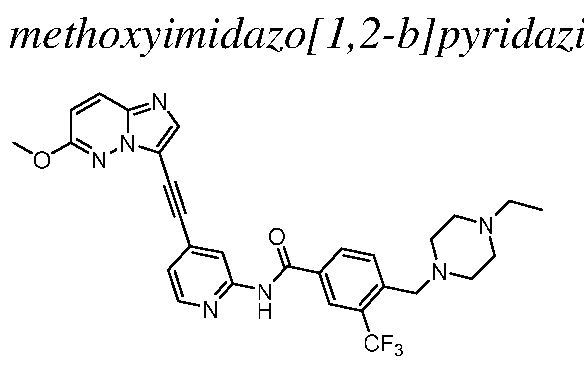
To a solution of 3-bromo-6-methoxyimidazo[l,2-b]pyridazine (30 mg, 0.132 mmol), Intermediate 17 (50 mg, 0.120 mmol), PdCl2(PPh3)2 (11 mg, 0.0156 mmol), Cul (2.3 mg, 0.0120 mmol) and PPh3 (11 mg, 0.0420 mmol) and DMF (1.0 mL), DIPEA (1.0 mL) was added. After purging with Ar for 10 mins, the resulting mixture was stirred at 90°C for 3h in a microwave. Upon cooling to room temperature, DMF was then removed in vacuo and the resulting residue was purified by preparatory HPLC to afford 4-((4-ethylpiperazin-l- yl)memyl)-N-(4-((6-methoxyimidazo[l,2-b]pyridazin-3-yl)ethynyl)pyridin-2-yl)-3- (trifluoromethyl)benzamide (16.5 mg, 24%, AUC HPLC: 96.9%) as a light brown solid; JH NMR (600 MHz, DMSO-<¾) δ (ppm): 11.30 (s, 1H), 8.50 - 8.46 (m, 1H), 8.39 - 8.37 (m, 1H), 8.35 (d, / = 1.8 Hz, 1H), 8.29 (dd, / = 8.1, 1.9 Hz, 1H), 8.14 (d, / = 9.6 Hz, 1H), 8.12 (s, 1H), 7.92 (d, / = 8.1 Hz, 1H), 7.35 (dd, / = 5.1, 1.5 Hz, 1H), 7.08 (d, / = 9.6 Hz, 1H), 4.07 (s, 3H), 3.69 (s, 2H), 2.48 - 2.43 (m, 4H), 2.39 (q, / = 7.1 Hz, 2H), 1.01 (t, / = 7.2 Hz, 3H); 13C NMR (150 MHz, DMSO-<¾) δ (ppm): 164.9, 160.6, 152.4, 148.7, 141.6, 138.2, 137.9, 132.8,
132.0, 131.4, 130.5, 128.0, 127.4, 127.2, 127.0, 126.8, 125.6, 125.0, 120.7, 115.3, 113.9, 111.2, 96.3, 81.1, 57.4, 54.7, 52.6, 52.2, 51.5, 11.7; MS (ESI) m/z : 564
 + H]+
+ H]+
Example 242: Preparation of N-(4-((6-methoxyimidazo[ l,2-b]pyridazin-3-yl)ethynyl)pyridin- alt

Step 1 : Preparation of teri-butyl 4-(4-((4-((6-methoxyimidazo[l,2-¾]pyridazin-3- yl)ethynyl)pyridin-2-yl)carbamoyl)-2-(trifluoromethyl)benzyl)piperazine- 1 -carboxylate. To a solution of 3-bromo-6-methoxyimidazo[l,2-b]pyridazine (25 mg, 0.111 mmol), teri-butyl 4- (4-((4-ethynylpyridin-2-yl)carbamoyl)-2-(trifluoromethyl)benzyl)piperazine-l-carboxylate (54 mg, 0.110 mmol), PdCl2(PPh3)2 (8.4 mg, 0.0120 mmol), Cul (2 mg, 0.0092 mmol) and PPh3 (8.4 mg, 0.0322 mmol) and DMF (1.0 mL), DIPEA (1.0 mL) was added. After purging with argon for 10 mins, the resulting mixture was stirred at 90°C for 3 h in a microwave. The reaction mixture was concentrated to dryness under reduced pressure . The resulting residue was purified by preparatory column chromatography to afford of teri-butyl 4-(4-((4-((6- methoxyimidazo[l,2-¾]pyridazin-3-yl)ethynyl)pyridin-2-yl)carbamoyl)-2- (trifluoromethyl)benzyl)piperazine-l -carboxylate (25.2 mg, 43%); MS (ESI) m/z : 636
[C32H32F3N704 + H]+
Step 2: Preparation of To a solution of tert-butyl 4-(4-((4-((6-methoxyimidazo[l,2- ¾]pyridazin-3-yl)ethynyl)pyridin-2-yl)carbamoyl)-2-(trifluoromethyl)benzyl)piperazine-l- carboxylate (25.2 mg, 0.0396 mmol) in CH2C12 (2.4mL), trifluoroacetic acid (0.6mL) was added. The mixture was stirred at rt for lh. TFA was then removed in vacuo and the resulting residue was redissolved in CH2C12/CH30H, followed by the addition of solid NaHCC>3 and 10 drops of water. The mixture was stirred at rt for 15 mins. The solids were filtered off and the filtrate concentrated and purified by preparatory HPLC to afford N-(4-((6- methoxyimidazo[ 1 ,2-b]pyridazin-3-yl)ethynyl)pyridin-2-yl)-4-(piperazin- 1 -ylmethyl)-3- (trifluoromethyl)benzamide formic acid salt (7.2 mg, 31 ) as a brown solid; JH NMR (600 MHz, DMSO-<¾) 5 (ppm): 11.31 (s, 1H), 8.50-8.47 (m, 1H), 8.39-8.37 (m, 1H), 8.35 (d, / = 1.9 Hz, 1H), 8.29 (dd, / = 8.1, 2.0 Hz, 2H), 8.15 (d, / = 9.7 Hz, 1H), 8.13 (s, 1H), 7.94 (d, /=8.2 Hz, 1H), 7.35 (dd, / = 5.0, 1.5 Hz, 1H), 7.08 (d, / = 9.6 Hz, 1H), 4.07 (s, 3H), 3.67 (s,
2H), 2.82 (t, / = 4.8 Hz, 4H), 2.41 (m, 4H); 1JC NMR (150 MHz, DMSO-<¾) δ (ppm):
164.97, 160.64, 152.44, 148.74, 141.51, 138.25, 137.98, 132.86, 132.01, 131.48, 130.64, 128.10, 127.49, 127.29, 127.09, 126.89, 125.69, 125.04, 123.22, 120.74, 115.36, 113.98, 111.23, 96.30, 81.16, 57.98, 54.73, 53.03, 44.85; MS (ESI) m/z 537 [C27H24F3N7O2 + H]+
Example 243: Preparation of4-((4-ethylpiperazin-l-yl)methyl)-N-(4-((6- thynyl)pyridin-2-yl)-3-(trifluoromethyl)benzamid

To a solution of 3-bromo-6-methoxyimidazo[l,2-a]pyrazine (30 mg, 0.132 mmol), 4-((4- ethylpiperazin- 1 -yl)methyl)-N-(4-ethynylpyridin-2-yl)-3-(trifluoromethyl)benzamide (50 mg, 0.120 mmol), PdCl2(PPh3)2 (11 mg, 0.0156 mmol), Cul (3 mg, 0.0120 mmol) and PPh3 (11 mg, 0.0420 mmol) and DMF (1.0 mL), DIPEA (1.0 mL) was added. After purging with argon for 10 mins, the resulting mixture was stirred at 90°C for 3h in a microwave. The reaction mixture was concentrated under reduced pressure and the residue was purified by preparatory HPLC to afford 4-((4-ethylpiperazin-l-yl)methyl)-N-(4-((6-methoxyimidazo[l,2-a]pyrazin-3- yl)ethynyl)pyridin-2-yl)-3-(trifluoromethyl)benzamide (4.2 mg, AUC HPLC: 98.4%) as an off-white solid; JH NMR (600 MHz, DMSO-<¾) δ (ppm) 11.30 (s, 1H), 8.83 (s, 1H), 8.48 - 8.46 (m, 1H), 8.38 - 8.36 (m, 1H), 8.35 (d, / = 1.8 Hz, 1H), 8.29 (dd, / = 8.0, 1.9 Hz, 1H), 8.25 (s, 1H), 7.92 (d, / = 8.1 Hz, 1H), 7.76 (s, 1H), 7.31 (dd, / = 5.1, 1.5 Hz, 1H), 4.29 (s, 3H), 3.68 (s, 2H), 2.41 (m, 4H), 2.32 (q, / = 7.2 Hz, 2H), 0.99 (t, / = 7.1 Hz, 3H); 13C NMR (150 MHz, DMSO- ) δ (ppm) 165.0, 152.4, 148.7, 147.2, 142.3, 141.8, 141.7, 135.3, 132.8, 132.0, 131.7, 130.5, 127.0, 125.6, 123.2, 120.2, 115.1, 110.2, 106.3, 94.1, 83.2, 58.0, 57.5, 52.9, 52.3, 51.5, 12.0; MS (ESI) m/z : 564 [C29H28F3N7O2 + H]+
Example 244: Preparation of l-(3-(imidazo[l,2-b]pyridazin-3-ylethynyl)phenyl)-3-(4-((4- methylpiperazin-l-yl)methyl)-3-(trifluoromethyl)phenyl)urea

To a solution of Intermediate 40 (400 mg, 0.961 mmol) and 3-bromoimidazo[l,2- b]pyridazine (287 mg, 1.442 mmol) in acetonitrile were added diisopropylethylamine (0.5 mL, 2.88 mmol), triphenylphosphine (12.5 mg, 0.048 mmol), Pd(PPh3)4 (55 mg, 0.048 mmol) and Cul (27.5 mg, 0.144 mmol). The reaction mixture was heated at 80 °C for 3 h under argon and was concentrated to a smaller volume under reduced pressure. The residue was extracted with EtOAc and the organic phase was washed in turn with water, brine, dried over Na2S04 and concentrated under reduced pressure. The residue was purified by column chromatography (silica gel, eluent Ct^CL/MeOH 90: 10) to afford l-(3-(imidazole(l,2- bipyridazin-3-ylethylphynyl )-3-(4(( 4-methylpiperazin-lyl )methyl)-3- ( trifluoromethyl)phenyl)urea (100 mg, 19%, AUC HPLC 98%) as a pale yellow solid, mp: 199-202 °C. JH NMR (400 MHz, DMSO-<¾) δ (ppm): 9.06 (s, 1H), 8.92 (s, 1H), 8.71 (dd, / = 16.0 Hz, / = 4.4 Ηζ,ΙΗ), 8.24 (dd, / = 12.0 Hz, / = 12.0 Hz, 1H), 8.2 (s, 1H), 7.98 (d, / = 9.0 Hz, 1H), 7.8 (s, 1H), 7.66-7.55 (m, 2H), 7.45-7.34 (m, 3H), 7.29-7.20 (m, 1H), 3.50 (s, 2H), 2.46-2.23 (m, 7H), 2.16 (s, 3H). MS (ESI) m/z: 533.9 ^^FsW+R -
Example 245, Preparation ofN-(5-((lH-pyrrolo[2,3-b]pyridin-5-yl)ethynyl)thiazol-2-yl)-4- ( trifluoromethyl )benzamide

The title compound was prepared in 13.1% yield (120 mg, AUC HPLC 97.8%) as a yellow solid following experimental conditions similar to general procedure B with Intermediate 36 as starting material, mp: 258-261 °C; JH NMR (400 MHz, DMSO-<¾) δ (ppm): 13.17 (s, 1H), 11.92 (s, 1H), 8.46 (s, 1H), 8.39-8.36 (m, 2H), 8.18 (s, 1H), 7.95 (d, / = 8.0 Hz, 1H),
7.89 (s, 1H), 7.56 (s, 1H), 6.50 (s, 1H), 3.62 (s, 2H), 2.22 (s, 6H). MS (ESI) nt/z: 470.09 [C23H18F3N5OS+H]+
Example 246, Preparation of4-((lH-pyrazolo[3,4-b]pyridin-5-yl)ethynyl)-N-(4- ( ( dimethylamino )methyl )-3-( trifluoromethyl )phenyl )picolinamide

Step 1 : Synthesis of 4-bromo-N-(4-((dimethylamino)methyl)-3-
(trifluoromethyl)phenyl)picolinamide. To an ice-cold solution of 4-bromopicolinic acid (1 g, 4.95 mmol) and 4-((dimethylamino)methyl)-3-(trifluoromethyl)aniline (lg, 4.95 mmol) and TEA (3.47 mL, 24.75 mmol) in dichloromethane (15 mL) was added dropwise T3P (2.3 g, 7.42 mmol, 50% in EtOAc). The reaction mixture was stirred at room temperature for 15 h, was diluted with dichloromethane, wahsed in turn with water and brine, dried over Na2S04, filtered and concentrated under reduced pressure. The residue was purified by column chromatography (silicagel, eluent Ct^C^MeOH 98:2) to afford 4-bromo-N-(4- ((dimethylamino)methyl)-3-(trifluoromethyl)phenyl)picolinamide (800 mg, LC-MS 76%). Step 2: Synthesis of 4-((lH-pyrazolo[3,4-b]pyridin-5-yl)ethynyl)-N-(4- ((dimethylamino)methyl)-3-(trifluoromethyl)phenyl)picolinamide. The title compound was prepared in 27.7% yield (160 mg, AUC HPLC 94.48%) as an off-white solid using coupling conditions similar to general procedure B with 4-bromo-N-(4-((dimethylamino)methyl)-3- (trifluoromethyl)phenyl)picolinamide from Step 1. mp: 225-229 °C. JH NMR (400 MHz, DMSO- ) δ (ppm): 14.05 (s, 1H), 11.12 (s, 1H), 8.82 (d, / = 4.0 Hz, 1H), 8.80 (d, / = 2.4 Hz, 1H), 8.62 (d, / = 1.2 Hz, 1H), 8.39 (d, / = 2.0 Hz, 1H), 8.26 (bs, 2H), 8.17 (t, / = 8.8 Hz, 1H), 7.86 (dd, / = 1.2, 1.6 Hz, 1H), 7.72 (d, / = 8.8 Hz, 1H), 3.50 (s, 2H), 2.18 (s, 6H). MS (ESI) m/z: 465.09 [C24H19F3N60+H]+
Example 247: Preparation ofN-(4-((3-methoxy-lH-pyrazolo[3,4-b]pyridin-5- yl )ethynyl)pyridin-2-yl)-4-(piperazin-l-ylmethyl )-3-( trifluoromethyl )benzamide
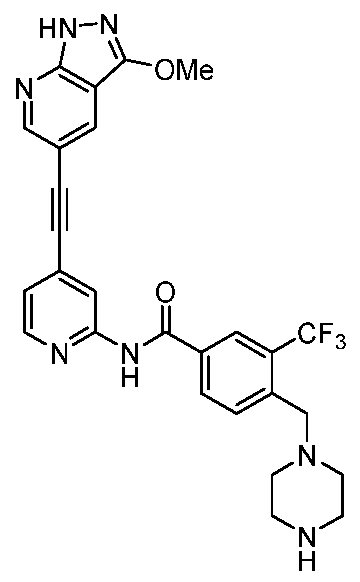
Step 1 : Preparation of tert-b tyl 4-(4-((4-((3-methoxy-lH-pyrazolo[3,44j]pyridin-5- yl)ethynyl)pyridin-2-yl)carbamoyl)-2-(trifluoromethyl)benzyl)piperazine- 1 -carboxylate. To a solution of 5-ethynyl-3-methoxy-lH-pyrazolo[3,4-Z?]pyridine (62 mg, 0.36 mmol) in DMF (1 mL) under inert atmosphere was added tert-butyl 4-(4-((4-bromopyridin-2-yl)carbamoyl)-2- (trifluoromethyl)benzyl)piperazine-l -carboxylate (196 mg, 0.36 mmol), triphenylphophine (33 mg, 0.13 mmol), Pd(PPh3)2Cl2 (33 mg, 0.048 mmol), copper iodide (6.9 mg, 0.036 mmol) and DIPEA (0.5 mL). The resulting mixture was heated to 90 C for 18 h, then was cooled, diluted with water (10 mL) and extracted with EtOAc (3 x 15 mL). The combined organic layers were washed in turn with water and brine, dried over Na2S04, filtered and concentrated under reduced pressure. The crude product was purified by column chromatography (silica gel, CH2Cl2/MeOH 10: 1) afford teri-butyl 4-(4-((4-((3-methoxy-lH-pyrazolo[3,4-Z?]pyridin- 5-yl)ethynyl)pyridin-2-yl)carbamoyl)-2-(trifluoromethyl)benzyl)piperazine-l-carboxylate (115 mg, 50%) as white solid. JH NMR (400 MHz, CDC13) δ (ppm): 9.89 (s, 1H), 8.68 (d, / = 1.6 Hz, 1H), 8.64 (s, 1H), 8.54 (s, 1H), 8.33 (d, / = 5.1 Hz, 1H), 8.22 (d, / = 9.3 Hz, 1H), 8.09 (d, / = 8.1 Hz, 1H), 8.02 (d, / = 8.1 Hz, 1H), 7.21 (dd, / = 5.1, 1.0 Hz, 1H), 4.12 (s, 3H), 3.74 (s, 2H), 3.55-3.39 (m, 4H), 2.50-2.40 (m, 4H), 1.47 (s, 9H); MS (ESI) m/z 636.2
[C32H32F3N7O4 + H]+.
Step 2: Preparation of N-(4-((3-methoxy-lH-pyrazolo[3,4-b]pyridin-5-yl)ethynyl)pyridin-2- yl)-4-(piperazin- 1 -ylmethyl)-3-(trifluoromethyl)benzamide
To a solution of teri-butyl 4-(4-((4-((3-methoxy-lH-pyrazolo[3,4-¾]pyridin-5- yl)ethynyl)pyridin-2-yl)carbamoyl)-2-(trifluoromethyl)benzyl)piperazine- 1 -carboxylate (115 mg, 0.18 mmol) in DCM (4 mL) was added TFA (0.5 mL) and was stirred at room temperature for 3 h before concentrated under reduced pressure. The residue was purified by column chromatography (silica gel, eluent CH2Ci2/MeOH 95:5-90: 10) and by preparative HPLC (C18, eluent CH3CN/H20/HCOOH 0.01%) to afford N-(4-((3-methoxy- 1H- pyrazolo[3,4-¾]pyridin-5-yl)ethynyl)pyridin-2-yl)-4-(piperazin-l-ylmethyl)-3-
(trifluoromethyl)benzamide (88 mg, 91%, AUC HPLC 97%) as yellow solid, mp 204.0- 205.9 °C; JH NMR (400 MHz, MeOO-d4) δ (ppm): 8.66 (s, 1H), 8.43-8.37 (m, 2H), 8.37-8.29 (m, 3H), 8.26 (d, / = 8.0 Hz, 1H), 8.02 (d, / = 8.0 Hz, 1H), 7.31 (d, / = 3.9 Hz, 1H), 4.11 (s, 3H), 3.88 (s, 2H), 3.31-3.25 (m, 4H), 2.77 (bs, 4H); 13C NMR (100 MHz, MeOO-d4) δ (ppm): 167.34, 166.70, 157.12, 153.73, 153.42, 152.37, 149.49, 142.15, 135.02, 134.52, 134.05, 132.50, 132.26, 130.17 (q, / = 30.8 Hz), 126.84 (q, / = 5.9 Hz), 125.55 (q, / = 273.4 Hz), 123.03, 117.63, 111.83, 105.36, 92.42, 88.95, 58.82, 56.63, 50.90, 44.97; MS (ESI) m/z 536.55 [C27H24F3N7O2+ H]+.
Example 248: Preparation ofN-(4-((3-methoxy-lH-pyrazolo[3,4-b]pyridin-5- -yl)-4-( (4-methylpiperazin-l-yl )methyl)-3-( trifluoromethyl )benzamide

To a solution of 5-ethynyl-3-methoxy-lH-pyrazolo[3,4-Z?]pyridine (40 mg, 0.23 mmol) in DMF (1 mL) under inert atmosphere was added N-(4-bromopyridin-2-yl)-4-((4- methylpiperazin-l-yl)methyl)-3-(trifluoromethyl)benzamide (105 mg, 0.23 mmol), triphenylphophine (21 mg, 0.03 mmol), Pd(PPli3)2Ci2 (21 mg, 0.081 mmol), copper iodide (4.4 mg, 0.023 mmol) and DIPEA (0.5 mL). The resulting mixture was heated to 90 C for 18 h, then was cooled, diluted with water (10 mL) and extracted with EtOAc (3 x 15 mL). The combined organic layers were washed in turn with water and brine, dried over Na2S04, filtered and concentrated under reduced pressure. The crude product was purified by column chromatography (silica gel, CH2Cl2/MeOH 10: 1) and by preparative HPLC (C18, eluent CH3CN/H2O/HCOOH 0.01%) to afford N-(4-((3-methoxy-lH-pyrazolo[3,4 ]pyridin-5- yl)ethynyl)pyridin-2-yl)-4-((4-methylpiperazin-l-yl)methyl)-3-(trifluoromethyl)benzamide (32 mg, 25%, AUC HPLC 99%) as white solid, m.p: 102.2-102.8 °C; JH NMR (400 MHz, MeOO-d4) δ (ppm): 8.65 (d, / = 1.4 Hz, 1H), 8.41-8.36 (m, 2H), 8.35-8.29 (m, 3H), 8.24 (d, / = 8.2 Hz, 1H), 8.00 (d, / = 8.2 Hz, 1H), 7.30 (d, / = 5.4 Hz, 1H), 4.10 (s, 3H), 3.86 (s, 2H),
3.22 (bs, 4H), 2.82 (s, 3H), 2.75 (bs, 4H); 1JC NMR (100 MHz, MeOD-<¾) δ (ppm): 167.96, 166.61, 157.07, 153.70, 153.37, 152.31, 149.44, 142.12, 134.96, 134.47, 134.02, 132.46, 132.20, 130.11 (q, / = 30.8 Hz), 126.81 (q, / = 6.0 Hz), 125.50 (q, / = 273.3 Hz), 122.99, 117.59, 111.79, 105.32, 92.41, 88.95, 58.33, 56.62, 54.91, 51.22, 43.61 ; MS (ESI) m/z 550.55[C28H26F3N7O2 + H]+.
Example 249: 4-(( 4-ethylpiperazin-l-yl)methyl)-N-( 4-(( 5-methoxypyrazolo[ 1,5-a Jpyrimidin- -yl)ethynyl)pyridin-2-yl)-3-(trifluoromethyl)benzamide

To a solution of 3-ethynyl-5-methoxypyrazolo[l,5-a]pyrimidine (25 mg, 0.144 mmol), N-(4- bromopyridin-2-yl)-4-((4-ethylpiperazin- 1 -yl)methyl)-3-(trifluoromethyl)benzamide (68 mg, 0.144 mmol), PdCl2(PPh3)2 (13 mg, 0.0187 mmol), Cul (2.7 mg, 0.0144 mmol) and PPh3 (13 mg, 0.0504 mmol) and DMF (1.0 mL), DIPEA (1.0 mL) was added. After purging with argon for 10 mins, the resulting mixture was heated in microwave apparatus at 90 °C for 3 h. DMF was then removed in vacuo and the residue was purified by preparative HPLC to afford 4-((4- ethylpiperazin- 1 -yl)methyl)-N-(4-((5-methoxypyrazolo[ 1 ,5-a]pyrimidin-3-yl)ethynyl)pyridin- 2-yl)-3-(trifluoromethyl)benzamide (26.1 mg, 32%, AUC HPLC: 98.3%) as an off-white solid; JH NMR (600 MHz, DMSO-<¾) δ (ppm) 11.24 (s, 1H), 9.00 (d, / = 7.4 Hz, 1H), 8.43 (d, / = 5.1 Hz, 1H), 8.42 (s, 1H), 8.34 (d, / = 1.9 Hz, 1H), 8.31 - 8.27 (m, 2H), 7.92 (d, / = 8.1 Hz, 1H), 7.27 (dd, / = 5.1, 1.5 Hz, 1H), 6.72 (d, / = 7.4 Hz, 1H), 4.05 (s, 3H), 3.68 (s, 2H), 2.43 (m, 4H), 2.33 (q, / = 7.2 Hz, 2H), 0.99 (t, / = 7.2 Hz, 3H); 13C NMR (150 MHz, DMSO- ) δ (ppm) 164.8, 163.2, 152.3, 148.4, 147.7, 147.1, 141.6, 138.9, 132.8, 132.7, 131.9, 130.5, 127.4, 127.2, 127.0, 126.8, 125.6, 125.0, 120.9, 115.4, 101.6, 90.0, 89.2, 85.8, 57.5, 54.3, 52.8, 52.3, 51.5, 11.9; MS (ESI) m/z : 564 [C29H28F3N702 + H]+
Example 250: Preparation of4-((4-ethylpiperazin-l-yl)methyl)-N-(4-((4-fluoro-6- ( methylamino )pyridin-3-yl)ethynyl)pyridin-2-yl)-3-( trifluoromethyl)benzamide

Step 1 : Preparation of 5-bromo-4-fluoro-N-methylpyridin-2-amine. To a solution of 5-bromo- 4-fluoropyridin-2-amine (50 mg, 0.262 mmol) in dioxane (2.0 mL) was added Copper (II) acetate (119 mg, 0.655 mmol), pyridine (73 DL, 0.910 mmol) and stirred for 15 min prior to the addition of methylboronic acid (39 mg, 0.655 mmol). The reaction mixture was heated to reflux for 18 h, cooled to room temperature and purified by flash column chromatography (silica gel, eluents Hex/EtOAc 85: 15) to afford 5-bromo-4-fluoro-N-methylpyridin-2-amine (23 mg, 43%); 1H NMR (400 MHz, CDC13) δ (ppm): 8.12 (d, / = 9.7 Hz, 1H), 6.14 (d, / = 10.7 Hz, 1H), 4.80 (s, 1H), 2.89 (d, / = 5.2 Hz, 3H); MS (ESI) m/z 206 [C6H6BrFN2+H]+. Step 2: Preparation of 4-((4-ethylpiperazin-l-yl)methyl)-N-(4-((4-fluoro-6- (memylamino)pyridin-3-yl)ethynyl)pyridin-2-yl)-3-(trifluoromethyl)benzamide. To a solution of 4-((4-ethylpiperazin- 1 -yl)methyl)-N-(4-ethynylpyridin-2-yl)-3- (trifluoromethyl)benzamide (46 mg, 0.112 mmol) in DMF (2.0 mL) was added 5-bromo-4- fluoro-N-methylpyridin-2-amine (23 mg, 0.112 mmol), bis (triphenylphosphine)palladium(II) dichloride (10.2 mg, 0.015 mmol), cupper iodide (2.1 mg, 0.011 mmol), triphenylphosphine (10.3 mg, 0.035 mmol) and DIPEA (0.5 ml, 2.39 mmol). The reaction mixture was stirred at 80 °C for 18 h then was concentrated under reduced pressure. The residue was purified by preparative HPLC (CI 8, eluent CH3CN/H2O/HCOOH 0.1%) to afford 4-((4-ethylpiperazin-l- yl)memyl)-N-(4-((4-fluoro-6-(memylamino)pyridin-3-yl)ethynyl)pyridin-2-yl)-3- (trifluoromethyl)benzamide (2.0 mg, AUC HPLC 98.7 %) as white solid; mp 153-155 °C; JH NMR (400 MHz, MeOD) δ (ppm): 8.35 (d, / = 5.1 Hz, 1H), 8.30 (s, 2H), 8.25-8.15 (m, 2H), 8.01 (d, / = 8.2 Hz, 1H), 7.21 (d, / = 5.2 Hz, 1H), 6.29 (d, / = 11.9 Hz, 1H), 3.77 (s, 2H), 2.91 (s, 3H), 2.80-2.40 (m, 10H), 1.13 (t, / = 7.2 Hz, 3H); MS (ESI) m/z 541.2
[C28H28F4N60 + H]+.
Example 251: Preparation l-(4-((4-fluoro-lH-pyrrolo[2,3-b]pyridin-5-yl)ethynyl)pyridin-2- yl)-3-(4-(piperazin-l-ylmethyl)-3-(trifluoromethyl)phenyl)urea

To a solution of teri-butyl 4-(4-(3-(4-ethynylpyridin-2-yl)ureido)-2-
(trifluoromethyl)benzyl)piperazine-l-carboxylate (50 mg, 0.099 mmol) in DMF (2.0 mL) was added 5-bromo-4-fluoro-lH-pyrrolo[2,3-b]pyridine (64 mg, 0.298 mmol), bis
(triphenylphosphine)palladium(II) dichloride (9.6 mg, 0.013 mmol), cupper iodide (1.98 mg, 0.010 mmol), triphenylphosphine (9.1 mg, 0.035 mmol) and DIPEA (0.5 ml, 2.39 mmol). The reaction mixture was stirred at 80 °C for 18 h then was concentrated under reduced pressure. The residue was purified by flash column chromatography (silica gel, eluents DCM/MeOH 9: 1) to afford teri-butyl 4-(4-(3-(4-((4-fluoro-lH-pyrrolo[2,3-b]pyridin-5- yl)ethynyl)pyridin-2-yl)ureido)-2-(trifluoromethyl)benzyl)piperazine- 1 -carboxylate (16 mg, 25.3%). A solution of the boc protected intermediate in a mixture of TFA (2 ml) in DCM (2 ml) was stirred at room temperature for 4 h then was concentrated under pressure. The crude product was purified by preparative HPLC (CI 8, eluent CH3CN/H20/HCOOH 0.1%) to afford l-(4-((4-fluoro-lH-pyrrolo[2,3-b]pyridin-5-yl)ethynyl)pyridin-2-yl)-3-(4-(piperazin-l- ylmethyl)-3-(trifluoromethyl)phenyl)urea (3.0 mg, 5.6 % over 2 steps, AUC HPLC 95.86 %) as white solid; mp 167-169 °C; JH NMR (400 MHz, MeOD) δ (ppm): 8.39 (d, / = 8.8 Hz, 1H), 8.33 (d, / = 5.8 Hz, 1H), 7.99 (d, / = 1.6 Hz, 1H), 7.78-7.70 (m, 2H), 7.47 (d, / = 3.6 Hz, 1H), 7.41 (s, 1H), 7.16 (dd, / = 5.2, 1.2 Hz, 1H), 6.63 (d, / = 3.6 Hz, 1H), 3.71 (s, 2H), 3.17 (t, / = 5.0 Hz, 4H), 2.67 (s, 4H); MS (ESI) m/z 538.60 [C27H23F4N7O + H]+.
Example 252, Preparation of l-(3-((4-fluoro-lH-pyrrolo[2,3-b]pyridin-5-yl)ethynyl)phenyl)- 3-(4-((4-methylpiperazin-l-yl)methyl)-3-(trifluoromethyl)phenyl)urea

Intermediate 40 as starting material, mp: 201-208 ^ZH NMR (400 MHz, DMSO- δ (ppm): 12.26 (s, IH), 10.15 (s, IH), 9.99 (s, IH), 8.46 (t, / = 9.2 Hz, IH), 8.00 (s, IH), 7.83 (s, IH), 7.65 (d, / = 8.0 Hz, 2H), 7.60 (s, IH), 7.49 (d, / = 8.0 Hz , IH), 7.34 (t, / = 7.0 Hz, IH), 7.17 (d, / = 7.0 Hz, 2H), 6.62 (s, IH), 3.52 (s, 2H), 2.4-2.2 (m, 8H), 2.15 (s, IH). MS (ESI) m/z: 551.21 (M+H) [C29H26F4N60+H]+
Example 253, Preparation of l-(3-((6-(dimethylamino)imidazo[l,2-b]pyridazin-3- yl)ethynyl)phenyl)-3-(4-((4-methylpiperazin-l-yl)methyl)-3-(trifluoromethyl)phenyl)urea

The title compound prepared (12 mg, AUC HPLC 95%) as an off-white solid using coupling conditions similar to general procedure B using intermediate 40 as starting material, mp: 181-186 °C. JH NMR (400 MHz, DMSO-<¾) δ (ppm): 10.1-9.38 (m, IH), 8.0 (s, IH), 7.88 (d, / = 9.0 Hz, IH), 7.83 (s, 2H), 7.60 (s, 2H), 7.47 (d, / = 8.0 Hz, IH), 7.34 (t, / = 8.0 Hz, IH), 7.16-7.13 (m, 2H), 3.52 (s, IH), 3.13 (s, 6H): 2.37-2.32 (m, 8H), 2.15 (s, 3H). MS (ESI) m/z: 577.0 [C3oH31F3N80+H]+-
Example 254: Preparation ofN-(4-((6-amino-5-fluoropyridin-3-yl)ethynyl)pyridin-2-yl)-4- ( ( 4-methylpiperazin-l-yl )methyl )-3-( trifluoromethyl )benzamide

Example 255 : N-(4-( (3 -methyl- lH-pyrazolo[ 3,4-b ]pyridin-5-yl )ethynyl )pyridin-2-yl )-4-((4- (trifluoromethyl)benzamide

To a solution of N-(4-((3-methyl-lH-pyrazolo[3,4-¾]pyridin-5-yl)ethynyl)pyridin-2-yl)-4- (piperazin-l-ylmethyl)-3-(trifluoromethyl)benzamide (11 mg, 0.0194 mmol) in 1 : 1
THF:DMF (2 mL), potassium carbonate (2.7 mg, 0.0194 mmol) was added and stirred for 15 min. Iodomethane (0.66 μL·, 0.0106 mmol) in DMF was then added and the mixture stirred for 12 h at rt. The reaction was quenched by adding water (2 drops) and the solvents were removed in vacuo. The residue was then purified by preparative TLC to give N-(4-((3- methyl-lH-pyrazolo[3,4-b]pyridin-5-yl)ethynyl)pyridin-2-yl)-4-((4-methylpiperazin-l-
yl)methyl)-3-(trifluoromethyl)benzamide (3.0 mg, 29%, AUC HPLC: 95.6%) as a yellow solid; JH NMR (600 MHz, DMSO-<¾) δ (ppm): 13.55 (s, 1H), 11.28 (s, 1H), 8.72 (d, / = 2.0 Hz, 1H), 8.62 (d, / = 2.0 Hz, 1H), 8.47 (dd, / = 5.0, 0.9 Hz, 1H), 8.38 - 8.33 (m, 2H), 8.30 (dd, / = 8.1, 1.9 Hz, 1H), 7.92 (d, / = 8.1 Hz, 1H), 7.35 (dd, / = 5.0, 1.5 Hz, 1H), 3.68 (s, 2H), 2.53 (s, 3H), 2.46 - 2.37 (m, 4H), 2.17 (s, 3H); 13C NMR (150 MHz, DMSO- ) δ (ppm): 164.9, 152.4, 151.3, 151.1, 148.6, 141.7, 133.6, 132.8, 132.0, 131.9, 130.6, 127.4, 127.2, 127.0, 126.8, 125.6, 125.0, 123.2, 121.3, 115.9, 113.6, 109.8, 91.8, 87.7, 57.5, 54.7, 52.7, 45.7, 12.1 ; MS (ESI) m/z 535 [C28H26F3N7O + H]+
Example 256 : N-(4-( (3 -methyl- lH-pyrazolo[ 3,4-b ]pyridin-5-yl )ethynyl )pyridin-2-yl )-4- (piperazin-1 -ylmethyl)-3-( trifluoromethyl )benzamide formic acid salt

Step 1 : Preparation of teri-butyl 4-(4-((4-((3-methyl-lH-pyrazolo[3,4-b]pyridin-5- yl)ethynyl)pyridin-2-yl)carbamoyl)-2-(trifluoromethyl)benzyl)piperazine- 1 -carboxylate. To a solution of 5-bromo-3-methyl-lH-pyrazolo[3,4-b]pyridine (42 mg, 0.197 mmol), teri-butyl 4- (4-((4-ethynylpyridin-2-yl)carbamoyl)-2-(trifluoromethyl)benzyl)piperazine-l-carboxylate (80 mg, 0.164 mmol), PdCl2(PPh3)2 (15 mg, 0.012 mmol), Cul (3 mg, 0.016 mmol) and PPh3 (15 mg, 0.057 mmol) and DMF (1.0 mL), DIPEA (1.0 mL) was added. After purging with Ar for 10 mins, the resulting mixture was stirred at 90°C for 3h in a microwave. Upon cooling to room temperature, DMF was then removed in vacuo and the resulting residue was purified by preparatory column chromatography to afford of teri-butyl 4-(4-((4-((3-methyl-lH- pyrazolo[3,4-b]pyridin-5-yl)ethynyl)pyridin-2-yl)carbamoyl)-2- (trifluoromethyl)benzyl)piperazine-l -carboxylate (48 mg, 47%); MS (ESI) m/z: 620
[C32H32F3N703 + H]+
Step 2: Synthesis of N-(4-((3-methyl-lH-pyrazolo[3,4-b]pyridin-5-yl)ethynyl)pyridin-2-yl)- 4-(piperazin-l-ylmethyl)-3-(trifluoromethyl)benzamide formic acid salt. To a solution of tert- butyl 4-(4-((4-((3-methyl-lH-pyrazolo[3,4-¾]pyridin-5-yl)ethynyl)pyridin-2-yl)carbamoyl)-2-
(trifluoromethyl)benzyl)piperazine-l-carboxylate (48 mg, 0.0775 mmol) in CH2CI2 (2.4 mL), trifluoroacetic acid (0.6mL) was added. The mixture was stirred at rt for lh. TFA was then removed in vacuo and the resulting residue was redissolved in CH2CI2/CH3OH, followed by adding solid NaHC(¾ and 15 drops of water. The mixture was stirred at rt for 15 mins. The solids were filtered off and the filtrate concentrated and purified by preparatory HPLC twice to afford N-(4-((3-methyl-lH-pyrazolo[3,4-b]pyridin-5-yl)ethynyl)pyridin-2-yl)-4-(piperazin- l-ylmethyl)-3-(trifluoromethyl)benzamide formic acid salt (15.1 mg, 34%, AUC HPLC: 97.5%) as a brown solid; JH NMR (600 MHz, DMSO-<¾) δ (ppm): 13.56 (s, 1H), 11.29 (s, 1H), 8.72 (d, / = 1.9 Hz, 1H), 8.62 (d, / = 2.0 Hz, 1H), 8.50 - 8.46 (m, 1H), 8.36 (d, / = 1.1 Hz, 2H), 8.30 (dd, / = 8.1, 1.9 Hz, 1H), 8.28 (s, 1H), 7.94 (d, / = 8.1 Hz, 1H), 7.35 (dd, / = 5.0, 1.5 Hz, 1H), 3.69 (s, 2H), 2.90 - 2.82 (m, 4H), 2.53 (s, 3H), 2.44 (m, 4H); 13C NMR (150 MHz, DMSO- ) δ (ppm): 164.8, 164.2, 152.4, 151.4, 151.1, 148.6, 141.9, 141.4, 133.6 132.8, 132.0, 130.6, 127.3, 127.1, 125.7, 125.0, 123.2, 121.3, 115.9, 113.6, 109.8, 91.8, 87.7, 57.8, 52.5, 44.5, 12.1 ; MS (ESI) m/z 521 [C27H24F3N7O + H]+
Example 257, Preparation ofN-(4-((lH-pyrrolo[2,3-b]pyridin-5-yl)ethynyl)pyridin-2-yl)-4- -3-(trifluoromethyl)benzamide

The title compound was prepared in 60.6% yield (400 mg, AUC HPLC 96.05%) as an off- white solid in a fashion similar to Example 227 synthesis starting from Intermediate 12. mp: 159-162 °C. JH NMR (400 MHz, DMSO-<¾) δ (ppm): 12.01 (s, 1H), 11.27 (s, 1H), 8.48-8.45 (m, 2H), 8.34 (d, / = 4.4 Hz, 2H), 8.28 (d, / = 2.4 Hz, 2H), 7.94 (d, / = 8.0 Hz, 1H), 7.59 (t, / = 2.4 Hz, 1H), 7.34 (dd, / = 1.2 Hz, 1H), 6.53 (d, / = 2.0 Hz, 1H), 3.64 (s, 2H), 2.74-2.71 (m, 4H), 2.35-2.34 (m, 4H). MS (ESI) m/z: 505.3 [C27H23F3N60+H]+.
Example 258: Preparation of4-((dimethylamino)methyl)-N-(4-((4-fluoro-lH-pyrrolo[2,3- b ]pyridin-5-yl )ethynyl )pyridin-2-yl )-3-( trifluoromethyl )benzamide

Step 1 : teri-butyl 5-((2-aminopyridin-4-yl) ethynyl)-4-fluoro-lH-pyrrolo [2, 3-b] pyridine-1- carboxylate. The title compound was prepared in the amount of 300 mg (73%, LC-MS 98%) as a pale yellow solid using Sonogashira coupling conditions similar to general procedure B using 4-ethynylpyridin-2-amine. MS (ESI) m z: 353 [C19H17FN402+ H]+.
Step 2: Synthesis of teri-butyl 5-((2-(4-((dimethylamino) methyl)-3-(trifluoromethyl) benzamido) pyridin-4-yl) ethynyl)-4-fluoro-lH-pyrrolo[2, 3-b]pyridine- 1-carboxylate. To a solution of teri-butyl 5-((2-aminopyridin-4-yl)ethynyl)-4-fluoro-lH-pyrrolo[2,3-b]pyridine-l- carboxylate (282 mg, 0.79 mmol) in pyridine (5 ml) were successively added 4- ((dimethylamino)methyl)-3-(trifluoromethyl)benzoic acid (300mg, 0.99 mmol), POCI3 (0.5 mL) at 0 °C and then stirred at room temperature for 6 h. The reaction mixture was diluted with EtOAc and basified with aqueous NaHCC>3. The organic layer was washed in turn with water and brine then dried over Na2S04, filtered and concentrated under reduced pressure to afford teri-butyl 5-((2-(4-((dimethylamino) methyl)-3-(trifluoromethyl) benzamido) pyridin-
4- yl) ethynyl)-4-fluoro-lH-pyrrolo [2, 3-b] pyridine- 1-carboxylate (120 mg, LC-MS 44%) as a pale brown solid. MS (ESI) m/z: 582.1 [C3oH27F4N503+H]+.
Step 3: Synthesis of 4-((dimethylamino) methyl)-N-(4-((4-fluoro-lH-pyrrolo [2, 3-b] pyridin-
5- yl) ethynyl) pyridin-2-yl)-3-(trifluoromethyl) benzamide. A solution of teri-butyl 5-((2-(4- ((dimethylamino) methyl)-3-(trifluoromethyl) benzamido) pyridin-4-yl) ethynyl)-4-fluoro- lH-pyrrolo [2, 3-b] pyridine- 1-carboxylate (120 mg) and 6Ν HCl in 1 , 4-dioxane (2 mL) was stirred at room temperature for 2 h. The reaction mixture was basified with saturated
NaHCC>3 and extracted with EtOAc (10 mL). The organic layer was washed in turn with water and brine, dried over Na2S04, filtered and concentrated under reduced pressure. The residue was purified by preparative HPLC to afford of 4-((dimethylamino) methyl)-N-(4-((4- fluoro-lH-pyrrolo [2, 3-b] pyridin-5-yl) ethynyl) pyridin-2-yl)-3-(trifluoromethyl) benzamide (20 mg, 20.2%, AUC HPLC 97.7%) as an off-white solid, mp: 223-226 °C. JH NMR (400 MHz, DMSO- ) δ (ppm): 12.35 (s, 1H), 11.27 (s, 1H), 8.47-8.52 (m, 2H), 8.35 (s, 1H), 8.31
(d, / = 8 Hz, 2H), 7.92 (d, / = 8.0 Hz, 1H), 7.63 (t, / = 2.8 Hz, 1H), 7.35 (dd, / = 1.2, 4.8 Hz, 1H), 6.65-6.62 (m, 1H), 3.61 (s, 2H), 2.22(s, 6H). MS (ESI) m/z: 481.9

Example 259: Preparation of4-((4-ethylpiperazin-l-yl)methyl)-N-(4-((6- methoxyimidazo[l,2-a]pyridin-3-yl)ethynyl)pyridin-2-yl)-3-(trifluoromethyl)benzamide formic acid salt

To a solution of 3-bromo-6-methoxyimidazo[l,2-a]pyridine (25 mg, 0.110 mmol), 4-((4- ethylpiperazin- 1 -yl)methyl)-N-(4-ethynylpyridin-2-yl)-3-(trifluoromethyl)benzamide (46 mg, 0.110 mmol), PdCl2(PPh3)2 (10 mg, 0.0143 mmol), Cul (2 mg, 0.0110 mmol) and PPh3 (10 mg, 0.0385 mmol) and DMF (1.0 mL), DIPEA (1.0 mL) was added. After purging with argon for 10 min, the resulting mixture was heated in a microwave apparatus at 90 °C for 3 h. The DMF was then removed in vacuo and the resulting residue was purified preparative HPLC to afford 4-((4-ethylpiperazin-l-yl)methyl)-N-(4-((6-methoxyimidazo[l,2-a]pyridin-3- yl)ethynyl)pyridin-2-yl)-3-(trifluoromethyl)benzamide formic acid salt (16.0 mg, 24%, AUC HPLC 99.8%) as a light brown solid; JH NMR (600 MHz, DMSO-<¾) δ (ppm): 11.28 (s, 1H), 8.48 (d, / = 5.1 Hz, 1H), 8.38 (d, / = 1.2 Hz, 1H), 8.35 (d, / = 1.9 Hz, 1H), 8.29 (dd, / = 8.1, 1.9 Hz, 1H), 8.17 (s, 1H), 8.14 (d, / = 2.3 Hz, 1H), 8.09 (s, 1H), 7.92 (d, / = 8.1 Hz, 1H), 7.69 (d, / = 9.7 Hz, 1H), 7.47 (dd, / = 5.1, 1.4 Hz, 1H), 7.28 (dd, / = 9.7, 2.4 Hz, 1H), 3.94 (s, 3H), 3.68 (s, 2H), 2.44 (m, 4H), 2.34 (q, / = 7.2 Hz, 2H), 0.99 (t, / = 7.1 Hz, 3H); 13C NMR (150 MHz, DMSO-<¾) δ (ppm): δ 164.9, 163.2, 152.3, 149.9, 148.5, 142.7, 141.6,
139.8, 132.8, 132.0, 131.7, 130.5, 127.4, 127.2, 127.0, 126.8, 125.6, 123.2, 121.6, 120.9,
117.9, 115.2, 107.8, 107.6, 97.7, 81.5, 57.5, 56.4, 52.8, 52.3, 51.5, 11.9; MS (ESI) m/z : 564 [C3oH29F3N602 + H]+, m.p 186-188°C.
Example 260: Preparation of N-(4-((6-methoxyimidazo[ l,2-a]pyridin-3-yl)ethynyl)pyridin-2- yl)-4-(piperazin-l -ylmethyl)-3-( trifluoromethyl )benzamide formic acid salt

Step 1 : Preparation of teri-butyl 4-(4-((4-((6-methoxyimidazo[l,2-a]pyridin-3- yl)ethynyl)pyridin-2-yl)carbamoyl)-2-(trifluoromethyl)benzyl)piperazine- 1 -carboxylate. To a solution of 3-bromo-6-methoxyimidazo[l,2-fl]pyridine (25 mg, 0.110 mmol), teri-butyl 4-(4- ((4-ethynylpyridin-2-yl)carbamoyl)-2-(trifluoromethyl)benzyl)piperazine- 1 -carboxylate (54 mg, 0.110 mmol), PdCl2(PPh3)2 (10 mg, 0.0143 mmol), Cul (2 mg, 0.0110 mmol) and PPh3 (10 mg, 0.0385 mmol) and DMF (1.0 mL), DIPEA (1.0 mL) was added. After purging with argon for 10 mins, the resulting mixture was heated at 90°C for 3h in a microwave apparatus. Upon cooling to room temperature, DMF was then removed in vacuo and the resulting residue was purified by cloumn chromatography to afford tert-butyl 4-(4-((4-((6- methoxyimidazo[l,2-fl]pyridin-3-yl)ethynyl)pyridin-2-yl)carbamoyl)-2- (trifluoromethyl)benzyl)piperazine-l -carboxylate (52.0 mg, 82%); MS (ESI) m/z '■ 635
[C33H33F3N604 + H]+,
Step 2: Preparation of N-(4-((6-methoxyimidazo[l,2-a]pyridin-3-yl)ethynyl)pyridin-2-yl)-4- (piperazin-l-ylmethyl)-3-(trifluoromethyl)benzamide formic acid salt. To a solution of tert- butyl 4-(4-((4-((6-methoxyimidazo[l,2-fl]pyridin-3-yl)ethynyl)pyridin-2-yl)carbamoyl)-2- (trifluoromethyl)benzyl)piperazine-l -carboxylate (57 mg, 0.0898 mmol) in CH2CI2 (2.4mL), trifluoroacetic acid (0.6mL) was added. The mixture was stirred at RT for lh. TFA was then removed in vacuo and the resulting residue was redissolved in CH2CI2/CH3OH, followed by adding solid NaHC(¾ and 10 drops of water. The mixture was stirred at RT for 15 mins. The solids were filtered off and the filtrate concentrated and purified by preparative HPLC to afford N-(4-((6-methoxyimidazo[ 1 ,2-a]pyridin-3-yl)ethynyl)pyridin-2-yl)-4-(piperazin- 1 - ylmethyl)-3-(trifluoromethyl)benzamide formic acid salt (12.2 mg, 23%, AUC HPLC 97.0%) as a yellow solid mp 130-132°C. JH NMR (600 MHz, DMSO-<¾) δ (ppm): 11.29 (s, 1H), 8.49 (d, / = 5.0 Hz, 1H), 8.38 (t, / = 1.1 Hz, 1H), 8.36 (d, / = 1.9 Hz, 1H), 8.30 (dd, / = 8.0, 1.9 Hz, 1H), 8.25 (s, 1H), 8.14 (d, / = 2.3 Hz, 1H), 8.09 (s, 1H), 7.94 (d, / = 8.1 Hz, 1H), 7.69 (d, / = 9.7 Hz, 1H), 7.48 (dd, / = 5.0, 1.5 Hz, 1H), 7.28 (dd, / = 9.7, 2.4 Hz, 1H), 3.94 (s, 3H), 3.69 (s, 2H), 2.86 (t, / = 4.9 Hz, 4H), 2.47-2.41 (m, 4H); 13C NMR (150 MHz, DMSO- ) δ (ppm): 164.8, 164.0, 152.3, 149.9, 148.5, 142.7, 141.4, 139.8, 132.8, 132.0,
131.7, 130.6, 127.5, 127.3, 127.1, 126.9, 125.6, 125.0, 123.2, 121.6, 120.9, 117.9, 115.2,
107.8, 97.7, 81.5, 57.8, 56.4, 52.5, 44.6; MS (ESI) m/z 536 [CjglfeFaNeCh + H]+.
Example 261: 4-( ( dimethylamino )methyl)-N-(4-( ( 3-isopropyl-lH-pyrazolo[ 3,4-b]pyridin-5- yl )et254hynyl )pyridin-2-yl )-3-( trifluoromethyl )benzamide

Step 1 : l-(5-bromo-2-fluoropyridin-3-yl)-2-methylpropan-l-ol
[000657] To a solution of 5-bromo-2-fluoropyridine (2 g, 11.36 mmol) in THF (30 mL) under argon at -78 °C was added dropwise lithium diisopropylamide (6.1 mL, 12.15 mmol, 2M in THF). The mixture was stirred for 1 h at -78 °C prior to the addition of
isobutyraldehyde (510 mg, 11.36 mmol). The reaction mixture was stirred for 1 h and the reaction was quenched by adding a saturated aqueous solution of NH4CI. The reaction mixture was diluted with diethyl ether and washed in turn with water and brine. The organic layer was dried over Na2S04, filtered and concentrated under reduced pressure to afford l-(5- bromo-2-fluoropyridin-3-yl)-2-methylpropan-l-ol (1.5 g, 30%) as yellow oil; MS (ESI) m/z: 247.95 [C9HnBrFNO+H]+.
Step 2: l-(5-bromo-2-fluoropyridin-3-yl)-2-methylpropan-l-one
[000658] To a ice cooled solution of l-(5-bromo-2-fluoropyridin-3-yl)-2-methylpropan-l-ol (1.5g, 6.048 mmol) in 1 ,2-dichloroethane (20 mL) was added pyridinium chlorochromate (1.3 g, 9.07 mmol). The reaction mixture was heated at 40 °C for 3 h and was filtered through a short pad of celite. The filtrate was concentrated under reduced pressure and the residue was purified by column chromatography (silica gel, eluent hexane/ethylacetate 90: 10) to afford 1- (5-bromo-2-fluoropyridin-3-yl)-2-methylpropan-l-one (900 mg, 28%) as yellow oil. MS (ESI) m/z: 245.92 [C9H9BrFNO+H]+.
Step 3: 5-bromo-3-isopropyl-lH-pyrazolo[3,4-b]pyridine
[000659] A solution of l-(5-bromo-2-fluoropyridin-3-yl)-2-methylpropan-l-one (900 mg, 3.65 mmol) and hydrazine hydrate (548 mg, 10.97 mmol) in ethanol (10 mL) was heated at 90 °C for 15h. The reaction mixture was concentrated under reduced pressure. The residue was diluted with ethyl acetate and washed in turn with water and brine. The organic phase
was dried over Na2S04, filtered and concentrated under reduced pressure. The residue was diluted with a mixture of diethyl ether/n-hexane (10:90) and the precipitate was isolated by filtration and dried to afford 5-bromo-3-isopropyl-lH-pyrazolo[3,4-b]pyridine (300 mg, 34.1%, LC-MS 93.5%) as pale yellow solid. JH NMR (400 MHz, DMSO-<¾) δ (ppm): 13.38 (s, 1H), 8.56 (d, / = 2.0 Hz, 1H), 8.53 (d, / = 2.0 Hz, 1H), 3.36-3.32 (m, 1H), 1.36 (d, / = 6.8 Hz, 6H). (ESI) m/z: 239.87 (M+H) [C9H10BrN3+ H]+.
Step 4: r<2ri-butyl-5-bromo-3-isopropyl-lH-pyrazolo[3,4-b]pyridine-l-carboxylate
[000660] To a solution of 5-bromo-3-isopropyl-lH-pyrazolo[3,4-b]pyridine (300 mg, 1.25 mmol) and DMAP (152 mg, 1.25 mmol) in THF (10 mL) was added (Boc)20 (545 mg, 2.5 mmol). The reaction mixture was stirred at room temperature for 1 h and was concentrated under reduced pressure. The residue was purified by column chromatography (silica gel, eluent hexane/ethyl acetate 90: 10) to afford teri-butyl 5-bromo-3-isopropyl-lH-pyrazolo[3,4- b]pyridine-l-carboxylate (350 mg, 82%, LC-MS 86.4%) as a solid. JH NMR (400 MHz, CDC13) δ (ppm): 8.71 (d, / = 2.0 Hz, 1H), 8.20 (d, / = 2.0 Hz, 1H), 3.37-3.34 (m, 1H), 1.71 (s, 9H), 1.46 (d, / = 7.2 Hz, 6H). (ESI) m/z: 339.84 [C14H18BrN302+ H]+.
Step 5: teri-butyl 5-((2-aminopyridin-4-yl)ethynyl)-3-isopropyl-lH-pyrazolo[3,4-b]pyridine- 1-carboxylate
[000661] To a solution of teri-butyl 5-bromo-3-isopropyl-lH-pyrazolo[3,4-b]pyridine-l- carboxylate (350 mg, 1.0 mmol) and N,N-diisopropylethylamine (0.55 mL, 3.0 mmol) in acetonitrile (25 mL) under argon were successively added Pd(PPli3)4 (58 mg, 0.05 mmol), PPI13 (13.1 mg, 0.05 mmol), Cul (28 mg, 0.15 mmol) and 4-ethynylpyridin-2-amine (118 mg, 1.0 mmol). The reaction mixture was heated at 80 °C for 5 h and was concentrated under reduced pressure. The residue was diluted with ethyl acetate and the organic phase thus obtained was washed in turn with water and brine, dried over Na2S04, filtered and concentrated under reduced pressure. The residue was purified by column chromatography (silica gel, eluent dichloromethane/methanol 98:2) to afford teri-butyl 5-((2-aminopyridin-4- yl)ethynyl)-3-isopropyl-lH-pyrazolo[3,4-b]pyridine-l-carboxylate (200 mg, 51.5%) JH NMR (400 MHz, DMSO-<¾) δ (ppm): 8.83 (d, / = 1.6 Hz, 1H), 8.70 (d, / = 1.6 Hz, 1H), 7.97 (d, / = 5.6 Hz, 1H), 6.64 (d, / = 5.2 Hz, 1H), 6.60 (s, 1H), 6.16 (bs, 2H), 3.44-3.37 (m, 1H), 1.63 (s, 9H), 1.39 (d, / = 6.8 Hz, 6H). (ESI) m/z: 378.06 [C2iH23N502+ H]+.
Step 6: 7¾ri-butyl 5-((2-(4-((dimethylamino)methyl)-3-(trifluoromethyl)benzamido)pyridin- 4-yl)ethynyl)-3-isopropyl-lH-pyrazolo[3,4-b]pyridine-l-carboxylate
[000662] To an ice cooled solution of teri-butyl 5-((2-aminopyridin-4-yl)ethynyl)-3- isopropyl-lH-pyrazolo[3,4-b]pyridine-l-carboxylate (200 mg, 0.53 mmol) and 4-
((dimethylamino)methyl)-3-(trifluoromethyl)benzoic acid (240 mg, 0.79 mmol) in pyridine (2 mL) was added POCI3 (238 mg, 1.59 mmol). The reaction mixture was stirred at room temperature for 2 h then poured into crushed ice and the resulting mixture was basified with a satured aqueous solution of NaHCC>3 and extracted with ethyl acetate. The organic layer was washed in turn with water and brine, dried over Na2S04, filtered and concentrated under reduced pressure to afford teri-butyl 5-((2-(4-((dimethylamino)methyl)-3- (trifluoromethyl)benzamido)pyridin-4-yl)ethynyl)-3-isopropyl-lH-pyrazolo[3,4-b]pyridine-l- carboxylate (250 mgas a solid. The crude product was carried forth to the next step without further purification. MS (ESI) nt z: 607.3 [C32H33F3N6O3+ H]+.
Step 7: 4-((dimethylamino)methyl)-N-(4-((3-isopropyl-lH-pyrazolo[3,4-b]pyridin-5- yl)ethynyl)pyridin-2-yl)-3-(trifluoromethyl)benzamide
[000663] A solution of teri-butyl 5-((2-(4-((dimethylamino)methyl)-3- (trifluoromethyl)benzamido)pyridin-4-yl)ethynyl)-3-isopropyl-lH-pyrazolo[3,4-b]pyridine-l- carboxylate (250 mg, 0.412 mmol) and TFA (2 mL) in dichloromethane (5 mL) was stirred at room temperature for 2 h and was concentrated under reduced pressure. The residue was purified by preparative HPLC to afford 4-((dimethylamino)methyl)-N-(4-((3-isopropyl-lH- pyrazolo[3,4-b]pyridin-5-yl)emynyl)pyridin-2-yl)-3-(trifluoromethyl)benzamide (35 mg, AUC HPLC 98.1%) as a yellow solid. JH NMR (400 MHz, DMSO-<¾) δ (ppm): 13.50 (s, 1H), 11.26 (s, 1H), 8.71 (d, / = 2.0 Hz, 1H), 8.68 (d, / = 3.2 Hz, 1H), 8.46 (d, / = 5.2 Hz, 1H), 8.36-8.35 (m, 2H), 8.32 (d, / = 8.4 Hz, 1H), 7.93 (d, / = 8.0 Hz, 1H), 7.36 (dd, / = 5.2, 1.2 Hz, 1H), 3.61 (s, 2H), 3.42-3.37 (m, 1H), 2.22 (s, 6H), 1.39 (d, / = 6.8 Hz, 6H). (ESI) m/z: 506.9 (M+H) [C27H25F3N60+ H]+.
Example 262: N-(5-((6-amino-4-fluoropyridin-3-yl)ethynyl)thiazol-2-yl)-4-((4- methylpiperazin-l-yl)methyl)-3-(trifluoromethyl)benzamide formate

[000664] To a solution of 5-ethynyl-4-fluoropyridin-2-amine (22 mg, 0.16 mmol) in DMF (1 mL) under inert atmosphere were added N-(5-bromothiazol-2-yl)-4-((4-methylpiperazin-l- yl)methyl)-3-(trifluoromethyl)benzamide (75 mg, 0.16 mmol), triphenylphophine (15 mg, 0.056 mmol), Pd(PPh3)2Cl2 (15 mg, 0.02 mmol), copper iodide (3.0 mg, 0.016 mmol) and DIPEA (0.5 mL). The resulting mixture was heated to 90 C for 8 h, then was diluted with water (10 mL) and extracted with EtOAc (3x15 mL). The combined organic layers were washed in turn with water and brine, dried over Na2S04, filtered and concentrated under reduced pressure. The crude product was purified by column chromatography (silica gel, CH2Cl2/MeOH 10: 1) and by preparative HPLC (C18, eluent CH3CN/H20/HCOOH 0.01%) to afford N-(5-((6-amino-4-fluoropyridin-3-yl)ethynyl)thiazol-2-yl)-4-((4-methylpiperazin- 1 - yl)methyl)-3-(trifluoromethyl)benzamide formate (15 mg, 18%, AUC HPLC 98%) as yellow solid. m.p: 175.7-177.1 °C; JH NMR (400 MHz, CD3OD) δ (ppm): 8.37 (s, 1H), 8.32-8.23 (m, 3H), 8.08 (d, / = 10.0 Hz, 1H), 8.01 (d, / = 8.2 Hz, 1H), 7.66 (s, 1H), 6.32 (d, / = 11.6 Hz, 1H), 3.86 (s, 2H), 3.40-3.20 (m, 4H), 2.87 (s, 3H), 2.78 (bs, 4H); 13C NMR (100 MHz, CD3OD) δ (ppm): 170.25 (d, / = 260.9 Hz), 166.82, 166.01, 163.26(d, / = 12.1 Hz), 160.28, 154.30(d, / = 2.9 Hz), 143.05, 142.81, 133.10, 132.82, 132.43, 130.36 (q, / = 31.1 Hz), 127.05 (q, / = 5.7 Hz), 125.47 (q, / = 273.5 Hz), 114.14, 99.37(d, / = 14.3 Hz), 95.09(d, / = 20.3 Hz), 87.31, 84.48, 58.33, 54.95, 51.22, 43.60; MS (ESI) m/z 519.65[C24H22F4N6OS + H]+.
Example 263: N-(5-(imidazo[l,2-b]pyridazin-3-ylethynyl)thiazol-2-yl)-4-(piperazin-l- benzamide

Step 1 : Preparation of teri-butyl 4-(4-(5-(imidazo[l,2-b]pyridazin-3-ylethynyl)thiazol-2- ylcarbamoyl)-2-(trifluoromethyl)benzyl)piperazine- 1 -carboxylate
[000665] To a solution of Intermediate 29 (1 g, 1.766 mmol) in DMF (20 mL) under argon were successively added DIPEA (10.0 mL), Pd(PPh3)4 (98.0 mg, 0.088 mmol), PPh3 (20.0 mg, 0.088 mmol), Cul (64.0 mg, 0.353 mmol), 3-ethynylimidazo[l,2-b]pyridazine (364 mg,
2.649 mmol). The reaction mixture was heated at 90 °C for 3 h and was concentrated under reduced pressure. The residue was diluted with ethyl acetate and washed in turn with water and brine. The organic layer was dried over Na2S04, filtered and concentrated under reduced pressure. The residue was purified by column chromatography (silica gel, eluent:
dichloromethane methanol 95:5) to afford teri-butyl 4-(4-(5-(imidazo[l,2-b]pyridazin-3- ylethynyl)thiazol-2-ylcarbamoyl)-2-(trifluoromethyl)benzyl)piperazine- 1 -carboxylate : (450 mg, 29.2%, LCMS: 70%) as a yellow solid; MS (ESI) m/z :612 [C29H28F3N7O3S + H]+ Step 2: Preparation of N-(5-(imidazo[l,2-b]pyridazin-3-ylethynyl)thiazol-2-yl)-4-(piperazin- l-ylmethyl)-3-(trifluoromethyl)benzamide
[000666] To a solution of teri-butyl 4-(4-(5-(imidazo[l,2-b]pyridazin-3-ylethynyl)thiazol-2- ylcarbamoyl)-2-(trifluoromethyl)benzyl)piperazine-l -carboxylate (450 mg, 0.736 mmol) in dichloromethane (10 mL) was added TFA (2 mL) at room temperature. The reaction mixture was stirred for 2 h. The reaction mixture was concentrated under reduced pressure. The residue was purified by preparative HPLC to afford N-(5-(imidazo[l,2-b]pyridazin-3- ylethynyl)thiazol-2-yl)-4-(piperazin-l-ylmethyl)-3-(trifluoromethyl)benzamide (120 mg,
29.70%, LC-MS 98.44%, AUC HPLC 98.8%) as a brown solid, mp: 252-256 °C; H NMR (400 MHz, DMSO d6) δ (ppm): 8.67-8.65 (d, / = 3.6 Hz, 1H), 8.46 (s, 1H), 8.36-8.34 (d, / = 8.0 Hz, 1H), 8.22-8.20 (dd, / = 8.0 , 1.2 Hz, 1H), 8.13 (s, 1H), 7.85-7.83 (d, / = 8.0 Hz, 1H), 7.77 (s, 1H), 7.36-7.32 (m, 1H), 3.71 (s, 2H), 3.09-3.01 (m, 4H), 2.51-2.31 (m, 4H); MS (ESI) m/z: 548.29 [C24H20F3N7OS + H]+ .
Example 264: N-(5-( imidazo[ 1, 2-b ]pyridazin-3-ylethynyl)thiazol-2-yl )-4-((4- -3-(trifluoromethyl)benzamide

Preparation of N-(5-(imidazo[l,2-b]pyridazin-3-ylethynyl)thiazol-2-yl)-4-((4- methylpiperazin- 1 -yl)methyl)-3-(trifluoromethyl)benzamide
[000667] To a solution of N-(5-bromothiazol-2-yl)-4-((4-methylpiperazin-l-yl)methyl)-3- (trifluoromethyl)benzamide (500 mg, 1.082 mmol) in DMF (5.0 mL) under argon were successively added DIPEA (5.0 mL), Pd(PPh3)4 (62.49 mg, 0.054 mmol), PPh3 (14.1 mg, 0.054 mmol), Cul (41.0 mg, 0.216 mmol) and 3-ethynylimidazo[l,2-b]pyridazine (232 mg,
1.62 mmol). The reaction mixture was heated at 80 °C for 15 h and was concentrated under reduced pressure. The residue was diluted with ethyl acetate and washed in turn with water and brine. The organic layer was dried over Na2S04, filtered and concentrated under reduced pressure. The residue was purified by column chromatography (silica gel, eluent:
dichloromethane/methanol 95:5) and preparative HPLC to afford N-(5-(imidazo[ 1,2- b]pyridazin-3-ylethynyl)thiazol-2-yl)-4-((4-methylpiperazin-l-yl)methyl)-3- (trifluoromethyl)benzamide (16 mg, AUC HPLC 98.2%) as a pale yellow solid, mp: 230-233 °C; JH NMR (400MHz, DMSO-<¾) δ ( pm): 12.81 (bs, 1H), 8.70 (d, / = 3.2 Hz, 1H), 8.46 (s, 1H), 8.37-8.35 (d, / = 8.0 Hz, 1H), 8.25-8.20 (m, 2H), 7.97 (s, 1H), 7.94-7.92 (d, / = 8.0 Hz, 1H), 7.40-7.36 (d, / = 4.4 Hz, 1H), 3.70 (s, 2H), 2.50-2.32 (m, 8H), 2.25 (s, 3H); MS (ESI) m/z :525.9 [C25H22F3N7OS + H]+ .
Example 265: 4-(( 4-ethylpiperazin-l-yl)methyl)-N-( 5-( imidazo[ 1,2-b ]pyridazin-3- -(trifluoromethyl)benzamide

Stepl : Preparation of 4-((4-ethylpiperazin-l-yl)methyl)-N-(5-(imidazo[l,2-b]pyridazin-3- ylethynyl)thiazol-2-yl)-3-(trifluoromethyl)benzamide
[000668] The title compound was synthesized following a method similar to general procedure C and starting from Intermediate 32. The reaction crude product was purified by preparative HPLC to afford 4-((4-ethylpiperazin-l-yl) methyl)-N-(5-(imidazo[l,2- b]pyridazin-3-ylethynyl)thiazol-2-yl)-3-(trifluoromethyl)benzamide (30 mg, AUC HPLC 98.8 %) as a yellow solid. JH NMR (400 MHz, DMSO-<¾) δ (ppm): 8.70 (d, / = 3.2 Hz, 1H), 8.46 (s, 1H), 8.37(d, / = 8.0 Hz, 1H), 8.25-8.20 (m, 2H), 7.96-7.92 (m, 2H), 7.37 (dd, / = 9.2, 4.4 Hz, 1H), 3.70 (s, 2H), 2.44-2.32 (m, 10H), 1.02 (t, / = 6.8 Hz, 3H). MS (ESI) m/z:540.2 [C26H24F3N7OS+ H]+
Example 266: N-(5-((lH-pyrrolo [2,3-b]pyridin-5-yl)ethynyl)thiazol-2-yl)-4-((4- ethylpiperazin-l-yl)methyl)-3-(trifluoromethyl)benzamide

Preparation of N-(5-((lH-pyrrolo[2,3-b]pyridin-5-yl)ethynyl)thiazol-2-yl)-4-((4- ethylpiperazin- 1 -yl)memyl)-3-(trifluoromethyl)benzamide
[000669] The title compound was synthesized following a method similar to general procedure C and starting from Intermediate 32 and 5-ethynyl-iH-pyrrolo[2,3-b]pyridine. The reaction crude product was purified by preparative HPLC to afford N-(5-((lH-pyrrolo[2,3- b]pyridin-5-yl)ethynyl)thiazol-2-yl)-4-((4-ethylpiperazin-l-yl)methyl)-3- (trifluoromethyl)benzamide (27 mg, 12%, AUC HPLC 98.17 %) as a yellow solid. JH NMR (400 MHz, DMSO-<¾) δ (ppm): 11.90 (s, 1H), 8.43 (s, 1H), 8.36-8.34 (m, 2H), 8.15 (s, 1H), 7.89-7.82 (m, 2H), 7.55 (s, 1H), 6.49 (s, 1H), 3.66 (s, 2H), 2.42-2.23 (m, 10H), 0.98-0.96 (m, 3H). MS (ESI) m/z:539.24 [C27H25F3N6OS + H]+.
Example 267: N-(5-(( lH-pyrazolo[ 3, 4-b]pyridin-5-yl )ethynyl)thiazol-2-yl )-4-( (4- ethylpiperazin-l-yl)methyl)-3-(trifluoromethyl)benzamide

Preparation of N-(5-((lH-pyrazolo [3,4-b]pyridin-5-yl)ethynyl)thiazol-2-yl)-4-((4- ethylpiperazin- 1 -yl)methyl)-3-(trifluoromethyl)benzamide
[000670] The title compound was synthesized following a method similar to general procedure C and starting from N-(5-bromothiazol-2-yl)-4-((4-ethylpiperazin-l-yl)methyl)-3- (trifluoromethyl)benzamide and 5-ethynyl-iH-pyrrolo[2,3-b]pyridine. The reaction crude product was purified by preparative HPLC to afford to afford N-(5-((lH-pyrazolo[3, 4- b]pyridin-5-yl)ethynyl)thiazol-2-yl)-4-((4-ethylpiperazin-l-yl)methyl)-3- (trifluoromethyl)benzamide (10 mg, 12%, AUC HPLC 92.0%) as a yellow solid. JH NMR (400 MHz, CD3OD) δ (ppm): 8.66 (d, / = 2.0 Hz, 1H), 8.40 (d, / = 2.0 Hz, 1H), 8.37 (s, 1H), 8.27 (d, / = 8.4 Hz, 1H), 8.15 (s, 1H), 8.03 (d, / = 8.4 Hz, 1H) 7.75 (s, 1H), 3.78 (s, 2H), 2.67-2.51 (m, 10H), 1.13 (t, / = 7.2 Hz, 3H). MS (ESI) m/z: 540.0 [C26H24F3N7OS+ H]+ .
Example 268: N-(5-((6-( dimethylamino )imidazo[ 1,2-b ]pyridazin-3-yl )ethynyl)thiazol-2-yl )-4-

Step 1 : preparation of 4-((4-ethylpiperazin-l-yl)methyl)-3-(trifluoromethyl)-N-(5- ((trimethylsilyl)ethynyl)thiazol-2-yl)benzamide
[000671] The title compound was synthesized following a method similar to general procedure A and starting from N-(5-bromothiazol-2-yl)-4-((4-ethylpiperazin-l-yl)methyl)-3- (trifluoromethyl)benzamide and ethynyltrimethylsilane. The reaction crude product was purified by column chromatography (neutral alumina, eluent: hexane/ethyl acetate 80:20) to afford 4-((4-ethylpiperazin-l-yl)methyl)-3-(trifluoromethyl)-N-(5-
((trimethylsilyl)ethynyl)thiazol-2-yl)benzamide (400 mg) as pale yellow solid. JH NMR (400 MHz, CDC13) δ (ppm): 8.21 (s, 1H), 8.08-8.03 (m, 2H),7.46 (s, 1H), 3.74 (s, 2H), 2.56-2.41 (m, 10H), 1.09 (t, / = 6.8 Hz, 3H), 0.25 (s, 9H). MS (ESI) m/z: 494.9 [C23H29F3N4OSS1 + H]+ .
[000672] Step 2: preparation of 4-((4-ethylpiperazin-l-yl)methyl)-N-(5-ethynylthiazol-2- yl)-3 -(trifluoromethyl)benzamide
To a solution of LiOH»H20 (18 mg, 0.404 mmol) in water (2 mL) was added 4-((4- ethylpiperazin-l-yl)memyl)-3-(trifluoromethyl)-N-(5-((trimethylsilyl)ethynyl)thiazol-2- yl)benzamide (200 mg, 0.404 mmol). Reaction mixture was stirred at room temperature for 2 h and was concentrated under reduced pressure. The residue was diluted with ethyl acetate and washed in turn with water and brine. The organic layer was dried over Na2S04, filtered and concentrated under reduced pressure to afford 4-((4-ethylpiperazin-l-yl)methyl)-N-(5- ethynylthiazol-2-yl)-3-(trifluoromethyl)benzamide (70 mg, 38.7%, LC-MS 95.9 %) as a yellow solid^H NMR (400 MHz, DMSO-<¾) δ (ppm): 8.42 (s, 1H), 8.32 (d, / = 7.6 Hz, 1H), 7.84 (d, / = 8.0 Hz, 1H), 7.65 (s, 1H), 4.35 (s, 1H), 3.65 (s, 2H), 2.41-2.30 (m, 10H), 0.98 (d, / = 7.2 Hz, 3H). MS (ESI) m/z: 423.26 [C2oH21F3N4OS + H]+ .
Step 3: preparation of N-(5-((6-(dimethylamino)imidazo[l,2-b]pyridazin-3- yl)ethynyl)thiazol-2-yl)-4-((4-emylpiperazin-l-yl)methyl)-3-(trifluoromethyl)benzamide
[000673] The title compound was synthesized following a method similar to general procedure C and starting from 3-iodo-N,N-dimethylimidazo[l,2-b]pyridazin-6-amine and 4-
((4-ethylpiperazin- 1 -yl)methyl)-N-(5-ethynylthiazol-2-yl)-3-(trifluoromethyl)benzamide. The reaction crude product was purified by flash column chromatography (silica gel eluent dichloromethwne/MeOH/NH4OH 95:4: 1) and preparative HPLC to afford N-(5-((6- (dimethylamino)imidazo[ 1 ,2-b]pyridazin-3-yl)ethynyl)thiazol-2-yl)-4-((4-ethylpiperazin- 1 - yl)methyl)-3-(trifluoromethyl)benzamide (40 mg, 18.1%, AUC HPLC 94.11.%) as a yellow solid. JH NMR (400 MHz, DMSO-<¾) δ (ppm): 12.9 (bs, 1H), 8.45 (s, 1H), 8.36 (d, / = 9.2 Hz, 1H), 7.90-7.86 (m, 3H), 7.83 (d, / = 8.8 Hz, 1H), 7.13 (d, / = 10 Hz, 1H), 3.67 (s, 2H), 3.11 (s, 6H), 2.44-2.32 (m, 10H), 0.99 (d, / = 7.2 Hz, 3H). MS (ESI) m/z: 582.9
[C28H29F3N8OS + H]+.
Example 269: 4-(( 4-ethylpiperazin- 1 -yl)methyl)-N-( 5-( imidazo[ 1,2-a ]pyridin-3- ate

Preparation of 4-((4-ethylpiperazin- 1 -yl)methyl)-N-(5-(imidazo[ 1 ,2-a]pyridin-3- ylethynyl)thiazol-2-yl)-3-(trifluoromethyl)benzamide formate
[000674] To a solution of 3-ethynylimidazo[l,2-a]pyridine (17 mg, 0.12 mmol) in DMF (1 mL) under inert atmosphere were added N-(5-bromothiazol-2-yl)-4-((4-ethylpiperazin-l- yl)methyl)-3-(trifluoromethyl)benzamide (57 mg, 0.12 mmol), triphenylphophine (11 mg, 0.042 mmol), Pd(PPh3)2Cl2 (11 mg, 0.016 mmol), copper iodide (2.3 mg, 0.012 mmol) and DIPEA (0.5 mL). The resulting mixture was heated to 90 C for 18 h, then was cooled, diluted with water (10 mL) and extracted with EtOAc (3 x 15 mL). The combined organic layers were washed in turn with water and brine, dried over Na2S04, filtered and concentrated under reduced pressure. The crude product was purified by column chromatography (silica gel, CH2Cl2/MeOH 10: 1) and by preparative HPLC (C18, eluent CH3CN/H20/HCOOH 0.01%) to afford 4-((4-ethylpiperazin-l-yl)methyl)-N-(5-(imidazo[l,2-a]pyridin-3- ylethynyl)thiazol-2-yl)-3-(trifluoromethyl)benzamide formate (17 mg, 24%, AUC HPLC 99%) as yellow solid. m.p: 78.8-79.2 °C; JH NMR (400 MHz, MeOD-<¾) δ (ppm): 8.55-8.46 (m, 2H), 8.38 (s, 1H), 8.28 (d, / = 7.9 Hz, 1H), 8.02 (d, / = 8.1 Hz, 1H), 7.90 (s, 1H), 7.83 (s, 1H), 7.66 (d, / = 9.0 Hz, 1H), 7.52-7.43 (m, 1H), 7.19-7.11 (m, 1H), 3.85 (s, 2H), 3.19 (bs,
4H), 3.08 (q, / = 7.2 Hz, 2H), 2.76 (bs, 4H), 1.31 (t, / = 7.2 Hz, 3H); 1JC NMR (100 MHz, MeOD-<¾) δ (ppm): 166.18, 161.20, 147.10, 144.41, 143.05, 138.64, 133.03, 132.81, 132.44, 130.35 (q, / = 30.9 Hz), 128.61, 127.04 (q, / = 6.0 Hz), 126.92, 125.49 (q, / = 273.6 Hz), 118.07, 115.44, 113.14, 110.00, 90.36, 82.22, 58.51, 53.10, 52.99, 51.66, 10.03; MS (ESI) m/z 539.95 [C27H25F3N6OS+H]+.
Example 270: N-(5-( imidazo[ 1, 2-a ]pyrazin-3-ylethynyl)thiazol-2-yl)-4-( ( 4-ethylpiperazin-l-

Preparation of N-(5-(imidazo[ 1 ,2-a]pyrazin-3-ylethynyl)thiazol-2-yl)-4-((4-ethylpiperazin- 1 - yl)methyl)-3-(trifluoromethyl)benzamide
[000675] To a solution of 3-ethynylimidazo[l,2-a]pyrazine (58 mg, 0.12 mmol) in DMF (1 mL) under inert atmosphere was added N-(5-bromothiazol-2-yl)-4-((4-methylpiperazin-l- yl)ethyl)-3-(trifluoromethyl)benzamide (21 mg, 0.12 mmol), triphenylphophine (11 mg, 0.042 mmol), Pd(PPh3)2Cl2 (11 mg, 0.016 mmol), copper iodide (2.3 mg, 0.012 mmol) and DIPEA (0.5 mL). The resulting mixture was heated to 90 °C for 8 h, then was cooled, diluted with water (10 mL) and extracted with EtOAc (3 x 15 mL). The combined organic layers were washed in turn with water and brine, dried over Na2SC>4, filtered and concentrated under reduced pressure. The crude product was purified by column chromatography (silica gel, CH2Cl2/MeOH 10: 1) to afford N-(5-(imidazo[l, 2-a]pyrazin-3-ylethynyl)thiazol-2-yl)-4-((4- ethylpiperazin -yl)methyl)-3-(trifluoromethyl)benzamide (55 mg, 42%, AUC HPLC 96%) as yellow solid. m.p: 168.6-169.7 °C; JH NMR (400 MHz, MeOD-<¾) δ (ppm): 9.07 (d, / = 1.1Hz, 1H), 8.56 (dd, / = 4.5, 1.2 Hz, 1H), 8.38 (s, 1H), 8.28 (d, / = 8.2Hz, 1H), 8.13-8.07 (m, 2H), 8.02 (d, / = 8.2Hz, 1H), 7.89 (s, 1H), 3.83(s, 2H), 2.97 (bs, 4H), 2.87 (q, / = 7.3Hz, 2H), 2.70 (bs, 4H), 1.24 (t, / = 7.3Hz, 3H); 13C NMR (100 MHz, MeOD-<¾) δ (ppm): 166.43, 162.00, 145.29, 144.03, 143.37, 141.92, 140.40, 133.04, 132.77, 132.42, 131.82, 130.31 (q, / = 30.9 Hz), 127.02 (q, / = 6.0 Hz), 125.52 (q, / = 273.6 Hz), 120.44, 112.28, 111.73, 91.89, 80.73, 58.72, 53.36, 53.24, 52.47, 10.69; MS (ESI) m/z 540.75[C26H24F3N7OS + H]+.
Example 271: 4-(( 4-ethylpiperazin-l-yl)methyl)-N-( 5-(pyrazolo[ 1, 5 -a ]pyrimidin-3- 2-yl)-3-( trifluoromethyl )benzamide formate salt

Preparation of 4-((4-ethylpiperazin- 1 -yl)methyl)-N-(5-(pyrazolo[ 1 ,5-a]pyrimidin-3- ylethynyl)thiazol-2-yl)-3-(trifluoromethyl)benzamide formate
[000676] To a solution of 3-ethynylpyrazolo[l,5-a]pyrimidine (17 mg, 0.12 mmol) in DMF (1 mL) under inert atmosphere were added N-(5-bromothiazol-2-yl)-4-((4-ethylpiperazin-l- yl)methyl)-3-(trifluoromethyl)benzamide (58 mg, 0.12 mmol), triphenylphophine (11 mg, 0.042 mmol), Pd(PPh3)2Cl2 (11 mg, 0.016 mmol), copper iodide (2.3 mg, 0.012 mmol) and DIPEA (0.5 mL). The resulting mixture was heated to 90 C for 8 h, then was diluted with water (10 mL) and extracted with EtOAc (3x15 mL). The combined organic layers were washed in turn with water and brine, dried over Na2S04, filtered and concentrated under reduced pressure. The crude product was purified by column chromatography (silica gel, CH2Cl2/MeOH 10: 1) and by preparative HPLC (C18, eluent CH3CN/H20/HCOOH 0.01%) to afford 4-((4-ethylpiperazin-l-yl)methyl)-N-(5-(pyrazolo[l,5-fl]pyrimidin-3-ylethynyl)thiazol- 2-yl)-3-(trifluoromethyl)benzamide formate salt (3 mg, 4%, AUC HPLC 99%) as yellow solid. m.p: 104.6-105.3 °C; JH NMR (400 MHz, CD3OD) δ (ppm): 8.99 (dd, / = 6.9, 1.2 Hz, 1H), 8.67-8.63 (m, 1H), 8.46 (s, 1H), 8.38 (s, 1H), 8.35 (s, 1H), 8.28 (d, / = 8.0 Hz, 1H), 8.02 (d, / = 8.1 Hz, 1H), 7.72 (s, 1H), 7.13 (dd, / = 6.9, 4.1 Hz, 1H), 3.86 (s, 2H), 3.20 (bs, 4H), 3.09 (q, / = 7.3Hz, 2H), 2.76 (bs, 4H), 1.31 (t, / = 7.3 Hz, 3H); 13C NMR (100 MHz, CD3OD) δ (ppm): 166.09, 160.25, 152.68, 149.67, 148.17, 142.94, 142.90, 138.08, 133.19, 132.81, 132.46, 130.36 (q, J = 31.2 Hz), 127.03 (q, / = 5.8 Hz), 125.51 (q, / = 273.5 Hz), 114.65, 110.91, 94.44, 86.08, 83.53, 58.48, 53.12, 53.01, 51.63, 10.00; MS (ESI) m/z 540.30[C26H24F3N7OS + H]+.
Example 272: 4-(( 4-ethylpiperazin-l-yl)methyl)-N-( 5-(( 4-fluoro-lH-pyrrolo[ 2, 3-b ]pyridin-5- yl)ethynyl)thiazol-2-yl)-3-(trifluoromethyl)benzamide

Preparation of 4-((4-ethylpiperazin- 1 -yl)methyl)-N-(5-((4-fluoro- lH-pyrrolo[2,3-b]pyridin-5- yl)ethynyl)thiazol-2-yl)-3-(trifluoromethyl)benzamide
[000677] To a solution of 5-ethynyl-4-fluoro-lH-pyrrolo[2,3-^]pyridine (19 mg, 0.12 mmol) in DMF (1 mL) under inert atmosphere were added N-(5-bromothiazol-2-yl)-4-((4- ethylpiperazin-l-yl)memyl)-3-(trifluoromethyl)benzamide (57 mg, 0.12 mmol),
triphenylphophine (11 mg, 0.042 mmol), Ρά(ΡΡ]¾)2(¾ (11 mg, 0.016 mmol), copper iodide (2.3 mg, 0.012 mmol) and DIPEA (0.5 mL). The resulting mixture was heated at 90 °C for 18 h, then was cooled, diluted with water (10 mL) and extracted with EtOAc (3 x 15 mL). The combined organic layers were washed in turn with water and brine, dried over Na2S04, filtered and concentrated under reduced pressure. The crude product was purified by column chromatography (silica gel, Ct^C^/MeOH 10: 1) and by preparative HPLC (C18, eluent CH3CN/H20/HCOOH 0.01%) to afford 4-((4-ethylpiperazin-l-yl)methyl)-N-(5-((4-fluoro- lH-pyrrolo[2,3-¾]pyridin-5-yl)ethynyl)thiazol-2-yl)-3-(trifluoromethyl)benzamide (9.4 mg, 14%, AUC HPLC 97%) as yellow solid. m.p: 220.5-221.4 °C; JH NMR (400 MHz, CD3OD) δ (ppm): 8.52 (s, 1H), 8.40 (s, 1H), 8.36 (d, / = 9.0 Hz, 1H), 8.30 (d, / = 7.9 Hz, 1H), 8.05 (d, / = 8.2 Hz, 1H), 7.77 (s, 1H), 7.47 (d, / = 3.5 Hz, 1H), 6.63 (d, / = 3.5 Hz, 1H), 3.86 (s, 2H), 3.07 (bs, 4H), 2.96 (q, / = 7.1 Hz, 2H), 2.73 (bs, 4H), 1.29 (t, / = 7.1 Hz, 3H); 13C NMR (100 MHz, MeOD-<¾) δ (ppm): 166.19, 164.37, 161.71, 152.62 (d, / = 30.9 Hz), 148.26, 143.49, 143.19, 133.09, 132.78, 132.44, 130.34 (q, / = 31.1 Hz), 128.11, 127.01 (q, / = 5.8 Hz), 125.52 (q, / = 273.1 Hz), 113.89, 110.17 (d, / = 17.9 Hz), 100.71 (d, / = 10.9 Hz), 97.77, 87.67, 85.29, 58.64, 53.22, 53.19, 52.15, 10.42; MS (ESI) m/z 557.70[C27H24F4N6OS+ H]+.
Example 273: 4-((4-ethylpiperazin-l-yl) methyl)-N-(5-((5- methoxypyrazolo [1, 5-a] pyrimidin-3-yl) ethynyl) thiazol-2-yl)-3-(trifluoromethyl) benzamide

Preparation of 4-((4-ethylpiperazin-l-yl) methyl)-N-(5-((5-methoxypyrazolo [1, 5-a] pyrimidin-3-yl) ethynyl) thiazol-2-yl)-3-(trifluoromethyl)benzamide
[000678] To a solution of 3-iodo-5-methoxypyrazolo [1, 5-a] pyramidine (245 mg, 0.890 mmol) in acetonitrile (6 mL) under argon successively were added Pd(PPh3)4 (35 mg, 0.02 mmol), PPh3 (7.8 mg, 0.029 mmol), Cul (17mg, 0.089 mmol), 4-((4-ethylpiperazin-l-yl) methyl)-N-(5-ethynylthiazol-2-yl)-3-(trifluoromethyl) benzamide (250 mg, 0.59 mmol) and DIPEA (216 mg, 1.78 mmol). The resulting mixture was heated at 80 °C for 4 h and was diluted with ethyl acetate (20 mL). The organic layer was washed in turn with water and brine (20 mL), dried over Na2S04, concentrated under reduced pressure. The residue was purified by column chromatography (silica gel, eluent: dichloromethane/methanol 95:5) and by preparative HPLC to afford 4-((4-ethylpiperazin-l-yl)methyl)-N-(5-((5- methoxypyrazolo[l,5-a]pyrimidin-3-yl)ethynyl)thiazol-2-yl)-3-(trifluoromethyl)benzamide (18 mg, LC-MS 98%, AUC HPLC 95.9 %) as a yellow solid. JH NMR (400 MHz, DMSO- d6) δ (ppm): 12.91 (bs, 1H), 8.96 (d, / = 7.6 Hz, 1H), 8.45 (s, 1H), 8.35 (d, / = 8.4 Hz, 1H), 8.32 (s, 1H), 7.93 (d, / = 8.0 Hz, 1H), 7.82 (s, 1H), 6.67(d, / = 7.2 Hz, 1H), 4.01 (s, 3H), 3.69 (s, 2H), 2.32-2.50 (m, 10H), 1.00 (t, / = 7.2 Hz, 3H); MS (ESI) m z: 570.2 [C27H26F3N7O2S+
H]+.
Example 274: 4-((4-ethylpiperazin-l-yl)methyl)-N-( 5-( ( 6-methoxyimidazo[ 1,2-b ]pyridazin-3- uoromethyl)benzamide

Preparation of 4-((4-ethylpiperazin-l-yl)methyl)-N-(5-((6-methoxyimidazo[l,2-b]pyridazin- 3-yl)ethynyl)thiazol-2-yl)-3-(trifluoromethyl)benzamide
[000679] To a solution of 3-iodo-6-methoxyimidazo[l,2-b]pyridazine (245 mg, 0.89 mmol) in acetonitrile (6 mL) under argon were successively added Pd (PPh3)4 (35 mg, 0.02 mmol), PPh3 (7.8 mg, 0.029 mmol), Cul (17 mg, 0.089 mmol), 4-((4-ethylpiperazin-l-yl) methyl)-N-
(5-ethynylthiazol-2-yl)-3-(trifluoromethyl) benzamide (250 mg, 0.59 mmol) and DIPEA (216 mg, 1.78 mmol) and the resulting mixture was heated at 80 °C for 4 h. The reaction mixture was diluted with ethyl acetate (20 mL), washed in turn with water (20 mL) and brine (20 mL), dried over Na2S04, concentrated under reduced pressure. The residue was purified by flash column chromatography (silica gel, eluent: dichloromethane/methanol 95:5) and by preparative HPLC to afford 4-((4-ethylpiperazin-l-yl)methyl)-N-(5-((5- memoxypyrazolo[l,5-a]pyrimidin-3-yl)ethynyl)thiazol-2-yl)-3-(trifluoromethyl)benzamide (35 mg, AUC HPLC 99.7%) as an off white solid, mp: 185-188 °C; JH NMR (400 MHz, DMSO-de) δ (ppm): 12.51 (bs, IH), 8.46 (s, IH), 8.36 (d, / = 8.0 Hz, IH), 8.10 (d, / = 9.6 Hz, IH), 8.00 (s, IH), 7.95-7.92 (m, 2H), 7.02 (d, / = 10.0 Hz, IH), 4.02 (s, 3H), 3.70 (s, 2H), 2.50-2.43 (m, 10H), 1.02 (t, / = 6.8 Hz, 3H); MS (ESI) m/z: 570.2 [C27H26F3N7O2S+ H]+.
Example 275: N-(5-((6-methoxyimidazo[ l,2-b]pyridazin-3-yl)ethynyl)thiazol-2-yl)-4-((4- -3-(trifluoromethyl)

Preparation of N-(5-((6-methoxyimidazo[l,2-b]pyridazin-3-yl)ethynyl)thiazol-2-yl)-4-((4- methylpiperazin- 1 -yl)methyl)-3-(trifluoromethyl)benzamide
[000680] To a solution of 3-iodo-6-methoxyimidazo[l,2-b]pyridazine (185 mg, 0.675 mmol) and diisopropylethylamine (237 mg, 1.84 mmol) in acetonitrile (10 mL) under argon were successively added Pd(PPh3)4 (35 mg, 0.0307 mmol), PPh3 (8 mg, 0.0307 mmol), Cul (17.4 mg, 0.092 mmol), N-(5-ethynylthiazol-2-yl)-4-((4-methylpiperazin-l-yl)methyl)-3- (trifluoromethyl)benzamide (250 mg, 0.614 mmol). The reaction mixture was heated at 80 °C for 3 h then was concentrated under reduced pressure and the residue was diluted with ethyl acetate. The organic layer was washed in turn with water and brine, dried over Na2S04, filtered and concentrated under reduced pressure. The residue was purified by flash column chromatography (silica gel, dichlromethane/methanol/NH4OH 97:2: 1) to afford N-(5-((6- methoxyimidazo[ 1 ,2-b]pyridazin-3-yl)ethynyl)thiazol-2-yl)-4-((4-methylpiperazin- 1 - yl)methyl)-3-(trifluoromethyl)benzamide (650 mg, 14.7%, AUC HPLC 99.2%) as a yellow solid, m.p. 125-129 °C; JH NMR (400 MHz, DMSO-<¾) δ: 12.80 (bs, IH), 8.46 (s, IH), 8.36
(d, / = 9.2 Hz, 1H), 8.10 (d, / = 9.6 Hz, 1H), 8.04 (s, 1H), 7.95 (s, 1H), 7.93 (d, / = 8.0 Hz, 1H), 7.02 (d, / = 9.6 Hz, 1H), 4.02 (s, 3H), 3.69 (s, 2H), 2.46-2.43 (m, 8H), 2.24 (s, 3H). MS (ESI) m/z:555.9 [C26H24F3N7O2S + H]+.
Example 276: N-(5-((6-( dimethylamino )imidazo[ 1,2-b ]pyridazin-3-yl )ethynyl)thiazol-2-yl )-4- -( trifluoromethyl )benzamide

Preparation of N-(5-((6-(dimethylamino)imidazo[l,2-b]pyridazin-3-yl)ethynyl)thiazol-2-yl)- 4-((dimethylamino)methyl)-3-(trifluoromethyl)benzamide
[000681] To a solution of N-(5-bromothiazol-2-yl)-4-((dimethylamino)methyl)-3- (trifluoromethyl)benzamide (700 mg, 1.719 mmol) in DMF (7 mL) under argon, successively were added diisopropylethylamine (7 mL), Pd(PPh3)4 (99.0 mg, 0.085 mmol), PPh3 (22.0 mg, 0.085 mmol), Cul (13.0 mg, 0.068 mmol), 3-ethynyl-N,N-dimethylimidazo[l,2-b]pyridazin- 6-amine (402 mg, 2.58 mmol). The reaction mixture was heated at 80 °C for 2 h, was concentrated under reduced pressure and the residue was diluted with ethyl acetate and washed in turn with water and brine. The organic layer was dried over Na2S04, filtered and concentrated under reduced pressure. The residue was purified by flash column
chromatography (silica gel eluent, petroleum ether/EtOAc 60:40) and by preparative HPLC to afford N-(5-((6-(dimethylamino)imidazo[l,2-b]pyridazin-3-yl)ethynyl)thiazol-2-yl)-4- ((dimethylamino)methyl)-3-(trifluoromethyl)benzamide (80 mg 9%, AUC HPLC 99.3%) as a yellow solid. m.p.: 208-212°C, JH NMR(400 MHz, (DMSO-<¾) δ (ppm): 13.20 (s, 1H), 8.46 (s, 1H), 8.37 (d, / = 8.0 Hz, 1H), 7.96-7.84 (m, 4H), 7.15 (d, / = 10.0 Hz, 1H), 3.62 (s, 2H), 3.14 (s, 6H), 2.39( s, 6H); MS (ESI) m/z: 514.1 [C24H22F3N7OS + H]+ .
Example 277: N-(5-(imidazo[l,2-a]pyridin-3-ylethynyl)thiazol-2-yl)-4-((4-methylpiperazin-l- yl )methyl )-3-( trifluoromethyl )benzamide

Prparation of ofN-( 5-( imidazo[ 1,2-a ]pyridin-3-ylethynyl)thiazol-2-yl)-4-( ( 4-methylpiperazin- l-yl)methyl)-3-(trifluoromethyl)benzamide
[000682] To a solution of 3-ethynylimidazo[l,2-a]pyridine (21.5 mg, 0.151 mmol), N-(5- bromothiazol-2-yl)-4-((4-methylpiperazin- 1 -yl)methyl)-3-(trifluoromethyl)benzamide (70 mg, 0.151 mmol), PdCl2(PPh3)2 (14 mg, 0.0196 mmol), Cul (3 mg, 0.0151 mmol), PPh3 (14 mg, 0.0529 mmol) and DMF (1.0 mL) was added DIPEA (1.0 mL). After purging with Ar for 10 mins, the resulting mixture was stirred at 90°C for 3h in a microwave. Upon cooling to room temperature, DMF was then removed in vacuo and the resulting residue was purified by preparatory TLC (1:2:7 MeOH : diethyl ether : CH2Cl2)to afford N-(5-(imidazo[ 1,2- a]pyridin-3-ylethynyl)thiazol-2-yl)-4-((4-methylpiperazin-l-yl)methyl)-3- (trifluoromethyl)benzamide (7.2 mg, 9%, AUC HPLC: 99.6%) as a yellow solid; JH NMR (600 MHz, DMSO- ) δ (ppm): 8.59 (dt, / = 6.8, 1.2 Hz, 1H), 8.47 (d, / = 1.8 Hz, 1H), 8.36 (dd, / = 8.1, 1.9 Hz, 1H), 8.03 (s, 1H), 7.98 (s, 1H), 7.93 (d, / = 8.2 Hz, 1H), 7.75 - 7.70 (m, 1H), 7.46 - 7.42 (m, 1H), 7.14 (td, / = 6.8, 1.2 Hz, 1H), 3.70 (s, 2H), 2.47 - 2.42 (m, 4H), 2.24 (s, 3H); 13C NMR (150 MHz, DMSO- ) δ (ppm): 164.9, 145.3, 143.7, 141.7, 138.5, 132.1, 131.9, 130.7, 127.6, 127.4, 127.2, 126.9, 126.6, 125.8, 125.7, 125.0, 123.2, 117.4, 113.9, 109.7, 107.5, 90.0, 81.6, 57.4, 54.4, 52.3, 45.2; MS (ESI) m/z 525 [C26H23F3N6OS +
Example 278: N-(5-(imidazo[l,2-a]pyrazin-3-ylethynyl)thiazol-2-yl)-4-((4-methylpiperazin- -yl)methyl)-3-(trifluoromethyl)benzamide

Preparation ofN-(5-(imidazo[l,2-a]pyrazin-3-ylethynyl)thiazol-2-yl)-4-((4-methylpiperazin- l-yl)methyl)-3-(trifluoromethyl)benzamide
[000683] To a solution of 3-ethynylimidazo[l,2-a]pyrazine (22 mg, 0.151 mmol), N-(5- bromothiazol-2-yl)-4-((4-methylpiperazin- 1 -yl)methyl)-3-(trifluoromethyl)benzamide (70 mg, 0.151 mmol), PdCl2(PPh3)2 (14 mg, 0.0196 mmol), Cul (3 mg, 0.0151 mmol), PPh3 (14 mg, 0.0529 mmol) and DMF (1.0 mL) was added DIPEA (1.0 mL). After purging with argon for 10 mins, the resulting mixture was stirred at 90°C for 3h in a microwave. Upon cooling to room temperature, DMF was then removed in vacuo and the resulting residue was purified by preparatory HPLC to afford N-(5-(imidazo[l,2-a]pyrazin-3-ylethynyl)thiazol-2-yl)-4-((4- methylpiperazin-l-yl)methyl)-3-(trifluoromethyl)benzamide (20.5 mg, 26%, AUC HPLC: 98.7%) as a yellow solid; mp: 91.6-93.0 °C; JH NMR (600 MHz, DMSO-de) δ (ppm): 9.19 (d, / = 1.5 Hz, 1H), 8.68 (dd, / = 4.5, 1.5 Hz, 1H), 8.47 (d, / = 1.8 Hz, 1H), 8.37 (dd, / = 8.1, 1.8 Hz, 1H), 8.23 (s, 1H), 8.14 (s, 1H), 8.10 (d, / = 4.5 Hz, 1H), 8.03 (s, 1H), 7.93 (d, / = 8.1 Hz, 1H), 3.70 (s, 2H), 2.48-2.43 (m, 4H), 2.27 (s, 3H); 13C NMR (150 MHz, DMSO- ) δ (ppm): 165.0, 163.0, 144.5, 143.1, 141.7, 140.2, 139.5, 132.1, 130.6, 127.5, 127.3, 127.1, 126.9, 125.7, 125.0, 123.2, 119.1, 109.0, 91.2, 80.2, 57.3, 54.3, 52.2, 45.1 ; MS (ESI) m/z 527 [C25H22F3N7OS + H]+
Example 279: N-(5-((4-fluoro-lH-pyrrolo[2,3-b]pyridin-5-yl)ethynyl)thiazol-2-yl)-4-((4- thyl)-3-(trifluoromethyl)benzamide

Preparation of N-(5-((4-fluoro-lH-pyrrolo[2,3-b]pyridin-5-yl)ethynyl)thiazol-2-yl)-4-((4- methylpiperazin- 1 -yl)methyl)-3-(trifluoromethyl)benzamide
[000684] To a solution of 5-ethynyl-4-fluoro-lH-pyrrolo[2,3-b]pyridine (24 mg, 0.151 mmol), N-(5-bromothiazol-2-yl)-4-((4-methylpiperazin- 1 -yl)methyl)-3- (trifluoromethyl)benzamide (70 mg, 0.151 mmol), PdCl2(PPh3)2 (14 mg, 0.0196 mmol), Cul (3 mg, 0.0151 mmol), PPh3 (14 mg, 0.0529 mmol) and DMF (1.0 mL) was added DIPEA (1.0 mL). After purging with argon for 10 mins, the resulting mixture was heated at 90°C for 3h in a microwave reactor. Upon cooling to room temperature, DMF was then removed in vacuo and the resulting residue was purified by preparative HPLC to afford N-(5-((4-fluoro- lH^yrrolo[2,3-b]pyridin-5-yl)ethynyl)thiazol-2-yl)-4-((4-methylpiperazin-l-yl)methyl)-3-
(trifluoromethyl)benzamide (10.3 mg, 13%, AUC HPLC: 99.3%) as a brown solid.; m.p. 238.1-239.3 °C; JH NMR (600 MHz, DMSO-<¾) δ (ppm): 12.30 (s, 1H), 8.46 (d, / = 1.8 Hz, 1H), 8.42 (d, / = 9.4 Hz, 1H), 8.36 (dd, / = 8.1, 1.8 Hz, 1H), 8.14 (s, 1H), 7.94 (d, / = 8.2 Hz, 1H), 7.92 (s, 1H), 7.61 (dd, / = 3.5, 2.4 Hz, 1H), 6.62 (dd, / = 3.5, 1.9 Hz, 1H), 3.70 (s, 2H), 2.47-2.42 (m, 4H), 2.24 (s, 3H); 13C NMR (150 MHz, DMSO-<¾) δ (ppm): 164.6, 163.1, 161.5, 159.7, 151.3, 151.3, 146.9, 143.1, 141.9, 132.1, 130.7, 127.7, 127.6, 127.4, 127.2, 127.0, 125.7, 125.0, 123.2, 110.2, 107.8, 107.7, 98.4, 98.4, 96.3, 86.6, 85.0, 57.4, 54.4, 52.4, 45.3; MS (ESI) m/z 544[C26H22F4N6OS + H].
Example 280: Synthesis of4-((4-methylpiperazin-l-yl)methyl)-N-(5-(pyrazolo[l,5- thiazol-2-yl )-3-( trifluoromethyl )benzamide

Preparation of 4-((4-methylpiperazin- 1 -yl)methyl)-N-(5-(pyrazolo[ 1 ,5-a]pyrimidin-3- ylethynyl)thiazol-2-yl)-3-(trifluoromethyl)benzamide
[000685] To a solution of 3-ethynylpyrazolo[l,5-a]pyrimidine (18 mg, 0.126 mmol), N-(5- bromothiazol-2-yl)-4-((4-methylpiperazin-l-yl)methyl)-3-(trifluoromethyl)benzamide (58 mg, 0.126 mmol), PdCl2(PPh3)2 (12 mg, 0.0164 mmol), Cul (2.4 mg, 0.0164 mmol), PPh3 (12 mg, 0.0441 mmol) and DMF (1.0 mL) was added DIPEA (1.0 mL). After purging with Ar for 10 mins, the resulting mixture was stirred at 90°C for 3h in a microwave. Upon cooling to room temperature, DMF was then removed in vacuo and the resulting residue was purified by preparative HPLC to afford 4-((4-methylpiperazin-l-yl)methyl)-N-(5-(pyrazolo[l,5- a]pyrimidin-3-ylethynyl)thiazol-2-yl)-3-(trifluoromethyl)benzamide (10.2 mg, 15%, AUC HPLC 95.9%) as a yellow solid; m.p. 118.1-119.9 °C; JH NMR (600 MHz, DMSO-<¾) δ (ppm): JH NMR (600 MHz, DMSO- ) δ 9.23 (dd, / = 7.0, 1.7 Hz, 1H), 8.70 (dd, / = 4.1, 1.7 Hz, 1H), 8.54 (s, 1H), 8.46 (d, / = 1.9 Hz, 1H), 8.36 (dd, / = 8.0, 1.8 Hz, 1H), 8.14 (s, 1H), 7.94 (d, / = 8.2 Hz, 1H), 7.86 (s, 1H), 7.21 (dd, / = 7.0, 4.1 Hz, 1H), 3.69 (s, 2H), 2.47-2.41 (m, 4H), 2.22 (s, 3H); 13C NMR (150 MHz, DMSO-<¾) δ (ppm): 164.5, 163.1, 159.5, 151.7, 148.1, 146.9, 142.3, 142.0, 137.0, 132.1, 131.5, 130.7, 127.6, 127.4, 127.2, 127.0, 125.8, 125.0, 123.2, 111.2, 110.0, 91.9, 85.7, 82.7, 57.4, 54.5, 52.4, 45.4; MS (ESI) m/z 527
[C25H22F3N7OS + H]+
Example 281 : N-(5-((6-( dimethylamino )imidazo[ 1,2-b ]pyridazin-3-yl )ethynyl)thiazol-2-yl )-4- -methylpiperazin-l-yl )methyl )-3-( trifluoromethyl )benzamide

Preparation of N-(5-((6-(dimethylamino)imidazo[l,24j]pyridazin-3-yl)ethynyl)thiazol-2-yl)- 4-((4-memylpiperazin-l-yl)methyl)-3-(trifluoromethyl)benzamide
[000686] To a solution of 4-((4-methylpiperazin-l-yl)methyl)-3-(trifluoromethyl)benzoic acid (320 mg, 1.05mmol) and 5-((6-(dimethylamino)imidazo[l,243]pyridazin-3- yl)ethynyl)thiazol-2-amine (200 mg, 0.704 mmol) in pyridine (1.5 ml) was successively POCI3 (0.2 ml) at 0 °C. The reaction mixture was stirred at room temperature for 4 h and was basified with aqueous NaHCC>3 then extracted with ethyl acetate. The organic layer was dried over Na2S04, filtered and concentrated under reduced pressure. The residue was purified by preparative TLC to afford N-(5-((6-(dimethylamino)imidazo[l,2-b]pyridazin-3- yl)ethynyl)thiazol-2-yl)-4-((4-methylpiperazin- 1 -yl)methyl)-3 -(trifluoromethyl)benzamide (40 mg, AUC HPLC 96.9%) as a yellow solid, mp: 180- 184 °C; JH NMR(400 MHz, DMSO- d6) δ (ppm): 12.85 (s, 1H), 8.46 (s, 1H), 8.36 (d, / = 7.6 Hz, 1H), 7.94-7.87 (m, 3H), 7.83 (s, 1H), 7.15(d, / = 10 Hz, 1H), 3.69 (s, 2H), 3.11 (s, 6H), 2.50-2.46 (m, 8H), 2.24 (s, 3H); MS

Example 282: N-(5-((6-( dimethylamino )imidazo[ 1,2-b ]pyridazin-3-yl )ethynyl)thiazol-2-yl )-4- oromethyl)benzamide

Step 1 : Preparation of teri-butyl 4-(4-(5-((6-(dimethylamino)imidazo[l,2-b]pyridazin-3- yl)ethynyl)thiazol-2-ylcarbamoyl)-2-(trifluoromethyl)benzyl)piperazine-l-carboxylate:
[000687] To a solution of 4-((4-(tert-butoxycarbonyl)piperazin-l-yl)methyl)-3- (trifluoromethyl)benzoic acid (320 mg, 1.06 mmol) in anhydrous pyridine (1.5 mL) at -10 °C
were successively added 5-((6-(dimethylamino)imidazo[l,2-b]pyridazin-3-yl)ethynyl)thiazol- 2-amine (200 mg, 0.704 mmol), Phosphorus oxychloride (0.2 mL) slowly under vigorous stirring. The reaction mixture was stirred at -10 °C for 30 min and stirred overnight while warming to room temperature. The reaction was quenched with crushed ice water (50 mL) and the aqueous phase was extracted with EtOAc (2 x 50 mL). The combined organic layers were dried over Na2S04, filtered and concentrated under reduced pressure. The residue was purified by column chromatography (neutral alumina, eluent petroleum ether/ethyl acetate 80:20) to afford teri-butyl 4-(4-(5-((6-(dimethylamino)imidazo[l,2-b]pyridazin-3- yl)ethynyl)thiazol-2-ylcarbamoyl)-2-(trifluoromethyl)benzyl)piperazine- 1 -carboxylate as a semi solid (70 mgMS (ESI) m/z: 655 [CsiHssFsNgOsS+Hf.
Step 2: Preparation of N-(5-((6-(dimethylamino)imidazo[l,2-b]pyridazin-3- yl)ethynyl)thiazol-2-yl)-4-((4-methylpiperazin- 1 -yl)methyl)-3 -(trifluoromethyl)benzamide
[000688] A solution of teri-butyl 4-(4-(5-((6-(dimethylamino)imidazo[l,2-b]pyridazin-3- yl)ethynyl)thiazol-2-ylcarbamoyl)-2-(trifluoromethyl)benzyl)piperazine- 1 -carboxylate (70 mg, 0.107 mmol) and TFA (1.5 mL) in dichloromethane (10 mL) was stirred at room temperature for 2 h and was concentrated under reduced pressure. The residue was purified by preparative HPLC to afford N-(5-((6-(dimethylamino)imidazo[l,2-b]pyridazin-3- yl)ethynyl)thiazol-2-yl)-4-((4-methylpiperazin- 1 -yl)methyl)-3 -(trifluoromethyl)benzamide (50 mg, AUC HPLC 97.8%) as a yellow solid. JH NMR (400 MHz, (DMSO-<¾) δ (ppm): 8.46 (s, 1H), 8.34 (d, / = 7.2 Hz, 1H), 7.87-7.83 (m, 2H), 7.76 (s, 1H), 7.71 (s, 1H), 7.12 (d, / = 10.0 Hz, 1H), 3.69 (s, 2H), 3.11 (s, 6H), 2.98-2.97 (m, 4H), 2.49 b(s, 4H); MS (ESI) m/z: 555 [C26H25F3N8OS+H]+.
Example 283: 4-((4-ethylpiperazin-l-yl)methyl)-N-( 5-( ( 6-methoxyimidazo[ 1,2-a ]pyridin-3- trifluoromethyl)benzamide

Preparation of 4-((4-ethylpiperazin-l-yl)methyl)-N-(5-((6-methoxyimidazo[l,2-a]pyridin-3- yl)ethynyl)thiazol-2-yl)-3-(trifluoromethyl)benzamide
[000689] To a solution of 3-iodo-6-methoxyimidazo [l,2-a]pyridine (283 mg, 1.03 mmol) and TEA (0.36 mL) in acetonitrile (20 mL) under argon were successively added 4-((4- ethylpiperazin- 1 -yl)methyl)-N-(5-ethynylthiazol-2-yl)-3-(trifluoromethyl)benzamide (290
mg, 0.68 mmol), Pd(PPh3)4 (39.7 mg, 0.034 mmol), PPh3 (9.01 mg, 0.034 mmol) and Cul (19.6 mg, 0.103 mmol). The reaction mixture was heated at 80 °C for 6 h, was diluted with EtOAc and filtered through a short pad of celite. The filtrate was concentrated under reduced pressure and the residue was purified by flash column chromatography (silica gel eluent CH2Cl2/MeOH 10:90) and preparative HPLC to afford 4-((4-ethylpiperazin-l-yl)methyl)-N- (5-((6-methoxyimidazo[l,2-a]pyridin-3-yl)ethynyl)thiazol-2-yl)-3-
(trifluoromethyl)benzamide (140 mg, AUC HPLC 99.4%) as a yellow solid. mp:178-181°C; JH NMR (400 MHz, (DMSO-D6) δ (ppm): 12.55 (s, 1H), 8.47 (s, 1H), 8.37 (d, / = 8.4 Hz, 1H), 8.02 (d, / = 2.4 Hz, 1H ), 8.00 (s, 1H), 7.96-7.94 (m, 2H), 7.64 (d, / = 9.6 Hz, 1H), 7.21- 7.18 (dd, / = 8.4, 2.4 Hz, 1H), 3.90 (s, 3H), 3.71 (s, 2H), 2.60-2.54 (m, 10H), 1.03 (t, / = 7.2 Hz, 3H). MS (ESI) m/z:568.8 [C28H27F3N6O2S+H].
Example 284: N-(5-((lH-pyrrolo[2,3-b]pyridin-5-yl)ethynyl)thiazol-2-yl)-4- l )-3-( trifluoromethyl )benzamide

Preparation of N-(5-((lH-pyrrolo[2,3-b]pyridin-5-yl)ethynyl)thiazol-2-yl)-4- ((dimethylamino)methyl)-3-(trifluoromethyl)benzamide (B 1654 -37):
[000690] To a solution of N-(5-bromothiazol-2-yl)-4-((dimethylamino)methyl)-3- (trifluoromethyl)benzamide (500 mg, 1.228 mmol) in DMF (5 mL) under argon, were successively added DIPEA (5.0 mL), Pd(PPh3)4 (70.0 mg, 0.061 mmol), PPh3 (16.0 mg, 0.061 mmol), Cul (46.0 mg, 0.245 mmol), 5-ethynyl-lH-pyrrolo[2,3-b]pyridine (269 mg, 1.842 mmol) and the resulting mixture was heated at 80 °C for 2 h. The reaction mixture was diluted with water, the precipitate was isolated by filtration and purified by column chromatography (silica gel, eluent: dichloromethane/methanol 95:5) to afford N-(5-((lH- pyrrolo[2,3-b]pyridin-5-yl)ethynyl)thiazol-2-yl)-4-((dimethylamino)methyl)-3- (trifluoromethyl)benzamide (120 mg, 13.1%, AUC HPLC 98.09%) as a yellow solid. m.p: 258-261 °C; JH NMR (400 MHz, DMSO-<¾) δ (ppm): 13.17 (s, 1H), 11.92 (s, 1H), 8.46 (s, 1H), 8.39-8.36 (m, 2H), 8.18 (s, 1H), 7.95 (d, / = 8.0 Hz, 1H), 7.89 (s, 1H), 7.56 (s, 1H),6.50 (s, 1H), 3.62 (s, 2H), 2.22 (s, 6H). MS (ESI) m/z: 470.9 [C23H18F3N5OS+ H]+
Example 285: N-(5-(( lH-pyrazolo[ 3, 4-b]pyridin-5-yl )ethynyl)thiazol-2-yl )-4- thyl )-3-( trifluoromethyl )benzamide

Preparation of N-(5-((lH-pyrazolo[3,4-b]pyridin-5-yl)ethynyl)thiazol-2-yl)-4- (dimethylamino)methyl)-3-(trifluoromethyl)benzamide
[000691] To a solution of N-(5-bromothiazol-2-yl)-4-((dimethylamino) methyl)-3- (trifluoromethyl)benzamide (400 mg, 0.982 mmol) in DMF (2.5 mL) under argon, were successively added Pd(PPh3)4 (57 mg, 0.04 mmol), PPh3 (13 mg, 0.04 mmol), Cul (38 mg, 0.196 mmol), 5-ethynyl-lH-pyrazolo [3,4-b] pyridine (217 mg, 1.47 mmol) and DIPEA (2.5 mL). The reaction mixture was heated at 80 °C for 10 h and was diluted with water. The precipitate was isolated by filtration and purified by preparative HPLC to afford N-(5-((lH- pyrazolo[3,4-b]pyridin-5-yl)emynyl)thiazol-2-yl)-4-((dimethylamino)methyl)-3- (trifluoromethyl)benzamide (60 mg, 13.1%, AUC HPLC 97.1%) as a yellow solid; m.p: 259- 262 °C; JH NMR (400 MHz, DMSO-de) δ (ppm): 13.91 (s, 1H), 13.23 (s, 1H), 8.69 (d, / = 2.0 Hz, 1H), 8.49 (d, / = 1.6 Hz, 1H), 8.46 (s, 1H), 8.37 (d, / = 8.0 Hz, 1H), 8.20 (s, 1H), 7.96 (s, 1H), 7.94 (d, / = 4 Hz, 1H), 3.62 (s, 2H), 2.22 (s, 6H). MS (ESI) m/z:470.9
[C22H17F3N60S+ H]+.
Example 286: l-(5-((6-( dimethylamino )imidazo[ 1, 2-b ]pyridazin-3-yl )ethynyl)thiazol-2-yl )-3- -( (4-ethylpiperazin-l-yl )methyl )-3-( trifluoromethyl )phenyl )urea

Preparation of l-(5-((6-(dimethylamino)imidazo[l,2-b]pyridazin-3-yl)ethynyl)thiazol-2-yl)-
3-(4-((4-ethylpiperazin-l-yl)methyl)-3-(trifluoromethyl)phenyl)urea
[000692] The title compound was synthesized following a method similar to general procedure B and starting from l-(5-bromothiazol-2-yl)-3-(4-((4-ethylpiperazin-l-yl)methyl)-
3-(trifluoromethyl)phenyl)urea and 3-ethynyl-N,N-dimethylimidazo[l ,2-b]pyridazin-6-amine.
The reaction crude product was purified by column chromatography (neutral alumina, eluent:
CH2CI2/CH3OH/NH3 87:10:3) and by preparative HPLC to afford l-(5-((6- (dimethylamino)inndazo[l,2-b]pyridazin-3-yl)ethynyl)thiazol-2-yl)-3-(4-((4-ethylpiperazin- l-yl)methyl)-3-trifluoromethyl)phenyl)urea as a yellow solid (3 mg, AUC HPLC 95.85%). JH NMR(400 MHz, CD3OD) δ (ppm): 7.89 (d, / = 2.0 Hz, IH), 7.73-7.66 (m, 4H), 7.60 (s, IH), 7.12 (d, / = 10.0 Hz, IH), 3.64 (s, 2H), 3.17 (s, 6H), 2.54-2.48 (m, 10H), 1.11 (t, / = 7.2 Hz, 3H), MS (ESI) m/z: 598.30 [C28H3oF3N9OS+H]+.
Example 287: l-(5-((lH-pyrazolo[3,4-b]pyridin-5-yl)ethynyl)thiazol-2-yl)-3-(4-((4- methylpiperazin-l-yl)methyl)-3-(trifluoromethyl)phenyl)urea

[000693] The title compound was synthesized following a method similar to general procedure B and starting from l-(5-bromothiazol-2-yl)-3-(4-((4-methylpiperazin-l- yl)methyl)-3-(trifluoromethyl)phenyl)urea and 5-ethynyl-lH-pyrazolo [3,4-b]pyridine. The reaction crude product was purified by flash column chromatography and by preparative HPLC to afford l-(5-((lH-pyrazolo[3,4-b]pyridin-5-yl)ethynyl)thiazol-2-yl)-3-(4-((4- methylpiperazin-l-yl)methyl)-3-(trifluoromethyl)phenyl)urea (30 mg, AUC HPLC 97%) as a yellow solid. JH NMR (400 MHz, (DMSO-<¾) δ (ppm): JH NMR (400 MHz, (DMSO-<¾) δ (ppm): 13.95 (s, IH), 11.10 (s, IH), 9.35 (s, IH), 8.66 (d, / = 1.7 Hz, IH), 8.46 (d, / = 1.8 Hz, IH), 8.20 (s, IH), 7.94 (s, IH), 7.76 (s, IH), 7.67 (s, 2H), 3.56 (s, 2H), 2.50-2.42 (m, 8H), 2.23 (s, 3H); MS (ESI) m/z: 541.15 [C25H23F3N8OS+H]+.
Example 288: l-(5-( imidazo[ 1,2-b ]pyridazin-3-ylethynyl)thiazol-2-yl)-3-(4-( (4- methylpiperazin-l- l meth l - - tri uorometh l hen l urea

Step 1 : preparation of teri-butyl 5-((trimethylsilyl)ethynyl)thiazol-2-ylcarbamate
[000694] To a solution of teri-butyl 5-bromothiazol-2-ylcarbamate (5 g, 17.92 mmol) in THF (30 mL) under argon were successively added PdCi2(PPli3)2 (629 mg, 0.896 mmol),
PPh3 (234 mg, 0.896 mmol), Cul (510 mg, 2.68 mmol), triethylamine (7.5 mL, 53.76 mmol) and ethynyl trimethylsilane (5.2 g, 53.76 mmol). The reaction mixture was heated at 80 °C for 3 h and was filtered through a short pad of celite. The filtrate was concentrated under reduced pressure and the residue was purified by column chromatography (silica gel eluent hexane/ethyl acetate 10:90) to afford teri-butyl 5-((trimethylsilyl)ethynyl)thiazol-2- ylcarbamate (5 g, 94.3 %, LC-MS 88%) as a pale yellow solid. JH NMR (400 MHz, DMSO- d6) δ (ppm): 11.78 (s, 1H), 7.62 (s, 1H), 1.48 (s, 9H), 0.21 (s, 9H). MS (ESI) m/z: 240.9

Step 2: preparation of teri-butyl 5-ethynylthiazol-2-ylcarbamate
[000695] To a solution of teri-butyl 5-((trimethylsilyl)ethynyl)thiazol-2-ylcarbamate (4 g, 13.51 mmol) in THF (20 mL) at 0 °C was added TBAF (20 mL, 1.0 M solution in THF, 20.27 mmol). The reaction mixture was stirred at room temperature for 2 h and was concentrated under reduced pressure. The residue was diluted with ice water and extracted with ethyl acetate. The organic layer was washed in turn with water and brine, dried over Na2S04, filtered and concentrated under reduced pressure. The residue was purified by column chromatography (silica gel eluent hexane/ethyl acetate 10:90) to afford of teri-butyl 5-ethynylthiazol-2-ylcarbamate (2 g, 66%, AUC HPLC 90%) as an off white solid. JH NMR (400 MHz, DMSO-<¾) δ (ppm): 11.78 (s, 1H), 7.63 (s, 1H), 4.54 (s, 1H), 1.48 (s, 9H). MS (ESI) m/z: 225.07 [C10H12N2O2S + H]+ .
Step 3: Preparation of phenyl tert-butyl 5-(imidazo[l,2-b]pyridazin-3-ylethynyl)thiazol-2- ylcarbamate
[000696] To a solution of 3-iodoimidazo[l,2-b]pyridazine (2.38 g, 9.82 mmol) and NN- diisopropylethylamine (4.8 mL, 26.78 mmol) in acetonitrile (20 mL) under argon were successively added Pd (PPh3)4 (515 mg, 0.446 mmol), PPh3 (116 mg, 0.446 mmol), Cul (254 mg, 1.33 mmol) and teri-butyl 5-ethynylthiazol-2-ylcarbamate (2 g, 8.92 mmol). The reaction mixture was heated at 80 °C for 15 h. The reaction mixture was cooled to room temperature and the solid that has formed was isolated by filtration and purified by column
chromatography (silica gel dichloromethane/MeOH 98:2) to afford teri-butyl 5-(imidazo[l,2- b]pyridazin-3-ylethynyl)thiazol-2-ylcarbamate (2 g, 66.6%, LC-MS 90%) as a pale yellow solid. JH NMR (400 MHz, DMSO-<¾) δ (ppm): 11.89 (s, 1H), 8.66 (d, / = 4.4 Hz, 1H), 8.24 (d, / = 9.2 Hz, 1H), 8.19 (s, 1H), 7.79 (s, 1H), 7.45-7.36 (m, 1H), 1.50 (s, 9H). MS(ESI) m/z: 342.08 [C16H15N502S + H]+ .
Step 4: preparation of 5-(imidazo[l,2-b]pyridazin-3-ylethynyl)thiazol-2-amine
[000697] To a solution of teri-butyl 5-(imidazo[l,2-b]pyridazin-3-ylethynyl)thiazol-2- ylcarbamate (2 g, 5.86 mmol) in dichloromethane (30 mL) was added TFA (15 mL) at 0 °C. The reaction mixture was stirred at room temperature for 3 h and was concentrated under reduced pressure. The residue was basified with a saturated aqueous solution of NaHCC>3 and extracted with ethyl acetate. The organic layer was washed in turn with water and brine, dried over Na2S04, filtered and concentrated under reduced pressure. The residue was purified by column chromatography (silica gel dichloromethane/methanol 98:2) to afford 5-(imidazo[l,2- b]pyridazin-3-ylethynyl)thiazol-2-amine (400 mg, 28.5% LC-MS 98.2%) as a solid. JH NMR (400 MHz, DMSO-<¾) δ (ppm): 8.66 (dd, / = 4.4, 1.2 Hz, 1H), 8.22 (dd, / = 9.2, 1.6 Hz, 1H), 8.12 (s, 1H), 7.58 (bs, 2H), 7.39 (s, 1H), 7.36-7.33 (m, 1H). MS(ESI) m/z: 242.06

Step 5: Preparation of phenyl 5-(imidazo[l,2-b]pyridazin-3-ylethynyl)thiazol-2-ylcarbamate
[000698] To a solution of 5-(imidazo[l,2-b]pyridazin-3-ylethynyl)thiazol-2-amine (400 mg, 1.65 mmol) and pyridine (262 mg, 3.31 mmol) in dichloromethane (10 mL) was added phenyl chloroformate (258 mg, 1.65 mmol) at 0 °C. The reaction mixture was stirred at room temperature for 3 h and was concentrated under reduced pressure. The residue was diluted with water and n-hexane and the solid that has formed was isolated by filtration to afford phenyl 5-(imidazo[l,2-b]pyridazin-3-ylethynyl)thiazol-2-ylcarbamate (480 mg, 12.6%, LC- MS 44%) as a solid. MS(ESI) m/z: 361.95 [C18H11N502S+ H]+ .
Step 6: Preparation of l-(5-(imidazo[l,2-b]pyridazin-3-ylethynyl)thiazol-2-yl)-3-(4-((4- methylpiperazin- 1 -yl)methyl)-3-(trifluoromethyl)phenyl)urea
[000699] A solution of phenyl 5-(imidazo[l,2-b]pyridazin-3-ylethynyl)thiazol-2- ylcarbamate (400 mg, 1.10 mmol), 4-((4-methylpiperazin-l-yl)methyl)-3- (trifluoromethyl)aniline (301 mg, 1.10 mmol) and triethylamine (0.3 mL, 2020 mmol) in 1,4 dioxane (10 mL) was heated at 80 °C for 3 h. The reaction mixture was concentrated under reduced pressure. The residue was diluted with ethyl acetate and washed in turn with water and brine. The organic layer was dried over Na2S04 filtered and concentrated under reduced pressure. The residue was purified by preparative HPLC to afford l-(5-(imidazo[l,2- b]pyridazin-3-ylethynyl)thiazol-2-yl)-3-(4-((4-methylpiperazin-l-yl)methyl)-3- (trifluoromethyl)phenyl)urea (20 mg, AUC HPLC 94.11%) as a yellow solid. JH NMR (400 MHz, CD3OD) δ (ppm): 8.61 (d, / = 6.0 Hz, 1H), 8.09 (d, / = 13.6 Hz, 1H), 8.03 (s, 1H), 7.90 (s, 1H), 7.74-7.67 (m, 3H), 7.36-7.32 (m, 1H), 3.63 (s, 2H), 2.53-2.50 (m, 8H), 2.28 (s, 3H). MS (ESI) m/z:540.8 [C25H23F3N8OS+ H]+ .
Example 289: l-(5-((6-( dimethylamino )imidazo[ 1, 2-b ]pyridazin-3-yl )ethynyl)thiazol-2-yl )-3- -((4-methylpiperazin-l-yl)methyl)-3-(trifluoromethyl)phenyl)urea

Stepl : Preparation of phenyl 5-((6-(dimethylamino)imidazo[l,2-b]pyridazin-3- yl)ethynyl)thiazol-2-ylcarbamate
[000700] To a solution of 5-((6-(dimethylamino)imidazo[l,2-b]pyridazin-3- yl)ethynyl)thiazol-2-amine (800 mg, 2.81 mmol) in dichloromethane (30 ml) were successively added phenyl chloroformate (439 mg, 2.81mmol) and pyridine (216 mg, 2.81 mmol) at 0 °C. The reaction mixture was stirred at room temperature for 6 h and was concentrated under reduced pressure. To the residue water was added and the precipitate that has formed was isolated by filtration and dried to afford phenyl 5-((6- (dimethylamino)imidazo[l,2-b]pyridazin-3-yl)ethynyl)thiazol-2-ylcarbamate as an off white solid (1.1 g).
Step 2: Preparation of l-(5-((6-(dimethylamino)imidazo[l,2-b]pyridazin-3- yl)ethynyl)thiazol-2-yl)-3-(4-((4-methylpiperazin-l-yl)methyl)-3-trifluoromethyl)phenyl)urea
[000701] To a solution of 4-((4-methylpiperazin-l-yl)methyl)-3-(trifluoromethyl)aniline (270 mg, 0.989 mol) in 1,4-dioxane were successively added triethylamine (0.27ml, 1.97mol) and phenyl 5-((6-(dimethylamino)imidazo[ 1 ,2-b]pyridazin-3-yl)ethynyl)thiazol-2- ylcarbamate (400 mg, 0.989 mol) and mixture was heated at 80 °C for 1 h. The reaction mixture was concentrated and purified by preparative HPLC to afford l-(5-((6- (dimethylamino)imidazo[l,2-b]pyridazin-3-yl)ethynyl)thiazol-2-yl)-3-(4-((4- methylpiperazin-l-yl)methyl)-3(trifluoromethyl)phenyl)urea (50 mg, AUC HPLC 98.7%) as a yellow solid, mp: 243-247 °C; JH NMR (400 MHz, DMSO-<¾) δ (ppm): 9.38 (s, 1H), 8.15 (s, 1H), 7.94 (s, 1H), 7.89 (d, / = 10.0 Hz, 2H), 7.82 (s, 1H), 7.77 (s, 1H), 7.66 (s, 1H), 7.15 (d, / = 10.4 Hz, 1H), 3.55 (s, 2H), 3.10 (s, 6H), 2.49-2.32 (m, 8H), 2.19 (s, 3H); MS (ESI) m/z: 583.92 [C27H28F3N9OS+H] .
Example 290: l-(5-(( 6-methoxyimidazo[ 1, 2-b ]pyridazin-3-yl)ethynyl )thiazol-2-yl)-3-( 4-((4- methylpiperazin-l-yl)methyl)-3-(trifluoromethyl)phenyl)urea

Step 1 : Preparation of teri-butyl 5-((6-methoxyimidazo[l ,2-b]pyridazin-3-yl)ethynyl)thiazol- 2-ylcarbamate
[000702] To a solution of N-(5-bromothiazol-2-teri-butyl 5-bromothiazol-2-ylcarbamate (1.6 g, 5.78 mmol) in THF (30 mL) under argon were successively added PdCi2(dppf)»DCM (235 mg, 0.289 mmol), dppf (160 mg, 0.289 mmol), Cul (164 mg, 0.867 mmol), triethyl amine (4 mL, 28.90 mmol) and 3-ethynyl-6-methoxyimidazo[l,2-b]pyridazine (1.0 g, 5.78 mmol). The reaction mixture was heated at 80 °C for 5 h, was filtered through a short pad of celite and the filtrate was concentrated under reduced pressure. The residue was diluted with methanol and the solid was isolated by filtration and dried to afford teri-butyl 5-((6- methoxyimidazo[l,2-b]pyridazin-3-yl)ethynyl)thiazol-2-ylcarbamate (800 mg, 38.09%, LC- MS 92%) as a yellow solid. JH NMR (400 MHz, DMSO-<¾) δ (ppm): 11.88 (s, 1H), 8.10 (d, / = 9.6 Hz, 1H), 8.00 (s, 1H), 7.78 (s, 1H), 7.02 (d, / = 9.8 Hz, 1H), 4.00 (s, 3H), 1.50 (s, 9H). MS (ESI) m/z: 372.16 [C17H17N503S + H]+.
Step 2: preparation of 5-((6-methoxyimidazo[l,2-b]pyridazin-3-yl)ethynyl)thiazol-2-amine
[000703] An ice -cooled solution of teri-butyl 5-((6-methoxyimidazo[l,2-b]pyridazin-3- yl)ethynyl)thiazol-2-ylcarbamate (800 mg, 2.16 mmol) in dichloromethane (10 mL) and TFA (10 mL) was stirred at room temperature for 8 h. The reaction mixture was concentrated under reduced pressure at 40 °C, the residue was diluted with EtOAc (100 mL) and basified with a saturated aqueous solution of NaHC(¾. The organic layer was washed in turn with water and brine, dried over Na2S04, filtered and concentrated under reduced pressure to afford of 5-((6-methoxyimidazo[l ,2-b]pyridazin-3-yl)ethynyl)thiazol-2-amine (300 mg, 43%) as yellow solid.
Step 3: preparation of phenyl 5-((6-methoxyimidazo[l ,2-b]pyridazin-3-yl)ethynyl)thiazol-2- ylcarbamate
[000704] To an ice cooled solution of 5-((6-methoxyimidazo[l,2-b]pyridazin-3- yl)ethynyl)thiazol-2-amine (300 mg, 1.11 mmol) in dichloromethane (10 mL) was successfully added phenyl chloroformate (173 mg, 1.11 mmol) and pyridine (85 mg, 1.11 mmol). The reaction mixture was stirred at room temperature for 3 h and was concentrated under reduced pressure. The residue was diluted with water, the precipitate was isolated by
filtration, The cake was washed with n-hexane and dried to afford phenyl 5-((6- methoxyimidazo[l,2-b]pyridazin-3-yl)ethynyl)thiazol-2-ylcarbamate (300 mg, 41.6%) as a green solid. MS (ESI) m/z: 392.04 [C19H13N5Q3S + H]+.
Step 4: Preparation of l-(5-((6-methoxyimidazo[l,2-b]pyridazin-3-yl)ethynyl)thiazol-2-yl)-3- (4-((4-methylpiperazin-l-yl)methyl)-3-(trifluoromethyl)phenyl)urea
[000705] To a solution of phenyl 5-((6-methoxyimidazo[l ,2-b]pyridazin-3- yl)ethynyl)thiazol-2-ylcarbamate (300 mg, 0.767 mmol), in 1 ,4 dioxane (5 mL) were successively added 4-((4-methylpiperazin-l-yl)methyl)-3-(trifluoromethyl)aniline (210 mg, 0.767 mmol) and tri ethyl amine (215 mg, 1.53 mmol). The reaction mixture was heread at 80 °C for 3h and was concentrated under reduced pressure. The residue was diluted with ethyl acetate and the organic layer was washed in turn with water and brine, dried over Na2S04 filtered and concentrated under reduced pressure. The residue was purified by preparative HPLC to afford l-(5-((6-methoxyimidazo[l ,2-b]pyridazin-3-yl)ethynyl)thiazol-2-yl)-3-(4- ((4-methylpiperazin-l-yl)methyl)-3-(trifluoromethyl)phenyl)urea (20 mg, AUC HPLC
98.0%) as a yellow solid. Ή NMR (400 MHz, DMSO-<¾) δ (ppm): 8.91 (s, 1H), 8.10 (d, / = 1.6 Hz, 1H), 8.03 (d, / = 9.6 Hz, 1H), 7.85 (s,lH), 7.71 (d, / = 8.4 Hz, 1H), 7.47 (s, 1H), 7.43 (d, / = 8.8 Hz, 1H), 6.93 (d, / = 9.6 Hz, 1H), 4.01 (s, 3H), 3.47 (s, 2H), 2.35-2.32 (m, 8H), 2.14 (s, 3H); MS (ESI) m/z: 571 [C26H25F3N8O2S + H]+.
Example 291: Preparation ofN-(4-((2-methyl-lH-pyrrolo[2,3-b]pyridin-5- yl )ethynyl)pyridin-2-yl)-4-( (4-methylpiperazin-l-yl )methyl)-3-( trifluoromethyl )benzamide

To a solution of N-(4-ethynylpyridin-2-yl)-4-((4-methylpiperazin-l-yl)methyl)-3- (trifluoromethyl)benzamide (150 mg, 0.37 mmol) in anhydrous DMF (2 mL) was added 5- bromo-2-methyl-lH-pyrrolo[2,3-b]pyridine (118.22 mg, 0.56 mmol), PPI13 (34 mg, 0.13 mmol), Pd(PPh3)2Cl2 (33.76 mg, 0.048 mmol), Cul (7.05 mg, 0.037 mmol) and 1.5 mL of DIPEA. The reaction mixture was heated at 85 °C under nitrogen for 3 h., then was diluted with DCM (50 mL), filtered through celite and concentrated under reduced pressure. The
residue was purified by flash column chromatography (silica gel, 100% DCM to
DCM/Methanol 90:10) to give N-(4-((2-methyl-lH-pyrrolo[2,3-b]pyridin-5- yl)ethynyl)pyridin-2-yl)-4-((4-methylpiperazin-l-yl)methyl)-3-(trifluoromethyl)benzamide (82.14 mg, 0.15 mmol, 41.7 %, AUC HPLC 99.44 %); as white solid mp: 243.5-244.2 °C. JH NMR (400 MHz, CDC13) δ (ppm): 9.73 (s, 1H), 8.74 (s, 1H), 8.56 (s, 1H), 8.42 (s, 1H), 8.31 (d, / = 4.8 Hz, 1H), 8.23 (s, 1H), 8.10 (dd, / = 8.4, 1.8 Hz, 1H), 8.02 (d, / = 1.8 Hz, 1H), 8.00 (d, / = 8.4 Hz, 1H), 7.23 (dd, / = 4.8, 1.2 Hz, 1H), 6.24 (s, 1H), 3.77 (s, 2H), 2.80-2.58 (m, 7H), 2.55 (s, 4H), 2.38 (s, 3H); MS (ESI) m/z 533.20 [C29H27F3N60 + H]+.
Example 292: Preparation ofN-(4-((3-fluoro-lH-pyrrolo[2,3-b]pyridin-5-yl)ethynyl)pyridin- 2-yl)-4-((4-methylpiperazin-l-yl)methyl)-3-( trifluoromethyl)benzamide formate salt

To a solution of N-(4-ethynylpyridin-2-yl)-4-((4-methylpiperazin-l-yl)methyl)-3- (trifluoromethyl)benzamide (150 mg, 0.37 mmol) in DMF (2 mL) under inert atmosphere was added 5-bromo-3-fluoro-lH-pyrrolo[2,3-b]pyridine (120 mg, 0.56 mmol),
triphenylphophine (34 mg, 0.13 mmol), Ρά(ΡΡ]¾)2θ2 (34 mg, 0.048 mmol), copper iodide (7 mg, 0.037 mmol) and DIPEA (1 mL). The resulting mixture was heated to 90 °C for 18 h, then was cooled, diluted with water (10 mL) and extracted with EtOAc (3 x 15 mL). The combined organic layers were washed in turn with water and brine, dried over Na2S04, filtered and concentrated under reduced pressure. The crude product was purified by column chromatography (silica gel, CH2Cl2/MeOH 10: 1) and by preparative HPLC (C18, eluent CH3CN/H2O/HCOOH 0.01%) to afford N-(4-((3-fluoro-lH-pyrrolo[2,3-¾pyridin-5- yl)ethynyl)pyridin-2-yl)-4-((4-methylpiperazin-l-yl)methyl)-3-(trifluoromethyl)benzamide formate (51.5 mg, 22%, AUC HPLC 98%) as brown solid. m.p: 184.7-185.6 °C; JH NMR (400 MHz, DMSO- ) δ (ppm): 11.89 (s, 1H), 11.27 (s, 1H), 8.54 (d, / = 2.0 Hz, 1H), 8.48- 8.45 (m, 1H), 8.37-8.34 (m, 3H), 8.31-8.28 (m, 1H), 8.16 (s, 1H), 7.92 (d, / = 8.1 Hz, 1H), 7.61 (t, / = 2.3 Hz, 1H), 7.35 (dd, / = 5.0, 1.4 Hz, 1H), 3.69 (s, 2H), 2.44-2.31 (m, 8H), 2.20 (s, 3H); ); 13C NMR (100 MHz, DMSO-de) δ (ppm): 165.36, 163.68, 152.85, 149.04, 147.17,
143.17 (d, / = 4.5 Hz), 142.20 (d, / = 243.3 Hz), 142.09, 133.34, 132.57, 132.45, 131.10, 128.94 (d, / = 3.2 Hz), 127.66 (q, / = 30.1 Hz), 126.13 (q, / = 5.4 Hz), 124.60 (q, / = 274.7 Hz), 121.92, 116.39, 110.87, 110.23, 108.49, 92.65, 88.13, 57.93, 55.04, 53.03, 45.96; MS (ESI) m/z 537 [C28H24F4N60 + H]+.
Example 293: Preparation ofN-(4-((3-methyl-lH-pyrrolo[2,3-b]pyridin-5- yl )ethynyl)pyridin-2-yl)-4-( (4-methylpiperazin-l-yl )methyl)-3-( trifluoromethyl )benzamide

To a solution of N-(4-ethynylpyridin-2-yl)-4-((4-methylpiperazin-l-yl)methyl)-3- (trifluoromethyl)benzamide (150 mg, 0.37 mmol) in DMF (2 mL) under inert atmosphere was added 5-bromo-3-methyl-lH-pyrrolo[2,3-¾]pyridine (118 mg, 0.56 mmol),
triphenylphophine (34 mg, 0.13 mmol), Ρά(ΡΡ]¾)2(¾ (34 mg, 0.048 mmol), copper iodide (7 mg, 0.037 mmol) and DIPEA (1 mL). The resulting mixture was heated to 90 °C for 18 h, then was cooled, diluted with water (10 mL) and extracted with EtOAc (3 x 15 mL). The combined organic layers were washed in turn with water and brine, dried over Na2S04, filtered and concentrated under reduced pressure. The crude product was purified by column chromatography (silica gel, CH2Cl2/MeOH 10: 1) to afford N-(4-((3-methyl-lH-pyrrolo[2,3- ¾]pyridin-5-yl)ethynyl)pyridin-2-yl)-4-((4-methylpiperazin-l-yl)methyl)-3- (trifluoromethyl)benzamide (50.3 mg, 26%, AUC HPLC 96%) as brown solid. m.p: 249.7- 251.1 °C; JH NMR (400 MHz, DMSO-<¾) δ (ppm): 11.83 (s, 1H), 11.25 (s, 1H), 8.46-8.43 (m, 1H), 8.36-8.34 (m, 2H), 8.32 (s, 1H), 8.29 (dd, / = 8.1, 1.4 Hz, 1H), 8.10 (d, / = 1.9 Hz, 1H), 7.92 (d, / = 8.2 Hz, 1H), 7.32 (dd, / = 5.1, 1.4 Hz, 1H), 6.23-6.21 (m, 1H), 3.68 (s, 2H), 2.45-2.25 (m, 11H), 2.17 (s, 3H); 13C NMR (100 MHz, DMSO-<¾) δ (ppm): 165.34, 152.84, 148.98, 148.72, 144.74, 142.13, 139.22, 133.34, 132.86, 132.44, 131.07, 130.34, 127.65 (q, / = 30.0 Hz), 126.12 (q, / = 6.0 Hz), 124.61 (q, / = 274.4 Hz), 121.83, 120.88, 116.31, 109.57, 98.57, 93.72, 87.9, 57.99, 55.16, 53.22, 46.17, 14.05; MS (ESI) m/z 533
 + H]+.
Example 294: Preparation ofN-(4-((6-fluoro-lH-pyrrolo[2,3-b]pyridin-5-yl)ethynyl)pyridin- -yl )-4-(( 4-methylpiperazin-l-yl )methyl)-3-( trifluoromethyl )benzamide formate
+ H]+.
Example 294: Preparation ofN-(4-((6-fluoro-lH-pyrrolo[2,3-b]pyridin-5-yl)ethynyl)pyridin- -yl )-4-(( 4-methylpiperazin-l-yl )methyl)-3-( trifluoromethyl )benzamide formate

To a solution of N-(4-ethynylpyridin-2-yl)-4-((4-methylpiperazin-l-yl)methyl)-3- (trifluoromethyl)benzamide (150 mg, 0.37 mmol) in DMF (2 mL) under inert atmosphere was added 5-bromo-6-fluoro-lH-pyrrolo[2,3- ?]pyridine (120 mg, 0.56 mmol),
triphenylphophine (34 mg, 0.13 mmol), Pd(PPh3)2Cl2 (34 mg, 0.048 mmol), copper iodide (7 mg, 0.037 mmol) and DIPEA (1 mL). The resulting mixture was heated to 90 °C for 18 h, then was cooled, diluted with water (10 mL) and extracted with EtOAc (3 x 15 mL). The combined organic layers were washed in turn with water and brine, dried over Na2S04, filtered and concentrated under reduced pressure. The crude product was purified by column chromatography (silica gel, Ct^Cb/MeOH 10: 1) and by preparative HPLC (C18, eluent CH3CN/H20/HCOOH 0.01%) to afford N-(4-((6-fluoro-lH-pyrrolo[2,3-¾pyridin-5- yl)ethynyl)pyridin-2-yl)-4-((4-methylpiperazin-l-yl)methyl)-3-(trifluoromethyl)benzamide formate (42 mg, 21%, AUC HPLC 95%) as brown solid, m.p: 223.1-223.9 °C; JH NMR (400 MHz, DMSO-<¾) δ (ppm): 12.14 (s, 1H), 11.29 (s, 1H), 8.48-8.44 (m, 2H), 8.37-8.33 (m, 2H), 8.30 (dd, / = 8.1, 1.4 Hz, 1H), 8.17 (s, 1H), 7.92 (d, / = 8.2 Hz, 1H), 7.55 (dd, / = 3.3, 2.5 Hz, 1H), 7.33 (dd, / = 5.0, 1.4 Hz, 1H), 6.57 (dd, / = 3.4, 1.8 Hz, 1H), 3.68 (s, 2H), 2.50- 2.27 (m, 8H), 2.19 (s, 3H); 13C NMR (100 MHz, DMSO-<¾) δ (ppm): 165.39, 163.77, 158.75 (d, / = 235.8 Hz), 152.88, 149.12, 144.97 (d, / = 18.4 Hz), 142.12, 136.85, 133.32, 132.44, 132.34, 131.09, 127.86, 127.67 (q, / = 30.8 Hz), 126.14 (q, / = 5.9 Hz), 124.61 (q, / = 274.3 Hz), 121.73, 118.30, 116.30, 101.51, 96.11 (d, / = 33.1 Hz), 90.63, 88.06 (d, / = 4.7 Hz), 57.95, 55.08, 53.10, 46.04; MS (ESI) m/z 537 [C28H24F4N60+ H]+.
Example 295: Preparation ofN-(4-((2-(cyclopropanecarboxamido)thiazol-5- yl )ethynyl)pyridin-2-yl)-4-(piperazin-l-ylmethyl )-3-( trifluoromethyl )benzamide

The title compound was prepared in 12.5% yield (100 mg, AUC HPLC 98.84%) as an off- white solid in a fashion similar to Example 227 synthesis starting from Intermediate 12. JH NMR (400 MHz, DMSO-de) δ (ppm): 11.25 (bs, 1H), 8.44 (d, / = 4.8 Hz, 1H), 8.33-8.27 (m, 3H), 7.94-7.92 (m, 2H), 7.29 (dd, / = 4.8, 1.2 Hz, 1H), 3.54 (s, 2H), 2.74-2.71 (m, 4H), 2.35-2.33 (m, 4H), 1.99-1.93 (m, 1H), 0.95-0.93 (m, 4H). MS (ESI) m/z: 555.5

Example 296, Preparation ofN-( 5-( ( 2-( cyclopropanecarboxamido )thiazol-5- yl )ethynyl)thiazol-2-yl)-4-( ( 4-methylpiperazin-l-yl )methyl)-3-( trifluoromethyl )benzamide

The title compound was prepared in 22.14% yield (310 mg, AUC HPLC 96%) as an off- white solid using a Sonogashira coupling conditions similar to general procedure B starting from Intermediate 31. JH NMR (400 MHz, DMSO-<¾) δ (ppm): 12.72 (s, 1H), 8.42 (s, 1H), 8.33 (d, / = 8.4 Hz, 1H), 7.90-7.88 (m, 2H), 7.78 (s, 1H), 3.69 (s, 2H), 2.50-2.45 (m, 8H), 2.24 (s, 3H), 1.95-1.92 (m, 1H), 0.92-0.90 (m, 4H). MS (ESI) m/z 574.99
[C26H25F3N602S2+H]+.
Example 297: Preparation ofN-(4-((6-acetamidopyridin-3-yl)ethynyl)pyridin-2-yl)-4- (piperazin-l-ylmethyl)-3-(trifluoromethyl)benzamid

Step 1: Preparation of teri-butyl 4-(4-(4-((6-acetamidopyridin-3-yl)ethynyl)pyridin-2- ylcarbamoyl)-2-(trifluoromethyl)benzyl)piperazine-l-carboxylate. The title compound was prepared (600 mg, LC-MS 55%) from Intermediate 12 using Sonogashira coupling conditions similar to general procedure B.
Step 2: Preparation of teri-butyl 4-(4-(4-((6-acetamidopyridin-3-yl)ethynyl)pyridin-2- ylcarbamoyl)-2-(trifluoromethyl)benzyl)piperazine-l-carboxylate. The title compound was prepared (110 mg, 19.09%m, AUC HPLC 97%) as a pale yellow solid from teri-butyl 4-(4- (4-((6-acetamidopyridin-3-yl)ethynyl)pyridin-2-ylcarbamoyl)-2-
(trifluoromethyl)benzyl)piperazine-l-carboxylate using Boc removal conditions similar to general procedure D. mp: 225-230 °C. JH NMR (400 MHz, DMSO-<¾) δ (ppm): 11.27 (s, 1H), 10.78 (s, 1H), 8.60 (d, / = 2.0 Hz, 1H), 8.45 (d, / = 4.8 Hz, 1H), 8.34-8.27 (m, 3H), 8.16 (d, / = 8.4 Hz, 1H), 8.04 (d, / = 2.0 Hz, 1H), 7.94 (d, / = 8.0 Hz, 1H), 7.32 (d, / = 5.2 Hz, 1H), 3.64 (s, 2H), 2.74-2.67 (m, 4H), 2.35-2.33 (s, 4H), 2.12 (s, 3H). MS (ESI) m/z: 523.08 [C27H25F3N602+H]+
Example 298: Preparation ofN-(5-((4-(3-(4-((4-methylpiperazin-l-yl)methyl)-3-
( trifluoromethyl )phenyl )ureido )phenyl )ethynyl)thiazol-2-yl )cyclopropanecarboxamide

Step 1 : Synthesis of N-(5-((4-aminophenyl)emynyl)thiazol-2-yl)cyclopropanecarboxarnide. To a solution of N-(5-bromothiazol-2-yl)cyclopropanecarboxamide (4.6 g, 18.8 mmol) and DIPEA (9.1 mL, 51.26 mmol) in acetonitrile (50 mL) under argon were successively added
Pd(PPh3)4 (987 mg, 0.854 mmol), PPh3 (223 mg, 0.854 mmol), Cul (487 mg, 2.56 mmol) and 4-ethynylaniline (2 g, 17.09 mmol), the reaction mixture was heated at 80 °C for 5 h and was concentrate under reduced pressure. The residue was diluted with water and extracted into ethyl acetate. The organic layer was washed in turn with water and brine, dried over Na2S04 filtered and concentrated under reduced pressure. The residue was purified by column chromatography (silica gel, eluent CH2C12/CH30H 97:3) to afford N-(5-((4- aminophenyl)ethynyl)thiazol-2-yl)cyclopropanecarboxamide (2 g, 41%, LC-MS 85%) as a brown solid. JH NMR (400 MHz, (DMSO- ) δ (ppm): 12.60 (bs, 1H), 7.62 (s, 1H), 7.18 (d, / = 8.8 Hz, 2H), 6.55 (d, / = 8.4 Hz, 2H), 5.60 (bs, 2H),1.98-1.92 (m, 1H), 0.96-0.88 (m, 4H). MS (ESI) m/z: 284.11 [C15H13N3OS+H]+.
Step 2: phenyl 4-((2-(cyclopropanecarboxamido)thiazol-5-yl)ethynyl)phenylcarbamate. A solution of phenylchoroformate (275 mg, 1.76 mmol) in dichloromethane (5 mL) was added dropwise to a cooled solution of N-(5-((4-aminophenyl)ethynyl)thiazol-2- yl)cyclopropanecarboxamide (500 mg, 1.76 mmol) and pyridine (139 mg, 1.76 mmol) in dichloromethane (15 mL). The reaction mixture was stirred at room temperature for 3 h and was concentrated under reduced pressure. The residue was diluted with water and petroleum ether. The precipitate was isolated by filtration and dried to afford phenyl 4-((2- (cyclopropanecarboxamido)thiazol-5-yl)ethynyl)phenylcarbamate (660 mg, LC-MS 85%) as an off-white solid. MS (ESI) m/z: 404.04 [C22H17N303S+H]+.
Step 3: Synthesis of N-(5-((4-(3-(4-((4-methylpiperazin-l-yl)methyl)-3- (trifluoromethyl)phenyl)ureido)phenyl)ethynyl)thiazol-2-yl)cyclopropanecarboxamide. A mixture of phenyl 4-((2-(cyclopropanecarboxamido)thiazol-5-yl)ethynyl)phenylcarbamate (600 mg, 1.488 mmol), 4-((4-methylpiperazin-l-yl)methyl)-3-(trifluoromethyl)aniline (407 mg, 1.48 mmol) and triethyl amine (0.41 mL, 2.977 mmol) in 1,4-dioxane (15 mL) was heated at 80 °C for 3 h. The reaction mixture was concentrated under reduced pressure an the residue was purified by preparative HPLC to afford N-(5-((4-(3-(4-((4-methylpiperazin-l- yl)methyl)-3-(trifluoromethyl)phenyl)ureido)phenyl)ethynyl)thiazol-2- yl)cyclopropanecarboxamide (82 mg, 9.4%, AUC HPLC 99%) as a pale yellow solid, mp: 239-248 °C. JH NMR (400 MHz, DMSO-<¾) δ (ppm): 12.68 (bs, 1H), 9.06 (s, 1H), 9.00 (s, 1H), 7.96 (s, 1H), 7.74 (s, 1H), 7.64-7.44 (m, 6H), 3.52 (s, 2H), 2.38-2.32 (m, 8H), 2.15 (s, 3H), 1.97-1.93 (m, 1H), 0.96-0.93 (m, 4H). MS (ESI) m/z: 583.01 [C29H29F3N602S+H]+.
Example 299: Preparation of l-(4-((dimethylamino)methyl)-3-(trifluoromethyl)phenyl)-3-(5- ( imidazo[ 1, 2-b ]pyridazin-3-ylethynyl)thiazol-2-yl)urea.

The title compound was prepared (10 mg, AUC HPLC 96.79%) as a pale orange solid in a fashion similar to Example 298 synthesis starting from Intermediate 39. JH NMR (400 MHz, DMSO-de) δ (ppm): 11.20 (bs, IH), 9.35 (bs, IH), 8.69-8.68 (m, IH), 8.25 (d, / = 9.2 Hz, IH), 8.18 (s, IH), 7.94 (s, IH), 7.81 (s, IH), 7.70-7.64 (m, 2H), 7.39-7.36 (m, IH), 3.47 (s, 2H), 2.17 (s, 6H). MS (ESI) m/z 486.18

Example 300: Preparation ofN-(4-((6-(cyclopropanecarboxamido)pyridin-3- yl )ethynyl)pyridin-2-yl)-4-( (4-methylpiperazin-l-yl )methyl)-3-( trifluoromethyl )benzamide

The title compound was prepared in 22.6% yield (140 mg, AUC HPLC 99%) as an off-white solid using a Sonogashira coupling conditions similar to general procedure B and starting from Intermediate 14. mp: 119-123 °C; JH NMR (400 MHz, DMSO-<¾) δ (ppm) 11.27 (s, IH), 11.08 (s, IH), 8.61 (d, / = 1.6 Hz, IH), 8.46 (d, / = 4.8 Hz, IH), 8.34- 8.28 (m, 3H), 8.17 (d, / = 8.8 Hz, IH), 8.04-8.01 (m, IH), 7.91 (d, / = 7.6 Hz, IH), 7.33-7.31 (m, IH), 3.68 (s, 2H), 2.45-2.32 (m, 8H), 2.19 (s, 3H), 2.06-2.00 (m, IH), 0.84 (d, / = 5.2 Hz, 4 H). MS (ESI) m/z: 563.11 [C3oH29F3N602+H]+.
Example 301: Preparation ofN-(4-((6-acetamidopyridin-3-yl)ethynyl)pyridin-2-yl)-4-((4- -3-(trifluoromethyl)benzamide

[C28H27F3N602+H]+.
Example 302: Preparation ofN-(4-((6-(cyclopropanecarboxamido)pyridin-3- yl )ethynyl)pyridin-2-yl)-4-(piperazin-l-ylmethyl )-3-( trifluoromethyl )benzamide

The title compound was prepared in 34.3% yield (110 mg, AUC HPLC 96%) as a pale yellow solid in a fashion similar to Example 297 symthesis starting from Intermediate 12. mp: 211- 216 °C. JH NMR (400 MHz, DMSO-<¾) δ (ppm): 11.27 (s, 1H), 11.18 (s, 1H), 8.61 (d, / = 2.0 Hz, 1H), 8.46 (d, / = 5.6 Hz, 1H), 8.34-8.27 (m, 3H), 8.16 (d, / = 8.8 Hz, 1H), 8.04-8.01 (m, 1H), 7.93 (d, / = 7.6 Hz, 1H), 7.33-7.31 (m, 1H), 3.64 (s, 2H), 2.72-2.67 (m, 4H), 2.35— 2.32 (m, 4H), 2.06-2.00 (m, 1H), 0.85-0.86 (m, 4H). MS (ESI) m/z: 549.07
[C29H27F3N602+H]+.
Example 303: Preparation ofN-(4-((6-acetamido-2-methylpyridin-3-yl)ethynyl)pyridin-2-yl)- 4-( (4-methylpiperazin-l-yl )methyl )-3-( trifluoromethyl )benzamide

Example 304: Preparation ofN-(5-((4-(3-(4-((4-methylpiperazin-l-yl)methyl)-3- ( trifluoromethyl )phenyl )ureido )phenyl )ethynyl )pyridin-2-yl )acetamide

The title compound was prepared in 14.2% yield (110 mg, AUC HPLC 93.05%) as an off- white in a fashion similar to Example 298 synthesis, mp: 240-245 °C. JH NMR (400 MHz, DMSO- ) δ (ppm): 9.13 (bs, 2H), 8.47 (d, / = 2.0 Hz, 1H), 8.12 (d, / = 8.8 Hz, 1H), 7.97 (d, / = 1.6 Hz, 1H), 7.91 (dd, / = 8.4, 2.0, 2H), 7.63-7.53 (m, 4H), 7.48-7.46 (m, 2H), 3.52 (s, 2H), 2.40-2.32 (m, 8H), 2.15 (s, 3H), 2.11 (s, 3H). MS (ESI) m/z: 551.09
[C29H29F3N602+H]+.
Example 305: Preparation ofN-(5-((4-(3-(4-((dimethylamino)methyl)-3-
( trifluoromethyl )phenyl )ureido )phenyl )ethynyl )pyridin-2-yl )cyclopropanecarboxamide

The title compound was prepared in (over 2 steps) 5.6% yield (35 mg, AUC HPLC 97.81%) as an off -White solid in a fashion similar to Example 298 synthesis, mp: 249-255 °C. JH NMR (400 MHz, DMSO-<¾) δ (ppm): 10.99 (bs, 1H), 9.40 (bs, 2H), 8.48 (d, / = 2.0 Hz, 1H), 8.12 (d, / = 8.4 Hz, 1H), 7.97 (s, 1H), 7.90 (dd, / = 8.8, 2.0 Hz, 1H), 7.61 (s, 2H), 7.56 (d, / = 8.8 Hz, 2H), 7.48 (d, / = 8.8 Hz, 2H), 3.45 (s, 2H), 2.16 (s, 6H), 2.03-2.0 (m, 1H), 0.84- 0.82 (m, 4H). MS (ESI) m/z: 522.34 [C28H26F3N502+H]+.
Example 306: Preparation ofN-(5-((4-(3-(4-((4-methylpiperazin-l-yl)methyl)-3- ureido )phenyl )ethynyl)thiazol-2-yl )acetamide

The title compound was prepared in 11.3% yield (100 mg, AUC HPLC 97%) as an off-white solid in a fashion similar to Example 298 synthesis, mp: 246-254 °C. JH NMR (400 MHz, DMSO- ) δ (ppm): 12.40 (bs, 1H), 9.08 (s, 1H), 9.01 (s, 1H), 7.96 (s, 1H), 7.73 (s, 1H), 7.64-7.44 (m, 6H), 3.52 (s, 2H), 2.38-2.32 (m, 8H), 2.16 (s, 3H), 2.15 (s, 3H). MS (ESI) m/z: 557.24 [C27H27F3N602S+H]+.
Example 307: Preparation ofN-(5-((6-isopropylimidazo[l,2-b]pyridazin-3- yl )ethynyl)thiazol-2-yl)-4-( ( 4-methylpiperazin-l-yl )methyl)-3-( trifluoromethyl )benzamide

The title compound was prepared in 23.5% yield (80 mg, AUC HPLC 96%) as a yellow solid using a Sonogashira coupling conditions similar to general procedure B and starting from Intermediate 31. mp: 207-214 °C. JH NMR (400 MHz, DMSO- ) δ (ppm): 8.47 (s, 1H), 8.37 (d, / = 8.4 Hz, 1H), 8.17-8.12 (m, 2H), 7.96-7.92 (m, 2H), 7.40 (d, / = 9.2 Hz, 1H, 3.70 (s, 2H), 3.23-3.16 (m, 2H), 2.50-2.47 (m, 8H), 2.25 (s, 3H), 1.33 (d, / = 6.8 Hz, 6H). MS (ESI) m/z: 568.14 [C28H28F3N7OS+H]+.
Example 308: Preparation ofN-(5-((6-isopropylimidazo[l,2-b]pyridazin-3- razin-l-ylmethyl)-3-( trifluoromethyl )benzamide

Step 1 : teri-butyl 4-(2-(trifluoromethyl)-4-(5-((trimethylsilyl)ethynyl)thiazol-2- ylcarbamoyl)benzyl)piperazine-l-carboxylate was prepared using a Sonogashira coupling conditions similar to general procedure A starting from Intermediate 29.
Step-2:Synthesis of teri-butyl 4-(4-(5-ethynylthiazol-2-ylcarbamoyl)-2- (trifluoromethyl)benzyl)piperazine-l-carboxylate. To a sloution of teri-butyl 4-(2- (trifluoromethyl)-4-(5-((trimethylsilyl)ethynyl)thiazol-2-ylcarbamoyl)benzyl)piperazine-l- carboxylate (5 g, 9.12 mmol) in THF (30 mL) was added a solution of LiOH»H20 (383 mg, 9.12 mmol) in water (15 mL). The reaction mixture was stirred at room temperatutre for 3 h then was diluted with water, extracted into EtOAc. The organic layer was dried over Na2S04, filtered and concentrated under reduced pressure to afford teri-butyl 4-(4-(5-ethynylthiazol-2- ylcarbamoyl)-2-(trifluoromethyl)benzyl)piperazine-l-carboxylate (1.5 g) as a brown solid. Step 3: Preparation of teri-butyl 4-(4-(5-((6-isopropylimidazo[l,2-b]pyridazin-3- yl)ethynyl)thiazol-2-ylcarbamoyl)-2-(trifluoromethyl)benzyl)piperazine- 1 -carboxylate was prepared in the amount of 400 mg (LC-MS 50%) as a brown solid using a Sonogashira
coupling conditions similar to general procedure B and starting from the product of Step 2.

Step-4: Synthesis of N-(5-((6-isopropylimidazo[l,2-b]pyridazin-3-yl)ethynyl)thiazol-2-yl)-4- (piperazin-l-ylmethyl)-3-(trifluoromethyl)benzamide. The title compound was prepared in 10.3% yield (35 mg, AUC HPLC 96%) as a yellow solid using general procedure D and teri-butyl 4-(4-(5-((6-isopropylimidazo[ 1 ,2-b]pyridazin-3-yl)ethynyl)thiazol-2-ylcarbamoyl)- 2-(trifluoromethyl)benzyl)piperazine-l-carboxylate as tarting material. JH NMR (400 MHz, DMSO- ) δ (ppm): 8.46 (s, 1H), 8.36-8.34 (m, 1H), 8.14 (d, / = 9.2 Hz, 1H), 8.05 (s, 1H), 7.85-7.77 (m, 2H), 7.36 (d, / = 9.2 Hz, 1H), 3.71 (s, 2H), 3.22-3.15 (m, 1H), 3.03-3.01 (m, 4H), 2.54-2.49 (m, 4H), 1.33 (d, / = 7.2 Hz, 6H). MS (ESI) m/z: 554.13
[C27H26F3N7OS+H]+.
Example 309: Preparation of4-((4-ethylpiperazin-l-yl)methyl)-N-(4-((2-oxo-2,3-dihydro- lH-pyrrolo[ 2, 3-b ]pyridin-5-yl )ethynyl )pyridin-2-yl )-3-( trifluoromethyl )benzamide

The title compound was prepared in 22.8% yield (60 mg, AUC HPLC 99.3%) as a pale Brown solid using a Sonogashira coupling conditions similar to general procedure B and with Intermediate 17 as starting material, mp: 255-261 °C. JH NMR (400 MHz, (DMSO-<¾) δ (ppm): 11.31 (s, 1H), 11.26 (s, 1H), 8.46 (d, / = 5.6 Hz, 1H), 8.37-8.27 (m, 4H), 7.93 (d, / = 8.4 Hz, 1H), 7.80 (s, 1H), 7.31-7.30 (m, 1H), 3.68 (s, 2H), 3.61 (s, 2H), 2.43-2.2.31 (m, 10H), 0.99 (t, / = 6.8 Hz, 3H). MS (ESI) m/z: 549.6 [<¼,H27F3N6C>2+H]+.
Example 310: Preparation ofN-(4-((2-oxo-2,3-dihydro-lH-pyrrolo[2,3-b]pyridin-5- yl )ethynyl)pyridin-2-yl)-4-(piperazin-l-ylmethyl )-3-( trifluoromethyl )benzamide

The title compound prepared in 85% yield (85 mg, AUC HPLC 97%) as an off-white solid in a fashion similar to Example 297 synthesis and starting from intermediate 13. JH NMR (400 MHz, DMSO- ) δ (ppm): 11.31 (s, 1H), 11.27 (bs, 2H), 8.45 (d, / = 4.8 Hz, 1H), 8.36 (d, / = 8.0 Hz, 2H), 8.30 (d, / = 11.2 Hz, 2H), 7.94 (d, / = 8.0 Hz, 1H), 7.77 (s, 1H), 7.30 (d, / = 5.2 Hz, 1H), 3.64 (s, 2H), 3.58 (s, 2H), 2.71 (t, / = 4.8 Hz, 4H), 2.39-2.32 (m, 4H). MS (ESI) m/z: 521.26 [C27H23F3N602+H]+.
Example 311: Preparation ofN-(4-((lH-pyrazolo[3,4-b]pyridin-5-yl)ethynyl)pyridin-2-yl)-4- -methylpiperazin-l-yl )methyl )-3-( trifluoromethyl )benzamide

The title compound was prepared in 6.1% yield (40 mg, AUC HPLC 96%) as an off-white solid using a Sonogashira coupling conditions similar to general procedure B and with Intermediate 15 as starting material, mp: 193-197 °C. JH NMR (400 MHz, DMSO-<¾) δ (ppm): 13.90 (s, 1H), 11.80 (s, 1H), 8.72 (s, 1H), 8.56 (s, 1H), 8.46 (d, / = 4.8 Hz, 1H), 8.35 (s, 2H), 8.29 (d, / = 8.4 Hz, 1H), 8.22 (s, 1H), 7.91 (d, / = 8.0 Hz, 1H), 7.34 (d, / = 4.8 Hz, 1H), 3.68 (s, 2H), 2.50-2.36 (m, 8H), 2.17 (s, 3H). MS (ESI) m/z 520.25 [C27H24F3N70+H]+
Example 312: Preparation ofN-(4-((6-amino-5-methylpyridin-3-yl)ethynyl)pyridin-2-yl)-4- ( ( 4-methylpiperazin-l-yl )methyl )-3-( trifluoromethyl )benzamide

The title compound was prepared in 25% yield (65 mg, AUC HPLC 98%) as an off-white solid in a fashion similar to Example 297 starting from Intermediate 15. mp: 218-220 °C. JH NMR (400 MHz, DMSO-<¾) δ 11.207 (s, 1H), 8.38 (d, / = 4.8 Hz, 1H), 8.34 (s, 1H), 8.28 (d, / = 6.0 Hz, 1H), 8.22 (s, 1H), 8.09 (d, / = 1.2 Hz, 1H), 7.89 (d, / = 8.0 1H), 7.48 (s, 1H), 7.18 (d, / = 4.8, 1H), 6.36 (s, 2H), 3.67 (s, 2H), 2.49-2.33 (m, 8H) 2.16 (s, 3H), 2.05 (s, 3H). MS (ESI) m/z 509.48 [C27H27F3N60+H]+.
Example 313: Preparation ofN-(4-((lH-pyrazolo[3,4-b]pyridin-5-yl)ethynyl)pyridin-2-yl)-4- ethyl)benzamide

The title compound was prepared in 30% yield (76 mg, AUC HPLC 96%) as an off-white solid in a fashion similar to Example 297 synthesis starting from Intermediate 12. JH NMR (400 MHz, DMSO- ) δ (ppm): 11.26 (s, 1H), 8.72 (s, 1H), 8.56 (s, 1H), 8.47 (d, / = 4.8 Hz, 1H), 8.35 (s, 2H), 8.29 (d, / = 8.0 Hz, 1H), 8.22 (s, 1H), 7.94 (d, / = 8.0 Hz, 1H), 7.35 (d, / = 4.4 Hz, 1H), 3.64 (s, 2H), 2.72 (t, / = 4.4 Hz, 4H), 2.33-2.27 (m, 4H). MS (ESI) m/z: 506.22 [C26H22F3N70+H]+
Example 314: Preparation ofN-(5-((6-acetamidopyridin-3-yl)ethynyl)thiazol-2-yl)-4-((4- ethylpiperazin-l-yl)methyl)-3-(trifluoromethyl)benzamide

The title compound was prepared in 20% yield (110 mg, AUC HPLC 96%) as a yellow solid using Sonogashira coupling conditions similar to general procedure B starting from
Intermediate 33. JH NMR (400 MHz, DMSO-<¾) δ 12.40 (s, 1H), 10.71 (s, 1H), 8.50 (d, / =
2.4 Hz, 1H), 8.45 (s, 1H), 8.35 (d, / = 8.4 Hz, 1H), 8.12 (d, / = 8.4 Hz, 1H), 7.94 (d, / = 6.0 Hz, 2H), 7.88 (s, 1H), 3.69 (s, 2H), 2.67-2.32 (m, 10H), 1.01 (t, / = 7.2 Hz, 3H), 1.01 (t, /= 7.2 Hz, 3H). MS (ESI) m/z 557.5 [C27H27F3N602S+H]+.
Example 315: Preparation of N-(4-((4-fluoro-6-( methylamino )pyridin-3-yl)ethynyl)pyridin-2- -4-(( 4-methylpiperazin-l-yl )methyl )-3-( trifluoromethyl )benzamide

The title compound was prepared in 16% yield (14 mg, AUC HPLC 97%) as a pale orange solid in a fashion similar to Example 297 synthesis and starting from Intermediate 15. JH NMR (400 MHz, DMSO-<¾) δ (ppm): 11.24 (s, 1H), 8.41 (d, / = 5.2 Hz, 1H), 8.34-8.25 (m, 4H), 7.91 (d, / = 8.0 Hz, 1H), 7.41 (d, / = 4.4 Hz, 1H), 7.24 (d, / = 4.8 Hz, 1H), 6.36 (d, / = 11.6 Hz, 1H), 3.67 (s, 2H), 2.82 (d, / = 2.8 Hz, 3H), 2.50-2.33 (m, 8H), 2.17 (s, 3H). MS (ESI) m/z: 527.21 [C27H26F4N60+H]+.
Example 316: Preparation of l-(4-((dimethylamino)methyl)-3-(trifluoromethyl)phenyl)-3-(5- ( ( 6-isopropylimidazo[ 1, 2-b ]pyridazin-3-yl )ethynyl)thiazol-2-yl )urea

Step 1 : Preparation of phenyl 5-((6-isopropylimidazo[l,2-b]pyridazin-3-yl)ethynyl)thiazol-2- ylcarbamate. To an ice-cold solution of Intermediate 37 (400 mg, 1.413 mmol) and pyridine (0.11 mL) in dichloromethane (10 mL) was added drop-wise a solution of
phenylchloroformate (0.17 mL) in 5 mL of DCM. The reaction mixture was stirred at room temperature for 4 h and was concentrated under reduce pressure. The residue was diluted with water and the precipitate was isolated by filtration, washed with n-pentane abnd dried to
afford phenyl 5-((6-isopropylimidazo[ 1 ,2-b]pyridazin-3-yl)ethynyl)thiazol-2-ylcarbamate (600 mg, LC-MS 81%) as a yellow solid. MS (ESI) m/z: 403.46 [C21H17N502S+H]
Step 2: Preparation of l-(4-((dimethylamino)methyl)-3-(trifluoromethyl)phenyl)-3-(5-((6- isopropylimidazo[l,2-b]pyridazin-3-yl)ethynyl)thiazol-2-yl)urea. To a solution of phenyl 5- ((6-isopropylimidazo[l,2-b]pyridazin-3-yl)ethynyl)thiazol-2-ylcarbamate (600 mg, 1.48 mmol) in 1, 4- dioxane (15 mL) were added 4-((dimethylamino)methyl)-3- (trifluoromethyl)aniline (356 mg, 1.637 mmol), triethylamine (0.41 mL, 2.97). The resultant mixture was stirred at 80 °C for 5 h. Reaction mixture was diluted with water and extracted with ethyl acetate (50 mL). The organic layer was washed in turn with water and brine (20 mL), dried over Na2S04, filtered and concentrated under reduced pressure to afford l-(4- ((dimethylamino)methyl)-3-(trifluoromethyl)phenyl)-3-(5-((6-isopropylimidazo[l,2- b]pyridazin-3-yl)ethynyl)thiazol-2-yl)urea (23 mg, AUC HPLC 95%) as a red solid, mp: 127-133 °C. JH NMR (400 MHz, DMSO-<¾) δ (ppm): 11.19 (s, 1H), 9.31 (s, 1H), 8.17-8.11 (m, 2H), 7.93 (s, 1H), 7.83 (s, 1H), 7.67 (s, 2H), 7.39 (d, / = 9.6 Hz, 1H), 3.48 (s, 2H), 3.22- 3.15 (m, 1H), 2.17 (s, 6H), 1.32 (d, / = 6.8 Hz, 6H). MS (ESI) m/z: 528.23
[C25H24F3N7OS+H]+.
Example 317: Preparation of l-(5-((6-(dimethylamino)imidazo[l,2-b]pyridazin-3- lamino)methyl)-3-(trifluoromethyl)phenyl)urea

The title compound was prepared in 11.48% yield (75 mg, AUC HPLC 97%) as a yellow solid in a fashion similar to Example 316 synthesis. JH NMR (400 MHz, (DMSO-<¾) δ (ppm): 11.18 (bs, 1H), 9.38 (bs, 1H), 7.94 (s, 1H), 7.89 (d, / = 9.6 Hz, 1H), 7.83 (s, 1H), 7.78 (s, 1H), 7.70 (s, 2H), 7.16 (d, / = 10.4 Hz, 1H), 3.60 (s, 2H), 3.10 (s, 6H), 2.22 (s, 6H). MS

Example 318: Preparation of2-(4-((6-acetamidopyridin-3-yl)ethynyl)pyridin-2-yl)-N-(4-((4- ethylpiperazin-l-yl)methyl)-3-(trifluoromethyl)phenyl)acetamid

The title compound was prepared in 10% yield (60 mg, AUC HPLC 98%) as a pale yellow solid using a Sonogashira coupling conditions similar to general procedure B and starting from Intermediate 26. mp: 168-163 °C. JH NMR (400 MHz, DMSO-<¾) δ (ppm): 10.76 (s, 1H), 10.55 (s, 1H), 8.57 (d, / = 1.6 Hz, 1H), 8.55 (s, 1H), 8.17 (d, / = 8.8 Hz, 1H), 8.07 (d, / = 2.0 Hz, 1H), 8.01 (dd, / = 2.0 Hz, / = 8.4 Hz, 1H), 7.78 (d, / = 8.4 Hz, 1H), 7.66 (d, / = 8.4 Hz, 1H), 7.55 (s, 1H), 7.43 (dd, / = 1.6, 4.8 Hz, 1H), 3.90 (s, 2H), 3.54 (s, 2H), 2.50-2.32 (m, 10H), 2.12 (s, 3H), 0.99-0.97 (m, 3H). MS (ESI) m/z: 565.25 [C3oH31F3N602+H]+.
Example 319: Preparation of4-((4-methylpiperazin-l-yl)methyl)-N-(4-((2-oxo-2,3-dihydro- -pyrrolo[ 2, 3-b ]pyridin-5-yl )ethynyl )pyridin-2-yl )-3-( trifluoromethyl )benzamide

The title compound was prepared in 27% yield (180 mg, AUC HPLC 96%) as an off-white solid using a Sonogashira coupling conditions similar to general procedure B and starting from Intermediate 15. mp: 243-247 °C. JH NMR (400 MHz, DMSO-de) δ (ppm) 11.31 (s, 1H), 11.26 (s, 1H), 8.45 (d, / = 5.2 Hz, 1H), 8.37 (d, / = 10.8 Hz, 2H), 8.30 (d, / = 12.0 Hz, 1H), 8.35 (s, 1H), 7.91 (d, / = 8.0 Hz, 1H), 7.80 (s, 1H), 7.30 (dd, / = 4.8 Hz, / = 5.6 Hz, 1H), 3.69 (s, 2H), 3.61 (s, 2H), 2.50-2.32 (m, 8H) 2.23 (s, 3H). MS (ESI) m/z 535.21
[C28H25F3N602+H]+.
Example 320: Preparation ofN-(5-((6-amino-5-fluoropyridin-3-yl)ethynyl)thiazol-2-yl)-4- ((4-ethylpiperazin-l-yl)methyl)-3-( trifluoromethyl)benzamide

The title compound was prepared in 12% yield (20 mg, AUC HPLC 99%) as an off-white solid in a fashion similar to Example 297 starting from Intermediate 15. mp: 243-247 °C. JH NMR (400 MHz, (DMSO-<¾) δ (ppm): 12.9 (bs, 1H), 8.45 (s, 1H), 8.35 (d, / = 8.0 Hz, 1H), 7.97 (s, 1H), 7.92 (d, / = 8.4 Hz, 1H), 7.78 (s, 1H), 7.55 (d, / = 12.4 Hz, 1H), 6.75 (s, 2H), 3.69 (s, 2H), 1.01 (t, / = 6.8 Hz, 3H), 1.01 (t, 3H), 2.32-2.49 (m, 10H). MS (ESI) m/z: 533.17 [C25H24F4N60+H]+.
Example 321: Preparation ofN-(5-((2-(2-((4-((4-methylpiperazin-l-yl)methyl)-3- ( trifluoromethyl )phenyl )amino )-2-oxoethyl)pyridin-4-yl )ethynyl )pyridin-2-

The title compound was prepared in 11% yield (35 mg, AUC HPLC 95%) as pale orange solid using a Sonogashira coupling conditions similar to general procedure B and starting from Intermediate 25. mp: 186-189 °C. JH NMR (400 MHz, DMSO-<¾) δ (ppm): 11.18 (s, 1H), 10.55 (s, 1H), 8.58-8.55 (m, 2H), 8.15 (d, / = 8.0 Hz, 1H), 8.07 (d, / = 2.0 Hz, 1H),
8.00 (dd, / = 8.8, 2.0 Hz, 1H), 7.78 (d, / = 6.8 Hz, 1H), 7.76 (d, / = 8.8 Hz, 1H), 7.55 (s, 1H), 7.43-7.41 (m, 1H), 3.90 (s, 2H), 3.53 (s, 2H), 2.49-2.20 (m, 8H), 2.14 (s, 3H), 2.09-
2.01 (m, 1H), 0.89-0.82 (m, 4H). MS (ESI) m/z: 577.05 [C3iH31F3N602+H]+.
Example 322: Preparation of l-(5-((lH-pyrrolo[2,3-b]pyridin-5-yl)ethynyl)thiazol-2-yl)-3- (4-(( dimethylamino )methyl)-3-( trifluoromethyl)phenyl)urea

Step 1 : Preparation of phenyl 4-((dimethylamino)methyl)-3-
(trifluoromethyl)phenylcarbamate. To an ice-cold solution of 4-((dimethylamino)methyl)-3- (trifluoromethyl)aniline (3 g, 13.76 mmol) and pyridine (lg, 13.76 mmol) in dichloromethane (30 mL) was added dropwise a solution of phenylchloroformate (2.18 g, 13.76 mmol) in dichloromethane (10 mL). The reaction mixture was stirred at room temperature for 3 h and a aqueous work-up gave phenyl 4-((dimethylamino)methyl)-3- (trifluoromethyl)phenylcarbamate (3.5 g, LC-MS 82%) as a brown oil.
Step 2: Preparation of l-(5-bromothiazol-2-yl)-3-(4-(dimethylamino)-3-(trifluoromethyl) phenyl) urea. A mixture of phenyl 4-(dimethylamino)-3-(trifluoromethyl)phenylcarbamate (1 g, 2.958 mmol), 5-bromothiazol-2-amine (529 mg, 2.958 mmol) and Triethylamine (0.8 mL, 5.916 mmol) in 1,4-dioxane was stirred at 80 °C for 2 h. The reaction mixture was cooled to room temperature, concentrated under reduced pressure and submitted to an aqueous work-up to afford the reaction crude product. A purification by column chromatography (silica gel, eluent DCM/MeOH 92: 8) gave l-(5-bromothiazol-2-yl)-3-(4-(dimethylamino)-3- (trifluoromethyl)phenyl)urea (500 mg, LC-MS 81 ) as a brown solid.
Step 3: The title compound was prepared in 5% yield (30 mg, AUC HPLC 95%) as an off- white solid using a Sonogashira coupling conditions similar to general procedure B starting from 1 -(5-bromothiazol-2-yl)-3-(4-(dimethylamino)-3-(trifluoromethyl)phenyl)urea. JH NMR (400 MHz, DMSO-<¾) δ (ppm): 11.93 (s, 1H), 9.31 (s, 1H), 8.37 (d, / = 2.0 Hz, 1H), 8.16 (d, / = 2.0 Hz, 1H), 7.93 (s, 1H), 7.73 (s, 2H), 7.68 (s, 1H), 7.56 (t, / = 3.2 Hz, 1H), 6.49 (q, / = 1.6 Hz, 3.2 Hz, 1H), 3.48 (s, 2H), 2.27-2.15 (m, 6H). MS (ESI) nt/z: 485.25
[C23H19F3N6OS+H]+.
Example 323: Preparation of l-(4-(azetidin-l-ylmethyl)-3-(trifluoromethyl)phenyl)-3-(5-((6- ( dimethylamino )imidazo[ 1,2-b ]pyridazin-3-yl )ethynyl )thiazol-2-yl)urea

The title compound was prepared in 3.6% yield (15 mg, AUC HPLC 94.03 %) as a yellow solid in a fashion similar to Example 316 synthesis starting from Intermediate 11. JH NMR (400 MHz, DMSO- ) δ (ppm): 11.00 (bs, 1H), 9.32 (s, 1H), 7.92-7.87 (m, 2H), 7.83-7.77 (m, 2H), 7.68-7.60 (m, 2H), 7.16 (d, / = 9.6 Hz, 1H), 3.68 (s, 2H), 3.24-3.17 (m, 4H), 3.10 (s, 6H), 2.05-2.01 (m, 2H). MS (ESI) m/z: 541.22 [C25H23F3N8OS+H]+.
Example 324: Preparation of2-(4-((4-fluoro-lH-pyrrolo[2,3-b]pyridin-5-yl)ethynyl)pyridin- 2-yl)-N-(4-((4-methylpiperazin-l-yl)methyl)-3-(trifluoromethyl)phenyl)acetamide

Step 1 : Preparation of N-(3-bromo-4-((4-methylpiperazin-l-yl)methyl)phenyl)-2-(4- ((trimethylsilyl)ethynyl)pyridin-2-yl)acetamide: The title Compound was prepared in the amount of 320 mg as brown solid using a Sonogashira coupling conditions similar to general procedure A and starting from Intermediate 25. MS (ESI) m/z: 499.15 [C24H31F3N4OSi +H]+.
Step 2: Synthesis of 2-(4-ethynylpyridin-2-yl)-N-(4-((4-methylpiperazin-l-yl)methyl)-3- (trifluoromethyl)phenyl)acetamide. A solution of N-(3-bromo-4-((4-methylpiperazin-l- yl)methyl)phenyl)-2-(4-((trimethylsilyl)ethynyl)pyridin-2-yl)acetamide (320 mg, 0.655 mmol) in THF (5 mL) was added LiOH (27 mg, 0.655 mmol) in water (5 mL) at room temperature and stirred for 2 h. The reaction mixture was concentrated and the redsidue was submitted to an aqueous work-up to afford 2-(4-ethynylpyridin-2-yl)-N-(4-((4-
methylpiperazin-l-yl)methyl)-3-(trifluoromethyl)phenyl)acetamide (250 mg, LC-MS 77%) as brown solid. MS (ESI) m/z: 417.15 [C^H^^C -Hf.
Step 3: Synthesis of 2-(4-((4-fluoro-lH-pyrrolo[2,3-b]pyridin-5-yl)ethynyl)pyridin-2-yl)-N- (4-((4-methylpiperazin- 1 -yl)methyl)-3-(trifluoromethyl)phenyl)acetamide. The title compound was prepared in 4% yield (5 mg, AUC HPLC 96%) as a pale orange solid in a fashion similar to Example 297 using 2-(4-ethynylpyridin-2-yl)-N-(4-((4-methylpiperazin-l- yl)methyl)-3-(trifluoromethyl)phenyl)acetamide. JH NMR (400 MHz, DMSO- ¾) δ (ppm): 8.54 (d, / = 4.8 Hz, 1H), 8.40 (d, / = 8.0 Hz, 1H), 7.99 (d, / = 4.0 Hz, 1H), 7.79 (d, J = 8.4 Hz, 1H), 7.71 (d, / = 8.8 Hz, 1H), 7.60 (s, 1H), 7.45 (d, / = 3.2 Hz, 2H), 6.63 (d, / = 3.6 Hz, 1H), 3.96 (s, 2H), 3.63 (s, 2H), 2.76-2.38 (m, 8H), 2.32 (s, 3H). MS (ESI) m/z: 551.19
[C29H26F4N60+H]+.
Example 325: Preparation of 1 -(4-(azetidin-l -ylmethyl)-3-(trifluoromethyl)phenyl)-3-(5- ( imidazo[ 1, 2-b ]pyridazin-3-ylethynyl)thiazol-2-yl)urea

The title compound was prepared (15 mg, AUC HPLC 98%) as a pale yellow solid in a fashion similar to Example 316 using Intermediate 39. JH NMR (400 MHz, DMSO-<¾) δ (ppm): 9.31 (s, 1H), 8.68 (dd, / = 1.6 Hz, / = 2.8 Hz, 1H), 8.25 (d, / = 0.8 Hz, 1H), 8.23 (d, / = 1.2 Hz, 1H), 7.93 (d, / = 2.0 Hz, 1H), 7.82 (s, 1H), 7.61 (dd, / = 8.8 Hz, / = 14.0 Hz, 2H), 7.37 (dd, / = 4.4 Hz, / = 1.6 Hz, 1H), 3.63 (s, 2H), 3.17 (t, / = 6.8 Hz, 4H), 2.04 (m, 2H). MS (ESI) m/z: 498.16 [C23H18F3N7OS+H]+.
Example 326: Preparation ofN-(5-((2-(2-oxo-2-((4-(piperazin-l-ylmethyl)-3- ( trifluoromethyl )phenyl )amino )ethyl )pyridin-4-yl )ethynyl)pyridin-2- yl )cyclopropanecarboxamide

The title compound was prepared in 19% yield (25 mg, AUC HPLC 96%) as a pale yellow solid in a fashion similar to Example 297 using Intermediate 24. mp: 211-218 °C. JH NMR (400 MHz, DMSO-de) δ (ppm): 11.07 (s, 1H), 10.54 (s, 1H), 8.57-8.51 (m, 2H), 8.15 (d, / = 8.8 Hz, 1H), 8.07 (d, / = 2.0 Hz, 1H), 8.00 (dd, / = 2.4, 2.0 Hz, 1H), 7.77 (d, / = 8.4 Hz, 1H), 7.67 (d, / = 8.4 Hz, 1H), 7.55 (s, 1H), 7.42 (dd, / = 4.8, 1.2 Hz, 1H), 3.9 (s, 2H), 3.49 (s, 2H), 2.69-2.66 (m, 4H), 2.35-2.30 (m, 4H), 2.08-2.00 (m, 1H), 0.89-0.80 (m, 4H). MS (ESI) m/z: 563.0 [C3oH29F3N602+H]+.
Example 327: Preparation ofN-(5-((5-(dimethylamino)pyrazolo[l,5-a]pyrimidin-3- thylpiperazin-l-yl )methyl)-3-( trifluoromethyl )benzamide

Step 1 : Preparation of N-(5-((5-chloropyrazolo[l,5-a]pyrimidin-3-yl)ethynyl)thiazol-2-yl)-4- ((4-methylpiperazin-l-yl)methyl)-3-(trifluoromethyl)benzamide. To a solution of 5-chloro-3- iodopyrazolo[l,5-a]pyrimidine (500 mg, 1.79 mmol) and DIPEA (0.66 mL, 3.59 mmol) in acetonitrile (60 mL) were successively added Pd(PPli3)4 (104 mg, 0.089 mmol ), PPI13 (23.3 mg, 0.089 mmol), Cul (51.2 mg, 0.269 mmol) and Intermediate 31 (734 mg, 1.79 mmol) under argon. Reaction mixture was heated at 60 °C for 5 h. Reaction mixture was concentrated under reduced pressure, residue was diluted with water, solid separated was filtered and dried to afford N-(5-((5-chloropyrazolo[l,5-a]pyrimidin-3-yl)ethynyl)thiazol-2- yl)-4-((4-methylpiperazin-l-yl)methyl)-3-(trifluoromethyl)benzamide (240 mg, LC-MS 25%). MS (ESI) m/z 560.15 [C25H21C1F3N70S+H]+.
Step 2 Preparation of N-(5-((5-(dimethylamino)pyrazolo[l,5-a]pyrimidin-3- yl)ethynyl)thiazol-2-yl)-4-((4-methylpiperazin-l-yl)methyl)-3-(trifluoromethyl)benzamide. A
solution of N-(5-((5-chloropyrazolo[l,5-a]pyrimidin-3-yl)ethynyl)thiazol-2-yl)-4-((4- methylpiperazin-l-yl)methyl)-3-(trifluoromethyl)benzamide (240 mg, 0.429 mmol), K2CO3 (59 mg, 0.429 mmol) and dimethyl amine in THF (10 mL, 2M) was stirred at room temperature for 3 h. Insolubles were filtered off, filtrate was concentrated under reduced pressure. Residue was purified by preparative HPLC to afford of N-(5-((5- (dimethylamino)pyrazolo[l,5-a]pyrimidin-3-yl)ethynyl)thiazol-2-yl)-4-((4-methylpiperazin- l-yl)methyl)-3-(trifluoromethyl)benzamide (20 mg, 8.2%, AUC HPLC 98.0%) as a pale yellow solid, mp: 161-168 °C. JH NMR (400 MHz, DMSO- ) δ (ppm): 13.0 (s, 1H), 8.54 (d, / = 7.6 Hz, 1H), 8.43 (s, 1H), 8.33 (d, / = 7.6 Hz, 1H), 8.05 (s, 1H), 7.93 (d, / = 8.0 Hz, 1H), 7.74 (s, 1H), 6.67 (d, / = 8.0 Hz, 1H), 3.65 (s, 2H), 3.17 (s, 6H), 2.45-2.43 (m, 8H), 2.28 (s, 3H); MS (ESI) m/z 569.18 [C27H27F3N8OS+H]+.
Example 328: Preparation ofN-(5-((2-(cyclopropanecarboxamido)thiazol-5- lpiperazin-l-yl)methyl)-3-(trifluoromethyl)benzamid

The title compound was prepared in 28% yield (20 mg, AUC HPLC 98%) as an off-white solid using a Sonogashira coupling conditions similar to general procedure B and starting from Intermediate 33. JH NMR (400 MHz, DMSO-<¾) δ (ppm): 12.75 (s, 1H), 8.45 (s, 1H), 8.35 (d, / = 8.4 Hz, 1H), 7.94 (d, / = 8.4 Hz, 1H), 7.90 (s, 1H), 7.82 (s, 1H), 3.70 (s, 2H), 2.67-2.52 (m, 6H), 2.50-2.38 (m, 4H), 1.97 (t, / = 4.8 Hz, 1H), 1.03 (t, / = 7.2 Hz, 3H), 0.94 (t, / = 7.6 Hz, 4H). MS (ESI) m/z 589.19

Example 329. Preparation of l-(5-((6-cyclopropylimidazo[l,2-b]pyridazin-3- mino)methyl)-3-(trifluoromethyl)phenyl)urea

The title compound was prepared (18 mg, AUC HPLC 98%) as a brown solid in a fashion similar to Example 316 starting from Intermediate 38. JH NMR (400 MHz, DMSO-<¾) δ
(ppm): 11.2 (bs, 1H), 9.31 (s, 1H), 8.09-8.07 (m, 2H), 7.93 (s, 1H), 7.82 (s, 1H), 7.67 (s, 2H), 7.19-7.16 (d, / = 9.2 Hz, 1H), 3.47 (s, 2H), 2.29-2.25 (m, 1H), 2.17 (s, 6H), 1.12-1.07 (m, 2H), 1.05-1.03 (m, 2H). MS (ESI) m/z 526.44 [C25H22F3N7OS+H]+.
Example 330: Preparation of N-(4-((4-ethylpiperazin-l -yl)methyl)-3-
( trifluoromethyl )phenyl )-2-(4-(( 4-fluoro-lH-pyrrolo[ 2, 3-b ]pyridin-5-yl )ethynyl )pyridin-2-

The title compound was prepared in 17.9 % yield (30 mg, AUC HPLC 96.21%) as a yellow solid using Sonogashira coupling conditions similar to general procedure B starting from Intermediate 26 and Intermediate 10. mp: 101-105 °C. JH NMR (400 MHz, DMSO- ) δ (ppm): 12.36 (s, 1H), 10.54 (s, 1H), 8.57 (d, / = 4.8 Hz, 1H), 8.49 (d, / = 10.0 Hz, 1H), 8.07 (s, 1H), 7.77 (d, / = 6.8 Hz, 1H), 7.67-7.62 (m, 2H), 7.58 (s, 1H), 7.44 (dd, / = 5.6, 1.6 Hz, 1H), 6.64 (dd, / = 3.2, 2.0 Hz, 1H), 3.92 (s, 2H), 3.53 (s, 2H), 2.48-2.30 (m, 10H), 0.97 (t, / = 7.6 Hz, 3H). MS (ESI) m/z 565.34 [C3oH28F4N60+H]+.
Example 331: Preparation ofN-(4-((4-methyl-lH-pyrrolo[2,3-b]pyridin-5- -2-yl)-4-( (4-methylpiperazin-l-yl )methyl)-3-( trifluoromethyl )benzamide

The title compound was prepared in 5.2% yield (21 mg, AUC HPLC 98.42%) as an off-white solid using a Sonogashira coupling conditions similar to general procedure B and starting from Intermediate 15. mp: 171-175 °C. JH NMR (400 MHz, DMSO-<¾) δ (ppm): 11.88 (s, 1H), 11.23 (s, 1H), 8.42 (d, / = 5.2 Hz, 1H), 8.38 (s, 1H), 8.34 -8.27 (m, 3H), 7.90 (d, / = 8.4 Hz, 1H), 7.50 (t, / = 2.8 Hz, 1H), 7.32 (dd, / = 5.2, 1.2 Hz, 1H), 6.61 (dd, / = 3.6, 2.0 Hz,
1H), 3.67 (s, 2H), 2.69 (s, 3H), 2.47-2.23 (m, 11H). MS (ESI) m/z: 533.34 [C29H27F3N60+H]+.
Example 332: Preparation of4-((4-ethylpiperazin-l-yl)methyl)-N-(4-((4-methyl-lH- din-5-yl)ethynyl)pyridin-2-yl)-3-(trifluoromethyl)benzamide

The title compound was prepared in 4% yield (16 mg, AUC HPLC 95.0%) as pale yellow solid using a Sonogashira coupling conditions similar to general procedure B and starting from Intermediate 17. JH NMR (400 MHz, DMSO-<¾) δ (ppm): 11.91 (s, 1H), 11.26 (s, 1H), 8.46 (d, / = 5.6 Hz, 1H), 8.41 (s, 1H), 8.36-8.30 (m, 3H), 7.92 (d, / = 8.0 Hz, 1H), 7.36 (dd, / = 5.2, 1.2 Hz, 1H), 6.63 (dd, / = 3.6 Hz, 2H), 3.70 (s, 2H), 2.70 (s, 3H), 2.50-2.23 (m, 10H), 1.02-0.99 (m, 3H); (ESI) m/z: 547.0 [C3oH29F3N60+H]+.
Example 333: Preparation of l-(4-(azetidin-l-ylmethyl)-3-(trifluoromethyl)phenyl)-3-(5-((6- l )ethynyl)thiazol-2-yl )urea

The title compound was prepared (16 mg, AUC HPLC 95.00 %) as a yellow solid in a fashion similar to Example 316 synthesis^H NMR (400 MHz, DMSO- ) δ (ppm): 11.2 (bs, 1H), 9.29 (s, 1H), 8.15 (d, / = 9.2 Hz, 1H ), 8.11 (s, 1H), 7.92 (s, 1H), 7.83 (s, 1H), 7.67-7.61 (m, 2H), 7.40 (d, / = 9.6 Hz, 1H), 6.51 (s, 1H), 3.64 (s, 2H), 3.20-3.15 (m, 4H), 2.03-2.00 (m, 2H), 1.32 (d, / = 7.2 Hz, 6H); MS (ESI) m/z: 540.44 [C26H24F3N7OS+H]+.
Example 334: Preparation of l-(4-((dimethylamino)methyl)-3-(trifluoromethyl)phenyl)-3-(5- ( ( 4-fluoro-lH-pyrrolo[ 2, 3-b ]pyridin-5-yl )ethynyl)thiazol-2-yl)urea

The title compound was prepared in 13.5% yield (40 mg, AUC HPLC 96%) as a yellow solid using general procedure B and Intermediate 10. JH NMR (400 MHz, DMSO- e) δ (ppm): 12.29 (s, IH), 11.30-10.8 (bs, IH), 9.29 (s, IH), 8.40 (d, / = 9.2 Hz, IH), 7.93 (s, IH), 7.78 (s, IH), 7.67-7.60 (m, 3H), 6.62-6.61 (d, / = 2.0 Hz, IH), 3.48 (s, 2H), 2.17 (s, 6H); MS (ESI) m/z: 503.16 [C23H18F4N6OS+H]+.
Example 335: Preparation of l-(5-((4-fluoro-lH-pyrrolo[2,3-b]pyridin-5-yl)ethynyl)thiazol- 2-yl)-3-(4-((4-methylpiperazin-l-yl)methyl)-3-(trifluoromethyl)phenyl)urea

The title compound was prepared in 10.3% yield (40 mg, AUC HPLC 96%) as an off-white solid in a fashion similar to Example 217 synthesis starting from Intermediate 10. JH NMR (400 MHz, DMSO- ) δ (ppm): 12.29 (s, IH), 11.05 (bs, IH), 9.31 (s, IH), 8.40 (d, / = 9.2 Hz, IH), 7.95 (s, IH), 7.75 (s, IH), 7.66-7.60 (m, 3H), 6.62 (s, IH), 3.54 (s, 2H), 2.50-2.20 (s, 8H), 2.17 (s, 3H). MS (ESI) m/z: 558.05 [C26H23F4N7OS+H]+.
Example 336: Preparation ofN-(5-((6-(cyclopropanecarboxamido)pyridin-3- -yl)-4-( ( 4-methylpiperazin-l-yl )methyl)-3-( trifluoromethyl )benzamide

Intermediate 30. mp: 215-220 °C. JH NMR (400 MHz, DMSO- ) δ (ppm) 11.02 (s, 1H), 8.51 (s, 1H), 8.46 (s, 1H), 8.36 (d, / = 7.2 Hz, 1H), 8.12 (d, / = 8.8 Hz, 1H), 7.94-7.90 (m, 3H), 3.70 (s, 2 H), 2.50-2.32 (m, 8H), 2.32-2.17 (m, 3H), 2.04-2.01 (m, 1H), 0.84 (d, / = 5.6 Hz, 4H); MS (ESI) m/z: 569.25 [C28H27F3N602S+H]+
Biological assays
[000706] Compounds of formula (I) were synthesized and their ability to inhibit MNK1/2 kinase was evaluated both in enzymatic and in cell-based assays. In parallel, their ability to inhibit other kinases was also assessed. Enzymatic assays have shown that compounds of formula (I) are inhibitors of MNK1 and MNK2 with IC50 values in the range of >10 μΜ to lower than 1 nM. Enzymatic assays have shown that compounds of formula (I) are inhibitors of Abl-wild type and Abl-T315I with IC50 values in the range of >10 μΜ to lower than 1 nM. eIF4e phosphorylation inhibition in Hela cell line was found to have ICsos vary from as low as single digit nanomolar.
[000707] Compounds of formula (I) were synthesized and their ability to inhibit MNK1/2 kinase was evaluated both in enzymatic and in cell-based assays. To further evaluate the therapeutic potential of these molecules, their ability to inhibit K562o/e eIF4E cell line growth was assessed. Below are the technical descriptions of these assays
Enzymatic and cell-based eIF4E phosphorylation assays
[000708] The compounds described in this invention bind to and inhibit the kinases MNK1 and MNK2. They were analyzed using both in vitro and in vivo assays that are known in the art.
[000709] In Vitro MNK Kinase Assay: MNK1 and MNK2 inhibitor activity was determined using recombinant kinase domains expressed in E.coli. MNK1 and MNK2 were expressed as GST fusion proteins and the GST tag was removed using PreScission protease. After concentration to 10-15 mg/ml the proteins were flash frozen in liquid nitrogen and stored at - 80 °C. MNK1 and MNK2 were activated using recombinant ERK2 which was activated using a constitutively active mutant of MEK1 , both ERK2 and MEK1 were expressed in
E.coli as N-terminally his tagged proteins. Recombinant ERK2 was activated by incubating 11.3 μΜ of the kinase with 1 μΜ MEK1 and 100 μΜ ATP. This reaction mixture was then used immediately for the activation of the MNKs. The activation of the MNKl was performed by incubating 5.0 μΜ of MNKl with 0.3 μΜ of activated ERK2 and 500 μΜ ATP at 30°C for 6 hours. The activation of MNK2 was performed by incubating 50 μΜ of MNK2 with 3.0 μΜ of activated ERK2 and 500 μΜ ATP at 30°C for 2 hours. The activated MNKs were stored at -20 °C until required for assay.
[000710] Kinase assays were performed on the Caliper Life Sciences (Mountain View, CA) Microfluidics LabChip® Platform. Enzyme activity was analyzed by 'sipping' reactions from a microtitre plate into LabChip. The data signature was generated by the shift in mobility of non-phosphorylated peptide substrates and phosphorylated products by electrophoresis in the chip and detected by LED induced fluorescence. The magnitude of the fluorescent signal revealed the extent of the reaction. The data was analyzed by calculating the relative heights of the substrate and product peaks and the product / (product+substrate) peak ratio was reported.
[000711] The following buffers were used to assay kinase activity:
Reconstitution buffer: lOmM HEPES/NaOH pH7.5, 0.003% Brij® L23, 0.004% TWEEN® 20.
Substrate buffer: 245mM HEPES/NaOH pH7.5, 0.003% Brij® L23, 0.004% TWEEN® 20, 26mM MgCl2.
Termination buffer: lOOmM HEPES/NaOH pH7.3, 0.022% Brij® L23, 5.6% DMSO, 0.16% CR3, 11.2mM EDTA pH8.0.
Separation buffer: lOOmM HEPES/NaOH pH7.3, 0.02% Brij® L23, 5% DMSO, 0.1% CR3, lmM EDTA pH8.0.
[000712] Peptide substrate (JH3): 5-FAM-TATKSGSTTKNRFVV-CONH2.
[000713] The MNKl assay was performed by adding 65nM of activated MNKl and Ιμΐ of test compound to a microtitre plate in a volume of 15μ1 of reconstitution buffer. The plate was incubated at 22°C for 15 minutes before the addition of 3.9 μΜ of JH3 and 3.12 mM ATP in 10 μΐ of substrate buffer and a further incubation period of 60 minutes at 28°C. The reaction was stopped by the addition of 45 μΐ of termination buffer. The final concentration of MNKl, JH3 peptide, ATP and compound in a 26 μΐ assay volume was 40 nM, 1.5 μΜ, 1.2 mM, and IX respectively.
[000714] The MNK2 assay was performed by adding 32.5 nM of activated MNKl and 1 μΐ of test compound to a microtitre plate in a volume of 15 μΐ of reconstitution buffer. The plate
was incubated at 22 °C for 15 minutes before the addition of 3.9 μΜ of JH3 and 650 μΜ ATP in 10 μΐ of substrate buffer and a further incubation period of 60 minutes at 28 °C. The reaction was stopped by the addition of 45 μΐ of termination buffer. The final concentration of MNK2, JH3 peptide, ATP and compound in a 26 μΐ assay volume was 20 nM, 1.5 μΜ, 250 μΜ, and IX respectively.
[000715] Inhibition constants (IC50) were determined by plotting kinase activity versus log compound concentration and fitting with a non-linear regression algorhithm using GraphPad Prism (GraphPad Software Inc.).
[000716] The ABL assay was performed by adding 2.44 nM of ABL (Carna biosciences, Full-length human ABL [2-1130(end) amino acids of accession number NP_005148.2] was expressed as N-terminal His-tagged protein (126 kDa) using baculo virus expression system. His-tagged ABL was purified by using Ni-NTA affinity chromatography and anion exchange chromatography) and 1 μΐ of test compound to a microtitre plate in a volume of 15 μΐ of reconstitution buffer. The plate was incubated at 22 °C for 15 minutes before the addition of 3.9 μΜ of FL-peptide2 (5-FAM-EAIYAAPFAKKK-CONH2) and 36.4 μΜ ATP in 10 μΐ of substrate buffer and a further incubation period of 150 minutes at 28 °C. The reaction was stopped by the addition of 45 μΐ of termination buffer. The final concentration of ABL, FL- peptide2, ATP and compound in a 26 μΐ assay volume was 1.5 nM, 1.5 μΜ, 14 μΜ, and IX respectively.
[000717] The ABL(T3151) assay was performed by adding 3.25 nM of ABL(T3151) (Carna biosciences, Full-length human ABL [2-1130(end) amino acids and T315I of accession number NP_005148.2] was expressed as N-terminal His-tagged protein (126 kDa) using baculovirus expression system. His-tagged ABL[T315I] was purified by using Ni-NTA affinity chromatography) and Ιμΐ of test compound to a microtitre plate in a volume of 15 μΐ of reconstitution buffer. The plate was incubated at 22 °C for 15 minutes before the addition of 3.9 μΜ of FL-peptide2 (5 -FAM-E AI Y A APF AKKK-CONH2) and 31.2 μΜ ATP in ΙΟμΙ of substrate buffer and a further incubation period of 150 minutes at 28°C. The reaction was stopped by the addition of 45 μΐ of termination buffer. The final concentration of
ABL(T315I), FL-peptide2, ATP and compound in a 26 μΐ assay volume was 2 nM, 1.5 μΜ, 12 μΜ, and IX respectively.
[000718] Inhibition constants (IC50) were determined by plotting kinase activity versus log compound concentration and fitting with a non-linear regression algorhithm using GraphPad Prism (GraphPad Software Inc.).
MNK Cell-Based Assay
[000719] It has been reported that Ser209 of eIF4E is solely phosphorylated by the MNK enzymes. The ability of compounds to inhibit this process in Hela cells was investigated using the AlphaScreen SureFire® assay platform from Perkin Elmer (Waltham, MA). eIF4E phosphorylated on Ser209 is recognized by two antibodies, the first which is fused to a streptavidin coated donor bead binds to an epitope away from Ser209, the second which is fused to a protein A conjugated acceptor bead binds to phosphorylated Ser209. The phosphorylation of eIF4E on Ser209 brings the two antibodies into close proximity and when excited by a laser singlet oxygen is released by the donor bead which excites the acceptor bead resulting in the emission of light. This enables the monitoring of eIF4E Ser209 phosphorylation and its inhibition in a cellular context.
[000720] HeLa cells were seeded into microtitre plates (30,000 cells per well) in 100 μΐ of culture medium and incubated at 37 °C for 24 hours. The media was then removed by aspiration and the cells resuspended in 50μ1 of serum free medium containing the test compound and incubated at 37 °C for 2 hours. The culture medium was again removed by aspiration and the cells resuspended in lysis buffer (provided in Perkin Elmer SureFire® Assay Kit). After agitation at 350 rpm for 20 minutes at 22 °C, 4 μΐ was transferred to a 384 well OptiPlate™ (Perkin Elmer, Waltham, MA). To each well was added 5 μΐ of acceptor mix; the plate was sealed and agitated gently at 22 °C for 2 hours. Then, in subdued light, 2 μΐ of donor mix was added to each well, the plate was sealed, wrapped in aluminum foil and agitated gently at 22 °C for 2 hours. Emission was measured using the En Vision® plate reader (Perkin Elmer, Waltham, MA).
[000721] Inhibition constants (IC¾o) were determined by plotting AlphaScreen signal versus log compound concentration and fitting with a non-linear regression algorhithm using GraphPad Prism (GraphPad Software Inc.).
[000722] K562 cells (myelogenous leukemia) over-expressing eIF4E, were also used for the cytotoxicity assay. For cells treated for 48 hours, 5000 cells were seeded in 70 μΐ of growth medium in black, flat-bottom 96-well plate. The cells were treated with compound doses ranging from 0.003 μΜ to 50 μΜ. 50 μΐ of the diluted compounds was added to the cells and incubated at 37 °C in 5% C(¾. After 48 hours treatment, cell viability was determined by CellTiter-Glo Luminescent Cell Viability Assay (Promega, Madison, WI). 120 μΐ of the reagent was added to the cells and luminescence was measured using Tecan Safire Reader. Data was analyzed with Graphpad Prism software.
[000723] Table 2 shows the IC50 values for selected compounds in the inhibition of MNKl and MNK2, ABL (wt), ABL (T315I), the inhibition of phosphorylation of eIF4E in HeLa cells as well as the growth inhibition of K562 o/e eIF4E cell line.
Table 2. Biological Data of Exemplary Compounds

Example o/e elF4E
Mnkl Mnk2 Abl (wt) Abl (T315I) Hela (μΜ)
127 <1 <1 <1 <1 <1 <1
133 <1 <1 <1 <1 <1 <1
168 <1 <1 <1 <1 <1 <1
155 <1 <1 <1 <1 <1 <1
142 <1 <1 <1 <1 <1 <1
188 <1 <1 <1 <1 <1 <1
198 <1 <1 <1 <1 <1 <1
174 <1 <1 <1 <1 <1 <1
130 <1 <1 <1 <1 <1 <1
179 <1 <1 <1 <1 <1 <1
286 <1 <1 <1 <1 <1 <1
203 <1 <1 <1 <1 <1 <1
206 <1 <1 <1 <1 <1 <1
131 <1 <1 <1 <1 <1 <1
154 <1 <1 <1 <1 <1 <1
114 <1 <1 <1 <1 <1 <1
191 <1 <1 <1 <1 <1 <1
194 <1 <1 <1 <1 <1 <1
178 <1 <1 <1 <1 <1 <1
190 <1 <1 <1 <1 <1 <1
287 <1 <1 <1 <1 <1 <1
140 <1 <1 <1 <1 <1 <1
192 <1 <1 <1 <1 <1 <1
193 <1 <1 <1 <1 <1 <1
226 <1 <1 <1 <1 <1 <1
281 <1 <1 <1 <1 <1 <1
227 <1 <1 <1 <1 <1 <1
228 <1 <1 <1 <1 <1 <1
229 <1 <1 <1 <1 <1 <1
232 <1 <1 <1 <1 <1 <1
233 <1 <1 <1 <1 <1 <1
234 <1 <1 <1 <1 <1 <1
235 <1 <1 <1 <1 <1 <1
289 <1 <1 <1 <1 <1 <1
288 <1 <1 <1 <1 <1 <1
290 <1 <1 <1 <1 <1 <1
244 <1 <1 <1 <1 <1 <1
263 <1 <1 <1 <1 <1 <1
251 <1 <1 <1 <1 <1 <1
275 <1 <1 <1 <1 <1 <1
IC50 (μΜ) GI50 K562
Example o/e elF4E
Mnkl Mnk2 Abl (wt) Abl (T315I) Hela (μΜ)
299 <1 <1 <1 <1 <1 <1
298 <1 <1 <1 <1 <1 <1
306 <1 <1 <1 <1 <1 <1
308 <1 <1 <1 <1 <1 <1
317 <1 <1 <1 <1 <1 <1
316 <1 <1 <1 <1 <1 <1
321 <1 <1 <1 <1 <1 <1
322 <1 <1 <1 <1 <1 <1
323 <1 <1 <1 <1 <1 <1
325 <1 <1 <1 <1 <1 <1
Equivalents and Scope
[000724] In the claims articles such as "a," "an," and "the" may mean one or more than one unless indicated to the contrary or otherwise evident from the context. Claims or descriptions that include "or" between one or more members of a group are considered satisfied if one, more than one, or all of the group members are present in, employed in, or otherwise relevant to a given product or process unless indicated to the contrary or otherwise evident from the context. The invention includes embodiments in which exactly one member of the group is present in, employed in, or otherwise relevant to a given product or process. The invention includes embodiments in which more than one, or all of the group members are present in, employed in, or otherwise relevant to a given product or process.
[000725] Furthermore, the invention encompasses all variations, combinations, and permutations in which one or more limitations, elements, clauses, and descriptive terms from one or more of the listed claims is introduced into another claim. For example, any claim that is dependent on another claim can be modified to include one or more limitations found in any other claim that is dependent on the same base claim. Where elements are presented as lists, e.g. , in Markush group format, each subgroup of the elements is also disclosed, and any element(s) can be removed from the group. It should it be understood that, in general, where the invention, or aspects of the invention, is/are referred to as comprising particular elements and/or features, certain embodiments of the invention or aspects of the invention consist, or consist essentially of, such elements and/or features. For purposes of simplicity, those embodiments have not been specifically set forth in haec verba herein. It is also noted that the terms "comprising" and "containing" are intended to be open and permits the inclusion of additional elements or steps. Where ranges are given, endpoints are included. Furthermore,
unless otherwise indicated or otherwise evident from the context and understanding of one of ordinary skill in the art, values that are expressed as ranges can assume any specific value or sub-range within the stated ranges in different embodiments of the invention, to the tenth of the unit of the lower limit of the range, unless the context clearly dictates otherwise.
[000726] This application refers to various issued patents, published patent applications, journal articles, and other publications, all of which are incorporated herein by reference. If there is a conflict between any of the incorporated references and the instant specification, the specification shall control. In addition, any particular embodiment of the present invention that falls within the prior art may be explicitly excluded from any one or more of the claims. Because such embodiments are deemed to be known to one of ordinary skill in the art, they may be excluded even if the exclusion is not set forth explicitly herein. Any particular embodiment of the invention can be excluded from any claim, for any reason, whether or not related to the existence of prior art.
[000727] Those skilled in the art will recognize or be able to ascertain using no more than routine experimentation many equivalents to the specific embodiments described herein. The scope of the present embodiments described herein is not intended to be limited to the above Description, but rather is as set forth in the appended claims. Those of ordinary skill in the art will appreciate that various changes and modifications to this description may be made without departing from the spirit or scope of the present invention, as defined in the following claims.
Reference List
1. Berkel, H. J.; Turbat-Herrera, E. A.; Shi, R.; De Benedetti, A. Expression of the translation initiation factor eIF4E in the polyp-cancer sequence in the colon
1. Cancer Epidemiol. Biomarkers Prev. 2001, 10 (6), 663-666.
2. Wendel, H. G. ; De Stanchina, E.; Fridman, J. S.; Malina, A.; Ray, S.; Kogan, S.;
Cordon-Cardo, C; Pelletier, J. ; Lowe, S. W. Survival signalling by Akt and eIF4E in oncogenesis and cancer therapy. Nature 2004, 428 (6980), 332-337.
3. Wendel, H. G. ; De Stanchina, E.; Fridman, J. S.; Malina, A.; Ray, S.; Kogan, S.;
Cordon-Cardo, C; Pelletier, J. ; Lowe, S. W. Survival signalling by Akt and eIF4E in oncogenesis and cancer therapy. Nature 2004, 428 (6980), 332-337.
4. De Benedetti, A.; Graff, J. R. eIF4E expression and its role in malignancies and metastases, Oncogene 2004, 23 (18), 3189-3199.
Claims
What is claimed is:
1. A compound of Formul

(I)
or a pharmaceutically acceptable salt thereof,
wherein
Ring A is optionally substituted phenyl, optionally substituted five-membered heteroaryl, optionally substituted six-membered heteroaryl, optionally substituted 5,6- or 6,6- bicyclic heteroaryl, or optionally substituted 5,6- or 6,6-bicyclic heterocycle;
Ring B is optionally substituted phenyl, optionally substituted five-membered heteroaryl, optionally substituted six-membered heteroaryl, or optionally substituted 5,6- bicyclic heteroaryl;

b indicates the point of attachment to Ring B;
/indicates the point of attachment to m-CF3-Ph;
RL1 is hydrogen or optionally substituted Ci_6 alkyl;
each of RN1 and RN2 is independently hydrogen, optionally substituted Ci_6 alkyl, or optionally substituted C3-6 carbocyclyl, or RN1 and RN2 are taken with the intervening nitrogen to form an optionally substituted heterocyclic moiety;
t is 1, 2, or 3; and
s is 1 , 2, or 3.
2. The compound of claim 1 , wherein Ring A is optionally substituted phenyl of the

formula
wherein
each instance of is independently hydrogen, halogen, optionally substituted Ci_6 alkyl, optionally substituted Cj- carbocyclyl, optionally substituted phenyl, optionally substituted four-, five-, or six-membered heterocyclyl, optionally substituted five- or six- membered heteroaryl, optionally substituted acyl, -CN, -ORAO, or -N(RAN)2;
each instance of RAO is independently hydrogen, optionally substituted alkyl, optionally substituted carbocyclyl, optionally substituted aryl, optionally substituted heterocyclyl, optionally substituted heteroaryl, or an oxygen protecting group; and
each instance of RRAN and R^ is independently hydrogen, optionally substituted alkyl, optionally substituted carbocyclyl, optionally substituted aryl, optionally substituted heterocyclyl, optionally substituted heteroaryl, optionally substituted acyl, or a nitrogen protecting group, or two RRAN are taken with the intervening nitrogen to form an optionally substituted heterocyclyl, or two R^ are taken with the intervening nitrogen to form an optionally substituted heterocyclyl; and
np is 0, 1, 2, 3, 4, or 5.
3. The compound of claim 2, wherein Ring A is of one the formula

4. The compound of claim 1 , wherein Ring A is optionally substituted five-membered heteroaryl.
5. The compound of claim 4, wherein Ring A is one of the following formulae:

wherein
each instance of R is independently hydrogen, halogen, optionally substituted Ci_6 alkyl, optionally substituted C3_6 carbocyclyl, optionally substituted phenyl, optionally substituted four-, five-, or six-membered heterocyclyl, optionally substituted five- or six- membered heteroaryl, optionally substituted acyl, -CN, -ORAO, or -N(RAN)2;
each instance of RAO is independently hydrogen, optionally substituted alkyl, optionally substituted carbocyclyl, optionally substituted aryl, optionally substituted heterocyclyl, optionally substituted heteroaryl, or an oxygen protecting group; and
each instance of RRAN and R^ is independently hydrogen, optionally substituted alkyl, optionally substituted carbocyclyl, optionally substituted aryl, optionally substituted heterocyclyl, optionally substituted heteroaryl, optionally substituted acyl, or a nitrogen protecting group, or two RRAN are taken with the intervening nitrogen to form an optionally substituted heterocyclyl, or two R^ are taken with the intervening nitrogen to form an optionally substituted heterocyclyl; and
nl is 0, 1 or 2.
6. The compound of claim 5, wherein nl is 1 or 2.
7. The com ound of claim 5, wherein Ring A is one of the following formulae:

8. The compound of any one of claims 5-7, wherein
is -N(RAN)2, -NHR^, or -NHC(=0)RAN1 ; and
each instance of R^1 is independently hydrogen, optionally substituted alkyl, optionally substituted carbocyclyl, optionally substituted aryl, optionally substituted heterocyclyl, or optionally substituted heteroaryl.
9. The compound of claim 8, wherein RRA is -N¾, -NHAc, or -NHC(=0)-cyclopropyl.
10. The compound of any one of claims 5-7, wherein RRA is -C¾.
11. The compound of any one of claims 5-10, wherein Ring A is one of the following formulae:

The compound of claim 1 , wherein Ring A is optionally substituted six-membered

wherein
each instance of is independently hydrogen, halogen, optionally substituted Ci_6 alkyl, optionally substituted C3-6 carbocyclyl, optionally substituted phenyl, optionally substituted four-, five-, or six-membered heterocyclyl, optionally substituted five- or six- membered heteroaryl, optionally substituted acyl, -CN, -ORAO, or -N(RAN)2 ;
each instance of RAO is independently hydrogen, optionally substituted alkyl, optionally substituted carbocyclyl, optionally substituted aryl, optionally substituted heterocyclyl, optionally substituted heteroaryl, or an oxygen protecting group; and
each instance of R^ is independently hydrogen, optionally substituted alkyl, optionally substituted carbocyclyl, optionally substituted aryl, optionally substituted heterocyclyl, optionally substituted heteroaryl, optionally substituted acyl, or a nitrogen protecting group, or two R^ are taken with the intervening atoms to form an optionally substituted heterocyclyl; and
n2 is 0 or an integer between 1 and 4, inclusive.
14. The compound of claim 13, wherein n2 is 1 or 2.
15. The compound of claim 13 or 14, wherein
R^ is -N(RAN)2, -NHR^, or -NHC(=0)RAN1 ; and
each instance of R^1 is independently hydrogen, optionally substituted alkyl, optionally substituted carbocyclyl, optionally substituted aryl, optionally substituted heterocyclyl, or optionally substituted heteroaryl.
16. The compound of any one of claims 13-15, wherein Ring A is one of the following


wherein
each instance of R1^1 and R^1 is independently hydrogen, optionally substituted alkyl, optionally substituted carbocyclyl, optionally substituted aryl, optionally substituted heterocyclyl, or optionally substituted heteroaryl.
17. The compound of any one of claims 13-16, wherein is of one of the following formulae: -CN, -F, -CI, -CH3, -NH2, -NHCH3, -N(C2H5)2, -NHAc, -N(CH3)Ac, -NHC(=0)- cyclopropyl, or -C(=0)CH3.
The compound of any one of claims 13-17, wherein Ring A is one of the following


19. The compound of claim 1, wherein Ring A is optionally substituted 5,6- or 6,6- bicyclic heterocycle or optionally substituted 5,6- or 6,6-bicyclic heteroaryl.
The compound of claim 19, wherein Ring A is one of the following formulae

wherein
RA
each instance of R is independently hydrogen, halogen, optionally substituted Ci-6 alkyl, optionally substituted Cj- carbocyclyl, optionally substituted phenyl, optionally substituted four-, five-, or six-membered heterocyclyl, optionally substituted five- or six- membered heteroaryl, optionally substituted acyl, -CN, -ORAO, or -N(RAN)2 ;
each instance of RAO is independently hydrogen, optionally substituted alkyl, optionally substituted carbocyclyl, optionally substituted aryl, optionally substituted heterocyclyl, optionally substituted heteroaryl, or an oxygen protecting group; and
each instance of R is independently hydrogen, optionally substituted alkyl, optionally substituted carbocyclyl, optionally substituted aryl, optionally substituted heterocyclyl, optionally substituted heteroaryl, optionally substituted acyl, or a nitrogen protecting group, or two are taken with the intervening atoms to form an optionally substituted heterocyclyl; and
n3 is 0 or an integer between 1 and 6, inclusive, as valency permits.
21. The compound of claim 20, wherein n3 is 1 or 2.

23. The compound of any one of claims 20-22, wherein R is hydrogen, halogen, or optionally substituted Ci_6 alkyl.
24. The compound of any one of claims 20-22, wherein
R^ is -N(RAN)2, -NHR^, or -NHC(=0)RAN1 ; and
each instance of R^1 is independently hydrogen, optionally substituted alkyl, optionally substituted carbocyclyl, optionally substituted aryl, optionally substituted heterocyclyl, or optionally substituted heteroaryl.
25. The compound of any one of claims 20-22, wherein R is -ORJ
26. The compound of any one of claims 20-22, wherein R is optionally substituted carbocyclyl.
27. The compound of any one of claims 20-22, wherein R is optionally substituted phenyl of the formula:

wherein
each instance of R^ is independently hydrogen, halogen, -CN, optionally substituted alkyl, optionally substituted carbocyclyl, optionally substituted aryl, optionally substituted heterocyclyl, optionally substituted heteroaryl, or optionally substituted acyl; and
p is an integer of 1 to 5, inclusive.
The compound of claim 27, wherein R is of the formula:

wherein
R^1 is independently optionally substituted alkyl, optionally substituted carbocyclyl, optionally substituted aryl, optionally substituted heterocyclyl, or optionally substituted heteroaryl.
The compound of any one of claims 20-28, wherein R is one of the following
-CN, -F, -CI, -CH3, -C2H5, -!Pr, -Ph,
 , -O'Pr, -OCH3, -OC2H5, -NH2, -NHCH2 !Pr, - )2-OCH3, -NHC(=0)!Pr, -

30. The compound of claim 1, wherein Ring A is optionally substituted 5,6- or 6,6- bicyclic heterocycle.
31. The compound of claim 30, wherein Ring A is of the formula:

wherein
each instance of R is independently hydrogen, halogen, optionally substituted Ci_6 alkyl, optionally substituted C3_6 carbocyclyl, optionally substituted phenyl, optionally substituted four-, five-, or six-membered heterocyclyl, optionally substituted five- or six- membered heteroaryl, optionally substituted acyl, -CN, -ORAO, or -N(RAN)2;
each instance of RAO is independently hydrogen, optionally substituted alkyl, optionally substituted carbocyclyl, optionally substituted aryl, optionally substituted heterocyclyl, optionally substituted heteroaryl, or an oxygen protecting group; and
each instance of R^ is independently hydrogen, optionally substituted alkyl, optionally substituted carbocyclyl, optionally substituted aryl, optionally substituted heterocyclyl, optionally substituted heteroaryl, optionally substituted acyl, or a nitrogen protecting group, or two R^ are taken with the intervening atoms to form an optionally substituted heterocyclyl; and
n4 is 0 or an integer between 1 and 6, inclusive, as valency permits.
32. The compound of claim 31 , wherein Ring A is of the formula:

33. The compound of any one of preceding claims, wherein Ring B is optionally substituted phenyl of the formula:

wherein
each instance of RRB is independently hydrogen, halogen, or optionally substituted Ci_
6 alkyl;
a indicates the point of attachment to alkynyl;
I indicates the point of attachment to L; and
ml is 1, 2, 3, or 4.
34. The compound of claim 33, wherein ml is 1.
35. The compound of any one of claims 1-32, wherein Ring B is optionally substituted five-membered heteroaryl.
36. The compound of claim 35, wherein Rin B is of the formula:

wherein
each instance of R is independently hydrogen, halogen, or optionally substituted Ci a indicates the point of attachment to alkynyl; and
I indicates the point of attachment to L.
37. The compound of any one of claims 1-32, wherein Ring B is optionally substituted six-membered heteroaryl.
38. The compound of claim 37, wherein Rin B is of the formula:

wherein
each instance of RRB is independently hydrogen, halogen, or optionally substituted Q_
6 alkyl;
a indicates the point of attachment to alkynyl;
I indicates the point of attachment to L; and
m2 is 1, 2, or 3.
39. The compound of claim 38, wherein m2 is 1.
40. The compound of any one of claims 38-39, wherein RRB is -C¾ or F.
41. The compound of any one of claims 1-32, wherein Ring B is one of the following formulae:

42. The compound of any one of preceding claims, wherein each of R and R is independently hydrogen or optionally substituted Cj_6 alkyl.
43. The compound of claim 42, wherein each of R and R is independently hydrogen, or unsubstituted Ci-6 alkyl.
44. The compound of any one of preceding claims, wherein RN1 and RN2 are taken with the intervening nitrogen to form an optionally substituted heterocyclic moiety.
45. The compound of claim 44, wherein RN1 and RN2 are taken with the intervening nitrogen to form an optionally substituted three-, four-, five-, or six-membered heterocyclic moiety.
46. The compound of claim 45, wherein RN1 and RN2 are taken with the intervening nitrogen to form an optionally substituted six-membered heterocyclic moiety of the formula:

, wherein R is independently hydrogen, optionally substituted Ci_6 alkyl, or a nitrogen protecting group.
47. The compound of claim 46, wherein RN1 and RN2 are taken with the intervening nitrogen to form an optionally sub terocyclic moiety of the formula:

48. The compound of claim 45, wherein R and R are taken with the intervening nitrogen to form an optionally substituted azetidinyl moiety.
49. The compound of claim 48, wherein RN1 and RN2 are taken with the ing
 nitrogen to form an optionally substituted azetidinyl moiety of the formula

or a pharmaceutically acceptable salt thereof,
wherein
each instance of R is independently hydrogen, halogen, or optionally substituted Ci_
6 alkyl;
each instance of RN3 is independently hydrogen, optionally substituted Q_6 alkyl, or a nitrogen protecting group; and
each of ml, ml, and m3 is independently 1, 2, or 3.

a pharmaceutically acceptable salt thereof.
The compound of claim 50 or 51, wherein Ring A is of any one of the following


wherein
each instance of is independently hydrogen, halogen, optionally substituted Q_6 alkyl, optionally substituted Cj- carbocyclyl, optionally substituted phenyl, optionally substituted four-, five-, or six-membered heterocyclyl, optionally substituted five- or six- membered heteroaryl, optionally substituted acyl, -CN, -ORAO, or -N(RAN)2;
each instance of RAO is independently hydrogen, optionally substituted alkyl, optionally substituted carbocyclyl, optionally substituted aryl, optionally substituted heterocyclyl, optionally substituted heteroaryl, or an oxygen protecting group;
each instance of RRAN and is independently hydrogen, optionally substituted alkyl, optionally substituted carbocyclyl, optionally substituted aryl, optionally substituted heterocyclyl, optionally substituted heteroaryl, optionally substituted acyl, or a nitrogen protecting group, or two RRAN are taken with the intervening atoms to form an optionally
substituted heterocyclyl, or two R are taken with the intervening atoms to form an optionally substituted heterocyclyl;
np is 0, 1, 2, 3, 4, or 5;
nl is 0, 1, or 2;
i 2 is 0 or an integer between 1 and 4, inclusive; and
n3 is 0 or an integer between 1 and 6, inclusive, as valency permits.
53. The com ound of claim 52, wherein Ring A is of any one of the following formulae:


438
 wherein
each instance of R^1 is independently hydrogen, o optionally substituted alkyl, optionally substituted carbocyclyl, optionally substituted aryl, optionally substituted heterocyclyl, or optionally substituted heteroaryl.
The compound of claim 52, wherein Ring A is of the formula:

The compound of claim 52, wherein Ring A is of the formula:
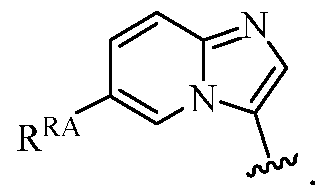
The compound of claim 52, wherein Ring A is of the formula:

57. The compound of any one of claims 52-56, wherein R is -N(R )2, -NHR , or - NHC(=0)RAN1, wherein each instance of R^1 is independently hydrogen, o optionally substituted alkyl, optionally substituted carbocyclyl, optionally substituted aryl, optionally substituted heterocyclyl, or optionally substituted heteroaryl.
The compound of claims 52-56, wherein R is optionally substituted
phenyl of the formula:

wherein
each instance of is independently hydrogen, halogen, -CN, optionally substituted alkyl, optionally substituted carbocyclyl, optionally substituted aryl, optionally substituted heterocyclyl, optionally substituted heteroaryl, or optionally substituted acyl; and
p is an integer of 1 to 5, inclusive.
59. The compound of claim 58, wherein R is of the formula:
 , wherein
R^1 is independently optionally substituted alkyl, optionally substituted carbocyclyl, optionally substituted aryl, optionally substituted heterocyclyl, or optionally substituted heteroaryl.
60. The compound of any one of claims 52-59, wherein is one of the following formulae:
-CN, -F, -CI, -CH3, -C2H5, -!Pr, -Ph,
 , -0!Pr, -OCH3, -OC2H5, -NH2, -NHCH2 !Pr, - -NHCH3, -N(C2H5)2, -NH-(CH2)3-OH, -N(CH3)-(CH2)2-OCH3, -NHC(=0)!Pr, -

The compound of any one of preceding claims, wherein L is one of the following

62. The compound of any one of claims 52-61, wherein each of R and R is independently hydrogen or optionally substituted Ci_6 alkyl.
63. The compound of any one of claims 52-61, wherein RN1 and RN2 are taken with the intervening nitrogen to form an optionally substituted heterocyclic moiety.
64. The compound of claim 63, wherein RN1 and RN2 are taken with the intervening nitrogen to form an optionally substituted three-, four-, five-, or six-membered heterocyclic moiety.
65. The compound of claim 64, wherein RN1 and RN2 are taken with the intervening nitrogen to form an optionally substituted six-membered heterocyclic moiety of the formula:

, wherein R is independently hydrogen, optionally substituted Ci_6 alkyl, or a nitrogen protecting group.
66. The compound of claim 65, wherein RN1 and RN2 are taken with the intervening nitrogen to form an optionally substituted six-membered heterocyclic moiety of the formula:

67. The compound of claim 64, wherein R and R are taken with the intervening nitrogen to form an optionally substituted azetidinyl moiety.
68. The compound of claim 67, wherein RN1 and RN2 are taken with the ing

N
nitrogen to form an optionally substituted azetidinyl moiety of the formula
69. The compound of claim 1, wherein the compound is one of the formulae in Table 1, or a pharmaceutically acceptable salt thereof.
70. A pharmaceutical composition comprising a compound of any one of claims 1-67 and a pharmaceutically acceptable excipient.
71. Use of a compound of any one of claims 1-69, or a pharmaceutical composition of claim 70, for treatment of a Mnk-related disorder.
72. Use of the compound or pharmaceutical composition of claim 71, wherein the Mnk- related disorder is a Mnkl -related disorder.
73. Use of the compound or pharmaceutical composition of claim 71, wherein the Mnk- related disorder is a Mnk2-related disorder.
74. Use of a compound of any one of claims 1-69, or a pharmaceutical composition of claim 70 for inhibiting Abelson (Abl) tyrosine kinase.
75. Use of the compound or pharmaceutical composition of claim 74, wherein the Abl tyrosine kinase is wild type Abl tyrosine kinase.
76. Use of the compound or pharmaceutical composition of claim 75, wherein the Abl tyrosine kinase is a mutant Abl tyrosine kinase.
77. Use of the compound or pharmaceutical composition of claim 75, wherein the Abl tyrosine kinase has a T315I mutation.
78. Use of the compound or pharmaceutical composition of claim 75, wherein the Abl tyrosine kinase has a E255K mutation.
79. Use of the compound or pharmaceutical composition of any one of claims 71-78, wherein the compound is used in combination with another agent.
80. Use of the compound or pharmaceutical composition of any one of claim 79, wherein the agent is a small molecule or biologic.
81. Use of the compound or pharmaceutical composition of any one of claim 79, wherein the agent is a kinase inhibitor.
82. Use of the compound or pharmaceutical composition of any one of claim 79, wherein the agent is a monoclonal antibody.
83. Use of the compound or pharmaceutical composition of any one of claim 79, wherein the agent is an siRNA.
84. Use of the compound or pharmaceutical composition of any one of claims 71-78, wherein the disorder is cancer, an inflammatory disease, neurodegenerative disease, neurodevelopmental disorder, or a metabolic disorder.
85. Use of the compound or pharmaceutical composition of claim 84, wherein the disorder is cancer.
86. Use of the compound or pharmaceutical composition of claim 84, wherein the disorder is solid tumor.
87. Use of the compound or pharmaceutical composition of claim 84, wherein the disorder is hematological tumor.
88. Use of the compound or pharmaceutical composition of claim 84, wherein the disorder is a metabolic disorder.
89. Use of the compound or pharmaceutical composition of claim 88, wherein the disorder is obesity.
90. Use of the compound or pharmaceutical composition of claim 88, wherein the disorder is diabetes.
91. Use of the compound or pharmaceutical composition of claim 84, wherein the disorder is a neurodegenerative disease.
92. Use of the compound or pharmaceutical composition of claim 91, wherein the disorder is Alzheimer's disease.
93. Use of the compound or pharmaceutical composition of claim 84, wherein the disorder is a neurodevelopmental disorder.
94. Use of the compound or pharmaceutical composition of claim 93, wherein the neurodevelopmental disorder is autism.
95. Use of the compound or pharmaceutical composition of any one of claims 71-94, wherein the compound or pharmaceutical composition is administered at a dosage level sufficient to deliver from about 0.001 mg/kg to about 100 mg/kg to a subject in need thereof.
96. A method of treating a Mnk-related disorder in a subject comprising administering an effective amount of a compound of any one of claims 1-69, or a pharmaceutical composition of claim 70, to the subject.
97. A kit comprising a compound of any one of claims 1-69 or a pharmaceutical composition of claim 70; and instructions for administering the compound or the composition to a subject.
Applications Claiming Priority (2)
| Application Number | Priority Date | Filing Date | Title |
|---|---|---|---|
| GB1400787.6 | 2014-01-17 | ||
| GB1400787.6A GB2522226A (en) | 2014-01-17 | 2014-01-17 | Heteroaryl alkyne derivatives and uses thereof |
Publications (2)
| Publication Number | Publication Date |
|---|---|
| WO2015108490A2 true WO2015108490A2 (en) | 2015-07-23 |
| WO2015108490A3 WO2015108490A3 (en) | 2015-11-26 |
Family
ID=50239082
Family Applications (1)
| Application Number | Title | Priority Date | Filing Date |
|---|---|---|---|
| PCT/SG2015/050005 Ceased WO2015108490A2 (en) | 2014-01-17 | 2015-01-19 | Heteroaryl alkyne derivatives and uses thereof |
Country Status (2)
| Country | Link |
|---|---|
| GB (1) | GB2522226A (en) |
| WO (1) | WO2015108490A2 (en) |
Cited By (24)
| Publication number | Priority date | Publication date | Assignee | Title |
|---|---|---|---|---|
| WO2017152126A1 (en) * | 2016-03-03 | 2017-09-08 | Cornell University | Small molecule ire1-alpha inhibitors |
| WO2017184032A1 (en) | 2016-04-18 | 2017-10-26 | Limited Liability Company «Fusion Pharma» | Novel crystalline salt forms of 3-(1,2,4-triazolo[4,3-a]pyridine-3-ylethynyl)-4-methyl-n-(4-((4-methylpiperazin-1-yl)methyl)-3-trifluoromethylphenyl)benzamide for medical application |
| WO2018068739A1 (en) * | 2016-10-13 | 2018-04-19 | 深圳市塔吉瑞生物医药有限公司 | Alkynyl heterocyclic compound for inhibiting protein kinase activity |
| WO2018149382A1 (en) | 2017-02-20 | 2018-08-23 | 中国科学院上海药物研究所 | O-aminoheteroaryl alkynyl-containing compound, preparation method therefor, and use thereof |
| WO2018161033A1 (en) * | 2017-03-02 | 2018-09-07 | Wright, Adrian | Small molecule ire1-alpha inhibitors |
| WO2019013703A1 (en) * | 2017-07-14 | 2019-01-17 | Agency For Science, Technology And Research (A*Star) | Bicyclic alkyne derivatives and uses thereof |
| JP2019527725A (en) * | 2016-08-15 | 2019-10-03 | パデュー リサーチ ファウンデイション | 4-substituted aminoisoquinoline derivatives |
| EP3564235A1 (en) * | 2018-05-03 | 2019-11-06 | Northwestern University | Substituted aromatic n-heterocyclic compounds as inhibitors of mitogen-activated protein kinase interacting kinase 1 (mnk1) and 2 (mnk2) |
| JP2020503297A (en) * | 2016-12-15 | 2020-01-30 | アリアド ファーマシューティカルズ, インコーポレイテッド | Aminothiazole compounds as C-KIT inhibitors |
| JP2020503299A (en) * | 2016-12-15 | 2020-01-30 | アリアド ファーマシューティカルズ, インコーポレイテッド | Benzimidazole compounds as C-KIT inhibitors |
| WO2020206583A1 (en) * | 2019-04-08 | 2020-10-15 | Qilu Regor Therapeutics Inc. | Kinase inhibitors and uses thereof |
| US10851082B2 (en) | 2015-10-28 | 2020-12-01 | Northwestern University | Substituted aromatic n-heterocyclic compounds as inhibitors of mitogen-activated protein kinase interacting kinase 1 (MNK1) and 2 (MNK2) |
| CN113292556A (en) * | 2020-02-21 | 2021-08-24 | 苏州亚盛药业有限公司 | Preparation method and intermediate of alkynyl-containing compound |
| US20220041590A1 (en) * | 2018-09-28 | 2022-02-10 | Arizona Board Of Regents On Behalf Of The University Of Arizona | Small molecule inhibitors of dyrk/clk and uses thereof |
| CN114163434A (en) * | 2020-09-10 | 2022-03-11 | 苏州亚盛药业有限公司 | Preparation method of alkynyl-containing compound and intermediate thereof |
| CN114340734A (en) * | 2019-06-24 | 2022-04-12 | 博善人工智能生物科技有限公司 | New compounds and methods |
| WO2022149855A1 (en) * | 2021-01-05 | 2022-07-14 | 주식회사 비투에스바이오 | Heteroaryl-ethynyl derivative compound and use thereof |
| WO2022217821A1 (en) * | 2021-04-13 | 2022-10-20 | 深圳市新樾生物科技有限公司 | Alkynylphenylbenzamide compound and use thereof |
| CN116199688A (en) * | 2021-11-23 | 2023-06-02 | 暨南大学 | Cyclic compounds and their applications |
| RU2797694C2 (en) * | 2017-02-20 | 2023-06-07 | Шангхаи Институте Оф Материа Медика, Чайнесе Академи Оф Сайнсес | O-aminoheteroarylalkynyl containing compound, method for its production and its use |
| WO2024017381A1 (en) | 2022-07-22 | 2024-01-25 | 深圳众格生物科技有限公司 | Compound for inhibiting irak4 activity and use thereof |
| WO2024062360A1 (en) | 2022-09-21 | 2024-03-28 | Pfizer Inc. | Heterocyclic sik inhibitors |
| WO2025036285A1 (en) | 2023-08-11 | 2025-02-20 | 深圳众格生物科技有限公司 | Proteolysis targeting chimera compound for degrading irak4 and use thereof |
| WO2025165301A1 (en) * | 2024-01-31 | 2025-08-07 | National University Of Singapore | Targeting metabolic pathways with mnk inhibitors |
Families Citing this family (1)
| Publication number | Priority date | Publication date | Assignee | Title |
|---|---|---|---|---|
| CN114075135B (en) * | 2020-08-10 | 2024-06-11 | 上海润石医药科技有限公司 | Salts of compounds containing o-aminopyridine alkynyl, and preparation method and application thereof |
Family Cites Families (10)
| Publication number | Priority date | Publication date | Assignee | Title |
|---|---|---|---|---|
| EA034598B1 (en) * | 2005-12-23 | 2020-02-25 | Ариад Фармасьютикалз, Инк. | Use of bicyclic heteroaryl compounds for treating cancer |
| SI1973545T1 (en) * | 2005-12-23 | 2013-04-30 | Ariad Pharmaceuticals, Inc. | Bicyclic heteroaryl compounds |
| CN101489558A (en) * | 2006-05-08 | 2009-07-22 | 阿里亚德医药股份有限公司 | Acetylenic heteroaryl compounds |
| US8278307B2 (en) * | 2006-05-08 | 2012-10-02 | Ariad Pharmaceuticals, Inc. | Monocyclic Heteroaryl compounds |
| CN103435595A (en) * | 2006-05-08 | 2013-12-11 | 阿里亚德医药股份有限公司 | Acetylenic heteroaryl compounds |
| KR20140022063A (en) * | 2011-04-07 | 2014-02-21 | 어리어드 파마슈티칼스, 인코포레이티드 | Methods and compositions for treating neurodegenerative diseases |
| CN103420977B (en) * | 2012-05-16 | 2016-06-22 | 上海医药集团股份有限公司 | There is the acetylene-derivative of anti-tumor activity |
| CN103664787B (en) * | 2012-09-17 | 2015-09-09 | 南京圣和药业股份有限公司 | Alkynes heteroaromatic ring compounds and application thereof |
| CN103848829B (en) * | 2012-11-28 | 2017-04-12 | 南京圣和药业股份有限公司 | Heteroaryl alkyne compounds and application thereof |
| CN104211639A (en) * | 2013-06-05 | 2014-12-17 | 中国科学院上海药物研究所 | Alkynyl heterocyclic compounds and application thereof |
-
2014
- 2014-01-17 GB GB1400787.6A patent/GB2522226A/en not_active Withdrawn
-
2015
- 2015-01-19 WO PCT/SG2015/050005 patent/WO2015108490A2/en not_active Ceased
Cited By (49)
| Publication number | Priority date | Publication date | Assignee | Title |
|---|---|---|---|---|
| US10851082B2 (en) | 2015-10-28 | 2020-12-01 | Northwestern University | Substituted aromatic n-heterocyclic compounds as inhibitors of mitogen-activated protein kinase interacting kinase 1 (MNK1) and 2 (MNK2) |
| US10125123B2 (en) | 2016-03-03 | 2018-11-13 | Cornell University | Small molecule IRE1-α inhibitors |
| WO2017152126A1 (en) * | 2016-03-03 | 2017-09-08 | Cornell University | Small molecule ire1-alpha inhibitors |
| US10988461B2 (en) | 2016-03-03 | 2021-04-27 | Cornell University | Small molecule IRE1-α inhibitors |
| JP2018530598A (en) * | 2016-04-18 | 2018-10-18 | リミテッド・ライアビリティ・カンパニー・《フュージョン・ファーマ》Limited Liability Company (Fusion Pharma) | 3- (1,2,4-Triazolo [4,3-a] pyridin-3-ylethynyl) -4-methyl-N- (4-((4-methylpiperazin-1-yl) methyl for medical applications A novel crystalline salt form of) -3-trifluoromethylphenyl) benzamide |
| US11225474B2 (en) | 2016-04-18 | 2022-01-18 | Limited Liability Company «Fusion Pharma» | Crystalline salt forms of 3-(1,2,4-triazolo[4,3-a]pyridine-3-ylethynyl)-4-methyl-N-(4-((4-methylpiperazin-1-yl)methyl)-3-trifluoromethylphenyl)benzamide for medical application |
| WO2017184032A1 (en) | 2016-04-18 | 2017-10-26 | Limited Liability Company «Fusion Pharma» | Novel crystalline salt forms of 3-(1,2,4-triazolo[4,3-a]pyridine-3-ylethynyl)-4-methyl-n-(4-((4-methylpiperazin-1-yl)methyl)-3-trifluoromethylphenyl)benzamide for medical application |
| RU2652992C2 (en) * | 2016-04-18 | 2018-05-04 | Общество С Ограниченной Ответственностью "Фьюжн Фарма" | Novel crystalline salt form 3-(1,2,4-triazolo[4,3-a]pyridin-3-ylethynyl)-4-methyl-n-(4-((4-methylpiperazin-1-yl)methyl)-3-trifluoromethylphenyl) benzamide for medical application |
| EA032865B1 (en) * | 2016-04-18 | 2019-07-31 | Общество С Ограниченной Ответственностью "Фьюжн Фарма" | NOVEL CRYSTALLINE SALT FORM OF 3-(1,2,4-TRIAZOLO[4,3-a]PYRIDINE-3-YLETHYNYL)-4-METHYL-N-(4-((4-METHYLPIPERAZIN-1-YL)METHYL)-3-TRIFLUOROMETHYLPHENYL)BENZAMIDE FOR MEDICAL APPLICATION |
| JP7562256B2 (en) | 2016-08-15 | 2024-10-07 | パデュー リサーチ ファウンデイション | 4-Substituted Aminoisoquinoline Derivatives |
| JP2019527725A (en) * | 2016-08-15 | 2019-10-03 | パデュー リサーチ ファウンデイション | 4-substituted aminoisoquinoline derivatives |
| CN108473476B (en) * | 2016-10-13 | 2021-02-19 | 深圳市塔吉瑞生物医药有限公司 | Alkynyl heterocyclic compounds for inhibiting protein kinase activity |
| CN108473476A (en) * | 2016-10-13 | 2018-08-31 | 深圳市塔吉瑞生物医药有限公司 | Alkynyl heterocyclic compounds for inhibiting protein kinase activity |
| WO2018068739A1 (en) * | 2016-10-13 | 2018-04-19 | 深圳市塔吉瑞生物医药有限公司 | Alkynyl heterocyclic compound for inhibiting protein kinase activity |
| JP2020503297A (en) * | 2016-12-15 | 2020-01-30 | アリアド ファーマシューティカルズ, インコーポレイテッド | Aminothiazole compounds as C-KIT inhibitors |
| JP2022185107A (en) * | 2016-12-15 | 2022-12-13 | アリアド ファーマシューティカルズ, インコーポレイテッド | Aminothiazole compounds as C-KIT inhibitors |
| JP2020503299A (en) * | 2016-12-15 | 2020-01-30 | アリアド ファーマシューティカルズ, インコーポレイテッド | Benzimidazole compounds as C-KIT inhibitors |
| US11753404B2 (en) | 2016-12-15 | 2023-09-12 | Ariad Pharmaceuticals, Inc. | Aminothiazole compounds as c-Kit inhibitors |
| JP2022185110A (en) * | 2016-12-15 | 2022-12-13 | アリアド ファーマシューティカルズ, インコーポレイテッド | Benzimidazole compounds as C-KIT inhibitors |
| AU2022201082B2 (en) * | 2016-12-15 | 2023-11-02 | Ariad Pharmaceuticals, Inc. | Benzimidazole compounds as c-Kit inhibitors |
| AU2018222073B2 (en) * | 2017-02-20 | 2021-02-04 | Shanghai Institute Of Materia Medica, Chinese Academy Of Sciences | O-aminoheteroaryl alkynyl-containing compound, preparation method therefor, and use thereof |
| CN110582483A (en) * | 2017-02-20 | 2019-12-17 | 中国科学院上海药物研究所 | Compounds containing o-aminoheteroaromatic alkynyl groups and their preparation methods and uses |
| RU2797694C2 (en) * | 2017-02-20 | 2023-06-07 | Шангхаи Институте Оф Материа Медика, Чайнесе Академи Оф Сайнсес | O-aminoheteroarylalkynyl containing compound, method for its production and its use |
| US10988456B2 (en) | 2017-02-20 | 2021-04-27 | Shanghai Institute Of Materia Medica, Chinese Academy Of Sciences | O-aminoheteroaryl alkynyl-containing compound, preparation method therefor, and use thereof |
| WO2018149382A1 (en) | 2017-02-20 | 2018-08-23 | 中国科学院上海药物研究所 | O-aminoheteroaryl alkynyl-containing compound, preparation method therefor, and use thereof |
| CN108456163A (en) * | 2017-02-20 | 2018-08-28 | 中国科学院上海药物研究所 | Compound and its preparation method and application containing adjacent amino heteroaryl cycloalkynyl radical |
| JP2020510642A (en) * | 2017-02-20 | 2020-04-09 | 上海 インスティテュート オブ マテリア メディカ、チャイニーズ アカデミー オブ サイエンシーズShanghai Institute Of Materia Medica, Chinese Academy Of Sciences | o-Aminoheteroarylalkynyl group-containing compound and its production method and use |
| CN110582483B (en) * | 2017-02-20 | 2022-05-13 | 中国科学院上海药物研究所 | Compound containing o-amino heteroaromatic alkynyl and preparation method and application thereof |
| WO2018161033A1 (en) * | 2017-03-02 | 2018-09-07 | Wright, Adrian | Small molecule ire1-alpha inhibitors |
| WO2019013703A1 (en) * | 2017-07-14 | 2019-01-17 | Agency For Science, Technology And Research (A*Star) | Bicyclic alkyne derivatives and uses thereof |
| EP3564235A1 (en) * | 2018-05-03 | 2019-11-06 | Northwestern University | Substituted aromatic n-heterocyclic compounds as inhibitors of mitogen-activated protein kinase interacting kinase 1 (mnk1) and 2 (mnk2) |
| US12054483B2 (en) * | 2018-09-28 | 2024-08-06 | Arizona Board Of Regents On Behalf Of The University Of Arizona | Small molecule inhibitors of DYRK/CLK and uses thereof |
| US20220041590A1 (en) * | 2018-09-28 | 2022-02-10 | Arizona Board Of Regents On Behalf Of The University Of Arizona | Small molecule inhibitors of dyrk/clk and uses thereof |
| WO2020206583A1 (en) * | 2019-04-08 | 2020-10-15 | Qilu Regor Therapeutics Inc. | Kinase inhibitors and uses thereof |
| CN114340734A (en) * | 2019-06-24 | 2022-04-12 | 博善人工智能生物科技有限公司 | New compounds and methods |
| CN113292556A (en) * | 2020-02-21 | 2021-08-24 | 苏州亚盛药业有限公司 | Preparation method and intermediate of alkynyl-containing compound |
| US12152025B2 (en) | 2020-02-21 | 2024-11-26 | Ascentage Pharma (Suzhou) Co., Ltd. | Process for preparing alkynyl-containing compound and intermediate thereof |
| WO2021164045A1 (en) * | 2020-02-21 | 2021-08-26 | Ascentage Pharma (Suzhou) Co., Ltd. | A process for preparing alkynyl-containing compound and intermediate thereof |
| CN114163434A (en) * | 2020-09-10 | 2022-03-11 | 苏州亚盛药业有限公司 | Preparation method of alkynyl-containing compound and intermediate thereof |
| CN116514808A (en) * | 2020-09-10 | 2023-08-01 | 苏州亚盛药业有限公司 | Preparation method of alkynyl-containing compound and intermediate thereof |
| WO2022053014A1 (en) * | 2020-09-10 | 2022-03-17 | Ascentage Pharma (Suzhou) Co., Ltd. | Process for preparing alkynyl-containing compound and intermediate thereof |
| WO2022149855A1 (en) * | 2021-01-05 | 2022-07-14 | 주식회사 비투에스바이오 | Heteroaryl-ethynyl derivative compound and use thereof |
| US11834454B2 (en) | 2021-04-13 | 2023-12-05 | Shenzhen Newdel Biotech Co., Ltd. | Alkynylphenylbenzamide compounds and applications thereof |
| WO2022217821A1 (en) * | 2021-04-13 | 2022-10-20 | 深圳市新樾生物科技有限公司 | Alkynylphenylbenzamide compound and use thereof |
| CN116199688A (en) * | 2021-11-23 | 2023-06-02 | 暨南大学 | Cyclic compounds and their applications |
| WO2024017381A1 (en) | 2022-07-22 | 2024-01-25 | 深圳众格生物科技有限公司 | Compound for inhibiting irak4 activity and use thereof |
| WO2024062360A1 (en) | 2022-09-21 | 2024-03-28 | Pfizer Inc. | Heterocyclic sik inhibitors |
| WO2025036285A1 (en) | 2023-08-11 | 2025-02-20 | 深圳众格生物科技有限公司 | Proteolysis targeting chimera compound for degrading irak4 and use thereof |
| WO2025165301A1 (en) * | 2024-01-31 | 2025-08-07 | National University Of Singapore | Targeting metabolic pathways with mnk inhibitors |
Also Published As
| Publication number | Publication date |
|---|---|
| WO2015108490A3 (en) | 2015-11-26 |
| GB201400787D0 (en) | 2014-03-05 |
| GB2522226A (en) | 2015-07-22 |
Similar Documents
| Publication | Publication Date | Title |
|---|---|---|
| WO2015108490A2 (en) | Heteroaryl alkyne derivatives and uses thereof | |
| US11040978B2 (en) | Bicyclic heterocyclic derivatives as MNK1 and MNK2 modulators and uses thereof | |
| US10544149B2 (en) | Bicyclic alkyne derivatives and uses thereof | |
| US10280168B2 (en) | Bicyclic heteroaryl derivatives as MNK1 and MNK2 modulators and uses thereof | |
| AU2014292888A1 (en) | Inhibitors of transcription factors and uses thereof | |
| CA2988330C (en) | 4,6-pyrimidinylene derivatives and uses thereof |
Legal Events
| Date | Code | Title | Description |
|---|---|---|---|
| NENP | Non-entry into the national phase in: |
Ref country code: DE |
|
| 122 | Ep: pct application non-entry in european phase |
Ref document number: 15737845 Country of ref document: EP Kind code of ref document: A2 |