WO2015101400A1 - Electrical oven having circuit arrangement for driving conductive oxide material heating elements - Google Patents
Electrical oven having circuit arrangement for driving conductive oxide material heating elements Download PDFInfo
- Publication number
- WO2015101400A1 WO2015101400A1 PCT/EP2013/078156 EP2013078156W WO2015101400A1 WO 2015101400 A1 WO2015101400 A1 WO 2015101400A1 EP 2013078156 W EP2013078156 W EP 2013078156W WO 2015101400 A1 WO2015101400 A1 WO 2015101400A1
- Authority
- WO
- WIPO (PCT)
- Prior art keywords
- conductive oxide
- resistance
- oxide coating
- electrical oven
- circuit
- Prior art date
- Legal status (The legal status is an assumption and is not a legal conclusion. Google has not performed a legal analysis and makes no representation as to the accuracy of the status listed.)
- Ceased
Links
Images


Classifications
-
- H—ELECTRICITY
- H05—ELECTRIC TECHNIQUES NOT OTHERWISE PROVIDED FOR
- H05B—ELECTRIC HEATING; ELECTRIC LIGHT SOURCES NOT OTHERWISE PROVIDED FOR; CIRCUIT ARRANGEMENTS FOR ELECTRIC LIGHT SOURCES, IN GENERAL
- H05B1/00—Details of electric heating devices
- H05B1/02—Automatic switching arrangements specially adapted to apparatus ; Control of heating devices
- H05B1/0227—Applications
- H05B1/0252—Domestic applications
- H05B1/0258—For cooking
- H05B1/0261—For cooking of food
- H05B1/0263—Ovens
-
- H—ELECTRICITY
- H05—ELECTRIC TECHNIQUES NOT OTHERWISE PROVIDED FOR
- H05B—ELECTRIC HEATING; ELECTRIC LIGHT SOURCES NOT OTHERWISE PROVIDED FOR; CIRCUIT ARRANGEMENTS FOR ELECTRIC LIGHT SOURCES, IN GENERAL
- H05B3/00—Ohmic-resistance heating
- H05B3/10—Heating elements characterised by the composition or nature of the materials or by the arrangement of the conductor
- H05B3/12—Heating elements characterised by the composition or nature of the materials or by the arrangement of the conductor characterised by the composition or nature of the conductive material
- H05B3/14—Heating elements characterised by the composition or nature of the materials or by the arrangement of the conductor characterised by the composition or nature of the conductive material the material being non-metallic
- H05B3/141—Conductive ceramics, e.g. metal oxides, metal carbides, barium titanate, ferrites, zirconia, vitrous compounds
-
- H—ELECTRICITY
- H05—ELECTRIC TECHNIQUES NOT OTHERWISE PROVIDED FOR
- H05B—ELECTRIC HEATING; ELECTRIC LIGHT SOURCES NOT OTHERWISE PROVIDED FOR; CIRCUIT ARRANGEMENTS FOR ELECTRIC LIGHT SOURCES, IN GENERAL
- H05B3/00—Ohmic-resistance heating
- H05B3/62—Heating elements specially adapted for furnaces
-
- H—ELECTRICITY
- H05—ELECTRIC TECHNIQUES NOT OTHERWISE PROVIDED FOR
- H05B—ELECTRIC HEATING; ELECTRIC LIGHT SOURCES NOT OTHERWISE PROVIDED FOR; CIRCUIT ARRANGEMENTS FOR ELECTRIC LIGHT SOURCES, IN GENERAL
- H05B2203/00—Aspects relating to Ohmic resistive heating covered by group H05B3/00
- H05B2203/013—Heaters using resistive films or coatings
Definitions
- the present invention relates to a circuit powering a heating element of an electrical oven, the heating element being provided in the form of a conductive oxide coating.
- Transparent conductive films are composed of any one of various transparent conductive oxide materials, including indium oxide, indium tin oxide (ITO), tin oxide, tin oxide doped with fluorine (F) or antimony (Sb), zinc oxide and zinc oxide doped with aluminium (Al).
- ITO indium tin oxide
- tin oxide tin oxide doped with fluorine (F) or antimony (Sb)
- ZnO zinc oxide
- Al aluminium
- Indium tin oxide is a transparent conducting oxide having wide-spread use due to its electrical conductivity and optical transparency. It further has the advantage of easy implementation as it can be deposited as a thin film.
- certain disadvantages are to be presented in association with iridium, namely in regards to its high cost and limited supply, the fragility of iridium tin oxide layers, and also the costly layer deposition requiring vacuum.
- an iridium tin oxide heater is typically provided as a deposited material applied to a glass cover in a food processing appliance such as an electrical oven. Electrical current is then passed through the ITO coating across the respective bottom and side walls to provide uniform heating.
- FR 2848289 disclosing an oven chamber with guides at the sides to receive at least one heated partition made from a substrate in the form of a base with an external layer of direct heating conductors covered by an insulating layer.
- the partition has contacts to make electrical contact and the oven chamber has guides at the sides to receive at least one heated partition.
- the heating conductors are applied by vacuum deposition or pyrolysis projection, using an alloy based on NiCr, FeCr or an oxide such as tin oxide doped with Ce, La, Sb or Zn.
- the present invention provides a simple circuit solution in terms of the number of the circuit elements involved and their functional complexity, by which a conductive oxide material based heating coating is supplied with electrical energy such that the time-dependant change in the ohmic resistivity of the conductive oxide material is compensated.
- the present invention provides an electrical oven comprising at least one conductive oxide material based coating whose resistivity change is monitored to regulate its power output such that time-dependant resistance change is compensated as provided by the characterizing features defined in Claim 1.
- Primary object of the present invention is to provide an electrical oven with conductive oxide material based heating coating involving no time-dependant change in the power output.
- the present invention proposes an electrical oven having a plurality of walls with conductive oxide coating heating elements to which power is delivered by means of a heating coating power circuit incorporating a voltage regulation circuit and a resistance measurement circuit.
- Each conductive oxide coating heating element has a conductive oxide coating resistance that is measured by the resistance measurement circuit such that a corresponding voltage is applied to said conductive oxide coating heating element, whereby a fixed power rate is obtainable.
- Said conductive oxide coating heating element comprises indium oxide, zinc oxide or tin oxide layers and more preferably comprises an iridium tin oxide layer.
- the resistance measurement can be made by means of a voltage divider or alternatively by disconnecting the conductive oxide coating heating element from the supply and applying a reference voltage.
- Change rates in the ambient temperature and the conductive oxide coating heating element’s temperature can be monitored and an estimated resistance value can be obtained based on a preloaded reference data set.
- the preloaded references values may include voltage values and these can be compared to actual voltage values in correlation with temperature data to make an estimate for the resistance value.
- Fig. 1 demonstrates the power circuit’s general block diagram effecting the measurement of a respective heating element’s resistance according to an embodiment of the present invention.
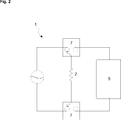
- Fig. 2 demonstrates the power circuit’s general block diagram for the measurement of a respective heating element’s resistance according to an alternative embodiment of the present invention.
- Fig. 3 demonstrates the power circuit of Fig. 2 with a voltage regulation block according to the present invention.
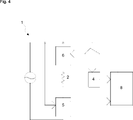
- Fig. 4 demonstrates the power circuit’s general block diagram according to the present invention.
- the present invention proposes an electrical food processing appliance and particularly an electrical oven having a bottom wall, a top wall, a rear wall and side walls defining an inner closed food processing chamber accessible via a front door.
- the food processing appliance’s walls comprises a planar heating coating for effecting heating of the food to be processed, said heating coating comprising a conductive oxide material composed of any one of various transparent conductive oxide materials, including indium oxide, indium tin oxide (ITO), tin oxide, tin oxide doped with fluorine (F) or antimony (Sb), zinc oxide and zinc oxide doped with aluminium (Al).
- a conductive coating with a layer of tin oxide deposited on a substrate is described in US 5,798,142.
- the heating coating or film maintaining its transparency in the operational temperature range provides that processed food can be monitored in a visually attractive manner.
- Vacuum is typically interposed between said heating coating and an electrochromic layer on the outermost layer of the substrate.
- the present invention provides a circuit which regulates the output power by changing the RMS value of the voltage applied to a respective heating element. It is established that instead of applying 230 V AC voltage to an iridium tin oxide (ITO) heating element of 40 ohm, 154 V can be applied starting from the first use of the electrical oven and time-dependant change in the resistance value can therefore be compensated by proportional voltage increase up to 230 V AC as in the case of domestic use. This ensures that the iridium tin oxide heating coating will be operable with a constant 600 W power rate as originally designed.
- ITO iridium tin oxide
- Fig. 1 demonstrates the circuit diagram for the measurement of a respective heating element’s resistance according to an embodiment of the present invention.
- a voltage divider is used in the form of an indirect resistance measurement circuit (4) so as to perform measurement of the heating element’s resistance, by which a shunt resistance (3) is employed in series with the heating element.
- resistance can be measured by means of a direct resistance measurement circuit (5), in which the conductive oxide coating resistance’s (2) terminals are disconnected from the power supply by means of respective relays (7).
- the indirect resistance measurement can also performed by way of using temperature sensors and by measuring the heating element’s temperature as well as the ambient temperature in the electrical oven and by monitoring the change rate in the measured values over time.
- the obtained change rate can be compared to a preloaded reference data set, and a correlation can be made to calculate an estimated resistance value.
- the reference data set can optionally include voltage data in respect of a given temperature and the change in the measured temperature values over time can also be compared to preloaded voltage data and actual voltage data so that an estimated resistance value is obtained.
- a control block (8) incorporating a microprocessor can perform the operational steps of the system such that the electrical oven is operable under a constant power rate.
- Power regulation according to the invention can be realized by way of using a triac so that the duty cycle of the voltage waveform powering the heating element can be adjusted by triggering the switch at different voltage points.
- the RMS power delivered to the load is hence effectively controllable.
- an optocoupler module chip is used to isolate the high voltage triac from the logic circuits.
- the control block (8) conventionally incorporates a triac driving block as well as circuit blocks in electrical communication with said resistance measurement circuits (4, 5).
- the present invention proposes an electrical oven having a food processing chamber accessible via a front door and a plurality of planar walls enclosing said food processing chamber, said plurality of planar walls having at least one conductive oxide coating heating element effecting heating of food items in said food processing chamber.
- the electrical oven further comprises a heating coating power circuit (1) delivering power to said at least one conductive oxide coating heating element having a conductive oxide coating resistance (2), said heating coating power circuit (1) comprising a voltage regulation circuit (6) and a resistance measurement circuit (4, 5).
- said conductive oxide coating heating element preferably comprises indium oxide, zinc oxide or tin oxide layers and more preferably an iridium tin oxide layer.
- said indirect resistance measurement circuit (4) performing measurement of conductive oxide coating resistance (2) comprises a voltage divider with a shunt resistance (3) in series with said conductive oxide coating resistance (2).
- said direct resistance measurement circuit (5) performs measurement of conductive oxide coating resistance (2) by which the conductive oxide coating resistance’s (2) terminals are disconnected from the power supply by means of respective relays (7).
- said electrical oven comprises temperature sensors measuring ambient temperature in the electrical oven as well as temperature of said conductive oxide coating resistance (2) upon which change rate in the measured values over time is compared to a preloaded reference data set so that an estimated resistance value is obtained.
- Said preloaded reference data set may include voltage data in respect of a given temperature and the change rate in the measured temperature values over time can be compared to said preloaded voltage data and actual voltage data so that an estimated resistance value is obtainable.
- said voltage regulation circuit (6) comprises a triac the duty cycle of which is adjusted, by which the RMS power delivered to the conductive oxide coating resistance (2) is controlled.
- the present invention provides a simple circuit solution in terms of the number of the involved circuit elements and their functional complexity, by which a conductive oxide material based heating coating is supplied with electrical energy such that the time-dependant change in the ohmic resistivity of the conductive oxide material is compensated.
Landscapes
- Engineering & Computer Science (AREA)
- Chemical & Material Sciences (AREA)
- Ceramic Engineering (AREA)
- Food Science & Technology (AREA)
- Control Of Resistance Heating (AREA)
Abstract
The present invention relates to an electrical oven having a food processing chamber accessible via a front door and a plurality of planar walls enclosing said food processing chamber, said plurality of planar walls having at least one conductive oxide coating heating element effecting heating of food items in said food processing chamber Said electrical oven further comprises a heating coating power circuit (1) delivering power to said at least one conductive oxide coating heating element having a conductive oxide coating resistance (2), said heating coating power circuit (1) comprising a voltage regulation circuit (6) and a resistance measurement circuit (4, 5).
Description
The present invention relates to a circuit powering a heating element of an electrical oven, the heating element being provided in the form of a conductive oxide coating.
Transparent conductive films are composed of any one of various transparent conductive oxide materials, including indium oxide, indium tin oxide (ITO), tin oxide, tin oxide doped with fluorine (F) or antimony (Sb), zinc oxide and zinc oxide doped with aluminium (Al). Indium tin oxide is a transparent conducting oxide having wide-spread use due to its electrical conductivity and optical transparency. It further has the advantage of easy implementation as it can be deposited as a thin film. However, certain disadvantages are to be presented in association with iridium, namely in regards to its high cost and limited supply, the fragility of iridium tin oxide layers, and also the costly layer deposition requiring vacuum.
It is well-known that an iridium tin oxide heater is typically provided as a deposited material applied to a glass cover in a food processing appliance such as an electrical oven. Electrical current is then passed through the ITO coating across the respective bottom and side walls to provide uniform heating.
Among others, a prior art publication pertinent to the technical field of the present invention may be referred to as FR 2848289, disclosing an oven chamber with guides at the sides to receive at least one heated partition made from a substrate in the form of a base with an external layer of direct heating conductors covered by an insulating layer. The partition has contacts to make electrical contact and the oven chamber has guides at the sides to receive at least one heated partition. The heating conductors are applied by vacuum deposition or pyrolysis projection, using an alloy based on NiCr, FeCr or an oxide such as tin oxide doped with Ce, La, Sb or Zn.
Further, a conductive coating with a layer of tin oxide deposited on a substrate is described in US 5,798,142.
The present invention provides a simple circuit solution in terms of the number of the circuit elements involved and their functional complexity, by which a conductive oxide material based heating coating is supplied with electrical energy such that the time-dependant change in the ohmic resistivity of the conductive oxide material is compensated.
The present invention provides an electrical oven comprising at least one conductive oxide material based coating whose resistivity change is monitored to regulate its power output such that time-dependant resistance change is compensated as provided by the characterizing features defined in Claim 1.
Primary object of the present invention is to provide an electrical oven with conductive oxide material based heating coating involving no time-dependant change in the power output.
The present invention proposes an electrical oven having a plurality of walls with conductive oxide coating heating elements to which power is delivered by means of a heating coating power circuit incorporating a voltage regulation circuit and a resistance measurement circuit. Each conductive oxide coating heating element has a conductive oxide coating resistance that is measured by the resistance measurement circuit such that a corresponding voltage is applied to said conductive oxide coating heating element, whereby a fixed power rate is obtainable.
Said conductive oxide coating heating element comprises indium oxide, zinc oxide or tin oxide layers and more preferably comprises an iridium tin oxide layer. The resistance measurement can be made by means of a voltage divider or alternatively by disconnecting the conductive oxide coating heating element from the supply and applying a reference voltage.
Change rates in the ambient temperature and the conductive oxide coating heating element’s temperature can be monitored and an estimated resistance value can be obtained based on a preloaded reference data set. The preloaded references values may include voltage values and these can be compared to actual voltage values in correlation with temperature data to make an estimate for the resistance value.
Accompanying drawings are given solely for the purpose of exemplifying a power regulation circuit of a conductive oxide material based heating coating in an electrical oven, whose advantages over prior art were outlined above and will be explained in brief hereinafter.
The drawings are not meant to delimit the scope of protection as identified in the claims nor should they be referred to alone in an effort to interpret the scope identified in said claims without recourse to the technical disclosure in the description of the present invention.
Fig. 1 demonstrates the power circuit’s general block diagram effecting the measurement of a respective heating element’s resistance according to an embodiment of the present invention.
Fig. 2 demonstrates the power circuit’s general block diagram for the measurement of a respective heating element’s resistance according to an alternative embodiment of the present invention.
Fig. 3 demonstrates the power circuit of Fig. 2 with a voltage regulation block according to the present invention.
Fig. 4 demonstrates the power circuit’s general block diagram according to the present invention.
The following numerals are used in the detailed description:
- Heating coating power circuit
- Conductive oxide coating resistance
- Shunt resistance
- Indirect resistance measurement circuit
- Direct resistance measurement circuit
- Voltage regulation circuit
- Relay
- Control block
The present invention proposes an electrical food processing appliance and particularly an electrical oven having a bottom wall, a top wall, a rear wall and side walls defining an inner closed food processing chamber accessible via a front door.
The food processing appliance’s walls comprises a planar heating coating for effecting heating of the food to be processed, said heating coating comprising a conductive oxide material composed of any one of various transparent conductive oxide materials, including indium oxide, indium tin oxide (ITO), tin oxide, tin oxide doped with fluorine (F) or antimony (Sb), zinc oxide and zinc oxide doped with aluminium (Al). A conductive coating with a layer of tin oxide deposited on a substrate is described in US 5,798,142.
The heating coating or film maintaining its transparency in the operational temperature range provides that processed food can be monitored in a visually attractive manner. Vacuum is typically interposed between said heating coating and an electrochromic layer on the outermost layer of the substrate.
It is known that ohmic resistivity of conductive oxide materials is prone to time-dependant change, which in turn decreases the power output of the heating element in reverse proportion. Typically, the power formula P=V2/R yields that, increase in the resistance value reduces the output power. To this end, in order for providing a constant power rate, time-dependant resistance change should be compensated by continuously monitoring the same and accordingly regulating the output power.
In this regard, the present invention provides a circuit which regulates the output power by changing the RMS value of the voltage applied to a respective heating element. It is established that instead of applying 230 V AC voltage to an iridium tin oxide (ITO) heating element of 40 ohm, 154 V can be applied starting from the first use of the electrical oven and time-dependant change in the resistance value can therefore be compensated by proportional voltage increase up to 230 V AC as in the case of domestic use. This ensures that the iridium tin oxide heating coating will be operable with a constant 600 W power rate as originally designed.
Fig. 1 demonstrates the circuit diagram for the measurement of a respective heating element’s resistance according to an embodiment of the present invention. According to the circuit diagram, a voltage divider is used in the form of an indirect resistance measurement circuit (4) so as to perform measurement of the heating element’s resistance, by which a shunt resistance (3) is employed in series with the heating element. Alternatively, instead of passing current over a shunt resistance, resistance can be measured by means of a direct resistance measurement circuit (5), in which the conductive oxide coating resistance’s (2) terminals are disconnected from the power supply by means of respective relays (7).
According to the present invention, the indirect resistance measurement can also performed by way of using temperature sensors and by measuring the heating element’s temperature as well as the ambient temperature in the electrical oven and by monitoring the change rate in the measured values over time. The obtained change rate can be compared to a preloaded reference data set, and a correlation can be made to calculate an estimated resistance value. The reference data set can optionally include voltage data in respect of a given temperature and the change in the measured temperature values over time can also be compared to preloaded voltage data and actual voltage data so that an estimated resistance value is obtained. A control block (8) incorporating a microprocessor can perform the operational steps of the system such that the electrical oven is operable under a constant power rate.
Power regulation according to the invention can be realized by way of using a triac so that the duty cycle of the voltage waveform powering the heating element can be adjusted by triggering the switch at different voltage points. The RMS power delivered to the load is hence effectively controllable. Typically, an optocoupler module chip is used to isolate the high voltage triac from the logic circuits. As the specific aspects and functioning of the power regulation circuit is extensively known to the person skilled in the art, no further detail will be described herein. The control block (8) conventionally incorporates a triac driving block as well as circuit blocks in electrical communication with said resistance measurement circuits (4, 5).
In a nutshell, the present invention proposes an electrical oven having a food processing chamber accessible via a front door and a plurality of planar walls enclosing said food processing chamber, said plurality of planar walls having at least one conductive oxide coating heating element effecting heating of food items in said food processing chamber.
The electrical oven further comprises a heating coating power circuit (1) delivering power to said at least one conductive oxide coating heating element having a conductive oxide coating resistance (2), said heating coating power circuit (1) comprising a voltage regulation circuit (6) and a resistance measurement circuit (4, 5).
According to an embodiment of the present invention, said conductive oxide coating heating element preferably comprises indium oxide, zinc oxide or tin oxide layers and more preferably an iridium tin oxide layer.
In an embodiment of the invention, said indirect resistance measurement circuit (4) performing measurement of conductive oxide coating resistance (2) comprises a voltage divider with a shunt resistance (3) in series with said conductive oxide coating resistance (2).
In a further embodiment of the invention, said direct resistance measurement circuit (5) performs measurement of conductive oxide coating resistance (2) by which the conductive oxide coating resistance’s (2) terminals are disconnected from the power supply by means of respective relays (7).
In a still further embodiment of the invention, said electrical oven comprises temperature sensors measuring ambient temperature in the electrical oven as well as temperature of said conductive oxide coating resistance (2) upon which change rate in the measured values over time is compared to a preloaded reference data set so that an estimated resistance value is obtained. Said preloaded reference data set may include voltage data in respect of a given temperature and the change rate in the measured temperature values over time can be compared to said preloaded voltage data and actual voltage data so that an estimated resistance value is obtainable.
In a yet still further embodiment of the invention, said voltage regulation circuit (6) comprises a triac the duty cycle of which is adjusted, by which the RMS power delivered to the conductive oxide coating resistance (2) is controlled.
In this regard, the present invention provides a simple circuit solution in terms of the number of the involved circuit elements and their functional complexity, by which a conductive oxide material based heating coating is supplied with electrical energy such that the time-dependant change in the ohmic resistivity of the conductive oxide material is compensated.
Claims (8)
- An electrical oven having a food processing chamber accessible via a front door and a plurality of planar walls enclosing said food processing chamber, said plurality of planar walls having at least one conductive oxide coating heating element effecting heating of food items in said food processing chamber characterized in that,said electrical oven further comprises a heating coating power circuit (1) delivering power to said at least one conductive oxide coating heating element having a conductive oxide coating resistance (2), said heating coating power circuit (1) comprising a voltage regulation circuit (6) and a resistance measurement circuit (4, 5).
- An electrical oven as in Claim 1, characterized in that said conductive oxide coating heating element comprises indium oxide, zinc oxide or tin oxide layers.
- An electrical oven as in Claim 1, characterized in that said conductive oxide coating heating element comprises an iridium tin oxide layer.
- An electrical oven as in Claim 1, 2 or 3 characterized in that said resistance measurement circuit (4) performing measurement of conductive oxide coating resistance (2) comprises a voltage divider with a shunt resistance (3) in series with said conductive oxide coating resistance (2).
- An electrical oven as in Claim 1, 2 or 3 characterized in that said resistance measurement circuit (5) performs measurement of conductive oxide coating resistance (2) by which the conductive oxide coating resistance’s (2) terminals are disconnected from the power supply by means of relays (7).
- An electrical oven as in Claim 1, 2 or 3 characterized in that said electrical oven comprises temperature sensors measuring ambient temperature in the electrical oven as well as temperature of said conductive oxide coating resistance (2), upon which change rate in the measured values over time is compared to a preloaded reference data set so that an estimated resistance value is obtained.
- An electrical oven as in Claim 6 characterized in that said preloaded reference data set include voltage data in respect of a given temperature and the change rate in the measured temperature values over time is compared to said preloaded voltage data and actual voltage data so that an estimated resistance value is obtained.
- An electrical oven as in any preceding Claim characterized in that said voltage regulation circuit (6) comprises a triac, duty cycle of which is adjusted, by which the RMS power delivered to the conductive oxide coating resistance (2) is controlled.
Priority Applications (1)
| Application Number | Priority Date | Filing Date | Title |
|---|---|---|---|
| PCT/EP2013/078156 WO2015101400A1 (en) | 2013-12-30 | 2013-12-30 | Electrical oven having circuit arrangement for driving conductive oxide material heating elements |
Applications Claiming Priority (1)
| Application Number | Priority Date | Filing Date | Title |
|---|---|---|---|
| PCT/EP2013/078156 WO2015101400A1 (en) | 2013-12-30 | 2013-12-30 | Electrical oven having circuit arrangement for driving conductive oxide material heating elements |
Publications (1)
| Publication Number | Publication Date |
|---|---|
| WO2015101400A1 true WO2015101400A1 (en) | 2015-07-09 |
Family
ID=49949649
Family Applications (1)
| Application Number | Title | Priority Date | Filing Date |
|---|---|---|---|
| PCT/EP2013/078156 Ceased WO2015101400A1 (en) | 2013-12-30 | 2013-12-30 | Electrical oven having circuit arrangement for driving conductive oxide material heating elements |
Country Status (1)
| Country | Link |
|---|---|
| WO (1) | WO2015101400A1 (en) |
Cited By (1)
| Publication number | Priority date | Publication date | Assignee | Title |
|---|---|---|---|---|
| CN109931963A (en) * | 2019-02-01 | 2019-06-25 | 奥佳华智能健康科技集团股份有限公司 | A kind of shared nursing bed cabinet shutdown detection structure |
Citations (6)
| Publication number | Priority date | Publication date | Assignee | Title |
|---|---|---|---|---|
| EP0169642A1 (en) * | 1984-06-14 | 1986-01-29 | Donnelly Corporation | Electrically heated panel assembly |
| GB2274915A (en) * | 1993-01-11 | 1994-08-10 | Ist Lab Ltd | An electrically heated oven |
| WO1996004766A1 (en) * | 1994-07-29 | 1996-02-15 | Thermal Dynamics U.S.A., Ltd. Co. | Resistance heating element with large-area, thin film and method |
| GB2293253A (en) * | 1994-09-14 | 1996-03-20 | Glaverbel | Aheated glazing panel |
| US6037572A (en) * | 1997-02-26 | 2000-03-14 | White Consolidated Industries, Inc. | Thin film heating assemblies |
| WO2009135148A2 (en) * | 2008-05-01 | 2009-11-05 | Thermoceramix Inc. | Cooking appliances using heater coatings |
-
2013
- 2013-12-30 WO PCT/EP2013/078156 patent/WO2015101400A1/en not_active Ceased
Patent Citations (6)
| Publication number | Priority date | Publication date | Assignee | Title |
|---|---|---|---|---|
| EP0169642A1 (en) * | 1984-06-14 | 1986-01-29 | Donnelly Corporation | Electrically heated panel assembly |
| GB2274915A (en) * | 1993-01-11 | 1994-08-10 | Ist Lab Ltd | An electrically heated oven |
| WO1996004766A1 (en) * | 1994-07-29 | 1996-02-15 | Thermal Dynamics U.S.A., Ltd. Co. | Resistance heating element with large-area, thin film and method |
| GB2293253A (en) * | 1994-09-14 | 1996-03-20 | Glaverbel | Aheated glazing panel |
| US6037572A (en) * | 1997-02-26 | 2000-03-14 | White Consolidated Industries, Inc. | Thin film heating assemblies |
| WO2009135148A2 (en) * | 2008-05-01 | 2009-11-05 | Thermoceramix Inc. | Cooking appliances using heater coatings |
Cited By (2)
| Publication number | Priority date | Publication date | Assignee | Title |
|---|---|---|---|---|
| CN109931963A (en) * | 2019-02-01 | 2019-06-25 | 奥佳华智能健康科技集团股份有限公司 | A kind of shared nursing bed cabinet shutdown detection structure |
| CN109931963B (en) * | 2019-02-01 | 2021-06-04 | 奥佳华智能健康科技集团股份有限公司 | Sharing is attend to and is closed door detection structure of bed cabinet |
Similar Documents
| Publication | Publication Date | Title |
|---|---|---|
| RU2492516C2 (en) | Method and apparatus for switching large-area electrochromic devices | |
| EP2533395A2 (en) | Energy supply/demand control system | |
| US20210131670A1 (en) | Power control systems and methods | |
| EA201291462A1 (en) | TRANSPARENT WINDOW GLASS WITH HEATED COATING | |
| JP2005338871A (en) | Electrochromic device and its supply process | |
| CN110032019A (en) | Electrochromic device, control method thereof, electronic apparatus, and storage medium | |
| CA2613702A1 (en) | Smart layered heater surfaces | |
| MX2013010703A (en) | Method and arrangement for de-icing a transparent window using an electric heating device. | |
| JP2019079036A5 (en) | ||
| US20180142925A1 (en) | A high-wattage power appliance system | |
| CN110095914A (en) | Electrochromic device and electronic equipment | |
| JP2015534034A (en) | High-speed oven with wire mesh heating element | |
| CN213248479U (en) | Liquid heating appliances and power management systems for making beverages | |
| CZ20013902A3 (en) | Heated glass part, intended particularly for a motor vehicle | |
| CN105320013A (en) | Cooking control method and system of electric cooker | |
| CN105376883B (en) | It can uniform electrically heated automobile sandwich-glass without film layer area with communication window | |
| EP3498052B1 (en) | Thin film heating cooker heating element adjustment for power efficiency | |
| JP2009156521A (en) | Cooker | |
| KR101551382B1 (en) | Temperature controller for customizing fitting insole | |
| CN204180311U (en) | A kind of electrically heated glass | |
| US20170339748A1 (en) | Self-regulating dual heating level heating element | |
| CN106304430B (en) | A kind of safe metal Electric radiant Heating Film | |
| WO2018231167A1 (en) | A method of electrification to produce heat in coated glass | |
| EP2648269B1 (en) | Device for batteries, storage batteries, cells and the like, for emergency lighting appliances | |
| Cen et al. | Design of flexible printed heater to improve uniform heating |
Legal Events
| Date | Code | Title | Description |
|---|---|---|---|
| 121 | Ep: the epo has been informed by wipo that ep was designated in this application |
Ref document number: 13819042 Country of ref document: EP Kind code of ref document: A1 |
|
| NENP | Non-entry into the national phase |
Ref country code: DE |
|
| 122 | Ep: pct application non-entry in european phase |
Ref document number: 13819042 Country of ref document: EP Kind code of ref document: A1 |