WO2015098703A1 - ポリアリーレンスルフィド樹脂組成物及びその成形体 - Google Patents
ポリアリーレンスルフィド樹脂組成物及びその成形体 Download PDFInfo
- Publication number
- WO2015098703A1 WO2015098703A1 PCT/JP2014/083586 JP2014083586W WO2015098703A1 WO 2015098703 A1 WO2015098703 A1 WO 2015098703A1 JP 2014083586 W JP2014083586 W JP 2014083586W WO 2015098703 A1 WO2015098703 A1 WO 2015098703A1
- Authority
- WO
- WIPO (PCT)
- Prior art keywords
- polyarylene sulfide
- resin composition
- sulfide resin
- group
- resin
- Prior art date
- Legal status (The legal status is an assumption and is not a legal conclusion. Google has not performed a legal analysis and makes no representation as to the accuracy of the status listed.)
- Ceased
Links
Images

Classifications
-
- C—CHEMISTRY; METALLURGY
- C08—ORGANIC MACROMOLECULAR COMPOUNDS; THEIR PREPARATION OR CHEMICAL WORKING-UP; COMPOSITIONS BASED THEREON
- C08L—COMPOSITIONS OF MACROMOLECULAR COMPOUNDS
- C08L71/00—Compositions of polyethers obtained by reactions forming an ether link in the main chain; Compositions of derivatives of such polymers
- C08L71/02—Polyalkylene oxides
Definitions
- the present invention includes a polyarylene sulfide resin (hereinafter sometimes abbreviated as PAS resin), and in particular, a polyarylene sulfide resin composition excellent in adhesiveness and fluidity with an epoxy resin and excellent in thermal shock resistance and It relates to the molded body.
- PAS resin polyarylene sulfide resin
- PAS resin is excellent in mechanical strength, heat resistance, chemical resistance, molding processability, and dimensional stability. Utilizing these characteristics, PAS resin is used as an electrical / electronic device part, an automobile part material, and the like.
- PAS resins have relatively poor adhesion to other resins, especially adhesion to epoxy resins. Therefore, for example, when bonding PASs with epoxy adhesives, bonding PAS resins with other materials, or sealing electrical / electronic parts with epoxy resins, the adhesion between PAS resins and epoxy resins (hereinafter referred to as “bonding”) , Epoxy adhesion or simply adhesion) is a problem.
- PAS resin compositions in which an epoxy resin is blended with a polyarylene sulfide resin, or a glass fiber with a polyarylene sulfide resin.
- PAS resin compositions containing olefin polymers, epoxy resins, and glass flakes have been proposed (see Patent Documents 1 and 2).
- this method uses a bisphenol A type epoxy resin as an epoxy resin, it has excellent epoxy adhesiveness and fluidity, but the thermal shock resistance is at a level that is hardly sufficient for practical use.
- the problem to be solved by the present invention is to provide a PAS resin composition that can produce a molded article excellent in epoxy adhesion and thermal shock resistance and has excellent fluidity, and further molding the resin composition.
- Another object of the present invention is to provide a PAS resin molded article excellent in epoxy adhesion and thermal shock resistance.
- the present invention is a polyarylene sulfide resin composition containing a polyarylene sulfide resin (A) and a polyether polyol (B),
- the polyether polyol has a branched structure in the molecule, and relates to a polyarylene sulfide resin composition.
- the present invention relates to a molded article obtained by molding the polyarylene sulfide resin composition described above.
- the present invention it is possible to produce a molded article excellent in epoxy adhesiveness and thermal shock resistance, and to provide a PAS resin composition excellent in fluidity. Further, epoxy adhesive formed by molding the resin composition and A PAS resin molded article having excellent thermal shock resistance can be provided.
- FIG. 13 is a 13C-NMR chart of the polyether polyol (“HBP-100”) used in the examples.
- the polyarylene sulfide resin composition of the present invention contains a polyarylene sulfide resin (A) and a polyether polyol (B). Details will be described below.
- the polyarylene sulfide resin used in the present invention has a resin structure having a repeating unit of a structure in which an aromatic ring and a sulfur atom are bonded.
- the polyarylene sulfide resin has the following formula (1):
- R 1 and R 2 each independently represents a hydrogen atom, an alkyl group having 1 to 4 carbon atoms, a nitro group, an amino group, a phenyl group, a methoxy group, or an ethoxy group). It is a resin having a structural site as a repeating unit.
- R 1 and R 2 in the formula are preferably hydrogen atoms from the viewpoint of the mechanical strength of the polyarylene sulfide resin.
- a compound bonded at the para position represented by the following formula (2) is preferable.
- the bond of the sulfur atom to the aromatic ring in the repeating unit is a structure bonded at the para position represented by the structural formula (2). In terms of surface.
- polyarylene sulfide resin is not limited to the structural part represented by the formula (1), but the following structural formulas (3) to (6)
- the structural site represented by the formula (1) may be included at 30 mol% or less of the total with the structural site represented by the formula (1).
- the structural portion represented by the above formulas (3) to (6) is preferably 10 mol% or less from the viewpoint of heat resistance and mechanical strength of the polyarylene sulfide resin.
- the bonding mode thereof may be either a random copolymer or a block copolymer. .
- polyarylene sulfide resin has the following formula (7) in its molecular structure.
- the physical properties of the polyarylene sulfide resin are not particularly limited as long as the effects of the present invention are not impaired, but are as follows.
- the polyarylene sulfide resin used in the present invention preferably has a melt viscosity (V6) measured at 300 ° C. in the range of 5 to 1000 [Pa ⁇ s], and has a good balance between fluidity and mechanical strength. Therefore, the range of 5 to 100 [Pa ⁇ s] is more preferable, and the range of 5 to 50 [Pa ⁇ s] is particularly preferable.
- V6 melt viscosity
- the non-Newtonian index of the polyarylene sulfide resin used in the present invention is not particularly limited as long as the effect of the present invention is not impaired, but it is preferably in the range of 0.90 to 2.00.
- the non-Newtonian index is preferably in the range of 0.90 to 1.50, and more preferably in the range of 0.95 to 1.20.
- Such a polyarylene sulfide resin is excellent in mechanical properties, fluidity, and abrasion resistance.
- SR shear rate (second ⁇ 1 )
- SS shear stress (dyne / cm 2 )
- K represents a constant. The closer the N value is to 1, the closer the PPS is to a linear structure, and the higher the N value is, the more branched the structure is.
- the method for producing the polyarylene sulfide resin (A) is not particularly limited.
- Examples thereof include a method in which p-chlorothiophenol is self-condensed by adding other copolymerization components if necessary.
- the method 2) is versatile and preferable.
- an alkali metal salt of carboxylic acid or sulfonic acid or an alkali hydroxide may be added to adjust the degree of polymerization.
- a hydrous sulfiding agent is introduced into a mixture containing a heated organic polar solvent and a dihalogenoaromatic compound at a rate at which water can be removed from the reaction mixture, and the dihalogenoaromatic compound in the organic polar solvent.
- a sulfidizing agent are added to and reacted with a polyhalogenoaromatic compound as necessary, and the amount of water in the reaction system is in the range of 0.02 to 0.5 mol with respect to 1 mol of the organic polar solvent.
- a method for producing a polyarylene sulfide resin by controlling see Japanese Patent Application Laid-Open No. 07-228699), and if necessary, a dihalogeno aromatic compound in the presence of a solid alkali metal sulfide and an aprotic polar organic solvent.
- Polyhalogenoaromatic compound or other copolymerization component is added, and alkali metal hydrosulfide and organic acid alkali metal salt are added to sulfur source 1 0.01-0.9 mol of an organic acid alkali metal salt with respect to the catalyst and a reaction while controlling the amount of water in the reaction system within a range of 0.02 mol with respect to 1 mol of the aprotic polar organic solvent (See the pamphlet of WO2010 / 058713).
- dihalogenoaromatic compounds include p-dihalobenzene, m-dihalobenzene, o-dihalobenzene, 2,5-dihalotoluene, 1,4-dihalonaphthalene, 1-methoxy-2,5-dihalobenzene, 4, 4'-dihalobiphenyl, 3,5-dihalobenzoic acid, 2,4-dihalobenzoic acid, 2,5-dihalonitrobenzene, 2,4-dihalonitrobenzene, 2,4-dihaloanisole, p, p '-Dihalodiphenyl ether, 4,4'-dihalobenzophenone, 4,4'-dihalodiphenyl sulfone, 4,4'-dihalodiphenyl sulfoxide, 4,4'-dihalodiphenyl sulfide, and each of the above compounds And compounds having an alkyl group
- the halogen atom contained in each compound is a chlorine atom or a bromine atom.
- the post-treatment method of the reaction mixture containing the polyarylene sulfide resin obtained by the polymerization step is not particularly limited.
- the reaction mixture is left as it is, or an acid or a base is used.
- the solvent is distilled off under reduced pressure or normal pressure, and then the solid after the solvent is distilled off is water, a reaction solvent (or an organic solvent having an equivalent solubility in a low molecular weight polymer), acetone, methyl ethyl ketone.
- a solvent such as alcohols, and further neutralizing, washing with water, filtering and drying, or (3) after completion of the polymerization reaction, water,
- a solvent such as acetone, methyl ethyl ketone, alcohol, etc.
- water is added to the reaction mixture to wash with water. Filtration, if necessary, acid treatment at the time of washing with water, acid treatment and drying, (5) after completion of the polymerization reaction, the reaction mixture is filtered, and if necessary, once or twice or more with a reaction solvent Washing Further water washing, a method of filtering and drying, and the like.
- the polyarylene sulfide resin may be dried in a vacuum or in an inert gas atmosphere such as air or nitrogen. May be.
- the polyether polyol (B) used in the present invention is a polyether polyol having a branched structure in the molecule.
- the ratio of the polyether polyol (B) to the PAS resin (A) may be appropriately adjusted according to the purpose and use so as not to impair the effects of the present invention.
- the range is preferably from 0.1 to 100 parts by mass, more preferably from 1 to 50 parts by mass based on 100 parts by mass of the resin (A). Since the polyether polyol (B) has a branched structure in the molecule and has a small radius of inertia, a resin composition having an extremely good fluidity even when blended with a PAS resin can be obtained by using within the above range. Furthermore, since flexibility can be imparted due to the branched structure, toughness and impact resistance can be imparted to the resin composition, and epoxy adhesiveness can be improved by the terminal hydroxyl group.
- the polyether polyol used in the present invention is not particularly limited as long as it has a branched structure in the molecule, but preferably has a hydroxyl value in the range of 150 to 350 mgKOH / g, A range of 200 to 300 mg KOH / g is more preferable. Since the thing of the said range has many hydroxyl groups for molecular weight small, since the outstanding epoxy adhesiveness can be exhibited with a smaller addition amount, it is preferable.
- the polyether polyol used in the present invention is not particularly limited as long as it has a branched structure in the molecule, but the number average molecular weight (Mn) is in the range of 1,000 to 4,000. It is preferable that the number average molecular weight (Mn) is in the range of 1,500 to 3,500. However, the number average molecular weight (Mn) is In the present invention, the number average molecular weight (Mn) is a value measured by gel permeation chromatography (GPC) under the following conditions.
- GPC gel permeation chromatography
- Measuring device HLC-8220GPC manufactured by Tosoh Corporation Column: TSK-GUARDCOLUMN SuperHZ-L manufactured by Tosoh Corporation + TSK-GEL SuperHZM-M ⁇ 4 manufactured by Tosoh Corporation Detector: RI (differential refractometer) Data processing; Multi-station GPC-8020 model II manufactured by Tosoh Corporation Measurement conditions; Column temperature 40 ° C Solvent Tetrahydrofuran Flow rate 0.35 ml / min standard; Calibration curve sample using monodisperse polystyrene; 0.2% by mass tetrahydrofuran solution in terms of resin solids filtered through microfilter (100 ⁇ l)
- the polyether polyol used in the present invention preferably has a primary hydrogen group (H1) and a secondary hydrogen group (H2) in the molecule.
- the ratio between the primary hydrogen group (H1) and the secondary hydrogen group (H2) is not particularly limited, but is a total hydroxyl group obtained by adding the primary hydrogen group (H1) and the secondary hydrogen group (H2). It is preferable that the primary hydrogen group (H1) is 30 to 80% and the secondary hydrogen group (H2) is 70 to 20% with respect to the number.
- the method for producing the polyether polyol that can be used in the present invention is not particularly limited.
- the polyether polyol can be obtained by ring-opening reaction of hydroxyalkyloxetane (b1) and monofunctional epoxy compound (b2). it can.
- the preferable manufacturing method of the polyether polyol used by this invention is explained in full detail.
- hydroxyalkyl oxetane (b1) examples include those having a structure represented by the following formula (8).
- R 3 in the formula (8) is a methylene group, an ethylene group or a propylene group
- R 4 in the formula (8) is a hydrogen atom, an alkyl group having 1 to 8 carbon atoms
- An alkoxyalkyl group having 1 to 5 carbon atoms or a hydroxyalkyl group having 1 to 6 carbon atoms is represented.
- Examples of the alkyl group having 1 to 8 carbon atoms include a methyl group, an ethyl group, an n-propyl group, an i-propyl group, and a 2-ethylhexyl group.
- alkoxyalkyl group having 1 to 5 carbon atoms Includes a methoxymethyl group, an ethoxymethyl group, a propoxymethyl group, a methoxyethyl group, an ethoxyethyl group, and a propoxyethyl group.
- hydroxyalkyl group having 1 to 3 carbon atoms include a hydroxymethyl group, a hydroxyethyl group, and a hydroxypropyl group.
- R 3 is a methylene group and R 4 is 1 to 1 carbon atoms from the viewpoint that the radius of inertia is smaller and effective in reducing the viscosity.
- Compounds having 7 alkyl groups, especially 3-hydroxymethyl-3-ethyloxetane and 3-hydroxymethyl-3-methyloxetane are preferred.
- examples of the monofunctional epoxy compound (b2) include olefin epoxide, alkyl glycidyl ether, alkyl glycidyl ester and the like.
- olefin epoxide examples include propylene oxide, 1-butene oxide, 1-pentene oxide, 1-hexene oxide, 1,2-epoxyoctane, 1,2-epoxydodecane, cyclohexene oxide, and cyclooctene.
- examples thereof include oxides, cyclododecene oxides, styrene oxides, and fluoroalkyl epoxides having 1 to 18 fluorine atoms.
- alkyl glycidyl ether examples include methyl glycidyl ether, ethyl glycidyl ether, n-propyl glycidyl ether, i-propyl glycidyl ether, n-butyl glycidyl ether, i-butyl glycidyl ether, and n-pentyl glycidyl ether.
- alkyl glycidyl ester examples include glycidyl acetate, glycidyl propionate, glycidyl butyrate, glycidyl methacrylate, and glycidyl benzoate.
- olefin epoxide is preferable because of good fluidity and low molecular weight, and propylene oxide, 1-butene oxide, 1-pentene oxide, or 1-hexene oxide is particularly preferable. .
- a peroxide-free organic solvent such as diethyl ether, di-i-propyl ether, di-n-butyl ether, Di-i-butyl ether, di-t-butyl ether, t-amyl methyl ether, or dioxolane
- the mass ratio of raw material component / organic solvent is 1/1 to 1/5, preferably 1 / 1.5-1 / 2. Dissolve at a rate of .5.
- the obtained solution is cooled with stirring to ⁇ 10 to ⁇ 15 ° C., and then the polymerization initiator alone or in the solution state is 0.1 to 1 hour, preferably 0.3 to 0.5. Dripping over time.
- the polymerization initiator can be used in a proportion of 0.01 to 1% by mass, preferably 0.75 to 0.3% by mass, based on the total mass of the raw material monomers.
- the concentration of the polymerization initiator in the solution is preferably 1 to 90% by mass, particularly 25 to 50% by mass.
- the polymerization solution is stirred until it reaches 25 ° C., then heated to a refluxing temperature, and the reaction is performed until all the raw material components are reacted over 0.5 to 3 hours.
- the conversion rate of the raw material monomer can be controlled by confirming with GC, NMR, or IR spectrum.
- the obtained polyether polyol is neutralized by stirring with an aqueous alkali hydroxide solution equivalent to the polymerization initiator, or by adding sodium alkoxide or potassium alkoxide equivalent to the polymerization initiator. After neutralization, the mixture is filtered and the target product is extracted with a solvent, and then the solvent is distilled off under reduced pressure to obtain the target polyether polyol.
- examples of the hydrocarbon solvent include n-heptane, i-octane, and cyclohexane, and cyclohexane is particularly preferable from the viewpoint of solubility.
- the ratio of the raw material monomer to the hydrocarbon solvent is preferably 1: 1 to 1:10, particularly 1: 2.5 to 1: 3.5, the former: the latter.
- the temperature of the mixture is maintained at 0 to 25 ° C., preferably 5 to 15 ° C., particularly preferably 10 to 15 ° C., and then 0.01 to 1 mol% with respect to the total amount of raw material monomers under stirring, in particular 0.05 to 0.15 mol% of polymerization initiator is added at once.
- the system becomes heterogeneous and the system temperature rises to 25-40 ° C.
- the reaction mixture is heated to 40-70 ° C., preferably 50-60 ° C., and all the raw monomers are converted for 1-5 hours, preferably 2-3 hours. Perform the reaction until After completion of the reaction, the solution is neutralized and filtered in the same manner as in Method 1, and then the solvent is distilled off.
- Method 3 In Method 3, first, a polymerization initiator in an amount of 0.01 to 1 mol%, particularly 0.05 to 0.15 mol%, is carbonized with a boiling point of 70 ° C. or higher with respect to the total amount of raw material monomers. It is dissolved in a hydrogen-based organic solvent and maintained at 0 to 25 ° C., preferably 5 to 15 ° C., particularly preferably 10 to 15 ° C.
- examples of the hydrocarbon solvent include n-heptane, i-octane, and cyclohexane, and cyclohexane is particularly preferable from the viewpoint of solubility.
- the concentration of the polymerization initiator in the hydrocarbon solvent is preferably 0.01 to 1% by mass, particularly 0.025 to 0.25% by mass.
- the mixed mixture is continuously dropped at a ratio of 1/1 to 1/10, preferably 1/1 to 1/3, so that the temperature in the system becomes 20 to 35 ° C. Stirring is continued until the temperature in the system reaches 20 to 25 ° C. even after the dropping is completed.
- the reaction mixture is heated to 40 to 70 ° C., preferably 50 to 60 ° C., and the reaction is performed for 1 to 5 hours, preferably 2 to 3 hours until all the raw material monomers are converted.
- the conversion rate of the raw material monomer can be controlled by confirming with GC, NMR, or IR spectrum.
- the solution is neutralized and filtered in the same manner as in Method 1, and then the solvent is distilled off.
- Method 4 A polymerization initiator in an amount of 0.01 to 2 mol%, preferably 0.1 to 1.0 mol%, based on the total amount of hydroxyalkyloxetane (b1) and monofunctional epoxy compound (b2), Dilute with peroxide-free organic solvent.
- the organic solvent is preferably an ether organic solvent such as methyl-t-butyl ether, methyl-cyclopentyl ether, 1,2-dimethoxyethane, 1,2-diethoxyethane, diethyl ether, di-i-propyl ether, di- -N-butyl ether, di-i-butyl ether, di-t-butyl ether, t-amyl methyl ether, or dioxolane. These solvents may be used singly or as a mixture.
- the solvent is used at a ratio of 1 / 0.25 to 1/5, preferably 1 / 0.5 to 1/3.
- the solution diluted with an appropriately selected organic solvent is kept at ⁇ 15 to 60 ° C., preferably 0 to 45 ° C., particularly preferably 10 to 30 ° C.
- the mixture in a ratio of 2 to 1/3, preferably 1 / 0.5 to 1 / 1.5, has a temperature in the system of ⁇ 15 to 60 ° C., preferably 0 to 45 ° C., particularly preferably Is continuously added dropwise at 10 to 30 ° C. Further, 0.2 to 5 times, preferably 0.5 to 1.5 times, monofunctional epoxy compound (b2) on a molar basis with respect to the above hydroxyalkyloxetane (a1) is added to the temperature in the above system.
- the temperature in the system is maintained at 10 to 50 ° C., preferably 20 to 35 ° C., and the reaction is carried out until all of the hydroxyalkyloxetane (b1) and the monofunctional epoxy compound (b2) are converted.
- the conversion of the hydroxyalkyl oxetane (b1) and the monofunctional epoxy compound (b2) can be controlled by confirming with GC, NMR, or IR spectrum.
- the pressure of the above reaction can be performed not only at normal pressure but also in a pressure-resistant vessel under pressurized conditions.
- the reaction under pressure is effective.
- the temperature in the system during addition of the raw material can be 0 to 60 ° C., preferably 10 to 45 ° C.
- the obtained polyether polyol is added with hydrotalcite 0.3 to 20 times, preferably 0.4 to 15 times the polymerization initiator, to adsorb the polymerization initiator, and this is filtered off. Thereafter, the solvent is distilled off under reduced pressure to obtain the desired polyether polyol.
- the treatment of the polymerization initiator is neutralized by stirring with an aqueous alkali hydroxide solution equivalent to the polymerization initiator or by adding sodium alkoxide or potassium alkoxide equivalent to the polymerization initiator, and the target product is extracted with a solvent. Processing is also possible. Further, when BF 3 is used as a polymerization initiator, neutralization with sodium fluoride followed by adsorption removal of the neutralized salt with zeolite.
- Method 4 is that the reaction conversion rate of hydroxyalkyl oxetane (b1) and monofunctional epoxy compound (b2) in the ring-opening reaction reaches 98% or more.
- the polyether polyol obtained by removing the polymerization initiator and the solvent can suppress the residual amount of hydroxyalkyl oxetane (b1) to 1% or less.
- the monofunctional epoxy compound (b2) includes a compound having a low boiling point and a compound having mutagenicity, but these can be reacted almost completely, and the risk due to release into the environment is extremely low. It is a manufacturing method.
- the conversion rate of the reaction is high, polyether polyol can be obtained almost quantitatively, so that the production method has a high yield.
- the polymerization initiator that can be used for the production of the polyether polyol of the present invention, for example, H 2 SO 4 , HCl, HBF 4 , HPF 6 , HSbF 6 , HAsF 6 , p-toluenesulfonic acid, tri-toluenesulfonic acid, Bronsted acids such as fluoromethanesulfonic acid, Lewis acids such as BF 3 , AlCl 3 , TiCl 4 , SnCl 4 , triarylsulfonium-hexafluorophosphate, triarylsulfonium-antimonate, diaryliodonium-hexafluoro Onium salt compounds such as phosphate, diaryliodonium-antimonate, N-benzylpyridinium-hexafluorophosphate, N-benzylpyridinium-antimonate, triphenylcarbonium-tetrafluoroborate, trif Tripheny
- BF 3 is a Bronsted acid as a Lewis acid.
- HPF 6 it is preferable.
- polyether polyol (B) includes various structures obtained by ring-opening reaction of hydroxyalkyl oxetane (b1) and monofunctional epoxy compound (b2).
- b1 hydroxyalkyl oxetane
- b2 monofunctional epoxy compound
- R 5 represents a structure other than the epoxy group of the monofunctional epoxy compound (b2)) and the monofunctional epoxy compound (b2) represented by the ring opening.
- the polyether polyol is composed of a repeating unit represented by the following structure and a structural unit appropriately selected from terminal structural units.
- the formulas (10) to (14) are structural units derived from the hydroxyalkyloxetane (b1), the formulas (10) to (12) represent repeating units, and the formulas (13) and (13) Formula (14) represents a terminal structural unit.
- Formula (15) to Formula (17) are structural units derived from the monofunctional epoxy compound (b2), and Formula (15) represents a repeating unit.
- Formula (16) and Formula (17) Represents a terminal structural unit.
- a branched structure is formed by repeating units selected from the above formulas (10) to (12) and (15), and the above formulas (13), (14), and It has a terminal structural unit selected from (16) and formula (17). These repeating units and terminal structural units may be present at random, or the above formulas (10) to (12) constitute the central part of the molecular structure and have the terminal structural units at the ends. It may be.
- the quaternary carbon atom in the polyether polyol used in the present invention can be confirmed by, for example, C-NMR.
- the polyarylene sulfide resin composition of the present invention may contain a thermoplastic elastomer (C) in order to impart excellent impact resistance, particularly cold thermal shock resistance.
- the thermoplastic elastomer (C) is preferably an elastomer having a melting point of 300 ° C. or lower and having rubber elasticity at room temperature because of excellent dispersibility when melt-kneaded with the polyarylene sulfide resin (A). .
- a polyolefin elastomer or a nitrile elastomer is preferable from the viewpoints of excellent heat resistance, easy mixing, and remarkable effect of improving impact resistance.
- thermoplastic elastomer (C) is a functional group that is reactive with the polyarylene sulfide resin (A) and the polyether polyol (B) from the viewpoint of imparting further excellent impact resistance, particularly cold thermal shock resistance.
- a hydroxyl group, a carboxy group, a mercapto group, an epoxy group, an amino group, an isocyanato group, a vinyl group a structure represented by the following structural formula (1) and a structural formula ( 2) Structure represented
- R represents an alkyl group having 1 to 8 carbon atoms
- having at least one functional group selected from the group consisting of It may be referred to as “polyolefin having a functional group”.
- the polyolefin having the functional group can be obtained, for example, by copolymerization of an ⁇ -olefin and a monomer such as a vinyl polymerizable compound having the functional group.
- a monomer such as a vinyl polymerizable compound having the functional group.
- the ⁇ -olefin include ⁇ -olefins having 2 to 8 carbon atoms such as ethylene, propylene, and butene-1.
- the vinyl polymerizable compound having a functional group include ⁇ , ⁇ -unsaturated carboxylic acids such as (meth) acrylic acid and (meth) acrylic acid esters and alkyl esters thereof, maleic acid, fumaric acid, itaconic acid, and the like.
- ⁇ - ⁇ -unsaturated dicarboxylic acids and derivatives thereof such as unsaturated dicarboxylic acids having 4 to 10 carbon atoms, mono- and diesters thereof, acid anhydrides thereof, etc., ⁇ such as glycidyl acrylate, glycidyl methacrylate and glycidyl ethacrylate , ⁇ -unsaturated acid glycidyl ester and the like.
- a polyolefin having an amino group or an isocyanate group can be obtained, for example, by reacting a polyolefin modified with the above carboxylic acid with a polyvalent amine such as alkylene diamine or alkylene diisocyanate or a polyvalent isocyanate.
- alkylene diamines examples include ethylene diamine, pentamethylene diamine, hexamethylene diamine, ethylene diisocyanate, pentamethylene diisocyanate, hexamethylene diisocyanate, and the like.
- the polyolefin having a hydroxyl group at the molecular end is obtained by polymerizing a conjugated diene monomer by a known method such as anionic polymerization and hydrolyzing the resulting polymer as described in, for example, WO11 / 158906. Obtained by hydrogenation above.
- the polyolefin having a vinyl group can be obtained by thermally decomposing a high molecular weight polyolefin, particularly polypropylene, as described in, for example, JP-A No.
- a polyolefin having a mercapto group can be subjected to a conversion reaction from a terminal vinylidene group to an SH group with respect to the polyolefin having the vinyl group, and a reaction particularly preferable in the present invention is described in, for example, JP-A-2004-107508.
- thioacetic acid can be converted into a mercapto group by using thioacetic acid ester together with a radical initiator, followed by hydrolysis under alkaline conditions.
- thermoplastic elastomer that can be used in the present invention is represented by a carboxy group, an epoxy group, an amino group, an isocyanato group, a structure represented by the following structural formula (1), and a structural formula (2). Structure
- a polyolefin having at least one functional group selected from the group consisting of An ethylene-propylene copolymer or an ethylene-butene copolymer having a functional group is preferred for improving toughness and impact resistance.
- the modification ratio of each monomer component with respect to the ⁇ -olefin is not particularly limited, but the modification site in the copolymer is converted to the mass of each monomer, and the ratio is 0 as the ratio with respect to 100 mass of the copolymer.
- the range of 1 to 15 parts by mass, particularly 0.5 to 10 parts by mass is preferable.
- thermoplastic elastomer that can be used in the present invention is preferably meltable and mixed and dispersible at the temperature at which the polyarylene sulfide resin is kneaded. From this point, an elastomer having a melting point of 300 ° C. or lower and rubber elasticity at room temperature is more preferable.
- the thermoplastic elastomer that can be used in the present invention is one that has a glass transition point of ⁇ 40 ° C. or lower, especially in consideration of heat resistance, ease of mixing, and freezing resistance. Since it has rubber elasticity, it is preferable.
- the glass transition point is preferably as low as possible in terms of improving freezing resistance, but usually it is preferably in the range of ⁇ 180 to ⁇ 40 ° C., particularly preferably in the range of ⁇ 150 to ⁇ 40 ° C.
- the amount used can be adjusted while adjusting in the range of 0.1 to 99.9% by mass of the whole elastomer.
- the polyolefin (C1) may be copolymerized with other olefinic monomers such as acrylonitrile, styrene, vinyl acetate and vinyl ether in addition to the various monomer components described above within a range not impairing the effects of the present invention. .
- the melt viscosity of the thermoplastic elastomer that can be used in the present invention is not particularly limited, but it is in the range of 1 to 20 (g / 10 min) as measured by melt flow rate (temperature 190 ° C., load 2.16 kg). Are preferred.
- the ratio of the thermoplastic elastomer (C) to the PAS resin (A) may be appropriately adjusted according to the purpose and use so as not to impair the effects of the present invention.
- 0.5 to 20 masses of the thermoplastic elastomer (C) with respect to 100 mass parts of the polyarylene sulfide resin (A). Is preferably in the range of 1 part by weight, and more preferably in the range of 1 to 10 parts by weight.
- the resin composition of the present invention may further contain an epoxy resin (D) from the viewpoint of further improving the adhesion with other resins such as an epoxy resin.
- the epoxy resin (D) is not particularly limited as long as the effects of the present invention are not impaired, and examples thereof include bisphenol type epoxy resins and novolac type epoxy resins.
- Examples of the epoxy resin of the bisphenol type epoxy resin include glycidyl ethers of bisphenols, specifically, bisphenol A type epoxy resin, bisphenol F type epoxy resin, biphenyl type epoxy resin, tetramethylbiphenyl type epoxy resin, bisphenol. S-type epoxy resin, bisphenol AD-type epoxy resin, tetrabromobisphenol A-type epoxy resin, dihydroxynaphthalene-type epoxy resin, etc. are mentioned, and among these, bisphenol A-type epoxy resin is preferable.
- the novolac type epoxy resin includes novolac type epoxy resins obtained by reacting novolac type phenol resins obtained by condensation reaction of phenols and aldehydes with epihalohydrin. Specific examples include phenol novolac type epoxy resins.
- cresol novolac type epoxy resin cresol novolac type epoxy resin, naphthol novolak type epoxy resin, naphthol-phenol co-condensed novolac type epoxy resin, naphthol-cresol co-condensed novolac type epoxy resin, brominated phenol novolac type epoxy resin, among which phenol novolac Type epoxy resin and cresol novolac epoxy resin are preferable.
- the ratio of the epoxy resin (D) to the polyarylene sulfide resin (A) may be appropriately adjusted according to the purpose and use so as not to impair the effects of the present invention.
- it is in the range of 0.5 to 20 parts by mass of the epoxy resin (D) with respect to 100 parts by mass of the polyarylene sulfide resin (A). Is more preferable, and the range of 1 to 10 parts by mass is more preferable.
- the resin composition of the present invention preferably further contains a filler (E) in order to further improve performance such as mechanical strength, in particular, thermal shock strength, heat resistance, and dimensional stability.
- a filler (E) in order to further improve performance such as mechanical strength, in particular, thermal shock strength, heat resistance, and dimensional stability.
- the filler used in the present invention is not an essential component, but when used, it is more than 0 parts by weight, usually 1 part by weight or more, more preferably 10 parts by weight or more, relative to 100 parts by weight of the polyarylene sulfide resin.
- various performances can be improved according to the purpose of the filler to be added, such as strength, rigidity, heat resistance, heat dissipation and dimensional stability.
- fibers such as glass fibers, carbon fibers, silane glass fibers, ceramic fibers, aramid fibers, metal fibers, potassium titanate, silicon carbide, calcium sulfate, calcium silicate, and natural fibers such as wollastonite.
- Non-fibrous fillers such as magnesium and glass beads can also be used.
- the filler (E) it is more preferable to use glass fiber and at least one selected from the group consisting of glass beads, glass flakes, and calcium carbonate.
- the blending ratio is in the range of 10 to 200 parts by mass in total of at least one selected from the group consisting of glass fibers, glass beads, glass flakes, and calcium carbonate with respect to 100 parts by mass of the polyarylene sulfide resin. It is preferable. Furthermore, among them, the blending ratio of the glass fiber and at least one selected from the group consisting of glass beads, glass flakes, and calcium carbonate is preferably 20:80 to 80:20 on a mass basis.
- chopped strands used for injection molding compounds can be preferably used, and in particular, The diameter is in the range of 3 to 20 ⁇ m, preferably in the range of 6 to 13 ⁇ m, and the strand length is preferably in the range of 3 to 6 mm.
- glass flakes known ones can be used as long as the effects of the present invention are not impaired.
- glass flakes having an average particle diameter in the range of 10 to 4000 ⁇ m can be preferably used.
- What is a glass flake having a thickness in the range of 0.1 to 20 ⁇ m can be preferably used.
- glass beads known ones can be used as long as the effects of the present invention are not impaired.
- those having an average particle diameter in the range of 1 to 100 ⁇ m can be preferably used.
- Specific examples include soda lime glass beads, low alkali glass beads, potash glass beads, and quartz glass beads.
- calcium carbonate known ones can be used as long as the effects of the present invention are not impaired.
- those having an average particle diameter in the range of 0.1 to 300 ⁇ m can be preferably used.
- Specific examples include precipitated calcium carbonate, heavy calcium carbonate, and calcium carbonate whisker.
- the average particle diameter and the average thickness mean a particle size of 50% cumulative degree obtained from a cumulative particle size distribution curve measured by a laser light diffraction method.
- the polyarylene sulfide resin composition of the present invention may further comprise a polyester resin, a polyamide resin, a polyimide resin, a polyetherimide resin, a polycarbonate resin, a polyphenylene ether resin, a polysulfone, depending on the intended use.
- polyether sulfone resin polyether ether ketone resin, polyether ketone resin, polyarylene resin, polyethylene resin, polypropylene resin, polytetrafluoroethylene resin, polydifluoroethylene resin, polystyrene resin, ABS resin, silicone resin
- polyarylene sulfide resin composition containing a synthetic resin such as a phenol resin, a urethane resin, or a liquid crystal polymer, or an elastomer such as fluorine rubber or silicone rubber.
- the amount of these resins used varies depending on the purpose and cannot be generally defined, but is in the range of 0.01 to 1000 parts by mass with respect to 100 parts by mass of the polyarylene sulfide resin (A). In order not to impair the effects of the present invention, it may be appropriately adjusted according to the purpose and application.
- a coupling agent, a colorant, a heat stabilizer, an ultraviolet stabilizer, a foaming agent are used as additives during molding.
- Various additives such as an agent, a rust inhibitor, a flame retardant, and a lubricant can be contained.
- the amount of these additives used varies depending on the purpose and cannot be generally defined, but in the range of 0.01 to 1000 parts by mass with respect to 100 parts by mass of the polyarylene sulfide resin (A), What is necessary is just to adjust suitably according to the objective and the use so that the effect of this invention may not be impaired.
- the method of using these additives also differs depending on the purpose and cannot be specified in general.
- the coupling agent (F) is used after pre-processing in a filler. However, it is preferable to use it alone as an additive.
- a coupling agent such as silane or titanium is used as such a coupling agent (F).
- a silane coupling agent is preferable, and a silane coupling agent having a functional group that reacts with a carboxy group (for example, an epoxy group, an isocyanato group, an amino group, or a hydroxyl group) is preferable.
- examples of such silane coupling agents include epoxy groups such as ⁇ -glycidoxypropyltrimethoxysilane, ⁇ -glycidoxypropyltriethoxysilane, and ⁇ - (3,4-epoxycyclohexyl) ethyltrimethoxysilane.
- alkoxysilane compounds Containing alkoxysilane compounds, ⁇ -isocyanatopropyltrimethoxysilane, ⁇ -isocyanatopropyltriethoxysilane, ⁇ -isocyanatopropylmethyldimethoxysilane, ⁇ -isocyanatopropylmethyldiethoxysilane, ⁇ -isocyanatopropylethyldimethoxysilane , ⁇ -isocyanatopropylethyldiethoxysilane, isocyanato group-containing alkoxysilane compounds such as ⁇ -isocyanatopropyltrichlorosilane, ⁇ - (2-aminoethyl) aminopropylmethyldimethoxysilane, ⁇ - ( -Aminoethyl) Amino group-containing alkoxysilane compounds such as aminopropyltrimethoxysilane and ⁇ -aminopropyltrime
- the production method of the PAS resin composition of the present invention is not particularly limited.
- D) and other additives such as filler (E) and coupling agent (F) are charged into ribbon, Henschel mixer, V-blender, etc. in various forms such as powder, beret, and strip Examples thereof include a method of melt-kneading using a Banbury mixer mixing roll, a single-screw or twin-screw extruder, a knee, and the like after dry blending. Among them, a typical method is melt-kneading using a single-screw or twin-screw extruder having a sufficient kneading force.
- the PAS resin composition of the present invention can be used for various moldings such as injection molding, compression molding, extrusion molding of composites, sheets, pipes, pultrusion molding, blow molding, transfer molding, etc. Because it is excellent, it is suitable for injection molding.
- the molded article of the obtained polyarylene sulfide resin composition is excellent in epoxy adhesiveness. For this reason, for example, after sealing or joining a curable resin such as an epoxy resin or a silicone resin to a molded product formed into various shapes such as a plate shape or a box shape made of a polyarylene sulfide resin composition, By curing the curable resin, it is possible to obtain a composite molded product obtained by bonding a molded body formed by molding the polyarylene sulfide resin composition and a cured product made of the curable resin.
- a curable resin such as an epoxy resin or a silicone resin
- the PAS resin composition of the present invention has various performances such as mechanical strength, heat resistance, and dimensional stability inherent to the PAS resin. For this reason, for example, sensors, LED lamps, connectors, sockets, resistors, relay cases, switches, coil bobbins, capacitors, variable capacitor cases, oscillators, various terminal boards, transformers, plugs, printed boards, tuners, speakers, microphones , Headphones, small motors, magnetic head bases, semiconductors, liquid crystal, FDD carriages, FDD chassis, motor brush holders, parabolic antennas, electrical and electronic parts such as computer-related parts, VTR parts, TV parts, irons, hair dryers Home appliances such as rice cooker parts, microwave oven parts, acoustic parts, audio equipment parts such as audio / laser discs / compact discs, lighting parts, refrigerator parts, air conditioner parts, typewriter parts, word processor parts, etc.
- valve alternator terminal Water-related parts, valve alternator terminal, alternator connector, IC regulator, light meter potentiometer base, various valves such as exhaust gas valve, various pipes related to fuel, exhaust system, intake system, air intake nozzle snorkel, intake manifold, fuel Pump, engine cooling water joy , Carburetor main body, carburetor spacer, exhaust gas sensor, cooling water sensor, oil temperature sensor, throttle position sensor, crankshaft position sensor, air flow meter, brake pad wear sensor, air conditioning thermostat base, heating hot air flow control valve, Brush holder for radiator motor, water pump impeller, turbine vane, wiper motor related parts, distributor, starter switch, starter relay, transmission wire harness, window washer nozzle, air conditioner panel switch board, fuel related electromagnetic valve coil, fuse Connector, horn terminal, electrical component insulation plate, step motor rotor, lamp socket, lamp reflector, lamp It is widely useful as a material for various applications such as housings, brake pistons, solenoid bobbins, engine oil filters, ignition device cases, HEV condenser cases, vehicle
- [Peak molecular weight of PAS resin] The conditions for measuring the peak molecular weight of the PPS resin are as follows: apparatus: SSC-7000 (manufactured by Senshu Kagaku), column: UT-805L (manufactured by Showa Denko), solvent: 1-chloronaphthalene, column temperature: 210 ° C., detector: UV Using a detector (360 nm), the molecular weight distribution was measured using six types of monodisperse polystyrene for calibration, the vertical axis was d (weight) / dLog (molecular weight), and the horizontal axis was differential weight molecular weight distribution with Log (molecular weight). The peak molecular weight was read from the horizontal axis.
- a steel insert block member having a length of 25 mm, a width of 40 mm, and a thickness of 10 mm connects the midpoints of the sides in the vertical direction of the member, and has a thickness of 3.55 mm on a straight line parallel to the side in the horizontal direction of the member.
- the insert block member is held inside the injection mold by using the two through holes and the two steel cylindrical pins installed in the injection mold.
- the entire outer periphery of the insert block member is designed to be coated with the polyphenylene sulfide resin composition having a thickness of 1 mm.
- the polyphenylene sulfide resin composition pellets were injection-molded moldings.
- the temperature is maintained at ⁇ 40 ° C./1 hour to 140 ° C./1 hour. The thermal shock test which makes a cycle was implemented, and the number of cycles until a crack generate
- the blended resins and materials in Tables 1 to 10 are as follows.
- PPS A1 “MA-520” manufactured by linear PPS DIC Corporation peak molecular weight 45000, melt viscosity (V6) 200 Pa ⁇ s)
- A2 “MA-501” made by linear PPS DIC Corporation peak molecular weight 28000, melt viscosity (V6) 15 Pa ⁇ s)
- Polyol resin B1 Branched polyether polyol resin “HBP-100” manufactured by DIC Corporation (Hydroxyl value 260 mgKOH / g, number average molecular weight 2600)
- Thermoplastic Elastomer C1 Ethylene-Glycidyl Methacrylate-Methyl Acrylate Copolymer “Bond First 7L” manufactured by Tomo Chemical Industry Co., Ltd.
Landscapes
- Chemical & Material Sciences (AREA)
- Health & Medical Sciences (AREA)
- Chemical Kinetics & Catalysis (AREA)
- Medicinal Chemistry (AREA)
- Polymers & Plastics (AREA)
- Organic Chemistry (AREA)
- Compositions Of Macromolecular Compounds (AREA)
Abstract
ポリアリーレンスルフィド樹脂とポリエーテルポリオールとを含有するポリアリーレンスルフィド樹脂組成物であって、前記ポリエーテルポリオールが、分子内に分岐構造を有することを特徴とするポリアリーレンスルフィド樹脂組成物、当該樹脂組成物を成形してなる成形体を提供する。より詳しくは、エポキシ接着性および冷熱衝撃性に優れた成形体を製造でき、かつ、流動性に優れたポリアリーレンスルフィド樹脂組成物を提供し、さらに該樹脂組成物を成形してなるエポキシ接着性および冷熱衝撃性に優れたポリアリーレンスルフィド樹脂成形体を提供する。
Description
本発明は、ポリアリーレンスルフィド樹脂(以下、PAS樹脂と略称することがある)を含み、特に、エポキシ樹脂との接着性および流動性に優れ、かつ冷熱衝撃性に優れるポリアリーレンスルフィド樹脂組成物およびその成形体に関する。
PAS樹脂は、機械的強度、耐熱性、耐薬品性、成形加工性、寸法安定性に優れ、これら特性を利用して、電気・電子機器部品、自動車部品材料等として使用されている。
そして、これら部品はその二次加工としてエポキシ樹脂等からなる部品材料と接着する場合が多々見られる。しかし、PAS樹脂は他の樹脂との接着性、特にエポキシ樹脂との接着性が比較的悪い。そのため、例えばエポキシ系接着剤によるPAS同士の接合、PAS樹脂と他の材料との接合、あるいはエポキシ樹脂による電気・電子部品の封止等の際に、PAS樹脂とエポキシ樹脂との接着性(以下、エポキシ接着性または単に接着性ということがある)の悪さが問題となっていた。
このため、PAS樹脂のエポキシ接着性の改良を目的にこれまでにいくつかの検討がなされ、例えば、ポリアリーレンスルフィド樹脂にエポキシ樹脂を配合したPAS樹脂組成物や、さらにポリアリーレンスルフィド樹脂にガラス繊維、オレフィン系重合体、エポキシ樹脂、ガラスフレークを配合したPAS樹脂組成物が提案されている(特許文献1、2参照)。しかし、該方法は、エポキシ樹脂としてビスフェノールA型エポキシ樹脂を用いるため、エポキシ接着性や流動性に優れるものの、冷熱衝撃性が実用では充分とは言い難いレベルのものであった。
そこで本発明が解決しようとする課題は、エポキシ接着性および冷熱衝撃性に優れた成形体を製造でき、かつ、流動性に優れたPAS樹脂組成物を提供すること、さらに該樹脂組成物を成形してなるエポキシ接着性および冷熱衝撃性に優れたPAS樹脂成形体を提供することにある。
本発明者らは上記課題を解決するために鋭意研究した結果、PAS樹脂と分子内に分岐構造を有するポリエーテルポリオールとを併用することにより、上記課題を解決できることを見出し、本発明を完成するに至った。
すなわち、本発明は、ポリアリーレンスルフィド樹脂(A)とポリエーテルポリオール(B)とを含有するポリアリーレンスルフィド樹脂組成物であって、
前記ポリエーテルポリオールが、分子内に分岐構造を有することを特徴とするポリアリーレンスルフィド樹脂組成物に関する。
前記ポリエーテルポリオールが、分子内に分岐構造を有することを特徴とするポリアリーレンスルフィド樹脂組成物に関する。
さらに本発明は、前記記載のポリアリーレンスルフィド樹脂組成物を成形してなる成形体に関する。
本発明により、エポキシ接着性および冷熱衝撃性に優れた成形体を製造でき、かつ、流動性に優れたPAS樹脂組成物を提供すること、さらに該樹脂組成物を成形してなるエポキシ接着性および冷熱衝撃性に優れたPAS樹脂成形体を提供することができる。
本発明のポリアリーレンスルフィド樹脂組成物は、ポリアリーレンスルフィド樹脂(A)とポリエーテルポリオール(B)とを含有する。以下、詳述する。
・ポリアリーレンスルフィド樹脂(A)
本発明に使用するポリアリーレンスルフィド樹脂は、芳香族環と硫黄原子とが結合した構造を繰り返し単位とする樹脂構造を有するものであり、具体的には、下記式(1)
本発明に使用するポリアリーレンスルフィド樹脂は、芳香族環と硫黄原子とが結合した構造を繰り返し単位とする樹脂構造を有するものであり、具体的には、下記式(1)

ここで、前記式(1)で表される構造部位は、特に該式中のR1及びR2は、前記ポリアリーレンスルフィド樹脂の機械的強度の点から水素原子であることが好ましく、その場合、下記式(2)で表されるパラ位で結合するものが好ましいものとして挙げられる。

また、前記ポリアリーレンスルフィド樹脂は、前記式(1)で表される構造部位のみならず、下記の構造式(3)~(6)
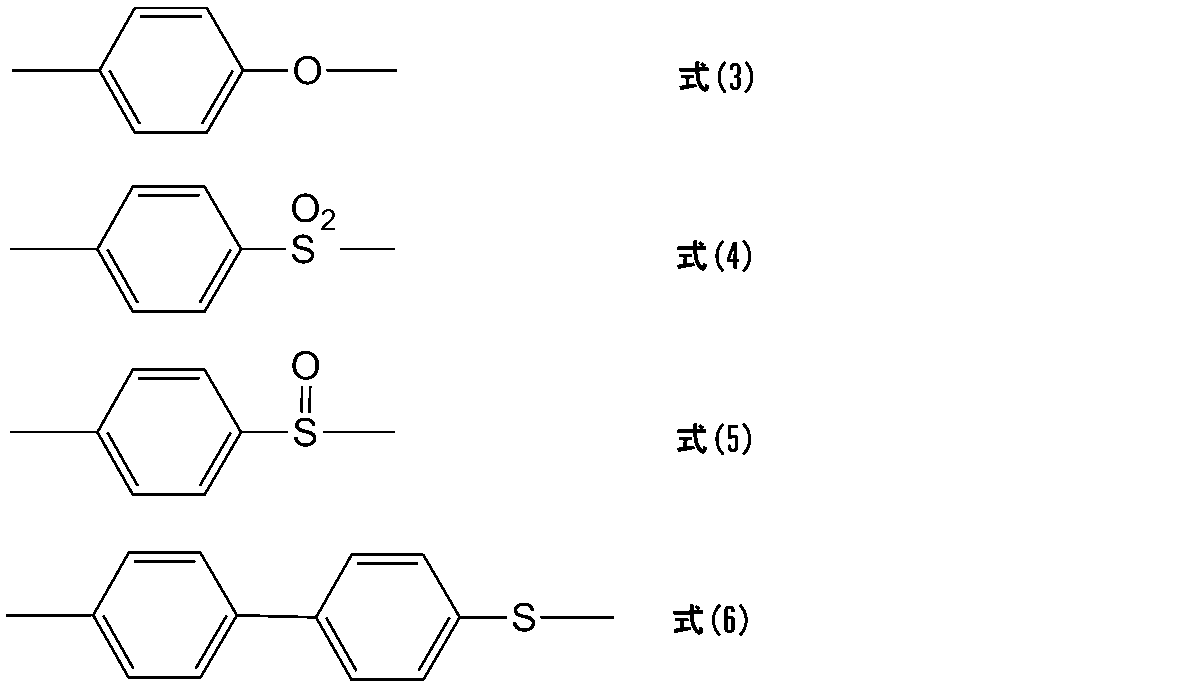
また、前記ポリアリーレンスルフィド樹脂は、その分子構造中に、下記式(7)

また、ポリアリーレンスルフィド樹脂の物性は、本発明の効果を損ねない限り特に限定されないが、以下の通りである。
(溶融粘度)
本発明に用いるポリアリーレンスルフィド樹脂は、300℃で測定した溶融粘度(V6)が5~1000〔Pa・s〕の範囲であることが好ましく、さらに流動性および機械的強度のバランスが良好となることから5~100〔Pa・s〕の範囲がより好ましく、特に5~50〔Pa・s〕の範囲であることが特に好ましい。
本発明に用いるポリアリーレンスルフィド樹脂は、300℃で測定した溶融粘度(V6)が5~1000〔Pa・s〕の範囲であることが好ましく、さらに流動性および機械的強度のバランスが良好となることから5~100〔Pa・s〕の範囲がより好ましく、特に5~50〔Pa・s〕の範囲であることが特に好ましい。
(非ニュートン指数)
本発明に用いるポリアリーレンスルフィド樹脂の非ニュートン指数は、本発明の効果を損ねない限り特に限定されないが、0.90~2.00の範囲であることが好ましい。リニア型ポリアリーレンスルフィド樹脂を用いる場合には、非ニュートン指数が0.90~1.50の範囲であることが好ましく、さらに0.95~1.20の範囲であることがより好ましい。このようなポリアリーレンスルフィド樹脂は機械的物性、流動性、耐磨耗性に優れる。ただし、非ニュートン指数(N値)は、キャピログラフを用いて300℃、オリフィス長(L)とオリフィス径(D)の比、L/D=40の条件下で、剪断速度及び剪断応力を測定し、下記式を用いて算出した値である。
本発明に用いるポリアリーレンスルフィド樹脂の非ニュートン指数は、本発明の効果を損ねない限り特に限定されないが、0.90~2.00の範囲であることが好ましい。リニア型ポリアリーレンスルフィド樹脂を用いる場合には、非ニュートン指数が0.90~1.50の範囲であることが好ましく、さらに0.95~1.20の範囲であることがより好ましい。このようなポリアリーレンスルフィド樹脂は機械的物性、流動性、耐磨耗性に優れる。ただし、非ニュートン指数(N値)は、キャピログラフを用いて300℃、オリフィス長(L)とオリフィス径(D)の比、L/D=40の条件下で、剪断速度及び剪断応力を測定し、下記式を用いて算出した値である。

前記ポリアリーレンスルフィド樹脂(A)の製造方法としては、特に限定されないが、例えば1)硫黄と炭酸ソーダの存在下でジハロゲノ芳香族化合物を、必要ならばポリハロゲノ芳香族化合物ないしその他の共重合成分を加えて、重合させる方法、2)極性溶媒中でスルフィド化剤等の存在下にジハロゲノ芳香族化合物を、必要ならばポリハロゲノ芳香族化合物ないしその他の共重合成分を加えて、重合させる方法、3)p-クロルチオフェノールを、必要ならばその他の共重合成分を加えて、自己縮合させる方法、等が挙げられる。これらの方法のなかでも、2)の方法が汎用的であり好ましい。反応の際に、重合度を調節するためにカルボン酸やスルホン酸のアルカリ金属塩を添加したり、水酸化アルカリを添加しても良い。上記2)方法のなかでも、加熱した有機極性溶媒とジハロゲノ芳香族化合物とを含む混合物に含水スルフィド化剤を水が反応混合物から除去され得る速度で導入し、有機極性溶媒中でジハロゲノ芳香族化合物とスルフィド化剤とを、必要に応じてポリハロゲノ芳香族化合物と加え、反応させること、及び反応系内の水分量を該有機極性溶媒1モルに対して0.02~0.5モルの範囲にコントロールすることによりポリアリーレンスルフィド樹脂を製造する方法(特開平07-228699号公報参照。)や、固形のアルカリ金属硫化物及び非プロトン性極性有機溶媒の存在下でジハロゲノ芳香族化合物と必要ならばポリハロゲノ芳香族化合物ないしその他の共重合成分を加え、アルカリ金属水硫化物及び有機酸アルカリ金属塩を、硫黄源1モルに対して0.01~0.9モルの有機酸アルカリ金属塩および反応系内の水分量を非プロトン性極性有機溶媒1モルに対して0.02モルの範囲にコントロールしながら反応させる方法(WO2010/058713号パンフレット参照。)で得られるものが特に好ましい。ジハロゲノ芳香族化合物の具体的な例としては、p-ジハロベンゼン、m-ジハロベンゼン、o-ジハロベンゼン、2,5-ジハロトルエン、1,4-ジハロナフタレン、1-メトキシ-2,5-ジハロベンゼン、4,4’-ジハロビフェニル、3,5-ジハロ安息香酸、2,4-ジハロ安息香酸、2,5-ジハロニトロベンゼン、2,4-ジハロニトロベンゼン、2,4-ジハロアニソール、p,p’-ジハロジフェニルエーテル、4,4’-ジハロベンゾフェノン、4,4’-ジハロジフェニルスルホン、4,4’-ジハロジフェニルスルホキシド、4,4’-ジハロジフェニルスルフィド、及び、上記各化合物の芳香環に炭素原子数1~18のアルキル基を有する化合物が挙げられ、ポリハロゲノ芳香族化合物としては1,2,3-トリハロベンゼン、1,2,4-トリハロベンゼン、1,3,5-トリハロベンゼン、1,2,3,5-テトラハロベンゼン、1,2,4,5-テトラハロベンゼン、1,4,6-トリハロナフタレンなどが挙げられる。また、上記各化合物中に含まれるハロゲン原子は、塩素原子、臭素原子であることが望ましい。
重合工程により得られたポリアリーレンスルフィド樹脂を含む反応混合物の後処理方法としては、特に制限されるものではないが、例えば、(1)重合反応終了後、先ず反応混合物をそのまま、あるいは酸または塩基を加えた後、減圧下または常圧下で溶媒を留去し、次いで溶媒留去後の固形物を水、反応溶媒(又は低分子ポリマーに対して同等の溶解度を有する有機溶媒)、アセトン、メチルエチルケトン、アルコール類などの溶媒で1回または2回以上洗浄し、更に中和、水洗、濾過および乾燥する方法、或いは、(2)重合反応終了後、反応混合物に水、アセトン、メチルエチルケトン、アルコール類、エーテル類、ハロゲン化炭化水素、芳香族炭化水素、脂肪族炭化水素などの溶媒(使用した重合溶媒に可溶であり、かつ少なくともポリアリーレンスルフィドに対しては貧溶媒である溶媒)を沈降剤として添加して、ポリアリーレンスルフィドや無機塩等の固体状生成物を沈降させ、これらを濾別、洗浄、乾燥する方法、或いは、(3)重合反応終了後、反応混合物に反応溶媒(又は低分子ポリマーに対して同等の溶解度を有する有機溶媒)を加えて撹拌した後、濾過して低分子量重合体を除いた後、水、アセトン、メチルエチルケトン、アルコール類などの溶媒で1回または2回以上洗浄し、その後中和、水洗、濾過および乾燥をする方法、(4)重合反応終了後、反応混合物に水を加えて水洗浄、濾過、必要に応じて水洗浄の時に酸を加えて酸処理し、乾燥をする方法、(5)重合反応終了後、反応混合物を濾過し、必要に応じ、反応溶媒で1回または2回以上洗浄し、更に水洗浄、濾過および乾燥する方法、等が挙げられる。
尚、上記(1)~(5)に例示したような後処理方法において、ポリアリーレンスルフィド樹脂の乾燥は真空中で行なってもよいし、空気中あるいは窒素のような不活性ガス雰囲気中で行なってもよい。
・ポリエーテルポリオール(B)
本発明に使用するポリエーテルポリオール(B)は、分子内に分岐構造を有するポリエーテルポリオールである。PAS樹脂(A)に対するポリエーテルポリオール(B)の割合は、本発明の効果を損なわないよう目的や用途に応じて適宜調整して用いればよく、一概に規定することはできないが、ポリアリーレンスルフィド樹脂(A)100質量部に対して、ポリエーテルポリオール(B)0.1~100質量部の範囲であることが好ましく、さらに1~50質量部の範囲であることがより好ましい。該ポリエーテルポリオール(B)は分子内に分岐構造を有することで慣性半径が小さいことから、前記範囲で用いることにより、PAS樹脂に配合しても流動性が極めて良好な樹脂組成物が得られ、さらに分岐構造に起因して柔軟性を付与することができることから、樹脂組成物に靱性、耐衝撃性を付与することが可能となり、さらに、末端水酸基によりエポキシ接着性を向上させることができる。
本発明に使用するポリエーテルポリオール(B)は、分子内に分岐構造を有するポリエーテルポリオールである。PAS樹脂(A)に対するポリエーテルポリオール(B)の割合は、本発明の効果を損なわないよう目的や用途に応じて適宜調整して用いればよく、一概に規定することはできないが、ポリアリーレンスルフィド樹脂(A)100質量部に対して、ポリエーテルポリオール(B)0.1~100質量部の範囲であることが好ましく、さらに1~50質量部の範囲であることがより好ましい。該ポリエーテルポリオール(B)は分子内に分岐構造を有することで慣性半径が小さいことから、前記範囲で用いることにより、PAS樹脂に配合しても流動性が極めて良好な樹脂組成物が得られ、さらに分岐構造に起因して柔軟性を付与することができることから、樹脂組成物に靱性、耐衝撃性を付与することが可能となり、さらに、末端水酸基によりエポキシ接着性を向上させることができる。
本発明に使用するポリエーテルポリオールは、分子内に分岐構造を有するものであれば、特に限定されるものではないが、水酸基価が150~350mgKOH/gの範囲のものであることが好ましく、さらに200~300mgKOH/gの範囲のものであることがより好ましい。当該範囲のものを用いることで、分子量が小さい割に多くの水酸基を有することから、より少ない添加量で優れたエポキシ接着性を発揮することができるため好ましい。
さらに、本発明に使用するポリエーテルポリオールは、分子内に分岐構造を有するものであれば、特に限定されるものではないが、数平均分子量(Mn)が1,000~4,000の範囲のものであることが好ましく、さらに数平均分子量(Mn)が1,500~3500の範囲のものであることがより好ましい。ただし、当該数平均分子量(Mn)は、
なお、本発明において、数平均分子量(Mn)は、下記条件のゲルパーミアーションクロマトグラフィー(GPC)により測定される値である。
なお、本発明において、数平均分子量(Mn)は、下記条件のゲルパーミアーションクロマトグラフィー(GPC)により測定される値である。
測定装置 ;東ソー株式会社製 HLC-8220GPC
カラム ;東ソー株式会社製 TSK-GUARDCOLUMN SuperHZ-L +東ソー株式会社製 TSK-GEL SuperHZM-M×4
検出器 ;RI(示差屈折計)
データ処理;東ソー株式会社製 マルチステーションGPC-8020modelII 測定条件 ;カラム温度 40℃
溶媒 テトラヒドロフラン
流速 0.35ml/分
標準 ;単分散ポリスチレンを用いて検量線作成
試料 ;樹脂固形分換算で0.2質量%のテトラヒドロフラン溶液をマイクロフィルターでろ過したもの(100μl)
カラム ;東ソー株式会社製 TSK-GUARDCOLUMN SuperHZ-L +東ソー株式会社製 TSK-GEL SuperHZM-M×4
検出器 ;RI(示差屈折計)
データ処理;東ソー株式会社製 マルチステーションGPC-8020modelII 測定条件 ;カラム温度 40℃
溶媒 テトラヒドロフラン
流速 0.35ml/分
標準 ;単分散ポリスチレンを用いて検量線作成
試料 ;樹脂固形分換算で0.2質量%のテトラヒドロフラン溶液をマイクロフィルターでろ過したもの(100μl)
さらに、本発明に使用するポリエーテルポリオールは、分子内に1級水素基(H1)と2級水素基(H2)を有するものであることが好ましい。前記1級水素基(H1)と2級水素基(H2)との割合は、特に限定されるものではないが、1級水素基(H1)と2級水素基(H2)を合計した全水酸基数に対して、1級水素基(H1)が30~80%であり、かつ2級水素基(H2)が70~20%の範囲であることが好ましい。
本発明で使用できるポリエーテルポリオールの製造方法は、特に限定されるものではないが、例えば、ヒドロキシアルキルオキセタン(b1)と1官能性エポキシ化合物(b2)とを開環反応させることによって得ることができる。以下、本発明で使用するポリエーテルポリオールの好ましい製造方法について詳述する。
用いるヒドロキシアルキルオキセタン(b1)としては下記式(8)で表される構造を有するものが挙げられる。

かかる式(8)で表されるヒドロキシアルキルオキセタンの中でも、慣性半径がより小さくなって粘度低減に効果的である点から、R3がメチレン基であり、かつ、R4が炭素原子数1~7のアルキル基である化合物、とりわけ3-ヒドロキシメチル-3-エチルオキセタン、及び3-ヒドロキシメチル-3-メチルオキセタンが好ましい。
また、1官能性エポキシ化合物(b2)としては、オレフィンエポキサイド、アルキルグリシジルエーテル、アルキルグリシジルエステル等が挙げられる。
ここで、オレフィンエポキサイドとしては、具体的には、プロピレンオキサイド、1-ブテンオキサイド、1-ペンテンオキサイド、1-ヘキセンオキサイド、1,2-エポキシオクタン、1,2-エポキシドデカン、シクロヘキセンオキシド、シクロオクテンオキシド、シクロドデセンオキシド、スチレンオキシド、及び、フッ素原子数1~18のフロロアルキルエポキシドが挙げられる。
また、アルキルグリシジルエーテルとしては、具体的には、メチルグリシジルエーテル、エチルグリシジルエーテル、n-プロピルグリシジルエーテル、i-プロピルグリシジルエーテル、n-ブチルグリシジルエーテル、i-ブチルグリシジルエーテル、n-ペンチルグリシジルエーテル、2-エチルヘキシル-グリシジルエーテル、ウンデシルグリシジルエーテル、ヘキサデシルグリシジルエーテル、アリールグリシジルエーテル、フェニルグリシジルエーテル、2-メチルフェニルグリシジルエーテル、4-t-ブチルフェニルグリシジルエーテル、4-ノニルフェニルグリシジルエーテル、4-メトキシフェニルグリシジルエーテル、及び、1~18のフッ素原子数を有するフロロアルキルグリシジルエーテルが挙げられる。
さらにアルキルグリシジルエステルとしては、具体的には、グリシジルアセテート、グリシジルプロピオネート、グリシジルブチレート、グリシジルメタクリレート、及びグリシジルベンゾエートが挙げられる。
これらの中でも特に、流動性が良好であり、また、分子量が小さくなる点からオレフィンエポキサイドが好ましく、とりわけプロピレンオキサイド、1-ブテンオキサイド、1-ペンテンオキサイド、又は1-ヘキセンオキサイドが好ましいものとして挙げられる。
ここで、ヒドロキシアルキルオキセタン(b1)と、1官能性エポキシ化合物(b2)とを開環反応させる方法としては、具体的には、以下の(方法1)~(方法4)が挙げられる。
(方法1)
方法1は、まず始めに、ヒドロキシアルキルオキセタン(b1)と、1官能性エポキシ化合物(b2)とを、モル基準で、(ヒドロキシアルキルオキセタン(b1)/1官能性エポキシ化合物(b2))=1/1~1/10、好ましくは1/1~1/3となる割合で混合し、これらをパーオキサイドフリーの有機溶媒、例えば、ジエチルエーテル、ジ-i-プロピルエーテル、ジ-n-ブチルエーテル、ジ-i-ブチルエーテル、ジ-t-ブチルエーテル、t-アミルメチルエーテル、又はジオキソランで、原料成分/有機溶剤の質量比が1/1~1/5、好ましくは1/1.5~1/2.5となる割合で溶解する。
方法1は、まず始めに、ヒドロキシアルキルオキセタン(b1)と、1官能性エポキシ化合物(b2)とを、モル基準で、(ヒドロキシアルキルオキセタン(b1)/1官能性エポキシ化合物(b2))=1/1~1/10、好ましくは1/1~1/3となる割合で混合し、これらをパーオキサイドフリーの有機溶媒、例えば、ジエチルエーテル、ジ-i-プロピルエーテル、ジ-n-ブチルエーテル、ジ-i-ブチルエーテル、ジ-t-ブチルエーテル、t-アミルメチルエーテル、又はジオキソランで、原料成分/有機溶剤の質量比が1/1~1/5、好ましくは1/1.5~1/2.5となる割合で溶解する。
次に、得られた溶液を-10~-15℃まで攪拌しながら冷却、次いで、重合開始剤を単独で、或いは溶液状態で、0.1~1時間、好ましくは0.3~0.5時間かけて滴下する。ここで、重合開始剤は、原料モノマーの全質量に対して0.01~1質量%、好ましくは0.75~0.3質量%なる割合で使用できる。また、重合開始剤を溶液状態で使用する場合、当該溶液中の重合開始剤の濃度は、1~90質量%、特に25~50質量%であることが好ましい。ついで、この重合溶液を25℃になる迄攪拌し、次いで、リフラックスする温度まで加熱し、0.5~3時間かけて原料成分を全て反応するまで反応を行う。原料モノマーの転化率は、GC、NMR、又はIRスペクトルによって確認することによって制御できる。
重合後、得られた前記ポリエーテルポリオールは、前記重合開始剤と当量の水酸化アルカリ水溶液による攪拌、又は、前記重合開始剤と当量のナトリウムアルコキシドやカリウムアルコキシドの添加によって中和する。中和後、濾過し、溶媒で目的物を抽出後、減圧下に溶媒を留去し、目的とするポリエーテルポリオールを得ることができる。
(方法2)
方法2は、まず始めに、ヒドロキシアルキルオキセタン(b1)と、1官能性エポキシ化合物(b2)とを、モル基準で、(ヒドロキシアルキルオキセタン(b1)/1官能性エポキシ化合物(b2))=1/1~1/10、好ましくは1/1~1/3となる割合で、70℃以上の沸点を有する炭化水素系溶媒中に溶解する。ここで、炭化水素系溶媒は、例えば、n-ヘプタン、i-オクタン、シクロヘキサンが挙げられ、とりわけ溶解性の点からシクロヘキサンが好ましい。また、原料モノマーと炭化水素系溶媒との比率は、前者:後者が1:1~1:10、特に1:2.5~1:3.5であることが好ましい。
方法2は、まず始めに、ヒドロキシアルキルオキセタン(b1)と、1官能性エポキシ化合物(b2)とを、モル基準で、(ヒドロキシアルキルオキセタン(b1)/1官能性エポキシ化合物(b2))=1/1~1/10、好ましくは1/1~1/3となる割合で、70℃以上の沸点を有する炭化水素系溶媒中に溶解する。ここで、炭化水素系溶媒は、例えば、n-ヘプタン、i-オクタン、シクロヘキサンが挙げられ、とりわけ溶解性の点からシクロヘキサンが好ましい。また、原料モノマーと炭化水素系溶媒との比率は、前者:後者が1:1~1:10、特に1:2.5~1:3.5であることが好ましい。
この混合物の温度は、0~25℃、好ましくは5~15℃、特に好ましくは10~15℃に保持され、次いで、攪拌下に原料モノマーの全量に対して0.01~1モル%、特に0.05~0.15モル%の重合開始剤を一度に加える。
重合開始剤の添加直後、系内は不均一系になって25~40℃まで系内温度が上昇する。一旦、15~25℃まで冷却した後、反応混合物を40~70℃、好ましくは50~60℃まで加熱して、1~5時間、好ましくは2~3時間の間、原料モノマーが全て転化するまで反応を行う。反応終了後は、方法1と同様にして中和、濾過し、次いで、溶媒を留去する。
(方法3)
方法3は、まず始めに、原料モノマーの全量に対して0.01~1モル%、特に0.05~0.15モル%となる量の重合開始剤を、70℃以上の沸点を有する炭化水素系有機溶媒に溶解し、これを0~25℃、好ましくは5~15℃、特に好ましくは10~15℃に保持する。ここで、炭化水素系溶媒は、例えば、n-ヘプタン、i-オクタン、シクロヘキサンが挙げられ、とりわけ溶解性の点からシクロヘキサンが好ましい。また、該炭化水素系溶媒中の重合開始剤濃度は、0.01~1質量%、特に0.025~0.25質量%であることが好ましい。
方法3は、まず始めに、原料モノマーの全量に対して0.01~1モル%、特に0.05~0.15モル%となる量の重合開始剤を、70℃以上の沸点を有する炭化水素系有機溶媒に溶解し、これを0~25℃、好ましくは5~15℃、特に好ましくは10~15℃に保持する。ここで、炭化水素系溶媒は、例えば、n-ヘプタン、i-オクタン、シクロヘキサンが挙げられ、とりわけ溶解性の点からシクロヘキサンが好ましい。また、該炭化水素系溶媒中の重合開始剤濃度は、0.01~1質量%、特に0.025~0.25質量%であることが好ましい。
次に、この溶液に対して、ヒドロキシアルキルオキセタン(b1)と、1官能性エポキシ化合物(b2)とを、モル基準で、(ヒドロキシアルキルオキセタン(b1)/1官能性エポキシ化合物(b2))=1/1~1/10、好ましくは1/1~1/3となる割合で、混合した混合物を、系内の温度が20~35℃になるように連続的に滴下する。滴下終了後も系内の温度が20~25℃になるまで攪拌を行う。次いで、反応混合物を40~70℃、好ましくは50~60℃まで加熱して、1~5時間、好ましくは2~3時間の間、原料モノマーが全て転化するまで反応を行う。原料モノマーの転化率は、GC、NMR、又はIRスペクトルによって確認することによって制御できる。反応終了後は、方法1と同様にして中和、濾過し、次いで、溶媒を留去する。
(方法4)
ヒドロキシアルキルオキセタン(b1)と、1官能性エポキシ化合物(b2)の合計量に対して0.01~2モル%、好ましくは0.1~1.0モル%となる量の重合開始剤を、パーオキサイドフリーの有機溶媒で希釈する。有機溶媒は、エーテル系有機溶媒が好ましく、例えば、メチル-t-ブチルエーテル、メチル-シクロペンチルエーテル、1,2-ジメトキシエタン、1,2-ジエトキシエタン、ジエチルエーテル、ジ-i-プロピルエーテル、ジ-n-ブチルエーテル、ジ-i-ブチルエーテル、ジ-t-ブチルエーテル、t-アミルメチルエーテル、又はジオキソランが挙げられ、これらの溶媒は、単一でも或いは混合して用いてもよく、原料成分/有機溶媒の質量比が1/0.25~1/5、好ましくは1/0.5~1/3となる割合で使用する。
ヒドロキシアルキルオキセタン(b1)と、1官能性エポキシ化合物(b2)の合計量に対して0.01~2モル%、好ましくは0.1~1.0モル%となる量の重合開始剤を、パーオキサイドフリーの有機溶媒で希釈する。有機溶媒は、エーテル系有機溶媒が好ましく、例えば、メチル-t-ブチルエーテル、メチル-シクロペンチルエーテル、1,2-ジメトキシエタン、1,2-ジエトキシエタン、ジエチルエーテル、ジ-i-プロピルエーテル、ジ-n-ブチルエーテル、ジ-i-ブチルエーテル、ジ-t-ブチルエーテル、t-アミルメチルエーテル、又はジオキソランが挙げられ、これらの溶媒は、単一でも或いは混合して用いてもよく、原料成分/有機溶媒の質量比が1/0.25~1/5、好ましくは1/0.5~1/3となる割合で使用する。
適宜選択した有機溶媒で希釈した溶液を、-15~60℃、好ましくは0~45℃、特に好ましくは10~30℃に保持する。
この溶液に対して、ヒドロキシアルキルオキセタン(b1)と、1官能性エポキシ化合物(b2)とを、モル基準で、(ヒドロキシアルキルオキセタン(b1)/1官能性エポキシ化合物(b2))=1/0.2~1/3、好ましくは1/0.5~1/1.5となる割合で、混合した混合物を、系内の温度が-15~60℃、好ましくは0~45℃、特に好ましくは10~30℃になるように連続的に滴下する。さらに、先のヒドロキシアルキルオキセタン(a1)に対してモル基準で0.2~5倍、好ましくは0.5~1.5倍の1官能性エポキシ化合物(b2)を、上述の系内の温度になるように連続的に滴下する。滴下終了後は系内の温度を10~50℃、好ましくは20~35℃に維持して、ヒドロキシアルキルオキセタン(b1)及び1官能性エポキシ化合物(b2)が全て転化するまで反応を行う。ヒドロキシアルキルオキセタン(b1)及び1官能性エポキシ化合物(b2)の転化率は、GC、NMR、又はIRスペクトルで確認することによって制御できる。
また、滴下終了から2~10時間後に、反応に仕込んだヒドロキシアルキルオキセタン(b1)と1官能性エポキシ化合物(b2)の全量に対して0.01~1モル%、特に0.05~0.5モル%の重合開始剤を追加しても良い。
さらに、上記反応の圧力は常圧だけではなく、耐圧容器中、加圧条件下で行うこともできる。特に、低沸点の1官能性エポキシ化合物(b2)の反応を行う場合には、加圧下での反応が有効である。加圧下では、原料の添加中の系内の温度は0~60℃、好ましくは10~45℃で行うことができる。
重合後、得られた前記ポリエーテルポリオールは、前記重合開始剤の0.3~20倍、好ましくは0.4~15倍のハイドロタルサイトを加え、重合開始剤を吸着せしめ、これを濾別後、減圧下に溶媒を留去し、目的とするポリエーテルポリオールを得ることができる。
また、前記重合開始剤の処理は、重合開始剤と当量の水酸化アルカリ水溶液による攪拌、又は、前記重合開始剤と当量のナトリウムアルコキシドやカリウムアルコキシドの添加によって中和し、溶媒で目的物を抽出処理することでも可能である。さらに、重合開始剤としてBF3を用いる場合には、フッ化ナトリウムで中和後、ゼオライトで中和塩を吸着除去することでも行える。
特に、方法4は、開環反応におけるヒドロキシアルキルオキセタン(b1)と、1官能性エポキシ化合物(b2)の反応転化率が98%以上に達することである。この結果、重合開始剤及び溶媒を除去して得られるポリエーテルポリオールは、ヒドロキシアルキルオキセタン(b1)の残存量を1%以下に押さえることができる。また、1官能性エポキシ化合物(b2)には沸点の低い化合物や、変異原性を有する化合物があるが、これらをほぼ完全に反応させることが可能であり、環境中へ放出によるリスクが極めて少ない製造方法である。さらに、反応の転化率が高いことで、ポリエーテルポリオールがほぼ定量的に得られるため、収率が高い製造方法である。
ここで、本発明のポリエーテルポリオールの製造に用いることができる重合開始剤としては、例えば、H2SO4、HCl、HBF4、HPF6、HSbF6、HAsF6、p-トルエンスルホン酸、トリフロロメタンスルホン酸などのブロンステッド酸、BF3、AlCl3、TiCl4、SnCl4などのルイス酸、トリアリールスルフォニウム-ヘキサフルオロホスフェート、トリアリールスルフォニウム-アンチモネート、ジアリールイオドニウム-ヘキサフルオロホスフェート、ジアリールイオドニウム-アンチモネート、N-ベンジルピリジニウム-ヘキサフルオロホスフェート、N-ベンジルピリジニウム-アンチモネートなどのオニウム塩化合物、トリフェニルカルボニウム-テトラフルオロボレート、トリフェニルカルボニウム-ヘキサフルオロホスフェート、トリフェニルカルボニウム-ヘキサフルオロアンチモネートなどのトリフェニルカルボニウム塩、p-トルエンスルホニルクロライド、メタンスルホニルクロライド、トリフルオロメタンスルホニルクロライド、p-トルエンスルホン酸無水物、メタンスルホン酸無水物、トリフルオロメタンスルホン酸無水物、p-トルエンスルホン酸メチルエステル、p-トルエンスルホン酸エチルエステル、メタンスルホン酸メチルエステル、トリフルオロメタンスルホン酸メチルエステル、トリフルオロメタンスルホン酸トリメチルシリルエステルなどのアルキル化剤が挙げられる。
これらのなかでも特に、BF3、HPF6、HSbF6、HAsF6、トリフェニルカルボニウム-ヘキサフルオロホスフェートが活性に優れる点から好ましく、これらのなかでも特に、ルイス酸としてBF3が、ブロンステッド酸としてHPF6が好ましい。
このようなポリエーテルポリオール(B)の具体的構造は、ヒドロキシアルキルオキセタン(b1)と、1官能性エポキシ化合物(b2)とを開環反応させて得られる種々の構造が含まれる。例えば、下記式(8)

で表されるヒドロキシアルキルオキセタン(a1)と、下記式(9)


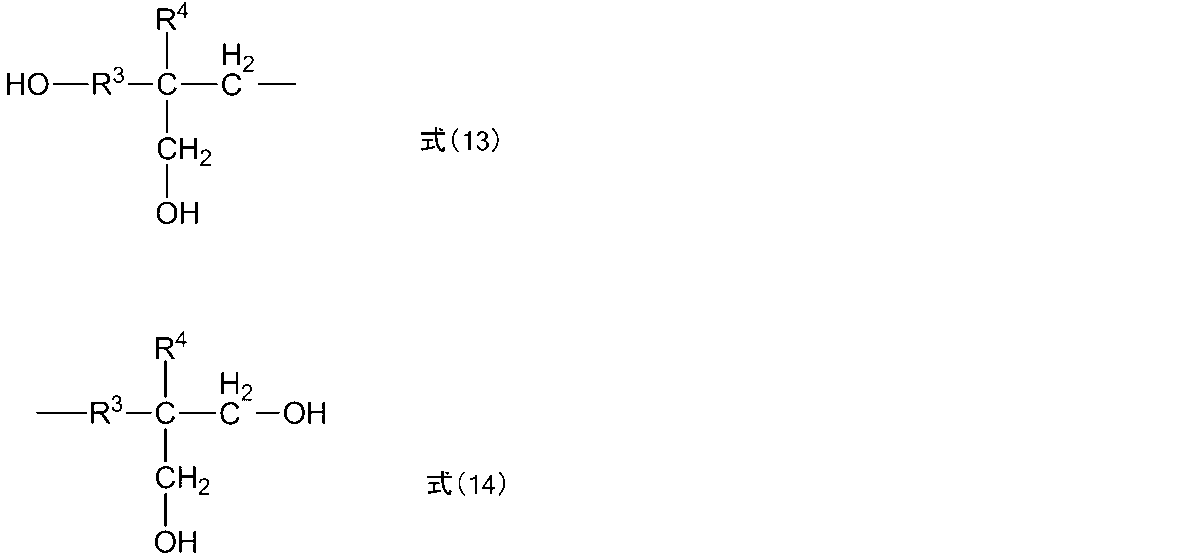


ここで、前記式(10)~式(14)は、ヒドロキシアルキルオキセタン(b1)に起因する構造単位であって、式(10)~式(12)は繰り返し単位を表し、式(13)及び式(14)は末端構造単位を表す。
また、式(15)~式(17)は、前記1官能性エポキシ化合物(b2)に起因する構造単位であって、式(15)は繰り返し単位を表し、式(16)及び式(17)は末端構造単位を表す。
また、式(15)~式(17)は、前記1官能性エポキシ化合物(b2)に起因する構造単位であって、式(15)は繰り返し単位を表し、式(16)及び式(17)は末端構造単位を表す。
本発明のポリエーテルポリオールは、前記式(10)~式(12)及び式(15)から選択される繰り返し単位によって分岐構造が形成され、末端に前記式(13)、式(14)、式(16)及び式(17)から選択される末端構造単位を有するものである。なお、これらの繰り返し単位及び末端構造単位はランダムに存在していてもよいし、前記式(10)~式(12)が分子構造の中心部分を構成し、末端に前記末端構造単位を有するものであってもよい。なお、本発明で用いるポリエーテルポリオール中の4級炭素原子は、例えばC-NMR等で確認することができる。
・熱可塑性エラストマー(C)
本発明のポリアリーレンスルフィド樹脂組成物は、優れた耐衝撃性、特に耐冷熱衝撃性を付与するために熱可塑性エラストマー(C)を含有していても良い。この熱可塑性エラストマー(C)は、融点が300℃以下であり、室温でゴム弾性を有するエラストマーであることが、前記ポリアリーレンスルフィド樹脂(A)と溶融混練した際の分散性に優れる点から好ましい。また、耐熱性に優れ、かつ、混合の容易であり、耐衝撃性の向上の効果も顕著である点からポリオレフィン系エラストマー又はニトリル系エラストマーが好ましい。
本発明のポリアリーレンスルフィド樹脂組成物は、優れた耐衝撃性、特に耐冷熱衝撃性を付与するために熱可塑性エラストマー(C)を含有していても良い。この熱可塑性エラストマー(C)は、融点が300℃以下であり、室温でゴム弾性を有するエラストマーであることが、前記ポリアリーレンスルフィド樹脂(A)と溶融混練した際の分散性に優れる点から好ましい。また、耐熱性に優れ、かつ、混合の容易であり、耐衝撃性の向上の効果も顕著である点からポリオレフィン系エラストマー又はニトリル系エラストマーが好ましい。
さらに、前記熱可塑性エラストマー(C)は、さらに優れた耐衝撃性、特に耐冷熱衝撃性を付与する観点から、ポリアリーレンスルフィド樹脂(A)やポリエーテルポリオール(B)と反応性を示す官能基を有するポリオレフィンであることが好ましく、具体的には、水酸基、カルボキシ基、メルカプト基、エポキシ基、アミノ基、イソシアナト基、ビニル基、下記の構造式(1)で表される構造および構造式(2)で表される構造

前記官能基を有するポリオレフィンは、例えばα-オレフィンと前記官能基を有するビニル重合性化合物などの単量体との共重合で得ることができる。前記α-オレフィンは、例えば、エチレン、プロピレン、ブテン-1等の炭素数2~8のα-オレフィン等が挙げられる。前記官能基を有するビニル重合性化合物としては、例えば(メタ)アクリル酸、(メタ)アクリル酸エステル等のα,β-不飽和カルボン酸及びそのアルキルエステル、マレイン酸、フマル酸、イタコン酸、その他の炭素数4~10の不飽和ジカルボン酸とそのモノ及びジエステル、その酸無水物等のα,β-不飽和ジカルボン酸及びその誘導体等、アクリル酸グリシジル、メタクリル酸グリシジルおよびエタクリル酸グリシジル等のα,β-不飽和酸グリシジルエステル等が挙げられる。またアミノ基、イソシアナト基を有するポリオレフィンは、たとえば、上記のカルボン酸で変性されたポリオレフィンに、アルキレンジアミンやアルキレンジイソシアネートといった多価アミンや多価イソシアネートを反応させて得ることができる。アルキレンジアミンとしてはアルキレンジアミンとしては、エチレンジアミン、ペンタメチレンジアミン、ヘキサメチレンジアミン、エチレンジイソシアナト、ペンタメチレンジイソシアナト、ヘキサメチレンジイソシアナト等が挙げられる。また、分子末端に水酸基を有するポリオレフィンは、例えば、WO11/158906号公報に記載されているように、共役ジエンモノマーをアニオン重合などの公知の方法により重合させ、得られた重合体を加水分解した上で水素添加することにより得られる。また、ビニル基を有するポリオレフィンとしては、例えば特開2003-40921号公報に記載されているように、高分子量ポリオレフィン、特にポリプロピレンを熱分解することにより得られる。またメルカプト基を有するポリオレフィンは、前記ビニル基を有するポリオレフィンに対し、末端ビニリデン基からSH基への変換反応が適用でき、本発明において特に好ましい反応は、例えば、特開2004-107508号公報に記載されているように、チオ酢酸をラジカル開始剤とともに使用することにより、チオ酢酸エステル化し、ついでアルカリ条件で加水分解することにより、効率的にメルカプト基に変換することにより得られる。
本発明に用いることができる熱可塑性エラストマーとしては、これらの中でも、カルボキシ基、エポキシ基、アミノ基、イソシアナト基、下記の構造式(1)で表される構造および構造式(2)で表される構造

さらに、本発明に用いることができる熱可塑性エラストマーは、ポリアリーレンスルフィド樹脂を混練する温度で、溶融し、混合分散可能であることが好ましい。その点から、融点が300℃以下であり、室温でゴム弾性を有するエラストマーがより好ましい。
本発明に用いることができる熱可塑性エラストマーは、とりわけ、耐熱性、混合の容易さ、耐氷結性向上の点を考慮した場合、ガラス転移点が-40℃以下のものを用いると、極低温でもゴム弾性を有するため好ましい。前記ガラス転移点は、耐氷結性向上の点では低いほど好ましいが、通常-180~-40℃の範囲のものが好ましく、-150~-40℃の範囲のものが特に好ましい。このようなガラス転移点が-40℃以下のポリオレフィンを用いる場合、その使用量はエラストマー全体の0.1~99.9質量%の範囲で調整しながら用いることができる。ポリオレフィン(C1)には、本発明の効果を損わない範囲で、前記した各種のモノマー成分に加え、他のオレフィン系モノマー、たとえばアクリロニトリル、スチレン、酢酸ビニルおよびビニルエーテルなどを共重合させてもよい。
本発明に用いることができる熱可塑性エラストマーの溶融粘度は特に制限されるものではないが、メルトフローレイト(温度190℃、荷重2.16kg)による測定で1~20(g/10分)の範囲のものが好ましい。
本発明において熱可塑性エラストマー(C)を用いる場合、PAS樹脂(A)に対する熱可塑性エラストマー(C)の割合は、本発明の効果を損なわないよう目的や用途に応じて適宜調整して用いればよく、一概に規定することはできないが、耐衝撃性、特に耐冷熱衝撃性に優れる観点から、ポリアリーレンスルフィド樹脂(A)100質量部に対して、熱可塑性エラストマー(C)0.5~20質量部の範囲であることが好ましく、さらに1~10質量部の範囲であることがより好ましい。
本発明の樹脂組成物は、更にエポキシ樹脂等の他の樹脂との接着性を向上させる観点から、さらにエポキシ樹脂(D)を含有していても良い。当該エポキシ樹脂(D)としては、本発明の効果を損ねなければ特に限定されず、たとえば、ビスフェノール型エポキシ樹脂、ノボラック型エポキシ樹脂などが挙げられる。
ビスフェノール型エポキシ樹脂のエポキシ樹脂の種類としては、ビスフェノール類のグリシジルエーテルが挙げられ、具体的にはビスフェノールA型エポキシ樹脂、ビスフェノールF型エポキシ樹脂、ビフェニル型エポキシ樹脂、テトラメチルビフェニル型エポキシ樹脂、ビスフェノールS型エポキシ樹脂、ビスフェノールAD型エポキシ樹脂、テトラブロモビスフェノールA型エポキシ樹脂またはジヒドロキシナフタレン型エポキシ樹脂などが挙げられ、このうち、ビスフェノールA型エポキシ樹脂が好ましい。またノボラック型エポキシ樹脂の種類としてはフェノール類とアルデヒドとの縮合反応により得られたノボラック型フェノール樹脂をエピハロヒドリンを反応させて得られるノボラック型エポキシ樹脂が挙げられ、具体例には、フェノールノボラック型エポキシ樹脂、クレゾールノボラック型エポキシ樹脂、ナフトールノボラック型エポキシ樹脂、ナフトール-フェノール共縮ノボラック型エポキシ樹脂、ナフトール-クレゾール共縮ノボラック型エポキシ樹脂、ブロム化フェノールノボラック型エポキシ樹脂が挙げられ、このうち、フェノールノボラック型エポキシ樹脂、クレゾールノボラックエポキシ樹脂が好ましい。
本発明においてエポキシ樹脂(D)を用いる場合、ポリアリーレンスルフィド樹脂(A)に対するエポキシ樹脂(D)の割合は、本発明の効果を損なわないよう目的や用途に応じて適宜調整して用いればよく、一概に規定することはできないが、エポキシ接着性を向上させる観点から、ポリアリーレンスルフィド樹脂(A)100質量部に対して、エポキシ樹脂(D)0.5~20質量部の範囲であることが好ましく、さらに1~10質量部の範囲であることがより好ましい。
本発明の樹脂組成物は、更に機械的強度、特に冷熱衝撃強度、耐熱性、寸法安定性等の性能を更に改善するために、さらに充填材(E)を含有することが好ましい。本発明で用いる充填剤は必須成分ではないが、用いる場合には、前記ポリアリーレンスルフィド樹脂100質量部に対して0質量部より多く、通常は1質量部以上、より好ましくは10質量部以上、かつ600質量部以下の範囲で加えることによって、強度、剛性、耐熱性、放熱性および寸法安定性など、加える充填剤の目的に応じて各種性能を向上させることができる。
該充填材としては、本発明の効果を損なうものでなければ公知慣用の材料を用いることもでき、例えば、繊維状のものや、粒状や板状などの非繊維状のものなど、さまざまな形状の充填材等が挙げられる。具体的には、ガラス繊維、炭素繊維、シランガラス繊維、セラミック繊維、アラミド繊維、金属繊維、チタン酸カリウム、炭化珪素、硫酸カルシウム、珪酸カルシウム等の繊維、ウォラストナイト等の天然繊維等の繊維状充填材が使用でき、またガラスビーズ、ガラスフレーク、硫酸バリウム、硫酸カルシウム、クレー、パイロフィライト、ベントナイト、セリサイト、ゼオライト、マイカ、雲母、タルク、アタパルジャイト、フェライト、珪酸カルシウム、炭酸カルシウム、炭酸マグネシウム、ガラスビーズ等の非繊維状充填剤も使用できる。
これらのうち、充填材(E)としては、ガラス繊維と、ガラスビーズ、ガラスフレーク及び炭酸カルシウムからなる群から選ばれる少なくとも1つとを併用することがより好ましい。その配合割合は、ポリアリーレンスルフィド樹脂100質量部に対して、ガラス繊維と、ガラスビーズ、ガラスフレーク及び炭酸カルシウムからなる群から選ばれる少なくとも1つを合計で、10~200質量部の範囲であることが好ましい。さらに、そのうち、ガラス繊維と、ガラスビーズ、ガラスフレーク及び炭酸カルシウムからなる群から選ばれる少なくとも1つとの配合割合は、質量基準で20:80~80:20であることが好ましい。
このようなガラス繊維としては、本発明の効果を損ねない範囲で公知のものを用いることができるが、例えば、射出成形用コンパウンド向けに用いられるチョップドストランドが好ましいものとして用いることができ、特に、直径3~20μmの範囲、好ましくは6~13μmの範囲のもので、かつ、ストランド長は3~6mmの範囲のものが好ましい。
また、ガラスフレークとしては、本発明の効果を損ねない範囲で公知のものを用いることができるが、例えば、平均粒径が10~4000μmの範囲であるものを好ましく用いることができ、また、平均厚みが0.1~20μmの範囲の鱗片状ガラスであるものを好ましく用いることができる。ガラスビーズとしては、本発明の効果を損ねない範囲で公知のものを用いることができるが、例えば、平均粒子径が1~100μmの範囲であるものを好ましく用いることができる。具体的には、ソーダ石灰ガラスビーズ、低アルカリガラスビーズ、カリガラスビーズ、石英ガラスビーズ等が挙げられる。炭酸カルシウムとしては、本発明の効果を損ねない範囲で公知のものを用いることができるが、例えば、平均粒子径が0.1~300μmの範囲であるものを好ましく用いることができる。具体的には、沈降炭酸カルシウム、重質炭酸カルシウム、炭酸カルシウムウィスカー等が挙げられる。ただし、平均粒子径、平均厚みはレーザー光回折法によって測定された累積粒度分布曲線より得られる累積度50%粒度を意味する。
更に、本発明のポリアリーレンスルフィド樹脂組成物は、上記成分に加えて、さらに用途に応じて、適宜、ポリエステル樹脂、ポリアミド樹脂、ポリイミド樹脂、ポリエーテルイミド樹脂、ポリカーボネート樹脂、ポリフェニレンエーテル樹脂、ポリスルフォン樹脂、ポリエーテルスルフォン樹脂、ポリエーテルエーテルケトン樹脂、ポリエーテルケトン樹脂、ポリアリーレン樹脂、ポリエチレン樹脂、ポリプロピレン樹脂、ポリ四弗化エチレン樹脂、ポリ二弗化エチレン樹脂、ポリスチレン樹脂、ABS樹脂、シリコーン樹脂、フェノール樹脂、ウレタン樹脂、液晶ポリマー等の合成樹脂、或いは、弗素ゴム、シリコーンゴム等のエラストマーなどを配合したポリアリーレンスルフィド樹脂組成物として使用してもよい。また、これらの樹脂の使用量は、それぞれの目的に応じて異なり、一概に規定することはできないが、ポリアリーレンスルフィド樹脂(A)100質量部に対して0.01~1000質量部の範囲で、本発明の効果を損なわないよう目的や用途に応じて適宜調整して用いればよい。
更に、本発明のポリアリーレンスルフィド樹脂組成物は、本発明の効果を損ねない範囲であれば、成形加工の際に添加剤として、カップリング剤、着色剤、耐熱安定剤、紫外線安定剤、発泡剤、防錆剤、難燃剤、滑剤等の各種添加剤を含有させることができる。
これらの添加剤の使用量は、それぞれの目的に応じて異なり、一概に規定することはできないが、ポリアリーレンスルフィド樹脂(A)100質量部に対して0.01~1000質量部の範囲で、本発明の効果を損なわないよう目的や用途に応じて適宜調整して用いればよい。また、これらの添加剤の使用方法も、それぞれの目的に応じて異なり、一概に規定することはできないが、例えば、カップリング剤(F)は、予め充填剤に予備処理された上で用いられてもよいが、添加剤として単独で用いることが好ましい。
このようなカップリング剤(F)としてはシラン系、チタン系などのカップリング剤が用いられる。このうちシランカップリング剤が好ましく、さらにカルボキシ基と反応する官能基(例えばエポキシ基、イソシアナト基、アミノ基や水酸基)を有するシランカップリング剤が好ましいものとして挙げられる。このようなシランカップリング剤としては、例えば、γ-グリシドキシプロピルトリメトキシシラン、γ-グリシドキシプロピルトリエトキシシラン、β-(3,4-エポキシシクロヘキシル)エチルトリメトキシシラン等のエポキシ基含有アルコキシシラン化合物、γ-イソシアナトプロピルトリメトキシシラン、γ-イソシアナトプロピルトリエトキシシラン、γ-イソシアナトプロピルメチルジメトキシシラン、γ-イソシアナトプロピルメチルジエトキシシラン、γ-イソシアナトプロピルエチルジメトキシシラン、γ-イソシアナトプロピルエチルジエトキシシラン、γ-イソシアナトプロピルトリクロロシラン等のイソシアナト基含有アルコキシシラン化合物、γ-(2-アミノエチル)アミノプロピルメチルジメトキシシラン、γ-(2-アミノエチル)アミノプロピルトリメトキシシラン、γ-アミノプロピルトリメトキシシラン等のアミノ基含有アルコキシシラン化合物、γ-ヒドロキシプロピルトリメトキシシラン、γ-ヒドロキシプロピルトリエトキシシラン等の水酸基含有アルコキシシラン化合物が挙げられる。カップリング剤の使用量は、ポリアリーレンスルフィド樹脂(A)100質量部に対して0.01~1.0質量部、より好ましくは0.1~0.4質量部の範囲である。
本発明のPAS樹脂組成物の製造方法は特に制限なく、原料のポリアリーレンスルフィド樹脂(A)と、ポリエーテルポリオール(B)と、必要に応じて用いる、熱可塑性エラストマー(C)と、エポキシ樹脂(D)と、充填材(E)やカップリング剤(F)等のその他の添加剤を、粉末、ベレット、細片など様々な形態でリボンブレンター、ヘンシェルミキサー、Vブレンターなどに投入してドライブレンドした後、バンバリーミキサーミキシングロール、単軸または2軸の押出機およびニーターなどを用いて溶融混練する方法などが挙げられる。なかでも十分な混練力を有する単軸または2軸の押出機を用いて溶融混練する方法が代表的である。
本発明のPAS樹脂組成物は、射出成形、圧縮成形、コンポジット、シート、パイプなどの押出成形、引抜成形、ブロー成形、トランスファー成形など各種成形に供することが可能であるが、特に離形性に優れるため射出成形用途に適している。
得られたポリアリーレンスルフィド樹脂組成物の成形品は、エポキシ接着性に優れる。このため、例えば、ポリアリーレンスルフィド樹脂組成物からなる板状、箱型等、種々の形に賦形された成形品にエポキシ樹脂やシリコーン樹脂などの硬化性樹脂で封止または接合した後、当該硬化性樹脂を硬化することにより、ポリアリーレンスルフィド樹脂組成物を成形してなる成形体と、前記硬化性樹脂からなる硬化物とが接着して得られる複合成形品を得ることができる。
本発明のPAS樹脂組成物は、PAS樹脂の本来有する機械的強度、耐熱性、寸法安定性等の諸性能を具備する。このため、さらに例えば、センサ、LEDランプ、コネクタ、ソケット、抵抗器、リレーケース、スイッチ、コイルボビン、コンデンサ、バリコンケース、発振子、各種端子板、変成器、プラグ、プリント基板、チューナ、スピーカ、マイクロフォン、ヘッドフォン、小型モータ、磁気ヘッドベース、半導体、液晶、FDDキャリッジ、FDDシャーシ、モーターブラッシュホルダ、パラボラアンテナ、コンピュータ関連部品などに代表される電気・電子部品、VTR部品、テレビ部品、アイロン、ヘアードライヤ、炊飯器部品、電子レンジ部品、音響部品、オーディオ・レーザディスク・コンパクトディスクなどの音声機器部品、照明部品、冷蔵庫部品、エアコン部品、タイプライタ部品、ワードプロセッサ部品などに代表される家庭、事務電気製品部品や、オフィスコンピュータ関連部品、電話器関連部品、ファクシミリ関連部品、複写機関連部品、洗浄用治具、モータ部品、ライタ、タイプライタなどに代表される機械関連部品や、顕微鏡、双眼鏡、カメラ、時計などに代表される光学機器、精密機械関連部品や、水道蛇口コマ、混合水栓、ポンプ部品、パイプジョイント、水量調節弁、逃がし弁、湯温センサ、水量センサ、水道メーターハウジングなどの水廻り部品や、バルブオルタネーターターミナル、オルタネーターコネクタ,ICレギュレータ、ライトディヤ用ポテンシオメーターベース、排気ガスバルブなどの各種バルブ、燃料関係・排気系・吸気系各種パイプ、エアーインテークノズルスノーケル、インテークマニホールド、燃料ポンプ、エンジン冷却水ジョイント、キャブレターメインボディ、キャブレタースペーサ、排気ガスセンサ、冷却水センサ、油温センサ、スロットルポジションセンサ、クランクシャフトポジションセンサ、エアーフローメータ、ブレーキパッド摩耗センサ、エアコン用サーモスタットベース、暖房温風フローコントロールバルブ、ラジエーターモータ用ブラッシュホルダ、ウォーターポンプインペラ、タービンベイン、ワイパーモータ関係部品、デュストリビュータ、スタータースイッチ、スターターリレ、トランスミッション用ワイヤーハーネス、ウィンドウォッシャーノズル、エアコンパネルスイッチ基板、燃料関係電磁気弁用コイル、ヒューズ用コネクタ、ホーンターミナル、電装部品絶縁板、ステップモーターロータ、ランプソケット、ランプリフレクタ、ランプハウジング、ブレーキピストン、ソレノイドボビン、エンジンオイルフィルタ、点火装置ケース、HEV用コンデンサーケース、車速センサ、ケーブルライナなどの自動車・車両関連部品など各種用途あるいは繊維若しくはフィルム用の材料として幅広く有用である。
[PAS樹脂のピーク分子量]
PPS樹脂のピーク分子量測定条件は、装置:SSC-7000(センシュウ科学社製)、カラム:UT-805L(昭和電工社製)、溶媒:1-クロロナフタレン、カラム温度:210℃、検出器:UV検出器(360nm)を用い、6種類の単分散ポリスチレンを校正に用いて分子量分布を測定し、縦軸がd(重量)/dLog(分子量)、横軸がLog(分子量)の微分重量分子量分布を得、そのピーク分子量を横軸から読み取った。
PPS樹脂のピーク分子量測定条件は、装置:SSC-7000(センシュウ科学社製)、カラム:UT-805L(昭和電工社製)、溶媒:1-クロロナフタレン、カラム温度:210℃、検出器:UV検出器(360nm)を用い、6種類の単分散ポリスチレンを校正に用いて分子量分布を測定し、縦軸がd(重量)/dLog(分子量)、横軸がLog(分子量)の微分重量分子量分布を得、そのピーク分子量を横軸から読み取った。
[PAS樹脂の溶融粘度]
フローテスター(島津製作所製高化式フローテスター「CFT-500D型」)を用いて、温度300℃、荷重1.96MPa、オリフィス長とオリフィス径との、前者/後者の比が10/1であるオリフィスを使用して6分間保持後の溶融粘度を測定した。
フローテスター(島津製作所製高化式フローテスター「CFT-500D型」)を用いて、温度300℃、荷重1.96MPa、オリフィス長とオリフィス径との、前者/後者の比が10/1であるオリフィスを使用して6分間保持後の溶融粘度を測定した。
<実施例1~26及び比較例1~10>
表1~表10に記載する組成成分および配合量にしたがい、各材料をタンブラーで均一に混合した。その後、東芝機械株式会社製ベント付き2軸押出機「TEM-35B」に前記配合材料を投入し、樹脂成分吐出量25kg/hr、スクリュー回転数250rpm、樹脂成分の吐出量(kg/hr)とスクリュー回転数(rpm)との比率(吐出量/スクリュー回転数)=0.1(kg/hr・rpm)、設定樹脂温度330℃で溶融混練して樹脂組成物のペレットを得た。
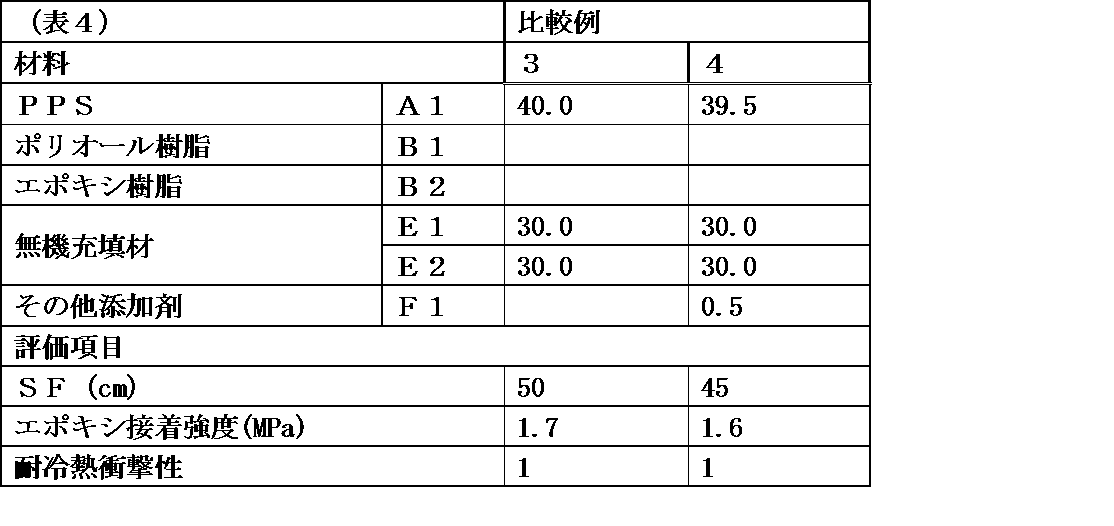
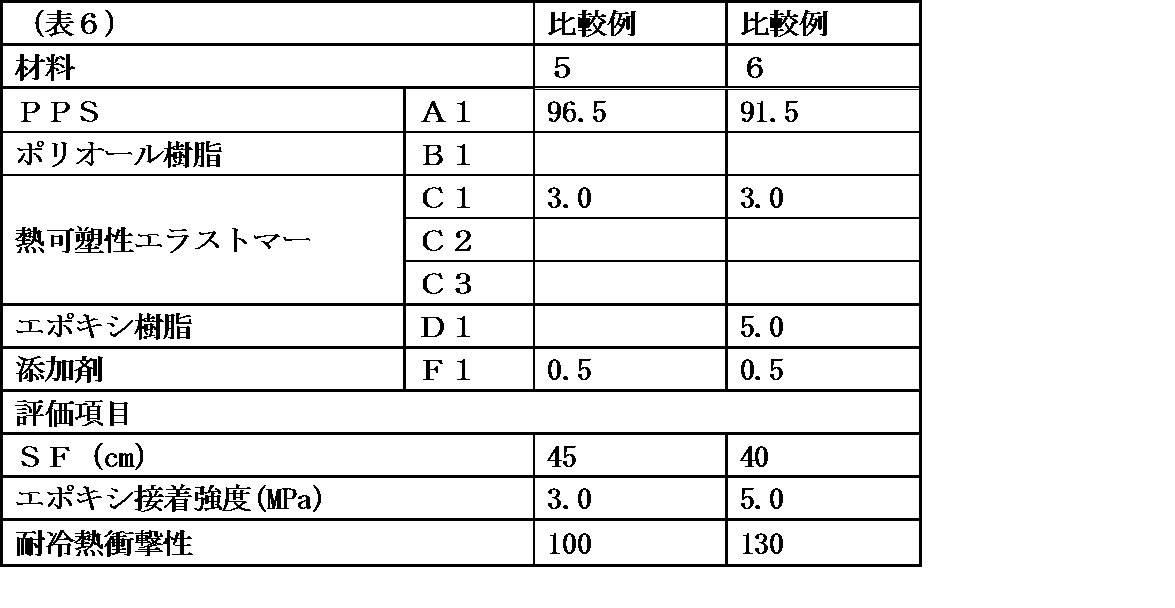
このペレットを用いて以下の各種評価試験を行った。試験及び評価の結果は、表1~表4に示した。
表1~表10に記載する組成成分および配合量にしたがい、各材料をタンブラーで均一に混合した。その後、東芝機械株式会社製ベント付き2軸押出機「TEM-35B」に前記配合材料を投入し、樹脂成分吐出量25kg/hr、スクリュー回転数250rpm、樹脂成分の吐出量(kg/hr)とスクリュー回転数(rpm)との比率(吐出量/スクリュー回転数)=0.1(kg/hr・rpm)、設定樹脂温度330℃で溶融混練して樹脂組成物のペレットを得た。
このペレットを用いて以下の各種評価試験を行った。試験及び評価の結果は、表1~表4に示した。
[スパイラルフロー(流動性評価)]
ポリフェニレンスルフィド樹脂組成物のペレットを、下記射出成形機を用い、下記の射出成型条件で幅6.0mm、厚さ1.6mmのスパイラル状金型にて成形された試験片の長さ(cm)をスパイラルフロー値(SF)とした。
射出成型機 スクリュー径:26.0mm
射出成型条件 シリンダー温度 : 330℃
金型温度 : 150℃
ポリフェニレンスルフィド樹脂組成物のペレットを、下記射出成形機を用い、下記の射出成型条件で幅6.0mm、厚さ1.6mmのスパイラル状金型にて成形された試験片の長さ(cm)をスパイラルフロー値(SF)とした。
射出成型機 スクリュー径:26.0mm
射出成型条件 シリンダー温度 : 330℃
金型温度 : 150℃
[PAS樹脂組成物のエポキシ樹脂との接着強度]
得られたペレットをシリンダー温度320℃に設定した住友-ネスタール社製射出成形機(SG75-HIPRO・MIII)に供給し、金型温度130℃に温調したASTM1号ダンベル片成形用金型を用いて射出成形を行い、ASTM1号ダンベル片を得た。得られたASTM1号ダンベル片を中央から2等分し、エポキシ接着剤との接触面積が50mm2となるように作成したスペーサー(厚さ:1.8~2.2mm、開口部:5mm×10mm)を2等分したASTM1号ダンベル片2枚の間に挟み、クリップを用い固定した後開口部にエポキシ樹脂(ナガセケムテックス株式会社製2液型エポキシ樹脂、主剤:XNR5002、硬化剤:XNH5002、配合比は主剤:硬化剤=100:90)を注入し、135℃に設定した熱風乾燥機中で3時間加熱し硬化・接着させた。23℃下で1日冷却後スペーサーを外し、得られた試験片を用いて歪み速度1mm/min、支点間距離80mm、23℃下でインストロン社製引張試験機を用い引張破断強さを測定し、接着面積で除した値をエポキシ接着強度とした。
得られたペレットをシリンダー温度320℃に設定した住友-ネスタール社製射出成形機(SG75-HIPRO・MIII)に供給し、金型温度130℃に温調したASTM1号ダンベル片成形用金型を用いて射出成形を行い、ASTM1号ダンベル片を得た。得られたASTM1号ダンベル片を中央から2等分し、エポキシ接着剤との接触面積が50mm2となるように作成したスペーサー(厚さ:1.8~2.2mm、開口部:5mm×10mm)を2等分したASTM1号ダンベル片2枚の間に挟み、クリップを用い固定した後開口部にエポキシ樹脂(ナガセケムテックス株式会社製2液型エポキシ樹脂、主剤:XNR5002、硬化剤:XNH5002、配合比は主剤:硬化剤=100:90)を注入し、135℃に設定した熱風乾燥機中で3時間加熱し硬化・接着させた。23℃下で1日冷却後スペーサーを外し、得られた試験片を用いて歪み速度1mm/min、支点間距離80mm、23℃下でインストロン社製引張試験機を用い引張破断強さを測定し、接着面積で除した値をエポキシ接着強度とした。
[冷熱衝撃試験]
縦25mm、横40mm、厚さ10mmの鋼鉄製のインサートブロック部材の、前記部材縦方向の辺の中点同士を結び、前記部材横方向の辺に平行な直線上に、直径3.55mmの厚さ方向に平行な2個の貫通穴の直径の中心を有し、該貫通穴の直径の中心同士が前記直線の中点を中心にして20mm離れて配置されたインサートブロック部材を準備し、次いで、前記2個の貫通穴と射出成型用金型内部に設置された2本の鋼鉄製円柱形のピンとを用いて、前記インサートブロック部材が前記射出成型用金型の内部に保持されるように設置し、かつ、ポリフェニレンスルフィド樹脂組成物のペレットを射出成型した後に、前記インサートブロック部材の外周全面が肉厚1mmのポリフェニレンスルフィド樹脂組成物で被覆されるように設計された射出成形金型を用いて、前記ポリフェニレンスルフィド樹脂組成物のペレットを射出成型し成型品を得た。得られた前記インサートブロック部材を内包するポリフェニレンスルフィド樹脂組成物の成型品を用いて、気相式の冷熱衝撃試験機中で-40℃/1時間保持~140℃/1時間保持を冷熱サイクル1サイクルとする冷熱衝撃試験を実施し、クラックが発生して破断するまでのサイクル数を測定した。
縦25mm、横40mm、厚さ10mmの鋼鉄製のインサートブロック部材の、前記部材縦方向の辺の中点同士を結び、前記部材横方向の辺に平行な直線上に、直径3.55mmの厚さ方向に平行な2個の貫通穴の直径の中心を有し、該貫通穴の直径の中心同士が前記直線の中点を中心にして20mm離れて配置されたインサートブロック部材を準備し、次いで、前記2個の貫通穴と射出成型用金型内部に設置された2本の鋼鉄製円柱形のピンとを用いて、前記インサートブロック部材が前記射出成型用金型の内部に保持されるように設置し、かつ、ポリフェニレンスルフィド樹脂組成物のペレットを射出成型した後に、前記インサートブロック部材の外周全面が肉厚1mmのポリフェニレンスルフィド樹脂組成物で被覆されるように設計された射出成形金型を用いて、前記ポリフェニレンスルフィド樹脂組成物のペレットを射出成型し成型品を得た。得られた前記インサートブロック部材を内包するポリフェニレンスルフィド樹脂組成物の成型品を用いて、気相式の冷熱衝撃試験機中で-40℃/1時間保持~140℃/1時間保持を冷熱サイクル1サイクルとする冷熱衝撃試験を実施し、クラックが発生して破断するまでのサイクル数を測定した。



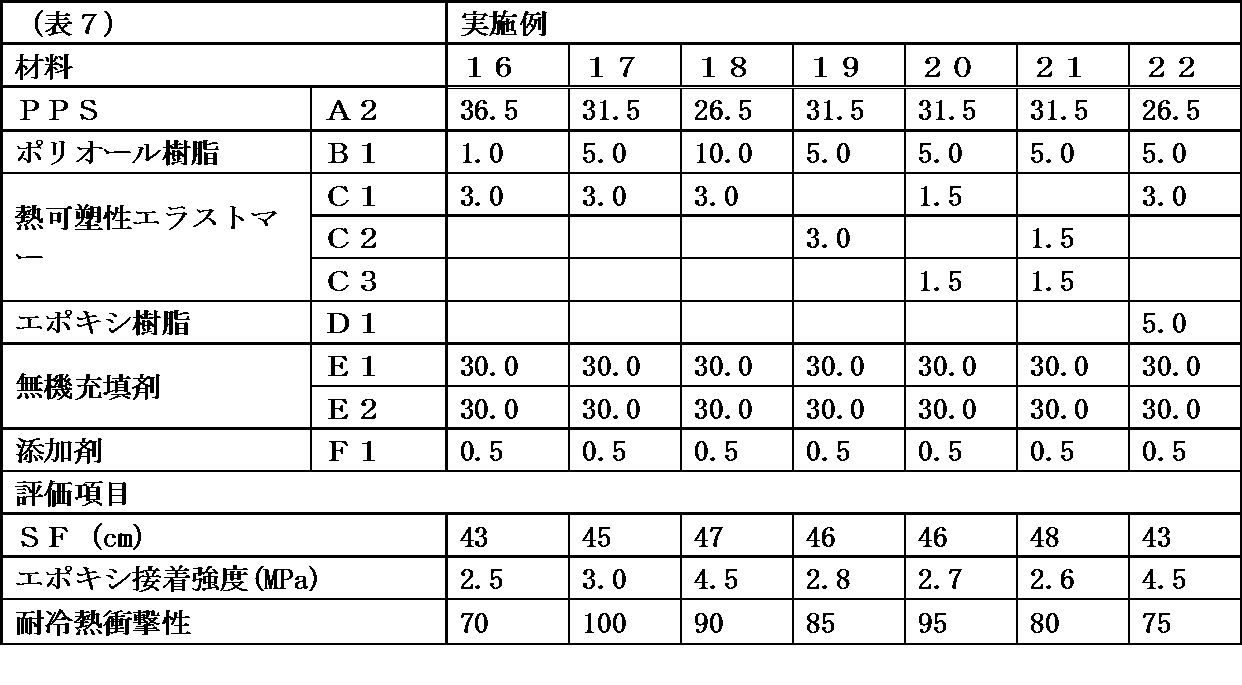

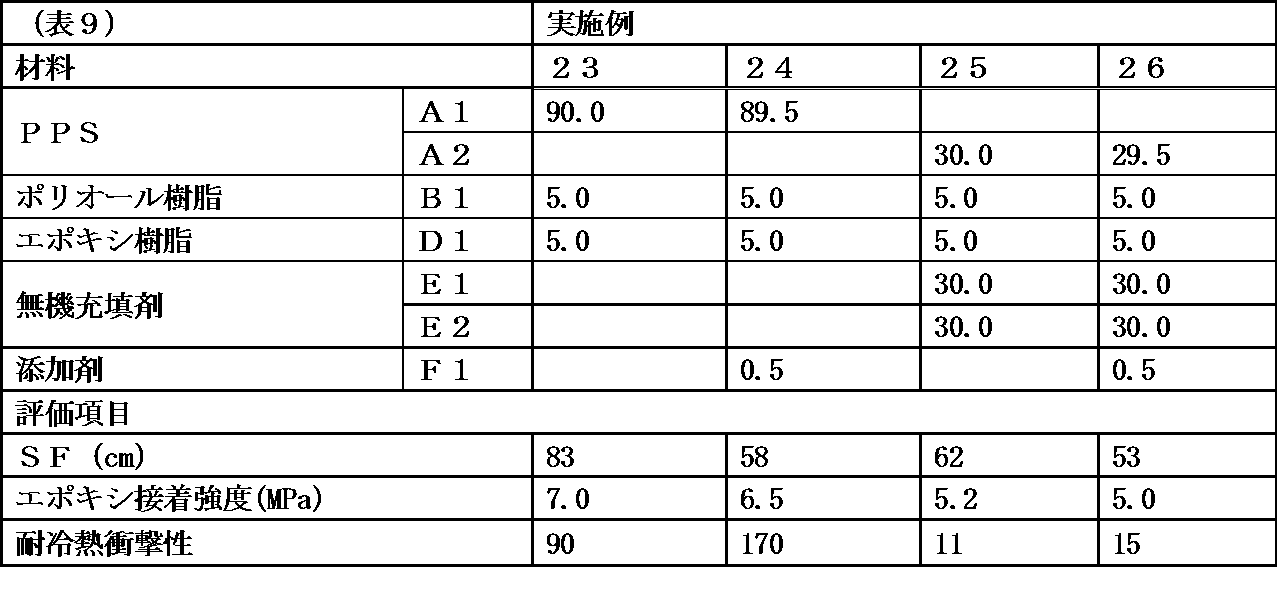
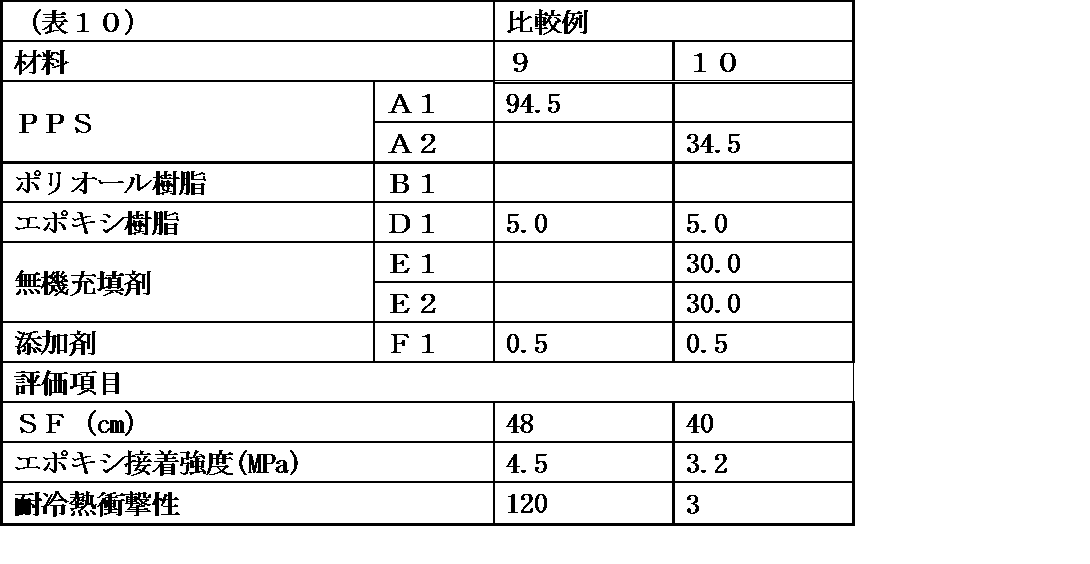
なお、表1~表10中の配合樹脂、材料は下記のものである。
PPS
A1 リニア型PPS DIC株式会社製「MA-520」(ピーク分子量45000、溶融粘度(V6)200Pa・s)
A2 リニア型PPS DIC株式会社製「MA-501」(ピーク分子量28000、溶融粘度(V6)15Pa・s)
PPS
A1 リニア型PPS DIC株式会社製「MA-520」(ピーク分子量45000、溶融粘度(V6)200Pa・s)
A2 リニア型PPS DIC株式会社製「MA-501」(ピーク分子量28000、溶融粘度(V6)15Pa・s)
ポリオール樹脂
B1 分岐ポリエーテルポリオール樹脂 DIC株式会社製「HBP-100」
(水酸基価260mgKOH/g、数平均分子量2600)
熱可塑性エラストマー
C1 エチレン-メタクリル酸グリシジル-アクリル酸メチル共重合体 友化学工業株式会社製「ボンドファースト7L」
C2 エチレン-無水マレイン酸-アクリル酸エチル共重合体 住友化学工業株式会社製「ボンダインAX8390」)
C3 エチレン-1-オクテン共重合体 ザ・ダウ・ケミカル社製「エンゲージ8842」
エポキシ樹脂
D1 ビスフェノールA型エポキシ樹脂 DIC株式会社製「エピクロン7050」
無機充填剤
E1 ガラス繊維 日本電気硝子株式会社製「T-717H」(直径10μmチョップドストランド)
E2 ガラスビーズ ポッターズバロティーニ株式会社製「EGB731」(粉末状、平均粒径20μm)
その他添加剤
F1 3-グリシドキシプロピルトリメトキシシラン ダウ・コーニング株式会社製「SH-6040」
B1 分岐ポリエーテルポリオール樹脂 DIC株式会社製「HBP-100」
(水酸基価260mgKOH/g、数平均分子量2600)
熱可塑性エラストマー
C1 エチレン-メタクリル酸グリシジル-アクリル酸メチル共重合体 友化学工業株式会社製「ボンドファースト7L」
C2 エチレン-無水マレイン酸-アクリル酸エチル共重合体 住友化学工業株式会社製「ボンダインAX8390」)
C3 エチレン-1-オクテン共重合体 ザ・ダウ・ケミカル社製「エンゲージ8842」
エポキシ樹脂
D1 ビスフェノールA型エポキシ樹脂 DIC株式会社製「エピクロン7050」
無機充填剤
E1 ガラス繊維 日本電気硝子株式会社製「T-717H」(直径10μmチョップドストランド)
E2 ガラスビーズ ポッターズバロティーニ株式会社製「EGB731」(粉末状、平均粒径20μm)
その他添加剤
F1 3-グリシドキシプロピルトリメトキシシラン ダウ・コーニング株式会社製「SH-6040」
Claims (12)
- ポリアリーレンスルフィド樹脂(A)とポリエーテルポリオール(B)とを含有するポリアリーレンスルフィド樹脂組成物であって、
前記ポリエーテルポリオールが、分子内に分岐構造を有することを特徴とするポリアリーレンスルフィド樹脂組成物。 - 前記ポリエーテルポリオール(B)の水酸基価が150~350mgKOH/gの範囲である請求項1記載のポリアリーレンスルフィド樹脂組成物。
- 前記ポリエーテルポリオール(B)の数平均分子量(Mn)が1,000~4,000の範囲であることを特徴とする請求項1又は2記載のポリアリーレンスルフィド樹脂組成物。
- 前記ポリエーテルポリオール(B)は、分子内に、1級水素基(H1)と2級水素基(H2)を有する請求項1~3の何れか一項記載のポリアリーレンスルフィド樹脂組成物。
- 前記ポリエーテルポリオール(B)における、前記1級水素基(H1)と2級水素基(H2)との割合が、1級水素基(H1)と2級水素基(H2)を合計した全水酸基数に対して、1級水素基(H1)が30~80%であり、2級水素基(H2)が70~20%の範囲である請求項4記載のポリアリーレンスルフィド樹脂組成物。
- 前記ポリエーテルポリオール(B)は、ヒドロキシアルキルオキセタン(b1)と1官能性エポキシ化合物(b2)とを開環反応させて得られるものである請求項1~5の何れか一項記載のポリアリーレンスルフィド樹脂組成物。
- さらに熱可塑性エラストマー(C)を含有する、請求項1~6の何れか一項記載のポリアリーレンスルフィド樹脂組成物。
- さらにエポキシ樹脂(D)を含有する、請求項1~7の何れか一項記載のポリアリーレンスルフィド樹脂組成物。
- さらに、充填剤(E)を含有する請求項1~8の何れか一項記載のポリアリーレンスルフィド樹脂組成物。
- さらに、カップリング剤(F)を含有する請求項1~9の何れか一項記載のポリアリーレンスルフィド樹脂組成物。
- 請求項1~10の何れか一項記載のポリアリーレンスルフィド樹脂組成物を成形してなる成形体。
- 請求項11記載の成形体と、硬化性樹脂からなる硬化物とが接着してなる複合成形品。
Priority Applications (1)
| Application Number | Priority Date | Filing Date | Title |
|---|---|---|---|
| JP2015554804A JP5935957B2 (ja) | 2013-12-25 | 2014-12-18 | ポリアリーレンスルフィド樹脂組成物及びその成形体 |
Applications Claiming Priority (6)
| Application Number | Priority Date | Filing Date | Title |
|---|---|---|---|
| JP2013-266993 | 2013-12-25 | ||
| JP2013-267011 | 2013-12-25 | ||
| JP2013-266994 | 2013-12-25 | ||
| JP2013266994 | 2013-12-25 | ||
| JP2013267011 | 2013-12-25 | ||
| JP2013266993 | 2013-12-25 |
Publications (1)
| Publication Number | Publication Date |
|---|---|
| WO2015098703A1 true WO2015098703A1 (ja) | 2015-07-02 |
Family
ID=53478562
Family Applications (1)
| Application Number | Title | Priority Date | Filing Date |
|---|---|---|---|
| PCT/JP2014/083586 Ceased WO2015098703A1 (ja) | 2013-12-25 | 2014-12-18 | ポリアリーレンスルフィド樹脂組成物及びその成形体 |
Country Status (2)
| Country | Link |
|---|---|
| JP (1) | JP5935957B2 (ja) |
| WO (1) | WO2015098703A1 (ja) |
Cited By (1)
| Publication number | Priority date | Publication date | Assignee | Title |
|---|---|---|---|---|
| JP2018161768A (ja) * | 2017-03-24 | 2018-10-18 | Dic株式会社 | 複合成形品及びその製造方法 |
Citations (4)
| Publication number | Priority date | Publication date | Assignee | Title |
|---|---|---|---|---|
| JPS6469657A (en) * | 1987-09-08 | 1989-03-15 | Toray Industries | Polyphenylene sulfide resin composition |
| JPH08311201A (ja) * | 1995-05-16 | 1996-11-26 | Tonen Chem Corp | 接着性に優れたポリアリーレンスルフィド |
| JP2006282698A (ja) * | 2005-03-31 | 2006-10-19 | Dainippon Ink & Chem Inc | 多分岐ポリエーテルポリオール及びウレタン系樹脂組成物 |
| JP2008111105A (ja) * | 2006-10-06 | 2008-05-15 | Dainippon Ink & Chem Inc | プラスチック基材用カチオン重合性接着剤、それを用いた積層体及び偏光板 |
-
2014
- 2014-12-18 WO PCT/JP2014/083586 patent/WO2015098703A1/ja not_active Ceased
- 2014-12-18 JP JP2015554804A patent/JP5935957B2/ja not_active Expired - Fee Related
Patent Citations (4)
| Publication number | Priority date | Publication date | Assignee | Title |
|---|---|---|---|---|
| JPS6469657A (en) * | 1987-09-08 | 1989-03-15 | Toray Industries | Polyphenylene sulfide resin composition |
| JPH08311201A (ja) * | 1995-05-16 | 1996-11-26 | Tonen Chem Corp | 接着性に優れたポリアリーレンスルフィド |
| JP2006282698A (ja) * | 2005-03-31 | 2006-10-19 | Dainippon Ink & Chem Inc | 多分岐ポリエーテルポリオール及びウレタン系樹脂組成物 |
| JP2008111105A (ja) * | 2006-10-06 | 2008-05-15 | Dainippon Ink & Chem Inc | プラスチック基材用カチオン重合性接着剤、それを用いた積層体及び偏光板 |
Cited By (1)
| Publication number | Priority date | Publication date | Assignee | Title |
|---|---|---|---|---|
| JP2018161768A (ja) * | 2017-03-24 | 2018-10-18 | Dic株式会社 | 複合成形品及びその製造方法 |
Also Published As
| Publication number | Publication date |
|---|---|
| JPWO2015098703A1 (ja) | 2017-03-23 |
| JP5935957B2 (ja) | 2016-06-15 |
Similar Documents
| Publication | Publication Date | Title |
|---|---|---|
| JP5618025B2 (ja) | ポリアリーレンスルフィド樹脂組成物および成形体 | |
| JP6624204B2 (ja) | ポリアリーレンスルフィド樹脂組成物、成形品及び製造方法 | |
| WO2019208377A1 (ja) | ポリアリーレンスルフィド樹脂組成物、成形品、複合成形品及びそれらの製造方法 | |
| JP5510624B2 (ja) | ポリアリーレンスルフィド樹脂組成物および成形体 | |
| KR102141928B1 (ko) | 폴리아릴렌설피드 수지 조성물, 성형품 및 제조 방법 | |
| CN112020428B (zh) | 聚芳硫醚树脂组合物、成型品、复合成型品和它们的制造方法 | |
| JP5935957B2 (ja) | ポリアリーレンスルフィド樹脂組成物及びその成形体 | |
| JP2017066344A (ja) | ポリアリーレンスルフィド樹脂組成物、成形品及び製造方法 | |
| JP6180075B2 (ja) | ポリアリーレンスルフィド樹脂組成物 | |
| JP7497568B2 (ja) | ポリアリーレンスルフィド樹脂組成物、成形品、複合成形体及びそれら製造方法 | |
| WO2017033279A1 (ja) | ポリアリーレンスルフィド樹脂組成物及びその成形体 | |
| JP6886584B2 (ja) | 複合成形品及びその製造方法 | |
| JP6315255B2 (ja) | ポリアリーレンスルフィド樹脂組成物及びその成形体 | |
| JP6886583B2 (ja) | ポリアリーレンスルフィド樹脂組成物、成形品及び製造方法 | |
| JP2017125215A (ja) | ポリアリーレンスルフィド樹脂組成物及びその成形体 | |
| WO2018056240A1 (ja) | ポリアリーレンスルフィド樹脂組成物、成形品及び製造方法 | |
| WO2022215395A1 (ja) | ポリアリーレンスルフィド樹脂組成物、成形品およびそれらの製造方法 |
Legal Events
| Date | Code | Title | Description |
|---|---|---|---|
| 121 | Ep: the epo has been informed by wipo that ep was designated in this application |
Ref document number: 14875187 Country of ref document: EP Kind code of ref document: A1 |
|
| ENP | Entry into the national phase |
Ref document number: 2015554804 Country of ref document: JP Kind code of ref document: A |
|
| NENP | Non-entry into the national phase |
Ref country code: DE |
|
| 122 | Ep: pct application non-entry in european phase |
Ref document number: 14875187 Country of ref document: EP Kind code of ref document: A1 |