WO2015087801A1 - 水棲有害付着生物防除組成物および防汚塗料組成物 - Google Patents
水棲有害付着生物防除組成物および防汚塗料組成物 Download PDFInfo
- Publication number
- WO2015087801A1 WO2015087801A1 PCT/JP2014/082251 JP2014082251W WO2015087801A1 WO 2015087801 A1 WO2015087801 A1 WO 2015087801A1 JP 2014082251 W JP2014082251 W JP 2014082251W WO 2015087801 A1 WO2015087801 A1 WO 2015087801A1
- Authority
- WO
- WIPO (PCT)
- Prior art keywords
- group
- unsubstituted
- substituted
- formula
- composition
- Prior art date
- Legal status (The legal status is an assumption and is not a legal conclusion. Google has not performed a legal analysis and makes no representation as to the accuracy of the status listed.)
- Ceased
Links
Classifications
-
- A—HUMAN NECESSITIES
- A01—AGRICULTURE; FORESTRY; ANIMAL HUSBANDRY; HUNTING; TRAPPING; FISHING
- A01N—PRESERVATION OF BODIES OF HUMANS OR ANIMALS OR PLANTS OR PARTS THEREOF; BIOCIDES, e.g. AS DISINFECTANTS, AS PESTICIDES OR AS HERBICIDES; PEST REPELLANTS OR ATTRACTANTS; PLANT GROWTH REGULATORS
- A01N43/00—Biocides, pest repellants or attractants, or plant growth regulators containing heterocyclic compounds
- A01N43/02—Biocides, pest repellants or attractants, or plant growth regulators containing heterocyclic compounds having rings with one or more oxygen or sulfur atoms as the only ring hetero atoms
- A01N43/04—Biocides, pest repellants or attractants, or plant growth regulators containing heterocyclic compounds having rings with one or more oxygen or sulfur atoms as the only ring hetero atoms with one hetero atom
- A01N43/14—Biocides, pest repellants or attractants, or plant growth regulators containing heterocyclic compounds having rings with one or more oxygen or sulfur atoms as the only ring hetero atoms with one hetero atom six-membered rings
- A01N43/18—Biocides, pest repellants or attractants, or plant growth regulators containing heterocyclic compounds having rings with one or more oxygen or sulfur atoms as the only ring hetero atoms with one hetero atom six-membered rings with sulfur as the ring hetero atom
-
- C—CHEMISTRY; METALLURGY
- C09—DYES; PAINTS; POLISHES; NATURAL RESINS; ADHESIVES; COMPOSITIONS NOT OTHERWISE PROVIDED FOR; APPLICATIONS OF MATERIALS NOT OTHERWISE PROVIDED FOR
- C09D—COATING COMPOSITIONS, e.g. PAINTS, VARNISHES OR LACQUERS; FILLING PASTES; CHEMICAL PAINT OR INK REMOVERS; INKS; CORRECTING FLUIDS; WOODSTAINS; PASTES OR SOLIDS FOR COLOURING OR PRINTING; USE OF MATERIALS THEREFOR
- C09D201/00—Coating compositions based on unspecified macromolecular compounds
-
- C—CHEMISTRY; METALLURGY
- C09—DYES; PAINTS; POLISHES; NATURAL RESINS; ADHESIVES; COMPOSITIONS NOT OTHERWISE PROVIDED FOR; APPLICATIONS OF MATERIALS NOT OTHERWISE PROVIDED FOR
- C09D—COATING COMPOSITIONS, e.g. PAINTS, VARNISHES OR LACQUERS; FILLING PASTES; CHEMICAL PAINT OR INK REMOVERS; INKS; CORRECTING FLUIDS; WOODSTAINS; PASTES OR SOLIDS FOR COLOURING OR PRINTING; USE OF MATERIALS THEREFOR
- C09D5/00—Coating compositions, e.g. paints, varnishes or lacquers, characterised by their physical nature or the effects produced; Filling pastes
- C09D5/14—Paints containing biocides, e.g. fungicides, insecticides or pesticides
-
- C—CHEMISTRY; METALLURGY
- C09—DYES; PAINTS; POLISHES; NATURAL RESINS; ADHESIVES; COMPOSITIONS NOT OTHERWISE PROVIDED FOR; APPLICATIONS OF MATERIALS NOT OTHERWISE PROVIDED FOR
- C09D—COATING COMPOSITIONS, e.g. PAINTS, VARNISHES OR LACQUERS; FILLING PASTES; CHEMICAL PAINT OR INK REMOVERS; INKS; CORRECTING FLUIDS; WOODSTAINS; PASTES OR SOLIDS FOR COLOURING OR PRINTING; USE OF MATERIALS THEREFOR
- C09D5/00—Coating compositions, e.g. paints, varnishes or lacquers, characterised by their physical nature or the effects produced; Filling pastes
- C09D5/16—Antifouling paints; Underwater paints
- C09D5/1606—Antifouling paints; Underwater paints characterised by the anti-fouling agent
- C09D5/1612—Non-macromolecular compounds
- C09D5/1625—Non-macromolecular compounds organic
-
- C—CHEMISTRY; METALLURGY
- C09—DYES; PAINTS; POLISHES; NATURAL RESINS; ADHESIVES; COMPOSITIONS NOT OTHERWISE PROVIDED FOR; APPLICATIONS OF MATERIALS NOT OTHERWISE PROVIDED FOR
- C09D—COATING COMPOSITIONS, e.g. PAINTS, VARNISHES OR LACQUERS; FILLING PASTES; CHEMICAL PAINT OR INK REMOVERS; INKS; CORRECTING FLUIDS; WOODSTAINS; PASTES OR SOLIDS FOR COLOURING OR PRINTING; USE OF MATERIALS THEREFOR
- C09D7/00—Features of coating compositions, not provided for in group C09D5/00; Processes for incorporating ingredients in coating compositions
- C09D7/40—Additives
Definitions
- the present invention relates to a varicella harmful organism control composition and an antifouling coating composition. More specifically, the present invention relates to a composition for controlling aquatic harmful organisms that is safe for fish and human animals, while exhibiting a high control effect against aquatic harmful organisms, and an antifouling paint composition containing the composition.
- This application claims priority based on Japanese Patent Application No. 2013-254050 filed in Japan on December 9, 2013, the contents of which are incorporated herein by reference.
- an antifouling paint is generally applied to the ship bottom.
- the antifouling paint contains an antifouling agent that kills or repels fixed organisms.
- antifouling agent examples include those containing pyridinium tetraphenylborate and 3- (3,4-dichlorophenyl) -1,1-dimethylurea as active ingredients (Patent Document 1), insoluble salts of dithiocarbamic acids, copper or One containing a copper compound (Patent Document 2), one containing spinosyn such as spinosad, spinetoram, butenylspinosine (Patent Document 3), one containing an insecticide such as benzoylurea (Patent Document 4), etc. It has been known.
- ballast water is used as the ballast of the ship (ballast).
- the seawater loaded when leaving the port without loading contains aquatic organisms peculiar to the port of departure.
- Ballast water is discharged outside the ship instead of loading luggage at the port where it stops.
- aquatic organisms contained in ballast water affect the ecosystem as an alien species.
- a method using a complex I mitochondrial electron transfer inhibitor (METI) has been proposed (Patent Document 5).
- JP-A-5-25408 JP-A-8-252533 Special table 2012-502971 gazette Japanese Patent Laid-Open No. 9-507084 JP 2008-533094 A JP 2008-1681 A JP 2009-227655 A WO2010 / 070910A WO2011 / 058963A WO2012 / 072489A JP 2012-92091 A
- An object of the present invention is to provide a composition for controlling aquatic harmful organisms that is safe for fish and human animals but exhibiting a high control effect against the harmful organisms for aquatic organisms, and an antifouling paint composition containing the composition. Is to provide.
- Patent Documents 6 to 11 disclose control of insects, ticks, nematodes and the like in agricultural applications, epidemics or veterinary drugs.
- the drug to be described is described. It is not generally considered in the art that chemicals for agrochemical use are effective in removing aquatic organisms. Under such circumstances, as a result of studies to achieve the above object, the present inventor has completed the present invention including the following modes.
- a chickenpox harmful organism control composition containing, as an active ingredient, at least one selected from the compound represented by formula (I-1) or formula (I-2) and a salt thereof.
- X represents —OR I , —S (O) 1 R I , or —NR I R II .
- G and J are each independently a hydrogen atom, —R I , —OR I , —S (O) 1 R I , —SC ( ⁇ O) R I , —OC ( ⁇ O) R I , —OS (O) 1 R I , —C ( ⁇ O) R I , —C ( ⁇ O) OR I , —NR I R II , —N ⁇ CR I R II , halogeno group, cyano group, or nitro group .
- J and L may be connected to each other to form a 5- to 8-membered ring together with the carbon atom to which they are bonded.
- l represents an integer of 0 to 2.
- R I and R II each independently represent a hydrogen atom, an unsubstituted or substituted C1-6 alkyl group, an unsubstituted or substituted C2-6 alkenyl group, an unsubstituted or substituted group. Having a C2-6 alkynyl group, an unsubstituted or substituted C3-8 cycloalkyl group, an unsubstituted or substituted 6-10 membered aryl group, or an unsubstituted or substituted 3-10 membered A heterocyclyl group; * Indicates that there is stereoisomerism due to double bonds (undefined double stereo bond). ]
- a varicella harmful organism control composition comprising as an active ingredient at least one selected from the compounds represented by formula (II) and salts thereof.
- Y ′ represents an unsubstituted or substituted C 6-10 aryl group having a substituent X 1 , or an unsubstituted or substituted X 1 5-6 membered heteroaryl group.
- X 1 is an unsubstituted or substituted C1-6 alkyl group, an unsubstituted or substituted C2-6 alkenyl group, an unsubstituted or substituted C2-6 alkynyl group, unsubstituted or Substituted C3-8 cycloalkyl group, hydroxyl group, unsubstituted or substituted C1-6 alkoxy group, unsubstituted or substituted C1-7 acyl group, unsubstituted or substituted C1 -6 alkoxycarbonyl group, unsubstituted or substituted amino group, unsubstituted or substituted C1-6 alkylthio group, unsubstituted or substituted C1-6 alkylsulfonyl group, unsubstituted or Substituted C6-10 aryl group, unsubstituted or substituted 3-10 membered heterocyclyl group, halogeno group, It shows the amino group or a nitro group.
- the number of substituents X 1 on Y ′ is an integer from 1 to 5. When there are two or more substituents X 1, X 1 may be the same as or different from each other.
- a 1 and A 2 each independently represents an oxygen atom, —S (O) 1 —, —NR 1 —, or —CR 1 R 2 —.
- R 1 and R 2 each independently have a hydrogen atom, an unsubstituted or substituted C1-6 alkyl group, an unsubstituted or substituted C2-6 alkenyl group, an unsubstituted or substituted group A C2-6 alkynyl group, an unsubstituted or substituted C3-8 cycloalkyl group, an unsubstituted or substituted C6-10 aryl group, an unsubstituted or substituted 3-10 membered heterocyclyl group, A halogeno group or a cyano group is shown.
- R 1 and R 2 bonded to the same carbon atom may be combined to form an unsubstituted or substituted exomethylene group.
- R 1 and R 2 may be connected to each other to form a ring together with the carbon atom to which R 1 and R 2 are bonded.
- n represents the number of methylenes substituted with R 1 and R 2 and is an integer of 1 to 3. When n is 2 or more, R 1 and R 2 may be the same or different.
- G ′ represents a hydrogen atom or an unsubstituted or substituted C1-6 alkyl group.
- E represents an oxygen atom or —S (O) 1 —.
- l represents an integer of 0 to 2.
- Q is unsubstituted or C7 ⁇ 11 aralkyl group having a substituent X 2, unsubstituted or C6 ⁇ 10 aryl group having a substituent X 2, or unsubstituted or 5-10 membered having a substituent X 2, A heteroaryl group is shown.
- X 2 is an unsubstituted or substituted C1-6 alkyl group, an unsubstituted or substituted C2-6 alkenyl group, an unsubstituted or substituted C2-6 alkynyl group, unsubstituted or Substituted C3-8 cycloalkyl group, hydroxyl group, unsubstituted or substituted C1-6 alkoxy group, unsubstituted or substituted C1-7 acyl group, unsubstituted or substituted C1 -6 alkoxycarbonyl group, unsubstituted or substituted amino group, unsubstituted or substituted C1-6 alkylthio group, unsubstituted or substituted C1-6 alkylsulfonyl group, unsubstituted or Substituted C6-10 aryl group, unsubstituted or substituted 3-6 membered heterocyclyl group, halogeno group, A group or a nitro group.
- the number of substituents X 2 on Q is an integer from 1 to 5. When two or more substituents X 2 are present, X 2 may be the same as or different from each other. * Indicates that there is stereoisomerism (E), (Z), or (E / Z) due to a double bond (undefined double stereo bond). ]
- a varicella harmful organism control composition containing, as an active ingredient, at least one selected from compounds represented by formula (III) and salts thereof.
- Y ′ represents an unsubstituted or substituted C 6-10 aryl group having a substituent X 1 , or an unsubstituted or substituted X 1 5-6 membered heteroaryl group.
- X 1 is an unsubstituted or substituted C1-6 alkyl group, an unsubstituted or substituted C2-6 alkenyl group, an unsubstituted or substituted C2-6 alkynyl group, unsubstituted or Substituted C3-8 cycloalkyl group, hydroxyl group, unsubstituted or substituted C1-6 alkoxy group, unsubstituted or substituted C1-7 acyl group, unsubstituted or substituted C1 -6 alkoxycarbonyl group, unsubstituted or substituted amino group, unsubstituted or substituted C1-6 alkylthio group, unsubstituted or substituted C1-6 alkylsulfonyl
- the number of substituents X 1 on Y ′ is an integer from 1 to 5. When there are two or more substituents X 1, X 1 may be the same as or different from each other.
- a 3 represents an oxygen atom or a sulfur atom.
- R 3 and R 4 each independently have a hydrogen atom, an unsubstituted or substituted C1-6 alkyl group, an unsubstituted or substituted C2-6 alkenyl group, an unsubstituted or substituted group A C2-6 alkynyl group, an unsubstituted or substituted C3-8 cycloalkyl group, an unsubstituted or substituted C6-10 aryl group, an unsubstituted or substituted 3-10 membered heterocyclyl group, Or a cyano group is shown.
- R 3 and R 4 may be combined to form an unsubstituted or substituted exomethylene group.
- R 5 and R 6 each independently have a hydrogen atom, an unsubstituted or substituted C1-6 alkyl group, an unsubstituted or substituted C2-6 alkenyl group, an unsubstituted or substituted group A C2-6 alkynyl group, an unsubstituted or substituted C3-8 cycloalkyl group, an unsubstituted or substituted C6-10 aryl group, an unsubstituted or substituted 3-6 membered heterocyclyl group, A halogeno group or a cyano group is shown.
- R 5 and R 6 may be connected to each other to form a ring together with the carbon atom to which R 5 and R 6 are bonded.
- m represents the number of methylenes substituted with R 5 and R 6 and is an integer from 1 to 4. When m is 2 or more, R 5 and R 6 may be the same as or different from each other.
- G ′ represents a hydrogen atom or an unsubstituted or substituted C1-6 alkyl group.
- E represents an oxygen atom or —S (O) 1 —.
- l represents an integer of 0 to 2.
- Q is unsubstituted or C7 ⁇ 11 aralkyl group having a substituent X 2, unsubstituted or C6 ⁇ 10 aryl group having a substituent X 2, or unsubstituted or 5-10 membered having a substituent X 2, A heteroaryl group is shown.
- X 2 is an unsubstituted or substituted C1-6 alkyl group, an unsubstituted or substituted C2-6 alkenyl group, an unsubstituted or substituted C2-6 alkynyl group, unsubstituted or Substituted C3-8 cycloalkyl group, hydroxyl group, unsubstituted or substituted C1-6 alkoxy group, unsubstituted or substituted C1-7 acyl group, unsubstituted or substituted C1 -6 alkoxycarbonyl group, unsubstituted or substituted amino group, unsubstituted or substituted C1-6 alkylthio group, unsubstituted or substituted C1-6 alkylsulfonyl group, unsubstituted or Substituted C6-10 aryl group, unsubstituted or substituted 3-6 membered heterocyclyl group, halogeno group, A group or a nitro group.
- the number of substituents X 2 on Q is an integer from 1 to 5. When two or more substituents X 2 are present, X 2 may be the same as or different from each other. * Indicates that there is stereoisomerism (E), (Z), or (E / Z) due to a double bond (undefined double stereo bond). ]
- the chickenpox harmful adhering organism control composition according to [3], wherein m is 1 or 2.
- An antifouling paint composition containing the composition for controlling harmful organisms of chickenpox according to any one of [1] to [6].
- a method for controlling varicella-poisonous organisms by using the varicella-poisonous organism-controlling composition according to any one of [1] to [6].
- a method for controlling an aquatic poisonous organism by applying the antifouling coating composition according to [7] to the surface of an underwater structure.
- the composition for controlling poisonous organisms of chickenpox of the present invention is highly effective against harmful organisms of poisonous chickenpox while being safe for fish and human animals.
- the antifouling coating composition of the present invention containing the composition is applied to an underwater structure, adhesion of aquatic organisms such as crustaceans can be prevented.
- composition for controlling harmful organisms attached to chickenpox comprises, as an active ingredient, at least one selected from the compound represented by formula (I-1) or formula (I-2) and a salt thereof. It contains.
- the term “unsubstituted” means only a group serving as a mother nucleus. When there is no description of “having a substituent” and only the name of the group serving as a mother nucleus is used, it means “unsubstituted” unless otherwise specified.
- the term “having a substituent” means that any hydrogen atom of a group serving as a mother nucleus is substituted with a group having the same or different structure from the mother nucleus. Accordingly, the “substituent” is another group bonded to a group serving as a mother nucleus.
- the number of substituents may be one, or two or more. Two or more substituents may be the same or different.
- C1-6 indicate that the number of carbon atoms of the group serving as the mother nucleus is 1-6. This number of carbon atoms does not include the number of carbon atoms present in the substituent.
- a butyl group having an ethoxy group as a substituent is classified as a C2 alkoxy C4 alkyl group.
- the “substituent” is not particularly limited as long as it is chemically acceptable and has the effects of the present invention. Examples of groups that can be “substituents” are shown below. C1-6 such as methyl group, ethyl group, n-propyl group, i-propyl group, n-butyl group, s-butyl group, i-butyl group, t-butyl group, n-pentyl group, n-hexyl group, etc.
- alkyl group An alkyl group; Vinyl group, 1-propenyl group, 2-propenyl group (allyl group), 1-butenyl group, 2-butenyl group, 3-butenyl group, 1-methyl-2-propenyl group, 2-methyl-2-propenyl group, etc.
- a C2-6 alkenyl group of C2-6 alkynyl groups such as ethynyl group, 1-propynyl group, 2-propynyl group, 1-butynyl group, 2-butynyl group, 3-butynyl group, 1-methyl-2-propynyl group;
- a C3-6 cycloalkyl group such as a cyclopropyl group, a cyclobutyl group, a cyclopentyl group, a cyclohexyl group;
- a C4-8 cycloalkenyl group such as a 2-cyclopentenyl group, a 3-cyclohexenyl group, a 4-cyclooctenyl group;
- a C6-10 aryl group such as a phenyl group or a naphthyl group;
- a C7-11 aralkyl group such as a benzyl group or a phenethyl group;
- Saturated heterocyclyl groups such as aziridinyl group, epoxy group, pyrrolidinyl group, tetrahydrofuranyl group, piperidyl group, piperazinyl group, morpholinyl group, dioxolane ring, dioxane ring; 5-membered heteroaryl groups such as pyrrolyl, furyl, thienyl, imidazolyl, pyrazolyl, oxazolyl, isoxazolyl, thiazolyl, isothiazolyl, triazolyl, oxadiazolyl, thiadiazolyl, tetrazolyl; 6-membered heteroaryl groups such as pyridyl group, pyrazinyl group
- Hydroxyl group C1-6 alkoxy groups such as methoxy group, ethoxy group, n-propoxy group, i-propoxy group, n-butoxy group, s-butoxy group, i-butoxy group, t-butoxy group; C2-6 alkenyloxy groups such as vinyloxy group, allyloxy group, propenyloxy group, butenyloxy group; C2-6 alkynyloxy groups such as ethynyloxy group and propargyloxy group; C6-10 aryloxy groups such as phenoxy group and 1-naphthoxy group; A C7-11 aralkyloxy group such as a benzyloxy group or a phenethyloxy group;
- C1-7 acyloxy groups such as formyloxy group, acetyloxy group, propionyloxy group, benzoyloxy group, cyclohexylcarbonyloxy group;
- a C1-6 alkoxycarbonyl group such as a methoxycarbonyl group, ethoxycarbonyl group, n-propoxycarbonyl group, i-propoxycarbonyl group, n-butoxycarbonyl group, t-butoxycarbonyl group; Carboxyl group;
- Halogeno groups such as fluoro, chloro, bromo and iodo groups; C1-6 haloalkyl groups such as chloromethyl group, chloroethyl group, trifluoromethyl group, 1,2-dichloro-n-propyl group, 1-fluoro-n-butyl group, perfluoro-n-pentyl group; A C2-6 haloalkenyl group such as a 2-chloro-1-propenyl group and a 2-fluoro-1-butenyl group; A C2-6 haloalkynyl group such as 4,4-dichloro-1-butynyl group, 4-fluoro-1-pentynyl group, 5-bromo-2-pentynyl group; C6-10 haloaryl group such as 4-chlorophenyl group, 4-fluorophenyl group, 2,4-dichlorophenyl group; A C1-6 haloalkoxy group such as a trifluorome
- a C1-6 alkylamino group such as a methylamino group, a dimethylamino group, a diethylamino group; C6-10 arylamino groups such as anilino group and naphthylamino group; A C7-11 aralkylamino group such as a benzylamino group or a phenethylamino group; C1-7 acylamino groups such as formylamino group, acetylamino group, propanoylamino group, butyrylamino group, i-propylcarbonylamino group, benzoylamino group; A C1-6 alkoxycarbonylamino group such as a methoxycarbonylamino group, an ethoxycarbonylamino group, an n-propoxycarbonylamino group, an i-propoxycarbonylamino group; An aminocarbonyl group having no substituent or a substituent such as an aminocarbonyl group having
- a mercapto group such as methylthio group, ethylthio group, n-propylthio group, i-propylthio group, n-butylthio group, i-butylthio group, s-butylthio group, t-butylthio group;
- a C6-10 arylthio group such as a phenylthio group or a naphthylthio group;
- a heteroarylthio group such as a thiazolylthio group or a pyridylthio group;
- a C7-11 aralkylthio group such as a benzylthio group or a phenethylthio group;
- a C1-6 alkylsulfonyl group such as a methylsulfonyl group, an ethylsulfonyl group, a t-butylsulfonyl group;
- a tri-C1-6 alkyl-substituted silyl group such as a trimethylsilyl group, a triethylsilyl group, a t-butyldimethylsilyl group;
- a triaryl-substituted silyl group such as a triphenylsilyl group; Cyano group; nitro group;
- any hydrogen atom in the substituent may be substituted with a group having a different structure.
- X represents —OR I , —S (O) 1 R I , or —NR I R II .
- l represents an integer of 0 to 2.
- R I and R II each independently represent a hydrogen atom, an unsubstituted or substituted C1-6 alkyl group, an unsubstituted or substituted C2-6 alkenyl group, an unsubstituted or substituted group.
- the “C1-6 alkyl group” may be a straight chain or a branched chain as long as it has 3 or more carbon atoms.
- Examples of the “alkyl group” include methyl, ethyl, n-propyl, n-butyl, n-pentyl, n-hexyl, i-propyl, i-butyl, s-butyl, t- Examples thereof include a butyl group, i-pentyl group, neopentyl group, 2-methylbutyl group, 2,2-dimethylpropyl group, i-hexyl group and the like.
- Examples of the “substituted C1-6 alkyl group” include C3-8 cycloalkyl C1 such as cyclopropylmethyl group, 2-cyclopropylethyl group, cyclopentylmethyl group, 2-cyclohexylethyl group, 2-cyclooctylethyl group, etc.
- Hydroxy C1-6 alkyl groups such as hydroxymethyl group, 1-hydroxyethyl group, 2-hydroxyethyl group; methoxymethyl group, ethoxymethyl group, methoxyethyl group, ethoxyethyl group, methoxy-n-propyl group, n-propoxy group
- C1-6 alkoxy C1-6 alkyl groups such as methyl group, i-propoxyethyl group, s-butoxymethyl group, t-butoxyethyl group; vinyloxymethyl group, allyloxymethyl group, propenyloxymethyl group, butenyloxy C2-6 alkenyloxy C1-6 alkyl group such as methyl group; heteroaryloxy C1-6 alkyl group such as pyridin-2-yloxymethyl group; C1-7 such as formylmethyl group, acetylmethyl group, propionylmethyl group An acyl C1-6 alkyl group;
- C1-7 acyloxy C1-6 alkyl groups such as formyloxymethyl group, acetoxymethyl group, 2-acetoxyethyl group, propionyloxymethyl group, propionyloxyethyl group; carboxyl groups C1-6 such as carboxylmethyl group and carboxylethyl group Alkyl group; C1-6 alkoxycarbonyl C1-6 alkyl group such as methoxycarbonylmethyl group, ethoxycarbonylmethyl group, n-propoxycarbonylmethyl group, i-propoxycarbonylmethyl group; formamidemethyl group, acetamidomethyl group, 2-acetamide C1-7 acylamino C1-6 alkyl groups such as ethyl group, propionylaminomethyl group, propionylaminoethyl group; methylaminocarbonylmethyl group, ethylaminocarbonylmethyl , I- propyl aminocarbonyl methyl, t- butyl aminocarbonyl methyl group,
- C1-6 such as methoxycarbonylaminomethyl group, ethoxycarbonylaminomethyl group, i-propoxycarbonylaminomethyl group, t-butoxycarbonylaminomethyl group, s-butyloxycarbonylaminomethyl group, n-pentyloxycarbonylaminomethyl group, etc.
- C2-6 alkenyl group examples include vinyl group, 1-propenyl group, 2-propenyl group, 1-butenyl group, 2-butenyl group, 3-butenyl group, 1-methyl-2-propenyl group, 2-methyl -2-propenyl group, 1-pentenyl group, 2-pentenyl group, 3-pentenyl group, 4-pentenyl group, 1-methyl-2-butenyl group, 2-methyl-2-butenyl group, 1-hexenyl group, 2 -Hexenyl group, 3-hexenyl group, 4-hexenyl group, 5-hexenyl group and the like can be mentioned.
- Examples of the “substituted C2-6 alkenyl group” include C2-6 haloalkenyl groups such as 2-chloro-1-propenyl group and 2-fluoro-1-butenyl group; 2-n-butoxy-vinyl group, 1 A C1-6 alkoxy C2-6 alkenyl group such as an ethoxy-vinyl group;
- C2-6 alkynyl group includes ethynyl group, 1-propynyl group, 2-propynyl group, 1-butynyl group, 2-butynyl group, 3-butynyl group, 1-methyl-2-propynyl group, 2-methyl -3-butynyl group, 1-pentynyl group, 2-pentynyl group, 3-pentynyl group, 4-pentynyl group, 1-methyl-2-butynyl group, 2-methyl-3-pentynyl group, 1-hexynyl group, 1 , 1-dimethyl-2-butynyl group and the like.
- a C2-6 haloalkynyl group such as a 4,4-dichloro-1-butynyl group, a 4-fluoro-1-pentynyl group, a 5-bromo-2-pentynyl group, etc.
- a tri-C1-6 alkyl-substituted silyl C2-6 alkynyl group such as a trimethylsilanylethynyl group;
- C3-8 cycloalkyl group examples include cyclopropyl group, cyclobutyl group, cyclopentyl group, cyclohexyl group, cycloheptyl group and the like.
- substituted C3-8 cycloalkyl group examples include alkyls such as 2,3,3-trimethylacyclobutyl group, 4,4,6,6-tetramethylcyclohexyl group and 1,3-dibutylcyclohexyl group.
- a substituted cycloalkyl group can be exemplified.
- C6-10 aryl group examples include phenyl group, naphthyl group, azulenyl group, indenyl group, indanyl group, tetralinyl group and the like.
- substituted C6-10 aryl group examples include 4-chlorophenyl group, 4-fluorophenyl group, 2,4-dichlorophenyl group and the like.
- the “3- to 10-membered heterocyclyl group” includes at least one heteroatom selected from the group consisting of a nitrogen atom, an oxygen atom and a sulfur atom as a ring-constituting atom.
- the heterocyclyl group may be monocyclic or polycyclic. In the polycyclic heterocyclyl group, if at least one ring is a hetero ring, the remaining ring may be a saturated alicyclic ring, an unsaturated alicyclic ring, or an aromatic ring.
- Examples of the “3- to 10-membered heterocyclyl group” include a 3- to 10-membered saturated heterocyclyl group, a 5- to 10-membered heteroaryl group, and a 5- to 10-membered partially unsaturated heterocyclyl group.
- Examples of the “3- to 10-membered saturated heterocyclyl group” include an aziridinyl group, an epoxy group, a pyrrolidinyl group, a tetrahydrofuranyl group, a thiazolidinyl group, a piperidyl group, a piperazinyl group, a morpholinyl group, and a dioxolanyl group (for details, refer to a [1,3] dioxolanyl group ) And dioxanyl groups (specifically, [1,3] dioxanyl group or [1,4] dioxanyl group).
- a 5- to 6-membered saturated heterocyclic ring is preferable.
- Examples of the “5-membered heteroaryl group” include pyrrolyl group, furyl group, thienyl group, imidazolyl group, pyrazolyl group, oxazolyl group, isoxazolyl group, thiazolyl group, isothiazolyl group, triazolyl group (for details, [1,2,3] Triazolyl group or [1,2,4] triazolyl group), oxadiazolyl group (specifically, [1,2,4] oxadiazolyl group or [1,3,4] oxadiazolyl group), thiadiazolyl group, tetrazolyl group, etc. Can be mentioned.
- Examples of the “6-membered heteroaryl group” include pyridyl group, pyrazinyl group, pyrimidinyl group, pyridanidyl group, triazinyl group and the like.
- Examples of the “partially unsaturated 5-membered heterocyclyl group” include pyrrolinyl group, imidazolinyl group (dihydroimidazolyl group), pyrazolinyl group, oxazolinyl group, isoxazolinyl group, thiazolinyl group and the like.
- Examples of the “partially unsaturated 6-membered heterocyclyl group” include a thiopyranyl group, a 2H-pyridin-1-yl group, and a 4H-pyridin-1-yl group.
- Y represents —R I , —OR I , —S (O) 1 R I , —C ( ⁇ O) R I , —C ( ⁇ S) R I , —C ( ⁇ O) OR I , —NR I R II , —N ⁇ CR I R II , or a cyano group is shown.
- l represents an integer of 0 to 2.
- R I and R II are as described above.
- the compound used in the present invention includes only the E isomer, only the Z isomer, a mixture of the E isomer and the Z isomer, and a product in which the E isomer and the Z isomer cannot be distinguished.
- R I and R II are as described above.
- L represents —R I , —OR I , —S (O) 1 R I , —NR I R II , or —N ⁇ CR I R II .
- l represents an integer of 0 to 2.
- R I and R II are as described above.
- J and L may be connected to each other to form a 5- to 8-membered ring together with the carbon atom to which they are bonded.
- Examples of the compound in which J and L are connected to each other include compounds represented by formulas (a1) to (a10).
- X, G and Y in the formulas (a1) to (a10) have the same meaning as those in the formula (I).
- R 1 and R 2 are each independently a hydrogen atom, an unsubstituted or substituted C1-6 alkyl group, an unsubstituted or substituted C2-6 alkenyl.
- R 1 and R 2 bonded to the same carbon atom may be combined to form an unsubstituted or substituted exomethylene group.
- R 1 and R 2 may be connected to each other to form a ring together with the carbon atom to which R 1 and R 2 are bonded.
- h represents the number of methylenes substituted with R 1 and R 2 and is an integer of 1 to 4.
- R 3 and R 4 may be connected to each other to form a ring together with the carbon atom to which R 3 and R 4 are bonded.
- Examples of the “ring” formed by the carbon atoms to which R 3 and R 4 are linked to each other include a cyclopropane ring, a cyclobutane ring, a cyclopentane ring, a cyclohexane ring, a cycloheptane ring, a tetrahydrofuran ring, a tetrahydropyran ring, etc. Can be mentioned.
- a 1 and A 2 each independently represents an oxygen atom, —S (O) 1 —, —NR 1 —, or —CR 1 R 2 —.
- l represents an integer of 0 to 2.
- R 1 and R 2 are as described above.
- R 3 and R 4 each independently represent a hydrogen atom, an unsubstituted or substituted C1-6 alkyl group, an unsubstituted or Substituted C2-6 alkenyl group, unsubstituted or substituted C2-6 alkynyl group, unsubstituted or substituted C3-8 cycloalkyl group, unsubstituted or substituted C6-10
- An aryl group, an unsubstituted or substituted 3- to 10-membered heterocyclyl group, or a cyano group is shown.
- R 3 and R 4 “Alkynyl group”, “unsubstituted or substituted C3-8 cycloalkyl group”, “unsubstituted or substituted C6-10 aryl group”, “unsubstituted or substituted 3-10 membered”
- R 3 and R 4 may be combined to form an unsubstituted or substituted exomethylene group.
- k represents the number of methylenes substituted with R 3 and R 4 and is an integer of 1 to 4. When k is 2 or more, R 3 and R 4 may be the same or different from each other.
- l represents an integer of 0 to 2.
- the ring represented by Ar represents an unsubstituted or substituted benzene ring, or an unsubstituted or substituted 5- to 6-membered heteroaryl ring, and the bonding site is Two adjacent carbon atoms.
- Examples of the “5- to 6-membered heteroaryl ring” include the same as those described for R I.
- composition for controlling harmful aquatic organisms contains at least one selected from the compound represented by the formula (II) and salts thereof as an active ingredient.
- Y ' represents a non-substituted or C6 ⁇ 10 aryl group having a substituent X 1 or unsubstituted or heteroaryl group 5-6 membered having a substituent X 1,.
- Examples of the “unsubstituted or C6-10 aryl group having the substituent X 1 ” in Y ′ include the same as those described in R I.
- the “5- to 6-membered heteroaryl group” in Y ′ includes 1 to 4 heteroatoms selected from the group consisting of a nitrogen atom, an oxygen atom and a sulfur atom as ring constituent atoms.
- Examples of 5-membered heteroaryl rings include pyrrolyl, furyl, thienyl, imidazolyl, pyrazolyl, oxazolyl, isoxazolyl, thiazolyl, isothiazolyl, triazolyl, oxadiazolyl, thiadiazolyl, tetrazolyl Can do.
- Examples of the 6-membered heteroaryl ring include a pyridyl group, a pyrazinyl group, a pyrimidinyl group, a pyridanidyl group, and a triazinyl group.
- X 1 is an unsubstituted or substituted C1-6 alkyl group, an unsubstituted or substituted C2-6 alkenyl group, an unsubstituted or substituted C2-6 alkynyl group, unsubstituted or Substituted C3-8 cycloalkyl group, hydroxyl group, unsubstituted or substituted C1-6 alkoxy group, unsubstituted or substituted C1-7 acyl group, unsubstituted or substituted C1 -6 alkoxycarbonyl group, unsubstituted or substituted amino group, unsubstituted or substituted C1-6 alkylthio group, unsubstituted or substituted C1-6 alkylsulfonyl group, unsubstituted or Substituted C6-10 aryl group, unsubstituted or substituted 3-10 membered heterocyclyl group, halogeno group, It shows the amino group or a nitro group.
- Examples of the “unsubstituted or substituted C1-6 alkoxy group” include methoxy group, ethoxy group, n-propoxy group, i-propoxy group, n-butoxy group, s-butoxy group, i-butoxy group, t -Butoxy group; chloromethoxy group, dichloromethoxy group, difluoromethoxy group, trichloromethoxy group, trifluoromethoxy group, 1-fluoroethoxy group, 1,1-difluoroethoxy group, 2,2,2-trifluoroethoxy group, Examples thereof include C1-6 haloalkoxy groups such as a pentafluoroethoxy group.
- Examples of the “unsubstituted or substituted C1-7 acyl group” include formyl group, acetyl group, propionyl group, benzoyl group, cyclohexylcarbonyl group; chloroacetyl group, trifluoroacetyl group, trichloroacetyl group, 4-chloro group.
- C1-7 haloacyl groups such as benzoyl group and the like can be mentioned.
- Examples of the “unsubstituted or substituted C1-6 alkoxycarbonyl group” include methoxycarbonyl group, ethoxycarbonyl group, n-propoxycarbonyl group, i-propoxycarbonyl group, n-butoxycarbonyl group, t-butoxycarbonyl group Cyclopropylmethoxycarbonyl group, cyclobutylmethoxycarbonyl group, cyclopentylmethoxycarbonyl group, cyclohexylmethoxycarbonyl group, 2-methylcyclopropylmethoxycarbonyl group, 2,3-dimethylcyclopropylmethoxycarbonyl group, 2-chlorocyclopropylmethoxycarbonyl group; Groups, C3-8 cycloalkyl C1-6 alkoxycarbonyl groups such as 2-cyclopropylethoxycarbonyl group; fluoromethoxycarbonyl group, chloromethoxycarbonyl Group, bromomethoxycarbonyl group, diflu
- Examples of the “unsubstituted or substituted amino group” include an amino group (NH 2 group); a C1-6 alkylamino group such as a methylamino group, a dimethylamino group, and a diethylamino group; an anilino group, a naphthylamino group, and the like.
- C1-7 acylamino groups of C1-6 alkoxycarbonylamino groups such as methoxycarbonylamino group, ethoxycarbonylamino group, n-propoxycarbonylamino group, i-propoxycarbonylamino group, and the like.
- Examples of the “unsubstituted or substituted C1-6 alkylthio group” include methylthio group, ethylthio group, n-propylthio group, i-propylthio group, n-butylthio group, i-butylthio group, s-butylthio group, t -Butylthio group; benzylthio group, phenethylthio group and the like.
- Examples of the “unsubstituted or substituted C1-6 alkylsulfonyl group” include methylsulfonyl group, ethylsulfonyl group, t-butylsulfonyl group; benzylsulfonyl group, phenethylsulfonyl group and the like.
- a 1 and A 2 each independently represents an oxygen atom, —S (O) 1 —, —NR 1 —, or —CR 1 R 2 —.
- l represents an integer of 0 to 2.
- R 1 and R 2 are each independently a hydrogen atom, an unsubstituted or substituted C1-6 alkyl group, an unsubstituted or substituted C2-6 alkenyl group, an unsubstituted group Or a substituted C2-6 alkynyl group, an unsubstituted or substituted C3-8 cycloalkyl group, an unsubstituted or substituted C6-10 aryl group, an unsubstituted or substituted 3 Represents a 10-membered heterocyclyl group, a halogeno group, or a cyano group;
- R 1 and R 2 bonded to the same carbon atom may be combined to form an unsubstituted or substituted exomethylene group.
- R 1 and R 2 may be connected to each other to form a ring together with the carbon atom to which R 1 and R 2 are bonded.
- n represents the number of methylenes substituted with R 1 and R 2 and is an integer of 1 to 3. When n is 2 or more, R 1 and R 2 may be the same or different. R 1 and R 2 are as described above.
- G ′ represents a hydrogen atom or an unsubstituted or substituted C1-6 alkyl group.
- Examples of the “unsubstituted or substituted C1-6 alkyl group” in G ′ include the same as those described in R I.
- E represents an oxygen atom or —S (O) 1 —.
- l represents an integer of 0 to 2.
- Q is an unsubstituted or C7 ⁇ 11 aralkyl group having a substituent X 2, unsubstituted or C6 ⁇ 10 aryl group having a substituent X 2, or unsubstituted or substituted groups X 2,
- a 5- to 10-membered heteroaryl group having X 2 is an unsubstituted or substituted C1-6 alkyl group, an unsubstituted or substituted C2-6 alkenyl group, an unsubstituted or substituted C2-6 alkynyl group, unsubstituted or Substituted C3-8 cycloalkyl group, hydroxyl group, unsubstituted or substituted C1-6 alkoxy group, unsubstituted or substituted C1-7 acyl group, unsubstituted or substituted C1 -6 alkoxycarbonyl group, unsubstituted or substituted amino group, unsubstituted or substituted C1-6 alkylthio
- composition for controlling harmful organisms harmful to waterpox contains at least one selected from the compound represented by the formula (III) and salts thereof as an active ingredient.
- a 3 represents an oxygen atom or a sulfur atom.
- R 5 and R 6 are each independently a hydrogen atom, an unsubstituted or substituted C1-6 alkyl group, an unsubstituted or substituted C2-6 alkenyl group, an unsubstituted group Or a substituted C2-6 alkynyl group, an unsubstituted or substituted C3-8 cycloalkyl group, an unsubstituted or substituted C6-10 aryl group, an unsubstituted or substituted 3
- R 5 and R 6 may be connected to each other to form a ring together with the carbon atom to which R 5 and R 6 are bonded.
- m represents the number of methylenes substituted with R 5 and R 6 and is an integer from 1 to 4. When m is 2 or more, R 5 and R 6 may be the same as or different from each other.
- C1 to 6 alkyl groups having an unsubstituted or substituted group in R 5 and R 6, "C2 to 6 alkenyl groups having an unsubstituted or substituted group”, C2 have "unsubstituted or substituted 1-6 "Alkynyl group”, “unsubstituted or substituted C3-8 cycloalkyl group”, “unsubstituted or substituted C6-10 aryl group”, “unsubstituted or substituted 3-6 membered”
- Examples of the “heterocyclyl group” and “halogeno group” include the same as those described for X 1 .
- the chickenpox harmful organism control composition according to the fourth embodiment of the present invention contains at least one selected from the compound represented by the formula (IV) and a salt thereof as an active ingredient.
- Y ′, G ′, X 1 , R 1 , R 2 , R 3 , and R 4 in formula (IV) have the same meaning as Y ′ in formula (II).
- a 4 in the formula (IV) represents an oxygen atom or a sulfur atom. Preferably it is a sulfur atom.
- K in the formula (IV) represents the number of methylenes substituted with R 3 and R 4 and is an integer of 1 to 4.
- R 3 and R 4 may be the same or different from each other.
- k is preferably 1 or 2.
- E ′ in the formula (IV) represents an oxygen atom or a sulfur atom. Preferably it is a sulfur atom.
- Q in (IV) ' is unsubstituted or C7 ⁇ 11 aralkyl group having a substituent X 2, C6 ⁇ 10 aryl groups having an unsubstituted or a substituent X 2, or unsubstituted or substituted groups X, 5 to 6-membered heteroaryl groups having 2 .
- the number of substituents X 2 on Q ′ is an integer from 1 to 5. When there are two or more substituents X 2, X 2 may be the same as or different from each other.
- Examples of the “C7-11 aralkyl group” in Q ′ include a benzyl group and a phenethyl group.
- Examples of the “C6-10 aryl group” and “5-6 membered heteroaryl group” in Q ′ include the same groups as those exemplified above for Y.
- a phenyl group or a thienyl group is preferable.
- X 2 has the same meaning as X 2 in formula (II).
- the waterpox harmful organism control composition according to the fifth embodiment of the present invention contains at least one selected from the compound represented by the formula (V) and salts thereof as an active ingredient.
- R 3a , R 3b , R 4a and R 4b each independently represent a hydrogen atom, an unsubstituted or substituted C1-6 alkyl group, an unsubstituted or substituted C2 -6 alkenyl group, unsubstituted or substituted C2-6 alkynyl group, unsubstituted or substituted C3-8 cycloalkyl group, unsubstituted or substituted C6-10 aryl group, unsubstituted Or a substituted 3- to 6-membered heterocyclyl group, a halogeno group, or a cyano group.
- C1-6 alkyl group “C2-6 alkenyl group”, “C2-6 alkynyl group”, “C3-8 cycloalkyl group”, “C6-10” in R 3a , R 3b , R 4a , and R 4b
- Examples of the “aryl group”, “3- to 6-membered heterocyclyl group”, and “halogeno group”, and the group having a substituent in these groups include the same groups as those exemplified for X 1 above.
- R 3a and R 4a may be connected to each other to form a ring together with the carbon atom to which R 3a and R 4a are bonded.
- Examples of the “ring” formed by the carbon atoms to which R 3a and R 4a are linked to each other include a cyclopropane ring, a cyclobutane ring, a cyclopentane ring, a cyclohexane ring, a cycloheptane ring, a tetrahydrofuran ring, a tetrahydropyran ring, etc. Can be mentioned. (E), (Z), or (E / Z) is indicated by the stereoisomerism of the double bond in which G and E are bonded in Formula (V).
- the double bond moiety is preferably a compound having the (E) steric structure.
- the chickenpox harmful organism control composition according to the sixth embodiment of the present invention contains at least one selected from the compound represented by formula (VI) and salts thereof as an active ingredient.
- X 1 , A 4 , R 1 , R 2 , G, E, and Q have the same meaning as those already described.
- m1 represents an integer of 0 to 5.
- R 3a , R 3b , R 4a and R 4b each independently represent a hydrogen atom, an unsubstituted or substituted C1-6 alkyl group, an unsubstituted or substituted C2 -6 alkenyl group, unsubstituted or substituted C2-6 alkynyl group, unsubstituted or substituted C3-8 cycloalkyl group, unsubstituted or substituted C6-10 aryl group, unsubstituted Or a substituted 3- to 6-membered heterocyclyl group, a halogeno group, or a cyano group.
- C1-6 alkyl group “C2-6 alkenyl group”, “C2-6 alkynyl group”, “C3-8 cycloalkyl group”, “C6-10” in R 3a , R 3b , R 4a , and R 4b
- Examples of the “aryl group”, “3- to 6-membered heterocyclyl group”, and “halogeno group”, and the group having a substituent in these groups include the same groups as those exemplified for X 1 above.
- R 3a and R 4a may be connected to each other to form a ring together with the carbon atom to which R 3a and R 4a are bonded.
- Examples of the “ring” formed by the carbon atoms to which R 3a and R 4a are linked to each other include a cyclopropane ring, a cyclobutane ring, a cyclopentane ring, a cyclohexane ring, a cycloheptane ring, a tetrahydrofuran ring, a tetrahydropyran ring, etc. Can be mentioned. (E), (Z), or (E / Z) is indicated by the stereoisomerism of the double bond in which G and E are bonded in Formula (VI).
- the double bond moiety is preferably a compound having the (E) steric structure.
- the salt of the compound used as an active ingredient in the present invention is not particularly limited as long as it is a chemically acceptable salt.
- Examples of salts include sulfuric acid, hydrochloric acid, phosphoric acid, tetrafluoroboric acid, acetic acid, succinic acid, citric acid, lactic acid, maleic acid, fumaric acid, cholic acid, pamonic acid, mucinic acid, glutamic acid, camphoric acid, glutaric acid , Organic and inorganic acids such as glycolic acid, phthalic acid, tartaric acid, formic acid, lauric acid, stearic acid, salicylic acid, methanesulfonic acid, benzenesulfonic acid, sorbic acid, picric acid, benzoic acid, cinnamic acid, and similar acids Mention may be made of the salts formed by standard reactions with both acids.
- the compound used as an active ingredient in the present invention and a salt of the compound can be produced according to a known method.
- the manufacturing methods described in Patent Documents 8 and 9 can be referred to.
- the varicella harmful organism control composition of the present invention may contain an inclusion compound comprising the above-mentioned active ingredient and other compounds.
- the composition for controlling harmful organisms of varicella of the present invention may contain the above-mentioned active ingredient and other harmful organism control components.
- Copper-based compounds such as cuprous oxide, rhodan copper, basic copper sulfate, and oxine copper
- zinc-based compounds such as zinc carbamate
- fourth such as didecyldimethylammonium chloride (DDAC) and didecyldimethylammonium adipate (DDAA) Quaternary ammonium salt compounds
- biguanide compounds such as polyhexamethylene biguanide (PHMB) and chlorhexidine gluconate
- pyridinium compounds such as cetylpyridinium chloride and dodecylpyridinium chloride
- 1,2-benzisothiazoline-3-one 5 -Chloro-2-methyl-4-isothiazolin-3-one, 2-methyl-4-isothiazolin-3-one
- Isothiazoline compounds organic iodine compounds such as 3-iodo-2-propynyl-butyl carbamate and diiodomethyl paratolyl sulfone; pyridines such as 2,3,5,6-tetrachloro-4- (methylsulfonyl) pyridine Compounds; pyrithione compounds such as zinc pyrithione, sodium pyrithione, copper pyrithione;
- Benzothiazole compounds such as 2- (4-thiocyanomethylthio) benzothiazole; imidazole compounds such as methyl-2-benzimidazole carbamate and 2- (4-thiazolyl) -benzimidazole; 2,4,6-trichlorophenyl N-arylmaleimide compounds such as maleimide and 4-tolylmaleimide; 3-benzylideneamino-1,3-thiazolidine-2,4-dione, 3- (4-methylbenzylideneamino) -1,3-thiazolidine-2, Thiazolidinedione compounds such as 4-dione; Thiophthalimide compounds such as N-trichloromethylthiophthalimide and N-fluorodichloromethylthiophthalimide; Dithiocyanomethane, dithiocyanoethane, 2,5-dithiocyanothiophene and the like Ocyano compounds: tetramethylthiuram disulfide, zinc dimethyldithioc
- Nitrile compounds such as 2,4,5,6-tetrachloroisophthalonitrile; N- (fluorodichloromethylthio) -phthalimide, N- (fluorodichloromethylthio) -N ′, N′-dimethyl-N- (4- Haloalkylthio compounds such as methylphenyl) -sulfamide, N- (fluorodichloromethylthio) -N ′, N′-dimethyl-N-phenyl-sulfamide; ⁇ -t-butyl- ⁇ (p-chlorophenylethyl) -1H— Triazole compounds such as 1,2,4-triazole-1-ethanol (tebuconazole); Phenylurea compounds such as 3- (3,4-dichlorophenyl) -1,1-dimethylurea (DCMU); 2-methylthio-4-tert-butylamino-6-cyclopropylamino-S-triazine (sibut
- Organophosphorous compounds such as fenitrothion, phoxime, azinephosmethyl, DDVP, cyanophos, fenthion, diazinon, chlorpyrifos, phentoate; Carbamate compounds such as carb; Pyrethroid compounds such as phenothrin, cifenosrin, permethrin, cypermethrin, fenvalerate, etofenprox, tralomethrin, deltamethrin, fulvalinate, cyfluthrin; diflubenzuron, chlorfluazuron, hexaflumuurone, triflumuron Flufenoxuron, pyriproxyfen, methopre , Benzoyl urea compounds such as diafenthiuron;
- Pyrazole compounds such as fipronil and tebufenpyrad; Nereistoxin compounds such as cartap and bensultap; Macrolide compounds such as abamectin, milbemectin and spinosad; Other insecticidal and acaricidal components such as phenazaquin; Boric acid, borate and pyridine Boron compounds such as triphenylborane and tetraphenylborane; antifouling components that affect aquatic biotransmission such as medetomidine; N, N-diethyltoluamide, 7-isocyano-3,7-dimethyl-1-octanol, trans -Other repellent ingredients such as acetic acid (4-isocyanocyclohexyl) ester. These components can be used individually by 1 type or in combination of 2 or more types.
- the content of the active ingredient in the present invention is not particularly limited as long as the effect appears, but it is usually 0.00001 to 20% by mass, preferably 0, based on the varicella harmful organism control composition. 0.001 to 15% by mass, and more preferably 0.1 to 10% by mass.
- the varicella harmful organism control composition of the present invention may be a solid such as a lump containing an active ingredient, a grain containing an active ingredient, a powder containing an active ingredient, or a solution containing an active ingredient. It may be a liquid such as a suspension containing an active ingredient, an emulsion containing an active ingredient, and the like. Moreover, you may mix
- the resin composition containing the composition for controlling pesticidal harmful organisms of the present invention can be formed into a desired shape by a known method.
- the coating composition containing the composition for controlling pesticidal harmful organisms of the present invention can be applied to or impregnated on a substrate.
- the coating composition containing the waterpox harmful adherent biocontrol composition of the present invention can be used as an antifouling coating composition.
- the composition for controlling pesticidal harmful organisms of the present invention can be used as a ship bottom paint composition by blending with a ship bottom paint. By applying the ship bottom coating composition of the present invention to the ship bottom, it is possible to prevent adhesion of aqueous harmful organisms such as barnacles.
- ship bottom paints that can be blended with the composition for controlling harmful organisms attached to waterpox of the present invention include the following.
- Ship bottom paint undercoat Paint blended with petal, purple petal, zinc oxide, clay, ship bottom paint undercoat varnish, solvent naphtha, mineral spirit, aluminum stearate, etc .
- Ship bottom paint top coat Paint containing phenolic resin, ester rubber, boiled tung oil, boiled cocoon oil, flaxseed oil, manganese, solvent naphtha, purple petal, petal, calcined gypsum, talc, etc .
- Ship bottom paint No. 1 Paint containing petal, zinc white, carbon black, calcium carbonate, talc, aluminum stearate, ship No. 1 varnish, mineral spirit, etc .
- Ship bottom paint No. 2 A paint containing cuprous oxide, dial, carbon black, barium sulfate, suspending agent, dispersant, ship No. 2 varnish, xylene and the like.
- the composition for controlling aquatic harmful organisms of the present invention may be added as it is to the water in which the aquatic organisms are hiding, for example, ballast water for ships, heat transfer water such as cooling water used in various devices, and the like. You may apply
- the underwater structure is an artificial structure that is submerged in water or is almost always in contact with water.
- seawalls in harbors, waterways, shipyards, etc . underwater facilities; water conduits; facilities and equipment in contact with water in power plants, factories, etc .; equipment in contact with cooling towers, cooling water or heat transfer water; water supply facilities; And sewage treatment plants; ships, especially ship bottoms, ballast tanks and equipment attached to them; fishing reefs; equipment such as fishing nets used underwater in fisheries, etc .; buoys; submarine facilities such as oil drilling equipment;
- the active ingredient contained in the composition for controlling harmful aquatic organisms of the present invention is easily decomposed even under a normal environment, so there is no concern about adverse environmental effects such as toxicity to general aquatic organisms.
- the organism for controlling harmful organisms of varicella of the present invention is treated by, for example, treatment with an oxidizing agent, a reducing agent or the like.
- the active ingredient contained in the composition can be easily decomposed.
- the aquatic harmful organisms targeted by the composition for controlling harmful aquatic organisms of the present invention include those that inhabit the water (including living organisms that are only part of the life cycle). It is an organism that harms the economy by causing damage to the fishery products, affecting the production of marine products, abnormally breeding and disturbing the ecosystem, and harming the environment by carcasses and odors.
- the composition for controlling harmful aquatic organisms of the present invention of the present invention is highly effective against crustaceans including barnacles (barnacles), bark beetles, daphnids and the like that damage wood in the sea.
- the antifouling coating composition of the present invention is highly effective against seaweeds, sponges, bivalves such as mussels and oysters, crocodiles, etc. that stick to an underwater structure such as a ship and cause problems.
- the composition of the control of aquatic poisonous organisms according to the present invention which exhibits a high control effect on the vines, because the attached organisms of vines, specifically barnacles, warts, turtles, and particularly barnacles, have great damage to underwater structures. Things are industrially beneficial.
- Test Example 1 48 hours acute toxicity test of Daphnia magna The compound represented by the formula (IX) was dissolved in N, N-dimethylformamide. This was added to water and mixed to obtain a composition for controlling pesticidal harmful organisms having final concentrations of 0.001 ⁇ g / L, 0.01 ⁇ g / L, 0.1 ⁇ g / L, and 1 ⁇ g / L. 10 Daphnia magna were exposed to the Minamata harmful organism control composition at about 20 ° C. for 48 hours. Next, the swimming inhibition rate of 10 Daphnia magna was measured. A half influence concentration (EC50 value) was calculated from the measured value by a drawing method. As a result, the 48-hour EC50 value was 0.0028 ⁇ g / L.
- Test Example 2 96-hour acute toxicity test of leaf shrimp
- the compound represented by the formula (IX) was dissolved in N, N-dimethylformamide. This was added to water and mixed to obtain a varicella harmful organism control composition having final concentrations of 0.01 ⁇ g / L, 0.1 ⁇ g / L, 1 ⁇ g / L, 10 ⁇ g / L, and 100 ⁇ g / L.
- Five leaf shrimps were exposed to the varicella harmful organism control composition at about 21 ° C. for 96 hours.
- the survival rate of 5shrimp was measured.
- a half lethal concentration (LC50 value) was calculated from the measured value by the Van der Waerden method. As a result, the 96-hour LC50 value was 0.20 ⁇ g / L.
- Test Example 3 48-hour toxicity test of Nauplius larvae
- the compound represented by the formula (X) was made up to volume with N, N-dimethylformamide (DMF) to prepare a stock solution. Dilute this stock solution with the same solvent to prepare additive solutions with final concentrations of 0.001 ⁇ g / L, 0.01 ⁇ g / L, 0.1 ⁇ g / L, 1.0 ⁇ g / L, 10.0 ⁇ g / L, and 100.0 ⁇ g / L, respectively. did.
- a 50 mL female flask was preliminarily spread with natural seawater, and 5 ⁇ L each of the stock solution and each concentration of addition solution was added with a micropipette, and then the volume was adjusted to 50 mL to prepare a test solution of each concentration.
- Ten naprius larvae per test group were exposed to each concentration of the test solution at about 21 ° C. for 48 hours, and the survival rate of nauplius larvae was measured.
- the 48-hour LC50 value of the compound represented by the formula (X) was 35.3 ⁇ g / L.
- Test Example 4 48-hour toxicity test of Nauplius larvae In Test Example 3, the test was performed in the same manner as in Test Example 3, except that the compound represented by Formula (XI) was used instead of the compound represented by Formula (X).
- the 48-hour LC50 value of the compound represented by the formula (XI) was 5.53 ⁇ g / L.
- Test Example 3 the test was performed in the same manner as Test Example 3 except that tributyltin oxide (abbreviation: TBTO, 96%, Wako Pure Chemical Industries, Ltd.) was used instead of the compound represented by the formula (X). This was done as a positive control.
- TBTO tributyltin oxide
- the 48-hour LC50 value of TBTO was 3.96 ⁇ g / L.
- TBTO is highly toxic, it is currently banned in many countries as a ship bottom paint.
- the composition for controlling poisonous organisms of chickenpox of the present invention is highly effective against harmful organisms of poisonous chickenpox while being safe for fish and human animals.
- the antifouling coating composition of the present invention containing the composition is applied to an underwater structure, adhesion of aquatic organisms such as crustaceans can be prevented, which is industrially useful.
Landscapes
- Life Sciences & Earth Sciences (AREA)
- Chemical & Material Sciences (AREA)
- Engineering & Computer Science (AREA)
- Wood Science & Technology (AREA)
- Materials Engineering (AREA)
- Organic Chemistry (AREA)
- Plant Pathology (AREA)
- Pest Control & Pesticides (AREA)
- Agronomy & Crop Science (AREA)
- Health & Medical Sciences (AREA)
- Dentistry (AREA)
- General Health & Medical Sciences (AREA)
- Zoology (AREA)
- Environmental Sciences (AREA)
- Agricultural Chemicals And Associated Chemicals (AREA)
- Heterocyclic Compounds Containing Sulfur Atoms (AREA)
- Paints Or Removers (AREA)
Abstract
本発明は、式(I-1)または式(I-2)(式中、Xは-ORI等を示し、G及びJは各々独立して、水素原子等を示し、Lは-RI等を示し、Yは-RI等を示し、lは0~2のいずれかの整数を示し、RIおよびRIIは各々独立して、水素原子等を示し、*は二重結合による立体異性が存在することを示す)で表される化合物およびそれらの塩から選ばれる少なくとも1つを有効成分として含有する水棲有害付着生物防除組成物および該水棲有害付着生物防除組成物を用いて、水性有害付着生物を防除する方法を提供する。
Description
本発明は、水棲有害付着生物防除組成物および防汚塗料組成物に関する。より詳細に、本発明は、魚類や人畜に対しては安全でありながら水棲有害付着生物に対しては高い防除効力を示す水棲有害付着生物防除組成物および該組成物を含有する防汚塗料組成物に関する。
本願は、2013年12月9日に、日本に出願された特願2013-254050号に基づき優先権を主張し、その内容をここに援用する。
本願は、2013年12月9日に、日本に出願された特願2013-254050号に基づき優先権を主張し、その内容をここに援用する。
船舶の船底には、各種の水棲生物が固着し、一旦生育すると容易に除去できなくなる。船底に水棲生物が多数固着すると水の抵抗が増して航行に支障を来すことがある。木材に水棲生物が固着すると穿孔や腐朽しやすくなることがある。水棲生物の固着を防ぐために、船底に防汚塗料を塗布することが一般になされている。
防汚塗料には固着する生物を殺滅もしくは忌避する防汚剤が含まれている。防汚剤としては、例えば、ピリジニウムテトラフェニルボレートと3-(3,4-ジクロロフェニル)-1,1-ジメチルウレアを有効成分とするもの(特許文献1)、ジチオカルバミン酸類の不溶性塩と、銅または銅化合物とを含有するもの(特許文献2)、スピノサド、スピネトラム、ブテニルスピノシンなどのスピノシンを含有するもの(特許文献3)、ベンゾイルウレアなどの殺虫剤を含有するもの(特許文献4)などが知られている。
防汚塗料には固着する生物を殺滅もしくは忌避する防汚剤が含まれている。防汚剤としては、例えば、ピリジニウムテトラフェニルボレートと3-(3,4-ジクロロフェニル)-1,1-ジメチルウレアを有効成分とするもの(特許文献1)、ジチオカルバミン酸類の不溶性塩と、銅または銅化合物とを含有するもの(特許文献2)、スピノサド、スピネトラム、ブテニルスピノシンなどのスピノシンを含有するもの(特許文献3)、ベンゾイルウレアなどの殺虫剤を含有するもの(特許文献4)などが知られている。
船舶のバラスト(ballast:底荷、船底に積む重し)として海水(バラスト水)が用いられる。無積載で出港するときに積み込む海水には、出港地特有の水棲生物が含まれている。バラスト水は立ち寄る港で荷物を積載する代わりに船外へ排出される。その際、バラスト水に含まれている水棲生物が外来種として生態系に影響を与える問題が指摘されている。バラスト水中の水棲生物を防除するために、例えば、複合体Iミトコンドリア電子伝達インヒビター(METI)を用いる方法(特許文献5)が提案されている。
本発明の目的は、魚類や人畜に対しては安全でありながら水棲有害付着生物に対しては高い防除効力を示す水棲有害付着生物防除組成物および該組成物を含有する防汚塗料組成物を提供することである。
本発明の水棲有害付着生物に対する防除組成物に用いる化合物またはその塩に関連して、特許文献6~11には、農業用途、防疫用途または動物薬用途において、虫、ダニ、線虫等の防除する薬剤が記載されている。農薬用途の薬剤が水棲生物の除去に効果があると当技術分野において一般には考えられていない。このような状況において、本発明者は、上記目的を達成するために検討した結果、以下の形態を包含する本発明を完成するに至った。
〔1〕 式(I-1)または式(I-2)で表される化合物およびそれらの塩から選ばれる少なくとも1つを有効成分として含有する、水棲有害付着生物防除組成物。
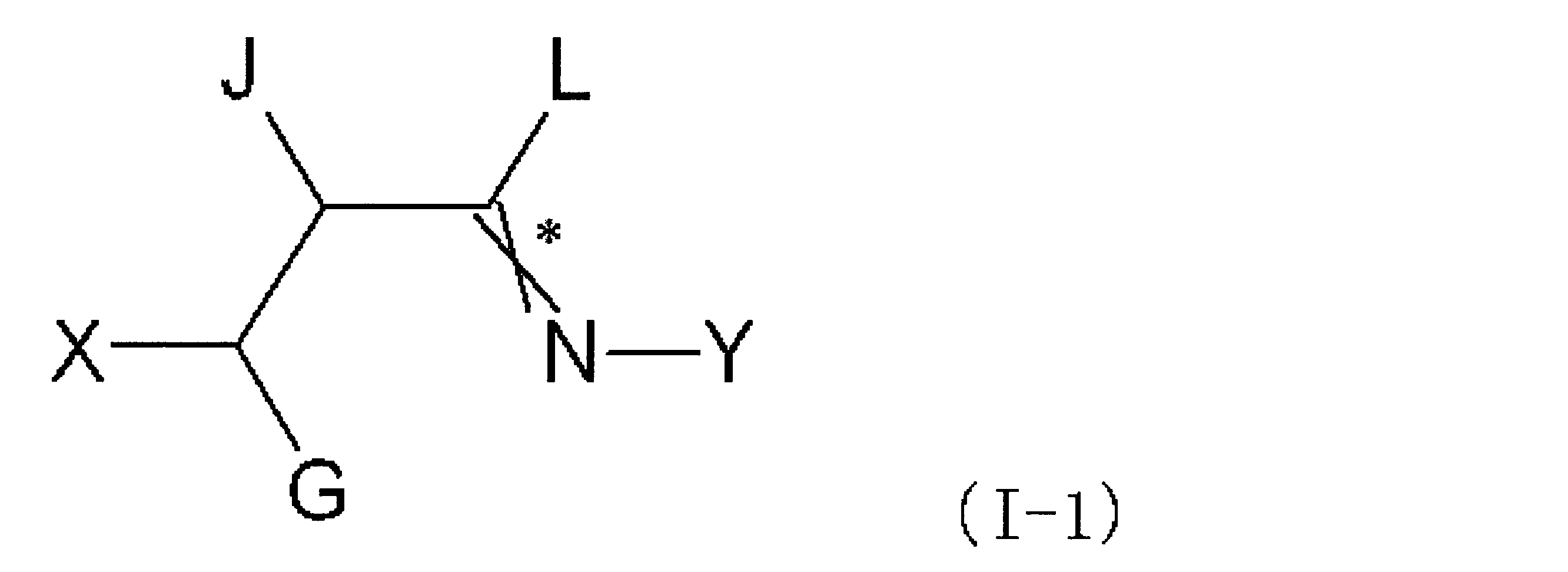

Xは、-ORI、-S(O)lRI、または-NRIRIIを示す。
G及びJは、各々独立して、水素原子、-RI、-ORI、-S(O)lRI、-SC(=O)RI、-OC(=O)RI、-OS(O)lRI、-C(=O)RI、-C(=O)ORI、-NRIRII、-N=CRIRII、ハロゲノ基、シアノ基、またはニトロ基を示す。
Lは、-RI、-ORI、-S(O)lRI、-NRIRII、または-N=CRIRIIを示す。
またJとLは相互に繋がって、それらが結合する炭素原子とともに5~8員環を形成してもよい。
Yは、-RI、-ORI、-S(O)lRI、-C(=O)RI、-C(=S)RI、-C(=O)ORI、-NRIRII、-N=CRIRII、またはシアノ基を示す。
lは、0~2のいずれかの整数を示す。
RIおよびRIIは、各々独立して、水素原子、無置換のもしくは置換基を有するC1~6アルキル基、無置換のもしくは置換基を有するC2~6アルケニル基、無置換のもしくは置換基を有するC2~6アルキニル基、無置換のもしくは置換基を有するC3~8シクロアルキル基、無置換のもしくは置換基を有する6~10員アリール基、または無置換のもしくは置換基を有する3~10員ヘテロシクリル基を示す。*は二重結合による立体異性が存在すること(undefined double stereo bond)を示す。]
〔2〕 式(II)で表される化合物およびそれらの塩から選ばれる少なくとも1つを有効成分として含有する、水棲有害付着生物防除組成物。

Y’は、無置換のもしくは置換基X1を有するC6~10アリール基、または無置換のもしくは置換基X1を有する5~6員へテロアリール基を示す。
X1は、無置換のもしくは置換基を有するC1~6アルキル基、無置換のもしくは置換基を有するC2~6アルケニル基、無置換のもしくは置換基を有するC2~6アルキニル基、無置換のもしくは置換基を有するC3~8シクロアルキル基、水酸基、無置換のもしくは置換基を有するC1~6アルコキシ基、無置換のもしくは置換基を有するC1~7アシル基、無置換のもしくは置換基を有するC1~6アルコキシカルボニル基、無置換のもしくは置換基を有するアミノ基、無置換のもしくは置換基を有するC1~6アルキルチオ基、無置換のもしくは置換基を有するC1~6アルキルスルホニル基、無置換のもしくは置換基を有するC6~10アリール基、無置換のもしくは置換基を有する3~10員ヘテロシクリル基、ハロゲノ基、シアノ基、またはニトロ基を示す。
Y’上の置換基X1の個数は1~5のいずれかの整数である。置換基X1が2以上在るときX1は互いに同一でも相違してもよい。
A1およびA2は、それぞれ独立に、酸素原子、-S(O)l-、-NR1-、または-CR1R2-を示す。
R1およびR2は、それぞれ独立に、水素原子、無置換のもしくは置換基を有するC1~6アルキル基、無置換のもしくは置換基を有するC2~6アルケニル基、無置換のもしくは置換基を有するC2~6アルキニル基、無置換のもしくは置換基を有するC3~8シクロアルキル基、無置換のもしくは置換基を有するC6~10アリール基、無置換のもしくは置換基を有する3~10員ヘテロシクリル基、ハロゲノ基、またはシアノ基を示す。ここで、同一の炭素原子に結合したR1とR2は一緒になって、無置換のもしくは置換基を有するエキソメチレン基を形成してもよい。また、R1とR2は、相互に繋がって、R1およびR2が結合する炭素原子とともに環を形成してもよい。
nは、R1およびR2で置換されたメチレンの個数を示し、かつ1~3のいずれかの整数である。nが2以上のときR1およびR2は互いに同一でも相違してもよい。
G’は、水素原子または無置換のもしくは置換基を有するC1~6アルキル基を示す。
Eは、酸素原子または-S(O)l-を示す。lは、0~2のいずれかの整数を示す。
Qは、無置換のもしくは置換基X2を有するC7~11アラルキル基、無置換のもしくは置換基X2を有するC6~10アリール基、または無置換のもしくは置換基X2を有する5~10員へテロアリール基を示す。
X2は、無置換のもしくは置換基を有するC1~6アルキル基、無置換のもしくは置換基を有するC2~6アルケニル基、無置換のもしくは置換基を有するC2~6アルキニル基、無置換のもしくは置換基を有するC3~8シクロアルキル基、水酸基、無置換のもしくは置換基を有するC1~6アルコキシ基、無置換のもしくは置換基を有するC1~7アシル基、無置換のもしくは置換基を有するC1~6アルコキシカルボニル基、無置換のもしくは置換基を有するアミノ基、無置換のもしくは置換基を有するC1~6アルキルチオ基、無置換のもしくは置換基を有するC1~6アルキルスルホニル基、無置換のもしくは置換基を有するC6~10アリール基、無置換のもしくは置換基を有する3~6員ヘテロシクリル基、ハロゲノ基、シアノ基、またはニトロ基を示す。
Q上の置換基X2の個数は、1~5のいずれかの整数である。置換基X2が2以上在るときX2は互いに同一でも相違してもよい。*は二重結合による立体異性(E)、(Z)、または(E/Z)が存在すること(undefined double stereo bond)を示す。]
〔3〕 式(III)で表される化合物およびそれらの塩から選ばれる少なくとも1つを有効成分として含有する、水棲有害付着生物防除組成物。

Y’は、無置換のもしくは置換基X1を有するC6~10アリール基、または無置換のもしくは置換基X1を有する5~6員へテロアリール基を示す。
X1は、無置換のもしくは置換基を有するC1~6アルキル基、無置換のもしくは置換基を有するC2~6アルケニル基、無置換のもしくは置換基を有するC2~6アルキニル基、無置換のもしくは置換基を有するC3~8シクロアルキル基、水酸基、無置換のもしくは置換基を有するC1~6アルコキシ基、無置換のもしくは置換基を有するC1~7アシル基、無置換のもしくは置換基を有するC1~6アルコキシカルボニル基、無置換のもしくは置換基を有するアミノ基、無置換のもしくは置換基を有するC1~6アルキルチオ基、無置換のもしくは置換基を有するC1~6アルキルスルホニル基、無置換のもしくは置換基を有するC6~10アリール基、無置換のもしくは置換基を有する3~10員ヘテロシクリル基、ハロゲノ基、シアノ基、またはニトロ基を示す。
Y’上の置換基X1の個数は1~5のいずれかの整数である。置換基X1が2以上在るときX1は互いに同一でも相違してもよい。
A3は、酸素原子または硫黄原子を示す。
R3およびR4は、それぞれ独立に、水素原子、無置換のもしくは置換基を有するC1~6アルキル基、無置換のもしくは置換基を有するC2~6アルケニル基、無置換のもしくは置換基を有するC2~6アルキニル基、無置換のもしくは置換基を有するC3~8シクロアルキル基、無置換のもしくは置換基を有するC6~10アリール基、無置換のもしくは置換基を有する3~10員ヘテロシクリル基、またはシアノ基を示す。ここで、R3とR4は一緒になって、無置換のもしくは置換基を有するエキソメチレン基を形成してもよい。
R5およびR6は、それぞれ独立に、水素原子、無置換のもしくは置換基を有するC1~6アルキル基、無置換のもしくは置換基を有するC2~6アルケニル基、無置換のもしくは置換基を有するC2~6アルキニル基、無置換のもしくは置換基を有するC3~8シクロアルキル基、無置換のもしくは置換基を有するC6~10アリール基、無置換のもしくは置換基を有する3~6員ヘテロシクリル基、ハロゲノ基、またはシアノ基を示す。また、R5とR6は相互に繋がってR5およびR6が結合する炭素原子とともに環を形成してもよい。
mは、R5およびR6で置換されたメチレンの個数を示し、かつ1~4のいずれかの整数である。mが2以上のときR5およびR6は互いに同一でも相違してもよい。
G’は、水素原子または無置換のもしくは置換基を有するC1~6アルキル基を示す。
Eは、酸素原子または-S(O)l-を示す。lは、0~2のいずれかの整数を示す。
Qは、無置換のもしくは置換基X2を有するC7~11アラルキル基、無置換のもしくは置換基X2を有するC6~10アリール基、または無置換のもしくは置換基X2を有する5~10員へテロアリール基を示す。
X2は、無置換のもしくは置換基を有するC1~6アルキル基、無置換のもしくは置換基を有するC2~6アルケニル基、無置換のもしくは置換基を有するC2~6アルキニル基、無置換のもしくは置換基を有するC3~8シクロアルキル基、水酸基、無置換のもしくは置換基を有するC1~6アルコキシ基、無置換のもしくは置換基を有するC1~7アシル基、無置換のもしくは置換基を有するC1~6アルコキシカルボニル基、無置換のもしくは置換基を有するアミノ基、無置換のもしくは置換基を有するC1~6アルキルチオ基、無置換のもしくは置換基を有するC1~6アルキルスルホニル基、無置換のもしくは置換基を有するC6~10アリール基、無置換のもしくは置換基を有する3~6員ヘテロシクリル基、ハロゲノ基、シアノ基、またはニトロ基を示す。
Q上の置換基X2の個数は、1~5のいずれかの整数である。置換基X2が2以上在るときX2は互いに同一でも相違してもよい。*は二重結合による立体異性(E)、(Z)、または(E/Z)が存在すること(undefined double stereo bond)を示す。]
〔4〕 mが1または2である、〔3〕に記載の水棲有害付着生物防除組成物。
〔5〕 水棲有害付着生物が、水中構造物に付着する生物である、〔1〕~〔4〕のいずれかひとつに記載の水棲有害付着生物防除組成物。
〔6〕 水棲有害付着生物が、甲殻類である、〔1〕~〔4〕のいずれかひとつに記載の水棲有害付着生物防除組成物。
〔5〕 水棲有害付着生物が、水中構造物に付着する生物である、〔1〕~〔4〕のいずれかひとつに記載の水棲有害付着生物防除組成物。
〔6〕 水棲有害付着生物が、甲殻類である、〔1〕~〔4〕のいずれかひとつに記載の水棲有害付着生物防除組成物。
〔7〕 前記〔1〕~〔6〕のいずれかひとつに記載の水棲有害付着生物防除組成物を含有する防汚塗料組成物。
〔8〕 前記〔1〕~〔6〕のいずれかひとつに記載の水棲有害付着生物防除組成物により水棲有害付着生物を防除する方法。
〔9〕 前記〔7〕に記載の防汚塗料組成物を水中構造物表面に塗布して水棲有害付着生物を防除する方法。
〔8〕 前記〔1〕~〔6〕のいずれかひとつに記載の水棲有害付着生物防除組成物により水棲有害付着生物を防除する方法。
〔9〕 前記〔7〕に記載の防汚塗料組成物を水中構造物表面に塗布して水棲有害付着生物を防除する方法。
本発明の水棲有害付着生物防除組成物は、魚類や人畜に対しては安全でありながら水棲有害付着生物に対しては高い防除効力を示す。該組成物を含有する本発明の防汚塗料組成物を水中構造物に塗布しておくと、甲殻類などの水棲生物の付着を防ぐことができる。
本発明の第一実施形態に係る水棲有害付着生物防除組成物は、式(I-1)または式(I-2)で表される化合物およびそれらの塩から選ばれる少なくとも1つを有効成分として含有するものである。
まず、本発明において、「無置換の」の用語は、母核となる基のみであることを意味する。「置換基を有する」との記載がなく母核となる基の名称のみで記載しているときは、別段の断りがない限り「無置換の」の意味である。
一方、「置換基を有する」の用語は、母核となる基のいずれかの水素原子が、母核と同一または異なる構造の基で置換されていることを意味する。従って、「置換基」は、母核となる基に結合した他の基である。置換基は1つであってもよいし、2つ以上であってもよい。2つ以上の置換基は同一であってもよいし、異なるものであってもよい。
「C1~6」などの用語は、母核となる基の炭素原子数が1~6個などであることを示している。この炭素原子数には、置換基の中に在る炭素原子の数を含まない。例えば、置換基としてエトキシ基を有するブチル基は、C2アルコキシC4アルキル基に分類する。
一方、「置換基を有する」の用語は、母核となる基のいずれかの水素原子が、母核と同一または異なる構造の基で置換されていることを意味する。従って、「置換基」は、母核となる基に結合した他の基である。置換基は1つであってもよいし、2つ以上であってもよい。2つ以上の置換基は同一であってもよいし、異なるものであってもよい。
「C1~6」などの用語は、母核となる基の炭素原子数が1~6個などであることを示している。この炭素原子数には、置換基の中に在る炭素原子の数を含まない。例えば、置換基としてエトキシ基を有するブチル基は、C2アルコキシC4アルキル基に分類する。
「置換基」は化学的に許容され、本発明の効果を有する限りにおいて特に制限されない。以下に「置換基」となり得る基を例示する。
メチル基、エチル基、n-プロピル基、i-プロピル基、n-ブチル基、s-ブチル基、i-ブチル基、t-ブチル基、n-ペンチル基、n-ヘキシル基などのC1~6アルキル基;
ビニル基、1-プロペニル基、2-プロペニル基(アリル基)、1-ブテニル基、2-ブテニル基、3-ブテニル基、1-メチル-2-プロペニル基、2-メチル-2-プロペニル基などのC2~6アルケニル基;
エチニル基、1-プロピニル基、2-プロピニル基、1-ブチニル基、2-ブチニル基、3-ブチニル基、1-メチル-2-プロピニル基などのC2~6アルキニル基;
シクロプロピル基、シクロブチル基、シクロペンチル基、シクロヘキシル基などのC3~6シクロアルキル基;
2-シクロペンテニル基、3-シクロヘキセニル基、4-シクロオクテニル基などのC4~8シクロアルケニル基;
メチル基、エチル基、n-プロピル基、i-プロピル基、n-ブチル基、s-ブチル基、i-ブチル基、t-ブチル基、n-ペンチル基、n-ヘキシル基などのC1~6アルキル基;
ビニル基、1-プロペニル基、2-プロペニル基(アリル基)、1-ブテニル基、2-ブテニル基、3-ブテニル基、1-メチル-2-プロペニル基、2-メチル-2-プロペニル基などのC2~6アルケニル基;
エチニル基、1-プロピニル基、2-プロピニル基、1-ブチニル基、2-ブチニル基、3-ブチニル基、1-メチル-2-プロピニル基などのC2~6アルキニル基;
シクロプロピル基、シクロブチル基、シクロペンチル基、シクロヘキシル基などのC3~6シクロアルキル基;
2-シクロペンテニル基、3-シクロヘキセニル基、4-シクロオクテニル基などのC4~8シクロアルケニル基;
フェニル基、ナフチル基などのC6~10アリール基;
ベンジル基、フェネチル基などのC7~11アラルキル基;
アジリジニル基、エポキシ基、ピロリジニル基、テトラヒドロフラニル基、ピペリジル基、ピペラジニル基、モルホリニル基、ジオキソラン環、ジオキサン環などの飽和ヘテロシクリル基;
ピロリル基、フリル基、チエニル基、イミダゾリル基、ピラゾリル基、オキサゾリル基、イソオキサゾリル基、チアゾリル基、イソチアゾリル基、トリアゾリル基、オキサジアゾリル基、チアジアゾリル基、テトラゾリル基などの5員ヘテロアリール基;
ピリジル基、ピラジニル基、ピリミジニル基、ピリダニジル基、トリアジニル基などの6員ヘテロアリール基;
ホルミル基、アセチル基、プロピオニル基、ベンゾイル基、シクロヘキシルカルボニル基などのC1~7アシル基;
ベンジル基、フェネチル基などのC7~11アラルキル基;
アジリジニル基、エポキシ基、ピロリジニル基、テトラヒドロフラニル基、ピペリジル基、ピペラジニル基、モルホリニル基、ジオキソラン環、ジオキサン環などの飽和ヘテロシクリル基;
ピロリル基、フリル基、チエニル基、イミダゾリル基、ピラゾリル基、オキサゾリル基、イソオキサゾリル基、チアゾリル基、イソチアゾリル基、トリアゾリル基、オキサジアゾリル基、チアジアゾリル基、テトラゾリル基などの5員ヘテロアリール基;
ピリジル基、ピラジニル基、ピリミジニル基、ピリダニジル基、トリアジニル基などの6員ヘテロアリール基;
ホルミル基、アセチル基、プロピオニル基、ベンゾイル基、シクロヘキシルカルボニル基などのC1~7アシル基;
水酸基;
メトキシ基、エトキシ基、n-プロポキシ基、i-プロポキシ基、n-ブトキシ基、s-ブトキシ基、i-ブトキシ基、t-ブトキシ基などのC1~6アルコキシ基;
ビニルオキシ基、アリルオキシ基、プロペニルオキシ基、ブテニルオキシ基などのC2~6アルケニルオキシ基;
エチニルオキシ基、プロパルギルオキシ基などのC2~6アルキニルオキシ基;
フェノキシ基、1-ナフトキシ基などのC6~10アリールオキシ基;
ベンジルオキシ基、フェネチルオキシ基などのC7~11アラルキルオキシ基;
メトキシ基、エトキシ基、n-プロポキシ基、i-プロポキシ基、n-ブトキシ基、s-ブトキシ基、i-ブトキシ基、t-ブトキシ基などのC1~6アルコキシ基;
ビニルオキシ基、アリルオキシ基、プロペニルオキシ基、ブテニルオキシ基などのC2~6アルケニルオキシ基;
エチニルオキシ基、プロパルギルオキシ基などのC2~6アルキニルオキシ基;
フェノキシ基、1-ナフトキシ基などのC6~10アリールオキシ基;
ベンジルオキシ基、フェネチルオキシ基などのC7~11アラルキルオキシ基;
ホルミルオキシ基、アセチルオキシ基、プロピオニルオキシ基、ベンゾイルオキシ基、シクロヘキシルカルボニルオキシ基などのC1~7アシルオキシ基;
メトキシカルボニル基、エトキシカルボニル基、n-プロポキシカルボニル基、i-プロポキシカルボニル基、n-ブトキシカルボニル基、t-ブトキシカルボニル基などのC1~6アルコキシカルボニル基;
カルボキシル基;
メトキシカルボニル基、エトキシカルボニル基、n-プロポキシカルボニル基、i-プロポキシカルボニル基、n-ブトキシカルボニル基、t-ブトキシカルボニル基などのC1~6アルコキシカルボニル基;
カルボキシル基;
フルオロ基、クロロ基、ブロモ基、イオド基などのハロゲノ基;
クロロメチル基、クロロエチル基、トリフルオロメチル基、1,2-ジクロロ-n-プロピル基、1-フルオロ-n-ブチル基、パーフルオロ-n-ペンチル基などのC1~6ハロアルキル基;
2-クロロ-1-プロペニル基、2-フルオロ-1-ブテニル基などのC2~6ハロアルケニル基;
4,4-ジクロロ-1-ブチニル基、4-フルオロ-1-ペンチニル基、5-ブロモ-2-ペンチニル基などのC2~6ハロアルキニル基;
4-クロロフェニル基、4-フルオロフェニル基、2,4-ジクロロフェニル基などのC6~10ハロアリール基;
トリフルオロメトキシ基、2-クロロ-n-プロポキシ基、2,3-ジクロロブトキシ基などのC1~6ハロアルコキシ基;
2-クロロプロペニルオキシ基、3-ブロモブテニルオキシ基などのC2~6ハロアルケニルオキシ基;
4-フルオロフェニルオキシ基、4-クロロ-1-ナフトキシ基などのC6~10ハロアリールオキシ基;
クロロアセチル基、トリフルオロアセチル基、トリクロロアセチル基、4-クロロベンゾイル基などのC1~7ハロアシル基;
クロロメチル基、クロロエチル基、トリフルオロメチル基、1,2-ジクロロ-n-プロピル基、1-フルオロ-n-ブチル基、パーフルオロ-n-ペンチル基などのC1~6ハロアルキル基;
2-クロロ-1-プロペニル基、2-フルオロ-1-ブテニル基などのC2~6ハロアルケニル基;
4,4-ジクロロ-1-ブチニル基、4-フルオロ-1-ペンチニル基、5-ブロモ-2-ペンチニル基などのC2~6ハロアルキニル基;
4-クロロフェニル基、4-フルオロフェニル基、2,4-ジクロロフェニル基などのC6~10ハロアリール基;
トリフルオロメトキシ基、2-クロロ-n-プロポキシ基、2,3-ジクロロブトキシ基などのC1~6ハロアルコキシ基;
2-クロロプロペニルオキシ基、3-ブロモブテニルオキシ基などのC2~6ハロアルケニルオキシ基;
4-フルオロフェニルオキシ基、4-クロロ-1-ナフトキシ基などのC6~10ハロアリールオキシ基;
クロロアセチル基、トリフルオロアセチル基、トリクロロアセチル基、4-クロロベンゾイル基などのC1~7ハロアシル基;
アミノ基;
メチルアミノ基、ジメチルアミノ基、ジエチルアミノ基などのC1~6アルキルアミノ基;
アニリノ基、ナフチルアミノ基などのC6~10アリールアミノ基;
ベンジルアミノ基、フェネチルアミノ基などのC7~11アラルキルアミノ基;
ホルミルアミノ基、アセチルアミノ基、プロパノイルアミノ基、ブチリルアミノ基、i-プロピルカルボニルアミノ基、ベンゾイルアミノ基などのC1~7アシルアミノ基;
メトキシカルボニルアミノ基、エトキシカルボニルアミノ基、n-プロポキシカルボニルアミノ基、i-プロポキシカルボニルアミノ基などのC1~6アルコキシカルボニルアミノ基;
アミノカルボニル基、ジメチルアミノカルボニル基、フェニルアミノカルボニル基、N-フェニル-N-メチルアミノカルボニル基などの無置換若しくは置換基を有するアミノカルボニル基;
イミノメチル基、(1-イミノ)エチル基、(1-イミノ)-n-プロピル基などのイミノ基で置換されたC1~6アルキル基;
ヒドロキシイミノメチル基、(1-ヒドロキシイミノ)エチル基、(1-ヒドロキシイミノ)プロピル基、メトキシイミノメチル基、(1-メトキシイミノ)エチル基などの無置換の若しくは置換基を有するヒドロキシイミノ基で置換されたC1~6アルキル基;
メチルアミノ基、ジメチルアミノ基、ジエチルアミノ基などのC1~6アルキルアミノ基;
アニリノ基、ナフチルアミノ基などのC6~10アリールアミノ基;
ベンジルアミノ基、フェネチルアミノ基などのC7~11アラルキルアミノ基;
ホルミルアミノ基、アセチルアミノ基、プロパノイルアミノ基、ブチリルアミノ基、i-プロピルカルボニルアミノ基、ベンゾイルアミノ基などのC1~7アシルアミノ基;
メトキシカルボニルアミノ基、エトキシカルボニルアミノ基、n-プロポキシカルボニルアミノ基、i-プロポキシカルボニルアミノ基などのC1~6アルコキシカルボニルアミノ基;
アミノカルボニル基、ジメチルアミノカルボニル基、フェニルアミノカルボニル基、N-フェニル-N-メチルアミノカルボニル基などの無置換若しくは置換基を有するアミノカルボニル基;
イミノメチル基、(1-イミノ)エチル基、(1-イミノ)-n-プロピル基などのイミノ基で置換されたC1~6アルキル基;
ヒドロキシイミノメチル基、(1-ヒドロキシイミノ)エチル基、(1-ヒドロキシイミノ)プロピル基、メトキシイミノメチル基、(1-メトキシイミノ)エチル基などの無置換の若しくは置換基を有するヒドロキシイミノ基で置換されたC1~6アルキル基;
メルカプト基;
メチルチオ基、エチルチオ基、n-プロピルチオ基、i-プロピルチオ基、n-ブチルチオ基、i-ブチルチオ基、s-ブチルチオ基、t-ブチルチオ基などのC1~6アルキルチオ基;
フェニルチオ基、ナフチルチオ基などのC6~10アリールチオ基;
チアゾリルチオ基、ピリジルチオ基などのヘテロアリールチオ基;
ベンジルチオ基、フェネチルチオ基などのC7~11アラルキルチオ基;
メチルスルホニル基、エチルスルホニル基、t-ブチルスルホニル基などのC1~6アルキルスルホニル基;
フェニルスルホニル基などのC6~10アリールスルホニル基;
チアゾリルスルホニル基、ピリジルスルホニル基などのヘテロアリールスルホニル基;
ベンジルスルホニル基、フェネチルスルホニル基などのC7~11アラルキルスルホニル基;
メチルチオ基、エチルチオ基、n-プロピルチオ基、i-プロピルチオ基、n-ブチルチオ基、i-ブチルチオ基、s-ブチルチオ基、t-ブチルチオ基などのC1~6アルキルチオ基;
フェニルチオ基、ナフチルチオ基などのC6~10アリールチオ基;
チアゾリルチオ基、ピリジルチオ基などのヘテロアリールチオ基;
ベンジルチオ基、フェネチルチオ基などのC7~11アラルキルチオ基;
メチルスルホニル基、エチルスルホニル基、t-ブチルスルホニル基などのC1~6アルキルスルホニル基;
フェニルスルホニル基などのC6~10アリールスルホニル基;
チアゾリルスルホニル基、ピリジルスルホニル基などのヘテロアリールスルホニル基;
ベンジルスルホニル基、フェネチルスルホニル基などのC7~11アラルキルスルホニル基;
トリメチルシリル基、トリエチルシリル基、t-ブチルジメチルシリル基などのトリC1~6アルキル置換シリル基;
トリフェニルシリル基などのトリアリール置換シリル基;
シアノ基;ニトロ基;
また、これらの「置換基」は、当該置換基中のいずれかの水素原子が、異なる構造の基で置換されていてもよい。
トリフェニルシリル基などのトリアリール置換シリル基;
シアノ基;ニトロ基;
また、これらの「置換基」は、当該置換基中のいずれかの水素原子が、異なる構造の基で置換されていてもよい。
式(I-1)および式(I-2)中、Xは、-ORI、-S(O)lRI、または-NRIRIIを示す。lは、0~2のいずれかの整数を示す。
RIおよびRIIは、各々独立して、水素原子、無置換のもしくは置換基を有するC1~6アルキル基、無置換のもしくは置換基を有するC2~6アルケニル基、無置換のもしくは置換基を有するC2~6アルキニル基、無置換のもしくは置換基を有するC3~8シクロアルキル基、無置換のもしくは置換基を有するC6~10アリール基、または無置換のもしくは置換基を有する3~10員ヘテロシクリル基を示す。
RIおよびRIIは、各々独立して、水素原子、無置換のもしくは置換基を有するC1~6アルキル基、無置換のもしくは置換基を有するC2~6アルケニル基、無置換のもしくは置換基を有するC2~6アルキニル基、無置換のもしくは置換基を有するC3~8シクロアルキル基、無置換のもしくは置換基を有するC6~10アリール基、または無置換のもしくは置換基を有する3~10員ヘテロシクリル基を示す。
「C1~6アルキル基」は、直鎖であってもよいし、炭素数が3以上であれば分岐鎖であってもよい。「アルキル基」としては、メチル基、エチル基、n-プロピル基、n-ブチル基、n-ペンチル基、n-ヘキシル基、i-プロピル基、i-ブチル基、s-ブチル基、t-ブチル基、i-ペンチル基、ネオペンチル基、2-メチルブチル基、2,2-ジメチルプロピル基、i-ヘキシル基などを挙げることができる。
「置換基を有するC1~6アルキル基」としては、シクロプロピルメチル基、2-シクロプロピルエチル基、シクロペンチルメチル基、2-シクロヘキシルエチル基、2-シクロオクチルエチル基などのC3~8シクロアルキルC1~6アルキル基; フルオロメチル基、クロロメチル基、ブロモメチル基、ジフルオロメチル基、ジクロロメチル基、ジブロモメチル基、トリフルオロメチル基、トリクロロメチル基、トリブロモメチル基、1-クロロエチル基、2,2,2-トルフルオロエチル基、2,2,2-トリクロロエチル基、ペンタフルオロエチル基、4-フルオロブチル基、4-クロロブチル基、3,3,3-トリフルオロプロピル基、2,2,2-トリフルオロ-1-トリフルオロメチルエチル基、パーフロロヘキシル基、パークロロヘキシル基、2,4,6-トリクロロヘキシル基などのC1~6ハロアルキル基;
ヒドロキシメチル基、1-ヒドロキシエチル基、2-ヒドロキシエチル基などのヒドロキシC1~6アルキル基; メトキシメチル基、エトキシメチル基、メトキシエチル基、エトキシエチル基、メトキシ-n-プロピル基、n-プロポキシメチル基、i-プロポキシエチル基、s-ブトキシメチル基、t-ブトキシエチル基などのC1~6アルコキシC1~6アルキル基; ビニルオキシメチル基、アリルオキシメチル基、プロペニルオキシメチル基、ブテニルオキシメチル基などのC2~6アルケニルオキシC1~6アルキル基; ピリジン-2-イルオキシメチル基などのヘテロアリールオキシC1~6アルキル基; ホルミルメチル基、アセチルメチル基、プロピオニルメチル基などのC1~7アシルC1~6アルキル基;
ホルミルオキシメチル基、アセトキシメチル基、2-アセトキシエチル基、プロピオニルオキシメチル基、プロピオニルオキシエチル基などのC1~7アシルオキシC1~6アルキル基; カルボキシルメチル基、カルボキシルエチル基などのカルボキシル基C1~6アルキル基; メトキシカルボニルメチル基、エトキシカルボニルメチル基、n-プロポキシカルボニルメチル基、i-プロポキシカルボニルメチル基などのC1~6アルコキシカルボニルC1~6アルキル基; ホルムアミドメチル基、アセトアミドメチル基、2-アセトアミドエチル基、プロピオニルアミノメチル基、プロピオニルアミノエチル基などのC1~7アシルアミノC1~6アルキル基; メチルアミノカルボニルメチル基、エチルアミノカルボニルメチル基、i-プロピルアミノカルボニルメチル基、t-ブチルアミノカルボニルメチル基、s-ブチルアミノカルボニルメチル基、n-ペンチルアミノカルボニルメチル基などのC1~6アルキルアミノカルボニルC1~6アルキル基;
メトキシカルボニルアミノメチル基、エトキシカルボニルアミノメチル基、i-プロポキシカルボニルアミノメチル基、t-ブトキシカルボニルアミノメチル基、s-ブチルオキシカルボニルアミノメチル基、n-ペンチルオキシカルボニルアミノメチル基などのC1~6アルコキシカルボニルアミノC1~6アルキル基; ベンジル基、フェネチル基などのC7~11アラルキル基; ベンゾイルアミノメチル基などのC6~10アリールカルボニルアミノC1~6アルキル基; メチルチオメチル基、エチルチオメチル基、1-メチルチオエチル基などのC1~6アルキルチオC1~6アルキル基; メチルスルフィニルメチル基、エチルスルフィニルメチル基、1-メチルスルフィニルエチル基などのC1~6アルキルスルフィニルC1~6アルキル基; メチルスルホニルメチル基、エチルスルホニルメチル基、1-メチルスルホニルエチル基などのC1~6アルキルスルホニルC1~6アルキル基; などを挙げることができる。
「C2~6アルケニル基」としては、ビニル基、1-プロペニル基、2-プロペニル基、1-ブテニル基、2-ブテニル基、3-ブテニル基、1-メチル-2-プロペニル基、2-メチル-2-プロペニル基、1-ペンテニル基、2-ペンテニル基、3-ペンテニル基、4-ペンテニル基、1-メチル-2-ブテニル基、2-メチル-2-ブテニル基、1-ヘキセニル基、2-ヘキセニル基、3-ヘキセニル基、4-ヘキセニル基、5-ヘキセニル基などを挙げることができる。
「置換基を有するC2~6アルケニル基」としては、2-クロロ-1-プロペニル基、2-フルオロ-1-ブテニル基などのC2~6ハロアルケニル基; 2-n-ブトキシ-ビニル基、1-エトキシ-ビニル基などのC1~6アルコキシC2~6アルケニル基; などを挙げることができる。
「置換基を有するC2~6アルケニル基」としては、2-クロロ-1-プロペニル基、2-フルオロ-1-ブテニル基などのC2~6ハロアルケニル基; 2-n-ブトキシ-ビニル基、1-エトキシ-ビニル基などのC1~6アルコキシC2~6アルケニル基; などを挙げることができる。
「C2~6アルキニル基」としては、エチニル基、1-プロピニル基、2-プロピニル基、1-ブチニル基、2-ブチニル基、3-ブチニル基、1-メチル-2-プロピニル基、2-メチル-3-ブチニル基、1-ペンチニル基、2-ペンチニル基、3-ペンチニル基、4-ペンチニル基、1-メチル-2-ブチニル基、2-メチル-3-ペンチニル基、1-ヘキシニル基、1,1-ジメチル-2-ブチニル基などを挙げることができる。
「置換基を有するC2~6アルキニル基」としては、4,4-ジクロロ-1-ブチニル基、4-フルオロ-1-ペンチニル基、5-ブロモ-2-ペンチニル基などのC2~6ハロアルキニル基; トリメチルシラニルエチニル基などのトリC1~6アルキル置換シリルC2~6アルキニル基; などを挙げることができる。
「置換基を有するC2~6アルキニル基」としては、4,4-ジクロロ-1-ブチニル基、4-フルオロ-1-ペンチニル基、5-ブロモ-2-ペンチニル基などのC2~6ハロアルキニル基; トリメチルシラニルエチニル基などのトリC1~6アルキル置換シリルC2~6アルキニル基; などを挙げることができる。
「C3~8シクロアルキル基」としては、シクロプロピル基、シクロブチル基、シクロペンチル基、シクロヘキシル基、シクロヘプチル基などを挙げることができる。
「置換基を有するC3~8シクロアルキル基」としては、2,3,3-トリメチルアシクロブチル基、4,4,6,6-テトラメチルシクロヘキシル基、1,3-ジブチルシクロヘキシル基などのアルキル置換シクロアルキル基などを挙げることができる。
「C6~10アリール基」としては、フェニル基、ナフチル基、アズレニル基、インデニル基、インダニル基、テトラリニル基などを挙げることができる。
「置換基を有するC6~10アリール基」としては、4-クロロフェニル基、4-フルオロフェニル基、2,4-ジクロロフェニル基などを挙げることができる。
「置換基を有するC6~10アリール基」としては、4-クロロフェニル基、4-フルオロフェニル基、2,4-ジクロロフェニル基などを挙げることができる。
「3~10員ヘテロシクリル基」は、窒素原子、酸素原子および硫黄原子からなる群から選ばれる少なくとも一つのヘテロ原子を環の構成原子として含むものである。ヘテロシクリル基は、単環および多環のいずれであってもよい。多環ヘテロシクリル基は、少なくとも一つの環がヘテロ環であれば、残りの環が飽和脂環、不飽和脂環または芳香環のいずれであってもよい。
「3~10員ヘテロシクリル基」としては、3~10員飽和ヘテロシクリル基、5~10員ヘテロアリール基、5~10員部分不飽和ヘテロシクリル基などを挙げることができる。
「3~10員ヘテロシクリル基」としては、3~10員飽和ヘテロシクリル基、5~10員ヘテロアリール基、5~10員部分不飽和ヘテロシクリル基などを挙げることができる。
「3~10員飽和ヘテロシクリル基」としては、アジリジニル基、エポキシ基、ピロリジニル基、テトラヒドロフラニル基、チアゾリジニル基、ピペリジル基、ピペラジニル基、モルホリニル基、ジオキソラニル基(詳しくは、[1,3]ジオキソラニル基)、ジオキサニル基(詳しくは、[1,3]ジオキサニル基、または[1,4]ジオキサニル基)などが挙げられる。好ましくは、5~6員飽和へテロ環である。
「5員ヘテロアリール基」としては、ピロリル基、フリル基、チエニル基、イミダゾリル基、ピラゾリル基、オキサゾリル基、イソオキサゾリル基、チアゾリル基、イソチアゾリル基、トリアゾリル基(詳しくは、[1,2,3]トリアゾリル基、または[1,2,4]トリアゾリル基)、オキサジアゾリル基(詳しくは、[1,2,4]オキサジアゾリル基、または[1,3,4]オキサジアゾリル基)、チアジアゾリル基、テトラゾリル基などが挙げられる。
「6員ヘテロアリール基」としては、ピリジル基、ピラジニル基、ピリミジニル基、ピリダニジル基、トリアジニル基などが挙げられる。
「6員ヘテロアリール基」としては、ピリジル基、ピラジニル基、ピリミジニル基、ピリダニジル基、トリアジニル基などが挙げられる。
「部分不飽和の5員ヘテロシクリル基」としては、ピロリニル基、イミダゾリニル基(ジヒドロイミダゾリル基)、ピラゾリニル基、オキサゾリニル基、イソオキサゾリニル基、チアゾリニル基などが挙げられる。
「部分不飽和の6員ヘテロシクリル基」としては、チオピラニル基、2H-ピリジン-1-イル基、4H-ピリジン-1-イル基などが挙げられる。
「部分不飽和の6員ヘテロシクリル基」としては、チオピラニル基、2H-ピリジン-1-イル基、4H-ピリジン-1-イル基などが挙げられる。
式(I-1)および式(I-2)中、Yは、-RI、-ORI、-S(O)lRI、-C(=O)RI、-C(=S)RI、-C(=O)ORI、-NRIRII、-N=CRIRII、またはシアノ基を示す。lは、0~2のいずれかの整数を示す。RIおよびRIIは、既に述べたとおりのものである。
式(I-1)および式(I-2)中、*は二重結合による立体異性が存在することを示す。
式(I-1)で表される化合物の二重結合による立体異性としては、式(I-1a)で表される化合物〔EC=N〕、式(I-1b)で表される化合物〔ZC=N〕が挙げられる。

式(I-2)で表される化合物の二重結合による立体異性としては、式(I-2a)で表される化合物(EC=C,EC=N)、式(I-2b)で表される化合物(EC=C,ZC=N)、式(I-2c)で表される化合物(ZC=C,EC=N)、式(I-2d)で表される化合物(ZC=C,ZC=N)が挙げられる。

本発明に用いる化合物は、E体のみ、Z体のみ、E体とZ体との混合、E体とZ体の区別ができない物などを包含する。本発明に用いる化合物は、式(I-2a)で表される化合物(EC=C,EC=N)が好ましい。なお、以下においては、簡単のために、炭素-窒素二重結合による立体異性がE体のもので説明し、炭素-炭素二重結合による立体異性の構造(EC=C、ZC=C)の区別のみを示すことにする。
式(I-1)および(I-2)中、G及びJは、各々独立して、水素原子、-RI、-ORI、-S(O)lRI、-SC(=O)RI、-OC(=O)RI、-OS(O)lRI、-C(=O)RI、-C(=O)ORI、-NRIRII、-N=CRIRII、ハロゲノ基、シアノ基、またはニトロ基を示す。lは、0~2のいずれかの整数を示す。RIおよびRIIは、既に述べたとおりのものである。
式(I-1)および(I-2)中、Lは、-RI、-ORI、-S(O)lRI、-NRIRII、または-N=CRIRIIを示す。lは、0~2のいずれかの整数を示す。RIおよびRIIは、既に述べたとおりのものである。
JとLは相互に繋がって、それらが結合する炭素原子とともに5~8員環を形成してもよい。JとLが相互に繋がった化合物としては、式(a1)~(a10)で表わされる化合物などを挙げることができる。式(a1)~(a10)中のX、GおよびYは、式(I)におけるそれらと同じ意味である。
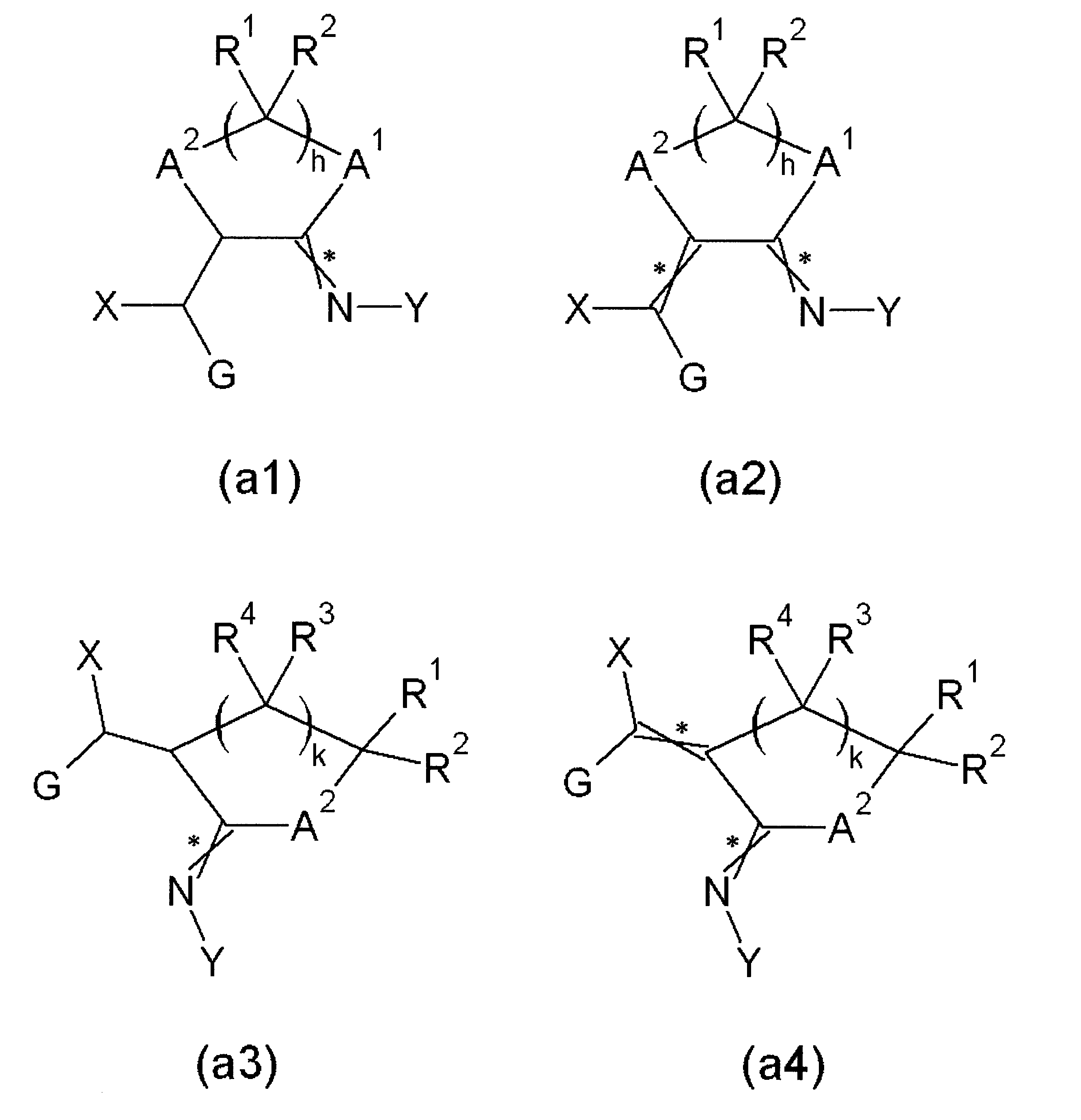
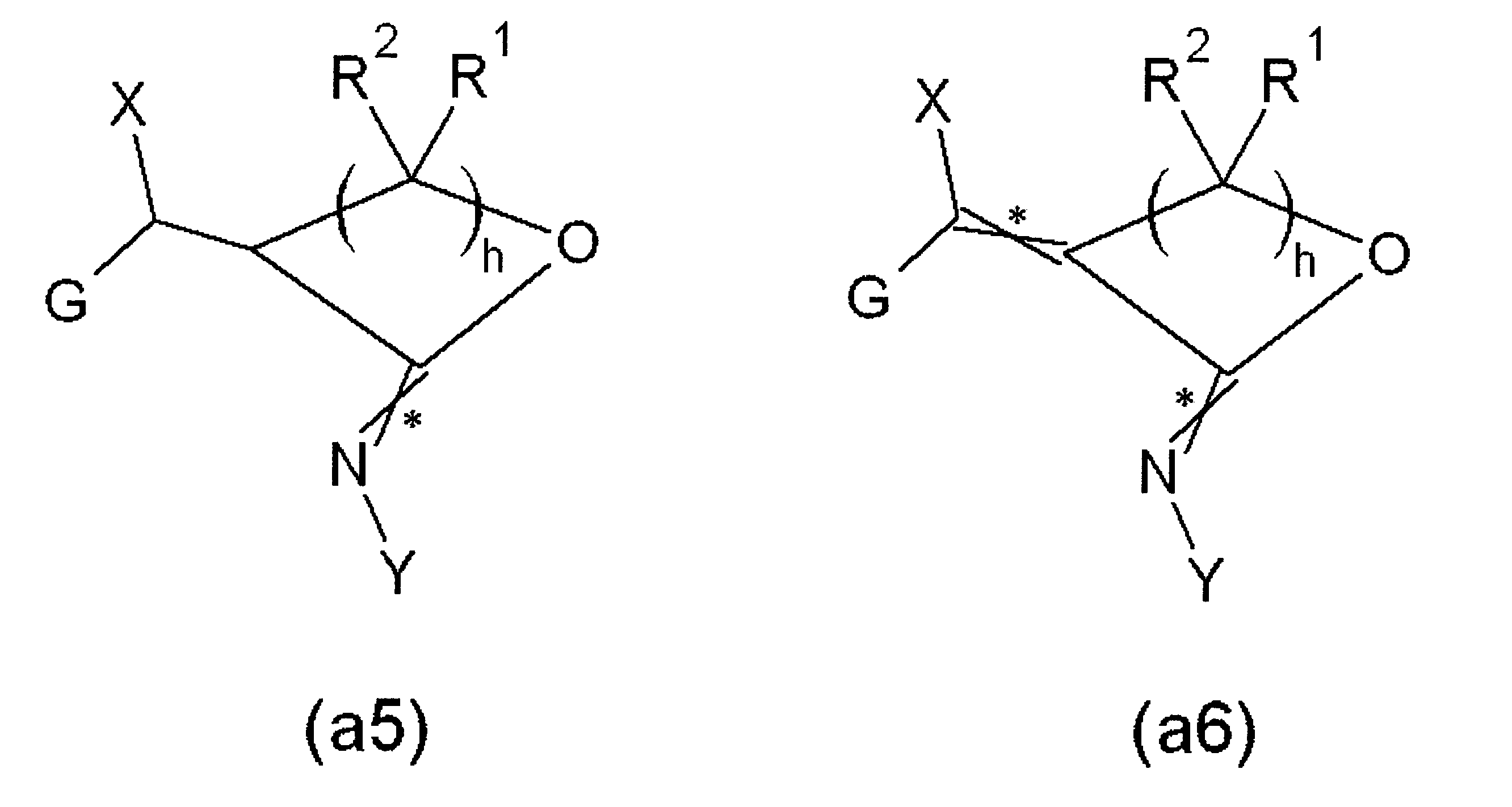
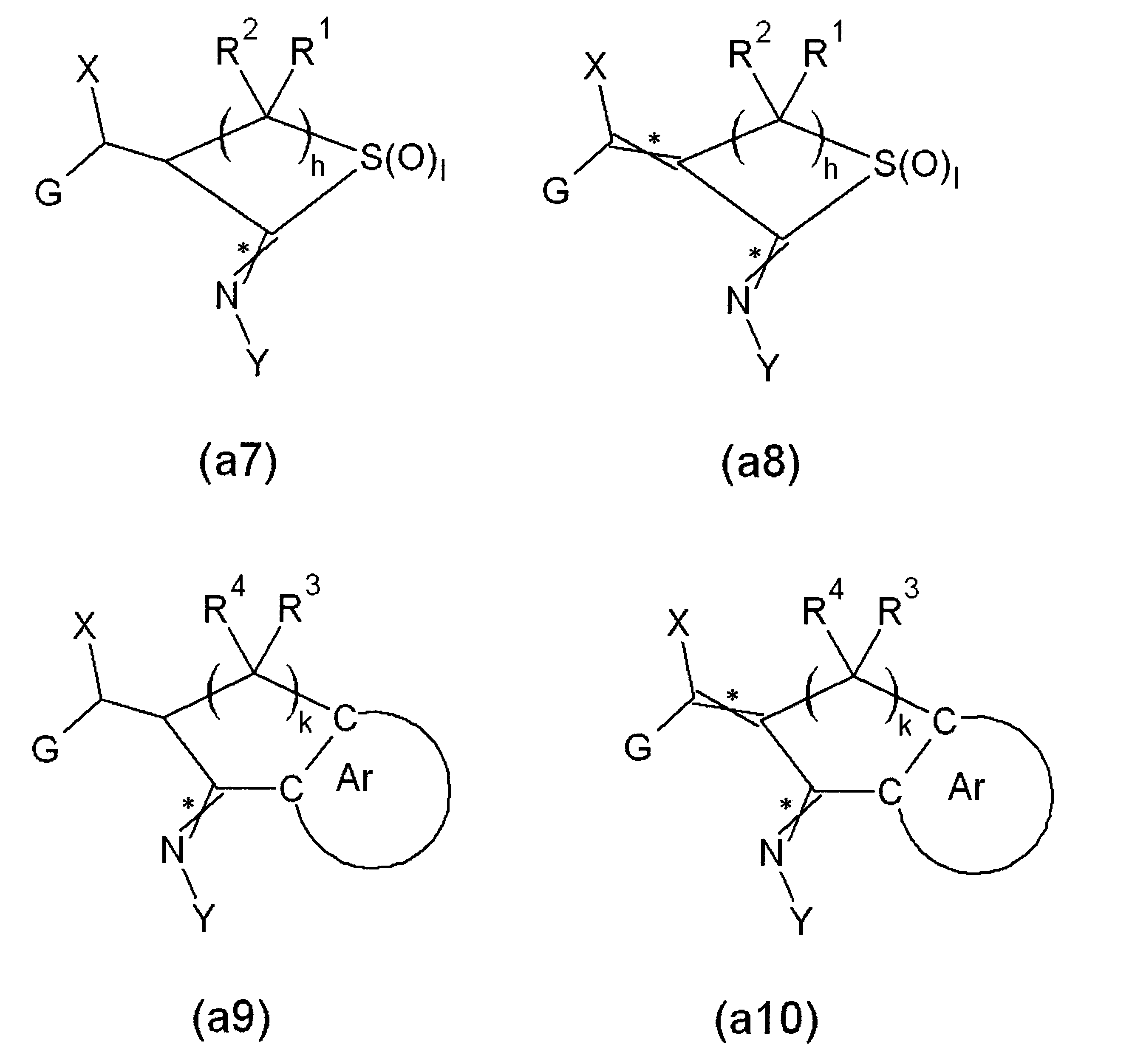
式(a1)~(a8)中、R1およびR2は、それぞれ独立に、水素原子、無置換のもしくは置換基を有するC1~6アルキル基、無置換のもしくは置換基を有するC2~6アルケニル基、無置換のもしくは置換基を有するC2~6アルキニル基、無置換のもしくは置換基を有するC3~8シクロアルキル基、無置換のもしくは置換基を有するC6~10アリール基、無置換のもしくは置換基を有する3~10員ヘテロシクリル基、ハロゲノ基、またはシアノ基を示す。ここで、同一の炭素原子に結合したR1とR2は一緒になって、無置換のもしくは置換基を有するエキソメチレン基を形成してもよい。「無置換のもしくは置換基を有するエキソメチレン基」としては、エチリデン基、イソプロピリデン基などを挙げることができる。
また、R1とR2は、相互に繋がって、R1およびR2が結合する炭素原子とともに環を形成してもよい。R1およびR2における「無置換のもしくは置換基を有するC1~6アルキル基」、「無置換のもしくは置換基を有するC2~6アルケニル基」、「無置換のもしくは置換基を有するC2~6アルキニル基」、「無置換のもしくは置換基を有するC3~8シクロアルキル基」、「無置換のもしくは置換基を有するC6~10アリール基」、「無置換のもしくは置換基を有する3~10員ヘテロシクリル基」としてはRIにおいて述べたものと同じものを挙げることができる。「ハロゲノ基」としては、フルオロ基、クロロ基、ブロモ基、イオド基などを挙げることができる。式(a1)、(a2)、(a5)および(a6)中、hはR1およびR2で置換されたメチレンの個数を示し、かつ1~4のいずれかの整数である。
また、R3とR4は、相互に繋がってR3およびR4が結合する炭素原子とともに環を形成してもよい。
R3とR4が相互に繋がってそれらが結合する炭素原子とともに形成する「環」としては、シクロプロパン環、シクロブタン環、シクロペンタン環、シクロヘキサン環、シクロヘプタン環、テトラヒドロフラン環、テトラヒドロピラン環などを挙げることができる。
また、R1とR2は、相互に繋がって、R1およびR2が結合する炭素原子とともに環を形成してもよい。R1およびR2における「無置換のもしくは置換基を有するC1~6アルキル基」、「無置換のもしくは置換基を有するC2~6アルケニル基」、「無置換のもしくは置換基を有するC2~6アルキニル基」、「無置換のもしくは置換基を有するC3~8シクロアルキル基」、「無置換のもしくは置換基を有するC6~10アリール基」、「無置換のもしくは置換基を有する3~10員ヘテロシクリル基」としてはRIにおいて述べたものと同じものを挙げることができる。「ハロゲノ基」としては、フルオロ基、クロロ基、ブロモ基、イオド基などを挙げることができる。式(a1)、(a2)、(a5)および(a6)中、hはR1およびR2で置換されたメチレンの個数を示し、かつ1~4のいずれかの整数である。
また、R3とR4は、相互に繋がってR3およびR4が結合する炭素原子とともに環を形成してもよい。
R3とR4が相互に繋がってそれらが結合する炭素原子とともに形成する「環」としては、シクロプロパン環、シクロブタン環、シクロペンタン環、シクロヘキサン環、シクロヘプタン環、テトラヒドロフラン環、テトラヒドロピラン環などを挙げることができる。
式(a1)~(a4)中、A1およびA2は、それぞれ独立に、酸素原子、-S(O)l-、-NR1-、または-CR1R2-を示す。lは、0~2のいずれかの整数を示す。R1およびR2は既に述べたとおりのものである。
式(a3)、(a4)、(a9)および(a10)中、R3およびR4は、それぞれ独立に、水素原子、無置換のもしくは置換基を有するC1~6アルキル基、無置換のもしくは置換基を有するC2~6アルケニル基、無置換のもしくは置換基を有するC2~6アルキニル基、無置換のもしくは置換基を有するC3~8シクロアルキル基、無置換のもしくは置換基を有するC6~10アリール基、無置換のもしくは置換基を有する3~10員ヘテロシクリル基、またはシアノ基を示す。R3およびR4における「無置換のもしくは置換基を有するC1~6アルキル基」、「無置換のもしくは置換基を有するC2~6アルケニル基」、「無置換のもしくは置換基を有するC2~6アルキニル基」、「無置換のもしくは置換基を有するC3~8シクロアルキル基」、「無置換のもしくは置換基を有するC6~10アリール基」、「無置換のもしくは置換基を有する3~10員ヘテロシクリル基」としてはRIにおいて述べたものと同じものを挙げることができる。ここで、R3とR4は一緒になって、無置換のもしくは置換基を有するエキソメチレン基を形成してもよい。式(a3)および(a4)中、kはR3およびR4で置換されたメチレンの個数を示し、かつ1~4のいずれかの整数である。kが2以上のときR3およびR4は互いに同一でも異なっていてもよい。
式(a7)および(a8)中、lは0~2のいずれかの整数を示す。
式(a9)および(a10)中、Arで表わされる環は、無置換のもしくは置換基を有するベンゼン環、または無置換のもしくは置換基を有する5~6員ヘテロアリール環を示し、結合部位は隣接する2個の炭素原子である。「5~6員ヘテロアリール環」としては、RIにおいて述べたものと同じものを挙げることができる。
式(a9)および(a10)中、Arで表わされる環は、無置換のもしくは置換基を有するベンゼン環、または無置換のもしくは置換基を有する5~6員ヘテロアリール環を示し、結合部位は隣接する2個の炭素原子である。「5~6員ヘテロアリール環」としては、RIにおいて述べたものと同じものを挙げることができる。
本発明の第二実施形態に係る水棲有害付着生物防除組成物は、式(II)で表される化合物およびそれらの塩から選ばれる少なくとも1つを有効成分として含有するものである。

式(II)中、Y’は、無置換のもしくは置換基X1を有するC6~10アリール基、または無置換のもしくは置換基X1を有する5~6員へテロアリール基を示す。
Y’における「無置換のもしくは置換基X1を有するC6~10アリール基」としては、RIにおいて述べたものと同じものを挙げることができる。
Y’における「5~6員ヘテロアリール基」は、窒素原子、酸素原子および硫黄原子からなる群から選ばれる1~4個のヘテロ原子を環の構成原子として含むものである。
5員ヘテロアリール環としては、ピロリル基、フリル基、チエニル基、イミダゾリル基、ピラゾリル基、オキサゾリル基、イソオキサゾリル基、チアゾリル基、イソチアゾリル基、トリアゾリル基、オキサジアゾリル基、チアジアゾリル基、テトラゾリル基などを挙げることができる。
6員ヘテロアリール環としては、ピリジル基、ピラジニル基、ピリミジニル基、ピリダニジル基、トリアジニル基などを挙げることができる。
Y’における「5~6員ヘテロアリール基」は、窒素原子、酸素原子および硫黄原子からなる群から選ばれる1~4個のヘテロ原子を環の構成原子として含むものである。
5員ヘテロアリール環としては、ピロリル基、フリル基、チエニル基、イミダゾリル基、ピラゾリル基、オキサゾリル基、イソオキサゾリル基、チアゾリル基、イソチアゾリル基、トリアゾリル基、オキサジアゾリル基、チアジアゾリル基、テトラゾリル基などを挙げることができる。
6員ヘテロアリール環としては、ピリジル基、ピラジニル基、ピリミジニル基、ピリダニジル基、トリアジニル基などを挙げることができる。
X1は、無置換のもしくは置換基を有するC1~6アルキル基、無置換のもしくは置換基を有するC2~6アルケニル基、無置換のもしくは置換基を有するC2~6アルキニル基、無置換のもしくは置換基を有するC3~8シクロアルキル基、水酸基、無置換のもしくは置換基を有するC1~6アルコキシ基、無置換のもしくは置換基を有するC1~7アシル基、無置換のもしくは置換基を有するC1~6アルコキシカルボニル基、無置換のもしくは置換基を有するアミノ基、無置換のもしくは置換基を有するC1~6アルキルチオ基、無置換のもしくは置換基を有するC1~6アルキルスルホニル基、無置換のもしくは置換基を有するC6~10アリール基、無置換のもしくは置換基を有する3~10員ヘテロシクリル基、ハロゲノ基、シアノ基、またはニトロ基を示す。
Y’上の置換基X1の個数は1~5のいずれかの整数である。置換基X1が2以上在るときX1は互いに同一でも相違してもよい。
Y’上の置換基X1の個数は1~5のいずれかの整数である。置換基X1が2以上在るときX1は互いに同一でも相違してもよい。
X1における「無置換のもしくは置換基を有するC1~6アルキル基」、「無置換のもしくは置換基を有するC2~6アルケニル基」、「無置換のもしくは置換基を有するC2~6アルキニル基」、「無置換のもしくは置換基を有するC3~8シクロアルキル基」、「無置換のもしくは置換基を有するC6~10アリール基」、「無置換のもしくは置換基を有する3~10員ヘテロシクリル基」、「ハロゲノ基」としては、R1において述べたものと同じものを挙げることができる。
「無置換のもしくは置換基を有するC1~6アルコキシ基」としては、メトキシ基、エトキシ基、n-プロポキシ基、i-プロポキシ基、n-ブトキシ基、s-ブトキシ基、i-ブトキシ基、t-ブトキシ基;クロロメトキシ基、ジクロロメトキシ基、ジフルオロメトキシ基、トリクロロメトキシ基、トリフルオロメトキシ基、1-フルオロエトキシ基、1,1-ジフルオロエトキシ基、2,2,2-トリフルオロエトキシ基、ペンタフルオロエトキシ基などのC1~6ハロアルコキシ基などを挙げることができる。
「無置換のもしくは置換基を有するC1~7アシル基」としては、ホルミル基、アセチル基、プロピオニル基、ベンゾイル基、シクロヘキシルカルボニル基;クロロアセチル基、トリフルオロアセチル基、トリクロロアセチル基、4-クロロベンゾイル基などのC1~7ハロアシル基などを挙げることができる。
「無置換のもしくは置換基を有するC1~6アルコキシカルボニル基」としては、メトキシカルボニル基、エトキシカルボニル基、n-プロポキシカルボニル基、i-プロポキシカルボニル基、n-ブトキシカルボニル基、t-ブトキシカルボニル基;シクロプロピルメトキシカルボニル基、シクロブチルメトキシカルボニル基、シクロペンチルメトキシカルボニル基、シクロヘキシルメトキシカルボニル基、2-メチルシクロプロピルメトキシカルボニル基、2,3-ジメチルシクロプロピルメトキシカルボニル基、2-クロロシクロプロピルメトキシカルボニル基、2-シクロプロピルエトキシカルボニル基などのC3~8シクロアルキルC1~6アルコキシカルボニル基; フルオロメトキシカルボニル基、クロロメトキシカルボニル基、ブロモメトキシカルボニル基、ジフルオロメトキシカルボニル基、ジクロロメトキシカルボニル基、ジブロモメトキシカルボニル基、トリフルオロメトキシカルボニル基、トリクロロメトキシカルボニル基、トリブロモメトキシカルボニル基、2,2,2-トリフルオロエトキシカルボニル基、2,2,2-トリクロロエトキシカルボニル基、ペンタフルオロエトキシカルボニル基、4-フルオロブトキシカルボニル基、3,3,3-トリフルオロプロポキシカルボニル基、2,2,2-トリフルオロ-1-トリフルオロメチルエトキシカルボニル基、パーフロロヘキシルオキシカルボニル基などのC1~6ハロアルコキシカルボニル基;などを挙げることができる。
「無置換のもしくは置換基を有するアミノ基」としては、アミノ基(NH2基);メチルアミノ基、ジメチルアミノ基、ジエチルアミノ基などのC1~6アルキルアミノ基;アニリノ基、ナフチルアミノ基などのC6~10アリールアミノ基;ベンジルアミノ基、フェネチルアミノ基などのC7~11アラルキルアミノ基;ホルミルアミノ基、アセチルアミノ基、プロパノイルアミノ基、ブチリルアミノ基、i-プロピルカルボニルアミノ基、ベンゾイルアミノ基などのC1~7アシルアミノ基;メトキシカルボニルアミノ基、エトキシカルボニルアミノ基、n-プロポキシカルボニルアミノ基、i-プロポキシカルボニルアミノ基などのC1~6アルコキシカルボニルアミノ基などを挙げることができる。
「無置換のもしくは置換基を有するC1~6アルキルチオ基」としては、メチルチオ基、エチルチオ基、n-プロピルチオ基、i-プロピルチオ基、n-ブチルチオ基、i-ブチルチオ基、s-ブチルチオ基、t-ブチルチオ基;ベンジルチオ基、フェネチルチオ基などを挙げることができる。
「無置換のもしくは置換基を有するC1~6アルキルスルホニル基」としては、メチルスルホニル基、エチルスルホニル基、t-ブチルスルホニル基;ベンジルスルホニル基、フェネチルスルホニル基などを挙げることができる。
式(II)中、A1およびA2は、それぞれ独立に、酸素原子、-S(O)l-、-NR1-、または-CR1R2-を示す。lは、0~2のいずれかの整数を示す。
式(II)中、R1およびR2は、それぞれ独立に、水素原子、無置換のもしくは置換基を有するC1~6アルキル基、無置換のもしくは置換基を有するC2~6アルケニル基、無置換のもしくは置換基を有するC2~6アルキニル基、無置換のもしくは置換基を有するC3~8シクロアルキル基、無置換のもしくは置換基を有するC6~10アリール基、無置換のもしくは置換基を有する3~10員ヘテロシクリル基、ハロゲノ基、またはシアノ基を示す。ここで、同一の炭素原子に結合したR1とR2は一緒になって、無置換のもしくは置換基を有するエキソメチレン基を形成してもよい。また、R1とR2は、相互に繋がって、R1およびR2が結合する炭素原子とともに環を形成してもよい。nは、R1およびR2で置換されたメチレンの個数を示し、かつ1~3のいずれかの整数である。nが2以上のときR1およびR2は互いに同一でも相違してもよい。R1およびR2は既に述べたとおりである。
式(II)中、G’は、水素原子または無置換のもしくは置換基を有するC1~6アルキル基を示す。G’における「無置換のもしくは置換基を有するC1~6アルキル基」としてはRIにおいて述べたものと同じものを挙げることができる。
式(II)中、Eは、酸素原子または-S(O)l-を示す。lは、0~2のいずれかの整数を示す。
式(II)中、Qは、無置換のもしくは置換基X2を有するC7~11アラルキル基、無置換のもしくは置換基X2を有するC6~10アリール基、または無置換のもしくは置換基X2を有する5~10員へテロアリール基を示す。
X2は、無置換のもしくは置換基を有するC1~6アルキル基、無置換のもしくは置換基を有するC2~6アルケニル基、無置換のもしくは置換基を有するC2~6アルキニル基、無置換のもしくは置換基を有するC3~8シクロアルキル基、水酸基、無置換のもしくは置換基を有するC1~6アルコキシ基、無置換のもしくは置換基を有するC1~7アシル基、無置換のもしくは置換基を有するC1~6アルコキシカルボニル基、無置換のもしくは置換基を有するアミノ基、無置換のもしくは置換基を有するC1~6アルキルチオ基、無置換のもしくは置換基を有するC1~6アルキルスルホニル基、無置換のもしくは置換基を有するC6~10アリール基、無置換のもしくは置換基を有する3~6員ヘテロシクリル基、ハロゲノ基、シアノ基、またはニトロ基を示す。
X2は、無置換のもしくは置換基を有するC1~6アルキル基、無置換のもしくは置換基を有するC2~6アルケニル基、無置換のもしくは置換基を有するC2~6アルキニル基、無置換のもしくは置換基を有するC3~8シクロアルキル基、水酸基、無置換のもしくは置換基を有するC1~6アルコキシ基、無置換のもしくは置換基を有するC1~7アシル基、無置換のもしくは置換基を有するC1~6アルコキシカルボニル基、無置換のもしくは置換基を有するアミノ基、無置換のもしくは置換基を有するC1~6アルキルチオ基、無置換のもしくは置換基を有するC1~6アルキルスルホニル基、無置換のもしくは置換基を有するC6~10アリール基、無置換のもしくは置換基を有する3~6員ヘテロシクリル基、ハロゲノ基、シアノ基、またはニトロ基を示す。
X2における「無置換のもしくは置換基を有するC1~6アルキル基」、「無置換のもしくは置換基を有するC2~6アルケニル基」、「無置換のもしくは置換基を有するC2~6アルキニル基」、「無置換のもしくは置換基を有するC3~8シクロアルキル基」、「無置換のもしくは置換基を有するC1~6アルコキシ基」、「無置換のもしくは置換基を有するC1~7アシル基」、「無置換のもしくは置換基を有するC1~6アルコキシカルボニル基」、「無置換のもしくは置換基を有するアミノ基」、「無置換のもしくは置換基を有するC1~6アルキルチオ基」、「無置換のもしくは置換基を有するC1~6アルキルスルホニル基」、「無置換のもしくは置換基を有するC6~10アリール基」、「無置換のもしくは置換基を有する3~6員ヘテロシクリル基」、「ハロゲノ基」としてはX1において述べたものと同様のものを挙げることができる。
Q上の置換基X2の個数は、1~5のいずれかの整数である。置換基X2が2以上在るときX2は互いに同一でも相違してもよい。
Q上の置換基X2の個数は、1~5のいずれかの整数である。置換基X2が2以上在るときX2は互いに同一でも相違してもよい。
式(II)中、*は二重結合による立体異性(E)、(Z)、または(E/Z)が存在すること(undefined double stereo bond)を示す。
本発明の第三実施形態に係る水棲有害付着生物防除組成物は、式(III)で表される化合物およびそれらの塩から選ばれる少なくとも1つを有効成分として含有するものである。
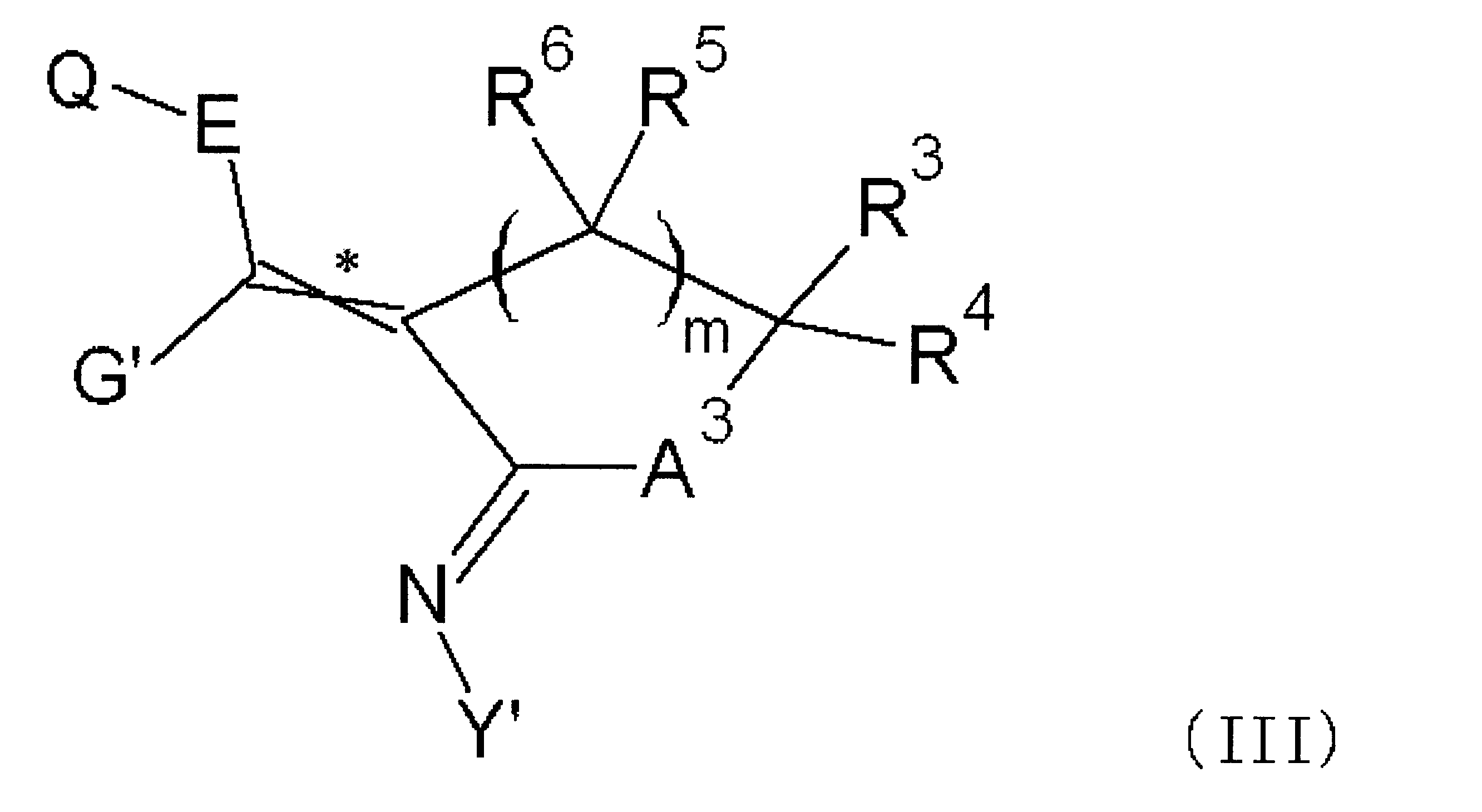
式(III)中、Y’、G’、E、Q、R3およびR4は、式(II)中のそれらと同じ意味である。
式(III)中、A3は、酸素原子または硫黄原子を示す。
式(III)中、R5およびR6は、それぞれ独立に、水素原子、無置換のもしくは置換基を有するC1~6アルキル基、無置換のもしくは置換基を有するC2~6アルケニル基、無置換のもしくは置換基を有するC2~6アルキニル基、無置換のもしくは置換基を有するC3~8シクロアルキル基、無置換のもしくは置換基を有するC6~10アリール基、無置換のもしくは置換基を有する3~6員ヘテロシクリル基、ハロゲノ基、またはシアノ基を示す。また、R5とR6は相互に繋がってR5およびR6が結合する炭素原子とともに環を形成してもよい。mは、R5およびR6で置換されたメチレンの個数を示し、かつ1~4のいずれかの整数である。mが2以上のときR5およびR6は互いに同一でも相違してもよい。
R5およびR6における「無置換のもしくは置換基を有するC1~6アルキル基」、「無置換のもしくは置換基を有するC2~6アルケニル基」、「無置換のもしくは置換基を有するC2~6アルキニル基」、「無置換のもしくは置換基を有するC3~8シクロアルキル基」、「無置換のもしくは置換基を有するC6~10アリール基」、「無置換のもしくは置換基を有する3~6員ヘテロシクリル基」、「ハロゲノ基」としては、はX1において述べたものと同様のものを挙げることができる。
式(III)中、*は二重結合による立体異性(E)、(Z)、または(E/Z)が存在すること(undefined double stereo bond)を示す。
本発明の第四実施形態に係る水棲有害付着生物防除組成物は、式(IV)で表される化合物およびそれらの塩から選ばれる少なくとも1つを有効成分として含有するものである。
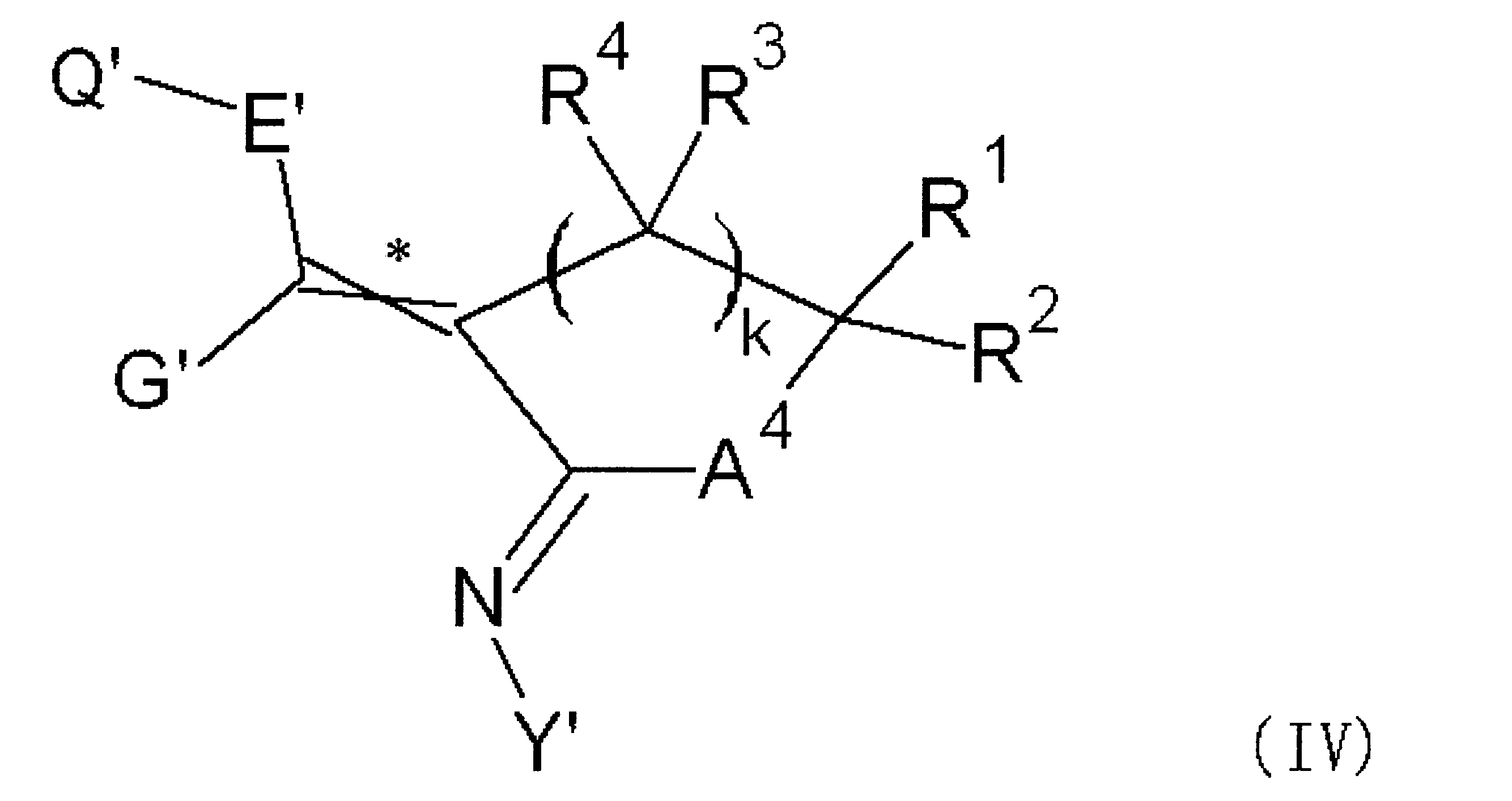
式(IV)中のY’、G’,X1、R1、R2、R3、およびR4は、式(II)中のY’と同じ意味である。
式(IV)中のA4は、酸素原子または硫黄原子を示す。好ましくは硫黄原子である。
式(IV)中のkは、R3およびR4で置換されたメチレンの個数を示し、かつ1~4のいずれかの整数である。kが2以上のときR3およびR4は互いに同一でも異なっていてもよい。kは1または2であることが好ましい。
式(IV)中のE’は、酸素原子または硫黄原子を示す。好ましくは硫黄原子である。
式(IV)中のQ’は、無置換のもしくは置換基X2を有するC7~11アラルキル基、無置換のもしくは置換基X2を有するC6~10アリール基、または無置換のもしくは置換基X2を有する5~6員へテロアリール基を示す。Q’上の置換基X2の個数は1~5のいずれかの整数である。置換基X2が2以上あるときX2は互いに同一でも異なっていてもよい。Q’における「C7~11アラルキル基」としては、ベンジル基、フェネチル基などを挙げることができる。Q’における「C6~10アリール基」、「5~6員ヘテロアリール基」としては、前記Yにおいて例示したそれらと同じものを挙げることができる。好ましくはフェニル基またはチエニル基である。X2は、式(II)中のX2と同じ意味である。
本発明の第五実施形態に係る水棲有害付着生物防除組成物は、式(V)で表される化合物およびそれらの塩から選ばれる少なくとも1つを有効成分として含有するものである。

式(V)中、Y、A4、R1、R2、G、E、およびQは、既に説明したそれらと同じ意味を示す。
式(V)中、R3a、R3b、R4a、およびR4bは、それぞれ独立に、水素原子、無置換のもしくは置換基を有するC1~6アルキル基、無置換のもしくは置換基を有するC2~6アルケニル基、無置換のもしくは置換基を有するC2~6アルキニル基、無置換のもしくは置換基を有するC3~8シクロアルキル基、無置換のもしくは置換基を有するC6~10アリール基、無置換のもしくは置換基を有する3~6員ヘテロシクリル基、ハロゲノ基、またはシアノ基を示す。
R3a、R3b、R4a、およびR4bにおける「C1~6アルキル基」、「C2~6アルケニル基」、「C2~6アルキニル基」、「C3~8シクロアルキル基」、「C6~10アリール基」、「3~6員ヘテロシクリル基」、および「ハロゲノ基」、ならびにこれらの基に置換基を有する基としては、前記X1において例示したそれらと同じものを挙げることができる。
R3a、R3b、R4a、およびR4bにおける「C1~6アルキル基」、「C2~6アルケニル基」、「C2~6アルキニル基」、「C3~8シクロアルキル基」、「C6~10アリール基」、「3~6員ヘテロシクリル基」、および「ハロゲノ基」、ならびにこれらの基に置換基を有する基としては、前記X1において例示したそれらと同じものを挙げることができる。
また、R3aとR4aは、相互に繋がってR3aおよびR4aが結合する炭素原子とともに環を形成してもよい。
R3aとR4aが相互に繋がってそれらが結合する炭素原子とともに形成する「環」としては、シクロプロパン環、シクロブタン環、シクロペンタン環、シクロヘキサン環、シクロヘプタン環、テトラヒドロフラン環、テトラヒドロピラン環などを挙げることができる。
式(V)中のGとEが結合する二重結合の立体異性によって、(E)、(Z)、または(E/Z)を示す。二重結合部分は(E)の立体を有する化合物であることが好ましい。
R3aとR4aが相互に繋がってそれらが結合する炭素原子とともに形成する「環」としては、シクロプロパン環、シクロブタン環、シクロペンタン環、シクロヘキサン環、シクロヘプタン環、テトラヒドロフラン環、テトラヒドロピラン環などを挙げることができる。
式(V)中のGとEが結合する二重結合の立体異性によって、(E)、(Z)、または(E/Z)を示す。二重結合部分は(E)の立体を有する化合物であることが好ましい。
本発明の第六実施形態に係る水棲有害付着生物防除組成物は、式(VI)で表される化合物およびそれらの塩から選ばれる少なくとも1つを有効成分として含有するものである。
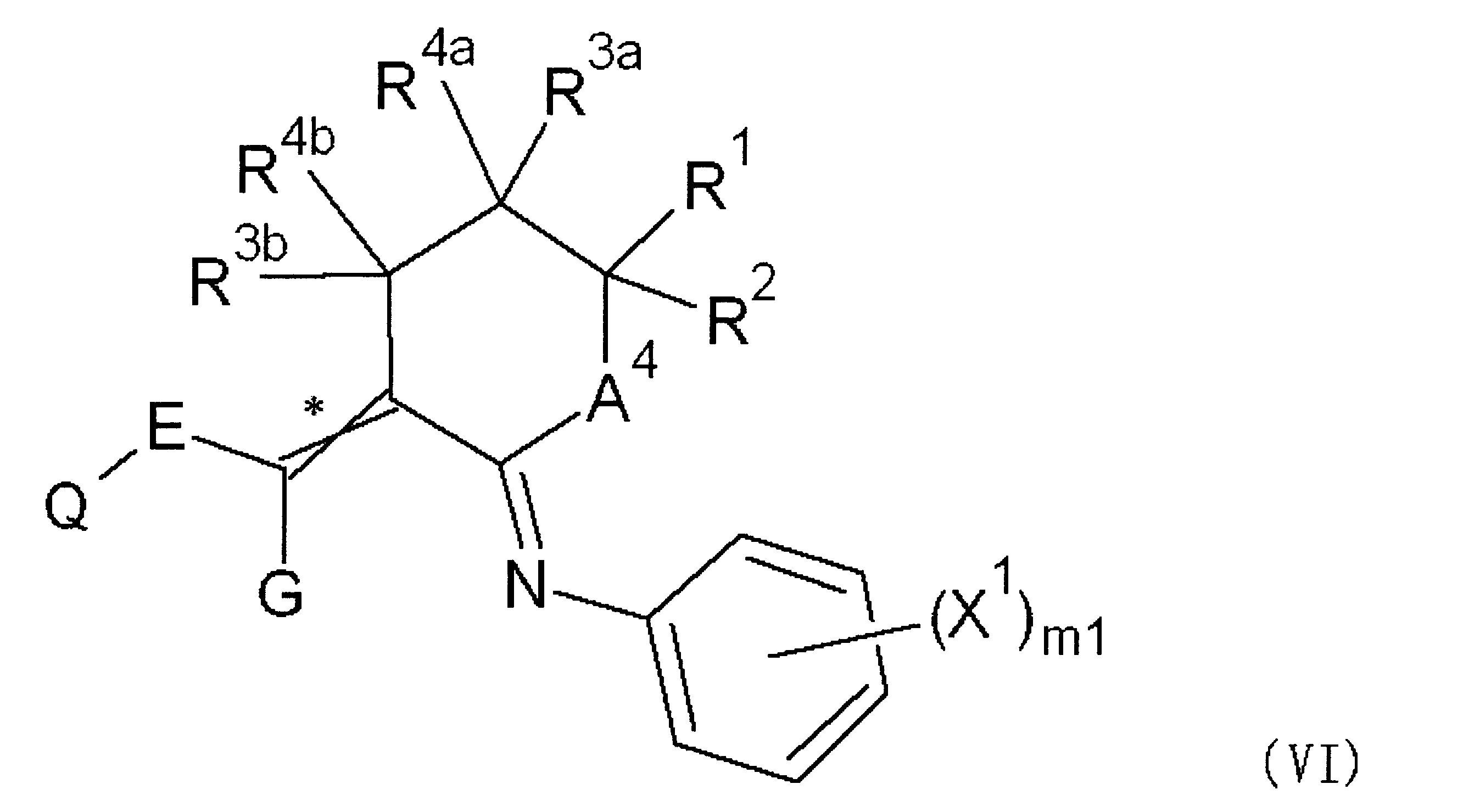
式(VI)中、X1、A4、R1、R2、G、E、およびQは、既に説明したそれらと同じ意味を示す。m1は、0~5のいずれかの整数を示す。
式(VI)中、R3a、R3b、R4a、およびR4bは、それぞれ独立に、水素原子、無置換のもしくは置換基を有するC1~6アルキル基、無置換のもしくは置換基を有するC2~6アルケニル基、無置換のもしくは置換基を有するC2~6アルキニル基、無置換のもしくは置換基を有するC3~8シクロアルキル基、無置換のもしくは置換基を有するC6~10アリール基、無置換のもしくは置換基を有する3~6員ヘテロシクリル基、ハロゲノ基、またはシアノ基を示す。
R3a、R3b、R4a、およびR4bにおける「C1~6アルキル基」、「C2~6アルケニル基」、「C2~6アルキニル基」、「C3~8シクロアルキル基」、「C6~10アリール基」、「3~6員ヘテロシクリル基」、および「ハロゲノ基」、ならびにこれらの基に置換基を有する基としては、前記X1において例示したそれらと同じものを挙げることができる。
R3a、R3b、R4a、およびR4bにおける「C1~6アルキル基」、「C2~6アルケニル基」、「C2~6アルキニル基」、「C3~8シクロアルキル基」、「C6~10アリール基」、「3~6員ヘテロシクリル基」、および「ハロゲノ基」、ならびにこれらの基に置換基を有する基としては、前記X1において例示したそれらと同じものを挙げることができる。
また、R3aとR4aは、相互に繋がってR3aおよびR4aが結合する炭素原子とともに環を形成してもよい。
R3aとR4aが相互に繋がってそれらが結合する炭素原子とともに形成する「環」としては、シクロプロパン環、シクロブタン環、シクロペンタン環、シクロヘキサン環、シクロヘプタン環、テトラヒドロフラン環、テトラヒドロピラン環などを挙げることができる。
式(VI)中のGとEが結合する二重結合の立体異性によって、(E)、(Z)、または(E/Z)を示す。二重結合部分は(E)の立体を有する化合物であることが好ましい。
R3aとR4aが相互に繋がってそれらが結合する炭素原子とともに形成する「環」としては、シクロプロパン環、シクロブタン環、シクロペンタン環、シクロヘキサン環、シクロヘプタン環、テトラヒドロフラン環、テトラヒドロピラン環などを挙げることができる。
式(VI)中のGとEが結合する二重結合の立体異性によって、(E)、(Z)、または(E/Z)を示す。二重結合部分は(E)の立体を有する化合物であることが好ましい。
本発明において有効成分として用いられる化合物の塩は、化学的に許容される塩であれば特に制限されない。塩の例としては、硫酸、塩酸、リン酸、テトラフルオロホウ素酸、酢酸、コハク酸、クエン酸、乳酸、マレイン酸、フマル酸、コール酸、パモン酸、ムチン酸、グルタミン酸、ショウノウ酸、グルタル酸、グリコール酸、フタル酸、酒石酸、ギ酸、ラウリン酸、ステアリン酸、サリチル酸、メタンスルホン酸、ベンゼンスルホン酸、ソルビン酸、ピクリン酸、安息香酸、ケイ皮酸、および同様の酸などの有機酸および無機酸両方との標準的な反応により形成する塩が挙げられる。
本発明において有効成分として用いられる化合物および化合物の塩、公知の方法に従って製造することができる。具体的な製造方法は、特許文献8および9などに記載の製造方法を参考とすることができる。
本発明の水棲有害付着生物防除組成物は、前述した有効成分とその他の化合物とからなる包接化合物を含むものであってもよい。また、本発明の水棲有害付着生物防除組成物は、前述の有効成分とその他の有害付着生物防除成分とを含有するものであってもよい。前述の有効成分とその他の有害付着生物防除成分とを含有することにより、対象となる水棲有害付着生物の範囲が拡大したり、複数の有害付着生物防除成分の相乗効果を奏したりすることが期待できる。
その他の有害付着生物防除成分としては、殺菌・抗菌・防腐成分、防藻成分、殺虫成分、水中防汚成分、忌避成分等がある。具体的には以下のものが例示される。
亜酸化銅、ロダン銅、塩基性硫酸銅、オキシン銅などの銅系化合物; カルバミン酸亜鉛などの亜鉛系化合物; ジデシルジメチルアンモニウムクロライド(DDAC)、ジデシルジメチルアンモニウムアジペート(DDAA)などの第4級アンモニウム塩系化合物; ポリヘキサメチレンビグアニド(PHMB)、グルコン酸クロルへキシジンなどのビグアナイド系化合物; セチルピリジニウムクロライド、ドデシルピリジニウムクロライドなどのピリジニウム系化合物; 1,2-ベンズイソチアゾリン-3-オン、5-クロロ-2-メチル-4-イソチアゾリン-3-オン、2-メチル-4-イソチアゾリン-3-オン、2-n-オクチル-4-イソチアゾリン-3-オン、N-n-ブチル-1,2-ベンズイソチアゾリン-3-オンなどのイソチアゾリン系化合物; 3-ヨード-2-プロピニル-ブチルカーバメート、ジヨードメチルパラトリルスルホンなどの有機ヨウ素系化合物; 2,3,5,6-テトラクロロ-4-(メチルスルホニル)ピリジンなどのピリジン系化合物; ジンクピリチオン、ナトリウムピリチオン、銅ピリチオンなどのピリチオン系化合物;
亜酸化銅、ロダン銅、塩基性硫酸銅、オキシン銅などの銅系化合物; カルバミン酸亜鉛などの亜鉛系化合物; ジデシルジメチルアンモニウムクロライド(DDAC)、ジデシルジメチルアンモニウムアジペート(DDAA)などの第4級アンモニウム塩系化合物; ポリヘキサメチレンビグアニド(PHMB)、グルコン酸クロルへキシジンなどのビグアナイド系化合物; セチルピリジニウムクロライド、ドデシルピリジニウムクロライドなどのピリジニウム系化合物; 1,2-ベンズイソチアゾリン-3-オン、5-クロロ-2-メチル-4-イソチアゾリン-3-オン、2-メチル-4-イソチアゾリン-3-オン、2-n-オクチル-4-イソチアゾリン-3-オン、N-n-ブチル-1,2-ベンズイソチアゾリン-3-オンなどのイソチアゾリン系化合物; 3-ヨード-2-プロピニル-ブチルカーバメート、ジヨードメチルパラトリルスルホンなどの有機ヨウ素系化合物; 2,3,5,6-テトラクロロ-4-(メチルスルホニル)ピリジンなどのピリジン系化合物; ジンクピリチオン、ナトリウムピリチオン、銅ピリチオンなどのピリチオン系化合物;
2-(4-チオシアノメチルチオ)ベンゾチアゾールなどのベンゾチアゾール系化合物; メチル-2-ベンズイミダゾールカーバメート、2-(4-チアゾリル)-ベンズイミダゾールなどのイミダゾール系化合物; 2,4,6-トリクロロフェニルマレイミド、4-トリルマレイミドなどのN-アリールマレイミド系化合物; 3-ベンジリデンアミノ-1,3-チアゾリジン-2,4-ジオン、3-(4-メチルベンジリデンアミノ)-1,3-チアゾリジン-2,4-ジオンなどのチアゾリジンジオン系化合物; N-トリクロロメチルチオフタルイミド、N-フルオロジクロロメチルチオフタルイミドなどのチオフタルイミド系化合物; ジチオシアノメタン、ジチオシアノエタン、2,5-ジチオシアノチオフェンなどのジチオシアノ系化合物; テトラメチルチウラムジスルフィド、ジメチルジチオカルバミン酸亜鉛(ジラム)、エチレンビスジチオカルバミン酸亜鉛(ジネブ)、エチレンビスジチオカルバミン酸マンガン(マンネブ)、ジメチルジチオカルバミン酸エチレンビスジチオカルバミン酸亜鉛(ポリカーバメート)、亜鉛イオン配位エチレンビスジチオカルバミン酸マンガン(マンゼブ)などのチオカーバメート系化合物;
2,4,5,6-テトラクロロイソフタロニトリルなどのニトリル系化合物; N-(フルオロジクロロメチルチオ)-フタルイミド、N-(フルオロジクロロメチルチオ)-N’,N’-ジメチル-N-(4-メチルフェニル)-スルファミド、N-(フルオロジクロロメチルチオ)-N’,N’-ジメチル-N-フェニル-スルファミドなどのハロアルキルチオ系化合物;α-t-ブチル-α(p-クロロフェニルエチル)-1H-1,2,4-トリアゾール-1-エタノール(テブコナゾール)などのトリアゾール系化合物;
3-(3,4-ジクロロフェニル)-1,1-ジメチルウレア(DCMU)などのフェニルウレア系化合物;2-メチルチオ-4-t-ブチルアミノ-6-シクロプロピルアミノ-S-トリアジン(シブトリン)などのトリアジン系化合物; ニテンピラム、イミダクロプリド、アセタミプリド、チアメトキサム、クロチアニジン、ジノテフラン、チアクロプリドなどのネオニコチノイド系化合物;
3-(3,4-ジクロロフェニル)-1,1-ジメチルウレア(DCMU)などのフェニルウレア系化合物;2-メチルチオ-4-t-ブチルアミノ-6-シクロプロピルアミノ-S-トリアジン(シブトリン)などのトリアジン系化合物; ニテンピラム、イミダクロプリド、アセタミプリド、チアメトキサム、クロチアニジン、ジノテフラン、チアクロプリドなどのネオニコチノイド系化合物;
フェニトロチオン、ホキシム、アジンホスメチル、DDVP、シアノホス、フェンチオン、ダイアジノン、クロルピリホス、フェントエートなどの有機リン系化合物; アルディカルブ、メソミル、チオジカルブ、カルボフラン、カルボスルファン、ベンフラカルブ、プロポキスル、BPMC、カルバリル、ピリミカーブ、エチオフェンカルブ、フェノキシカルブなどのカーバメート系化合物; フェノトリン、シフェノスリン、ペルメトリン、シペルメトリン、フェンバレレート、エトフェンプロクス、トラロメトリン、デルタメスリン、フルバリネート、シフルトリンなどのピレスロイド系化合物; ジフルベンズロン、クロルフルアズロン、ヘキサフルムロン、トリフルムロン、フルフェノクスロン、ピリプロキシフェン、メトプレン、ジアフェンチウロンなどのベンゾイルウレア系化合物;
フィプロニル、テブフェンピラドなどのピラゾール系化合物; カルタップ、ベンスルタップなどのネライストキシン系化合物; アバメクチン、ミルベメクチン、スピノサドなどのマクロライド系化合物; フェナザクインなどその他の殺虫・殺ダニ成分; ホウ酸、ホウ酸塩、ピリジントリフェニルボラン、テトラフェニルボランなどのホウ素系化合物; メデトミジンなどの水棲生物神経伝達に影響する防汚成分; N,N-ジエチルトルアミド、7-イソシアノ-3,7-ジメチル-1-オクタノール、trans-酢酸(4-イソシアノシクロヘキシル)エステルなどその他の忌避成分。
これらの成分は、1種単独でまたは2種以上を組み合わせて使用することができる。
これらの成分は、1種単独でまたは2種以上を組み合わせて使用することができる。
本発明における有効成分の含有量は、効果が現れる範囲であれば、特に限定されるものではないが、水棲有害付着生物防除組成物に対して、通常0.00001~20質量%、好ましくは0.001~15質量、さらに好ましくは、0.1~10質量%である。
本発明の水棲有害付着生物防除組成物は、有効成分を含有する塊、有効成分を含有する粒、有効成分を含有する粉などのような固体であってもよいし、有効成分を含有する溶液、有効成分を含有する懸濁液、有効成分を含有する乳濁液などのような液体であってもよい。
また、本発明の水棲有害付着生物防除組成物は、添加物として樹脂や塗料などに配合してもよい。本発明の水棲有害付着生物防除組成物を配合した樹脂組成物は、公知の方法で所望の形状に成形することができる。本発明の水棲有害付着生物防除組成物を配合した塗料組成物は、基材に塗布させたり、含浸させたりすることができる。本発明の水棲有害付着生物防除組成物を配合した塗料組成物は防汚塗料組成物として利用することができる。
また、本発明の水棲有害付着生物防除組成物は、船底塗料と配合して、船底塗料組成物として使用することができる。本発明の船底塗料組成物を船底に塗布することで、フジツボなど水性有害付着生物が付着するのを防止することができる。
本発明の水棲有害付着生物防除組成物と配合可能な船底塗料として、以下のものを例示することができる。
船底塗料下塗:弁柄、紫弁柄、酸化亜鉛、クレー、船底塗料下塗ワニス、ソルベントナフサ、ミネラルスピリット、ステアリン酸アルミニウムなどを配合した塗料;
船底塗料上塗:フェノール樹脂、エステルゴム、煮桐油、煮荏油、アマニ油脂マンガン、ソルベントナフサ、紫弁柄、弁柄、焼石膏、タルクなどを配合した塗料;
船底塗料1号:弁柄、亜鉛華、カーボンブラック、炭酸カルシウム、タルク、ステアリン酸アルミニウム、船1号ニス、ミネラルスピリットなどを配合した塗料;
船底塗料2号:亜酸化銅、弁柄、カーボンブラック、硫酸バリウム、沈殿防止剤、分散剤、船2号ニス、キシレンなどを配合した塗料。
また、本発明の水棲有害付着生物防除組成物は、添加物として樹脂や塗料などに配合してもよい。本発明の水棲有害付着生物防除組成物を配合した樹脂組成物は、公知の方法で所望の形状に成形することができる。本発明の水棲有害付着生物防除組成物を配合した塗料組成物は、基材に塗布させたり、含浸させたりすることができる。本発明の水棲有害付着生物防除組成物を配合した塗料組成物は防汚塗料組成物として利用することができる。
また、本発明の水棲有害付着生物防除組成物は、船底塗料と配合して、船底塗料組成物として使用することができる。本発明の船底塗料組成物を船底に塗布することで、フジツボなど水性有害付着生物が付着するのを防止することができる。
本発明の水棲有害付着生物防除組成物と配合可能な船底塗料として、以下のものを例示することができる。
船底塗料下塗:弁柄、紫弁柄、酸化亜鉛、クレー、船底塗料下塗ワニス、ソルベントナフサ、ミネラルスピリット、ステアリン酸アルミニウムなどを配合した塗料;
船底塗料上塗:フェノール樹脂、エステルゴム、煮桐油、煮荏油、アマニ油脂マンガン、ソルベントナフサ、紫弁柄、弁柄、焼石膏、タルクなどを配合した塗料;
船底塗料1号:弁柄、亜鉛華、カーボンブラック、炭酸カルシウム、タルク、ステアリン酸アルミニウム、船1号ニス、ミネラルスピリットなどを配合した塗料;
船底塗料2号:亜酸化銅、弁柄、カーボンブラック、硫酸バリウム、沈殿防止剤、分散剤、船2号ニス、キシレンなどを配合した塗料。
本発明の水棲有害付着生物防除組成物は、水棲有害付着生物が潜む水、例えば、船舶のバラスト水、各種機器において使用される冷却水等の熱媒水などにそのまま添加してもよいし、水棲有害付着生物が潜む水(海水、湖水、川水など)の中に設置される構造物の表面に塗布、または該構造物の中に注入若しくは含浸させてもよい。本発明の水棲有害付着生物防除組成物に含有される有効成分は、水溶性が低いので、水中に必要以上に溶出することがなく、水棲有害付着生物の防除効果が長く持続する。なお、水中構造物は、水中に没しているかまたはほぼ常時水に接している人工的な構造物である。例えば、港湾、水路、造船所等における護岸;水中施設;導水管;発電所、工場等において水と接する施設および機器;冷却塔、冷却水または熱媒水と接している機器;給水施設;浄水場、汚水処理場;船舶、特に船底、バラストタンクおよびそれらに付属する機器;漁礁;漁業等において水中で使用する漁網等の器具;ブイ;石油掘削設備等の海中施設;等が挙げられる。
一方、本発明の水棲有害付着生物防除組成物に含有される有効成分は、通常の環境下においても分解しやすいので、一般の水棲生物に毒性を及ぼすなどの環境への悪影響の心配がない。また、本発明の水棲有害付着生物防除組成物を添加した水(例えば、バラスト水)を排出する前に、例えば、酸化剤、還元剤等で処理することによって、本発明の水棲有害付着生物防除組成物に含有される有効成分を容易に分解させることができる。
本発明の水棲有害付着生物防除組成物が防除の対象とする水棲有害付着生物は、水中に棲息する生物(生活環の一部のみ水中にある生物を含む。)のうち、水中構造物を汚損したり、水産物の生産に影響を及ぼすなどして経済的に害を与えたり、異常に繁殖して生態系を攪乱したり、死骸や臭気などにより環境に害を与えたりする生物である。例えば、細菌、菌類、藻類、各種プランクトン、海綿動物、腔腸動物(クラゲ、ヒドロ虫等)、コケムシ類、多毛類(カサネカンザシ、ウズマキゴカイ等)、棘皮動物(ヒトデ、ウニ等)、貝類等の軟体動物、甲殻類等の節足動物、尾索類(ホヤ類)などが挙げられる。
本発明の水棲有害付着生物防除組成物は、蔓脚類(フジツボ類)、海中の木材を食害するキクイムシ、ミジンコ類等を含む甲殻類に対する効果が高い。また、本発明の防汚塗料組成物は、船舶等の水中構造物に固着して問題をひきおこす海藻類、海綿動物、イガイやカキなどの二枚貝類、蔓脚類等に対する効果が高い。蔓脚類の付着性生物、具体的にはフジツボ、エボシガイ、カメノテ、特にフジツボは、水中構造物に与える害が大きいので、蔓脚類に高い防除効果を示す本発明の水棲有害付着生物防除組成物は、産業上有益である。
次に、実施例を挙げて、本発明をさらに詳細に説明するが、本発明はこれらの実施例のみに限定して解釈されるべきものではない。
水棲有害付着生物に相当するモデル生物として、船底や水中構築物に付着する生物であれば特に限定されるものではないが、甲殻類に属するオオミジンコ(枝角類、Daphnia magna)およびヨコエビ(端脚類、Hyalella azteca)、フジツボ類(ノープリウス幼生も含む)の防除効果を以下の方法にて評価した。
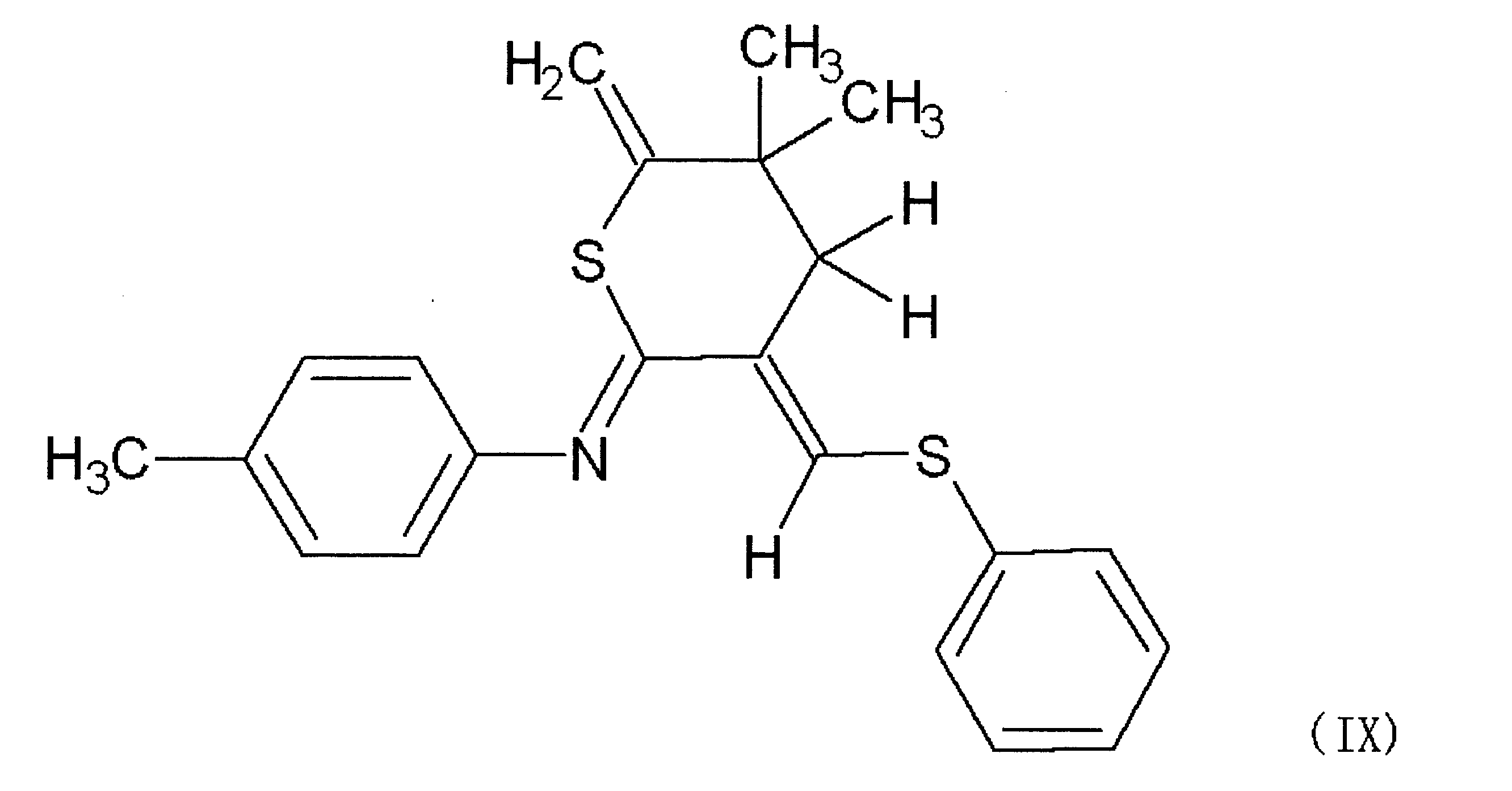
試験例1 オオミジンコの48時間急性毒性試験
式(IX)で表わされる化合物をN,N-ジメチルホルムアミドに溶解させた。これを水に添加し混ぜ合わせ、最終濃度0.001μg/L、0.01μg/L、0.1μg/L、および1μg/Lの水棲有害付着生物防除組成物を得た。
オオミジンコ10頭を前記水棲有害付着生物防除組成物に約20℃で48時間曝した。次いでオオミジンコ10頭の遊泳阻害率を計測した。該計測値から作図法により半数影響濃度(EC50値)を算出した。その結果、48時間EC50値は、0.0028μg/Lであった。
式(IX)で表わされる化合物をN,N-ジメチルホルムアミドに溶解させた。これを水に添加し混ぜ合わせ、最終濃度0.001μg/L、0.01μg/L、0.1μg/L、および1μg/Lの水棲有害付着生物防除組成物を得た。
オオミジンコ10頭を前記水棲有害付着生物防除組成物に約20℃で48時間曝した。次いでオオミジンコ10頭の遊泳阻害率を計測した。該計測値から作図法により半数影響濃度(EC50値)を算出した。その結果、48時間EC50値は、0.0028μg/Lであった。
試験例2 ヨコエビの96時間急性毒性試験
式(IX)で表わされる化合物をN,N-ジメチルホルムアミドに溶解させた。これを水に添加し混ぜ合わせ、最終濃度を0.01μg/L、0.1μg/L、1μg/L、10μg/L、および100μg/Lの水棲有害付着生物防除組成物を得た。
ヨコエビ5頭を前記水棲有害付着生物防除組成物に約21℃で96時間曝した。次いでヨコエビ5頭の生存率を計測した。該計測値からVan der Waerden法により半数致死濃度(LC50値)を算出した。その結果、96時間LC50値は、0.20μg/Lであった。
式(IX)で表わされる化合物をN,N-ジメチルホルムアミドに溶解させた。これを水に添加し混ぜ合わせ、最終濃度を0.01μg/L、0.1μg/L、1μg/L、10μg/L、および100μg/Lの水棲有害付着生物防除組成物を得た。
ヨコエビ5頭を前記水棲有害付着生物防除組成物に約21℃で96時間曝した。次いでヨコエビ5頭の生存率を計測した。該計測値からVan der Waerden法により半数致死濃度(LC50値)を算出した。その結果、96時間LC50値は、0.20μg/Lであった。

試験例3 ノープリウス幼生の48時間毒性試験
式(X)で表される化合物を、N,N-ジメチルホルムアミド(DMF)で定容し、原液を調整した。この原液を同溶媒で希釈して、最終濃度がそれぞれ0.001μg/L、0.01μg/L、0.1μg/L、1.0μg/L、10.0μg/L、および100.0μg/Lである添加溶液を調整した。50mL雌フラスコに予め天然海水で敷き水し、原液および各濃度の添加溶液をマイクロピペットでそれぞれ5μL添加した後、50mLに定容して各濃度の試験溶液を調整した。
1試験区あたり10個体のノープリウス幼生を、各濃度の試験溶液に約21℃で48時間暴露し、ノープリウス幼生の生存率を計測した。
式(X)で表される化合物の48時間LC50値は、35.3μg/Lであった。
式(X)で表される化合物を、N,N-ジメチルホルムアミド(DMF)で定容し、原液を調整した。この原液を同溶媒で希釈して、最終濃度がそれぞれ0.001μg/L、0.01μg/L、0.1μg/L、1.0μg/L、10.0μg/L、および100.0μg/Lである添加溶液を調整した。50mL雌フラスコに予め天然海水で敷き水し、原液および各濃度の添加溶液をマイクロピペットでそれぞれ5μL添加した後、50mLに定容して各濃度の試験溶液を調整した。
1試験区あたり10個体のノープリウス幼生を、各濃度の試験溶液に約21℃で48時間暴露し、ノープリウス幼生の生存率を計測した。
式(X)で表される化合物の48時間LC50値は、35.3μg/Lであった。
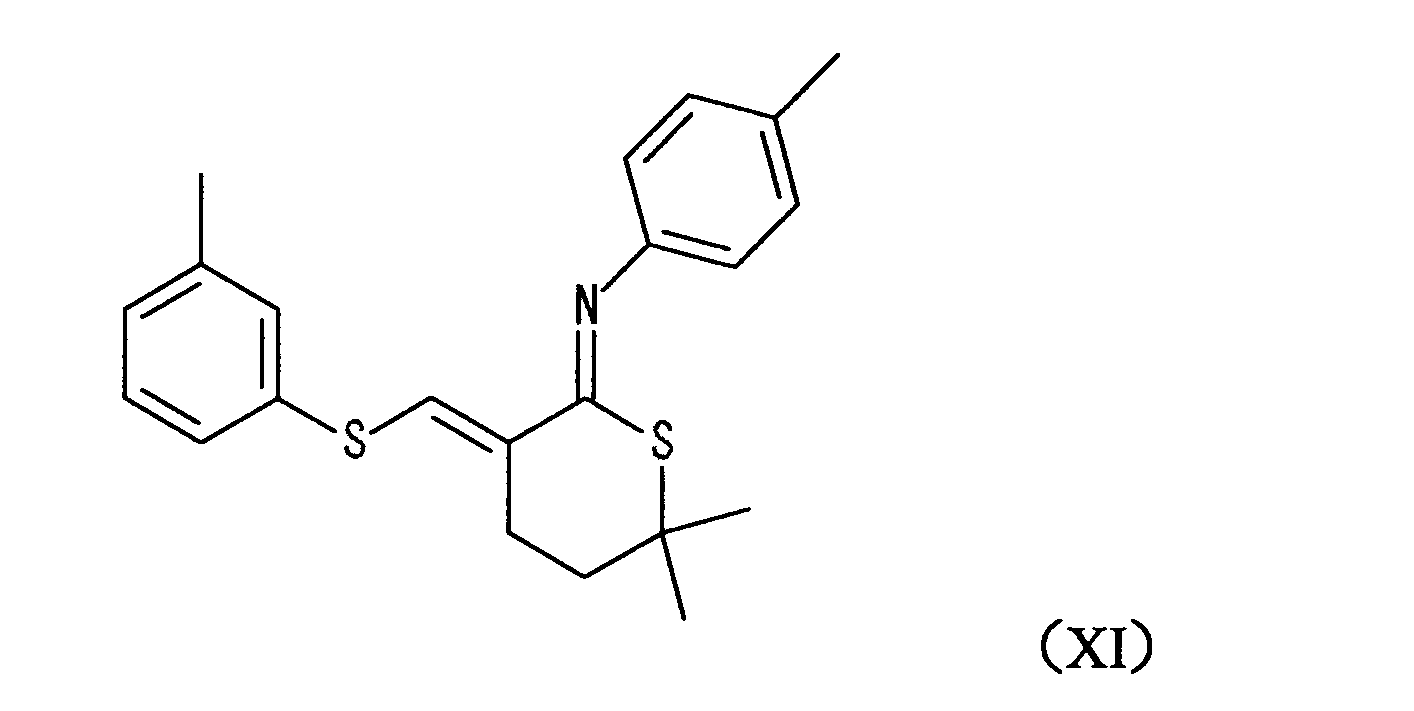
試験例4 ノープリウス幼生の48時間毒性試験
試験例3において、式(X)で表される化合物の代わりに、式(XI)で表される化合物を用いた以外は、試験例3と同じ方法で試験を行った。
式(XI)で表される化合物の48時間LC50値は、5.53μg/Lであった。
試験例3において、式(X)で表される化合物の代わりに、式(XI)で表される化合物を用いた以外は、試験例3と同じ方法で試験を行った。
式(XI)で表される化合物の48時間LC50値は、5.53μg/Lであった。
参考例
試験例3において、式(X)で表される化合物の代わりに、酸化トリブチルスズ(略称:TBTO、96%、和光純薬工業株式会社)を用いた以外は、試験例3と同じ方法で試験を行い、陽性対照区とした。
TBTOの48時間LC50値は、3.96μg/Lであった。ただし、TBTOは毒性が強いことから、現在多くの国において、船底塗料として使用禁止となっている。
試験例3において、式(X)で表される化合物の代わりに、酸化トリブチルスズ(略称:TBTO、96%、和光純薬工業株式会社)を用いた以外は、試験例3と同じ方法で試験を行い、陽性対照区とした。
TBTOの48時間LC50値は、3.96μg/Lであった。ただし、TBTOは毒性が強いことから、現在多くの国において、船底塗料として使用禁止となっている。
以上の結果は、本発明に係る水棲有害付着生物防除組成物が、水棲有害付着生物に対して高い防除効力があることを示している。
本発明の水棲有害付着生物防除組成物は、魚類や人畜に対しては安全でありながら水棲有害付着生物に対しては高い防除効力を示す。該組成物を含有する本発明の防汚塗料組成物を水中構造物に塗布しておくと、甲殻類などの水棲生物の付着を防ぐことができるので、産業上有用である。
Claims (9)
-
式(I-1)または式(I-2)で表される化合物およびそれらの塩から選ばれる少なくとも1つを有効成分として含有する、水棲有害付着生物防除組成物。

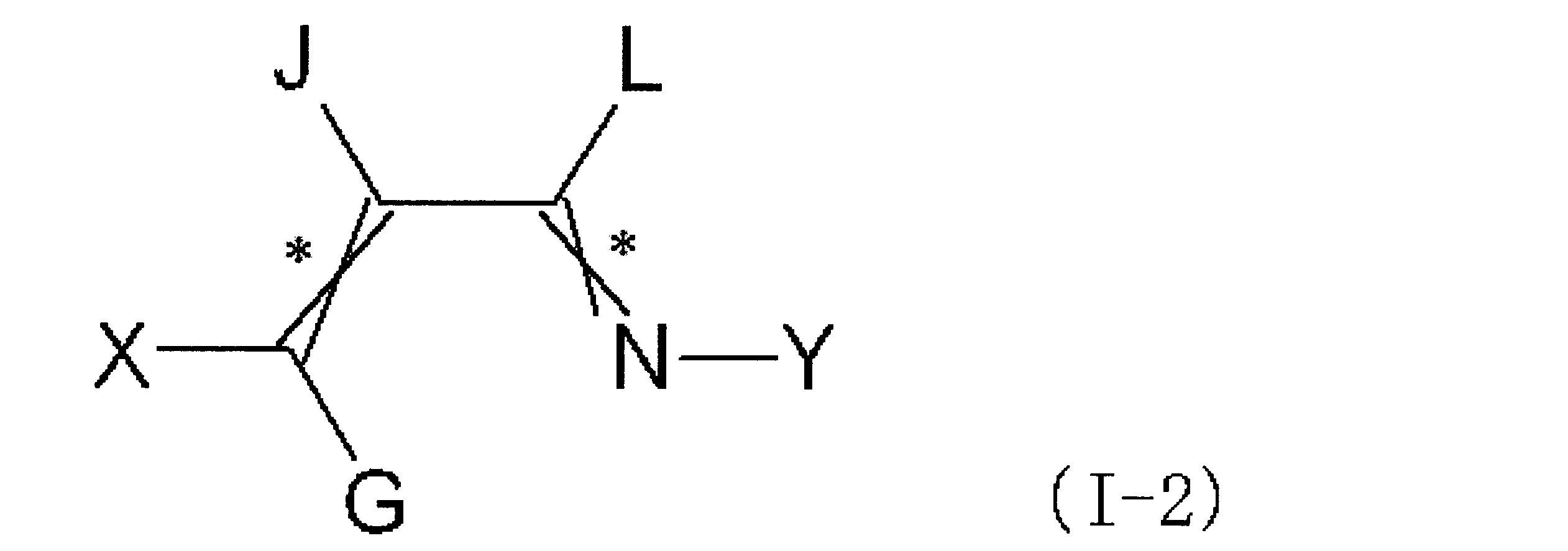
Xは、-ORI、-S(O)lRI、または-NRIRIIを示す。
G及びJは、各々独立して、水素原子、-RI、-ORI、-S(O)lRI、-SC(=O)RI、-OC(=O)RI、-OS(O)lRI、-C(=O)RI、-C(=O)ORI、-NRIRII、-N=CRIRII、ハロゲノ基、シアノ基、またはニトロ基を示す。
Lは、-RI、-ORI、-S(O)lRI、-NRIRII、または-N=CRIRIIを示す。
またJとLは相互に繋がって、それらが結合する炭素原子とともに5~8員環を形成してもよい。
Yは、-RI、-ORI、-S(O)lRI、-C(=O)RI、-C(=S)RI、-C(=O)ORI、-NRIRII、-N=CRIRII、またはシアノ基を示す。
lは、0~2のいずれかの整数を示す。
RIおよびRIIは、各々独立して、水素原子、無置換のもしくは置換基を有するC1~6アルキル基、無置換のもしくは置換基を有するC2~6アルケニル基、無置換のもしくは置換基を有するC2~6アルキニル基、無置換のもしくは置換基を有するC3~8シクロアルキル基、無置換のもしくは置換基を有する6~10員アリール基、または無置換のもしくは置換基を有する3~10員ヘテロシクリル基を示す。
*は二重結合による立体異性が存在することを示す。] -
式(II)で表される化合物およびそれらの塩から選ばれる少なくとも1つを有効成分として含有する、水棲有害付着生物防除組成物。
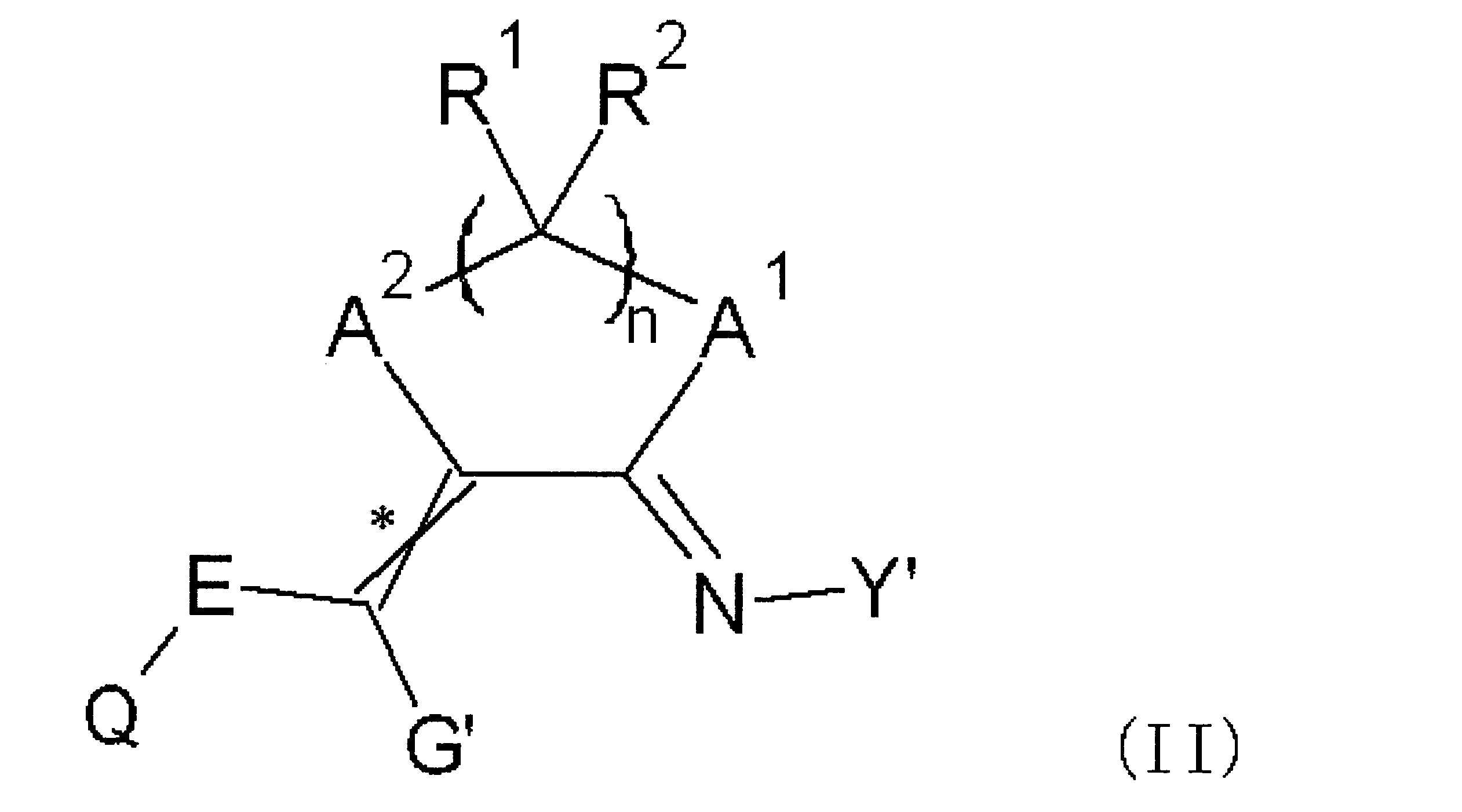
Y’は、無置換のもしくは置換基X1を有するC6~10アリール基、または無置換のもしくは置換基X1を有する5~6員へテロアリール基を示す。
X1は、無置換のもしくは置換基を有するC1~6アルキル基、無置換のもしくは置換基を有するC2~6アルケニル基、無置換のもしくは置換基を有するC2~6アルキニル基、無置換のもしくは置換基を有するC3~8シクロアルキル基、水酸基、無置換のもしくは置換基を有するC1~6アルコキシ基、無置換のもしくは置換基を有するC1~7アシル基、無置換のもしくは置換基を有するC1~6アルコキシカルボニル基、無置換のもしくは置換基を有するアミノ基、無置換のもしくは置換基を有するC1~6アルキルチオ基、無置換のもしくは置換基を有するC1~6アルキルスルホニル基、無置換のもしくは置換基を有するC6~10アリール基、無置換のもしくは置換基を有する3~10員ヘテロシクリル基、ハロゲノ基、シアノ基、またはニトロ基を示す。
Y’上の置換基X1の個数は1~5のいずれかの整数である。置換基X1が2以上在るときX1は互いに同一でも相違してもよい。
A1およびA2は、それぞれ独立に、酸素原子、-S(O)l-、-NR1-、または-CR1R2-を示す。
R1およびR2は、それぞれ独立に、水素原子、無置換のもしくは置換基を有するC1~6アルキル基、無置換のもしくは置換基を有するC2~6アルケニル基、無置換のもしくは置換基を有するC2~6アルキニル基、無置換のもしくは置換基を有するC3~8シクロアルキル基、無置換のもしくは置換基を有するC6~10アリール基、無置換のもしくは置換基を有する3~10員ヘテロシクリル基、ハロゲノ基、またはシアノ基を示す。ここで、同一の炭素原子に結合したR1とR2は一緒になって、無置換のもしくは置換基を有するエキソメチレン基を形成してもよい。また、R1とR2は、相互に繋がって、R1およびR2が結合する炭素原子とともに環を形成してもよい。
nは、R1およびR2で置換されたメチレンの個数を示し、かつ1~3のいずれかの整数である。nが2以上のときR1およびR2は互いに同一でも相違してもよい。
G’は、水素原子または無置換のもしくは置換基を有するC1~6アルキル基を示す。
Eは、酸素原子または-S(O)l-を示す。lは、0~2のいずれかの整数を示す。
Qは、無置換のもしくは置換基X2を有するC7~11アラルキル基、無置換のもしくは置換基X2を有するC6~10アリール基、または無置換のもしくは置換基X2を有する5~10員へテロアリール基を示す。
X2は、無置換のもしくは置換基を有するC1~6アルキル基、無置換のもしくは置換基を有するC2~6アルケニル基、無置換のもしくは置換基を有するC2~6アルキニル基、無置換のもしくは置換基を有するC3~8シクロアルキル基、水酸基、無置換のもしくは置換基を有するC1~6アルコキシ基、無置換のもしくは置換基を有するC1~7アシル基、無置換のもしくは置換基を有するC1~6アルコキシカルボニル基、無置換のもしくは置換基を有するアミノ基、無置換のもしくは置換基を有するC1~6アルキルチオ基、無置換のもしくは置換基を有するC1~6アルキルスルホニル基、無置換のもしくは置換基を有するC6~10アリール基、無置換のもしくは置換基を有する3~6員ヘテロシクリル基、ハロゲノ基、シアノ基、またはニトロ基を示す。
Q上の置換基X2の個数は、1~5のいずれかの整数である。置換基X2が2以上在るときX2は互いに同一でも相違してもよい。
*は二重結合による立体異性(E)、(Z)、または(E/Z)が存在することを示す。] -
式(III)で表される化合物およびそれらの塩から選ばれる少なくとも1つを有効成分として含有する、水棲有害付着生物防除組成物。
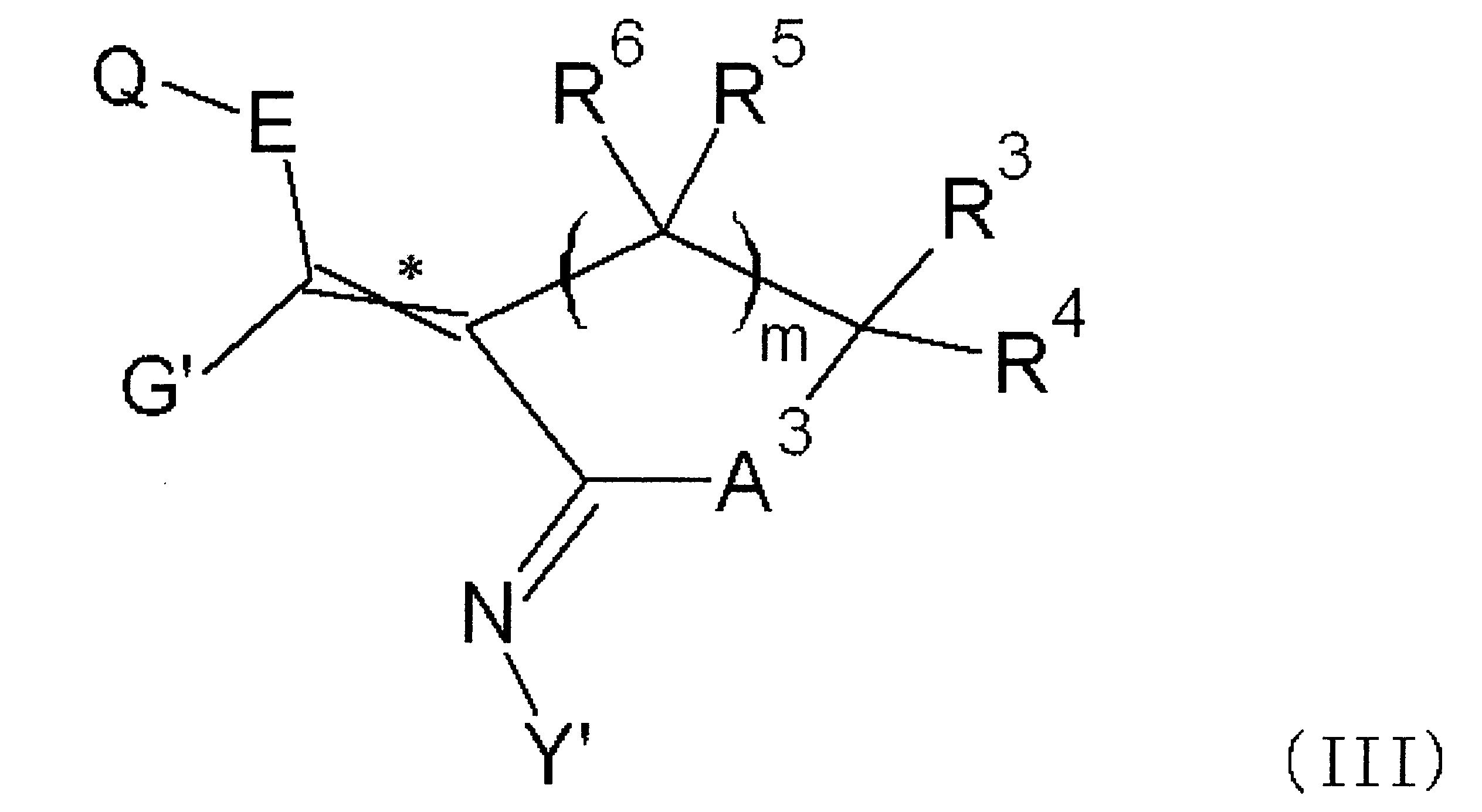
Y’は、無置換のもしくは置換基X1を有するC6~10アリール基、または無置換のもしくは置換基X1を有する5~6員へテロアリール基を示す。
X1は、無置換のもしくは置換基を有するC1~6アルキル基、無置換のもしくは置換基を有するC2~6アルケニル基、無置換のもしくは置換基を有するC2~6アルキニル基、無置換のもしくは置換基を有するC3~8シクロアルキル基、水酸基、無置換のもしくは置換基を有するC1~6アルコキシ基、無置換のもしくは置換基を有するC1~7アシル基、無置換のもしくは置換基を有するC1~6アルコキシカルボニル基、無置換のもしくは置換基を有するアミノ基、無置換のもしくは置換基を有するC1~6アルキルチオ基、無置換のもしくは置換基を有するC1~6アルキルスルホニル基、無置換のもしくは置換基を有するC6~10アリール基、無置換のもしくは置換基を有する3~10員ヘテロシクリル基、ハロゲノ基、シアノ基、またはニトロ基を示す。
Y’上の置換基X1の個数は1~5のいずれかの整数である。置換基X1が2以上在るときX1は互いに同一でも相違してもよい。
A3は、酸素原子または硫黄原子を示す。
R3およびR4は、それぞれ独立に、水素原子、無置換のもしくは置換基を有するC1~6アルキル基、無置換のもしくは置換基を有するC2~6アルケニル基、無置換のもしくは置換基を有するC2~6アルキニル基、無置換のもしくは置換基を有するC3~8シクロアルキル基、無置換のもしくは置換基を有するC6~10アリール基、無置換のもしくは置換基を有する3~10員ヘテロシクリル基、またはシアノ基を示す。ここで、R3とR4は一緒になって、無置換のもしくは置換基を有するエキソメチレン基を形成してもよい。
R5およびR6は、それぞれ独立に、水素原子、無置換のもしくは置換基を有するC1~6アルキル基、無置換のもしくは置換基を有するC2~6アルケニル基、無置換のもしくは置換基を有するC2~6アルキニル基、無置換のもしくは置換基を有するC3~8シクロアルキル基、無置換のもしくは置換基を有するC6~10アリール基、無置換のもしくは置換基を有する3~6員ヘテロシクリル基、ハロゲノ基、またはシアノ基を示す。また、R5とR6は相互に繋がってR5およびR6が結合する炭素原子とともに環を形成してもよい。
mは、R5およびR6で置換されたメチレンの個数を示し、かつ1~4のいずれかの整数である。mが2以上のときR5およびR6は互いに同一でも相違してもよい。
G’は、水素原子または無置換のもしくは置換基を有するC1~6アルキル基を示す。
Eは、酸素原子または-S(O)l-を示す。lは、0~2のいずれかの整数を示す。
Qは、無置換のもしくは置換基X2を有するC7~11アラルキル基、無置換のもしくは置換基X2を有するC6~10アリール基、または無置換のもしくは置換基X2を有する5~10員へテロアリール基を示す。
X2は、無置換のもしくは置換基を有するC1~6アルキル基、無置換のもしくは置換基を有するC2~6アルケニル基、無置換のもしくは置換基を有するC2~6アルキニル基、無置換のもしくは置換基を有するC3~8シクロアルキル基、水酸基、無置換のもしくは置換基を有するC1~6アルコキシ基、無置換のもしくは置換基を有するC1~7アシル基、無置換のもしくは置換基を有するC1~6アルコキシカルボニル基、無置換のもしくは置換基を有するアミノ基、無置換のもしくは置換基を有するC1~6アルキルチオ基、無置換のもしくは置換基を有するC1~6アルキルスルホニル基、無置換のもしくは置換基を有するC6~10アリール基、無置換のもしくは置換基を有する3~6員ヘテロシクリル基、ハロゲノ基、シアノ基、またはニトロ基を示す。
Q上の置換基X2の個数は、1~5のいずれかの整数である。置換基X2が2以上在るときX2は互いに同一でも相違してもよい。
*は二重結合による立体異性(E)、(Z)、または(E/Z)が存在することを示す。] -
mが1または2である、請求項3に記載の水棲有害付着生物防除組成物。 -
前記水棲有害付着生物が、水中構造物に付着する生物である、請求項1~4のいずれかひとつに記載の水棲有害付着生物防除組成物。 -
前記水棲有害付着生物が、甲殻類である、請求項1~4のいずれかひとつに記載の水棲有害付着生物防除組成物。 -
請求項1~6のいずれかひとつに記載の水棲有害付着生物防除組成物を含有する防汚塗料組成物。 -
請求項1~6のいずれかひとつに記載の水棲有害付着生物防除組成物により水棲有害付着生物を防除する方法。 -
請求項7に記載の防汚塗料組成物を水中構造物表面に塗布して水棲有害付着生物を防除する方法。
Applications Claiming Priority (2)
| Application Number | Priority Date | Filing Date | Title |
|---|---|---|---|
| JP2013254050A JP2017024989A (ja) | 2013-12-09 | 2013-12-09 | 水棲有害生物防除組成物および防汚塗料組成物 |
| JP2013-254050 | 2013-12-09 |
Publications (1)
| Publication Number | Publication Date |
|---|---|
| WO2015087801A1 true WO2015087801A1 (ja) | 2015-06-18 |
Family
ID=53371106
Family Applications (1)
| Application Number | Title | Priority Date | Filing Date |
|---|---|---|---|
| PCT/JP2014/082251 Ceased WO2015087801A1 (ja) | 2013-12-09 | 2014-12-05 | 水棲有害付着生物防除組成物および防汚塗料組成物 |
Country Status (2)
| Country | Link |
|---|---|
| JP (1) | JP2017024989A (ja) |
| WO (1) | WO2015087801A1 (ja) |
Cited By (2)
| Publication number | Priority date | Publication date | Assignee | Title |
|---|---|---|---|---|
| WO2019022002A1 (ja) * | 2017-07-26 | 2019-01-31 | 日本曹達株式会社 | 1-ヘテロジエン化合物及び有害生物防除剤 |
| WO2019142880A1 (ja) * | 2018-01-19 | 2019-07-25 | 日本曹達株式会社 | 1-ヘテロジエン化合物及び有害生物防除剤 |
Citations (4)
| Publication number | Priority date | Publication date | Assignee | Title |
|---|---|---|---|---|
| JPS5053422A (ja) * | 1973-09-12 | 1975-05-12 | ||
| JPS541342A (en) * | 1977-06-07 | 1979-01-08 | Nippon Paint Co Ltd | Underwater antifouling coating compound |
| WO2012072489A1 (de) * | 2010-11-29 | 2012-06-07 | Bayer Cropscience Ag | Alpha-beta-ungesättigte imine |
| WO2014136672A1 (ja) * | 2013-03-08 | 2014-09-12 | 日本曹達株式会社 | 外部寄生虫防除剤 |
-
2013
- 2013-12-09 JP JP2013254050A patent/JP2017024989A/ja active Pending
-
2014
- 2014-12-05 WO PCT/JP2014/082251 patent/WO2015087801A1/ja not_active Ceased
Patent Citations (4)
| Publication number | Priority date | Publication date | Assignee | Title |
|---|---|---|---|---|
| JPS5053422A (ja) * | 1973-09-12 | 1975-05-12 | ||
| JPS541342A (en) * | 1977-06-07 | 1979-01-08 | Nippon Paint Co Ltd | Underwater antifouling coating compound |
| WO2012072489A1 (de) * | 2010-11-29 | 2012-06-07 | Bayer Cropscience Ag | Alpha-beta-ungesättigte imine |
| WO2014136672A1 (ja) * | 2013-03-08 | 2014-09-12 | 日本曹達株式会社 | 外部寄生虫防除剤 |
Cited By (2)
| Publication number | Priority date | Publication date | Assignee | Title |
|---|---|---|---|---|
| WO2019022002A1 (ja) * | 2017-07-26 | 2019-01-31 | 日本曹達株式会社 | 1-ヘテロジエン化合物及び有害生物防除剤 |
| WO2019142880A1 (ja) * | 2018-01-19 | 2019-07-25 | 日本曹達株式会社 | 1-ヘテロジエン化合物及び有害生物防除剤 |
Also Published As
| Publication number | Publication date |
|---|---|
| JP2017024989A (ja) | 2017-02-02 |
Similar Documents
| Publication | Publication Date | Title |
|---|---|---|
| TWI486122B (zh) | 4-溴-2-(4-氯苯基)-5-(三氟甲基)-1h-吡咯-3-腈及金屬化合物之組合物 | |
| AU2007221987B8 (en) | Biocide composition comprising pyrithione and pyrrole derivatives | |
| US5712275A (en) | Antibacterial and antifouling oxathiazines and their oxides | |
| KR20100082791A (ko) | 방오 도료 | |
| HRP20120799T1 (hr) | Antivegetativni pripravci sa spinosinom, postupci njihove uporabe i proizvodi koji su zaštiä†eni od priäśvršä†ivanja bioloških organizama koji uzrokuju obraštanje | |
| AU2019391357A1 (en) | Copper chelate complex compositions for antifouling protection | |
| US5741483A (en) | Industrial preservative antifungal composition and underwater antifouling composition | |
| WO2015087801A1 (ja) | 水棲有害付着生物防除組成物および防汚塗料組成物 | |
| KR100296084B1 (ko) | 수중부착생물방오제 | |
| JP2002220310A (ja) | 防汚剤 | |
| JPS6052727B2 (ja) | 海息付着生物防除剤 | |
| JP2019142772A (ja) | 水棲有害付着生物の防除方法および防除用組成物 | |
| JPH0218468A (ja) | 防汚、防藻塗料 | |
| JP2003146811A (ja) | フジツボ類防除組成物 | |
| JPWO1999043207A1 (ja) | ベンジルアミン類を含有する工業用抗菌・抗カビ剤、殺藻剤及び生物付着防止剤 |
Legal Events
| Date | Code | Title | Description |
|---|---|---|---|
| 121 | Ep: the epo has been informed by wipo that ep was designated in this application |
Ref document number: 14870525 Country of ref document: EP Kind code of ref document: A1 |
|
| NENP | Non-entry into the national phase |
Ref country code: DE |
|
| 122 | Ep: pct application non-entry in european phase |
Ref document number: 14870525 Country of ref document: EP Kind code of ref document: A1 |
|
| NENP | Non-entry into the national phase |
Ref country code: JP |