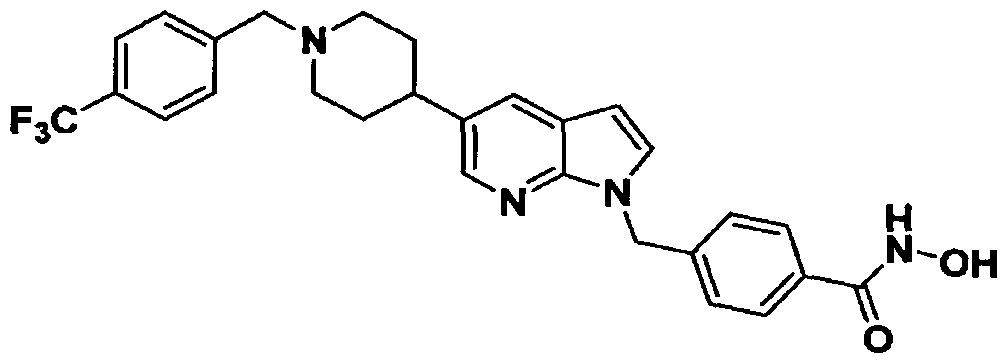
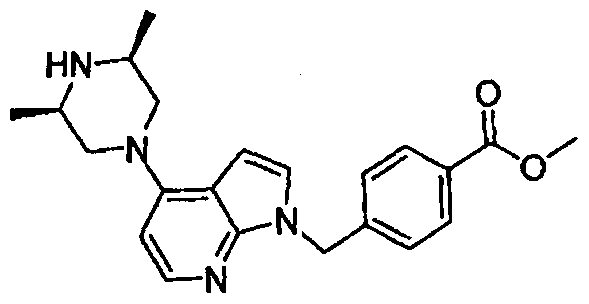
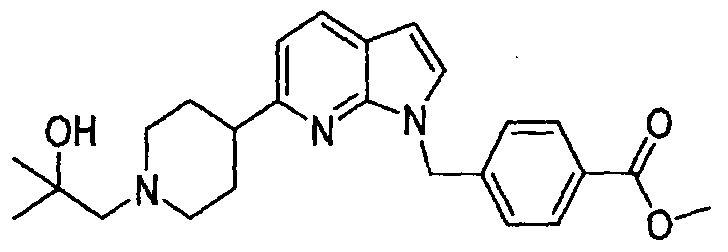
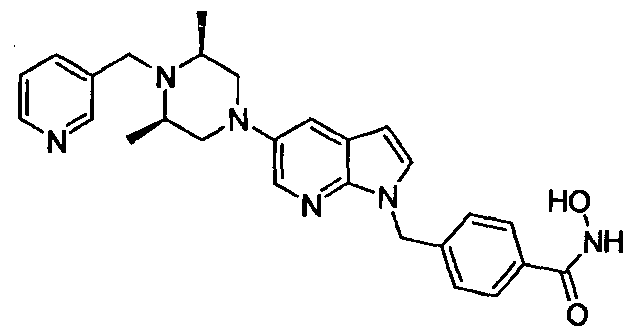
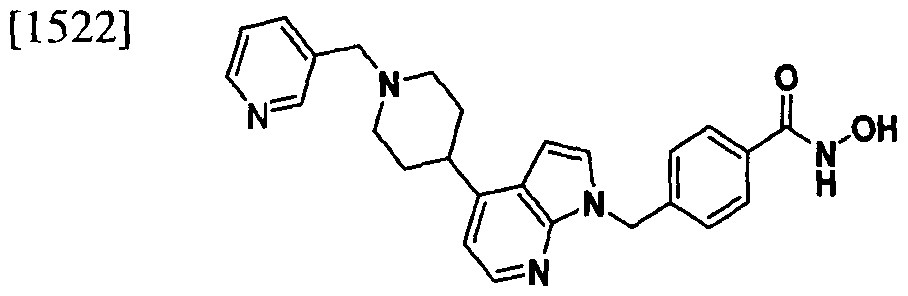
Description
Title of Invention: NOVEL AZAINDOLE DERIVATIVES AS SELECTIVE HISTONE DEACETYLASE (HDAC) INHIBITORS AND PHARMACEUTICAL COMPOSITIONS COMPRISING
THE SAME
Technical Field
[1] The present invention relates to novel azaindole derivatives, and more particularly, to novel azaindole derivatives having histone deacetylase (HDAC) inhibitory activity, isomers thereof, pharmaceutically acceptable salts thereof, hydrates thereof or solvates thereof, the use thereof for the preparation of pharmaceutical compositions, pharmaceutical compositions containing the same, a method of treating disease using the pharmaceutical compositions, and methods for preparing the novel azaindole derivatives. Background Art
[2] Compounds according to the present invention are used to inhibit or treat HDAC- mediated diseases. Examples of such diseases include, but are not limited to, cell proliferative diseases such as cancer, autosomal dominant diseases such as Huntington's disease, genetic metabolic diseases such as fibrosis diseases, for example, cystic fibrosis, hepatic fibrosis, kidney fibrosis, pulmonary fibrosis and skin fibrosis, autoimmune diseases such as rheumatoid arthritis, acute/chronic neurological diseases such as diabetes, stroke, hypertrophy such as cardiac hypertrophy, congestive heart failure, amyotrophic lateral sclerosis, glaucoma, ocular diseases (associated with an- giogenesis), or Alzheimer's disease.
[3] Transcriptional regulation in cells is a complex biological process. One basic
principle in transcriptional regulation is based on the posttranslational modification of histone proteins, namely histone proteins H2A B, H3 and H4 forming the octameric histone core complex. The complex N-terminal modifications at lysine residues by acetylation or methylation and at serine residues by phosphorylation constitute part of the so called "histone code" (see Strahl & Ellis, Nature 403, 41-45, 2000).
[4] In a simple model, acetylation of positively charged lysine residues reduces affinity to negatively charged DNA, which now becomes accessible for the entry of transcription factors.
[5] Histone acetylation and deacetylation is catalyzed by histone acetyltransferases
(HATs) and histone deacetylases (HDACs), respectively. HDACs are associated with transcriptional repressor complexes, switching chromatin to a silence structure, transcriptionally inactive, (see Marks et al., Nature cancer Rev. 1, 189-202, 2001). The
opposite is activated by HATs which are associated with transcriptional activator complexes. Three different classes of HDACs have been known so far, namely class I (HDAC 1-3, 8; Mr = 42-55 kDa) primarily located in the nucleus and sensitive toward inhibition by Trichostatin A (TSA), class II (HDAC 4-7, 9, 10; Mr=120-130 kDa), which exhibits TSA sensitivity, and class III (SIRT2) that are distinct by their NAD+ dependency and TSA insensitivity.
[6] Histone deacetylase (HDAC) inhibitors constitute a new class of anti-cancer drugs having cell differentiation and apoptosis inducing activity. By targeting histone deacetylases (HDACs), HDAC inhibitors affect Chromatin structure by histone acetylation, inducing reprogramming of a complex transcription, for example, reactivation of tumor suppressor genes and repression of oncogenes. Besides acetylate the N-terminal lysine residue in core histone protein, HDAC inhibitors target non-histone protein, important for cancer biology, including heat-shock-protein 90 (HSP90), tubulin or the p53 tumor suppressor protein. Thus, the medical use of HDAC inhibitors might not be restricted to cancer therapy, since efficacy in animal models for inflammatory diseases, rheumatoid arthritis and neurodegeneration has been shown.
[7] HDAC inhibitors known up to now can be classified according to their structure into four categories: 1) short-chain fatty acids (butyric acid and valproic acid); 2) hy- droxamic acids (trichostatin A, SAHA, and LBH-589); 3) cyclic peptides
(desipeptide); and 4) benzamides (MS-275, and MGCD-0103) (Sonia et. al., International Journal of onocology 33, 637-646, 2008). These many histone deacetylase (HDAC) inhibitors (SAHA, LBH-589 and MS-275 etc.) inhibit cell growth, and effectively induce cell differenciation and apoptosis of various transformed cells not only in culture media but also in animal models (Paul A. Marks et. al., Curr Opin. Oncol. 13, 477-483, 2001). Therefore, HDAC inhibitors such as SAHA, LBH-589 and MS- 275 have been assessed in clinical studies for the purpose of treating various cancers (Johnstone. R.W, Nat. Rev. Drag. Discov. 1, 287-299, 2002). Representative compounds, currently known as HDAC inhibitors, include SAHA (US Reissue Patent No.385069, Zolinza, Vorinostat), PXD101 (WO 02/30879, Belinostat) and LBH-589 (WO 02/22577, Panobinostat), which are hydroxamate compounds, and MS-275 (EP Patent No. 0847992 Entinostat) and MGCD0103 (WO 04/69823, Mocetinostat), which are benzamide compounds. Among these compounds, SAHA was approved on October 2006 and has been used as an agent for treating CTCL (cutaneous T-cell lymphoma), and indications thereof have been expanded additionally, but it is known that SAHA is insufficient in terms of efficacy and side effects (Paul A. Marks et al., Cancer Res 66, 5781 -5789, 2006).
[8] Although many HDAC inhibitors have been reported to date, there has been a need for effective HDAC inhibitors that are more efficacious and have less side effects (Mol
Cancer Res, 5, 981, 2007).
Disclosure of Invention
Technical Problem
[9] An object of the present invention is to provide novel azaindole derivatives, particularly novel azaindole derivatives having histone deacetylase (HDAC) inhibitory activity, isomers thereof, pharmaceutically acceptable salts thereof, hydrates thereof, or solvates thereof.
[10] Another object of the present invention is to provide the use of novel azaindole
derivatives, particularly novel azaindole derivatives having histone deacetylase (HDAC) inhibitory activity, isomers thereof, pharmaceutically acceptable salts thereof, hydrates thereof, or solvates thereof, for the preparation of pharmaceutical compositions, pharmaceutical compositions containing the same, and a method of treating disease using the composition.
[11] Still another object of the present invention is to provide methods for preparing novel azaindole derivatives.
Solution to Problem
[12] Novel HDAC inhibitor compounds
[13] To achieve the above objects, the present invention provides azaindole derivatives represented by formula I below, isomers thereof, pharmaceutically acceptable salts thereof, hydrates thereof, or solvates thereof.
[14] In a first embodiment of the present invention, the compound of formula I is as
follows:
[15] Formula I
[17] wherein
[18] X is C or ;
[19] Rh is hydrogen, halogen, -CF3, or -Ci_5 alkyl;
[20] A is selected from the group consisting of
[22] Rm and Rn are each independently hydrogen, halogen, C,_5 alkyl, or C3.|2 cycloalkyl, wherein the Q.5 alkyl and C3. cycloalkyl may each independently be unsubstituted or substituted with halogen, -CN, -OQ.5 alkyl or -Q.5 alkyl at one or more hydrogen atoms thereof ;
[23] B is selected from the group consisting of
cloalkyl, and C
3-12 cycloalkenyl, wherein the aryl, heteroaryl, C
3.,
2 cycloalkyl and C
3.
!2 cycloalkenyl may each independently be unsubstituted or substituted with halogen, -C 1.5 alkyl, -NH
2, -OH, -OQ_
5 alkyl or -CF
3 at one or more hydrogen atoms thereof, and the dotted line denotes a single or double bond;
[26] Q is aryl, heteroaryl, -Q_5 alkyl-aryl, -O-aryl, -NR5-aryl, -Q.5 alkyl-heteroaryl, - O-heteroaryl or -NR5-heteroaryl, wherein the aryl and heteroaryl may each independently be unsubstituted or substituted with halogen, -Q-5 alkyl, -NH2, -OH, -OQ.5 alkyl, -CF3, -NHQ.5 alkyl, -N(C,_5 alkyl)2 or -NHS02Q.5 alkyl at one or more carbon atoms thereof;
[27] Ri and R2 are each independently hydrogen, halogen, -C1.5 alkyl, -NH2, -OH, -OCi_5 alkyl or -CF3;
[28] R3 and R4 are each independently hydrogen, halogen, -CF3, -C1-5 alkyl, or - NHCO(0)C,.5 alkyl;
[29] R5 is hydrogen or -C1-5 alkyl;
[30] ki and k2 are each independently 0, 1 or 2;
[31] Ra and Rb are each independently hydrogen, halogen, -C,.5 alkyl, -OC,.5 alkyl, -C3.,1 :2 cycloalkyl, =0, or -S02, provided that if any one of Ra and Rb is =0 or -S02, the other one is null, wherein the -Ci_5 alkyl and -C3.,2 cycloalkyl may each independently be unsubstituted or substituted with halogen, -CN, -OQ.5 alkyl or -C^ alkyl at one or more hydrogen atoms thereof;
[32] m is 0, 1 or 2;
[33] Rc and Rd are each independently hydrogen, halogen, =0, -C1.5 alkyl, -C3.i2 cycloalkyl, -CO(0)C1-5 alkyl, -C,_5 alkyl-OH, aryl or heteroaryl, or are linked together to form -C .i2 cycloalkyl, provided that if any one of Rc and Rd is =0, the other one is null, wherein the aryl, heteroaryl and C3.,2 cycloalkyl may each independently be unsubstituted or substituted with halogen, -CF3, -C1-5 alkyl or -OQ.5 alkyl at one or more hydrogen atoms thereof;
[34] n is 0, 1 or 2; and
[35] Re is hydrogen, halogen, -CF3, -C,_3 perfluoroalkyl, -Ci_5 alkyl, -OQ.5 alkyl, -C2.i2 heterocycloalkyl, -C3.,2 cycloalkyl, aryl, heteroaryl, -OH, -COOH, -NH2, -NHC1.5 alkyl, -N(C,.5 alkyl)2, or null, wherein the -C|-5 alkyl, -C2.]2 heterocycloalkyl, -C3.,2 cycloalkyl, aryl and heteroaryl may each independently be unsubstituted or substituted with halogen, -CN, -CF3, -OCi.s alkyl, -d.5 alkyl, -CO(0)C,.5 alkyl, -C2.12 heterocycloalkyl, -C1-5 alkyl-C2-i2 heterocycloalkyl, or heteroaryl at one or more hydrogen atoms thereof.
[36] In another embodiment of the present invention, A in formula I may be selected from the group consisting of
[38] In preferable embodiment of the present invention, A in formula I may be selected from the group consisting of
[40] In still another embodiment of the present invention, B in formula I may be selected from the group consisting of
[42] In preferable embodiment of the present invention, B in formula I may be selected from the group consisting of
[44] In still another embodiment of the present invention,
[45] X is C;
[46] Rh is hydrogen;
[47] A is selected from the group consisting of
[49] B is selected from the group consisting of
[51] In still another embodiment of the present invention,
[52] Ra and Rb are each independently hydrogen or -C1-5 alkyl;
[53] m is O or l ;
[54] Rc and Rd are each independently hydrogen, -Ci-5 alkyl, or are linked together to form -C3.12 cycloalkyl;
[55] n is 0 or 1 ; and
[56] Re is hydrogen, halogen, -CF3, -Ci-5 alkyl, -OH, aryl, or heteroaryl wherein the aryl, or heteroaryl may each independently be unsubstituted or substituted with halogen, - CF3, -OQ.5 alkyl, -C2-i2 heterocycloalkyl, or -C|-5 alkyl-C2_i2 heterocycloalkyl at one or more hydrogen atoms thereof.
[57] In the present invention, aryl is preferably substituted or unsubstituted phenyl; heteroaryl is substituted or unsubstituted pyridine, pyrimidine, quinoline, pyrazine, pyridazine, pyrrole or pyrazole; C3.12 cycloalkyl is substituted or unsubstituted cy- clopropyl, cyclobutyl or cyclohexene; and C3.12 heterocycloalkyl is substituted or unsubstituted piperidine, morpholine, piperazine or indazole, but the compounds of the present invention are not limited to these examples.
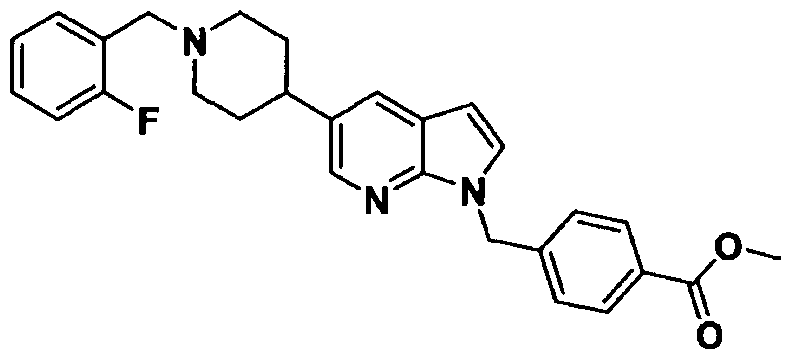
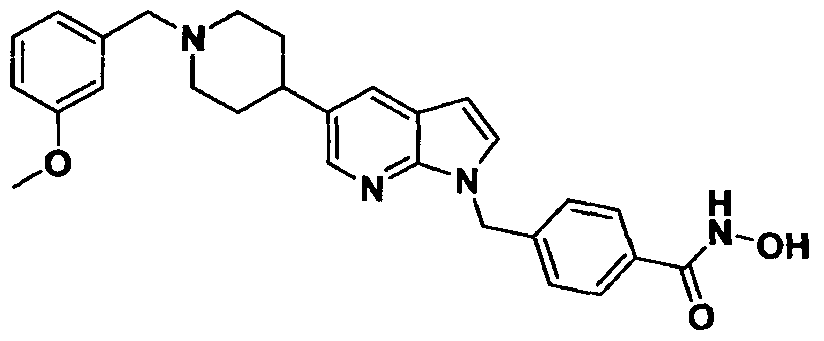
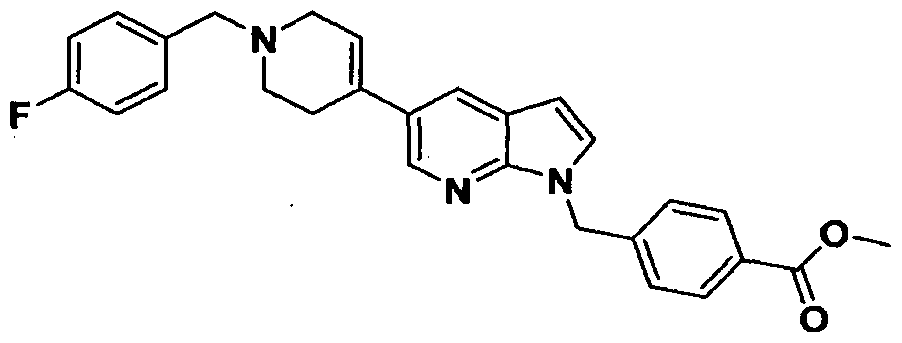
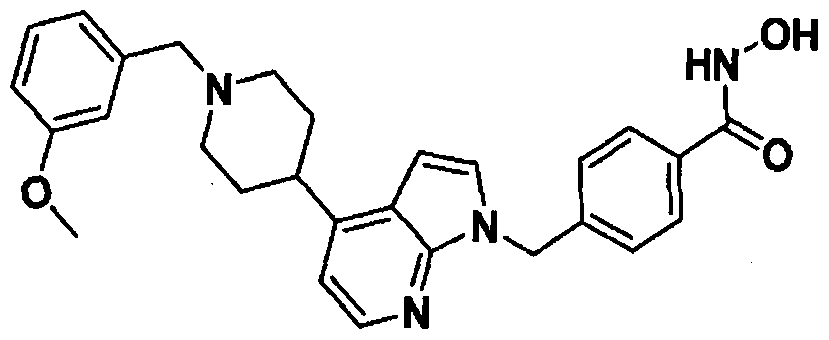
[58] In still another embodiment, the compound of formula I may be selected from the group consisting of the compounds shown in Tables 1 to 15 below.
[59] [Table 1]
[62]
[63] [Table 3]
[65] [Table 4]
[67] [Table 5]
[69] [Table 6]
[70]
[71] [Table 7]
[73] [Table 8]
[74]
[75] [Table 9]
[79] [Table 11]
[81] [Table 12]
[83] [Table 13]
[84]
[85] [Table 14]
[86]
[87] [Table 15]
[88]
In still another embodiment of the present invention, the compound of formula I is preferably selected from the group consisting of the compounds shown in Tables 16 to 19 below.
[Table 16]
[92] [Table 17]
[94] [Table 18]
[95]
[96] [Table 19]
[97]
[98] In the present invention, the compound of formula I, a pharmaceutically acceptable salt thereof, a solvate thereof, or a hydrate thereof, may be crystalline or amorphous, and the present invention encompasses these crystalline and/or amorphous compounds.
[99] As used herein, the term "pharmaceutically acceptable salt" means salts of inorganic acids, salts of organic acids, or salts of metals, which are generally used in the preparation of medicaments. "Inorganic acids" include hydrochloric acid, hydrobromic acid, sulfuric acid, phosphoric acid and the like. "Organic acids" includes citric acid, acetic acid, lactic acid, tartaric acid, fumaric acid, formic acid, propionic acid, oxalic acid, trifluoroacetic acid, methanesulfonic acid, benzenesulfonic acid, maleic acid, benzoic acid, gluconic acid, glycolic acid, succinic acid, 4-morpholineethanesulfonic acid, camphorsulfonic acid, 4-nitrobenzenesulfonic acid, hydroxy-O-sulfonic acid, 4-toluenesulfonic acid, galacturonic acid, embolic acid, glutamic acid, aspartic acid, adipate salt, camsylate salt, or besylate salt. "Metals" include sodium, potassium,
calcium, magnesium and the like.
[100] In the present invention, a solvent "solvate" means any conventional solvent that is used in the preparation of organic compounds. Examples of the solvent include methanol, ethanol, 1-propanol, 2-propanol, 1-butanol, 2-butanol, 1-acetate, acetone, acetic acid, anisole, tetrahydrofuran, methyl acetate, ethyl acetate, propyl acetate, isopropyl acetate, isobutyl acetate, n-butyl acetate, dimethyl sulfoxide, pentane, heptane, and the like, but the solvates of the present invention are not limited these examples.
[101] In the present invention, "hydrate" and "solvate" may be contained in an amount of 0.25-10 moles, for example, 0.5, 1, 1.5, 2, 2.5, 3 or 5 moles, per mole of the compound of formula I, but the scope of the present invention is not limited to these examples.
[102] In the present invention, "isomer" refers to steroisomers, but the scope of the present invention is not limited thereto.
[103] Pharmaceutical composition comprising novel HDAC inhibitor compound
[104] The present invention also provides a pharmaceutical composition comprising the compound of formula I, an isomer thereof, a pharmaceutically acceptable salt thereof, a hydrate thereof, or a solvate thereof, together with a pharmaceutically acceptable carrier.
[105] The carrier may be one that is generally in the art. Examples of the carrier include, but are not limited to, sugar, starch, microcrystalline cellulose, lactose (lactose hydrate), glucose, D-mannitol, alginate, an alkaline earth metal salt, clay, polyethylene glycol, anhydrous calcium hydrogen phosphate, and mixtures thereof.
[106] In another embodiment of the present invention, the pharmaceutical composition may contain additives such as a binder, a disintegrant, a lubricant, a pH-adjusting agent or an antioxidant.
[107] Examples of the binder include, but are not limited to, starch, microcrystalline
cellulose, highly dispersive silica, mannitol, D-mannitol, sucrose, lactose hydrate, polyethylene glycol, polyvinylpyrrolidone (povidone), a polyvinylpyrrolidone copolymer (copovidone), hypromellose, hydroxypropylcellulose, natural gum, synthetic gum, copovidone, gelatin, and mixtures thereof.
[108] Examples of the disintegrant include, but are not limited to, starches or modified starches such as sodium starch glycolate, corn starch, potato starch, and pregelatinized starch; clays such as bentonite, montmorillonite, and veegum; celluloses such as microcrystalline cellulose, hydroxypropylcellulose, and carboxymethylcellulose; algins such as sodium alginate, and alginic acid; crosslinked celluloses such as
croscarmellose sodium; gums such as guar gum, and xanthan gum; crosslinked polymers such as crosslinked polyvinylpyrrolidone (crospovidone); effervescent agents such as sodium bicarbonate and citric acid; and mixtures thereof.
[109] Examples of the lubricant include, but are not limited to, talc, stearic acid, magnesium stearate, calcium stearate, sodium lauryl sulfate, hydrogenated vegetable oil, sodium benzoate, sodium stearyl fumarate, glyceryl behenate, glyceryl
monolaurate, glyceryl monostearate, glyceryl palmitostearate, colloidal silicon dioxide, and mixtures thereof.
[110] Examples of the pH-adjusting agent include, but are not limited to, acidifying agents such as acetic acid, adipic acid, ascorbic acid, sodium ascorbate, sodium etherate, malic acid, succinic acid, tartaric acid, fumaric acid, and citric acid, and basifying agents such as precipitated calcium carbonate, aqueous ammonia, meglumine, sodium carbonate, magnesium oxide, magnesium carbonate, sodium citrate, and tribasic calcium phosphate.
[I l l] Examples of the antioxidant include, but are not limited to, dibutyl hydroxy toluene, butylated hydroxyanisole, tocopherol acetate, tocopherol, propyl gallate, sodium hydrogen sulfite, and sodium pyrosulfite. Examples of the solubilizer in an immediate- release compartment of the present invention include, but are not limited to, sodium lauryl sulfate, polyoxyethylene sorbitan fatty acid ester (such as polysorbate), docusate sodium, and poloxamer.
[112] The pharmaceutical composition of the present invention exhibits the effect of inhibiting HDAC activity, and may be used for the prevention or treatment of HDAC activity-associated diseases.
[113] The HDAC activity-associated diseases include malignant tumor disease, inflammatory diseases, rheumatoid arthritis, and neurodegenerative diseases.
[114] Method for preventing or treating HDAC activity-associated disease
[115] The present invention also provides a method for preventing or treating HDAC
activity-associated disease, the method comprising administering to a subject in need thereof a composition comprising the compound of Formula I as an active ingredient.
[1 16] The composition that is used in the preventing or treating method of the present invention is intended to include the pharmaceutical composition described in the specification.
[1 17] In addition, the subject in need of the preventing or treating method of the present invention is intended to include mammals, particularly humans.
[118] Method for preparing novel HDAC inhibitor compound
[119] The compound of formula I according to the present invention may be prepared
according to the methods disclosed in various publications (US Patent No. 8466161, and WO2011/011186), but is not limited thereto.
[120] Hereinafter, a method for preparing the compound of formula I will be described in detail with reference to the following reaction schemes.
[121] Reaction scheme 1
ol Ester
Compound 761 meta =morpholine
Compound 762 para =morphorine
Compound 799 meta=/V-mettiylpiperazine
Compound 656, 657, 658,
659, 722, 723, 784
[123]
[124] As shown in reaction scheme 1 above, a compound of formula 1-1 is reacted with methyl 4-(bromomethyl) benzoate at normal temperature to synthesize a compound of formula 1-2, which is then subjected to a Suzuki reaction with boronic acid or boronic acid ester using microwaves, thereby synthesizing a compound of formula 1-3 having substituent R| introduced therein. Finally, potassium hydroxide (KOH), methanol and hydroxylamine are added to the compound of formula 1-3, and then reacted at room temperature, thereby synthesizing final compounds 656, 657, 658, 659, 722, 723 and 784.
[125] In addition, the compound of formula 1-3 may be subjected to reductive amination to synthesize a compound of formula 1 -4. Finally, potassium hydroxide (KOH), methanol and hydroxylamine are added to the compound of formula 1-4, and then reacted at room temperature, thereby synthesizing final compounds 761 , 762 and 799.
[126] Reaction scheme 2
omopound 635: X= O Comopound 694: X= W-Boc Comopound 867: X= V-CH3
[128]
[129] As shown in reaction scheme 2, a compound of formula 2-1 is reacted with methyl 4-(bromomethyl)benzoate at normal temperature to synthesize a compound of formula 2-2. Potassium hydroxide (KOH), methanol and hydroxylamine are added to the compound of formula 2-2, and then reacted at room temperature to synthesize a compound of formula 2-5. Finally, substituent R2 is introduced into the compound of formula 2-5 by a Suzuki reaction with boronic acid or boronic acid ester using microwaves, thereby synthesizing final compounds 685, 687, 688, 689, 690 and 691.
[130] In addition, substituent R2 may be introduced into the compound of formula 2-2 by a Suzuki reaction with boronic acid or boronic acid ester using microwaves, thereby synthesizing a compound of formula 2-3. Finally, potassium hydroxide (KOH), methanol and hydroxylamine are added to the compound of formula 2-3, and then reacted at room temperature, thereby synthesizing final compounds 629, 645, 647, 648, 649, 650, 692 and 746.
[131] In addition, substituent R2 may be introduced into the compound of formula 2-2 by a Buchwald reaction with secondary amine, thereby synthesizing a compound of formula 2-3. Finally, potassium hydroxide (KOH), methanol and hydroxylamine are added to
the compound of formula 2-3, and then reacted at room temperature, thereby synthesizing final compounds 787, 805, 806, 807, 809 and 810.
[132] In addition, the compound of formula 2-3 may be hydrogenated in the presence of Pd/C to synthesize a compound of formula 2-4. Finally, potassium hydroxide (KOH), methanol and hydroxylamine are added to the compound of formula 2-4, and then reacted at room temperature, thereby synthesizing final compounds 635, 694 and 867.
[133] Reaction scheme 3
[136] In reaction scheme 3, a compound of formula 3-1 is reacted with
4-(bromomethyl)benzoate at normal temperature to synthesize a compound of formula 3-2. Substituent R3 is introduced into the compound of formula 3-2 by a Suzuki reaction with boronic acid or boronic acid ester using microwaves, thereby synthesizing a compound of formula 3-3. Finally, potassium hydroxide (KOH), methanol and hydroxylamine are added to the compound of formula 3-3, and then reacted at room temperature, thereby synthesizing final compounds 743 and 744.
[137] In addition, a compound of formula 3-3 may be hydrogenated in the presence of Pd/ C to synthesize a compound of formula 3-4. The compound of formula 3-4 is reacted with 4 M hydrochloric acid solution to synthesize a compound of formula 3-5, which is then subjected to reductive amination with nicotine aldehyde or reacted with oxirane using microwaves, respectively, thereby synthesizing compounds of formulas 3-7 and 3-6. Finally, Potassium hydroxide (KOH), methanol and hydroxylamine are added to each of the compounds of formulas 3-7 and 3-6, and then reacted at room temperature, thereby synthesizing final compounds 991 and 992.
[138] Reaction scheme 4
0
812 858
859 860
869 870
945
[141] As shown in reaction scheme 4 above, the amino protective group (Boc) of a
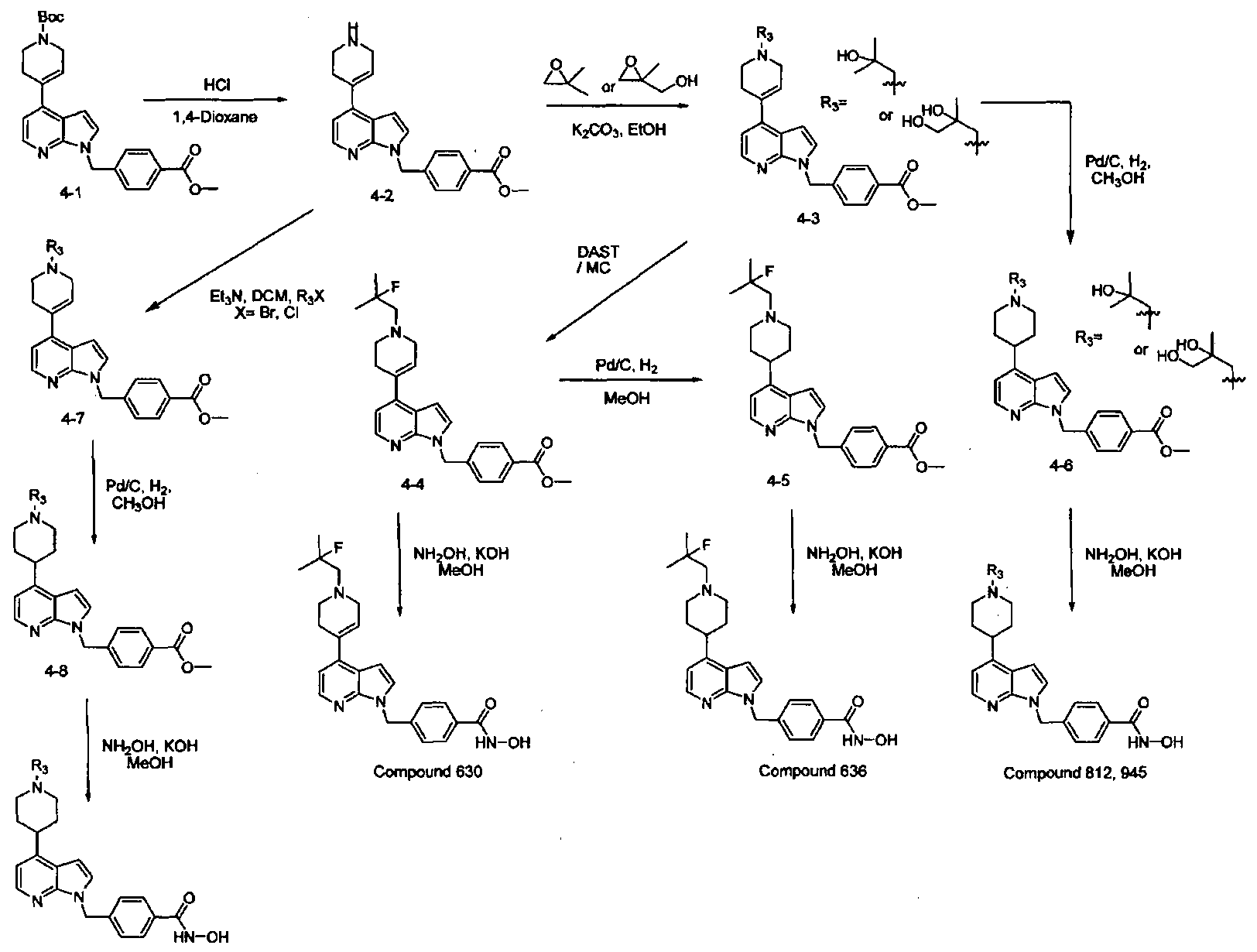
compound of formula 4-1 is removed to synthesize a compound of formula 4-2, which is then reacted with an oxirane compound using microwaves, thereby synthesizing a compound of formula 4-3. The hydroxyl group of the compound of formula 4-3 is substituted with fluorine to synthesize a compound of formula 4-4. Finally, potassium hydroxide (KOH), methanol and hydroxylamine hydrochloride are added to the compound of formula 4-4, and then reacted at room temperature, thereby synthesizing final compound 630.
[ 142] In addition, the compound of 4-4 may be hydrogenated in the presence of Pd/C to synthesize a compound of formula 4-5. Finally, potassium hydroxide (KOH), methanol and hydroxylamine are added to the compound of formula 4-5, and then reacted at room temperature, thereby synthesizing final compound 636.
[143] In addition, the compound of 4-3 may be hydrogenated in the presence of Pd/C to synthesize a compound of formula 4-6. Finally, potassium hydroxide (KOH), methanol and hydroxylamine are added to the compound of formula 4-6, and then reacted at room temperature, thereby synthesizing final compounds 812 and 945.
[ 144] In addition, the compound of formula 4-2 may be alkylated or acylated to synthesize a compound of formula 4-7, which is then hydrogenated in the presence of Pd/C to synthesize a compound of formula 4-8. Finally, potassium hydroxide (KOH), methanol and hydroxylamine are added to the compound of formula 4-8, and then reacted at room temperature, thereby synthesizing final compounds 858, 859, 860, 869 and 870.
[147] As shown in reaction scheme 5 above, the amino protective group (Boc) of a
compound of formula 5-1 is removed to synthesize a compound of formula 5-2, which is then reacted with an oxirane compound using microwaves, thereby synthesizing a compound of formula 5-3. Finally, potassium hydroxide (KOH), methanol and hydroxylamine are added to the compound of formula 5-3, and then reacted at room temperature, thereby synthesizing final compound 686.
[148] In addition, the hydrozyl group of the compound of formula 5-3 may be hy- drogenated in the presence of Pd/C to synthesize a compound of formula 5-6. Finally, potassium hydroxide (KOH), methanol and hydroxylamine are added to the compound of formula 5-6, and then reacted at room temperature, thereby synthesizing final compounds 714 and 946.
[149] In addition, the compound of formula 5-3 may be substituted with fluorine to
synthesize a compound of formula 5-4. Finally, potassium hydroxide (KOH), methanol and hydroxylamine are added to the compound of formula 5-4, and then reacted at room temperature, thereby synthesizing final compound 617.
[150] In addition, the compound of formula 5-4 may be hydrogenated in the presence of Pd/C to synthesize a compound of formula 5-5. Finally, potassium hydroxide (KOH), methanol and hydroxylamine are added to the compound of formula 5-5, and then reacted at room temperature, thereby synthesizing final compound 618.
[153] As shown in reaction scheme 6 above, a substituent is introduced into a compound of formula 6-1 to synthesize a compound of formula 6-2. Finally, potassium hydroxide (KOH), methanol and hydroxylamine are added to the compound of formula 6-2, and then reacted at room temperature, thereby synthesizing final compound 721.
[154] In addition, the compound of formula 6-1 may be hydrogenated in the presence of
Pd/C to synthesize a compound of formula 6-3, and a substituent is introduced into the compound of formula 6-3 to synthesize a compound of formula 6-4. Finally, potassium hydroxide (KOH), methanol and hydroxylamine are added to the compound of formula 6-4, and then reacted at room temperature, thereby synthesizing final compounds 724, 781 and 804.
[155] In addition, potassium hydroxide (KOH), methanol and hydroxylamine may added to the compound of formula 6-1, and then reacted at room temperature to synthesize compound 693 of formula 6-5. The compound of formula 693 may be hydrogenated in the presence of Pd/C to synthesize a compound of formula 715.
[156] Reaction scheme 7
Compound 212, 223, 224, 225, 846
847, 848, 849, 850
[158]
[159] As shown in reaction scheme 7 above, a compound of formula 7-1 is reacted with methyl 4-(bromomethyl)benzoate at normal temperature to synthesize a compound of formula 7-2, which is then deprotected, thereby synthesizing a compound of formula 7-3. Next, R6 is introduced into the compound of formula 7-3 either by subjecting compound 7-3 to reductive amination at 40~60°C or normal temperature, or by substitution reaction of compound 7-3 with R6-X, thus obtaining a compound of formula 7-4. Finally, potassium hydroxide (KOH), methanol and hydroxylamine are added to the compound of formula 7-4, and then reacted at room temperature, thereby synthesizing final compounds 212, 223, 224, 225, 846, 847, 848, 849 and 850.
[160] Reaction scheme 8
Compound 642, 759, 60, 764
[162]
[163] As shown in reaction scheme 8 above, the amino protecting group (Boc) of the compound 7-2 obtained by the reaction scheme 7 is removed to obtain a compound of formula 8-1, which is then reacted with an oxirane compound using microwaves, thereby synthesizing a compound of formula 8-2. The compound of formula 8-2 is reacted with potassium hydroxide (KOH), methaol and hydroxylamine to synthesize final compound 759.
[164] In addition, the hydroxy! group of the compound of formula 8-2 may be substituted with fluorine to synthesize a compound of 8-3. Finally, potassium hydroxide (KOH), methanol and hydroxylamine are added to the compound of formula 8-3, and then reacted at room temperature, thereby synthesizing final compounds 642, 760 and 764.
[165] Reaction scheme 9
[166]
[167]
[168] As shown in reaction scheme 9 above, the compound of formula 8-1 obtained by the reaction scheme 8 is reacted with R8X to synthesize a compound of formula 9- 1 , is subjected to amide coupling with carboxylic acid to synthesize a compound of formula 9-2, or is subjected to reductive amination with aldehyde to synthesize a compound of formula 9-3, respectively. Next, the compounds of formulas 9-1 , 9-2 and 9-3 are reacted with potassium hydroxide (KOH), methanol and hydroxylamine to synthesize compounds 700, 701 and 702 of formula 9-4, compounds 703 and 856 of formula 9-5, and compounds 704, 705 and 706 of formula 9-6, respectively.
[169] Reaction scheme 10
Compound 103, 104, 124, 125
[171]
[172] As shown in reaction scheme 10 above, a compound of formula 10-1 is subjected to a Suzuki reaction with boronic acid or boronic acid ester using microwaves, thereby synthesizing a compound of formula 10-2 having substituent Rn introduced therein. Next, the compound of formula 10-2 is reacted with methyl 4-(bromomethyl)benzoate at normal temperature to synthesize a compound of formula 10-3. Finally, potassium hydroxide (KOH), methanol and hydroxylamine are added to the compound of formula 10-3, and then reacted at room temperature, thereby synthesizing final compounds 103, 104, 124 and 125.
[173] Reaction scheme 11
Compound 757, 758, 783,
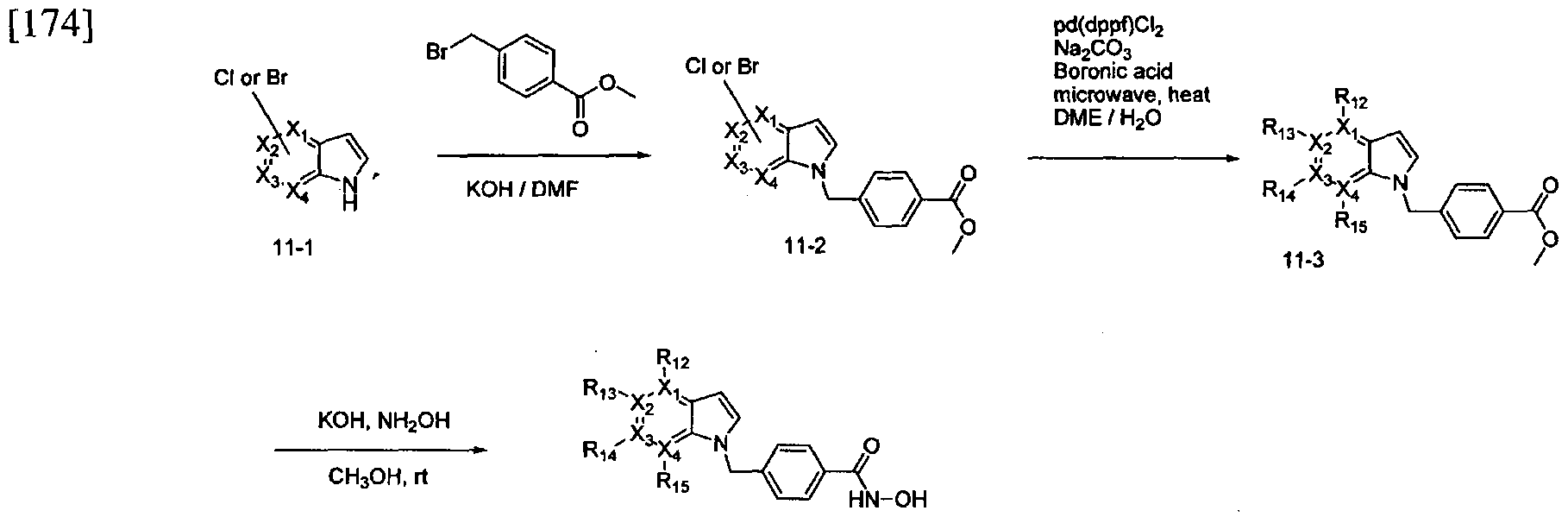
[176] As shown in reaction scheme 11 above, a compound of formula 11-1 is reacted with methyl 4-(bromomethyl)benzoate to synthesize a compound of formula 1 1-2. Then, substituent Ri2, R[3, Ri4 or R,5 is introduced into the compound of formula 11-2 by a Suzuki reaction with boronic acid or boronic acid ester using microwaves, thus synthesizing compound of formula 11-3. Finally, potassium hydroxide (KOH), methanol and hydroxylamine are added to the compound of formula 11-3, and then reacted at room temperature, thereby synthesizing final compounds 757, 758, 783, 785, 786 and 808.
[177] Reaction scheme 12
[178]
[180] As shown in reaction scheme 12 above, a compound of formula 5-2 is hydrogenated in the presence of Pd/C to synthesize a compound of formula 6-3, which is then acylated, sulfonylated and subjected to amide coupling with carboxylic acid, thereby synthesizing a compound of formula 12- 1 having R,6 introduced therein. Finally, potassium hydroxide (KOH), methanol and hydroxylamine are added to the compound of formula 12-1, and then reacted at room temperature, thereby synthesizing final compounds 831, 854 and 876.
[181] In addition, the compound of formula 6-3 may be subjected to reductive amination or reacted with Ri6-CH2-X to obtain a compound of formula 12-2. The compound of formula 12-2 may also be obtained by reacting a compound of 5-2 with R|6-CH2-X, followed by hydrogenation. Finally, potassium hydroxide (KOH), methanol and hydroxylamine are added to the compound of formula 12-2, and then reacted at room temperature, thereby synthesizing final compounds 830, 839. 840, 841, 842, 843, 844,
845, 863, 864, 871, 872, 873, 874, 875, 880, 881, 883 and 1098.
[182] Reaction scheme 13
[184]
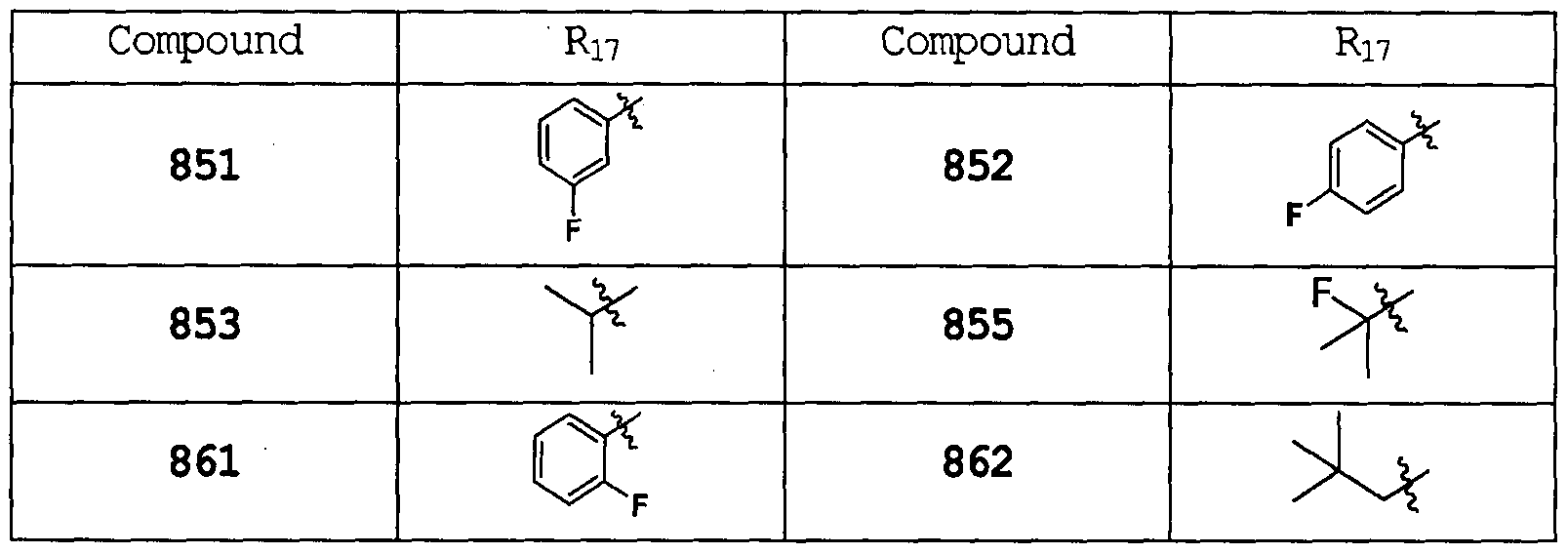
[185] As shown in reaction scheme 13 above, the compound of formula 2-2, obtained by the reaction scheme 2 above, is subjected to a Buchwald reaction with secondary amine to obtain a compound of formula 13-1, which is then is treated with hydrochloric acid to remove the amino protecting group (Boc), and is then reacted with R i 7-CH2-X, thereby synthesizing a compound of formula 13-4. Finally, potassium hydroxide (KOH), methanol and hydroxylamine are added to the compound of formula 13-4, and then reacted at room temperature, thereby synthesizing final compounds 851, 852, 853, 861 and 862.
[186] In addition, a compound of formula 13-2 may be subjected to amide coupling with carboxylic acid to synthesize a compound of formula 13-3. Finally, potassium hydroxide (KOH), methanol and hydroxylamine are added to the compound of formula
13-3, and then reacted at room temperature, thereby synthesizing final compound 855.
[187] Reaction scheme 14
K2C03, EtOH NH2OH, KOH
CH3OH
[189]
[190] As shown in reaction scheme 14 above, the compound of formula 2-2, obtained by the reaction scheme 2 above, is subjected to a Buchwald reactihsuon with a secondary amine to synthesize a compound of formula 14-1, which is then reacted with Ri8-CH2 - X to synthesize a compound of formula 14-2. Finally, potassium hydroxide (KOH), methanol and hydroxylamine are added to the compound of formula 14-2, and then reacted at room temperature, thereby synthesizing final compounds 857, 1003, 1004 and 1005.
[191] In addition, the compound of formula 14-1 may be reacted with an oxirane
compound using microwaves to synthesize a compound of formula 14-3. Finally,
potassium hydroxide (KOH), methanol and hydroxylamine are added to the compound of formula 14-3, and then reacted at room temperature, thereby synthesizing final compound 865.
[192] In addition, the hydroxyl group of the compound of formula 14-3 may be substituted with fluorine to synthesize a compound of formula 14-4. Finally, potassium hydroxide (KOH), methanol and hydroxylamine are added to the compound of formula 14-4, and then reacted at room temperature, thereby synthesizing final compound 866.
[193] Reaction scheme 15
[195] Compound R19 Compound 19
877 para, 878 meta,
879 meta, 882 para,
895 meta, 896 meta,
897 para, 898 para,
[196] As shown in reaction scheme 15 above, the compound of formula 6-2, obtained by the reaction scheme 6 above, is reacted with an aldehyde-substituted compound to
obtain a compound of formula 15-3, which is then subjected to reductive amination to synthesize a compound of formula 15-4. Finally, potassium hydroxide (KOH), methanol and hydroxylamine are added to the compound of formula 15-4, and then reacted at room temperature, thereby synthesizing final compounds 877, 878, 879 and 882.
[197] In addition, the compound of formula 6-2 may be subjected to amide coupling with carboxylic acid to synthesize a compound of formula 15-1, which is then subjected to reductive amination, thereby synthesizing a compound of formula 15-2. Finally, potassium hydroxide (KOH), methanol and hydroxylamine are added to the compound of formula 15-2, and then reacted at room temperature, thereby synthesizing final compounds 895, 896, 897 and 898.
[198] Reaction scheme 16
[199]
[200]
[201] As shown in reaction scheme 16 above, a compound of formula 16-1 is reacted with an aldehyde-substituted compound to obtain a compound of formula 16-3, which is then subjected to reductive amination to synthesize a compound of formula 16-4. Finally, potassium hydroxide (KOH), methanol and hydroxylamine are added to the
compound of formula 16-4, and then reacted at room temperature, thereby synthesizing final compounds 985, 986, 987 and 988.
[202] In addition, the compound of formula 16-1 may be subjected to amide coupling with carboxylic acid or acyl chloride to synthesize a compound of formula 16-2. Finally, potassium hydroxide (KOH), methanol and hydroxylamine are added to the compound of formula 16-2, and then reacted at room temperature, thereby synthesizing final compounds 868, 959, 966, 984 and 1014.
[203] Reaction scheme 17
Compound 1018, 1019
[206] As shown in reaction scheme 17 above, the compound of formula 1-2, obtained by the reaction scheme 1 above, is subjected to a Buchwald reaction with secondary amine to obtain a compound of formula 17-1, which is then treated with hydrochloric acid to remove the amino protecting group (Boc), and is reacted with an oxirane compound using microwaves, thereby synthesizing a compound of formula 17-4. Finally, potassium hydroxide (KOH), methanol and hydroxylamine are added to the compound of formula 17-4, and then reacted at room temperature, thereby synthesizing final compound 1017.
[207] In addition, the compound of formula 17-2 may be subjected to reductive amination to synthesize a compound of formula 17-3. Finally, potassium hydroxide (KOH), methanol and hydroxylamine are added to the compound of formula 17-3, and then
reacted at room temperature, thereby synthesizing final compounds 1018 and 1019.
[208] Reaction scheme 18
[211] As shown in reaction scheme 18 above, the compound of formula 1-2, obtained by the reaction scheme 1 above, is subjected to a Buchwald reaction with secondary amine to synthesize a compound of formula 18-1, which is then treated with hydrochloric acid to remove the amino protecting group (Boc), and is reacted with an oxirane compound using microwaves, thereby synthesizing a compound of formula 18-4. Finally, potassium hydroxide (KOH), methanol and hydroxylamine are added to the compound of formula 18-4, and then reacted at room temperature, thereby synthesizing final compound 1020.
[212] In addition, the compound of formula 18-2 may be subjected to reductive amination to synthesize a compound of formula 18-3. Finally, potassium hydroxide (KOH), methanol and hydroxylamine are added to the compound of formula 18-3, and then reacted at room temperature, thereby synthesizing final compounds 1021 and 1022.
[213] Reaction scheme 19
[215] As shown in reaction scheme 19 above, the compound of formula 2-2, obtained by the reaction scheme 2 above, is subjected to a Buchwald reaction with a secondary amine to synthesize a compound of formula 19-1, which is then treated with hydrochloric acid to remove the amino protecting group (Boc), and is subjected to reductive amination to synthesize a compound of formula 19-3. Finally, potassium hydroxide (KOH), methanol and hydroxylamine are added to the compound of formula 19-3, and then reacted at room temperature, thereby synthesizing final compound 1101.
[216] Reaction scheme 20
As shown in reaction scheme 20 above, a compound of formula 20- 1 is hydrolyzed, and then subjected to amide coupling with a benzyl-protected amine compound to
synthesize a compound of formula 20-3, which is then treated with hydrochloric acid to remove the amino protecting group (Boc), and is reacted with R23-X to synthesize a compound of formula 20-5. Finally, the compound of formula 20-5 is hydrogenated in the presence of Pd/C, thereby synthesizing final compounds 917, 927, 1015 and 1028.
[220] Reaction scheme 22
Compound 1023, 1024
[223] As shown in reaction scheme 22 above, the compound of formula 1-2, obtained by the reaction scheme 1 above, is subjected to a Buchwald reaction with secondary amine to synthesize a compound of formula 22-1, which is then treated with hydrochloric acid to remove the amino protecting group (Boc), and is reacted with an oxirane compound using microwaves to synthesize a compound of formula 22-4. Finally, potassium hydroxide (KOH), methanol and hydroxylamine are added to the compound of formula 22-4, and then reacted at room temperature, thereby synthesizing final compound 1025.
[224] In addition, the compound of formula 22-2 may be subjected to reductive amination to synthesize a compound of formula 22-3. Finally, potassium hydroxide (KOH), methanol and hydroxylamine are added to the compound of formula 22-3, and then reacted at room temperature, thereby synthesizing final compounds 1023 and 1024.
[227]
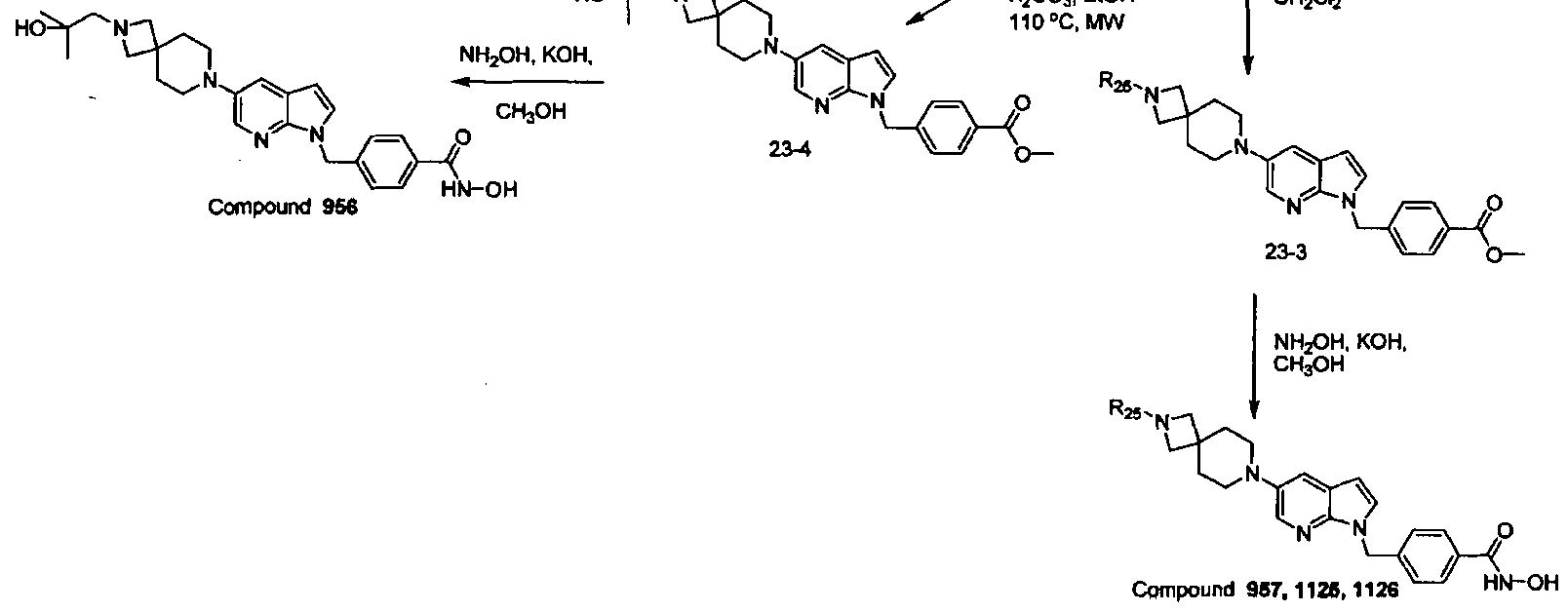
[228] As shown in reaction scheme 23 above, the compound of formula 1-2, obtained by the reaction scheme 1 above, is subjected to a Buchwald reaction with secondary amine to synthesize a compound of formula 23-1, which is then treated with hydrochloric acid to remove the amino protecting group (Boc), and is reacted with an oxirane compound using microwaves to synthesize a compound of formula 23-4. Finally, potassium hydroxide (KOH), methanol and hydroxylamine are added to the compound of formula 23-4, and then reacted at room temperature, thereby synthesizing final compound 956.
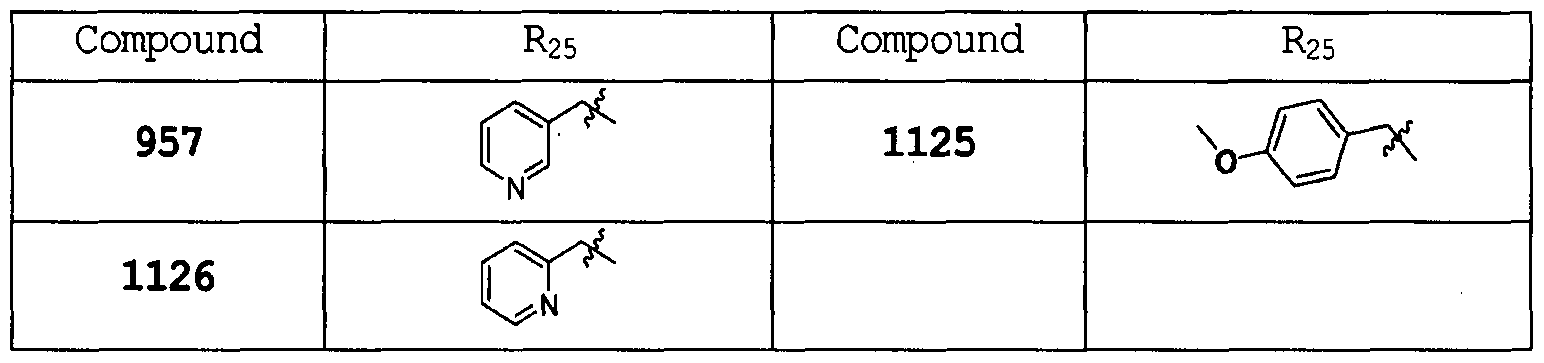
[229] In addition, the compound of formula 23-2 may be subjected to reductive amination to synthesize a compound of formula 23-3. Finally, potassium hydroxide (KOH), methanol and hydroxylamine are added to the compound of formula 23-3, and then reacted at room temperature, thereby synthesizing final compounds 957, 1125 and 1026.
[232] As shown in reaction scheme 24 above, the compound of formula 1-3, obtained by the reaction scheme 1 above, is subjected to reductive amination to synthesize a compound of formula 24-1. The amino protecting group (Boc) of the compound of formula 24-1 is removed, and the deprotected compound is reacted with an oxirane compound using microwaves to synthesize a compound of formula 24-3. The hydroxyl group of the compound of formula 24-3 is substituted with fluorine to synthesize a compound of formula 24-4. Finally, potassium hydroxide (KOH), methanol and hy- droxylamine are added to the compound of formula 24-4, and then reacted at room temperature, thereby synthesizing final compound 763.
[233] Reaction scheme 25
[235] As shown in reaction scheme 25 above, the compound of formula 1-2, obtained by the reaction scheme 1, is subjected to a Suzuki reaction with boronic acid ester using microwaves to synthesize a compound of formula 25-1. The amino protecting group (Boc) of the compound of formula 25-1 is removed, and the deprotected compound is reacted with an oxirane compound using microwaves to synthesize a compound of formula 25-3, which is then hydrogenated to synthesize a compound of formula 25-4.
Finally, potassium hydroxide (KOH), methanol and hydroxylamine are added to the compound of formula 25-4, and then reacted at room temperature, thereby synthesizing final compound 930.
[236] Reaction scheme 26
26-4
NH2OH, KOH
CH3OH
Compound 885
[238] As shown in reaction scheme 26 above, the compound of formula 1-2, obtained by the reaction scheme 1 above, is subjected to a Buchwald reactihsuon with a secondary amine to synthesize a compound of formula 26-1, which is then reacted with R26-X to synthesize a compound of formula 26-2. Finally, potassium hydroxide (KOH), methanol and hydroxylamine are added to the compound of formula 26-2, and then reacted at room temperature, thereby synthesizing final compounds 886 and 990.
[239] In addition, the compound of formula 26-1 may be reacted with an oxirane
compound using microwaves to synthesize a compound of formula 26-3. Finally, potassium hydroxide (KOH), methanol and hydroxylamine are added to the compound of formula 26-3, and then reacted at room temperature, thereby synthesizing final
compound 884.
[240] In addition, the hydroxyl group of the compound of formula 26-3 may be substituted with fluorine to synthesize a compound of formula 26-4. Finally, potassium hydroxide (KOH), methanol and hydroxylamine are added to the compound of formula 26-4, and then reacted at room temperature, thereby synthesizing final compound 885.
Advantageous Effects of Invention
[241] Novel HDAC inhibitor compounds according to the present invention, isomers
thereof, pharmaceutically acceptable salts thereof, hydrates thereof, or solvates thereof, have less side effects, and exhibit the excellent effect of inhibiting HDAC activity.
[242] Novel HDAC inhibitor compounds according to the present invention, isomers
thereof, pharmaceutically acceptable salts thereof, hydrates thereof, or solvates thereof, can be used to prevent or treat HDAC activity-associated diseases.
[243] In addition, the novel HDAC inhibitor compounds of the present invention can be prepared by preparation methods according to the present invention.
Brief Description of Drawings
[244] FIG. 1 shows the results of Western blot analysis conducted to examine the degree of tubulin acetylation and histone acetylation caused by compounds of the present invention.
[245] FIGS. 2a and 2b show the results of analyzing the change in expression of CTLA4 in iTreg cells by a compound of the present invention.
[246] FIG. 3 shows the results of analyzing the effect of a compound of the present
invention on the fuctionary improvement of Treg cells.
[247] FIG. 4 shows the results of analyzing the effect of a compound of the present
invention on the death of Teff cells.
[248] FIG. 5 shows the results of analyzing the effect of a compound of the present
invention on the inhibition of TNFa secretion.
Best Mode for Carrying out the Invention
[249] Hereinafter, the present invention will be described in further detail with reference to examples and experimental examples. It is to be understood, however, that these examples are for illustrative purposes only and are not intended to limit the scope of the present invention.
[250] Example 1 : Synthesis of compound 103
[251] Step 1 : Synthesis of 5- yridin-3-yl)-lH-pyrrolor2.3-b1pyridine (formula 10-2)
[252] (formula 10-2)
The compound of formula 10-1 (5-bromo-lH-pyrrolo[2,3-b]pyridine) (0.3 g, 1.52 mmol), pyridine-2-boronic acid (0.22 g, 1.84 mmol), Pd(dppf)Cl
2 (0.12 g, 0.15 mmol) and potassium carbonate (0.63 g, 4.57 mmol) were added to 1,4-dioxane (20 mL) / water (10 mL), and heated by microwave irradiation at 120°C for 10 minutes, and then cooled to room temperature. After completion of the reaction, the reaction mixture was filtered through a celite pad to remove solids, and the filtrate was concentrated under reduced pressure to remove the solvent. The concentrate was purified by column chromatography (Si0
2, 12 g cartridge; ethyl acetate / hexane = from 10% to 40%) to afford the desired compound of formula 10-2 (0.21 g, 72%) as a pale brown solid.
Step 2: Synthesis of methyl
4-((5-(pyridin-3-yl)-lH-pyrrolor2.3-blpyridin-l-yl methyl)benzoate (formula 10-3)
[256] The compound of formula 10-2 (0.30 g, 1.54 mmol), prepared in step 1, was
dissolved in N,N-dimethylformamide (10 mL) at room temperature. To the solution, methyl 4-(bromomethyI)benzoate (0.42 g, 1.84 mmol) was added, followed by stirring at the same temperature for 5 minutes. To the reaction mixture, sodium hydride (55.0 %, 0.13 g, 3.07 mmol) was added, followed by stirring at the same temperature for 4 hours. Then, a saturated aqueous solution of ammonium chloride was added to the reaction mixture, followed by extraction with ethyl acetate. The organic layer was washed with a saturated aqueous solution of sodium chloride, dried with anhydrous magnesium sulfate, filtered, and then concentrated under reduced pressure. The concentrate was purified by column chromatography (Si02, 12 g cartridge; ethyl acetate / hexane = from 30% to 70%) to afford the desired compound of formula 10-3 (0.103 g, 20%) as a pale yellow solid.
[257] Step 3: Synthesis of N- hydroxy-4-((5-pyridin-3-yl)-lH-pyrrolo[2.3-blpyridin- l-yl)methyl)benzamide ("compound 103)
[259] The compound of formula 10-3 (0.103 g, 0.30 mmol), prepared in step 2 was
dissolved in methanol (10 mL) at room temperature. To the solution, hydroxylamine hydrochloride (0.104 g, 2.12 mmol) and potassium hydroxide (0.168 g, 1.50 mmol) were added, followed by stirring at the same temperature. To the reaction mixture, an
aqueous solution of 50 wt% hydroxylamine (2 mL) was added, followed by stirring at the same temperature for 16 hours. Then, water was added to the reaction mixture, followed by extraction with ethyl acetate. The organic layer was washed with a saturated aqueous solution of sodium chloride, dried with anhydrous magnesium sulfate, filtered, and then concentrated under reduced pressure. The concentrate was purified by column chromatography (Si02, 12 g cartridge; ethyl acetate / hexane = from 10% to 50%) to afford the desired compound 103 (0.047 g, 46%) as a white solid.
[260] Ή NMR (400 MHz, DMSO-d6) δ 11.15 (brs, 1H), 9.02 (brs, 1H), 8.60 (d, 1H, J = 2.1 Hz), 8.57 (dd, 1H, J = 4.7, 1.5 Hz), 8.34 (d, 1H, J = 2.2 Hz), 8.13 (dt, 1H, J = 8.5, 2.0 Hz), 7.74 (d, 1H, J = 3.5 Hz), 7.68 (d, 2H, J = 8.3 Hz), 7.50 (q, 1H, J = 4.2 Hz), 7.29 (d, 2H, J = 8.3 Hz), 6.62 (d, 2H, J = 3.5 Hz), 5.57 (s, 2H); MS (ESI) m/z 345 (M+ + H)
[261] Example 2: Synthesis of compound 104
[262] Step 1 : Synthesis of 5-(4-fluoropheny1)-lH-pyrrolor2.3-blpyridine (formula 10-2)
[264] The compound of formula 10-1 (5-bromo-lH-pyrrolo[2,3-b]pyridine) (0.300 g, 1.523 mmol), 4-fluorophenylboronic acid (0.256 g, 1.827 mmol), Pd(dppf)Cl2 (0.124 g, 0.152 mmol) and potassium carbonate (0.631 g, 4.568 mmol) were added to
1,4-dioxane (20 mL) / water (10 mL), and heated by microwave irradiation at 120°C for 10 minutes, followed by cooling to room temperature. After completion of the reaction, the reaction mixture was filtered through a celite pad to remove solids, and the filtrate was concentrated under reduced pressure to remove the solvent. The concentrate was purified by column chromatography (Si02, 12 g cartridge; ethyl acetate / hexane = from 20% to 70%) to afford the desired compound of formula 10-2 (0.237 g, 73%) as a yellow solid.
[265] Step 2: Synthesis of methyl
4-( ( 5-(4-fluorophenyl)- 1 H-pyrrolor2.3-blpyridin- 1 -yDmethyPbenzoate (formula 10-3)
[267] The compound of formula 10-2 (0.108 g, 0.509 mmol), prepared in step 1, was
dissolved in N,N-dimethylformamide (10 mL) at room temperature. To the solution, sodium hydride (0.024 g, 1.019 mmol) was added, followed by stirring at the same temperature for 5 hours. To the reaction mixture, methyl 4-(bromomethyl)benzoate
(0.140 g, 0.611 mmol) was added, followed by stirring at the same temperature for 4 hours. Then, a saturated aqueous solution of ammonium chloride was added to the reaction mixture, followed by extraction with ethyl acetate. The organic layer was washed with a saturated aqueous solution of sodium chloride, dried with anhydrous magnesium sulfate, filtered, and then concentrated under reduced pressure. The concentrate was purified by column chromatography (Si02, 12 g cartridge; ethyl acetate / hexane = from 20% to 50%) to afford the desired compound of formula 10-3 (0.13 g, 73%) as a white solid.
[268] Step 3: Synthesis of
4-((5-(4-fluorophenylVlH-pyrrolor2.3-b1pyridin-l-yl)methyl)-N-hydroxybenzamide (compound 1041
[270] The compound of formula 10-3 (0.153 g, 0.425 mmol), prepared in step 2, was dissolved in methanol (10 mL) at room temperature. To the solution, hydroxylamine hydrochloride (0.147 g, 2.123 mmol) and potassium hydroxide (0.24 g, 4.25 mmol) were added, followed by stirring at the same temperature. To the reaction mixture, an aqueous solution of 50 wt% hydroxylamine (0.130 mL, 2.123 mmol) was added, followed by stirring at the same temperature for 16 hours. Then, water was added to the reaction mixture, followed by extraction with ethyl acetate. The organic layer was washed with a saturated aqueous solution of sodium chloride, dried with anhydrous magnesium sulfate, filtered, and then concentrated under reduced pressure. The concentrate was purified by column chromatography (Si02, 12 g cartridge; ethyl acetate / hexane = from 0% to 30%) to afford the desired compound 104 (0.083 g, 54%) as a white solid.
[271] Ή NMR (400 MHz, DMSO-d6) δ 8.52 (d, 1H, J = 2.0 Hz), 8.23 (d, 1H, J = 2.0 Hz), 7.76-7.66 (m, 5H), 7.33-7.25 (m, 4H), 6.58 (d, 1H, J = 0.0 Hz), 5.55 (s, 2H); MS (ESI) m/z 362 (M+ + H)
[272] Example 3: Synthesis of compound 124
[273] Step 1: Synthesis of 5-(pyrimidin-5-yiyiH-pyrrolof2.3-blpyridine (formula 10-2)
[275] The compound of formula 10-1 (5-bromo-lH-pyrrolo[2,3-b]pyridine) (0.30 g, 1.52 mmol), pyrimidine-5-boronic acid (0.23 g, 1.83 mmol), Pd(dppf)Cl2 (0.12 g, 0.1
mmol), potassium carbonate (0.63 g, 4.57 mmol) and 1,4-dioxane/water (20 mL/10 mL) were added to a microwave vial, and heated by microwave irradiation at 120°C for 10 minutes. The reaction mixture was filtered through celite and washed with methanol. The filtrate was concentrated under reduced pressure, and the residue was purified by column chromatography (Si02, 12 g cartridge; ethyl acetate / hexane = from 30% to 50%) to afford the desired compound of formula 10-2 (0.14 g, 47%).
[276] Step 2: Synthesis of methyl
4-((5-(pyridin-5-yl)-lH-pyrrolo[2.3-b1pyridin-l-yl')methyl")benzoate (formula 10-3)
[278] The compound of formula 10-2 (0.14 g, 0.72 mmol), prepared in step 1, methyl 4-(bromomethyl)benzoate (0.19 g, 0.86 mmol), and sodium hydride (0.034 g, 1.43 mmol) were dissolved in N,N-dimethylformamide (20 mL), and stirred at room temperature for 4 hours. After completion of the reaction, the reaction mixture was extracted with ethyl acetate and a saturated aqueous solution of ammonium chloride. The organic layer was washed with saturated brine, dried with anhydrous sodium sulfate, filtered, and concentrated under reduced pressure. The residue was purified by column chromatography (Si02, 12 g cartridge; ethyl acetate / hexane = from 40% to 60%) to afford the desired compound of formula 10-3 (0.096 g, 39%).
[279] Step 3: Synthesis of N- hydroxy-4-(' 5-rpyrimidin-5-yl')-lH-pyrrolor2.3-b]pyridin-l-yl')methyl')benzamide (compound 1241
[281] The compound of formula 10-3 (0.096 g, 0.28 mmol) prepared in step 2, hy- droxylamine hydrochloride (0.096 g, 1.39 mmol), potassium hydroxide (0.16 g, 2.77 mmol) and methanol (10 mL) were mixed and stirred for 10 minutes. Then, an aqueous solution of 50 wt% hydroxylamine (4 mL) was added thereto, followed by stirring at room temperature overnight. After completion of the reaction, methanol was removed from the reaction mixture by distillation under reduced pressure, and an aqueous solution of 2M hydrochloric acid was added to the residue to adjust the pH to about 9. The produced white solid was filtered, washed with diethyl ether to remove impurities, and then dried, thereby obtaining compound 124 (0.052 g, 54%) as a white solid.
[282] Ή NMR (400 MHz, DMSO-d6) δ 11.16 (brs, 1H), 9.20 (s, 2H), 9.19 (s, 1H), 9.04 (brs, 2H), 8.67 (d, 1H, J = 1.8 Hz), 8.44 (d, 1H, J = 1.9 Hz), 7.78 (d, 1H, / = 3.4 Hz), 7.68 (d, 2H, J = 8.1 Hz), 7.28 (d, 2H, 7 = 8.1 Hz), 6.64 (d, 1H, J = 3.4 Hz), 5.58 (s, 2H); MS (ESI) m/z 346 (M+ + H)
[283] Example 4: Synthesis of compound 125
[284] Step 1 : Synthesis of 5-(2.4-difluorophenyl')-lH-pyrrolo[2.3-b1pyridine (formula
10-2)
[286] The compound of formula 10-1 (5-bromo-lH-pyrrolo[2,3-b]pyridine) (0.300 g, 1.52 mmol), 2,4-difluorophenylboronic acid (0.288 g, 1.83 mmol), Pd(dppf)Cl2 (0.124 g, 0.15 mmol), potassium carbonate (0.631 g, 4.57 mmol) and 1,4-dioxane/water (20 mL/ 10 mL) were added to a microwave vial, and heated by microwave irradiation at 120 °C for 10 minutes. The reaction mixture was filtered through celite and washed with methanol. The filtrate was concentrated under reduced pressure, and the residue was purified by column chromatography (Si02, 12 g cartridge; ethyl acetate / hexane = from 30% to 40%) to afford the desired compound of formula 10-2 (0.24 g, 70%).
[287] Step 2: Synthesis of methyl
4-('(5-(2.4-difluorophenyl')-l H-pyrrolor2.3-blpyridin-l-yl')methyl')benzoate (formula 10-31
[289] The compound of formula 10-2 (0.246 g, 1.07 mmol) prepared in step 1, methyl 4-(bromomethyl)benzoate (0.293 g, 1.28 mmol) and sodium hydride (0.093 g, 2.13 mmol) were dissolved in N,N-dimethylformamide (20 mL), and stirred at room temperature for 4 hours. After completion of the reaction, the reaction mixture was extracted with ethyl acetate and a saturated aqueous solution of ammonium chloride. The organic layer was washed with saturated brine, dried with anhydrous sodium sulfate, filtered, and concentrated under reduced pressure. The residue was purified by column chromatography (Si02, 12 g cartridge; ethyl acetate / hexane = from 40% to 60%) to afford the desired compound of formula 10-3 (0.23 g, 56%).
[290] Step 3: Synthesis of
4-((5-(2.4-difluorophenylVlH-pynOlo[2.3-b1pyridin-l-yl')methyl -N-hydroxybenzamid
e (compound 125)
[292] The compound of formula 10-3 (0.227 g, 0.208 mmol) prepared in step 2, hy- droxylamine hydrochloride (0.208 g, 3.00 mmol), potassium hydroxide (0.337 g, 5.9 mmol) and methanol (10 mL) were mixed and stirred for 10 minutes. Then, an aqueous solution of 50 wt% hydroxylamine (4 mL) was added thereto, followed by stirring at room temperature overnight. After completion of the reaction, methanol was removed from the reaction mixture by distillation under reduced pressure, and an aqueous solution of 2M hydrochloric acid was added to the residue to adjust the pH to about 9. The produced white solid was filtered, washed with diethyl ether to remove impurities, and then dried, thereby obtaining compound 125 (0.054 g, 24%) as a white solid.
[293] Ή NMR (400 MHz, DMSO-d6) δ 11.17 (brs, 1H), 9.05 (brs, 1H), 8.38 (s, lH), 8.14 (s, 1H), 7.74 (d, 1H, J = 3.4 Hz), 7.69-7.64 (m, 3H), 7.40 (td, 1H, J = 10.1, 2.4 Hz), 7.29 (d, 2H, J = 8.2 Hz), 6.61 (d, 1H, 7 = 3.5 Hz), 5.57 (s, 2H); MS (ESI) m/z 380 (M+ + H)
[294] Example 5: Synthesis of compound 212
[295] Step 1: Synthesis of teit-butyl
4-(l-(
'4-(methoxycarbonyl)benzyl)-lH-pyrrolor2.3-b1pyridin-4-y piperazine-l-carbox ylate (formula 7-2)
[297] The compound of formula 7-1 (tert-butyl
4-(lH-pyrrolo[2,3-b]pyridin-4-yl)piperazine-1 -carboxylate) (0.30 g, 0.99 mmol) was dissolved in N,N-dimethylformamide (10 mL). To the solution, methyl- 4-(bromomethyl)benzoate (0.34 g, 1.49 mmol), sodium hydride (0.04 g, 1.98 mmol) and a small amount of potassium iodide were added. Then, the reaction mixture was stirred at 60°C for 3 hours, and then cooled to room temperature. After completion of the reaction, water was added to the reaction mixture, followed by extraction with ethyl acetate. The organic layer was washed with a saturated aqueous solution of ammonium chloride, dried with anhydrous sodium sulfate, filtered, and then concentrated under reduced pressure. The concentrate was purified by column chro-
matography (Si02, 12 g cartridge; ethyl acetate / hexane = from 0% to 60%) to afford the desired compound of formula 7-2 (0.39 g, 87%) as a white solid.
[298] Step 2: Synthesis of tert-butyl
4-(l-(4-(hydroxycarbamoyl)benzyl-lH-pyrrolor2.3-b1pyridin-4-y piperazine-l-carbox ylate (compound 212)
[300] The compound of formula 7-2 (0.08 g, 0.18 mmol) prepared in step 1 was dissolved in methanol (2 mL), and hydroxylamine hydrochloride (0.06 g, 0.89 mmol) was added slowly thereto. Then, potassium hydroxide (0.10 g, 1.78 mmol) was added thereto. The reaction mixture was stirred at room temperature for about 10 minutes, and then an aqueous solution of 50 wt% hydroxylamine (0.21 mL, 3.55 mmol) was added thereto. Then, the solution was stirred at 60°C for 3 hours, and concentrated under reduced pressure, and neutralized by addition of 2N hydrochloric acid. The produced solid was washed several times with excess water and dried, thereby obtaining compound 212 (0.05 g, 62%) as a white solid.
[301] Ή NMR (400MHz, DMSO-d6) δ 8.00 (d, / = 5.7 Hz, 1H), 7.66 (d, J = 8.2 Hz, 2H), 7.25 (d, / = 3.6 Hz, 1H), 7.19 (d, J = 8.4 Hz, 2H), 6.64 (d, J = 3.8 Hz, 1H), 6.56 (d, J = 6.0 Hz, 1H), 5.51 (s, 2H), 3.64 (brs, 4H), 3.52 (brs, 4H), 1.50 (s, 9H); MS (ESI) m/z 452 (M+ + H).
[302] Example 6: Synthesis of compound 223
[303] Step 1 : Synthesis of methyl
4-(Y4-(piperazin- 1 -yP- 1 H-pyrrolor2.3-blpyridin- 1 -yDmethyPbenzoate (formula 7-3)
[305] The compound of formula 7-2 (0.05 g, 0.11 mmol) was dissolved in methylene
chloride (10 mL), and trifluoroacetic acid (0.28 mL, 3.66 mmol) was added thereto, followed by stirring at room temperature for 2 hours. Water was added to the reaction mixture, neutralized with an aqueous solution of sodium hydrogen carbonate, and then extracted with methylene chloride. The organic layer was washed with a saturated aqueous solution of sodium chloride, dried with anhydrous sodium sulfate, filtered, and then concentrated under reduced pressure. The concentrate was purified by column chromatography (Si02, 12 g cartridge; methanol / methylene chloride = from 0% to 10%) to afford the desired compound of formula 7-3 (0.23 g, 89%) as a yellow liquid.
Step 2: Synthesis of methyl
4-((4-(4-ethylpiperazin-l-ylVlH-pyiTolof23-blpyridin-l-yl methy benzoate Cformula
2 4)
[308] The compound of formula 7-3 (0.10 g, 2.28 mmol) prepared in step 1 was dissolved in acetic acid (2 mL), and acetaldehyde (1.00 g, 22.8 mmol) was added slowly thereto. The solution was stirred at 50°C for 3 hours, and then NaCNBH3 was added thereto at 0°C, followed by stirring at room temperature for 5 hours. Then, a small amount of water was added to terminate the reaction, and the solvent was removed under reduced pressure. Then, water was added to the residue, followed by extraction with methylene chloride. The organic layer was washed with a saturated aqueous solution of sodium chloride, dried with anhydrous sodium sulfate, filtered, and then concentrated under reduced pressure. The concentrate was purified by column chromatography (Si02, 12 g cartridge; methanol / methylene chloride = from 0% to 10%) to afford the desired compound of formula 7-4 (0.008 g, 7%) as a transparent liquid.
[309] Step 3: Synthesis of
4-(("4-(4-ethylpiperazin- l-yl lH-pyrrolor2.3-blpyridin-l-ynmethylVN-hydroxybenza mide (compound 223)
[311] The compound of formula 7-4 (0.008 g, 0.02 mmol) prepared in step 2 was dissolved in methanol (5 mL), and then hydroxylamine hydrochloride (0.007 g, 0.11 mmol) and potassium hydroxide (0.01 g, 0.21 mmol) were added thereto. The reaction mixture was stirred for 10 minutes, and then an aqueous solution of 50 wt% hydroxylamine (0.02 mL, 0.42 mmol) was added thereto, followed by stirring at room temperature for 12 hours. The organic solvent was removed under reduced pressure, and a small amount of water (5 mL) was added to the residue. Then, the solution was neutralized by addition of IN aqueous solution of hydrochloric acid, and then extracted with ethyl acetate. The organic layer was washed twice with saturated brine, dried with sodium sulfate, and filtered. The filtrate was concentrated under reduced pressure, thereby obtaining compound 223 (0.007 g, 87%) as a white solid.
[312] Ή NMR (400 MHz, CD3OD) δ 7.98 (s, 1H), 7.32-6.76 (m, 5H), 6.52 (s, 1H), 6.41 (s,
1H), 5.45 (s, 2H), 3.55 (brs, 4H), 2.69 (brs, 4H), 2.53 (q, 2H, J = 6.4 Hz), 1.17 (t, 3H, J
= 6.5 Hz); MS (ESI) m/z 380 (M+ + H).
[313] Example 7: Synthesis of compound 224
[314] Step 1: Synthesis of methyl
4-((4-(4-methylpiperazin-l-ylVlH-pyrrolo[2.3-b1pyridin-l -yl)methyl')benzoate
(formula 7-4
[316] The compound of formula 7-3 (methyl
4-((4-(piperazin-l-yl)-lH-pyrrolo[2,3-b]pyridin-l-yl)methyl)benzoate) (0.05 g, 0.14 mmol) was dissolved in acetic acid (2 mL), and then formaldehyde (0.04 g, 1.43 mmol) was added slowly thereto. The mixture was stirred at 50°C for 3 hours, and then NaCNBH3 was added thereto at 0°C, followed by stirring at room temperature for 5 hours. Then, a small amount of water was added to terminate the reaction, and the solvent was removed under reduced pressure. Then, water was added to the residue, followed by extraction with methylene chloride. The organic layer was washed with a saturated aqueous solution of sodium chloride, dried with anhydrous sodium sulfate, filtered, and then concentrated under reduced pressure. The concentrate was purified by column chromatography (Si02, 12 g cartridge; methanol / methylene chloride = from 0% to 10%) to afford the desired compound of formula 7-4 (0.02 g, 38%) as a transparent liquid.
[317] Step 2: Synthesis of N- hydroxy-4-(Y4-(4-methylpiperazin- 1 -ylV lH-pyrrolor2.3-blpyridin- 1 -yllmethyllbenzam ide ("compound 224)
[319] The compound of formula 7-4 (0.02 g, 0.05 mmol) prepared in step 1 was dissolved in methanol (5 mL), and then hydroxylamine hydrochloride (0.01 g, 0.27 mmol) and potassium hydroxide (0.03 g, 0.55 mmol) were added thereto. The reaction mixture was stirred for 10 minutes, and then an aqueous solution of 50 wt% hydroxylamine (0.06 mL, 1.09 mmol) was added thereto, followed by stirring at room temperature for 12 hours. The organic solvent was removed under reduced pressure, and a small amount of water (5 mL) was added to the residue. Then, the solution was neutralized
by addition of IN aqueous solution of hydrochloric acid. The produced solid was filtered, and dried to afford the desired compound 224 (0.01 g, 49%) as a white solid.
[320] Ή NMR (400 MHz, CD3OD) δ 7.99 (s, IH), 7.34 (s, 2H), 7.01 (s, IH), 6.90 (s, 2H),
6.50 (s, IH), 6.41 (s, IH), 5.43 (s, 2H), 3.53 (brs, 4H), 2.63 (brs, 4H), 2.39 (s, 3H); MS
(ESI) m/z 366 (M+ + H).
[321] Example 8: Synthesis of compound 225
[322] Step 1: Synthesis of methyl
4-((4-(4-isopropylpiperazin-l-yiyiH-pyrro^
(formula 7-4
[324] The compound of formula 7-3 (methyl
4-((4-(piperazin-l-yl)-lH-pyrrolo[2,3-b]pyridin-l-yl)methyl)benzoate) (0.10 g, 0.29 mmol) was dissolved in acetonitrile (2 mL), and then potassium carbonate (0.12 g, 0.86 mmol) was added slowly thereto. The solution was stirred at room temperature for 5 minutes, and then 2-iodopropane (0.10 g, 0.57 mmol) was added thereto. The reaction mixture was warmed slowly and stirred at 80°C for 2 hours. Then, the solvent was removed under reduced pressure, and water was added to the residue, and extracted with methylene chloride. The organic layer was washed with a saturated aqueous solution of sodium chloride, dried with anhydrous sodium sulfate, filtered, and then concentrated under reduced pressure. The concentrate was purified by column chromatography (Si02, 12 g cartridge; methanol / methylene chloride = from 0% to 20%) to afford the desired compound of formula 7-4 (0.07 g, 62%) as a yellow liquid.
[325] Step 2: Synthesis of N- hydroxy-4-('('4-(4-isopropylpiperazin-l-yn-lH-pyriOlor2.3-b1pyridin-l-yl)methyl')benz amide (compound 225
[326] (compound 225)
[327] The compound of formula 7-4 (0.06 g, 0.15 mmol) prepared in step 1 was dissolved in methanol (5 mL), and then hydroxylamine hydrochloride (0.05 g, 0.76 mmol) and potassium hydroxide (0.08 g, 1.53 mmol) were added thereto. The mixture was stirred
for 10 minutes, and then an aqueous solution of 50 wt% hydroxylamine (0.18 mL, 3.05 mmol) was added thereto, followed by stirring at room temperature for 12 hours. The organic solvent was removed under reduced pressure, and a small amount of water (5 mL) was added to the residue. Then, the solution was neutralized by addition of IN hydrochloric acid aqueous solution, and then extracted with ethyl acetate. The organic layer was washed twice with a saturated aqueous solution of sodium chloride, dried with sodium sulfate, and filtered. The filtrate was concentrated under reduced pressure to afford the desired compound 225 (0.03 g, 61%) as a white solid.
[328] Ή NMR (400 MHz, CD3OD) δ 7.94 (s, 1H), 7.27 (s, 2H), 6.86-6.75 (m, 3H), 6.41 (s, 1H), 6.30 (s, 1H), 5.22 (s, 2H) 3.46 (brs, 4H), 2.70 (brs, 5H), 1.08 (s, 6H); MS (ESI) m/z 394 (M+ + H).
[329] Example 9: Synthesis of compound 617
[330] Step 1: Synthesis of methyl
4-((5-bromo-lH-pyrrolor2.3-blpyridin-l-yl)methyl')benzoate (formula 2-2)
[332] The compound of formula 2-1 (5-bromo-lH-pyrrolo[2,3-b]pyridine) (6.00 g, 30.45 mmol), methyl 4-(bromomethyl)benzoate (7.67 g, 33.49 mmol) and potassium hydroxide (2.05 g, 36.5 mmol) were dissolved in N,N-dimethylformamide (100 mL) at room temperature, and the solution was stirred at the same temperature for 12 hours, after which Ν,Ν-dimethylformamide was removed under reduced pressure. Then, the solid was filtered with ethyl acetate, and filtered again with water, thereby obtaining the desired compound of formula 2-2 (10.0 g, 95%) as a yellow solid.
[333] Step 2: Synthesis of tert-butyl
4-(l-(4-(methoxycarbonyl benzyl')-lH-pyrrolor2.3-blpyridin-5-yn-5.6-dihydropyridine -l(2HVcarboxylate (compound 5-L)
[334] (compound 5-1)
[335] The compound of formula 2-2 (1.00 g, 2.89 mmol) prepared in step 1,
3,6-dihydro-2H-pyridine-l-tert-butoxycarbonyl-4-boronic acid pinacol ester (1.03 g, 3.33 mmol), sodium carbonate (0.614 g, 5.794 mmol) and Pd(dppf)Cl2 (0.24 g, 0.29 mmol) were added to ! ,2-dimethoxyethane (2 mL) / water (1 mL), and heated by
microwave irradiation 120°C for 10 minutes, and then cooled to room temperature. Water was added to the reaction mixture, followed by extraction with ethyl acetate. The organic layer was washed with saturated brine, dried with anhydrous magnesium sulfate, and then concentrated under reduced pressure. The concentrate was purified by column chromatography (Si02, 12 g cartridge; ethyl acetate / hexane = from 0% to 100%) to afford the desired compound of formula 5-1 (0.72 g, 55%) as a yellow solid.
[336] Step 3: Synthesis of methyl
4-(('5-n .2.3.6-tetrahydropyridin-4-ylV lH-pyrrolor2.3-blpyridin- l -y methyl)benzoate (formula 5-2)
[338] The compound of formula 5-1 (0.72 g, 1.61 mmol) prepared in step 2, and 4M hydrochloric acid solution (4.02 mL, 16.09 mmol) in dioxane, were dissolved in
1 ,4-dioxane (30 mL) at room temperature. The solution was stirred at the same temperature for 3 hours, and water was added thereto, followed by extraction with ethyl acetate. The aqueous layer was collected, and neutralized by addition of a saturated aqueous solution of sodium hydrogen carbonate thereto, and the produced solid was filtered and dried to afford the desired compound of formula 5-2 (0.25 g, 45%) as a yellow solid.
[339] Step 4: Synthesis of methyl
4-( ( 5-( 1 -r2-hydroxy-2-methylpropylV 1.2.3.6-tetrahydropyridin-4-yD- 1 H-pyrrolor2.3-b lpyridin-l-yllmethyllbenzoate (formula 5-3)
[340] (formula 5-3)
[341] The compound of formula 5-2 (0.390 g, 1.123 mmol) prepared in step 3, isobutylene oxide (1 .012 mL, 11 .23 mmol) and potassium carbonate (1.55 g, 11.23 mmol) were added to ethanol (5 mL), and heated by microwave irradiation at 1 10°C for 10 minutes, followed by cooling to room temperature. Water was added to the reaction mixture, followed by extraction with ethyl acetate. The organic layer was washed with saturated brine, dried with anhydrous magnesium sulfate, and then concentrated under reduced
pressure. The concentrate was purified by column chromatography (Si02, 12 g cartridge; ethyl acetate / hexane = from 20% to 50%) to afford the desired compound of formula 5-3 (0.25 g, 53%) as a yellow solid.
[342] Step 5: Synthesis of methyl
4- 5-(l-(2-fluoro-2-methylpropylV1.2.3.6-tetrahydropyridin-4-yn-lH-pyrrolor2.3-b1p yridin-l-y methyPbenzoate (compound 5-4)
[343] (compound 5-4)
[344] The compound of formula 5-3 (0.130 g, 0.31 mmol) prepared in step 4, and DAST ((diethylamino)sulfur trifluoride) (0.049 mL, 0.37 mmol) were dissolved in dichloromethane (10 mL) at room temperature, and the solution was stirred at the same temperature for 2 hours. Then, water was added to the reaction mixture, followed by extraction with ethyl acetate. The organic layer was washed with saturated brine, dried with anhydrous magnesium sulfate, and then concentrated under reduced pressure. The concentrate was purified by column chromatography (Si02, 12 g cartridge; ethyl acetate / hexane = from 20% to 30%) to afford the desired compound of formula 5-4 (0.03 g, 23%) as a white solid.
[345] Step 6: Synthesis of
4-(r5-(l-(2-fluoro-2-methylpropylV1.2.3.6-tetrahydropyridin-4-ylVlH-pyrrolor2.3-blp yridin- 1 -yllmethylVN-hydroxybenzamide (compound 6171
[347] The compound of formula 5-4 (0.03 g, 0.071 mmol) prepared in step 5, hy- droxylamine hydrochloride (0.025 g, 0.36 mmol), potassium hydroxide (0.04 g, 0.71 mmol) and an aqueous solution of 50 wt% hydroxylamine (0.091 mL, 1.42 mmol) were dissolved in methanol (5 mL) at room temperature, and the mixture was stirred at the same temperature for 3 hours. Then, methanol was removed from the reaction solution under reduced pressure, and a saturated aqueous solution of sodium hydrogen carbonate was added to the residue to produce a solid. The solid was filtered and dried to afford the desired desired compound 617 (0.025 g, 88%) as a white solid.
[348] Ή NMR (400 MHz, DMSO-d6) δ 8.40 (d, 1H, J = 2.0 Hz), 7.99 (d, 1H, J = 2.0 Hz), 7.62 (d, 2H, J = 8.2 Hz), 7.60 (d, 1H, J = 3.5 Hz), 7.11 (d, 2H, 7 = 8.2 Hz), 6.48 (d, 1H, J = 3.5 Hz), 6.14 (s, 1H), 5.43 (s, 2H), 3.36-3.35 (m, 2H), 3.21 (s, 2H), 2.77 (t, 2H, 7 = 5.5 Hz), 2.54-2.51 (m, 2H), 1.38 (s, 3H), 1.32 (s, 3H); MS (ESI) m/z 423.1 (M+ + H).
[349] Example 10: Synthesis of compound 618
[350] Step 1 : Synthesis of methyl
4-((5-( l -(2-fluoro-2-methylpropyl')piperidin-4-ylVlH-pyrrolor2.3-blpyridin-l-yl)meth yPbenzoate (formula 5-5)
[351] (formula 5-5)
[352] The compound of formula 5-4 (0.06 g, 0.14 mmol) prepared in step 5 of Example 9 was dissolved in methanol (10 mL), and then Pd/C (0.006 g) was added thereto, and a hydrogen balloon was placed over the reaction mixture, followed by stirring at the same temperature for 12 hours. Then, Pd/C was removed by filtration, thus obtaining the desired compound of formula 5-5 (0.040 g, 66%) as a yellow solid.
[353] Step 2: Synthesis of
4-('('5-(l-(,2-fluoro-2-methylpropyl)piperidin-4-yl -lH-pyrrolor2.3-b1pyridin-l-y meth ylVN-hydroxybenzamide ("compound 6181
[355] The compound of formula 5-5 (0.04 g, 0.095 mmol) prepared in step 1, hydroxylamine hydrochloride (0.033 g, 0.47 mmol), potassium hydroxide (0.053 g, 0.95 mmol) and an aqueous solution of 50 wt% hydroxylamine (0.12 mL, 1.89 mmol) were dissolved in methanol (5 mL), and the solution was stirred at the same temperature for 3 hours. Then, methanol was removed from the reaction mixture under reduced pressure. Then, a saturated aqueous solution of sodium hydrogen carbonate was added to the residue, and the produced solid was filtered and dried to afford the desired compound 618 (0.023 g, 57%) as a white solid.
[356] Ή NMR (400 MHz, DMSO-d6) δ 8.16 (d, 1H, J = 2.0 Hz), 7.85 (d, 1H, J = 1.9 Hz), 7.69 (d, 2H, J = 1 1.0 Hz), 7.61 (d, 1H, J = 3.4 Hz), 7.25 (d, 2H, J = 8.2 Hz), 6.46 (d, 1 H, / = 3.5 Hz), 5.50 (s, 2H), 3.02 (d, 2H, J = 1 1.4 Hz), 2.68-2.57 (m, 2H), 2.24-2.18
(m, 2H), 1.75-1.70 (m, 4H), 1.36 (s, 3H), 1.31 (s, 3H); MS (ESI) m/z 425.2 (M+ + H).
[357] Example 1 1: Synthesis of compound 629
[358] Step 1 : Synthesis of methyl
4-((5-(3.6-dihydro-2H-pyran-4-yl')-lH-pyrrolor2.3-b1pyridin-l-yl')methvnbenzoate
(formula 2-3^
[360] The compound of formula 2-2 (methyl
4-((5-bromo-lH-pyrrolo[2,3-b]pyridin-l-yl)methyl)benzoate, 0.500 g, 1.448 mmol), 3,6-dihydro-2H-pyran-4-boronic acid pinacol ester (0.35 g, 1.67 mmol), sodium carbonate (0.307 g, 2.897 mmol) and Pd(dppf)Cl2 (0.118 g, 0.145 mmol) were added to 1 ,2-dimethoxyethane (2 mL) / water (1 mL), and heated by microwave irradiation at 120°C for 10 minutes, and then cooled to room temperature. Then, water was added to the reaction mixture, followed by extraction with ethyl acetate. The organic layer was washed with saturated brine, dried with anhydrous magnesium sulfate, and then concentrated under reduced pressure. The concentrate was purified by column chromatography (Si02, 12 g cartridge; ethyl acetate / hexane = from 0% to 100%) to afford the desired compound of formula 2-3 (0.4 g, 79%) as a yellow liquid.
[361] Step 2: Synthesis of
4-((5-(3.6-dihydro-2H-pyran-4-yl)-lH-pyrrolof2.3-blpyridin-l-y methylVN-hydroxyb enzamide (compound 629)
[363] The compound of formula 2-3 (0.10 g, 0.29 mmol) prepared in step 1, hydroxylamine hydrochloride (0.10 g, 1.44 mmol), potassium hydroxide (0.16 g, 2.87 mmol) and an aqueous solution of 50 wt% hydroxylamine (0.37 mL, 5.74 mmol) were dissolved in methanol (10 mL) at the same temperature, and the solution was stirred at the same temperature for 3 hours. Then, a saturated aqueous solution of sodium hydrogen carbonate was added to the reaction mixture, and the precipitated solid was filtered and dried to afford the desired compound 629 (0.03 g, 30%) as a white solid.
Ή NMR (400 MHz, DMSO-d6) δ 8.41 (d, 1 H, J = 2.0 Hz), 8.02 (d, 1H, J = 2.1 Hz), 7.67 (d, 2H, / = 8.4 Hz), 7.65 (d, 1H, J = 4.7 Hz), 7.24 (d, 1H, J = 8.0 Hz), 6.52 (d,
1H, 7 = 3.4 Hz), 6.25 (s, 1H), 5.51 (s, 2H), 4.24 (d, 2H, J = 2.6 Hz), 3.85 (t, 2H, J = 5.4
Hz), 2.51-2.50 (m, 2H); MS (ESI) m/z 350.2 (M+ + H).
[365] Example 12: Synthesis of compound 630
[366] Step 1 : Synthesis of methyl
4-((4-bromo-lH-pyrrolor2.3-blpyridin-l-yl)methyl)benzoate (formula 1 -2)
[367] (formula 1-2)
[368] The compound of formula 1-1 (4-bromo-lH-pyrrolo[2,3-b]pyridine) (3.00 g, 15.2 mmol), methyl 4-(bromomethyl)benzoate (3.84 g, 16.75 mmol) and potassium hydroxide (1.03 g, 18.27 mmol) were dissolved in N,N-dimethylformamide (100 mL) at room temperature, and the solution was stirred at the same temperature for 12 hours. Then, water was added to the reaction mixture, followed by extraction with ethyl acetate. The organic layer was washed with saturated brine, dried with anhydrous magnesium sulfate, and then concentrated under reduced pressure. The concentrate was purified by column chromatography (Si02, 12 g cartridge; ethyl acetate / hexane = from 10% to 15%) to afford the desired compound (3.89 g, 74%) as a white solid.
[369] Step 2: Synthesis of tert-butyl
4-(l-(4-(methoxycarbonyl)benzyl)-lH-pyrrolo[2.3-blpyridin-4-ylV5.6-dihydropyridine -l(2HVcarboxylate (formula 4-1)
[370] (formula 4-1)
[371] The compound of formula 1-2 (0.86 g, 2.49 mmol) prepared in step 1,
3,6-dihydro-2H-pyridine-l-tert-butoxycarbonyl-4-boronic acid pinacol ester (0.89 g, 2.87 mmol), sodium carbonate (0.53 g, 4.98 mmol) and Pd(dppf)Cl2 (0.21 g, 0.25 mmol) were added to 1 ,2-dimethoxyethane (2 mL), and heated by microwave irradiation at 120°C for 20 minutes, followed by cooling to room temperature. Then, water was added to the reaction mixture, followed by extraction with ethyl acetate. The aqueous layer was removed, and the residue was concentrated under reduced pressure. The concentrate was purified by column chromatography (Si02, 12 g cartridge; ethyl
acetate / hexane = from 20% to 30%) to afford the desired compound of formula 4-1 (0.970 g, 87%) as a yellow liquid.
[372] Step 3: Synthesis of methyl
4-((4-(1.2.3.6-tetrahydropyridin-4-yl)-lH-pyn-olor23-b1pyridin-l-yl)methyl)benzoate (formula 4-2)
[374] The compound of formula 4-1 (0.8 g, 1.788 mmol) prepared in step 2, and 4M hydrochloric acid solution (0.447 mL, 1.788 mmol) in dioxane, were dissolved in
1,4-dioxane (10 mL) at room temperature, and the solution was stirred at the same temperature for 12 hours, after which the reaction mixture was concentrated under reduced pressure. Then, the aqueous layer was collected, and saturated sodium hydrogen carbonate was added thereto. The precipitated solid was filtered and dried to afford the desired compound of formula 4-2 (0.62 g, 100%) as a yellow solid.
[375] Step 4: Synthesis of methyl
4-( ( 4-( 1 -( 2-hydroxy-2-methylpropyl)- 1.2.3.6-tetrahydropyridin-4-ylV 1 H-pyrrolor2.3-b 1pyridin-1 -vDmethyDbenzoate (formula 4-3)
[376] (formula 4-3)
[377] The compound of formula 4-2 (0.21 g, 0.61 mmol) prepared in step 3, isobutylene oxide (0.55 mL, 6.045 mmol) and potassium carbonate (0.84 g, 6.05 mmol) were added to ethanol (2 mL), and heated by microwave irradiation at 1 10°C for 10 minutes, and then cooled to room temperature. Then, water was added to the reaction mixture, followed by extraction with ethyl acetate. The organic layer was washed with saturated brine, dried with anhydrous sodium sulfate, and then concentrated under reduced pressure. The concentrate was purified by column chromatography (Si02, 12 g cartridge; ethyl acetate/hexane = from 30% to 40%) to afford the desired compound of
formula 4-3 (0.25 g, 99%) as a yellow liquid.
[378] Step 5: Synthesis of methyl
4-(f4-(l-r2-fluoro-2-methylpropylV1.2.3.6-tetrahydropyridin-4-vn-lH-pyrrolor2.3-blp yridin-1-yDmethyPbenzoate (formula 4-4)
[379] (formula 4-4)
[380] The compound of formula 4-3 (0.25 g, 0.59 mmol) prepared in step 4, and DAST ((diethylamino)sulfur trifluoride) (0.094 mL, 0.72 mmol) were dissolved in dichloromethane (10 mL) at room temperature, and the solution was stirred at the same temperature for 2 hours. Then, water was added to the reaction mixture, followed by extraction with ethyl acetate. The organic layer was washed with saturated brine, dried with anhydrous sodium sulfate, and then concentrated under reduced pressure. The concentrate was purified by column chromatography (Si02, 4 g cartridge; ethyl acetate / hexane = from 10% to 20%) to afford the desired compound of formula 4-4 (0.04 g, 16%) as a yellow liquid.
[381] Step 6: Synthesis of
4-((4-( 1 -(2-fluoro-2-methylpropyl)- 1.2.3.6-tetrahydropyridin-4-yl')-lH-pyrrolor2.3-blp yridin- l-vDmethy -N-hydroxybenzamide (compound 630
[382] (compound 630)
[383] The compound of formula 4-4 (0.04 g, 0.095 mmol) prepared in step 5, hy- droxylamine hydrochloride (0.033 g, 0.474 mmol), potassium hydroxide (0.053 g, 0.95 mmol) and an aqueous solution of 50 wt% hydroxylamine (0.122 mL, 1.898 mmol) were dissolved in methanol (10 mL) at room temperature, and the solution was stirred at the same temperature for 3 hours. Then, a saturated aqueous solution of sodium hydrogen carbonate was added to the reaction mixture to produce a solid. The precipitated solid was filtered and dried to afford the desired compound 630 (0.03 g, 75%)
as a yellow solid.
[384] Ή NMR (400 MHz, DMSO-d6) δ 8.21 (d, 1H, J = 5.0 Hz), 7.65 (d, 2H, J = 7.9 Hz), 7.63 (d, 1H, J - 3.1 Hz), 7.17 (d, 2H, J = 8.0 Hz), 7.05 (d, 1H, J = 5.0 Hz), 6.70 (d, 1H, J = 3.6 Hz), 6.39 (s, 1H), 5.49 (s, 2H), 3.29 (d, 2H, J = 2.4 Hz), 2.79 (t, 2H, J = 5.4 Hz), 2.63 (s, 2H), 2.60 (t, 2H, J = 8.5 Hz), 1.39 (s, 3H), 1.33 (s, 3H); MS (ESI) m/z 423.2 (M+ + H).
[385] Example 13: Synthesis of compound 635
[386] Step 1 : Synthesis of methyl
4-((5-('tetrahydro-2H-pyran-4-yl')-lH-pyrrolor2.3-blpyridin-l-yl')methy benzoate (formula 2-4
[388] The compound of formula 2-3 (methyl
4-((5-(3,6-dihydro-2H-pyran-4-yl)-lH-pyrrolo[2,3-b]pyridin-l -yl)methyl)benzoate) (0.100 g, 0.29 mmol) was added to methanol (10 mL), and Pd/C (0.005 g) was added thereto. Then, a hydrogen balloon was placed over the mixture, followed by stirring at room temperature for 6 hours. Then, the reaction mixture was filtered through a celite pad to remove a solid, and the filtrate was concentrated under reduced pressure. The concentrate was purified by column chromatography (Si02, 4 g cartridge; ethyl acetate / hexane = from 20% to 30%) to afford the desired compound of formula 2-4 (0.04 g, 40%) as a colorless liquid.
[389] Step 2: Synthesis of N- hydroxy-4-((5-(tetrahydro-2H-pyran-4-yl - lH-pyrrolor2.3-b1pyridin- l-yl')methyDbenz amide (compound 635
[391] The compound of formula 2-4 (0.04 g, 0.1 14 mmol) prepared in step 1 , hy- droxylamine hydrochloride (0.04 g, 0.571 mmol), potassium hydrochloride (0.064 g, 1.142 mmol) and an aqueous solution of 50 wt% hydroxylamine (0.147 mL, 2.283 mmol) were dissolved in methanol ( 10 mL) at room temperature, and the solution was stirred at the same temperature for 3 hours. The reaction mixture was concentrated under reduced pressure to remove methanol, and then a saturated aqueous solution of
sodium hydrogen carbonate was added thereto. The precipitated solid was filtered and dried to afford the desired compound 635 (0.037 g, 92%) as a white solid.
[392] Ή NMR (400 MHz, DMSO-d6) δ 8.18 (d, 1H, J = 1.8 Hz), 7.86 (d, 1H, J = 1.8 Hz), 7.65 (d, 2H, J = 8.1 Hz), 7.62 (d, 1H, J = 3.4 Hz), 7.22 (d, 2H, J = 8.1 Hz), 6.47 (d, 1H, 7 = 3.4 Hz), 5.48 (s, 2H), 3.97 (d, 2H, 7 = 10.7 Hz), 3.46 (t, 2H, J = 11.0 Hz), 2.93-2.85 (m, 1H), 1.81-1.70 (m, 4H); MS (ESI) m/z 352.1 (M+ + H).
[393] Example 14: Synthesis of compound 636
[394] Step 1: Synthesis of methyl
4-((5-(tetrahydro-2H-pyran-4-yl)-lH-pyrrolor2.3-blpyridin-l-y methy benzoate (formula 4-5)
[395] (formula 4-5)
[396] The compound of formula 4-4 (methyl
4-((4-(l-(2-fluoro-2-methylpropyl)-l,2,3,6-tetrahydropyridin-4-yl)-lH-pyrrolo[2,3-b]p yridin-l-yl)methyl)benzoate) (0.040 g, 0.095 mmol) prepared in step 5 of Example 12 was added to methanol (10 mL) at room temperature, Pd/C (0.005 g) was added thereto, and a hydrogen balloon was placed over the mixture, followed by stirring at the same temperature for 12 hours. Then, the reaction mixture was filtered through celite to remove Pd/C. Then, water was added to the reaction mixture, followed by extraction with ethyl acetate. The organic layer was washed with saturated brine, dried with anhydrous sodium sulfate, and then concentrated under reduced pressure. The concentrate was purified by column chromatography (Si02, 4 g cartridge; ethyl acetate / hexane = from 10% to 20%) to afford the desired compound of formula 4-5 (0.038 g, 95%) as a yellow liquid.
[397] Step 2: Synthesis of
4-((4-Q- 2-fluoro-2-methylpropy piperidin-4-yl)-lH-pyrrolor2.3-blpyridin-l-yl')meth ylVN-hydroxybenzamide (compound 636)
[398] (compound 636)
[399] The compound of formula 4-5 (0.038 g, 0.090 mmol) prepared in step 1, hy- droxylamine hydrochloride (0.031 g, 0.449 mmol), potassium hydroxide (0.025 g, 0.449 mmol) and an aqueous solution of 50 wt hydroxylamine (0.115 mL, 1.794 mmol) were dissolved in methanol (5 mL) at room temperature, and the solution was stirred at the same temperature for 3 hours. Then, the reaction mixture was concentrated under reduced pressure to remove methanol, and then a saturated aqueous solution of sodium hydrogen carbonate was added thereto. The precipitated solid was filtered and dried to afford the desired compound 636 (0.037 g, 97%) as a white solid.
[400] Ή NMR (400 MHz, DMSO-d6) δ 8.19 (d, 1H, / = 4.9 Hz), 7.64 (d, 2H, J = 8.2 Hz), 7.57 (d, 1H, 7 = 3.5 Hz), 7.18 (d, 2H, 7 = 8.1 Hz), 6.99 (d, 1H, J = 5.0 Hz), 6.61 (d, lH, J = 3.5 Hz), 5.45 (s, 2H), 3.03 (d, 2H, = 11.5 Hz), 2.95-2.89 (m, 1H), 2.33-2.25 (m, 2H), 1.87-1.79 (m, 4H), 1.37 (s, 3H), 1.32 (s, 3H); MS (ESI) m/z 425.2 (M+ + H).
[401] Example 15: Synthesis of compound 642
[402] Step 1: Synthesis of methyl
4-((4-(piperazin- 1-yl 1 H-pyrrolor2.3-blpyridin- 1 -yUmethyDbenzoate hydrochloride (formula 8-D
[403] (formula 8-1)
[404] The compound of formula 7-2 (tert-butyl
4-(l-(4-(methoxycarbonyl)benzyl)-lH-pyrrolo[2,3-b]pyridin-4-y])piperazine-l-carbox ylate) (2.1 g, 4.66 mmol) was dissolved in methylene chloride (10 mL) at room temperature, and to the mixture, 4M hydrochloric acid solution (1.39 mL, 5.59 mmol) in dioxane was added, followed by stirring at the same temperature for 3 hours. The precipitated solid was filtered and dried to afford the desired compound of formula 8-1 ( 1.75 g, 97%) as a white solid.
[405] Step 2: Synthesis of
4-((4-(4-(2-hydroxy-2-methylpropyl)piperazin- 1 -vD- 1 H-pyrrolor2.3-b1pyridin- l-yl)me thyHbenzoate (formula 8-2)
[406] (formula 8-2)
[407] The compound of formula 8-1 (0.80 g, 2.07 mmol) prepared in step 1,
2,2-dimethyloxirane (0.75 g, 10.34 mmol) and potassium carbonate (0.57 g, 4.14 mmol) were added to methanol (8 mL), and heated by microwave irradiation at 120°C for 20 minutes, followed by cooling to room temperature. The reaction mixture was concentrated under reduced pressure to remove the solvent, and water was added to the concentrate, followed by extraction with ethyl acetate. The organic layer was washed with a saturated aqueous solution of sodium chloride, dried with anhydrous magnesium sulfate, and then concentrated under reduced pressure. The obtained compound of formula 8-2 was used without additional purification (0.85 g, 97%, yellow liquid).
[408] Step 3: Synthesis of methyl
4-((4-(4-(2-fluoro-2-methylpropyDpiperazin-l-yD- 1 H-pyrrolor2.3-blpyridin- l-yPmeth yPbenzoate (formula 8-3)
[409] (formula 8-3)
[410] The compound of formula 8-2 (0.54 g, 1.28 mmol) prepared in step 2 was dissolved in methylene chloride (10 mL) at 0°C, and DAST (0.27 g, 1.66 mmol) was added to the solution, followed by stirring at room temperature for 3 hours. Then, a saturated aqueous solution of sodium hydrogen carbonate was added to the reaction mixture, followed by extraction with ethyl acetate. The organic layer was washed with a saturated aqueous solution of sodium chloride, dried with anhydrous magnesium sulfate, filtered, and then concentrated under reduced pressure. The concentrate was purified by column chromatography (Si02, 40 g cartridge; ethyl acetate / hexane = from 20% to 30%) to afford the desired compound of formula 8-3 (0.52 g, 96%) as a yellow liquid.
[411] Step 4; Synthesis of
4-((4-(4-(2-fluoro-2-methylpropyl)piperazin- 1-ylV lH-pyrrolor2.3-b1pyridin- 1 -yDmeth ylVN-hydroxybenzamide (compound 642)
[412] (compound 642)
[413] The compound of formula 8-3 (0.75 g, 1.77 mmol) prepared in step 3 was dissolved in tetrahydrofuran (2 mL) / methanol (8 mL) at room temperature. To the solution, potassium hydroxide (0.50 g, 8.83 mmol) and an aqueous solution of 50 wt% hy- droxylamine (1.17 g, 17.67 mmol) were added, followed by stirring at the same temperature for 5 hours. The reaction mixture was concentrated under reduced pressure to remove the solvent, and a saturated aqueous solution of sodium hydrogen carbonate was added to the concentrate, followed by extraction with ethyl acetate. The organic layer was washed with a saturated aqueous solution of sodium chloride, dried with anhydrous magnesium sulfate, filtered, and then concentrated under reduced pressure to afford the desired compound 642 (0.65 g, 87%) as a white solid.
[414] Ή NMR (400 MHz, DMSO-d6) δ 7.92 (d, 1H, / = 5.5 Hz), 7.60 (d, 2H, J = 8.2 Hz), 7.35 (d, 1H, J = 5.5 Hz), 7.17 (d, 2H, J = 8.2 Hz), 6.50 (d, 1H, J = 3.6 Hz), 6.40 (d, 1 H, 7 = 5.5 Hz), 5.39 (s, 2H), 3.35 (m, 4H), 2.62 (m, 4H), 2.42 (s, 2H), 1.31 (s, 3H), 1.26 (s, 3H); MS (ESI) m/z 426.2 (M+ + H).
[415] Example 16: Synthesis of compound 645
[416] Step 1 : Synthesis of methyl
4-('(,5-phenyl-lH-pyrrolor2.3-blpyridin-l-y methyl')benzoate (formula 2-3)
[418] The compound of formula 2-2 (methyl
4-((5-bromo-lH-pyrrolo[2,3-b]pyridin-l-yl)methyl)benzoate) (0.300 g, 0.869 mmol), phenylboronic acid (0.127 g, 1.043 mmol), sodium carbonate (0.184 g, 1.738 mmol) and Pd(dppf)Cl2 (0.071 g, 0.087 mmol) were added to 1 ,2-dimethoxyethane (2 mL) / water (1 mL), and heated by microwave irradiation at 120°C for 20 minutes, followed by cooling to room temperature. Then, water was added to the reaction mixture, followed by extraction with ethyl acetate. The organic layer was washed with saturated
brine, dried with anhydrous sodium sulfate, and then concentrated under reduced pressure. The concentrate was purified by column chromatography (Si02, 12 g cartridge; ethyl acetate / hexane = from 10% to 15%) to afford the desired compound of formula 2-3 (0.19 g, 64%) as a white solid.
[419] Step 2: Synthesis of N- hydroxy-4-((5-phenyl-lH-pyrroloi2.3-b1pyridin-l-y methyl)benzamide (compound 645
[421] The compound of formula 2-3 (0.050 g, 0.146 mmol) prepared in step I, hy- droxylamine hydrochloride (0.051 g, 0.730 mmol), potassium hydroxide (0.041 g, 0.730 mmol) and an aqueous solution of 50 wt% hydroxylamine (0.188 mL, 2.921 mmol) were dissolved in methanol (5 mL) at room temperature, and the mixture was stirred at the same temperature for 3 hours. Then, the reaction mixture was concentrated under reduced pressure. The concentrate was purified by column chromatography (Waters, C18, acetonitrile / 0.1% TFA aqueous solution = from 5% to 70%), and TFA was removed, thereby obtaining the desired compound 645 (0.049 g, 98%) as a white solid.
[422] Ή NMR (400 MHz, DMSO-d6) δ 8.57 (d, 1H, / = 2.1 Hz), 8.28 (d, 1H, J = 2.2 Hz), 7.74-7.68 (m, 5H), 7.49 (t, 2H, J = 7.7 Hz), 7.37 (t, 1H, J = 7.4 Hz), 7.29 (d, 2H, J = 8.3 Hz), 6.62 (d, 1H, / = 3.5 Hz), 5.58 (s, 2H); MS (ESI) m/z 344.1 (M+ + H).
[423] Example 17: Synthesis of compound 647
[424] Step 1: Synthesis of methyl
4-((5-(l-memyl-1.23.6-tetrahydropyridin-4-yl)-lH-pyrrolor2.3-b1pyridin-l-y methyl") benzoate (formula 2-3
[426] The compound of formula 2-2 (methyl
4-((5-bromo-lH-pyrrolo[2,3-b]pyridin-l-yl)methyl)benzoate) (0.300 g, 0.869 mmol), 1 -methyl- 1 , 2,3, 6-tetrahydropyridin-4-boronic acid (0.233 g, 1.043 mmol), sodium carbonate (0.184 g, 1.738 mmol) and Pd(dppf)Cl2 (0.071 g, 0.087 mmol) were added to 1,2-dimethoxyethane (2 mL)/water (1 mL), and heated by microwave irradiation at
120°C for 20 minutes, followed by cooling to room temperature. Then, water was added to the reaction mixture, followed by extraction with ethyl acetate. The organic layer was washed with saturated brine, dried with anhydrous sodium sulfate, and then concentrated under reduced pressure. The concentrate was purified by column chromatography (Si02, 12 g cartridge; methanol / dichloromethane = from 5% to 10%) to afford the desired compound of formula 2-3 (0.153 g, 49%) as a white solid.
[427] Step 2: Synthesis of N- hydroxy-4-(('5-n-methyl-1.2.3.6-tetrahydropyridin-4-yl l H-pyrrolor2.3-blpyridin-l-y DmethyDbenzamide (compound 647)
[429] The compound of formula 2-3 (0.05 g, 0.138 mmol) prepared in step 1 , hy- droxylamine hydrochloride (0.048 g, 0.692 mmol), potassium hydroxide (0.039 g, 0.692 mmol) and an aqueous solution of 50 wt% hydroxylamine (0.178 mL, 2.767 mmol) were dissolved in methanol (5 mL) at room temperature, and the mixture solution was stirred at the same temperature for 3 hours. Then, the reaction mixture was concentrated under reduced pressure. The concentrate was purified by column chromatography (Waters, CI 8, acetonitrile/0.1% TFA aqueous solution = from 5% to 70%), and TFA was removed, thereby obtaining the desired compound 647 (0.042 g, 84%) as a white solid.
[430] Ή NMR (400 MHz, DMSO-d6) δ 11.22 (s, 1H), 8.45 (d, 1H, J = 1.9 Hz), 8.25 (d,
1H, J = 1.8 Hz), 7.76 (d, 1H, J = 3.4 Hz), 7.69 (d, 2H, J = 8.2 Hz), 7.29 (d, 2H, J = 8.2 Hz), 6.41 (brs, 1H), 6.25 (s, 2H), 5.64 (d, 2H, / = 12.0 Hz), 3.96-2.80 (m, 6H), 2.84 (s, 3H); MS (ESI) m/z 363.1 (M+ + H).
[431 ] Example 18: Synthesis of compound 648
[432] Step 1 : Synthesis of methyl
4-(C5-(cycIohex- 1 -en- 1-y - lH-pyrrolor2.3-b1pyridin- l-y methy benzoate (formula 2-3)
[434] The compound of formula 2-2 (methyl
4-((5-bromo-lH-pyrrolo[2,3-b]pyridin-l-yl)methyl)benzoate) (0.3 g, 0.869 mmol), cy- clohexenylboronic acid (0.217 g, 1.043 mmol), sodium carbonate (0.184 g, 1.74 mmol) and Pd(dppf)Cl2 (0.071 g, 0.087 mmol) were added to 1 ,2-dimethoxyethane (2 mL) / water (1 mL), and heated by microwave irradiation at 120°C for 20 minutes, followed by cooling to room temperature. Then, water was added to the reaction mixture, followed by extraction with ethyl acetate. The organic layer was washed with satu- ratedbrine, dried with anhydrous sodium sulfate, and then concentrated under reduced pressure. The concentrate was purified by column chromatography (Si02, 12 g cartridge; ethyl acetate / hexane = from 5% to 70%) to afford the desired compound of formula 2-3 (0.187 g, 62%) as a white solid.
[435] Step 2: Synthesis of
4-((5-(cyclohex- 1 -en- 1 -ylV 1 H-pyrrolor2.3-blpyridin- 1 -yl)methyl)-N-hydroxybenzami de (compound 648)
[437] The compound of formula 2-3 (0.050 g, 0.144 mmol) prepared in step 1, hy- droxylamine hydrochloride (0.05 g, 0.72 mmol), potassium hydroxide (0.04 g, 0.722 mmol) and an aqueous solution of 50 wt% hydroxylamine (0.19 mL, 2.89 mmol) were dissolved in methanol (5 mL) at room temperature, and the mixture was stirred at the same temperature for 3 hours. Then, the reaction mixture was concentrated under reduced pressure. The concentrate was purified by column chromatography (Waters, CI 8, acetonitrile / 0.1% TFA aqueous solution = from 5% to 70%), and TFA was removed, thereby obtaining the desired compound 648 (0.034 g, 68%) as a white solid.
[438] Ή NMR (400 MHz, DMSO-d6) δ 11.22 (s, 1H), 8.35 (d, 1H, J = 2.1 Hz), 8.04 (d, 1H, J = 2.0 Hz), 7.67 (d, 2H, J = 8.4 Hz), 7.65 (s, 1H), 7.26 (d, 2H, J = 8.3 Hz), 6.54 (d, 1H, J = 3.5 Hz), 6.15 (t, 1H, J = 3.9 Hz), 5.54 (s, 2H), 4.43 (brs, 1H), 2.44 (d, 2H, J = 1.9 Hz), 2.20 (dd, 2H, J = 6.1, 2.3 Hz), 1.77-1.61 (m, 4H); MS (ESI) m/z 348.1 (M+ + H).
[439] Example 19; Synthesis of compound 649
[440] Step 1: Synthesis of methyl
4-((5-(4.4-dimethylcyclohex- 1 -en- 1 -yl)- 1 H-pyrrolor2.3-b1pyridin- 1 -v methy benzoat e (formula 2-3)
t
441l (formula 2-3)
[442] The compound of formula 2-2 (methyl
4-((5-bromo-lH-pyrrolo[2,3-b]pyridin-l-yl)methyl)benzoate) (0.300 g, 0.869 mmol), 4,4-dimethylcyclohex-l-enylboronic acid (0.246 g, 1.043 mmol), sodium carbonate (0.184 g, 1.738 mmol) and Pd(dppf)Cl2 (0.071 g, 0.087 mmol) were added to
1,2-dimethoxyethane (2 mL) / water (1 mL), and heated by microwave irradiation at 120°C for 20 minutes, followed by cooling to room temperature. Then, water was added to the reaction mixture, followed by extraction with ethyl acetate. The organic layer was washed with saturated brine, dried with anhydrous sodium sulfate, and then concentrated under reduced pressure. The concentrate was purified by column chromatography (Si02, 12 g cartridge; ethyl acetate / hexane = from 10% to 15%) to afford the desired compound of formula 2-3 (0.195 g, 60%) as a white solid.
[443] Step 2: Synthesis of
4-(('5-(4.4-dimethylhex- l-en- l -yl)- lH-pyrrolor2J-b1pyridin-l-yl')methyl')-N-hydroxyb enzamide (compound 649)
[444] (compound 649)
[445] The compound of formula 2-3 (0.050 g, 0.134 mmol) prepared in step 1 , hydroxylamine hydrochloride (0.046 g, 0.67 mmol), potassium hydroxide (0.037 g, 0.67 mmol) and an aqueous solution of 50 wt% hydroxylamine (0.17 mL, 2.67 mmol) were dissolved in methanol (5 mL) at room temperature, and the mixture was stirred at the same temperature for 3 hours. Then, the reaction mixture was concentrated under reduced pressure. The concentrate was purified by column chromatography (Waters, CI 8, acetonitrile / 0.1 % TFA aqueous solution = from 5% to 70%), and TFA was removed, thereby obtaining the desired compound 649 (0.015 g, 30%) as a white solid.
[446] Ή NMR (400 MHz, DMSO-d6) δ 11 .22 (s, 1H), 8.37 (d, 1H, J = 2.1 Hz), 8.04 (d, J =
2.1 Hz), 7.67 (d, 2H, 7 = 8.4 Hz), 7.64 (d, 1H, J = 3.5 Hz), 7.25 (d, 2H, 7 - 8.3 Hz), 6.52 (d, 1H, J = 3.5 Hz), 6.09 (t, 1H, J = 3.9 Hz), 5.53 (s, 2H), 4.03 (brs, 1H), 2.47-2.46 (m, 2H), 2.00 (d, 2H, J = 1 .9 Hz), 1.51 (t, 2H, J = 6.4 Hz), 0.96 (s, 6H); MS (ESI) m/z 376.1 (M+ + H).
Example 20: Synthesis of compound 650
Step 1 : Synthesis of methyl
4-((5-(4.4-difluorocvclohex- 1 -en- 1 -ylV lH-pyrrolor2.3-blpyridin- 1 -vDmethyDbenzoate (formula 2-31
[450] The compound of formula 2-2 (methyl
4-((5-bromo-lH-pyrrolo[2,3-b]pyridin-l -yl)methyl)benzoate) (0.300 g, 0.869 mmol), 4,4-difluorocyclohex-l-enylboronic acid (0.25 g, 1.04 mmol), sodium carbonate (0.184 g, 1.738 mmol) and Pd(dppf)CI2 (0.071 g, 0.087 mmol) were added to
1,2-dimethoxyethane (2 mL) / water (1 mL), and heated by microwave irradiation at 120°C for 20 minutes, followed by cooling to room temperature. Then, water was added to the reaction mixture, followed by extraction with ethyl acetate. The organic layer was washed with saturated brine, dried with anhydrous sodium sulfate, and then concentrated under reduced pressure. The concentrate was purified by column chromatography (Si02, 12 g cartridge; ethyl acetate / hexane = from 10% to 15%) to afford the desired compound of formula 2-3 (0.20 g, 60%) as a white solid.
[451] Step 2: Synthesis of
4-((5-(4.4-difluorocyclohex- 1 -en- 1 -ylV 1 H-pyrrolor2.3-b1pyridin- 1 -vDmefhy O-N-hydr oxybenzamide (compound 650")
[452] (compound 650)
[453] The compound of formula 2-3 (0.050 g, 0.131 mmol) prepared in step 1 , hy- droxylamine hydrochloride (0.045 g, 0.654 mmol), potassium hydroxide (0.037 g, 0.654 mmol) and an aqueous solution of 50 wt% hydroxylamine (0.168 mL, 2.615 mmol) were dissolved in methanol (5 mL) at room temperature, and the mixture was stirred at the same temperature for 3 hours. Then, the reaction mixture was concentrated under reduced pressure. The concentrate was purified by column chromatography (Waters, CI 8, acetonitrile / 0.1% TFA aqueous solution = from 5% to 70%), and TFA was removed, thereby obtaining the desired compound 650 (0.03 g, 60%) as a white solid.
[454] Ή NMR (400 MHz, DMSO-d6) δ 8.40 (d, 1H, / = 2.1 Hz), 8.10 (d, 1H, J
7.67 (d, 2H, J = 8.6 Hz), 7.67 (d, 1H, J = 5.5 Hz), 7.26 (d, 2H, J = 8.2 Hz), 6.55 (d, 1H, J = 3.5 Hz), 6.02 (s, 1H), 5.55 (s, 2H), 5.00 (brs, 1H), 2.79-2.72 (m, 4H), 2.24-2.17 (m, 2H); MS (ESI) m/z 384.1 (M+ + H).
[455] Example 21: Synthesis of compound 656
[456] Step 1 : Synthesis of methyl
4-((4-phenyl-lH-pyrrolor2.3-blpyridin-l-y methy benzoate (formula l-3t
[457] (formula 1-3)
[458] The compound of formula 1-2 (methyl
4-((4-bromo-lH-pyrrolo[2,3-b]pyridin-l-yl)methyl)benzoate) (0.3 g, 0.869 mmol), phenylboronic acid (0.127 g, 1.043 mmol), Pd(dppf)Cl2 (0.057 g, 0.087 mmol) and sodium carbonate (0.184 g, 1.738 mmol) were added to 1,2-dimethoxy ethane (8 mL) / water (2 mL), and heated by microwave irradiation at 120°C for 20 minutes, followed by cooling to room temperature. The reaction mixture was filtered through a celite pad to remove solids. A saturated aqueous solution of ammonium chloride was added to the filtrate, followed by extraction with ethyl acetate. The organic layer was washed with saturated brine, dried with anhydrous magnesium sulfate, and then concentrated under reduced pressure. The concentrate was purified by column chromatography (SiO 2, 12 g cartridge; ethyl acetate / hexane = from 0% to 40%) to afford the desired compound of formula 1 -3 (0.22 g, 74%) as a white solid.
[459] Step 2: Synthesis of N- hydroxy-4-((4-phenyl- lH-pyrrolor2.3-blpyridin- l-yPrnethynbenzamide (compound 6561
[460] (compound 656)
[461] The compound of formula 1-3 (0.22 g, 0.64 mmol) prepared in step 1, potassium hydroxide (0.36 g, 6.42 mmol) and an aqueous solution of 50 wt% hydroxylamine (0.83 mL, 12.85 mmol) were dissolved in methanol (10 mL) at room temperature, and the mixture was stirred at the same temperature for 1 hour. Then, the reaction mixture was concentrated under reduced pressure. A saturated aqueous solution of sodium
hydrogen carbonate (20 mL) was added to the concentrate, followed by stirring. The precipitated solid was filtered and dried to afford the desired compound 656 (0.048 g, 22%) as a white solid.
[462] Ή NMR (400 MHz, CDC13) δ 8.34 (d, 1H, J = 4.9 Hz), 7.76-7.78 (m, 2H), 7.72 (d, 1H, J = 3.5 Hz), 7.67 (d, 2H, J = 8.2 Hz), 7.56 (t, 2H, J = 7.5 Hz), 7.45-7.49 (m, 1H), 7..22-7..25 (m, 3H), 6.67 (d, 1H, J = 3.5 Hz), 5.53 (s, 2H); MS (ESI) nVz 344.1 (M+ + H).
[463] Example 22: Synthesis of compound 657
[464] Step 1 : Synthesis of methyl
4-((4-(pyridin-4-yl)-lH-pyrrolor2.3-blpyridin-l-yl)methyl)benzoate (formula 1-3)
[465] (formula 1-3)
[466] The compound of formula 1-2 (methyl
4-((4-bromo-lH-pyrrolo[2,3-b]pyridin-l-yl)methyl)benzoate) (0.30 g, 0.87 mmol), pyridin-4-ylboronic acid (0.13 g, 1.043 mmol), Pd(dppf)Cl2 (0.057 g, 0.087 mmol) and sodium carbonate (0.18 g, 1.74 mmol) were added to 1,2-dimethoxyethane (8 mL) / water (2 mL), and heated by microwave irradiation at 120°C for 20 minutes, followed by cooling to room temperature. The reaction mixture was filtered through a celite pad to remove solids, and a saturated aqueous solution of ammonium chloride was added to the filtrate, followed by extraction with ethyl acetate. The organic layer was washed with saturated brine, dried with anhydrous magnesium sulfate, and then concentrated under reduced pressure. The concentrate was purified by column chromatography (SiO 2, 12 g cartridge; ethyl acetate / hexane = from 5% to 70%) to afford the desired compound of formula 1-3 (0.24 g, 80%) as a red liquid.
[467] Step 2: Synthesis of N- hydroxy-4-CC4-(pyridin-4-ylVlH-pyrrolor2.3-b]pyridin-l-yl')methyl)benzamide (compound 657)
[468] (compound 657)
[469] The compound of formula 1-3 (0.24 g, 0.69 mmol) prepared in step 1, potassium hydroxide (0.39 g, 6.99 mmol) and an aqueous solution of 50 wt% hydroxylamine (0.89 mL, 13.98 mmol) were dissolved in methanol (10 mL) at room temperature, and the mixture was stirred at the same temperature for 2 hours. Then, the reaction mixture was concentrated under reduced pressure. A saturated aqueous solution of sodium hydrogen carbonate (30 mL) was added to the concentrate, followed by stirring. The precipitated solid was filtered and dried to afford the desired compound 657 (0.228 g, 95%) as a yellow solid.
[470] Ή NMR (400 MHz, CDC13) δ 9.04 (s, 1H), 8.75 (d, 2H, 7 = 5.2 Hz), 8.39 (d, 1H, 7 = 4.8 Hz), 7.77-7.83 (m, 3H), 7.69 (d, 2H, 7 = 8.1 Hz), 7.36 (d, 1H, 7 = 4.8 Hz), 7.31 (d, 2H, 7 = 8.1 Hz), 6.76 (d, 1H, 7 = 3.2 Hz), 5.59 (s, 2H); MS (ESI) m/z 345.1 (M+ + H).
[471] Example 23: Synthesis of compound 658
[472] Step 1: Synthesis of methyl
4-(('4-(2.4-difluorophenyl')-lH-pyrrolor2.3-blpyridin-l-yl)methyl')benzoate (formula 1-3)
[473] (formula 1-3)
[474] The compound of formula 1-2 (methyl
4-((4-bromo-lH-pyrrolo[2,3-b]pyridin-l-yl)methyl)benzoate) (0.300 g, 0.869 mmol), 2,4-difluoroboronic acid (0.16 g, 1.04 mmol), Pd(dppf)Cl2 (0.057 g, 0.087 mmol) and sodium carbonate (0.18 g, 1.74 mmol) were added to 1,2-dimethoxyethane (4 mL) / water (1 mL), and heated by microwave irradiation at 120°C for 20 minutes, followed by cooling to room temperature. The reaction mixture was filtered through a celite pad to remove solids, and a saturated aqueous solution of ammonium chloride was added to the filtrate, followed by extraction with ethyl acetate. The organic layer was washed with saturated brine, dried with anhydrous magnesium sulfate, and then concentrated under reduced pressure. The concentrate was purified by column chromatography (SiO 2, 12 g cartridge; ethyl acetate / hexane = from 5% to 40%) to afford the desired compound of formula 1-3 (0.31 g, 94%) as a red liquid.
[475] Step 2: Synthesis of
4-('('4-('2.4-difluorophenylVlH-pyiTolo[2.3-b1pyridin-l-yl methylVN-hydroxybenzamid e (compound 658)
[476] (compound 658)
[477] The compound of formula 1-3 (0.30 g, 0.79 rnmol) prepared in step 1, potassium hydroxide (0.45 g, 7.93 mmol) and an aqueous solution of 50 wt% hydroxylamine (1.019 mL, 15.857 mmol) were dissolved in methanol (10 mL) at room temperature, and the mixture was stirred at the same temperature for 3 hours. Then, the reaction mixture was concentrated under reduced pressure. A saturated aqueous solution of sodium hydrogen carbonate (30 mL) was added to the concentrate, followed by stirring. The precipitated solid was filtered and dried to afford the desired compound 658 (0.3 g, 100%) as a white solid.
[478] Ή NMR (400 MHz, CDC13) δ 8.35 (d, 2H, J = 4.9 Hz), 7.67-7.72 (m, 1H), 7.43-7.49 (m, 4H), 7.23-7.29 (m, 3H), 7.10-7.20 (m, 1H), 6.40-6.41 (m, IH), 5.53 (s, 2H); MS (ESI) m/z 380.1 (M+ + H).
[479] Example 24: Synthesis of compound 659
[480] Step 1: Synthesis of methyl
4-((4-(pyrimidin-5-yl')-lH-pyrrolo[2.3-b1pyridine-l-yl')methyl)benzoate (formula 1-3)
[481] (formula 1-3)
[482] The compound of formula 1-2 (methyl
4-((4-bromo-lH-pyrrolo[2,3-b]pyridin-l -yl)methyl)benzoate) (0.30 g, 0.87 mmol), pyrimidin-5-ylboronic acid (0.13 g, 1.043 mmol), Pd(dppf)Cl2 (0.057 g, 0.087 mmol) and sodium carbonate (0.18 g, 1.74 mmol) were added to 1 ,2-dimethoxyethane (4 mL) / water (1 mL), and heated by microwave irradiation at 120°C for 20 minutes, followed by cooling to room temperature. The reaction mixture was filtered through a celite pad to remove solids, and water was added to the filtrate, followed by extraction with ethyl acetate. The organic layer was washed with saturated brine, dried with anhydrous magnesium sulfate, and then concentrated under reduced pressure. The concentrate was purified by column chromatography (Si02, 12 g cartridge; ethyl acetate / hexane = from 5% to 70%) to afford the desired compound of formula 1 -3 (0.15 g, 50%) as a red solid.
Step 2: Synthesis of N- hydroxy-4-((4-(pyrimidin-5-yl H-pyrrolor2.3-blpy
(compound 659)
[484] (compound 659)
[485] The compound of formula 1-3 (0.15 g, 0.44 mmol) prepared in step 1, potassium hydroxide (0.24 g, 4.36 mmol) and an aqueous solution of 50 wt% hydroxylamine (0.56 mL, 8.712 mmol) were dissolved in methanol (10 mL) at room temperature, and the mixture was stirred at the same temperature for 3 hours. Then, the reaction solution was concentrated under reduced pressure. A saturated aqueous solution of sodium hydrogen carbonate (30 mL) was added to the concentrate, followed by stirring. The precipitated solid was filtered and dried to afford the desired compound 659 (0.13 g, 87%) as a brown solid.
[486] Ή NMR (400 MHz, CDC13) δ 9.31 (s, 1H), 9.23 (s, 2H), 9.03 (s, 1H), 8.41 (d, 1H, J = 4.7 Hz), 7.83-7.84 (m, 1H), 7.68 (d, 2H, J = 8.1 Hz), 7.42 (d, 2H, J = 4.7 Hz), 7.31 (d, 2H, J = 8.1 Hz), 6.77-6.78 (m, 1H), 5.59 (s, 2H); MS (ESI) m/z 346.1 (M+ + H).
[487] Example 25: Synthesis of compound 685
[488] Step 1: Synthesis of
4-((5-bromo-lH-pyrrolo[2.3-blpyridin-l-yl)methyl)-N-hydroxybenzamide (formula 2=21
[490] The compound of formula 2-2 (methyl
4-((5-bromo-lH-pyrrolo[2,3-b]pyridin-l -yl)methyl)benzoate) (1.36 g, 3.56 mmol), hydroxylamine hydrochloride (1.23 g, 17.78 mmol), potassium hydroxide (0.99 g, 17.78 mmol) and an aqueous solution of 50 wt% hydroxylamine (4.57 mL, 71.13 mmol) were dissolved in methanol (50 mL) at room temperature, and the mixture stirred at the same temperature for 3 hours. Then, the reaction mixture was concentrated under reduced pressure to remove methanol, a saturated aqueous solution of sodium hydrogen carbonate was added thereto. The precipitated solid was filtered and dried to afford the desired compound of formula 2-5 (1.2 g, 97%) as a white solid.
[491] Step 2: Synthesis of N-
hydroxy-4-((5-q-methyl-lH-indazol-6-yl H^
amide (compound 685)
[493] The compound of formula 2-5 (0.100 g, 0.29 mmol) prepared in step 1 ,
1 -methyl- lH-indazole-6-boronic acid (0.061 g, 0.34 mmol), sodium carbonate (0.067 g, 0.64 mmol) and Pd(dppf)Cl2 (0.024 g, 0.029 mmol) were dissolved in
1 ,2-dimethoxyethane (2 mL) / water (1 mL) at room temperature, and the mixture was stirred at the same temperature for 3 hours. Then, water was added to the reaction solution, followed by extraction with ethyl acetate. The extract was filtered through a plastic filter to remove the solid residue and the aqueous layer, and then concentrated under reduced pressure. The concentrate was purified by column chromatography (Waters, C18, acetonitrile / 0.1 % TFA aqueous solution = from 5% to 70%), and TFA was removed, thereby obtaining the desired compound 685 (0.003 g, 3%) as a white solid.
[494] Ή NMR (400 MHz, CD3OD) δ 8.82 (d, IH, J = 1.5 Hz), 8.76 (d, 1H, J = 1.5 Hz), 8.09 (s, 1H), 7.94 (s, 1H), 7.93 (d, 1H, J = 8.7 Hz), 7.76 (d, 2H, J = 8.2 Hz), 7.71 (d, 1H, J = 3.5 Hz), 7.57 (d, 1H, J = 8.4 Hz), 7.34 (d, 2H, J = 8.2 Hz), 6.92 (d, 1H, J = 3.5 Hz), 5.74 (s, 2H), 4.17 (s, 3H); MS (ESI) m/z 398.1 (M+ + H).
[495] Example 26: Synthesis of compound 686
(N-hydroxy-4-(('5-( l-r2-hydroxy-2-methylpropyn-1.2.3.6-tetrahydropyndin-4-yl)-lH- pyrrolo Γ2.3 -blpyridin- 1 -yPmethyllbenzamide)
[496] (compound 686)
[497] The compound of formula 5-3 (methyl
4-((5-( 1 -(2-hydroxy-2-methylpropyl)- 1 ,2,3,6-tetrahydropyridin-4-yl)- lH-pyrrolo[2,3-b ]pyridin-l-yl)mehyl)benzoate) (0.100 g, 0.238 mmol) prepared in step 4 of Example 9, hydroxylamine hydrochloride (0.083 g, 1.19 mmol), potassium hydroxide (0.067 g, 1.19 mmol) and an aqueous solution of 50 wt% hydroxylamine (0.31 mL, 4.77 mmol) were dissolved in methanol (5 mL) at room temperature, and the mixture was stirred at the same temperature for 3 hours. Then, water was added to the reaction mixture,
followed by extraction with ethyl acetate. The organic layer was washed with saturated brine, dried with anhydrous sodium sulfate, and then concentrated under reduced pressure. The concentrate was purified by column chromatography (Waters, CI 8, ace- tonitrile / 0.1% TFA aqueous solution = 5% to 70%), and TFA was removed, thereby obtaining the desired compound 686 (0.009 g, 9%) as a yellow liquid.
[498] Ή NMR (400 MHz, CD3OD) δ 8.67 (d, 1H, 7 = 1.8 Hz), 8.56 (d, 1H, 7 = 1.8 Hz),
7.75 (dd, 1H, 7 = 8.7, 2.1 Hz), 7.72 (d, 1H, 7 = 3.6 Hz), 7.31 (dd, 1H, 7 = 8.3, 2.3 Hz), 6.90 (d, 1H, J = 3.6 Hz), 6.32 (s, 1H), 5.72 (s, 1H), 4.24-3.92 (m, 3H), 3.62-3.59 (m, 1H), 3.37 (s, 2H), 3.05-3.03 (m, 1H), 1.42 (s, 6H); MS (ESI) m/z 421.2 (M+ + H).
[499] Example 27: Synthesis of compound 687
(N-hydroxy-4-((5-(2-hydroxypyrimidin-5-yl')- 1 H-pyrrolor2.3-b1pyridin- 1 -yPmethyPbe nzamide
[501] The compound of formula 2-5
(4-((5-bromo- lH-pyrrolo[2,3-b]pyridin-l -yl)methyl)-N-hydroxybenzamide) (0.100 g, 0.29 mmol) prepared in step 1 of Example 25, (2-methoxypyrdin-5-yl)boronic acid (0.053 g, 0.347 mmol), sodium carbonate (0.067 g, 0.64 mmol) and Pd(dppf)Cl2 (0.024 g, 0.029 mmol) were added to 1,2-dimethoxyethane (2 mL) / water (1 mL), and heated by microwave irradiation at 120°C for 20 minutes, followed by cooling to room temperature. Then, water was added to the reaction mixture, followed by extraction with ethyl acetate. The organic layer was filtered through a plastic filter to remove the solid residue and the aqueous layer, and then concentrated under reduced pressure. The concentrate was purified by column chromatography (Waters, CI 8, acetonitrile / 0.1% TFA aqueous solution = from 5% to 70%), and TFA was removed, thereby obtaining the desired compound 687 (0.015 g, 14%) as a white solid.
[502] Ή NMR (400 MHz, DMSO-d6) δ 9.13 (s, 2H), 8.57 (d, 1H, 7 = 2.1 Hz), 8.35 (d, 1H, 7 = 2.1 Hz), 7.79 (d, 1H, 7 = 3.5 Hz), 7.69 (d, 2H, 7 = 8.2 Hz), 7.26 (d, 2H, J = 8.2 Hz), 6.63 (d, 1H, 7 = 3.5 Hz), 5.58 (s, 2H); MS (ESI) m/z 362.1 (M+ + H).
[503] Example 28: Synthesis of compound 688
(N-hydroxy-4-((5-(quinolin-7-ylVlH-pyrrolor2.3-b1pyridin-l-yl
')methyDbenzamide
')
[504] (compound 688)
[505] The compound of formula 2-5
(4-((5-bromo-lH-pyrrolo[2,3-b]pyridin-l-yl)methyl)-N-hydroxybenzamide, 0.10 g, 0.29 mmol) prepared in step 1 of Example 25, quinolin-7-ylboronic acid (0.06 g, 0.35 mmol), sodium carbonate (0.067 g, 0.64 mmol) and Pd(dppf)Cl2 (0.024 g, 0.029 mmol) were added to 1 ,2-dimethoxyethanne (2 mL) / water (1 mL), and heated by microwave irradiation at 120°C for 20 minutes, followed by cooling to room temperature. Then, water was added to the reaction mixture, followed by extraction with ethyl acetate. The extract was filtered through a plastic filter to remove solid residue and the aqueous layer, and then concentrated under reduced pressure. The concentrate was purified by column chromatography (Waters, CI 8, acetonitrile / 0.1% TFA aqueous solution = from 5% to 70%), and TFA was removed, thereby obtaining the desired compound 688 (0.042 g, 37%) as a white solid.
[506] Ή NMR (400 MHz, DMSO-d6) δ 9.07 (dd, 1H, J = 4.8, 1.4 Hz), 9.02 (d, 1H, J = 8.2 Hz), 8.54 (d, 1H, J = 1.8 Hz), 8.40 (d, 1 H, J = 1.8 Hz), 8.31 (d, 1H, = 7.8 Hz), 8.06 (d, 1H, / = 7.2 Hz), 7.97-7.87 (m, 2H), 7.74 (d, 1H, J = 8.2 Hz), 7.40 (d, 2H, J = 8.2 Hz), 6.73 (d, 2H, J = 3.4 Hz), 5.69 (s, 2H); MS (ESI) m/z 395.1 (M+ + H).
[507] Example 29: Synthesis of compound 689
(N-hydroxy-4-((5-(4-methoxyphenylVlH-pyrroloi2.3-b1pyridin-l-y methyl)benzamid e)
[509] The compound of formula 2-5
(4-((5-bromo-lH-pyrrolo[2,3-b]pyridin-l-yl)methyl)-N-hydroxybenzamide, 0.100 g, 0.289 mmol) prepared in step 1 of Example 25, 4-methoxyphenylboronic acid (0.053 g, 0.35 mmol), sodium carbonate (0.067 g, 0.64 mmol) and Pd(dppf)Cl2(0.024 g, 0.029 mmol) were added to 1,2-dimethoxyethane (2 mL) / water (1 mL), and heated by microwave irradiation at 120°C for 20 minutes, followed by cooling to room temperature. Then, water was added to the reaction mixture, followed by extraction with ethyl acetate. The extract was filtered through a plastic filter to remove solid residue
and the aqueous layer, and then concentrated under reduced pressure. The concentrate was purified by column chromatography (Waters, CI 8, acetonitrile / 0.1% TFA aqueous solution = from 5% to 70%), and TFA was removed, thereby obtaining the desired compound 689 (0.051 g, 47%) as a blue solid.
[510] Ή NMR (400 MHz, DMSO-d6) δ 8.52 (d, 1H, 7 = 2.0 Hz), 8.22 (d, IH, J = 1.9 Hz), 7.71-7.64 (m, 5H), 7.29 (d, 2H, / = 8.2 Hz), 7.05 (d, 2H, J = 8.7 Hz), 6.59 (d, 1H, J = 3.3 Hz), 5.57 (s, 2H), 3.80 (s, 3H); MS (ESI) m/z 374.1 (M+ + H).
[511] Example 30: Synthesis of compound 690
(4-((5-(3-armnophenyl -lH-pyn-olor2.3-b1pyridin-l-y methylVN-hvdroxybenzamide")
[513] The compound of formula 2-5
(4-((5-bromo-lH-pyri lo[2,3-b]pyridin-l-yl)methyl)-N-hydroxybenzamide) (0.100 g, 0.289 mmol) prepared in step 1 of Example 25, 3-aminophenylboronic acid (0.047 g, 0.35 mmol), sodium carbonate (0.067 g, 0.636 mmol) and Pd(dppf)Cl2 (0.024 g, 0.029 mmol) were added to 1,2-diethoxy ethane (2 mL) / water (1 mL), and heated by microwave irradiation at 120°C for 20 minutes, followed by cooling to room temperature. Then, water was added to the reaction mixture, followed by extraction with ethyl acetate. The extract was filtered through a plastic filter to remove solid residue and the aqueous layer, and then concentrated under reduced pressure. The concentrate was purified by column chromatography (Waters, CI 8, acetonitrile / 0.1% TFA aqueous solution = from 5% to 70%), and TFA was removed, thereby obtaining desired compound 690 (0.05 g, 48%) as a white solid.
[514] Ή NMR (400 MHz, DMSO-d6) δ 8.55 (s, 1H), 8.27 (s, 1H), 7.79-7.68 (m, 5H), 7.61 (t, 1H, 7 = 7.8 Hz), 7.39 (d, 1H, J = 7.4 Hz), 7.30 (d, 2H, J = 7.3 Hz), 6.65 (s, 1H), 5.59 (s, 2H); MS (ESI) m/z 359.1 (M+ + H).
[515] Example 31: Synthesis of compound 691
(N-hydroxy-4-((5-('4-hydroxyphenyl')-lH-pyrrolor2.3-blpyridin-l-yl')methynbenzamid e)
[516] (compound 691)
[517] The compound of formula 2-5
(4-((5-bromo-lH-pyrrolo[2,3-b]pyridin-l-yl)methyl)-N-hydroxybenzamide) (0.10 g, 0.29 mmol) prepared in step 1 of Example 25, 4-hydroxyphenylboronic acid (0.048 g, 0.35 mmol), sodium carbonate (0.067 g, 0.64 mmol) and Pd(dppf)Cl2 (0.024 g, 0.029 mmol) were added to 1 ,2-dimethoxyethane (2 mL) / water (1 mL), and heated by microwave irradiation at 120°C for 20 minutes, followed by cooling to room temperature. Then, water was added to the reaction mixture, followed by extraction with ethyl acetate. The extract was filtered through a plastic filter to remove solid residue and the aqueous layer, and then concentrated under reduced pressure. The concentrate was purified by column chromatography (Waters, C 18, acetonitrile / 0.1 % TFA aqueous solution = from 5% to 70%), and TFA was removed, thereby obtaining the desired compound 691 (0.02 g, 19%) as a yellow solid.
[518] Ή NMR (400 MHz, DMSO-d6) δ 8.48 (d, 1H, J = 2.1 Hz), 8.17 (d, 1H, J = 2.1 Hz), 7.68 (d, 2H, J = 8.6 Hz), 7.68 (d, 1H, J = 5.7 Hz), 7.52 (d, 2H, J = 8.6 Hz), 7.28 (d, 2H, J = 8.3 Hz), 6.88 (d, 2H, J = 8.6 Hz), 6.57 (d, 1H, J = 3.5 Hz), 5.56 (s, 2H); MS (ESI) m/z 360.1 (M+ + H).
[519] Example 32: Synthesis of compound 692
[520] Step 1: Synthesis of tert-butyl
4-(l-(4-(methoxycarbonyl)benzyl)-lH-pyrrolo[2.3-b1pyridin-5-ylV5.6-dihvdropyridine -!QHVcarboxylate ί formula 2-3)
[522] The compound of formula 2-2 (methyl
4-((5-bromo-lH-pyrrolo[2,3-b]pyridin-l-yl)methyl)benzoate) (3.5 g, 10.14 mmol) prepared in step 1 of Example 9,
3,6-dihydro-2H-pyridine-l-tert-butoxycarbonyl-4-boronic acid pinacol ester (3.61 g, 11.660 mmol), sodium carbonate (2.15 g, 20.28 mmol) and Pd(dppf)Cl2 (0.83 g, 1.01 mmol) were added to 1 ,2-dimethoxyethane (40 mL) / water (10 mL), and heated by microwave irradiation at 120°C for 20 minutes, followed by cooling to room temperature. Then, water was added to the reaction mixture, followed by extraction with ethyl acetate. The organic layer was washed with saturated brine, dried with anhydrous sodium sulfate, and then concentrated under reduced pressure. The concentrate was purified by column chromatography (Si02, 40 g cartridge; ethyl acetate / hexane = from 20% to 30%) to afford the desired compound of formula 2-3 (4.04 g, 89%) as a yellow liquid.
Step 2: Synthesis of tert-butyl
4- -('4-(hydroxycarbamoyDbenzylVlH-pyrrolor2 -blpyridin-5-yn-5.6-dihydropy ne-l(2HVcarboxylate (compound 692)
[524] (compound 692)
[525] The compound of formula 2-3 (0.500 g, 1.117 mmol) prepared in step 1, hy- droxylamine hydrochloride (0.388 g, 5.586 mmol), potassium hydroxide (0.313 g, 5.586 mmol) and an aqueous solution of 50 wt hydroxylamine (1.436 mL, 22.345 mmol) were dissolved in methanol (20 mL) at room temperature, and the mixture was stirred at the same temperature for 3 hours. Then, the reaction mixture was concentrated under reduced pressure to remove methanol, and an aqueous solution of sodium hydrogen carbonate was added thereto. The precipitated solid was filtered and dried to afford the desired compound 692 (0.44 g, 88%) as a white solid.
[526] Ή NMR (400 MHz, DMSO-d6) δ 8.38 (d, 1H, J = 2.0 Hz), 8.01 (d, 1H, J = 2.1 Hz), 7.66 (d, 2H, / = 8.5 Hz), 7.64 (d, 1H, J = 4.0 Hz), 7.21 (d, 2H, J = 8.2 Hz), 6.51 (d, 1H, J = 3.5 Hz), 6.14 (s, 1H), 5.49 (s, 2H), 4.01 (s, 2H), 3.57 (t, 2H, / = 5.2 Hz), 2.53 (t, 2H, J = 2.4 Hz), 1.44 (s, 9H); MS (ESI) m/z 449.2 (M+ + H).
[527] Example 33: Synthesis of compound 693
(N-hydroxy-4-((5-(1.2.3.6-tetrahydropyridin-4-ylVlH-pyrrolor2.3-b1pyridin-l-yl)meth vDbenzamide
[528] (compound 693)
[529] The compound of formula 5-2 (6-1) (methyl
4-((5-(l,2,3,6-tetrahydropyridin-4-yl)-lH-pyrrolo[2,3-b]pyridin-l-yl)methyl)benzoate) (0.200 g, 0.576 mmol) prepared in step 3 of Example 9, hydroxylamine hydrochloride (0.200 g, 2.878 mmol), potassium hydroxide (0.162 g, 2.878 mmol) and an aqueous solution of 50 wt% hydroxylamine (0.740 mL, 11.514 mmol) were dissolved in methanol (10 mL) at room temperature, and the mixture was stirred at the same temperature for 3 hours. Then, the reaction mixture was concentrated under reduced pressure to remove methanol, and an aqueous solution of sodium hydrogen carbonate was added thereto. The precipitated solid was filtered and dried to afford the desired
compound 693 (0.17 g, 85%) as a pale orange solid.
[530] Ή NMR (400 MHz, DMSO-d6) δ 8.36 (d, 1H, J = 2.0 Hz), 7.97 (d, 1H, J = 2.0 Hz),
7.66 (d, 2H, J = 8.0 Hz), 7.62 (d, 1H, J = 3.4 Hz), 7.20 (d, 2H, / = 8.0 Hz), 6.50 (d,
1H, J = 3.4 Hz), 6.18 (s, 1H), 5.48 (s, 2H), 2.93 (t, 2H, J = 2.6 Hz), 2.52-2.51 (m, 2H),
2.41-2.33 (m, 2H); MS (ESI) m/z 349.1 (M+ + H).
[531] Example 34: Synthesis of compound 694 (tert-butyl
4-(l-(4-(hydroxycarbamovnbenzylVlH-pyrrolor2.3-blpyridin-5-ynpiperidine-l-carho xylate)
[532] (compound 694)
The compound of formula 5-1 (2-4) (tert-butyl
4-(l-(4-(methoxycarbonyl)benzyl)-lH-pyrrolo[2,3-b]pyridin-5-yl)piperidine-l-carbox ylate) (0.100 g, 0.223 mmol) prepared in step 2 of Example 9 was dissolved in methanol (10 mL) / THF (5 mL) at room temperature, and the solution was stirred at the same temperature for 12 hours. Then, water was added to the reaction mixture, followed by extraction with ethyl acetate. The organic layer was washed with saturated brine, dried with anhydrous sodium sulfate, and then concentrated under reduced pressure. The concentrate was purified by column chromatography (Si02, 4 g cartridge; methanol / dichloromethane = from 5% to 10%), and then freeze-dried, thereby obtaining the desired compound 694 (0.058 g, 58%) as a white solid.
[534] Ή NMR (400 MHz, DMSO-d6) δ 8.17 (d, 1H, J = 1.6 Hz), 7.85 (d, 1H, J = 1.5 Hz), 7.66 (d, 2H, J = 8.2 Hz), 7.62 (d, IH, J = 3.4 Hz), 6.46 (d, 2H, J = 3.4 Hz), 5.50 (s, 2H), 4.10-4.08 (m, 2H), 2.89-2.73 (m, 2H), 1.80-1.52 (m, 5H), 1.43 (s, 9H); MS (ESI) m/z 451.2 (M+ + H).
[535] Example 35: Synthesis of compound 700
[536] Step 1 : Synthesis of methyl
4-((4-(4-(5-(trifluoromethy pyridin-2-yDpiperazin-l-yl lH-pyrrolof2.3-blpyridin-l-v Pmethynbenzoate) (formula 9-11
[537] (formula 9-1)
[538] The compound of formula 8-1 (methyl
4-((4-(piperazin-l-yl)-lH-pyrrolo[2,3-b]pyridin-l-yl)methyl)benzoate hydrochloride) (0.10 g, 0.26 mmol), 2-chloro-5-(trifluoromethyl)pyridine (0.06 g, 0.31 mmol) and potassium carbonate (0.05 g, 0.34 mmol) were dissolved in N,N-dimethylformamide (2 mL) at 80°C, and the mixture was stirred at the same temperature for 5 hours. Then, a saturated aqueous solution of ammonium chloride was added to the reaction mixture, followed by extraction with ethyl acetate. The organic layer was washed with a saturated aqueous solution of sodium chloride, dried with anhydrous magnesium sulfate, and then concentrated under reduced pressure. The concentrate was purified by column chromatography (Si02, 4 g cartridge; ethyl acetate / hexane = from 30% to 60%) to afford the desired compound of formula 9-1 (0.08 g, 62%) as a white solid.
[539] Step 2: Synthesis of N- hvdroxy-4-(f4-('4-(5-('trifluoromethy pyridin-2-y piperazin-l-ylVlH-pyrrolor2.3-blpy ridin-l-vDmethyl)benzamide (compound 700)
[541] The compound of formula 9-1 (0.08 g, 0.15 mmol) prepared in step 1 was dissolved in methanol (2 mL) / tetrahydrofuran (1 mL) at room temperature. To the solution, potassium hydroxide (0.04 g, 0.76 mmol) and an aqueous solution of 50 wt% hy- droxylamine (0.05 g, 1.51 mmol) were added, followed by stirring at the same temperature for 3 hours. Then, the reaction mixture was concentrated under reduced pressure to remove the solvent, and a saturated aqueous solution of sodium carbonate was added to the concentrate, followed by extraction with ethyl acetate. The organic layer was washed with a saturated aqueous solution of sodium chloride, dried with anhydrous magnesium sulfate, and then concentrated under reduced pressure. Diethyl ether (1 mL) was added to the concentrate, followed by stirring. The precipitated solid was filtered and dried to afford the desired compound 700 (0.02 g, 29%) as a white solid.
[542] Ή NMR (400 MHz, DMSO-d6) 6 8.45 (s, 1H), 8.00 (d, 1H, J = 5.4 Hz), 7.85 (d, 1H, J = 6.8 Hz), 7.66 (d, 2H, / = 8.3 Hz), 7.44 (d, 1H, J = 3.5 Hz), 7.22 (d, 2H, J = 8.0 Hz), 7.00 (d, 1H, J = 8.7 Hz), 6.64 (d, 1H, J = 5.5 Hz), 6.49 (d, 1H, J = 5.5 Hz), 5.46 (s, 2H), 3.86 (m, 4H), 3.64 (m, 4H); MS (ESI) m/z 426.2 (M+ + H).
[543] Example 36: Synthesis of compound 701
[544] Step 1 : Synthesis of methyl
4-((4-(
'4-(5-(trif1uoromethyl pyrazin-2-yl piperazin-l-yl)-l H-pyrrolor2.3-b1pyridin-l-y DmethyDbenzoate) (compound 9-1)
[546] The compound of formula 8-1 (methyl
4-((4-(piperazin-l-yl)-lH-pyrrolo[2,3-b]pyridin-l-yl)methyl)benzoate hydrochloride) (0.10 g, 0.26 mmol), 2-chloro-5-(trifluoromethyl)pyrazine (0.06 g, 0.31 mmol) and potassium carbonate (0.05 g, 0.34 mmol) were dissolved in N,N-dimethylformamide (2 mL) at 80°C, and the solution was stirred at the same temperature for 5 hours. Then, a saturated aqueous solution of ammonium chloride was added to the reaction mixture, followed by extraction with ethyl acetate. The organic layer was washed with a saturated aqueous solution of sodium chloride, dried with anhydrous magnesium sulfate, and then concentrated under reduced pressure. The concentrate was purified by column chromatography (Si02, 4 g cartridge; ethyl acetate / hexane = from 30% to 60%) to afford the desired compound of formula 9-1 (0.1 g, 74%) as a white solid.
[547] Step 2: Synthesis of N- hydroxy-4-((4-(4-(5-(trifluoromethyl pyrazin-2^
ridin-l-yl methyl)benzamide (compound 701
[549] The compound of formula 9-1 (0.09 g, 0.18 mmol) prepared in step 1 was dissolved in methanol (2 mL) / tetrahydrofuran (1 mL) at room temperature. To the solution, potassium hydroxide (0.05 g, 0.91 mmol) and an aqueous solution of 50 wt% hy- droxylamine (0.06 g, 1.81 mmol) were added, followed by stirring at the same temperature for 3 hours. Then, the reaction mixture was concentrated under reduced pressure to remove the solvent, and a saturated aqueous solution of sodium carbonate was added to the concentrate, followed by extraction with ethyl acetate. The organic layer was washed with a saturated aqueous solution of sodium chloride, dried with anhydrous magnesium sulfate, and then concentrated under reduced pressure. Diethyl ether (2 mL) was added to the concentrate, followed by stirring. The precipitated solid was filtered and dried to afford the desired compound 701 (0.03 g, 27%) as a white solid.
[550] Ή NMR (400 MHz, DMSO-d6) δ 11.15 (s, 1H), 9.01 (s, 1H), 8.67 (s, 1H), 8.48 (s,
1H), 8.01 (d, 1H, / = 5.5 Hz), 7.66 (d, 1H, J = 7.9 Hz), 7.46 (d, 1H, J = 3.4 Hz), 7.20 (m, 2H), 6.65 (d, 1H, J = 3.5 Hz), 6.51 (d, 1H, J = 5.4 Hz), 5.47 (s, 2H), 3.95 (m, 4H), 3.58 (m, 4H); MS (ESI) m/z 498.1 (M+ + H).
[551] Example 37: Synthesis of compound 702
[552] Step 1 : Synthesis of methyl
4-((4-(4-(5-ethylpyrimidin-2-yDpiperaz ^
benzoate (formula 9-1)
[554] The compound of formula 8-1 (methyl
4-((4-(piperazin-l-yl)-lH-pyrrolo[2,3-b]pyridin-l-yl)methyl)benzoate hydrochloride) (0.10 g, 0.26 mmol), 2-chloro-5-ethylpyrimidine (0.04 g, 0.31 mmol) and potassium carbonate (0.05 g, 0.34 mmol) were dissolved in N,N-dimethylformamide (2 mL) at 80°C, and the mixture was stirred at the same temperature for 5 hours. Then, a saturated aqueous solution of ammonium chloride was added to the reaction mixture, followed by extraction with ethyl acetate. The organic layer was washed with a saturated aqueous solution of sodium chloride, dried with anhydrous magnesium sulfate, and then concentrated under reduced pressure. The concentrate was purified by column chromatography (Si02, 4 g cartridge; ethyl acetate / hexane = from 30% to 60%) to afford the desired compound of formula 9-1 (0.09 g, 72%) as a white solid.
[555] Step 2: Synthesis of
4-((4-(4-(5-ethylpyrimidin-2-yl)piperazin-l-yl)-lH-pyrrolor2.3-b1pyridin-l-yl)methyl) -N-hydroxybenzamide (compound 702)
[556] (compound 702)
[557] The compound of formula 9-1 (0.09 g, 0.19 mmol) prepared in step 1 was dissolved in methanol (2 mL) / tetrahydrofuran (1 mL) at room temperature. To the solution, potassium hydroxide (0.05 g, 0.93 mmol) and an aqueous solution of 50 wt% hy- droxylamine (0.06 g, 1.86 mmol) were added, followed by stirring at the same temperature for 3 hours. Then, the reaction mixture was concentrated under reduced pressure to remove the solvent, and a saturated aqueous solution of sodium carbonate
was added to the concentrate, followed by extraction with ethyl acetate. The organic layer was washed with a saturated aqueous solution of sodium chloride, dried with anhydrous magnesium sulfate, and then concentrated under reduced pressure. Diethyl ether (2 mL) was added to the concentrate, followed by stirring. The precipitated solid was filtered and dried to afford the desired compound 703 (0.07 g, 82%) as a white solid.
[558] Ή NMR (400 MHz, DMSO-d6) δ 9.01 (s, 1H), 8.30 (s, 2H), 8.00 (d, 1H, J = 5.4 Hz), 7.66 (d, 2H, J = 8.1 Hz), 7.45 (d, 1H, J = 3.5 Hz), 7.23 (d, 2H, J = 7.8 Hz), 6.64 (d, 1H, J = 3.6 Hz), 6.51 (d, 1H, J = 5.6 Hz), 5.47 (s, 2H), 3.90 (m, 4H), 3.51 (m, 4H), 2.33 (m, 2H), 1.14 (t, 3H, / = 7.6 Hz); MS (ESI) m/z 458.2 (M+ + H).
[559] Example 38: Synthesis of compound 703
[560] Step 1 : Synthesis of methyl
4-((4-(4-( 1 -(trifluoromethy PcyclobutanecarbonyDpiperazin- 1 -yl)- 1 H-pyrrolor2.3-b1py ridin-l-yOmethyObenzoate (formula 9-2)
[562] l-(trifluoromethyl)cyclobutanecarboxylic acid (0.09 g, 0.52 mmol), EDC (0.10 g, 0.52 mmol), HOBT (0.07 g, 0.52 mmol) and DIPEA (0.10 g, 0.78 mmol) were dissolved in methylene chloride (2 mL) at room temperature. To the solution, the compound of formula 8-1 (methyl
4-((4-(piperazin- 1 -yl)- 1 H-pyrrolo[2,3-b]pyridin- 1 -yl)methyl)benzoate hydrochloride) (0.10 g, 0.26 mmol) was added, followed by stirring at the same temperature for 8 hours. Then, water was added to the reaction mixture, followed by extraction with ethyl acetate. The organic layer was washed with a saturated aqueous solution of sodium chloride, dried with anhydrous magnesium sulfate, and then concentrated under reduced pressure. The concentrate was purified by column chromatography (SiO 2, 4 g cartridge; ethyl acetate / hexane = from 30% to 60%) to afford the desired compound of formula 9-2 (0.09 g, 70%) as a white solid.
[563] Step 2: Synthesis of N- hydroxy-4-((4-(4-( 1 -(trifluoromethy cyclobutanecarbonyllpiperazin- 1 -yl)- 1 H-pyrroloi 2.3-blpyridin- l-yl)methyl')benzamide (compound 703)
[564] (compound 703)
[565] The compound of formula 9-2 (0.08 g, 0.16 rnmol) prepared in step 1 was dissolved in methanol (2 mL) / tetrahydrofuran (1 mL) at room temperature. To the solution, potassium hydroxide (0.05 g, 0.80 rnmol) and an aqueous solution of 50 wt% hy- droxylamine (0.05 g, 1.60 mmol) were added, followed by stirring at the same temperature for 3 hours. Then, the reaction mixture was concentrated under reduced pressure to remove the solvent, and a saturated aqueous solution of sodium carbonate was added to the concentrate, followed by extraction with ethyl acetate. The organic layer was washed with a saturated aqueous solution of sodium chloride, dried with anhydrous magnesium sulfate, and then concentrated under reduced pressure. Diethyl ether (2 mL) was added to the concentrate, followed by stirring. The precipitated solid was filtered and dried to afford the desired compound 703 (0.07 g, 81%) as a white solid.
[566] Ή NMR (400 MHz, DMSO-d6) δ 11.14 (s, 1H), 9.01 (s, 1H), 8.01 (d, 1H, J = 5.4 Hz), 7.66 (d, 2H, = 8.2 Hz), 7.46 (d, 1H, J = 3.6 Hz), 7.23 (d, 2H, / = 8.2 Hz), 6.62 (d, 1H, J = 3.6 Hz), 6.49 (d, 1H, J = 5.5 Hz), 5.47 (s, 2H), 3.72 (m, 2H), 3.49 (m, 2H), 3.34 (m, 4H), 2.71 (m, 2H), 2.50 (m, 2H), 1.99 (m, 1H), 1.78 (m, IH); MS (ESI) m/z 502.1 (M+ + H).
[567] Example 39: Synthesis of compound 704
[568] Step 1 : Synthesis of methyl
4-((4-(4-benzylpiperazin-l-yl')-lH-pyrrolor2.3-blpyridin-l-yl methyl')benzoate (formula 9-3)
[569] The compound of formula 8- 1 (methyl
4-((4-(piperazin-l-yl)-lH-pyrrolo[2,3-b]pyridin-l-yl)methyl)benzoate hydrochloride) (0.10 g, 0.26 mmol) and DIPEA (0.07 mL, 0.39 mmol) were dissolved in methylene chloride (4 mL) at room temperature. To the solution, benzaldehyde (0.06 g, 0.52 mmol) and acetic acid (0.03 mL, 0.52 mmol) were added, followed by stirring for 10 minutes. NaBH3CN (0.02 g, 0.31 mmol) was added to the stirred solution, which was then stirred at the same temperature for 8 hours. Then, water was added to the reaction mixture, followed by extraction with ethyl acetate. The organic layer was washed with a saturated aqueous solution of sodium chloride, dried with anhydrous magnesium sulfate, and then concentrated under reduced pressure. The concentrate was purified by column chromatography (Si02, 4 g cartridge; ethyl acetate / hexane = from 30% to
60%) to afford the desired compound of formula 9-3 (0.08 g, 70%) as a white solid.
[570] Step 2: Synthesis of
4-('(,4-(4-benzylpiperazin-l-yn-lH-pyrrolor2.3-blpyridin-l -yl')methyl')-N-hvdroxybenz amide (compound 704)
[571] (compound 704)
[572] The compound of formula 9-3 (0.07 g, 0.160 mmol) prepared in step 1 was dissolved in methanol (2 mL) / tetrahydrofuran (1 mL) at room temperature. To the solution, potassium hydroxide (0.05 g, 0.79 mmol) and an aqueous solution of 50 wt% hy- droxylamine (0.05 g, 1.59 mmol) were added, followed by stirring at the same temperature for 3 hours. Then, the reaction mixture was concentrated under reduced pressure to remove the solvent, and a saturated aqueous solution of sodium carbonate was added to the concentrate, followed by extraction with ethyl acetate. The organic layer was washed with a saturated aqueous solution of sodium chloride, dried with anhydrous magnesium sulfate, and then concentrated under reduced pressure. Diethyl ether (2 mL) was added to the concentrate, followed by stirring. Then, the precipitated solid was filtered and dried to afford the desired compound 704 (0.05 g, 71%) as a white solid.
[573] Ή NMR (400 MHz, DMSO-d6) δ 11.14 (s, 1H), 9.01 (s, 1H), 7.97 (d, 1H, 7 = 5.5 Hz), 7.65 (d, 2H, 7 = 8.3 Hz), 7.41 (d, 1H, 7 = 3.6 Hz), 7.35 (d, 4H, 7 = 4.4 Hz), 7.27 (m, 1H), 7.22 (d, 2H, 7 = 8.3 Hz), 6.55 (d, 1H, 7 = 3.6 Hz), 6.46 (d, 1H, 7 = 5.6 Hz), 5.45 (s, 2H), 3.55 (s, 2H), 3.42 (m, 4H), 2.56 (m, 4H); MS (ESI) m/z 442.1 (M+ + H).
[574] Example 40: Synthesis of compound 705
[575] Step 1: Synthesis of methyl
4-((4-('4-i4-methoxybenzy piperazin-l-ylVlH-pyrrolor2.3-blpyridin-l-yl')methyl')benz oate (compound 9-3)
[576] (compound 9-3)
[577] The compound of formula 8-1 (0.06 g, 0.16 mmol) and DIPEA (0.02 g, 0.19 mmol) were dissolved in methylene chloride (4 mL) at room temperature. To the solution,
4-methoxybenzamide (0.04 g, 0.31 mmol) and acetic acid (0.02 g, 0.31 mmol) were added, followed by stirring for 10 minutes. NaCNBH3 (0.01 g, 0.19 mmol) was added to the stirred solution, followed by stirring at the same temperature for 8 hours. Then, water was added to the reaction mixture, followed by extraction with ethyl acetate. The organic layer was washed with a saturated aqueous solution of sodium chloride, dried with anhydrous magnesium sulfate, and then concentrated under reduced pressure. The concentrate was purified by column chromatography (Si02, 4 g cartridge; ethyl acetate / hexane = from 30% to 60%) to afford the desired compound of formula 9-3 (0.07 g, 89%) as a white solid.
[578] Step 2: Synthesis of N- hydroxy-4-((4-(4 4-rnethoxybenzyPpiperazin- 1 -yl 1 H-pyrroloi 2.3-blpyridin- 1 -yPme thyP-benzamide (compound 705)
[579] (compound 705)
[580] The compound of formula 9-3 (0.06 g, 0.13 mmol) prepared in step 1 was dissolved in methanol (2 mL) / tetrahydrofuran (1 mL) at room temperature. To the solution, potassium hydroxide (0.04 g, 0.64 mmol) and an aqueous solution of 50 wt% hy- droxylamine (0.04 g, 1.28 mmol) were added, followed by stirring at the same temperature for 3 hours. Then, the reaction mixture was concentrated under reduced pressure to remove the solvent, and a saturated aqueous solution of sodium carbonate was added to the concentrate, followed by extraction with ethyl acetate. The organic layer was washed with a saturated aqueous solution of sodium chloride, dried with anhydrous magnesium sulfate, and then concentrated under reduced pressure. Diethyl ether (2 mL) was added to the concentrate, followed by stirring. Then, the precipitated solid was filtered and dried to afford the desired compound 705 (0.03 g, 49%) as a white solid.
[581] Ή NMR (400 MHz, DMSO-de) δ 11.14 (s, 1H), 9.02 (s, 1H), 7.97 (d, 1H, 7 = 5.4 Hz), 7.65 (d, 2H, 7 = 8.1 Hz), 7.40 (d, 1H, 7 = 3.5 Hz), 7.24 (m, 4H), 6.90 (d, 2H, J = 8.4 Hz), 6.55 (d, 1H, J = 3.7 Hz), 6.45 (d, 1H, J = 5.5 Hz), 5.45 (s, 2H), 3.74 (s, 3H), 3.47 (s, 2H), 3.34 (m, 4H), 2.52 (m, 4H); MS (ESI) m/z 472.2 (M+ + H).
[582] Example 41: Synthesis of compound 706
[583] Sep 1 ; Synthesis of
4-((4-(4-(4-(trifluoromethyl)benzyl)piperazin-l -yl -lH-pyn lor2.3-b]pyridin-l -yl met hyPbenzoate (formula 9-3)
[584] The compound of formula 8- 1 (methyl
4-((4-(piperazin- 1 -yl)- 1 H-pyrrolo[2,3-b]pyridin- 1 -yl)methyl)benzoate hydrochloride) (0.06 g, 0.16 mmol) and DIPEA (0.02 g, 0.19 mmol) were dissolved in methylene chloride (4 mL) at room temperature. To the solution, 4-(trifluoromethyl)benzaldehyde (0.05 g, 0.31 mmol) and acetic acid (0.02 g, 0.31 mmol) were added, followed by stirring for 10 minutes. NaCNBH3 (0.01 g, 0.19 mmol) was added to the stirred solution, followed by stirring at the same temperature for 8 hours. Then, water was added to the reaction mixture, followed by extraction with ethyl acetate. The organic layer was washed with a saturated aqueous solution of sodium chloride, dried with anhydrous magnesium sulfate, and then concentrated under reduced pressure. The concentrate was purified by column chromatography (Si02, 4 g cartridge; ethyl acetate / hexane = from 30% to 70%) to afford the desired compound of formula 9-3 (0.06 g, 74%) as a white solid.
[585] Step 2: Synthesis of N- hydroxy-4-((4-(4-(4-(trifluoromethyl)benzyl)piperazin-l-yl)-lH-pyrrolor2.3-b1pyridin- l-yl)methyl)benzamide (compound 706)
[586] (compound 706)
[587] The compound of formula 9-3 (0.05 g, 0.10 mmol) prepared in step 1 was dissolved in methanol (2 mL) / tetrahydrofuran (1 mL) at room temperature. To the solution, potassium hydroxide (0.03 g, 0.49 mmol) and an aqueous solution of 50 wt% hy- droxylamine (0.03 g, 0.98 mmol) were added, followed by stirring at the same temperature for 3 hours. Then, the reaction mixture was concentrated under reduced pressure to remove the solvent, and a saturated aqueous solution of sodium carbonate was added to the concentrate, followed by extraction with ethyl acetate. The organic layer was washed with a saturated aqueous solution of sodium chloride, dried with anhydrous magnesium sulfate, and then concentrated under reduced pressure. Diethyl ether (2 mL) was added to the concentrate, followed by stirring. Then, the precipitated solid was filtered and dried to afford the desired compound 706 (0.04 g, 80%) as a white solid.
Ή NMR (400 MHz, DMSO-d6) 6 11.14 (s, 1H), 9.01 (s, 1H), 7.98 (d, 1H, J = 5.5 Hz), 7.72 (d, 2H, J = 8.1 Hz), 7.65 (d, 2H, J = 8.3 Hz), 7.60 (d, 2H, 7 - 8.0 Hz), 7.41 (d, 1H, J = 3.6 Hz), 7.23 (d, 2H, 7 = 8.3 Hz), 6.55 (d, 1H, / = 3.6 Hz), 6.47 (d, 1H, J
5.6 Hz), 5.45 (s, 2H), 3.66 (s, 2H), 3.43 (m, 4H), 2.58 (m, 4H); MS (ESI) m/z 510.2 (M+ + H).
[589] Example 42: Synthesis of compound 714
[590] Step 1 : Synthesis of methyl
4-((5-Q-(2-hydroxy-2-methylpropyl)pipeidin-4-ylVlH-pyrrolo[2 -blpyridin-l-yl)me hyPbenzoate (formula 5-61
[592] The compound of formula 5-3 (methyl
4-((5-(l-(2-hydroxy-2-methylpropyl)-l,2,3,6-tetrahydropyridin-4-yl)-lH-pyrrolo[2,3-b ]pyridin-l-yl)methyl)benzoate) (0.40 g, 0.95 mmol) prepared in step 4 of Example 9 was dissolved in methanol (10 mL) at room temperature. To the solution, Pd/C (0.02 g) was added, and a hydrogen balloon was placed over the solution, followed by stirring at the same temperature for 12 hours. Then, water was added to the reaction mixture, followed by extraction with ethyl acetate. The organic layer was washed with saturated brine, dried with anhydrous sodium sulfate, and then concentrated under reduced pressure. The concentrate was purified by column chromatography (Si02, 12 g cartridge; ethyl acetate / hexane = from 30% to 50%) to afford the desired compound of formula 5-6 (0.350 g, 87%) as a yellow solid.
[593] Step 2: Synthesis of N- hydroxy-4-r 5-(l-(2-hydroxy-2-methylpropyl)piperidin-4-yl lH-pyrrolor2.3-blpyridin -l-yPmethyObenzamide (compound 714)
[594] (compound 714)
[595] The compound of formula 5-6 (0.13 g, 0.31 mmol) prepared in step 1, hydroxy lamine hydrochloride (0.1 1 g, 1.54 mmol), potassium hydroxide (0.087 g, 1.54 mmol) and an aqueous solution of 50 wt% hydroxylamine (0.396 mL, 6.17 mmol) were dissolved in methanol (10 mL) at room temperature, and the solution was stirred at the same temperature for 3 hours. Then, the reaction mixture was concentrated under reduced pressure to remove the solvent. The concentrate was purified by column chromatography (Waters, CI 8, acetonitrile / 0.1% TFA aqueous solution = from 5% to
70%), and TFA was removed, thereby obtaining the desired compound 714 (0.015 g, 12%) as a white solid.
[596] Ή NMR (400 MHz, DMSO-d6) δ 11.22 (s, 1H), 9.08 (s, l H), 8.16 (s, 1H), 7.85 (s, 1H), 7.66 (d, 2H, J = 8.2 Hz), 7.61 (s, 1H), 7.25 (d, 2H, J = 8.1 Hz), 6.47 (s, 1H), 5.49 (s, 2H), 3.13-3.05 (m, 2H), 2.75 (s, 1H), 2.38-2.24 (m, 4H), 1.89-1.65 (m, 4H), 1.12 (s, 6H); MS (ESI) m/z 423.2 (M+ + H).
[597] Example 43: Synthesis of compound 715
(N-hydroxy-4-((5-(piperidin-4-yl)-lH-pyrrolor2.3-blpyridin-l-yl)methyl)benzamide)
[599] The compound of formula 6-5
(N-hydroxy-4-((5-(l,2,3,6-tetrahydropyridin-4-yl)-lH-pyrrolo[2,3-b]pyridin-l-yl)meth yl)benzamide) (0.100 g, 0.287 mmol) prepared in Example 33 was dissolved in methanol (10 mL) at room temperature, and the solution was stirred at the same temperature for 12 hours. Water was added to the reaction mixture, followed by extraction with ethyl acetate. The organic layer was washed with saturated brine, dried with anhydrous magnesium sulfate, and then concentrated under reduced pressure. The concentrate was purified by column chromatography (Waters, C18, acetonitrile / 0.1% TFA aqueous solution = from 5% to 70%), and TFA was removed, thereby obtaining the desired compound 715 (0.085 g, 85%) as a white solid.
[600] Ή NMR (400 MHz, DMSO-d6) δ 8.15 (d, 1H, J = 1.8 Hz), 7.81 (d, 1H, J = 1.7 Hz), 7.67 (dd, 2H, / = 18.0, 9.7 Hz), 7.61 (d, 1H, J = 3.4 Hz), 7.25 (d, 2H, J = 8.2 Hz), 6.46 (d, 1H, 7 = 3.5 Hz), 5.49 (s, 2H), 3.06-3.03 (m, 2H), 2.70-2.59 (m, 3H), 1.74-1.55 (m, 4H); MS (ESI) m/z 351.1 (M+ + H).
[601 ] Example 44: Synthesis of compound 721
[602] Step 1: Synthesis of methyl
4-((5-(l-(cyclohexylmethylV1.2.3.6-tetrahydropyridin-4-yn-lH-pyrrolor2.3-blpyridin- l-yDmethyDbenzoate (formula 6-2")
[604] The compound of formula 6-1 (methyl
4-((5-(l,2,3,6-tetrahydropyridin-4-yl)-l H-pyrrolo[2,3-b]pyridin-l-yl)methyl)benzoate)
(0.100 g, 0.288 mmol), (bromomethyl)cyclohexane (0.044 mL, 0.317 mmol) and Cs2 C03 (0.113 g, 0.345 mmol) were dissolved in N,N-dimethylformamide (10 mL) at room temperature, and the mixture was stirred at the same temperature for 12 hours. Then, water was added to the reaction mixture, followed by extraction with ethyl acetate. The organic layer was washed with saturated brine, dried with anhydrous sodium sulfate, and then concentrated under reduced pressure. The concentrate was purified by column chromatography (Si02, 4 g cartridge; ethyl acetate / hexane = from 20% to 30%) to afford the desired compound of formula 6-2 (0.061 g, 48%) as a yellow liquid.
[605] Step 2: Synthesis of
4-((5-(l-(cyclohexylmethylV 1.2.3.6-tetrahvdropyridin-4-y1')-lH-pyrrolor2.3-blpyridin- l-yDmethyD-N-hydroxybenzamide (compound 721)
[607] The compound of formula 6-2 (0.050 g, 0.113 mmol) prepared in step 1, hy- droxylamine hydrochloride) (0.039 g, 0.56 mmol), potassium hydroxide (0.032 g, 0.564 mmol) and an aqueous solution of 50 wt% hydroxylamine (0.15 mL, 2.25 mmol) were dissolved in methanol ( 10 mL) at room temperature, and the solution was stirred at the same temperature for 3 hours. Then, water was added to the reaction mixture, followed by extraction with ethyl acetate. The organic layer was washed with a saturated aqueous solution of sodium chloride, dried with anhydrous magnesium sulfate, filtered, and then concentrated under reduced pressure. The concentrate was purified by column chromatography (Waters, CI 8, acetonitrile / 0.1% TFA aqueous solution = from 5% to 70%), and TFA was removed, thereby obtaining the desired compound 721 (0.012 g, 24%) as a white solid.
[608] Ή NMR (400 MHz, DMSO-d6) δ 8.35 (d, lH, J = 2.0 Hz), 8.06 (d, 1 H, J = 2.0 Hz), 7.68 (d, 2H, J = 8.3 Hz), 7.43 (d, 1H, J = 3.5 Hz), 7.25 (d, 2H, / = 8.2 Hz), 6.57 (d, 1H, J = 3.5 Hz), 6.15 (s, 1H), 5.57 (s, 2H), 3.20 (s, 2H), 2.79 (t, 2H, J = 5.5 Hz), 2.69 (s, 2H), 2.36 (d, 2H, J = 6.9 Hz), 1.90 (d, 2H, J = 14.0 Hz), 1.85-1.65 (m, 3H), 1.38-1.22 (m, 4H), 1.03-1.00 (m, 2H); MS (ESI) m/z 445.2 (M+ + H).
[609] Example 45: Synthesis of compound 722
[610] Step 1: Synthesis of methyl
4- C4-(3-aminophenyl - 1 H-pyrroloi2.3-blpyridin- l-yHmethyDbenzoate Cformula 1 -3)
[611] (formula 1-3)
[612] The compound of formula 1-2 (0.200 g, 0.523 mmol), 3-aminophenylboronic acid (0.086 g, 0.628 mmol), sodium carbonate (0.122 g, 1.151 mmol) and Pd(dppf)Cl2 (0.043 g, 0.052 mmol) were added to 1 ,2-dimethoxyethane (2 mL) / water (1 mL), and heated by microwave irradiation for 10 minutes, followed by cooling to room temperature. Then, water was added to the reaction mixture, followed by extraction with ethyl acetate. The organic layer was washed with saturated brine, dried with anhydrous magnesium sulfate, and then concentrated under reduced pressure. The concentrate was purified by column chromatography (Si02, 12 g cartridge; ethyl acetate / hexane = from 20% to 30%) to afford the desired compound of formula 1-3 (0.12 g, 64%) as a yellow liquid.
[613] Step 2: Synthesis of
4-('('4- -aminophenylVlH-pyrrolor23-blpyridin-l-yl)memylVN-hvdroxybenzamide (compound 7221
[614] (compound 722)
[615] The compound of formula 1-3 (0.12 g, 0.336 mmol) prepared in step 1, hy- droxylamine hydrochloride (0.1 17 g, 1.679 mmol), potassium hydroxide (0.094 g, 1.679 mmol) and an aqueous solution of 50 wt% hydroxylamine (0.432 mL, 6.715 mmol) were dissolved in methanol (10 mL) at room temperature, and the solution was stirred at the same temperature for 3 hours. Then, water was added to the reaction mixture, followed by extraction with ethyl acetate. The organic layer was washed with a saturated aqueous solution of sodium hydrogen carbonate, dried with anhydrous magnesium sulfate, filtered, and then concentrated under reduced pressure. The concentrate was stirred, and the precipitated solid was filtered and dried to afford the desired compound 722 (0.110 g, 91 ) as a brown solid.
[616] Ή NMR (400 MHz, DMSO-de) δ 8.29 (d, 1H, J = 4.9 Hz), 7.79-7.66 (m, 3H), 7.24 (d, 2H, J = 8.1 Hz), 7.20-7.15 (m, 2H), 7.00 (s, 1H), 6.88 (d, 1H, J = 7.6 Hz), 6.67 (d, 2H, J = 3.5 Hz), 5.54 (s, 2H), 5.28 (s, 2H); MS (ESI) m/z 359.1 (M+ + H).
[617] Example 46: Synthesis of compound 723
[618] Step 1: Synthesis of methyl
4-((4-( 1 -methyl- 1.2.3.6-tetrahydropyridin-4-ylV 1 H-pyrrolor2.3-b1pyridin- 1 -vDmethyP benzoate (formula 1-3)
[619] (formula 1-3)
[620] The compound of formula 1-2 (methyl
4-((4-bromo-lH-pyrrolo[2,3-b]pyridin-l-yl)methyl)benzoate) (0.2 g, 0.523 mmol), l-methyl-l,2,3,6-tetrahydropyridine-4-boronic acid pinacol ester (0.140 g, 0.63 mmol), sodium carbonate (0.122 g, 1.151 mmol) and Pd(dppf)Cl2 (0.043 g, 0.052 mmol) were added to 1,2-dimethoxy ethane (2 mL) / water (1 mL), and heated by microwave irradiation for 10 minutes, followed by cooling to room temperature. Then, water was added to the reaction mixture, followed by extraction with ethyl acetate. The organic layer was washed with saturated brine, dried with anhydrous magnesium sulfate, and then concentrated under reduced pressure. The concentrate was purified by column chromatography (Si02, 12 g cartridge; methanol / dichloromethane = from 5% to 10%) to afford the desired compound of formula 1-3 (0.1 g, 53%) as a brown solid.
[621] Step 2: Synthesis of N- hydroxy-4-((4-(l-methyl-1.23.6-tetTahydropyridin-4-yl -lH-pyrroIor2.3-b1pyridin-l-y Dmethynbenzamide (compound 723)
[622] (compound 723)
The compound of formula 1-3 (0.10 g, 0.28 mmol) prepared in step 1 , hy- droxylamine hydrochloride (0.096 g, 1.38 mmol), potassium hydroxide (0.078 g, 1.38
mmol) and an aqueous solution of 50 wt% hydroxylamine (0.36 mL, 5.53 mmol) were dissolved in methanol (10 mL) at room temperature, and the solution was stirred at the same temperature for 3 hours. Then, water was added to the reaction mixture, followed by extraction. The organic layer was washed with a saturated aqueous solution of sodium hydrogen carbonate, dried with anhydrous magnesium sulfate, filtered, and then concentrated under reduced pressure. The precipitated solid was filtered and dried to afford the desired compound 723 (0.021 g, 21%) as a yellow solid.
[624] Ή NMR (400 MHz, DMSO-d6) δ 8.21 (d, 1H, 7 = 5.0 Hz), 7.68-7.64 (m, 3H), 7.21 (d, 2H, 7 - 8.1 Hz), 7.04 (d, 1H, 7 = 5.0 Hz), 6.69 (d, 1H, 7 = 3.6 Hz), 6.38 (s, 1H), 5.50 (s, 2H), 3.09 (s, 3H), 2.61-2.31 (m, 7H); MS (ESI) m/z 363.1 (M+ + H).
[625] Example 47: Synthesis of compound 724
[626] Step 1: Synthesis of methyl
4-((5-(piperidin-4-y -lH-pyrrolor2.3-blpyridin-l-yl methyl)benzoate (formula 6-3)
[628] The compound of formula 6-1 (methyl
4-((5-(l,2,3,6-tetrahydropyridin-4-yl)-lH-pyrrolo[2,3-b]pyridin-l-yl)methyl)benzoate) (1.85 g, 5.33 mmol) was dissolved in methanol (50 mL) at room temperature. To the solution, Pd/C (0.02 g) was added, and a hydrogen balloon was placed over the solution, followed by stirring at the same temperature for 12 hours. After completion of the reaction, the reaction mixture was filtered through a celite pad to remove Pd/C, and the residue was dried to afford the desired compound of formula 6-3 (1.5 g, 81%) as a yellow liquid.
[629] Step 2: Synthesis of methyl
4-((5-(l-((l-( trifluoromethy cyclobuty methy piperidin-4-yl')- lH-pyrrolor2.3-blpyri din-l-yl methyl)benzoate (formula 6-4)
[630] (formula 6-4)
[631] The compound of formula 6-3 (0.2 g, 0.57 mmol) prepared in step 1,
(l-(trifluoromethyl)cyclobutyl)methyl 4-methylbenzene sulfonate (0.212 g, 0.69 mmol) and cesium carbonate (0.205 g, 0.63 mmol) were added to
N,N-dimethylformamide (10 mL), and heated by microwave irradiation at 120°C for
24 hours, followed by cooling to room temperature. After completion of the reaction, water was added to the reaction mixture, followed by extraction with ethyl acetate. The organic layer was washed with a saturated aqueous solution of sodium chloride, dried with anhydrous sodium sulfate, filtered, and then concentrated under reduced pressure. The concentrate was purified by column chromatography (Si02, 12 g cartridge; ethyl acetate / hexane = from 10% to 30%) to afford the desired compound of formula 6-4 (0.021 g, 8%) as a yellow liquid.
[632] Step 3: Synthesis of N- hydroxy-4-((5-( 1 -(( 1 -(trifluoromethylN)cyclobutyl')methyl)piperidin-4-yl 1 Η-ρνιτο1οΓ2. 3-b]pyridin-l-yl)methyI)benzamide (compound 7241
[633] (compound 724)
[634] The compound of formula 6-4 (0.02 g, 0.041 mmol) prepared in step 2, hy- droxylamine hydrochloride (0.014 g, 0.21 mmol), potassium hydroxide (0.012 g, 0.21 mmol) and an aqueous solution of 50 wt% hydroxylamine (0.053 mL, 0.82 mmol) were dissolved in methanol (10 mL) at room temperature, and the solution was stirred at the same temperature for 3 hours. The reaction mixture was concentrated under reduced pressure to remove the solvent. Then, the precipitated solid was filtered, washed with sodium hydrogen carbonate, and dried, thereby obtaining the desired compound 724 (0.005 g, 25%) as a white solid.
[635] Ή NMR (400 MHz, DMSO-d6) δ 8.15 (d, 1H, J = 1.9 Hz), 7.92 (d, IH, J = 1.9 Hz), 7.69 (d, 2H, / = 8.2 Hz), 7.40 (d, 1H, J = 3.5 Hz), 7.18 (d, 2H, 7 = 8.1 Hz), 6.53 (d, 1H, J = 3.5 Hz), 5.53 (s, 2H), 3.03 (d, 2H, / = 11.5 Hz), 2.65-2.63 (m, 1 H), 2.64 (s, 2H), 2.40-2.18 (m, 6H), 2.04-1.87 (m, 6H); MS (ESI) m/z 487.2 (M+ + H).
[636] Example 48: Synthesis of compound 743
[637] Step 1 : Synthesis of methyl
4-((6-chloro-lH-pyrrolo[2.3-b1pyridin-l-yf)methyl')benzoate (formula 3-2
The compound of formula 3-1 (6-chloro-lH-pyrrolo[2,3-b]pyridine) (1.0 g, 6.55 mmol), methyl 4-(bromomethyl)benzoate (1.65 g, 7.21 mmol) and sodium hydride
(60.00%, 0.315 g, 7.87 mmol) were dissolved in N,N-dimethylformamide (50 mL) at room temperature, and the solution was stirred at the same temperature for 12 hours. Then, water was added to the reaction mixture, followed by extraction with ethyl acetate. The organic layer was washed with saturated brine, dried with anhydrous sodium sulfate, and then concentrated under reduced pressure. The concentrate was purified by column chromatography (Si02, 40 g cartridge; ethyl acetate / hexane = from 5% to 10%) to afford the desired compound of formula 3-2 (1.25 g, 63% as a white solid).
[640] Step 2: Synthesis of methyl
4-(("6-(3.6-dihydro-2H-pyran-4-yl)-lH-pyrrolor2.3-b]pyridin-l-yl methyl benzoate (formula 3-3)
[642] The compound of formula 3-2 (0.5 g, 1.66 mmol) prepared in step 1,
2-(3,6-dihydro-2H-pyran-4-yl)-4,4,5,5-tetramethyl-l,3,2-dioxaborane (0.402 g, 1.91 mmol), sodium carbonate (0.35 g, 3.33 mmol) and Pd(dppf)Cl2 (0.14 g, 0.16 mmol) were added to 1,2-dimethoxy ethane (10 mL) / water (5 mL), and heated by microwave irradiation at 120°C for 20 minutes, followed by cooling to room temperature. After completion of the reaction, water was added to the reaction mixture, followed by extraction with ethyl acetate. The organic layer was washed with a saturated aqueous solution of sodium chloride, dried with anhydrous sodium sulfate, filtered, and then concentrated under reduced pressure. The concentrate was purified by column chromatography (Si02, 12 g cartridge; ethyl acetate / hexane = from 10% to 20%) to afford the desired compound of formula 3-3 (0.46 g, 79%) as a white solid.
[643] Step 3: Synthesis of
4-((6-(3.6-dihydro-2H-pyran-4-yl)- 1 H-pyrrolor2.3-blpyridin- 1 -yDmethyl VN-hydroxyb enzamide (compound 743)
[645] The compound of formula 3-3 (0.150 g, 0.431 mmol) prepared in step 2, hy- droxylamine hydrochloride (0.15 g, 2.15 mmol), potassium hydroxide (0.12 g, 2.153 mmol) and an aqueous solution of 50 wt% hydroxylamine (0.55 mL, 8.61 mmol) were dissolved in methanol (10 mL) at room temperature, and the solution was stirred at the
same temperature for 3 hours. Then, the reaction mixture was concentrated under reduced pressure to remove the solvent, and water (20 mL) and sodium hydrogen carbonate (10 mL) were added to the concentrate, followed by stirring. Then, the precipitated solid was filtered and dried to afford the desired compound 743 (0.03 g, 20%) as a white solid.
[646] Ή NMR (400 MHz, DMSO-d6) δ 7.95 (d, 1H, 7 = 8.2 Hz), 7.67 (d, 2H, 7 = 8.2 Hz), 7.63 (d, 1H, 7 = 3.5 Hz), 7.36 (d, 2H, 7 = 8.2 Hz), 7.34 (d, 1H, 7 = 7.7 Hz), 6.74 (s, 1H), 6.49 (d, 1H, 7 = 3.4 Hz), 5.50 (s, 2H), 4.28 (d, 2H, 7 = 2.6 Hz), 3.85 (t, 2H, 7 = 5.4 Hz), 2.64 (s, 2H); MS (ESI) m z 350.1 (M+ + H).
[647] Example 49: Synthesis of compound 744
[648] Step 1: Synthesis of teit-butyl
4-n-(4-(memoxycarbonyl)benzy -lH-pyrrolor2.3-blpyridin-6-ylV5.6-dihydropyridine -l(2H)-carboxylate (formula 3-3)
[650] The compound of formula 3-2 (methyl
4-((6-chloro-lH-pyrrolo[2,3-b]pyridin-l-yl)methyl)benzoate) (0.50 g, 1.66 mmol), 3,6-dihydro-2H-pyridin-l-tert-butoxycarbonyl-4-boronic acid pinacol ester (0.59 g, 1.91 mmol), sodium carbonate (0.352 g, 3.32 mmol) and Pd(dppf)Cl2 (0.136 g, 0.166 mmol) were added to 1,2-dimethoxyethane (10 mL) / water (5 mL), and heated by microwave irradiation at 120°C for 20 minutes, followed by cooling to room temperature. After completion of the reaction, water was added to the reaction mixture, followed by extraction with ethyl acetate. The organic layer was washed with a saturated aqueous solution of sodium chloride, dried with anhydrous sodium sulfate, filtered and then concentrated under reduced pressure. The concentrate was purified by column chromatography (Si02, 12 g cartridge; ethyl acetate / hexane = from 10% to 20%) to afford the desired compound of formula 3-3 (0.55 g, 74%) as a yellow liquid.
[651] Step 2: Synthesis of tert-butyl
4-(l-(4-(hydroxycarbamoyl)benzylVlH-pyrrolor2.3-b1pyridin-6-yl)-5.6-dihydropyridi ne- U2HVcarboxylate ("compound 744
[653] The compound of formula 3-3 (0.100 g, 0.223 mmol) prepared in step 1, hy-
droxylamine hydrochloride (0.078 g, 1.117 mmol), potassium hydroxide (0.063 g, 1.117 mmol) and an aqueous solution of 50 wt% hydroxylamine (0.29 mL, 4.47 mmol) were dissolved in methanol (10 mL) at room temperature, and the solution was stirred at the same temperature for 3 hours. Then, the reaction mixture was concentrated under reduced pressure to remove the solvent, and sodium hydrogen carbonate (20 mL) and water (10 mL) were added to the concentrate, followed by stirring. Then, the precipitated solid was filtered and dried to afford the desired compound 744 (0.088 g, 88%) as a white solid.
[654] Ή NMR (400 MHz, DMSO-d6) δ 7.94 (d, 1H, J = 8.2 Hz), 7.66 (d, 2H, J = 8.2 Hz), 7.61 (d, 1H, J = 3.4 Hz), 7.35 (d, 1H, / = 8.2 Hz), 7.28 (d, 2H, 7 = 8.2 Hz), 6.67 (s, I H), 6.48 (d, 1H, J = 3.5 Hz), 5.48 (s, 2H), 4.07 (s, 2H), 3.57-3.56 (m, 2H), 2.68 (s, 2H), 1.44 (s, 9H); MS (ESI) m/z 449.1 (M+ + H).
[655] Example 50: Synthesis of compound 746
[656] Step 1 : Synthesis of tert-butyl
4-( 1 -(4-(methoxycarbonyDbenzylV 1 H-pyrrolor2.3-blpyridin-5-yl)piperazine- 1 -carbox ylate (formula 2-3)
[657] (formula 2-3)
[658] The compound of formula 2-2 (methyl
4-((5-bromo-lH-pyrrolo[2,3-b]pyridin-l-yl)methyl)benzoate) (0.50 g, 1.45 mmol), l-(tert-butoxycarbonyl)piperazine (0.325 g, 1.74 mmol), Pd(dppf)Cl2
([l,l-bis(diphenylphosphino)ferrocene]dichloropalladium (II) (0.074 g, 0.15 mmol) and sodium tert-butoxide (0.17 g, 1.74 mmol) were dissolved in toluene (10 mL) at 120°C, and the solution was stirred at the same temperature for 2 hours, followed by cooling to room temperature. After completion of the reaction, water was added to the reaction mixture, followed by extraction with ethyl acetate. The organic layer was washed with a saturated aqueous solution of sodium chloride, dried with anhydrous magnesium sulfate, filtered and then concentrated under reduced pressure. The concentrate was purified by column chromatography (Si02, 12 g cartridge; ethyl acetate / hexane = from 20% to 30%) to afford the desired compound of formula 2-3 (0.28 g, 43%) as a white solid.
[659] Step 2: Synthesis of tert-butyl
4-d-(
,4-(hydroxycarbamoyl )benzylVlH-pyrrolo[2.3-blpyridine-5-yl
')piperazine-l -carb oxylate (compound 746)
[660] (compound 746)
[661] The compound of formula 2-3 (0.100 g, 0.22 mmol) prepared in step 1, hy- droxylamine hydrochloride (0.077 g, 1.11 mmol), potassium hydroxide (0.062 g, 1.110 mmol) and an aqueous solution of 50 wt% hydroxylamine (0.285 mL, 4.44 mmol) were dissolved in methanol (10 mL) at room temperature, and the solution was stirred at the same temperature for 3 hours. Then, the reaction mixture was concentrated under reduced pressure to remove the solvent, and water (20 mL) and sodium hydrogen carbonate (10 mL) were added to the concentrate, followed by stirring. Then, the precipitated solid was filtered, washed with hexane, and dried, thereby obtaining the desired compound 746 (0.084 g, 84%) as a white solid.
[662] Ή NMR (400 MHz, DMSO-d6) δ 8.12 (d, lH, J = 2.5 Hz), 7.66 (d, 2H, J = 8.2 Hz), 7.58-7.55 (m, 2 H), 7.22 (d, 2H, / = 8.1 Hz), 6.41 (d, IH, J = 3.4 Hz), 5.46 (s, 2H), 3.50 (s, 4H), 3.03 (t, 4H, J = 4.8 Hz), 1.43 (s, 9H); MS (ESI) m/z 452.2 (M+ + H).
[663] Example 51: Synthesis of compound 757
[664] Step 1: Synthesis of methyl
4-C('4-chloro-lH-pyrrolor3.2-c1pyridin-l-y methyl')benzoate (formula 11-2)
[665] The compound of formula 11-1 (4-chloro-lH-pyrrolo[3,2-c]pyridine) (0.300 g, 1.966 mmol), methyl 4-(bromoethyl)benzoate (0.495 g, 2.163 mmol) and potassium hydroxide (0.132 g, 2.359 mmol) were dissolved in N,N-dimethylformamide (10 mL) at room temperature, and the solution was stirred at the same temperature for 12 hours. Then, the reaction mixture was concentrated under reduced pressure to remove the solvent, and water (20 mL) was added to the concentrate, followed by stirring. Then, the precipitated solid was filtered, washed with water, and dried, thereby obtaining the desired compound of formula 11-2 (0.497 g, 84.2 %) as a white solid.
[666] Step 2: Synthesis of tert-butyl
4-(l-("4-(methoxycarbonynbenzyl)-l H-pyrrolo[3.2-c1pyridin-4-ylV5.6-dihydropyridine -l (2HVcarboxylate (formula 11-31
[667] The compound of formula 11-2 (0.100 g, 0.333 mmol) prepared in step 1,
3,6-dihydro-2H-pyridine-l-tert-butxycarbonyl-4-boronic acid pinacol ester (0.118 g, 0.382 mmol), Na2C03 (0.070 g, 0.665 mmol) and Pd(dppf)Cl2 (0.027 g, 0.033 mmol) were added to 1 ,2-dimethoxyethane (2 mL) / water (1 mL), and heated by microwave irradiation at 120°C for 10 minutes, followed by cooling to room temperature. After completion of the reaction, water was added to the reaction mixture, followed by ex-
traction with ethyl acetate. The organic layer was washed with a saturated aqueous solution of sodium chloride, dried with anhydrous sodium sulfate, filtered, and then concentrated under reduced pressure. The concentrate was purified by column chromatography (Si02, 12 g cartridge; ethyl acetate / hexane = from 20% to 30%) to afford the desired compound of formula 11-3 (0.050 g, 33.6 %) as a brown oil.
[668] Step 3: Synthesis of tert-butyl
4-ri-f4-(hydroxycarbamoy benzylVlH-pyrrolor3.2-c1pyridin-4-ylV5.6-dihydropyridin e- l(2HVcarboxylate (compound 757")
[669] (compound 757)
[670] The compound of formula 11-3 (0.050 g, 0.112 mmol) prepared in step 2, NH2OH (0.039 g, 0.559 mmol), potassium hydroxide (0.031 g, 0.559 mmol), and an aqueous solution of 50 wt% hydroxylamine (0.144 mL, 2.234 mmol) were dissolved in methanol (5 mL) at room temperature, and the solution was stirred at the same temperature for 3 hours. Then, the reaction mixture was concentrated under reduced pressure to remove the solvent, and sodium hydrogen carbonate (20 mL) and water (10 mL) were added to the concentrate, followed by stirring. Then, the precipitated solid was filtered and dried to afford the desired compound 757 (0.004 g, 8.0%) as a brown solid.
[671] Ή NMR (400 MHz, DMSO-d6) δ 8.15 (d, 1H, J = 5.7 Hz), 7.68 (d, 2H, J = 8.0 Hz), 7.64 (d, 1H, 7 = 3.1 Hz), 7.41 (d, 1H, J = 5.7 Hz), 7.23 (d, 2H, J = 8.0 Hz), 6.85 (d, 1H, 7 = 3.0 Hz), 6.54 (m, 1H), 5.50 (s, 2H), 4.11 (m, 2H), 3.58-3.56 (m, 2H), 2.72 (m, 2H), 1.45 (s, 9H); MS (ESI) m/z 449.2 (M+ + H).
[672] Example 52: Synthesis of compound 758
[673] Step 1 : Synthesis of methyl
4-((5-chloro-l H-pyrrolor3.2-b1pyridin-l-yl")methyl benzoate (formula 1 1-2)
[674] The compound of formula 11-1 (5-chloro-lH-pyrrolo[3,2-b]pyridine) (0.300 g, 1.966 mmol), methyl 4-(bromomethyl)benzoate (0.495 g, 2.163 mmol) and potassium hydroxide (0.132 g, 2.359 mmol) were dissolved in N,N-dimethylformamide (10 mL) at room temperature, and the solution was stirred at the same temperature for 12 hours. Then, the reaction mixture was concentrated under reduced pressure to remove the solvent, and water (20 mL) was added to the concentrate, followed by stirring. Then,
the precipitated solid was filtered, washed with water, and dried to afford the desired compound (0.488 g, 82.7 %) as a white solid.
[675] Step 2: Synthesis of tert-butyl
4-(l-(4-(methoxycarbonyl)benzylMH-pyrrolor3.2^
-l(2H>carboxylate (formula 1.1-3)
[676] The compound of formula 11-2 (0.100 g, 0.333 mmol) prepared in step 1,
3,6-dihydro-2H-pyridine-l-tert-butoxycarbonyl-4-boronic acid pinacol ester (0.118 g, 0.382 mmol), Na2C03 (0.070 g, 0.665 mmol) and Pd(dppf)Cl2 (0.027 g, 0.033 mmol) were added to 1,2-dimethoxye thane (2 mL) / water (1 mL), and heated by microwave irradiation at 120°C for 10 minutes, followed by cooling to room temperature. After completion of the reaction, water was added to the reaction mixture, followed by extraction with ethyl acetate. The organic layer was washed with a saturated aqueous solution of sodium chloride, dried with anhydrous sodium sulfate, filtered, and then concentrated under reduced pressure. The concentrate was purified by column chromatography (Si02, 12 g cartridge; ethyl acetate / hexane = from 20% to 30%) to afford the desired compound of formula 11-3(0.050 g, 33.6 %) as a white solid.
[677] Step 3: Synthesis of tert-butyl
4-Q-(4-(hydroxycarbamoy benzylVlH-pyrroloi3.2-b1pyridin-5-ylV5.6-dihydropyridi ne-l(2H")-carboxylate ("compound 758)
[678] (compound 758)
[679] The compound of formula 11-3 (0.050 g, 0.112 mmol) prepared in step 2, NH2OH (0.039 g, 0.559 mmol), potassium hydroxide (0.031 g, 0.559 mmol), and an aqueous solution of 50 wt% hydroxylamine (0.144 mL, 2.234 mmol) were dissolved in methanol (5 mL) at room temperature, and the solution was stirred at the same temperature for 3 hours. Then, the reaction mixture was concentrated under reduced pressure to remove the solvent, and sodium hydrogen carbonate (20 mL) and water (10 mL) were added to the concentrate, followed by stirring. Then, the precipitated solid was filtered and dried to afford the desired compound 758 (0.021 g, 41.9 %) as a white solid.
[680] Ή NMR (400 MHz, DMSO-d6) δ 7.84 (d, 1H, J = 8.7 Hz), 7.78 (d, 1H, J = 3.2 Hz), 7.67 (d, 2H, 7 = 8.0 Hz), 7.37 (d, 1H, 7 = 8.7 Hz), 7.19 (d, 1H, J = 7.9 Hz), 6.59 (d, 1H, J = 3.1 Hz), 6.52 (m, 1H), 5.46 (s, 2H), 4.03 (m, 2H), 3.56-3.53 (m, 2H), 2.65 (m, 2H), 1.43 (s, 9H); MS (ESI) m/z 449.1 (M+ + H).
[681] Example 53: Synthesis of compound 759
(N-hydroxy^-t'^-f^f -hvdroxy- -methylpropynpiperazin-l-yl't-lH-pyrrolo^.S-blpyr
(compound 759)
[682] The compound of formula 8-2 (methyl
4-((4-(4-(2-hydroxy-2-methylpropyl)piperazin- 1 -yl)- 1 H-pyrrolo[2,3-b]pyridin- 1 -yl)me thyl)benzoate) (0.10 g, 0.24 mmol) was dissolved in methanol (2 mL) / tetrahydrofuran (1 mL) at room temperature. To the solution, potassium hydroxide (0.07 g, 1.18 mmol) and an aqueous solution of 50 wt hydroxylamine (0.08 g, 2.36 mmol) were added, followed by stirring at the same temperature for 3 hours. Then, the reaction mixture was concentrated under reduced pressure to remove the solvent, and a saturated aqueous solution of sodium carbonate was added to the concentrate, followed by extraction with ethyl acetate. The organic layer was washed with a saturated aqueous solution of sodium chloride, dried with anhydrous magnesium sulfate, and then concentrated under reduced pressure. Diethyl ether ( I mL) was added to the concentrate, followed by stirring. Then, the precipitated solid was filtered and dried to afford the desired compound 759 (0.07 g, 69 %) as a white solid.
[683] Ή NMR (400 MHz, CH3OD) δ 7.93 (d, 1H, / = 5.7 Hz), 7.61 (d, 1H, J = 8.2 Hz), 7.15 (m, 3H), 6.55 (d, 1H, J = 3.6 Hz), 6.48 (d, 1H, / = 5.7 Hz), 5.44 (s, 2H), 3.51 (m, 4H), 2.84 (m, 4H), 2.44 (s, 2H), 1.81 (s, 6H), 1.20 (s, 6H); MS (ESI) m/z 424.2 (M+ + H).
[684] Example 54: Synthesis of compound 760
[685] Step 1 : Synthesis of tett-butyl
4-hvdroxy-4-C(4-(l-(4-(methoxycarbonyl benzy -lH-pyrrolor2.3-b1pyridin-4-yDpiper azin-l-yl)methyl piperidine-l-carboxylate (formula 8-2)
[686] (formula 8-2)
The compound of formula 8- 1 (methyl
4-((4-(piperazin-l-yl)-lH-pyrrolo[2,3-b]pyridin-l-yl)methyl)benzoate hydrochloride)
(0.12 g, 0.31 mmol), tert-butyl l-oxa-6-azaspiro[2,5]octane-6-carboxylate (0.20 g, 0.93 mmol) and potassium carbonate (0.09 g, 0.62 mmol) were added to ethanol (6 mL), and heated by microwave irradiation at 120°C for 20 minutes, followed by cooling to room temperature. Then, the reaction mixture was concentrated under reduced pressure to remove the solvent, and water was added to the concentrate, followed by extraction with ethyl acetate. The organic layer was washed with a saturated aqueous solution of sodium chloride, dried with anhydrous magnesium sulfate, and then concentrated under reduced pressure. The product was used without additional purification (0.17 g, 97 %, yellow oil).
[688] Step 2: Synthesis of tert-butyl
4-fluoro-4-((4-(l -(4-(methoxycarbony benzyD-l H-pyrrolor2.3-blpyridin-4-yl')piperazi n-l-y methyPpiperidine-l-carboxylate (formula 8-3)
[689] (formula 8-3)
[690] The compound of formula 8-2 (0.16 g, 0.28 mmol) prepared in step 1 was dissolved in dichloromethane (6 mL) at 0°C. To the solution, (diethylamino)sulfur trifluoride (0.06 g, 0.37 mmol) was added, followed by stirring at room temperature for 5 hours. Then, a saturated aqueous solution of sodium carbonate was added to the reaction mixture, followed by extraction with ethyl acetate. The organic layer was washed with a saturated aqueous solution of sodium chloride, dried with anhydrous magnesium sulfate, and then concentrated under reduced pressure. The product was used without additional purification (0.15 g, 93 %, yellow oil).
[691] Step 3: Synthesis of tert-butyl
4-fluoro-4-((4-(l-(4-(hydroxycarbamoy benzylVlH-pyrroloi2.3-b1pyridin-4-y pipera zin- l-yl mefhyl)piperidine- l -carboxylate (compound 7601
(compound 760)
The compound of formula 8-3 (0.14 g, 0.25 mmol) prepared in step 2 was dissolved in methanol (2 mL) / tetrahydrofuran (1 mL) at room temperature. To the solution, potassium hydroxide (0.07 g, 1 .24 mmol) and an aqueous solution of 50 wt% hy-
droxylamine (0.08 g, 2.47 mmol) were added, followed by stirring at the same temperature for 3 hours. Then, a saturated aqueous solution of sodium carbonate was added to the reaction mixture, followed by extraction with ethyl acetate. The organic layer was washed with a saturated aqueous solution of sodium chloride, dried with anhydrous magnesium sulfate, and then concentrated under reduced pressure. Diethyl ether (1 mL) was added to the concentrate, followed by stirring. Then, the precipitated solid was filtered and dried to afford the desired compound 760 (0.11 g, 78 %) as a white solid.
[693] Ή NMR (400 MHz, CH3OD) δ 7.96 (d, 1H, J = 5.7 Hz), 7.65 (d, 1H, J = 8.2 Hz),
7.19 (m, 3H), 6.59 (d, 1H, J = 3.6 Hz), 6.51 (d, 1H, J = 5.8 Hz), 5.47 (s, 2H), 3.89-3.85 (m, 2H), 3.50 (m, 4H), 3.08 (m, 2H), 2.75 (m, 4H), 2.62 (s, 1H), 2.56 (s, 1H), 1.90 (m, 2H), 1.68 (m, 2H), 1.27 (s, 9H); MS (ESI) m/z 567.2 (M+ + H).
[694] Example 55: Synthesis of compound 761
[695] Step 1: Synthesis of methyl
4-((4-(3-formylphenyl')-lH-pyrroloi2.3-blpyridin-l-y methyl')benzoate (formula 1-3")
[696] (formula 1-3)
[697] The compound of formula 1-2 (0.30 g, 0.87 mmol), 3-formylphenylboronic acid
(0.15 g, 1.04 mmol), Pd(dppf)Cl2 (0.07 g, 0.09 mmol) and sodium carbonate (0.18 g, 1.74 mmol) were added to dimethoxyethane (9 mL) / water (3 mL), and heated by microwave irradiation 120°C for 15 minutes, followed by cooling to room temperature. The reaction mixture was filtered through a celite pad to remove solids, and a saturated aqueous solution of sodium carbonate was added to the filtrate, followed by extraction with ethyl acetate. The organic layer was washed with a saturated aqueous solution of sodium chloride, dried with anhydrous magnesium sulfate, and then concentrated under reduced pressure. The concentrate was purified by column chromatography (SiO 2, 12 g cartridge; ethyl acetate / hexane = from 10% to 30%) to afford the desired compound (0.25 g, 77 %) as a white solid.
[698] Step 2: Synthesis of methyl
4-((4-(3-(morpholinomethyl)phenyl -lH-pyrrolor2.3-b1pyridin-l-y methy benzoate ("formula 1-41
[699] (formula 1-4)
[700] The compound of formula 1-3 (0.07 g, 0.19 mmol) prepared in step 1, and
morpholine (0.02 g, 0.19 mmol) were dissolved in dichloromethane (2 mL) at room temperature, and acetic acid (0.02 g, 0.38 mmol) was added thereto, followed by stirring for 10 minutes. NaBH3CN (0.01 g, 0.23 mmol) was added to the stirred solution, followed by stirring at the same temperature for 8 hours. Then, water added to the reaction mixture, followed by extraction with ethyl acetate. The organic layer was washed with a saturated aqueous solution of sodium chloride, dried with anhydrous magnesium sulfate, and then concentrated under reduced pressure. The concentrate was purified by column chromatography (Si02, 4 g cartridge; ethyl acetate / hexane = from 20% to 40%) to afford the desired compound (0.05 g, 65 %) as a white solid.
[701] Step 3: Synthesis of N- hydroxy-4-('('4-G-Cmorpholinomethyl phenyl)-lH-pyrrolor2.3-b1pyridin-l-yl')methyl')b enzamide Ccompound 761)
[702] (compound 761)
[703] The compound of formula 1-4 (0.05 g, 0.11 mmol) prepared in step 2 was dissolved in methanol (2 mL) / tetrahydrofuran (1 mL) at room temperature. To the solution, potassium hydroxide (0.03 g, 0.56 mmol) and an aqueous solution of 50 wt% hy- droxylamine (0.04 g, 1.13 mmol) were added, followed by stirring at the same temperature for 3 hours. Then, the reaction mixture was concentrated under reduced pressure to remove the solvent, and a saturated aqueous solution of sodium carbonate was added to the concentrate, followed by extraction with ethyl acetate. The organic layer was washed with a saturated aqueous solution of sodium chloride, dried with anhydrous magnesium sulfate, and then concentrated under reduced pressure. Diethyl ether (1 mL) was added to the concentrate, followed by stirring. Then, the precipitated solid was filtered and dried to afford the desired compound 761 (0.04 g, 89 %) as a white solid.
[704] Ή NMR (400 MHz, CH3OD) 0 8.31 (d, 1H, 7 = 5.0 Hz), 7.77 (d, 2H, 7 = 8.2 Hz), 7.69 (d, 2H, 7 = 8.4 Hz), 7.54 (d, 2H, 7 = 8.2 Hz), 7.50 (d, 1H, 7 = 3.6 Hz), 7.28 (d, 2H, 7 = 8.5 Hz), 6.75 (d, 1H, 7 = 3.6 Hz), 5.61 (s, 2H), 3.73 (t, 4H, 7 = 4.7 Hz), 3.63 (s, 2H), 2.53 (m, 4H); MS (ESI) m/z 443.1 (M+ + H).
[705] Example 56: Synthesis of compound 762
[706] Step 1 : Synthesis of methyl
4-( 4-(4-¾^ν1ρΗεηνΐ ΐΗ-ρνΓΓθ1οΓ2.3-Β1ρνπάϊη-1-ν1^6ύιν1^εηζο3ΐε (formula 1-3)
[707] (formula 1-3)
[708] The compound of formula 1-2 (methyl
4-((4-bromo-lH-pyrrolo[2,3-b]pyridin-l-yl)methyl)benzoate) (0.30 g, 0.87 mmol),
4-formylphenylboronic acid (0.15 g, 1.04 mmol), Pd(dppf)Cl2 (0.07 g, 0.09 mmol) and sodium carbonate (0.18 g, 1.74 mmol) were added to dimethoxyethane (9 mL) / water (3 mL), and heated by microwave irradiation at 120°C for 15 minutes, followed by cooling to room temperature. The reaction mixture was filtered through a celite pad to remove solids, and a saturated aqueous solution of sodium hydrogen carbonate was added to the filtrate, followed by extraction with ethyl acetate. The organic layer was washed with a saturated aqueous solution of sodium chloride, dried with anhydrous magnesium sulfate, and then concentrated under reduced pressure. The concentrate was purified by column chromatography (Si02, 12 g cartridge; ethyl acetate / hexane = from 10% to 30%) to afford the desired compound of formula 1-3 (0.23 g, 71 %) as a white solid.
[709] Step 2: Synthesis of
4- (4- 4-(moφholinomethyl)pheny -lH-pyrroloΓ2■3-b^pyridin-l-yl)methyl')benzoate (formula 1-4)
[710] (formula 1-4)
[711] The compound of formula 1-3 (0.07 g, 0.19 mmol) prepared in step 1, and
morpholine (0.02 g, 0.19 mmol) were dissolved in dichloromethane (2 mL) at room temperature, and acetic acid (0.02 g, 0.38 mmol) was added thereto, followed by
stirring for 10 minutes. NaBH3CN (0.01 g, 0.23 mmol) was added to the stirred solution, followed by stirring at the same temperature for 8 hours. Then, water added to the reaction mixture, followed by extraction with ethyl acetate. The organic layer was washed with a saturated aqueous solution of sodium chloride, dried with anhydrous magnesium sulfate, and then concentrated under reduced pressure. The concentrate was purified by column chromatography (Si02, 4 g cartridge; ethyl acetate / hexane = from 20% to 40%) to afford the desired compound of formula 1-4 (0.04 g, 47%) as a white solid.
[712] Step 3: Synthesis of N- hydroxy-4- 4-(4-(moφholinomethyl)phenyl lH-pyrroloΓ2.3-blpyridin-l-yl')methyl)b enzamide (compound 762)
[713] (compound 762)
[714] The compound of formula 1-4 (0.05 g, 0.11 mmol) prepared in step 2 was dissolved in methanol (2 mL) / tetrahydrofuran (1 mL) at room temperature. To the solution, potassium hydroxide (0.03 g, 0.45 mmol) and an aqueous solution of 50 wt% hy- droxylamine (0.03 g, 0.91 mmol) were added, followed by stirring at the same temperature for 3 hours. Then, the reaction mixture was concentrated under reduced pressure to remove the solvent, and a saturated aqueous solution of sodium carbonate was added to the concentrate, followed by extraction with ethyl acetate. The organic layer was washed with a saturated aqueous solution of sodium chloride, dried with anhydrous magnesium sulfate, and then concentrated under reduced pressure. Diethyl ether (1 mL) was added to the concentrate, followed by stirring. Then, the precipitated solid was filtered and dried to afford the desired compound 762 (0.03 g, 79 %) as a white solid.
[715] Ή NMR (400 MHz, CH3OD) δ 8.32 (d, 1H, J = 5.0 Hz), 7.79 (s, 1H), 7.70 (m, 3H),
7.52 (m, 3H), 7.28 (m, 3H), 6.76 (d, 1H, = 3.6 Hz), 5.63 (s, 2H), 3.73 (t, 4H, J = 4.6
Hz), 3.66 (s, 2H), 2.55 (m, 4H); MS (ESI) m/z 443.1 (M+ + H).
[716] Example 57: Synthesis of compound 763
[717] Step 1: Synthesis of tert-butyl
4-(3-(l-(4-(methoxycarbonyl')benzyl')-lH-pyrrolor2.3-b1pyridin-4-yl')benzy piperazine
-1-carboxylate (formula 24-1)
[718] (formula 24-1)
[719] The compound of formula 1-3
(4-((4-(4-formylphenyl)-lH-pyrrolo[2,3-b]pyridin-l-yl)methyl)benzoate) (0.15 g, 0.41 mmol) and tert-butyl piperazine-l-carboxylate (0.08 g, 0.41 mmol) were dissolved in dichloromethane (6 mL) at room temperature, and acetic acid (0.05 g, 0.81 mmol) was added thereto, followed by stirring for 10 minutes. NaBH3CN (0.03 g, 0.49 mmol) was added to the stirred solution, followed by stirring at the same temperature for 8 hours. Then, water added to the reaction mixture, followed by extraction with ethyl acetate. The organic layer was washed with a saturated aqueous solution of sodium chloride, dried with anhydrous magnesium sulfate, and then concentrated under reduced pressure. The concentrate was purified by column chromatography (Si02, 12 g cartridge; ethyl acetate / hexane = from 20% to 40%) to afford the desired compound of formula 24- 1 (0.11 g, 50 %) as a white solid.
[720] Step 2: Synthesis of methyl
4-((4-(4-(piperazin- l-ylmethyl phenyl - lH-pyrrolor2.3-blpyridin- 1 -vDmethyDbenzoat e hydrochloride (formula 24-2)
[722] The compound of formula 24-1 (0.08 g, 0.15 mmol) prepared in step I was dissolved in dichloromethane (2 mL) at room temperature, and hydrochloric acid (4.00 M solution in 1 ,4-dioxane, 0.04 mL, 0.18 mmol) was added thereto, followed by stirring at the same temperature for 2 hours. Then, the precipitated solid was filtered and dried to afford the desired compound of formula 24-2 (0.07 g, 99 %) as a white solid.
[723] Step 3: Synthesis of methyl
4-f(4-(4-('('4-(2-hydroxy-2-methylpropyl')piperazin-l-ylN)methyl)phenyl)-l H-pyrrolor2.3 -blpyridin-l-yPmethyPbenzoate (formula 24-3)
[724] (formula 24-3)
[725] The compound of formula 24-2 (0.09 g, 0.20 mmol) prepared in step 2,
2,2-dimefhyloxirane (0.07 g, 0.99 mmol), and potassium carbonate (0.05 g, 0.40 mmol) were added to ethanol (8 mL), and heated by microwave irradiation at 120°C for 20 minutes, followed by cooling to room temperature. After completion of the reaction, the reaction mixture was concentrated under reduced pressure to remove the solvent, and water was added to the concentrate, followed by extraction with ethyl acetate. The organic layer was washed with a saturated aqueous solution of sodium chloride, dried with anhydrous magnesium sulfate, filtered, and then concentrated under reduced pressure. The product was used without additional purification (0.10 g, 97 %, colorless oil).
[726] Step 4: Synthesis of methyl
4-("(4-(4-(('4-('2-fluoro-2-methylpropy piperazin-l-yl)memy phenyl lH-pyrrolor2.3-b 1pyridin-l-yl)methyl)benzoate (formula 24-4)
[727] (formula 24-4)
[728] The compound of formula 24-3 (0.10 g, 0.19 mmol) prepared in step 3 was dissolved in methylene chloride (4 mL) at 0°C, and DAST (0.04 g, 0.25 mmol) was added thereto, followed by stirring at room temperature for 5 hours. Then, a saturated aqueous solution of sodium hydrogen carbonate was added to the reaction mixture, followed by extraction with methylene chloride. The organic layer was washed with a saturated aqueous solution of sodium chloride, dried with anhydrous magnesium sulfate, filtered, and then concentrated under reduced pressure. The concentrate was purified by column chromatography (Si02, 12 g cartridge; ethyl acetate / hexane = from 20% to 40%) to afford the desired compound of formula 24-4 (0.06 g, 64 %) as a white solid.
[729] Step 5: Synthesis of
4-(('4-(4-((4-(2-fluoro-2-methylpropyl')piperazin-l-yl')methyl')phenylVlH-pyrrolof2.3-b lpyridin-l -yDmethylVN-hydroxybenzamide (compound 763Ί
[730] (compound 763)
[731] The compound of formula 24-4 (0.06 g, 0.12 mmol) was dissolved in tetrahydrofuran (1 raL) / methanol (3 mL) at room temperature. To the solution, potassium hydroxide (0.03 g, 0.63 mmol) and an aqueous solution of hydroxylamine (50.00 %, 0.04 g, 1.26 mmol) were added, followed by stirring at the same temperature for 5 hours. Then, a saturated aqueous solution of sodium hydrogen carbonate was added to the reaction mixture, followed by extraction with ethyl acetate. The organic layer was washed with a saturated aqueous solution of sodium chloride, dried with anhydrous magnesium sulfate, filtered, and then concentrated under reduced pressure to obtain the desired compound 763 (0.05 g, 76 %, white solid). The obtained compound was used without additional purification.
[732] Ή NMR (400 MHz, CH3OD) δ 8.30 (m, 1H), 7.75 (d, 1H, J = 8.3 Hz), 7.71 (d, 1H, J = 8.3 Hz), 7.59 (m, 1H), 7.47-7.41 (m, 6H), 7.12 (t, 1H, J = 4.9 Hz), 6.24 (m, 1H), 5.62 (d, 2H, J = 10.6 Hz), 3.50 (d, 2H, J = 13.7 Hz), 2.36-2.31 (m, 6H), 2.22 (m, 4H), 1.30-1.22 (m, 6H); MS (ESI) m/z 516.2 (M+ + H).
[733] Example 58: Synthesis of compound 764
[734] Step 1 : Synthesis of methyl
4-((4-(4-(2-ethyl-2-hydroxybutyl)piperazin- 1 -ylV 1 H-pyrrolo r2.3-b1pyridin- 1 -yllmethy benzoate (formula 8-2)
[736] The compound of formula 8-1 (methyl
4-((4-(piperazin-l-yl)-lH-pyrrolo[2,3-b]pyridin-l-yl)methyl)benzoate hydrochloride) (0.28 g, 0.724 mmol), 2,2-diethyloxirane (0.36 g, 3.62 mmol), and potassium carbonate (0.20 g, 1.44 mmol) were added to ethanol (8 mL), and heated by microwave irradiation at 120°C for 20 minutes, followed by cooling to room temperature. After completion of the reaction, the reaction mixture was concentrated under reduced pressure to remove the solvent, and water was added to the concentrate, followed by extraction with ethyl acetate. The organic layer was washed with a saturated aqueous solution of sodium chloride, dried with anhydrous magnesium sulfate, filtered, and then concentrated under reduced pressure. The product was used without additional purification (0.27 g, 84 %, yellow oil).
[737] Step 2: Synthesis of methyl
4-(C4-(4-(2-ethyl-2-fluorobutyl')piperazin-l -yl)-lH-pyrrolor2.3-b1pyridin-l-vDmethyl') benzoate (formula 8-3^
[738] (formula 8-3)
[739] The compound of formula 8-2 (0.25 g, 0.55 mmol) prepared in step 1 was dissolved in methylene chloride (10 mL) at 0°C, and DAST (0.11 g, 0.72 mmol) was added thereto, followed by stirring at room temperature for 5 hours. Then, a saturated aqueous solution of sodium hydrogen carbonate was added to the reaction mixture, followed by extraction with methylene chloride. The organic layer was washed with a saturated aqueous solution of sodium chloride, dried with anhydrous magnesium sulfate, filtered, and then concentrated under reduced pressure. The concentrate was purified by column chromatography (Si02, 12 g cartridge; ethyl acetate / hexane = from 20% to 40%) to afford the desired compound (0.11 g, 43 %) as a white solid.
[740] Step 3: Synthesis of
4-(Y4-(4-(2-ethy l-2-fluorobutyl)piperazin- 1 -y 0- 1 H-py rrolo r2.3-b]pyridin- 1 -yllmethyl)- N-hydroxybenzamide (compound 764)
[741] (compound 764)
[742] The compound of formula 8-3 (0. 1 g, 0.24 mmol) prepared in step 2 was dissolved in tetrahydrofuran (1 mL) / methanol (4 mL) at room temperature, and potassium hydroxide (0.07 g, 1.21 mmol) and an aqueous solution of 50 wt% hydroxylamine (0.16 g, 2.43 mmol) were added thereto, followed by stirring at the same temperature for 5 hours. Then, the reaction solution was concentrated under reduced pressure to remove the solvent, and a saturated aqueous solution of sodium hydrogen carbonate was added to the concentrate, followed by extraction with ethyl acetate. The organic layer was washed with a saturated aqueous solution of sodium chloride, dried with anhydrous magnesium sulfate, filtered, and then concentrated under reduced pressure to obtain the desired compound 764 (0.07 g, 61 %, white solid). The obtained compound was used without additional purification.
Ή NMR (400 MHz, CH3OD) 6 7.98 (m, 1H), 7.74-7.66 (m, 2H), 7.23-7.19 (m, 3H), 6.62 (d, 1H, J = 3.7 Hz), 6.54 (d, 1H, J = 5.7 Hz), 5.50 (d, 2H, J = 10.7 Hz), 3.54 (t,
4H, 7 = 4.8 Hz), 2.77 (t, 4H, J = 4.8 Hz), 2.60 (s, 1H), 2.54 (s, 1H), 1.80-1.73 (m, 4H),
0.94 (t, 6H, J = 7.5 Hz); MS (ESI) m/z 516.2 (M+ + H).
[744] Example 59: Synthesis of compound 781
[745] Step 1: Synthesis of methyl
4-((5-(l-(3-fluorobenzyl piperidin-4-yl)-lH-pyrrolo[2.3-b1pyridin-l-yl)methyl)benzoat e (formula 6-4)
[746] (formula 6-4)
[747] The compound of formula 6-3 (methyl
4-((5-(piperidin-4-yl)-lH-pyrrolo[2,3-b]pyridin-l-yl)methyl)benzoate) (0.100 g, 0.286 mmol) prepared in step 1 of Example 47, l-(bromomethyl)-3-fluorobenzene (0.039 mL, 0.315 mmol) and cesium carbonate (0.1 12 g, 0.343 mmol) were dissolved in ace- tonitrile (10 mL) at room temperature, and the solution was stirred at room temperature for 12 hours. After completion of the reaction, water was added to the reaction mixture, followed by extraction with ethyl acetate. The organic layer was washed with a saturated aqueous solution of sodium chloride, dried with anhydrous magnesium sulfate, filtered, and then concentrated under reduced pressure. The concentrate was purified by column chromatography (Si02, 12 g cartridge; ethyl acetate / hexane = from 20% to 30%) to afford the desired compound of formula 6-4 (0.053 g, 40.5 %) as a white solid.
[748] Step 2: Synthesis of
4-ff5-Q-(3-fluorobenzyDpiperidin-4-yl H-pyrroto^
roxybenzamide (compound 78 P
[749] (compound 781)
[750] The compound of formula 6-4 (0.050 g, 0.109 mmol) prepared in step 1, hy- droxylamine hydrochloride (0.038 g, 0.546 mmol), potassium hydroxide (0.031 g, 0.546 mmol) and an aqueous solution of 50 wt% hydroxylamine (0.140 mL, 2.186 mmol) were dissolved in methanol (30 mL) at room temperature, and the solution was stirred at the same temperature for 3 hours. Then, the reaction mixture was con-
centrated under reduced pressure to remove the solvent, and sodium hydrogen carbonate (20 mL) and water (10 mL) were added to the concentrate, followed by stirring. Then, the precipitated solid was filtered, washed with water, and dried, thereby obtaining the desired compound 781 (0.025 g, 49.1 %) as a white solid.
[751] Ή NMR (400 MHz, DMSO-d6) δ 8.17 (d, 1H, J = 2.0 Hz), 7.86 (d, 1H, J = 2.0 Hz), 7.65 (d, 2H, J = 8.3 Hz), 7.60 (d, 1H, 7 = 3.4 Hz), 7.39-7.37 (m, 1H), 7.23-7.15 (m, 5H), 6.45 (d, 1H, /= 3.4 Hz), 5.48 (s, 2H), 3.54 (s, 2H), 2.93 (d, 2H, J = 11.4 Hz), 2.56-2.53 (m, 2H), 1.79-1.76 (m, 3H); MS (ESI) m/z 459.1 (M+ + H)
[752] Example 60: Synthesis of compound 783
[753] Step 1 : Synthesis of tert-butyl
4-(l-(4-(hydroxycarbamoyl)benzyl)-lH-pyn-olor3.2-c1pyridin-6-yl)-5.6-dihydropyridin e-l(2H)-carboxylate (formula 11-3)
[755] The compound of formula 11-2 (methyl
4-((6-chloro-lH-pyrrolo[3,2-c]pyridin-l-yl)methyl)benzoate) (0.100 g, 0.333 mmol), 3,6-dihydro-2H-pyridine-l-tert-butoxycarbonyl-4-boronic acid pinacol ester (0.1 18 g, 0.382 mmol), Na2C03 (0.070 g, 0.665 mmol) and Pd(dppf)Cl2 (0.027 g, 0.033 mmol) were added to 1 ,2-dimethoxy ethane (2 mL) / water (1 mL), and heated by microwave irradiation at 120°C for 10 minutes, followed by cooling to room temperature. After completion of the reaction, the reaction mixture was concentrated under reduced pressure to remove the solvent, and water was added to the concentrate, followed by extraction with ethyl acetate. The organic layer was washed with a saturated aqueous solution of sodium chloride, dried with anhydrous sodium sulfate, filtered, and then concentrated under reduced pressure. The concentrate was purified by column chromatography (Si02, 12 g cartridge; ethyl acetate / hexane = from 20% to 30%) to afford the desired compound of formula 11-3 (0.040 g, 26.9 %) as a white solid.
[756] Step 2: Synthesis of tert-butyl
4-Q-(4-(hydroxycarbamoyl)benzylVlH-pyn"olor3.2-clpyridin-6-ylV5.6-dihydropyridin e-l (2H)-carboxylate (compound 783)
[758] The compound of formula 1 1-3 (0.050 g, 0.112 mmol) prepared in step 1, NH2OH
(0.039 g, 0.559 mmol), potassium hydroxide (0.031 g, 0.559 mmol), and an aqueous solution of 50 wt% hydroxylamine solution in water (0.144 mL, 2.234 mmol), were dissolved in methanol (30 mL) at room temperature, and the solution was stirred at the same temperature for 3 hours. Then, the reaction mixture was concentrated under reduced pressure to remove the solvent, and sodium hydrogen carbonate (20 mL) and water (10 mL) were added to the concentrate, followed by stirring. Then, the precipitated solid was filtered, washed with water, and dried to afford the desired compound 783 (0.010 g, 20.0 %) as a white solid.
[759] Ή NMR (400 MHz, MeOD-d4) δ 8.80 (s, 1H), 7.71 (d, 1H, J = 7.8 Hz), 7.47-7.44 (m, 2H), 7.24 (d, 2H, J = 8.0 Hz), 6.71 (s, 1H), 6.44-6.38 (m, 1H), 5.53 (s, 2H), 4.11-4.07 (m, 2H), 3.66 (m, 2H), 2.62 (m, 2H), 1.51 (s, 9H); MS (ESI) m/z 449.1 (M+ + H)
[760] Example 61: Synthesis of compound 784
[761] Step 1: Synthesis of methyl
4-(Y4-bromo- 1 H-pyrrolor2.3-b1pyridin- 1 -vDmefhyDbenzoate (formula 1-2)
[763] 4-bromo-lH-pyrrolo[2,3-b]pyridine (10.000 g, 50.751 mmol), methyl
4-(bromomethyl)benzoate (12.788 g, 55.826 mmol) and potassium hydroxide (3.417 g, 60.901 mmol) were dissolved in N,N-dimethylformamide (150 mL) at room temperature, and the solution was stirred at the same temperature for 12 hours. Then, the reaction mixture was concentrated under reduced pressure to remove the solvent, and water was added to the concentrate, followed by extraction with methylene chloride. The organic layer was washed with a saturated aqueous solution of sodium chloride, dried with anhydrous magnesium sulfate, filtered, and then concentrated under reduced pressure. The concentrate was purified by column chromatography (Si02, 40 g cartridge; methylene chloride / hexane = from 30% to 50%) to afford the compound of formula 1-2 (11.000 g, 62.8 %) as a white solid.
[764] Step 2: Synthesis of tert-butyl
4-(l-(4-(methoxycarbonyl)benzyl)-lH-pyrrolor2.3-blpyridin-4-yl')-3.6-dihydropyridine - l (2H)-carboxylate (formula 1.-3)
[765] (formula 1-3)
[766] The compound of formula 1-2 (10.500 g, 30.418 mmol) prepared in step 1,
3,6-dihydro-2H-pyridine-l-tert-butoxycarbonyl-4-boronic acid pinacol ester (10.816 g, 34.981 mmol), sodium carbonate (6.448 g, 60.836 mmol), and Pd(dppf)Cl2 (2.484 g, 3.042 mmol) were added to 1,2-dimethoxyethane (50 mL) / water (25 mL), and heated by microwave irradiation at 120°C for 20 minutes, followed by cooling to room temperature. After completion of the reaction, water was added to the reaction mixture, followed by extraction with ethyl acetate. The organic layer was washed with a saturated aqueous solution of sodium chloride, dried with anhydrous magnesium sulfate, filtered, and then concentrated under reduced pressure. The concentrate was purified by column chromatography (Si02, 12 g cartridge; ethyl acetate / hexane = from 10% to 20%) to afford the desired compound of formula 1-3 (11.000 g, 80.8 %) as yellow oil.
[767] Step 3: Synthesis of tert-butyl
4-Q-(4-(hydroxycarbamoy benzylVlH-pyrrolor3.2-blpyridin-4-yl)-5.6-dihydropyridi ne-l(2H)-carboxylate (compound 784)
[768] (compound 784)
[769] The compound of formula 1-3 (0.150 g, 0.335 mmol) prepared in step 2, potassium hydroxide (0.094 g, 1.676 mmol), and an aqueous solution of 50 wt% hydroxylamine (0.465 g, 6.703 mmol), were dissolved in methanol (30 mL) at room temperature, and the solution was stirred at the same temperature for 3 hours. Then, the reaction mixture was concentrated under reduced pressure to remove the solvent, and sodium hydrogen carbonate (20 mL) and water (10 mL) were added to the concentrate, followed by stirring. The precipitated solid was filtered, washed with water, and dried to afford the desired compound 784 (0.140 g, 93.1 %) as a white solid.
[770] Ή NMR (400 MHz, DMSO-d6) δ 8.23 (d, 1H, J = 5.0 Hz), 7.66-7.64 (m, 3H), 7.20 (d, 2H, 7 = 8.1 Hz), 7.05 (d, 1H, J = 5.0 Hz), 6.71 (d, 1H, J = 3.6 Hz), 6.38 (m, 1H), 5.50 (s, 2H), 4.09 (m, 2H), 3.59 (m, 2H), 2.60 (m, 2H), 1.45 (s, 9H); MS (ESI) m/z 449.1 (M+ + H)
[771 ] Example 62: Synthesis of compound 785
[772] Step 1: Synthesis of methyl
4-((7-bromo-lH-pyrrolor2.3-c1pyridin-l-yl')methyl')benzoate (formula 11-21
[774] The compound of formula 11-1 (7-bromo-lH-pyrrolo[2,3-c]pyridine) (0.300 g, 1.523 mmol), methyl 4-(bromomethyl)benzoate (0.384 g, 1.675 mmol), and potassium hydroxide (0.103 g, 1.827 mmol) were dissolved in N,N-dimethylformamide (10 mL) at room temperature, and the solution was stirred at the same temperature for 12 hours. Then, the reaction mixture was concentrated under reduced pressure to remove the solvent, and water (10 mL) was added to the concentrate, followed by stirring. The precipitated solid was filtered, washed with water, and dried to afford the desired compound of formula 11-2 (0.432 g, 82.2 %) as a yellow solid.
[775] Step 2: Synthesis of tert-butyl
4-( 1 -(4-('methoxycarbonyl')benzyl')- 1 H-pyrrolor2.3-clpyridin-7-y -5.6-dihydropyridine -li2HVcarboxylate (formula 11-3)
[776] (formula 11-3)
[777] The compound of formula 11-2 (0.100 g, 0.290 mmol) prepared in step 1,
3,6-dihydro-2H-pyridine-l-tert-butoxycarbonyl-4-boronic acid pinacol ester (0.103 g, 0.333 mmol), sodium carbonate (0.061 g, 0.579 mmol), and Pd(dppf)Cl2 (0.024 g, 0.029 mmol) were added to 1 ,2-dimethoxyethane (2 mL) / water (1 mL), and heated by microwave irradiation at 120°C for 10 minutes, followed by cooling to room temperature. After completion of the reaction, was added to the concentrate, followed by extraction with ethyl acetate. The organic layer was washed with a saturated aqueous solution of sodium chloride, dried with anhydrous sodium sulfate, filtered, and then concentrated under reduced pressure. The concentrate was purified by column chro-
matography (Si02, 12 g cartridge; ethyl acetate / hexane = from 20% to 30%) to afford the desired compound of formula 11-3 (0.070 g, 54.0 %) as brown oil.
[778] Step 3: Synthesis of tert-butyl
4-(l-(4-(hydroxycarbamoyl)benzv -lH-pyrrolo[3.2-c1pyridin-7-yl')-5.6-dihydropyridin e-l(2HVcarboxylate (compound 785)
[779] (compound 785)
[780] The compound of formula 11-3 (0.070 g, 0.156 mmol) prepared in step 2, NH2OH (0.054 g, 0.782 mmol), potassium hydroxide (0.044 g, 0.782 mmol), and an aqueous solution of 50 wt% hydroxylamine solution in water (0.201 mL, 3.128 mmol), were dissolved in methanol (5 mL) at room temperature, and the solution was stirred at the same temperature for 3 hours. Then, the reaction mixture was concentrated under reduced pressure to remove the solvent, and sodium hydrogen carbonate (20 mL) and water (10 mL) were added to the concentrate, followed by stirring. The precipitated solid was filtered and dried to afford the desired compound 785 (0.067 g, 95.5 %) as a brown solid.
[781] Ή NMR (400 MHz, DMSO-d ) δ 8.08 (d, 1H, J = 5.3 Hz), 7.81 (d, 1H, J = 3.0 Hz), 7.58 (d, 2H, 7 = 8.2 Hz), 7.51 (d, 1H, J = 5.3 Hz), 6.67 (d, 1H, 7 = 3.0 Hz), 6.65 (m, 2H), 5.57 (m, 3H), 4.01 (m, 2H), 3.34 (m, 2H), 2.51 (m, 2H), 1.49 (s, 9H); MS (ESI) m/z 449.2 (M+ + H)
[782] Example 63: Synthesis of compound 786
[783] Step 1: Synthesis of methyl
4-(
'(6-bromo-lH-pyrrolo[3.2-b1pyridin-l-yl)methyl)benzoate (formula 11-2)
[785] The compound of formula 11-1 (6-bromo-lH-pyrrolo[3,2-b]pyridine) (0.300 g, 1.523 mmol), methyl 4-(bromomethyl)benzoate (0.384 g, 1.675 mmol) and potassium hydroxide (0.103 g, 1.827 mmol) were dissolved in N,N-dimethylformamide (10 mL) at room temperature, and the solution was stirred at the same temperature for 12 hours. Then, water was added to the reaction mixture, followed by extraction with ethyl acetate. The organic layer was washed with a saturated aqueous solution of sodium
chloride, dried with anhydrous magnesium sulfate, filtered, and then concentrated under reduced pressure. The concentrate was purified by column chromatography (SiO 2, 12 g cartridge; ethyl acetate / hexane = from 20% to 30%) to afford the desired compound (0.300 g, 57.1 %) as yellow oil.
[786] Step 2: Synthesis of tert-butyl
4-(l-r4-(methoxycarbonyl)benzy -lH-pyn-olor3.2-blpyridin-6-yl)-5.6-dihydropyridine -K2HVcarboxylate (formula 11-3
[788] The compound of formula 1 1-2 (0.100 g, 0.290 mmol) prepared in step 1 ,
3,6-dihydro-2H-pyridine-l-tert-butoxycarbonyl-4-boronic acid pinacol ester (0.103 g, 0.333 mmol), sodium carbonate (0.061 g, 0.579 mmol), and Pd(dppf)Cl2 (0.024 g, 0.029 mmol) were added to 1 ,2-dimethoxyethane (2 mL) / water (1 mL), and heated by microwave irradiation at 120°C for 10 minutes, followed by cooling to room temperature. After completion of the reaction, water was added to the reaction mixture, followed by extraction with ethyl acetate. The organic layer was washed with a saturated aqueous solution of sodium chloride, dried with anhydrous sodium sulfate, filtered, and then concentrated under reduced pressure. The concentrate was purified by column chromatography (Si02, 12 g cartridge; ethyl acetate / hexane = from 20% to 30%) to afford the desired compound of formula 11-3 (0.050 g, 38.6 %) as brown oil.
[789] Step 3: Synthesis of tert-butyl
4-(l-(4-(hydroxycarbamoy benzylVlH-pyn-olo[3.2-b1pyridin-6-ylV5.6-dihydropyridi ne-U2H)-carboxylate (compound 786)
[791] The compound of formula 1 1-3 (0.050 g, 0.1 12 mmol) prepared in step 2, NH2OH (0.039 g, 0.559 mmol), potassium hydroxide (0.031 g, 0.559 mmol), and an aqueous solution of 50 wt% hydroxylamine (0.144 mL, 2.234 mmol), were dissolved in methanol (5 mL) at room temperature, and the solution was stirred at the same temperature for 3 hours. Then, the reaction mixture was concentrated under reduced pressure to remove the solvent, and sodium hydrogen carbonate (20 mL) and water (10 mL) were added to the concentrate, followed by stirring. The precipitated solid was filtered and dried to afford the desired compound 786 (0.019 g, 37.9%) as a white
solid.
[792] Ή NMR (400 MHz, DMSO-d6) 6 8.47 (d, 1H, J = 1.8 Hz), 7.95 (s, 1H), 7.79 (d, 1H, 7 = 3.2 Hz), 7.68 (d, 2H, J = 8.1 Hz), 7.24 (d, 2H, J = 7.2 Hz), 6.60 (d, 1H, J = 3.2 Hz), 6.19 (m, 1H), 5.50 (s, 2H), 4.02 (m, 2H), 3.58-3.55 (m, 2H), 2.53 (m, 2H), 1.43 (s, 9H); MS (ESI) m/z 449.1 (M+ + H).
[793] Example 64: Synthesis of compound 787
[794] Step 1: Synthesis of methyl
4-((5^θΓρ^1ϊηο-1Η-ρνη·ο1οΓ2.3-^ νήάϊη-1-ν1^6Φν1^εηζο3ΐε ("formula 2-3)
[795] (formula 2-3)
[796] The compound of formula 2-2
(4-((5-bromo-lH-pyrrolo[2,3-b]pyridin-l-yl)methyl)benzoate) (1.000 g, 2.897 mmol), morpholine (0.304 mL, 3.476 mmol), bis(tri-tert-butylphosphine)palladium(0) (0.148 g, 0.290 mmol), and sodium tert-butoxide (0.334 g, 3.476 mmol) were dissolved in toluene (30 mL) at 120°C, and the solution was stirred at the same temperature for 2 hours, followed by cooling to room temperature. After completion of the reaction, water was added to the reaction mixture, followed by extraction with ethyl acetate. The organic layer was washed with a saturated aqueous solution of sodium chloride, dried with anhydrous magnesium sulfate, filtered, and then concentrated under reduced pressure. The concentrate was purified by column chromatography (Si02, 12 g cartridge; ethyl acetate / hexane = from 20% to 30%) to afford the desired compound of formula 2-3 (0.260 g, 25.5 %) as a white solid.
[797] Step 2: Synthesis of N- hydroxy-4-("(5-morpholino-lH-pyrrolor2.3-blpyridin-l-y methyl)benzamide
(compound 787
[798] (compound 787)
The compound of formula 2-3 (0.200 g, 0.569 mmol) prepared in step 1, NH2OH (0.198 g, 2.846 mmol), potassium hydroxide (0.160 g, 2.846 mmol), and an aqueous solution of 50 wt% hydroxylamine (0.732 mL, 11.383 mmol), were dissolved in
methanol (20 mL) at room temperature, and the solution was stirred at the same temperature for 3 hours. Then, the reaction mixture was concentrated under reduced pressure to remove the solvent, and sodium hydrogen carbonate (20 mL) and water (10 mL) were added to the concentrate, followed by stirring. The precipitated solid was filtered, washed with hexane, and dried to afford the desired compound 787(0.162 g, 80.8 %) as a light brown solid.
[800] Ή NMR (400 MHz, DMSO-d6) δ 8.11 (d, 1H, J = 2.6 Hz), 7.66 (d, 2H, J = 8.2 Hz), 7.57 (d, 1H, J = 3.4 Hz), 7.53 (d, 1H, J = 2.6 Hz), 7.22 (d, 2H, J = 8.2 Hz), 6.40 (d, 1H, / = 3.4 Hz), 5.46 (s, 2H), 3.77 (t, 4H, J = 4.5 Hz), 3.07 (t, 4H, J = 4.7 Hz); MS (ESI) m/z 353.2 (M+ + H).
[801] Example 65: Synthesis of compound 799
[802] Step 1: Synthesis of methyl
4-("(4- -(('4-methylpiperazin-l-yl)methyl)phenyl)-lH-pyrrolo 2.3-blpyridin-l-yl)meth
("formula 1-4)
[803] The compound of formula 1-3 (methyl
4-((4-(3-formylphenyl)-lH-pyrrolo[2,3-b]pyridin-l-yl)methyl)benzoate) (0.1 g, 0.27 mmol), N-mefhylpiperazine (0.032 g, 0.324 mmol), and acetic acid (0.0016 g, 0.027 mmol) were dissolved in tetrahydrofuran (2 ml) at room temperature, and the solution was stirred at the same temperature for 2 hours. To the reaction mixture, sodium cyanoborohydride (0.021 g, 0.324 mmol) was added, followed by stirring at the same temperature for 14 hours. The organic layer was washed with a saturated aqueous solution of sodium chloride, dried with anhydrous magnesium sulfate, filtered, and then concentrated under reduced pressure. The concentrate was purified by column chromatography (Si02, 80 g cartridge; ethyl acetate / hexane = from 0% to 30%) to afford the desired compound of formula 1-4 (0.053 g, 43.2 %) as a white solid.
[804] Step 2: Synthesis of N- hydroxy-4-((4-(3-((4-methylpiperazin-l-yl)methyl)phenylVlH-pyrrolor2.3-b1pyridin-l -yPmefhyDbenzamide (compound 799)
[805] (compound 799)
[806] The compound of formula 1-4 (0.03 g, 0.066 mmol) prepared in step 1 , an aqueous solution of 50 wt hydroxylamine (0.081 mL, 1.32 mmol) and potassium hydroxide (0.037 g, 0.66 mmol) were dissolved in methanol (1 mL) / tetrahydrofuran (1 mL) at room temperature, and the solution was stirred at the same temperature for 1 hours. The reaction mixture was concentrated under reduced pressure to remove the solvent, thereby obtaining the desired compound 799 (0.014 g, 46.6 %) as a light yellow solid.
[807] MS (ESI) m/z 456.17 (M++l).
[808] Example 66: Synthesis of compound 804
[809] Step 1 : Synthesis of methyl
4-((5-( 1 -benzylpiperidin-4-ylV 1 H-pyrrolor2.3-b1pyridin- 1 -yDmethvDbenzoate (formula 6-4)
[810] (formula 6-4)
[811] The compound of formula 1-4 (methyl
4-((5-(l -benzylpiperidin-4-yl)- lH-pyrrolo[2,3-b]pyridin-l-yl)methyl)benzoate) (0.100 g, 0.286 mmol), benzyl bromide (0.037 mL, 0.315 mmol), and Cs2C03 (0.112 g, 0.343 mmol) were dissolved in acetonitrile (10 mL) at room temperature, and the solution was stirred at the same temperature for 12 hours. Then, water was added to the reaction mixture, followed by extraction with ethyl acetate. The organic layer was washed with a saturated aqueous solution of sodium chloride, dried with anhydrous magnesium sulfate, filtered, and then concentrated under reduced pressure. The concentrate was purified by column chromatography (Si02, 12 g cartridge; ethyl acetate / hexane = from 20% to 30%) to afford the desired compound of formula 6-4 (0.019 g, 15.2 %) as colorless oil.
[812] Step 2: Synthesis of
4-( (5-( 1 -benzylpiperidin-4-yl 1 H-pyrrolo[2.3-b1pyridin- 1 -yllmethylVN-hydroxybenza mide (compound 804")
[813] (compound 804)
[814] The compound of formula 6-4 (0.020 g, 0.046 mmol) prepared in step 1 , NH2OH (0.016 g, 0.228 mmol), potassium hydroxide (0.013 g, 0.228 mmol), and an aqueous solution of 50 wt% hydroxylamine (0.058 mL, 0.910 mmol), were dissolved in methanol (30 mL) at room temperature, and the solution was stirred at the same temperature for 3 hours. Then, the reaction mixture was concentrated under reduced pressure to remove the solvent, and sodium hydrogen carbonate (20 mL) and water (10 mL) were added to the concentrate, followed by stirring. The precipitated solid was filtered, washed with water, and dried to afford the desired compound 804 (0.006 g, 28.4 %) as a white solid.
[815] Ή NMR (400 MHz, DMSO-d6) δ 8.14 (d, 1H, J = 1.8 Hz), 7.91 (d, 1H, J = 1.9 Hz), 7.68 (d, 2H, / = 8.1 Hz), 7.40-7.28 (m, 6H), 7.20 (d, 2H, / = 8.2 Hz), 6.52 (d, IH, / = 3.5 Hz), 5.53 (s, 2H), 3.61 (s, 2H), 3.09-3.06 (m, 2H), 2.73-2.67 (m, 1H), 2.25-2.18 (m, 2H), 1.89-1.87 (m, 4H); MS (ESI) m/z 441.1 (M+ + H).
[816] Example 67: Synthesis of compound 805
[817] Step 1: Synthesis of methyl
4-((5-(4-methylpiperidin-l-ylVlH-pyrrolo[2.3-b1pyridin-l-y methyl")benzoate (formula 2-3)
[818] (formula 2-3)
[819] The compound of formula 2-2 (0.500 g, 1.448 mmol), 4-methyl piperidine (0.205 mL, 1.738 mmol), bis(tri-tert-butylphosphine)palladium(0) (0.074 g, 0.145 mmol), and sodium t-butoxide (0.167 g, 1.738 mmol) were dissolved in toluene (30 mL) at 120°C, and the solution was stirred at the same temperature for 2 hours, followed by cooling to room temperature. After completion of the reaction, water was added to the reaction mixture, followed by extraction with ethyl acetate. The organic layer was washed with a saturated aqueous solution of sodium chloride, dried with anhydrous magnesium sulfate, filtered, and then concentrated under reduced pressure. The concentrate was purified by column chromatography (Si02, 12 g cartridge; ethyl acetate / hexane = from 20% to 30%) to afford the desired compound of formula 2-3 (0.080 g, 15.2 %) as
a white solid.
Step 2: Synthesis of N- hvdroxy-4-((5-(4-methylpiperidin-l -v^
ide (compound 805)
[821] (compound 805)
[822] The compound of formula 2-3 (0.080 g, 0.220 mmol) prepared in step 1 was
dissolved in methanol (30 mL) at room temperature, and potassium hydroxide (0.062 g, 1.101 mmol) and an aqueous solution of 50 wt% hydroxylamine (0.283 mL, 4.402 mmol) were added thereto, followed by stirring at the same temperature for 3 hours. Then, the reaction mixture was concentrated under reduced pressure to remove the solvent, and sodium hydrogen carbonate (20 mL) and water (10 mL) were added to the concentrate, followed by stirring. The precipitated solid was filtered and dried to afford the desired compound 805 (0.018 g, 22.4 %) as a white solid.
[823] Ή NMR (400 MHz, DMSO-d6) δ 8.08 (d, 1H, J = 2.5 Hz), 7.66 (d, 2H, J = 8.2 Hz), 7.53 (d, IH, J = 3.4 Hz), 7.51 (d, 1H, J = 2.6 Hz), 7.23 (d, 2H, 7 = 8.2 Hz), 6.38 (d, 1H, J = 3.4 Hz), 5.45 (s, 2H), 3.50-3.47 (m, 2H), 2.67-2.61 (m, 2H), 1.73-1.70 (m, 2H), 1.36-1.30 (m, 1H), 1.78 (m, 2H), 0.96 (d, 3H, J = 6.4 Hz); MS (ESI) m/z 365.1 (M+ + H).
[824] Example 68: Synthesis of compound 806
[825] Step 1: Synthesis of methyl
4-((5- 4^εηζ 1ρίρεΓ3ζιη-1-ν1 -1Η-ρνιτο1οΓ2.3^1ρνηάίη-1-ν1^6^ν1^6ηζοΕί6 iformula 2-3
[827] The compound of formula 2-2 (0.500 g, 1.448 mmol), 1-benzylpiperazine (0.297 mL, 1.738 mmol), bis(tri-tert-butylphosphine)pal]adium(0) (0.074 g, 0.145 mmol), and sodium tert-butoxide (0.167 g, 1.738 mmol) were dissolved in toluene (30 mL) at 120°C, and the solution was stirred at the same temperature for 2 hours, followed by cooling to room temperature. After completion of the reaction, water was added to the reaction mixture, followed by extraction with ethyl acetate. The organic layer was
washed with a saturated aqueous solution of sodium chloride, dried with anhydrous magnesium sulfate, filtered, and then concentrated under reduced pressure. The concentrate was purified by column chromatography (Si02, 12 g cartridge; ethyl acetate / hexane = from 20% to 30%) to afford the desired compound of formula 2-3 (0.089 g, 13.9 %) as a white solid.
[828] Step 2: Synthesis of
4-((5-(4-benzylpiperazin-l-ylVlH-pyrrolor2.3-blpyridin-l-y)methyl')-N-hydroxybenza mide (compound 806)
[830] The compound of formula 2-3 (0.089 g, 0.202 mmol) prepared in step 1 was
dissolved in methanol (30 mL) at room temperature, and potassium hydroxide (0.062 g, 1.101 mmol) and an aqueous solution of 50 wt% hydroxylamine (0.283 mL, 4.402 mmol) were added thereto, followed by stirring at the same temperature for 3 hours. Then, the reaction mixture was concentrated under reduced pressure to remove the solvent, and sodium hydrogen carbonate (20 mL) and water (10 mL) were added to the concentrate, followed by stirring. The precipitated solid was filtered and dried to afford the desired compound 806 (0.049 g, 54.9 %) as a white solid.
[831] Ή NMR (400 MHz, DMSO-d6) δ 8.10 (d, 1H, 7 = 2.5 Hz), 7.64 (d, 2H, 7 = 8.2 Hz), 7.53 (d, 1H, 7 = 3.4 Hz), 7.50 (d, 1H, 7 = 2.6 Hz), 7.35 (d, 4H, 7 = 4.4 Hz), 7.29-7.26 (m, 1H), 7.17 (d, 2H, 7 = 8.2 Hz), 6.37 (d, 1H, 7 = 6.4 Hz), 5.42 (s, 2H), 3.54 (s, 2H), 3.09 (t, 4H, 7 = 4.2 Hz), 2.55 (t, 4H, 7 = 4.4 Hz); MS (ESI) m/z 442.2 (M+ + H).
[832] Example 69: Synthesis of compound 807
[833] Step 1: Synthesis of methyl
4-(C5-(2.6-dimethylmorpholinoVlH-pyrrolo[2.3-b]pyridin-l-yl)methyl)benzoate (formula 2-3)
[834] (formula 2-3)
The compound of formula 2-2 (0.500 g, 1.448 mmol), 2,6-dimethylmorpholine (0.213 mL, 1.738 mmol), bis(tri-tert-butylphosphine)palladium(0) (0.074 g, 0.145 mmol), and sodium tert-butoxide (0.167 g, 1.738 mmol) were dissolved in toluene (30
mL) at 120°C, and the solution was stirred at the same temperature for 2 hours, and then cooled to room temperature. After completion of the reaction, water was added to the reaction mixture, followed by extraction with ethyl acetate. The organic layer was washed with a saturated aqueous solution of sodium chloride, dried with anhydrous magnesium sulfate, filtered, and then concentrated under reduced pressure. The concentrate was purified by column chromatography (Si02, 12 g cartridge; ethyl acetate / hexane = from 20% to 30%) to afford the compound of formula 2-3 (0.050 g, 9.1%) as a white solid.
[836] Step 2: Synthesis of
4-((5-(2.6-dimethylmorpholinoV 1 H-pyrrolo[2.3-b]pyridin- 1 -yl)methyl)-N-hy droxyben zamide (compound 807
[837] (compound 807)
[838] The compound of formula 2-3 (0.05 g, 0.13 mmol) was dissolved in methanol (30 mL) at room temperature, and the solution was stirred at the same temperature for 3 hours. Then, the reaction solution was concentrated under reduced pressure to remove the solvent, and sodium hydrogen carbonate (20 mL) and water (10 mL) were added to the concentrate, followed by stirring. The precipitated solid was filtered and dried to yield desired compound 807 (0.031 g, 61.8%) as a gray solid.
[839] Ή NMR (400 MHz, DMSO-d6) δ 8.11 (s, 1H), 7.65 (d, 2H, J = 7.8 Hz), 7.55-7.51 (m, 2H), 7.21 (d, 2H, J = 7.7 Hz), 6.39 (d, 1H, J = 2.8 Hz), 5.45 (s, 2H), 3.76 (m, 2H), 3.47 (m, 2H), 2.29 (t, 2H, J = 11.1 Hz), 1.15 (d, 6H, J = 6.0 Hz); MS (ESI) m/z 379.1 (M+ - H)
[840] Example 70: Synthesis of compound 808
[841] Step 1 : Synthesis of methyl
4-(f5-chloro-lH-pyrrolor2.3-c1pyridin-l-yl)methyl')benzoate (compound 11-2)
The compound of formula 11-1 (5-chloro-lH-pyrrolo[2,3-c]pyridine) (0.300 g, 1.966 mmol), methyl 4-(bromomethyl)benzoate (0.495 g, 2.163 mmol), and potassium hydroxide (0.132 g, 2.359 mmol) were dissolved in N,N-dimethylformamide ( 10 mL)
at room temperature, and the solution was stirred at the same temperature for 12 hours. Then, the reaction mixture was concentrated under reduced pressure to remove the solvent, and water (20 mL) was added to the concentrate, followed by stirring. The precipitated solid was filtered, washed with water, and dried to afford the desired compound of formula 1 1-2 (0.488 g, 82.7 %) as a yellow solid.
[844] Step 2: Synthesis of tert-butyl
4-(l-(4-(methoxycarbonyl)benzylVlH^yrrolo[23-clpyridin-5-ylV5.6-dihydropyridine - l(2H)-carboxylate (formula 1 1 -3
[846] The compound of formula 11-2 (0.100 g, 0.333 mmol) prepared in step 1,
3,6-dihydro-2H-pyridine-l-tert-butoxycarbonyl-4-bornic acid pinacol ester (0.1 18 g, 0.382 mmol), sodium carbonate (0.070 g, 0.665 mmol), and Pd(dppf)Cl2 (0.027 g, 0.033 mmol) were added to 1,2-dimethoxyethane (2 mL) / water (1 mL), and heated by microwave irradiation at 120°C for 10 minutes, followed by cooling to room temperature. After completion of the reaction, the reaction mixture was concentrated under reduced pressure to remove the solvent, and water was added to the concentrate, followed by extraction with ethyl acetate. The organic layer was washed with a saturated aqueous solution of sodium chloride, dried with anhydrous sodium sulfate, filtered, and then concentrated under reduced pressure. The concentrate was purified by column chromatography (Si02, 12 g cartridge; ethyl acetate / hexane = from 20% to 30%) to afford the desired compound of formula 11-3 (0.010 g, 6.7 %) as colorless oil.
[847] Step 3: Synthesis of tert-butyl
4-Q-(4-(hydroxycarbamoy benzy -lH-pyrrolor2.3-c1pyridin-5-ylV5.6-dihydropyridin e-l(2H)-carboxylate (compound 808)
[849] The compound of formula 11-3 (0.020 g, 0.045 mmol) prepared in step 2, potassium hydroxide (0.013 g, 0.223 mmol), and an aqueous solution of 50 wt% hydroxylamine (0.057 mL, 0.894 mmol), were dissolved in methanol (30 mL) at room temperature, and the solution was stirred at the same temperature for 3 hours. Then, the reaction mixture was concentrated under reduced pressure to remove the solvent, and sodium
hydrogen carbonate (20 mL) and water (10 mL) were added to the concentrate, followed by stirring. The precipitated solid was filtered, washed with water, and dried to afford the desired compound 808 (0.001 g, 6.0 %) as an orange solid.
[850] Ή NMR (400 MHz, DMSO-d6) δ 8.57 (s, 1H), 7.75-7.55 (m, 4H), 7.25 (m, 2H), 6.62
(m, 2H), 6.41 (m, 1H), 5.59 (s, 2H), 4.12 (m, 2H), 3.68 (m, 2H), 2.66 (m, 2H), 1 .54 (s,
9H); MS (ESI) m/z 449.1 (M+ + H).
[851] Example 71: Synthesis of compound 809
[852] Step 1 : Synthesis of methyl
4-((5-(4-((tert-butoxycarbonyDamino)piperidin- 1-ylV 1 H-pyrrolor2.3-b1pyridin- 1 -yPm ethyPbenzoate (formula 2-3)
[853] (formula 2-3)
[854] The compound of formula 2-2 (0.500 g, 1.448 mmol), tert-butyl piperidin-
4-ylcarbamate (0.348 g, 1.738 mmol), bis(tri-tert-butylphosphine)palladium(0) (0.074 g, 0.145 mmol), and sodium tert-butoxide (0.167 g, 1.738 mmol) were dissolved in toluene (30 mL) at 120°C, and the solution was stirred at the same temperature for 2 hours, and then cooled to room temperature. After completion of the reaction, water was added to the reaction mixture, followed by extraction with ethyl acetate. The organic layer was washed with a saturated aqueous solution of sodium chloride, dried with anhydrous magnesium sulfate, filtered, and then concentrated under reduced pressure. The concentrate was purified by column chromatography (Si02, 12 g cartridge; ethyl acetate / hexane = from 20% to 30%) to afford the desired compound of formula 2-3 (0.054 g, 8.0 %) as a white solid.
[855] Step 2: Synthesis of tert-butyl
( 1 -( 1 -(4-f hydroxycarbamoyDbenzyD- 1 H-pyrrolo r2.3-b1pyridin-5-y piperidin-4-yl')car bamate (compound 809)
[856] (compound 809)
The compound of formula 2-3 (0.054 g, 0.12 mmol) prepared in step 1 was dissolved in methanol (30 mL) at room temperature, and potassium hydroxide (0.013 g, 0.223 mmol) and an aqueous solution of 50 wt% hydroxylamine (0.057 mL, 0.894 mmol)
were added thereto, followed by stirring at the same temperature for 3 hours. Then, the reaction solution was concentrated under reduced pressure to remove the solvent, and sodium hydrogen carbonate (20 mL) and water (10 mL) were added to the concentrate, followed by stirring. The precipitated solid was filtered and dried to yield desired compound 809 (0.014 g, 25.9 %) as a gray solid.
[858] Ή NMR (400 MHz, DMSO-d6) δ 8.09 (d, 1H, J = 2.3 Hz), 7.64 (d, 2H, 7 = 8.1 Hz), 7.52-7.51 (m, 2H), 7.13 (d, 2H, J = 8.1 Hz), 6.89 (d, 1H, J = 7.6 Hz), 5.40 (s, 2H), 3.48-3.45 (m, 2H), 2.74-2.68 (m, 2H), 1.84-1.81 (m, 2H), 1.60-1.51 (m, 2H), 1.40 (s, 9H); MS (ESI) m/z 464.1 (M+ - H).
[859] Example 72: Synthesis of compound 810
[860] Step 1 : Synthesis of methyl
4-((5-( 4-phenyl-5.6-dihydropyridin- 1 ( 2H)-yD- 1 H-pyrrolor2.3-b1pyridin- 1 -yPmethyPb enzoate (formula 2-3)
[861] (formula 2-3)
[862] The compound of formula 2-2 (0.500 g, 1.448 mmol),
4-phenyl-l,2,3,6-tetrahydropyridine (0.340 g, 1.738 mmol),
bis(tri-tert-butylphosphine)palladium(0) (0.074 g, 0.145 mmol), and sodium tert- butoxide (0.167 g, 1.738 mmol) were dissolved in toluene (30 mL) at 120°C, and the solution was stirred at the same temperature for 2 hours, and then cooled to room temperature. After completion of the reaction, water was added to the reaction mixture, followed by extraction with ethyl acetate. The organic layer was washed with a saturated aqueous solution of sodium chloride, dried with anhydrous magnesium sulfate, filtered, and then concentrated under reduced pressure. The concentrate was purified by column chromatography (Si02, 12 g cartridge; ethyl acetate / hexane = from 20% to 30%) to afford the desired compound of formula 2-3 (0.023 g, 3.7 %) as a white solid.
[863] Step 2: Synthesis of N- hydroxy-4-((5-(4-phenyl-5,6-dihydropyridin-l (2H)-yl')-lH-pyrrolor2.3-blpyridin-l-yl) mefhyPbenzamide (compound 810)
[864] (compound 810)
[865] The compound of formula 2-3 (0.023 g, 0.054 mmol) prepared in step 1 was
dissolved in methanol (30 mL) at room temperature, and potassium hydroxide (0.013 g, 0.223 mmol) and an aqueous solution of 50 wt% hydroxylamine (0.057 mL, 0.894 mmol) were added thereto, followed by stirring at the same temperature for 3 hours. Then, the reaction mixture was concentrated under reduced pressure to remove the solvent, and sodium hydrogen carbonate (20 mL) and water (10 mL) were added to the concentrate, followed by stirring. The precipitated solid was filtered and dried to afford the desired compound 810 (0.002 g, 8.7 %) as a gray solid.
[866] Ή NMR (400 MHz, DMSO-d6) δ 8.20 (d, 1H, J = 2.4 Hz), 7.64 (d, 2H, J = 7.9 Hz), 7.59 (d, 1H, 7 = 2.5 Hz), 7.54 (d, 1H, J = 3.3 Hz), 7.51 (d, 2H, J = 8.3 Hz), 7.32 (t, 2H, J = 7.3 Hz), 7.27 (m, 1H), 7.14 (d, 2H, J = 8.0 Hz), 6.39 (d, 1H, J = 3.4 Hz), 6.32 (m, 1H), 3.45 (m, 2H), 2.67 (m, 2H), 1.25 (m, 2H); MS (ESI) m/z 423.1 (M+ - H).
[867] Example 73: Synthesis of compound 812
[868] Step 1: Synthesis of methyl
4-((4-Q-(2-hydroxy-2-memylpropyl)piperidin-4-yl)-lH-pyrrolor2 -blpyridin-l-yl)me thyPbenzoate (formula 4-6)
[869] (formula 4-6)
[870] The compound of formula 4-3 (methyl
4-((4-bromo-lH-pyrrolo[2,3-b]pyridin-l-yl)methyl)benzoate) (0.400 g, 0.953 mmol) was dissolved in methanol (50 mL) at room temperature, and Pd/C (30 mg) was added slowly thereto, and a hydrogen balloon was placed over the solution, followed by stirring at the same temperature for 12 hours. The reaction mixture was concentrated under reduced pressure to remove the solvent, and the concentrate was purified by column chromatography (Si02, 12 g cartridge; methanol / methylene chloride = from 5% to 10%) to afford the desired compound of formula 4-6 (0.310 g, 77.1 %) as yellow
oil.
[871] Step 2: Synthesis of N- hvdroxy-4-(Y4-(l -(2-hvdroxy-2-methylpropy^^
-l-yl)methyl)benzamide ("compound 812
[872] (compound 812)
[873] The compound of formula 4-6 (0.310 g, 0.735 mmol) prepared in step 1 was
dissolved in (10 mL) at room temperature. To the solution, potassium hydroxide (0.206 g, 3.677 mmol) and an aqueous solution of 50 wt hydroxylamine (0.945 mL, 14.708 mmol) were added, followed by stirring at the same temperature for 3 hours. Then, the reaction mixture was concentrated under reduced pressure to remove the solvent, and sodium hydrogen carbonate (20 mL) and water (10 mL) were added to the concentrate, followed by stirring. The precipitated solid was filtered, washed with water, and dried to afford the desired compound 812 (0.210 g, 67.6%) as a white solid.
[874] Ή NMR (400 MHz, DMSO-d6) δ 8.18 (d, 1H, / = 4.9 Hz), 7.64 (d, 2H, J = 8.2 Hz), 7.58 (d, 1H, J = 3.6 Hz), 7.19 (d, 2H, J = 8.2 Hz), 6.98 (d, 1H, J = 4.9 Hz), 6.61 (d, 1H, J = 3.6 Hz), 5.46 (s, 2H), 4.10 (s, 1H), 3.09-3.06 (m, 2H), 2.92-2.86 (m, 1H), 2.32-2.29 (m, 2H), 2.25 (s, 2H), 1.88-1.75 (m, 4H), 1.11 (s, 6H); MS (ESI) m/z 423.3 (M+ + H).
[875] Example 74: Synthesis of compound 830
[876] Step 1: Synthesis of methyl
4-((5-Q- 4-memoxybenzyl)piperidin-4-y -lH-pyrrolor2.3-b1pyridin-l-yl')methy benz oate (formula 12-2)
The compound of formula 6-3 (methyl
4-((5-(piperidin-4-yl)-lH-pyrrolo[2,3-b]pyridin-l-yl)methyl)benzoate) (0.100 g, 0.286 mmol), 4-methoxybenzylchloride (0.067 g, 0.429 mmol), and cesium carbonate (0.186
g, 0.572 mmol) were dissolved in acetonitrile (5 mL) at room temperature, and the solution was stirred at the same temperature for 16 hours. Water was added to the reaction mixture, followed by extraction with ethyl acetate. The organic layer was washed with a saturated aqueous solution of sodium chloride, dried with anhydrous magnesium sulfate, filtered, and then concentrated under reduced pressure. The concentrate was purified by column chromatography (Si02, 4 g cartridge; ethyl acetate / hexane = from 0% to 50%) to afford the desired compound of formula 12-2 (0.049 g, 36.5 %) as colorless liquid.
[879] Step 2: Synthesis of N- hydroxy-4-((5-( 1 -(4-methoxybenzyl)piperidin-4-y 0- 1 H-pyrrolor2.3-blpyridin- 1 -y Dmet hvDbenzamide (compound 8301
[880] (compound 830)
[881] The compound of formula 12-2 (0.049 g, 0.104 mmol) prepared in step 1, hy- droxylamine (50.00 wt% aqueous solution, 0.064 mL, 1.044 mmol), and potassium hydroxide (0.059 g, 1.044 mmol) were dissolved in methanol (1 mL) / tetrahydrofuran (1 mL) at room temperature, and the solution was stirred at the same temperature for 1 hour. Then, the reaction mixture was concentrated under reduced pressure to remove the solvent, and a saturated aqueous solution of sodium hydrogen carbonate (20 mL) was added to the concentrate, followed by stirring. The precipitated solid was filtered and dried to afford the desired compound 830 (0.039 g, 79.4 %) as a white solid.
[882] Ή NMR (400 MHz, CD3OD) 6 8.14 (d, 1H, 7 = 2.1 Hz), 7.92 (d, 1H, J = 2.0 Hz), 7.68 (d, 2H, J = 8.3 Hz), 7.41 (d, 1H, J = 3.5 Hz), 7.30 (d, 2H, J = 8.6 Hz), 7.20 (d, 2H, J = 8.5 Hz), 6.92 (d, 2H, J = 8.7 Hz), 6.52 (d, 1 H, / = 3.5 Hz), 5.54 (s, 2H), 3.81 (s, 3H), 3.56 (s, 2H), 3.08 (d, 2H, J = 11.9 Hz), 2.76-2.68 (m, 1H), 2.23-2.17 (m, 2H), 1.91- 1.86 (m, 4H); MS (ESI) m/z 471.3 (M++l).
[883] Example 75: Synthesis of compound 831
[884] Step 1: Synthesis of methyl
4-((5-(1-(3-Πυοι^εηζον1)ρίρ6πάίη-4-ν1)-1Η-ρνη·ο1οΓ2.3-^ρνηάϊη-1-ν1^ε^ν1^6ηζο ate (formula 12-P
[885] (formula 12-1)
[886] The compound of formula 6-3 (methyl
4-((5-(piperidin-4-yl)-lH-pyrrolo[2,3-b]pyridin-l-yl)methyl)benzoate) (0.100 g, 0.286 mmol), 3-fluorobenzoyl chloride (0.054 g, 0.343 mmol), and triethylamine (0.080 mL, 0.572 mmol) were dissolved in methylene chloride (5 mL) at room temperature, and the solution was stirred at the same temperature for 16 hours. Then, water was added to the reaction mixture, followed by extraction with ethyl acetate. The organic layer was washed with a saturated aqueous solution of sodium chloride, dried with anhydrous magnesium sulfate, filtered, and then concentrated under reduced pressure. The concentrate was purified by column chromatography (Si02, 4 g cartridge; ethyl acetate / hexane = from 0% to 50%) to afford the desired compound of formula 12-1 (0.056 g, 41.5 %) as colorless liquid.
[887] Step 2: Synthesis of
4-((5-(l-(3-fluorobenzoy piperidin-4-ylVlH-pyrrolor2.3-b1pyridin-l-yl')methyl -N-hy droxybenzamide (compound 831
[888] (compound 831)
[889] The compound of formula 12-1 (0.056 g, 0.119 mmol) prepared in step 1, hy- droxylamine (50.00 wt% aqueous solution, 0.073 mL, 1.188 mmol), and potassium hydroxide (0.067 g, 1.188 mmol) were dissolved in methanol (1 mL) / tetrahydrofuran ( 1 mL) at room temperature, and the solution was stirred at the same temperature for 1 hour. Then, the reaction mixture was concentrated under reduced pressure to remove the solvent, and a saturated aqueous solution of sodium hydrogen carbonate (20 mL) was added to the concentrate, followed by stirring. The precipitated solid was filtered and dried to afford the desired compound 831 (0.039 g, 69.5%) as a white solid.
'H NMR (400 MHz, CD3OD) δ 8.19 (d, 1H, 7 = 1.9 Hz), 7.98 (d, lH, 7 = 2.0 Hz), 7.69 (d, 2H, J = 8.2 Hz), 7.52 (q, 1 H, J = 4.5 Hz), 7.42 (d, IH, J = 3.6 Hz), 7.31 (d, 1H, J = 7.7 Hz), 7.27 (d, 2H, 7 - 8.9 Hz), 7.19 (d, 2H, J = 8.1 Hz), 6.54 (d, 1H, J = 3
Hz), 5.54 (s, 2H), 3.85 (d, 2H, J = 13.2 Hz), 3.04 (d, 2H, J = 11.8 Hz), 2.12-1.97 (m,
2H), 1.96-1.69 (m, 4H), 1.35-1.31 (m, 1H); MS (ESI) m/z 473.2 (M++l).
[891] Example 76: Synthesis of compound 839
[892] Step 1: Synthesis of methyl
4-((5-(l-(2-fluorobenzynpiperidin-4-ylVlH-pyrrolor2.3-b]pyridin-l-ylN)methyl)benzoat e (formula 12-2)
[893] (formula 12-2)
[894] The compound of formula 6-3 (methyl
4-((5-(piperidin-4-yl)-lH-pyrrolo[2,3-b]pyridin-l-yl)methyl)benzoate) (0.100 g, 0.286 mmol), 2-fluorobenzyl chloride (0.050 g, 0.343 mmol), and cesium carbonate (0.186 g, 0.572 mmol) were dissolved in acetonitrile (5 mL) at room temperature, and the solution was stirred at the same temperature for 1 hour. Then, water was added to the reaction mixture, followed by extraction with ethyl acetate. The organic layer was washed with a saturated aqueous solution of sodium chloride, dried with anhydrous magnesium sulfate, filtered, and then concentrated under reduced pressure. The concentrate was purified by column chromatography (Si02, 4 g cartridge; ethyl acetate / hexane = from 0% to 50%) to afford the desired compound of formula 2-2 (0.044 g, 33.8 %) as colorless liquid.
[895] Step 2: Synthesis of
4-(('5-(l-(2-fluorobenzyl)piperidin-4-ylVlH-pyrrolor2.3-b1pyridin-l-yl')methylVN-hyd roxybenzamide (compound 839)
[896] (compound 839)
[897] The compound of formula 12-2 (0.044 g, 0.096 mmol) prepared in step 1, hy- droxylamine (50.00 wt% aqueous solution, 0.059 mL, 0.962 mmol), and potassium hydroxide (0.054 g, 0.962 mmol) were dissolved in methanol (1 mL) / tetrahydrofuran (1 mL) at room temperature, and the solution was stirred at the same temperature for 1 hour. Then, the reaction mixture was concentrated under reduced pressure to remove the solvent, and a saturated aqueous solution of sodium hydrogen carbonate (20 mL)
was added to the concentrate, followed by stirring. The precipitated solid was filtered and dried to afford the desired compound 839 (0.014 g, 31.7%) as a white solid.
[898] Ή NMR (400 MHz, CD3OD) δ 8.19 (d, 1H, J = 2.0 Hz), 7.93 (d, 1H, J = 2.0 Hz), 7.71 (d, 2H, J = 8.3 Hz), 7.53-7.49 (m, 1H), 7.47 (d, 1H, J = 3.4 Hz), 7.40-7.35 (m, 1H), 7.26 (d, 2H, J = 8.2 Hz), 7.23-7.18 (m, 1H), 7.18-7.14 (m, 1H), 6.54 (d, 1H, /.= 3.5 Hz), 5.56 (s, 2H), 3.71 (d, 2H, / = 1.2 Hz), 3.11 (d, 2H, / = 11.8 Hz), 2.74-2.70 (m, 1H), 2.32-2.25 (m, 2H), 1.93-1.87 (m, 4H); MS (ESI) m/z 459.2 (M++l).
[899] Example 77: Synthesis of compound 840
[900] Step 1: Synthesis of methyl
4-('(5-('l-^yridin-3-ylmethyl)piperidin-4-yl)-lH-pyrrolor2.3-blpyridin-l-yl)methyl)ben zoate (formula 12-2)
[901] (formula 12-2)
[902] The compound of formula 6-3 (0.100 g, 0.286 mmol), 3-(chloromethyl)pyridine
(0.055 g, 0.429 mmol), and cesium carbonate (0.186 g, 0.572 mmol) were dissolved in acetonitrile (5 mL) at room temperature, and the solution was stirred at the same temperature for 16 hours. Then, water was added to the reaction mixture, followed by extraction with ethyl acetate. The organic layer was washed with a saturated aqueous solution of sodium chloride, dried with anhydrous magnesium sulfate, filtered, and then concentrated under reduced pressure. The concentrate was purified by column chromatography (Si02) 4 g cartridge; methanol / methylene chloride = from 0% to 20%) to afford the desired compound of formula 12-2 (0.044 g, 34.9 %) as yellow liquid.
[903] Step 2: Synthesis of N- hydroxy-4-(('5-('l-('pyridin-3-ylmethyl piperidin-4-yl)- lH-pyrrolo[2.3-b1pyridin-l-yl)m ethyPbenzamide (compound 840
[904] (compound 840)
The compound of formula 12-2 (0.044 g, 0.100 mmol) prepared in step 1, hy- droxylamine (50.00 wt% aqueous solution, 0.061 mL, 0.999 mmol), and potassium
hydroxide (0.056 g, 0.999 mmol) were dissolved in methanol (1 mL) / tetrahydrofuran (1 mL) at room temperature, and the solution was stirred at the same temperature for 1 hour. Then, the reaction solution was concentrated under reduced pressure to remove the solvent, and a saturated aqueous solution of sodium hydrogen carbonate (20 mL) was added to the concentrate, followed by stirring. The precipitated solid was filtered and dried to afford the desired compound 840 (0.030 g, 67.6%) as an ivory solid.
[906] Ή NMR (400 MHz, CD3OD) δ 8.59 (s, 1H), 8.51 (d, 1H, J = 3.6 Hz), 8.20 (s, 1H), 7.94 (d, 2H, / = 1.6 Hz), 7.71 (d, 2H, 7 = 8.1 Hz), 7.50-7.47 (m, 2H), 7.30-7.26 (m, 2H), 6.55 (d, 1H, J = 3.4 Hz), 5.57 (s, 2H), 3.68 (s, 2H), 3.07 (d, 2H, J = 11.2 Hz), 2.78-2.71 (m, 1H), 2.30-2.18 (m, 2H), 1.93-1.87 (m, 4H); MS (ESI) m/z 442.3 (M++l) [907] Example 78: Synthesis of compound 841
[908] Step 1: Synthesis of methyl
4-(Y 5-C 1 -( pyridin-4-ylmethyl)piperidin-4-y 1 1 H-pyrrolor2.3-b1pyridin- 1 -yPmethyPben zoate (formula 12-2)
[909] (formula 12-2)
[910] The compound of formula 6-3 (methyl
4-((5-(piperidin-4-yl)-lH-pyrrolo[2,3-b]pyridin-l-yl)methyl)benzoate) (0.100 g, 0.286 mmol), 4-(chloromethyl)pyridine (0.055 g, 0.429 mmol), and cesium carbonate (0.186 g, 0.572 mmol) were dissolved in acetonitrile (5 mL) at room temperature, and the solution was stirred at the same temperature for 16 hours. Then, water was added to the reaction mixture, followed by extraction with ethyl acetate. The organic layer was washed with a saturated aqueous solution of sodium chloride, dried with anhydrous magnesium sulfate, filtered, and then concentrated under reduced pressure. The con- . centrate was purified by column chromatography (Si02, 4 g cartridge; methanol / methylene chloride = from 0% to 20%) to afford the desired compound of formula 12-2 (0.044 g, 34.9 %) as yellow liquid.
[911] Step 2: Synthesis of N- hydroxy-4-( ( 5-( 1 -(pyridin-4-ylmethyl)piperidin-4-yl)- lH-pyrrolor2.3-b1pyridin- 1 -yl)m ethyPbenzamide (compound 841)
[912] (compound 841)
The compound of formula 12-2 (0.044 g, 0.100 mmol) prepared in step 1, hy- droxylamine (50.00 wt% aqueous solution, 0.061 mL, 0.999 mmol), and potassium hydroxide (0.056 g, 0.999 mmol) were dissolved in methanol (1 mL) / tetrahydrofuran (1 mL) at room temperature, and the solution was stirred at the same temperature for 1 hour. Then, the reaction mixture was concentrated under reduced pressure to remove the solvent, and a saturated aqueous solution of sodium hydrogen carbonate (20 mL) was added to the concentrate, followed by stirring. The precipitated solid was filtered and dried to yield desired compound 841 (0.024 g, 54.4 %) as an ivory solid.
Ή NMR (400 MHz, CD3OD) δ 8.54 (d, 2H, J = 6.0 Hz), 8.19 (d, 1H, J = 2.0 Hz), 7.94 (d, 1H, J = 2.0 Hz), 7.70 (d, 2H, J = 8.4 Hz), 7.52 (d, 2H, J = 6.0 Hz), 7.46 (d, 1H, J = 7.7 Hz), 7.26 (d, 2H, J = 8.3 Hz), 6.55 (d, IH, J = 3.5 Hz), 5.57 (s, 2H), 3.68 (s, 2H), 3.05 (d, 2H, J = 11.6 Hz), 2.79-2.71 (m, 1H), 2.31-2.24 (m, 2H), 1.98-1.90 (m, 4H); MS (ESI) m/z 442.2 (M++l).
Example 79: Synthesis of compound 842
Step 1 : Synthesis of methyl
4-((5-(l-(3-methoxybenzyl1piperidin-4-yl - l H-pyrrolor2.3-blpyridin-l-yDmethy0benz oate (formula 12-21
(formula 12-2)
[918] The compound of formula 6-3 (methyl
4-((5-(piperidin-4-yl)-lH-pyrrolo[2,3-b]pyridin-l-yl)methyl)benzoate) (0.100 g, 0.286 mmol), 3-methoxybenzyl chloride (0.067 g, 0.429 mmol), and cesium carbonate (0.186 g, 0.572 mmol) were dissolved in acetonitrile (5 mL), and the solution was stirred at the same temperature for 16 hours. Then, water was added to the reaction mixture, followed by extraction with ethyl acetate. The organic layer was washed with a saturated aqueous solution of sodium chloride, dried with anhydrous magnesium sulfate, filtered, and then concentrated under reduced pressure. The concentrate was purified by column chromatography (Si02, 4 g cartridge; ethyl acetate / hexane = from
0% to 50%) to afford the desired compound of formula 12-2 (0.044 g, 32.9 %) as colorless liquid.
[919] Step 2: Synthesis of N- hydroxy-4-(Y5-q-(3-methoxybenzyDpiperidin-4-yl^
hyPbenzamide (compound 842
[920] (compound 842)
[921 ] The compound of formula 12-2 (0.044 g, 0.094 mmol) prepared in step 1, hy- droxylamine (50.00 wt% aqueous solution, 0.057 mL, 0.937 mmol), and potassium hydroxide (0.053 g, 0.937 mmol) were dissolved in methanol (1 mL) / tetrahydrofuran ( 1 mL) at room temperature, and the solution was stirred at the same temperature for 1 hour. Then, the reaction mixture was concentrated under reduced pressure to remove the solvent, and a saturated aqueous solution of sodium hydrogen carbonate (20 mL) was added to the concentrate, followed by stirring. The precipitated solid was filtered and dried to afford the desired compound 842 (0.023 g, 52.2 %) as a white solid.
[922] Ή NMR (400 MHz, CD3OD) δ 8.19 (d, 1H, J = 2.0 Hz), 7.93 (d, 1H, J = 2.0 Hz), 7.7 (d, 2H, J = 8.3 Hz), 7.47 (d, I H, J = 3.5 Hz), 7.32-7.24 (m, 3H), 7.32-6.97 (m, 2H), 6.94-6.88 (m, 1H), 6.54 (d, 1H, J = 3.5 Hz), 5.55 (s, 2H), 3.84 (s, 3H), 3.08 (d, 2H, J = 11.7 Hz), 2.74-2.69 (m, 1H), 2.25-2.19 (m, 2H), 1.92-1.87 (m, 4H); MS (ESI) m/z 471.3 (M++l).
[923] Example 80: Synthesis of compound 843
[924] Step 1 : Synthesis of methyl
4-('('5-Q-(4-fluorobenzyl -1.2.3.6-tetrahydropyridin-4-ylVlH-pyrrolor2.3-b1pyridin-l-v DmethyPbenzoate ("formula 12-2
[925] (formula 12-2)
[926] The compound of formula 6-3 (methyl
4-((5-(l ,2,3,6-tetrahydropyridin-4-y])-lH-pyrrolo[2,3-b]pyridin-l-y])methyl)benzoate) (0.100 g, 0.288 mmol), l-(bromomethyl)-4-fluorobenzene (0.072 mL, 0.576 mmol), and cesium carbonate (0.188 g, 0.576 mmol) were dissolved in acetonitrile (2 mL), and
the solution was stirred at the same temperature for 1 hour. Then, water was added to the reaction mixture, followed by extraction with ethyl acetate. The organic layer was washed with a saturated aqueous solution of sodium chloride, dried with anhydrous magnesium sulfate, filtered, and then concentrated under reduced pressure. The concentrate was purified by column chromatography (Si02, 4 g cartridge; ethyl acetate / hexane = from 0% to 20%) to afford the desired compound of formula 12-2 (0.070 g, 53.6 %) as colorless liquid.
[927] Step 2: Synthesis of
4-((5-( 1 -(4-fluorobenzyl piperidin-4-yl)- lH-pyrrolor2.3-b1pyridin- 1 -yl)methyl)-N-hyd roxybenzamide (compound 843)
[928] (compound 843)
[929] The compound of formula 12-2 (0.058 g, 0.127 mmol) prepared in step 1, hy- droxylamine (50.00 wt% aqueous solution, 0.078 mL, 1.268 mmol), and potassium hydroxide (0.071 g, 1.268 mmol) were dissolved in methanol (1 mL) / tetrahydrofuran ( 1 mL) at room temperature, and the solution was stirred at the same temperature for 1 hour. Then, the reaction mixture was concentrated under reduced pressure to remove the solvent, and a saturated aqueous solution of sodium hydrogen carbonate (10 mL) was added to the concentrate, followed by stirring. The precipitated solid was filtered and dried to afford the desired compound 843 (0.044 g, 75.7 %) as a pink solid.
[930] Ή NMR (400 MHz, CDC13) δ 8.16 (d, 1H, J = 1.9 Hz), 7.83 (d, 1H, J = 1.9 Hz),
7.64 (d, 2H, J = 8.0 Hz), 7.58 (d, IH, J = 3.4 Hz), 7.38-7.35 (m, 2H), 7.17-7.13 (m, 4 H), 6.44 (d, IH, / = 3.5 Hz), 5.44 (s, 2H), 3.48 (s, 2H), 2.91 (d, 2H, / = 11.3 Hz), 2.64-2.57 (m, IH), 2.08-2.03 (m, 2H), 1.75-1.67 (m, 4H); MS (ESI) m/z 459.3 (M++l).
[931] Example 81: Synthesis of compound 844
[932] Step 1 : Synthesis of methyl
4-((5-(l -(pyridin-2-ylmethyl)- 1.23.6-tetrahydropyridin-4-yl)-lH-pyrrolo 2.3-blpyridin -l-yl)methyl)benzoate (formula 12-2)
[933] (formula 12-2)
[934] The compound of formula 6-3 (methyl
4-((5-(l,2,3,6-tetrahydropyridin-4-yl)-lH-pyrrolo[2,3-b]pyridin-l-yl)methyl)benzoate) (0.100 g, 0.288 mmol), 2-(bromomethyl)pyridine bromide (0.146 g, 0.576 mmol), and cesium carbonate (0.188 g, 0.576 mmol) were dissolved in acetonitrile (2 mL), and the solution was stirred at the same temperature for 1 hour. Then, water was added to the reaction mixture, followed by extraction with ethyl acetate. The organic layer was washed with a saturated aqueous solution of sodium chloride, dried with anhydrous magnesium sulfate, filtered, and then concentrated under reduced pressure. The concentrate was purified by column chromatography (Si02, 4 g cartridge; methanol / methylene chloride = from 0% to 10%) to afford the desired compound of formula 12-2 (0.062 g, 49.2 %) as colorless liquid.
[935] Step 2: Synthesis of N- hydroxy-4-((5-(l-(pyridin-4-ylmethyl)piperidin-4-yl')-lH-pyrrolo[2.3-b]pyridin-l-ynm ethyPbenzamide ("compound 844)
[936] (compound 844)
[937] The compound of formula 12-2 (0.058 g, 0.132 mmol) prepared in step 1, hy- droxylamine (50.00 wt% aqueous solution, 0.081 mL, 1.317 mmol), and potassium hydroxide (0.074 g, 1.317 mmol) were dissolved in methanol (1 mL) / tetrahydrofuran (1 mL) at room temperature, and the solution was stirred at the same temperature for 1 hour. Then, the reaction mixture was concentrated under reduced pressure to remove the solvent, and a saturated aqueous solution of sodium hydrogen carbonate (10 mL) was added to the concentrate, followed by stirring. The precipitated solid was filtered and dried to afford the desired compound 844 (0.018 g, 31.0 %) as a pink solid.
[938] Ή NMR (400 MHz, DMSO-d6) δ 8.50 (d, 1H, / = 4.0 Hz), 8.17 (s, 1H), 7.84 (s, 1H), 7.78 (t, 1H, 7 = 7.5 Hz), 7.63 (d, 2H, 7 = 8.0 Hz), 7.58 (d, 1H, 7 = 3.4 Hz), 7.49 (d, 1H, 7 = 7.8 Hz), 7.28-7.25 (m, 1H), 7.15 (d, 2H, 7 = 8.0 Hz), 6.45 (d, 1H, 7 = 3.4 Hz), 5.44 (s, 2H), 3.63 (s, 2H), 2.95 (d, 2H, 7 = 10.8 Hz), 2.68-2.61 (m, 1H), 2.16-2.14 (m, 2H), 1.77-1.76 (m, 4H); MS (ESI) m/z 442.3 (M++l).
[939] Example 82: Synthesis of compound 845
[940] Step 1: Synthesis of methyl
4-( (5-( l-((5-( trifluoromethyl)- 1.2.4-oxadiazol-3-yl1methyl)piperidin-4-yl)- 1 H-pyrrolo[ 2.3-blpyridin-l -y1)methyl')benzoate (formula 12-2)
[941] (formula 12-2)
[942] The compound of formula 6-3 (methyl
4-((5-(piperidin-4-yl)-lH-pyrrolo[2,3-b]pyridin-l-yl)methyl)benzoate) (0.100 g, 0.286 mmol), 3-(chloromethyl)-5-(trifluoromethyl)-l,2,4-oxadiazole (0.107 g, 0.572 mmol), and cesium carbonate (0.186 g, 0.572 mmol) were dissolved in acetonitrile (2 mL), and the solution was stirred at the same temperature for 1 hour. Then, water was added to the reaction mixture, followed by extraction with ethyl acetate. The organic layer was washed with a saturated aqueous solution of sodium chloride, dried with anhydrous magnesium sulfate, filtered, and then concentrated under reduced pressure. The concentrate was purified by column chromatography (Si02, 4 g cartridge; ethyl acetate / hexane = from 0% to 20%) to afford the desired compound of formula 12-2 (0.051 g, 35.7%) as a colorless liquid.
[943] Step 2: N- hydroxy-4-(('5-ri-(('5-(trifluoromethyl)-1.2.4-oxadiazol-3-yl)methyl)piperidin-4-yl)-lH -pyrrolo[2.3-b1pyridin-l-yl)methyl)benzamide (compound 845)
[944] (compound 845)
[945] The compound of formula 12-2 (0.051 g, 0.102 mmol) prepared in step 1, hy- droxylamine (50.00 wt% aqueous solution, 0.062 mL, 1.019 mmol), and potassium hydroxide (0.057 g, 1.019 mmol) were dissolved in methanol (1 mL) / tetrahydrofuran (1 mL) at room temperature, and the solution was stirred at the same temperature for 1 hour. Then, the reaction mixture was concentrated under reduced pressure to remove the solvent, and a saturated aqueous solution of sodium hydrogen carbonate (10 mL) was added to the concentrate, followed by stirring. The precipitated solid was filtered and dried to afford the desired compound 845 (0.034 g, 66.1 %) as a white solid.
[946] Ή NMR (400 MHz, DMSO-d6) δ 8.17 (d, 1H, J = 2.0 Hz), 7.83 (d, 1H, 7 = 1.9 Hz), 7.63 (d, 2H, J = 8.2 Hz), 7.58 (d, 1H, J = 3.5 Hz), 7.14 (d, 2H, J = 8.2 Hz), 6.45 (d, 1H, J = 3.5 Hz), 5.43 (s, 2H), 5.26 (s, 2H), 2.92 (d, 2H, J = 11.0 Hz), 2.61 -2.57 (m, 1 H), 2.08-2.03 (m, 2H), 1.78-1.69 (m, 4H).
Example 83: Synthesis of compound 846
Step 1 : Synthesis of methyl
4-((4-(4- -methoxybenzy piperazin-l-ylVlH-pyrrolor2.3-blpyridin-l-v methyDbenz oate (formula 7-4Ί
[950] The compound of formula 7-3 (methyl
4-((4-(piperazin- 1 -yl)- 1 H-pyrrolo[2,3-b]pyridin- l-yl)methyl)benzoate hydrochloride) (0.150 g, 0.388 mmol), l-(chloromethyl)-3-methoxybenzene (0.121 g, 0.775 mmol), and TEA (0.109 mL, 0.775 mmol) were dissolved in methylene chloride (3 mL), and the solution was stirred at the same temperature for 12 hours. Then, water was added to the reaction mixture, followed by extraction with ethyl acetate. The organic layer was washed with a saturated aqueous solution of ammonium chloride, dried with anhydrous magnesium sulfate, filtered, and then concentrated under reduced pressure. The concentrate was purified by column chromatography (Si02, 4 g cartridge; methanol / methylene chloride = from 0% to 10%) to afford the desired compound of formula 7-3 (0.090 g, 49.3 %) as a yellow oil.
[951] Step 2: Synthesis of N- hydroxy-4-((,4-(4-(3-methoxybenzyl')piperazin-l-yl)-lH-pyrrolor2.3-b]pyridin-l-y me thyPbenzamide (compound 846~)
[953] The compound of formula 7-4 (0.090 g, 0.191 mmol) prepared in step 1, potassium hydroxide (0.107 g, 1.913 mmol), and an aqueous solution of 50 wt% NH2OH (0.246 mL, 3.825 mmol) were dissolved in methanol (3 mL) at room temperature, and the solution was stirred at the same temperature for 2 hours. Then, the reaction mixture was concentrated under reduced pressure to remove the solvent, and a saturated aqueous solution of sodium hydrogen carbonate (2 mL) was added to the concentrate, followed by stirring. The precipitated solid was filtered, washed with water, and dried to afford the desired compound 846 (0.036 g, 39.9%) as a yellow solid.
[954] Ή NMR (400 MHz, DMSO-d6) δ 7.93 (d, 1 H, J = 5.5 Hz), 7.61 (d, 2H, / = 8.3 Hz),
7.35 (d, 1H, J = 3.6 Hz), 7.23-7.20 (m, 1H), 7.19 (d, 2H, 7 = 8.3 Hz), 6.91-6.89 (m, 2H), 6.83-6.80 (m, 1H), 6.54 (d, 1H, / = 3.6 Hz), 6.45-6.40 (m, 1H), 5.40 (s, 2H), 3.73 (s, 3H), 3.62 (s, 2H), 3.49-3.40 (m, 8H); MS (ESI) m/z 472.3 (M++l).
[955] Example 84: Synthesis of compound 847
[956] Step 1: Synthesis of methyl
4-((4-(4-(2-fluorobenzyl piperazin-l-ylVlH-pyrrolo[23-b1pyridin-l-yl)methy benzoa te (formula 7-41
[958] The compound of formula 7-3 (methyl
4-((4-(piperazin- 1 -yl)- 1 H-pyrrolo[2,3-b]pyridin- 1 -yl)methyl)benzoate hydrochloride) (0.150 g, 0.388 mmol), l-(bromomethyl)-2-fluorobenzene (0.147 g, 0.775 mmol), and TEA (0.109 niL, 0.775 mmol) were dissolved in methylene chloride (3 mL) at room temperature, and the solution was stirred at the same temperature for 12 hours. Then, water was added to the reaction mixture, followed by extraction with ethyl acetate. The organic layer was washed with a saturated aqueous solution of ammonium chloride, dried with anhydrous magnesium sulfate, filtered, and then concentrated under reduced pressure. The concentrate was purified by column chromatography (Si02, 4 g cartridge; methanol / methylene chloride = from 0% to 10%) to afford the desired compound of formula 7-4 (0.095 g, 53.4 %) as a yellow oil.
[959] Step 2: Synthesis of
4-((4-(4-(2-fluorobenzyl piperazin-l-ylVlH-pyrrolo[2.3-b1pyridin-l-yl methylVN-hyd roxybenzamide (compound 8471
[960] (compound 847)
[961] The compound of formula 7-4 (0.095 g, 0.207 mmol) prepared in step 1, potassium hydroxide (0.116 g, 2.072 mmol), and an aqueous solution of 50 wt% NH2OH (0.266 mL, 4.144 mmol) were dissolved in methanol (3 mL) at room temperature, and the solution was stirred at the same temperature for 2 hours. Then, the reaction mixture was concentrated under reduced pressure to remove the solvent, and the concentrate was purified by column chromatography (Si02, 12 g cartridge; methanol / methylene
chloride = from 0 % to 30 %) to afford the desired compound 847 (0.061 g, 64.1%) as a white solid.
[962] Ή NMR (400 MHz, DMSO-d6) δ 7.93 (d, 1H, J = 5.6 Hz), 7.60 (d, 2H, J = 8.3 Hz), 7.42-7.40 (m, 2H), 7.35-7.34 (m, 2H), 7.19-7.14 (m, 3H), 6.53 (d, 1H, J = 3.6 Hz), 6.46 (d, 1H, / = 5.6 Hz), 5.39 (s, 2H), 3.93 (s, 2H), 3.74 (s, 2H), 3.58 (s, 2H), 3.39 (s, 2H), 2.55 (s, 2H); MS (ESI) m/z 460.3 (M++l).
[963] Example 85: Synthesis of compound 848
[964] Step 1 : Synthesis of methyl
4-((4-(4-(3-fluorobenzyl)piperazin-l-yl)-lH-pyrrolor2.3-b1pyridin-l-yl")methyl)benzoa te (formula 7-4)
[965] (formula 7-4)
[966] The compound of formula 7-3 (methyl
4-((4-(piperazin-l-yl)-lH-pyrrolo[2,3-b]pyridin-l-yl)methyl)benzoate) (0.150 g, 0.388 mmol), l-(bromomethyl)-3-fluorobenzene (0.147 g, 0.775 mmol), and TEA (0.109 mL, 0.775 mmol) were dissolved in methylene chloride (3 mL) at room temperature, and the solution was stirred at the same temperature for 12 hours. Then, water was added to the reaction mixture, followed by extraction with ethyl acetate. The organic layer was washed with a saturated aqueous solution of ammonium chloride, dried with anhydrous magnesium sulfate, filtered, and then concentrated under reduced pressure. The concentrate was purified by column chromatography (Si02, 4 g cartridge;
methanol / methylene chloride = from 0% to 10%) to afford the desired compound of formula 7-4 (0.100 g, 56.2%) as a yellow oil.
[967] Step 2: Synthesis of
4-("(4-(4-(3-fluorobenzyl)piperazin-l-yl)-lH-pyrrolor2.3-blpyridin-l-yl)methylVN-hyd roxybenzamide Ccompound 848)
[969] The compound of formula 7-4 (0.100 g, 0.218 mmol) prepared in step 1, potassium hydroxide (0.122 g, 2.181 mmol), and an aqueous solution of 50 wt% NH2OH (0.280
mL, 4.362 mmol) were dissolved in methanol (3 mL) at room temperature, the solution was stirred at the same temperature for 2 hours. Then, the reaction mixture was concentrated under reduced pressure to remove the solvent, and a saturated aqueous solution of sodium hydrogen carbonate (10 mL) was added to the concentrate, followed by stirring. The precipitated solid was filtered, washed with water, and dried to afford the desired compound 848 (0.071 g, 70.8 %) as a white solid.
[970] Ή NMR (400 MHz, DMSO-d6) 6 7.94 (d, 1H, J = 5.6 Hz), 7.60 (d, 2H, J = 8.2 Hz), 7.37-7.33 (m, 2H), 7.18-7.13 (m, 4H), 7.09-7.07 (m, 1H), 6.53 (d, 1H, J = 3.6 Hz), 6.46 (d, 1H, J = 5.6 Hz), 5.38 (s, 2H), 3.90 (s, 2H), 3.40 (s, 4H), 2.53 (s, 4H); MS (ESI) m/z 460.3 (M++l).
[971] Example 86: Synthesis of compound 849
[972] Step 1: Synthesis of methyl
4-((4-(4-(pyridin-3-ylmethyl)piperazin-l-yn-lH-pyrrolo[2.3-b1pyridin-l-yl)methy be nzoate (formula 7-4
[974] The compound of formula 7-3 (methyl
4-((4-(piperazi n- 1 -yl)-l H-pyrrolo[2,3-b]pyridin- 1 -yl)methyl)benzoate hydrochloride) (0.150 g, 0.388 mmol), 3-(chloromethyl)pyridine hydrochloride (0.127 g, 0.775 mmol), and TEA (0.109 mL, 0.775 mmol) were dissolved in methylene chloride (3 mL) at room temperature, and the solution was stirred at the same temperature for 12 hours. Then, water was added to the reaction mixture, followed by extraction with ethyl acetate. The organic layer was washed with a saturated aqueous solution of ammonium chloride, dried with anhydrous magnesium sulfate, filtered, and then concentrated under reduced pressure. The concentrate was purified by column chromatography (Si02, 4 g cartridge; methanol / methylene chloride = from 0% to 10%) to afford the desired compound of formula 7-4 (0.110 g, 64.3%) as a yellow oil.
[975] Step 2: Synthesis of N- hydroxy-4-((4-(4-(pyridin-3-ylmethyl')piperazin- l-yl)- 1 H-pyrroloi2.3-blpyridin- 1 -yPm ethyllbenzamide ( compound 849)
[976] (compound 849)
[977] The compound of formula 7-4 (0.110 g, 0.249 mmol) prepared in step 1, potassium hydroxide (0.140 g, 2.491 mmol), and an aqueous solution of 50 wt% NH2OH (0.320 mL, 4.983 mmol) were dissolved in methanol (3 mL) at room temperature, the solution was stirred at the same temperature for 2 hours. Then, the reaction mixture was concentrated under reduced pressure to remove the solvent, and a saturated aqueous solution of sodium hydrogen carbonate (2 mL) was added to the concentrate, followed by stirring. The precipitated solid was filtered, washed with water, and dried to afford the desired compound 849 (0.081 g, 73.5%) as a white solid.
[978] Ή NMR (400 MHz, DMSO-d6) δ 8.49 (s, 1H), 8.45 (d, 1H, J = 4.8 Hz), 7.94 (d, 1H, J = 5.5 Hz), 7.81-7.68 (m, 1H), 7.61 (d, 2H, J = 8.2 Hz), 7.36-7.35 (m, 2H), 7.19 (d, 2H, 7 = 8.3 Hz), 6.54 (d, 1H, / = 3.6 Hz), 6.46 (d, 1H, J = 5.6 Hz), 5.40 (s, 2H), 3.90 (s, 2H), 3.40 (s, 4H), 2.54 (s, 4H); MS (ESI) m/z 443.3 (M++l).
[979] Example 87: Synthesis of compound 850
[980] Step 1: Synthesis of methyl
4-((4-(4-(pyridin-4-ylmethy piperazin-l-y -lH-pyrTolof2.3-blpyridin-l-yl)methy be nzoate (formula 7-4)
[981] (formula 7-4)
[982] The compound of formula 7-3 (methyl
4-((4-(piperazin-l-yl)-lH-pyrrolo[2,3-b]pyridin-l-yl)methyl)benzoate hydrochloride) (0.150 g, 0.388 mmol), 4-(chloromethyl)pyridine hydrochloride (0.127 g, 0.775 mmol), and TEA (0.109 mL, 0.775 mmol) were dissolved in methylene chloride (3 mL) at room temperature, and the solution was stirred at the same temperature for 12 hours. Then, water was added to the reaction mixture, followed by extraction with ethyl acetate. The organic layer was washed with a saturated aqueous solution of ammonium chloride, dried with anhydrous magnesium sulfate, filtered, and then concentrated under reduced pressure. The concentrate was purified by column chromatography (Si02, 4 g cartridge; methanol / methylene chloride = from 0% to 10%) to
afford the desired compound of formula 7-4 (0.120 g, 70.1%) as a yellow oil.
[983] Step 2: Synthesis of N- hvdroxy-4-((4-(4-(pyridin-4-ylmethyl)piperazin-l-yl l H-pyrrolof2.3-b1pyridin-l-yl')m ethyPbenzamide (compound 850")
[985] The compound of formula 7-4 (0.120 g, 0.272 mmol) prepared in step 1, potassium hydroxide (0.153 g, 2.718 mmol), and an aqueous solution of 50 wt% NH2OH (0.349 mL, 5.436 mmol) were dissolved in methanol (3 mL) at room temperature, the solution was stirred at the same temperature for 2 hours. Then, the reaction mixture was concentrated under reduced pressure to remove the solvent, and a saturated aqueous solution of sodium hydrogen carbonate (3 mL) was added to the concentrate, followed by stirring. The precipitated solid was filtered, washed with water, and dried to afford the desired compound 850 (0.077 g, 64.0 %) as a white solid.
[986] Ή NMR (400 MHz, DMSO-d6) δ 8.49 (d, 2H, J = 5.8 Hz), 7.94 (d, 1H, J = 5.5 Hz), 7.61 (d, 2H, J = 8.2 Hz), 7.39-7.35 (m, 3H), 7.20 (d, 2H, J = 8.2 Hz), 6.54 (d, 1H, J = 3.6 Hz), 6.47 (d, IH, J = 5.6 Hz), 5.41 (s, 2H), 3.90 (s, 2H), 3.42 (s, 4H), 2.55 (s, 4H); MS (ESI) m/z 443.3 (M++l).
[987] Example 88: Synthesis of compound 851
[988] Step 1: Synthesis of tert-butyl
4-(l-(4-(methoxycarbonylN)benzylVlH-pyrrolor2.3-blpyridin-5-y piperazine-l-carbox ylate (formula 13-1)
[989] (formula 13-1)
[990] The compound of formula 2-2 (metyl
4-((5-bromo-lH-pyrrolo[2,3-b]pyridin-l-yl)methylbenzoate) (3.000 g, 8.691 mmol), tert-butyl piperazine-l-carboxylate (1.942 g, 10.429 mmol),
bis(tri-tert-butylphosphino)palladium(0) (0.444 g, 0.869 mmol), and sodium tert- butoxide (1.002 g, 10.429 mmol) were dissolved in toluene (100 mL) at 120°C, and the solution was stirred at the same temperature for 2 hours, and then cooled to room tem-
perature. After completion of the reaction, water was added to the reaction mixture, followed by extraction with ethyl acetate. The organic layer was washed with a saturated aqueous solution of sodium chloride, dried with anhydrous magnesium sulfate, filtered, and then concentrated under reduced pressure. The concentrate was purified by column chromatography (Si02, 40 g cartridge; ethyl acetate / hexane = from 0% to 20%) to afford the desired compound of formula 13-1 (2.105 g, 53.8 %) as an ivory solid.
[991] Step 2: Synthesis of methyl
4-((5-(piperazin- 1 -ylV 1 H-pyrrolo[2.3-blpyridin- 1 -vDmethyDbenzoate (formula 13-2)
[992] (formula 13-2)
[993] The compound of formula 13-1 (2.105 g, 4.672 mmol) prepared in step 1 and hydrochloric acid (4.00 M, 1,4-dioxane solution, 5.840 mL, 23.361 mmol) were dissolved in 1,4-dioxane (10 mL) at room temperature, and the solution was stirred at the same temperature for 3 hours. Then, the reaction mixture was concentrated under reduced pressure to remove the solvent, and diethyl ether (100 mL) was added to the concentrate, followed by stirring. The precipitated solid was filtered and dried to afford the desired compound of formula 13-2 (1.512 g, 92.4 %) as an ivory solid.
[994] Step 3: Synthesis of methyl
4-((5-(4-(3-fluorobenzy piperazin-l-ylVlH-pyrrolor2.3-b1pyridin-l-yl')methyl')benzoa te (formula 13-4
[996] The compound of formula 13-2 (0.100 g, 0.285 mmol) prepared in step 2,
l-(bromomethyl)-3-fluorobenzene (0.108 g, 0.571 mmol), and
N,N-diisopropylethylamine (0.102 mL, 0.571 mmol) were dissolved in acetonitrile (2 mL) at room temperature, and the solution was stirred at the same temperature for 1 hour. Water was added to the reaction mixture, followed by extraction with ethyl acetate. The organic layer was washed with a saturated aqueous solution of sodium chloride, dried with anhydrous magnesium sulfate, filtered, and then concentrated
under reduced pressure. The concentrate was purified by column chromatography (SiO 2, 4 g cartridge; ethyl acetate / hexane = from 0% to 50%) to afford the desired compound of formula 13-4 (0.062 g, 47.4 %) as a colorless liquid.
[997] Step 4: Synthesis of
4-((5-(4-(3-fluorobenzyl)piperazin-l-ylVlH-pyrrolo[2.3-blpyridin-l-yl)methylVN-hyd roxybenzamide (compound 851)
[998] (compound 851)
[999] The compound of formula 13-4 (0.062 g, 0.135 rnrnol) prepared in step 3, hy- droxylamine (50.00 wt% aqueous solution, 0.083 mL, 1.352 mmol), and potassium hydroxide (0.076 g, 1.352 mmol) were dissolved in methanol (1 mL) / tetrahydrofuran (1 mL) at room temperature, and the solution was stirred at the same temperature for 1 hour. Then, the reaction mixture was concentrated under reduced pressure to remove the solvent, and a saturated aqueous solution of sodium hydrogen carbonate (10 mL) was added to the concentrate, followed by stirring. The precipitated solid was filtered and dried to afford the desired compound 851 (0.020 g, 31.5%) as a white solid.
[1000] Ή NMR (400 MHz, DMSO-d6) δ 8.10 (d, 1H, / = 2.6 Hz), 7.64 (d, 2H, J = 8.1 Hz), 7.54 (d, 1H, 7 = 3.4 Hz), 7.51 (d, 1H, J = 2.4 Hz), 7.42-7.36 (m, 1H), 7.20-7.16 (m, 4H), 7.10 (td, 1H, J = 8.6, 2.7 Hz), 6.38 (d, 1H, = 3.4 Hz), 5.39 (s, 2H), 3.57 (s, 2H), 3.10 (m, 4H), 2.57-2.55 (m, 4H); MS (ESI) m z 460.3 (M++l)
[ 1001] Example 89: Synthesis of compound 852
[1002] Step 1 : Synthesis of methyl
4-f(5-('4-('4-fluorobenzyl')piperazin-l-ylVlH-pyrrolo[2.3-b1pyridin-l-yl')methyl')benzoa te ("formula 13-4)
[1003] (formula 13-4)
The compound of formula 13-2 (0.100 g, 0.285 mmol),
l-(bromomethyl)-4-fluorobenzene (0.108 g, 0.571 mmol), and
N,N-diisopropylethylamine (0.102 mL, 0.571 mmol) were dissolved in acetonitrile (2 mL) at room temperature, and the solution was stirred at the same temperature for 1
hour. Water was added to the reaction mixture, followed by extraction with ethyl acetate. The organic layer was washed with a saturated aqueous solution of sodium chloride, dried with anhydrous magnesium sulfate, filtered, and then concentrated under reduced pressure. The concentrate was purified by column chromatography (SiO 2, 4 g cartridge; ethyl acetate / hexane = from 0% to 50%) to afford the desired compound of formula 13-4 (0.106 g, 81.0%) as a colorless liquid.
[1005] Step 2: Synthesis of
4-((5-(4-(4-fluorobenzvnpiperazin-l -yl)-lH-pyrrolor2.3-blpyridin-l-yl')methyl')-N-hyd roxybenzamide (compound 852
[1006] (compound 852)
[ 1007] The compound of formula 13-4 (0.106 g, 0.231 mmol) prepared in step 1, hy- droxylamine (50.00 wt% aqueous solution, 0.141 mL, 2.312 mmol), and potassium hydroxide (0.130 g, 2.312 mmol) were dissolved in methanol (1 mL) / tetrahydrofuran (1 mL) at room temperature, and the solution was stirred at the same temperature for I hour. Then, the reaction mixture was concentrated under reduced pressure to remove the solvent, and a saturated aqueous solution of sodium hydrogen carbonate (10 mL) was added to the concentrate, followed by stirring. The precipitated solid was filtered and dried to afford the desired compound 852 (0.080 g, 75.4 %) as a white solid.
[1008] Ή NMR (400 MHz, DMSO-d6) δ 8.10 (d, 1H, J = 2.0 Hz), 7.63 (d, 2H, J = 8.0 Hz), 7.51 (d, 2H, J = 8.6 Hz), 7.38-7.36 (m, 2H), 7.19-7.13 (m, 4H), 6.37 (d, 1H, J = 2.9 Hz), 5.41 (s, 2H), 3.52 (s, 2H), 3.09 (m, 4H), 2.55 (m, 4H); MS (ESI) m/z 460.3 (M+ +1).
[1009] Example 90: Synthesis of compound 853
[1010] Step 1 : Synthesis of methyl
4-("(5-(4-isobutylpiperazin-l-yf)-lH-pyrrolor2.3-blpyridin-l-yl)methyl)benzoate
(formula 13-4)
[101 1] (formula 13-4)
[1012] The compound of formula 13-2 (methyl
4-((5-(piperazin- l-yl)-lH-pyrrolo[2,3-b]pyridin- l-yl)methyl)benzoate) (0.100 g, 0.285 mmol), isobutyl 4-methylbenzene sulfonate (0.078 g, 0.342 mmol), and
N,N-diisopropylethylamine (0.101 mL, 0.571 mmol) were dissolved in acetonitrile (2 mL) at room temperature, and the solution was stirred at the same temperature for 1 hour. Water was added to the reaction mixture, followed by extraction with ethyl acetate. The organic layer was washed with a saturated aqueous solution of sodium chloride, dried with anhydrous magnesium sulfate, filtered, and then concentrated under reduced pressure. The concentrate was purified by column chromatography (SiO 2, 4 g cartridge; methanol / methylene chloride = from 0% to 10%) to afford the desired compound of formula 13-4 (0.018 g, 15.3 %) as a colorless liquid.
[1013] Step 2: Synthesis of N- hydroxy-4-(Y5-f4-isobutyrpiperazin- 1 -ylV lH-pyrrok>r2.3-blpyridin- l-yDmethyPbenza mide (compound 853)
[ 1015] The compound of formula 13-4 (0.01 8 g, 0.044 mmol) prepared in step 1 , hy- droxylamine (50.00 wt% aqueous solution, 0.027 mL, 0.443 mmol), and potassium hydroxide (0.025 g, 0.443 mmol) were dissolved in methanol ( 1 mL) / tetrahydrofuran ( 1 mL) at room temperature, and the solution was stirred at the same temperature for 1 hour. Then, the reaction mixture was concentrated under reduced pressure to remove the solvent, and a saturated aqueous solution of sodium hydrogen carbonate (20 mL) was added to the concentrate, followed by stirring. The precipitated solid was filtered and dried to afford the desired compound 853 (0.012 g, 68.2%) as a white solid.
[ 1016] Ή NMR (400 MHz, DMSO-d6) δ 8.11 (d, 1 H, J = 2.6 Hz), 7.62 (d, 2H, J = 8.2 Hz), 7.52 (d, 1H, / = 3.5 Hz), 7.50 (d, 1H, J = 2.6 Hz), 7.1 1 (d, 2H, J = 8.0 Hz), 6.37 (d, 1 H, 7 = 3.4 Hz), 5.39 (s, 2H), 3.08-3.07 (m, 4H), 2.54 (m, 4H), 1.41- 1.37 (m, 2H), 1.26- 1.24 (m, 1H), 0.91 (s, 6H); MS (ESI) m/z 408.2 (M++l).
[1017] Example 91 : Synthesis of compound 854
[1018] Step I : Synthesis of methyl
4-(('5-( l-(2-fluoro-2-methylpropanoyl')piperidin-4-yl')-l H-pyrrolor2.3-blpyridin- l-yl)m ethyl Ibenzoate (formula 12-1)
[1019] (formula 12-1)
[1020] The compound of formula 6-3 (methyl
4-((5-(piperidin-4-yl)-lH-pyrrolo[2,3-b]pyridin-l-yl)methyl)benzoate) (0.100 g, 0.259 mmol), 2-fluoro-2-methylpropanoic acid (0.055 g, 0.518 mmol),
l-ethyl-3-[3-dimethylaminopropyl]carbodiimide hydrochloride (0.099 g, 0.518 mmol), 1-hydroxybenzotriazole hydrate (0.070 g, 0.518 mmol), and
N,N-diisopropylethylamine (0.229 mL, 1.296 mmol) were dissolved in
N,N-dimethylformamide (2 mL) at 40°C, and the solution was stirred at the same temperature for 16 hours, and then cooled to room temperature. After completion of the reaction, water was added to the reaction mixture, followed by extraction with ethyl acetate. The organic layer was washed with a saturated aqueous solution of sodium chloride, dried with anhydrous magnesium sulfate, filtered, and then concentrated under reduced pressure. The concentrate was purified by column chromatography (SiO 2, 4 g cartridge; ethyl acetate / hexane = from 0% to 50%) to afford the desired compound of formula 12-1 (0.089 g, 78.3%) as a colorless liquid.
[1021] Step 2: Synthesis of
4-((^-n -i2-fluoro-2-methylpropanoyDpiperid^
ethylVN-hydroxybenzamiide (compound 854")
(compound 854)
[1022] The compound of formula 12-1 (0.089 g, 0.203 mmol) prepared in step 1, hy- droxylamine (50.00 wt% aqueous solution, 0.124 mL, 2.034 mmol), and potassium hydroxide (0.114 g, 2.034 mmol) were dissolved in methanol (1 mL) / tetrahydrofuran (1 mL) at room temperature, and the solution was dissolved at the same temperature for 1 hour. Then, the reaction mixture was concentrated under reduced pressure to remove the solvent, and a saturated aqueous solution of sodium hydrogen carbonate (20 mL) was added to the concentrate, followed by stirring. The precipitated solid was filtered and dried to afford the desired compound 854 (0.081 g, 90.8%) as a white solid.
[1023] Ή NMR (400 MHz, DMSO-d6) δ 8.18 (d, 1H, / = 2.0 Hz), 7.86 (d, 1H, J = 2.0 Hz), 7.64 (d, 2H, 7 = 8.3 Hz), 7.60 (d, 1H, J = 3.5 Hz), 7.16 (d, 2H, J = 8.3 Hz), 6.45 (d, 1H, J = 3.5 Hz), 5.45 (s, 2H), 4.51-4.45 (m, 2H), 3.21-3.17 (m, 2H), 2.68-2.61 (m, 1H), 1.90-1.87 (m, 2H), 1.71-1.64 (m, 2H), 1.61 (s, 3H), 1.55 (s, 3H); MS (ESI) m/z 439.2 (M++l).
[1024] Example 92: Synthesis of compound 855
[1025] Step 1: Synthesis of methyl
4-((5-(4-(2-fluoro-2-meth ylpropanoyDpiperazin- 1 -yll- 1 H-pyrrolor2.3-blpyridin- 1 -vDm ethyPbenzoate (formula 13-3)
[1026] (formula 13-3)
[1027] The compound of formula 13-2 (methyl
4-((5-(piperazin-l-yl)-lH-pyrrolo[2,3-b]pyridin- l-yl)methyl)benzoate) (0.100 g, 0.258 mmol), 2-fluoro-2-methylpropanoic acid (0.055 g, 0.517 mmol),
l-ethyl-3-[3-dimethylaminopropyl]carbodiimide hydrochloride (0.099 g, 0.517 mmol), 1-hydroxybenzotriazole hydrate (0.070 g, 0.517 mmol), and
N,N-diisopropylethylamine (0.229 mL, 1.292 mmol) were dissolved in
N,N-dimethylformamide (2 mL) at 40°C, and the solution was stirred at the same temperature for 16 hours, and then cooled to room temperature. After completion of the reaction, water was added to the reaction mixture, followed by extraction with ethyl acetate. The organic layer was washed with a saturated aqueous solution of sodium chloride, dried with anhydrous magnesium sulfate, filtered, and then concentrated under reduced pressure. The concentrate was purified by column chromatography (SiO 2, 4 g cartridge; ethyl acetate / hexane = from 0% to 50%) to afford the desired compound of formula 13-3 (0.026 g, 23.0%) as a colorless liquid.
[1028] Step 2: Synthesis of
4-(('5-(4-(2-fluoro-2-methylpropanoyl')piperazin-l-yl)-lH-pyrrolor2.3-b1pyridin-l -yl')m ethylVN-hydroxybenzamide ("compound 8551
(compound 855)
[1029] The compound of formula 13-3 (0.026 g, 0.059 mmol) prepared in step 1, hy- droxylamine (50.00 wt% aqueous solution, 0.036 mL, 0.593 mmol), and potassium hydroxide (0.033 g, 0.593 mmol) were dissolved in methanol (1 mL) / tetrahydrofuran (1 mL) at room temperature, and the solution was dissolved at the same temperature for 1 hour. Then, the reaction mixture was concentrated under reduced pressure to remove the solvent, and a saturated aqueous solution of sodium hydrogen carbonate (20 mL) was added to the concentrate, followed by stirring. The precipitated solid was filtered and dried to afford the desired compound 855 (0.020 g, 76.7%) as a white solid.
[1030] Ή NMR (400 MHz, DMSO-d6) δ 8.14 (d, lH, J = 2.6 Hz), 7.65 (d, 2H, J = 8.2 Hz), 7.57 (d, 2H, J = 2.5 Hz), 7.18 (d, 2H, J = 8.2 Hz), 6.40 (d, 1H, J = 3.4 Hz), 5.44 (s, 2H), 3.88-3.69 (m, 4H), 3.11 (m, 4H), 1.61 (s, 3H), 1.55 (s, 3H); MS (ESI) m/z 440.3 (M++l).
[1031] Example 93: Synthesis of compound 856
[1032] Step 1: Synthesis of methyl
4-((4-(4-(2-fluoro-2-methylpropanoynpiperazin-l-ylVl H-pyrrolor2.3-blpyridin-l-yl')m ethyPbenzoate (formula 9-2)
[1033] (formula 9-2)
[1034] The compound of formula 8-1 (methyl
4-((4-(piperazin-l-yl)-lH-pyrrolo[2,3-b]pyridin-l-yl)methyl)benzoate) (0.100 g, 0.258 mmol), 2-fluoro-2-methylpropanoic acid (0.055 g, 0.517 mmol),
l -ethyl-3-[3-dimethylaminopropyl]carbodiimide hydrochloride (0.099 g, 0.517 mmol), 1-hydroxybenzotriazole hydrate (0.070 g, 0.517 mmol), and
N,N-diisopropylethylamine (0.167 g, 1.292 mmol) were dissolved in
N,N-dimethylformamide (2 mL) at 40°C, and the solution was stirred at the same temperature for 16 hours, and then cooled to room temperature. After completion of the reaction, water was added to the reaction mixture, followed by extraction with ethyl acetate. The organic layer was washed with a saturated aqueous solution of sodium chloride, dried with anhydrous magnesium sulfate, filtered, and then concentrated under reduced pressure. The concentrate was purified by column chromatography (SiO 2, 4 g cartridge; ethyl acetate / hexane = from 0% to 50%) to afford the desired
compound of formula 9-2 (0.066 g, 58.2 %) as a colorless liquid.
[ 1035] Step 2: Synthesis of
4-((4-(4-(2-fluoro-2-methylpropanoyl')piperazin- 1 -yl 1 H-pyrrolof 2.3-blpyridin- 1 -yl)m ethylVN-hydroxybenzamide (compound 856)
(compound 856)
[ 1036] The compound of formula 9-2 (0.066 g, 0.151 mmol) prepared in step 1 , hy- droxylamine (50.00 wt% aqueous solution, 0.092 mL, 1.505 mmol), and potassium hydroxide (0.084 g, 1 .505 mmol) were dissolved in methanol (1 mL) / tetrahydrofuran (1 mL) at room temperature, and the solution was dissolved at the same temperature for 1 hour. Then, the reaction mixture was concentrated under reduced pressure to remove the solvent, and a saturated aqueous solution of sodium hydrogen carbonate (20 mL) was added to the concentrate, followed by stirring. The precipitated solid was filtered and dried to afford the desired compound 856 (0.035 g, 52.9%) as a yellow solid.
[1037] Ή NMR (400 MHz, DMSO-d6) δ 8.00 (d, 1H, J = 5.4 Hz), 7.64 (d, 2H, J = 8.2 Hz),
7.43 (d, 1H, J = 3.6 Hz), 7.18 (d, 2H, J = 7.9 Hz), 6.62 (d, 1H, J = 3.6 Hz), 6.48 (d, 1H, 7 = 5.4 Hz), 5.44 (s, 2H), 3.93-3.71 (m, 4H), 3.52-3.47 (m, 4H), 1.61 (s, 3H), 1.55 (s, 3H); MS (ESI) m/z 440.3 (M++l).
[ 1038] Example 94: Synthesis of compound 857
[1039] Step 1 : Synthesis of methyl
4-rC5-(('3S.5R')-3.5-dimethylpiperazin-l-yl')-lH-pyrrolor2.3-blpyridin- l-yl')methyDben zoate (formula 14-1)
[1040] (formula 14-1)
The compound of formula 2-2 (methyl
4-((5-bromo- lH-pyrrolo[2,3-b]pyridin- l-yl)methyl)benzoate) (3.000 g, 8.691 mmo:
(2R,6S)-2,6-dimethylpiperazine (2.235 g, 10.429 mmol),
bis(tri-tert-butylphosphino)palladium(0) (0.444 g, 0.869 mmol), and sodium tert- butoxide (1.002 g, 10.429 mmol) were dissolved in toluene (100 mL) at 120°C, and the solution was stirred at the same temperature for 16 hours, and then cooled to room temperature. After completion of the reaction, water was added to the reaction mixture, followed by extraction with ethyl acetate. The organic layer was washed with a saturated aqueous solution of sodium chloride, dried with anhydrous magnesium sulfate, filtered, and then concentrated under reduced pressure. The concentrate was purified by column chromatography (Si02, 40 g cartridge; methanol / methylene chloride = from 0% to 10%) to afford the desired compound of formula 14-1(1.124 g, 27.0%) as a yellow liquid.
[1042] Step 2: Synthesis of methyl
4-('(5- 3S.5RV4-(3-fluorobenzyl)-3.5-dimethylpiperazin-l-yl)-lH-pyrrolor2.3-blpyrid in-l -vDmethyDbenzoate (formula 14-21
[1043] (formula 14-2)
[1044] The compound of formula 14-1 (0.100 g, 0.264 mmol) prepared in step 1,
l-(bromomethyl)-3-fluorobenzene (0.100 g, 0.528 mmol), and
N,N-diisopropylethylamine (0.090 mL, 0.528 mmol) were dissolved in acetonitrile (2 mL) at room temperature, and the solution was stirred at the same temperature for 3 hours. Water was added to the reaction solution, followed by extraction with ethyl acetate. The organic layer was washed with a saturated aqueous solution of sodium chloride, dried with anhydrous magnesium sulfate, filtered, and then concentrated under reduced pressure. The concentrate was purified by column chromatography (SiO 2, 4 g cartridge; ethyl acetate/hexane = from 0% to 50%) to afford the desired compound of formula 14-2 (0.040 g, 31.1 %) as a yellow liquid.
[1045] Step 3: Synthesis of
4-rr5-(T3S.5RV4-r3-fluorobenzylV3.5-dimethylpiperazin-l-yl
')-lH-pyrrolor2.3-hlpyrid in-l-yDmethyll-N-hydroxybenzamide (compound 857)
[1047] The compound of formula 14-2 (0.040 g, 0.082 mmol) prepared in step 2, hy- droxylamine (50.00 wt% aqueous solution, 0.050 mL, 0.822 mmol), and potassium hydroxide (0.046 g, 0.822 mmol) were dissolved in methanol (1 mL) / tetrahydrofuran (1 mL) at room temperature, and the solution was dissolved at the same temperature for 1 hour. Then, the reaction mixture was concentrated under reduced pressure to remove the solvent, and a saturated aqueous solution of sodium hydrogen carbonate (20 mL) was added to the concentrate, followed by stirring. The precipitated solid was filtered and dried to afford the desired compound 857 (0.007 g, 16.2%) as a white solid.
[1048] Ή NMR (400 MHz, CDC13) δ 8.12 (d, 1H, J = 2.6 Hz), 7.62 (d, 2H, J = 8.0 Hz), 7.52-7.51 (m, 2H), 7.35 (q, 1H, J = 7.5 Hz), 7.25-7.22 (m, 2H), 7.10 (d, 2H, J = 8.3 Hz), 7.02 (t, 1H, J = 7.2 Hz), 6.37 (d, 1H, J = 3.4 Hz), 5.39 (s, 2H), 3.81 (s, 2H), 3.51-3.44 (m, 2H), 2.81-2.77 (m, 2H), 2.68 (m, 2H), 1.01 (s, 3H), 1.00 (s, 3H); MS (ESI) m/z 488.3 (M++l).
[1049] Example 95: Synthesis of compound 858
[1050] Step 1: Synthesis of methyl
4-((4-(l-r2-fluoro-2-methylpropanoyl')-1.2.3.6-tetrahydropyridin-4-yl)-lH-pyrrolor2.3- blpyridin-l-y methyPbenzoate Cformula 4-7)
[1051] (formula 4-7)
The compound of formula 4-2 (0.100 g, 0.261 mmol), 2-fluoro-2-methylpropanoic acid (0.055 g, 0.521 mmol), l-ethyl-3-[3-dimethylaminopropyl]carbodiimide hydrochloride (0.100 g, 0.521 mmol), 1-hydroxybenzotriazole hydrate (0.070 g, 0.521 mmol), and N,N-diisopropylethylamine (0.168 g, 1.303 mmol) were dissolved in
Ν,Ν-dimethylformamide (2 mL) at 40°C, and the solution was stirred at the same temperature for 16 hours, and then cooled to room temperature. After completion of the reaction, water was added to the reaction mixture, followed by extraction with ethyl acetate. The organic layer was washed with a saturated aqueous solution of sodium chloride, dried with anhydrous magnesium sulfate, filtered, and then concentrated under reduced pressure. The concentrate was purified by column chromatography (SiO 2, 4 g cartridge; ethyl acetate / hexane = from 0% to 50%) to afford the desired compound of formula 4-7 (0.044 g, 38.8%) as a colorless liquid.
[1053] Step 2: Synthesis of methyl
4-((4-( 1 -(2-fluoro-2-methylpropanoyl)piperidin-4-v - lH-pyrrolo[2.3-blpyridin- 1 -yl)m ethyPbenzoate (formula 4-8)
[1054] (formula 4-8)
[1055] The compound of formula 4-7 (0.044 g, 0.101 mmol) prepared in step 1 was
dissolved in methanol (10 mL) at room temperature, and Pd/C (10 mg) was added slowly thereto, and a hydrogen balloon was placed over the solution, which was then stirred at the same temperature for 1 6 hours. Water was added to the reaction mixture, followed by extraction with ethyl acetate. The organic layer was washed with a saturated aqueous solution of sodium chloride, dried with anhydrous magnesium sulfate, filtered, and then concentrated under reduced pressure. The concentrate was purified by column chromatography (Si02, 4 g cartridge; ethyl acetate / hexane = from 0% to 50%) to afford the desired compound of 4-8 (0.044 g, 99.5 %) as a colorless liquid.
[1056] Step 3: Synthesis of
4-((4-(l-(2-fluoro-2-methylpropanoyl)piperidin-4-ylV lH-pyrrolor2.3-blpyridin- l-yl)m
(compound 858)
[1057] The compound of formula 4-8 (0.044 g, 0.101 mmol) prepared in step 2, hy- droxylamine (50.00 wt% aqueous solution, 0.062 mL, 1.006 mmol), and potassium hydroxide (0.056 g, 1.006 mmol) were dissolved in methanol (1 mL) / tetrahydrofuran ( 1 mL) at room temperature, and the solution was dissolved at the same temperature for 1 hour. Then, the reaction mixture was concentrated under reduced pressure to remove the solvent, and a saturated aqueous solution of sodium hydrogen carbonate (20 mL) was added to the concentrate, followed by stirring. The precipitated solid was filtered and dried to afford the desired compound 858 (0.019 g, 42.2%) as an ivory solid.
[1058] Ή NMR (400 MHz, DMSO-d6) δ 8.19 (d, 1H, J = 4.9 Hz), 7.65 (d, 2H, J = 8.2 Hz), 7.62 (d, 1H, J = 3.6 Hz), 7.23 (d, 2H, J = 8.0 Hz), 6.99 (d, 1H, J = 5.0 Hz), 6.65 (d, 1H, ./ = 3.6 Hz), 5.48 (s, 2H), 4.52-4.44 (m, 2H), 3.31-3.27 (m, 2H), 2.91-2.77 (m, 1H), 1.95-1.91 (m, 2H), 1.72-1.65 (m, 2H), 1.61 (s, 3H), 1.56 (s, 3H); MS (ESI) m/z 439.3 (M++l).
[1059] Example 96: Synthesis of compound 859
[1060] Step 1: Synthesis of methyl 4-(Y4-(l-(3-methoxybenzyl) piperidin- 4-yl)-lH-pyrrolo[2.3-b1pyridin-l -yl)methyl benzoate (formula 4-8)
The compound of formula 4-7 (methyl
4-((4-(l-(3-methoxybenzyI)- l ,2,3,6-tetrahydropyridin-4-yl)-lH-pyrrolo[2,3-b]pyridin- l-yl)methyl)benzoate) (0.098 g, 0.210 mmol), and Pd/C (30 mg) were dissolved in methanol (5 mL) at room temperature, and the solution was stirred at the same temperature under hydrogen gas for 12 hours. The reaction mixture was filtered through a celite pad to remove solids, and water was added to the filtrate, followed by extraction
with ethyl acetate. The organic layer was washed with a saturated aqueous solution of sodium chloride, dried with anhydrous magnesium sulfate, filtered, and then concentrated under reduced pressure. The concentrate was purified by column chromatography (Si02, 4 g cartridge; ethyl acetate / hexane = from 0% to 80%) to afford the desired compound of formula 4-8 (0.036 g, 36.6%) as a yellow oil.
[1063] Step 2: Synthesis of N- hy droxy-4-((4- ( 1 -(3 -methoxybenzy piperidin-4-y 1 1 H-py rrolo Γ2.3-bl pyridin- 1 - vDmet hyPbenzamide (compound 859Ί
[1064] (compound 859)
[1065] The compound of formula 4-8 (0.036 g, 0.077 mmol) prepared in step 1, potassium hydroxide (0.043 g, 0.767 mmol), and an aqueous solution of 50 wt% NH2OH (0.099 mL, 1.533 mmol) were dissolved in methanol (3 mL) at room temperature, and the solution was dissolved at the same temperature for 2 hours. Then, the reaction mixture was concentrated under reduced pressure to remove the solvent, and a saturated aqueous solution of sodium hydrogen carbonate (2 mL) was added to the concentrate, followed by stirring. The precipitated solid was filtered, washed with hexane, and dried to afford the desired compound 859 (0.031 g, 85.9%) as a white solid.
[1066] Ή NMR (400 MHz, CD3OD) δ 8.15 (d, 1H, J = 5.0 Hz), 7.66 (d, 2H, 7 = 8.4 Hz), 7.37 (d, IH, J = 3.6 Hz), 7.26-7.18 (m, 3H), 7.03-7.01 (m, IH), 6.97-6.95 (m, 2H), 6.93-6.83 (m, IH), 6.71-6.69 (m, IH), 5.52 (s, 2H), 3.80 (s, 3H), 3.58 (s, 2H),
3.09-3.03 (m, 3H), 2.27-2.21 (m, 2H), 2.02-1.90 (m, 4H); MS (ESI) m/z 471.3 (M++l).
[1067] Example 97: Synthesis of compound 860
[1068] Step 1 : Synthesis of methyl
4-((4-(l-(3-fluorobenzoyl)- 1.2.3.6-tetrahydropyridin-4-yI)-lH-pyrrolo[2.3-b1pyridin-l- yPmefhyPbenzoate (formula 4-7)
[1069] (formula 4-7)
[1070] The compound of formula 4-2 (methyl
4-((4-(l,2,3,6-tetrahydropyridin-4-yl)-lH-pyrrolo[2,3-b]pyiidin-l-yl)methyl)benzoate
hydrochloride) (0.200 g, 0.521 mmol), 3-fluorobenzoyl chloride (0.165 g, 1.042 mmol), and TEA (0.146 mL, 1.042 mmol) were dissolved in methylene chloride (3 mL) at room temperature, and the solution was stirred at the same temperature for 12 hours. Water was added to the reaction mixture, followed by extraction with ethyl acetate. The organic layer was washed with a saturated aqueous solution of sodium chloride, dried with anhydrous magnesium sulfate, filtered, and then concentrated under reduced pressure. The concentrate was purified by column chromatography (SiO 2, 4 g cartridge; ethyl acetate / hexane = from 0% to 60%) to afford the desired compound of formula 4-7 (0.084 g, 34.3%) as a yellow oil.
[1071] Step 2: Synthesis of methyl
4-((4-(l-(3-fluorobenzv1)piperidin-4-yl H^
e (formula 4-8^
[1072] (formula 4-8)
[1073] The compound of formula 4-7 (0.084 g, 0.179 mmol) prepared in step 1 and Pd/C (30 mg) were dissolved in methanol (5 mL) at room temperature, and the solution was stirred at the same temperature under hydrogen gas for 12 hours. The reaction mixture was filtered through a celite pad to remove solids, and water was added to the filtrate, followed by extraction with ethyl acetate. The organic layer was washed with a saturated aqueous solution of sodium chloride, dried with anhydrous magnesium sulfate, filtered, and then concentrated under reduced pressure. The concentrate was purified by column chromatography (Si02, 4 g cartridge; ethyl acetate / hexane = from 0% to 80%) to afford the desired compound of formula 4-8 (0.039 g, 46.2%) as a yellow oil.
[1074] Step 3: Synthesis of
4-((4-(l-(3-fluorobenzoy piperidin-4-ylVlH-pyn"olor2.3-b1pyridin-l-y methylVN-hv droxybenzamide (compound 860)
[1076] The compound of formula 4-8 (0.039 g, 0.083 mmol) prepared in step 2, potassium
hydroxide (0.046 g, 0.827 mmol), and an aqueous solution of 50 wt% NH2OH (0.106 mL, 1.654 mmol) were dissolved in methanol (3 mL) at room temperature, and the solution was stirred at the same temperature for 2 hours. Then, the reaction mixture was concentrated under reduced pressure to remove the solvent, and a saturated aqueous solution of sodium hydrogen carbonate (2 mL) was added to the concentrate, followed by stirring. The precipitated solid was filtered, washed with water, and dried to afford the desired compound 860 (0.025 g, 64.0%) as a white solid.
[1077] Ή NMR (400 MHz, DMSO-d6) δ 8.20 (d, 1H, J = 4.9 Hz), 7.66 (d, 2H, J = 8.2 Hz), 7.61 (d, 1H, J = 3.6 Hz), 7.54-7.49 (m, 1H), 7.34-7.27 (m, 3H), 7.25 (d, 2H, / = 8.1 Hz), 7.05 (d, 1H, J = 5.0 Hz), 6.70 (d, 1H, J = 3.5 Hz), 5.49 (s, 2H), 3.33 (s, 4H), 2.95 (brs, 1H), 2.51 (s, 4H); MS (ESI) m/z 473.5 (M++l ).
[1078] Example 98: Synthesis of compound 861
[1079] Step 1 : Synthesis of methyl
4-(('5-(4-(2-fluorobenzyl piperazin-l-yl)-lH-pyrrolo[2.3-b1pyridin-l-yl)methyl)benzoa te (formula 13-4)
[1081] The compound of formula 13-2 (methyl
4-((5-(piperazin-l-yl)-lH-pyrrolo[2,3-b]pyridin-l-yl)methyl)benzoate) (0.100 g, 0.285 mmol), 1 -(bromomethyl)-2-fluorobenzene (0.108 g, 0.571 mmol), and
N,N-diisopropylethylamine (0.102 mL, 0.571 mmol) were dissolved in acetonitrile (2 mL) at room temperature, and the solution was stirred at the same temperature for 1 hour. Water was added to the reaction mixture, followed by extraction with ethyl acetate. The organic layer was washed with a saturated aqueous solution of sodium chloride, dried with anhydrous magnesium sulfate, filtered, and then concentrated under reduced pressure. The concentrate was purified by column chromatography (SiO 2, 4 g cartridge; ethyl acetate / hexane = from 0% to 50%) to afford the desired compound of formula 13-4 (0.040 g, 30.6 %) as a colorless liquid.
[1082] Step 2: Synthesis of
4-((5-(4-(2-fluorobenzynpiperazin-l-yl)-lH-pyrrolo[2.3-b1pyridin-l-yl)methyl)-N-hvd roxybenzamide (compound 861 )
[1083] (compound 861)
[1084] The compound of formula 13-4 (0,040 g, 0.087 mmol) prepared in step 1, hy- droxylamine (50.00 wt aqueous solution, 0.053 mL, 0.872 mmol), and potassium hydroxide (0.049 g, 0.872 mmol) were dissolved in methanol (1 mL) / tetrahydrofuran (1 mL) at room temperature, and the solution was stirred at the same temperature for I hours. Then, the reaction mixture was concentrated under reduced pressure to remove the solvent, and a saturated aqueous solution of sodium hydrogen carbonate (10 mL) was added to the concentrate, followed by stirring. The precipitated solid was filtered and dried to afford the desired compound 861 (0.018 g, 44.7%) as a white solid.
[1085] Ή NMR (400 MHz, DMSO-d6) δ 8.10 (d, 1H, J = 2.5 Hz), 7.63 (d, 2H, J = 8.2 Hz), 7.53 (d, 1H, / = 3.4 Hz), 7.50 (d, 1H, J = 2.5 Hz), 7.47-7.44 (m, 1H), 7.37-7.32 (m, 1H), 7.22-7.17 (m, 2H), 7.14 (d, 2H, / = 8.1 Hz), 6.37 (d, 1H, / = 3.4 Hz), 5.41 (s, 2H), 3.61 (s, 2H), 3.09 (m, 4H), 2.60 (m, 4H); MS (ESI) m/z 460.3 (M++l).
[1086] Example 99: Synthesis of compound 862
[1087] Step 1: Synthesis of methyl
4-( (5-( 4-(3.3-dimethylbutyl)piperazin- 1 -yl)- 1 H-pyrrolo[2.3-blpyridin- 1 -yllmethyllben zoate (formula 13-4)
The compound of formula 13-2 (methyl
4-((5-(piperazin-l-yl)-lH-pyrrolo[2,3-b]pyridin-l-yl)methyl)benzoate) (0.100 g, 0.285 mmol), 3,3-dimethylbutyl 4-methylbenzene sulfonate (0.088 g, 0.342 mmol), and N,N-diisopropylethylamine (0.101 mL, 0.571 mmol) were dissolved in acetonitrile (2 mL) at room temperature, and the solution was stirred at the same temperature for 1 hour. Water was added to the reaction mixture, followed by extraction with ethyl acetate. The organic layer was washed with a saturated aqueous solution of sodium chloride, dried with anhydrous magnesium sulfate, filtered, and then concentrated under reduced pressure. The concentrate was purified by column chromatography (SiO 2, 4 g cartridge; methanol / methylene chloride = from 0% to 10%) to afford the desired
compound of formula 13-4 (0.021 g, 16.5%) as a colorless liquid.
[1090] Step 2: Synthesis of
4-(Y 5-( -G.3-dimethylbutvDpiperazin- 1 -ylV 1 H-pyrrolor2.3-blpyridin- l-vDmethylVN- hydroxybenzamide (compound 862Ί
[1091] (compound 862)
[1092] The compound of formula 13-4 (0.021 g, 0.047 mmol) prepared in step 1, hy- droxylamine (50.00 wt% aqueous solution, 0.029 mL, 0.472 mmol), and potassium hydroxide (0.026 g, 0.472 mmol) were dissolved in methanol (1 mL) / tetrahydrofuran (1 mL) at room temperature, and the solution was stirred at the same temperature for 1 hour. Then, the reaction solution was concentrated under reduced pressure to remove the solvent, and a saturated aqueous solution of sodium hydrogen carbonate (20 mL) was added to the concentrate, followed by stirring. The precipitated solid was filtered and dried to afford the desired compound 862 (0.015 g, 72.0%) as a white solid.
[1093] Ή NMR (400 MHz, DMSO-d6) δ 8.11 (s, 1H), 7.63 (d, 2H, J = 6.8 Hz), 7.52-7.51 ( , 2H), 7.13 (d, 2H, J = 6.3 Hz), 6.37 (s, 1H), 5.40 (s, 2H), 3.09 (m, 4H), 2.51 (m, 4H), 1.81-1.74 (m, 2H), 1.24 (m, 2H), 0.89 (s, 9H); MS (ESI) m/z 436.3 (M++l).
[1094] Example 100: Synthesis of compound 863
[1095] Step 1: Synthesis of methyl
4-(Y5-( 1 -isobutylpiperidin-4-yl 1 Η-ρνιτο1οΓ2.3-blpyridin- 1 -v methy benzoate (formula 12-2)
[1096] (formula 12-2)
[ 1097] The compound of formula 6-3 (methyl
4-((5-(piperidin-4-yl)-lH-pyrrolo[2,3-b]pyridin-l-yl)methyl)benzoate) (0.100 g, 0.286 mmol), isobutyl 4-methylbenzene sulfonate (0.078 g, 0.343 mmol), and
N,N-diisopropylethylamine (0.074 g, 0.572 mmol) were dissolved in acetonitrile (2 mL) at room temperature, and the solution was stirred at the same temperature for 1 hour. Water was added to the reaction mixture, followed by extraction with ethyl acetate. The organic layer was washed with a saturated aqueous solution of sodium
chloride, dried with anhydrous magnesium sulfate, filtered, and then concentrated under reduced pressure. The concentrate was purified by column chromatography (SiO 2, 4 g cartridge; ethyl acetate / hexane = from 0% to 50%) to afford the desired compound of formula 12-2 (0.055 g, 47.0%) as a colorless liquid.
[1098] Step 2: Synthesis of N- hydroxy-4-((5-(l-isobutylpiperidin-4-yin
mide (compound 863)
[1099] (compound 863)
[1100] The compound of formula 12-2 (0.055 g, 0.136 mmol) prepared in step 1, hy- droxylamine (50.00 wt% aqueous solution, 0.083 mL, 1.356 mmol), and potassium hydroxide (0.076 g, 1.356 mmol) were dissolved in methanol (1 mL) / tetrahydrofuran ( 1 mL) at room temperature, and the solution was stirred at the same temperature for 1 hour. Then, the reaction mixture was concentrated under reduced pressure to remove the solvent, and a saturated aqueous solution of sodium hydrogen carbonate (20 mL) was added to the concentrate, followed by stirring. The precipitated solid was filtered and dried to afford the desired compound 863 (0.055 g, 99.8%) as an ivory solid.
[1 101] Ή NMR (400 MHz, DMSO-d6) 6 8.17 (d, 1 H, J = 2.0 Hz), 7.84 (d, 1H, J = 2.0 Hz), 7.63 (d, 2H, J = 8.1 Hz), 7.58 (d, 1H, J = 3.5 Hz), 7.12 (d, 2H, J = 8.2 Hz), 6.43 (d, 1H, J = 3.4 Hz), 5.42 (s, 2H), 2.94 (d, 2H, J = 11.4 Hz), 2.63-2.56 (m, 1H), 2.06 (d, 2H, J = 1.4 Hz), 1.97 (td, 1Η, / = 1 1.3, 2.8 Hz), 1.83-1.67 (m, 5H), 0.89 (s, 3H), 0.87 (s, 3H); MS (ESI) m/z 407.3 (M++l).
[1102] Example 101: Synthesis of compound 864
[1 103] Step 1 : Synthesis of methyl
4-((5-Q-GJ-dimethylbutyl)piperidin-4-yl)-lH-pynrolof23-blpyridin-l-yl)methy benz oate (formula 12-2)
[1 104] (formula 12-2)
[1 105] The compound of formula 6-3 (methyl
4-((5-(piperidin-4-yl)-lH-pyrrolo[2,3-b]pyridin-l-yl)methyl)benzoate) (0.100 g, 0.286 mmol), 3,3-dimethylbutyl 4-methylbenzenesulfonate (0.088 g, 0.343 mmol), and N,N-diisopropylethylamine (0.074 g, 0.572 mmol) were dissolved in acetonitrile (2 mL) at room temperature, and the solution was stirred at the same temperature for 1 hour. Water was added to the reaction mixture, followed by extraction with ethyl acetate. The organic layer was washed with a saturated aqueous solution of sodium chloride, dried with anhydrous magnesium sulfate, filtered, and then concentrated under reduced pressure. The concentrate was purified by column chromatography (SiO 2, 4 g cartridge; ethyl acetate / hexane = from 0% to 50%) to afford the desired compound of formula 12-2 (0.088 g, 70.7%) as a colorless liquid.
[ 1 106] Step 2: Synthesis of
4- 5-a-r3.3-dimethylbutyl)piperidin-4-yl)-lH-pyrrolor2.3-blpyridin-l-vnmethyl)-N-h ydroxybenzamide (compound 864)
[1107] (compound 864)
[1108] The compound of formula 12-2 (0.088 g, 0.203 mmol) prepared in step 1, hy- droxylamine (50.00 wt% aqueous solution, 0.124 mL, 2.030 mmol), and potassium hydroxide (0.1 14 g, 2.030 mmol) were dissolved in methanol (1 mL) / tetrahydrofuran (1 mL) at room temperature, and the solution was stirred at the same temperature for 1 hour. Then, the reaction mixture was concentrated under reduced pressure to remove the solvent, and a saturated aqueous solution of sodium hydrogen carbonate (20 mL) was added to the concentrate, followed by stirring. The precipitated solid was filtered and dried to afford the desired compound 864 (0.062 g, 70.7%) as an ivory solid.
[1109] Ή NMR (400 MHz, DMSO-d6) δ 8.17 (d, 1H, 7 = 1.8 Hz), 7.82 (d, 1H, J = 1.7 Hz), 7.63 (d, 2H, J = 8.0 Hz), 7.58 (d, 1H, J = 3.4 Hz), 7.12 (d, 2H, J = 8.0 Hz), 6.43 (d, 1H, 7 = 3.4 Hz), 5.42 (s, 2H), 2.99 (d, 2H, J = 11.1 Hz), 2.63-2.56 (m, IH), 2.32-2.28 (m, 2H), 1.98 (t, 2H, J = 10.3 Hz), 1.78-1.69 (m, 4H), 1.40-1.36 (m, 2H), 0.90 (s, 9H); MS (ESI) m/z 435.3 (M++l).
[ 1 1 10] Example 102: Synthesis of compound 865
[1111] Step 1: Synthesis of methyl
4-((5-((3S.5R)-4-(2-hydroxy-2-methylpropyl)-3.5-dimethylpiperazin- l-yl)-lH-pyrrolor 2.3-blpyridin-l-yl)methyl)benzoate (formula 14-3)
[1112] (formula 14-3)
[1113] The compound of formula 14-1 (0.200 g, 0.528 mmol), 2,2-dimethyloxirane (0.191 g, 2.642 mmol), and potassium carbonate (0.365 g, 2.642 mmol) were added to ethanol (3 mL), and heated by microwave irradiation at 120°C, followed by cooling to room temperature. After completion of the reaction, water was added to the reaction mixture, followed by extraction with ethyl acetate. The organic layer was washed with a saturated aqueous solution of sodium chloride, dried with anhydrous magnesium sulfate, filtered, and then concentrated under reduced pressure. The concentrate was purified by column chromatography (Si02, 4 g cartridge; ethyl acetate / hexane = from 0% to 80%) to afford the desired compound of formula 14-3 (0.124 g, 50.5%) as a colorless liquid.
[1114] Step 2: Synthesis of N- hydroxy-4-(('5-('(3S.5R')-4-(2-hydroxy-2-methylpropyl)-3.5-dimethylpiperazin-l-yl')-l H-pyrrolor2.3-b1pyridin-l-yl methyl)benzamide (compound 865^
[U 15] (compound 865)
[1116] The compound of formula 14-3 (0.040 g, 0.089 mmol) prepared in step 1, hy- droxylamine (50.00 wt% aqueous solution, 0.054 mL, 0.888 mmol), and potassium hydroxide (0.050 g, 0.888 mmol) were dissolved in methanol (1 mL) / tetrahydrofuran (1 mL) at room temperature, and the solution was stirred at the same temperature for 1 hour. Then, the reaction mixture was concentrated under reduced pressure to remove the solvent, and a saturated aqueous solution of sodium hydrogen carbonate (20 mL) was added to the concentrate, followed by stirring. The precipitated solid was filtered and dried to afford the desired compound 865 (0.009 g, 21.2%) as an ivory solid.
[1 117] Ή NMR (400 MHz, DMSO-d6) δ 8.07 (d, 1 H, J = 2.4 Hz), 7.64 (d, 2H, / = 8.2 Hz), 7.53 (d, 1H, J = 3.4 Hz), 7.47 (d, 1H, J = 2.4 Hz), 7.19 (d, 2H, J = 8.0 Hz), 6.38 (d, 1H, J - 3.4 Hz), 5.43 (s, 2H), 4.01 (brs, 1H), 3.22-3.20 (m, 2H), 2.89 (m, 2H), 2.74-2.70 (m, 2H), 2.47 (s, 2H), 1.14 (s, 3H), 1.12 (s, 3H), 1.10 (s, 6H); MS (ESI) m/z 452.3 (M++l).
[1118] Example 103: Synthesis of compound 866
[1119] Step 1 : Synthesis of methyl
4-((5-((3S.5RV4-(2-fluoro-2-methylpropylV3.5-dimethylpiperazin-l-ylVlH-pyrrolor2.
3-b1pyridin-l-yl)methyl benzoate (formula 14-41
[1120] (formula 14-4)
[1121] The compound of formula 14-3 (methyl
4-((5-((3S,5R)-4-(2-hydroxy-2-methylpropyl)-3,5-dimethylpiperazin-l-yl)-lH-pyrrolo[ 2,3-b]pyridin-l-yl)methyl)benzoate) (0.080 g, 0.178 mmol) and diethylaminosulfur tri- fluoride (0.043 g, 0.266 mmol) were dissolved in methylene chloride (10 mL) at room temperature, and the solution was stirred at the same temperature for 3 hours. Water was added to the reaction mixture, followed by extraction with methylene chloride. The organic layer was washed with a saturated aqueous solution of sodium chloride, dried with anhydrous magnesium sulfate, filtered, and then concentrated under reduced pressure. The concentrate was purified by column chromatography (Si02, 12 g cartridge; ethyl acetate / hexane = from 0% to 30%) to afford the desired compound (0.051 g, 61.6%) as a colorless liquid.
[1122] Step 2: Synthesis of
4-r(5-((3S.5R)-4-(2-fluoro-2-methylpropyl)-3.5-dimethylpiperazin-l-yn-lH-pyrrolor2. 3-blpyridin-l-yDmethylVN-hydroxybenzamide (compound 866)
[1123] (compound 866)
124] The compound of formula 14-4 (0.051 g, 0.109 mmol) prepared in step 1 , hy- droxylamine (50.00 wt% aqueous solution, 0.067 mL, 1.093 mmol), and potassium hydroxide (0.061 g, 1.093 mmol) were dissolved in methanol (1 mL) / tetrahydrofuran (1 mL) at room temperature, and the solution was stirred at the same temperature for 1 hour. Then, the reaction mixture was concentrated under reduced pressure to remove the solvent, and a saturated aqueous solution of sodium hydrogen carbonate (20 mL) was added to the concentrate, followed by stirring. The precipitated solid was filtered and dried to afford the desired compound 866 (0.027 g, 55.1%) as a white solid.
[1 125] Ή NMR (400 MHz, DMSO-d6) δ 8.09 (d, 1H, J = 2.6 Hz), 7.64 (d, 2H, J = 8.3 Hz), 7.53 (d, 1H, J = 3.4 Hz), 7.49 (d, 1H, J = 2.5 Hz), 7.19 (d, 2H, / = 9.4 Hz), 6.38 (d, 1H, / = 3.4 Hz), 5.43 (s, 2H), 3.31 (d, 2H, J = 10.0 Hz), 2.79-2.78 (m, 2H), 2.72-2.66 (m, 2H), 2.59-2.54 (m, 2H), 1.33 (s, 3H), 1.28 (s, 3H), 1.09 (s, 3H), 1.07 (s, 3H); MS (ESI) m/z 454.3 (M++l).
[1126] Example 104: Synthesis of compound 867
[1127] Step 1 : Synthesis of methyl
(formula 2-4)
[1128] (formula 2-4)
[1 129] The compound of formula 2-3 (methyl
4-((5-(l -methyl-l,2,3,6-tetrahydropyridin-4-yl)-lH-pyrro]o[2,3-b]pyridin-l-yl)methyl) benzoate) (0.429 g, 1.187 mmol) was dissolved in methanol (30 mL) at room temperature, and the solution was stirred at the same temperature under hydrogen gas for 48 hours. The reaction mixture was filtered through a celite pad to remove solids, and water was added to the filtrate, followed by extraction with ethyl acetate. The organic layer was washed with a saturated aqueous solution of sodium chloride, dried with anhydrous magnesium sulfate, filtered, and then concentrated under reduced pressure. The concentrate was purified by column chromatography (Si02, 4 g cartridge;
methanol / methylene chloride = from 0% to 10%) to afford the desired compound of formula 2-4 (0.254 g, 59.0%) as a brown liquid.
[1 130] Step 2: Synthesis of N- hydroxy-4-("(5-ri-methylpiperidin-4-yl lH-pyrrolo[2.3-blpyridin- l-yl')methyl')benzam ide (compound 867)
[1 131] (compound 867)
The compound of formula 2-4 (0.254 g, 0.699 mmol) prepared in step 1, hy- droxylamine (50.00 wt% aqueous solution, 0.427 mL, 6.989 mmol), and potassium
hydroxide (0.392 g, 6.989 mmol) were dissolved in methanol (3 mL) at room temperature, and the solution was stirred at the same temperature for 3 hours. Then, the reaction mixture was concentrated under reduced pressure to remove the solvent, and a saturated aqueous solution of sodium hydrogen carbonate (20 mL) was added to the concentrate, followed by stirring. The precipitated solid was filtered and dried to afford the desired compound 867 (0.149 g, 58.3%) as a brown solid.
[1 133] Ή NMR (400 MHz, DMSO-d6) δ 8.16 (s, 1H), 7.83 (s, 1H), 7.66 (d, 2H, J = 6.8 Hz), 7.61 (s, 1H), 7.25 (d, 2H, J = 1.1 Hz), 6.46 (s, 1H), 5.49 (s, 2H), 2.87 (d, 2H, J = 10.4 Hz), 2.57 (m, 1H), 2.19 (s, 3H), 1.97 (m, 2H), 1.74 (m, 4H); MS (ESI) m/z 365.2 (M+ +1).
[ 1 134] Example 105: Synthesis of compound 868
[1 135] Step 1 : Synthesis of methyl
4-((4-(l -nepentylpiperidin-4-yl)- lH-pyrrolor2.3-b]pyridin- l-yl')methyl')benzoate (formula 16-2)
[1 136] The compound of formula 16-1 (methyl
4-((4-(piperidin-4-yl)- l H-pyrrolo[2,3-b]pyridin- l -yl)methyl)benzoate hydrochloride) (0.080 g, 0.207 mmol) was dissolved in methanol (10 mL) at room temperature, and DIPEA (0.073 mL, 0.415 mmol) was added thereto, followed by stirring at the same temperature for 10 minutes. To the reaction mixture, pivalaldehyde (0.089 g, 1.037 mmol) and NaBH(OAc)3 (0.132 g, 0.622 mmol) were added, followed by stirring for 12 hours. Water was added to the reaction mixture, followed by extraction with ethyl acetate. The organic layer was washed with a saturated aqueous solution of sodium chloride, dried with anhydrous magnesium sulfate, filtered, and then concentrated under reduced pressure. The concentrate was purified by column chromatography (SiO 2, 12 g cartridge; ethyl acetate / hexane = from 0% to 50%) to afford the desired compound of formula 16-2 (0.046 g, 52.9%) as a white solid.
[ 1 137] Step 2: Synthesis of N- hydroxy-4-((4-( 1 -neopentylpiperidin-4-ylV 1 H-pyrrolo r2.3-blpyridin- 1 - v methyllbenz amide (compound 868)
The compound of formula 16-2 (0.046 g, 0.1 10 mmol) prepared in step 1, potassium hydroxide (0.062 g, 1.096 mmol) and an aqueous solution of 50 wt% NH2OH (0.141 mL, 2.193 mmol) were dissolved in methanol (3 mL) at room temperature, and the solution was stirred at the same temperature for 2 hours. Then, the reaction mixture
was concentrated under reduced pressure to remove the solvent, and a saturated aqueous solution of sodium hydrogen carbonate (2 mL) was added to the concentrate, followed by stirring. The precipitated solid was filtered, washed with water and dried to afford the desired compound 868 (0.021 g, 45.5 %) as a white solid.
[1140] Ή NMR (400 MHz, DMSO-d6) δ 9.00 (s, 1H), 8.19 (s, 1H), 7.67 (d, 2H, J = 8.3 Hz), 7.61 (s, 1H), 7.28 (d, 2H, J = 8.2 Hz), 6.99-6.98 (m, 1H), 5.50 (s, 2H), 2.94-2.88 (brs, 1H), 2.55 (s, 4H), 2.19 (s, 2H), 1.80 (s, 4H), 0.92 (s, 9H); MS (ESI) m/z 421.6 (M++l).
[1 141] Example 106: Synthesis of compound 869
[1142] Step 1: Synthesis of methyl
4-((4-n-r2-fluorobenzyl)-1.2.3.6-tetrahydropyridin-4-yl)-lH-pyrrolo[2.3-b1pyridin-l-y DmefhyPbenzoate (formula 4-7)
[1144] The compound of formula 4-2 (methyl
4-((4-(l,2,3,6-tetrahydropyridin-4-yl)-lH-pyrrolo[2,3-b]pyridin-l-yl)methyl)benzoate hydrochloride) (0.300 g, 0.782 mmol), l-(bromomethyl)-2-fluorobenzene (0.189 mL, 1.563 mmol), and TEA (0.219 mL, 1.563 mmol) were dissolved in methylene chloride (5 mL) at room temperature, and the solution was dissolved at the same temperature for 12 hours. Water was added to the reaction mixture, followed by extraction with ethyl acetate. The organic layer was washed with a saturated aqueous solution of sodium chloride, dried with anhydrous magnesium sulfate, filtered, and then concentrated under reduced pressure. The concentrate was purified by column chromatography (Si02, 4 g cartridge; ethyl acetate / hexane = from 0% to 70%) to afford the desired compound of formula 4-7 (0.120 g, 33.7%) as a yellow oil.
[1145] Ste 2: Synthesis of methyl
4-((4-(l-(2-fluorobenzyl')piperidin-4-ylVlH-pyrrolo[2.3-b1pyridin-l-yl')methyDbenzoat e (formula 4-8)
[1146] (formula 4-8)
The compound of formula 4-7 (0.120 g, 0.263 mmol) prepared in step 1 and Pd/C (50 mg) were dissolved in methanol (10 mL), and the solution was stirred under hydrogen
gas for 12 hours. The reaction mixture was filtered through a celite pad to remove solids, and water was added to the filtrate, followed by extraction with ethyl acetate. The organic layer was washed with a saturated aqueous solution of sodium chloride, dried with anhydrous magnesium sulfate, filtered, and then concentrated under reduced pressure. The concentrate was purified by column chromatography (Si02, 4 g cartridge; ethyl acetate / hexane = from 0% to 60%) to afford the desired compound of formula 4-8 (0.081 g, 67.2%) as a yellow oil.
148] Step 3: Synthesis of
4-('(4-(l-r2-fluorobenzvDpiperidin-4-yl)-lH-pyrrolor2.3-b1pyridin-l-y methyl)-N-hyd roxybenzamide (compound 869)
[ 1 150] The compound of formula 4-8 (0.081 g, 0. 77 mmol) prepared in step 2, potassium hydroxide (0.099 g, 1.770 mmol), and an aqueous solution of 50 wt% NH2OH (0.228 mL, 3.541 mmol) were dissolved in methanol (5 mL) at room temperature, and the solution was stirred at the same temperature for 2 hours. Then, the reaction mixture was concentrated under reduced pressure to remove the solvent, and a saturated aqueous solution of sodium hydrogen carbonate (2 mL) was added to the concentrate, followed by stirring. The precipitated solid was filtered, washed with water, and dried to afford the desired compound 869 (0.051 g, 62.8%) as a white solid.
[ 1151] Ή NMR (400 MHz, DMSO-d6) 0 8.18 (d, 1H, J = 4.9 Hz), 7.65 (d, 2H, J = 8.2 Hz), 7.56 (d, 1H, / = 3.6 Hz), 7.47-7.44 (m, 1H), 7.35-7.30 (m, 1H), 7.21-7.12 (m, 4H), 6.98 (d, IH, J = 5.0 Hz), 6.61 (d, 1H, J = 3.5 Hz), 5.45 (s, 2H), 3.59 (s, 2H), 2.98-2.91 (m, 3H), 2.22-2.15 (m, 2H), 1.83-1.76 (m, 4H); MS (ESI) m/z 459.5 (M++l).
[1152] Example 107: Synthesis of compound 870
[1153] Step 1 : Synthesis of methyl
4-((4-(l-G-fluorobenzylV1.2.3.6-tetrahydropyridin-4-ylVlH-pyrrolor2.3-b1pyridin-l-v llmethy benzoate (formula 4-7Ί
The compound of formula 4-2 (methyl
4-((4-(l,2,3,6-tetrahydropyridin-4-yl)-lH-pyrrolo[2,3-b]pyridin-l-yl)methyl)benzoate hydrochloride) (0.300 g, 0.782 mmol), l-(bromomethyl)-3-fluorobenzene (0.194 mL, 1.563 mmol), and TEA (0.219 mL, 1.563 mmol) were methylene chloride (5 mL) at room temperature, and the solution was stirred at the same temperature for 12 hours. Water was added to the reaction mixture, followed by extraction with ethyl acetate. The organic layer was washed with a saturated aqueous solution of sodium chloride, dried with anhydrous magnesium sulfate, filtered, and then concentrated under reduced pressure. The concentrate was purified by column chromatography (Si02, 4 g cartridge; ethyl acetate / hexane = from 0% to 70%) to afford the desired compound of formula 4-2 (0.150 g, 42.1%) as a yellow oil.
[1156] Step 2: Synthesis of methyl
4-('('4-Q-f3-fluorobenzy piperidin-4-y -lH-pyrrolor23-b1pyridin-l-yl')methyl')benzoat e fformula 4-8)
[1 157] The compound of formula 4-7 (0.150 g, 0.329 mmol) prepared in step 1 and Pd/C (50 mg) were dissolved in methanol (10 mL), and the solution was stirred under hydrogen gas for 12 hours. The reaction mixture was filtered through a celite pad to remove solids, and water was added to the filtrate, followed by extraction with ethyl acetate. The organic layer was washed with a saturated aqueous solution of sodium chloride, dried with anhydrous magnesium sulfate, filtered, and then concentrated under reduced pressure. The concentrate was purified by column chromatography (Si02, 4 g cartridge; ethyl acetate / hexane - from 0% to 65%) to afford the desired compound of formula 4-8 (0.096 g, 63.7 %) as a yellow oil.
[1158] Step 3: Synthesis of
4-('(4-ri-(3-fluorobenzyl)piperidin-4-yl)-lH-pyrrolo[2.3-b1pyridin-l-yl')methyD-N-hyd roxybenzamide ("compound 870)
The compound of formula 4-8 (0.096 g, 0.210 mmol) prepared in step 2, potassium hydroxide (0.118 g, 2.098 mmol), and an aqueous solution of 50 wt% NH2OH (0.270 mL, 4.196 mmol) were dissolved in methanol (3 mL) at room temperature, and the solution was stirred at the same temperature for 2 hours. Then, the reaction mixture was concentrated under reduced pressure to remove the solvent, and a saturated aqueous solution of sodium hydrogen carbonate (2 mL) was added to the concentrate, followed by stirring. The precipitated solid was filtered, washed with water, and dried
to afford the desired compound 870 (0.050 g, 52.0%) as a white solid.
[1161] Ή NMR (400 MHz, DMSO-d6) δ 8.19 (d, 1H, / = 4.8 Hz), 7.66 (d, 2H, J = 7.9 Hz), 7.57 (d, 1H, 7 = 3.3 Hz), 7.40-7.35 (m, 1 H), 7.21-7.15 (m, 4H), 7.10-7.06 (m, 1H), 6.99 (d, 1H, J = 4.8 Hz), 6.62 (d, 1H, J = 3.2 Hz), 5.46 (s, 2H), 3.55 (s, 2H), 2.95-2.93 (m, 3H), 2.19-2.12 (m, 2H), 1.99-1.83 (m, 4H); MS (ESI) m/z 459.5 (M++l).
[1162] Example 108: Synthesis of compound 871
[1163] Step 1; Synthesis of methyl
4-((5-(l-(3-(trifluoromethyDbenzy piperidin-4-yl lH-pyn-olor23-blpyridin-l-ynmet hyPbenzoate (formula 12-2)
[1164] (formula 12-2)
[1 165] The compound of formula 6-3 (methyl
4-((5-(piperidin-4-yl)-lH-pyrrolo[2,3-b]pyridin-l-yl)methyl)benzoate) (0.100 g, 0.286 mmol), 3-(trifluoromethyl)benzaldehyde (0.055 g, 0.315 mmol), and sodium triace- toxyborohydride (0.091 g, 0.429 mmol) were dissolved in methylene chloride (3 mL) at room temperature, and the solution was stirred at the same temperature for 3 hours. Water was added to the reaction mixture, followed by extraction with methylene chloride. The organic layer was washed with a saturated aqueous solution of sodium chloride, dried with anhydrous magnesium sulfate, filtered, and then concentrated under reduced pressure. The concentrate was purified by column chromatography (SiO 2, 12 g cartridge; methanol / methylene chloride = from 0% to 10%) to afford the desired compound of formula 12-2 (0.059 g, 42.1%) as a yellow solid.
[1166] Step 2: Synthesis of N- hydroxy-4-(Y5-Q-G-(trifluoromethyl benzy
l-yl methyObenzamide (compound 871
[1 167] (compound 871)
[1168] The compound of formula 12-2 (0.059 g, 0.116 mmol) prepared in step 1, hy- droxylamine (50.00 wt% aqueous solution, 0.071 mL, 1.162 mmol), and potassium
hydroxide (0.065 g, 1.162 mmol) were dissolved in methanol (1 mL) at room temperature, and the solution was stirred at the same temperature for 1 hour. Then, the reaction mixture was concentrated under reduced pressure to remove the solvent, and a saturated aqueous solution of sodium hydrogen carbonate (20 mL) was added to the concentrate, followed by stirring. The precipitated solid was filtered and dried to afford the desired compound 871 (0.046 g, 77.0%) as a bright yellow solid.
[1169] Ή NMR (400 MHz, CDC13) 6 8.15 (d, IH, / = 2.0 Hz), 7.92 (d, 1H, J = 2.0 Hz), 7.73 (s, 1H), 7.71-7.66 (m, 3H), 7.61-7.55 (m, 2H), 7.39 (d, 1H, J = 3.5 Hz), 7.15 (d, 2H, J = 8.3 Hz), 6.51 (d, 1H, J = 3.5 Hz), 5.51 (s, 2H), 3.69 (s, 2H), 3.06 (d, 2H, 7 = 11.6 Hz), 2.75-2.72 (m, 1H), 2.29-2.22 (m, 2H), 1.92-1.90 (m, 4H); MS (ESI) m/z 509.3 (M++l).
[1170] Example 109: Synthesis of compound 872
[1171] Step 1: Synthesis of methyl
4-((5-(l-(4-(trifluoromethyl)benzyDpiperidin-4-y^
hyPbenzoate (formula 12-2)
[1172] (formula 12-2)
[1173] The compound of formula 6-3 (methyl
4-((5-(piperidin-4-y])-lH-pyrrolo[2,3-b]pyridin-l -yl)methyl)benzoate) (0.100 g, 0.286 mmol), 4-(trifIuoromethyl)benzaldehyde (0.075 g, 0.429 mmol), and sodium triace- toxyborohydride (0.091 g, 0.429 mmol) were dissolved in methylene chloride (3 mL) at room temperature, and the solution was stirred at the same temperature for 3 hours. Water was added to the reaction mixture, followed by extraction with methylene chloride. The organic layer was washed with a saturated aqueous solution of sodium chloride, dried with anhydrous magnesium sulfate, filtered, and then concentrated under reduced pressure. The concentrate was purified by column chromatography (SiO 2, 12 g cartridge; methanol / methylene chloride = from 0% to 10%) to afford the desired compound of formula 12-2 (0.046 g, 31.4%) as a yellow liquid.
[1174] Step 2: Synthesis of N- hydroxy-4-("('5-(l-(4-(trifluoromethyl benzyl)piperidin-4-ylVlH-pyrrolor2.3-blpyridin- l-yl)methyPbenzamide (compound 872
[1175] (compound 872)
[1176] The compound of formula 12-2 (0.046 g, 0.090 mmol) prepared in step 1, hy- droxylamine (50.00 wt% aqueous solution, 0.055 mL, 0.898 mmol), and potassium hydroxide (0.050 g, 0.898 mmol) were dissolved in methanol (1 mL) at room temperature, and the solution was stirred at the same temperature for 1 hour. Then, the reaction mixture was concentrated under reduced pressure to remove the solvent. The concentrate was purified by column chromatography (Si02, 12 g cartridge; saturated aqueous solution of sodium hydrogen carbonate) to afford the desired compound 872 (0.042 g, 91.9%) as a bright yellow solid.
[1177] Ή NMR (400 MHz, CD3OD) δ 8.15 (d, 1H, 7 = 1.8 Hz), 7.92 (d, 1H, J = 1.8 Hz), 7.70-7.66 (m, 4 H), 7.62-7.60 (m, 2H), 7.39 (d, 1H, J = 3.5 Hz), 7.16 (d, 2H, J = 8.2 Hz), 6.51 (d, IH, / = 3.5 Hz), 5.51 (s, 2H), 3.69 (s, 2H), 3.07 (d, 2H, J = 11.6 Hz), 2.78-2.69 (m, IH), 2.29-2.22 (m, 2H), 1.92-1.90 (m, 4H); MS (ESI) m/z 509.3 (M++l).
[1 178] Example 1 10: Synthesis of compound 873
[1179] Step 1 : Synthesis of methyl
4-((5-(l -('4-(lH-imidazol-l-yDbenzyl)piperidin-4-yl')-lH-pyrrolor2.3-b1pyridin- l -yl')m ethyl Ibenzoate (formula 12-2)
The compound of formula 6-3 (methyl
4-((5-(piperidin-4-yl)-l H-pyrrolo[2,3-b]pyridin-l-yl)methyl)benzoate) (0.100 g, 0.286 mmol), 4-(lH-imidazol-l-yl)benzaldehyde (0.074 g, 0.429 mmol), and sodium triace- toxyborohydride (0.091 g, 0.429 mmol) were dissolved in methylene chloride (3 mL) at room temperature, and the solution was stirred at the same temperature for 3 hours. Water was added to the reaction mixture, followed by extraction with methylene chloride. The organic layer was washed with a saturated aqueous solution of sodium chloride, dried with anhydrous magnesium sulfate, filtered, and then concentrated under reduced pressure. The concentrate was purified by column chromatography (SiO 2, 12 g cartridge; methanol / methylene chloride = from 0% to 10%) to afford the
desired compound of formula 12-2 (0.077 g, 52.9%) as a yellow liquid.
Step 2: Synthesis of
4-((5-( 1 -( 4-( IH-imidazol- 1 -yl')benzyl piperidin-4-yl')- 1 H-pyrrolor2.3-blpyridin- 1 -yl)m ethy -N-hvdroxybenzamide ("compound 873)
[1 183] (compound 873)
[1184] The compound of formula 12-2 (0.077 g, 0.151 mmol) prepared in step 1, hy- droxylamine (50.00 wt% aqueous solution, 0.093 mL, 1.513 mmol), and potassium hydroxide (0.085 g, 1.513 mmol) were dissolved in methanol (1 mL) at room temperature, and the solution was stirred at the same temperature for 1 hour. Then, the reaction solution was concentrated under reduced pressure to remove the solvent, and a saturated aqueous solution of sodium hydrogen carbonate (20 mL) was added to the concentrate, followed by stirring. The precipitated solid was filtered and dried to afford the desired compound 873 (0.071 g, 93.2%) as a bright yellow solid.
[1185] Ή NMR (400 MHz, CD3OD) δ 8.18 (t, 1H, J = 1.1 Hz), 8.15 (d, 1H, J = 2.0 Hz), 7.92 (d, IH, 7 = 2.0 Hz), 7.69 (d, 2H, J = 8.4 Hz), 7.61 (t, 1H, 7 = 1.4 Hz), 7.60-7.56 (m, 4H), 7.39 (d, 1H, J = 3.5 Hz), 7.18-7.17 (m, 2H), 7.15 (s, 1H), 6.52 (d, 1H, 7 = 3.6 Hz), 5.51 (s, 2H), 3.67 (s, 2H), 3.10 (d, 2H, / = 11.7 Hz), 2.78-2.70 (m, 1H), 2.29-2.22 (m, 2H), 1 .93-1.85 (m, 4H); MS (ESI) m/z 507.3 (M++1).
[1186] Example 111 : Synthesis of compound 874
[1 187] Step 1 : Synthesis of methyl
4-((5-( l -(4-(4H-1.2.4-triazol-4-yl)benzyPpi^
methy benzoate (formula 12-2)
The compound of formula 6-3 (methyl
4-((5-(piperidin-4-yl)-l H-pyrrolo[2,3-b]pyridin-l-yl)methyl)benzoate) (0.100 g, 0.286 mmol), 4-(4H-l,2,4-triazol-4-yl)benzaldehyde (0.074 g, 0.429 mmol), and sodium tri- acetoxyborohydride (0.091 g, 0.429 mmol) were dissolved in methylene chloride (3 mL) at room temperature, and the solution was stirred at the same temperature for 3
hours. Water was added to the reaction mixture, followed by extraction with methylene chloride. The organic layer was washed with a saturated aqueous solution of sodium chloride, dried with anhydrous magnesium sulfate, filtered, and then concentrated under reduced pressure. The concentrate was purified by column chromatography (SiO 2, 12 g cartridge; methanol / methylene chloride = from 0% to 10%) to afford the desired compound of formula 12-2 (0.068 g, 46.6%) as a yellow liquid.
[1190] Step 2: Synthesis of
4-((5-ri-f4-(4H-1.2.4-triazol-4-vnbenzyl)piperidin-4-ylVl H-pyrrolor2.3-blDyridin-l-v l)methyl)-N-hydroxybenzamide (compound 874)
[1 191] (compound 874)
[1192] The compound of formula 12-2 (0.068 g, 0.133 mmol) prepared in step 1, hy- droxylamine (50.00 wt% aqueous solution, 0.082 mL, 1.334 mmol), and potassium hydroxide (0.075 g, 1.334 mmol) were dissolved in methanol (I mL) at room temperature, and the solution was stirred at the same temperature for 1 hour. Then, the reaction mixture was concentrated under reduced pressure to remove the solvent, and a saturated aqueous solution of sodium hydrogen carbonate (20 mL) was added to the concentrate, followed by stirring. The precipitated solid was filtered and dried to afford the desired compound 874 (0.064 g, 94.6 %) as a bright yellow solid.
[1193] Ή NMR (400 MHz, CD3OD+DMSO-d6) δ 9.22 (s, 1H), 8.26 (s, 1H), 8.25 (d, 1H, J = 2.0 Hz), 7.95 (d, 1 H, J = 2.0 Hz), 7.90 (d, 1 H, / = 8.6 Hz), 7.74 (d, 2H, J = 8.4 Hz), 7.65 (d, 2H, J = 8.6 Hz), 7.52 (d, 1H, J = 3.5 Hz), 7.23 (d, 2H, J = 8.4 Hz), 6.55 (d, 1H, / = 3.5 Hz), 5.54 (s, 2H), 3.71 (s, 2H), 3.11 (d, 2H, J = 11.6 Hz), 2.84-2.74 (m, 1H), 2.31-2.24 (m, 2H), 1.96-1.90 (m, 4H); MS (ESI) m/z 508.3 (M++l).
[1194] Example 112: Synthesis of compound 875
[ 1 195] Step 1: Synthesis of methyl
4-r(5-(l-(4-(furan-2-yl)benzyl)piperidin-4-yl)-lH-pyrrolor2.3-b1pyridin-l-yl)methyl)b enzoate (formula 12-2)
[1196] (formula 12-2)
[1197] The compound of formula 6-3 (methyl
4-((5-(piperidin-4-yl)-lH-pyrrolo[2,3-b]pyridin-l-yl)methyl)benzoate) (0.100 g, 0.286 mmol), 4-(furan-2-yl)benzaldehyde (0.074 g, 0.429 mmol), and sodium triacetoxy- borohydride (0.091 g, 0.429 mmol) were dissolved in methylene chloride (3 mL) at room temperature, and the solution was stirred at the same temperature for 3 hours. Water was added to the reaction mixture, followed by extraction with methylene chloride. The organic layer was washed with a saturated aqueous solution of sodium chloride, dried with anhydrous magnesium sulfate, filtered, and then concentrated under reduced pressure. The concentrate was purified by column chromatography (SiO 2, 12 g cartridge; methanol / methylene chloride = from 0% to 10%) to afford the desired compound of formula 12-2 (0.095 g, 65.4%) as a yellow liquid.
[1198] Step 2: Synthesis of
4-( (5-( 1 -(4-(furan-2-yl)benzy0piperidin-4-ylV lH-pyrrolo[2.3-blpyridin- 1 -yPmethyl)- N-hydroxybenzamide Ccompound 875)
[1200] The compound of formula 12-2 (0.095 g, 0.187 mmol) prepared in step 1, hy- droxylamine (50.00 wt% aqueous solution, 0.115 mL, 1.873 mmol), and potassium hydroxide (0.105 g, 1.873 mmol) were dissolved in methanol (1 mL) at room temperature, and the solution was stirred at the same temperature for 1 hour. Then, the reaction mixture was concentrated under reduced pressure to remove the solvent, and a saturated aqueous solution of sodium hydrogen carbonate (20 mL) was added to the concentrate, followed by stirring. The precipitated solid was filtered and dried to afford the desired compound 875 (0.058 g, 60.9%) as a bright yellow solid.
[1201] Ή NMR (400 MHz, CD3OD+DMSO-d6) δ 8.23 (d, lH, 7 = 1.9 Hz), 7.94 (d, 1H, 7 = 2.0 Hz), 7.76-7.73 (m, 4H), 7.67 (d, 1H, 7 = 1.2 Hz), 7.51-7.47 (m, 3H), 7.22 (d, 2H, 7 = 8.3 Hz), 6.88 (d, 1H, 7 = 2.8 Hz), 6.61 (dd, 1H, 7 = 3.3, 1.8 Hz), 6.55 (d, 1H, 7 = 3.5 Hz), 5.54 (s, 2H), 3.65 (s, 2H), 3.11 (d, 2H, 7 = 11.4 Hz), 2.83-2.72 (m, 1H), 2.28-2.22 (m, 2H), 1.95-1.89 (m, 4H); MS (ESI) m/z 507.3 (M++l).
[1202] Example 113: Synthesis of compound 876
[1203] Step 1 : Synthesis of methyl
4-i(5-(l-(fphenylsufonyl')piperidin-4-yl')-lH-pyrrolo[2.3-b1pyridin-l-yl')methyl)benzoat e (formula 12-1
[1204] (formula 12-1)
[1205] The compound of formula 6-3 (methyl
4-((5-(piperichn-4-yl)-lH-pyrrolo[2,3-b]pyridin-l-yl)methyl)benzoate) (0.100 g, 0.286 mmol), benzenesulfonyl chloride (0.076 g, 0.429 mmol), and triethylamine (0.058 g, 0.572 mmol) were dissolved in methylene chloride (3 mL) at room temperature, and the solution was stirred at the same temperature for 1 hour. Water was added to the reaction mixture, followed by extraction with methylene chloride. The organic layer was washed with a saturated aqueous solution of sodium chloride, dried with anhydrous magnesium sulfate, filtered, and then concentrated under reduced pressure. The concentrate was purified by column chromatography (Si02, 12 g cartridge; ethyl acetate / hexane = from 0% to 50%) to afford the desired compound of formula 12-1 (0.107 g, 84.3%) as a colorless liquid.
[1206] Step 2: Synthesis of N- hydroxy-4-((5-(l-(phenylsulfonyl)piperidin-4-y^^
Dbenzamide (compound 8761
[1207] (compound 876)
The compound of formula 12-1 (0.107 g, 0.219 mmol) prepared in step 1, hy- droxylamine (50.00 wt% aqueous solution, 0.134 mL, 2.186 mmol), and potassium hydroxide (0.123 g, 2.186 mmol) were dissolved in methanol (1 mL) / tetrahydrofuran ( 1 mL) at room temperature, and the solution was stirred at the room temperature for 1 hour. Then, the reaction mixture was concentrated under reduced pressure to remove the solvent, and a saturated aqueous solution of sodium hydrogen carbonate (20 mL) was added to the concentrate, followed by stirring. The precipitated solid was filtered and dried to afford the desired compound 876 (0.099 g, 92.3 %) as a white solid.
Ή NMR (400 MHz, CD3OD+DMSO-d6) δ 8.14 (d, 1H, J = 2.0 Hz), 7.90-7.86 (m, 3H), 7.76-7.68 (m, 5H), 7.46 (d, 1H, J = 3.5 Hz), 7.17 (d, 2H, / = 8.2 Hz), 6.52 (d, 1H, J = 3.5 Hz), 5.51 (s, 2H), 3.96 (d, 2H, J = 1 1.7 Hz), 2.70-2.68 (m, 1H), 2.50-2.44 (m,
2H), 1.99-1.83 (m, 4H); MS (ESI) m/z 491.2 (M++l).
[1210] Example 114: Synthesis of compound 877
[1211] Step 1 : Synthesis of methyl
4-((5-(l-(3-formylbenzv piperidin-4-yl)-lH-pyrrolor2.3-b1pyridin-l-yl')methyl)benzoa te (formula 15-3)
[ 1213] The compound of formula 6-2 (methyl
4-((5-(piperidin-4-yl)-lH-pyrrolo[2,3-b]pyridin-l-yl)methyl)benzoate) (1.000 g, 2.862 mmol), 4-(bromomethyl)benzaldehyde (0.684 g, 3.434 mmol), and
Ν,Ν-diisopropylethylamine (1.013 mL, 5.724 mmol) were dissolved in acetonitrile (5 mL) at room temperature, and the solution was stirred at the same temperature for 3 hours. Water was added to the reaction mixture, followed by extraction with ethyl acetate. The organic layer was washed with a saturated aqueous solution of sodium chloride, dried with anhydrous magnesium sulfate, filtered, and then concentrated under reduced pressure. The concentrate was purified by column chromatography (SiO 2, 12 g cartridge; ethyl acetate / hexane = from 0% to 50%) to afford the desired compound of formula 15-3 (0.586 g, 43.8%) as a white solid.
[1214] Sep 2: Synthesis of methyl
4-((5-( 1 -(4-((4-methylpiperazin- 1 -yl)methyl')benzy piperidin-4-yl')- 1 H-pyrrolor2.3-b1 pyridin-l-yl)methyl)benzoate (formula 15-4)
[ 1215] (formula 15-4)
[1216] The compound of formula 15-3 (0.200 g, 0.428 mmol) prepared in step 1,
1-methylpiperazine (0.086 mL, 0.856 mmol), and sodium triacetoxyborohydride (0.181 g, 0.856 mmol) were dissolved in methylene chloride (3 mL) at room temperature, and the solution was stirred at the same temperature for 3 hours. Water was added to the reaction mixture, followed by extraction with methylene chloride. The organic layer was washed with a saturated aqueous solution of sodium chloride, dried with anhydrous magnesium sulfate, filtered, and then concentrated under reduced pressure. The concentrate was purified by column chromatography (Si02, 12 g
cartridge; methanol / methylene chloride = from 0% to 10%) to afford the desired compound of formula 15-4 (0.230 g, 97.5%) as a yellow liquid.
[1217] Step 3: Synthesis of N- hydroxy-4-(Y5-f 1 -( 4-((4-methylpiperazin- 1 -v methyl benzy piperidin-4-yl')- 1 H-pyrrol o[2.3-blpyridin-l-yl)methyl')benzamide (compound 877)
[1218] (compound 877)
[1219] The compound of formula 15-4 (0.230 g, 0.417 mmol) prepared in step 2, hy- droxylamine (50.0 wt% aqueous solution, 0.255 mL, 4.172 mmol), and potassium hydroxide (0.234 g, 4.172 mmol) were dissolved in methanol (1 mL) / tetrahydrofuran (1 mL) at room temperature, and the solution was stirred at the same temperature for 1 hour. Then, the reaction mixture was concentrated under reduced pressure to remove the solvent, and a saturated aqueous solution of sodium hydrogen carbonate (20 mL) was added to the concentrate, followed by stirring. The precipitated solid was filtered and dried to afford the desired compound 877 (0.156 g, 67.6%) as a yellow solid.
[1220] Ή NMR (400 MHz, CD3OD) δ 8.14 (d, 1H, J = 2.0 Hz), 7.91 (d, 1H, / = 2.0 Hz), 7.67 (d, 2H, J = 8.4 Hz), 7.40-7.27 (m, 5 H), 7.23-7.19 (m, 2H), 6.52 (d, 1H, J = 3.5 Hz), 5.53 (s, 2H), 3.61 (s, 2H), 3.57 (s, 2H), 3.07 (d, 2H, J = 11.6 Hz), 2.81-2.28 (m, 1H), 2.70-2.67 (m, 4H), 2.62-2.34 (m, 4H), 2.29 (s, 3H), 2.24-2.18 (m, 2H), 1.91-1.86 (m, 4H); MS (ESI) m/z 553.4 (M++l).
[1221] Example 115: Synthesis of compound 878
[1222] Step 1: Synthesis of methyl
4- (,5-Q- -formylbenzy piperidin-4-yl)-lH-pyrrolo[2.3-b]pyridin-l-y methyl")benzoa te (formula 15-3)
The compound of formula 6-2 (methyl
4-((5-(piperidin-4-yl)-lH-pyrrolo[2,3-b]pyridin-l-yl)methy])benzoate) (1.000 g, 2.862 mmol), 4-(bromomethyl)benzaldehyde (0.684 g, 3.434 mmol), and
Ν,Ν-diisopropylethylamine (1.013 mL, 5.724 mmol) were dissolved in acetonitrile (5
mL) at room temperature, and the solution was stirred at the same temperature for 3 hours. Water was added to the reaction mixture, followed by extraction with ethyl acetate. The organic layer was washed with a saturated aqueous solution of sodium chloride, dried with anhydrous magnesium sulfate, filtered, and then concentrated under reduced pressure. The concentrate was purified by column chromatography (SiO 2, 12 g cartridge; ethyl acetate / hexane = from 0% to 50%) to afford the desired compound of formula 15-3 (0.586 g, 43.8%) as a white solid.
[1225] Step 2: Synthesis of methyl
4-((5-(l- -(moφholinomemyl)benzyl)piperi
methyPbenzoate (formula 15-4)
[1226] (formula 15-4)
[1227] The compound of formula 15-3 (0.200 g, 0.428 mmol) prepared in step 1,
moipholine (0.075 g, 0.856 mmol), and sodium triacetoxyborohydride (0.181 g, 0.856 mmol) were dissolved in methylene chloride (3 mL) at room temperature, and the solution was stirred at the same temperature for 3 hours. Water was added to the reaction mixture, followed by extraction with methylene chloride. The organic layer was washed with a saturated aqueous solution of sodium chloride, dried with anhydrous magnesium sulfate, filtered, and then concentrated under reduced pressure. The concentrate was purified by column chromatography (Si02, 4 g cartridge;
methanol / methylene chloride = from 0% to 10%) to afford the desired compound of formula 15-4 (0.124 g, 53.6%) as a yellow liquid.
[1228] Step 3: Synthesis of N- hydroxy-4-('(5-(l-(3-(mo^holinomethy benzy1)piperidin-4-ylVlH-pyrrolor2.3-blpyri din-l-yPmethyPbenzamide (compound 878)
[1229] (compound 878)
The compound of formula 15-4 (0.124 g, 0.229 mmol) prepared in step 2, hy- droxylamine (50.00 wt% aqueous solution, 0.140 mL, 2.294 mmol), and potassium
hydroxide (0.129 g, 2.294 mmol) were dissolved in methanol (1 mL) / tetrahydrofuran (1 mL) at room temperature, and the solution was stirred at the same temperature for 1 hour. Then, the reaction mixture was concentrated under reduced pressure to remove the solvent, and a saturated aqueous solution of sodium hydrogen carbonate (20 mL) was added to the concentrate, followed by stirring. The precipitated solid was filtered and dried to afford the desired compound 878 (0.117 g, 94.2%) as a yellow solid.
[1231] Ή NMR (400 MHz, CD3OD) δ 8.14 (d, 1H, J = 2.0 Hz), 7.91 (d, 1H, J = 2.0 Hz), 7.69 (d, 2H, J = 8.4 Hz), 7.39 (d, 1H, J = 3.5 Hz), 7.37-7.36 (m, 4H), 7.15 (d, 2H, / = 8.4 Hz), 6.51 (d, 1H, 7 = 3.5 Hz), 5.50 (s, 2H), 3.71-3.69 (m, 4H), 3.61 (s, 2H), 3.54 (s, 2H), 3.07 (d, 2H, J = 11.8 Hz), 2.76-2.68 (m, 1H), 2.48 (m, 4H), 2.25-2.18 (m, 2H), 1.91-1.88 (m, 4H); MS (ESI) m/z 540.3 (M++l ).
[1232] Example 116: Synthesis of compound 879
[1233] Step 1 : Synthesis of methyl
4-((5-(l-(3-((4-methylpiperazin-l-ynmethyl)benzynpiperidin-4-yl lH-pyrrolo[2.3-b1 pyridin-l-yDmethyPbenzoate (formula 15-4
[1234] (formula 15-4)
[1235] The compound of formula 15-3 (methyl
4-((5-(l-(3-formylbenzyl)piperidin-4-yl)-lH-pyrrolo[2,3-b]pyridin-l-yl)methyl)benzoa te) (0.100 g, 0.214 mmol), 1 -methylpiperizine (0.043 g, 0.428 mmol), and sodium tri- acetoxyborohydride (0.091 g, 0.428 mmol) were dissolved in methylene chloride (3 mL) at room temperature, and the solution was stirred at the same temperature for 3 hours. Water was added to the reaction mixture, followed by extraction with methylene chloride. The organic layer was washed with a saturated aqueous solution of sodium chloride, dried with anhydrous magnesium sulfate, filtered, and then concentrated under reduced pressure. The concentrate was purified by column chromatography (SiO 2, 4 g cartridge; methanol / methylene chloride = from 0% to 10%) to afford the desired compound of formula 15-4 (0.075 g, 63.6%) as a yellow liquid.
[1236] Step 2: Synthesis of N- hydroxy-4-(Y5-( 1 -(3-((4-methylpiperazin- 1 -yl)methyf)benzyl')piperidin-4-ylV 1 H-pyrrol o[2.3-b1pyridin-l-yl methyl')benzamide (compound 879
[1237] (compound 879)
[1238] The compound of formula 15-4 (0.075 g, 0.136 mmol) prepared in step 1, hy- droxylamine (50.00 wt% aqueous solution, 0.083 mL, 1.359 mmol), and potassium hydroxide (0.076 g, 1.359 mmol) were dissolved in methanol (1 mL) / tetrahydrofuran (1 mL) at room temperature, and the solution was stirred at the same temperature for 1 hour. Then, the reaction mixture was concentrated under reduced pressure to remove the solvent, and a saturated aqueous solution of sodium hydrogen carbonate (20 mL) was added to the concentrate, followed by stirring. The precipitated solid was filtered and dried to afford the desired compound 879 (0.055 g, 73.2%) as a yellow solid.
[1239] Ή NMR (400 MHz, CD3OD) δ 8.15 (d, 1H, J = 2.0 Hz), 7.91 (d, 1H, J = 2.0 Hz), 7.69 (d, 2H, J = 8.4 Hz), 7.41-7.31 (m, 5H), 7.14 (d, 2H, J = 8.4 Hz), 6.51 (d, 1H, J = 3.5 Hz), 5.50 (s, 2H), 3.61 (s, 2H), 3.56 (s, 2H), 3.08 (d, 2H, 7 = 12.4 Hz), 2.81-2.80 (m, 1H), 2.74-2.66 (m, 4H), 2.63-2.35 (m, 4H), 2.29 (s, 3H), 2.25-2.19 (m, 2H), 1.91-1.86 (m, 4H); MS (ESI) m/z 553.4 (M++l).
[1240] Example 1 17: Synthesis of compound 880
[1241] Step 1: Synthesis of methyl
4-((5-(l-(pyrimidin-5-ylmethyl piperidin-4-yn-lH-pyrrolor2.3-b1pyridin-l-yl)methyl) benzoate (formula 12-2
[1242] (formula 12-2)
The compound of formula 6-3 (methyl
4-((5-(piperidin-4-yl)-lH-pyrrolo[2,3-b]pyridin-l-yl)methyl)benzoate) (0.100 g, 0.286 mmol), 5-(chloromethyl)pyrimidine (0.044 g, 0.343 mmol), and
N,N-diisopropylethylamine (0.101 mL, 0.572 mmol) were dissolved in acetonitrile (3 mL) at room temperature, and the solution was stirred at the same temperature for 3 hours. Water was added to the reaction mixture, followed by extraction with ethyl acetate. The organic layer was washed with a saturated aqueous solution of sodium chloride, dried with anhydrous magnesium sulfate, filtered, and then concentrated under reduced pressure. The concentrate was purified by column chromatography (SiO
2, 4 g cartridge; methanol / methylene chloride = from 0% to 10%) to afford the desired compound of formula 12-2 (0.054 g, 42.7%) as a yellow liquid.
[1244] Step 2: Synthesis of N- hydroxy-4-((5-(l-(pyrimidin-5-ylmethy piperidin-4-ylVlH-pyn-olor23-b1pyridin-l-yl methyl)benzamide (compound 880
[1245] (compound 880)
[1246] The compound of formula 12-2 (0.054 g, 0.122 mmol) prepared in step 1, hy- droxylamine (50.00 wt% aqueous solution, 0.075 mL, 1.223 mmol), and potassium hydroxide (0.069 g, 1.223 mmol) were dissolved in methanol ( I mL) / tetrahydrofuran ( 1 mL) at room temperature, and the solution was stirred at the same temperature for 1 hour. Then, the reaction mixture was concentrated under reduced pressure to remove the solvent, and a saturated aqueous solution of sodium hydrogen carbonate (20 mL) was added to the concentrate, followed by stirring. The precipitated solid was filtered and dried to afford the desired compound 880 (0.042 g, 77.4%) as a white solid.
[1247] Ή NMR (400 MHz, CD3OD) 6 9.11 (s, 1H), 8.84 (s, 2H), 8.15 (d, 1Η, 7 = 2.0 Ηζ), 7.93 (d, 1H, / = 2.0 Hz), 7.67 (d, 2H, J = 8.4 Hz), 7.42 (d, 1H, J = 3.5 Hz), 7.22 (d, 2H, J = 8.4 Hz), 6.53 (d, I H, J = 3.6 Hz), 5.55 (s, 2H), 3.68 (s, 2H), 3.05 (d, 2H, J = 11.7 Hz), 2.76-2.69 (m, 1H), 2.32-2.25 (m, 2H), 1.92-1.86 (m, 4H); MS (ESI) m/z 443.3 (M++l).
[1248] Example 1 18: Synthesis of compound 881
[1249] Step 1: Synthesis of methyl
4-((5-(l-(pyrimidin-2-ylmethyl)piperidin-4-yl)-lH-pyrrolo[2.3-b]pyridin-l-ynmethyn benzoate (formula 12-2)
[1250] (formula 12-2)
[1251 ] The compound of formul a 6-3 (methyl
4-((5-(piperidin-4-yl)-lH-pyrrolo[2,3-b]pyridin-l-yl)methyl)benzoate) (0.100 g, 0.286 mmol), 2-(chloromethyl)pyrimidine (0.044 g, 0.343 mmol), and
N,N-diisopropylethylamine (0.101 mL, 0.572 mmol) were dissolved in acetonitrile (3
mL) at room temperature, and the solution was stirred at the same time for 3 hours. Water was added to the reaction mixture, followed by extraction with ethyl acetate. The organic layer was washed with a saturated aqueous solution of sodium chloride, dried with anhydrous magnesium sulfate, filtered, and then concentrated under reduced pressure. The concentrate was purified by column chromatography (Si02, 4 g cartridge; methanol / methylene chloride = from 0% to 10%) to afford the desired compound of formula 12-2 (0.064 g, 50.7%) as a yellow liquid.
[1252] Step 2: Synthesis of N- hydroxy-4-(Y5-( 1 -Cpyrimidin-2-ylmethyl)piperidin-4-yl')- IH-pyrrolo r2.3-blpyridine- 1 -y DmethyPbenzamide (compound 881)
[1253] (compound 881)
[1254] The compound of formula 12-2 (0.064 g, 0.145 mmol) prepared in step 1, hy- droxylamine (50.00 wt% aqueous solution, 0.089 mL, 1.450 mmol), and potassium hydroxide (0.081 g, 1.450 mmol) were dissolved in methanol (1 mL) / tetrahydrofuran (1 mL) at room temperature, and the solution was stirred at the same temperature for 1 hour. Then, the reaction mixture was concentrated under reduced pressure to remove the solvent, and a saturated aqueous solution of sodium hydrogen carbonate (20 mL) was added to the concentrate, followed by stirring. The precipitated solid was filtered and dried to afford the desired compound 881 (0.041 g, 63.9%) as a white solid.
[1255] Ή NMR (400 MHz, CD3OD) δ 8.84 (s, 2H), 8.16 (s, 1H), 7.94 (s, 1H), 7.67 (d, 2H, / = 5.9 Hz), 7.43 (d, 2H, J = 4.2 Hz), 7.24 (m, 2H), 6.54 (s, 1H), 5.56 (s, 2H), 3.90 (s, 2H), 3.17 (d, 2H, J = 9.6 Hz), 2.72 (m, IH), 2.43-2.38 (m, 2H), 1.99-1.87 (m, 4H); MS (ESI) m/z 443.3 (M++l).
[1256] Example 119: Synthesis of compound 882
[ 1257] Step 1 : Synthesis of methyl
4-('(5-(l-f4-('mo holinomethy benzyΠpiperidin-4-yl lH-pyrroloΓ2.3-b1pyridin-l-yl methyPbenzoate (formula 15-4)
[1259] The compound of formula 15-3 (methyl
4-((5-(l-(4-formylbenzyl)piperidin-4^
te) (0.100 g, 0.214 mmol), morpholine (0.037 g, 0.428 mmol), and sodium triacetoxy- borohydride (0.091 g, 0.428 mmol) were dissolved in methylene chloride (3 mL) at room temperature, and the solution was stirred at the same temperature for 3 hours. Water was added to the reaction mixture, followed by extraction with methylene chloride. The organic layer was washed with a saturated aqueous solution of sodium chloride, dried with anhydrous magnesium sulfate, filtered, and then concentrated under reduced pressure. The concentrate was purified by column chromatography (SiO 2, 12 g cartridge; methanol / methylene chloride = from 0% to 10%) to afford the desired compound of formula 15-4 (0.065 g, 56.2%) as a yellow liquid.
[1260] Step 2: Synthesis of N- hydroxy-4-((5-Q-(4- mo holinomethyl benzy piperidi -4-yl lH-pyn·oloΓ2.3-b1pyri din-l-yl)methyl)benzamide (compound 882)
[1261] (compound 882)
[1262] The compound of formula 15-4 (0.065 g, 0.120 mmol) prepared in step 1, hy- droxylamine (50.0 wt% aqueous solution, 0.074 mL, 1.203 mmol), and potassium hydroxide (0.067 g, 1.203 mmol) were dissolved in methanol (1 mL) / tetrahydrofuran (1 mL) at room temperature, and the solution was stirred at the same temperature for 1 hour. Then, the reaction mixture was concentrated under reduced pressure to remove the solvent, and a saturated aqueous solution of sodium hydrogen carbonate (20 mL) was added to the concentrate, followed by stirring. The precipitated solid was filtered and dried to yield desired compound 882 (0.059 g, 91.0%) as an ivory solid.
[1263] Ή NMR (400 MHz, CD3OD) δ 8.14 (d, 1H, J = 2.0 Hz), 7.92 (d, 1H, J = 2.0 Hz),
7.67 (d, 2H, J = 8.4 Hz), 7.41 (d, 1H, J = 3.5 Hz), 7.38 (s, I H), 7.35-7.29 (m, 3H), 7.21 (d, 2H, J = 8.4 Hz), 6.52 (d, 1H, /= 3.5 Hz), 5.54 (s, 2H), 3.72-3.70 (m, 4H), 3.61 (s, 2H), 3.56 (s, 2H), 3.07 (d, 2H, J = 11.8 Hz), 2.75-2.68 (m, 1H), 2.49 (m, 4H), 2.25-2.19 (m, 2H), 1.90-1.86 (m, 4H); MS (ESI) m/z 540.3 (M++l).
[1264] Example 120: Synthesis of compound 883
[1265] Step 1 : Synthesis of methyl
4-((5-(l-(2-(4-methylpiperazin-l-y benzyl)piperidin-4-yl)-lH-pyrrolor2.3-b1pyridin-l -vDmethyDbenzoate (formula 12-21
[1266] (formula 12-2)
[1267] The compound of formula 6-3 (methyl
4-((5-(piperidin-4-yl)-lH-pyrrolo[2,3-b]pyridin-l-yl)methyl)benzoate) (0.100 g, 0.286 mmol), 2-(4-methylpiperazin-l-yl)benzaldehyde (0.088 g, 0.429 mmol), and sodium triacetoxyborohydride (0.091 g, 0.429 mmol) were dissolved in methylene chloride (3 mL) at room temperature, and the solution was stirred at the same time for 1 hour. Then, water was added to the reaction mixture, followed by extraction with methylene chloride. The organic layer was washed with a saturated aqueous solution of sodium chloride, dried with anhydrous magnesium sulfate, filtered, and then concentrated under reduced pressure. The concentrate was purified by column chromatography (SiO 2, 12 g cartridge; methanol / methylene chloride = from 0% to 10%) to afford the desired compound of formula 12-2 (0.038 g, 24.7%) as a colorless liquid.
[1268] Step 2: Synthesis of N- hydroxy-4-('(5-Q-(2-(4-memylpiperzin-l-yl)benzy piperidin-4-ylVlH-pyrrolor2.3-b1p yridin-l -yl)methyl)benzamide (compound 883)
[1269] (compound 883)
The compound of formula 12-2 (0.100 g, 0.186 mmol) prepared in step 1, hy- droxylamine (50.00 wt% aqueous solution, 0.114 mL, 1.860 mmol), and potassium hydroxide (0.104 g, 1.860 mmol) were dissolved in methanol (1 mL) / tetrahydrofuran (1 mL) at room temperature, and the solution was stirred at the same temperature for 1 hour. Then, the reaction mixture was concentrated under reduced pressure to remove the solvent, and a saturated aqueous solution of sodium hydrogen carbonate (20 mL) was added to the concentrate, followed by stirring. The precipitated solid was filtered and dried to afford the desired compound 883 (0.043 g, 42.9%) as an ivory solid.
Ή NMR (400 MHz, CD3OD) δ 8.15 (d, 1H, J = 1.9 Hz), 7.91 (d, 1H, / = 2.0 Hz), 7.69 (d, 2H, J = 8.4 Hz), 7.48 (dd, 1H, J = 7.6, 1.5 Hz), 7.38 (d, 2H, J = 3.5 Hz), 7.28
(td, 1H, 7 = 7.6, 1.6 Hz), 7.20 (dd, 1H, 7 = 8.1, 1.2 Hz), 7.15-7.10 (m, 3H), 6.51 (d, 1H, 7 = 3.5 Hz), 5.50 (s, 2H), 3.70 (s, 2H), 3.11 (d, 2H, 7 = 11.6 Hz), 3.03 (m, 4H), 2.77-2.65 (m, 5H), 2.40 (s, 3H), 2.30-2.23 (m, 2H), 1.90-1.84 (m, 4H); MS (ESI) m/z 539.3 (M++l).
[1272] Example 121: Synthesis of compound 884
[1273] Step 1: Synthesis of methyl
4-( ( 4-(T3S .5R)-3.5-dimethylpiperazin- 1 -ylV 1 H-pyrrolo[2.3-b]pyridin- 1 -yPmethy Voenz oate (formula 26-1)
[1274] (formula 26-1)
[1275] The compound of formula 1-2 (methyl
4-((4-bromo-lH-pyrrolo[2,3-b]pyridin-l-yl)methy)benzoate) (2.000 g, 5.794 mmol), (2R,6S)-2,6-dimefhylpiperazine (0.794 g, 6.953 mmol),
bis(tri-tert-butylphosphine)palladium(0) (0.296 g, 0.579 mmol) and sodium tert- butoxide (0.668 g, 6.953 mmol) were dissolved in toluene (50 niL) at 120°C, and the solution was stirred at the same temperature for 12 hours, and then cooled to room temperature. After completion of the reaction, water was added to the reaction mixture, followed by extraction with ethyl acetate. The organic layer was washed with a saturated aqueous solution of sodium chloride, dried with anhydrous magnesium sulfate, and then concentrated under reduced pressure. The concentrate was purified by column chromatography (Si02, 40 g cartridge; methanol / methylene chloride = from 0% to 10%) to afford the desired compound of formula 26-1 (0.910 g, 41.5 %) as yellow oil.
[1276] Step 2: Synthesis of methyl
4-((4-((3S.5RV4-(2-hydroxy-2-methylpropyl 3.5-dimethylpiperazin-l-yl')-lH-pyrroloi 23-blpyridin-l-yl)methy)benzoate (formula 26-3)
The compound of formula 26-1 (0.910 g, 2.404 mmol) prepared in step 1, dimethy- loxirane (2.167 mL, 24.044 mmol) and DIPEA (0.851 mL, 4.809 mmol) were
dissolved in ethanol (10 mL), and heated by microwave irradiation 110 °C for 3 hours, and then cooled to room temperature. After completion of the reaction, water was added to the reaction mixture, followed by extraction with ethyl acetate. The organic layer was washed with a saturated aqueous solution of sodium chloride, dried with anhydrous magnesium sulfate, filtered, and then concentrated under reduced pressure. The concentrate was purified by column chromatography (Si02, 12 g cartridge;
methanol / methylene chloride = from 0% to 10%) to afford the desired compound of formula 26-3 (0.100 g, 9.2%) as brown oil.
[1279] Step 3: Synthesis of N- hydroxy-4-((4-((3S.5R)-4-(2-hydroxy-2-methylpropyl)-3.5-dimethylpiperazin-l-yl)-l H-pyrrolof2.3-b1pyridin-l-y methy benzamide (compound 884)
[1280] (compound 884)
[1281] The compound of formula 26-3 (0.050 g, 0.111 mmol) prepared in step 2, potassium hydroxide (0.062 g, 1.110 mmol) and an aqueous solution of 50.00 wt% NH2OH (0.143 mL, 2.219 mmol) were dissolved in methanol (5 mL) at room temperature, and the solution was stirred at the same temperature for 2 hour. Then, the reaction mixture was concentrated under reduced pressure to remove the solvent, and a saturated aqueous solution of sodium hydrogen carbonate (3 mL) was added to the concentrate, followed by stirring. The precipitated solid was filtered and dried to afford the desired compound 884 (0.015 g, 29.9 %) as a white solid.
[1282] Ή NMR (400 MHz, DMSO-d6) δ 7.93 (d, 1H, J = 5.5 Hz), 7.65 (d, 2H, J = 8.0 Hz), 7.34 (d, 1H, / = 3.5 Hz), 7.18 (d, 2H, J = 8.1 Hz), 6.56 (d, 1H, 7 = 3.5 Hz), 6.34 (d, IH, J = 5.6 Hz), 5.41 (s, 2H), 4.03 (s, 1H), 3.55-3.52 (m, 2H), 3.01-3.00 (m, 2H), 2.46 (s, 2H), 1.51 (s, 1H), 1.12 (s, 12H); MS (ESI) m/z 452.3 (M++l).
[1283] Example 122: Synthesis of compound 885
[ 1284] Step 1 : Synthesis of methyl
4-(-r4-rr3S.5R 4-('2-fluoro-2-methylpropyl')-3.5-dimethylpiperazin-l-ylVlH-pyrrolor2. 3-blpyridin-l-yl)methy)benzoate (formula 26-4)
[1285] (formula 26-4)
[1286] The compound of formula 26-3 (methyl
4-((4-((3S,5R)-4-(2-hydroxy-2-methylpropyl)-3,5-dimethylpiperazin-l-yl)-lH-pyrrolo[ 2,3-b]pyridin-l-yl)methy)benzoate) (0.050 g, 0.111 mmol) were dissolved in methylene chloride (5 mL). The solution was stirred at the same temperature for 5 minutes, and trifluoride (0.021 g, 0.133 mmol) was added thereto at 0 °C, followed by stirring at room temperature for 1 hour. Water was added to the reaction mixture, followed by extraction with ethyl acetate. The organic layer was washed with a saturated aqueous solution of sodium hydrogen carbonate, dried with anhydrous magnesium sulfate, filtered, and then concentrated under reduced pressure. The concentrate was purified by column chromatography (Si02, 12 g cartridge; ethyl acetate / hexane = from 0% to 30%) to afford the desired compound of formula 26-4 (0.021 g, 41.8%) as a white solid.
[1287] Step 2: Synthesis of
4-((4-((3S.5R -4-(2-fluoro-2-methylpropylV3.5-dimethylpiperazin-l-yl)-lH-pyrrolof2. 3-blpyridin-l-y1)methy)-N-hydroxybenzamide (compound 885)
[1288] (compound 885)
The compound of formula 26-4 (0.021 g, 0.046 mmol) prepared in step 1, potassium hydroxide (0.026 g, 0.464 mmol) and an aqueous solution of 50 wt% NH2OH (0.060 mL, 0.928 mmol) were dissolved in methanol (10 mL) at room temperature, and the solution was stirred at the same temperature for 2 hours. Then, the reaction mixture was concentrated under reduced pressure to remove the solvent, and a saturated aqueous solution of sodium hydrogen carbonate (3 ml) was added to the concentrate, followed by stirring. The precipitated solid was filtered, washed with water, and dried to afford the desired compound 885 (0.010 g, 47.5 %) as a yellow solid.
Ή NMR (400 MHz, DMSO-dfi) δ 7.95 (d, 1H, / = 5.5 Hz), 7.65 (d, 2H, / = 8.0 Hz), 7.36 (d, 1H, 7 = 3.4 Hz), 7.17 (d, 2H, J = 7.8 Hz), 6.56 (d, 1H, J = 3.5 Hz), 6.37 (d, 1H, 7 = 5.4 Hz), 5.41 (s, 2H), 3.65-3.62 (m, 2H), 3.16-3.11 (m, 2H), 2.93-2.81 (m,
2H), 2.78-2.66 (m, 2H), 1.35 (s, 3H), 1.30 (s, 3H), 1.10 (s, 3H), 1.09 (s, 3H); MS (ESI) m/z 454.5 (M++l).
[1291 ] Example 123: Synthesis of compound 886
[1292] Step 1 : Synthesis of methyl
4-((4-((3S.5RV4-(3-fluorobenzylV3.5-dimethylpiperazin- ) -ylV lH-pyrrolor2.3-blpyrid in-l-yPmethylbenzoate (formula 26-2
[1294] The compound of formula 26-1 (methyl
4-((4-((3S,5R)-3,5-dimethylpiperazin-l-yl)-l H-pyrrolo[2,3-b]pyridin-l -yl)methy)benz oate) (0.100 g, 0.264 mmol), l-(bromomethyl)-3-fluorobenzene (0.100 g, 0.528 mmol) and DIPEA (0.094 mL, 0.528 mmol) were dissolved in methylene chloride (5 mL) at room temperature, and the solution was stirred at the same temperature for 12 hours. Water was added to the reaction mixture, followed by extraction with ethyl acetate. The organic layer was washed with a saturated aqueous solution of sodium chloride, dried with anhydrous magnesium sulfate, filtered, and then concentrated under reduced pressure. The concentrate was purified by column chromatography (Si02, 4 g cartridge; methanol / methylene chloride = from 0% to 10%) to afford the desired compound of formula 26-2 (0.036 g, 28.0 %) as yellow oil.
[1295] Step 2: Synthesis of 4- 4-( S.5RV4-G-fluorobenzylV
3.5-dimethylpiperazin-l-yl')-l H-pyrrolor2.3-b]pyridin-l -yl')methy')-N-hydroxybenzami de (compound 886)
[1297] The compound of formula 26-2 (0.036 g, 0.074 mmol) prepared in step 1, potassium hydroxide (0.042 g, 0.740 mmol) and an aqueous solution of 50 wt% NH2OH (0.095 mL, 1.480 mmol) were dissolved in methanol (3 mL) at room temperature, and the solution was stirred at the same temperature for 2 hours. Then, the reaction mixture was concentrated under reduced pressure to remove the solvent, and a saturated aqueous solution of sodium hydrogen carbonate (3 ml) was added to the concentrate, followed by stirring. The precipitated solid was filtered, washed with water, and dried to afford the desired compound 886 (0.011 g, 30.5 %) as a white solid.
[1298] Ή NMR (400 MHz, DMSO-d6) δ 7.98 (d, 1H, J = 5.5 Hz), 7.64 (d, 2H, J = 8.1 Hz), 7.39-7.32 (m, 2H), 7.24-7.22 (m, 2H), 7.16 (d, 2H, J = 8.1 Hz), 7.03-6.99 (m, 1H), 6.55 (d, 1H, = 3.5 Hz), 6.46 (d, 1H, J = 5.5 Hz), 5.41 (s, 2H), 3.85-3.80 (m, 4H), 2.83-2.78 (m, 4H), 1.03 (s, 3H), 1.01 (s, 3H); MS (ESI) m/z 488.6 (M++l).
[1299] Example 124: Synthesis of compound 895
[1300] Step 1: Synthesis of methyl
4-((5-('l-(3-formylbenzoyDpiperidin-4-yD
oate (formula 15-1")
[1301] (formula 15-1)
[1302] The compound of formula 6-2 (methyl
4-((5-(piperidin-4-yl)-lH-pyrrolo[2,3-b]pyridin-l-yl)methyl)benzoate) (1.000 g, 2.862 mmol), 3-formylbenzoic acid (0.859 g, 5.724 mmol),
l-ethyl-3-[3-dimethylaminopropyl]carbodiimide hydrochloride (1.097 g, 5.724 mmol), 1-hydroxybenzotriazole hydrate (0.773 g, 5.724 mmol), and
N,N-diisopropylethylamine (1.013 mL, 5.724 mmol) were dissolved in
N,N-dimethylformamide (10 mL) at 40°C, and the solution was stirred at the same temperature for 6 hours, and then cooled to room temperature. After completion of the reaction, water was added to the reaction mixture, followed by extraction with ethyl acetate. The organic layer was washed with a saturated aqueous solution of sodium chloride, dried with anhydrous magnesium sulfate, and then concentrated under reduced pressure. The concentrate was purified by column chromatography (Si02, 40 g cartridge; methanol / methylene chloride = from 0% to 10%) to afford the desired compound of formula 15-1 (1.051 g, 76.3%) as a yellow liquid.
[1303] Step 2: Synthesis of methyl
4-('(5-Π- 3- moφholinomethyl benzoyl piperidin-4-yl lH-pyrrolo[2 -b1 ridin- -yl) methyUbenzoate (formula 15-2)
[1304] (formula 15-2)
[1305] The compound of formula 15-1 (0.100 g, 0.208 mmol) prepared in step 1,
morpholine (0.036 g, 0.415 mmol) and sodium triacetoxyborohydride (0.088 g, 0.415 mmol) were dissolved in methylene chloride (3 mL) at room temperature, and the solution was stirred at the same temperature for 3 hours. Then, water was added to the reaction mixture, followed by extraction with methylene chloride. The organic layer was washed with a saturated aqueous solution of sodium chloride, dried with anhydrous magnesium sulfate, filtered, and then concentrated under reduced pressure. The concentrate was purified by column chromatography (Si02, 4 g cartridge;
methanol / methylene chloride = from 0% to 10%) to afford the desired compound of formula 15-2 (0.100 g, 86.9%) as a colorless liquid.
[1306] Step 3: Synthesis of N- hydroxy-4- (5-(l- 3- moφholinomethyl benzo Πpiperidin-4-yl')-l H-pyrroloΓ2.3-b^pyr idin-l-yl)methyl)benzamide (compound 895)
[1307] (compound 895)
[1308] The compound of formula 15-2 (0.100 g, 0.181 mmol) prepared in step 2, hy- droxylamine (50.00 wt% aqueous solution, 0.11 1 mL, 1.809 mmol) and potassium hydroxide (0.102 g, 1.809 mmol) were dissolved in methanol (1 mL) / tetrahydrofuran (1 mL) at room temperature, and the solution was stirred at the same temperature for 1 hour. Then, the reaction mixture was concentrated under reduced pressure to remove the solvent, and a saturated aqueous solution of sodium hydrogen carbonate (20 mL) was added to the concentrate, followed by stirring. The precipitated solid was filtered and dried to afford the desired compound 895 (0.067 g, 67.3%) as a white solid.
[1309] Ή NMR (400 MHz, CD3OD) δ 8.19 (d, 1H, J = 2.0 Hz), 7.97 (d, 1H, J = 2.0 Hz), 7.68 (d, 2H, J = 8.4 Hz), 7.49-7.39 (m, 5H), 7.21 (d, 2H, J = 8.5 Hz), 6.54 (d, IH, J = 3.5 Hz), 5.55 (s, 2H), 3.72-3.69 (m, 4H), 3.60 (s, 2H), 3.08-2.98 (m, 2H), 2.79-2.77 (m, 1H), 2.49 (m, 4H), 2.06-2.04 (m, 2H), 1.91-1.77 (m, 4H); MS (ESI) m/z 554.0 (M+ + 1).
[1310] Example 125: Synthesis of compound 896
[1311] Step 1 : Synthesis of methyl
4-C(5-(l-(3-((4-methylpiperazin-l-yl)methyl )benzoyl)piperidin-4-yl)-lH-pyrrolo[2.3-b lpyridin-l-yDmefhyPbenzoate (formula 15-2)
[1312] (formula 15-2)
[1313] The compound of formula 15-1 (methyl
4-((5-(l-(3-formylbenzoyl)piperidin-4-yl)-lH-pyrrolo[2,3-b]pyridin-l-yl)methyl)benz oate) (0.100 g, 0.208 mmol), 1 -methylpiperazine (0.042 g, 0.415 mmol) and sodium triacetoxyborohydride (0.088 g, 0.415 mmol) were dissolved in methylene chloride (3 mL) at room temperature, and the solution was stirred at the same temperature for 3 hours. Then, water was added to the reaction mixture, followed by extraction with methylene chloride. The organic layer was washed with a saturated aqueous solution of sodium chloride, dried with anhydrous magnesium sulfate, filtered, and then concentrated under reduced pressure. The concentrate was purified by column chromatography (Si02, 4 g cartridge; methanol / methylene chloride = from 0% to 10%) to afford the desired compound of formula 15-2 (0.110 g, 93.6%) as a colorless liquid.
[1314] Step 2: Synthesis of N- hydroxy-4-((5-( l-G-((4-methylpiperazin- 1 -yl)methyl)benzoyl)piperidin-4-yl)- 1 H-pyrr olor2,3-b1pyridin-l-yl)methyl)benzamide (compound 896)
[1315] (compound 896)
16] The compound of formula 15-2 (0.110 g, 0.194 mmol) prepared in step 1, hy- droxylamine (50.00 wt% aqueous solution, 0.119 mL, 1.944 mmol) and potassium hydroxide (0.109 g, 1.944 mmol) were dissolved in methanol (1 mL) / tetrahydrofuran (1 mL) at room temperature, and the solution was stirred at the same temperature for 1 hour. Then, the reaction mixture was concentrated under reduced pressure to remove the solvent, and a saturated aqueous solution of sodium hydrogen carbonate (20 mL) was added to the concentrate, followed by stirring. The precipitated solid was filtered and dried to afford the desired compound 896 (0.107 g, 96.9%) as an ivory solid.
Ή NMR (400 MHz, CD3OD) δ 8.19 (d, 1 H, J = 2.0 Hz), 7.98 (d, 1H, J = 2.0 Hz), 7.68 (d, 2H, J = 8.4 Hz), 7.49-7.39 (m, 5H), 7.22 (d, 2H, / = 8.5 Hz), 6.55 (d, 1H, J = 3.5 Hz), 5.55 (s, 2H), 3.62 (s, 2H), 3.08-2.98 (m, 2H), 2.66-2.35 (m, 9H), 2.27 (s, 3H),
2.10-2.03 (m, 2H), 1.91-1.77 (m, 4H); MS (ESI) m/z 567.0 (M++l).
[1318] Example 126: Synthesis of compound 897
[1319] Step 1 : Synthesis of methyl
4-('(5-(l-('4-Γmo holinomethy benzoyDpiperidin-4-yl lH-pyrroloΓ2■3-b^pyridin-l-y methyPbenzoate (formula 15-2Ί
[1320] (formula 15-2)
[1321] The compound of formula 15-1 (methyl
4-((5-( l-(4-formylbenzoyl)piperidin-4-yl)- lH-pyrrolo[2,3-b]pyridin- 1 -yl)methyl)benz oate) (0.100 g, 0.208 mmol), morpholine (0.036 g, 0.415 mmol) and sodium triace- toxyborohydride (0.088 g, 0.415 mmol) were dissolved in methylene chloride (3 mL) at room temperature, and the solution was stirred at the same temperature for 3 hours. Then, water was added to the reaction mixture, followed by extraction with methylene chloride. The organic layer was washed with a saturated aqueous solution of sodium chloride, dried with anhydrous magnesium sulfate, filtered, and then concentrated under reduced pressure. The concentrate was purified by column chromatography (SiO 2, 4 g cartridge; methanol / methylene chloride = from 0% to 10%) to afford the desired compound of formula 15-2 (0.104 g, 90.7%) as a colorless liquid.
[ 1322] Step 2: Synthesis of N- hydroxy-4-((5-Q-('4-(morpholinomethy benzoy piperidin-4-yl')-lH-pyrroIor2.3-b1pyr idin-l-yDmethyPbenzamide (compound 897)
[1323] (compound 897)
The compound of formula 15-2 (0.104 g, 0.188 mmol) prepared in step 1, hy- droxylamine (50.00 wt% aqueous solution, 0.115 mL, 1 .882 mmol) and potassium hydroxide (0.106 g, 1.882 mmol) were dissolved in methanol (1 mL) / tetrahydrofuran (1 mL) at room temperature, and the solution was dissolved at the same temperature for 1 hour. Then, the reaction mixture was concentrated under reduced pressure to remove the solvent, and a saturated aqueous solution of sodium hydrogen carbonate (20 mL) was added to the concentrate, followed by stirring. The precipitated solid was
filtered and dried to afford the desired compound 897 (0.054 g, 51.8 %) as an ivory solid.
[1325] Ή NMR (400 MHz, CD3OD) δ 8.19 (d, 1H, J = 2.0 Hz), 7.97 (d, 1H, J = 2.0 Hz), 7.68 (d, 2H, / = 8.4 Hz), 7.51-7.42 (m, 5H), 7.21 (d, 2H, J = 8.4 Hz), 6.54 (d, 1H, / = 3.5 Hz), 5.55 (s, 2H), 3.72-3.70 (m, 4H), 3.59 (s, 2H), 3.07-3.01 (m, 2H), 2.77-2.70 (m, 1H), 2.49 (m, 4H), 2.06-2.03 (m, 2H), 1.88-1.76 (m, 4H); MS (ESI) m/z 554.0 (M+ +1).
[1326] Step 127; Synthesis of compound 898
[1327] Step 1: Synthesis of methyl
4-('('5-Q- 4-((4-methylpiperazin-l-yl)methyl benzoyl)piperidin-4-yl)-lH-pyrrolor2.3-b
1pyridin-l-y1)methyl)benzoate (formula 15-2)
[1328] (formula 15-2)
[1329] The compound of formula 15-1 (methyl
4-((5-(l-(4-formylbenzoyl)piperidin-4-yl)-lH-pyrrolo[2,3-b]pyridin-l-yl)mefhyl)benz oate) (0.100 g, 0.208 mmol), 1 -methylpiperazine (0.042 g, 0.415 mmol) and sodium triacetoxyborohydride (0.088 g, 0.415 mmol) were dissolved in methylene chloride (3 mL) at room temperature, and the solution was stirred at the same temperature for 3 hours. Then, water was added to the reaction mixture, followed by extraction with methylene chloride. The organic layer was washed with a saturated aqueous solution of sodium chloride, dried with anhydrous magnesium sulfate, filtered, and then concentrated under reduced pressure. The concentrate was purified by column chromatography (Si02, 4 g cartridge; methanol / methylene chloride = from 0% to 10%) to afford the desired compound of formula 15-2 (0.079 g, 67.2%) as a colorless liquid.
[1330] Step 2: Synthesis of N- hydroxy-4-((5-( 1 -(4-((4-methylpiperazin- 1 -yDmethyl)benzoyl)piperidin-4-yl - 1 H-pyrr olol2.3-b1pyridin-l-yl)methyl)benzamide (compound 898)
[1331 ] (compound 898)
[1332] The compound of formula 15-2 (0.079 g, 0.140 mmol) prepared in step 2, hy- droxylamine (50.00 wt% aqueous solution, 0.085 mL, 1.396 mmol) and potassium hydroxide (0.078 g, 1.396 mmol) were dissolved in methanol (1 mL) / tetrahydrofuran (1 mL) at room temperature, and the solution was stirred at the same temperature for 1 hour. Then, the reaction mixture was concentrated under reduced pressure to remove the solvent, and a saturated aqueous solution of sodium hydrogen carbonate (20 mL) was added to the concentrate, followed by stirring. The precipitated solid was filtered and dried to afford the desired compound 898(0.054 g, 68.4 %) as an ivory solid.
[1333] Ή NMR (400 MHz, CD3OD) δ 8.19 (d, 1H, J = 2.0 Hz), 7.97 (d, 1H, 7 = 2.0 Hz), 7.68 (d, 2H, J = 8.3 Hz), 7.49-7.43 (m, 5H), 7.22 (d, 2H, J = 8.2 Hz), 6.55 (d, 1H, J = 3.5 Hz), 5.55 (s, 2H), 3.60 (s, 2H), 3.07-2.98 (m, 2H), 2.77-2.39 (m, 9H), 2.29 (s, 3H), 2.60-2.03 (m, 2H), 1.88-1.77 (m, 4H); MS (ESI) m/z 567.0 (M++l).
[1334] Example 128: Synthesis of compound 917
[1335] Step 1: Synthesis of
4-(('4-(l-('tert-butoxycarbonyl)piperidin-4-yl')-lH-pyrrolor2.3-blpyridin-l-yl)methyl')be nzoic acid (formula 20-2)
[ 1337] The compound of formula 20- 1 (tert-butyl
4-(l-(4-methoxycarbonyl)benzyl-lH-pyrrolo[2,3-b]pyridin-4-yl)piperidine-l-carboxxy late) (0.900 g, 2.002 mmol), and LiOH (0.096 g, 4.004 mmol) were dissolved in methanol (10 mL) / water (5 mL) at room temperature, and the solution was stirred at 60°C for 4 hours, and then cooled to room temperature. After completion of the reaction, the reaction mixture was concentrated under reduced pressure to remove the solvent. The precipitated solid was filtered, washed with water, and dried to afford the desired compound of formula 20-2 (0.900 g, 103.2 %) as a gray solid.
[1338] Step 2: Synthesis of tert-butyl
4-Q-( -(Ybenzyloxy)carbamoyl benzyD- 1 H-pyrrolor2.3-b1pyridin-4-yf)piperidine- 1 -ca rboxylate (formula 20-3)
[1339] (formula 20-3)
[1340] The compound of formula 20-2 (0.900 g, 2.066 mmol) prepared in step 1, o- benzylhydroxylamine (0.509 g, 4.133 mmol), EDC (0.792 g, 4.133 mmol), HOBt (0.558 g, 4.133 mmol) and DIPEA (1.335 g, 10.332 mmol) were dissolved in methylene chloride (30 mL) at room temperature, and the solution was stirred at the same temperature for 1 hour. A saturated aqueous solution of sodium hydrogen carbonate was added to the reaction mixture, followed by extraction with methylene chloride. The extract was filtered through a plastic filter to remove solid residue and the aqueous layer, and then concentrated under reduced pressure. The concentrate was purified by column chromatography (Si0
2, 12 g cartridge; ethyl acetate / hexane = from 5% to 60%) to afford the desired compound of formula 20-3 (0.759 g, 67.9%) as a pale yellow solid.
[1341] Step 3: Synthesis of N-
(benzyloxyV4-((4-(piperidin-4-yl)-lH-pyrrolor2.3-b1pyridin-l-yl)methyl)benzamide hydrochloride (formula 20-4)
[1342] (formula 20-4)
[1343] The compound of formula 20-3 (0.759 g, 1.404 mmol) prepared in step 2 was
dissolved in methylene chloride (5 mL) at room temperature, and HCl (4.0 M solution, 2.457 mL, 9.827 mmol) was added thereto, followed by stirring at the same temperature for 17 hours. The precipitated solid was filtered, washed with methylene chloride, and dried to afford the desired compound of 20-4 (0.629 g, 93.9%) as a yellow solid.
[1344] Step 4: Synthesis of benzyl
2-(4-ri-(4-(fbenzyloxy)carbamoyl benzyl lH-pyrrolor2.3-blpyridin-4-yl)piperidin-l- yPacetate (formula 20-5)
[1345] (formula 20-5)
[1346] The compound of formula 20-4 (0.200 g, 0.419 mmol) prepared in step 3, and TEA (0.292 mL, 2.096 mmol) were dissolved in methylene chloride (4 mL) at room tem-
perature, and benzyl 2-bromoacetate (0.192 g, 0.839 mmol) was added thereto, followed by stirring at the same temperature for 2 hours. Then, water was added to the reaction mixture, followed by extraction with methylene chloride. The extract was filtered through a plastic filter to remove solid residue and the aqueous layer, and then concentrated under reduced pressure. The concentrate was purified by column chromatography (Si02, 4 g cartridge; ethyl acetate / hexane = from 5% to 20%) to afford the desired compound of formula 20-5 (0.163 g, 66.0%) as a white solid.
[1347] Step 5: Synthesis of
2-(4-( 1 -(4-(hydroxycarbamoyf)benzyD- 1 H-pyrrolor2.3-blpyridin-4-yl)piperidin- 1 -yPa cetic acid (compound 917)
[1348] (compound 917)
[1349] The compound of formula 20-5 (0.163 g, 0.277 mmol) prepared in step 4 was
dissolved in methanol (5 mL) at room temperature, and Pd/C (20 mg) was added slowly thereto. Then, the solution was stirred under a hydrogen balloon for 1 hour. The reaction mixture was filtered through a celite pad to remove solids, and the filtrate was concentrated under reduced pressure to remove the solvent. Diethyl ether (5 mL) was added to the concentrate, followed by stirring. The precipitated solid was filtered, washed with diethyl ether, and dried to afford the desired compound 917 (0.068 g, 60.1%) as a white solid.
[1350] Ή NMR (400 MHz, DMSO-d6) δ 11.18 (brs, 1H), 8.20 (d, IH, 7 = 4.9 Hz), 7.67 (d, 2H, 7 = 8.3 Hz), 7.64 (d, 1H, 7 = 3.5 Hz), 7.28 (d, 2H, 7 = 8.4 Hz), 6.99 (d, 1H, 7 = 5.0 Hz), 6.72 (d, 1H, 7 = 3.6 Hz), 5.51 (s, 2H), 3.37-3.31 (m, 4H), 3.17-3.14 (m, 1H), 2.78 (t, 2H, 7 = 11.0 Hz), 2.09-2.05 (m, 2H), 1.89 (d, 2H, 7 = 12.1 Hz); MS (ESI) m/z 409.3 (M+ + H).
[1351] Example 129: Synthesis of compound 927
[1352] Step 1 : Synthesis of benzyl
3-(4-(l-(4-((benzyloxy)carbamoyl)benzyl)-lH-pyrrolo[2.3-b1pyridin-4-yl)piperidin-l- yPpropanoate (formula 20-5)
[1353] (formula 20-5)
[1354] The compound of formula 20-4
(N-(benzyloxy)-4-((4-piperidin-4-yl)-lH-pyrrolo[2,3-b]pyridin-4-yl)methyl)benzamide hydrochloride) (0.100 g, 0.210 mmol), and TEA (0.146 mL, 1.048 mmol) were dissolved in methylene chloride (5 mL). The solution was stirred at room temperature for 10 minutes, and benzyl acrylate (0.041 g, 0.252 mmol) was added thereto, followed by stirring at the same temperature for 2 hours. Water was added to the reaction mixture, followed by extraction with methylene chloride. The extract was filtered through a plastic filter to remove solid residue and the aqueous layer, and then concentrated under reduced pressure. The concentrate was purified by column chromatography (Si02, 12 g cartridge; ethyl acetate / hexane = from 50% to 80%) to afford the desired compound of formula 20-5 (0.066 g, 52.2%) as a white solid.
[1355] Step 2: Synthesis of
3-(4-(l-(4-(hydroxycarbamoyl)benzyl)-lH-pyrrolof2.3-b1pyridin-4-yl)piperidin-l-yl')p ropionic acid (compound 927
[1356] (compound 927)
[1357] The compound of formula 20-5 (0.066 g, 0.110 mmol) prepared in step 1 was
dissolved in methanol (5 mL) at room temperature, and Pd/C (10 mg) was added slowly thereto. Then, the solution was stirred under a hydrogen balloon for 2 hours. The reaction mixture was filtered through a celite pad to remove solids, and the filtrate was concentrated under reduced pressure to remove the solvent. Methanol ( 1 mL) and diethyl ether (10 mL) were added to the concentrate, followed by stirring. The precipitated solid was filtered, washed with diethyl ether, and dried to afford the desired compound 927 (0.018 g, 38.9%) as a pale purple solid.
[1358] Ή NMR (400 MHz, DMSO-d6) δ 11.18 (brs, 1H), 8.18 (d, 1H, 7 = 4.9 Hz), 7.67 (d, 2H, 7 = 8.0 Hz), 7.61 (d, 1H, 7 = 3.5 Hz), 7.28 (d, 2H, 7 = 8.1 Hz), 6.99 (d, lH, 7 = 4.9 Hz), 6.63 (d, 1H, 7 = 3.5 Hz), 3.06 (d, 2H, 7 = 11.5 Hz), 3.01-2.95 (m, 1H), 2.67 (t, 2H, 7 = 6.9 Hz), 2.41 (t, 2H, 7 = 6.9 Hz), 2.43-2.40 (m, 2H), 1.87-1.77 (m, 4H).
[1359] Example 130: Synthesis of compound 930
[1360] Step 1: Synthesis of methyl
4-((4-(8-aza-bicyclor3.2.1]oct-2-en-3-ylVlH-pyrrolor2.3-b1pyridin-l-yl)methynbenzo
(formula 25-2)
[1361] The compound of formula 25-1 (0.550 g, 1.156 mmol), and 4 M HC1 (4.0 M
solution, 1.446 mL, 5.782 mmol) were dissolved in methylene chloride (10 rnL) at room temperature, and the solution was stirred at the same temperature for 12 hours. The reaction mixture was concentrated under reduced pressure, thereby obtaining the desired compound of formula 25-2 (0.470 g, 99.1%) as a white foam solid. The product was used without additional purification.
[1362] Step 2: Synthesis of methyl
4-( ( 4-(8-(2-hydroxy-2-methylpropylV8-aza-bicyclof 3.2. lloct-2-en-3-yl 1 H-pyrrolo [2. 3-b1pyridin-l-yl)methyl')benzoate (formula 25-3)
[1364] The compound of formula 25-2 (0.200 g, 0.488 mmol) prepared in step 1,
2,2-dimethyloxirane (0.220 mL, 2.440 mmol) and sodium carbonate (0.337 g, 2.440 mmol) were dissolved in ethanol (10 mL), and heated by microwave irradiation at 120°C for 30 hours, and then cooled to room temperature. After completion of the reaction, water was added to the reaction mixture, followed by extraction with ethyl acetate. The organic layer was washed with a saturated aqueous solution of sodium chloride, dried with anhydrous magnesium sulfate, filtered, and then concentrated under reduced pressure. The concentrate was purified by column chromatography (SiO 2, 12 g cartridge; methanol / methylene chloride = from 5% to 30%) to afford the desired compound of formula 25-3 (0.063 g, 29.0%) as a colorless oil.
[1365] Step 3: Synthesis of methyl
4-((4-(8-(2-hydroxy-2-methylpropyl')-8-aza-bicyclor3.2.11octan-3-yD-lH-pyrrolor2.3- blpyridin-l-y methyPbenzoate (formula 25-4)
The compound of formula 25-3 (0.240 g, 0.539 mmol) prepared in step 2 was dissolved in methanol (3 mL) at room temperature, Pd/C (10 mg) was added slowly
thereto. Then, the solution was stirred under a hydrogen balloon for 12 hours. The reaction solution was concentrated under reduced pressure to remove the solvent, thereby obtaining the desired compound of formula 25-4 (0.200 g, 83.0%) as a colorless oil. The product was used without additional purification.
[1368] Step 4: Synthesis of N- hydroxy-4-((4-(8-(2-hydroxy-2-methylpropyl)-8-aza-bicyclor3.2.11octan-3-v -lH-pyrr olor2.3-b1pyridin-l-vDmethyr)benzamide (compound 930)
[1370] The compound of formula 25-4 (0.096 g, 0.214 mmol) prepared in step 3, NH2OH (50.0 % solution , 0.131 mL, 2.145 mmol) and potassium hydroxide (0.120 g, 2.145 mmol) were dissolved in methanol (3 mL) at room temperature, and the solution was stirred at the same temperature for 1 hour. Then, the reaction solution was concentrated under reduced pressure to remove the solvent, and ethyl acetate (20 mL) and hexane (10 mL) were added to the concentrate, followed by stirring. The precipitated solid was filtered, washed with hexane, and dried to afford the desired compound 930 (0.045 g, 46.8%) as a white solid.
[1371] Ή NMR (400 MHz, DMSO-d6) δ 8.14 (t, 1H, / = 5.3 Hz), 7.64 (m, 2H), 7.38 (t, 1H, J = 4.6 Hz), 7.20 (m, 2H), 7.08 (dd, 1H, J = 6.8, 5.2 Hz), 6.67 (m, lH), 5.55 (s, 2H), 3.59 (m, 1H), 3.32 (m, 2H), 2.54 (m, 1H), 2.16 (m, 1H), 2.06-1.99 (m, 2H), 1.86 (m, lH), 1.74-1.69 (m, 2H), 1.56 (m, 1H); MS (ESI) m/z 449.0 (M+ + H).
[1372] Example 131: Synthesis of compound 945
[1373] Step 1: Synthesis of methyl
4-((4-(l-(2.3-dihydroxy-2-methylpropyl piperidin-4-yl -lH-pyrrolor2.3-b1pyridin-l-yl )methyl)benzoate (formula 4-6)
[1375]
4((4-(l,2,3,6-tetrahydropyridin-4-yl)-lH-pyrrolo[2,3-b]pyridin-l-yl)methyl)benzoate (0.300 g, 0.777 mmol) as a starting material, (2-methyloxiran-2-yl)methanol (0.205 g, 2.332 mmol) and sodium carbonate (0.322 g, 2.332 mmol) were dissolved in ethanol (3 mL), and heated by microwave irradiation at 120°C for 20 minutes, and then cooled to
room temperature. After completion of the reaction, water was added to the reaction mixture, followed by extraction with ethyl acetate. The organic layer was washed with a saturated aqueous solution of sodium chloride, dried with anhydrous magnesium sulfate, filtered, and then concentrated under reduced pressure. The concentrate was purified by column chromatography (Si02, 12 g cartridge; ethyl acetate / hexane = from 0% to 30%) to afford the desired compound of formula 4-6 (0.150 g, 44.1%) as a colorless oil.
[1376] Step 2: Synthesis of
4-((4-(l-(2.3-dihydroxy-2-methylpropyDpip^
)methyl)-N-hydroxybenzarnide (compound 945)
[1377] (compound 945)
[1378] The compound of formula 4-6 (0.160 g, 0.354 mmol) prepared in step 1 , and NH2OH (50.0% solution, 0.217 mL, 3.543 mmol) were dissolved in methanol (3 mL) at room temperature. To the solution, potassium hydroxide (0.199 g, 3.543 mmol) was added, followed by stirring at the same temperature for 1 hour. Then, a saturated aqueous solution of sodium hydrogen carbonate (20 mL) was added to the reaction solution at 0°C, followed by stirring for 10 minutes. After completion of the reaction, water was added to the reaction mixture, followed by extraction with ethyl acetate. The organic layer was washed with a saturated aqueous solution of sodium chloride, dried with anhydrous magnesium sulfate, filtered, and then concentrated under reduced pressure. The concentrate was purified by column chromatography (Si02, 12 g cartridge; ethyl acetate / hexane = from 0% to 30%) to afford desired compound 945 (0.085 g, 54.7%) as a white solid.
[1379] Ή NMR (400 MHz, CD3OD) δ 8.15 (m, 1H), 7.67 (m, 2H), 7.34 (m, 1H), 7.15 (m, 2H), 7.01 (m, 1H), 6.65 (m, 1H), 5.50 (s, 2H), 3.55-3.49 (m, 2H), 3.33 (m, 1H), 3.13 (m, 1H), 2.99 (m, 1H), 2.59-2.37 (m, 4H), 1.99-1.90 (m, 4H), 1.15 (s, 3H); MS (ESI) m/z 438.9 (M+ + H).
[1380] Example 132: Synthesis of compound 946
[1381] Step 1: Synthesis of methyl
4-(
'(5-n-(
'23-dihydorxy-2-methylpropy piperidin-4-yl lH-pyrrolor2.3-blpyridin-l-yl ^mefhyObenzoate (formula 5-6
[1382] (formula 5-6)
[1383] Methyl 4-((5-(piperidin-4-yl)-lH-pyrrolo[2,3-b]pyridin-l-yl)methyl)benzoate (0,300 g, 0.859 mmol) as a starting material, (2-methyloxiran-2-yl)methanol (0.227 g, 2.576 mmol) and sodium carbonate (0.356 g, 2.576 mmol) were dissolved in ethanol (3 mL), and heated by microwave irradiation at 120°C for 20 minutes, and then cooled to room temperature. After completion of the reaction, water was added to the reaction mixture, followed by extraction with ethyl acetate. The organic layer was washed with a saturated aqueous solution of sodium chloride, dried with anhydrous magnesium sulfate, filtered, and then concentrated under reduced pressure. The concentrate was purified by column chromatography (Si02, 12 g cartridge; ethyl acetate / hexane = from 0% to 30%) to afford the desired compound of formula 5-6 (0.200 g, 53.2%) as a colorless oil.
[1384] Step 2: Synthesis of
4-((5-(l-(23-dihyckoxy-2-methylpropyDpiperi
)methyO-N-hydroxybenzamide (compound 946)
(compound 946)
[1385] The compound of formula 5-6 (0.230 g, 0.509 mmol) prepared in step 1 , and NH2OH (50.0% solution, 0.312 mL, 5.093 mmol) were dissolved in methanol (3 mL) at room temperature. To the solution, potassium hydroxide (0.286 g, 5.093 mmol) was added, followed by stirring at the same temperature for 1 hour. Then, water was added to the reaction mixture, followed by extraction with ethyl acetate. The organic layer was washed with a saturated aqueous solution of sodium chloride, dried with anhydrous magnesium sulfate, filtered, and then concentrated under reduced pressure. The concentrate was purified by column chromatography (Si02, 12 g cartridge; ethyl acetate / hexane = from 0% to 30%) to afford the desired compound 946 (0.035 g, 15.7%) as a white solid.
Ή NMR (400 MHz, DMSO-d6) δ 8.14 (d, 1H, J = 2.04 Hz), 7.33 (d, 1H, / = 2.0 Hz), 7.65 (m, 2H), 7.59 (d, IH, J = 3.48 Hz), 7.23 (m, 2H), 6.45 (d, 1H, J = 3.40 Hz), 5.48 (s, 2H), 4.70 (brs, 1H), 4.02 (s, 1H), 3.25 (m, 2H), 3.08 (m, 2H), 2.54 (m, 1H),
2.37-2.08 (m, 4H), 1.73 (m, 4H), 1.04 (s, 3H); MS (ESI) m/z 438.9 (M+ + H).
[1387] Example 133: Synthesis of compound 956
[1388] Step 1: Synthesis of tert-butyl
7-(l-(4-(methoxycarbony benzyl)-lH-pyrrolor2.3-b1pyridin-5-yl")-2.7-diazaspiror3.51 nonane-2-carboxylate (formula 23-1)
[1389] (formula 23-1)
[1390] The compound of formula 2-2 (2.000 g, 5.794 mmol), tert-butyl
2,7-diazaspiro[3.5]nonane-2-carboxylate (1.574 g, 6.953 mmol),
bis(tri-tert-butylphosphine)Palladium(0) (0.296 g, 0.579 mmol) and sodium tert- butoxide (0.668 g, 6.953 mmol) were dissolved in toluene (30 mL) at 120°C, and the solution was stirred at the same temperature for 5 hours, and then cooled to room temperature. After completion of the reaction, water was added to the reaction mixture, followed by extraction with ethyl acetate. The organic layer was washed with a saturated aqueous solution of sodium chloride, dried with anhydrous magnesium sulfate, filtered, and then concentrated under reduced pressure. The concentrate was purified by column chromatography (Si02, 12 g cartridge; ethyl acetate / hexane = from 0% to 30%) to afford the desired compound of formula 23-1 (0.690 g, 24.3%) as a yellow solid.
[1391] Step 2: Synthesis of methyl
4-((5-(2.7-diazaspiror3.51nonan-7-yl)-lH-pyrrolor2.3-b1pyridin-l-yl)methyl)benzoate hydrochloride (formula 23-2)
[1392]
[1393] The compound of formula 23-1 (0.690 g, 1.406 mmol) prepared in step 1, and 4M HCI (4.00 M solution in dioxane, 1.406 mL, 5.626 mmol) were dissolved in methylene chloride (10 mL) at room temperature, and the solution was stirred at the same temperature for 5 hours. The reaction mixture was concentrated under reduced pressure to
remove the solvent, and the product was used without additional purification (0.450 g, 74.9%, yellow oil).
[1394] Step 3: Synthesis of methyl
4-((-5-(2-(2-hvdroxy-2-methylpropylV2.7-dia7.aspiror3.51nonan-7-ylVlH-pyrrolor2.3-b lpyridin-l-yl)methyl)benzoate (formula 23-4
[1395] (formula 23-4)
[1396] The compound of formula 23-2 (0.150 g, 0.351 mmol) prepared in step 2,
2,2-dimethyloxirane (0.038 mL, 0.422 mmol) and DIPEA (0.123 mL, 0.703 mmol) were dissolved in ethanol (3 mL), and heated by microwave irradiation 1 10 °C for 20 minutes, and then cooled to room temperature. After completion of the reaction, water was added to the reaction mixture, followed by extraction with ethyl acetate. The organic layer was washed with a saturated aqueous solution of sodium chloride, dried with anhydrous magnesium sulfate, filtered, and then concentrated under reduced pressure. The concentrate was purified by column chromatography (Si02, 4 g cartridge; ethyl acetate / hexane = from 0% to 40%) to afford the desired compound of formula 23-4 (0.047 g, 31.4%) as a colorless oil.
[1397] Step 4: Synthesis of N- hydroxy-4-('(5-('2-(2-hydroxy-2-methylpropy -2.7-diazaspirof3.51nanan-7-yl')-lH-pyrr oloi2.3-b1pyridin-l-yl)methy benzamide Ccompound 956)
[1398] (compound 956)
The compound of formula 23-4 (0.024 g, 0.052 mmol) prepared in step 3, hy- droxylamine (50.00% solution in H20, 0.064 mL, 1.042 mmol) and potassium hydroxide (0.029 g, 0.521 mmol) were dissolved in methanol (3 mL) at 0°C, and the solution was stirred at the same temperature for 2 hours. Then, the reaction mixture was concentrated under reduced pressure to remove the solvent, and a saturated aqueous solution of sodium hydrogen carbonate was added to the concentrate, followed by extraction with ethyl acetate. The organic layer was washed with a
saturated aqueous solution of sodium chloride, dried with anhydrous magnesium sulfate, filtered, and then concentrated under reduced pressure, thereby obtaining the desired compound 956 (0.014 g, 58.0%) as a white foam solid without additional purification.
[1400] Ή NMR (400 MHz, CD3OD) δ 8.09 (d, 1H, J = 2.5 Hz), 7.69-7.66 (m, 3H), 7.38 (d, 1H, J = 3.4 Hz), 7.22 (d, 2H, 7 = 8.4 Hz), 6.49-6.47 (m, 1H), 5.52-5.51 (m, 2H), 3.43-3.42 (m, 4H), 3.08-3.06 (m, 4H), 2.69 (s, 2H), 2.03-2.01 (m, 4H), 1.24 (s, 6H); MS (ESI) m/z 464.0 (M+ + H).
[1401] Example 134: Synthesis of compound 957
[1402] Step 1: Synthesis of methyl
4-((5-(2-(pyridin-3-ylmethyl)-2.7-diazaspiror3.51nonan-7-yl)-lH-pyrrolo[2.3-blpyridin -l-yl)methyl)benzoate (formula 23-31
[1403] (formula 23-3)
[1404] The compound of formula 23-2 (0.150 g, 0.35 mmol), nicotinaldehyde (0.036 mL, 0.386 mmol) and NaBH(OAc)3 (0.149 g, 0.703 mmol) were dissolved in methylene chloride (5 mL) at room temperature, and the solution was stirred at the same temperature for I hour. Then, water was added to the reaction mixture, followed by extraction with methylene chloride. The organic layer was washed with a saturated aqueous solution of sodium chloride, dried with anhydrous magnesium sulfate, filtered, and then concentrated under reduced pressure. The concentrate was purified by column chromatography (Si02, 4 g cartridge; methanol / methylene chloride = from 0% to 10%) to afford the desired compound of formula 23-3 (0.100 g, 59.1%) as a colorless oil.
[1405] Step 2: Synthesis of N- hydroxy-4-(('5-(2-(pyridin-3-ylmethylV2.7-diazaspiror3.51nonan-7-ylVlH-pyrrolor2.3- blpyridin-l-yPmethyPbenzamide (compound 957)
[1406] (compound 957)
[1407] The compound of formula 23-3 (0.100 g, 0.208 mmol) prepared in step 1, hy- droxylamine (50.0% solution in H
20, 0.254 mL, 4.153 mmol) and potassium hydroxide (0.117 g, 2.076 mmol) were dissolved in methanol (3 mL), and the solution was stirred at 0°C for 30 minutes, and then stirred at room temperature for 2 hours. Then, the reaction mixture was concentrated under reduced pressure to remove the solvent, and a saturated aqueous solution of sodium hydrogen carbonate was added to the concentrate, followed by extraction with ethyl acetate. The organic layer was washed with a saturated aqueous solution of sodium chloride, dried with anhydrous magnesium sulfate, filtered, and then concentrated under reduced pressure, thereby obtaining the desired compound 957 (0.040 g, 39.9%) as a white foam solid without additional purification.
[1408] Ή NMR (400 MHz, CD3OD) δ 8.52 (s, 1H), 8.47 (d, 1H, J = 4.6 Hz), 8.07 (s, 1H),
7.83 (d, 1H, J = 7.7 Hz), 7.66-7.65 (m, 3H), 7.43 (dd, 1H, J = 7.7, 4.8 Hz), 7.36 (d, 1H, J = 3.1 Hz), 7.21 (d, 2H, J = 7.9 Hz), 6.46 (d, 1H, J = 3.1 Hz), 5.51-5.50 (m, 2H), 3.75 (s, 2H), 3.37 (s, 4H), 3.04 (s, 4H), 1.97 (s, 4H); MS (ESI) m/z 483.0 (M+ + H).
[1409] Example 135: Synthesis of compound 959
[1410] Step 1 : Synthesis of methyl
4-( (4-( 1 -(4-methoxybenzyl)piperidin-4-yD- 1 H-pyrrolor2.3-b1pyridin- 1 -yPmethyPbenz oate (formula 16-2)
[1411] (formula 16-2)
[1412] The compound of formula 16-1 (methyl
4-((4-(piperidin-4-yl)-lH-pyrrolo[2,3-b]pyridin-l-yl)methyl)benzoate) (0.300 g, 0.859 mmol), and p-anisaldehyde (0.175 g, 1.288 mmol) were dissolved in methylene chloride (5 mL). The solution was dissolved at room temperature for 10 minutes, and Na(OAc)3BH (0.364 g, 1.717 mmol) was added thereto, followed by stirring at the same temperature for 17 hours. Then, a saturated aqueous solution of sodium hydrogen carbonate was added to the reaction mixture, followed by extraction with methylene chloride. The extract was filtered through a plastic filter to remove solid residue and the aqueous layer, and then concentrated under reduced pressure. The concentrate was purified by column chromatography (Si02, 2 g cartridge; methanol / methylene chloride = from 0% to 50%) to afford the desired compound of formula 16-2 (0.280 g, 69.5%) as a white solid.
[1413] Step 2: Synthesis of N-
hydroxy-4-(( -q-(4-methoxybenzvD^
hyPbenzamide (compound 959")
[1414] (compound 959)
[1415] The compound of formula 16-2 (0.100 g, 0.213 mmol) prepared in step 1, hy- droxylamine (50.00% solution in water, 0.261 mL, 4.259 mmol), and potassium hydroxide (0.1 19 g, 2.130 mmol) were dissolved in methanol (2 mL) / tetrahydrofuran (0.5 mL) at room temperature, and the solution was stirred at the same temperature for 30 minutes. Then, the reaction mixture was concentrated under reduced pressure to remove the solvent, and a saturated aqueous solution of sodium hydrogen carbonate (50 mL) was added to the concentrate, followed by stirring. The precipitated solid was filtered, washed with water, and dried to afford the desired compound 959 (0.084 g, 83.8%) as a white solid.
[1416] Ή NMR (400 MHz, DMSO-d6) 6 8.17 (d, 1H, J = 5.0 Hz), 7.66 (d, 2H, J = 8.2 Hz), 7.59 (d, 1H, / = 3.6 Hz), 7.27-7.23 (m, 4H), 6.99 (d, 1 H, J = 5.0 Hz), 6.90 (d, 2H, J = 8.6 Hz), 6.62 (d, 1H, J= 3.6 Hz), 5.49 (s, 2H), 3.74 (s, 3H), 3.45 (s, 2H), 2.94 (d, 3H, J = 11.2 Hz), 2.12-2.07 (m, 2H), 1.81-1.77 (m, 4H); MS (ESI) m/z 471.0 (M+ + H).
[1417] Example 136: Synthesis of compound 966
[1418] Step 1: Synthesis of methyl
4-((4-Π- yrimidin-2-ylmethyl piperidin-4-yl lH-pyrrolo[2 -b1pyridin- l-yl')methyl') benzoate (formula 16-2)
[1420] The compound of formula 16-1 (methyl
4-((4-(piperidin-4-yl)-lH-pyrrolo[2,3-b]pyridin-l-yl)methyl)benzoate) (0.500 g, 1.431 mmol), 2-(chloromethyl)pyrimldine hydrochloride (0.260 g, 1.574 mmol), and DIPEA (0.555 g, 4.293 mmol) were dissolved in acetonitrile (10 mL) at room temperature, and the solution was stirred at the same temperature for 17 hours. Then, the reaction mixture was concentrated under reduced pressure to remove the solvent, and the concentrate was purified by column chromatography (Si02, 12 g cartridge; methanol / methylene chloride = from 0% to 10%) to afford the desired compound of formula
16-2 (0.365 g, 57.8%) as a brown oil.
[1421] Step 2: Synthesis of N- hydroxy-4-((4-n -(pyrimidin-2-ylmethyD
)methyl)benzamide (compound 966)
[1422] (compound 966)
[1423] The compound of formula 16-2 (0.100 g, 0.226 mmol) prepared in step 1, hy- droxylamine (50.00% solution in water, 0.277 mL, 4.530 mmol) and potassium hydroxide (0.127 g, 2.265 mmol) were dissolved in methanol (2 mL) at room temperature, and the solution was stirred at the same temperature for 30 minutes. Then, the reaction mixture was concentrated under reduced pressure to remove the solvent, and a saturated aqueous solution of sodium hydrogen carbonate was added to the concentrate, followed by extraction with methylene chloride. The extract was filtered through a plastic filter to remove solid residue and the aqueous layer, and then concentrated under reduced pressure, thereby obtaining the desired compound 966 (0.039 g, 38.9%) as a pale orange solid without additional purification.
[1424] Ή NMR (400 MHz, DMSO-d6) δ 8.77 (d, 2H, J = 4.8 Hz), 8.16 (d, 1 H, J = 5.0 Hz), 7.64 (d, 2H, J = 8.0 Hz), 7.52 (d, 1H, J = 3.5 Hz), 7.37 (t, 1H, J = 5.0 Hz), 7.22 (d, 2H, J = 8.0 Hz), 6.95 (d, 1H, J = 4.9 Hz), 6.62 (d, 1H, J = 3.5 Hz), 3.77 (s, 2H), 3.03 (d, 2H, J = 11.3 Hz), 2.93-2.89 (m, 1H), 2.31 (t, 2H, J = 10.1 Hz), 1.88-1.73 (m, 4H); MS (ESI) m/z 443.0 (M+ + H).
[ 1425] Example 137: Synthesis of compound 984
[1426] Step 1: Synthesis of methyl
4-((4-(l-(2-(4-methylpiperazin-l-y benzy piperidin-4-ylVlH-pyrrolo[2J-b1pyridin-l -yPmethyllbenzoate (formula 16-4)
[1427] (formula 16-4)
[1428] The compound of formula 16-3 (methyl
4-((4-piperidin-4-yl)-lH-pyrrolo[2,3-b]pyridin-l-yl)methyl)benzoate) (0.250 g, 0.715 mmol), and 2-(4-methylpiperazin-l-yl)benzaldehyde (0.219 g, 1.073 mmol) were dissolved in methylene chloride (5 mL). The solution was stirred at room temperature for 10 minutes, and Na(OAc)3BH (0.303 g, 1.431 mmol) was added thereto, followed by stirring at the same temperature for 17 hours. Then, a saturated aqueous solution of sodium hydrogen carbonate was added to the reaction mixture, followed by extraction with methylene chloride. The extract was filtered through a plastic filter to remove solid residue and the aqueous layer, and then concentrated under reduced pressure. The concentrate was purified by column chromatography (Si02, 12 g cartridge; methanol / methylene chloride = from 0% to 10%) to afford the desired compound of formula 16-4 (0.280 g, 72.8%) as a pale yellow solid.
[1429] Step 2: Synthesis of N- hydroxy-4-((4-(l -(2-(4-methylpiperazin- 1 -yl)benzyl)piperidin-4-yl)- 1 H-pyrroloi2.3-b] pyridin-l-yDmethyDbenzamide (compound 984)
[1430] (compound 984)
[1431] The compound of formula 16-4 (0.140 g, 0.260 mmol) prepared in step 1, hy- droxylamine (50.00% solution in water, 0.319 mL, 5.207 mmol) and potassium hydroxide (0.146 g, 2.604 mmol) were dissolved in methanol (3 mL) at room temperature, and the solution was stirred at the same temperature for 30 minutes. Then, the reaction mixture was concentrated under reduced pressure to remove the solvent, and a saturated aqueous solution of sodium hydrogen carbonate (50 mL) was added to the concentrate, followed by stirring. The precipitated solid was filtered, washed with water, and dried to afford the desired compound 984 (0.071 g, 50.6%) as a white solid.
[1432] Ή NMR (400 MHz, CD3OD) δ 8.16 (d, 1H, 7 = 5.1 Hz), 7.67 (d, 2H, 7 = 8.3 Hz), 7.47 (dd, IH, 7 = 7.6, 1.4 Hz), 7.39 (d, 1H, 7 = 3.6 Hz), 7.29-7.24 (m, 1H), 7.23-7.18 (m, 3H), 7.11 (td, 1H, 7 - 7.4, 1.3 Hz), 7.03 (d, 1H, 7 = 5.1 Hz), 6.70 (d, 1H, 7 = 3.6 Hz), 5.54 (s, 2H), 3.71 (s, 2H), 3.12 (d, 1H, 7 = 11.8 Hz), 3.03-3.01 (m, 5H), 2.67 (brs, 4H), 2.38 (s, 3H), 2.33-2,30 (m, 2H), 1.97-1.87 (m, 4H); MS (ESI) m/z 539.0(M+ + H).
[1433] Example 138: Synthesis of compound 985
[1434] Step 1: Synthesis of methyl
4-((4-Q-(3-formylbenzy piperdin-4-ylVlH-pyrroloF2.3-blpyridin-l-y methyl
')benzoat e (formula 16-3)
[1435] (formula 16-3)
[1436] The compound of formula 16-1 (methyl
4-((4-(piperdin-4-yl)-lH-pyrrolo[2,3-b]pyridin-l-yl)methyl)benzoate) (0.500 g, 1.296 mmol), 3-(bromomethyl)benzaldehyde (0.284 g, 1.425 mmol) and DIPEA (0.502 g, 3.887 mmol) were dissolved in acetonitrile (8 mL) at room temperature, and the solution was stirred at the same temperature for 17 hours. Then, the reaction mixture was concentrated under reduced pressure to remove the solvent, and the concentrate was purified by column chromatography (Si02, 24 g cartridge; ethyl acetate / hexane = from 40% to 90%) to afford the desired compound of formula 16-3 (0.391 g, 64.5%) as a yellow oil.
[1437] Step 2: Synthesis of methyl
4-( 4-(l- 3- mo holinomethyl benzy piperidin-4-yl lH-pyrroloΓ2■3-b1pyridin-l-yl methyPbenzoate (formula 16-4)
[1438] (formula 16-4)
[1439] The compound of formula 16-3 (0.200 g, 0.428 mmol) prepared in step 1, and
morpholine (0.056 mL, 0.642 mmol) were dissolved in methylene chloride (8 mL). The solution was stirred at room temperature for 10 minutes, and Na(OAc)3BH (0.181 g, 0.856 mmol) was added thereto, followed by stirred at the same temperature for 17 hours. Then, a saturated aqueous solution of sodium hydrogen carbonate was added to the reaction mixture, followed by extraction with methylene chloride. The extract was filtered through a plastic filter to remove solid residue and the aqueous layer, and then concentrated under reduced pressure. The concentrate was purified by column chromatography (Si02, 4 g cartridge; methanol / methylene chloride = from 0% to 5%) to afford the desired compound of formula 16-4 (0.167 g, 72.5%) as a light yellow oil.
[1440] Step 3: Synthesis of N- hydroxy-4- (4- l-(3-(moφholinomethyl)benzyl)piperidin-4-yl -lH-pyrroloΓ2.3-blpyri din-l-yl)rnethyl)benzamide (compound 985)
[1441] (compound 985)
[1442] The compound of formula 16-4 (0.070 g, 0.130 mmol) prepared in step 2, hy- droxylamine (50.0% solution in water, 0.159 mL, 2.599 mmol) and potassium hydroxide (0.073 g, 1.299 mmol) were dissolved in methanol (3 mL) at room temperature, and the solution was stirred at the same temperature for 30 minutes. Then, the reaction mixture was concentrated under reduced pressure to remove the solvent, and a saturated aqueous solution of sodium hydrogen carbonate was added to the concentrate, followed by extraction with methylene chloride. The extract was filtered through a plastic filter to remove solid residue and the aqueous layer, and then concentrated under reduced pressure. The concentrate was crystallized from diethyl ether (10 mL) at room temperature and filtered, and the obtained solid was washed with diethyl ether and dried to afford the desired compound 985 (0.052 g, 74.1%) as a white solid.
[1443] Ή NMR (400 MHz, DMSO-d6) δ 11.11 (brs, IH), 9.00 (brs, 1H), 8.18 (d, 1H, J = 5.0 Hz), 7.66 (d, 2H, / = 8.3 Hz), 7.60 (d, IH, J = 3.6 Hz), 7.31-7.18 (m, 6H), 7.00 (d, 1H, J = 5.0 Hz), 6.62 (d, IH, J = 3.5 Hz), 5.49 (s, 2H), 3.57 (t, 4H, J = 4.5 Hz), 3.52 (s, 2H), 3.46 (s, 2H), 2.95 (d, 3H, / = 11.4 Hz), 2.34 (brs, 4H), 2.14-2.10 (m, 2H), 1.83-1.78 (m, 4H); MS (ESI) m/z 540.0 (M+ + H).
[1444] Example 139: Synthesis of compound 986
[1445] Step 1 : Synthesis of methyl
4-((4-('l-r3-('('4-methylpiperazin-l-y methy benzy piperidin-4-ylVlH-pyrrolor2.3-b1 pyridin-l-yllmethyPbenzoate (formula 16-41
The compound of formula 16-3 (methyl
4-((4-(l-(3-formylbenzyl)piperidin-4-yl)- lH-pyrrolo[2,3-b]pyridin- 1 -yl)methyl)benzoa te) (0.200 g, 0.428 mmol), and N-methylpiperazine (0.071 mL, 0.642 mmol) were dissolved in methylene chloride (8 mL). The solution was stirred at room temperature for 10 minutes, and Na(OAc)3BH (0.181 g, 0.856 mmol) was added thereto, followed by stirring at the same temperature for 17 hours. Then, a saturated aqueous solution of sodium hydrogen carbonate was added to the reaction mixture, followed by extraction
with methylene chloride. The extract was filtered through a plastic filter to remove solid residue and the aqueous layer, and then concentrated under reduced pressure. The concentrate was purified by column chromatography (Si02, 4 g cartridge; methanol / methylene chloride = from 0% to 10%) to afford the desired compound of formula 16-4 (0.230 g, 97.5%) as a pale yellow oil.
[1448] Step 2: Synthesis of N- hydroxy-4-((4-( 1 -(3-((4-mefhylpiperazin- 1 -yDmethyl)benzyl)piperidin-4-yl)- 1 H-pyrrol or2.3-blpyridin-l-yl)methyl)benzamide (compound 986)
[1450] The compound of formula 16-4 (0.135 g, 0.264 mmol) prepared in step 1, hy- droxylamine (50.00% solution in water, 0.323 mL, 5.276 mmol) and potassium hydroxide (0.148 g, 2.638 mmol) were dissolved in methanol (3 mL) at room temperature, and the solution was stirred at the same temperature for 30 minutes. Then, the reaction mixture was concentrated under reduced pressure to remove the solvent, and a saturated aqueous solution of sodium hydrogen carbonate was added to the concentrate, followed by extraction with methylene chloride. The extract was filtered through a plastic filter to remove solid residue and the aqueous layer, and then concentrated under reduced pressure. The concentrate was crystallized from diethyl ether (10 mL) at room temperature and filtered, and the obtained solid was washed with diethyl ether and dried to afford the desired compound 986 (0.022 g, 16.3%) as a pale orange solid.
[1451] Ή NMR (400 MHz, DMSO-d6) δ 8.15 (d, IH, J = 5.0 Hz), 7.64 (d, 2H, J = 8.2 Hz), 7.50 (d, 1H, / = 3.6 Hz), 7.27-7.19 (m, 5H), 7.16 (d, 1H, 7 = 7.3 Hz), 6.96 (d, 1H, J = 5.0 Hz), 6.61 (d, 1H, J = 3.6 Hz), 5.47 (s, 2H), 3.51 (s, 2H), 3.44 (s, 2H), 2.95 (d, 3H, J = 11.9 Hz), 2.33 (brs, 8H), 2.14-2.12 (m, 5H), 1.85-1.83 (m, 4H); MS (ESI) m/z 553.0 (M+ + H).
[1452] Example 140: Synthesis of compound 987
[1453] Step 1: Synthesis of methyl
4-( ( 4-( 1 -( 4-formylbenzyl)piperidin-4-yD- lH-pyrrolor2.3-b1pyridin-l-yl)methyl benzoa te (formula 16-3)
[1454] (formula 16-3)
[1455] The compound of formula 16-1 (methyl
4-((4-(piperidin-4-yl)-lH-pyrrolo[2,3-b]pyridin-l -yl)methyl)benzoate) (0.500 g, 1.296 mmol), 4-(bromomethyl)benzaldehyde (0.284 g, 1.425 mmol) and DIPEA (0.502 g, 3.887 mmol) were dissolved in acetonitrile (8 mL) at room temperature, and the solution was stirred at the same temperature for 17 hours. Then, the reaction mixture was concentrated under reduced pressure to remove the solvent, and the concentrate was purified by column chromatography (Si02, 24 g cartridge; ethyl acetate / hexane = from 30% to 70%) to afford the desired compound of formula 16-3 (0.448 g, 73.9%) as a yellow oil.
[1456] Step 2: Synthesis of methyl
4- 4-(l- 4- mo holinomemyl benzyl piperidin-4-yl -lH-pytτoloΓ2 -b1ρyridin-l-yl) methyPbenzoate (formula 16-4)
[1457] (formula 16-4)
[1458] The compound of formula 16-3 (0.200 g, 0.428 mmol) prepared in step 1, and
morpholine (0.056 mL, 0.642 mmol) were dissolved in methylene chloride (8 mL). The solution was stirred at room temperature for 10 minutes, and Na(OAc)3BH (0.181 g, 0.856 mmol) was added thereto, followed by stirring at the same temperature for 17 hours. Then, a saturated aqueous solution of sodium hydrogen carbonate was added to the reaction mixture, followed by extraction with methylene chloride. The extract was filtered through a plastic filter to remove solid residue and the aqueous layer, and then concentrated under reduced pressure. The concentrate was purified by column chromatography (Si02, 4 g cartridge; methanol / methylene chloride = from 0% to 5%) to afford the desired compound of formula 16-4 (0.189 g, 82.0%) as a pale yellow oil.
[1459] Step 3: Synthesis of N- hydroxy-4- (4- l■-(4- moφholinomethy^
')benzyl piperidin-4-yl -lH-pyrroloΓ2.3-b1pyri din-l-yPmethyPbenzamide (compound 987)
[1460] (compound 987)
[1461] The compound of formula 16-4 (0.080 g, 0.149 mmol) prepared in step 2, hy- droxylamine (50.0% solution in water, 0.182 mL, 2.970 mmol) and potassium hydroxide (0.083 g, 1.485 mmol) were dissolved in methanol (3 mL) at room temperature, and the solution was stirred at the same temperature for 30 minutes. Then, the reaction mixture was concentrated under reduced pressure to remove the solvent, and a saturated aqueous solution of sodium hydrogen carbonate (15 mL) was added to the concentrate, followed by stirring. The precipitated solid was filtered, washed with water, and dried to afford the desired compound 987 (0.047 g, 58.6%) as a white solid.
[1462] Ή NMR (400 MHz, DMSO-d6) δ 11.16 (brs, 1H), 8.97 (brs, 1H), 8.18 (d, 1H, 7 = 4.9 Hz), 7.66 (d, 2H, 7 = 8.2 Hz), 7.60 (d, 1H, 7 = 3.6 Hz), 7.31-7.25 (m, 6H), 6.99 (d, 1H, 7 = 5.0 Hz), 6.62 (d, 1H, 7 = 3.6 Hz), 5.49 (s, 2H), 3.57 (t, 4H, 7 = 4.5 Hz), 3.51 (s, 2H), 3.44 (s, 2H), 2.95 (d, 3H, 7 = 10.6 Hz), 2.34-2.33 (m, 4H), 2.13-2.09 (m, 2H), 1.82-1.81 (m, 4H); MS (ESI) m/z 540.0 (M+ + H).
[1463] Example 141: Synthesis of compound 988
[1464] Step 1 : Synthesis of methyl
4-((4-( 1 -(4-((4-methylpiperazin- 1 -yPmethyl)benzyl)piperidin-4-yl)- 1 H-pyrrolor2.3-b1 pyridin-l-yDmethyl)benzoate (formula 16-4)
The compound of formula 16-3 (methyl
4-((4-( 1 -(4-formylbenzyl)piperidin-4-yl)- lH-pyrrolo[2,3-b]pyridin- 1 -yl)methyl)benzoa te) (0.200 g, 0.428 mmol), and N-methylpiperazine (0.064 g, 0.642 mmol) were dissolved in methylene chloride (8 mL). The solution was stirred at room temperature for 10 minutes, and Na(OAc)3BH (0.181 g, 0.856 mmol) was added thereto, followed by stirring at the same temperature for 17 hours. Then, a saturated aqueous solution of sodium hydrogen carbonate was added to the reaction mixture, followed by extraction with methylene chloride. The extract was filtered through a plastic filter to remove solid residue and the aqueous layer, and then concentrated under reduced pressure. The concentrate was purified by column chromatography (Si02, 4 g cartridge; methanol /
methylene chloride = from 0% to 5%) to afford the desired compound of formula 16-4 (0.192 g, 81.4%) as a pale yellow oil.
[1 67] Step 2: Synthesis of N- hydroxy-4-((4-( 1 -(4-((4-methylpiperazin- 1 -y methyllbenzyPpiperidin^-ylV 1 H-pyrrol o[2.3-b1pyridin-l-yl)methyl")benzamide (compound 988)
[1469] The compound of formula 16-4 (0.090 g, 0.163 mmol) prepared in step 1, hy- droxylamine (50.00 % solution in water, 0.200 mL, 3.263 mmol) and potassium hydroxide (0.092 g, 1.631 mmol) were dissolved in methanol (3 mL) at room temperature, and the solution was stirred at the same temperature for 30 minutes. Then, the reaction mixture was concentrated under reduced pressure to remove the solvent, and a saturated aqueous solution of sodium hydrogen carbonate (15 mL) was added to the concentrate, followed by stirring. The precipitated solid was filtered, washed with water, and dried to yield desired compound 988 (0.070 g, 77.6%) as a white solid.
[1470] Ή NMR (400 MHz, DMSO-d6) δ 11.15 (brs, lH), 9.05 (brs, 1H), 8.17 (d, 1H, 7 = 5.0 Hz), 7.66 (d, 2H, 7 = 8.3 Hz), 7.60 (d, 1H, 7 = 3.6 Hz), 7.29-7.23 (m, 6H), 6.99 (d, 1H, 7 = 5.0 Hz), 6.63 (d, 1H, 7 = 3.5 Hz), 5.50 (s, 2H), 3.50 (s, 2H), 3.42 (s, 2H), 2.95 (d, 3H, 7 = 11.2 Hz), 2.34-2.33 (m, 8H), 2.14-2.12 (m, 5H), 1.82-1.81 (m, 4H); MS (ESI) m/z 553.0 (M+ + H).
[1471] Example 142: Synthesis of compound 990
[1472] Step 1: Synthesis of methyl
4-((4-((3S.5R)-4-benzyl-3.5-dimethylpiperazin-l-yl)-lH-pyrrolor2.3-blpyridin-l-yDm ethyPbenzoate (formula 26-2)
[1473] (formula 26-2)
The compound of formula 26-1 (0.236 g, 0.624 mmol), benzyl bromide (0.082 mL, 0.686 mmol) and cesium carbonate (0.305 g, 0.935 mmol) were dissolved in ace- tonitrile (20 mL) at room temperature, and the solution was stirred at the same temperature for 12 hours. Then, water was added to the reaction mixture, followed by ex-
traction with ethyl acetate. The organic layer was washed with a saturated aqueous solution of sodium chloride, dried with anhydrous magnesium sulfate, filtered, and then concentrated under reduced pressure. The concentrate was purified by column chromatography (Si02, 4 g cartridge; methanol / methylene chloride = from 0% to 10%) to afford the desired compound of formula 26-2 (0.120 g, 41.1%) as a colorless oil.
[1475] Step 2: Synthesis of
4-((4-((3 S .5R)-4-benzyl-3.5-dimethylpiperazin- 1 -ylV 1 H-pyrrolof 2.3-blpyridin- 1 -yPm ethyl)-N-hydroxybenzamide (compound 990)
(compound 990)
[1476] The compound of formula 26-2 (0.054 g, 0.115 mmol) prepared in step 1, hy- droxylamine (50.00 % solution in H20, 0.141 mL, 2.305 mmol) and potassium hydroxide (0.065 g, 1.152 mmol) were dissolved in methanol (2 mL), and the solution was stirred at 0°C for 30 minutes, and then stirred at room temperature for 2 hours. Then, the reaction mixture was concentrated under reduced pressure to remove the solvent, and a saturated aqueous solution of sodium hydrogen carbonate was added to the concentrate, followed by extraction with ethyl acetate. The organic layer was washed with a saturated aqueous solution of sodium chloride, dried with anhydrous magnesium sulfate, filtered, and then concentrated under reduced pressure, thereby obtaining the desired compound 990 (0.028 g, 51.7%) as a colorless oil without additional purification.
[1477] Ή NMR (400 MHz, CD3OD) δ 7.97 (d, 1H, J = 5.4 Hz), 7.63 (d, 2H, / = 8.2 Hz), 7.41-7.37 (m, 3H), 7.31 (t, 2H, J = 7.6 Hz), 7.20 (t, 1H, 7 = 7.2 Hz), 7.12 (d, 2H, / = 8.1 Hz), 6.53 (d, 1H, J= 3.6 Hz), 6.45 (d, IH, J = 5.5 Hz), 5.40 (s, 2H), 3.81 (s, 2H), 2.83-2.74 (m, 4H), 1.05 (d, 6H, J = 5.4 Hz); MS (ESI) m/z 470.0 (M+ + H).
[1478] Example 143: Synthesis of compound 991
[1479] Step 1: Synthesis of methyl
4-((6-(l-(2-hydroxy-2-methylpropyl piperidin-4-yl')-lH-pyrrolor2.3-b1pyridin-l-yl')me thyObenzoate (formula 3-6)
[1480] (formula 3-6)
[1481] The compound of formula 3-5 (0.170 g, 0.487 mmol), 2,2-dimethyloxirane (0.053 mL, 0.584 mmol) and DIPEA (0.169 mL, 0.973 mmol) were dissolved in ethanol (2 mL), and heated by microwave irradiation at 120°C for 20 minutes, and then cooled to room temperature. After completion of the reaction, water was added to the reaction mixture, followed by extraction with ethyl acetate. The organic layer was washed with a saturated aqueous solution of sodium chloride, dried with anhydrous magnesium sulfate, filtered, and then concentrated under reduced pressure. The concentrate was purified by column chromatography (Si0
2, 4 g cartridge; methanol / methylene chloride = from 0% to 10%) to afford the desired compound of formula 3-6 (0.119 g, 58.0 %) as a colorless oil.
[1482] Step 2: Synthesis of N- hydroxy-4-((6-(l-(2-hydroxy-2-methylpropyl)piperidin-4-yl)-lH-pyrrolof2.3-b]pyridin -l-yl)methyl)benzamide (compound 9911
[1484] The compound of formula 3-6 (0.119 g, 0.282 mmol) prepared in step 1, hy- droxylamine (50.0% solution in H20, 0.345 mL, 5.646 mmol) and potassium hydroxide (0.158 g, 2.823 mmol) were dissolved in methanol (5 mL), and the solution was stirred at 0°C for 30 minutes, and then stirred at room temperature for 2 hours. Then, the reaction mixture was concentrated under reduced pressure to remove the solvent, and a saturated aqueous solution of sodium hydrogen carbonate was added to the concentrate, followed by extraction with ethyl acetate. The organic layer was washed with a saturated aqueous solution of sodium chloride, dried with anhydrous magnesium sulfate, filtered, and then concentrated under reduced pressure, thereby obtaining the desired compound 991 (0.080 g, 67.1%) as a colorless oil without additional purification.
[1485] Ή NMR (400 MHz, CD3OD) δ 7.87 (d, 1H, J = 8.0 Hz), 7.67 (d, 2H, 7 = 8.1 Hz),
7.30-7.27 (m, 3H), 7.03 (d, 1H, 7 = 8.0 Hz), 6.46 (d, 1H, J = 3.4 Hz), 5.54 (s, 2H), 3.13 (d, 2H, J = 11.4 Hz), 2.75-2.74 (m, 1H), 2.42-2.37 (m, 4H), 2.04-2.01 (m, 2H), 1.88-1.85 (m, 2H), 1.23 (s, 6H); MS (ESI) m/z 423.15 (M+ + H).
[1486] Example 144: Synthesis of compound 992
[1487] Step 1: Synthesis of methyl
4-((6-n-^yridin-3-ylmethyl piperidin-4-yl)-l H-pyn-olo[2.3-blpyridin-l-yl)methyl
')ben zoate (formula 3-7)
[1488] (formula 3-7)
[1489] The compound of formula 3-5 (0.190 g, 0.544 mmol), nicotinaldehyde (0.056 mL, 0.598 mmol) and NaBH(OAc)3 (0.230 g, 1.087 mmol) were dissolved in methylene chloride (10 mL) at room temperature, and the solution was stirred at the same temperature for 12 hours. Then, water was added to the reaction mixture, followed by extraction with methylene chloride. The organic layer was washed with a saturated aqueous solution of sodium chloride, dried with anhydrous magnesium sulfate, filtered, and then concentrated under reduced pressure. The concentrate was purified by column chromatography (Si02, 4 g cartridge; methanol / methylene chloride = from 0% to 10%) to afford the desired compound of formula 3-7 (0.149 g, 62.2%) as a colorless oil.
[1490] Step 2: Synthesis of N- hydroxy-4-((6-(l-(pyridin-3-ylmethyl)piperidin-4-yl)-lH-pyrrolof23-blpyridin-l-yn ethyPbenzamide (compound 992)
[1492] The compound of formula 3-7 (0.149 g, 0.338 mmol) prepared in step 1, hy- droxylamine (50.0 % solution in H20, 0.414 mL, 6.764 mmol) and potassium hydroxide (0.190 g, 3.382 mmol) were dissolved in methanol (2 mL), and the solution was stirred at 0°C for 30 minutes, and then stirred at room temperature for 2 hours. Then, the reaction mixture was concentrated under reduced pressure to remove the solvent, and a saturated aqueous solution of sodium hydrogen carbonate was added to the concentrate, followed by extraction with ethyl acetate. The organic layer was washed with a saturated aqueous solution of sodium chloride, dried with anhydrous magnesium sulfate, filtered, and then concentrated under reduced pressure, thereby obtaining the desired compound 992 (0.098 g, 65.6%) as a colorless oil without additional purification.
Ή NMR (400 MHz, CD3OD) δ 8.54 (s, 1H), 8.47 (dd, 1H, J = 4.3, 1.9 Hz), 7.90-7.86 (m, 2H), 7.66 (d, 2H, J = 8.2 Hz), 7.44 (dd, 1H, J = 7.7, 4.9 Hz), 7.32-7.28 (m, 3H), 7.01 (d, 1H, J = 8.0 Hz), 6.46 (d, 1H, / = 3.5 Hz), 5.53 (s, 2H), 3.62 (s, 2H), 3.00 (d, 2H, / = 11.4 Hz), 2.85-2.75 (m, 1H), 2.23-2.18 (m, 2H), 2.00-1.89 (m, 4H);
MS (ESI) m/z 441.97 (M+ + H).
[1494] Example 145: Synthesis of compound 1003
[1495] Step 1: Synthesis of methyl
4-rr5-(GS.5RV4-r3-memoxyhenzvn-3.5-dimethylpiperazin-l-vn-lH-pyrrolor2.3-b1py ridin-l-yDmethyl)benzoate (formula 14-2)
[1496] (formula 14-2)
[1497] The compound of formula 14-1 (0.200 g, 0.528 mmol), 3-methoxybenzyl bromide (0.081 mL, 0.581 mmol) and cesium carbonate (0.517 g, 1.585 mmol) were dissolved in acetonitrile (5 mL) at room temperature, and the solution was stirred at the same temperature for 16 hours. Then, water was added to the reaction mixture, followed by extraction with ethyl acetate. The organic layer was washed with a saturated aqueous solution of sodium chloride, dried with anhydrous magnesium sulfate, filtered, and then concentrated under reduced pressure. The concentrate was purified by column chromatography (Si02, 24 g cartridge; ethyl acetate / hexane = from 0% to 3%) to afford the desired compound of formula 14-2 (0.109 g, 41.4%) as a yellow oil.
[1498] Step 2: Synthesis of N- hydroxy-4-((5-((3S.5R)-4-(3-methoxybenzyl')-3.5-dimethylpiperazin-l-yl-lH-pyrrolor 2,3-blmethyDbenzamide (compound 1003)
(compound 1003)
[1499] The compound of formula 14-2 (0.101 g, 0.203 mmol) prepared in step 1, and hy- droxylamine (50.00 % solution in water, 0.124 mL, 2.026 mmol) were dissolved in methanol (2 mL) at 0°C, and potassium hydroxide (0.114 g, 2.026 mmol) was added thereto, followed by stirring at room temperature for 16 hours. Then, a saturated aqueous solution of IN sodium hydrogen carbonate was added to the reaction mixture, followed by extraction with ethyl acetate. The organic layer was washed with a saturated aqueous solution of sodium hydrogen carbonate, dried with anhydrous magnesium sulfate, filtered, and then concentrated under reduced pressure. The concentrate was purified by column chromatography (Waters, C18; acetonitrile / formic
acid (methanoic acid) = from 5% to 50%) to afford the desired compound 1003 (0.042 g, 41.5%) as a white solid.
[1500] Ή NMR (400 MHz, CDC13) δ 7.96-7.95 (m, 1H), 7.47-7.46 (m, 1H), 7.36-7.34 (m, 2H), 7.24-7.22 (m, 1H), 7.09-7.08 (m, 1H), 6.96-6.90 (m, 4H), 6.80-6.78 (m, 1H), 6.38 (d, 1H, J = 3.3 Hz), 5.37 (s, 2H), 3.94-3.93 (m, 2H), 3.80 (s, 3H), 3.25-3.22 (m, 2H), 2.91-2.90 (m, 2H), 2.72-2.69 (m, 2H), 1.18-1.17 (m, 6H); MS (ESI) m/z 500.0 (M+ + H).
[1501] Example 146: Synthesis of compound 1004
[1502] Step 1: Synthesis of methyl
4-((5-((3S.5R)-3.5-dimethyl-4-(pyridin-3-ylmethyl)piperazin-l-ylVlH-pyrrolor2.3-b1p yridin- 1 -yPbenzoate (formula 14-2)
[1503] (formula 14-2)
[1504] The compound of formula 14-1 (0.200 g, 0.528 mmol), 3-pyridinecarboxaldehyde (0.055 mL, 0.581 mmol) and sodium triacetoxyborohydride (0.224 g, 1.057 mmol) were dissolved in methylene chloride (5 mL) at room temperature, and the solution was stirred at the same temperature for 16 hours. Then, water was added to the reaction mixture, followed by extraction with methylene chloride. The organic layer was washed with a saturated aqueous solution of sodium chloride, dried with anhydrous magnesium sulfate, filtered, and then concentrated under reduced pressure. The concentrate was purified by column chromatography (Si02, 24 g cartridge; methanol / methylene chloride = from 0% to 3%) to afford the desired compound of formula 14-2 (0.191 g, 77.0%) as a yellow oil.
[1505] Step 2: Synthesis of
4-((5-((3S.5R)-3.5-dimethyl-4-(pyridin-3-ylmethynpiperazin-l-yl')-lH-pyrrolo[2.3-b]p yridin- l -yllmethyll-N-hydroxybenzamide (compound 10041
[1506] (compound 1004)
The compound of formula 14-2 (0.183 g, 0.390 mmol) prepared in step 1, and hy- droxylamine (50.00% solution in water, 0.238 mL, 3.897 mmol) were dissolved in
methanol (2 mL). The solution was stirred at 0°C for 20 minutes, and potassium hydroxide (0.219 g, 3.897 mmol) was added thereto, followed by stirring at room temperature for 16 hours. Then, a saturated aqueous solution of IN sodium hydrogen carbonate was added to the reaction mixture, followed by extraction with ethyl acetate. The organic layer was washed with a saturated aqueous solution of sodium hydrogen carbonate, dried with anhydrous magnesium sulfate, filtered, and then concentrated under reduced pressure. The concentrate was purified by column chromatography (Waters, C18; acetonitrile / formic acid (methanoic acid) = from 5% to 50%) to afford the desired compound 1004 (0.079 g, 43.0%) as a white solid.
[1508] Ή NMR (400 MHz, CDC13) δ 8.64-8.63 (m, 1H), 8.49-8.48 (m, 1H), 8.03-8.02 (m, 1H), 7.76-7.74 (m, 1H), 7.49 (d, 1H, J = 2.3 Hz), 7.44 (d, 2H, J = 8.0 Hz), 7.28-7.27 (m, 1H), 7.11 (d, 1H, 7 = 3.4 Hz), 6.99 (d, 2H, J = 7.9 Hz), 6.40 (d, 1H, J = 3.4 Hz), 5.40 (s, 2H), 3.93 (s, 2H), 3.29-3.27 (m, 2H), 2.88-2.87 (m, 2H), 2.67-2.66 (m, 2H), 1.13-1.12 (m, 6H) ; MS (ESI) m/z 471.0 (M+ + H).
[1509] Example 147: Synthesis of compound 1005
[1510] Step 1: Synthesis of methyl
4-((,5-(GS.5R -3.5-dimethyl-4-(pyrimidin-2-ylmethyl)piperazin-l-y -lH-pyrroloi2.3- blpyridin-l-yl)methy benzoate (formula 14-2)
[1512] The compound of formula 14-1 (0.200 g, 0.528 mmol), 2-(chloromethyl)pyrimidine hydrochloride (0.096 g, 0.581 mmol) and cesium carbonate (0.517 g, 1.585 mmol) were dissolved in acetonitrile (5 mL), and heated by microwave irradiation at 150°C for 1.5 hours, and then cooled to room temperature. After completion of the reaction, water was added to the reaction mixture, followed by extraction with ethyl acetate. The organic layer was washed with a saturated aqueous solution of sodium chloride, dried with anhydrous magnesium sulfate, filtered, and then concentrated under reduced pressure. The concentrate was purified by column chromatography (Si02, 24 g cartridge; methanol / methylene chloride = from 0% to 3%) to afford the desired compound of formula 14-2 (0.099 g, 39.8%) as a yellow oil.
[1513] Step 2: Synthesis of
4-r(5-rr3S.5RV3.5-dimethyl-4-(pyrimidin-2-ylmethvn-l-yl)-lH-pyrrolor2.3-b1pyridin-
l-yl)methyl)-N-hydroxybenzamide (compound 10051
[1514] (compound 1005)
[1515] The compound of formula 14-2 (0.093 g, 0.198 mmol) prepared in step 1, and hy- droxylamine (50.00 % solution in water, 0.121 mL, 1.976 mmol) were dissolved in methanol (2 mL). The solution was stirred at 0°C for 20 minutes, and potassium hydroxide (0.111 g, 1.976 mmol) was added thereto, followed by stirring at room temperature for 16 hours. Then, water was added to the reaction mixture, followed by extraction with ethyl acetate. The organic layer was washed with a saturated aqueous solution of sodium chloride, dried with anhydrous magnesium sulfate, filtered, and then concentrated under reduced pressure. The concentrate was purified by column chromatography (Waters, CI 8; acetonitrile / formic acid (methanoic acid) = from 5% to 50%) to afford the desired compound 1005 (0.033 g, 35.4%) as an ivory solid.
[1516] Ή NMR (400 MHz, CDC13) δ 8.73 (d, 1H, J = 4.9 Hz), 7.90-7.89 (m, 1H), 7.49 (d, 1H, 7 = 2.5 Hz), 7.29-7.28 (m, 2H), 7.20 (t, 1H, J = 5.0 Hz), 7.14 (d, 1H, 7 = 3.4 Hz), 6.93 (d, 2H, / = 8.2 Hz), 6.41 (d, 1H, J = 3.4 Hz), 5.42 (s, 2H), 4.32 (s, 2H), 3.26-3.23 (m, 2H), 3.18-3.16 (m, 2H), 2.72-2.70 (m, 2H), 1.31-1.30 (m, 6H) ; MS (ESI) m z 472.0 (M+ + H).
[ 1517] Example 148: Synthesis of compound 1014
[1518] Step 1: Synthesis of methyl
4-((4-( 1 -(pyridin-3-ylmethyl)piperidin-4-yl)- 1 H-pyrrolor2.3-b1pyridin-l -yDmethyDben zoate (formula 16-2)
The compound of formula 16-1 (methyl
4-((4-(piperidin-4-yl)-lH-pyrrolo[2,3-b]pyridin-l-yl)methyl)benzoate) (0.250 g, 0.715 mmol), and nicotinaldehyde (0.115 g, 1.073 mmol) were dissolved in methylene chloride (5 mL). The solution was stirred at room temperature for 10 minutes, and Na(OAc)3BH (0.303 g, 1.431 mmol) was added thereto, followed by stirring at the same temperature for 17 hours. Then, a saturated aqueous solution of sodium hydrogen
carbonate was added to the reaction mixture, followed by extraction with methylene chloride. The extract was filtered through a plastic filter to remove solid residue and the aqueous solution, and then concentrated under reduced pressure. The concentrate was purified by column chromatography (SiOz, 12 g cartridge; methanol / methylene chloride = from 2.5% to 5%) to afford the desired compound of formula 16-2 (0.116 g, 36.8%) as a pale yellow solid.
[1521] Step 2: Synthesis of N- hydroxy-4-(Y4-Q- yridin-3-ylmethyDpiperidin^
ethyllbenzamide (compound 1014")
[1523] The compound of formula 16-2 (0.060 g, 0.136 mmol) prepared in step 1, hy- droxylamine (50.00 % solution in water, 0.167 mL, 2.724 mmol) and potassium hydroxide (0.076 g, 1.362 mmol) were dissolved in methanol (3 mL) at room temperature, and the solution was stirred at the same temperature for 30 minutes. Then, the reaction mixture was concentrated under reduced pressure to remove the solvent, and a saturated aqueous solution of sodium hydrogen carbonate was added to the concentrate, followed by extraction with methylene chloride. The extract was filtered through a plastic filter to remove solid residue and the aqueous solution, and then concentrated under reduced pressure, thereby obtaining the desired compound 1014 (0.026 g, 43.2%) as a pale orange solid without additional purification.
[1524] Ή NMR (400 MHz, DMSO-d6) δ 8.51 (d, 1H, J = 1.5 Hz), 8.45 (dd, 1H, J = 4.7, 1.6 Hz), 8.16 (d, IH, J = 4.9 Hz), 7.75 (dt, 1H, / = 7.9, 1.9 Hz), 7.64 (d, 2H, J = 8.3 Hz), 7.52 (d, 1H, J = 3.6 Hz), 7.36 (dd, 1H, J = 7.8, 4.8 Hz), 7.24 (d, 2H, J= 8.3 Hz), 6.96 (d, 1H, J = 5.0 Hz), 6.61 (d, 1H, /= 3.6 Hz), 5.48 (s, 2H), 3.56 (s, 2H), 2.96-2.93 (m, 3H), 2.20-2.14 (m, 2H), 1.86-1.81 (m, 4H); MS (ESI) m/z 442.0 (M+ + H).
[1525] Example 149: Synthesis of compound 1015
[1526] Step 1 : Synthesis of benzyl
3-(4-( 1 -(4-((benzyloxy)carbamoyl')benzylV 1 H-pyrrolol2.3-b1pyridin-4-yl)piperidin- 1 - yPbutanoate (formula 20-5)
[1527] (formula 20-5)
[1528] The compound of formula 20-4
(N-(benzyloxy)-4-((4-piperidin-4-yl)-lH-pyn:olo[2,3-b]pyridin-l-yl)benzarnide hydrochloride) (0.300 g, 0.629 mmol), (E)-benzyl 2-butanoate (0.133 g, 0.755 mmol) and TEA (0.438 mL, 3.145 mmol) were dissolved in methylene chloride (4 mL). The solution was stirred at room temperature for 8 hours, and further stirred at 50°C for 17 hours, and then cooled to room temperature. After completion of the reaction, the reaction mixture was concentrated under reduced pressure to remove the solvent. The concentrate was purified by column chromatography (Si02, 12 g cartridge; methanol / methylene chloride = from 0% to 10%) to afford the desired compound of formula 20-5 (0.056 g, 14.4%) as a colorless oil.
[1529] Step 2: Synthesis of
3-r4-n -("4-(hydroxycarbamoyl benzyl)-lH-pyrrolor23-blpyridin-4-yl)piperidin-l-yl)b utanoic acid (compound 1015)
[1531] The compound of formula 20-5 (0.056 g, 0.091 mmol) prepared in step 1 was
dissolved in methanol (3 mL) at room temperature. 10% Pd/C ( 10 mg) was added slowly to the solution, which was then stirred under a hydrogen balloon for 1 hour. The reaction mixture was filtered through a celite pad to remove solids, and the filtrate was concentrated under reduced pressure to remove the solvent. The concentrate was crystallized from methanol (0.5 mL) and diethyl ether (10 mL) at room temperature, and the obtained solid was washed with ethyl ether, and dried to afford the desired compound 1015 (0.006 g, 15.1%) as a white solid.
[1532] Ή NMR (400 MHz, DMSO-d6) δ 8.20 (d, 1H, J = 5.0 Hz), 7.67 (d, 2H, J = 8.2 Hz), 7.63 (d, 1 H, J = 3.5 Hz), 7.28 (d, 2H, 7 = 8.1 Hz), 6.98 (d, 1 H, J = 5.0 Hz), 6.64 (d, 1H, / = 3.4 Hz), 3.22-3.17 (m, 2H), 3.08-3.07 (m, 2H), 2.79 (t, 1H, J = 11.0 Hz), 2.16 (dd, 1H, 7 = 15.9, 6.0 Hz), 1.97 (d, 2H, J = 12.4 Hz), 1.85-1.75 (m, 3H), 1.06 (d, 3H, / = 6.6 Hz); MS (ESI) m/z 437.5 (M+ + H).
[1533] Example 150: Synthesis of compound 1017
[1534] Step 1 : Synthesis of methyl
4-((4-((lR.5SV3.8-diazabicyclor3.2.11octan-3-v^
yPbenzoate (formula 17-2)
[1536] The compound of formula 17-1 ((lR,5S)-tert-butyl
3- ( 1 -(4-methoxycarbonyl)benzyl- 1 H-pyrrolo[2,3-b]pyridin-4-yl)-3 , 8-diazabicyclo[3.2. l]octan-8-carboxyIate) (0.479 g, 1.005 mmol) was dissolved in methylene chloride (10 mL) at room temperature. To the solution, hydrochloric acid (4.0 M solution
1,4-dioxane, 1.256 mL, 5.025 mmol) was added, followed by stirring at the same temperature for 3 hours. Then, a saturated aqueous solution of sodium hydrogen carbonate was added to the reaction mixture, followed by extraction with methylene chloride. The extract was filtered through a plastic filter to remove solid residue and the aqueous solution, and then concentrated under reduced pressure, thereby obtaining the desired compound 17-2 (0.375 g, 99.1%) as an orange oil without addition purification.
[1537] Step 2: Synthesis of ethyl
4- ((4-(nR.5S -8-f2-hydroxy-2-methylpropy1V3.8-diazabicyclor3.2.11octan-3-yl lH-p yrrolor2.3-b1pyridin-l-yr)methyl')benzoate (formula 17-4
[1538] (formula 17-4)
[1539] The compound of formula 17-2 (0.100 g, 0.266 mmol) prepared in step 1,
2,2-dimethyloxirane (0.239 mL, 2.656 mmol) and potassium carbonate (0.367 g, 2.656 mmol) were dissolved in ethanol (5 mL), and heated by microwave irradiation at 110°C for 30 minutes, and then cooled to room temperature. After completion of the reaction, a saturated aqueous solution of sodium hydrogen carbonate was added to the reaction mixture, followed by extraction with ethyl acetate. The organic layer was washed with a saturated aqueous solution of sodium chloride, dried with anhydrous magnesium sulfate, filtered, and then concentrated under reduced pressure. The concentrate was purified by column chromatography (Si02, 4 g cartridge; methanol / chloroform = from 0% to 5%) to afford the desired compound of formula 17-4 (0.031 g, 25.2%) as a yellow oil.
Step 3: Synthesis of N- hydroxy-4-('(4-(8-(2-hydroxy-2-methylpropylV3.8-diazabicyclor3.2.11octan-3-yl)-lH^ pyrrolor2,3-blpyridin-l-yl')methyl')benzamide (compound 1017)
[1542] The compound of formula 17-4 (0.031 g, 0.067 mmol) prepared in step 2, hy- droxylamine (50.0% solution in water, 0.082 mL, 1.340 mmol) and potassium hydroxide (0.038 g, 0.670 mmol) were dissolved in methanol (3 mL) at room temperature, and the solution was stirred at the same temperature for 1 hour. Then, the reaction mixture was concentrated under reduced pressure to remove the solvent, and a saturated aqueous solution of sodium hydrogen carbonate (30 mL) was added to the concentrate, followed by stirring. The precipitated solid was filtered, washed with water, and dried to afford the desired compound 1017 (0.013 g, 43.2%) as a white solid.
[1543] Ή NMR (400 MHz, DMSO-d6) δ 11.15 (brs, 1H), 9.02 (brs, 1H), 7.90 (d, 1H, J =
5.6 Hz), 7.65 (d, 2H, J = 8.1 Hz), 7.35 (d, 1H, / = 3.5 Hz), 7.22 (d, 2H, J = 8.2 Hz), 6.60 (d, 1H, J = 3.6 Hz), 6.35 (d, 1H, J = 5.6 Hz), 5.47 (s, 2H), 4.07 (s, 1H), 3.69 (d, 2H, J = 10.1 Hz), 3.19 (d, 2H, J = 10.2 Hz), 2.22 (s, 2H), 1.87-1.85 (m, 2H), 1.75 (d, 2H, J = 13.8 Hz), 1.69-1.68 (m, 2H), 1.13 (s, 6H); MS (ESI) m/z 450.0 (M+ + H).
[1544] Example 151: Synthesis of compound 1018
[ 1545] Step 1 : Synthesis of methyl
4-rr4-(TlR.5SV8-C4-methoxybenzvn-3.8-diazabicvclor3.2.noctan-3-yn-lH-pyrrolor2. 3-b]pyridin-l-yl)methyl)benzoate (formula 17-3)
[1547] The compound of formula 17-2 (methyl
4-((4-((lR,5S)-3,8-diazabicyclo[3.2.1]octan-3-yl)-lH-pyrrolo[2,3-b]pyridin-l-yl)meth yl)benzoate) (0.100 g, 0.266 mmol), p-anisaldehyde (0.048 mL, 0.398 mmol) and Na(OAc)3BH (0.113 g, 0.531 mmol) were dissolved in methylene chloride (4 mL) at room temperature, and the solution was stirred at the same temperature for 10 minutes. Then, a saturated aqueous solution of sodium hydrogen carbonate was added to the
reaction mixture, followed by extraction with methylene chloride. The extract was filtered through a plastic filter to remove solid residue and the aqueous solution, and then concentrated under reduced pressure. The concentrate was purified by column chromatography (Si02, 4 g cartridge; ethyl acetate / hexane = from 0% to 30%) to afford the desired compound of formula 17-3 (0.079 g, 59.9%) as a colorless oil.
[1548] Step 2: Synthesis of N- hydroxy-4-(r4-('8-('4-methoxybenzyr)-3.8-diazabicyclor3.2.11octan-3-y -lH-pyiTolof2. 3-b1pyridin-l-yl')methyl')benzamide (compound 1018)
[1550] The compound of formula 17-3 (0.079 g, 0.159 mmol) prepared in step 1, hy- droxylamine (50.0% solution in water, 0.195 mL, 3.182 mmol) and potassium hydroxide (0.089 g, 1.591 mmol) were dissolved in methanol (4 mL) at room temperature, and the solution was stirred at the same temperature for 1 hour. Then, the reaction mixture was concentrated under reduced pressure to remove the solvent, and a saturated aqueous solution of sodium hydrogen carbonate was added to the concentrate, followed by extraction with methylene chloride. The extract was filtered through a plastic filter to remove solid residue and the aqueous layer, and then concentrated under reduced pressure. Diethyl ether (10 mL) was added to the concentrate, followed by stirring. The precipitated solid was filtered, washed with diethyl ether, and dried to afford the desired compound 1018 (0.013 g, 16.4%) as a white solid.
[1551] Ή NMR (400 MHz, DMSO-d6) δ 7.92 (d, lH, J = 5.5 Hz), 7.61 (d, 2H, J = 8.1 Hz), 7.33-7.30 (m, 3H), 7.08 (d, 2H, J = 7.8 Hz), 6.90 (d, 2H, / = 9.0 Hz), 6.57 (d, 1H, J =
3.6 Hz), 6.34 (d, 1H, J = 5.7 Hz), 5.36 (s, 2H), 3.75 (s, 3H), 3.71 (d, 2H, J = 9.3 Hz), 3.49 (s, 2H), 3.27 (s, 2H), 3.13 (d, 2H, J = 9.8 Hz), 2.03-2.01 (m, 2H), 1.74 (d, 2H, J =
7.7 Hz); MS (ESI) m/z 499.0 (M+ + H).
[1552] Example 152: Synthesis of compound 1019
[1553] Step 1: Synthesis of methyl
4-r(4-(aR.5SV8-(pyridin-3-ylmethylV3.8-diazabicvclof3.2.11octan-3-ylVlH-pyrrolor2 J-blpyridin-l-y methyDbenzoate (formula 17-3)
[1554] (formula 17-3)
[1555] The compound of formula 17-2 (methyl
4-((4-((lR,5S)-3,8-diazabicyclo[3.2.1]octan-3-yl)-lH-pyrrolo[2,3-b]pyridin-l-yl)meth yl)benzoate) (0.100 g, 0.266 mmol), nicotinaldehyde (0.043 g, 0.398 mmol) and Na(OAc)3BH (0.113 g, 0.531 mmol) were dissolved in methylene chloride (4 mL) at room temperature, and the solution was stirred at the same temperature for 10 minutes. Then, a saturated aqueous solution of sodium hydrogen carbonate was added to the reaction mixture, followed by extraction with methylene chloride. The extract was filtered through a plastic filter to remove solid residue and the aqueous solution, and then concentrated under reduced pressure. The concentrate was purified by column chromatography (Si02, 4 g cartridge; methanol / methylene chloride = from 0% to 5%) to afford the desired compound of formula 17-3 (0.067 g, 53.9%) as a colorless oil.
[1556] Step 2: Synthesis of N- hydroxy-4-f(4-(8-(pyridin-3-ylmethyl -3.8-diazabicyclor3.2.noctan-3-yn-lH-pyrrolo[ 2.3-b1pyridin-l-y1)methyl benzamide (compound 1019)
[1558] The compound of formula 17-3 (0.067 g, 0.143 mmol) prepared in step 1, hy- droxylamine (50.0% solution in water, 0.175 mL, 2.866 mmol) and potassium hydroxide (0.080 g, 1.433 mmol) were dissolved in methanol (3 mL) at room temperature, and the solution was stirred at the same temperature for 1 hour. Then, the reaction mixture was concentrated under reduced pressure to remove the solvent, and a saturated aqueous solution of sodium hydrogen carbonate (30 mL) was added to the concentrate, followed by stirring. The precipitated solid was filtered, washed with water, and dried to afford the desired compound 1019 (0.060 g, 89.4%) as a white solid.
[1559] Ή NMR (400 MHz, DMSO-d6) δ 8.59 (s, 1H), 8.48 (d, 1H, J = 3.4 Hz), 7.91 (d, 1H, / = 5.6 Hz), 7.84 (d, 1H, /= 8.1 Hz), 7.65 (d, 2H, 7 = 8.1 Hz), 7.38 (dd, 1H, J = 7.6, 4.7 Hz), 7.34 (d, 1H, J = 3.6 Hz), 7.18 (d, 2H, J = 8.0 Hz), 6.60 (d, 1H, J = 3.6 Hz), 6.36 (d, 1H, / = 5.6 Hz), 5.42 (s, 2H), 3.72 (d, 2H, J = 10.3 Hz), 3.61 (s, 2H), 3.29 (s, 2H), 3.16 (d, 2H, J = 10.4 Hz), 2.06-2.04 (m, 2H), 1.77-1.75 (m, 2H); MS (ESI) m/z 469.0 (M* + H).
[1560] Example 153: Synthesis of compound 1020
[1561 ] Step 1 : Synthesis of tert-butyl
8-(l -('4-('methoxycarbonyl)benzyl)-lH-pyrroloi2.3-b1pyridin-4-yl)-2.8-diazabicyclor4. 5]decane-2-carboxylate (formula 18- Π
[1562] (formula 18-1)
[1563] The compound of formula 1-2 (methyl
4-((4-bromo-lH-pyrrolo[2,3-b]pyridin-l-yl)methyl)benzoate) (0.700 g, 2.028 mmol), tert-butyl 2,8-diazabicyclo[4.5]decane-2-carboxylate (0.585 g, 2.433 mmol),
Pd(t-Bu3P)2C12 (0.104 g, 0.203 mmol) and sodium tert-butoxide (0.234 g, 2.433 mmol) were dissolved in toluene (4 mL) at room temperature, and the solution was stirred at 120°C for 17 hours, and then cooled to room temperature. After completion of the reaction, water was added to the reaction mixture, followed by extraction with ethyl acetate. The organic layer was washed with a saturated aqueous solution of sodium chloride, dried with anhydrous magnesium sulfate, filtered, and then concentrated under reduced pressure. The concentrate was purified by column chromatography (Si02, 12 g cartridge; ethyl acetate/hexane = from 0% to 30%) to afford the desired compound of formula 18-1 (0.464 g, 45.3%) as a colorless oil.
[1564] Step 2: Synthesis of methyl
4-('(4-(2.8-diazaspiroi4.51decan-8-yl')-lH-pyrrolor2.3-b1pyridin-l-yl')methyl')benzoate (formula 18-2)
[1566] The compound of formula 18-1 (0.464 g, 0.919 mmol) prepared in step 1 was
dissolved in methylene chloride (10 mL) at room temperature. To the solution, HC1 (4.0 M solution in 1 ,4-dioxane, 1.149 mL, 4.597 mmol) was added, followed by stirring at the same temperature for 3 hours. Then, a saturated aqueous solution of sodium hydrogen carbonate was added to the reaction mixture, followed by extraction with methylene chloride. The extract was filtered through a plastic filter to remove solid residue and the aqueous solution, and then concentrated under reduced pressure, thereby obtaining the desired compound 18-2 (0.365 g, 98.1%) as a pale orange solid.
[1567] Step 3: Synthesis of ethyl
4-((4-(ri R.5S')-8-(2-hydroxy-2-methylpropylV3.8-diazabicvclor3.2. noctane-3-yl
')- l H- pyrrolor2.3-b1pyridin- l -yl
')methyl1benzoate (formula 18-4-)
[1568] (formula 18-4)
[1569] The compound of formula 18-2 (0.100 g, 0.247 mmol) prepared in step 2,
2,2-dimethyloxirane (0.223 mL, 2.472 mmol) and K2C03 (0.342 g, 2.472 mmol) were dissolved in ethanol (5 mL), and heated by microwave irradiation at 110°C for 30 minutes, and then cooled to room temperature. After completion of the reaction, a saturated aqueous solution of ammonium chloride was added to the reaction mixture, followed by extraction with ethyl acetate. The organic layer was washed with a saturated aqueous solution of sodium chloride, dried with anhydrous magnesium sulfate, filtered, and then concentrated under reduced pressure. The concentrate was purified by column chromatography (Si02, 4 g cartridge; methanol / methylene chloride = from 0% to 5%) to afford the compound of formula 18-4 (0.058 g, 47.8%) as a colorless oil.
[1570] Step 4: Synthesis of N- hydroxy-4-(('4-(2-(2-hydroxy-2-methylpropyl)-2.8-diazaspiro[4.51decan-8-yl)-lH-pyrr olor2.3-b1pyridin-l-yl)methyl)benzamide Ccompound 1020)
The compound of formula 18-4 (0.031 g, 0.067 mmol) prepared in step 2, hy- droxylamine (50.0% solution in water, 0.082 mL, 1 .340 mmol) and potassium hydroxide (0.038 g, 0.670 mmol) were dissolved in methanol (3 mL) at room temperature, and the solution was stirred at the same temperature for 1 hour. Then, the reaction mixture was concentrated under reduced pressure to remove the solvent, and saturated aqueous solution of sodium hydrogen carbonate (30 mL) was added to the concentrate, followed by stirring. The precipitated solid was filtered, washed with water, and dried to afford the desired compound 1020 (0.013 g, 43.2%) as a white solid.
[ 1573] Ή NMR (400 MHz, DMSO-d6) δ 7.95 (d, lH, 7 = 5.4 Hz), 7.66 (d, 2H, 7 = 8.0 Hz), 7.39 (d, lH, 7 = 3.4 Hz), 7.21 (d, 2H, 7 = 7.9 Hz), 6.51 (d, 1 H, 7 = 3.5 Hz), 6.46 (d, 1H, 7 = 5.6 Hz), 5.44 (s, 2H), 4.04 (s, 1H), 3.45-3.37 (m, 4H), 2.66 (t, 2H, 7 = 6.7 Hz), 2.32 (s, 2H), 1.74-7.66 (m, 4H), 1.62-1.58 (m, 2H), 1.09 (s, 6H); MS (ESI) m/z 478.1 (M÷ + H).
[ 1 74] Example 154: Synthesis of compound 1021
[1575] Step 1: Synthesis of methyl
4-((4-(2-('4-methoxybenzyn-2.8-diazaspiror4.5]decan-8-yl lH-pyrrolor2,3-blpyridin- l-yl)mefhyl)benzoate (formula 18-3)
[1577] The compound of formula 18-2 (methyl
4-((4-(2,8-diazaspiro[4.5]decan-8-yl)-lH-pyrrolo[2,3-b]pyridin-l-yl)methyl)benzoate) (0.100 g, 0.247 mmol), and p-anisaldehyde (0.045 mL, 0.371 mmol) were dissolved in methylene chloride (4 mL). The solution was stirred at room temperature for 10 minutes, and Na(OAc)3BH (0.105 g, 0.494 mmol) was added thereto, followed by stirring at the same temperature for 17 hours. Then, a saturated aqueous solution of sodium hydrogen carbonate was added to the reaction mixture, followed by extraction with methylene chloride. The extract was filtered through a plastic filter to remove solid residue and the aqueous solution, and then concentrated under reduced pressure. The concentrate was purified by column chromatography (SiOz, 4 g cartridge;
methanol / methylene chloride = from 0% to 5%) to afford the desired compound of 18-3 (0.102 g, 78.6%) as a yellow oil.
[1578] Step 2: Synthesis of N- hydroxy-4-((4-(2-(4-methoxybenzyl)-2.8-diazaspiror4.51decan-8-ylVlH-pyrrolo[2.3-b] pyridin-l-yl)methyl)benzamide (compound 1021
[1580] The compound of formula 18-3 (0.102 g, 0.194 mmol) prepared in step 1, hy- droxylamine (50.00% solution in water, 0.238 mL, 3.888 mmol) and potassium hydroxide (0.109 g, 1.944 mmol) were dissolved in methanol (3 mL) at room temperature, and the solution was stirred at the same temperature for 1 hour. Then, the reaction mixture was concentrated under reduced pressure to remove the solvent, and a saturated aqueous solution of sodium hydrogen carbonate (30 mL) was added to the concentrate, followed by stirring. The precipitated solid was filtered, washed with water, and dried to afford the desired compound 1021 (0.098 g, 95.9%) as a white solid.
[1 81 ] Ή NMR (400 MHz, DMSO-d6) δ 9.75 (bi s, 2H), 7.95 (d, 1H, J = 5.4 Hz), 7.64 (d,
2H, 7 = 8.1 Hz), 7.37 (d, 1H, 7 = 3.5 Hz), 7.22 (d, 2H, 7 = 8.5 Hz), 7.16 (d, 2H, 7 = 8.1 Hz), 6.87 (d, 2H, 7 = 8.5 Hz), 6.49 (d, 1H, 7 = 3.6 Hz), 5.41 (s, 2H), 3.73 (s, 3H), 3.48 (s, 2H), 3.42-3.35 (m, 6H), 2.37 (s, 2H), 1.65-1.61 (m, 6H); MS (ESI) m/z 526.0 (M+ + H).
[1582] Example 155: Synthesis of compound 1022
[1583] Step 1: Synthesis of methyl
4-('(4- 2- yridin-3-ylmethyl)-2■8-diazaspkoί4■5"ldecan-8-y -lH-pyrrolo[2.3-b^pyridin - 1 -vDmethyDbenzoate (formula 18-3)
[1584] (formula 18-3)
[1585] The compound of formula 18-2 (methyl
4-((4-2,8-diazaspiro[4.5]decan-8-yl)-lH-pyrrolo[2,3-b]pyridin-l-yl)methyl)benzoate) (0.100 g, 0.247 mmol), and nicotinaldehyde (0.040 g, 0.371 mmol) were dissolved in methylene chloride (4 mL). The solution was stirred at room temperature for 10 minutes, and Na(OAc)3BH (0.105 g, 0.494 mmol) was added thereto, followed by stirring at the same temperature for 17 hours. Then, a saturated aqueous solution of sodium hydrogen carbonate was added to the reaction mixture, followed by extraction with methylene chloride. The extract was filtered through a plastic filter to remove solid residue and the aqueous solution, and then concentrated under reduced pressure. The concentrate was purified by column chromatography (Si02, 4 g cartridge;
methanol / methylene chloride = from 0% to 5%) to afford the desired compound of 18-3 (0.080 g, 65.3%) as a colorless oil.
[1586] Step 2: Synthesis of N- hydroxy-4-('(4-i2-(,pyridin-3-ylmethyl)-2.8-diazaspiror4.51decan-8-yl)-lH-pyrrolor2.3- blpyridin-l-yl)methyl)benzamide (compound 1022)
The compound of formula 18-3 (0.080 g, 0.161 mmol) prepared in step 1, hy- droxylamine (50.00% solution in water, 0.197 mL, 3.228 mmol) and potassium hydroxide (0.091 g, 1.614 mmol) were dissolved in methanol (3 mL) at room temperature, and the solution was stirred at the same temperature for 1 hour. Then, the reaction mixture was concentrated under reduced pressure to remove the solvent, and
saturated aqueous solution of sodium hydrogen carbonate (50 mL) was added to the concentrate, followed by stirring. The precipitated solid was filtered, washed with water, and dried to afford the desired compound 1022 (0.079 g, 98.6%) as a white solid.
[1589] Ή NMR (400 MHz, DMSO-d6) δ 11.17 (brs, 1H), 9.00 (brs, lH), 8.51 (s, 1H), 8.46 (d, 1H, J = 3.9 Hz), 7.95 (d, 1H, / = 5.4 Hz), 7.72 (d, 1H, J = 7.9 Hz), 7.65 (d, 2H, J = 8.1 Hz), 7.39-7.34 (m, 2H), 7.21 (d, 2H, J = 8.0 Hz), 5.44 (s, 2H), 3.60 (s, 2H), 3.43-3.38 (m, 3H), 2.55-2.50 (m, 3H), 2.41 (s, 2H), 1.68-1.64 (m, 6H); MS (ESI) m/z 497.0 (M+ + H).
[1590] Example 156: Synthesis of compound 1023
[1591] Step 1: Synthesis of tert-butyl
7-(l-(4-(methoxycarbonyl)benzyl)-lH-pyrrolor2.3-b1pyridin-4-yl)-2.7-diazaspiror3.51 nonane-2-carboxylate (formula 22-1)
[1592] Boc (formula 22-1)
[1593] The compound of formula 1-2 (1.500 g, 4.345 mmol), tert-butyl
2,7-diazaspiro[3.5]nonane-2-carboxylate (1.180 g, 5.215 mmol), bis
(tri-t-butylphosphine)palladium(O) (0.222 g, 0.435 mmol) and sodium tert-butoxide (0.501 g, 5.215 mmol) were dissolved in toluene (50 mL) at 120°C, and the solution was stirred at the same temperature for 5 hours, and then cooled to room temperature. After completion of the reaction, water was added to the reaction mixture, followed by extraction with ethyl acetate. The organic layer was washed with a saturated aqueous solution of sodium chloride, dried with anhydrous magnesium sulfate, filtered, and then concentrated under reduced pressure. The concentrate was purified by column chromatography (Si02, 12 g cartridge; ethyl acetate / hexane = from 0% to 30%) to afford the compound of formula 22-1 (0.900 g, 42.2%) as a white solid.
[1594] Step 2: Synthesis of methyl
4-((4-(2.7-diazaspiror3.51nonan-7-yl)-lH-pyrrolor2.3-blpyridin-l-yl)methyl)benzoate hydrochloride (formula 22-2)
[1596] The compound of formula 22-1 (0.900 g, 1.835 mmol) prepared in step 1 , and 4M
hydrochloric acid (4.0 M solution in dioxane, 1.835 mL, 7.338 mmol) were dissolved in methylene chloride (10 mL) at room temperature, and the solution was stirred at the same temperature for 12 hours. The formed solid was filtered, washed with hexane, and dried to afford the desired compound 22-2 (0.650 g, 90.7%) as a white solid.
[1597] Step 3: Synthesis of methyl
4-((4-(2-(2-hydroxy-2-methylpropyl)-2.7-diazaspirof3.51nonan-7-yl)-lH-pyrrolor2.3-b 1pyridin-l-yl)methyl benzoate (formula 22-3)
[ 1599] The compound of formula 22-2 (0.190 g, 0.487 mmol) prepared in step 2,
4-methoxybenzaldehyde (0.070 mL, 0.584 mmol) and NaBH(OAc)3 (0.206 g, 0.973 mmol) were dissolved in methylene chloride (10 mL) at room temperature, and the solution was stirred at the same temperature for 12 hours. Then, water was added to the reaction mixture, followed by extraction with methylene chloride. The organic layer was washed with a saturated aqueous solution of sodium chloride, dried with anhydrous magnesium sulfate, filtered, and then concentrated under reduced pressure. The concentrate was purified by column chromatography (Si02, 12 g cartridge;
methanol / methylene chloride = from 0% to 10%) to afford the desired compound of formula 22-3 (0.120 g, 48.3%) as a white foam solid.
[1600] Step 4: Synthesis of N- hydroxy-4-((4-(2-(4-methoxybenzyl)-2.7-diazaspirof3.51nonan-7-yl)-lH-pyrrolor2.3-b lpyridin-l-yl)methyl)benzamide (compound 1023
[1602] The compound of formula 22-3 (0.119 g, 0.233 mmol) prepared in step 3, and hy- droxylamine (0.143 mL, 4.661 mmol) were dissolved in methanol (5 mL). Potassium hydroxide (0.131 g, 2.330 mmol) was added to the solution at 0°C, and the solution was stirred at the same temperature for 30 minutes, and then stirred at room temperature for 2 hours. Then, the reaction mixture was concentrated under reduced pressure to remove the solvent, and a saturated aqueous solution of sodium hydrogen carbonate was added to the concentrate, followed by extraction with ethyl acetate. The organic layer was washed with a saturated aqueous solution of sodium chloride, dried
with anhydrous magnesium sulfate, filtered, and then concentrated under reduced pressure, thereby obtaining the desired compound 1023 (0.080 g, 67.1%) as a white foam solid without additional purification.
[1603] Ή NMR (400 MHz, CD3OD) δ 7.81 (d, 1H, J = 125.7 Hz), 7.69 (dd, 2H, 7 = 6.6, 1.7 Hz), 7.25 (dd, 2H, / = 6.6, 2.1 Hz), 7.18 (d, 1H, J = 3.6 Hz), 7.13 (d, 2H, J = 8.4 Hz), 6.91-6.88 (m, 2H), 6.56 (d, 1H, J = 3.7 Hz), 6.52 (d, 1H, J = 5.8 Hz), 5.45 (s, 2H), 3.79 (s, 3H), 3.65 (s, 2H), 3.47-3.44 (m, 4H), 3.19 (s, 4H), 1.96-1.91 (m, 4H); MS (ESI) m/z 512.0 (M+ + H).
[1604] Example 157: Synthesis of compound 1024
[1605] Step 1 : Synthesis of methyl
4-((4-(2-(pyridin-3-ylmethylV2.7-diazaspiror3.51nonan-7-yl')-lH-pyrrolor2.3-b1pyridin -l-yl)methyl)benzoate (formula 22-3)
[1607] The compound of formula 22-2 (0.253 g, 0.648 mmol), nicotinaldehyde (0.067 mL, 0.713 mmol) and NaBH(OAc)3 (0.275 g, 1.296 mmol) were dissolved in methylene chloride (10 mL) at room temperature, and the solution was stirred at the same temperature for 12 hours. Then, water was added to the reaction mixture, followed by extraction with methylene chloride. The organic layer was washed with a saturated aqueous solution of sodium chloride, dried with anhydrous magnesium sulfate, filtered, and then concentrated under reduced pressure. The concentrate was purified by column chromatography (Si02, 12 g cartridge; methanol/methylene chloride = from 0% to 10%) to afford the desired compound of formula 22-3 (0.150 g, 48.1%) as a white foam solid.
[1608] Step 2: Synthesis of N- hydroxy-4-((4-(2-(pyridin-3-ylmethyl')-2.7-diazasptror3.51nonan-7-yl)-lH-pyrroloi2.3- blpyridin-l-yDmethyDbenzamide (compound 1024)
[1609] (compound 1024)
[1610] The compound of formula 22-3 (0.110 g, 0.228 mmol) prepared in step 1 , and hy- droxylamine (0.140 mL, 4.568 mmol) were dissolved in methanol, and potassium
hydroxide (0.128 g, 2.284 mmol) was added thereto at 0°C. Then, the solution was stirred at the same temperature for 30 minutes, and then stirred at room temperature for 2 hours. Then, the reaction mixture was concentrated under reduced pressure to remove the solvent, and a saturated aqueous solution of sodium hydrogen carbonate was added to the concentrate, followed by extraction with ethyl acetate. The organic layer was washed with a saturated aqueous solution of sodium chloride, dried with anhydrous magnesium sulfate, filtered, and then concentrated under reduced pressure, thereby obtaining the desired compound 1024 (0.069 g, 62.6%) as a white foam solid without additional purification.
[1611] Ή NMR (400 MHz, CD3OD) δ 8.53 (s, 1H), 8.48 (dd, 1H, 7 = 4.9, 1.6 Hz), 7.96 (d, 1H, J = 5.7 Hz), 7.86 (d, 1H, J = 8.4 Hz), 7.67 (d, 2H, J = 8.4 Hz), 7.45 (dd, 1H, J = 7.8, 4.9 Hz), 7.23-7.19 (m, 3H), 6.60 (d, 1H, J = 3.7 Hz), 6.54 (d, 1H, J = 5.8 Hz), 5.50 (s, 2H), 3.79 (s, 2H), 3.50-3.48 (m, 4H), 3.26 (s, 4H), 2.00-1.97 (m, 4H); MS (ESI) m/z 483.0 (M+ + H).
[1612] Example 158: Synthesis of compound 1025
[1613] Step 1 : Synthesis of methyl
4-((4-(2-('2-hydroxy-2-methylpropyl')-2.7-diazaspiror3.51nonan-7-y -lH-pyrrolor2.3-b lpyridin-l-yDmethyDbenzoate (formula 22-4)
[1614] (formula 22-4)
[1615] The compound of formula 22-2 (0.220 g, 0.563 mmol), 2,2-dimethyloxirane (0.056 mL, 0.620 mmol) and DIPEA(0.196 mL, 1.127 mmol) were dissolved in ethanol (10 ml), and heated by microwave irradiation at 120°C for 20 minutes, and then cooled to room temperature. After completion of the reaction, water was added to the reaction mixture, followed by extraction with ethyl acetate. The organic layer was washed with a saturated aqueous solution of sodium chloride, dried with anhydrous magnesium sulfate, filtered, and then concentrated under reduced pressure. The concentrate was purified by column chromatography (Si02, 12 g cartridge; methanol / chloroform = from 0% to 10%) to afford the desired compound of formula 22-4 (0.125 g, 48.0%) as a white foam solid.
[1616] Step 2: Synthesis of N- hydroxy-4-((4-("2-(2-hydroxy-2-methylpropyl)-2.7-diazaspiror3.51nonan-7-yl)-lH-pyn- olof2.3-b1pyridin-l-yl)methyl)benzamide (compound 1025
[1617] (compound 1025)
[1618] The compound of formula 22-4 (0.125 g, 0.284 mmol) prepared in step 1, and hy- droxylamine (0.174 mL, 5.675 mmol) were dissolved in methanol (5 mL), and potassium hydroxide (0.159 g, 2.838 mmol) was added thereto at 0°C. Then, the solution was stirred at the same temperature, and then stirred at room temperature for 2 hours. Then, the reaction mixture was concentrated under reduced pressure to remove the solvent, and a saturated aqueous solution of sodium hydrogen carbonate was added to the concentrate, followed by extraction with ethyl acetate. The organic layer was washed with a saturated aqueous solution of sodium chloride, dried with anhydrous magnesium sulfate, filtered, and then concentrated under reduced pressure, thereby obtaining the desired compound 1025 (0.070 g, 53.2%) as a white foam solid without additional purification.
[ 1619] Ή NMR (400 MHz, DMSO-d6) δ 7.96 (d, IH, J = 5.4 Hz), 7.62 (d, 2H, J = 8.2 Hz), 7.36 (d, IH, J = 3.6 Hz), 7.09 (d, 2H, J = 8.2 Hz), 6.48 (d, IH, J = 3.6 Hz), 6.44 (d, 1H, J = 5.6 Hz), 5.37 (s, 2H), 4.02 (s, IH), 3.06 (s, 4H), 2.33 (s, 2H), 1.83-1.80 (m, 4H), 1.04 (s, 6H); MS (ESI) m/z 464.0 (M+ + H).
[1620] Example 159: Synthesis of compound 1028
[1621] Step 1 : Synthesis of benzyl
2-(4-(l -(4-((benzyloxy)carbamoyl)benzyl")-lH-pyrrolor2.3-b1pyridin-4-yl)piperidin-l- v -2-methylpropanoate (formula 20-5)
[ 1623] The compound of formula 20-4
(N-(benzyloxy)-4-((4-piperimn-4-yl)-lH-pyrrolo[2,3-b]pyridin-l-yl)benzamide hydrochloride) (0.300 g, 0.629 mmol), benzyl 2-bromo-2-methylpropanoate (0.194 g, 0.755 mmol), DIPEA (0.549 mL, 3.145 mmol) and Nal (0.009 g, 0.063 mmol) were dissolved in N,N-dimethylformamide (4 mL), and the solution was stirred at room temperature for 17 hours, and then stirred at 100°C for 17 hours, followed by cooling to room temperature. After completion of the reaction, water was added to the reaction mixture, followed by extraction with ethyl acetate. The extract was filtered through a
plastic filter to remove solid residue and the aqueous layer, and then concentrated under reduced pressure. The concentrate was purified by column chromatography (SiO 2, 12 g cartridge; ethyl acetate / hexane = from 10% to 70%) to afford the desired compound of formula 20-5 (0.034 g, 8.8%) as a yellow oil.
[1624] Step 2: Synthesis of
2-(4-(l-(4-(hyQ^oxycarbamoyDbenzyl)-lH-pyrrolor23-blpyridin-4-yl)piperidin-l-ylV 2-methylpropionic acid (compound 1028)
[1625] (compound 1028)
[1626] The compound of formula 20-5 (0.036 g, 0.058 mmol) prepared in step 1 was
dissolved in methanol (2 mL) at room temperature, and 10% Pd/C (5 mg) was added slowly thereto, after which the solution was stirred at the same temperature under a hydrogen balloon at 8 hours. Then, the reaction mixture was filtered through a celite pad to remove solids, and the filtrate was concentrated under reduced pressure to remove the solvent. The concentrate was crystallized from diethyl ether (10 mL) and methanol (0.5 mL) at room temperature, and the obtained solid was washed with diethyl ether and dried to yield desired compound 1028 (0.016 g, 62.8%) as a yellow solid.
[1627] Ή NMR (400 MHz, DMSO-d6) 6 8.22 (d, 1H, J = 4.9 Hz), 7.68-7.65 (m, 3H), 7.29 (d, 2H, J = 8.2 Hz), 6.97 (d, 1H, 7 = 5.1 Hz), 6.76 (d, 1H, J = 3.4 Hz), 5.51 (s, 2H), 3.23-3.17 (m, 2 H), 2.90 (t, 2H, / = 11.8 Hz), 2.67 (d, 1H, J = 7.9 Hz), 2.22-2.16 (m, 2H), 1.96 (d, 2H, J = 13.9 Hz), 1.29 (s, 6H); MS (ESI) m/z 435.2 (M+ + H).
[1628] Example 160: Synthesis of compound 1098
[1629] Step 1: Synthesis of methyl
4-i(5-il-f(6-memoxypyridin-3-yltoethyl)piperi
DmethyObenzoate (formula 12-2)
The compound of formula 6-3 (0.200 g, 0.572 mmol), 6-methoxynicotinaldehyde (0.082 g, 0.601 mmol) and sodium triacetoxyborohydride (0.243 g, 1.145 mmol) were dissolved in methylene chloride (10 mL) at room temperature, and the solution was
stirred at the same temperature for 16 hours. The reaction mixture was filtered through a plastic filter to remove solids, and the filtrate was purified by column chromatography (Si02, 4 g cartridge; methanol / methylene chloride = from 0% to 3%) to afford the desired compound of formula 12-2 (0.053 g, 19.6%) as a colorless oil.
[1632] Step 2: Synthesis of N- hydroxy-4-((5-n-((6-methoxypyridin-3-y methy
ridin-l-yl)methyObenzamide (compound 1098')
[1634] The compound of formula 12-2 (0.172 g, 0.366 mmol) prepared in step 1, and NH2 OH (50.00% solution in water, 0.224 mL, 3.655 mmol) were dissolved in methanol (5 mL). The solution was stirred at 0°C for 20 minutes, and potassium hydroxide (0.205 g, 3.655 mmol) was added thereto, followed by stirring at room temperature for 2 hours. Then, the reaction mixture was concentrated under reduced pressure to remove the solvent, and a saturated aqueous solution of sodium hydrogen carbonate was added to the concentrate, followed by extraction with ethyl acetate. The organic layer was washed with a saturated aqueous solution of sodium chloride, dried with anhydrous magnesium sulfate, filtered, and then concentrated under reduced pressure. The concentrate was purified by column chromatography (Waters, CI 8; acetonitrile / formic acid (methanoic acid) = from 5% to 50%) to afford the desired compound 1098 (0.065 g, 37.7%) as a white solid.
[1635] Ή NMR (400 MHz, DMSO-d6) 6 8.15 (d, IH, 7 = 1.8 Hz), 8.07 (d, IH, J = 2.2 Hz), 7.83 (d, 1H, 1.9 Hz), 7.66-7.64 (m, 3H), 7.60 (d, 1H, J = 3.4 Hz), 7.24 (d, 2H, J = 8.2 Hz), 6.79 (d, 1H, J = 6.2 Hz), 6.45 (d, IH, J = 3.3 Hz), 5.48 (s, 2H), 3.83 (s, 3H), 3.44 (s, 2H), 2.91-2.89 (m, 2H), 2.60 - 2.59 (m, IH), 2.07 - 2.02 (m, 2H), 1.77 - 1.68 (m, 4H) ; MS (ESI) m/z 472.54 (M+ + H).
[1636] Example 161 : Synthesis of compound 1 101
[1637] Step 1: Synthesis of tert-butyl
8-(l-(4-(methoxycarbony1)benzyn-lH-pyrrolor2,3-blpyridin-5-yl)-2.8-diazaspiror4.51 decane-2-carboxylate (formula 19-1)
[1639] The compound of formula 2-2 (methyl
4-((bromo-lH-pyrrolo[2,3-b]pyridin-5-yl)methyl)benzoate) (2.000 g, 5.794 mmol), tert-butyl 2,8-diazaspiro[4.5]decane-2-carboxylate (1.671 g, 6.953 mmol),
Pd(t-Bu3)2C12 (0.296 g, 0.579 mmol) and sodium tert-butoxide (0.668 g, 6.953 mmol) were dissolved in toluene (30 mL) at room temperature, and the solution was stirred at 120°C for 17 hours, and then cooled to room temperature. After completion of the reaction, the reaction mixture was concentrated under reduced pressure to remove the solvent, and a saturated aqueous solution of sodium hydrogen carbonate was added to the concentrate, followed by extraction with ethyl acetate. The organic layer was washed with a saturated aqueous solution of sodium chloride, dried with anhydrous magnesium sulfate, filtered, and then concentrated under reduced pressure. The concentrate was purified by column chromatography (Si02, 40 g cartridge; ethyl acetate / hexane = from 5% to 70%) to afford the desired compound of formula 19-1 (0.430 g, 14.7%) as a pale yellow oil.
[1640] Step 2: Synthesis of methyl
4-((5-(2.8-diazaspiror4.5]decan-8-yl)-lH-pyrrolo[2.3-b1pyridin-l-yDmethyl")benzoate (formula 19-2)
[1642] The compound of formula 19-1 (0.430 g, 0.852 mmol) prepared in step 1 was
dissolved in methylene chloride (10 mL) at room temperature, and HCl (4.0 M solution in 1 ,4-dioxane, 1.065 mL, 4.261 mmol) was added thereto, followed by stirring at the same temperature for 17 hours. Then, a saturated aqueous solution of sodium hydrogen carbonate was added to the reaction mixture, followed by extraction with methylene chloride. The organic layer was washed with a saturated aqueous solution of sodium chloride, dried with anhydrous magnesium sulfate, filtered, and then concentrated under reduced pressure, thereby obtaining the desired compound 19-2 (0.231 g, 67.0%) as an orange oil without additional purification.
[1643] Step 3: Synthesis of methyl
4-((5-(2-(pyridin-3-ylmethylV2.8-diazaspiror4.51decan-8-ylVlH-pyrrolor2.3-blpyridin -l-y methy benzoate (formula 19-3)
[1644] (formula 19-3)
[1645] The compound of formula 19-2 (0.110 g, 0.272 mmol) prepared in step 2, and nicoti- naldehyde (0.310 mL, 0.408 mmol) were dissolved in methylene chloride (3 mL). The solution was stirred at room temperature for 10 minutes, and Na(OAc)
3BH (0. 15 g, 0.544 mmol) was added thereto, followed by stirring at the same temperature for 17 hours. Then, a saturated aqueous solution of sodium hydrogen carbonate was added to the reaction mixture, followed by extraction with methylene chloride. The extract was filtered through a plastic filter to remove solid residue and the aqueous layer, and then concentrated under reduced pressure. The concentrate was purified by column chromatography (Si0
2, 4 g cartridge; methanol / methylene chloride = from 0% to 10%) to afford the desired compound of formula 19-3 (0.092 g, 68.3%) as a yellow oil.
[1646] Step 4: Synthesis of N- hydroxy-4-((5-(2-(pyridin-3-ylmethyl')-2.8-dia2aspiror4.51decan-8-yl)-lH-pyrrolor2.3- b1pyridin-l-yl)methyl)benzamide (compound 1101)
[1648] The compound of formula 19-3 (0.092 g, 0.186 mmol) prepared in step 3, hy- droxylamine (50.0% solution in water, 0.227 mL, 3.713 mmol) and potassium hydroxide (0.104 g, 1.856 mmol) were dissolved in methanol (3 mL) at room temperature, and the solution was stirred at the same temperature for 30 minutes. Then, the reaction solution was concentrated under reduced pressure to remove the solvent, and a saturated aqueous solution of sodium hydrogen carbonate was added to the concentrate, followed by extraction with methylene chloride. The organic layer was washed with a saturated aqueous solution of sodium chloride, dried with anhydrous magnesium sulfate, filtered, and then concentrated under reduced pressure, thereby obtaining the desired compound 1101 (0.050 g, 54.2%) as an orange solid without additional purification.
[1649] Ή NMR (400 MHz, DMSO-d6) δ 8.51 (s, 1H), 8.46 (d, 1H, 7 = 3.6 Hz), 8.08 (d, 1H, 7 = 2.4 Hz), 7.72 (d, 1H, 7 = 7.8 Hz), 7.65 (d, 2H, 7 = 8.1 Hz), 7.53-7.51 (m, 2H), 7.35 (dd, 1H, 7 = 7.6, 4.8 Hz), 7.21 (d, 2H, J = 8.1 Hz), 6.37 (d, 1H, 7 = 3.4 Hz), 5.44 (s, 2H), 3.59 (s, 2H), 3.01-3.00 (m, 4H), 2.56-2.55 (m, 2H), 2.38 (s, 2H), 1.69-1.60 (m, 6H); MS (ESI) m/z 497.6 (M+ + H).
[1650] Example 162: Synthesis of compound 1125
[1651] Step 1: Synthesis of methyl
4-((5-(2-('4-methoxybenzyl)-2.7-diazaspiro[3.51nonan-7-yl)-lH-pyrri lor2,3-b]pyridin- l -yPmethyPbenzoate (formula 23-3)
[1652] (formula 23-3)
[ 1653] The compound of formula 23-2 (0.164 g, 0.384 mmol), 4-methoxybenzaldehyde
(0.068 mL, 0.576 mmol), NaBH(OAc)3 (0.163 g, 0.768 mmol) and DIPEA (0.067 mL, 0.384 mmol) were dissolved in methylene chloride (10 mL) at room temperature, and the solution was stirred at the same temperature for 5 hours. Then, water was added to the reaction mixture, followed by extraction with methylene chloride. The organic layer was washed with a saturated aqueous solution of sodium chloride, dried with anhydrous magnesium sulfate, and then concentrated under reduced pressure. The concentrate was purified by column chromatography (Si02, 12 g cartridge; methanol / methylene chloride = from 0% to 10%) to afford the desired compound of formula 23-3 (0.133 g, 67.8%) as a colorless oil.
[1654] Step 2: Synthesis of N- hydroxy-4-((5-(2-(4-methoxybenzyl)-2.7-diazaspiror3.51nonan-7-yn- lH-pyrrolof2.3-b lpyridin-l-y methyl)benzamide (compound 1125)
[ 1655] (compound 1125)
The compound of formula 23-3 (0.133 g, 0.260 mmol) prepared in step 1 was dissolved in methanol (10 mL), and hydroxylamine (50.00% solution in H20, 0.319 mL, 5.209 mmol) and potassium hydroxide (0.146 g, 2.605 mmol) were added thereto at 0°C. The solution was stirred at the same temperature, and then stirred at room temperature for 2 hours. Then, the reaction mixture was concentrated under reduced pressure to remove the solvent, and a saturated aqueous solution of sodium hydrogen carbonate was added to the concentrate, followed by extraction with ethyl acetate. The organic layer was washed with a saturated aqueous solution of sodium chloride, dried with anhydrous magnesium sulfate, filtered, and then concentrated under reduced pressure, thereby obtaining the desired compound 1 125 (0. 100 g, 75.0%) as a colorless oil without additional purification.
Ή NMR (400 MHz, DMSO-d6) δ 8.04 (d, 1 H, J = 2.4 Hz), 7.59 (d, 2H, J = 8.4 Hz), 7.47-7.45 (m, 2H), 7.16-7. 1 1 (m, 4H), 6.82 (d, 2H, J = 8.4 Hz), 6.32 (d, 1 H, / = 3.2 Hz), 5.37 (s, 2H), 3.69 (s, 3H), 3.46 (s, 2H), 2.95-2.91 (m, 4H), 2.91 (s, 4H), 1.78-1.77
(m, 4H); MS (ESI) m/z 512.36 (M+ + H).
[1658] Example 163: Synthesis of compound 1126
[1659] Step 1: Synthesis of methyl
4-((5-(2-(pyridin-2-ylmethylV2.7-diazaspiror3.51nonan-7-ylVlH-pyrrolor2.3-blpyridin
-1-yPmethyPbenzoate (formula 23-3)
[1660] (formula 23-3)
[1661] The compound of formula 23-2 (0.134 g, 0.314 mmol) was dissolved in methylene chloride (10 mL) at room temperature. To the solution, DIPEA (0.055 mL, 0.314 mmol) was added, followed by stirring at the same temperature for 30 minutes. To the reaction mixture, picolinaldehyde (0.045 mL, 0.471 mmol) and NaBH(OAc)3 (0.133 g, 0.628 mmol) were added, followed by stirring at the same temperature for 5 hours. Then, water was added to the reaction mixture, followed by extraction with methylene chloride. The organic layer was washed with a saturated aqueous solution of sodium chloride, dried with anhydrous magnesium sulfate, filtered, and then concentrated under reduced pressure. The concentrate was purified by column chromatography (SiO 2, 12 g cartridge; methanol / methylene chloride = from 0% to 10%) to afford the desired compound of formula 23-3 (0.104 g, 68.8%) as a colorless oil.
[1662] Step 2: Synthesis of N- hydroxy-4-(('5-('2-(pyridin-2-ylmethy -2.7-diazaspiror3.51nonan-7-yl')-lH-pyrrolor2.3- b1pyridin-l-yl)methyl)benzamide (compound Ι ^ό
The compound of formula 23-3 (0.104 g, 0.216 mmol) prepared in step 1 was dissolved in methanol (10 mL), and hydroxylamine (50.00% solution in H20, 0.264 mL, 4.320 mmol) and potassium hydroxide (0.121 g, 2.160 mmol) were added thereto at 0°C. The solution was stirred at the same temperature for 30 minutes, and then stirred at room temperature for 2 hours. Then, the reaction mixture was concentrated under reduced pressure to remove the solvent, and a saturated aqueous solution of sodium hydrogen carbonate was added to the concentrate, followed by extraction with ethyl acetate. The organic layer was washed with a saturated aqueous solution of
sodium chloride, dried with anhydrous magnesium sulfate, filtered, and then concentrated under reduced pressure, thereby obtaining the desired compound 1126 (0.080 g, 76.8%) as a colorless oil without additional purification.
[1665] Ή NMR (400 MHz, DMSO-d6) δ 8.44-8.43 (m, 1H), 8.04 (d, 1H, J = 2.4 Hz),
7.73-7.69 (m, 1H), 7.63-7.61 (m, 2H), 7.49-7.47 (m, 2H), 7.32 (d, 1H, 7 = 7.6 Hz), 7.21-7.18 (m, 3H), 6.34 (d, 1H, J = 3.6 Hz), 5.41 (s, 2H), 3.68 (s, 2H), 3.03 (s, 4H), 2.98-2.95 (m, 4H), 1.83-1.80 (m, 4H); MS (ESI) m/z 483.56 (M+ + H).
[1666] Experimental Examples: Measurement of activities of compounds according to the present invention - Experimental protocol
[1667] Experimental Example 1 : Experiment on inhibition of HDAC activities (HDACl and HDAC6)
[1668] Assays were performed using a HDACl fluorimetric drug discovery assay kit
(Enzolifesciences : BML-AK511) and a HDAC6 human recombinant (Calbiochem : 382180). The assay mixture of the kit was treated with a test compound at concentrations of 100, 1000 and 10000 nM for HDACl assay and concentrations of 0.1, 1, 10, 100 and 1000 nM for HDAC6 assay. The treated assay mixture was allowed to react at 37°C for 60 minutes, and then was treated with a developer and allowed to stand at 37°C for 30 minutes, followed by quantification of the fluorescence. The results of the experiment are shown in Table 20 to Table 23 below.
[1669] [Table 20]
Compound HDAC6( μΜ) HDAC1 ( μΜ) Compound HDAC6( μΜ) HDACl(pM)
103 0.00026 0.382 686 0.039 2.74
104 0.0007 1.67 687 0.061 3.23
124 0.12 0.54 688 0.022 . 4.61
125 0.052 1.61 689 0.083 3.17
212 0.014 0.89 690 0.012 2.31
223 0.007 0.38 691 0.005 2.31
224 0.002 0.18 692 0.008 3.43
225 0.003 0.41 693 0.003 0.52
617 0.009 4.22 694 0.028 5.17
618 0.016 1.30 700 0.041 4.24
629 0.004 1.05 701 0.023 1.53
630 0.008 1.09 702 0.016 1.04
635 0.011 1.17 703 0.006 0.72
636 0.008 0.93 704 0.009 0.62
642 0.009 4.31 705 0.011 1.12
645 0.017 3.05 706 0.030 2.33
647 0.015 1.17 714 0.012 1.20
648 0.018 3.55 715 0.008 0.54
649 0.093 7.05 721 0.019 1.32
650 0.014 2.30 722 0.003 0.27
656 0.016 1.35 723 0.005 0.31
657 0.009 0.47 724 0.147 9.82
658 0.021 1.95 743 0.025 0.19
659 0.004 0.90 744 0.062 1.89
685 0.006 0.79 746 0.022 1.96 ble 21]
Compound HDAC6( μΜ) HDAC1 ( μΜ) Compound HDAC6( μΜ) HDAC1 ( μΜ)
757 0.017 1.12 841 0.0069 0.54
758 0.008 1.63 842 0.014 1.79
760 0.037 3.21 843 0.014 0.77
761 0.009 0.43 844 0.0034 0.55
762 0.01 0.78 845 0.0012 0.30
763 0.3 4.20 846 0.0057 1.41
764 0.091 3.22 847 0.0056 0.60
781 0.018 2.44 848 0.0091 0.85
783 0.012 0.45 849 0.0117 0.29
784 0.016 0.93 850 0.0044 0.22
785 0.499 13.59 851 0.0127 1.93
786 0.0057 0.62 852 0.0115 2.21
787 0.0249 2.78 853 0.024 3.51
799 0.0038 0.57 854 0.005 0.35
804 0.058 1.98 855 0.0035 0.25
805 0.038 1.61 856 0.0023 0.08
806 0.0067 0.68 857 0.0248 2.14
807 0.0104 0.39 858 0.0036 0.06
809 0.03 3.72 859 0.006 0.33
811 0.017 2.34 860 0.0025 0.12
812 0.005 0.15 861 0.0112 1.88
830 0.013 1.92 862 0.0121 1.43
831 0.007 1.22 863 0.0115 1.12
839 0.0175 1.91 864 0.018 1.74
840 0.0041 0.61 865 0.012 0.68 ble 22]
[1674]
[1675] [Table 23]
[1677] Experimental Example 2: Analysis of the degrees of acetylation of tubulin, histone
H3 and histone H4 in cells
[ 1678] The degrees of acetylation of Histone H3 and H4 (substrates of HDAC class 1 ) and tubulin (representative substrate of HDAC6) were examined by Western blot analysis in order to confirm the ability of the test compound to selectively inhibit HDAC6 in cells.
[1679] Specifically, RPMI8226 cells were seeded into a six-well plate at a density of 1.0 x 10⁶ cells/well, and then treated with varying concentrations of each of compounds 636 and 642. After 24 hours, protein was extracted from the cells using RIPA buffer and quantified by the Bradford method. 25 //g of the protein was dissolved to sample buffer
and electrophoresed on 4-12% gradient gel, and the gel was transferred to a nitrocellulose membrane for 50 minutes. The membrane was blocked in 5% skim milk solution for 1 hour. Anti-acetyl H3 antibody (1 :2,000), anti-acetyl H4 antibody (1:5,000), anti-acetyl tubulin antibody (1 :5,000) and anti- -actin antibody (1: 10,000) were added to 5% skim milk, and the membrane was immersed in the skim milk and allowed to react at 4°C for 16 hours, after which it was washed three times with IX TBS-T for 10 minutes each washing. IgG-HRP antibody (1:5,000) was added to 5% skim milk, and the membrane was immersed in the skim milk and allowed to react at room temperature for 40 minutes, after which it was washed three times with IX TBS- T for 10 minutes each washing. Detection was performed by LAS 3000 using ECL solution. The results are shown in FIG. 1.
[1680] As can be seen in FIG. 1, in the case of both compounds 636 and 642, tubulin
acetylation (HDAC6) appeared at a compound concentration as low as about 300 nM, suggesting that the compounds have high activity even at low concentrations.
However, histone acetylation (HDAC1) appeared at a compound concentration of at least 10 μΜ for compounds 636 and 642, suggesting that the compounds have little or no activity against HDAC1 at low concentrations. From this difference in concentration of the compounds between the expressions of tubulin and histone in cells, it can be seen that the compounds according to the present invention have high cell selectivity.
[ 1681] Experimental Example 3: CTLA4 assay
[ 1682] In order to evaluate the effect of the compounds of the present invention on the expression of CTLA4, FOXP3+ induced regulatory T cells were induced from effector T cells (CD4+CD25-) isolated from the spleen of C57BL/6 mouse. Specifically, 6-week-old C57BL/6 mouse were purchased, and spleens were isolated therefrom, and separated into single cells by treatment with collagenase D. Effector T cells
(CD4+CD25-, Teff) were separated from the mouse spleen cells using a CD4+CD25 regulatory T cell isolation kit (Miltenyi Biotec). Teff were plated on a 48-well plate at a density of 5 x 10⁵ cells/well, and activated by adding a CD6eCD28 mAb-conjugated magnetic bead (T cell Activation/Expansion kit, Miltenyi Biotec) thereto. The activated cells were treated with TGF- 2 and each compound, and after 6 days, the cells were subjected to cell surface staining with CD4-PECy7 and CD25-APC
(eBioscience) and to intracellular staining with FOXP3-AlexafIuor488 and CTLA4-PE (eBioscience). Then, a change in the expression of CTLA4 in the induced regulatory T cells (iTreg) was analyzed by FACS CantoII (BD bioscience). The results of the analysis are shown in FIGS. 2a and 2b.
[1683] As shown in FIGS. 2a and 2b, when the change in the expression of CTLA4 was observed after the Teff were incubated with each compound for 6 days to induce iTreg
cells, it could be seen that compound 636 increased the expression of CTLA4 in the iTreg (CD4+CD25+Foxp3+) population by 1.5-2 times when used at concentrations of 100 and 500 nM, and compound 642 increased the expression of CTLA4 in the iTreg cells by 2 times or more.
[1684] Experimental Example 4: Analysis of the function of suppressing regulatory T cells
[1685] The effect of compound 636 on the proliferation of effector T cells in the co-culture condition of the regulatory T cells (Treg) and effector T cells (Teff) isolated from the spleen of C57BL/6 mouse was evaluated.
[1686] Specifically, 6-week-old C57BL/6 mouse were purchased, and spleens were isolated therefrom, and separated into single cells by treatment with collagenase D. Teff (CD4+ CD25 ) and Treg (CD4+CD25hish) were isolated from the mouse spleen cells using a CD4+CD25h'8h regulatory T cell isolation kit (Miltenyi Biotec). The Teff were stained with 5 μΜ Cell Proliferation Dye eFluor<R>670 (eBioscience) at 37°C under a light- shielded condition for 10 minutes, and incubated in cold complete media on ice for 5 minutes to stop the staining reaction, and then washed three times with complete media. The eFluor-stained effector T cells and the Treg were co-cultured on a U- bottom plate at a ratio of 2: 1, and activated by adding a CD3eCD28 mAb-conjugated magnetic bead (T cell Activation/Expansion kit, Miltenyi Biotec) thereto. The activated cells were treated with compound 636, and after 3 days, the proliferation of the Teff was evaluated by analyzing the dilution pattern of eFluor(R)670 with FACS CantoII (BD bioscience). The results of the analysis are shown in FIGS. 3 and 4.
[1687] As shown in FIGS. 3 and 4, the viability of the Teff treated with compound 636 for 24 hours did not differ from that of the non-drug-treated group. In the vehicle group including the Treg not treated with the compound, the differentiation of Teff was suppressed by 27%. However, the suppression ratio of Teff in the group treated with compound 636 was 2 times higher than that in the vehicle group. This suggests that compound 636 enhances the function of Treg to inhibit the differentiation of Teff.
[1688] Experimental Example 5: TNFa assay
[1689] The effect of the compounds of the present invention on the secretion of TNFa from macrophages was evaluated using THP-1 cell strain.
[1690] Specifically, THP-1 cells were seeded into a 24-well plate at a density of 1.0 x 10⁵ cells/well, and then allowed to differentiate into macrophages using PMA (phorbol 12-myristate 13-acetate) for 24 hours. Then, the cells were pretreated with the compounds of the present invention for 24 hours. Next, the cells were washed, and stimulated by treated with 100 ng/mL LPS (E. coli, 055:B5, Sigma) for 4 hours. Then, the supernatant was collected, and the amount of TNFa in the collected supernatant was measured using a TNFa ELISA kit (eBioscience). The results of the measurement are shown in FIG. 5.
As shown in FIG. 5, when the cells were treated with 300 and 1000 nM of compounds 636 and 642, the secretion of TNFa from the cells was significanl inhibited by 80% or more.