WO2015075437A1 - Detection of short non-coding rna using chemiluminescence labelled nucleic acid probes - Google Patents
Detection of short non-coding rna using chemiluminescence labelled nucleic acid probes Download PDFInfo
- Publication number
- WO2015075437A1 WO2015075437A1 PCT/GB2014/053411 GB2014053411W WO2015075437A1 WO 2015075437 A1 WO2015075437 A1 WO 2015075437A1 GB 2014053411 W GB2014053411 W GB 2014053411W WO 2015075437 A1 WO2015075437 A1 WO 2015075437A1
- Authority
- WO
- WIPO (PCT)
- Prior art keywords
- probe
- ncrna
- sample
- oligonucleotide probe
- oligonucleotide
- Prior art date
- Legal status (The legal status is an assumption and is not a legal conclusion. Google has not performed a legal analysis and makes no representation as to the accuracy of the status listed.)
- Ceased
Links
Classifications
-
- C—CHEMISTRY; METALLURGY
- C12—BIOCHEMISTRY; BEER; SPIRITS; WINE; VINEGAR; MICROBIOLOGY; ENZYMOLOGY; MUTATION OR GENETIC ENGINEERING
- C12Q—MEASURING OR TESTING PROCESSES INVOLVING ENZYMES, NUCLEIC ACIDS OR MICROORGANISMS; COMPOSITIONS OR TEST PAPERS THEREFOR; PROCESSES OF PREPARING SUCH COMPOSITIONS; CONDITION-RESPONSIVE CONTROL IN MICROBIOLOGICAL OR ENZYMOLOGICAL PROCESSES
- C12Q1/00—Measuring or testing processes involving enzymes, nucleic acids or microorganisms; Compositions therefor; Processes of preparing such compositions
- C12Q1/68—Measuring or testing processes involving enzymes, nucleic acids or microorganisms; Compositions therefor; Processes of preparing such compositions involving nucleic acids
- C12Q1/6813—Hybridisation assays
- C12Q1/6816—Hybridisation assays characterised by the detection means
-
- C—CHEMISTRY; METALLURGY
- C12—BIOCHEMISTRY; BEER; SPIRITS; WINE; VINEGAR; MICROBIOLOGY; ENZYMOLOGY; MUTATION OR GENETIC ENGINEERING
- C12Q—MEASURING OR TESTING PROCESSES INVOLVING ENZYMES, NUCLEIC ACIDS OR MICROORGANISMS; COMPOSITIONS OR TEST PAPERS THEREFOR; PROCESSES OF PREPARING SUCH COMPOSITIONS; CONDITION-RESPONSIVE CONTROL IN MICROBIOLOGICAL OR ENZYMOLOGICAL PROCESSES
- C12Q1/00—Measuring or testing processes involving enzymes, nucleic acids or microorganisms; Compositions therefor; Processes of preparing such compositions
- C12Q1/68—Measuring or testing processes involving enzymes, nucleic acids or microorganisms; Compositions therefor; Processes of preparing such compositions involving nucleic acids
- C12Q1/6876—Nucleic acid products used in the analysis of nucleic acids, e.g. primers or probes
- C12Q1/6883—Nucleic acid products used in the analysis of nucleic acids, e.g. primers or probes for diseases caused by alterations of genetic material
-
- C—CHEMISTRY; METALLURGY
- C12—BIOCHEMISTRY; BEER; SPIRITS; WINE; VINEGAR; MICROBIOLOGY; ENZYMOLOGY; MUTATION OR GENETIC ENGINEERING
- C12Q—MEASURING OR TESTING PROCESSES INVOLVING ENZYMES, NUCLEIC ACIDS OR MICROORGANISMS; COMPOSITIONS OR TEST PAPERS THEREFOR; PROCESSES OF PREPARING SUCH COMPOSITIONS; CONDITION-RESPONSIVE CONTROL IN MICROBIOLOGICAL OR ENZYMOLOGICAL PROCESSES
- C12Q2600/00—Oligonucleotides characterized by their use
- C12Q2600/178—Oligonucleotides characterized by their use miRNA, siRNA or ncRNA
Definitions
- Short ncRNAs are a recently discovered, subsection of non- translated RNA 15 molecules which exert a regulatory function by binding to messenger RNA transcripts and acting to enhance or inhibit protein synthesis. There are a number of recognised sub-classes distinguished both by their sizes, from micro RNA (miRNA, 17 - 25 nucleotides) up to transcription initiation RNAs (tiRNAs 30 - 40 nucleotides) and also the underlying enzymatic pathway 0 utilised to process them into the mature RNA (see Figure 1 ).
- miRNA micro RNA
- tiRNAs 30 - 40 nucleotides transcription initiation RNAs
- miRNA can positively alter gene expression through increased translation of mRNA. Given this functionality, miRNAs have been found to be involved in numerous biological functions, including transformative biological processes (such as
- miRNAs are genome encoded and initially transcribed as long transcripts, which following enzymatic processing in the nucleus form pre-miRNAs. These are then further processed in the cytoplasm to form mature miRNA duplexes.
- RISC RNA- induced silencing complex
- miRNAs have the potential to regulate the expression of multiple mRNAs, and a given target might similarly be targeted by multiple miRNAs, therefore influencing the downstream expression of many gene products.
- genes involved in functions common to all ceils, such as gene expression have relatively fewer miRNA target sites and seem to be under selection to avoid targeting by miRNAs. Overall, greater than 15,000 mature miRNAs sequences have been identified, with estimates of over a thousand of these being evolutionary-conserved human miRNAs suggesting that the miRNAs represent vital key regulatory control elements.
- miRNAs are thought to be involved in most biological processes. For this reason, aberrant expression and/or processing of miRNAs can lead to a wide variety of diseases and disorders, such as cancer, neurodegenerative disorders, several types of organ diseases and immune dysregulation. For example, a mutation in the seed region of miR-96 causes hereditary progressive hearing loss, whilst deletion of the miR-17-92 cluster causes skeletal and growth defects. Indeed, the first human disease known to be associated with miRNA deregulation was chronic lymphocytic leukaemia and since then, many miRNAs have been found to have links with various types of cancer. Therefore, miRNAs have recently drawn attention as potential therapeutic targets. Additionally, profiles of miRNAs have also been shown to be useful as potential prognostic and diagnostic markers in different diseases and disorders.
- AE acridinium ester
- the system uses a homogeneous assay format and is based on the recognition and hybridisation of a probe (an oligonucleotide labelled with a chemiluminescent AE) with its complementary target to form a duplex. On hybridisation, the planar AE molecule intercalates into the minor groove of the double helix of the duplex.
- an alkaline hydrolysis reagent then selectively destroys any probe which is unbound and therefore unprotected by the environment of the duplex.
- the result is that only the AE protected by the environment of the duplex is unhydrolysed and can produce light in a manner proportionate to the amount of mRNA target that is present.
- ncRNAs short ncRNAs
- Tm melting temperature
- the short size also makes hybridisation-based assays difficult, as the melting temperature and binding dynamics of complementary probes to their targets varies greatly with the identity of the ncRNA.
- ncRNAs which need to be accurately distinguished as their biological functions may be different; this is a challenging issue for many technologies.
- high-throughput quantification of ncRNAs is often difficult and prone to errors, due to the large variance (compared to mRNAs) that associates with the technical problems associated with adaptor addition and amplification. It is therefore surprising that we have found that it is possible to detect short ncRNA sequences directly using oligonucleotide probes labelled with chemiluminescent compounds.
- ncRNA short non-coding RNA
- oligonucleotide probe whose sequence is complementary to at least a part of said short ncRNA under hybridization conditions and wherein said oligonucleotide probe is labeled with a chemiluminescent acridinium ester;
- said sample comprises either isolated total RNA or a sample of isolated mRNA or a sample of isolated RNA enriched or purified for short ncRNAs.
- said method permits the quantification of said short ncRNA in said sample, which is further advantageously undertaken in a direct manner.
- Reference herein to a direct manner is to a method where a probe designed to bind ncRNA binds to any complementary ncRNA in a sample and as a result of that binding emits a signal under conditions that support or elicit said signal.
- the disclosed method can be used to detect and/or quantify short ncRNA for any number of purposes both intracellularly and extracellularly, such as but not limited to, determining at least one ncRNA profile during normal ceil development and growth and/or during a diseased state, or investigating an organism or cell that elicits a genetic response, including a change in ncRNA expression and/or processing, as a result of exposure to a chemical or physical stimulus, for example, to investigate and discover new compounds that selectively target and alter ncRNA expression thereby potentially revealing new therapeutic agents.
- said ncRNA is micro RNA.
- said oligonucleotide probe is between 17 and 40 nucleotides in length, more ideally 17 and 25 nucleotides in length, or typically 23 nucleotides in length.
- said oligonucleotide probe comprises a sequence (herein after referred to as 'seeding sequence') of nucleotides that are complementary to the 'seeding region' of said ncRNA and, ideally, this sequence comprises 6 - 8 consecutive nucleotides.
- said seeding sequence is 7 nucleotides.
- said oligonucleotide probe is complementary to the whole of a miR-122, or ideally, at least a part of a miR-122.
- the sequence structure of the miR-122 is as follows:
- sequence structure of an alternative miR-122 is as follows:
- miR-122s may be identified and which will be fragments of the afore precursor, accordingly the invention extends to the identification of any one or more of the miR- 22s derived from the above precursor.
- the probe of the invention is designed to hybridise with either, or both, of the above two miR-122s and in particular the 5' region thereof.
- miR-122 is a circulating, and therefore a potentially non-invasive, biomarker with diagnostic potential for a number of viral, alcohol, chemically induced liver diseases/disorders including cancer and may be more sensitive than serum amino-transferase levels (ALT). It accounts for 70% of the liver's total miRNA and is significantly down-regulated in hepatocarcinoma in humans and rodents. In toxicological experiments, it has been shown to be down-regulated in mouse liver by 2,3,7, 8-tetrachlorodibenzo-p-dioxin (TCDD) and to be critical in the response of human hepatoma cell line (HEPG2) to benzopyrene.
- TCDD 2,3,7, 8-tetrachlorodibenzo-p-dioxin
- HEPG2 human hepatoma cell line
- hepatitis C virus HCV
- miR-122 levels may be indicative of specific forms of hepatitis
- said acridinium ester is attached, directly or indirectly, to said probe at a position somewhere between either end of said oligonucleotide probe.
- said acridinium ester is attached, directly or indirectly, to said probe at one end of said oligonucleotide probe.
- said acridinium ester is attached, directly or indirectly, to said probe at a position midway between either ends of said oligonucleotide probe.
- said oligonucleotide probe has a 5 ! sequence before the attachment of said acridinium ester of:
- said oligonucleotide probe has a 3' sequence after the attachment of said acridinium ester of:
- said acridinium ester is attached to said probe using an appropriate linker, most preferably, the linker comprises NH2(CH2) 4 -CH(CH 2 )2-.
- oligonucleotide comprises: 5' -AC AAAC AC C ATT #GTCACACTCCA-3' wherein # is
- said acridinium ester is the following moiety, also shown in Figure 2.
- said sample is any sample wherein it is known, or suspected, by those skilled in the art that ncRNAs are expressed or likely to be present including, but not limited to, a ceil, a population of cells, a cell line, a biopsy, a tissue, an organ, blood, plasma, serum, sputum, peritoneal fluid, CSF, synovial fluid, sperm, breast milk, bronchial lavage fluid, amniotic fluid, malignant ascites, pleural fluid, seminal fluid, tears, urine, faeces and saliva.
- ncRNAs in particular miRNA molecules are vital gene regulatory elements and theoretically are present in any cell of the body.
- ncRNAs in particular miRNAs, are known to be circulatory and therefore present and detectable throughout the body wherein they may act at any site and not solely within cells, and for this reason may represent suitable biomarkers for disease.
- said sample is treated to extract total RNA by a method that maintains the short ncRNA population or a method that specifically purifies ncRNAs, this is achieved by using conventional techniques as is known to those skilled in the art such as those exemplary techniques described in the following references 4-7.
- said biological sample is of eukaryotic or prokaryotic origin.
- said biological sample is of bacterial, protozoan, fungi, plants or animal origin, such as mammalian or avian. More preferably still, said biological sample is of human, equine, porcine, canine, feline, ungulate, primate, rodent, or rabbit origin.
- said hybridization is undertaken at a temperature between 55-92 °C, ideally 80°C.
- a single temperature 60°C is used for both oligonucleotide hybridisation and unbound probe hydrolysis.
- said unbound probe is removed or inactivated by hydrolysis, preferably alkaline hydrolysis.
- said chemiluminescent signal is initiated by a suitable detection reagent system such as detection reagent 1 (0.032M hydrogen peroxide, 0,001 M nitric acid) and detection reagent 2 (1 .6M sodium hydroxide).
- detection reagent 1 0.032M hydrogen peroxide, 0,001 M nitric acid
- detection reagent 2 (1 .6M sodium hydroxide
- an oligonucleotide probe comprising:
- ncRNA a sequence which is complementary to at least a part of a ncRNA
- a kit for the detection of at least one ncRNA in a sample comprising:
- oligonucleotide probe comprising a sequence which is complementary to at least a part of a ncRNA and a chemiluminescent acridinium ester label
- oligonucieotide(s) ii. optionally, reagents and instructions pertaining to the use of said oligonucieotide(s).
- an array for the detection of at least one ncRNA in at least one sample comprising:
- oligonucleotide probes each comprising a sequence which is complementary to at least a part of a selected ncRNA and a chemiluminescent acridinium ester label;
- said array comprises a plurality of different probes for identifying a plurality of different ncRNAs and/or a plurality of identical probes for identifying a plurality of identical ncRNAs in a plurality of samples.
- the assay can be used to identify at least one ncRNA profile, made up of different ncRNAs, in one or more samples.
- aberrant expression of certain ncRNA molecules, particularly miRNA molecules is thought to be associated with and implicated in a variety of different diseases and disorders of the body.
- ncRNA may represent a suitable biomarker for a disease that is of prognostic and/or diagnostic value.
- increased or decreased expression of multiple ncRNAs may be important for development or susceptibility to a given disease, and so detection or quantification of same may be required to generate a ncRNA expression profile.
- a diagnostic method performed on a sample obtained from a test individual for determining the presence or absence of a disease or disorder mediated by at least one ncRNA comprising:
- oligonucleotide probe whose sequence is complimentary to at least a part of said ncRNA under hybridization conditions, and wherein said oligonucleotide probe is labeled with a chemiluminescent acridinium ester;
- ncRNA is decreased or increased relative to a sample from a control individual not suffering from said disease or disorder, that said test individual is suffering from said disease or disorder.
- said oligonucleotide probe is complementary to at least a part of one of said miR-122s, or ideally, the whole of one of said miR-122s. Accordingly, the probe of the invention is designed to hybridise therewith and in particular the 5 " region thereof.
- a diagnostic method performed on a sample obtained from a test individual for determining the presence or absence of a disease or disorder mediated by miR-122 comprising:
- oligonucleotide probe whose sequence is complimentary to at least a part of a miR-122 under hybridization conditions, and wherein said oligonucleotide probe is labeled with a chemiluminescent acridinium ester;
- said disease or disorder includes, but is not limited to, hepatic diseases such as hepatic cancer, hepatitis or the like.
- a prognostic method performed on a sample obtained from a test individual for determining the likely outcome of a disease or disorder mediated by ncRNA comprising:
- oligonucleotide probe whose sequence is complimentary to at least a part of said ncRNA under hybridization conditions, and wherein said oligonucleotide probe is labeled with a chemiluminescent acridinium ester;
- ncRNA is decreased or increased relative to: i) a previous sample from said individual; or
- said prognostic method is performed for determining the likely outcome of a disease or disorder mediated by miR-122 and so said oligonucleotide probe is wholly or partially complimentary to at least a part of one of said miR-122s.
- said disease or disorder includes, but is not limited to, hepatic diseases such as hepatic cancer, hepatitis or the like.
- a treatment regimen comprising performing said afore prognostic and/or diagnostic method according to any aspect or embodiment of the invention, and then administering an appropriate therapeutic or performing an appropriate treatment step.
- any feature disclosed herein may be replaced by an alternative feature serving the same or a similar purpose.
- Figure 1 Shows the types of ncRNAs that have been identified and how they are classified;
- Figure 2 Shows the structure of acridinium ester moiety that is attached to the probe.
- Figure 3 Shows the detection of 50 attomol to 100 fmol of miR122 synthetic target with AE-labelled probe (at 60°C).
- micro RNA herein demonstrated by way of example is miR-122.
- most probes tested by us have had lengths of between 27 - 29 nucleotides (nt) in order to ensure melting temperatures of between 65 -68 °C as judged optimal for the hybridisation step; we tested our technology with a probe of 23 nt to determine if it was possible to detect such short targets,
- Acridinium ester labelled probe (100 fmol) was hybridised to a series of target DNA oligonucleotide quantities (1000 - 0.005 and 0 fmol per reaction in triplicate) at 60 °C for 30 minutes in hybridisation reagent (1 Q0mM iithium succinate, 2 mM EDTA, 2 mM EGTA, 10% iithium dodecyl suiphate, pH 4.8).
- An alkaline hydrolysis reagent was added which consists of 150 mM sodium tetraborate, 5% Triton X102 pH 8.5 (36 ⁇ _ ) to give a total volume of 52 ⁇ _ and the reaction mixture hydrolysed for 20 minutes at 60 °C.
- the reaction was stopped by cooling to 4°C.
- the chemiluminescence was triggered using an injection of 32 mM hydrogen peroxide in 1 mM nitric acid (200 ⁇ .) followed by an injection of 200 ⁇ _ of 1 .5 M NaOH.
- the emitted chemiluminescence was detected in a Centra LB960 luminometer (2s read time).
- Acridinium ester labelled probes can be used to sensitively detect lRNA
- the results ( Figure 3) show that the assay has a linear response and is capable of detecting between 50 attomol (limit of detection) to 100 fmol of target with an average coefficient of variation (c.v.) of 1 1 %.
- the target demonstrated herein is 23 nucleotides in length and has an estimated melting temperature of 61 .8 °C.
- Lu et a/., 'MicroRNA expression profiles classify human cancers' (2005) Nature 435, 834-838.
Landscapes
- Chemical & Material Sciences (AREA)
- Organic Chemistry (AREA)
- Life Sciences & Earth Sciences (AREA)
- Zoology (AREA)
- Wood Science & Technology (AREA)
- Proteomics, Peptides & Aminoacids (AREA)
- Health & Medical Sciences (AREA)
- Engineering & Computer Science (AREA)
- Microbiology (AREA)
- Immunology (AREA)
- Physics & Mathematics (AREA)
- Molecular Biology (AREA)
- Biotechnology (AREA)
- Biophysics (AREA)
- Analytical Chemistry (AREA)
- Biochemistry (AREA)
- Bioinformatics & Cheminformatics (AREA)
- General Engineering & Computer Science (AREA)
- General Health & Medical Sciences (AREA)
- Genetics & Genomics (AREA)
- Measuring Or Testing Involving Enzymes Or Micro-Organisms (AREA)
Abstract
The invention relates to a novel method for the direct detection of small non- coding RNA molecules by chemiluminescence; an oligonucleotide for use in said method; a diagnostic or prognostic assay involving the use of said method and said probe; and a treatment regimen involving the use of said method and said probe.
Description
Detection of short non-coding RNA using chemiluminescence labelled nucleic acid probes
55 FFiieelldd ooff tthhee iinnvveennttiioonn
TThhee iinnvveennttiioonn rreellaatteess ttoo aa mmeetthhoodd ffoorr tthhee ddeetteeccttiioonn ooff sshhoorrtt nnoonn--ccooddiinngg RRNNAAss ((nnccRRNNAAss));; aatt lleeaasstt oonnee cchheemmiilluummiinneesscceennccee llaabbeelllleedd oolliiggoonnuucclleeoottiiddee pprroobbee((ss)) ffoorr uussee iinn ssaaiidd mmeetthhoodd;; aa kkiitt ffoorr uunnddeerrttaakkiinngg ssaaiidd mmeetthhoodd uussiinngg ssaaiidd pprroobbee((ss));; aann aarrrraayy ffoorr uunnddeerrttaakkiinngg ssaaiidd mmeetthhoodd uussiinngg ssaaiidd pprroobbee((ss));; aa ddiiaaggnnoossttiicc oorr 1100 pprrooggnnoossttiicc aassssaayy iinnvvoollvviinngg tthhee uussee ooff ssaaiidd mmeetthhoodd aanndd ssaaiidd pprroobbee((ss));; aanndd aa ttrreeaattmmeenntt rreeggiimmeenn iinnvvoollvviinngg tthhee uussee ooff ssaaiidd mmeetthhoodd aanndd ssaaiidd pprroobbee((ss))..

Short ncRNAs are a recently discovered, subsection of non- translated RNA 15 molecules which exert a regulatory function by binding to messenger RNA transcripts and acting to enhance or inhibit protein synthesis. There are a number of recognised sub-classes distinguished both by their sizes, from micro RNA (miRNA, 17 - 25 nucleotides) up to transcription initiation RNAs (tiRNAs 30 - 40 nucleotides) and also the underlying enzymatic pathway 0 utilised to process them into the mature RNA (see Figure 1 ).
To date one of the best characterised sub-classes of short ncRNAs are the micro RNAs which have been found to constitute an important class of small RNAs that post-transcriptionally regulate gene expression through binding to
25 mRNA, either by repressing translation and/or promoting degradation of the target mRNA molecule. Additionally, it has been recently shown that miRNA can positively alter gene expression through increased translation of mRNA. Given this functionality, miRNAs have been found to be involved in numerous biological functions, including transformative biological processes (such as
30 cell fate determination, proliferation, differentiation, and cell death), stem cell differentiation and disease development.
In contrast to short interfering RNAs, miRNAs are genome encoded and initially transcribed as long transcripts, which following enzymatic processing
in the nucleus form pre-miRNAs. These are then further processed in the cytoplasm to form mature miRNA duplexes. In the cytoplasm, one known mechanism of action is the incorporation of miRNA duplexes into the RNA- induced silencing complex (RISC) through which the miRNA can then act upon mRNA in several ways including, as aforementioned, through base pairing with complementary sequences in the mRNA target. However, in mammals it has been shown that complete complementarity is not necessary in order for a miRNA to bind its target, with a 'seed region' of about 6-8 nucleotides in length at the 5' end of the miRNA thought to be an important determinant of its target specificity. Moreover, each miRNA has the potential to regulate the expression of multiple mRNAs, and a given target might similarly be targeted by multiple miRNAs, therefore influencing the downstream expression of many gene products. However, genes involved in functions common to all ceils, such as gene expression, have relatively fewer miRNA target sites and seem to be under selection to avoid targeting by miRNAs. Overall, greater than 15,000 mature miRNAs sequences have been identified, with estimates of over a thousand of these being evolutionary-conserved human miRNAs suggesting that the miRNAs represent vital key regulatory control elements.
Given their important role in ultimately regulating expression of a vast number of proteins, miRNAs are thought to be involved in most biological processes. For this reason, aberrant expression and/or processing of miRNAs can lead to a wide variety of diseases and disorders, such as cancer, neurodegenerative disorders, several types of organ diseases and immune dysregulation. For example, a mutation in the seed region of miR-96 causes hereditary progressive hearing loss, whilst deletion of the miR-17-92 cluster causes skeletal and growth defects. Indeed, the first human disease known to be associated with miRNA deregulation was chronic lymphocytic leukaemia and since then, many miRNAs have been found to have links with various types of cancer. Therefore, miRNAs have recently drawn attention as potential therapeutic targets. Additionally, profiles of miRNAs have also
been shown to be useful as potential prognostic and diagnostic markers in different diseases and disorders.
There is therefore a need to accurately directly detect, measure, and quantify the levels of specific short ncRNAs, including miRNA. Several methods currently are used to detect miRNA, The classical laboratory detection methods for miRNAs employ a variant of Northern Blotting, using acrylamide based electrophoresis, which can be used to detect mature and precursor forms of miRNA. This process typically involves intermediate steps of miRNA isolation, acrylamide electrophoresis, blotting and visualisation using radioactive labelled probes. However, as common with such techniques, the process is slow and laborious and suffers from an inherent lack of sensitivity which is reflected in the fact that the technique requires 20 ug of total RNA (Qavi et aL, 201 1 ).
Alternative methods reiy on the conversion of the ncRNA into DNA, often involving modifying the ncRNAs with known adaptor sequences using RNase ligation followed by dsRT-PCR. The modified product is quantified using a range of techniques such as hybridization to microarrays containing probes to a plurality of ncRNA targets or profiling the composition of ncRNA populations using high-throughput sequencing methods. Quantification of the levels of specific individual ncRNAs can be discovered using a two-step PGR process where adaptor sequences are added using a short complementary overlapping sequence followed by QPCR measurement. Flow cytometry has been used as an endpoint to analyse the profile of miRNAs in different tumours after similar manipulations of the RNA (Lu et a/., Nature 2005).
Currently there are limited direct methods for measurement and quantitation for the short ncRNAs. Both microarray and Q-PCR analysis require reverse transcription before measurement, a step which inherently contains the possibility for experimental bias, as does the addition of an amplification step which is inherent in PGR. Moreover, Q-PCR requires modifications to improve the binding of the primers, either nucleotide modifications such as
locked nucleic acids (LNA) to increase the melting temperature of extremely short primers, or stem-loop primers. Notably, all these methods suffer from the inability to distinguish single base pair differences (specificity) and measure the amount of such specific ncRNAs (sensitivity) that is inherent in a direct assay approach. There is therefore an unmet need for a straighforward, direct, and sensitive method for the detection and analysis of short ncRNAs.
We herein disclose a method that allows the direct measurement of short ncRNAs with single base pair specificity based on chemiluminescent technology.
We previously developed a system for the detection and measurement of messenger RNA (WO131059), directly, by using an acridinium ester (AE) labelled probe designed to bind to the mRNA wherein if mRNA is transcribed it is immediately and directly detected by the AE labelled probe. Not wishing to be bound to theory, the system uses a homogeneous assay format and is based on the recognition and hybridisation of a probe (an oligonucleotide labelled with a chemiluminescent AE) with its complementary target to form a duplex. On hybridisation, the planar AE molecule intercalates into the minor groove of the double helix of the duplex. The addition of an alkaline hydrolysis reagent then selectively destroys any probe which is unbound and therefore unprotected by the environment of the duplex. The result is that only the AE protected by the environment of the duplex is unhydrolysed and can produce light in a manner proportionate to the amount of mRNA target that is present.
However, one defining characteristic of short ncRNAs is their short length. To date, this is considered to be between 17 and 40 nucleotides. Consequently, analysis of ncRNAs is much more difficult than for longer mRNAs, because the length of the primers used in typical PGR steps is as long as the ncRNAs themselves. This poses a challenge for any technology that requires hybridisation with the ncRNA, as the melting temperature (Tm)
of shorter duplexes is lower thus restricting the conditions that can be tolerated and increasing the possibility of mismatched hybrids forming and signal bias. Further, the short size also makes hybridisation-based assays difficult, as the melting temperature and binding dynamics of complementary probes to their targets varies greatly with the identity of the ncRNA. This is true for all current technologies that are used to measure and quantify any form of nucleic acid. A further complicating factor is the similar sequence structures of ncRNAs which need to be accurately distinguished as their biological functions may be different; this is a challenging issue for many technologies. Additionally, high-throughput quantification of ncRNAs is often difficult and prone to errors, due to the large variance (compared to mRNAs) that associates with the technical problems associated with adaptor addition and amplification. It is therefore surprising that we have found that it is possible to detect short ncRNA sequences directly using oligonucleotide probes labelled with chemiluminescent compounds.
Statements of Invention
According to a first aspect of the invention there is provided a method for the detection of at least one short non-coding RNA (ncRNA) in a sample comprising:
exposing said sample to at least one oligonucleotide probe whose sequence is complementary to at least a part of said short ncRNA under hybridization conditions and wherein said oligonucleotide probe is labeled with a chemiluminescent acridinium ester;
removing unbound probe or inactivating unbound probe; and quantifying probe hybridized to the ncRNA using a chemiluminescent signal produced by said probe.
In a preferred embodiment of the invention said sample comprises either isolated total RNA or a sample of isolated mRNA or a sample of isolated RNA enriched or purified for short ncRNAs.
Advantageously, said method permits the quantification of said short ncRNA in said sample, which is further advantageously undertaken in a direct manner.
Reference herein to a direct manner is to a method where a probe designed to bind ncRNA binds to any complementary ncRNA in a sample and as a result of that binding emits a signal under conditions that support or elicit said signal.
As will be appreciated by those skilled in the art, the disclosed method can be used to detect and/or quantify short ncRNA for any number of purposes both intracellularly and extracellularly, such as but not limited to, determining at least one ncRNA profile during normal ceil development and growth and/or during a diseased state, or investigating an organism or cell that elicits a genetic response, including a change in ncRNA expression and/or processing, as a result of exposure to a chemical or physical stimulus, for example, to investigate and discover new compounds that selectively target and alter ncRNA expression thereby potentially revealing new therapeutic agents.
Accordingly in a preferred embodiment of the invention said ncRNA is micro RNA. In a preferred method of the invention said oligonucleotide probe is between 17 and 40 nucleotides in length, more ideally 17 and 25 nucleotides in length, or typically 23 nucleotides in length.
In yet a further preferred method of the invention said oligonucleotide probe comprises a sequence (herein after referred to as 'seeding sequence') of nucleotides that are complementary to the 'seeding region' of said ncRNA and, ideally, this sequence comprises 6 - 8 consecutive nucleotides.
In yet a further preferred method of the invention said seeding sequence is 7 nucleotides.
In yet a further preferred method of the invention said oligonucleotide probe is complementary to the whole of a miR-122, or ideally, at least a part of a miR-122.
[The sequence structure of the precursor of miR-122 is as follows:
5 CCUUAGCAGAGCUGUGGAGUGUGACAAUGGUGUUUGUGUCUAAACU AUCAAACGCCAUUAUCACACUAAAUAGCUACUGCUAGGC3' ]
The sequence structure of the miR-122 is as follows:
5' UGGAGUGUGACAAUGGUGUUUG 3'
The sequence structure of an alternative miR-122 is as follows:
5' AACGCCAUUAUCACACUAAAUA 3' Other miR-122s may be identified and which will be fragments of the afore precursor, accordingly the invention extends to the identification of any one or more of the miR- 22s derived from the above precursor.
Accordingly, in a preferred method of the invention, the probe of the invention is designed to hybridise with either, or both, of the above two miR-122s and in particular the 5' region thereof.
As is appreciated by those skilled in the art, miR-122 is a circulating, and therefore a potentially non-invasive, biomarker with diagnostic potential for a number of viral, alcohol, chemically induced liver diseases/disorders including cancer and may be more sensitive than serum amino-transferase levels (ALT). It accounts for 70% of the liver's total miRNA and is significantly down-regulated in hepatocarcinoma in humans and rodents. In toxicological experiments, it has been shown to be down-regulated in mouse liver by 2,3,7, 8-tetrachlorodibenzo-p-dioxin (TCDD) and to be critical in the response of human hepatoma cell line (HEPG2) to benzopyrene.
Additionally, it has been shown that replication of hepatitis C virus (HCV) is dependent on miR-122 expression, and there is evidence to suggest that miR-122 levels may be indicative of specific forms of hepatitis, In yet a further preferred method of the invention said acridinium ester is attached, directly or indirectly, to said probe at a position somewhere between either end of said oligonucleotide probe.
Alternatively, in yet a further preferred method of the invention said acridinium ester is attached, directly or indirectly, to said probe at one end of said oligonucleotide probe.
Alternatively, in yet a further preferred method of the invention said acridinium ester is attached, directly or indirectly, to said probe at a position midway between either ends of said oligonucleotide probe.
Preferably, said oligonucleotide probe has a 5! sequence before the attachment of said acridinium ester of:
5'-ACAAACACCATT-3'
Additionally, or alternatively, said oligonucleotide probe has a 3' sequence after the attachment of said acridinium ester of:
5'-GTCACACTCCA-3' In yet a further preferred method of the invention said acridinium ester is attached to said probe using an appropriate linker, most preferably, the linker comprises NH2(CH2)4-CH(CH2)2-.
Whilst the teachings herein disclose the use of this linker, it is known in the art that there are other examples capable of utility that would be known to the skilled man such as those described in e.g. US 5283174, and US8031091 A.
More specifically said oligonucleotide comprises:
5' -AC AAAC AC C ATT #GTCACACTCCA-3' wherein # is
5*-ofsgo
-P=<

In yet a further preferred method of the invention said acridinium ester is the following moiety, also shown in Figure 2.

AE mo ty a¾ac »d to © ρ«%©
In a preferred embodiment of the invention said sample is any sample wherein it is known, or suspected, by those skilled in the art that ncRNAs are expressed or likely to be present including, but not limited to, a ceil, a population of cells, a cell line, a biopsy, a tissue, an organ, blood, plasma,
serum, sputum, peritoneal fluid, CSF, synovial fluid, sperm, breast milk, bronchial lavage fluid, amniotic fluid, malignant ascites, pleural fluid, seminal fluid, tears, urine, faeces and saliva. As will be appreciated by those skilled in the art, ncRNAs in particular miRNA molecules are vital gene regulatory elements and theoretically are present in any cell of the body.
As is also known by those skilled in the art some ncRNAs, in particular miRNAs, are known to be circulatory and therefore present and detectable throughout the body wherein they may act at any site and not solely within cells, and for this reason may represent suitable biomarkers for disease.
Ideally, said sample is treated to extract total RNA by a method that maintains the short ncRNA population or a method that specifically purifies ncRNAs, this is achieved by using conventional techniques as is known to those skilled in the art such as those exemplary techniques described in the following references 4-7.
In yet a further preferred method of the invention, said biological sample is of eukaryotic or prokaryotic origin. Most preferably, said biological sample is of bacterial, protozoan, fungi, plants or animal origin, such as mammalian or avian. More preferably still, said biological sample is of human, equine, porcine, canine, feline, ungulate, primate, rodent, or rabbit origin.
In yet a further preferred method of the invention said hybridization is undertaken at a temperature between 55-92 °C, ideally 80°C.
In yet a further preferred method of the invention a single temperature (60°C) is used for both oligonucleotide hybridisation and unbound probe hydrolysis. In yet a further preferred embodiment of the invention said unbound probe is removed or inactivated by hydrolysis, preferably alkaline hydrolysis.
In yet a further preferred embodiment of the invention said chemiluminescent signal is initiated by a suitable detection reagent system such as detection reagent 1 (0.032M hydrogen peroxide, 0,001 M nitric acid) and detection reagent 2 (1 .6M sodium hydroxide). Typically, chemiluminescence was measured in a luminometer by automatic sequential injection of detection reagent 1 and 2 of followed by measurement of the light emission typically for 5 s.
According to a second aspect of the invention there is provided an oligonucleotide probe comprising:
i. a sequence which is complementary to at least a part of a ncRNA; and
ii. a chemiluminescent acridinium ester label.
According to a third aspect of the invention there is provided a kit for the detection of at least one ncRNA in a sample comprising:
i. at least one oligonucleotide probe comprising a sequence which is complementary to at least a part of a ncRNA and a chemiluminescent acridinium ester label; and
ii. optionally, reagents and instructions pertaining to the use of said oligonucieotide(s).
According to a further aspect of the invention there is provided an array for the detection of at least one ncRNA in at least one sample comprising:
i. a plurality of oligonucleotide probes each comprising a sequence which is complementary to at least a part of a selected ncRNA and a chemiluminescent acridinium ester label; and
ii. optionally, reagents and instructions pertaining to the use of said array.
In this aspect of the invention, ideally, said array comprises a plurality of different probes for identifying a plurality of different ncRNAs and/or a
plurality of identical probes for identifying a plurality of identical ncRNAs in a plurality of samples. Thus, the assay can be used to identify at least one ncRNA profile, made up of different ncRNAs, in one or more samples, As is known by those skilled in the art, aberrant expression of certain ncRNA molecules, particularly miRNA molecules, (wherein aberrant expression is increased or decreased expression relative to a control considered to represent normal levels of miRNA not associating with a particular disease) is thought to be associated with and implicated in a variety of different diseases and disorders of the body. Consequently, detection of such ncRNA may represent a suitable biomarker for a disease that is of prognostic and/or diagnostic value. Alternatively, or additionally, increased or decreased expression of multiple ncRNAs may be important for development or susceptibility to a given disease, and so detection or quantification of same may be required to generate a ncRNA expression profile.
According to yet a further aspect of the invention there is provided a diagnostic method performed on a sample obtained from a test individual for determining the presence or absence of a disease or disorder mediated by at least one ncRNA comprising:
exposing said sample to at least one oligonucleotide probe whose sequence is complimentary to at least a part of said ncRNA under hybridization conditions, and wherein said oligonucleotide probe is labeled with a chemiluminescent acridinium ester;
removing unbound probe or inactivating unbound probe;
quantifying probe hybridised to said ncRNA by using a chemiluminescent signal produced by said probe; and
concluding, where said ncRNA is decreased or increased relative to a sample from a control individual not suffering from said disease or disorder, that said test individual is suffering from said disease or disorder.
In yet a further preferred method of the invention said oligonucleotide probe is complementary to at least a part of one of said miR-122s, or ideally, the
whole of one of said miR-122s. Accordingly, the probe of the invention is designed to hybridise therewith and in particular the 5" region thereof.
Therefore, in yet a further preferred embodiment of this aspect of the invention, there is provided a diagnostic method performed on a sample obtained from a test individual for determining the presence or absence of a disease or disorder mediated by miR-122 comprising:
exposing said sample to at least one oligonucleotide probe whose sequence is complimentary to at least a part of a miR-122 under hybridization conditions, and wherein said oligonucleotide probe is labeled with a chemiluminescent acridinium ester;
removing unbound probe or inactivating unbound probe;
quantifying probe hybridised to said miR-122 by using a chemiluminescent signal produced by said probe; and
concluding, where said miR-122 is decreased or increased relative to a sample from a control individual not suffering from said disease or disorder, that said test individual is suffering from said disease or disorder.
In this embodiment of the invention said disease or disorder includes, but is not limited to, hepatic diseases such as hepatic cancer, hepatitis or the like.
According to yet a further aspect of the invention there is provided a prognostic method performed on a sample obtained from a test individual for determining the likely outcome of a disease or disorder mediated by ncRNA comprising:
exposing said sample to at least one oligonucleotide probe whose sequence is complimentary to at least a part of said ncRNA under hybridization conditions, and wherein said oligonucleotide probe is labeled with a chemiluminescent acridinium ester;
removing unbound probe or inactivating unbound probe;
quantifying probe hybridised to said ncRNA by using a chemiluminescent signal produced by said probe; and
concluding, where said ncRNA is decreased or increased relative to:
i) a previous sample from said individual; or
ii) a sample from a control individual suffering from said disease or disorder with a good prognosis; or
iii) a sample from a control individual suffering from said disease or disorder with a bad prognosis;
and said increase or decrease is associated with said good or bad prognosis, concluding that said test individual has either a good or a bad prognosis with respect to said disease or disorder, In a preferred embodiment of this aspect of the invention said prognostic method is performed for determining the likely outcome of a disease or disorder mediated by miR-122 and so said oligonucleotide probe is wholly or partially complimentary to at least a part of one of said miR-122s. In this preferred embodiment of the invention said disease or disorder includes, but is not limited to, hepatic diseases such as hepatic cancer, hepatitis or the like.
According to yet a further aspect of the invention there is provided a treatment regimen comprising performing said afore prognostic and/or diagnostic method according to any aspect or embodiment of the invention, and then administering an appropriate therapeutic or performing an appropriate treatment step. Throughout the description and claims of this specification, the words "comprise" and "contain" and variations of the words, for example "comprising" and "comprises", mean "including but not limited to" and do not exclude other moieties, additives, components, integers or steps. Throughout the description and claims of this specification, the singular encompasses the plural unless the context otherwise requires. In particular, where the indefinite article is used, the specification is to be understood as contemplating plurality as well as singularity, unless the context requires otherwise.
All references, including any patent or patent application, cited in this specification are hereby incorporated by reference. No admission is made that any reference constitutes prior art. Further, no admission is made that any of the prior art constitutes part of the common general knowledge in the art.
Preferred features of each aspect of the invention may be as described in connection with any of the other aspects.
Other features of the present invention will become apparent from the following examples. Generally speaking, the invention extends to any novel one, or any novel combination, of the features disclosed in this specification (including the accompanying claims and drawings). Thus, features, integers, characteristics, compounds or chemical moieties described in conjunction with a particular aspect, embodiment or example of the invention are to be understood to be applicable to any other aspect, embodiment or example described herein, unless incompatible therewith.
Moreover, unless stated otherwise, any feature disclosed herein may be replaced by an alternative feature serving the same or a similar purpose.
The Invention will now be described by way of example only with reference to the Examples below and to the following Figures wherein:
Figure 1 , Shows the types of ncRNAs that have been identified and how they are classified;
Figure 2. Shows the structure of acridinium ester moiety that is attached to the probe; and
Figure 3. Shows the detection of 50 attomol to 100 fmol of miR122 synthetic target with AE-labelled probe (at 60°C).
MATERIALS AND METHODS
Preparation of Acridinium Ester Labelled miRN A
An oligonucleotide modified with an internal C7 linker with a terminal primary amine, was designed and synthesised (synthesis by Integrated DNA Technologies (IDT), Iowa, U.S.A.). The sequence is: ACAAACACCATT # GTCACACTCCA where # designates the position of the linker. Figure 1 shows the structure of the linker.
The labelled micro RNA herein demonstrated by way of example is miR-122. Our study was undertaken to determine if the smaller size of micro RNAs would cause any technical issues for our chemiluminescent technology. To date, most probes tested by us have had lengths of between 27 - 29 nucleotides (nt) in order to ensure melting temperatures of between 65 -68 °C as judged optimal for the hybridisation step; we tested our technology with a probe of 23 nt to determine if it was possible to detect such short targets,
Chemiluminescent Detection of miR Using Acridinium Ester Labelled Oligonucleotides
Acridinium ester labelled probe (100 fmol) was hybridised to a series of target DNA oligonucleotide quantities (1000 - 0.005 and 0 fmol per reaction in triplicate) at 60 °C for 30 minutes in hybridisation reagent (1 Q0mM iithium succinate, 2 mM EDTA, 2 mM EGTA, 10% iithium dodecyl suiphate, pH 4.8). An alkaline hydrolysis reagent was added which consists of 150 mM sodium tetraborate, 5% Triton X102 pH 8.5 (36 μί_ ) to give a total volume of 52 μΙ_ and the reaction mixture hydrolysed for 20 minutes at 60 °C. The reaction was stopped by cooling to 4°C. The chemiluminescence was triggered using an injection of 32 mM hydrogen peroxide in 1 mM nitric acid (200 μί.) followed by an injection of 200 μΙ_ of 1 .5 M NaOH. The emitted chemiluminescence was detected in a Centra LB960 luminometer (2s read time).
RESULTS
Acridinium ester labelled probes can be used to sensitively detect lRNA
The results (Figure 3) show that the assay has a linear response and is capable of detecting between 50 attomol (limit of detection) to 100 fmol of target with an average coefficient of variation (c.v.) of 1 1 %. The target demonstrated herein is 23 nucleotides in length and has an estimated melting temperature of 61 .8 °C.
Summary
We show that a short oligonucleotide probe when labelled with a chemiluminescent acridinium ester can directly measure as low as 50 attomols of synthetic target using a single temperature (60°C) for both oligonucleotide hybridisation and unbound probe hydrolysis.
References:
1 . WO131059
2. Qavi AJ., Kindt JT., Bailey RC, 'Sizing up the future of microRNA analysis' (201 1 ) Anal Bioanal Chem 398(6) 2535-2549.
3. Lu et a/., 'MicroRNA expression profiles classify human cancers' (2005) Nature 435, 834-838.
4. Reference for micro RNA extraction: Validation of RNA extraction
procedures focused on micro RNA expression analysis.
Author(s): Remakova, M; Skoda, M; Faustova, M; Vencovsky, J; Novota, P Source: Folia biologica Volume: 59 Issue: 1 Pages: 47-50 Published: 2013 .
5. General RNA extraction references:
Title: Extraction of RNA from ceils and tissue.
Author(s): Bird, Ian M
Source: Methods in molecular medicine Volume: 108 Pages: 139-48 Published: 2005
6. The single-step method of RNA isolation by acid guanidinium thiocyanale- phenol-chloroform extraction: twenty-something years on
Author(s): Chomczynski, Piotr; Sacchi, Nicoletta
Source: NATURE PROTOCOLS Volume: 1 Issue: 2 Pages: 581 -585
7. RNA extraction from mammalian tissues.
Author(s): Peirson, Stuart N; Butler, Jason N
Source: Methods in molecular biology (Clifton, N.J.) Volume: 362 Pages: 315-27 Published: 2007 .
Claims
1 . A method for the detection of at least one short non-coding RNA (ncRNA) in a sample comprising:
i. exposing said sample to at least one oligonucleotide probe whose sequence is complementary to at least a part of said short ncRNA under hybridization conditions and wherein said oligonucleotide probe is labeled with a chemiluminescent acridinium ester;
ii. removing unbound probe or inactivating unbound probe; and iii. quantifying probe hybridized to the ncRNA using a chemiluminescent signal produced by said probe.
2. The method according to claim 1 wherein said sample comprises either isolated total RNA, or isolated mRNA, or a sample of isolated RNA enriched or purified for short ncRNAs.
3. The method according to claims 1 or 2 wherein said ncRNA is micro RNA.
4. The method according to any preceding claim wherein said oligonucleotide probe is between 17 and 40 nucleotides in length.
5. The method according to claim 4 wherein said oligonucleotide probe is 18, 19, 20, 21 , 22, 23, 24, 25, 26, 27, 28, 29, 30, 31 , 32, 33, 34, 35, 36, 37, 38 or 39 nucleotides in length
6. The method according to any preceding claim wherein said oligonucleotide probe comprises a sequence of nucleotides that is complementary to the 6 - 8 consecutive nucleotide seeding region of said ncRNA.
7. The method according to any preceding claim wherein said oligonucleotide probe comprises a sequence of nucleotides that is complementary to at least a part of a miR-122.
8. The method according to claim 7 wherein said oligonucleotide probe comprises a sequence of nucleotides that is complementary to at least a part of one, or both, of the following miR-122 sequences:
5' UGGAGUGUGACAAUGGUGUUUG 3' or
5' AACGCCAUUAUCACACUAAAUA 3'.
9. The method according to any preceding claim wherein said acridinium ester is attached to said probe at a position midway between either ends of said oligonucleotide probe,
10. The method according to claim 9 wherein said oligonucleotide probe has a 5' sequence before the attachment of said acridinium ester of:
1 1 . The method according to claims 9 or 10 wherein said oligonucleotide probe has a 3" sequence after the attachment of said acridinium ester of: 5'-GTCACACTCCA-3'.
12. The method according to any preceding claim wherein said acridinium ester is attached to said probe using the linker

13. The method according to any preceding claim wherein said oligonucleotide comprises:
5' -AC AAAC AC C ATT #GTCACACTCCA-3' wherein # is

where M!- CH 2 ,
• e :isseis*s†.h«- ¾ 14. The method according to any preceding claim wherein said acridinium ester is:
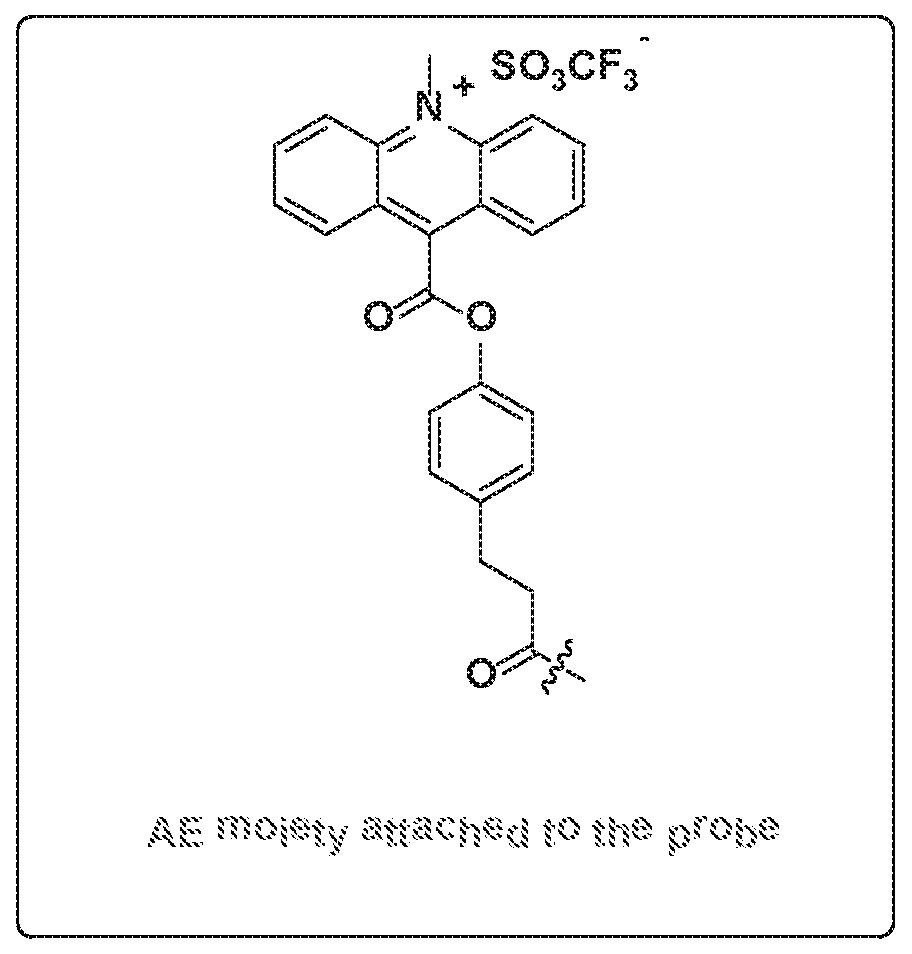
15. The method according to any preceding claim wherein said sample is selected from the group comprising: a cell, a population of cells, a cell line, a biopsy, a tissue, an organ, blood, plasma, serum, sputum, peritoneal fluid, CSF, synovial fluid, sperm, breast milk, bronchial lavage fluid, amniotic fluid, malignant ascites, pleural fluid, seminal fluid, tears, urine, faeces and saliva.
16. The method according to any preceding claim wherein a single temperature is used for both oligonucleotide hybridisation and unbound probe removal or inactivation.
17. An oligonucleotide probe comprising:
i. a sequence which is complementary to at least a part of a ncRNA; and
ii. a chemiluminescent acridinium ester label.
18. A kit for the detection of at least one ncRNA in a sample comprising:
i. at least one oligonucleotide probe comprising a sequence which is complementary to at least a part of a ncRNA and a chemiluminescent acridinium ester label; and
ii. optionally, reagents and instructions pertaining to the use of said oligonucleotide(s).
19. An array for the detection of at least one ncRNA in at least one sample comprising:
i. a plurality of oligonucleotide probes each comprising a sequence which is complementary to at least a part of a selected ncRNA and a chemiiuminescent acridinium ester label; and
ii optionally, reagents and instructions pertaining to the use of said array.
20. An array according to claim 19 comprising a plurality of different probes for identifying a plurality of different ncRNAs and/or a plurality of identical probes for identifying a plurality of identical ncRNAs in a plurality of samples.
21 . A diagnostic method performed on a sample obtained from a test individual for determining the presence or absence of a disease or disorder mediated by at least one ncRNA comprising:
i. exposing said sample to at least one oligonucleotide probe whose sequence is complimentary to at least a part of said ncRNA under hybridization conditions, and wherein said oligonucleotide probe is labeled with a chemiiuminescent acridinium ester;
ii. removing unbound probe or inactivating unbound probe;
iii. quantifying probe hybridised to said ncRNA by using a chemiiuminescent signal produced by said probe; and iv. concluding, where said ncRNA is decreased or increased relative to a sample from a control individual not suffering from said disease or disorder, that said test individual is suffering from said disease or disorder.
22. The method according to claim 21 wherein said oligonucleotide probe is complementary to at least a part of a miR-122.
23. The method of claims 21 or 22 wherein said disease or disorder is a hepatic disease.
24. A prognostic method performed on a sample obtained from a test individual for determining the likely outcome of a disease or disorder mediated by ncRNA comprising:
i. exposing said sample to at least one oligonucleotide probe whose sequence is complimentary to at least a part of said ncRNA under hybridization conditions, and wherein said oligonucleotide probe is labeled with a chemiluminescent acridinium ester;
ii. removing unbound probe or inactivating unbound probe;
iii. quantifying probe hybridised to said ncRNA by using a chemiluminescent signal produced by said probe; and iv. concluding, where said ncRNA is decreased or increased relative to:
a. a previous sample from said individual; or
b. a sample from a control individual suffering from said disease or disorder with a good prognosis; or
c. a sample from a control individual suffering from said disease or disorder with a bad prognosis;
and said increase or decrease is associated with said good or bad prognosis, concluding that said test individual has either a good or a bad prognosis with respect to said disease or disorder.
25. The method according to claim 24 wherein said oligonucleotide probe is complementary to at least a part of a miR-122.
26. The method of claims 24 or 25 wherein said disease or disorder is a hepatic disease.
27. A treatment regimen comprising performing said afore prognostic and/or diagnostic method according to any one of claims 19-24 and then administering an appropriate therapeutic or performing an appropriate treatment step.
Applications Claiming Priority (2)
| Application Number | Priority Date | Filing Date | Title |
|---|---|---|---|
| GB1320560.4 | 2013-11-21 | ||
| GBGB1320560.4A GB201320560D0 (en) | 2013-11-21 | 2013-11-21 | Detection of short non-coding RNA using chemiluminescence labelled nucleic acid probes |
Publications (1)
| Publication Number | Publication Date |
|---|---|
| WO2015075437A1 true WO2015075437A1 (en) | 2015-05-28 |
Family
ID=49917983
Family Applications (1)
| Application Number | Title | Priority Date | Filing Date |
|---|---|---|---|
| PCT/GB2014/053411 Ceased WO2015075437A1 (en) | 2013-11-21 | 2014-11-19 | Detection of short non-coding rna using chemiluminescence labelled nucleic acid probes |
Country Status (2)
| Country | Link |
|---|---|
| GB (1) | GB201320560D0 (en) |
| WO (1) | WO2015075437A1 (en) |
Citations (5)
| Publication number | Priority date | Publication date | Assignee | Title |
|---|---|---|---|---|
| US5185439A (en) * | 1987-10-05 | 1993-02-09 | Gen-Probe Incorporated | Acridinium ester labelling and purification of nucleotide probes |
| US5283174A (en) * | 1987-09-21 | 1994-02-01 | Gen-Probe, Incorporated | Homogenous protection assay |
| US20050266468A1 (en) * | 2004-05-27 | 2005-12-01 | Bedzyk Laura A | Method for the direct detection of diagnostic RNA |
| US20060057590A1 (en) * | 2004-09-14 | 2006-03-16 | Azeddine Si-Ammour | RNA probes |
| US20070269825A1 (en) * | 2006-03-08 | 2007-11-22 | Atila Biosystems, Inc. | Method and kit for nucleic acid sequence detection |
-
2013
- 2013-11-21 GB GBGB1320560.4A patent/GB201320560D0/en not_active Ceased
-
2014
- 2014-11-19 WO PCT/GB2014/053411 patent/WO2015075437A1/en not_active Ceased
Patent Citations (5)
| Publication number | Priority date | Publication date | Assignee | Title |
|---|---|---|---|---|
| US5283174A (en) * | 1987-09-21 | 1994-02-01 | Gen-Probe, Incorporated | Homogenous protection assay |
| US5185439A (en) * | 1987-10-05 | 1993-02-09 | Gen-Probe Incorporated | Acridinium ester labelling and purification of nucleotide probes |
| US20050266468A1 (en) * | 2004-05-27 | 2005-12-01 | Bedzyk Laura A | Method for the direct detection of diagnostic RNA |
| US20060057590A1 (en) * | 2004-09-14 | 2006-03-16 | Azeddine Si-Ammour | RNA probes |
| US20070269825A1 (en) * | 2006-03-08 | 2007-11-22 | Atila Biosystems, Inc. | Method and kit for nucleic acid sequence detection |
Non-Patent Citations (5)
| Title |
|---|
| ARNOLD L J ET AL: "ASSAY FORMATS INVOLVING ACRIDINIUM-ESTER-LABELED DNA PROBES", CLINICAL CHEMISTRY, AMERICAN ASSOCIATION FOR CLINICAL CHEMISTRY, WASHINGTON, DC, vol. 35, no. 8, 1 January 1989 (1989-01-01), pages 1588 - 1594, XP000978873, ISSN: 0009-9147 * |
| KENNETH A. BROWNE ET AL: "Simultaneous Quantification of Multiple Nucleic Acid Targets Using Chemiluminescent Probes", JOURNAL OF THE AMERICAN CHEMICAL SOCIETY, vol. 133, no. 37, 21 September 2011 (2011-09-21), pages 14637 - 14648, XP055169687, ISSN: 0002-7863, DOI: 10.1021/ja202221h * |
| MARTIN RUTH C ET AL: "Simple purification of small RNAs from seeds and efficient detection of multiple microRNAs expressed in Arabidopsis thaliana and tomato (Lycopersicon esculentum) seeds", SEED SCIENCE RESEARCH, CAB INTERNATIONAL, WALLINGFORD, GB, vol. 15, no. 4, 1 December 2005 (2005-12-01), pages 319 - 328, XP008119971, ISSN: 0960-2585, [retrieved on 20070222], DOI: 10.1079/SSR2005220 * |
| NELSON N C: "RAPID DETECTION OF GENETIC MUTATIONS USING THE CHEMILUMINESCENT HYBRIDIZATION PROTECTION ASSAY (HPA): OVERVIEW AND COMPARISON WITH OTHER METHODS", CRITICAL REVIEWS IN CLINICAL LABORATORY SCIENCES, CRC PRESS, BACA RATON, FL, US, vol. 35, no. 5, 1 September 1998 (1998-09-01), pages 369 - 414, XP009010933, ISSN: 1040-8363, DOI: 10.1080/10408369891234228 * |
| RAMKISSOON S H ET AL: "Nonisotopic detection of microRNA using digoxigenin labeled RNA probes", MOLECULAR AND CELLULAR PROBES, ACADEMIC PRESS, LONDON, GB, vol. 20, no. 1, 1 February 2006 (2006-02-01), pages 1 - 4, XP024930020, ISSN: 0890-8508, [retrieved on 20060201], DOI: 10.1016/J.MCP.2005.07.004 * |
Also Published As
| Publication number | Publication date |
|---|---|
| GB201320560D0 (en) | 2014-01-08 |
Similar Documents
| Publication | Publication Date | Title |
|---|---|---|
| JP5480132B2 (en) | Oncogenic ALL-1 fusion protein for targeting DROSHA-mediated microRNA processing | |
| Chen et al. | Quantitation of microRNAs by real-time RT-qPCR | |
| DK2732052T3 (en) | Diagnostic microRNA profiling in cutaneous T cell lymphoma (CTCL) | |
| JP5890686B2 (en) | How to detect sepsis | |
| Torres et al. | Selection and validation of endogenous controls for microRNA expression studies in endometrioid endometrial cancer tissues | |
| US10400288B2 (en) | MicroRNA-based method for early detection of prostate cancer in urine samples | |
| JP2010500867A (en) | Nucleic acid detection method | |
| EP2297357B1 (en) | Prediction of antiviral therapy response | |
| CN106755377B (en) | A kit and method for serological detection and identification of gastric cancer | |
| WO2008064519A1 (en) | Methods and compositions for diagnosis of esophageal cancer and prognosis and improvement of patient survival | |
| Peng et al. | Identification of serum MicroRNAs as diagnostic biomarkers for influenza H7N9 infection | |
| Siva et al. | Molecular assays for the detection of microRNAs in prostate cancer | |
| EP3476945A1 (en) | Rna detecting kit and method | |
| Huang et al. | Quantification of mature microRNAs using pincer probes and real-time PCR amplification | |
| US20180251836A1 (en) | Novel mirna biomarkers and use thereof | |
| CN101082060B (en) | New micro ribonucleic acid quantitative PCR (polymerase chain reaction) detection method | |
| US20150045243A1 (en) | Mirnas as non-invasive biomarkers for diagnosis | |
| JP6705171B2 (en) | Method and apparatus for correcting expression amount of small RNA | |
| CN102399870B (en) | Reagent for determining survival and prognosis of patients with esophagus cancer | |
| WO2015075437A1 (en) | Detection of short non-coding rna using chemiluminescence labelled nucleic acid probes | |
| CN102899390A (en) | Small cell lung cancer markers and their detection | |
| JP7757625B2 (en) | Method for detecting target miRNA and its precursor | |
| Tang et al. | A novel platform of RNA 2′-O-methylation high-throughput and site-specific quantification tools revealed its broad distribution on mRNA | |
| EP2658996A2 (en) | Complex set of mirnas as non-invasive biomarkers for prostate diseases | |
| Knutsen et al. | Performance comparison and data analysis strategies for MicroRNA profiling in cancer research |
Legal Events
| Date | Code | Title | Description |
|---|---|---|---|
| 121 | Ep: the epo has been informed by wipo that ep was designated in this application |
Ref document number: 14805329 Country of ref document: EP Kind code of ref document: A1 |
|
| NENP | Non-entry into the national phase |
Ref country code: DE |
|
| 122 | Ep: pct application non-entry in european phase |
Ref document number: 14805329 Country of ref document: EP Kind code of ref document: A1 |