WO2015065617A1 - Cross-linked rubbery polyurethane-ether membranes for separations - Google Patents
Cross-linked rubbery polyurethane-ether membranes for separations Download PDFInfo
- Publication number
- WO2015065617A1 WO2015065617A1 PCT/US2014/056714 US2014056714W WO2015065617A1 WO 2015065617 A1 WO2015065617 A1 WO 2015065617A1 US 2014056714 W US2014056714 W US 2014056714W WO 2015065617 A1 WO2015065617 A1 WO 2015065617A1
- Authority
- WO
- WIPO (PCT)
- Prior art keywords
- cross
- membrane
- ether
- polyurethane
- linked rubbery
- Prior art date
- Legal status (The legal status is an assumption and is not a legal conclusion. Google has not performed a legal analysis and makes no representation as to the accuracy of the status listed.)
- Ceased
Links
- 0 CO[C@@](CC([C@@](C[C@@]1(*)N)(C[C@]2(*)N*)c(cc3OC)c1cc3OC)C2=C1)[C@]1OC Chemical compound CO[C@@](CC([C@@](C[C@@]1(*)N)(C[C@]2(*)N*)c(cc3OC)c1cc3OC)C2=C1)[C@]1OC 0.000 description 1
Classifications
-
- C—CHEMISTRY; METALLURGY
- C08—ORGANIC MACROMOLECULAR COMPOUNDS; THEIR PREPARATION OR CHEMICAL WORKING-UP; COMPOSITIONS BASED THEREON
- C08G—MACROMOLECULAR COMPOUNDS OBTAINED OTHERWISE THAN BY REACTIONS ONLY INVOLVING UNSATURATED CARBON-TO-CARBON BONDS
- C08G18/00—Polymeric products of isocyanates or isothiocyanates
- C08G18/06—Polymeric products of isocyanates or isothiocyanates with compounds having active hydrogen
- C08G18/70—Polymeric products of isocyanates or isothiocyanates with compounds having active hydrogen characterised by the isocyanates or isothiocyanates used
- C08G18/72—Polyisocyanates or polyisothiocyanates
- C08G18/77—Polyisocyanates or polyisothiocyanates having heteroatoms in addition to the isocyanate or isothiocyanate nitrogen and oxygen or sulfur
- C08G18/771—Polyisocyanates or polyisothiocyanates having heteroatoms in addition to the isocyanate or isothiocyanate nitrogen and oxygen or sulfur oxygen
-
- B—PERFORMING OPERATIONS; TRANSPORTING
- B01—PHYSICAL OR CHEMICAL PROCESSES OR APPARATUS IN GENERAL
- B01D—SEPARATION
- B01D53/00—Separation of gases or vapours; Recovering vapours of volatile solvents from gases; Chemical or biological purification of waste gases, e.g. engine exhaust gases, smoke, fumes, flue gases, aerosols
- B01D53/22—Separation of gases or vapours; Recovering vapours of volatile solvents from gases; Chemical or biological purification of waste gases, e.g. engine exhaust gases, smoke, fumes, flue gases, aerosols by diffusion
- B01D53/228—Separation of gases or vapours; Recovering vapours of volatile solvents from gases; Chemical or biological purification of waste gases, e.g. engine exhaust gases, smoke, fumes, flue gases, aerosols by diffusion characterised by specific membranes
-
- B—PERFORMING OPERATIONS; TRANSPORTING
- B01—PHYSICAL OR CHEMICAL PROCESSES OR APPARATUS IN GENERAL
- B01D—SEPARATION
- B01D67/00—Processes specially adapted for manufacturing semi-permeable membranes for separation processes or apparatus
- B01D67/0002—Organic membrane manufacture
- B01D67/0006—Organic membrane manufacture by chemical reactions
-
- B—PERFORMING OPERATIONS; TRANSPORTING
- B01—PHYSICAL OR CHEMICAL PROCESSES OR APPARATUS IN GENERAL
- B01D—SEPARATION
- B01D69/00—Semi-permeable membranes for separation processes or apparatus characterised by their form, structure or properties; Manufacturing processes specially adapted therefor
- B01D69/10—Supported membranes; Membrane supports
- B01D69/107—Organic support material
-
- B—PERFORMING OPERATIONS; TRANSPORTING
- B01—PHYSICAL OR CHEMICAL PROCESSES OR APPARATUS IN GENERAL
- B01D—SEPARATION
- B01D69/00—Semi-permeable membranes for separation processes or apparatus characterised by their form, structure or properties; Manufacturing processes specially adapted therefor
- B01D69/10—Supported membranes; Membrane supports
- B01D69/108—Inorganic support material
-
- B—PERFORMING OPERATIONS; TRANSPORTING
- B01—PHYSICAL OR CHEMICAL PROCESSES OR APPARATUS IN GENERAL
- B01D—SEPARATION
- B01D69/00—Semi-permeable membranes for separation processes or apparatus characterised by their form, structure or properties; Manufacturing processes specially adapted therefor
- B01D69/12—Composite membranes; Ultra-thin membranes
- B01D69/125—In situ manufacturing by polymerisation, polycondensation, cross-linking or chemical reaction
-
- B—PERFORMING OPERATIONS; TRANSPORTING
- B01—PHYSICAL OR CHEMICAL PROCESSES OR APPARATUS IN GENERAL
- B01D—SEPARATION
- B01D71/00—Semi-permeable membranes for separation processes or apparatus characterised by the material; Manufacturing processes specially adapted therefor
- B01D71/06—Organic material
- B01D71/52—Polyethers
- B01D71/522—Aromatic polyethers
- B01D71/5222—Polyetherketone, polyetheretherketone, or polyaryletherketone
-
- B—PERFORMING OPERATIONS; TRANSPORTING
- B01—PHYSICAL OR CHEMICAL PROCESSES OR APPARATUS IN GENERAL
- B01D—SEPARATION
- B01D71/00—Semi-permeable membranes for separation processes or apparatus characterised by the material; Manufacturing processes specially adapted therefor
- B01D71/06—Organic material
- B01D71/76—Macromolecular material not specifically provided for in a single one of groups B01D71/08 - B01D71/74
-
- C—CHEMISTRY; METALLURGY
- C08—ORGANIC MACROMOLECULAR COMPOUNDS; THEIR PREPARATION OR CHEMICAL WORKING-UP; COMPOSITIONS BASED THEREON
- C08G—MACROMOLECULAR COMPOUNDS OBTAINED OTHERWISE THAN BY REACTIONS ONLY INVOLVING UNSATURATED CARBON-TO-CARBON BONDS
- C08G18/00—Polymeric products of isocyanates or isothiocyanates
- C08G18/06—Polymeric products of isocyanates or isothiocyanates with compounds having active hydrogen
- C08G18/28—Polymeric products of isocyanates or isothiocyanates with compounds having active hydrogen characterised by the compounds used containing active hydrogen
- C08G18/40—High-molecular-weight compounds
- C08G18/48—Polyethers
- C08G18/4825—Polyethers containing two hydroxy groups
-
- C—CHEMISTRY; METALLURGY
- C08—ORGANIC MACROMOLECULAR COMPOUNDS; THEIR PREPARATION OR CHEMICAL WORKING-UP; COMPOSITIONS BASED THEREON
- C08G—MACROMOLECULAR COMPOUNDS OBTAINED OTHERWISE THAN BY REACTIONS ONLY INVOLVING UNSATURATED CARBON-TO-CARBON BONDS
- C08G18/00—Polymeric products of isocyanates or isothiocyanates
- C08G18/06—Polymeric products of isocyanates or isothiocyanates with compounds having active hydrogen
- C08G18/70—Polymeric products of isocyanates or isothiocyanates with compounds having active hydrogen characterised by the isocyanates or isothiocyanates used
- C08G18/72—Polyisocyanates or polyisothiocyanates
- C08G18/74—Polyisocyanates or polyisothiocyanates cyclic
- C08G18/76—Polyisocyanates or polyisothiocyanates cyclic aromatic
- C08G18/7614—Polyisocyanates or polyisothiocyanates cyclic aromatic containing only one aromatic ring
- C08G18/7621—Polyisocyanates or polyisothiocyanates cyclic aromatic containing only one aromatic ring being toluene diisocyanate including isomer mixtures
-
- C—CHEMISTRY; METALLURGY
- C08—ORGANIC MACROMOLECULAR COMPOUNDS; THEIR PREPARATION OR CHEMICAL WORKING-UP; COMPOSITIONS BASED THEREON
- C08G—MACROMOLECULAR COMPOUNDS OBTAINED OTHERWISE THAN BY REACTIONS ONLY INVOLVING UNSATURATED CARBON-TO-CARBON BONDS
- C08G18/00—Polymeric products of isocyanates or isothiocyanates
- C08G18/06—Polymeric products of isocyanates or isothiocyanates with compounds having active hydrogen
- C08G18/83—Chemically modified polymers
- C08G18/831—Chemically modified polymers by oxygen-containing compounds inclusive of carbonic acid halogenides, carboxylic acid halogenides and epoxy halides
-
- B—PERFORMING OPERATIONS; TRANSPORTING
- B01—PHYSICAL OR CHEMICAL PROCESSES OR APPARATUS IN GENERAL
- B01D—SEPARATION
- B01D2323/00—Details relating to membrane preparation
- B01D2323/30—Cross-linking
-
- B—PERFORMING OPERATIONS; TRANSPORTING
- B01—PHYSICAL OR CHEMICAL PROCESSES OR APPARATUS IN GENERAL
- B01D—SEPARATION
- B01D71/00—Semi-permeable membranes for separation processes or apparatus characterised by the material; Manufacturing processes specially adapted therefor
- B01D71/06—Organic material
- B01D71/54—Polyureas; Polyurethanes
-
- Y—GENERAL TAGGING OF NEW TECHNOLOGICAL DEVELOPMENTS; GENERAL TAGGING OF CROSS-SECTIONAL TECHNOLOGIES SPANNING OVER SEVERAL SECTIONS OF THE IPC; TECHNICAL SUBJECTS COVERED BY FORMER USPC CROSS-REFERENCE ART COLLECTIONS [XRACs] AND DIGESTS
- Y02—TECHNOLOGIES OR APPLICATIONS FOR MITIGATION OR ADAPTATION AGAINST CLIMATE CHANGE
- Y02C—CAPTURE, STORAGE, SEQUESTRATION OR DISPOSAL OF GREENHOUSE GASES [GHG]
- Y02C20/00—Capture or disposal of greenhouse gases
- Y02C20/40—Capture or disposal of greenhouse gases of CO2
Definitions
- MemGuardTM system a pretreatment regenerable adsorbent system that uses molecular sieves, was developed to remove water as well as heavy hydrocarbons ranging from C 6 to C 35 from the natural gas stream, hence, to lower the dew point of the stream.
- the selective removal of heavy hydrocarbons by a pretreatment system can significantly improve the performance of the membranes.
- Conditioned natural gas has been used as fuel gas in gas engines and turbines in the hydrocarbon processing industry particularly for offshore platforms and remote locations and will be used in future floating liquefied natural gas (FLNG) and FPSO applications.
- FLNG floating liquefied natural gas
- FPSO FPSO
- Rubbery polymeric membranes that can selectively and efficiently permeate heavy hydrocarbons and other contaminants such as C0 2 , H 2 S, and water vapor will allow conditioning of fuel gas.
- a rubbery polymeric membrane that can selectively permeate condensable heavy hydrocarbon vapors such as C3+ hydrocarbons and can reject non-condensable gases such as methane can also be used for natural gas liquid (NGL) recovery.
- NNL natural gas liquid
- a legacy Grace rubbery polyurea/urethane membrane (S-Brane) has been used for aromatic/non-aromatic separations.
- the treating capacity (flux) is not high enough for most aromatic separation applications.
- the present invention describes a new cross-linked rubbery polyurethane-ether polymeric membrane, a method of making the membrane, and the use of such a novel membrane.
- the present invention involves a cross-linked rubbery polyurethane-ether polymeric membrane, a method of making the membrane, and the use of such a novel membrane system for NGL recovery, fuel gas conditioning, natural gas pre-treatment, sulfur removal from fluidized catalytic cracking (FCC) and other naphtha streams, as well as aromatic separations such as aromatic/n-paraffm separation and xylene separation.
- the cross-linked rubbery polyurethane-ether polymeric membrane described in the current invention comprises a cross-linked rubbery polyurethane-ether polymer synthesized from a diisocyanate-terminated polyether and a rigid cross-linking agent comprising four or more hydroxyl functional groups.
- the use of the rigid cross-linking agent comprising four or more hydroxyl functional groups for the synthesis of cross-linked rubbery polyurethane-ether polymer in the present invention results in the formation of cross-linked polymer structure.
- the hydroxyl groups on the rigid cross-linking agent react with the isocyanate groups on the diisocyanate-terminated polyether to form urethane bonds.
- cross-linked rubbery polyurethane-ether polymeric membrane described in the current invention selectively permeates condensable vapors such as C 3 to C 35
- Fluid streams, including gases and liquids, can be treated for separation of higher hydrocarbons from natural gas. These membranes can also be used for separation of aromatic hydrocarbon streams.
- the cross-linked rubbery polyurethane-ether polymeric membrane described in the current invention has high permeance for condensable vapors, high selectivity for condensable vapors over methane and ethane, and high resistance to liquid chemicals.
- the present invention involves a novel cross-linked rubbery polyurethane-ether polymeric membrane, a method of making the membrane, and the use of such a novel membrane system for NGL recovery, fuel gas conditioning, natural gas pre-treatment, sulfur removal from fluidized catalytic cracking (FCC) streams and other naphtha streams, as well as aromatic separations such as aromatic/n-paraffin separation and xylene separation.
- FCC fluidized catalytic cracking
- the cross-linked rubbery polyurethane-ether polymeric membrane described in the current invention comprises a cross-linked rubbery polyurethane-ether polymer synthesized from a diisocyanate-terminated polyether and a rigid cross-linking agent comprising four or more hydroxyl functional groups.
- the use of the rigid cross-linking agent comprising four or more hydroxyl functional groups for the synthesis of cross-linked rubbery polyurethane-ether polymer in the present invention results in the formation of cross-linked polymer structure.
- the hydroxyl groups on the rigid cross-linking agent react with the isocyanate groups on the diisocyanate-terminated polyether to form urethane bonds.
- the cross-linked rubbery polyurethane-ether polymeric membrane described in the current invention selectively permeates condensable vapors such as C 3 to C 35 hydrocarbons, aromatics, water vapor, carbon dioxide, and hydrogen sulfide and rejects methane and ethane.
- the cross-linked rubbery polyurethane-ether polymeric membrane described in the current invention has high permeance for condensable vapors, high selectivity for condensable vapors over methane and ethane, and high resistance to liquid chemicals.
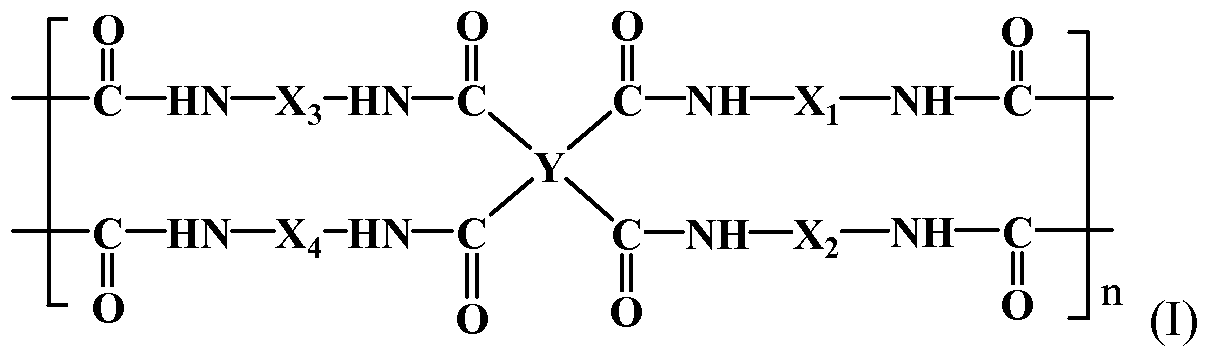
- the cross-linked rubbery polyurethane-ether polymeric membrane described in the current invention comprises a cross-linked rubbery polyurethane-ether polymer with a plurality of repeating units of a formula (I), wherein said formula (I) is:
- X ls X 2 , X 3 , and X 4 are selected from the group consisting of o O
- X ls X 2 , X 3 , and X 4 are the same or different from each other; wherein Y is selected from the group consisting of
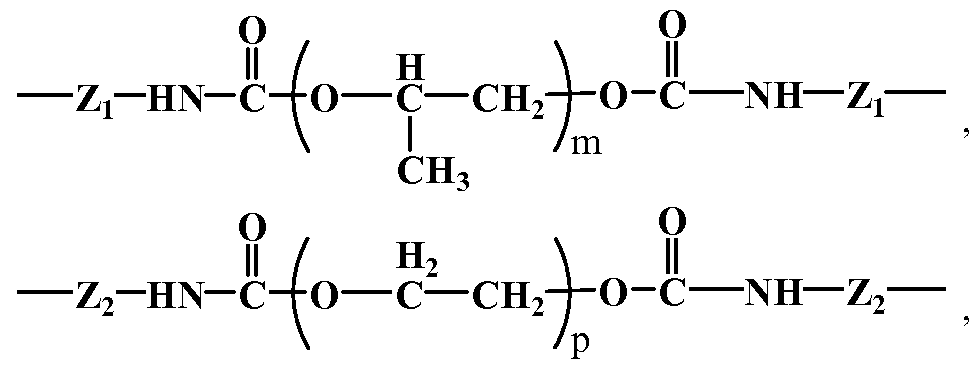
- Z ls Z 2 , Z 3 , and Z 4 are selected from the group consisting of
- Z ls Z 2 , Z 3 , and Z 4 are the same or different from each other and t is 0 to 4; wherein n, m, p, q, r, and s are independent integers from 2 to 500. It is preferred that X ls X 2 , X 3 , and X 4 of formula (I) are the same and have the chemical structure of:
- Z ⁇ of Xi, X 2 , X 3 , and X 4 of formula (I) is:
- Y of formula (I) is:
- the cross-linked rubbery polyurethane-ether membrane in the present invention is prepared by: 1) dissolving a diisocyanate-terminated polyether and a rigid cross-linking agent comprising four or more hydroxyl functional groups in a solvent to form a homogeneous solution; 2) heating the solution at a temperature of 30° to 100°C for 0.5 to 12 hours to form a polyurethane-ether prepolymer; 3) Coating a layer of the polyurethane-ether prepolymer solution on a relatively porous membrane support (e.g., a support made from inorganic ceramic material or a support made from a polymer); 4) heating the coated membrane at a temperature of 30° to 100°C for 0.5 to 12 hours to provide a thin selective layer comprising the cross-linked rubbery polyurethane-ether material on the membrane support.
- a relatively porous membrane support e.g., a support made from inorganic ceramic material or a support made from a polymer
- a second layer of the cross-linked rubbery polyurethane-ether is added after step 4) by repeating steps 3) and 4).
- the diisocyanate-terminated poly ether used for the synthesis of the cross-linked rubbery polyurethane-ether polymer in the current invention is selected from the group consisting of
- Z ls Z 2 , Z 3 , and Z 4 are selected from the group consisting of
- Z ls Z 2 , Z 3 , and Z 4 are the same or different from each other and t is 0 to 4; wherein m, p, q, r, and s are independent integers from 2 to 500.
- the rigid cross-linking agent comprising four or more hydroxyl functional groups used for the synthesis of the cross-linked rubbery polyurethane-ether polymer in the current invention is selected from the group consisting of
- the solvents used for dissolving the diisocyanate-terminated poly ether and the rigid cross-linking agent comprising four or more hydroxyl functional groups are chosen primarily for their ability to completely dissolve the diisocyanate-terminated polyether and the rigid cross-linking agent comprising four or more hydroxyl functional groups and for ease of solvent removal in the membrane formation steps.
- Other considerations in the selection of solvents include low toxicity, low corrosive activity, low environmental hazard potential, availability and cost.
- Representative solvents for use in this invention include, but are not limited to, N-methylpyrrolidone (NMP).
- the cross-linked rubbery polyurethane-ether membrane in the present invention can be fabricated into any convenient form such as sheet, disk, tube, or hollow fiber.
- cross-linked rubbery polyurethane-ether membranes can also be fabricated into thin film composite membranes incorporating a selective thin cross-linked rubbery polyurethane-ether layer and a porous supporting layer comprising a polymer material or an inorganic material.
- the present invention involves the use of a novel membrane system for natural gas upgrading.
- This membrane system includes a first-stage cross-linked rubbery
- polyurethane-ether polymeric membrane described in the present invention to selectively remove hydrocarbons from C 3 to C 35 to control the dew point of natural gas, and a second- stage membrane to selectively remove C0 2 from natural gas.
- the new membrane system described in the current invention eliminates the use of high cost and high footprint membrane pretreatment systems.
- the membrane system described in the current invention does not require an inter-stage compressor. This is because the natural gas with controlled dew point comes out from the retentate side of the first cross-linked rubbery polyurethane- ether polymeric membrane at high pressure and is directly introduced to the second
- the membrane system significantly reduces the footprint and cost of the membrane system for natural gas upgrading compared to the current commercially available membrane systems that include a non-membrane-related pretreatment system.
- the membranes most commonly used for commercial natural gas upgrading applications such as cellulose acetate and polyimide are glassy polymers. These membranes, however, cannot be used to control the dew point of natural gas because they are more selectively permeable for CH 4 than for hydrocarbons from C 3 to C 35 . Pretreatment system is necessary when using these commercial glassy polymer membranes for natural gas upgrading.
- the membrane used as the second-stage membrane in the new membrane system described in the current invention has higher C0 2 /CH 4 selectivity than the first-stage cross-linked rubbery polyurethane-ether polymeric membrane described in the present invention for natural gas upgrading.
- the membrane materials for the second-stage membrane in the new membrane system described in the current invention have C0 2 /CH 4 selectivity of 10 or higher at 50°C under 6.89 MPa (1000 psig) feed gas pressure and with 10% C0 2 and 90% CH 4 in the feed gas.
- the membrane materials for the second-stage membrane in the new membrane system described in the current invention can be selected from, but is not limited to, polyacrylonitrile, polysulfones; sulfonated polysulfones; polyetherimides such as Ultem; cellulosic polymers, such as cellulose acetate and cellulose triacetate; polyamides; polyimides such as Matrimid and P84 or P84HT; polyamide/imides; polyketones, polyether ketones; poly(arylene oxides) such as poly(phenylene oxide) and poly(xylene oxide); poly(esteramide- diisocyanate); polyurethanes; polyesters (including polyarylates), such as poly(ethylene terephthalate), poly(alkyl methacrylates), poly(acrylates), and poly(phenylene terephthalate); polysulfides; polymers from monomers having alpha-olefmic unsaturation in addition to those polymers previously listed including poly(ethylene), poly(propylene), poly
- Some preferred polymers used for the preparation of the second-stage membrane in the new membrane system described in the current invention include, but are not limited to, polysulfones; sulfonated polysulfones; polyetherimides such as Ultem; cellulosic polymers such as cellulose acetate and cellulose triacetate; polyamides; polyimides such as P84 and poly(3,3',4,4'-benzophenone tetracarboxylic dianhydride-pyromellitic dianhydride-3,3',5,5'- tetramethyl-4,4' -methylene dianiline) (poly(BTDA-PMDA-TMMDA)); polyamide/imides; polyketones; polyether ketones; and polyacrylonitrile.
- polysulfones sulfonated polysulfones
- polyetherimides such as Ultem
- cellulosic polymers such as cellulose acetate and cellulose triacetate
- polyamides polyimi
- the cross-linked rubbery polyurethane-ether polymeric membrane described in the current invention can also be used for NGL recovery from natural gas.
- the cross-linked rubbery polyurethane-ether polymeric membrane described in the current invention can also be used for NGL recovery from natural gas.
- the cross-linked rubbery polyurethane-ether polymeric membrane described in the current invention can also be used for fuel gas conditioning. Conditioning natural gas has been used as fuel gas in gas engines and turbines in the hydrocarbon processing industry particularly for offshore platforms and remote locations and FLNG and FPSO applications.
- the cross-linked rubbery polyurethane-ether polymeric membrane described in the current invention has shown high permeance and high selectivity for C3+ hydrocarbons over methane that will allow conditioning of fuel gas.
- the solution was degassed for 1 hour and then cast onto the surface of a clean glass plate.
- the DMF solvent was evaporated at 50°C for 12 hours.
- the resulting membrane was detached from the glass plate and further dried at 120°C for 24 hours in vacuum to form cross-linked polyurethane-propylene glycerol dense film membrane.
- polyurethane-propylene glycerol membrane [0027] The following Table shows the pure-gas permeabilities and selectivities of the cross-linked polyurethane-propylene glycerol membrane.
- the permeabilities (PA) and selectivities (( A/B) of the cross-linked polyurethane-propylene glycerol membrane for CH 4 , C0 2 , propane ( ⁇ 1 ⁇ 2 ⁇ 8 ), and n-butane (n-C 4 Hi 0 ) were measured by pure gas measurements at 50°C.
- cross-linked polyurethane-propylene glycerol membrane has >200 Barrers of C0 2 permeability, which is much higher than traditional polymer membranes such as CA, Matrimid polyimide, and Ultem polyetherimide
- the cross-linked polyurethane-propylene glycerol membrane is much more permeable to large, condensable organic vapors, such as C3H8 and n-C4Hio, than to small, permanent gases, such as CH 4 . Therefore, the cross-linked polyurethane-propylene glycerol membrane can be used to selectively remove water and hydrocarbons from C3 to C35 to control the dew point of natural gas for natural gas processing.
- the high pressure retentate from the cross-linked polyurethane-propylene glycerol membrane mainly comprises C3 ⁇ 4, C0 2 , and trace amount of ethane and propane, and some other components.
- the invention involves a cross-linked rubbery polyurethane- ether polymeric membrane comprising a cross-linked rubbery polyurethane-ether polymer with a plurality of repeating units of a formula (I), wherein formula (I) is represented by a structure comprising:
- Xi, X 2 , X 3 , and X 4 are the same or different from each other; wherein Y is selected from the group consisting of and mixtures thereof, respectively; Z ls Z 2 , Z 3 , and Z 4 are the same or different from each other and t is 0 to 4; and wherein n, m, p, q, r, and s are independent integers from 2 to 500.
- Xi, X 2 , X 3 , and X 4 of formula (I) may be the same and have a chemical structure comprising:
- Y of formula (I) may be
- the invention involves a process of making a cross- linked rubbery polyurethane-ether membrane comprising dissolving a diisocyanate- terminated polyether and a rigid cross-linking agent comprising four or more hydroxyl functional groups in a solvent to form a homogeneous solution; 2) then heating the homogenous solution at a temperature of 30° to 100°C for 0.5 to 12 hours to form a polyurethane-ether prepolymer solution; 3) coating a layer of the polyurethane-ether prepolymer solution on a porous membrane support; and 4) heating the coated membrane at a temperature of 30° to 100°C for 0.5 to 12 hours to provide a thin selective layer comprising a cross-linked rubbery polyurethane-ether material on the porous membrane support.
- the porous membrane support prepared in the process may comprise an inorganic ceramic material or a polymer. There may be at least one additional layer of the cross-linked rubbery polyurethane-ether material added to the porous membrane support.
- the cross-linked rubbery polyurethane-ether membrane may be fabricated into an appropriate configuration such as a sheet, disk, tube or hollow fiber.
- the cross-linked rubbery polyurethane-ether membranes may also be fabricated into a thin film composite membrane incorporating a selective thin cross-linked rubbery polyurethane-ether layer and a porous supporting layer comprising a polymer material or an inorganic material.
- the cross-linked rubbery polyurethane-ether polymeric membrane comprises a cross-linked rubbery polyurethane- ether polymer with a plurality of repeating units of a formula (I), wherein said formula (I) is represented by a structure comprising:
- X l s X 2 , X 3 , and X 4 are selected from the group consisting of
- Xi, X 2 , X 3 , and X 4 are the same or different from each other; wherein Y is selected from the group consisting of and mixtures thereof, respectively; Z ls Z 2 , Z 3 , and Z 4 are the same or different from each other and t is 0 to 4; and wherein n, m, p, q, r, and s are independent integers from 2 to 500.
- the diisocyanate-terminated polyether is selected from the group consisting of
- Z ls Z 2 , Z 3 , and Z 4 are selected from the group consisting of
- the rigid cross-linking agent comprises four or more hydroxyl functional groups is selected from the group consisting of
- the invention comprises a process for treating a fluid stream comprising contacting the fluid stream with a cross-linked rubbery polyurethane-ether polymer membrane having a plurality of repeating units of a formula (I), wherein said formula (I) is represented by a structure comprising:
- X ls X 2 , X 3 , and X 4 are selected from the group consisting of
- Z ls Z 2 , Z 3 , and Z 4 are selected from the group consisting of
- the process for treating a fluid includes a process for removing C 3 to C 35 hydrocarbons from natural gas.
- a dew point of the natural gas stream is controlled within specified limits.
- carbon dioxide is removed from the natural gas stream.
- the permeate stream comprises propane, n-butane and other heavy hydrocarbons and said retentate stream comprises methane and ethane.
- the fluid stream comprises a mixture of aromatic compounds.
- the fluid stream is first sent through the cross-linked rubbery polyurethane-ether polymeric membrane and then is sent through a second membrane.
- the second membrane may include a polymer selected from the group consisting of polysulfone, cellulose acetate, cellulose triacetate, polyamide, polyimide, polyketone, polyether ketone, and poly aery lonitrile.
- the second membrane has higher CO 2 /CH 4 selectivity than the cross-linked rubbery polyurethane-ether polymeric membrane.
Landscapes
- Chemical & Material Sciences (AREA)
- Chemical Kinetics & Catalysis (AREA)
- Health & Medical Sciences (AREA)
- Organic Chemistry (AREA)
- Polymers & Plastics (AREA)
- Medicinal Chemistry (AREA)
- Engineering & Computer Science (AREA)
- General Chemical & Material Sciences (AREA)
- Oil, Petroleum & Natural Gas (AREA)
- Analytical Chemistry (AREA)
- Manufacturing & Machinery (AREA)
- Inorganic Chemistry (AREA)
- Emergency Medicine (AREA)
- Separation Using Semi-Permeable Membranes (AREA)
- Polyurethanes Or Polyureas (AREA)
Abstract
Description




Claims


Priority Applications (3)
| Application Number | Priority Date | Filing Date | Title |
|---|---|---|---|
| JP2016525009A JP6494614B2 (en) | 2013-10-29 | 2014-09-22 | Cross-linked rubbery polyurethane-ether membrane for separation |
| CN201480058117.3A CN105658314B (en) | 2013-10-29 | 2014-09-22 | Cross-linked rubber polyurethane-ether membrane for separation |
| SG11201603043UA SG11201603043UA (en) | 2013-10-29 | 2014-09-22 | Cross-linked rubbery polyurethane-ether membranes for separations |
Applications Claiming Priority (2)
| Application Number | Priority Date | Filing Date | Title |
|---|---|---|---|
| US14/066,248 US9045582B2 (en) | 2013-10-29 | 2013-10-29 | Cross-linked rubbery polyurethane-ether membranes for separations |
| US14/066,248 | 2013-10-29 |
Publications (1)
| Publication Number | Publication Date |
|---|---|
| WO2015065617A1 true WO2015065617A1 (en) | 2015-05-07 |
Family
ID=52993972
Family Applications (1)
| Application Number | Title | Priority Date | Filing Date |
|---|---|---|---|
| PCT/US2014/056714 Ceased WO2015065617A1 (en) | 2013-10-29 | 2014-09-22 | Cross-linked rubbery polyurethane-ether membranes for separations |
Country Status (5)
| Country | Link |
|---|---|
| US (1) | US9045582B2 (en) |
| JP (1) | JP6494614B2 (en) |
| CN (1) | CN105658314B (en) |
| SG (1) | SG11201603043UA (en) |
| WO (1) | WO2015065617A1 (en) |
Cited By (1)
| Publication number | Priority date | Publication date | Assignee | Title |
|---|---|---|---|---|
| CN110975646A (en) * | 2019-12-18 | 2020-04-10 | 中海油节能环保服务有限公司 | Preparation method of hollow fiber composite membrane for separation of carbon dioxide in mixed gas |
Families Citing this family (6)
| Publication number | Priority date | Publication date | Assignee | Title |
|---|---|---|---|---|
| US9238194B2 (en) * | 2014-03-31 | 2016-01-19 | Uop Llc | Nanoporous macrocycle-containing cross-linked polymeric membranes for separations |
| CA2986417C (en) | 2015-05-30 | 2022-11-08 | Dpoint Technologies Inc. | Supported water vapor transport membrane comprising polyethylene oxide copolymer |
| US10569218B2 (en) * | 2016-11-17 | 2020-02-25 | Uop Llc | Multiple membrane separation process using glassy polymeric membrane and rubbery polymeric membrane |
| US10272394B2 (en) * | 2017-08-30 | 2019-04-30 | Saudi Arabian Oil Company | Crosslinked polymeric blended membranes for gas separation |
| WO2019070507A1 (en) | 2017-10-05 | 2019-04-11 | Fresenius Medical Care Holdings, Inc. | Polysulfone-urethane copolymer, membranes and products incorporating same, and methods for making and using same |
| US11202986B2 (en) | 2017-10-09 | 2021-12-21 | Ali Pournaghshband Isfahani | Plasticization-resistant polyurethane membrane and preparation method thereof |
Citations (5)
| Publication number | Priority date | Publication date | Assignee | Title |
|---|---|---|---|---|
| US20030226446A1 (en) * | 2002-03-27 | 2003-12-11 | Simmons John W. | Novel block polyurethane-ether and polyurea-ether gas separation membranes |
| US20090281250A1 (en) * | 2004-02-13 | 2009-11-12 | The University Of North Carolina At Chapel Hill | Methods and materials for fabricating microfluidic devices |
| WO2010002404A1 (en) * | 2008-07-02 | 2010-01-07 | Uop Llc | Mixed matrix membranes incorporating microporous polymers as fillers |
| US20100167100A1 (en) * | 2008-12-26 | 2010-07-01 | David Roger Moore | Composite membrane and method for making |
| WO2013057492A1 (en) * | 2011-10-18 | 2013-04-25 | Imperial Innovations Limited | Membranes for separation |
Family Cites Families (12)
| Publication number | Priority date | Publication date | Assignee | Title |
|---|---|---|---|---|
| US4786657A (en) * | 1987-07-02 | 1988-11-22 | Minnesota Mining And Manufacturing Company | Polyurethanes and polyurethane/polyureas crosslinked using 2-glyceryl acrylate or 2-glyceryl methacrylate |
| US4743629A (en) * | 1987-07-02 | 1988-05-10 | Becton, Dickinson And Company | Crosslinked polyetherurethane membranes useful in blood electrolyte sensors |
| CH673388A5 (en) * | 1987-12-07 | 1990-03-15 | Sulzer Ag | |
| JPH0377633A (en) * | 1989-08-18 | 1991-04-03 | Nippon Polyurethane Ind Co Ltd | Gas separation membrane and its manufacturing method |
| US6037440A (en) * | 1997-07-31 | 2000-03-14 | Eastman Kodak Company | Cross-linked linear (2-cyanoacetamido) reactive polyurethanes |
| US6022925A (en) * | 1998-06-23 | 2000-02-08 | The Sherwin-Williams Company | Partial interpenetrating networks of polymers |
| US6825613B2 (en) * | 2002-09-12 | 2004-11-30 | Colour Star Limited | Mercury gas discharge device |
| US20070049149A1 (en) * | 2005-08-24 | 2007-03-01 | Brookwood Companies, Inc. | Chemical-resistant breathable textile laminate |
| JP2008074563A (en) * | 2006-09-21 | 2008-04-03 | Toshiba Elevator Co Ltd | Elevator system |
| US8268041B2 (en) * | 2008-06-30 | 2012-09-18 | L'air Liquide Societe Anonyme Pour L'etude Et L'exploitation Des Procedes Georges Claude | Hollow organic/inorganic composite fibers, sintered fibers, methods of making such fibers, gas separation modules incorporating such fibers, and methods of using such modules |
| US8343257B2 (en) * | 2008-11-25 | 2013-01-01 | Dow Global Technologies Llc | Polymer pi-bond-philic filler composites |
| CN103747854B (en) * | 2011-06-07 | 2016-12-07 | 迪博因特技术公司 | Selective water vapor transport membrane comprising nanofibrous layer and method of making same |
-
2013
- 2013-10-29 US US14/066,248 patent/US9045582B2/en active Active
-
2014
- 2014-09-22 JP JP2016525009A patent/JP6494614B2/en active Active
- 2014-09-22 SG SG11201603043UA patent/SG11201603043UA/en unknown
- 2014-09-22 CN CN201480058117.3A patent/CN105658314B/en not_active Expired - Fee Related
- 2014-09-22 WO PCT/US2014/056714 patent/WO2015065617A1/en not_active Ceased
Patent Citations (5)
| Publication number | Priority date | Publication date | Assignee | Title |
|---|---|---|---|---|
| US20030226446A1 (en) * | 2002-03-27 | 2003-12-11 | Simmons John W. | Novel block polyurethane-ether and polyurea-ether gas separation membranes |
| US20090281250A1 (en) * | 2004-02-13 | 2009-11-12 | The University Of North Carolina At Chapel Hill | Methods and materials for fabricating microfluidic devices |
| WO2010002404A1 (en) * | 2008-07-02 | 2010-01-07 | Uop Llc | Mixed matrix membranes incorporating microporous polymers as fillers |
| US20100167100A1 (en) * | 2008-12-26 | 2010-07-01 | David Roger Moore | Composite membrane and method for making |
| WO2013057492A1 (en) * | 2011-10-18 | 2013-04-25 | Imperial Innovations Limited | Membranes for separation |
Cited By (2)
| Publication number | Priority date | Publication date | Assignee | Title |
|---|---|---|---|---|
| CN110975646A (en) * | 2019-12-18 | 2020-04-10 | 中海油节能环保服务有限公司 | Preparation method of hollow fiber composite membrane for separation of carbon dioxide in mixed gas |
| CN110975646B (en) * | 2019-12-18 | 2022-06-14 | 中海油节能环保服务有限公司 | Preparation method of hollow fiber composite membrane for separating carbon dioxide in mixed gas |
Also Published As
| Publication number | Publication date |
|---|---|
| US9045582B2 (en) | 2015-06-02 |
| US20150114224A1 (en) | 2015-04-30 |
| CN105658314A (en) | 2016-06-08 |
| SG11201603043UA (en) | 2016-05-30 |
| CN105658314B (en) | 2019-03-08 |
| JP6494614B2 (en) | 2019-04-03 |
| JP2016536119A (en) | 2016-11-24 |
Similar Documents
| Publication | Publication Date | Title |
|---|---|---|
| US9238194B2 (en) | Nanoporous macrocycle-containing cross-linked polymeric membranes for separations | |
| US7025804B2 (en) | Method for separating hydrocarbon-containing gas mixtures using hydrocarbon-resistant membranes | |
| WO2015065617A1 (en) | Cross-linked rubbery polyurethane-ether membranes for separations | |
| US11931698B2 (en) | High selectivity membranes for hydrogen sulfide and carbon dioxide removal from natural gas | |
| US9233344B1 (en) | High selectivity polyimide membrane for natural gas upgrading and hydrogen purification | |
| US9669363B2 (en) | High permeance membranes for gas separations | |
| WO2011149654A2 (en) | High permeance polyimide membranes for air separation | |
| WO2015047702A1 (en) | Self cross-linkable and self cross-linked aromatic polyimide membranes for separations | |
| WO2016100058A1 (en) | Super high selectivity aromatic block copolyimide membranes for separations | |
| WO2016148988A1 (en) | High selectivity epoxysilicone-cross-linked polyimide membranes for gas separations | |
| WO2018093488A1 (en) | High selectivity chemically cross-linked rubbery membranes and their use for separations | |
| WO2014209699A1 (en) | High permeability copolyimide gas separation membranes | |
| Hosseini et al. | Polymeric membranes for gas and vapor separations | |
| Chen et al. | Polyimide membranes for gas separation: Synthesis, processing and properties | |
| US9266058B1 (en) | High selectivity polyimide membrane for natural gas upgrading and hydrogen purification | |
| US9308499B1 (en) | Polyimide blend membranes for gas separations | |
| US12157087B2 (en) | High selectivity polyimide/PES blend hollow fiber membrane for gas separations | |
| US9308487B1 (en) | Polyimide blend membranes for gas separations | |
| US9751053B2 (en) | Asymmetric integrally-skinned flat sheet membranes for H2 purification and natural gas upgrading | |
| EP4419576A1 (en) | High selectivity and high co2 plasticization resistant polymeric membranes for gas separations | |
| WO2016209690A1 (en) | Chemically and uv cross-linked high selectivity polyimide membranes for gas separations | |
| WO2016049274A1 (en) | Asymmetric integrally-skinned flat sheet membranes for h2 purification and natural gas upgrading | |
| WO2015094675A1 (en) | Aromatic poly(ether sulfone imide) membranes for gas separations |
Legal Events
| Date | Code | Title | Description |
|---|---|---|---|
| 121 | Ep: the epo has been informed by wipo that ep was designated in this application |
Ref document number: 14859068 Country of ref document: EP Kind code of ref document: A1 |
|
| ENP | Entry into the national phase |
Ref document number: 2016525009 Country of ref document: JP Kind code of ref document: A |
|
| NENP | Non-entry into the national phase |
Ref country code: DE |
|
| REG | Reference to national code |
Ref country code: BR Ref legal event code: B01A Ref document number: 112016008759 Country of ref document: BR |
|
| 122 | Ep: pct application non-entry in european phase |
Ref document number: 14859068 Country of ref document: EP Kind code of ref document: A1 |
|
| ENP | Entry into the national phase |
Ref document number: 112016008759 Country of ref document: BR Kind code of ref document: A2 Effective date: 20160419 |