WO2015047711A1 - Polybenzoxazole membranes from self-cross-linkable aromatic polyimide membranes - Google Patents
Polybenzoxazole membranes from self-cross-linkable aromatic polyimide membranes Download PDFInfo
- Publication number
- WO2015047711A1 WO2015047711A1 PCT/US2014/054638 US2014054638W WO2015047711A1 WO 2015047711 A1 WO2015047711 A1 WO 2015047711A1 US 2014054638 W US2014054638 W US 2014054638W WO 2015047711 A1 WO2015047711 A1 WO 2015047711A1
- Authority
- WO
- WIPO (PCT)
- Prior art keywords
- membrane
- mixtures
- group
- cross
- self
- Prior art date
- Legal status (The legal status is an assumption and is not a legal conclusion. Google has not performed a legal analysis and makes no representation as to the accuracy of the status listed.)
- Ceased
Links
Classifications
-
- B—PERFORMING OPERATIONS; TRANSPORTING
- B01—PHYSICAL OR CHEMICAL PROCESSES OR APPARATUS IN GENERAL
- B01D—SEPARATION
- B01D71/00—Semi-permeable membranes for separation processes or apparatus characterised by the material; Manufacturing processes specially adapted therefor
- B01D71/06—Organic material
- B01D71/58—Other polymers having nitrogen in the main chain, with or without oxygen or carbon only
- B01D71/62—Polycondensates having nitrogen-containing heterocyclic rings in the main chain
-
- B—PERFORMING OPERATIONS; TRANSPORTING
- B01—PHYSICAL OR CHEMICAL PROCESSES OR APPARATUS IN GENERAL
- B01D—SEPARATION
- B01D67/00—Processes specially adapted for manufacturing semi-permeable membranes for separation processes or apparatus
- B01D67/0002—Organic membrane manufacture
- B01D67/0006—Organic membrane manufacture by chemical reactions
-
- B—PERFORMING OPERATIONS; TRANSPORTING
- B01—PHYSICAL OR CHEMICAL PROCESSES OR APPARATUS IN GENERAL
- B01D—SEPARATION
- B01D67/00—Processes specially adapted for manufacturing semi-permeable membranes for separation processes or apparatus
- B01D67/0081—After-treatment of organic or inorganic membranes
- B01D67/0083—Thermal after-treatment
-
- B—PERFORMING OPERATIONS; TRANSPORTING
- B01—PHYSICAL OR CHEMICAL PROCESSES OR APPARATUS IN GENERAL
- B01D—SEPARATION
- B01D67/00—Processes specially adapted for manufacturing semi-permeable membranes for separation processes or apparatus
- B01D67/0081—After-treatment of organic or inorganic membranes
- B01D67/0088—Physical treatment with compounds, e.g. swelling, coating or impregnation
-
- B—PERFORMING OPERATIONS; TRANSPORTING
- B01—PHYSICAL OR CHEMICAL PROCESSES OR APPARATUS IN GENERAL
- B01D—SEPARATION
- B01D2323/00—Details relating to membrane preparation
- B01D2323/08—Specific temperatures applied
- B01D2323/081—Heating
-
- B—PERFORMING OPERATIONS; TRANSPORTING
- B01—PHYSICAL OR CHEMICAL PROCESSES OR APPARATUS IN GENERAL
- B01D—SEPARATION
- B01D2323/00—Details relating to membrane preparation
- B01D2323/30—Cross-linking
Definitions
- This invention relates to a method of making polybenzoxazole (PBO) membranes from self-cross-lmkable aromatic polyimide polymer comprising both hydroxy! functional groups and carboxylic acid functional groups and the use of these membranes in separations of gas mixtures and liquid mixtures.
- PBO polybenzoxazole
- CA Cellulose acetate glassy polymer membranes are used extensively in gas separation.
- CA membranes are used commercially for natural gas upgrading, including the removal of carbon dioxide.
- CA membranes ha ve many advantages, they are limited in a number of properties including selectivity, permeability, and in chemical, thermal, and mechanical stability. It has been found that polymer membrane performance can deteriorate quickly. A primary cause of loss of membrane performance is liquid condensation on the membrane surface. Condensation can be prevented by providing a sufficient dew point margin for operation, based on the calculated dew point of the membrane product gas.
- UOP's MemGuard iM system a regenerable adsorbent system that uses molecular sieves, was developed to remove water as well as heavy hydrocarbons from the natural gas stream, hence, to lower the dew point of the stream.
- the selective removal of heavy hydrocarbons by a pretreatment system can significantly improve the performance of the membranes, although these pretreatment systems can effectively perform this function, the cost is quite significant, in some projects, the cost of the pretreatment system was as high as 10 to 40% of the total cost (pretreatment system and membrane system) depending on the feed composition. Reduction of the size of the pretreatment system or even total elimination of the pretreatment system would significantly reduce the membrane system cost for natural gas upgrading.
- the footprint is a big constraint for offshore projects.
- the footprint of the pretreatment system is very high at more than 10 to 50% of the footprint of the entire membrane system. Therefore, removal of the pretreatment system from the membrane system has great economic impact, especially to offshore projects.
- polybenzimidazoles are thermally stable ladder-like glassy polymers with flat, stiff, rigid-rod phenyleiie-heterocyclic ring units.
- the stiff rigid ring units in such polymers pack efficiently, leaving very small penetrant-accessible free volume elements that are desirable to provide polymer membranes with both high permeability and high selectivity.
- These aromatic PBO, PBT, and FBI polymers have poor solubility in common organic solvents, preventing them from being used for making polymer membranes by the most practical solvent casting method.
- polybenzoxazole membranes are prepared from high temperature thermal rearrangement of hydroxy- containing polyimide polymer membranes containing pendent hydroxyl groups ortho to the heterocyclic imide nitrogen. These polybenzoxazole polymer membranes exhibited extremely high CO'2 permeability (>100 Barrer) which is at least 10 times better than con ventional polymer membranes.
- Poiy(o-hydroxy amide) polymers comprising pendent phenolic hydroxy! groups ortho to the amide nitrogen in the polymer backbone have also been used for making PBO membranes for separation applications (US 2010/0133188 Al).
- One of the components to be separated by a membrane must have a sufficiently high permeance at preferred conditions or extraordinarily large membrane surface areas are required to allow separation of large amounts of material.
- Commercially available polymer membranes such as cellulose acetate and polysuifone membranes, have an asymmetric structure with a thin dense selective layer of less than 1 ⁇ . The thin selective layer provides the membrane high permeance representing high productivity.
- asymmetric PBO membranes with high permeance for separation applications.
- One such type of asymmetric hollow fiber PBO membrane has been recently disclosed by Park et al. (US 2009/0297850 Al) and Visser et al. (Abstract on "Development of asymmetric hollow fiber membranes with tunable gas separation properties" at NAM S 2009 conference, June 20-24, 2009, Washington, South Carolina, USA).
- the asymmetric hollow fiber PBO membranes disclosed by Park et al. and Visser et al. were obtained from o-hydroxyl substituted polyimide asymmetric hollow fiber membranes via thermal rearrangement.
- Visser et al. found that the high
- the present invention generally relates to a method of making PBO membranes from self-cross-lirikable aromatic polyimide polymer comprising both hydroxvl functional groups and carboxylic acid functional groups.
- the present invention also relates to the use of PBO membranes for gas, vapor, and liquid separations.
- the present invention provides a method for the production of a PBO membrane by: 1) fabricating a self-cross-linkable aromatic polyimide polymer membrane from the self- cross-linkable aromatic polyimide polymer comprising both hydroxvl functional groups and carboxylic acid functional groups; 2) cross-linking the self-cross-linkable aromatic polyimide polymer membrane to form the self-cross-lmked aromatic polyimide polymer membrane by heating the membrane at 250°C to 300°C under an inert atmosphere, such as argon, nitrogen, or vacuum; 3) thermal heating the self-cross-linked aromatic polyimide polymer membrane at a temperature from 350° to 500°C under an inert atmosphere, such as argon, nitrogen, or vacuum to convert the self-cross-linked aromatic polyimide polymer membrane into a PBO membrane.
- a membrane coating step is added after step 3) by coating the sel ective layer surface of the PBO membrane with a thin layer of high permeability material such as a polysiloxane, a fluoro-polymer, a thermally curable silicone rubber, or a UV radiation curable epoxy silicone.
- a thin layer of high permeability material such as a polysiloxane, a fluoro-polymer, a thermally curable silicone rubber, or a UV radiation curable epoxy silicone.
- the advantage of using self-cross-lmkable aromatic polyimide polymer comprising both hydroxy! functional groups and carboxylic acid functional groups to prepare PBO membrane in the present invention is to prevent the densification of skin layer and substructure during PBO conversion at a temperature between 350° to 500°C. Skin layer and substructure collapse during PBO conversion from traditional aromatic polyimide polymer comprising hydroxy! functional groups and without carboxylic acid functional groups at a temperature between 350° to 500°C resulted in significantly increased effective separation layer thickness and therefore significantly reduced membrane permeance.
- the glass-rubber transition temperature (Tg) of the traditional aromatic polyimide polymer comprising hydroxy] iunciional groups and without carboxyiic acid functional groups is below the PBO conversion temperature, which will result in substructure collapse.
- the self-cross- linked aromatic polyimide polymer described in the present invention has a T g well above its decomposition temperature.
- the formation of the self-cross-linked aromatic polyimide polymer membrane in the present invention via heating the self-cross-linkable aromatic polyimide polymer membrane at ⁇ 300°C, which is belo w the T g of the self-cross-linkable aromatic polyimide polymer, prevents the densification of skin layer and substructure during PBO conversion at a temperature between 350° to 500°C.
- self-cross-linkable aromatic polyimide polymer in the present invention refers to an aromatic polyimide polymer comprising both carboxyiic acid functional groups and hydroxyl functional groups wherein the carboxyiic acid functional groups can react with the hydroxyl functional groups via heating.
- self-cross-linked aromatic polyimide polymer membrane in the present invention refers to an aromatic polyimide polymer membrane comprising self-cross-linked aromatic polyimide polymer that comprises covalent ester bonds formed from esterification reaction between carboxyiic acid functional groups and hydroxyl functional groups.
- the seif-cross-linkable aromatic polyimide polymer used for the preparation of PBO membrane described in the present invention comprises both hydroxyl functional groups and carboxyiic acid functional groups.
- the self-cross-linkable aromatic polyimide polymer and the self-cross-linkable aromatic polyimide polymer membrane used for the preparation of PBO membrane described in the present invention comprise a plurality of repeating units of formula (I), wherein formula (I) comprises carboxyiic acid functional groups and hydroxyl functional groups, and wherein the carboxyiic acid functional groups can react with the hydroxy! functional groups via covalent ester bonds at 250° to 300°C to form self-cross-linked aromatic polyimide polymer described in the present invention comprising a plurality of repeating units of formula (II).
- the self-cross-linked aromatic polyimide polymer and the seif-cross-iinked aromatic polyimide polymer membrane used for the preparation of PBO membrane described in the present invention comprise aromatic polyimide polymer chain segments where at least part of these polymer chain segments are cross-linked to each other through direct covalent ester bonds.
- the formation of the co valent ester bonds among the aromatic polyimide polymer chains via the self-cross-linking of the seif-cross-linkable aromatic polyimide polymer comprising both carboxyiic acid functional groups and hydroxy! functional groups at 250° to 300°C results in self-cross-linked aromatic polyimide polymer with a T g well above its decomposition temperature.
- the self-cross-liriked aromatic polyimide polymer membrane is converted into an a PBO membrane by thermal rearrangement at a temperature from 350° to 500°C under an inert atmosphere, such as argon, nitrogen, or vacuum.
- the heating time for this heatmg step is in a range of 30 seconds to 2 hours. A more preferred heating time is from 30 seconds to 1 hour.
- the PBO membrane prepared from the self-cross-linkable aromatic polyimide polymer membrane described in the present invention showed significantly higher permeability than the self-cross-linkable aromatic polyimide polymer membrane and the seif-cross-linked aromatic polyimide polymer membrane for a variety of gas separation applications such as CO 2 CH 4 , H 2 /CH 4 . and He/CH* separations.
- This PBO membrane also has a high H 2 permeance of 337.1 Barrers and H 2 /CH 4 selectivity of 41 .5 for H 2 /CH 4 separation.
- the self-cross-linkable aromatic polyimide polymer used for the preparation of PBO membrane described in the present invention comprises a formula (I):
- Xj and X 2 are selected from the group consisting of
- Y 2 -OR is selected from the group consisting of
- -R is selected from the group consisting of -H and a mixture of-H and -COCH 3
- -R'- is selected from the group consisting of and mixtures thereof
- n and m are independent integers from 2 to 500
- the molar ratio of n/m is in a range of 1 : 1 to 1 :20.
- the seif-cross-linkable aromatic polyimide polymer comprising both hydroxy! functional groups and carboxylic acid functional groups used for the preparation of PBO membrane of the invention may be selected from the group consisting of poly(3,3',4,4'- diphenylsulfone tetracarboxylic dianhydride-3,5-diaminobenzoic acid-3,3'-dihydroxy-4,4'- diamino-biphenyl) polyimide derived from a polycondensation reaction of 3,3 ',4,4'- diphenyisulfone tetracarboxylic dianhydride with a mixture of 3,5-diaminobenzoic acid and 3,3'-dihydroxy-4,4'-diammo ⁇ bipbenyl; poly(3,3',4,4'-benzophenone tetracarboxylic dianhydride-pyromel!itic dianhydride-3,5-diaminobenz
- -diamino- biphenyi polyimide derived from a polycondensation reaction of 3,3',4,4 , -benzophenone tetracarboxylic dianhydride and pyromellitic dianhydride with 3,5-diaminobenzoic acid and 3,3'-dihydroxy-4,4'-diamino-biphenyl; poiy(3,3',4,4'-benzophenone tetracarboxylic dianhydride-3,5-diaminobenzoic acid-3,3'-dihydroxy-4,4'-diamir j-bipluinyi) polyimide derived from a polycondensation reaction of 3,3',4,4'-benzophenone tetracarboxylic dianhydride with 3,5-diaminobenzoic acid and 3,3'-dihydroxy-4,4'-diamino-biphenyl;
- diamino-biphenyl-3,5-diaminobenzoic acid derived from a polycondensation reaction of 4,4 '-oxydipb.tb.alic anhydride with a mixture of 2,2-bis(3-amino-4-hydroxyphenyl)- hexafluoropropane, S '-dihydroxy ⁇ '-dianiino-biphenyl and 3,5-diaminobenzoic acid; poly [3 ,3 ' ,4,4 ' -benzophenonetetracarboxylic dianhydride-2,2-bis(3-amino-4-hydroxyphenyi)- hexafluoropropane-3,3'-dihydroxy-4,4'-diamino-biphenyl-3,5-diaminobeTizok acid] derived from a polycondensation reaction of 3,3 ',4,4 '-benzophenonetetracarboxylic dianhydride with
- the self-cross-linked aromatic polyimide polymer formed from the self-cross- linkable aromatic polyimide polymer described in the present invention comprises a plurality of repeating units of formula (II):
- Xi and X 2 are the same or different from each other;
- Yi CO- is selected from the group consisting of and mixtures thereof;
- Y 2 -0- is selected from the group consisting of
- Y -OR is selected from the group consisting of
- -R- is selected from the group consisting of - ⁇ , and a mixture of - H and -COCH
- -R'- is selected from the group consisting of
- n', n", m', m", p, and p' are independent integers from 2 to 500; the molar ratio of n'/(m'+p) is in a range of 1 : 1 to 1 :20; the molar ratio of n"/(m"+p') is in a range of 1 : 1 to 1 :20.
- the self-cross-linkable aromatic polyimide polymer used for the preparation of PBO membrane described in the present invention has a weight average molecular weight in the range of 10,000 to 1 , 000,000 Daltons, preierably between 70,000 to 500,000 Daltons,
- the polybenzoxazole polymer in the polybenzoxazole membrane made from the self-cross-linkable aromatic polyimide polymer in the present invention comprises the repeating units of a formula (III), wherein said formula (IK) is:
- Xj is selected from the group consisting of
- X 3 is selected from the group consisting of and mixtures thereof;
- Y 2 is selected from the group consisting
- o and q are independent integers from 2 to 500.
- a membrane post-treatment step can be added after the formation of the PBO polymer membrane with the application of a thin layer of a high permeability material such as a polysiloxane, a fluoro-polymer, a thermally curable silicone rubber, or a UV radiation curable epoxy silicone.
- a high permeability material such as a polysiloxane, a fluoro-polymer, a thermally curable silicone rubber, or a UV radiation curable epoxy silicone.
- the coating fills the surface pores and other
- the self-cross-linkable aromatic polyimide polymer membrane and the PBO membrane made from the self-cross-linkable aromatic polyimide polymer described in the present invention can be fabricated into any convenient geometry such as flat sheet (or spiral wound), tube, or hollow fiber.
- the invention provides a process for separating at least one gas from a mixture of gases using the PBO membrane made from the self-cross-Iitiked aromatic polyimide polymer membrane described in the present invention, the process comprising: (a) providing a PBO membrane made from the self-cross-linked aromatic polyimide polymer membrane described in the present invention which is permeable to said at least one gas; (b) contacting the mixture on one side of the PBO membrane made from the self-cross-linked aroma tic polyimide polymer membrane described in the present invention to cause said at least one gas to permeate the membrane; and (c) removing from the opposite side of the membrane a permeate gas composition comprising a portion of said at least one gas which permeated said membrane.
- the PBO membrane made from the self-cross-linked aromatic polyimide polymer membrane described in the present invention is especially useful in the purification, separation or adsorption of a particular species in the liquid or gas phase.
- the PBO membrane made from the self-cross-linked aromatic polyimide polymer membrane described in the present invention may, for example, be used for the desalination of water by reverse osmosis or for the separation of proteins or other thermally unstable compounds, e.g. in the pharmaceutical and biotechnology industries.
- the PBO membrane made from the self-cross-linked aromatic polyimide polymer membrane described in the present invention may also be used in fermenters and bioreactors to transport gases into the reaction vessel and transfer cell culture medium out of the vessel.
- the PBO membrane made from the self-cross-linked aromatic polyimide polymer membrane described in the present invention may be used for the removal of microorganisms from air or water streams, water purification, ethanol production in a continuous ferIERat on-'membrane pervaporation system, and in detection or removal of trace compounds or metal salts in air or ater streams.
- the PBO membrane made from the self-cross-iinked aromatic polyimide polymer membrane described in the present invention is especially useful in gas separation processes in air purification, petrochemical, refinery, and natural gas industries.
- separations include separation of volatile organic compounds (such as toluene, xylene, and acetone) from an atmospheric gas, such as nitrogen or oxygen and nitrogen recovery from air.
- separations are for the separation of He, CO?, or H 2 S from natural gas, H 2 from N 2 , CH 4 , and Ar in ammonia purge gas streams, 3 ⁇ 4 recovery in refineries, olefin/paraffm separations such as propylene/propane separation, xylene separations, iso/normal paraffin separations, liquid natural gas separations, € 2 + hydrocarbon recover ⁇ ' .
- Any given pair or group of gases that differ in molecular size for example nitrogen and oxygen, carbon dioxide and methane, hydrogen and methane or carbon monoxide, helium and methane, can be separated using the PBO membrane made from the self-cross-linked aromatic polyimide polymer membrane described in the present invention.
- More than two gases can be removed from a third gas.
- some of the gas components which can be selectively removed from a raw natural gas using the PBO membrane made from the self- cross-linked aromatic polyimide polymer membrane described herein include carbon dioxide, oxygen, nitrogen, water vapor, hydrogen sulfide, helium, and other trace gases.
- Some of the gas components that can be selectively retained include hydrocarbon gases.
- permeable components are acid components selected from the group consisting of carbon dioxide, hydrogen sulfide, and mixtures thereof and are removed from a hydrocarbon mixture such as natural gas, one module, or at least two in parallel service, or a series of modules may be utilized to remove the acid components.
- the pressure of the feed gas may vary from 275 kPa to 2.6 MPa (25 to 4000 psi).
- the differential pressure across the membrane can be as low as 70 kPa or as high as 14.5 MPa (10 psi or as high as 2100 psi) depending on many factors such as the particular membrane used, the flow rate of the inl et stream and the availability of a compressor to compress the pemieate stream if such compression is desired. Differential pressure greater than 14.5 MPa (2100 psi) may rupture the membrane.
- a differential pressure of at least 0.7 MPa (100 psi) is preferred since lower differential pressures may require more modules, more time and compression of intermediate product streams.
- the operating temperature of the process may v ary' depending upon the temperature of the feed stream and upon ambient temperature conditions.
- the effective operating temperature of the membranes of the present invention will range from -50° to 150°C. More preferably, the effective operating temperature of the PBO membrane made from the self-cross-linked aromatic polyimide polymer membrane of the present invention will range from -20° to 100°C, and most preferably, the effective operating temperature of the membranes of the present invention will range from 25° to 100°C.
- the PBO membrane made from the self-cross-linked aromatic polyimide polymer membrane described in the present invention are also especially useful in gas/vapor separation processes in chemical, petrochemical, pharmaceutical and allied industries for removing organic vapors from gas streams, e.g. in off-gas treatment for recovery of volatile organic compounds to meet clean air regulations, or within process streams in production plants so that valuable compounds (e.g., vinylchioride monomer, propylene) may be recovered.
- gas/ vapor separation processes in which the PBO membrane made from the self-cross-linked aromatic polyimide polymer membrane described in the present invention may be used are hydrocarbon vapor separation from hydrogen in oil and gas refineries, for hydrocarbon de pointing of natural gas (i.e. to decrease the hydrocarbon dew point to below the lowest possible export pipeline temperature so that liquid
- the PBO membrane made from the self-cross-iinked aromatic polyimide polymer membrane described in the present invention may incorporate a species that adsorbs strongly to certain gases (e.g. cobalt porphyrins or phthalocyanines for O2 or silver (I) for ethane) to facilitate their transport across the membrane.
- gases e.g. cobalt porphyrins or phthalocyanines for O2 or silver (I) for ethane
- the PBO membrane made from the self-cross-linked aromatic polyimide polymer membrane described in the present invention also has immediate application to concentrate olefin in a paraffiri/oleim stream for olefin cracking application.
- the PBO membrane made from the self-cross-linked aromatic polyimide polymer membrane described in the present invention can be used for propylene/propa e separation to increase the concentration of the effluent in a catalytic dehydrogenation reaction for the production of propylene from propane and isobutylene from isobutane. Therefore, the number of stages of a propylene/propane splitter that is required to get polymer grade propylene can be reduced.
- Another application for the PBO membrane made from the self-cross-iinked aromatic polyimide polymer membrane described in the present invention is for separating isoparaffin and normal paraffin in light paraffin isomerization and MaxEne 1Jv! , a process for enhancing the concentration of normal paraffin (n-paraffm) in the naphtha cracker feedstock, which can be then converted to ethylene.
- the PBO membrane made from the self-cross-iinked aromatic polyimide polymer membrane described in the present invention can also be operated at high temperature to provide the sufficient dew point margin for natural gas upgrading (e.g, CO 2 removal from natural gas).
- the PBO membrane made from the self-cross-iinked aromatic polyimide polymer membrane described in the present invention can be used in either a single stage membrane or as the first or/and second stage membrane in a two stage membrane system for natural gas upgrading.
- the PBO membrane made from the self-cross-iinked aromatic polyimide polymer membrane described in the present invention may also be used in the separation of liquid mixtures by pervaporation, such as in the removal of organic compounds (e. g., alcohols, phenols, chlorinated hydrocarbons, pyridines, ketones) from water such as aqueous effluents or process fluids.
- organic compounds e. g., alcohols, phenols, chlorinated hydrocarbons, pyridines, ketones
- a membrane which is ethanoi-seiective would be used to increase the ethanol concentration in relatively dilute ethanol solutions (5-10% ethanol) obtained by fermentation processes.
- Another liquid phase separation example using the PBO membrane made from the self-cross-linked aromatic polyimide polymer membrane described in the present invention is the deep desulfurization of gasoline and diesel fuels by a pervaporation membrane process similar to the process described in US 7,048,846, incorporated by reference herein in its entirety.
- the PBO membrane made from the self-cross-linked aromatic polyimide polymer membrane described in the present invention that are selective to sulfur- containing molecules would be used to selectively remove sulfur-containing molecules from fluid catalytic cracking (FCC) and other naphtha hydrocarbon streams.
- Further liquid phase examples include the separation of one organic component from another organic component, e.g. to separate isomers of organic compounds.
- Mixtures of organic compounds which may be separated using the PBO membrane made from the self-cross-linked aromatic polyimide polymer membrane described in the present invention include: ethylacetate-ethanol, diethyietiier-ethanoL acetic acid-ethanol, benzene-ethanol, chloroform-ethanol, chloroform- methanol, acetone-isopropylether, allylalcohol-allylether, allylalcohol-cyclohexane, butanol- butylacetate, butanol- 1 -butylether, ethanol-ethylbutylether, propylacetate-propanol, isopropylether-isopropanol, methanol-ethanol-isopropanol, and ethyiacetate-ethanol-acetic acid.
- Poly(6FDA-HAB-DBA) polyimide was synthesized from polycondensation reaction of 2,2'-bis-(3 ,4-dicarboxyphenyl) hexafluoropropane dianhydride (6 FDA) with a mixture of 3,5-diaminobenzoic acid (DBA) and 3,3'-dihydroxy-4,4'-diamino-biphenyl (HAB) in DMAc polar solvent by a two-step process involving the formation of the poly(amic acid) followed by a solution imidization process, Acetic anhydride was used as the dehydrating agent and pyridine was used as the imidization catalyst for the solution imidization reaction.
- DBA 3,5-diaminobenzoic acid
- HAB 3,3'-dihydroxy-4,4'-diamino-biphenyl
- a 1 L three-neck round-bottom flask equipped with a nitrogen inlet and a mechanical stirrer was charged with 25.9 g (0.12 mol) of HAB, 4.56 g (0,03 mol) of DBA and 121.8 g of DMAc.
- HAB and DBA were fully dissolved
- 66.6 g of 6FDA (0.15 mol) was added to the HAB and DBA solution in the flask.
- 428 g of DMAc was added to the solution.
- the reaction mixture was mechanically stirred for 24 hours at ambient temperature to give a viscous polygamic acid) solution.
- the membrane was heated at 200°C under vacuum for 48 hours to completely remove the residual solvents.
- the dried self-cross-linkable poly(6FDA-HAB- DBA) membrane was heated at 300°C under N 2 for 10 min to form the self-cross-linked poly(6FDA-HAB-DBA) membrane via esterifi cation reaction between the carboxylic acid groups and the hydroxy! groups on poly(6FDA-HAB-DBA) polymer chains.
- the self-cross- linked poly(6FDA-HAB-DBA) aromatic polyimide membrane became insoluble in organic solvents.
- the self-cross-lmked poly(6FDA-HAB-DBA) membrane was then thermally rearranged by heating from 60° to 450 C at a heating rate of 15°C/min in a regular tube furnace under N2 flow.
- the membrane was held for 10 mm at 450°C and then cooled down to 50°C at a cooling rate of 15°C/min under N 2 flow to yield PBO(6FDA-HAB-DBA) membrane.
- the PBO(6FDA-HAB-DBA) membrane made from the seif-cross-linked poiy(6FDA-H AB-DBA) aromatic poivimide membrane is useful for a variety of gas separation applications such as CO2/CH 4 , H2/CH 4 , and He/CBU separations.
- the membrane was tested for C0 2 /CH 4 and H2/CH 4 separations at 50°C under 791 kPa (100 psig) pure single feed gas pressure. The results show that the self-cross-lmked poly(6FDA-HAB-DBA) aromatic poivimide membrane has C0 2 permeance of 7.77 Barrers and CO2 CH4 selectivity of 52,5 for CO2/CH 4 separation.
- the PBO(6FDA-HAB-DBA) membrane made from the self- cross-linked poly(6FDA-HAB-DBA) aromatic polyimide membrane showed significantly improved C0 2 permeance compared to the self-cross-linked poly(6FDA-HAB-DBA) aromatic polyimide membrane for CO2/CH 4 separation (Table 1 ).
- the PBO(6FDA-HAB- DBA) membrane made from the self-cross-linked poly(6FDA-HAB-DBA) aromatic polyimide membrane also showed significantly improved H 2 permeance compared to the self-cross-linked poly(6FDA-HAB-DBA) aromatic polyimide membrane for H 2 /CH 4 separation (Table 2).
- An embodiment of the invention involves a method of making a polybenzoxazole membrane comprising (a) fabricating a self-cross-lmkable aromatic polyimide polymer membrane from the self-cross-linkable aromatic polyimide polymer comprising both hydroxyl functional groups and carboxylic acid functional groups; (b) cross-linking the self- cross-linkable aromatic polyimide polymer membrane to form a self-cross-linked aromatic polyimide polymer membrane by heating the membrane at 250°C to 300°C under an inert atmosphere; and (c) thermal heating the self-cross-linked aromatic polyimide polymer membrane at a temperature from 350° to 500°C under an inert atmosphere, such as argon, nitrogen, or vacuum to convert the self-cross-linked aromatic polyimide polymer membrane into a polybenzoxazole membrane,
- the self-cross-linkabie aromatic polyimide polymer used for the preparation of PBO membrane described in the present invention comprise a formula (I):
- X t and X 2 are selected from the group consisting of
- Y 2 -OR is selected from the group consisting of
- -R- is selected from the group consisting of -H and a mixture of - H and -COCH3, and -R' ⁇ is selected from the group consisting of and mixtures thereof;
- n and m are independent integers from 2 to 500; the molar ratio of n/m is in a range of 1 : 1 to 1 :20.
- Xi and X 2 may be selected from the group consisting of
- the self-cross-linkable aromatic polyimide polymer in formula (I) may include Y 2 -O that is selected from the group consisting of
- the self-cross-linkable aroma tic polyimide polymer comprising both hydroxy! functional groups and carboxylic acid functional groups are selected from the group consisting of poly(3,3 ',4,4 '-diphenyisulfone tetracarboxylic dianhydride-3,5-diaminobenzoic acid-3,3'-dihydroxy-4,4'-diamino-biphenyl) polyimide derived from a polycondensation reaction of 3,3 ',4,4'-diphenylsulfone tetracarboxylic dianhydride with a mixture of 3,5-diaminobenzoic acid and 3,3'-dihydroxy-4,4'-diamino- biphenyl; poly(3,3 ',4,4'-benzophenone tetracarboxylic dianhydride-pyromellitic dianhydride - 3,5-diaminobenzoic acid-3,3
- diaminobenzoic acid derived from a polycondensation reaction of 2,2'-his-(3,4- dicarboxyphenyl) hexafluoropropane dianhydride with a mixture of 2,2-bis(3-amino-4- hydroxyphenyl)-hexafluoropropane and 3,5-diaminobenzoic acid; poiy[3,3',4,4'- benzophenonetetracarboxylic dianhydride-2,2-bis(3-amino-4-iiydroxyphenyl)- hexafluoropropane-3,5-diaminobenzoic acid] derived from a polycondensation reaction of 3,3 ',4,4 '-benzophenonetetracarboxylic dianhydride with a mixture of 2,2-bis(3-aniino-4- hydroxyphenylj-hexafluoropropane and 3,5 ⁇ diaminobenzoic acid; po
- diamino-biphenyl-3,5-diaminobenzoic acid derived from a polycondensation reaction of 4,4' ⁇ oxydiphthaiic anhydride with a mixture of 2,2-bis(3 ⁇ amino-4-hydroxyphenyl) ⁇ hexafluoropropane, S.S'-dihydroxy ⁇ '-diamino-biphenyl and 3,5-diaminobenzoic acid; poly[3,3',4,4'-benzophenonetetracarboxylic dianhydride-2,2-bis(3-amino-4-hydroxyphenyl)- hexaiIuoropropane ⁇ 3,3' ⁇ dihydroxy ⁇ 4,4' ⁇ di acid] derived from a polycondensation reaction of 3,3',4,4'-beiizophenonetetracarboxylic dianhydride with a mixture of 2,2-bis(3-amino-4-hydroxyphenyi)-hexafluoropropan
- the seif-cross-linkabie aromatic polyimide polymer comprising both hydroxyl functional groups and carboxylic acid functional groups is selected from the group consisting of poly(3, 3 ⁇ 4,4' -diphenylsuifone tetracarboxylic dianhydride-3,5-diaminobenzoic acid-SJ'-dihydroxy ⁇ '-diamino-biphenyl) polyimide derived from a polycondensation reaction of 3 ,3 ' ,4,4 ' -dipheriy lsulf one
- the self-cross-linked aromatic polvimide polymer form from the self-cross-linkable aromatic polvimide polymer described comprises a plurality of repeating units of formula (II):
- Xj and X 2 are selected from the group consisting of
- Xi and X 2 are the same or different from each other;
- Yj- CO- is selected from the group consisting of
- Y 2 -0- is selected from the group consisting of
- Y 2 -OR is selected from the group consisting of
- -R- is selected from the group consisting of -H and a mixture of -H and -COCH3
- -R'- is selected from the group consisting of
- n', n", m', m", p, and p' are independent integers from 2 to 500; the molar ratio of n7(m'+p) is in a range of 1 : 1 to 1 :20; the molar ratio of n"/(m"+p') is in a range of 1 : 1 to 1 :20,
- Yi-CO- may be
- Y 2 -O- may be selected from the group consistin
- the polybenzoxazole polymer comprises repeating units of a formula (III), wherein said fomiula (ill) is:
- Xi is selected from the group consisting of
- X 3 is selected from the group consisting of
- Y] is selected from the group consisting of and mixtures thereof;
- Y 2 is selected from the group consisting
- X ⁇ . may be selected from the group consisting of
- X3 may be selected from the group consisting of
- X4 may be selected from the group consisting of
- the method of preparing the membranes of the invention may further comprise application of a high permeability material to a surface of said polybenzoxazole membrane wherein said high permeability material is selected from the group consisting of a
- polysiloxane a fluoro-polymer, a thermally curable silicone rubber, or a UV radiation curable epoxy silica.
- the polybenzoxazole membrane may be fabricated into a flat sheet, tube or hollow fiber membrane or other form as known to one of skill in the art.
- the invention al so invol ves preparation of a polybenzoxazole membrane prepared by any of the preceding embodiments.
- Xi is selected from the group consisting of
- X 3 is selected from the group consisting of
- Y 2 is selected from the group consisting of
- o and q are independent integers from 2 to 500 contacting the mixture of gases to one side of the polybenzoxazole membrane of formula (III) to cause at least one gas to permeate said membrane; and removing from an opposite side of the polybenzoxazole membrane of formula (III) a permeate gas composition comprising a portion of said at least one gas that permeated said membrane,
- Xi may be selected from the group consisting of
- X3 may be selected from the group consisting of
- X may be selected from the group consisting of
- Y 2 may be selected from the group consisting of
- the mixture of gases may be any mixture of gases that may be separated by a membrane.
- the mixture of gases may be a mixture of carbon dioxide and methane, a mixture of hydrogen and methane,or a mixture of helium and methane as well as other gases found in natural gas.
- the mixture of gases may comprise a mixture of at least one volatile organic compound and at least one atmospheric gas.
- the mixture of gases may comprise nitrogen and hydrogen.
- the mixture of gases treated by the membranes of this invention may comprise a mixture of carbon dioxide, oxygen, nitrogen, water vapor, hydrogen sulfide, helium and methane.
- the membrane may comprise a species that adsorbs strongly to at least one gas.
- the mix ture of gases comprises a mixture of paraffins and olefins.
- Another embodiment of the invention involves a process for separation of liquid mixtures by pervaporation comprising contacting said liquid mixture with a polybenzoxazo!e membrane of formula (III) comprising wherein said formula (III) is:
- X 3 is selected from the group consistmg of
- Y] is selected from the group consisting of and mixtures thereof;
- Y 2 is selected from the group consisting
- o and q are independent integers from 2 to 500 contacting the mixture of liquids to one side of the pol vbenzoxazole membrane of formula (III) to cause at least one gas to permeate said membrane; and removing from an opposite side of said polvbenzoxazole membrane of formula (III) a permeate liquid composition comprising a portion of said at least one liquid that permeated said membrane.
- the liquid mixture may comprise water and one or more organic compounds selected from the group consisting of alcohols, phenols, chlorinated hydrocarbons, pyridines, and ketones and the process involves separation of water from the one or more organic compounds.
- the liquid mixture may comprise sulfur-containing molecules in a hydrocarbon stream such as naphtha.
- the membranes used in the process can be used to remove such sulfur-containing molecules from diesel or gasoline products.
- the liquid mixture may comprise a mixture of isomers of organic compounds.
- the liquid mixture may comprise a mixture selected from the group consisting of : ethylacetate- eihanol, dietbylether-ethanol, acetic acid-ethanol, benzene-ethanol, chloroform-ethanol, chlorofomi-methanol, acetone-isopropylether, allylalcohol-allylether, allylalcohol- cy ciohexane, butanol-butylacetate, butanol- 1 -butylether, ethanol-ethylbutylether,
- the l iquid mixture comprises a dilute ethanol solution and where said process increases an ethanoi concentration in said liquid mixture.
Landscapes
- Chemical & Material Sciences (AREA)
- Chemical Kinetics & Catalysis (AREA)
- Engineering & Computer Science (AREA)
- Manufacturing & Machinery (AREA)
- Inorganic Chemistry (AREA)
- Physics & Mathematics (AREA)
- Thermal Sciences (AREA)
- Separation Using Semi-Permeable Membranes (AREA)
- Macromolecular Compounds Obtained By Forming Nitrogen-Containing Linkages In General (AREA)
Abstract
A method of making a polybenzoxazole (PBO) membrane from a self-cross-linked aromatic polyimide polymer membrane is provided. These membranes are useful in the separation of gas mixtures and liquid mixtures. The PBO membrane is made by fabricating a self-cross-linkable aromatic polyimide polymer membrane comprising both hydroxyl functional groups and carboxylic acid functional groups; cross-linking the polymer to form a self-cross-linked aromatic polyimide polymer membrane by heating the membrane at 250° to 300°C under an inert atmosphere; and thermal heating the self-cross-linked aromatic polyimide polymer membrane at a temperature from 350° to 500°C under an inert atmosphere to convert the self-cross-linked aromatic polyimide polymer membrane into a PBO membrane. A membrane coating step may be added by coating the selective layer surface of the PBO membrane with a thin layer of high permeability material.
Description
POLYBENZOXAZOLE MEMBRANES FROM SELF-CROSS-LINKABLE
AROMATIC POLYIMIDE MEMBRANES
PRIORITY CLAIM OF EARLIER NATIONAL APPLICATION
[0001 ] This application claims priority to U.S. Application No. 14/039,570 filed
September 27, 2013.
BACKGROUND OF THE INVENTION
[0002 ] This invention relates to a method of making polybenzoxazole (PBO) membranes from self-cross-lmkable aromatic polyimide polymer comprising both hydroxy! functional groups and carboxylic acid functional groups and the use of these membranes in separations of gas mixtures and liquid mixtures.
[0003] In the past 30-35 years, the state of the art of polymer membrane-based gas separation processes has evolved rapidly. Membrane-based technologies have advantages of both low capital cost and high-energy efficiency compared to conventional separation methods. Membrane gas separation is of special interest to petroleum producers and refiners, chemical companies, and industrial gas suppliers. Several applications have achieved commercial success, including carbon dioxide removal from natural gas and from biogas and enhanced oil recovery, and also in hydrogen removal from nitrogen, methane, and argon in ammonia purge gas streams. For example, UOP's Separex,M cellulose acetate polymeric membrane is currently an intemational market leader for carbon dioxide removal from natural gas.
[0004] Cellulose acetate (CA) glassy polymer membranes are used extensively in gas separation. Currently, such CA membranes are used commercially for natural gas upgrading, including the removal of carbon dioxide. Although CA membranes ha ve many advantages, they are limited in a number of properties including selectivity, permeability, and in chemical, thermal, and mechanical stability. It has been found that polymer membrane performance can deteriorate quickly. A primary cause of loss of membrane performance is liquid condensation on the membrane surface. Condensation can be prevented by providing a sufficient dew point margin for operation, based on the calculated dew point of the membrane product gas. UOP's MemGuardiM system, a regenerable adsorbent system that uses molecular sieves, was developed to remove water as well as heavy hydrocarbons from the
natural gas stream, hence, to lower the dew point of the stream. The selective removal of heavy hydrocarbons by a pretreatment system can significantly improve the performance of the membranes, Although these pretreatment systems can effectively perform this function, the cost is quite significant, in some projects, the cost of the pretreatment system was as high as 10 to 40% of the total cost (pretreatment system and membrane system) depending on the feed composition. Reduction of the size of the pretreatment system or even total elimination of the pretreatment system would significantly reduce the membrane system cost for natural gas upgrading. Another factor is that, in recent years, more and more membrane systems have been installed in large offshore natural gas upgrading projects. The footprint is a big constraint for offshore projects. The footprint of the pretreatment system is very high at more than 10 to 50% of the footprint of the entire membrane system. Therefore, removal of the pretreatment system from the membrane system has great economic impact, especially to offshore projects.
[0005] Aromatic polybenzoxazoles (PBOs), poiybenzthiazoles (PBTs), and
polybenzimidazoles (PBIs) are thermally stable ladder-like glassy polymers with flat, stiff, rigid-rod phenyleiie-heterocyclic ring units. The stiff rigid ring units in such polymers pack efficiently, leaving very small penetrant-accessible free volume elements that are desirable to provide polymer membranes with both high permeability and high selectivity. These aromatic PBO, PBT, and FBI polymers, however, have poor solubility in common organic solvents, preventing them from being used for making polymer membranes by the most practical solvent casting method.
[0006] Thermal conversion of soluble aromatic polyimides containing pendent functional groups ortho to the heterocyclic imide nitrogen in the polymer backbone to aromatic polybenzoxazoles (PBOs) or poiybenzthiazoles (PBTs) has been found to provide an alternative method for creating PBO or PBT polymer membranes that are difficult or impossible to obtain directly from P130 or PBT polymers by solvent casting (Tuilos et al, MAC OMOLECULES, 32, 3598 (1999)). A recent publication in the journal SCIENCE reported high permeability polybenzoxazole polymer membranes in dense film geometry for gas separations (Ho Bum Park et al, SCIENCE 318, 254 (2007)). These polybenzoxazole membranes are prepared from high temperature thermal rearrangement of hydroxy- containing polyimide polymer membranes containing pendent hydroxyl groups ortho to the heterocyclic imide nitrogen. These polybenzoxazole polymer membranes exhibited extremely
high CO'2 permeability (>100 Barrer) which is at least 10 times better than con ventional polymer membranes.
[0007] Poiy(o-hydroxy amide) polymers comprising pendent phenolic hydroxy! groups ortho to the amide nitrogen in the polymer backbone have also been used for making PBO membranes for separation applications (US 2010/0133188 Al).
[0008] One of the components to be separated by a membrane must have a sufficiently high permeance at preferred conditions or extraordinarily large membrane surface areas are required to allow separation of large amounts of material. Permeance, measured in Gas Permeation Units (GPU, 1 GPU = 7.5 x lO"9 m3 (STP)/m2 s (kPa)), is the pressure normalized flux and is equal to permeability divided by the skin layer thickness of the membrane. Commercially available polymer membranes, such as cellulose acetate and polysuifone membranes, have an asymmetric structure with a thin dense selective layer of less than 1 μηι. The thin selective layer provides the membrane high permeance representing high productivity. Therefore, it is highly desirable to prepare asymmetric PBO membranes with high permeance for separation applications. One such type of asymmetric hollow fiber PBO membrane has been recently disclosed by Park et al. (US 2009/0297850 Al) and Visser et al. (Abstract on "Development of asymmetric hollow fiber membranes with tunable gas separation properties" at NAM S 2009 conference, June 20-24, 2009, Charleston, South Carolina, USA). The asymmetric hollow fiber PBO membranes disclosed by Park et al. and Visser et al. were obtained from o-hydroxyl substituted polyimide asymmetric hollow fiber membranes via thermal rearrangement. However, Visser et al. found that the high
temperature thermally rearranged asymmetric hollow fiber PBO membranes had low gas permeances (equivalent to a dense selective layer thickness of > 5 μηι). The low gas permeance is because the fiber shrank and the porous substructure collapsed during thermal rearrangement at temperatures higher than 300°C. Therefore, much more research is still required to reduce the excessive densification of the porous membrane substructure of asymmetric o-hydroxyl substituted polyimide membranes during thermal rearrangement at elevated temperature to make asymmetric PBO membranes.
[0009] Park et al. also disclosed asymmetric hollow liber PBO membranes obtained from o-hydroxyl substituted polyamic acid asymmetric hollow fiber membranes via thermal rearrangement (WO 2009142433 and US 2009/0282982 Al).
[0010] The present invention provides a method of making polybenzoxazole (PBO) membranes from self-cross-linkable aromatic polyimide polymer comprising both hydroxy! functional groups and carboxylic acid functional groups and methods of using these membranes. DETAJ LED DESCRIPTION OF THE INVENTION
|0011] The present invention generally relates to a method of making PBO membranes from self-cross-lirikable aromatic polyimide polymer comprising both hydroxvl functional groups and carboxylic acid functional groups. The present invention also relates to the use of PBO membranes for gas, vapor, and liquid separations.
[0012] The present invention provides a method for the production of a PBO membrane by: 1) fabricating a self-cross-linkable aromatic polyimide polymer membrane from the self- cross-linkable aromatic polyimide polymer comprising both hydroxvl functional groups and carboxylic acid functional groups; 2) cross-linking the self-cross-linkable aromatic polyimide polymer membrane to form the self-cross-lmked aromatic polyimide polymer membrane by heating the membrane at 250°C to 300°C under an inert atmosphere, such as argon, nitrogen, or vacuum; 3) thermal heating the self-cross-linked aromatic polyimide polymer membrane at a temperature from 350° to 500°C under an inert atmosphere, such as argon, nitrogen, or vacuum to convert the self-cross-linked aromatic polyimide polymer membrane into a PBO membrane. In some cases, a membrane coating step is added after step 3) by coating the sel ective layer surface of the PBO membrane with a thin layer of high permeability material such as a polysiloxane, a fluoro-polymer, a thermally curable silicone rubber, or a UV radiation curable epoxy silicone.
[0013] The advantage of using self-cross-lmkable aromatic polyimide polymer comprising both hydroxy! functional groups and carboxylic acid functional groups to prepare PBO membrane in the present invention is to prevent the densification of skin layer and substructure during PBO conversion at a temperature between 350° to 500°C. Skin layer and substructure collapse during PBO conversion from traditional aromatic polyimide polymer comprising hydroxy! functional groups and without carboxylic acid functional groups at a temperature between 350° to 500°C resulted in significantly increased effective separation layer thickness and therefore significantly reduced membrane permeance. The glass-rubber transition temperature (Tg) of the traditional aromatic polyimide polymer comprising
hydroxy] iunciional groups and without carboxyiic acid functional groups is below the PBO conversion temperature, which will result in substructure collapse. However, the self-cross- linked aromatic polyimide polymer described in the present invention has a Tg well above its decomposition temperature. The formation of the self-cross-linked aromatic polyimide polymer membrane in the present invention via heating the self-cross-linkable aromatic polyimide polymer membrane at < 300°C, which is belo w the Tg of the self-cross-linkable aromatic polyimide polymer, prevents the densification of skin layer and substructure during PBO conversion at a temperature between 350° to 500°C.
[0014] The term "self-cross-linkable aromatic polyimide polymer" in the present invention refers to an aromatic polyimide polymer comprising both carboxyiic acid functional groups and hydroxyl functional groups wherein the carboxyiic acid functional groups can react with the hydroxyl functional groups via heating. The term "self-cross-linked aromatic polyimide polymer membrane" in the present invention refers to an aromatic polyimide polymer membrane comprising self-cross-linked aromatic polyimide polymer that comprises covalent ester bonds formed from esterification reaction between carboxyiic acid functional groups and hydroxyl functional groups.
[0015] The seif-cross-linkable aromatic polyimide polymer used for the preparation of PBO membrane described in the present invention comprises both hydroxyl functional groups and carboxyiic acid functional groups. The self-cross-linkable aromatic polyimide polymer and the self-cross-linkable aromatic polyimide polymer membrane used for the preparation of PBO membrane described in the present invention comprise a plurality of repeating units of formula (I), wherein formula (I) comprises carboxyiic acid functional groups and hydroxyl functional groups, and wherein the carboxyiic acid functional groups can react with the hydroxy! functional groups via covalent ester bonds at 250° to 300°C to form self-cross-linked aromatic polyimide polymer described in the present invention comprising a plurality of repeating units of formula (II). The self-cross-linked aromatic polyimide polymer and the seif-cross-iinked aromatic polyimide polymer membrane used for the preparation of PBO membrane described in the present invention comprise aromatic polyimide polymer chain segments where at least part of these polymer chain segments are cross-linked to each other through direct covalent ester bonds. The formation of the co valent ester bonds among the aromatic polyimide polymer chains via the self-cross-linking of the seif-cross-linkable aromatic polyimide polymer comprising both carboxyiic acid functional
groups and hydroxy! functional groups at 250° to 300°C results in self-cross-linked aromatic polyimide polymer with a Tg well above its decomposition temperature. The self-cross-liriked aromatic polyimide polymer membrane is converted into an a PBO membrane by thermal rearrangement at a temperature from 350° to 500°C under an inert atmosphere, such as argon, nitrogen, or vacuum. The heating time for this heatmg step is in a range of 30 seconds to 2 hours. A more preferred heating time is from 30 seconds to 1 hour. The PBO membrane prepared from the self-cross-linkable aromatic polyimide polymer membrane described in the present invention showed significantly higher permeability than the self-cross-linkable aromatic polyimide polymer membrane and the seif-cross-linked aromatic polyimide polymer membrane for a variety of gas separation applications such as CO2 CH4, H2/CH4. and He/CH* separations. For example, a PBO membrane prepared from the se!f-cross-linkable poly[2,2'- bis-(3,4-dicarboxyphenyl) hexafluoropropane dianhydride-3,3'-dihydroxy-4,4'-diamino- biphenyl-3,5-diaminobenzoic acid] polyimide (abbreviated as poly(6FDA-HAB-DBA)) membrane via heating at 450°C has a high CO? permeance of 210 Barrers and C02/CH4 selectivity of 25.9 for C02/CH4 separation. This PBO membrane also has a high H2 permeance of 337.1 Barrers and H2/CH4 selectivity of 41 .5 for H2/CH4 separation.
[0016] The self-cross-linkable aromatic polyimide polymer used for the preparation of PBO membrane described in the present invention comprises a formula (I):


f 0017] The seif-cross-linkable aromatic polyimide polymer comprising both hydroxy! functional groups and carboxylic acid functional groups used for the preparation of PBO membrane of the invention may be selected from the group consisting of poly(3,3',4,4'- diphenylsulfone tetracarboxylic dianhydride-3,5-diaminobenzoic acid-3,3'-dihydroxy-4,4'- diamino-biphenyl) polyimide derived from a polycondensation reaction of 3,3 ',4,4'- diphenyisulfone tetracarboxylic dianhydride with a mixture of 3,5-diaminobenzoic acid and 3,3'-dihydroxy-4,4'-diammo~bipbenyl; poly(3,3',4,4'-benzophenone tetracarboxylic dianhydride-pyromel!itic dianhydride-3,5-diaminobenzoic acid-3,3'-dihydroxy-4,4!-diamino- biphenyi) polyimide derived from a polycondensation reaction of 3,3',4,4,-benzophenone tetracarboxylic dianhydride and pyromellitic dianhydride with 3,5-diaminobenzoic acid and 3,3'-dihydroxy-4,4'-diamino-biphenyl; poiy(3,3',4,4'-benzophenone tetracarboxylic dianhydride-3,5-diaminobenzoic acid-3,3'-dihydroxy-4,4'-diamir j-bipluinyi) polyimide derived from a polycondensation reaction of 3,3',4,4'-benzophenone tetracarboxylic dianhydride with 3,5-diaminobenzoic acid and 3,3'-dihydroxy-4,4'-diamino-biphenyl;
poly[2,2'-bis-(3,4-dicarboxyphenyl) hexafluoropropane dianhydride-3,5-diaminobenzoic acid-3 ,3 -dihy droxy- ,4'-diamino-biphenyl] polyimide derived from the polycondensation reaction of 2,2'~bis-(3,4-dicarboxyphenyi) hexafluoropropane dianhydride with a mixture of 3,5-diaminobenzoic acid and 3,3'-dihydroxy-4,4'-diamino-biphenyl; poly[2,2'-bis-(3,4- dicarboxyphenyl) hexafluoropropane dianhydride-2,2-bis(3-amino-4-hydroxyphenyl)- hexafluoropropane-3,5-diaminobenzoic acid] derived from a polycondensation reaction of 2,2'-bis~(3,4~dicarboxyphenyi) hexafluoropropane dianhydride with a mixture of 2,2-bis(3- amino-4-hydroxyphenyl)-hexafluoropropane and 3,5-diaminobenzoic acid; poly[3,3\4-,4'- benzophenonetetracarbox lic dianhydride-2,2-bis(3-amino-4-hydroxyphenyl)- hexafluoropropane-3,5-diaminobenzoic acid] derived from a polycondensation reaction of 3,3',4,4'-benzophenonetetracarboxylic dianhydride with a mixture of 2,2-bis(3-amino-4- hydroxyphenyl)-hexafluoropropane and 3,5-diaminobenzoic acid; poly[4,4'-oxydiphthalic
arihydride-2,2-bis(3-a.nimo~4-hydroxypheny{)-hexaiiuoropr acid] derived from a polvcondensation reaction of 4,4'-oxydiphthalic anhydride with a mixture of 2,2-bis(3-amino-4-hydroxyphetiyl)-hexafluoropropane and 3,5-diaminobenzoic acid;
poly[3,3',4,4'- diphenylsulfone tetracarboxylic dianhydride-2,2-bis(3-amino-4- hydroxyphenyl)-hexafluoropropane-3,5-diaminobenzoic acid] derived from a
polycondensation reaction of 3,3',4,4'- diphenylsulfone tetracarboxylic dianhydride with a mixture of 2,2-bis(3-amino-4-hydroxyphenyl)-hexafluoropropane and 3,5-diaminobenzoic acid; poly [2,2 '-bis-(3 ,4-dicarboxyphenyl) hexafhioropropane dianhydride-3,3 ',4,4'- benzophenonetetracarboxylic diaiihydride-2,2-bis(3-amino-4-hydroxyphenyl)- hexafluoropropan.e-3,5-diamin.obenzoic acid] derived from a polvcondensation reaction of 2,2'-bis-(3,4-dicarboxypheny[) hexafluoropropane dianhydride and 3,3',4,4'- benzophenonetetracarboxylic dianhydride with a mixture of 2,2-bis(3-amino-4- hydroxypheny[)-hexafluoropropane and 3,5-diaminobenzoic acid; poly[4,4'-oxydiphthalic anhydride-2,2-bis(3-amino-4-hydroxyphenyl)-hexafluoropropm
diamino-biphenyl-3,5-diaminobenzoic acid] derived from a polycondensation reaction of 4,4 '-oxydipb.tb.alic anhydride with a mixture of 2,2-bis(3-amino-4-hydroxyphenyl)- hexafluoropropane, S '-dihydroxy^^'-dianiino-biphenyl and 3,5-diaminobenzoic acid; poly [3 ,3 ' ,4,4 ' -benzophenonetetracarboxylic dianhydride-2,2-bis(3-amino-4-hydroxyphenyi)- hexafluoropropane-3,3'-dihydroxy-4,4'-diamino-biphenyl-3,5-diaminobeTizok acid] derived from a polycondensation reaction of 3,3 ',4,4 '-benzophenonetetracarboxylic dianhydride with a mixture of 2,2-bis(3-amino-4-hydroxyphenyl)-hexaf3.uoropropane, 3,3'-dihydroxy-4,4'- diamino-biphenyl, and 3,5-diaminobenzoic acid.
[0018] The self-cross-linked aromatic polyimide polymer formed from the self-cross- linkable aromatic polyimide polymer described in the present invention comprises a plurality of repeating units of formula (II):


and mixtures thereof; n', n", m', m", p, and p' are independent integers from 2 to 500; the molar ratio of n'/(m'+p) is in a range of 1 : 1 to 1 :20; the molar ratio of n"/(m"+p') is in a range of 1 : 1 to 1 :20.
[0019] The self-cross-linkable aromatic polyimide polymer used for the preparation of PBO membrane described in the present invention has a weight average molecular weight in the range of 10,000 to 1 , 000,000 Daltons, preierably between 70,000 to 500,000 Daltons,
[0020] The polybenzoxazole polymer in the polybenzoxazole membrane made from the self-cross-linkable aromatic polyimide polymer in the present invention comprises the repeating units of a formula (III), wherein said formula (IK) is:


[002 Ij In some cases a membrane post-treatment step can be added after the formation of the PBO polymer membrane with the application of a thin layer of a high permeability material such as a polysiloxane, a fluoro-polymer, a thermally curable silicone rubber, or a UV radiation curable epoxy silicone. The coating fills the surface pores and other
imperfections comprising voids (see US 4,230,463; US 4,877,528; and US 6,368,382).
[0022] The self-cross-linkable aromatic polyimide polymer membrane and the PBO membrane made from the self-cross-linkable aromatic polyimide polymer described in the present invention can be fabricated into any convenient geometry such as flat sheet (or spiral wound), tube, or hollow fiber.
[0023] The invention provides a process for separating at least one gas from a mixture of gases using the PBO membrane made from the self-cross-Iitiked aromatic polyimide polymer membrane described in the present invention, the process comprising: (a) providing a PBO membrane made from the self-cross-linked aromatic polyimide polymer membrane described in the present invention which is permeable to said at least one gas; (b) contacting the mixture on one side of the PBO membrane made from the self-cross-linked aroma tic polyimide polymer membrane described in the present invention to cause said at least one gas to permeate the membrane; and (c) removing from the opposite side of the membrane a
permeate gas composition comprising a portion of said at least one gas which permeated said membrane.
[0024] The PBO membrane made from the self-cross-linked aromatic polyimide polymer membrane described in the present invention is especially useful in the purification, separation or adsorption of a particular species in the liquid or gas phase. In addition to separation of pairs of gases, the PBO membrane made from the self-cross-linked aromatic polyimide polymer membrane described in the present invention may, for example, be used for the desalination of water by reverse osmosis or for the separation of proteins or other thermally unstable compounds, e.g. in the pharmaceutical and biotechnology industries. The PBO membrane made from the self-cross-linked aromatic polyimide polymer membrane described in the present invention may also be used in fermenters and bioreactors to transport gases into the reaction vessel and transfer cell culture medium out of the vessel. Additionally, the PBO membrane made from the self-cross-linked aromatic polyimide polymer membrane described in the present invention may be used for the removal of microorganisms from air or water streams, water purification, ethanol production in a continuous feraientat on-'membrane pervaporation system, and in detection or removal of trace compounds or metal salts in air or ater streams.
[0025] The PBO membrane made from the self-cross-iinked aromatic polyimide polymer membrane described in the present invention is especially useful in gas separation processes in air purification, petrochemical, refinery, and natural gas industries. Examples of such separations include separation of volatile organic compounds (such as toluene, xylene, and acetone) from an atmospheric gas, such as nitrogen or oxygen and nitrogen recovery from air. Further examples of such separations are for the separation of He, CO?, or H2S from natural gas, H2 from N2, CH4, and Ar in ammonia purge gas streams, ¾ recovery in refineries, olefin/paraffm separations such as propylene/propane separation, xylene separations, iso/normal paraffin separations, liquid natural gas separations,€2+ hydrocarbon recover}'. Any given pair or group of gases that differ in molecular size, for example nitrogen and oxygen, carbon dioxide and methane, hydrogen and methane or carbon monoxide, helium and methane, can be separated using the PBO membrane made from the self-cross-linked aromatic polyimide polymer membrane described in the present invention. More than two gases can be removed from a third gas. For example, some of the gas components which can be selectively removed from a raw natural gas using the PBO membrane made from the self-
cross-linked aromatic polyimide polymer membrane described herein include carbon dioxide, oxygen, nitrogen, water vapor, hydrogen sulfide, helium, and other trace gases. Some of the gas components that can be selectively retained include hydrocarbon gases, When permeable components are acid components selected from the group consisting of carbon dioxide, hydrogen sulfide, and mixtures thereof and are removed from a hydrocarbon mixture such as natural gas, one module, or at least two in parallel service, or a series of modules may be utilized to remove the acid components. For example, when one module is utilized, the pressure of the feed gas may vary from 275 kPa to 2.6 MPa (25 to 4000 psi). The differential pressure across the membrane can be as low as 70 kPa or as high as 14.5 MPa (10 psi or as high as 2100 psi) depending on many factors such as the particular membrane used, the flow rate of the inl et stream and the availability of a compressor to compress the pemieate stream if such compression is desired. Differential pressure greater than 14.5 MPa (2100 psi) may rupture the membrane. A differential pressure of at least 0.7 MPa (100 psi) is preferred since lower differential pressures may require more modules, more time and compression of intermediate product streams. The operating temperature of the process may v ary' depending upon the temperature of the feed stream and upon ambient temperature conditions.
Preferably, the effective operating temperature of the membranes of the present invention will range from -50° to 150°C. More preferably, the effective operating temperature of the PBO membrane made from the self-cross-linked aromatic polyimide polymer membrane of the present invention will range from -20° to 100°C, and most preferably, the effective operating temperature of the membranes of the present invention will range from 25° to 100°C.
[0026] The PBO membrane made from the self-cross-linked aromatic polyimide polymer membrane described in the present invention are also especially useful in gas/vapor separation processes in chemical, petrochemical, pharmaceutical and allied industries for removing organic vapors from gas streams, e.g. in off-gas treatment for recovery of volatile organic compounds to meet clean air regulations, or within process streams in production plants so that valuable compounds (e.g., vinylchioride monomer, propylene) may be recovered. Further examples of gas/ vapor separation processes in which the PBO membrane made from the self-cross-linked aromatic polyimide polymer membrane described in the present invention may be used are hydrocarbon vapor separation from hydrogen in oil and gas refineries, for hydrocarbon de pointing of natural gas (i.e. to decrease the hydrocarbon
dew point to below the lowest possible export pipeline temperature so that liquid
hydrocarbons do not separate in the pipeline), for control of methane number in fuel gas for gas engines and gas turbines, and for gasoline recovery, The PBO membrane made from the self-cross-iinked aromatic polyimide polymer membrane described in the present invention may incorporate a species that adsorbs strongly to certain gases (e.g. cobalt porphyrins or phthalocyanines for O2 or silver (I) for ethane) to facilitate their transport across the membrane.
f 0027] The PBO membrane made from the self-cross-linked aromatic polyimide polymer membrane described in the present invention also has immediate application to concentrate olefin in a paraffiri/oleim stream for olefin cracking application. For example, the PBO membrane made from the self-cross-linked aromatic polyimide polymer membrane described in the present invention can be used for propylene/propa e separation to increase the concentration of the effluent in a catalytic dehydrogenation reaction for the production of propylene from propane and isobutylene from isobutane. Therefore, the number of stages of a propylene/propane splitter that is required to get polymer grade propylene can be reduced. Another application for the PBO membrane made from the self-cross-iinked aromatic polyimide polymer membrane described in the present invention is for separating isoparaffin and normal paraffin in light paraffin isomerization and MaxEne1Jv!, a process for enhancing the concentration of normal paraffin (n-paraffm) in the naphtha cracker feedstock, which can be then converted to ethylene.
[0028] The PBO membrane made from the self-cross-iinked aromatic polyimide polymer membrane described in the present invention can also be operated at high temperature to provide the sufficient dew point margin for natural gas upgrading (e.g, CO2 removal from natural gas). The PBO membrane made from the self-cross-iinked aromatic polyimide polymer membrane described in the present invention can be used in either a single stage membrane or as the first or/and second stage membrane in a two stage membrane system for natural gas upgrading.
[0029] The PBO membrane made from the self-cross-iinked aromatic polyimide polymer membrane described in the present invention may also be used in the separation of liquid mixtures by pervaporation, such as in the removal of organic compounds (e. g., alcohols, phenols, chlorinated hydrocarbons, pyridines, ketones) from water such as aqueous effluents or process fluids. A membrane which is ethanoi-seiective would be used to increase the
ethanol concentration in relatively dilute ethanol solutions (5-10% ethanol) obtained by fermentation processes. Another liquid phase separation example using the PBO membrane made from the self-cross-linked aromatic polyimide polymer membrane described in the present invention is the deep desulfurization of gasoline and diesel fuels by a pervaporation membrane process similar to the process described in US 7,048,846, incorporated by reference herein in its entirety. The PBO membrane made from the self-cross-linked aromatic polyimide polymer membrane described in the present invention that are selective to sulfur- containing molecules would be used to selectively remove sulfur-containing molecules from fluid catalytic cracking (FCC) and other naphtha hydrocarbon streams. Further liquid phase examples include the separation of one organic component from another organic component, e.g. to separate isomers of organic compounds. Mixtures of organic compounds which may be separated using the PBO membrane made from the self-cross-linked aromatic polyimide polymer membrane described in the present invention include: ethylacetate-ethanol, diethyietiier-ethanoL acetic acid-ethanol, benzene-ethanol, chloroform-ethanol, chloroform- methanol, acetone-isopropylether, allylalcohol-allylether, allylalcohol-cyclohexane, butanol- butylacetate, butanol- 1 -butylether, ethanol-ethylbutylether, propylacetate-propanol, isopropylether-isopropanol, methanol-ethanol-isopropanol, and ethyiacetate-ethanol-acetic acid.
EXAMPLES
[0030] The following examples are provided to illustrate one or more preferred embodiments of the invention, but are not limited embodiments thereof. Numerous variations can be made to the following examples that lie within the scope of the invention.
EXAMPLE 1
Synthesis of self-cross-linkable aromatic polyimide poly [2,2 ' -bis-(3 ,4-dicarboxyphenyl) hexafluoropropane dianhydride-3,5-diaminobenzoic acid~3,3'~dihydroxy-4,4'-dianiino~ biphenyl] (abbreviated as poly(6FDA-HAB-DBA))
[0031] Poly(6FDA-HAB-DBA) polyimide was synthesized from polycondensation reaction of 2,2'-bis-(3 ,4-dicarboxyphenyl) hexafluoropropane dianhydride (6 FDA) with a mixture of 3,5-diaminobenzoic acid (DBA) and 3,3'-dihydroxy-4,4'-diamino-biphenyl (HAB) in DMAc polar solvent by a two-step process involving the formation of the poly(amic acid)
followed by a solution imidization process, Acetic anhydride was used as the dehydrating agent and pyridine was used as the imidization catalyst for the solution imidization reaction. For example, a 1 L three-neck round-bottom flask equipped with a nitrogen inlet and a mechanical stirrer was charged with 25.9 g (0.12 mol) of HAB, 4.56 g (0,03 mol) of DBA and 121.8 g of DMAc. Once HAB and DBA were fully dissolved, 66.6 g of 6FDA (0.15 mol) was added to the HAB and DBA solution in the flask. Then 428 g of DMAc was added to the solution. The reaction mixture was mechanically stirred for 24 hours at ambient temperature to give a viscous polygamic acid) solution. Then 32.1 g (0.315 mol) of acetic anhydride and 49.8 g (0,63 mol) of pyridine were added to the reaction mixture under stirring. The reaction mixture was mechanically stirred for an additional 3 hour at 95°C to yield the poly(6FDA- HAB-DBA) polyimide. The poly(6FDA-HAB-DBA) polyimide product in a power form was recovered by adding methanol to the reaction mixture under mechanical stirring. The resultant poly(6FDA-HAB-DBA) polyimide powder was then thoroughly rinsed with methanol and dried in a vacuum oven at 110°C for 24 hours.
EXAMPLE 2
Preparation and evaluation of PBO membrane from
self-cross-linked aromatic polyimide membrane
[0032] 5.0 g of self-cross-linkable poly(6FDA-HAB-DBA) polyimide synthesized in Example 1 was dissolved in 20.0 g ofNMP solvent. The mixture was mechanically stirred for 2 hours to form a homogeneous casting dope. The resulting homogeneous casting dope was allowed to degas overnight, The self-cross-linkable poly(6FDA-HAB-DB A) membrane was prepared from the bubble free casting dope on a clean glass plate using a doctor knife with a 15 -mil gap. The membrane together with the glass plate was then put into a vacuum oven. The solvents were removed by slowly increasing the vacuum and the temperature of the vacuum oven. Finally, the membrane was heated at 200°C under vacuum for 48 hours to completely remove the residual solvents. The dried self-cross-linkable poly(6FDA-HAB- DBA) membrane was heated at 300°C under N2 for 10 min to form the self-cross-linked poly(6FDA-HAB-DBA) membrane via esterifi cation reaction between the carboxylic acid groups and the hydroxy! groups on poly(6FDA-HAB-DBA) polymer chains. The self-cross- linked poly(6FDA-HAB-DBA) aromatic polyimide membrane became insoluble in organic solvents.
[0033] The self-cross-lmked poly(6FDA-HAB-DBA) membrane was then thermally rearranged by heating from 60° to 450 C at a heating rate of 15°C/min in a regular tube furnace under N2 flow. The membrane was held for 10 mm at 450°C and then cooled down to 50°C at a cooling rate of 15°C/min under N2 flow to yield PBO(6FDA-HAB-DBA) membrane.
[0034] The PBO(6FDA-HAB-DBA) membrane made from the seif-cross-linked poiy(6FDA-H AB-DBA) aromatic poivimide membrane is useful for a variety of gas separation applications such as CO2/CH4, H2/CH4, and He/CBU separations. The membrane was tested for C02/CH4 and H2/CH4 separations at 50°C under 791 kPa (100 psig) pure single feed gas pressure. The results show that the self-cross-lmked poly(6FDA-HAB-DBA) aromatic poivimide membrane has C02 permeance of 7.77 Barrers and CO2 CH4 selectivity of 52,5 for CO2/CH4 separation. The PBO(6FDA-HAB-DBA) membrane made from the self- cross-linked poly(6FDA-HAB-DBA) aromatic polyimide membrane showed significantly improved C02 permeance compared to the self-cross-linked poly(6FDA-HAB-DBA) aromatic polyimide membrane for CO2/CH4 separation (Table 1 ). The PBO(6FDA-HAB- DBA) membrane made from the self-cross-linked poly(6FDA-HAB-DBA) aromatic polyimide membrane also showed significantly improved H2 permeance compared to the self-cross-linked poly(6FDA-HAB-DBA) aromatic polyimide membrane for H2/CH4 separation (Table 2).
TABLE 1
Pure gas permeation test results of self-cross-linkable poly(6FDA-HAB-DBA)
membrane, seif-cross-linked poly(6FDA-HAB-DBA) membrane, and PBO(6FDA-HAB-DBA) membrane for C02/CH4 Separatio 3

3 Pco2 a d PCH4 were tested at 50°C and 690 kPa (100 psig);
1 Barrer = 10"10 cm3(STP).cm/cm2.sec.cmHg.
TABLE 2
Pure gas permeation test results of self-cross-linkable poiy(6FDA-HAB-DBA)
membrane, self-cross-linked poly(6FDA~HAB-DBA) membrane, and PBO(6FDA-HAB-DBA) membrane for H2/CH4 Separation3

3 PH2 and PCH4 were tested at 50°C and 690 kPa (100 psig);
Barrer = 10"1Υ cmJ(STP).cm/'cm2.sec.cmHg
[0035] An embodiment of the invention involves a method of making a polybenzoxazole membrane comprising (a) fabricating a self-cross-lmkable aromatic polyimide polymer membrane from the self-cross-linkable aromatic polyimide polymer comprising both hydroxyl functional groups and carboxylic acid functional groups; (b) cross-linking the self- cross-linkable aromatic polyimide polymer membrane to form a self-cross-linked aromatic polyimide polymer membrane by heating the membrane at 250°C to 300°C under an inert atmosphere; and (c) thermal heating the self-cross-linked aromatic polyimide polymer membrane at a temperature from 350° to 500°C under an inert atmosphere, such as argon, nitrogen, or vacuum to convert the self-cross-linked aromatic polyimide polymer membrane into a polybenzoxazole membrane,
[0036] The self-cross-linkabie aromatic polyimide polymer used for the preparation of PBO membrane described in the present invention comprise a formula (I):


and mixtures thereof, and -R- is selected from the group consisting of -H and a mixture of - H and -COCH3, and -R'~ is selected from the group consisting of
 and mixtures thereof; n and m are independent integers from 2 to 500; the molar ratio of n/m is in a range of 1 : 1 to 1 :20.
10037] In the self-cross-linkable aromatic polyimide polymer in formula (I), Xi and X2 may be selected from the group consisting of


In the process of the invention, the self-cross-linkable aromatic polyimide polymer in formula (I) may include Y2-O that is selected from the group consisting of

and mixtures thereof.
[0038] In an embodiment of the invention, the self-cross-linkable aroma tic polyimide polymer comprising both hydroxy! functional groups and carboxylic acid functional groups are selected from the group consisting of poly(3,3 ',4,4 '-diphenyisulfone tetracarboxylic dianhydride-3,5-diaminobenzoic acid-3,3'-dihydroxy-4,4'-diamino-biphenyl) polyimide derived from a polycondensation reaction of 3,3 ',4,4'-diphenylsulfone tetracarboxylic dianhydride with a mixture of 3,5-diaminobenzoic acid and 3,3'-dihydroxy-4,4'-diamino- biphenyl; poly(3,3 ',4,4'-benzophenone tetracarboxylic dianhydride-pyromellitic dianhydride -
3,5-diaminobenzoic acid-3,3'-dihydroxy-4,4'-diammo~biphenyI) polyimide derived from a polycondensation reaction of 3,3',4,4'-benzophenone tetracarboxylic dianhydride and pyromeiiitic dianhydride with 3,5-diaminobenzoic acid and 3,3'-dihydroxy~4,4'~diamino- biphenyi; poly(3,3',4,4'-benzophenone tetracarboxylic dianhydride-3,5-diaminobenzoic acid- 3,3'-dihydroxy-4,4'-diamino-biphenyl) polyimide derived from a polycondensation reaction of 3 ,3 ' ,4,4 ' -benzophenone tetracarboxylic dianhydride with 3,5-diaminobenzoic acid and 3,3'-dihydroxy-4,4'~diamino-biphenyl; poly[2,2'-bis-(3 ,4-dicarboxyphenyl)
hexafluoropropane dianhydride~3,5~diaminobenzoic acid-3,3'-dihydroxy-4,4'-diamino- biphenyl] polyimide derived from the polycondensation reaction of 2 ,2' -bis-(3 ,4- dicarboxyphenyl) hexafluoropropane dianhydride with a mixture of 3,5-diaminobenzoic acid and 3 ,3,-dihydroxy-4,4'-diamino-biphenyl; poly [2,2 ' -bis-(3 ,4-dicarboxyphenyl)
hexafluoropropane dianhydride~2,2-bis(3-amino~4~hy^
diaminobenzoic acid] derived from a polycondensation reaction of 2,2'-his-(3,4- dicarboxyphenyl) hexafluoropropane dianhydride with a mixture of 2,2-bis(3-amino-4- hydroxyphenyl)-hexafluoropropane and 3,5-diaminobenzoic acid; poiy[3,3',4,4'- benzophenonetetracarboxylic dianhydride-2,2-bis(3-amino-4-iiydroxyphenyl)- hexafluoropropane-3,5-diaminobenzoic acid] derived from a polycondensation reaction of 3,3 ',4,4 '-benzophenonetetracarboxylic dianhydride with a mixture of 2,2-bis(3-aniino-4- hydroxyphenylj-hexafluoropropane and 3,5~diaminobenzoic acid; poiy[4,4'-oxydiphthalic anhydride-2,2-bis(3-amino-4-hydroxyphmyI)-hexafluoropropane-3 acid] derived from a polycondensation reaction of 4,4'-oxydiphthalic anhydride with a mixture of 2,2-bis(3-amino-4-hydroxyphenyl)-hexafluoropropane and 3,5-diaminobenzoic acid;
poly[3,3',4,4'- diphenylsulfone tetracarboxylic dianhydride-2,2-bis(3-amino-4- hydroxyphenyi)-hexafluoropropane-3,5-diaminobenzoic acid] derived from a
polycondensation reaction of 3,3',4,4'- diphenylsulfone tetracarboxylic dianhydride with a mixture of 2,2-bis(3-amino-4-hydroxyphenyl)-hexatTuoropropane and 3,5-diaminobenzoic acid; poly[2,2'-bis-(3 ,4-dicarboxyphenyl) hexafluoropropane dianhydride-3,3 ',4,4'- benzophenonetetracarboxyiic dianhydride-2,2-bis(3-amino-4-hydroxyphenyl)- hexafluoropropane-3,5-diaminobenzoic acid] derived from a polycondensation reaction of 2,2'-bis-(3,4-dicarboxyphenyl) hexafluoropropane dianhydride and 3,3',4,4'- benzophenonetetracarboxylic dianhydride with a mixture of 2,2-bis(3-amino-4- hydroxyphenyl)-hexafluoropropane and 3,5-diaminobenzoic acid; poiy[4,4'-oxydiphthaiic
anhydride-2,2-bis(3-amino-4~hydro
diamino-biphenyl-3,5-diaminobenzoic acid] derived from a polycondensation reaction of 4,4'~oxydiphthaiic anhydride with a mixture of 2,2-bis(3~amino-4-hydroxyphenyl)~ hexafluoropropane, S.S'-dihydroxy^^'-diamino-biphenyl and 3,5-diaminobenzoic acid; poly[3,3',4,4'-benzophenonetetracarboxylic dianhydride-2,2-bis(3-amino-4-hydroxyphenyl)- hexaiIuoropropane~3,3'~dihydroxy~4,4'~di acid] derived from a polycondensation reaction of 3,3',4,4'-beiizophenonetetracarboxylic dianhydride with a mixture of 2,2-bis(3-amino-4-hydroxyphenyi)-hexafluoropropane, 3,3'-dihydroxy-4,4'- diamino-biphenyi, and 3,5-diaminobenzoic acid.
[0039] In another embodiment of the invention, the seif-cross-linkabie aromatic polyimide polymer comprising both hydroxyl functional groups and carboxylic acid functional groups is selected from the group consisting of poly(3, 3 \4,4' -diphenylsuifone tetracarboxylic dianhydride-3,5-diaminobenzoic acid-SJ'-dihydroxy^^'-diamino-biphenyl) polyimide derived from a polycondensation reaction of 3 ,3 ' ,4,4 ' -dipheriy lsulf one
tetracarboxylic dianhydride with a mixture of 3,5-diaminobenzoic acid and 3,3'-dihydroxy- 4,4'-diamino-biphenyl; poly(3 ,3 ' ,4,4 '-benzophenone tetracarboxylic dianhydride-pyromellitic dianhydride~3,5~diammobenzoie acid-3,3'-dihydroxy-4,4'-diamino-bipheny!) polyimide derived from a polycondensation reaction of S '^^'-benzophenone tetracarboxylic dianhydride and pyromellitic dianhydride with 3,5-diaminobenzoic acid and 3,3'-dihydroxy- 4,4'-diamino-biphenyl ; poly [2,2 ' -bis-(3 ,4-dicarboxyphenyl) hexafluoropropane dianhydride- 3,5-diaminobenzoic acid~3,3'~dihydroxy-4,4'-diamino-biphenyl] polyimide derived from the polycondensation reaction of 2,2 '-bis-(3 ,4-dicarboxyphenyl) hexafluoropropane dianhydride with a mixture of 3,5-diaminobenzoic acid and 3,3'-dihydroxy-4,4'-diamino-biphenyl;
poly[3,3',4,4!- diphenylsuifone tetracarboxylic dianhydride-2,2-bis(3-amino-4- hydroxyphenyi)-hexailuoropropane-3,5-diaminobenzoic acid] derived from a
polycondensation reaction of 3,3',4,4'- diphenylsuifone tetracarboxylic dianhydride with a mixture of 2,2-bis(3-amino-4-hydroxyphenyl)-hexafluoropropane and 3,5-diaminobenzoic acid; poly [3,3 ' ,4,4 ' -benzophenonetetracarboxylic dianhydride~2,2~bis(3-amino-4- hy(koxyphenyl)-hexafluoropropane-3,3'-dihydroxy-4,4'-diamino-biphenyl-3,5- diaminobenzoic acid] derived from a polycondensation reaction of 3,3',4,4'- benzophenonetetracarboxylic dianhydride with a mixture of 2,2-bis(3-amino-4-
hydroxyphenyl)-hexafluoropropane, 3,3'-dihydroxy-4,4'-diamino-biphenyl, and 3,5- diaminobenzoic acid,
[0040] In another embodiment of the invention, the self-cross-linked aromatic polvimide polymer form from the self-cross-linkable aromatic polvimide polymer described comprises a plurality of repeating units of formula (II):


Y2-O- may be selected from the group consistin


and mixtures thereof; Y] is selected from the group consisting of
 and mixtures thereof; Y2 is selected from the group consisting


X4 may be selected from the group consisting of

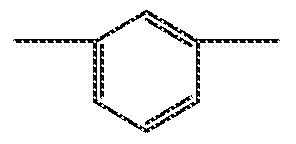

[0041] The method of preparing the membranes of the invention may further comprise application of a high permeability material to a surface of said polybenzoxazole membrane wherein said high permeability material is selected from the group consisting of a
polysiloxane, a fluoro-polymer, a thermally curable silicone rubber, or a UV radiation curable epoxy silica. The polybenzoxazole membrane may be fabricated into a flat sheet, tube or hollow fiber membrane or other form as known to one of skill in the art.
[0042] The invention al so invol ves preparation of a polybenzoxazole membrane prepared by any of the preceding embodiments.
[0043] In another embodiment of the invention is pro vided a process for separating at least one gas from a mixture of gases comprising providing a self-cross-linked aromatic polyimide membrane of formula (II I) comprising wherein said formula (III) is:


Y2 may be selected from the group consisting of

[0044] The mixture of gases may be any mixture of gases that may be separated by a membrane. The mixture of gases may be a mixture of carbon dioxide and methane, a mixture of hydrogen and methane,or a mixture of helium and methane as well as other gases found in natural gas. The mixture of gases may comprise a mixture of at least one volatile organic compound and at least one atmospheric gas. The mixture of gases may comprise nitrogen and hydrogen. The mixture of gases treated by the membranes of this invention may comprise a mixture of carbon dioxide, oxygen, nitrogen, water vapor, hydrogen sulfide, helium and methane.
[0045] In some embodiments of the invention, the membrane may comprise a species that adsorbs strongly to at least one gas. In some embodiments of the invention, the mix ture of gases comprises a mixture of paraffins and olefins.
[0046] Another embodiment of the invention involves a process for separation of liquid mixtures by pervaporation comprising contacting said liquid mixture with a polybenzoxazo!e membrane of formula (III) comprising wherein said formula (III) is:


[0047] The liquid mixture may comprise water and one or more organic compounds selected from the group consisting of alcohols, phenols, chlorinated hydrocarbons, pyridines, and ketones and the process involves separation of water from the one or more organic compounds. The liquid mixture may comprise sulfur-containing molecules in a hydrocarbon stream such as naphtha. The membranes used in the process can be used to remove such sulfur-containing molecules from diesel or gasoline products. In another embodiment of the invention, the liquid mixture may comprise a mixture of isomers of organic compounds. The liquid mixture may comprise a mixture selected from the group consisting of : ethylacetate- eihanol, dietbylether-ethanol, acetic acid-ethanol, benzene-ethanol, chloroform-ethanol, chlorofomi-methanol, acetone-isopropylether, allylalcohol-allylether, allylalcohol- cy ciohexane, butanol-butylacetate, butanol- 1 -butylether, ethanol-ethylbutylether,
propyiacetate-propanol, isopropylether-isopropanol, methanol-ethanol-isopropanol, and ethylacetate-ethanol-acetic acid.
[0048] In another embodiment of the invention, the l iquid mixture comprises a dilute ethanol solution and where said process increases an ethanoi concentration in said liquid mixture.
Claims
1. A. method of making a polybenzoxazole membrane comprising
(a) fabricating a self-cross-linkable aromatic polyimide polymer membrane from the self-cross-imkable aromatic polyimide polymer comprising both hydroxyl functional groups and carboxylic acid functional groups
wherein said self-cross-linkable aromatic olyimide polymer comprises a formula (I):


and mixtures thereof; n and m are independent integers from 2 to 500; the molar ratio of iX'in is in a range of 1 : 1 to 1 :20;
(h) cross-linking the self-cross-linkable aromatic polyimide polymer membrane to form a self-cross-linked aromatic polyimide polymer membrane by heating the membrane at 250°C to 300°C under an inert atmosphere; and
(c) thermal heating the self-cross-linked aromatic polyimide polymer membrane at a temperature from 350° to 500°C under an inert atmosphere, such as argon, nitrogen, or vacuum to convert the self-cross-linked aromatic polyimide polymer membrane into a polybenzoxazole membrane.
2. The method of claim 2 wherein said self-cross-linkable aromatic polyimide mer in formula (I), X·. and X2 are selected from the group consisting of

and mixtures thereof, Yj-COOH is
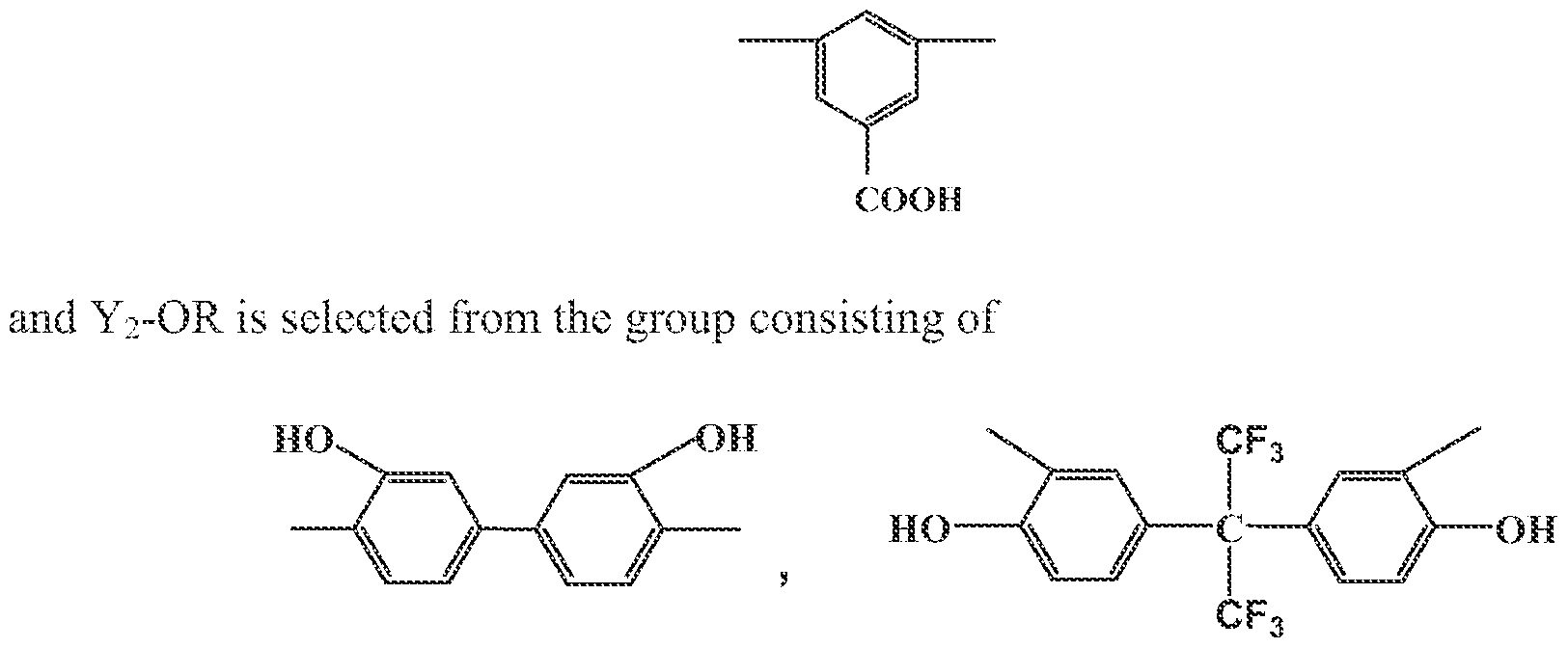
3. The method of claim 1 wherein a self-cross-linked aromatic polyimide polymer formed from the self-cross-linkable aromatic polyimide polymer comprises a plurality of repeating units of formula (il):


4. The method of claim 3 wherein in formula (II) Yj-CO- is

Y2-O- is selected from the group consisting of

and mixtures thereof, and Y2-OR is selected from the group consisting of

and mixtures thereof.
5, The method of claim 1 wherein the polybenzoxazole comprises repeating units a formula (ill), wherein said formula (III) is:


6. A process for separating at least one gas from a mixture of gases comprising providing a polyhenzoxazole membrane of formula (IH) comprising wherein said formula (III) is:


and mixtures thereof; o and q are independent integers from 2 to 500 contacting the mixture of gases to one side of the polybenzoxazole membrane of formula (III) to cause at least one gas to permeate said membrane; and removing from an opposite side of said polybenzoxazole membrane of formula (III) a permeate gas composition comprising a portion of said at least one gas that permeated said membrane.
7. The process of claim 6 wherein in said formula (III), Xj is selected from the group consisting of

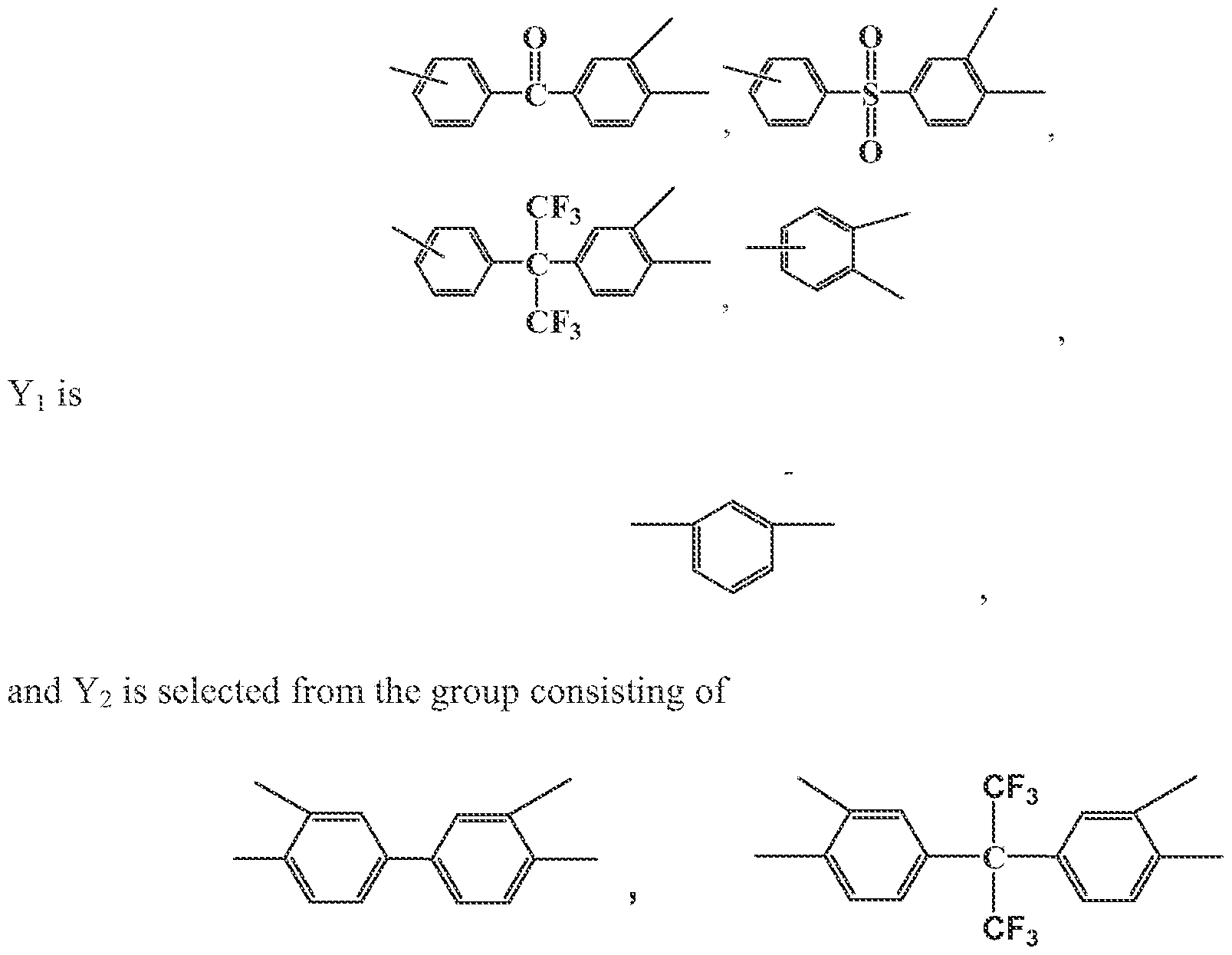
and mixtures thereof.
8. The process of claim 6 wherein said mixture of gases comprises a mixture of carbon dioxide and methane, a mixture of hydrogen and methane, a mixture of helium and methane, a mixture of at least one volatile organic compound and at least one atmospheric gas, a mixture of nitrogen and hydrogen, a mixture of carbon dioxide, oxygen, nitrogen, water vapor, hydrogen sulfide, helium and methane, or a mixture of paraffins and olefins.
9. The process of claim 6 wherein said self-cross-linked aromatic polyimide polymer membrane comprises a species that adsorbs strongly to at least one gas.
10. A process for separation of liquid mixtures by pervaporation comprising contacting said liquid mixture with a poiybenzoxazole membrane of claim 5,
Applications Claiming Priority (2)
| Application Number | Priority Date | Filing Date | Title |
|---|---|---|---|
| US14/039,570 US9211508B2 (en) | 2013-09-27 | 2013-09-27 | Polybenzoxazole membranes from self-cross-linkable aromatic polyimide membranes |
| US14/039,570 | 2013-09-27 |
Publications (1)
| Publication Number | Publication Date |
|---|---|
| WO2015047711A1 true WO2015047711A1 (en) | 2015-04-02 |
Family
ID=52740766
Family Applications (1)
| Application Number | Title | Priority Date | Filing Date |
|---|---|---|---|
| PCT/US2014/054638 Ceased WO2015047711A1 (en) | 2013-09-27 | 2014-09-09 | Polybenzoxazole membranes from self-cross-linkable aromatic polyimide membranes |
Country Status (2)
| Country | Link |
|---|---|
| US (1) | US9211508B2 (en) |
| WO (1) | WO2015047711A1 (en) |
Families Citing this family (13)
| Publication number | Priority date | Publication date | Assignee | Title |
|---|---|---|---|---|
| KR101466918B1 (en) * | 2013-07-01 | 2014-12-04 | 한양대학교 산학협력단 | Membranes for flue gas separation comprising crosslinked thermally rearranged poly(benzoxazole-co-imide) and preparation method thereof |
| US9440197B2 (en) * | 2013-07-01 | 2016-09-13 | ICUF-HYU (Industry-University Cooperation Foundation Hanyang University) | Crosslinked thermally rearranged poly(benzoxazole-co-imide), gas separation membranes comprising the same and preparation method thereof |
| US10029217B2 (en) | 2015-05-22 | 2018-07-24 | Chevron U.S.A. Inc. | Methods of making crosslinked membranes utilizing an inert gas atmosphere |
| US10471381B2 (en) | 2016-06-09 | 2019-11-12 | Uop Llc | High selectivity facilitated transport membranes and their use for olefin/paraffin separations |
| US10258929B2 (en) | 2016-06-30 | 2019-04-16 | Uop Llc | Stable facilitated transport membranes for olefin/paraffin separations |
| US10322382B2 (en) | 2016-06-30 | 2019-06-18 | Uop Llc | High performance facilitated transport membranes for olefin/paraffin separations |
| US10328386B2 (en) | 2017-05-18 | 2019-06-25 | Uop Llc | Co-cast thin film composite flat sheet membranes for gas separations and olefin/paraffin separations |
| US10569233B2 (en) | 2017-06-06 | 2020-02-25 | Uop Llc | High permeance and high selectivity facilitated transport membranes for olefin/paraffin separations |
| US10751670B2 (en) | 2017-08-24 | 2020-08-25 | Uop Llc | High selectivity facilitated transport membrane comprising polyethersulfone/polyethylene oxide-polysilsesquioxane blend membrane for olefin/paraffin separations |
| US10427997B2 (en) | 2017-12-27 | 2019-10-01 | Uop Llc | Modular membrane system and method for olefin separation |
| CN111926438A (en) * | 2020-08-18 | 2020-11-13 | 中国科学院宁波材料技术与工程研究所 | Ultraviolet-resistant high-strength high-modulus PBO fiber and preparation method thereof |
| CN113308004B (en) * | 2021-06-04 | 2022-03-04 | 西南科技大学 | Preparation and application of covalent cross-linking type polyfluorinated sulfonated polyimide proton exchange membrane |
| CN115181115B (en) * | 2021-11-15 | 2023-10-10 | 同济大学 | Spirobisbenzoxazole cyclodiamine, colorless and transparent polyimide derived therefrom and preparation method thereof |
Citations (5)
| Publication number | Priority date | Publication date | Assignee | Title |
|---|---|---|---|---|
| US4489185A (en) * | 1982-07-26 | 1984-12-18 | Schoenberg Jules E | Carbinol-containing polyimides capable of self-crosslinking at low temperature |
| US20030131731A1 (en) * | 2001-12-20 | 2003-07-17 | Koros William J. | Crosslinked and crosslinkable hollow fiber mixed matrix membrane and method of making same |
| KR100782959B1 (en) * | 2005-01-25 | 2007-12-11 | 한양대학교 산학협력단 | Porous organic polymer, preparation method thereof and gas separation membrane using same |
| WO2010110975A2 (en) * | 2009-03-27 | 2010-09-30 | Uop Llc | High performance cross-linked polybenzoxazole and polybenzothiazole polymer membranes |
| US20120157743A1 (en) * | 2010-12-17 | 2012-06-21 | Uop Llc | Membrane system for natural gas upgrading |
Family Cites Families (6)
| Publication number | Priority date | Publication date | Assignee | Title |
|---|---|---|---|---|
| CA2640545A1 (en) | 2008-05-19 | 2009-11-19 | Industry-University Cooperation Foundation, Hanyang University | Polyimides dope composition, preparation method of hollow fiber using the same and hollow fiber prepared therefrom |
| EP2281925B1 (en) | 2008-05-19 | 2018-08-22 | IUCF-HYU (Industry-University Cooperation Foundation Hanyang University) | Hollow fiber, dope solution composition for forming a hollow fiber, and method for manufacturing a hollow fiber using the same |
| CA2640517A1 (en) | 2008-05-19 | 2009-11-19 | Industry-University Cooperation Foundation, Hanyang University | Polyamic acids dope composition, preparation method of hollow fiber using the same and hollow fiber prepared therefrom |
| US8613362B2 (en) * | 2009-03-27 | 2013-12-24 | Uop Llc | Polymer membranes derived from aromatic polyimide membranes |
| US8561812B2 (en) * | 2009-03-27 | 2013-10-22 | Uop Llc | Blend polymer membranes comprising thermally rearranged polymers derived from aromatic polyimides containing ortho-positioned functional groups |
| US20100133188A1 (en) | 2009-06-25 | 2010-06-03 | Chunqing Liu | Polybenzoxazole Membranes Prepared From Aromatic Polyamide Membranes |
-
2013
- 2013-09-27 US US14/039,570 patent/US9211508B2/en active Active
-
2014
- 2014-09-09 WO PCT/US2014/054638 patent/WO2015047711A1/en not_active Ceased
Patent Citations (5)
| Publication number | Priority date | Publication date | Assignee | Title |
|---|---|---|---|---|
| US4489185A (en) * | 1982-07-26 | 1984-12-18 | Schoenberg Jules E | Carbinol-containing polyimides capable of self-crosslinking at low temperature |
| US20030131731A1 (en) * | 2001-12-20 | 2003-07-17 | Koros William J. | Crosslinked and crosslinkable hollow fiber mixed matrix membrane and method of making same |
| KR100782959B1 (en) * | 2005-01-25 | 2007-12-11 | 한양대학교 산학협력단 | Porous organic polymer, preparation method thereof and gas separation membrane using same |
| WO2010110975A2 (en) * | 2009-03-27 | 2010-09-30 | Uop Llc | High performance cross-linked polybenzoxazole and polybenzothiazole polymer membranes |
| US20120157743A1 (en) * | 2010-12-17 | 2012-06-21 | Uop Llc | Membrane system for natural gas upgrading |
Also Published As
| Publication number | Publication date |
|---|---|
| US9211508B2 (en) | 2015-12-15 |
| US20150094429A1 (en) | 2015-04-02 |
Similar Documents
| Publication | Publication Date | Title |
|---|---|---|
| AU2010298634B2 (en) | Method to improve the selectivity of polybenzoxazole membranes | |
| AU2010229241B2 (en) | High performance cross-linked polybenzoxazole and polybenzothiazole polymer membranes | |
| US8127937B2 (en) | High performance cross-linked polybenzoxazole and polybenzothiazole polymer membranes | |
| US9308503B2 (en) | Polybenzoxazole membranes from self-cross-linkable aromatic polyimide membranes | |
| US8127936B2 (en) | High performance cross-linked polybenzoxazole and polybenzothiazole polymer membranes | |
| US9211508B2 (en) | Polybenzoxazole membranes from self-cross-linkable aromatic polyimide membranes | |
| AU2010229168B2 (en) | Polymer membranes prepared from aromatic polyimide membranes by thermal treating and UV crosslinking | |
| AU2010229169B2 (en) | Polymer membranes derived from aromatic polyimide membranes | |
| US9567436B2 (en) | Super high selectivity aromatic block copolyimide membranes for separations | |
| WO2015047702A1 (en) | Self cross-linkable and self cross-linked aromatic polyimide membranes for separations | |
| US9126156B2 (en) | Self cross-linkable and self cross-linked aromatic polyimide membranes for separations | |
| US8710173B2 (en) | Blend polymer gas separation membrane | |
| WO2012173776A2 (en) | Polyimide gas separation membranes | |
| WO2014209701A1 (en) | High hydrocarbon resistant chemically cross-linked aromatic polyimide membrane for separations | |
| WO2010151451A2 (en) | Polybenzoxazole membranes prepared from aromatic polyamide membranes | |
| US10646832B2 (en) | High selectivity copolyimide membranes for separations | |
| US9000122B1 (en) | Aromatic poly (ether sulfone imide) membranes for gas separations |
Legal Events
| Date | Code | Title | Description |
|---|---|---|---|
| 121 | Ep: the epo has been informed by wipo that ep was designated in this application |
Ref document number: 14848457 Country of ref document: EP Kind code of ref document: A1 |
|
| NENP | Non-entry into the national phase |
Ref country code: DE |
|
| 122 | Ep: pct application non-entry in european phase |
Ref document number: 14848457 Country of ref document: EP Kind code of ref document: A1 |