WO2015042415A1 - Polymer processing additive, compositions, and methods - Google Patents
Polymer processing additive, compositions, and methods Download PDFInfo
- Publication number
- WO2015042415A1 WO2015042415A1 PCT/US2014/056581 US2014056581W WO2015042415A1 WO 2015042415 A1 WO2015042415 A1 WO 2015042415A1 US 2014056581 W US2014056581 W US 2014056581W WO 2015042415 A1 WO2015042415 A1 WO 2015042415A1
- Authority
- WO
- WIPO (PCT)
- Prior art keywords
- polymer
- composition
- processing additive
- polymer processing
- poly
- Prior art date
- Legal status (The legal status is an assumption and is not a legal conclusion. Google has not performed a legal analysis and makes no representation as to the accuracy of the status listed.)
- Ceased
Links
Classifications
-
- C—CHEMISTRY; METALLURGY
- C08—ORGANIC MACROMOLECULAR COMPOUNDS; THEIR PREPARATION OR CHEMICAL WORKING-UP; COMPOSITIONS BASED THEREON
- C08L—COMPOSITIONS OF MACROMOLECULAR COMPOUNDS
- C08L23/00—Compositions of homopolymers or copolymers of unsaturated aliphatic hydrocarbons having only one carbon-to-carbon double bond; Compositions of derivatives of such polymers
- C08L23/02—Compositions of homopolymers or copolymers of unsaturated aliphatic hydrocarbons having only one carbon-to-carbon double bond; Compositions of derivatives of such polymers not modified by chemical after-treatment
- C08L23/04—Homopolymers or copolymers of ethene
- C08L23/08—Copolymers of ethene
- C08L23/0807—Copolymers of ethene with unsaturated hydrocarbons only containing four or more carbon atoms
- C08L23/0815—Copolymers of ethene with unsaturated hydrocarbons only containing four or more carbon atoms with aliphatic 1-olefins containing one carbon-to-carbon double bond
-
- C—CHEMISTRY; METALLURGY
- C08—ORGANIC MACROMOLECULAR COMPOUNDS; THEIR PREPARATION OR CHEMICAL WORKING-UP; COMPOSITIONS BASED THEREON
- C08L—COMPOSITIONS OF MACROMOLECULAR COMPOUNDS
- C08L23/00—Compositions of homopolymers or copolymers of unsaturated aliphatic hydrocarbons having only one carbon-to-carbon double bond; Compositions of derivatives of such polymers
- C08L23/02—Compositions of homopolymers or copolymers of unsaturated aliphatic hydrocarbons having only one carbon-to-carbon double bond; Compositions of derivatives of such polymers not modified by chemical after-treatment
- C08L23/04—Homopolymers or copolymers of ethene
- C08L23/06—Polyethylene
-
- B—PERFORMING OPERATIONS; TRANSPORTING
- B29—WORKING OF PLASTICS; WORKING OF SUBSTANCES IN A PLASTIC STATE IN GENERAL
- B29B—PREPARATION OR PRETREATMENT OF THE MATERIAL TO BE SHAPED; MAKING GRANULES OR PREFORMS; RECOVERY OF PLASTICS OR OTHER CONSTITUENTS OF WASTE MATERIAL CONTAINING PLASTICS
- B29B7/00—Mixing; Kneading
- B29B7/74—Mixing; Kneading using other mixers or combinations of mixers, e.g. of dissimilar mixers ; Plant
- B29B7/7461—Combinations of dissimilar mixers
-
- B—PERFORMING OPERATIONS; TRANSPORTING
- B29—WORKING OF PLASTICS; WORKING OF SUBSTANCES IN A PLASTIC STATE IN GENERAL
- B29B—PREPARATION OR PRETREATMENT OF THE MATERIAL TO BE SHAPED; MAKING GRANULES OR PREFORMS; RECOVERY OF PLASTICS OR OTHER CONSTITUENTS OF WASTE MATERIAL CONTAINING PLASTICS
- B29B7/00—Mixing; Kneading
- B29B7/74—Mixing; Kneading using other mixers or combinations of mixers, e.g. of dissimilar mixers ; Plant
- B29B7/7476—Systems, i.e. flow charts or diagrams; Plants
- B29B7/7485—Systems, i.e. flow charts or diagrams; Plants with consecutive mixers, e.g. with premixing some of the components
-
- B—PERFORMING OPERATIONS; TRANSPORTING
- B29—WORKING OF PLASTICS; WORKING OF SUBSTANCES IN A PLASTIC STATE IN GENERAL
- B29B—PREPARATION OR PRETREATMENT OF THE MATERIAL TO BE SHAPED; MAKING GRANULES OR PREFORMS; RECOVERY OF PLASTICS OR OTHER CONSTITUENTS OF WASTE MATERIAL CONTAINING PLASTICS
- B29B7/00—Mixing; Kneading
- B29B7/80—Component parts, details or accessories; Auxiliary operations
- B29B7/88—Adding charges, i.e. additives
-
- B—PERFORMING OPERATIONS; TRANSPORTING
- B29—WORKING OF PLASTICS; WORKING OF SUBSTANCES IN A PLASTIC STATE IN GENERAL
- B29C—SHAPING OR JOINING OF PLASTICS; SHAPING OF MATERIAL IN A PLASTIC STATE, NOT OTHERWISE PROVIDED FOR; AFTER-TREATMENT OF THE SHAPED PRODUCTS, e.g. REPAIRING
- B29C48/00—Extrusion moulding, i.e. expressing the moulding material through a die or nozzle which imparts the desired form; Apparatus therefor
- B29C48/022—Extrusion moulding, i.e. expressing the moulding material through a die or nozzle which imparts the desired form; Apparatus therefor characterised by the choice of material
-
- B—PERFORMING OPERATIONS; TRANSPORTING
- B29—WORKING OF PLASTICS; WORKING OF SUBSTANCES IN A PLASTIC STATE IN GENERAL
- B29C—SHAPING OR JOINING OF PLASTICS; SHAPING OF MATERIAL IN A PLASTIC STATE, NOT OTHERWISE PROVIDED FOR; AFTER-TREATMENT OF THE SHAPED PRODUCTS, e.g. REPAIRING
- B29C48/00—Extrusion moulding, i.e. expressing the moulding material through a die or nozzle which imparts the desired form; Apparatus therefor
- B29C48/25—Component parts, details or accessories; Auxiliary operations
- B29C48/78—Thermal treatment of the extrusion moulding material or of preformed parts or layers, e.g. by heating or cooling
- B29C48/80—Thermal treatment of the extrusion moulding material or of preformed parts or layers, e.g. by heating or cooling at the plasticising zone, e.g. by heating cylinders
- B29C48/802—Heating
-
- B—PERFORMING OPERATIONS; TRANSPORTING
- B29—WORKING OF PLASTICS; WORKING OF SUBSTANCES IN A PLASTIC STATE IN GENERAL
- B29C—SHAPING OR JOINING OF PLASTICS; SHAPING OF MATERIAL IN A PLASTIC STATE, NOT OTHERWISE PROVIDED FOR; AFTER-TREATMENT OF THE SHAPED PRODUCTS, e.g. REPAIRING
- B29C48/00—Extrusion moulding, i.e. expressing the moulding material through a die or nozzle which imparts the desired form; Apparatus therefor
- B29C48/25—Component parts, details or accessories; Auxiliary operations
- B29C48/78—Thermal treatment of the extrusion moulding material or of preformed parts or layers, e.g. by heating or cooling
- B29C48/86—Thermal treatment of the extrusion moulding material or of preformed parts or layers, e.g. by heating or cooling at the nozzle zone
- B29C48/865—Heating
-
- C—CHEMISTRY; METALLURGY
- C08—ORGANIC MACROMOLECULAR COMPOUNDS; THEIR PREPARATION OR CHEMICAL WORKING-UP; COMPOSITIONS BASED THEREON
- C08K—Use of inorganic or non-macromolecular organic substances as compounding ingredients
- C08K3/00—Use of inorganic substances as compounding ingredients
- C08K3/18—Oxygen-containing compounds, e.g. metal carbonyls
- C08K3/20—Oxides; Hydroxides
- C08K3/22—Oxides; Hydroxides of metals
-
- C—CHEMISTRY; METALLURGY
- C08—ORGANIC MACROMOLECULAR COMPOUNDS; THEIR PREPARATION OR CHEMICAL WORKING-UP; COMPOSITIONS BASED THEREON
- C08K—Use of inorganic or non-macromolecular organic substances as compounding ingredients
- C08K5/00—Use of organic ingredients
- C08K5/04—Oxygen-containing compounds
- C08K5/09—Carboxylic acids; Metal salts thereof; Anhydrides thereof
-
- C—CHEMISTRY; METALLURGY
- C08—ORGANIC MACROMOLECULAR COMPOUNDS; THEIR PREPARATION OR CHEMICAL WORKING-UP; COMPOSITIONS BASED THEREON
- C08L—COMPOSITIONS OF MACROMOLECULAR COMPOUNDS
- C08L27/00—Compositions of homopolymers or copolymers of compounds having one or more unsaturated aliphatic radicals, each having only one carbon-to-carbon double bond, and at least one being terminated by a halogen; Compositions of derivatives of such polymers
- C08L27/02—Compositions of homopolymers or copolymers of compounds having one or more unsaturated aliphatic radicals, each having only one carbon-to-carbon double bond, and at least one being terminated by a halogen; Compositions of derivatives of such polymers not modified by chemical after-treatment
- C08L27/12—Compositions of homopolymers or copolymers of compounds having one or more unsaturated aliphatic radicals, each having only one carbon-to-carbon double bond, and at least one being terminated by a halogen; Compositions of derivatives of such polymers not modified by chemical after-treatment containing fluorine atoms
-
- C—CHEMISTRY; METALLURGY
- C08—ORGANIC MACROMOLECULAR COMPOUNDS; THEIR PREPARATION OR CHEMICAL WORKING-UP; COMPOSITIONS BASED THEREON
- C08L—COMPOSITIONS OF MACROMOLECULAR COMPOUNDS
- C08L71/00—Compositions of polyethers obtained by reactions forming an ether link in the main chain; Compositions of derivatives of such polymers
- C08L71/02—Polyalkylene oxides
-
- B—PERFORMING OPERATIONS; TRANSPORTING
- B29—WORKING OF PLASTICS; WORKING OF SUBSTANCES IN A PLASTIC STATE IN GENERAL
- B29B—PREPARATION OR PRETREATMENT OF THE MATERIAL TO BE SHAPED; MAKING GRANULES OR PREFORMS; RECOVERY OF PLASTICS OR OTHER CONSTITUENTS OF WASTE MATERIAL CONTAINING PLASTICS
- B29B7/00—Mixing; Kneading
- B29B7/02—Mixing; Kneading non-continuous, with mechanical mixing or kneading devices, i.e. batch type
- B29B7/06—Mixing; Kneading non-continuous, with mechanical mixing or kneading devices, i.e. batch type with movable mixing or kneading devices
- B29B7/10—Mixing; Kneading non-continuous, with mechanical mixing or kneading devices, i.e. batch type with movable mixing or kneading devices rotary
- B29B7/18—Mixing; Kneading non-continuous, with mechanical mixing or kneading devices, i.e. batch type with movable mixing or kneading devices rotary with more than one shaft
- B29B7/183—Mixing; Kneading non-continuous, with mechanical mixing or kneading devices, i.e. batch type with movable mixing or kneading devices rotary with more than one shaft having a casing closely surrounding the rotors, e.g. of Banbury type
-
- B—PERFORMING OPERATIONS; TRANSPORTING
- B29—WORKING OF PLASTICS; WORKING OF SUBSTANCES IN A PLASTIC STATE IN GENERAL
- B29B—PREPARATION OR PRETREATMENT OF THE MATERIAL TO BE SHAPED; MAKING GRANULES OR PREFORMS; RECOVERY OF PLASTICS OR OTHER CONSTITUENTS OF WASTE MATERIAL CONTAINING PLASTICS
- B29B7/00—Mixing; Kneading
- B29B7/02—Mixing; Kneading non-continuous, with mechanical mixing or kneading devices, i.e. batch type
- B29B7/22—Component parts, details or accessories; Auxiliary operations
- B29B7/24—Component parts, details or accessories; Auxiliary operations for feeding
- B29B7/242—Component parts, details or accessories; Auxiliary operations for feeding in measured doses
- B29B7/244—Component parts, details or accessories; Auxiliary operations for feeding in measured doses of several materials
-
- B—PERFORMING OPERATIONS; TRANSPORTING
- B29—WORKING OF PLASTICS; WORKING OF SUBSTANCES IN A PLASTIC STATE IN GENERAL
- B29B—PREPARATION OR PRETREATMENT OF THE MATERIAL TO BE SHAPED; MAKING GRANULES OR PREFORMS; RECOVERY OF PLASTICS OR OTHER CONSTITUENTS OF WASTE MATERIAL CONTAINING PLASTICS
- B29B7/00—Mixing; Kneading
- B29B7/30—Mixing; Kneading continuous, with mechanical mixing or kneading devices
- B29B7/34—Mixing; Kneading continuous, with mechanical mixing or kneading devices with movable mixing or kneading devices
- B29B7/38—Mixing; Kneading continuous, with mechanical mixing or kneading devices with movable mixing or kneading devices rotary
-
- B—PERFORMING OPERATIONS; TRANSPORTING
- B29—WORKING OF PLASTICS; WORKING OF SUBSTANCES IN A PLASTIC STATE IN GENERAL
- B29K—INDEXING SCHEME ASSOCIATED WITH SUBCLASSES B29B, B29C OR B29D, RELATING TO MOULDING MATERIALS OR TO MATERIALS FOR MOULDS, REINFORCEMENTS, FILLERS OR PREFORMED PARTS, e.g. INSERTS
- B29K2023/00—Use of polyalkenes or derivatives thereof as moulding material
- B29K2023/04—Polymers of ethylene
- B29K2023/06—PE, i.e. polyethylene
-
- B—PERFORMING OPERATIONS; TRANSPORTING
- B29—WORKING OF PLASTICS; WORKING OF SUBSTANCES IN A PLASTIC STATE IN GENERAL
- B29K—INDEXING SCHEME ASSOCIATED WITH SUBCLASSES B29B, B29C OR B29D, RELATING TO MOULDING MATERIALS OR TO MATERIALS FOR MOULDS, REINFORCEMENTS, FILLERS OR PREFORMED PARTS, e.g. INSERTS
- B29K2105/00—Condition, form or state of moulded material or of the material to be shaped
- B29K2105/0005—Condition, form or state of moulded material or of the material to be shaped containing compounding ingredients
- B29K2105/0044—Stabilisers, e.g. against oxydation, light or heat
-
- B—PERFORMING OPERATIONS; TRANSPORTING
- B29—WORKING OF PLASTICS; WORKING OF SUBSTANCES IN A PLASTIC STATE IN GENERAL
- B29K—INDEXING SCHEME ASSOCIATED WITH SUBCLASSES B29B, B29C OR B29D, RELATING TO MOULDING MATERIALS OR TO MATERIALS FOR MOULDS, REINFORCEMENTS, FILLERS OR PREFORMED PARTS, e.g. INSERTS
- B29K2105/00—Condition, form or state of moulded material or of the material to be shaped
- B29K2105/0094—Condition, form or state of moulded material or of the material to be shaped having particular viscosity
-
- B—PERFORMING OPERATIONS; TRANSPORTING
- B29—WORKING OF PLASTICS; WORKING OF SUBSTANCES IN A PLASTIC STATE IN GENERAL
- B29K—INDEXING SCHEME ASSOCIATED WITH SUBCLASSES B29B, B29C OR B29D, RELATING TO MOULDING MATERIALS OR TO MATERIALS FOR MOULDS, REINFORCEMENTS, FILLERS OR PREFORMED PARTS, e.g. INSERTS
- B29K2105/00—Condition, form or state of moulded material or of the material to be shaped
- B29K2105/06—Condition, form or state of moulded material or of the material to be shaped containing reinforcements, fillers or inserts
- B29K2105/16—Fillers
-
- B—PERFORMING OPERATIONS; TRANSPORTING
- B29—WORKING OF PLASTICS; WORKING OF SUBSTANCES IN A PLASTIC STATE IN GENERAL
- B29K—INDEXING SCHEME ASSOCIATED WITH SUBCLASSES B29B, B29C OR B29D, RELATING TO MOULDING MATERIALS OR TO MATERIALS FOR MOULDS, REINFORCEMENTS, FILLERS OR PREFORMED PARTS, e.g. INSERTS
- B29K2995/00—Properties of moulding materials, reinforcements, fillers, preformed parts or moulds
- B29K2995/0012—Properties of moulding materials, reinforcements, fillers, preformed parts or moulds having particular thermal properties
- B29K2995/0017—Heat stable
-
- C—CHEMISTRY; METALLURGY
- C08—ORGANIC MACROMOLECULAR COMPOUNDS; THEIR PREPARATION OR CHEMICAL WORKING-UP; COMPOSITIONS BASED THEREON
- C08L—COMPOSITIONS OF MACROMOLECULAR COMPOUNDS
- C08L2310/00—Masterbatches
Definitions
- Extrusion of polymeric materials in the formation and shaping of articles is a major segment of the plastic or polymeric articles industry.
- the quality of the extruded article and the overall success of the extrusion process are typically influenced by the interaction of the fluid material with the extrusion die.
- any melt-processable thermoplastic polymer composition there exists a critical shear rate above which the surface of the extrudate becomes rough or distorted and below which the extrudate will be smooth. See, for example, R. F. Westover, Melt Extrusion, Encyclopedia of Polymer Science and Technology, vol. 8, pp. 573-81 (John Wiley & Sons 1968).
- the desire for a smooth extrudate surface competes, and must be optimized with respect to, the economic advantages of extruding a polymer composition at the fastest possible speed (for example at high shear rates).
- thermoplastics At low shear rates, defects in extruded thermoplastics may take the form of "sharkskin", which is a loss of surface gloss that in more serious manifestations appears as ridges running more or less transverse to the extrusion direction. At higher rates, the extrudate can undergo “continuous melt fracture” becoming grossly distorted. At rates lower than those at which continuous melt fracture is first observed, certain thermoplastics can also suffer from “cyclic melt fracture", in which the extrudate surface varies from smooth to rough.
- thermoplastic polymers There are other problems often encountered during the extrusion of thermoplastic polymers. They include a build-up of the polymer at the orifice of the die (known as die build up or die drool), increase in back pressure during extrusion runs, and excessive degradation or low melt strength of the polymer due to high extrusion temperatures. These problems slow the extrusion process either because the process must be stopped to clean the equipment or because the process must be run at a lower speed.
- fluoropolymers can at least partially alleviate melt defects in extrudable thermoplastic polymers and can be used as polymer processing additive, such as described, for example, in U.S. Pat. Nos. 5,015,693 and 4,855,013 (Duchesne et al.), 5,701,217 (Blong et al.), and 6,277,919 (Dillon et al.) Certain silicones have also been reported to be useful as polymer processing additives for reducing melt defects (see U.S. Pat. No. 4,535,113 (Foster et al.)). Some benefits of polymer processing additives include the elimination of melt fracture and surface defects, a reduction in extrusion pressure, and the elimination of die build-up.
- a poly(oxyalkylene) polymer e.g., a polyethylene glycol
- a metal salt of a carboxylic acid, a sulfonic acid, or an alkylsulfate typically have
- thermal stability of the poly(oxyalkylene) polymer increases its utility as a polymer processing additive synergist by allowing polymer processing, including master batch processing and extrusion, at higher temperatures.
- the present disclosure provides a composition including a homogeneously catalyzed polyolefin, a silicone -containing polymer or fluoropolymer polymer processing additive, and a polymer processing additive synergist including a poly(oxyalkylene) polymer and a metal salt of a carboxylic acid, sulfonic acid, or alkylsulfate.
- the homogeneously catalyzed polyolefin is a metallocene -catalyzed polyolefin.
- the present disclosure provides a method of reducing melt defects during the extrusion of a homogeneously catalyzed polyolefin.
- the method includes extruding the composition including the homogeneously catalyzed polyolefin, the silicone-containing polymer or fluoropolymer polymer processing additive, and the polymer processing additive synergist including the
- the homogeneously catalyzed polyolefin is a metallocene-catalyzed polyolefin.
- the present disclosure provides a method of reducing melt defects during the extrusion of a thermoplastic polymer.
- the method includes providing a polymer processing additive composition including a polymer processing additive selected from the group consisting of a fluoropolymer and a silicone-containing polymer and a polymer processing additive synergist comprising a poly(oxyalkylene) polymer and a metal salt of a carboxylic acid, sulfonic acid, or alkylsulfate; providing an extrudable polymer; admixing the polymer processing additive composition and the extrudable polymer to provide an extrudable composition; and extruding the composition.
- a polymer processing additive composition including a polymer processing additive selected from the group consisting of a fluoropolymer and a silicone-containing polymer and a polymer processing additive synergist comprising a poly(oxyalkylene) polymer and a metal salt of a carboxylic acid, sulfonic acid, or alkylsul
- the present disclosure provides a polymer processing additive composition that includes a fluoropolymer, a poly(oxyalkylene) polymer, and a metal salt of a carboxylic acid, sulfonic acid, or alkylsulfate. Accordingly, the present disclosure provides the use of a composition including a fluoropolymer, a poly(oxyalkylene) polymer, and a metal salt of a carboxylic acid, sulfonic acid, or alkylsulfate as a polymer processing additive.
- the poly(oxyalkylene) polymer is present in an amount of at least 50% by weight, based on the total weight of the polymer processing additive composition, and the metal salt is other than calcium stearate.
- the poly(oxyalkylene) polymer is present in an amount of at least 85% by weight, based on the total weight of the poly(oxyalkylene) polymer and the metal salt, and the metal salt is other than calcium stearate.
- the present disclosure provides a polymer processing additive synergist that includes a poly(oxyalkylene) polymer and a metal salt of a carboxylic acid, sulfonic acid, or alkylsulfate.
- the polymer processing additive synergist does not include a fluoropolymer or a polyolefin.
- the present disclosure provides a polymer processing additive composition including a silicone-containing polymer processing additive and the polymer processing additive synergist including in poly(oxyalkylene) polymer and a metal salt of a carboxylic acid, sulfonic acid, or alkylsulfate.
- the present disclosure also provides the use of a composition including a silicone-containing polymer processing additive, a poly(oxyalkylene) polymer, and a metal salt of a carboxylic acid, sulfonic acid, or alkylsulfate as a polymer processing additive.
- the present disclosure provides the use of a poly(oxyalkylene) polymer and a metal salt of a carboxylic acid, sulfonic acid, or alkylsulfate as a polymer processing additive synergist.
- the synergist is useful, for example, for allowing extrusion of polymers and master batch processing at higher temperatures.
- combinations of a poly(oxyalkylene) polymer e.g., a polyethylene glycol
- a metal salt of a carboxylic acid, a sulfonic acid, or an alkylsulfate typically have higher thermal stability than a combination of poly(oxyalkylene) polymer and magnesium oxide.
- combinations of a poly(oxyalkylene) polymer e.g., a polyethylene glycol
- a metal salt of a carboxylic acid, a sulfonic acid, or an alkylsulfate typically have higher thermal stability than a combination of poly(oxyalkylene) polymer and certain conventional anti-oxidants.
- a polymer processing additive synergist disclosed herein including a poly(oxyalkylene) polymer and a metal salt of a carboxylic acid, sulfonic acid, or alkylsulfate is useful in a composition including a polymer processing additive and a homogeneously catalyzed polyolefin.
- polyolefins e.g., polyolefins catalyzed by metallocenes or other single site catalysts
- acidic residues are generally not present; therefore acid-neutralizing additives such as zinc stearate and calcium stearate are generally not required to be added to homogeneously catalyzed polyolefins.
- perfluoroalkyl group includes linear, branched, and/or cyclic alkyl groups in which all C-H bonds are replaced by C-F bonds.
- interrupted by at least one functional group refers to having part of the alkyl, alkylene, or arylalkylene on both sides of the functional group.
- An example of an alkylene that is interrupted with -O- is -CH 2 -CH 2 -O-CH 2 -CH 2 -.
- aryl as used herein includes carbocyclic aromatic rings or ring systems, for example, having 1, 2, or 3 rings, optionally containing at least one heteroatom (e.g., O, S, or N) in the ring, and optionally substituted by up to five substituents including one or more alkyl groups having up to 4 carbon atoms (e.g., methyl or ethyl), alkoxy having up to 4 carbon atoms, halo (i.e., fluoro, chloro, bromo or iodo), hydroxy, or nitro groups.
- heteroatom e.g., O, S, or N
- substituents including one or more alkyl groups having up to 4 carbon atoms (e.g., methyl or ethyl), alkoxy having up to 4 carbon atoms, halo (i.e., fluoro, chloro, bromo or iodo), hydroxy, or nitro groups.
- aryl groups include phenyl, naphthyl, biphenyl, fluorenyl as well as furyl, thienyl, oxazolyl, and thiazolyl.
- Arylalkylene refers to an "alkylene” moiety to which an aryl group is attached.
- Alkylarylene refers to an "arylene” moiety to which an alkyl group is attached.
- 'synergist' is meant a compound that allows the use of a lower amount of the silicone- containing polymer or fluoropolymer polymer processing additive while achieving essentially the same improvement in extrusion and processing properties of the extrudable polymer as if a higher amount of the polymer processing additive was used.
- polymer processing additive synergist per se, as used herein, does not include a fluoropolymer or a polyolefin.
- a polymer processing additive synergist per se does not include the polymer processing additive or the host polymer.
- a polymer processing additive per se typically would not include a polyolefin or other thermoplastic or host polymer.
- the poly(oxyalkylene) polymer whose thermal stability can be enhanced with a metal salt of a carboxylic acid, sulfonic acid, or alkylsulfate can be represented by formula A[(OR 1 ) x OR 2 ] y , wherein A is typically alkylene interrupted by one or more ether linkag es, y is 2 or 3, (OR 1 ) * is a poly(oxyalkylene) chain having a plurality (x) of oxyalkylene groups, OR 1 , wherein each R 1 is independently C 2 to C5 alkylene, in some embodiments, C 2 to C 3 alkylene, x is about 3 to 3000, R 2 is hydrogen, alkyl, aryl, arylalkenyl, alkylarylenyl, -C(0)-alkyl, -C(0)-aryl, -C(0)-arylalkenyl, or -C(0)-alkylarylenyl, wherein - C(O)- is
- the variable ' 'x" is selected such that molecular weight of the poly(oxyalkylene) polymer is in a range from about 200 to about 20,000 grams per mole (g/mol) or higher, in some embodiments about 400 to about 15,000 g/mol. In some embodiments, x is in a range from 5 to 1000 or 10 to 500.
- the poly(oxy alkylene) polymer chain can be a homopolymer chain such as poly (oxyethylene) in which each R 1 is -CH 2 CH 2 -, or poly(oxypropylene), in which each R 1 is -C 3 H 6 -.
- the poly(oxyalkylene) polymer chain can be a chain of randomly distributed oxyalkylene groups (e.g., a copolymer -OC 2 H 4 - and -OC 3 H 6 - units) or having alternating blocks of repeating oxyalkylene groups (e.g., a polymer comprising (-OC 2 H 4 -) a and (-OC 3 H 6 -) b blocks, wherein a+b is in a range from 5 to 5000 or higher, in some embodiments, 10 to 500.
- a+b is in a range from 5 to 5000 or higher, in some embodiments, 10 to 500.
- A is ethylene, -CH 2 -CH(-)-CH 2 - (derived from glycerol), i 11 ( H ⁇ ' ⁇ 11 ⁇ ) ; (derived from 1,1,1-trimethylol propane), poly(oxypropylene), -CH 2 CH 2 -0-CH 2 CH 2 -, or -CH 2 CH 2 -0-CH 2 CH 2 -0-CH 2 CH 2 -.
- R 2 is hydrogen, methyl, butyl, phenyl, benzyl, acetyl, benzoyl, or stearyl.
- polyesters prepared, for example, from dicarboxylic acids and poly(oxyalkylene) polymers represented by formula A[(OR 1 ) x OR 2 ] y , wherein A, R 1 , and x are as defined above, R 2 is hydrogen, and y is 2.
- the major proportion of the poly(oxy alkylene) polymer by weight will be the repeating oxyalkylene groups, (OR 1 ).
- the poly(oxyalkylene) polymers whose thermal stability can be enhanced with a metal salt of a carboxylic acid, sulfonic acid, or alkylsulfate are polyethylene glycols and their derivatives.
- Polyethylene glycol (PEG) can be represented by formula H(OC 2 H 4 ) x OH, where x' is about 15 to 3000. Many of these polyethylene glycols, their ethers, and their esters are commercially available from a variety of sources.
- Poly(oxyalkylene) polymers may be selected for their performance as interfacial agents in polymer processing additive blends.
- the (oxyalkylene) polymer may be selected such that it (1) is in the liquid state (or molten) at a desired extrusion temperature; (2) has a lower melt viscosity than both the host polymer and the polymer processing additive; and (3) freely wets the surface of the polymer processing additive particles in extrudable compositions.
- a mixture of two or more different poly(oxylalkylene) polymers may be useful, or the poly(oxyalkylene) polymer can be used in combination with other types of synergists such as silicone-polyether copolymers; aliphatic polyesters such as poly(butylene adipate), poly (lactic acid) and polycaprolactone polyesters; and aromatic polyesters such as phthalic acid diisobutyl ester.
- the metal salt of a carboxylic acid, sulfonic acid, or alkylsulfate is useful for thermally stabilizing a poly(oxyalkylene) polymer in compositions and methods according to the present disclosure.
- the metal salt is a metal salt of a carboxylic acid or a sulfonic acid.
- Carboxylic acids and sulfonic acids may be monofunctional or multifunctional (e.g., difunctional) and may be aliphatic or aromatic. In other words, the carbonyl carbon or sulfonyl sulfur may be attached to an aliphatic group or aromatic ring.
- Aliphatic carboxylic acids and sulfonic acids may be saturated or unsaturated.
- the aliphatic or aromatic group may also be substituted by other functional groups including halogen (i.e., fluoro, chloro, bromo, and iodo), hydroxyl, and alkoxy groups, and aromatic rings may also be substituted by alkyl groups.
- the carboxylic acid or sulfonic acid is monofunctional or difunctional and aliphatic, without any further substituents on the aliphatic chain.
- the metal salt is a metal salt of a carboxylic acid.
- the carboxylic acid useful for providing the metal salt is represented by formula RCOOH, wherein R is alkyl or alkenyl.
- the carboxylic acid is acetic acid.
- the carboxylic acid is a fatty acid, for example, having an alkyl or alkenyl group with about 8 to 30 (in some embodiments, 8 to 26 or 8 to 22) carbon atoms.
- the common names of the fatty acids having from eight to twenty six carbon atoms are caprylic acid (C 8 ), capric acid (Ci 0 ), lauric acid (Ci 2 ), myristic acid (Ci 4 ), palmitic acid (Ci 6 ), stearic acid (Ci 8 ), arachidic acid (C 2 o), behenic acid (C 22 ), lignoceric acid (C 24 ), and cerotic acid (C 2 6).
- Fatty acid metal salts of these acids may be caprylate, caprate, laurate, myristate, palmitate, stearate, arachidate, behenate, lignocerate, and cerotate salts, in some embodiments.
- the carboxylic acid is other than stearic acid.
- the metal salt is a metal salt of a sulfonic acid.
- the sulfonic acid useful for providing the metal salt is represented by formula RS(0) 2 OH, wherein R is alkyl or alkenyl.
- R is alkyl or alkenyl.
- the alkyl or alkenyl group has about 8 to 30 (in some embodiments, 8 to 26 or 8 to 22) carbon atoms.
- the metal salt is a metal salt of an alkyl sulfate.
- the alkyl group may also be substituted by other functional groups including halogen (i.e., fluoro, chloro, bromo, and iodo), hydroxyl, and alkoxy groups.
- the alkyl group includes no further substitution.
- the acid useful for providing the metal salt is typically represented by formula R'OS(0) 2 OH, wherein R' is alkyl having about 8 to 30 (in some embodiments, 8 to 26 or 8 to 22) carbon atoms.
- Examples of useful metal cations in the metal salt of a carboxylic acid, sulfonic acid, or alkylsulfate include aluminum (Al), calcium (Ca), magnesium (Mg), zinc (Zn), barium (Ba), lithium (Li), sodium (Na), and potassium (K).
- the metal salt is a sodium or potassium salt.
- the metal salt is a zinc or calcium salt.
- Many metal salts of a carboxylic acid, sulfonic acid, or alkylsulfate are available from a variety of commercial sources, and others can be made by conventional methods.
- the metal salt of a carboxylic acid, sulfonic acid, or alkylsulfate can be formed in situ. In these
- typically a first component containing the metal cation and a second component containing the a carboxylic acid, sulfonic acid, or alkylsulfate can both be added to a polymer processing additive synergist composition or a composition including an extrudable polymer.
- a polymer processing additive synergist composition or a composition including an extrudable polymer.
- zinc oxide and stearic acid may be added to a composition to form zinc stearate.
- metal salts of a carboxylic acid, sulfonic acid, or alkylsulfate useful for thermally stabilizing a poly(oxyalkylene) polymer in compositions and methods according to the present disclosure include calcium stearate, zinc stearate, barium stearate, aluminum stearate, potassium stearate, magnesium stearate, sodium stearate, zinc acetate, sodium acetate, sodium caprylate, sodium laurate, sodium behenate, sodium 1-decane sulfonate, sodium lauryl sulfate, and zinc phthalate.
- the metal salt is other than calcium stearate or zinc stearate.
- the metal salt is other than calcium stearate.
- the poly(oxyalkylene) polymer can be present in an amount of at least 85% by weight, based on the total weight of the poly(oxyalkylene) polymer and the metal salt.
- the poly(oxyalkylene) polymer can be present in an amount of at least 85% by weight, based on the total weight of the poly(oxyalkylene) polymer and the metal salt.
- poly(oxyalkylene) polymer is present in an amount of at least 85%, 90%, 95%, or 97.5% by weight, based on the total weight of the poly(oxyalkylene) polymer and the metal salt.
- metal salt is present in an amount of up to 15%, 10%, 5%, or 2.5% by weight based on the total weight of the poly(oxyalkylene) polymer and the metal salt.
- the metal salt can improve the thermal stability of the poly(oxyalkylene) polymer even when it is present in amounts up to 1% or 0.5% by weight, based on the total weight of the poly(oxyalkylene) polymer and the metal salt.
- the poly(oxyalkylene) polymer stabilized with a metal salt of a carboxylic acid, sulfonic acid, or alkylsulfate is useful, for example, as a synergist in a polymer processing additive composition.
- the polymer processing additive may be a fluoropolymer or a silicone -containing polymer. It may be useful in the preparation of a polymer processing additive composition, in some embodiments, to combine the poly(oxyalkylene) polymer with a metal salt of a carboxylic acid, sulfonic acid, or alkylsulfate before combining the resulting synergist with a silicone-containing polymer or fluoropolymer polymer processing additive.
- Fluoropolymers useful as polymer processing additives include amorphous fluoropolymers and semi-crystalline fluoropolymers.
- fluoropolymers useful as polymer processing additives can be described as being in the fluid state at room temperature and above. Such fluoropolymers have glass transition temperatures below room temperature and exhibit little or no crystallinity at room temperature and above.
- Fluoropolymers useful as polymer processing additives include homopolymers and/or copolymers of fluorinated olefins.
- the homopolymers or copolymers can have a fluorine atom-to-carbon atom ratio of at least 1 :2, in some embodiments at least 1 : 1 ; and/or a fluorine atom- to- hydrogen atom ratio of at least 1 : 1.5.
- perfluoroalkoxy having from 1 to 8, 1 to 4, or 1 to 3 carbon atoms
- alkyl or alkoxy of from 1 to 8 carbon atoms aryl of from 1 to 8 carbon atoms, or cyclic saturated alkyl of from 1 to 10 carbon atoms.
- Perfluoro-l,3-dioxoles may also be useful to prepare the fluorinated polymer processing additive disclosed herein.
- Perfluoro-l,3-dioxole monomers and their copolymers are described in U. S. Pat. No. 4,558, 141 (Squires).
- fluoropolymers useful as polymer processing additives in the methods and compositions of the present disclosure are homopolymers derived, for example, from vinylidene fluoride and vinyl fluoride.
- fluorinated copolymers useful as polymer processing additives comprise interpolymerized units of vinylidene fluoride.
- Examples of comonomers that can be useful with vinylidene fluoride include perfluoropropylene, tetrafluoroethylene, chlorotrifluoroethylene, and pentafluoropropylene.
- fluoropolymers polymerized from vinylidene fluoride, hexafluoropropylene, chlorotrifluoroethylene, tetrafluoroethylene, perfluoroalkyl perfluorovinyl ethers, or combinations thereof can be utilized.
- amorphous fluoropolymers which may be employed include copolymers of vinylidene fluoride and a comonomer selected from
- the fluoropolymer polymer processing additive is a copolymer of hexafluoropropylene and vinylidene fluoride.
- fluoropolymers are described in U.S. Pat. Nos. 3,051,677 (Rexford) and 3,318,854 (Honn, et al.) for example.
- the fluoropolymer polymer processing additive is a copolymer of perfluoropropylene, vinylidene fluoride and tetrafluoroethylene. Such fluoropolymers are described in U.S. Pat. No.
- fluorinated copolymers useful as polymer processing additives in the compositions and methods disclosed herein comprise interpolymerized units of tetrafluoroethylene.
- the useful copolymers comprise at least 5 weight % of at least one copolymerizable comonomer other than tetrafluoroethylene.
- This latter class of fluoropolymers includes copolymers of interpolymerized units derived from tetrafluoroethylene and hexafluoropropylene;
- fluoropolymers useful as polymer processing additives are commercially available.
- copolymers of hexafluoropropylene and vinylidene fluoride are commercially available from 3M Company, St. Paul, Minn., under the trade designations as "DYNAMAR FX 9613" and
- hexafluoropropylene are commercially available from 3M Company under the trade designations "DYNAMAR FX 5911", and "DYNAMAR FX 5912".
- Other useful fluoropolymers are commercially available from E.I. duPont de Nemours and Co., Wilmington, Del., under the trade designations "VITON A” and “VITON FREEFLOW” in various grades and from Daikin Industries, Ltd., Osaka, Japan, under the trade designation "DAI-EL” in various grades, and from Arkema, Colombes, France, under the trade designation "KYNAR” in various grades.
- Semi-crystalline fluoropolymers which may be useful as polymer processing additives in the compositions and methods disclosed herein include poly( vinylidene fluoride), homopolymers and copolymers of tetrafluoroethylene (such as fluorinated resin commercially available from E.I. duPont de Nemours and Co., under the trade designation "TEFLON FEP RESIN", and copolymers of
- Multimodal fluoropolymers such as those disclosed in U.S. Pat. No. 6,277,919 (Dillon et al.), may also be useful as polymer processing additives. "Multimodal" as used herein means that the fluoropolymer has at least two components of discrete and different molecular weights. Both components may be amorphous or semi-crystalline, or one component may be amorphous and another component semi-crystalline.
- compositions and methods according to the present disclosure include fluoropolymer polymer processing additives with long-chain branching.
- fluoropolymers are prepared by using modifiers such as bisolefins or halogen containing monoolefins during the polymerization reaction.
- non-fluorinated bromo-or iodo-substituted olefins e.g., vinyl iodide and allyl iodide, can be used.
- R 3 , R 4 , R 5 , and R 6 are each independently fluoro, hydrogen, alkyl, alkoxy, polyoxyalkyl, perfluoroalkyl, perfluoroalkoxy or perfluoropolyoxyalkyl.
- R 3 , R 4 , R 5 , and R 6 are each independently fluoro, CF 3 , C 2 F 5 , C 3 F 7 , C 4 F 9 , hydrogen, CH 3 , C 2 H 5 , C 3 H 7 , C 4 H 9 .
- R 3 , R 4 , R 5 , and R 6 are each fluoro.
- Rfi represents linear or branched perfluoroalkylene or
- perfluoropolyoxyalkylene or arylene which may be non-fluorinated or fluorinated.
- Rfi is perfluoroalkylene having from 1 to 12, from 2 to 10, or from 3 to 8 carbon atoms.
- the arylene may have from 1 to 14, 1 to 12, or 1 to 10 carbon atoms and may be non-substituted or substituted with one or more halogens other than fluoro, perfluoroalkyl (e.g. -CF 3 and -CF 2 CF 3 ), perfluoroalkoxy (e.g.
- perfluoropolyoxyalkyl e.g., -OCF 2 OCF 3 ; -CF 2 OCF 2 OCF 3
- fluorinated, perfluorinated, or non-fluorinated phenyl or phenoxy which may be substituted with one or more perfluoroalkyl, perfluoroalkoxy, perfluoropolyoxyalkyl groups, one or more halogens other than fluoro, or combinations thereof
- bisolefinic ethers examples include those represented by formulas
- Rfi is CF 2 ; (CF 2 ) n wherein n is 2, 3, 4, 5, 6, 7 or 8; CF 2 -0-CF 2 ; CF 2 -0-CF 2 -CF 2 ; CF(CF 3 ); (CF 2 ) 2 -0-CF(CF 3 )-CF 2 ; CF(CF 3 )-CF 2 -0-CF(CF 3 ); or (CF 2 ) 2 -0-CF(CF 3 )-CF 2 -0-CF(CF 3 )-CF 2 -0-CF 2 -0-CF 2 .
- Rfi is phenylene or mono-, di-, tri- or tetrafluoro-phenylene, with the ether groups linked in the ortho, para or meta configuration.
- the bisolefin modifiers may be prepared using a variety of methods, for example, those described in U.S. Pat. Nos. 4,273,728 (Krespan), 3,326,984 (Anderson et al.), and 6,300,526 (Navarrini et al). Some are commercially available from Anles, St. Russia.
- the level of branching or non-linearity in a fluoropolymer having long-chain branching can be characterized through the long chain branching index (LCBI).
- the LCBI can be determined as described in R. N. Shroff, H. Mavridis; MacromoL, 32, 8464-8464 (1999) & 34, 7362-7367 (2001) according to the equation:
- 0,br is the zero shear viscosity (units Pa*s) of the branched
- the LCBI of the fluoropolymer may be at least about 0.2, at least about 0.3, or at least about 0.4.
- the LCBI may be less than about 5, less than about 2.0, or less than about 1.0.
- the LCBI may be from about 0.2 up to about 5, in some embodiments from about 0.2 to about 2.0.
- the effectiveness of the fluoropolymer to decrease melt defects will increase with increasing value of the LCBI for polymers having similar zero shear rate viscosities.
- the fluoropolymer may have a gel fraction that cannot be dissolved in an organic solvent.
- the advantageous effects of the fluoropolymer on the processing of the melt-processable polymer composition may be reduced as the melt viscosity of the fluoropolymer may be too high.
- the modifiers described above should generally be used at fairly low levels to avoid too much branching to occur during the polymerization.
- the amount of modifier that is typically used in the polymerization to cause a desired amount of branching of the fluoropolymer depends on the nature of the modifier used and on the polymerization conditions such as reaction time and temperature.
- the amount of modifier to be used is selected such that the desired LCBI value is attained.
- the optimal amount of modifier can be readily determined by one skilled in the art but is generally not more than 1 % by weight and for example not more than 0.7% or 0.5% by weight based on the total weight of monomers fed to the polymerization.
- a useful amount may be from about 0.
- 01 % to 1 % by weight conveniently from about 0.02 to 0.5 % by weight, from about 0.01 to 0.3 % by weight, or from about 0.05 % to 0.25 % by weight.
- the modifier can be added at the start of the polymerization and/or may be added during the
- the modifier is continuously fed to the polymerization.
- Fluoropolymers useful as polymer processing additives can have a variety of Mooney viscosities.
- Mooney viscosities ML 1+10 @ 121°C of from 30 to 150, 30 to 120, 30 to 110, or 30 to 90 may be useful.
- the Mooney viscosity ML 1+10 @ 121 °C of the fluoropolymer is in a range from about 30 to about 60.
- the Mooney viscosity ML 1+10 @ 121 °C of the fluoropolymer is in a range from about 30 to less than 60, for example 59, 58, 55 or 50.
- the Mooney viscosity ML 1+10 @ 121°C of the fluoropolymer is in a range from about 40 to about 58, about 40 to about 55, or about 43 to about 53. In some embodiments, the Mooney viscosity ML 1+10 @ 121°C of the fluoropolymer is in a range from about 60 to about 90, about 60 to about 80, or about 65 about 75. Mooney viscosities can be controlled, for example, by controlling molecular weight and branching in the fluoropolymer.
- Mooney viscosity is determined using ASTM D 1646-06 Part A by a MV 2000 instrument (available from Alpha Technologies, Ohio, USA) using a large rotor (ML 1+10) at 121 °C.
- Mooney viscosities specified above are in Mooney units.
- Fluoropolymers useful as polymer processing additives are typically prepared by a sequence of steps, which can include polymerization, coagulation, washing, and drying.
- an aqueous emulsion polymerization can be carried out continuously under steady-state conditions.
- an aqueous emulsion of monomers e.g,. including any of those described above
- water, emulsifiers, buffers and catalysts can be fed continuously to a stirred reactor under optimum pressure and temperature conditions while the resulting emulsion or suspension is continuously removed.
- polymerization is conducted by feeding the aforementioned ingredients into a stirred reactor and allowing them to react at a set temperature for a specified length of time or by charging ingredients into the reactor and feeding the monomers into the reactor to maintain a constant pressure until a desired amount of polymer is formed.
- unreacted monomers are removed from the reactor effluent latex by vaporization at reduced pressure.
- the amorphous fluoropolymer can be recovered from the latex by coagulation.
- the polymerization is generally conducted in the presence of a free radical initiator system, such as ammonium persulfate, potassium permanganate, AIBN, or bis(perfluoroacyl) peroxides.
- a free radical initiator system such as ammonium persulfate, potassium permanganate, AIBN, or bis(perfluoroacyl) peroxides.
- the polymerization reaction may further include other components such as chain transfer agents and complexing agents.
- the polymerization is generally carried out at a temperature in a range from 10 °C and 100 °C, or in a range from 30 °C and 80 °C.
- the polymerization pressure is usually in the range of 0.3 MPa to 30 MPa, and in some embodiments in the range of 2 MPa and 20 MPa.
- perfluorinated or partially fluorinated emulsifiers may be useful. Generally these fluorinated emulsifiers are present in a range from about 0.02% to about 3% by weight with respect to the polymer. Polymer particles produced with a fluorinated emulsifier typically have an average diameter, as determined by dynamic light scattering techniques, in range of about 10 nanometers (nm) to about 300 nm, and in some embodiments in range of about 50 nm to about 200 nm. If desired, the emulsifiers can be removed or recycled from the fluoropolymer latex as described in U.S. Pat. Nos.
- the polymerization process may be conducted with no emulsifier (e.g., no fluorinated emulsifier).
- emulsifier e.g., no fluorinated emulsifier
- Polymer particles produced without an emulsifier typically have an average diameter, as determined by dynamic light scattering techniques, in a range of about 40 nm to about 500 nm, typically in range of about 100 nm and about 400 nm, and suspension polymerization will typically produce particles sizes up to several millimeters.
- a water soluble initiator can be useful to start the polymerization process.
- Salts of peroxy sulfuric acid such as ammonium persulfate, are typically applied either alone or sometimes in the presence of a reducing agent, such as bisulfites or sulfinates (disclosed in U.S. Pat. Nos. 5,285,002 and 5,378,782 both to Grootaert) or the sodium salt of hydroxy methane sulfinic acid (sold under the trade designation "RONGALIT", BASF Chemical Company, New Jersey, USA).
- a reducing agent such as bisulfites or sulfinates (disclosed in U.S. Pat. Nos. 5,285,002 and 5,378,782 both to Grootaert) or the sodium salt of hydroxy methane sulfinic acid (sold under the trade designation "RONGALIT", BASF Chemical Company, New Jersey, USA).
- Most of these initiators and the emulsifiers have an optimum pH-
- Buffers include phosphate, acetate or carbonate buffers or any other acid or base, such as ammonia or alkali metal hydroxides.
- concentration range for the initiators and buffers can vary from 0.01% to 5% by weight based on the aqueous polymerization medium.
- strong polar end groups such as S0 3 ( ) and COO ( ) can be reduced through known post treatments (e.g., decarboxylation, post- fluorination). Chain transfer agents of any kind can significantly reduce the number of ionic or polar end groups.
- Chain transfer agents and any long-chain branching modifiers described above can be fed into the reactor by batch charge or continuously feeding. Because feed amount of chain transfer agent and/or long-chain branching modifier is relatively small compared to the monomer feeds, continuous feeding of small amounts of chain transfer agent and/or long-chain branching modifier into the reactor can be achieved by blending the long-chain branding modifier or chain transfer agent in one or more monomers.
- fluoropolymers useful for practicing the present disclosure have weight average molecular weights in a range from 10,000 g/mol to 200,000 g/mol. In some embodiments, the weight average molecular weight is at least 15,000, 20,000, 25,000, 30,000, 40,000, or 50,000 g/mol up to 100,000, 150,000, 160,000, 170,000, 180,000, or up to 190,000 g/mol.
- Fluoropolymers useful for practicing the present disclosure typically have a distribution of molecular weights and compositions.
- Weight average molecular weights can be measured, for example, by gel permeation chromatography (i.e., size exclusion chromatography) using techniques known to one of skill in the art.
- any coagulant which is commonly used for coagulation of a fluoropolymer latex may be used, and it may, for example, be a water soluble salt (e.g., calcium chloride, magnesium chloride, aluminum chloride or aluminum nitrate), an acid (e.g., nitric acid, hydrochloric acid or sulfuric acid), or a water-soluble organic liquid (e.g., alcohol or acetone).
- the amount of the coagulant to be added may be in range of 0.001 to 20 parts by mass, for example, in a range of 0.01 to 10 parts by mass per 100 parts by mass of the fluoropolymer latex.
- the fluoropolymer latex may be frozen for coagulation.
- the coagulated fluoropolymer can be collected by filtration and washed with water.
- the washing water may, for example, be ion exchanged water, pure water or ultrapure water.
- the amount of the washing water may be from 1 to 5 times by mass to the fluoropolymer, whereby the amount of the emulsifier attached to the fluoropolymer can be sufficiently reduced by one washing.
- the fluoropolymers useful as polymer processing additives may include a blend of
- fluoropolymers Two or more different fluoropolymers each having interpolymerized units described in any of the above embodiments may be useful.
- the poly(oxyalkylene) polymer stabilized with a metal salt of a carboxylic acid, sulfonic acid, or alkylsulfate is also useful, for example, as a synergist in a polymer processing additive composition in which the polymer processing additive is a silicone-containing polymer.
- Various silicone-containing polymer processing additives may be useful in the compositions and methods according to the present disclosure, for example, polydiorganosiloxane polyamide polymers and silicone -polyurethane polymers. Such silicone-containing polymer processing additives may be thermoplastic.
- Thermoplastic silicone-containing polymer process additive components useful for practicing the present disclosure may have a molecular weight greater than 25,000 g/mol, greater than 50,000 g/mol, or greater than 100,000 g/mol.
- the silicone-containing polymer processing additive is a linear polydiorganosiloxane, a linear polydiorganosiloxane polyamide block copolymer or a polydiorganosiloxane urethane-containing copolymer, but other silicone-containing polymer processing additives may be useful.
- Useful silicone-containing polymer processing additives are typically "hot melt processable", which means they melt and flow at elevated temperatures above room temperature.
- a polydiorganosiloxane can have a variety of organic substituents on the silicon carbon atoms of the polysiloxane.
- each organic substituent can be independently an alkyl, haloalkyl, arylalkylenyl, alkylarylenyl, alkenyl, aryl, or aryl substituted with an alkyl, alkoxy, or halo.
- the polydiorganosiloxane may have repeating units of the general formula (Si(R 7 ) 2 0-) wherein R 7 is as defined below for any of the embodiments of R 7 in Formula I. Examples include dimethylsilicones, diethylsilicones, and diphenylsilicones.
- At least 40 percent, and in some embodiments at least 50 percent, at least 60 percent, at least 70 percent, at least 80 percent, at least 90 percent, at least 95 percent, at least 98 percent, or at least 99 percent of the R 7 groups can be phenyl, methyl, or combinations thereof. In some embodiments, at least 40 percent, at least 50 percent, at least 60 percent, at least 70 percent, at least 80 percent, at least 90 percent, at least 95 percent, at least 98 percent, or at least 99 percent of the R 7 groups are methyl.
- High molecular weight polydimethylsiloxane (PDMS) is commercially available, for example, from Dow Corning Corporation, Midland, Mich.
- a linear, polydiorganosiloxane polyamide block copolymer useful for practicing the present disclosure contains at least two repeat units of Formula I:
- each R 7 is independently an alkyl, haloalkyl, arylalkylenyl, alkylarylenyl, alkenyl, aryl, or aryl substituted with an alkyl, alkoxy, or halo.
- Each Y is independently an alkylene, arylalkylene, alkylarylene, or a combination thereof.
- Subscript n is independently in a range from 0 to 1500 and subscript p is in a range from 1 to 10.
- Each group B is independently a covalent bond, an alkylene, an arylalkylene, an alkylarylene, an arylene, or a combination thereof. When each group B is a covalent bond, the polydiorganosiloxane polyamide block copolymer of Formula I is referred to as a polydiorganosiloxane polyoxamide block copolymer.
- Group G is a divalent group that is the residue unit that is equal to a diamine of formula
- Group R 8 is hydrogen or alkyl (e.g., an alkyl having 1 to 10, 1 to 6, or 1 to 4 carbon atoms) or R 8 taken together with G and with the nitrogen to which they are both attached forms a heterocyclic group.
- Each asterisk (*) indicates a site of attachment of the repeat unit to another group in the copolymer such as, for example, another repeat unit of Formula I.
- Suitable alkyl groups for R 7 in Formula I typically have 1 to 10, 1 to 6, or 1 to 4 carbon atoms.
- alkyl groups examples include methyl, ethyl, isopropyl, n-propyl, n-butyl, and iso-butyl.
- Suitable haloalkyl groups for R 7 often have only a portion of the hydrogen atoms of the corresponding alkyl group replaced with a halogen.
- haloalkyl groups include chloroalkyl and fluoroalkyl groups with 1 to 3 halo atoms and 3 to 10 carbon atoms.
- Suitable alkenyl groups for R 7 often have 2 to 10 carbon atoms. Examples of alkenyl groups often have 2 to 8, 2 to 6, or 2 to 4 carbon atoms such as ethenyl, n-propenyl, and n-butenyl.
- Suitable aryl groups for R 7 often have 6 to 12 carbon atoms. Phenyl is an example of an aryl group.
- the aryl group can be unsubstituted or substituted with an alkyl (i.e., it may be an alklyarylenyl group) (the alkyl group may be, e.g., an alkyl having 1 to 10 carbon atoms, 1 to 6 carbon atoms, or 1 to 4 carbon atoms), an alkoxy (e.g., an alkoxy having 1 to 10 carbon atoms, 1 to 6 carbon atoms, or 1 to 4 carbon atoms), or halo (e.g., chloro, bromo, or fluoro).
- an alkyl i.e., it may be an alklyarylenyl group
- the alkyl group may be, e.g., an alkyl having 1 to 10 carbon atoms, 1 to 6 carbon atoms, or 1 to 4 carbon atoms
- an alkoxy e.g., an alkoxy having 1 to 10 carbon atoms, 1 to 6 carbon atoms, or 1 to
- Suitable arylalkylenyl and alkylarylenyl groups for R 7 usually have an alkylene group with 1 to 10 carbon atoms and an aryl group with 6 to 12 carbon atoms.
- the aryl group is phenyl and the alkylene group has 1 to 10 carbon atoms, 1 to 6 carbon atoms, or 1 to 4 carbon atoms.
- R 7 may be an arylalkylenyl group where any of these alkylene groups is bonded to a phenyl group.
- At least 40 percent, and in some embodiments at least 50 percent, of the R 7 groups are phenyl, methyl, or combinations thereof.
- at least 60 percent, at least 70 percent, at least 80 percent, at least 90 percent, at least 95 percent, at least 98 percent, or at least 99 percent of the R 7 groups can be phenyl, methyl, or
- At least 40 percent, and in some embodiments at least 50 percent, of the R 7 groups are methyl.
- at least 60 percent, at least 70 percent, at least 80 percent, at least 90 percent, at least 95 percent, at least 98 percent, or at least 99 percent of the R 7 groups can be methyl.
- the remaining R 7 groups can be selected from an alkyl having at least two carbon atoms, haloalkyl, arylalkylenyl, alkylarylenyl, alkenyl, aryl, or aryl substituted with an alkyl, alkoxy, or halo.
- Each Y in Formula I is independently an alkylene, arylalkylene, alkylarylene, or a combination thereof.
- Suitable alkylene groups typically have up to 10 carbon atoms, up to 8 carbon atoms, up to 6 carbon atoms, or up to 4 carbon atoms. Examples of alkylene groups include methylene, ethylene, propylene, butylene, and the like.
- Suitable arylalkylene and alkylarylene groups usually have an arylene group with 6 to 12 carbon atoms bonded to an alkylene group with 1 to 10 carbon atoms. In some arylalkylene and alkylarylene groups, the arylene portion is phenylene.
- the divalent arylalkylene or alkylarylene group has phenylene bonded to an alkylene having 1 to 10, 1 to 8, 1 to 6, or 1 to 4 carbon atoms.
- a combination thereof refers to a combination of two or more groups selected from an alkylene and arylalkylene or alkylarylene group.
- a combination can be, for example, a single alkylarylene bonded to a single alkylene (e.g., alkylene-arylene-alkylene).
- the arylene is phenylene and each alkylene has 1 to 10, 1 to 6, or 1 to 4 carbon atoms.
- Each subscript n in Formula I is independently in a range from 0 to 1500.
- subscript n can be up to 1000, up to 500, up to 400, up to 300, up to 200, up to 100, up to 80, up to 60, up to 40, up to 20, or up to 10.
- the value of n is often at least 1, at least 2, at least 3, at least 5, at least 10, at least 20, or at least 40.
- subscript n can be in the range of 40 to 1500, 0 to 1000, 40 to 1000, 0 to 500, 1 to 500, 40 to 500, 1 to 400, 1 to 300, 1 to 200, 1 to 100, 1 to 80, 1 to 40, or 1 to 20.
- the subscript p is in a range from 1 to 10.
- the value of p is often an integer up to 9, up to 8, up to 7, up to 6, up to 5, up to 4, up to 3, or up to 2.
- the value of p can be in the range of 1 to 8, 1 to 6, or 1 to 4.
- Group G in Formula I is a residual unit that is equal to a diamine compound of formula
- R 8 HN-G-NHR 8 minus the two amino groups (i.e., -NHR 8 groups).
- the diamine can have primary or secondary amino groups.
- Group R 8 is hydrogen or alkyl (e.g., an alkyl having 1 to 10, 1 to 6, or 1 to 4 carbon atoms) or R 8 taken together with G and with the nitrogen to which they are both attached forms a heterocyclic group (e.g., a 5- to 7- membered ring).
- R 8 HN-G-NHR 8 is piperazine.
- R 8 is hydrogen or an alkyl.
- both of the amino groups of the diamine are primary amino groups (i.e., both R 8 groups are hydrogen) and the diamine is represented by formula H 2 N-G-NH 2 .
- G is an alkylene, heteroalkylene, polydiorganosiloxane, arylene, arylalkylene, alkylarylene, or a combination thereof.
- Suitable alkylenes often have 2 to 10, 2 to 6, or 2 to 4 carbon atoms.
- alkylene groups include ethylene, propylene, and butylene.
- Suitable heteroalkylenes are often polyoxyalkylenes such as polyoxyethylene having at least 2 ethylene units, polyoxypropylene having at least 2 propylene units, or copolymers thereof. Examples of
- polydiorganosiloxanes include polydimethylsiloxanes with alkylene terminal groups.
- Suitable arylalkylene groups usually contain an arylene group having 6 to 12 carbon atoms bonded to an alkylene group having 1 to 10 carbon atoms.
- Some examples of arylalkylene groups are phenylene-alkylene where the phenylene is bonded to an alkylene having 1 to 10 carbon atoms, 1 to 8 carbon atoms, 1 to 6 carbon atoms, or 1 to 4 carbon atoms.
- alkylarylene groups are alkylene -phenylene where the alkylene having 1 to 10 carbon atoms, 1 to 8 carbon atoms, 1 to 6 carbon atoms, or 1 to 4 carbon atoms is bonded to a phenylene.
- a combination thereof refers to a combination of two or more groups selected from an alkylene, heteroalkylene, polydiorganosiloxane, arylene, arylalkylene, and alkylarylene.
- a combination can be, for example, an arylalkylene bonded to an alkylene (e.g., alkylene-arylene-alkylene).
- the arylene is phenylene and each alkylene has 1 to 10, 1 to 6, or 1 to 4 carbon atoms.
- the polydiorganosiloxane poly amide is a polydiorganosiloxane polyoxamide.
- the polydiorganosiloxane polyoxamide tends to be free of groups having a formula -B-(CO)-NH- where B is an alkylene. All of the carbonylamino groups along the backbone of the copolymeric material typically are part of an oxalylamino group (i.e., the -(CO)-(CO)-NH- group), and B is a bond. That is, any carbonyl group along the backbone of the copolymeric material is bonded to another carbonyl group and is part of an oxalyl group. More specifically, the polydiorganosiloxane polyoxamide has a plurality of aminoxalylamino groups.
- the polydiorganosiloxane polyamide is a block copolymer and can be an elastomeric material. Unlike many of the known polydiorganosiloxane polyamides that are generally formulated as brittle solids or hard plastics, the polydiorganosiloxane polyamides can be formulated to include greater than 50 weight percent polydiorganosiloxane segments based on the weight of the copolymer.
- the weight percent of the diorganosiloxane in the polydiorganosiloxane polyamides can be increased by using higher molecular weight polydiorganosiloxanes segments to provide greater than 60 weight percent, greater than 70 weight percent, greater than 80 weight percent, greater than 90 weight percent, greater than 95 weight percent, or greater than 98 weight percent of the polydiorganosiloxane segments in the
- polydiorganosiloxane polyamides Higher amounts of the polydiorganosiloxane can be used to prepare elastomeric materials with lower modulus while maintaining reasonable strength.
- Some of the polydiorganosiloxane polyamides can be heated to a temperature up to 200 °C, up to 225 °C, up to 250 °C, up to 275 °C, or up to 300 °C without noticeable degradation of the material.
- the copolymers when heated in a thermogravimetric analyzer in the presence of air, the copolymers often have less than a 10 percent weight loss when scanned at a rate 50 °C per minute in the range of 20 °C to 350 °C.
- the copolymers can often be heated at a temperature such as 250 °C for 1 hour in air without apparent degradation as determined by no detectable loss of mechanical strength upon cooling.
- the polydiorganosiloxane polyamides are soluble in many common organic solvents such as, for example, toluene, tetrahydrofuran, dichlorome thane, aliphatic hydrocarbons (e.g., alkanes such as hexane), or mixtures thereof.
- organic solvents such as, for example, toluene, tetrahydrofuran, dichlorome thane, aliphatic hydrocarbons (e.g., alkanes such as hexane), or mixtures thereof.
- Silicone-polyurethane copolymers (SPU) useful as polymer processing additives in the compositions and methods according to the present disclosure include block copolymers comprising silicone blocks and second blocks derived from a multifunctional isocyanate. At points herein the term silicone -polyurea may be used interchangeable with silicone-polyurethane.
- Blocks derived from an isocyanate may have two functional groups (e.g.,
- diisocyanate compounds from which second blocks may be derived are ethylene diisocyanate, 1,6-hexylene diisocyanate, 1,12-dodecylene diisocyanate, 4,4'-diphenylmethane diisocyanate, 3,3'-dimethoxy-4,4'- diphenylmethane diisocyanate, 3,3'-dimethyl-4,4'-diphenylmethane diisocyanate, 4,4'-diphenyl diisocyanate, toluene-2,6, -diisocyanate, mixtures of toluene-2,6-diisocyanate and toluene -2,4- diisocyanate, 1 ,4-cyclohex
- Silicone blocks include those having the general formula (Si(R 7 ) 2 0-) wherein R 7 is as defined above for any of the embodiments of R 7 in Formula I.
- Non-limiting examples include dimethylsilicones, diethylsilicones, and diphenylsilicones.
- Polydiorganosiloxane urethane -containing copolymers (a subset of the class of SPU materials) useful in compositions of the present disclosure contain soft polydiorganosiloxane units, hard polyisocyanate residue units, terminal groups and optionally soft and/or hard organic polyamine residue units.
- Some polydiorganosiloxane urea-containing copolymers are commercially available under the trade designation "GENIOMER 140" available from Wacker Chemie AG, Germany.
- the polyisocyanate residue is the polyisocyanate minus the -NCO groups
- the organic polyamine residue is the organic polyamine minus the -NH groups
- the polyisocyanate residue is connected to the
- polydiorganosiloxane units or organic polyamine residues by urea linkages may be non-functional groups or functional groups depending on the purpose of the polydiorganosiloxane urea segmented copolymer.
- the polydiorganosiloxane urethane containing copolymers useful as polymer processing additives contain at least two repeat units of Formula II
- each R 9 is a moiety that independently is an alkyl, cycloalkyl, aryl, perlluoroalkyl, or a perfluoroether group.
- cycloalkyl has about 6 to 12 carbon atoms and may be substituted with one or more alkyl, fluoroalkyl, or vinyl groups.
- aryl has about 6 to 20 carbon atoms and may be substituted with, for example, alkyl, cycloalkyl, fluoroalkyl and vinyl groups.
- the perfluoroalkyl group is as described in U.S. Pat. No. 5,028,679, wherein such description is incorporated herein by reference, and the perfluoroether-containing group is as described in U.S. Pat. Nos.
- R 9 is a fluorine -containing group is as described in U.S. Pat. No. 5,236,997, wherein such description is incorporated herein by reference.
- at least 50% of the R 9 moieties are methyl radicals with the balance being monovalent alkyl or substituted alkyl radicals having 1 to 12 carbon atoms, alkenylene radicals, phenyl radicals, or substituted phenyl radicals.
- each Z' is arylene, arylalkylene, alkylene, or cycloalkylene.
- the arylene or arylalkylene has from about 6 to 20 carbon atoms. In some embodiments of Z', alkylene or cycloalkylene radical has from about 6 to 20 carbon atoms.
- Z' is 2,6-tolylene, 4,4'-methylenediphenylene, 3,3'-dimethoxy-4,4'- biphenylene, tetramethyl-m-xylylene, 4,4'-methylenedicyclohexylene, 3,5,5-trimethyl-3- methylenecyclohexylene, 1,6-hexamethylene, 1,4-cyclohexylene, 2,2,4-trimethylhexylene, or mixtures thereof.
- each Y' is independently alkylene, arylalkylene, alkylarylene, or arylene.
- alkylene has from 1 to 10 carbon atoms.
- the arylalkylene, alkylarylene, or arylene has from 6 to 20 carbon atoms.
- each D is independently hydrogen, an alkyl radical having 1 to 10 carbon atoms, phenyl, or a radical that completes a ring structure including B' or Y' to form a heterocycle.
- B is a polyvalent radical selected from the group consisting of alkylene, arylalkylene, alkylarylene, cycloalkylene, phenylene, poly alkylene oxide (e.g., polyethylene oxide, polypropylene oxide, polytetramethylene oxide, and copolymers and mixtures thereof).
- poly alkylene oxide e.g., polyethylene oxide, polypropylene oxide, polytetramethylene oxide, and copolymers and mixtures thereof.
- “s” is a number that is 0 to about 1000
- “r” is a number that is equal to or greater than 1
- "q” is a number that is about 5 or larger, in some embodiments about 15 to 2000, and in some embodiments about 30 to 1500.
- linear block copolymers having repeat units of Formula I and polymdiorganolsiloxane urea containing polymers of Formula II can be prepared, for example, as discussed in U.S. Pat. App. Pub. No. 2011-0244159 (Papp et al.).
- Polymer processing additives can be selected such that they are melt-processable (e.g. melt- extruded) at a desired extrusion temperature. Melt-processing typically is performed at a temperature from 180 °C to 280 °C, although optimum operating temperatures are selected depending upon the melting point, melt viscosity, thermal stability of the composition, and the type of melt-processing equipment used. Generally, the polymer processing additive may have a melt-flow index (measured according to ASTM D1238 at 190 °C, using a 2160-gram weight) of 5.0 grams per 10 minutes or less, in some embodiments 2.0 grams per 10 minutes or less. Generally the melt flow indexes are greater than 0.1 or greater than 0.2 gram per 10 minutes.
- melt-flow index measured according to ASTM D1238 at 190 °C, using a 2160-gram weight
- blends of two different polymer processing agents are useful.
- the difference in melt flow index between the two polymer processing additives can be in a range from 2: 1 to 10 6 :1, in some embodiments, 5: 1 to 10 6 :1, 2: 1 to 10 3 :1, or 5: 1 to 10 3 : 1.
- Polymer processing additive compositions according to the present disclosure which include a silicone -containing polymer or fluoropolymer polymer processing additive, a poly(oxyalkylene) polymer, and a metal salt of a carboxylic acid, sulfonic acid, or alkylsulfate, may be used in the form of powders, pellets, granules of the desired particulate size or size distribution, or in any other extrudable form.
- polymer processing additive compositions can contain conventional adjuvants such as
- antioxidants hindered amine light stabilizers (HALS), UV stabilizers, metal oxides (e.g., magnesium oxide and zinc oxide), antiblocks (e.g., coated or uncoated), pigments, and fillers (e.g., titanium dioxide, carbon black, and silica).
- HALS hindered amine light stabilizers
- UV stabilizers metal oxides (e.g., magnesium oxide and zinc oxide), antiblocks (e.g., coated or uncoated), pigments, and fillers (e.g., titanium dioxide, carbon black, and silica).
- metal oxides e.g., magnesium oxide and zinc oxide
- antiblocks e.g., coated or uncoated
- pigments e.g., titanium dioxide, carbon black, and silica
- fillers e.g., titanium dioxide, carbon black, and silica
- HALS are typically compounds that can scavenge free-radicals, which can result from oxidative degradation.
- Some suitable HALS include a tetramethylpiperidine group, in which the nitrogen atoms on the piperidine may be unsubstituted or substituted by alkyl or acyl.
- HALS include decanedioic acid, bis (2,2,6,6-tetramethyl-l-(octyloxy)-4-piperidinyl)ester, bis(2,2,6,6-tetramethyl-4- piperidyl)sebacate, 8-acetyl-3-dodecyl-7,7,9,9-tetramethyl-l,3,8-triazaspiro(4,5)-decane-2,5-dione, bis(2,2,6,6-tetramethyl-4-hydroxypiperidine succinate), and bis(N-methyl-2,2,6,6-tetramethyl-4- piperidyl)secacate.
- Suitable HALS further include those available, for example, from BASF, Florham Park, NJ, under the trade designations "CHIMASSORB”.
- anti-oxidants include those obtained under the trade designations "IRGAFOS 168", “IRGANOX 1010” and “ULTRANOX 626", also available from BASF.
- These stabilizers, if present, can be included in the compositions according to the present disclosure in any effective amount, typically up to 5, 2, to 1 percent by weight based on the total weight of the polymer processing additive composition and typically at least 0.1, 0.2, or 0.3 percent by weight.
- a useful polymer processing additive composition containing either a fluoropolymer or a silicone -containing polymer can comprise between about 5 and 95 weight percent of the
- a polymer processing additive composition includes at least about 25, 40, or 50 percent by weight of the poly(oxyalkylene) polymer based on the total weight of the polymer processing additive composition.
- a polymer processing additive composition includes at least about 0.125, 0.2, or 0.25 percent of the metal salt of a carboxylic acid, sulfonic acid, or alkylsulfate by weight based on the total weight of the polymer processing additive composition.
- the ratio of the fluoropolymer or the silicone -containing polymer to the poly(oxyalkylene) polymer component (including the metal salt of a carboxylic acid, sulfonic acid, or alkylsulfate) in the polymer processing additive composition is from 1/2 to 2/1.
- a polymer processing additive synergist disclosed herein including a poly(oxyalkylene) polymer and a metal salt of a carboxylic acid, sulfonic acid, or alkylsulfate is useful in a composition including a polymer processing additive and a homogeneously catalyzed polyolefin.
- Homogeneously catalyzed polyolefins are made by homogeneous catalysis. In some
- homogeneous catalysis refers to catalysis in which the catalyst and the substrate are in the same phase (e.g., in solution). In some embodiments, homogeneous catalysis refers to catalysis carried out by catalysts having a single active site. Single site catalysts typically contain a single metal center.
- the homogeneously catalyzed polyolefin is a metallocene-catalyzed polyolefin.
- Metallocene catalysts typically have one or two cyclopentadienyl anions complexed to a positively charged metal such as zirconium, titanium, or hafnium. It is understood that the
- cyclopentadienyl groups can be substituted (e.g., by an alkyl, phenyl, or silyl group) or fused to an aromatic ring such as benzene, and two cyclopentadienyl groups or one cyclopentadienyl group and another coordinating group (e.g., N-alkyl, P-alkyl, O, or S) can be connected together through a bridging group (e.g., (CH 3 ) 2 Si, (CH 3 ) 2 C, or CH 2 CH 2 ).
- the metal can include other ligands such as halogen, hydrogen, alkyl, phenyl, or an additional cyclopentadienyl group.
- Metallocene catalysts are typically used in combination with methyl alumoxane or borates under homogeneous reaction conditions.
- Commercially available metallocene -catalyzed polyolefins include those from Exxon Chemical Company, Baytown, Tex., under the trade designations "EXXPOL”, “EXACT”, and “VISTAMAXX”, and from Dow Chemical Company, Midland, Mich., under the trade designations "AFFINITY” and "ENGAGE”.
- Homogeneous or single-site catalysts other than metallocene catalysts are also useful for providing homogeneously catalyzed polyolefins.
- Such catalysts typically include at least one first ligand strongly bonded to a metal (e.g., zirconium, titanium, hafnium, palladium, or nickel) and at least one other ligand that may be labile.
- the first ligands typically remain bonded to the metal after activation (e.g., by methyl alumoxane or borate), stabilize the single form of the catalyst, do not interfere with polymerization, provide shape to the active site, and electronically modify the metal.
- Some useful first ligands include bulky, bidentate diimine ligands, salicylimine ligands, tridentate pyridine diimine ligands, hexamethyldisilazane, bulky phenolics, and acetylacetonate. Many of these ligands are described, for example, in Ittel et al., Chem. Rev., 2000, 100, 1169-1203. Other single site catalysts such as those described by Nova Chemicals Corporation, Calgary, Canada, under the trade designation "ADVANCED SCLAIRTECH TECHNOLOGY".
- Homogeneously catalyzed polyolefins may have higher molecular weights, lower polydispersity, fewer extractables, and different stereochemistry than polyolefins made by other methods such as Ziegler-Natta catalysis. Homogeneous catalysis also allows for a broader selection of polymerizable monomers than Ziegler-Natta catalysis. Ziegler-Natta catalysis, which employs halogenated transition metal complexes mixed with organometallic compounds, can leave acidic residues in the resultant polyolefin resin. Acid-neutralizing additives such as calcium stearate and zinc stearate have been added to such resins. For homogeneously catalyzed polyolefins, such acidic residues are generally not present; therefore acid-neutralizing additives are not generally required.
- alkyl includes up to 10 carbon atoms or from one to six carbon atoms.
- Homogeneously catalyzed polyolefins can include polyethylene, polypropylene, poly (1-butene), poly (3-methylbutene), poly (4-methylpentene), copolymers of ethylene with propylene, 1-butene, 1-hexene, 1-octene, 1-decene, 4-methyl-l-pentene, and 1- octadecene, blends of polyethylene and polypropylene, linear or branched low-density polyethylenes (e.g. those having a density of from 0.89 to 0.94g/cm 3 ), and high-density polyethylenes (e.g., those having a density of e.g.
- the homogeneously catalyzed polyolefin is linear low density polyethylene. In any of these embodiments, the homogeneously catalyzed polyolefin may be a metallocene -catalyzed polyolefin.
- a polymer processing additive synergist disclosed herein including a poly(oxyalkylene) polymer and a metal salt of a carboxylic acid, sulfonic acid, or alkylsulfate is useful in a composition including a polymer processing additive and a thermoplastic, melt-processable polymer.
- a polymer processing additive including a poly(oxyalkylene) polymer and a metal salt of a carboxylic acid, sulfonic acid, or alkylsulfate
- a wide variety of non-fluorinated polymers are useful as melt-processable polymers.
- thermoplastic polymers examples include hydrocarbon resins, polyamides (e.g., nylon 6, nylon 6/6, nylon 6/10, nylon 11 and nylon 12), polyester (e.g., poly (ethylene terephthalate) and poly (butylene terephthalate)), chlorinated polyethylene, polyvinyl resins (e.g., polyvinylchoride, polyacrylates and
- polymethylacrylates polycarbonates, polyketones, polyureas, polyimides, polyurethanes, polyolefins and polystyrenes.
- melt-processable polymers have melt flow indexes (measured according to ASTM D1238 at 190 °C, using a 2160-gram weight) of 5.0 grams per 10 minutes or less, or 2.0 grams per 10 minutes or less. Generally the melt flow indexes of melt-processable polymers are at least 0.1 or 0.2 grams per 10 minutes.
- useful melt-processable polymers are hydrocarbon polymers, for example, polyolefins prepared by any useful method.
- the alkyl radical includes up to 10 carbon atoms or from one to six carbon atoms.
- Melt-processable poleolefins include polyethylene,
- polypropylene poly (1-butene), poly (3-methylbutene), poly (4-methylpentene), copolymers of ethylene with propylene, 1-butene, 1-hexene, 1-octene, 1-decene, 4-methyl-l-pentene, and 1-octadecene, blends of polyethylene and polypropylene, linear or branched low-density polyethylenes (e.g. those having a density of from 0.89 to 0.94g/cm 3 ), high-density polyethylenes (e.g., those having a density of e.g.
- polyethylene and olefin copolymers containing copolymerizable monomers e. g., ethylene and acrylic acid copolymers; ethylene and methyl acrylate copolymers;
- Melt- processable polymers include the metallic salts of the olefin copolymers, or blends thereof, that contain free carboxylic acid groups (e.g., polymers that include copolymerized acrylic acid).
- metals that can be used to provide the salts of said carboxylic acids polymers are the one, two, and three valence metals such as sodium, lithium, potassium, calcium, magnesium, aluminum, barium, zinc, zirconium, beryllium, iron, nickel, and cobalt.
- polyolefins useful for practicing the present disclosure may be obtained by the following polyolefins
- Useful polyolefins may be copolymers of one or more olefins and up to about 30 weight percent or more, in some embodiments, 20 weight percent or less, of one or more monomers that are copolymerizable with such olefins.
- Representative monomers that are copolymerizable with the olefins include: vinyl ester monomers such as vinyl acetate, vinyl propionate, vinyl butyrate, vinyl chloroacetate, and vinyl chloropropionate; acrylic and alpha-alkyl acrylic acid monomers and their alkyl esters, amides, and nitriles such as acrylic acid, methacrylic acid, ethacrylic acid, methyl acrylate, ethyl acrylate, ⁇ , ⁇ -dimethyl acrylamide, methacrylamide, and acrylonitrile; vinyl aryl monomers such as styrene, o-methoxystyrene, p-methoxystyrene, and vinyl naphthalene; vinyl and vinylidene halide monomers such as vinyl chloride, vinylidene chloride, and vinylidene bromide; alkyl ester monomers of maleic and fumaric acid and anhydrides thereof such as dimethyl maleate, dieth
- Thermoplastic polymers useful for practicing any of the embodiments of the present disclosure can contain any of the conventional adjuvants described above in any of their embodiments such as antioxidants, hindered amine light stabilizers (HALS), UV stabilizers, metal oxides (e.g., magnesium oxide and zinc oxide), antiblocks (e.g., coated or uncoated), pigments, and fillers (e.g., titanium dioxide, carbon black, and silica.
- the thermoplastic polymer, before it is combined with a polymer processing additive synergist disclosed herein is free of metal stearates.
- the thermoplastic polymer, before it is combined with a polymer processing additive synergist disclosed herein is free of any metal salt of a carboxylic acid, sulfonic acid, or alkylsulfate.
- thermoplastic polymers may be used in the form of powders, pellets, granules, or in any other extrudable form.
- Compositions according to the present disclosure can be prepared by any of a variety of ways.
- polymer processing additive compositions can be mixed with the thermoplastic polymers during the extrusion into polymer articles. They can also be provided as polymer compositions, so-called masterbatches, which may contain further components and/or one or more host thermoplastic polymers.
- a masterbatch can be a useful, diluted form of the polymer processing additive.
- masterbatches typically contain the fluoropolymer or silicone -containing polymer processing additive dispersed in or blended with a host polymer, which can be a homogeneously catalyzed polyolefin, metallocene-catalyzed polyolefin, or any of the thermoplastics described above.
- a host polymer which can be a homogeneously catalyzed polyolefin, metallocene-catalyzed polyolefin, or any of the thermoplastics described above.
- Preparation of a masterbatch may allow for more accurate amounts of a polymer processing additive to be added to an extrudable composition, for example.
- the masterbatch may be a composition ready to be added to a thermoplastic polymer for being extruded into a polymer article.
- Masterbatches which include concentrations of polymer processing additives as described below, are often prepared at relatively high temperatures under aerobic conditions.
- thermoplastic polymer to be extruded and the polymer processing additive composition can be combined together by any of the blending means usually employed in the plastics industry, such as with a compounding mill, a Banbury mixer, or a mixing extruder in which the polymer processing additive composition is uniformly distributed throughout the host thermoplastic polymer.
- the mixing operation is most conveniently carried out at a temperature above the melting point or softening point of the fluoropolymer or silicone -containing polymer although it is also possible to dry-blend the components in the solid state as particulates and then cause uniform distribution of the components by feeding the dry blend to a twin-screw melt extruder.
- the resulting melt-blended mixture can be pelletized or otherwise comminuted into a desired particulate size or size distribution and fed to an extruder, which typically will be a single-screw extruder, that melt-processes the blended mixture.
- Melt-processing typically is performed at a temperature from 180°C to 280°C, although optimum operating temperatures are selected depending upon the melting point, melt viscosity, and thermal stability of the blend.
- Different types of extruders that may be used to extrude the compositions of this invention are described, for example, by Rauwendaal, C, "Polymer Extrusion", Hansen Publishers, p. 23-48, 1986.
- the die design of an extruder can vary, depending on the desired extrudate to be fabricated. For example, an annular die can be used to extrude tubing, useful in making fuel line hose, such as that described in U. S. Pat. No. 5,284, 184 (Noone et al.).
- compositions may be mixed with further non-fluorinated polymer and/or further components to obtain a composition ready for processing into a polymer article.
- the composition may also contain all required ingredients and are ready for being extruded into a polymer article.
- the amount of polymer processing additive in these compositions is typically relatively low. The exact amount used may be varied depending upon whether the extrudable composition is to be extruded into its final form (e. g., a film) or whether it is to be used as a masterbatch or processing additive which is to be (further) diluted with additional host polymer before being extruded into its final form.
- an extrudable composition which in some embodiments is a homogeneously catalyzed or metallocene-catalyzed polyolefin composition, includes the polymer processing additive (e.g., fluoropolymer or silicone-containing polymer) and the polymer processing additive synergist disclosed herein in a combined weight in a range from about 0.002 to 10 weight percent, based on the total weight of the extrudable composition.
- the combined weight of the polymer processing additive and the polymer processing additive synergist is in a range from 0.01 percent to 10 percent, based on the total weight of the extrudable composition.
- the combined weight of the polymer processing additive and the polymer processing additive synergist is in a range from 1 percent to 10 percent, in some embodiments, 1 percent to 5 percent, 2 percent to 10 percent, or 2 percent to 5 percent, based on the total weight of the composition. If the extrudable composition is to be extruded into final form and is not further diluted by the addition of host polymer, it typically contains a lower concentration of polymer processing additive composition.
- the combined weight of the polymer processing additive and the polymer processing additive synergist is in a range from about 0.002 to 2 weight percent, in some embodiments about 0.01 to 1 weight percent, or 0.01 to 0.2 weight percent, based on the total weight of the extrudable composition.
- the upper concentration of polymer processing additive used is generally determined by economic limitations rather than by any adverse physical effect of the concentration of the polymer processing additive.
- the present disclosure can therefore provide a thermoplastic polymer; a polymer processing additive selected from the group consisting of a fluoropolymer and a silicone -containing polymer; and a polymer processing additive synergist comprising a poly(oxyalkylene) polymer and a metal salt of a carboxylic acid, sulfonic acid, or alkylsulfate in which one or more of the following conditions is met: the polymer processing additive and polymer processing additive synergist together provide up to one percent by weight, based on the total weight of the composition, the metal salt is other than calcium stearate, or wherein the poly(oxyalkylene) polymer is present at least at 85% by weight, based on the total weight of the polymer processing additive synergist (that is, the poly(oxyalkylene) polymer and a metal salt of a carboxylic acid, sulfonic acid, or alkylsulfate).
- the final ratio of PEG to the stearate is typically less than 85: 15 and may be closer to 50:50, for example.
- thermoplastic polymers e.g., non-fluorinated polymers
- extrusion of films e.g., extrusion blow molding, injection molding, pipe, wire and cable extrusion, and fiber production.
- the addition of metal salts of carboxylic acids, sulfonic acids, or alkylsulfates to PEG increases the onset temperature of degradation as determined by a thermo-gravimetric analyzer (TGA).
- TGA thermo-gravimetric analyzer
- the addition of metal salts of carboxylic acids, sulfonic acids, or alkylsulfates to a poly(oxyalkylene) polymer increases the onset temperature of degradation of the poly(oxyalkylene) polymer by at least 20, 30, 40, 50, 60, 70, 80, 90, or 100 degrees as determined by TGA.
- the addition of metal salts of carboxylic acids, sulfonic acids, or alkylsulfates to a poly(oxyalkylene) polymer (e.g., PEG) and a polymer processing additive (e.g., a fluoropolymer or a silicone -containing polymer) increases the onset temperature of degradation of the mixture of the poly(oxyalkylene) polymer and the polymer processing additive by at least 20, 30, 40, 50, 60, 70, 80, 90, or 100 degrees as determined by TGA.
- the data also show that magnesium oxide does not offer as much stabilization as most of the metal salts of carboxylic acid, sulfonic acid, or alkylsulfate evaluated.
- combinations of metal oxides and metal salts of carboxylic acids, sulfonic acids, or alkylsulfates can be useful.
- poly(oxyalkylene) polymer e.g., a polyethylene glycol
- a metal salt of a carboxylic acid, a sulfonic acid, or an alkylsulfate typically have significantly higher thermal stability than the poly(oxyalkylene) polymer alone.
- Improved thermal stability of the poly(oxyalkylene) polymer can allow polymer processing, including master batch processing and extrusion, at higher temperatures.
- polymeric compositions that include combinations of a poly(oxyalkylene) polymer (e.g., a polyethylene glycol) and a metal salt of a carboxylic acid, a sulfonic acid can be processed at temperatures of at least 220 ° C, 230 ° C, 240 ° C, 250 ° C, 260 ° C, 270 ° C, 280 ° C, 290 ° C, or 300 ° C or higher.
- a poly(oxyalkylene) polymer e.g., a polyethylene glycol
- a metal salt of a carboxylic acid e.g., a carboxylic acid
- a sulfonic acid can be processed at temperatures of at least 220 ° C, 230 ° C, 240 ° C, 250 ° C, 260 ° C, 270 ° C, 280 ° C, 290 ° C, or 300 ° C or higher.
- PCL polycaprolactone
- PEG polycaprolactone
- the present disclosure provides a composition comprising:
- a polymer processing additive selected from the group consisting of a fluoropolymer and a silicone -containing polymer
- a polymer processing additive synergist comprising a poly(oxyalkylene) polymer and a metal salt of a carboxylic acid, sulfonic acid, or alkylsulfate.
- the present disclosure provides a method of reducing melt defects during the extrusion of a homogeneously catalyzed polyolefin, the method comprising:
- a homogeneously catalyzed polyolefin a polymer processing additive selected from the group consisting of a fluoropolymer and a silicone -containing polymer polymer, and a polymer processing additive synergist comprising a poly(oxyalkylene) polymer and a metal salt of a carboxylic acid, sulfonic acid, or alkylsulfate to provide an extrudable composition; and
- the present disclosure provides a method of reducing melt defects during the extrusion of a thermoplastic polymer, the method comprising: providing a polymer processing additive composition comprising a polymer processing additive selected from the group consisting of a fluoropolymer and a silicone-containing polymer and a polymer processing additive synergist comprising a poly(oxyalkylene) polymer and a metal salt of a carboxylic acid, sulfonic acid, or alkylsulfate;
- the present disclosure provides the method of the second or third embodiment, wherein providing the polymer processing additive composition comprises:
- the present disclosure provides the method of the second, third, or fourth embodiment, wherein when providing the extrudable polymer, the extrudable polymer is free of metal stearates.
- the present disclosure provides the composition or method of any one of the first to fifth embodiments, wherein the extrudable polymer or homogeneously catalyzed polyolefin is a metallocene-catalyzed polyolefin.
- the present disclosure provides the composition or method of any one of the first to sixth embodiments, wherein the extrudable polymer or homogeneously catalyzed polyolefin is a linear low density polyethylene.
- the present disclosure provides the composition or method of any one of the first to seventh embodiments, wherein the polymer processing additive is a fluoropolymer.
- the present disclosure provides the composition or method of any one of the first to eighth embodiments, wherein the combined weight of the polymer processing additive and the polymer processing additive synergist is in a range from 0.01 percent to 10 percent, based on the total weight of the composition or the extrudable composition.
- the present disclosure provides the composition or method of any one of the first to ninth embodiments, wherein the poly(oxyalkylene) polymer is present at least at 85% by weight, based on the total weight of the polymer processing additive synergist (that is, the
- poly(oxyalkylene) polymer and a metal salt of a carboxylic acid, sulfonic acid, or alkylsulfate).
- the present disclosure provides a polymer processing additive composition comprising:
- a metal salt of a carboxylic acid, sulfonic acid, or alkylsulfate a metal salt of a carboxylic acid, sulfonic acid, or alkylsulfate
- poly(oxyalkylene) polymer is present in an amount of at least 50% by weight, based on the total weight of the polymer processing additive composition, wherein the metal salt is other than calcium stearate.
- the present disclosure provides a polymer processing additive composition comprising:
- a metal salt of a carboxylic acid, sulfonic acid, or alkylsulfate a metal salt of a carboxylic acid, sulfonic acid, or alkylsulfate
- poly(oxyalkylene) polymer is present in an amount of at least 85% by weight, based on the total weight of the poly(oxyalkylene) polymer and the metal salt, and wherein the metal salt is other than calcium stearate.
- the present disclosure provides the composition or method of any one of the first to twelfth embodiments, wherein the metal salt is a metal salt of a carboxylic acid or a sulfonic acid.
- the present disclosure provides the composition or method of the thirteenth embodiment, wherein the metal salt is a metal salt of a carboxylic acid.
- the present disclosure provides the composition or method of the fourteenth embodiment, wherein the metal salt is a metal salt of an aliphatic carboxylic acid.
- the present disclosure provides the composition or method of the fourteenth or fifteenth embodiment, wherein the carboxylic acid is other than stearic acid.
- the present disclosure provides the composition or method of any one of the first to sixteenth embodiments, wherein the metal salt is a sodium or potassium salt.
- the present disclosure provides the composition or method of any one of the first to sixteenth embodiments, wherein the metal salt is a zinc or calcium salt.
- the present disclosure provides the composition or method of any one of the first to eighteenth embodiments, wherein the composition, the polymer processing additive composition, or the extrudable composition further comprises at least one of an antioxidant or a hindered amine light stabilizer.
- the present disclosure provides the composition or method of any one of the first to nineteenth embodiments, wherein the composition, the polymer processing additive composition, or the extrudable composition further comprises a metal oxide.
- the present disclosure provides the composition or method of any one of the first to twentieth embodiments, wherein the poly(oxyalkylene) polymer is a polyethylene glycol.
- the present disclosure provides the composition or method of any one of the first to twenty-first embodiments, wherein the fluoropolymer has a Mooney viscosity ML 1+10 @ 121 °C in a range from about 30 to less than 60 according to ASTM D 1646-06 Part A.
- the present disclosure provides the composition or method of any one of the first to twenty-first embodiments, wherein the fluoropolymer has a Mooney viscosity ML 1+10 @ 121 °C in a range from about 60 to about 90 according to ASTM D 1646-06 Part A.
- the present disclosure provides a polymer processing additive synergist comprising a poly(oxyalkylene) polymer and a metal salt of a carboxylic acid, sulfonic acid, or alkylsulfate, wherein the polymer processing additive synergist does not include a fluoropolymer or a polyolefin.
- the present disclosure provides the use of a poly(oxyalkylene) polymer and a metal salt of a carboxylic acid, sulfonic acid, or alkylsulfate as a polymer processing additive synergist.
- the present disclosure provides the polymer processing additive synergist or use of the twenty-fourth or twenty-fifth embodiment, wherein the poly(oxyalkylene) polymer is present at least at 85% by weight, based on the total weight of the polymer processing additive synergist.
- the present disclosure provides the polymer processing additive synergist or use of any one of the twenty-fourth to twenty-sixth embodiments, wherein the metal salt is a metal salt of a carboxylic acid or a sulfonic acid.
- the present disclosure provides the polymer processing additive synergist or use of the twenty-seventh embodiment, wherein the metal salt is a metal salt of a carboxylic acid.
- the present disclosure provides the polymer processing additive synergist or use of the twenty-eighth embodiment, wherein the metal salt is a metal salt of an aliphatic carboxylic acid.
- the present disclosure provides the polymer processing additive synergist of the twenty-eighth or twenty-ninth embodiment, wherein the carboxylic acid is other than stearic acid.
- the present disclosure provides the polymer processing additive synergist or use of any one of the twenty-fourth to thirtieth embodiments, wherein the metal salt is a sodium or potassium salt. In a thirty-second embodiment, the present disclosure provides the polymer processing additive synergist or use of any one of the twenty-fourth to thirtieth embodiments, wherein the metal salt is a zinc or calcium salt.
- the present disclosure provides the polymer processing additive synergist or use of any one of the twenty-fourth to thirty-second embodiments, further comprising at least one of an antioxidant or a hindered amine light stabilizer.
- the present disclosure provides the polymer processing additive synergist or use of any one of the twenty-fourth to thirty- third embodiments, further comprising a metal oxide.
- the present disclosure provides the polymer processing additive synergist of any one of the twenty-fourth to thirty-fourth embodiments, wherein the poly(oxyalkylene) polymer is a polyethylene glycol.
- the present disclosure provides a polymer processing additive composition including a silicone-containing polymer processing additive and the polymer processing additive synergist of any one of the twenty-fourth to thirty-fifth embodiments.
- FKM partially fluorinated fluoroelastomer
- FX-9613 available from 3M Company, St.Paul, MN, USA under the trade name "3M - DYNAMAR POLYMER PROCESSING ADDITIVE FX-9613"
- FKM partially fluorinated nuoroelastomer
- FC-1650 3M Company under the trade name "3M DYNEON FLUOROELASTOMER
- FKM partially fluorinated fluoroelastomer
- FC-2299 3M Company under the trade name "3M DYNEON FLUOROELASTOMER
- FKM partially fluorinated fluoroelastomer
- PEG processing additive PEG
- this polymer has a Mooney viscosity of approximately 70
- Trisarylphosphite antioxidant available from BASF under the trade name
- HALS Hindered amine light stabilizer
- the thermal stability was measured using a Perkin Elmer Pyris 1 Thermo-Gravimetric Analyzer (TGA), with a heating rate of 10°C/min under air, with a gas flow of 20 cc/min. The temperature was ramped from approximately 30°C to 750°C. The sample size varied between approximately 5 mg and 20 mg.
- the decomposition onset was obtained from the Perkin Elmer software (V. 10.1.0.0412) using the two points at 50°C and 90% weight loss to draw two tangent lines. The intercept between those lines is reported as the onset of decomposition.
- Powder blends for thermal stability evaluation were prepared using a mortar and pestle, by mixing the relative amounts of each component to obtain 2 to 10 g batches. Some blends were prepared by successive dilution. All proportions are indicated as weight percent (wt%).
- Mooney viscosity was determined for "FC-1650” and “FC-2299” using ASTM D1646-06 Part A by a MV 2000 instrument (available from Alpha Technologies, Ohio, USA) using a large rotor (ML 1+10) at 121 °C. The Mooney viscosities reported are in Mooney units. Table 1 : PEG Decomposition Onset (°C) by TGA for varying weight samples
- Example PEG decomposition onset temperatures for various stearate salts and mixtures with oxides are reported in Table 2.
- the 100% column reports the onset for the pure stearate salts.
- Table 1 shows a temperature of 189 °C to 264 °C for pure PEG 8000 (0% additive).
- Table 3 shows the difference between the measured and expected onset of degradation for the same blends. When blends were used, the concentration refers to the total level of additive in PEG.
- the stearates were also compared to various antioxidants and their blends with stearates (Tables 4 and 5).
- the concentration refers to the total amount of additive.
- PCL polycaprolactone
- Synergists A through EE can be combined with a fluoropolymer or silicone -containing polymer processing additive and used with an extrudable thermoplastic polymer, for example, a polyolefin that may be homogeneously catalyzed or metallocene catalyzed.
- PPA Examples 1 and 2 and Comparative Example A were prepared for TGA analysis by blending 3M DYNAMAR POLYMER PROCESSING AID FX-9613 with PEG and other components, each in powder form. The amounts of powder shown in Table 9 were blended and homogenized in a SPEX CertiPrep Freezer Mill Model 6750 using two cycles, with 5 min cooling and 5 min milling per cycle. The PPA's were then analyzed by TGA using the "Thermal Stability method described above with the modification that the sample size varied from 16 mg to 20 mg. The results are reported in Table 9. TGA derivative curves were also generated, and the data showed that the thermal stability improvement provided by stearate is also observed in PPA formulations.
- Comparative Example B was prepared by blending 50 g of FX 9613 and 100 g of PEG 8000.
- Example 3 was prepared by blending 50g of FX 9613 and 95 g of PEG 8000 and 5 g of Zn Stearate. Both samples of PPA were blended by shaking vigorously in a plastic bag.
- the PPA additives were compounded into MB at a level of 3% in LLDPE 0.5.
- the MB's were prepared in 3 kg batches feeding separately the host resin and the PPA to a laboratory scale, intermeshing, counter rotating, unvented, air-cooled, conical twin screw (HaakeBuchler Rheomix TW- 100) with a front inside diameter of 20 mm.
- the LLDPE 0.5 was gravity fed to the throat of the extruder, exposed to air at a rate of 50 g/min.
- the PPA was fed in the same location at a rate of 1.5 g/min.
- the extruder specific temperature profile of the 3 barrel zones (feed, metering, mixing), and die zone was 170/190/200/200°C respectively.
- the extruder was run at 150 rpm for the first "compounding" pass.
- the second pass was run with the same temperature profile but at 90 rpm while flood feeding the material. A 4 minute "purge” of material was
- Half the MB was subjected to a high temperature compounding by gravity feeding them to the throat of the extruder, exposed to air at a rate of 50 g/min.
- the extruder specific temperature profile of the 3 barrel zones (feed, metering, mixing), and die zone was 170/220/260/260°C respectively.
- the extruder was run at 150 rpm for the first "compounding" pass.
- the 2nd pass was run with the same temperature profile but at 90 rpm while flood feeding the material. A 4 minute “purge” of material was discarded at the beginning each pass.
- the MB samples were diluted to a level of 1000 ppm by blending them with LLDPE 0.5 (shaken vigorously in a bag) and extruding though the same equipment.
- the extruder specific temperature profile of the 3 barrel zones (feed, metering, mixing), and die zone was 170/190/200/200°C respectively.
- the extruder was run at 50 rpm for the first pass.
- the second pass was run with the same temperature profile but at 90 rpm. For both passes, flood feeding of the material was used. A 4 minute "purge" of material was discarded at the beginning each pass.
- Extrusion performance was tested using a Rosand capillary rheometer at 190°C with a 16 x 1 mm 180° entry die.
- the barrel was filled with resin and the formulation was pushed through the die at a shear rate of 250/s. After the barrel was emptied under those conditions, the barrel and die face were cleaned (but the capillary was not emptied).
- the barrel was re -filled with the same formulation which was extruded at 250/s until the pressure was stable (-1/4 barrel). The remainder of the barrel was extruded using a sequence of shear rates (25, 40, 60, 100, 150, 250, 400, 600/s), until equilibrium pressure was reached in each case.
- a PPA sample was prepared by blending 33 g FX 9613, 63.7 g of PEG 8000, and 3.33 g of Zn Stearate in a plastic bag as described above in Example 3. 60 g of this mixture was used to prepare the MB described below.
- a PPA sample was prepared by blending 30 g "FC-1650", 62.7g of PEG 8000, 3.33 g of Zn Stearate, 1.6 g of talc, 0.8 g of calcium carbonate, and 1.6 g of MgO in a plastic bag as described above in Example 3. 60 g of this mixture was used to prepare the MB described below.
- a PPA sample was prepared by blending 45 g "DuPONT VITON FREEFLOW Z 100", 86.5 g of PEG 8000, and 4.55 g of Zn Stearate in a plastic bag as described above in Example 3. 60 g of this mixture was used to prepare the MB described below.
- a PPA sample was prepared using the method described in Example 5, except that "FC-2299" was used instead of "FC-1650".
- PPA Examples 4 to 7 were compounded into a MB at a level of 3%.
- the MB were prepared in 2 kg batches by shaking vigorously in a bag 1940 g of LLDPE 2.0, 2.0 g of A06, 1.4 g of Zn Stearate, and 60 g of the PPA Example.
- the mixture was fed to a laboratory scale, intermeshing, counter rotating, un vented, air cooled, conical twin screw (HaakeBuchler Rheomix TW-100) with a front inside diameter of 20 mm.
- the mixture was gravity fed to the throat of the extruder, exposed to air at a rate of 50 g/min.
- the extruder specific temperature profile of the 3 barrel zones (feed, metering, mixing), and die zone was 170 ° C/190 ° C /200 ° C /200 ° C respectively.
- the extruder was run at 150 RPM for the first "compounding" pass.
- the 2nd pass was run with the same temperature profile but at 90 RPM while flood feeding the material.
- a 4 minute “purge” of material was discarded at the beginning each pass.
- the melt fracture performance was evaluated using LLDPE 0.9. Examples 8 to 11 were made using a blown film line from Reifenhauser Kiefel, Sankt Augustin, Germany, with a 40 mm, 24/1, grooved feed extruder.
- the die was of spiral design with a 40-mm diameter and 0.9-mm die gap (36 mil).
- a "time to clear melt fracture" evaluation was done by diluting the MB to a target level of 325 ppm in the host resin at 230 °C (450 °F), 0.9 mm (36 mil) gap, 14 L/D, 10.5 kg/h (23 lb/h), and 220/s, in combination with 6000 ppm of talc (Ampacet MB # 101558 available from Ampacet Corporation, Tarrytown, NY) and 1000 ppm of Erucamide (Ampacet MB # 10090 available from Ampacet Corporation). After an hour of running at 325 ppm, the level was increased by 300 ppm every subsequent hour up to 1225 ppm. The pressure was recorded every 10 minutes and a sample of film was collected. The film was examined for the presence of melt fracture, and the time corresponding to the disappearance of the last band of melt fracture or time to clear melt fracture was recorded (TTC). The results are shown in Table 11 , below.
Landscapes
- Chemical & Material Sciences (AREA)
- Engineering & Computer Science (AREA)
- Mechanical Engineering (AREA)
- Health & Medical Sciences (AREA)
- Chemical Kinetics & Catalysis (AREA)
- Medicinal Chemistry (AREA)
- Polymers & Plastics (AREA)
- Organic Chemistry (AREA)
- Physics & Mathematics (AREA)
- Thermal Sciences (AREA)
- Compositions Of Macromolecular Compounds (AREA)
Abstract
Description


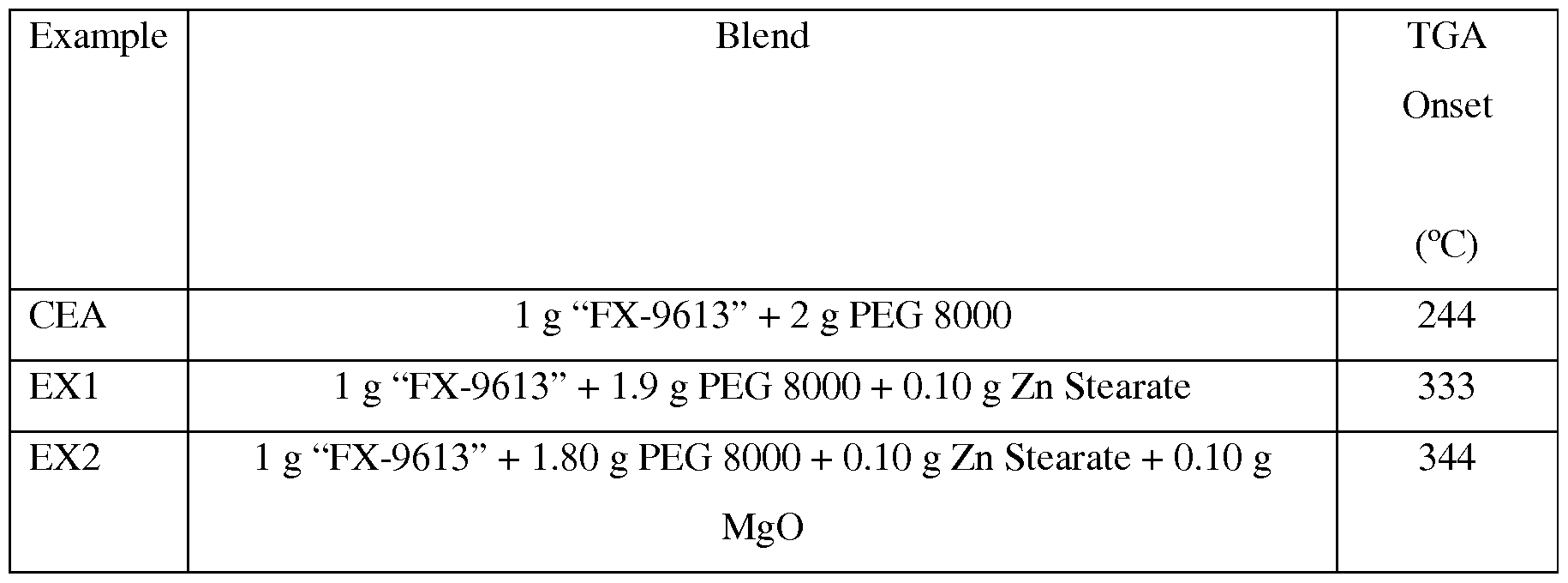


Claims
Priority Applications (5)
| Application Number | Priority Date | Filing Date | Title |
|---|---|---|---|
| EP14782003.9A EP3046964B1 (en) | 2013-09-20 | 2014-09-19 | Polymer processing additive, compositions, and methods |
| CA2924818A CA2924818A1 (en) | 2013-09-20 | 2014-09-19 | Polymer processing additive, compositions, and methods |
| US15/022,842 US11359079B2 (en) | 2013-09-20 | 2014-09-19 | Polymer processing additive, compositions, and methods |
| BR112016008623A BR112016008623A2 (en) | 2013-09-20 | 2014-09-19 | additive, composition and polymer processing methods. |
| CN201480051847.0A CN105579515A (en) | 2013-09-20 | 2014-09-19 | Polymer processing additives, compositions and methods |
Applications Claiming Priority (2)
| Application Number | Priority Date | Filing Date | Title |
|---|---|---|---|
| US201361880306P | 2013-09-20 | 2013-09-20 | |
| US61/880,306 | 2013-09-20 |
Publications (1)
| Publication Number | Publication Date |
|---|---|
| WO2015042415A1 true WO2015042415A1 (en) | 2015-03-26 |
Family
ID=51688422
Family Applications (1)
| Application Number | Title | Priority Date | Filing Date |
|---|---|---|---|
| PCT/US2014/056581 Ceased WO2015042415A1 (en) | 2013-09-20 | 2014-09-19 | Polymer processing additive, compositions, and methods |
Country Status (6)
| Country | Link |
|---|---|
| US (1) | US11359079B2 (en) |
| EP (1) | EP3046964B1 (en) |
| CN (2) | CN114031925A (en) |
| BR (1) | BR112016008623A2 (en) |
| CA (1) | CA2924818A1 (en) |
| WO (1) | WO2015042415A1 (en) |
Cited By (7)
| Publication number | Priority date | Publication date | Assignee | Title |
|---|---|---|---|---|
| WO2016100691A1 (en) | 2014-12-19 | 2016-06-23 | 3M Innovative Properties Company | Poly(oxyalkylene) polymer processing additive, compositions, and methods |
| CN106554553A (en) * | 2015-09-30 | 2017-04-05 | 中国石油化工股份有限公司 | Easy processing metallocene PE compositionss and preparation method thereof |
| WO2017066266A1 (en) | 2015-10-13 | 2017-04-20 | 3M Innovative Properties Company | Fluoropolymer processing additive, compositions, and methods |
| WO2017083688A1 (en) | 2015-11-13 | 2017-05-18 | 3M Innovative Properties Company | Compositions including a bimodal blend of amorphous fluoropolymers and their uses |
| WO2017201135A1 (en) | 2016-05-17 | 2017-11-23 | 3M Innovative Properties Company | Compositions including copolymers of vinylidene fluoride and tetrafluoroethylene and methods of using the same |
| WO2020109956A1 (en) | 2018-11-27 | 2020-06-04 | 3M Innovative Properties Company | Compositions of polymer processing additives and products made using such compositions |
| WO2022079601A1 (en) | 2020-10-16 | 2022-04-21 | 3M Innovative Properties Company | Melt processible high density polyethylene compositions comprising a polyorganosiloxane polymer |
Families Citing this family (9)
| Publication number | Priority date | Publication date | Assignee | Title |
|---|---|---|---|---|
| EP3594260B1 (en) * | 2018-07-13 | 2025-02-19 | Avient Switzerland GmbH | Composition comprising a polyester-polyether polymer, a transition metal catalyst, and an active material |
| KR20240033010A (en) | 2021-07-14 | 2024-03-12 | 노바 케미컬즈 (인터내셔널) 소시에테 아노님 | Fluoropolymer-free polymer processing aids |
| WO2023056208A1 (en) | 2021-09-30 | 2023-04-06 | Exxonmobil Chemical Patents Inc. | Fluorine-free polymer processing aids including polyethylene glycols |
| US20250145820A1 (en) | 2022-02-07 | 2025-05-08 | Exxonmobil Chemical Patents Inc. | Polyethylene glycol-based polymer processing aids |
| WO2023154744A1 (en) | 2022-02-14 | 2023-08-17 | Exxonmobil Chemical Patents Inc. | Polyethylene glycol-based polymer processing aids |
| EP4602094A1 (en) | 2022-10-11 | 2025-08-20 | Nova Chemicals (International) S.A. | Metal salt as a polymer processing aid |
| US20240279435A1 (en) * | 2023-01-13 | 2024-08-22 | Dover Chemical Corporation | Polymeric Compositions That Reduce Die Buildup During Extrusion and Related Methods |
| WO2026060194A1 (en) * | 2024-09-14 | 2026-03-19 | Momentive Performance Materials Inc. | Silicone based polymer processing aid composition |
| CN119592044A (en) * | 2024-12-26 | 2025-03-11 | 浙江佳华精化股份有限公司 | Environmentally friendly processing aid for polyolefins and preparation method thereof |
Citations (32)
| Publication number | Priority date | Publication date | Assignee | Title |
|---|---|---|---|---|
| US2968649A (en) | 1958-12-04 | 1961-01-17 | Du Pont | Elastomeric terpolymers |
| US3051677A (en) | 1955-04-27 | 1962-08-28 | Du Pont | Copolymer elastomer of vinylidenefluoride and hexafluoropropene |
| US3318854A (en) | 1953-04-03 | 1967-05-09 | Minnesota Mining & Mfg | Fluorinated elastomeric copolymers |
| US3326984A (en) | 1965-04-28 | 1967-06-20 | Du Pont | Perfluorodivinyl ether |
| US4273728A (en) | 1979-03-14 | 1981-06-16 | E. I. Du Pont De Nemours And Company | Polyfluoroallyloxy compounds, their preparation and copolymers therefrom |
| US4534799A (en) * | 1984-09-05 | 1985-08-13 | Technical Processing, Inc. | Processing aids for natural and synthetic rubber |
| US4535113A (en) | 1984-03-13 | 1985-08-13 | Union Carbide Corporation | Olefin polymer compositions containing silicone additives and the use thereof in the production of film material |
| US4558141A (en) | 1981-11-19 | 1985-12-10 | E. I. Du Pont De Nemours And Company | Perfluorodioxole and its polymers |
| US4855013A (en) | 1984-08-13 | 1989-08-08 | Agency Of Industrial Science And Technology | Method for controlling the thickness of a thin crystal film |
| US4900474A (en) | 1987-07-17 | 1990-02-13 | Shin-Etsu Chemical Co., Ltd. | Silicone antifoamers |
| US5015693A (en) | 1988-04-15 | 1991-05-14 | Minnesota Mining And Manufacturing Company | Extrudable thermoplastic hydrocarbon polymer composition |
| US5028679A (en) | 1988-10-05 | 1991-07-02 | Shin-Etsu Chemical Co., Ltd. | Method for preparing perfluoroalkyl group-containing organopolysiloxanes |
| US5118775A (en) | 1989-02-21 | 1992-06-02 | Shin-Etsu Chemical Co., Ltd. | Fluoroorganopolysiloxane and a process for preparing the same |
| US5236997A (en) | 1991-02-18 | 1993-08-17 | Shin-Etsu Chemical Co., Ltd. | Curable fluorosilicone rubber composition |
| US5284184A (en) | 1992-04-14 | 1994-02-08 | Itt Corporation | Corrugated multi-layer tubing having at least one fluoroplastic layer |
| US5285002A (en) | 1993-03-23 | 1994-02-08 | Minnesota Mining And Manufacturing Company | Fluorine-containing polymers and preparation and use thereof |
| US5442097A (en) | 1993-06-02 | 1995-08-15 | Hoechst Aktiengesellschaft | Process for the recovery of fluorinated carboxylic acids |
| US5550193A (en) * | 1994-12-07 | 1996-08-27 | Novacor Chemicals Ltd. | Melt fracture elimination in film production |
| US5701217A (en) | 1993-10-20 | 1997-12-23 | Seiko Epson Corporation | Disk chucking mechanism and drive pin structure having chucking lever movable in two degrees of freedom |
| US6277919B1 (en) | 1999-05-13 | 2001-08-21 | Dyneon Llc | Polymer processing additive containing a multimodal fluoropolymer and melt processable thermoplastic polymer composition employing the same |
| US6294604B1 (en) | 1998-03-06 | 2001-09-25 | Dyneon Llc | Polymer processing additive having improved stability |
| US6300526B1 (en) | 1998-07-31 | 2001-10-09 | Austmont S.P.A. | Hydro-fluoroalkylvinylethers and process for obtaining them |
| US6613941B1 (en) | 1998-06-02 | 2003-09-02 | 3M Innovative Properties Company | Method for recovering fluorinated alkanoic acids from waste waters |
| US6706193B1 (en) | 1999-07-17 | 2004-03-16 | 3M Innovative Properties Company | Method for recovering fluorinated emulsifiers from aqueous phases |
| US6794550B2 (en) | 2000-04-14 | 2004-09-21 | 3M Innovative Properties Company | Method of making an aqueous dispersion of fluoropolymers |
| EP1462483A1 (en) * | 2003-03-26 | 2004-09-29 | Dupont Dow Elastomers L.L.C. | Process aid masterbatch for melt processable polymers |
| WO2005111144A1 (en) * | 2004-04-30 | 2005-11-24 | Equistar Chemicals, Lp | Multimodal polyethylene extrusion |
| US7018541B2 (en) | 2004-02-05 | 2006-03-28 | 3M Innovative Properties Company | Removal of fluorinated surfactants from waste water |
| US7375157B2 (en) | 2003-06-09 | 2008-05-20 | 3M Innovative Properties Company | Melt-processible polymer composition comprising fluoropolymer having long chain branches |
| WO2009094348A1 (en) * | 2008-01-23 | 2009-07-30 | 3M Innovative Properties Company | Processing aid compositions comprising fluoropolymers having long-chain branches |
| US20110172338A1 (en) * | 2009-08-27 | 2011-07-14 | Daikin Industries, Ltd. | Processing additive, molding composition masterbatch of processing additive and molding article |
| US20110244159A1 (en) | 2008-12-17 | 2011-10-06 | 3M Innovative Properties Company | Thermoplastic silicone-based polymer process additives for injection molding applications |
Family Cites Families (47)
| Publication number | Priority date | Publication date | Assignee | Title |
|---|---|---|---|---|
| US4141874A (en) | 1975-11-15 | 1979-02-27 | Daikin Kogyo Co., Ltd. | Fluorine-containing elastomeric copolymers, process for preparing the same and composition containing the same |
| US4540538A (en) | 1981-10-08 | 1985-09-10 | Union Carbide Corporation | Anti-block compounds for extrusion of transition metal catalyzed resins |
| US5155282A (en) | 1985-02-26 | 1992-10-13 | Ausimont S.P.A. | Perfluoropolyethers having brominated end groups and fluoroelastomers obtained therefrom |
| IT1200801B (en) | 1985-10-17 | 1989-01-27 | Ausimont Spa | ADJUVANT WORKING ADDITIVES FOR VULCANNISABLE TIRES VIA PEROXIDES |
| DE3708384A1 (en) | 1987-03-14 | 1988-09-22 | Hoechst Ag | POLYOLEFINE MOLD |
| IT1204748B (en) | 1987-06-19 | 1989-03-10 | Ausimont Spa | COMPOSITIONS BASED ON FLUOROELASTOMERS AND MODIFIED OLEPHINE POLYMERS |
| IT1222804B (en) | 1987-10-02 | 1990-09-12 | Ausimont Spa | ADJUVANT ADDITIVES FOR THE RELEASE OF THE VULCANISABLE RUBBER MOLDS BY PEROXIDES |
| US4855360A (en) | 1988-04-15 | 1989-08-08 | Minnesota Mining And Manufacturing Company | Extrudable thermoplastic hydrocarbon polymer composition |
| US5013792A (en) | 1990-01-04 | 1991-05-07 | E. I. Du Pont De Nemours And Company | Processing aid for polymers |
| US4904735A (en) | 1988-07-08 | 1990-02-27 | E. I. Du Pont De Nemours And Company | Processing aid for polymers |
| WO1991005013A1 (en) | 1989-10-06 | 1991-04-18 | E.I. Du Pont De Nemours And Company | Fluoropolymer process aids containing functional groups |
| US5089200A (en) | 1989-10-06 | 1992-02-18 | E. I. Dupont De Nemours And Company | Process for melt extrusion of polymers |
| US5106911A (en) | 1989-10-06 | 1992-04-21 | E. I. Du Pont De Nemours And Company | Process and processing aid for extruding a hydrocarbon polymer |
| KR950006266B1 (en) | 1989-10-06 | 1995-06-13 | 이 아이 듀우판 디 네모아 앤드 캄파니 | Polymer composition containing an extrusion processing and comprising a fluorocarbon elastomer and vinylidene fluoride |
| US5064594A (en) | 1989-10-06 | 1991-11-12 | E. I. Du Pont De Nemours And Company | Extrusion process for difficultly-melt-processible polymers |
| KR920701336A (en) | 1989-10-06 | 1992-08-11 | 제임즈 제이 플린 | Extrusion method for difficult-melt-processable polymers |
| US5010130A (en) | 1990-05-15 | 1991-04-23 | E. I. Du Pont De Nemours And Company | High melt viscosity fluoropolymer process aid |
| JPH04298546A (en) | 1991-03-27 | 1992-10-22 | Nippon Zeon Co Ltd | Rubber composition containing metal salt of ethylenically unsaturated lower carboxylic acid |
| WO1995014719A1 (en) | 1992-08-28 | 1995-06-01 | E.I. Du Pont De Nemours And Company | Low-melting tetrafluoroethylene copolymer and its uses |
| US5266639A (en) | 1992-08-28 | 1993-11-30 | E. I. Du Pont De Nemours And Company | Low-melting tetrafluorethylene copolymer and its uses |
| EP0656912B1 (en) | 1992-08-28 | 1996-12-04 | E.I. Du Pont De Nemours And Company | Low-melting tetrafluoroethylene copolymer and its uses |
| KR100329889B1 (en) * | 1993-05-13 | 2002-12-06 | 엑손 케미칼 패턴츠 인코포레이티드 | Ethylene copolymers having narrow composition distribution, their production and use |
| DE4421420A1 (en) | 1994-06-18 | 1995-12-21 | Poli Film Verwaltungs Gmbh | Halogen-free fire-resistant polyolefin protective or adhesive film |
| US5527858A (en) | 1994-09-02 | 1996-06-18 | Minnesota Mining And Manufacturing Company | Melt-processable fluoroplastic |
| US5719209A (en) | 1994-10-18 | 1998-02-17 | General Electric Company | Tetrafluoroethylene polymer compositions and process for making flame retardant thermoplastic compositions utilizing the same |
| US5587429A (en) | 1995-04-04 | 1996-12-24 | E. I. Dupont De Nemours And Company | Processing aid system for polyolefins |
| US5710217A (en) | 1995-09-15 | 1998-01-20 | Minnesota Mining And Manufacturing Company | Extrudable thermoplastic hydrocarbon compositions |
| US6734252B1 (en) | 1999-01-29 | 2004-05-11 | 3M Innovative Properties Company | Melt processable thermoplastic polymer composition employing a polymer processing additive containing a fluorothermoplastic copolymer |
| US6780481B1 (en) | 1999-05-13 | 2004-08-24 | 3M Innovative Properties Company | Melt processable thermoplastic polymer composition |
| US6380313B1 (en) | 2000-06-27 | 2002-04-30 | Dyneon Llc | Polymer processing additive containing a perfluorovinylether-modified flouropolymer and a melt processable thermoplastic polymer composition employing the same |
| US6642310B2 (en) | 2001-02-16 | 2003-11-04 | Dupont Dow Elastomers L.L.C. | Process aid for melt processable polymers |
| DE10136191A1 (en) * | 2001-07-25 | 2003-02-20 | Wolf Gmbh Richard | Device for imaging and spectroscopic diagnosis of tissue |
| US6599982B2 (en) | 2001-11-08 | 2003-07-29 | Dupont Dow Elastomers L.L.C. | Process aid for melt processable polymers |
| US6818695B2 (en) | 2002-05-20 | 2004-11-16 | 3M Innovative Properties Company | Extrudable thermoplastic compositions |
| CA2442789A1 (en) | 2003-09-26 | 2005-03-26 | Nova Chemicals Corporation | High molecular weight polyethylene glycol as polymer process aids |
| US20050101722A1 (en) | 2003-11-06 | 2005-05-12 | 3M Innovative Properties Company | Melt processable compositions |
| US7413697B2 (en) | 2004-06-21 | 2008-08-19 | Freudenberg-Nok General Partnership | Pre-molding heat treatment of dynamic vulcanizates of fluorocarbon elastomers |
| DE102004038980A1 (en) | 2004-08-10 | 2006-02-23 | Cognis Deutschland Gmbh & Co. Kg | Anti-fogging agent for plastics |
| US7420010B2 (en) | 2005-11-02 | 2008-09-02 | Chevron Philips Chemical Company Lp | Polyethylene compositions |
| FR2896250B1 (en) | 2006-01-13 | 2012-08-17 | Arkema | EXTRUSION AGENT BASED ON PVDF |
| US20090197028A1 (en) | 2008-01-31 | 2009-08-06 | Lyons Donald F | Fluoropolymers of tetrafluoroethylene and 3,3,3-trifluoropropylene |
| US20100031190A1 (en) * | 2008-07-29 | 2010-02-04 | Yahoo! Inc. | System and method for copying information into a target document |
| KR20100025211A (en) | 2008-08-27 | 2010-03-09 | 엘에스전선 주식회사 | Polypropylene-based flame-resistant resin composition for cable insulation material with superior mechanical properties |
| WO2010037071A1 (en) | 2008-09-29 | 2010-04-01 | E. I. Du Pont De Nemours And Company | Polymer-based products having improved solar reflectivity and uv protection |
| CN101891914B (en) | 2010-07-29 | 2013-03-20 | 山东科虹线缆有限公司 | Composite type high-conductivity polymer material and preparation method thereof |
| CA2759953A1 (en) | 2011-11-28 | 2013-05-28 | Nova Chemicals Corporation | Improved barrier properties of hdpe film |
| WO2014085126A1 (en) | 2012-11-30 | 2014-06-05 | 3M Innovative Properties Company | Additive composition and compositions and articles containing the same |
-
2014
- 2014-09-19 US US15/022,842 patent/US11359079B2/en active Active
- 2014-09-19 WO PCT/US2014/056581 patent/WO2015042415A1/en not_active Ceased
- 2014-09-19 CN CN202111271284.4A patent/CN114031925A/en not_active Withdrawn
- 2014-09-19 EP EP14782003.9A patent/EP3046964B1/en not_active Not-in-force
- 2014-09-19 BR BR112016008623A patent/BR112016008623A2/en not_active Application Discontinuation
- 2014-09-19 CA CA2924818A patent/CA2924818A1/en not_active Abandoned
- 2014-09-19 CN CN201480051847.0A patent/CN105579515A/en active Pending
Patent Citations (34)
| Publication number | Priority date | Publication date | Assignee | Title |
|---|---|---|---|---|
| US3318854A (en) | 1953-04-03 | 1967-05-09 | Minnesota Mining & Mfg | Fluorinated elastomeric copolymers |
| US3051677A (en) | 1955-04-27 | 1962-08-28 | Du Pont | Copolymer elastomer of vinylidenefluoride and hexafluoropropene |
| US2968649A (en) | 1958-12-04 | 1961-01-17 | Du Pont | Elastomeric terpolymers |
| US3326984A (en) | 1965-04-28 | 1967-06-20 | Du Pont | Perfluorodivinyl ether |
| US4273728A (en) | 1979-03-14 | 1981-06-16 | E. I. Du Pont De Nemours And Company | Polyfluoroallyloxy compounds, their preparation and copolymers therefrom |
| US4558141A (en) | 1981-11-19 | 1985-12-10 | E. I. Du Pont De Nemours And Company | Perfluorodioxole and its polymers |
| US4535113A (en) | 1984-03-13 | 1985-08-13 | Union Carbide Corporation | Olefin polymer compositions containing silicone additives and the use thereof in the production of film material |
| US4855013A (en) | 1984-08-13 | 1989-08-08 | Agency Of Industrial Science And Technology | Method for controlling the thickness of a thin crystal film |
| US4534799A (en) * | 1984-09-05 | 1985-08-13 | Technical Processing, Inc. | Processing aids for natural and synthetic rubber |
| US4900474A (en) | 1987-07-17 | 1990-02-13 | Shin-Etsu Chemical Co., Ltd. | Silicone antifoamers |
| US5015693A (en) | 1988-04-15 | 1991-05-14 | Minnesota Mining And Manufacturing Company | Extrudable thermoplastic hydrocarbon polymer composition |
| US5028679A (en) | 1988-10-05 | 1991-07-02 | Shin-Etsu Chemical Co., Ltd. | Method for preparing perfluoroalkyl group-containing organopolysiloxanes |
| US5118775A (en) | 1989-02-21 | 1992-06-02 | Shin-Etsu Chemical Co., Ltd. | Fluoroorganopolysiloxane and a process for preparing the same |
| US5236997A (en) | 1991-02-18 | 1993-08-17 | Shin-Etsu Chemical Co., Ltd. | Curable fluorosilicone rubber composition |
| US5284184A (en) | 1992-04-14 | 1994-02-08 | Itt Corporation | Corrugated multi-layer tubing having at least one fluoroplastic layer |
| US5378782A (en) | 1993-03-23 | 1995-01-03 | Minnesota Mining And Manufacturing Company | Fluorine-containing polymers and preparation and use thereof |
| US5285002A (en) | 1993-03-23 | 1994-02-08 | Minnesota Mining And Manufacturing Company | Fluorine-containing polymers and preparation and use thereof |
| US5442097A (en) | 1993-06-02 | 1995-08-15 | Hoechst Aktiengesellschaft | Process for the recovery of fluorinated carboxylic acids |
| US5701217A (en) | 1993-10-20 | 1997-12-23 | Seiko Epson Corporation | Disk chucking mechanism and drive pin structure having chucking lever movable in two degrees of freedom |
| US5550193A (en) * | 1994-12-07 | 1996-08-27 | Novacor Chemicals Ltd. | Melt fracture elimination in film production |
| US6294604B1 (en) | 1998-03-06 | 2001-09-25 | Dyneon Llc | Polymer processing additive having improved stability |
| US6613941B1 (en) | 1998-06-02 | 2003-09-02 | 3M Innovative Properties Company | Method for recovering fluorinated alkanoic acids from waste waters |
| US6300526B1 (en) | 1998-07-31 | 2001-10-09 | Austmont S.P.A. | Hydro-fluoroalkylvinylethers and process for obtaining them |
| US6277919B1 (en) | 1999-05-13 | 2001-08-21 | Dyneon Llc | Polymer processing additive containing a multimodal fluoropolymer and melt processable thermoplastic polymer composition employing the same |
| US6706193B1 (en) | 1999-07-17 | 2004-03-16 | 3M Innovative Properties Company | Method for recovering fluorinated emulsifiers from aqueous phases |
| US6794550B2 (en) | 2000-04-14 | 2004-09-21 | 3M Innovative Properties Company | Method of making an aqueous dispersion of fluoropolymers |
| EP1462483A1 (en) * | 2003-03-26 | 2004-09-29 | Dupont Dow Elastomers L.L.C. | Process aid masterbatch for melt processable polymers |
| US7375157B2 (en) | 2003-06-09 | 2008-05-20 | 3M Innovative Properties Company | Melt-processible polymer composition comprising fluoropolymer having long chain branches |
| US7018541B2 (en) | 2004-02-05 | 2006-03-28 | 3M Innovative Properties Company | Removal of fluorinated surfactants from waste water |
| WO2005111144A1 (en) * | 2004-04-30 | 2005-11-24 | Equistar Chemicals, Lp | Multimodal polyethylene extrusion |
| WO2009094348A1 (en) * | 2008-01-23 | 2009-07-30 | 3M Innovative Properties Company | Processing aid compositions comprising fluoropolymers having long-chain branches |
| US20100311906A1 (en) | 2008-01-23 | 2010-12-09 | Claude Lavallee | Processing aid compositions comprising fluoropolymers having long-chain branches |
| US20110244159A1 (en) | 2008-12-17 | 2011-10-06 | 3M Innovative Properties Company | Thermoplastic silicone-based polymer process additives for injection molding applications |
| US20110172338A1 (en) * | 2009-08-27 | 2011-07-14 | Daikin Industries, Ltd. | Processing additive, molding composition masterbatch of processing additive and molding article |
Non-Patent Citations (5)
| Title |
|---|
| ITTEL ET AL., CHEM. REV., vol. 100, 2000, pages 1169 - 1203 |
| MACROMOL, vol. 34, 2001, pages 7362 - 7367 |
| R. F. WESTOVER: "Melt Extrusion, Encyclopedia of Polymer Science and Technology", vol. 8, 1968, JOHN WILEY & SONS, pages: 573 - 81 |
| R. N. SHROFF; H. MAVRIDIS, MACROMOL., vol. 32, 1999, pages 8464 - 8464 |
| RAUWENDAAL, C.: "Polymer Extrusion", 1986, HANSEN PUBLISHERS, pages: 23 - 48 |
Cited By (10)
| Publication number | Priority date | Publication date | Assignee | Title |
|---|---|---|---|---|
| WO2016100691A1 (en) | 2014-12-19 | 2016-06-23 | 3M Innovative Properties Company | Poly(oxyalkylene) polymer processing additive, compositions, and methods |
| CN106554553A (en) * | 2015-09-30 | 2017-04-05 | 中国石油化工股份有限公司 | Easy processing metallocene PE compositionss and preparation method thereof |
| WO2017066266A1 (en) | 2015-10-13 | 2017-04-20 | 3M Innovative Properties Company | Fluoropolymer processing additive, compositions, and methods |
| CN108137880A (en) * | 2015-10-13 | 2018-06-08 | 3M创新有限公司 | Fluoropolymer processing additives, compositions and methods |
| US10723868B2 (en) | 2015-10-13 | 2020-07-28 | 3M Innovative Properties Company | Fluoropolymer processing additive, compositions, and methods |
| WO2017083688A1 (en) | 2015-11-13 | 2017-05-18 | 3M Innovative Properties Company | Compositions including a bimodal blend of amorphous fluoropolymers and their uses |
| WO2017201135A1 (en) | 2016-05-17 | 2017-11-23 | 3M Innovative Properties Company | Compositions including copolymers of vinylidene fluoride and tetrafluoroethylene and methods of using the same |
| US11312802B2 (en) | 2016-05-17 | 2022-04-26 | 3M Innovative Properties Company | Compositions including copolymers of vinylidene fluoride and tetrafluoroethylene and methods of using the same |
| WO2020109956A1 (en) | 2018-11-27 | 2020-06-04 | 3M Innovative Properties Company | Compositions of polymer processing additives and products made using such compositions |
| WO2022079601A1 (en) | 2020-10-16 | 2022-04-21 | 3M Innovative Properties Company | Melt processible high density polyethylene compositions comprising a polyorganosiloxane polymer |
Also Published As
| Publication number | Publication date |
|---|---|
| CN114031925A (en) | 2022-02-11 |
| BR112016008623A2 (en) | 2018-05-02 |
| US11359079B2 (en) | 2022-06-14 |
| EP3046964B1 (en) | 2021-01-13 |
| EP3046964A1 (en) | 2016-07-27 |
| US20160229994A1 (en) | 2016-08-11 |
| CN105579515A (en) | 2016-05-11 |
| CA2924818A1 (en) | 2015-03-26 |
Similar Documents
| Publication | Publication Date | Title |
|---|---|---|
| EP3046964B1 (en) | Polymer processing additive, compositions, and methods | |
| US10982079B2 (en) | Poly(oxyalkylene) polymer processing additive, compositions, and methods | |
| US11312802B2 (en) | Compositions including copolymers of vinylidene fluoride and tetrafluoroethylene and methods of using the same | |
| CN102482374A (en) | Processing aids, molding compositions, masterbatches for processing aids, and molded articles | |
| US10723868B2 (en) | Fluoropolymer processing additive, compositions, and methods | |
| WO2017083688A1 (en) | Compositions including a bimodal blend of amorphous fluoropolymers and their uses | |
| CA2565784C (en) | Polymer melt additive composition and use thereof | |
| JP2002544359A (en) | Melt-processable thermoplastic polymer composition | |
| WO2018213671A1 (en) | Compositions including co-coagulated fluoropolymers and methods of using the same | |
| JP2016196584A (en) | Vinylidene fluoride resin composition and molding, and method for producing the same | |
| WO2020109956A1 (en) | Compositions of polymer processing additives and products made using such compositions |
Legal Events
| Date | Code | Title | Description |
|---|---|---|---|
| WWE | Wipo information: entry into national phase |
Ref document number: 201480051847.0 Country of ref document: CN |
|
| 121 | Ep: the epo has been informed by wipo that ep was designated in this application |
Ref document number: 14782003 Country of ref document: EP Kind code of ref document: A1 |
|
| WWE | Wipo information: entry into national phase |
Ref document number: 15022842 Country of ref document: US |
|
| ENP | Entry into the national phase |
Ref document number: 2924818 Country of ref document: CA |
|
| NENP | Non-entry into the national phase |
Ref country code: DE |
|
| REEP | Request for entry into the european phase |
Ref document number: 2014782003 Country of ref document: EP |
|
| WWE | Wipo information: entry into national phase |
Ref document number: 2014782003 Country of ref document: EP |
|
| REG | Reference to national code |
Ref country code: BR Ref legal event code: B01A Ref document number: 112016008623 Country of ref document: BR |
|
| ENP | Entry into the national phase |
Ref document number: 112016008623 Country of ref document: BR Kind code of ref document: A2 Effective date: 20160321 |
|
| WWE | Wipo information: entry into national phase |
Ref document number: 516370780 Country of ref document: SA |