WO2015041492A1 - Compound for organic electroluminescent device and organic electroluminescent device including the same - Google Patents
Compound for organic electroluminescent device and organic electroluminescent device including the same Download PDFInfo
- Publication number
- WO2015041492A1 WO2015041492A1 PCT/KR2014/008783 KR2014008783W WO2015041492A1 WO 2015041492 A1 WO2015041492 A1 WO 2015041492A1 KR 2014008783 W KR2014008783 W KR 2014008783W WO 2015041492 A1 WO2015041492 A1 WO 2015041492A1
- Authority
- WO
- WIPO (PCT)
- Prior art keywords
- substituted
- unsubstituted
- group
- organic
- compound
- Prior art date
- Legal status (The legal status is an assumption and is not a legal conclusion. Google has not performed a legal analysis and makes no representation as to the accuracy of the status listed.)
- Ceased
Links
- SNHMUERNLJLMHN-UHFFFAOYSA-N Ic1ccccc1 Chemical compound Ic1ccccc1 SNHMUERNLJLMHN-UHFFFAOYSA-N 0.000 description 1
- TZMWTMQSYCMOIY-UHFFFAOYSA-N c(cc1)ccc1-[n]1c(ccc(-c(cc2)cc3c2[o]c2c3cccc2-c(cc2)cc(c3ccccc33)c2[n]3-c2ccccc2)c2)c2c2ccccc12 Chemical compound c(cc1)ccc1-[n]1c(ccc(-c(cc2)cc3c2[o]c2c3cccc2-c(cc2)cc(c3ccccc33)c2[n]3-c2ccccc2)c2)c2c2ccccc12 TZMWTMQSYCMOIY-UHFFFAOYSA-N 0.000 description 1
Images


Classifications
-
- H—ELECTRICITY
- H10—SEMICONDUCTOR DEVICES; ELECTRIC SOLID-STATE DEVICES NOT OTHERWISE PROVIDED FOR
- H10K—ORGANIC ELECTRIC SOLID-STATE DEVICES
- H10K85/00—Organic materials used in the body or electrodes of devices covered by this subclass
- H10K85/60—Organic compounds having low molecular weight
- H10K85/649—Aromatic compounds comprising a hetero atom
- H10K85/657—Polycyclic condensed heteroaromatic hydrocarbons
- H10K85/6576—Polycyclic condensed heteroaromatic hydrocarbons comprising only sulfur in the heteroaromatic polycondensed ring system, e.g. benzothiophene
-
- C—CHEMISTRY; METALLURGY
- C09—DYES; PAINTS; POLISHES; NATURAL RESINS; ADHESIVES; COMPOSITIONS NOT OTHERWISE PROVIDED FOR; APPLICATIONS OF MATERIALS NOT OTHERWISE PROVIDED FOR
- C09K—MATERIALS FOR MISCELLANEOUS APPLICATIONS, NOT PROVIDED FOR ELSEWHERE
- C09K11/00—Luminescent materials, e.g. electroluminescent or chemiluminescent
- C09K11/06—Luminescent materials, e.g. electroluminescent or chemiluminescent containing organic luminescent materials
-
- C—CHEMISTRY; METALLURGY
- C07—ORGANIC CHEMISTRY
- C07D—HETEROCYCLIC COMPOUNDS
- C07D235/00—Heterocyclic compounds containing 1,3-diazole or hydrogenated 1,3-diazole rings, condensed with other rings
- C07D235/02—Heterocyclic compounds containing 1,3-diazole or hydrogenated 1,3-diazole rings, condensed with other rings condensed with carbocyclic rings or ring systems
- C07D235/04—Benzimidazoles; Hydrogenated benzimidazoles
- C07D235/18—Benzimidazoles; Hydrogenated benzimidazoles with aryl radicals directly attached in position 2
-
- C—CHEMISTRY; METALLURGY
- C07—ORGANIC CHEMISTRY
- C07D—HETEROCYCLIC COMPOUNDS
- C07D307/00—Heterocyclic compounds containing five-membered rings having one oxygen atom as the only ring hetero atom
- C07D307/77—Heterocyclic compounds containing five-membered rings having one oxygen atom as the only ring hetero atom ortho- or peri-condensed with carbocyclic rings or ring systems
- C07D307/87—Benzo [c] furans; Hydrogenated benzo [c] furans
-
- C—CHEMISTRY; METALLURGY
- C07—ORGANIC CHEMISTRY
- C07D—HETEROCYCLIC COMPOUNDS
- C07D307/00—Heterocyclic compounds containing five-membered rings having one oxygen atom as the only ring hetero atom
- C07D307/77—Heterocyclic compounds containing five-membered rings having one oxygen atom as the only ring hetero atom ortho- or peri-condensed with carbocyclic rings or ring systems
- C07D307/91—Dibenzofurans; Hydrogenated dibenzofurans
-
- C—CHEMISTRY; METALLURGY
- C07—ORGANIC CHEMISTRY
- C07D—HETEROCYCLIC COMPOUNDS
- C07D405/00—Heterocyclic compounds containing both one or more hetero rings having oxygen atoms as the only ring hetero atoms, and one or more rings having nitrogen as the only ring hetero atom
- C07D405/02—Heterocyclic compounds containing both one or more hetero rings having oxygen atoms as the only ring hetero atoms, and one or more rings having nitrogen as the only ring hetero atom containing two hetero rings
- C07D405/04—Heterocyclic compounds containing both one or more hetero rings having oxygen atoms as the only ring hetero atoms, and one or more rings having nitrogen as the only ring hetero atom containing two hetero rings directly linked by a ring-member-to-ring-member bond
-
- C—CHEMISTRY; METALLURGY
- C07—ORGANIC CHEMISTRY
- C07D—HETEROCYCLIC COMPOUNDS
- C07D405/00—Heterocyclic compounds containing both one or more hetero rings having oxygen atoms as the only ring hetero atoms, and one or more rings having nitrogen as the only ring hetero atom
- C07D405/14—Heterocyclic compounds containing both one or more hetero rings having oxygen atoms as the only ring hetero atoms, and one or more rings having nitrogen as the only ring hetero atom containing three or more hetero rings
-
- H—ELECTRICITY
- H10—SEMICONDUCTOR DEVICES; ELECTRIC SOLID-STATE DEVICES NOT OTHERWISE PROVIDED FOR
- H10K—ORGANIC ELECTRIC SOLID-STATE DEVICES
- H10K50/00—Organic light-emitting devices
- H10K50/10—OLEDs or polymer light-emitting diodes [PLED]
- H10K50/11—OLEDs or polymer light-emitting diodes [PLED] characterised by the electroluminescent [EL] layers
-
- H—ELECTRICITY
- H10—SEMICONDUCTOR DEVICES; ELECTRIC SOLID-STATE DEVICES NOT OTHERWISE PROVIDED FOR
- H10K—ORGANIC ELECTRIC SOLID-STATE DEVICES
- H10K50/00—Organic light-emitting devices
- H10K50/10—OLEDs or polymer light-emitting diodes [PLED]
- H10K50/11—OLEDs or polymer light-emitting diodes [PLED] characterised by the electroluminescent [EL] layers
- H10K50/12—OLEDs or polymer light-emitting diodes [PLED] characterised by the electroluminescent [EL] layers comprising dopants
-
- H—ELECTRICITY
- H10—SEMICONDUCTOR DEVICES; ELECTRIC SOLID-STATE DEVICES NOT OTHERWISE PROVIDED FOR
- H10K—ORGANIC ELECTRIC SOLID-STATE DEVICES
- H10K85/00—Organic materials used in the body or electrodes of devices covered by this subclass
- H10K85/60—Organic compounds having low molecular weight
- H10K85/631—Amine compounds having at least two aryl rest on at least one amine-nitrogen atom, e.g. triphenylamine
-
- H—ELECTRICITY
- H10—SEMICONDUCTOR DEVICES; ELECTRIC SOLID-STATE DEVICES NOT OTHERWISE PROVIDED FOR
- H10K—ORGANIC ELECTRIC SOLID-STATE DEVICES
- H10K85/00—Organic materials used in the body or electrodes of devices covered by this subclass
- H10K85/60—Organic compounds having low molecular weight
- H10K85/649—Aromatic compounds comprising a hetero atom
-
- H—ELECTRICITY
- H10—SEMICONDUCTOR DEVICES; ELECTRIC SOLID-STATE DEVICES NOT OTHERWISE PROVIDED FOR
- H10K—ORGANIC ELECTRIC SOLID-STATE DEVICES
- H10K85/00—Organic materials used in the body or electrodes of devices covered by this subclass
- H10K85/60—Organic compounds having low molecular weight
- H10K85/649—Aromatic compounds comprising a hetero atom
- H10K85/657—Polycyclic condensed heteroaromatic hydrocarbons
- H10K85/6574—Polycyclic condensed heteroaromatic hydrocarbons comprising only oxygen in the heteroaromatic polycondensed ring system, e.g. cumarine dyes
-
- C—CHEMISTRY; METALLURGY
- C09—DYES; PAINTS; POLISHES; NATURAL RESINS; ADHESIVES; COMPOSITIONS NOT OTHERWISE PROVIDED FOR; APPLICATIONS OF MATERIALS NOT OTHERWISE PROVIDED FOR
- C09K—MATERIALS FOR MISCELLANEOUS APPLICATIONS, NOT PROVIDED FOR ELSEWHERE
- C09K2211/00—Chemical nature of organic luminescent or tenebrescent compounds
- C09K2211/10—Non-macromolecular compounds
- C09K2211/1003—Carbocyclic compounds
- C09K2211/1011—Condensed systems
-
- C—CHEMISTRY; METALLURGY
- C09—DYES; PAINTS; POLISHES; NATURAL RESINS; ADHESIVES; COMPOSITIONS NOT OTHERWISE PROVIDED FOR; APPLICATIONS OF MATERIALS NOT OTHERWISE PROVIDED FOR
- C09K—MATERIALS FOR MISCELLANEOUS APPLICATIONS, NOT PROVIDED FOR ELSEWHERE
- C09K2211/00—Chemical nature of organic luminescent or tenebrescent compounds
- C09K2211/10—Non-macromolecular compounds
- C09K2211/1003—Carbocyclic compounds
- C09K2211/1014—Carbocyclic compounds bridged by heteroatoms, e.g. N, P, Si or B
-
- C—CHEMISTRY; METALLURGY
- C09—DYES; PAINTS; POLISHES; NATURAL RESINS; ADHESIVES; COMPOSITIONS NOT OTHERWISE PROVIDED FOR; APPLICATIONS OF MATERIALS NOT OTHERWISE PROVIDED FOR
- C09K—MATERIALS FOR MISCELLANEOUS APPLICATIONS, NOT PROVIDED FOR ELSEWHERE
- C09K2211/00—Chemical nature of organic luminescent or tenebrescent compounds
- C09K2211/10—Non-macromolecular compounds
- C09K2211/1018—Heterocyclic compounds
- C09K2211/1025—Heterocyclic compounds characterised by ligands
- C09K2211/1029—Heterocyclic compounds characterised by ligands containing one nitrogen atom as the heteroatom
-
- C—CHEMISTRY; METALLURGY
- C09—DYES; PAINTS; POLISHES; NATURAL RESINS; ADHESIVES; COMPOSITIONS NOT OTHERWISE PROVIDED FOR; APPLICATIONS OF MATERIALS NOT OTHERWISE PROVIDED FOR
- C09K—MATERIALS FOR MISCELLANEOUS APPLICATIONS, NOT PROVIDED FOR ELSEWHERE
- C09K2211/00—Chemical nature of organic luminescent or tenebrescent compounds
- C09K2211/10—Non-macromolecular compounds
- C09K2211/1018—Heterocyclic compounds
- C09K2211/1025—Heterocyclic compounds characterised by ligands
- C09K2211/1044—Heterocyclic compounds characterised by ligands containing two nitrogen atoms as heteroatoms
-
- C—CHEMISTRY; METALLURGY
- C09—DYES; PAINTS; POLISHES; NATURAL RESINS; ADHESIVES; COMPOSITIONS NOT OTHERWISE PROVIDED FOR; APPLICATIONS OF MATERIALS NOT OTHERWISE PROVIDED FOR
- C09K—MATERIALS FOR MISCELLANEOUS APPLICATIONS, NOT PROVIDED FOR ELSEWHERE
- C09K2211/00—Chemical nature of organic luminescent or tenebrescent compounds
- C09K2211/10—Non-macromolecular compounds
- C09K2211/1018—Heterocyclic compounds
- C09K2211/1025—Heterocyclic compounds characterised by ligands
- C09K2211/1059—Heterocyclic compounds characterised by ligands containing three nitrogen atoms as heteroatoms
-
- C—CHEMISTRY; METALLURGY
- C09—DYES; PAINTS; POLISHES; NATURAL RESINS; ADHESIVES; COMPOSITIONS NOT OTHERWISE PROVIDED FOR; APPLICATIONS OF MATERIALS NOT OTHERWISE PROVIDED FOR
- C09K—MATERIALS FOR MISCELLANEOUS APPLICATIONS, NOT PROVIDED FOR ELSEWHERE
- C09K2211/00—Chemical nature of organic luminescent or tenebrescent compounds
- C09K2211/10—Non-macromolecular compounds
- C09K2211/1018—Heterocyclic compounds
- C09K2211/1025—Heterocyclic compounds characterised by ligands
- C09K2211/1092—Heterocyclic compounds characterised by ligands containing sulfur as the only heteroatom
-
- C—CHEMISTRY; METALLURGY
- C09—DYES; PAINTS; POLISHES; NATURAL RESINS; ADHESIVES; COMPOSITIONS NOT OTHERWISE PROVIDED FOR; APPLICATIONS OF MATERIALS NOT OTHERWISE PROVIDED FOR
- C09K—MATERIALS FOR MISCELLANEOUS APPLICATIONS, NOT PROVIDED FOR ELSEWHERE
- C09K2211/00—Chemical nature of organic luminescent or tenebrescent compounds
- C09K2211/18—Metal complexes
- C09K2211/185—Metal complexes of the platinum group, i.e. Os, Ir, Pt, Ru, Rh or Pd
-
- H—ELECTRICITY
- H10—SEMICONDUCTOR DEVICES; ELECTRIC SOLID-STATE DEVICES NOT OTHERWISE PROVIDED FOR
- H10K—ORGANIC ELECTRIC SOLID-STATE DEVICES
- H10K50/00—Organic light-emitting devices
- H10K50/10—OLEDs or polymer light-emitting diodes [PLED]
- H10K50/14—Carrier transporting layers
- H10K50/15—Hole transporting layers
- H10K50/156—Hole transporting layers comprising a multilayered structure
-
- H—ELECTRICITY
- H10—SEMICONDUCTOR DEVICES; ELECTRIC SOLID-STATE DEVICES NOT OTHERWISE PROVIDED FOR
- H10K—ORGANIC ELECTRIC SOLID-STATE DEVICES
- H10K85/00—Organic materials used in the body or electrodes of devices covered by this subclass
- H10K85/30—Coordination compounds
- H10K85/341—Transition metal complexes, e.g. Ru(II)polypyridine complexes
- H10K85/342—Transition metal complexes, e.g. Ru(II)polypyridine complexes comprising iridium
-
- H—ELECTRICITY
- H10—SEMICONDUCTOR DEVICES; ELECTRIC SOLID-STATE DEVICES NOT OTHERWISE PROVIDED FOR
- H10K—ORGANIC ELECTRIC SOLID-STATE DEVICES
- H10K85/00—Organic materials used in the body or electrodes of devices covered by this subclass
- H10K85/60—Organic compounds having low molecular weight
- H10K85/615—Polycyclic condensed aromatic hydrocarbons, e.g. anthracene
- H10K85/622—Polycyclic condensed aromatic hydrocarbons, e.g. anthracene containing four rings, e.g. pyrene
Definitions
- the present invention relates to a compound for an organic electroluminescent device and an organic electroluminescent device including the same, and more particularly, to an amine-based compound for an organic electroluminescent device, having excellent light emission efficiency, and to an organic electroluminescent device including the same.
- Organic electroluminescent (EL) devices have a simpler structure, various processing advantages, higher brightness, superior viewing angle properties, quicker response rate, and a lower driving voltage compared to other flat panel displays such as liquid crystal displays (LCDs), plasma display panels (PDPs), field emission displays (FEDs), etc., and are thus being thoroughly developed so as to be utilized as light sources of flat panel displays such as wall-mountable TVs, etc. or backlight units of the displays, illuminators, advertisement boards and so on.
- LCDs liquid crystal displays
- PDPs plasma display panels
- FEDs field emission displays
- Hole transport materials for use in organic EL devices which have been known to date, are problematic because thin films formed therefrom using vacuum deposition are thermally and electrically unstable, and thus may rapidly crystallize due to heat generated upon device driving and also the film materials may change, undesirably deteriorating the light emission efficiency of the devices. Further, non-emission parts referred to as dark spots may increasingly occur, and the voltage may increase upon constant-current driving, undesirably damaging the devices.
- organic EL devices using a phosphorescent light emitting material do not confine a triplet exciton produced in the light emitting material of a light emitting layer due to low triplet energy, undesirably lowering the light emission efficiency of the devices.
- an object of the present invention is to provide a compound for an organic EL device, which may have high thermal stability, high triplet energy and high hole transport capability.
- Another object of the present invention is to provide an organic EL device, which includes the compound as above and is thus improved in thermal stability and light emission efficiency, and in which the above compound is used as a hole transport layer material in contact with a light emitting layer, thereby increasing a triplet energy, ultimately improving efficiency of the organic EL device.
- an aspect of the present invention provides a compound for an organic EL device, as represented by Chemical Formula 1 below.
- m1 to m4 are each independently 0 or 1
- n1 to n3 are are each independently 0 or 1
- Ar 1 to Ar 16 are identical to or different from each other, and Ar 1 to Ar 16 are each independently a substituted or unsubstituted C1 to C30 alkyl group, a substituted or unsubstituted C3 to C30 cycloalkyl group, a substituted or unsubstituted C1 to C30 heterocycloalkyl group, a substituted or unsubstituted C6 to C30 aryl group, or a substituted or unsubstituted C1 to C30 heteroaryl group, or at least one of Ar 1 to Ar 16 is further coupled with a carbon atom on the ⁇ position of a nitrogen atom linked therewith to form a substituted or unsubstituted fused C1 to C30 heterocycloalkyl group, or a substituted or unsubstituted fused C1 to C30 heteroaryl group, or Ar 1 and Ar 2 , Ar 3 and Ar 4 , Ar 5 and Ar 6 , Ar 7 and Ar 8 , Ar 9 and Ar 10
- R 1 to R 6 are identical to or different from each other, and R 1 to R 6 are each independently a hydrogen atom, a substituted or unsubstituted C1 to C30 alkyl group, a substituted or unsubstituted C3 to C30 cycloalkyl group, a substituted or unsubstituted C1 to C30 heterocycloalkyl group, a substituted or unsubstituted C6 to C30 aryl group, or a substituted or unsubstituted C1 to C30 heteroaryl group.
- m1 to m4 are each independently 0 or 1
- Ar 1 to Ar 16 are identical to or different from each other, and Ar 1 to Ar 16 are each independently a substituted or unsubstituted C1 to C30 alkyl group, a substituted or unsubstituted C3 to C30 cycloalkyl group, a substituted or unsubstituted C1 to C30 heterocycloalkyl group, a substituted or unsubstituted C6 to C30 aryl group, or a substituted or unsubstituted C1 to C30 heteroaryl group, or at least one of Ar 1 to Ar 16 is further coupled with a carbon atom on the ⁇ position of a nitrogen atom linked therewith to form a substituted or unsubstituted fused C1 to C30 heterocycloalkyl group, or a substituted or unsubstituted fused C1 to C30 heteroaryl group, or Ar 1 and Ar 2 , Ar 3 and Ar 4 , Ar 5 and Ar 6 , Ar 7 and Ar 8 , Ar 9 and Ar 10
- R 1 to R 6 are identical to or different from each other, and R 1 to R 6 are each independently a hydrogen atom, a substituted or unsubstituted C1 to C30 alkyl group, a substituted or unsubstituted C3 to C30 cycloalkyl group, a substituted or unsubstituted C1 to C30 heterocycloalkyl group, a substituted or unsubstituted C6 to C30 aryl group, or a substituted or unsubstituted C1 to C30 heteroaryl group.
- Ar 1 to Ar 16 are identical to or different from each other, and Ar 1 to Ar 16 are each independently , , , , , a substituted or unsubstituted C1 to C30 alkyl group, a substituted or unsubstituted C3 to C30 cycloalkyl group, a substituted or unsubstituted C1 to C30 heterocycloalkyl group, or at least one of Ar 1 to Ar 16 is further coupled with a carbon atom on the ⁇ position of a nitrogen atom linked therewith to form a substituted or unsubstituted fused C1 to C30 heterocycloalkyl group, or a substituted or unsubstituted fused C1 to C30 heteroaryl group, or Ar 1 and Ar 2 , Ar 3 and Ar 4 , Ar 5 and Ar 6 , Ar 7 and Ar 8 , Ar 9 and Ar 10 , Ar 11 and Ar 12 , Ar 13 and Ar 14 ,
- X 1 and X 2 are identical to or different from each other, and X 1 and X 2 are each independently a oxygen atom, a sulfur atom, , or ,
- Ar 17 is a substituted or unsubstituted C1 to C30 alkyl group, a substituted or unsubstituted C3 to C30 cycloalkyl group, a substituted or unsubstituted C1 to C30 heterocycloalkyl group, a substituted or unsubstituted C6 to C30 aryl group, or a substituted or unsubstituted C1 to C30 heteroaryl group,
- R 26 and R 27 are identical to or different from each other, and R 26 and R 27 are each independently a hydrogen atom, a substituted or unsubstituted C1 to C30 alkyl group, a substituted or unsubstituted C3 to C30 cycloalkyl group, a substituted or unsubstituted C1 to C30 heterocycloalkyl group, a substituted or unsubstituted C6 to C30 aryl group, or a substituted or unsubstituted C1 to C30 heteroaryl group, and
- R 7 to R 25 are identical to or different from each other, and R 7 to R 25 are each independently a hydrogen atom, a substituted or unsubstituted C1 to C30 alkyl group, a substituted or unsubstituted C3 to C30 cycloalkyl group, a substituted or unsubstituted C1 to C30 heterocycloalkyl group, a substituted or unsubstituted C6 to C30 aryl group, or a substituted or unsubstituted C1 to C30 heteroaryl group.
- Examples of the substituted or unsubstituted C6 to C30 aryl group may include a substituted or unsubstituted phenyl group, a substituted or unsubstituted biphenyl group, a substituted or unsubstituted terphenyl group, a substituted or unsubstituted naphthalenyl group, a substituted or unsubstituted anthracenyl group, a substituted or unsubstituted phenanthrenyl group, a substituted or unsubstituted fluorenyl group, a substituted or unsubstituted spirofluorenyl group, a substituted or unsubstituted pyrenyl group, or a substituted or unsubstituted perylenyl group.
- Examples of the substituted or unsubstituted C1 to C30 heteroaryl group may include a substituted or unsubstituted pyridinyl group, a substituted or unsubstituted pyrimidinyl group, a substituted or unsubstituted triazinyl group, a substituted or unsubstituted thiophenyl group, a substituted or unsubstituted pyrrolyl group, a substituted or unsubstituted benzothiophenyl group, a substituted or unsubstituted indolyl group, a substituted or unsubstituted imidazo[1,2-a]pyridinyl group, a substituted or unsubstituted benzimidazolyl group, a substituted or unsubstituted indazolyl group, a substituted or unsubstituted phenothiazinyl group, a substituted or unsubstituted phenazin
- a substituted or unsubstituted pyridinyl group a substituted or unsubstituted pyrimidinyl group, a substituted or unsubstituted triazinyl group, a substituted or unsubstituted thiophenyl group, a substituted or unsubstituted pyrrolyl group, a substituted or unsubstituted benzothiophenyl group, a substituted or unsubstituted indolyl group, a substituted or unsubstituted imidazo[1,2-a]pyridinyl group, a substituted or unsubstituted benzimidazolyl group, a substituted or unsubstituted indazolyl group, a substituted or unsubstituted phenothiazinyl group, a substituted or unsubstituted phenazinyl group, a substituted or unsubstituted carbazolyl
- the compound for an organic EL device is any one selected from among compounds 1 to 24 represented by the following chemical formulas.
- an organic electroluminescent (EL) device including the compounds for an organic EL device according to the present invention may be provided.
- an organic EL device may include a first electrode, a second electrode, and a single organic layer or a plurality of organic layers between the first electrode and the second electrode, and one or more organic layers selected from among the single organic layer or the plurality of organic layers may include the compound for an organic EL device according to the present invention.
- the single organic layer or the plurality of organic layers may include a light emitting layer.
- the plurality of organic layers may include a light emitting layer, and the plurality of organic layers may further include one or more selected from among an electron injection layer, an electron transport layer, a hole blocking layer, an electron blocking layer, a hole transport layer and a hole injection layer.
- the light emitting layer may include a host and a dopant.
- phenyl group is bonded at central benzene ring, and diarylamine is bonded at the above phenyl group thereby realizing improved HOMO and LUMO energy level, and thus obtaining a compound for an organic EL device which may have high triplet energy by separating HOMO and LUMO.
- the present invention may improve thermal stability and light emission efficiency of the organic EL device by using the above compound, and thus improving efficiency of the organic EL device by increasing a triplet energy of the phosphorescent material using the above compound as hole transport layer material which may contact with light emitting layer.
- FIG. 1 is a cross-sectional view illustrating an organic EL device according to an embodiment of the present invention.
- FIG. 2 is a cross-sectional view illustrating an organic EL device according to another embodiment of the present invention.
- the present invention may be variously modified, and may have a variety of embodiments, and is intended to illustrate specific embodiments. However, the following description does not limit the present invention to specific embodiments, and should be understood to include all variations, equivalents or substitutions within the spirit and scope of the present invention. Furthermore, in the description of the present invention, when it is determined that the detailed description of the related art would obscure the gist of the present invention, the description thereof will be omitted.
- first a first component
- second a second component
- first component a first component
- any one component when any one component is mentioned to be “formed” or “stacked” on another component, it may be directly attached to the entire surface or one surface of another component, or a further component may be additionally interposed therebetween.
- the singular expression includes a plural expression.
- the terms “include” and “have” are used to designate the presence of features, numbers, steps, operations, components, parts or combinations thereof described in the specification, not intending to exclude the presence or additional possibility of one or more different features, numbers, steps, operations, components, parts or combinations thereof are not excluded.
- valence bond means a single bond, a double bond or a triple bond.
- substituted means that at least one hydrogen on a substituent or a compound is substituted with deuterium, a halogen group, a hydroxyl group, an amino group, a C1 to C50 amine group, a nitro group, a silyl group, a C1 to C50 alkyl group, a C1 to C50 alkylsilyl group, a C3 to C50 cycloalkyl group, a C1 to C50 heterocycloalkyl group, a C6 to C50 aryl group, a C1 to C50 heteroaryl group, a C1 to C20 alkoxy group, a C1 to C10 trifluoroalkyl group or a cyano group.
- halogen group the hydroxyl group, the amino group, the C1 to C50 amine group, the silyl group, the C1 to C50 alkyl group,
- hetero means a functional group containing 1 ⁇ 4 heteroatoms selected from the group consisting of N, O, S and P, the remainder being carbon.
- the term “combination thereof” means that two or more substituents are coupled with each other by a linker or two or more substituents are condensed to each other.
- hydrogen means hydrogen, deuterium or tritium.
- alkyl group means an aliphatic hydrocarbon group.
- the alkyl group may be a “saturated alkyl group” without any double bond or triple bond.
- the alkyl group may be an “unsaturated alkyl group” with at least one double bond or triple bond.
- alkenylene group means a functional group having at least one carbon-carbon double bond between at least two carbon atoms
- alkynylene group means a functional group having at least one carbon-carbon triple bond between at least two carbon atoms.
- the alkyl group may be branched, linear or cyclic, regardless of whether it is saturated or unsaturated.
- the alkyl group may be a C1 to C50 alkyl group, preferably a C1 to C20 alkyl, more preferably a C1 to C10 alkyl group, and much more preferably a C1 to C6 alkyl group.
- a C1 to C4 alkyl group indicates an alkyl chain containing 1 ⁇ 4 carbon atoms, particularly an alkyl chain which is selected from the group consisting of methyl, ethyl, propyl, iso-propyl, n-butyl, iso-butyl, sec-butyl and t-butyl.
- alkyl group examples include a methyl group, an ethyl group, a propyl group, an isopropyl group, a butyl group, an isobutyl group, a t-butyl group, a pentyl group, a hexyl group, an ethenyl group, a propenyl group, a butenyl group, a cyclopropyl group, a cyclobutyl group, a cyclopentyl group, a cyclohexyl group, etc.
- the “amine group” includes an arylamine group, an alkylamine group, an arylalkylamine group, or an alkylarylamine group.
- cycloalkyl group refers to a monocyclic or fused-ring polycyclic (i.e., rings which share adjacent pairs of carbon atoms) functional group.
- heterocycloalkyl group means a cycloalkyl group containing 1 ⁇ 4 heteroatoms selected from the group consisting of N, O, S and P, the remainder being carbon. In the case where the heterocycloalkyl group is a fused ring, at least one ring may contain 1 ⁇ 4 heteroatoms.
- aromatic group means a cyclic functional group where all ring atoms have p-orbitals, and these p-orbitals form conjugation. Specific examples thereof include an aryl group and a heteroaryl group.
- aryl group refers to a monocyclic or fused-ring polycyclic (i.e., rings which share adjacent pairs of carbon atoms) functional group.
- heteroaryl group means an aryl group containing 1 ⁇ 4 heteroatoms selected from the group consisting of N, O, S and P, the remainder being carbon. In the case where the heteroalkyl group is a fused ring, at least one ring may contain 1 ⁇ 4 heteroatoms.
- the number of ring atoms is the sum of the number of carbons and the number of non-carbon atoms.
- alkyl and aryl are used in combination as in “alkylaryl group” or “arylalkyl group,” “alkyl” and “aryl” respectively have the meanings as above.
- arylalkyl group means an aryl substituted alkyl radical such as benzyl, and is incorporated in the alkyl group.
- alkylaryl group means an alkyl substituted aryl radical, and is incorporated in the aryl group.
- carbon atom on the ⁇ position of any one atom refers to a carbon atom adjacent to another atom linked with the one atom.
- carbon atom on the ⁇ position of a nitrogen atom is a carbon atom indicated by the arrow in the following chemical formula.
- an organic EL device 1 including the compound for an organic EL device according to the present invention may be provided.
- an organic EL device includes a first electrode 110, a second electrode 150, and a single organic layer or a plurality of organic layers 130 between the first electrode and the second electrode, and one or more organic layers selected from among the single organic layer or the plurality of organic layers 130 may include the compound for an organic EL device according to the present invention.
- the single organic layer or the plurality of organic layers 130 may include a light emitting layer 134.
- the plurality of organic layers 130 include a light emitting layer 134, and the plurality of organic layers 130 may further include one or more selected from among an electron injection layer 131, an electron transport layer 132, a hole blocking layer 133, an electron blocking layer 135, a hole transport layer 136 and a hole injection layer 137.
- the light emitting layer 134 may include a host and a dopant.
- the organic EL device is preferably supported by a transparent substrate.
- the material for the transparent substrate is not particularly limited so long as it has good mechanical strength, thermal stability and transparency. Specific examples thereof may include glass, a transparent plastic film, etc.
- the anode material of the organic EL device according to the present invention may include a metal, an alloy, an electrically conductive compound or a mixture thereof, having a work function of 4 eV or more. Specific examples thereof may include Au metal or a transparent conductive material such as CuI, ITO (indium tin oxide), SnO 2 and ZnO.
- the thickness of the anode film is preferably set to 10 ⁇ 200 nm.
- the cathode material of the organic EL device according to the present invention may include a metal, an alloy, an electrically conductive compound or a mixture thereof, having a work function of less than 4 eV. Specific examples thereof may include Na, a Na-K alloy, calcium, magnesium, lithium, a lithium alloy, indium, aluminum, a magnesium alloy, or an aluminum alloy. In addition, aluminum/AlO 2 , aluminum/lithium, magnesium/silver or magnesium/indium may be used. The thickness of the cathode film is preferably set to 10 ⁇ 200 nm.
- one or more electrodes preferably have a light transmittance of 10% or more.
- the sheet resistance of the electrodes is preferably hundreds of ⁇ /mm or less.
- the thickness of the electrodes falls in the range of 10 nm ⁇ 1 ⁇ m, and preferably 10 ⁇ 400 nm.
- Such electrodes may be manufactured in the form of a thin film using the above electrode material via vapor deposition such as chemical vapor deposition (CVD), physical vapor deposition (PVD) or the like, or sputtering.
- CVD chemical vapor deposition
- PVD physical vapor deposition
- a hole transport material, a hole injection material, a light emitting layer material, a host material for a light emitting layer, an electron transport material, and an electron injection material may be used alone in each organic layer, or may be used in selective combination with the compound for an organic EL device according to the present invention.
- Examples of the hole transport material may include porphyrin compound derivatives including N,N-dicarbazolyl-3,5-benzene (mCP), poly(3,4-ethylenedioxythiophene):poly(styrenesulfonate) (PEDOT:PSS), N,N'-di(1-naphthyl)-N,N'-diphenylbenzidine (NPD), N,N'-diphenyl-N,N'-di(3-methylphenyl)-4,4'-diaminobiphenyl (TPD), N,N'-diphenyl-N,N'-dinaphthyl-4,4'-diaminobiphenyl, N,N,N',N'-tetra-p-tolyl-4,4'-diaminobiphenyl, N,N,N'N'-tetraphenyl-4,4'-diaminobiphenyl, 1,10,15,20-te
- Examples of the electron transport material may include diphenylphosphine oxide-4-(triphenylsilyl)phenyl (TSPO1), Alq 3 , 2,5-diaryl sylol derivatives (PyPySPyPy), perfluorinated compounds (PF-6P), octasubstituted cyclooctatetraene compounds (COTs), etc.
- TSPO1 diphenylphosphine oxide-4-(triphenylsilyl)phenyl
- Alq 3 2,5-diaryl sylol derivatives
- PF-6P perfluorinated compounds
- COTs octasubstituted cyclooctatetraene compounds
- an electron injection layer, an electron transport layer, a hole transport layer and a hole injection layer may be provided in the form of a single layer containing one or more kinds of the above compound, or may be provided in the form of a plurality of stacked layers containing different kinds of compounds.
- the light emitting material may include, for example, photoluminescent fluorescent materials, fluorescent brighteners, laser dyes, organic scintillators and fluorescence analysis reagents.
- specific examples thereof include carbazole-based compounds, phosphine oxide-based compounds, carbazole-based phosphine oxide compounds, polyaromatic compounds including bis((3,5-difluoro-4-cyanophenyl)pyridine)iridium picolinate (FCNIrpic), tris(8-hydroxyquinoline) aluminum (Alq 3 ), anthracene, phenanthrene, pyrene, chrysene, perylene, coronene, rubrene and quinacridone, oligophenylene compounds including quaterphenyl, scintillators for liquid scintillation including 1,4-bis(2-methylstyryl)benzene, 1,4-bis(4-methylstyryl)benzene, 1,4-bis(4-methyl-5-phenyl-2-
- Each layer of the organic EL device according to the present invention may be provided in the form of a thin film using a known process such as vacuum deposition, spin coating or casting, or may be manufactured using each layer material.
- the thickness of each layer is not particularly limited, but may be appropriately set depending on the material properties , and may be typically determined in the range of 2 ⁇ 5,000 nm.
- the compound for an organic EL device according to the present invention may be subjected to vacuum deposition, a thin film formation process is simple and a uniform thin film which does not substantially have pin holes may be easily obtained.
- a glass substrate coated with an ITO (indium tin oxide) thin film having a thickness of 100 nm was ultrasonically washed with an isopropyl alcohol solvent, dried, placed in a plasma cleaning system so that the substrate was cleaned using oxygen plasma for 5 min, and then transferred into a vacuum deposition system.
- ITO indium tin oxide
- the ITO transparent electrode thus prepared was used as an anode, and DNTPD [N,N'-diphenyl-N,N'-bis-[4-(phenyl-m-tolylamino)-phenyl]-biphenyl-4,4'-diamine] was vacuum deposited on the ITO substrate, thus forming a hole injection layer having a thickness of 30 nm.
- HATCN 1,4,5,8,9,11-hexaazatriphenylene-hexacarbonitrile
- TBDB N,N,N',N'-tetra(4-biphenyl)-diaminobiphenylene
- a second hole transport layer was formed to a thickness of 40 nm using compound 9 on the first hole transport layer.
- an electron transport layer was formed to a thickness of 20 nm using DNABI [2-[4-(9,10-Di-naphthalen-2-yl-anthracen-2-yl)-phenyl]-1-phenyl-1H-benzoimidazole] on the light emitting layer.
- DNABI DNABI [2-[4-(9,10-Di-naphthalen-2-yl-anthracen-2-yl)-phenyl]-1-phenyl-1H-benzoimidazole] on the light emitting layer.
- 2 nm thick Liq [lithium quinolate] and 100 nm thick Al were sequentially vacuum deposited on the electron transport layer to form a cathode, thereby manufacturing an organic EL device.
- An organic EL device was manufactured in the same manner as in Device Example 1, with the exception that Compound 10 was used as a second hole transport layer instead of Compound 9.
- Comparative Device Example 1 Manufacture of organic EL device including TBDB as second hole transport layer
- An organic EL device was manufactured in the same manner as in Device Example 1, with the exception that TBDB was used as second hole transport layer instead of Compound 9.
- the brightness was measured using a brightness meter (Minolta CS-2000), and the measured brightness value was divided by the current value, thus obtaining brightness efficiency. Also, the color coordinates were measured using a brightness meter (Minolta CS-2000).
- phenyl group is bonded at central benzene ring, and diarylamine is bonded at the above phenyl group thereby realizing improved HOMO and LUMO energy level, and thus obtaining a compound for an organic EL device which may have high triplet energy by separating HOMO and LUMO.
- the present invention may improve thermal stability and light emission efficiency of the organic EL device by using the above compound, and thus improving efficiency of the organic EL device by increasing a triplet energy of the phosphorescent material using the above compound as hole transport layer material which may contact with light emitting layer.
Landscapes
- Chemical & Material Sciences (AREA)
- Organic Chemistry (AREA)
- Physics & Mathematics (AREA)
- Engineering & Computer Science (AREA)
- Materials Engineering (AREA)
- Spectroscopy & Molecular Physics (AREA)
- Optics & Photonics (AREA)
- Electroluminescent Light Sources (AREA)
Abstract
This invention relates to a compound for an organic electroluminescent device and to an organic electroluminescent device including the same. According to the present invention, the organic electroluminescent device including the compound may have improved thermal stability and light emission efficiency. When the compound is used as a hole transport layer material, a triplet energy of a phosphorescent light emitting material increase, thus improving efficiency of the organic electroluminescent device.
Description
The present invention relates to a compound for an organic electroluminescent device and an organic electroluminescent device including the same, and more particularly, to an amine-based compound for an organic electroluminescent device, having excellent light emission efficiency, and to an organic electroluminescent device including the same.
Organic electroluminescent (EL) devices have a simpler structure, various processing advantages, higher brightness, superior viewing angle properties, quicker response rate, and a lower driving voltage compared to other flat panel displays such as liquid crystal displays (LCDs), plasma display panels (PDPs), field emission displays (FEDs), etc., and are thus being thoroughly developed so as to be utilized as light sources of flat panel displays such as wall-mountable TVs, etc. or backlight units of the displays, illuminators, advertisement boards and so on.
Typically, when a direct-current voltage is applied to an organic EL device, holes injected from an anode and electrons injected from a cathode recombine to form electron-hole pairs, namely, excitons. While the excitons return to a stable ground state, energy corresponding thereto is transferred to a light emitting material and is thereby converted into light.
In order to increase efficiency and stability of an organic EL device, since C. W. Tang et al. of Eastman Kodak Company made an organic EL device operating at low voltage by forming a tandem organic thin film between two opposite electrodes (C. W. Tang, S. A. Vanslyke, Applied Physics Letters, vol. 51, pp. 913, 1987), extensive and intensive research into organic materials for organic EL devices having a multilayered thin-film structure has been ongoing. The efficiency and lifetime of such a tandem organic EL device are closely related to the molecular structure of a material for the thin film. For example, quantum efficiency may greatly vary depending on the structure of the material for the thin film, particularly a host material, a hole transport layer material or an electron transport layer material. When thermal stability of the material decreases, the material may be crystallized at a high temperature or a driving temperature, undesirably shortening the lifetime of the device.
Hole transport materials for use in organic EL devices, which have been known to date, are problematic because thin films formed therefrom using vacuum deposition are thermally and electrically unstable, and thus may rapidly crystallize due to heat generated upon device driving and also the film materials may change, undesirably deteriorating the light emission efficiency of the devices. Further, non-emission parts referred to as dark spots may increasingly occur, and the voltage may increase upon constant-current driving, undesirably damaging the devices.
Also, organic EL devices using a phosphorescent light emitting material do not confine a triplet exciton produced in the light emitting material of a light emitting layer due to low triplet energy, undesirably lowering the light emission efficiency of the devices.
Accordingly, an object of the present invention is to provide a compound for an organic EL device, which may have high thermal stability, high triplet energy and high hole transport capability.
Another object of the present invention is to provide an organic EL device, which includes the compound as above and is thus improved in thermal stability and light emission efficiency, and in which the above compound is used as a hole transport layer material in contact with a light emitting layer, thereby increasing a triplet energy, ultimately improving efficiency of the organic EL device.
In order to accomplish the above objects, an aspect of the present invention provides a compound for an organic EL device, as represented by Chemical Formula 1 below.
[Chemical Formula 1]

In Chemical Formula 1, m1 to m4 are each independently 0 or 1,
n1 to n3 are are each independently 0 or 1,
n1+n2+n3≠0,
Ar1 to Ar16 are identical to or different from each other, and Ar1 to Ar16 are each independently a substituted or unsubstituted C1 to C30 alkyl group, a substituted or unsubstituted C3 to C30 cycloalkyl group, a substituted or unsubstituted C1 to C30 heterocycloalkyl group, a substituted or unsubstituted C6 to C30 aryl group, or a substituted or unsubstituted C1 to C30 heteroaryl group, or at least one of Ar1 to Ar16 is further coupled with a carbon atom on the β position of a nitrogen atom linked therewith to form a substituted or unsubstituted fused C1 to C30 heterocycloalkyl group, or a substituted or unsubstituted fused C1 to C30 heteroaryl group, or Ar1 and Ar2, Ar3 and Ar4, Ar5 and Ar6, Ar7 and Ar8, Ar9 and Ar10, Ar11 and Ar12, Ar13 and Ar14, and Ar15 and Ar16, respectively, are linked to form a substituted or unsubstituted C1 to C30 heterocycloalkyl group, or a substituted or unsubstituted C1 to C30 heteroaryl group, together with a nitrogen atom therebetween, and
R1 to R6 are identical to or different from each other, and R1 to R6 are each independently a hydrogen atom, a substituted or unsubstituted C1 to C30 alkyl group, a substituted or unsubstituted C3 to C30 cycloalkyl group, a substituted or unsubstituted C1 to C30 heterocycloalkyl group, a substituted or unsubstituted C6 to C30 aryl group, or a substituted or unsubstituted C1 to C30 heteroaryl group.
According to a preferred embodiment of the present invention, which is represented by one of Chemical Formulas 2 to 5 below.

In Chemical Formulas 2 to 5, m1 to m4 are each independently 0 or 1,
Ar1 to Ar16 are identical to or different from each other, and Ar1 to Ar16 are each independently a substituted or unsubstituted C1 to C30 alkyl group, a substituted or unsubstituted C3 to C30 cycloalkyl group, a substituted or unsubstituted C1 to C30 heterocycloalkyl group, a substituted or unsubstituted C6 to C30 aryl group, or a substituted or unsubstituted C1 to C30 heteroaryl group, or at least one of Ar1 to Ar16 is further coupled with a carbon atom on the β position of a nitrogen atom linked therewith to form a substituted or unsubstituted fused C1 to C30 heterocycloalkyl group, or a substituted or unsubstituted fused C1 to C30 heteroaryl group, or Ar1 and Ar2, Ar3 and Ar4, Ar5 and Ar6, Ar7 and Ar8, Ar9 and Ar10, Ar11 and Ar12, Ar13 and Ar14, and Ar15 and Ar16, respectively, are linked to form a substituted or unsubstituted C1 to C30 heterocycloalkyl group, or a substituted or unsubstituted C1 to C30 heteroaryl group, together with a nitrogen atom therebetween, and
R1 to R6 are identical to or different from each other, and R1 to R6 are each independently a hydrogen atom, a substituted or unsubstituted C1 to C30 alkyl group, a substituted or unsubstituted C3 to C30 cycloalkyl group, a substituted or unsubstituted C1 to C30 heterocycloalkyl group, a substituted or unsubstituted C6 to C30 aryl group, or a substituted or unsubstituted C1 to C30 heteroaryl group.
According to a preferred embodiment of the present invention, in Chemical Formulas 2 to 5, Ar1 to Ar16 are identical to or different from each other, and Ar1 to Ar16 are each independently  ,
,  ,
,  ,
,  ,
,  , a substituted or unsubstituted C1 to C30 alkyl group, a substituted or unsubstituted C3 to C30 cycloalkyl group, a substituted or unsubstituted C1 to C30 heterocycloalkyl group, or at least one of Ar1 to Ar16 is further coupled with a carbon atom on the β position of a nitrogen atom linked therewith to form a substituted or unsubstituted fused C1 to C30 heterocycloalkyl group, or a substituted or unsubstituted fused C1 to C30 heteroaryl group, or Ar1 and Ar2, Ar3 and Ar4, Ar5 and Ar6, Ar7 and Ar8, Ar9 and Ar10, Ar11 and Ar12, Ar13 and Ar14, and Ar15 and Ar16, respectively, are linked to form a substituted or unsubstituted C1 to C30 heterocycloalkyl group, or a substituted or unsubstituted C1 to C30 heteroaryl group, together with a nitrogen atom therebetween,
X1 and X2 are identical to or different from each other, and X1 and X2 are each independently a oxygen atom, a sulfur atom,  , or
, or  ,
,
Ar17 is a substituted or unsubstituted C1 to C30 alkyl group, a substituted or unsubstituted C3 to C30 cycloalkyl group, a substituted or unsubstituted C1 to C30 heterocycloalkyl group, a substituted or unsubstituted C6 to C30 aryl group, or a substituted or unsubstituted C1 to C30 heteroaryl group,
R26 and R27 are identical to or different from each other, and R26 and R27 are each independently a hydrogen atom, a substituted or unsubstituted C1 to C30 alkyl group, a substituted or unsubstituted C3 to C30 cycloalkyl group, a substituted or unsubstituted C1 to C30 heterocycloalkyl group, a substituted or unsubstituted C6 to C30 aryl group, or a substituted or unsubstituted C1 to C30 heteroaryl group, and
R7 to R25 are identical to or different from each other, and R7 to R25 are each independently a hydrogen atom, a substituted or unsubstituted C1 to C30 alkyl group, a substituted or unsubstituted C3 to C30 cycloalkyl group, a substituted or unsubstituted C1 to C30 heterocycloalkyl group, a substituted or unsubstituted C6 to C30 aryl group, or a substituted or unsubstituted C1 to C30 heteroaryl group.
Examples of the substituted or unsubstituted C6 to C30 aryl group may include a substituted or unsubstituted phenyl group, a substituted or unsubstituted biphenyl group, a substituted or unsubstituted terphenyl group, a substituted or unsubstituted naphthalenyl group, a substituted or unsubstituted anthracenyl group, a substituted or unsubstituted phenanthrenyl group, a substituted or unsubstituted fluorenyl group, a substituted or unsubstituted spirofluorenyl group, a substituted or unsubstituted pyrenyl group, or a substituted or unsubstituted perylenyl group.
Examples of the substituted or unsubstituted C1 to C30 heteroaryl group may include a substituted or unsubstituted pyridinyl group, a substituted or unsubstituted pyrimidinyl group, a substituted or unsubstituted triazinyl group, a substituted or unsubstituted thiophenyl group, a substituted or unsubstituted pyrrolyl group, a substituted or unsubstituted benzothiophenyl group, a substituted or unsubstituted indolyl group, a substituted or unsubstituted imidazo[1,2-a]pyridinyl group, a substituted or unsubstituted benzimidazolyl group, a substituted or unsubstituted indazolyl group, a substituted or unsubstituted phenothiazinyl group, a substituted or unsubstituted phenazinyl group, a substituted or unsubstituted carbazolyl group, a substituted or unsubstituted dibenzothiophenyl group, a substituted or unsubstituted imidazolyl group, a substituted or unsubstituted triazolyl group, a substituted or unsubstituted tetrazolyl group, a substituted or unsubstituted oxadiazolyl group, a substituted or unsubstituted oxatriazolyl group, a substituted or unsubstituted thiatriazolyl group, a substituted or unsubstituted benzotriazolyl group, a substituted or unsubstituted pyrazinyl group, a substituted or unsubstituted pyridazinyl group, a substituted or unsubstituted purinyl group, a substituted or unsubstituted quinolinyl group, a substituted or unsubstituted isoquinolinyl group, a substituted or unsubstituted phthalazinyl group, a substituted or unsubstituted naphpyridinyl group, a substituted or unsubstituted quinoxalinyl group, a substituted or unsubstituted quinazolinyl group, a substituted or unsubstituted acridinyl group, or a substituted or unsubstituted phenanthrolinyl group. Preferably useful is a substituted or unsubstituted pyridinyl group, a substituted or unsubstituted pyrimidinyl group, a substituted or unsubstituted triazinyl group, a substituted or unsubstituted thiophenyl group, a substituted or unsubstituted pyrrolyl group, a substituted or unsubstituted benzothiophenyl group, a substituted or unsubstituted indolyl group, a substituted or unsubstituted imidazo[1,2-a]pyridinyl group, a substituted or unsubstituted benzimidazolyl group, a substituted or unsubstituted indazolyl group, a substituted or unsubstituted phenothiazinyl group, a substituted or unsubstituted phenazinyl group, a substituted or unsubstituted carbazolyl group, or a substituted or unsubstituted dibenzothiophenyl group.
According to a preferred embodiment of the present invention, the compound for an organic EL device is any one selected from among compounds 1 to 24 represented by the following chemical formulas.


According to an embodiment of the present invention, an organic electroluminescent (EL) device including the compounds for an organic EL device according to the present invention may be provided.
According to an embodiment of the present invention, an organic EL device may include a first electrode, a second electrode, and a single organic layer or a plurality of organic layers between the first electrode and the second electrode, and one or more organic layers selected from among the single organic layer or the plurality of organic layers may include the compound for an organic EL device according to the present invention.
According to an embodiment of the present invention, the single organic layer or the plurality of organic layers may include a light emitting layer.
According to an embodiment of the present invention, the plurality of organic layers may include a light emitting layer, and the plurality of organic layers may further include one or more selected from among an electron injection layer, an electron transport layer, a hole blocking layer, an electron blocking layer, a hole transport layer and a hole injection layer.
According to an embodiment of the present invention, the light emitting layer may include a host and a dopant.
According to an embodiment of the present invention, phenyl group is bonded at central benzene ring, and diarylamine is bonded at the above phenyl group thereby realizing improved HOMO and LUMO energy level, and thus obtaining a compound for an organic EL device which may have high triplet energy by separating HOMO and LUMO.
Also, the present invention may improve thermal stability and light emission efficiency of the organic EL device by using the above compound, and thus improving efficiency of the organic EL device by increasing a triplet energy of the phosphorescent material using the above compound as hole transport layer material which may contact with light emitting layer.
The above and other objects, features and advantages of the present invention will be more clearly understood from the following detailed description taken in conjunction with the accompanying drawings, in which:
FIG. 1 is a cross-sectional view illustrating an organic EL device according to an embodiment of the present invention; and
FIG. 2 is a cross-sectional view illustrating an organic EL device according to another embodiment of the present invention.
The present invention may be variously modified, and may have a variety of embodiments, and is intended to illustrate specific embodiments. However, the following description does not limit the present invention to specific embodiments, and should be understood to include all variations, equivalents or substitutions within the spirit and scope of the present invention. Furthermore, in the description of the present invention, when it is determined that the detailed description of the related art would obscure the gist of the present invention, the description thereof will be omitted.
Also, in the following description, the terms “first,” “second” and the like are used to differentiate a certain component from other components, but the configuration of such components should not be construed to be limited by the terms. For example, a first component may be referred to as a second component, and a second component may be referred to as a first component, within the scope of the present invention.
Also, when any one component is mentioned to be “formed” or “stacked” on another component, it may be directly attached to the entire surface or one surface of another component, or a further component may be additionally interposed therebetween.
Unless otherwise stated, the singular expression includes a plural expression. In this application, the terms “include” and “have” are used to designate the presence of features, numbers, steps, operations, components, parts or combinations thereof described in the specification, not intending to exclude the presence or additional possibility of one or more different features, numbers, steps, operations, components, parts or combinations thereof are not excluded.
As used herein, unless otherwise defined, the term “valence bond” means a single bond, a double bond or a triple bond.
As used herein, unless otherwise defined, the term “substituted” means that at least one hydrogen on a substituent or a compound is substituted with deuterium, a halogen group, a hydroxyl group, an amino group, a C1 to C50 amine group, a nitro group, a silyl group, a C1 to C50 alkyl group, a C1 to C50 alkylsilyl group, a C3 to C50 cycloalkyl group, a C1 to C50 heterocycloalkyl group, a C6 to C50 aryl group, a C1 to C50 heteroaryl group, a C1 to C20 alkoxy group, a C1 to C10 trifluoroalkyl group or a cyano group.
Further, among the halogen group, the hydroxyl group, the amino group, the C1 to C50 amine group, the silyl group, the C1 to C50 alkyl group,
the C1 to C50 alkylsilyl group, the C3 to C50 cycloalkyl group, the C6 to C50 aryl group, the C1 to C20 alkoxy group, the C1 to C10 trifluoroalkyl group or the cyano group, which is substituted, two adjacent substituents may be fused to form a ring.
As used herein, unless otherwise defined, the term “hetero” means a functional group containing 1 ~ 4 heteroatoms selected from the group consisting of N, O, S and P, the remainder being carbon.
As used herein, unless otherwise defined, the term “combination thereof” means that two or more substituents are coupled with each other by a linker or two or more substituents are condensed to each other.
As used herein, unless otherwise defined, the term “hydrogen” means hydrogen, deuterium or tritium.
As used herein, unless otherwise defined, the term “alkyl group” means an aliphatic hydrocarbon group.
The alkyl group may be a “saturated alkyl group” without any double bond or triple bond.
The alkyl group may be an “unsaturated alkyl group” with at least one double bond or triple bond.
The term “alkenylene group” means a functional group having at least one carbon-carbon double bond between at least two carbon atoms, and the term “alkynylene group” means a functional group having at least one carbon-carbon triple bond between at least two carbon atoms. The alkyl group may be branched, linear or cyclic, regardless of whether it is saturated or unsaturated.
The alkyl group may be a C1 to C50 alkyl group, preferably a C1 to C20 alkyl, more preferably a C1 to C10 alkyl group, and much more preferably a C1 to C6 alkyl group.
For example, a C1 to C4 alkyl group indicates an alkyl chain containing 1 ~ 4 carbon atoms, particularly an alkyl chain which is selected from the group consisting of methyl, ethyl, propyl, iso-propyl, n-butyl, iso-butyl, sec-butyl and t-butyl.
Specific examples of the alkyl group include a methyl group, an ethyl group, a propyl group, an isopropyl group, a butyl group, an isobutyl group, a t-butyl group, a pentyl group, a hexyl group, an ethenyl group, a propenyl group, a butenyl group, a cyclopropyl group, a cyclobutyl group, a cyclopentyl group, a cyclohexyl group, etc.
The “amine group” includes an arylamine group, an alkylamine group, an arylalkylamine group, or an alkylarylamine group.
The term “cycloalkyl group” refers to a monocyclic or fused-ring polycyclic (i.e., rings which share adjacent pairs of carbon atoms) functional group.
The term “heterocycloalkyl group” means a cycloalkyl group containing 1 ~ 4 heteroatoms selected from the group consisting of N, O, S and P, the remainder being carbon. In the case where the heterocycloalkyl group is a fused ring, at least one ring may contain 1 ~ 4 heteroatoms.
The term “aromatic group” means a cyclic functional group where all ring atoms have p-orbitals, and these p-orbitals form conjugation. Specific examples thereof include an aryl group and a heteroaryl group.
The term “aryl group” refers to a monocyclic or fused-ring polycyclic (i.e., rings which share adjacent pairs of carbon atoms) functional group.
The term “heteroaryl group” means an aryl group containing 1 ~ 4 heteroatoms selected from the group consisting of N, O, S and P, the remainder being carbon. In the case where the heteroalkyl group is a fused ring, at least one ring may contain 1 ~ 4 heteroatoms.
In the aryl group and the heteroaryl group, the number of ring atoms is the sum of the number of carbons and the number of non-carbon atoms.
When alkyl and aryl are used in combination as in “alkylaryl group” or “arylalkyl group,” “alkyl” and “aryl” respectively have the meanings as above.
The term “arylalkyl group” means an aryl substituted alkyl radical such as benzyl, and is incorporated in the alkyl group.
The term “alkylaryl group” means an alkyl substituted aryl radical, and is incorporated in the aryl group.
The term “carbon atom on the β position” of any one atom refers to a carbon atom adjacent to another atom linked with the one atom. For example, the carbon atom on the β position of a nitrogen atom is a carbon atom indicated by the arrow in the following chemical formula.

Below is a description of embodiments of the present invention with reference to the appended drawings, wherein the same or similar components are designated by the same reference numerals and the overlapping description thereof is omitted.
With reference to FIGS. 1 and 2, according to an embodiment of the present invention, an organic EL device 1 including the compound for an organic EL device according to the present invention may be provided.
According to another embodiment of the present invention, an organic EL device includes a first electrode 110, a second electrode 150, and a single organic layer or a plurality of organic layers 130 between the first electrode and the second electrode, and one or more organic layers selected from among the single organic layer or the plurality of organic layers 130 may include the compound for an organic EL device according to the present invention.
As such, the single organic layer or the plurality of organic layers 130 may include a light emitting layer 134.
The plurality of organic layers 130 include a light emitting layer 134, and the plurality of organic layers 130 may further include one or more selected from among an electron injection layer 131, an electron transport layer 132, a hole blocking layer 133, an electron blocking layer 135, a hole transport layer 136 and a hole injection layer 137.
The light emitting layer 134 may include a host and a dopant.
The organic EL device is preferably supported by a transparent substrate. The material for the transparent substrate is not particularly limited so long as it has good mechanical strength, thermal stability and transparency. Specific examples thereof may include glass, a transparent plastic film, etc.
The anode material of the organic EL device according to the present invention may include a metal, an alloy, an electrically conductive compound or a mixture thereof, having a work function of 4 eV or more. Specific examples thereof may include Au metal or a transparent conductive material such as CuI, ITO (indium tin oxide), SnO2 and ZnO. The thickness of the anode film is preferably set to 10 ~ 200 nm.
The cathode material of the organic EL device according to the present invention may include a metal, an alloy, an electrically conductive compound or a mixture thereof, having a work function of less than 4 eV. Specific examples thereof may include Na, a Na-K alloy, calcium, magnesium, lithium, a lithium alloy, indium, aluminum, a magnesium alloy, or an aluminum alloy. In addition, aluminum/AlO2, aluminum/lithium, magnesium/silver or magnesium/indium may be used. The thickness of the cathode film is preferably set to 10 ~ 200 nm.
In order to increase light emission efficiency of the organic EL device, one or more electrodes preferably have a light transmittance of 10% or more. The sheet resistance of the electrodes is preferably hundreds of Ω/mm or less. The thickness of the electrodes falls in the range of 10 nm ~ 1 ㎛, and preferably 10 ~ 400 nm. Such electrodes may be manufactured in the form of a thin film using the above electrode material via vapor deposition such as chemical vapor deposition (CVD), physical vapor deposition (PVD) or the like, or sputtering.
When the compound for an organic EL device according to the present invention is used so as to be adapted for the purposes of the present invention, a hole transport material, a hole injection material, a light emitting layer material, a host material for a light emitting layer, an electron transport material, and an electron injection material, which are known, may be used alone in each organic layer, or may be used in selective combination with the compound for an organic EL device according to the present invention.
Examples of the hole transport material may include porphyrin compound derivatives including N,N-dicarbazolyl-3,5-benzene (mCP), poly(3,4-ethylenedioxythiophene):poly(styrenesulfonate) (PEDOT:PSS), N,N'-di(1-naphthyl)-N,N'-diphenylbenzidine (NPD), N,N'-diphenyl-N,N'-di(3-methylphenyl)-4,4'-diaminobiphenyl (TPD), N,N'-diphenyl-N,N'-dinaphthyl-4,4'-diaminobiphenyl, N,N,N',N'-tetra-p-tolyl-4,4'-diaminobiphenyl, N,N,N'N'-tetraphenyl-4,4'-diaminobiphenyl, 1,10,15,20-tetraphenyl-21H,23H-porphyrin copper(II), etc., triarylamine derivatives including polymers having an aromatic tertiary amine in the main chain or side chain thereof, 1,1-bis(4-di-p-tolylaminophenyl)cyclohexane, N,N,N-tri(p-tolyl)amine and 4,4',4'-tris[N-(3-methylphenyl)-N-phenylamino]triphenylamine, carbazole derivatives including N-phenylcarbazole and polyvinylcarbazole, phthalocyanine derivatives including metal-free phthalocyanine and copper phthalocyanine, starburst amine derivatives, enaminestilbene-based derivatives, aromatic tertiary amine-containing styrylamine compound derivatives, polysilane, etc.
Examples of the electron transport material may include diphenylphosphine oxide-4-(triphenylsilyl)phenyl (TSPO1), Alq3, 2,5-diaryl sylol derivatives (PyPySPyPy), perfluorinated compounds (PF-6P), octasubstituted cyclooctatetraene compounds (COTs), etc.
In the organic EL device according to the present invention, an electron injection layer, an electron transport layer, a hole transport layer and a hole injection layer may be provided in the form of a single layer containing one or more kinds of the above compound, or may be provided in the form of a plurality of stacked layers containing different kinds of compounds.
The light emitting material may include, for example, photoluminescent fluorescent materials, fluorescent brighteners, laser dyes, organic scintillators and fluorescence analysis reagents. Specific examples thereof include carbazole-based compounds, phosphine oxide-based compounds, carbazole-based phosphine oxide compounds, polyaromatic compounds including bis((3,5-difluoro-4-cyanophenyl)pyridine)iridium picolinate (FCNIrpic), tris(8-hydroxyquinoline) aluminum (Alq3), anthracene, phenanthrene, pyrene, chrysene, perylene, coronene, rubrene and quinacridone, oligophenylene compounds including quaterphenyl, scintillators for liquid scintillation including 1,4-bis(2-methylstyryl)benzene, 1,4-bis(4-methylstyryl)benzene, 1,4-bis(4-methyl-5-phenyl-2-oxazolyl)benzene, 1,4-bis(5-phenyl-2-oxazolyl)benzene, 2,5-bis(5-t-butyl-2-benzoxazolyl)thiophene, 1,4-diphenyl-1,3-butadiene, 1,6-diphenyl-1,3,5-hexatriene and 1,1,4,4-tetraphenyl-1,3-butadiene, metal complexes of oxine derivatives, coumarine dyes, dicyanomethylenepyran dyes, dicyanomethylenethiopyran dyes, polymethine dyes, oxobenzanthracene dyes, xanthene dyes, carbostyryl dyes, perylene dyes, oxazine compounds, stilbene derivatives, spiro compounds, oxadiazole compounds, etc.
Each layer of the organic EL device according to the present invention may be provided in the form of a thin film using a known process such as vacuum deposition, spin coating or casting, or may be manufactured using each layer material. The thickness of each layer is not particularly limited, but may be appropriately set depending on the material properties , and may be typically determined in the range of 2 ~ 5,000 nm.
Because the compound for an organic EL device according to the present invention may be subjected to vacuum deposition, a thin film formation process is simple and a uniform thin film which does not substantially have pin holes may be easily obtained.
A better understanding of the present invention regarding the synthesis of the compound for an organic EL device and the manufacture of the organic EL device including the same may be obtained through the following examples which are set forth to illustrate, but are not to be construed as limiting, the present invention.
[Example]
Preparation Example 1. Synthesis of Intermediate 1

In a 250 mL round-bottom three-neck flask under a nitrogen atmosphere, 2 g of 4-bromodibenzofuran, 1 g of iodine, 1.3 g of phenyliodine diacetate, 0.01 g of sulfuric acid, 10 ml of acetic acid and 10 ml of acetic anhydride were placed, and stirred at room temperature for 10 hrs. The reaction solution which was cleaned with water was extracted with dichloromethane and concentrated, thus obtaining 2g of 2-iodo-6-bromodibenzofuran (Yield: 66%).
LC/Mass[M+H]+: 371.9
Preparation Example 2. Synthesis of Intermediate 2

In a 250 ml round-bottom three-neck flask under a nitrogen atmosphere, 4 g of 4-bromodibenzofuran, 5.2 g of bromine, and 100 ml of dichloromethane were placed, and stirred at room temperature for 10 hrs. The reaction solution was cleaned with water and concentrated, thus obtaining 1.9g of Intermediate 2 (Yield: 37%).
LC/Mass[M+H]+: 401.8
Preparation Example 3. Synthesis of Intermediate 3

In a round-bottom three-neck flask under a nitrogen atmosphere, 5 g of 5-bis(N-(biphenyl-4-yl)-N-(4-bromophenyl)biphenyl-4-amine), 3.5 g of bispinacolatodiboron, 3.1 g of Potassium Acetate, 0.17 g of [1.1’-bis(diphenylphosphino)ferrocene]dichloropaladium(II), and 40 ml of DMSO were placed, and stirred at 80℃ for 10 hrs. The reaction solution was cooled, and extracted with dichloromethane and water. The extracted solution was concentrated, then subjected to column chromatography using the mixture solvent of dichloromethane and n-hexane, and concentrated, thus obtaining 3.2 g of Intermediate 3 (Yield: 60%).
1H NMR(CDCl3, 600MHz) δ 7.72-7.71 (d, 2H), 7.59-7.58 (d, 4H), 7.51-7.50 (d, 4H), 7.44-7.41 (t, 4H), 7.33-7.30 (t, 2H)), 7.21-7.20 (d, 4H), 7.14-7.13 (d, 2H), 1.36 (s, 12H)
Example 1. Synthesis of Compound 9

In a 250 ml round-bottom three-neck flask under a nitrogen atmosphere, 1.3 g of Intermediate 1 synthesized in Preparation Example 1, 3.5 g of Intermediate 3 synthesized in Preparation Example 3, 0.2 g of tetrakis triphenylphosphine palladium(0), 2 g of potassium carbonate, 70 ml of toluene and 20 ml of methanol were placed, and stirred at 65℃ for 4 hrs. The reaction solution was cooled, and extracted with dichloromethane and water. The extracted solution was concentrated, then subjected to column chromatography using the mixture solvent of dichloromethane and n-hexane, and concentrated. The concentreated solution was recrystallized, thus obtaining 1.6 g of Compound 9 (Yield: 50%).
LC/Mass[M+H]+: 958.4
Example 2. Synthesis of Compound 10

In a 250 ml round-bottom three-neck flask under a nitrogen atmosphere, 1.9 g of Intermediate 2 synthesized in Preparation Example 2, 4.1 g of 4-(diphenylamino)phenylboronic acid, 0.4g of tetrakis triphenylphosphine palladium(0), 4 g of potassium carbonate, 100 ml of toluene and 30 ml of methanol were placed, and stirred at 65℃ for 4 hrs. The reaction solution was cooled, and extracted with dichloromethane and water. The extracted solution was concentrated, then subjected to column chromatography using the mixture solvent of dichloromethane and n-hexane, and concentrated. The concentreated solution was recrystallized, thus obtaining 1.2 g of Compound 10 (Yield: 30%).
1H NMR(CDCl3, 600MHz) δ 8.14 (s, 1H), 7.96-9.95 (d, 1H), 7.65-7.63 (d, 1H), 7.59-7.56 (t, 3H), 7.47-7.46 (d, 1H), 7.27-7.23 (m, 13H), 7.19-7.18 (d, 2H), 7.16-7.13 (t, 8H), 7.10-7.08 (t, 6H), 7.06-6.98 (m, 11H)
LC/Mass[M+H]+: 897.6
Device Example 1. Manufacture of organic EL device including Compound 9 as second hole transport layer
A glass substrate coated with an ITO (indium tin oxide) thin film having a thickness of 100 nm was ultrasonically washed with an isopropyl alcohol solvent, dried, placed in a plasma cleaning system so that the substrate was cleaned using oxygen plasma for 5 min, and then transferred into a vacuum deposition system.
The ITO transparent electrode thus prepared was used as an anode, and DNTPD [N,N'-diphenyl-N,N'-bis-[4-(phenyl-m-tolylamino)-phenyl]-biphenyl-4,4'-diamine] was vacuum deposited on the ITO substrate, thus forming a hole injection layer having a thickness of 30 nm. Subsequently, HATCN [1,4,5,8,9,11-hexaazatriphenylene-hexacarbonitrile] was vacuum deposited to a thickness of 5 nm, thus forming a middle layer, and TBDB [N,N,N',N'-tetra(4-biphenyl)-diaminobiphenylene] was vacuum deposited to a thickness of 20 nm, thus forming a first hole transport layer, and a second hole transport layer was formed to a thickness of 40 nm using compound 9 on the first hole transport layer. Mixture of GH1 and GH2 with 1:3 vol ratio as a host and 11.5 vol% of GD1 as a dopant were vacuum deposited to a thickness of 40 nm on the second hole transport layer, thus forming a light emitting layer.
Thereafter, an electron transport layer was formed to a thickness of 20 nm using DNABI [2-[4-(9,10-Di-naphthalen-2-yl-anthracen-2-yl)-phenyl]-1-phenyl-1H-benzoimidazole] on the light emitting layer. 2 nm thick Liq [lithium quinolate] and 100 nm thick Al were sequentially vacuum deposited on the electron transport layer to form a cathode, thereby manufacturing an organic EL device.
Device Example 2
An organic EL device was manufactured in the same manner as in Device Example 1, with the exception that Compound 10 was used as a second hole transport layer instead of Compound 9.
Comparative Device Example 1. Manufacture of organic EL device including TBDB as second hole transport layer
An organic EL device was manufactured in the same manner as in Device Example 1, with the exception that TBDB was used as second hole transport layer instead of Compound 9.
The chemical formulas of DNTPD, TBDB, GH1, GH2, GD1 and DNABI used in the Device Example and Comparative Device Example are represented below.

Evaluation of properties of organic EL device
The properties of the devices of Device Examples 1, 2 and Comparative Device Example 1 were evaluated at a brightness of 1000 cd/m2. The results are shown in Table 1 below.
Table 1
| 2nd Hole transport layer material | Current density(mA/cm2) | Brightness efficiency(cd/A) | Color coordinatesCIE (x,y) | |
| Device Ex. 1 | Compound 9 | 2.2 | 42.4 | 0.33,0.62 |
| Device Ex. 2 | Compound 10 | 2.2 | 41.0 | 0.34,0.61 |
| Comp. Device Ex. 1 | TBDB | 2.4 | 40.7 | 0.33,0.62 |
In the manufactured organic EL devices of Device Examples 1, 2 and Comparative Device Example 1, while a voltage was increased from 0 V to 10 V, current of each unit device was measured using a current-voltage meter (Keithley 2635A Source Meter), and the measured current value was divided by the area, thus obtaining current density.
In the manufactured organic EL devices, while a voltage was increased from 0 V to 10 V, the brightness was measured using a brightness meter (Minolta CS-2000), and the measured brightness value was divided by the current value, thus obtaining brightness efficiency. Also, the color coordinates were measured using a brightness meter (Minolta CS-2000).
According to Table 1, as is apparent from the results of manufacturing organic EL devices using the compounds according to the present invention as the material for the second hole transport layer, all of the devices exhibited superior properties decreasing current density and improving brightness efficiency compared to when using TBDB as a conventional material.
Although the preferred embodiments of the present invention have been disclosed for illustrative purposes, those skilled in the art will appreciate that various modifications, additions and substitutions are possible, without departing from the scope and spirit of the invention as disclosed in the accompanying claims.
According to an embodiment of the present invention, phenyl group is bonded at central benzene ring, and diarylamine is bonded at the above phenyl group thereby realizing improved HOMO and LUMO energy level, and thus obtaining a compound for an organic EL device which may have high triplet energy by separating HOMO and LUMO.
Also, the present invention may improve thermal stability and light emission efficiency of the organic EL device by using the above compound, and thus improving efficiency of the organic EL device by increasing a triplet energy of the phosphorescent material using the above compound as hole transport layer material which may contact with light emitting layer.
Claims (9)
- A compound for an organic electroluminescent device, represented by Chemical Formula 1 below:[Chemical Formula 1]
 wherein m1 to m4 are each independently 0 or 1,n1 to n3 are are each independently 0 or 1,n1+n2+n3≠0,Ar1 to Ar16 are identical to or different from each other, and Ar1 to Ar16 are each independently a substituted or unsubstituted C1 to C30 alkyl group, a substituted or unsubstituted C3 to C30 cycloalkyl group, a substituted or unsubstituted C1 to C30 heterocycloalkyl group, a substituted or unsubstituted C6 to C30 aryl group, or a substituted or unsubstituted C1 to C30 heteroaryl group, or at least one of Ar1 to Ar16 is further coupled with a carbon atom on the β position of a nitrogen atom linked therewith to form a substituted or unsubstituted fused C1 to C30 heterocycloalkyl group, or a substituted or unsubstituted fused C1 to C30 heteroaryl group, or Ar1 and Ar2, Ar3 and Ar4, Ar5 and Ar6, Ar7 and Ar8, Ar9 and Ar10, Ar11 and Ar12, Ar13 and Ar14, and Ar15 and Ar16, respectively, are linked to form a substituted or unsubstituted C1 to C30 heterocycloalkyl group, or a substituted or unsubstituted C1 to C30 heteroaryl group, together with a nitrogen atom therebetween, andR1 to R6 are identical to or different from each other, and R1 to R6 are each independently a hydrogen atom, a substituted or unsubstituted C1 to C30 alkyl group, a substituted or unsubstituted C3 to C30 cycloalkyl group, a substituted or unsubstituted C1 to C30 heterocycloalkyl group, a substituted or unsubstituted C6 to C30 aryl group, or a substituted or unsubstituted C1 to C30 heteroaryl group.
 - The compound of claim 1, which is represented by one of Chemical Formulas 2 to 5 below:
 wherein m1 to m4 are each independently 0 or 1,Ar1 to Ar16 are identical to or different from each other, and Ar1 to Ar16 are each independently a substituted or unsubstituted C1 to C30 alkyl group, a substituted or unsubstituted C3 to C30 cycloalkyl group, a substituted or unsubstituted C1 to C30 heterocycloalkyl group, a substituted or unsubstituted C6 to C30 aryl group, or a substituted or unsubstituted C1 to C30 heteroaryl group, or at least one of Ar1 to Ar16 is further coupled with a carbon atom on the β position of a nitrogen atom linked therewith to form a substituted or unsubstituted fused C1 to C30 heterocycloalkyl group, or a substituted or unsubstituted fused C1 to C30 heteroaryl group, or Ar1 and Ar2, Ar3 and Ar4, Ar5 and Ar6, Ar7 and Ar8, Ar9 and Ar10, Ar11 and Ar12, Ar13 and Ar14, and Ar15 and Ar16, respectively, are linked to form a substituted or unsubstituted C1 to C30 heterocycloalkyl group, or a substituted or unsubstituted C1 to C30 heteroaryl group, together with a nitrogen atom therebetween, andR1 to R6 are identical to or different from each other, and R1 to R6 are each independently a hydrogen atom, a substituted or unsubstituted C1 to C30 alkyl group, a substituted or unsubstituted C3 to C30 cycloalkyl group, a substituted or unsubstituted C1 to C30 heterocycloalkyl group, a substituted or unsubstituted C6 to C30 aryl group, or a substituted or unsubstituted C1 to C30 heteroaryl group.
 - The compound of claim 2, wherein in Chemical Formulas 2 to 5 above Ar1 to Ar16 are identical to or different from each other, and Ar1 to Ar16 are each independently,
 ,
, ,
, ,
, , a substituted or unsubstituted C1 to C30 alkyl group, a substituted or unsubstituted C3 to C30 cycloalkyl group, a substituted or unsubstituted C1 to C30 heterocycloalkyl group, or at least one of Ar1 to Ar16 is further coupled with a carbon atom on the β position of a nitrogen atom linked therewith to form a substituted or unsubstituted fused C1 to C30 heterocycloalkyl group, or a substituted or unsubstituted fused C1 to C30 heteroaryl group, or Ar1 and Ar2, Ar3 and Ar4, Ar5 and Ar6, Ar7 and Ar8, Ar9 and Ar10, Ar11 and Ar12, Ar13 and Ar14, and Ar15 and Ar16, respectively, are linked to form a substituted or unsubstituted C1 to C30 heterocycloalkyl group, or a substituted or unsubstituted C1 to C30 heteroaryl group, together with a nitrogen atom therebetween,
 X1 and X2 are identical to or different from each other, and X1 and X2 are each independently a oxygen atom, a sulfur atom,, or
 ,
, Ar17 is a substituted or unsubstituted C1 to C30 alkyl group, a substituted or unsubstituted C3 to C30 cycloalkyl group, a substituted or unsubstituted C1 to C30 heterocycloalkyl group, a substituted or unsubstituted C6 to C30 aryl group, or a substituted or unsubstituted C1 to C30 heteroaryl group,R26 and R27 are identical to or different from each other, and R26 and R27 are each independently a hydrogen atom, a substituted or unsubstituted C1 to C30 alkyl group, a substituted or unsubstituted C3 to C30 cycloalkyl group, a substituted or unsubstituted C1 to C30 heterocycloalkyl group, a substituted or unsubstituted C6 to C30 aryl group, or a substituted or unsubstituted C1 to C30 heteroaryl group, andR7 to R25 are identical to or different from each other, and R7 to R25 are each independently a hydrogen atom, a substituted or unsubstituted C1 to C30 alkyl group, a substituted or unsubstituted C3 to C30 cycloalkyl group, a substituted or unsubstituted C1 to C30 heterocycloalkyl group, a substituted or unsubstituted C6 to C30 aryl group, or a substituted or unsubstituted C1 to C30 heteroaryl group.
 - The compound of claim 1, which is any one selected from among compounds 1 to 24 represented by the following chemical formulas:


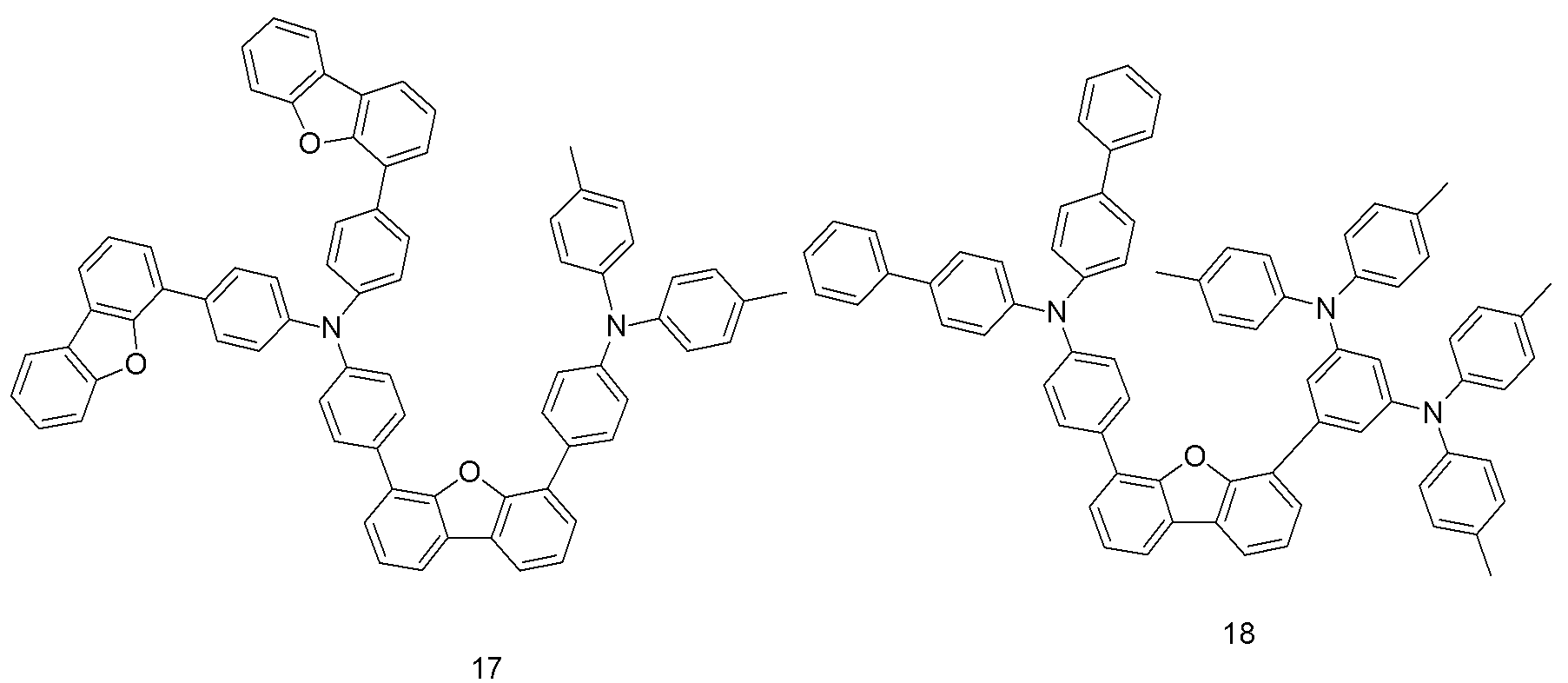


- An organic electroluminescent device, including the compound of claim 1.
- An organic electroluminescent device, comprising a first electrode, a second electrode, and a single organic layer or a plurality of organic layers between the first electrode and the second electrode, wherein one or more organic layers selected from among the single organic layer or the plurality of organic layers include the compound of claim 1.
- The organic electroluminescent device of claim 6, wherein the single organic layer or the plurality of organic layers include a light emitting layer.
- The organic electroluminescent device of claim 6, wherein the plurality of organic layers include a light emitting layer, and the plurality of organic layers further include one or more selected from among an electron injection layer, an electron transport layer, a hole blocking layer, an electron blocking layer, a hole transport layer and a hole injection layer.
- The organic electroluminescent device of claim 7, wherein the light emitting layer includes a host and a dopant.
Applications Claiming Priority (2)
| Application Number | Priority Date | Filing Date | Title |
|---|---|---|---|
| KR20130112615A KR20150033082A (en) | 2013-09-23 | 2013-09-23 | Compound for organic electroluminescent device and organic electroluminescent device comprising the same |
| KR10-2013-0112615 | 2013-09-23 |
Publications (1)
| Publication Number | Publication Date |
|---|---|
| WO2015041492A1 true WO2015041492A1 (en) | 2015-03-26 |
Family
ID=52689092
Family Applications (1)
| Application Number | Title | Priority Date | Filing Date |
|---|---|---|---|
| PCT/KR2014/008783 Ceased WO2015041492A1 (en) | 2013-09-23 | 2014-09-22 | Compound for organic electroluminescent device and organic electroluminescent device including the same |
Country Status (2)
| Country | Link |
|---|---|
| KR (1) | KR20150033082A (en) |
| WO (1) | WO2015041492A1 (en) |
Cited By (16)
| Publication number | Priority date | Publication date | Assignee | Title |
|---|---|---|---|---|
| EP3015464A1 (en) * | 2014-10-28 | 2016-05-04 | Samsung Display Co., Ltd. | Material for heterocyclic organic electroluminescent device and heterocyclic organic electroluminescent device including the same |
| WO2017148565A1 (en) * | 2016-03-03 | 2017-09-08 | Merck Patent Gmbh | Materials for organic electroluminescence devices |
| CN108117543A (en) * | 2016-11-29 | 2018-06-05 | 东进世美肯株式会社 | Compounds and the organic electroluminescence device for including it |
| JP2018118933A (en) * | 2017-01-26 | 2018-08-02 | 株式会社リコー | Electrochromic compound, electrochromic composition, and electrochromic device |
| US10205102B2 (en) | 2015-06-17 | 2019-02-12 | Samsung Display Co., Ltd. | Material for organic electroluminescent device and organic electroluminescent device including the same |
| US10290813B2 (en) * | 2014-10-28 | 2019-05-14 | Samsung Display Co., Ltd. | Material for organic electroluminescent device and organic electroluminescent device including the same |
| US20190241548A1 (en) * | 2015-11-26 | 2019-08-08 | Duk San Neolux Co., Ltd. | Compound for organic electronic element, organic electronic element using same, and electronic device comprising same |
| US10693079B2 (en) | 2015-06-17 | 2020-06-23 | Samsung Display Co., Ltd. | Mono amine derivatives and organic electroluminescent device including the same |
| US11261176B2 (en) | 2017-01-26 | 2022-03-01 | Lg Chem, Ltd. | Amine-based compound and organic light emitting device using the same |
| US11358946B2 (en) * | 2016-09-20 | 2022-06-14 | Duk San Neolux Co., Ltd. | Compound for organic electronic element, organic electronic element using same and electronic device therefor |
| CN114907298A (en) * | 2021-02-09 | 2022-08-16 | 德山新勒克斯有限公司 | Compound for organic electronic element, organic electronic element using the same, and electronic device thereof |
| CN116583507A (en) * | 2020-12-14 | 2023-08-11 | 德山新勒克斯有限公司 | Compound for use in organic electronic components, organic electronic component using the same, and electronic device thereof |
| US12041848B2 (en) * | 2015-12-08 | 2024-07-16 | Lg Chem, Ltd. | Heterocyclic compound and organic light emitting element comprising same |
| US12268086B2 (en) * | 2015-04-13 | 2025-04-01 | Duk San Neolux Co., Ltd. | Compound for organic electric element, organic electric element comprising the same and electronic device thereof |
| US12389793B2 (en) | 2018-07-06 | 2025-08-12 | Lg Chem, Ltd. | Compound and organic light emitting device comprising the same |
| US12527216B2 (en) | 2020-12-29 | 2026-01-13 | Duk San Neolux Co., Ltd. | Compound for organic electronic element, organic electronic element using the same, and an electronic device thereof |
Families Citing this family (23)
| Publication number | Priority date | Publication date | Assignee | Title |
|---|---|---|---|---|
| KR101822477B1 (en) | 2015-03-16 | 2018-01-26 | 덕산네오룩스 주식회사 | Compound for organic electric element, organic electric element comprising the same and electronic device thereof |
| KR101830709B1 (en) * | 2015-11-06 | 2018-02-21 | 희성소재(주) | Hetero-cyclic compound and organic light emitting device using the same |
| WO2017090919A1 (en) * | 2015-11-26 | 2017-06-01 | 덕산네오룩스 주식회사 | Compound for organic electronic element, organic electronic element using same, and electronic device comprising same |
| WO2017196081A1 (en) * | 2016-05-11 | 2017-11-16 | Sk Chemicals Co., Ltd. | Compound for organic electroluminescent device and organic electroluminescent device comprising the same |
| KR102182552B1 (en) * | 2017-02-14 | 2020-11-24 | 덕산네오룩스 주식회사 | Compound for organic electric element, organic electric element comprising the same and electronic device thereof |
| KR102746526B1 (en) | 2018-12-18 | 2024-12-27 | 솔루스첨단소재 주식회사 | Organic compounds and organic electro luminescence device comprising the same |
| KR20200076002A (en) | 2018-12-18 | 2020-06-29 | 두산솔루스 주식회사 | Organic compounds and organic electro luminescence device comprising the same |
| KR102938011B1 (en) | 2018-12-18 | 2026-03-11 | 솔루스첨단소재 주식회사 | Organic compounds and organic electro luminescence device comprising the same |
| KR102746525B1 (en) | 2018-12-18 | 2024-12-26 | 솔루스첨단소재 주식회사 | Organic compounds and organic electro luminescence device comprising the same |
| KR102686342B1 (en) | 2019-12-06 | 2024-07-19 | 솔루스첨단소재 주식회사 | Organic light-emitting compound and organic electroluminescent device using the same |
| KR102729166B1 (en) | 2019-12-06 | 2024-11-13 | 솔루스첨단소재 주식회사 | Organic compounds and organic electro luminescence device comprising the same |
| KR102809023B1 (en) | 2019-12-06 | 2025-05-15 | 솔루스첨단소재 주식회사 | Organic light-emitting compound and organic electroluminescent device using the same |
| KR20210071271A (en) | 2019-12-06 | 2021-06-16 | 솔루스첨단소재 주식회사 | Organic light-emitting compound and organic electroluminescent device using the same |
| KR102780054B1 (en) | 2019-12-24 | 2025-03-12 | 솔루스첨단소재 주식회사 | Organic compounds and organic electro luminescence device comprising the same |
| KR102767317B1 (en) | 2019-12-24 | 2025-02-17 | 솔루스첨단소재 주식회사 | Organic compounds and organic electro luminescence device comprising the same |
| KR102857178B1 (en) | 2020-06-18 | 2025-09-11 | 솔루스첨단소재 주식회사 | Organic light-emitting compound and organic electroluminescent device using the same |
| KR102952050B1 (en) | 2020-06-18 | 2026-04-14 | 솔루스첨단소재 주식회사 | Organic light-emitting compound and organic electroluminescent device using the same |
| KR102767368B1 (en) | 2020-06-18 | 2025-02-17 | 솔루스첨단소재 주식회사 | Organic light-emitting compound and organic electroluminescent device using the same |
| KR102815176B1 (en) | 2020-07-14 | 2025-06-02 | 솔루스첨단소재 주식회사 | Organic light-emitting compound and organic electroluminescent device using the same |
| KR102643973B1 (en) | 2020-10-06 | 2024-03-07 | 솔루스첨단소재 주식회사 | Organic compound and organic electroluminescent device comprising the same |
| KR20220084871A (en) | 2020-12-14 | 2022-06-21 | 솔루스첨단소재 주식회사 | Organic light-emitting compound and organic electroluminescent device using the same |
| KR102736371B1 (en) | 2020-12-16 | 2024-12-02 | 솔루스첨단소재 주식회사 | Organic light-emitting compound and organic electroluminescent device using the same |
| KR20220086224A (en) | 2020-12-16 | 2022-06-23 | 솔루스첨단소재 주식회사 | Organic light-emitting compound and organic electroluminescent device using the same |
Citations (6)
| Publication number | Priority date | Publication date | Assignee | Title |
|---|---|---|---|---|
| JP2005112765A (en) * | 2003-10-07 | 2005-04-28 | Mitsui Chemicals Inc | Heterocyclic compound and organic electroluminescent device containing the compound |
| JP2009267255A (en) * | 2008-04-28 | 2009-11-12 | Idemitsu Kosan Co Ltd | Material for organic electroluminescent element and organic electroluminescent element using the material |
| WO2010095621A1 (en) * | 2009-02-18 | 2010-08-26 | 出光興産株式会社 | Aromatic amine derivative and organic electroluminescent element |
| WO2011004639A1 (en) * | 2009-07-07 | 2011-01-13 | コニカミノルタホールディングス株式会社 | Organic electroluminescent element, novel compound, lighting device and display device |
| US20120018714A1 (en) * | 2001-03-01 | 2012-01-26 | Konica Minolta Holdings, Inc. | Organic electroluminescent device, display apparatus, and lighting apparatus |
| JP2013016717A (en) * | 2011-07-06 | 2013-01-24 | Konica Minolta Holdings Inc | Organic electroluminescent element, display device, and lighting device |
-
2013
- 2013-09-23 KR KR20130112615A patent/KR20150033082A/en not_active Withdrawn
-
2014
- 2014-09-22 WO PCT/KR2014/008783 patent/WO2015041492A1/en not_active Ceased
Patent Citations (6)
| Publication number | Priority date | Publication date | Assignee | Title |
|---|---|---|---|---|
| US20120018714A1 (en) * | 2001-03-01 | 2012-01-26 | Konica Minolta Holdings, Inc. | Organic electroluminescent device, display apparatus, and lighting apparatus |
| JP2005112765A (en) * | 2003-10-07 | 2005-04-28 | Mitsui Chemicals Inc | Heterocyclic compound and organic electroluminescent device containing the compound |
| JP2009267255A (en) * | 2008-04-28 | 2009-11-12 | Idemitsu Kosan Co Ltd | Material for organic electroluminescent element and organic electroluminescent element using the material |
| WO2010095621A1 (en) * | 2009-02-18 | 2010-08-26 | 出光興産株式会社 | Aromatic amine derivative and organic electroluminescent element |
| WO2011004639A1 (en) * | 2009-07-07 | 2011-01-13 | コニカミノルタホールディングス株式会社 | Organic electroluminescent element, novel compound, lighting device and display device |
| JP2013016717A (en) * | 2011-07-06 | 2013-01-24 | Konica Minolta Holdings Inc | Organic electroluminescent element, display device, and lighting device |
Cited By (32)
| Publication number | Priority date | Publication date | Assignee | Title |
|---|---|---|---|---|
| US10290813B2 (en) * | 2014-10-28 | 2019-05-14 | Samsung Display Co., Ltd. | Material for organic electroluminescent device and organic electroluminescent device including the same |
| US9590186B2 (en) | 2014-10-28 | 2017-03-07 | Samsung Display Co., Ltd. | Material for organic electroluminescent device and organic electroluminescent device including the same |
| EP3214080A1 (en) * | 2014-10-28 | 2017-09-06 | Samsung Display Co., Ltd. | Material for heterocyclic organic electroluminescent device and heterocyclic organic electroluminescent device including the same |
| US12550609B2 (en) | 2014-10-28 | 2026-02-10 | Samsung Display Co., Ltd. | Material for organic electroluminescent device and organic electroluminescent device including the same |
| EP3015464A1 (en) * | 2014-10-28 | 2016-05-04 | Samsung Display Co., Ltd. | Material for heterocyclic organic electroluminescent device and heterocyclic organic electroluminescent device including the same |
| US11050025B2 (en) | 2014-10-28 | 2021-06-29 | Samsung Display Co., Ltd. | Material for organic electroluminescent device and organic electroluminescent device including the same |
| US12268086B2 (en) * | 2015-04-13 | 2025-04-01 | Duk San Neolux Co., Ltd. | Compound for organic electric element, organic electric element comprising the same and electronic device thereof |
| US10205102B2 (en) | 2015-06-17 | 2019-02-12 | Samsung Display Co., Ltd. | Material for organic electroluminescent device and organic electroluminescent device including the same |
| US10693079B2 (en) | 2015-06-17 | 2020-06-23 | Samsung Display Co., Ltd. | Mono amine derivatives and organic electroluminescent device including the same |
| US20190241548A1 (en) * | 2015-11-26 | 2019-08-08 | Duk San Neolux Co., Ltd. | Compound for organic electronic element, organic electronic element using same, and electronic device comprising same |
| US12041848B2 (en) * | 2015-12-08 | 2024-07-16 | Lg Chem, Ltd. | Heterocyclic compound and organic light emitting element comprising same |
| WO2017148565A1 (en) * | 2016-03-03 | 2017-09-08 | Merck Patent Gmbh | Materials for organic electroluminescence devices |
| TWI724113B (en) * | 2016-03-03 | 2021-04-11 | 德商麥克專利有限公司 | Materials for organic electroluminescent devices |
| JP2019510011A (en) * | 2016-03-03 | 2019-04-11 | メルク パテント ゲーエムベーハー | Materials for organic electroluminescent devices |
| US12583842B2 (en) | 2016-03-03 | 2026-03-24 | Merck Patent Gmbh | Materials for organic electroluminescent devices |
| US12065431B2 (en) | 2016-03-03 | 2024-08-20 | Merck Patent Gmbh | Materials for organic electroluminescent devices |
| JP7080821B2 (en) | 2016-03-03 | 2022-06-06 | メルク パテント ゲーエムベーハー | Materials for OLED devices |
| US12441715B2 (en) | 2016-03-03 | 2025-10-14 | Merck Patent Gmbh | Materials for organic electroluminescent devices |
| US11608327B2 (en) | 2016-03-03 | 2023-03-21 | Merck Patent Gmbh | Materials for organic electroluminescent devices |
| US10961230B2 (en) | 2016-03-03 | 2021-03-30 | Merck Patent Gmbh | Materials for organic electroluminescent devices |
| US11358946B2 (en) * | 2016-09-20 | 2022-06-14 | Duk San Neolux Co., Ltd. | Compound for organic electronic element, organic electronic element using same and electronic device therefor |
| CN108117543A (en) * | 2016-11-29 | 2018-06-05 | 东进世美肯株式会社 | Compounds and the organic electroluminescence device for including it |
| CN108117543B (en) * | 2016-11-29 | 2023-09-12 | 东进世美肯株式会社 | Novel compounds and organic electroluminescent devices containing the same |
| US10975296B2 (en) | 2017-01-26 | 2021-04-13 | Ricoh Company, Ltd. | Electrochromic compound, electrochromic composition, and electrochromic element |
| US11261176B2 (en) | 2017-01-26 | 2022-03-01 | Lg Chem, Ltd. | Amine-based compound and organic light emitting device using the same |
| JP2018118933A (en) * | 2017-01-26 | 2018-08-02 | 株式会社リコー | Electrochromic compound, electrochromic composition, and electrochromic device |
| US12389793B2 (en) | 2018-07-06 | 2025-08-12 | Lg Chem, Ltd. | Compound and organic light emitting device comprising the same |
| CN116583507A (en) * | 2020-12-14 | 2023-08-11 | 德山新勒克斯有限公司 | Compound for use in organic electronic components, organic electronic component using the same, and electronic device thereof |
| CN116583507B (en) * | 2020-12-14 | 2025-04-25 | 德山新勒克斯有限公司 | Compound for organic electronic element, organic electronic element using the same, and electronic device using the same |
| US12527216B2 (en) | 2020-12-29 | 2026-01-13 | Duk San Neolux Co., Ltd. | Compound for organic electronic element, organic electronic element using the same, and an electronic device thereof |
| CN114907298A (en) * | 2021-02-09 | 2022-08-16 | 德山新勒克斯有限公司 | Compound for organic electronic element, organic electronic element using the same, and electronic device thereof |
| CN114907298B (en) * | 2021-02-09 | 2025-12-26 | 德山新勒克斯有限公司 | Compounds for use in organic electronic components, organic electronic components using these compounds, and electronic devices thereof. |
Also Published As
| Publication number | Publication date |
|---|---|
| KR20150033082A (en) | 2015-04-01 |
Similar Documents
| Publication | Publication Date | Title |
|---|---|---|
| WO2015041492A1 (en) | Compound for organic electroluminescent device and organic electroluminescent device including the same | |
| WO2014200260A1 (en) | Compound for organic electroluminescent device and organic electroluminescent device including the same | |
| KR102023792B1 (en) | Benzofluorene compound, material for light-emitting layer which is produced using said compound, and organic electroluminescent element | |
| WO2012015265A1 (en) | Novel organic electroluminescent compounds and organic electroluminescent device using the same | |
| WO2011132866A1 (en) | Novel compounds for organic electronic material and organic electroluminescent device using the same | |
| WO2014021572A1 (en) | Compound for organic electroluminescent device and organic electroluminescent device including the same | |
| WO2012011756A1 (en) | Novel organic electroluminescent compounds and organic electroluminescent devices including the same | |
| WO2010110553A2 (en) | Novel organic electroluminescent compounds and organic electroluminescent device using the same | |
| WO2011136484A1 (en) | Novel organic electroluminescent compounds and organic electroluminescent device using the same | |
| WO2011136482A1 (en) | Novel organic electroluminescent compounds and organic electroluminescent device using the same | |
| WO2011126224A1 (en) | Novel organic electroluminescent compounds and organic electroluminescent device using the same | |
| WO2011071255A1 (en) | Novel organic electroluminescent compounds and organic electroluminescent device using the same | |
| WO2010151006A1 (en) | Novel organic electroluminescent compounds and organic electroluminescent device using the same | |
| WO2010114253A2 (en) | Novel organic electroluminescent compounds and organic electroluminescent device using the same | |
| WO2011019156A1 (en) | Novel organic electroluminescent compounds and organic electroluminescent device using the same | |
| WO2017142310A1 (en) | Heterocyclic compound and organic electroluminescent device comprising same | |
| WO2011093609A1 (en) | Novel organic electroluminescent compounds and organic electroluminescent device using the same | |
| WO2015026053A1 (en) | Compound for organic electroluminescent device and organic electroluminescent device including the same | |
| KR20170127357A (en) | Compound for organic electroluminescent device and organic electroluminescent device comprising the same | |
| KR20150072644A (en) | Compound for organic electroluminescent device and organic electroluminescent device comprising the same | |
| KR20150072768A (en) | Compound for organic electroluminescent device and organic electroluminescent device comprising the same | |
| WO2012030145A1 (en) | Novel compounds for organic electronic material and organic electroluminescent device using the same | |
| WO2010126233A1 (en) | Novel organic electroluminescent compounds and organic electroluminescent device using the same | |
| WO2011016648A1 (en) | Novel organic electroluminescent compounds and organic electroluminescent device using the same | |
| WO2010047551A2 (en) | Aromatic derivatives and organic electroluminescent device comprising the same |
Legal Events
| Date | Code | Title | Description |
|---|---|---|---|
| 121 | Ep: the epo has been informed by wipo that ep was designated in this application |
Ref document number: 14845766 Country of ref document: EP Kind code of ref document: A1 |
|
| NENP | Non-entry into the national phase |
Ref country code: DE |
|
| 122 | Ep: pct application non-entry in european phase |
Ref document number: 14845766 Country of ref document: EP Kind code of ref document: A1 |