WO2015037140A1 - シャツ - Google Patents
シャツ Download PDFInfo
- Publication number
- WO2015037140A1 WO2015037140A1 PCT/JP2013/074898 JP2013074898W WO2015037140A1 WO 2015037140 A1 WO2015037140 A1 WO 2015037140A1 JP 2013074898 W JP2013074898 W JP 2013074898W WO 2015037140 A1 WO2015037140 A1 WO 2015037140A1
- Authority
- WO
- WIPO (PCT)
- Prior art keywords
- shoulder
- humerus
- shirt
- sleeve
- epicondyle
- Prior art date
- Legal status (The legal status is an assumption and is not a legal conclusion. Google has not performed a legal analysis and makes no representation as to the accuracy of the status listed.)
- Ceased
Links
Images



Classifications
-
- A—HUMAN NECESSITIES
- A41—WEARING APPAREL
- A41D—OUTERWEAR; PROTECTIVE GARMENTS; ACCESSORIES
- A41D27/00—Details of garments or of their making
- A41D27/10—Sleeves; Armholes
-
- A—HUMAN NECESSITIES
- A41—WEARING APPAREL
- A41D—OUTERWEAR; PROTECTIVE GARMENTS; ACCESSORIES
- A41D1/00—Garments
- A41D1/04—Vests, jerseys, sweaters or the like
-
- A—HUMAN NECESSITIES
- A41—WEARING APPAREL
- A41D—OUTERWEAR; PROTECTIVE GARMENTS; ACCESSORIES
- A41D13/00—Professional, industrial or sporting protective garments, e.g. surgeons' gowns or garments protecting against blows or punches
- A41D13/0015—Sports garments other than provided for in groups A41D13/0007 - A41D13/088
Definitions
- the present invention relates to a shirt that can reduce the drag that tends to occur due to the cuffs of the sleeve when moving the shoulder joint greatly, and can eliminate the sense of incongruity and tightness caused by the pull.
- the present invention is particularly preferably used as an exercise shirt when performing a sport in which a shoulder joint such as tennis, handball, badminton, table tennis or the like moves greatly.
- the shoulder movement involves five joints, including the shoulder joint with the highest mobility in the human body, and has great anatomical freedom. Therefore, the shoulder performs a wide range of movements in all sports.
- tennis or the like has a horizontal movement such as a stroke and a vertical movement such as a serve, and the movement is wide-ranging.
- Patent Document 1 proposes a highly stretchable material between the sleeve part and the body part.
- Patent Document 1 Japanese Patent Laid-Open No. 11-61530
- the sleeve length of a shirt having a sleeve portion is mainly the length that covers the large nodule and does not cover the outer epicondyle of the humerus when the arm is lowered with the palm toward the front.
- the competition rules stipulate that “shirts should be worn with short-sleeved shirts with sleeves”, and shirts without sleeves may not be worn.
- the present invention intends to provide a shirt that can reduce the catch on the upper arm of the cuff when a wide range of movement around the shoulder is performed.
- the present invention provides a shirt comprising a sleeve-length sleeve portion that covers a large nodule and does not cover the outer epicondyle of the humerus with the palm facing the front and the arm down.
- the frontal region of the upper arm surrounded by a line segment G connecting the acromion and the lateral epicondyle of the humerus and a line segment H connecting the anterior saddle point and the medial epicondyle of the humerus with the arm facing downward
- At least a part of the cuff is located on the shoulder side more proximally than the position of the cuff on the upper arm back surface area excluding the upper arm front area.
- the cuffs on the upper arm front region In order to position at least a part of the cuffs on the upper arm front region closer to the shoulder side than the position of the cuffs on the upper arm rear region excluding the upper arm front region, for example, the cuffs on the upper arm front region What is necessary is just to form the recessed part which goes to the shoulder side proximally.
- At least a part of the cuffs applied to the upper arm part front region is closer to the shoulder side than the position of the cuffs applied to the upper arm part back region in a state where the arm is lowered with the palm toward the front. Because of its position, it catches on the cuffs of the biceps, triceps and deltoid muscles (middle part of the muscle), which are active in a wide range of shoulder movements during shoulder abduction and horizontal adduction Can be relieved and the tension around the shoulder can be reduced.
- the shirt according to the present invention even when there is a wide movement of the shoulder, the catch on the upper arm of the cuff of the sleeve is relieved, so the horizontal and vertical movements of the shoulder such as tennis, handball or badminton are possible. This is especially useful in frequent competitions.
- the shirt 1 of Embodiment 1 shown in FIG.1 and FIG.2 consists of the body part 2 and the cylindrical sleeve part 3.
- FIG. 1 and FIG.2 The shirt 1 of Embodiment 1 shown in FIG.1 and FIG.2 consists of the body part 2 and the cylindrical sleeve part 3.
- the sleeve 3 of the shirt 1 of Embodiment 1 is exemplified as a set-in type, but may be a raglan type.
- the site part of the wearer who wears the shirt 1 which concerns on this invention is defined as follows.
- the shoulder ridge A is the protrusion at the top of the shoulder.
- the large nodule B refers to the upper protrusion of the humerus C on the side of the shoulder.
- the forefoot point D refers to a part located in front of the base of the upper limb.
- the humerus medial epicondyle E is a protrusion located inside the distal end of the humerus C when the arm is lowered with the palm toward the front.
- the humerus lateral epicondyle F is a protrusion located outside the distal end of the humerus C when the arm is lowered with the palm toward the front.
- the line segment G is a line segment connecting the acromion A and the lateral epicondyle F of the humerus.
- a line segment H is a line segment connecting the anterior saddle point D and the medial epicondyle E of the humerus.
- the upper arm front region I refers to a region located in the front when the arm is lowered with the palm toward the front among the regions surrounded by the line segment G and line segment H of the upper arm.
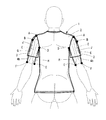
- region I is shown with the light ink in each embodiment of FIG.1, FIG.3, FIG.4, FIG.5 and FIG.
- the upper arm part back area J refers to an area other than the upper arm front area I of the upper arm part.
- the sleeve 3 of the shirt 1 has a sleeve length that covers the large nodule B and does not cover the outer epicondyle F of the humerus with the arm down with the palm facing the front, At least a part of the cuff 4a over the front region I of the humerus surrounded by a line segment G connecting A and the humerus outer epicondyle F and a line segment H connecting the anterior saddle point D and the humerus medial epicondyle E is , Located closer to the shoulder side than the position of the cuff 4b on the upper arm back region J excluding the upper arm front region I surrounded by the line segment G and the line segment H.
- the shirt according to the present invention is preferably formed so that at least a part of the biceps muscle abdominal muscle, the triceps abdominal muscle abdominal muscle and the deltoid muscle abdominal muscle is exposed. These muscles are active in a wide range of shoulder movements during shoulder abduction and horizontal adduction movements, but at least part of these muscle bellies are exposed to reduce clogging on the cuffs, The tension around the shoulder can be reduced.
- the shirt 1 In the shirt 1 according to the first embodiment shown in FIGS. 1 and 2, at least a part of the cuff 4 a related to the upper arm front region I is excluded from the upper arm front region I surrounded by the line segment G and the line segment H.
- a concave portion 4c directed to the proximal side of the shoulder side is formed in the cuff 4a applied to the upper arm portion front surface region I.
- Examples of the shape of the recess 4c include “a shape including a bottom portion and two connecting portions (side portions)”, “a shape curved in an arc”, and the like.
- the bottom part and the connection part can be appropriately set in a linear shape, a curved line shape, a wavy line shape, a zigzag line shape, or the like, and the bottom portion may have a dot shape.
- the concave portion 4c may enter the upper arm portion rear surface region J as long as the circumferential length of the upper arm in the cuff portion is shorter than the upper arm portion front region I.
- the recessed part 4c may be formed in multiple numbers by the upper arm part front surface area
- the cuff 4a and the cuff 4b are linear, wavy, zigzag line, etc., as long as they do not impede the relaxation of the cuffs of the biceps, triceps and deltoids. Can be set as appropriate.
- the width of the bottom of the recess 4c is preferably 40% or more, more preferably 60% or more, and more preferably 80% or more with respect to the distance from the humeral outer epicondyle F to the humeral medial epicondyle E. Is particularly preferred. If the width of the bottom of the recess 4c is 40% or more of the distance from the lateral humerus epicondyle F to the medial humeral epicondyle E, the biceps brachii muscle that is active in a wide range of shoulder movements In addition, the triceps and deltoid muscles are easily relieved from catching on the cuffs.
- the width of the cuff portion in the recess 4c is preferably 40% or more, more preferably 60% or more with respect to the distance from the humerus outer epicondyle F to the humerus medial epicondyle E, A length of 80% or more is particularly preferred. If the width of the cuff portion in the concave portion 4c is 40% or more with respect to the distance from the lateral humerus epicondyle F to the medial humerus epicondyle E, the two humers that are largely active in a wide movement of the shoulder The design which eases the catch on the cuffs of the muscle abdomen such as muscles, triceps, deltoid muscles, etc. becomes easy.
- the width of the cuff portion is wider than the width of the bottom portion, and the connecting portion between the bottom portion and the cuff portion is inclined or curved.
- the width of the bottom part and the cuff part in the concave part 4c is such that when the shirt is worn, the palm is turned to the front side with the arm lowered to the body side, and the body is viewed from the upper side with the arm raised 90 degrees from there. It means the straight line length on the plane of the part.
- the recess 4c of the cuff 4a of the shirt 1 of Embodiment 1 shown in FIGS. 1 and 2 is wide and bent in a straight line.
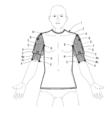
- the shirt 1 of the second embodiment shown in FIG. 3 is provided with a concave portion 4c that is bent linearly in the cuff 4a.
- the width of the concave portion 4c of the second embodiment is the same as that of the concave portion 4c of the first embodiment. It is formed narrower than the width of.
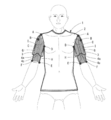
- the shirt 1 of Embodiment 3 shown in FIG. 4 is an example in which a cuff 4a is provided with a concave portion 4c having an arcuate bottom.
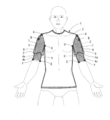
- the shirt 1 of Embodiment 4 shown in FIG. 5 is an example in which a crevice 4a is provided with a recess 4c whose bottom is inclined obliquely.
- the shirt 1 of the fifth embodiment shown in FIG. 6 is an example in which the cuff 4a is provided with a recess 4c whose bottom portion is inclined obliquely. This point is the same as the fourth embodiment shown in FIG.
- the width of the recess 4c of the fifth embodiment shown is formed to be narrower than the width of the recess 4c of the fourth embodiment shown in FIG.
- the shirt 1 according to the present invention is such that at least a part of the cuff 4a applied to the upper arm front surface region I is shouldered more than the position of the cuff 4b applied to the upper arm rear region J in a state where the arm is lowered with the palm toward the front. Because of its proximal position, the biceps, triceps, and deltoid muscles, which are highly active during shoulder abduction and horizontal adduction, do not catch the cuff 4a. This effect is also manifested when the fabric contains moisture due to sweat.
- the catch on the upper arm of the sleeve portion 3 is alleviated in a wide range of movements of the shoulder, it is possible to reduce the tension around the shoulder, so that tennis, handball or badminton This is particularly useful in competitions where the horizontal and vertical movements of the shoulder frequently occur.
- the shirt 1 of the present invention used for the test used the embodiment shown in FIG. Specifically, the recess 4c has a length of 6 cm in the longitudinal direction, a length in the circumferential direction of the bottom portion of 7 cm, and a length in the circumferential direction of the cuff portion of 12 cm.
- Test conditions are Operation frequency: 30 times / min each Repeat number: 10 times per trial Number of trials: 3 trials each
- the motion at the time of the trial is an optical three-dimensional motion analyzer (VICON ⁇ Motion ⁇ Systems, VICON), 2 points around the shoulder joint shown in Fig. 7 and Fig. 8 (shoulder rear part J, center of shoulder (under shoulder peak) K) was measured with an air pack type contact pressure measuring instrument (AMI techno, AMI-3037-10).
- the integrated value of the contact pressure in a certain section during the shoulder joint horizontal addition operation shown in FIG. 7 and the abduction operation shown in FIG. 8 was used as the evaluation value.
- the measurement interval is 0 ° to 90 ° using the wrist marker measured by VICON, and in the case of the abduction operation shown in FIG. 30 to 110 °.
- the value of the shoulder rear portion J in the horizontal adduction operation shown in FIG. Note that the sampling frequency of the applied pressure was 1 kHz.
Landscapes
- Engineering & Computer Science (AREA)
- Textile Engineering (AREA)
- Health & Medical Sciences (AREA)
- General Health & Medical Sciences (AREA)
- Physical Education & Sports Medicine (AREA)
- Professional, Industrial, Or Sporting Protective Garments (AREA)
- Details Of Garments (AREA)
- Outer Garments And Coats (AREA)
Abstract
肩まわりの広範な動作を行った場合に、袖口(4a)の上腕への引っ掛かりを軽減することができるシャツ(1)を提供することを課題とする。 大結節(B)を覆い、かつ上腕骨外側上顆(F)を覆わない袖丈の袖部(3)を備えるシャツ(1)において、手掌を前面に向けて腕を下した状態で、肩峰(A)と上腕骨外側上顆(F)を結ぶ線分(G)と、前腋点(D)と上腕骨内側上顆(E)を結ぶ線分(H)とによって囲まれた上腕部前面領域(I)にかかる袖口(4a)の少なくとも一部が、前記上腕部前面領域(I)を除く上腕部背面領域(J)にかかる袖口(4b)の位置よりも肩側の近位に位置するため、肩の外転および水平内転動作時における肩の広範な動きにおいて大きく活動する上腕二頭筋、上腕三頭筋および三角筋の筋腹の袖口(4a)へのひっかかりが緩和され、肩まわりのつっぱりを軽減することができる。
Description
この発明は、肩関節を大きく動かす動作を行う際に、袖部の袖口によって生じやすい引きつれを軽減し、引きつれによる違和感や窮屈さを解消することができるシャツに関するものである。また、この発明は、例えば、テニス、ハンドボール、バドミントン、卓球等の肩関節を大きく動かす動作のあるスポーツを行う際の運動用シャツとして特に好ましく用いられる。
肩の動きには人体で最も可動性の高い肩関節を含む5つの関節が関与しており、解剖学的に大きな自由度を持つ。そのため、あらゆるスポーツにおいて肩は広範な動作を行う。特に、テニスなどではストロークのような水平の動きとサーブのような上下の動きがあり、その動作は広範囲に及ぶ。
袖部のあるシャツを着用して肩まわりの広範な動作を行った場合、袖部の上腕への引っ掛かりによって、肩まわりのつっぱり(生地張力)による違和感や窮屈さを訴える選手が多い。
従来、シャツの中には、高伸縮性素材を袖部と身頃部との間に配置し、肩まわりのつっぱり緩和を狙ったものもある(特許文献1)。
特許文献1:特開平11-61530号公報
ところが、高伸縮性素材を袖部と身頃部との間に配置する従来の技術では、袖部の上腕への引っかかりによって生じる肩まわりのつっぱり(生地張力)を軽減するに留まり、上腕への袖口の引っかかりという根本的な問題の解決には至っていない。
さらに、実際の競技場面で想定される汗によって濡れた状態においては、生地と皮膚との摩擦が強まり、袖口の上腕への引っかかりがより強くなることが推察される。したがって、肩まわりのつっぱりを抑え肩の広範な動作をスムーズに行うためには、袖口の上腕への引っかかりという根本的な問題を解決することが重要になる。
一方、上腕の引っかかりが生じないように、袖なしシャツや袖の短いシャツを使用することも考えられる。
しかしながら、これらのシャツでは太陽光による疲労、発汗による不快感への対処が不十分となる。加えて、シルエットとして肩を露出することにためらいを感じる人も少なくない。
このため、袖部を有するシャツの袖丈は、手掌を前面に向けて腕を下した際に、大結節を覆い、かつ上腕骨外側上顆を覆わない長さが主流となっている。
また、競技規則において、「シャツは袖付き半袖シャツを着用すること」と定められ、袖なしのシャツを着用できない場合もある。
そこで、この発明は、肩まわりの広範な動作を行った場合に、袖口の上腕への引っ掛かりを軽減することができるシャツを提供しようとするものである。
この発明は、上記の課題を解決するために、手掌を前面に向けて腕を下した状態で、大結節を覆い、かつ上腕骨外側上顆を覆わない袖丈の袖部を備えるシャツにおいて、手掌を前面に向けて腕を下した状態で、肩峰と上腕骨外側上顆を結ぶ線分Gと、前腋点と上腕骨内側上顆を結ぶ線分Hとによって囲まれた上腕部前面領域にかかる袖口の少なくとも一部が、前記上腕部前面領域を除く上腕部背面領域にかかる袖口の位置よりも肩側の近位に位置することを特徴とする。
上腕部前面領域にかかる袖口の少なくとも一部を、上腕部前面領域を除く上腕部背面領域にかかる袖口の位置よりも肩側の近位に位置させるには、例えば、上腕部前面領域にかかる袖口に肩側の近位に向かう凹部を形成すればよい。
この発明に係るシャツは、手掌を前面に向けて腕を下した状態で、上腕部前面領域にかかる袖口の少なくとも一部が、上腕部背面領域にかかる袖口の位置よりも肩側の近位に位置するため、肩の外転および水平内転動作時における肩の広範な動きにおいて大きく活動する上腕二頭筋、上腕三頭筋および三角筋の筋腹(筋の中央部)の袖口へのひっかかりが緩和され、肩まわりのつっぱりを軽減することができる。
したがって、この発明に係るシャツは、肩の広範な動きがあっても袖部の袖口の上腕へのひっかかりが緩和されるので、テニスをはじめ、ハンドボールあるいはバドミントンなどといった肩の水平および上下の動作が頻出する競技において、特に有用である。
この効果は、汗によって生地が水分を含んだ際にも発現する。
以下、この発明に係るシャツの実施形態を説明する。なお、以下の実施形態において、同一の構成部分または同様の構成部分には、同一の符号を付し、説明を適宜省略する。
図1及び図2に示す実施形態1のシャツ1は、身頃部2と筒状の袖部3とからなる。
実施形態1のシャツ1の袖部3は、セットインタイプのものを例示しているが、ラグランタイプのもの等でもよい。
この発明に係るシャツ1を着用する着用者の部位は、次のように定義される。
・肩峰Aは、肩の最も上部にある突起をいう。
・大結節Bは、肩の側部にある上腕骨Cの上部の突起をいう。
・前腋点Dは、上肢の付け根のうち、前面に位置する部位をいう。
・上腕骨内側上顆Eは、手掌を前面に向けて腕を下ろした際、上腕骨Cの遠位端の内側に位置する突起をいう。
・上腕骨外側上顆Fは、手掌を前面に向けて腕を下ろした際、上腕骨Cの遠位端の外側に位置する突起をいう。
・線分Gは、肩峰Aと上腕骨外側上顆Fを結ぶ線分をいう。
・線分Hは、前腋点Dと上腕骨内側上顆Eを結ぶ線分をいう。
・上腕部前面領域Iは、上腕部の線分Gと線分Hによって囲まれた領域のうち、手掌を前面に向けて腕を下ろした際に前面に位置する領域をいう。なお、この上腕部前面領域Iは、図1、図3、図4、図5、図6の各実施形態において、薄墨で示している。
・上腕部背面領域Jは、上腕部の上腕部前面領域I以外の領域をいう。
・肩峰Aは、肩の最も上部にある突起をいう。
・大結節Bは、肩の側部にある上腕骨Cの上部の突起をいう。
・前腋点Dは、上肢の付け根のうち、前面に位置する部位をいう。
・上腕骨内側上顆Eは、手掌を前面に向けて腕を下ろした際、上腕骨Cの遠位端の内側に位置する突起をいう。
・上腕骨外側上顆Fは、手掌を前面に向けて腕を下ろした際、上腕骨Cの遠位端の外側に位置する突起をいう。
・線分Gは、肩峰Aと上腕骨外側上顆Fを結ぶ線分をいう。
・線分Hは、前腋点Dと上腕骨内側上顆Eを結ぶ線分をいう。
・上腕部前面領域Iは、上腕部の線分Gと線分Hによって囲まれた領域のうち、手掌を前面に向けて腕を下ろした際に前面に位置する領域をいう。なお、この上腕部前面領域Iは、図1、図3、図4、図5、図6の各実施形態において、薄墨で示している。
・上腕部背面領域Jは、上腕部の上腕部前面領域I以外の領域をいう。
この発明に係るシャツ1の袖部3は、手掌を前面に向けて腕を下した状態で、大結節Bを覆い、かつ上腕骨外側上顆Fを覆わない長さの袖丈であり、肩峰Aと上腕骨外側上顆Fを結ぶ線分Gと、前腋点Dと上腕骨内側上顆Eを結ぶ線分Hとによって囲まれた上腕部前面領域Iにかかる袖口4aの少なくとも一部が、前記線分Gと線分Hとによって囲まれた前記上腕部前面領域Iを除く上腕部背面領域Jにかかる袖口4bの位置よりも肩側の近位に位置する。
この発明に係るシャツは、上腕二頭筋の筋腹、上腕三頭筋の筋腹および三角筋の筋腹の少なくとも一部が露出されるように形成されていることが好ましい。これらの筋は、肩の外転および水平内転動作時における肩の広範な動きにおいて大きく活動するが、これらの筋腹の少なくとも一部が露出されていることによって袖口へのひっかかりが緩和され、肩まわりのつっぱりを軽減することができる。
図1及び図2に示す実施形態1のシャツ1においては、上腕部前面領域Iにかかる袖口4aの少なくとも一部を、線分Gと線分Hとによって囲まれた上腕部前面領域Iを除く上腕部背面領域Jにかかる袖口4bの位置よりも肩側の近位に位置させるために、上腕部前面領域Iにかかる袖口4aに、肩側の近位に向かう凹部4cを形成している。凹部4cの形状としては、「底部と2つの連結部(側部)とからなる形状」や「円弧状に湾曲する形状」等が挙げられる。なお、底部と連結部は、その形状を直線状や曲線状や波線状やジグザグ線状等に適宜設定することもでき、底部は、点状であってもよい。例えば、図1、図3、図4、図5、図6の各実施形態に示すもの等、適宜設定することができる。ここで、凹部4cは、袖口部分における上腕の周方向の長さが上腕部前面領域Iよりも短くなる範囲であれば上腕部背面領域Jに入り込んでいてもよい。また、凹部4cは、上腕部前面領域Iに複数形成されていてもよい。なお、袖口4aと袖口4bは、上腕二頭筋、上腕三頭筋および三角筋の筋腹の袖口へのひっかかりの緩和を阻害しない範囲で、その形状を直線状や波線状やジグザグ線状等に適宜設定することができる。
凹部4cの形状について以下に具体的に説明する。凹部4cにおける底部の幅は、上腕骨外側上顆Fから上腕骨内側上顆Eまでの距離に対して、40%以上の長さが好ましく、60%以上の長さがより好ましく、80%以上の長さが特に好ましい。凹部4cにおける底部の幅が、上腕骨外側上顆Fから上腕骨内側上顆Eまでの距離に対して40%以上の長さであれば、肩の広範な動きにおいて大きく活動する上腕二頭筋、上腕三頭筋および三角筋の筋腹の袖口へのひっかかりが緩和されやすくなる。また、凹部4cにおける袖口部分の幅は、上腕骨外側上顆Fから上腕骨内側上顆Eまでの距離に対して、40%以上の長さが好ましく、60%以上の長さがより好ましく、80%以上の長さが特に好ましい。凹部4cにおける袖口部分の幅が、上腕骨外側上顆Fから上腕骨内側上顆Eまでの距離に対して40%以上の長さであれば、肩の広範な動きにおいて大きく活動する上腕二頭筋、上腕三頭筋、三角筋等の筋腹の袖口へのひっかかりを緩和する設計が容易になる。また、凹部4cにおいて、底部の幅よりも袖口部分の幅が広く、かつ上記底部と上記袖口部分との連結部を傾斜させたり曲線状にしておくことが好ましい。これにより、肩の広範な動きにおいて袖口の凹部の揺れを軽減し、上腕部前面領域の違和感を減少させることができる。ここで、凹部4cにおける底部および袖口部分の幅は、シャツ着用時に、体側に腕を下ろした状態で手掌を前面に向け、そこから腕を90度上に上げた状態で、体を上側から見たときの当該部分の平面上での直線長さをいう。例えば、図1及び図2に示す実施形態1のシャツ1の袖口4aの凹部4cは、広幅で直線状に屈曲している。
図3に示す実施形態2のシャツ1も、実施形態1と同様に、袖口4aに直線状に屈曲する凹部4cを設けており、実施形態2の凹部4cの幅は、実施形態1の凹部4cの幅よりも細幅に形成されている。
図4に示す実施形態3のシャツ1は、袖口4aに、底部が円弧状の凹部4cを設けた例である。
図5に示す実施形態4のシャツ1は、袖口4aに、底部が斜めに傾斜する凹部4cを設けた例である。
図6に示す実施形態5のシャツ1は、袖口4aに底部が斜めに傾斜する凹部4cを設けた例であり、この点は、図5に示す実施形態4と同様であるが、図6に示す実施形態5の凹部4cの幅は、図5に示す実施形態4の凹部4cの幅よりも細幅に形成されている。
この発明に係るシャツ1は、手掌を前面に向けて腕を下した状態で、上腕部前面領域Iにかかる袖口4aの少なくとも一部が、上腕部背面領域Jにかかる袖口4bの位置よりも肩側の近位に位置するため、肩の外転および水平内転動作時において大きく活動する上腕二頭筋、上腕三頭筋および三角筋の筋腹が、袖口4aにひっかからない。この効果は、汗によって生地が水分を含んだ際にも発現する。
したがって、この発明に係るシャツ1は、肩の広範な動きにおいて、袖部3の上腕へのひっかかりが緩和されるため、肩まわりのつっぱりを軽減することができるので、テニスをはじめ、ハンドボールあるいはバドミントンなどといった肩の水平および上下の動作が頻出する競技において特に有用である。
この発明のシャツ1と、袖口4a、4bに凹部を設けていない従来のシャツを着用して、肩の外転動作を行った際の肩中央部(肩峰下)および水平内転動作を行った際の肩後部のつっぱり試験を行った。
試験に用いたこの発明のシャツ1は、図1に示す実施形態のものを使用した。具体的な凹部4cの寸法は、長手方向の長さが6cm、底部の周方向の長さが7cm、袖口部分の周方向の長さが12cmである。
試験は、図7に示す水平内転動作および図8に示す外転動作を行わせた。なお、動作頻度はメトロノームを用い、動作を安定させるように被験者に十分教示した。
試験条件は、
動作頻度:各30回/分
反復回数:1試技につき10回
試技数:各3試技
とした。
動作頻度:各30回/分
反復回数:1試技につき10回
試技数:各3試技
とした。
試技の際の動作を光学式3次元動作分析装置(Vicon Motion Systems社製、VICON)、図7、図8に示す肩関節まわり2点(肩後部J、肩中央部(肩峰下)K)の着圧をエアパック式の接触圧測定器(エイエムアイテクノ社製、AMI 3037-10)によってそれぞれ測定した。
図7に示す肩関節水平内転動作および図8に示す外転動作時の一定区間における着圧の積算値を評価値として用いた。
測定区間は、VICONで測定した手首部のマーカーを用いて、図7に示す肩関節水平内転動作の場合は、0°から90°の区間とし、図8に示す外転動作時の場合は、30°から110°の区間とした。
着圧は、図7に示す水平内転動作では肩後部J、外転動作では肩中央部(肩峰下)Kの値を用いた。なお、着圧のサンプリング周波数は1kHzとした。
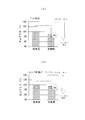
上記の試験結果は、図9に示す通りであり、この発明のシャツを着用した際には、上腕全体を覆う従来の袖口に比べ、肩の諸動作を行った際のつっぱりを示す評価値が減少していた。すなわち、肩の動きやすさが向上していた。なお、被験者もその効果を十分に体感していた。
1 シャツ
2 身頃部
3 袖部
4a、4b 袖口
2 身頃部
3 袖部
4a、4b 袖口
Claims (5)
- 手掌を前面に向けて腕を下した状態で、大結節を覆い、かつ上腕骨外側上顆を覆わない袖丈の袖部を備えるシャツにおいて、手掌を前面に向けて腕を下した状態で、肩峰と上腕骨外側上顆を結ぶ線分Gと、前腋点と上腕骨内側上顆を結ぶ線分Hとによって囲まれた上腕部前面領域にかかる袖口の少なくとも一部が、前記線分Gと線分Hとによって囲まれた前記上腕部前面領域を除く上腕部背面領域にかかる袖口の位置よりも肩側の近位に位置することを特徴とするシャツ。
- 前記上腕部前面領域の袖口に、肩側の近位に向かう凹部を有する請求項1記載のシャツ。
- 上腕二頭筋の筋腹、上腕三頭筋の筋腹および三角筋の筋腹の少なくとも一部が露出されるように形成されている請求項1又は2記載のシャツ。
- 前記凹部における底部の幅が、上腕骨外側上顆Fから上腕骨内側上顆Eまでの距離に対して、40%以上の長さを有する請求項2又は3に記載のシャツ。
- 前記凹部における袖口部分の幅が、上腕骨外側上顆Fから上腕骨内側上顆Eまでの距離に対して、40%以上の長さを有する請求項2~4のいずれかに記載のシャツ。
Priority Applications (2)
| Application Number | Priority Date | Filing Date | Title |
|---|---|---|---|
| PCT/JP2013/074898 WO2015037140A1 (ja) | 2013-09-13 | 2013-09-13 | シャツ |
| JP2015536405A JP6130512B2 (ja) | 2013-09-13 | 2013-09-13 | シャツ |
Applications Claiming Priority (1)
| Application Number | Priority Date | Filing Date | Title |
|---|---|---|---|
| PCT/JP2013/074898 WO2015037140A1 (ja) | 2013-09-13 | 2013-09-13 | シャツ |
Publications (1)
| Publication Number | Publication Date |
|---|---|
| WO2015037140A1 true WO2015037140A1 (ja) | 2015-03-19 |
Family
ID=52665282
Family Applications (1)
| Application Number | Title | Priority Date | Filing Date |
|---|---|---|---|
| PCT/JP2013/074898 Ceased WO2015037140A1 (ja) | 2013-09-13 | 2013-09-13 | シャツ |
Country Status (2)
| Country | Link |
|---|---|
| JP (1) | JP6130512B2 (ja) |
| WO (1) | WO2015037140A1 (ja) |
Citations (2)
| Publication number | Priority date | Publication date | Assignee | Title |
|---|---|---|---|---|
| JPS5430512U (ja) * | 1977-07-29 | 1979-02-28 | ||
| JP3037532U (ja) * | 1996-11-07 | 1997-05-20 | 吉田編織株式会社 | 袖ゴムとこの袖ゴムが設けられたニット製上衣 |
Family Cites Families (2)
| Publication number | Priority date | Publication date | Assignee | Title |
|---|---|---|---|---|
| JPS4942974B1 (ja) * | 1964-10-31 | 1974-11-18 | ||
| JP3095570U (ja) * | 2003-01-28 | 2003-08-08 | オンヨネ株式会社 | スポーツウェア |
-
2013
- 2013-09-13 WO PCT/JP2013/074898 patent/WO2015037140A1/ja not_active Ceased
- 2013-09-13 JP JP2015536405A patent/JP6130512B2/ja active Active
Patent Citations (2)
| Publication number | Priority date | Publication date | Assignee | Title |
|---|---|---|---|---|
| JPS5430512U (ja) * | 1977-07-29 | 1979-02-28 | ||
| JP3037532U (ja) * | 1996-11-07 | 1997-05-20 | 吉田編織株式会社 | 袖ゴムとこの袖ゴムが設けられたニット製上衣 |
Also Published As
| Publication number | Publication date |
|---|---|
| JPWO2015037140A1 (ja) | 2017-03-02 |
| JP6130512B2 (ja) | 2017-05-17 |
Similar Documents
| Publication | Publication Date | Title |
|---|---|---|
| US9445932B2 (en) | Orthopedic support garment | |
| US8776264B2 (en) | Garments for providing access for sensors to contact skin | |
| WO2010050540A1 (ja) | 衣類 | |
| JP7277655B2 (ja) | 衣類 | |
| US20090042702A1 (en) | Proprioception enhancement system | |
| US10092048B2 (en) | Garment | |
| JP2013503268A5 (ja) | ||
| Paiva et al. | Design of smart garments for sports and rehabilitation | |
| US20090113592A1 (en) | Shock absorber for sports | |
| US11877606B2 (en) | Lower body garment with an integrated resistance band | |
| Bairagi et al. | Studies on designing adaptive sportswear for differently abled wheelchair tennis players of India | |
| JP6130512B2 (ja) | シャツ | |
| US20240149095A1 (en) | Lower Body Garment with an Integrated Resistance Band | |
| CN104288962B (zh) | 航天肌肉健康保护服 | |
| JP6754790B2 (ja) | コンプレッションウェア | |
| CA2756969C (en) | Orthopedic support garment | |
| JP4761925B2 (ja) | サポートウェア | |
| WO2020078384A1 (en) | Kimono | |
| CN106263120A (zh) | 一种婴儿连体衣 | |
| JP4481934B2 (ja) | サポータ | |
| Kumbhar et al. | Correlation of Dance Functional Status with Lower Limb Flexibility, Power and Dynamic Balance in Recreational Ballet Dancers–A Cross-Sectional Study | |
| JP5145434B2 (ja) | サポートウェア | |
| Mano et al. | Novel knit fabric rehabilitation equipment for finger impairment | |
| KR101020978B1 (ko) | 기능성 바지 | |
| KR20230127054A (ko) | 입는 스포츠 테이핑을 활용한 기능성 운동복 제조 방법 |
Legal Events
| Date | Code | Title | Description |
|---|---|---|---|
| 121 | Ep: the epo has been informed by wipo that ep was designated in this application |
Ref document number: 13893266 Country of ref document: EP Kind code of ref document: A1 |
|
| ENP | Entry into the national phase |
Ref document number: 2015536405 Country of ref document: JP Kind code of ref document: A |
|
| NENP | Non-entry into the national phase |
Ref country code: DE |
|
| 122 | Ep: pct application non-entry in european phase |
Ref document number: 13893266 Country of ref document: EP Kind code of ref document: A1 |