WO2015025856A1 - 標的物質とリガンドとの結合親和性を測定するための方法、ならびに該方法に使用するための試薬助剤およびキット - Google Patents
標的物質とリガンドとの結合親和性を測定するための方法、ならびに該方法に使用するための試薬助剤およびキット Download PDFInfo
- Publication number
- WO2015025856A1 WO2015025856A1 PCT/JP2014/071682 JP2014071682W WO2015025856A1 WO 2015025856 A1 WO2015025856 A1 WO 2015025856A1 JP 2014071682 W JP2014071682 W JP 2014071682W WO 2015025856 A1 WO2015025856 A1 WO 2015025856A1
- Authority
- WO
- WIPO (PCT)
- Prior art keywords
- target substance
- hydrophobic
- ligand
- binding affinity
- lipid
- Prior art date
- Legal status (The legal status is an assumption and is not a legal conclusion. Google has not performed a legal analysis and makes no representation as to the accuracy of the status listed.)
- Ceased
Links
Images

Classifications
-
- G—PHYSICS
- G01—MEASURING; TESTING
- G01N—INVESTIGATING OR ANALYSING MATERIALS BY DETERMINING THEIR CHEMICAL OR PHYSICAL PROPERTIES
- G01N33/00—Investigating or analysing materials by specific methods not covered by groups G01N1/00 - G01N31/00
- G01N33/48—Biological material, e.g. blood, urine; Haemocytometers
- G01N33/50—Chemical analysis of biological material, e.g. blood, urine; Testing involving biospecific ligand binding methods; Immunological testing
- G01N33/92—Chemical analysis of biological material, e.g. blood, urine; Testing involving biospecific ligand binding methods; Immunological testing involving lipids, e.g. cholesterol, lipoproteins, or their receptors
-
- G—PHYSICS
- G01—MEASURING; TESTING
- G01N—INVESTIGATING OR ANALYSING MATERIALS BY DETERMINING THEIR CHEMICAL OR PHYSICAL PROPERTIES
- G01N21/00—Investigating or analysing materials by the use of optical means, i.e. using sub-millimetre waves, infrared, visible or ultraviolet light
- G01N21/17—Systems in which incident light is modified in accordance with the properties of the material investigated
- G01N21/55—Specular reflectivity
- G01N21/552—Attenuated total reflection
- G01N21/553—Attenuated total reflection and using surface plasmons
-
- G—PHYSICS
- G01—MEASURING; TESTING
- G01N—INVESTIGATING OR ANALYSING MATERIALS BY DETERMINING THEIR CHEMICAL OR PHYSICAL PROPERTIES
- G01N2405/00—Assays, e.g. immunoassays or enzyme assays, involving lipids
- G01N2405/04—Phospholipids, i.e. phosphoglycerides
Definitions
- the present invention relates to a method for measuring the binding affinity between a target substance and a ligand, and reagent aids and kits for use in the method, and more particularly to chemistry such as isothermal titration calorimetry (ITC).
- ITC isothermal titration calorimetry
- the present invention relates to a method capable of more efficiently measuring the binding affinity between substances, and a reagent auxiliary agent and kit for use in the method.
- a fatty acid binding protein FABP3 (fatty acid binding protein 3) having a function of transporting "foreign fatty acid” from “cell membrane” to "mitochondrion” is a soluble protein having a molecular weight of 15 kDa involved in intracellular transport of fatty acids. It binds to fatty acids of the molecule (Non-patent Document 1).
- Non-patent Document 2 shows that such FABP3 exhibits a unique selective affinity for fatty acids.
- the selective affinity (binding affinity) between a target substance and a ligand can be analyzed by using, for example, an isothermal titration calorimetry (ITC) method. It is difficult to make an exhaustive comparison under the same conditions using the method, especially because long-chain fatty acids are hydrophobic.
- ITC isothermal titration calorimetry
- a technology that enables comparison of binding affinity under the same conditions without affecting the type of target substance is desired.
- An object of the present invention is to solve the above problems, and the object of the present invention is to measure the binding affinity between the target substance and the ligand without affecting the type of the target substance.
- the present invention is a method for measuring the binding affinity between a target substance and a ligand, Mixing a target substance and a substance capable of constituting a lipid aggregate to form a lipid aggregate containing the target substance; Combining a lipid assembly containing the target substance with a ligand to prepare a measurement sample; and measuring a physical property change amount of the measurement sample;
- a method comprising
- the lipid aggregate is at least one molecular group selected from the group consisting of liposomes, bicelles, and dendrimers.
- the substance that can constitute the lipid aggregate is a phospholipid.
- the target substance is a hydrophobic compound.
- the hydrophobic compound is selected from the group consisting of hydrophobic fatty acids and derivatives thereof and salts thereof, hydrophobic proteins, hydrophobic peptides, hydrophobic small molecules, hydrophobic DNA, and hydrophobic RNA. At least one compound.
- the physical property change amount is measured by an isothermal titration calorimetry method or a surface plasmon resonance method.
- the present invention is also a reagent auxiliary for use in measuring the binding affinity between a target substance and a ligand, which contains substances that can form lipid aggregates.
- the substance that can constitute the lipid aggregate is a phospholipid.
- the present invention also provides a kit for use in measuring the binding affinity between a target substance and a ligand, It is a kit containing the substance which can comprise a lipid assembly.
- the binding affinity between the target substance and the ligand can be efficiently measured regardless of the physical properties (water solubility, etc.) of the target substance. Furthermore, according to the present invention, the obtained measurement results can be compared with each other regardless of the type of the target substance.
- Method for measuring binding affinity of target substance and ligand In the method for measuring the binding affinity between a target substance and a ligand of the present invention, first, the target substance and a substance capable of constituting a lipid aggregate are mixed to form a lipid aggregate containing the target substance. Is done.
- the target substance used in the present invention refers to the entire compound that requires measurement of the binding affinity with the ligand described later through the isothermal titration calorimetry (ITC) method or the surface plasmon resonance (SPR) method.
- the target substance is not necessarily limited, and may be, for example, either a water-soluble compound or a hydrophobic compound.
- the term “hydrophobic” used in the present specification means that it is insoluble in water, or has a solubility of, for example, 1 g or less, preferably 0.1 g or less with respect to 100 g of water at 20 ° C. Point and say.
- the “hydrophobic compound” refers to a compound that exhibits such hydrophobicity.
- the water-soluble compound refers to a compound that is soluble in water, that is, a compound other than the hydrophobic compound.
- the hydrophobic compound is not particularly limited, and examples thereof include hydrophobic fatty acids and derivatives or salts thereof, hydrophobic proteins, hydrophobic peptides, hydrophobic low molecular compounds, hydrophobic DNA, hydrophobic RNA, and combinations thereof. It is done.
- the hydrophobic fatty acid is a fatty acid having a hydrophobic fatty acid group or an acyl group which may be substituted with an aryl group such as a phenyl group or a halogen-substituted phenyl group.
- the hydrophobic fatty acid has a long carbon number of 10 or more.
- the upper limit of the carbon number which comprises the said fatty acid is not necessarily limited, For example, 50 or less, 45 or less, 40 or less, and 35 or less are mentioned.
- the fatty acids can also be either saturated or unsaturated fatty acids, and unsaturated fatty acids include both monounsaturated fatty acids and polyunsaturated fatty acids (eg, ⁇ 3 and ⁇ 6 fatty acids).
- the hydrophobic fatty acid derivatives include esters of the above-mentioned hydrophobic fatty acids (for example, glycerin fatty acid ester, fatty acid alkyl (C 1 -C 40 ) ester), fatty acid alkenyl (C 1 -C 40 ) ester, and fatty acid alkynyl (C 1 -C 40 ) ester and the like.
- the salt of the hydrophobic fatty acid include sodium salts, potassium salts, calcium salts, magnesium salts, zinc salts, iron salts, and copper salts of the hydrophobic fatty acids.
- any fatty acid including such a hydrophobic fatty acid can be used as a target substance.
- fatty acids that can be used as target substances are not necessarily limited.
- Derivatives of fatty acids and salts of fatty acids that can be used as target substances also include derivatives and salts
- the hydrophobic protein is not particularly limited, and examples thereof include membrane proteins such as integrins; polypeptide poisons such as colicin A, ⁇ -hemolysin, prion, and amyloid ⁇ peptide.
- the hydrophobic peptide is not particularly limited, and examples thereof include glycophorin A, gramicidin D, M2-TM, and p24-TM.
- the hydrophobic low molecular weight compound is not particularly limited, and examples thereof include indole derivatives such as indomethacin, acemetacin, sulindac, progouritacin maleate, and pindolol; salicylic acid derivatives such as aspirin and diflunisal; ibuprofen, ketoprofen, naproxen, and pranoprofen.
- Phenylpropionic acid derivatives such as: mefenamic acid, anthranilic acid derivatives such as aluminum flufenamic acid; benzothiazine derivatives such as piroxicam, ampiroxicam; thiophene acetic acid derivatives such as thiaprofenic acid; medroxyprogesterone acetate, chlormadinone acetate, danazol, fluorometholone, dexamethasone , Hydrocortisone, prednisolone, methylprednisolone, betamethasone and other steroid derivatives; folic acid Folic acid derivatives such as methotrexate; Taxane derivatives such as paclitaxel and docetaxel hydrate; Purine derivatives such as mercaptopurine; Pyrimidine derivatives such as fluorouracil and tegafur; Peptide drugs such as cyclosporin A; Enoxacin, norfloxacin, ofloxacin, levof
- hydrophobic RNA examples include RNA and tRNA composed of 3 to 100 bases modified with a hydrophobic structure.
- hydrophobic DNA examples include DNA composed of 3 to 100 bases modified with a hydrophobic structure.
- the substance that can constitute the lipid aggregate used in the present invention is a substance that can form the lipid aggregate described later together with the target substance, and the binding affinity between the target substance of the present invention and the ligand. It functions as a component of a reagent auxiliary in the measurement of sex.
- Examples of substances that can constitute lipid aggregates include phospholipids, glycolipids, sphingolipids, sterols, archiols, and cardiochiols.
- DMPC dimyristoyl phosphatidylcholine
- DOPC dioleoylphosphatidylcholine
- 1-palmitoyl-2-oleoylphosphatidylcholine egg yolk phosphatidylcholine
- soybean phosphatidylcholine phosphatidylcholine
- phosphatidylethanolamine phosphatidylinositol
- phosphatidylserine Phosphatidylglycerol diphosphatidylglycerol
- phosphatidic acid cholesterol and sphingomyelin.
- Dimyristoyl phosphatidylcholine is more preferred.
- the mixing ratio of the target substance and the aggregate constituent substance is not necessarily limited, but the aggregate constituent substance is, for example, 0.5 mol to 500 mol, preferably 1 mol to 1 mol of the target substance.
- the amount is 100 mol, more preferably 5 to 20 mol.
- the amount of the aggregate constituent material is less than 0.5 mol, a lipid aggregate containing the target substance is not properly formed in water, and as a result, the actual measurement value of the binding affinity such as isothermal dropping heat measurement is not obtained. There is a risk that it will not be obtained.
- the amount of the aggregate constituent substance exceeds 500 mol, the target substance contained in the lipid aggregate constituted in water becomes small, and the detection sensitivity of the binding affinity may be lowered.
- the above target substance and aggregate constituent substance are put in a predetermined container such as a test tube. Then, for the purpose of uniformly mixing both substances, such as chloroform, methanol, ethanol, 1-propanol, 2-propanol, diethyl ether, ethyl acetate, acetonitrile, dimethyl sulfoxide, dimethylformamide and tetrahydrofuran, and combinations thereof
- a predetermined container such as a test tube.
- the organic solvent may be preliminarily contained in the reagent auxiliary as one of the components together with the aggregate constituent material.
- the target substance and the aggregate constituent material are uniformly mixed in the organic solvent in the same manner as described above by mixing a reagent auxiliary containing the aggregate constituent substance and the organic solvent with the target substance. Can be dispersed.
- An aqueous medium for example, water or a buffer solution
- the amount of the aqueous medium to be added is not particularly limited, and an amount sufficient to form a lipid aggregate is added.
- the aggregate constituent material forms a lipid aggregate in a form containing the target substance.
- lipid aggregates thus formed include liposomes, bicelles (planar lipid bilayers), and dendrimers (spherical lipid vesicles) and combinations thereof.
- the lipid aggregate formed using the target substance and aggregate constituent substances is considered to have the following shape, for example.
- FIG. 1 is a schematic diagram for explaining a state where target substance molecules are localized in the liposome when a target substance and a substance that can form a lipid aggregate are mixed to form a liposome containing the target substance.
- FIG. 1 is a schematic diagram for explaining a state where target substance molecules are localized in the liposome when a target substance and a substance that can form a lipid aggregate are mixed to form a liposome containing the target substance.
- the target substance-containing liposome 100 is a substantially spherical lipid aggregate mainly composed of phospholipids, and includes an inner film 106 constituting an inner layer and an outer film 108 constituting an outer layer.
- the hydrophobic group portion 104 of the target substance molecule 110 is oriented on the side where the liposome portion 120 having the above exists, and the hydrophilic group portion 102 is oriented to the outside of the liposome portion 120.
- the liposome 100 becomes one kind of particles having hydrophilicity as a whole and is uniformly dispersed in the aqueous medium.
- the lipid aggregate containing the target substance is combined with the ligand to prepare a measurement sample.
- the term “ligand” used in the present specification includes the entire substance selected in expectation of binding to the target substance, and is not necessarily limited to a substance that specifically binds to the target substance. It is not limited to.
- the method of the present invention can be used to evaluate the binding affinity between a specific target substance and a specific target substance. Therefore, the binding affinity does not necessarily have to be generated between the two, and even when the binding affinity is not generated, the method of the present invention can be used for the evaluation. Therefore, all target substances employed for performing the evaluation can be “ligands” in the present specification.
- the ligand that can be used in the present invention is not particularly limited, and examples thereof include proteins, polysaccharides, low molecular compounds, peptides, RNA, and DNA.
- the type of protein that can be used as a ligand is also not particularly limited.
- fatty acid binding protein FABP1-12 fatty acid binding protein 1-12
- outer membrane specific lipoprotein molecule chaperone LolA fatty acid binding protein 1-12
- outer membrane specific lipoprotein Receptors LolB outer membrane specific lipoprotein Receptors LolB
- lipoxygenase and cyclooxygenase.
- the type of polysaccharide that can be used as a ligand is also not particularly limited, and examples thereof include hyaluronic acid, dextrin, and cellulose.
- the type of low molecular weight compound that can be used as a ligand is also not particularly limited.
- tirofiban and 2-pyrrolidin-1-yl-N- [4- [4- (2-pyrrolidin-1-yl-acetylamino] ) -Benzyl] -phenyl] -acetamide are also not particularly limited.
- the type of peptide that can be used as a ligand is also not particularly limited, and examples thereof include insulin, glucagon-like peptide-1, vasopressin, and oxytocin.
- RNA and DNA that can be used as ligands are also not particularly limited.
- siRNA, miRNA, and nucleic acid drugs for example, cytomegalovirus retinitis drug “Vitra Mune”, age-related macular degeneration drug, "McGen”).
- the mixing ratio of the lipid aggregate containing the target substance and the ligand is not necessarily limited.
- the molar ratio of the target substance to be mixed and the ligand is preferably 1: 2 to 10: 1. More preferably, it is 1: 1 to 2: 1.
- the lipid aggregate containing the target substance and the ligand are mixed in the presence of the aqueous medium.
- Measured sample is prepared in this way.
- the physical property change amount of the measurement sample is measured.
- the physical property change amount of the measurement sample can be measured using a method known to those skilled in the art for measuring the binding affinity between predetermined substances (for example, between a normal target substance and a ligand). Examples of such methods include isothermal titration calorimetry (ITC) method and surface plasmon resonance (SPR) method.
- ITC isothermal titration calorimetry
- SPR surface plasmon resonance
- the conditions, means, etc. used in such a measurement method may be those known to those skilled in the art.
- the binding affinity between the ligand and the ligand can be easily measured using a known method as described above. Furthermore, in the present invention, the binding affinity between the ligand and the ligand can be measured under the same conditions regardless of whether the target substance is hydrophobic or hydrophilic. For this reason, it is also possible to evaluate the binding affinity for the same ligand for a plurality of target substances regardless of whether they are hydrophobic or hydrophilic. By making it possible to compare the binding affinity under the same conditions, for example, a large number of target substances can be efficiently evaluated in the field of drug development.
- the kit of the present invention enables, for example, the measurement of the binding affinity between a target substance and a ligand not only to evaluate the binding affinity of the target substance but also to compare with other target substances. That is, the kit of the present invention includes a substance that can constitute a lipid aggregate.
- the substance (aggregate constituting substance) that can constitute the lipid aggregate contained in the kit of the present invention is the same as described above.
- the kit of the present invention is provided with an instruction manual that describes the addition amount of the target substance, the lipid aggregate formation method, the measurement conditions of the isothermal titration calorimetry (ITC) method and the surface plasmon resonance (SPR) method, and the like. May be.
- the aggregate constituent material is contained in a predetermined container such as an ampoule.
- the amount of the aggregate constituent material that can be accommodated in one ampule is not necessarily limited, but when the amount of the target substance to be used is 1 mol, for example, 0.5 mol to 500 mol, preferably 1 mol to The amount satisfies a ratio corresponding to 100 mol, more preferably 5 mol to 20 mol.
- the detection sensitivity of binding affinity can be further improved.
- the ampoule contains an organic solvent such as chloroform, methanol, ethanol, 1-propanol, 2-propanol, diethyl ether, ethyl acetate, acetonitrile, dimethyl sulfoxide, dimethylformamide and tetrahydrofuran, and combinations thereof. It may be.
- the content of the organic solvent in the ampoule is not particularly limited, and any amount can be selected by those skilled in the art.
- the kit of the present invention can be used, for example, as follows for measuring the binding affinity between a target substance and a ligand.
- a predetermined amount of a target substance is added into an ampoule containing the above-mentioned assembly constituent substances constituting the kit.
- the ampoule is then added with an amount of an aqueous medium (eg, water or buffer) sufficient to form a lipid assembly.
- an aqueous medium eg, water or buffer
- a plurality of ampoules in which such lipid aggregates are formed are prepared.
- the ampule formed with the lipid aggregate may be stored in a predetermined place until actual use.
- a ligand is added to each ampoule, and a measurement sample is prepared in the same manner as described above.
- the binding affinity for the target substance is measured.
- ITC isothermal titration calorimetry
- SPR surface plasmon resonance
- a substance that can form a lipid assembly is included in the kit in advance to measure the binding affinity between the target substance and the ligand. Eliminates by preparing the materials individually. For this reason, the complexity of measurement preparation can be further eliminated.
- Example 1 Measurement of binding affinity of caprylic acid and FABP3 using liposome by ITC
- DMPC dimyristoylphosphatidylcholine
- buffer solution (20 mM Tris-HCl (pH 8.0), 100 mM NaCl) was added to the test tube at 36.9 ° C. to hydrate the contents, and the test tube was vortexed and then sonicated. To form a uniform suspension.
- test tube contents were frozen at ⁇ 30 ° C. and then thawed at 40 ° C. This freezing and thawing operation was repeated three times. Then, the test tube is subjected to a vortex mixer to form a suspension, and the contents in the test tube are subjected to a polycarbonate filter (product name: Nukurepore) by a small volume extruder (product name: Lipo Sofast, manufactured by Central Scientific Trade Co., Ltd.). It was filtered 19 times with a filter (pore size 100 nm), manufactured by Nitto Kikai Finetech Co., Ltd. Most often, the test tube was vortexed to form fatty acid-containing liposomes with a more uniform suspension.
- a polycarbonate filter product name: Nukurepore
- a small volume extruder product name: Lipo Sofast, manufactured by Central Scientific Trade Co., Ltd.
- the ITC device (manufactured by TA Instruments Japan Co., Ltd.) was started and the measurement temperature was set to 37 ° C. Next, 50 ⁇ L of fatty acid-containing liposomes and 210 ⁇ L of degassed 0.2 mM FABP3 (prepared by the method described in Non-Patent Document 2) were respectively added to the titration syringe (50 ⁇ L) and the sample cell (190 ⁇ L) of the ITC device. Filled. The measurement parameters (measurement frequency: 3 times; drop amount: 2 ⁇ L; titration interval: 210 seconds; measurement temperature: 37 ° C .; stirring speed: 250 rpm) of the ITC apparatus were set to obtain measurement values. The obtained results are shown in Table 1.
- Examples 2 to 12 Measurement of binding affinity of various saturated fatty acids and FABP3 using liposomes by ITC
- Fatty acid-containing liposomes were formed in the same manner as in Example 1 except that various saturated fatty acids (0.5 mmol) shown in Table 1 were used instead of caprylic acid, and isothermal titration calorimetry of the liposomes and FABP3 was performed. went. The obtained results are shown in Table 1.
- Examples 13 to 26 Measurement of binding affinity of various unsaturated fatty acids and FABP3 using liposomes by ITC
- examples except that various unsaturated fatty acids (0.5 mmol) shown in Table 1 were used instead of caprylic acid, and evaporation of chloroform / methanol and subsequent complete removal under reduced pressure were performed under a nitrogen atmosphere.
- fatty acid-containing liposomes were formed, and isothermal titration measurement of the liposomes and FABP3 was performed. The obtained results are shown in Table 1.
- thermodynamic parameters it was found that all fatty acids described in Examples 1 to 26 have an enthalpy-driven intermolecular interaction. That is, in the binding between these fatty acids and FABP3, the contribution of the hydrophobic intermolecular interaction due to dehydration of the binding site is reduced as a result, and the intermolecular interaction due to hydrogen bond formation and van der Waals force is dominant. It is considered to be a factor.
- isothermal titration heat measurement can be performed on fatty acids that have been conventionally insoluble or hardly soluble in water under the same conditions as other water-soluble fatty acids.
- profile differences among the fatty acids can be easily compared.
- Examples 27 to 33 Measurement of binding affinity of various saturated fatty acids and FABP3 using liposomes by ITC
- Examples 34 and 35 Measurement of binding affinity of various fatty acids and FABP3 using liposomes by ITC
- buffer solution 20 mM Tris-HCl (pH 7.0), 100 mM NaCl
- binding to FABP3 is possible even using liposomes prepared using fatty acids such as prostaglandin E2 which is one type of physiologically active substance and jasmonic acid which is one type of plant hormone-like substance. It can be seen that the affinity could be measured using an ITC apparatus.
- Examples 36 to 38 Measurement of binding affinity of various unsaturated fatty acids and FABP3 using liposomes by SPR
- Fatty acid-containing liposomes were prepared in the same manner as in Example 1 except that various unsaturated fatty acids (1.1 mmol) shown in Table 4 were used instead of caprylic acid.
- SPR measurement was performed as follows using a surface plasmon resonance (SPR) device (GE Healthcare BIAcore T200).
- CM5 carboxylated dextran matrix
- CM5 sensor chip was washed three times for 2 minutes at a flow rate of 20 ⁇ L / min using a 50 mM NaOH aqueous solution.
- a mixed solution (1: 1 v) of 0.1M N-hydroxysuccinimide (NHS) and 0.39M 1-ethyl-3- (3-dimethylaminopropyl) carbodiimide (EDC) was added to the CM5 sensor chip.
- / V) 70 ⁇ L was added at a flow rate of 5 ⁇ L / min over 7 minutes to convert the carboxyl group on the chip to succinimidyl ester and to activate.
- FABP3 (100 ⁇ g / mL) prepared by the method described in Non-Patent Document 2 was immobilized on the sensor chip at a flow rate of 2 ⁇ mL / min for 30 minutes. Unreacted succinimidyl ester on the sensor chip is treated with 1M ethanolamine hydrochloride (pH 8.5), and the sensor surface is then buffered (phosphate buffered saline (PBS), pH 7.4) with 3 Washed twice.
- PBS phosphate buffered saline
- the fatty acid-containing liposome prepared above was added at a flow rate of 10 L / min in PBS of pH 7.4 at a fatty acid concentration as shown in Table 2, and SPR measurement was performed. .
- Example 39 Measurement of binding affinity of stearic acid and FABP3 using ITC by ITC
- DMPC dimyristoyl phosphatidylcholine
- DHPC dihexanoylphosphatidylcholine
- the ITC device (manufactured by TA Instruments Japan Co., Ltd.) was started and the measurement temperature was set to 37 ° C. Next, 50 ⁇ L of the stearic acid-containing bicell degassed in the titration syringe (50 ⁇ L) and the sample cell (190 ⁇ L) of the ITC device, and 0.2 mM FABP3 degassed (prepared by the method described in Non-Patent Document 2). 210 ⁇ L was filled.
- the measurement parameters (measurement frequency: 3 times; drop amount: 2 ⁇ L; titration interval: 210 seconds; measurement temperature: 37 ° C .; stirring speed: 250 rpm) of the ITC apparatus were set to obtain measurement values.
- the obtained dissociation constant (Kd) was 7.64 ⁇ M, and the enthalpy change (dH) was ⁇ 19.58 kJ / mol.
- the binding affinity for FABP3 to stearic acid which is insoluble in water could be measured using the ITC apparatus through the production of the above bicelle.
- the present invention for example, studies on dynamic physiological function expression of cell membranes, such as structure formation / function expression of membrane proteins, domain formation by aggregate distribution of cell membrane constituent molecules, through elucidation of intermolecular interactions in hydrophobic parts of cell membranes Useful in development.
- the results measured by the method of the present invention can be used as, for example, basic information on target compounds in the field of drug discovery.
- Target substance-containing liposome 102 Hydrophilic group part 104 Hydrophobic group part 106 Inner coat 108 Outer coat 110 Target substance molecule 120 Liposome part
Landscapes
- Life Sciences & Earth Sciences (AREA)
- Health & Medical Sciences (AREA)
- Molecular Biology (AREA)
- Engineering & Computer Science (AREA)
- Urology & Nephrology (AREA)
- Chemical & Material Sciences (AREA)
- Biomedical Technology (AREA)
- Immunology (AREA)
- Hematology (AREA)
- Medicinal Chemistry (AREA)
- General Health & Medical Sciences (AREA)
- Microbiology (AREA)
- Biophysics (AREA)
- Endocrinology (AREA)
- Food Science & Technology (AREA)
- Biotechnology (AREA)
- Analytical Chemistry (AREA)
- Cell Biology (AREA)
- Biochemistry (AREA)
- Physics & Mathematics (AREA)
- General Physics & Mathematics (AREA)
- Pathology (AREA)
- Investigating Or Analysing Biological Materials (AREA)
- Peptides Or Proteins (AREA)
Abstract
標的物質とリガンドとの結合親和性を測定するための方法、ならびに該方法に使用するための試薬助剤およびキットを開示する。本発明の測定方法は、標的物質と脂質集合体を構成し得る物質とを混合して、該標的物質を含有する脂質集合体を形成する工程;該標的物質を含有する脂質集合体をリガンドと合わせて測定サンプルを調製する工程;および該測定サンプルの物性変化量を測定する工程;を包含する。
Description
本発明は、標的物質とリガンドとの結合親和性を測定するための方法、ならびに該方法に使用するための試薬助剤およびキットに関し、より詳細には、等温滴定熱測定(ITC)などの化学物質間での結合親和性をより効率良く測定することができる方法ならびに該方法に使用するための試薬助剤およびキットに関する。
細胞膜の疎水部における分子間相互作用は、細胞内外物質移動の障壁だけでなく、膜タンパク質の構造形成・機能発現、細胞膜構成分子の集合分配によるドメイン形成など、細胞膜のダイナミックな生理機能発現を理解するうえで重要な現象である。
例えば、「外来性脂肪酸」を「細胞膜」から「ミトコンドリア」に運ぶ機能を有する脂肪酸結合タンパク質FABP3(fatty acid binding protein 3)は、脂肪酸の細胞内輸送に関与する分子量15kDaの可溶性タンパク質であり、一分子の脂肪酸に結合する(非特許文献1)。
しかし、このようなFABP3は脂肪酸に対して独特の選択的親和性を示すことが様々な実験から示唆されている(非特許文献2)にすぎない。
従来、標的物質とリガンドとの間の選択的親和性(結合親和性)は、例えば、等温滴定熱測定(ITC)法を用いて解析することができるが、一連の脂肪酸について、このような測定方法を用いた同一条件における網羅的な比較を行うことは、特に長鎖脂肪酸が疎水性のため難しい。
このように同一条件での結合親和性の比較が困難であることは、例えば、創薬開発の現場において、膨大な数の標的物質の効率的な評価にも多大な影響を及ぼす。
標的物質の種類に影響なく、同一条件での結合親和性の比較を可能とする技術が所望されている。
J. Storch, A. E. Thumser, Biochim. Biophys. Acta, 2000, 1486, 28-44.
R.-Z. Liu, R. Mita, M. Beaulieu, Z. Gao, R. Godbout, Int. J. Dev. Biol. 2010, 54, 1229-1239.
本発明は、上記問題の解決を課題とするものであり、その目的とするところは、標的物質の種類に影響なく、当該標的物質とリガンドとの結合親和性を測定することができ、かつ得られた測定結果について、各標的物質との比較が可能となる、標的物質とリガンドとの結合親和性を測定するための方法、ならびに該方法に使用するための試薬助剤およびキットを提供することにある。
本発明は、標的物質とリガンドとの結合親和性を測定するための方法であって、
標的物質と脂質集合体を構成し得る物質とを混合して、該標的物質を含有する脂質集合体を形成する工程;
該標的物質を含有する脂質集合体をリガンドと合わせて測定サンプルを調製する工程;および
該測定サンプルの物性変化量を測定する工程;
を包含する、方法である。
標的物質と脂質集合体を構成し得る物質とを混合して、該標的物質を含有する脂質集合体を形成する工程;
該標的物質を含有する脂質集合体をリガンドと合わせて測定サンプルを調製する工程;および
該測定サンプルの物性変化量を測定する工程;
を包含する、方法である。
1つの実施形態では、上記脂質集合体は、リポソーム、バイセル、およびデンドリマーからなる群より選択される少なくとも1種の分子群である。
1つの実施形態では、上記脂質集合体を構成し得る物質はリン脂質である。
1つの実施形態では、上記標的物質は疎水性化合物である。
さらなる実施形態では、上記疎水性化合物は、疎水性脂肪酸およびその誘導体ならびにそれらの塩、疎水性タンパク質、疎水性ペプチド、疎水性低分子化合物、疎水性DNA、ならびに疎水性RNAからなる群から選択される少なくとも1種の化合物である。
1つの実施形態では、上記物性変化量は、等温滴定熱測定法または表面プラズモン共鳴法により測定される。
本発明はまた、脂質集合体を構成し得る物質を含有する、標的物質とリガンドとの結合親和性の測定に使用するための試薬助剤である。
1つの実施形態では、上記脂質集合体を構成し得る物質がリン脂質である。
本発明はまた、標的物質とリガンドとの結合親和性の測定に使用するためのキットであって、
脂質集合体を構成し得る物質を含む、キットである。
脂質集合体を構成し得る物質を含む、キットである。
本発明によれば、標的物質の物性(水溶性の程度など)によらず、標的物質とリガンドとの間の結合親和性を効率的に測定することができる。さらに本発明によれば、得られた測定結果について、当該標的物質の種類を問わず互いに比較することができる。
以下、本発明について詳述する。
(標的物質およびリガンドの結合親和性の測定方法)
本発明の標的物質とリガンドとの結合親和性を測定するための方法では、まず、標的物質と脂質集合体を構成し得る物質とを混合して、該標的物質を含有する脂質集合体が形成される。
本発明の標的物質とリガンドとの結合親和性を測定するための方法では、まず、標的物質と脂質集合体を構成し得る物質とを混合して、該標的物質を含有する脂質集合体が形成される。
本発明に用いられる標的物質は、等温滴定熱測定(ITC)法または表面プラズモン共鳴(SPR)法を通じて後述するリガンドとの結合親和性の測定を必要とする化合物全体を指して言う。標的物質は、必ずしも限定されないが、例えば、水溶性化合物または疎水性化合物のいずれであってもよい。ここで、本明細書中に用いられる用語「疎水性」とは、水に対して不溶、あるいは例えば、20℃の水100gに対して1g以下、好ましくは0.1g以下の溶解度を有することを指して言う。また、「疎水性化合物」とは、このような疎水性を示す化合物を指して言う。さらに、水溶性化合物とは、水に対して溶解性を示すもの、すなわち、上記疎水性化合物以外の化合物を指して言う。
疎水性化合物としては、特に限定されず、例えば、疎水性脂肪酸およびその誘導体または塩、疎水性タンパク質、疎水性ペプチド、疎水性低分子化合物、疎水性DNA、疎水性RNA、およびこれらの組み合わせが挙げられる。
疎水性脂肪酸は、フェニル基またはハロゲン置換されたフェニル基のようなアリール基で置換されていてもよい、疎水性の脂肪酸基またはアシル基を有する脂肪酸であり、例えば、炭素数が10以上の長鎖脂肪酸であり、炭素数が、好ましくは12以上、より好ましくは14以上である脂肪酸が挙げられる。なお、当該脂肪酸を構成する炭素数(上記置換されたアリール基部分を除く)の上限は必ずしも限定されないが、例えば、50以下、45以下、40以下および35以下が挙げられる。脂肪酸はまた、飽和脂肪酸または不飽和脂肪酸のいずれであってもよく、そして不飽和脂肪酸は一価不飽和脂肪酸および多価不飽和脂肪酸(例えば、ω3脂肪酸およびω6脂肪酸)のいずれをも包含する。疎水性脂肪酸の誘導体としては、上記疎水性脂肪酸のエステル(例えば、グリセリン脂肪酸エステル、脂肪酸アルキル(C1~C40)エステル)、脂肪酸アルケニル(C1~C40)エステル、および脂肪酸アルキニル(C1~C40)エステルなどが挙げられる。疎水性脂肪酸の塩としては、上記疎水性脂肪酸のナトリウム塩、カリウム塩、カルシウム塩、マグネシウム塩、亜鉛塩、鉄塩および銅塩などが挙げられる。
なお、本発明では、このような疎水性脂肪酸を包含する任意の脂肪酸を標的物質とすることができる。標的物質とすることができる脂肪酸の例としては、必ずしも限定されないが、例えば、C6:0、C7:0、C8:0、C9:0、C10:0、C12:0、C14:0、C16:0、C18:0、C19:0、C20:0、C22:0、C24:0などの飽和脂肪酸、ならびにC16:1ω7c、C18:1ω12c、C18:1ω11c、C18:1ω9c、C18:1ω9t、C18:1ω7c、C18:1ω7t、C18:2ω6c、C18:3ω3c、C20:4ω6c、C20:5ω3c、C22:1ω9c、C22:6ω3c、C24:1ω9cなどの不飽和脂肪酸が挙げられる。標的物質とすることができる脂肪酸の誘導体および脂肪酸の塩もまた、これらの脂肪酸に由来する誘導体および塩が包含される。
疎水性タンパク質としては、特に限定されず、例えば、インテグリンなどの膜タンパク質;コリシンA、αヘモリシン、プリオン、アミロイドβペプチドなどのポリペプチド毒;などが挙げられる。
疎水性ペプチドとしては、特に限定されず、例えば、グライコフォリンA、グラミシジンD、M2-TM、およびp24-TMなどが挙げられる。
疎水性低分子化合物としては、特に限定されず、例えば、インドメタシン、アセメタシン、スリンダク、マレイン酸プログルメタシン、ピンドロールなどのインドール誘導体;アスピリン、ジフルニサルなどのサリチル酸誘導体;イブプロフェン、ケトプロフェン、ナプロキセン、プラノプロフェンなどのフェニルプロピオン酸誘導体;メフェナム酸、フルフェナム酸アルミニウムなどのアントラニル酸誘導体;ピロキシカム、アンピロキシカムなどのベンゾチアジン誘導体;チアプロフェン酸などのチオフェン酢酸誘導体;酢酸メドロキシプロゲステロン、酢酸クロルマジノン、ダナゾール、フルオロメトロン、デキサメタゾン、ヒドロコルチゾン、プレドニゾロン、メチルプレドニゾロン、ベタメタゾンなどのステロイド誘導体;葉酸、メトトレキサートなどの葉酸誘導体;パクリタキセル、ドセタキセル水和物などのタキサン誘導体;メルカプトプリンなどのプリン誘導体;フルオロウラシル、テガフールなどのピリミジン誘導体;シクロスポリンAなどのペプチド系薬剤;エノキサシン、ノルフロキサシン、オフロキサシン、レボフロキサシン、塩酸シプロフロキサシン、トシル酸トスフロキサシン、スパルフロキサシン、塩酸ロメフロキサシン、フレロキサシンなどのピリドンカルボン酸誘導体(ニューキノロン系抗生物質);イトラコナゾール、フルコナゾールなどのトリアゾール誘導体;クロフィブラート、クリノフィブラート、ベザフィブラートなどのフィブラート系薬剤;ニフェジピンなどのジヒドロピリジン誘導体;トリアゾラム、ジアゼパム、ニトラゼパム、塩酸フルラゼパム、ミダゾラム、エスタゾラムなどのベンゾジアゼピン誘導体;ハロペリドール、ドロペリドールなどのブチロフェノン誘導体;テオフィリンなどのキサンチン誘導体;ジギトキシン、ジゴキシンなどのジギタリス誘導体;フェノバルビタールなどのバルビツール酸誘導体;フェニトインなどのヒダントイン誘導体;シメチジンなどのイミダゾール誘導体;オメプラゾール、ランソプラゾールなどのベンズイミダゾール誘導体;ファモチジンなどのチアゾール誘導体;シンバスタチンなどのスタチン系薬剤のほか、プロブコール、マイトマイシンC、クエン酸タモキシフェン、シスプラチン、タクロリムス水和物、グリセオフルビン、アシクロビル、ジピリダモール、塩酸プラゾシン、レセルピン、塩酸ベラパミル、アテノロール、スルピリド、フマル酸クレマスチン、テルフェナジン、塩酸シプロヘプタジン、オキセサゼイン、スクラルファート、ゲファルナート、レバミピド、メトクロプラミド、パルミチン酸レチノール、酪酸リボフラビン、リン酸ピリドキサール、メコバラミン、酢酸トコフェロール、フィトナジオン、メナテトレノン、フロセミド、インダパミド、スピロノラクトン、トラニラスト、塩酸ブロムヘキシン、ベンズブロマロン、アロプリノール、トルブタミド、レボドパ、フルルビプロフェン、フルルビプロフェンメチルエステル、カンデサルタン、アトルバスタチンなどの、医薬および/または動物薬して用いられ得る化合物、ならびにジブチルヒドロキシトルエン(抗酸化剤)、11-((5-ジメチルアミノナフタレン-1-イルスルホニル)アミノ)ウンデカン酸、8-アニリノ-1-ナフタレンスルホン酸、2-(2-(1-(4-ブロモフェニル)-5-フェニル-1H-ピラゾール-3-イル)フェノキシ)酢酸などの、試薬類が挙げられる。
疎水性RNAとしては、例えば、疎水性構造で修飾された、3~100の塩基で構成されるRNA、tRNAなどが挙げられる。
疎水性DNAとしては、例えば、疎水性構造で修飾された、3~100の塩基で構成されるDNAが挙げられる。
本発明に用いられる脂質集合体を構成し得る物質とは、上記標的物質と一緒になって後述する脂質集合体を形成することができる物質であり、本発明の標的物質とリガンドとの結合親和性の測定における試薬助剤の一成分として機能する。脂質集合体を構成し得る物質(以下、単に「集合体構成物質」ということがある)の例としては、リン脂質、糖脂質、スフィンゴ脂質、ステロール、アーキオール、カルドアーキオールなどが挙げられ、より具体的な例としては、ジミリストイルホスファチジルコリン(DMPC)、ジオレオイルホスファチジルコリン(DOPC)、1-パルミトイル-2-オレオイルホスファチジルコリン、卵黄ホスファチジルコリン、大豆ホスファチジルコリン、ホスファチジルコリン、ホスファチジルエタノールアミン、ホスファチジルイノシトール、ホスファチジルセリン、ホスファチジルグリセロール、ジホスファチジルグリセロール、ホスファチジン酸、コレステロールならびにスフィンゴミエリンが挙げられる。ジミリストイルホスファチジルコリンがより好ましい。
本発明において、標的物質と集合体構成物質との混合比は、必ずしも限定されないが、標的物質1モルに対し、集合体構成物質が、例えば、0.5モル~500モル、好ましくは1モル~100モル、より好ましくは5モル~20モルである。集合体構成物質の量が、0.5モルを下回ると、水中で当該標的物質を含有する脂質集合体が適切に形成されず、結果として等温滴下熱測定などの上記結合親和性の実測値が得られなくなるおそれがある。集合体構成物質の量が、500モルを上回ると、水中で構成される脂質集合体に含まれる当該標的物質が僅かとなって、上記結合親和性の検出感度が低下するおそれがある。
上記標的物質および集合体構成物質は、試験管などの所定の容器中に入れられる。その後、両物質を均一に混合するための目的で、クロロホルム、メタノール、エタノール、1-プロパノール、2-プロパノール、ジエチルエーテル、酢酸エチル、アセトニトリル、ジメチルスルホキシド、ジメチルホルムアミドおよびテトラヒドロフラン、ならびにそれらの組合せなどの有機溶媒を添加して均一に分散させた後、当業者に周知の手段を用いて当該有機溶媒のみが除去されてもよい。有機溶媒の添加量は特に限定されず、当業者によって任意の量が選択される。
なお、当該有機溶媒は、上記集合体構成物質とともに成分の1種として、試薬助剤に予め含有されたものであってもよい。このような場合には、集合体構成物質と有機溶媒とを含有する試薬助剤を上記標的物質とを混合することにより上記と同様に有機溶媒中に標的物質と集合体構成物質とを均一に分散させることができる。
このようにして得られた上記標的物質および集合体構成物質の混合物には、水性媒体(例えば、水または緩衝液)が添加される。添加される水性媒体の量は特に限定されず、脂質集合体を形成するに充分な量のものが添加される。
水性媒体の添加により、集合体構成物質は、当該標的物質を含有する形態で脂質集合体を形成する。このようにして形成される脂質集合体の例としては、リポソーム、バイセル(平面状脂質二重層)、およびデンドリマー(球状脂質ベシクル)ならびにこれらの組合せが挙げられる。
標的物質および集合体構成物質を用いて形成された脂質集合体は、例えば、以下のような形状を有していると考えられる。
図1は、標的物質と脂質集合体を構成し得る物質とを混合して、標的物質を含有するリポソームを形成した際の、当該リポソームに標的物質分子が局在した状態を説明するための模式図である。
図1に示すように、標的物質含有リポソーム100は、主にリン脂質で構成される略球状の脂質集合体であって、内側層を構成する内皮膜106と、外側層を構成する外皮膜108とを備えるリポソーム部分120が存在する側に標的物質分子110の疎水性基部分104が配向し、親水基部分102が当該リポソーム部分120の外部側に配向する。
これにより、リポソーム100は全体として親水性を示す1種の粒子となって、上記水性媒体に対して均一に分散するものと考えられる。
次いで、本発明においては、上記標的物質を含有する脂質集合体がリガンドと合わせられ、測定サンプルが調製される。
ここで、本明細書中で用いられる用語「リガンド」とは、上記標的物質との結合を期待して選択された物質全体を包含して言い、必ずしも当該標的物質と特異的に結合する物質のみに限定されるものではない。本発明の方法は、特定の標的物質と特定の対象物質との間の結合親和性を評価するために使用され得るものである。そのため、両者の間に必ずしも結合親和性が生じていなければならないわけではなく、結合親和性が生じていない場合であっても、本発明の方法はその評価のために使用することができる。よって、当該評価を行うために採用される全ての対象物質が本明細書中における「リガンド」となり得る。
本発明において用いられ得るリガンドは、特に限定されないが、例えば、タンパク質、多糖、低分子化合物、ペプチド、RNAおよびDNAが挙げられる。
リガンドとして使用され得るタンパク質の種類もまた、特に限定されないが、例えば、脂肪酸結合タンパク質FABP1~12(fatty acid binding protein 1-12)、外膜特異的リポタンパク質分子シャペロンLolA、外膜特異的リポタンパク質受容体LolB、リポキシゲナーゼ、およびシクロオキゲナーゼが挙げられる。
リガンドとして使用され得る多糖の種類もまた、特に限定されないが、例えば、ヒアルロン酸、デキストリンおよびセルロースが挙げられる。
リガンドとして使用され得る低分子化合物の種類もまた、特に限定されないが、例えば、チロフィバン、および2-ピロリジン-1-イル-N-[4-[4-(2-ピロリジン-1-イル-アセチルアミノ)-ベンジル]-フェニル]-アセトアミドが挙げられる。
リガンドとして使用され得るペプチドの種類もまた、特に限定されないが、例えば、インスリン、グルカゴン様ペプチド-1、バソプレシン、オキシトシンなどが挙げられる。
リガンドとして使用され得るRNAおよびDNAの種類もまた、特に限定されないが、例えば、siRNA、miRNA、および核酸医薬(例えば、サイトメガロウイルス性網膜炎治療薬「ヴィトラ ミューン」、加齢黄斑変性症治療剤「マクジェン」など)が挙げられる。
本発明において、標的物質を含有する脂質集合体とリガンドとの混合比は、必ずしも限定されないが、例えば、混合される標的物質とリガンドとのモル比は、好ましくは1:2~10:1、より好ましくは1:1~2:1である。
なお、標的物質を含有する脂質集合体とリガンドとの混合は、上記水性媒体の存在下で行われる。
このようにして測定サンプルが調製される。
その後、本発明においては、測定サンプルの物性変化量が測定される。
測定サンプルの物性変化量は、所定の物質間(例えば、通常の標的物質とリガンドとの間)の結合親和性を測定するための当業者に公知の方法を用いて測定され得る。このような方法の例としては、等温滴定熱測定(ITC)法および表面プラズモン共鳴(SPR)法が挙げられる。このような測定方法に使用される条件、手段等もまた当業者に公知のものが採用され得る。
本発明においては、たとえ疎水性の標的物質を用いたとしても、上記のように当該物質を一旦脂質集合体に取り込ませることにより、水性媒体内で均一に分散させることができる。このため、リガンドとの間の結合親和性を上記のような公知の方法を用いて簡易に測定することができる。さらに、本発明においては、標的物質が疎水性または親水性のいずれを有するかを問わず、同一条件でリガンドとの間の結合親和性を測定することができる。このため、疎水性または親水性のいずれをも問わない複数の標的物質について、同一リガンドに対する結合親和性を対比して評価することも可能である。このような同一条件での結合親和性の対比が可能となることにより、例えば、創薬開発の現場において、膨大な数の標的物質を効率的な評価することができる。
(標的物質とリガンドとの結合親和性の測定に使用するためのキット)
本発明のキットは、例えば、標的物質とリガンドとの結合親和性の測定にあたり、当該標的物質の結合親和性の評価だけではなく、他の標的物質との対比も可能とするものである。すなわち、本発明のキットは、脂質集合体を構成し得る物質を含む。
本発明のキットは、例えば、標的物質とリガンドとの結合親和性の測定にあたり、当該標的物質の結合親和性の評価だけではなく、他の標的物質との対比も可能とするものである。すなわち、本発明のキットは、脂質集合体を構成し得る物質を含む。
本発明のキットに含まれる、脂質集合体を構成し得る物質(集合体構成物質)は、上記と同様である。なお、本発明のキットは、標的物質の添加量、脂質集合体の形成方法、等温滴定熱測定(ITC)法および表面プラズモン共鳴(SPR)法の測定条件等を記載した取扱説明書を備えていてもよい。
本発明のキットでは、上記集合体構成物質は、例えば、アンプルなどの所定の容器内に収容されている。1つのアンプル中に収容され得る集合体構成物質の量は、必ずしも限定されないが、使用する標的物質の量を1モルとした場合に、例えば、0.5モル~500モル、好ましくは1モル~100モル、より好ましくは5モル~20モルに相当する割合を満足する量である。1つのアンプル中に収容され得る集合体構成物質の量がこのような範囲を満足することにより、結合親和性の検出感度を一層良好にすることができる。
本発明のキットにおいて、上記アンプルは、クロロホルム、メタノール、エタノール、1-プロパノール、2-プロパノール、ジエチルエーテル、酢酸エチル、アセトニトリル、ジメチルスルホキシド、ジメチルホルムアミドおよびテトラヒドロフラン、ならびにそれらの組合せなどの有機溶媒が含まれていてもよい。アンプルにおける有機溶媒の含有量は特に限定されず、当業者によって任意の量が選択され得る。
本発明のキットは、標的物質とリガンドとの結合親和性の測定のために、例えば以下のようにして使用され得る。
まず、キットを構成する上記集合体構成物質を含有するアンプル内に、所定量の標的物質が添加される。その後、アンプルには、脂質集合体を形成するに充分な量の水性媒体(例えば、水または緩衝液)が添加される。こうして、アンプル内に当該標的物質を含有する脂質集合体が形成される。
なお、例えば、ある標的物質に対し複数のリガンドとの結合親和性を一度に評価するような場合は、このような脂質集合体を形成したアンプルが複数個準備される。脂質集合体を形成したアンプルは、実際の使用まで所定場所に保管してもよい。
次いで、各アンプルにリガンドが添加され、上記と同様にして測定サンプルが調製される。
この測定サンプルについて、等温滴定熱測定(ITC)法、表面プラズモン共鳴(SPR)法などの当業者に公知の方法を適用することにより、当該標的物質についての結合親和性が測定される。
このように、本発明では、脂質集合体を構成し得る物質を予めキット内に含めておくことにより、標的物質とリガンドとの結合親和性の測定にあたり、都度、脂質集合体を形成するための材料を個別に準備することから解消される。このため、測定準備の煩雑さを一層解消することができる。
以下、実施例により本発明をより具体的に説明するが、本発明はこれらの実施例により限定されるものではない。
(実施例1:リポソームを用いるカプリル酸とFABP3とのITCによる結合親和性の測定)
飽和脂肪酸として0.5mmolのカプリル酸と5.5mmol(3.7mg)のジミリストイルホスファチジルコリン(DMPC)とを4mL容量の試験管内に入れ、さらに1mLのクロロホルム/メタノール(容量比1:1)を添加して、試験管内の内容物を溶解させた。次いで、試験管内の溶媒を、ロータリーエバポレーターを用いて蒸発させ、さらに試験管内の残留溶媒を減圧下にて6時間以上かけて完全に除去した。その後、36.9℃にて試験管内に500μLの緩衝液(20mM Tris-HCl(pH8.0),100mM NaCl)を添加して内容物を水和させ、試験管をボルテックスミキサーにかけ、次いで超音波に曝して均一な懸濁物を形成した。
飽和脂肪酸として0.5mmolのカプリル酸と5.5mmol(3.7mg)のジミリストイルホスファチジルコリン(DMPC)とを4mL容量の試験管内に入れ、さらに1mLのクロロホルム/メタノール(容量比1:1)を添加して、試験管内の内容物を溶解させた。次いで、試験管内の溶媒を、ロータリーエバポレーターを用いて蒸発させ、さらに試験管内の残留溶媒を減圧下にて6時間以上かけて完全に除去した。その後、36.9℃にて試験管内に500μLの緩衝液(20mM Tris-HCl(pH8.0),100mM NaCl)を添加して内容物を水和させ、試験管をボルテックスミキサーにかけ、次いで超音波に曝して均一な懸濁物を形成した。
試験管内容物を-30℃で凍結し、その後40℃で解凍した。この凍結と解凍の操作を合計3回繰り返した。そして、試験管をボルテックスミキサーにかけて、懸濁物を形成し、試験管内の内容物を小容量押出器(製品名:リポソファスト、株式会社セントラル科学貿易製)により、ポリカーボネートフィルター(製品名:ヌクレポアフィルター(孔径100nm)、日東機器ファインテック株式会社製)で19回濾過した。最数的に、この試験管をボルテックスミキサーにかけて、より均一な懸濁物でなる脂肪酸含有リポソームを形成した。
ITC装置(ティー・エー・インスツルメント・ジャパン株式会社製)を起動し、測定温度を37℃に設定した。次いで、ITC装置の滴定シリンジ(50μL)とサンプルセル(190μL)それぞれに脱気した脂肪酸含有リポソーム50μLと脱気した0.2mMのFABP3(非特許文献2に記載の方法により調製した。)210μLを充填した。ITC装置の測定パラメータ(測定回数:3回;滴下量:2μL;滴定間隔:210秒;測定温度:37℃;攪拌速度:250rpm)を設定し、測定値を得た。得られた結果を表1に示す。
(実施例2~12:リポソームを用いる種々の飽和脂肪酸とFABP3とのITCによる結合親和性の測定)
カプリル酸の代わりに、表1に示す種々の飽和脂肪酸(0.5mmol)を用いたこと以外は実施例1と同様にして脂肪酸含有リポソームを形成し、当該リポソームとFABP3との等温滴定熱測定を行った。得られた結果を表1に示す。
カプリル酸の代わりに、表1に示す種々の飽和脂肪酸(0.5mmol)を用いたこと以外は実施例1と同様にして脂肪酸含有リポソームを形成し、当該リポソームとFABP3との等温滴定熱測定を行った。得られた結果を表1に示す。
(実施例13~26:リポソームを用いる種々の不飽和脂肪酸とFABP3とのITCによる結合親和性の測定)
カプリル酸の代わりに、表1に示す種々の不飽和脂肪酸(0.5mmol)を用い、かつクロロホルム/メタノールの蒸発とその後の減圧下での完全除去を窒素雰囲気下で行ったこと以外は実施例1と同様にして脂肪酸含有リポソームを形成し、当該リポソームとFABP3との等温滴定熱測定を行った。得られた結果を表1に示す。
カプリル酸の代わりに、表1に示す種々の不飽和脂肪酸(0.5mmol)を用い、かつクロロホルム/メタノールの蒸発とその後の減圧下での完全除去を窒素雰囲気下で行ったこと以外は実施例1と同様にして脂肪酸含有リポソームを形成し、当該リポソームとFABP3との等温滴定熱測定を行った。得られた結果を表1に示す。

表1に示すように、水に不溶である炭素数22以上の脂肪酸を含め、実施例1~26で使用した全ての脂肪酸について、同一条件下にてFABP3に対する結合親和性をITC装置を用いて測定することができたことがわかる。
この結果、FABP3との結合親和性には、脂肪酸の不飽和度や二重結合の立体配置よりも、鎖長が大きく影響することが明らかとなった。また、β酸化に関わる酵素群の基質として好まれる脂肪酸の中でも水溶性が低いC10~C18に対して結合親和性が高く、不飽和度にかかわらず解離定数(Kd)=10-6M程度の比較的均一な値を示した。このことは、FABP3が脂肪酸の細胞内輸送に関与する分子量15kDaの可溶性タンパク質であり、一分子の脂肪酸に結合するという生物機能を有する点で興味深いとも言える。
一方、熱力学パラメータの解析からは、実施例1~26に記載の全ての脂肪酸において、エンタルピー駆動の分子間相互作用があることが見出された。すなわち、これらの脂肪酸とFABP3の結合では、結合サイトの脱水和による疎水性分子間相互作用の寄与は結果的に小さくなっており、水素結合形成やファンデルワールス力による分子間相互作用が支配的要因であると考察される。
このように、上記方法を用いることにより、従来水に不溶または難溶であるとされていた脂肪酸についても、他の水溶性の脂肪酸と同様の条件にて、等温滴定熱測定を行うことができるだけでなく、各脂肪酸の間でのプロフィールの相違も容易に対比することが可能となったことがわかる。
(実施例27~33:リポソームを用いる種々の飽和脂肪酸とFABP3とのITCによる結合親和性の測定)
表2に示す種々の飽和脂肪酸(0.5mmol)を用い、試験管内に500μLの緩衝液(20mM Tris-HCl(pH7.0),100mM NaCl)を添加して内容物を水和させたこと以外は実施例1と同様にして脂肪酸含有リポソームを形成し、当該リポソームとFABP3との等温滴定熱測定を行った。得られた結果を表2に示す。
表2に示す種々の飽和脂肪酸(0.5mmol)を用い、試験管内に500μLの緩衝液(20mM Tris-HCl(pH7.0),100mM NaCl)を添加して内容物を水和させたこと以外は実施例1と同様にして脂肪酸含有リポソームを形成し、当該リポソームとFABP3との等温滴定熱測定を行った。得られた結果を表2に示す。

表2に示すように、上記実施例1~26とは異なるpHで作製したリポソームを用いても、FABP3に対する結合親和性をITC装置を用いて測定することができたことがわかる。
(実施例34および35:リポソームを用いる種々の脂肪酸とFABP3とのITCによる結合親和性の測定)
表3に示す種々の飽和脂肪酸(0.5mmol)を用い、試験管内に500μLの緩衝液(20mM Tris-HCl(pH7.0),100mM NaCl)を添加して内容物を水和させたこと以外は実施例1と同様にして脂肪酸含有リポソームを形成し、当該リポソームとFABP3との等温滴定熱測定を行った。得られた結果を表3に示す。
表3に示す種々の飽和脂肪酸(0.5mmol)を用い、試験管内に500μLの緩衝液(20mM Tris-HCl(pH7.0),100mM NaCl)を添加して内容物を水和させたこと以外は実施例1と同様にして脂肪酸含有リポソームを形成し、当該リポソームとFABP3との等温滴定熱測定を行った。得られた結果を表3に示す。
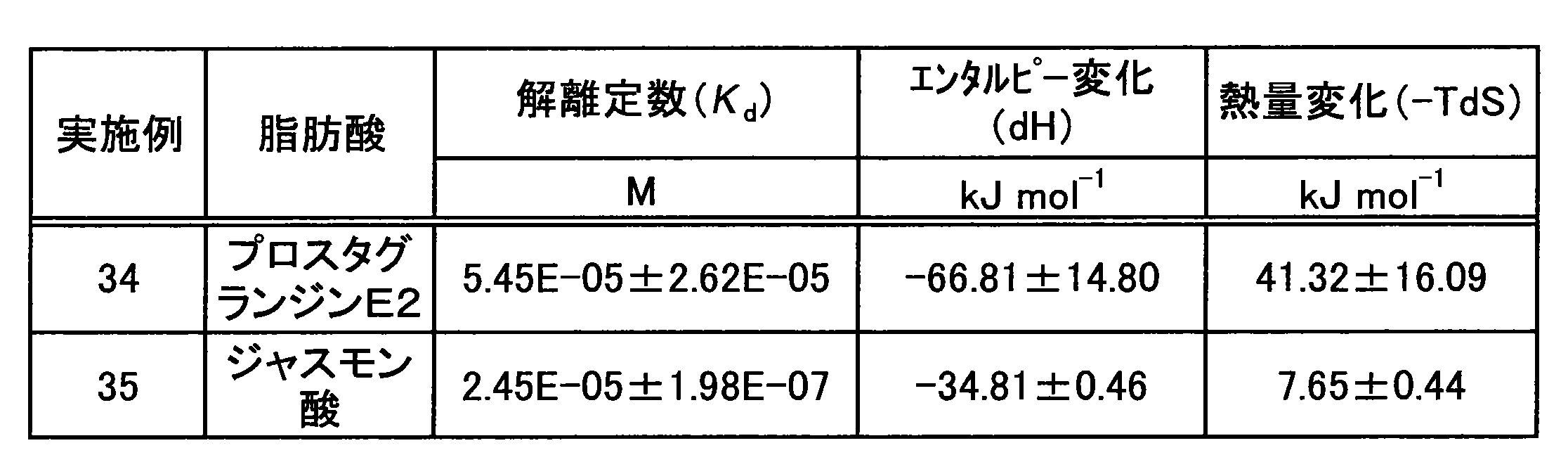
表3に示すように、生理活性物質の1種であるプロスタグランジンE2、および植物ホルモン様物質の1種であるジャスモン酸のような脂肪酸を用いて作製したリポソームを用いても、FABP3に対する結合親和性をITC装置を用いて測定することができたことがわかる。
(実施例36~38:リポソームを用いる種々の不飽和脂肪酸とFABP3とのSPRによる結合親和性の測定)
カプリル酸の代わりに、表4に示す種々の不飽和脂肪酸(1.1mmol)を用いたこと以外は実施例1と同様にして脂肪酸含有リポソームを作製した。
カプリル酸の代わりに、表4に示す種々の不飽和脂肪酸(1.1mmol)を用いたこと以外は実施例1と同様にして脂肪酸含有リポソームを作製した。
こうして得られた脂肪酸含有リポソームを用い、表面プラズモン共鳴(SPR)装置(GEヘルスケア社製BIAcore T200)により、以下のようにしてSPR測定を行った。
まず、カルボキシル化デキストランマトリックス(CM5)センサーチップを、50mMのNaOH水溶液を用いて、流速20μL/分にて2分間の洗浄を3回行った。次いで、このCM5センサーチップに、0.1MのN-ヒドロキシスクシンイミド(NHS)と0.39Mの1-エチル-3-(3-ジメチルアミノプロピル)カルボジイミド(EDC)との混合液(1:1 v/v)70μLを、5μL/分の流速で7分間かけて添加することにより、当該チップ上のカルボキシル基をスクシンイミジルエステルに変換して活性化した。非特許文献2に記載の方法により調製したFABP3(100μg/mL)を、2μmL/分の流速で30分間かけてセンサーチップ上に固定化した。センサーチップ上の未反応のスクシンミジルエステルを、1Mのエタノールアミン塩酸塩(pH8.5)で処理し、次いでセンサー表面をバッファ(リン酸緩衝生理食塩水(PBS)、pH7.4)で3回洗浄した。
このセンサーチップに、上記にて作製した脂肪酸含有リポソームを、表2に示すような脂肪酸濃度にてpH7.4のPBS中、10L/分の流速で2分間かけて添加し、SPR測定を行った。
得られた結果を表4に示す。
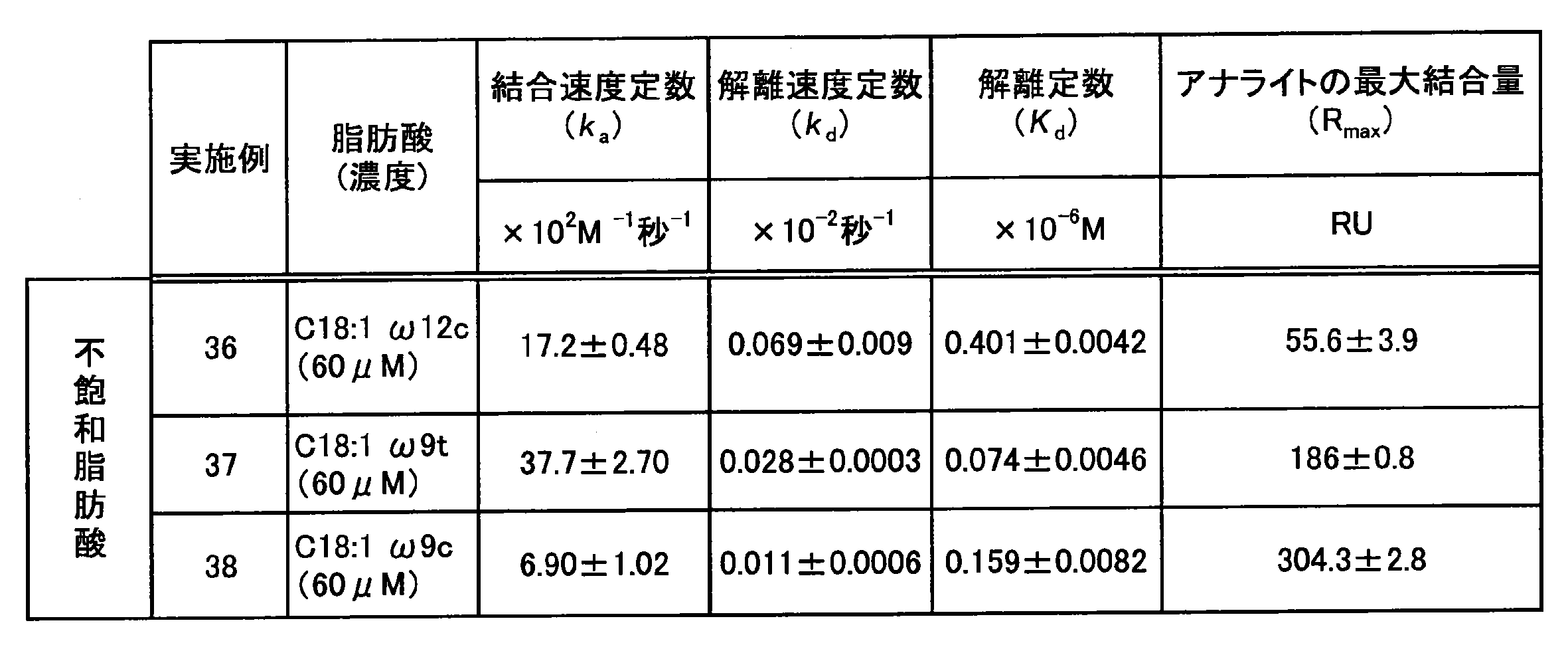
表4に示すように、実施例36~38で使用した全ての脂肪酸について、上記ITC装置を用いた場合と同様に、同一条件下にてFABP3に対する結合親和性をSPR装置を用いて測定することができたことがわかる。
(実施例39:バイセルを用いるステアリン酸とFABP3とのITCによる結合親和性の測定)
580μLのクロロホルム中に、34mgのジミリストイルホスファチジルコリン(DMPC)および24mgのジヘキサノイルホスファチジルコリン(DHPC)を添加し、これを10個のアンプル(1アンプル当たり58μL)に分け、窒素ガスを通してクロロホルムを除去した。次いで、各アンプルを減圧下で4時間乾燥し、アンプルを窒素ガスで置換してストック用脂質を調製した。
580μLのクロロホルム中に、34mgのジミリストイルホスファチジルコリン(DMPC)および24mgのジヘキサノイルホスファチジルコリン(DHPC)を添加し、これを10個のアンプル(1アンプル当たり58μL)に分け、窒素ガスを通してクロロホルムを除去した。次いで、各アンプルを減圧下で4時間乾燥し、アンプルを窒素ガスで置換してストック用脂質を調製した。
上記得られたストック用脂質の各アンプルに、1mLの緩衝液(20mM Tris-HCl(pH8.0),100mM NaCl)を添加して内容物を水和させ、アンプルを3分間超音波処理して、バイセル(10mM DMPC/DHPC)を作製した。
バイアル中の1μmolのステアリン酸(C18:0)に、上記で得られた1mLのバイセル(10mM DMPC/DHPC)を添加し、これをボルテックスミキサーにかけ、次いで超音波に曝して均一な懸濁物を形成した。次いで、この懸濁物を液体窒素および40℃の温度下での凍結かつ解凍を3回行って、より均一な懸濁物でなるステアリン酸含有バイセルを形成した。
ITC装置(ティー・エー・インスツルメント・ジャパン株式会社製)を起動し、測定温度を37℃に設定した。次いで、ITC装置の滴定シリンジ(50μL)とサンプルセル(190μL)それぞれに脱気した上記ステアリン酸含有バイセル50μLと脱気した0.2mMのFABP3(非特許文献2に記載の方法により調製した。)210μLを充填した。ITC装置の測定パラメータ(測定回数:3回;滴下量:2μL;滴定間隔:210秒;測定温度:37℃;攪拌速度:250rpm)を設定し、測定値を得た。
得られた解離定数(Kd)は7.64μMであり、エンタルピー変化(dH)は-19.58kJ/molであった。
このように、水に不溶であるステアリン酸に対し、FABP3に対する結合親和性を上記バイセルの作製を通じて、ITC装置を用いて測定することができた。
本発明は、例えば、細胞膜の疎水部における分子間相互作用の解明を通じた、膜タンパク質の構造形成・機能発現、細胞膜構成分子の集合分配によるドメイン形成などの、細胞膜のダイナミックな生理機能発現における研究開発において有用である。本発明の方法により測定された結果は、例えば、創薬分野における標的化合物の基礎情報として活用することができる。
100 標的物質含有リポソーム
102 親水基部分
104 疎水基部分
106 内皮膜
108 外皮膜
110 標的物質分子
120 リポソーム部分
102 親水基部分
104 疎水基部分
106 内皮膜
108 外皮膜
110 標的物質分子
120 リポソーム部分
Claims (9)
- 標的物質とリガンドとの結合親和性を測定するための方法であって、
標的物質と脂質集合体を構成し得る物質とを混合して、該標的物質を含有する脂質集合体を形成する工程;
該標的物質を含有する脂質集合体をリガンドと合わせて測定サンプルを調製する工程;および
該測定サンプルの物性変化量を測定する工程;
を包含する、方法。 - 前記脂質集合体が、リポソーム、バイセル、およびデンドリマーからなる群より選択される少なくとも1種の分子群である、請求項1に記載の方法。
- 前記脂質集合体を構成し得る物質がリン脂質である、請求項1または2に記載の方法。
- 前記標的物質が疎水性化合物である、請求項1から3のいずれかに記載の方法。
- 前記疎水性化合物が、疎水性脂肪酸およびその誘導体ならびにそれらの塩、疎水性タンパク質、疎水性低分子化合物、疎水性DNA、ならびに疎水性RNAからなる群から選択される少なくとも1種の化合物である、請求項4に記載の方法。
- 前記物性変化量が、等温滴定熱測定法または表面プラズモン共鳴法により測定される、請求項1から5のいずれかに記載の方法。
- 脂質集合体を構成し得る物質を含有する、標的物質とリガンドとの結合親和性の測定に使用するための試薬助剤。
- 前記脂質集合体を構成し得る物質がリン脂質である、請求項7に記載の試薬助剤。
- 標的物質とリガンドとの結合親和性の測定に使用するためのキットであって、
脂質集合体を構成し得る物質を含む、キット。
Priority Applications (1)
| Application Number | Priority Date | Filing Date | Title |
|---|---|---|---|
| JP2015532865A JP6057265B2 (ja) | 2013-08-21 | 2014-08-19 | 標的物質とリガンドとの結合親和性を測定するための方法、ならびに該方法に使用するための試薬助剤およびキット |
Applications Claiming Priority (4)
| Application Number | Priority Date | Filing Date | Title |
|---|---|---|---|
| JP2013-171684 | 2013-08-21 | ||
| JP2013171684 | 2013-08-21 | ||
| JP2014-013710 | 2014-01-28 | ||
| JP2014013710 | 2014-01-28 |
Publications (1)
| Publication Number | Publication Date |
|---|---|
| WO2015025856A1 true WO2015025856A1 (ja) | 2015-02-26 |
Family
ID=52483629
Family Applications (1)
| Application Number | Title | Priority Date | Filing Date |
|---|---|---|---|
| PCT/JP2014/071682 Ceased WO2015025856A1 (ja) | 2013-08-21 | 2014-08-19 | 標的物質とリガンドとの結合親和性を測定するための方法、ならびに該方法に使用するための試薬助剤およびキット |
Country Status (2)
| Country | Link |
|---|---|
| JP (1) | JP6057265B2 (ja) |
| WO (1) | WO2015025856A1 (ja) |
Cited By (1)
| Publication number | Priority date | Publication date | Assignee | Title |
|---|---|---|---|---|
| JP2022031835A (ja) * | 2013-10-14 | 2022-02-22 | ザ ユニバーシティー コート オブ ザ ユニバーシティー オブ エジンバラ | 診断的および治療的使用を有するタンパク質 |
Citations (1)
| Publication number | Priority date | Publication date | Assignee | Title |
|---|---|---|---|---|
| JP2008111713A (ja) * | 2006-10-30 | 2008-05-15 | Ulvac Japan Ltd | 結合素子、バイオセンサ及び生体物質間の相互作用測定方法 |
-
2014
- 2014-08-19 JP JP2015532865A patent/JP6057265B2/ja not_active Expired - Fee Related
- 2014-08-19 WO PCT/JP2014/071682 patent/WO2015025856A1/ja not_active Ceased
Patent Citations (1)
| Publication number | Priority date | Publication date | Assignee | Title |
|---|---|---|---|---|
| JP2008111713A (ja) * | 2006-10-30 | 2008-05-15 | Ulvac Japan Ltd | 結合素子、バイオセンサ及び生体物質間の相互作用測定方法 |
Non-Patent Citations (5)
| Title |
|---|
| DAISUKE MATSUOKA ET AL.: "Difference of Fatty Acid Binding Modes between Wild-type FABP3 and Its Mutants", PROTEIN SCIENCE SOCIETY OF JAPAN, vol. 13 TH, 31 May 2013 (2013-05-31), pages 65 * |
| HIROO SASAKURA ET AL.: "Shibosan Donyu Liposome no Chosei to Bussei", JAPAN OIL CHEMISTS, vol. 41 ST, 19 September 2002 (2002-09-19), pages 172 * |
| KOHEI OTSUKA ET AL.: "Suiyosei Shibosan Mimic no Bunshi Sekkei to FABP Ketsugo Kassei", CSJ: THE CHEMICAL SOCIETY OF JAPAN KOEN YOKOSHU, vol. 93 RD, no. 3, 8 March 2013 (2013-03-08), pages 973 * |
| MARIA CARMEN TAN ET AL.: "Interaction kinetics of liposome-incorporated unsaturated fatty acids with fatty acid-binding protein 3 by surface plasmon resonance", BIOORG. MED. CHEM., vol. 22, no. 6, 15 March 2014 (2014-03-15), pages 1804 - 1808, XP028627442, DOI: doi:10.1016/j.bmc.2014.02.001 * |
| PETER BRECHER ET AL.: "Fatty acid transfer between multilamellar liposomes and fatty acid- binding proteins", JOURNAL OF BIOLOGICAL CHEMISTRY, vol. 259, no. 21, pages 13395 - 13401 * |
Cited By (2)
| Publication number | Priority date | Publication date | Assignee | Title |
|---|---|---|---|---|
| JP2022031835A (ja) * | 2013-10-14 | 2022-02-22 | ザ ユニバーシティー コート オブ ザ ユニバーシティー オブ エジンバラ | 診断的および治療的使用を有するタンパク質 |
| JP7320585B2 (ja) | 2013-10-14 | 2023-08-03 | ザ ユニバーシティー コート オブ ザ ユニバーシティー オブ エジンバラ | 診断的および治療的使用を有するタンパク質 |
Also Published As
| Publication number | Publication date |
|---|---|
| JPWO2015025856A1 (ja) | 2017-03-02 |
| JP6057265B2 (ja) | 2017-01-11 |
Similar Documents
| Publication | Publication Date | Title |
|---|---|---|
| Bou-Chacra et al. | Evolution of choice of solubility and dissolution media after two decades of biopharmaceutical classification system | |
| Clarysse et al. | Postprandial changes in solubilizing capacity of human intestinal fluids for BCS class II drugs | |
| Mönkäre et al. | IgG-loaded hyaluronan-based dissolving microneedles for intradermal protein delivery | |
| Chen et al. | Bile salts as crystallization inhibitors of supersaturated solutions of poorly water-soluble compounds | |
| Fong et al. | Solubility enhancement of BCS Class II drug by solid phospholipid dispersions: Spray drying versus freeze-drying | |
| Yoon et al. | Correlating membrane morphological responses with micellar aggregation behavior of capric acid and monocaprin | |
| Kempe et al. | Characterization of thermosensitive chitosan-based hydrogels by rheology and electron paramagnetic resonance spectroscopy | |
| Hansen et al. | Feasibility investigation of cellulose polymers for mucoadhesive nasal drug delivery applications | |
| Kolahdouzan et al. | Optimizing the formation of supported lipid bilayers from bicellar mixtures | |
| Ferreira et al. | Alginate hydrogel improves anti-angiogenic bevacizumab activity in cancer therapy | |
| Yeap et al. | The potential for drug supersaturation during intestinal processing of lipid-based formulations may be enhanced for basic drugs | |
| NZ587611A (en) | Process to minimize polymorphism | |
| Altınoğlu et al. | Intracellular delivery of the PTEN protein using cationic lipidoids for cancer therapy | |
| Bao et al. | The maltose ABC transporter: action of membrane lipids on the transporter stability, coupling and ATPase activity | |
| CN104582689A (zh) | 生物相关性组合物 | |
| Plochberger et al. | Lipoprotein particles interact with membranes and transfer their cargo without receptors | |
| Bukara et al. | In vivo performance of fenofibrate formulated with ordered mesoporous silica versus 2-marketed formulations: a comparative bioavailability study in beagle dogs | |
| Caschera et al. | Stable vesicles composed of monocarboxylic or dicarboxylic fatty acids and trimethylammonium amphiphiles | |
| Hafiane et al. | ABCA1 agonist mimetic peptide CS-6253 induces microparticles release from different cell types by ABCA1-efflux–dependent mechanism | |
| Gowrisankaran et al. | Cells control BIN1-mediated membrane tubulation by altering the membrane charge | |
| Chen et al. | Microstructure and biomolecules mobility of human milk fat globules by fluorescence recovery after photobleaching with confocal scanning laser microscope | |
| JP6057265B2 (ja) | 標的物質とリガンドとの結合親和性を測定するための方法、ならびに該方法に使用するための試薬助剤およびキット | |
| Hąc-Wydro et al. | Interactions of amphotericin B derivative of low toxicity with biological membrane components—the Langmuir monolayer approach | |
| Wang et al. | Breaking of the phosphodiester bond: a key factor that induces hemolysis | |
| Yusuf et al. | Formulation Design and Cell Cytotoxicity of Curcumin‐Loaded Liposomal Solid Gels for Anti‐Hepatitis C Virus |
Legal Events
| Date | Code | Title | Description |
|---|---|---|---|
| 121 | Ep: the epo has been informed by wipo that ep was designated in this application |
Ref document number: 14837445 Country of ref document: EP Kind code of ref document: A1 |
|
| DPE2 | Request for preliminary examination filed before expiration of 19th month from priority date (pct application filed from 20040101) | ||
| ENP | Entry into the national phase |
Ref document number: 2015532865 Country of ref document: JP Kind code of ref document: A |
|
| NENP | Non-entry into the national phase |
Ref country code: DE |
|
| 122 | Ep: pct application non-entry in european phase |
Ref document number: 14837445 Country of ref document: EP Kind code of ref document: A1 |