WO2015015402A2 - Catalyst composition and process for oligomerization of ethylene - Google Patents

Catalyst composition and process for oligomerization of ethylene Download PDF

Info

Publication number
WO2015015402A2
WO2015015402A2 PCT/IB2014/063485 IB2014063485W WO2015015402A2 WO 2015015402 A2 WO2015015402 A2 WO 2015015402A2 IB 2014063485 W IB2014063485 W IB 2014063485W WO 2015015402 A2 WO2015015402 A2 WO 2015015402A2
Authority
WO
WIPO (PCT)
Prior art keywords
catalyst composition
composition according
catalyst
foregoing
combination
Prior art date
Legal status (The legal status is an assumption and is not a legal conclusion. Google has not performed a legal analysis and makes no representation as to the accuracy of the status listed.)
Ceased
Application number
PCT/IB2014/063485
Other languages
French (fr)
Other versions
WO2015015402A3 (en
Inventor
Anina Woehl
Andreas MEISWINKLE
Heinz Boelt
Bernd H. Mueller
Wolfgang Mueller
Normen Peulecke
Uwe Rosenthal
Marco Harff
Mohammed H. Al-Hazmi
Abdullah Al-Qahtani
Current Assignee (The listed assignees may be inaccurate. Google has not performed a legal analysis and makes no representation or warranty as to the accuracy of the list.)
Linde GmbH
Saudi Basic Industries Corp
Original Assignee
Linde GmbH
Saudi Basic Industries Corp
Priority date (The priority date is an assumption and is not a legal conclusion. Google has not performed a legal analysis and makes no representation as to the accuracy of the date listed.)
Filing date
Publication date
Priority to RU2016104650A priority Critical patent/RU2647863C2/en
Priority to US14/908,026 priority patent/US9561500B2/en
Priority to BR112016001705A priority patent/BR112016001705A2/en
Priority to KR1020167003829A priority patent/KR102268302B1/en
Priority to MX2016001079A priority patent/MX373757B/en
Priority to CA2916919A priority patent/CA2916919C/en
Priority to CN201480042534.9A priority patent/CN105408019B/en
Priority to SG11201510819VA priority patent/SG11201510819VA/en
Priority to JP2016528647A priority patent/JP6175192B2/en
Application filed by Linde GmbH, Saudi Basic Industries Corp filed Critical Linde GmbH
Publication of WO2015015402A2 publication Critical patent/WO2015015402A2/en
Publication of WO2015015402A3 publication Critical patent/WO2015015402A3/en
Anticipated expiration legal-status Critical
Priority to US15/379,836 priority patent/US10265690B2/en
Priority to US16/355,298 priority patent/US20190210011A1/en
Priority to US17/722,794 priority patent/US20220241764A1/en
Ceased legal-status Critical Current

Links

Classifications

    • BPERFORMING OPERATIONS; TRANSPORTING
    • B01PHYSICAL OR CHEMICAL PROCESSES OR APPARATUS IN GENERAL
    • B01JCHEMICAL OR PHYSICAL PROCESSES, e.g. CATALYSIS OR COLLOID CHEMISTRY; THEIR RELEVANT APPARATUS
    • B01J31/00Catalysts comprising hydrides, coordination complexes or organic compounds
    • B01J31/02Catalysts comprising hydrides, coordination complexes or organic compounds containing organic compounds or metal hydrides
    • B01J31/12Catalysts comprising hydrides, coordination complexes or organic compounds containing organic compounds or metal hydrides containing organo-metallic compounds or metal hydrides
    • B01J31/14Catalysts comprising hydrides, coordination complexes or organic compounds containing organic compounds or metal hydrides containing organo-metallic compounds or metal hydrides of aluminium or boron
    • B01J31/143Catalysts comprising hydrides, coordination complexes or organic compounds containing organic compounds or metal hydrides containing organo-metallic compounds or metal hydrides of aluminium or boron of aluminium
    • BPERFORMING OPERATIONS; TRANSPORTING
    • B01PHYSICAL OR CHEMICAL PROCESSES OR APPARATUS IN GENERAL
    • B01JCHEMICAL OR PHYSICAL PROCESSES, e.g. CATALYSIS OR COLLOID CHEMISTRY; THEIR RELEVANT APPARATUS
    • B01J31/00Catalysts comprising hydrides, coordination complexes or organic compounds
    • B01J31/16Catalysts comprising hydrides, coordination complexes or organic compounds containing coordination complexes
    • B01J31/18Catalysts comprising hydrides, coordination complexes or organic compounds containing coordination complexes containing nitrogen, phosphorus, arsenic or antimony as complexing atoms, e.g. in pyridine ligands, or in resonance therewith, e.g. in isocyanide ligands C=N-R or as complexed central atoms
    • B01J31/1845Catalysts comprising hydrides, coordination complexes or organic compounds containing coordination complexes containing nitrogen, phosphorus, arsenic or antimony as complexing atoms, e.g. in pyridine ligands, or in resonance therewith, e.g. in isocyanide ligands C=N-R or as complexed central atoms the ligands containing phosphorus
    • B01J31/1885Ligands comprising two different formal oxidation states of phosphorus in one at least bidentate ligand, e.g. phosphite/phosphinite
    • CCHEMISTRY; METALLURGY
    • C07ORGANIC CHEMISTRY
    • C07CACYCLIC OR CARBOCYCLIC COMPOUNDS
    • C07C2/00Preparation of hydrocarbons from hydrocarbons containing a smaller number of carbon atoms
    • C07C2/02Preparation of hydrocarbons from hydrocarbons containing a smaller number of carbon atoms by addition between unsaturated hydrocarbons
    • C07C2/04Preparation of hydrocarbons from hydrocarbons containing a smaller number of carbon atoms by addition between unsaturated hydrocarbons by oligomerisation of well-defined unsaturated hydrocarbons without ring formation
    • C07C2/06Preparation of hydrocarbons from hydrocarbons containing a smaller number of carbon atoms by addition between unsaturated hydrocarbons by oligomerisation of well-defined unsaturated hydrocarbons without ring formation of alkenes, i.e. acyclic hydrocarbons having only one carbon-to-carbon double bond
    • C07C2/08Catalytic processes
    • C07C2/26Catalytic processes with hydrides or organic compounds
    • C07C2/32Catalytic processes with hydrides or organic compounds as complexes, e.g. acetyl-acetonates
    • CCHEMISTRY; METALLURGY
    • C07ORGANIC CHEMISTRY
    • C07CACYCLIC OR CARBOCYCLIC COMPOUNDS
    • C07C2/00Preparation of hydrocarbons from hydrocarbons containing a smaller number of carbon atoms
    • C07C2/02Preparation of hydrocarbons from hydrocarbons containing a smaller number of carbon atoms by addition between unsaturated hydrocarbons
    • C07C2/04Preparation of hydrocarbons from hydrocarbons containing a smaller number of carbon atoms by addition between unsaturated hydrocarbons by oligomerisation of well-defined unsaturated hydrocarbons without ring formation
    • C07C2/06Preparation of hydrocarbons from hydrocarbons containing a smaller number of carbon atoms by addition between unsaturated hydrocarbons by oligomerisation of well-defined unsaturated hydrocarbons without ring formation of alkenes, i.e. acyclic hydrocarbons having only one carbon-to-carbon double bond
    • C07C2/08Catalytic processes
    • C07C2/26Catalytic processes with hydrides or organic compounds
    • C07C2/36Catalytic processes with hydrides or organic compounds as phosphines, arsines, stilbines or bismuthines
    • BPERFORMING OPERATIONS; TRANSPORTING
    • B01PHYSICAL OR CHEMICAL PROCESSES OR APPARATUS IN GENERAL
    • B01JCHEMICAL OR PHYSICAL PROCESSES, e.g. CATALYSIS OR COLLOID CHEMISTRY; THEIR RELEVANT APPARATUS
    • B01J2231/00Catalytic reactions performed with catalysts classified in B01J31/00
    • B01J2231/20Olefin oligomerisation or telomerisation
    • BPERFORMING OPERATIONS; TRANSPORTING
    • B01PHYSICAL OR CHEMICAL PROCESSES OR APPARATUS IN GENERAL
    • B01JCHEMICAL OR PHYSICAL PROCESSES, e.g. CATALYSIS OR COLLOID CHEMISTRY; THEIR RELEVANT APPARATUS
    • B01J2531/00Additional information regarding catalytic systems classified in B01J31/00
    • B01J2531/60Complexes comprising metals of Group VI (VIA or VIB) as the central metal
    • B01J2531/62Chromium
    • CCHEMISTRY; METALLURGY
    • C07ORGANIC CHEMISTRY
    • C07CACYCLIC OR CARBOCYCLIC COMPOUNDS
    • C07C2531/00Catalysts comprising hydrides, coordination complexes or organic compounds
    • C07C2531/02Catalysts comprising hydrides, coordination complexes or organic compounds containing organic compounds or metal hydrides
    • C07C2531/12Catalysts comprising hydrides, coordination complexes or organic compounds containing organic compounds or metal hydrides containing organo-metallic compounds or metal hydrides
    • C07C2531/14Catalysts comprising hydrides, coordination complexes or organic compounds containing organic compounds or metal hydrides containing organo-metallic compounds or metal hydrides of aluminium or boron
    • CCHEMISTRY; METALLURGY
    • C07ORGANIC CHEMISTRY
    • C07CACYCLIC OR CARBOCYCLIC COMPOUNDS
    • C07C2531/00Catalysts comprising hydrides, coordination complexes or organic compounds
    • C07C2531/16Catalysts comprising hydrides, coordination complexes or organic compounds containing coordination complexes
    • C07C2531/22Organic complexes
    • CCHEMISTRY; METALLURGY
    • C07ORGANIC CHEMISTRY
    • C07CACYCLIC OR CARBOCYCLIC COMPOUNDS
    • C07C2531/00Catalysts comprising hydrides, coordination complexes or organic compounds
    • C07C2531/16Catalysts comprising hydrides, coordination complexes or organic compounds containing coordination complexes
    • C07C2531/24Phosphines
    • YGENERAL TAGGING OF NEW TECHNOLOGICAL DEVELOPMENTS; GENERAL TAGGING OF CROSS-SECTIONAL TECHNOLOGIES SPANNING OVER SEVERAL SECTIONS OF THE IPC; TECHNICAL SUBJECTS COVERED BY FORMER USPC CROSS-REFERENCE ART COLLECTIONS [XRACs] AND DIGESTS
    • Y02TECHNOLOGIES OR APPLICATIONS FOR MITIGATION OR ADAPTATION AGAINST CLIMATE CHANGE
    • Y02PCLIMATE CHANGE MITIGATION TECHNOLOGIES IN THE PRODUCTION OR PROCESSING OF GOODS
    • Y02P20/00Technologies relating to chemical industry
    • Y02P20/50Improvements relating to the production of bulk chemicals
    • Y02P20/52Improvements relating to the production of bulk chemicals using catalysts, e.g. selective catalysts

Definitions

  • the present invention relates to a catalyst composition and a process for the oligomerization, especially tri- and tetramerization, of ethylene.
  • LAOs including comonomer-grade 1-hexene and 1-octene, rely on the oligomerization of ethylene. These processes have in common that they lead to a product distribution of ethylene-oligomers of chain length 4, 6, 8 and so on. This is due to a chemical mechanism which is widely governed by competing chain growth- and displacement reaction steps, leading to a Schulz-Flory- or Poisson- product distribution.
  • WO 2009/006979 A2 describes a catalyst composition and a process for the di-, tri- and/or tetramerization of ethylene.
  • the catalyst composition comprises a chromium compound, a ligand of, for example, the general structure RiR 2 P-N(R 3 )-P(R 4 )- N(R5)-H and a co-catalyst acting as an activator.
  • the ligand' s substituents Ri, R 2 , R 3 , R4 and R5 are independently a number of functional groups, comprising (among others) Ci - Cio - alkyl, aryl and substituted aryl.
  • the chromium source is CrCl 3 (THF) 3 , Cr(III)acetylacetonate,
  • the co-catalyst or activator is trimethylaluminum, triethylaluminum, triisopropylaluminum, triisobutylaluminum, ethylaluminumsesquichloride, diethylaluminum chloride, ethylaluminumdichloride, methylaluminoxane or a
  • This prior art discloses a class of catalyst systems for selective ethylene oligomerization reactions.
  • one embodiment uses a specific catalyst composition, chosen from this class of catalyst systems, for the highly selective trimerization of ethylene to afford high yields of 1-hexene.
  • This ligand features the typical PNPN-H - backbone, which is why this class of compounds, regardless of the precise nature of its substituents, is often referred to as a "PNPN-H - ligand".
  • Preferred embodiments involve, for instance, modifiers such as
  • the catalyst system allows for an independent adjustment of the [Cr]/[Halogen] molar ratio in the resulting catalytically active species which is formed in-situ under oligomerization conditions.
  • a catalyst composition comprises:
  • RiR 2 P-N(R 3 )-P(XR 7 )R 8 or RiR 2 P-N(R 3 )-P(XR 7 ) 2 , with X O or S, wherein Ri, R 2 , R 3 , R4, R5 R 6 , R 7 and R 8 are independently Ci-Cio-alkyl, C6-C 2 o-aryl, C 3 - Cio-cycloalkyl, aralkyl, alkylaryl, or trialkylsilyl, or any cyclic derivatives of (A) and (B), wherein at least one of the P or N atoms of the PNPN-unit or PNP-unit is a member of the ring system, the ring system being formed from one or more constituent compounds of structures (A) or (B) by substitution; and
  • a method of obtaining the catalyst comprises combining at least (a) a chromium compound; (b) a ligand of the general structure (A) or (B) as described above; and (c) an activator or co-catalyst.
  • a process for tri- and/or tetramerization of ethylene comprises subjecting the above-described catalyst composition to a gas phase of ethylene in a reactor and conducting an oligomerization.
  • the catalyst composition comprises: (a) a chromium compound; (b) a ligand of the general structure
  • RiR 2 P-N(R 3 )-P(XR 7 )R 8 or RiR 2 P-N(R 3 )-P(XR 7 ) 2 , with X O or S, wherein Ri, R 2 , R 3 , R4, R5 R 6 , R 7 and R 8 are independently Ci-Cio-alkyl, C6-C 2 o-aryl, C 3 - Cio-cycloalkyl, aralkyl, alkylaryl, or trialkylsilyl, or any cyclic derivatives of (A) and (B), wherein at least one of the P or N atoms of the PNPN-unit or PNP-unit is a member of the ring system, the ring system being formed from one or more constituent compounds of structures (A) or (B) by substitution; and (c) an activator or co-catalyst.
  • any cyclic derivatives of (A) and (B) can be utilized as ligand, wherein at least one of the P or N atoms of the PNPN-unit (structure (A)) or PNP-unit (structure (B)) is a ring member, the ring being formed from one or more constituent compounds of structures (A) or (B) by substitution, i.e.
  • the chromium compound is organic or inorganic salts, coordination complexes and organometallic complexes of Cr(II) or Cr(III)
  • the chromium compound is CrCl 3 (THF) 3 .
  • Ri, R 2 , R 3 , R4, R5 R 6 , R 7 and R 8 are methyl, ethyl, isopropyl, tert-butyl, cyclohexyl, phenyl, benzyl, tolyl, xylyl, or a combination comprising at least one of the foregoing.
  • the activator or co-catalyst is trimethylaluminum, triethylaluminum, triisopropylaluminum, triisobutylaluminum,
  • ethylaluminumsesquichloride diethylaluminum chloride, ethylaluminumdichloride, methylaluminoxane (MMAO), modified methylaminoxane, or a combination comprising at least one of the foregoing.
  • MMAO methylaluminoxane
  • a catalyst composition wherein the ligand is Ph 2 P-N(i- Pr)-P(Ph)-N(i-Pr)Ph, Ph 2 P-N(i-Pr)-P(Ph)-N(Me)C 6 H6, Ph 2 P-N(i-Pr)-P(Ph)S(i-Pr), Ph 2 P- N(i-Pr)-P(Ph)OC 2 H 5 , Ph 2 P-N(i-Pr)P(Ph)OCH 3 , or a combination comprising at least one of the foregoing
  • a catalyst composition is also preferably provided additionally comprising a solvent, preferably aromatic hydrocarbons, straight-chain and cyclic aliphatic
  • hydrocarbons straight-chain olefins and ethers, preferably toluene, benzene, ethylbenzene, cumene, xylenes, mesitylene, hexane, octane, cyclohexane, methylcyclohexane, hexene, heptene, octene, diethylether, tetrahydrofuran, chlorobenzene, or a combination
  • the concentration of the chromium compound is from 0.01 to 100 mmol/1, preferably 0.1 to 10 mmol/1.
  • the ligand/Cr molar ratio is preferably from 0.5 to 50, preferably 0.8 to 2.0.
  • the Al/Cr molar ratio preferably is from 1: 1 to 1000: 1, preferably 10: 1 to 200: 1.
  • the components (a) to (c) for providing the catalyst composition are more or less considered as starting materials, but may be converted when the free compounds (a)-(c) are mixed to form the catalyst composition.
  • the catalyst composition according to the present invention can be also illustrated as being obtainable by combining at least (a) a chromium
  • RiR 2 P-N(R 3 )-P(XR 7 )R 8 or RiR 2 P-N(R 3 )-P(XR 7 ) 2 , with X O or S, wherein Ri, R 2 , R 3 , R4, Rs , R 6 , R 7 and R 8 are independently Ci-Cio-alkyl, C6-C 2 o-aryl, C 3 - Cio-cycloalkyl, aralkyl, alkylaryl, or trialkylsilyl or any cyclic derivatives of (A) and (B), wherein at least one of the P or N atoms of the PNPN-unit or PNP-unit is a member of the ring system, the ring system being formed from one or more constituent compounds of structures (A) or (B) by substitution; and (c) an activator or co-catalyst.
  • According to the invention is also a process for tri- and/or tetramerization of ethylene, comprising subjecting a catalyst composition according to the invention to a gas phase of ethylene in a reactor and conducting an oligomerization.
  • a catalyst composition according to the invention to a gas phase of ethylene in a reactor and conducting an oligomerization.
  • Requirements and conditions for conducting an oligomerization using an organo metallic catalyst are well known in the art.
  • the oligomerization is carried out at a pressure of 1 to 200 bar, preferably 10 to 50 bar.
  • the oligomerization is carried out at a temperature of from 10 to 200°C, preferably 20 to 100°C.
  • the process is carried out continuously, semi- continuously or discontinuously.
  • the mean residence time may be from 10 minutes to 20 hours, preferably 1 to 4 hours.
  • the inventive catalyst composition provides the oligomerization of ethylene with a significantly increased selectivity towards 1-octene and activity. It was further found that based on the prior art, the respective ligand structure can be successfully amended to increase the 1-octene selectivity. In a preferred embodiment, it was also found that the selectivity can be further increased with suitable co-catalysts and solvents which effect the control of the process overall selectivity.
  • a ligand having the structure RiR 2 P-N(R 3 )-P(R 4 )-NR 5 R 6 is used.
  • the ligands of the first embodiment are accessible via various synthetic approaches that are shown below.
  • a standard ethylene oligomerization was carried out.
  • a 300 ml pressure reactor, equipped with dip tube, thermowell, gas entrainment stirrer, cooling coil, control units for temperature, pressure, and stirrer speed (all hooked up to a data acquisition system) was inertized with dry argon.
  • the isobaric ethylene supply was maintained by an aluminum pressurized gas cylinder on a balance to monitor the ethylene consumption over time by means of a computerized data acquisition system.
  • the reactor was heated to 100 °C at reduced pressure for several hours to eliminate traces of water, oxygen and oxygenated impurities.
  • the suitable amounts of the ligands and chromium precursor were weighed in and charged to a Schlenk tube under inert atmosphere. A volume of 75 ml anhydrous solvent was added and the solution was stirred by means of a magnetic stirrer. After dissolving the Cr-compound and ligand, 5 ml of a solution of MMAO-3A (7 wt% Al in heptane) was added. The solution was immediately transferred to the reactor and the reaction was started. The reaction was stopped either when the maximum uptake of ethylene (80 g) was reached or after a set time by closing the ethylene inlet valve, cooling to room temperature, depressurising and opening the reactor.
  • MMAO-3A 7 wt% Al in heptane
  • a catalyst composition comprises: (a) a chromium compound, preferably wherein the chromium compound is an organic or inorganic salt, a coordination complex, or an organometallic complexes of Cr(II) or Cr(III), or more preferably
  • a process for the manufacture of the foregoing catalyst composition comprises combining: a) a chromium compound, preferably wherein the chromium compound is an organic or inorganic salt, a coordination complex, or an organometallic complexes of Cr(II) or Cr(III), or more preferably CrCl 3 (THF) 3 , Cr(III)acetylacetonate, Cr(III)octanoate, chromium hexacarbonyl, Cr(III)-2-ethylhexanoate, (benzene)tricarbonyl- chromium, or a combination comprising at least one of the foregoing; (b) a ligand of the general structure
  • Ri, R 2 , R 3 , P , Rs , R 6 , R 7 and R 8 are independently Ci-Cio-alkyl, C6-C 2 o-aryl, C 3 -Cio-cycloalkyl, aralkyl, alkylaryl, or trialkylsilyl, or any cyclic derivatives of (A), or (B), wherein at least one of the P or N atoms of the PNPN-unit or PNP-unit is a member of the ring system, the ring system being formed from one or more constituent compounds of structures (A) or (B) by substitution, preferably wherein Ri, R 2 , R 3 , R4, Rs , R 6 , R 7 , or R 8 are methyl, ethyl, isopropyl, tert-butyl, cyclohexyl, phenyl, benzyl, tolyl, xylyl, or a combination comprising at least one
  • ethylaluminumsesquichloride diethylaluminum chloride, ethylaluminumdichloride, methylaluminoxane (MAO), modified methylaminoxane (MMAO), or a combination comprising at least one of the foregoing; more preferably wherein the ligand (A) is Ph 2 P- N(i-Pr)-P(Ph)-N(i-Pr)Ph, Ph 2 P-N(i-Pr)-P(Ph)-N(Me)C 6 H 6 , Ph 2 P-N(i-Pr)-P(Ph)S(i-Pr), Ph 2 P-N(i-Pr)-P(Ph)OC 2 H 5 , Ph 2 P-N(i-Pr)P(Ph)OCH 3 , or a combination comprising at least one of the foregoing; optionally wherein one or more of the following conditions applies: a solvent is optionally combined, preferably an aromatic hydrocarbon
  • a process for tri- and/or tetramerization of ethylene comprises subjecting a catalyst composition to a gas phase of ethylene in a reactor and conducting an
  • the catalyst composition comprises a) a chromium compound, preferably wherein the chromium compound is an organic or inorganic salt, a coordination complex, or an organometallic complexes of Cr(II) or Cr(III), or more preferably
  • Ri, R 2 , R 3 , R4, Rs , R 6 , R 7 and R 8 are independently Ci-Cio-alkyl, C6-C 2 o-aryl, C 3 -Cio-cycloalkyl, aralkyl, alkylaryl, or trialkylsilyl, or any cyclic derivatives of (A) and (B), wherein at least one of the P or N atoms of the PNPN-unit or PNP-unit is a member of the ring system, the ring system being formed from one or more constituent compounds of structures (A) or (B) by substitution, preferably wherein Ri, R 2 , R 3 , R4, Rs , R 6 , R 7 and R 8 are methyl, ethyl, isopropyl, tert-butyl, cyclohexyl, phenyl, benzyl, tolyl, xylyl, or a combination comprising at least one of the for
  • the catalyst composition additionally comprises a solvent, preferably an
  • hydrocarbyl and “hydrocarbon” refers broadly to a substituent comprising carbon and hydrogen, optionally with 1 to 3 heteroatoms, for example, oxygen, nitrogen, halogen, silicon, sulfur, or a combination thereof;
  • alkyl refers to a straight or branched chain, saturated monovalent hydrocarbon group;
  • alkylene refers to a straight or branched chain, saturated, divalent hydrocarbon group
  • alkylidene refers to a straight or branched chain, saturated divalent hydrocarbon group, with both valences on a single common carbon atom
  • alkenyl refers to a straight or branched chain monovalent hydrocarbon group having at least two carbons joined by a carbon-carbon double bond
  • cycloalkyl refers to a non-aromatic monovalent monocyclic or multicylic hydrocarbon group having at least three carbon atoms
  • cycloalkenyl refers to a non-aromatic cyclic divalent hydrocarbon group having at least three carbon atoms, with at least one degree of unsaturation
  • aryl refers to an aromatic monovalent group containing only carbon in the aromatic ring or rings
  • arylene refers to an aromatic divalent group containing only carbon in the aromatic ring or rings
  • alkylaryl refers to an aryl group that has been substituted with
  • substituted means that at least one hydrogen on the designated atom or group is replaced with another group, provided that the designated atom's normal valence is not exceeded.
  • two hydrogens on the atom are replaced.
  • Combinations of substituents and/or variables are permissible provided that the substitutions do not significantly adversely affect synthesis or use of the compound.
  • Exemplary groups that can be present on a "substituted" position include, but are not limited to, cyano; hydroxyl; nitro; azido; alkanoyl (such as a C 2 _ 6 alkanoyl group such as acyl); carboxamido; C 1-6 or Ci-3 alkyl, cycloalkyl, alkenyl, and alkynyl (including groups having at least one unsaturated linkages and from 2 to 8, or 2 to 6 carbon atoms); Ci_ 6 or Ci_ 3 alkoxys; C 6-1 o aryloxy such as phenoxy; Ci_ 6 alkylthio; Ci_ 6 or Ci_ 3 alkylsulfinyl; Cl-6 or Ci_ 3
  • alkylsulfonyl aminodi(Ci_6 or Ci_ 3 )alkyl
  • C 7 _i9 arylalkyl having 1 to 3 separate or fused rings and from 6 to 18 ring carbon atoms; or arylalkoxy having 1 to 3 separate or fused rings and from 6 to 18 ring carbon atoms, with benzyloxy being an exemplary arylalkoxy.

Landscapes

  • Chemical & Material Sciences (AREA)
  • Organic Chemistry (AREA)
  • Chemical Kinetics & Catalysis (AREA)
  • Engineering & Computer Science (AREA)
  • Materials Engineering (AREA)
  • Inorganic Chemistry (AREA)
  • Catalysts (AREA)
  • Organic Low-Molecular-Weight Compounds And Preparation Thereof (AREA)
  • Low-Molecular Organic Synthesis Reactions Using Catalysts (AREA)
  • Transition And Organic Metals Composition Catalysts For Addition Polymerization (AREA)

Abstract

A catalyst composition including: (a) a chromium compound; (b) a ligand of the general structure (A) R1R2P-N(R3)-P(R4 )-NR5R6 or (B) R1R2P-N(R3)-P(XR7)R8 or R1R2P-N(R3)-P(XR7)2, with X = O or S, wherein R1, R2, R3, R4, R5, R6, R7 and R8 are independently C1-C10-alkyl, C6 -C20-aryl, C3-C10-cycloalkyl, aralkyl, alkylaryl, or trialkylsilyl, or any cyclic derivatives of (A) and (B), wherein at least one of the P or N atoms of the PNPN-unit or PNP-unit is a member of the ring system, the ring system being formed from one or more constituent compounds of structures (A) or (B) by substitution; and (c) an activator or co-catalyst; and a process for tri- and/or tetramerization.

Description

CATALYST COMPOSITION AND PROCESS FOR OLIGOMERIZATION OF
ETHYLENE
BACKGROUND
[0001] The present invention relates to a catalyst composition and a process for the oligomerization, especially tri- and tetramerization, of ethylene.
[0002] Existing processes for the production of linear alpha olefins
(LAOs),including comonomer-grade 1-hexene and 1-octene, rely on the oligomerization of ethylene. These processes have in common that they lead to a product distribution of ethylene-oligomers of chain length 4, 6, 8 and so on. This is due to a chemical mechanism which is widely governed by competing chain growth- and displacement reaction steps, leading to a Schulz-Flory- or Poisson- product distribution.
[0003] From the marketing point of view, this product distribution poses a formidable challenge for the full-range alpha olefins producer. The reason is that each market segment served exhibits a very different behavior in terms of market size and growth, geography, fragmentation etc. It is, therefore, very difficult for the producer to adapt to the market requirements since part of the product spectrum might be in high demand in a given economic context, while at the same time other product cuts might not be marketable at all or only in a marginal niche. Currently, the highest-value LAO product is comonomer-grade 1-hexene for the polymer industry, while 1-octene demand is also growing at a considerable rate.
[0004] WO 2009/006979 A2 describes a catalyst composition and a process for the di-, tri- and/or tetramerization of ethylene. The catalyst composition comprises a chromium compound, a ligand of, for example, the general structure RiR2P-N(R3)-P(R4)- N(R5)-H and a co-catalyst acting as an activator. The ligand' s substituents Ri, R2, R3, R4 and R5 are independently a number of functional groups, comprising (among others) Ci - Cio - alkyl, aryl and substituted aryl.
[0005] The chromium source is CrCl3(THF)3, Cr(III)acetylacetonate,
Cr(III)octanoate, Cr-hexacarbonyl, Cr(III)-2-ethylhexanoate and (benzene)tricarbonyl- chromium (THF = tetrahydrofurane).
[0006] The co-catalyst or activator is trimethylaluminum, triethylaluminum, triisopropylaluminum, triisobutylaluminum, ethylaluminumsesquichloride, diethylaluminum chloride, ethylaluminumdichloride, methylaluminoxane or a
combination comprising at least one of the foregoing.
This prior art discloses a class of catalyst systems for selective ethylene oligomerization reactions.
[0007] For example, one embodiment uses a specific catalyst composition, chosen from this class of catalyst systems, for the highly selective trimerization of ethylene to afford high yields of 1-hexene.
[0008] This choice of catalyst constituents comprises CrCl3(THF)3 as chromium source, triethylaluminum as activator, and (Ph)2P-N(i-Pr)-P(Ph)-N(i-Pr)-H as ligand for the catalytically active complex (Ph = phenyl group, i-Pr = isopropyl group). This ligand features the typical PNPN-H - backbone, which is why this class of compounds, regardless of the precise nature of its substituents, is often referred to as a "PNPN-H - ligand".
[0009] WO 2010/115520 Al describes essentially modified catalyst systems of the general type already disclosed in WO2009/006979 A2. These modified systems take advantage from the same PNPN-H - type ligands that were already known. However, now a "modifier" is added to the system, (but not limited to) ammonium or phosphonium salts of the type [H4E]X, [H3ER]X, [H2ER2]X, [HER3]X or [ER4]X (with E = N or P, X = CI, Br or I and R = alkyl, cycloalkyl, acyl, aryl, alkenyl, alkynyl etc.).
[0010] Preferred embodiments involve, for instance, modifiers such as
tetraphenylphosphonium chloride, tetraethylammonium chloride - monohydrate, triethylamine - hydrochloride etc. Also, as a "type [EP JX" - modifier, dodecyl trimethylammonium chloride can advantageously be used, due to its low price, abundant supply and good solubility in the reaction solution. By means of the halogen-containing modifier, the catalyst system allows for an independent adjustment of the [Cr]/[Halogen] molar ratio in the resulting catalytically active species which is formed in-situ under oligomerization conditions.
[0011] On technical scale, the prior art oligomerization technologies described above are mainly suitable for the production of 1-butene and 1-hexene for use as co- monomers in the polyethylene (PE) production, especially for linear low density polyethylene (LLDPE).
Currently, most of the co-monomer used for PE production is 1-butene followed by an increasing 1-hexene demand. However, some high-quality PE-materials featuring high tensile strength and crack resistance require 1-octene as co-monomer. So far, the largest quantity of 1-octene is obtained from full-range LAO-processes or extraction from
Fischer-Tropsch streams. Since these technologies are burdened with rather big amounts of other products than 1-octene, their economic viability varies greatly with technological and economic boundary conditions. This pertains to infrastructure, market access and price development for the full-range products under the local boundary conditions.
[0012] It is, therefore, desirable to have catalyst systems and processes with a higher selectivity towards 1-octene available. Since 1-hexene is also a valuable co- monomer, combined 1-hexene / 1-octene processes are economically interesting as well.
SUMMARY
[0013] In an embodiment, a catalyst composition comprises:
(a) a chromium compound;
(b) a ligand of the general structure
(A) R1R2P-N(R3)-P(R4)-NR5R6 or
(B) RiR2P-N(R3)-P(XR7)R8 or RiR2P-N(R3)-P(XR7)2, with X = O or S, wherein Ri, R2, R3, R4, R5 R6, R7 and R8 are independently Ci-Cio-alkyl, C6-C2o-aryl, C3- Cio-cycloalkyl, aralkyl, alkylaryl, or trialkylsilyl, or any cyclic derivatives of (A) and (B), wherein at least one of the P or N atoms of the PNPN-unit or PNP-unit is a member of the ring system, the ring system being formed from one or more constituent compounds of structures (A) or (B) by substitution; and
(c) an activator or co-catalyst.
[0014] In another embodiment, a method of obtaining the catalyst comprises combining at least (a) a chromium compound; (b) a ligand of the general structure (A) or (B) as described above; and (c) an activator or co-catalyst.
[0015] In still another embodiment, a process for tri- and/or tetramerization of ethylene comprises subjecting the above-described catalyst composition to a gas phase of ethylene in a reactor and conducting an oligomerization.
DETAILED DESCRIPTION
[0016] Described herein is a catalyst composition and a process for
oligomerization with a high selectivity towards 1-octene overcoming the disadvantages of the prior art. Especially a catalyst and process shall be provided, which allow production of 1-octene in higher selectivities, while processes having a combined production of 1- hexene/l-octene are also of interest. The catalyst composition comprises: (a) a chromium compound; (b) a ligand of the general structure
(A) R1R2P-N(R3)-P(R4)-NR5R6 or
(B) RiR2P-N(R3)-P(XR7)R8 or RiR2P-N(R3)-P(XR7)2, with X = O or S, wherein Ri, R2, R3, R4, R5 R6, R7 and R8 are independently Ci-Cio-alkyl, C6-C2o-aryl, C3- Cio-cycloalkyl, aralkyl, alkylaryl, or trialkylsilyl, or any cyclic derivatives of (A) and (B), wherein at least one of the P or N atoms of the PNPN-unit or PNP-unit is a member of the ring system, the ring system being formed from one or more constituent compounds of structures (A) or (B) by substitution; and (c) an activator or co-catalyst.
As is to be understood, any cyclic derivatives of (A) and (B) can be utilized as ligand, wherein at least one of the P or N atoms of the PNPN-unit (structure (A)) or PNP-unit (structure (B)) is a ring member, the ring being formed from one or more constituent compounds of structures (A) or (B) by substitution, i.e. by formally eliminating per constituent compound either two whole groups Ri-R8 (as defined) or H, one atom from each of two groups Ri-R8 (as defined) or a whole group Ri-R8 (as defined) or H and an atom from another group Ri-R8 (as defined), and joining the formally so-created valence- unsaturated sites by one covalent bond per constituent compound to provide the same valence as initially present at the given site.
[0017] An example of such a cyclic derivative can be as follows.
Figure imgf000005_0001
[0018] Preferably the chromium compound is organic or inorganic salts, coordination complexes and organometallic complexes of Cr(II) or Cr(III)
[0019] Most preferably the chromium compound is CrCl3(THF)3,
Cr(III)acetylacetonate, Cr(III)octanoate, chromium hexacarbonyl, Cr(III)-2- ethylhexanoate, (benzene)tricarbonyl-chromium, or a combination comprising at least one of the foregoing.
[0020] It is also preferred that Ri, R2, R3, R4, R5 R6, R7 and R8 are methyl, ethyl, isopropyl, tert-butyl, cyclohexyl, phenyl, benzyl, tolyl, xylyl, or a combination comprising at least one of the foregoing. [0021] In one embodiment the activator or co-catalyst is trimethylaluminum, triethylaluminum, triisopropylaluminum, triisobutylaluminum,
ethylaluminumsesquichloride, diethylaluminum chloride, ethylaluminumdichloride, methylaluminoxane (MMAO), modified methylaminoxane, or a combination comprising at least one of the foregoing.
[0022] Most preferred is a catalyst composition, wherein the ligand is Ph2P-N(i- Pr)-P(Ph)-N(i-Pr)Ph, Ph2P-N(i-Pr)-P(Ph)-N(Me)C6H6, Ph2P-N(i-Pr)-P(Ph)S(i-Pr), Ph2P- N(i-Pr)-P(Ph)OC2H5, Ph2P-N(i-Pr)P(Ph)OCH3, or a combination comprising at least one of the foregoing
[0023] A catalyst composition is also preferably provided additionally comprising a solvent, preferably aromatic hydrocarbons, straight-chain and cyclic aliphatic
hydrocarbons, straight-chain olefins and ethers, preferably toluene, benzene, ethylbenzene, cumene, xylenes, mesitylene, hexane, octane, cyclohexane, methylcyclohexane, hexene, heptene, octene, diethylether, tetrahydrofuran, chlorobenzene, or a combination
comprising at least one of the foregoing, most preferably toluene or chlorobenzene.
[0024] In one embodiment, the concentration of the chromium compound is from 0.01 to 100 mmol/1, preferably 0.1 to 10 mmol/1.
[0025] The ligand/Cr molar ratio is preferably from 0.5 to 50, preferably 0.8 to 2.0. The Al/Cr molar ratio preferably is from 1: 1 to 1000: 1, preferably 10: 1 to 200: 1.
[0026] As is obvious for someone skilled in the art, the components (a) to (c) for providing the catalyst composition are more or less considered as starting materials, but may be converted when the free compounds (a)-(c) are mixed to form the catalyst composition. In this regard, the catalyst composition according to the present invention can be also illustrated as being obtainable by combining at least (a) a chromium
compound; (b) a ligand of the general structure
(A) R1R2P-N(R3)-P(R4)-NR5R6 or
(B) RiR2P-N(R3)-P(XR7)R8 or RiR2P-N(R3)-P(XR7)2, with X = O or S, wherein Ri, R2, R3, R4, Rs, R6, R7 and R8 are independently Ci-Cio-alkyl, C6-C2o-aryl, C3- Cio-cycloalkyl, aralkyl, alkylaryl, or trialkylsilyl or any cyclic derivatives of (A) and (B), wherein at least one of the P or N atoms of the PNPN-unit or PNP-unit is a member of the ring system, the ring system being formed from one or more constituent compounds of structures (A) or (B) by substitution; and (c) an activator or co-catalyst. [0027] According to the invention is also a process for tri- and/or tetramerization of ethylene, comprising subjecting a catalyst composition according to the invention to a gas phase of ethylene in a reactor and conducting an oligomerization. Requirements and conditions for conducting an oligomerization using an organo metallic catalyst are well known in the art. Preferably the oligomerization is carried out at a pressure of 1 to 200 bar, preferably 10 to 50 bar.
[0028] Also preferred, the oligomerization is carried out at a temperature of from 10 to 200°C, preferably 20 to 100°C.
[0029] In one embodiment, the process is carried out continuously, semi- continuously or discontinuously.
[0030] Finally, the mean residence time may be from 10 minutes to 20 hours, preferably 1 to 4 hours.
[0031] Surprisingly, it was found that the inventive catalyst composition provides the oligomerization of ethylene with a significantly increased selectivity towards 1-octene and activity. It was further found that based on the prior art, the respective ligand structure can be successfully amended to increase the 1-octene selectivity. In a preferred embodiment, it was also found that the selectivity can be further increased with suitable co-catalysts and solvents which effect the control of the process overall selectivity.
[0032] Further advantages and features of the present invention are now illustrated in the following example section.
EXAMPLES
[0033] It was found that there are two substantial embodiments with regard to the ligand. In a first embodiment, a ligand having the structure RiR2P-N(R3)-P(R4)-NR5R6 is used. In a second embodiment, the ligand is RiR2P-N(R3)-P(XR7)R8 or RiR2P-N(R3)- P(XR7)2 with X=0 or S. The ligands of the first embodiment are accessible via various synthetic approaches that are shown below.
Figure imgf000008_0001
[0034] Particular ligands of this first embodiment that were successfully synthesized are shown also below.
Figure imgf000009_0001
Figure imgf000009_0002
General procedure for the preparation of h)NR 1 R 2
Ph2PN(i-Pr)P(P
[0035] 2 mmol of the appropriate secondary amine was lithiated with 1.25 mL £BuLi (1.6 M in hexane) at 0°C in toluene and stirred for 4 hours at room temperature (r.t.). Afterwards the solution of the lithiated amine was transferred to a solution of 0.77 g (2 mmol) Ph2PN(1Pr)P(Ph)Cl in toluene at 0°C and stirred for 24 hours at r.t.. The solution was filtrated and evaporated to dryness, remaining an oil or solid, which was washed with cold n-pentane.
[0036] In all cases, the preparation of Ph2P(1Pr)NPCl was performed as given in: Cross R. J.; Green, H. T.; Keat, R. J. Chem. Soc. Dalton Trans. 1976, 1424-1428.
Preparation of Ph2PN(i-Pr)P(Ph)NMe2 ( 1 )
[0037] 0.77 g (2 mmol) Ph2P(iPr)NPCl, dissolved in toluene, was slowly transferred into a mixture of 10 mL dimethylamine (2M in THF) and toluene at 0°C. The solution was stirred for 12 hour (h) at room temperature whereupon it became cloudy. After evaporation of all volatile compounds, the residue was dissolved in hot n-hexane and filtrated. While resting at -40°C, white crystals of pure Ph2PN(1Pr)P(Ph)NMe2 precipitated from the solution (31P-NMR C6D6: 48.0; 91.0 ppm broad signals).
[0038] For example, the following additional ligands were synthesized using this method. Ph2PN(i-Pr)P(Ph)N(i-Pr)Ph (2)
Ph2PN(i-Pr)P(Ph)N(Me)C6Hn (3)
Oligomerization Examples
[0039] A standard ethylene oligomerization was carried out. A 300 ml pressure reactor, equipped with dip tube, thermowell, gas entrainment stirrer, cooling coil, control units for temperature, pressure, and stirrer speed (all hooked up to a data acquisition system) was inertized with dry argon. The isobaric ethylene supply was maintained by an aluminum pressurized gas cylinder on a balance to monitor the ethylene consumption over time by means of a computerized data acquisition system.
[0040] Before conducting an experiment, the reactor was heated to 100 °C at reduced pressure for several hours to eliminate traces of water, oxygen and oxygenated impurities.
[0041] For the catalyst preparation, the suitable amounts of the ligands and chromium precursor were weighed in and charged to a Schlenk tube under inert atmosphere. A volume of 75 ml anhydrous solvent was added and the solution was stirred by means of a magnetic stirrer. After dissolving the Cr-compound and ligand, 5 ml of a solution of MMAO-3A (7 wt% Al in heptane) was added. The solution was immediately transferred to the reactor and the reaction was started. The reaction was stopped either when the maximum uptake of ethylene (80 g) was reached or after a set time by closing the ethylene inlet valve, cooling to room temperature, depressurising and opening the reactor.
[0042] The liquid product mixture was quenched with diluted HC1 and analysed using gas chromatography with a known amount of dodecahydrotriphenylene as internal standard. The solids were filtered, dried and weighed.
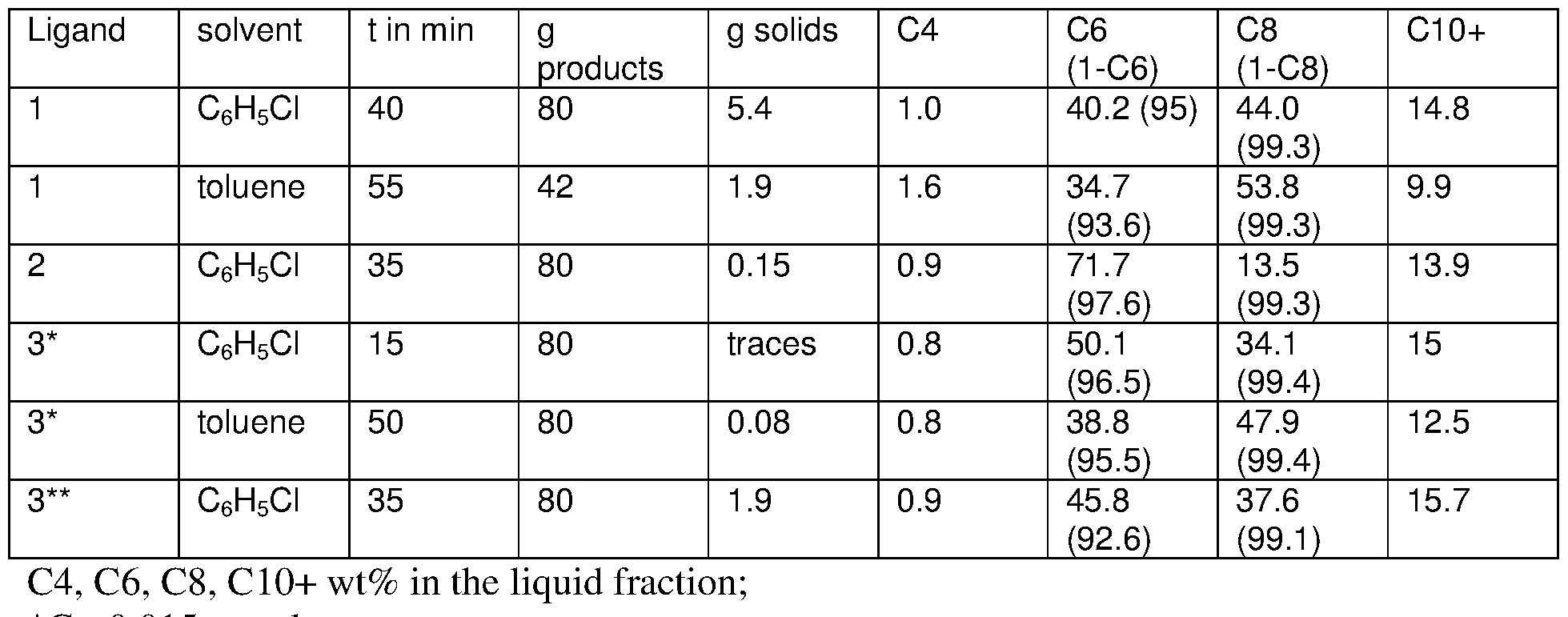
[0043] The results of the catalytic performance tests are shown in Table 1. In particular, Table 1 shows the results of catalytic tests using ligands of the PNPN(R')(R") type, where the standard reaction conditions were: pethyiene = 30 bar, T = 60°C, co-catalyst = 5 mL MMAO-3A (7 wt% Al in heptane, approx. composition [(CH3)o.7(iC4H9)0.3A10]n ), 75 mL solvent, [Cr] = 0.034 mmol, [Ligand[/[Cr] = 1.25 mol/mol. Table 1
Figure imgf000011_0002
*Cr: 0.015 mmol;
** 6.25 niL MAO (10 wt% in toluene)
** The MMAO-3A was replaced by regular, i.e. non-modified, MAO.
[0044] The values in the columns of C4, C6, C8 and C10+ are the respective yields in weight percent. The values in brackets in these columns are the respective selectivities (in weight percent) of the C6 or C8 fraction, respectively. For example, in Table 1, for Ligand 1, the C8 column means that the product from the reaction contains 44.0 weight percent C8, wherein 99.3 weight percent of this C8 fraction consists of 1- octene.
[0045] The results show that the homogeneous catalyst systems formed showed favorable selectivities to 1-hexene and 1-octene, where the C6/C8 ratio can be adjusted by the nature of the substituents on the terminal N and preferably by the solvent.
[0046] According to the second embodiment, ligands according to structure (B) were used.
[0047] Ligands of the following structure were, amongst others, synthesized:
Figure imgf000011_0001
[0048] Preparation details of some ligands of the second embodiment are as follows. Synthesis of the PNP(OR) / PNP(SR) - ligands:
Preparation of Ph2PN(iPr)P(Ph)S(iPr) (A)
[0049] 0.77 g (2 mmol) Ρ1Ι2Ρ0ΡΓ)ΝΡΟ, dissolved in toluene, was slowly transferred into a mixture of 0.381 g (5 mmol) 2-propanethiol, 1 mL (7 mmol) triethylamine and toluene at r.t.. The solution was stirred for 24 hrs at 40°C, whereupon it became cloudy. After filtration and evaporation of all volatile compounds a colorless oil remained. (31P-NMR C6D6: 46.4 ppm broad; 91.7 ppm d; 7=26 Hz)
Preparation of Ph2PN(iPr)P(Ph)OEt (B)
[0050] A mixture of 0.77 g (2 mmol) Ph2PN(iPr)P(Ph)Cl, 1 mL (7 mmol) triethylamine, 0.233 mL (4 mmol) ethanol and toluene was stirred at 50°C for 6 days. The turbid solution was filtrated and evaporated to dryness to yield a colorless oil. ( 31 P-NMR CDC13: 39.5 ppm broad; 129.7 ppm d, 7=20.6 Hz)
Preparation of Ph2PN(iPr)P(Ph)OMe (C)
[0051] A mixture of 0.77 g (2 mmol) Ph2PN(iPr)P(Ph)Cl, 1 mL (7 mmol) triethylamine, 0.162 mL (4 mmol) methanol and toluene was stirred at 50°C for 2 days.
The turbid solution was filtrated and evaporated to dryness to yield a colorless oil. ( 31 P- NMR CDCI3: 36.3 ppm broad; 133.3 ppm d, 7=19.6 Hz)
[0052] The preparation of Pt^P^P lNPCl was performed according to: Cross R. J. Green, H. T.; Keat, R. 7. Chem. Soc. Dalton Trans. 1976, 1424-1428.
[0053] The catalytic oligomerization tests were carried out following the experimental procedure described above.
[0054] The results of the catalytic performance tests are shown in Table 2. The homogeneous catalyst systems showed favorable selectivities to 1-hexene and 1-octene. In Table 2, standard reaction conditions are: pethyiene = 30 bar, T = 60°C, co-catalyst = 5 mL MMAO-3A (7 wt% Al in heptane), 75 mL solvent, [Cr] = 0.034 mmol, [Ligand[/[Cr] Table 2.
Figure imgf000013_0001
C4, C6, C8, C10+ wt% in the liquid fraction; * 6.25 niL MAO (10 wt% in toluene) * MMAO-3A has been replaced by regular, i.e., non-modified, MAO.
[0055] In summary, a catalyst composition comprises: (a) a chromium compound, preferably wherein the chromium compound is an organic or inorganic salt, a coordination complex, or an organometallic complexes of Cr(II) or Cr(III), or more preferably
CrCl3(THF)3, Cr(III)acetylacetonate, Cr(III)octanoate, chromium hexacarbonyl, Cr(III)-2- ethylhexanoate, (benzene)tricarbonyl-chromium, or a combination comprising at least one of the foregoing; (b) a ligand of the general structure
(A) R1R2P-N(R3)-P(R4)-NR5R6 or
(B) RiR2P-N(R3)-P(XR7)R8 or RiR2P-N(R3)-P(XR7)2, wherein X = O or S and Ri, R2, R3, R4, R5, R6, R7 and R8 are independently Ci-Cio-alkyl, C6-C2o-aryl, C3-Cio-cycloalkyl, aralkyl, alkylaryl, or trialkylsilyl, or any cyclic derivatives of (A) and (B), wherein at least one of the P or N atoms of the PNPN-unit or PNP-unit is a member of the ring system, the ring system being formed from one or more constituent compounds of structures (A) or (B) by substitution, preferably wherein Ri, R2, R3, R4, R5, R6, R7 and R8 are methyl, ethyl, isopropyl, tert-butyl, cyclohexyl, phenyl, benzyl, tolyl, or xylyl; and (c) an activator or co-catalyst, preferably wherein the activator or co-catalyst is trimethylaluminum, triethylaluminum, triisopropylaluminum, triisobutylaluminum, ethylaluminumsesquichloride, diethylaluminum chloride, ethylaluminumdichloride, methylaluminoxane (MAO), modified methylaminoxane (MMAO), or a combination comprising at least one of the foregoing; and more preferably wherein the ligand (A) is Ph2P-N(i-Pr)-P(Ph)-N(i-Pr)Ph, Ph2P-N(i-Pr)-P(Ph)-N(Me)C6H6, Ph2P-N(i-Pr)-P(Ph)S(i- Pr), Ph2P-N(i-Pr)-P(Ph)OC2H5, Ph2P-N(i-Pr)P(Ph)OCH3, or a combination comprising at least one of the foregoing; optionally wherein one or more of the following conditions applies: the catalyst composition additionally comprises a solvent, preferably an aromatic hydrocarbon, straight-chain aliphatic hydrocarbon, cyclic aliphatic hydrocarbon, straight- chain olefin, straight-chain ether, or a combination comprising at least one of the foregoing, more preferably toluene, benzene, ethylbenzene, cumene, xylenes, mesitylene, hexane, octane, cyclohexane, methylcyclohexane, hexene, heptene, octene, diethylether, tetrahydrofuran, chlorobenzene, or a combination comprising at least one of the foregoing, and most preferably toluene or chlorobenzene; the concentration of the chromium compound is from 0.01 to 100 mmol/1, preferably 0.1 to 10 mmol/1; the ligand/Cr molar ratio is from 0.5 to 50, preferably 0.8 to 2.0; and the Al/Cr molar ratio is from 1: 1 to 1000: 1, preferably 10: 1 to 200: 1.
[0056] A process for the manufacture of the foregoing catalyst composition comprises combining: a) a chromium compound, preferably wherein the chromium compound is an organic or inorganic salt, a coordination complex, or an organometallic complexes of Cr(II) or Cr(III), or more preferably CrCl3(THF)3, Cr(III)acetylacetonate, Cr(III)octanoate, chromium hexacarbonyl, Cr(III)-2-ethylhexanoate, (benzene)tricarbonyl- chromium, or a combination comprising at least one of the foregoing; (b) a ligand of the general structure
(A) R1R2P-N(R3)-P(R4)-NR5R6 or
(B) RiR2P-N(R3)-P(XR7)R8 or RiR2P-N(R3)-P(XR7)2,
wherein X = O or S and Ri, R2, R3, P , Rs, R6, R7 and R8 are independently Ci-Cio-alkyl, C6-C2o-aryl, C3-Cio-cycloalkyl, aralkyl, alkylaryl, or trialkylsilyl, or any cyclic derivatives of (A), or (B), wherein at least one of the P or N atoms of the PNPN-unit or PNP-unit is a member of the ring system, the ring system being formed from one or more constituent compounds of structures (A) or (B) by substitution, preferably wherein Ri, R2, R3, R4, Rs, R6, R7, or R8 are methyl, ethyl, isopropyl, tert-butyl, cyclohexyl, phenyl, benzyl, tolyl, xylyl, or a combination comprising at least one of the foregoing; and (c) an activator or co- catalyst, preferably wherein the activator or co-catalyst is trimethylaluminum,
triethylaluminum, triisopropylaluminum, triisobutylaluminum,
ethylaluminumsesquichloride, diethylaluminum chloride, ethylaluminumdichloride, methylaluminoxane (MAO), modified methylaminoxane (MMAO), or a combination comprising at least one of the foregoing; more preferably wherein the ligand (A) is Ph2P- N(i-Pr)-P(Ph)-N(i-Pr)Ph, Ph2P-N(i-Pr)-P(Ph)-N(Me)C6H6, Ph2P-N(i-Pr)-P(Ph)S(i-Pr), Ph2P-N(i-Pr)-P(Ph)OC2H5, Ph2P-N(i-Pr)P(Ph)OCH3, or a combination comprising at least one of the foregoing; optionally wherein one or more of the following conditions applies: a solvent is optionally combined, preferably an aromatic hydrocarbon, straight-chain, or cyclic aliphatic hydrocarbon, straight-chain olefin, straight-chain ether, or a combination comprising at least one of the foregoing more preferably toluene, benzene, ethylbenzene, cumene, xylenes, mesitylene, hexane, octane, cyclohexane, methylcyclohexane, hexene, heptene, octene, diethylether, tetrahydrofurane, chlorobenzene, or a combination comprising at least one of the foregoing, and most preferably toluene or chlorobenzene; the concentration of the chromium compound is from 0.01 to 100 mmol/1, preferably 0.1 to 10 mmol/1; the ligand/Cr molar ratio is from 0.5 to 50, preferably 0.8 to 2.0; and the Al/Cr molar ratio is from 1: 1 to 1000: 1, preferably 10: 1 to 200: 1.
[0057] A process for tri- and/or tetramerization of ethylene, comprises subjecting a catalyst composition to a gas phase of ethylene in a reactor and conducting an
oligomerization, wherein the catalyst composition comprises a) a chromium compound, preferably wherein the chromium compound is an organic or inorganic salt, a coordination complex, or an organometallic complexes of Cr(II) or Cr(III), or more preferably
CrCl3(THF)3, Cr(III)acetylacetonate, Cr(III)octanoate, chromium hexacarbonyl, Cr(III)-2- ethylhexanoate, (benzene)tricarbonyl-chromium, or a combination comprising at least one of the foregoing; (b) a ligand of the general structure
(A) R1R2P-N(R3)-P(R4)-NR5R6 or
(B) RiR2P-N(R3)-P(XR7)R8 or RiR2P-N(R3)-P(XR7)2,
wherein X = O or S and Ri, R2, R3, R4, Rs, R6, R7 and R8 are independently Ci-Cio-alkyl, C6-C2o-aryl, C3-Cio-cycloalkyl, aralkyl, alkylaryl, or trialkylsilyl, or any cyclic derivatives of (A) and (B), wherein at least one of the P or N atoms of the PNPN-unit or PNP-unit is a member of the ring system, the ring system being formed from one or more constituent compounds of structures (A) or (B) by substitution, preferably wherein Ri, R2, R3, R4, Rs, R6, R7 and R8 are methyl, ethyl, isopropyl, tert-butyl, cyclohexyl, phenyl, benzyl, tolyl, xylyl, or a combination comprising at least one of the foregoing; and (c) an activator or co- catalyst, preferably wherein the activator or co-catalyst is trimethylaluminum,
triethylaluminum, triisopropylaluminum, triisobutylaluminum,
ethylaluminumsesquichloride, diethylaluminum chloride, ethylaluminumdichloride, methylaluminoxane (MAO), modified methylaminoxane (MMAO), or a combination comprising at least one of the foregoing; and more preferably wherein the ligand (A) is Ph2P-N(i-Pr)-P(Ph)-N(i-Pr)Ph, Ph2P-N(i-Pr)-P(Ph)-N(Me)C6H6, Ph2P-N(i-Pr)-P(Ph)S(i- Pr), Ph2P-N(i-Pr)-P(Ph)OC2H5, or Ph2P-N(i-Pr)P(Ph)OCH3, or a combination comprising at least one of the foregoing ;optionally wherein one or more of the following conditions applies: the catalyst composition additionally comprises a solvent, preferably an aromatic hydrocarbon, straight-chain and cyclic aliphatic hydrocarbon, straight-chain olefin, straight-chain ether, or a combination comprising at least one of the foregoing, more preferably toluene, benzene, ethylbenzene, cumene, xylenes, mesitylene, hexane, octane, cyclohexane, methylcyclohexane, hexene, heptene, octene, diethylether, tetrahydrofuran, chlorobenzene, or a combination comprising at least one of the foregoing, and most preferably toluene or chlorobenzene; the concentration of the chromium compound is from 0.01 to 100 mmol/1, preferably 0.1 to 10 mmol/1; the ligand/Cr molar ratio is from 0.5 to 50, preferably 0.8 to 2.0; and the Al/Cr molar ratio is from 1: 1 to 1000: 1, preferably 10: 1 to 200: 1; the oligomerization is carried out at a pressure of 1 to 200 bar, preferably 10 to 50 bar; the oligomerization is carried out at a temperature of from 10 to 200°C, preferably 20 to 100°C; and the mean residence time is from 10 minutes to 20 hours, preferably 1 to 4 hours during oligomerization.
[0058] The singular forms "a", "an", and "the" include plural referents unless the context clearly dictates otherwise. "Or" means "and/or". The endpoints of all ranges directed to the same component or property are inclusive and independently combinable (e.g., ranges of "less than or equal to 25 wt%, or 5 wt% to 20 wt%," is inclusive of the endpoints and all intermediate values of the ranges of "5 wt% to 25 wt%," etc.).
Disclosure of a narrower range or more specific group in addition to a broader range is not a disclaimer of the broader range or larger group. Unless defined otherwise, technical and scientific terms used herein have the same meaning as is commonly understood by one of skill in the art to which this invention belongs. A "combination" is inclusive of blends, mixtures, alloys, reaction products, and the like.
[0059] As used herein, the term "hydrocarbyl" and "hydrocarbon" refers broadly to a substituent comprising carbon and hydrogen, optionally with 1 to 3 heteroatoms, for example, oxygen, nitrogen, halogen, silicon, sulfur, or a combination thereof; "alkyl" refers to a straight or branched chain, saturated monovalent hydrocarbon group;
"alkylene" refers to a straight or branched chain, saturated, divalent hydrocarbon group; "alkylidene" refers to a straight or branched chain, saturated divalent hydrocarbon group, with both valences on a single common carbon atom; "alkenyl" refers to a straight or branched chain monovalent hydrocarbon group having at least two carbons joined by a carbon-carbon double bond; "cycloalkyl" refers to a non-aromatic monovalent monocyclic or multicylic hydrocarbon group having at least three carbon atoms, "cycloalkenyl" refers to a non-aromatic cyclic divalent hydrocarbon group having at least three carbon atoms, with at least one degree of unsaturation; "aryl" refers to an aromatic monovalent group containing only carbon in the aromatic ring or rings; "arylene" refers to an aromatic divalent group containing only carbon in the aromatic ring or rings; "alkylaryl" refers to an aryl group that has been substituted with an alkyl group as defined above, with 4- methylphenyl being an exemplary alkylaryl group; "arylalkyl" refers to an alkyl group that has been substituted with an aryl group as defined above, with benzyl being an exemplary arylalkyl group; "acyl" refers to an alkyl group as defined above with the indicated number of carbon atoms attached through a carbonyl carbon bridge (-C(=0)-); "alkoxy" refers to an alkyl group as defined above with the indicated number of carbon atoms attached through an oxygen bridge (-0-); and "aryloxy" refers to an aryl group as defined above with the indicated number of carbon atoms attached through an oxygen bridge (-0-).
[0060] Unless otherwise indicated, each of the foregoing groups can be
unsubstituted or substituted, provided that the substitution does not significantly adversely affect synthesis, stability, or use of the compound. The term "substituted" as used herein means that at least one hydrogen on the designated atom or group is replaced with another group, provided that the designated atom's normal valence is not exceeded. When the substituent is oxo (i.e., =0), then two hydrogens on the atom are replaced. Combinations of substituents and/or variables are permissible provided that the substitutions do not significantly adversely affect synthesis or use of the compound. Exemplary groups that can be present on a "substituted" position include, but are not limited to, cyano; hydroxyl; nitro; azido; alkanoyl (such as a C2_6 alkanoyl group such as acyl); carboxamido; C1-6 or Ci-3 alkyl, cycloalkyl, alkenyl, and alkynyl (including groups having at least one unsaturated linkages and from 2 to 8, or 2 to 6 carbon atoms); Ci_6 or Ci_3 alkoxys; C6-1o aryloxy such as phenoxy; Ci_6 alkylthio; Ci_6 or Ci_3 alkylsulfinyl; Cl-6 or Ci_3
alkylsulfonyl; aminodi(Ci_6 or Ci_3)alkyl; C6-12 aryl having at least one aromatic rings (e.g., phenyl, biphenyl, naphthyl, or the like, each ring either substituted or unsubstituted aromatic); C7_i9 arylalkyl having 1 to 3 separate or fused rings and from 6 to 18 ring carbon atoms; or arylalkoxy having 1 to 3 separate or fused rings and from 6 to 18 ring carbon atoms, with benzyloxy being an exemplary arylalkoxy.
[0061] All cited patents, patent applications, and other references are incorporated herein by reference in their entirety. However, if a term in the present application contradicts or conflicts with a term in the incorporated reference, the term from the present application takes precedence over the conflicting term from the incorporated reference.
[0062] The features disclosed in the foregoing description, in the claims and/or in the accompanying drawings may, both separately and in any combination thereof, be material for realizing the invention in diverse forms thereof.

Claims

1. A catalyst composition comprising:
(a) a chromium compound;
(b) a ligand of the general structure
(A) R1R2P-N(R3)-P(R4)-NR5R6 or
(B) RiR2P-N(R3)-P(XR7)R8 or RiR2P-N(R3)-P(XR7)2, with X = O or S, wherein Ri, R2, R3, R4, R5, R6, R7 and R8 are independently Ci-Cio-alkyl, C6-C2o-aryl, C3- Cio-cycloalkyl, aralkyl, alkylaryl, or trialkylsilyl, or any cyclic derivatives of (A) and (B), wherein at least one of the P or N atoms of the PNPN-unit or PNP-unit is a member of the ring system, the ring system being formed from one or more constituent compounds of structures (A) or (B) by substitution; and
(c) an activator or co-catalyst.
2. A catalyst composition according to claim 1, wherein the chromium compound is an organic salt, an inorganic salt, a coordination complex, an organometallic complexes of Cr(II), or Cr(III), or a combination comprising at least one of the foregoing.
3. A catalyst composition according to claim 2, wherein the chromium compound is CrCl3(THF)3, Cr(III)acetylacetonate, Cr(III)octanoate, chromium
hexacarbonyl, Cr(III)-2-ethylhexanoate, (benzene)tricarbonyl-chromium, or a combination comprising at least one of the foregoing.
4. A catalyst composition according to any of the preceding claims 1 to 3, wherein Ri, R2, R3, R4, R5, R6, R7, and R8 are each independently methyl, ethyl, isopropyl, tert-butyl, cyclohexyl, phenyl, benzyl, tolyl, or xylyl.
5. A catalyst composition according to any of the preceding claims 1 to 4, wherein the activator or co-catalyst is trimethylaluminum, triethylaluminum,
triisopropylaluminum, triisobutylaluminum, ethylaluminumsesquichloride,
diethylaluminum chloride, ethylaluminumdichloride, methylaluminoxane (MAO), modified methylaminoxane (MMAO), or a combination comprising at least one of the foregoing.
6. A catalyst composition according to any of the preceding claims 1 to 5, wherein the ligand is Ph2P-N(i-Pr)-P(Ph)-N(i-Pr)Ph, Ph2P-N(i-Pr)-P(Ph)-N(Me)C6H6, Ph2P-N(i-Pr)-P(Ph)S(i-Pr), Ph2P-N(i-Pr)-P(Ph)OC2H5, Ph2P-N(i-Pr)P(Ph)OCH3, or a combination comprising at least one of the foregoing.
7. A catalyst composition according to any of the preceding claims 1 to 6, additionally comprising a solvent, preferably aromatic hydrocarbons, straight-chain aliphatic hydrocarbons, cyclic aliphatic hydrocarbons, straight-chain olefins, ethers, or a combination comprising at least one of the foregoing, preferably toluene, benzene, ethylbenzene, cumene, xylenes, mesitylene, hexane, octane, cyclohexane,
methylcyclohexane, hexene, heptene, octene, diethylether, tetrahydrofuran, chlorobenzene, or a combination comprising at least one of the foregoing, most preferably toluene or chlorobenzene.
8. A catalyst composition according to claim 7, wherein the concentration of the chromium compound is from 0.01 to 100 mmol/1, preferably 0.1 to 10 mmol/1.
9. A catalyst composition according to any of the preceding claims 1 to 8, wherein the ligand/Cr molar ratio is from 0.5 to 50, preferably 0.8 to 2.0.
10. A catalyst composition according to any of the preceding claims 5 to 9, wherein the Al/Cr molar ratio is from 1: 1 to 1000: 1, preferably 10: 1 to 200: 1.
11. A catalyst composition, obtainable by combining at least:
(a) a chromium compound;
(b) a ligand of the general structure
(A) R1R2P-N(R3)-P(R4)-NR5R6 or
(B) RiR2P-N(R3)-P(XR7)R8 or RiR2P-N(R3)-P(XR7)2, wherein
X = O or S, and
Ri, R2, R3, R4, Rs, R6, R7 and R8 are independently Ci-Cio-alkyl, C6-C2o-aryl, C3- Cio-cycloalkyl, aralkyl, alkylaryl, or trialkylsilyl, or any cyclic derivatives of (A) and (B), wherein at least one of the P or N atoms of the PNPN-unit or PNP-unit is a member of the ring system, the ring system being formed from one or more constituent compounds of structures (A) or (B) by substitution; and
(c) an activator or co-catalyst.
12. A process for tri- and/or tetramerization of ethylene, comprising subjecting a catalyst composition according to any of the claims 1 to 11 to a gas phase of ethylene in a reactor and conducting an oligomerization.
13. A process according to claim 12, wherein the oligomerization is carried out at a pressure of 1 to 200 bar, preferably 10 to 50 bar.
14. A process according to claim 12 or 13, wherein the oligomerization is carried out at a temperature of from 10 to 200°C, preferably 20 to 100°C.
15. A process according to any of the claims 12 to 14, wherein the mean residence time is from 10 minutes to 20 hours, preferably 1 to 4 hours.
PCT/IB2014/063485 2013-07-29 2014-07-28 Catalyst composition and process for oligomerization of ethylene Ceased WO2015015402A2 (en)

Priority Applications (12)

Application Number Priority Date Filing Date Title
JP2016528647A JP6175192B2 (en) 2013-07-29 2014-07-28 Catalyst composition and process for oligomerization of ethylene
BR112016001705A BR112016001705A2 (en) 2013-07-29 2014-07-28 COMPOSITION OF CATALYST AND PROCESS FOR TRI- AND/OR TETRAMERIZATION OF ETHYLENE
KR1020167003829A KR102268302B1 (en) 2013-07-29 2014-07-28 Catalyst composition and process for oligomerization of ethylene
MX2016001079A MX373757B (en) 2013-07-29 2014-07-28 CATALYST COMPOSITION AND PROCESS FOR THE OLIGOMERIZATION OF ETHYLENE.
CA2916919A CA2916919C (en) 2013-07-29 2014-07-28 Catalyst composition and process for oligomerization of ethylene
CN201480042534.9A CN105408019B (en) 2013-07-29 2014-07-28 Catalyst compositions and methods for ethylene oligomerization
SG11201510819VA SG11201510819VA (en) 2013-07-29 2014-07-28 Catalyst composition and process for oligomerization of ethylene
RU2016104650A RU2647863C2 (en) 2013-07-29 2014-07-28 Catalyst composition and process for oligomerization of ethylene
US14/908,026 US9561500B2 (en) 2013-07-29 2014-07-28 Catalyst composition and process for oligomerization of ethylene
US15/379,836 US10265690B2 (en) 2013-07-29 2016-12-15 Catalyst composition and process for oligomerization of ethylene
US16/355,298 US20190210011A1 (en) 2013-07-29 2019-03-15 Catalyst composition and process for oligomerization of ethylene
US17/722,794 US20220241764A1 (en) 2013-07-29 2022-04-18 Catalyst composition and process for oligomerization of ethylene

Applications Claiming Priority (4)

Application Number Priority Date Filing Date Title
EP13178362.3 2013-07-29
EP13178362.3A EP2832445A1 (en) 2013-07-29 2013-07-29 Catalyst composition and process for oligomerization of ethylene
US201462008237P 2014-06-05 2014-06-05
US62/008,237 2014-06-05

Related Child Applications (2)

Application Number Title Priority Date Filing Date
US14/908,026 A-371-Of-International US9561500B2 (en) 2013-07-29 2014-07-28 Catalyst composition and process for oligomerization of ethylene
US15/379,836 Division US10265690B2 (en) 2013-07-29 2016-12-15 Catalyst composition and process for oligomerization of ethylene

Publications (2)

Publication Number Publication Date
WO2015015402A2 true WO2015015402A2 (en) 2015-02-05
WO2015015402A3 WO2015015402A3 (en) 2015-07-16

Family

ID=48874924

Family Applications (1)

Application Number Title Priority Date Filing Date
PCT/IB2014/063485 Ceased WO2015015402A2 (en) 2013-07-29 2014-07-28 Catalyst composition and process for oligomerization of ethylene

Country Status (13)

Country Link
US (4) US9561500B2 (en)
EP (1) EP2832445A1 (en)
JP (1) JP6175192B2 (en)
KR (1) KR102268302B1 (en)
CN (2) CN108295900A (en)
BR (1) BR112016001705A2 (en)
CA (1) CA2916919C (en)
MX (1) MX373757B (en)
MY (1) MY172628A (en)
RU (1) RU2647863C2 (en)
SG (1) SG11201510819VA (en)
TW (1) TWI561305B (en)
WO (1) WO2015015402A2 (en)

Cited By (2)

* Cited by examiner, † Cited by third party
Publication number Priority date Publication date Assignee Title
JP2018513103A (en) * 2015-02-12 2018-05-24 エルジー・ケム・リミテッド Olefin oligomerization method
US10265690B2 (en) 2013-07-29 2019-04-23 Saudi Basic Industries Corporation Catalyst composition and process for oligomerization of ethylene

Families Citing this family (8)

* Cited by examiner, † Cited by third party
Publication number Priority date Publication date Assignee Title
KR102545533B1 (en) * 2016-05-27 2023-06-21 에스케이이노베이션 주식회사 Oligomerization Catalyst And Process For Preparing Ethylene Oligomer Using Thereof
JP6871358B2 (en) 2016-07-15 2021-05-12 パブリック・ジョイント・ストック・カンパニー・“シブール・ホールディング” Oligomer oligomerization method
KR101880810B1 (en) * 2016-09-21 2018-07-23 롯데케미칼 주식회사 Process for olefin oligomerization
JP7502288B2 (en) * 2018-11-12 2024-06-18 サビック グローバル テクノロジーズ ベスローテン フェンノートシャップ Ligands for the production of 1-octene in chromium-assisted ethylene oligomerization processes
KR102875866B1 (en) * 2018-11-12 2025-10-23 사빅 글로벌 테크놀러지스 비.브이. Ligand for the production of chromium-assisted 1-hexene and method for ethylene oligomerization using the same
CN111889142B (en) * 2020-07-23 2023-02-07 天津科技大学 Catalyst system, reaction method and application of a kind of ethylene selective oligomerization
CN112473741B (en) * 2020-10-22 2023-09-01 杭州小菱科技有限公司 Ethylene oligomerization catalyst system and preparation method and application thereof
JP2024545896A (en) 2021-12-23 2024-12-13 サビック グローバル テクノロジーズ ベスローテン フェンノートシャップ CATALYST COMPOSITION FOR OLIGOMERIZATION REACTIONS - Patent application

Citations (2)

* Cited by examiner, † Cited by third party
Publication number Priority date Publication date Assignee Title
WO2009006979A2 (en) 2007-07-11 2009-01-15 Linde Ag Catalyst composition and process for di-, tri- and/or tetramerization of ethylene
WO2010115520A1 (en) 2009-04-09 2010-10-14 Linde Ag Catalyst composition and process for oligomerization of ethylene

Family Cites Families (13)

* Cited by examiner, † Cited by third party
Publication number Priority date Publication date Assignee Title
GB0016895D0 (en) * 2000-07-11 2000-08-30 Bp Chem Int Ltd Olefin oligomerisation
JP4266827B2 (en) 2001-12-20 2009-05-20 サソル テクノロジー (ピーティーワイ)リミテッド Trimerization and oligomerization of olefins using a chromium-based catalyst
US7525009B2 (en) * 2002-12-20 2009-04-28 Sasol Technology (Pty) Limited Trimerisation of olefins
JP2006511625A (en) * 2002-12-20 2006-04-06 サソル テクノロジー (ピーティーワイ) リミテッド Tetramerization of olefins
US7297832B2 (en) * 2002-12-20 2007-11-20 Sasol Technology (Pty) Limited Tetramerization of olefins
KR20060002742A (en) 2002-12-20 2006-01-09 사솔 테크날러지 (프로프라이어터리) 리미티드 Tetramerization of Olefin
US7323611B2 (en) * 2005-06-28 2008-01-29 Sumitomo Chemical Company Limited Process for producing olefin oligomer
CN100443178C (en) * 2006-03-10 2008-12-17 中国石油天然气股份有限公司 Catalyst composition for ethylene oligomerization and application thereof
WO2008077908A1 (en) * 2006-12-22 2008-07-03 Shell Internationale Research Maatschappij B.V. Ligands and catalyst systems thereof for the catalytic oligomerization of olefinic monomers
ATE510619T1 (en) * 2008-04-04 2011-06-15 Saudi Basic Ind Corp CATALYST FOR THE OLIGOMERIZATION OF ETHYLENE, METHOD FOR ITS PREPARATION AND OLIGOMERIZATION PROCESS IN ITS PRESENCE
ES2409707T3 (en) * 2011-02-16 2013-06-27 Linde Ag Process for preparing a catalytic composition for oligomerization of ethylene and preforming unit of respective catalyst composition
CA2765429C (en) * 2012-01-25 2019-12-31 Nova Chemicals Corporation P-n-p ligand
EP2832445A1 (en) 2013-07-29 2015-02-04 Linde AG Catalyst composition and process for oligomerization of ethylene

Patent Citations (2)

* Cited by examiner, † Cited by third party
Publication number Priority date Publication date Assignee Title
WO2009006979A2 (en) 2007-07-11 2009-01-15 Linde Ag Catalyst composition and process for di-, tri- and/or tetramerization of ethylene
WO2010115520A1 (en) 2009-04-09 2010-10-14 Linde Ag Catalyst composition and process for oligomerization of ethylene

Non-Patent Citations (1)

* Cited by examiner, † Cited by third party
Title
CROSS R. J.; GREEN, H. T.; KEAT, R., J. CHEM. SOC. DALTON TRANS., 1976, pages 1424 - 1428

Cited By (3)

* Cited by examiner, † Cited by third party
Publication number Priority date Publication date Assignee Title
US10265690B2 (en) 2013-07-29 2019-04-23 Saudi Basic Industries Corporation Catalyst composition and process for oligomerization of ethylene
JP2018513103A (en) * 2015-02-12 2018-05-24 エルジー・ケム・リミテッド Olefin oligomerization method
US10471416B2 (en) 2015-02-12 2019-11-12 Lg Chem, Ltd. Method for oligomerizing an olefin

Also Published As

Publication number Publication date
WO2015015402A3 (en) 2015-07-16
CA2916919C (en) 2018-05-01
US10265690B2 (en) 2019-04-23
JP2016529098A (en) 2016-09-23
TWI561305B (en) 2016-12-11
US20190210011A1 (en) 2019-07-11
US20220241764A1 (en) 2022-08-04
CN108295900A (en) 2018-07-20
CN105408019A (en) 2016-03-16
KR20160037181A (en) 2016-04-05
BR112016001705A2 (en) 2017-09-19
CN105408019B (en) 2019-06-28
MY172628A (en) 2019-12-06
KR102268302B1 (en) 2021-06-23
MX373757B (en) 2020-04-23
SG11201510819VA (en) 2016-02-26
US20170128925A1 (en) 2017-05-11
US9561500B2 (en) 2017-02-07
CA2916919A1 (en) 2015-02-05
RU2647863C2 (en) 2018-03-21
US20160167033A1 (en) 2016-06-16
JP6175192B2 (en) 2017-08-02
EP2832445A1 (en) 2015-02-04
RU2016104650A (en) 2017-08-31
TW201519949A (en) 2015-06-01
MX2016001079A (en) 2016-04-25

Similar Documents

Publication Publication Date Title
US20220241764A1 (en) Catalyst composition and process for oligomerization of ethylene
US9555404B2 (en) Catalyst composition and process for di-, tri- and/or tetramerization of ethylene
US10421064B2 (en) Catalyst composition and process for oligomerization of ethylene to produce 1-hexene and/or 1-octene
EP3260460B1 (en) Ligand compound, organic chrome compound, catalyst system for olefin oligomerization, and method for olefin oligomerization using same
EP3101039B1 (en) Ligand compound, organic chrome compound, catalyst system for olefin oligomerization, and method for oligomerizing olefin using same
EP3880359A1 (en) Ligands for production of 1-hexene in chromium assisted ethylene oligomerization process
US10688473B2 (en) Ligand compound, organic chromium compound, catalyst system for oligomerization of olefins, and method for oligomerizing olefins using the same
US20160367978A1 (en) Novel nickel-based catalytic composition and use thereof in a method for the oligomerisation of olefins
JP2010189297A (en) Method for producing 1-hexene and/or 1-octene by trimerizing and/or tetramerizing ethylene

Legal Events

Date Code Title Description
WWE Wipo information: entry into national phase

Ref document number: 201480042534.9

Country of ref document: CN

121 Ep: the epo has been informed by wipo that ep was designated in this application

Ref document number: 14777169

Country of ref document: EP

Kind code of ref document: A2

ENP Entry into the national phase

Ref document number: 2916919

Country of ref document: CA

WWE Wipo information: entry into national phase

Ref document number: 139450140003011287

Country of ref document: IR

WWE Wipo information: entry into national phase

Ref document number: MX/A/2016/001079

Country of ref document: MX

ENP Entry into the national phase

Ref document number: 2016528647

Country of ref document: JP

Kind code of ref document: A

WWE Wipo information: entry into national phase

Ref document number: 14908026

Country of ref document: US

NENP Non-entry into the national phase

Ref country code: DE

REG Reference to national code

Ref country code: BR

Ref legal event code: B01A

Ref document number: 112016001705

Country of ref document: BR

ENP Entry into the national phase

Ref document number: 20167003829

Country of ref document: KR

Kind code of ref document: A

ENP Entry into the national phase

Ref document number: 2016104650

Country of ref document: RU

Kind code of ref document: A

122 Ep: pct application non-entry in european phase

Ref document number: 14777169

Country of ref document: EP

Kind code of ref document: A2

ENP Entry into the national phase

Ref document number: 112016001705

Country of ref document: BR

Kind code of ref document: A2

Effective date: 20160126