WO2014186571A1 - Benzoxazole-based materials for vulcanization accelerator applications - Google Patents
Benzoxazole-based materials for vulcanization accelerator applications Download PDFInfo
- Publication number
- WO2014186571A1 WO2014186571A1 PCT/US2014/038191 US2014038191W WO2014186571A1 WO 2014186571 A1 WO2014186571 A1 WO 2014186571A1 US 2014038191 W US2014038191 W US 2014038191W WO 2014186571 A1 WO2014186571 A1 WO 2014186571A1
- Authority
- WO
- WIPO (PCT)
- Prior art keywords
- rubber
- alkyl groups
- benzoxazole
- sulfenamide
- sulfur
- Prior art date
- Legal status (The legal status is an assumption and is not a legal conclusion. Google has not performed a legal analysis and makes no representation as to the accuracy of the status listed.)
- Ceased
Links
- 0 *NSc1nc(cccc2)c2[o]1 Chemical compound *NSc1nc(cccc2)c2[o]1 0.000 description 7
- HVHJVHBNWZGQAF-UHFFFAOYSA-N C(CC1)CCC1N(C1CCCCC1)Sc1nc(cccc2)c2[o]1 Chemical compound C(CC1)CCC1N(C1CCCCC1)Sc1nc(cccc2)c2[o]1 HVHJVHBNWZGQAF-UHFFFAOYSA-N 0.000 description 1
- ZMULVCZEZVUPGF-UHFFFAOYSA-N C(CC1)CCN1Sc1nc(cccc2)c2[o]1 Chemical compound C(CC1)CCN1Sc1nc(cccc2)c2[o]1 ZMULVCZEZVUPGF-UHFFFAOYSA-N 0.000 description 1
- DCDBKBOEZICXHG-UHFFFAOYSA-N C(COCC1)N1Sc1nc(cccc2)c2[o]1 Chemical compound C(COCC1)N1Sc1nc(cccc2)c2[o]1 DCDBKBOEZICXHG-UHFFFAOYSA-N 0.000 description 1
- HIQZVXJYYWMACL-UHFFFAOYSA-N CC(C1)CC1=N Chemical compound CC(C1)CC1=N HIQZVXJYYWMACL-UHFFFAOYSA-N 0.000 description 1
Classifications
-
- C—CHEMISTRY; METALLURGY
- C07—ORGANIC CHEMISTRY
- C07D—HETEROCYCLIC COMPOUNDS
- C07D263/00—Heterocyclic compounds containing 1,3-oxazole or hydrogenated 1,3-oxazole rings
- C07D263/52—Heterocyclic compounds containing 1,3-oxazole or hydrogenated 1,3-oxazole rings condensed with carbocyclic rings or ring systems
- C07D263/54—Benzoxazoles; Hydrogenated benzoxazoles
- C07D263/58—Benzoxazoles; Hydrogenated benzoxazoles with hetero atoms or with carbon atoms having three bonds to hetero atoms with at the most one bond to halogen, e.g. ester or nitrile radicals, directly attached in position 2
-
- C—CHEMISTRY; METALLURGY
- C07—ORGANIC CHEMISTRY
- C07D—HETEROCYCLIC COMPOUNDS
- C07D263/00—Heterocyclic compounds containing 1,3-oxazole or hydrogenated 1,3-oxazole rings
- C07D263/52—Heterocyclic compounds containing 1,3-oxazole or hydrogenated 1,3-oxazole rings condensed with carbocyclic rings or ring systems
- C07D263/54—Benzoxazoles; Hydrogenated benzoxazoles
Definitions
- One or more embodiments of the present invention relate to the use of benzoxazole sulfenamide compounds in rubber compositions such as cure systems for vulcanizing rubber and asphalt and polymer compositions.
- Vulcanization is a chemical process that converts a soft and tacky rubber into harder and more durable materials with greatly improved resistance to wear and abrasion.
- the economically most important method remains to be the sulfur vulcanization in the presence of various vulcanization accelerators.
- Thiazoles such as mercaptobenzothiazole (MBT) and its sulfenamide derivatives are among the accelerators of highest economic importance.
- MBT mercaptobenzothiazole
- the crosslink density is increased to a certain level within the rubber species, which is accompanied with increasing mechanical properties.
- the rubber system using MBT however, often exhibits weakness in terms of reversion stability, meaning that the crosslink density could decrease after passing the vulcanization optimum.
- benzothiazole-based accelerators exhibit much lower accelerating power than and are much less active than current accelerators.
- a first embodiment provides a method of vulcanizing rubber comprising:heating a rubber in the presence of sulfur compound and a benzoxazole sulfenamide defined by the formula:
- Rl and R2 are each individually selected from hydrogen atoms, alkyl groups, substituted alkyl groups, and aromatic groups, or where Rl and R2 join to form an alkane or substituted alkane group.
- a second embodiment provides a method as in the first embodiment, where the rubber is selected from the group consisting of natural rubber, polybutadiene rubbers (BR), styrene-butadiene rubbers (SBR), polyisoprene, isoprene rubbers (IR) and polychloroprene.
- the rubber is selected from the group consisting of natural rubber, polybutadiene rubbers (BR), styrene-butadiene rubbers (SBR), polyisoprene, isoprene rubbers (IR) and polychloroprene.
- a third embodiment provides a method as in the either the first or second embodiment, where the sulfur compound is elemental sulfur, an allotrope of sulfur, a sulfur donor, or a combination thereof.
- a forth embodiment provides a method as in any of the first through third embodiments, where the sulfur donor is selected from the group consisting of tetramethylthiuram disulfide, tetraethylthiuram disulfide, and dithiodimorpholine.
- a fifth embodiment provides a method as in any of the first through forth embodiments, where one of Rl or R2 is a hydrogen atom and the other may be selected from alkyl groups, substituted alkyl groups, and aromatic groups
- a sixth embodiment provides a method as in any of the first through fifth embodiments, where the benzoxazole sulfenamide is selected from the group consisting of
- a seventh embodiment provides a method as in any of the first through sixth embodiments, where the benzoxazole sulfenamide is defined by the formula
- An eighth embodiment provides a method as in any of the first through seventh embodiments, where the method further comprises an activator.
- a ninth embodiment provides a method as in any of the first through eighth embodiments, where the activator is selected from zinc compounds, steric acid, or combinations thereof.
- a tenth embodiment provides a method as in any of the first through ninth embodiments, where the method further comprises an amine.
- a eleventh embodiment provides a method as in any of the first through tenth embodiments, where the method further comprises a secondary accelerator.
- An twelfth embodiment provides a method of vulcanizing rubber comprising:
- Rl and R2 are each individually selected from hydrogen atoms, alkyl groups, substituted alkyl groups, and aromatic groups, or where Rl and R2 join to form an alkane or substituted alkane group;
- a thirteen embodiment provides a method as in the twelfth embodiment, where the benzoxazole sulfenamide forms a complex with a zinc atom defined by the formula
- each X is selected from an oxygen atom or a sulfur atom provided that at least one X is an oxygen atom
- each Rl and R2 are individually selected from hydrogen atoms, alkyl groups, and subsitituted alkyl groups, or where an Rl and an R2 join to form an alkane or substituted alkane group.
- An fourteenth embodiment provides a benzoxazole sulfenamide complex defined by the formula
- each X is selected from an oxygen atom or a sulfur atom provided that at least one X is an oxygen atom
- each Rl and R2 are individually selected from hydrogen atoms, alkyl groups, and subsitituted alkyl groups, or where an Rl and an R2 join to form an alkane or substituted alkane group.
- a fifteenth embodiment provides a method of preparing an asphalt and polymer composition comprising mixing asphalt, a rubber, a sulfur compound, an activator, and a bezoxazole sulfenamide defined by the formula:
- Rl and R2 are each individually selected from hydrogen atoms, alkyl groups, substituted alkyl groups, and aromatic groups, or where Rl and R2 join to form an alkane or substituted alkane group.
- a sixteeth embodiment provides a method as in the fifteenth embodiment, where the rubber is selected from polybutadiene, polyisoprene or polyisobutene rubber, polychloroprene, polybutadiene, styrene-butadiene copolymers
- a seventeenth embodiment provides a method as in the either the fifteenth or sixteenth embodiment, where the bezoxazole sulfenamide is selected from the group consisting of
- a eighteenth embodiment provides an asphalt and polymer composition comprising an asphalt, a rubber, a sulfur compound, an activator, and a bezoxazole sulfenamide defined by the formula:
- Rl and R2 are each individually selected from hydrogen atoms, alkyl groups, substituted alkyl groups, and aromatic groups, or where Rl and R2 join to form an alkane or substituted alkane group.
- An nineteenth embodiment provides an asphalt cement comprising:
- Figure 1 provides a l H NMR spectrum of benzoxazole derivatives 7, 8 and 9 in CD 3 OD.
- Figure 2 provides a crystal structure of zinc complex 9.
- Figure 3 provides a chart of the cure characteristic curves of compound 7 at 140°C.
- the sample composition is shown in Table 2.
- NR natural rubber
- sulfur sulfur
- Figure 4 provides a chart of the cure characteristic curves of 7 at different temperatures.
- Figure 5 provides a chart showing the effect of cure rate on rubber sample (natural rubber: 100 Phr; sulfur: 2.4 Phr; compound 7 :0.6 Phr) in the presence of different activators at 140°C.
- Figure 6A provides the CPMAS C NMR of cured rubber by using benzoxazole 7 as the vulcanization accelerator (cure time: 90min). The inset shows the enlarged region for 35-70 ppm.
- Figure 6B provides the CPMAS 13 C NMR of cured rubber by using TBBS as thevulcanization accelerator (cure time: 90min).
- the inset shows the enlarged region for 35-70 ppm.
- Figure 6C provides the reference for assigning the chemical shifts of natural rubber for figures 6 A and 6B.
- Figure 7A provides a chart of the effect of zinc compound 8 on the cure rate of rubber compound (100 NR + 2.4 sulfur) at 140°C.
- Figure 7B provides a chart of the effect of zinc compound 9 on the cure rate of rubber compound (100 NR + 2.4 sulfur) at 140°C.
- Figure 8 provides a chart showing the comparison of cure characteristic curves by using different accelerators at 140°C (using the rubber composition in the Table 2).
- the inset shows the structure of diphenylguanidine (DPG).
- the amount of amine (diphenylguanidine, DPG) used was 0.4 Phr.
- Embodiments include the use of benzoxazole sulfenamide as accelerators for sulfur vulcanization.
- benzoxazole sulfenamide is used an accelerator, a volcanized polymer may be prepared with little to no reversion.
- benzoxazole sulfenamide revealed similar "scorch time," a desirable "delayed vulcanization.”
- a chart of torque vs. time for benzoxazole sulfenamide cure rubber exhibits a long plateau, indicating the less danger of over-vulcanization.
- Benzoxazole sulfenamide may also be used in asphalt and polymer compositions.
- Vulcanization is a chemical process that converts a soft and tacky rubber into a harder and more durable material. Methods of vulcanizing rubber are detailed in "Rubber Compounding: Chemistry and Applications; Taylor & Francis, 2004, which is incorporated by reference.
- the components used to vulcanize rubber, including the rubber itself, may be referred to as a cure system.
- the cure system may include a rubber, a sulfur compound, and a benzoxazole sulfenamide accelerator.
- the cure system may optionally have other components such as activators, retarders, and secondary accelerators.
- the vulcanized rubber may be prepared by mixing the ingredients of the cure system and then heating the cure system.
- the sulfur compound and the benzoxazole sulfonamide accelerator are the final components cure system to be add.
- a cure system may be prepared by mixing rubber for 1 to 5 minutes, adding an activator under continued mixing for 1 to 5 minutes, and then finally added the sulfur compound and the benzoxazole sulfonamide accelerator.
- Rubbers suitable for vulcanization with a benzoxazole sulfenamide accelerator include those rubbers with unsaturated carbon-carbon bonds. Suitable rubbers include natural rubber or synthetic rubbers. Examples of synthetic rubbers include, but are not limited to, polybutadiene rubbers (BR), polystyrene-butadiene rubbers (SBR), polyisoprene, isoprene rubbers (IR) and polychloroprene.
- BR polybutadiene rubbers
- SBR polystyrene-butadiene rubbers
- IR isoprene rubbers
- polychloroprene polychloroprene
- Benzoxazole sulfenamide accelerators include those compounds that include a benzoxazole group connected through a sulfur atom to an amine group. Those skilled in the art will understand that a benzoxazole may be defined by the formula:
- R1 and R ⁇ are each individually selected from hydrogen atoms, alkyl groups, substituted alkyl groups, and aromatic groups, or where R1 and R ⁇ join to form an alkane or substituted alkane group.
- alkyl groups may include linear or branched hydrocarbons with a carbon chain length of 1 to 6 carbons.
- alkyl groups include, but are not limited to, methyl, ethyl, propyl, isopropyl, isobutyl, tert-butyl, n-butyl, sec -butyl, isopentyl, tertpentyl, n-pentyl, sec-pentyl, tert-hexyl, n-hexyl, isohexyl, and sec-hexyl.
- Substituted alkyl groups include groups where a hydrogen atom has been replaced with a substituent. Suitable substituents include a halogen atom (e.g. F, CI, Br), a hydroxy 1 group, an alkoxy group, or an amino group.
- halogen atom e.g. F, CI, Br
- the benzoxazole sulfenamide accelerator may be defined by the formula:
- R1 and are each individually selected from hydrogen atoms, alkyl groups, substituted alkyl groups, and aromatic groups, or where R.1 and R ⁇ join to form an alkane or substituted alkane group.
- the amine may be a tertiary amine, and both R1 and R ⁇ are each individually selected from alkyl groups, substituted alkyl groups, and aromatic groups, or where R1 and R ⁇ join to form an alkane or substituted alkane group.
- the amine may be a secondary amine, and one of R1 or R ⁇ may be a hydrogen atom and the other may be selected from alkyl groups, substituted alkyl groups, and aromatic groups.
- benzoxazole sulfenamide accelerator may be defined by the follow formulas
- the amount of the benzoxazole sulfenamide accelerator used to cure rubber may be stated in Phr (parts per hundred parts rubber).
- the cure system may include at least 0.1, in other embodiments at least 0.3, and in still other embodiments at least 0.5 Phr of a benzoxazole sulfenamide accelerator.
- the cure system may include at most 10, in other embodiments at most 7, and in still other embodiments at most 5 Phr of a benzoxazole sulfenamide accelerator.
- the cure system may include at about 0.1 to 10, in other embodiments about 0.3 to 7, and in still other embodiments about 0.5 to 5 Phr of a benzoxazole sulfonamide accelerator.
- Sulfur compounds may be used to crosslink active sites, typically unsaturated carbon-carbon bonds in on the rubber.
- Sulfur compounds suitable for vulcanization with a benzoxazole sulfonamide accelerator include elemental sulfur, an allotrope of sulfur, a sulfur donor, or a combination thereof. Examples of sulfur donors include, but are not limited to, tetramethylthiuram disulfide, tetraethylthiuram disulfide, and dithiodimorpholine.
- the cure system may include at least 0.1 , in other embodiments at least0.3, and in still other embodiments at least 0.5 Phr of a sulfur compound. In these other embodiments, the cure system may include at most 40, in other embodiments at most 20, and in still other embodiments at most 10 Phr of a sulfur compound. In these other embodiments, the cure system may include at about 0.1 to about 10, in other embodiments about 0.5 to about 7, and in still other embodiments about 1 to about 5 Phr of a sulfur compound.
- An activator may be used to improve acceleration and allow the cure system to reach its full crosslinking potential.
- Activators suitable for vulcanization with a benzoxazole sulfonamide accelerator include zinc compounds, steric acid, or combinations thereof. Examples zinc compounds include, but are not limited to, zinc oxide (ZnO) and Zn-soap.
- the amount of activator used to cure rubber may be stated in Phr.
- the cure system may include at least 0.1, in other embodiments at least 0.5, and in still other embodiments at least 1 Phr of an activator.
- the cure system may include at most 20, in other embodiments at most 10, and in still other embodiments at most 6 Phr of an activator.
- the cure system may include at about 0.1 to about 20, in other embodiments about 0.5 to about 10, and in still other embodiments about 1 to about 6 Phr of an activator.
- a retarder may be used to reduce the tendency of a rubber compound to vulcanize prematurely by increasing scorch delay.
- Retarders suitable for vulcanization with a benzoxazole sulfenamide accelerator include N-(cyclohexylthio) phthalimide and stearic acid.
- the amount of activator used to cure rubber may be stated in Phr.
- the cure system may include at least 0.01, in other embodiments at least0.05, and in still other embodiments at least 0.1 Phr of a retarder. In these other embodiments, the cure system may include at most 5, in other embodiments at most 3, and in still other embodiments at most 2 Phr of a retarder.
- the cure system may include at about 0.01 to about 5, in other embodiments about 0.05 to about 3, and in still other embodiments about 0.1 to about 2 Phr of a retarder.
- the cure system may optionally include a secondary accelerator in addition to the benzoxazole sulfenamide accelerator.
- a secondary accelerator may be used to control vulcanization speed.
- suitable secondary accelerators include N-cyclohexyl-2-benzothiazolesulfenamide, N- (cyclohexylthio)phthalimide, N,N'-dibutylthiourea,N,N-dicyclohexyl-2- benzothiazolesulfenamide ⁇ , ⁇ '-Diethythiourea, di-o-tolylguanidine, diphenylguanidine, dipentamethylenethiuram hexasulfide, dithiodimorpholine, ethylenethiourea, 2- (morpholinothio)benzothiazolesulfenamide, 2-mercaptobenzothiazole, benzothiazyl disulfide, N-nitrosodiphenylamine, polyethylene glycol, N-t-Butyl-2- benzothiazolesulfenamide, tellurium diethyldithiocarbamate, tetraethylthiuram disulfide, polymerized 2,2,
- the amount of the secondary accelerator used to cure rubber may be stated in Phr.
- the cure system may include at least 0.1, in other embodiments at least0.5, and in still other embodiments at least 1.0 Phr of a secondary accelerator.
- the cure system may include at most 10, in other embodiments at most 6, and in still other embodiments at most 4 Phr of a secondary accelerator.
- the cure system may include at about 0.1 to 8, in other embodiments about 0.5 to 6, and in still other embodiments about 1 to 4 Phr of a secondary accelerator.
- the amount of the secondary accelerator used to cure rubber may also be stated in as a ratio between the benzoxazole sulfonamide accelerator and the secondary accelerator.
- the cure system may include a ratio of benzoxazole sulfenamide accelerator to secondary accelerator of about 1 to 50, in other embodiments about 5 to 25, and in still other embodiments about 10 to 15.
- an amine compound may be included in the cure system. It has been found that when a cure system includes a benzoxazole sulfenamide accelerator and an amine show increased accelerator activity.
- suitable amine compounds include diphenylquanidine, butyraldehydeanine, hexamethylenetetramine, di(P-naphthyl)-p-phenyldiamine, a dialkylamine such as dibutyl amine or cyclohexylethylamine, trimethylthiourea, 1,3-dibutylthiourea.
- the amount of the amine used to cure rubber may be stated in Phr.
- the cure system may include at least 0.1, in other embodiments at least0.2, and in still other embodiments at least 0.4 Phr of an amine. In these other embodiments, the cure system may include at most 10, in other embodiments at most 8, and in still other embodiments at most 5 Phr of an amine. In these other embodiments, the cure system may include at about 0.1 to 8, in other embodiments about 0.2 to 5, and in still other embodiments about 0.5 to 3 Phr of an amine.
- the vulcanized rubber shows little or no reversion.
- the vulcanized rubber systems show a non-appreciable amount of reversion.
- the amount of reversion may be determined using a rheometer. In one or more embodiments, the amount of reversion may be less than 10%, in other embodiments, less than 5%, and in still other embodiments less than 2%.
- the benzoxazole sulfenamide accelerator may form a complex with a zinc atom defined by the formula
- each X is selected from an oxygen atom or a sulfur atom provided that at least one
- X is an oxygen atom
- each R1 and are individually selected from hydrogen atoms, alkyl groups, and subsitituted alkyl groups, or where an R1 and an R.2 join to form an alkane or substituted alkane group.
- the complex is typically prepared from a cure system that includes a zinc compound activator, a zinc compound, and a secondary accelerator that includes a benzothiazole group.
- an asphalt and polymer composition comprises an asphalt, a rubber, a sulfur compound, an activator, and a bezoxazole sulfonamide.
- the asphalt and polymer composition may include a bezoxazole sulfonamide defined by the formula:
- R.1 and are each individually selected from hydrogen atoms, alkyl groups, and substituted alkyl groups, or where R.1 and R ⁇ join to form an alkane or substituted alkane group.
- the amount of the benzoxazole sulfenamide for use in an asphalt and polymer composition may be stated in percent weight of the total asphalt and polymer composition.
- the asphalt and polymer composition may include at least 0.01%, in other embodiments at least 0.02 %, and in still other embodiments at least 0.05% benzoxazole sulfenamide.
- the asphalt and polymer composition may include at most 0.1 %, in other embodiments at most 1%, and in still other embodiments at most 4 % benzoxazole sulfenamide.
- the asphalt and polymer composition may include at about 0.01 % to about 4 %, in other embodiments about 0.02 % to 1 %, and in still other embodiments about 0.05 % to 0.1 % benzoxazole sulfonamide.
- Asphalt which may also be referred to as bitumen, is a viscous liquid or semisolid form of petroleum.
- the amount of the asphalt for use in an asphalt and polymer composition may be stated in percent weight of the total asphalt and polymer composition.
- the combined weight of asphalt and rubber polymer may be considered as 100%.
- the asphalt and polymer composition may include at least 85%, in other embodiments at least 90 %, and in still other embodiments at least 95% asphalt.
- the asphalt and polymer composition may include at most 96 %, in other embodiments at most 98%, and in still other embodiments at most 99 % asphalt.
- the asphalt and polymer composition may include at about 85 % to about 99 %, in other embodiments about 90 % to about 99 %, and in still other embodiments about 95 % to about 98 % asphalt.
- Rubbers suitable for use in an asphalt and polymer composition include, but are not limited to, polybutadiene, polyisoprene or polyisobutene rubber, polychloroprene, polybutadiene, styrene-butadiene copolymers.
- the amount of the rubber for use in an asphalt and polymer composition may be stated in percent weight of the total asphalt and polymer composition.
- the asphalt and polymer composition may include at least 1%, in other embodiments at least2 %, and in still other embodiments at least 3% rubber.
- the asphalt and polymer composition may include at most 6 %, in other embodiments at most 8%, and in still other embodiments at most 10 % rubber.
- the asphalt and polymer composition may include at about 1 % to about 10 %, in other embodiments about 2 % to about 8 %, and in still other embodiments about 3 % to about 6 % rubber.
- Activators suitable for use in an asphalt and polymer composition include, but are not limited to, zinc compounds, steric acid, or combinations thereof.
- zinc compounds include, but are not limited to, zinc oxide (ZnO) and Zn-soap.
- the amount of the activator for use in an asphalt and polymer composition may be stated in percent weight of the total asphalt and polymer composition.
- the asphalt and polymer composition may include at least 0.01%, in other embodiments at least0.03 %, and in still other embodiments at least 0.05% activator.
- the asphalt and polymer composition may include at most 0.1 %, in other embodiments at most 0.5%, and in still other embodiments at most 1 % activator.
- the asphalt and polymer composition may include at about 0.01 % to about 0.1 %, in other embodiments about 0.03 % to about 0.5 %, and in still other embodiments about 0.05 % to about 0.1 % activator.
- Suitable sulfur for use in an asphalt and polymer composition include, but are not limited to, elemental sulfur, an allotrope of sulfur, a sulfur donor, or a combination thereof.
- sulfur donors include, but are not limited to, tetramethylthiuram disulfide, tetraethylthiuram disulfide, and dithiodimorpholine.
- the amount of the sulfur compounds for use in an asphalt and polymer composition may be stated in percent weight of the total asphalt and polymer composition.
- the asphalt and polymer composition may include at least 0.05%, in other embodiments at least0.07 %, and in still other embodiments at least 0.10% sulfur compound.
- the asphalt and polymer composition may include at most 0.2 %, in other embodiments at most 0.5%, and in still other embodiments at most 1 % sulfur compound. In these other embodiments, the asphalt and polymer composition may include at about 0.05 % to about 1 %, in other embodiments about 0.07 % to about 0.5 %, and in still other embodiments about 0.10 % to about 0.2 % sulfur compound.
- the asphalt and the rubber may be combined at a temperature of between 130° and 230° C, and mixed for 1 to 10 hours.
- the rubber and asphalt may be aged or the sulfur compound, activator, and bezoxazole sulfonamide may be added immediately after mixing. After the addition of the sulfur compound, activator, and bezoxazole sulfonamide the composition may be mixed or agitated for 20 minutes to 10 hours.
- an aggregate may be added to the asphalt and polymer composition.
- An aggregate is generally rock, and it may be used with an asphalt and polymer composition for paving a road.
- Compositions of that include asphalt and polymer compositions along with aggregate may be referred to as asphalt cement.
- Suitable aggregates include but are not limited to, granite, basalt, and limestone.
- the amount of the aggregate for use with an asphalt and polymer composition may be stated in percent weight of the total asphalt, polymer, and aggregate composition.
- Natural rubber (SMR CV60) was purchased from Akrochem. sulfur (Harwich), zinc oxide (Akrochem), stearic acid (Harwick), TBBS (Flexsys America), 2-mercaptobenzoxazole (Fisher), zinc acetate dihydrate (Fisher), tert- butylamine (Aldrich) were used as received.
- Zinc bis(benzoxazole-2-thiolate) 1.0 g, 2.73 mmol
- tert-butylamine 4 ml, 38 mmol
- the complex was partially dissociated during crystallization,
- Natural rubber masterbatch was made by masticating natural rubber (SMR CV60) in a Brabender internal mixer (speed: 50 rpm; temperature 55°C; loading chute: manual + 5kg). If applicable, zinc oxide and/or stearic acid were also mixed with rubber in the mastication process. Natural rubber was mixed for 1.3 min, and the mixture was mixed for additional 2 min after addition of zinc oxide/stearic acid. Sulfur and/or accelerators were then mixed with the masterbatch on a two roll mill (roll speed: front 12 rpm, rear 10 rpm; temperature: 120°C).
- Zinc complex 9 1.3 0.75 — — —
- bt90 time when cure curve reaches 90 percent of full cure. t90 is generally the time when most physical properties of a vulcanizate reach optimal results.
- cCure rate index 100 / (t90 - ts2).
- the desirable benzoxazole-2-sulfenamide 7 was synthesized from benzoxazole-2 -thiol 2 and tert-butyl amine in high yield, by using a literature procedure for a similar compound.
- the l H NMR spectrum of 7 detected four aromatic protons in anticipated two doublet and two triplet ( Figure 1), confirming its structure.
- Bis(benzoxazole-2-ylthio)zinc 8 was also prepared from 2 by reaction with base followed by treatment with zinc acetate Zn(OAc)2.
- the amine complex was conveniently prepared by reaction of 8 with tert- butylamine to give crystalline product.
- the synthesis of the amine complexes 9 appeared to be simpler than its zinc benzothiazole-2-thiolate (6), where the corresponding zinc complex of i-butylamine was prepared by substitution from the ammonium complex of zinc benzothiazole-2-thiolate (Ar-S-Zn(NH 3 ) 2 -S-Ar ⁇ Ar-S-Zn( H 2 -Bu) 2 -S-Ar. 12
- the amine complex 9 was found to partially dissociate, similarly as observed from its thiazole analogue 6.
- test samples for Figure 3 were consisting of natural rubber, zinc oxide, sulfur and accelerator (see Table 2).
- Other carbon-containing ingredients e.g. carbon black, oil, stearic acid, and anti-degradent
- 13 C NMR was thus acquired from the cured samples by using benzoxazole 7 as vulcanization accelerator.
- the major signals were detected at 134.7, 125.2, 31.9, 26.1, 23.0 ppm, attributing to the polymer backbone.
- the inset in Figure 5 shows the minor signals arising from the crossing-linking reaction.
- the characteristic signal at -56.8 ppm is detected as minor signal, indicating that the vulcanization is occurring at the indicated position in 11.
- Two minor signals at 39.7 and 44.4 ppm were also detected, which indicates the presence of the structure 12 with mono sulfur bridge.
- the crystal structure of amine complex 9 reveals that the benzoxazole-2- thiolate ligand is attached to Zn(II) in two different isomeric forms (i.e. thio- or thioketo- forms, see Figure 2).
- the complex 9 is ruled out to be an effective active sulfurating species, since the additional ZnO is required for the complex 9 to exhibit the accelerator function.
- the zinc complexes 14 and/or 15 are proposed to be potential sulfurating species in the rubber system (Scheme 4). It should be noted that 14 and 15 could be formed directly from "7 + ZnO," without necessarily going through the zinc compounds 8 and 9.
- the proposed mechanism removes the concern that the amine complex 6 is synthesized by reaction of the ammonium complex 5 ⁇ ( ]3 ⁇ 4)2 with an amine (not 5 with amine).
Landscapes
- Chemical & Material Sciences (AREA)
- Organic Chemistry (AREA)
- Compositions Of Macromolecular Compounds (AREA)
Abstract
Bezoxazole sulfenamide accelerators are provided. The bezoxazole sulfenamide accelerators may be used in cure system for the vulcanization of rubber. The bezoxazole sulfenamide accelerators may also be used in asphalt and polymer compositions. Advantageously, it has been found that when benzoxazole sulfenamide is used an accelerator, a volcanized polymer may be prepared with little to no reversion.
Description
BENZOXAZOLE-BASED MATERIALS FOR VULCANIZATION ACCELERATOR APPLICATIONS
CROSS-REFERENCE TO RELATED APPLICATIONS
[0001] This application claims priority from U.S. Provisional Patent Application No. 61/823,424 filed on May 15, 2013, the contents of which are incorporated herein by reference.
STATEMENT REGARDING FEDERALLY SPONSORED RESEARCH OR DEVELOPMENT
[0002] This invention was made with government support under grant No. FA9550- 10-1-0254 awarded by Air Force Office of Scientific Research. The government has certain rights in the invention.
FIELD OF THE INVENTION
[0003] One or more embodiments of the present invention relate to the use of benzoxazole sulfenamide compounds in rubber compositions such as cure systems for vulcanizing rubber and asphalt and polymer compositions.
BACKGROUND OF THE INVENTION
[0004] Vulcanization is a chemical process that converts a soft and tacky rubber into harder and more durable materials with greatly improved resistance to wear and abrasion. In the tire industry, the economically most important method remains to be the sulfur vulcanization in the presence of various vulcanization accelerators. Thiazoles such as mercaptobenzothiazole (MBT) and its sulfenamide derivatives are among the accelerators of highest economic importance. As a consequence of vulcanization, the crosslink density is increased to a certain level within the rubber species, which is accompanied with increasing mechanical properties. The rubber system using MBT, however, often exhibits weakness in terms of reversion stability, meaning that the crosslink density could decrease after passing the vulcanization optimum.
[0005] Despite intense interests in developing benzothiazole-based accelerators, little attention has been paid to the benzoxazole analogues. Early studies suggest that benzothiazole-based accelerators exhibit much lower accelerating power than and are much less active than current accelerators.
[0006] Presently a need exists in the industry - for an accelerator that provides low reversion and provides less danger of over- vulcanization.
SUMMARY OF THE INVENTION
[0007] A first embodiment provides a method of vulcanizing rubber comprising:heating a rubber in the presence of sulfur compound and a benzoxazole sulfenamide defined by the formula:

[0008] where Rl and R2 are each individually selected from hydrogen atoms, alkyl groups, substituted alkyl groups, and aromatic groups, or where Rl and R2 join to form an alkane or substituted alkane group.
[0009] A second embodiment provides a method as in the first embodiment, where the rubber is selected from the group consisting of natural rubber, polybutadiene rubbers (BR), styrene-butadiene rubbers (SBR), polyisoprene, isoprene rubbers (IR) and polychloroprene.
[0010] A third embodiment provides a method as in the either the first or second embodiment, where the sulfur compound is elemental sulfur, an allotrope of sulfur, a sulfur donor, or a combination thereof.
[0011] A forth embodiment provides a method as in any of the first through third embodiments, where the sulfur donor is selected from the group consisting of tetramethylthiuram disulfide, tetraethylthiuram disulfide, and dithiodimorpholine.
[0012] A fifth embodiment provides a method as in any of the first through forth embodiments, where one of Rl or R2 is a hydrogen atom and the other may be selected from alkyl groups, substituted alkyl groups, and aromatic groups
[0013] A sixth embodiment provides a method as in any of the first through fifth embodiments, where the benzoxazole sulfenamide is selected from the group consisting of

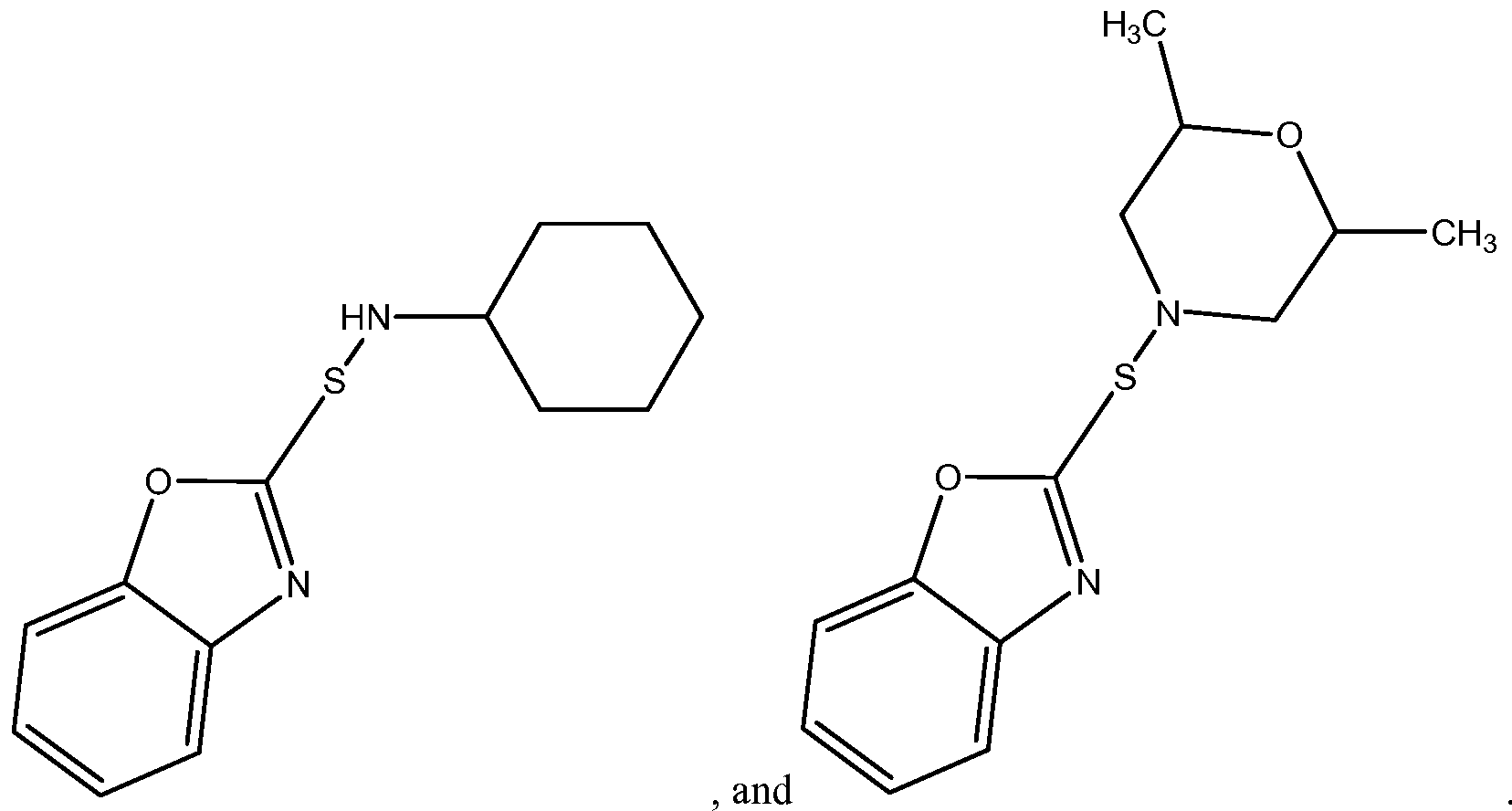
[0014] A seventh embodiment provides a method as in any of the first through sixth embodiments, where the benzoxazole sulfenamide is defined by the formula

[0015] An eighth embodiment provides a method as in any of the first through seventh embodiments, where the method further comprises an activator.
[0016] A ninth embodiment provides a method as in any of the first through eighth embodiments, where the activator is selected from zinc compounds, steric acid, or combinations thereof.
[0017] A tenth embodiment provides a method as in any of the first through ninth embodiments, where the method further comprises an amine.
[0018] A eleventh embodiment provides a method as in any of the first through tenth embodiments, where the method further comprises a secondary accelerator.
[0019]
[0020] An twelfth embodiment provides a method of vulcanizing rubber comprising:
[0021] (l)preparing a cure system by mixing a rubber, a sulfur compound, an activator, and a benzoxazole sulfenamide defined by the formula:

[0022] where Rl and R2 are each individually selected from hydrogen atoms, alkyl groups, substituted alkyl groups, and aromatic groups, or where Rl and R2 join to form an alkane or substituted alkane group; and
[0023] (2) heating the cure system.
[0024] A thirteen embodiment provides a method as in the twelfth embodiment, where the benzoxazole sulfenamide forms a complex with a zinc atom defined by the formula

[0026] An fourteenth embodiment provides a benzoxazole sulfenamide complex defined by the formula

[0027] where each X is selected from an oxygen atom or a sulfur atom provided that at least one X is an oxygen atom, each Rl and R2 are individually selected from hydrogen atoms, alkyl groups, and subsitituted alkyl groups, or where an Rl and an R2 join to form an alkane or substituted alkane group.
[0028] A fifteenth embodiment provides a method of preparing an asphalt and polymer composition comprising mixing asphalt, a rubber, a sulfur compound, an activator, and a bezoxazole sulfenamide defined by the formula:

[0030] A sixteeth embodiment provides a method as in the fifteenth embodiment, where the rubber is selected from polybutadiene, polyisoprene or polyisobutene rubber, polychloroprene, polybutadiene, styrene-butadiene copolymers
[0031] A seventeenth embodiment provides a method as in the either the fifteenth or sixteenth embodiment, where the bezoxazole sulfenamide is selected from the group consisting of
[0032]


[0034] where Rl and R2 are each individually selected from hydrogen atoms, alkyl groups, substituted alkyl groups, and aromatic groups, or where Rl and R2 join to form an alkane or substituted alkane group.
[0035] An nineteenth embodiment provides an asphalt cement comprising:
an aggregate and the asphalt and polymer compositionof the eighteenth embodiment.
BRIEF DESCRIPTION OF THE DRAWINGS
[0036] Figure 1 provides a lH NMR spectrum of benzoxazole derivatives 7, 8 and 9 in CD3OD.
[0037] Figure 2 provides a crystal structure of zinc complex 9.
[0038] Figure 3 provides a chart of the cure characteristic curves of compound 7 at 140°C. The sample composition is shown in Table 2. In the control experiment, only natural rubber (NR) and sulfur are used.
[0039] Figure 4 provides a chart of the cure characteristic curves of 7 at different temperatures.
[0040] Figure 5 provides a chart showing the effect of cure rate on rubber sample (natural rubber: 100 Phr; sulfur: 2.4 Phr; compound 7 :0.6 Phr) in the presence of different activators at 140°C.
[0041] Figure 6A provides the CPMAS C NMR of cured rubber by using benzoxazole 7 as the vulcanization accelerator (cure time: 90min). The inset shows the enlarged region for 35-70 ppm.
[0042] Figure 6B provides the CPMAS 13C NMR of cured rubber by using TBBS as thevulcanization accelerator (cure time: 90min). The inset shows the enlarged region for 35-70 ppm.
[0043] Figure 6C provides the reference for assigning the chemical shifts of natural rubber for figures 6 A and 6B.
[0044] Figure 7A provides a chart of the effect of zinc compound 8 on the cure rate of rubber compound (100 NR + 2.4 sulfur) at 140°C.
[0045] Figure 7B provides a chart of the effect of zinc compound 9 on the cure rate of rubber compound (100 NR + 2.4 sulfur) at 140°C.
[0046] Figure 8 provides a chart showing the comparison of cure characteristic curves by using different accelerators at 140°C (using the rubber composition in the Table 2). The inset shows the structure of diphenylguanidine (DPG). The amount of amine (diphenylguanidine, DPG) used was 0.4 Phr.
DETAILED DESCRIPTION OF ILLUSTRATIVE EMBODIMENTS
[0047] Embodiments include the use of benzoxazole sulfenamide as accelerators for sulfur vulcanization. Advantageously, it has been found that when benzoxazole sulfenamide is used an accelerator, a volcanized polymer may be prepared with little to no reversion. In comparison with the current commercial benzothiazolesulfenamide (TBBS), benzoxazole sulfenamide revealed similar "scorch time," a desirable "delayed vulcanization." A chart of torque vs. time for benzoxazole sulfenamide cure rubber exhibits a long plateau, indicating the less danger of over-vulcanization. Benzoxazole sulfenamide may also be used in asphalt and polymer compositions.
[0048] Vulcanization is a chemical process that converts a soft and tacky rubber into a harder and more durable material. Methods of vulcanizing rubber are detailed in "Rubber Compounding: Chemistry and Applications; Taylor & Francis, 2004, which is incorporated by reference. The components used to vulcanize rubber, including the rubber itself, may be referred to as a cure system. In one or more embodiments, the cure system may include a rubber, a sulfur compound, and a benzoxazole sulfenamide accelerator. In these or other embodiments, the cure system may optionally have other components such as activators, retarders, and secondary accelerators.
[0049] The vulcanized rubber may be prepared by mixing the ingredients of the cure system and then heating the cure system. In one or more embodiments, the sulfur compound and the benzoxazole sulfonamide accelerator are the final components cure system to be add. For example, a cure system may be prepared by mixing rubber for 1 to 5 minutes, adding an activator under continued mixing for 1 to 5 minutes, and then finally added the sulfur compound and the benzoxazole sulfonamide accelerator. In one or more embodiments, about 130 to about 160 °C for about 80 to 150 min.
[0050] Rubbers suitable for vulcanization with a benzoxazole sulfenamide accelerator include those rubbers with unsaturated carbon-carbon bonds. Suitable rubbers include natural rubber or synthetic rubbers. Examples of synthetic rubbers include, but are not limited to, polybutadiene rubbers (BR), polystyrene-butadiene rubbers (SBR), polyisoprene, isoprene rubbers (IR) and polychloroprene.
[0051] Benzoxazole sulfenamide accelerators include those compounds that include a benzoxazole group connected through a sulfur atom to an amine group. Those skilled in the art will understand that a benzoxazole may be defined by the formula:

Those skilled in the art will also understand that an amine may be defined by the formula

[0052] In one or more embodiments, alkyl groups may include linear or branched hydrocarbons with a carbon chain length of 1 to 6 carbons. Specific examples of alkyl groups include, but are not limited to, methyl, ethyl, propyl, isopropyl, isobutyl, tert-butyl, n-butyl, sec -butyl, isopentyl, tertpentyl, n-pentyl, sec-pentyl, tert-hexyl, n-hexyl, isohexyl, and sec-hexyl.
[0053] Substituted alkyl groups include groups where a hydrogen atom has been replaced with a substituent. Suitable substituents include a halogen atom (e.g. F, CI, Br), a hydroxy 1 group, an alkoxy group, or an amino group.
[0054] In one or more embodiments, the benzoxazole sulfenamide accelerator may be defined by the formula:

[0055] In one or more embodiments, the amine may be a tertiary amine, and both R1 and R^ are each individually selected from alkyl groups, substituted alkyl groups, and aromatic groups, or where R1 and R^ join to form an alkane or substituted alkane group.
In other embodiments, the amine may be a secondary amine, and one of R1 or R^ may be a hydrogen atom and the other may be selected from alkyl groups, substituted alkyl groups, and aromatic groups.
[0056] Specific examples of benzoxazole sulfenamide accelerator may be defined by the follow formulas

-13-


[0057] The amount of the benzoxazole sulfenamide accelerator used to cure rubber may be stated in Phr (parts per hundred parts rubber). In one or more embodiments, the cure system may include at least 0.1, in other embodiments at least 0.3, and in still other embodiments at least 0.5 Phr of a benzoxazole sulfenamide accelerator. In these other embodiments, the cure system may include at most 10, in other embodiments at most 7, and in still other embodiments at most 5 Phr of a benzoxazole sulfenamide accelerator. In these other embodiments, the cure system may include at about 0.1 to 10, in other embodiments about 0.3 to 7, and in still other embodiments about 0.5 to 5 Phr of a benzoxazole sulfonamide accelerator.
[0058] Sulfur compounds may be used to crosslink active sites, typically unsaturated carbon-carbon bonds in on the rubber. Sulfur compounds suitable for vulcanization with a benzoxazole sulfonamide accelerator include elemental sulfur, an allotrope of sulfur, a sulfur donor, or a combination thereof. Examples of sulfur donors include, but are not limited to, tetramethylthiuram disulfide, tetraethylthiuram disulfide, and dithiodimorpholine. The amount of the sulfur compound used to cure rubber may be stated in Phr. In one or more embodiments, the cure system may include at least 0.1 , in other embodiments at least0.3, and in still other embodiments at least 0.5 Phr of a sulfur compound. In these other embodiments, the cure system may include at most 40, in other embodiments at most 20, and in still other embodiments at most 10 Phr of a sulfur compound. In these other embodiments, the cure system may include at about 0.1 to about 10, in other embodiments about 0.5 to about 7, and in still other embodiments about 1 to about 5 Phr of a sulfur compound.
[0059] An activator may be used to improve acceleration and allow the cure system to reach its full crosslinking potential. Activators suitable for vulcanization with a benzoxazole sulfonamide accelerator include zinc compounds, steric acid, or combinations thereof. Examples zinc compounds include, but are not limited to, zinc oxide (ZnO) and Zn-soap. The amount of activator used to cure rubber may be stated in Phr. In one or more embodiments, the cure system may include at least 0.1, in other embodiments at least 0.5, and in still other embodiments at least 1 Phr of an activator. In these other embodiments, the cure system may include at most 20, in other embodiments at most 10, and in still other embodiments at most 6 Phr of an activator. In these other embodiments, the cure system may include at about 0.1 to about 20, in other embodiments about 0.5 to about 10, and in still other embodiments about 1 to about 6 Phr of an activator.
[0060] A retarder may be used to reduce the tendency of a rubber compound to vulcanize prematurely by increasing scorch delay. Retarders suitable for vulcanization with a benzoxazole sulfenamide accelerator include N-(cyclohexylthio) phthalimide and stearic acid. The amount of activator used to cure rubber may be stated in Phr. In one or more embodiments, the cure system may include at least 0.01, in other embodiments at least0.05, and in still other embodiments at least 0.1 Phr of a retarder. In these other embodiments, the cure system may include at most 5, in other embodiments at most 3, and in still other embodiments at most 2 Phr of a retarder. In these other embodiments, the cure system may include at about 0.01 to about 5, in other embodiments about 0.05 to about 3, and in still other embodiments about 0.1 to about 2 Phr of a retarder.
[0061] As noted above, the cure system may optionally include a secondary accelerator in addition to the benzoxazole sulfenamide accelerator. A secondary accelerator may be used to control vulcanization speed. Examples of suitable secondary accelerators include N-cyclohexyl-2-benzothiazolesulfenamide, N- (cyclohexylthio)phthalimide, N,N'-dibutylthiourea,N,N-dicyclohexyl-2- benzothiazolesulfenamide Ν,Ν'-Diethythiourea, di-o-tolylguanidine, diphenylguanidine, dipentamethylenethiuram hexasulfide, dithiodimorpholine, ethylenethiourea, 2- (morpholinothio)benzothiazolesulfenamide, 2-mercaptobenzothiazole, benzothiazyl disulfide, N-nitrosodiphenylamine, polyethylene glycol, N-t-Butyl-2- benzothiazolesulfenamide, tellurium diethyldithiocarbamate, tetraethylthiuram disulfide, polymerized 2,2,4-trimethyl-l,2-dihydroquinoline, tetramethylthiuram disulfide, tetramethylthiuram monosulfide, trimethylthiourea, zinc dibutyldithiocarbamate, zinc o-di- n-butylphosphorodithioate, zinc diethyldithiocarbamate, zinc dimethyldithiocarbamate, zinc salt of 2-mercaptobenzothiazole, N-l,3-dimethylbutyl-N-phenyl-p-phenylenediamine, Bis(diethyl thiophosphoryl) trisulfide, and bis(diisopropylthiophosphoryl) disulfide.
[0062] The amount of the secondary accelerator used to cure rubber may be stated in Phr. In one or more embodiments, the cure system may include at least 0.1, in other embodiments at least0.5, and in still other embodiments at least 1.0 Phr of a secondary accelerator. In these other embodiments, the cure system may include at most 10, in other embodiments at most 6, and in still other embodiments at most 4 Phr of a secondary accelerator. In these other embodiments, the cure system may include at about 0.1 to 8, in other embodiments about 0.5 to 6, and in still other embodiments about 1 to 4 Phr of a secondary accelerator.
[0063] The amount of the secondary accelerator used to cure rubber may also be stated in as a ratio between the benzoxazole sulfonamide accelerator and the secondary accelerator. In one or more embodiments, the cure system may include a ratio of benzoxazole sulfenamide accelerator to secondary accelerator of about 1 to 50, in other embodiments about 5 to 25, and in still other embodiments about 10 to 15.
[0064] In one or more embodiments, an amine compound may be included in the cure system. It has been found that when a cure system includes a benzoxazole sulfenamide accelerator and an amine show increased accelerator activity. Examples of suitable amine compounds include diphenylquanidine, butyraldehydeanine, hexamethylenetetramine, di(P-naphthyl)-p-phenyldiamine, a dialkylamine such as dibutyl amine or cyclohexylethylamine, trimethylthiourea, 1,3-dibutylthiourea.
[0065] The amount of the amine used to cure rubber may be stated in Phr. In one or more embodiments, the cure system may include at least 0.1, in other embodiments at least0.2, and in still other embodiments at least 0.4 Phr of an amine. In these other embodiments, the cure system may include at most 10, in other embodiments at most 8, and in still other embodiments at most 5 Phr of an amine. In these other embodiments, the cure system may include at about 0.1 to 8, in other embodiments about 0.2 to 5, and in still other embodiments about 0.5 to 3 Phr of an amine.
[0066] Advantageously, it has been found that when a benzoxazole sulfonamide accelerator is used in a cure system the vulcanized rubber shows little or no reversion. In one or more embodiments, the vulcanized rubber systems show a non-appreciable amount of reversion. The amount of reversion may be determined using a rheometer. In one or more embodiments, the amount of reversion may be less than 10%, in other embodiments, less than 5%, and in still other embodiments less than 2%.
[0067] In one or more embodiments, where a zinc compound is used as an activator, the benzoxazole sulfenamide accelerator may form a complex with a zinc atom defined by the formula

X is an oxygen atom, each R1 and are individually selected from hydrogen atoms, alkyl groups, and subsitituted alkyl groups, or where an R1 and an R.2 join to form an alkane or substituted alkane group. In embodiments, where one of the X is an oxygen atom, the complex is typically prepared from a cure system that includes a zinc compound
activator, a zinc compound, and a secondary accelerator that includes a benzothiazole group.
[0068] As noted above the benzoxazole sulfenamide may be used in asphalt and polymer compositions. In one or more embodiments, an asphalt and polymer composition comprises an asphalt, a rubber, a sulfur compound, an activator, and a bezoxazole sulfonamide.
[0069] The benzoxazole sulfenamide compounds useful in asphalt and polymer compositions may be described as above. In one or more embodiments, the asphalt and polymer composition may include a bezoxazole sulfonamide defined by the formula:

[0070] Specific examples of benzoxazole sulfonamides for use in asphalt and polymer composition may be defended by the follow formulas


[0072] Asphalt, which may also be referred to as bitumen, is a viscous liquid or semisolid form of petroleum. The amount of the asphalt for use in an asphalt and polymer composition may be stated in percent weight of the total asphalt and polymer composition. The combined weight of asphalt and rubber polymer may be considered as 100%. In one or more embodiments, the asphalt and polymer composition may include at least 85%, in other embodiments at least 90 %, and in still other embodiments at least 95% asphalt. In these other embodiments, the asphalt and polymer composition may include at most 96 %, in other embodiments at most 98%, and in still other embodiments at most 99 % asphalt. In these other embodiments, the asphalt and polymer composition may include at about 85 % to about 99 %, in other embodiments about 90 % to about 99 %, and in still other embodiments about 95 % to about 98 % asphalt.
[0073] Rubbers suitable for use in an asphalt and polymer composition include, but are not limited to, polybutadiene, polyisoprene or polyisobutene rubber, polychloroprene, polybutadiene, styrene-butadiene copolymers. The amount of the rubber for use in an asphalt and polymer composition may be stated in percent weight of the total asphalt and polymer composition. In one or more embodiments, the asphalt and polymer composition may include at least 1%, in other embodiments at least2 %, and in still other embodiments at least 3% rubber. In these other embodiments, the asphalt and polymer composition may include at most 6 %, in other embodiments at most 8%, and in still other embodiments at most 10 % rubber. In these other embodiments, the asphalt and polymer composition may include at about 1 % to about 10 %, in other embodiments about 2 % to about 8 %, and in still other embodiments about 3 % to about 6 % rubber.
[0074] Activators suitable for use in an asphalt and polymer composition include, but are not limited to, zinc compounds, steric acid, or combinations thereof. Examples zinc
compounds include, but are not limited to, zinc oxide (ZnO) and Zn-soap. The amount of the activator for use in an asphalt and polymer composition may be stated in percent weight of the total asphalt and polymer composition. In one or more embodiments, the asphalt and polymer composition may include at least 0.01%, in other embodiments at least0.03 %, and in still other embodiments at least 0.05% activator. In these other embodiments, the asphalt and polymer composition may include at most 0.1 %, in other embodiments at most 0.5%, and in still other embodiments at most 1 % activator. In these other embodiments, the asphalt and polymer composition may include at about 0.01 % to about 0.1 %, in other embodiments about 0.03 % to about 0.5 %, and in still other embodiments about 0.05 % to about 0.1 % activator.
[0075] Suitable sulfur for use in an asphalt and polymer composition include, but are not limited to, elemental sulfur, an allotrope of sulfur, a sulfur donor, or a combination thereof. Examples of sulfur donors include, but are not limited to, tetramethylthiuram disulfide, tetraethylthiuram disulfide, and dithiodimorpholine. The amount of the sulfur compounds for use in an asphalt and polymer composition may be stated in percent weight of the total asphalt and polymer composition. In one or more embodiments, the asphalt and polymer composition may include at least 0.05%, in other embodiments at least0.07 %, and in still other embodiments at least 0.10% sulfur compound. In these other embodiments, the asphalt and polymer composition may include at most 0.2 %, in other embodiments at most 0.5%, and in still other embodiments at most 1 % sulfur compound. In these other embodiments, the asphalt and polymer composition may include at about 0.05 % to about 1 %, in other embodiments about 0.07 % to about 0.5 %, and in still other embodiments about 0.10 % to about 0.2 % sulfur compound.
[0076] Methods of preparing an asphalt and polymer compositions are discussed in various patents such as U.S. Pat. No. 4,145,322 (Maldonado); U.S. Pat. No. 5,371, 121 (Bellomy); and U.S. Pat. No. 5,382,612 (Chaverot), all of which are hereby incorporated by reference. In one or more embodiments, the asphalt and the rubber may be combined at a temperature of between 130° and 230° C, and mixed for 1 to 10 hours. The rubber and asphalt may be aged or the sulfur compound, activator, and bezoxazole sulfonamide may be added immediately after mixing. After the addition of the sulfur compound, activator, and bezoxazole sulfonamide the composition may be mixed or agitated for 20 minutes to 10 hours.
[0077] In one or more embodiments, an aggregate may be added to the asphalt and polymer composition. An aggregate is generally rock, and it may be used with an asphalt
and polymer composition for paving a road. Compositions of that include asphalt and polymer compositions along with aggregate may be referred to as asphalt cement. Suitable aggregates include but are not limited to, granite, basalt, and limestone. The amount of the aggregate for use with an asphalt and polymer composition may be stated in percent weight of the total asphalt, polymer, and aggregate composition.
[0078] While particular embodiments of the invention have been disclosed in detail herein, it should be appreciated that the invention is not limited thereto or thereby inasmuch as variations on the invention herein will be readily appreciated by those of ordinary skill in the art. The scope of the invention shall be appreciated from the claims that follow.
EXAMPLES
[0079] Materials. Natural rubber (SMR CV60) was purchased from Akrochem. sulfur (Harwich), zinc oxide (Akrochem), stearic acid (Harwick), TBBS (Flexsys America), 2-mercaptobenzoxazole (Fisher), zinc acetate dihydrate (Fisher), tert- butylamine (Aldrich) were used as received.
[0080] Synthesis of N-tert-2-butyl-benzoxazole sulfenamide (7). 2-
Mercaptobenzoxazole (2.5 g, 0.0165 mol) and sodium hydroxide (1.3 g, 0.0325 mol) were dissolved in 70 ml of water, and then 27 ml of an aqueous solution containing 18 ml (0.169 mol) of tert-butylamine was added. To this solution at room temperature, 55 ml of water containing 8.4 g (0.033 mol) of iodine and 4.6 g of potassium iodide was added drop by drop with stirring until constant brown color developed. The precipitate was filtered off, washed with water and dried in a vacuum oven for overnight (90%). The compound had mp 55-56°C. While the ¾ NMR of 7 in CD3OD (Figure 1) gave the signals at 7.51 (m, 2H,), 7.28 (m, 2H,), and 1.18 (s, 9H), the 'H NMR of 7 in CDC13 (300 MHz) revealed more details: 7.62 (d, 1H, J=6.2 Hz), 7.61 (d, 1H, J=7.0 Hz), 7.28 (t, 1H, J=6.2 Hz), 7.24 (t, 1H, J-7.0 Hz), 3.11 (s, 1H, -NH-), 1.24 (s, 9H). 13C NMR (CDC13, 300 MHz) δ 168.5, 151.4, 141.8, 123.9, 123.5, 1 18.5, 109.6, 55.1, 28.7.
[0081] Synthesis of zinc bis(benzoxazole-2-thiolate) (8). 2-Mercaptobenzoxazole (1.51 g, 10 mmol) and potassium hydroxide (0.56 g, 10 mmol) were added to 35 ml of ethanol. The mixture was heated until it became homogeneous. To this solution, an ethanol solution (40 ml) of zinc acetate dihydrate (1.09 g, 4.97 mmol) was added. The mixture was allowed to cool, and the precipitate was filtered off, washed with ethanol, and
dried in a vacuum oven for overnight (71%). XH NMR of 8 (in CD3OD , 300 MHz): 7.41 (d, 2H, J=7.2 Hz), 7.22 (t, 4H, J=7.2 Hz), 7.10 (d, 2H, J=7.2 Hz).
[0082] Synthesis of tert-butylamine complex of zinc benzoxazole-2-thiolate (9).
Zinc bis(benzoxazole-2-thiolate) (1.0 g, 2.73 mmol) and tert-butylamine (4 ml, 38 mmol ) was added to 40 ml of acetone. The mixture was stirred until it became homogeneous. The yellow solution was then evaporated in vacuum. The complex was partially dissociated during crystallization,
(Αι·-8)2Ζη(ΝΗ2-Βιιι)2 -¾=^ (ΑΓ-8)2Ζη(ΝΗ2-Βιι<) + NH2-Bu<
and a small amount of amine (~2%) could be added to suppress the dissociation. The crude solid product was recrystallized from a mixture of methylene dichloride and hexanes (1 :4 ratio by volume) which contains 2% amine, giving white crystalline (plate-like) (0.75g, 61%). The acetone/hexanes (1 :4 ratio) could also be used for recrystallization. XH NMR of 9 (in CD3OD , 300 MHz): 1.20 (s, 18H), 7.0-7.2 (br, 4H), 7.23-7.43 (br, 4H).
[0083] Compounding. Natural rubber masterbatch was made by masticating natural rubber (SMR CV60) in a Brabender internal mixer (speed: 50 rpm; temperature 55°C; loading chute: manual + 5kg). If applicable, zinc oxide and/or stearic acid were also mixed with rubber in the mastication process. Natural rubber was mixed for 1.3 min, and the mixture was mixed for additional 2 min after addition of zinc oxide/stearic acid. Sulfur and/or accelerators were then mixed with the masterbatch on a two roll mill (roll speed: front 12 rpm, rear 10 rpm; temperature: 120°C).
[0084] Cure characterization. Vulcanization kinetics were determined from rheometer curves using an Alpha Moving Die Rheometer (MDR) 2000 at 140°C. Parameters of cure curves are shown in Table 1 :
Table 1. Cure parameters of different accelerators at 140°C

Zinc complex 9, 3.54
3.9 17.8 36.7 5.3 ZnO
Zinc complex 9, 0.57
0.9 — - —
Stearic acid
Zinc complex 9, 4.03
ZnO, Stearic 4.3 18.4 45.4 3.7 acid
ats2: time when cure curve reaches 2 torque units increase above minimum torque (scorch time).
bt90: time when cure curve reaches 90 percent of full cure. t90 is generally the time when most physical properties of a vulcanizate reach optimal results.
cCure rate index: 100 / (t90 - ts2).
dMBO: 2-Mercaptobenzoxazole.
[0085] Synthesis of Benzoxazole-2-Sulfenamides and Related Zinc Complexes.
The desirable benzoxazole-2-sulfenamide 7 was synthesized from benzoxazole-2 -thiol 2 and tert-butyl amine in high yield, by using a literature procedure for a similar compound. The lH NMR spectrum of 7 detected four aromatic protons in anticipated two doublet and two triplet (Figure 1), confirming its structure. Bis(benzoxazole-2-ylthio)zinc 8 was also prepared from 2 by reaction with base followed by treatment with zinc acetate Zn(OAc)2.

[0086] The amine complex was conveniently prepared by reaction of 8 with tert- butylamine to give crystalline product. The synthesis of the amine complexes 9 appeared to be simpler than its zinc benzothiazole-2-thiolate (6), where the corresponding zinc complex of i-butylamine was prepared by substitution from the ammonium complex of zinc benzothiazole-2-thiolate (Ar-S-Zn(NH3)2-S-Ar → Ar-S-Zn( H2-Bu)2-S-Ar.12 During recrystallization, the amine complex 9 was found to partially dissociate, similarly as observed from its thiazole analogue 6. A small amount of tert-butylamine (~2%) could be used to suppress the dissociation. Crystal structure analysis showed that the resulting crystals had the structure 9 (Figure 2), not 10. Interestingly, two benzoxazole-2-thiolates in 9 adopted different structures, with one in the thio form, while the other in the isomeric thio-keto form. The tetra-coordinated zinc adopts a tetrahedral geometry, with bonding length 2.013 A for Zn(l)-N(2), 2.059 A for Zn(l)-N(4), and 2.283 A for Zn(l)-S(l).
[0087] Rubber curing study. In order to characterize vulcanization characteristics, Moving Disk Rheometer (MDR) was used to measure the cure curves of natural rubber in the presence of benzoxazole accelerators. As shown in Figure 3, the addition of sulfenamide 7 significantly increased the curing rate of the NR/sulphur mixture, revealing its accelerator activity. It should be pointed out that the sulfenamide 7 is structurally similar to the commercial accelerator TBBS (4b where -NRR'= -NH(t-Bu)) , which is widely used in the tire manufacture for rubber curing. In comparison with TBBS, the curing curve of 7 exhibited nearly the same "scorch delay", a valuable feature to prevent pre-vulcanization. Although the vulcanization activity of 7 was lower than that of TBBS, the curing curve of 7 did not reveal "a reversion" (a decrease in modulus after reaching a maximum), in sharp contrast to TBBS and mercaptobenzoxazole 2. The study also pointed to that the reactivity of benzoxazolesulfenamide 4b was only moderately lower than benzothiazolesulfenamide 3b, in sharp contrast to the thiol compounds where the accelerator activity of 2 is dramatically lower than 1. Interestingly, when using the mixture of TBBS and 7 (1 : 1 ratio), the curing curve showed quite different characteristics, revealing an earlier start of vulcanization with similar curing rate as TBBS. The result pointed to the existence of the synergistic effect between TBBS and 7. The increasing curing activity of 7, in the presence of TBBS, also suggests that the accelerator activity of 7 could be further improved. The cure behavior of 7, in the sample of "rubber + ZnO + sulfur," was also examined at different temperatures (Figure 4). As expected, the cure
onset occurred at an earlier time when the temperature was raised. The cure density, which is proportional to the torque force, appeared to be increased when temperature was decreasing from 160°C to 140°C. In summary, benzoxazole-2-sulfenamide compound exhibited significant accelerator activity for rubber curing, and further improvement of its activity could lead to a new class of vulcanization accelerators.
Table 2. Composition of a typical rubber vulcanizate

[0088] The effect of different activators on the cure rate was further examined (Figure 5). As anticipated, zinc oxide is the most effective activator for vulcanization, when the sample has a composition shown in Table 2. When stearic acid (2 Phr) was added to the sample, the accelerator activity of 7 appeared to be decreased overall to repeatedly give less crosslinking formation. The presence of stearic acid, however, increased the rate in the early reaction (before 20 min, during the delay period), which is similarly observed in the rubber system using thiazole analogue 3b.
[0089] The test samples for Figure 3 were consisting of natural rubber, zinc oxide, sulfur and accelerator (see Table 2). Other carbon-containing ingredients (e.g. carbon black, oil, stearic acid, and anti-degradent) were not used in order to simplify the task for structural characterization of the resulting rubber after curing. During the curing process, an important question is the chain structure of the curing rubber, which determines the physical property of the final rubber product. 13C NMR was thus acquired from the cured samples by using benzoxazole 7 as vulcanization accelerator. The major signals were detected at 134.7, 125.2, 31.9, 26.1, 23.0 ppm, attributing to the polymer backbone. The inset in Figure 5 shows the minor signals arising from the crossing-linking reaction. In both cured samples, the characteristic signal at -56.8 ppm is detected as minor signal,
indicating that the vulcanization is occurring at the indicated position in 11. Two minor signals at 39.7 and 44.4 ppm were also detected, which indicates the presence of the structure 12 with mono sulfur bridge.
[0090] Possible vulcanization mechanism. Since the cured rubber by using 7 had the similar chemical structure as that by using TBBS accelerator, we assume that the curing process followed the same vulcanization mechanism. In order to shed light on the curing mechanism, one important step is to identify the active sulfurating species. In analogy to the process proposed for benzothiazole sulfenamide 3, the possible route to the active sulfurating species for benzoxazole sulfonamide 4 is shown in Scheme 4. In the presence of ZnO, the sulfur-nitrogen bond in 7 is assumed to be cleaved under thermal conditions, forming zinc compound 8 and releasing amine. The chemical process of 7— >8 might be similar as its thiazol analogue (3— > 5). One step toward understanding the vulcanization process is to examine the cure activity of 8 and 9.

Scheme 4. Possible routes to the formation of the active sulfurating agents in the rubber system.
[0091] In order to confirm the assumption, the corresponding zinc compounds 8 and 9 were thus used to compare their rubber cure behavior. When being used with natural rubber and sulfur, zinc compound 8 exhibited nearly no observable vulcanization activity (Figure 7a). Addition of ZnO or "ZnO and stearic acid" showed only little improvement. The small vulcanization activity might be attributed to "zinc oxide and stearic acid," which are known to have minor vulcanization activity. When the zinc complex 9 was
used alone, little accelerator activity was observed (Figure 7b). In sharp contrast to 8, addition of zinc oxide to 9 drastically increased the accelerator activity in vulcanization. In addition, the onset of curing by using 9 occurred earlier than that by using either 7 or 8 (Figures 3 & 7), indicating that 9 can be converted to an active species more readily in the vulcanization process.
[0092] Comparison of cure curves (Figures 2 & 6b) showed that the benzoxazole- based sulfenamide 7 (a specific member of 4b) appeared to exhibit "no reversion" at 140°C (i.e. the system holds the torque level (or crosslinking density) after reaching the vulcanization optimum), revealing some advantage over the benzothiazole-based 3b (e.g. TBBS when R=?-Bu). The trend was further verified by examining the cure characteristics on an extended time scale (from 90 min to 150 min, Figure 8). The impact of benzoxazole on reversion in sulfenamide (3b versus 4b) appears to be opposite to that observed in the thiols (1 vs 2), as the vulcanization using 2 is reported to exhibit more significant reversion than 1. While sulfenamide 7 exhibited lower accelerator activity than TBBS, its accelerator activity could be increased by addition of a small amount of amine (diphenyguanidine (DPG), 0.4 Phr) (see curve "7+amine+ZnO" in Figure 8). Interestingly, the addition of DPG dramatically increased the curing activity of zinc compound 8 (Figure 8), while the compound 8 exhibited nearly no accelerator activity (Figure 7a). The result suggests that the accelerator activity of benzoxazole-based sulfenamide could be significantly increased if it is coupled with a suitable amine.
[0093] The experimental evidences shed some light on the vulcanization process. Since the amine complex 9 alone did not exhibit noticeable accelerator activity (Figure 7b), the real sulfurating species must be associated with other chemical species. The required addition of ZnO to 9 led us to assume the possible formation of 14 and 15 where each zinc is attached to only one benzoxazole ligand. The assumption is consistent with the literature report that direct reaction of ligand 2 with zinc sulfate can give the complexes with a 1 : 1 metal-to-ligand molar ratio, on the basis of elemental analysis and vibrational spectral analysis. The proposed 14 and 15 had only one amine ligand, which is consistent with the observation that the amine ligand on 9 tends to dissociate during the recrystallization process.
[0094] The crystal structure of amine complex 9 reveals that the benzoxazole-2- thiolate ligand is attached to Zn(II) in two different isomeric forms (i.e. thio- or thioketo- forms, see Figure 2). The complex 9 is ruled out to be an effective active sulfurating species, since the additional ZnO is required for the complex 9 to exhibit the accelerator
function. In conjunction with other evidences, the zinc complexes 14 and/or 15 are proposed to be potential sulfurating species in the rubber system (Scheme 4). It should be noted that 14 and 15 could be formed directly from "7 + ZnO," without necessarily going through the zinc compounds 8 and 9. For benzothiazole sulfenamide 3b, the proposed mechanism removes the concern that the amine complex 6 is synthesized by reaction of the ammonium complex 5·( ]¾)2 with an amine (not 5 with amine). It should also be noted that the zinc complexes 9 and 15 includes the -N-C=S fragment, which is common in the fast curing dithiocarbamates accelerator such as zinc dimethyldithiocarbamate (Me2N-C(=S)-S)2Zn.
Claims
What is claimed is:
1. A method of vulcanizing rubber comprising:
heating a rubber in the presence of sulfur compound and a benzoxazole sulfenamide defined by the formula:

2. The method of claim 1, where the rubber is selected from the group consisting of natural rubber, polybutadiene rubbers (BR), styrene-butadiene rubbers (SBR), polyisoprene, isoprene rubbers (IR) and polychloroprene.
3. The method of claim 1, where the sulfur compound is elemental sulfur, an allotrope of sulfur, a sulfur donor, or a combination thereof.
4. The method of claim 1, where the sulfur donor is selected from the group consisting of tetramethylthiuram disulfide, tetraethylthiuram disulfide, and
dithiodimorpholine.
5. The method of claim 1, where one of R.1 or is a hydrogen atom and the other may be selected from alkyl groups, substituted alkyl groups, and aromatic groups
6. The method of claim 1, where the benzoxazole sulfenamide is selected from the group consisting of


7. The method of claim 6, where the benzoxazole sulfenamide is defined by the formula

8. The method of claim 1, where the method further comprises an activator.
9. The method of claim 1, where the activator is selected from zinc compounds, steric acid, or combinations thereof.
10. The method of claim 1, where the method further comprises an amine.
1 1. The method of claim 1, where the method further comprises a secondary accelerator
12. A method of vulcanizing rubber comprising:
(1) preparing a cure system by mixing a rubber, a sulfur compound, an activator, and a benzoxazole sulfenamide defined by the formula:

(2) heating the cure system.
13. The method of claim 12, where the benzoxazole sulfenamide forms a complex with a zinc atom defined by the formula

X is an oxygen atom, each R1 and R^ are individually selected from hydrogen atoms, alkyl groups, and subsitituted alkyl groups, or where an R1 and an R^ join to form an alkane or substituted alkane group.
A benzoxazole sulfenamide complex defined by the formula

X is an oxygen atom, each R1 and R^ are individually selected from hydrogen atoms, alkyl groups, and subsitituted alkyl groups, or where an R1 and an R^ join to form an alkane or substituted alkane group.
15. A method of preparing an asphalt and polymer composition comprising
mixing asphalt, a rubber, a sulfur compound, an activator ,
and a bezoxazole sulfenamide defined by the formula:

16. The method of claim 15, where the rubber is selected from polybutadiene, polyisoprene or polyisobutene rubber, polychloroprene, polybutadiene, styrene-butadiene copolymers
17. The method of claim 15, where the bezoxazole sulfenamide is selected from the group consisting of


19. An asphalt cement comprising:
an aggregate and the asphalt and polymer composition of claim 18
Applications Claiming Priority (2)
| Application Number | Priority Date | Filing Date | Title |
|---|---|---|---|
| US201361823424P | 2013-05-15 | 2013-05-15 | |
| US61/823,424 | 2013-05-15 |
Publications (1)
| Publication Number | Publication Date |
|---|---|
| WO2014186571A1 true WO2014186571A1 (en) | 2014-11-20 |
Family
ID=51898868
Family Applications (1)
| Application Number | Title | Priority Date | Filing Date |
|---|---|---|---|
| PCT/US2014/038191 Ceased WO2014186571A1 (en) | 2013-05-15 | 2014-05-15 | Benzoxazole-based materials for vulcanization accelerator applications |
Country Status (1)
| Country | Link |
|---|---|
| WO (1) | WO2014186571A1 (en) |
Cited By (9)
| Publication number | Priority date | Publication date | Assignee | Title |
|---|---|---|---|---|
| US9928757B2 (en) | 2015-05-21 | 2018-03-27 | Sonoco Development, Inc. | Flexible laminate for packaging with integrated peelable portion |
| US10138026B2 (en) | 2015-04-01 | 2018-11-27 | Sonoco Development, Inc. | Resealable flexible package and method of using the same |
| US10150600B2 (en) | 2014-10-01 | 2018-12-11 | Sonoco Development, Inc. | Container structure with a built-in opening and reclosing feature |
| CN109071884A (en) * | 2016-04-15 | 2018-12-21 | 横滨橡胶株式会社 | The manufacturing method of rubber composition, vulcanized rubber article and vulcanized rubber article |
| US10689151B2 (en) | 2017-07-21 | 2020-06-23 | Sonoco Development, Inc. | Tamper evident hybrid resealable container |
| KR20210149392A (en) * | 2020-06-02 | 2021-12-09 | 원광대학교산학협력단 | Sulfenamide compound and method for producing the same |
| US11203477B2 (en) | 2015-10-30 | 2021-12-21 | Sonoco Development, Inc. | Integrated package opening feature |
| US11225355B2 (en) | 2017-11-08 | 2022-01-18 | Sonoco Development, Inc. | Membrane lid with integrated peelable portion |
| JP2023146373A (en) * | 2022-03-29 | 2023-10-12 | 住友ゴム工業株式会社 | Rubber composition and crosslinked rubber molded article |
Citations (7)
| Publication number | Priority date | Publication date | Assignee | Title |
|---|---|---|---|---|
| GB231503A (en) * | 1924-03-27 | 1925-08-06 | Richard Cornelus Van Haagen | Process of making a covering for roads, floors, roofs, and the like |
| USRE19286E (en) * | 1931-03-12 | 1934-08-21 | Vulcanization accelerator | |
| US4280967A (en) * | 1980-03-20 | 1981-07-28 | The Goodyear Tire & Rubber Company | Vulcanization of rubber with 2-(alkylsulfinyl)-benzothiazoles |
| US20080070154A1 (en) * | 2006-08-30 | 2008-03-20 | Fujifilm Corporation | Decomposable resin composition and pattern-forming material including the same |
| US20080234070A1 (en) * | 2007-03-23 | 2008-09-25 | Brian Comeau | Functionalized, Crosslinked, Rubber Nanoparticles for Use in Golf Ball Intermediate Layers |
| EP1527127B1 (en) * | 2002-07-05 | 2009-02-11 | Exxonmobil Chemical Patents Inc. | Functionalized elastomer nanocomposite |
| US20120146010A1 (en) * | 2009-10-27 | 2012-06-14 | Dai Nippon Printing Co., Ltd. | Transition metal compound-containing nanoparticle and method for producing the same, ink for positive hole injection transport layer, device comprising positive hole injection transport layer and method for producing the same |
-
2014
- 2014-05-15 WO PCT/US2014/038191 patent/WO2014186571A1/en not_active Ceased
Patent Citations (7)
| Publication number | Priority date | Publication date | Assignee | Title |
|---|---|---|---|---|
| GB231503A (en) * | 1924-03-27 | 1925-08-06 | Richard Cornelus Van Haagen | Process of making a covering for roads, floors, roofs, and the like |
| USRE19286E (en) * | 1931-03-12 | 1934-08-21 | Vulcanization accelerator | |
| US4280967A (en) * | 1980-03-20 | 1981-07-28 | The Goodyear Tire & Rubber Company | Vulcanization of rubber with 2-(alkylsulfinyl)-benzothiazoles |
| EP1527127B1 (en) * | 2002-07-05 | 2009-02-11 | Exxonmobil Chemical Patents Inc. | Functionalized elastomer nanocomposite |
| US20080070154A1 (en) * | 2006-08-30 | 2008-03-20 | Fujifilm Corporation | Decomposable resin composition and pattern-forming material including the same |
| US20080234070A1 (en) * | 2007-03-23 | 2008-09-25 | Brian Comeau | Functionalized, Crosslinked, Rubber Nanoparticles for Use in Golf Ball Intermediate Layers |
| US20120146010A1 (en) * | 2009-10-27 | 2012-06-14 | Dai Nippon Printing Co., Ltd. | Transition metal compound-containing nanoparticle and method for producing the same, ink for positive hole injection transport layer, device comprising positive hole injection transport layer and method for producing the same |
Non-Patent Citations (1)
| Title |
|---|
| PRETI, C ET AL.: "Transition metal complexes of deprotonated 2-mercaptobenzoxazole. Study of the thiol-thioketo form equilibrium.", CANADIAN JOURNAL OF CHEMISTRY, vol. 55, 1977, pages 1409 - 1414, Retrieved from the Internet <URL:http://www.nrcresearchpress.com/doi/pdf/10.1139/v77-195> [retrieved on 20131223] * |
Cited By (18)
| Publication number | Priority date | Publication date | Assignee | Title |
|---|---|---|---|---|
| US10150600B2 (en) | 2014-10-01 | 2018-12-11 | Sonoco Development, Inc. | Container structure with a built-in opening and reclosing feature |
| US11738919B2 (en) | 2014-10-01 | 2023-08-29 | Sonoco Development, Inc. | Container structure with a built-in opening and reclosing feature |
| US10865023B2 (en) | 2014-10-01 | 2020-12-15 | Sonoco Development, Inc. | Container structure with a built-in opening and reclosing feature |
| US11325759B2 (en) | 2014-10-01 | 2022-05-10 | Sonoco Development, Inc. | Container structure with a built-in opening and reclosing feature |
| US10138026B2 (en) | 2015-04-01 | 2018-11-27 | Sonoco Development, Inc. | Resealable flexible package and method of using the same |
| US10026339B2 (en) | 2015-05-21 | 2018-07-17 | Sonoco Development, Inc. | Flexible laminate for packaging with integrated peelable portion |
| US9928757B2 (en) | 2015-05-21 | 2018-03-27 | Sonoco Development, Inc. | Flexible laminate for packaging with integrated peelable portion |
| US10733912B2 (en) | 2015-05-21 | 2020-08-04 | Sonoco Development, Inc. | Flexible laminate for packaging with integrated peelable portion |
| US11203477B2 (en) | 2015-10-30 | 2021-12-21 | Sonoco Development, Inc. | Integrated package opening feature |
| CN109071884A (en) * | 2016-04-15 | 2018-12-21 | 横滨橡胶株式会社 | The manufacturing method of rubber composition, vulcanized rubber article and vulcanized rubber article |
| US11148851B2 (en) | 2017-07-21 | 2021-10-19 | Sonoco Development, Inc. | Tamper evident hybrid resealable container |
| US11597559B2 (en) | 2017-07-21 | 2023-03-07 | Sonoco Development, Inc. | Tamper evident hybrid resealable container |
| US10689151B2 (en) | 2017-07-21 | 2020-06-23 | Sonoco Development, Inc. | Tamper evident hybrid resealable container |
| US11225355B2 (en) | 2017-11-08 | 2022-01-18 | Sonoco Development, Inc. | Membrane lid with integrated peelable portion |
| US12172797B2 (en) | 2017-11-08 | 2024-12-24 | Sonoco Development, Inc. | Membrane lid with integrated peelable portion |
| KR20210149392A (en) * | 2020-06-02 | 2021-12-09 | 원광대학교산학협력단 | Sulfenamide compound and method for producing the same |
| KR102396180B1 (en) * | 2020-06-02 | 2022-05-10 | 원광대학교산학협력단 | Sulfenamide compound and method for producing the same |
| JP2023146373A (en) * | 2022-03-29 | 2023-10-12 | 住友ゴム工業株式会社 | Rubber composition and crosslinked rubber molded article |
Similar Documents
| Publication | Publication Date | Title |
|---|---|---|
| WO2014186571A1 (en) | Benzoxazole-based materials for vulcanization accelerator applications | |
| RU2067974C1 (en) | Sulfide-containing polycitracone imides and polytacone imides | |
| JP5975369B2 (en) | Rubber modifying composition and method for producing the same, tire modified rubber, tire rubber composition and tire | |
| JP4598148B2 (en) | Sulfenamide, rubber vulcanization accelerator containing the sulfenamide, and method for producing the same | |
| CN102177200B (en) | Rubber composition | |
| BRPI0720723A2 (en) | SILADO CORE POLYSULPHETS, PREPARATION THEREOF AND USE IN CHARGED ELASTOMER COMPOSITIONS | |
| JPS62241935A (en) | Vulcanizable rubber mixture | |
| JP2014177430A (en) | Organosilane and its manufacturing method | |
| Rong et al. | A benzoxazole sulfenamide accelerator: Synthesis, structure, property, and implication in rubber vulcanization mechanism | |
| CN102574820B (en) | 1, 2, 4-triazine suitable as a vulcanization accelerator and method for producing same | |
| HU191815B (en) | Vulcanizable caoutchouc compositions comprising organic thiosulfate or thiosulfonate derivatives as stabilizing agent | |
| US6646029B1 (en) | Pyrimidine derivatives as hardness stabilizers | |
| SE408711B (en) | FLSFORTRIAMIDE DERIVATIVES USED AS INHIBITORS TO PREVENT EARLY COLLECTION OF OVULCATED RUBBER | |
| JPH10511717A (en) | Sulfur vulcanized rubber composition containing a substituted succinimide compound | |
| JP6100120B2 (en) | Organic sulfide and method for producing the same | |
| JP2010196030A (en) | Rubber composition | |
| US2173732A (en) | Accelerator of vulcanization | |
| US4673741A (en) | Bis-(2-ethylamino-4-diethylamino-s-triazine-6-yl) tetrasulfide, process for its production, use and vulcanizable mixtures containing it | |
| JP5093764B2 (en) | New 2-mercaptobenzothiazole derivatives | |
| JP5067687B2 (en) | Diene rubber composition in which reversion is suppressed | |
| JPH06207043A (en) | New vulcanization accelerator suitable for introducing polarsubstituent | |
| JP2013087278A (en) | Nitrosamine-free high speed vulcanizable rubber composition | |
| JP6100121B2 (en) | Rubber composition and pneumatic tire | |
| US3751401A (en) | Vulcanizable compositions containing cyanoisothiazolyl bis(dithiocarbamates) | |
| US4165417A (en) | 3-(Tert-alkylthio)-1,3-thiazolidin-2,4-dione used to inhibit premature vulcanization of diene rubbers |
Legal Events
| Date | Code | Title | Description |
|---|---|---|---|
| 121 | Ep: the epo has been informed by wipo that ep was designated in this application |
Ref document number: 14798486 Country of ref document: EP Kind code of ref document: A1 |
|
| NENP | Non-entry into the national phase |
Ref country code: DE |
|
| 122 | Ep: pct application non-entry in european phase |
Ref document number: 14798486 Country of ref document: EP Kind code of ref document: A1 |